An historical account of all the voyages round the world, performed by English navigators. (Volume 2 of 4)
Whole book · 5 sections
AN HISTORICAL ACCOUNT OF ALL THE VOYAGES ROUND THE WORLD , PERFORMED BY ENGLISH NAVIGATORS ;
INCLUDING THOSE LATELY UNDERTAKEN By Order of his Present MAJESTY.
THE WHOLE
Faithfully Extracted from the Journals of the VOYAGERS.
Drake,
undertaken in 1577-80
Cavendish,
1586-88
Cowley,
1683-86
Dampier,
1689-96
Cooke,
1708-11
Rogers,
1708-11
Clipperton and Shelvocke,
1719-22
Anson,
1740-44
Byron,
1764-66
Wallis,
1766-68
Carteret,
1766-69
Cook,
1768-71
TOGETHER WITH
That of Sydney Parkinson, Draftsman to Joseph Banks, Esq; who circumnavigated the Globe with
Capt. Cook, in his Majesty’s Ship the Endeavour.
AND
The Voyage of Mons. Bougainville round the World,
Performed by Order of the French King.
Illustrated with Maps, Charts, and Historical Prints.
In Four Volumes.
To which is added,
An APPENDIX. Containing the Journal of
a Voyage to the North Pole, by the Hon. Commodore
PHIPPS, and Captain LUTWIDGE.
VOLUME THE SECOND.
LONDON:
Printed for F. Newbery, the Corner of St. Paul’s Church-Yard.
M DCC LXXIV.
THE VOYAGES OF Captain COOKE .
The rich cargo of the annual ship from Manilla
to Accapulco, has ever been the object
which private adventurers to the South Seas
have had in view, while, on the other hand, the
annual ship from Accapulco to Manilla has been
the pursuit of the ships of war. This difference
has arisen from the different constitution of the
two ships; for the galleon, when she sets sail
from Manilla, being deep laden with a variety
of bulky goods, (such as Chinese silks and manufactures,
vast quantities of Indian stuffs, callicoes,
and chintz, besides the minuter articles of
goldsmiths work, embroidery, &c. wrought at
Manilla by the Chinese,) she has not the conveniency
of mounting her lower tier of guns, but
generally carries them in her hold. Her hands
too are as few as are confident with the safe navigation
of the ship, that she may be the less encumbered
by the stowage of provisions so that
being but weakly manned, and indifferently provided
for defence, she is thereby more exposed
to the attacks of small privateers, and more easy
to be made their prey; and, though she does
not contain so great a treasure as the other, yet
she is sufficiently rich to recompense the undertakers,
and to enrich the captors, her cargo being
generally estimated at three millions of dollars.
But the ship from Accapulco making her return
chiefly in silver and gold, and having little
or no bulky goods on board, as her cargo lies in
less room, her lower tier is always mounted before
she leaves the port, and her crew is augmented
with a supply of sailors, and with one or
two companies of foot, which are intended to
reinforce the garrison at Manilla. Besides, there
being many merchants who take their passage to
Manilla on board the galleon, her whole number
of hands on her return is usually little short of
600 fighting men; so that she is more than a
match for such small privateers as are generally
sent upon hazardous expeditions, and a prize
only for a royal ship of war; and has therefore
never been attempted by any other.
The voyage we are now about to relate was
purposely fitted out with a view to intercept the
Manilla ship at the instance of Dampier, in concluding
of whose character (from reading the
accounts written by himself) we were led into
an error, which the present voyage, written by
Captain Cooke, has enabled us to correct. The
ill success that attended the voyage to the South
Seas, under the immediate command of Dampier,
of which a brief relation is given in the first
volume of this work, was so far from discouraging
that enterprizing officer from pursuing his
favourite project of making prize of the Manilla
ship, that, after his return, when he had wearied
the merchants of London with fruitless solicitations,
he repaired to Bristol, where his representations
were better understood, and where they
were attended with better effect. By his solid
remonstrances he prevailed upon nineteen of
the principal merchants and gentlemen of that
city to unite and form a company, for the purpose
of fitting out two private ships of war, to
shew what advantages might be derived from a
well-conducted enterprize against the Spaniards
in the South Seas: and it may, perhaps, be attributed
to his judgment and experience, that they
were more properly adapted to the service on
which they were to be sent, and were better provided
against every accident to which they might
be exposed, than any privateers that ever were
fitted out before them. Add to this, that their
crews were furnished with better regulations,
and subjected to stricter rules, and under severer
penalties, than men listed to go on hazardous
adventures are generally willing to submit to.
Their principal officers were gentlemen of
experience, or highly interested in the success of
the voyage; being the first subscribers, and the
chief promoters of the undertaking and these
also were assisted with a second set of officers,
equally able and experienced, who, in case of
accidents, were ready to supply the places of
those who might be disabled.
But, besides being awed by penalties from
trespassing the articles of agreement that were
signed by every man on board from the highest
to the lowest, they were likewise encouraged by
rewards to behave gallantly; every common
sailor who should lose a limb in time of action
being entitled to a douceur of 30l. and so in
proportion to officers according to their respective
ranks: yet, notwithstanding all these precautions,
we find them ever ready to mutiny.
The two ships, thus fitted up and regulated,
were called the Duke and Dutchess; the first, of
300 tons, 36 guns, and 183 men, was commanded
by Woodes Rogers; the other, of 270
tons, 30 guns, and 151 men, by Captain Stephen
Courtney.
Captain Rogers, who commanded in chief,
was a bold, active man, an indefatigable officer,
one who would not give up his opinion readily
to others, nor be flattered by other people’s
giving up their opinion, without being convinced,
to him. He had been, according to Harris,
a large sufferer by the French, and was naturally
no great friend to that nation; but his
most singular quality, and that which indeed
recommended him to this command, was a peculiar
art he had of maintaining his authority,
and at the same time preserving his influence,
over his seamen; an art, or gift rather, in which
Captain Dampier was remarkably deficient.
Captain Courtney was a man of birth, fortune,
and of many amiable qualities; he contributed
largely to the expence of the voyage,
and took a share in it to superintend the management,
and to interpose and qualify the differences
that might arise in the course of a tedious
and dangerous navigation; being a person
of an admirable temper, and remarkable for
moderation in all his decisions, in which almost
all men were ready to acquiesce.
Besides these two gentlemen, who were first
in command, Dr. Thomas Dover (the same,
who, about forty years ago, so effectually recommended
the use of quicksilver in a little
book, entitled Dr. Dover’s Last Legacy to his
Country, that ladies as well as gentlemen of
rank and fortune bespangled the floors and carpets
with quicksilver, and scattered their diamonds
wherever they met to dance, or to play) was
second Captain on board the Duke; and Captain
Edward Cooke, our author, was second to
Captain Courtney.
Dover was a considerable contributer to the
voyage, but he was of a rough ungovernable
temper, seldom pleased with either measures or
men; but incapable of forming any party to
support his own notions, because no party could
ever be brought to approve them.
Captain Cooke was an able and experienced
seaman, had been twice taken prisoner, and
twice released by the enemy, and now embarked
his All in this bottom with a view to make one
effort more to gain a fortune.
Captain Dampier, who projected the voyage,
was made pilot on board the Duke to direct it.
Of him the reader has already heard enough in
the former volume of this work; and from the
character of the leaders it is natural to infer, that
they were choice in the appointment of their inferior
officers, and that even the common men
were not of the meaner sort.
The general instructions of the owners were,
first, to repair to Ireland to take in provisions,
and then to proceed with all possible expedition
to the South Sea; if luckily they met with any
prizes by the way, they were either to send them
home or to America, as should best suit; they
were ordered by all means to keep together,
and to act in concert; to undertake no enterprize
of consequence without first deliberating
the matter in a general council of officers in
both ships; to be particularly careful in assisting
each other in every circumstance of necessity;
and that in giving relief in times of danger, or
in supplying provisions or water in case of want,
they should be as one ship, and that on no pretence
the one should be suffered to want while
the other had any thing to supply; but, as they
were to share alike in all advantages, they should
share alike too in all sufferings.
Thus fitted out and thus instructed, and the
officers of both ships being provided with legal
commissions to cruise against her Majesty’s enemies,
the French and Spaniards, in the South
Seas, on the first of August, 1708, they unmoored
from King road, and on the 4th of the
same month cast anchor at the Cove in Cork,
where they continued victualling, and adjusting
their men, changing some and enlisting others,
among whom were many foreigners, till the
first of September, when they sailed in company
with the Hastings man of war, having first agreed,
in case of separation, to meet at Madeira,
there to take in wine and brandy for the
remainder of the voyage.
[Here it is necessary to apprize the reader,
that, as there are two very authentic accounts
of this voyage, one written by Captain Rogers,
and one written by our author, we shall endeavour
to reduce them into one, by supplying
from Captain Rogers what is wanting in Captain
Cooke, and shall, contrary to the method
pursued in Harris, continue the narrative in the
person of Captain Cooke, though sometimes we
may be obliged to use the words of Captain
Rogers. And this being premised, we will now
proceed:]
On the 10th of September, says Captain
Cooke, we spied a sail, which we chaced and
came up with. She happened to be a Swede,
bound for Cadiz; and though from several circumstances
there was reason to suspect that she
had contraband goods on board, yet it being
difficult to prove it, and we being in haste, dismissed
her. This caused a mutiny on board the
Duke, headed by the boatswain and three inferior
officers, who persuaded the men not to
give her up. Captain Rogers confined the authors
of this disorder, in which there was not
one foreigner concerned. He put ten of the
mutineers in irons, a sailor being first soundly
whipped for exciting the rest to join him; others
less guilty he punished and discharged; but the
chief officers continued armed, fearing what
might happen, the ship’s company seeming too
much to favour the mutineers. They had afterwards
a great deal of trouble with these fellows,
who did more mischief when in irons than
before, by stirring up the men to release them,
pretending that they suffered in the cause of the
crew, and therefore the crew ought to rise and
release them. This determined the Captain to
make some examples, but not to irritate too
much; he therefore began by removing the
boatswain from his office, and appointing another
in his room, without intending anything
further. But on the 14th this intestine storm
rose higher than ever; for then a sailor with the
best part of the ship’s company at his heels,
went up to the Captain, and demanded the
boatswain out of custody. With this man the
Captain desired to speak alone, and when he
came upon the quarter-deck, the officers seized
him, and caused one of his chief comrades to
whip him. Thus by different corrections of the
like kind, the officers on board the Duke
broke the combination, and allayed the tumult.
The boatswain they sent home in the Crown galley
in irons; the other prisoners they released
upon their humble submission; such among
them as were petty officers they restored to their
commands, and all on board were forbidden to
disobey or reproach them: and thus ended an
insurrection, which, had it succeeded, would
have put a stop at once to the farther prosecution
of the voyage.
On the 15th, finding ourselves to the southward,
and at the same time somewhat to the
eastward of Madeira, we changed our place of
rendezvous, and bore away for the Canaries.
On Saturday the 18th, at five in the morning,
we saw a sail right a-head, to which we gave
chace. About 10, we came up with and took
her, being a small Spanish bark bound from Teneriff
to Fuertaventura, with several men and
women passengers on board, and laden with
sundry sorts of goods. Next day we bore away
for Oratavia-road, where we stood off and on,
and sent away the prize’s boat with one of our
owners agents, a priest, and the master of the
prize, to treat about the ransom of her, and to
get wine, provisions, and other necessaries, for
the refreshment of both the ships. About eight
next morning, a boat came from the town, with
a letter from the English merchants residing
there, wherein they expostulated with us for
making prize of the bark, alledging that there
was a free trade agreed to in these islands between
her Majesty of Great Britain and the
Kings of France and Spain, so religiously observed
by the latter, that they had caused an
English ship taken there by a French privateer,
to be restored; and farther, representing the
danger that might arise to themselves, living by
permission in an enemy’s country, if the bark
was not immediately given up, for which reprisals
would be made on them; as also, that we
should be answerable at home for interrupting
the settled commerce. This letter was signed
by the Consul and three capital merchants. Our
Captains immediately returned for answer, that,
having no instructions relating to the Spanish
vessels trading among those islands, they could
not justify the releasing of the ship on their bare
opinions, without some order or proclamation of
her Majesty, the English being protected there
only on anchoring ground, and the bark being
taken in the open seas; that, in case Mr. Vanbrugh,
the owners agent, was not restored, they
would carry away all the prisoners they had;
and, if they apprehended any detriment to the
factory, they might ransom the bark, and seek
their redress in England. They desired dispatch,
there being no time to lose; and, upon sending
back Mr. Vanbrugh, they would release the prisoners.
At night another letter came in answer
to theirs, from the Consul, importing, that the
English men-of-war were civilly received there,
and never committed any hostilities; and that it
was strange we should insist on ransoming any
Spaniards, who were never made prisoners in
England, or elsewhere; and the Governor there
delivered up to him any English prisoners that
were brought in by Spanish privateers; wherefore
he insisted, that those in our custody should
be dismissed, and the bark discharged, accepting
a present of wine in return. With this from the
Consul at the city of Laguna, came another
letter from the merchants at Oratavia-port,
much to the same purport, only offering to pay
to the value of 450 pieces of eight, the sum demanded
for the bark, in wine, brandy, sugar, oil,
barley, and greens, to prevent incensing the natives
against them, not doubting but that reparation
would be made them in England. Our
Captains replied, by threatening to cruise among
the islands to avail themselves for their loss of
time, and to cannonade the town of Oratavia,
unless they received instant satisfaction. On the
22d, at four in the morning, we stood in for the
shore, making a clear ship; but, soon after, we
saw a boat coming with our owners agent, and
Mr. Cross, one of the English merchants, bringing
five buts of wine, and other refreshments.
We lay off the town, took the goods out of the
prize, sold the bark to Mr. Cross, and put the
prisoners on board her. Thus ended this troublesome
business, which being unanimously approved
of at a council of officers of both ships, they
proceeded on their voyage; and, seeing a sail to
the westward, gave chace to her, but, night
coming on, lost her.
On the 24th we crossed the Tropic of Cancer,
and, the Sunday following, performed the ceremony
of dipping the men of both ships who had
not crossed it before; a ceremony that causes a
good deal of mirth among the common men.
On the 30th we passed by Santa Lucia, one
of the Cape de Verd islands, and by eight in
the morning came in sight of St. Vincent, and
about eleven came to an anchor in ten fathom
water within the rock.
As we knew the island not to be inhabited,
we were not a little surprized to see some people
on shore; and, in order to learn who they were,
and what their business was, I armed the pinnace,
and went on shore, when we found them to be
Portuguese come from the island of St. Anthony
to catch turtle, who told us we might here wood
and water.
This island lies in lat. 16 deg. 55 min. N. and
in 25 deg. 36 min. W. long. from the meridian
of London. There are on it Guinea-hens, hogs,
and goats, and about the shore plenty of fish. In
the woods there are spiders as large as little birds,
whose webs are not easily broken through, being
woven with a substance nearly as strong as ordinary
thread.
The Cape Verd islands are eleven in number,
St. Anthony, St. Vincent, St. Lucia, St. Nicholas,
Sal, Bona Vista, Mayo, St. Jago, Fogo,
Romes, and Brava; and take their general name
from a promontory on the African shore. They
belong to the Portuguese, but are not all inhabited.
While we lay at St. Vincent’s, new disturbances
arose among the men in relation to plunder; for
here they had an opportunity of trading, and
therefore every man wished to have something
to exchange. The effects taken in the late prize
occasioned a general murmur throughout both
the ships; to put an end to which, and to fix the
people in a firm resolution of doing their duty,
we determined to settle the matter at once, by
framing such articles, as, without giving our
owners any ground of complaint, might inspire
the seamen with courage and constancy, and
make them as willing to obey as their officers
were ready to command. It cost some trouble
to adjust the articles; but that was fully compensated,
by their effectually answering the purpose.
And now, having composed all differences,
the men again chearfully returned to their duty,
all but two or three of the Duke’s men, who
made their escape on shore among whom was
their linguist, who probably had no mind to be
left behind; but, having staid beyond his leave
of absence, and paid no regard to the orders that
were sent him to repair on board, it was thought
proper, by way of example, to depart without
him. Accordingly on the 7th of October we
unmoored, and, on the 8th, after lying by all
night for our consort, we set sail together for
the coast of Brazil. But on our passage thither
some fresh disputes arose among our men and,
after various consultations to accommodate the
differences, it was resolved, that Mr. Page, who
was our second mate, should be sent to serve on
board the Duke, and Mr. Ballet to come from
the Duke to serve on board the Dutchess in his
room. This was not to be effected without
force, Page refusing to obey the order; and
when it was on the point of being put in execution,
he resisted; but, being overpowered, and
carried on board the Duke, he was there charged
with mutiny. He desired to go to the head,
for a necessary purpose, before he made his defence,
and was permitted so to do; when he
instantly jumped over-board, with the design of
getting back again to the Dutchess, but was
taken up, tried, and punished, which put an
end to the disturbance for that time.
On Wednesday the 27th we crossed the Line,
and on Sunday the 14th of November saw land
at a great distance, and at noon made Cape
Frio, on the coast of Brasil. On the 18th we
anchored before Islo Grande, and on the 19th
moored our ship in ten fathom water. Here
one of our men going from the ship without
leave, giving the first Lieutenant foul language,
and threatening soon to be revenged, was put in
irons; and his messmates and confederates demanding
his release, or desiring to share in his
punishment, seven voluntarily went into irons.
On the 21st I went on shore in the pinnace
with a present to the Governor, and to acquaint
him we were friends. At our first landing they
fired several shot, taking us for French; but
afterwards made an apology, and received us
civilly. On the 23d two of the mutineers were
whipped, and put in irons again. On the 24th
four of the eight men in irons were released,
on their submission; and two men went on shore,
designing to leave the ship, and, having bargained
with a canoe to carry them to the main,
they were by mistake put ashore at a distant
part of the island, where, finding themselves on
an uninhabited coast, they began to relent and,
after staying a night in the woods, where they
were terrified with the roaring of wild beasts,
they came in sight of the ship, and made signs
of repentance, humbling themselves in the most
suppliant manner, and on their knees, with their
hands lifted up, endeavouring to move compassion.
After some time the boat went off, and
brought them on board, where they were confined
in irons till the next day, and then ordered
to be flogged and released.
On the 25th two Irish landmen stole away from
the Duke, and secreted themselves in the woods,
in like manner as the two seamen had done
from the Dutchess. About four next morning
the watch on the quarter-deck spied a canoe, and
hailed her to come on board; but the rowers
not answering, but striving to escape, the Duke’s
pinnace pursued the canoe, fired into her, and
mortally wounded one of the Indian rowers.
He that owned and steered the canoe was a Friar,
and had a quantity of gold on board, which,
after running the canoe ashore, he had just time
to hide before the Duke’s pinnace reached the
land. A Portuguese, who was in the canoe,
and who had no gold to lose, would not follow
the Friar; but, on the contrary, knowing the
English to be friends, called the Father back,
who, upon his return, was carried with the
wounded Indian on board the Duke, where the
poor man was dressed by the surgeon, but died
in a few hours. The officers in both ships were
very sorry for this unfortunate accident, and entered
their protest against it, and caused the
man to be buried on shore in a very solemn
manner. The friar, however, who had lost his
gold, was not to be appeased, but threatened to
seek for justice in Portugal or England.
In towing the ship about the easternmost part
of the island, we spied the Duke’s two men
waiting for a canoe to carry them over to the
main; and two of our Lieutenants manned the
boat, and, landing some men in a convenient
place to get behind them, to prevent their escaping
to the woods, they rowed to the place
where the fellows were seen to lurk. When
they found themselves beset, they endeavoured
to fly; but, being intercepted, they were brought
on board, put in irons, and sent to their own
ship, where they were afterwards severely punished.
On the 27th the principal officers on board
both ships went in their pinnaces to the town of
Angra dos Reys on the main, carrying the ships
music along with them. They were kindly received
and entertained by the Governor and Fathers,
who with their servants are the principal
inhabitants, there not being more than 50 or 60
low-built houses in the place. They have a
guard-house, where, at our landing, we were
received by the Governor, with about 20 men
under arms, and treated with a dinner, sweet-meats,
and rum. The Governor and Fathers
desired we would go to see their Franciscan
monastery and church, that day being a festival
with them, and the people coming from the
plantations in the country to celebrate it. We
complied; and, at their request, our music, consisting
of trumpets, hautboys, and violins, played
in a gallery belonging to the church, and assisted
in heightening the solemnization, to the no small
satisfaction of the Fathers. After divine service
we likewise joined in procession with them, and
accompanied them from the church in the evening,
every one carrying a large wax candle in
his hand, according to the custom of the country
on such occasions. The procession being
closed, we were conducted into a great hall, and
treated by the Fathers with an elegant supper of
fish, sweet-meats, and fruits of various sorts in
the highest perfection. At our coming away,
they gave us some volleys with their small arms,
and we returned the compliment by a flourish
of trumpets, &c.
Fifteen days journey up the country there is
said to be a very rich gold mine and it was not
long since the French plundered a bark with
800 weight of gold-dust on board, which it
was bringing from the mine. Some men of
credit told me, that the mines here are more
profitable than even Mexico or Peru; but that
the Tapoyars, who inhabit the inland plains,
are an unconquerable race of men, taller and
stronger than the Portuguese, and not to be
brought to labour. The Brasilian women are
very fruitful, have easy labours, retire to the
woods, where they are delivered alone, and
return no more till after a certain time allotted
for purification.
On Tuesday the 30th of November we weighed
anchor; but a tornado coming on, we tacked,
and stood under the island till its fury abated.
On the 1st of December both ships sailed out
of the bay, and pursued their course to the
southward till the 21st, without meeting with
any remarkable occurrence; but on that day a
young man fell from the mizen-top-sail yard,
and fractured his skull.
On the 23d we made land, which I supposed
to be Falkland’s Island, in lat. 51 deg. 25 min. S.
by estimation.
On the 24th, as we ran along shore, the land
looked like some part of England, having several
good bays and valleys, but believe it to be
wholly uninhabited.
On the 5th of January, 1709, we had a violent
gale of wind at north-west, and very bad
weather. At two in the afternoon we reefed
both courses, then lowered our fore-yard, and
lay by till five, at which time our waste was
filled with water, and we expected the ship to
sink every moment: got down our fore-yard as
well as we could, and loosed the sprit-sail to
wear the ship, which at last we accomplished;
but in wearing we thought we should have foundered
with the weight of water that was in her
waste. Thus we scudded before the wind, the
Duke following, and at nine shipped a sea in
the poop, as we in the cabbin were going to supper.
It beat in all the cabbin-windows and
bulk-head, and hove the first Lieutenant halfway
between the decks, with several muskets
and pistols that hung there, darting a sword that
was against the bulk-head of the cabbin through
my man’s hammock and rug, which hung against
the bulk-head of the steerage; and, had not the
bulk-head of the great cabbin given way, all
we who were there must inevitably have been
drowned before the water could have been discharged.
Our yaul was staved on the deck,
and it was a wonder that many were not killed
with the shutters, the bulk-head, and the arms,
which were driven with a prodigious force; but
Providence delivered us from this and many
other dangers; only one man or two were hurt,
and some bruised; but not one rag of dry cloaths
was left us, our chests, beds, and bedding, being
all soaked in sea-water. Next day the storm
abated, and we continued our course, coasting
very far to the south, where we endured much
cold, by which many of our men were greatly
affected, insomuch that a third part of both
ships companies fell sick, occasioned, as I suppose,
by their being long wet and cold. We
were now in lat. 61 deg. 48 min. S. long. from
Falkland’s Isles 18 deg. 5 min. W.
Monday 17, by a good observation I found
that we were got round Cape Horn, Terra del
Fuego, and the Straits of Magellan, and to the
northward of Cape Vileria. On the 19th I
reckoned we were to the northward of Port St.
Stephen on the coast of Patagonia in the Great
South Sea.
On Monday the 31st, at eight in the morning,
made the Island of Juan Fernandez, where we
designed to wood and water. In the afternoon
Capt. Dover went off in the pinnace to get some
provisions, and in the evening saw a fire ashore,
which made us conclude there were ships in the
road, as we were assured the island had no inhabitants:
we therefore made the signal for the
boat to return, and she accordingly come on
board about twelve at night.
Tuesday Feb. 1, we rowed and towed into the
great bay, and came to an anchor in 50 fathom
water. All this day we had a clear ship expecting
a rencounter; but were much disappointed
when, instead of a valuable prize, we discovered
only an odd figure of a man, who had been
the sole resident on the island for more than four
years. His name was Alexander Selkirk, a
Scotchman, who had been Master of the Cinque-ports,
the ship that accompanied Dampier in his
voyage to the South Seas, and was, as Dampier
said, one of the best men in her. Captain Rogers
immediately agreed with him to be his mate.
It was this man who made the fire in the night
when he saw our ships, which he judged to be
English. During his stay here, he saw several
ships pass by; but only two came to an anchor.
As he went to view them, he found them to be
Spaniards, and retired from them; upon which
they shot at him. Had they been French he
would have submitted, but chose to risque his
dying alone on the island rather than fall into
the hands of the Spaniards, because he apprehended
they would either murder, or make a
slave of him in the mines; for he feared they
would spare no stranger that might be capable
of discovering the South Seas. The Spaniards
had landed before he knew what they were, and
they came so near him that he had much ado to
escape; for they not only shot at him, but pursued
him to the woods, where he climbed to the
top of a tree, at the foot of which they charged
their pieces, and killed several goats just by,
but went off again without discovering him.
He told us, that he was born at Largo, in the
county of Fife, and was bred a sailor from his
youth. The reason of his being left here was a
difference between him and his Captain, which,
together with the ship’s being leaky, made him
willing rather to stay here, than go along with
him at first, and when he was at last willing to
go his Captain would not receive him. He had
been at the island before to wood and water,
when two of the ship’s company were left upon
it for six months, till the ship returned, being
chaced thence by two French South Sea ships.
He had with him his cloaths and bedding, with
a firelock, some powder, bullets, and tobacco;
a hatchet, a knife, a kettle, a bible, some
practical pieces, and his mathematical instruments
and books. He diverted and provided
for himself as well as he could; but for the first
eight months he had much ado to bear up against
melancholy, and the terror of being left
alone in such a desolate place. He built two
huts in Piemento-trees, covered them with long
grass, and lined them with the skins of goats
which he killed with his gun as he wanted, so
long as his powder lasted, which was but a
pound, and that being almost spent, he got fire
by rubbing two sticks of Piemento wood together
upon his knee. In the lesser hut, at some
distance from the other, he drest his victuals,
and in the larger he slept, and employed himself
in reading, singing psalms, and praying; so that he
said he was a better Christian while in this solitude
than ever he was before, or than, he was afraid,
he should ever be again.
At first he never eat any thing till hunger
constrained him, partly for grief, and partly
for want of bread and salt, nor did he go to bed
till he could watch no longer. The Piemento
wood, which burnt very clear, served him both
for fire and candle, and refreshed him with its
fragrant smell. He might have had fish enough,
but could not eat them for want of salt, because
they occasioned a looseness, except crayfish,
which are as large as lobsters, and very good.
These he sometimes boiled, and at other times
broiled, as he did his goat’s-flesh, of which he
made good broth. He kept an account of 500
that he killed while there, and caught as many
more, which he marked in the ear and let go.
When his powder failed he took them by speed
of feet, for his way of living and continual exercise
cleared him of all gross humours, so that
he ran with wonderful swiftness through the
woods and up the rocks and hills, as we perceived,
when we employed him to catch goats
for us. We had a bull-dog which we sent with
several of our nimblest runners to help him to
catch goats; but he distanced and tired both
the dog and the men, caught the goats, and
brought them to us on his back. He told us
that his agility in pursuing a goat had once like
to have cost him his life. He pursued it with
so much eagerness that he catched hold of it on
the brink of a precipice of which he was not
aware, the bushes hiding it from him so that
he fell with the goat down the precipice a great
height, and was so bruised with the fall that he
narrowly escaped with his life; and, when he
came to his senses, found the goat dead under
him. He lay there about twenty-four hours, and
was scarce able to crawl to his hut, which was
about a mile distant, or to stir abroad again in
ten days. He came at last to relish his meat
without salt or bread. He had a constant supply
of good turneps, which had been sown there by
Captain Dampier, and have now overspread
some acres of ground. He had good cabbage
from the cabbage-trees that grow wild upon the
island, and seasoned his meat with the fruit of
the Piemento-trees, which is the same as Jamaica-pepper,
and smells deliciously. He found
also a black-pepper, called Malageta, which was
very good to expel wind and strengthen the stomach.
He soon wore out all his shoes and
cloaths by running in the woods; and at last,
being forced to shift without them, his feet became
so hard that he ran every where without
difficulty; and it was some time before he could
wear shoes after we found him; for, not being
used to any so long, his feet swelled when he
came to wear them again. After he had conquered
his melancholy, he diverted himself sometimes
with cutting his name upon the trees, sometimes
with contrivances to vary and increase his
stock of tools, and sometimes in clear evenings
in counting the stars. He was at first much
pestered with cats and rats that had bred in
great numbers from some of each species which
had got ashore from ships that put in there to
wood and water. The rats gnawed his feet and
cloaths while he slept, which obliged him to
cherish the cats with his goat’s flesh, by which
many of them became so tame, that they would
be about him in hundreds, and soon delivered
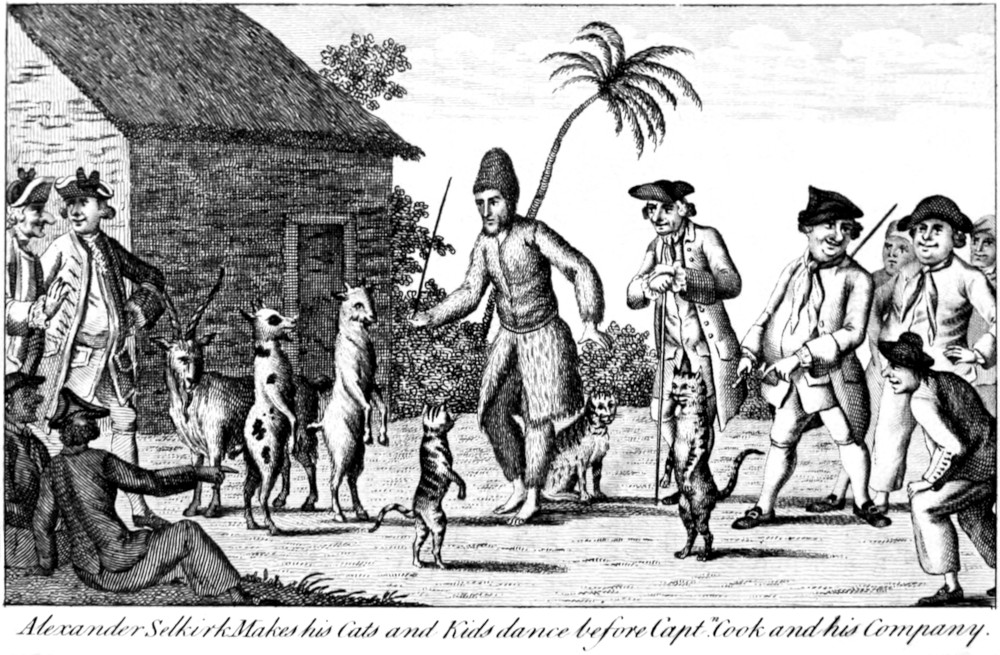
him from the rats. He likewise tamed some
kids; and, to vary his diversions, would now
and then sing and teach them to dance; so that
by his natural flow of humour, and the vigour
of his youth, being now but 30 years old, he
came at last to conquer all the inconveniences
of his solitude, and to be very easy. When his
cloaths were worn out, he made himself a coat
and a cap of goats-skins, which he stitched together
with little thongs of the same that he cut
with his knife. He had no other needle but a
nail; and, when his knife was worn out to the
back, he made others of some iron hoops that
were ashore, which he beat thin, and ground
upon stones. Having some linnen cloth by
him, he sewed himself some shirts with a nail,
and stitched them with the worsted of his old
stockings, which he pulled out on purpose. He
had his last shirt on when we found him on the
island. At his coming on board us, he had so
much forgot his language for want of use, that
we could scarce understand him; for he seemed
to speak his words by halves. We offered him
a dram; but he would not touch it, having
drank nothing but water since his being there;
and it was some time before he could relish our
victuals. He could give us no account of any
other product of the island than what we have
mentioned, except some black plumbs, which are
very good, but hard to come at, the trees which
bear them growing on high mountains and
rocks.
Alexander Selkirk Makes his Cats and Kids dance before Captn. Cook and his Company.
The officers that went first on shore were invited
to his retreat; but the way to it being
very rugged and intricate, only a very few of
them had curiosity enough to visit it. He had
conceived an irreconcileable aversion to an officer
on board the Cinque Ports, who, he was informed,
was on board the Duke; but, not being
a principal in command, he was prevailed
upon to wave that circumstance, and to accompany
Captain Dampier, for whom he had a
friendship. He was very useful while the ships
staid at Juan Fernandez, in supplying them with
fresh provisions, and in facilitating the business
of taking in wood and water. He said, he had
seen snow and ice in July, which is the middle
of winter in that climate; but the months of
September, October, and November, are inconceiveably
pleasant; the air being perfumed with
a fragrance that cherishes and revives the spirits,
and has a wonderful effect upon animals, as well
as men, which Selkirk remarked by their playwardness
and plumpness. He particularly directed
us to a plant not much unlike feverfew,
of a most grateful and cordial scent, with which
we strewed the tents of the sick, who were thereby
much comforted, and their cure facilitated.
We gathered many bundles of it, dried them
in the shade, and sent them on board.
On the 13th of February, a general council of
officers was held on board the Duke, when many
necessary regulations were agreed to, for the
maintenance of order, discipline, and secrecy;
among which, two inspectors were appointed
from on board the Duke, to take account of all
prizes taken by the Dutchess; and the like
number from the Dutchess, to register such as
should be taken by the Duke.
While we continued in this bay the carpenters
fitted up the pinnaces, the frames of which
were ready prepared at Bristol, at our first setting
out.
On the 14th the pinnaces were launched, and
having each a gun fitted to her prow, were tried
in the bay, to see how they would sail, being intended
to serve as small ships of war, to examine
the harbours where the large ships could not
venture to approach the shore. And now, having
all things in readiness, we began to prepare
for our departure, all our sick men being recovered,
except two who died, and were buried
on the island.
On the 15th we cleared the bay, and pursued
a northerly course till the 24th, when we crossed
the Tropic of Capricorn, and shot some Tropic
birds about the size of a partridge, with only a
single feather in their tails, but that very long,
and very taper. We had now the sea as smooth
as a pond; and, having little to do, we ordered
the men to attend prayers regularly twice a day;
prohibited gaming, to prevent the artful from
taking advantage of the simple; and imposed a
penalty against swearing, by which that vice was
almost excluded the ships company.
On Monday the 28th I ordered three of our
men to be put in irons, for cutting the meat in
the steep-tub, and hiding it; and on the 2d of
March, Captain Courtney caused them to be
whipped and pickled, by way of example.
On Thursday the 14th of March, Captain
Rogers, Captain Dover, and Captain Dampier,
came on board the Dutchess; and concluded,
that the strict observation of Lent having prevented
the Spaniards from trafficking in those
seas, the most eligible plan would be to bear
away under an easy sail for Lobos, and there
to supply ourselves with boats to land at Guayaquil;
but in the afternoon, saw a sail, gave chace,
and took her. She came from Guayaquil, and
was bound for Cheripe to load flour, and had
been out 16 days. The crew were all Indians,
except one Spanish passenger. They had nothing
on board but about 50l. in money to pay
for their cargo, and told us, that part of the
new town of Guayaquil had lately been burnt;
that the Jesus Maria, formerly a man-of-war,
was coming from Lima to be there rebuilt; that
another large ship was expected from Panama at
Payta; and that they had heard nothing of any
English men-of-war or privateers being in those
seas.
On the 16th we made the island of Lobos,
and in the evening anchored in the road. It lies
in lat. 6 deg. 5 min. S. about 16 leagues from the
continent, is barren, and affords neither wood
nor water; but there is good riding for ships,
and harbours proper for repairing and careening.
Here the prize was fitted up, and it was agreed,
that I should go out in her with 35 men, to cruise
in company with the Dutchess; and with that
view she was new named, and called The Beginning
Galley.
On the 26th, at day-break, we saw a ship
standing to the southward, and soon came up
with her. She was a bark of 50 tons, bound from
Guayaquil to Truxillo, with timber and cocoa-nuts.
It was agreed, that Captain Courtney
should stand in with her in the night; and that
I should continue to cruise till farther orders,
which on the 27th I received, and the same evening
came to an anchor by the Duke and Dutchess
in Lobos-road. Next day, the prisoners being
examined, reported, that a ship of 36 brass
guns was expected from Lima with the Viceroy
of Mexico and his mother on board; and that
they were bound to Panama. Upon this intelligence
it was resolved in full council to cruise in
quest of this ship, and if she escaped to attack
Guayaquil.
While the Duke lay at Lobos, the carpenters
built a large boat to land men, in case of an attack;
and, having made all necessary preparations,
and the sick men from both ships being
put on board the last prize, which was called
the Increase, our first Lieutenant was ordered to
command the Beginning Galley; and on the 31st
of March we left Lobos, and agreed to cruise
six leagues to the windward of the Saddle of
Payta, as the most likely station to succeed in
our enterprize.
On the 2d of April we fell in with a large
ship, of 400 tons, from Panama, heavily laden
with dry goods, commanded by Captain Morel,
and thought to be one of the largest merchant-ships
in all those seas. He had 50 or 60 blacks
on board, besides several passengers.
The next day we took another prize of small
value, having only about 90 or 100l. in plate,
and a small quantity of timber. She was of 50
tons burden, commanded by Juan Perezillo
Bastillo, who told us that a bishop was coming
by sea from Panama to Lima with 200,000
pieces of eight, and a considerable quantity of
family plate; but no ship appearing in sight
from the 3d to the 9th, it was then upon consultation
agreed to call in the cruisers, and to
attempt the conquest of Puna and Guayaquil.
This resolution being taken in council, it was
next debated, who should command in chief on
shore; and, after a warm contest, it was at length
agreed, that Captain Rogers and Captain Courtney
should each command a company of seamen,
and Captain Dover a party of landmen; that
Captain Dover should give the word of command
the first night, and the other two Captains take
their turns.
On Sunday the 10th, Mr. Vanbrugh, the
owners agent, was removed from the council,
and Mr. Samuel Hopkins was chosen in his
room; the charge against him was founded on
killing the Indian, as already mentioned, and
engaging to vote with Captain Rogers upon all
occasions. Captain Dover likewise charged
him with insolence, and with disobeying orders.
On the 12th, the attack of Guayaquil was
finally settled, and the whole fleet set sail for
that harbour. Some new regulations were
framed, and fresh encouragement proposed to
animate the men to behave resolutely.
The three commanding officers selected each
their respective parties, Captain Dover the marines,
and the Captains Rogers and Courtney
two parties of sailors, 75 men in each; Captain
Dampier commanded the artillery, and
was to form a body of reserve, to act as occasion
should offer. The whole number employed in
this service amounted to 238 effective men.
The care of the ships and prizes was at the same
time entrusted to the Captains Cooke and Fry,
who, besides a small complement of sailors, had
226 Indians and blacks on board.
Friday 15. Saw a sail near the shore, and,
having little wind, the Duke’s boat commanded
by Captain Fry, and ours by myself, made directly
for her, going off in such haste that neither
of us had the swivel guns we used to carry,
nor our full complement of men. The Duke’s
boat nearing her first, she put out Spanish colours,
fired a gun, and hoisted her Spanish flag
at the main-top-mast head. The Duke’s boat
then lay by for us to come up. We saw she
was French-built, and, by the description the
prisoners had given us, concluded it must be the
ship we had been so long cruising for, which
was to carry the Bishop. Our ships being almost
out of sight, and the Spaniards so near the
coast, we resolved to lay her on board on each
bow, and accordingly fell to it. The dispute
was hot for a long time, we keeping a constant
fire, and the enemy returning it, who killed two
of Captain Fry’s men, besides wounding one of
his and two of mine. One of the killed was
Mr. John Rogers, our second Lieutenant, and
brother to Captain Rogers. The Duke’s boat,
finding the enterprize desperate, bore away;
and some time after we did the like: but Captain
Fry having put some of his men aboard of
us, given us some powder and shot, and taken
in our wounded, I made again to the chace, resolving
to keep her from the shore, and, rather
than fail, to clap her aboard. The Spaniards,
perceiving our design, edged off to sea, and we
followed them. Our ships came up apace, and
the Dutchess having fired a shot or two, she
struck her colours, and surrendered. The men
begged for good quarter, and we promised them
all civility. This ship came from Panama, and
was bound for Lima, to be fitted out for a man
of war. There were 70 blacks, and many passengers,
with a considerable quantity of pearls,
on board: the lading consisted of bale goods,
and some things belonging to the Bishop; but
they had set him, with his attendants, ashore at
point St. Helena, from whence he was to go by
land to Guayaquil. While the French possessed
this vessel, she was called La Lune d’Or. She
was of 270 tons burden, and commanded by
Don Joseph de Arizabella.
Saturday 16. Took a small bark laden with
hides, and some flour, and buried our Lieutenant,
being all much concerned for the loss of
so good an officer.
Sunday 17. All things being now in order,
our men went aboard the two barks in order to
land, and Captain Fry and I took charge of
the ships, prizes, and prisoners.
Monday 18. At one in the morning, being
near the island Santa Clara, our two barks with
the land forces left us.
Tuesday 19. The boats rowed with 45 men
towards the island Puna, and came to a grappling
close under the land, out of sight of the
look-outs. We seized the Governor of the
island, and sent our carpenter and two or three
hands along the shore, to cut all the bark-logs
and canoes in pieces, for fear they should get
away and alarm the town of Guayaquil.
Thursday 21. I sent the Beginning a-head, for
fear of danger, who, seeing a vessel riding close
under point Arena, fired two swivel guns at
her; but found nobody on board. She was a
new Spanish bark going to load salt, and had
nothing in her but a few jars of water. At five
in the afternoon the transports rowed for the
town of Guayaquil, and at eleven at night were
so near as to hear one centinel call to another
for fire to be brought. Perceiving we were discovered,
we rowed over to the other side, and
saw a fire made where the centinels talked, and
soon after many lights all over the town. We
heard them likewise ring the alarm-bell, and
fire several volleys; and we observed them to
light a fire on the hill to give the town notice
of our being come up the river. Hereupon the
boats came to a grappling, when such a hot dispute
arose among some of our chief officers,
that they were heard ashore; the officers differing
in their opinions, whether to land immediately,
or stay till morning; however, at last it
was agreed, that, since we did not know the
ground, it was best to stay till day-light.
Friday 22. Our forces being all joined, we
sent a flag of truce, with the Captain of the
French-built ship, and another prisoner, to the
Corregidor, who asked him our number, which
the Captain magnified. The Corregidor suggested
that we were mere boys; but the Captain replied,
he would find we were men, for we had
fought him bravely in our open boats, though
he had killed one of the Commander’s brothers,
and wounded and killed others; and therefore
advised him to agree for the ransom of the
town.
Saturday 23. The pinnace went up the river
after some vessels, and brought six of them to
anchor by our barks; and we also took possession
of two new ships, of about 400 tons each.
We then went ashore with a flag of truce,
and the Governor came on board to agree about
the ransom of the town and ships; but this not
being then concluded, he promised to meet the
Captain at seven in the evening, but was not so
good as his word.
Sunday 24. The Governor came off again
to treat, and our Captains would have seized
him for having forfeited his word; but he alledging
that it was incompatible with his coming
with a flag of truce, was set ashore again,
and all things were made ready for the attack.
Accordingly the men landed, and, being commanded
to proceed, they went on with so much
bravery, that the Spaniards fired only their first
volley and fled, our people pressing and pursuing
them to their cannon, which they soon deserted,
the gunner only, who was an Irishman,
standing by them till he was wounded in four
places, of which wounds he soon after died.
Our men then marched in a body through both
towns, drove out the enemy, and, placing three
guards in the three churches, set fire to five or
six houses adjoining to the wood, lest the enemy
should annoy our guard, which was within pistol-shot.
All this night they kept firing out of
the woods at our centinels, but did them no
harm. In the mean time, the Dutchess’s pinnace,
commanded by Lieutenant Connely, went
up the river, landed at every house, took the
plate and what else of value they found, and
had some skirmishes with the enemy, in which
one of our men was wounded.
Monday 25. In the night one of our centinels
shot another belonging to us, who was going
from his post, and did not answer when
challenged three times; our first Lieutenant’s
pistol went off by his side, and wounded him in
the leg; and another of our men was also shot
through the foot by one of our own people:
moreover, our surgeon cut off a man’s arm who
had been hurt by one of our grenadoe-shells,
which broke in the bark when fired out of the
cohorne. The afternoon was spent in shipping
off provisions from the town, and disposing all
things in case of an attack in the night.
Tuesday 26. A flag of truce came to treat
concerning ransoming the town, which was at
last agreed on for 30,000 dollars. We were to
have three hostages, and to stay at Puna till
they could raise the money.
Wednesday 27. The hostages came on board;
and we took down our Union flag, and hoisted
a flag of truce, firing a gun for a signal that the
Spaniards might come into the town, and that
no farther hostilities should be committed on
either side.
Thursday 28. Our barks weighed with
the beginning of the ebb, the Duke’s pinnace
making the best of her way down to the ships;
and the float, after going ashore to fetch off the
great guns, weighed also, and fell down the river.
Friday 29. Captain Rogers came aboard,
and gave us an account that they had taken,
plundered, and ransomed the town of Guayaquil;
that three of our men had been killed,
two by our own people, and one by the Spaniards,
and four wounded; that the inhabitants,
whilst treating, had carried off their money and
plate, retiring to the woods, and leaving their
guns, four whereof were taken, with a considerable
quantity of meal, pease, sugar, brandy,
and wine, all which was coming down in the
barks. This day Hugh Tidcomb, who was
shot by his fellow-centinel, died. At four in
the afternoon, spied a sail standing up the river
with the tide of flood: we sent both ship’s boats
after her, and before night they brought her in.
She was a small Spanish bark from Cheripe,
having on board 330 bags of meal, 35 hundred
weight of sugar, some onions, quinces, and
pomegranates. This, with the six barks, and
two great ships ransomed by the town of
Guayaquil, made fourteen prizes taken in those
seas.
Sunday 30. Captain Rogers went aboard the
French-built ship to carry her up to Puna, in
hopes of disposing of her cargo and some of the
blacks, who only served to eat up our provisions;
as also to bring down what water and
provisions could be got; Captain Courtney
being gone there before on the same account.
Monday, May 1. A boat came down from
the town with part of the ransom, whereupon
most of the prisoners were set on shore.
Thursday 5. Captain Rogers returned with
the French-built ship, the Spaniards having
bought none of her cargo; but they had paid
24,000 dollars, part of the 30,000 ransom; upon
which, the Governor of Puna, one of the hostages,
was discharged, but the others kept.
Friday 6. In the afternoon the Duke and the
prizes joined us, when we were seven sail in all.
A boat came down with about 3000 dollars
more, in money and plate; and the men told us,
that the other 3000 dollars would soon come,
and 12,000 more to purchase goods: but this
we supposed to be a trick, to keep us till the
men-of-war could come from Lima; whereupon
we made all possible dispatch to get out of the
bay, kept three of the hostages, and sent the prisoners
ashore. The Beginning, being of no other
use, since we had better vessels, we sold to the
Spaniards for the value of 50l. in pearl, gold
chains, &c. and put the prisoners aboard, but
kept pilots, and a man that could speak English,
the President of Panama’s son, and the hostages.
The weather being very hot, some of our men
fell into fevers; and in a few days we had near
100 sick, and among the number Capt. Courtney.
Sunday 8. Sailed with a small breeze at N. W.
At noon it began to blow fresh; but nothing
material happened till the 13th, when, believing
ourselves near the longitude of the Gallapagoes,
where we designed to water, fit our ships, and
refresh our men, we lay by from six in the evening
till four the next morning, for fear of running
by those islands in the night.
Monday 16. Mr. Hopkins, Lieutenant of the
marines, and one of the doctors of the Duke,
died.
Tuesday 17. Saw land, being one of the Gallapagoe
islands. Next day the Duke’s boat
went on shore to seek for water, but could find
none in any of them, though Captain Cowley, in
his voyage round the world, says there is good
water in one of them; but we missed the place.
The 20th, 21st, and 22d, we spent in plying
among the islands, where the boats found abundance
of turtle, large rock-fish, and guanos.
These last-named creatures are larger here than
those in other parts of the West Indies, and
are of several colours and sizes. They are eaten
by the seamen, and reckoned good meat, though
their deformity made me loath them.
Thursday 26. Captain Rogers and Captain
Dover came aboard the Dutchess, and, after
holding a council, it was resolved to run in for
the island of Plata to water, and so come off
again, for fear of meeting with two French ships,
one of 60, and the other of 46 guns, and the
Spanish men-of-war, which, we were told, would
be shortly in search of us. Some days before
this we lost Mr. Hatley, who was in one of the
prizes, with five or six white men, four blacks,
and an Indian, having on board little or no provisions
or water, and no boat; and we never
more heard of them.
Monday 30. The officers of the Duke came
aboard, to consult about the properest place to careen
and water at; and ’twas agreed to go to the
island Gorgona, to see whether any Spanish ships
were there, and from thence to Mangla, where
are some Indians, enemies to the Spaniards, who,
it was said, would supply us with swine and
fowls, good water, turtle, plantains, and other
refreshments.
Wednesday, June 1. Some of our men were
told, that a conspiracy was forming on board
the galleon among the prisoners and blacks.
We examined the Spaniards, who protested they
knew nothing of it then put matches between
the fingers of two blacks, making them believe
we would burn them to the bone if they would
not confess. They owned there had been a talk
of killing the English among the Indians and
blacks, but they believed it was not in earnest;
however, they were dispersed into several ships
to break the combination.
Sunday 5. Saw a sail right-a-head of us,
chaced, and at eight in the evening came up
with her, fired a chace-gun, and she struck.
The vessel was of about 80 tons burden, bound
from Panama for Guayaquil, was laden with
iron and other merchandize, and had two women,
and several passengers of note on board,
one of whom was going Governor to Baldivia,
whose name was Don Juan Cardoso, and who
had been not long before taken on the other
side by the Jamaica cruisers.
Monday 6. Made the best of our way for
Gorgona; and at three in the afternoon next
day, the Duke with the galleon came to an anchor
in that harbour. Same day saw a sail bearing
down towards the island, till spying the galleon
in the offing, she stood to the westward. I
went out in the pinnace well-manned, and at
noon took and brought her to an anchor. She
was a bark of 50 tons, called El Soldado, came
out of a small port the night before, and was
bound for Guayaquil, to load salt, brandy, &c.
She had in her in gold chains and money to the
value of 5 or 6 hundred pounds, designed to purchase
her cargo.
Monday 13. Held a full council on board
the Duke, and resolved to careen our ships here
as soon as possible. Here we continued till
Sunday, August the 7th; and in the mean time
plundered a settlement on the main, right opposite
the island, set most of our prisoners on shore
on the continent, and brought seven beeves, 14
hogs, some poultry, about 50 bushels of Indian
wheat, and a few goats on board: at the same
time a black born in Jamaica, who spoke very
good English, and had been taken with some
Jamaica-men eight years before, came over to us
in a canoe. Captain Morel, too, formerly commander
of the galleon, brought some money and
fruit, and a merchant or two, who bought some
of our blacks. During our stay at this island,
Captain Rogers, Captain Courtney, myself, and
some other officers, underwent much fatigue in
fitting up the Marquis, for which ship we were
forced to get entirely new masts and yards, make
most of the sails, and a great deal of new cordage.
The smith also made much new work; as
did the carpenters, sail-makers, riggers, and rope-makers,
who all came to help us from each ship.
The 6th of August, I received my orders to
command the Marquis, carrying 20 guns, 60
white men, and 16 blacks; and, the ships having
taken in their loading from the prizes, and all
our business being over at the island of Gorgona,
we weighed anchor at 10 in the morning, and
ran to the north of the island: but the masts of
the Marquis being new and heavy, and a great
weight of goods between decks, I found she
proved crank, and sailed dull upon the wind;
so that the Duke and Dutchess were fain to spare
a great deal of sail for me to keep up with them.
Friday 12. Held a consultation about sending
the Marquis and a bark laden with bale-goods
directly for India, to save provisions and
gain time; but this was opposed by Captain
Courtney, and others, in regard to the Marquis,
which being a good vessel, might be of great
use in case we should meet with the Manilla
ship, or the men-of-war we supposed were looking
for us.
Thursday, August 18. At six in the morning
saw a sail a-head, gave chace, and the Dutchess
soon coming up with her, and firing a few guns,
she struck, being a bark of about 70 tons, bound
from Panama to Troxillo, with merchants goods,
passengers, and blacks, on board. The master
told us, he had been detained three months at
Panama by an embargo, which being taken off
upon advice that we were going to the island of
Juan Fernandez, he had set sail. Enquiring
what ships were out in quest of us, the prisoners
said, they had advice at Panama of five or six
ships being ordered after us, two of them French,
of 48 guns each, and some Spanish, of the like
force, and good sailors. They could tell no
other news, than that the whole coast was
alarmed.
August 19. The Duke and Dutchess fired
some vollies to exercise their men. Next day
we fell in with land about a league to the leeward
of Tacames, ran within a league of the
shore, and on the 24th cast anchor in the bay,
from whence the Dutchess sent her pinnace
ashore for water, but could get none. Tacames
is a village of only seven houses and a church,
standing in a bay, about seven leagues to the
northward of Cape Francisco. The houses are
built of split bamboes, and covered with Palmeto-leaves,
standing on stilts or posts; and, instead
of stairs, they have a piece of timber cut
in notches to ascend by. The men employ
themselves in killing wild swine with bows and
arrows, and striking fish with their lances, at
both which they are very dexterous. The women
have only a piece of baize tied about their
middle, and carry their children at their backs.
They are under the authority of the Spanish
priests, and are not permitted to trade without
their licence.
On the 27th. They received a letter of leave,
and our boats went ashore to the houses for
cattle; and on the 28th and 29th continued
trading and watering till we had sufficiently
supplied the ships. In return for the civility of
these Fathers, I sent as a present to the church
at Tacames four large images, one of which was
the Virgin Mary with our Lord and Saviour in
her arms; and I believe Captain Rogers and
Captain Courtney also gave something to adorn
their church. On Wednesday the 31st of August
we set sail, the wind being at S. W.
Thursday, Sept. 1. Saw abundance of water-snakes,
one of which was coming up the side of
our ship, and our men beat it off. The Spaniards
say, there is no cure for such as are bit
by them; and one of our blacks happened to
fall under that misfortune, and died, notwithstanding
the utmost care was taken by our surgeons
to recover him.
On Wednesday, Sept. 7. Made one of the
Gallapagoe islands. On the 10th, stood close in
for the head-land, sending our boat on shore for
water and turtle. At night our boat came aboard,
bringing 13 turtle, some weighing 200 weight;
the other boats got near 50 each; and the
Dutchess’s several land-turtle, but no water.
Our men saw several jars, and some of the wreck
and rudder of a vessel, and should have guessed
it to be the prize Captain Hatley lost when
here before, but the rudder was too small for her.
Wednesday 14. The Dutchess, Marquis, and
small prize, weighed, ran out, and lay by for the
Duke, which could not get out for want of wind.
On the 15th, set sail in the morning; and, considering
the sun was directly over our heads, the
weather was cold, occasioned, as I believe, by the
southerly winds, which are coldest in those parts.
Thursday, Sept. 22. The Marquis kept the
pump continually going, having sprung two
leaks, not being well caulked at Gorgona; therefore
weared her on the other tack, and stopt one
leak, but could not find the other, being about
the stern. Weared again, and stood to the westward.
Friday 22. At a consultation on board the
Duke, it was agreed to steer to the Islands Marias,
for a convenient place to refit, wood, and water;
then to cruise in quest of the Manilla ship,
which was large, and of great value, being reported
by the Spaniards to be worth 2,000,000
sterling.
On the 3d of October. Cape Corientes appeared,
bearing N. E. 10 leagues; and on the
4th in the morning we made the islands called
Tres Marias, at the distance of about 16 leagues;
but could not fetch them till the 6th, when we
got under the lee of one of them. I lay off with
the ship, and sent the boat ashore for water and
turtle; but neither the one nor the other was to
be got, because of the surff.
Before our coming to this place, we discovered
the white rock, formerly mentioned by Dampier,
and took it for a ship on the sight of which
the Dutchess let go the bark she had in tow, telling
her to make the best of her way to the middle
island; under the lee of which both the Duke
and Dutchess came to an anchor on the 7th and
8th; and I might have been there as soon, had
I not seen the bark six or seven leagues to leeward.
It was fortunate that I came in time to
relieve her, otherwise she must have perished,
having neither wood nor water on board, and
not being able to make up against the wind and
current to reach the land. I bore down to her,
supplied her wants, and took her in tow till the
20th in the morning, when the middle island
bearing north, distant about seven leagues, we
saw a sail coming from the island before the wind,
which proved the Dutchess, who came in search
of us, and was glad to find us safe; brought us
some water and turtle, and told us there was
game enough in the island, if we could bear up
to it. Captain Courtney took us in tow, to help
us in the sooner, having cleaned his ship’s bottom
before he set sail to come to our assistance.
On the 11th, I came to an anchor, after much
trouble and fatigue in plying so long against the
wind and current. Seven of Captain Rogers’s
best blacks this day left him, and ran away. We
continued in this bay till
Monday the 24th, when a general council was
held, at which it was resolved to cruise off Cape
St. Lucas for the Manilla ship, all our ships being
now very well fitted, wooded, watered, and
provided with turtle. Several warm debates happened
in council among our chief officers; and
Captain Dover quitted the Duke, and went on
board the Dutchess, by his own free choice. I
endeavoured to accommodate these differences,
but to no purpose, which gave several of us great
concern.
The islands of Tres Marias, where we anchored,
abound with animals of various kinds, and
the shores with fish; among these the sea and
land turtle may be accounted of most use to navigators.
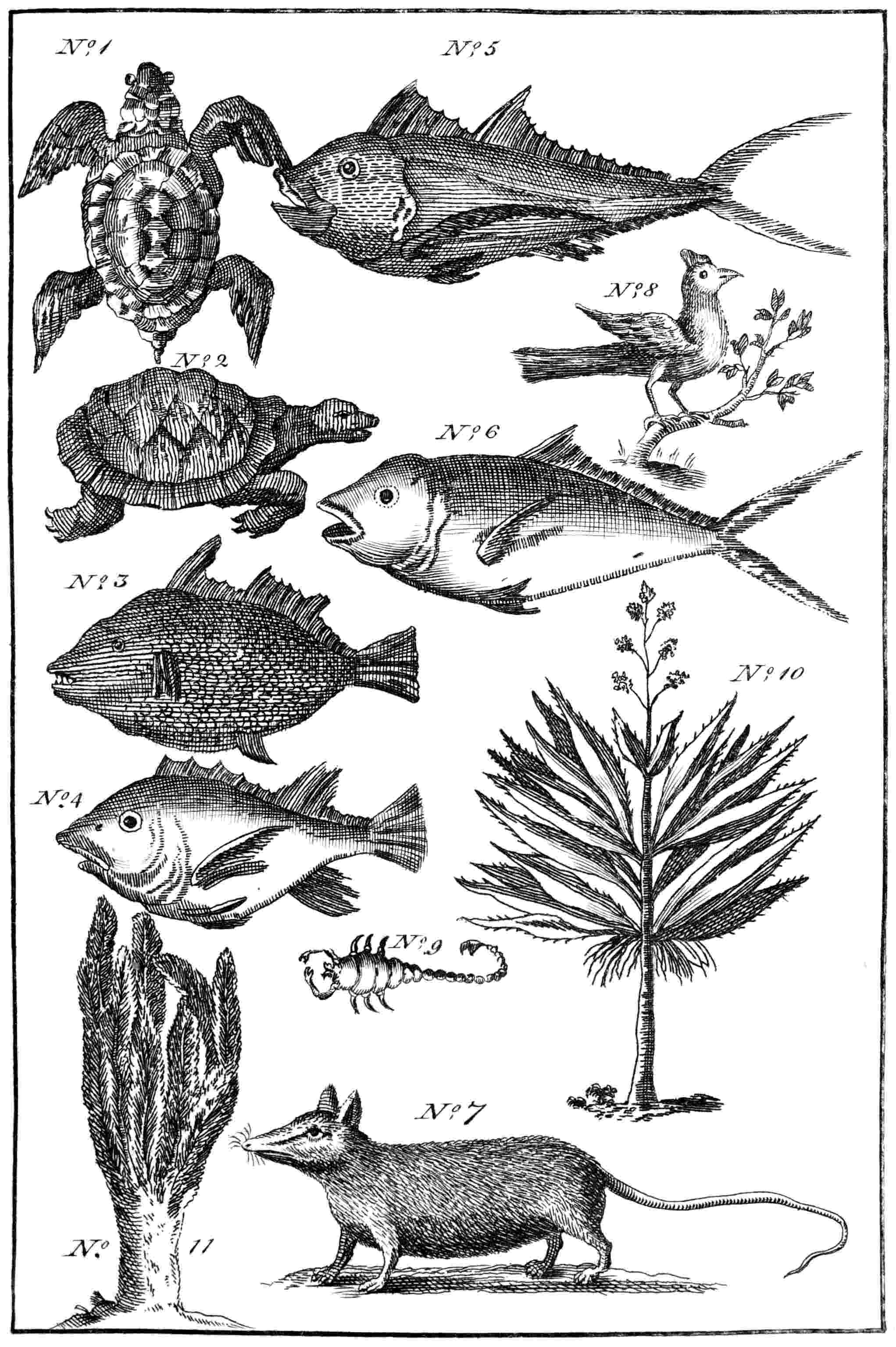
Of the sea-turtle there are various
sorts; as the green, which are the sweetest and
best; the hawk’s-bill, which are very good;
and the logger-head, which the sailors never refuse
when the others are not to be caught. The
method of taking them is by turning them, and
when they are on their backs, they appear as in
the Plate, fig. 1.
The land-turtle lives constantly ashore, feeds
upon grass, moves very slow, and, when an enemy
approaches, covers itself under its shell, squatting
close to the ground, from which it is not easily
discernible, appearing like a bare patch without
verdure. The shells of these animals are so hard,
that a man may tread upon them without hurting
them. Their flesh is very good and nourishing.
They will live five or six weeks without food, and
appear to be never the worse. They lay round eggs,
about the size of a hen’s, and are very good to eat.
Some of the sea-turtle taken in the bay where we
anchored had 200 eggs in them. Our men lived
almost wholly upon turtle, and their eggs,
from the time they went first to the Gallapagoes
till their departure for the East Indies, saving
their ship-provisions till their run across the
South Seas. For the land-turtle, see fig. 2.
At these islands our men caught plenty of the
fish called old wives. They have very small
mouths, large eyes, a high fin on the back, and
shaped as you see fig. 3. The colour of the
body is a deep blue; the fins of a lighter colour,
tipped with yellow. Others are of an ash-colour
on the back, and white under the belly.
The rock-fish we caught in the island of Tres
Marias were large, had great mottled fins, yellow
backs, red bellies, and red and black tails. See
fig. 4.
Another fish our men caught was the cavallo,
in shape not much unlike the dolphin, with a
large bright eye, black back, white belly, a long
streak from his gills to the middle of his tail,
and is about the size of a mackarel. See fig. 5.
A small fish we found there, about six inches
long, was very delicious; the back of an indigo-blue,
a deep yellow streak running from the gills
to the tail, the belly white, and the tail forked.
It seems peculiar to these islands, and wants a
name. See fig. 6.
Of the animals, the racoon was the most plentiful.
It has a large black eye, whiskers and nose
like a pig, tail and feet like a rat, a brownish fur
on his back, and a white belly. See fig. 7.
Of the venomous creatures, the scorpion is
the most noxious; its tail is jointed with a small
sting at the tip; it has two claws like those of
the lobster; and its head and feet have a near
resemblance to those of the same fish. See
fig. 8.
Among the singing-birds found in those
islands, the cardinal bird was seen in greatest
abundance. It is a very beautiful bird, with
scarlet feathers, and on its head the male has a
tuft of the same colour. They are of the same
kind with those we call the Virginia Nightingale;
but the Spaniards call them cardinal birds, from
their scarlet feathers. See fig. 9.
Among the vegetables we found the magney-plant,
or silk-grass, of which the Indians
make ropes, sails, sacks, and all their curious
netting. It also yields a liquor of which they
make wine, honey, and a good balsam. The
liquor as it comes from the plant is as sweet as
sugar; after standing it becomes a wine, and
will intoxicate powerfully. It has thick juicy
leaves, not unlike those of the houseleek, but
grows up to a considerable height in the form represented
by fig. 10; And, when it has stood about
six years, the Indians cut out the middle leaves,
leaving the heart of the plant hollow, which of
itself fills with the juice, and is every morning
during the season taken out and preserved. Of
this juice the Spaniards make spirits; and it is
so universally used in one shape or other by the
Spaniards and Indians in New Spain, that the
duty arising from it in one year is said to have
amounted to 110,000 pieces of eight at the port
of Angels alone.
The prickly tree found on those islands is
esteemed a great curiosity. The trunk of it is
angular, and covered with prickles; is of a pale
green, and yields a gum which the druggists call
euphorbium, which is said to be powerful in removing
pains in the head. It grows about 12
feet high, in the form represented in the plate,
fig. 11.
These were the principal peculiarities observable
in the animal and vegetable tribes at the
islands of Tres Marias.
On Tuesday, Oct. 2, at two in the afternoon,
we weighed, and set sail for Cape St. Lucas,
where we spread ourselves for fear the Manilla
ship should pass by unseen. The Duke cruised
about two leagues to the southward of the
Dutchess, the Dutchess in the middle, and the
Marquis two leagues to the northward of her.
Place of rendezvous six or seven leagues in sight
of Cape St. Lucas.
Nov. 1. The Marquis sprang two great leaks,
and broke the collar of the fore-stay, which
obliged me to wear the ship to fix the stay, and
then hauled up after the other ships, and stopped
the leaks.
Tuesday 2. All the officers and men on
board the Marquis signed an instrument, obliging
themselves to stand by the articles agreed to
by the companies of the other ships.
Nov. 4. I spoke with Captain Courtney, and
changed stations with him, he having better
boats than mine to send ashore for water and
turtle; or, in case of seeing the Manilla ship, to
prevent her sending the passengers ashore with
their wealth. The 10th, the Duke and Dutchess
having spoken with each other, changed stations,
the Duke going in for the shore, and the Dutchess
off to the outward station.
Nov. 22. Captain Rogers informed me, that
the bark and his boat had been in with the shore,
and had spoken with the natives, who seemed
very civil, and had pearl and some grain to dispose
of; and that there was wood and water
enough. Nothing material happened till
Dec. 13, when we had a consultation on
board the Dutchess, to enquire into the stock of
provisions on board the ships, and found by the
accounts given in, that only three months meat
at short allowance, and two months bread, remained
unexpended; and, as there was no appearance
of the Manilla ship, though the usual
time of her coming was elapsed, it was agreed to
make all possible dispatch in fitting up the ships,
in order to make the best of our way across the
Pacific Ocean, that we might take the advantage
of the trade-winds to carry us to Guam on our
return home. In pursuance of this resolution, I
was ordered into harbour, as the Marquis wanted
more considerable repairs than either of the
other two, and the Duke and Dutchess proposed
to cruise a few days longer, while I was
getting forward to be in readiness to accompany
them to Europe.
On the 14th, I bore away for Puerto Seguro,
and on the 15th entered the harbour at midnight.
On the 16th proceeded to business, my first
orders being to return again to cruise as soon as
possible; but these orders were afterwards countermanded,
it being absolutely necessary that all
the ships should rendezvous together before their
final departure from the American coast.
This place is inhabited by about 200 Indians,
living in huts made of boughs of trees and reeds,
built like a bower, with a fire in the middle,
round which they lie and sleep. They all go
naked, only the women have short petticoats
made of silk grass, or else of pelicans or deers
skins. The men are straight, and well limbed;
live by fishing and hunting, and value knives, scissars,
nails, or iron, beyond gold and silver. They
have long black hair, and are of a dark-brown
complexion. The women are very ordinary, and
employ themselves in gathering and grinding
corn, and in making fishing-lines. They are
very honest and very civil. They assisted in fitting
up the ships, and took nothing away but
what was given them. Our people at their first
coming got some pearls among them, but I never
could see any afterwards. I made signs for
them to bring gold; but they pointed up to the
mountains. They use bows and arrows, and
even the boys are so dexterous as to kill birds
flying with them.
Dec 22. Being busy about our repairs, at 10
in the morning heard some guns firing in the
offing: I bent my sails to hasten to the assistance
of my consorts, but the sea-breeze coming on
rendered it impossible; whereupon I ascended
an adjacent hill, and saw our ships engage and
take the Manilla ship, which we had been so
long expecting.
The account Captain Rogers gives of the engagement
is as follows: “At day-break, says he,
we saw the chace upon our weather-bow about
a league from us, the Dutchess a-head of her to
leeward, near about half as far. Towards six
in the morning our boat came on board, having
kept very near the chace all night, and received
no damage; but told us the Dutchess passed by
her in the night, and she fired two shot at him;
but they returned none. We had no wind, but
got out eight of our ship’s oars, and rowed about
an hour, when there sprung up a small breeze.
I ordered a large kettle of chocolate to be made
for our ship’s company, having no spirituous liquors
to give them. Then we went to prayers;
and before we had concluded, were disturbed by
the enemy’s firing at us. They had barrels
hanging at each yard-arm that looked like powder-barrels,
to deter us from boarding them.
About eight o’clock we began to engage her
by ourselves, for the Dutchess being to leeward,
and having little wind, did not come up. The
enemy fired her stern chace upon us first, which
we returned with our fore-chace several times, till
we came nearer, and went close on board each
other. We gave her several broadsides, plying
our small arms very briskly, which they returned
as thick for a while, but did not ply their
great guns with the same alacrity. After some
time, we shot a little a-head of them, lying
thwart her hawse, close aboard; and plied her
so warmly, that she soon struck her colours two-thirds
down. By this time the Dutchess came
up, and fired about five guns, with a volley of
small shot; but the enemy, having submitted,
made no return. We sent our pinnace on board,
and brought the Captain with the Officers away;
and, having examined them, found there came
another ship out from Manilla with them of
larger burden, having about 40 brass guns
mounted, and as many patararoes; but they
told us they lost her company about three
months ago, and reckoned she was got to Accapulco
before this time, she sailing better than
this ship.
This prize was called by the swelling name of
Nostra Signiora de la Incarnacion Desengenio,
Sir John Pichberty Commander. She had 20
guns, 20 patararoes, and 193 men on board,
whereof nine were killed, ten wounded, and several
blown up with powder. We engaged
them about three glasses, in which time we had
only myself and another man wounded. I was
shot through the left cheek; the bullet struck
away part of my upper jaw, and several of my
teeth, part of which dropt down upon the deck
where I fell; and the other, an Irish landman,
was slightly wounded in the hip. They did us
no great damage in our rigging, but their shot
disabled our mizzen-mast. I was forced to write
what I had to say to prevent the loss of blood,
and because of the pain I suffered by speaking.
On the 23d of December, after putting our
ships to rights, we stood in for the harbour, which
was distant about seven leagues to the N. E. Our
surgeons went on board the prize to dress their
wounded men. About four in the afternoon we
came to an anchor, and received the compliments
of all on board the Marquis on our sudden
and unexpected success, which gave us no
small satisfaction. We found that ship in good
condition, ready to sail, and all the men on board
her very brisk, and eager for action.
At eight in the evening, we held a consultation
on the two great points; first, what should
be done with the prisoners and hostages; and
next, how we should act with regard to the other
Manilla ship, which we thought at least there
was a great probability of taking.
With respect to the first, we proposed, as the
hostages from Guayaquil were men of honour,
and as we had good reason to believe that the
Chevalier Pichberry, being brother to the famous
M. du Cass, was the same, to make the best terms
we could with them, and set them at liberty.
Accordingly, we put a part of the goods on
board the bark into the prize, and then offered
the remainder with the bark, together with what
remained unpaid of the ransom, for 6000 pieces
of eight, and to take the Chevalier’s bills payable
at London for the money. This they accepted,
and gave us an acknowledgement at the
same time, that they thought it a good bargain.
When this was settled, we had nothing more to
do than to provide for our own security, and to
look after the other galleon.
I was very desirous of going out with the
Dutchess to cruise for her; but there having been
some reflections cast, on account of the Dutchess’s
not engaging our last prize so soon as it was
thought she might have done, Captain Courtney
was absolutely bent on going out with the Marquis;
and the officers of both ships voting for
this in council, my proposal was over-ruled, and
we were forced to stay in the harbour against our
will. It was, however, agreed, that we should
put 10 of our best hands on board the Dutchess;
and on Christmas eve she and the Marquis sailed.”⸺We
now return to Captain Cooke in the
Marquis.
Sunday 25. At eight in the morning, being
two leagues off Cape St. Lucas, we saw a sail distant
about seven leagues, which we concluded to
be the ship we were in pursuit of. The Dutchess
was two leagues to the westward, and we both
gave chace. At noon the enemy bore south,
distant about five leagues. At 12 at night, the
Dutchess got along-side, and began to engage
her. Captain Courtney fought her bravely
about four glasses, and then lay by to secure his
masts, and knot his rigging, which were much
wounded and shattered. Our ship not being so
good a sailor as the Dutchess, could not come
up.
Monday 26. As soon as it was day, we saw
the Spaniard’s flag, and knew him to be the Admiral
of the Manilla. At eight we perceived the
Duke coming out to us. At two in the afternoon
we got along-side the enemy; but the wind
shifting, could fetch no nearer than about half
musket-shot to leeward of her. She then fired
two shot at us, and we returned a broad side and
vollies of small arms, beginning the combat
with three cheers. When we had fought two
glasses, the Dutchess came up under her stern,
and raked her fore and aft, and then fell astern
again, we still continuing hot at her for five
glasses: then weared, and stood to the westward,
to fetch nearer up to her; for firing so
many guns had laid us to leeward. The Dutchess
went up, and engaged again very briskly
for half an hour, and then stretched a-head of
her. We could perceive many shot in her between
wind and water. At five we tacked, and
raked her fore and aft with our starboard broadside,
then weared under her stern, and did the
same with our larboard broadside; and firing
several vollies while we loaded our larboard guns
again, gave her the other broadside. By this
time it grew dark, and we fell a-stern, to speak
with the Dutchess, and to get more ammunition,
having but three rounds of shot for most of our
guns left. At eight I went on board the Dutchess,
and found her much disabled in her masts
and rigging, and had seven men killed and
wounded. Capt. Courtney and I agreed to be
yard-arm and yard-arm with the enemy in the
morning, he to lie on the bow, and I on the
quarter; and if he boarded, I was to clap him
aboard, and enter my men over him. Being
supplied with more ammunition, I returned on
board the Marquis, both of us keeping close
under the chace’s quarter, and firing guns all
night, to annoy the enemy, and to give the
Duke notice where we were. Before day the
Duke joined us. The chace, mistaking him
for her consort, had made signals all night, and
had edged away to meet him, otherwise the
Duke could not have come up, there being but
very little wind, and that contrary.
Then we all three agreed to fall upon the enemy
at once, as soon as it was light; but while we
lay athwart her hawse, those guns that missed
the enemy flew through the Duke’s masts and
rigging, which obliged him to change his station,
and to draw up along-side close aboard her,
where he kept up a constant fire of round shot,
all other shot proving ineffectual, because of the
strength of the ship’s sides, which no other shot
would penetrate; and as none of the Spaniards
appeared in sight, but all kept to close quarters,
it was in vain to make use of small arms, except
now and then, when a man appeared to observe
our situation, and to keep an eye upon their ensign.
In this manner, the Dutchess lying upon
her hawse, the Duke along her broadside, and
the Marquis athwart her stern, we kept pelting
her for four glasses; and, in the mean time, the
Duke received a shot in his main-mast, which
much disabled it; and, in shifting, both he and
the Dutchess came back close under the enemy,
and had like to have been all aboard her. The
Duke, in endeavouring to recover his station,
received a fire-ball, which lighting upon his
quarter-deck, blew up a chest of arms and cartouch-boxes,
all loaded, and several cartridges
of powder in the steerage, by which means Mr.
Vanbrugh, our agent, and two others, were very
much burnt; the Dutchess going to lash to the
enemy, was forced to cast off, and get clear, for
fear of being set on fire. The enemy fired at us
all three at once, but slowly, seldom missing our
masts and rigging, and sometimes hulling us.
After lying near half an hour along the chace’s
side, the Dutchess lay by to stop her leaks, and
secure her fore-mast, being very much disabled,
having 25 men killed and wounded, and the sails
and rigging much shattered. Captain Rogers
some time after lay by to secure his mast. Then
I lay athwart the enemy’s hawse till I had fired
three broadsides, some odd guns, and several
vollies; then gave another broadside and some
vollies into her stern. The Duke came up again,
and fired several guns, and both fell a-stern the
chace, keeping under sail, and standing to the
westward. We knotted some of our rigging,
and stopt our leaks made with twelve pounders.
Our main-mast was disabled also, the sails and
rigging much shattered; but the enemy, aiming
to disable my masts, I had the good fortune to
have only my second mate, and some others,
blown up with powder. The ship was once set
on fire by the enemy’s stink-pots, but we soon
put it out. About eleven I wore the ship, and
designed to have attacked the enemy again;
but, seeing the Duke and Dutchess lying by,
the one with a waist in his ensign, and the other
with a Spanish jack, the signals to speak with
one another, I brought to. Captain Courtney
came on board of me, and we both went on
board the Duke; where we considered the
condition the three ships were in, their masts
and rigging being much damaged in a place
where we could get no recruit; that, if we engaged
her again we could propose to do no
more than what we had already done, which
was evident did her no great hurt, because we
could perceive few of our shot entered her sides
to any purpose, and our small arms availed less,
there being not a man to be seen above board;
that the least thing in the world would bring
the Duke’s main-mast, and likewise the
Dutchess’s foremast, by the board, either of
which by its fall might carry away another mast,
and lay us a perfect butt for the enemy, having
nothing to command our ships with; so that by
his heavy guns he might either sink or take us;
that, if we went to board him, we should run a
great hazard in losing a great many men with
little hope of success, they having above treble
the number on board to oppose us, and there
being now, in all our three ships, not above
120 men fit for boarding, and those but weak,
having been very short of provisions; so that,
if we had boarded her, and been forced off, or
left any of our men behind, the enemy by that
means would have known our strength, and
then gone into the harbour, and took possession
of the prize in spite of all we could do to prevent
it. Besides our ammunition was very short,
having only enough to engage a few glasses
longer. All this being seriously considered, and
knowing the difficulty we should have to get
masts, and the time and provisions we must
spend before we could get them fitted, we resolved
to forbear attempting her farther, since
our battering her signified little, and we had not
strength enough to board her; therefore, we agreed
to keep her company till night, and then
to lose her, and make the best of our way into
the harbour to secure the prize we had already
taken. We engaged first and last about seven
hours, during all which time they had on board
the Duke but eleven men wounded, among
whom was the Captain for the second time, who
had part of his heel-bone struck out with a
splinter, and all under his ancle cut above half
through with the same; on board the Dutchess,
they had eleven killed, and more than that
number wounded; and on board us only two
men scorched with gun-powder. The enemy’s
was a brave, lofty, new ship, named the Virginia,
and this the first voyage she had made.
Her burden was 900 tons, and her complement
of men 450, besides passengers, 150 of whom
were European pirates, who, having now got all
their wealth on board, were resolved to defend
it to the last. The gunner, who had a post at
Manilla, was an expert man, and had provided
for her defence with great skill. He had filled
up all the space between the guns with bales to
secure the men. We shattered her sails and rigging
very much, shot away her mizzen-yard,
and killed two of her men out of her tops,
which was all the damage we could see done,
though we could not place less than 500 shot in
her hull. Thus ended our attempt.
These large ships are built at Manilla, of excellent
timber that will not splinter; and their
sides are thicker and stronger than those of ships
of the same burden constructed in Europe. Had
we been together at first, and boarded her, we
might, perhaps, have taken her; but, after her
netting and close-quarters were fixed, she valued
us but little. We might, indeed, have burnt her,
at the expence of one of our ships; but that was
objected to, not only from a principle of humanity,
but because we had goods of great value
on board all our ships.
The enemy had heard at Manilla, that there
were two ships fitted out at Bristol to cruise in
the South Seas, and that Captain Dampier was
to be their pilot; they had, therefore, provided
for their own defence accordingly. However, to
do them justice, they fought gallantly, and, had
the two ships been together, it is more than probable
that neither of them had been taken;
but as it happened, had not our unreasonable
squabbles prevented our sailing out together,
the chance would have rather been in our favour:
yet this miscarriage, instead of leading
to a reconciliation, served only as a foundation
for new disputes.
On the 1st of Jan. 1710, we returned again
into port, and determined to hasten home with
all possible dispatch. The first thing of consequence
was to discharge our prisoners, and to
provide for their voyage to Accapulco; and this
being dispatched, we applied to the settling of
our own affairs. We spent our time till the 7th
in repairing the damage our ships had received
from the enemy, in taking in wood and water
for our voyage to the East-Indies, and in taking
an account of the goods and stores on board the
prize: and it was no small satisfaction to find
as much bread on board the prize as with our
own stock would serve us, at short allowance,
during our long run to Guam.
About this time a warm contest arose about
appointing a Commander of the Manilla ship,
which was looked upon as a trust of no small
consequence. Captain Dover, being an owner,
desired he might command in chief on board
her. Captain Rogers and several officers of the
council contended, that, as Captain Dover was
wholly unacquainted with the navigating part of
the business, the command should be given to
Captain Fry, or myself; but, as I had already
the command of the Marquis, I declined any
farther charge, and voted for Captain Dover; at
the same time recommending Captain Fry and
Captain Stretton to act under him; against
which Captain Rogers and his officers entered
their protest. However, on the 9th of January,
at a full council, it was carried against them,
and voted by a great majority, that the Captains
Fry and Stretton should both act in equal post
in the sole navigating the Batchelor Frigate (for
that was the name now given to the Manilla
prize), and in fighting her, if occasion should
require, under Captain Dover, who at the same
time was restrained from interrupting them in
their business, but charged to be careful of what
was in the ship, and to see that nothing was
acted on board contrary to the interest of the
owners and captors. The matter being thus
qualified, the nominal command given to Captain
Dover, and the executive power vested in the
naval officers, Captain Rogers withdrew his protest,
and the council proceeded to the choice of
the inferior officers, appointing Alexander Selkirk
master, and Joseph Smith chief mate:
they also agreed to furnish her complement of
men, by selecting 30 from the Duke, 25 from
the Dutchess, and 13 from the Marquis, which,
with 36 Lascars taken on board her, formed a
tolerable crew of more than 100 mariners. This
business being thus fully settled, and the island
of Guam pitched upon as the place of rendezvous
in case of separation, on the 10th of January
we weighed anchor, and ran out at midnight.
At 12 the next day Cape St. Lucas bore north,
distant about five leagues. We steered away for
some days S. W. by S. till we got into the trade-winds,
and then our course was uniform.
All the natives of California that we saw during
our stay at Puerto Seguro did not amount to
300. They had large limbs, were very straight
and tall, and of a much darker complexion than
any other people that we had met with in the
South Seas. Their hair was long, lank, and
black, and hung down upon their hips. The
men were all stark-naked; but the women had
a covering about their waists made of the silk-grass
already mentioned, fringed and knotted.
All of them that we saw were old, and miserably
wrinkled; perhaps they concealed from us their
maidens, for reasons that need not be explained.
The language of the natives was guttural, very
harsh, and unpleasant. They seemed to covet
nothing that we had, except axes, saws, and
knives; and even these they did not attempt to
steal. Their huts were low, and wholly made
up of branches of trees; and seemed rather a
kind of temporary coverings than settled dwellings.
While we lay in port they subsisted
chiefly on fish; and though they neither made
use of nets or lines, yet they had a method of
striking them with lances that was very dexterous,
and at which they were very expert. They
were besides most excellent divers, and instead
of canoes made use of rafts. They were very
civil and inoffensive; and were observed to pay
great respect to one among them, whose head
was adorned with feathers very artificially combined,
and who probably was their wizard, or
cunning-man. Some of them had strings of
pearls, and party-coloured shells so prettily intermixed,
that, though we had glass-beads, and
other showy trinkets, yet they paid no sort of
attention to any of them; but prized their own
ornaments above every thing but cutting instruments.
Their arms are bows and arrows, in the
use of which their boys were so expert as to
shoot birds flying by way of amusement. They
grew very familiar with us while we staid, and
came frequently to gaze at the men as they cut
wood and filled water, but never offered to assist
in any thing like labour. They get fire like other
Indians, by rubbing two sticks together, which
kindle almost instantaneously.
From this harbour we departed but very slenderly
provided, having but little live-stock, and
hardly any liquors but what were found in the
prize. As soon as we were out of sight of land,
we were all put to short allowance, officers and
men: to the latter four-and-twenty ounces of
flour, four pounds of meat, and two gallons of
water, to a mess of five men in 24 hours. But
in a few days, the Batchelor made a signal to
give us some bread, they having found a large
quantity concealed, with some sweet-meats. We
had 500 weight for our share, the Duke 1000
weight, and the Dutchess as much; in return
for which we sent back to the prize some casks
of flour, and a barrel of English beef; and the
like present was returned from the other ships.
From this time till the 10th of March nothing
remarkable happened.
On that day we made the island Saraua, one
of the Ladrones, and the same evening came in
sight of Guam, distant about three leagues.
Next day we came to anchor in the port of
Umatta, at about a mile distance from the
houses, in lat. 13 deg. 30 min. N. by estimation;
long. from Cape St. Lucas, 100 deg. 19
min. W. We went in with French and Spanish
colours, that they might not suspect us to be
enemies. Several of their boats came about our
ships; but none would venture on board, till
being off the anchoring place, one was sent by
the Spanish Governor, desiring to know who
we were, and what we wanted. We presently
dispatched our interpreter with a letter, purporting,
that we were subjects of Great Britain, and
driven by necessity to stop at those islands to
purchase provisions and other necessaries; that,
if our wants were supplied with civility, we should
pay generously; but, on the contrary, if our request
was denied, we should proceed to act according
to the laws of war. To this letter we
received a very obliging answer from the Spanish
Governor, Don Juan Antonio Pimental,
and were furnished with hogs, oxen, rice, maize,
poultry, and other necessaries in a more plentiful
manner, and at a cheaper rate, than we could expect.
We continued at Guam till the 21st of
March, during which time reciprocal civilities
daily passed between the officers on board and
the gentlemen of the island; and we parted perfectly
satisfied with each other’s behaviour. We
found the variation in these parts only half a
point to the eastward, though in our run across
the Great South Sea, we had it 12 degrees: the
reason I take to be, the unevenness of the globe,
and its unequal mixture of much matter differing
in itself as to the magnetical quality; as having
large and stoney mountains, spacious vallies,
deep seas, long-continued continents, with mighty
scattered rocks of load-stone, iron mines, and
other magnetical substances.
The natives of Guam are of a dark complexion,
but not so black as the Indians of California.
They are in general the largest and best
limbed men I ever saw, and some of them hairy,
and very strong. The women are straight and
tall, and in the neighbourhood of the Spaniards
go decently cloathed; but in the remote parts
of the island they go quite naked. They are said
to be man-eaters, and to have no settled way of
worship, but every one pays a kind of adoration
to they know not what. The island is plentifully
supplied with cattle, and might be made the garden
of the world, if the Spaniards were not as
idle as the Indians; but as nature spontaneously
produces sufficient for sustenance, they avail
themselves but little of cultivation. Of all
the works of art for which the Indians are remarkable,
the paroas, or boats, of this island
are certainly the most wonderful, as they exceed
in swift sailing every other vessel yet seen
throughout the world. We were assured upon
the best authority, that they will sail 20 leagues
an hour; and the Captain of the Spanish guard
said, he would lose his head if they did not perform
it.
On Tuesday, March 21, 1710, we were under
sail, and steered away W. by S. with moderate
gales from the N. N. E. which continued
so for some weeks; but about the middle of
April the blowing weather came on, and continued
till the 27th of that month, during which
time most of our main-shrouds, several of our
stays, most of our running-ropes, and the mizzen-gears,
gave way, so that the yard came by
the board, and by its fall wounded the first
Lieutenant, so that we feared he never would
have recovered. Most of our sails too were
split; but, being supplied with new shrouds by
Captain Rogers, and with other ropes by Captain
Courtney, I bent new sails; but found the
ship very leaky. The Duke and Dutchess too
suffered much by the tempestuous weather, and
the Batchelor split her sails; but being otherwise
stoutly built and rigged, nothing but running
against a rock could hurt her. I had no
conception of meeting with such boisterous weather
so near the Line, which proved as bad as
that we encountered in surrounding Cape Horn,
with this difference only, that the one was intensely
cold, and the other intolerably hot. And
being now crossed by variable winds, sometimes
lying by, sometimes scudding before the wind,
and unable to pursue our direct course, our provisions
began to fail, and on board of us rats
rose to a very high price. The ships were besides
leaky, and our men began to sicken with
excessive labour and hard living. A general
council was therefore called to consider what
was best to be done in our present condition,
when it was agreed to make the island of Talao,
that of Ternate, or, if neither of them could
be reached, then to put into some part of Mindanao.
On Tuesday, May the 2d, we observed a ring
about the sun, and were apprehensive of more
bad weather. In the night we passed by Talao
without seeing it; and Captain Dampier, who
had been twice in these seas before, gave out,
that, if we could not reach Ternate, it would be
impossible for us to get refreshment on the coast
of New Guinea, which proved true; yet it was
with the greatest difficulty the men could be
prevailed upon to submit to short allowance.
Monday the 8th, having had tempestuous
weather, we perceived that a strong current had
set in to the eastward; and to our astonishment
we found the land in sight to be Cape Noba,
a promontory at the east end of Gilolo, bearing
S. S. E. distant 15 leagues. Perceiving now
that we could not get to the island of Ternate,
nor to that of Mindanao, we resolved to make
the best of our way through the straits of Gilolo:
but, notwithstanding our utmost efforts,
we continued sailing among a cluster of islands,
most of them uninhabited, but all capable of
producing spices, during the whole month of
May, without being able to avail ourselves of
any of their refreshments. On the 20th of May
we came in sight of the island of Ceram, as we
then thought, but afterwards found it to be the
island of Bouro.
On the 25th, we came in sight of a low
island right-a-head of us, and about noon observed
an opening, which, when we came near,
we found to be a passage between two little
islands that almost joined. They were very full
of green trees, and by the sea-side we beheld
many groves of cocoa-nut, plantain, and other
fruit-trees, that exhibited a very pleasant appearance.
In a capacious bay we likewise took notice of
a little town, and saw several inhabitants passing
and re-passing along the shore. We sent in our
boats for provisions and pilots, and the Duke
and myself turned up towards the village, but
on sounding found no ground. The natives informed
us, there was a bank opposite a certain
land-mark, on which we might anchor. Abundance
of people came off with Indian wheat,
cocoa-nuts, yams, potatoes, papas, poultry, and
several beautiful birds, which they exchanged
for knives, scissars, and other toys, being very
civil, and to all appearance honest. They are
Mahometans, of a middle stature, and tawney;
but the women are fairer than the men, having
very long, lank, black hair; their mouths, lips,
and noses remarkably small. The women were
decently covered; but the men in general were
naked. These islands were named Camhava and
Wanshut; but, not answering our purpose, we
agreed to steer for Bonton, where we arrived on
Monday the 29th of May; and, the same day,
Captain Dampier, Mr. Connely, and Mr. Vanbrugh,
went with a present to the King of Bonton,
at the same time requesting him to supply
us with provisions, and to send us a pilot to carry
us to Batavia.
On the 30th, a paroa came from the King
with one of his nobles on board, and a pilot to
carry us into harbour. He put on an air of importance,
and asked, How we dared to come to
an anchor there, without leave from the Great
King of Bonton? However, he brought each
Commander a piece of his country-cloth, a bottle
of arrack, some rice in baskets, as a present from
the King; as also a letter from the officers we
had sent on shore, giving an account, that they
had been well received, and that the town where
the King resides was large, walled, fortified, and
defended after the European manner with a
number of heavy cannon. Another present was
returned, and five guns fired by every ship at
the messenger’s going off; at which he seemed
very well pleased. Our people trafficked with
the natives for poultry, maize, pompions, papas,
lemons, Guinea corn, &c. and gave them in
exchange knives, scissars, old cloaths, and old
nails. The people were civil; but our officers
making a longer stay than they intended, we
began to suspect that the moors had detained
them; for they are very treacherous. However,
we heard from them every day; and at length
the Dutchess’s pinnace came down with Lieutenant
Connely, who told us, they had purchased
four last of rice, which cost 600 dollars; and
that Mr. Vanbrugh was detained for the payment
of the money. The next morning it came, and
was equally distributed among the four ships,
some great men coming to deliver it, and receive
the money.—The town of Bonton is very
populous, and by it runs a fine river, but is
barred so that ships of burden cannot approach
it. About 50 islands are tributary to this King,
who gives audience in a chair of state covered
with scarlet-cloth, and is always attended by a
guard of nine men, armed, after the European
manner, with muskets and scymitars. He has,
besides, four or five slaves, who sit at his feet,
and are ready whenever he commands to do the
most servile offices. The petty Princes and great
men sit on his left hand, and the strangers stand
before him.
Wednesday, June the 7th, all the provisions
and necessaries which this town could supply
being brought on board, and the officers who
went to wait upon the King, returned, the signal
was given to weigh, and at four in the afternoon
we set sail without a pilot, there being none to be
had on this island. Captain Dampier pretended
to be acquainted with the passage, and mentions
the same in his book, but now he remembered
nothing of it but the story.
On Friday the 9th, we came in sight of Solayo,
lying close to the island of Celebes, and inhabited
by Malayans, who are tributaries to the
Dutch. Between the south-end of Celebes and the
island of Solayo, are three small low islands, and
the best passage is between that which lies next
to Solayo, and a little one lying to the northward
of it. It is very dangerous going to the southward
of Solayo, the Dutch never daring to attempt
it.
On the 10th we made prize of a country paroa,
and brought the master on board the
Dutchess. He was a Malayan belonging to Macassar,
bound thither, came last from Bonton,
and undertook to pilot us to Batavia for a good
reward, provided we would promise to keep the
matter a secret from the Dutch, to both which
conditions we very readily agreed; and the man
performed what he undertook with great skill
and fidelity. We passed through the straits of
Salango, having always from five to seven fathom
water in our passage; then steering to the
westward, our pilot’s boat attended us till we
were through the last strait, and then bore away
towards Macassar.
On Tuesday the 20th of June, 1720, according
to our reckoning, we came to an anchor in
Batavia road; but with the Dutch it was Wednesday,
June 21; for we had lost 18 hours in
going round to the westward, and they had
gained six in sailing to the eastward, which made
a whole day difference between our account
and theirs. The reason is, that a ship sailing to
the westward, and so following the course of the
sun, makes every day something longer than in
any fixed station it would be. Thus in every
15 degrees she removes to the westward from
the meridian from whence she first set out, she
gains an hour; in 90 degrees, six hours; and in
360, which compose the whole circumference of
the globe, she will find a whole day short in her
reckoning, according to the account of the place
she arrives at. The contrary happens to the
ship that sails eastward; for, as she advances against
the course of the sun, she loses so much
of every day, which is thereby shortened, and
becomes less than 24 hours, by consequence losing
an hour in every 15 degrees, and consequently
will be a day before the account of the place
she arrives at. By this it appears, that the
ship which sails round the world westward, loses
a whole day, and that which performs the same
voyage eastward gains a day. So we having
made the greater part of the circumference, and
the Dutch at Batavia the other part the contrary
way, our loss and their gain made up the twenty-four
hours; and thus we came to differ a
day.
When we came to an anchor, the Dutchess
fired thirteen guns to salute the Dutch flag; but
it being night, the Commandant did not then answer;
but in the morning sent his boat to make an
apology, and then fired gun for gun with every
ship. Soon after this friendly salute taken on
both sides, the Commanders went on shore;
and, after waiting upon the Shebander, were
introduced to the Governor, who received us
with civility, examined our commission, and enquired
much concerning the success of our
voyage; but, not being King’s ships, would not
permit us to heave down in the States dock at
Orerest, but gave us leave to careen at the island
of Hern, which is at no great distance from the
other, and allowed us some Malayan caulkers to
assist in stopping our leaks.
As the Marquis was in the worst condition,
she was ordered to be laid down first; but upon
examination she was judged unfit to proceed
upon the voyage; and therefore was unladen
and put up to sale. We then hove down the
Duke and Dutchess, and found their sheathing
much worm eaten; but otherwise not much damaged:
the Batchelor wanted no repairs but in
her rigging. The weather was extremely hot
during our stay, at this city; many of our men
and officers fell sick; and I was among the number.
The master of the Duke, the gunner of
the Dutchess, and several of the common men,
fell a sacrifice to this unfriendly climate. One
Read, a young man belonging to the Dutchess,
venturing to swim, had both his legs snapt off
by a shark, which at the second bite, before we
could get him on board, cut him in two in the
middle, and put an end to his misery. During
our stay, though we had the run of the markets,
we found it very difficult to procure salt provisions
to lay in a stock to serve us till we should
arrive at the Cape of Good Hope, and therefore
were obliged to purchase live cattle, and to kill
and pickle them ourselves. All manner of traffic,
except for provisions, was prohibited with
the natives or inhabitants of the city, upon the
severest penalties, to avoid every occasion of
dispute with the East-India Companies of both
nations: and, having settled all our affairs in a
very amicable manner, new rigged our ships,
and disposed of the men belonging to the Marquis
among the other ships, we began on the 15th
of September to prepare for sailing, when I was
appointed second Captain in the Dutchess, and
Mr. Ballot, master; Capt. Pope, first Lieutenant
of the Duke, and Mr. Selkirk, master; Capt.
Dampier, second Captain in the Batchelor, and
Mr. Knolman, master.
On the 20th we repaired on board; but before
we were ready to sail, it was the 14th of
October; when, about six in the morning, we
weighed anchor; but in the afternoon the sea-breeze
took us, and we were forced to return.
On the 19th we made sail with a fresh breeze,
and at two in the afternoon came to an anchor
off Java-head, when two English gentlemen
came off to us, to demand the release of a man
who had concealed himself, unknown to the
officers, on board the Batchelor, and who was
given up without opposition. In the mean time,
while the gentlemen were in conversation with
the officers, a party from the ship went off with
their boat to buy fowls, for which they gave in
exchange knives, toys, and other trifles, which
the natives value more than money.
On the 23d the gentlemen took their leave;
and the party who went off to truck for fowls
having reported that there were buffaloes in
abundance to be had for shooting, another party
were sent off to bring some on board; but they
returned without success. They came in sight
of whole herds, but so exceeding wild, that the
moment they saw the appearance of a man, they
all took the alarm, and fled to the woods with
so much swiftness that it was impossible to come
within musket-shot of them. One of the party,
who had ventured to follow them into the woods,
was surprized by a tyger, who was within less
than a hundred yards of him before he thought
proper to make his retreat; and was pursued by
the creature so close, that, had he not reached
the water, he must have been devoured. His
companions fired more than twenty shot at the
tyger before he went off, which he did at last,
though sorely wounded.
We staid here till the 26th, when we made
sail, and about noon Java-head bore E. by N.
distant about seven leagues. From hence to the
Cape of Good Hope we met with nothing remarkable;
and, on the 30th of December, came
to an anchor in Table-bay, in seven fathom water.
We saluted the fort with nine guns; and
they returned seven. As soon as the ships were
moored, the Captains and principal officers went
ashore to pay their compliments to the Governor,
by whom they were honourably received.
The place and people have been so often described
already, that we shall not disgust the
reader with useless repetitions.
During our stay here, we employed the time
in victualling, watering, and refitting our ships,
for the remaining part of our voyage home.
The Duke, commanded by Captain Rogers, had
been leaky ever since her departure from California;
and, notwithstanding all that could be
done both at Batavia and this place, it could
not be stopped; but what was remarkable, in a
few days after we left the Cape, it stopt of itself.
Here we had an opportunity of writing to our
owners, by means of an East-India ship just ready
to sail when we arrived. In the letter we acquainted
them with our having made prize of a
small Manilla ship, and of our having her in our
possession; and also, that we intended to take
the advantage of returning home in company
with the Dutch East-India fleet, who were hourly
expected, which would occasion us to tarry till
the latter end of March, when it was imagined
they would be ready to sail.
On February the 22d, the Dutch fleet arrived,
being in all 12 sail. We saluted the Admiral at
his coming with seven guns, as did likewise the
fort. There were at this time in the harbour
17 Dutch ships, and six English. The town
was crowded, and many of our men were ill.
Mr. Vanbrugh, the owners chief agent, died, as
did Mr. Appleby, mate of the Duke, and several
others. We began to be impatient; and
found it necessary to begin to furnish ourselves
with provisions as early as possible, as every thing
began to increase in price as the town began to
fill. The Batavia fleet was soon followed by
four ships from Ceylon. Six came from that
island; but near Madagascar met with such a
violent storm, that some were forced to cut away
their main-masts, and throw over some of their
lee-guns, having much water at the same time
in their holds. The four came into the Cape
much damaged, and believed the other two had
foundered at sea. Several English Indiamen arrived
also in the road; as also a Portuguese ship
from Rio de Janeiro on the coast of Brazil,
bound for Mezambique, to take in slaves.
At length, on April the 6th, all the homeward
bound ships being ready to sail, we weighed in
the morning, and sailed with a small breeze of
wind at E. S. E. and by noon came to an anchor
at Pengun Island, the east end of the island bearing
south-westerly. At three we sailed again,
being in all 25 sail of English and Dutch, all
good ships, under the command of Admiral
Peter de Vos. At six the Cape of Good Hope
bore S. by. W. half W. distant about seven
leagues; and thus, having taken our departure,
we proceeded on our voyage April the
23d, which being St. George’s day, and the anniversary
of her Majesty of Great Britain, the
Duke and Dutchess saluted each other with
drums, trumpets, and other formalities, in honour
of the day; and in the evening the respective
Captains gave an entertainment, of which
all the officers on board partook.
August 3, 1711, we made the island of St.
Helena, in lat. 16 deg. S. It lies 1000 miles at
least from any land, and is not more than 10
leagues in length, and about eight in breadth,
surrounded with rocks, and elevated above the
sea by towering mountains, that look at a distance
like lofty buildings rising to the clouds.
These mountains are covered with wholesome
herbs and plants; and the vallies are so fruitful,
that they yield an increase of whatever is sown
in them an hundred-fold. The Portuguese first
discovered this little spot accidentally, as they
were ranging along the coast of Africa, in order
to find their way to the East-Indies. It was then
uninhabited; and, according to their custom,
they set some live goats and swine on shore,
which multiplied to that degree, that ever since
there have been enough to supply the ships that
touch at that island with seasonable refreshment.
The Dutch first inhabited, and afterwards abandoned
it, and removed their settlement to the
Cape of Good Hope. The English then took
possession of it; when the Dutch, who did not
think it worth keeping before, returned, fell
upon the English, and drove them out. The
Dutch in their turn were expelled by the English,
who have now been long in possession, have
erected a very strong fort for their security, and
built a town near the little bay, where ships
generally anchor in their way to and from the
East Indies. It is of infinite use in relieving the
sailors from that dreadful distemper the sea-scurvy;
for, as it naturally produces lemons,
oranges, and other fruits, and as greens and
roots are planted in abundance, those who are
languishing under the last stage of the scurvy
are frequently recovered by the use of those refreshments
without any other physic. It would
be delightful living in this island, were it larger,
or more frequented; but the confinement in
so small a place in the middle of a vast ocean so
remote from all communication with the rest of
the world, renders the residence there so lonely,
that it has rather the appearance of living in
exile than in a land of freedom. And indeed,
what makes it still more uncomfortable, our own
ships find so much better entertainment at the
Cape than can be expected in this little spot,
that many of them store themselves there so
plentifully, and recover their sick men so effectually,
as not to be under the necessity of touching
at St. Helena, whereby not only the residence
of the inhabitants is rendered more dull,
but their means of subsistence is very much restrained;
for as they have nothing to depend
upon but their traffic with the ships that call to
refresh, every one that passes by without touching
is a diminution of their profits: so that in
fact the people have little or no encouragement
to continue there, and many of them make
heavy complaints. Indeed, the surrounding sea,
that abounding in fish is a considerable help,
and the fertility of the soil, which is sure to reward
the pains of the cultivator, exempt them
from famine; but for cloaths and all other conveniences,
their dependance is upon strangers.
On the first of May we took our departure
from this island, and on the 7th made the island
of Ascension, which is still uninhabited. As the
springs, which were discovered by Dampier, lie
remote from the shore, very few ships attempt
to water, or indeed stop at Ascension; some
indeed, who are in want of fresh provisions,
fish here for turtle, of which there are great
plenty all round the coasts.
Nothing remarkable happened in the course
of our voyage till May the 27th, when two of
our Dutch sailors died, and were decently buried
according to the custom of the sea.
About this time all the flag-ships struck their
flags, the Admiral hoisted a broad pendant, and
all the other ships did the same. This was done
with a view to deceive the enemy, that in case
any cruisers should come in sight, they might
take us for a squadron of Dutch men-of-war.
On the 12th, a mutiny happened among our
men; and two Dutchmen who were the ringleaders
were whipped and put in irons. For
some days we had but little wind, being in the
calm latitude, which we reckon from 22 deg. to
28 deg. N.
June the 13th, the Dutch Admiral made the
signal for each ship to keep the Line, and we
blacked our ship to make her look the more
like a Dutchman.
On the 15th, in the morning, the Admiral
made the signal for all the English Commanders,
and some of the Dutch skippers, to come on
board him, where we were sumptuously entertained
at dinner, and the frank humour of the
Dutchmen made the company jolly before we
parted.
June 23, a Dutch ship being in distress fired
several guns; upon which the whole fleet shortened
sail. Her damage being soon repaired,
the signal was given to continue our course, and
we took the Batchelor in tow, being a heavy
sailor, and forced to croud the canvas to keep
company; but, it blowing hard the next day,
we were forced to cast her off.
On the 26th, the Batchelor’s pinnace had her
back broke, by the ship’s running over her; but
the men that were in her were all miraculously
saved, by means of the hawser which they
were carrying from our ship to take her in tow.
In the evening the King William Indiaman took
her in tow, and next morning cast her off.
On the 28th, being got into the latitude of
51 deg. N. we had thick foggy weather, with
the wind at south, which continued several days,
and all the while the Admiral kept firing two
guns every hour, and each ship in the fleet answered
with one. This was done to keep the
fleet together, and it answered the purpose very
well; for when the fog dispersed, and the weather
came clear, there was not one ship missing.
The Dutch convoy, however, took care afterwards
to be well paid for his waste of powder.
Nothing remarkable happened till the 12th
of July, when the Donnegall Indiaman lost her
fore-top-mast, and made the signal for the fleet
to shorten sail. Being now in near 60 deg. N. latitude,
we had no night, but cold drizzling weather;
yet nothing to compare to the cold in the
same latitude in going round Cape Horn southward;
for there the cold was so intense that
many of our men sickened; and yet we were
here and at Cape Horn much about the same
time of the year, allowing for the difference of
the two climates.
On the 14th, we came in sight of Bera, and
spoke with a Danish ship bound to Dublin, who
told us the war still continued, and that he had
spoke a day or two before with a Dutch squadron
of 10 men-of-war, and three victuallers,
lying off Shetland to wait for us; so that by
keeping between that and Fair Island, we could
not possibly miss seeing them. Next day we
came in sight of them, when all the fleet saluted
the Commodore, and he made the signal
for all the Commanders to come aboard of him
for sailing orders. The Captains Courtney and
Dover went accordingly, and were courteously
received, and given to understand, that they
might be supplied with whatever provisions they
stood in need of, on paying for the same, he having
brought victuallers from Holland for that
purpose. We lay off Shetland some days, and
caught ling and cod in abundance, during which
time the Shetlanders came off to us, and brought
fowls and sheep, which we purchased at much
cheaper rates than of our Dutch victuallers.
We were now very sickly, having been more
than three months in our passage from the Cape
to this place; and we were besides very peevish
and quarrelsome among ourselves; now that we
came near home, jealousies arose about embezzlements.
The agents had been to the Duke to
demand the gold, plate, pearl, and jewels, on
board; and they were returned not very well
satisfied with their reception. But, while these
disputes were at their height, orders were given
to set sail. In the mean time letters were dispatched
to London and Amsterdam, acquainting
the owners with our progress, and present situation,
and desiring their instructions to regulate
our future proceedings. Before we left Shetland
we took four hogsheads of beer on board from
the Dutch Commodore, which served us till we
arrived on the 23d in sight of Holland, in the
evening of which day we came to an anchor in
the Texel road.
On the 27th, we received a general letter from
our owners, dated, Bristol, June 6th, 1711, in
which they acquainted us, that the East-India
Company were incensed against us, and had appointed
a secret committee to inspect their charter
as to privileges; and that they were resolved
to take all advantages, in case of the least infringement
on what they pretended to be their exclusive
right of trading to the East-Indies. This
letter likewise recommended the greatest caution
on our part with regard to the Dutch East-India
Company; for from that Company as well as
from our own, they had reason to fear all possible
obstruction. It was therefore most strictly
enjoined, that neither officer nor sailor should,
on any pretence whatever, be suffered to take
any goods on shore; nor were we to allow any
stranger to come on board to purchase the least
trifle; for that, if any such thing should be
proved, the whole cargo would be forfeited.
It was a great relief to us, when, on the 5th
of August, Mr. Hollidge, one of our principal
owners came on board us; for, though we kept
the strictest watch, it was hardly possible to prevent
the sailors from running things ashore in
the night. On this gentleman’s arrival, it was
judged necessary to draw up a short account of
our voyage from the journals of the respective
Commanders, and an affidavit was made to the
truth of it. In this memorial we set forth, that
we went out as private men-of-war, and not as
trading ships; and that no sort of merchandize
was shipped on board our ships at any of the
islands or ports we touched at in the East Indies,
nor any traffic carried on there, other than for
necessaries and provisions for the ships and ships
company. To this all the officers and most of
the seamen voluntarily swore and set their hands.
We continued in Holland, without any remarkable
event, till the 30th of September, 1711,
when we sailed from the Texel, under convoy
of her Majesty’s ships, Essex, Canterbury, Medway,
and Dullidge, and anchored in the Downs
on the 2d of October. On the 13th, the Duke
and Dutchess came up to Eriff, where the
Batchelor had been moored some time before:
and here all the ships continued till they were
unloaded. The produce of the cargo, and the
treasure brought home in these ships, were supposed
to amount to between 3 and 400,000l. for,
after all charges of convoy, agency, law-suits,
embezzlements, of which great complaint was
made, and of every kind of thievery practised
in such cases, the nett profits, that were afterwards
fairly divided, amounted to 170,000l.
Among the disasters that befel the adventurers
in this voyage, that of losing Mr. Hatley, with
his little crew, near the islands of Gallapagoes,
was most to be deplored; yet, though his death
was supposed to be certain, having little or no
provisions on board, and still less water, after
the conclusion of the war, he returned home, to
the astonishment of all who knew him. It then
appeared, that, when he parted company with
the Duke, having no resource, he made directly
for the main; and, falling in with Cape Passao,
his little crew almost famished, and himself in a
miserable weak condition, he formed the resolution,
with the consent of his people, to surrender
themselves prisoners to the enemy: but, unfortunately,
the enemy to whom they surrendered
were not the civilized Spaniards, but a mixed
breed of Indians and Mulattos, who bore an
implacable hatred to all white men, from a
rooted aversion to the Spanish tyranny. These
wretches used their helpless prisoners barbarously,
tied their hands behind them, and lashed
them to posts, where they half-flead them with
whips; and most certainly would have tortured
them to death, had it not been for the interposition
of their priest, to whom these half-heathen
converts pay great respect. Being, by the humanity
of this good Padre, rescued out of the
hands of those barbarians, and conveyed to a
Spanish settlement, Mr. Hatley was received
with kindness, and used with much civility;
and, when peace was declared, was set at liberty,
and assisted to return to his country,
where he afterwards engaged in a second expedition
to the same seas, and again fell into the
hands of the same enemy.
Mr Hatley & his Small Crew Cruelly Whip’d by ye Savage Indians but are Saved by a Priest.
We have not yet been able to learn the future
proceedings of the officers who conducted this
enterprize. It is more than probable, that, having
enriched themselves by the voyage, they retired
and lived private. We find, indeed, a
Mr. Cooke engaged in a succeeding voyage,
but it does not appear that it was the Captain
Cooke of whose voyage we have just given an
account. Mr. Hatley, indeed, who fell into the
hands of the Spaniards, was employed as second
Captain under Shelvock, and of him we shall
have occasion to speak largely hereafter.
THE VOYAGE OF Captain CLIPPERTON ROUND THE WORLD .
Captain John Clipperton (or, as some
write, Clippington) was born at Yarmouth,
in the county of Norfolk; and his friends being
most of them sea-fearing people, he was from
his infancy bred up a mariner. His disposition
naturally inclining him to ramble, he embraced
every opportunity to embark in new voyages,
and there was hardly a corner of the earth
which he had not visited before he was thirty
years of age. When he was made choice of
to take the command of the expedition of
which we are now to give an account, he was
esteemed, and that perhaps justly, the most experienced
seaman of his time. He had been
frequently in the East and West Indies; had
been in the Northern and Mediterranean Seas,
and had once surrounded the whole globe. He
was that Clippington, who, in 1704, with a
bark, of only 10 tons, two masts, two square-sails,
two pattararoes, and 21 men, left Captain
Dampier on the coast of Mexico; and, after
insulting Rio Leon, where he took two
Spanish ships at anchor, one of which was ransomed
for 4000 pieces of eight, and after visiting
the gulph of Salinas, where he cleaned and
refitted his little bark, undertook to sail in her
from that coast round half the globe; a great
part of which he performed in a track never before
attempted, pursuing his course in the 18th
degree of north latitude, which former navigators
had pursued after each other in the 13th;
and, in that direction, he reached the Philippines
in 54 days, without seeing land, or meeting
with any cross accident to interrupt his passage.
While he was embarrassed among those islands,
there came off a canoe with a friar on board, to
enquire concerning so uncommon a vessel, the
like of which was never seen before in those
seas. He detained the friar till his crew were
furnished with fresh provisions, and then released
him.
From the Philippines he steered to Pulo Condore,
where he expected to have met with an
English settlement; but, to his great mortification,
he there learnt, that, some time before his
arrival, the English had been all murdered by
their Indian guards. Upon this melancholy
news, he bore away for Macao, a port in the possession
of the Portuguese, near the mouth of the
river Canton, in China, already frequently mentioned,
and lately made famous by the arrival of
some Russian adventurers from Kampschatka,
who, by that navigation, have confirmed the
reality of a north-east passage to the coasts of
China. At this port he arrived, where Shelvock
affirms that near half his crew were hanged
for pirates, that the rest escaped, some to one
place, and some to another; that Clipperton
himself, being deprived of his little boat, found
means to get on board an English East Indiaman
at Canton, and arrived in England in
1706.
Clipperton was a blunt, rough, free-spoken
sailor, had not much the air of a gentleman,
and therefore never affected it; was free
and easy among his seamen; and, though he was
passionate, he was soon appeased, and, if in the
wrong, ever ready to acknowledge his error,
and to repair any injury his hasty temper betrayed
him to commit. He had a strict regard
to what he thought his duty, and was not to
be diverted from the principles of moderation,
which ever inclined him to acts of mercy and
humanity towards those over whom the chance
of war gave him the superiority. Having returned
almost destitute from his first voyage
round the world, he settled in the north of Ireland,
to which retreat he was traced, after more
than twelve years retirement, and persuaded to
undertake this second voyage, as a means to repair
his broken fortune.
The success that had attended the voyage of
the Duke and Dutchess to the South Seas under
the command of Captain Rogers, had revived the
spirit of privateering, which, by former miscarriages,
had been reduced to a very low ebb.
Dampier, as has already been noticed, was unable,
with all his skill and all his experience, to
persuade the London merchants to engage in a
second expedition into those seas, after having
failed in the first, and was obliged to apply to
Bristol to raise a new company of adventurers to
second his views; but such is the nature of mankind,
that emulous, not to say envious, of the
success of others, they are ever ready to croud
the road that has led to fortune, without considering
how unfit they are to undertake the journey.
The owners of the Duke and Dutchess
had been particularly careful to make choice of
gentlemen, not only of ability, to conduct the
voyage which proved so successful, but who also
had confidence in, and friendship for, each other;
and yet, with all this care and caution, it was
with the greatest difficulty in the world that they
were persuaded to keep together, and to act in
concert. On the contrary, the Commanders in
the present expedition, were gentlemen of opposite
tempers, opposite views, and already, before
they set out, engaged in opposite parties; it was
therefore very unlikely that two such Commanders
should unite in one common interest, or
that the one should share the danger where the
other was to reap the glory. The event will
shew, that the miscarriage of this enterprize was
not more owing to the mistakes in the voyage,
than in the wrong setting out.
The impatience of the undertakers was so
great, and their confidence of making themselves
rich by the plunder of the Spaniards so certain,
that, unwilling to trust to an eventual rupture
between Great Britain and Spain, they took occasion,
from the war that then subsisted between
the Emperor and Spain, to apply to the Imperial
Court for a commission to carry their plan of
hostilities into execution. With this view, having
equipped two stout ships, the Success and the
Speedwell, it was thought necessary to find out
some gentleman who had served on board the
royal navy, that might take upon him the command
of the expedition, and be able to act with
propriety in a joint commission, wherein Flemish
soldiers and English sailors were to be united in
the same design.
For this difficult task no man was thought
more fit than Captain George Shelvock, who
had been bred from his childhood in the royal
navy, had been thirty years in the service, and
arrived at the rank of First Lieutenant of one of
his Majesty’s ships of war, which he had borne
with great reputation; was in his person and
behaviour a fine gentleman, and was confessedly
a very expert and able seaman. He was, besides,
of quick parts, ready speech, and very winning
address, but withal rather too sensible of his
own accomplishments. This gentleman the undertakers
thought themselves happy in having
found; and they accordingly not only invested
him with the command, but entrusted to him the
grand business of the commission, and for that
purpose he received instructions to repair to
Ostend with the Speedwell, and there, as soon
as the commission was obtained, to take on board
the complement of Flemings that were to give
countenance to the undertaking; and to join the
Success in the Downs, which there lay ready under
the command of Capt. Mitchell. On this occasion
the names of the ships were changed; the Success
was called the Prince Eugene, and the Speedwell
the Starenberg, in compliment to the Prince and
the Imperial Prime Minister. Captain Shelvock
was, besides, instructed to lay in such a stock of
wines and spirituous liquors, as he should judge
sufficient for the use of both ships in a voyage
where such refreshments would be absolutely necessary,
and without which the climate of Cape
Horne could hardly be endured.
In this business, however, the Captain gave
some disgust. He was either too extravagant,
too ostentatious, or too remiss; and the voyage
which the owners had so much at heart, was
thought already to have suffered by unnecessary
delay. But, what was still worse, the Flemish
soldiers, 90 in number, commanded by their own
officers, had hardly arrived in the Downs before
they became so insolent, that it was presently discovered,
that the scheme of their acting in concert
with English sailors was utterly impracticable:
so that after all this delay and expence,
the commission was returned, the Flemish
soldiers discharged, and a new plan formed,
which gave the first occasion to those dissentions
that in the end proved the ruin of the voyage.
Captain Shelvock’s management had much
lessened his credit, and his friends were unable
to support his interest. The reason for his advancement
no longer existed; and it was found,
that the discipline to which he had been accustomed
on board the royal navy, was not the discipline
to be practised on board privateers. It
was necessary, therefore, as the circumstances of
things were changed, war with Spain declared,
and no extraordinary accomplishment required,
to look out for an officer to take the command,
who had experience in the business in which he
was to be employed; who knew the western
coasts of America, and was acquainted with the
genius of the people with whom he was to contend,
as well as the tempers of those with whom
he was to attack.
On this new regulation, the character of Captain
Clipperton was called to mind. He was
known to some of the owners, and strongly recommended
by other merchants, as of all men
then living the fittest to be entrusted with the
conduct of such an expedition. The owners,
who had already expended more than 15,000l.
began to consider their own interest without respect
to persons; and, therefore, they sought out
and invested Captain Clipperton with the chief
command, continuing Captain Shelvock Commander
of the Speedwell, and appointing Captain
Mitchell second to Captain Clipperton, and
Captain Hatley second Captain to Shelvock.
The ships were restored to their former names,
an English commission procured for the Commanders,
and every thing prepared while the
ships lay in the Downs for their immediate departure.
The instructions given to the respective Commanders
were, in substance, the same with those
given to the Commanders of the Duke and
Dutchess, strongly recommending unanimity.
But this precaution proved wholly useless. The
expedition wore an unfortunate aspect from the
beginning. The ships were obliged to lie three
months at Plymouth, waiting for a wind. Factions
were in the mean time formed, in which the
crews as well as the Commanders were involved.
Captain Shelvock highly resented the affront that
had been offered in depriving him of the chief
command; and Captain Clipperton, being a
boisterous man, having himself strong passions,
and not having art to conceal them, knowing
Captain Shelvock’s prejudices, nothing but
dissention and discord prevailed. Every post
brought the owners fresh complaints; and every
post carried fresh reproofs to the Commanders.
In this humour the parties continued while the
ships lay at Plymouth. At length,
On the 13th of February, 1719, the Success,
of 36 guns, and 180 men, commanded by Captain
Clipperton, and the Speedwell, of 24 guns,
and 106 men, of which Captain Shelvock was
Commander, sailed with a fair wind; but, by an
unaccountable over-sight, the Speedwell had on
board the whole stock of wine and brandy, and
the Success the greatest share of other stores.
For several days they had fresh gales, squally,
with rain, and the Success was often obliged to
shorten sail for the Speedwell. Captain Shelvock
tells us, that he complained to Captain
Clipperton of the crankness of his ship, and desired
him to send for his wine and brandy, that
he might strike down some of his guns into the
hold, which would enable him to sail much better
than he did: but this, it seems, was neglected;
a proof that Clipperton had no intention to
desert the Speedwell, though it was a slight,
which Shelvock could not but resent. On the
19th, a violent storm arose, which obliged both
ships to take in their top-sails. The gale increasing,
the Success made a signal for the Speedwell
to bring to; which Captain Shelvock
readily obeyed; and, by eleven at night, both
ships were under bare poles. On the 20th, in
the afternoon, the storm abated, and Captain
Clipperton made sail, steering S. by E. whereas
Captain Shelvock, according to his journal,
stood north-west; so that from this day they
never saw each other, till they met in the
South Seas by mere accident. Here then properly
begins the history of Captain Clipperton’s
voyage round the world. He was now at sea
without liquors, and without his consort. The
first place of rendezvous appointed by them,
was the Canary Islands; and, therefore, he sailed
thither, and arrived at Gomera on the 5th of
March. Having taken in some wine and refreshments,
for which he had great occasion, he
continued cruising at the Canaries ten days for
his consort; but, missing her here, he continued
his voyage to the next place of rendezvous, at
the Cape de Verd or Green islands.
The former islands, called by the ancients the
Fortunate Islands, from their fertility and temperate
air, were discovered by the Spaniards in 1402,
who named them the Canaries, or the Islands of
Dogs, because no other creatures were found on
them. They are eight in number. The Great
Canary is the largest, is far distant from the
others, and contains 9000 inhabitants. It is the
seat of the Bishop, the Inquisition, and of the
Council Royal. There is a mountain on the
Teneriff, called the Pike of Teneriff, which,
according to the common opinion, is the highest
in the world. It may be distinctly seen at sixty
leagues distance. It is three days journey to the
top of it, which, except in the months of July
and August, is always covered with snow. Fero
is one of the largest, but so dry, that there is
not one drop of fresh water to be found in it,
except in a few places by the sea-side: but Providence
has furnished a supply to remedy that
inconvenience; for there grows all over this
island a sort of tree, which is pretty large, and
full of leaves, that are always green, and covered
with a little cloud that wets the leaves by
its dew, so that a fine clear water distills from
them into little pails, which the inhabitants set
to catch it. This water falls in such quantities,
that it not only abundantly supplies the necessity
of the people, but it is sufficient also to water
the cattle. The Canaries in general are very
fertile, and abound with wine that is transported
into all parts of the world. On the right-hand
of those islands, about 100 leagues off, the mariners
very often perceived an island named St.
Baranora, inhabited, they say, by Christians;
but no man can tell of what denomination they
are, nor what language they speak. The Spaniards
have often attempted to enter it, but
could never find the way; which has raised an
opinion in the people, that it is an inchanted
island.
On the 21st they saw St. Vincent’s, and the
next morning anchored in the bay. Here they
spent ten days cruising in hopes of meeting with
their consort, but in vain; which so disheartened
the crew, that Capt. Clipperton found it difficult
to persuade them to continue the voyage
for the Straits of Magellan, without wine or
brandy to keep up their spirits in that uncomfortable
navigation. Some are of opinion, that
these islands were called Green Islands from
the green Cape of Africa, over-against which
they lie; others, because the sea that surrounds
them is so covered with a green herb, that you
can hardly see the water; nor can ships sail
through it, but with a stiff gale of wind. It
produces berries, much like white gooseberries;
but without taste. Nobody can tell how it
grows; for there is no ground where it floats
upon the water, and it cannot come from the
bottom, the sea being in many places unfathomable.
On the 1st of April they left St. Vincent’s,
and on the 29th of May they had an observation,
and found themselves in lat. 52 deg. 15
min. S. being then off Cape Virgin Mary, the
north point of the entrance of the Straits of
Magellan. The next day they entered the
Straits, and sent their pinnace on shore on the
main, to a fresh-water river, which was at this
time frozen up. They saw large flocks of geese
and ducks, but very shy. The surgeon’s mate,
by some accident, was left on shore; and next
morning, when brought aboard, was near dead
with cold. They anchored at Queen Elizabeth’s
Island, and found great plenty of smallage,
which was of infinite service to those sick of the
scurvy. They eat it raw, boiled it in their
soups, and kept the juice of it in bottles. They
met with plenty of wild-fowl and shell-fish,
filled their casks with water, and continued their
course. On the 22d they anchored in a fine
bay, which, from its depth, they called No-bottom
Bay. The trees were high, loaded with
snow, and exhibited a most astonishing prospect.
On the 29th came a canoe, with four Indians.
They were of a middle stature, dark complection,
their faces broad and round, low foreheads,
black hair very lank and short, with no
cloathing, except a piece of skin to cover their
middles. What seemed most remarkable, was
a circle round their wrists, of a bright azure.
It seems these savages are extremely jealous of
their women; for, notwithstanding all that could
be said to them, they would not permit a woman,
who was of their party, to come on board.
Bougainville, and the English voyagers who
lately passed the Straits, make the same observation.
Capt. Clipperton ordered them bread and
cheese, and a dram of brandy, though it was
very scarce. The former they eat very heartily,
or rather greedily; but the latter they could not
be prevailed upon to taste. They had bows and
arrows, and some fishing-tackle along with them.
After about two hours stay, they rowed ashore,
making signs that they would come again.
The next day the pinnace was sent ashore, and
returned in the evening with the Indian canoe
laden with muscles, which the Indians had exchanged
for bread, knives, and other trifles.
In the beginning of the month of July they
found the weather moderate. These natives
were a harmless people: one of the crew, being
left on shore, lived with them two nights and a
day, and was very kindly treated by them;
which shews, that, if they are well used, they
are not treacherous. All this time their ship’s
company was very sickly, and scarce a day
passed but some one or other died. On July 8
they buried their master-gunner. They caused
a strong plank to be driven at the head of his
grave, on which was the following inscription:
“Mr. William Pridham, gunner of the Success,
deceased July 7, 1719, in this Strait, and lies
buried here.” On the 20th Capt. Mitchell and
Lieut. Davidson went in the pinnace to Terra
del Fuego, in order to make discovery of the
passage that a French tartan is said to have went
through into the South Sea, May 1713, and to
see if there was any anchoring beyond Cape
Quad. On the 29th they returned, having
found the passage, but so narrow, that it was
judged hazardous to go that way. They found
likewise several good bays to the north-west of
Cape Quad to anchor in. The Indians brought
them a seal, which they broiled and roasted,
and said it eat like venison.
August 1, they resolved to prosecute their
voyage thro’ the Straits, which, with much danger
and difficulty, they accomplished. Aug. 18,
they arrived in the South-Seas, but so weak,
that it was impossible to undertake any thing
immediately; they therefore steered directly for
the island of Juan Fernandez, the third and last
place of rendezvous, where they arrived Sept. 7,
and searched diligently in hopes of finding some
token of the Speedwell, but to no manner of
purpose. According to his instructions, Clipperton
continued to cruise a full month, and,
before he took his departure, ordered an inscription
to be cut on a remarkable tree fronting
the landing place; so that it was impossible for
any ship’s crew to come ashore, and not see
it. The inscription thus: “Captain JOHN
W. MAGEE, 1719.” This William Magee
was surgeon on board the Success, was well-known
to Capt. Shelvock, and all the ship’s
company; and therefore his name was made
choice of rather than the Captain’s, for a blind
in case the inscription should be read by the
Spaniards. Here the sick were set ashore, and
every means used for their recovery; but the
very thoughts of being without any cordial to
comfort them, dejected them excessively. The
weather was changeable; abundance of rain fell;
and they had also some hard gales of wind.
They took goats in plenty, which not only
served them for the present, but likewise increased
their sea-store, having salted a great
number with salt they found on the island ready-made.
They likewise wooded and watered, and
cleaned their ship, ready for action in the South-Seas,
where it was now visible they were to
cruise alone; for Clipperton was of opinion the
Speedwell was lost; or at least he gave out so,
to pacify his company, who were continually
cursing Capt. Shelvock for running away with
their liquors. One thing remarkable was, the
beauty and fertility of this island, added to the
stories they had heard of others; tempted four
of Clipperton’s men, with a view of remaining
there, to betake themselves to the mountains,
where two of them were made prisoners by the
goat-hunters, who were forced to fire at them
several times before they would surrender.
October 7, they prepared to sail; and, in the
mean time, Captain Mitchell went on shore, to
set up a cross already cut for that purpose, at the
foot of which he buried a bottle, in which was
contained a letter for Captain Shelvock, directing
another place of rendezvous, and some proper
signal to know each other by at sea. At
eight in the morning, they weighed from the
island of Juan Fernandez, and left their two men
in possession of it, of whom more hereafter.
After leaving this island, Captain Clipperton
sailed northward, till he was in the parallel of
Lima, where he intended to act, though he was
now in a very indifferent condition, having lost
thirty men since his passing the Equator; and
the remaining crew expressing some uneasiness in
relation to plunder, he caused a paper to be fixed
to the main-mast, which was assented to by
the whole ship’s company.
On October 25, they gave chace to a small
vessel, and took her. Being their first prize, she
was an ill omen of their future success. She was
a snow of 40 tons, laden with sand and rubbish
for manure; had seven Indians and two negroes
on board; and all the captors could find worth
taking, was two jars of eggs, as much treacle,
and a couple of pieces of eight in ready money.
The next day, they met with a ship called the
St. Vincent, of 150 tons, laden with wood from
Guiaquil, with two friars, sixteen Indians, and
four negroes aboard. On the 30th, they took a
large ship called the Trinity, of 400 tons, taken
by Captain Rogers when he plundered Guiaquil,
ten years before. She had a great many passengers
on board, and a cargo of considerable value.
On Nov. 2, they took another prize, of 70
tons, with the Countess of Laguna and several
other passengers on board, a great deal of money,
and upwards of 400 jars of wine and brandy,
articles very much wanted. Captain Clipperton
desired the Countess to make her choice, either
to stay on board the prize, or accept of the accommodations
they were able to afford her on
board the Success. She chose the former; and
the Captain sent an officer with strict orders to
suffer nobody to enter her cabbin but her own
domestics: he likewise appropriated a part of
the wine and brandy found on board the prizes
for the use of his seamen, to whom, no doubt, it
was a welcome refreshment.
He had already detached several officers, and
above a third part of his company, to take care
of his prizes; and yet was as eager to take more,
as if, instead of a privateer weakly manned, he
had commanded a squadron of ships of war. On
the 12th, he discovered at some distance, a London-built
pink, of 200 tons, laden with wood,
named the Rosario, the Master of which being a
very cunning fellow, soon saw the error that Clipperton
had committed, and resolved to take advantage
of it. He guessed, by the number of
prizes, that many men could not be sent on
board his ship; and, having about a dozen passengers,
he directed them, under the command
of a French boatswain, to hide themselves in the
hold, with orders, on his making a certain signal,
to seize as many of the English as came down;
assuring them, that he, with the ship’s company,
would be able to manage the rest. As soon as
the ship struck, Captain Clipperton sent Lieutenant
Serjeantson, with eight men, to take possession
of her; who, as soon as he came on board,
ordered all that appeared into the great cabin,
and placed a centinel at the door of it. Thinking
every thing secure, and not in the least apprehensive
of danger, he with some of his men
went into the hold to see what was in the ship;
on which the passengers, who were concealed,
sallied out, knocked most of them down, and
the French boatswain, coming behind Mr. Serjeantson,
knocked him down likewise, and then
ordered them to be all bound. The Spaniards
in the great cabin secured the centinel; and, having
thus recovered their ship, made instantly for
the shore, where their own company and the
prisoners were all in equal danger of perishing;
which the Captain no sooner perceived, than he
ordered the English to be unbound; and, by
good fortune, every man escaped upon the rocks,
against which the Spaniard in his eagerness had
run his vessel, and against which she was dashed
to pieces. Lieutenant Serjeantson and his people
were secured, and sent prisoners to Lima.
The Viceroy of Peru was no sooner acquainted
with this gallant action, than he ordered a new
ship to be built at Guiaquil for the Captain, and
taxed the traders towards the expence of her,
intending this as a reward for the service he had
rendered the public, and hoping thereby to encourage
others to behave as nobly. On the arrival
of the prisoners at Lima, they were closely
examined and one of them gave a full account
of every thing he knew, particularly of the two
men left upon the island of Juan Fernandez,
and of the bottle with a letter in it; upon
which, the Viceroy ordered a small vessel to be
fitted out, to fetch both the one and the other,
which was accordingly performed.
It was not till the 20th that Captain Clipperton
perceived that his last prize was retaken;
when, considering what was best to be done, he
prudently determined to set his Spanish prisoners
at liberty, as well to save provisions, which, at
that time, he could very ill spare, as that their
good usage might be speedily known, and returned
to such of his men as were in the
enemy’s power.
Accordingly, on the 27th, they came to an
anchor with all their prizes, at the island of La
Plata, and, in his way, took another prize, called
the Cayetan, of 200 tons, having on board 40
negroes, and 30 Spaniards, most of them passengers.
Here the Captain began seriously to consider
how he should make the most of this expedition
for his owners, as well as himself, and
his company. He knew that all the coast was
alarmed; and that two men of war, one of fifty,
and one of thirty guns, were fitted out on purpose
to take him: he was sensible, that the
goods he had on board were not likely to be
ransomed in that part of the world; and that
they would prove mere drugs, if brought into
this; and therefore laid all these things together;
and, reflecting on a proposition made by
Captain Woods Rogers, to send a cargo of
such prize-goods to Brazil, he resolved to try
the experiment; and, accordingly, he fitted out
the bark in which he took the Countess of Laguna;
mounted her with eight guns; and,
putting on board of her thirteen Englishmen,
and ten negroes, with what provisions and other
necessaries he could spare, he sent her with a
cargo of European commodities, valued at
10,000 pounds, for Brazil, under the command
of Captain Mitchell, his second in command.
As soon as he was gone, the Captain parted with
all his other prizes, presenting them to the Spanish
prisoners, after taking out of them what
he thought valuable, and detaining only the
Captain of one of them for his pilot, and all
the negroes; after which he sailed from that
island, in order to cruize in his former station.
December 12, they saw a sail about five in
the evening, and, at seven, took her. She was
called the Rosary, and laden with provisions.
The launch and pinnace were all the next day
employed in bringing on board the cargo, and
having got out of her as much as they could
stow, they cut her main-mast by the board, lest
she should overset, and so let her go. The prisoners
informed them that the men taken by the
Rosario were sent to Lima by land. On the 27th
they looked into Guanchaco bay, and found
two ships at anchor. They fired a shot at each,
but they made no return. Sending then their
boats aboard, they found them abandoned, and
could discover nothing left, except some bread,
and a few jars of water. They hung out a flag
of truce, and fired two guns at half an hour’s
interval, hoping they would have come aboard
to ransom their ships. They were answered
from shore; but no boat coming, they waited
till next day, and then set them on fire.
It was now resolved to bear away for refreshment
to the Gallapagos islands, where they
might remain unmolested till the alarm of their
being in those seas should be over; and, accordingly,
put their design in execution. On
January 9, 1720, they anchored on the north
side of the Duke of York’s island, immediately
under the Equinoctial, where they found good
water, and cleaned their ship, which confirms
the account given by Captain Cowley, though
Captain Rogers could not find the place.
On the 21st of January they observed a sail,
and about eleven at night came up with her;
and, on firing of their first gun, she struck.
She was called the Prince Eugene, and had on
board the Marquis de Villa Roche, and all his
family, who were going to Lima.
On February 26th, a Spaniard dying of a
wound he had received at the taking this ship,
the Marquis desired he might be buried according
to their ceremonies; which was granted.
When the office for the dead had been performed,
and the corpse thrown over-board, with a
large bag of ballast tied at his feet, the Spaniards
crying thrice, as their custom is on such occasion,
Bon Voiage, i. e. a good voyage, the
body, to the admiration of every one, presently
floated, and continued floating as far as they
could see it; which the Marquis concluded to
be an ill omen, and declared that some surprising
accident would be the consequence.
On March 8, a priest, who was on board the
Prince Eugene, desired leave to go on shore on
the island of Velas; which was granted, on his
promising to persuade the inhabitants to drive
some black cattle to the shore, in order to exchange
them for what goods they liked best.
On the 16th, he returned with four head of
black cattle, some fowls, and fruit, as a present
to the Marquis; but at the same time declared,
that the Governor would not suffer the inhabitants
to trade. He said, Captain Mitchell had
been ashore there, and had shot some of their
cattle; but that 200 men appearing under arms,
they had forced him to retire. The next day
some letters from the Marquis were intercepted,
very little to his honour, since they tended to
stir up the people to surprise, and secure the
boat when it came next ashore to water. Upon
this, Captain Clipperton confined him for some
days; yet, on the 20th, he allowed both the
Marquis and his lady to go ashore, leaving their
only child as an hostage.
On April 14, the Marquis, his lady, and the
Governor, came aboard; and, an agreement being
made for their ransom, the lady and child
were sent on shore, and the Marquis only remained
as an hostage. In this transaction Clipperton
appears to have been outwitted by this
nobleman, who basely broke his word, and provoked
the crew for trusting him. On April
20th, they anchored in the gulph of Amapala;
and, not being able to water there, repaired to
the island of Tigers, where they did it with
great ease. On June 4, they sailed to Gorgona
on the same errand, and were well supplied. On
the 24th, they made prize a second time of the
St. Vincent, now commanded by Don Clement
de Andrado, laden with timber and cocoa-nuts.
On August 11, they anchored, with their prize,
at the island of Lobos de la Mar, where they set
up tents on the shore, scrubbed and cleaned
their ship, and where the crew talked over their
affairs, till they began to think them desperate.
Sometimes they reflected on the Captain, for
pretending to remain in these seas without their
consort; at other times, they blamed him for
giving in to the Spanish Marquis’s project for
ransoming his ship, which, they believed, would
never be performed: and, now-and-then, the
ship’s corporal, one James Roch, a bold, busy,
intriguing fellow, threw in some sly insinuations,
that, it they must go through such hardships,
it was better they should do it for their own
sakes, than for other peoples; and one Joseph
Maynard, the boatswain’s mate, pushing things
still further, a plot was at last formed for seizing
the Captain, the rest of the officers, and running
away with the ship. They likewise agreed,
that, when their design was brought to bear,
the officers should be set on shore on the island
of Lobos, and all who afterwards opposed them
shot without mercy. This wicked combination,
however, was happily discovered, the two ringleaders
severely punished, and the rest pardoned;
by which wise conduct the conspiracy was suppressed.
On the 17th they took a fishing-boat,
with a large quantity of salt-fish well cured;
but found the St. Vincent, which they had left
at an anchor under the island of Lobos, driven
ashore, and sunk: here they put thirty-eight
Spanish prisoners on board the fishing-boat, and
sent them away.
Nov. 1, they entered the bay of Conception,
where, missing a prize that outsailed them, they
bore away for Coquimbo, and took a ship laden
with tobacco, sugar, and cloth, in their passage.
On the 6th, in the afternoon, they opened that
harbour, where they saw three men-of-war lying,
with their top-sails loose; and these no sooner
spied them, than they cut their cables, and
stood after them. The Success hauled close on
a wind, and the prize did the same; upon which
the Spanish man-of-war that sailed best gave
chace to the latter, and took her. The other
two ships crouded all the sail they could to come
up with the Success, but she outsailing them,
made her escape. In the Spanish prize they lost
their third Lieutenant, Mr. James Milne, and
twelve of their best men. The Captain who
took him was the famous Don Blas de Lesso,
Governor of Carthagena, when attacked by Admiral
Vernon. Don Blas treated his prisoner a
little roughly at first, being enraged to find he
had missed the English privateer, and only retaken
a Spanish prize; and, in the first transport
of his passion, struck Mr. Milne on the head
with the flat of his sword; but, when he came
to himself, he sent for him, and, finding him
stripped by his soldiers, generously asked his
pardon, ordered him a new suit of cloaths, and
kept him for some time on board his ship. He
afterwards procured his liberty at Lima, paid
for his passage to Panama, where he gave him a
jar of brandy, and another of wine, for his sea-stores,
put 200 pieces of eight in his pocket,
and sent him to England. This unlucky accident
of losing their prize revived the ill humours
among Clipperton’s men, who did not indeed
plot again, but became exceedingly dejected.
On the 16th they saw another sail, and gave
chace, which, after a few guns fired on both
sides, bore away, being a clean ship, and left
them; which proved a lucky escape; for this
was likewise a ship of force, fitted out to take
Capt. Shelvock, and commanded by one Fitzgerald,
who, knowing this was not Shelvock’s
ship, and doubting what strength she might be
of, had no great stomach to engage her. These
repeated disappointments, as they broke the
spirits of his crew, so they had a very bad effect
on Capt. Clipperton himself, who began
now to betake himself to drinking; and, as this
vice generally grows upon people under misfortunes,
he drank at last to such an excess, that he
was hardly ever quite cool or sober. It was
chiefly owing to this unhappy practice, that he
fell into many errors in his future conduct.
They were now in want of provisions, and they
resolved to continue cruising to the north, to
seek a supply. In this cruize they had but indifferent
success; and, therefore, on the 27th,
they set ashore their Spanish prisoners, and then
determined to go once more to the Gallapagos,
in order to refresh. In their passage to these
islands, they began to suspect some error in their
log-line; and, upon measuring, found it three
fathoms too short.
On the 4th of December, they lost their purser;
and the same day found themselves very
near the Gallapagos islands, but could find no
anchoring-place, nor any fresh-water, though
they had found a fine road on their first visit,
which gave Shelvock occasion to charge Clipperton
with want of skill; they therefore made the
best way they could to the Isle of Cocoas, where
they hoped certainly to get some fish, fowl, and
cocoa-nuts, most of their people being very sick
and weak. On the 17th in the morning they
came in sight of it, which filled them with inexpressible
joy. On the 18th, all that could be
spared went on shore to build a kind of booth
for the reception of their sick, who were all conveniently
lodged. The Captain opened here the
last cask of brandy for the use of the ship’s company,
and gave every man a dram a day; and,
on New-Year’s-day, he allowed a gallon of strong
beer to every mess; and, by having here plenty
of nourishing food and much ease, the crew
began to recover, and were able to wood and
water, though with much difficulty.
On the 17th of January, 1721, the Captain
made the necessary dispositions for sailing; but,
when they came to muster the men, there were
no less than eleven missing, three Englishmen,
and eight negroes, who chose rather to remain
in this unfrequented island, than continue exposed
to dangers and fatigues on board, and to
their living constantly at short allowance.
On the 25th, they arrived on the coast of
Mexico, where, discovering a sail, they sent
their pinnace to give her chace; to whom she
instantly struck. She proved to be Jesu Maria,
commanded by Capt. Shelvock; and the account
he gave was, That he had no more than forty
men alive, the rest being all dead, or dispersed;
that he had lost the Speedwell at Juan Fernandez,
where they built a bark out of the wreck;
that they had coasted along Chili and Peru, till
they came to Pisco, near Lima where they took
this prize; that they had no regular command
among them; that they had chosen a quartermaster,
carrying every thing by a majority of
votes; and that they had quite broken their articles
with their owners, and had shared all
among themselves.
On the 27th, Captain Shelvock came aboard,
being sent for by Captain Clipperton and the
agent, to give an account of his transactions.
The boat brought Mr. Dod, Lieutenant of marines,
having been used very ill for his attachment
to the owners; at least so he asserted, and
was firmly believed by Captain Clipperton, and
his officers. The next day Captain Shelvock
sent on board them six chests of pitch and dammer,
and two barrels of tar, with six slabs of
copper: Captain Clipperton spared him twenty-four
quarter-deck guns, some great shot, a compass,
and a few other necessaries: his people
purchased cloaths, shoes, hats, and other necessaries;
and Mr. Hendric the purser, and Mr.
Dod, continued in the Success, designing never
more to sail with Shelvock.
In the beginning of March, both time and
place favouring, they determined to attempt the
Manilla ship, before she entered Acapulco.
On the 13th, they again met Captain Shelvock,
and, at a general consultation, agreed to
make the attempt jointly. But, previous to the
signing this agreement, it was proposed by Captain
Clipperton to form a joint stock, to bury
all former miscarriages in oblivion, and again to
act in concert for the good of the owners. This
proposition was rejected by Captain Shelvock
and his people, who did not care to part with
what they possessed; upon which Captain Clipperton
and his company, perceiving there was
nothing to be expected from their consort, and
that they were too weak of themselves to effect
their purpose, determined to sail directly to the
East-Indies, and instantly put their resolution in
execution, without waiting for or consulting
Captain Shelvock.
The run from the coast of Mexico to the
island of Guam, they performed in fifty-three
days; and, May the 13th, anchored in the road
of Umatta,—from whence they sent their pinnace
ashore, with a flag of truce, in order to
obtain some provisions, which met at first with
a favourable reception, being told that, if they
behaved civilly, and paid honestly, they should
be furnished with what the island could afford.
Soon after the launch arrived, and brought on
board some cattle, bread, sugar, greens, palm-wine,
and brandy, from the Governor, with a
large quantity of chocolate. In return for
which, his health was drank by the whole ship’s
crew, under a salvo of seven guns: this was the
last act of civility that passed between them.
On the 18th of May, their prisoner, the Marquis
de Ville Roche, went ashore, in company
with the agent, the first lieutenant and doctor,
having previously agreed with the Governor
about his ransom. Our launch was employed
six days in bringing wood, water, and provision
aboard; during which time, the Governor desired
he might have some arms and ammunition
in exchange: accordingly Captain Clipperton
sent him twelve fuzees, three jars of powder,
sixty round shot, four pair of pistols, besides
cutlasses, long swords, and daggers. The 25th,
they received a letter, in which the Governor
demanded the Marquis’s jewels, some consecrated
plate, and two negroes, being Christians,
and subjects to the King of Spain; as also a
certificate, under the Captain and officers hands,
that peace was proclaimed, detaining Mr. Godfrey
and Mr. Pritty till all this was performed.
The Captain returned for answer, that the
Solidad, the last prize taken on the coast of
Chili, declared there was peace between England
and Spain; but, withal, assured the Governor,
that, if he did not, in twenty-four hours,
send the ransom with the two gentlemen, he
would demolish the houses upon the shore, burn
the ship in the harbour, and do all the mischief
he could at the Philippine islands.
After this declaration, hostilities commenced
on both sides. The people on shore had raised
a battery from whence they fired at the pinnace.
The ship ran a-ground between two fires, one
from the battery over their heads, and another
from the ship in the harbour. In endeavouring to
get their ship off, they ran foul of the rocks.
The enemy fired so warmly with stones and shot,
that they suffered extremely in their hull and
rigging. They had three men wounded, besides
the misfortune of losing Mr. Davidson,
their first Lieutenant, who was an honest man,
and a good officer.
The distrest Situation of the Success between the fire of the Spanish Fort at Umata & the Ship in the harbour herself at the Same time Wedged on a Rock
In this emergency, the Captain being overcome
with liquor, the officers signed a paper indemnifying
Mr. Cook for taking upon him the
command. They cleared away the hold, ready
to start their water, to make the ship lighter; and
got their upper and lower deck guns forward,
to bring her by the head, the ship hanging abaft
on the rock.
During the last twenty-four hours, they had
happily only one man wounded; but the ship was
wretchedly torn and mangled between wind and
water. The 30th, at six in the afternoon, the ship
floating, they cut away the yawl, she being sunk
with the shot; the other boats were much damaged;
they hove to their small bower, then
cut it away, and the other two hawsers, and sent
their pinnace a-head, to tow the ship off. Just
as they got afloat, the enemy fired so smartly
from the new battery, that their shot raked them
through between wind and water, killing one of
their people, and wounding two others. They
lost both their bow-anchors and cables, the stern
and kedge anchors, four hawsers, four of their
lower-deck guns, and nineteen barrels of powder,
two men killed, and six wounded, having stood
for no less than fifty hours a fair mark for the
enemy to fire at; and, if they had not got clear,
it was believed they would have been sunk before
morning. At ten in the forenoon they brought
to, and began to splice their rigging, not a rope
of which escaped a shot. Their carpenters were
employed in fixing the masts and yards, and the
rest of their people in fixing the rigging. At six
in the afternoon they took their departure, leaving
Mr. Godfrey and Mr. Pritty in the hands of
the enemy. This was certainly one of the worst
errors committed by Clipperton; for he should
never have quitted the Marquis, without having
the ransom in his hands.
On the 24th of June, they were in sight of the
Bashee Islands; and, on the last day of the month,
they saw the island-shoals of Prata.
On the 1st of July, they fell in with other
islands, and passed several boats that were fishing,
though no such islands are laid down in any chart.
They anchored under one of these islands, and
dispatched their pinnace for intelligence; but not
being able to learn their course to Macao, nor to
get a pilot, they determined to sail for Amoy;
before which port they arrived on the 5th in the
evening, but were afraid to enter it in the night,
and therefore plied off and on till day-light.
They took notice of a great number of snakes
in the sea, which were brought down by the rivers
that empty themselves on that coast. In
the evening of the 6th of July, they entered the
port, and were well pleased to find themselves
once more in a place where they might hope to
obtain refreshments, and to be able to repair
their ship; but they were no sooner anchored in
this port, than they had 10 custom-house officers
put on board them. The first thing these custom-house
officers demanded was, what the ship
was reputed to be, and what business she had
there. Captain Clipperton answered, the ship
belonged to the King of Great Britain, and that
she put in there by stress of weather, in order to
obtain provisions and necessaries. Next morning,
the men mutinied, and insisted on being
immediately paid their prize-money. Mr. Taylor,
to whom we are indebted for this account,
interposing, one Edward Boreman told him, he
had best desist, unless he had a mind to have a
brace of balls through his head. Mr. Cook,
who commanded in the affair of Guam, and who
succeeded Mr. Davidson as First Lieutenant, now
demanded thirty shares, in right of his office; in
which he was supported by the men. Captain
Clipperton, and the rest of the officers, seeing
the turn things were likely to take, were very
desirous, that some allowance should be made to
the officers that were taken prisoners, and to
Mr. Hendry and Mr. Dod, who joined them
from the Speedwell: but the men would hear
of no such allowances. Whilst these disputes
lasted, some took it into their heads to go ashore,
without asking leave; and, when Captain Clipperton
would have corrected them, the whole
company declared on their side, and prevented
it. After this, all things fell into confusion:
The men refused to work till they had their
prize-money; and, upon complaint, a guard of
soldiers was sent on board, with a peremptory
order from the Mandarin to Captain Clipperton
to comply.
On September 16, the distribution was made;
and no allowance being reserved for such as were
taken prisoners, the representatives of those who
were dead, or the two gentlemen who had served
on board the Speedwell, the prize-money of
a fore-mast-man was 419 dollars. According to
this distribution, the owners share in ready money,
wrought silver, gold, and jewels, amounted
to between 6 and 7000l. sterling, which Captain
Clipperton caused to be immediately put on
board a Portuguese East-Indiaman, called the
Queen of Angels, Don Francisco la Vero Commander,
which ship was unfortunately burnt at
Rio Janeiro, on the coast of Brasil, June 6, 1722.
So that of these effects the owners received no
more, the charges of salvage deducted, than
1800l.
On September 30, they weighed anchor from
the bay of Amoy, which lies in the province of
Tonkin, after having paid, under the article of
port charges, the most exorbitant sum of 1700
dollars; and then proceeded to Macao, in the
road of which they anchored, Oct. 4. As soon as
Capt. Clipperton entered the port, he saluted the
fortress; which compliment being returned, he
went on shore, and found there the Captain of the
Portuguese man-of-war, who had undertaken to
carry what belonged to the owners to Brasil.
The mutinous crew found themselves at a loss
here, the Portuguese Captain declaring absolutely
in favour of their Commander; and, therefore,
Captain Cook, and another officer, took
passage to Canton, to consult Mr. Winder, supercargo
to an East-Indiaman, and son to one
of the principal proprietors, as to the measures
which should be taken about carrying the Success
home; and, upon their return, the ship was
surveyed, condemned, and sold for 4000 dollars:
but Capt. Clipperton, to shew his opinion of her,
agreed with the persons who bought her, for his
passage in her to Batavia; a plain indication,
that there was no danger of her foundering at
sea. The ship being sold, every man thought
himself at liberty to shift as well as he could,
and to use his best endeavour to save what little
was left him. They were, by this time, satisfied,
that Captain Mitchell, his crew, and cargo, were
all gone to the bottom, or else fallen into the
hands of the Spaniards; which was to them pretty
much the same thing; and, therefore, what
they had now in possession was all they had to
expect. Twenty of them, however, who had
agreed to give six dollars a-piece for a passage
in a Chinese vessel to Canton, were taken by a
pirate, and most of them lost all their effects.
After a short stay at Macao, Mr. Taylor, the
chief mate, got safe to Canton in an armed boat,
for which he, and the rest of the English seamen
that staid with him, paid 20 dollars a-head:
and when they arrived, they were well received,
and promised all imaginable assistance towards
getting home. There were, at this time, several
ships there ready to sail. The Captains of these
vessels being solicited by the factory to take
Captain Clipperton’s men on board, they met,
and agreed to carry them to Great Britain for
five pounds a man; and accordingly they all
paid their money. Mr. Taylor arrived safely at
Batavia in the month of December, sailed from
thence to the Cape of Good Hope in February,
came to St. Helena in March, and, in May 1722,
arrived in London. The rest of the ship’s company
returned, some sooner, some later, as opportunities
offered; but, as for Capt. Mitchell,
who was sent to Brasil with a small crew, he was
never heard of, and most probably was destroyed
on the island of Velas, where he went ashore
for the sake of getting fresh provisions.
Captain Clipperton sailed in the Success, after
she was sold, as a passenger, from Macao to Batavia;
from whence he procured a passage home
in a Dutch East-India ship, and arrived, in the
beginning of July, 1722, at Galway, in Ireland,
where he died in less than a week of a broken
heart.
Thus ended the unfortunate voyage of Captain
Clipperton; that of Captain Shelvock remains
to be related.
THE VOYAGE OF Captain SHELVOCK ROUND THE WORLD .
We have already given an account, in the
introduction to the preceding voyage, of
the motives that influenced the owners to undertake
it, and of the difficulties and discouragements
that attended the first setting out. It remains
now only to relate the proceedings of
Captain Shelvock, the second in command, who
has himself been very circumstantial in laying
before the public the following particulars.
On the 13th of February, 1719, we sailed
from Plymouth, in company with the Success,
of 36 guns, Captain John Clipperton, who, in
consideration of his knowledge of the coasts and
customs of Chili, Peru, and Mexico, was to act
as chief of the expedition.
On the 15th, I came under his lee, complained
of the crankness of my ship, and desired him
to send for his wine and brandy, which he neglecting,
lost his sea stock of liquors; for we
never saw any thing of each other till about two
years afterwards.
Thursday 19, a storm arose, and about midnight
a sea drove in our quarter and one of
our stern dead lights. For a considerable time
we were under apprehensions of foundering; a
succession of prodigious seas drove over us; and
in this melancholy state, the chain pump was
the only means of our deliverance.
February 20, we had no sight of the Success,
and at midnight set the topsails and stood to the
north-westward.
This storm so terrified my ship’s company,
that no less than 70 of them were resolved upon
bearing away for England, there to make complaint
against the ship. But, on the 23d, perceiving
their discontent, I ordered them all on
deck, and used what arguments with them I was
master of, to encourage them to proceed; but
all I could say was but to little purpose. They
continued in their resolution to clap the helm a
weather; and grew to that height of insolence at
last, that I was obliged to call upon my officers
to assist in bringing the mutineers to reason. For
this end most of them appeared armed; and the
sight of this so startled the ringleaders, that they
very submissively begged I would forgive them;
as I did, upon promise for the future to behave
as became them. After this, seeing them inclined
to be tractable, I ordered them some brandy,
and they drank to our prosperous voyage. But
the very next evening, Simon Hatley, my second
Captain, had like to have thrown every thing into
confusion, by telling me upon deck, before
most of the ship’s company, that he had private
orders from one of the chief of the gentlemen
adventurers, and Captain Clipperton, to take the
charge of the ship upon himself. I asked him if
he had a private commission too? but to this he
returned nothing but expressions of contempt.
This unseamanlike behaviour, immediately after
my separation from my consort, laid me under a
necessity of behaving with all possible circumspection,
to prevent our being divided into parties,
which would infallibly frustrate the ends of
our expedition.
We had a very tedious passage to our first place
of rendezvous, the Canary Islands; and did not
arrive there till the 17th of March, where having
finished our cruise without any thing remarkable,
except taking an open boat with salt and wine,
hearing nothing of the Success, on March the
29th, we took our departure from the island of
Ferro, in hopes of meeting with Captain Clipperton
among the islands of Cape de Verd, and
we took our prize along with us. But in our
passage, my people began again to murmur;
and one Turner Stevens, my gunner, very
gravely made a proposal to me, in the hearing
of all the other officers, to go a cruizing in the
Red Sea; for, said he, there can be no harm in
robbing those Mahometans; but, as for the poor
Spaniards, continued he, they are good Christians,
and it would, doubtless, be a sin to injure them.
Upon this, I ordered him under confinement;
and the man, after that, having threatened, in a
very outrageous manner, to blow up the ship, I,
at his own request, discharged him as soon as we
arrived, together with my chief mate, who had
likewise been guilty of many and great misdemeanors.
On the 14th of April, we made the Isle of May;
and, running along shore, saw a wreck, which
we were told was the Vanzittern Indiaman, Captain
Hide, who three weeks before had been cast
away. I endeavoured to avail myself of this accident,
to supply the necessaries we stood in need
of; but could procure nothing but two or three
sheathing-boards. At this place I sold our prize
for 150 dollars to the Governor; and filled all
our water-casks, and gave my ship a very good
heel. Six of my people having deserted, I applied
in vain to the officer on shore to deliver
them up to me; but, threatening the Master of
a Portuguese ship to make reprisals, he brought
me off two of them, which happened to be the
best. They fell on their knees, and asked pardon,
assuring me the Commander on shore had
seduced them, his design being to fend the bark
I sold him on the Vanzittern’s wreck, where he
said they might all make their fortunes; so I lost
the other four.
Finding I could neither hear of the Success,
nor get what might be serviceable to us in this
place, and having read in Frezier’s voyage, that
in the island of St. Catherine’s, on the coast of
Brasil, in latitude 27 deg. 30 min. S. every
thing might be had that we stood in need of, I
concluded it would be best for me to put in
there.
April 20, we sailed from the Isle of May,
having wrenched the drum-head of our capstane
in weighing anchor, which took us up the
remainder of the day to repair. We were 55
days in going to St. Catherine’s, during which
little remarkable happened; except that on June
the 5th we saw a ship stemming with us, and
spoke with her. I ordered the five-oar’d boat
to be hoisted out, and sent Captain Hatley in
her, to enquire after news, and gave him money
to buy us tobacco. The Success, amongst other
things, had got our stock of tobacco, and had
made what the seamen call a west-country famine
on board of us. When Hatley returned, he
told me she was a Portuguese from Rio Janeiro,
and bound to Fernambuco. Instead of tobacco,
which he said the ship had none to dispose of,
he had laid out my money in china ware, sweet-meats,
and the like; and, upon my expressing
my dissatisfaction at his having squandered away
my money in so silly a manner, his answer was,
that he had laid out his own in the same manner.
My reply was, I did not like his proceedings.
On Friday, June 19, we made the island of
St. Catherine’s; and at ten the next morning
anchored in ten fathom water, the island of Gall
bearing E. N. E. distant two leagues, and the
eastermost point of St. Catherine’s E. and by S.
distant four leagues. The first thing I did, was
to send the carpenter on shore, with all the
people that could be useful to him in felling of
trees, and sawing them into plank, and to order
the cooper and his crew to trim the casks, and
fill them with water. Those who remained on
board, I employed in different services. Mean
while the inhabitants came off to us every day
with the product of the place, which we purchased
with salt.
On July 2, we were alarmed, at break of
day, by the appearance of a large ship at anchor
four or five miles below the place where we lay.
I sent an officer in the launch, well manned and
armed, to see what he could make of her, and
put my ship into the best posture of defence I
could. About noon my launch returned, and
brought word that this ship was the Ruby, formerly
an English man-of-war, and now one of
M. Martinet’s squadron; that she came from the
South Seas, and was commanded by M. la Jonquiere;
that he, his officers, and seamen, to the
number of 420, were all French; and tho’
in the Spanish service, they had not the least design
to molest us. My Lieutenant became thus
punctually informed, by a direct breach of orders
in going aboard, and his temerity might
have cost me very dear; for, had they been enemies,
I should have lost 23 of my best hands;
but their return confirmed the truth of his story:
yet it was a great misfortune, that I had not, to
the best of my knowledge, one man of experience
or capacity sufficient to enable him to perform
the common duty of an officer.
The next day, the Ruby turned up towards
us, and the Captain sent one of his lieutenants
and a priest, to assure me of his friendship, and
to desire I would dine with him, which I did,
and met with a very handsome reception, with
offers of what money I would have upon my
bills on London, or in general any thing else his
ship afforded. He informed me that the Spaniards
in the South Seas had advice of our two
ships, and that they talked of fitting out some
men of war to receive us.
About this time there was a report spread,
that Hatley had taken a bribe of the Master of
the Portuguese we met on the 5th of June,
or had robbed him of 80 or 100 moidores,
had given ten to his cockswain, and six to each
of his boat’s crew, not to divulge it. I charged
him with what had been said against him; his
answer was, He had done nothing he was ashamed
of, or that he could not justify. All I could
do was to protest against him, and I gave the
protest to Captain Clipperton in the South Seas.
July 6, M. la Jonquiere, accompanied by
several of his officers and passengers, came to
dine with me; but in the midst of our entertainment,
my boatswain took it into his head
to create a disturbance, because he had not been
invited into the cabbin as a guest. He first assaulted
Betagh the Captain of marines, and then
Mr. Adams the surgeon. This outrage, which
was supported by a party he had formed, being,
by the help of my officers and the French
gentlemen, pretty well quieted, M. la Jonquiere
declared, that, if they persisted in their disobedience,
he would see the ringleaders punished by
carrying them home in irons; and as they
grew a little quieter, he expostulated with them,
and appealed to themselves, whether they did
not think it monstrous for people to behave
themselves in such a manner.
The next morning I was informed, that the
authors of the disturbance were most of them
sorry for what had happened the night before,
attributing the whole blame to the boatswain,
and the effect of too much liquor. I was glad
to hear this, and therefore passed it all over with
only threatening how I would manage them,
if ever they were guilty of the like again. I had
resolved to punish the boatswain in the severest
manner; but I was prevailed on not to do it,
he, in very humble plight, asking my pardon,
and begging I would not use any severity towards
him. He said it was drink that had made
him mad, and withal desired I would give him
leave to go home in the French ship. This I
willingly agreed to, he being a very odd sort of
a fellow, and always incensing the people against
the number of officers, whom he termed Blood-suckers.
July 15, we saw a great ship plying into the
harbour’s mouth; but when she discovered us,
she made the best of her way out again. This
possessed M. la Jonquiere with a notion of her
being our consort, and put him into a hurry to
be gone. Accordingly, when night came on,
he weighed, and went to sea the next morning,
and at his departure saluted me with five guns.
Three Frenchmen, belonging to me, went away
with him; but I had two Frenchmen, and one
Morphew, an Irishman, in lieu of them.
During all this, our carpenter went on but
slowly in the woods; and at last, when we came
to case the stern all over with thick plank, we
could find, to my great astonishment, no nails
fit for that use. I was now told, that the first
carpenter, and his crew, had sold most of the
stores before the ship came to Plymouth, which
was before I commanded her.
July 25, a large ship came in, called the Wise
Solomon, of St. Malo’s, of 40 guns, and about
160 men, commanded by M. Dumain Girard,
and bound to the coasts of Chili and Peru to
trade. She was the same ship we saw coming in
before, and had spoke with the Ruby at sea.
This gentleman, I soon perceived, notwithstanding
a little forced civility at his first arrival, was
a designing mercenary man, and full of all the
conceit and vanity ascribed to his nation.
Desiring him to spare me some nails, he readily
answered he would; but, at the same time,
gave me to understand that he could not afford
them for less than 32 dollars a hundred, which
sum I was fain to give him; I likewise bought
of him 60 cheeses, and 300 weight of butter;
so that it happened well for me, that I had some
money from one of the Ruby’s people. This
done, I now thought of making a quick dispatch
from this place, when there came a letter
from my ship’s company to me, with articles annexed
to it for the immediate division of prize-money,
which they said they were resolved to insist
on, alledging that they knew by woeful experience
how they were used on board the Duke
and Dutchess, that they were never paid one
tenth of their due, and that they had been well
informed what a paymaster a certain gentleman
would make, if ever their fortunes should fall
into his hands. They were so very importunate
with me to comply with their articles, that both
myself, and all my chief officers, thought it
would be best and most adviseable to sign their
papers with them, rather than run the risque of
their proceeding, when they should get out to
sea, to acts of piracy. As soon as they had gained
their point, they expressed great satisfaction,
and promised to be always ready to hazard their
lives in any undertaking I should think conducive
to the ends we were fitted out for.
August 3, there came in here the St. Francisco
Xavier, a Portuguese man-of-war, of 40 guns,
and 300 men, from Lisbon, bound to Macao in
China, commanded by Captain la Riviere, a
Frenchman. I made no doubt but that Captain
Hatley’s affair would be reported to this gentleman,
and, therefore, I told Hatley, that I expected
he would go and vindicate himself to the
Portuguese Captain, to prevent any disturbances
that might arise on his account. To which he
readily replied he would.
Hatley, at his return, told me, the Captain
seemed to be angry with him for thinking he
could harbour any ill thought of a gentleman
bound on a voyage, which, to his knowledge,
could hardly fail of answering the largest expectations.
August 6, three of my men deserted, and the
mate and his party went up to the Portuguese
plantations in search of them. It being almost midnight,
the inhabitants took the alarm, and planted
themselves in ambuscade to destroy them as
they came back. No sooner had they returned
into the boat, than they heard them rushing
out of the woods, crying, “Kill the dogs, kill
all the English dogs.” This outcry was instantly
followed by a volley of small arms, which
wounded three of my men, two through the
thigh, and another through the arm.
I sent a letter of complaint, by Hatley, to the
Captain of the Portuguese man-of-war in the
harbour: but Hatley, at his entrance into the
ship, was furiously assaulted by Emanuel Mansa
(the Captain of the island), crying out, This was
the man who had committed so many insolencies
towards them, and that this was he who had burnt
one of their houses, and had made it a common
practice to abuse and affront him with the opprobrious
name of cuckold. Upon this exclamation,
the ship’s company sided with Mansa,
and fell upon Hatley, and would certainly have
used both him and his boat’s crew very severely,
had not the Captain and his officers, with much
difficulty, prevented it; for the Portuguese seamen
were exasperated to that degree, that it is
more than likely they would have murdered him,
had they not been timely hindered.
The Captain, in his answer to my letter, expressed
his sorrow for what had happened, said
the people were without law, and that it was out of
his power to punish them; that they were wild
and lurked in the woods; and that in seeking
revenge, it would only expose my men to
butchery. He asked my pardon for the ill usage
my officer had met with on board his ship; but
withal gave me to understand, there could be
no greater provocation to the people of that nation,
than that which Hatley was accused of by
Mansa. That his ship’s company had got Hatley
amongst them before he knew any thing of
the matter, and that he was obliged to call
his priest to his assistance, before he could get
him out of their hands, and in a very handsome
manner touched upon Hatley’s story. I
made no long stay after this disaster, but took
our departure from the northernmost point of
St. Catherine’s on the 9th of August; and on the
19th, Mr. La Port, my third Lieutenant, broke
his leg.
From the time we left St. Catherine’s, till
now, we had for the most part squally weather.
As we advanced to the southward, my people’s
stomachs increased with the sharpness of the air
to that degree, that the allowance which the government
gives in the navy was not sufficient to
satisfy their hunger. Some of my officers, in
particular Mr. Betagh, my Captain of marines,
who had been formerly a purser of a man-of-war,
and a man whom I had a great regard for, was
the champion for an addition of allowance at my
table; for he told me he had orders from the
adventurers to eat with me; and what was my
table, if I did not eat better than the cook? He
did not stop here, but urged by his intemperance,
and finding me unwilling to squander away our
provisions, without knowing when or where we
might get any more, he at length had the insolence
to tell me publicly, that the voyage
should be short with me, which he often repeated.
I should have had reason to fear it, had he
been capable of commanding; but, for his punishment,
I excluded him both from my mess
and the great cabbin. Upon this, finding I was
in earnest with him, and fearing some heavier punishment,
he sent me a letter, asking my pardon
for what he had done; upon which I again restored
him in a handsomer manner than he afterwards
deserved, as will appear by the sequel.
Between St. Catherine’s and the river of Plate,
the whales, grampusses, and other fish of monstrous
bulk, are in such numbers, that I cannot
see why a trade for blubber might not be carried
on here. I may venture to affirm, it is a safer
navigation than that carried on to the northward,
and I am apt to believe here is a greater certainty
of success in making up a cargo.
Sept. 19, about midnight I perceived the water
to be discoloured all at once, and upon heaving
the lead, we found ourselves in 26 fathom
water; this done, I stood off again to sea, but
we did not deepen our water in the running of
five leagues. This seems to be a bank very near
the entrance of the straits of Magellan. I had
a fine opportunity of going through these straits:
but Captain Clipperton in his plan pretended,
out of the abundance of his judgment and experience,
that the straits of Le Mair would be the
best navigation for us, though he himself passed
through the straits of Magellan. From this I
might have conjectured, that he, who never was
fond of having a consort with him, designed to
make use of this as a likely expedient to separate
himself; for he was a man that would do
any thing, though ever so dishonest or inhuman;—[a
reflection, however, that carries more of malice
than of truth on the face of it.]
Sept. 13, the fog clearing up, we had a full,
but melancholy prospect, of the most desolate
country that can be conceived, seeming no other
than continued ridges and chains of mountains,
one within another, perpetually buried in snow.
Towards noon we were becalmed within three
leagues of the mountains called the Three Brothers,
so named from their equal height, near
resemblance, and proximity to one another. Till
now, we had not been sensible of any helps or hindrances
by currents; but this afternoon we were
hurried with incredible rapidity into the straits,
and just as we had gained somewhat more than
the mid-passage, the northern tide came rushing
upon us with a violence equal to that of the tide
which had brought us in, and, to our great astonishment,
drove us out of the straits again at a
great and extraordinary rate, notwithstanding we
had a fresh and fair gale with us at N. W. Upon
the shifting of this tide to windward, there arose
such a short, and, while it lasted, so hollow a sea,
and so lofty withal, that we alternately dipped our
bowsprit end, and poop lanthorns, into the water.
Our ship laboured in the most alarming
manner, and became insensible of the guidance
of her helm; but at midnight the tide shifted,
and we put through the straits without seeing the
land on either side, and in the morning had a
very good offing to the southward. We had
found it very cold before we came this length,
but now we began to feel the extreme of it. The
bleak westerly winds of themselves would have
been sufficiently piercing, but they were always
attended with drifts either of snow or sleet, which,
continually beating on our sails and rigging,
cased the masts and every rope with ice, so that
there was no handling them. It was common
with us to be two or three days together lying
to under bare poles, exposed all the while to the
assaults of prodigious seas, much larger than any
I had ever observed before. The winds reigning
thus tempestuously, without intermission, in
the western board, we had stretched away into
lat. 61 deg. 30 min. S. where we were in continual
dread of falling foul of islands of ice, and
where we found the variation to be 22 deg. 6 min.
to the north-eastward.
October 1, as we were furling the main-sail,
one William Camell cried out, that his hands
were so benumbed, he could not hold himself;
but before those who were next to him could lay
hold of him, he fell into the sea, and the ship
making fresh way, and the sea running high, we
lost sight of him before we could bring to. Indeed,
one would imagine it impossible that any
thing could live in so rigid a climate; and, truly,
we saw neither fish nor bird, except one solitary
albitross, which accompanied us for several
days, and hovered about us, till Hatley concluding,
in a gloomy fit, that the company of
this melancholy bird brought us ill luck, resolved
to destroy him, in hopes we might then have
better weather.
October 22, at eight at night, we carried
away our fore-top-mast, and rigged another next
morning. We crept by very slow degrees, after
we had ventured to tack and stand to the northward,
in hopes to weather our way into the Great
South Seas; and indeed it may be averred, that
from the time we passed the straits of Le Mair,
till we had the first sight of the coast of Chili,
we had been continually distressed by the winds,
and discouraged by bad weather.
Nov. 14, we saw the coast of Chili, distant 10
leagues, lat. by observation 47 deg. 28 min. S.
Being now arrived on the confines of the Spanish
settlements, we found ourselves under an
absolute necessity of contriving some means by
which we might recruit our wood and water. We
had but seven buts of water remaining, and a
much less proportion of wood. I thought it
would be best for us to go first to Narborough’s
island, and accordingly directed our course to
that place.
Nov. 21, at seven in the morning, we had
soundings in 28 fathom water, of fine grey and
black sand. But here we found a wild road,
which could not be deemed safe for us.—[Here
Captain Shelvock laments it as a great misfortune,
that he could not reach Juan Fernandez,
in latitude 33 deg. 30 min. S. without stopping;
though at the same time it is plain, that
he lost more time in searching for a nearer place
of refreshment, than the direct passage to that
island would have taken him up. But the imputation
he would throw upon Clipperton is applicable
only to himself: he never intended to
act under him; and all his excuses are mere
shifts.]
Surrounded with doubts and apprehensions,
says he, lest we should be obliged to advance too
far on these coasts, without a competent stock of
provisions, one Joseph de la Fontaine, a Frenchman,
assured me, that, if I would go to the island
of Chiloe, which was at that time a little to the
northward of us, there was no place for our purpose
like it in all the South Seas; that the towns
of Chacao and Calibuco, the first on the island
itself, and the second on the continent, were rich
places; that the former was the usual place of
residence of the Governor, and that at the latter
there was a wealthy college of Jesuits; and that
there were considerable magazines kept up,
which were always well stocked with provisions
of all kinds.
On these considerations I formed a resolution
of going to Chiloe; and on the 30th of November
we entered the channel, with an intent to
surprize and attack the towns of Chacao and Calibuco:
but, immediately after we had come to,
the windward tide made out with prodigious rapidity,
which instantly caused a great sea; and
the wind increasing at the same time, the channel
all about us appeared like one continued
breach. In the midst of this our ship laid a great
strain upon her cable, which unfortunately parted,
and we lost our anchor. We passed by two
commodious bays; and, at length, we rounded
a point of land out of the tide’s way, where we
were commodiously sheltered from all inconveniences;
and, the next morning, I sent my second
Lieutenant to make a discovery of the towns of
Chacao and Calibuco, and, at the same time,
Captain Hatley, to find out a watering-place for
us. He soon returned again, and brought with
him an Indian, who gave us hopes of a sufficient
supply of all we wanted, but afterwards came in
the evening to tell us, the country was forbidden
to supply us with any thing. The Lieutenant not
being yet returned, this information made me
apprehend the enemy had taken him, and by
that means had learned who we were.
December 3, there came to us a Spanish officer,
in a piragua rowed by eight Indians, who
was sent by the Governor to be informed
who we were. As soon as we had a sight of
the piragua, I hoisted French colours, and,
when the Spaniard came on board, I told him,
we were a homeward-bound French ship called
the St. Rose, and that my name was le Janis le
Breton. Under this notion he staid with us all
night, and next morning departed, not seeming
to suspect us. I wrote to the Governor by this
gentleman, signifying, that I wanted a supply of
provisions to carry me back to France, desiring
him to assist me in what he could; and received
for answer a complaint against the violences of
our men, in killing their sheep, and driving away
their cattle, by which I knew that they had seen
my Lieutenant. But I was in despair of ever
seeing him, or the people who were with him,
any more. I therefore sent a message to the
Governor, that provisions I wanted, and provisions
I must have, and that very speedily; and
that all the forces of Chacao, Calibuco, Carelmapo,
or Castro, should not frighten or deter
me from supplying myself. Soon after, there
came a piragua with a message, signifying, that
if I would send an officer to Chacao, he would
treat with me. But I gave him for answer, that
I would treat no where but on board my own
ship; and farther, that it was now too late, since
I had already dispatched 80 men to take all they
could find.
Soon after the pinnace arrived, which I had
so long given over for lost, with all her crew;
but they were so terrified, that I had no hopes
of their being fit for service in any reasonable
time. The officer had no excuse for not returning
as soon as he had got a sight of the town,
but that the tide hurried him away at unawares,
and that in the fright he had forgot he had a
graplin in the boat to come to with, till the tide
had shifted. I said but little to him; and only
made the officer sensible of his mismanagement,
which had been the ruin of the advantageous
views I might have had, in taking either Chacao
or Calibuco.
December 16, we had now our decks full of
live cattle, such as European sheep, hogs, guanicoes,
poultry in abundance, and hams, &c.
as also a good quantity of wheat, barley, potatoes,
maize, or Indian corn; and, in short, I computed
that I had added four months provisions
to what remained of our English stock, and that
without the least hindrance or molestation from
the enemy.
December 17, we began to unmoor, and at
noon we weighed, and sailed out with the wind
at W. S. W. The night before we departed,
one of our men made his escape into the woods.
It was beyond all dispute that this fellow would
give a full account of us. This, added to the
ill conduct of my Lieutenant, together with the
contrary execution of all my orders, by those
officers whom I had hitherto entrusted in affairs
of importance, made me despair of ever having
any thing done to purpose; and on this occasion,
I could not forbear reflecting on the mismanagement
of some gentlemen in England, who blindly
made use of their interest to prefer persons to
posts for which they were utterly unfit.
I sailed from Chiloe with a design to go
straight to the island of Juan Fernandez, but
was prevented by my people, who were possessed
with notions of vast advantages to be made
by going to the port of Conception. It was our
Frenchman, who had been so instrumental in our
Chiloenian attempt, who was the cause of this.
Finding his accounts hitherto tolerably just, they
once more listened to him; and every one of my
ship’s company, who could say any thing at this
juncture, did not fail to speak his mind somewhat
insolently; particularly William Morphew,
one of the men I had out of the Ruby, and who
had been in these seas several years, took upon
him to tell me that it could not signify much
whether we arrived two or three days sooner or
later at Juan Fernandez; that I was a stranger
here, but that the Frenchman and himself were
so well acquainted with these seas, that every
body hoped I would be advised and go to Conception,
and not put a mere punctilio to orders
in the balance against a certainty of success, if
we were so happy as to arrive at that port in
time. Considering now how easily they might be
brought to throw off command, and how little
I should be able to help myself, alone, as I
might be said to be, if they came to that extremity,
I complied with them, and resolved
to spend two or three days in going to Conception;
and, on December the 23d, we came
abreast of the Teats of Bio Bio, and in the evening
arrived in the bay, from whence I ordered
the boats, well manned and armed, to go up in
the night to surprize what ships or vessels might
be in the harbour, and to make what observations
they could concerning the place.
About noon, Captain Hatley returned in the
pinnace, and informed me he had taken the Solidad
d’Anday, of 150 tons, the only ship in the
road or port, lately come from Baldivia, laden
with timber; had no body on board except the
boatswain, an old negroe, and two Indian boys.
He took also a small vessel of about 25 tons,
near the island of Quiriquine, which belonged
to a priest who had been gathering fruits, and
was now made a prisoner in her, together with
four or five Indians. This vessel we found very
useful, and called her the Mercury, being well
built, and ready upon all occasions to look into
port. There was another small vessel that passed
within pistol-shot, but Capt. Hatley never once
offered to follow her, or bring her to. Hatley,
truly, said, he did not mind her, though his
boat’s crew all agreed she was full of men. This
vessel was bringing advice of us from Chiloe. I
did not fail to reprimand him for this, but to
what effect!
Dec. 26, the priest being very solicitous to
ransom his bark, he left my ship in the morning,
and, in my pinnace rowed by Indians, went ashore to
get money for that purpose. At noon, Mr. Brooks,
first Lieutenant, brought down the ship we had
taken, and anchored her about half a mile short
of us. The boatswain of her had not been on
board above two hours before he gave me information
of a vessel laden with wine, brandy, and
other valuable things, bound to the island of
Chiloe, lying at anchor in the bay of Herradura,
about two leagues to the northward of us. Thither
I ordered Mr. Randall, our second Lieutenant,
with the boatswain of the Solidad, and
25 men, to go; with positive orders not to set a
foot on shore, or make any hazardous attempt
whatever. But the next evening they returned
with a dismal story, that they went into the bay,
and finding the vessel hauled dry on shore, the
officer ordered his people to land, and bring away
what they could out of her; but their career
was soon stopped; for they had no sooner
got upon the bank, than they discovered the
enemy rushing out furiously upon them. They
all escaped except five, who were overtaken in
shoal water, and they all agreed that those five were
cut to pieces. The Spaniards came down upon
them, preceded by 20 or 30 horses a-breast,
linked to each other. These were two deep;
then came the enemy, mounted, and lying upon
their horses necks, driving the others before them.
They were not once seen to sit upright in their
saddles, except when there was no danger, or to
fire their musquets. This new addition to our
misfortunes quite dispirited the greatest part of
my ship’s company. Nothing was now heard
but murmuring, and damning the South Seas,
and declaring that, if this was making their fortune,
they had better have staid at home and
begged about the streets; but just as I was expostulating
with Mr. Randall, who conducted this
unfortunate undertaking, I was agreeably surprized
with the sight of a large ship, which we
saw coming about the northernmost point of
the island of Quiriquine. It was almost dark,
and she could not perceive what we were, so
that she stood towards us without fear. As soon
as she approached near enough, I hailed her, to
which she returned no answer, and I fired into
her. This was no sooner done, than she came
to, and called for quarter. She was called the
St. Fermin, came from Callao, burthen about
300 tons, and laden with sugar, melasses, rice,
coarse French linnen, and some cloths of Quito,
together with a small quantity of chocolate, and
about 5 or 6000 dollars in money and wrought
plate. I sent Mr. Hendry (the agent for prizes)
to inspect her lading, and to order every thing
he could find valuable out of her, and the ship’s
company sent their agent likewise. In the afternoon
they returned, and brought all the bales,
boxes, chests, portmanteaus, &c. that were in
her; and also all the rice, with a large quantity
of sugar, melasses, and chocolate, and about
7000 weight of good rusk, with all her eatables,
and stores.
Don Francisco Larrayn, her Captain, desired
to ransom his ship, to which I willingly consented,
and suffered him to go in his own launch to
raise money for that purpose.
Dec. 30, there came a boat with an officer
and a flag of truce, who brought word that
three only of our people in the skirmish at Harradura
were killed, the other two wounded, and
in a fair way of recovery, and that the boat had
brought advice of us, as I suspected, from that
island. The officer brought me seven jars of
very good wine, a present from the Governor,
and a letter full of civility, but written with a
great deal of craft. He desired to see my commission,
and then he would treat with me according
to the laws of arms.
January 1, Captain Betagh went to Conception
with a copy of my commission, the declaration
of war, &c. and soon after he returned with a
Flemish jesuit, a Spanish lawyer, and an Englishman
and a Scotchman. The jesuit assured me
he was only come to pay his respects to me, and
to do his utmost to promote the affair of the
ransom, and bring it to an immediate conclusion.
Therefore the first thing I did, was to shew my
commission to the Englishman, who read it in
Spanish. The jesuit then told me, that the Captains
of the St. Fermin and Solidad had resolved
to give me 12,000 dollars for the ransom
of both the ships, and the Mercury included,
instead of 16000 dollars which I had insisted
on for the St. Fermin only. To this I positively
answered, that all their persuasions, artifices, and
pretences, should never make me agree with
them. We had taken in the St. Fermin, ten
large silver candlesticks, each of them weighing
above twenty-five pounds sterling. The holy
father, in a suppliant manner, represented to me
that they were a legacy to his convent, and hoped
I would make no dispute of so noble a charity
as it would be to put them into the possession
of those for whom they were designed. I offered
to let him have them for their weight in dollars,
which, considering the great price they
pay in those parts for the fashion of wrought
plate, was a very advantageous offer. But he
said they never bought any thing for sacred uses;
and that, as the workmen put a great deal of allay
into plate, it would be difficult to determine
the different values of the dollars and the candlesticks;
so, after a deal of needless dispute and
entreaties, both about this, and the ransom of
the ships, the jesuit and the rest affirming that
the Captains of the St. Fermin, &c. were not able
to raise above 12,000 dollars, there was nothing
done.
Two days passing without news from the Governor,
I began to be certainly convinced they
had something else in view more than the accommodation
of the ransoms; but on January the
4th, my two wounded men came on board, and
with them brought a letter, importing, that, as
he had now sent back the prisoners, he hoped
no difficulty would remain to prevent my sending
on shore all the prisoners belonging to him.
January 6, the morning passed away without
any news from the town. I now began to make
preparations for sailing, and in those preparations
spent the greatest part of the day. There being
no appearance of any boat coming off to us,
I ordered the St. Fermin to be set on fire. Her
cotton sails being loosed, made a prodigious
blaze. I had already set fire to the Solidad, to
quicken their motions; and now, having concluded
the treaty, I immediately got under sail,
much chagrined at the loss of so many days
without reaping any advantage. I was afterwards
informed, that, if they had thought I
would have destroyed the St. Fermin, they
would have given even 20 or 30,000 dollars to
have saved her; for she was one of the best
sailers and the best fitted out ship of any of the Peruvian
traders. I now directed our course to the
island of Juan Fernandez, taking the Mercury
with us.
January 8, the sea was all day perfectly red,
appearing as if vast quantities of blood had been
thrown into it, and curdled by the water. This,
the Spaniards say, is occasioned by the spawn of
prawns, which must certainly be a mistake. In
our passage, the plunder was sold before the mast,
by the ship’s company’s agent, at very extravagant
prices. At the same time the account of
every thing being taken, and the value of the
shares calculated, the ship’s company desired me
to let them have their dividend, according to
the articles at St. Catherine’s, which request I
could not withstand. The prize-money and
plunder amounting to ten pieces of eight per
share, was thereupon distributed; and all the
bales of coarse cloth, bays, linnen, ribbons, lace,
silk, and several other sorts of mercery wares, were
equally divided, half to the owners, and half to
the ship’s company.
Jan. 11, at six in the morning, we saw the
island of Juan Fernandez, and from that day till
the 15th I kept standing off and on the shore
for my boats, which were a fishing, who not
having hitherto discovered any marks whereby
we might conclude that Clipperton had been
here, I thought it proper to render my coming
hither serviceable in some respect, and therefore
sent the Mercury on shore to stop her leaks,
while the boats continued catching fish, of which
we salted as much as filled five puncheons. At
length, going on shore to make a nicer search,
some of my men accidentally saw the word
Magee, which was the name of Clipperton’s
surgeon, and Capt. John cut out under it upon
a tree, but no directions left, as was agreed
on by him in his instructions to me. His actions
being thus grosly repugnant to his instructions,
it was evident he never meant I should keep him
company, or ever join with him again.—[This
reflection may with great justice be retorted on
the writer himself, and can in no shape affect
Clipperton who followed his instructions in the
most scrupulous manner.]—However, being by
this confirmed in the certainty of Clipperton’s
arrival, I directly made the best of my way, and
sailed to the northward.
Jan. 21, having a design to look into Copiapo
as I went along shore, I sent Mr. Dodd, second
Lieutenant of marines, with eight men, as a reinforcement
to the Mercury’s crew, and the next
evening they left us steering in for the land,
whilst I kept a proper offing, to prevent our
being discovered. The next day the officer returned
and told me, he had looked into the port,
but could see no shipping there, upon which I
made him sensible of his error, and sent him to
the right place, which was about six leagues to
the northward of us, and ordered him to be
ready to look into Caldera by day-light the next
morning. They did so, and saw nothing; but,
instead of making use of the land wind to come
off to me, they kept along shore, till the sea
breeze came on, and could not come to me till
the morning after, by which means they hindered
me almost a whole day and night’s sailing;
and in this vexatious manner were my orders always
executed!
Feb. 5th, I dispatched Mr. Brooks a-head to
discover if there were any shipping at Arica, and
next day, I had a sight of the head-land of Arica,
and the island of Guano, with a ship at anchor
on the northern side of it, and saw the
Mercury standing out of the bay, by which I
judged the ship was too warm for her, and therefore
made all possible haste to get up to her with
our ship. When I came into the port, I found
her already taken, and that the Mercury only
went accidentally adrift. This prize was called
the Rosario, of about 100 tons, laden with cormorants
dung, which the Spaniards call guana,
and is brought from the island of Iquique, for
the culture of the agi, or cod-pepper, in the
vale of Arica. There was no white face in her
but the pilot, whom I sent to see if her owner
would ransom her. At seven o’clock in the morning
I received a letter from the owner, expressing
his poverty, and declaring his readiness to
comply to the utmost of his power: and the honest
man was as good as his word.
I agreed upon restoring to him his ship, and
six negroes, for 1500 pieces of eight; and he
was so punctual and expeditious, that at 10 the
next night he brought the sum agreed on. Soon
after the receipt of this, we took a vessel of about
10 tons, as she was coming into the road, with a
cargo of dried fish and guana, within a mile of
the town. The master of this bark likewise came
off upon a balse, which is an odd sort of an embarkation
made of two large seal-skins separately
blown up like bladders, and then made fast
and joined together by a frame of wood. On
this he brought off two jars of brandy, and 40
pieces of eight, for his ransom, which, considering
his mean appearance, was as much as I could
have expected. One part of his freight was valuable,
which was his dried fish.
Feb. 9, 1720, I sailed from Arica, and as I
went out, the inhabitants placed themselves
round the bay, and made a very good hedge
fire after me for about half an hour. I judged
there could not be less than 5 or 600 of them.
I shaped my course for the road of Hilo, which
we had a sight of the next day at three in the
afternoon, where we saw one large ship and three
small ones at anchor. The great ship immediately
hoisted French colours, and in the end
proved to be the Sage Solomon, of 40 guns, commanded
by Mons. Dumain, whom I had left at
St. Catherine’s, and who was now resolved to protect
the vessels that were with him, and obstruct
my coming in. I at first thought of shewing my
resentment, but, upon second thoughts, I clapped
the helm a-weather, and stood out to sea.
Feb. 12, in the morning, the ship’s company
had their moiety of the money taken at Arica
divided amongst them, according to their number
of shares.
Feb. 22, I came a-breast of Callao, the port
for Lima, which is the metropolis of Peru; but
there being no great prospect of performing
much here in our present situation, I had nothing
to do but to slip away from hence in the night,
by the help of a favourable breeze.
Feb. 26, the officers in the Mercury desired
to be relieved, and it being Capt. Hatley’s turn
to go in her, he proposed to me that he might
continue along shore, till we had got the length
of Lobos, an island in about seven degrees of
south latitude. I could not but approve of this,
considering the probability there was of his
meeting with the Panama ships; and every body
being well pleased, I added to their complement
of men, and gave them a month’s provisions, and
mounted two of our quarter-deck guns on the
Mercury, and lent Captain Hatley my pinnace.
As soon as every thing was ready for their departure,
Captain Betagh, whose duty and turn it
was to relieve the marine officer in the Mercury,
being unwilling to go on this party, addressed
himself to the people, and with a fearful countenance
told them, that he, and the rest who were
to go with him, were sent for a sacrifice, with
many other expressions tending to create a general
mutiny. I now imagined no less than that he
was about to act what he had threatened when
he told me, it should be a short voyage with me;
and, therefore, I addressed myself to the ship’s
company, desired to know who amongst them
were of Betagh’s opinion? Their answer was with
one voice, None. This done, I ordered the
Mercury alongside, and Hatley and Betagh
went on board of her; and, putting off from us,
gave three cheers, and stood right in for the
land, in the latitude by observation of 10 deg.
9 min. S.
The very next day they took a small bark laden
with rice, chocolate, wheat, flour, and the
like. The day following they took another.
On the fourth day of their absence they became
masters of a ship of near 200 tons, worth
150,000 pieces of eight. Flushed with this success,
it seems Betagh prevailed on Hatley, and
the greatest part of the people with them, to lay
hold of this opportunity and go to India: but
they no sooner clapped their helm a-weather,
than they saw a sail standing towards them,
which, in short, proved to be a Spanish man-of-war,
who caught them, and put an end to their
Indian voyage. The English were treated very
indifferently; but Betagh, it seems, who was of
their religion, and of a nation which the Spaniards
affect to be fond of, was made an officer,
and used very respectfully. This he certainly
deserved at their hands; for he gave them an
account of the whole scheme of our voyage;
and not only informed them of what we had
done, but also of what I designed to do; so that
they did not doubt but I myself should be in
their hands very speedily.
Feb. 29, at six in the morning, we saw a sail
at anchor in the road of Guanchaco; at eleven
we came up, and anchored along side of her.
There was no body on board of her but two
Indian men and a boy. They informed us, there
was a rich ship in the cove of Payta.
March 21, at three in the afternoon, we saw
the Pena Oradado, or the Hole in the Rock; and
in an hour afterwards, we entered the cove of
Payta with French colours flying. There we
found only a small ship at anchor with her fore-mast
out, and her main-top-mast unrigged; but
the taking of this town being considered in the
scheme of our voyage as a matter of great importance,
I consulted with my officers concerning
the properest methods of going about it.
At two of the clock the next morning I landed
with 46 men, leaving Mr. Coldsea the master,
and some others, to bring the ship nearer in, that
we might the more expeditiously embark the
plunder we might get. Being now on shore, I
marched up to the great church without meeting
any opposition; and indeed I found the town
entirely deserted by the inhabitants. At day-light
we saw what seemed great bodies of men
on the hills, on each side of us, who, I expected,
when they had viewed our strength, would have
paid us a visit; but I found, that as we marched
up towards them, we drove them before us.
The remainder of the day was spent in shipping
off what plunder we had got, which consisted of
hogs, fowls, brown and white calavances, beans,
Indian corn, wheat, flour, sugar, and as much
cocoa-nut as we were able to stow away, with
pans, and other conveniences for preparing it;
so that we were supplied with breakfast-meat for
the whole voyage, and full of provisions of one
kind or other. In the afternoon there came to
us a messenger, to know what I would take for
the ransom of the town and ship; to which I
answered, I would have 10,000 pieces of eight,
and those to be paid in twenty-four hours, if they
intended to save the town, or ship either. But
the Governor gave me to understand in plain
terms, that he neither could nor would ransom
the town, and did not care what I did with it,
so that I spared the churches. Having received
this negative answer, and got every thing serviceable
out of the town, I instantly ordered it
to be set on fire; and the houses, being extremely
dry, consumed away apace. But no
sooner was Payta in a blaze than those on board
made signals for me to come off, and kept incessantly
firing towards the mouth of the harbour.
Upon which I ordered all hands off, and
went first on board myself in a canoe, with three
men only; but, before I had got half way, saw
a large ship lying with her fore-top-sail aback,
and with a Spanish flag flying at her fore-top-mast-head.
At this prospect, two of my three
people were ready to sink; and when I looked
back on the town, I could not forbear wishing
that I had not been so hasty. As the Admiral
was coming in with all his sails spread, Mr.
Coldsea, by the assistance of the few on board,
fired at him so smartly, that he stopped the enemy’s
career. The Spaniard apprehending he
should have hot work with us, brought his ship
to, that he might put himself into a condition
of making a vigorous attack upon us. This inactivity
of the enemy gave me an opportunity
of getting on board, and suffered my men to
come off, about 50 in number, but the Spaniard
was within pistol-shot before they had all got
into the ship; upon which, we cut our cable,
and our ship falling the wrong way, I had but
just room enough to fill clear of him. Being
now close by one another, his formidable appearance
struck an universal damp on every
one’s spirits; and I myself could foresee nothing
but that we should be torn to pieces by him,
and longed for an opportunity to try our heels
with him, whilst our masts were standing. I expected
every minute that he would board us,
and, upon hearing a shouting amongst them, and
seeing their forecastle full of men, I concluded
they had now come to that resolution; but I
presently saw that the occasion of this joy was
their having shot down our ensign-staff; upon
which, they, seeing our ensign trailing in the
water, were in hopes we had struck: but I soon
undeceived them, by spreading a new ensign in
the mizzen shrouds. Upon sight of this they
lay snug, and held their way close upon our
quarter; at last, designing to do our business at
once, they clapped their helm well a starboard,
to bring their whole broadside to point at us;
but their fire had little or no effect. All stood
fast with us, and they muzzled themselves;
which gave me time both to get a-head, and to
windward of him, before he could fill his sails
again; and now I found, that, if our masts,
which were by this time but slenderly supported,
would bear what sail we had abroad, we
should soon steal away from him. After this
he was in a great hurry to get his spritsail-yard
fore and aft, threatening us very hard, and plying
us with his fore-chace: but we soon were
out of his reach, and all hands were immediately
employed in repairing our damages. This
ship was called the Peregrine, of 56 guns, with
upwards of 450 men on board of her.
During this action, we had not a man killed
or wounded, although the enemy often hulled
us, and once, in particular, a shot coming into
one of our ports, dismounted one of our guns
between decks, tearing off the nut of the gun,
and breaking itself into a great many pieces,
which flew fore and aft in the midst of a crowd
of people, without hurting any one of them.
Our stern was also much shattered, and our
rigging much disabled. Our main-mast was a
little wounded, yet stood a long while with only
one good shroud to support it; our fore-mast
fared little better, yet I kept all the canvas, except
the main-top-gallant-sail, at hard bats-end.
An unlucky shot took the bow of our launch,
as she lay upon the quarter, and set fire to some
cartridges of powder, which were negligently
left in her, and which blew away her moorings,
and we lost her. Seeing a great smoke arise on
the quarter, I at first imagined some accident
had happened within board. In short, in about
three glasses we got quite clear of the Admiral,
who tacked, and stood in for Payta, and we
shortened sail. A narrower escape from an
enemy could not well have been made, considering
the vast difference between us, as to force.
The Spaniard had 56 guns; we, on the contrary,
had but 20 mounted: they had 450 men; we,
on our part, did not exceed 73; and 11 negroes
and two Indians were included in that number.
He had farther this great odds over us, of being
in a settled readiness, whilst we were in the utmost
confusion. As for our small arms, they
were wet and useless to us; and, what is more,
in the midst of the engagement, one third of my
people, instead of fighting, were hard at work,
to make farther preparation for an obstinate resistance,
if we had been pushed to extremities;
and particularly the carpenter and his crew were
busied in making ports for stern-chace-guns,
which, as it happened, we made no use of. Upon
the whole, we had the good fortune to escape this
danger, which was the more to be dreaded, because,
as we had set fire to the town, they were
probably exasperated upon the account of the
churches, which I never intended to destroy;
and, if I had fallen into their hands, they might
have given us but uncomfortable quarters. At
the best, however, it cannot but be allowed to
have been a most unfortunate disaster. The loss
of my boat and anchor was irreparable, and may
be said to be the cause of that scene of trouble
which will take up the remainder of this narrative;
for we had now but one anchor, that at
Payta being the third we had lost, and were besides
entirely destitute of a boat of any kind.
At five, the same evening, we saw a sail under
our lee-bow, which I took to be the prize we
had left to cruise for us near the Saddle of
Payta; and we, therefore, stood to the westward
all night, and the next morning we saw
two sail a-stern of us. I tacked, and stood towards
them, and in a little time could see that
one of them was standing in for Payta, while the
other kept stemming with us; but the nearer I
approached her, the less I liked her, and could
not but think it adviseable to put my ship about,
and crowd sail from her. However, she gained
upon us, and advanced near enough to shew us
she was the Brilliant, the Admiral’s consort. She
was a French-built ship, of 36 guns, manned
with people of that nation, and other Europeans.
She was handsomely rigged, which is rare to be
seen in those parts, and sailed almost two foot
for our one; so that, notwithstanding we had
almost a calm all the heat of the day, she neared
us apace. But, night coming on, I made use
of the old stratagem (I thought it might be new
here), of turning a light adrift in a half tub, instead
of a boat, darkening one part of the lanthorn,
that it might the more appear to be a
ship’s light, and then immediately altered my
course. As the day broke I handed all my sails,
and in full day-light could perceive nothing of
the enemy. This was the ship wherein Betagh,
my late Captain of marines, was so much respected;
and by his advice it was, as I have
been told, that the Admiral ordered his consort
to ply up to windward to Lobos, our first place
of rendezvous, whilst he himself came to Payta
in search of us. This separation, though intended
as a sure means to catch us, proved to be very
fortunately the means of our preservation.
Being thus closely pursued, I took an offing
of thirty leagues from the shore, and then
brought to, to consider what I had best to do.
I was still in the dark, as to my consort; an embargo,
as I was told at Payta, was laid on all
shipping to leeward for the term of six months;
and our prize, which I designed to make a fire-ship
of, was taken by the Brilliant; I had but
one anchor, and no boat at all; and I was as
yet ignorant of what had become of the Mercury.
In the midst of all this peril and perplexity,
I called my officers together, to let them know,
it was my opinion, we had, as we were thus circumstanced,
a much better prospect to the windward
than to the leeward; that on the coast of
Chili we should not be in the least suspected,
and should, at the same time, in the most effectual
manner, escape the enemy’s men-of-war;
that, after taking in water at Juan Fernandez,
we might cruise out the whole season off the
ports of Conception, Valparaiso, and Coquimbo,
where among the shipping we might be stocked
with anchors, cables, boats, and a vessel to make
a fire-ship of, on which I mightily depended.
All this being universally approved of, we got
our tacks on board, and stretched away to
windward.
My intentions after this were fixed upon the
coast of Mexico. There I proposed to run the
height of Tres Marias and California, as the
most likely places to meet with the Success.
These two places would have been commodious;
the first for salting of turtle, and the last
for wooding and watering at, and for laying myself
in the track of the Manilla ship, which, if I
should have had the fortune to meet with, and,
having a fire-ship with me, I would have tried
what I could have done with her.
March 26, having well secured our mast, and
bent a new suit of sails, we stood to the southward,
expecting to gain our passage to windward
in about five weeks.
March 31, as they were pumping the ship,
the water which came out of the well, was not
only in greater quantity than usual, but was also
as black as ink. This made me judge that some
water had got to our powder; and accordingly
going into the powder-room, we heard the water
come in like a little sluice. This had quite
spoiled the greatest part of our powder; so that
we only saved the quantity of six barrels. We
found upon search a leak to be on the bow, under
the lower cheek of the head, occasioned by a
shot which had been lodged there in our late engagement,
and which falling out by the working
of the ship in an head sea, had left room for a
stream of water; but we brought the ship by
the stern, and, with great difficulty, stopped it
securely.
May 11, we saw the great island of Juan
Fernandez, bearing east half south. Here I plied
on and off till the 21st, but could not get off as
much water as we daily expended.
May 21, a hard gale of wind came out of the
sea upon us, and brought in with it a tumbling
swell; so that in a few hours, our cable, which
was never wet before, parted, and inevitable
shipwreck appeared before our eyes. But Providence
so far interposed in our behalf, that, if
we had struck but a cable’s length farther to the
eastward or westward of the place where we
did strike, we must certainly all have perished.
Our main-mast, fore-mast, and mizzen-top-mast,
went all away together; and happy it was for us
that they did so; for, by making them serve by
way of raft, and by the help of those who were
ashore before the wind came on, we were all
saved, except one man. In the midst of this
surprize, the first thing I took care of, was my
commission; and, remembering the powder to
be uppermost in the bread-room, I got most of
it up, with about seven or eight bags of bread:
these we saved, as the ship did not come to pieces
immediately. In a few minutes, however, after
she first struck, she was full of water. We saved,
notwithstanding, two or three compasses, some
of our mathematical instruments, and books.
When we first got on shore, we were without
any one thing necessary for our relief; not so
much as a seat whereon to rest our harrassed
limbs, except the wet ground, which, as far as
we could see, was also like to be our bed and
pillow, and indeed it proved to be so.
In the evening, all the officers came to consult
with me, how we should get some necessaries out
of the wreck; and, having by this time lighted
a fire, we wrapt ourselves in what we could get,
laid ourselves round it, and, notwithstanding the
badness of the weather, we slept very soundly;
but, the next morning, getting up with the first
glimpse of day-light, we looked at each other
like men awakened out of a dream; so great
and so sudden was the melancholy change in our
condition, that we could scarce trust to our
senses.
I went immediately among the people to set
them about the work we had resolved upon the
night before; but they were so scattered, there
was no getting them together, or we might, probably,
have regained all our beef and pork. This
opportunity, however, was lost, by their eagerness
to build huts and tents, in order to settle
themselves for good; for, while they were thus
employed, a furious gale of wind came on, which
destroyed all the provisions in the ship, except one
cask of beef, and one of farina de pao, which were
washed whole on the strand. I had saved 1100
dollars belonging to the gentlemen adventurers,
which were kept in my chest in the great
cabbin; the rest, being in the bottom of the
bread-room for security, could not possibly be
come at. I need not say how disconsolate my
reflections were on the sad accident that had
happened. My first thoughts were on the
means whereby to preserve our lives, and on
some scheme of œconomy to be observed amongst
the people, in relation to the distribution
of such quantities of provisions as should
from time to time be obtained.
I found a very commodious spot of ground
about half a mile from the sea, on which I set
up my tent. There was a fine run of water
within a stone’s cast of it on each side, with firing
near at hand, and trees proper for our use.
The people settled within call about me, in as
good a manner as they could: and having all
secured ourselves against the inclemency of the
weather, we used to pass our time in the evening
round a great fire, roasting craw-fish in the
embers.
I now began to think of building such a vessel
from the wreck as might carry us all off at once
from this island; and for that purpose consulted
with the carpenter; but was astonished at his
answer, ‘he could not make brick, he said,
without straw,’ and walked away from me in a
surly humour. From him I went to the armourer,
and asked him what he could do towards
building a small vessel for us; to which
he answered, that he hoped he could do all the
iron-work; that he had, with much labour, got
his bellows out of the wreck, and that he did
not doubt but we should find a great many
other useful things, when we came to set about
a search for them in good earnest.
June 8, we laid the blocks to build upon, and
had the bowsprit ready. The carpenter for a
little while went on with seeming good temper,
but suddenly turning short upon me as I stood
by him, he swore a great oath, he would not
strike another stroke, ‘he truly would be no
body’s slave, and thought himself now upon a
footing with myself.’ This provoked me to
use him a little roughly with my cane; but afterwards
came to an agreement with him to give
a four-pistole piece as soon as the stem and
stern-post were up, and 100 pieces of eight
when the bark was finished. He then went to
work on the keel, and in two months time we
made a tolerable show, owing to the diligence
and ingenuity of Popplestone, the armourer,
who made us hammers, chissels, files, gimlets,
bullet-moulds, and an instrument to bore our
cartouch-boxes. These last we covered with
seals skins, and contrived them so as to be both
handy and neat. He, besides all this, began and
finished with his own hands, a large serviceable
boat, which was what we very much stood in
need of.
For a few days the people behaved themselves
very regularly and diligently, half of them working
one day, and half another. But the time
soon arrived when we fell into such confusion
and outrageous disorder, that it was a miracle
we ever got off from this place by any assistance
of our own; for, one afternoon, I missed all the
people, and could see no body but Mr. Adams,
our surgeon, Mr. Hendry the agent, my son,
and Mr. Dodd, lieutenant of marines, who, for
some reasons best known to himself, had a mind
to act the madman. At night I was informed,
they had assembled together at a great tree, had
formed a new regulation and new articles, had
excluded the gentlemen adventurers in England
from having any part of what we should take for
the future, and had divested me of the authority
of their Captain, having regulated themselves according
to the discipline of Jamaica. They had
chosen Morphew to be their champion and
speaker. This man addressed himself to me,
and told me, ‘that, as the Speedwell was cast
away, they were now of consequence at their
own disposal, so that their obligations to the
owners and me were of no validity, the ship
being now no more; they therefore, he said,
had now thought fit to frame such articles as
would be most conducive to their own interest;
and, if I would sign them, well; if not, they
would not trust themselves under my conduct,
as they should always be apprehensive that I
should serve them as Clipperton had served
some of his men, who (they heard) happening
to be taken separately, he denied them, and
suffered eight of them to be hanged as pirates
before his face.’
In these articles, besides casting off the owners,
I found myself reduced from sixty shares to
six; and I at last was at a loss what to do in
this dilemma; but I found myself under an indispensible
necessity of signing the articles, in
order to get off from the island, where otherwise
I might have been forcibly left behind.
And now, having very unwillingly satisfied
them in all I thought they could ask, I recommended
to them the vessel we had begun, not
doubting but after this they would have used
their constant endeavours to finish her, that they
might have an opportunity of putting their project
in execution; and they said they would.
But early the next morning, going down to
the beach as usual, and expecting to find every
one employed, I saw none of them, except the
carpenter, and two or three more; for, notwithstanding
they were abettors of the designs that
were carrying on, yet the hopes of a little money
from me had made them work pretty diligently,
though I cannot say they fatigued themselves.
Upon enquiry, I was informed, that the rest of
the people were again adjourned to the great tree;
and it was not long before I was made acquainted
with the result of their meeting; for, betimes
the next morning, they surrounded my tent,
while Morphew, and Stewart, their agent, came
in to me, and told me, They came in the name
of all the people to demand every thing belonging
to the gentlemen adventurers out of my
possession, and particularly 750 weight in Pinna
or virgin silver, a silver dish weighing 75 ounces,
and 250 dollars in money. I did not easily part
with all this: but they desired I would make no
dispute; for, as all this came out of the wreck,
they insisted, the owners could have nothing to
do with it, and they were determined to have
it. In short, I was obliged to give it all up, and
they shared it amongst them that very moment,
according to their new regulation.
After this, they entirely destroyed what little
power they had allowed me over them; and the
meanest of them were taught they were as good
as I. They sometimes denied me a quota of the
fish, and wondered I could not go out to catch
it as well as they; at best, they would give my
servant who used to fetch it but the leavings, after
they had chosen the prime: and, to complete
their insults, my first lieutenant, who used sometimes
to eat with me, entirely deserted my mess
to join Morphew, to partake of his better fare.
Quite tired out with their incessant mutinies,
I became at length so desperate, that I began to
think of preferring the dangers of the sea, in a
small open boat, to what I thought myself exposed
to on this place from my ship’s company.
I apprehended, they would never rest till they
had made themselves entirely their own masters,
by privately making away with me; and this
made me melancholy and pensive, preparing
myself for the worst that could happen. They
perceiving this change in me, grew suspicious
that I was now contriving some means to reduce
them; and, therefore, they determined to get
the arms out of my possession. To this purpose
they all came in a body, headed by Brooks and
Morphew, who, in the presence of all the
people, used me with insupportable impudence;
and even went so far as to threaten the life of
my son, for only telling Morphew, that every
one present had not chosen him for his speaker.
Having gained that point also, they had the
pleasure of squandering away their time, and
powder and shot, in firing at cats, or any thing
else, to waste the ammunition.
What I have now related, is the substance of
what occurred from May 24 till August 15,
when we had sight of a large ship, which put us
into a great hurry, and gave us a considerable
alarm. Before she crossed the bay, I ordered all
the fires to be put out, and confined the negroes
and Indians, lest the ship should be becalmed
under the land, and any of them should attempt
to swim off to her. However, I was not long
in fear, for she kept away large, and at too great
a distance to perceive any thing distinctly of us.
On this occasion I got most of the people
under arms, and was glad to see so many of
them, in some measure, obedient to command.
I told them, I was pleased to see their arms in
such good order; to which they answered impertinently,
that it was for their own sakes. But
this alarm was scarce subsided before they became
divided among themselves. The question
started was, whether or no the bark should be
carried on, or, whether they should not build
two large shallops, and set what was done of the
bark on fire. The workmen, and a considerable
majority of the rest, sided with me in behalf
of the bark: but at night the carpenter
sent me word, that, if I did not deliver him the
money agreed on at the beginning, notwithstanding
the terms of the payment of it were not yet
fulfilled, I should not see his face again; so I was
obliged to treat this gentleman as he pleased to
have me, and raise the money for him.
To complete the number of our divisions
and dissentions, there arose a third party, who
were resolved to have nothing to do with the
other two, they purposing to stay on the island.
These were to the number of 12, who accordingly
separated themselves from the rest, and
never appeared amongst us, except in the night,
when they used to come about our tents, and the
bark we were building, to steal powder, lead,
and axes, and in short, whatever else they could
lay their hands on. These, however, I found
means to manage, and took from them all their
arms, ammunition, and the rest of their plunder,
and threatened, that, if they were found within
musquet-shot of our tents, they should be treated
as enemies.
In a little time these divisions had so far
weakened the whole body, that, by degrees,
they began to listen a little to what I said to
them; and I prevailed so far as to get most of
them into a working humour. Mr. Brooks now
came with a feigned submission, and desired he
might eat with me again; but this, in the main,
abated nothing of his esteem for Morphew. His
dissimulation, however, proved of signal service,
as it contributed to the speedy finishing of the
bark. This claimed the assistance of all our
heads and hands; for when we came to plank
her bottom, we had most disheartening difficulties
to encounter; for, having no plank but
pieces of the wreck’s deck, we found it so dry
and stubborn, that fire and water had scarce any
effect in making it pliable and fit for use. It
rent and split, and flew like glass; so that now
I had sufficient reasons to believe, after all our
labour, that we must patiently wait to be taken
off from hence by some Spanish ship, and, after
all our troubles, be led to a prison, to reflect on
our misfortunes past. However, by constant
labour, and a variety of contrivances, we, in the
end, patched our bark up in such a manner, than
I dare say the like was never seen, and I may
venture to affirm, that such a bottom never
swam on the surface of the sea before.
Sept. 9, the boat, which I have already mentioned
to be begun by the armourer, was launched;
and, being now in a fair way of compleating
our bark, there yet remained unconsidered and
undetermined, what provisions we should get to
support us in our present voyage. All the stock
we had consisted of but one cask of beef, five or
six bushels of farina or Cassader flour, together
with four or five live hogs.
I made several experiments to cure both fish
and seal, but found it impossible. At length,
we luckily thought on a method of curing the
conger-eel, by splitting it, and taking out the
back bone, then dipping it in salt-water, and afterwards
hanging it up to dry in a great smoke.
As no other fish could be preserved after this
manner, the fishermen were ordered to catch
what congers they could. And now several of
the people, who had not yet struck a stroke,
began to repent of their folly, as they grew
weary of living on this place, and offered their
service to go a-fishing, every one making some
foolish excuse or other, for having been so long
idle. The new boat being sent to try her fortune,
returned at night, and brought in a great
parcel of fish of several sorts, amongst which
were 200 conger-eels. This was a good beginning,
and every tent took a proportion of them
to cure.
Having this conveniency of a large boat, I
desired Mr. Brooks, our only diver, to try what
he could recover from that part of the wreck
which lay under water. He accordingly undertook
it, and could find but one small gun, which
he weighed and brought on shore, together with
two pieces of a large church-candlestick, which
was a part of the plate which belonged to the
gentlemen adventurers.
Our boat was now daily employed in fishing.
The armourer constantly supplied them with
hooks, and there was no want of lines, which
were made of twisted ribbon. In the mean
time, those who were ashore, made twice layed
stuff for rigging and other uses. We patched
up the canvas for sails; the cooper completed
his casks; and, in a short time, we had masts
an-end tolerably well rigged, and thought we
made a comfortable figure.
And now, having done all we could, when we
came to put in water, to try the tightness of our
work, it was followed by an universal outcry,
A sieve! a sieve! I was afraid the people would
have despaired, and desisted from using any farther
means: but, in a little time, and by incessant
labour, we repaired the ship’s pumps, and
fitted them to our bark. The next spring-tide
we found means to launch her, which fell out
on the 5th of October, by which time we had
saved about 2300 conger-eels, weighing, one
with another, about one pound each, and made
about 60 gallons of seals oil to fry them in.
This, with what I mentioned before, was all our
sea-stock. As she went off the blocks, I named
her the Recovery, though I was sadly afraid of
hearing ill news from those afloat in her; but
all proved indifferently well; and, knowing it to
be dangerous for her to lie here long, especially
having no other anchor than a great stone, and
a slight rope to hold her with, and that the least
puff of wind might have driven and destroyed
her upon the rocks, we got all the water off that
day, which we did so much easier and quicker,
because the casks were ready stowed in the hold.
She had two masts, and was of about the burthen,
of twenty tons; and, to my great satisfaction, I
found, that one pump, constantly working, kept
her free. The next day, October the 6th, we
got every one on board and embarked, leaving
behind us eleven or twelve of those who had
deserted us. They were deaf to all persuasions;
and, in short, sent me word, ‘They were not
yet prepared for the other world;’ so they,
with the like number of blacks and Indians,
remained behind on the island.
This island enjoys a fine wholesome air, insomuch
that, out of 70 of us that were on it for
the space of five months and eleven days, not
one of us had an hour’s sickness, notwithstanding
we fed on foul diet, without bread or salt. For
my own part, I must acknowledge the bounty of
Providence; for, although I lost much of my
flesh, I became one of the strongest and most
active men on the island, from being before very
corpulent, and almost crippled with the gout.
On the tops of some of the mountains of this
island, are plains covered with groves of the
Italian laurel. Palm-trees are likewise found in
most parts, growing in smooth joints like a cane,
some 30, some 40 feet high. What seamen call
palm-cabbage is the very substance of the head
of this tree, which being cut off, you find inclosed
a white and tender young cabbage: but,
for every one we got, we were obliged to cut
down a fine lofty tree.
The northern part of this island is very well
watered, and the water keeps well at sea, and is,
I dare say, as good as any in the world. Down
the western peak descend two cascades, to appearance,
at least 300 feet perpendicular; which,
with the palm-trees that grow up close by the
edges of them, exhibit a very grand and romantic
prospect.
We might have found goats enough in the
mountains, if we had been able to follow them;
and cats are so numerous, that there is hardly
taking a step without starting one. Those whose
stomachs could bear their flesh for food, found
a more substantial relief from hunger by one
meal of it, than from four or five of fish.
The Spaniards, who first flocked this island
with goats, have since endeavoured to destroy
these goats by dogs, which are likewise very numerous;
but the goats have many inaccessible
places of refuge, where no dogs can follow
them; and they still continue to afford a plentiful
supply to strangers.
While we were here, it was the season for the
sea-lionesses to come to land, to bring forth their
young. These have bodies of a monstrous bulk,
being from 10 to 12 feet long, and near as much
in circumference. I may venture to affirm, that,
one with another, they would yield each a butt
of train oil. They are so indolent, that, as soon
as they have gained the land, they fall asleep,
and in that condition remain a month together
so torpid, that you might fire a pistol at their
heads without disturbing them; but where the
sea-lionesses lie, as they do in companies after
they have yeaned, to give suck to their young,
there is always an old lion, of the largest size,
incessantly on the watch, and at the approach of
an enemy makes a hideous roaring, threatening
death to him who should be so hardy as to molest
his charge; and, in truth, were they not so
unwieldy, they would be a desperate creature to
encounter. We were accustomed to walk amongst
them without dread; for all, but those
who were to take care of the young, were lost in
the profoundest slumbers. On the land they ingender,
and bring forth their young, who ingender
also before they go off, against the next season;
so quick and suddenly do they increase and
propagate.
A Sea Lion when suddenly disturbd a Lioness asleep by him & a Seal in a moveing posture
The seals here may properly be called sea-wolves,
from the resemblance of their heads to
the heads of wolves, differing in that particular
from the seals in the northern hemisphere, where
their heads are more like the dog’s. They are
naturally surly, and snarl in an angry manner, on
the approach of any body. Two fins compose
their tails, and with the help of these they get
along much faster than the lions.
Every thing one sees or hears in this island is
different from what is elsewhere to be found.
The very structure of the island, in all its parts,
appears with a certain savage, irregular beauty,
not easy to be expressed. The several prospects
of lofty inaccessible hills in the day, and the solitariness
of the gloomy narrow vallies in the
night, added to the mixed, confused noise of
the surge continually beating against the shore,
the tumbling of the waters from an immense
precipice, the roaring of sea-lions and sea-wolves,
whose voices are more or less shrill or
hoarse according to their youth or age, compose
so wild and horrible a medley, that the stoutest
man must long be accustomed to it, before he
can taste the sweets of refreshing sleep, or wholly
divest himself of terror.
October 6, we set sail, with nothing to subsist
on at sea but the before-mentioned smoked congers,
one cask of beef, and four live hogs, together
with three or four bushels of farina. We
were upwards of forty of us crowded together,
and lying upon bundles of eels, with no convenience
of keeping the men clean, nor any thing
to defend us from their abominable stench; not
a drop of water to be had without sucking it out
of the cask through a pipe, which being used promiscuously,
became intolerably nauseous. The
unsavoury morsels we daily ate created perpetual
quarrels amongst us, every one contending for
the frying-pan. All the conveniency we had
for firing, was an half tub filled with earth, which
made our cooking so tedious, that we had a
continual noise of frying from morning till
night.
Thus we traversed the ocean: happy, however,
in the thought of being once more afloat,
and cherishing the hope that something would
speedily fall into our hands. Every day, while
the sea-breeze continued, we were hard put to it,
for not having above 16 inches free board, and
our bark tumbling prodigiously, the water continually
ran over us; and, having only a grating
deck, and no tarpaulin to cover it, our pumps
would but just keep us free.
October 10, being the fourth day of our new
expedition, we fell in with a large ship, which I
could plainly see was Europe built. This struck
me with the dread of her being a man-of-war;
however, our case being desperate, I stood for
her, and, before we could get quite up with her,
the enemy discovered the brownness of our canvas,
and, suspecting us, wore ship, and hauled
close on a wind to the westward. This done,
they hoisted their colours, fired a gun, and
crouded away from us at a great rate; but, in
about two hours it fell calm, and we had recourse
to our oars. In the mean time we over-hauled
our arms, which we found to be in very
bad condition, one third of them being without
flints, and we had but three cutlasses; so that we
were but ill prepared for boarding, which was
the only means we could have of taking any ship.
We had but one small cannon, which we could
not mount, and therefore were obliged to fire it
as it lay along upon the deck; and to supply it
we had no more ammunition than two round
shot, a few chain-bolts and bolt-heads, the clapper
of the Speedwell’s bell, and some bags of
beach-stones to serve for partridge. In about four
hours we came up with this ship, and every one
seemed as easy in his mind as if actually in possession
of her. But, as we advanced nearer, I
saw her guns and patararoes, and a considerable
number of men upon deck, with their arms glittering
in the sun, who called out to us by the
name of English Dogs, defying us, in a scornful
way, to come on board of them, and at the same
time gave us a volley of great and small shot,
which killed our gunner, and almost brought
our fore-mast by the board. This warm reception
staggered a great many of my men who
before seemed the forwardest, insomuch that
they lay upon their oars for some time, in spite
of all I could do to make them keep their way.
We recovered ourselves again, and rowed close
up with the enemy, and engaged them till all
our small shot was expended, which obliged us
to fall astern to make some slugs. In this manner
we made three attempts, but with no better
success.
All the night it was calm, and we were busied
in making slugs, and had provided a large quantity
by the next morning, when we came to a
final determination of either carrying the ship,
or of submitting to her; and accordingly, at
day-break, I ordered twenty men in our yaul,
to lay her athwart the hawse, whilst I boarded
her in the bark. The people in the boat put
off, giving me repeated assurances of their good
behaviour; but, at the very juncture we were
coming to action, a gale sprang up, and she
went away from us.
This ship was called the Margarita, and was
the same which had been a privateer belonging
to St. Malo’s, and mounted forty guns, all the
last war. In the skirmishes we had with her,
we had none killed, except Gilbert Henderson,
our gunner; and only three were wounded, viz.
Mr. Brooks, First Lieutenant, through the thigh,
Mr. Coldsea, the Master, through the groin, and
one of the fore-mast-men through the small of
his back. Two of these did very well, and I
think there was something extraordinary in their
cure; for the surgeon had nothing to apply to
their wounds, but what he himself had prepared
with seals oil, and other matters he had found
on the island. Mr. Coldsea, indeed, lingered in
a miserable manner for nine or ten months;
but at length recovered.
Our condition now grew worse and worse;
for soon after we had parted from this ship, a
hard gale came on, which lasted four days without
ceasing, during all which time we had not
an hour’s hope of living a minute. We were
obliged to scud away under bare poles, with
our yaul in tow; and, having but a short scope
of boat-rope, we were, on the descent of every
sea, in the greatest danger of having the bark’s
stern beat in by the violence of the boat’s precipitate
fall after us; and, once in particular, a
great hollow sea had like to have thrown her
upon our deck, which would have put an end
to our voyage immediately. The excessive
fright of this storm made many of our people
form a resolution of going on shore the very
first opportunity.
In this extremity, calling to mind M. Frezier’s
account of Iquique, I mentioned the surprizal
of that place to the crew, which being
universally approved of, we directed our course
to that island.
It was three weeks before we got this length;
and having nothing to ride the bark with, we
were obliged to keep the sea with her, whilst
the boat went in between the rocks, and was
received by some Indians on the strand with a
sort of welcome. The men, being landed, went
to the Lieutenant’s house, broke it open, and
rummaged the whole village, where they found
a booty more valuable to us at that time than
gold and silver. It consisted of about sixty
bushels of wheat-flour, 120 of calavances and
corn, some jerked beef, pork and mutton, some
thousand weight of well-cured fish, a good
number of fowls, some rusk, and four or five
days eating of soft bread, together with five or
six jars of Peruvian wine and brandy; and, to
crown all, they had the good fortune to find a
large boat near the shore, to bring off the booty
with, which otherwise would have been of little
use to us, our own boat being already sufficiently
laden with the men.
Words cannot express the joy that reigned
among us when they came on board: the scene
was now changed from famine to plenty; the
loaves of soft bread were distributed to every
one, and the jars of wine were broached; but
I took care they should drink but moderately
of it, each man having no more than half a
pint to his share: and, after a day or two’s
living on wholesome diet, we wondered how
our stomachs had been able to digest our rank
and nauseous eels fried in train-oil, and could
scarcely believe we had lived upon nothing else
for a month past.
Mr. Randall, our Second Lieutenant, who
commanded in this enterprize, told me, they
did not meet with the least opposition, and that
the few Indians they found seemed to be as glad
of this opportunity of pillaging the Spaniards
as we were.
The settlement at Iquique consists of about
60 scattered ill-built houses, which hardly deserve
that name, and a small church. There is not
the least verdure to be seen in or about it, nor
does it afford the least necessary of life, of its
own product, not even water, which they are
obliged to fetch in boats from Pisagua, ten
leagues to the northward.
By two Indian prisoners we took here, we
were informed, that the Lieutenant’s boat was
then at Pisagua, and that it would not be long
before her return; however, being determined
to make some attempt in the road of le Nasco,
in lat. 16 deg. S. and at Pisco, in lat. 13 deg.
45 min. S. we set sail, and the very morning
we came off the Sierra or high-land of le Nasco,
two hours before day-light, we fell in with a
large ship. The circumstances of our meeting
and engaging her were, in some measure, the
same with those we had with the Margarita.
We met with both at the same time in the
morning, and, whilst in pursuit of both, had
the misfortune of being becalmed. We struggled
with this last for six or seven hours, and
were at length obliged to leave her, because
the sea-breeze came in so strong, and the sea
ran so high, that, had she been of no force,
our slight bark must have been in pieces before
a third part of us could have entered her.
This ship was called the St. Francisco Palacio,
of 700 tons, eight guns and ten peteraroes, and
was well manned and provided with small arms.
It happened very unfortunately, that we
should thus miss two of the best equipped ships
in the private trade at that time in the South
Seas. This last repulse was made a pretence
for much murmuring; many, despairing of ever
being able to take any thing as our condition
was, were for surrendering to the enemy, who
was all the night becalmed near us. To prevent
their design, I took care to remove the
two boats out of their power, by ordering two
men in each of them, such as I thought I
could trust, and to cast off from us at a little
distance, that none might escape in them. But,
notwithstanding the confidence I had in these
four, the two in the best boat ran away with
her; and the next day I was informed, that
the First Lieutenant and Morphew had made
a party, too strong for me to oppose, to go
away with the boat that was left; but, it blowing
fresh the next night, they were prevented
from executing their design.
The next day we stood into the road of
Pisco, as we had designed, where we discovered
what appeared to be a large ship. We bore
down to her with a resolute despair, and laid
her athwart the hawse; but, to our great satisfaction,
we met with no resistance, and were
received by the Captain and his Officers with
their hats off, in the most submissive manner
asking for quarter. Before we came up, I had
ordered our boat to intercept theirs, which was
going on shore. They clapped her on board,
but, not holding fast, they fell astern, and could
not fetch up with her again; so that in this
boat was conveyed away every thing that might
have been valuable in the prize. She was a
good ship, of about 200 tons, called the Jesus-Maria,
almost laden with pitch, tar, copper,
and plank, but nothing else. The Captain offered
1600 dollars for her ransom, but I could
not give ear to it in the condition which I was
then in.
The Spanish Captain informed me, that the
Margarita had been arrived some time at Callao,
where she had given a full account of us; that
the Captain of her, and three more, were killed
in the action with us, and that the Priest and
several others were wounded; and that she was
now ready to put to sea again, with an addition
of ten guns and fifty men, to cruise for us:
and, moreover, that the Flying fish, a frigate
of 28 guns, was already out with the same intent.
Upon this advice, having cleared our
bark, we gave her to the Spanish Captain, and
as soon as the breeze sprang up, we weighed,
and went to sea, and in going out met with our
boat, which I have mentioned to have left us in
the night; they edged towards us, imagining
we were Spaniards, by which means we got them
again. The two fellows in her were almost dead,
having ate or drank nothing for three days, and
had just been ashore on a small island, to kill
seals to drink their blood. They had no excuse
for themselves, but that they fell asleep, and the
faint breezes of the night had wafted us in the
bark away from them.
Pisco being 40 leagues to the windward of
Callao, I kept close hauled till I had gained a
two degrees offing, and kept that distance till
we had got well to the northward of Callao, and
hauled in again for the land, a little to the southward
of Truxillo, and looked into the roads of
Guanchaco, Malabriga, and Cheripe; but, seeing
no ship at those places, I passed between the
island of Lobos de Tierra and the continent;
and, Nov. 25, found ourselves near the Saddle
of Payta, where having made some prisoners, I
examined them concerning the condition of the
town, which they answered was very poor at present,
there being neither money nor provisions in
it, and shewed me a small bark on the shore,
which Capt. Clipperton had sent in here a little
while before with some of his prisoners, which
had given them such an alarm, that every thing
had been again removed into the country. This
unwelcome news did not hinder us from keeping
on our way, with our Spanish colours flying,
till we came to the place of anchorage.
No sooner was our anchor down than I sent
away Mr. Brooks, with both the boats, armed
with 24 men; no more of them, however, appeared
than those who rowed, and two or three
sitters in each, the rest, with their arms, lying in
the bottom of the boat. Thus they advanced
towards the town, without giving the least umbrage
to the inhabitants, who were so thoroughly
persuaded of our being Spaniards, that, when the
people landed, they found the children playing
on the beach, who were the first that took the
alarm, and ran away at the sight of armed men.
In an instant the whole place was in confusion;
the town was deserted, and nothing left in it but
a few bales of coarse cloth, about 500 of dried
tole or dog-fish, two or three pedlars packs, and
an inconsiderable quantity of bread and sweet-meats;
so that we unluckily had but little employment
for our boats.
As we lay at an anchor in the ship, we took a
boat with about fifty jars of Peruvian wine and
brandy, the master of which told us, he was come
by stealth from Callao, there being orders that
none but ships of some force should stir out.
This man was the first who acquainted me with
Captain Hatley’s being taken, and the value of
his prizes; and likewise assured me, that, if
Captain Clipperton had landed the first time he
was here, there were 400,000 pieces of eight in
it, besides a great quantity of jesuits bark, and
other valuable commodities, of all which he
might easily have made himself master; but he
wanted courage. Some of the King of Spain’s
treasure is frequently lodged under the Governor’s
care; and, if he had made an attempt, even the
second time, it would have been worth his while.
As for Collan, which is two miles to the northward
of this, situated near the mouth of a little
river, it is a mean place, being entirely inhabited
by Indians.
From this place we directed our course for
the island of Gorgona, in the bay of Panama,
and in our passage thither built a tank, or
wooden cistern, big enough to hold 10 tons of
water, wherewith to supply our want of casks,
as without the help of some such contrivance we
should have but little hopes of being ever able
to return home. In our way we made the island
of Plate, Cape St. Francis, and Gorgonella; and
on Dec. 2, we came to anchor to the leeward of
the northernmost point of Gorgona, within less
than a quarter of a mile of the shore. Here we
had the advantage of filling our water-casks in
the boat, the water running in small streams into
the sea, and cut down our wood at high water
mark; so that in less than 48 hours we had done
our business here, and hurried away to sea, for
fear of those who might be in quest of us.
Having got out of the track of the enemies
ships, we consulted on the best methods of proceeding,
when the majority were for going directly
over to the coasts of Asia. Upon this we
changed our ship’s name from the Jesus Maria
to the Happy Return, and applied all our endeavours
towards abandoning these coasts; but
the winds and currents were averse to it; and
some of those who opposed our departure, did so
much damage clandestinely to our tank, that the
greatest part of our water leaked out. This, together
with continual contrary winds and dead
calms, which detained us till our provisions were
much exhausted, rendered us incapable to undertake
so long a run; and therefore, to furnish
ourselves with what we wanted, I proposed a descent
on the island of Quibo, in lat. 7 deg. 40
min. N. where, by Captain Rogers’s account, I
guessed there must be inhabitants who lived in a
plentiful manner on the product of the country.
On January 13, 1721, we anchored between
Quibo and the isle of Quivetta, in a sandy bay,
commodious for wooding and watering. The
morning after our arrival, we saw two large piraguas
rowing in for the isle of Quivetta, one of
them with Spanish colours flying; and, after a
little debate, whether it would be prudent for
us to attack them in our boat or not, it was resolved,
at all hazards, to go after them in our
yaul. This enterprize was commanded by Mr.
Brooks, our First Lieutenant, who found the men
on shore, brought away their piraguas, and two
prisoners, the one a Mulatto, and the other a
Negro; the rest sought for refuge in the woods.
The Mulatto mortified us very much, by telling
us, that a vessel laden with provisions had passed
by very near us in the night; but, to make
amends, promised to conduct us to a place where
we might supply ourselves without any hazard,
provided we were not above two or three days
about it. No news could be more welcome to
us than this, wherefore we were very brisk in
getting off our wood and water; and, on January
the 19th, we got safe in between Mariato and
the island of Sebaco, and anchored in six fathom
water, over against a green field, which is instruction
sufficient, there being but that clear
spot hereabouts. Our guide desired we might
be going at least three hours before day-light,
and that then we should be in good time at the
plantations. Accordingly I embarked at two
the next morning in our own boat, and ordered
the two lieutenants in the two piraguas, leaving
my son and a few men with him, to take care of
the ship. Our guide carried us up some part of
the river St. Martin, and out of that into several
branches of very narrow creeks amongst mangroves,
where we had not room to row, which
made me suspect he had no good design in his
head; but we landed just at day-break on a fine
savannah, or plain; and, after a march of about
three miles, came to two farm-houses, whose
owners had made their escape, except the wife
and children of one house.
The place answered the man’s description,
being surrounded by numerous herds of black
cattle, hogs, and plenty of fowls of all sorts;
and here we found some dried beef, plantains,
and Indian corn; and, for present use, were entertained
with a wholesome breakfast of hot cake
and milk, a diet we had been long unacquainted
with. When it came to be broad day, I saw our
ship close by us, upon which I asked our Mulatto,
How he came to bring us so far about?
He answered, There was a river between us,
and he did not know whether it was fordable or
not. I therefore sent some to try, who found it
was not above knee deep. Wherefore, to avoid
the trouble of carrying our plunder so far as we
had been led, I ordered our boats to row out of
the river St. Martin, and to come to the beach
over against the ship. We had not been long
here before the master of the family we were
with, being anxious for their safety, returned,
and made an offer of as many of his black cattle
as we should think fit to require; which offer
we kindly received: and he brought us the
number we thought we could save; for, having
but little salt, and not being able to spare
water to keep them alive when at sea, our demands
were moderate; and the few we required,
as soon as they were carried on board, were
killed. Their flesh we preserved by cutting it
into long slips of the thickness of a finger, and
then sprinkling it with so small a quantity of
salt, that we did not use above four or five
pounds to a hundred weight; then letting it lie
together two or three hours, we hung it up to
dry in the sun, which perfectly cured it, and
that better than it could have been done by any
other way.
Having done all we proposed in coming here,
we departed with our decks full of fowls and
hogs, amongst which there was one with its
navel, or something like it, on its back. The
Spaniards say, that this, when wild in the woods,
is a terrible animal to meet with, although at
full growth it be but small.
January 25, we made a sail about two leagues
to the leeward of us: we gave her chase till we
found she was of European structure; and fearing
she might be one of the enemy’s ships of
war, I clapped on a wind, and in half an hour’s
time it fell calm. Soon after, we saw a boat
rowing towards us, which proved to be the Success’s
pinnace, commanded by Mr. Davidson,
their first Lieutenant. My first interview with
him was attended by an astonishment equal
on both sides; he could hardly believe that he
saw us in so mean and forlorn a condition; and
I could scarce believe that the Success (if in
being) had been all this while wandering up
and down these seas.
I entertained him with a rehearsal of the constant
run of misfortunes which had befallen
us in the long interval since we separated near
the coast of England, till our present meeting
that day; and he, on his part, entertained me
with several remarkable incidents, which had
happened to them in the course of their voyage.
Particularly, he told me, that, about a twelvemonth
before, they had taken a new French-built
brigantine, and put their officers and ship’s
company’s plunder on board of her, which
they valued at ten thousand pounds sterling;
that their second Captain, Mr. Mitchel, was intrusted
with the command of her, and was ordered
to go to some island on the coast of
Mexico, and to stay there till Captain Clipperton
should join him with his ship; but that
they never could find the island since, and,
therefore, judged that poor Mitchel, and his
men, were either starved, or murdered by the
Spaniards or Indians, or that he had perished
with the island, such submersions being frequent
on those coasts. The story of Captain Mitchel,
who was a very worthy man, and an expert
sailor, is, in all its circumstances, a very tragical
one. There was always a jealousy between
him and his Captain, who ordered him to a
place, and pretended to give him infallible directions
to find it, which never could be found
afterwards, and, ’tis my opinion, never was above
water; and the unfortunate gentleman, without
doubt, perished in some obscure, miserable manner,
in quest of a place that was never yet, and
perhaps never may be discovered. In our discourse,
I asked Mr. Davidson the value of
the booty they had made, and he assured me it
did not exceed 70,000 dollars—but that they
had lost great opportunities—that in October,
1720, they were in the bay of Conception, and
had the misfortune to leave three laden ships
behind them, and missed a fourth, which was
coming into the bay, and which was so near as
to hail and talk to them, besides being becalmed
by them;—that though it was probable their
launch could have taken them all four, yet,
through their Captain’s deafness to advice, they
took none of them:—that, moreover, they had
never yet cleaned their bottom, notwithstanding
they had had it in their power to do it; and
that this negligence had like to have cost them
dear; for that, in their return from Conception,
they looked into Coquimbo, where they saw
five ships at anchor, three of which let slip
after them, and overtook them apace, but by
the favour of thick weather, and a hard gale
of wind, they got clear of them; and further,
that, off the port of Callao, they fell in with
the Flying-fish frigate, which was cruising for
me in the bark, and which, by unpardonable
mismanagement on the part of Clipperton, got
safe from them, although deeply laden with a
valuable cargo designed for Cadiz. I have been
since informed of this by one of my surgeon’s
mates, who was taken in the Mercury, and was
surgeon of the Flying-fish at that time.
This was the substance of my discourse with
Mr. Davidson, when, in the mean time, a gale
sprung up, which interrupted us, and I bore
down to the Success, and went on board of her.
I gave Captain Clipperton, and Mr. Godfrey,
the agent-general, the whole history of my
voyage hitherto, and expected that I should
have been treated by them as one belonging to
the same interest, but found I was mistaken;
for they were unwilling to have any thing to do
with me since my ship was lost. However, I
conceived, that he could not be so inhuman, as
to deny me the supply of such necessaries as I
wanted, and he could conveniently spare. The
answer I had to this was, that I should know
more of his mind the next day. Amongst the
rest of the discourse I had with him, he told
me he was just come from the island of Cocos,
that his people were sickly, and at very short
allowance. Upon this, I offered my service to
pilot him to Mariato, which was not above
thirty leagues distant from us, where he might
have refreshed his people, and supplied himself
with what he would. But this was not accepted,
he being resolved to make the best of his way
to the Tres Marias, where, he said, there was
turtle enough to be had; so I left him for that
night.
The next morning, as I was going on board
of him again, with some of my officers, he suddenly
spread all his canvas, and crouded away
from us, who were in the boat: upon which
I returned to our ship again, and made signals
of distress, and fired our gun several times,
which was not regarded by him, till his very
officers cried out on his barbarity, and, at last,
he brought to. When I had sailed up with
him, (being exasperated at such inhuman treatment)
I sent Mr. Brooks, our First Lieutenant,
to know the reason of his abrupt departure, and
to tell him that we stood in need of several necessaries,
which, if he was not inclined to give,
I would purchase of him. Upon these terms he
spared me two of his quarter-deck guns, sixty
round shot, some musquet-balls and flints, and a
Spanish chart of the coast of Mexico and part of
India and China, a half-hour and a half-minute
glass, a compass, and about 300 weight of salt;
but with all the arguments I could use, I could
not prevail on him to spare us the least thing out
of his surgeon’s chest for the relief of Mr. Coldsea,
our master, who had been ready to die of
his wounds received in the engagement with the
Margarita, for above three months past. When
this was concluded, I again asked him if I could
be of any service to him, and assured him, I had
a pretty good ship under foot, though she made
but a poor figure, and believed I could hold
him way, and that he knew our cargo was pretty
valuable. To all this he answered, that, if I had
a cargo of gold, he had no business with me, and
that I must take care of myself. Mr. Hendry,
the agent, and Mr. Rainer and Mr. Dodd, Lieutenants
of marines, seeing but little prospect that
we should ever get home, and being weary of
the work that was imposed upon them, desired I
would let them go on board the Success, for a
passage to England; which I consenting to, they
went on board accordingly, and Clipperton left
us to shift for ourselves, near the island of Cano.
Having purchased this supply, I was for going to
the southward into the bay of Panama, to try
our fortune there; but the majority opposed me
through fear, and were for going to the Tres
Marias, to salt turtle there, and then stretch over
for India. We directed our course thither; and,
a few days after, met with the Success in quest of
Sonsonnate, where they expected to receive the
Marquis of Villa Roche’s ransom. That nobleman
had been some time a prisoner with them,
and his wife was now at Guatimala, a city within
30 leagues of that port. We ranged close under
their stern, and asked how Captain Clipperton
and the rest of the gentlemen did, but it was
not thought proper to return any answer; so,
without any concern, he steered one way, and
we another. After this, calms, and contrary
winds, and unaccountable currents, reduced us
to a very small allowance, which we were obliged
to diminish daily, and should have been in
deeper distress than ever, had it not been for the
turtle which we took on the surface of the water.
We had a continual look-out for them, and
they were easily known, at a great distance, by
the number of sea-birds that perched on their
backs. Upon sight of these, we used to lay aside
the advantages we might have made of the wind,
to embrace the opportunity of prolonging our
provisions. Upon the whole, though we lost
some of our way in pursuit of turtle after this
manner, it was not the greatest inconvenience
that attended us; the dressing it made a great
consumption of our water, the quantity of which
decreased upon us very suddenly, by the continual
use of it in boiling the turtle with plantain
flower. This relapse into a state of famine,
threatening us with speedy and certain perdition,
if means were not used to avert it, made me
propose the plundering of some small town as
we coasted along the shore. Guatulco was the
nearest to us: but the very morning we were
steering in for this place, at sun-rising we saw a
sail a considerable way to leeward of us. We
thought it would be better to take this ship than
to venture on shore, and therefore we bore down
to her, who in the end proved to be the Success.
We now met with a double baulk, both as to
our hopes of Guatulco and the ship; for we
were by this accident got so far to the leeward
of Guatulco, that it was needless to beat up so
far against the wind for an uncertainty, when we
had a gale, that, had it continued, would have
carried us to some better port.
But the winds were but a few hours propitious,
and were succeeded by perpetual contrary
gales, which destroyed all our hopes, and
brought us down to a small earthen plate of calavances,
a kind of small bean, for 24 hours,
which not being sufficient to keep us alive, we
had recourse to the remainder of our smoked
congers, which had for some months been neglected,
and lain soaking and rotting in the
bulge water. They were certainly as disagreeable
food as ever men eat.
Under these calamitous circumstances did we
meet with the Success a fourth time, near the
port of Angels; and, after having made the appointed
signal, we stood so near to one another,
that, to use the sea phrase, a bisket might have
been tossed from ship to ship, but we did not
change a word with each other; for, Captain
Clipperton, as I have since been informed, had
ordered all his officers and ship’s company to
take no notice of us: and, though he was so
truly sensible of the difficulties and hazards we
had to cope with, if our design was to go for
India, that he said, The child that was born the
day before would be grey-headed with age before
we should arrive there (intimating by that
expression, that it was impossible for us to do it),
yet, notwithstanding, he, without any remorse,
could see us on the brink of suffering the greatest
severities our ill fortune could load us with,
and not lend us a helping hand to deliver us
from the impending ruin.
Thus surrounded on all sides by present
want and threatening disasters, we, on the 12th
of March, being off the port of Acapulco, saw
a ship between us and the shore. I bore down
to her, till perceiving her to be a large Europe-built
ship, with Spanish colours flying, I concluded
she was the Peregrine, who, as I had
been informed, had carried the Prince of St. Bueno,
who had been Viceroy of Peru, to this port
in his way to Spain. With these suspicions, being
as yet unwilling to run ourselves so immediately
into the enemy’s clutches, I hauled again
on a wind, which he seeing, he pulled down his
Spanish, and hoisted an English ensign, and made
the signal agreed on between Clipperton and me
for knowing one another. Had they been in any
other part, I should have been so far from entertaining
any thoughts of such a change in him,
that I should have looked on all his signals as
the artifices of the enemy, who might have acquainted
themselves with them by the information
of such of our men as they might have taken
prisoners. But now, making no doubt that it
was he, I bore down to him, and being come
along his side, he sent Captain Cook, his second
Lieutenant, in his yaul, with an obliging letter
to me, to inform me, he was cruising for the
homeward-bound Manilla ship, and desiring I
would assist him in the enterprize, and come on
board of him the next morning, proposing a
union of our two ships companies. I was very
well pleased with this offer, and, without hesitation,
returned him word that I would be with
him early.
In the mean time, I read over his letter publicly
to my people, and exhorted them seriously
to consider of the great benefits that would accrue
to us on all sides from it. Upon which they
all expressed the most resigned willingness to join
in the undertaking. But, as Clipperton had used
us so unhandsomely before, they desired I would
get some security for their shares, signed by Captain
Clipperton, Mr. Godfrey the agent, and the
rest of their officers. I went on board, and, according
to their request, Capt. Clipperton, and
Mr. Godfrey, the owners agent, immediately
drew up an instrument fully worded for the
purpose, and they and all the other officers
signed it. This was all my people wanted to
make them easy.
We then proceeded upon our main business;
and, after mature deliberation, it was thought
most adviseable, that I should send the greatest
part of my men on board the Success, as soon as
we saw the Manilla ship come out of Acapulco,
and leave only a boat’s crew with me to bring
me away, in case I should have occasion to make
use of my ship as a fire-ship, or a smoaker, which
we jointly proposed to do, if we found the enemy
too hard for us; and it was determined to
board her at once, as we should otherwise have
much the worst of it, on account of their
superior weight of metal, and the better capacity
of their ships, which are built very strong,
to bear a cannonading. Clipperton assured me,
he was certain of the time when she would sail
from this port, which the Spaniards say is always
within a day or two after Passion-week, of which
we had a fortnight yet to come.
Before I returned to my own ship, I acquainted
Captain Clipperton with our slender stock of
provisions, but particularly with our shortness of
water; and he told me he had 80 tons of it on
board, and he would spare me as much of it
as I would have, or any thing else his ship afforded.
I had now the pleasure of being restored to
my command in as regular a manner as ever;
every one, from the highest to the lowest, expressing
the satisfaction he had in the prospect
before us. But, Morphew, that ringleader of
all our disorders, fearing my resentment, thought
it was his best way, to insinuate himself into the
favour of the Captain and Officers of the Success,
which he did effectually, by an humble,
submissive, outward deportment, and prevailing
presents. In short, he had his end, and left me;
but, the next morning, Mr. Rainer, who acted
with us afterwards as Captain of marines, came
on board of us to visit his old shipmates, and
so continued.
Thus we cruised in good order, and with a
great deal of hope, until March 17, when, towards
evening, Clipperton, contrary to his usual
custom, stretched a-head of us about two leagues,
without lowering so much as a top-gallant-sail for
us to come up with him. I could not but be a
little startled at this, as being quite contrary to
his usual method. However, I kept standing
after him, as I thought, in the night, till we
were almost in the breakers on the shore, which
of course obliged us to tack, and stand out to
sea again, admiring all the time that we had
had no signal for going about. The next morning
we had no sight of any ship near us, which
laid me under the most terrible apprehensions,
considering the bad condition we were in for
want of water, and the vast distance we were at
from any place where we could expect to get a
recruit of any, having now no choice left, but
either to beat up 220 leagues against the wind,
to go to the Tres Marias, or bear away a much
more considerable distance for the gulph of
Amapala, or the island of Cocos.
But, notwithstanding our distress, I kept our
cruising station for him two or three days. At
last it was resolved to bear away to the first convenient
place to water at; and, in truth, it was
time, for we were now 40 odd men, who had
but three buts of water for a run of 300 leagues
and upwards, on a coast subject to long calms,
variable winds, and uncertain currents.
It was afterwards told me, that the night
Clipperton left us, he assembled all his officers,
and told them it was his intention immediately
to quit the coast. His officers remonstrated to
him on the barbarity of doing this without acquainting
Captain Shelvock with his intention,
and sparing us some water. But he put off
their serious expostulations with an inhuman
sneer, saying, That, if I should, through want,
be obliged to surrender to the enemy, I should
only share the same fate, that, perhaps, some
others had met with before me.
Thus this man, perhaps, through an excess
of mean-spiritedness, and dreading the engagement
with a ship that was always known to defend
itself with some obstinacy, neglected as fine
an opportunity as most of our nation have ever
had of taking this ship, which, as I was informed,
by some Spaniards from Manilla, when I was in
China, came out of Acapulco about a week after
we left the cruize.—[For Capt. Clipperton’s account
of this transaction we refer the reader to
the preceding voyage.]
On March 30, in the evening, we entered
the road of Sonsonnate, and, as the sun set, saw
a ship at anchor there. It being a moon-light
night, I sent the first Lieutenant, with some of
the best hands, to discover what this ship might
be. On his return he informed me, the ship
was a large one, of one tier of guns at least.
I nevertheless continued to ply in all the night,
and prepared for action. At day-light we
found they had hoisted a jar of powder, containing
about ten gallons, with lighted match,
at each main and fore yard arm, and at the
bowsprit end, with design to let them fall on
our decks if we boarded them. This contrivance,
if it had taken effect, would have soon
made an end of both ships, and of all that were
in them. Seeing them so desperate in their preparations,
I expected a warm dispute with
them; and, by what I could see, they were, in
all points, superior by much to us in strength.
At eleven in the morning, the sea-breeze
came in, and ran us upon them very fast, whilst
our small arms were briskly and effectually employed
to break their powder jars, before we
came to board them, which we did without delay,
and, after the exchange of a few shot when
on board of each other, they submitted.
This ship was called the Sacra Familia, of
300 tons, six guns, and 70 men; besides a
great number of small arms, with some grenade
shells and shot. She had been, for some time
before, arrived from Callao, with wine and
brandy; but had now nothing in her but fifty
jars of gunpowder, and a small parcel of rusk
and jerked beef. In short, she could hardly be
said to be worth the trouble we took, and the
risques we ran for her: but she was reputed to
be a better sailor, and was visibly better fitted out
than our own; wherefore I changed ships, and
we all went on board our prize, which was
equipped in the warlike manner we found her,
and commissioned, on purpose to take us.
A merchant, the escrivan of the ship, being
on board, desired we would sell him the Jesus
Maria, which we agreed to, and sent him on
shore to raise the money for that purpose; and
at night he came off with another Spanish gentleman,
and brought us a letter of advice from
the Governor on shore, signifying that there
was a treaty of peace on foot between their Britannic
and Catholic Majesties, which was what
we had not before heard of. However, I sent
to the Governor, signifying that I should be
very glad to see the proclamation and articles;
and that thereupon, I should be ready to obey
the commands of my Sovereign; so we came
to an agreement with the Governor to lye in the
road till he sent to Guatimala, 50 leagues distant,
for those papers, provided he would supply
us with water and provisions. On the 5th
of April, the Governor sent on board two
papers, which, by the best interpretation we
could get of them, did not appear to us to be in
the form of proclamations. We told those who
brought the papers aboard, that we were in
great want of an interpreter; upon which they
said, there were some Englishmen at Guatimala,
whom they would send for, if we would
stay three days for them, and that they would
supply us with water and provisions till that
time; which we agreed to, and they desired we
would send our boat on shore every morning for
the supply. Accordingly, on the 7th of April,
we sent our boat on shore with Mr. Brooks, our
first Lieutenant, and five men. This officer,
men, and boat, the Governor detained under a
flag of truce, and, at night, sent off a small
boat, with two of our men, with a letter from
himself, and another from Mr. Brooks. His
letter signified, that, if we did not deliver up
our ship to him, he would declare us pirates.
And Mr. Brooks, by his, informed me, that it
was his opinion, that the Governor was endeavouring
to bully me into a surrender, having
spoken very ambiguously of a cessation of arms:
notwithstanding which, I sent the Governor a
letter, signifying, that, if we could be secured
of a safe and sure conduct for ourselves and effects
to Panama, and from thence, by the way
of Porto Bello, be conveyed to any of our
British plantations, we would come to a farther
treaty; which if he intended, he was desired to
signify it by firing two guns as soon as he had
received this advice, and by sending back my
officer and men; if not, necessity would oblige us
to sail. At three in the morning (the Governor
having shewn no signal, nor sent any word) we
weighed our anchor, yet lay to in the bay till
ten, but then made sail, being forced thereto for
want of water; having, however, no other intent,
in case of the certainty of a peace, than
to deliver up the ship we were now in at the
first convenient port, as was signified to the Governor
by letter.
Being now got out to sea, we reduced ourselves
to a pint of water for 24 hours each man,
and directed our course for the gulph of Amapala,
which was about 35 leagues to the E.S.E.
of this place, in order to get a fresh supply.
The loss of my officer and boat’s crew, sensibly
diminished the number of white faces, and we
should have been so much weakened by it, that
we should never have been able to manage this
great ship, with her heavy cotton sails, if we
had not taken with us our negro prisoners, who
proved to be very good sailors. The loss of
our boat was also a very great inconvenience to
us; but as I only thought of taking water
enough to carry us to Panama, where we were
fully resolved to surrender, if it was really
peace, I imagined we might make shift without
her, and get such a quantity as we might want
in two or three days time.
The winds were favourable, and we arrived
there on the tenth following in the evening. As
soon as we had entered the gulph we found ourselves
in the midst of several small islands, one
of which was the island of Tygers, where we
expected to find water; but our expectations
proved vain, for, after a hazardous and fruitless
search not only on that, but on some of the
greenest of the other isles, there was not the
least drop of fresh water to be found, by us, on
any of them.
In this miserable condition, threatened on all
sides with inevitable destruction, unfit for the
sea, fearful of trusting ourselves in the cruel
hands of the inhabitants on the shore, quite dispirited
by the continued course of misfortunes
which had hitherto been our constant attendants;
but, above all, lamenting this unhappy
baulk in not finding water where we so much
expected it, which had reduced us to such extremities
as we had never known before; in short,
ready to sink under the burden of our calamities,
we weighed our anchor on the 13th of
April before day-break, and stood out from
this gulph. And now having the open sea before
us, I brought my people in general to an
obstinate resolution not to surrender on this
part of the coast, let the consequences be ever
so miserable. Upon this unanimous agreement,
with not 40 gallons of water in the ship, and
no other liquids to supply the want of it, we
came to so small an allowance as half a pint of
water for 24 hours; and even this allowance
was rather too large, there being no place, that
we knew of, where we could get any more,
nearer than Quibo, to which island, about 200
leagues distant from us, we shaped our course,
but having very uncertain winds and weather,
we were 13 days at this allowance. Our sufferings
from the extremity of thirst are hardly to
be conceived; some drank their own water to
allay the burning heat within them, but though
this moistened their mouths, it increased their
misery; some drank large draughts of sea-water,
which was near putting a period to their lives;
while others eat just enough of the calavances
moistened with water to sustain life, and these
suffered the least.
At length we were fortunately relieved, by
falling in unexpectedly with the island of Cano,
in lat. 9 deg. N. where seeing a run of water, Mr.
Randall, without dreading the dangerous surf,
passed through the breakers, and, to the unspeakable
joy of all the company, soon returned on
board with his jars filled; but as he could not
bring off more than 60 or 70 gallons, I took
care to restrain our people in the use of it, allowing
to each man only a quart for their immediate
use: and I was the more strict in this distribution,
because Mr. Randall assured me, the
breakers were so dangerous that he believed we
should not be able to get at any more.
Being willing, however, to make another trial,
I next day sent the boatswain, to endeavour to
procure a further supply; but, after wasting the
whole day in search of a smooth beach to land
upon, he could not see one spot where he durst
venture on shore. Therefore, thinking we had
a stock sufficient to carry us to Quibo, I weighed
anchor, and in ranging the island I accidentally
discovered a smooth beach, where the little
boat getting on shore, the crew filled nine jars,
which lasted till we arrived at Quibo, where we
anchored at the same place we had twice anchored
at before. Here we consulted about surrendering
ourselves to the Spaniards, being
within 80 leagues of Panama, a place of little
or no strength towards the sea, and but little
frequented by the enemy’s ships of war, where
we could treat with them at a distance, and be
truly informed how affairs stood in Europe.
During our deliberations we wooded and watered
at leisure; and some searched the woods
for fruits to refresh us, by way of prevention
against the scurvy, which we had been all along
less subject to than any ship I ever saw or heard
of in such long runs. Those who were thus
usefully employed brought us papas, guayavas,
cassia, limes, and a small kind of white sour
plumb, which was much eaten and admired by
most of us; but, by its violent operation, it put
stop to our proceedings for some days. However,
we soon recovered, without any bad symptoms,
and made an end of wooding and watering,
and set sail, fully determined to surrender at
Panama. In our way we passed by a great many
small islands, but the most remarkable are, Montuosa,
Sebaco, and the isle of Picara, which lies
on the western side of Quibo.
May 15, a small bark, taking us for Spaniards,
bore down to us, the master of which was in the
greatest consternation when he found his mistake,
but recovered when he heard we were bound for
Panama to surrender, and readily offered his pilot
thither, his vessel, called the Holy Sacrament,
being bound to that port, laden with dried beef,
pork, and live hogs, which, as she was leaky,
he desired that I would take in tow. I was glad
this bark fell into our hands, and readily complied
with his request, because, if we found the
Governor of Sonsonnate’s account to be false, we
might be thoroughly enabled by this help to go
to India. In the mean while, it had remained a
point yet undetermined, who should be the person
entrusted with the flag of truce; for my people,
having known much treachery, were apprehensive
the person sent would only, or chiefly,
make good his own case and that of his friends
to the Governor, and not care what became
of the common men. At last, my son was
judged the fittest to go, as he would surely return,
if it were purely for my sake. Other difficulties
were started that could not so easily be
removed, notwithstanding which, we kept on
our way, fully fixed in our resolution.
May 17, another small bark came down upon
us, but having stood pretty near to us, she bore
away again, and ran on shore directly, at the hazard
of the lives of every soul on board. This
unaccountable behaviour, gave us good reason to
believe that the Governor of Sonsonnate’s account
of a cessation of arms was groundless.
May 19, we saw a sail a-head of us, standing
along shore, and being desirous of speaking with
her, I let go the bark we had in tow, and made
all the sail we could after her. We gained very
little upon her all the day; but had, nevertheless,
got a great way a-head of our bark, wherein
were four of our own people and five Spaniards.
However, notwithstanding night came on, all
our sail was kept abroad, and next morning we
were within gun-shot of her. I immediately ordered
our colours to be spread, fired a gun to
leeward, and set a man to wave a flag of truce;
but, on sight of out English ensign, she fired at
us, and so continued to do, with her decks full
of men, abusing us with the grossest appellations.
I made no return until I came close upon their
quarter, and then I sent one of their countrymen
to the bowsprit end, to inform them in Spanish,
that we were bound to Panama, and desired to
treat peaceably with them, and hoped, at least,
they would have some regard to the white flag
which they saw flying; but they still continued
their fire; and presuming, as I supposed, by our
quiet behaviour, that we were unable to defend
ourselves, they were preparing to board us, which
I no sooner perceived than I met them with our
helm, and gave them so warm a salute, that they
sheered round off from us. We just missed getting
hold of them, but it falling almost immediately
calm, we continued our engagement for
the space of two or three hours at the distance
of musquet-shot. At length, a breeze wafting us
nearer to them, we found that as fast as we approached,
so fast did their courage cool. Their
Captain, however, still bravely encouraging his
people, and exposing himself in the openest
manner, was shot through the body, and dropped
down dead; upon which they immediately,
and with one voice, cried out for quarter, and
put an end to the dispute. Mr. Randall, and
two or three more, went on board the prize, and
found the prisoners, in the most submissive posture,
asking for mercy, which was granted,
though they had no great reason to expect it,
after their direct breach of the laws of arms and
nations in firing at a flag of truce.
The most considerable prisoners, being brought
on board, informed me, that their ship, called the
Conception de Recova, belonging to Callao, was
of the burthen of 200 tons, and laden with flour,
loaves of sugar, bales of boxes of malmalade,
jars of preserved peaches, grapes, limes, and the
like, mounted six guns, and had 70 odd men on
board. In this engagement, the Spanish Captain
and a negroe were killed, and one or two
slightly wounded. On our part, our gunner was
slightly wounded by a pistol ball, and our main-mast
had a small piece carried out of the side of
it. We had now about 80 prisoners of all colours,
though we ourselves were not above 26.
Amongst our prisoners we had several of note,
particularly Don Baltazzar de Abarca, Conde de
Rosa, an European nobleman, who had been Governor
of Pisco, and was now upon his return to
Spain, together with Captain Morel, who had
formerly been taken by Captain Rogers. They
were all treated with the utmost civility, which
they the more wondered at, because, from a self-conviction
of their own ungenerous behaviour
towards us, they could not but expert to have
been dealt with quite otherwise.
The winds and calms prevented our joining
the Holy Sacrament, the prize we had left behind
us, till May 22, when we bore down to her,
and were surprized to find no soul on board, but
that her decks and quarters were covered with
blood. By many circumstances it plainly appeared,
that the Spanish crew had butchered
those who were left to assist them, while they
were asleep; otherwise it could not have happened,
that five unarmed Spaniards could have
overpowered four Englishmen completely provided
with arms for their defence. It is very
probable, however, that these murderers paid
with their lives, the loss of those lives they had
taken away; for, being above four leagues from
the land, and having no boat with them, they
probably jumped into the sea on our approach,
fearing, if they fell into our hands, to meet the
vengeance due for so horrid a crime. That part of
the deck which was dyed with gore they endeavoured
to cover, by throwing the flocks and
stuffings of beds over it; so that till these were
removed, the blood was not to be seen.
This tragical accident put a damp to the pleasure
we had enjoyed for a day or two past on the
account of our late prize. Our prisoners, at such
a sad and sudden change, began to be alarmed,
and looked at one another as if they all expected
to be the victims of our revenge upon
this unhappy occasion. On the other hand, I
was fearful lest these apprehensions should urge
them to some desperate attempt, they being 80
in number, and we not above 17 on board of
our own ship, and, when we were all together,
not above 25 that could stand to arms. In this
dilemma, I ordered all the prisoners into the
stern-gallery, except the nobleman, and some of
the chief officers, and a guard to be kept in the
great cabbin.
The Spanish gentlemen observing this, let fall
some expressions whereby I perceived they were
afraid I intended to proceed to severities towards
their people; but I assured them, that, if I was
of so revengeful a nature, the laws of my country
forbad me from indulging it; that I acted
under my King’s commission; and that the natural
abhorrence our nation had to barbarity,
might quiet their fears, and make them perfectly
easy. They then, on their part, in the most
solemn manner disclaimed the very thought of
an attempt upon our lives; and assured us, on
their honour, that they thought they should
never be able to make a just return for the
generous treatment they had met with. It was,
however, prudent to secure our prisoners of the
meaner sort, and when we had so done, we
hauled the Holy Sacrament along-side of us.
She was half full of water, and the greatest part
of her dried beef was wet and spoiled, but all
that was not damaged we took out, together
with some live hogs. We also took out of the
Conception a twelvemonth’s provision of bread,
flour, sugar and sweetmeats, and a like proportion
for the Success, whom I expected to find at
the Tres Marias, being then a stranger to Clipperton’s
faithless desertion. I likewise took
from them their launch and their negroes;
for considering we had a large ship, and a
run of 175 degrees of longitude to sail, which
was little less than half way round the world, I
thought we could do no other than reinforce
ourselves with these blacks, who are commonly
good sailors in these parts; and, indeed, we
afterwards found we should never have reached
the coasts of Asia without them.
Thus having supplied ourselves with every
thing the Conception afforded, I suffered our
prisoners to return to their own ship again; but
the chief of them would not leave me till they
had drawn up a writing, which they signed,
whereby they acknowledged the circumstances
of our engagement, in the manner I have already
related. In short, no people, circumstanced as
we were, could part in a more friendly manner
than we did.
Thus were we put by our design of surrendering,
and were going to undertake a long and
hazardous voyage to Asia. Our strength was
indeed considerably augmented, for we had
now 15 guns, and ammunition enough to supply
them.
Before we proceeded any farther, it was necessary
to get in a full stock of water. The island
of Quibo was hazardous for us, being too near
Panama; it was therefore determined to ply up to
Cano, where, having a good boat, we soon did our
business. In our passage thither, the sweetmeats
of all kinds, which we had taken out of our
late prize, were divided among the messes. It
happened that one of the fellows, one day, complained
he had a box of malmalade which he
could not stick his knife into, and desired it
might be changed. I opened it, and found in
it a cake of virgin silver, moulded on purpose
to fill such boxes, and being very porous, it
was of near the same weight of so much malmalade.
In overhauling the rest, we found five
more of these boxes. This was a contrivance
to defraud the King of Spain of his fifths, which
he claims in all the silver taken out of any of
the mines in Peru. We doubtless left a great
many of these boxes behind us, so that this deceit
served them in a double capacity, to defraud
their king’s officers, and blind their enemies.
An affair as vexatious as this, is said to have
been discovered too late on board a prize the
Success had taken, where they found a very
considerable quantity of Pinna’s or virgin silver,
in the form of bricks, very artfully plaistered
over with clay, and dried in the sun, which being
all the consistence they give their bricks in
that country, they were taken to be really such,
and a great number of them were thrown overboard
as so much rubbish, without any discovery
of what they were, till the four or five
last pieces. How true this may be I can’t say,
but it was reported to me, as matter of fact, by
several of the officers belonging to Captain
Clipperton.
I must here observe, that every thing we took
in the Conception was divided among us according
to the Juan Fernandian articles, and
that I had no more than six instead of sixty
shares. They would not so much as allow me
the money I had out laid at St. Catherine’s, which
was upwards of a hundred pounds. I had some
difficulty to persuade them to run to the northward
so far as California; and was obliged to
use many arguments to prevail upon them to
believe that the harbour of Puerto Seguro was
the only port of security where we could safely
lay down and refit our ship; but having at
last obtained their consents, I weighed from
Cano, steering to the northward, and had favourable
gales for 48 hours; but then came on
the constant, or what may be called the trade
wind on this coast, which being as contrary to
us as they well could be, I was willing to try
how far off these winds might prevail, which,
in my opinion, may be called the eddy of the
true trade wind, whose course may be perverted
by the interposition of this vast mountainous
continent.
Accordingly I found, that, at the distance of
60 leagues, we had light winds and variable, and
that, at the distance of between 70 and 80
leagues, it settled at E. N. E. and N. E. I
therefore kept at this distance from the land
till we had run up to the height of 20 degrees
north. In all this passage, we were not in the
least sensible of any currents, and entirely out of
the way of certain riplings and overfalls of water,
which we frequently met with nearer to the
land, and which often surprized us when we
were becalmed in deep water.
In this passage we were accompanied by vast
shoals of fish, and were continually incommoded
by numerous flocks of the birds called boobies,
making our ship their resting place, which
fouled our yards and deck with their dung as
fast as we could clean them. However, for
change of diet, some of my people made ragouts
of them, and the smoakers made stems
for their pipes of their long wing-bones.
We fell in with Cape Corientes in the beginning
of the month of August, and were carried
away to the islands called the Tres Marias, by
a hard gale at south, and came to an anchor
under the lee of the middlemost of these islands,
but could see no sign of the Success having been
there. After a tedious search on all the three
islands for fresh water, there was nothing like a
stream of it that we could find. This was the
more astonishing to us, as one or two of our
late navigators have reported that fresh water is
to be found there in sufficient plenty. It may
have been so when they were there; but we
were unfortunate enough to seek, when none
was to be found.
After employing three days in a fruitless
search, I stretched over for the coast of California,
and arrived thereon the 11th of August.
The inhabitants, as soon as they discovered us,
made fires all along the shore as the ship ran by
them; and, towards the evening, it falling calm,
two of them came off to us on a bark-log, but
were a long time before they would accept of
our invitation to come on board of us. At
length, they ventured in; when, in a moment,
seeing our blacks promiscuously standing together
with us white men, they, with very angry
countenances, separated them from us; and
would hardly suffer them to look at us. They
talked to us with great vehemence, but we could
comprehend nothing more of their meaning, than
that they rejoiced to see us. Night coming on,
they took their leave, and we gave them a knife
or two, an old coat, and some other trifles,
which seemed to please them very well. They
expressed themselves by signs in such a manner,
that we could guess they gave us repeated invitations
to go on shore with them.
On Sunday the 13th of August, at day-break,
we found ourselves near Puerto Seguro, which
may be readily known by three white rocks,
not much unlike the Needles of the Isle of
Wight, and you must keep close on board the
outermost to fetch into the bay. We entered
Puerto Seguro, surrounded by numbers of small
embarkations of the inhabitants, while the shore,
on all sides, was crouded with Indians, whose
numbers visibly encreased by multitudes which
flocked together from the adjacent parts. Our
anchor was no sooner down, than they came off
to us in shoals, some few on their bark-logs,
but most of them swimming, talking and calling
out to one another in a noisy and confused
manner, but such as plainly shewed how desirous
they were to come to us. Our ship was in an
instant full of these swarthy gentlemen quite
naked, and amongst the rest was their King, or
Chief-man, who, unexpectedly, delivered to me
his batoon, or ensign of royalty, which I immediately
returned to him. This man, notwithstanding
the wildness of his appearance to us,
had a good countenance, and his behaviour had
something that was very engaging in it. I was,
at first, at a loss to know how to entertain our
numerous guests, but at length I thought of regaling
them with some of our liquid sweetmeats,
which we had in great plenty. This they liked
extremely, and the spoons, which were mostly
silver, they returned with great honesty.
Having thus commenced a friendship with
them, at day-break next morning our boat
went on shore to cut wood and fill water; and
before the sun was up, we were again crouded
with our former guests, who seemed as if they
could never be weary of gazing at us. To keep
up the amity we had already contracted with
them, I ordered a great boiler to be carried on
shore, with good store of flour and sugar, and
a negroe cook, who was continually boiling of
hasty pudding for the numbers of spectators
on the beach; and it really behoved us to endeavour
to keep in their favour, for on seeing a
few of our men rolling great and cumbersome
casks of water over the heavy sand, it inclined
them to help us. To this may added, a sense
of the kind treatment they met with from us,
and the particular readiness of their Chief to
serve us, by shewing his people a good example;
for, after Mr. Randall, my Lieutenant, he himself
took up the second log of wood to carry to
the boat, and was immediately followed by two
or three hundred of them, who, encouraged by
his example, all took to the work, repaying our
civilities with their services, and every day they
seemed more and more fond of us.
Mean while, the rumour of our arrival was
spread through all the neighbouring parts, and
some of the clans, different from those who inhabited
the shores, came daily to take a view of
us. Those who came from any distance in the
country could not swim; and that they were different
from those we had first seen on our arrival
here, appeared by their manner of painting
themselves, and by other little distinctions
which were visible amongst them; but they all
united to assist us, nor were any of them idle
but the women, who used to sit in companies
on the scorching sand, waiting for their share of
what was going forward, which they used to receive
very thankfully and without quarrelling.
Having done all our business here, in the
space of five days, on the 18th of August, in
the morning, we prepared for our departure in the
afternoon. We employed the morning in making
a large distribution of sugar amongst the
women. To the men we gave a great many
knives, old axes, and old iron, which we had
taken in our prizes. These were the most useful
things to them, and of which they stood
most in need; in return for which, some of
them gave us bows and arrows, deer-skin bags,
live foxes, squirrels, and the like. Great many
of the men staid in the ship all the while we
were purchasing our anchor, and it was not till
we were under weigh that they all jumped overboard
to join in the lamentations of their countrymen
on shore.
The men in this southern part of California,
are tall, straight, and well made; their limbs
are large, their hair coarse and black, and barely
reaches down to their shoulders. The women
are of a much smaller size; their hair is much
longer than the mens, and with it some of their
faces are almost covered. The men go quite
naked, and have not the least thing to cover any
part of them, except their heads, round which
they wear a band of red and white silk-grass,
adorned on each side with a tuft of hawk’s feathers.
The women, on the contrary, wear a
thick fringe of silk-grass, which hangs down to
their knees, and have either a deer’s skin, or the
skin of a large bird, carelessly wrapped over their
shoulders.
A Californian Woman habited in the Skin of a Deer
Nothing can be more wild and savage to look
at, than these people at first sight: but there is
a wide difference between what they seem, and
what they really are; for, by all we could discern
in their behaviour towards one another,
and in their deportment towards us, they are
endued with great good nature.
They seem to lead a careless life, and to enjoy
every thing in common amongst them; and,
having nothing but their daily food to provide,
they are strangers to those numerous gratifications,
the want of which multiply distresses
among nations more civilized and more refined.
Their contentment makes them honest, for they
never offered to steal even the things most useful
to them. In a word, they seem to pass their
lives, according to the notions we have of the
purest simplicity of the earliest ages of the world,
before discord and contention were heard of amongst
men. Having no enemies, they live in
perfect peace and harmony with one another.
Hunting and fishing are their only employments,
except making the instruments they use
in these pursuits, which are the simplest that can
be. They have no canoes, and go to sea on bark-logs;
but they are the most expert divers I ever
beheld. By their simple manner of living, and
their continual exercise, they live to a great age;
and yet, what is very surprizing, they do not appear
to be very numerous, considering the extent
of their country. Their only enemies are the wild
beasts, and of these there are plenty in the woods
and forests. They do not appear to be so jealous
of their women as they have been represented;
for we had the company of some hundreds
of them, young and old, without any restraint
from the men. Two things were remarkable,
that they never would suffer us to take snuff,
but would earnestly take it from us whenever
we attempted it; nor would they ever suffer
us to look through a spying-glass, which I had
frequent resort to, to see how our work of wooding
and watering went on. In these two instances,
they always took upon them to controul
us, and in these two only; the causes of
which we could never learn.
They go out to sea on their bark-logs, which
are only composed of five logs of a light wood,
made fast to each other by wooden pegs, rowing
with a double paddle and with their harpoons,
which are made of a sort of hard wood, they
strike the largest albicores, and bring them in
when struck. This was altogether surprizing
to us, who had so often experienced the strength
of that fish, and the difficulty of getting them
into our ship, when either hooked or struck.
One would imagine, that as soon as these Indians
had struck one of these albicores, on his
light embarkation, it would run away with him
and his bark-log; but they either strike them
so as to give them some mortal wound, or have
some particular way of managing them, for
they struggle and resist in vain. When we were
in this port, it was apparently their fishing season;
but by the number of deer-skins one sees
amongst them, it is natural to conclude they
have also their season for hunting. The skins
of their deer are grey, and so are the skins of
their foxes and squirrels; of all which, it is likely,
they eat indifferently, as of most other animals
that become their prey. Of birds amongst
them we saw scarce any, but a few pelicans.
An Indian of the Southermost parts of California as Returning from Fishing & another on his Barklog
What these Indians used instead of bread is
very remarkable. It is a small black seed of an
oily substance, which they grind much the same
way as we do our chocolate, and afterwards
make it up in some such manner. The look
of these black lumps or rolls so made up, is not
very inviting, yet the taste is not very disagreeable.
When they want to drink, they go to the
river.
Their arms are bows and arrows. Their bows
are about six feet in length, and their arrows
seem to be somewhat too long for their bows.
Their bow-strings are made of deer’s sinews, and
their arrows are composed of a hollow cane for
two-thirds of their length, and the other third
next the point is of a heavy kind of wood,
which is headed with a piece of flint, and sometimes
with a kind of agate, the edges of which
are indented, or cut in teeth like a saw. They
made no manner of shew of their arms to us,
and it was rarely that we saw them in the hands
of any of the men. The women had them in
the woods in search of game, which may be
thence presumed to be some part of their employment.
Upon the whole, they may be truly
said to be a happy people.
Aug. 18, I sailed, as before-mentioned, from
Puerto Seguro, and the same evening we took
our departure from Cape St. Lucar, in latitude
23 deg. 50 min. N. bound to Canton, in China,
the most likely place where we could hope to
meet with English ships homeward bound for
Europe.
Aug. 21, we discovered an island bearing
W. S. W. 110 leagues distant from Cape St.
Lucar. I endeavoured to get in with it; but
night coming on, I could not lose time to view
it. This isle my people called after my name.
From hence we steered gradually into the parallel
of 13 deg. N. but had our way stopped for
two or three days by westerly winds. We were
astonished at such an unforeseen delay, and began
to dread we might meet with many such
reverses of winds in this passage; nor could we
conjecture, or conceive what might be the cause
or causes of them. In the midst of this, the
usual trade-wind prevailed again, and delivered
us from the fears and apprehensions we had
been involved in upon this occasion. With this
we proceeded on our passage, keeping the parallel
or track of the thirteenth degree of northern
latitude, except when we judged ourselves
to be near the shoals of St. Bartholomew. We
then ventured to sail a degree, more northerly,
and so continued to do for a run of 60 or 70
leagues.
About a fortnight after we had left California,
my people, who had hitherto enjoyed an uninterrupted
state of health, began to be afflicted
with a sickness which particularly affected their
stomachs. This we took to be owing, in a great
measure, to the quantities of sweetmeats they
were continually devouring, together with the
dried beef, half devoured with ants, cockroaches,
and other vermin, which was their daily
food. This sickness increased every day, insomuch
that, out of our small number, we once
buried two in one day, one of whom was John
Popplestone, our ingenious armourer, who was
of such use to us on the island of Juan Fernandez.
Before we had stretched with favourable
gales the length of Guam, most of my people
were sick and disabled, my ship began to be
very leaky, and, to add still to our misfortunes,
we had the ill luck to have one of our pumps
split, and rendered useless.
Under these circumstances, we met with black
and dismal weather, with tempestuous winds,
flying and varying all round the compass. These
boisterous gales raised such a tumbling sea, and
our ship laboured so much in it, that the knee
of her head, and the whole beak-head, became
loose; so that the bowsprit fetched way, and
played with the motion of the ship, which it
continued to do all the time we were out at sea,
and till we arrived at Canton. Our main-mast
stood for some time without shrouds on the larboard
side, till we could unlay our best cable to
make more, having knotted and spliced the old
shrouds till our labour was in vain.
In the midst of all this sickness and distress, I
myself was taken violently ill, and had no hope
to recover till a fit of the gout gave me some relief.
Great was our want of every thing fit or
comfortable for persons in such a state of sickness;
yet, about the beginning of October, we
passed by Guam; and, though upon the very
brink of perishing, we dared not venture in, for
fear the inhabitants should take the advantage
of our weakness, and make some attempt upon
our lives.
From Guam I directed my course for the
island of Formosa. And now, though the length
of our voyage was decreasing very fast, our sickness
was daily increasing upon us in a much
greater proportion; and most truly it may be
said, that both our ship and ourselves were no
longer fit for the sea. It was the 3d of November
before we had sight of that island, and
the 10th, before we could get any sort of directions
to enable us to reach our intended port.
At length, as we were passing through a very
narrow channel, between a couple of islands, a
fisherman took notice, by our cautious manner
of working, that we were strangers, and made
signs to us to bring our ship to, till he came up
with us; when we made him understand in
general, that we were bound to Macao, and he
made signs that he would conduct us thither, if
we would give him as many pieces of silver as
he counted little fish out of his basket, which
amounted to 40. We accordingly counted out
40 dollars into a hat, and next day he took us
in charge, and anchored us safe in the road of
Macao, near the entrance of the river of Canton.
Soon after our arrival, there came off to us a
great many of the Success’s people, to make us
a visit; I was amazed at the sight of them, and
was very glad to hear their story. They said,
their Commander, Clipperton, left me designedly;
that they went directly to Guam, where they
were very well refreshed, and supplied with provisions;
that their Captain sold the Governor a
great quantity of powder and shot, and several
other valuable things, and permitted the Marquis
of Villa Rocha, who was his prisoner, to go
on shore there; that Mr. Godfrey the agent, and
a marine officer, went to settle the accounts for
what supplies of things they had had; and that,
as soon as they were landed, and the boat come
off again, Captain Clipperton weighed with his
ship, in order to attack a ship of 20 guns from
Manilla, that had lain quietly in the road in
company with him all the time: that in approaching
her he ran his own ship upon the
rocks, and soon found the enemy was prepared
for him: that, his condition being desperate,
and supposing the loss of his ship inevitable, he
had recourse to his case of brandy, and took so
abundantly of it, that he fell on the deck, and
snored out his time in a beastly manner, whilst
his First Lieutenant, Davidson, in his stead, undertook
the command of the ship, which he
bravely executed till he was killed: he was
succeeded by Captain Cook, their Second Lieutenant,
who made a handsome resistance, and
got the ship afloat again, after she had lain on
the rocks forty-eight hours: that they lost
their prisoner the Marquis de la Rocha, and
also Mr. Godfrey the agent-general, with the
officer already mentioned; which gave the ships
company so much distaste, that they would not
suffer him to have the command of them any
more, and, locking him up in his cabbin, chose
Captain Cook to take charge of the ship.
They had, it seems, much bad weather between
Guam and Amoy in China, whither
they got with much difficulty; and there made
a dividend of all they had taken, half to the
owners, and half to the ship’s company. Clipperton
designed for the straits of Malacca; but
his people, fearing he had no good intentions,
would go no farther with him than Macao, that
being a Christian port. Upon their arrival
there, the Governor ordered Clipperton into
custody. It seems he had broke prison formerly
from thence, where he had been confined
(as far as could be learned) on account of
his having run away with Dampier’s commission
and one of his prizes; but upon producing
his Majesty’s commission now for the
Success, they gave him no farther trouble, and
only contented themselves with fleecing him a
little. Here he sold his ship, the Success, for
about 1000l. sterling.—[Such is the account
given by Captain Shelvock, for the information,
as he says, of the gentlemen-owners, who
will never, either publicly or privately, be let
into the truth of that story.]
But to go on, Nov. 12, about noon, a pilot
came off to us, and we immediately weighed,
and entered the river of Canton, where, finding
the Bonita and Hastings, two English country-ships,
I anchored, and sent off an officer, to
desire them to instruct us how to behave ourselves
in this port, and to acquaint me with the
customs of it. To this they answered, that,
since the Cadogan and Frances, two European
English ships were lying at Wampo, they would
advise me to send up to their factories at Canton,
to acquaint them of our arrival, and with the
reasons which obliged me to come into that
river, which I accordingly did the next day. I
now thought I was going to rest a little from
my labours; but, to my misfortune, I suffered
as much here, all circumstances considered, as
I had in any former part of my voyage; for the
evening we anchored at Wampo, where the
English ships commonly lie, there happened an
accident which gave occasion to much trouble.
One of my men, being in a hurry to remove his
effects on board the Bonita, in order to go in
her to Fort St. George, the Bonita’s boat was,
in her way to their ship, pursued by a Hoppo,
or custom-house boat, who wanted to search
her. The fellow, being in liquor, and fearing
they would take away the silver he had with
him, fired a musquet at the pursuers, and killed
the officer. Early the next morning, the corpse
was laid at the door of one of the English houses
or factories, where Chinese officers, appointed for
that purpose, waited for the first considerable
Englishman that should come out, without any
regard to whom this act of violence and murder
was to be imputed. It happened that the Supercargo
belonging to the Bonita, was the first that
came out; on him they seized, put him in chains,
and led him, by way of example, about the suburbs
of Canton. All that could be said or done
by the most considerable of the Chinese merchants
who were in commerce with the English,
availed nothing; till my man, who committed
the fact, was delivered to them, and
then the Bonita’s Supercargo was soon after released.
It is the custom in China, at least at Canton,
to exact a certain sum of money from all ships
that come there, according to their measurement,
which is divided into rates or portions of
first, second, and third. I therefore every day
expected the Hoppo to come to measure my
ship, but was given to understand, that I must
go up to Canton before that could be done,
though even at the hazard of my life. I accordingly
went, and staid two days at the Cadogan’s
factory, during which time I was hourly
alarmed by such stories as made me fear that
I should, indisposed as I was, be dragged away
from my bed, and put in irons: but at the
end of two days, I was obliged to go down
again to the ship, to be present at the measurement;
and a day afterwards the Hoppo came
with a numerous retinue, and seemed to do his
business very quietly, but would not let me
know what was the sum he intended to exact.
This gave me much trouble, for I began to
think the Chinese, through a false report of our
great riches, had an intention to gratify their love
of money by a heavy imposition; and in this I
was not mistaken.
I had not been here many days before I was
deserted by all my officers and ship’s company,
who were continually employed in removing
their effects from on board my ship to some of
the Europeans, without my knowledge, as I was
all the time confined to my bed. My officers
were engaging the Indian gentlemen in their interest,
and had left me and my son, with a few
negroes, to look after the ship. In short, my
ship’s company had so many ways of disposing
of their effects, that it was impossible to oblige
them to do what I should have thought justice to
the gentlemen in England and to myself. In
a word, they were all soon recovered of their illness
by the assistance they met with here, and
were become their own masters. The gentlemen
who presided over the trade, so little considered
our case, that they had half a mind to
refuse me a passage in one of their ships; and,
in effect, I was treated by them almost as one
enemy might treat another in a neutral port.
The Captains Hill and Newsham, when they
first came to see me, were astonished at the ruinous
appearance of my ship; and when I had
given then a short history of my voyage, and
desired they would receive me with my effects,
they answered, that, since they plainly saw my
ship was in no condition to stir any farther, upon
paying our passage, they would entertain us as
soon as we pleased. This I depended upon, and
expected to have no farther trouble than to remove
ourselves at any time; but, on the contrary,
I found that I had ignorantly applied to the
wrong persons, and that my address should have
been to the Supercargoes, by which means I was
left neglected, while the English Captains were
ordered to fall down with their ships five or six
miles below us. Thus was I left destitute in the
company of five foreign ships, who, perceiving
my own countrymen to be so careless of me,
were so kind as to offer me their service, and assisted
me with what they could; and, had it not
been for them, I don’t know what I might have
suffered; for I was under perpetual alarms that
the Chinese had a design to chop my ship, that
is, to seize her.
Having found out my error in applying to
the Captains, and not to the Supercargoes, I
sent up a letter to them, not to desire, but to demand
a passage for me, my officers, and ship’s
company, which I was sensible they could not
refuse, and indeed they did not; but their condescension
was accompanied with a charge to
the English Captains, not to receive any thing
belonging to us, except it was consigned to the
India Company in England. This was an article
which my people utterly rejected, vowing
they would as soon throw what they had into
the sea, as comply with such a demand; for my
part, it gave me no concern, being conscious to
myself that I had infringed none of their privileges.
At the same time that I was acquainted
with this intention of receiving us as passengers,
I was also informed of the Hoppo’s demand for
anchorage in the river, which was no less than
6000 tahel; and, to quicken me in the payment
of this exorbitant sum, there was a penalty annexed
to this extortion of 500 additional tahel
for every day we failed in the payment of it.
In short, there was no means by which I could
evade this unconscionable imposition; and as it
was a day before I could possibly send the 6000
tahel up to Canton, they required 500 tahel more
for neglect of payment; so that they received
from me, upon this extraordinary occasion, the
full sum of 6500 tahel, equal to 2166l. 13s. 4d.
English money. This was, as is apprehended,
about six times as much as the Cadogan paid,
which was the largest English ship there, and
measured a third more than mine. It was now
high time to get out of my ship; but before I
quitted her, I sold her for 2000 tahel, which
money, and the rest of my effects, were consigned
to the India Company.
Towards the latter end of December, 1722,
I sailed in the Cadogan, commanded by Captain
John Hill, in company with the Frances, Captain
Newsham, who, sailing better than we, left
us as soon as we were out at sea. Captain Hill,
finding his ship very tender, put into Batavia,
where we continued about 10 days, and were
informed there were several pirates in those seas;
we, therefore, when we departed from Batavia,
joined the Dutch homeward-bound fleet in Bantam-bay.
The Dutch Commodore promised to
assist us in wooding and watering at Mew-island,
the water at Batavia being very bad; but on our
joining Capt. Newsham in the straits of Sunda,
the Dutch made that a pretence to leave us before
we got the length of Mew-island; and Capt.
Newsham also deserted us the same evening, so
that we were left to ourselves.
We continued at Mew-island six or seven days,
during which time several boats came to us from
Princes-island, and brought us turtle, cocoa-nuts,
pine-apples, and other fruits.
Some of the people having seen wild cattle
grazing near the strand, went on shore with design
to kill them; but before they had advanced
near enough, they discovered a small tyger,
and saw the track of an old one, upon which
they retired to the boat. At this place some of
the gentlemen belonging to this ship, in their
outward-bound passage, saw a rhinoceros.
From Mew-island we had a very pleasant
passage to and about the Cape of Good Hope,
which, in my opinion, was greatly owing to Captain
Hill’s good conduct, in coming in with the
land betimes, I mean upon the easternmost part
of the bank, and keeping a moderate distance
from the land. I cannot be positive, but I think
we never exceeded a degree in distance from it,
generally less, and some times even made the
land itself.
In this course, I do not remember that we took
in our top-sails above twice; once for a squall,
which was over in an hour’s time: and, another
time, being threatened by the appearance of bad
weather, Capt. Hill made all the requisite preparations
to receive it, which done, he stood in
for the land; and, in a few hours, we had fair
weather, a favourable gale, and all our small sails
set, at the same time that there remained great
appearance of foul weather to the southward of
us, which continued for several days afterwards.
I have observed before, that the Frances and
the Dutch ships had seven days the advantage
of us, by leaving us in the straits of Sunda, notwithstanding
which, we gained the Cape about
as many days before the Frances, although she
sailed so much better than we: and, as to the
Dutch ships, there was no appearance at all of
their arrival when we left the Cape.
The officers of our ship, by comparing their
accounts with those of some of the gentlemen
belonging to the Frances, found that she had
suffered a great deal of bad weather; whilst we,
who were 10 leagues, or thereabout, to the
northward of them, or nearer the shore, enjoyed
fine pleasant weather and fair wind continually,
till we arrived in the Table-bay, which we did
the latter end of March. This I should think
of sufficient weight for any other to pursue the
same track. Here we found Governor Boon, in
the London East Indiaman, and others, bound
for England.
Whilst we lay at the Cape of Good Hope,
nothing remarkable occurred, and it has been
so often described, that I can say nothing of it
that has not been said by most who have been
there before.
From the Cape of Good Hope we had an
agreeable passage to the island of St. Helena,
and from thence to England.
We made the Land’s-end in the latter end of
July; and, being come into the British Channel,
met with brisk gales from the western quarter,
with thick foggy weather.
On July the 30th, in the evening, we anchored
under Dungeness, and the same night
some of the Supercargoes and passengers, and
amongst the rest myself, hired a small vessel to
carry us to Dover, where we arrived early the
next morning, and the same day proceeded towards
London, where we arrived on the first of
August.
Thus ended a long and unfortunate voyage
of three years, seven months, and some days;
after having sailed very considerably more than
round the circumference of the earth, and having
gone through a great variety of dangers
and distresses, both on sea and shore.
Commodore ANSON ’s VOYAGE ROUND THE WORLD .
When, in the year 1739, the Spanish
depredations had roused the national
resentment, and the pacific ministry who then
were entrusted with the administration of affairs,
found it impossible any longer to prevent a war
with Spain, several projects were proposed, and
several plans formed, for distressing the enemy
in the most effectual manner, by cutting off the
resources by which alone they were encouraged
to continue their insults, and by which alone
they could be enabled to support a war.
Among the rest, two expeditions were planned
by Sir Charles Wager, then at the head of the
admiralty, and two gentlemen named by him
for carrying them into execution; which were
no sooner laid before the privy council to be
examined than they were unanimously approved.
Captain Anson, who was nominated to command
the one, being out upon a cruise, a vessel
was dispatched to order him to return with his
ship, the Centurion, to Portsmouth; and Mr.
Cornwall, who was appointed to command the
other, was acquainted with the honour conferred
upon him, and directed to prepare accordingly.
There are not to be found in the annals of
Britain two expeditions, remote in the destination,
yet having a connection one with the other,
that promised equal advantages with these to
the nation, equal honour to the promoters, or
equal wealth and glory to the commanders:
but by what fatality these expeditions were
changed, or by what state-craft one came to be
laid aside, and the other delayed,—who were the
traitors that betrayed the secret of their destination,
or who the demon of seduction was that
perverted the grand design to the pitiful purpose
of one single pilfering project,—remains at present
among those secrets, which, perhaps, a second
Dalrymple, in some remote period of time,
may discover; when it will probably appear how
much the influence of Chilian gold had operated
in defeating the most formidable project for the
humiliation of Spain that ever was devised;
and how easy it is for a prime minister of England,
in the plenitude of power, to defeat the
best-concerted measures, backed and supported
by the King in his council, when either pride,
envy, avarice, or emulation, may prompt him
to opposition.
The project, as first intended, was to consist
of two strong squadrons; one under Captain
Anson was to take on board three independent
companies of 100 men each, and Bland’s regiment
of foot (who was himself to command
the land-forces), and was to sail with all possible
expedition by the Cape of Good Hope to
the city of Manilla, in the island of Luconia, of
which city and island frequent mention has already
been made in the course of this work;
while that commanded by Captain Cornwall, of
equal force, was to proceed round Cape Horn
into the South Seas, there to range the coasts of
Chili, Peru, and Mexico; and when the Commander
in Chief had made himself master of
the royal treasures in that quarter, he was then
to direct his course to the Philippines, and join
the squadron of Captain Anson. This done,
they were to act in conjunction, as circumstances
should arise, or to wait for fresh orders
from Government to proceed on fresh enterprizes.
The reader will perceive, at first view,
the vast importance of this noble undertaking,
calculated at once to enrich the nation, and to
determine the war without the effusion of much
blood; for the places intended to be attacked
were at that time incapable of resistance; and
as they were in possession of the royal treasures,
any failure in the return of which must of necessity
oblige Spain to sue for peace, that
haughty nation must thus have been subdued
without a battle. But posterity will stand amazed
when they are told the issue of this project, on
which Sir Charles Wager was so intent, that, tho’
it was the 10th of September before Captain
Anson arrived in town, yet by the 18th he had
received orders to take under his command the
Argyle, Severn, Pearl, Wager, and Trial sloop,
and to proceed to victual the same with the utmost
expedition. Before the end of December
such dispatch had been made by that vigilant
officer, that the ships were in readiness to take
the troops on board; but in January, when
Captain Anson attended the Board to receive
further orders, he was told by Sir Charles, that
the Manilla expedition was laid aside, for what
reasons he knew not, but that the expedition to
the South Seas was still intended; and that he
and his squadron, as their first destination was
now countermanded, should be employed in
that service.
Accordingly on the 10th of January, 1740,
he received his commission as Commodore; yet
it was not till the 10th of June that he obtained
from the Duke of Newcastle his Majesty’s instructions;
and even then so many obstacles
were thrown in the way, so many difficulties
started, and so many delays contrived, that, before
he was permitted to sail, which was not
till the latter end of September, the Spaniards
were so well informed of his designs, that a
person who had been employed in the South-Sea
Company’s service, arrived from Panama,
and was able to relate to the Commodore most
of the particulars of his strength and destination,
from what he had learnt among the merchants
before he left the South-Seas: but a still
more extraordinary proof of their early and
perfect intelligence was discovered afterwards,
in the course of the voyage, when the Pearl,
being separated from the rest of the squadron,
in a storm, on the coast of Brasil, fell in with the
Spanish fleet, that, during the unprecedented delay,
had been purposely fitted out to ruin the expedition,
and found Admiral Pisarro so well instructed
in the form and make of Com. Anson’s
broad pendant, and those he employed had imitated
it so exactly, that Capt. Mitchell, who commanded
the Pearl, was decoyed by it within gun-shot,
before he was able to discover his mistake.
All delays being at length overcome, the
squadron, consisting of five men of war, a sloop
of war, and two victualling ships, namely, the
Centurion, of 60 guns, 400 men, commanded
by Captain Anson, as Commodore; the Gloucester,
of 50 guns, 300 men, of which Richard
Norris, Esq; was Commander; the Severn, of
50 guns, 300 men, the Hon. Edward Legg,
Esq; Commander; the Pearl, of 40 guns, 250
men, Matthew Mitchell, Esq; Commander; the
Wager, of 28 guns, 160 men, the Hon. John
Murray, Commander; two victuallers, the Industry
and Ann pinks, the largest of about 400,
and the other about 200 tons burthen; were ordered
to take the troops on board at St. Helen’s.
But how much the numbers, strength, and probability
of success, of this squadron, were diminished
by the various incidents that took place
in near a twelvemonth’s procrastination, may
fully be conceived by what has already been
said. Had the honourable Board from whence
the first idea of the expedition originated been
permitted to direct, all the old and ordinary
seamen on board the ships would have been exchanged
for such as were young and able; the
full complement of each ship would have been
made up; and the salt provisions which had
been so long on board in the Channel would
have been remanded on shore, and fresh provisions
replaced in their room: but, instead of
these necessary precautions, the Captains were
glad to retain their old crews; the deficiency
in the numbers of which, amounting to more
than 300 men, was no otherwise made up than
by sending on board about 100 cripples from
the hospitals, and a party of raw marines who
had never been at sea before: nor were they
more fortunate in the change that was made in
the land-forces; for, instead of three independent
companies, of 100 men each, and Bland’s
regiment of foot, as first promised, they had
only 400 invalids from Chelsea allotted them,
one part of whom was incapable of action by
their age and infirmities, and the other part useless
by their ignorance of their duty. But this
diminution of strength was not the greatest misfortune
that attended these measures; the importance
of the time which was wilfully wasted
was in its consequences the source of all those
calamities to which the enterprize was afterwards
exposed, by obliging the Commodore to
make his passage round the Cape in the most
tempestuous season, when, as it was foreseen,
almost all the invalids, to a man, perished long
before they arrived at the place of action, expiring
in a most lamentable condition when they
came to be attacked with the scurvy, with their
wounds bleeding afresh, which had been healed
some of them 20, some 30, and some 40 years
before.
But to proceed: Of this voyage there are
two very authentic and well-written accounts;
one by Pasco Thomas, the mathematical master
on board the Centurion, who sailed in her out
of the British Channel, and returned with her
in safety when she arrived at Portsmouth, and
was an eye-witness and careful observer of all
that passed: the other by the Rev. Mr. Richard
Walters, Chaplain to the above ship, who received
his materials, and every other assistance
necessary to authenticate his narration, from the
Commander in Chief.
We have chosen to follow the former in the
narrative of facts, as most exact and least liable
to imposition; but, in the explanatory part, we
shall copy the latter; because, though Mr. Thomas
suffered nothing material that passed to
escape his notice, there were many things transacted,
the motives for which he could only
guess at; but these motives Mr. Walters has,
by means of the Commodore’s assistance, been
able to explain.
“Being quite ready about the beginning of
September, 1740, we put to sea three different
times, but were as often put back to the road
of St. Helen’s, by contrary winds and stormy
weather. At last, on Thursday, Sept. 18, we
sailed in company with the Lark and St. Alban’s,
two of his Majesty’s ships, and several merchant-ships,
besides our own squadron; and Saturday
evening saw some men-of-war, and a large fleet
of merchantmen, waiting for us at Torbay. At
one in the afternoon we joined them; and the
Commodore hoisted his broad pendant, which
was saluted by all his Majesty’s ships in the fleet
with 13 guns each. The King’s ships which
joined us here were, the Dragon, Chatham,
Winchester, and South-Sea-Castle, and near 200
sail of merchantmen under convoy, some of
whom were bound to the Mediterranean, and
others to several parts of North America. We
had at present the command of the whole fleet;
and this same afternoon, seeing a ship to the
south-west, we made the Dragon a signal for chasing
her; but she proved one of our own ships,
too far a-head of her station. At four this afternoon,
the Start Point bore from us E. by N.
at the distance of eight leagues.
Monday the 22d, we saw two sail to the westward,
and sent the Trial sloop to speak with
them. They were Dutch ships bound to Curasoe,
with soldiers for their garrisons there.
Thursday the 25th, the Winchester and South-Sea-Castle,
with the merchant-ships under their
convoy for Virginia, and other parts of North-America,
parted from us, and proceeded on
their respective voyages. And Monday the 29th,
the Dragon, Chatham, St. Alban’s, and Lark,
with the merchant-ships in their charge for the
Mediterranean, did the like; and we had now
no ships left in company but our own proper
squadron.
Tuesday the 30th, we spoke with a Dutch
man-of-war, who came from Malta, bound for
Amsterdam.
Friday, October the 3d, we spoke with two
English merchant-ships from Lisbon for New-York,
and the 8th we spoke with a French sloop
from Rochelle. The 13th, one Philip Merrit,
a common sailor, died, which I mention because
he was the first man we lost on the voyage. The
next day, by an order from the Commodore, we
went to short allowance; that is, one third of
the allowance granted by government is kept
back, in order to make our provisions hold out
the longer. The 23d, we spoke with a ship
from Liverpool, and the next day with another
from Glasgow, for the Cape de Verde islands;
as also with a small brigantine from Falmouth
for Madeira, who kept us company thither.
The next day we spoke with a Dutch ship from
Surinam for Holland. The 26th, at six o’clock in
the morning, we saw the land bearing W. N. W.
distance six leagues, and at four in the evening
anchored in Fonchale road, in forty fathom
water, a-breast the town of Fonchale, and about
a mile and a half from it. During this whole
passage, we had almost continually contrary
winds, and boisterous uncertain weather; by
which means, a passage which is very commonly
made in 10 or 12 days, took us up 38.
Our business in this place was only to water,
and take in wine, and some private stocks: but,
soon after our arrival, we were informed, that
they had seen from the island, to the westward,
about 16 or 18 sail of ships for several days together,
which were supposed to be a junction of
French and Spanish ships of war; and as we had
reason to imagine that our expedition had long
been known, there was little room to doubt, but
that those ships were designed to intercept and
destroy us before we could attempt any thing to
the prejudice of Spain. On this news the Commodore
sent out an English privateer which lay
in the road, with one of his own officers, to see
if they could discover them at sea, and what they
were; but she returned the next day, having
made no discovery.
Nov. 2, Captain Norris, at his own request,
being in an ill state of health, with the consent
of the Commodore quitted the command of the
Gloucester, in order to return to England. The
Gloucester was hereupon given to Captain Mitchell,
the Pearl to Captain Kidd, the Wager to
the Hon. Captain Murray, and the Trial sloop
to David Cheap, our First Lieutenant; and as
one of the Lieutenants of the Gloucester had
quitted with Captain Norris, our two mates,
who had long depended on the Commodore,
were preferred to be Lieutenants on this occasion.
The 4th, at four in the afternoon, we weighed
and put to sea, with all the squadron under
our command. An English sloop, which lay in
the road, saluted us at our departure with nine
guns, to which we returned five.
The 6th, at four o’clock in the evening, we
saw the island of Palma, one of the Canary
islands, in the latitude of 29 degrees north, and
longitude from the meridian of London 19 degrees
44 minutes west. The same day we spoke
with a French ship from Marseilles bound to
Martinico, and the next morning with a Dutch
ship from Amsterdam bound to Batavia, the
metropolis of the Dutch settlements in the East-Indies.
The 11th, about four in the morning, we
crossed the Northern Tropic for the first time
in this voyage, in long. 24 deg. 24 min. west
from London.
The 16th, being in the latitude of about 12
deg. 20 min. and the contract with our victuallers
expiring in that latitude, the Anne pink
fired a gun, and hoisted a red flag at her fore-top-mast
head, to give us notice of it.
On the next day all the Lieutenants of the
squadron were by a signal ordered on board the
Centurion, and orders were given to unlade the
Industry pink, and each ship to take on board
from her their respective quotas of provisions;
in pursuance of which we immediately began to
unlade her, lying by in the day, and making an
easy sail in the night.
The 19th, having unloaded and discharged
the Industry, at eight in the evening she parted
from us, in order to proceed to Barbadoes,
whither she was bound; but the Commodore
having entered into a new contract with the
master of the Anne pink, she was detained with
us for his Majesty’s service, our ships being too
much encumbered to admit of taking on board
any more provisions at this time.
The 28th, about five in the morning, we crossed
the Equinoctial, in the longitude of 28 deg.
15 min. W. from London, the variation of the
compass at that place being 35 min. E.
December the 2d, at eight in the morning, we
saw a sail to the north-west, to which we gave
chace. At night we lost sight of her; but next
morning we saw her and gave chace again, but in
the afternoon quitted her. We imagined this
sail to be a tender on the Spanish fleet, sent purposely
to get intelligence of us: but on our arrival
at the Cape of Good Hope, in our return
home, we learned that she was the East-India
Company’s packet bound for the island of St.
Helena.
The 10th, expecting to be near the coast of
Brazil, we sounded, and found 67 fathom water,
on which we fired a gun for a signal, and altered
our course more to the southward. This day
died Thomas Waller, our surgeon, who was succeeded
by Henry Ettrick, surgeon of the Wager;
the surgeon of the Trial succeeded him,
and Joseph Allen, our surgeon’s first mate, was
made surgeon of the Trial.
The 11th, we spoke with a Portuguese brigantine
from Rio Janeiro, bound to Santos, one
of the principal Portuguese settlements in the
Brazils. The 13th, we crossed the South Tropic
for the first time, in long. 38 deg. 36 min. W.
from London.
The 14th, died Robert Welden, our purser,
who was succeeded by John Rule, purser of the
Wager, and Commodore’s Secretary; Thomas
Harvey, one of our midshipmen, was made purser
of the Wager, in the room of Mr. Rule.
The 17th, we saw the land of the Brazils,
from W. to W. S. W. very mountainous, and
full of woods. I have, for several days last past,
found, by my observations, a strong current on
this coast, setting to the southward near three
quarters of a mile an hour, which, perhaps, may
be occasioned by the neighbourhood of the vast
river of Rio de la Plata; another observation,
which I shall have occasion to make after our
leaving the coast of Brazil, will very much corroborate
this conjecture.
The same day, at four in the evening, we had
40 fathom of water, muddy ground; the island
of Alvoredo, a small island at the north-east end
of the large island of St. Katharine’s, then bearing
N. W. by N. about eight leagues distant;
and the next day at seven in the evening we
came to an anchor in twelve fathom water, the
north-east end of St. Katharine’s bearing S. S. W.
about three miles distant, and the island of Alvoredo,
N. N. E. about six miles distant. Here
we found the tide to set S. S. E. and N. N. W.
We sent ashore a Lieutenant to the fort, to compliment
the Governor, and to desire a pilot to
carry us into the road. The Governor returned
a very civil answer, and granted our request.
The next morning we weighed and ran up the
harbour, and about noon anchored in five fathom
and a half water, in a place they there
call Buon Porto; but being still too far from
the watering-place, we on the 20th, about eleven
in the morning, weighed and ran farther
up between St. Katharine’s and the main land
of Brazil, and in the afternoon anchored and
moored in five fathom water, about two miles
from the watering-place; and the same evening
our third Lieutenant went ashore with materials
for building a tent, to shelter the people
who were to be employed in watering. We
likewise saluted the Portuguese fort with eleven
guns, who returned us the like number.
Our ships beginning to be very sickly, tents
were erected on shore, one for every ship, and
the sick were sent ashore to them, with surgeons
and proper attendance.
The agents for victualling, of which we had
two with us, were ordered to procure what fresh
provisions we could expend during our stay
here, which they accordingly did; but though
their meat, which is altogether beef, was both
cheap and plenty, it was for the greatest part
miserably bad, and scarce fit to be eaten.
The men throughout the whole squadron began
now to drop off apace with fevers and
fluxes, occasioned chiefly, I believe, by the violent
heat of the climate, and the bad air; the
country being so very woody that the air must
thereby be stagnated, and rendered unhealthful.
We continued here wooding, watering, and
overhauling our rigging, till Sunday, Jan. 18,
1741, during which time we had variable uncertain
weather, sometimes sea and land breezes,
at other times strong gales of wind, with heavy
rain, thunder and lightning, but always excessive
heat.
While we lay here, we gave our ship a thorough
cleansing, smoaked her between decks,
in order to destroy the vermin, and washed
every part with vinegar, which I mention because
it is absolutely necessary in large ships, the
stench of so many sick persons being noisome in
hot climates.
Dec. 21, I observed an eclipse of the moon, and
by comparing the time of the end of it, with
a calculation I purposely made of it in the meridian
of London, from Sir Isaac Newton’s New
Theory of the Moon, I found the place where
the ship then lay to be 49 deg. 53 min. to the westward
of the meridian of London. The calculation
itself, and the time it ended at St. Katharine’s,
I have unfortunately lost; but as the
longitude is thereby settled, they are of no farther
use, and not worth retrieving at the trouble
of a new calculation.
Before we arrived at this island, we had received
from the descriptions of M. Frezier, a
French author, and some other persons who had
been on the spot, such accounts as, together
with the climate in which it is situated, gave us
very great ideas of its fruitfulness, and hopes of
a plentiful supply of every thing we wanted for
a long run; but we found ourselves miserably
mistaken in almost every article we expected.
As here are several fine sandy bays, we had
very good fishing with a seine, for mullets, old
wives, sting-rays, maids, turbots, and other flat
fish, silver fish, bass, a very boney long fish like
a bass, but which our seamen call a ten-pounder,
and some other sorts. We likewise
had fresh beef for present expending plenty enough,
but scarce better than the carrion that
we gave to our dogs. As for lemons, limes,
plantains, bananaes, potatoes, and other roots,
fruits, and greens, with which those climates
generally abound, which the authors above
mentioned aver to be extremely plentiful here,
and which we principally depended on for sea-stores,
there were so few at the time of our being
here, that I believe we could have consumed
all that came to our knowledge of those
things in one day. The officers, however, no
doubt found plenty; as Mr. Walters agrees in
his report with Frezier, that there was no want
of pine-apples, peaches, grapes, lemons, citrons,
melons, apricots, and adds, there were
besides potatoes and onions for sea-stores. Sassafrass
is here in great plenty, and we cut much
of it among other wood for fuel. Guaiacum
they report to be very plenty here likewise, but
I saw none of it, nor heard of any person who
did during our stay. Rum and sugar they have
in small quantities, but very indifferent and
dear. The inhabitants are a mixture of Portuguese
and Indians incorporated together, and
appear to be very poor, idle, lazy, ignorant
and rude. I believe the original of the Portuguese
here was chiefly from felons, who fled hither
from other parts of the Brazils to shelter
themselves from justice; they never till lately
having any government among them, except
a Chief chosen from among themselves, who was
more like a Captain of thieves and robbers,
than the Commander of a colony. At present
there are some European Soldiers, and a Governor
from Rio Janeiro, whose name was Don
Joffe Sylva de Paz, an expert engineer, who,
as Mr. Walters observes, understood one branch
of his business very well, which is the advantages
which new works bring to those who are
entrusted with the care of erecting them; for,
besides a battery on a neck of land that narrows
the channel to a little more than a quarter
of a mile, there were three other forts carrying
on for the defence of the harbour, none
of which were then compleated.
The country, both the main and the island,
is mountainous, and all over-grown with thick
woods, and those so entangled with the undergrowth
of thorny briars, brambles, and the like,
that in most places they are scarce penetrable.
These woods are reported to be full of very
fierce tygers, which makes any excursions into
the country dangerous, unless you go well armed,
and even then much caution is necessary.
They have here some hogs and fowls, but I
believe not very plenty; and in the woods are
monkeys, apes, armadilloes, and other wild
creatures unknown to me; as also parrots, parroquets,
and many other sorts of birds proper
to the climate. Alligators are said to be plenty
near the shores and in the lakes, but we saw none
of them.
The country appears to me to be a good soil,
and very capable of improvement, were the inhabitants
more civilized and industrious.
This island lies in latitude 27 deg. 30 min. S.
longitude, as before determined, 49 deg. 53
min. W. from London; and the variation of
the compass 11 deg. 20 min. easterly.
Dec. 27, we discovered a sail in the offing,
and the eighteen-oar’d barge was manned, and
armed, and sent, under the command of the second
Lieutenant of the Centurion, to examine
her before she arrived within the protection of
the fort. She proved to be a Portuguese brigantine
from Rio Grande; but, though the officer
behaved to the master with the utmost civility,
yet the Governor took offence at our
sending our boat, complained of the violation of
the peace, and made that a pretence for sending
Don Pisarro the most circumstantial intelligence
of our force and condition, as we afterwards
found by letters intercepted in the South Seas.
January 18, 1741, we left this island, having
had a melancholy proof how much the healthiness
of this place had been over-rated by former
writers; for we found, that, though the
Centurion alone had buried no less than 28
men since our arrival, the number of the sick
in the same interval had increased to 96; and
this very day we had three men die.
Before our departure the Commodore took
every precaution to prevent a separation; but
considering that, in such boisterous seas as we
were about to encounter, he himself might be
disabled, he called the officers together, and
in a full council so ordered it, that, if but one
ship escaped, the expedition should not be abandoned.
Proper places of rendezvous were appointed;
the time was settled for staying at these
places; and, if the Commodore did not arrive
in that time, the Captains were ordered to put
themselves under the command of the senior,
and to proceed without farther delay.
The 22d in the morning, we had very stormy
weather, with some thunder, lightning, and rain;
and the Trial carried away the head of her
main-mast. A thick fog succeeding, we lay
to, and soon after lost sight of the Pearl, the
Trial, and the Anne pink. In the afternoon
we got sight of and joined company with the
Trial and the Anne, but the Pearl was still
missing.
From hence to February the 13th, very variable
weather, mostly foggy from latitude 35,
or thereabouts, to latitude 39; the rest a mixture
not much unlike our weather in England
in the month of October, except that we had
pretty often thunder and lightning, which are
not so frequent with us in that month. Being
past the latitude of 36 degrees to the southward,
I observed the current, which had hitherto constantly
set southerly, now on the contrary, set
to the northward; and the great river of Rio
de la Plata being situated in between 35 and 36
degrees south, strengthens my conjecture that
those currents are occasioned by the flux and
reflux of that mighty river.
February 13, we saw the land from S. by W.
to S. half E. appearing plain, with very few risings,
and of a very moderate height, our soundings
at that time from 46 to 56 fathom, the first
mud, the latter stony ground. This day, at
four in the evening, we were within about four
miles of Cape Blanco on the coast of Patagonia,
and in 12 fathom water; on which we hauled
off, and ran along the coast, the soundings
from 20 to 60 fathom water. At five the next
morning we saw the land from W. by N. to S. W. half W. with an opening near the middle;
which I believe to be the harbour of Port Desire,
so called by Sir John Narborough. The
northernmost land in sight is Cape Blanco,
and the southermost Penguin Island, so called
from the great numbers of penguins about it,
of which birds Sir John’s ship’s company killed
and salted large quantities for provisions, and
which he reports to be very good and wholesome
food. Cape Blanco is in the latitude of 47
deg. 10 min. S. longitude from St. Katharine’s
17 deg. 38 min. W. which makes it from London
67 deg. 20 min. W. taking the N. E. point
of St. Katharine’s in 49 deg. 42 min. W. to be
about 11 minutes to the eastward of the place
where the ship lay when I fixed it by observation.
The 17th, in the evening, we anchored about
17 or 18 leagues short of the harbour of Port
St. Julian, so called by Sir Francis Drake, who
touched there in his voyage round the globe,
and where he condemned and executed Mr.
Doughty, the next person in command to himself,
on pretence of a conspiracy to murder him
and ruin the expedition; whence a small island
within the harbour is to this day called the
Island of True Justice. The next morning we
saw a sail at S. by E. which we believing to be
the Pearl, made the signal for the return of all
cruizers; but she not minding it, as I suppose
not seeing it, we ordered the Gloucester to chase,
and at two in the afternoon the Gloucester and her
chace, which to our great satisfaction proved
to be the Pearl, joined us. They informed us,
that, on January the 31st, their Commander,
Captain Dandy Kidd, died; and that on the
7th instant they were chased by five large ships,
which they believed to be Spanish men-of-war,
and were some time within gun-shot of them,
though they never fired a gun, having endeavoured
to decoy the Pearl by hoisting a broad
red pendant, like that of the English Commodore,
at the Admiral’s main-top-mast head, and
hoping by that means to be taken for our Commodore,
and so to inveigle and make sure of their
prey; Capt. Mitchell, thus decoyed, narrowly escaped
them, by running through a space of water,
where the tides or currents making a great ripling,
the Spaniards, who thought it was rocky and
broken ground, were afraid to follow her. These
ships we supposed to be the Spanish squadron,
commanded by Admiral Pisarro, the same who
got so great a name among them for his conduct
in bringing home their flota safe into Port
Andero the last year, eluding the vigilance of
our squadrons who waited for them off Cadiz, and
was therefore looked on as the properest person
to be sent to intercept us. We should not have
been displeased, however, to have met them
with our whole force, and did not much doubt
to have either destroyed or disabled them. But
the time of their destruction was not yet come;
their miserable fate shall be related in its proper
place.
We were now, being the 18th, sailing along
shore for the harbour of St. Julian. I found
the tide to set here north and south, about a
mile an hour. The time of flowing here on the
full and change days is N. E. by E. and S. W.
by W. nearest. We sent one of our boats with
an officer in-shore, to sound and endeavour to
discover the mouth of the harbour. At six in
the evening we came to an anchor in 12 fathom
water. At eight the Lieutenant returned, having
found the harbour. We sent ashore our
boats to make farther discoveries, and to endeavour
some to get fresh water, and others to procure
salt, (of which Sir J. Narborough observed,
when he was here, that in February there was
enough of it to load 1000 ships) for the use of
the squadron in the South Seas. We continued
here till the 27th, during which time we stove
most of our empty casks, in order to clear our
ships as much as possible, and got up and
mounted such of our guns as we had before
struck down into the hold in order to ease the
ships; for now, not knowing how soon we
might meet with the Spanish squadron, it was
necessary to have them all in readiness. We
could find no fresh water here, and but a very
small quantity of salt, and no other refreshments
whatever; all the country, as far as we could
discover, being quite barren and desolate. We
got some provisions out of the Anne victualler
on board each of the other ships, repaired the
Trial’s mast, and assisted her and the victualler
to overhaul and new-fix most of their rigging.
Having lost the hopes of a supply of water
here, we were put to the allowance of one
quart a man for one day, and three pints for
another, alternately; but, considering our passage
had hitherto proved extremely stormy and
cold, and a dead time of the year coming on
very fast, it was thought proper, in order to
keep the people in as good heart as possible, to
give them whole allowance of all other provisions,
which was ordered accordingly.
Here we farther secured our lower-deck guns,
by nailing quoins under the trucks, in case the
tackles, breechings, or iron-work, might give
way, or fail in the stormy weather which we
had much reason to expect.
Here likewise the Commodore removed the
Honourable Captain Murray into the Pearl, in
the room of Captain Kidd; and Captain Cheap
into the Wager in the room of Captain Murray.
He advanced Mr. Charles Saunders, his First
Lieutenant, to be Commander of the Trial sloop,
in the room of Captain Cheap; and made Mr.
Piercy Brett, First Lieutenant of the Gloucester,
Second Lieutenant of his own ship. The Trial
being repaired, and the Pearl, who had thrown
about 14 ton of water overboard when chased
by the Spaniards, being supplied from the other
ships, we made ready to prosecute our voyage.
This harbour of Port St. Julian is a barred
harbour, only fit to receive small ships and vessels.
We lay off in the road about two miles
from the mouth of it. It is not to be seen open
from where we lay, one point shutting in another;
and before any small ship or vessel pretends
to venture into the harbour, they ought
to send in their boats at low water, and fix poles
or buoys on the ends of the shoals, which, in a
manner, block up the passage. The country
about it is pretty much on the level, except a
few copling hillocks to the northward, and a
pretty high one in the bay, which bears W. S. W.
from the place where we lay at anchor. The latitude
of Port St. Julian is 49 deg. 10 min. S.
its longitude from London 69 deg. 48 min. W.
and the variation of the compass 17 deg. 20 min.
E. We had here uncertain boisterous weather,
with much rain, some snow, and generally thick
fog, with so much wind and sea as made us ride
hard, and hastened our departure from this uneasy
situation.
Sir John Narborough and some others write,
that they have often seen and conversed with the
inhabitants in this and other parts of Patagonia,
and have given wonderful descriptions of them;
but as we saw none of them, I have nothing to
say of that sort, nor indeed do I think there is
any thing in this wild part of the world worthy
of the least notice.
The 27th, at six in the morning, we made the
signal, weighed, and put to sea; but the Gloucester
being long in weighing her anchor, and
the weather proving thick and hazy, we soon
lost sight of her, and at one in the afternoon,
tacked, and lay by for her coming up; at seven
we fired a gun, a signal for her, and soon after
she joined us, having broke her main-yard in
the slings.
Previous to our leaving this port, a council
was held on board the Centurion, at which all
the officers by sea and land attended, when it
was proposed by the Commodore, that their
first attempt, after their arrival in the South
Seas, should be the attack of the town of Baldivia,
the principal frontier of the district of
Chili. To this proposition the council unanimously
agreed; in consequence of which, new
instructions were given to the Captains of the
squadron, by which they were directed, in case
of separation, to rendezvous at the island of
Neustra Senoro del Secoro, and there cruise for
10 days; after which, they were ordered to repair
to the height of Baldivia, and there between
40 deg. and 40 deg. 30 min. to continue
to cruise 14 days longer; and, if in that time
they were not joined by the rest of the squadron,
they were then to quit that station, and direct
their course to the island of Juan Fernandez.
March the 4th, in the morning, we passed by
the Streights of Magellan, so near that we saw
them very plain; the northernmost point of
which, known by the name of Cape Virgin
Mary, I found to be in the latitude of 52 deg.
28 min. S. longitude from London 70 deg. 55
min. W. variation of the compass 18 deg. 40
min. E. the soundings, when it bears about
S. W. by W. at the distance of eight leagues,
from 32 to 50 fathom, the bottom black-grey
sand and mud. The afternoon of this day being
very bright and clear, with small breezes,
inclinable to calm, most of the Captains took
the opportunity of this favourable weather to
pay a visit to the Commodore; but, while they
were in company together, they were all greatly
alarmed by a sudden flame which burst out
on board the Centurion, and which was succeeded
by a cloud of smoak. However, they
were soon relieved from their apprehensions, by
receiving information, that the blast was occasioned
by a spark of fire from the forge lighting
on some gunpowder, and other combustibles,
which the officers on board were preparing for
use, in case we should fall in with the Spanish
fleet; and that it had been extinguished without
any danger to the ship.
The 6th, in the morning, we saw the land of
Terra del Fuego, consisting of high craggy hills,
towering above each other, mostly covered with
snow, with deep horrid vallies, some few scattered
trees, no plains, nor one chearful green
through all the dismal prospect; so that the
whole may not improperly be termed the Land
of Desolation; and I much question whether a
more dreary aspect is to be seen in any other
part of the habitable earth; for voyagers say
this is inhabited, but surely its inhabitants must
be the most miserable of human beings. This
evening we lay by, that we might not overshoot
the Streights of Le Maire in the night; though
I believe, had we kept on, and passed round
Staten Land, a small island or two, which lie to
the eastward of those Streights, and together
with Terra del Fuego frame them, it would
have been more to our advantage than by passing
through them.
The 7th, at eight in the morning, we were
very near a point of land on Terra del Fuego,
called Cape St. James, bearing E. S. E. another
called Cape St. Vincent, S. E. half E. the middlemost
of the Three Brothers, being three high
hills on Terra del Fuego, appearing almost contiguous
to each other, S. by W. and a very high
Sugar-loaf Hill, called Monte Gorda, farther up
in the country, and appearing above them, bore
south from us. It is by these marks that you
know you are near Strait Le Maire; and indeed
we began to open them in this position.
By noon we were almost through them, being
assisted by a very strong tide with much rippling,
and which made to the southward somewhat
before 10 o’clock in the morning. The course
through is almost directly south, and there are
no shoals nor rocks in the passage from whence
you may incur any danger; the only thing you
have to fear is, the tide’s turning against you
while you are in the straits, for in that case
you are certainly hurried back again, and can
have no passage there till the next turn of the
tide. The breadth of this strait may be about
six or seven leagues, and its length about seven
or eight; which being passed, you enter into a
vast open ocean, commonly known by the name
of the South Sea. This strait lies in latitude
55 deg. south, longitude from London 67 deg.
30 min. west, variation of the compass 21 deg.
36 min. east, soundings in the straits from 43
to 58 fathom, the bottom black sand and pebble-stones.
In passing through here, our joy
was increased by the brightness of the sky and
the serenity of the weather, which was indeed
remarkably pleasing; for though the winter was
now advancing apace, yet the morning of this
day, in its brilliancy and mildness, gave place
to none we had seen since our departure from
England. But we here found what was constantly
verified by all our observations in these
high latitudes, that fair weather was ever the
forerunner of a succeeding storm, and that sunshine
and tempest followed one another like
light and shade. We had scarcely reached the
southern extremity of the straits, when the serenity
of the sky, which had so much flattered
our expectations, was all at once obscured, the
wind shifted to the southward, and the sea began
to swell to an astonishing height. Before
night the tempest arose, and the tide, which
had hitherto favoured us, turned furiously
against us; so that, instead of pursuing our intended
course, we were driven to the eastward,
by the united force of wind and current, with
so much precipitation, that in the morning we
found ourselves seven leagues to the eastward of
Streight Le Maire. From this time we had
such a continual succession of tempestuous
weather as surprized the oldest and most experienced
mariners on board, and obliged them
to confess, that what they had hitherto called
storms were inconsiderable gales compared with
the violence of these winds, which railed such
short and at the same time such mountainous
waves, as greatly surpassed in danger all seas
known in any other part of the globe: and it
was not without reason that this unusual appearance
filled us with continual terror; for,
had any one of these waves broke fairly over us,
it must in all probability have sent us to the
bottom. Nor did we escape with terror only;
for the ship rolling incessantly gunwale-to, gave
us such quick and violent motions, that the
men were in perpetual danger of being dashed
against the masts or sides of the ship: and
though we were extremely careful to secure
ourselves from these shocks by grasping at some
fixed body, yet many of our people were forced
from their holds, some of whom were killed,
and others greatly injured; in particular, one of
our best seamen was carried over-board and
drowned, another dislocated his neck, a third
was thrown into the main hold, and broke his
thigh, and one of our boatswain’s mates broke
his collar-bone twice; not to mention many
other accidents of the same kind. These tempests,
so dreadful in themselves, though unattended
by any other unfavourable circumstance,
were rendered more mischievous to us by their
inequality, and the deceitful intervals which
they at some times afforded; for, though we
were often obliged to lie-to for days together
under a reefed mizen, and were frequently reduced
to lie at the mercy of the waves under
our bare poles, yet now and then we ventured
to make sail with our courses double reefed;
and the weather proving more tolerable, would
perhaps encourage us to set our top-sails: after
which, the wind, without any previous notice,
would return upon us with redoubled force,
and would in an instant tear our sails from the
yards. And, that no circumstance might be
wanting which could aggravate our distress,
these blasts generally brought with them a great
quantity of snow and sleet, which cased our
rigging, and froze our sails, thereby rendering
them and our cordage brittle, and apt to snap
upon the slightest strain, adding inexpressible
difficulty and labour to the working of the
ship, benumbing the limbs of the people employed
in handing the sails, or handling the
ropes, and making them incapable of exerting
themselves with their usual activity, and even
disabling many by mortifying their toes and
fingers.
And now, as it were to add the finishing
stroke to our misfortunes, our people began to
be universally afflicted with that most terrible,
obstinate, and, at sea, incurable disease, the
scurvy, which quickly made a most dreadful
havock among us, beginning at first to carry
off two or three a day, but soon increasing, and
at last carrying off eight or ten; and as most of
the living were very ill of the same distemper,
and the little remainder who preserved their
healths better, in a manner, quite worn out with
incessant labour, I have sometimes seen four or
five dead bodies, some sown up in their hammocks,
others not, washing about the decks,
for want of help to bury them in the sea. But
as the particulars of all the various disasters and
sufferings of various kinds that befel us, would
be endless, I shall only mention a few.
The 10th, 11th, and 12th, very stormy weather,
with snow and sleet, and a very great over-grown
sea from the S. W.
The 15th, one William Baker fell overboard
and was drowned. The 16th, the Anne pink,
which had separated from us the 11th in the
storm, again joined us, in lat. 59 deg. 20 min. S.
Part of the 17th, 18th, and 19th, very strong
gales, and a great rolling sea from the N. W.
The 18th, we had again strong gales of wind
with extreme cold, and at midnight the main-top-sail
split, and one of the straps of the main
dead-eyes broke.
The 23d, and part of the 24th, a most violent
storm of wind, hail, and rain, with a very
lofty sea. The 23d, in the evening, we sprung
the main-top-sail yard, and split the main-sail
into rags, the greatest part of which was blown
overboard. On these accidents we furled all
our other sails, and lay-to under a mizzen.
The latter part of the 24th proving more moderate,
we bent a new main-sail, got down the
broken main-top-sail yard, and got up and rigged
another in its place.
The 25th, it blew a very hurricane, and reduced
us to the necessity of lying-to under our
bare poles. As our ship kept the wind better
than any of the rest, we were obliged in the afternoon
to wear ship; in doing of which, we had
no other expedient but clapping the helm a-weather,
and manning the fore-shrouds; in the
execution of which we had one of our best men
canted overboard. We perceived, that, notwithstanding
the prodigious agitation of the
waves, he swam very strong; and it was with
the utmost concern that we found ourselves incapable
of assisting him. Indeed we were the
more grieved at his unhappy fate, as we lost sight
of him struggling with the waves, and conceived,
from the manner in which he swam, that he
might continue sensible for a considerable time
longer of the horror attending his irretrievable
situation.
The 26th being somewhat more moderate,
we found two of our main-shrouds broke, which
we repaired; we likewise bent our main-top-sail,
and made sail.
The 30th, in the evening, the Gloucester
made a signal of distress; and, on speaking with
her, we found she had broke her main-yard in the
slings; an accident the more grievous, as it
tended unavoidably to delay us in these inhospitable
latitudes, where every moment we were
in danger of perishing. The weather proving
favourable, all the carpenters were ordered on
board the Gloucester, and next day she was
ready to sail.
The 3d, 4th, 5th, and 6th of April, a continued
storm of wind and rain; a dreadful sea,
and very cold weather. We lowered our yards,
furled our courses, and lay by for the most part
under a mizzen and mizzen-stay sail. The 3d,
about 11 o’clock at night, a raging sea took us
on the larboard quarter, where it stove in the
quarter gallery, and rushed into the ship like a
deluge. For some time it laid the ship down
upon her side; but she providentially righted
again, though slowly; it threw down and half
drowned all the people on the deck, broke one
of the straps of the main dead-eyes, and snaped
a mizzen and puttock shroud. This was the
greatest sea which we had encountered since we
came into those parts, and we met with but one
such stroke more in the whole voyage; two or
three such succeeding must certainly have sent
us to the bottom.
The 7th, 8th, 9th, and 10th, continued very
stormy and squally, with snow, hail, rain, and a
large sea; the weather continuing very cold.
The 8th, at four in the evening, the Anne
pink made a signal of distress; and, on speaking
with her, we found she had sprung her fore-stay,
and the gammoning of her bowsprit. This
was the more unfortunate, as none of the carpenters
were yet returned from the Gloucester.
Nor was the Anne the only ship that suffered in
this storm; the Wager lost her mizzen-mast and
main-top-sail yard, owing to the badness of the
iron work. In this dilemma we were obliged to
bear away till these ships had made all fast.
The 10th, foggy and hazy. This afternoon
the Severn and Pearl were far a-stern, and seemed
to me to lag designedly. We made a very
easy sail all day, and lay by at night, and fired
several guns as a signal for them to join us; the
weather being pretty moderate, and the wind
fair for them, they might have effected it with
ease. By the close of the evening we could but
just see them, and from that time saw them no
more. However, we heard afterwards in the
South Seas, by letters taken on board some of
the Spanish ships, of their arrival at Rio Janeiro,
in the Brazils.
The 15th, the weather proved somewhat
more moderate. At half an hour past one in
the morning we saw two islands right a-head,
at about two leagues distance; we immediately
wore our ship, and stood off to the southward.
Those islands were very unexpected, as well as
unwelcome, we imagining we had been to the
westward of all lands and islands of the coast of
Terra del Fuego; but we now found our mistake,
and that there was a necessity of our standing
farther to the southward, in order to get a
sufficient westing. Those islands I find to lie
in the latitude of 54 deg. 20 min. S. longitude
from London 84 deg. 10 min. W. Mr. Walters
supposes the land we fell in with on this
occasion to be Cape Noir, and a part of Terra
del Fuego.
From this time to the 23d we had nothing
remarkable, the weather continuing very uncertain
and variable, with a large sea and a very
cold air; and the 21st, at nine at night, we
were in the latitude of 60 deg. 5 min. S. being
the greatest south latitude we made during the
voyage.
The 23d, very hard gales and squalls, with
much rain. This evening we lost sight of the
Gloucester, Wager, Trial, and Anne pink, being
all the remainder of our squadron, after
the defection of the Severn and Pearl. The
Wager’s unfortunate catastrophe is well known;
the others afterwards joined us at Juan Fernandez,
as shall be related in its proper place.
The 24th, 25th, and 26th, the wind being
mostly fair, though still blowing hard, we made
pretty good runs under an easy sail to the north-westward.
The 24th it blew a hurricane, and the
men endeavouring to hand the topsails, the clew-lines
and bunt-lines broke, and the sheet being
half flown, every seam in the fore-topsail was soon
split from top to bottom, and the main-topsail
shook so strongly in the wind, that it carried away
the top lanthorn, and endangered the head of the
mast; however, at length, some of the most daring
of our men ventured upon the yard, and cut
the sail away close to the reefs, though with the
utmost hazard of their lives, whilst at the same
time the fore-topsail beat about the yard with
so much fury that it was soon blown to shreds:
nor was our attention to our topsails our sole
employment; for the mainsail blew loose, which
obliged us to lower the yard to secure the sail,
and the fore-yard being likewise lowered, we
lay to under a mizen. The 25th, we found
much of our running rigging broken, which we
repaired. The 27th, we bent other topsails in
the places of those split. Nothing more remarkable
the rest of this month and the first
week in the next, but stormy uncertain weather,
and great sickness and mortality among
our people.
Friday, May 8, at seven in the morning, saw
the main land of Patagonia appearing in high
mountains covered mostly with snow. We
likewise saw several islands, one of which we
took to be the Island del Soccoro, so called by
Sir John Narborough, in his account of his
voyage into those parts; and from the fine description
this gentleman had given of this island,
(having been there in the very height of summer),
this place was appointed for our first general
rendezvous in the South Seas. An unhappy
appointment it was in its consequences; for
when the people, already reduced to the last extremity,
found this to be the place of rendezvous,
where they had hoped to meet the rest of
their companions with joy, and what a miserable
part of the world it appeared to be, their grief
gave way to despair; they saw no end of their sufferings,
nor any door open to their safety. Those
who had hitherto been well and in heart, now
full of despondency, fell down, sickened, and
died; and, to sum up this melancholy part, I
verily believe, that our touching on this coast,
the long stay we made here, and our hinderance
by cross winds, which we should have avoided
in a direct course to Juan Fernandez, lost us at
least 60 or 70 of as stout and able men as any
in the navy. This unspeakable distress was still
aggravated by the difficulties we found in working
the ship, as the scurvy had by this time destroyed
no less than 200 of our men, and had
in some degree affected almost the whole crew.
It were, indeed, endless to recite minutely the
various disasters, fatigues, and terrors, which we
encountered on this coast; all these went on increasing
till the 22d of May, at which time the
fury of all the storms which we had hitherto experienced,
seemed to be combined, and to have
conspired our destruction. In this hurricane almost
all our sails were split, and great part of
our standing rigging broken; and, about eight
in the evening, a mountainous overgrown sea
took us on our starboard quarter, and gave us
so prodigious a shock, that several of our shrouds
broke with the jerk, by which our masts were in
danger of coming by the board; our ballast and
stores too were so strangely shifted, that the ship
heeled afterwards two streaks a-port. Indeed, it
was a most tremendous blow, and we were
thrown into the utmost consternation, from the
apprehension of instantly foundering. Our deplorable
situation allowing no longer any room
for deliberation, we stood for the island of Juan
Fernandez; and, to save time, which was now
very precious, our men dying four, five, and six
in a day, we endeavoured to hit the island upon
a meridian course. On the 28th of May, being
nearly in the parallel in which it is laid down, we
expected to have seen it, and indeed the Commodore
was persuaded that he did see it; but all
the other officers being of opinion that it was
only a cloud, to which the haziness of the weather
gave too much colour, we made sail to the
eastward, and by so doing lost near 14 days in
recovering our westing again. This was a most
fatal disappointment; for in this run we lost
about 80 of our men, which, probably, had the
Commodore’s advice been attended to, would
most of them have been saved.
The 8th of June, at six in the evening, we
at length saw the island of Juan Fernandez,
bearing N. by E. half E. about 15 or 16 leagues
off. The 10th, at two in the morning, we anchored
in 56 fathom, close under the N. E. end
of the island. At 10 in the morning of the 11th,
we with much labour and difficulty weighed our
anchor, and at noon happily moored our ship in
the Great Bay, about a mile from the shore, in
52 fathom water, to our inexpressible joy, having
been from St. Katharine’s in the Brazils to
this place 148 days, on such a dreadful and fatal
passage as I believe very few other persons
ever experienced.
The 11th, at two in the afternoon, the Trial
sloop appeared in the offing. We immediately
sent some of our hands on board her, by whose
assistance she was brought to an anchor between
us and the land. We soon found that the sloop
had not been exempted from the like calamities
which we had so severely felt; for her Commander,
Captain Saunders, waiting on the Commodore,
informed him, that, out of his small
complement, he had buried 34 of his men; and
those who recovered were so universally afflicted
with the scurvy, that only himself, his Lieutenant,
and three of his men, were able to stand
by the sails.
The same day we got out our long-boat, and
sent her on shore with materials for building
tents for the sick, and with orders to bring on
board some water.
The 15th, we sent our pinnace to assist the
Trial, she being driven from her anchors to sea,
by the violent flaws of wind which blow off the
high lands. This and the next day we put
ashore 75 sick men, in so weak a condition, that
we were obliged to carry them out of the ship in
their hammocks, and to convey them afterwards
in the same manner from the water-side over a
stoney beach to the tents prepared for their reception.
In this work of humanity, not only
the officers, but the Commodore himself, chearfully
lent their assistance.
The 17th, the Trial came again to an anchor,
and moored. This day and the next we sent
on shore the remainder of our sick people, the
whole number now on shore being 135, many
of whom, being too far gone in the scurvy, died
one after another to the number of not less than
sixty.
We now began to send on shore materials for
tents for the coopers, sail-makers, and some of
the officers; a copper oven which we had with
us for baking soft bread for the ship’s company,
and the smith’s forge for making or repairing
such iron-work as was necessary: and, after a
short interval of relaxation, all hands were busily
employed, some in cutting large quantities of
wood for the ship’s use, some in making charcoal
for the smith, and for a farther store; the
bakers in baking bread, the coopers in making
up and cleaning the casks for water, the sail-makers
in mending the sails and making others;
some in fishing for the sick, and the rest were
otherways employed: and here being very great
plenty of fine fish, all taken by the hook, two or
three people could never fail to take us as much
in about two hours as all the ship’s company
could eat: besides this we took great quantities
for salting and curing; and some private persons
who had hooks and lines fished for themselves,
and never failed of enough for their own
use, and to give to those who had none. The
people on board were employed in cleaning the
ship, which was in a very filthy condition, and
in stripping the masts, and overhauling the rigging.
One of the boatswain’s mates, with some
assistants, having run up a rope-walk on shore,
was employed in making what small cordage we
might want; others in watering, and, in short,
in every thing that might contribute to put us
in as good a condition, and in as short a time
as possible; and as fast as the sick recovered, they
were put on the like employments.
At first sight of this island, it appeared with
a most unpromising aspect, being extremely
mountainous, rugged, and irregular; but, upon
our nearer approach, it improved upon us; and
when we were landed, we found all the vegetables
which are usually esteemed to be peculiarly
adapted to the cure of those scorbutic disorders
which are contracted by salt diet, and
long continuance at sea; for here we found water-cresses
and purslain, wild-sorrel, and Sicilian-radishes,
in profusion. These vegetables, not
to mention the turneps which now abound in
every plain, with the fish and flesh we got here,
were not only grateful to us in the extreme, but
were likewise very refreshing to the sick, and
contributed not a little to the recovery of those
who were not already too far advanced in the
disorder to admit of relief; and to the restoring
of others to their wonted vigour, who, though
not apparently under the malignancy of the
distemper, and its baneful concomitants, were
yet greatly debilitated by continual watching
and anxiety of mind, from which not a soul on
board was exempt.
During the time of our residence here, we
found the inland parts of the island no ways to
fall short of the sanguine prepossessions we had
first entertained in its favour; for the woods,
which covered most of the steepest hills, were
free from all bushes and underwood, and afforded
an easy passage through every part of them;
and the irregularities of the hills and precipices,
in the northern part of the island, necessarily
traced out, by their various combinations, a great
number of romantic vallies, most of which had
a stream of the clearest water running through
them, that tumbled in cascades from rock to
rock, as the bottom of the valley by the course
of the neighbouring hills was at any time broken
into a sudden sharp descent. Some particular
spots occurred in these vallies, where the shades
and fragrance of the contiguous woods, the
loftiness of the over-hanging rocks, and the
transparency and frequent falls of the neighbouring
streams, presented scenes of such elegance
and dignity, as would with difficulty be
rivalled in any other part of the globe. It is in
this place, perhaps, that the simple productions
of unassisted nature may be said to excel all the
fictitious descriptions of the most animated imagination.
The spot where the Commodore
pitched his tent, and where he chose, during his
stay, to fix his residence, exceeded in beauty any
thing that words can be supposed to represent.
It was a delightful little lawn, that lay on an easy
ascent at the distance of about half a mile from
the sea, and was probably the very spot on
which Shelvock twenty years before had pitched
his tent. In front there was a large avenue cut
through the woods to the sea-side, which slopping
to the water with a gentle descent, opened
a prospect to the bay and the ships at anchor.
This lawn was screened behind by a tall wood
of myrtle sweeping round it in the form of a
theatre, the slope on which the wood stood rising
with a much sharper ascent than the lawn itself,
though not so much but that the hills and precipices
within land towered up considerably
above the tops of the trees, and added to the
grandeur of the view. There were, besides;
two streams of chrystal water, which ran on the
right and left of the tent, within an hundred
yards distance, and were shaded by the trees
that skirted the lawn on either side, and completed
the symmetry of the whole. Add to these,
the gentle murmuring of the distant brooks, the
music of the birds among the myrtles, the sweet
aromatic odour of the spice-trees that every
where perfumed the air with their fragrance,
and you may form in imagination a faint idea
of this second paradise, which could only be
exceeded by the perfection of the first.
A View of the Lawn where Commodore Anson pitch’d his Tent at Juan Fernandes.
It is astonishing, that, among all the voyagers
who have visited this fortunate island before us,
and who have obliged the world with descriptions
of it, none of them have mentioned a
charming little bird that, with its wild, various,
and irregular notes, enchants the ear, and makes
the woods resound with its melody. This untutored
choirister is somewhat less in size than the
goldfinch, its plumage beautifully intermixed
with red and other vivid colours, and the golden
crown upon its head so bright and glowing,
when seen in the full light of the sun, that it
surpasses all description. These little birds are
far from being uncommon or unfamiliar; for
they perched upon the branches of the myrtle-trees
so near us, and sung so chearfully, as if they
had been conscious we were strangers, and came
to give us welcome.
There is, besides the above, another little
bird, unnoticed by any former writer, and
which seems likewise peculiar to the island, and
consequently without a name; it is still less
than the former in size, but not inferior in
beauty, though not so musical; the back,
wings, and head, are of a lively green, intermixed
with fine shining golden spots, and the
belly a snow white ground, with ebony coloured
spots, so elegantly varied as no art can imitate.
To the catalogue of birds mentioned by
former writers as inhabitants of this island,
should also be added blackbirds and thrushes very
like those in England; and owls, but of a diminutive
size.
Of four-footed animals we saw none but
dogs, cats, rats, and goats; and of the latter
but few, as the dogs of various kinds, greyhounds,
mastifs, pointers, spaniels, and mungrels,
have thinned them in the plains, and driven
them to the inaccessible mountains; yet some
were shot by the hunters, and were preferred
by them to the best venison. Among those
presented to the Commodore were two or three
venerable through age, that had been marked
more than thirty years before by Selkirk, who
trained them for his sport, slit their ears, and
turned them loose to graze the mountains.
I remember we had once an opportunity of observing
a remarkable dispute betwixt a herd of
those animals and a number of dogs; for going
in our boat into the eastern bay we perceived
some dogs run very eagerly upon the foot, and
being willing to discover what game they were after,
we lay upon our oars some time to view them,
and at last saw them take a hill, where, looking
a little farther, we observed upon the ridge
of it an herd of goats, which seemed drawn up
for their reception. There was a very narrow
path skirted on each side by precipices, in
which the leader of the herd posted himself
fronting the enemy, the rest of the goats being
ranged behind him where the ground was more
open; as this spot was inaccessible by any other
path, excepting where this champion had placed
himself, the dogs, though they ran up hill with
great alacrity, yet when they came within about
twenty yards, found they durst not encounter
this formidable Goliah, for he would infallibly
have driven the first that approached him down
the precipice; they therefore quietly laid themselves
down, panting, and did not offer to stir
while we remained in sight.
These dogs have multiplied prodigiously, and
have destroyed most of the cats as well as goats:
the rats, however, keep possession, and were
very troublesome guests in the night, when they
generally paid us their visits. It is not easy to
determine in what manner such a multitude of
dogs subsist, as they are much more numerous
than all the other four-footed creatures upon
the island. Our people, indeed, were inclined to
think, that they lived in a great measure upon
the young sea-lions and seals, and supported
their opinion by the report of the sailors, some
of whom killed the dogs for food, who said
they tasted fishy: and, truly, there is hardly
any other way of accounting for the subsistence
of these animals; for, as has been said, they
have already destroyed all the goats in the accessible
parts of the country; so that there now
remain only a few among the crags and precipices,
where the dogs cannot follow them.
These are divided into separate herds of 20 or 30
each, which inhabit distinct fastnesses, and never
mingle with each other; by this means we
found it extremely difficult to kill them, and yet
we were so desirous of their flesh, that we discovered,
I believe, all their herds, and it was
thought, by comparing their numbers, that they
scarcely exceeded 200 upon the whole island.
The dogs had destroyed the pardellas, too, of
which former writers have given a large account,
so that there was not one of them to be
seen; we found indeed their boroughs in the
earth, which leaves no room to doubt of their
being found in plenty in Selkirk’s time, as well
as cats, of which there is now scarce one alive.
Flesh meat being thus extremely scarce, our
people, being tired of fish, though excellent
in their kind, at length condescended to eat
seals, which, by degrees, they came to relish,
and called them lamb. Of these, it being their
brooding time, the numbers were incredible;—and
likewise of the sea-lion,—these animals
have frequently furious battles among themselves,
principally about their females; and we
were one day surprized by the sight of two
animals, which, at first, seemed different from
all we had ever observed; but, on a nearer approach,
they proved to be two sea-lions that
had been goring one another with their tushes,
and were covered with blood, with which they
plentifully abound. This led us to watch them
more closely, and one was observed larger than
the rest, and from his driving off other males,
and keeping a great number of females to himself,
he was by the seamen humorously stiled
the Bashaw. To this pre-eminence, however,
he had not arrived without many bloody contests;
for, on our people’s attacking him in
the midst of his seraglio of females, he made a
desperate defence, and, when overpowered, the
signals of his bravery appeared in numerous
scars on every part of his body.
We had now been ten days on this island,
when some of our people from an eminence discerned
a ship to leeward with her courses even
with the horizon, without any other sail abroad
than her main-topsail; from which circumstance,
it was immediately concluded, that it was
one of our own squadron; but the weather being
hazy, no definitive conjecture could be formed
concerning her. She again disappeared for some
days, and we were all thrown into the deepest
concern, fearing the weakness of her condition
had disabled her from working to windward,
and that all her people had perished.
We continued our employ till the 26th, when
we again saw the same ship; and, on her nearer
approach, could distinguish her to be the Gloucester;
and, making no doubt of her being in
distress, the Commodore sent our boat on board
her with water and refreshments. We found
her in a miserable condition, not many above
100 people alive, and almost all those helpless
with the scurvy; their water so very short, that
they were obliged to allow but one pint a day to
a man; and the continual flaws off the land, together
with their being disabled in their sails and
yards, hindered them from getting into the bay.
The next day we sent them a fresh supply of fish,
greens, water, and men to help to work the ship;
soon after which the flaws drove them off again,
and the ship appeared no more till the 30th,
when at two in the afternoon she fired a gun,
and made a signal of distress. She continued
in this manner off and on, sometimes in sight,
and sometimes not, till July 23, during which
time, though we often relieved the people on
board with water and other necessaries, yet their
sufferings were insupportable, and their whole
complement were reduced to about 96 living
persons, all of whom must have perished in a
few days more, had not the wind proved favourable
to bring them into the bay; but providentially
a fresh gale sprung up from the sea, and
brought them to an anchor. We immediately
sent men on board to assist in mooring the ship,
and continued our constant assistance afterwards,
during our stay at this place.
The 5th of August, the Commodore sent the
Trial sloop to search the island of Little Juan
Fernandez, lest any of the squadron should have
mistaken that island for the place of rendezvous,
and might remain there in expectation of meeting
the rest of the fleet.
On the 16th, the Anne pink, which was separated
from us with the rest of the squadron
the 23d of April, appeared in sight. Her arrival
gave us new spirits, she being laden principally
with provisions, and we immediately were ordered
full allowance of bread. This ship had been
about two months in a safe harbour, on the
main land, near the same parallel with del Soccoro,
where she had been directed by Providence,
and where she lay in security, enjoyed
plenty, and her people, 16 in number, being
once freed from their fears of shipwreck, very
soon recovered their wonted vigour, having experienced
none of those hardships that were endured
by the rest of the fleet. They told us
they had seen some Indians, and one time took
one of their canoes with a man, a woman, some
children, a dog, a cat, &c. and some implements
for fishery; but in a day or two the whole family,
the dog excepted, made their escape from
them in the ship’s small boat, and left them their
canoe in her stead. Those Indians, they say,
understood a few Spanish words, and probably
might have some little correspondence with the
southern Spaniards of Chili, or their nearer bordering
Indians; or, perhaps, some of the Fathers
for propagating the faith may now and
then have been among them. The principal
refreshments they met with in this port, were
wild celery, nettletops, and sorrel; cockles and
muscles of an extraordinary size; good store of
geese, sheep, and penguins. They judged it to
lie in lat. 45 deg. 30 min. S. and it may be known
by an island which faces it, and which the inhabitants
call Inchin, and by a river in which they
found excellent fish.
This vessel, the Anne pink, was the last that
joined us at Juan Fernandez. The remaining
ships of the squadron were the Severn, the Pearl,
and the Wager store-ship. The Severn and Pearl,
as has been already observed, parted company
off Cape Noir, and, as we afterwards learned,
put back to the Brazils; so that of all the ships
that came into the South Seas, the Wager was
the only ship that was missing. Captain Cheap,
who commanded her, knowing the importance
of the charge he had in trust, without which no
enterprize on shore could be undertaken, was
extremely solicitous to reach Baldivia as the last
place of rendezvous, and the first to be attacked,
before the rest of the squadron should have
finished their cruise, that no blame might rest upon
him, if the attack of that city should be judged
improper to be carried into execution. But, whilst
this brave officer was exerting himself in endeavouring
to keep clear of the land in making the
island of del Soccoro, he had the misfortune to
dislocate his shoulder, and thereby to disable
himself from prosecuting with vigour the purpose
he had in view. The ship being little better
than a wreck, the crew in a miserable desponding
condition, the officers quite exhausted,
the weather cold and stormy, and the wind and
currents bearing in-shore, all these unlucky circumstances
concurring, so entangled the ship
with the land, that all the efforts of the feeble
crew could not prevent her from running upon
a sunken rock, where she grounded between
two small islands, not a musquet-shot from the
shore. In this situation she continued entire till
every one on board might have reached the land
in safety, and might have stored themselves with
provisions, and every necessary for their present,
subsistence and future escape: but the moment
the ship struck, all subordination ceased; one
part of the crew got possession of the liquors,
intoxicated themselves in a beastly manner, and
grew frantic in their cups; another part began
to furnish themselves with arms, and to make
themselves masters of the money and things of
most value on board; while the Captain, and
some of the principal officers, endeavoured in
vain to maintain their authority, and to preserve
a proper discipline among them, in order to effect
the deliverance of as many as it was possible
from the common danger in which all of them
were involved; but the mutinous disposition
that prevailed rendered every effort for their
preservation ineffectual. Those who remained
in possession of the ship and her stores, pointed
the cannon, and fired at those who had gained
the land; those at land grew riotous for want
of provisions; nothing but anarchy and confusion
prevailed; and, what added to the catastrophe,
a midshipman named Cozens, who had
busied himself in opposition to all good government,
was, by the Captain, shot dead upon the
spot. This put an end at once to all manner of
subserviency; and after this every one thought
himself at liberty to pursue what scheme he
thought best for his own preservation.
Of about 130 persons who reached the shore,
30 died on the place; about 80 others, having
converted the long-boat into a schooner,
sailed to the southward, attended by the cutter.
These, being distressed for want of provisions in
re-doubling Cape Horn, and having lost their
cutter in a storm, suffered unprecedented hardships
in their return to the coast of Brazil, where
only 30 of them arrived to give an account of
the miserable fate of their companions, several
of whom died of hunger; others desired to be
set on shore; and some, beginning to be mutinous,
they landed and deserted. Of the 19
who were left behind in Wager-Island with the
Captain, 16 embarked on board the barge and
the yawl, and attempted to escape to the northward;
of these one was drowned in the yawl,
and four were left on a desart part of the coast,
where it is probable they all perished; the remaining
11, after a fruitless attempt to weather
a point of land, called by the Spaniards Cape
Tresmentes, were forced to return to Wager
Island, from whence they first set out, where
meeting with a Chiloen Indian, who could speak
a little Spanish, they agreed with him to pilot
them to Chiloe; but, after coasting along for
four days, the Captain and his officers being on
shore, five in number, the other six persuaded
the Indian to put to sea without them, by which
the rest were reduced to the sad necessity of travelling
near 600 miles, sometimes by land, and
sometimes by water, till at length, after a variety
of misfortunes and hardships not to be parallelled
in romance, four of them, namely, Captain
Cheap, the Hon. Mr. Byron, who lately
went round the world, Mr. Hamilton, and Mr.
Campbell, arrived at Chiloe, where they were
received by the Spaniards with great humanity.
After some stay at Chiloe, the Captain and his
three officers were sent to Valparaiso, and thence
to St. Jago, the capital of Chili, where they continued
above a year; but on advice of a cartel,
the Captain, Mr. Byron, and Mr. Hamilton, were
permitted to return to Europe; and Mr. Campbell,
who in the mean time had changed his religion,
chose to embark for Spain; but not meeting
there with the encouragement he expected,
he soon after returned to England, where he
published an account of his adventures, but
mentioned not a word of changing his religion,
neither does he assign his reason for leaving
Spain.
It is very remarkable, that the place where
the Wager struck upon the rock, was so near
the harbour where the Anne pink found shelter
during the winter, that the Wager’s people were
within hearing of the pink’s evening and morning
gun, yet never had the thought to follow
the sound, or to look out for any straggler from
their own squadron.
On the 22d, the Trial arrived from searching
the island of Little Fernandez, and reported
that it lies about 20 leagues due west from this
where we lay; that it is about three leagues in
compass, being very mountainous, with some
woods and good runs of water, with multitudes
of goats, fish, sea-lions, and seals, as with us;
but no ships were to be seen, nor any marks of
any having been there.
While we continued at Juan Fernandez, besides
our necessary employments, we likewise
began, and pretty far advanced, a wharf for the
better landing and embarking such necessaries
as we had occasion for. We kept two ovens
employed in baking bread for the ships companies,
two smith’s forges for repairing old
and fitting new iron-work, and made abundance
of charcoal for future use. The Commodore
likewise ordered the carpenters to take a careful
survey of the Anne pink, the master of which
set forth, that she was in so rotten a condition,
as not to be fit to proceed nor return without
very considerable repairs; which representation
upon a survey being found to be true, the Commodore
purchased her materials at a fair valuation,
and ordered her to be broke up, and her
crew to be put on board the Gloucester, that
ship not having hands enough left to navigate
her, much less to fight her, in case of an attack
from the enemy.
This island lies in latitude 33 deg. 40 min. S.
and longitude 87 deg. 37 min. W. from London;
distance from the main continent 105
leagues; compass, by the best accounts of those
who had been round it, 12 or 13 leagues. There
are two small and very commodious bays within
the points, which form the large one where we
lay, one to the eastward, the other to the westward
of us, and no doubt several others in other
parts of the island; variation, by an observation
July 2, in the morning, 8 deg. 4. min. half E.
’Twas reported, that the S. W. end of the island
is much more flat and level than that where we
resided, and the goats more numerous, but
wood scarcer.
On Tuesday, Sept. the 8th, at noon, we saw a
sail at sea bearing N. E. by E. and, perceiving
by our glasses that she could be none of our
squadron, nor an English-built ship, we fired a
gun as a signal for getting all our people on
board; and, having taken several men out of
the Trial, bent our sails, set up our rigging,
and slipt our small bower cable, at six in the
evening we weighed in pursuit of her. In the
morning of the next day we got down our
stumps, which are generally set up in bad weather
instead of top-gallant masts, and in their
place got up our top-gallant masts and yards,
rigged them, and bent their sails. At eleven
the same morning we mustered and quartered
the ship’s company. At noon the island of
Juan Fernandez bore W. half S. distance eight
leagues; the two next days we saw nothing of
the chace, nor any thing remarkable.
Saturday, Sept. 12, at five in the morning
we saw a sail to windward, which bore down towards
us, and at about two leagues distance she
hawled up the lee clue-garnet of her foresail,
shewed her Spanish colours, and fired a gun,
which we supposed to be a signal concerted between
her and others which came out in company
with her; but we not answering nor regarding
it, she hauled close on a wind and stood
from us, endeavouring to escape; upon which
we gave chace, and it proving sometimes hazy
and foggy, we were in danger of losing sight of
her. About nine in the morning we tacked,
and at noon coming within gun shot, we fired
five shot at her rigging to bring her to; but she
keeping on her course, we fired four more, on
which she struck her colours, and surrendered
without making any opposition. This ship happened
not to be the same we went out after.
She proved a rich merchant-ship, having on
board 18,000l. sterling in dollars and plate, with
some jewels, and abundance of gold and silver
twist; but the bulk of her cargo consisted in
sugars and bale goods, most of the latter European,
but some the produce of the country.
She was called the Nuestra Senora del Monte
Carmelo. She was of about 500 tons, was commanded
by Don Manuel Zamorra, and had on
board 13 passengers, most of them persons of
fortune, amongst whom was the son of the Governor
of the city of St. Jago, the capital of
Chili. She came from Callao, a port of Lima,
the capital of the empire of Peru, bound for
Valparaiso in Chili, where those ships annually
trade, exchanging silver in return for gold and
corn, the latter being very scarce in Peru.
Some of the prisoners informed us, that, if we
had taken her in her return from Chili to Peru,
we should have met with as much gold in her
as we had now found silver. She had in the
whole a-board her 67 persons, many of them
Indians and black slaves, who were afterwards
very useful to us in assisting towards the ship’s
duty. She had been 27 days from Callao, and
wanted not above two days sail to compleat her
voyage when we took her.
We found in this ship, on search among the
letters from some merchants in Lima to their
friends in Chili, an account of the fate of the
Spanish squadron which had been sent after us,
viz. that, in attempting to pass the Cape, they
had been forced to put back, after encountering
the most terrible storms and most pressing
famine, being reduced to two ounces of bread
and half a pint of water each man a day; that,
besides being grievously attacked by the scurvy,
which had made greater havock among them
than among us, their ships were almost entirely
disabled, their masts, sails, yards, rigging
and hulls in a manner shattered and torn to pieces;
that Admiral Pisarro, and one more of his squadron,
after having suffered the greatest extremities,
had got, with the utmost difficulty, to Buenos
Ayres, on the River Plate; that another of the
squadron, a ship of 70 guns, had been entirely
lost near Rio Grande, and that two more had
never been heard of; that on their return they
had seen two large ships pass by very near them,
which they supposed to be two ships of our
squadron, but the weather proving stormy, and
the sea running mountains high, they could not
interfere with or attack each other. Those
ships of ours we believed to be the Severn and
the Pearl, and hoped they were safely arrived
at some port of the Brazils. Those letters
came over land from Buenos Ayres to Lima,
and with them came others containing Admiral
Pisarro’s advice and instructions to the Viceroy
of Peru concerning us; wherein he told
him, that, though he himself had been forced
back in such a miserable condition, not having
above 80 or 100 of his men living, and his
ships in so ill a state, that, till sufficient reinforcements
could come to him from Old Spain,
he could not possibly come into those seas, yet
as the English were a stubborn and resolute people,
and daring enough to persist obstinately
in the most desperate undertakings, he did believe
some of us might possibly get round; but
as he experimentally knew what of necessity we
must have suffered in that dreadful passage, he
made no doubt but we should be in a very weak
and defenceless condition; he therefore advised
the Viceroy to fit out all the strength of shipping
he could, and send them to cruise at the island
of Juan Fernandez, where we must of necessity
touch to refresh our people, and to repair our
ships; and farther advised, that, in case of meeting
us, they should not stand to fight or cannonade
at a distance, in which possibly we might
have the advantage, or make our escape, but
should board us at once sword in hand; which
must, if well executed, in our weak condition,
infallibly prove the means of taking us.
This was a well-laid scheme, and in pursuance
of it the Viceroy equipt three ships at
Callao, one of 50, one of 30, and one of 20
guns, all double manned with the choicest men
they could possibly procure, and sent them to
wait for us accordingly. Those ships arrived at
Juan Fernandez some time, I think, in May,
and continued till about June the 6th, when,
imagining that we must be either put back or
lost, they quitted their station, and sailed for the
port of Conception in Chili, and by this means
we luckily missed them: had it happened otherwise,
as we arrived there with only our single
ship, in such a defenceless condition, and had
they put their orders in execution with any
tolerable degree of resolution, we must in
all human probability have fallen into their
hands.
Our prisoners informed us further, that those
ships, during their cruise, had met with a storm,
in which they had received so much damage,
that it must be at least two months before they
could again be fit to go to sea. The whole of
this intelligence was as favourable as we could
have wished; and now we were at no loss to
account for the fresh marks we found at Juan
Fernandez, of that island’s having been lately
visited by some white people.
Sunday the 13th, having got on board most of
the prisoners of note, and all the silver, we
made sail for Juan Fernandez; and the weather
proving very moderate, at six in the evening
that island bore N. W. by N. at the distance of
five leagues. At three the next morning we
fired three guns, as a signal to the ships in the
bay. At four we anchored, got in our small
bower cable, which we had slipped at leaving the
place, and moored our ship.
The 15th we employed in watering, and setting
up our rigging, in order to pursue our
voyage. And this day, the Commodore being
informed that several merchant-ships were now
pursuing their trade without fear of any surprize,
the Trial was ordered out on a cruise,
and proceeded immediately.
The 16th we got up a new top-gallant-mast,
and wanting some cordage we were supplied
with it from the Gloucester. This and the following
days, until the 19th, we spent in getting
every thing ready for sea with the utmost expedition.
The 19th we sent 28 of our prisoners on
board the Gloucester, she being weakly manned,
and those prisoners being good sailors. We
likewise supplied the prize with two months
provisions of all sorts, at full allowance, for 20
men; put all the guns belonging to the Anne
pink on board of her; and, having left orders
with Captain Mitchell, of the Gloucester, to
burn the pink, together with her useless stores,
and appointed him his station off the town of
Payta, which is the place where the ships between
Lima and Panama generally touch to deliver
part of their cargoes to be dispersed
through the inland parts of Peru, with orders
to sail to that station as soon as possible, we
weighed, and took leave of our winter residence,
in company with the prize, which the
Commodore had fitted up to cruise against the
enemy.
The 21st, at four in the evening, we had the
last sight of this island, it then bearing from us
W. by N. at the distance of 17 leagues. The
remaining days, until the 24th, we had variable
and uncertain weather, in which we split our
main-top-sail and fore-sail, and received some
other slight damage.
The 24th, at five in the evening, being somewhat
hazy, we saw two sail to windward, on
which we cleared ship, in order to be ready to
engage, the largest of the two ships bearing
down upon us. At seven she came so near,
that we haled her in Spanish, and she answered
in English, and told us, that she was a prize
taken by the Trial, and that her consort was
the Trial itself, which was very much disabled.
At 11 the next morning, there being a hard gale
and high sea, the Trial fired two guns as a signal
of distress, and bore away before the wind,
and we after her. The same day half an hour
past noon we spoke with the Trial, and found
she had sprung her main-mast, and that her
main-top-mast had come by the board: and as
we were all of us standing to the eastward next
morning, with a fresh gale at south, she had
the additional misfortune to spring her fore-mast;
so that now she had not a mast left.
This was a great obstruction; for now we had
intelligence by the Trial’s prize, that there were
many ships at sea richly laden, and that they
had no apprehensions of being attacked by us,
having received intelligence that our squadron
was either put back or destroyed. In the
course, therefore, of the 48 hours we were detained
in waiting upon the Trial, I am persuaded
we missed the taking many valuable
prizes. The result was, that a council being
called, and all the officers convened together
on board our ship, it was there concluded, that
in her present condition the Trial could be of
no farther service; and the Commodore, being
resolved to separate the ships, in order to cruise
upon the coast to the greatest advantage, gave
orders to Captain Charles Saunders, the Commander,
to burn the Trial, and in her room
commissioned the Trial’s prize for his Majesty’s
service, with the same Commander, officers, and
people. This ship, the Trial’s prize, was called
by the Spaniards the Nuestra Senora de Arinzazie;
but, being now commissioned for his Majesty’s
service, she was henceforth called the
Trial’s Prize. She was the largest ship we took
in those seas, being between five and six hundred
tons, and loaded with bale goods, sugar,
and other commodities, to a considerable value,
and about 5000l. in specie and wrought silver.
The 28th, at nine in the morning, we parted
with the Trial and both the prizes.
The 30th we saw the main land of Chili.
This day we began to exercise our people with
small arms, which was the first time we had
done it since we came into those seas, and which
we continued at all proper opportunities during
the voyage.
On the 1st of October we came in sight of
the high land of Valparaiso, bearing N. E. half
E. at the distance of about 14 leagues. This
city lies in the latitude of 32 deg. 58 min. S.
its longitude from London is by my account
80 deg. 37 min. W.
On the 5th, the Commodore, being informed
that there were murmurings amongst the people,
because the prize-money was not immediately
divided, ordered the articles of war to be
read; and after that remonstrated to them on the
danger of mutiny, and said he had heard the
reason of their discontent, but assured them their
properties were secured by act of parliament
as firmly as any one’s own inheritance, and
that the money, plate, &c. were weighed and
marked in public; so that any capable person,
if he pleased, might take an inventory of the
whole. He then read an account of the particulars,
and told them they might (if they
pleased) make choice of any person to take an
inventory for them, or buy their parts. This
spread a visible joy, and gave content to every
one. We continued cruising off the coast of
Valparaiso till the 8th, when at twelve at night
we broke the main-top-sail-yard in the slings,
on which we unbent the top-sail and got down
the broken yard. At ten in the morning we
saw the high land of Choapa, and over it the
Cordillera mountains, being part of that long
ridge of mountains called the Andes, which
run from one end of South America to the
other, appearing excessively high, with their tops
covered with snow.
The 14th we crossed the south Tropic to the
northward, and from this time, till we were
some degrees to the northward of the Equator,
met with nothing but fair weather and a smooth
sea.
The 21st, at noon, the high land of Morro
Quemado bore E. by N. at the distance of four
leagues; and here we continued cruising off
and on till Nov. 2, when, about six in the
morning, we saw two sail of ships standing towards
us; upon which we made a clear ship,
and immediately gave them chace, when we
soon perceived that they were the Trial and
Centurion prizes. As we had the wind of them,
we brought to, and waited their coming up,
when Captain Saunders came on board, and acquainted
the Commodore that he had cleared
the Trial pursuant to his orders, and having
scuttled her, he remained by her till she sunk;
but that it was not till the 4th of October before
this was effected, by reason of the great
swell and hollow sea; that, during his attendance
on the sloop, they were all driven so far
to leeward, that they were afterwards obliged
to stretch a long way to the westward, to regain
the ground they had lost; that in their cruise
they had met no prize, nor had seen any vessel
on all the coast.
Nov. the 3d, at five in the evening, the island
of Asia, in lat. 13 deg. 5 min. S. long. 84 deg.
43 min. W. bore from us N. E. by E. distance
five leagues.
The 5th, at four in the evening, we saw the
high land of Barranca, bearing N. E. by E.
distant eight or nine leagues; and half an hour
after we saw a sail to the northward, to whom
we gave chace, and cleared our ship for engaging.
At 10 in the evening we came up with
her, fired eight guns, and took her. She came
from Guaiaquil, and was bound for Callao, with
timber, cacao, cordage, tobacco, cacao-nuts, and
a small trunk with bale goods; all of little value
to us, though a very considerable loss to the
Spaniards. She was called the Santa Teresa,
commanded by Don Bartolo Urrunaga, with
between 30 and 40 people on board, passengers
included, and five or six women, besides children.
Our Third Lieutenant, two other officers, and a
party of sailors, were sent on board to command
and take care of her; and our other prizes being
far a-stern, occasioned by our chasing this ship,
we lay by till four the next morning, and fired
a gun every hour as a signal for their joining us.
This day I find, by the difference of our dead
reckoning and observations, a current to set along
this coast to the northward of near a mile
an hour.
The 7th, we were employed in getting aboard
several necessary stores, as planks, cordage, and
the like, from our last prize, for the use of the
squadron. The sea here appeared for several
miles of a blood-red colour, which the prisoners
informed us was common in those parts, and of
which mention has been made more than once
already in this work. This day we found aboard
the prize, in specie and plate, 50 pounds averdupois
weight.
The 9th, we brought from on board the Teresa
10 serons of cacao, one of wax, and 180 fathom
of three and a half rope.
The 10th, we brought from on board our first
prize the Carmelo, the following goods, viz.
cloth two bales, bays five ditto, sugar 182 loaves,
straw mats two, tar one skin, raisins three bales,
indigo four serons, cotton cloth one bale, hats
two cases, and 25 loose ones, skins one parcel,
chocolate one bag, camlet one bale and two
parcels, silks one box, lead four pigs, and combs
one small parcel.
The 12th, at five in the morning, we saw a
sail, to which we gave chace; but there being
very little wind, we manned and armed our
barge, pinnace, and the Trial’s pinnace, and
sent them to take her, and at eight they boarded
and took her, and brought her to us at half an
hour past 10. She was called the Carmen, commanded
by Signior Marcus Marina, and came
out of Payta the day before, bound to Callao,
laden with iron and cloth, being a very valuable
cargo. We found on board an Irishman, named
John Williams, who pretended himself a prisoner
amongst them, and with much seeming
joy entered with us. He informed us, that, amongst
other ships in the port of Payta, they
left in the road a bark which was taking in
400,000 dollars, with which she would sail for
Panama in a day or two at farthest; and the
Spanish prisoners being examined, and confirming
the intelligence, and farther giving some account
of the strength of the place, the Commodore
resolved to attack it this very night, and
made preparations accordingly. Mr. Thomas
Simmers, mate of our ship, with one midshipman
and about 10 or 11 men, were sent to command
and take care of this last prize. At four
in the afternoon, Point Nonura bore E. by S.
half S. distant eight leagues. At 10 at night,
we sent our barge, pinnace, and Trial’s pinnace,
to attack the town of Payta by surprize. They
had 49 men well armed, and were commanded
by the Lieutenants Brett, Dennis, and Hughes,
who had orders, if possible, to secure the Governor
of Payta, and send him prisoner on board,
in order by that means to procure a supply of
provisions, and a ransom for the town. Half an
hour after 11 we sounded, and found 43 fathom
water, the ground mud, the island of Lobos
bearing N. N. E. at the distance of three or
four miles. At seven in the morning, Point
Onado, being the point that forms the bay of
Payta, bore S. S. E. two miles distant; and the
town of Payta at the same time began to open
in a direct line with it, distant about four miles;
soon after which we saw our British colours flying
on the castle. At 10, the Trial’s boat came
on board, loaded with gold and silver, corn,
wrought plate, jewels, and rich moveables.
They informed us, that they took the town
about two in the morning; and that, though
the Spaniards had some time before been apprized
of our intent, they yet made a very faint
resistance, having fired but two guns from their
castle before our men landed, and a few small
arms afterwards, when they all quitted the town
with the greatest precipitation. The Governor
and his family made their escape in so much
haste, that his lady was handed out of a window
with no other cloaths to cover her but her shift.
All the inhabitants fled in the like confusion, except
some negro women and children. In this
action we lost one man, Peter Obrian, the Commodore’s
steward, who was shot through the breast
by a musquet-ball; and had two wounded, to
wit, Arthur Lusk, a quarter-master, and the
Spanish pilot of the Teresa, whom we had made
use of as a guide; the first through the fleshy
part of the arm near the shoulder, the second
through the wrist, but neither dangerously: and
I have had it reported from several officers then
on shore, that our men ran to the attack, and
fired in so irregular a manner, that it was, and
still remains a doubt, whether those were not
shot by our people rather than by the enemy.
The town of Payta, at the time of the attack,
had a fort with eight guns mounted, which commanded
the town and harbour; and the balcony
of the Governor’s house, which again commanded
that fort, together with several other houses,
was lined with armed men, of which there might
be about 400 in the town; but these people
having enjoyed a long peace, and being enervated
by the luxury so customary in those parts,
their arms in a bad condition, and no person of
experience or courage to head them, it is no
wonder that they made so small a resistance, and
were all driven out of the town in less than half
an hour by only 49 men; but I believe the noise
of two drums which we made use of, together
with the suddenness of the surprize, contributed
to intimidate them, and facilitated our success.
On our getting possession of the castle, our
commanding-officer very inconsiderately ordered
the guns to be thrown over the walls, which
accordingly was executed; but some time after
reflecting on the ill consequence which might
attend that proceeding, he ordered two of them
to be got up and re-mounted.
At 11, our barge came on board, loaded with
money, plate, and jewels. This town contains
about 140 or 150 houses; there are in it two
churches, which, together with the Governor’s
house and castle, are the only remarkable buildings.
There are several large store-houses full
of rich European, Asian, and American goods, all
which were destroyed when we set the town on
fire; of which in its place. The town lies in
latitude 5 deg. 3 min. S. and longitude from
London 88 deg. 48 min. W. This afternoon
we employed ourselves in getting off the plunder,
and provisions of hogs and fowls, which
were here in great plenty. In the evening we
anchored in 10 fathom water, the town bearing
from us S. by E. half E. at about three miles
distance, not being able to get farther in, by
reason of the flaws of wind from off the land.
From this time to the 15th we were employed
in getting on board the plunder, which chiefly
consisted of rich brocades, laced cloaths, bales of
fine linens and woolens, Britannia’s, slays, and
the like; together with a great number of hogs,
some sheep and fowls, cases of Spanish brandies
and wines, a great quantity of onions, olives,
sweet-meats, and many other things too tedious
to name; all which the sailors hoped would have
been equally divided among the ships companies,
but they found themselves disappointed.
We found in the road, one ship, two snows,
one schooner, and two quarter-gallies, all which
we took possession of. The 14th, in the morning,
we saw a bark-log, as they call it, being a
sort of raft made of the stumps of trees fastened
together, overlaid with poles, and covered with
small twigs twined mat-wise, with several people
in her coming along shore from the southward.
She had a sort of mast and sail in her,
and at first sight we knew not what to make of
her; and none of our own boats being on board,
we sent the Carmen’s boat, with Mr. Langdon,
a midshipman, who commanded in the second
place on board that ship, and some armed people,
to pursue them, who perceiving it put on
shore, and made their escape over the rocks.
Mr. Langdon took their bark-log, which he
found to be laden with dried fish, which we
suppose they were carrying to Payta for a market.
This evening the Spaniards, who had all
along appeared in great numbers from the hills,
and were now considerably increased, making a
shew of warlike preparations, as if they designed
in the night to attack our people in the town,
they thereupon barricaded the streets, and
kept very strict watches, to prevent a surprize.
Several negroes delivered themselves up,
desiring to be made prisoners, that they might
have some food, and more especially water, to
keep them from perishing; for the country
thereabouts being for many miles round quite
barren and sandy, without either water or any
other thing necessary for life, and the nearest
town to them, named as I think Sancta Cruz,
whence relief might be got, being a day and a
half or two days journey off, the people who
had left the town were in a starving condition,
and we had melancholy accounts of several dying
among them for want chiefly of water during
our small stay; and yet so greatly were they
infatuated or frightened, that they never offered
to treat for the ransom of the place, which if they
had done, I believe it would not have been destroyed;
in which case, they might have secured
to themselves not only their habitations, but
provisions and water enough (till they could
have got a fresh recruit), which we should on
that condition have readily left them.
The town seems to be very unhappily situated
on that and some other accounts, they having
no water but what is brought them by land-carriage
from several leagues off; so that they
are obliged to keep very considerable quantities
by them in earthen jars, not only for their own
use, but for the ships who frequently touch here,
where they likewise often unload, and take in fresh
cargoes. They are in the same case as to grain,
bread, and almost all other necessaries of life;
and lie so open to an enemy, that the town has
been often taken and ruined by the English,
Dutch, and French; all which inconveniences,
one would imagine, should tempt them to change
their situation: but then the conveniency of their
trade is so great, being the only proper place they
can pitch on for a mart between Panama and
Peru, that they prefer this lucrative convenience
to all other considerations.
Among the slaves who had desired to be entertained
in our service, was one, who, having
been a slave in Jamaica, had on the death of his
master obtained his liberty, and thereupon entered
himself a servant to one of the South-Sea
Company’s factors, whom he accompanied to
Porto Bello and Panama, and there got into the
service of a Spanish gentleman, who took a great
fancy to him, and with whom he went to Lima
in Peru, where this master likewise dying left
him a very considerable legacy; but the power
being now in the hands of his executors, they
not only defrauded him of this legacy, but made
him a slave a second time. He was now at
Payta with one of his new masters, on his passage
from Lima to Panama, when he took this
opportunity to come over to us; and being a
very handy fellow, and accustomed to wait on
gentlemen, he was immediately taken into the
Commodore’s service, came with us into England,
and, I believe, continued with him till his
death. This person gave us some information
of the designs of the Spaniards on shore, and
told us we had killed one or two of them, and
wounded several others; but this account was
never, that I know of, farther confirmed.
The 15th, in the morning, we sent on shore
all our Spanish, and several of our Indian prisoners,
keeping all the blacks and some of the
Indians, to assist in working the ships, &c. To
the blacks, who were all or most of them slaves,
was promised their liberty in England, in case
they would stand by and assist us against our
enemies the Spaniards; which they all promised
very cordially: but we could soon discover,
that, notwithstanding their seeming condescension,
most of them would have much rather continued
in the service of their old masters, than
fail to accept of liberty with us; not that I believe
those people were in love with slavery, or
would not willingly have had their liberty, but
then it must be on their own terms, the Spaniards
in those parts being in great awe of the
Indians, whom, though they have subdued, and
seem to have incorporated among them, they dare
not trust, but keep these blacks as guards, and
use them well. The truth is, those Indians have
still preserved, by tradition from father to son,
the memory of the great cruelties which the first
Spaniards exercised in those parts, and are angry
enough at their present hard usage. They look
on themselves as the natural lords of the country,
and the Spaniards as covetous intruders,
and cruel inhuman tyrants; and want only opportunity
to make them sensible of their resentment,
and to recover their lost country and liberty.
’Tis on this account that the Spaniards
are very kind to their black slaves, whom they
cherish and encourage highly, and look on them
in the same light of a standing militia, always
ready to arm against those Indians; so that,
though the negroes in all other plantations in
the West-Indies are ever ready for revolts and
rebellions, these, on the contrary, are always ready
to defend their kind masters with their lives.
In effect they live very easy, are favoured by
the Spaniards, and scorn and insult the poor Indians,
who in return hate and detest both them
and their masters; that being all that is left in
their power.
This day an order was given to Mr. Brett, the
then commanding-officer on shore, to burn and
destroy the town entirely, the two churches,
which stood a little out of the way of the rest,
only excepted; the Spaniards, as has been already
said, never having made any advance towards
treating for its ransom.
But now, before I entirely quit the relation of
our transactions at this place, it may, perhaps, be
expected, that I should give a more particular
account of the booty we made, and of the loss
the Spaniards sustained. I have already observed,
that there were great quantities of valuable
effects in the town; but, as most of them were
what we could neither dispose of, nor carry away,
the total of this merchandize can only be rudely
guessed at. The Spaniards, in their representations
sent to the Court of Madrid (as we were
afterwards assured), estimated their whole loss at
a million and a half of dollars; and when it is
considered, that no small part of the goods we
left behind us, were of the richest and most expensive
species, as broad-cloths, silks, cambrics,
velvets, &c. I cannot but think their valuation
sufficiently moderate.
As to ourselves, the acquisition we made,
though inconsiderable in comparison of what we
destroyed, was yet far from despicable; for the
wrought plate, dollars, and other coin, which
fell into our hands, amounted to upwards of
30,000l. besides several rings, bracelets, and
jewels, whose intrinsic value we could not then
estimate: and over and above all this, the plunder,
which became the property of the immediate
captors, was very great; so that, upon the whole,
it was by much the most important booty we
met with upon that coast.
There remains still another matter to be related,
which on account of the signal honour
which our national character in those parts has
thence received, and the reputation which our
Commodore in particular has thereby acquired,
merits a distinct and circumstantial discussion.
I have already observed, that all the prisoners
taken by us were, before our departure, put on
shore, and discharged, amongst whom there
were some persons of considerable distinction,
especially a youth of about 17 years of age, son
of the Vice-president of the Council of Chili. As
the barbarity of the buccaniers, and the artful
uses the ecclesiastics had made of it, had filled
the natives of those countries with the most terrible
ideas of English cruelty, we always found
our prisoners, at their first coming on board us,
to be extremely dejected, and under great horror
and anxiety; particularly this youth, who,
having never been from home before, lamented
his captivity in the most moving manner, regretting,
in very plaintive terms, his parents, his brothers,
his sisters, and his native country; of all
which, he was fully persuaded, he had taken his
last farewel, believing that he was now devoted
for the remaining part of his life to an abject
and cruel servitude. Indeed, his companions on
board, and all the Spaniards that came into our
power, had the same desponding opinion of their
situation. Mr. Anson constantly exerted his utmost
endeavours to efface those terrifying impressions
they had received of us, always taking
care, that as many of the principal people among
them as there was room for should dine at his
table by turns; and giving the most peremptory
orders, too, that they should always be treated
with the utmost decency and humanity: but,
notwithstanding this precaution, it was generally
observed, that for the first day or two they did
not quit their fears, suspecting the gentleness of
their usage to be only preparatory to some unthought-of
calamity. However, being at length
convinced of our sincerity, they grew perfectly
easy in their situation, and remarkably chearful;
so that it was often disputable, whether or no
they considered their being detained by us as a
misfortune: for the youth I have above mentioned,
who was near two months on board us,
had at last so far conquered his melancholy surmises,
and had taken such an affection to Mr.
Anson, that it is doubtful to me, whether, if his
own opinion had been asked, he would not have
preferred a voyage to England in the Centurion,
to the being set on shore at Payta, where he was
at liberty to return to his country and friends.
This conduct of the Commodore to his prisoners,
which was continued without interruption
or deviation, gave them all the highest idea of
his humanity and benevolence, and occasioned
them, likewise, (as mankind are fond of forming
general opinions) to entertain very favourable
thoughts of the whole English nation. But
whatever they might be disposed to think of
Mr. Anson before the capture of the Teresa,
their veneration for him was prodigiously increased
by his conduct towards the ladies whom
he took in that vessel; for, being informed
that there were among them a mother and two
daughters of exquisite beauty, who were of
quality, he not only gave orders that they
should be left in full possession of their own
apartments, but also forbid, on the severest penalties,
any of the common people on board
from approaching them; and, that they might
be the more certain of having these orders complied
with, or of having the means of complaining
if they were not, he permitted the
pilot, who in Spanish ships is generally the second
person on board, to stay with them as
a guardian and protector. These were measures
that seemed so different from what might have
been expected from an enemy and an heretic,
that the Spaniards on board, though they had
themselves experienced his beneficence, were surprized
at this new instance of it; and the more
so, as all this was done without solicitation, and
without the interposition of one friend to intercede
in their favour. The ladies were so sensible
of the obligations they owed him for the
care and attention with which he protected
them, that they absolutely refused to go on
shore at Payta, till they had been permitted to
wait on him on board the Centurion to return
him thanks in person. Indeed, all the prisoners
left us with the strongest assurances of their
grateful remembrance of his uncommon treatment:
a jesuit, in particular, whom the Commodore
had taken, and who was an ecclesiastic
of some distinction, could not help expressing
himself with great thankfulness for the civilities
he and his countrymen had found on
board, declaring that he should consider it as his
duty to do Mr. Anson justice at all times, adding
that his usage of the men prisoners was such as
could never be forgotten, and such as he should
never fail to acknowledge upon all occasions;
but that his behaviour to the ladies was so extraordinary,
and so extremely honourable, that
he doubted if all the regard due to his own
ecclesiastical character would be sufficient to
render it credible. Indeed, we were afterwards
informed, that he and the rest of our prisoners
had not been silent on this head; but that, both
at Lima and at other places, they had given the
greatest encomiums to our Commodore; that
the jesuit, in particular, as we were told, on his
account, interpreted in a lax and hypothetical
sense, that article of his church which asserts
the impossibility of heretics being saved.—But
to return:
After we had finished our business, set
the town in flames, and got the treasure on
board, Mr. Brett, the officer who commanded
the attack, having collected his men together,
was directing his march towards the beach
where the boats waited to take them on board,
when the Spaniards on the hill behind the
town, observing his retreat, resolved to try if
they could not precipitate his departure, and
thereby lay some foundation for future boasting.
To this end a party of horse, all picked men
singled out for this daring enterprize, marched
down the hill with much seeming resolution; so
that, had we not entertained a just opinion of
their prowess, we might have imagined, that,
now we were upon the open beach, with no
advantages of situation, they would certainly
have charged us: but we presumed, and we
were not mistaken, that all this was mere ostentation;
for, notwithstanding the pomp and parade
they at first came on with, Mr. Brett had
no sooner ordered his men to halt and face about,
than the enemy stopt their career, and
never dared to advance a step farther.
When our people arrived at their boats and
were ready to go on board, they were for some
time retarded by missing one of their number;
and being unable, on their mutual enquiries among
each other, to inform themselves where
he was left, or by what accident detained, they,
after a considerable delay, resolved to get into
their boats and to depart without him: but,
when the last man was actually embarked, and
the boats were just putting off, they heard him
calling to them to take him in. The place
was by this time so thoroughly on fire, and the
smoke covered the beach so effectually, that
they could scarcely discern him, though they
heard his voice. However, the Lieutenant instantly
ordered one of the boats to his relief,
who found him up to the chin in water, for he
had waded as far as he durst, being extremely
frightened with the apprehensions of falling into
the hands of an enemy, enraged, as they doubtless
were, at the pillage and destruction of their
town. On enquiring into the cause of his staying
behind, it was found that he had taken that
morning too large a dose of brandy, which had
thrown him into so sound a sleep, that he did not
awake till the fire came near enough to scorch
him. He was strangely amazed, at first opening
his eyes, to see the houses on a blaze on one
side, and several Spaniards and Indians not far
from him on the other. The greatness and suddenness
of his fright instantly reduced him into
a state of sobriety, and gave him sufficient presence
of mind to push through the thickest of
the smoke, as the likliest means to escape the
enemy; and, making the best of his way to the
beach, he ran as far into the water as he durst
(for he could not swim), before he ventured to
look back.
By the time our people had helped their comrade
out of the water, and were making the best
of their way to the squadron, the flames had
taken possession of every part of the town, and
burnt so furiously, both by means of the combustibles
that had been distributed for that purpose,
and by the slightness of the materials of which
the houses were composed, and their aptitude to
take fire, that it was sufficiently apparent no efforts
of the enemy (though they flocked down
in great numbers) could possibly put a stop to
it, or prevent the entire destruction of the place,
and all the merchandize contained therein. Mr.
Brett had the curiosity to delineate its appearance,
together with that of the ships in the harbour,
as may be seen in the Plate.
Our detachment having now safely joined the
squadron, the Commodore prepared to leave the
place the same evening. At seven, Cape Blanco,
in lat. 4 deg. 28 min. S. and long. 88 deg. 16
min. W. from London, bore from us S. S. E.
half E. about seven or eight miles distant. This
afternoon and the next day we were employed
in taking the most useful and valuable things
out of the Santa Teresa and the Payta bark: we
likewise designing to take every necessary thing
which we conveniently could out of the Santa
Teresa, in order to destroy her, and bring our
strength into a less compass, we took her in tow,
and set the Payta bark on fire with the same view.
The next day we destroyed the Santa Teresa in
the same manner, having got out of them both
some anchors, cables, hawsers, yards, and top-masts,
blocks, bales of goods, and several other
necessaries.
The 17th at three in the afternoon, the Gloucester,
with a prize of hers in tow, joined us.
This prize was called the Del Oro, and was
chiefly laden with wine; however, out of her
and a small boat which they took going along
shore, they got, in gold, silver, and wrought
plate, to about the value of 17 or 18,000l.
These two were all the prizes the Gloucester
took in those seas.
On board this prize of the Gloucester were
two horses, which being, I suppose, fat, and
probably better food than their salt beef or
pork, they killed and eat them; and this, I
imagine, gave ground to that fiction which one
of the spurious accounts of our voyage has given,
of our eagerly hunting and eating wild
horses, whereas in reality we never saw nor
heard of a wild horse during the voyage.
The Gloucester had chaced two or three ships
which had escaped her, and one of those touched
at Payta; and though they could give no
certain account that the ship which had chaced
them was an enemy, yet the circumstances they
gave were so strong, that it put the people of
Payta upon securing their treasure, and the best
of their effects, not caring to be too well provided
for the profit of such unwelcome visitants.
The 21st, at half past five in the morning,
we saw the island of Plata, so called from Sir
Francis Drake’s having, as it is said, divided the
treasure he took in the South Seas at this place.
At two this afternoon the port of Manta bore
S. E. by E. distant about eight or nine leagues.
We at this time sent six months provisions on
board the Carmen; and all the ships had orders,
in case of separation, for several rendezvouses on
the coast of Mexico, or, in case of not meeting
there, to make the best of their way to Macao,
in China, where they were to await the arrival
of the Commodore.
The 22d, a division was made of the plunder
of Payta, and the Commodore not appearing in
that affair, it was done at the pleasure, and to
the entire satisfaction, of five or six (no doubt)
very disinterested officers and, indeed, most
things of this nature, during the course of the
voyage being managed with the same discretion
and honour, no room was left for complaining
of particular partialities.
Here, however, we cannot help remarking a
very considerable difference between the relation
given by Pascoe Thomas, and that given by Mr.
Walters; the former having asserted, that the
Commodore did not interfere in the distribution;
the latter, that it was by his prudent management,
that a jealousy, which had arisen between
those who were the real captors, and those who
remained on board the ship, was accommodated.
Mr. Walters’ account will set this matter in a
true light: “And now, says he, (while the ships
lay-to, in hopes of joining the Gloucester,) a jealousy,
which had taken its rise at Payta, between
those who had been commanded on shore for the
attack, and those who had continued on board,
grew to such a height, that the Commodore, being
made acquainted with it, thought it necessary
to interpose his authority to oppose it. The
ground of this animosity was the plunder gotten
at Payta, which those who had acted on shore
had appropriated to themselves, considering it
as a reward for the risques they had run, and
the resolution they had shewn in that service.
But those who had remained on board looked
on this as a very partial and unjust procedure,
urging, that, had it been left to their choice,
they should have preferred the acting on shore
to the continuing on board; that their duty
while their comrades were on shore was extremely
fatiguing, for, besides the labour of the
day, they were constantly under arms all night,
to secure the prisoners, whose numbers exceeded
their own, and of whom it was then necessary
to be extremely watchful, to prevent any attempts
they might have formed in that critical
conjuncture: that, upon the whole, it could not
be denied, but that the presence of a sufficient
force on board was as necessary to the success of
the enterprize, as the action of the others on
shore; and, therefore, those who had continued
on board maintained, that they could not be deprived
of their share of the plunder without manifest
injustice. These were the contests amongst
our men, which were carried on with great heat
on both sides; and, though the plunder in question
was a very trifle in comparison of the treasure
taken in the place (in which there was no
doubt but those on board had an equal right),
yet as the obstinacy of sailors is not always regulated
by the importance of the matter in dispute,
the Commodore thought it necessary to
put a stop to this ferment betimes. Accordingly,
the morning after our leaving Payta, he ordered
all hands upon the quarter-deck, where
addressing himself to those who had been detached
on shore, he commended their behaviour,
and thanked them for their services on that occasion;
but then, representing to them the reasons
urged by those who had continued on board,
for an equal distribution of the plunder, he told
them, that he thought these reasons very conclusive,
and that the expectations of their comrades
were justly founded; and therefore, he insisted,
that, not only the men, but all the officers
likewise who had been employed in taking the
place, should produce the whole of their plunder
immediately upon the quarter-deck, and that
it should be impartially divided amongst the
whole crew, in proportion to each man’s rank
and commission; and, to prevent those who had
been in possession of the plunder from murmuring
at this diminution of their share, the Commodore
added, that, as an encouragement to
others who might be hereafter employed on like
services, he would give his entire share to be
distributed amongst those who had been detached
for the attack of the place. Thus, this
troublesome affair, which, if permitted to have
gone on, might, perhaps, have been attended
with mischievous consequences, was, by the
Commodore’s prudence, soon appeased, to the
general satisfaction of the ship’s company: not
but there were some few whose selfish dispositions
were uninfluenced by the justice of this
procedure, and who were incapable of discerning
the force of equity, however glaring, when
it tended to deprive them of any part of what
they had once got into their hands.”
Being now joined by the Gloucester and her
prize, it was resolved that we should stand to
the northward, and make the best of our way
either to Cape St. Lucas on California, or to
Cape Corientes on the coast of Mexico. Indeed,
the Commodore, when at Juan Fernandez,
had determined to touch in the neighbourhood
of Panama, and to endeavour to
get some correspondence over land with the
fleet under the command of Admiral Vernon;
for when we departed from England, we left a
large force at Portsmouth, which was intended
to be sent to the West Indies, there to be employed
in an expedition against some of the
Spanish settlements. And Mr. Anson, taking
it for granted that this enterprize had succeeded,
and that Porto Bello perhaps might be then
garrisoned by British troops, he hoped that, on
his arrival at the isthmus, he should easily procure
an intercourse with our countrymen on the
other side, either by the Indians, who were
greatly disposed in our favour, or even by the
Spaniards themselves, some of whom for proper
rewards might be induced to carry on this
intelligence; which, after it was once begun,
might be continued with very little difficulty;
so that Mr. Anson flattered himself, that he
might by this means have received a reinforcement
of men from the other side, and that, by
settling a prudent plan of operations with our
Commanders in the West Indies, he might have
taken even Panama itself, which would have
given to the British nation the possession of that
isthmus, whereby we should have been in effect
masters of all the treasures of Peru.
Such were the projects which the Commodore
revolved in his thoughts, at the island of
Juan Fernandez, notwithstanding the feeble
condition to which he was then reduced; but
in examining the papers which were found on
board the Carmelo, the first prize we took, we
learned, that our attempt against Carthagena
had failed, and that there was no probability
that our fleet in that part of the world would
engage in any new enterprize that would at all
facilitate this plan. Mr. Anson therefore gave
over all hopes of being reinforced across the
isthmus, and consequently had no inducement
at present to proceed to Panama, as he was incapable
of attacking the place, and there was
great reason to believe that, by this time, there
was a general embargo on all the coast.
The only feasible measure, then, which was
left us, was to steer as soon as possible to the
southern parts of California, or to the adjacent
coast of Mexico, there to cruise for the Manilla
galleon, which we knew was now at sea, bound
to the port of Acapulco; and we doubted not
but to get on that station time enough to intercept
her: but there was a business which we foresaw
would occasion some delay, and that was the
recruiting our water, it being impossible to
think of venturing upon this passage to the
coast of Mexico till we had procured a fresh
supply. It was for some time a matter of deliberation,
where we should take in this necessary
article; but, by consulting the accounts of
former navigators, and examining our prisoners,
we at last resolved for the island of Quibo,
situated at the mouth of the bay of Panama. Nor
was it but on good grounds that the Commodore
conceived this to be the properest place for watering
the squadron. Indeed, there was a small
island called Cocos, which was less out of our
way than Quibo, where some of the buccaniers
had pretended to find water; but none of our
prisoners knew any thing of it, and it was
thought too dangerous to risque the safety of the
squadron, by exposing ourselves to the hazard
of not meeting with water when we came there,
on the mere authority of those legendary writers,
of whose misrepresentations and falsities we had
almost daily experience. Determined, therefore,
to take in water at Quibo, we directed
our course northward, being eight sail in company,
and consequently having the appearance
of a very formidable fleet; and on the 19th, at
day-break, we discovered Cape Blanco, bearing
S. S. E. half E. seven miles distant. By this
time we found that our last prize, the Solidad,
was far from answering the character given of
her as a good sailor; and she and the Santa Teresa
delaying us considerably, the Commodore
commanded them to be cleared of every thing
that might prove useful to the rest of the ships,
and then to be burnt. And having given proper
instructions, and appointed a rendezvous to
the Gloucester, and to the prizes, in case of
separation, we proceeded in our course for
Quibo.
On the 25th, Point Manta bore S. E. by E.
at seven miles distance, and there being a town
of the same name in the neighbourhood, Captain
Mitchell in the Gloucester took the opportunity
of setting on shore several of his prisoners.
The boats were now daily employed in distributing
provisions on board the prizes, to compleat
their stock for six months; and that the
Centurion might be the better prepared to give
the Manilla ship a warm reception, if happily
she should fall in our way, the carpenters were
ordered to fix eight stocks on the main and
fore tops, which were properly fitted for the
mounting of swivel guns.
On the 25th we had sight of the island of
Gallo; and from hence we crossed the bay of
Panama, shaping our course in a direct line for
Quibo. Here we found, in a few days, a very
considerable alteration in the climate; for, instead
of that uniform temperature where neither
the excess of heat or cold was prevalent, we had
now close and sultry weather, like that we met
with on the coast of Brazil. We had, besides,
frequent calms and heavy rains, which we at
first ascribed to the neighbourhood of the Line,
where this kind of weather is observed to obtain
at all seasons of the year; but, finding that it
attended us for more than seven degrees of
north latitude, we began to suspect that the
stormy season, or, as the Spaniards call it, the
Vandewals, was not yet past; though many
writers, particularly Captain Shelvock, assert,
that this season begins in June, and ends in
November: but, perhaps, its end may not be
always regular.
On the 27th, Captain Mitchell having cleared
his largest prize, she was likewise set on fire;
and now our fleet consisted only of five ships,
and we were fortunate enough to find them all
good sailors. On the 3d of December we had
a view of the island of Quibo, the east end of
which bore from us N. N. W. four leagues distant,
and the island of Quicara W. N. W. at
about the same distance. When we had thus
got sight of land, we found the wind to hang
westerly; and therefore, night coming on, we
thought it advisable to stand off till morning,
as there are said to be some shoals at the entrance
of the channel. At six the next morning,
Point Marrato bore N. E. half N. three
or four leagues distant. In weathering this
point, all the squadron, except the Centurion,
were very near it; and the Gloucester, being
the leeward-most ship, was forced to tack and
stand to the southward; so that we lost sight of
her; and, the wind proving unfavourable, we
saw her no more till we quitted the island. At
seven in the evening we anchored in the Canal
Bueno, or Good Channel, which is at least six
miles in breadth, muddy ground. Next morning
an officer was dispatched on shore to discover
the watering-place, who, having found
it, returned before noon; and then we sent our
long-boat for a load of water, and at the same
time weighed and stood further in with our
ships, for the convenience of being sooner supplied;
so that we were little more than two days
in laying in all the wood and water we wanted.
Whilst the ship continued here at anchor, the
Commodore, attended by some of his officers,
went in a boat to examine a bay which lay to
the northward, and they afterwards ranged all
along the eastern side of the island. In the
places where they put on shore, in the course
of this expedition, they generally found the
soil to be rich, and met with great plenty of
excellent water. In particular, near the north-east
point of the island, they discovered a natural
cascade, which surpassed, as they conceived,
every thing of this kind which human art had
ever yet produced. It was a river of transparent
water, about 40 yards wide, which rolled
down a declivity of near 150 feet in length.
The channel itself was very irregular, intirely
composed of rocks, both its sides and bottom
being made up of large detached blocks, and
by these the course of the water was frequently
interrupted; for in some parts it ran sloping
with a rapid but uniform motion, whilst in
others it tumbled over ledges of rocks with a
perpendicular descent. On the neighbourhood
of this stream was a fine wood; and even the
huge masses of rock which over-hung the water,
and which by their various projections
formed the inequalities of the channel, were
covered with lofty forest trees. Whilst the
Commodore, with those who accompanied him,
were attentively viewing this place, and were
remarking the different blendings of the water,
the rocks, and the wood, there came in sight,
as it were to heighten and animate the prospect,
a prodigious flight of mackaws, which, hovering
over this spot, and often wheeling and
playing on the wing above it, afforded a most
brilliant appearance, by the glittering of the
sun, and their variegated plumage; so that some
of the spectators cannot refrain from a kind of
transport when they recount the beauties which
occurred in this extraordinary waterfal.
In three days we compleated our business in
this place, and were impatient to depart, that we
might arrive time enough on the coast of Mexico,
to intercept the galleon; but the wind, being
contrary, detained us a night; and next day,
when we had gained an offing, while we were
hovering about in hopes of getting sight of the
Gloucester, we on the 20th descerned a small
sail to the northward of us, to which we gave
chace, and coming up with her took her. She
proved to be a bark from Panama, called the
Jesu Nazareno, laden with oakum, rock salt,
and a small quantity of money to purchase a
cargo of provisions at Cheripe, an inconsiderable
village on the continent, which, however,
has a good market, from whence future voyagers,
in case of necessity, may be plentifully supplied.
On the 12th of September we joined the
Gloucester, who informed us, that, in tacking
to the southward, on her first approach towards
the island, she had sprung her fore-top-mast,
which had disabled her from working to windward,
and prevented her from joining us
sooner. We now scuttled and sunk the Jesu
Nazareno, and, on the 12th of December, stood
to the westward, having previously delivered
fresh instructions for the conduct of the fleet.
We had now little doubt of arriving soon enough
upon our intended station, as we expected,
upon the increasing our offing from Quibo,
to fall in with the regular trade-wind; but, to
our extreme vexation, we were baffled for near
a month, so that it was the 25th of December
before we saw the island of Cocos, which, according
to our reckoning, was only 100 leagues
from the continent, and even then we had the
mortification to make so little way, that we did
not lose sight of that island again in five days.
This island we found to be in the lat. of 5 deg.
20 min. N.
We had flattered ourselves, that the uncertain
and western gales we met with were owing to
the neighbourhood of the continent, from which
as we got more distant, we hoped to be relieved
by falling in with the eastern trade-wind; but
in this too being disappointed, we began at
length to despair of the great purpose we had in
view. This produced a general dejection among
us, as we had at first considered the project
as almost infallible, and had indulged ourselves
in the most boundless hopes of the advantages
we should thence receive. However, our
despondency was, in some measure, alleviated
by a favourable change of the wind; and, as
we now advanced a-pace towards our station,
our hopes began again to revive. On the 17th
of January, we were advanced to the lat. of
12 deg. 50 min. N. and, on the 26th of January,
finding ourselves to the northward of
Acapulco, we tacked and stood to the eastward;
with a view of making the land; and we expected,
by our reckonings, to have fallen in
with it on the 28th, yet, though the weather
was perfectly clear, we had no sign of it at sunset;
about ten at night we discovered a light
on the larboard bow, bearing from us N. N. E.
and, soon after, the Trial’s prize made the signal
for seeing a sail. As we had none of us any
doubt but that what we saw was a ship’s light, we
were all extremely animated with a firm persuasion
that it was the Manilla galleon, that had
been so long the object of our wishes. We
immediately cast off the Carmelo, and pressed
forward with all our canvas, making a signal
for the Gloucester to do the same. Thus we
chased the light, keeping all our hands at their
respective quarters, under an expectation of engaging
within half an hour, as we sometimes conceived
the chace to be about a mile distant, and
at other times to be within reach of our guns.
In this constant and eager attention we continued
all night, always presuming that another
quarter of an hour would bring us up to this
Manilla ship, whose wealth we now estimated at
round millions: but, when daylight came, we
were most vexatiously disappointed, by finding
that the light which had occasioned all this expectancy,
was only a fire on the shore. At sun-rising,
after this mortifying delusion, we found
ourselves about nine leagues off land, extending
from the N. W. to E. half N. On this land
we observed two remarkable hammocks, which
bore N. from us, and which a Spanish pilot and
two Indians affirmed to be over the harbour of
Acapulco; but we found them egregiously mistaken,
these being in 17 deg. 56 min. whereas
Acapulco lies in 17 deg. only.
Being now in the track of the Manilla galleon,
it was a doubt with us, as it was near the
end of January, whether she was or was not arrived:
but, examining our prisoners about it,
they assured us, she was sometimes known to
come in after the middle of February; and they
endeavoured to persuade us, that the fire we had
seen on shore was a proof that she was yet at
sea, it being customary, as they said, to make
use of these fires as signals for her direction when
she continued out longer than ordinary. On this
reasoning of our prisoners, we resolved to cruise
for her some days, and we accordingly spread
our ships at the distance of 12 leagues from the
coast, in such a manner that it was impossible
she should pass us unobserved; however, not
seeing her soon, we were very solicitous to gain
some positive intelligence. With this view the
Commodore resolved to send a boat under cover
of the night into the harbour of Acapulco, to
see if the Manilla ship was there or not. To execute
this enterprize, the barge was dispatched
the 6th of February, carrying a sufficient crew
and two officers, as also a Spanish pilot and an
Indian. Our barge did not return till the 11th,
when the officers acquainted Mr. Anson, that
they had mistaken the harbour, and that Acapulco
lay a considerable distance more to the
eastward, and that, not having a sufficient quantity
of provisions for their passage thither, they
were obliged to return to make known their disappointment.
On this intelligence we made sail
to the eastward, and the next day we dispatched
the barge, with particular instructions to keep
at a sufficient distance not to be seen from the
shore. We watched six days without receiving
any intelligence, so that we began to be uneasy
for her safety; but on the 7th day she returned
with advice, that, being at the very place they
sought for, though they were then ignorant of
their situation, they surprized a fishing canoe
with three negroes, who told us that the Manilla
galleon arrived at Acapulco on the 9th of January,
but that, having delivered her cargo, she
was taking in water and provisions in order to
return; and that the Viceroy of Mexico had by
proclamation fixed her departure from Acapulco
to the 14th of March. This last news
was most joyfully received by us, since we had
no doubt but she must fall into our hands; and
it was much more eligible to seize her on her
return, than it would have been to have taken
her before her arrival, as the species for which
she had sold her cargo, and which she would
now have on board, would be much more
esteemed by us than the cargo itself. Thus we
were a second time engaged in an eager expectation
of meeting with this Manilla ship, which,
by the fame of its wealth, we had been taught
to consider as the most desireable capture that
was to be made on any part of the ocean.
As it was the 19th of February when the barge
returned, and brought us our intelligence, and
the galleon was not to sail till the 3d of March,
the Commodore resolved to continue the greatest
part of the intermediate time in his present
station to the westward of Acapulco, in order to
avoid a discovery from the shore. During this
interval we were employed in getting all things
in readiness to engage; and, when the long-wished-for
3d of March came, we were all so
strongly prepossessed with the certainty of our
intelligence, and with an assurance of her coming
out of port, that some or other of us were
constantly imagining that they discovered one of
our cutters returning with a signal; but, to our
extreme vexation, both this day and the succeeding
night passed away without any news of
her approach. However, we did not yet despair,
nor did we abate of our vigilance: but,
after remaining till the 25th of March, we at
length concluded, and we afterwards found it
to be true, that we had been discovered, and
that in consequence an embargo had been laid
upon the galleon, and her departure postponed
till the next year.
The cutters, having on that day finished their
cruise before the harbour, returned to the squadron,
and the signal being given for the fleet to
join, it was determined to retire to Chequetan,
to take in a fresh supply of water, which was
then nearly exhausted. In the mean time, a
cutter, commanded by Mr. Hughes, Lieutenant
of the Trial’s prize, was ordered to continue off
the harbour of Acapulco for 24 days, in order
that, if the galleon should set sail in that time,
we might be speedily informed of it.
On the 5th of April we entered the harbour
of Chequetan, in lat. 17 deg. 36 min. N. about
30 leagues to the westward of Acapulco. The
watering-place has the appearance of a large
standing lake, without any visible outlet into the
sea, from which it is separated by a part of the
strand. The origin of this lake is a spring that
bubbles out of the ground, near half a mile
within the country. We found its water a little
brackish, but more considerably so towards the
sea-side; for the nearer we advanced towards
the spring-head, the softer and fresher it proved.
This laid us under a necessity of filling all our
casks from the farthest part of the lake, which
was facilitated by means of canoes which traversed
the lake, and brought a number of small
casks to the side next the beach; thence the water
was started into larger vessels in the boats,
and by that contrivance brought on board with
very little trouble.
As the country hereabouts, particularly the
tract of coast contiguous to Acapulco, appeared
to be well peopled and cultivated, we hoped
to have easily procured from thence some fresh
provisions, and other refreshments, which we
now stood much in need of. To facilitate these
views, the Commodore, the morning after we
came to an anchor, ordered a party of 40 men
well armed to march into the country, and to
endeavour to discover some town where they
were to attempt to set on foot a correspondence
with the inhabitants; for, when we had once
begun this intercourse, we doubted not but by
proper presents we should allure them to bring
down to us whatever fruits or fresh provisions
were in their power. As our prizes abounded
with various sorts of coarse merchandize, which
were of little consequence to us, though to them
they would be extremely valuable, our people
were directed on this occasion to proceed with
the greatest circumspection, and to make as little
ostentation of hostility as possible; for we were
sensible we could find no wealth in those parts
worth our notice; and what necessaries we really
wanted, we expected would be better, and
more abundantly supplied, by an open, amicable
traffic, than by violence and force of arms. But
this endeavour of opening a commerce with the
inhabitants proved ineffectual, and therefore we
desisted from any more attempts of the same
nature, contenting ourselves with what we could
procure for ourselves in the neighbourhood of
the port where we lay. We caught fish in abundance;
among the rest cavallies, bream, mullets,
soals, fiddle-fish, and lobsters; and we here,
and in no other place, met with that extraordinary
fish called the torpedo, which is in shape
very much resembling the fiddle-fish, and is only
distinguished from it in appearance by a
brown circular spot of about the bigness of a
crown-piece, near the center of its back. This
fish is, indeed, of a most singular nature, benumbing
whoever touches it all over his body,
but more particularly that limb which happens
to come in immediate contact with it. The
same effect, too, will be in some degree produced
by touching the fish with any thing held in the
hand; and it has lately been discovered, that it
may be communicated like the electrical shock
to a large circle, by means of a certain apparatus
much more simple than that which is used
in experiments in electricity.
The animals which we met with on shore
were chiefly guanoes, with which the country
abounds, and which are by some reckoned delicious
food. We saw no beasts of prey, except
we should esteem that amphibious creature the
alligator as such, several of which our people
discovered, but none of them very large. It is,
however, certain, that there were great numbers
of tygers in the woods, though none of them
happened to make their appearance while we
remained upon the coast. Parrots and pheasants
were found in plenty, but by no means
proper for food, being dry and tasteless, though
they were often killed and eaten, being by some
thought preferable to salt provisions.
The papah lime, and a little sour plumb,
were all the fruits the woods furnished, and of
these there were but a scanty portion; nor was
there any other useful vegetable, except brook-lime,
which, being esteemed an antiscorbutic,
was frequently eaten, though from its bitterness
it was exceedingly unpalatable.
While we lay at Chequetan, it was resolved,
after mature deliberation, to destroy all our
prizes, as the whole number of men on board
our squadron did not amount to the complement
of a fourth-rate man-of-war. It was therefore
judged most prudent to set fire to the ships,
and to divide the men between the Centurion
and Gloucester, now preparing to set sail for
China. Besides the necessary repairs for a voyage
of such length, the removal of their stores and
cargoes into the men-of-war took up so much
time, that it was the end of April before we
were in a condition to leave the place.
It should have been remarked, that, from this
harbour of Chequetan we discovered but one
pathway through the woods into the country;
and as this was much beaten, we were from that
circumstance convinced, that it was not unfrequented
by the natives. As it passed by the
spring-head, and was the only avenue by which
the Spaniards could approach to surprize us, we
at some distance beyond the spring-head felled
several large trees, and laid them one upon another
across the path, and at this barricadoe we
constantly kept a guard. We, besides, ordered
our men employed in watering, to have their
arms always in readiness, in case of an alarm,
and to march instantly to this post. And, though
our principal intention herein was to prevent our
being disturbed by the enemy’s horse, yet it answered
another purpose, which was, to hinder
our people from straggling singly into the country,
where we had reason to believe they would
be surprized by the Spaniards, who would doubtless
be very solicitous to pick up some of them,
in hopes of getting intelligence of our future
designs. To avoid this inconvenience, the strictest
orders were given to the centinels, to let no
person whatever pass beyond this post; but,
notwithstanding this precaution, we missed one
Lewis Legere, who was the Commodore’s cook.
As he was a Frenchman and a Roman Catholic,
it was at first imagined that he had deserted
with a view of betraying all that he knew to
the enemy; though this appeared, by the event,
to be an ill-grounded surmise; for it was afterwards
known, that he had been taken by some
Indians, who carried him prisoner to Acapulco,
from whence he was transported to Mexico,
and thence to Vera Cruz, where he was shipped
on board a vessel bound to Old Spain. But, the
vessel being obliged, by some accident, to put
into Lisbon, Legere escaped on shore, and was
by the British Consul sent from thence to England;
where he gave the first authentic account
of the safety of the Commodore, and of his
principal transactions in the South Seas.
The relation he gave of his own seizure, was,
that he rambled into the woods, at some distance
from the barricadoe where he had first
attempted to pass, but had been stopt and
threatened to be punished; that his principal
view was to gather a quantity of limes for his
master’s stores; and that in this occupation he
was surprized unawares by four Indians, who
stript him naked, and carried him in that condition
to Acapulco, exposed to the scorching
heat of the sun, which at that time of the year
shone with its greatest violence; that afterwards,
at Mexico, his treatment was sufficiently severe;
so that the whole course of his captivity was a
continued instance of the hatred which the Spaniards
bear to all those who endeavour to disturb
them in the peaceable possession of the
coasts of the South Seas. Indeed, Legere’s
fortune was, upon the whole, extremely singular;
as, after the hazards he had run in the
Commodore’s squadron, and the severities he
had suffered in his long confinement among the
enemy, a more fatal disaster attended him on
his return to England; for though, when he
arrived in London, some of Mr. Anson’s friends
interested themselves in relieving him from the
poverty to which his captivity had reduced him,
yet he did not long enjoy the benefit of their
humanity, since he was killed in an insignificant
night-brawl, the cause of which could scarcely
ever be discovered.
When we were necessitated to proceed to
Chequetan to recruit our water, the Commodore
considered that our arrival in that harbour
would soon be known at Acapulco; and therefore
he hoped, that on the intelligence of our
being employed in that port, the galleon might
put to sea, especially as Chequetan is so very
remote from the course generally steered by the
galleons: he therefore ordered the cutter, as has
already been noticed, to cruise twenty-four days
off the port of Acapulco, and her Commander
was directed, on perceiving the galleon under
sail, to make the best of his way to the Commodore
at Chequetan. As the Centurion was
certainly a much better sailor than the galleon,
Mr. Anson, in this case, resolved to have got
to sea as soon as possible, and to have pursued
the galleon across the Pacific Ocean; however,
the Viceroy of Mexico ruined this project, by
detaining the galleon in port all the year.
Towards the latter end of April, all things
being in readiness for sailing, the Centurion and
Gloucester weighed anchor; and, after having
gained an offing, the prizes were set on fire,
and a canoe fixed to a grapple in the middle of
the harbour, with a bottle in it, well corked,
inclosing a letter to Mr. Hughes, directing him
to go back immediately to his former station
before Acapulco, where he would find Mr.
Anson, who resolved to cruise for him in that
station some days. Indeed, it was no small mortification
to us, now we were at sea, and the
stormy season approaching, that we were detained
by the absence of the cutter, and under
a necessity of standing towards Acapulco in
search of her. As the time of her cruize had
been expired near a fortnight, we suspected
that she had been discovered from the shore,
and that the Governor of Acapulco had thereupon
sent out a force to seize her; which, as
she carried but six hands, was no very difficult
enterprize. However, this being only conjecture,
the Commodore, as soon as he was got
clear of the harbour of Chequetan, stood along
the coast to the eastward in search of her; and,
to prevent her from passing by us in the dark,
we brought-to every night, and carried lights
which the cutter could not but perceive.
By the 2d of May we were advanced within
three leagues of Acapulco; and, having seen
nothing of our boat, we gave her over for lost;
which, besides the compassionate concern for
our shipmates, and for what it was apprehended
they might have suffered, was in itself a misfortune,
which in our present scarcity of hands
we were greatly interested in; since the crew of
the cutter were the flower of our people, purposely
picked out for this service, as known to
be, every one of them, of tried and approved
resolution, and as skilful seamen as ever trod a
deck. However, as it was the general belief
among us that they were taken and carried into
Acapulco, the Commodore’s prudence suggested
a project which we hoped would recover them.
This was founded on our having many Spanish
and Indian prisoners on board, some of them of
quality. The Commodore, therefore, wrote a
letter to the Governor of Acapulco, telling
him, that he would release them all, provided
the Governor returned the cutter’s crew. This
letter was dispatched by a Spanish officer, of
whose honour we had a high opinion, and who
was furnished with a launch belonging to one
of our prizes, and a crew of Spaniards, who
gave their parole for their return. The Spanish
officer, too, besides the Commodore’s letter, carried
with him a joint petition, signed by all the
rest of the prisoners, beseeching the Governor
to acquiesce in the terms proposed for their liberty.
But while we were thus contriving their
release, the centinel called out from the masthead,
that he saw a boat under sail at a considerable
distance to the south-eastward, which,
to our unspeakable joy, upon her nearer approach,
we found was our own cutter, the wan
and meagre countenances of whole crew, the
length of their beards, and the feeble and hollow
tone of their voices, convinced us that they
had suffered much greater hardships than could
be expected from even the severities of a Spanish
prison. They were obliged to be helped
into the ship, and were immediately put to bed;
where, by rest, and nourishing diet, with which
they were plentifully supplied from the Commodore’s
table, they recovered their health and
vigour. And now we learnt that they had kept
the sea the whole time of their absence, which
was above six weeks; that, when they had finished
their cruise, and had just begun to ply to the
westward, in order to join the squadron, a strong
adverse current had forced them upwards of 80
leagues to leeward, where they found every
where so great a surf, that there was no possibility
of landing; that they passed some days
in the most dreadful situation, without water,
having no other means left them to allay their
thirst than sucking the blood of the turtles
which they caught; that at last, giving up all
hopes of succour, the heat of the climate too
augmenting their necessities, and rendering their
sufferings insupportable, they abandoned themselves
to despair, fully persuaded that they
should perish by the most terrible of all deaths;
but that soon after a most unexpected incident
happily relieved them; for there fell so heavy
a rain, that, on spreading their sails horizontally,
and putting bullets in the centers of them, they
caught as much water as filled their casks;
that immediately upon this fortunate supply,
they stood to the westward in quest of the
Commodore, and being now luckily favoured
by a strong current, they joined him in less than
50 hours from that time, after having been absent
in the whole full 43 days.
And now having, to our entire satisfaction,
got on board our people, and the season of the
year for sailing to Asia being far (we found it
too far) advanced, the Commodore resolved not
to wait for any return from Acapulco, but gave
orders to equip two large prize launches, to
carry on shore the Spanish and Indian prisoners,
both from ourselves and the Gloucester; and,
having given them provisions and all necessaries
for Panama, whither they intended to sail, about
four in the evening they left us, to the
number of about 60 persons, having first,
though enemies, observed the custom of sea-faring
people at parting, and wished us a prosperous
voyage.
From the 6th of May, the day we took our
departure, we met with little remarkable for
above a month, except that the true trade-wind,
which is said never to fail at about sixty
or seventy leagues from the shore of Mexico at
the farthest, was so far from answering our expectations,
that we had nothing but cross winds,
squalls, rain, thunder and lightning, till by account
we were 600 leagues to the westward of
Acapulco, having been above 40 days in getting
so far. The 9th, we found the foremast sprung
in a dangerous manner, and thereupon fished
and secured it very strongly.
The 22d, in the evening, we sprung a leak,
making 12 inches water in a watch, and on a
search found it to be on the larboard side, abreast
the main hatch-way, and not quite under
water. The carpenters soon stopt it with very
little trouble.
The 11th of June, we found a current to set
to the southward, about 24 miles a day, but
could not discover whether to the east or west,
for want of opportunity to try it. This was by
account about 450 leagues from Acapulco; and,
much about this time, abundance of scorbutic
symptoms, such as blackness in the skin, hard
nodes in the flesh, shortness of breath, and a
general lassitude and weakness of all the parts,
began to prevail, almost universally, among
our people. This, with the great mortality we
experienced from this distemper in our Cape
Horn passage, and the time we might still expect
to be at sea, having yet 1800 leagues to
those islands called, by Sir Francis Drake, the
Ladrones, or Islands of Thieves, from the
thievish disposition of the inhabitants, but by
the Spaniards the Marian Islands, where only
we could expect our next refreshments; and
no trade-wind being yet settled;—these considerations,
I say, gave us dreadful apprehensions
of what this passage might terminate in;
and the event shewed that we had but too much
reason for them.
The 14th, at five in the evening, the Gloucester,
having sprung the head of her main-mast,
12 feet below the trussel-trees, fired a gun as a
signal of distress; on which we brought to, and
waited for her; and, after enquiring into, and
hearing the cause, we sent them on board two
carpenters to assist in fishing and securing it;
but the carpenters in concert, having viewed
and considered the damage, reported, the next
day, that the mast was unfit to stand, and
would not bear repairing; but that it must be
shortened 26 feet from the head, and the top-mast
be set on the stump. This, therefore,
was concluded on, and ordered accordingly.
The 23d, we found our own main-top-mast
sprung in the wake of the cap; whereupon, we
reefed it 20 inches, that is, we lowered it so
much, and secured it there, and fleeted and set
up the shrouds and back-stays.
The 24th, in the evening, we got the top-mast
down, and put up another in its place, and
a man falling overboard, we brought the ship
to, and took him up safe; likewise, the slings
of our crossjack-yards being broke, we fixed new
ones, and the next day got up the fore-top-gallant
mast and yard.
The 27th, we made the Gloucester signal,
and sent our boat on board of her.
The 28th, we received from the Gloucester
half an anchor-stock, for a farther security to
the fore-mast.
The 29th, the Gloucester finished her jury-mast,
and made sail on it. Nothing farther
remarkable till
July 1st, we had fresh gales, and cloudy weather,
with some lightning.
The 2d, we unbent the fore-sail, and bent another.
We had, not only now, but for almost
our whole passage, abundance of birds of prey,
also flying fish, which are their proper food,
and vast quantities of skipjacks, albicores, &c.
whereof we took a great number, which contributed
much to our refreshment after the loss
of the tortoises, that generally leave all ships
about twenty or thirty leagues off the land. I
think this the more worthy of notice, because
Dampier, Rogers, Cook, Cowley, and most
other voyagers, some of whom have been
not only once, but several times on this voyage,
have reported, that they never saw a fish or
fowl in this whole run. I will not say, as Mr.
Cook frequently does, when any other person’s
account does not happen to square exactly with
what himself has observed, viz. “What credit
is to be given to such authors?” never making
allowances for contingencies which might or
might not happen, and which would better have
displayed his own impartiality, than a dogmatical
condemnation of every other person, without
examination. For my part, I readily believe
and conclude, that this difference in our observations
and accounts is really occasioned by the
different seasons of the year in which we happened
to perform this passage; it being a
known truth, and confirmed by the experience
of thousands in all ages, that most fish have
their different seasons for their different rendezvouses.
The 10th, we saw three gannets, or, as they
call them in Scotland, soland geese; being, by
what I can learn from the most intelligent of
that nation whom I have conversed with, and
who often have opportunity to observe them in
several different parts, of one and the same species;
we likewise saw some sea weeds; both
which circumstances made us imagine that some
islands or shoals were not far off, those fowls
never being observed to fly very far out to sea.
The 10th, we unbent the fore top-sail, and
bent another.
The 12th, at noon, we were, by my account,
180 deg. 11 min. to the westward of
the meridian of London, which is just 11 min.
more than half round the globe, for which reason
I note it. We were at this time, by my account,
1429 leagues distant from the port of Acapulco.
From this time till the 16th we had fresh gales,
with squalls and rain.
The 17th and 18th, we had moderate and
cloudy weather.
The 19 and 20th, fresh gales, with abundance
of rain. We made this observation, that,
with rainy weather, or even slight transient
showers, the fish bit more freely, and were
caught in greater numbers, than with fair weather;
which made our fishermen the more attentive
at such times. It was likewise remarked,
that the Gloucester, when they could find
opportunity to fish, had always much greater
success than we; whether their fishermen had
more art than ours, or whatever else occasioned
it, the fact is true. They had also a better
way of disposing of them, when taken, if I
may be allowed to judge, than we; for Capt.
Mitchell constantly ordered several boys, who
were very dexterous at it, to catch fish for the
ship’s company, especially the sick; and those
were very justly and regularly divided among
them: whereas our fishermen were left at liberty
to make their advantage of what they took, and
to prey upon their suffering shipmates; and they
took care not to overslip the opportunity, for the
least fish you could purchase of them would cost
you a bottle of brandy; which, at this time,
was worth four, or perhaps six, and sometimes
even eight shillings, or half a guinea; and you
must be very thankful, and acknowledge yourself
to be highly obliged into the bargain, or else expect
none next time, and very often fail of it
notwithstanding. About this time our people
began to die very fast, and, I believe, above
five parts out of six of the ship’s company were
ill, and expected to follow in a short time.
Those, whose breath was any ways affected,
dropt off immediately; but those, who were
attacked first in the more remote parts of the
body, languished generally a month or six
weeks; the distemper advancing, in the mean
time, towards the lungs, by a very regular and
sensible approach. As I was myself one of
those who were severely afflicted in this latter
manner, I shall give such an account of its progress,
as I found by experience in myself, and
corroborated by the similar report of my fellow-sufferers.
I was first taken, about the beginning
of this month, with a slight pain on the
joint of my left great toe; but, having hurt
that a little while before, I imagined it to be the
effect of that hurt, and minded it the less—(but
here I shall observe, once for all, that if ever
any part of the body had received a bruise, strain,
or contusion, if not perfectly cured, the scurvy
was sure to attack that part first); but, in a little
time, a large black spot appearing on the
part affected, with very intense pains at the
bone, gave me to understand my case. I now
took physic often, by way of prevention, but
to little purpose: several hard nodes now began
to rise in my legs, thighs, and arms, and not only
many more black spots appeared in the skin, but
those spread, till my legs and thighs were for
the most part as black as a negroe; and this accompanied
with such excessive pains in the joints
of the knees, ancles, and toes, as I thought,
before I experienced them, that human nature
could never have supported. It next advanced
to the mouth; all my teeth were presently loose,
and my gums, over-charged with extravasated
blood, fell down almost quite over my teeth:
this occasioned my breath to smell much, yet
without affecting my lungs; but, I believe,
one week more at sea would have ended me,
and less than a month more, all the rest. One
thing was very remarkable, and likewise universal,
which was, that, when the distemper had
far prevailed, if the afflicted person lay quiet in
his hammock, he seemed to be perfectly well
and hearty; but, if he was removed out of it,
on any necessity, he immediately fainted away;
and this was always a sure sign of the party’s
dissolution.
Since our passing Cape Horn, our surgeon,
Henry Ettrick, who was a very good practical surgeon,
had been very busy in digesting a theory
of scurvies, wherein he enumerated many cases
very particularly, having been allowed to open
and examine as many bodies as were abundantly
sufficient for that purpose. His system was
principally grounded on the observations made
on a long passage in a very cold climate. He
took abundance of pains to prove, by many
instances, that the tone of the blood was broken
by the cold nipping air, and rendered so thin,
as to be unfit for circulation, or any other of
the uses of life; and being thus deprived of a
proper force and vigour, stagnation and death
must necessarily ensue. From this supposition,
he had laid it down as an infallible rule, that
food of a glutinous nature, such as salt fish,
bread, and several sorts of grain, were alone
proper on such voyages. As for liquids, I know
not which he had pitched on, as the most salutary,
on this occasion. But this passage, in a
very hot climate, where the symptoms were not
only more dreadful, but the mortality much
more quick and fatal, in proportion to the number
of people, put our scheming doctor to a
sad non-plus: he could not account for this on
the same principles with the other; nay, they
must be, in a manner, diametrically opposite.
All this obliged him at last (though he was
still endeavouring to reconcile contradictions),
to own, that, though some of the concurrent
causes of this disease were plain enough, yet
the grand cause was certainly the long continuance
at sea, or an entire secret; and that no
cure but the shore would ever be effectual. The
Commodore, on this great mortality, having
by him a quantity of Ward’s pills and drops, in
order to experience whether they would be of
any use, first tried them on himself, and then
gave what he had left to the surgeon, to administer
to such of the sick people as were willing
to take them. The surgeon would not recommend
them to any person, but several took them;
though I know of none who believed they were
of any service to them. They worked most
people who took them very violently, both by
vomit and stool: after which, as several told
me, they would seem to be a little easier, tho’
weaker, for perhaps a day or two, but then they
always relapsed, and became worse than before;
and this, together with the inefficacy of all that
our surgeons could do in the case, sufficiently
shewed the vanity of attempting the cure of this
distemper at sea.
And here, before I quit this subject, I shall
endeavour to remove a prejudice, under which
the afflicted have long severely suffered; and
that is, from the notion generally prevalent,
that none but the lazy are attacked with this
disorder; whereas, the direct contrary is the
truth; our experience having abundantly shewn,
that the most laborious, active, stirring persons
were oftenest seized with this disease; and the
continuation of their labour, instead of curing,
only helped to kill them the sooner.
Many undeniable instances might be given of
this in our voyage; and, if future voyagers
will give themselves the trouble of observing
this hereafter, I am certain that the event will
correspond with my assertion; nor does this
distemper, in a general way, incline people to
indolence, till it is come to that height, that,
at the least motion, the person is ready to faint.
It is certain, that, if the person afflicted desires
to lengthen out his life as long as he can, his
best way is to stir as little as possible. This I
have seen verified by many instances.
The 23d and 24th, we reefed and repaired our
rigging, which had suffered much in the variable
weather.
The 26th, being, according to our reckoning,
300 leagues from the Ladrones, we met with a
westerly wind, which did not come about again
in four days. This was a most dispiriting incident,
as we were all that while forced to lie
to, the current insensibly driving us out of our
course.
The 27th, our gunner, Henry Kipps, died of
the scurvy, being one of the most able-bodied
men, as well as the most active in the ship: he
had taken Ward’s medicines once or twice.
On the 28th, we had calms with much rain,
and received from the Gloucester 20 casks of
flour, and four of groats. Having here an occasion
of mentioning flour, it may not be amiss
to take notice, that since our departure from
Juan Fernandez, the principal officers had always
soft bread new baked, the biscuit being so
much worm-eaten, it was scarce any thing but
dust, and a little blow would reduce it to that
state immediately. Our beef and pork were likewise
very rusty and rotten; and the surgeon endeavoured
to persuade us from eating it, alledging
it was, though a slow, yet a sure poison; but
very little other food being to be had, we were
reduced to a very deplorable condition.
The 29th, in the morning, the Gloucester’s
fore-cap splitting, her fore-top-mast came by the
board, and, in its fall, meeting with the fore-yard,
broke it in the slings. As she was hereby rendered
incapable of making any sail for some
time, we were under a necessity, as soon as a gale
sprung up, to take her in tow, and near 20 of
the healthiest and ablest of our seamen were removed
from the duty of our own ship, and were
continued eight or ten days together to assist in
repairing her damages; but these things, mortifying
as we thought them, were only the commencement
of our misfortunes; for, scarce had
our people finished their business in the Gloucester
before we met with a most violent storm
from the western board, which obliged us to lie
to. This storm lasted from the 10th to the
13th of August, attended with rain, thunder, and
lightning, and such a lofty and dangerous sea as
I have seldom seen, and could not have believed
in latitudes between the Tropics, especially for
such a long duration. Most of the time we lay
to, we drove to the northward; abundance of
our people died daily; and, the ship proving
very leaky, every person who could stir, the
principal officers not excepted, was obliged to
take his turn at the pumps, and all little enough
to keep us above water.
The 13th of August, at 10 in the morning, the
Gloucester made a signal of distress, and, being
to windward, bore down towards us; but we
observed she was long in wearing, rolled very
much, and made bad steerage. About half an
hour after noon they spoke with us, and told us
that they were so leaky that they must quit their
ship; that they had seven feet water in the hold;
and that all the men they had capable of stirring
were quite exhausted with pumping, and could
work no longer. This was an additional misfortune,
and seemed to be without resource; for,
whilst the Gloucester’s crew were thus enfeebled,
our own sick were now so much increased, and
those who still remained in health so over-fatigued
with labour, that it was impossible for us
to lend them any aid: all, therefore, that could
be done was to send our boat on board for a
more particular account of the ship’s condition;
as it was soon suspected, that the taking her people
on board us, and then destroying the Gloucester,
was the only measure that could be prosecuted
in the present emergency both for the
preservation of their lives and of our own.
Our boat soon returned with a representation
of the melancholy state of the Gloucester, and
of her several defects, signed by Capt. Mitchell
and all his officers; by which it appeared, that
the ship was decayed in every part; that her
crew was greatly reduced; that there remained
alive no more than 77 men, officers included,
18 boys, and two prisoners; that of the whole
number, only 16 men and 11 boys were capable
of keeping the deck, and several of these very
infirm; that the water was so deep in the hold,
that those who were yet alive were starving, and
could neither come at fresh water nor provisions.
From this representation, which was in no one
instance exaggerated, the Commodore sent immediately
an order to Capt. Mitchell, to bring
his people on board the Centurion, and to take
out such stores as could most easily be come at,
among which he was very desirous of saving two
cables, and a steel-anchor; but the ship rolled so
much, and the men were so excessively fatigued,
that it was with the greatest difficulty the prize-money
was secured (the prize-goods amounting
to many thousand pounds being abandoned):
nor could any more provisions be got at, than
five casks of flour (three of which were spoiled
by the salt-water), a small quantity of brandy,
and some living stock. Even this little business
was so languishingly performed, that two days
were wasted in the execution, during which time
three or four of the sick perished on being
moved.
As the weather was now calm, and we were
uncertain how far distant we might be from
Guam, a settlement in possession of the enemy,
to whom the wreck of such a ship with guns
and ammunition on board would have been a
very valuable acquisition, the Commodore judged
the most effectual way to prevent her from
falling into their hands was to set on fire: and
accordingly, as soon as the Captain and his Officers
had quitted her, the combustibles placed
for that purpose were lighted, and she continued
burning the whole night, and at six the next
morning she blew up. Thus perished his Majesty’s
ship the Gloucester; and now, it might
have been expected, that, being freed from
the embarrassment in which her frequent disasters
had involved us, we should have proceeded
on our way much brisker than we had hitherto
done. However, we were soon taught, that
our anxieties were not yet to be relieved.
We were at this time in the utmost distress;
the ship considerably lumbered with prize-goods,
and the small room we had left thronged with
the sick, whose numbers were now very much
increased with those from the Gloucester; the
dirt, nauseousness, and stench, almost every where
intolerable; more people daily disabled with the
disease; no sign of land, nor but very little wind,
and that not fair but variable; very bad provisions
and water, and the ship very leaky; and, though
we discovered the leak to be in her bows on each
side the stern, it lay in such a manner that we
could not stop it, nay the attempting it rather
made it worse. In this distress we made the best
of every little spurt of wind.
Nothing farther remarkable happened till
Sunday the 22d, when, about eight in the evening,
we discovered two islands, one bearing W.
half S. and the other S. W. by W. at the distance
of about 10 leagues. We were overjoyed
at this sight, and stood toward them with all our
sail; but, there being little wind, we did not get
near them till the next day about noon, when
being about three miles off the largest and most
promising of them, which appeared very hilly
and full of trees, we sent on shore one of our
Lieutenants in the cutter to make discoveries,
who returned at nine in the evening, and gave
us but a very indifferent account of the shore.
The trees were mostly cocoa-nut-trees, of which
there were prodigious quantities; about 60 cocoa-nuts
they brought on board with them, but
they could find no water, nor any good place to
anchor in: on this account it was thought fit to
stand further to the southward, for some more
proper place. This was a severe disappointment
to most of the sick, who, on the sight of land,
(or hearing that we were so near it) had begun
sensibly to revive: but as persons in such circumstances
are soon driven to despond, when
an aid they had depended upon deserts them,
so this disappointment destroyed our hopes, and
increased our dejection. We feared, that, if we
met with more islands in the same run, they
might be either as bad, worse, or inhabited by
our enemies the Spaniards, who, in our weak
condition, might easily be able to hinder us from
proper refreshments: add to this, how near many
of us were to death, and how little we could
expect to survive any time in searching for other
islands. I know not whether these were the general
thoughts of the sick, but I must own they
were mine, and made our situation at that time
appear ten times worse to me than at any other in
the whole course of our voyage. I was indeed
very ill, and my illness might possibly occasion
every thing to appear in its worst light, yet I
never was one of those who were frightened at
the apprehension, or even the visible approach
of death; it had no unreasonable terrors in any
of its prospects to me; and I always could, and
I hope always shall be ready to meet it with
calmness and perfect resignation: but I believe
the healthiest and stoutest at that time had probably
the greatest apprehensions; and I have
since heard it from many of those, that they expected
all to have perished, had we been so little
as three weeks longer at sea; and I much question
whether they were not right in that imagination.
On the 26th, at five in the morning, we saw
three other islands, bearing from S. E. by S. to
N. E. the middlemost of the three, which was
the largest, due E.
The 27th, at three in the afternoon, being
got pretty near the shore of the middlemost
island, we sent our cutter and pinnace in-shore
for discovery. At four the pinnace came off,
and brought with her an Indian paroo, with a
Spaniard and four Indians, whom they took in
her. They likewise told us, that they had in-shore
a small bark of about 16 tons, and between
20 and 30 more people on the island, all of whom
had been sent there from Guam to kill cattle and
hogs, and make jerked beef, and cacao-nut-oil,
&c. for the Spanish garrison there; and that
there are constantly people sent on that account,
who, after some months stay at that place, are
relieved by fresh parties for the same purpose.
We secured both bark and paroo, together with
all the Indians who fell into our hands, to hinder
their carrying intelligence of us to the Spaniards
at Guam. One of those Indians was a
carpenter by trade, and his father was one of the
principal builders at Manilla. This young man,
having been ill used by the Governor at Guam,
voluntarily entered with us, and became one of
our carpenter’s crew, and proved a very useful
handy fellow.
The Spaniard being examined as to the state
of the island we were now approaching, the account
he gave surprized even our most sanguine
hopes; and, tho’ uninhabited, he said, it wanted
none of those accommodations with which the
best cultivated countries are furnished. On mustering
up our whole force, as we drew near, all
the hands we could collect capable of any kind
of duty, even on the most pressing occasions,
amounted to no more than 71 men, officers included.
This number, inconsiderable as it may
seem, were all of the united crews of the Centurion,
Gloucester, and Trial, that could move
without being assisted, notwithstanding that,
when we left England, they consisted of near
1000 men.
When we had entered the road, our first business,
after furling the sails and securing the
ship, was to provide an hospital on shore for the
sick; but the officer and seamen who were
sent upon this service, returned joyfully, and
acquainted us, that the Indians on shore had saved
them that trouble, and had provided for us
better than we could have done for ourselves;
for, having erected a number of little cabbins for
their accommodation during their residence on
the island, and one in particular, which they
made use of by way of storehouse to stow their
provisions in, there could be nothing more suitably
adapted for the reception both of the sick
and the healthy than these erections. Accordingly,
we instantly began sending ashore as many
of the sick as could possibly be conveyed, among
which number I myself was one; I say, as many
as could possibly be conveyed; for we were all
so extremely feeble and helpless, that we were
no otherwise to be landed than by being carried
in our hammocks, both in and out of the boats,
on mens shoulders, in which service both the
Commodore himself and his officers very humanely
assisted; and, indeed, they were almost
the only persons on board capable of performing
it; the healthiest seamen being so much enfeebled,
that they had but just strength enough
left to help themselves.
The next day, being the 29th, the remainder
of the sick were brought on shore, of whom 21
soon died; but the greatest part of the rest recovered
surprizingly. As soon as I was capable
of stirring about, I found the island to lie
in lat. 14 deg. 58 min. N. [Walters says 15 deg.
8 min.] and in long. 223 deg. 35 min. W. from
London, being, according to my reckoning,
117 deg. 7 min. W. from Acapulco. [Walters
says 114 deg. 50 min.] And here it is observable,
how writers of the first characters for veracity
differ in their accounts of the same places,
by writing them at different periods. The description
of this island of Tinian by Commodore
Byron, who lately visited it in his voyage
round the world, bears no similitude to that we
are now about to recite; nor can any one conceive
how an interval of only 30 years could
occasion so remarkable an alteration. But to
proceed:
The soil, upon examination, we found to be
every where dry and healthy; and being withal
somewhat sandy, it was thereby the less disposed
to a rank and over-luxuriant vegetation: and
hence the meadows and woods were neater and
smoother than is usual in hot climates. The
vallies and hills were most beautifully diversified
by the mutual encroachments of woods and
lawns, which skirted each other, and traversed
the island in large tracts. The woods consisted
of tall and well-spread trees, some celebrated for
their beauty, and some for their fruit; whilst
the lawns were generally crouded with herds of
cattle, of which it was not uncommon to see
thousands feeding in a herd, and, being all milk-white,
it is no wonder that such an appearance
excited our longings, and increased our impatience,
to kill and eat. Add to these, the innumerable
swarms of poultry that crouded the
woods, and, by their frequent crowings, gave
us in idea the pleasing apprehension of being in
the neighbourhood of farms and villages; and
we even fancied, that in the covert of the woods
we should find such concealed. The cattle we
had sight of were computed at 10,000; and,
besides these and the poultry, we likewise found
abundance of wild hogs, which were excellent
food, but fierce, and not easily mastered. At
first we killed them by shooting; but, our ammunition
failing, owing to an incident, we at
last hunted them down with dogs, several of
which joined us on the island, and, being trained
to the sport by the Indians, readily enough
followed us, and afforded us good diversion.
In their conflicts with the bears, some indeed
were killed; but those that came off victorious,
were still more eager to engage in every new
pursuit.
This island was no less fortunate to us in its
vegetable than its animal productions; more
particularly abounding in such fruits and plants
as were best adapted to the cure of that disease
by which we had been so dreadfully debilitated.
In the woods cocoa-nuts were to be gathered
without number; and, what is remarkable, cabbages
grew on the same trees. There were, besides,
guavas, limes, sweet and sour oranges, and,
what is common to all the Tropical islands, bread-fruit.
In the plains we found water-melons,
dandelion, creeping-purslain, mint, scurvy-grass,
and sorrel; all which, together with the fresh-meats
of the place, were such salutary refreshments,
that the sick, who were at death’s-door
when they landed, before they had been a week
on shore, put on very different countenances,
and with their new complexions received a fresh
recruit of spirits.
Amidst such a variety of provisions as the
land furnished, it was thought unnecessary to indulge
ourselves in those offered us by the sea.
From fish, therefore, we wholly refrained; and
the rather, as some we caught at our first arrival
surfeited those who eat of them. This, however,
was not regretted, as beef, pork, poultry,
and wild-fowl, were in such plenty, that, except
the trouble of bringing them from a considerable
distance sometimes, there was no difficulty
attending their procurement. It were,
indeed, an endless task to recount all the excellencies
and delicacies we met with in this delightful
island: nor is it easy to say which to
prefer where every thing is worthy of admiration;
the neatness of its lawns, the stateliness,
freshness, and fragrance of its woods, the happy
inequality of its surface, and the variety and elegance
of the views it afforded,—all these conspired
to charm the sight, while at the same time
the excellency of its productions could not fail
to gratify the appetite. And these advantages
were greatly enhanced by the healthiness of the
climate, by the almost constant cool breezes that
prevailed, and by the frequent gentle showers
that seemed to fall just to refresh the earth, and
add to its fertility; for these, instead of the long-continued
rains that in other countries fill the
air with noxious vapours, and overflow the earth
with wasteful inundations, seemed just enough
to purify the air, and to refresh the soil; which
was observable enough by the effect it had in
increasing our appetites, and promoting our digestion.
This effect was, indeed, remarkable,
since those amongst our officers, who were at all
other times spare and temperate eaters, were
here in appearance transformed into gluttons;
for instead of one reasonable flesh-meal a day,
they were scarcely satisfied with three: and yet
our digestion so well corresponded to the keenness
of our appetites, that we were neither disordered
nor even loaded by this uncommon repletion;
for, after having made a large beef
breakfast, it was not long before we began to
consider the approach of dinner as a very desirable,
and even somewhat tardy event.
The principal inconveniences that attended
our residence upon this island arose from the
vast number of musketos and other troublesome
flies, by which we were perpetually teized;
there was likewise a venomous little insect, that,
like the sheep-ticks in England, would bury its
head in the skin, and, if not instantly removed,
would cause an inflammation.
Running water there was none in the island;
but that defect was supplied by a large lake, or
lagoon, almost in the center of it, to which the
cattle, in times of drought, generally resorted;
but the freshness of their pasture, and the copious
dews and gentle showers that often moistened
it, rendered that resource almost unnecessary.
There were, besides, springs of excellent
water, and near the surface wells might every
where be dug, whose waters, in any other place,
would not have been complained of.
But the great danger we had to dread remains
to be told. During four months in the year,
that is, from the middle of June to the middle
of October, when the western monsoons prevail,
the winds, about the full and change of
the moon, are variable, and blow with such
fury, that the stoutest cables afford no security
to ships riding at anchor in the road: and what
adds to the danger is the rapidity of the tide,
which sets to the S. E. and occasions such a
hollow and over-grown sea as is not to be conceived;
insomuch that, though we were in a
sixty-gun ship, we were under the dreadful apprehension
of being pooped by it. During the
rest of the year the weather is constantly settled,
and ships have nothing to fear, if their cables
are well armed, which otherwise will suffer
from the foulness of the ground.
From the 29th of August, when our sick
were all put on shore, to the 12th of September,
when the Commodore himself landed,
those who remained on board were chiefly employed
in mooring and securing the ship, in
shifting her guns to come at her leaks, and in
cackling the cables, to prevent their being galled
by the friction against the rocky bottom.
At the same time an anchor and cable were put
on board the Spanish bark, her own being only
a heavy log of wood, and a rope made of
bass; and some barrels of powder to be dried
and recovered, which by long keeping was
become moist.
From the 12th to the 18th, the hands were
continually shifting, those who were so well recovered
as to be capable of duty were sent on
board, and those who had born the burden of
the labour were relieved and sent on shore.
On the 19th, the weather began to alter, and
to threaten a storm: on that day, the next, and
the 21st, it blew hard; however, we rode it
out, and flattered ourselves that the prudence
of our measures had secured us from accidents.
On the 22d, the hurricane came on, and our
only hope of safety seemed to depend on our
putting out to sea; but the Commodore was on
shore, and all communication with the land absolutely
cut off. At five in the afternoon, the
small bower parted, and the ship sprung off
to the best bower. As night approached, the
violence of the storm increased; yet, notwithstanding
its inexpressible fury, the rapidity
of the tide was such as to prevail over it, and to
force the ship before it, as it were, in despight of
its utmost rage. It was now that the sea broke
all round us in a most tremendous manner;
and that a large tumbling swell threatened to
ingulph us in its bosom: the long-boat, which
was moored a-stern, was on a sudden canted so
high that it broke the transum of the Commodore’s
gallery, and would, doubtless, have risen
as high as the tafferel, had it not been for the
stroke, which stove the boat to pieces; but yet
the poor boat-keeper, though much bruised,
was saved almost by miracle. About eight, the
tide slackened; but, the wind not abating, the
best bower cable, by which alone we rode,
parted at eleven. In this extremity, Mr. Saumarez,
our First Lieutenant, who commanded
in the absence of the Commodore, ordered guns
to be fired, and lights to be shewn, as signals of
distress; and, in a short time after, the night being
excessively dark, the storm raging, the thunder
roaring, and nothing to be seen but the blue
lightning flashing through the rain, we were
driven to sea, and, by this catastrophe, the
whole crew, both by sea and land, reduced to
a state of despair; those on shore concluding
they had now no means left them ever to get
home; whilst those on board, being utterly unprepared
to struggle with the fury of such seas
and winds, expected each moment to be their
last. In this state of despondency, while those
on board were every moment in expectation of
being dashed against the rocks of Aiguigan, an
island at about three leagues from Tinian, those
on shore were persuaded the ship could not survive
the storm, the whole channel between the
two islands appearing from the land like one
continued breach, the sea swelling, breaking,
and roaring, like mountains rolling over mountains,
and forming the most awful and terrifying
sight that the mind of man can possibly
conceive. Indeed, the condition of those on
board was truly pitiable; they were in a leaky
ship, with three cables in their hawses, to one of
which hung their only remaining anchor; they
had not a gun on board lashed; nor a port
barred in; their shrouds were loose; and their
fore-top-mast unrigged; and they had struck
their fore and main yards down before the hurricane
came on, so that there was no sail they
could set except the mizzen: to add to their
misfortunes, they were no sooner at sea, than,
by the labouring of the ship, whole floods of
water rushed in through the hawse-holes, ports,
and scuppers; which, with the usual leakage,
kept the pumps constantly at work. Persuaded
that their destruction was inevitable, sinking,
however, was only their secondary concern;
they judged, by the driving of the ship, that they
were making towards the land, and that, in the
darkness of the night, they should no otherwise
perceive it than by striking upon it; but day-light
relieved them from that uneasy apprehensions,
and shewed them that the island they
so much dreaded was at a considerable distance,
and that a strong northern current had proved
the means of their preservation. It was not,
however, till after three days that the turbulent
weather that had driven them from Tinian began
to abate; when every man in the ship was
so worn out with fatigue, that they found it impossible
to man the pumps, and hand the sails
at the same time. They had twice attempted
to heave up the main and fore yards, in which
they had as often miscarried by the breaking
of the jeers, and in the last effort one of their
best men perished. During all this time the
ship was driving to leeward, and dragging her
sheet anchor, the only one she had left, with two
cables an end at her bows. This was a circumstance
of the greatest consequence, and required
a speedy remedy; for, though upon a third
exertion of their whole force, they had replaced
their yards, they durst not, while the anchor
continued in that situation, venture to spread
their canvas. Some rest and refreshment became
necessary before a work of such labour
could be proposed to a feeble and diminished
crew, who hardly consisted of 100 men. It
was, therefore, five days after their departure before
they could secure their anchor; and now
they set their courses, and, for the first time,
stood to the eastward, in hopes of soon regaining
the island, and rejoining their Commander
and the rest of their company: but in this they
were unhappily disappointed; for having run,
as they thought, the distance necessary for
making the island, and being in full expectation
of seeing it, they found themselves bewildered
by the irregularity of the currents, and
knew not what course to steer, till, after several
days uncertainty, they came at last in sight of
Guam, from whence they directed their course
with infinite labour to Tinian, the wind being
constantly against them, and the tide variable.
This severe employment held till the 11th of
October, when, after nineteen days absence, they
appeared again in the offing, and were reinforced
from the shore, to the inexpressible joy
of the whole crew.
A few days after the ship was driven off,
some of the people on shore cried out, A sail!
and this spread a general joy, supposing it to be
the Centurion returning; but presently a second
sail was decried, which wholly destroyed the
first conjecture, and made it difficult to guess
who they were. The Commodore turning his
glass towards them, saw they were two boats;
and instantly concluding that the Centurion
was gone to the bottom, and that those were
her boats returning with the remains of her
people, this sudden suggestion wrought so
powerfully upon him, that, to conceal his emotion,
he was obliged to retire to his tent, where
he past some bitter moments in the firm persuasion
that all his hopes were now at an end, and
that, instead of distressing the enemy, he must
himself with his people fall a prey to their relentless
cruelty. He was, however, soon relieved
from this mortifying thought, they appearing,
upon their nearer approach, to be Indian
proas directing their course towards the
bay, with a view, as was supposed, to relieve
their countrymen, or to take on board their
provisions. On this intelligence, the Commodore
ordered his people to conceal themselves;
but the proas, after advancing within a quarter
of a mile of the shore, lay by for the space of
a few hours, and probably observing some
change in the appearance of the place, which
might raise their suspicion that an enemy lay in
ambush, they got again under sail, and steered
to the southward.
After this incident an opinion began generally
to prevail, that the Centurion would never
more appear at this island; and that she was
either lost, or forced upon the coast of China,
from whence, in her crazy condition, it would
be impossible for her ever to return. Though
the Commodore did not apparently give into
this opinion, yet he was not without his fears;
and, therefore, to provide against the worst, he
proposed cutting asunder the Indian bark which
they took on their first arrival, and lengthening
her in such a manner as to be capable of taking
on board all who were then upon the island, and
following the ship, if peradventure she should be
driven to Mocao. After some hesitation, owing
to the difficulty attending the execution, the men
were at length prevailed upon to engage in the
work, and the Commodore by his example encouraged
their diligence; for, being always at
work by day-break himself, it was thought a
disgrace to be idle when their Chief was employed.
It fortunately happened, that the carpenters
both of the Gloucester and Trial were on
shore, and that they had brought for safety their
chests of tools with them. The smith, too, was
on shore with his forge, but his bellows was
still in the ship. This defect occasioned some
delay; but was soon supplied by the ingenuity
of his shipmates, one or other of them never being
at a loss for expedients on such occasions:
they limed a fresh hide for leather, the carpenters
shaped out a wooden frame, and a gun barrel
served for a nozel. The smith being now
in readiness to prepare the iron-work, some
were employed in cutting down trees, and sawing
them into plank, whilst the main-body were
busied in digging out a draw-dock to receive the
bark, and in laying of ways to heave her up and
down. All, in short, were variously employed;
and the work went on successfully for 16 days,
in which time the bark was sawn asunder, her
two parts separated, and placed at the proper
distance from each other; and, the materials being
all in readiness before-hand, they proceeded
with no small dispatch in the enlargement, insomuch
that they fixed the 5th of November as the
day when they should be ready to depart. The
alacrity with which this business was carried on,
left no room for reflection among the common
sailors, though their superiors were not without
their fears. They had no sea-provisions, except
some jerked beef, which the Indians had prepared
and abandoned when they fled, and they
had a run of 600 leagues before they could presume
upon a supply; they had no bread, and
the bread-fruit on the island could not be preserved
at sea; they wanted salt; and, what was
still a more necessary article in their present situation,
they wanted ammunition for their defence,
in case of an attack from the enemy; for, upon
the strictest search, no more than 90 charges of
powder could be collected, which was short of
one round a-piece for each of the company;
they were, too, in an unknown sea, and wanted
instruments to direct their course: in short,
though the common men had no other thought
but how they should get on board, the officers
foresaw a thousand difficulties, which were almost
insurmountable to human apprehension,
but which they carefully concealed, that the
main business might not be retarded.
But, in the midst of these gloomy apprehensions,
which, the nearer the time of their departure
approached, still became the more
serious, and when all hope of seeing the Centurion
at Tinian had subsided, one of the
Gloucester’s men, being upon a hill at a distance
looking out for cattle, perceived, as he
fancied, something like a ship in the clouds,
which, on steadily observing it, seemed to move
slowly towards the land. It was not long before
he was sensible of its approach, and persuading
himself it was the Centurion, he in an
extasy ran towards the landing-place, crying to
his comrades, The ship! The ship! This being
heard by the nearest, was echoed from mouth
to mouth till it reached the spot where the
Commodore was at work, who, on hearing the
joyful news, threw down his axe, and joined in
the general transport. In a few hours the Centurion
appeared in the offing, and a boat with
18 men was sent off to reinforce her, and to
carry fresh meats, fruits, and refreshments, for
the crew. In the afternoon of the 11th of
October she happily cast anchor, the Commodore
went instantly aboard, and the joy and
congratulations on that occasion were equally
sincere and mutual.
The labour of the artificers was now at an
end, and another kind of employment succeeded,
which was that of laying in water for the remainder
of the voyage. Now also hunting,
shooting, setting, and every device that could be
contrived to catch live cattle, hogs, and poultry,
for stores, took place; while, at the same
time, the Commodore and Officers amused themselves
with traversing the island, and examining
more minutely its several parts. In one of these
excursions, being on a rising ground, they observed,
in a valley beneath them, the appearance
of a small thicket, which, by attending to
it, seemed to have a progressive motion, as indeed
it had; but was no other than a parcel of
cocoa-bushes trailed upon the ground by persons
concealed beneath them. From this uncommon
circumstance, it was immediately concluded,
that the Indians, whose boat they had
surprized upon their first arrival, must be the
persons who were dragging the bushes, and that
it could not be far to the place of their concealment;
they therefore kept their eye upon
them, and traced them to their cell; but, to
their surprize, when they came to enter it, they
found it abandoned, though all things were ready
prepared for dinner, and stood smoaking hot
on a table of turf. The officers, having in vain
endeavoured to track them, returned, and, with
an appetite increased by the keenness of the
pursuit, sat down to that meal which the poor
hungry savages had abandoned. It consisted of
salted spareribs, cocoa-nuts, and bread-fruit;
all which they found ready drest, and in quantity
as much as they all could eat.
On the third day after the second arrival of
the ship, the Commodore being on board, a
sudden gust of wind arose, and again brought
home our anchor, and drove us out to sea.
Our chief officers were now all on board; and
only about 70 of our men, with a midshipman
or two to command them, were employed on
shore in filling water and catching cattle. Of
these about 30 came off to us in the cutter,
and the eighteen-oared barge was sent for the
rest; but they not being in readiness, and the
ship quickly driving out of sight, it was no longer
in their power to join us. However, as the
weather soon proved favourable, and we were
now stronger and healthier than at our first disaster,
in about five days we regained the road,
and anchored safe in our former station. On
our return we found the Spanish bark restored
to her old dimensions, and the parts brought
together, and in good forwardness to be compleated;
for the few remaining people, despairing
of the return of the ship, had determined
to follow her to her destined port. We now
laboured indefatigably to get in our water, in
order to sail, in which service two of our men
employed in the well unfortunately perished;
for the sides of the well being loose earth, by
the carelessness of those above, in not properly
attending the filling, the bank gave way by the
weight of a heavy cask, and both that and the
bank fell in upon them together. Some other
misfortunes happened through haste in rafting
the casks to the ship; yet, notwithstanding, being
such as are generally accounted trifling
on board a man of war, our watering went on
so successfully, that by the 20th of October it
was compleated; and on that day leave was
given for a man from each mess to go ashore,
and gather as many oranges, lemons, cocoa-nuts,
and other fruits of the island, as should
be sufficient for us all while at sea. This
being accomplished, the Spanish bark set
on fire, the men returned on board, and the
boats hoisted in, on the 21st we set sail; and
the wind being fair, and the weather moderate,
nothing remarkable happened till we arrived
on the coasts of China, except that while
we were passing by the rocks of Vele Rete,
near the south end of the island Formosa, we
were alarmed by a cry of fire on the forecastle,
which brought the whole crew together in the
utmost confusion, so that it was difficult for
some time to reduce them to order; but, as
soon as discipline took place, and a proper examination
could be made, it was found to proceed
from the furnace, where the bricks, being
over-heated, had begun to communicate the fire
to the wood-work, which, had it not been timely
discovered, might have been of the most dreadful
consequence; but, as it fell out, it was extinguished
with the greatest facility, and the brick-work
so secured, that no accident of the like
kind could again happen.
From the island of Formosa we directed our
course so as to fall in with the coast of China,
to the eastward of Pedro Blanco, as that rock is
generally esteemed the best direction for ships
bound to Mocao; and, on the 6th of November
we fell in with it, when we were presently
surrounded by an incredible number of fishing-boats,
which covered the surface of the sea as
far as the eye could reach. Nor was this swarm
of fishing vessels peculiar to that place; for, as
we ran on to the westward, we found them as
abundant on every other part of the coast.
From among these we had no sort of doubt of
procuring a pilot to Mocao; but, when we
thought ourselves near it, though we tempted
them with shewing them bags of Spanish dollars,
for which, it is said, a Chinese would sell
his father, yet not one of them would venture
to come on board us, nor give us the least intelligence;
neither did our ship, the like of
which, so armed and fitted, had never before
appeared upon their coasts, seem to excite in
them any curiosity: they continued their fishing
with the same apparent indifference as if
any trading ship had been passing by; and,
when we made them signals, they disregarded
them as much, though they certainly understood
them, as if we had been only in sport. The
next day, however, about two in the afternoon,
as we were standing to the westward within two
leagues of the shore, still surrounded as before,
we observed that a boat a-head of us waved a
red flag, and blew a horn. This we apprehended
was a signal for us, and accordingly we hoisted
out our cutter, and sent to know the meaning
of it; when we presently discovered our
mistake, and that it was only the usual notice to
leave off fishing, which the whole fleet instantly
obeyed. Being thus disappointed, we kept on
our cruise till we came to a group of islands,
round the westernmost of which we were directed
to pass, and then to haul up. While we
were thus employed, a Chinese pilot came on
board, and in broken Portuguese undertook to
pilot us into harbour for 30 dollars, and on the
12th of November anchored us safe in Mocao-road;
where the first thing we did was to salute
the fort, and to send to the Portuguese Governor
to advise with his Excellency in what manner
to behave to avoid giving offence to the
Chinese. The difficulty the Commodore principally
apprehended related to the port charges
usually paid by ships in the river Canton, from
which charges men-of-war are exempted in every
port of Europe, and which the Commodore was
determined not to be forced to pay in this. In the
evening the boat returned with two officers, who
delivered it as the Governor’s opinion, that, if
the Centurion ventured into the river of Canton,
the duty would most certainly be expected; and,
therefore, if the Commodore approved of it, he
would send a pilot to conduct the ship into another
harbour, called the Typa, where it was probable
the port charges would never be demanded.
To this proposal the Commodore agreed,
the pilot was sent, and the ship safely moored.
Next day the Commodore paid a visit in person
to the Governor, to solicit a supply of provisions,
and of naval stores to refit the ship. The
Governor very frankly acquainted the Commodore,
that he durst not openly furnish either
the one or the other; for that he himself neither
received provisions for his garrison but from
day to day, by permission from the Chinese government,
nor any thing else but what his present
necessities required: however, he assured
the Commodore in a friendly manner, that he
would give him all the assistance in his power.
On this declaration, the Commodore determined
to go to Canton himself, to procure a licence
from the Viceroy to purchase a supply, and,
with this view, hired a Chinese boat for himself
and his attendants to carry them into port: but
just as they were ready to embark, the Hoppo
refused to grant them a permit; nor would
he, notwithstanding all the interest the Commodore
could make, withdraw the prohibition,
till he was threatened to be compelled to it by
force. This operated when fair means had failed;
a permit was next day sent on board, and
the Commodore proceeded to the English factory
to consult with the principal officers there
about the cautions that were to be used, lest the
factory should suffer by violent measures, which
he was solicitous to avoid. They advised him
to transact the business by the mediation of the
Chinese merchants, who at first undertook
to accomplish it; but, after trifling with him
more than a month, they declared they durst
not interfere in it. The merchants then undertook
to procure him provisions clandestinely;
but that would not suffice. Upon his return, he
found the ship so much out of repair, that she
could not proceed without being hove down;
he, therefore, next day wrote a letter to the
Viceroy, acquainting him, that he was Commodore
of a squadron of his Britannic Majesty’s
ships that had been cruising in the South Seas
against the Spaniards, who were at war with his
nation; that his ship was leaky; that his people
were in want of provisions; that he had put
into Mocao, a friendly port, for a supply, but
that, being a stranger to the customs of the
country, he had been unable to succeed; and,
therefore, requested, that he might be permitted
to employ workmen to repair his ship, and that
he might be supplied with provisions at the accustomed
rates at which the articles he stood in
need of were generally sold. Another difficulty
was now started as to the delivery of this letter,
the Hoppo at first refusing to intermeddle
with it; but, on the Commodore’s expressing
some resentment, and threatening to convey it
to Canton by his own messengers, he at length
undertook not only to deliver it, but to procure
an answer: accordingly, though the letter was
only dated on the 17th of December, on the
19th a Mandarine of the first rank, together
with two others of an inferior class, and their
attendants, having in their retinue 18 half gallies,
decorated with streamers, and furnished with
bands of music, came to a grapple a-head of the
Centurion, whence the Mandarine sent in form
to acquaint the Commodore, that he came by
order of the Viceroy to examine the condition
of the ship, and to report the same as it should
appear to him upon a just survey. On this
message, preparations were instantly made to receive
him; in particular, a hundred of the most
sightly men on board, uniformly dressed in the
regimentals of the marines, were drawn up under
arms on the main-deck against his arrival.
When he entered the ship, he was saluted by the
drums and military music, and conducted by
some of the principal officers to the quarter-deck,
where he was received in state by the
Commodore, and then introduced to the great
cabbin, where he explained his commission, and
presented the persons he had brought with him
to take the survey. The Mandarine appeared to
be a person of superior abilities, and endowed
with a frankness and honesty not usually to be met
with among the ordinary ranks of Chinese officers;
and, being an eye-witness of the dangerous state
of the leaks, and of the necessity there was for a
thorough repair, he expressed his entire acquiescence
in the report that had been given, and
promised to lay the same immediately before the
council upon his return. He was exceeding
curious in inspecting the ship, in examining
her guns, and poising her great shot. He exprest
his astonishment at her strength and her
magnitude; and the Commodore, to increase
his wonder, and shew his own power, let him
know how easy it would be for him to destroy
the whole navigable force of China, and lay the
city of Canton in ruins; but, nevertheless, he
assured him, that not the least violence should
be offered, provided his wants were supplied
upon reasonable terms.
At the same time the Commodore complained
of the behaviour of the officers at Mocao,
who had prohibited the country people from
selling provisions to his company, though they
had paid for what they purchased in sterling
silver. The Mandarine heard the complaint
without emotion, but said it should be remedied
for the future. After the business was over,
dinner was ordered, and the Commodore apologised
for the meanness of the fare from the difficulty
he had to procure better: but the two inferior
Mandarines, who were the only persons of their
retinue permitted to sit at table with them, shewed
no dislike to any thing set before them, except
the beef, to which they have the same dislike
as the Jews have to pork, from an early
prejudice derived from their ancestors; of this
the Commodore was not apprized, nor were
they offended at its being set before them. They
were, indeed, very aukward at the use of knives
and forks, and it was found necessary to introduce
their own servants to carve for them, before
they could make an end of their dinners.
But if they were deficient in their manner of
eating, they were no novices in putting about
the glasses; for there was not an officer at table
that durst engage with them. Seeing they were
fond of Frontiniac, and that they presently
emptied four or five bottles of it without any
effect, the Commodore ordered a bottle of Citron
water to be brought up, which, on tasting,
they liked, and, the Commodore excusing himself
on account of an illness he had not yet recovered,
they clapped a ruddy-faced officer on
the shoulder, and desired him to pledge them,
saying, by their interpreter, they were sure he
could not plead illness for declining his glass.
When the bottle was out, they all rose from
table, without appearing to be in the least disordered,
and, after the usual ceremonies, departed,
very well pleased with their entertainment.
The Commodore now impatiently expected
the licence he had requested; but it was several
days before it passed the necessary forms, chiefly
owing to the intrigues of a Frenchman, who,
having the advantage of speaking the language
fluently, was at no loss in traversing the measures
of the friendly Mandarine in favour of
Mr. Anson; but a repetition of the threats
already referred to, produced, at last, the desired
effect. On the 6th of January, the licence
was received, and the carpenters were set to
work; but, previous to this, the prohibition
was taken off, and provisions were every day
brought to the ship in plenty.
It was, however, the beginning of April before
the repairs could be compleated, and the
Chinese began to be very uneasy at their long
stay. They had frequently sent messages to the
Commodore to hasten his departure, not knowing
or believing that he was no less in earnest
to be gone, than they were to be freed from
the dread of his stay. At length, on the 3d
of April, two Mandarines came on board from
Mocao, with a peremptory command addressed
to the Commodore, requiring him to depart;
to which he made answer, in a determined tone,
that he would go when he thought proper, and
not when they presumed to command him.
After this rebuke, however, all communication
was forbidden, and no more provisions were
suffered to go on board; and so strictly were
those injunctions carried into execution, that
from thenceforwards nothing could be purchased
at any rate whatever. On the 6th of April,
the Centurion weighed, and warped to the
southward; and, by the 15th, she was safe in
Mocao road, having compleated her water as
she passed along. On the 19th, she again weighed
anchor, and put to sea.
But long before this, that is, some time in
November, Captain Saunders, Commander of
the Tryal’s prize, took passage on board a
Swedish ship with dispatches from the Commodore
to the government. And soon after,
that is, about the middle of December, Captain
Mitchell, Col. Crackerode, Mr. Taswell,
with his nephew Mr. Charles Herriot, and the
Rev. Mr. Walter, embarked on board the company’s
ships on their return home. About this
time we received the first news of the safe arrival
of the Severn and Pearl (the two ships of
our squadron that parted from us in doubling
Cape Horn) at Rio Janeiro, on the coast of
Brazil. The Severn had been remarkable for
the extraordinary sickness that had been more
fatal on board her than on board of any other
in the whole squadron, insomuch that her
hands had been twice recruited from the Centurion
during her voyage to the straits of Le
Maire; and yet when she parted company she
wanted hands to navigate her in a storm, which
was the reason of her return. It was from the
knowledge of this uncommon mortality that
prevailed among the crew, that the Commodore
concluded the Severn to be lost. The news,
therefore, of her and the Pearl’s safety was received
with the greater pleasure, as we had long
entertained an opinion that both of them had
perished. But to return from this digression:
From the 1st to the 15th of April, we had
stormy weather, with heavy rains and such amazing
and terrifying claps of thunder and
flashes of lightning as nothing of the kind I had
ever seen or heard bore any proportion to. This
was upon the breaking-up of the easterly monsoon,
when such storms are usual in the country,
accompanied sometimes with dreadful gusts
of wind, called here by the name of Tuffoons,
of the effects of which the Chinese relate very
wonderful stories.
While we were warping out of the harbour,
the Commodore went on shore to Mocao, to
take leave of the Portuguese Governor, who
had, to the utmost of his power, behaved in a
very friendly manner; and, at his coming from
the fort, he was saluted with 15 guns.
During our stay we had entered about 20
fresh hands, being chiefly Lascars, Persians, and
Dutchmen; so that our whole complement,
when we sailed, amounted to 224 men and
boys, among whom were some of all nations,
languages, and religions.
Being now at sea, we were some time in a
state of uncertainty what course the Commodore
intended to steer. He gave out at Mocao,
that he was bound to Batavia, and thence
to England; but his real design was very different.
The project the Commodore had resolved
upon in his own mind, was, to cruise
for the annual ship from Acapulco to Manilla;
and, not discouraged by his former disasters, he
determined again to risque the casualties of the
Pacific Ocean, and to take his station off Cape
Spirito Santo on the island of Jamal, being the
first land the Acapulco ships always make in
approaching the Philippines.
Being now at sea, it was no longer necessary
to conceal this project; he, therefore, summoned
all his people on the quarter-deck, and
in a short, but spirited speech, informed them of
his design; which was received by them with
the most expressive tokens of general approbation:
and such a confidence of succeeding diffused
itself through all the ship’s company, that
the Commodore, who had taken some Chinese
sheep to sea with him for his own provision, enquiring
one day of his butcher, why he had lately
seen no mutton at his table? the man replied
dryly, that in truth there were only two sheep
left, and these, with his honour’s leave, he proposed
to reserve for the entertainment of the
General of the galleons.
When the Centurion left the port of Mocao,
she stood for some days to the westward; and,
on the first of May, passed the island of Formosa;
and, steering to the southward, on the
4th in the evening they came in sight of the
Bashee Islands, which they suspected to be
wrong laid down by Dampier, and from observation
found them 25 leagues too far to the
westward. On the 20th of May, they came in
sight of Espirito Santo. As it was known there
were centinels placed upon the Cape to make
signals to the Acapulco ships, the Commodore
immediately tacked, and ordered the top-gallant-sails
to be taken in, to prevent a discovery:
and this being the station in which he proposed
to cruise, he fixed the limits between the latitude
of 12 deg. 50 min. N. and 13 deg. 5 min. the
Cape itself lying in 12 deg. 40 min. N. and in
4 deg. of east longitude from Psotel Tobago Xima.
It was now the time when the Manilla ship
was every hour expected; for they seldom or
never fail of making land in the month of June,
and sometimes sooner, and it was now the last
day of May, according to their stile, when the
Commodore took his station.
It were tedious to entertain the reader with
the various conjectures, surmises, doubts, and
anxieties, that agitated the minds of the people
on board, from the day they came in sight of
the Cape till the day that Mr. Charles Proby, a
midshipman, called out from the mast-head,
A sail! This was on the 20th of June, just one
month after their arrival at the Cape. There
did not remain a doubt but that it was one of
the galleons (for two were expected this year,
as none had been permitted to sail the year preceding);
and the Commodore accordingly stood
towards her. At half after seven in the morning,
they could see her from the deck, at which
time she fired a gun to leeward, and took in her
top-gallant-sails, as a signal, as it was then supposed,
to her consort; but in reality, as a signal
to her own people to prepare for action. The
Commodore was surprized to see her steadily
pursue her course, and was now in no fear of
losing sight of her, as at noon he could fetch her
wake. Her consort not appearing, it was concluded
they had parted company; and it now
became visible, that the galleon did not intend
to fly, but to fight. Every preparation had been
previously made on board the Centurion, and all
hands properly instructed; so that every man on
board repaired to his post with as much regularity
and unconcern as if preparing for a review.
Thirty of the best marksmen lined the tops; two
men placed themselves at a gun to load them;
and gangs of ten men each were appointed to go
from gun to gun, to run them out, and fire them
as fast as they were loaded. A constant running
fire was by this means kept up, and no interval
allowed for the enemy to stand to their guns in
safety, as is common when whole broadsides are
discharged at once.
About one in the afternoon, the galleon hauled
up her fore-sail, and brought to under top-sails,
with her head to the northward, hoisting
Spanish colours, and having the standard of Spain
flying at the top-gallant mast-head. About the
same time the Centurion hoisted her broad pendant
and colours, being within gun-shot of the
enemy; and the Commodore, seeing them clearing
their decks of their cattle and lumber, gave
orders to fire the chace-guns, to disturb them in
their work. The galleon returned the fire with
two of her stern guns, one of which carried away
one of our fore-shrouds, and our forestay tackle,
which could not have been done by an ordinary
ball. The Centurion setting her sprit-sail fore
and aft for boarding, the galleon, out of a bravado,
did the same. Soon after, the Centurion
shot a-breast of the enemy within pistol shot, and
now the engagement became hot. For the first
half hour the Centurion over-reached the galleon,
and lay on her bow, and, by the wideness
of her ports, could traverse almost all her guns
upon the enemy, whilst the galleon could only
bring a part of hers to bear upon the Centurion
in return. In the heat of the action, the mats with
which the galleon had stuffed her netting took
fire, and burnt violently, blazing up near as high
as the mizzen-top. This accident threw the
enemy into the utmost terror, and also alarmed
the Commodore, for fear the galleon should be
burnt, and for fear he himself might suffer by
being closely grappled by her. Happily, however,
that danger was averted, and the fire extinguished,
by cutting away the netting, and letting
the whole tumble into the sea. All this
while the Commodore kept his first advantageous
position, firing with great regularity and
briskness; while at the same time the galleon’s
decks lay open to our top-men, who, having at
their first volley driven the Spaniards from their
tops, made prodigious havock with their small
arms, killing or wounding every officer but one
that appeared upon the quarter-deck, and wounding
in particular the General of the galleon himself.
Thus the action continued for more than
half an hour; but then the Centurion lost the superiority
of her situation, and came close alongside
of the galleon, when the enemy continued
their fire with great activity for near an hour
longer; yet, even in this position, the Commodore’s
grape-shot swept their decks so effectually,
and the number of the dead and wounded became
so considerable, that they began to fall into
great confusion, especially as the General, who
was the life of the action, was no longer able to
exert himself. The disorder was so great, that
their officers were seen from the Centurion running
about to prevent the desertion of their men
from their posts: but all their endeavours were
in vain; for, after having, as a last effort, fired
five or six guns with more judgment than usual,
they yielded up the contest; and, the galleon’s
colours being singed off the ensign-staff at the
beginning of the engagement, she struck the
standard at the main top-gallant-mast-head; but
even this office would have been at the peril of
the man’s life, had not the Commodore, observing
what he was about, given express orders to
leave off firing.
The Commodore, when the action was ended,
resolved to make the best of his way with his
prize to the river Canton, being in the mean
time fully employed in securing his prisoners,
and in removing the treasure from on board the
galleon into the Centurion. His first business was
to commission the ship, and put her under the
command of proper officers: Lieut. Saumarez
was appointed Captain, and was immediately ordered
on board to take possession of his charge.
But, just as the galleon had struck, the officer
who commanded between decks came up, seemingly
to congratulate the Commodore on his
conquest, but at the same time privately whispered
to him, that the Centurion was dangerously on
fire near the powder-room. It seems one of the
lads, called powder-monkies, being heedless, a
cartridge that he was carrying blew up in his
hands; this fired another, and that three of the
lower-deck guns on the off side of the ship,
which being happily loaded and laid down for
service, and the ports hauled up to vent the
smoke, they did not occasion the least mischief;
however, the cartridges and guns together raised
such a smother, that it was at first doubtful whether
it proceeded from the explosion, or from a
part of the ship being on fire. In fact, upon examination,
it was found to proceed from both;
for, part of a cartridge having fallen between
the planks of the cieling, close aft by the scuttle
of the Chaplain’s cabbin, not only a considerable
smoke issued out, but a very sensible heat,
and, had it not been immediately extinguished,
the consequence would have been dreadful: to
be brief, a few pails of water seasonably applied
did more than all the water of the ocean could
have effected after an hour’s delay.
This alarm being thus happily subsided, we
draughted out 50 of our people (of whom myself
was one) to board and man the prize. I
had heard we had killed them 60 men, and
wounded as many more, and expected to have
seen the horrid spectacle of mangled limbs,
dead carcasses, and decks covered with blood;
but no such spectacle appeared; a party having
been properly stationed, during the time of
action, to wash away the blood, and to throw
the dead over-board. We found, however,
many desperately wounded, and among them
the General, who had received a musket-ball
in his breast, and was so ill, or pretended to be
so ill, that it was judged unsafe to move him
from his cabbin; but all the other officers, together
with the passengers of note, were sent
on board the Centurion. Among the latter was
an old gentleman, Governor of Guam, who
was going to Manilla to renew his commission,
and who had scarce mounted the Centurion’s
side before he was received with open arms by
Mr. Crooden, Captain of marines, who 36
years before, at the battle of Almanza, had
been his prisoner, and honourably used by him.
These two renewed their old acquaintance, and
Captain Crooden had a long-wished-for opportunity
of returning the favours he had formerly
received, and which he gratefully remembered.
The ship, upon examination, was found to
contain to the value of more than a million and
a half of dollars, was called the Nuestra Signora
de Cabadonga, Don Jeronimo de Montero
Commander, by nation a Portuguese, and accounted
the most intrepid officer employed in
the Spanish mercantile service: and, indeed, in
my opinion, he was more brave than prudent;
for, surely, no wise man, intrusted with such a
cargo, six leagues to the windward of a man-of-war
purposely stationed to intercept him,
would have borne down upon his enemy, and
braved him to his teeth, when, with the advantage
of the wind, he might have gone safe to
port, from whence he was not more than 10 or
12 leagues distant, and where he might then
have set his pursuer at defiance.
His galleon was indeed larger than the man-of-war,
was pierced for 64 guns, but had only
36 mounted, most of them 12 pounders, and
17 of them brass: she had, besides, 28 peteraroes,
in her gunwale, quarters, and tops, carrying
each a 4 lb. ball; and, before the engagement,
she mustered 640 men capable of bearing
arms, officers and passengers included. She
was, besides, well furnished with small arms,
and was particularly provided against boarding,
both by her close quarters, and by a strong network
of two-inch rope laced over her waste,
and fortified with half-pikes placed in the manner
of cheveaux de frize; but, notwithstanding
all her defences, she had 64 men killed,
and 84 wounded, whilst the Centurion had only
two men killed, and a Lieutenant and 16 men
wounded, all of whom recovered, one man only
excepted.
And how the Commodore learnt from some
of the prisoners, that the other ship, which he
had kept in the port of Acapulco the year before,
instead of returning in company with this,
as was expected, had sailed earlier in the season
than usual, and was probably got into Manilla
before the Centurion set sail from Mocao; so
that, notwithstanding our present success, we
had reason to regret the loss of time occasioned
by the delays of the Chinese, which prevented
our taking two rich prizes instead of one;
though, to say the truth, it would not have
been an easy talk to dispose of the prisoners,
which, even as it fell out, was a matter that
gave the Commodore no small disquietude; for
they were above double the number of our
own people; and some of them observed, when
they were brought aboard, how slenderly we
were manned; and the General himself could
not help expressing his indignation to be thus
beaten by a handful of boys. It was therefore
necessary for our own preservation to prevent
their rising; and that could not be securely effected
without exercising a degree of severity
which in any other circumstances could not
have been justified on the principles of humanity;
for there was no method practicable but
that of stowing the men in the holds of the
two ships; and as for the officers, 17 in number,
they were confined in the First Lieutenant’s
cabbin, under a guard of six men, first depriving
them of their arms, and then keeping a
strict watch on all their motions. Indeed, the
sufferings of the common men, such of them
in particular who were not employed in navigating
the ship, were much to be pitied; for,
the weather being extremely hot, the stench of
the holds loathsome beyond conception, and
their allowance of water but just sufficient to
keep them alive, being only a pint a day for
each man, it was next to a miracle that not a
man of them died during their confinement,
except five of the wounded, who expired the
very night they were brought aboard the Centurion.
Thus circumstanced, the motives of
humanity, as well as interest, strongly urged
the Commodore to hasten his return to China;
and the prize being much damaged, both in
her hull and rigging, it was found necessary to
take her in tow for the quicker dispatch.
On the 21st of June it blew a storm, which
continued till the 25th, when the sea ran mountains
high: in this storm the Centurion lost her
long-boat, and the prize a launch.
On the 2d of July we passed between the
Bashee Islands, though the rippling of the sea
seemed to indicate breakers or rocky ground;
but the wind being so far to the northward as
to render it difficult to weather them, we risqued
the danger to shorten the voyage. On the 8th
of July we made the coast of China, and on
she 11th came to an anchor off the city of
Mocao; from thence we proceeded to the river
of Canton, where we met with the usual obstructions
from the custom-house officers, and
where the Commodore was again obliged, as
it were, resolutely to force his way to his intended
station. The officer who came to take
the dimensions of his ships, in the usual manner,
seemed astonished when he talked of being
exempted from the accustomed rates, and gave
him to understand that the Emperor’s duty
must be paid by every ship that came into his
ports; and the pilot had private instructions
not to carry the ships through the Bocca Tygris,
or narrow pass that forms the entrance into the
river of Canton, till security was given for the
accustomed charges.
And here it may be necessary just to mention,
that this pass, not more than a quarter of a
mile in breadth, is defended by two forts on
the opposite sides; but these the Commodore
disregarding, and being determined to enter the
river without delay, as the stormy season was
approaching, he caused the pilot to be brought
before him, and in a determined tone threatened
to hang him to the yard-arm, if he did not
instantly take charge of the ship, and carry her
safe, without striking ground, through the Bocca
Tygris into the open river. The poor pilot
performed his office, but did not escape punishment
for what he could not help. He was instantly
seized on being released from the Centurion,
committed to prison, and rigorously
disciplined with the bamboo. However, he
found means to get access to the Commodore
afterwards, to supplicate a recompence, who,
ever ready to reward the sufferers in his service,
gave him such a sum as more than contented
him for his whipping. Nor was the poor pilot
the only sufferer; for the Governors of the forts
were both displaced for not preventing what it
was in vain for them to attempt to oppose, and
for not doing what all the council must know
was impossible to be done.
On the 16th, the Commodore sent his Second
Lieutenant to Canton, with a letter to the Viceroy,
assigning his reasons for putting into that
port, demanding a licence for purchasing provisions
and stores, and intimating an intention
of waiting upon his Excellency in person to
make his acknowledgements. The Lieutenant
was civilly received, and promised an answer the
next day. In the mean time, the principal officers
of the prize desired permission to go to
Canton on their parole, which was readily
granted. These no sooner arrived, than they
were called before the magistracy, and examined;
when they generously and frankly acknowledged,
that they fell into the hands of the
Commodore by the chance of war, and that
though they were prisoners, they were notwithstanding
at liberty to treat for their release;
they said farther, that it was not the custom
among European nations to put prisoners to
death; but that the laws of war authorized
much severer treatment than they had hitherto
met with from their conquerors. This confession
from an enemy had great weight with the Chinese,
who, till then, though they had revered
the Commodore’s naval force, had yet suspected
his morals, and had considered him rather
as a lawless free-booter, than as one commissioned
by the state for the revenge of public
injuries.
On the 20th of July, three Mandarines with
their retinue came on board, and brought the
Viceroy’s permit for a daily supply of provisions,
and for pilots to carry the ships up the river as
high as the second bar; and, at the same time,
they delivered a message from the Viceroy, in
answer to that part of the Commodore’s letter
which related to his visiting his Excellency; the
substance of which message was, that the Viceroy
wished the Commodore to defer his visit till
the hot season was over, but that, in September,
when the weather would be more temperate, he
should be glad to receive him. This the Commodore
looked upon as a finesse, knowing an
express was sent up to the Emperor’s court at
Peking; whence the real motive for putting
off the visit seemed to be to gain time to receive
the Emperor’s instructions concerning the ceremony
to be observed at his reception. The
Mandarines, having dispatched this part of their
commission, next entered upon the business of
the port charges; whereupon the Commodore
at once cut them short, by telling them, that,
as he did not come to trade, he was not to be
treated upon the same footing with trading
ships; that his Britannic Majesty’s ships never
paid customs in the ports of Europe, nor ever
would be subject to any pecuniary imposts in
any other port whatever. Finding nothing to
be gained on this head, they told the Commodore,
that they had still another matter in
charge, and that was the release of the prisoners
taken on board the galleon; for that the
Emperor would never permit the subjects of
princes with whom he was in alliance to be held
in bondage in his dominions, nor could the
Viceroy answer it to his Sovereign if he suffered
it; and that, therefore, his Excellency hoped
that the Commodore would give immediate
orders for their release.
Though nothing could be more agreeable to
the Commodore, who wanted much to be rid
of the incumbrance, than this requisition, yet,
to inhance the favour, he at first raised difficulties;
but at length suffered himself to be prevailed
upon by their intreaties, and concluded,
by assuring them, that, to shew his readiness to
oblige, he would deliver up the prisoners whenever
the Viceroy would please to order boats to
fetch them. Matters being thus adjusted, the
Mandarines departed: and, in a few days, two
Chinese junks were sent from Canton to carry
them to Mocao, under the direction of one
Captain Fial, Commander of a Spanish merchant-man,
to whose ship we gave chace in our
passage from the Bashee Islands to Mocao, but
lost sight of her in the night.
To this gentleman the General of the galleon,
and all his officers, except one who accompanied
us to England, were delivered up. And now
I have occasion to mention the General, I cannot
help relating an affair which gave us on board
the prize a great deal of concern, and sufficiently
shewed the meanness of his spirit, and his
beggarly craft. I have already taken notice of
his being wounded in the engagement, and of
his being indulged with the use of his own
cabbin till he was fit to be removed. The Commodore,
over and above this indulgence, sent
him a surgeon from his own ship, upon a complaint
that the Spanish surgeon on board the
galleon was quite ignorant in his profession; but
at the same time he sent an officer to demand
his commission. Pretending to the officer that
he was unable to move, he referred him to a
small box in a locker of his private cabbin, in
which, he said, it was, and likewise a sword-belt
set with diamonds of great value, his own
property; but, upon search, neither the commission
nor the belt could be found: and, as
some of our people had been rummaging both
that and other parts of the ship, he protested,
that, if they could not be there found, they
must have been taken away and concealed.
Under colour of this concealment, though he
never produced his commission, he all along received
the most humane and gentlemanlike
treatment that the most worthy officer could desire
or expect; and such was continued till his
departure, when neither his chests, of which
he had two very large ones, nor any of his
trunks or cases were suffered to be searched:
but every thing which he claimed as his personal
effects were delivered to him with the greatest
care and punctuality though, as I was afterwards
informed, he had many valuable ventures
concealed, which ought to have been delivered
up as prize to the captors; but, as that was
never examined into, he carried them off with
the rest, and, it was supposed, was not the least
among the gainers by the capture of his ship.
He persisted, however, to the last in the loss
of his commission and belt, and, though there
were none on board on whom he could charge
the theft, yet the Commodore sufficiently expressed
his displeasure against the whole by the
prohibition he laid upon us, as soon as the prize
came to an anchor in the river, by which all
communication was cut off between us and the
country people, and no boat suffered to come
near us but our own; by which severe order we
were entirely debarred from purchasing our
own provisions and necessaries from the Chinese,
which the people in the Centurion were at full
liberty to do; neither could we employ the
Chinese tradesmen to supply us with apparel,
of which we stood greatly in need, though
in that too the Centurion’s people were indulged:
and all this for no other reason, that was
ever assigned, but that, if the jewels the General
had lost were concealed, the Commodore
was determined the secreter should have no opportunity
of disposing of them without being
discovered. Had this precaution been taken,
as it ought, for the satisfaction of those who
suffered under the severity of the censure, and
had the effects of the Spanish General been properly
inspected, the secreter would have been
publickly exposed; for, when we afterwards
fell down to Mocao with the ships, where we
sold the prize, I was myself told by an Irish
priest, that the General had both his commission
and his belt; that he made no secret of the
matter at Mocao; and that he had offered the
jewels (being only made up by way of blind)
among the merchants for sale.
But to return: during our stay in the river Canton,
our people were employed in repairing the
Centurion, over-hauling her sails and rigging,
cleansing and ventilating her decks and quarters
below, and in paying and decorating her hull;
insomuch, that when she came to sail, she had
more the appearance of a ship newly fitted out,
than one that had been a three-years voyage in
traversing the globe. While these things were
doing on board the Centurion, we in the prize
were busied in rummaging for treasure, till about
the latter end of August, when we made
a full end of our search, and found, upon account
of the captors, in specie, 1,278,546 dollars,
and 1,324 of wrought plate and virgin
silver. The jewels we found were not then
valued.
At the same time that the inferior officers
and seamen were employed in these different
services, the Commodore had a still more important
business in hand. He knew it was impossible
for us to proceed to Europe without an
ample supply of provisions and other sea stores;
and, though we were furnished with a daily
allowance, yet no order had been obtained for
victualling us for our intended voyage. Application
had indeed been made, and terms agreed
upon with the contractors to furnish whatever
was necessary; and they had undertaken
to procure the Viceroy’s permission for the delivery
but when, about the middle of September,
the proper officer was sent to enquire what
forwardness these things were in, he found that
neither the baker had begun to bake the bread,
nor the butcher to kill the oxen, nor was the
least step taken to comply with any one article
of the agreement. We could no otherwise account
for this faithless procedure of the Chinese,
than by supposing they meant to starve
us into a compliance with their accustomed demands
for port charges, with which the Commodore
was determined never to acquiesce. Indeed,
it was suspected, that the contractors
themselves had some interest in promoting the
delay, though it was not easy to penetrate the
views by which they were influenced, as it may
with truth be asserted, that in artifice, falshood,
and attachment to all kinds of lucre, the Chinese,
as a nation, are not to be paralleled by
any other people under the sun. It were endless
to recount all the artifices, extortions, and
frauds, which were practised on the Commodore
and his people by this interested race.
The method of buying provisions in China being
by weight, the tricks made use of to make
them heavy are almost incredible. At one time
a number of fowls and ducks being bought for
the ship’s store, the greatest part of them presently
died, which spread a general alarm on
board lest they, should have died of poison; but,
on examination, it was discovered that they had
been crammed with small stones and gravel to
increase their weight. The hogs, too, bought
of the Chinese butchers ready killed, were
found to have had water injected into the carcases
for the same purpose; and when, to avoid
this cheat, the hogs were bought alive, it was
found that salt had been given them to increase
their thirst, that methods had been used to
suppress their urine, and that the tortured animals
had been sold in that inflated state. Mr.
Walter adds—[for it is on his authority that
these instances are reported]—that, as the Chinese
never scruple to eat the animals that die of
themselves, they contrived, by their secret practices,
when the Commodore put to sea, that
part of his live sea-store should die in a short
time after it was put on board: in order, therefore,
to make a second profit of the dead carcases
which they expected would be thrown
over-board, they followed in boats to pick up
the carrion; and, accordingly, two thirds of
the hogs dying before they were out of sight of
land, their labour could not be in vain.
The treachery of the contractors being now
discovered, the Commodore determined to renew
his former requisition for an audience with
the Viceroy. With this view, he notified his
intention to the proper Mandarine, and desired
that he would fix the time with the Viceroy
when he would be pleased to receive him at
the same time giving him to understand, that,
on the first of October, he intended to proceed
in his boat to Canton. The Mandarine returned
for answer, that he would acquaint the Viceroy
with the Commodore’s intentions. As it
was apprehended, that the payment of the customary
duties would be demanded at this interview,
the Commodore took the necessary precautions
to prevent the Chinese from facilitating
the success of their pretensions by having him in
their power at Canton, and, therefore, gave the
command of the Centurion to his First Lieut.
Mr. Brett (now Sir Piercy), with orders, if he
should be detained, to lie at the mouth of the
river, and suffer no ship or boat to pass or repass
till he was released, by which the whole
navigation of the river would be immediately
obstructed.
This being known to the Chinese, they were
now more than ever embarrassed in their deliberations.
The morning of the 1st of October
arrived, and just as the boats crew, eighteen in
number, which the Commodore proposed to
take with him, appeared in their uniform,
namely, scarlet jackets and blue silk waistcoats,
the whole trimmed with silver, with silver
badges on their jackets and caps, his linguist
came to him from the Mandarine, to tell him,
that a letter had been received from the Viceroy,
desiring the Commodore to defer his intended
purpose for two or three days, which
not being doubted, the men were ordered to be
undrest, and the preparations were all laid aside;
but, in the afternoon of the same day, another
linguist came on board, seemingly in a great
panic, informing him, that the Viceroy had expected
him up that day; that the council was assembled,
and the troops under arms to receive
him; and that the Viceroy was highly incensed
at the disappointment, and had sent the Commodore’s
linguist to prison, chained, supposing
him to be the sole cause of the contempt.
This plausible tale gave the Commodore great
uneasiness, not at that time suspecting any imposition;
and though it afterwards appeared
to be all a mere farce, yet the falshood was so
well supported by the artifices of the Chinese
merchants, that three days afterwards the Commodore
received a letter, signed by all the Supercargoes
of the English ships then at the place,
expressing their uneasiness at what had happened,
and intimating their fears that some insult
would be offered to his boat, if he attempted to
come to Canton before the Viceroy was fully satisfied
of the mistake. To this letter the Commodore
replied, that he did not believe there
had been a mistake, but was persuaded it was a
forgery of the Chinese to prevent his visiting
the Viceroy; that, therefore, he would certainly
come up to Canton on the 13th of October,
confident that the Chinese would not dare to
offer him any insult, as well knowing he should
want neither power nor inclination to make
them a proper return.
On the 13th of October, the Commodore
continuing firm to his resolutions, all the Supercargoes
of the English, Danish, and Swedish
ships, came on board the Centurion, to accompany
him to Canton, for which place he set out
in his barge the same day, attended by his own
boats, and by those of the trading ships, which
on this occasion were sent to augment his retinue.
As he passed by Wampo where the European
vessels lay, he was saluted by all of them
except the French, and in the evening he arrived
safely at Canton.
The Chinese merchants, who affected to appear
very much pleased that he had met with
no opposition in his way, pretended that the
Viceroy was then so fully employed in preparing
his dispatches for Peking, that there was no getting
admittance to him; but that they had engaged
one of the officers of his court, as soon
as he was at leisure, to notify the Commodore’s
arrival, and endeavour to fix the audience.
Though the Commodore knew this to be a
falsehood, yet he suffered himself to be persuaded
by the European Supercargoes not to appear
to doubt it, provided the Chinese merchants
would undertake that his bread should be baked,
his meat salted, and his stores in readiness,
within the space of 40 days; after which time,
if the least article was pretended to be forgotten,
he would force his way to the Viceroy, and
prefer his complaint. During the interval, while
the contractors were endeavouring in earnest to
fulfil the terms of the agreement on their part,
(which by the way they insisted should be paid
for in advance on his), a fire broke out in the
suburbs of Canton, which on the first alarm
might easily have been extinguished, by pulling
down some of the adjoining sheds; which the
Commodore with his officers and crew observing,
were instantly about to carry into execution
but they were told, that whatever they
pulled down they must build up again at their
own expence, and that none but a Mandarine
must presume to direct upon such occasions.
The Commodore, on this admonition, dispatched
his people to the English factory to assist them
in securing their effects, as it was easy to foresee
that no distance was safe from fire, where the
common-people contented themselves with gazing
at it, and now-and-then holding up an idol
or two to extinguish it. At length, however, a
Mandarine came out of the city, with 4 or 500
firemen, who made some very feeble efforts to
pull down the neighbouring houses; but by this
time the fire had extended itself, and had spread
among the merchants warehouses, where the
Chinese firemen had neither spirit nor skill to
encounter it; so that it was feared the whole
city would have been laid in ashes. In this
emergency, the Viceroy vouchsafed to make his
appearance, and a message was sent to the Commodore
requesting his assistance. Accordingly,
he hastened a second time, with about 40 of his
people, to the place where the fire raged with
the most violence, and in sight of the whole city
performed such daring, and, to the people who
beheld them, such astonishing feats, that they
looked upon them as salamanders, and cried out,
that they could live in fire. In truth, it was no
uncommon thing to see the boldest and most active
among them tumble on the roofs amidst the
ruins of the houses which their own efforts had
brought down under them. And thus, by their
resolution and agility, the fire was very soon subdued,
to the astonishment of the Chinese who
were spectators of the wonders they performed.
On this occasion the Swedish was the only European
factory that suffered; yet on my arrival in
England, to my no small diversion, I read in the
Paris Gazette, that the city of Canton had been
almost wholly destroyed; and that, in particular,
the English, Dutch, Danish, and Portuguese
factories, had been burnt down, and almost all
their effects consumed; but that the French
factory had providentially escaped, their goods
being all shipped before the conflagration reached
the quarter allotted for their residence.
This signal assistance gained the Admiral
much respect; he was the next day waited
upon by the principal inhabitants with presents
and thanks; and soon after, a message came
from the Viceroy appointing the 30th of November
for the day of audience. Being highly
pleased with this last intimation, he instantly
gave orders for the necessary preparations; and
engaged Mr. Flint, a gentleman belonging to
the English factory, for his interpreter, who,
being trained up from his infancy among the
Chinese, spoke their language fluently, and who
was not afraid to declare with boldness what the
Admiral delivered him in charge, a part which
the Chinese interpreters would not have dared
to have performed with equal fidelity.
On the day appointed, at 10 o’clock, the
Commodore and his retinue set out; and, as he
entered the outer gate of the city, he was met
by a guard of 200 soldiers, who conducted him
to the great parade before the Emperor’s palace,
in which the Viceroy then resided, where a body
of troops to the number of 10,000 were drawn
up under arms, who made a fine appearance,
being all new cloathed for this ceremony.
Through the middle of this body the Commodore
with his retinue marched to the hall of audience,
where he found the Viceroy seated under
a rich canopy in the Emperor’s chair of
state, with all his council of Mandarines attending.
He was seated the third in order from the
Viceroy, the chiefs of the law and treasury being
the only persons seated above him. He then,
addressing himself to the Viceroy by his interpreter,
complained to him of the delays he had
met with, the insincerity of those he had employed,
the vexatious impositions of the officers
of the customs, the grievances of the British subjects,
and, finally, the loss sustained by the Haslingfield
Indiaman, who had arrived there dismasted
but a few days before the fire happened,
by which the crew had been great sufferers, and
the Captain in particular, who had lost a chest
of treasure value 4500 tahel. To the latter article
the Commodore received for answer, that, in,
settling the Emperor’s customs with that ship,
the Captain should be considered. To the other
complaints, the Commodore received no answer
at all. And having now gone through the several
articles he had in charge from the company,
he entered next upon his own affairs, and
particularly concerning the licence to ship off
his provisions and stores, which, he said, were
all ready, and the season for sailing was now set
in. The Viceroy replied to this, that the licence
should be immediately issued, and that
every thing should be ordered on board the following
day. The business being now at an end,
the Viceroy continued the conversation for some
time on matters of indifference and curiosity;
and, after observing that the Centurion had been
long on their coast, he concluded with acknowledgments
for the services the Commodore had
rendered the Chinese nation by the activity of
his people at the late fire, and with wishing him
a prosperous voyage to Great Britain. Thus
happily concluded this long-expected audience;
and, in pursuance of the Viceroy’s promises, the
provisions were begun to be shipped the very
next day: and now all the preparations for putting
to sea were pursued with so much expedition,
that by the 9th the Centurion and her prize
were ready to unmoor, and on the 10th passed
through the Bocca Tygris into the open road,
and on the 12th anchored before the town of
Mocao. While they lay here, the Portuguese
merchants entered into treaty with the Commodore
for the purchase of the prize, for which
they would give no more than 6000 dollars,
though worth double that sum; but the impatience
of the Commodore to be gone, that he
might himself be the messenger of his own good
fortune, and thereby prevent the enterprizes of
the enemy to intercept him, prevailed upon him
to conclude the bargain; and, she being delivered
on the 15th of December, and the money
received, in the afternoon of the same day he
hoisted sail, and took his departure for his native
home. On the 3d of January he came to
an anchor on Prince’s Island, in the straits of
Sunda, where he staid the best part of five days
to wood and water, and on the 8th weighed
and continued his course. From this time till
the 20th we had foul and stormy weather, so
bad that I thought it impossible to meet with
such in latitudes so near the Equator; and the
wind blowing directly against us, we were driven
pretty near the coast of New Holland; and, had
it continued blowing from the same quarter,
with equal violence, for 48 hours longer, we
should have found it difficult to have cleared
that coast; but, on the 21st, the wind abated,
and the weather became moderate. On the
24th the trade-wind set in, and we then proceeded
on our passage with the highest alacrity.
On the 22d of February, at half after four
in the morning, I discovered a comet to the
eastward, near the horizon, being, as I judged,
lately emerged from the sun’s rays. Its tail
was at this time about 10 degrees in length;
but in less than a fortnight it increased and extended
itself to near 40 degrees. Its head appeared
very large and bright; and, on a nice
inspection, I have perceived it when the sun
has been about a diameter above the horizon.
The next time I observed its distance from the
planet Venus to be 26 deg. 50 min. following
the order of the planets; but not having instruments
proper for taking altitudes without
a very obvious sensible horizon, I was prevented
from making more satisfactory observations.
From this time, till the 6th of March, we had
pleasant weather, with few exceptions; but on
that and the three following days, being near
the Cape of Good Hope, we had some boisterous
storms; yet, when we arrived at Table-bay,
on the 11th, the Dutch knew not that
any such had happened. We found riding here
two English East-Indiamen, the Salisbury and
Warwick, each of which saluted us with 13
guns, and we returned 11. We also found five
Dutch ships, one of which having, as Admiral,
a flag at his main-top-mast-head, saluted
us with 9 guns, to which we returned 7. At
11 at night we parted our best bower cable and
hawser, both of which were very rotten, and
the next day moored again with others purchased
from the Dutch. Here the Commodore
continued till the beginning of April, highly
delighted with the place, and during his stay
entered about 40 new men. On the 3d of
May, having compleated our water and provisions,
we on that day weighed and put to sea.
On the 19th of April we passed within sight of
the island of St. Helena, which, however, we
did not visit. On the 26th we caught on board
the ship a snake that measured in length six
feet and two inches, which our surgeon, on
examination, pronounced to be perfectly harmless.
It was supposed to be brought on board
with our wood, at Prince’s Island, in the straits
of Sunda. The 30th, being before the wind,
with a fine breeze, and a gentle rain, a violent
and sudden squall took us a-head, threw all the
ship’s sails a-back, carried away her fore-top-sail
yard, split the fore-sail, the fore-top-sail,
the fore-top-gallant-sail, and the mizzen and
mizzen-top sail. During this squall the ship laid
down very much, and we were in the utmost
danger of our masts coming by the board;
but providentially we escaped without further
damage.
The 9th of June, in the evening, it being a
thick fog, we on a sudden saw a ship close by
us; we fired a shot, and brought her to. She
proved an English ship from Amsterdam, bound
for Philadelphia or Carolina, with Palatine emigrants.
She gave us the first notice of a war
with France, and proceeded on her voyage.
The 10th of June we came into soundings.
The 11th, at half past eleven in the morning,
we discovered three sail, and at one in the afternoon
spoke with one of them, being a Dutch
ship from Dublin. At the same time, the second,
being pretty near us, shewed Dutch colours.
The third, who had been in chace of
the others the whole day, perceiving we designed
to speak with her, stood from us with
all the sail she could crowd. We gave chace
to her for about three hours, when, finding we
did not gain upon her, we resumed our former
course. On the 12th, in the morning, the fog
clearing up, we perceived the Lizard Point:
but that the signal perils, which had so often
threatened us, and from which we had been
more than once providentially delivered, might
be discoverable to the last, we were afterwards
told that there was a French fleet of considerable
force cruising in the chops of the Channel,
through the middle of which we had this
night sailed without being perceived.
On the 13th, between the Isle of Portland
and the Isle of Wight, we saw a ship towing
another which was disabled in her masts. This
ship proved the Salamander privateer, with a
French prize. The 14th, at eleven in the
morning, we anchored at the back of the Isle
of Wight, and in the evening weighed, and
again anchored at Spithead.—Thus we finished
a long and perilous voyage, which had lasted
three years and nine months, after having by
its events, as Mr. Walter observes, strongly
evinced this important truth, That though
prudence, intrepidity, and perseverance, united,
are not exempted from the blows of adverse
fortune, yet, in a long series of transactions,
they usually rise superior to its power, and in
the end rarely fail of proving successful.”
[Having now brought this celebrated voyage
to a conclusion, it may, perhaps, be expected
that we should give some account of the Spanish
squadron, which we have more than once
had occasion to mention, and which was so near
intercepting the Commodore at first setting out,
that, had the Spanish Admiral cruised to the
eastward of the island of Madeira, instead of
the westward of it, the two fleets must have
certainly met; and, in that case, whatever had
been the event of the action, the progress of the
voyage must have been effectually prevented.
This squadron was composed of the following
ships: the Asia, of 66 guns, 700 men, commanded
by Don Joseph Pizarro, as Admiral;
the Guipuscoa, 74 guns, 700 men; the Hermione,
54 guns, 500 men; the Esperanza, 50
guns, 450 men; the Estevan, 40 guns, 350
men; and a patache of 20 guns, 120 men;
and over and above this complement, they had
on board an old Spanish regiment of foot, intended
to reinforce their garrisons in the South
Seas, and to counterbalance the land forces that
it was known were intended to be put on board
the Commodore.
When this fleet had cruised, as has been said,
to the leeward of Madeira, till they were in a
manner certain that the Commodore had either
passed by, or deferred his voyage, their Admiral
determined to pursue his instructions, and continue
his course to the South Seas; but first, it
was necessary to steer to the coast of Brazil to
recruit his provisions, being victualled only for
four months, and more than two of the four
being already elapsed.
Accordingly, about the beginning of November,
1740, he quitted his station off the Madeiras,
and, on the 5th of January following,
arrived at the river of Plate; where coming to
an anchor in the bay of Maldando, he sent immediately
to Buenos Ayres for a supply.
While they lay here, they received intelligence,
by the treachery of the Portuguese Governor
of St. Catherine’s, of the Commodore’s
arrival at that port, and of the weak condition he
was then in; but, whatever were his reasons,
Pizarro declined making any other use of this
intelligence, than hastening his preparations
to double the cape, which he hoped to effect
before the Commodore was in readiness to follow
him. With this view, after refreshing his
crew, and recruiting his water, he instantly set
sail without waiting for his provisions (which,
however, arrived a day or two after he set sail),
rightly concluding, that, if he got the start of
the Commodore in the South Seas, he should
not only alarm the coast, but so strengthen the
forts against the attacks of the enemy, as effectually
to baffle their designs, by depriving them
of the means of procuring necessaries. But, notwithstanding
this precipitation, the Commodore
put to sea four days before him, and, in some
part of the passage round the Cape, the fleets
were so near each other, that the Pearl, as has
been said, being separated in a storm, ran within
gun-shot of the Asia before she found her mistake.
It was with the utmost difficulty, and not
without considerable rewards, that the Spanish
sailors were prevailed upon to undertake the
passage round Cape Horn at that tempestuous
season: however, being once engaged, they continued
to persevere, till by the latter end of February
they had run the length of the Cape, and
were turning to the westward, when a storm
arose, in which the Guipuscoa, Hermiona,
and Esperanza, lost sight of the Admiral, and on
the 6th of March the Guipuscoa was separated
from the other two. On the 7th the storm increased,
and by its irresistible violence drove the
whole squadron to the eastward, and, after several
unsuccessful efforts, obliged them to return
to the coast of Brazil, where the Asia took shelter
in the river of Plate, and about the middle
of May was joined by the Esperanza and Estevan;
the Hermiona having, as was supposed,
foundered at sea, as she was never more heard
of, and the Guipuscoa being run ashore and sunk
on the coast of Brazil. The patache, we should
have observed, was condemned before they
quitted the coast of Brazil, and her crew distributed
among the other ships; so that, of the six
ships of which this squadron originally consisted,
there now only remained three, and those in a
most miserable condition; for, though it does
not appear, that the Spaniards were so severely
visited with that most fatal disease the sea-scurvy,
which carried off so many of the English in
this passage, yet they were reduced by famine to
such infinite distress, that rats, when they could
be caught, were sold for four dollars a-piece;
and a sailor, who died on board, had his death
concealed for several days by his brother, who
during that time lay in the same hammock with
the dead corpse, only to receive the dead man’s
allowance.
In this dreadful situation, they were alarmed
by the discovery of a conspiracy among the soldiers
on board the Asia, to murder the Admiral,
and all the ship’s crew, originating from no other
motive but that of appropriating the whole stock
of provisions to the conspirators own proper use.
But this plot was prevented, when just upon the
point of execution, by means of the priest on
board, who, having taken the confession of one
of the conspirators as he lay at the point of
death, pursued proper measures to defeat their
bloody purposes, and to bring three of the ringleaders
to condign punishment.
But, though this combination failed of its
effect, there were other distresses that multiplied
upon them, and which could not be prevented.
Hunger and thirst, the most dreadful of all
other calamities, daily became more grievous;
the ships grew continually more and more
leaky, and the men less able to stand at the
pumps; nothing was to be seen but despondency
in every countenance; nothing heard but
lamentations and complaints, which were embittered
by the absolute impossibility of relieving
them. Under the weight of these affecting
circumstances, the Asia was near sinking, when
she arrived at Monte Vedio with scarce half her
crew alive. The Estevan, when she anchored
in the bay of Barragan, had in like manner lost
about the same number of her hands; but, what
was still worse, and is almost incredible, the Esperanza,
out of a crew of 450 seamen which she
brought from Spain, had only 58 that reached
the shore, and the whole regiment of soldiers,
60 men only excepted, perished.
Being now in want of all kinds of necessaries,
masts, yards, rigging, provisions, and money,
Pizarro dispatched an express over land to St.
Jago, in Chili, to be from thence forwarded to
the Viceroy of Peru, desiring a remittance of
200,000 dollars; and what must astonish the
reader is, that the Indian who was charged with
this dispatch, though in the depth of winter,
when the Cordilleras are judged impassable by
reason of the snow, was only 13 days in his
journey from Buenos Ayres to St. Jago, places
distant from each other 300 Spanish leagues.
At the same time an advice-boat was sent with
a letter of credit to Rio Janeiro, to purchase
what was wanting of the Portuguese; but neither
the one nor the other of these dispatches
succeeded to the wish of the Spanish Admiral.
The Viceroy, instead of 200,000 dollars, sent
him only 100,000; and the Portuguese, instead
of furnishing him with masts and yards, the
principal articles of naval stores that he wanted,
spared him only some pitch, tar, and cordage,
with which he was obliged to be contented: but
a more mortifying disappointment he had still
to suffer; for a carpenter, whom, after the return
of the money, he had trusted with a considerable
sum, and whom he had sent up into
the country of Puraguay to cut masts, instead
of prosecuting the business with which he was
entrusted, married in the country, and settled
out of his reach, refusing to return.
In this dilemma, the only thing that could
be done, was, to shift the mails of the Esperanza
into the Asia, and to fit up the Estevan
with what spare masts and yards they could
muster, and with these two ships to hazard a
second attempt to double Cape Horn, as it was
now summer, and the weather less severe. But
a certain fatality seemed to preside over every
part of this unfortunate expedition. The Estevan,
as she was coming down the river Plate,
ran on a shoal and beat off her rudder; and the
Asia, though she proceeded alone with moderate
weather and a favourable gale, yet when
she came to the height of Cape Horn, and
was tacking to change her course to the westward,
by some misconduct in wearing the ship,
rolled away her masts, and was a second
time forced back to the river of Plate; from
whence Pizarro undertook to cross the continent
by land, and with some difficulty accomplished
his design.
By this time Don Mindinuetta, Captain of
the Guipuscoa, wrecked, as has been said, on
the coast of Brazil, arrived, with those of his
crew who escaped, at the place of general rendezvous;
and, finding the Esperanza without
masts, applied a second time to the Portuguese,
by whose assistance he completed her repair,
and, in 1742, doubled the Cape, and arrived in
the South Seas, where he was met by Pizarro,
who claimed the command of the Esperanza,
which Mindinuetta disputing, an irreconcileable
quarrel arose between the two Commanders,
which the Viceroy of Peru in vain endeavoured
to reconcile. In 1745, they both returned over
land to the coast of Brazil, where they found
the Asia still in a shattered condition. This ship,
however, they determined to carry to Europe,
and, with this view, they fitted her up in the
best manner they could; and, having manned
her partly with Portuguese, partly with English
prisoners, and partly with Spaniards, together
with some Indians whom they forced out of the
country, they set sail from Monte Vedio for Europe
about the beginning of November; but
they had not been long at sea before the Indians,
eleven in number, formed a conspiracy
to destroy the Spaniards, and to regain their
liberty, in which they had hopes of being joined
by the English and Portuguese, whom the Spaniards
used with great insolence. At the head
of this conspiracy was their Chief Orellana;
and one evening, about nine o’clock, he and
his companions came all together on the quarter-deck,
and drew towards the door of the great
cabbin. The boatswain immediately reprimanded
them, and ordered them to be gone;
on this Orellana spoke to his followers in
his native language, when four of them
drew off, two towards each gangway, and
the Chief and the remaining six seemed to
be slowly quitting the quarter-deck. When
the detached Indians had taken possession
of the gang-way, Orellana placed his hands
hollow to his mouth, and bellowed out the war-cry
used by those savages. This was the signal
for beginning the massacre; accordingly, the
six, with their Chief, who remained on the
quarter-deck, falling suddenly on the Spaniards
who were intermingled with them, laid near
forty of them at their feet, of which above
twenty were killed on the spot, and the rest
disabled. Many of the officers, in the beginning
of the tumult, pushed into the great cabbin,
where they put out the lights, and barricadoed
the door; whilst of the rest, some endeavoured
to escape along the gang-ways into
the forecastle, where the Indians placed on purpose
stabbed the greatest part of them as they
attempted to pass by; others threw themselves
into the waste, and thought themselves fortunate
to lie concealed amongst the cattle; but
the greatest part escaped up the main-shrouds,
and sheltered themselves either in the tops or
the rigging; and though the Indians attacked
only the quarter-deck, yet the watch in the
forecastle finding their communication cut off,
in the utmost terror likewise gave all over for
lost, and in great confusion ran up into the
rigging of the fore-mast and bowsprit. But
when the Indians had intirely cleared the quarter-deck,
the tumult in a great measure subsided;
for, not being joined, as they expected,
by either the English or Portuguese, they could
not pursue their advantage by carrying the disorder
into those quarters to which they had
driven the Spaniards, who thereby gained time
for recollection; and, on finding none concerned
in the plot but the Indians, they resolved
to attack them in their turn on the quarter-deck.
With this view, Pizarro and his officers
ventured to half-open the cabbin-door, which
Orellana attempting to force, was shot dead by
Mindinuetta; on which his faithful followers,
abandoning all thoughts of further resistance,
instantly leaped into the sea. Thus was this
insurrection quelled, and the Spaniards suffered
afterwards quietly to proceed on their voyage;
and, about the beginning of 1746, they arrived
safe in Spain, after having been absent between
four and five years.
By this unfortunate expedition the naval
force of Spain was much weakened: they lost
in it 3000 of their best sailors, one whole regiment
of veteran soldiers, four stout ships of
war, and a patache; for we have observed that
the Hermiona foundered at sea; the Guipuscoa
was stranded and sunk on the coast of Brazil;
the St. Estevan was condemned and broke up
in the river of Plate; and the Esperanza, being
carried into the South Seas, was unable to redouble
the Cape, or to return back; so that
the Asia alone may be regarded as all the remains
of that squadron with which Pizarro first
put to sea.
Transcriber’s notes
New original cover art included with this eBook is granted to the public domain.
The illustrations have been moved to appropriate paragraph breaks.
The original text used the long s. This has been changed to the regular s.
Obvious typographical errors have been corrected.
Archaic and inconsistent spelling and hyphenation have been retained.
Marking of quotations in the original is inconsistent and has not been altered.
The opening square bracket on page 431 appears in the original, there is no matching closing bracket.