Coming out of our tent in the morning, we noticed a commotion among the
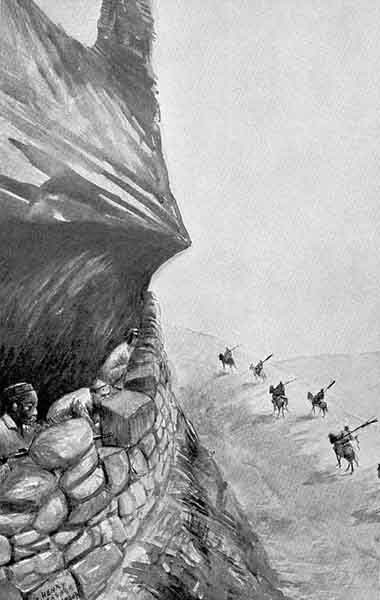
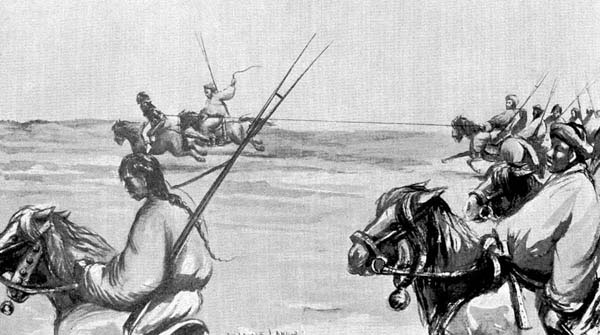
Tibetans. A number of mounted men with matchlocks had arrived. Others
similarly armed joined them. They seemed excited. I kept my eye on them
while I was cooking my food. There were some two hundred men in all,
picturesquely garbed. They were good horsemen, and looked well as they
rode in a line toward us. A little way off they stopped and dismounted.
The leaders came forward, one stalwart fellow in a handsome sheepskin
coat marching ahead of the rest. His attitude was arrogant. Dispensing
with the usual salutations, he approached quite close, shaking his fist
at me.
"Kiu mahla lokhna nga rah luck tiba tangan" (I will give you a goat or
a sheep if you will go back), he said.
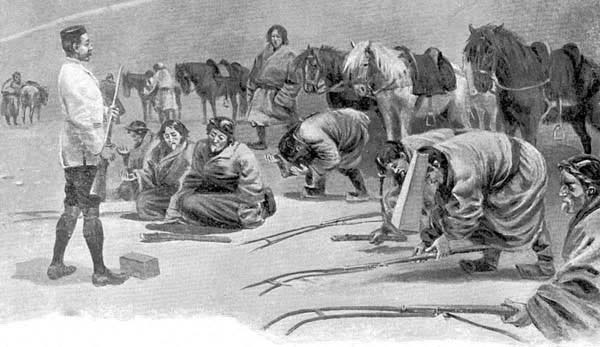
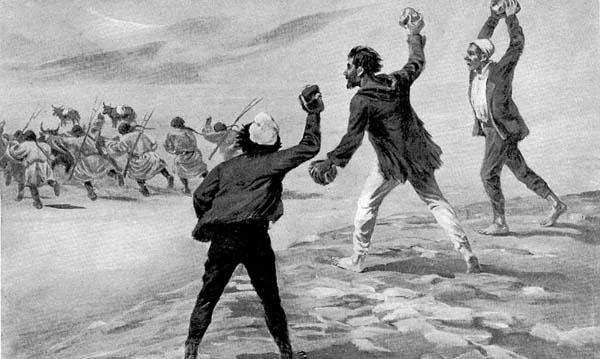
"Kiu donna nga di tangon!" (And I give you this to make you go back!)
was my quick answer, while I unexpectedly administered him one straight
from the shoulder that sent him sprawling on the ground.
The army, which, with its usual prudence, was watching events from a
respectful distance, beat a hasty retreat. The officer scrambled away,
screaming. The Tibetans had so far behaved with such contemptible
cowardice that we could hardly congratulate ourselves on such easy
successes. We began to feel that really we had no enemy at all before
us. We became even careless. We ate our food, and gave this affair but
little thought.
The Tibetans did not trouble us again that day. Those who had not ridden
off retired timidly inside their black tents. Not a soul was to be seen
about in the encampment. I registered my daily observations, made a
sketch of one of the black tents, and wrote up my diary. Then we
continued our journey.
Our progress was now comparatively easy, along a broad grassy plain. We
proceeded in a south-easterly direction, observing a high snowy peak at
20° (b.m.), and a low pass in the mountain range to our north-east. A
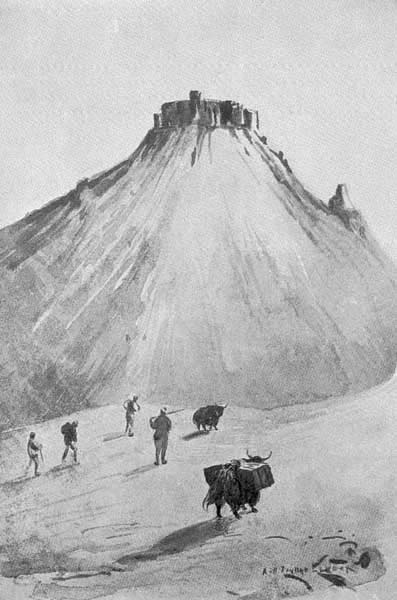
high range stood ahead of us in the far distance. At the foot of a
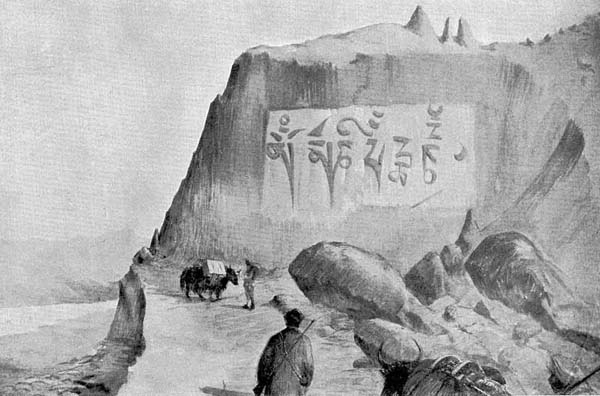
lonely hill we found an important mani wall of great length, with
numberless inscriptions of all ages and sizes on stones, pieces of bone,
skulls, and horns. Farther on, to the south, there were three small
hillocks and two larger ones. The soldiers we had routed at the
encampment had proceeded in the direction we were now following. We
were, in fact, treading all along on the footmarks of their ponies.
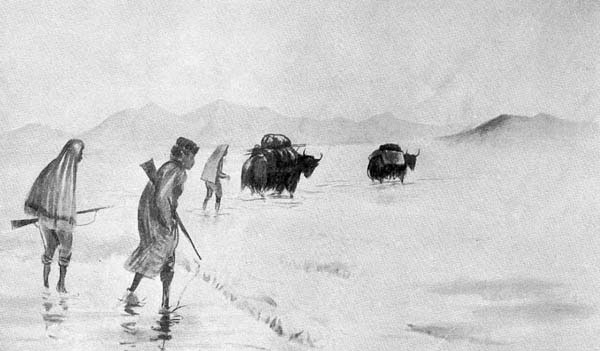
We had to cross a river and a number of rivulets. So troublesome was it
each time to take off our shoes and clothes in order to wade through,
that we bundled up our clothes on the yaks, and travelled along for the
rest of the afternoon barefooted and with nothing on but a loincloth, in
the style adopted by fakirs.[9]
The sun was extremely hot, the ground marshy, the air thick with huge
and troublesome mosquitoes. We were quickly covered from head to foot
with bites, which caused intense irritation. Halting on the right bank
of a large stream at 15,600 feet, we named this spot "Mosquito Camp." At
sunset swarms of mosquitoes made us very miserable, but fortunately the
moment the sun disappeared the thermometer fell to 33°, the mosquitoes
vanished, and we had a peaceful night.
In the evening we saw a number of horsemen riding full speed on a course
about one mile south of ours. No doubt they were sent to keep the
authorities ahead informed of our movements.
The next day the water of the stream was so clear that we could not
resist the temptation of having a good cleaning up, washing first our
clothes and spreading them to dry in the sun, then cleansing our faces
and bodies thoroughly with soap, a luxury unknown to us for ever so
long.
While—for lack of towels—I was drying myself in the sun, I admired the
scenery around us. I registered at 211° (b.m.) a very high snowy peak,
and a lower one at 213° 30' forming part of a beautiful mountain chain.
There were mountains on every side of the plain. Another very high peak,
of which I had taken bearings on a previous occasion, was at 20° (b.m.).
A break occurred in the hill range to our north-east, showing a narrow
valley, beyond which were high snowy mountains. We made a long march
along the grassy plain, and encamped on the bank of the Brahmaputra,
there a wide, deep, and rapid stream. We saw hundreds of kiang and
antelopes. Shortly before sunset I took a walk toward the hills to try
and bring back fresh meat to camp. I stalked a herd of antelopes. When
some five miles from camp I was benighted, and on my return in the
darkness had the greatest difficulty in finding my men. They had been
unable to light a fire, and as they had both gone fast asleep, I
received no answer to my calls. We had selected a sheltered hollow in
the ground for our camp, and as there were hundreds of similar
depressions everywhere round it, and no landmarks to guide me, it was
not easy to identify the exact place.
Fortunately, at last, after I had shouted for some considerable time,
Chanden Sing heard me. By the sound of his voice, I found my way back.
In the morning we noticed a large encampment about a mile off, on the
opposite bank of the Brahmaputra. The stream was too rapid for us to
cross, or we might have gone over to try and obtain provisions from the
natives. Moreover, on further examination, we saw black tents in every
direction on our side of the water, and therefore there was no reason to
go to the extra trouble and danger of crossing the stream.
Much to our delight, we succeeded in purchasing a goat from some passing
Tibetans, who drove before them a flock of several thousand. We could
not find sufficient dry fuel to make a fire, so we intrusted Mansing
with the animal as far as our next camp, where we proposed to indulge in
a feast.
The Brahmaputra had here several ramifications, mostly ending in
lakelets, and rendering the plain a regular swamp. The larger arm of the
river was wide and deep, and we preferred following it to crossing it,
notwithstanding that we had to deviate somewhat from the course which
otherwise I should have followed. For several miles we sank in mud and
slush up to our knees, or waded through water. There were small patches
of soft earth with tufts of grass which rose above the water, but they
collapsed on our attempting to stand upon them.
The whole of the northern part of the plain was extremely marshy. Our
yaks gave us no end of trouble. When they sank unexpectedly in soft
mud-holes, they became alarmed, and, in their struggle to save
themselves, once or twice shook off their pack-saddles and loads, which
we had not been able to fasten properly for want of proper ropes.
Chanden Sing and I managed to keep up with the restless animals. At
last, on nearing the hills, the ground showed undulations, and was
rather drier. We saw columns of smoke rising from near the foot of the
range to the north of us. We went on another two miles, exhausted and
dirty, our clothes, on which we had spent so much soap and time in
washing, filthy again with splashes of mud.
"Where are Mansing and the goat?" I asked the Hindoo.
"He remained behind at the beginning of the swamp. He was too exhausted
to drag along the goat you purchased."
I was much concerned, on scouring from a hillock the country all round
with my telescope, to perceive no sign whatever of the poor fellow. I
was angry with myself for not noticing his disappearance before. As
there were many Tibetans about the spot where he had remained, I feared
foul play on their part, and that he might have been overpowered. Again
I imagined that, weak as he was, he might have been sucked down in one
of the deeper mud-holes, without a chance of saving himself. I left
Chanden Sing to look after the yaks, and turned back in search of him.
As I hurried back mile after mile, struggling again half across the mud
swamp, and yet saw no trace of the poor coolie, I was almost giving up
my quest in despair, when my eye caught sight of something moving about
half a mile farther on. It was the goat, all alone. I made for it with a
sinking heart.
It was only on getting quite close that I perceived the poor coolie,
quite insensible in a faint, lying flat and half sunk in the mud.
Fortunately he had taken the precaution of tying the rope to which the
goat was fastened tight round his arm. To it only was due my discovering
Mansing's whereabouts, not to speak of the rescue of our precious
acquisition. With some rubbing and shaking I brought the poor fellow
back to life, and helped him along until we rejoined Chanden Sing. Not
until the middle of the night did we reach Tarbar, a large Tibetan
encampment at the foot of the hill range.
The alarm of our arrival, given first by scores of dogs barking at us,
then by one of the natives who had ventured peeping out of his tent to
find out the cause of the disturbance, created the usual panic in the
place.
"Gigri duk! gigri duk! Jogpa, Jogpa!" (Danger! danger! Help,
brigands, brigands!) cried the Tibetan, running frantically out of his
tent. A few seconds later black figures could be seen everywhere,
dashing in and out of their tents. It must be remembered that, according
to the manners of Tibet, one should time one's arrival at an encampment
so as to reach it before sundown, unless notice of one's approach is
sent ahead. People who arrive unexpectedly in the middle of the night
are never credited with good motives—nothing short of murder, robbery,
or extortion. I tried to set the minds of the Tibetans at ease by
telling them that I meant no harm, but such was their excitement and
fright that I could get no one to listen to me.
Two old women came to us with a bucket of milk and laid it at my feet,
entreating me to spare their lives. Great was their astonishment when,
instead of finding themselves murdered, they received a silver rupee in
payment. This was the first step toward a peaceful settlement of the
disturbance. After some time calm was restored, and though still
regarded with suspicion, we were politely treated by the natives.
Unfortunately, here too we were unable to purchase provisions, the
natives declaring that they had not sufficient food for themselves. At
night the thermometer fell to 26°. We felt the cold intensely. We
purchased a quantity of dung from the natives and made a fire in the
morning. Having feasted on the goat, which we killed, and on yak's milk,
we made preparations to strike camp early next morning. Having had a
good meal after several days' privations, we felt happier than usual.
On leaving Tarbar we followed for a while the course of the river. It
was a glorious day, and we were able to admire the magnificent panorama
of the great rugged mountain range to the south-west of us. The higher
peaks were nearly all shaped like pyramids. I observed a gigantic
quadrangular peak which I took to be Mount Everest. Next to it was
another pyramidical peak, also very lofty, but not so high and beautiful
as its neighbor. I followed a general course toward east-south-east. As
the river, which we had more or less followed, now described a big bend
toward the south-south-east, I decided to cross it. We waded through it
successfully with water up to our necks, and again we found ourselves
upon marshy land, with a repetition of the previous day's experience.
Farther on we crossed three more tributaries of the larger stream, all
fairly wide and deep. Then we had once more to get across the main
river, there of considerable depth and swiftness. The river traversed
the plain in zigzag fashion, and, unless we wanted to follow its banks,
and so lengthen the journey by double or treble the distance, this was
the only course open to us. Thus, while trying to travel as much as
possible in a straight line, we found ourselves for the third time
before this great river, now swollen by other snow-fed streams, and
carrying an immense body of water. It was in the afternoon, too, when
the water was at its highest. We attempted a crossing at several points,
but found it impossible. I decided to wait for low water early next
morning.
Apparently my yaks knew this part of the country well. I noticed that,
whenever I lost the track, all I had to do was to follow them, and they
would bring me back to it again. When I drove them away from the track,
they showed a great disinclination to move, whereas they proceeded
willingly enough while we were on the highway. No track was visible
except here and there, where the footmarks of the last nomads, with
their sheep, ponies, and yaks, had destroyed the grass.
Half a mile on the other side of the river was an encampment of some
fifty or sixty tents, with hundreds of yaks and sheep grazing near it.
At this point my two yaks, which I noticed had been marching with more
than usual smartness, bolted while I was ordering Chanden Sing and
Mansing to take down the loads, and went straight into the water.
In attempting to make them turn back, Mansing threw a stone at them,
which, instead of having the desired effect, sent them on all the
faster. The current was strong, and the bottom of the river so soft that
they both sank. When they reappeared on the surface it was only to float
rapidly away down-stream. We watched them with ever-increasing anxiety.
They seemed quite helpless. We ran panting along the river-bank, urging
them on with shouts in order to drive them to the other side. In their
desperate struggle to keep afloat, and powerless against the current,
the two yaks collided violently in mid-stream. The bump caused the
pack-saddle and load of the smaller yak to turn over. The animal, thus
overbalanced and hampered, sank and reappeared two or three times,
struggling for air and life. It was, indeed, a terrible moment. In order
to save the load, I threw off my clothes and jumped into the water. I
swam fast to the animal, and, with no small exertion, pulled him on
shore, some two hundred yards farther down-stream. We were both safe,
though breathless; but, alas! the ropes that held the baggage had given
way, and saddle and load had disappeared. This loss was a dreadful blow
to me. I tried hard, by repeatedly diving into the river until I was
almost frozen, to recover my goods, but failed to find them or even to
locate them. Where I suspected them to be the water was over twenty feet
deep. The bottom of the river was of soft mud, so that the weight alone
of the loads would cause them to sink and be covered over.
Diving at such great elevations gave a peculiar and unpleasant
sensation. The moment I was entirely under water, I felt as if I were
compressed under an appalling weight which seemed to crush me. Had the
liquid above and around me been a mass of lead instead of water, it
could not have felt heavier. The sensation was especially noticeable in
my head, which felt as if my skull were being screwed inside a vise. The
beating in my temples was almost unbearable. Under ordinary
circumstances I can remain under water for over a minute, but at such
high elevations I could never hold out for longer than fifteen or twenty
seconds. Each time that I emerged from below, gasping for air, my heart
beat alarmingly violently, and my lungs seemed as if about to burst.
I was so exhausted that I did not feel equal to conveying my two men
across. I unloaded the stronger yak, and then, with endless trouble, I
drove him and his mate again into the water. Unhampered, and good
swimmers as they are, the two yaks floated away with the current and
reached the other side. Chanden Sing and Mansing, with their clothes and
mine tied into a bundle over their shoulders, got on the animals, and,
after a somewhat anxious passage, arrived safely on my side. We
encamped. My men mourned all night over the lost property. The next
morning I made fresh and unsuccessful attempts to recover the loads.
Unhappily they contained all my tinned provisions, and what little other
food I had, 800 rupees in silver, the greater part of my ammunition,
changes of clothing, shoes, my hurricane lantern, and sundry knives,
razors, etc.
The only thing we recovered was the wooden pack-saddle, which was washed
ashore some six hundred yards farther down.
Our situation can be summed up in a few words. We were now in the centre
of Tibet, with no food of any kind, no clothes to speak of, and no boots
or shoes, except those we wore, which were falling to pieces. What
little ammunition I had left could not be relied upon, owing to its
having been in water on several occasions. Around us we had nothing but
enemies—insignificant enemies, if you like, yet enemies after all.
I got some comfort in thinking that the water-tight cases with my
scientific instruments, notes, sketches, maps, and a quantity of gold
and silver money were saved. As far as I was concerned, I valued them
more than anything else I possessed.
We went on, hungry, worn out, with our feet lacerated, cheering one
another as best we could. We laughed at our troubles. We laughed at the
Tibetans and their comical ways. We laughed at everything and everybody,
until eventually we laughed at ourselves. But the days seemed long.
Though fasting gives you at first an acute pain in your inside, it does
not become unbearable until after several days' absolute want of food.
That is to say, if you are accustomed, as we were, to long intervals
between one meal and the next. When we got to our third day's fasting we
were keen enough for a meal. Perceiving black tents close to the
mountain-side, about four miles out of our course, we made for them with
famished haste. We purchased two bucketfuls of yak's milk, one of which
I drank there and then myself, the second being equally divided between
my two servants. That was all we could get. They would sell us nothing
else.
After this we moved forward again, making steady, and, if one allows for
the great elevation, comparatively rapid progress. We held our own
against all comers. We encountered pleasant people and unpleasant ones,
but, whether their manner was courteous or the reverse, we could nowhere
obtain food for love or money.
Poor Mansing and Chanden Sing, not having the same interest that I had
in my work to keep up their spirits, were now in a dreadful condition.
Cold, tired, and starved, the poor wretches had hardly strength left to
stand on their feet, the soles of which were badly cut and sore. It
really made my heart bleed to see these two brave men suffer as they did
for my sake. No word of complaint came from them; not once did their
lips utter a reproach.
"Never mind if we suffer or even die," said the poor fellows, when I
expressed my sympathy with them, "we will follow you as long as we have
strength to move. We will stand by you, no matter what happens."
I had to relieve Chanden Sing of his rifle, as he was no longer able to
carry it. I, too, felt languid as the days went by, and we got scarcely
any food. I cannot say that I experienced severe physical pain. This was
due, I think, to the fact that my exhaustion brought on fever. I had a
peculiar feeling in my head, as if my intellect, never too bright, had
now been altogether dulled. My hearing, too, became less acute. I felt
my strength slowly dying down like the flame of a lamp with no more oil
in it. The nervous excitement and strain alone kept me alive. I went on
walking mechanically.
We reached an encampment of some eighty black tents and a mud
guard-house. We were positively in a starved condition. It was utterly
impossible to proceed farther, owing to the wretched condition of my two
men. They begged to be given ponies to ride. Their feet were so sore
that, notwithstanding their anxiety to follow me, they could no more.
The natives received us kindly, and consented to sell me ponies,
clothes, and provisions. We encamped about two miles beyond the
settlement. During the evening several persons visited my tent, bringing
gifts of flour, butter, and tsamba, accompanied by katas, the veils
of friendship. I made a point of invariably giving the Tibetans, in
return for their gifts, silver money to an amount three or four times
the value of the articles they presented us with. They professed to be
very grateful. A man called Ando, who styled himself a Gourkha, but wore
the garb of the Tibetans, came to visit us in our tent, and promised to
bring several ponies for sale the next morning. He also undertook to
sell a sufficient quantity of food to enable us to reach Lhassa. To show
his good faith, he brought a portion of the supplies in the evening, and
said he would let us have the remainder the next morning.
We next had a visit from a Lama, who appeared civil and intelligent. He
presented us with butter and chura (cheese). He had travelled as far
as Calcutta in India, and was then on his way from Gartok to Lhassa.
Having an excellent pony, he expected to arrive there in four or five
days. Other Lamas and men who came to see us stated that they had come
from Lhassa in four days.
The natives, as usual, showed great reticence in giving us the name of
the encampment, some calling it Toxem, others Taddju. North of us was a
low pass in the hill range. As I had already seen as much as I wanted of
the Tibetans, it was my intention, if I succeeded in purchasing enough
provisions and ponies, to cross over this pass and proceed toward the
Sacred City, following a course on the northern side of the mountain
range. The highway to Lhassa was getting so thickly populated that I
thought it advisable in the future to travel through less inhabited
regions. I intended proceeding, dressed as a European, until within a
few miles of Lhassa. Then I would leave my two men concealed in some
secluded spot, and assuming a disguise, I would penetrate alone during
the night into the city. This would have been easy enough, as Lhassa
has no gates, and only a ruined wall round it.
I was able to purchase some clothing and boots from the Tibetans. The
pigtail that I needed in order to pass for a Tibetan I could make with
the silky hair of my yaks. I would pretend to be deaf and dumb, as I
could not speak the Tibetan language perfectly enough to pass for a
native.
A good meal brought hope and high spirits. When I retired to sleep I saw
myself already inside the Sacred City walls.