Larger versions of the illustrations may be seen by right-clicking them
and selecting an option to view them separately, or by double-tapping and/or
stretching them.
By ELLIS PARKER BUTLER
Author of “Pigs is Pigs,” etc.
Illustrations by ALBERT LEVERING
SPECIAL EDITION
The Q and C Co.
NEW YORK AND CHICAGO
An Experiment in Gyro-Hats
By Ellis Parker Butler
Author of “Pigs is Pigs,” etc.
Illustrations by Albert Levering
The idea of a gyro-hat did not come to me all at once,
as some great ideas come to inventors; and in fact I
may say that but for a most unpleasant circumstance
I might never have thought of gyro-hats at all, although
I had for many years been considering the possibility
of utilizing the waste space in the top of silk hats in
some way or other. As a practical hat dealer and
lover of my kind, it had always seemed to me a great
economical waste to have a large vacant space inside
the upper portion of top hats, or high hats, or “stovepipe”
hats, as they are variously called. When a shoe
is on, it is full of foot, and when a glove is on, it is full
of hand; but a top hat is not, and never can be, full of
head, until such a day as heads assume a cylindrical
shape, perfectly flat on top. And no sensible man ever
expects that day to come.
I had, therefore, spent much of my leisure in devising
methods by which the vacant space above the head in
high hats might be turned to advantage, and my
patents ranged all the way from a small filing cabinet
that just occupied the waste space, to an extensible
hat rack on the accordion plan that could be pushed
compactly into the top of the top hat when the hat
was worn, but could be extended into a hat and coat
rack when the hat was not in use. This device should
have been very popular, but I may say that the public
received the idea coldly.
My attention had been for some time drawn away
from this philanthropic work by certain symptoms of
uneasiness I noticed in my daughter Anne, and my
wife and I decided after careful consideration that
Anne must be in love, and that her love must be
unhappy. Otherwise we could not account for the
strange excitability of our usually imperturbable
daughter. As a practical hat dealer my time has been
almost exclusively devoted to hats and, as a good wife,
my companion’s attention has been almost exclusively
devoted to her husband, while Anne was usually so
calm and self-contained that she did not take my attention
from my hat business at all. But when such a
daughter suddenly develops signs of weeping and sighs
and general nervousness, any father, no matter how
devoted to the hat trade, must pay attention.
One of the primary necessities of a dealer in good
hats is calm. An ordinary hat dealer may not need
calm. He may buy his hats as another dealer buys flour,
in the bulk, and then trust to advertisements to sell
them; but I am not that kind of hat dealer. Hat dealing
is an art with me, and great art requires calm and
peace in order that it may reach its highest development.
When I buy hats I do not think of dozens and dollars.
No, indeed; I think of noses and ears. To be able to
buy of a manufacturer a hat that will make the pug
nose and big ears of a man I have never seen seem
normal and beautiful when that man enters my store
and buys a hat, requires calm. And no hatter can have
calm in his soul while his daughter is love sick and
unhappy. I demand happiness about and around me,
and I must have it. So I told my wife, and I told her
so most emphatically, and I informed her that Anne
must become happy at once.
Perhaps you can imagine the shock I received when
my wife, after making the necessary inquiries of Anne,
informed me that Anne was indeed in love, and in love
with Walsingham Gribbs. It was not because Walsingham
Gribbs had never bought a hat of me that I
was shocked. Bad hats are a common failing of mankind,
and a man will try a hundred hatters before he
at last comes to me.
The trouble was deeper than this. The thing that
staggered me was that Walsingham was a staggerer.
(This is a joke, but I hold that a hatter has as good a
right to make a joke as the next man.)
That my daughter had fallen in love with Walsingham
Gribbs without having met him was altogether to
her credit. She first saw him when she was crossing the
ocean (for she travels where she pleases, my hat business
affording her such pleasures) and that he reeled
and staggered about the boat did not impress her, for
it was a stormy trip and everyone aboard reeled and
staggered, even the captain of the boat. But when she
returned to New York and saw Walsingham Gribbs
on the firm pavement of Fifth Avenue, she had a harsh,
cruel disillusionment. Walsingham Gribbs reeled and
staggered on terra firma.
I am glad to say that my daughter saw at once the
impossibility of the daughter of a high-class hatter
mating with a permanent staggerer. As she realized
this, she became sad and nervous, thus creating an
atmosphere in my home that was quite opposed to
the best high-class hatting, irritating my faculties and
threatening to reduce me to the state of a mere commercial
hatter.
Further investigation only made the matter seem
worse, for quiet inquiries brought out the information
that Walsingham Gribbs had been staggering since the
year his father died. He had been constantly in a
reeling, staggering state since his twentieth birthday.
For such a man reform is, indeed, impossible. And
what made the case more sad was that all proof seemed
to point to the fact that Walsingham Gribbs was not a
“bounder” nor a “rounder,” two classes of men who
occasionally acquire a stagger and a reel in company
with hearty boon companions.
In short, no one had ever seen Walsingham Gribbs
take a drink in public, and I was forced to conclude
that he was of that horrid type that drinks alone—“Alone
but with unabated zeal” as that great poet,
Sir Walter Scott, has remarked in one of his charming
poems.
If all these investigations of mine were conducted
without the knowledge of Walsingham Gribbs, you must
admit I did only what was right in keeping them secret
from him; for since he had never met my daughter he
might have considered the efforts of a perfect stranger
to peer into his life as being uncalled for. My wife did
what she could to comfort Anne, but Anne sadly replied
that she could never marry a man that staggered and
reeled day in and day out. Thus day by day she became
more sad, and I became so upset that I actually sold
a narrow-brimmed derby hat to a man with wide,
outstanding ears.
Of course this could not go on. No high-grade hat
business could support it, and I was standing in my
shop door looking gloomily out when I chanced to see
Walsingham Gribbs stagger by. I had seen him many
times, but now, for the first time I noticed what I
should have noticed before—that he invariably wore a
high hat, or “topper,” as our customers like to call them.
I observed that the shape was awful, and that the hat
badly needed the iron, and then my mind recurred to
the old problem of the vacant space in the top of top
hats; but I found I could not concentrate. Whenever
I tried to think of top hats I thought of Walsingham
Gribbs in one of them, staggering and reeling up the
street, and gradually the thought came that it would be
an excellent idea should I be able so to use the space
in the top of Walsingham’s hat that he would no longer
stagger and reel, and then the thought of the gyroscope
hat came to me.
I admit that at first I put the idea aside as futile, but
it came back again and again, and at length it seemed
to force me into enthusiasm. I dropped everything and
went to work on the gyro-hat.
The gyroscope is, as everyone knows, a top, and I
might have called the hat I invented a top hat, except
that any tall cylindrical silk or beaver hat is called a
top hat, so I was forced to adopt the name of gyro-hat.
A gyroscope is not an ordinary top. It is like a heavy
fly wheel, revolving on an axis; and if it is spun, the
speed of the revolutions maintains the axis in the
perpendicular. A huge gyroscope is used to steady the
channel steamers, which would otherwise stagger and
reel. A gyroscope has just been adopted to the monorail
cars, and so long as the gyroscope gyrates the
monorail car cannot stagger or reel. If a proper gyroscope
was placed on the end of a knitting needle and
gyrated at full speed, that knitting needle could be
stood on end and it would not fall over.
Therefore, if a gyroscope was placed in the top of a
top hat, and the top hat firmly fastened to the head of
a man, and the gyroscope set going, that man would
remain perpendicular in spite of anything. He could
not stagger. He could not reel. He could walk a line
as straight as a crack.
When I had completed this gyro-hat I showed it to
my wife, and briefly explained what it was and what
I meant to do with it. The small but wonderfully
powerful motor and the gyroscope itself were all concealed
inside the hat, and I explained to my wife that
Walsingham Gribbs need but fasten the hat firmly on
his head and he would never stagger again. At first
my wife seemed doubtful, but as I went on she became
enthusiastic.
The only thing she disliked was the method of
fastening the hat to the head, for, as it was quite necessary
that the hat be very firmly fixed to the head, I had
sewed ear tabs to the hat, and these I tied firmly under
my chin. My wife said she feared it would require
some time to persuade the public to take to silk hats with
ear tabs, and that the sight of a man in a silk hat with
ear tabs would be a sign that he was a staggerer. She
wanted another method of holding the hat on the head.
“Vacuum suction,” I said, for I am quick to catch
an idea. A man has to be, in the hat business. “But,”
I added, “where would you get the vacuum? A man
cannot be expected to carry a can of vacuum, or whatever
he would need to carry vacuum in, around with
him; especially the kind of man that would need the
gyro-hat.”
“‘MY DEAR,’ SAID MY WIFE, ‘I HAVE IT. LET THE HAT
MAKE ITS OWN VACUUM.’”
“My dear,” said my wife, after a minute of thought,
during which we both studied the gyro-hat, “I have
it! Let the hat make its own vacuum. If the hat is
lined with air-tight aluminum, and has a rubber sweat band,
and an expulsion valve, the gyroscope motor
could pump the air out itself. It could create its own
vacuum.”
“Of course it could!” I exclaimed. “I could rig it
up so that putting the hat on the head would start the
gyroscope, and the gyroscope would pump a vacuum.
All any staggerer would need to do would be to put on
his hat, and the hat would do the rest. It would stay
on his head and it would keep him evenly on his keel.”
(Of course I would not use a nautical term like “keel”
in my hat shop, but at home I allow myself some liberties
of that sort.)
I set to work at once to perfect the gyro-hat on the
plan suggested by my wife and in a few days I was able
to say it was a success. By this I mean it was a success
in so far as the eye could judge by looking at the hat,
and all that was needed was a practical trial.
As the hat had been invented for Walsingham Gribbs
more than for any other man, I proposed to my wife
that Walsingham—we had spoken of him so often
that we now mentioned him as Walsingham—should
be the man to try it out. But my wife is better posted
in social matters than I, and she said it would not do
at all to attempt such a thing.
In the first place, none of us knew Walsingham; and
in all the other places, it would be insulting to suggest
such a thing to him, and might ruin Anne’s chances.
I then assured my wife that I did not mean to allow
any ordinary intoxicated man to experiment with the
only gyro-hat I possessed, and possibly wreck and ruin
it. We had too much at stake for that. So, after considerable
discussion, my wife and I decided upon what
was, after all, the only rational course—I should try
out the gyro-hat myself.
I admit here that I am not much of a drinker.
Although not so by principle, I am by action a teetotaller.
I consider that the highest good of a hat shop
demands it. As a matter of fact I had never up to this
time tasted intoxicating liquor, but it was evident to
my wife and me that the time had arrived when the
hat business demanded this sacrifice on my part. Evidently,
if a gyro-hat is meant to keep a staggerer and
reeler steady on his keel, the only test of the gyro-hat
must be on the head of a man who, without the hat,
could not help staggering and reeling—a thoroughly
intoxicated man.
We did not, of course, admit Anne into our little
conspiracy, and we chose a restaurant where we were
sure intoxicants would be sold. We proceeded to the
restaurant about the dinner hour; and after studying
the waiters carefully, I selected one that seemed likely
to know something about intoxicants, and we seated
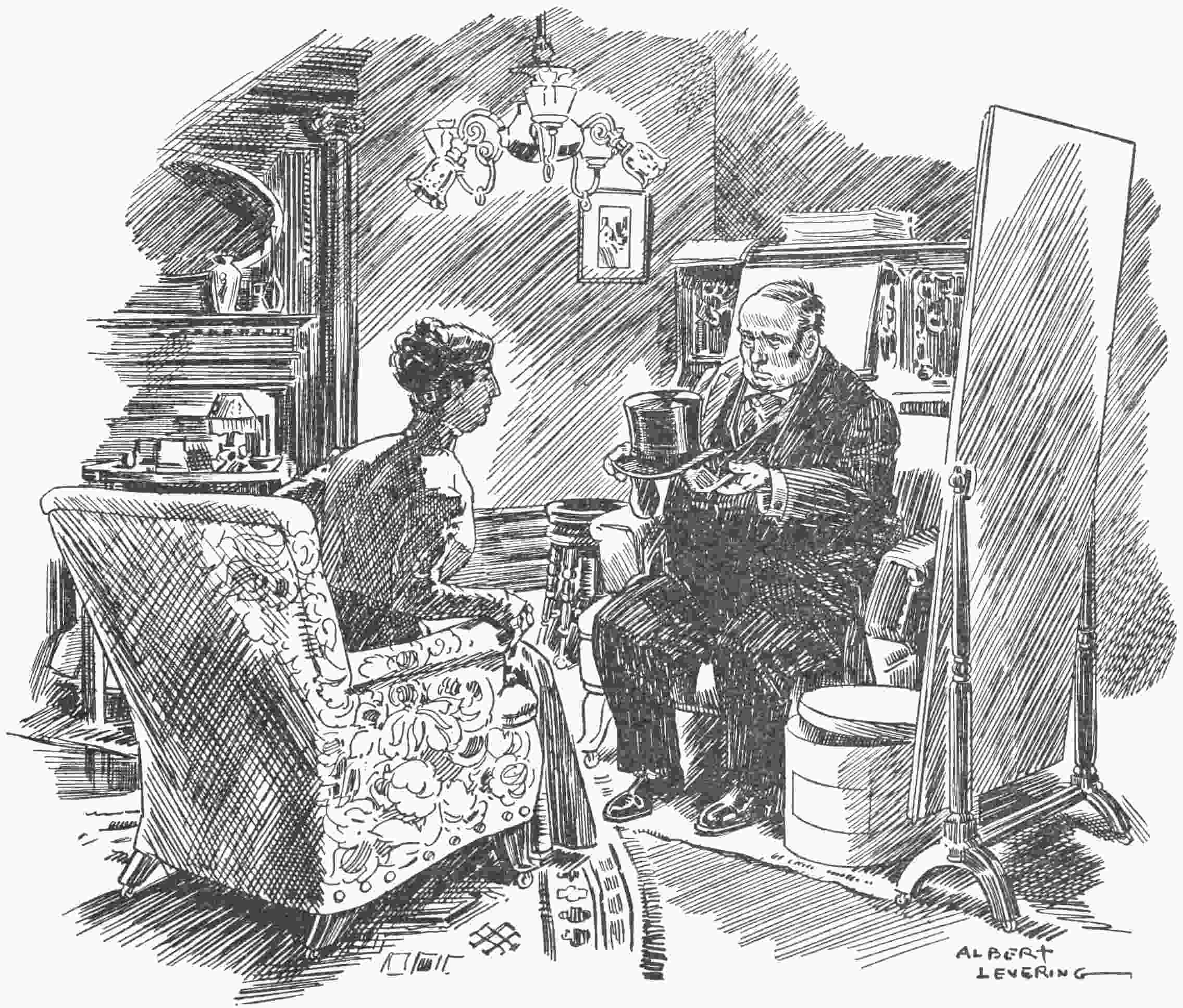
ourselves at his table. I placed the gyro-hat carefully
across my knees, first setting the starter, and beckoned
the waiter to us.
“My good fellow,” I said, when he had approached
with his pencil and order card in hand, “I desire to
become intoxicated this evening, and I presume you
know something about intoxicating liquors.”
“Yes, sir,” said the waiter.
“Tell him, Henry,” said my wife, “that we also
wish something to eat, but that as our principal object
in coming here is to secure intoxicants, we wish him
to be particular about them.”
“You have heard what the lady said,” I told the
waiter, “and you will be guided accordingly.”
“Yes, sir,” said the waiter, politely. “Does the
lady desire to become intoxicated also?”
“Heavens, no!” exclaimed my wife.
“Certainly not,” said the waiter.
“Now,” I said to the waiter, “you doubtless have
different kinds of intoxicating liquors here—some
strong and some not so strong—and I do not desire to
drink a great quantity to obtain the result I desire.
What would you recommend to give the required
reeling and staggering condition as quickly as
possible?”
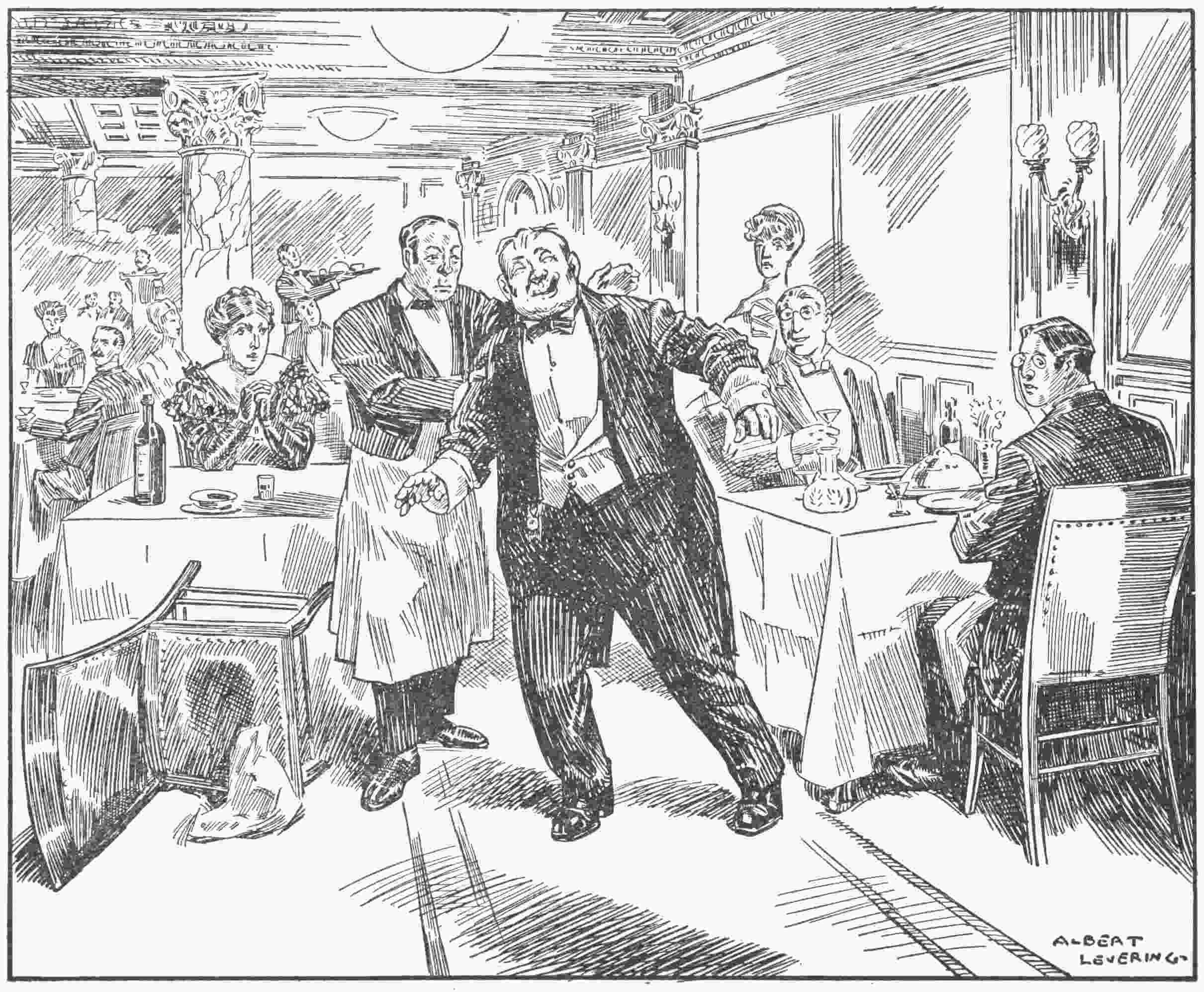
“‘IF YOU PLEASE, SIR,’ SAID THE WAITER, ‘IF YOU WALK A FEW STEPS I CAN TELL
MORE DEFINITELY.’”
“Well, sir,” he said, “if you will let me advise, I
would advise a certain brandy we have. Of that
brandy, sir, a little goes a long way. I have seen it
work, sir, and I can assure you that a small quantity
of that will make you stagger and reel to your heart’s
content.”
“Very well,” I said, “you may bring me some. I
suppose a quart would be enough.”
“I beg your pardon, sir,” he said, “but have you
ever tried the brandy of which I speak?”
“I have not,” I said.
“Then, sir,” said the waiter apologetically, “unless
you are a very heavy drinker I would not advise a
quart of that brandy. A quart of that brandy, sir,
would, if I may so speak, lay you out flat. You would
not reel and stagger, sir. You would be paralyzed stiff,
sir, dead to the world.”
I thanked the waiter warmly.
“You observe,” I said, “that I am not used to this
sort of thing, and I appreciate the interest you are
taking. I am inclined to leave the matter entirely in
your hands. I may not know when I have had exactly
the right quantity, but you, with your larger experience,
will know, sir.”
“Yes, sir. And I think the lady will know, sir,” said
the waiter.
I found the brandy most unpleasant to the taste, but
certain symptoms assured me that the waiter had not
belied its effectiveness. Long before the waiter was
satisfied that I would stagger and reel, my long lost
vocal prowess returned and I caroled gaily some songs
that had been favorites of my youth. Many of these
were affectionate songs, and when I sang them I had
a great longing to hold my wife’s hand, and did so; but
as she would not let me kiss her, I felt the need of kissing
the waiter. Here again I was repulsed, but it did not
make me angry. I merely slid down into my chair and
waved my hand at him coquettishly.
“If you please, sir,” said the waiter, when I had
finished another burst of song, “I think you are pretty
ripe, now. If you would just get up and walk a few
steps I can tell more definitely.”
My wife smiled at me reassuringly and nodded to me
that what the waiter proposed had her full sanction;
but even so, I was filled with a fear that we were about
to be parted forever, and for a few minutes I clung to
her neck, weeping bitter tears. I then tore myself
away, and I did indeed stagger and reel. I believe I
knocked over two small tables and ended by seating
myself in the lap of a young man who was dining alone.
He accepted my apology before I had spoken more
than fifteen minutes of it, and then he aided the waiter
in steering me back to my table.
Whatever may have been my past opinion of Walsingham
Gribbs—for it was he—I loved him most
dearly at that moment, and in my incoherent manner
I tried to tell him so. I think he understood. At any
rate, he spoke to my wife like a true gentleman.
“Madame,” he said, “I can sincerely sympathize
with your husband, and if you will allow me, I will
gladly help you assist him to a cab. I beg you not to
be frightened by his condition. I myself am subject
to the same trouble, and although he may seem drunk——”
“Seem drunk!” exclaimed my wife. “Seem drunk!
I beg you to know that my husband is as drunk as a
man can become without being senseless. Either that,
or we have been defrauded by this waiter!”
Walsingham Gribbs looked at my wife, and then smiled.
“Very well,” he said, “if what you wanted was to
have him drunk, I’ll admit that he is about the drunkest
man I have ever seen. I only spoke as I did in order
that I might spare your feelings, for most wives object
to seeing their husbands stagger and reel. I myself
stagger and reel continually, and I have never tasted
intoxicating liquor in my life, but I can share the feelings
of one who staggers and reels, or who has a relative
that staggers and reels.”
At this my wife said:
“Are you not Walsingham Gribbs? If you are I am
delighted to have met you, even in this unconventional
manner, for what brought us here will interest you.”
She then told him of the gyro-hat I had invented, and
explained just why I had come to this place and had
swallowed the strong brandy. I took no part in this
conversation, but Walsingham gladly agreed to accompany
us, and he put my gyro-hat on my head.
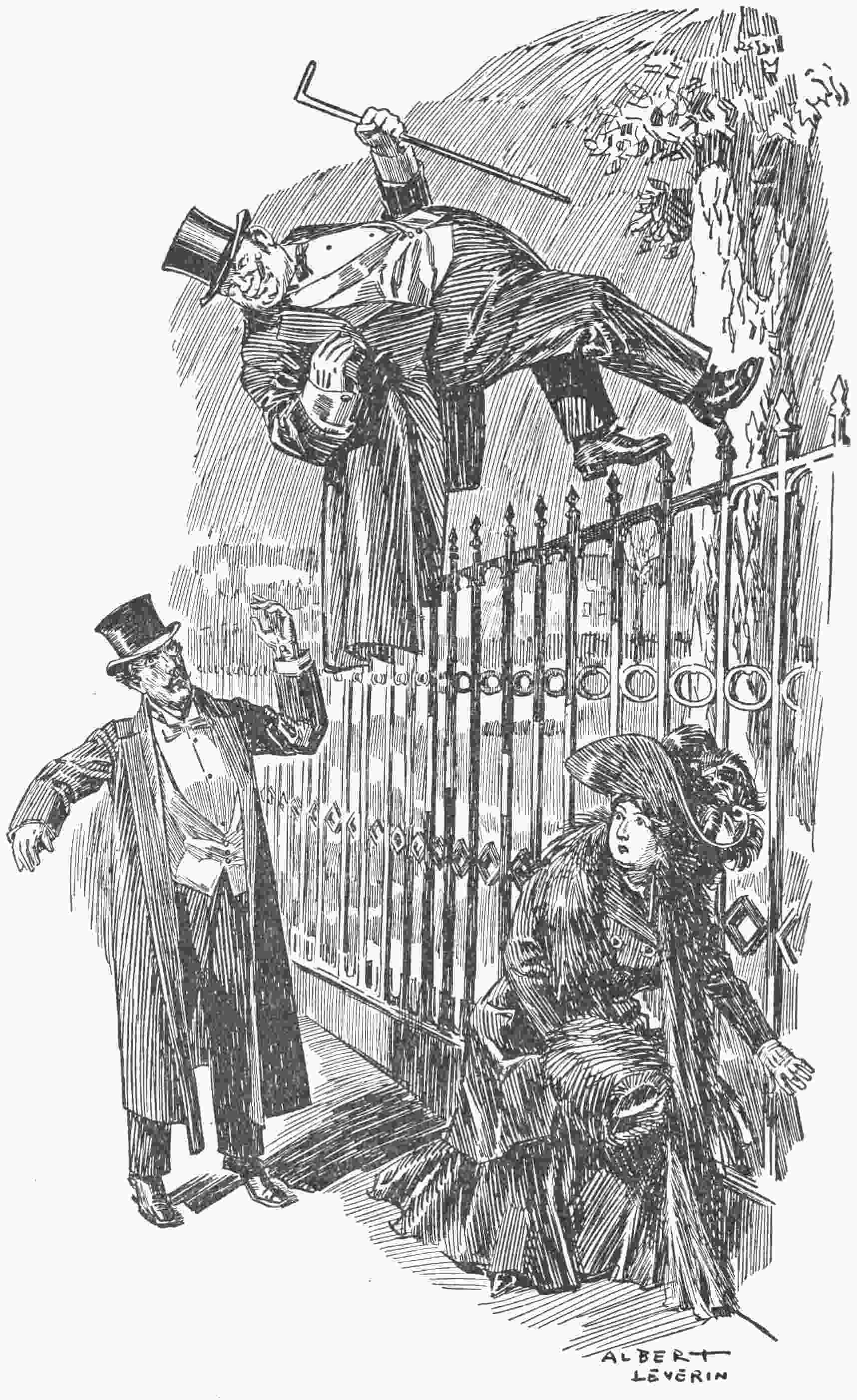
“WHEN WALSINGHAM RELEASED
MY HAND, I SLOWLY
SWUNG UPRIGHT AGAIN
ON THE PICKETS.”
The result was indeed marvelous. Instantly the
vacuum pump began to work and the gyroscope to
revolve. My head, which had been lying on one side,
straightened up. The rubber sweat band gripped my
head tightly with a slight pulling sensation. Without
assistance I arose from my chair and stood erect. My
brain was still confused, but I walked as straight
as a string direct to the door of the restaurant, and
stood holding it open while my wife and Walsingham
passed out.
The gyroscope was revolving at the rate of three
thousand revolutions a minute, and the slight humming
was hardly noticeable. I did not stagger and I did not
reel. When I reached Gramercy Park I was full of glee.
I had been walking on the edge of the curb, but I now
desired to climb atop of the iron fence that surrounds
the park, and walk on the points of the pickets.
My wife and Walsingham tried to dissuade me, but
I climbed to the top of the fence. I not only walked on
the points of the pickets easily, but I was able to place
the end of one toe on the point of one picket, and thus
balanced wave the other leg in the air. My wife and
Walsingham Gribbs coaxed me to come down to the
level of the walk, but as I saw no reason to do so, I
flatly refused, and at last Walsingham reached up and
took me by the hand and pulled me.
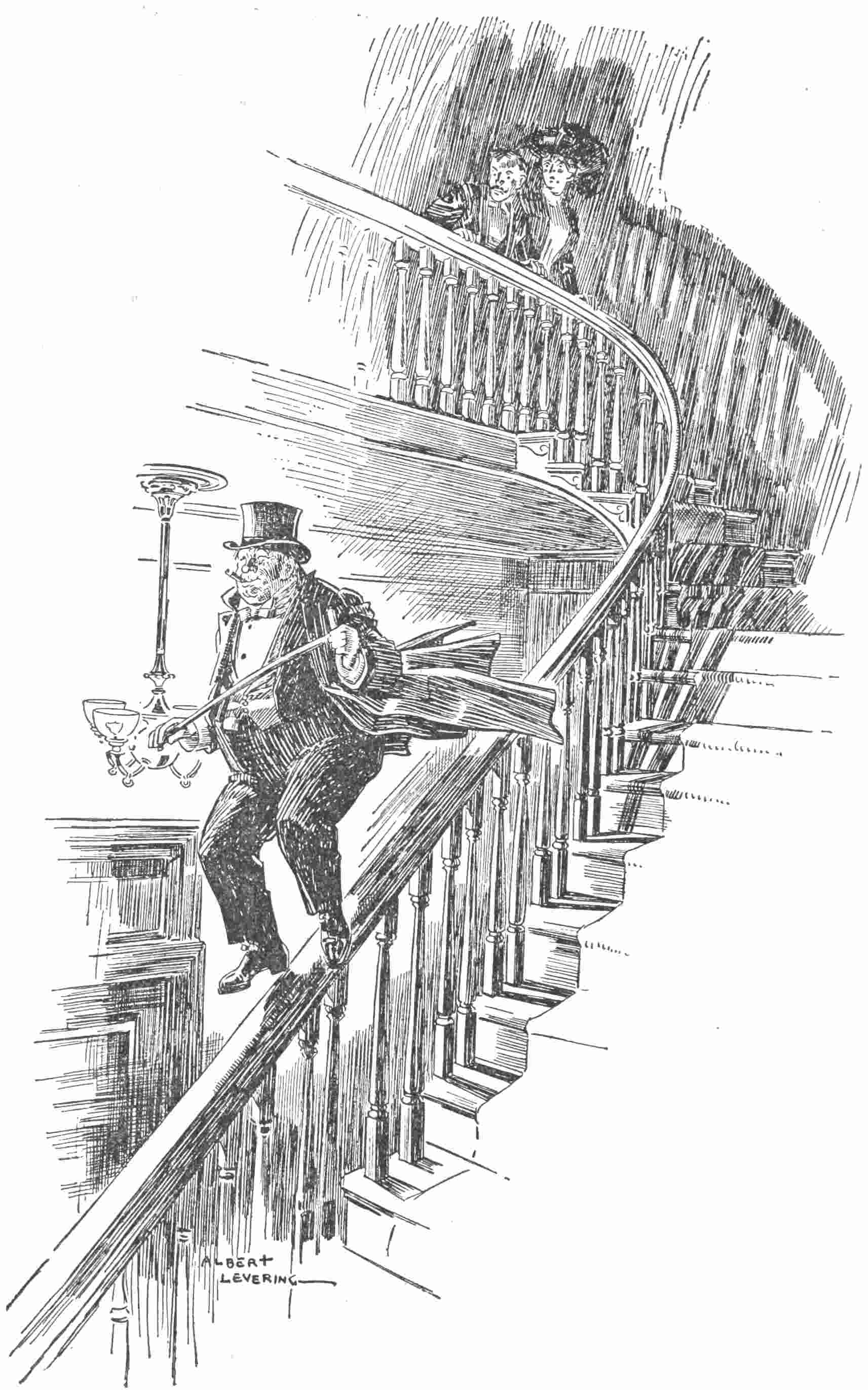
“I FOUND A LITTLE
HARMLESS AMUSEMENT
IN SLIDING DOWN THE
STAIR BANISTERS.”
Ordinarily a man that had imbibed a quantity of
brandy would have fallen to the street if pulled by one
hand while standing on the top of a row of pickets, but
I did not. When Walsingham pulled my hand I inclined
gently toward him until I was at right angles to the
picket fence, with my feet still on top of the pickets;
and when he released my hand I slowly swung upright
again, without any effort whatever on my part. I got
down off that fence when I was ready, and not before.
There could be no doubt whatever that I was far
more intoxicated than Walsingham Gribbs, and all the
way home I gave vent to tremendous bursts of laughter
over the idea that while Walsingham thought he was
seeing me safely home I walked as straight and true as
a general, and he staggered and reeled except when he
clung closely to my arm.
Many persons stopped and looked at us, and I cannot
wonder at it. For Walsingham is a young man of
most dignified countenance, and it must have seemed
strange to see a young man of such sober mien reeling
drunkenly, while a dignified and steadily walking hatter
laughed and shouted drunkenly. It was as if the two of
us had been able to afford but one spree, and had
divided it in that way, he taking the stagger and I
taking the boisterousness.
My wife was much touched by the kind attentions of
Walsingham, and when we reached home she invited
him in, and while I found a little harmless amusement
in walking up the stair banisters and sliding down them
standing on my feet, which I was enabled to do because
of the steadying effect of the gyro-hat, she took Walsingham
into the parlor and introduced him to Anne
formally.
My poor daughter was quite overcome with embarrassment
and pleasure, but when Walsingham was
sitting he showed no evidence of his stagger and reel
whatever, and they managed to become quite well
acquainted while my wife was assisting me to bed.
Unfortunately I had neglected to arrange any method
for letting the vacuum out of the gyro-hat, and although
my wife tugged and pulled at the hat, the suction held
it fast to my head and it refused to come off unless my
scalp came with it. My wife decided that I must sleep
in the hat, since I was in no condition of mind to do
anything about it myself.
I was dying for sleep, and my wife tumbled me into
bed and pulled the sheet over me, and that same instant
I fell into a heavy slumber, but the moment my wife
released her grasp on me I began arising to my feet,
irresistibly drawn to the perpendicular by the action of
the gyro-hat. I continued to arise until I was standing
upright. I can only liken the manner in which I arose
to the way a man might raise a stiff arm slowly until
it pointed straight upward.
My wife immediately pushed me down onto the
pillow again, but it was unavailing. Again the gyro-hat
drew me to a standing position, and my wife was forced
to let me continue my night’s rest in that position.
The next morning I did not feel very well, but I
never saw my wife in better spirits. She told me she
was sure Walsingham had taken a great fancy to Anne,
for he had asked permission to call again that evening,
and my wife said that in her opinion it would be well
to take up the matter of the marriage with Walsingham
at once, before it went any further. If he meant business
he would be glad to wear the hat and be rid of his
stagger and reel; and if he meant nothing it would be
a good thing to know it, and the sooner we were rid of
him the better. I agreed with her fully, but I spent
the day perfecting the vacuum outlet on the hat.
I must admit that Walsingham seemed somewhat
surprised when I made the suggestion to him that
evening. For a few minutes he did not seem to know
what to say. Perhaps it was a little overcoming to have
the parents of Anne suggest the idea of a marriage in
this offhand manner and at the same time propose the
wearing of a gyro-hat; but Walsingham was a gentleman,
and when he glanced up, after his first surprise,
and saw Anne gazing at him appealingly, with her hands
clasped, I could see that love had won. But instead of
acquiescing immediately, Walsingham Gribbs took one
of Anne’s hands in his, and after patting it, spoke
directly to me.
“Sir,” he said, “I cannot but appreciate the delicate
manner in which you have handled this matter, but if
I am only too glad to find that there is a hat that will
correct my unfortunate staggering and reeling, and if
I am glad to accept your offer of that hat, I feel it due
to myself to assure you that liquor has nothing whatever
to do with my staggering and reeling. I am the victim
of an unfortunate experience of my youthful days.
“My father was a man of many ideas, and always
trying to make the world better. He had a neighbor
that had a mule. It was a mouse-colored mule and
very stubborn, and it used to wring my father’s heart
to see the neighbor belabor that mule with a heavy whip,
trying to make the mule proceed in a direction in which
it did not wish to go. The mule was quite willing to go
toward the barn, where the feed was kept; but it often
refused to go in the opposite direction, although it
would go well enough if it once started.
“My father, therefore, conceived the idea of what
he called the Gribbs Mule Reverser. This was a
circular platform large enough to hold a mule and his
loaded wagon, and beneath the platform was a motor
capable of revolving the platform. All that was
necessary was to place the mule and the wagon on the
platform and start the mule in the direction of home,
and then suddenly turn the platform in the direction
the mule was desired to go, and the mule would proceed,
unwittingly in that direction.”
“A very excellent idea,” I said.
“Except that it would not work in the least,” said
Walsingham. “In the first place, it was necessary to
dig a pit five feet square beneath the revolving platform
to contain the motor, and this was not always convenient.
In the second place, the platform and motor
would hardly ever happen to be where the mule balked,
and it would have been a great deal easier to load the
mule on a wagon than to load the platform and motor
on three wagons. And in the third place, if the mule
would not start homeward, neither would it start onto
the platform of the Mule Reverser.
“So, after my father had tried the platform in our
back yard, with a mule on it, and the revolutions had
thrown the mule up against the side of the barn, breaking
both the mule and the barn, he decided that other
things were better to invent and abandoned the platform.
I and the lads of the neighborhood found this
a good place to play, and one day I was standing exactly
in the center of the platform when one of the boys
happened to start the motor. I had sense enough to
remain exactly in the center of the platform, or I would
have been thrown off, and possibly killed, for the platform
was revolving at the rate of eight thousand revolutions
a minute. The motor had power to revolve the
platform slowly when loaded with a mule and loaded
wagon, so it was capable of immense speed with only
a small boy on it.
“When my companions saw what they had done,”
continued Walsingham, “they all ran away, and for
four hours I remained in the center of that platform,
being revolved at an enormous speed, and when my
father came home and stopped the platform I staggered
and reeled and fell in a heap at his feet. That is how I
acquired my unfortunate stagger and unpleasant reel,
and I have only told you this that you may have no
unjust suspicions.”
“But why,” asked my wife, who had been greatly
interested by Walsingham’s story, “do you not revolve
in the opposite direction, and ‘unwind’ yourself, as we
used to say?”
“Madame,” said Walsingham, “I have. Every
night, for one hour before I go to bed I revolve, but it
requires an immense number of revolutions to overcome
such a spin as I had in my youth.” He waited a
moment and then said: “But I am now ready to try
the gyro-hat.”
I looked out of the window, and hesitated. A thin
rain was falling, and was freezing as it fell, and I hated
to have a good, silk, gyro-hat go out into such weather;
but as a leading hatter I felt that it would never do for
me to seem small and picayunish in regard to hats.
I remembered that a really good silk hat should not be
ruined by a few drops of water; and I saw that if anything
could convince Anne and Walsingham that the
gyro-hat held their happiness, it would be a trial on
such slippery walks as the evening had provided.
So I brought down the hat and pressed it on Walsingham’s
head. Instantly the vacuum creator began to
work and the hat clung fast to his head. He arose to
his feet and walked across the parlor in a perfectly
steady manner, and out into the hall. I held open the
front door and he stepped out.
Walsingham crossed the porch with as steady a tread
as ever any man crossed the porch of a high-class hatter,
but when he reached the top step his foot struck the ice
and he slipped. He did not stagger nor reel. If he
fell, he fell steadily. I can best liken his fall to the
action of a limber reed when the wind strikes it. He
inclined slowly, with his feet still on the top step, and
continued to incline until his head touched the walk
below with considerable violence, and then his feet
slipped down the edges of the steps until they rested
on the walk.
I never saw a more graceful fall, and I was about to
congratulate Walsingham, when he began to incline
toward the perpendicular again, in the same slow manner.
But this was not the reason I held my words.
The reason was that the gyro-hat and Walsingham were
behaving in a most unaccountable manner. Walsingham
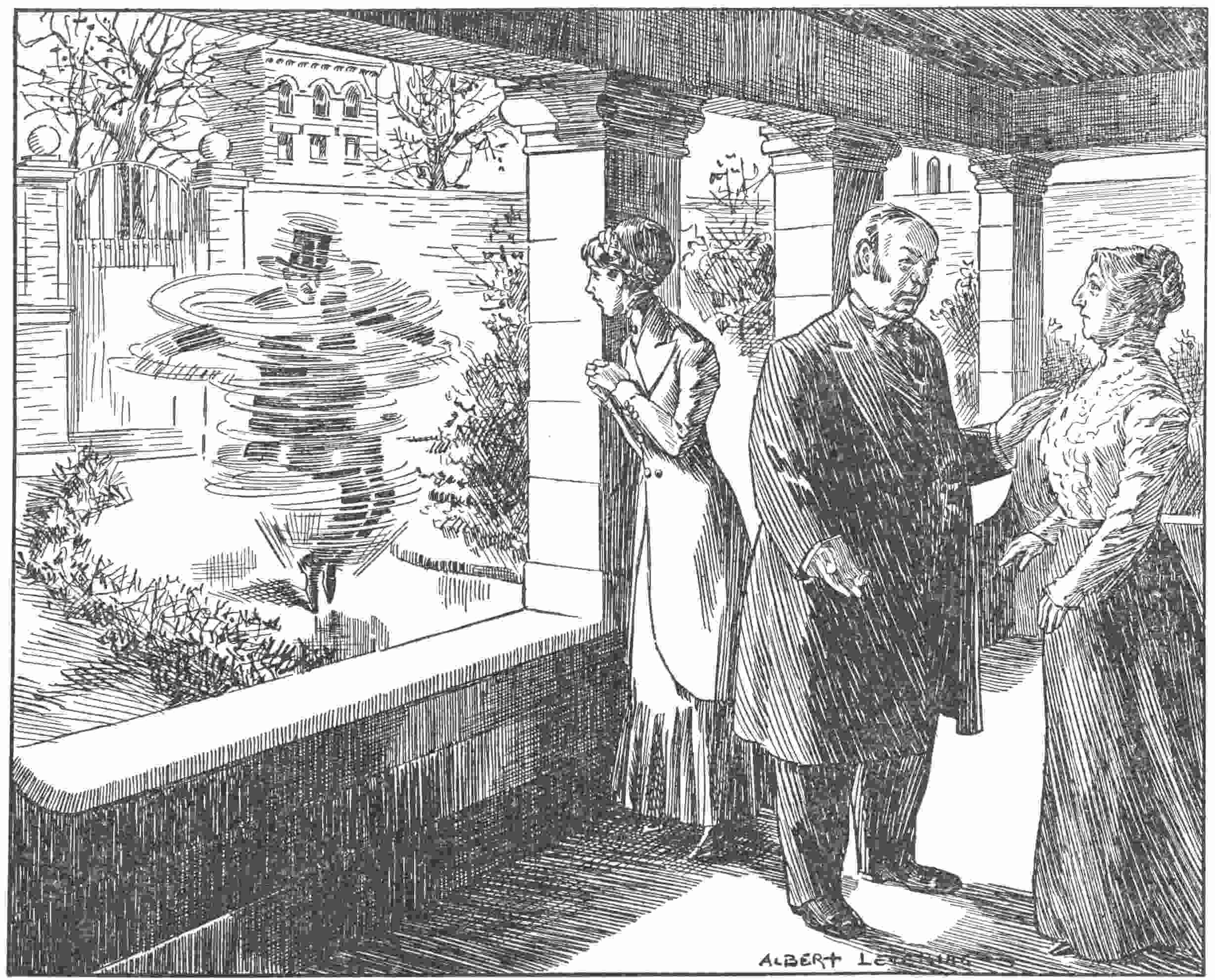
was revolving.
“‘I PROPOSE, MY DEAR,’ I SAID, ‘TO LET HIM SPIN UNTIL HE IS PERMANENTLY RECOVERED
OR BECOME TOO PERMANENTLY DIZZY FOR ANY USE.’”
I discovered later that the fall had jammed the
gyroscope on the pivot so that the gyroscope could not
revolve without revolving the whole hat, and as the hat
was firmly suctioned to Walsingham, the hat could
not revolve without revolving Walsingham. For an
instant Walsingham revolved away from us down the
walk, and Anne gave a great cry; but almost at that
moment Walsingham regained the upright and began
to revolve rapidly. The icy walk offered no purchase
for his feet, and this was indeed lucky; for if it had,
his head would have continued to revolve none the less,
and the effect would have been fatal.
I estimated that Walsingham was revolving at a rate
of perhaps fifteen hundred revolutions a minute, and it
was some minutes before my wife was able so far to
recover from the shock of seeing her prospective son-in-law
whirl thus as to ask me to stop him. My first
impulse was to do so, but my long training as a hatter
had made me a careful, thoughtful man, and I gently
pushed my wife back.
“My dear,” I said, “let us pause and consider this
case. Here we have Walsingham revolving rapidly.
He is revolving in one of the only two directions in
which he can revolve—the direction in which he revolved
on the Mule Reverser, or the opposite direction. If it
is the opposite direction all is well, for he will be unwound
in a few hours, if his neck is not wrung in the meantime.
If it is in the same direction it is no use to stop
him now, for by this time he will be in such a condition
of reeling and staggering that we would not have him as
a son-in-law on any terms. I propose, therefore, to
let him spin here for a few hours, when he will have
had a full recovery or be permanently too dizzy for
any use.”
My wife, and Anne too, saw the wisdom of this course,
and as it was very miserable weather outside we all
withdrew to my parlor, from the window of which we
could watch Walsingham revolve. Occasionally, when
he seemed about to revolve off the walk, I went out and
pushed him on again.
I figured that by six o’clock in the morning he would
be sufficiently revolved—provided he was revolving in
the right direction—and at midnight I sent my wife
and Anne to bed. I fear Anne slept but little that
night, for she must have had a lover’s natural anxiety
as to how all was to turn out.
At six in the morning I called Anne and my wife, and
we went into the yard to stop Walsingham, and it was
not until I had carefully walked down the porch steps
that it came to me that I had no way of stopping him
whatever. To add to my dismay I knew that when
the sun arose the thin ice would melt, and as Walsingham’s
feet could no longer slip easily, he would in all
probability be wrenched in two, a most unsatisfactory
condition for a son-in-law.
But while I was standing in dismay love found a way,
as love always will, and Anne rushed to the cellar and
brought out the stepladder and the ice pick. Placing
the stepladder close to Walsingham she climbed it, and
holding the point of the ice pick at the exact center of
the top of the hat she pushed down. In a moment a
sizzing noise told us that she had bored a hole in the
hat, letting the vacuum escape, and the hat flew from
Walsingham’s head.
Slower and slower he revolved, until he stood quite
still, and then, without a reel or a stagger he walked up
to me and grasped my hand, while tears told me the
thanks he could not utter. He had revolved in the
right direction! He was cured!
Transcriber’s Note
Illustrations in this eBook have been positioned
between paragraphs and outside quotations.