The Sulphide Method. — Preparation of Hydrogen Sulphide — Preparation of Nitrogen. — Mode of Procedure. — Discussion of the Method.
16
This method is based on the
conversion of cadmium oxalate
into cadmium sulphide by heating
in a current of hydrogen sulphide.
The method has been used by
Partridge. This result was 111.61 for
the atomic weight of cadmium.
In the present work this gas was always
prepared from potassium
hydrosulphide which was made
from barium sulphide (commercial).
Barium sulphide was treated
with dilute hydrochloric acid
and the resulting hydrogen sulphide
17washed thoroughly with
a solution of potassium hydrosulphide
and then with pure
water. It was then passed
into a strong solution of potassium
hydroxide until the later was saturated. When it was
required, it was set free from
this solution by adding dilute sulphuric acid and again
washing the resulting gas with
a strong solution of potassium
hydrosulphide.
Whenever a current of nitrogen
was required, it was prepared
by passing air over a layer of hot
copper gauze in a combustion
18tube. A short layer of copper oxide
was first introduced, then the
copper gauze and finally another
layer of copper oxide. The air
was dried with caustic potash
before entering the tube and
the nitrogen obtained was also
passed through a long tube
filled with lumps of this substance
before being used.
A number of weighing tubes
140 millimetres long and 13 millimetres
internal diameter were
made especially for this work.
They were always used in pairs, one
being kept as a counterpoise.
19A porcelain boat of such dimensions
as just to slide into the
tube was placed in each one.
For a determination, a tube
and its boat were tared with another
tube and boat, glass against
glass and porcelain against
porcelain until the difference
in weight was less than
two tenths of a milligramme.
Both boats were heated in a
current of hydrogen sulphide to
incipient redness for about
one hour. The current of hydrogen
sulphide was then replaced
by one of nitrogen, in which
the boats were cooled, but while
still warm they were transferred
to their weighing tubes and allowed
20to cool in a dessiccator containing
caustic potash and weighed.
Before weighing, the stoppers of
the weighing tubes were loosened
for a moment in order to equalize
the internal and external pressure.
This treatment was
usually repeated two or three
times and the difference in
weight remained perfectly
constant. A portion of cadmium
oxalate sufficient for a determination
was placed in the
weighed boat and dried at 150°C.
The oxalate had been prepared
exactly like that used in the
oxalate method which has already
been described. The gas
pressure in the laboratory varied
21very much while this method
was under investigation and
great difficulty was experienced
in maintaining a constant
temperature although a thermoregulator
was used. Sometimes
a specimen of oxalate which
was supposed to be dry would
lose several tenths of a milligramme
when the thermometer
would only have gone up to
160°C or 165°C for an hour by
accident. Under these conditions
the drying was so uncertain
that only four determinations
were completed although many
were started. The boat containing
the oxalate which had
been dried and weighed was
22placed on supports of unglazed
porcelain in a combustion
tube and a current of dry hydrogen
sulphide passed over it.
As soon as the air was
expelled, the tube, which was
in a combustion furnace,
was slowly heated until all
the oxalate seemed to be
decomposed and then raised
to dull redness. After this
temperature had been maintained
for about an hour,
the sulphide was allowed to
cool to a temperature of about
200°C. and the current of hydrogen
sulphide replaced by dry
nitrogen, using a three-way
stopcock. When nearly cold the
23boat was slipped into its weighing-tube
and weighed, the same
precautions being used as
when weighing the empty boat.
At this stage the sulphide was
always from one to two milligrammes
lighter than at the
end of the determination.
It was reheated for periods
of one hour until the weight
remained constant. This generally
required from three to five
hours. All weighings were
reduced to the vacuum standard
on the basis of 4.5 for the
Sp. Gr. of cadmium sulphide,
3.31 for the Sp. Gr. of cadmium oxalate,
8.4 for the Sp. Gr. of brass weights
and 21 for the Sp. Gr. of platinum weights.
24The results are as follows:
|
Cd C2O4 |
CdS |
At. Wt. Cd. |
| I. |
2.56319 |
1.84716 |
112.25 |
| II. |
2.18364 |
1.57341 |
112.17 |
| III. |
2.11643 |
1.52462 |
112.05 |
| IV. |
3.13105 |
2.25582 |
112.12 |
The first three determinations
were made exactly
as above described, the heating
in hydrogen sulphide being done
in a Bohemian glass combustion
tube. The hydrogen sulphide
was dried with calcium chloride.
The fourth determination
was made under somewhat
different conditions. The boat
containing the weighed oxalate
25was placed in a combustion
tube which passed through an
asbestus covered air-bath. The
air was displaced by a current
of dry hydrogen sulphide and
the bath slowly heated. When
the temperature had risen to
210°C. it was maintained there
for three hours, and then raised
to 250°C. for three hours. The sulphide
then weighed 2.27 grammes,
being 14 milligrammes heavier
than when the determination
was finished. It was replaced
in the tube and reheated in
a current of hydrogen sulphide
at a temperature of 300°C. for four
hours. It was then transferred to
a porcelain tube and heated to
26redness for one hour. It then
weighed 2.25437 grammes, being
1.45 milligrammes lighter than at
the end of the determination.
The weight did not become
constant until it had been heated
six hours more to redness in a current
of hydrogen sulphide. When
this oxalate was slowly heated in H2S,
a small amount of oxalic acid
sublimed to the colder part of
the tube, but, in the other cases
where the heating was more rapid,
only carbon monoxide, carbon dioxide,
and water were observed.
When hydrogen sulphide is passed
27through a red-hot tube, sulphur
is deposited on the colder parts
because at this temperature hydrogen
sulphide dissociates and the
elements do not recombine on
cooling. In this work, a faint
sublimate was noticed before
coming to the zone of sulphur deposit.
On exposure to air, it
deliquesced in a few minutes
forming small yellow drops
which had a saline taste, and
gave tests for potassium and
sulphur. The sublimate had a
yellow color and was evidently
formed by the action of sulphur
on glass. It seemed to do no
harm, but in the fourth determination
an effort was made to avoid
28it by using a porcelain tube instead
of a glass combustion tube
for heating to redness in a current
of hydrogen sulphide.
The fact that sulphide of cadmium
was always too light after the
first hour’s heating in hydrogen
sulphide proves that it must
have contained some oxide of
cadmium even after this heating.
Oxide of cadmium is readily
absorbed by the glaze on porcelain,
and some error must have been
introduced in this way because
it would not be converted into
sulphide after forming a silicate.
The effect of this would be to
give a low result for the atomic
weight of cadmium. To get some
29idea of the magnitude of this
error, the sulphide was poured out
of the boats used in the first and
second determinations. They
were then warmed with nitric
acid for a few moments, washed
in water, and heated over the
blast lamp for a few minutes.
The boats used as tares were
treated in exactly the same
manner. On weighing, the boats
in which the oxalate in determinations
I and II had been decomposed,
were found to be 1.12 milligrammes
and .82 milligrammes
heavier respectively than at
the beginning of the determinations.
This would only introduce an
error of .03 of a unit in the
30atomic weight on account of the
small difference in weight between
these amounts of oxide and
equivalent amounts of sulphide.
The boats were warmed, as above
mentioned, with nitric acid
to remove any adhering sulphide.
This might have decomposed
some cadmium silicate at the
same time, and the error due
to cadmium oxide thus be found
smaller than it really is.
The following experiment was
made in the hope of avoiding
the formation of cadmium silicate.
The glaze was removed from
the inside of a porcelain boat
by hydrofluoric acid followed by a
thorough scouring with sand and
31water. The boat was then
heated in the flame of a blast
lamp for several minutes, tared
against another boat which
was not treated with hydrofluoric
acid. Both were heated to
redness in a current of hydrogen
sulphide for an hour, cooled,
weighed, and then heated
in hydrogen sulphide for another
hour, and weighed again.
The boat gained 1.7 milligrammes
during this second heating,
showing that a boat whose
glaze has been removed by
hydrofluoric acid could not
be used in this method.
Throughout this work, great
care was taken to exclude
32the oxygen of the air from
the cadmium sulphide, while
hot. The current of hydrogen
sulphide in which the cadmium
sulphide is heated must not
be too slow, otherwise the sulphur
in the dissociated gas will
diffuse to the colder parts
of the tube and condense,
the residual gas becoming
very rich in hydrogen. The
hydrogen will then reduce
some of the sulphide to metal,
causing loss by volatilization.
One determination was lost
in this way, over two milligrammes
of the sulphide being
sublimed out, and it could
easily be detected on the side of
33the tube. It is believed that
the cause of the variations
in the four determinations
made by this method, is due
to imperfect dehydration of
the oxalate. It did not seem
advisable to continue this part
of the work any farther; therefore
the chloride method was taken
up.
The Chloride Method. — Preparation of Cadmium Chloride — The Filters. — Analytical Process. — Discussion of the Results.
Huntington had determined
the ratios of CdBr2 to AgBr and
also CdBr2 to Ag very carefully, obtaining
the result 112.24 for the atomic
weight of cadmium. Morse and
Jones had obtained 112.07 for this
34constant by the oxide method.
The object of the work about
to be described was to find
the cause of this discrepancy
if possible. It was thought advisable
however to make some
determinations of the ratio
of CdCl2 to AgCl before beginning
the bromide method.
Dumas, in 1859, used cadmium
chloride to determine
the atomic weight of the
metal. He did not establish
its ratio to silver chloride but
to silver by titration. He prepared
cadmium chloride by dissolving
the metal in hydrochloric acid
and melting the resulting
product in a platinum capsule
35for five or six hours. He made two
series of three determinations.
The chloride used in the first series
was yellow in places and not
completely soluble. The result was
112.476. The second series was
made with chloride which was
perfectly white and soluble and
gave 112.007 for the atomic weight
of cadmium. It is evidently more
reliable than the first series and
Dumas himself concluded that
the atomic weight is very near
112.01.
Four different specimens
of cadmium chloride were used
in this work and from these
36specimens portions were taken
for analysis. These portions were
treated differently in different
analyses, therefore it will be
necessary to give a brief descriptions
of them and mention
the number of the determinations,
in which each one was
used. Chloride of cadmium
was prepared in the following
manner. A solution of pure
hydrochloric acid was prepared
by passing a current of hydrochloric
acid gas into pure water
which was contained in a porcelain
crucible until no more
was absolved. The water used
had been purified by distilling
against a platinum dish and the
37hydrochloric acid gas was obtained
by heating ordinary concentrated
chemically pure hydrochloric
acid in a distilling bulb
whose neck had been closed by
fusion in order to avoid the use
of a cork or rubber stopper. Hydrochloric
acid thus prepared will
leave no residue on evaporation
when air is excluded (Stas, Aronstein’s
German translation, p. 111). A piece
of platinum foil freed from
iron by heating in the vapors
of ammonium chloride as
recommended by Stas (Aronstein’s
translation, p. 112) was introduced
and a piece of cadmium laid
on it. Solution begins at once,
the hydrogen being liberated on
38the platinum foil. During the
later part of the process, heat
was applied. After all of the
metal had dissolved, the solution
was evaporated, the platinum
foil having previously been
removed. The crystals of cadmium
chloride which separated
were not dried but allowed to
remain slightly moist with
hydrochloric acid. If no platinum
foil is used, the solution
of the pure metal becomes exceedingly
difficult, unless a very
large excess of acid is used.
No objection can be raised to the
use of platinum foil for in making
fifty grammes of cadmium
chloride it cost less than a tenth
39of a milligramme and even
this could probably have been
avoided by using a somewhat
larger amount of hydrochloric
acid. The foil was always kept
submerged in the acid liquid.
The moist crystals of cadmium
chloride were transferred to a
combustion tube passing through
an asbestus covered air-bath,
and dried in a current of hydrochloric
acid gas for several hours
at 300°C. The hydrochloric acid gas
had been passed through a long
calcium chloride tube to dry it,
although calcium chloride
probably does not do this very
thoroughly. The hydrochloric
acid gas was then replaced by
40a current of nitrogen prepared as
has already been described under
the sulphide method. After the
current of nitrogen had been
passing for about half an hour,
the tube was allowed to cool,
and the chloride transferred
to another combustion tube, one
end of which had been sealed
in the flame of a blast lamp.
The other end was drawn out
and attached to a Sprengel
mercury pump. After exhausting,
the chloride was sublimed in
the vacuum. This takes place
at a moderate temperature and
the sublimate has a beautiful
crystalline structure and is
perfectly white.
41The crystalline mass exposes so
much surface that water is
taken up very rapidly when
exposed to the air. This action
is so rapid that the crystals
cannot be transferred to a
weighing-glass without introducing
an appreciable error.
The whole sample was accordingly
transferred to a stoppered
glass bottle which was kept under
a bell jar with sticks of caustic
potash. Three samples were
prepared in this manner, the
first being used in determination
one, the second in determinations
two to seven inclusive, and the
third in determinations eight
to nineteen inclusive.
42The samples used in determinations
twenty and twenty-one
were prepared in the following
manner: About three grammes
of cadmium were placed in a
combustion tube in which three
bridges (as in the distillation
of pure cadmium) had been
made. A section may be represented
thus

The metal was placed in
cavity A and a stream of
chlorine passed through the
tube. The chlorine was prepared
from potassium bichromate and
hydrochloric acid and dried
43by passing it through a long tube
containing calcium chloride.
When the air had been displaced,
the cadmium was heated. It
fused and began to burn to the
chloride which partly flowed
over the bridge into cavity B
and partly distilled over into
this cavity. When the reaction
had ended, the current of
chlorine was replaced by one
of dry nitrogen, and the tube
was allowed to cool and the
chloride taken for analysis XX.
The specimen used in analysis
twenty-one was prepared in exactly
the same way, only the
chlorine used was obtained from
manganese dioxide, sodium chloride
44and sulphuric acid, and was
dried with phosphorous pentoxide
instead of calcium
chloride.
The special treatment of
the portions taken for analysis
was as follows: Those taken
for determinations I, II and
from XI to XIX inclusive were
placed in a platinum boat
and put into combustion tube.
A current of hydrochloric
acid gas obtained by heating
the aqueous acid was passed
through the tube. The gas had
been dried by calcium chloride.
When the air was displaced,
the chloride was heated somewhat
higher than its fusing-point
45i.e. to incipient redness, and
maintained there for a length
of time varying from a few
minutes to more than an
hour. The hydrochloric acid
was then displaced by a current
of nitrogen, and the chloride
allowed to cool. The boat with the
chloride, while still slightly
warm, was placed in a weighing-tube,
cooled in a dedicator
containing caustic potash and
weighed. The chloride thus
prepared is transparent and
presents only a small surface
to the air. It takes water up so
slowly that no error is introduced
from this source. This
was tested in one case by
46allowing a boat containing some
chloride thus prepared to stand
in the air for a certain length
of time and noting the increase
in weight. It was
quite slow. In several cases
specimens of chloride were
tested for hydrochloric acid using
tropaeolin as an indicator. It
was always found neutral.
The portions used for determinations
III and VI to X inclusive were
prepared in exactly the same
manner as the preceding ones
except that the hydrochloric
acid gas in which they were
fused was not dried but used
just as it came from
47the aqueous acid. In some
cases the platinum boat in
which the chloride was fused
was weighed before and after
the fusion. The weight remained
unchanged.
For determinations IV and V,
about six grammes of cadmium
chloride were placed in a
platinum boat, and more than
two-thirds of it distilled out
in a current of hydrochloric
acid gas which had not
been dried. Part of the distillate
was collected after cooling
in nitrogen and used in determination
IV while the residue
remaining in the boat was
used for determination V.
48The method of preparing the
chloride used in determinations
XX and XXI has already
been described.
Thinking that a Gooch
crucible with a platinum
sponge on the bottom in place
of asbestus would be desirable
for this work one was accordingly
made and answered the
purpose very satisfactorily.
All determinations were
made by using such filters.
C. E. Munroe (Chem. News, Vol 58,
p. 101) has described the preparation
of these filters.
49A platinum Gooch crucible was
placed on a filter paper and
some ammonium platonic chloride
which had been thoroughly
washed introduced by suspending
it in alcohol and then pouring
this into it. The precipitate
settles to the bottom forming
a uniform layer and the
alcohol drains, off through
the filter paper. The crucible
was then dried slowly in an
air-bath. After this it was
transferred to a porcelain
crucible and slowly heated
until decomposition was complete.
In this manner a layer
of platinum felt is obtained
which acts as a very efficient
50filter. Another layer of double
chloride was then decomposed
as before so that if there were
any imperfections in the
first layer they would be
covered by the second layer.
The surface was smoothed
down by means of a glass
rod. To prepare a good filter
the drying and subsequent
heating should be very slow.
The heating must not be at too
high a temperature, otherwise
the felt becomes very compact
and is useless for filtering
purposes. Pressure produces
the same effect. The filters were
always treated with strong
nitric acid, washed and
51reheated before being used, but
in no case was chlorine
detected in the nitric acid
after the washing, nor any
loss in weight of the crucible.
An objection to the use of these
crucibles for the purpose
named was found in the
course of this work, but it
will be discussed later.
The crucibles were always
set in a large weighing-glass,
and another weighing-glass
containing an equal
amount of platinum foil
used as a tare, in weighing.
This precaution was perhaps
unnecessary, but at least it
did no harm.
52
The weighed cadmium
chloride was dissolved by
placing the boat containing
it in an Erlenmeyer flask
containing water. The boat
was then washed, dried and
replaced in its weighing-tube.
On weighing again, the loss
in weight is equal to the
weight of cadmium chloride
taken. All samples gave a
perfectly clear solution except
those used for determinations
XX and XXI. A drop of nitric
acid (1:3) was added to each
solution except in determination
XIV where the cubic centimetres
53were added, and in
XVI where ten cubic centimeters
were added. A solution of
silver nitrate was then
added to precipitate the chlorine.
This as well as the subsequent
washing was done in
a dark-room illuminated by
a single gas light whose
rays had to pass through
a strong solution of neutral
potassium chromate. The
precipitate was contracted
by warming on the water-bath.
It was then collected in
the prepared Gooch crucibles
and washed. Before filtering,
the flask containing the precipitate
and mother-liquor was
54allowed to cool. Silver chloride
is soluble in water to a
considerable extent but is
reprecipitated by adding an
excess of either silver nitrate
or hydrochloric acid. Stas (Ann.
de Chem. et Phys. [4], 25, 22; [5], 3, 145; [5], 3, 289.)
investigated this very thoroughly.
Cooke also did some work
on it and used a dilute solution
of silver nitrate to wash the
chloride thus preventing
solution (Proc. Amer. Acad. 17, 7.).
In the above work, therefore,
a solution containing 0.10 grammes
of silver nitrate per liter was
first used, followed by one
only one-tenth as strong, and
finally pure water was used.
55Only two or three washings
could be made with water
as the chloride went into
solution after this owing to
the removal of the silver
nitrate. The last silver nitrate
solution used is so weak that
any error introduced by not
washing it out completely
is insignificant. After
washing, the silver chloride
was dried at temperatures
varying from 150°C. to 300°C. to
constant weight. A glass air-bath
was used in order to
prevent products from the
burning gas from coming
in contact with the chloride.
It was then weighed.
56The quantity of silver nitrate
used in the determinations
was varied very much. The
excess over what was required
to precipitate the chloride is
given in the table of results
in those cases in which it
is known. The quantity of
water used in each determination
is also given where
it is known. It is given in
the number of cubic centimetres
used per gramme of cadmium
chloride and does
not include wash water.
All weighings are reduced
to the vacuum standard on the
basis that Sp. Grs. of CdCl2 = 3.94 and
AgCl = 5.5. The results are:
| 57 |
| No. |
CdCl2 |
AgCl |
H2O per Grm. |
Excess AgNO3 |
At. Wt. |
Melted in |
| I |
3.09183 |
4.83856 |
|
|
112.339 |
Dry HCl |
| II |
2.26100 |
3.53854 |
|
|
112.329 |
„ „ |
| III |
1.35729 |
2.12431 |
|
|
112.320 |
Moist HCl |
| IV |
2.05582 |
3.21727 |
|
|
112.339 |
„ „ |
| V |
1.89774 |
2.97041 |
|
|
112.306 |
„ „ |
| VI |
3.50367 |
5.48473 |
|
8.90 |
112.283 |
„ „ |
| VII |
2.70292 |
4.23087 |
200 |
1.79 |
112.301 |
„ „ |
| VIII |
4.24276 |
6.6398 |
300 |
8.10 |
112.387 |
„ „ |
| IX |
3.40200 |
5.32314 |
300 |
18.95 |
112.368 |
„ „ |
| X |
4.60659 |
7.20386 |
300 |
25.62 |
112.472 |
„ „ |
| XI |
2.40832 |
|
|
|
112.434 |
Dry HCl |
| XII |
2.19114 |
3.42724 |
|
|
112.433 |
„ „ |
| XIII |
2.84628 |
4.45477 |
300 |
4.45 + 3cc. HNO3 |
112.319 |
„ „ |
| XIV |
2.56748 |
4.01651 |
300 |
.10 |
112.399 |
„ „ |
| XV |
2.31003 |
3.61370 |
300 |
.10 + 10cc. HNO3 |
112.406 |
„ „ |
| XVI |
1.25008 |
1.95652 |
300 |
4.66 |
112.319 |
„ „ |
| XVII |
1.96015 |
3.06541 |
300 |
3.22 |
112.466 |
„ „ |
| XVIII |
2.29787 |
3.59391 |
300 |
4.27 |
112.448 |
„ „ |
| 58XIX |
1.94227 |
3.03811 |
300 |
3.61 |
112.423 |
Dry HCl |
| XX |
1.10976 |
1.73547 |
|
|
112.471 |
„ „ |
| XXI |
1.63080 |
2.55016 |
|
|
112.476 |
„ „ |
| |
|
|
|
|
|
|
| |
|
|
|
Average |
112.383 |
|
In the first five determinations,
the analytical operations
were conducted as
nearly as possible alike, but
the preparation of the portions
of cadmium chloride taken
for analysis was varied very
much as will be seen by
referring back to this part of
this paper. The results do
not vary more than ±0.015 from
their average. This is very
59strong evidence of the purity of
the chloride used for, if it contained
any impurity, we should
have expected to vary the amount
in the different portions.
After this, attention was
paid especially to the analytical
process, for it was thought
that there probably was some
serious error in the method,
the result being higher than any
that had previously been obtained,
if we exclude Dumas’
first series which he himself
did not accept. The conditions
were varied in many ways
to see how much the result
could be influenced, but
under no conditions were
60results as low as Huntington’s
average (112.24) obtained. A number
of errors were found in
the method during the work,
but they seem to neutralize each
other to a great extent. The
more important ones will
now be given. Nearly every
filtrate including the corresponding
wash water was
examined for chlorine after
the silver and cadmium
had been precipitated by
hydrogen sulphide. The excess
of hydrogen sulphide was
expelled by boiling, after the
addition of some nitric acid.
In two cases an inverted condenser
was used. On adding silver
61nitrate a precipitate was always
obtained showing the presence
of chlorine. Care was always
taken to filter off sulphur formed
by the oxidation of hydrogen
sulphide, before adding the
silver nitrate. The precipitate
was never very heavy, and
was not estimated quantitatively.
It is evident that cadmium
nitrate exerts a solvent
action on silver chloride. In
some cases a very large excess
of silver nitrate was added
but it did not change the
results markedly. Silver nitrate
itself dissolved silver chloride
to some extent. The increase in
insolubility, if any, on adding
62an excess of silver nitrate is
probably counterbalanced by
the increased error due to occlusion
of nitrates in the
silver chloride. Stas (Aronstein’s
Trans. p. 156) says it is impossible
to contract silver chloride
or bromide in a solution
containing salts without
there being occlusion and
that the precipitate can only
be freed from them by dividing
up the contracted mass by shaking
with pure water. This
was not done here owing to
the solubility of silver chloride
in pure water, and the complications
introduced in the
analytical part. The occlusion
64of nitrates by the silver chloride
would lower the atomic
weight found. The silver
chloride obtained always
darkened on heating and
contained cadmium, as was
shown in the following manner:
The lump of silver
chloride was attached to
the negative pole of a cell
and electrolyzed in a bath
containing dilute sulphuric
acid. The resulting metal
was then dissolved in nitric
acid and the silver precipitated
by adding hydrochloric acid.
The filtrate was evaporated to
expel the nitric acid and the
residue taken up with water
65and tested for cadmium with
hydrogen sulphide. An appreciable
quantity was always
found. This method of examination
does not show the
occluded silver nitrate.
Another error which tends
to lower the atomic weight
found is due to the platinum
crucibles used for filtering.
If a silver nitrate solution
is filtered through such a crucible
there will be an increase
in weight due to silver being
deposited. This takes place
in acidified solutions as
well as in neutral ones.
Washing with ammonia does
not remove the deposit, but
66strong nitric acid does, the
washings giving a test for
silver. Whether the depositing
of silver is due to the action
of spongy platinum in
contact with the compact
metal of the crucible or
to some impurity in the
platinum sponge was not
determined, but the former
seems by far the most probable.
The increase in weight
during the time required
for filtering a determination
must have been quite small
however. The samples of
cadmium chloride employed
for determinations XX and
XXI were prepared by burning
67cadmium in a current of
chlorine. The glass tube used
was attached somewhat and
the solution of the chloride
was very slightly turbid in
each case. The turbidity was so
slight however, that no very
serious error could have resulted
from it, particularly as it was
probably partly counterbalanced
by the formation of some potassium
chloride. For more accurate
work, it should have been
made and redistilled in
a porcelain tube. These two
samples were tested for
free chlorine with potassium
iodide and starch paste,
but none was found. Some
68of the specimens of chloride
prepared by fusion in a current
of hydrochloric acid were
found to be neutral, using
tropaeolin as an indicator.
As nearly as can be judged,
the above errors would probably
counterbalance each
other to a great extent, and
thus give a fairly close
approximation to the atomic
weight of cadmium when
the average of all the
determinations is taken.
The value 112.383 thus obtained
can only be regarded as
tentative.
The Bromide method. — Preparation of Cadmium Bromide and Hydrobromic Acid. — Method of Analysis. — Discussion of the Results.
69
Huntington (Proc. Amer. Acad.
11.28) working under the direction
of J. P. Cooke, determined the ratio
of cadmium bromide to silver
bromide and using the total
quantities for the calculation
the result for the atomic weight
of cadmium is 112.239. He
also determined the ratio of
cadmium bromide to silver,
obtaining 112.245 for the atomic
weight of cadmium.
The work which will now be
described was carried out very
much like the work described
under the chloride method. The
ratio of cadmium bromide to silver
70bromide was investigated.
A large quantity of hydrobromic
acid was prepared
according to the method described
by Dr. Edward R. Squibb
(Trans. of Med. Soc. of the State of N. Y.).
One part of water was added
to seven parts of strong sulphuric
acid (Sp. Gr. = 1.83) and the mixture
cooled. Then six parts of
potassium bromide were dissolved
in six parts of hot
water and the diluted sulphuric
acid added to this hot solution.
It was set aside until
71cold in order to allow the sulphate
of potassium to crystallize
out. The crystals were drained
on a filter-plate and quickly
washed with two parts of water.
The mother-liquor and washing
were then distilled until no
more acid was obtained
on further heating. The
acid thus obtained was
distilled three times from potassium
bromide, twice from
cadmium bromide formed
by adding a piece of pure
cadmium to it, and twice
without the addition of anything.
It was tested and found
to be free from sulphuric acid.
Cadmium bromide was prepared
72from it, in exactly the same
way that the cadmium
chloride used in the chloride
method was prepared
from pure metal and hydrochloric
acid. While the
crystalline mass of cadmium
bromide was still moist, it
was transferred to a combination
tube and dried at 300°C for
several hours in a current
of nitrogen. It was then
sublimed in a vacuum as
the chloride had been. This
specimen served for the first
three determinations. About
nine grammes of it was placed
in a platinum boat in a combustion
tube, and part of it distilled
73in a current of nitrogen.
The distillate, a portion of
which had been tested with
tropaeolin and found neutral,
was used for determination
I. The residue in the boat
was used for determination II.
Another portion of the main
sample was resublimed in
a vacuum and used in
determination no. III. Cadmium
bromide is not hygroscopic or
at least only slightly, therefore
the sublimed cadmium
bromide can be transferred to
a weighing-glass without taking
up water. This cannot
be done in the case of the
chloride.
74It is probable that the hydrobromic
acid as above prepared
was perfectly free from hydrochloric
acid. Chlorine in cadmium
bromide would cause
the atomic weight to be found
lower than it really is. It was
thought desirable, however,
to prepare an acid which would
certainly be free from chlorine.
The method described by Stas
(Aronstein’s German translation, p. 154.)
was employed with the additional
precaution that the
above purified acid was used
to start with and all reagents
employed had been especially
prepared so as to be free from
chlorine. Pure silver was prepared
75according to Stas’
description (see Aronstein’s translation,
page 34, also page 104) by the action
of ammonium sulphite on
an ammoniacal solution of
silver nitrate and copper
sulphate. The silver was
dissolved in nitric acid
free from chlorine, and then
slowly added to a dilute
solution of the above-described
hydrobromic acid, and
the precipitated silver bromide
thoroughly washed. It was
then digested for a long while
in a strong solution of potassium
bromide, first in the cold,
then by heating. The potassium
bromide had been made thus:
76Twice recrystallized potassium
hydrogen tartrate was heated in
a platinum dish in a muffle
furnace until it was converted
into carbonate, and the excess
of carbon burned off. It was
then dissolved in water, filtered
and neutralized with some of
the hydrobromic acid already
described. The carbonate had been
tested for both sulphuric acid and
chlorine with negative results.
After the silver bromide had
been digested with the potassium
bromide, it was washed
very thoroughly, suspended in
water, and a current of
hydrogen sulphide passed into
it. This converts it into sulphide
77hydrobromic acid being liberated.
The acid was drained off on a
porcelain plate, and then
distilled a number of times. It
was finally tested and found
to be perfectly free from sulphates
and also did not contain free
bromine. Having started with
an acid which was probably pure
and subjected it to these operations
with reagents free from
chlorine, there can be no doubt
as to the purity of the resulting
acid. The hydrogen sulphide
used was prepared from potassium
hydrosulphide as in the
sulphide method, and washed
first with a solution of the
hydrosulphide, then very thoroughly
78with pure water. From the
hydrobromic acid obtained, a
specimen of cadmium bromide
was prepared as before and
sublimed twice in a vacuum.
This specimen was used for
determinations IV and V.
The first three determinations
were made exactly like those
in the chloride method. The
last two were also made in
the same manner, only the
washing of the precipitate was
varied. After the silver bromide
had been contracted
by warming on a water-bath
79it was washed by decantation
and then agitated violently
with cold water to remove
occluded nitrates, but it was then
so finely divided that it could
not be filtered. The artifice
used by Stas to contract it a
second time was to pass a
current of steam into the milky
liquid. This was tried here, but
for some reason or other did not
work very well, and considerable
difficulty was had in filtering
it. The results of the five
determinations are tabulated
below. All weighings are reduced
to the vacuum standard
on the basis of Sp. Gr. of CdBr2 = 4.6
and Sp. Gr. AgBr = 6.62.
| 80 |
| No. |
CdBr2 |
AgBr |
H2O |
Ex. AgNO3 |
At. Wt. |
Remarks |
| I |
4.39941 |
6.07204 |
|
|
112.43 |
Distillate } |
| II |
3.18030 |
4.38831 |
|
|
112.42 |
Residue } |
| III |
3.60336 |
4.97150 |
|
|
112.45 |
Resublimed. |
| IV |
4.04240 |
5.58062 |
|
|
112.29 |
|
| V |
3.60505 |
4.97519 |
|
|
112.38 |
|
| |
|
|
|
Average |
112.394 |
|
The first three specimens
were prepared under widely
different conditions yet the
results agree quite closely.
The last two were prepared
from the repurified hydrobromic
acid. If chlorine had been removed
during the second purification
we should expect a higher result
81but the results are lower. There
seems to be hardly any doubt
that this is due to analytical
errors rather than a change
in the composition of the
bromide. Whether this be true
or not, the five determinations
all fall within the limits
obtained by the chloride
method and confirms it
as fully as can be expected.
The errors of the method are
the same as those of the
bromide method, only they are
probably less in most cases.
One filtrate was examined for bromium,
but none was found showing the
method to be more perfect in
this respect.
Syntheses of Cadmium Sulphate. — Discussion of the Results.
82
It was next thought of
examining the method based
on the conversion of cadmium
sulphate into cadmium sulphide,
which has been used by von Hauer
whose result is 111.94 for the atomic
weight of cadmium, and more
recently by Partridge who obtained
a much lower result, namely 111.73.
They dried cadmium sulphate
in porcelain boats, and then
reduced it to sulphide by heating
in a current of hydrogen sulphide.
The reduction begins in the cold
and is probably complete or at
least nearly complete before the
temperature is sufficiently high
83for cadmium sulphate to decompose
into cadmium oxide, for
the sulphate is very stable with
respect to heat. This being the
case, probably no error results
from the formation of a silicate
of cadmium in this method.
The main difficulty in this
method would be to prove that
the cadmium sulphate used
is free from water. Neither
von Hauer nor Partridge has
done this because drying a
substance to a constant weight
is not sufficient evidence of
its anhydrous character, especially
if the drying is done at a constant
temperature. This has been
shown very clearly in the case
84of copper sulphate, by Richards (Proc.
Amer. Acad. Sci. 26. 263.)
It was therefore decided to
attempt the synthesis of cadmium
sulphate, hoping to be
able to fix a minimum value
for the atomic weight of cadmium.
A piece of hard glass tube
was closed at one end by fusion
and the other end drawn out
into a small tube which was
then bent twice at right angles.
The large part was cut off near
the beginning of the smaller
tube, and the edges rounded by
fusion. It was filled with dilute
sulfuric acid and heated for
some time to remove soluble
85matter from the glass. After removing
this acid, a weighed
piece of cadmium was introduced
and an excess of dilute
sulphuric acid (1: 3) added. The
tube contained a small piece
of platinum to aid the solution
of the cadmium. During the
process of solution, the two parts
of the glass tube were held together
by a rubber band, and the
outlet of the smaller tube dipped
under pure water contained in
a small tube closed at one end.
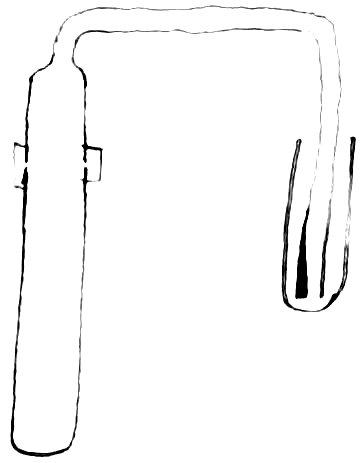
A section of the
arrangement is shown
in figure 2. Solution
was aided by the
application of heat.
86These precautions in dissolving
the metal were taken to prevent
loss by spraying. After the metal
had been dissolved, the solution
and the water through which
the hydrogen had escaped were transferred
to a porcelain crucible.
An equal amount of sulphuric
acid was then added to the
tare and both were heated until
fumes of sulphuric acid ceased
to come off. The crucible containing
the dry sulphate was
next placed an a porcelain plate
in a nickel crucible set in a
hole in an asbestos board.
This was placed over the flame
of a Bunsen burner, so that the
bottom of the nickel crucible was
87barely at a red heat. The
temperature on the inside of
this bath was considerably lower.
After the weight had become
nearly constant, the sulphate was
tested for sulphuric acid by
means of standard alkali using
tropaeolin as an indicator.
It was found acid, but so slightly
that no attempt was made to
estimate it. Result = 112.35 is preliminary.
Another synthesis was
made as follows: A platinum
crucible, lid and perforated cone
were place in a large weighing-glass
and tared with a similar
weighing-glass containing a platinum
crucible, platinum foil being
added until the weights were
88equal. After these had been
accurately weighed, a weighed
piece of cadmium was added
to the one containing the cone.
The cone was inverted over the
piece of metal on the bottom of
the platinum crucible. A
considerable excess of dilute
(1: 3) sulphuric acid was then
added, the lid whose edge was
bent down placed on the
crucible, and the weighing-glass
stoppered loosely. This
was placed in an air-bath,
and gently warmed during the
later part of the process of
solution. There is no difficulty
in getting complete solution
if a sufficient excess of acid
89is used. A vertical section of
the crucible and weighing-glass is shown in figure 3.
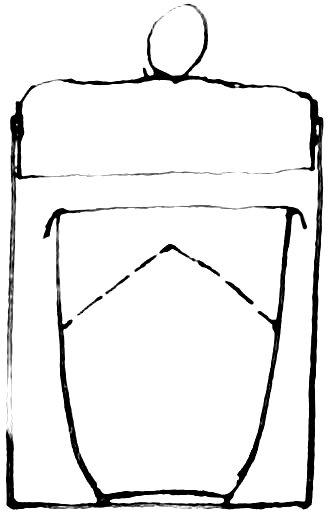
This arrangement
avoids loss from spraying,
and the necessity
of transferring the solution
from a tube to
a crucible as in the
first experiment.
An equal quantity of sulphuric
acid was added to the crucible
used as a tare and evaporated.
After the metal had been dissolved,
the platinum cone was lifted
to one side and the excess of
acid evaporated off. It was
then heated in a glass air-bath
for a long time at a temperature
90which was probably about 400°C.
After the weight had become
constant, the amount of free
sulphuric acid was estimated
by titration with a standard
alkali using tropaeolin as an
indicator. 1.25 milligrammes
were found and this weight
was subtracted from that found
at the balance. Weighing were
reduced to the vacuum standard,
assuming the Sp. Grs. of cadmium
and anhydrous cadmium sulphate[1]
to be 8.54 and 3.0 respectively.
The results were as follows:
|
Cd |
CdSO4 |
At. Wt. |
| I. |
(112.35 can only be regarded as a preliminary experiment) |
| II. |
1.15781 |
2.14776 |
112.35 |
91
These results agree fairly
well with those obtained by
the chloride and bromide
methods. The second experiment
is more trustworthy than the
first. In it, we started with
pure metal and the manipulations
were so simple that no
serious error could have
been made in them. Hence it
will only be necessary to consider
the end-product, i.e., the cadmium
sulphate. The titration showed
that the sulphate was not basic
owing to loss of sulphur trioxide,
and after deducting the weight
of the excess of sulphuric acid
92we must have left a weight
of cadmium sulphate which
is equivalent to the metal employed.
The question now is,
did it contain anything else and
what would be its effect?
Clearly the effect of water or
any other impurity would be
to lower the atomic weight
found, hence the atomic weight
must be at least as high as
the experiment indicates. As
the cadmium sulphate is deposited,
at least the later part of
it is from a strong sulphuric
acid solution, it probably does
not contain any water and
in this case would fix a maximum
value as well as the
93minimum value, and thus
determine the atomic weight.
It might be objected to the
second experiment that the
sulphuric acid found may
have been present as SO3 and
not as H2SO4 as was assumed.
This seems highly improbable,
and even if it were so the
error introduced would be only
about .03 of a unit in the atomic
weight. As the first determination
was found practically neutral,
it does not apply to it at all.
The most probable conclusion
from these experiments is that
the atomic weight of cadmium
is about 112.35. A more thorough study
of this method would have been made if time
had permitted it.
The Oxide Method. — Discussion of the Oxalate Method.
94
As the chloride and bromide
methods and the synthesis of
cadmium sulphate all lead to
approximately the same high result,
it seemed probable that
the oxide method which had
given a much lower result
(Morse & Jones 112.07) must be affected by
some error. Accordingly it was
examined in the manner about
to be described. A set of crucibles
was prepared as described by
Morse and Jones in their work
on this method, and in the
present paper under the oxalate
method. After they had been
heated in a nickel crucible over
95a blast lamp and weighed,
a weighed piece of cadmium
was introduced into the smaller
inside crucible, and dissolved
in nitric acid with the aid of
heat. An equal quantity of nitric
acid was added to the tare.
The acid was then evaporated
off, and the resulting nitrate
converted into oxide exactly
as has already been described
under the oxalate. The first
experiment was made in this
way and the second one
exactly like it, only the porcelain
crucible used was the
one which had been employed
in the first determination.
The glaze had been removed by the
96cadmium oxide of the first determination,
and before using
for the second one the crucible
was boiled out with nitric
acid, and heated to constant
weight over a blast lamp as before.
Determinations III, IV and V
were made in the same
way except that the small
inner crucible was platinum
instead of porcelain. All weighings
were reduced to the vacuum
standard on the basis of 8.54 for
the Sp. Gr. of cadmium and 8.15 for
the Sp. Gr of cadmium oxide and
8.4 for the brass and 21 for the platinum weights.
The results are as follows:
| 97 |
|
Cd |
CdO |
At. Wt. Cd. |
| I. |
1.26142 |
1.44144 |
112.11 |
| II. |
.99785 |
1.14035 |
112.04 |
| |
|
|
|
| |
|
Average |
112.08 |
| |
|
|
|
| III. |
1.11321 |
1.27247 |
111.84 |
| IV. |
1.02412 |
1.17054 |
111.91 |
| V. |
2.80966 |
3.21152 |
111.87 |
| |
|
|
|
| |
|
Average |
111.87 |
The oxides resulting from
these determinations were always
tested for oxides of nitrogen,
sometimes by using meta phenylene
diamine and at other times by
sulphanilic acid and naphthylamine
sulphate, but no traces were
ever found. The average of
the determinations made in
98porcelain crucibles is 112.08.
Morse and Jones obtained the
same figure or, if their results
are reduced to the vacuum
standard, 112.06, by the same method
under the same conditions. The
results of the determinations
made in platinum crucibles
are equally constant, but their
average is 111.88 being .20 of a unit
lower. Therefore, more oxide is obtained
when platinum crucibles
are used instead of porcelain ones.
In two cases the platinum crucibles
were weighed at the end of
the determinations after the
cadmium oxide had been removed.
Their weight remained
unchanged. The most probable explanation
99of these facts seems to be
that something is retained in the
oxide in both cases, but that the
amount is greater in the determination
made in platinum crucibles
than in those in which porcelain
ones were employed. We should
expect this, because in porcelain
crucibles some of the oxide is
absorbed forming a silicate, and
any volatile impurity must be
expelled from this part of the
oxide. Not finding oxides of nitrogen,
it was thought that gases
probably nitrogen and oxygen
might be occluded although
Richards and Rogers (Amer. Chem. Jour. 15, 567.)
had examined cadmium oxide
prepared from the nitrate and found
100only a trace of gas. Accordingly two
specimens of cadmium oxide
obtained in the above determinations
were powdered in an
agate mortar and boiled with
water for some time in order
to remove any adhering air.
They were then dissolved in
dilute hydrochloric acid from
which the air had been removed
by boiling. A small amount of
gas was found in each case
but not nearly enough to account
for the difference of .31 unit in
the atomic weight of cadmium
between 112.38 and the oxide method.
In fact not more than about one
sixth of the amount required was
found. It may be that the powdering
101of the oxide and then boiling
up in water may have been to
severe a treatment, and that
the greater part of the occluded
gas escaped during these processes.
It seems that there is at
least some error due to occluded
gases in methods involving the
decomposition of cadmium
nitrate to oxide, but no satisfactory
idea of its magnitude could be
obtained from these two experiments
as carried out.
The following experiments
were then made and they
seem to give definite evidence
not only of the existence of an
error but also of its magnitude.
Carbonate of cadmium was
102made by dissolving pure cadmium
in nitric acid, adding an excess
of ammonia and a small
quantity of ammonium carbonate.
After standing for some time the
cadmium carbonate was
filtered off and rejected. The
filtrate was treated with an
excess of ammonium carbonate
and the precipitated cadmium
carbonate allowed to digest
in it for some time. After
washing by decantation several
times the carbonate was
transferred to a funnel containing
a porcelain filter-plate, covered
with a piece of ashless filter
paper of slightly larger diameter,
and washed thoroughly.
103with water. It was then transferred
to a platinum dish, care
being taken to avoid contamination
with filter paper and
heated gently to convert it into
oxide. The resulting oxide
was powdered in an agate
mortar, returned to the platinum
dish and heated to incipient
whiteness for seven hours in
a muffle furnace. The temperature
must not be too high, otherwise
the oxide will distill
readily leaving no residue.
The oxide is slightly volatile
at good red heat as was observed
in trying to make a determinant
at this temperature by the
oxide method.
104A weighed portion of the oxide
which had been prepared from the
carbonate in the manner described
was dissolved in a
weighed porcelain crucible and
the resulting nitrate converted
into the oxide again by heat
just as in the oxide method.
This constitutes experiment I.
Experiments two and three
were made in exactly the
same way except that a platinum
crucible was used instead
of a porcelain one.
The results are:
|
Initial Wt. |
Final Wt. |
Gain |
Corresponding Error in At. Wt. |
| I. |
2.95469 |
2.95650 |
.00081 |
−.24 |
| II. |
2.67717 |
2.67835 |
.00117 |
−.39 |
| III. |
3.00295 |
3.00422 |
.00127 |
−.38 |
105As we started with cadmium oxide, and, after passing
to the nitrate, converted it back
into the oxide, the weight
should remain unchanged
if the method is correct.
However, this is not the case,
but a large increase in weight
takes place. The increase
is larger in a platinum crucible
than in a porcelain one, which
accounts for the fact that a lower
value for the atomic weight is
found by the oxide method when
they are used. The use of a porcelain
crucible therefore diminishes
the error, but does not eliminate
it. The explanation of this has
106 already been given. The
oxides obtained in these
three experiments were tested
for occluded gases in the
manner already described, but
only small amounts were
found. Both of those made in
platinum crucibles were tested
for nitrate of cadmium with
brucine and sulphuric acid
with negative results. To show
that the impurity was not converted
into an ammonium
salt when the oxide was dissolved
in hydrochloric acid, a
slight excess of caustic potash was
added to the solution, the precipitate
allowed to subside and the
clean, supernatant liquid tested for
107ammonia with Nessler’s reagent.
No ammonia was found.
In order to make these experiments
as severe a test as possible,
a somewhat higher temperature
was employed than had
in the five experiments
described under the oxide
method. This was accomplished
by boring out the stopcocks of
the blast lamp so that a larger
supply of gas was furnished.
The two oxides in the platinum
crucibles seemed to be constant
in weight, but that in the
porcelain crucible seemed to
lose in weight slowly. The
weight given was taken after
four hours blasting, which is
108longer and at a higher temperature
than was used in any
of the five determinations made
by the oxide method. If the
cadmium oxide prepared from
the carbonate retained any
carbon dioxide, it would lose
weight in being dissolved and
reconverted into oxide. The
above experiments therefore seem
to furnish very strong evidence
that there is an error of at least
−.24 unit in the oxide method
when porcelain crucibles are
used and −.39 of a unit when
platinum ones are employed.
if .24 of a unit is added to 112.07 the
result obtained when porcelain
crucibles are used we get 112.31
109and adding .39 to 111.87 gives
112.26. Considering the small
number of experiments made,
the fact that they were made
in such a way as to give a low
value (numerically) for the error
rather than a high one, and
also that the error is probably
variable to some extent, especially
when porcelain crucibles are
used, the corrected results agree
as closely with 112.38, the average
of the chloride, bromide and
sulphate (synthetical) methods as
could be expected. It must also
be borne in mind that 112.38 is
only to be regarded as an approximation
to the atomic weight
of cadmium. The increase in
110weight observed in converting
the nitrate back into oxide might
also be explained by assuming
that the cadmium oxide used
in the beginning of the experiments
was richer in metal
than the formula CdO indicated
and that the increase in weight
is due to this excess of metal being
changed to oxide. The method
of preparation of the oxide from
the carbonate and the known
properties of cadmium oxide render
this view highly improbable,
and the following two observations
render it untenable:
1st. If this were the cause of
the increase, the amount of increase
would necessarily be
111the same in both platinum
and porcelain crucibles, which
is not the case.
112
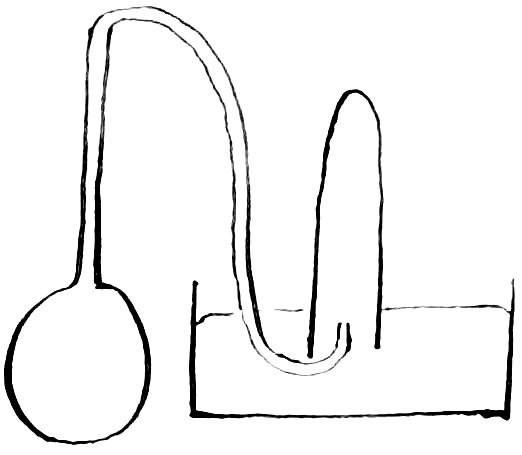
2nd. Three grammes of cadmium
oxide made from the carbonate
were dissolved in dilute hydrochloric
acid from which the air
had been expelled by boiling.
The oxide, which is very compact,
was placed in a glass
bulb which had been blown
at the end of a tube. After
displacing the air by filling
the entire apparatus with
recently boiled water, the exit
of the tube was placed under boiling dilute
hydrochloric acid, and the bulb heated
until the water boiled. It was then turned
over so that the steam displaced nearly all the water.
On removing the flame the
dilute hydrochloric acid at
once filled the bulb. The exit
tube was then quickly placed
under a narrow tube filled with
mercury and inverted over
mercury in a dish. The bulb
was then heated until the
oxide had dissolved. By this
method the gas
would be boiled out
of the solution and
collected in the top
of the narrow tube.
As only a very small amount
of steam and dilute hydrochloric
acid go over at the same time,
there is no danger of the gas
113formed being absorbed to any
considerable extent. It is well to
put the oxide into the bulb before
the tube is bend. If the hydrochloric
acid is too strong, it must be
cooled before entering the bulb
as otherwise the reaction is
too violent, and the experiment
may be lost. This experiment
shows that there is no excess
of cadmium present in the oxide
employed for no gas was
found. If three grammes of the
oxide contained enough metal to
take up .00126 grms. of oxygen, .00016 grms
of hydrogen should have been set
free, and its volume under ordinary
conditions of temperature and
pressure would have been about 1.9
114cubic centimetres. This experiment
would also have shown the
presence of carbon dioxide if
any had been present.
After having done the
work which has just been described,
we are in a position
to turn to the oxalate method,
which is the first method
described in this paper. It
involves the decomposition of
cadmium nitrate, and is therefore
affected by an error from
this source, only it is not as
large as in case of the oxide
method. If 2.95650 grammes of
115cadmium oxide prepared in a
porcelain crucible contain .00081
grammes of impurity, an error
of −.24 of a unit would be introduced
in the atomic weight as
determined by the oxide method
or +.10 in case the oxalate
method were employed. That
is the oxalate should give about
112.48 for the atomic weight of
cadmium, but it really gives
a very much lower result. Morse
and Jones obtained 112.04 ± .035
by it, while Partridge obtained
111.81 ± .035 by it. If we take 112.38
for the atomic weight of cadmium,
there appears to be a second error
of .44 of a unit in the method as
used by Morse and Jones, while
116Partridge’s result indicates an
error of .57 of a unit. Partridge
only moistened the oxide obtained
from the oxalate with a
few drops of nitric acid before
making the final heating, and
it seems probable therefore that
he made no appreciable error
on account of the final oxide
retaining products of decomposition
from cadmium nitrate.
The most probable cause of
this large error seems probably
to be incomplete dehydration
of the oxalate, or reduction to
metal during the decomposition
of the oxalate, and subsequent
volatilization of some of it,
or a combination of both of
117these. The nine determinations
given in the earlier part of
this paper of course vary
so much that they are of no
value whatever in determining
the atomic weight. The reason
that the first four are low is
probably due in part to sublimation
of cadmium, for on
dissolving the resulting oxide
in nitric acid a considerable
quantity of metal was
noticed in each case. In the
others, the temperature was kept
lower, and the decomposition took
a longer time. No metal was
observed on taking up in nitric
acid. To be certain of what the
cause of error is would
118require some very carefully
conducted experiments, but
as there are a number of
much more reliable methods
for determining the atomic
weight of cadmium, it does
not seem desirable to spend
the time required in making
them. It should be mentioned
that Lenssen, in 1860, first employed
this method. He made three
determinations. 1.5697 grms of cadmium
oxalate giving 1.0047
grammes of oxide, which gives
a value of 112.043 for the atomic weight
of cadmium . The difference
between the highest and lowest
determination was .391 of a unit.