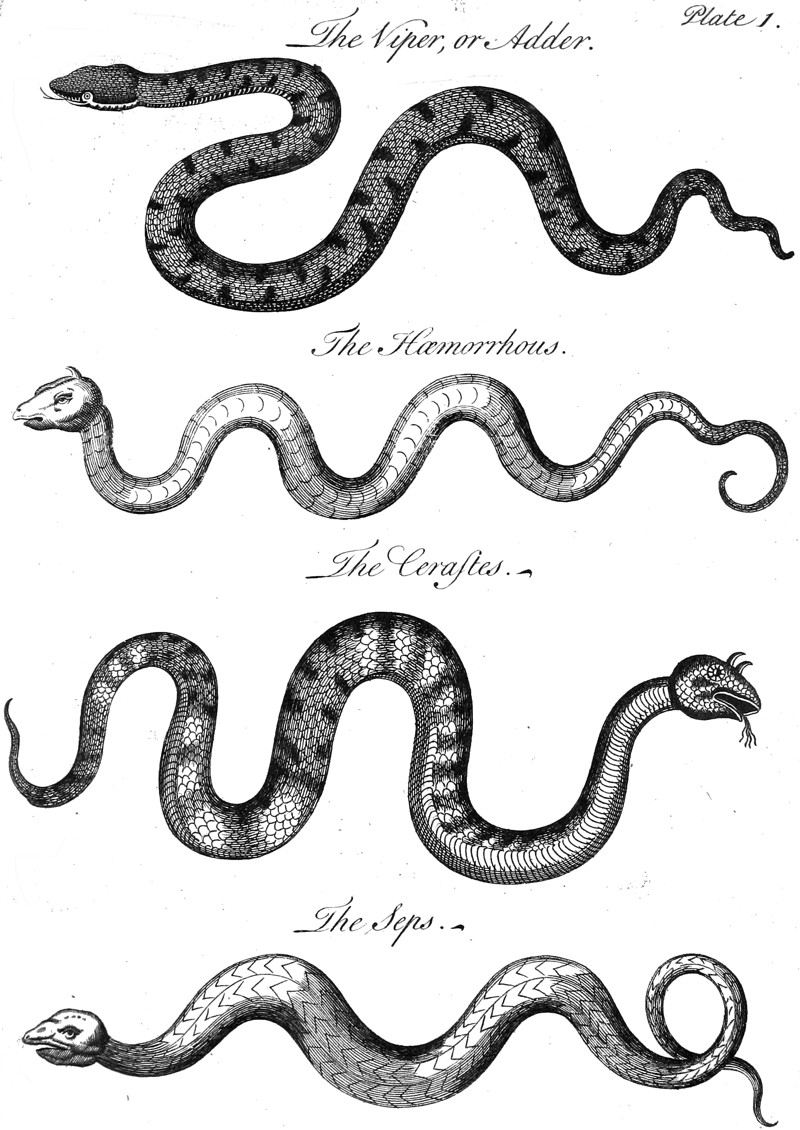
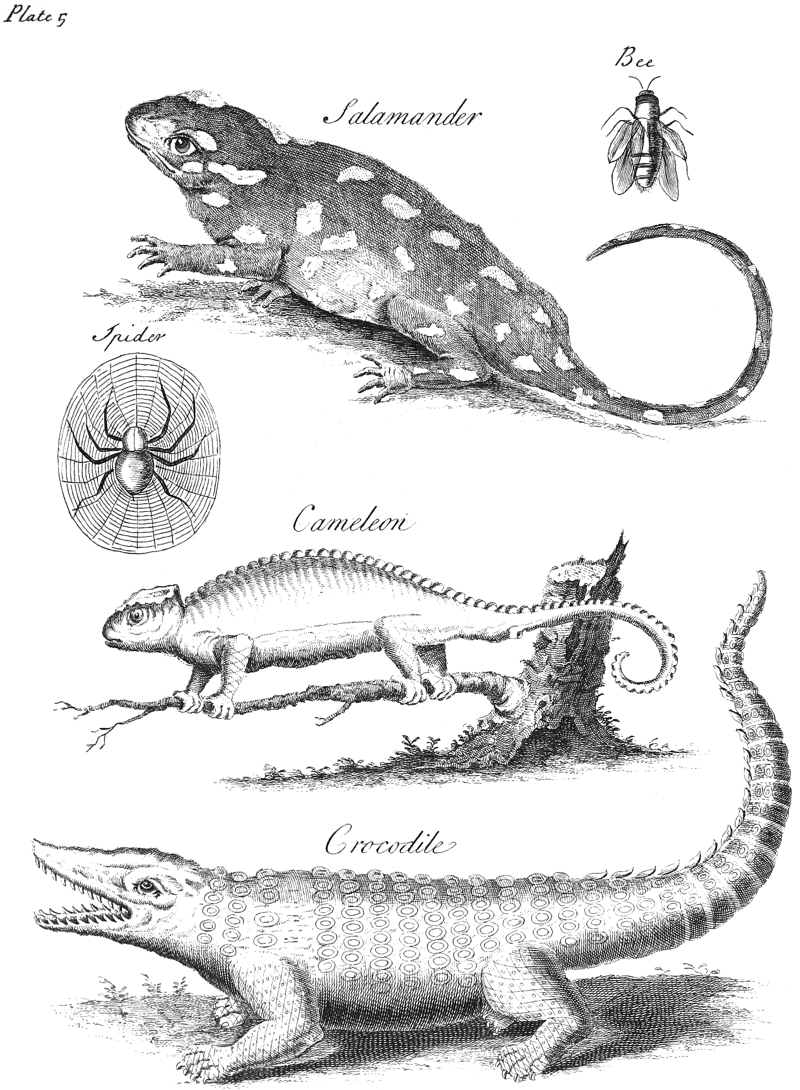
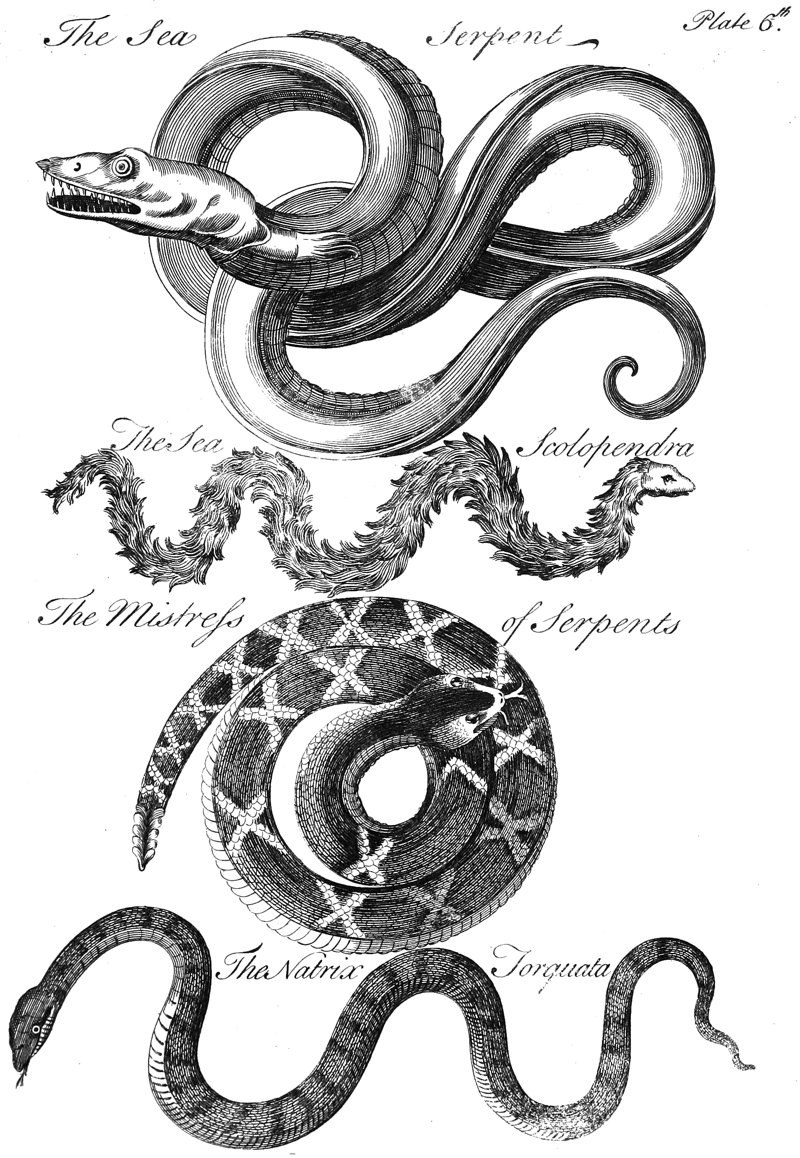
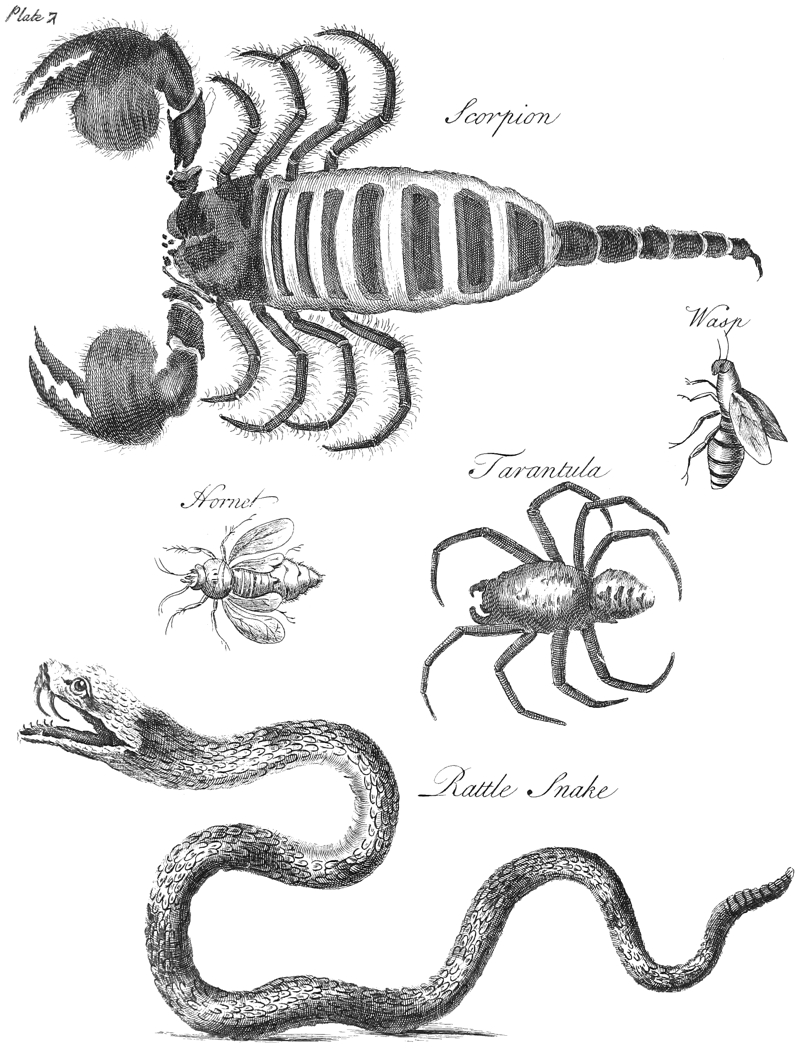
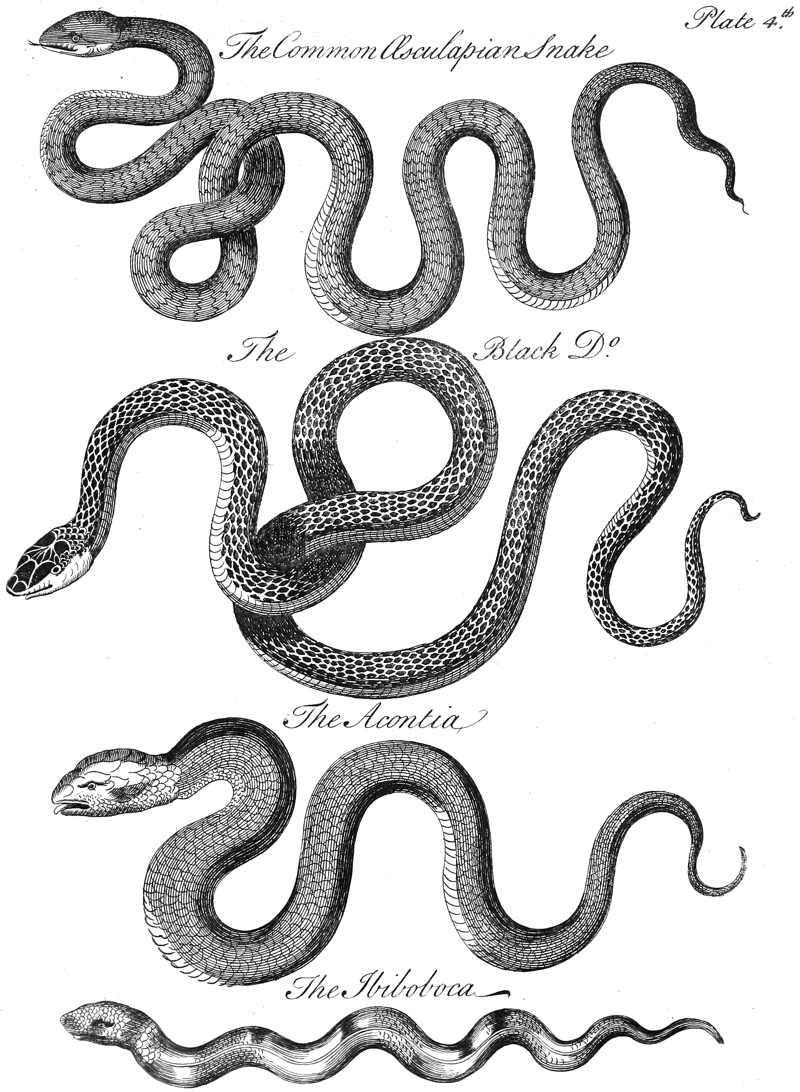
Which gives a View of most Serpents that are known
in the several Parts of the World, describ’d by their
various Names, different Countries, Qualities, &c.
The Serpents are a numerous Tribe, and their Dominions
of large Extent, lying both in Sea and Land: No part
of the World but what is replenish’d with them, more
or less, in some form or other. In describing them, I shall begin
with,
I. The Viper, or Adder, a subtle and poisonous Creature,
slender in Body, about a Foot and half long, with fiery and flaming
Eyes, a long and cloven Tongue, which when irritated, it
darts forth with Violence, and looks like a glowing Firebrand;
has a big Head, and flattest of the serpentine kind.
52It is slow in its motion, and does not leap like other Serpents,
but is very nimble to bite when provok’d. The Scales under
the Body resemble that of well-polish’d Steel. They appear
in divers Colours, yellow, ash, green; and others of Libya, like
the Inhabitants, of a blackish Hue; its Front not unlike that of
a Hog.
VIPERS of other Nations, are supposed to be larger than
the European, especially the Troglodite-Viper[99], which is said to
be above fifteen Cubits long: and the Historian adds, viz. That
there are no domestick Vipers. I presume, he means they are not
brought up among the Children of the Family, as some Serpents
are said to have been; this little venemous Reptile being of a
more mischievous Nature[100].
The Viper differs from the Snake in bulk, being not so large,
and their Scales more sharp, and Head more large: They also
differ in this, viz. Snakes lay their Eggs, twenty, thirty, sixty,
and a hundred sometimes, in one Nest, not quite so large as that
of a Magpye (which are inclosed with a whitish Skin, but not
with Scales) in Dunghills and other warm Situations, where they
are hatch’d by adventitious Heat, commonly call’d Adders in this
Country; whereas Vipers make use of their own Matrix, and
bring forth live Vipers: Their young ones come forth wrapt up
in thin Skins, which break on the third day, and set the little
venemous Creatures at liberty, therefore rank’d among the viviparous
Animals.
Their Births are much like young Snigs for Bulk; they generally
bring forth about twenty young ones, but only one each
day. It is observ’d of the Viper, that its Internals are not fetid,
like those of some other Serpents, that are intolerable.
The Eggs of Lizard-Serpents, which are so much esteem’d
in the French-Islands of America, are of the same Size and Figure
as those of Pigeons, and are generally used in all sorts of Sauces:
When the Females lay their Eggs, they make a Hole in the Sand,
and cover them with it, and the Heat of the Sun is sufficient to
hatch them[101].
ALBERTUS is quoted for a Battle between a Viper and a
Magpye, occasioned by her creeping up into a Magpye’s Nest,
53and devouring her Brood in the Mother’s absence, who upon
her Return made a hideous clattering, which soon brought in its
Mate; whereupon both, with united Beaks, fell upon the Plunderer,
and after a sharp Engagement demolish’d the Enemy.
Father Fevillee in the Woods of the Island Martinique,
“being frighted by a large Serpent, which he could not well
avoid, his Dog immediately fell on, and took the Serpent
by the Head: The Serpent surrounded him and press’d him
so violently, that the Blood came out of his Mouth; and
yet the Dog never ceased till he had entirely tore it to pieces.
The Dog was not sensible of his Wounds during the Fight,
but soon after, his Head prick’d by the Serpent swell’d prodigiously,
and he lay on the ground as dead; but his Master having
found hard by a Bananier, which is a very watry Tree, he
cured him with the Juice of it, and some Treacle[102].”
The Viper is common in some parts of France, especially
in Dauphiny and in Poictou, from whence all
the Vipers come that are
sold in Paris. They are usually taken with wooden Tongs, or
by the end of the Tail, which may be done without danger; for
while held in that Position, they can’t wind themselves up to hurt
their Enemy. The Viper-Catchers have their Specificks, in which
they can safely confide, as not to be afraid of being bitten; which
they say is the Fat of a Viper, immediately rubb’d into the Wound,
which is one of the most venemous in the animal World.
These Vipers are usually put and kept in a Box with Bran
or Moss; not that these Ingredients serve to feed upon, as some
may fancy; because ’tis said, they never eat after they are taken
and confin’d, but live on the Air, and will live so, many Months:
But more hereafter. The Destruction of Vipers by human Spittle,
the Coition of the Marine with Lampreys, the pregnant Viper
biting off her Companion’s Head, and the Revenge of it by the
Younglings——I place among vulgar Errors.
II. The Amodytes is a Serpent very venemous and fierce, of a
sandy Colour, black Spots, and of about a Cubit long. The Wound
given by the Female, the weaker Vessel, is said to be most dangerous:
Its Jaws are larger than the common Vipers, and from
some Eminencies upon the Head, like a Tuft of Flesh, is called
54Cornutus. Its Wounds prove fatal without a speedy Cure. It is
found in Lybia, a Limb of Africa, and also in Illyricum, and in
some parts of Italy[103].
This Serpent is called Cornutus, a horned Beast[104]. Of this
Form, is a numerous Herd; we read, that in the Roman Army
was a Band of Foot Soldiers called Cornuti.
Upon the Continent of America are Bulls and Cows, that
have no Horns, says Dr. Ch. Leigh——who adds,
“The Defect
of Horns in these Beasts, brings into my mind a remarkable
Phenomenon of one Alice Green, whose Picture I have seen in
Whalley-Abby, in Lancashire. This Woman had two Horns
which grew out of the back-part of her Head; they grew
backwards like those of Rams, and were about three Inches
long; these she cast once in three Years, and had always intolerable
Pains, before the Horns broke out[105].”
He might have mentioned another innocent Creature, on
whose Head a treacherous Companion inoculates a Scion, which
intitles him to the Title of Cuckold, a word derived from Cuckows,
who having no Beds of their own, invade their Neighbour’s. Of
the Cuckow ’tis said, that having no Nest, she takes possession of
some other Bird’s Nest, destroys the Eggs, and lays in it an Egg
of her own, which the innocent Bird brings forth and nurses for
its own[106].
III. The Cerastes is a Serpent of the viperine Kind; its Head
resembles the Cornigerous; it belongs to the Libyan and Nubian
Family: Its Teeth are like those of the Viper, and it brings its
Successors into the World after the same manner.
Its Constitution is very dry, which refines and exalts its Poison,
and makes it more dangerous; the Wound is generally attended
with Distraction, and continual pricking as with Needles.
Some say, ’tis of a whitish Colour, others arenaceous; it loves
sandy Habitations, where it often surprises the unwary Traveller:
And all agree ’tis of a most cruel Nature; and therefore in some
Places ’twas made the Executioner of Malefactors[107], as the Juice
55of the Cicuta, (an Herb like our Hemlock) was among the Athenians.
Some say ’tis of the aspick kind, as the Arabians; in length a
Cubit or more, with two Horns on the Head, resembling Snail-Shells:
It lies perdue near travelling Paths, and is very crafty in
decoying little Birds into the Snare.
Its Wounds soon kill, if one of the Psyllian People be not immediately
called in. N. B. These Psylli are a noted People of
Syrenaica in Africa, endued with a natural Faculty of destroying
Serpents upon sight, and curing their Wounds by a Touch of the
Hand of whom we have this Account, viz. ... Crates of Pergamus
says, that about Parium in the Hellespont, there were Men,
named Ophiogenes, who cured those wounded by Serpents with a
Touch. Varro testifies there were some of them in his time.
AGATHERCIDES writes, that in Africa the Psyllians
(a People so called from King Psyllus, from whom they were descended,
and whose Sepulchre is to be seen at this day in the greater
Syrtes) did in the same manner heal People wounded by Serpents.
’Tis said they had some extraordinary Quality in their Nature, that
would suddenly kill all Serpents.
It was by these they tried the Chastity of their Wives, thus,
viz. When a Child was born, and its Legitimacy questionable,
they laid it in a great Vessel full of these cerastick Serpents, that
immediately breathed Destruction; but when they came near the
Child, their Rage soften’d, and they immediately fled from it;
which proved the Legitimacy of the Child, that he was a true
Psyllian, born in lawful Wedlock, because Serpents could not
poison it, nor endure its Presence[108].
However this romantic Account may appear, it may doubtless
be philosophically accounted for by Effluviums emitted from
their Bodies, that proved fatal to Serpents.
The English Annotator upon Lucan, who was Nephew to
Seneca, observes much to the same purpose, when he says, These
Psylli (a People inhabiting those parts of Africa called Marmarica,
bordering on the Nile) are fortify’d by Nature with an incredible
56Privilege against the Strength of Poison, and sustain no Harm by
the biting of Serpents.
The Serpents, says Pliny, are afraid of them, and when others
are bitten by them, these Psyllians by sucking the Wounds, cure
them.
The Marsians in Italy, ’tis said, are still in possession of this
natural Power against Serpents, and are supposed to descend from
the Son of Circe, the famous Enchantress.
The Trial of Childrens Legitimacy by Serpents, puts me in
mind of Hereditary Right; whose Title was try’d by the Fatal-Stone,
on which the Irish Monarchs used to be inaugurated on the
Hill of Tarah; and which being inclosed in a Wooden-Chair, was
made to emit a Sound under the rightful Candidate, when he sat
in it; but was quite silent under one who had no Title, or not a
good one; that is, one who was not for the Druidick Priest’s
Turn.
“This Stone was sent to confirm the Irish Colony in Scotland,
where it continued to be the Coronation-Chair till in the Year
1300, Edward I. of England brought it from Scoon, and placed
it under the Coronation-Chair at Westminster[109]; and there it
still remains, is used in the Coronation, the antientest respected
Monument in the World[110]. The Vulgar call it Jacob’s Stone,
as if this had been his Pillow at Bethel.”
Note, Antique Appearances
often give birth to popular Superstitions.
Such natural Power against Diseases did in our Days appear
in the celebrated Mr. Greatrix, before whose Hand they fled. In
the Philosophical Transactions we have the following Account
of it, received from Eye-Witnesses,—e. g.
“... My own Brother, John D——n, was seized with a violent
Pain in his Head and Back: Mr. Greatrix (coming by accident
to our House) gave present Ease to his Head, by only
stroaking it with his Hands. He then rubb’d his Back, which
he most complain’d of, and the Pain immediately fled from
his Hand to his right Thigh; then he pursued it with his
Hand to his Knee, from thence to his Leg, Ancle and Foot;
and at last to his great Toe. As it fell lower, it grew more
57violent; and when in his Toe, it made him roar out, but upon
rubbing it there, it vanish’d.
“A young Woman being seiz’d with a great Pain and Weakness
in her Knees when a Girl, used divers Means to no effect:
After six or seven years time, Mr. Greatrix coming to
Dublin, he stroak’d both her Knees, and gave her present
Ease, the Pain flying downward from his Hand, till he drove
it out of her Toes; the Swelling that always attended it, did
in a short time wear away, and never troubled her after.
“... A certain Gentlewoman being much troubled with a
Pain in her Ears, and very deaf, Mr. Greatrix put some of his
Spittle into her Ears; which, after chafing them, soon cured
her, both of the Pain and Deafness.... Her Uncle was cured
by him of the same Malady, and in the same manner.
“... A Child, being extremely troubled with the King’s-Evil,
was touch’d by King Charles II. and was nothing better;
but was soon and perfectly cured by Mr. Greatrix.[111]”
IV. The Hemorrhous Serpent is an Egyptian of the viperine
kind; of sandy and bright Colour, enamel’d with black and white
Rays on the Back; flaming Eyes, corniculated Brows, and is
defended by an Armature of rough and sharp Scales; which by
one is given as the Reason of making some Noise as it goes,
which another denies, because it wants the Sonalia[112].
This Creature is little in Body, but great and terrible in its
Executions; for when it wounds any Persons, all the Blood in
the Body flows out, at all the Apertures of it, which is immediately
follow’d with Convulsions and Death[113].
The Atlas from Ribeyro mentions an Indian Serpent of the
same malignant Nature, whose Poison operates with such Violence,
that the Person wounded by it bleeds at the Eyes, Nostrils,
Ears, and all the Pores of the Body, and the miserable Patient
is irrecoverable.
58The Poet laments the Death of the brave and noble Tullus[114],
by this bloody Serpent; which is also found in India (according
to Diodorus Siculus) in that part where Alexander the Great conquer’d
Porus, the Great King of the Indies. The Conqueror
bid Porus ask of him whatever he desired; who answered, That
he only desired to be treated as a Prince: with which Alexander
was so charm’d, that he not only gave him his Kingdom again,
but some of the Provinces he had conquered in that Vicinity.
N. B. On the Bank of the River Hydaspis, Alexander built a
Town, which he call’d Bucephala, in remembrance of
Bucephalus his great Horse, which died and was buried there.
V. The Serpent Seps, which by some is said to be the same
with Sepedon, is about two Cubits long, the Head broad, and of
divers Colours. Both these are of the smaller Species, but most
venemous, and therefore are rank’d in the second Class of Serpents.
The Virulency of the Poison is not in proportion to their
diminutive Stature.
When any are wounded by these venemous Animals, the
Hair of the Head immediately falls off, the whole Body turns
scurfy, leprous and putrid; yea, the very Bones, as well as the
Flesh, putrify and corrupt; therefore some call it the putrid Serpent[115].
The Poet accounts for the Symptoms of its Poison[116].
These Serpents are Asiaticks, Inhabitants of the Rocks in
Syria; Syria, the supposed western Porch of Paradise. These
resemble the Hemorrhous in Colour and external Figure: According
to Ælian, they change into the Similitude of the Things they
light upon. He might, I think, as well have said, they chang’d
their Notes on different Trees, since there is a kind of relation
between Musick and Colour, as the Learned Newton observes.
VI. KOKOB Serpent, is between three and four Foot long,
of a dusky Colour, and made beautiful by Spots of red and light
Blue. Its Wounds are terrible, and the Effects not very dissimilar
to those of the Hemorrhous. Nierembergius observes, that it
59resides among Stones; and when it rambles out, and hears any
Noise, makes towards it like a mighty Hero. Thus the Gallic
Monarch, upon Debates among Princes, marches out as sovereign
Umpire of Europe, and never returns home but by way of Lorrain,
Corsica, Palatine, or Spanish Flanders.
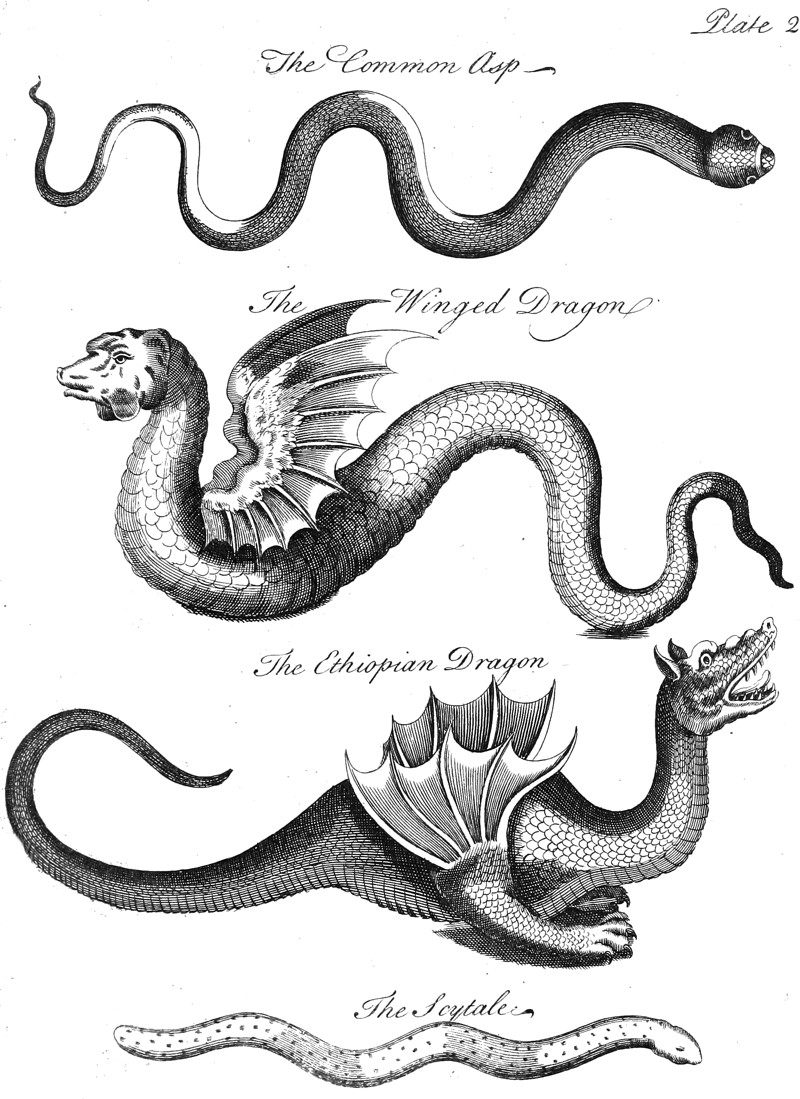
VII. The Asp, so called from the Asperity of its Skin, as Arnoldus,
or from aspiciendo, because of the Acuteness of its Eyes.
A Serpent well known, but not accurately describ’d, says the
Learned Mr. Ray: Some make it a small Serpent, others say ’tis
several Feet long; and both may judge right, for according to
Ælian, there are various Species of Asps; some a Foot and half
long, and others six.
Among these different Proportions, the least of them is said
to be most hurtful, and kills the soonest. Its Poison is so dangerous
and quick in its Operation, that it kills almost in the very
Instant that it bites, without a Possibility of applying any Remedy:
They die within three Hours, says my learned Author[117];
and the manner of their dying by Sleep and Lethargy, without
Pain, made Cleopatra chuse it as the easiest way of dispatching
herself. (More of this further on.)
These Aspick Serpents, are the Growth of several Climates:
Olaus observed some of them in the northern Parts, of rugged
and rough Skins, ash Colour, sparkling Eyes, three or four Cubits
long[118]; tho’ Lovers of warm Situations, yet delight in shady
Retirements[119]. Many of them are found in the Spanish
Islands[TN];
but Egypt, Libya, and other Places
in Africa claim the greatest Right to them, for there they are
most numerous and venemous.
When provok’d, the Neck of this Creature swells, and the
Wound then given, is most dangerous. Its Teeth are of considerable
length, growing out of the Mouth like the Tusks of a
Boar. The Historian says, that two of the longest Teeth have
little Cavities in them, covered with a thin Skin, that slides up
when it bites, by which means the poisonous Liquid runs out,
and drops into the Puncture; after which, it recovers its Station.
60In America, says a celebrated Historian, are found Asps with
Stings in the Tail, wherewith they strike and kill[120].
The Banks of Nilus abound with Asps, who have Sagacity
enough to remove their Habitations to a place of Safety, several
days before that River overflows the Rising-Grounds about it:
’Tis also said the Crocodile and Tortoise recede with their Eggs, to
a Situation not accessible by that mighty Flood; a Flood that
makes the Land of Egypt, a Region of Fertility, a Flood dreaded
by these Animals, and ador’d by the Egyptians, those Sons of
Contradiction, who consecrated their Animals to the Gods, and
then worshipped them, and upon Occasions kill’d them. (Can
we behold such Instincts in the Crocodile, &c. without acknowledging
the Divine Wisdom that ordain’d ’em!) No Nation more
knowing, and more sottish, e. g. Upon the Statue of Minerva,
or the Goddess Isis, was this Inscription, viz. I was she that was,
that am, and shall be, and that am every thing. Which being an
exact Interpretation of the Word Jehovah, and the same Definition
the Almighty appropriates to himself, I can’t, says the Learned
Jurieu, conceive, how a Nation that was arrived to such a high
Degree of Knowledge, should have worship’d Bullocks—as Gods.
PLUTARCH gives a strange relation of them, viz. that in case
of any extraordinary Calamity, as War, Plague, Famine, the Egyptian
Priests used to threaten the sacred Beasts most horribly: If
they failed to help them, they whipt them till the Blood follow’d;
and if the Calamity did still continue, they kill’d those sacred
Beasts by way of Punishment[121]. The Reverse of this is given us
in a Clan of Tartars, who, when exposed to any imminent Calamity,
sacrifice their Priests, in order to intercede for them with
the Gods in the other World.
It has been said, that the Asp, when exasperated, did, with
an erected Head, cast out of its Mouth liquid Poison; but it
now appears, it darts it only by its Bite, or by Poison taken
from it by Force, and poured into a Wound made by another;
and both the Wounds so made, soon terminate in an easy pleasant
Exit; which is supposed to be the reason why Queen Cleopatra
chose this kind of Death, that is, to poison herself by an
Aspick Dose. This reminds me of a certain Herb I have read of,
61in Arabia, which (according to the Tradition) if a Man slept
upon, he died in his Sleep without any Pain.
A certain learned Pen, makes this Remark upon Cleopatra’s
Case, viz. that she was not bit by an Asp, as some have
asserted, but did that which was more secret and sure; that is,
after she had bit her own Arm, infused Poison into the Wound,
expressed before-hand from an Asp by Irritation, and preserved in
a Phial for that purpose: Or, as Dio says, she wounded her Arm
with a Needle, or Dressing-pin, and then poured the Poison into
the bleeding Wound. This seems probable, because no Serpent
was found in her Chamber or near it.
The Queen, in order to find the most easy Passage out of this
Life, made an Experiment upon Criminals by various kinds of
Poison, and Application of diverse sorts of Serpents, and found
nothing came up to Aspick Poison, which throws Persons into a
pleasant Sleep, in which they die[122].
Obj. If it be said, that in the Triumphs of Augustus, Queen
Cleopatra is drawn with an Asp in her Hand:
I answer, That I apprehend that Device might only be Pictorial-Licence,
or a Flourish of the Painter to affect the People, by
displaying the Heroism of a Woman, who to prevent the Disgrace
of Captivity, embraced Death at the hands of a Serpent, a terrible
Creature, to which none has so great an Aversion as the female
Sex. Excuse a poetick Digression.
On the ASP and its POISON.
——Welcome thou kind Deceiver,
Thou best of Thieves! who with an easy Key
Dost open Life, and unperceiv’d by us,
Even steal us from our selves; discharging so,
Death’s dreadful Office, better than himself.
Touching our Limbs so gently into Slumber,
That Death stands by, deceiv’d by its own Image,
And thinks himself asleep[123].——
62Some are of Opinion, that the Asp is David’s deaf
Adder, Psal. lviii. 45. They are like the deaf Adder that stops
her Ear, which will not hearken to the Voice of Charmers, charming
never so wisely. They are like the deaf Asp, says the
Hebrew and the Septuagint. The word in the Original is
[124] Pethen, q. d. Unpersuadedness; hence, wicked Men are
called Απειθεις in the New Test. unpersuadable, which the
English Translation renders Disobedient, Tit. i. 16.
The common Tradition is, that when Men by Inchantments
and Charms have attempted to take these Serpents, they stopt
one Ear with the Tail, and the other was either deaf, or made so
by laying it close to the Ground. Some are of Opinion, that
there is a sort of Asp that really is deaf, which of all others is the
most dangerous, and is meant by the Royal Prophet here.
That there was a Practice of charming Serpents by some Art
or other, so that they could neither bite nor sting, seems evident
from the sacred Writings, e. g. Eccl. x. 11. Surely the Serpent
will bite without Inchantment. Jer. viii. 17. I’ll send Serpents,
Cockatrices, among you, that will not be charmed, and they shall
bite you, says the Lord.
Among other Things the word Charmer, some say, signifies
one that conjoins and consociates; that is, that by Sorcery
gather’d Serpents together, and made them tame and familiar;
or the Person may be so call’d, because by Magick Art, he associated
with Demons, the Lords of Serpents.
We are inform’d by History, of some, who have summoned
together a hundred Serpents at once; but by what method, I
leave the Reader to judge. Montanus, a famous Physician, and
Professor at Padua in Italy, says he saw this Coadunation of
Serpents.
The learned Doctor Casaubon tells us, he had seen a Man,
who from the Country around him, wou’d draw Serpents into
the Fire, which was inclos’d in a magical Circle: When one of
them, bigger than the rest, would not be brought in, upon repeating
the aforesaid Charms, it submitted to the Flames.
We read of a famous Charmer at Saltsburgh in the Circle of
Bavaria; that, when (in sight of the People) he had charm’d a
great Number of Serpents into a Ditch, where he kill’d them;
63there came a Serpent of great Bulk, supposed to be the Devil, that
leapt upon the Charmer, and immediately slew him[125].
Answer me, says Paracelsus, (the celebrated Swiss Physician,
who did wonderful Cures by Liquids extracted from Vegetables)
from whence is it, that a Serpent of Helvetia, Algovia, or Suevia,
does understand the Greek Idiom, Osy, Osya, Osy; that they
should, at the first Sound of these Words, stop their Ears, remain
immoveable, and do us no hurt with their Poison? From whence
he infers, there was a Power in Words to operate upon the Ear,
without Superstition. The Antients seem to have entertain’d
some favourable Thoughts of the Power of Spells upon Serpents:
Their Poets speak often of these Charms and Incantations.
Frigidus in pratis cantando rumpitur anguis. Virgil.
Vipereas rumpo verbis, & carmine fauces. Ovid.
Ingue pruinoso coluber distenditur arvo
Viperes coëunt abrupto corpore nodi
Humanoque cadit serpens afflata veneno. Lucan.
PHILOSTRATUS describes particularly how the Indians
charm Serpents—they take a Scarlet-Coat embroider’d with golden
Letters, and spread it before the Serpent’s Hole; and these golden
Letters have a fascinating Power over it, and therewith its Eyes
are overcome and laid asleep[126].
If we consider the strange Things done by Force of Words, so
much extoll’d in Antiquity, it will be no wonder to see Letters,
out of which Words are form’d, made the Rudiment and first Study
of human Life: But as to the Mode of Operation by Words, the
Learned are not agreed.
Some say, there is a natural Virtue and Efficacy in Words,
and appeal to the notable Feats done by Force of Eloquence. This
was the favourite Study and View of Orators; in this they
triumph’d, and never wanted Acclamations and loud Applauses.
In Plutarch, we have, among others, one remarkable Instance,
viz. Cæsar, upon the Accusations brought in by Tubero against
Quintus Ligarius (Pompey’s Friend) he was resolved to sacrifice
that Rebel, till he was charm’d by the Words of the Orator that
pleaded in his favour—No sooner did Cicero begin his Oration in
64his defence, but Cæsar’s Countenance chang’d, and his Indignation
begun to soften ... but when the Orator touch’d upon the
Battle of Pharsalia (where Cæsar was Conqueror) Cæsar’s Heart
tender’d, his Body trembled with Joy, and certain Papers in his
Hands dropt to the ground.—And when Cicero had finish’d his
Oration, Cæsar’s Wrath against his Enemy was intirely extinguish’d;
and Ligarius was set at liberty[127]. The same Orator,
by the Dint of Eloquence, overthrew the Constitution of the Decemviri.
Others say, there is a mighty Force in Words in such a
Tone, and Talismanical Characters, rightly-adapted Figures, and
Images under certain Constellations[128].
Some affirm that Magick consists in the Spirit of Faith, for
Faith is the Magnet of Magicians, by which they draw Spirits to
them, and by which Spirits they do wonderful Things, that to
vulgar Eyes appear like Miracles. No doubt but several extraordinary
Effects have been ascrib’d to the Devil, that in reality
were natural, and artfully disguised: The Story of Sieur Brioche,
a famous Puppet-player, is well known, who in a Town in Switzerland,
where that Show had never been seen before, he was apprehended
as a Warlock or Magician, and ran the hazard of being
punish’d as such[129].
Others affirm, that Charms by Words are but means to
heighten the Imagination; and the strange Effects produced by
’em, flow’d only from the Activity of an exalted Thought, or
Fancy of heated Brains. In proof of this ’tis said, that if a Woman
at a certain Season, strongly fix her Imagination upon any
particular Object, the Child will bear the Image thereof.
I think ’tis pretty obvious, that those extraordinary Impressions
made by Pagan Sophists upon the Minds of their Audience
by the Charms of Rhetorick, past for a divine Afflatus or
Inspiration; and therefore in such Cases, we shall find this Formula
(Aliquis nescio quis Deus) frequently used by Enthusiastical
Orators, as well as their Poets: Thus Cicero, speaks of himself, that
he was mov’d by a certain Impetus or Ardour[130]: Apollonius Tyanæus,
65who was looked upon by the Christians as a notorious Magician,
being ask’d by the Governor of Rome under Nero, what
was his Profession? he answer’d, θειασμος, an Enthusiast, q. d. Fanatic, Conjurer.
’Tis true, that wonderful Things have been done by Words,
but how verbal Charms operated upon Serpents, wants Explication:
Of some Inchanters ’tis said, that by vocal and instrumental
Sounds, they have charm’d Rats, Mice and Serpents, some into
a stupid State, and others into a flexible submissive State.
A remarkable Instance in Rats we have in the publick Records
of Hamelen, (an antient City on the River Weser in Germany,
about 28 Miles S. E. of Hanover) where the following strange
Account is register’d, viz.
That in June 26. 1284, a certain Stranger undertook to
destroy an Army of Rats with which the Town had been long
pester’d, on promise of such a Reward; and immediately playing
on his Pipe and Tabret, the Rats march’d out, and follow’d the
Musick to the River, where they were all drown’d: But being
denied the Reward, he threaten’d Revenge; and next day he
went about with the same Musick, and most Children in the
Town follow’d the Piper to the Mouth of a great Cave on a
neighbouring Hill call’d Koppelberg, where he and they entered,
and were never heard of after.
In remembrance of this sad Catastrophe, the Citizens for many
Years after, dated all their publick Writings from the Day they
lost their Children, as appears by their old Deeds and Records:
They still call the Street thro’ which the Children went out,
Tabret-street; and at the Mouth of the Cave there is a Monument
of Stone, with a Latin Inscription, giving the Particulars of this
tragical Story.
As to the other Instance, viz. Serpents charm’d into a ductile
manageable State, ’tis thus accounted for; viz. Serpents, they
say, are strangely influenced by the Smell of those Emanations,
proceeding from the Cornus, or Dog-tree (why not the Cornelian-Cherry,
antiently dedicated to Apollo?) and that by a Wand or
Rod taken from it, they are thrown into an obsequious Temper—
“When
touch’d by a Rod from that Tree, they are immediately
intoxicated, but so as to be able to follow the Motion of the
Rod; but whether by reason of some great Disproportion or
66Incompossibility, between these subtile Effluvia and the Temperament
of the vital, spiritual Substance of the Serpent, or by
what other way, we are not told[131]. The Sassafras-tree, a Native
of America, is call’d Cornus also, whose Wood is very odorous
and fragrant.”
Now, say these Gentlemen why should
it seem impossible, that he who understands this invincible Enmity,
and how to manage a Rod of the Cornus with Cunning and
Dexterity (having first intoxicated a Serpent by the Touch thereof)
should during that Fit make it observe, and readily conform
to all the various Motions of the Wand, so as that the unlearned
Spectators, perceiving the Serpent to approach the Inchanter, as
he moves the Wand near to himself, or to retreat from him, as
he put the Wand from him, or turn round and dance as the Rod
is mov’d to and fro, or lie still as in a Trance, as the Rod is held
still over it; and all this Time, the People knowing nothing of
the Virtue in the Rod, are easily deluded into a Belief, that the
whole Scene is supernatural, and the main Energy radiated in
those Words or Charms, which the Impostor with great Ceremony
and Gravity of Aspect mutters forth, the better to disguise
his Legerdemain, and dissemble Nature in the colour of a Miracle.
The Rattle-snakes in America are said to secure their Prey by
Incantation; for they have the Power or Art, (I know not which
to call it, says my Author) to charm Squirrels, Hares, Partridges,
or any such Thing, in such a manner, that they run directly into
their Mouths: This I have seen, adds he, by a Squirrel and one
of the Rattle-snakes; and other Snakes have in some measure the
same Power[132].
It is allowed indeed, that there are dumb Creatures that do exceed
Man in some sensible Perceptions, particularly in that of Smelling,
as the Harriers, and other Dogs. How strange, that
Odours from the Hare’s Body, Should so affect the Nose of a
Hound, as to raise in him that Sensation or Scent, by which he
follows her all the Day (tho’ he never had a Sight of her) thro’ a
Cloud of Opposition, from perplexing intricate Places, and Effluviums
proceeding from other Animals!
These Emanations are exceeding fine Effluvia, or Particles
flying off odorous Bodies in all Directions; and as they float in the
Air on the Surface of the Earth (within their Atmosphere) strike
67against the Dog’s Nose, and produce that Sensation of Smell.—N.
B. The Intensity of Smell in all Creatures, is in proportion to
the Density or Thickness where we are: This Density is always
diminish’d in proportion to the Squares of the Distances from the
odorous Body.
Yea, a little Cur, by the Power of Smelling, can find out his
Master among Thousands, will trace his Steps thro’ Crouds in Fairs
and Markets; yea, throughout a whole Country. Our Histories
inform us of Dogs in some parts of this Island, that being put upon
the Scent, would pursue a Thief and a Murderer; and if he
cross’d a River, would smell where he entered, and swim after
him; and when arrived at t’other side, would hunt about till
they found where he landed, and then run on, till they overtook
the Criminal.
In Animals is a sulphurous or oily Matter, so attenuated and
subtiliz’d as to become volatile, which is denominated a Spirit:
Now that there is such a Spirit in Man, and a peculiar one too in
every Man, is evident from these Dogs, which will pursue the
Game by their Nose, and follow their Master’s Track, and distinguish
it precisely; yea, tho’ a thousand other Persons had past
the same way.
It must be by meer Force of Smelling, that the Dog is able
to do this, that is, to distinguish his Master from all Men by the
Instrumentality of his Nose.
Therefore there must be some specifick Matter exhaled
from the Master’s Body, which the Dog can perfectly distinguish
from the various Effluvia flowing from all other Persons.
The Dog must exceed us, in that he can thus exactly discern
his Master, by these subtile, oily, or sulphurous Effluvia, which
no human Nose was ever able to do.
We find the like Spirit in the Hound, who when put in the
Track which a Deer has lately been in, will follow the Steps of
that Deer thro’ all cross Paths of a thousand others, and at last
single out that individual Deer among a whole Herd of those Animals.
In Scotland are a sort of Dogs (in Colour generally red and spotted
with black, or black with red) of extraordinary Sagacity, being,
as ’tis said, put upon the Scent, will pursue Thieves with Success;
and the Use of them has been authorised by the Magistrate——Nullus
68perturbet aut impediat canem trasantem, aut homines transentes
cum ipso ad sequendum latrones aut ad capiendum malefactores.
N. B. Trasantem is a Word latiniz’d from the old French
Tracer or Trasser, signifying to follow by the Track.
If any shou’d suggest, That this derogates from the Wisdom
and Goodness of the Creator, who has given to some Beasts
stronger Perceptions, Nerves more exquisitely fine and delicate
than he has bestow’d upon Man:
I answer, this is so far from derogating from divine Wisdom
and Goodness, that it is an admirable Instance and Illustration
of both; for were our olfactory Nerves susceptible of such
quick Sensations as Dogs and some other Animals, we shou’d be
continually annoy’d with pestiferous Fumes and Exhalations, so
as not only to render most Situations troublesome, but even Life
it self miserable and wretched.
Such quick Sensations may be very useful to carnivorous Animals,
so as to direct them to their Prey, but to human Beings it
wou’d be very vexatious, if not pestiferous and deadly. I shall
only add to this Digression, a short Hint about the Magic Art,
the most surprising of all Arts, and in its first Appearance most
innocent and useful.
Among the antient Chaldeans, Babylonians, and Persians,
where the Art-magic was first and principally cultivated, it signified
no more than Wisdom and hence the Sophi, or Wisemen
of the Greeks were by them call’d μαγοι that is, Magicians; who
being acquainted with many of the hidden Powers of Nature, directed
them in such manner, as to produce Effects, whose Causes
being unknown to the Vulgar, were attributed to Dæmons.
Hence the Art in process of Time came into Disrepute, and
Magicians have been censur’d, as working by Compact with the
Devil: But this is invidious; for in the Gospel we find, the Magi
or Magicians, are said to come from the East to Jerusalem, saying,
where is he that is born King of the Jews? for we—are come to worship
him. No body can imagine this to be understood of those that
have been called Sorcerers, Wizards, Conjurers, Witches or Magicians,
in the modern Sense of that Word[133]; for those who were
familiar with the Devil, would scarce come to enquire after him,
who came to destroy his Works.
69The Notion of Witches in the Days of Ignorance and Superstition,
was very prevailing in this Island, but of late Years has undergone
a parliamentary Excommunication; though the Lancashire
Witches, who are constituted of the fairer Part of the fairer
Sex, triumph even over our Senators, and will maintain their fascinating
Charms, while their rival Beauties, the Sun and Stars
endure.
We read of a certain King of Egypt, who having assembled
his Magical Priests without the City Memphis, caus’d them to enter
where the People were gather’d, by Beat of Drum: All of
them made some miraculous Discovery of their Magic and Wisdom.
One had his Face surrounded with a Light, like that of
the Sun, so bright that none could look earnestly upon him.
Another seem’d as if enrob’d with precious Stones of diverse
Colours, red, green, yellow, or wrought with Gold.
A third came mounted on a Lion, compass’d with Serpents,
like Girdles.
The next came in with a Pavilion, or Canopy of Light, distended
over his Head.
Another entered surrounded with Flames of Fire, turning
about him; so that none durst come near him.
After him appeared one with dreadful Birds, perching about
his Head, and shaking their Wings like Vulturs and black Eagles.
The last made his Appearance with an Army in the Air,
marching before him, of winged Serpents and terrible Personages.——In
fine, every one did what was taught him by the
Star he served; and, after all, the whole Scene was but an Apparition
and Illusion, according to their own Confession to the
King, when the Farce was over[134].——Something analogous
to this are the Magick Lanthorns in our days.
In antient times, the Word Magician generally signified Men
of Wisdom and Learning, i. e. of superior Knowledge in Things
natural and divine, and more especially in that sort of Learning
relative to the Sun, Moon, and Stars, as we learn from Porphyry,
70Apuleius, and others. And seeing the inspired Apostle gives them
that Name (Magicians) not as a Mark of Infamy, but a Title of
Honour, therefore does the English Translation stile them Wisemen,
such as the old Greeks called σοφοι, Sages of their Time[135].
How, and how far this Art is degenerated, I refer to the Judgment
of the Learned: We see there are Revolutions in Words, as well
as in Families and Kingdoms; a Magician being formerly a Wise-man,
as well as a Knave an honest one. Sed tempora mutantur.
I shall only add to the Aspick Subject, the Tribute of Veneration
paid to this poisonous Animal in the Land of Egypt.
The Historian speaks of a certain Person, who, in digging, happened
unawares to cut an Asp with his Spade, and went mad upon
it,—was taken into the House of Serapis, an Egyptian Idol,—the
Relatives of the Patient praying the Spectrum of that Serpent
might be destroyed,——which being accordingly done by Magick
Art, the Man was cured.——By this we see, how highly Asps
were venerated among the Egyptians, who not only suffer’d them
to live, but to live in their Houses, where they were carefully fed,
as Favourites of the Family[136]. And Queen Cleopatra’s Case was
not singular, for the Persian Kings kept an exquisite Poison by
them, made of the Dung of an Indian Bird, which would kill
without putting them to pain, that they might use it themselves
in case of any Disaster[137].
DEMOSTHENES, who slew his Soldier, when he was
asleep, was a merciful Executioner; a kind of Punishment the
Mildness of no Law has yet invented. It is strange that Lucan
and Seneca made no discovery of it.
Sleep is a kind of Death, by which we may literally be
said to die daily; and in this Sense, Adam may be said to die before
his final Exit.
VIII. I now proceed to the Serpent Scytale; the Name is
borrowed from the Greek Word σκυταλη, a Staff, or any thing like
a Cylinder, of a long smooth round Form; the Body of this Serpent
being in shape equally round, like a Rolling-Stone, with very
little Variation in the Extremities of it.
71It forms a beautiful Prospect, being an Aggregate of most
charming Colours, (therefore call’d the Painted Serpent by Mantuanus.)
It may be view’d without danger, because slow in its
Motion. ’Tis an Error in Lucan to attribute its Slowness to a
Design of enticing Spectators, if it be not Poetica Licentia.
When released from its Winter-Confinement, the first thing
she does, says the Historian, is to refresh her languid Body with
Fennel-Leaves; but does not tell us what is done, in case that Herb
can’t be readily found. It must indeed be allowed, that wild
Fennel is a common Herb of the Field, and well known and of
Use in Physick[138]. The Poet observes, that no Snake casts her
Coat in Winter, but the Scytale[139].
This Serpent being adorned with beautiful Colours, excuse a
short Digression upon the Doctrine of Colours in Natural Bodies.
Know then, Colours are the Children of Fire and Light.
I. Where there is Light, there is Fire; and Fire shews itself to
be present by Light. The Sensation of Light is produced when
the Particles of Fire, directed by the Action of the Sun, reach the
Eye in right Lines. Now, Fire thus entering the Eye, gives a
Motion to the optic Fibres at the bottom of the Eye, and thus
excites the Idea of Light.
II. FIRE discovers itself by Colour; for all Colours depend
upon Light, and Light depends upon Fire; and different Colours
appear in Natural Bodies, as their Surfaces are disposed to reflect
this or that sort of coloured Rays more than others. Colour is
a Property inherent in Light.
Colours therefore are not connate with Natural Bodies,
which are all of the same Hue in the dark. To this the Poet
alludes, when he makes Darkness the Destruction of Colours[140].—Colours
are only in the Rays of the Sun: In Natural Bodies is
a Quality or Power to reflect the Light falling upon them, which
striking the Eye, produces in the Spectator the Sensation of Colour.
72Clouds often appear very beautifully coloured; they consist
of aqueous Particles, between which Air is interspersed; therefore,
according to the various Thickness of those aqueous Particles, the
Cloud will be of a different Colour[141].
IX. AMPHISBÆNA Serpent, so called from αμφι & βαινω
Biceps, a Monster with two Heads. This is a small and weak Creature,
equal in Bulk to a little Finger, and about a Foot long, of a
whitish or terraceous Colour; of the oviparous Family, of small
Eyes, no otherways visible than the Prick of a little Needle; lives
much under ground, and is often found by digging; feeds upon
Ants. Under this Head, the Historian mentions three Serpents,
viz.
The Brasilian, that has two Heads, and moves as a Crab[142].
The Taprobanensian, with four Heads; and he who believes it
must have a four-headed Faith.
The Hungarian; of which elsewhere.
The same Historian adds, that the marine Amphisbæna,
taken in the English Sea, has two Heads. Ibid. Pliny, Ælian,
Lucan, Mantuan,—affirm it has two Heads; Matthiolus denies
it, Hesychius is doubtful. Mention is made of a Serpent found
near Chipping-Norton, not far from Oxford, having two Heads, and
Faces like Women; one being shaped after the new Tyre of that
Time; the other was habited after the old Fashion, and had great
Wings resembling those of the Flinder-Mouse or Bat[143]. This
happened in the Reign of Edward III.
A Spanish Author says, that in Chiapa he found a two-headed
Serpent, 18 Inches long, in the Form of a Roman T, and very venemous;
it does not only kill, adds he, by its Bite, but if any
tread upon that part of the Ground over which ’twas just gone, it
proves fatal[144]. The Poet also subscribes to two Heads[145].——If
this two-headed Serpent has slain its Thousands, there is a certain
metaphorical three-headed Serpent on the Banks of Tyber, that has
slain its Ten Thousands.
73Perhaps the Reason of ascribing two Heads to this Serpent,
might be, because it is said to poison by the Tail and Teeth.
Others say, both Ends are so like in Figure and Bulk, that they
are not easily distinguished.
It seems probable to me, that this Serpent, like some Insects or
Worms, has a double Motion, antrorsum & retrorsum, which made
some of the Antients conclude it had two Heads; one in the usual
Situation, the other in the Extremity of the Cauda. Its Body is
of equal Thickness, and recommended to the View by various
and delightful Spots[146].
We read of this Serpent in Gothland, where it comes forth in
the Spring before all other Serpents, being more able to encounter
the cold Air[147]. Some Authors tell us, that its Skin wrapt about a
Stick, drives away all Serpents; which I place among the Tales of
Antiquity.
This Serpent is found in the Lybian Deserts, and also in the
Island of Lemnos, in the Ægean Sea. The Puncture made by its
Wounds is so small, that it can scarcely be discerned, yet terminates
in a dreadful Inflammation and a lingering Death.
ERASMUS was puzzled about the Sense of that Greek Proverb
ὑδρος εν φιθω, hydrus in dolio, a Serpent in the Hogshead:
The Meaning of it, said an Interpreter of Dreams, is this: A certain
Person had a Vessel of Wine, that was constantly diminishing,
tho’ carefully lock’d up; the Reason of which he could not
account for, till he empty’d the Vessel, at the bottom of which he
found a Serpent rioting in Wine[148].
Perhaps as good an Interpretation may be this, that there
was Venom in the Cask (of which the Serpent was an Emblem)
to all those who rioted in the Bowls of Excess. Not so, says a
Son of Bacchus; for
The thirsty Earth soaks up the Rain,
And drinks, and gapes for Drink again.
The Sea itself, which one would think,
Should have but little need of Drink,
Drinks Ten thousand Rivers up.——
74The busy Sun, and one would guess
By’s drunken fiery Face no less,
Drinks up the Sea.——
Fill up the Bowl then, fill it high,
Fill all the Glasses there, for why,
Should every Creature drink, but I?
Why, Man of Morals, tell me why?[149]
Some of the Poets have thought this Amphisbæna to be the
Hydra Lernæa, the many-headed Serpent, that was very terrible
to the adjacent Country, and slain by Hercules: When one Head
was cut off, many others sprung up; so that there was no way to
destroy the Monster, but by cutting off all the Heads with one
Stroke.
Tho’ there be no Amphisbænick Animals, there is some Resemblance
of it in Plants, whose Cotyledon is always double, and
in the common Centre of the two, is a Point or Speck, which is
the Plantule, or the Tree in Embryo; which Plantule being acted
on by the Earth, warmed by the Sun, begins to expand, and
shoots its Root both upward and downward. Thus, in a Bean
committed to the Ground, we soon see it to cleave into two
Parts, and in the Fissure appears a little Speck, which sends out a
Root downwards, and a Bud upwards.—A remarkable Phænomenon,
says the Note on Boerhaave’s Theory.
X. Among Serpents, Authors place Dragons; Creatures terrible
and fierce in Aspect and Nature. They are divided into
Apodes and Pedates, some with Feet, and some without them;
some are privileged with Wings, and others are destitute of Wings
and Feet: Some are covered with sharp Scales, which make a
bright Appearance in some Position. Some have observed, that
about the Ganges, are Dragons whose Eyes sparkle like precious
Stones.
They differ in external Form: The Draconopades are represented
by a human Face, and sightly Countenance; the rest of the
Body in a tortuous winding Shape. In one of Dr. Johnson’s Figures,
a Dragon is made to appear like a Man’s Face, with a Grenadier’s
Cap on the Head. Some differ in Colour, some are
75black in the upper Part of the Body, according to Philostratus;
red, according to Homer; yellow, according to Pausanias; and
Lucan makes it a golden Colour[150].
The same Historian observes, that in the Atlantick Mountains,
they kill where they touch, and those that are in the Kingdom
of Narsinga, and dwell in the Woods, kill all they meet.
Ibid.[151]
I presume, the Author means Narsinga, a potent Kingdom,
bounded on the East with the Bay of Bengal, that noble
Part of India, says Herbert[152]; where the Monarch is always attended
with 1000 for his Guards, has 5 or 6000 Jesters, and reckons
it one of his chief Titles to be the Husband of a Thousand
Wives.
Dragons are Inhabitants of Africa and Asia; those of
India exceed most in Largeness and Longitude: In the Tower of
London, is the Skin of one, which is of vast Bulk. In Æthiopia,
they have no Name for Dragons, but Killers of Elephants,
which is supposed to be the largest of Land-Animals.
Over the Water-gate in the City of Rhodes, there is set up
the Head of a Dragon, which was 33 Foot long, that wasted all
the Country, till it was slain by Deodate de Gozon, one of the
Knights of St. John Baptist[153]. The Knights of that Order had
frequently attack’d it, but in vain; for its Scales being proof against
all their Arms, it destroyed so many of them, that the
Grand-Master forbad them to engage the Monster any more.
GOZON, who, after several dangerous Onsets escaped with
his Life, resolved to make another Trial by Stratagem; perceiving
it was no where vulnerable but in the Eyes and Belly, contrived
the Resemblance of a Dragon by a Machine of Pastboard,
of equal Bulk with the Dragon, and by certain Springs made it
leap like a true Dragon: Having trained up a Couple of fierce
Dogs to attack it at the Belly, he went out privately one Morning,
well-armed on a managed Horse with his Dogs, and rode up to the
76Den, from whence the Dragon leaped furiously at him: In the
Encounter, the Dogs laid hold on his Belly, and forced him to lie
down; upon which the valiant Knight alighted, thrust his great
Sword several times into his Throat, and soon killed him: Upon
which the Spectators drew near, and with great difficulty sever’d
the Head from the Body, and lugged it into the Town in Triumph.
The Conqueror was degraded for the sake of Form, because
he had violated the Grand-Master’s Order; but was immediately
restored, and soon after was elected Grand-Master himself; he
died in the Year 1335, and on his Tomb were engraven these
Words, Draconis Extinctor; The Destroyer of the Dragon.
In the Life of Attilius Regulus (the Roman General in the War
against the Carthaginians) is described a Dragon of prodigious
Bulk near the River Bagrada, that annoyed all the Country round,
without Remedy. Several Devices were formed to destroy it, but
without effect, till the Military Possé was called in, who discharged
the Engines of War against it with Success: And so great was this
Deliverance, that an Ovation, or a small Triumph, was publickly
made at Rome for the Victory.
XI. The Pythian Dragon, so called from its being the Guardian
of the Delphick Oracle: Its Eyes are large and sharp, and
the Body painted with Variety of Colours, as red, yellow, green
and blue, and furnished with Scales that are resplendent, well compacted
and hard. It has been called Deucalionæus, because in the
Language of Ignorance, it was produced from the Mud left by the
Deucalionian Deluge: a Serpent of prodigious Bulk.[154]
PYTHON is also taken for a prophetick Demon, by St.
Luke[155].—As we went to Prayer, a certain Damsel possest with a
Spirit of Divination, (having the Spirit of Pytho, according to the
Greek) which brought her Masters much Gain by Sooth-saying, that
is, by Predictions, telling of Fortunes. Python of the Greeks is
supposed the Typhon of the Phenicians, and the Phœnician Typhon
to be Ogg King of Bashan, and Apollo that slew it, to be
Joshua. Apollo is called Pythius from this Serpent, or from some
notorious Tyrant of that Name, slain by him, as the antient Geographer
77observes. So Gesner from Pausanias. The Priestess
of Apollo, that delivered the Sacred Oracles, was called Pythia
and Pythonissa. This Pythonick Spirit among the Gentiles, was
esteemed as a God, and by Juvenal is styled Vates, a Prophet.
The Priestess that delivered the Sacred Oracles, was called
Pythia, from Apollo Pythius, and must be a pure Virgin. Most
of the Fathers of the Church were of opinion, that it was the Devil
gave the Answers, which were generally dubious, a Sign of his
Ignorance about Futurity.
One Œnomaus, a certain Pagan Philosopher, highly resenting
it, that he had been so often befooled by the Oracles, speaks to
Apollo thus—
“When we come to consult thee, either thou knowest
Things to come or not. If thou knowest them, why dost
not thou speak so as to be understood? If thou knowest not,
why dost thou pretend to it? If Things necessarily come to
pass, why dost thou amuse us with Ambiguities?[156]”
F. BALTHUS, a learned Jesuit, and F. Bouchet, say there were
real Oracles, and such that can never be attributed to Priests and
Priestesses; and that the Devil still gives Oracles in the Indies, and
that not by Idols, which would be liable to Imposture, but by the
Mouths of Priests, and By-Standers; and that the Devil becomes
mute, in proportion as the Gospel prevails.——
“It is generally believed among the more Learned, that the Pagan
Oracles were mere Frauds and Impostures, and calculated
to serve the political Views of Princes, and covetous
Ends of Pagan Priests.”
According to the learned Bayle,
they were meer human Artifices; and he is seconded by Vandale
and Fontenelle. But to return to the Oracle at Delphos, which
was very antient and much in vogue before the Trojan War: The
Situation of the Place, where People were made to believe God
spoke, was at the Mouth of a certain Cavern, whence they received
their Intelligence. The Prophetess sat upon a Tripodium, a three-footed
Stool, assisted in her Function by divers Priests.
Under her Seat, ’tis said, that some time there appeared a
Dragon, through whose Throat Responses were audibly deliver’d,
with a loud and strong Voice: According to Eusebius, a Serpent
rolled itself about the Tripod, on which the Priest sat.
78Of all Oracles, that of Apollo Pythius at Delphos, in the Ægean
Sea, was the most celebrated, and consulted as the dernier Resort by
the Princes of those Times; yea, all the Greeks resorted thither
for Counsel in Matters of Importance. At the first opening of
that Oracular Office, Answers were given to the Querist in Verse;
but upon People’s ridiculing the Poorness of the Verification,
the Oracle fell to Prose. ’Tis strange, that what they made a God,
could not make a good Verse, but not strange to see the old Serpent
adhering to its first Scheme of Politicks, by making the weaker
Vessel the Vehicle to convey his strong Delusions to the World.
Some of these Draconick Serpents excel in the Sensations of
Hearing and Seeing, as well as in the Art of Killing; and therefore
a Dragon was made the Conservator of their Treasures and Curiosities;
e. g. Mauritania in Africa, was famous for the Gardens of the
Hesperides (so called from three Sisters and Daughters of King
Hesperius) that produced Golden Apples, and were guarded by a
Dragon, which Hercules having killed or charm’d into a profound
Sleep, he robbed the Golden Orchard.
The Rod of Moses, ’tis said, was turned into a Serpent. The
Syriack, Arabick, and Septuagint Translations, say, twas turned into
a Dragon; and so the Rods of the Magicians became Dragons.
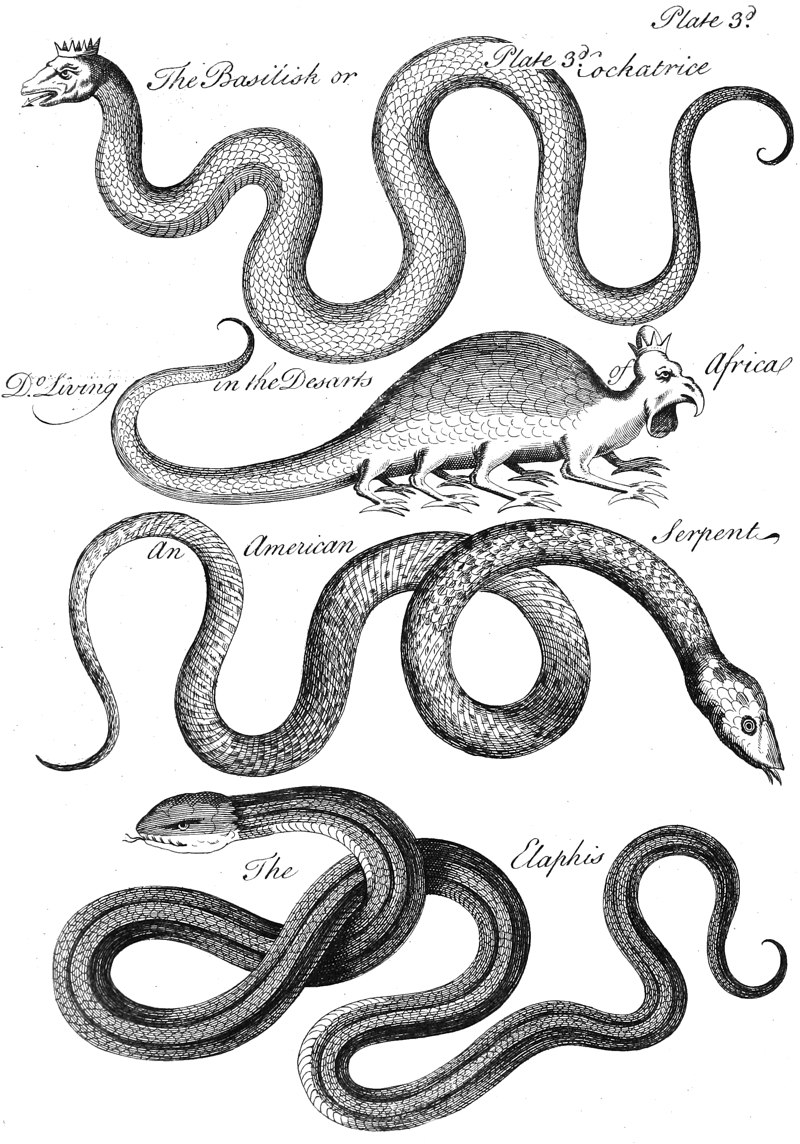
XII. The Basilisk or Cockatrice, is a Serpent of the Draconick
Line, the Property of Africa, says Ælian, and denied by others:
In shape, resembles a Cock, the Tail excepted. Authors differ
about its Extraction; the Egyptians say, it springs from the Egg
of the Bird Ibis; and others, from the Eggs of a Cock: Other
Conjectures about its Descent, being as ridiculous, I forbear to
mention them. Nor are they agreed whether it more inclines to
the black or yellow Colour; nor are their Sentiments less various
about its Stature.
It is gross in Body, of fiery Eyes, and sharp Head, on which
it wears a Crest, like a Cock’s Comb; and has the Honour to be
stiled Regulus by the Latins, the Little King of Serpents; and ’tis
generally supposed to be terrible to them. The Sight of this
Animal, and Sound of his Voice, puts them to flight, and even to
over-run their Prey[157]: Yea, Tradition adds, that his Eyes and
Breath are killing; that is, I presume, when he grasps the Spoil.
Several dreadful things are attributed to his venemous Qualities,
so sing the Poets[158].
79
According to Pliny and other antient Historians, this Serpent
in its Motion, inclines to the Erect; it goes half upright,
the middle and posterior parts of the Body only touching the
Ground. The Venom of the Basilisk is said to be so exalted, that
if it bites a Staff, ’twill kill the Person that makes use of it; but
this is Tradition without a Voucher[159].
The reason why this Serpent is dubb’d King, is not because
’tis larger in bulk than others of the Fraternity, or because it wears
a Crown, or because that Title seems to be recognized by a divine
Prophet, who speaking of Ahaz and his Son Hezekiah, says,
Out of the Serpent’s Root shall come forth a Cockatrice, and his
Fruit shall be a fiery flying Serpent. The Hebrew expresses it by
a word, that Signifies a Prince or King, but not with a View to
Empire over the serpentine Race.
But ’tis most probable, that the royal Stile is given to this
Serpent, because of its majestic Pace, which seems to be attended
with an Air of Grandeur and Authority. It does not, like other
Serpents, creep on the Earth; which if it did, the sight of it
would not be frightful, but moving about, in a sort of an erect
Posture, it looks like a Creature of another Species, therefore they
conclude ’tis an Enemy. Serpents are for Uniformity, therefore
can’t endure those that differ from them in the Mode of Motion.
’Tis said of this Creature, that its Poison infects the Air to
that Degree, that no other Animal can live near it, according to
the Tradition of the Elders famous for magnificent Tales. These
little Furioso’s are bred in the Solitudes of Africa, and are also
found in some other Places, and every where are terrible Neighbours.
The crown’d Basilisk leads me to Ovid, who, speaking of
Man’s erect Posture, says ’tis a Mark of Distinction due to the
Excellencies of the human Mind:
80A Creature of a more exalted kind
Was wanting yet; and then was Man design’d,
Conscious of Thought, of more capacious Breast.——
2. And partly as an Ensign of Royalty, some Characters whereof
Naturalists have observed in some other petty Principalities;
such as the Crown on the Dolphin, Diadem on the Basilisk, the
Lion’s stately Mane, which serves as a Collar of Honour.——
But Man, being vested with an universal Monarchy, walks
upon the Earth, like a Master in his own House.
XIII. The Cæcilia or Typhlinus, the blind Worm, as the
Greek word imports; not that it wants Eyes, but because they are
so little, that he must be furnish’d with good Optics that can discern
them: And the Ear also is as remarkably dull, therefore call’d
by the Greeks κωφιας[160]; of a brown Colour, full of Spots, variegated:
The Belly is blackish, the Neck sky-colour’d, garnish’d
with certain black Spots: Head like a Lamprey, and is as free
from Poison: Little Teeth, a forked Tongue, and may be handled
without hurt[161].
This Serpent seems to resemble those People which we call
Myops, i. e. Mouse-eyed, or purblind, which happens when the
Eye is so convex, that the Rays of Light unite, before they come
to the Retina, which makes the Eye also look small, whence the
Name[162].
The Cæcilian Serpent is about a Foot long, and distinguishable
from our common Serpents by the Form of its Body, which is almost
of the same Crassitude, excepting two or three Inches at the
extremity of the Tail. Conradus Gesner tells us, his Wife struck
one of these Serpents on the Head, when ’twas pregnant, and it
immediately cast forth its young[163].
XIV. The Cencris, or Cencrina is a spotted Serpent, and very
venemous; denominated from Milium, a small Grain call’d Millet-feed;
to which Historians compare the Spots wherewith this
81Serpent is adorn’d: For the same reason, a certain Species of the
Herpes, that is, a cutaneous Distemper, which is a kind of spreading
Inflammation, (and is like Millet-feed on the Skin) is called
Miliary: And by some, this is called the Miliary Serpent[164].
This Serpent is compared by Nicander to a Lion; either for
Cruelty in thirsting after Blood, or for its Courage, which appears
in all its Attacks. How furious in all its Wars, offensive
and defensive! always fighting, Lion-like, with an erected Tail:
Which leads me to a Digression about the Turkish Standard,
which is a Horse-Tail erected: The Original of that Custom was
this, viz. One of the Turkish Generals having his Standard taken
in a Battle with the Christians, and perceiving his Men discouraged
by the loss of it, he cut off a Horse-Tail, and fastening it to the
top of a Half-pike, advanced it on high, crying out, This is the
great Standard, let those that love me follow it: Upon which his
Men rallied, fought like Lions, and obtained the Victory[165].
But to return to the Serpent, which moving in a direct Line,
goes fast, but being of great Bulk, can’t suddenly wind about[166]:
Circumvolution is the way to avoid its Menaces. ’Tis commonly
found in the Island of Lemnos (the old Dipolis, and now the Stalimene
of the Turks) and also in Samothracia, an Island in the
Archipelago, a Province anciently famous for the Dii Cabiri, that
is, certain Gods worshipped by the Samothracians and Phenicians,
and had in such high Veneration, that it was a Crime to mention
Names so sacred among the People[167]. Some say they were God’s
Ministers, others think they were Devils.
XV. The Acontia[168], called by the Latins, Serpens Jacularis,
and by some, the Flying Serpent, because of the Celerity of its
Motion. In Lemnos ’tis call’d Sagittarius, the Bowman or Archer.
By the modern Greeks, Saeta, a Dart; for it flies like an Arrow
at its Prey[169]. A certain Person in Cato’s Army call’d Paulus, was
82slain, not by the Poison, but the Violence of its Blow[170]: Probably
on the lateral part of the Scull.
Authors are not agreed about its Dimensions. Ambrosinus
speaking of one he had seen in the Bononian Musæum, says, ’tis
about the thickness of a Staff, and about three Foot long: It is
found in Egypt, its Wounds are dreadful, being attended with
Putrefaction and Defluxion of the Flesh.
That which Bellonius saw, was three Palms long, or sixteen
Inches and a Finger’s Breadth. N. B. Palmus stands for two different
Measures; Palmus major contains twelve Fingers; Palmus
minor, four Inches.
It lies in wait under Bushes, from whence it rushes out unawares,
and flies like an Arrow at Passengers: Before it leaps at
the Prey, it lies on the Ground, and turns itself round, to give
the greater spring to the Motion, by which she’ll do execution
at twenty Cubits distance[171].
These nimble Leapers are found among the West-Indians,
especially in Hispaniola, where there are little Serpents in green
Apparel, that hang by the Tail on the Branches, from whence
they suddenly leap upon their Prey. Among the Sabæans are
some cloathed in red, four Inches long, that thus leap upon Men
unawares; and hurt, not only by striking, but touching.
This Serpent resembles the Ash in Colour, inclining to the
white. It traverses the Lybian Provinces, where it makes travelling
dangerous: It is also found in the Island of Rhodes; an Island
on which, the Poets tell us, Golden Showers are rain’d, and
where the Air is never so clouded, as to hinder the Light of the
Sun. It appears also in Norway, according to Olaus Magnus.
One tells us, that he was inform’d by one John Vitus, a
learned Hungarian, that there were in that Country little Serpents
about six Inches long, and without a Tail, therefore called by the
Vulgar, the curtail’d Serpent, the whole Body is much of an
equal Thickness; and these, upon View of their Prey, leap upon
it with the Swiftness of an Arrow[172].
83XVI. The Druina Serpent from δρυς, an Oak, by Scaliger
called Querculus; it takes its Name from the Oak, in whose hollow
places it seems to reside; and to which, it retires for Refuge,
when assaulted by Hornets.——Some credulous Authors have
said, that these Serpents take up their hybernal Lodgings about
the Roots of the Beach-trees, and by Virtue of the Warmth,
which those Roots derive from them, that Tree, so enhappy’d,
flourishes all Winter.
This Serpent is of the amphibious kind, and a most venemous
Creature, therefore rang’d with the first Order of the serpentine
Race. ’Tis of monstrous bulk[173], guarded by a rough squammatick
Armour, in the Cavities of which, ’tis said, little Flies build
their Nests. Whether it appears in white or blue Habit, is not
material, nor do I see what Honour it gets by wearing a Coronet
on its Head.
In the Language of Tradition, to tread upon it, will cause an
Excoriation in the Foot, (tho’ no Wound be given) and a Tumor
in the Leg; yea, adds the Traditionist, the Hands that attend
the Patient, will be in danger of losing their Skin: But he who
believes all the Fables of Antiquity, is in more danger of losing
his Reason.
The Druinical Serpent goes under various Denominations. ’Tis
said to follow the Acontia in Authors, because its Figure exactly
quadrates with Bellonius’s dart Serpent; and Scaliger was in the
same Sentiment[174].
But I shall only mention that of Chersydrus, from Nicander
in Jonstonus, p. 28. or Chelydrus, called by some a Sea-Snail;
which the learned Sir Hans Sloane describes thus——
“That it is more flat than most of the cochlean Marines, consisting
only of Circumvolutions, round the Axis of the Shell; of a fine purple
Colour.”
He calls it Cochlea Marina[175], and not without
reason, because of their difference in Magnitude.
The terrestrial Druina lives upon Frogs, and other Insects;
many of them are found in Africa-Interior, and the Hellespont
by Constantinople. It is a fetid Animal, and sends forth an ill
Scent, especially when its Body is wounded[176].
84This Serpent exceeds most in bulk, and loudness in hissing,
which resembles the Cry of Sheep and Goats, ibid. Gyllius makes
the Druina to be the Chelydrus, described by the Poet, who
makes it a Calabrian[177]: Of which, more in another place.
XVII. The Elops or Elaphis of the Antients, which some
confound with the Cæcilia, as Jonstonus observes: It is of the
amphibious Sort, and known at Lemnos, where ’tis call’d Laphiati
by the Natives. In Aldrovandus’s Study, Ambrosinus saw the Picture
of this Serpent, which was about three Foot long; the Belly
is of a yellow Colour, the Back is brown, and distinguishable by
three black Lines[178].
There is a marine Elope, an Animal counted sacred by the
Poets, a Set of merry Mortals, famous for turning every thing
into a God, or Ridicule. The Historian mentions a certain Fish
so called, that upon any loud Noise made on Land near the Shore,
would immediately hasten towards the Place, as if it would see
who durst rival Triton in Sound; Triton, Herald of Neptune, Sovereign
of the Sea.
XVIII. The Pareas or Parvas, is a Serpent of a fiery Colour,
sharp Eyes, wide Mouth, two Feet situated near the Tail,
by which its Motion is guided[179]: It is called the Serpent of Esculapius,
being of a gentle, innocent, friendly Nature. In Italy
they frequent Houses, and are no more dangerous than common
Eels; and if provoked to exercise their Teeth, there is nothing venemous
in the Bite. This is supposed by some to be the Italian
Baron: One of its commendable Properties is, that it devours
poisonous Serpents; and therefore is sacred to the Mysteries, and
highly esteem’d in the Temple of Dionysius.
Gesner[180], from Albertus says, it goes as it were upright, on its
Tail, not perpendicularly upon the sharp End, but on that Part
of the Body joined to the Tail: It is bred in Syria, Alexandria,
and in the East, &c. These Serpents are known also in Spain
85and other temperate Regions, and every where esteemed Enemies
to hurtful Serpents, and Friends to Mankind; therefore were
consecrated to the divine Esculapius, that great and glorious Exemplar
of Humanity.
XIX. The Dipsas or Dipsacus is a little venemous Reptile
of the Aspick kind[181], less than a Viper, but kills sooner; and is
most remarkable in this, that when it bites, the Poison brings an
unquenchable Thirst on the Person affected, who finding no Relief,
runs to the Water, and drinks till he bursts asunder[182].
The Poetick Historian observes, how Aulus, an Ensign-bearer
in the Roman Army in Africa, was slain by this Serpent;
at first he felt little or no Pain from the Bite, but as soon as it began
to operate, he was immediately scorch’d to death[183]. Galen
calls this Serpent Diabetes, and Ægineta Dipsacus, from the incurable
Thirst that accompanies its Bite: By others ’tis called Situla,
because of the burning Heat caused by the Wound.
It is about a Cubit in Length, lives in salt Marshes and shallow
Waters; it dwells in Arabia, Rhodes, Africa, especially in
Lybia, where some Branches of the venemous Family live on Camel’s
Flesh, and Locusts dried in the Sun. The more hot the
Climate, the more terrible the Wound, as it is in that hot Country,
where they have no Springs, but a few salt Wells, which increase
the animal Appetite of Thirst. The learned Venetian
makes the Serpent Dipsas an Hieroglyphick of illicit Love, the Poison
of which will, without timely Repentance, excite the Thirst
of Dives, who wanted a Drop of Water to cool his scorched
Tongue[184].
XX. Common Snake. These Serpents in their Summer-rambles
haunt among Bushes, mossy Grounds, uliginous and unfrequented
Situations. In a sultry Day they may be seen basking themselves
in the Sun, near their Apartments: The Sight of a Person
86puts them to flight; and upon a close Pursuit of them, they
make a Stand, raise up their Heads to a considerable Height, and
oppose the Enemy with a loud and angry Hiss. No Danger is
apprehended from their Bite, and they are handled with Impunity.
This Species of Serpents resembles the Esculapian, that has
been fed in some Families; and when provoked to use the Teeth,
the Danger is no more than that from a Bee, whose Weapons
are defensive, and not employed without Provocation: In Winter
they retire into subterraneous Spaces, where they lie dormant, till
the vernal Sun invites them out.
Though they propagate as Vipers, it does not appear that
they sit on their Eggs, as most oviparous Animals do; for we
often find a Brood of young Serpents in old Hedges and Dunghills,
and no visible Sign of a common Passage to and from the Nest.
XXI. The Elephantia Serpents are those whose Wounds cast
People into a Leprosy or Roughness of Skin, like that of an Elephant:
Hence Leprosy proceeding from inward Disorders, is call’d
Elephantia or Elephantiasis, which is a cutaneous Disease, makes
the Skin scurfy and rough, in Colour resembling that of an Animal,
that in Bulk and Intelligence is superior to all four-footed
Beasts.
Elephants in India are said to be about 12 Foot high,
and of a Mouse-colour, the Skin not only rough, but hard, so
hard, that it is not penetrable by a Sword; their Eyes like those
of Swine; two Teeth hang out beyond the rest, which are Ivory.
A memorable Instance of this gigantick Creature’s Understanding,
we had a few Years ago at Newcastle in Staffordshire,
where a Man travelling with an Elephant for a Show, one Morning
conducting that Creature to water, happened to pass by a
Taylor’s Shop, that was working at an open Window, and so
near it, that the Taylor had the Courage to prick him with his
Needle: The Beast did not then seem to resent the Affront, but
when he returned from the Water, which he having artfully
muddled, took into his Trunk; as he came back by the Taylor’s
Window, spouted it in his Face, which very much disobliged a
Piece of Scarlet-cloth on his Table.
That Elephants are subject to Wrath and Revenge, is evident
from other Instances: e. g. We read of an Elephant, that
87when he was brought into a certain Theatre, saw, as he pass’d
along, a Keeper of wild Beasts, sitting in the Market-place, whom
he suddenly killed: And that the occasion of this Revenge was,
because the said Keeper about ten Years before had struck him
with a Sword in that same Place[185].
And Acosta writes, that a Soldier in the Town of Cochine,
had thrown the Kernel of a Nut at an Elephant, which the Animal
took up and carefully hid: Some Days after, the Elephant
seeing the said Soldier pass by, threw it in his Face, and went
away leaping and dancing. Ibid.
In that same Town, another Soldier, meeting an Elephant
and his Keeper, would not give way to them: Whereupon the
Keeper complained to the Elephant of the Affront, who some
days after, standing on the River Mangata, which runs through
the Town, and seeing that sturdy Soldier stand idle, ran hastily
towards him, lifted him upon his Trunk, and plunged him several
Times in the River; after which, he drew him out, and left
him where he found him. Ibid.
XXII. The Scorpion is one of the Inhabitants of the World in
Miniature; though a little Insect, yet is reckoned to be one of the
chiefest among stinging Animals, whose Poison in different Regions
is less or more dangerous, as it is exalted by various Degrees
of Heat. It has eight Legs, and two large Claws, resembling
those of a Lobster, and a Body like a Crab or Craw-fish: They
are of various Colours, as red, white, yellow, black: They differ
also in their Size and Kinds, as the marine, terrestrial, reptile,
winged, hurtful and innocent.
Some are of the Bigness and Length of a Man’s Finger, not
much longer than a Beetle or a black Fly: Those known to us
are of a brown Colour, the Back composed of Joints resembling
those of a Crab, but more crustaceous.
Authors differ about the Tail, whether it be knotty or
not; but all agree, that it is furnished with a terrible Sting, worse
than the knotted Whip. Many Places produce Scorpions of the
minute Sort, not much exceeding the Length of a large Bean.
88Others are more bulky, as those at Jerusalem, and all
about Syria, not unlike our little fluvial Crabs for Bigness, which
they call Gambari.
In the East-Indies are large Scorpions of the winged Kind; so
in Egypt, where it is reported they are armed with two Stings[186].
It is observable, these large Scorpions taking their Flight
against the Wind, sometimes drop down, and so are taken by the
Country People, and perhaps sent to scorpionize other Kingdoms.
The Sea-scorpion is a flying Animal, and of a red Colour,
whose Flesh is good, and much better than what they call Scorpœna,
that affects muddy Water and moorish Habitations.
There is a vast Spread of these venemous Animals over the
World, both of the winged and creeping Kind, in the Eastern
and Southern Climates. Some of them move with Tails somewhat
erected, others trailing on the ground; and are thought to
be more dangerous than the former: The Coal-black Scorpion is
accounted the most hurtful; ’tis said, that in many Places in Persia,
the Inhabitants dare not sleep in Ground-rooms, for fear of
these little plaguy Creatures, the most terrible of all Night-walkers:
Of which more elsewhere.
A certain Historian informs us of stimulating Scorpions
that infest Cashan in Parthia: They are of small Size, not strong
in Body, but very terrible in their Wounds, there being the
greatest Malignity in their Stings; upon which is grafted this proverbial
Curse in that Nation, May a Scorpion of Cashan sting
thee[187]: But Chardin, Tavernier, and others, place Cashan in Persia,
“where they are very much infested with Scorpions at all
Seasons, but especially when the Sun is in that Sign, which is
one of the twelve Signs in the Zodiack; so that ’tis become,
says another Historian, a Curse, May the Scorpions of Cashan
sting thy Gulls.”
This occasions every one to be provided with
sovereign Remedies against them, which is a Piece of Copper-money
they put upon the Wound, take it off 24 Hours after, and apply
a Plaister of Honey and Vinegar. The Holstein Ambassadors say
they are very black, of the Length and Thickness of a Man’s
89Finger, and run faster than Crab-fishes, with their Tails always
erected[188].
We read of a certain Emperor of Persia, who designing to
make a Tour into Media, durst not undertake the Journey, for
the vast Quantity of Scorpions lying in the Road: So that he was
obliged to detach a great Number of stout Fellows to destroy
those pestiferous Animals, promising a superior Reward to them
that kill’d most: Till this Execution was over, he durst not venture
his dignified Carcass abroad. The Scythian Scorpions are of
the large Size, and terrible when they shoot their Stings.
In Madagascar, a large African Island, are several Sorts of
Scorpions, particularly Water-Scorpions, that lie in the Marshes
and standing Waters, which are very mischievous, killing Dogs
and Beasts, and then sucking their Blood. There is another Sort
of Scorpions with a great round black Belly, that are very dangerous;
for those whom they strike immediately swoon, and
some for two Days are weak, and cold as Ice. The only Remedy
they have, is that used against Serpent’s Wounds, viz. to set
the Patient by a great Fire, and giving him Antidotes to expel the
Poison, which proves a Cure[189].
In Italy, Land-Scorpions are call’d Scurtificio, because they
have their Poison nel-pizzo, in the Extremity of their Tail.
Among the Germans, pizzo is sharp, as spits als een naalde, pointed
as a Needle: The Country people bring them in Sack-fuls to
Florence, and take them out with naked Hands, as if they were
so many Eels, which supposes them to be of the innocent Kind,
like those white Scorpions in Pharos, a little Island in the Mouth
of Nilus, where there is plenty of these pacifick Animals, who offer
no Violence to their Neighbours. Mention is made of other
Provinces where they live and hurt no body[190].
By the Spaniards the Scorpion is call’d Alaicran, from an
Island in America, called the Island of Scorpions, for the numerous
Multitude that ravage the Place. In Brasil is a vast Number of
Scorpions, and some four or five Foot long, in Shape like those of
Europe; but not so venemous: Some of them chuse to kill themselves
rather than die by the Hands of an Enemy. A certain
Gentleman who made the Trial observes, that a Scorpion being
90surrounded with a Circle of burning Coals, chose to sting itself to
Death rather than be burnt.
In Ceylon in the East-Indies, they have many Species of Serpents;
as,
XXIII. The Pimbera Serpent, whose Body is said to be as
big as a Man’s Middle, and in Length proportionable. The
Creatures of this Kind secure their Prey, even horned Beasts
(which sometimes are pretty large) by a sort of a Peg, or pointed
Hook, that grows upon the Extremity of the Tail: They are slow
in Motion, and therefore skulk in hollow Places; and when they
have taken the Spoil, tho’ horned, they swallow it alive, and
whole; which often proves fatal, because the Horns may gore the
Belly. More, further on.
XXIV. The Noya Serpent is another ill-natur’d Indian, about
four Foot long, will stand with its Body half upright two or three
Hours together, thereby displaying an Air of Majesty: The Inhabitants
call it the King’s Snake.
Their Poison in that Part of the Country operates variously:
Some after they are bitten, fall into a profound Sleep,
and without speedy Help die in about six Hours time: Others
grow distracted, and if neglected die in twenty-four Hours, and
bleed at all the Pores of the Body, and are irrecoverable: Of
which before[191].
XXV. The Polonga Serpent is five or six Foot long, and a
most venemous Creature, destroying all manner of Animals that
fall within its Circuit, as well as Men, Women and Children.
When the Noya and Polonga Serpents happen to meet, a bloody
Battle ensues; they fight till one be kill’d, and then the Conqueror
eats up the slain.
XXV. The Cobres Capellos, Sea-serpents from eight to ten
Yards long, are most dangerous Beasts and frequently kill People
in that Country[192].
When Alexander was in the East-Indies, he and his Macedonians
were strangely alarm’d by an Army of Serpents that sallied
91upon ’em from the Woods, which would soon have destroy’d
them, but for the Humanity of a Native, who directed them to
a certain Herb that cured their Wounds, and saved them from
Ruin[193]. The same Historian adds, that in those great Deserts,
frequent and terrible Scuffles happened between Elephants and
Serpents about Water, when they met at a Spring, and it so fell
out some time, that both perish’d; for the Serpent roll’d it self
about the Elephant’s Leg by several Folds, who finding himself
wounded, falls down, and in falling often crushes his Enemy to
death. Ibid.
In America is a vast variety of Serpents, and some of prodigious
Dimensions; in particular, they are very numerous and
large in Cordillera, i. e. Andes, or high Mountains of Chile,
which Mountains, Antonio de Herrera calls a Prodigy of Nature,
not to be match’d in the kind: They are two Chains of high
Mountains, about 1500 Leagues in length: In that spacious Region
are Adders red as blood, seven or eight Foot long, which
in the Night appear like burning Coals, but not so dangerous as
other Serpents, that are Imps of Darkness. Acosta and other
Writers tell us, that the Devil appear’d among the Americans in
the shape of a Serpent.
There are so many Sorts, says Nieuhoff, that the Brasilians
reckon up no less than thirty-two, most of which are here accounted
for.
XXVII. The Caudisonant, or Rattle-snake, is a large Species
of the Viper, and in its exterior Form every way similar, the
rustling Tail excepted; it moves with as much Agility as if supply’d
with Wings, called therefore the Flying-snake: It has small
Eyes, and four Teeth longer than the rest, of white Colour, and
sharp, like Thorns; the Head is guarded with small Scales, the
Back with larger and thicker Armour; the Tail is composed of
several loose bony Articulaments that make a roaring Sound, loud
enough to be heard at a distance; and therefore called the Bell-Snake.
It is common in Virginia, where it appears to be from three
to four Foot long, and reckoned to be very poisonous; but scarcely
hurts any, unless provoked; and when offended, like the God
92of War, makes directly at the Enemy, without dread of Consequences.
In the History of Peru, an Account is given of a young Woman
who was wounded by a Rattle-snake, and died on the Spot,
before any Relief could be had; and when they came to take up
the Corpse, the Flesh came off her Bones; so speedily did the
violence of the Poison dissolve the structure of the Body.
The method of killing this Snake, is thus given by Captain
Silas Taylor, viz. Of the Leaves of Dittany of Virginia (i. e.
wild Penny-royal) bruis’d, we took, says he, and having fasten’d
them at the end of a cloven Stick, we held it to the Nose of the
Rattle-snake, who by turning and wriggling, labour’d hard to avoid
it; but was kill’d with it in less than half an Hour’s time, and as
is supposed by the meer Scent of that Vegetable[194]. This was done
A. D. 1657, in July, at which Season those Creatures are reputed
to be in the greatest Vigour for their Poison: It is also remarkable,
that in those Places where this wild Penny-royal
grows, none of these Snakes are observed to come[195].
The bruised Leaves of the Virginian Dittany are very hot, and
biting upon the Tongue: Probably the strong Smell of it might
stop the Passages of Respiration in those Animals, or ferment
with the Blood, so as to suffocate them. In Gresham College at
London may be seen fifteen Skins of Rattle-snakes checker’d——Some
appear in ash colour: Several Rattles of those Snakes,
most of them composed of above ten Joints.
XXVIII. The Salamander is an amphibious Serpent, very
much spotted; superior in Bulk to common Lizards.
The Land-Salamander is a little poisonous Reptile, that resembles
the green Lizard, but more gross in Body; and is found
in Germany and other Places.
CONRADUS Gesner, says he saw one of ’em on the Alps
perfectly black, with a short Tail: When wounded, a kind of
milky Liquid runs out. In Germany, are several great Woods,
where black Salamanders have been seen; Teste Matthiolo[196].
93This little strange Animal affects moist, cold and solitary
Habitations. In some parts of Germany great numbers of them
have been found in a Body piled up, one upon another: They
are of the oviparous kind, and propagate their Species by Eggs,
the common Semen of Fowls and Insects.
They are Enemies to Frogs and the Tortoise, and feed on
little small Insects; and when they have Access to Honey and
Milk, they never want a Feast.
It is of a poisonous Nature, and many have suffer’d by its
Biting; so says Pliny, with whom agree Nicander, Aëtius, and
Abensinæ.
GESNER is in a contrary Sentiment, and says he had domestick
Salamanders, that offered no violence with their Teeth
without Provocation. Jonstonus adds, that in Germany there appeared
no ill Effects of its Bite; but in France its Wounds were
of a most deadly Nature, as appears by a Saying in that Kingdom.
viz. That a Man bit by a Salamander, should have as many Physicians
to cure him, as the Salamander has Spots, which are
numerous[197].
The Aquatic Salamander is not very unlike the former, unless
it be in Colour and Figure; some with a Tail turn’d up,
others with a flat Tail, prominent in the middle: There are various
sorts of them; one of which appears in the form of a Turbot,
whose Eggs are as large as Garden-pears.
When upon Land their Mouth will not open, unless it be
by Force, or they be cast into a Vessel of Water: When put
upon Salt, they move the Tail and die; their Skin is close compacted,
and not penetrable by a Sword; and ’tis said that Swine’s
Flesh is Poison to them[198].
The common Report is, that the Salamander is able to live
in the Fire, which is a vulgar Error: The Hieroglyphick Historian
observes, that upon Trial made, it was so far from quenching
it, that it consum’d immediately[199]. It is true, that Newts
(or Water-lizards) Frogs, Snails, and such icy Animals, will
endure the Fire for a longer time than others will, by reason of
94an extraordinary degree of Coldness, which dissipates and scatters
the Flame for a little time.
I have read an Experiment made upon a Salamander, that
was thrown into the Fire, and there came from it a sort of gelid,
moist, viscous Humour, which resisted the Power of Fire for a
little time; but those Exhalations being dried up, was soon consum’d.
In the Philosophical Transactions, we have another Instance,
which seems to carry the matter further.
M. STENO writes from Rome, that a Knight called Corvini,
had assured him, that having cast a Salamander (brought to him
out of the Indies) into the Fire, the Animal thereupon swelled
presently, and then vomited store of thick slimy Matter, which
did put out the neighbouring Coals, to which the Salamander
retired immediately, putting them out also in the same manner as
they rekindled; and by this means saved his Life about two
Hours, and afterwards lived nine Months; that he had kept it
eleven Months, without any other Food but what it took by
licking the Earth, on which it moved, and on which it had been
brought out of the Indies, which at first was cover’d with a thick
Moisture, but being dried afterwards, the Urine of the Animal
served to moisten the same: Being put upon Italian Earth, it
died within three days after[200].
As to the Possibility of the thing; I make no doubt but he,
who made Water the Habitation of Fish, can make Fire to be
the Residence of another sort of Beings. The Sun, which is the
Centre of our planetary System, for aught we know, may be the
Seat of glorious Inhabitants; or, as others conjecture, the Place
of future Misery.
Upon the whole, the Salamander being of a mucous, slimy,
and cold Body, will, like Ice, soon extinguish a little Fire, but
will be as soon consum’d by a great Fire; therefore it was no Absurdity
in Galen, when, as a sceptical Medicine, he recommended
the Ashes of a Salamander.
The like Humidity is observable in Water-Lizards, especially
if their Skins be prick’d: Yea, Frogs, Snails, White of Eggs,
will soon quench a lesser Coal. We read of incombustible Cloth,
(Linnen Paper,) made from a Flaxen-Mineral, call’d Ασβεστος
by the Greeks, and Linum vivum by the Latins.
95This Asbestos, or Matter out of which this wonderful Cloth ...
is made, is a Fossil, a mineral stony Substance, of a whitish Colour,
and woolly Texture (call’d Salamander’s-Wool) the downy
Fibres, separable into short Filaments of Threads, capable of being
spun, and made into a sort of Cloth, which will endure the
Fire without consuming. When foul, instead of washing, they
throw it into the Fire, which cleanses without burning it. Whole
Webs and Coats, Napkins, Handkerchiefs, Towels, have been
made of it; which were so far from being consumed by Fire, that
they were only cleansed from their Dross, and came out purified
into a greater Lustre than if wash’d with Water.
Its principal use, according to Pliny[201], was for making of
Shrouds, in which the Corps of their Kings were usually burnt,
lest their royal Ashes should be blended with common Dust.
The Princes of Tartary use it to this day in burning the Dead[202].
Nero had a Napkin or Towel made of it. The Brachmans among
the Indians, are said to make Clothes of it. The Wicks
for their perpetual Candles were made of it[203]; and some to this
day use it for Lamp-Wicks.
The Emperor Constantine ordered an incombustible sort of
Linnen to be made of Lapis Amianthus, the growth of Cyprus,
that might burn in his Lamps, which were in his Baths at Rome.
The Commentator on St. Augustin says, that he saw several
Lamps at Paris, which would never be consumed: and at a Feast
at Louvain, there was a Napkin thrown into the Fire, which was
restored to the Owner clearer and brighter than if it had been
rinsed in Water[204].
The incombustible Paper is made of this lanuginous Mineral,
viz. Asbestine-Stone, which will bear burning without being injured.
Whoever would be further informed about this wonderful
incombustible Stone, may peruse Dr. Bruckman, Professor at
Brunswick, who has publish’d a natural History of the Asbestos,
or incombustible Paper; and what is most remarkable, has printed
four Copies of his Book on this Paper, which are deposited in the
Library of Wolfembuttle. The manner of making this extraordinary
Paper is described by Mr. Lloyd, in Philosoph. Transactions,
No. 166.
96N. B. The Salamander is said to live in the Fire, and has
power to extinguish it: “From which Conjuncture was taken the
Device of Great King Francis, the first of the Name, (Father
of Arts and Sciences) Nutrisco & Extinguo, I Feed and Extinguish[205].”
XXIX. The Cameleon belongs to the Class of Quadrupedes, and is
a little Animal resembling a Lizard, but of a larger and longer Head:
Its Eyes stand out of its Head above one half of their Globe,
which he turns so obliquely, that he sees every thing behind
him: Nature perhaps has given it this Advantage, because its
Legs (by the slowness of its motion) are of no use to avoid his
Enemy, by running away. There is yet something more extraordinary,
in the motion of his Eyes, for when one of them
moves, the other has no motion at all; one looks upward, the
other downwards[206].
The length of these Creatures does not exceed twelve Inches,
and they have a proportionable bigness. The Skin is plaited and
very fine, transparent, jagged like a Saw, and thin; and must
be very compact and hard, since, according to the Historian[207],
’tis not penetrable by the Teeth of Serpents. It has four Feet,
and on each Foot three Claws; its Tail is long and flat, with
which, as well as with its Feet, it fastens itself to the Branches
of Trees: its Nose long, and ends in an obtuse point: In other
respects it is made like a Fish; that is to say, it has no Neck[208]:
Reckoned by Moses, among the unclean—Numb. xi. 30.
The Cameleon is said to transform itself into variety of Colours;
perhaps this change may arise from the different reflections of the
Rays of Light: Thus they may put on a brown or whitish Habit,
from Trees of that Colour, on which they sit. Others observe,
that its Colour is changeable, according to the various Passions
that agitate the Creature; e. g. When affected with Joy, ’tis
of an emerald Green, mixt with Orange, etch’d with little grey
and black Strokes: Anger gives it a livid and dusky Colour: Fear
makes it pale, and like faded yellow[209]. All these Colours compose
such a pretty Medley of Shadow and Light, that Nature does
97not afford a finer Variety of Shadowing, nor our finest Pictures
more lively, sweet, and proportionable Drawing.
For the further Illustration of this Subject, I shall add something
from the Philosophical Transactions about a female Cameleon,
the Skin of which appear’d mixt of several Colours, like a
Medley-cloth. The Colours discernable are green, a sandy yellow:
And indeed one may discern, or at least fancy, some mixture
of all, or most Colours in the Skin, whereof some are more
predominant, at different times: There are some permanent black
Spots on the Head, and Ridge of the Back. But our modern
Naturalists assure us, that its common Colour, when it is at rest,
and in the Shade, is a bluish grey; when ’tis exposed to the
Sun, this grey changes into a darker grey, inclining to a dun
Colour: If ’tis put on a black Hat, it appears to be of a violet
Colour.
... Upon Excitation or warming, she becomes suddenly full
of little black Spots, equally dispersed on the sides, with small
black Streaks on the Eyelids; all which afterward do vanish.
The Skin is grain’d with globular Inequalities, like the Leather
call’d Shagreen. The grossest Grain is about the Back and Head,
then on the Legs; on the Sides and Belly, finest; which, perhaps,
in several Postures, may shew several Colours; and when
this Animal is in full Vigour, may also have in some sort, Rationem
Speculi, and reflect the Colours of Bodies adjacent; which,
together with the mixture of Colours in the Skin, may have given
occasion to the old Tradition, of changing into all Colours[210].
A certain curious Gentleman, made the following Experiment,
when he lived at Smyrna, in Asia-minor: He bought
some Cameleons, to try how long they could be preserved alive
under Confinement; he kept them in a large Cage, and allowed
them the Liberty to take the fresh Air, which they suck’d in
with Pleasure, and made them brisker than ordinary. He never
saw them either eat or drink, but seem’d to live on the Fluid in
which we breathe.
The Antients were persuaded that Cameleons fed upon the
Air, for which reason one of the Fathers calls it a living Skin[211];
but now it appears by Experience, that they feed upon different
Insects, as Palmer-worms, Locusts, Beetles, Flies, and also Leaves
98of Vegetables. Father Feuillée[212], in a Journey into Asia-minor,
opened one of these Animals, and found in its Belly Peach-Leaves,
which were not then digested.——N. B. Digestion is very slow
in Cameleons, which is the reason why they take so little Nourishment.
The same Father mentions a small Lizard, which he saw in
Peru, that was not above an Inch thick, which he calls Chameleontides,
because he changed his Colour, like the Cameleons;
being in a certain Situation, he saw it of a dun Colour; in another,
’twas green.... This little Creature, he says, had the same
Figure and Proportion as the Great Lizard; nam’d by the Spaniards,
Iquanna; and Senembi, by Marcgravius; and he makes
that Lizard a fourth kind of Cameleon, and to be added to the
two kinds of Bellonius, one of which is to be found in Arabia,
and the other in Egypt, and to that mention’d by Faber, Lynceus,
which may be seen in Mexico.
Their Tongue is somewhat peculiar, it being as long as their
Body, with which they catch Flies, and other Insects, which
settle on their Tongues, to suck the viscous slimy Matter, adherent
to them. The Cameleon puts out his Tongue to draw them
upon it, and when ’tis full of these Insects, he pulls it in with
wonderful Agility. Others think, it encloses its Prey with
the tip of its Tongue, which is made in a form proper for that
purpose.
The Cameleon is an oviparous Animal. J. Jonstonus says, it
has above a hundred Eggs, from Piereskius, who nursed a Female
on purpose to make Observations upon the Subject[213]. After
all the Gentleman’s Care about ’em at Smyrna, all of them
died within five Months; and having opened the Female, found
thirty Eggs in her, fasten’d one to another in the form of a
Chain. Ibid. supra.
The Atlas[214] calls the Cameleon, the Indian Salamander[215];
that goes there by the Name of Gekho, from the Noise it makes
after hissing, and is thus describ’d, viz. ’tis about a Foot long and
spotted, has large Eyes starting out, the Tail has several white
Rings round it, and its Teeth sharp, and strong enough to penetrate
an Armour of Steel: it has a slow Motion, but where it
99fastens, ’tis not easily disengaged. This Creature is found in
Arabia, Egypt, Madagascar, Java, and other parts of India.
Bellonius saw several of them among the Shrubs of Attica[216]: He
says it frequents Cairo, and other Places, is found among Hedges
and Bushes; mutes like a Hawk; swallows every thing whole. It
moves the Feet of each side alternately, but runs up Trees very
fast, and lays hold on the Boughs with its Tail. Leo and Sandys
say, the Neck is inflexible, and it can’t turn without moving its
whole Body: the Back is crooked, the Skin is spotted with little
Tumours: the Tail long and slender, like that of a Rat, when
it sucks in the Air, its Belly swells, whence some think that the
Air is part of its Food. One Author says, it subsists only upon
Air; another says, ’tis a vulgar Error.——
’Tis said, that if a Serpent lurks near the Tree, where it sits,
it throws a Thread out of its Mouth, with a little shining Drop
at the end, which falls upon the Serpent’s Head, and kills it[217].
In America are Serpents, some of whom are so poisonous,
that if touch’d but with a little Stick, the Venom runs up the
Hand; and such as are touch’d with the Blood of dead Serpents,
die a lingering Death: This is Tradition: I shall begin with the
first of them, viz.
XXX. KUKURUKI, a Serpent of Brasil in South-America,
which is under the torrid Zone, where their Winter begins in
March and ends in August; and is like our Summer. This Serpent
is of an ash Colour, and in its Scales resembles the Bocinga,
or Rattle-Snake, but is more gross; on the Back, variegated with
yellow, and large black Spots. ’Tis represented as a very venemous
Animal, eight or nine Foot long[218]; and when prepared,
the Inhabitants feed upon it.
XXXI. The Ibiara is a Brasilian Adder, about a Foot and
half long; an Inch and half in thickness. Serpents of this kind
are very numerous in that Country, and nothing more poisonous
than their Wounds, tho’ not incurable, if proper Remedies be
applied in time.
100In Seasons of Danger, they shelter themselves in Cavities under
Ground, and feed upon Pismires, which are very large in that
Country, and in such prodigious Quantities, that the Portuguese
call them, Kings of Brasil.
XXXII. In Chiapa, in Old-Mexico, now call’d New-Spain,
is a noxious Animal call’d Teuthlacokauqui, or Fortress of the Serpents,
whose Head is like an Adder, thick Belly, glittering Scales,
the Ridge of the Body black, with an Interspersion of white
Crosses; the Teeth poisonous, and the biting kills in twenty-four
hours, unless the wounded part be held in the Earth so long,
till the Pain be over.
It has a frightful Aspect; when it moves it makes a Noise
with its Tail, that sounds an Alarm of Danger. The Americans,
who have the Art of taking it by the Tail, carry it home,
and by degrees make it tame: ’tis maintain’d at a cheap rate, for
it can subsist a whole Year without any visible Food.
JOHNSTONUS calls this Serpent the Bocininga, and describes it
from Marcgravius and Piso. The former says, ’tis four Foot and
three Fingers long, Belly smooth, small Eyes, forked Tongue, rattling
Tail. The other observes, the Spaniards call it Cascavel, and
Tangedor, because its Tail emits the sound of a Ball; in thickness,
as a Man’s Arm; in length, about five Foot; a cloven Tongue,
long and sharp Teeth; of a dark Colour, inclining to the
yellow[219].
According to Nierembergius, this Serpent is called the
Queen of Serpents, which they suppose to be like the Viper, in its
Poison, and Shape of the Head[220]. By the Definitions of several
Authors, this Serpent seems to be the Caudisonant; and the Dutch
in America call it, the Ratel-Stange, i. e. Rattle-Snake.
Now we are in Mexico, excuse me in giving you two Instances
of monstrous Cruelty; one in the Natives, the other in
the Spaniards.
When the Mexicans were disposed to do signal Honour to
their Idols, they sent out Armies to bring in Prisoners for a Sacrifice,
whose Flesh they did afterwards eat; and Montezuma the
Emperor, commonly sacrificed 20000 Men, one year with another,
101and no less than 50000 some years. The Priests thought
it dishonourable to sacrifice less than 40 or 50 Captives at a time
to one Idol. At a certain Festival, they ript up the Breast of a
manumitted Slave, pull’d out his Heart, which they offer’d to the
Sun, and then eat up his Body.
Their Priests were bloody Men, a Brood of Vipers, and
had such an Ascendant over their Princes, that they made them
believe their Gods were angry, and not to be appeased without
4000 or 5000 Men to sacrifice in a day; so that, right or wrong,
they must make War on their Neighbours, to procure those
Victims to keep their Priests in Humour.
The next, is an Instance of Spanish Cruelty, in this Country,
that could have no Original but Hell, the Seat of the old Serpent.
It runs thus, viz. Barthol. de las Casas Bishop of Chiapa, in a
Letter to the Emperor Charles V. gives this account of the Barbarity
of the Spaniards towards the poor Inhabitants, Natives of
the Land.
... “Their Kings and Princes, says the Bishop, the Spaniards
scorch’d to death, or tore in pieces with Dogs: The
poor People they burnt in their Houses, and dash’d out the
Brains of their Children: Those that were spared, they forced
to carry greater Burdens than they were able to bear, by which
thousands of them were destroy’d: Others who escap’d, died of
Famine in the Woods, after they had kill’d their own Wives
and Children, and eat them for hunger. In this one Province
they murder’d above two Millions of Men, not sparing those of
Quality, who had civilly entertain’d them. They tortured the
Natives with the most hellish Inventions, to make them discover
their Gold. Diego de Valesco, in particular, spared none that
fell into his hands, so that in a Month’s time he murder’d ten
thousand: He hang’d thirteen Noblemen.
“Some they starved to death, by thrusting their Heads betwixt
Pieces of cloven Timber: Others they buried alive, leaving
their Heads above Ground, at which they bowl’d with large
Iron-Bullets: They also forced them to eat one another.——
Besides other hellish Cruelties too dreadful to be related[221].”
N. B. This Barth. de las Casas had been a Friar, and afterwards
102made Bishop of Chiapa, was a Man of more Piety and Justice than
is commonly found among Friars. It was he, who procur’d the
Indians their Liberty from being Slaves to the Spaniards, which
they enjoy to this day, so that they are paid for what they do,
about half a Crown a Week.
XXXIII. The Ibitobaca is a Serpent of Chiapa, near four
Foot long, and of a crimson Colour, adorn’d with a pleasing
Diversity of black and white Specks; wearing its Bones as a
Necklace, or the Ruff in Queen Elizabeth’s Reign, who destroy’d
the Invincible Armada, and made good old England a Terror to
Spaniards.
XXXIV. The Iquanna is the Birth of Mexico, a Serpent
like the Pope’s Anathema, of a terrible Front, but harmless; a
glittering Comb on the Head, with a Bag under the Chin; a
long Tail, and sharp Bones on its Back, standing up in the form
of a Saw.
This Iquannatick Serpent is of the amphibious kind, equally
fitted to live by Land or Water; a Privilege which no Son of
Adam can boast of. It is of the oviparous Tribe, and a great
Breeder, laying about fifty Eggs at the Season as big as Acorns,
which are of a very good Taste, and good Food when boiled,
and so is the Serpent itself; but the Land-Iquanna is a more pleasant
Food, and preferable to Spanish Ragous[222].
XXXV. The Ibiboboca is a Serpent beautiful to the Eye, but
of a venemous Nature; ’tis about three Foot long. The Icon of
it in Gresham-College is above three Yards[223], white as Snow, decorated
with Particles of various Colours, especially black and red.
The Wound it gives operates gradually, and if neglected, proves
fatal.
XXXVI. The Guaku or Lyboya Serpent, is one of the largest
of all the serpentine Brood, some of which being from eighteen
to thirty Foot long, call’d by the Portuguese, Hobre de Hado, or
the Roebuck Serpent, because it can swallow a whole Buck at once.
103After swallowing it down, it generally falls asleep, and in that
Posture is frequently taken, while digesting its Supper. My Author
says, he saw one of this kind, which was 30 Foot long, of
a greyish Colour, but others incline more to the brown[224]. A
ravenous Animal, and so voracious, that it leaps out of the
Woods to seize its Prey; and, if disturb’d, will fight, or wrestle,
with Man or Beast, standing upright upon the Butt-end of his
Tail.
XXXVII. The Jararaka Serpent, is another Brasilian, no
longer than a Man’s Arm to the Elbow; it has swelling Veins
on its Head; the Skin is covered with red and black Spots; the
rest is of an Earth Colour: Its Wounds are dangerous, and attended
with the usual Symptoms. There are three Sorts of these venemous
Snakes besides this, viz. One sort is about ten Spans long,
with two terrible Tusks, or great Teeth, which they stretch out
to a great length, and strike them into their Prey. The venemous
Liquid, which is very yellow, works with a Violence, that
kills in a few Hours. The second sort resembles the Spanish Viper
in Colour and Form, and is equally dangerous. The third and
worst sort very much resembles the first.
XXXVIII. The Biobi, called Gabro Verde by the Portuguese
in Brasil, i. e. the Green Serpent, because its Colour is porraceous,
a shining Green like the Leek; it is between three and four Foot
long, and about the Thickness of a Man’s Thumb; a large
Mouth, and black Tongue, and has this good Property, that it
hurts nobody unless irritated; but when provoked, no Poison
more dangerous. We read of a Soldier, who accidentally treading
on this Serpent, was wounded by it in the Thigh, and died a
few Hours after, tho’ the Remedies that proved successful on the
like occasions, had been diligently applied[225].
XXXIX. The Caninana Serpent, is another Inhabitant of
Brasil, green on the back, and yellow on the Belly, about two
Foot long, and reckoned not to be so venemous, as the rest of
that mischievous Tribe. It feeds upon Eggs and Birds, at last becomes
the common Entertainment of the American and African
104Tables[226]. We read of other green Serpents in the Indies, that
are indulged with little Cottages made of Straw, where they spend
their solitary Hours, till the time of eating invites them out, then
they repair to the House, where they fawn upon their Masters,
and eat what is set before them, and then retire to the Huts of
Indulgence.
XL. The Tetzawhcoatl, is another Production of Brasil, a
Serpent of about three Foot long, and slender Body, whose Strokes
are pestilent: The Head is black, nether Part of the Tail reddish,
and the Belly dash’d with black Spots. The Cure is by Suction.
Now we are travelling among the Inhabitants of Brasil, we
may be allowed to take notice of Prince Maurice’s Rational Parrot,
mentioned by Sir William Temple and Mr. Locke, which the
former had from the Prince’s own Mouth. His Words were,
... “That he had heard of such an old Parrot, when
he came to Brasil, and tho’ he believed nothing of it, and it
was a good way off; yet he had so much Curiosity as to send
for it: that it was a very great and a very old one; and when
it came first into the Room, where the Prince was with a great
many Dutchmen about him, it said presently, What a Company
of White-men are here! They ask’d it, what he thought that
Man was, pointing at the Prince? it answered, Some General
or other. The Prince asked it, Whence come ye[227]? The Parrot
answered, From Marinnan. To whom do you belong,
said the Prince? it answered, To a Portuguese Prince. The
Prince ask’d, What do you there? Parrot answered, I look
after the Chickens. The Prince laugh’d, and said, You look
after the Chickens! The Parrot answered, Yes, I; and I
know well enough how to do it, and made the Chuck four or five
times, that People use to make to Chickens, when they call
them....”
... “I could not but tell this odd Story, because it is so much
out of the way, and from the first hand, and what may pass for
a good one; for I dare say, this Prince at least believed himself
105in all he told me, having ever past for a very honest and pious
Man. I leave it to Naturalists to reason, and to other Men to
believe as they please upon it; however, it is not perhaps amiss
to relieve or enliven a busy Scene sometimes with such Digressions,
whether to the purpose or no.” So far Sir William Temple.
Wonder not then, if you meet in this History with some
romantick Sentiments entertained by learned Men concerning Serpents,
when two such illustrious Pillars of the Commonwealth
of Letters, give way to a Relation that has so much of the Marvellous
in it.
XLI. These Historians inform us of many more Serpents,
and some of great bulk, that infest those American Regions;
whose Looks are ruddy, of blood-red Colour, that shine in the
Night, like so many glittering Stars.
A modern Author writes, that in America are some Snakes
that were eight Foot long, and as red as Blood, which in the
Night look’d like Fire[228].
The former black, and these shining Serpents, remind me
of the Obsidian Stones, that are very black and transparent; they
have their Names from one Obsidius, who first found them in
Æthiopia.
There is a sort of natural Obsidian Glass, which is rather to be
ranked among Stones than Metals; ’tis as passive as the former,
enduring the Graving-Tool, is diaphanous and pellucid, receiving
Images, and, like artificial Glass, transmitting all Forms and
Shapes.
This is found in Æthiopia, where the Sepulchres of the Nobles
are usually made of it, and after this manner; viz. They
take a large Stone, and make it hollow, and in the Cavity include
the Corps, where it is not only preserved, but, as if entomb’d in
Glass, is apparently visible to Spectators, and sends forth no ungrateful
Scent.
Out of these Obsidian Stones, Looking-Glasses are wont to
be made, and are also found on the Coasts of Arabia. These
shining Stones were inserted into Rings, and in one of them was
cut the entire Image of Augustus, who being much taken with
106these Stones of Glass, caused four Elephants to be made of them,—See
the Commentary upon Pancirollus, B. i. of Jet; and Pliny, B. xxxvi. c. 26.
XLII. Boiguacu, another venemous Production of Brazil,
thick in the middle, and declining towards the Extremities
of the Body; ’tis covered with large Scales on the Back, and
lesser ones on the Belly, which is common in all Serpents.
The whole is adorned with elegant Variegations.... The
Back and Sides set off with black Spots, inclining to the round;
about three Inches distant from each other, and in the Centre a
round white Spot. These beautiful Appearances, says Jonstonus,
have a Grandeur in them more than rivals Imperial Majesty.
He saw several Serpents of this kind: On August 7th, 1638,
one that was eight Foot long. Another, August 13th, 1638,
above five Foot long, its Flesh fat, and very white; the Heart
being taken out, lived about 15 Minutes. October 16th, 1638,
he saw another, that was near nine Foot long, and he was a Witness
to its swallowing a She-Goat whole[229]. By the Description,
this Serpent must be the Lyboia, so famous for the Knack of Deglutition
of Animals.
XLIII. The Brasilian Serpent, called the Ibiracoan, makes
its Appearance in a Habit of various Colours, trimmed with red,
black and white Spots. Under this fine Dress, is a poisonous
Spring; the Wound it gives, infallibly kills without immediate
Assistance.
Before the Poison reaches the Heart, the common Practice
is, to secure that Serpent, and boil the Flesh of it with certain
Roots, and give it the Patient in Wine, or any other proper Liquid,
and it will answer the Intention.
XLIV. The Tarciboya, and Kakaboya, are two Serpents much
of the same Nature, and therefore I put them together: They are
occasional Inhabitants of the Water and Land; in Colour black,
and about six Hands in Length. If they hurt any Creature, it is
only in Defence of themselves, and the Wound is easily cured by
107Remedies well known in those Countries. They are great Devourers
of Birds.
Here the Learned Ray, from Piso, mentions ten other Serpents,
whose particular Characters he considers in his Description
of Fishes; then refers his Reader to those described by Joan. de
Laet.[230]
XLV. The Bibera is a venemous Lizard of Brazil. If you
ask, What are these Brasilian Lizards? I answer, They are creeping
Serpents, of various Colours, and different Sizes: Some are the
length of a Finger, others many Feet; have sparkling Eyes.
There is only one sort of them that is venemous, among which
is this Bibera: they are like the others, but lesser, and are most
mischievous. They are of an ash Colour, inclining to the white;
the Body and Limbs seem thick, but the Tail is short and broad.
The Wounds given by these Serpents, are full of a thin stinking
Matter, attended with blue Swellings, and Pain in the Heart
and Bowels. N. B. Great Things have been frequently done by
little Things.
XLVI. The Ambua, so the Natives of Brazil call the Millepedes
and the Centipedes Serpents. Those Reptiles of thousand
Legs bend as they craul along, and are reckoned very poisonous.
Those Lizards of hundred Legs are commonly found in the
Woods, where they destroy the Fruit, and also do mischief both
to Men and Cattle.
In these Multipedes, the Mechanism of the Body is very curious;
in their going, it is observable, that on each side of their
Bodies, every Leg has its Motion, one regularly after another;
so that their Legs, being numerous, form a kind of Undulation,
and thereby communicate to the Body a swifter Progression than
one could imagine, where so many short Feet are to take so many
short Steps, that follow one another, rolling on, like the Waves of
the Sea.
The Palmer-Worm is also called Millepes, because of its many
Feet, which are as Bristles under its Body: It is about six Inches
long, and moves with incredible Swiftness. The upper part of
the Body is cover’d with hard swarthy Scales, and it has a sort of
108Claws both in its Head and Tail, of rank Poison, as the Historian
says.
XLVII. The Jebeya is another Brazilian, and a Serpent very
ravenous and destructive: It has four Legs, and a long Tail like
a Crocodile; it lies flat and close on the Ground, artfully concealing
itself, ’till the Prey comes within reach, and then darts out
a couple of sharp Fins from its Fore-quarters, and kills whatever
it strikes.
XLVIII. The Giraupiagara is an American Serpent, so call’d,
because of its being a great Devourer of Eggs. ’Tis of a Negro-Colour,
but a yellow Breast, and of great Length and Agility.
It glides (as if swimming) on the tops of Trees, faster than any
Man can run on the Ground.[231]
It lives upon Birds, whose Nests it constantly plunders. ’Tis
observable, that the Cuckow feeds very much upon Eggs, which
accounts for the vulgar Notion, that it always has one or more
little Birds, as Menials to attend it, these being some of those,
whose Houses it plundered. There is another Charge preferred
against the Cuckow, viz. The Contempt it puts upon our Vegetables,
by spitting upon them; whereas in those Dobs of frothy
Dew, we find little Green Insects, that are Grashoppers in the
Embryo.
XLIX. The Caminana is another Brazilian Serpent, of a
great length. The Body is all over green, and very beautiful in
prospect. This also runs up the Trees, not so much because of
the green Leaves, as in pursuit of Birds of all Colours; and having
devoured the Contents of the Nest, seizes the Dam, and
drinks her Blood.
The pleasing Appearance made by this Serpent in Green, puts
me in mind of the Turks, who have so great a Superstition for the
green Colour (because it was consecrated to Mahomet) that they
forbid Christians to wear it on pain of Death; but the Persians
(who are Mahometans as well as the Turks) allow it to every body,
and laugh at this Superstition; so that when Sultan Amurath
sent an Ambassador to Sha-Abbas of Persia, to complain that he
109suffer’d that venerable Colour to be prophaned by Christians, he
scoffingly said, that he would forbid the green Colour to be prophaned
by Christians, as soon as Amurath would hinder the green
Meadows to be prophaned by his Turkish Cattle[232]. The Eastern
Turks abhor the blue Colour, because the Jews, they say, threw
Indigo into Jordan to hinder the Baptism of
Christ, but the Angels brought Water from Jordan to
baptize him, before it was polluted. Atlas.
L. BOYTIAPUA, is a Serpent so called by the Brazilians
for its long Snout, though I don’t find it exceeds others in smelling,
by the extension of its Nose; it is of a long slender Body,
and feeds upon Frogs, amphibious Animals and Insects.
This Serpent is in high Esteem among the Natives of Brazil,
who practise the Art of Conjuration by it; and if any of them
have a barren Wife, and are desirous of Children, they lash this
Serpent over her Hips, pretending that such Exercise will make
her fruitful: And if this Device should take effect, must not we
conclude the Offspring to be a Generation of Vipers?
LI. The Gaytiepua is a large Snake, smells rank like a Fox, and,
according to a learned Author, the Smell is intolerable[233], as is that
of the Serpent Boyana, which is very long and slender, and of
black Colour; of which one of the Latin Poets takes notice[234].
If the loathsome Smell of these Creatures offend the Nose, it
serves as a friendly Alarm of Danger, to those who have the use
of a Nose, that they may avoid a more terrible Stroke.
Nothing so constituted in Nature, but a superficial Observer
may construe as a Blemish to the Creation; but to a more penetrating
Eye, those imaginary Blemishes have their Convenience
and Use, and appear to be the Product of perfect Intelligence and
Wisdom.
LII. The Bom-Snake, is another Brazilian Reptile, call’d
Bom from the Noise it makes in its Motion. It is of a prodigious
large Size, but is class’d among the Innocent, that do no manner
110of hurt to Persons, viz. that can endure a little Sound, arising
from a Propagation of the Pulse of the Air.
An innocent Serpent, no Contradiction. There is good among
the bad in the moral World.
Virtue——needs no Defence;
The surest Guard is Innocence:
None knew, till Guilt created Fear,
What Darts and poison’d Arrows were.
Integrity undaunted goes
Thro’ Lybian Sands, and Scythian Snows.
In Paraguay, or La Plata in America, is a famous white Bird,
which, though it has a very small Body, has a Voice like a Bell,
and therefore the Natives call it Guirapo, that is, the Sounding-Bird.
How many Animals of the same kind in the moral Creation,
that wear gaudy Feathers and Plumes, whose Sound, in the Assemblies
of Saints and Sinners, proves to be vox & præterea
nihil.
LIII. The Boicupecanga is a Serpent, so called because its
Back looks as if it were overgrown with Briers and Thorns, the
Ridge being sharp pointed, which makes the Beast look as if he
were guarded by little Spears: This prickle-back’d Serpent is of
a monstrous Extension, very frightful, and venemous, the very
sight of which strikes Terror into Man and Beast.
LIV. The Cucurijuba is a Water-Snake of twenty-five or
thirty Foot long, and three Foot in Compass, will swallow a Hog
or a Stag at once; has Teeth like those of Dogs, but makes no
use of them as Instruments of Mastication.
HARRIS in the Atlas America, mentions one kill’d when
asleep, that was twelve Yards and a half long, and proportionably
big, in whose Belly they found two wild Boars. This Creature
I take to be the Lyboya, (or a near Relative) a gigantick Serpent,
already described, therefore I dismiss the Monster, and proceed
to the
111LV. MANIMA, another Water-Snake, of the same Proportion
with the former, if not more bulky: The sight is terrible;
the Monstrosity of Dimensions is sufficient to render it so;
but we are told, the Terror vanishes in some Degree upon a view
of the Skin, which is exquisitely painted, and the Brazilians not
only love to see so spruce an Animal, but reckon it an Omen of
a long Life.
If you ask, What a long Life is? I answer, ’Tis nothing but
a lingering, slow Consumption: Life itself, what is it, but a meer
practical Tautology, a Repetition of the same things over and
over, and looks more like a Penance imposed upon Mankind than
Pleasure.
LVI. The Terpomongo is another Serpent, which in the Brazilian
Dialect, signifies to stick close, so close to whatever it touches,
that it is not to be parted. It is about the bigness of a Cable-Rope,
which being fasten’d to the Anchor, holds the Ship fast
when it rides.
This Property in the Serpent, may be an Hieroglyphick; or
Symbol of true Friendship, which is a sacred Mixture: My Friend
and I are as two Rivers joined in one, not to be separated; we
stick close and fast, traversing the Wilderness hand-in-hand: He
who strikes one, wounds the other—No Schism in true Friendship.
LVII. JACORE Lizard; some of these Serpents are as big
as Dogs, and resemble them in the Nose; their Teeth large and
long, and their Skin impenetrable. They do no harm to their
Neighbours, and therefore are generally allow’d to live. They
make a loud Noise, by which their Haunts are discovered, and
their Liberty hazarded.
They lay Eggs as large as those of a Goose, of an elastick
Nature, so hard, that when one is struck against another, they
ring like Iron: they frequent both Land and Water.
It’s observable here, that this Animal is obstreporous, and by
its Noise invites Danger; whereas Silence would be his Security:
yea, its Eggs are as so many roaring Bells. This may serve for
a Document to the unruly Member: Thersites, in Homer, was
counted a Fool for babbling. A talkative Tongue is the Spring,
Ringleader, and Head of Faction in all places.
112The first Rudiments in Pythagoras’s School, was Quinquennian,
Silence. The Scholars were not allow’d to talk for five Years,
that is, till they had learned the Art of Silence. Harpocrates was
the God of Silence, therefore painted with his Finger on his Lip,
and was worshipped in Egypt with Isis and Serapis.
ANGERONA was the Goddess of Silence at Rome, and
painted with a Cloth about her Mouth. Nor is it less venerable
at Venice, where after they come out of the Senate-house, they
are as silent about what was said and done, as if they had power
to forget all that was said and done.
To the above-mention’d Serpents, the learned Mr. Ray adds,
by way of Supplement, a Catalogue of fifteen East-Indian Serpents,
which he had from the Learned Dr. Tancred Robinson,
whose Descriptions he had from the College at Leyden, which I
shall annex to the foregoing[235].
LVIII. SERPENS Indicus Coronatus, an Indian Serpent,
that makes its Appearance with a crowned Head, which it holds
up on high, as if proud of the Honour. This is an Emblem of
Pride, that Dropsy of the Mind; to yield to its Thirst, is to
swallow the Bait, that turned the Seraph into a Devil.
The Remedy used by the Indians for its Wounds, is what
they call the Serpent-Stone, which, according to Thevenot and
others, is an artificial Composition, and not taken out of this
Serpent’s Head.
LIX. VIPERA Indica tricolor major, a Serpent remarkable
for a Body decorated with three fine Colours, the Liveries of
Summer’s Pride, but living much under ground, the Glories of
its Attire are buried in the Earth, the World’s material Mould.
LX. VIPERA Zelanica minor maculis eleganter variegata,
a Serpent elegantly garnished with a Variety of charming Colours:
It is an Inhabitant of Ceylon, an Island in the East-Indies, called
by the Inhabitants Tenarisain, that is the Land of Delights, and
not without reason is this Island so called, since it is the most
fruitful place in India, producing Gold, Silver, Precious Stones,
plenty of Rice, Ananas, Cocoas, best Oranges, Lemons, Figs,
113Pomegranates, Ginger, Grapes, Pepper, Cardamum, Tobacco,
Nutmegs, Sugar; Mulberry, which yield much Silk; Palm-trees,
which afford a Liquor for their constant Drink, &c. But in
midst of these pleasing Varieties, they are haunted with various
sorts of venemous Serpents; an Emblem of our present State,
which is a Compound of Pleasure and Pain.
The Gods will frown, wherever they do smile;
The Crocodile infests the fertile Nile.
CEYLON is an Emblem of Man, to whom Pleasure is as a
delightful Situation; but in it dwells a Serpent, called Pain. Pleasure
is the principal Intendment of Nature, and the great Object
of our Inclination, without which Life would be no Blessing, but
a Mortification: Yea, ’tis Pleasure reconciles us to Pain; for who
would submit to nauseous Medicines, and Tortures of the Surgeon’s
Knife, but for hope of the Pleasure of Ease that succeeds it.
No Serpent so terrible as Pain, which is a strange domineering
Perception, that keeps off Ease when wanted, and destroys
Ease when we are in possession of it.
LXI. The Malcarabeta of Ceylon is a Serpent painted by Nature
in a Garb blue and white; the last of these two Colours shew
best by Candle-light. This leads us to the Excommunication by
Inch of Candle; that is, while a little Candle continues burning,
the Sinner is allow’d to come to Repentance; but after it burns
out, he remains excommunicated to all Intents and Purposes.
LXII. The Ethetulla is a Ceylonick Serpent; of a little slender
Body, and sharp-pointed Head. This is a kind of Ranger, delights
in Groves and Forests, and may be known by a white and
green Vesture, in which it rambles among the Trees.
LXIII. MALPOLON is another Serpent of that celebrated
Island, and of a vermilion Hue, imbroider’d with curious fine red
Spots, which shine like so many Stars.
LXIV. SERPENS Putorius, so denominated, probably because
of its filthy Smell; by which it resembles the Putorius, a
114little Animal call’d Fitchet, that smells ill, especially when enraged[236].
Jonstonus and Gesner make it to be the Druinus, which
has been already describ’d.
LXV. The Anacandia, a Ceylonick Serpent, of monstrous
Corpulence, being in longitude about 25 Foot. D. Cleyerus, who
accounts for this gigantick Serpent, says, he saw one of them
open’d, in whose Belly was found a whole Stag, with all his integral
Parts: In another they found a wild Goat; and in a third,
a Porcupine arm’d with all its Darts and Prickles[237]. Serpents
of this nature have often fallen in our way, by which we may
imagine, that there is a vast spread of them over the Earth. Mr.
Ray from Cleyerus gives this account of the Monster——Tho’ the
Throat seems narrow, yet ’tis very extensible, and the Facts have
been confirm’d by Experience. When the Prey is catch’d, he
wraps himself about it, takes it by the Nose, sucks the Blood, and
soon reduces it to a Hodge-podge; after he has broken the Bones
in pieces, that emit a Sound like a Gun, ibid. And in doing all
this he spends two days.
LXVI. The Ghalghulawa is another Ceylonite, that goes by
the Name of Serpens Indicus Saxatilis, describ’d by whitish Lines,
that run across one another: Whether the Poet refers to this, as
a Serpent affecting stony and gravelly Situations, or to a certain
Fish, I determine not[238].
LXVII. The Manballa is another Indian, and from its Name
we may conclude it has something of the canine Nature, for it
flies with great Fury at Passengers, as some Dogs usually do. ’Tis
of a light red (or bright bay, as we call it in Horses) spotted
with white.
LXVIII. The Nintipolonga, an Indian Serpent, whose Skin
is checker’d with white and black Spots. Its Bite is accompanied
with mortiferous Sleep, therefore call’d Serpens hypnoticus, soporiferous
115Serpent, whose Wounds are as an Opiate, or Medicines that
induce sleep, in which they die. Q. Why may not we suppose
this narcotic Poison to be the same with that, which Cleopatra
used in executing the Sentence that Heroine past upon herself?
LXIX. The Wepelon Serpent: Nothing is said of it, but that
it resembles an Indian Reed or Cane in form.
LXX. SERPENS Fluviatilis, seems to be the Water-Snake.
LXXI. SERPENS Spadiceus, a Serpent of light red Colour.
LXXII. Then follows the Ceylonic Hotambœia. Dr. Robinson’s
Account of this Serpent, he had from the learned Hermannus’s
Library.
N. B. Some of these Eastern Serpents may coincide and agree
in Character with those in America, and other Regions. Where
there is such an infinite Variety of them, and delineated by so
many different hands, ’tis difficult to give an exact Description of
every individual Serpent.
Other parts of the East-Indies (Continent and Islands) are
infested with Serpents of various kinds and sizes, and he must be
more than a Conjurer in History, that can charm them to make
their Appearance in one Place, and all in their proper Habiliments.
LXXIII. The hooded or Monk Serpent, found in an Island near
Batavia (a Dutch Settlement in the East-Indies) which differs
from other Serpents in the uncouth Shape of its Head, that looks as
if it were cover’d with a large long Hood, like a Monk’s Cowl, or
the Widow’s Veil, therefore called the hooded Serpent, which is
a very dangerous Animal. Upon a view of its Prey, it immediately
advances towards it, with terrible Rage and Hissing.
When the Sieur de la Case was hunting one day in the Woods
adjacent to Batavia, he saw one of these Serpents descending from
a Tree, making a fearful Noise: It was about the thickness of a
Man’s Arm, and in length about eight Foot.
This venemous Creature was no sooner on the Ground, but
it made towards him with the greatest Fury; but having a Gun
ready charg’d, he very happily shot it dead, and made off hastily
for fear of a second Attack[239].
116LEGUAT, who gives this Account, and was in Batavia,
A.D. 1697, says, he saw a Serpent in that Country about fifty
Foot long. N. B. The Skin of one that was 20 Foot long, is
shewn in Batavia, that swallow’d an Infant, ibid.
LXXIV. The Musk Serpent, so term’d from its musky or
sweet Scent. These sweet-scented Animals are Inhabitants of the
East, between Calicut, the second Kingdom of Malabar, and
Candahor. In Ceylon are Musk-Rats, where the Inhabitants eat
all Rats, but this kind.
These Musk-Rats are in all things shaped like our Water-Rats,
only something larger; and in other respects differ only in
that musky Scent. A Gentleman, who kept one of them in a
wooden Chest, observed that two days before it died, ’twas most
odoriferous, and scented the Room above what was common[240].
In Muscovy is a Water-Rat, which smells like Musk; and also a
great number of Musk-Cats, which look like young Bucks without
Horns, and therefore call’d Musk-Harts by the Chinese, because
they resemble those Creatures. The Musk is contain’d in
a little Excrescence near the Navel[241].
In America also, are found Woods abounding with Musk-Rats,
that are as big as Rabbits, and have Burrows in the Ground.
Their Skins are black, Bellies white, and smell exceeding strong
of Musk[242]. The vegetable World also, entertains us with Musk-Pears,
Musk-Roses, single and double, and the Ever-green, &c.
N. B. Musk-Rats frequent fresh Streams, and no other.
The word Musk comes from the Arabic, Moscha, a Perfume
of strong Scent, only agreeable when moderated by the Mixture
of some other Perfume, by which it becomes an agreeable artificial
Odour.... Musk is found in a little Swelling, like a præternatural
Tumor, or Bag growing (about the Bigness of a Hen’s
Egg) under the Belly of a wild Beast, of the same Name; and
appears to be nothing else, but a kind of bilious Blood there
congeal’d.
This Musk-Animal is common in the East-Indies, as in the
Kingdoms of Boutan, Cochin China, but the most esteem’d are
117those of Tibet. When the Bladder under the Belly is taken out,
they separate the congeal’d Blood, and dry it in the Sun.
Sir John Chardin[243] says, Musk is also produced in Persia from
an Impostume in the Body of a Beast, that resembles a Goat, and
grows near the Navel, and is better than that of China. The
Scent of it, adds he, is so strong, that it many times kills those
who hunt the Beast, when they first open the Bag, except they
stop their Mouths and Noses with Linnen: ’Tis easily counterfeited,
and the best way to try it, is by drawing a Thread, dipt
in the Juice of Garlick, thro’ the Bag with a Needle; and if the
Garlick loses its Scent, the Musk is good. Atl. 397.
LXXV. The Boitiapo (that should have been mention’d before
with its Brazilian Relatives) is a large Serpent, about seven
Foot long, not quite so thick as a Man’s Arm, of an olive Colour,
yellow Belly, in Body round, cloath’d with Scales that make an
elegant Appearance in a sort of triangular form. ’Tis very venemous,
and its Wounds not curable without timely and proper
Applications.
The Lacertan Snakes or Lizards come next under Consideration,
and in the same order as laid down by the learned Mr.
Ray[244]. Previous to that, I beg leave to observe, that Moses places
two sorts of Lizards among unclean Creatures, the Stellio and Lacerta.
These Lizards differ vastly in Bulk; some a Finger’s
length; in Arabia, some of a Cubit long; in the Indies, twenty-four
Feet in length. Several sorts of Lizards are mention’d in
Scripture, Lev. xi. 30. the two former are translated Stellio and
Lacerta; the third is translated a Mole, but Bochart maintains, it
is a Cameleon; the fourth is describ’d Prov. xxx. 28. and there,
Spider is render’d Stellio, a Lizard. Mr. Ray begins with
LXXVI. The Crocodile, the largest of the Lacertan Race, a
Name which is supposed to come from a word[245] that signifies
afraid of Saffron, because this Creature abhors the Smell of Saffron,
as a learned Author observes[246]. It is an amphibious Beast, noisome
and voracious, and one of the Wonders of Nature; for,
from an Egg no bigger than that of a Goose, proceeds an Animal
which increases to eight or ten Yards in length.
118His Mouth is very wide, and is extended to the Ears; his
Snout and Eyes like those of Swine; the Teeth, which are ingrail’d,
are white, acute, strong and numerous; the Feet arm’d
with sharp Claws; the Skin of the Belly is tender and may be
easily penetrated, but the other parts of the Body are not penetrable
by Swords and Arrows: It defies even the Wheels of a
loaded Cart, as well as Darts and Spears: It is of a yellow Colour,
say some; but Wormius in Mr. Ray’s Synopsis says, that those
he had seen, were inclin’d to the grey or ash Colour.
The Tail is near as long as the Body, upon which are Fins of
a Fish, whereby he is capacitated to swim. When he strikes
with his Claws, he tears with his Teeth, and grinds the very
Bones of what he kills into Powder. In Winter he lives much
without Food, but in Summer, his Sustenance is of the animal
kind, but is most fond of human Flesh; and as he is an amphibious
Creature, plunders both Elements[247].
The Crocodile, when prest with Hunger, swallows Stones,
which have been found worn round about, and the wasted parts
reduced to such minute Particles, as were fit to circulate with the
Mass of Blood[248].
In Egypt the Crocodile is made the Object of religious Adoration,
but not by all the Nation; for the Inhabitants of Tentyra
(an Island form’d by the River Nilus) were so far from worshipping
that hateful Monster, that they despised it, and often brought
them to the Roman Shews for Diversion.——This Aversion to
Crocodiles caused a War between the Tentyrians and the other
Egyptians, who worship’d those Creatures; of which People Job
seems to speak in the following Words: Let them curse it that curse
the day, who are ready to raise up their Mourning, Job iii. 8. Some
read it, to raise up the Leviathan, or to awake the Crocodile; of
which Job gives an admirable Description, under the Name of
Leviathan, Job xli. 1, 2, 3, 4.... So the Psalmist, Thou breakest
the Heads of Leviathan in pieces, and gavest him to be Meat to the
People inhabiting the Wilderness.
When I think of the superstitious Egyptians warring against
the People of Tentyra, I can’t but observe how the same kind of
Spirit (the more the pity) too often reigns among Christians:
Those who have ridicul’d Superstition, and endeavour’d to propagate
119Truth, have always had Vengeance and Wrath breath’d
out against them, and have been exposed to the same Fate as the
Tentyrians.
The Habitations of Crocodiles are generally in great Rivers,
as the Ganges in Asia, one of the greatest Rivers in the World,
and which is accounted sacred: Its Water is clear and sweet,
weighs an Ounce in a Pint lighter than any other Water in the
Country: The Great Mogul’s Court drink none else with their
Wine. These monstrous Animals are also found in the Nile and
Niger, two of the greatest Rivers in Africa; and also in the great
Rivers of America, especially those of the Amazons, which abound
with Crocodiles of vast Bigness, that very much annoy the Inhabitants.
GEMELLI in the Atlas, says the Crocodile is hatch’d of an
Egg no bigger than that of a Turkey, but grows to thirty Foot
long, the Back arm’d with impenetrable Scales, the Mouth wide
enough to swallow an Heifer, and only moves the upper Jaw;
it sees better by Water than Land, is cowardly, and generally
flies from those that attack it, but daring enough otherwise; for
which reason the Egyptians made it the Hieroglyphick of Impudence.—They
have no Tongue, and eat nothing in all the autumnal
Quarter[249].
This Animal has a great Dexterity in catching Wild-fowl,
which always abound in those great Rivers, and along Sea-shores,
as Ducks, Teals, and other Water-fowls: When in want of
Food, he goes into the Sea, where he lies in such a manner, that
the upper Part of his Back appears above the Water, and looks
like a piece of Timber floating; the wild Fowls mistrusting nothing,
come so near it, that he immediately devours them: They
lurk among Reeds and Bushes, on the Banks of Rivers and great
Pools, from whence they suddenly leap out, and eat up their
Prey, which sometimes happens to be People that come to drink
or fetch Water.
The Inhabitants of Madagascar, an African Island, look upon
Crocodiles as Devils, and swear by them: When Differences
happen among them, they go to a River, where he that is to
swear throws himself into the Water, and conjures the Crocodiles
to be Arbitrators betwixt him and his Adversary, and to let him
120live if he speaks Truth, but if otherwise, to destroy him[250].
Among the Rarities in Gresham-College, London, is a Crocodile
about two Yards and a half long. Crocodiles are little known in
Europe, but common in the Indies.
The Land Crocodile, call’d Seincus, is variously described. In
the Molucca Islands they are accounted the fiercest of Monsters,
contrary to those of the Nile, according to some Writers[251]. Harris[252]
says, that they are very harmless, and in some places so
tame, that Children play with them. Le Comte says, what are called
small Crocodiles, are huge Lizards, found all over the Woods in
Siam, as also in Houses and Fields[253].
This Land Crocodile is indeed an amphibious Animal, lives
partly in the Water and partly upon dry Ground: It has four
slender Legs like a Lizard; its Snout is sharp, and its Tail short,
cover’d with small Scales of a silver Colour. ’Tis hatch’d in
Egypt, near the Red-Sea, in Libya, and the Indies.
In Leviticus there’s mention made of a kind of Crocodile, in
the Hebrew called Choled, which the Septuagint translates
κροκοδειλος χερσαιος, a land Crocodile, which is a kind of Lizard,
that feeds upon the sweetest Flowers it can find; this makes its
Intrails to be very much valued for their agreeable Smell. Bellonius
says, it has four Feet, and a round knotty Tail, and is as
big as the Salamander.
There’s scarce any way to manage him by Land, unless it be
by a Wile, as they do on the Bank of Nilus, where little Huts
are erected, from whence the Watchmen, upon the Approach of
a Crocodile, spring out with long Branches in their Hands, which
they, with great Dexterity, thrust into its Throat; and not being
able to extricate itself, it falls down, upon which others of them
discharge their Arrows at his Belly, which being a tender part, he
is soon killed; but in Water he is quickly noosed, because for want
of a Tongue, he can’t safely open his wide Mouth, without being
suffocated.
This terrestrial Crocodile comes to us by way of Alexandria
and Venice, and is very useful in physical Prescriptions.
121LXXVII. The Cordylus is a little noxious Reptile, supposed
by some to be the Land Crocodile, because upon first sight it looks
like the Nilotic; but upon a stricter view, the Fallacy appears.
The Back is cover’d with close compacted Scales, as a House with
Tiles, by which ’tis distinguish’d.
Its Tail is rough, and like a Club, wherewith it strikes whatever
it meets, therefore is called Caudiverbera, that is, one that
strikes with the Tail; a Tail prominent with War[254].
LXXVIII. The Tapayaxin is a Lizard of New Spain, and of a
round form; and, Spaniard-like, is slow in Motion, and as loth
to change its Seat, as the Spaniards their old Fashions and Customs.
This little Creeper is of the northern Tribe, being generally
found in the Mountains of cold Regions. It is observable,
that if its Head be comprest or squeezed, it will throw out drops
of Blood with a Force that will carry them several Yards off[255].
LXXIX. The Lacertus Viridis, or green Lizard, is found
in Italy, &c. lives in Meadows, and being of the harmless kind,
little is said of it. There are many Lizards of other Colours, but
none so beautiful as the green ones; tho’ very small, they are
pretty: Many make themselves very familiar with them, and put
them in their Bosom[256].
LXXX. The Tejuguacu is a Brazilian Lizard, of black Colour,
beautified with elegant white Spots, which renders it pleasing
to the Eye: Its Tongue is long and cloven, smooth and red.
’Tis a little Creature, and moves its little Body with great Celerity;
is patient in Want, and will for six or seven Moons, live
without any kind of Sustenance, but Air, the Fluid in which we
all breathe.
LXXXI. The Taraguira is another Brazilian, of about a
Foot long, whose Body is smooth, and naturally guarded by an
Armour of a strong squamatick Skin, and the Scales situated in a
122kind of triangular form: It affects to reside in Underwoods, and
Places inclosed, and near to Houses.
LXXXII. The Americina Serpent, which is not much different
from the former, except it be in its forked Tail, which terminates
in two different Points; and in this Article seems to differ from
all other sanguineous Animals, among whom, says the learned
Ray, I have never heard of any else furnish’d with two Tails:
This looks like something anomalous in Nature, and contrary to
its common Rules, if the Description be true.
LXXXIII. The Taraquico Aycuraba is another venemous Offspring
of Brazil, a Species of the former, but differs from it in
the Tail, which is single. This Animal is covered with little
rough triangulated Scales, the Extremity of which is decked with
brown Spots, and the Back with various dusky Specks, ranged in
the form of Waves.
LXXXIV. The Americina is a little venemous Creeper,
whose Body inclines to the square, about three Fingers long, in
Crassitude as the Quill of a Swan; bright to the Eye, and smooth
to the Hand: The Back is made strong by whitish Scales; the
Head, Shanks, and Sides with brown ones: The Tail is of a fine
azure Colour; its Claws are setigerous, resembling the Bristles of
a Hog.
LXXXV. CARAPOBEBA is another minim Serpent of
America, and veneniferous, four or five Fingers long: The Body,
that in Colour resembles a Liver, is adorn’d with white Marks,
(and the Tail with white Lines) and is illuminated with glaring
Eyes, like Globes of Glass.
LXXXVI. TEJUNHANA is a little Serpent, whose Head
is sharp-pointed: The Tail is about six Fingers long, smooth and
round, and ends like a Needle; the Head is cover’d with rough
Scales, like Milford Oysters; the Back and Sides are cloath’d with
a Skin, that is finely painted with green and brown Colours, and
when touched, feels soft like Velvet.
123LXXXVII. To these Americans I add the Stellio, which Mr.
Ray calls the swift, or spotted Lizard, whose Body makes a glorious
Appearance, by glittering Spots, that when it makes its Parade,
looks like a little moveable Firmament of Stars: This Serpent
is pretty common in Thrace, Sicily, and Syria[257].
’Tis said of this Animal, that it casts its Skin and eats it again;
and if so, ’tis a proper Emblem of desultory Creatures,
who leave their Vices for a time, and return to them afterwards[258].
Among Serpents is such Variety of charming Colours, and
Figures, that if it were not for the natural Antipathy that we
have for them, perhaps there is not one thing that the Eye could
take greater Delight in.
Besides the above Lacertick Serpents of Brazil, Rochefort[259],
a French Author, mentions other Serpents different from these,
which come next under Consideration.
LXXXVIII. The Les Anoles, a Serpent in bigness like the
Gallick Lizards, but of a longer Head; of a yellow Skin, like a
Sun-burnt Roussilonite, or the Savage Man in the Isle of Borneo;
Russet Back, channel’d with green; of an ashy or cineraceous
Colour; a boisterous noisy Animal. It’s generally in motion by
Day, and by Night, lodges in hollow places, where it joins with
the Brotherhood, in disturbing the Neighbours with hideous
Croakings: by the loudness of its Noise, it should seem that it had
but an empty Noddle.
LXXXIX. LES ROQUET, a Serpent of a ruddy Colour,
intermix’d with black and yellow Points: of sparkling Eyes, and
majestick Mien, walking in a stately manner with Head erect;
and skipping about like a Bird, or a French Beau, who was said
to make a Solecism with his Hand, when he made a false Gesture
on the Stage.
XC. The Maboujas, a word that signifies a Devil in the Indian
Language, and given to this Serpent, because in its Nature
it is most malignant and mischievous: It lives in fenny Ground,
124and shaded Valleys, dreadful in Appearance, and more so in its
Executions.
This cruel Serpent is an Emblem of the old Serpent, that
great fiery Dragon, that in a few Hours reduced Job, a wealthy
Prince, into the lowest Ebb of Poverty, converted his Palace into
a Dunghill, and his Body into an Hospital of Diseases; and if
permitted, he would immediately turn the Earth into a Scene of
Blood and Destruction; therefore he is called απολλυωνορ, the Destroyer,
Rev. ix. 11. the Murderer, and Shedder of Blood. N. B. The
tutelar Deity of the Cæsars was Apollo, that is, the—Destroyer.
The like kind of bloody Deity has presided in the Temples of Tyranny
ever since.
XCI. The Gobe Moujes, so denominated by the French, from
its gobbling all kinds of Flies, which it constantly hunts, and swallows
in a voracious manner. It commonly frequents Houses
where it suffers no little Insects to live, no not upon Garments:
It is of the stellionick form, and the least of all the Quadrupeds
in those Antilles, which our English call, the Leeward-Islands.
May not this Animal serve to represent those gobbling Sots,
who brush off the Flies of Melancholy, and drown them in the
inchanted Cup? Thus likewise the Sons of Mammon hunt for
golden Flies, as Entertainments most delicious.
XCII. BROCHET DE TORRE, or the Land-Pike, is a
Serpent of about fifteen Inches long, so termed from its Likeness
in Figure and Skin to that Fish. Instead of Fins, it has four
Feet, too weak to support the Body, therefore crawls on its
Belly, after an odd unusual manner, winding its Body about like
a Pike newly taken out of the Water; which kind of Motion being
strange, strikes Terror into Spectators. Tetre denies it to
have the perfect Shape, Head and Skin of the common Pike,
and treats Sieur Rochefort with some Roughness, according to
Mr. Ray.
In the Night, these Serpents are found under the Rocks, where
they make a frightful Noise, more hideous than the croaking of
Frogs and Toads. In Antigua is a Fish called Cane, like our Pike
in figure, seven or eight Foot long, and big in proportion: It
preys like the Shark, and especially on human Flesh; and the
125least Bite of its Teeth proves mortal Poison, without immediate
Application of some sovereign Antidote[260].
XCIII. The last he mentions, is a little Serpent, about seven
Fingers in length, and terrible to the Eye. The Skin is embroider’d
with black Scales, that look smooth and sleek as if it were
a Surface of Oil: It is furnish’d with very sharp Teeth, small
Eyes, but so weak that they can’t long face the Light, no more
than a Frenchman can look Truth in the face, or a Spaniard the
Field of Battle.
When this little venemous Animal apprehends any Danger,
it immediately digs into the Earth, with its five crooked and
strong Claws, that soon penetrate the Ground: ’tis guilty not only
of Evils among Beasts, but of great Devastations in Orchards and
Gardens[261].
I have wondered, says a learned Author, to see with what
great Quickness, Art, and Strength, many Vespæ, Ichneumons,
wild Bees and Beetles,—perforate the Earth, yea, even Wood itself;
but the most remarkable in this way, is the Mole-Cricket[262].
Swine, who dig in the Earth for their Food, have all parts of their
Head adapted for that Service, but rather more remarkable in the
Mole, whose Neck, Eyes, Nose and Ears are all fitted in the
nicest manner, to its subterraneous way of Life.
XCIV. The Ground Rattle-Snake, so called, only because it
resembles the real Rattle-Snake in Colour, but is somewhat darker:
It never grows above twelve or sixteen Inches long; ’tis reckon’d
among the worst of Snakes, and of a hardy Nature, because it
keeps out of its Winter-Quarters the longest of any. N. B. This
Serpent and some of the following are taken out of the natural History
of Carolina[263], a part of America belonging to England. The
Natives of that Country were of a larger Size than Europeans,
and accounted so faithful in their Promises, and so just in their
Dealings, that they had no Words to express Dishonesty, Fraud,
or Cheating,—What contributed chiefly to their honest Simplicity,
and plain Method of living, was their Contempt of Riches;
were content with plain Food and Raiment, without being anxiously
sollicitous for to-morrow.
126XCV. The Horn-Snake, very venemous, hisses exactly like a
Goose, upon any body’s Approach. Serpents of this Class strike
at the Enemy with their Tail, which is arm’d at the end with a
horny Substance, like a Cock-Spur, that kills whatever is wounded
with it. ’Tis said, that in Virginia, they only shoot their Tongues,
and shake them at the Enemy[264].
XCVI. The Hydrus, Natrix, or Water-Snake, of these are
various sorts, and all in some degree amphibious. When the
Coluber Aquaticus wounds any, ’tis attended with a most disagreeable
Odour, and so strong, that it forbids a near Approach to
the unhappy Sufferer, who immediately falls into a Tremor and
Distraction, and soon expires (the third day, says Ælian) without
timely Relief[265].
Its common Residence is in shallow Waters, and when they
are dried up, it goes upon dry Ground, where its Wound is
more dangerous than in Water: But more of this elsewhere.
XCVII. In that Country they have what they call Swamp-Snakes;
three sorts of which are near a-kin to the Water-Snakes,
and may be rank’d among them. The Belly of the first is of the
carnation Colour, the Back is dark: the next, which is of a brown
Colour, always abides in the Marshes: the third is of a motley
Colour, and very poisonous.
They dwell on the sides of Swamps, i. e. Bogs, Marshes,
and Ponds, have a prodigious large Mouth, and they arrive to
the thickness of the Calf of a Man’s Leg. Among these I place
the black Truncheon-Snakes, that live on the Banks of Rivers,
which, when disturbed, shoot into the Water, like an Arrow
out of a Bow. I fancy the Name is borrow’d from a certain
Weapon call’d Truncheon, which we call Battoon, or Tipstaff,
of a cylindrical form, used by principal Officers of State, Generals,
and sometimes by Constables, when they go upon secret
Expeditions.
XCVIII. The Red-belly-Snake, this is so called from its ruddy
Colour, which inclines to an Orange-red. Of these are two sorts;
127one, like Abel the Innocent; the other, like Cain the Cruel:
An Emblem of the World, humane, angelic Animal, and Vegetable,
in which is a Mixture of Good and Evil.
XCIX. The Red-back-Snake, so named from that Colour;
a long, slender Snake, but not very common. A certain Surveyor
of Lands in Carolina happen’d to step over one of these, which
he did not see till his Servant spy’d it: The Surveyor inquired of
the Indian that was along with him, Whether it was a very venemous
Serpent? Who answer’d, That if he had been wounded by
it, even the Indians themselves, tho’ expert in the Art of curing serpentine
Wounds, could not have saved his Life[266].
Red, which is one of the primary Colours, proceeding from
the least refrangible Rays of Light, is a lively Emblem of Fire,
or the fiery Venom in this Serpent, whose principal Quality is
to draw Blood.
C. The Scorpion-Lizard; ’tis commonly called so, but is no
more like it than a Hedge-Hog: It is indeed of the Lizard Colour,
but much larger: Its Back of a dark copper Colour; the
Belly, in Orange; quick in its Motion on the Ground, and very
nimble in running up Trees; has several Rows of Teeth, and is
reckoned to be of a very poisonous Nature.
CI. The Long Black-Snake, is a land Animal, and very common.
I have, says my Author, kill’d several of them, full six
Foot in length. Its Bite, tho’ painful in its Consequences, is not
deem’d commonly mortal: the wounded Part swells, and turns
to a running Ulcer. No living Creature more nimble in Motion,
or a greater Enemy to Mice, for it leaves not one of that Vermin
alive, wherever it comes. This Serpent kills the Rattle-Snake,
by twisting its Head about the Neck of that Snake, and whipping
her to death with its Tail.
This Serpent very much haunts Dairy-houses in those Countries,
and makes very free with unguarded Milk-Pans, and Cream-Pots:
It delights to be among Hens, whose Eggs it does not suck,
but swallows them whole, as all Snakes do their Sustenance. It
will often swallow the Egg under a sitting Hen, and then lie in
the Nest in the form of a Ring.
128Allow here a few Remarks upon the Nature of Milk and
Eggs.
In all kinds of Vegetables is an oily Substance, which is a Fluid
that Animals take in with their Food, and no vegetable Food is
nutrimental, without some Proportion of this Oil; even Grass,
especially in its Seed, abounds therewith, which being thoroughly
mixt with the Saliva, it turns milky in the Stomach: Which differs
from the Chyle, only as having been more concocted, and
containing a large degree of Salt, which renders it convertible into
Curd.
MILK therefore is an oily vegetable Matter, circulated first
in Plants, then in Animals, and capable of being reduced into a
caseous and watry Substance, (or Cheese and Whey, if you please.)
If Milk finds no opportunity of passing off in its own natural
form, it turns to Fat, or goes away by Urine and Sweat, which
commonly is the case in Men, for they generate Milk as well as
Women, &c.
An Egg is from a certain animal Liquid, which by repeated
Circulations in the Body, arrives at a perfect animal State; this
Fluid comes from the oviparous Class, which is the White wherein
the Yolk appears to swim. The White and Yolk of Eggs are
neither alkaline nor acid.
The White dissolves by a gentle Heat, till it totally liquifies,
(thus the Hen’s Heat gradually dissolves the White of a prolific
Egg into Nourishment for the Chicken) but if you expose the White
to the Heat of boiling Water, it will immediately harden, into a
viscous, dry Mass.
The White of an Egg is a surprizing Menstruum, for if it
be first boiled hard in the Shell, and afterwards suspended in the
Air by a Thread, it will resolve and drop down into an insipid
Liquor; which is that heterogeneous Menstruum so much used
by Paracelsus, and will make a thorough Solution of Myrrh, which
is more than Water, Oils, or Fire itself can effect[267]. N. B. The
White of an Egg, by a strong Distillation, will afford an alkaline
Spirit, and will putrify by Digestion; and a single Grain of this
putrify’d Substance taken, will, like Poison, presently cause a
Nausea, Vomit, Diarrhœa, Fever ... as Bellini tells us he has
tried. And the learned Boerhaave himself, had seen those terrible
129Effects of it, which however are immediately stopt by drinking
any acid Liquor, as Vinegar, Juice of Lemons. From Milk
I proceed to give an account of an odd Custom about Cheese in
Antiquity, viz. Among the Romans, one of their Tabernæ was
called Casearia, a Caseo i. e. from Cheese; not because Cheese
was made or sold in it, but because it was wont to be smoaked
there: It being a Custom among the old Romans and other Italians,
to make a great Smoke with Reeds and green Wood, on
purpose to dry and colour their Cheese; hence the Poet Martial.
Non quemcunque focum, nec fumum caseus omnem,
Sed velabrensem, qui bibit ille sapit.——
i. e. That Cheese only is pleasant and grateful, which does not
suck in every Fume, but which is smoak’d only, velabro, in Tents
or Booths.
CII. The King’s Snake, is the longest of all others; but not
common. It is said to be terrible to other Serpents, though not
very venemous and gross: the Indians, Men and Women, in Carolina,
make Girdles and Sashes of their Skins, as Signs of Conquest,
and wear them as Trophies of Honour.
This puts me in mind of Hippocrates, the Prince of Physicians,
who tells us that in the Eastern Parts of Europe, there is
a Scythian People, called Sauromatæ, bordering on the Palus
Mæotis, where the Women ride on Horse-back, draw the Bow,
throw the Javelin as they ride, and fight in their Battles, so long
as they remain Virgins; and were not allow’d to marry, till they
had killed three Enemies in the Wars[268]. Of my Author ’tis said,
He neither knew how to deceive, nor be deceived[269].
N. B. These were the Women called Amazons, descended
from the Scythians, whose Women were as warlike as the Men,
and joined with them in their Wars.
CIII. The Corn-Snake, is most like the Rattle-Snake of all
others in Colour, but the Chequers are not so regular; neither
130has it any Rattles. They are frequently found in Corn-fields, from
whence, I presume, they have their Appellation. In their Qualities
they resemble the Green-Snakes, that are innocent by Nature,
and in form admirably pretty, if I may be allow’d by the
Ladies, to call a Serpent so.
CIV. The Blowing-Serpent, which is a Species of the Viper,
but larger than the European, is so called, because it seems to
blow, to spread its Head, and swell very much, before it bites;
which Bite is very poisonous, and seems to receive some additional
Malignity from the Enlargement of its Head beyond the common
Proportion.
CV. The Brimstone-Snake, so denominated from the Similitude
of Colour: They might as well call it, the Glass-Snake,
for if any Credit be given to the Historian, ’tis as brittle as a
Glass-Tube, or a Tobacco-Pipe, so that upon the touch of a
Twig, it immediately breaks into several Pieces, which some say,
and nobody believes, are capable of Re-union.
Its component Parts may be weak and frail, but it is questionable,
whether so brittle as represented: ’Tis true indeed there are
hard Bodies, that would not be affected with a Twig, yet are
very brittle. Thus Iron, which is one of the hardest Metals and
yet most brittle, and by fusing, it becomes harder and more brittle.
Now this great Brittleness of Iron, arises from the great
quantity of Sulphur-Brimstone intermixed with it. The abundance
of Sulphur in Iron, is apparent from the Sparks it emits
from under the Smith’s Hammer; those fiery Sparks being only
the Sulphur of the heated Iron, nothing of which is seen in any
other Metal[270]. N. B. Roll-Brimstone sold in the Shops comes
from the native Sulphur, which Helmont always preferred to
that purified.
CVI. The Yellow-Snake is in length about seven or eight
Foot; the Neck is small, rather less than its Body, which grows
bigger, till it be as big as one’s Wrist, and continues so large to
the Anus; from whence it diminishes by degrees to the Tail. Its
Head (which is not very large) is of a dark Colour, and so are
131the Scales all over the Body, with some yellow Streaks here and
there. The Belly is all yellow, like Marygold, whose Flowers
are cordial.
These Serpents are for the most part to be found in the
woody Mountains of America, coil’d up in the Paths, as Ropes
in a Ship: they are not hurtful, unless irritated; they feed on
Birds, Rats, &c. which they swallow whole, and therefore Nature
has given them such a folded, rugous, inward Tunicle of the
Stomach, that it may extend, and receive things of large Dimensions.
Many of them have been killed with thirteen or fourteen
Rats in their Bellies[271].
It has been observed, that the Heart of this Serpent was beating
an Hour after the Head was cut off, and that it would turn
and twist its Body strangely in its Dissection, for a long time after
the Bowels were out: The Lungs were very membranaceous, being
nothing but Blood-Vessels and Air-Bladders. So a very learned
Author. ibid.
CVII. The Chicken-Snake, so called because of its Executions
in the Poultry-yard, where it devours all Eggs, and lesser Birds
that come in its way. These Serpents are of a sooty Colour, and
will very readily roll themselves round a smooth-bark’d Pine-tree,
eighteen or twenty Foot high, where there is no manner of hold,
and there sun themselves, and sleep all the pleasurable part of the
Day, reserving the hours of Darkness for rambling[272]. There is
no great matter of Poison in them. Here the Historian mentions
the Eel-Snake, improperly so called, I think, because it is nothing
but a Leach, that only sucks, and can’t sting nor bite, so as to do
any Damage.
CVIII. The Vectis, whose Head, strictly speaking, is neither
round, flat, nor pointed, but looks like a Swelling on both sides,
one stretching transversly, like a Bar that guards a Door, or, if
you please, a Bettee, an Engine to break open Doors. Though
this Sense be not intended here, yet ’tis true, that Serpents do
make forcible Entries, but it is always with Teeth and Tail, by
which they often throw down the whole Fabrick, and drive out
the Inhabitant.
132CIX. The Agnasen Serpent, called the Mother of Ants,
because it lodges in their Apartments, and other warm Situations.
We read of Ants in the East-Indies that build their Houses above
Ground, and with the finest Clay, of which the People make
their Idols; their little Houses are like strong Butts, hollow within,
where they dwell, and breed in Nests like Honey-combs.
The Butts present to my view the Bow and Arrows in the
Hands of the Parthians, who were esteemed the best Archers in the
world, and very deservedly, having the Art of shooting backwards,
and making their Retreat more terrible than their Charge: Whence
that of Seneca[273], The Parthians Flight does most affright. The
manner of their Fight is describ’d by the Poet, who says, They
were better Soldiers when they run away, and fought best when furthest
off, trusting most to the Bow[274].
M. CRASSUS, in his Expedition against them, being told
by an Astrologer it would be unprosperous, because of some ill
Aspect in Scorpio: Hush Man, quoth he, I fear not Scorpio,
but Sagittarius.—But to return to the Motherly Serpent, which
is about a Foot and a half long, the Body slender, adorn’d with
red and white Streaks. Another Author says, ’tis of a red Colour,
distinguish’d by black Lines, intermix’d with white Spots: The
Indians play with this Serpent (as Ladies with their Lap-dogs)
and for Diversion, wear this little innocent and pretty Animal (as
a Necklace of Pearls) about their Necks[275].
CX. The Macacoatl, or Anguis Cervinus, so called from its
horned Head, which resembles that of a Deer, as thick as a Man’s
Thigh, in length about twenty Foot, sprinkled with dusky Spots
inclining to the black and yellow.—This seems to be a Member
of the gigantick Family, already described. Ibid. 273. Therefore
I dismiss it, and proceed to the
CXI. AQUASEN Serpent, which seems to be the Birth of the
Philippines, and very venemous: Its Wound proves fatal in a few
Minutes, which is preceded by the Putrefaction of the Flesh, next
133to the affected part. It is about two Spans long, of a brown
Colour, and a large Head[276].
CXII. The Serpent Otus is one of the Plagues of America,
and very poisonous, there being but few hours distance between
the Wound it gives and Death. It is about an Inch thick, and
three Foot long, a little Head and whitish Belly, and may be farther
distinguish’d from others, by white and black Spots, and
three red Lines running across; slow in Motion, and fond of
Shade; found in Cuba, a famous Island, where the antient Inhabitants
went naked, tho’ they might have been cloath’d in Gold.
The Historian speaking of Spanish Cruelty, observes, that a certain
Indian Prince having fled to Cuba for Shelter, was taken by
the Spaniards, and condemned by them to be burnt alive. When
they were tying him to the Stake, a Priest told him if he would
embrace the Spanish Religion, he should go to Heaven; but if not,
he must burn for ever in Hell. Upon this, the poor distressed
Prince ask’d him, if there were any Spaniards in Heaven, and
the Priest answering, Yes; Hathuey the Prince replied, viz.
THAT if it be so, I’ll rather go to the Devils in Hell, than
go with the Spaniards to Heaven; for their Cruelty is such, that
none can be more miserable than where they are. N. B. This account
is given by one of their own Bishops[277].
CXIII. The Dopon is reckoned to be a most dangerous Serpent;
’tis about an Inch round, and four or five Foot long. The
vulgar Opinion is, that the whole Body is all over tinged with
Poison, the Tail excepted. Its Head is very large, and of an
octangular form, so far as the Eyes, from which it grows less
and less to the Mouth, which is oblong and flat, arm’d with six
Teeth in the upper Jaws, and six in the lower, besides lesser ones:
The Tongue is slender, and of a black Colour.
Its Wounds are terrible, allowing the Patient only about
twenty-four hours to live. No sooner is the Wound given, but
all parts of the Body begin to swell, and soon extend beyond
their due Proportion; that they are soon disabled from performing
their Operations[278].
134Thus Pride, the malignant Tumour of the Mind, was the
fatal Wound, by which the Angelic Serpent, the first in Dignity
among created Beings, was transformed into a Devil. Sin, a Poison
so strong, that by the first taste of it, the whole human
Nature was infected. Adam and Eve tasted the forbidden Fruit,
and lo! we must all die for it, at the distance of so many thousand
Years.
CXIV. The Attaligatus is a small slender Serpent, not exceeding
the Quill of a Goose in proportion; not poisonous in its
Nature, yet very mischievous; for these little Creatures are an
united Body, and live in community, and never separate: they
are a Society without Schism, which is more than can be affirmed
of all human Societies, civil or ecclesiastick.
When these small harmonious Reptiles go abroad, they travel
in Company, a hundred strong or more, and where they find any
asleep, they immediately seize the Body, and with a Force united
and irresistable, they devour it[279]. Behold! a Conquest by an Army
of Worms!
Thus Herod the Great, the Proud, the Cruel, when upon
the Throne, was attack’d by an Army of Worms, that quickly
devoured him. His Body became worm-eaten like a piece of rotten
Wood[280]. Of the Executions done by Worms, we have divers
Instances in the human World. No part of Man’s Body,
whether inward or outward, but is subject to Worms, and have
been tormented with them.
Man’s Body, if rightly understood, would appear to be a
Granary for Worms, of divers Colours and Sizes: In the inward
Parts, as Stomach, Guts, Liver, Blood, Gall, Bladder, have been
found swarms of Vermin, sapping the Foundation of the animal
Structure. We have Instances of Worms bred in the human
Brains, and were discovered in the Brain of the Paris-Girl when
opened—probably laid, by some Insect, in the Laminæ of the
Nostrils, from whence it gnawed its way into the Brain[281]. So
in the outer parts.
135GALEN in Jonstonus says, that in Ethiopia, India, and the
mountainous part of Egypt, the Inhabitants were tormented with
Worms, that bred in their Legs and Arms, called Dracunculi,
whose Motion in the Flesh was conspicuous to the Eye.
LUCIUS CORNELIUS SYLLA, Consul and Dictator
of Rome, (the Glories of whose Valour were obscured by barbarous
Cruelties) died of a φθιριασις a wormy or lousy Disease: Thus
Aliman[282], a renowned Greek Poet, and Pherecydes the Philosopher,
and Master to Pythagoras, died of the same loathsome
Distemper.
In Persia there are very long slender Worms bred in the Legs
and other Parts of Men’s Bodies, six or seven Yards long. Those
who live upon the Red-Sea, and feed upon Locusts, are, in the
last Stage of Life, subject to a sort of Flying-Worms, like what
is called a Tyke, spread over all the Body, arising at first from a
Scab, by scratching of which they tear their Flesh. Nieremberg.
Some relate divers Examples of Worms taken out of the
Tongue, Gums, Nose, and other Parts by a Woman at Leicester,
which they were Eye-witnesses of. N. B. Mr. Dent and Mr.
Lewis, in the Philosoph. Trans. in Lowthorp’s Abridg. where these
and divers others may be seen.
If it did not extend the Digression too far, I might add here,
That there are no Animals, as Sheep, Wolves, Goats, Deers,
Cows, Horses, Swine; yea, no Vegetables, as Trees, Herbs,
Plants, Flowers, but abound with Worms; and all these have
Worms peculiar to themselves. By the help of microscopical
Glasses, we may discover Legions of Worms in Vinegar, human
Blood, and other Liquids.
CXV. The Ecatotl, Anguis-Venti, Serpent-of-the-Wind, and
very innocent, and perhaps the Name may be borrowed from a
gentle salutary Gale; it is about six Spans long, and two Inches in
Crassitude; the Eyes are black, Teeth small, the Belly bright,
136like Silver. The Back and Sides illustrated with white Streaks,
alternately painted with Yellow and Azure: the Tongue is of a
black Colour, small, long, and cloven, and most nimble in its
Vibrations[283].
CXVI. DE Angue-Laqueo, the Ensnaring-Serpent. In the
Province of Vera-Pas, west of the Honduras; they are much infected
with several Insects, as Muskettoes, Fire-Flies, and Serpents.
Among the last is one Serpent of great Bulk, and excels in Craftiness,
being very subtle and sharp in laying hold of its Prey. The
Method is surprizing; for it wraps up itself in the Form of a
Ginn, and so decoys the Game into the Snare: It bites like a Dog,
and is very mischievous, tho’ not of the venemous Order. Ibid.
CXVII. The stupid Serpent, which they call Canaucoatl, in
Character is contradictious; for, as represented in History, ’tis
dull and in a manner destitute of Sensation, and yet a Creature
full of Vitality and Spirit; and indeed is only remarkable for its
Mettle. It is of the Tribe of Innocents, and very strong, and
fears no Assault. In Dimension, monstrous; for Thickness, equal
to a Man’s Body, and twice the Length. ’Tis said, some have
sat upon it, apprehending it to be only the Trunk of an old Tree.
Some other fabulous Things are reported of it.
It lives in the Shadow of Woods, often concealing itself under
Branches and Leaves of Trees, where it surprizes the Prey,
which, to speak with the Vulgar, it draws to him, by the Force
of its Breath, as a Loadstone does Iron. The Authors of the
Atlas mention a Serpent of this attractive Power in the Philippine
Islands; Birds and other Animals are drawn into the Trap
by the Charms of the Breath; yea, Partridges, Weasels——are
made to run into its devouring Jaws. Ibid.
If this Serpent be endued with this magnetic Property, it is a
living Loadstone, and more extensive in its Attractions than the
real one; for this draws all animal Bodies to it, whereas the real
Loadstone only attracts Iron. Attraction in the gross, is so complex
a thing, that it may solve a thousand different things alike.
This Creature is called Ibitin in America; and probably the same
with the following, though distinctly considered by the Historian.
137CXVIII. The Serpent Bitin, an Inhabitant of the Mountains
and Woods in the Island of Cuba, &c. of great Bulk, and Length
about four Ells; and in Shape terrible to the Eye. The Head,
which resembles that of a Calf, grows large to the Eyes, which
sparkle with the bright and black, and are incircled with Rays
of Green; it has wide Jaws, armed with many sharp Teeth, among
which are four of the canine sort.
CANINI Dentes, that is Dog’s-Teeth, are two Teeth in each
Jaw, so called, because they end like those of a Dog in a sharp
Point, whose particular Office is to pierce the Aliments, therefore
are buried in their Sockets, by which they are more able to
resist all lateral Pressures, than the Molares, or the common
Grinders.
This Bitinian Serpent hangs by the Tail on Trees, devouring
Men and Beasts that pass by, and come within its Reach, by
the dint of halituous Attraction, as the stupid, and some of the
Philippine Serpents are said to do; but if it be so, the Philosophy
of it is not yet accounted for.
CXIX. The Monoxillo, or Mucronated-Serpent, so called because
its Termination is sharp-pointed. It has something of the
Fierce and Terrible in its Appearance, but is more dreadful in Aspect
than Nature; for its Wounds, though painful, are not mortal.
’Tis of the Lacertan Kind and Colour; the Tail long, and Legs
of small length; the Body about two Spans long, the Tongue
large and forked and of red Colour. ’Tis tedious in Motion; the
whole Compound is crustaceous, like Shell-Fishes, adorned with
white and yellow Spots, resembling little Pearls, or Seed of Grummel
or Gray-Mile.
N. B. The Seed of Vegetables consists of an Embryo, in
which is contained the whole Plant in Miniature. A compleat
Oak is visible in an Acorn by a Microscope.
CXX. The Tapayaxin, a little wonderful Serpent; some say
of the Lacertan Kind, others say of an orbicular Form, not above
four Inches Long. The Body is cartilaginous, or gristly, smooth
and solid. This kind of Coverture is harder than a Ligament,
and softer than a Bone, but is not covered over with any Membrane
to make it capable of Sensation.
138It moves slowly, and recommends itself by Diversity of Colours:
when touched, the Body appears to be cold. Now, Bodies
are said to be cold or hot, as their Particles are in a greater or
lesser Motion, than those of the sensitory Organs. All Changes
in the created Globe, are the Effects of Motion, without which
all Bodies would become unactive Masses[284].
This little Animal, is said to be pleased, or rather unconcerned,
when taken up by human Hands; called on that account,
the Friend of Man; that is, he who is not against us, is for
us; therefore merits our Smiles. His Situation corresponds with
his natural Disposition, for it is an Inhabitant of cold Regions.
When its Head is comprest, Drops of Blood gush out of his Eyes,
which he casts to a great distance from him; which agrees with
a former Description, &c.
CXXI. DE Haro coloti genere. The Serpent Harus, according
to the Historian[285], is a Native of the Philippines, and of
the Lacertan Tribe: a very long Head (like the Philippine Queen)
on a bulky Body, terminating in a sharp Point. It resembles the
Quaquetzall, is in Mexico, and agrees therewith in most things,
and of which it seems to be a Species.
It chuses its Habitation among Shrubs adjacent to clear Streams,
and never defiles a Body, so prettily coloured, with muddy Water,
till constrained to make the Bulrush its Shelter against the
excessive Heat of the Sun[286].
CXXII. The Tamacolin, or a Serpent called Rubeta, of the
Lineage of the red Toad: This kind is made up of Variety, differing
only one from another in Magnitude, Colour, and Poison.
The lesser kind not so venemous as the larger. Some are green,
some are brown, and others black. In showery Weather they
make an open Appearance, and in such Numbers, that none walk
abroad without running the risk of a poisonous Touch.
NEW-SPAIN abounds with them, where they affect watry
Habitations. In Peru are Toads as large almost as Cats or Dogs,
but not so poisonous as those of Brazil, where they have a Fish
139called Amyacu, i. e. Toad-Fish; ’tis about a Span long, and oddly
painted; its Eyes are fine and fair: It swells and snorts when taken
out of the Water, which was the reason of giving it that Name:
When flayed it may be eaten, but is otherwise poisonous; the
Poison is drawn out by Application of Fire to the Part affected[287].
CXXIII. TETZAUCOATL, or the rare Serpent; so called,
because the least of Serpents; and though very little, scarce
four Inches long, or in Bulk so big as a Goose-quill, yet its
Wounds are most deadly. The Belly is red, and distinguishable
by black Stains; the Back yellow, interlaid with divers Spots. It
is an Inhabitant of the North, and delights in cold Apartments.
This (though distinctly described by the Historian) seems to be
the same with the Tetzaucoatl[288]. N. B. Little Things, greatly
dangerous.
The Poet weeps for a Person killed by the Fall of an Icicle,
which is a little Drop of Water congealed[289]. Anacreon, the celebrated
Lyrick Poet among the Greeks, was choaked with a little
Kernel of a Grape. Little Things do great Executions. Little
Worms destroy floating Castles. Tarantula, a little Spider, poisons
a Giant. In Barbadoes is what they call the Poison-Tree, a
little Drop of its Sap flying into a Workman’s Eyes, makes him
blind; therefore Workmen cover them with Cypress.
PLINY, from M. Varro says, there was a Town in Spain
undermined by Conies, and another in Thessaly by Mold-Warps,
and another in France, from which they were driven out by
Frogs.... In some parts of Africa, People were constrained by
Locusts to leave their Habitations. Out of Gyaros (one of the
Islands of the Cyclades in the Ægean Sea, most of which are now
under the Turks) the Inhabitants were forced away by Rats and
Mice, little Things: And if it be true, that Theophrastus the
Philosopher reports, the Treriens were chased away by an Army
of little Worms, called Scolopendra[290]. All these mighty Conquests
were made by little contemptible Insects.
What says the Laconian, when wounded with a Dart? I
am not, quoth he, concerned at my Death, but at my Fall by a
140Wound from a little feeble Archer. For ’tis Satisfaction to the
Vanquish’d to die by the Hand of heroic Valour; hence that of
Virgil;
Æneæ Magni dextra cadis....
’Tis by the Great Æneas’ Hand you fall.
The reason was, because the Lacedemonians were wont to fight
with Swords, therefore it was not counted Bravery to kill Men
with a Dart, a thing that may be done by any Woman.
So in the vegetable World, there are Cedars and Shrubs. In
Natural Philosophy, we read of Atoms, that are Minima Naturæ,
the ultimate Particles into which Matter is divisible, and are
conceived as the first Rudiments, or component Parts of all physical
Magnitude, or the pre-existent and incomprehensible Matter,
whereof particular Bodies were formed; there are Mountains
and Mole-Hills,
So ... there was Alexander the Great, and there is Alexander
the Little, the ingenious and learned Mr. Pope; the one conquered
by the Sword, the other by his Pen, and has made all the
Regions of Fame tributary to him.
CXXIV. The tame and tractable Serpent, is of the Indian
Race, about an Inch long, when brought first from the Field
for domestick Education; and when at its full Growth, is not
much short of a Man’s Thigh. Its Habitation is in some little
Hutch erected on purpose, (indulgentiæ gratia) where it idles
away its time, till Hunger brings it out. Upon its Approach to
the Master of the House, it creeps up to his Shoulders, where
the Embraces of that terrible Creature (being made tame) are received
with Delight[291].
CXXV. The Tleoa, or Tetloa, that is, a little fiery Serpent, and
very common in the new World, and described by the Historian
thus[292], viz. ’Tis about a Finger broad, and five or six Foot long,
and differenced from others by a Medley of Spots, compounded
of white, black, yellow, and dun Colours. The Head is like
141that of our Vipers, and the Tail, which seems to have a touch
of the Rattle, ends acutely.
Its Wounds are deadly, and burn like Fire; hence the Name
it bears: Though fiery in Nature, is slow and winding in Motion,
and may be avoided by the Traveller, if he has Eyes and
Ears. Its usual Residence is in Mountains, and the higher Mountains
are, the greater the Cold, (because they only receive direct,
and but little of the reflected Rays of the Sun) yet are the Habitations
of fiery Animals.
The Learned observe, there are Mountains a Mile and an half
high, to the tops of which, no Vapour, and consequently no Clouds,
can ever reach: And hence it is that in very high Mountains, as
the Pico de Theide in Bohemia, though the middle part be always
inverted with Snow, and the bottom scorched with intolerable
Heat; yet on the top you will find yourself in a pure, thin, serene
Air, and view the Clouds hovering at a considerable distance
below you[293].
Hence it is that all Thunder is confined within less than a
Mile’s Height. The Air is coldest in the highest places, and
hottest in the lowest; but in the intermediate Atmosphere, where
we live, very unequal: but no Climates, however situated, are
privileged with Exemption from venemous Creatures, and where
they are less pestered with them, ’tis owing to the Cultivation of
the Land.
The Wounds given by this Serpent are dangerous, and cured
by an Herb called Ancola, by Jonstonus, p. 26, 27. but Anola,
by Nierembergius, p. 277, 283.
CXXVI. The Hydrus, or Natrix, an acquatic Serpent: The
former word from ὑδορ Water, of which ’tis an Inhabitant; the
other word denotes its Skill in the Art of Natation; it goes under
various Denominations, as appears in Jonstonus; who, from
Pliny observes, that this Serpent is superior to most in Beauty, and
inferior to none in Poison[294].
NICANDER, who calls the terrestrial Hydrus, a foul coloured
Beast, vindicates the beautiful Character of the Marine;
who yet is not very nice in its Choice of Water, for muddy and
142clear is equally the same to this beautiful Slut[295]. In its Nature
’tis very poisonous, says one; Cardan is in the Negative. The
truth is, there are several sorts of them, some of which are
harmless, and others hurtful, and their Wounds attended with
very terrible Effects, described by the poetick Physician[296].
In some parts of Persia they are very numerous, described by
white Heads and black Body, four Cubits long, and dangerous
to those who dabble in the Water by Night, as they often do in
that hot Country where these Animals feed upon Fish and Frogs[297];
and breed upon Land, according to Aristotle[298].
Its common Habitation is in the Myclean Lake, in Corcina
or Corcyra, now Corfou, (a little rich Island in the Venetian Dominion)
and also about Taracina (a City of the Volscians in Campania,
in Italy, not far from Amyclæ) where the People, not
daring to kill Serpents, were overthrown by them; to mention
no more. Ibid.
CXXVII. The Natrix-Torquata, Jonston makes different from
the former, and describes it thus——Called Torquata from its beautiful
Neck, which looks as if incircled with a strong Collar of
Pearls.... On the hinder part of the Head is a little narrow
Space in the form of two Scales, where the Spots on both sides
end acutely in a triangular form. The Scholiast upon Nicander,
compliments those pretty Spots with the Title of little Crowns[299].
It goes under various Appellations. The Greeks called it
Guardian of their Houses[300], it being of the innocent sort. Some
of the Italians call it Carbonarium, a Collier, because its Colour
inclined to Coal-black, or Iron. Mr. Ray calls it, the common
Snake. It is larger than a Viper, and more gross in Body; brings
forth its Young by Eggs, hatch’d by foreign Heat; feeds on
143Mice; sucks Cows, upon which follows Blood. The Reader is
referred to a former.
CXXVIII. The Marine-Dragon, as Pliny calls it, or the true
Marine-Serpent, in the Dialect of Jonstonus, who, in his Description
of Fishes, gives a particular account of it. We have already
accounted for monstrous Serpents in the Indies, where some have
Teeth in the form of a Saw, with which they do more hurt than
with their Poison, says the Greek Historian[301].
In Africa, are some large and strong enough to contend with
Oxen by Land, and to overturn a three-oar’d Galley by Water;
which agrees in Character with those of Norway already described:
There we found some of 200 Foot long, winding themselves about
Ships, according to Olaus Magnus, Archbishop of Upsal.
In several of the Persian Islands are some of twenty Cubits
long, and very terrifying to Sailors. Such also are seen in the
Promontory of Carmania, the Residence of the Ichthyophagi, a
People that feed wholly upon Fish; a fine Country for such who
are inclin’d to keep a perpetual Lent. Tho’ these Monsters are
born in the Deep, yet are they found in fresh Waters, and sometime
sporting upon Land, where they sleep[302].
The same Author tells us, of a terrible Battle that happen’d
in Turkey, in the time of Bajazet, between the land and marine
Serpents, that continued from Morning to Night, when after a
great Destruction on both sides, the Marines fled. Ibid.
CXXIX. The Rubetarian-Serpent is a very noisy Animal, who
for its croaking Noise is resembled to a land Toad. It also engages
the Attention of the Eye, for it excels in Beauty: It’s known among
Country People by these two Characteristicks, viz. Loud and
Pretty. Here we see, what is an Offence to the Ear may be a
pleasing Entertainment to the Eye; thus the Five Senses agree to
differ in their several Perceptions, and to meet in several distinct
Apartments of the capital Temple, in the pacifick Empire. But
to return to the beautiful Padalica of the Polonians:
It is said of this Serpent, that when it wounds any in the
Foot, the Remedy is to put the wounded part into the next Earth,
144that is inclined to the moist, for twenty-four hours. This seems
to differ from the American Rubeta.
CXXX. The Serpent de Boa is another of the monstrous
kind; called Boa from Bos, the Latin word for an Ox, which
it devours at once: The young ones, which grow to a great Bulk,
are nourished by sucking the Cow.
In the Emperor Claudius’s time, in one of them that was
killed, they found a Child that was whole. In Calabria are some
monstrous Animals, not unlike these, says the Historian; who
adds, that not many Years ago a certain Bishop speaks of a large
mischievous Serpent, that was shot near St. Archangel, whose
Jaws were almost two Palms long, the Portraiture of which is
yet seen in a certain Temple there[303].
CXXXI. I Am informed by some Persons, who had it by Tradition
from ancient People, that formerly there was in this Country a
monstrous Serpent of four or five Yards long, and thicker than a
common Axle-tree of a Cart, and very mischievous, preying upon
Lambs, &c. Its chief Residence was in a Wood, near Pickopbank,
a few Miles from Blackburn, in Lancashire, called Ouse-Castle,
wherein there is yet a little Spot of Ground, called Griom’s-Ark,
which is a deep Cavern, situated among Rocks, in a Wood,
from whence it was seen to come out, and bask itself on a sunny
Bank.
The Picture of this Serpent is drawn with Wings, two Legs,
and Talons like an Eagle, which is seen in some ancient Houses,
(and particularly at Clayton-hall, near Dunkin-hall) by which it
appears to be very large and furious.
It’s said, one —— Grimshaw Esq; Proprietor of that Hall,
shot the Monster with Arrows, and had an Estate offer’d him for
that good Service done to his Country, which he generously refused,
and only desired he might have a Passage thro’ that Wood
to a Township he had on t’other side of it, which was granted,
the Title of which is to be found in old Writings. By another
hand I am informed, that it was supposed to be a Griffin, which
145is a Bird of Prey, and of the Eagle kind, which, I take to be
the Ossifrage of Moses, and mentioned Levit. xi.
There is also a fabulous Griffin, represented with four Legs,
Wings, and a Beak; the upper part like an Eagle, and the lower
a Lion. They conjecture it to watch over golden Mines and
hidden Treasures. This Bird was consecrated to the Sun, therefore
the Chariot of the Sun was represented as drawn by a Set of
Griffins.
This poetick Griffin is frequently seen in antient Medals, and
is still bore in Coat-Armor. The antient and honourable Family
of the Guillims blazons it rampant, alledging any very fierce
Animal may be so blazon’d as well as a Lion. It is observable,
says my Author, that in the Front of Clayton-hall are two Figures
drawn in Plaister in the form of a Coat of Arms; on the right
side of the Escutcheon is a Figure with Wings, four Feet, and a
Tail twisted in the Form of a Serpent. The like Figure is drawn
in Plaister in several antient Houses in that Neighbourhood, which
go under the Name of the Griffin’s Picture, and the Sign is used
at Publick-houses: There is a Place in that Wood called the
Griffin’s-Ark.
N. B. This seems to carry some Probability with it, since
Eagles are voracious Creatures, and very destructive to Fawns and
Lambs, especially the black Eagle, which is of a lesser Size than
the other.
In some of the Scots Islands, the Natives observe, that this
Eagle fixes its Talons between the Deer’s Horns, and beats its
Wings constantly about its Eyes; several other Eagles flying at
the same time on both sides, which puts the Deer upon a continual
Run, till it fall into a Pit, or down a Precipice, where it dies,
and so becomes a Prey to the Enemy[304].
CXXXII. In some of the Western Islands of Scotland are several
Serpents: There is one that is yellow with brown Spots, and
another with brown Spots; but that which is the most poisonous,
is the black and white spotted, three or four Foot long.
The Remedies are such as these: The Natives cut off the
Head of the Serpent that gives the Wound, and apply it to the
Place as the best Remedy: Others, by the Application of new
146Cheese, extract the Poison; and some make use of the Rump of
a Cock stript of its Feathers, which they apply to the Wound
with Success, according to the Historian[305].
In the Library at Manchester, is the Skin of a Serpent which
was five Yards long, as thick as the Calf of a Man’s Leg; has a
forked Tongue, scaly Skin, yellow Colour.
CXXXIII. MARTINIUS in his Atlas relates, that in the
Province of Quangsi in China, there are Serpents thirty Foot
long. The Flora Sinensis reports of the Serpent call’d Geuto, that
it devours whole Stags, but is not very venemous. ’Tis of an ash
Colour, from eighteen to twenty-four Foot long; will often seize
on a Man, by leaping from a Tree, and kill him, by its violent
windings about him.—The Chinese preserve his Gall to cure the
Diseases of the Eyes.—Marcus Paulus Venetus testifies the same
of the Serpents of Carrajam.—Some are in length ten Paces, in
thickness ten Palms, and able to swallow a Man. Are taken thus:
The Serpent in the Day lies in Caves of Mountains; in the Night
hunts for Prey, and then returns to its Cave, with the weight of
its Body, plowing deep the Earth, being sandy in the Track it
goes along: Here the Huntsmen fix strong Stakes pointed with
Iron, covered with Sand; and as the Serpent travels along, the
Spikes gore its Entrails, and are fasten’d therein, by which ’tis
kill’d; and the Huntsmen sell the Gall at a great Price for Medicine,
and the Flesh for Meat. These, continues he, may be
reckon’d among Dragons, but are without Poison: Instead of
Feet, they have Claws like those of a Lion or Falcon.—There are
other Serpents in China full of rank Poison, especially the hairy-headed
Serpent. So far Martin.
N. B. This Province of Quamsi or Quangsi is able to raise a
Million of fighting Men. It is not so much frequented as the
Province of Quantung or Canton, where they have two Harvests a
year. One says, there is a Mountain here with a Pool in it,
which makes a Noise like Thunder, if a Stone be cast into it,
and causes Showers from the Sky[306]. Their Winter is warm, and
their Fields always verdant, producing great Quantities of Gold,
Pearl, Silk, Copper, Steel, Iron, Salt,—and odoriferous Woods.—They
hatch their Ducks Eggs and those of other Fowls in Ovens, or Dunghills.
147CXXXIV. There is a kind of Reptiles and Insects (I don’t mean the
common Tortoise) which is a certain sort of Snake, small in Body
and of white Colour, found in Lydia, Arabia,—cased over with a
white colour’d Shell, which shines like a sparkling Margarite[307].
I shall close this Part with an Experiment made by the
noble Roman before-mentioned, who (being sollicitous to take a
compleat View of a Serpent) after he had dissected one, preserved
the Flesh and Bones, and having, secundum artem, reduced them
to Ashes,—extracted Aqua Fontana,—whose Virtues were equal
to those drawn from the Ashes of other Animals, and of Plants.
To this venemous Tribe, I shall annex a few Reptiles, in
whose Veins I find something of the Serpent’s Blood; and close
the variegated List with a large Account of the Tarantula, its
Wound, and Cure by Musick; then inquire into the Reasons of
that strange Operation; the Nature and Force of Sounds, not
only on the Animal Passions, but Inanimate Matter. I shall begin
with,
I. The Bee, called the Honey-Fly, a little Animal that has
four Feet, which it carries close to the Belly, and not easily
separated: It has four Wings, small Teeth, and a long Tongue,
which usually it carries out of the Mouth. Its Sting cleaves to the
Belly, which, when it strikes, it parts with, and becomes uncapable
of wounding a second time; which, I think can’t be said
of any other Member of the stinging Race, unless it be the Wasp
and Hornet.
The Sting, in the Design of it, seems to be only a Weapon
of Defence; it looks like a Tube or Pipe, hollow, with a little
Bag of sharp penetrating Liquid (which is its Poison) joined to
the Extremity of it within the Body, which, in stinging, is injected
into the Wound thro’ the Tube; and tho’ venemous and
painful, is not strong enough to corrupt the Mass of Blood.
148One may, with the naked Eye, sometimes see this little Insect
discharge its Venom, in which, says the ingenious Dr. Mead,
by the help of a Glass, I can easily discover a great Number of
minute Salts floating. In Brazil, Bees are distinguish’d into twelve
kinds, among which are some that sting in a most furious and
fatal manner, called Mateecas by the Indians.
In Ceylon in the East-Indies, are several Bees, the largest are of
a brighter Colour than ours; they make their Combs on the Boughs
of Trees: At proper Seasons, the Inhabitants hold Torches under
them, till they drop down, which they carefully gather, boil and
eat, and are accounted excellent Food. In Quatemala are Bees and
Honey of a white Colour, and some without a Sting, says the
Historian[308].
II. To the Bee, I add the Wasp, which, as it is something
larger, makes a deeper Wound; it differs also from it in its Food,
which is Flesh and Carrion, when it can be got; whereas the Bee
regales itself with delicious Entertainments, and enriches its Family
with all the Glories of the vegetable Kingdom. From whence
is the Honey? I answer, That in Flowers is found a viscid sweet
Juice, and accordingly we see Children gather Cowslips, Honeysuckles,
and suck the Honey from them. The Bees visit all
Flowers within their Reach, and putting it in their Trunks, suck
out the Honey, with which they load their Stomachs, to be discharg’d,
and laid up in their Combs. Among the Antients, Honey
was taken for a Dew that fell on Flowers; but this is a mistake,
because the Bees only gather it after the Sun is up, when
there is no Dew left, or very little.
III. The Hornet is yet more dangerous, and has been known
to pursue a Sparrow, and kill it, and then suck its Blood. The
Hornet and Wasp have strong Jaws tooth’d, by which they can
dig into Fruits, for Sustenance; yea, and into harder Substances,
for Quarters.
If you take a Bee, a Wasp, or Hornet, and gently squeeze
the Tail, so that you can see the Sting, you may perceive a Drop
of transparent Liquor at the very end of it; which if wiped off,
you shall soon see it renew’d, that Liquid passing down the Cavity
149into the end thereof: ’Tis said the Decoction of Hornets
dropt on the Skin, makes it swell.
IV. I proceed to the Spider, another little venemous Insect,
whose forked Tongue or Sting, is very fine and sharp; by this he
pierces Flies—and at the same time, instils a poisonous Juice into
the Wound, by which the Prey being kill’d, it sucks out the
Moisture, and leaves nothing but a husky dry Carcass: Tradition
says, it poisons by spitting, or breathing, because it dare not approach
so near to a large Fly as to a little one; but keeps at some
distance, and uses a kind of shoving Motion, upon which the
Fly has done struggling.
There are various sorts of these little strange Creatures,
whose Stings are hurtful, as the Astorius, (so called from its resemblance
to a Star) whose Wound produces Heaviness, and Relaxation
of the Nerves. The Cæruleus, or blue Spider, whose
Sting is attended with Vomiting and Pain at the Heart. The
Lycos, the least of the kind, that causes an Asthma, and Swelling
about the wounded Part. In the Philosophical Transactions, we
have a Table of thirty-three kinds of Spiders found in England,
by Dr. Lister[309].
There is something very curious and admirable in those long
Threads they make in the Air, during some part of Summer, especially
towards September, so much wonder’d at, in such Quantities
every where. The Method of Operation, I take to be as follows,
viz.
All Spiders that spin in a Thread, are the Makers of those
Threads, most visible in the Autumn. In all the ways of weaving,
they still let down the Thread they make use of, and draw
it after them. Attending on one that wrought a Net, I saw it,
says a very nice Observer, suddenly in the Mid-work desist, and
turning his Tail into the Wind, to dart out a Thread, with the
Violence we see Water spout out of a Spring: This Thread taken
up by the Wind, was in a Moment emitted some Fathoms long,
still issuing out of his Belly; by and by the Spider leapt into the
Air, and the Thread mounted her up swiftly.—And I found the
Air fill’d with young and old, sailing on their Threads, and undoubtedly,
says the Relator, seizing Gnats and other Insects in
150their Passage; there being often manifest Signs of Slaughter, as
Legs, and Wings of Flies ... on these Lines, as in their Webs
below[310].
Spiders have been observed to get to the Top of a Branch
or such like thing, where they exercise this darting of Threads
into the Air. After the first Flight, all the time of their sailing
on those Threads, they make Locks, still darting forth fresh Supplies
of Thread to sport and sail by. N. B. Those called Shepherds,
or long-legg’d Spiders, are no Spinners.
I have seen Spiders, says the Learned Dr. Hulse[311], shoot their
Webs three Yards long before they begin to sail upon them. So
the Learned Derham observes, that with pleasure he had often
seen Spiders dart out their Webs, and sail away by the Help
thereof.
AMERICA turns out diverse kinds of these araneous Insects:
In Peru are Spiders as large as a Man’s Hand, and have
Eyes as big as those of Sparrows. In Brasil there is one kind of
Spider, whose Skin is rough and black, and whose Sting proves
incurable, without immediate Relief. On the other hand, we
read of monstrous Spiders in the Antilles, whose Eyes are so small
and deep in the Head, that they are scarcely visible: They feed
on flying Insects, and their Webs are strong enough to catch small
Birds[312].
CEYLON in the East-Indies produces a long, glittering, and
hairy Spider, called Democulo, whose Wound is not mortal, but
sometimes deprives People of their Senses. There is an Experiment
made by Mr. Leeuwenhoek, who put a Frog and Spider together
into a Glass, and having made the Spider sting the Frog
diverse times, the Frog died in about an hour’s time[313].
There is another Instance of the Poison of some of them
(for all are not poisonous) given by the Learned Scaliger, who
relates, that in Gascony in France, there are Spiders of that Virulency,
that if a Man treads upon them to crush them, their Poison
will pass thro’ the very Soles of his Shoe[314].
151V. The Scolopendra is a little venemous Worm, and amphibious.
When it wounds any, there follows a Blueness about the
affected Part, and an Itch over all the Body, like that caused by
Nettles. Its Weapons of Mischief are much the same with those
of the Spider, only larger; its Bite is very tormenting, and produces
not only pruriginous Pain in the Flesh, but very often
Distraction of Mind. These little Creatures make but a mean
Figure in the Rank of Animals, yet have been terrible in their
Exploits, particularly in driving People out of their Country:
Thus the Inhabitants of Rhytium, a City of Crete, were constrained
to leave their Quarters for them[315]. There is a minute Scolopendra,
accounted for by Dr. Molyneux.
VI. The Shrew-Serpent in Norway, is a Creature of admirable
Beauty; small in Body, and slow in Motion, but of fiery Venom,
and its Wounds most dangerous.
VII. The Lacertus Facetanus, or Tarantula, whose Bite gives
Name to a new Disease. Those who are wounded by it are denominated
Tarantati: It is a kind of an overgrown Spider, about
the Size of a common Acorn.
It borrows its Name from Tarentum in Apulia, a City in the
Kingdom of Naples, built by a Band of Lacedemonian Bastards,
who having no Inheritance at home, were sent thither to seek their
Fortunes, where they built that Town, and made it the Capital
of Magna Græcia.
This little Animal is furnish’d with eight Eyes, and eight
Legs: Its Skin is tender and soft, of various Colours, and always
hairy: ’Tis of the oviparous kind, and propagates its Species by
Eggs, and sometimes a hundred Eggs have been found in one
Female.
In the Opinion of some, ’tis not only an Inhabitant of Apulia,
but peculiar to that Province, a Situation that may be called, A
Garden of Rarities; Plenty of generous Wine, delicate Honey
and Oil, an early Spring, a soft Winter—render it a most delightful
Habitation, especially to old Persons, according to the Poet[316];
152and yet in that most agreeable Region, this little Tyrant reigns
and spreads Terror.
It’s found in other Parts of Italy, and even in the Isle of Corsica;
but those of Apulia, ’tis said, are only dangerous; though I
think to have read something like it in Persia, where there is an
Insect like a Spider, about two Inches round, which the Holstein
Ambassadors suppose to be the Latin Stellio, and the Italian Tarantula:
It lets its Poison fall like a Drop of Water, which causes
an insupportable Pain in that Part ... immediately causes a profound
Sleep, from which the Patient is not to be recovered, but
by crushing one of the same Creatures upon the Wound; or, if
this can’t be had, by pouring as much Milk down his Throat as
they can, and then put him on an Engine, which they turn
round with great Violence, till by that violent Agitation, his Stomach
discharges the Milk, which appears greenish, because of
the Poison. Those who are cured thus, have some Remnant of
the Pain once a Year, about the same Season[317].
But to return to Italy; ’tis observable, that it hurts no where
but in Apulia, and that only in Summer, especially in the Canicular-Days,
so called from Canicula, that signifies a Dog; hence
Dog-Star, which rises cosmically with the Sun the 19th of July,
and is supposed to be the brightest, as well as the largest Star in
the Firmament.
The Dog-Days denote certain Days before and after the Rising
of this Star, to whose Appearance the Antients ascrib’d terrible
Effects: the very first Day it appears, they say (but without Reason)
the Sea becomes boisterous and boils like a Cauldron, produces
Variety of Distempers, sours Wine, and Dogs grow mad....
The Romans, dreading the Indignation of this Star, sacrificed
a Dog every Year to it, (viz. at its first Appearance in our
Hemisphere) to appease its Rage against Mortals.
In Winter, this Italian Spider lurks in Caverns, and solitary
Places; and if it happens to bite, hurts not: There it lives in a
drowsy Posture, and keeps Lent till Summer; when the whole
Tribe creeps out, and disperse themselves over that pleasant Land;
and Wo to the Body asleep, and bare Legs, in Corn-Fields.
Those on the Plains are much to be feared, the Air being
hotter there than on the Mountains, where their Bite is not dangerous,
153the Solar Rays not being so strong in those Heights: and
what is yet more surprizing, is, that if they wound any out of
Apulia, though in places not remote from it, the Wounded receive
no deadly Hurt[318].
When it bites, the Pain resembles that given by the Sting of
a Bee, and is attended with various Symptoms, according to their
different Natures: The Northern Tarantula is the most terrible;
those that are inclin’d to the white Colour are not so dangerous;
the spotted differs from both.
The Wound given by any of them is dangerous, and has different
Indications. In some that are bitten, an universal Stupor
follows; others weep: Some tremble and vomit; others laugh,
fancying themselves to be Kings. This perhaps made Dr. Cornelio
represent this as an imaginary Disease; that those who imagine
themselves hurt, are most of our young wanton Girls, who, falling
from some particular Indisposition into Melancholy and Madness,
persuade themselves that they have been stung by a Tarantula[319].
Some grow pale, sick and faint, and die in a short time, unless
relieved by Musick, which alone, without the Help of Medicine,
performs the Cure.
The Wounded are as Men half dead, but at the first Sound
of a musical Instrument, though they are very weak, and seemingly
unable to stir, they begin by degrees to move their Hands
and Feet, till at last they get up, and then fall to dancing with
wonderful Vigour, for two or three Hours, their Strength and
Activity still encreasing. Some will continue the Dance, without
Intermission for six Hours; and when tired they are put to Bed,
and after they are sufficiently recruited by Rest, they are called
up again by the same Tune, and renew the Dance with great
Violence, the Musick still playing; and when the Patients grow
weary, they are put into Bed again, and kept warm to encourage
Perspiration. These Exercises being continued six or seven Days,
the Patient finds himself fatigued and unable to dance any longer,
which is the Characteristic of a Cure.
They usually spend ten or twelve Hours a-day in this violent
Exercise, and continue it for three or four, or six Days; by which
154time they are generally freed from all their Symptoms, tho’ not
always, says the learned Baglivi, who observes, that about the
same time next Year, the Distemper returns, and will prove fatal,
if not prevented by the same musical Application.
In Apulia is a Scorpion, whose Wounds are accompanied with
the same Effects as those produced by the Tarantula, and are only
curable by Musick and Motion. These Apulian Scorpions, are less
violent than those of Africa, but more virulent than those in
other Parts of Italy. I shall only offer two Remarks here.
1. THAT different Patients must be entertain’d with different
Tunes, according to the different Symptoms of the Disease; in which the
great Art of curing them seems to consist. e. g. Some are roused
by a Pipe, others by a Timbrel: Some are roused by a Violin,
others by the Harp; and all must be entertain’d with different
Airs. The Musicians therefore make Trial before they can accommodate
the Sound to the Venom; which requires the most brisk
and lively Tunes, to produce a powerful Vibration in the Body;
and till this be done, the miserable Patients stand still, sighing
and sobbing. The Vibrations must be quick and frequent.
2. DURING the Time of Cure, the wounded People throw themselves
into a Variety of strange Forms, and behave like Drunkards
and Madmen ... talking foolishly ... diverting themselves with
naked Swords, red Cloth, &c. but the Sight of any Object that
appears black is terrible to them. Ibid.
To this Account of the Tarantula, I have (by way of Illustration)
added the Remarks of another learned Foreigner, who says....
The venemous Bite of the Tarantula is quickly follow’d with
a very acute Pain, and soon after, with Numbness, profound
Sadness, difficult Respiration: The Pulse grows weak, the Sight
disturbed; Persons lose their Knowledge, Sense, and Motion;
and if destitute of Help, they die.... The most effectual and
certain Remedy is Musick: When the Person becomes destitute of
Knowledge and Motion, a Musician tries a Variety of Airs:
Shou’d he hit on that whose Harmony is suited to the Patient,
he begins to move by successive Degrees, and keeps Time with
his Fingers, Arms, Legs, &c. he raises himself, and dances about
six Hours without Intermission....
When the Musick ceases, the sick Person gives over dancing,
and is put to Bed: The same Air brings him out of Bed for a new
155Dance, an Exercise that lasts six or seven Days.——N. B. Every
sick Person must have his particular and specific Tune, and always
one that is very sprightly and moving.
The Poison of the Tarantula, adds he, thickens the Blood,
and stops several of its Passages; thence the Numbness: The
Blood being thick, furnishes but a small Quantity of animal Spirits,
their Canals are shrunk up in the Brain: The Nerves being
destitute of Spirits, relax; thence proceed the Inactivity, and Defect
of Knowledge and Motion: But the Vibrations of the quick
Airs which are play’d, agitate the Blood and the rest of the animal
Spirits, which are soon increased by the Agitation of the
Blood: Being agitated and multiply’d, they run into the Fibres
and Nerves, which being put into Unison with the sonorous Strings,
receive their Vibrations, and are shorten’d or extended successively;
whence proceeds the successive Motion of the Fingers, Arms,
Legs, &c.[320]
The action of Dancing augments the Agitation of the Blood,
and makes the Patient sweat. The Poison being agitated and attenuated,
is exhaled by Transpiration; in proportion as the Poison
is exhaled, the sick Person perceives himself eased; this Ease
continually inclines him to dance: When all the Poison is dissipated
by Agitation and Sweat, the Blood recovers its Fluidity
and usual Course.
I Shall conclude this historical Account, with a Passage
taken out of a formed History of the Tarantula[321], writ by a learned
Author, who having described the Disease, proceeds to the manner
of Cure, viz. The salivous Poison of that Spider seizes principally
on the Nerves and Muscles––the manner of Cure thus––
The Air moved by the musical Motion of Instruments, moves
the next, and so onwards (as we see in the circular increasing
Motion of the Water, when a Stone is cast into it) till the like
be produced in the Spirits of the Body, to which the Air is impelled.––Now,
adds he, the Commotion of the Passions depends
upon the Spirits, and the viscous Humour of the Tarantula is a
very capable Subject of Sound: Hence the next Air being moved
by a musical Tone suitable to the Patient, the lurking Poison, and
156Spirits of a Man are put into a Commotion; by which Agitation,
the Nerves being vellicated, the Spirits vehemently stirred, and
Muscles moved, the Dancing, or something like it, must of necessity
ensue, by which the Cure is performed: For, by vehement
Motion the Blood is heated, the Pores are opened, and the
Poison rarified; which can’t be done by common Sudorificks,
because the Medicines can’t reach, or at least can’t stir those little
Particles where the Poison lies, as Motion by Dancing does.
I shall add here some Reflections on the Power of Musick,
and give Instances of it in the human Mind, in animal, and inanimate
Bodies.
MUSICK appears to be one of the most antient of Arts, and
of all other, vocal Musick must have been the first kind, and borrowed
from the various natural Strains of Birds[322]; as stringed Instruments
were from Winds whistling in hollow Reeds, and pulsatile
Instruments (as Drums and Cymbals) from the hollow Noise
of concave Bodies. This is the Conjecture.
Musick has ever been in the highest Esteem in all Ages, and
among all People. Nor could Authors express their Opinions of
it strongly enough, but by inculcating, that it was in Heaven,
and was one of the principal Entertainments of the Blessed.
The Effects ascribed to Musick by the Antients, almost amount
to Miracles; by means thereof Diseases are said to have
been cured, Unchastity corrected, Seditions quelled, Passions raised
and calmed, and even Madness occasioned.——
Musick has been used as a Sermon of Morality.... Athenæus
tells us, that the Lives and Actions of illustrious Men were
written in Verse, and publickly sung by a Chorus, to the Sound
of Instruments, which was found to be the most effectual means
to impress Morality, and a right Sense of Duty on the human
Mind[323].
Thus the Pythagoreans made use of Musick to cultivate the
Mind, and settle in it a passionate Love of Virtue. Pythagoras
instituted a most profitable Correction of Manners by Musick,
which, he says, conduces very much to Health; and he made use
of it, not only against Diseases of the Mind, but those of the
157Body. It was the common Custom of the Pythagoreans to soften
their Minds with Musick before they went to sleep; and also in
the Morning, to excite themselves to the Business of the Day[324].
This Cure of Distempers by Musick sounds odd, but was a
celebrated Medicine among the Antients. We have already considered,
how those wounded by the Tarantula were healed by
Musick; the Evidence of which is too strong to be overturned:
That which now lies before me, is, to prove this to be the Practice
of Antiquity, which will appear by the following Instances.
I shall begin with Democritus (a Philosopher of the first
Rank, and a most diligent Inquirer into the Mysteries of Nature)
who taught in his Works, that Musick of Pipes was a Medicine
for most Distempers.... Thales of Crete, being sent for by the
Lacedemonians to remove the Plague, came, and by the Help of
Musick he did so; and he is said to do it by the Command of
Apollo, as appears from the Great Chæronean Moralist[325]. If any
Credit be given to Terpander, it appears he supprest an Insurrection
in their Town by the Use of Musick. Ibid.
We read of a young Man among others of Tautomenium, whose
Passions being inflamed by Musick in the Phrygian Mood, was
going to force open a Matron’s House, but his Rage was soon
calmed, when the Piper (by Pythagoras’s Advice) changed his
Air into the Spondaic Mood; and he went home quietly, which
the Philosopher could not make him do by Persuasives. This
historical Passage is confirmed by Ammonius, and Cicero, and is
thus related, viz.
When as some young Men, being drunk, and irritated by
the Musick of Flutes, would have broke into an honest Woman’s
House, but upon hearing one playing a Spondaic Air, their outragious
Heat was allay’d by the Slowness of the Mood, and Solemness
of the Tune....
St. Basil gives another Instance to the same purpose, viz. That
Pythagoras meeting with some that came with Musick from a
Feast, drunk, requested the Musician to change his Tune; which
he did, and playing a Doric Air, they were so brought to themselves,
that they threw away their Garlands, and walked home,
ashamed of their Folly.
158THEOPHRASTUS is said to cure Persons that had been
wounded by Serpents, with various kinds of Musick—Probatum
est[326]. Another Observation of his was, that Diseases were made
and mitigated by Musick. Plato forbids Musick and Wine to
young Persons, lest one Fire should kindle another[327].
The Pythagoreans, to appease the Troubles of the Mind,
lulled themselves asleep by Tunes upon the Harp: Thus Homer
brings in Achilles relieving his Melancholy by playing on his Lute,
and mitigating his Anger against Agamemnon by Musick, which
he had learned of Chiron. Asclepiades, a Roman Physician of
great Reputation, is said to heal frantic Melancholy, and mad
People, by vocal and instrumental Musick[328]. The learned Neapolitan
adds, Tanta hominis naturæ cum harmonia consensio est.
Whatever be the Cause of it, there is nothing more powerful
than Musick for moving the human Passions, making some
pensive and melancholy, others brisk and lively. The truth is,
says the Learned Wallis, we can match most of the antient Stories
of this kind in the modern Histories. e. g.
If Timotheus could excite Alexander’s Fury with the Phrygian
Mood, and sooth him into Indolence with the Lydian, a more
modern Musician is said to have driven Eric King of Denmark,
into such a Rage, as to kill his best Servants. The Occasion was
thus—The King willing to make Trial in his own Person, whether
a Musician spoke true, who boasted, that by virtue of his Musick,
he could make People mad: The Artist play’d, and the King
became outragious, and experienced the Truth of it so thoroughly,
that in the Excess of his Rage, he kill’d some of his best Friends[329].
This may be owing to the Impression made by the Vibrations
of the Air, being carried as far as the Origin of the Nerves,
passes into the Soul, and puts the animal Spirits into a rapid Motion,
determines them to run into different Nerves, diffused thro’
159different Parts of the Body, and is communicated to those Nerves,
according as it finds them more or less in Unison.... Hence the
Passions and Madness itself. Ibid.
In Musick are different Tastes, which seems to proceed from
the different Constitutions of the Fibres or the animal Spirits: The
Fibres of the auditory Nerves are differently disposed in different
Persons, and in the same Person at diverse Times; but generally
speaking, Musick inspires more pleasing Sentiments, e. g.
A certain famous French Physician being ill, fell into a
violent Delirium, after some Days Illness of a continued Fever:
the third Day of his Delirium, I know not by what Instinct,
(says the Learned Father Regnault) made him desire a Concert of
Musick; upon which, they play’d, and sung to him the Songs of
M. Bernier[330]: Scarcely had he heard the first Notes, but his Eyes
were calm; a Serenity was spread all over his Countenance, the
Convulsions ceased, and he wept thro’ Excess of Pleasure; he was
free from his Fever all the time of the Concert, but whenever they
ceased singing, he relapsed into his former Condition: They fail’d
not to continue so marvellous a Remedy, which always suspended
his Indisposition. In short, after ten Days musical Entertainment,
he was restored to his former Health. Ibid.
Another Instance, is a Dancing-Master of Alais in France,
who had the same Fate in the Year 1708; after a Fever of about
four Days, and a long Lethargy, he fell into a Delirium, both
mad and dumb. One of his Friends took his Violin, and plaid to
him those Airs he was most accustom’d to: People thought at first,
that the Player was as mad as the Patient; but, in a short time,
the sick Man raised himself upright in his Bed, with the Air of
a Man agreeably surpriz’d.... All his Motions discover’d the
Pleasure he felt: Soon after he fell into a deep Sleep, and the
Crisis he had during his Sleep, perfected his Cure. Ibid.
One Reason of this strange Operation might be this, viz.
The Sound of the Instrument agitates the Fibres, especially those
that are in Unison, by that means brings to his Remembrance agreeable
Perceptions ... sets the animal Spirits going, and restores
them to their natural Course: These Spirits being moved, run into
the Nerves and Muscles, where they have been used to run,
in order to form the Motion of certain Airs; the Passages of the
160Blood thereby become more free: Hence that serene Air diffused
all of a sudden over the Face of the sick Musician, who was
cured by the Charms of his own Art.
These two Instances are quoted by the Learned Dr. Nieuwentyt,
who says, both of them (the Musician and Dancing-Master)
were perfectly restored to their Senses by Musick. He
also observes, that the Wound given by the Tarantula can only
be cured by the Sound of Musick, of which different Airs and
Tunes must be play’d, according to the different Nature and Colour
of those Tarantula’s that have given the Wound[331]. Then
adds;
That the famous Italian Musician, Angelo Vitali had related
to him the following Story, and assured him of the Truth of
it, viz.
That a certain Player on the Flute at Venice had boasted,
that by his playing, he could deprive the Hearers of the Use of
their Understanding: Whereupon he was sent for by the Doge,
who was a Lover of Musick, and commanded to put his Art in
practice before him; where, after having play’d some time very
finely, (and to the Amazement of the Hearers) he at last begun
a mournful Tune, with a Design, as far as he was able, to put
the Doge into a melancholy Humour; and presently, he struck
up a jovial one, to dispose him to Mirth and Dancing; and after
having repeated these two kind of Tunes several times by turns,
the Doge being no longer able to endure those different Emotions,
which he felt in his Soul, he was ordered to forbear playing any
longer. Ibid. p. 271.
FROM the Account given of Concords and Discords in Musick,
a Reason may be form’d why two Strings of a Viol, that are
Unisons or Octaves one to another, if one be struck the other will
tremble, so as to be visibly perceived.
What is this Unison? In Musick, Unison is a Consonance of
two Sounds, produced by two Strings, or other Bodies of the same
Matter, Length, Thickness, and Tension, equally struck, and
at the same Time, so that they yield the same Tone or Note.
Others define it, the Union of two Sounds, so like each other, that
the Ear perceiving no Difference, receives them as one and the
same Sound.
161What constitutes Unisonance, is the Equality of the Number
of Vibrations: Unison is the first and greatest of Concords.
Others say, it is only that in Sounds which Unity is in Numbers.
Being once in a Room where there was a Bass-Viol, and
striking one of the Strings, a loose Quarry of Glass in the
Window, jarr’d every time that String was struck, which it wou’d
not do upon striking any of the other discordant Strings. The
Reason may be, viz. That the times of the Vibration of the
loose Quarry, were equal or near Concordance to those of the
String. A Gentleman of my Acquaintance, when he sounded a
particular Tone on the Bass-Viol, very plainly heard the Noise
of the Glass of the Clock in his Chamber, which Glass never
moved, upon his sounding any other Tone.... It is a general
Remark, that an Unison-String will receive the Motion, and so
tremble, when another Unison is made to sound; and yet all other
Strings of the same Instrument, that are not Unisons, shall remain
silent and unmoved.
Musick does not only exert its Force on the Passions and
Affections, and musical Instruments, but on the Parts of the human
Body also. Witness the Gascoigne-Knight, (mention’d by
Mr. Boyle) who could not contain his Water, at the playing of
a Bag-pipe: The Woman, mention’d by the same Author, who
would burst out in Tears, at the hearing of a certain Tune, with
which other People were but little affected: And in this County,
near Rochdale, there is a certain Man, who can’t forbear dancing,
if in a House, or Market, upon hearing a certain Tune sung.
Wonder not at the strange Effects of musical Sounds, when
other Sounds strangely affect the Mind. How are the Passions
excited by the Sound of a Drum and the Discharge of Canons....
Not only human Minds and Bodies are affected by the Impression
of Sounds, but even Things without Life.
KIRCHER tells us of a large Stone that would tremble at
the Sound of one particular Organ-Pipe. Mersenne also tells us,
of a particular part of a Pavement that would shake and tremble,
as if the Earth would open, when the Organs play’d. Mr. Boyle
adds, that Seats will tremble at the Sound of Organs, that he has
felt his Hat do so under his Hand, at certain Notes, both of
Organs and Discourse; and that he was well inform’d, every well-built
Vault, would answer some determinate Note.
162We may observe the like mechanic Perception in several
empty Drinking-Glasses, of fine white Metal. Thus if we cause
the Strings of a musical Instrument to be stretched to a certain
Tone or Note, it would make one of the Glasses ring, and not the
other; nor would the Sound of the same String, tuned to another,
sensibly affect the same Glass. Morhoff mentions one Petter, a
Dutchman, who could break Rummer-Glasses with the Tone of
his Voice. The same, I think, is said of Purcel.
When two Viols are tuned in Unison, one of them being
touch’d, the other will answer, tho’ at some distance. This is a
noble Proof of an harmonious Creation: This Unison looks like
a more pure sort of sympathising that is found in all the Creatures,
when those of the same Species flock together.
Here give me leave to observe, that all Nature is as it were
a System of divine Musick, and delightful Harmony; or, in the
sacred Language, a Poem which is a Work of Skill, curious and
polite, lofty and sublime; in which Numbers and Measures are
exactly observed. Under this Idea of a Poem the old and new
Creation are represented.
THE invisible things of him from the Creation of the World are
clearly seen, being understood by the things that are made, τοις ποιημασι[332],
Poems that are made. The Creation is, as it were, a Poem in
the Sublime: Every Species of created Beings is a Stanza, and
every individual Creature, a Verse in it, as a certain learned Divine
expresses it. Creation here is not stiled εργον, which is a
Work of manual Labor, but ποιημα[333], a Work of Skill; not so
much the Operation of the Hand, as of the Head and Heart:
No Creature so small and mean, but glitters with a Beam of divine
Skill.
So the new Creation is stil’d a Poem.... We are his Workmanship
in Christ Jesus, Eph. ii. 10. In the Greek, we are his Poem
in Christ Jesus.
As for the several Moods, which, in musical Composition,
were observed by the Antients, for moving particular Passions,
there is a remarkable Fragment of Damon the Musician, mentioned
by Aristides in Plutarch. This is supposed to be that kind
of Musick used by David and Elisha, as a Prescription to remove
mental Disorders; and may suppose to point at the Original of
163the Pagans curing Diseases of the Body and Mind by instrumental
Musick.
It’s said, when an evil Spirit from God was upon Saul,
David took a Harp and play’d with his Hand, so Saul was refreshed,
and was well, and the evil Spirit departed from him.
1 Sam. xvi. 23.
... AND Elisha said to Jehoram, King of Israel.... Were it
not that I regard the Presence of the King of Judah, I would not look
towards thee, but now bring me a Minstrel. And it came to pass
when the Minstrel play’d, that the Hand of the Lord came upon him.
2 Kings iii. 13,-15.
It is observable here, that the Mind of Elisha the Prophet
was very much ruffled; now, under this Discomposure, he calls
for a Minstrel, not out of Levity, but for a religious End; and
that was, to compose his Mind, and to bring it into a serene and
sedate Frame, and thereby to prepare himself for divine Exercises;
or perhaps, a devout Levite, well skill’d in musical Performances,
might play before him, and intermix with it, Psalms
and spiritual Songs, according to the Constitutions of those
Times.
As the Prophets might indispose themselves for the Spirit of
Prophecy, so they were to use Means to dispose themselves for
the Impulses of the Holy Spirit; and for this End the School of
the Prophets was appointed, in which the Students were trained
up in the Science of Musick, in strict Virtue, Self-denial, Contempt
of worldly Grandeur, Knowledge of the Law, &c. These Schools
were Seminaries of Religion, in which the intended Guardians of
the Spirituality were instructed, and prepared to receive the extraordinary
Gifts of the Spirit.
We read how the Indians performed their Worship by dancing
to Songs, the Priests of Cybele with Cymbals, the Curetes with
Drums and Trumpets, the Romans sung Spondaic Verses, while
they offer’d their Sacrifices; the musical Sound that calm’d the
Passions (consisting of Spondees principally) Aristotle calls moral;
(to distinguish it from the Diatonic and Phrygian) from whence
the Custom might be derived. When the Spartans went to War,
they march’d to the Sound of Flutes, to animate the Soldiers;
as is now done by Drum and Trumpet, to lessen the Terror of
Death.
164THE Antients having related wonderful Things done by Musick
in their days, by which Diseases were suspended, the Sick restored ...
I shall make a short Inquiry into the Reasons of it. Tho’ the Report
be strange, and in some degree hyperbolical, yet some Account
may be given of the surprizing Effects of Musick, and is attempted
by the learned Dr. Willis, (among others;) a Hint of which I
shall add here, to what was observed before upon the Subject.
REASONS (or rather Conjectures) for Medicinal Cures
by MUSICK.
I. That Musick, if not new, was in those Days a rare
thing, which the Vulgar, on whom ’tis reported to
have mighty Effects, had scarce heard any before, and on whom
a little Musick will do great Feats, as we now find a Bag-pipe at
a Morris-Dance.
II. Antient Musick was much more simple and plain than
ours now, having only one single Voice or Instrument apart,
which to a rude Ear is much more taking, than compound Musick;
the former not exceeding their Capacity, whereas a Concert
of Musick confounds them quite, and ’tis by no means distinguishable
by them, so as to affect them with the Harmony of its
Parts.
III. Musick, with the Antients, was of a much larger Extent
than what we now call by that Name; for Poetry, and
Dancing or graceful Motion, were then counted part of Musick,
when it had arrived to some degree of Perfection: And we see
that Verse alone, if in good Measure and moving Words, sung by
an agreeable Voice, with soft instrumental Musick, will work
strangely on the Ear, and move all Affections suitable to the Tune
and Ditty ... especially if attended with proper Gestures and Actions....
Thus suitable Acting on the Stage, gives great Life to
the Words[334].
165If a deliberate pathetick Reading of a well-penn’d Romance,
will strike the Passions, and produce Mirth, Tears, Joy, Grief,
Pity, Wrath, Indignation, suitable to the respective Intents of it;
much more would it so do, if accompanied with all those Attendants.——
If it be ask’d, Why may not all this be done now? I answer,
No doubt but it may, if the Address be made in proper Words,
emphatically spoken, with agreeable Voice, attended with a decent
Gesture; and all these adjusted to the Passion and Temper of
the Mind, particularly design’d to be produced, (be it Joy, Grief,
Pity, Courage, Indignation) will certainly now, as well as then,
produce great Effects upon the Mind, especially upon a Surprize,
and where Persons are not otherwise pre-engaged. Ibid.
The Antients had the Art of exciting this or that particular
Passion of the Mind, the Tunes being suitably adapted to such
Designs; whereas those now are almost quite neglected in our modern
Musick.
The Chromatick Genus[335], with its greater and lesser Semi-Tones,
either ascending or descending, is very proper for the Pathetick
in Musick; as is also an artful Management of Discords,
with a Variety of Motions; now brisk, now languishing; now
swift, now slow. The Venetian Musician before-mentioned,
excell’d in the Pathetick to that degree, that he was able to play
any of his Auditors into Distraction.... The great Means he made
use of, was the Variety of Motions.——
Even little Children, when crying, are charm’d and quieted
by a jingling Sound, a Shadow of Musick. In short, Musick attends
the Man to his Grave, where Elegies were formerly sung in
Honour of the Deceased: Thus the Phenicians added Flutes to
their Mournings, and the Romans had their Siticines, that is, those
who sung to a Pipe, or blow’d the Trumpet at their Funerals,
a Custom not yet entirely abolish’d among the antient Britons and
some Parts of England, who, when they take up the Corps, sing
Psalms before it all the way to Church; a common Practice
about seventy Years ago: So far I can charge my Memory.
We are not without modern Instances of Persons extraordinarily
affected by the Powers of Musick, as appears from our Opera’s,
and the very particular Devotion paid to the Farinello’s of
166the Age, and to Italian Musick, display’d in Temples as well as
on the Stage, the first Erection of which was intended for the
Honour and Defence of Virtue.
The Laconians were wont at the Death of their King to tinkle
a Caldron, instead of a Bell: Yea, the Jews had their Minstrels
at Funerals; for, at the raising to Life the Daughter of Jairus,
’tis said, the Musicians were commanded to troop off, Matth. ix.
Before the Roman Funerals, a Trumpeter went, follow’d by the
Præficæ, i. e. old Women, singing Songs in Praise of the Deceased.
Thus we have had a general View of Serpents, their Poison
and Cure; and a particular Account of Persons wounded by the
Tarantula, and cured by Musick; the Effects of which musical
Operation, have past for Miracles; for, by means of it, dangerous
Distempers have been cured, Insurrections quelled, Passions calm’d
and raised, even to Distraction and Madness.
Antiently all Laws, Exhortations to Knowledge and
Virtue, and Lives of illustrious Men, were written in Verse, and
publickly sung by a Chorus to the Sound of musical Instruments,
which was found a most effectual way to impress Morality. So
much for Serpents in particular.
N. B. In the Description of some Serpents by different Authors,
’tis difficult to know whether they mean the same, or another;
some having the same Description with different Names,
and some different Description with the same Name. Another
Mistake may arise from some Difference in the same Serpent, in
different Climates, as in Situation (N. or S.) and Size.
167

A
NATURAL HISTORY
OF
SERPENTS
PART III.
Containing Six Dissertations.
| I. |
Upon the Primæval Serpent. |
| II. |
Fiery Serpent. |
| III. |
The Brazen Serpent. |
| IV. |
Adoration of Serpents. |
| V. |
Reasons of that monstrous Worship; |
| VI. |
And for the Adoration of different Animals. |
Contents. Various Sentiments about the Primæval Serpent:
Some say, ’twas a real Serpent; others say, the Passage is allegorical.
Some make the Serpent to be Pleasure; others the Devil
in the Natural Serpent. Reasons why Adam was not made beyond
a Capacity of Sinning. Our first Parents arm’d with sufficient
Power to stand: They knew no Enemy. Satan a compleat
Orator. The Fatal Surrender. Satan’s triumphant Return from
Eden. Serpent’s Head and Subtility. Intercourse between the
Angelick and Human World. A Plea for our first Mother. Why
168Moses introduces a speaking Serpent. Method of Divine Government.
Satan’s View. Reasons why Adam was created in a State
of Trial. A strong Negative, sufficient to put the Tempter to
flight. The Paradisaical Law guarded by the most powerful
Sanction. The Opinion of Pagans and Mahometans about the
Fall of Adam, &c. Why Satan punish’d under a visible Figure,
viz. Serpent. Christ’s Death publish’d, before Sentence of Death
past upon Adam. The Earth, a secondary Paradise. Moral
Reflection.
The Manner of Sin’s first Entrance into our World, is inscrutable:
The Subject is an Article of Lamentation, an
Article that conducts us to Paradise indeed, but ’tis to Paradise
lost; whence date the fatal Æra of all human Calamities. There,
there in a blissful Field; Sin, the Plague of Hell, made its first
Appearance on Earth: but as to the Mode of its Introduction,
there is a Spread of impenetrable Darkness over the Face of that
great Deep; after the most critical Disquisitions about it, the Difficulty
remains unsolvable.
Men of Letters may give their Conjectures, but it seems to be
one of those secret Things which belongs to him who is unsearchable,
and whose ways are past finding out; therefore we should rather
think, how to get Sin out of the World, than how it came in at
first: The one would only prove what our Understandings could
do, but the other would declare our Hearts, what they ought to be.
What this Serpent was, that triumph’d in Paradise, has been
a Subject of long Debate, and the Learned are not yet agreed in
their Verdict about it. I shall first lay down their various Opinions,
and then give my own Conjectures.
Among the Jews, some took it for a real, natural Serpent,
and did believe, it was endued with the Gift of Speaking; but because
it deceived the Woman, was condemn’d to lose its vocal
Tongue, to go upon its Belly, and feed upon Dust[336].
Others, who, not allowing the Privilege of Speech to a
Brute, have turn’d the Mosaic History of Paradise into an Allegory,
an Assemblage of Metaphors, or figurative Documents. Thus a
certain learned Jew says, the Serpent, that seduced the Woman,
was Pleasure; and forbidden Pleasure, when tasted, brought forth
Death[337].
169But if this was the Case, could she be so properly said to be
tempted by another, as to tempt herself? He adds, the Curse of
the Serpent is not only to go upon its Breast, but, and thou shalt
go upon thy Belly. q. d. “Since Pleasure was thy Desire, let the
Pleasure of the Earth enter into it. The Belly, says the Allegorizer,
is the Receptacle of most Pleasures of the Animal Kind.”
Creatures that go upon four Feet, or more, are deem’d impure;
and such is he, who is a Lover of terrene Pleasures; such a Person
may be said, always to go upon his Belly, because he studies
nothing more than its Gratification. Pleasure indeed, is attended
with a Train of Allurements and Charms. Tarquin’s violent Pursuit
of forbidden Pleasure, terminated, not only in the Ruin of
his House, but Extirpation of Monarchy: Crœsus King of Lydia
being conquer’d by Cyrus King of Persia, gave the Conqueror this
Advice, If you would have the Lydians be your obedient Slaves,
make them Slaves to Pleasure.
Nor is Philo alone in making the Serpent a Symbol of Pleasure,
for Maimonides and others expound those historical Passages
in the same manner; asking, Why should that Serpent be call’d a
subtle Beast, if it were not in a figurative Sense? In favour of
this Exposition, he quotes several Passages out of the Prophets,
that are allow’d to be intirely allegorical[338]; and then adds, that
in Moses’s Journal of the Creation, all things therein are not to be
understood literally[339]. One of the most learned Fathers seems
inclined to this Philonick Interpretation of Moses[340]. It is observable,
that in reality, ’twas not the Pleasure of Eating which
tempted the Woman, but an anxious Desire of greater Wisdom;
which shews a more refined Taste in Eve, and overthrows the
Hypothesis of Philo and Clemens.
Some Rabbinical Writers say, the Devil that deluded the Woman,
came mounted upon a Serpent, in Bulk equal to a Camel,
and known by the Name Sammael, an Evil Angel; called also by
them, the Angel of the Dead, Prince of the aerial Region, and
Chief of the Demons. Other Rabbies look upon him as the
Prince of Angels; and believe, he is to preside at the last Judgment;
for which Reason, they make him Offerings on the Day
170of solemn Expiation, to appease his Indignation[341]. ’Tis said,
this Serpent eat the forbidden Fruit and did not die for it; the
Woman inferred she might also eat, and not die.
Others there are, who will not allow the seducing Serpent
to be an Animal, but the Devil himself in that Shape, who therefore
in the sacred Writings is called the great Dragon, old Serpent,
and Murderer from the Beginning. And some are of Opinion,
he borrowed the Body of a real Serpent, which he made
use of, as a Vehicle, thro’ which he instilled Poison into the Woman’s
Mind: And if so, what occasion to say the Serpent was more
subtle than any Beast?——Since the grand Enemy in tempting
Eve, did not use the Craft of the Serpent, but his own Cunning,
in the Management of that cruel Stratagem.
Those who are not pleased with such Ratiocinations, satisfy
themselves with this, viz. That our first Parents, in whose Loins
we were, transgrest, and made a Forfeiture of Paradise for themselves
and Descendants; but the manner how they fell is not obvious,
nor to be accounted for, in a State of Imperfection.
If it be ask’d, Why did not the divine Goodness put our first
Parents beyond a Capacity of sinning? ’tis answer’d,
That Mutability is essential to all Creatures, as such, in all
their Kinds: In this mutable State our first Parents were created,
holy and happy: Life and Death were set before them; they had
freedom of Choice, a free-will to use the Powers of Nature as they
pleased; that is, they were made in a State of Liberty, with a
Power to determine for themselves, whether to abide or not in
that glorious Situation. So that if there be a Difficulty in accounting
for the Fall, there is as great a one in supposing a reasonable
moral Creature uncapable of Choice: for where there is no Choice,
there can be no Virtue; and where there is no Virtue, there can
be no Happiness.
Again, Adam and Eve were arm’d with a sufficient Power
to stand, being created after the divine Image pure and upright,
without Error in their intellectual Powers; therefore if they mistook
the Object, or were imposed upon, ’twas not for want of
Light in the Mind, but want of Application of that Light, which
was in their power.... Which Light told them, the Tree of Life
planted in Paradise, was to perpetuate their Lives; and that the
171Tree that had the Marks of Death upon it, would do them no
harm, but by doing their own Will, or the Will of any other in
opposition to his sovereign Will who had said, Eat not.
They were created pure, and capable of Perseverance; and
when they fell, God did not withdraw any Gift he had conferred
upon them: He did all that was necessary on his Part for their Preservation,
and they had remain’d safe, if their Liberty had but
conducted itself aright: Their Liberty was not tied to any particular
Object, as their other Faculties were, but respected every thing
that could be done, or left undone, and it might have imploy’d
them after another manner.
It’s said, Out of the Ground made the Lord God to grow every
Tree that is pleasant to the Sight, and good for Food; and the Tree
of Knowledge of Good and Evil, of which thou shalt not eat. Gen.
ii. 9, 17. Now, where lay the Difficulty of not eating, when
they were in no want of Food? And if in want, were not all
the Fruits of Paradise prepared for them? Why would none serve
but what was prohibited? And nothing prohibited but what was
deadly Poison, and what Adam knew to be so, by immediate
Revelation from Heaven.
Thus furnish’d with divine Armour, and all the agreeable Entertainments
of Life, ’tis most surprizing how they should indulge
an irregular Turn in the animal Passions, and give way to such
Inadvertency. One thing that might lead them to this Oversight,
probably was, that they knew of no Enemy, therefore dreaded no
Danger. But this Plea is of no force; for their Business was
strictly to regard the Voice of their Creator (who said, Eat not)
and not to give heed to any contrary Insinuations, tho’ proposed
by a known Friend, much less by a Stranger, one of another
Kingdom, and of another Species, without sufficient Attestation.
Here Lucifer play’d the Orator: He gave his Argument all
the Rhetorick it would bear, by removing their fear of Death,
and gratifying in them a certain Hope of being Gods. The Woman
had the Threatning of Death in her Thoughts, and therefore
durst not eat till she was made to believe, she should not die;
(by which it appears, she had dreadful Ideas of dying.) And
thus she was tempted to Unbelief. Then Satan proposes the glorious
Advantages of Eating, viz. Ye shall be as Gods ... be independent
Beings, not subject to the Controul of a superior Power;
172and thus they were tempted to Pride. Unbelief and Pride were
the two fatal Rocks, on which their Innocence was wreck’d.
Thus our first Parents fell, not for want of Light, but for extinguishing
it; not for want of Power, but for not using it in the
Hour of Danger.
The Enemy having made his Conquest, might probably continue
for some time in Eden, to assist the Woman in seducing her
Husband, and then confirm them in their Apostacy, directing
them, upon the Approach of an Enemy, to hide themselves among
the Trees of the Garden, where he left them; upon which
he return’d to his Kingdom in the Air, to publish his successful
Atchievements in Paradise, and was no more heard of, till he was
summon’d to the Bar.
The Devil’s principal Residence is in the Air, where he keeps
his Court, from whence he sends out his Angels to secure and enlarge
his Conquests. Perhaps, he may think it not consistent
with the Dignity of so great a Prince to traverse the Earth in
Person, unless it be upon some extraordinary Occasions, as that
of tempting the first and second Adam, &c.
The next Thing that offers itself, is an Attempt to illustrate
the Case between the Woman and Serpent: It seems most apparent
to me, that under the Name of the Serpent, we are to understand
the Devil, who made use of a real Serpent in his Descent
upon Paradise, where he decoy’d the first Woman into the fatal
Snare.
In the Curse upon the Serpent, ’tis said, the Seed of the Woman
should break the Serpent’s Head; intimating, the Serpent having
its Heart under the Throat, and very near the Head, the readiest
way to kill it, is to squeeze the Head. Some of the Fathers
bring four Proofs of the Serpent’s Wisdom; trite and common.
1. When ’tis old, it has the Secret of growing young again,
by stripping off its old Skin, which is succeeded by a new Coat;
but if it parts with its outward Garments, it retains its Poison.
Herein it is resembled by those, who leave the outward Acts of
Sin, but not their secret Regards for it.
2. The Serpent assaults a Man if he sees him naked, but flies
if it finds him cloathed. But there is a Fault in this Passage of
Epiphanius, who intends to say the contrary; for ’tis generally
173affirm’d, that the Serpent is afraid of a naked Man, but attacks
him if he has Clothes on.
3. When the Serpent is assaulted, its chief Care is to secure
its Head: ’Tis attested by many Writers, that to save the Head,
it will expose the whole Body to Danger[342].
4. When it goes to drink, it vomits up all its Poison, for
fear of poisoning itself. Some have defended this, but without
any Colour of Reason[343].
They relate other Instances of the Serpent’s Wisdom, as stopping
its Ears, that it may not hear the Voice of the Charmer or
Inchanter; of which the Psalmist takes notice. ’Tis said, it applies
one of its Ears hard to the Ground, and stops up the other
with the end of its Tail, Psal. lviii. 4. Others say, its Wisdom
consists in Acuteness of Sight; therefore among the Greeks, a Serpent’s
Eye was a proverbial Speech for one of a quick Understanding[344].
These are some of the common Reasons assigned for the
Wisdom of the Serpent.
I Now proceed to an Illustration of the Debate between the
Woman and Serpent in Paradise, under three Heads.
I. WHY may not we suppose, that in the Infancy of Mankind
there was an open Intercourse between the angelick and human World,
and that Angels might appear to our first Parents in some visible
Form, as afterwards they did to the Patriarchs? If this be not
granted, I would ask how a fallen Angel came to know there was
a Paradise, and a certain Tree whose Fruit was forbidden, and
where that Tree was situated in the Garden?
When a certain Province of Angels rebelled, they were
doom’d to the wide Space contiguous to our Globe, and by their
daily Rovings from Place to Place, they might indeed discover
that little Spot of Earth, called Paradise; but how came they to
be acquainted with the Laws of that Country, and that there was
a forbidden Tree, and where it grew? How, I say, could they
know all this without Revelation, or previous Conversation with
the Inhabitants of the Place?
174II. IF there had been no former Acquaintance between Angels
and our first Parents, how came the Woman to converse so freely
with a Stranger she had never seen before, one of another Country,
and of a different Species? ’Tis therefore probable, that when the
Devil addrest the Woman, and that in her own Language, he
might assume the Form of a good Angel, that Form in which
Angels had discoursed with our first Parents before the Fall.
And perhaps when Angels, the Messengers of Heaven, conversed
with Adam and Eve, it might be in the Shape of flying
speaking Serpents. Without allowing this mutual Intercourse,
and former Familiarity, we can’t well suppose that our first Parents,
tho’ not furnish’d with so much Knowledge as is usually
ascribed to them, would be conquer’d by a Demon in the Shape
of a Serpent, which naturally is a Beast of the Field, and known
to be so by Adam, who, but a little before, had enrolled it among
his Subjects, and given it a significant Name.
Can we imagine our first Parents so stupid, as to hold a Conversation
with a Beast, without Surprize, Jealousy, and Suspicion?
Adam, who knew the Properties of inferior Animals, (to whom
he had given proper Names a little before) could not but know,
that the Serpent was a Beast, and had no Organs fitted for the
Formation of articulate Sounds, much less a Power to fix proper
Ideas to them, and support an Argument by arguing the Case in a
rational manner. Could Adam, who was the Image of God upon
Earth, hear a Brute speak and dispute in the Language of Paradise,
without a Suspicion of Imposture or something ominous?
During the Woman’s Parley with the Serpent, Adam is supposed
to be absent, perhaps thro’ Satan’s Management, and upon
her representing to him at their next meeting, the Conversation
she had with the Serpent, he must conclude that Serpent to be a
grand Cheat, or a good Angel, that spoke to his Wife: and that
he took it in the latter Sense, is plain from the Event; that is, his
taking the forbidden Fruit, and eating thereof upon the Serpent’s
Recommendation of it to his Wife, who found no ill Effect from
her Compliance. Now, the Tempter having assur’d the Woman
that her eating that Fruit would not bring Death, and Adam finding
it to be true in Fact, that is, that she did eat and live after it,
concluded he might eat with equal Safety.
175Upon this Supposition, we may charitably infer, that since
our first Mother might converse with Angels in that serpentine,
or some other bright Form, she now converses with the Serpent
without Scruple or Dread of Imposture. And as she apprehended
the Serpent to be a good and kind Spirit, so Adam did, upon her
Representation of the Matter, and took the forbidden Fruit, and
eat it: And perhaps the Serpent was present, giving Attestation to
the Report made by the Woman to her Husband.
This being granted, ’tis conceivable how the Woman might
freely converse with a Creature that assum’d an Image so glorious,
especially if we consider she was in her infantile State, and without
any experimental Knowledge, or any Apprehension of Danger,
from an Enemy, of which she had no Idea; being no Sinner,
she was without Fear.
In the Sentence past upon Adam, there is one Clause that seems
to corroborate this Hypothesis; for, upon the Expulsion of our
first Parents ... the Gates of Eden were guarded by a Cherub (to
prevent their re-entrance) which, by the Jews, was esteem’d a
second Angel, and may be aptly imagin’d to be a Seraph, or an
Angel in the Form of a flying Serpent, whose Body vibrated in
the Air, with a peculiar Resplendency, and may be fitly describ’d
by the Image of such a Sword. ’Tis said, God drove out the Man,
and placed at the East-end of the Garden of Eden, Cherubims and a
flaming Sword, which turned every way, to keep the Way of the
Tree of Life, Gen. iii. ult. God made Angels Guardians of Paradise,
and a sparkling Fire, like a flaming Sword; says the Arabick
Version.
But why may not this Text bear an Interpretation pregnant
with good Tidings, as an Explication of the Promise made to the
Woman, that is, an Instruction to our first Parents how to worship
God after the Fall, namely by Sacrifice, which was to be offer’d
by them before the Cherubims (erected over the Gates of
Paradise) as Sacrifices afterwards were before the Cherubims in the
Tabernacle and Temple, or, as the Hebrew, before the Faces of
Jehovah?
The flaming Sword and the Cherubims, might be Emblems or
Figures of some things to be observed in the Form of Worship design’d
for that new Dispensation. The fiery Sword being a killing
Weapon, might represent irritated Justice; and Cherubims being
176the Inhabitation of the Deity in the Tabernacle and Temple,
might be an Emblem of Mercy, to which the Sacrifices were offer’d:
and may not Cherubims be so construed here? N. B. May
we not date the first Institution of Sacrifice here, which soon appear’d
in the History of Cain and Abel?
God might address our first Parents after this manner; View
these wonderful Sights over the Gate, behold in them the Scheme
of Salvation! The Text thus interpreted, gives the Tempter a
fresh Mortification, to see his bloody Design defeated, and our
first Parents restored to Favour at the Gate of Eden, in which he
had triumph’d over them; and that which encreased his Vexation
was, to see this done by Christ, the promised Seed, one of the human
Race.
In the Tabernacle and Temple there were no Representations
of God, but only emblematical Figures erected over the Mercy-Seat,
called the Cherubims; in, or between them, the Deity is
said to dwell; and the Law obliged the Jews to bring the Blood
of the Sacrifice before the Face of God in the Cherubims, that is,
within the Vail, on the Day of Expiation: and here God might
direct our first Parents to bring their Sacrifices to him, who was
in a special manner present in the Cherubims over the Gate.
But supposing Adam and Eve had, after their Expulsion, enter’d
Paradise; I don’t see what valuable End it would have answered,
for the special Promises made to the first Inhabitants of
Paradise were now null and void. All the Blessings peculiar to
that glorious Situation, were irrecoverably lost. It was not in the
power of that once sacred Seat to reinstate them in their pristine
Happiness.
Obj. Could not the Tree of Life restore their forfeited Comforts?
I presume not; because the Tree of Life, in the Design
of it, was to perpetuate the happy Life of innocent Man, and not
to restore the Life and Comforts of Criminals under a Sentence
of Death; a Sentence irrepealable, which even the Death of our
Blessed Redeemer does not exempt us from.
Upon the whole, I can scarcely think that these strange and
awful Sights or Figures, over the East Gate of Eden, were only
to frighten our first Parents, whose distressed State stood in need
of Divine Supports. To be cast out of Paradise was a Mortification
that needed not a super-added Terror; therefore to make
177those Figures Spectacles of Horror, seems not so well suited to
Persons under Circumstances so inexpressibly dolorous, tho’ restored
to Favour; but might rather be design’d to conduct them
to God by Christ, the Tree of Life.
III. IT’s very probable a Conversation had past between the Woman
and Serpent before the Narrative publish’d by Moses. She
might upon the first Approach of the Serpent ask, How a Beast
acquired the Gift of Speaking, which is the Prerogative of Rationals?
The Serpent might answer, That it was by Eating the
Fruit of that Tree. Eve might urge, That God had forbid her
to eat that Fruit upon pain of Death. The Serpent might make
this Return, viz. What you say is true; ’tis allow’d to be the
Law under the first Form of Government, but I am now come
from the supreme Court, to give you Assurance of God’s kind
Intentions to advance you to a higher and more noble Station:
The Prohibition of this Fruit was only a probationary Restraint,
and temporary.
Now the End of the first Institution being answered, ’tis the
Will of our Great Sovereign to take off those Restraints, and
make you a free People. Upon the Formation of your Being,
he brighten’d your Mind with Rays of great Wisdom; but now
the happy Moment is come, in which he purposes to inspire you
with higher Degrees of Wisdom.... By eating this Fruit, your
intellectual Powers will be infinitely enlarged; for, ye shall be as
Gods, and then all the Endowments and Accomplishments of Nature
will arrive at their full Perfection, which as yet are only in
their Embryo. This being only a Supposition, I dismiss it.
The Serpent having ascrib’d its Reason, and Speech to the
eating of that Fruit, the Woman might infer, If this Fruit did
turn a Serpent into a rational Creature, why may it not transform
a rational Creature into a God, and a Woman into a Goddess?
The Serpent had no occasion to say more; fir’d with the Prospect
of such Preferment, she took the Fruit and did eat. Gen. iii. 6.
And when the Woman saw that the Tree was good for Food, pleasant
to the Eye, and a Tree to be desired to make one wise, she did eat.
N. B. How divine and delightful a Thing is Knowledge, of
which Innocency itself is ambitious! Eve thirsted after the highest
Degrees of Knowledge, and made no doubt of obtaining it by
178the Serpent’s Instructions; not knowing of any Impostor, she believed
what the Tempter said. Satan, by the Serpent, as a Bait
proposed Improvement in Knowledge.
Thus the first Woman, Head of the human Race, fell a Sacrifice
to her own Ambition, fell a Virgin, and in her Infant-State.
Icarus, by flying too near the Sun, his waxen Wings
melted, and he fell into the Sea, and was drowned. Justly was
he punish’d, for not observing his Father’s Will. May I add, in
favour of our Mother, that the Law forbidding that Fruit, was
not immediately publish’d to Eve, but receiv’d at second-hand
from Adam; and that it can’t be well supposed, that she knew
the various Capacities and Qualities of Brutes, as her Husband
did.
But, why does Moses introduce a Serpent speaking, when
naturally it was a speechless Creature?
In answer to this, may we not observe, that the Almighty,
who has no material Tongue, yet is often introduced, speaking
with human Voice in the Scripture. The Egyptians made the Crocodile
a Symbol of the Deity, giving this as a Reason why they
worshipped God symbolically in that Creature, because it resembled
God, in that it was the only Animal without a Tongue;
for the Divine λογος stands in no need of Speech; he governs human
Affairs without Words, and without Noise.
Again, this Dialogue with the Serpent, a known Beast, is
very agreeable to a Custom among the Oriental Writers, who enchase
their Histories with Ornaments taken from familiar Discourses
between Beasts; by which they convey moral Instructions
to their Readers: Thus, on a Subject of Craft, they made the
Fox to speak.
With what View did the Devil tempt our first Parents to
sin? I answer, ’twas out of despite to God; i. e. with a design
to rob the Creator of the Glory he proposed to himself from the
Erection of this new World: He could not attack the Almighty
on his Throne, therefore he strikes at the Footstool. Since he
could not reach the Person of the Almighty, he wreaks his Malice
upon his Image, Man; Man, whose Happiness, and that of
his Descendants, he envy’d; and whom, in particular he hated,
as his intended Successors to the vacant Seats in the blissful Regions
above.
179In his Plot against Adam, the Deceiver was deceived; for he
made no doubt but the Sentence of Death would be immediately
executed upon Adam and Eve, and upon the Extinction of the
human Species, God would lose all his Honour upon Earth. Why
did not he appear to our first Parents in a human Form? probably
because he might apprehend, that there was no other Man
or Woman, but themselves.
Having considered Adam in his probationary Capacity, I
shall in the next place observe these three Things, by way of
Illustration.
I. It was most congruous that Man’s first State should be a State of
Trial. II. That his Trial should be by the Laws of his Creator.
III. That those Laws should be inforced by a proper Sanction.
I. IT was congruous and fit, our first Parents should begin their
Life in a way of Trial, as they were moral Agents: In which Situation
I apprehend all the Angels to be at first, to see how they
would behave towards the Great Author of their Being and Blessedness,
before they were establish’d. No Creature, as such, is
capable of Immutability, any more than of Omnipotence. To
be naturally, and necessarily immutable, is the sole Prerogative of
the Almighty: The perpetual Duration of created Beings, is not
from their Nature, but from the Divine Will.
Our first Parents were under a strong Guard, and not to be
disarm’d without their own Consent; tho’ the Devil, as he was a
Spirit, excelled in Power, yet he could not by Force subdue the
weaker Vessel, therefore conducted the bloody Design by Stratagems.
When the Woman was sollicited by the Tempter, one
strong Negative would have put him to flight. A resolute Denial,
without any other Means, would have made her victorious, tho’
assaulted by all the Legions of Hell; therefore, no room to complain
of Deficiency in Divine Goodness.
’Tis beyond all doubt, that the Revelation given to Adam (as
that to Christian Churches in After-ages) made it a fundamental
part of his Duty, not to attend to any Insinuations contrary to
those delivered to him by his Creator, tho’ recommended even by
an Angel from Heaven: Temptations to forbidden Fruit, however
180pleasant, should not be parley’d with, but peremptorily rejected.
II. IT was equally proper, that a Creature should be govern’d
by the Laws of his Creator; as it implies a Contradiction for a
Creature to be independent, which it must suppose itself to be,
when govern’d by its own Laws. The Will of the Creator was
surely the fittest, for the Obedience of Creatures; one part of
which was, that they must not have an Indulgence of all the
Trees in Eden.
It follows hence, that Self-denial was a Duty in Paradise.
Adam was not an absolute Sovereign to do what he pleased, but
what his Almighty Creator and Patron prescribed; tho’ endowed
with Reason, yet was he to govern himself by the Will of another,
that is, of him who was the Donor. His Reason was a
bright, but borrowed Light, borrowed from the uncreated Sun,
therefore ought to move by its Direction.
Thus we see that Restraints on the human Nature, were necessary
even in Man’s Paradisaical State: To deny Self, was one
of the Precepts of Religion in the Garden of Innocence; nor is
this strange, if we consider, that for any rational Creature to live
according to his own Will, is to make a God of his Will.
Why did God forbid the Fruit of one Tree? This might be
to signify Adam’s Dependance upon his Maker, and that he had
no Claim to any thing without his Leave: The sovereign Lord of
the Creation made over to Adam large Dominions, and the Mannour
of Paradise for the Seat of his Empire, reserving nothing to
himself but a small Rent of Acknowledgment, which was only
the Fruit of one Tree. The Exemption of this Tree from human
Use, notify’d Man’s Subjection, and God’s supreme Dominion.
By this Reservation he tried their Obedience, whether
they would be content with all the Earth, and Appurtenances
thereunto belonging, one Tree only excepted. N. B. This forbidden
Tree might have something of a natural Tendency to corrupt
the animal Juices, and introduce Diseases and Death into the human
Nature. If the Tree of Life could immortalize our Existence
in Happiness, is it not equally rational to suppose the Tree of
Knowledge ... would destroy it?
181III. THE Laws of Paradise were inforced by a very awful
Sanction, viz. Life and Death: The one expressing something
most terrible, the other implying somewhat vastly delightful.
Threatnings were necessary Cautions in Paradise: How surprizing
this! The first day of Man’s Life, Man was put in mind of
Death, of which the Tree of Life was a Memento. If you eat
the Fruit of it, you forfeit your Life, die you must without Remedy.
This Menace of Death, in the Design of it, was to guard
against Sin, as that which only could be the Cause of Death.
IN the day thou eatest thereof, dying thou shalt die; or, die
the Death. Behold here! as in a Cloud, the first Alarm of Mortality,
the first Institution of Funerals, and the melancholy Office
of Grave-diggers. Bells from the Pinnacle of the Temple, proclaim
it aloud to Man, Dust thou art, and unto Dust thou shalt
return. In this paradisaical Scheme of Government, we find
Death to be a near Neighbour to Life: Both the Trees grew near
to one another.
Some have made this Tree of Life a Representation of Christ,
and if so, here, as in a Glass, darkly Man saw his Saviour before
he stood in need of him: The Tree of Life planted in the midst
of Paradise, was to preserve Adam’s Life, and without doubt had
done so, if he had not rebelled. According to a Learned Jew,
the Tree of Life represents Piety; and that of Knowledge, Prudence[345].
Some of his Countrymen tell us ridiculous Stories about
the Tree of Life, viz. That it was of prodigious Size, and all
the Water of the Earth gush’d out at its Foot, &c.
It is from the History of Paradise that pagan Poets took their
Nectar and Ambrosia, which were said to be the Meat and Drink
of the Gods; upon which some put this Construction, viz.
Nectar signifies young; Ambrosia, Immortality; intimating, that
in a State of Innocency, the Vigor of Youth would have been
immortal.
The Heathen were not without some Idea of the Mosaic
Creation, and Fall of Man, and of a Woman that brought Sorrow
into the World; envying, that a Fire, which is the Light
of Knowledge, was hid from them ... and also of Old-Age,
brought in by the Counsel of a Serpent.——
182Paradise, in Plato’s Symposium, is Jupiter’s Garden, and
also is the Pattern of Alcinous’s Orchards, and the Hesperides:
The Golden-Apples kept by a Dragon, were the forbidden Fruit
in Paradise: The Fable of Hercules’s killing the Serpent of the
Hesperides, is borrowed from the Seed of the Woman, breaking
the Serpent’s Head.
What is Ovid’s In nova fert animus? but an imperfect
Transcript of Moses’s Journal of the Creation, &c. ’Tis said by
Moses, The Spirit of God moved on the Face of the Waters; hence
Thales, makes Water to be the first Principle of all natural Bodies:
His Reasons are deliver’d by Plutarch. Homer says, All things
are made of the Ocean. The Chaos, whereof all things were
made, according to Hesiod, was Water. Orpheus says, all things
were generated of the Ocean[346]. Plato’s Atlanticus, what is it but
a Fable? built upon Moses’s History of Noah, and the Flood,
and the Causes that brought it upon the World.
What is the Bacchus of the Heathen, but the Noah of Moses?
formerly called Boachus, for Noachus, as might easily be,
mistaking the Hebrew Letters B and N, which are not very much
unlike. By Janus and Saturn, Noah is meant; and some take
Jupiter to be Japhet, for tho’ Jovis, and the other oblique Cases
are derived from Jehovah, yet Jupiter is another. The Fable
of Heaven being stormed by the Giants, arose from what the
Builders of the Tower of Babel said, viz. Let us build a City and
a Tower, whose Top may reach unto Heaven.... But no Man
imitates the Scriptures more than Homer, who was an inquisitive
Traveller into all Countries. But to proceed to the Pagan Account
of Paradise, and the Fall of Man:
A certain Author relates a Discourse between Midas
the Phrygian, and Silenus who was the Son of a Nymph, inferior
by Nature to the Gods, superior to Men and Death, thus:
SILENUS told Midas, that Europe, Asia, and Africa were
Islands, surrounded by Water: that there was but one Continent
only, which was beyond this World, in which, among other
Rarities, were two great Rivers, whose Banks were cover’d with
Trees, one of them was called the River of Pleasure, and the
other the River of Grief....
183He who eat the Fruit of the Trees along the River of Pleasure,
was eased from all his former Desires, and in a short time
became younger, and lived over again his former Years, cast off
Old-Age, and became first a Young Man, then a Child, and
lastly an Infant, and so died.
On the other hand, he who eat the Fruit from the Trees by
the River of Grief, spent all his Days in Tears and Troubles, and
after many Years of Vexation, dies.
How romantick soever this Relation may be, it seems to allude
to the Trees and Rivers of Paradise, and to give some Hints
about the Introduction of Death.
The Indians account for the Fall of Man after this manner:—Brama,
one of their subaltern Deities, form’d Man out of
the Slime of the Earth that was then just created, and placed
him in a certain Situation, which they call Chorcham, which was
a Garden of Delights, abounding with all manner of pleasant
Fruit, in which was a certain Tree, whose Fruit would confer
Immortality upon any Persons that were allow’d to eat it.
The Gods, say the Indians, tried all sorts of Means to obtain
the Privilege of this Immortality; and after great Difficulties, did
at last succeed according to their Wish, and found out the Way
to the Tree of Life, which was in the Chorcham, and by feeding
on its Fruit for some time, they commenced immortal.
A famous Serpent called Cheieu, (probably Guardian of
that Tree) perceiving the Secret was discover’d by the Gods of
the second Rank, was so enraged, that it scatter’d a Flood of
Poison over the Plain. All the Earth felt the fatal Effects, and
no Man escaped the Infection: But the God Chiven, took pity
on the human Nature, appear’d in the Shape of Man, and swallow’d
all the mortal Poison, wherewith the malicious Serpent
had infected the Universe.... This Fable, as ridiculous as it is,
must have some regard to the terrestrial Paradise, and can have no
other Original but the Doctrine of Moses[347].
Nor were the more western Pagans more happy in their Conjectures
about the first Entrance of moral Evil. Prometheus,
say they, having form’d Men out of the Earth and Water, animated
184them with Fire, which he stole from Heaven. Jupiter,
the Chief of the Pagan Gods, enraged at this, commands Vulcan
to make a Woman out of Clay, upon whom all the Gods,
out of their high Regard[348] to the Fair Sex, bestow’d some
of their Perfections. Venus gave her Beauty; Pallas, Wisdom;
Mercury, Eloquence; Apollo, Musick; and Juno gave her Riches;
therefore called Pandora, who was sent by the Gods in revenge to
Prometheus, with a Box full of Evils as a Present from them, but he
was too cautious to receive it; upon which she was to present it to
his Brother Epimetheus, (supposed by some to be her Husband)
which he had no sooner open’d, but immediately there flew out
all kinds of Evil, that soon scatter’d themselves over all the Earth;
and at the bottom of the Box, nothing was left but poor Hope.
Hope, of all Ills that Men endure,
The only cheap and universal Cure.
Hope,
Thou pleasant, honest Flatterer; for none
Flatter unhappy Men, but thou alone.... Cowl.
The Mahometan Account of Man’s Fall, is equally absurd, as
appears from Mahomet Rabadan, &c. thus:—God made the Creation
... the earthly Mass became an animate Body ... and was called
Adam; God placed him in heavenly Paradise, and lest he should
believe that he had no Superior, God gave him only one Command,
the Observation of which was very easy. He forbid him, upon
pain of Death, to eat of the Fruit of a certain Tree. Adam wanted
a Mate; therefore God made him fall into a profound Sleep, and
took out of his left Side a Rib, of which he formed a very beautiful
Woman, whom he called Eve, ... and order’d Gabriel to go
into Paradise, and to celebrate the Wedding of Adam and Eve,
being attended with a great many other Angels.
LUCIFER envying the Happiness of Man, used his utmost
Endeavours to deprive him of it. Going one day by the
door of Paradise, he said to the Angel who kept it, Give me leave
to go in, for I have a Matter of Moment to impart to the Servants
of thy Lord. The Angel having denied his Request, he desired
him to call the Serpent, who was then a very fine Creature.
185The Serpent came, and Lucifer earnestly desired Leave to get into
his Body; the Serpent did so, and placed Lucifer in the Roof of
its Mouth, and carried him into Paradise. When he came near
the Forbidden Tree, it endeavoured in vain to make Lucifer
come out. Lucifer stuck fast, and forced the Serpent to get upon
that Tree, under which Adam and Eve used to sit down. Eve
was then alone, near the Tree: She saw the Serpent, who spoke
to the Woman in these Words, viz.
Charming Creature, if you would taste this Fruit, you
would be like God himself in Wisdom and Knowledge: All the
Secrets and all the Mysteries you are now ignorant of, will be
manifested to you. Adam came during the Discourse, and having
told him what the Serpent had said, proposed to him to eat of the
forbidden Fruit, which after a Short Pause he comply’d with.
The Tree was a large Vine; Eve took twelve Grains of a Bunch
of Grapes, gave eight to her Husband, and kept four to herself.
At that very moment, Adam heard a very terrible Voice, Wo
to thee! hast thou so soon forgot the only Commandment thou hadst
promised to observe? how comes it that thou hast (by thy Greediness)
polluted the Purity of my Habitation? Adam being confounded,
excused himself by laying the Fault upon Eve, who endeavour’d
to justify herself by accusing the Serpent. Upon which God
ordered the Angels immediately to drive Adam and Eve from
Paradise, to Strip them of their Clothes, and take away the
Crowns they had on their Heads[349].——But it is high time to
return.
Satan, who imploy’d the Serpent in his Service, is supposed
to be punish’d here under the Figure of a Serpent: But why in
the Presence of our first Parents? Perhaps for such Reasons as
these, viz. 1. To reproach their Inadvertency for suffering themselves
to be imposed upon by a lying Spirit, who, if but resisted
by a meer Negation, would have fled. 2. To let them see that
no Creature, tho’ never so great, can rebel with Impunity; from
whence they might conclude, what to expect from new Provocations.
3. They had no other way to see a Spirit punish’d, but
186under some visible Form. It could not but give them some secret
Satisfaction to see their cruel Enemy tremble at the Bar.
It is observable here, that the Promise of the Messiah was made
to Adam, before the Almighty past upon him the Sentence of
Death. How surprizing this! to find the Death of Christ published,
before the Death of Adam was pronounced. The Death of
Christ, the Innocent; before the Death of Adam, the Criminal.
The last Remark I shall make here is, that the Earth, tho’
cursed for Man’s Sin, still puts on the Face of a Paradise, abounding
with an innumerable Variety of good Things; yea, and those
so delicious and pleasant to Mankind, that many wish to live in
it for ever. Thus they confine their Hopes and Fears to the present
State, and are so far from believing a Life to come, that
they can hardly persuade themselves to believe, that they shall
leave this present Life.
As the Bounties of Providence gives us no room to murmur
at our present Province or Portion, so on the other hand, the
Toils and Troubles of this State should cause us to aspire after
the heavenly Paradise, where no Curse ever found Access, where
none of the Thorns of Affliction, or the Briers of Sorrow grow.
Contents. Of the fiery Serpents that annoy’d the Camp of
Israel: The Reason of that judicial Stroke, i.e. Murmuring under
a Dispensation of Miracles. Why punish’d by Serpents?
Why called Fiery? The last Plague in the Desart. Flying
Serpents.
It might be said with great Propriety of the People of Israel,
that they were a Generation of Vipers. Ingratitude, Unbelief,
Discontent and Murmuring, were the dominant Passions in the
Wilderness; they were always quarrelling with God and Moses:
never easy, no not under a Theocracy, a divine Government.
No wonder that Rage and Faction haunt the Dwellings of good
187Princes, when we find perverse Spirits have murmur’d at a divine
Administration.
A Magnificent Table was Spread for them in the Wilderness,
their daily Entertainments were miraculous; they were fed
by Manna, a delicious Food distilled from Heaven, admirably
suited to every one’s Palate. He commanded the Clouds from above,
and opened the Doors of Heaven, and rained down Manna upon
them to eat, and gave them the Corn of Heaven[350]. Wherefore
have you brought us up out of Egypt to die in the Wilderness, for
there is no Bread, neither is there any Water, and our Soul loatheth
this light Bread[351]: This vain and empty Bread, say the LXX.
They were also furnish’d with miraculous Drink, i. e. Water
out of a Rock; Water that swell’d into a River, and follow’d ’em
in all their Motions, till they arrived in the Land flowing with
Milk and Honey; Terms, that include a Scene of Plenty and
Pleasantness.
In all their Traverses through the Wilderness, they were always
under the Guidance and Protection of the Shekina; by
which Word the Jews understood the Presence of the Holy Spirit;
of Christ, say the Christians. The Shekina was the most sensible
Mark of the Presence of God among them, which rested over
the Propitiatory, or the golden Cherubims, which adher’d to the
Propitiatory or Covering of the Ark; there the Shekina abode in
the Shape of a Cloud. The Rabbins tell us, that it first resided
in the Tabernacle, and descended into it in the Figure of a Cloud,
on the Day of Consecration. It past from thence into the
Sanctuary of Solomon’s Temple, on the Day of its Dedication by
that Prince[352]; where it continued to the Destruction of Jerusalem
by the Chaldeans, and was not afterwards to be seen there.
Thus were they conducted and entertain’d by an unintermitted
Train of Miracles. Now to fret and repine in such a Situation,
was a Crime of a high and heinous Nature, no less than
impeaching infinite Wisdom, and taxing it with erroneous Conduct:
If Difficulties occurred in the way, their Duty was Resignation,
a Temper obvious in Pagans, whose Religion forbid all
indecorous Sallies of the Passions.
188SOCRATES, a Philosopher of Athens, was a Philosopher
in Prison, as well as in the Museum: When bound in Fetters,
and he had nothing but Death before his Face, he then conversed
with his Friends with perfect Equanimity, and without the least
Reflexion upon Fate, upon God, and his Judges, notwithstanding
his base Treatment, and the notorious Injustice of his Sentence.
The Scripture represents Job as a Champion in Affliction,
who by his passive Fortitude under it, became the proper Hero
of an Heroic-Poem.
SECT. II.
WHY were they punish’d by Serpents?
Perhaps it might be to put them in remembrance of the
first Sin, that was introduced into Paradise by the old Serpent:
This kind of Punishment could not but bring to their Mind that
gloomy Moment in which the human Nature was morally and
mortally wounded by that evil Spirit, in the Form of a Serpent.
This being allow’d, we may infer, that Man’s Memory stands in
need of a Remembrancer, even of Paradise lost. And oh! who
can think of that inexpressible Loss, without dropping a silent
and solemn Tear?
Some Learned Jews themselves, speaking upon this Subject,
say, the Reason why they were chastised by Serpents, was because
they had done the Actions of the old Serpent, in using an ill Tongue
against God, against Moses, and Manna, the Bread of Heaven.
SECT. III.
WHY called Fiery Serpents?
A natural and a moral Reason may be assigned for it.
1. The sacred Volume seems to account for the natural Reason,
when it says, God sent fiery Serpents. The Hebrew word is
Seraphim, that is Burners, because they appeared in the form of
a Flame. The LXX calls them Serpents of Death[353], because
their Wounds proved mortal.
As soon as the People were wounded, their Blood was inflamed,
and according to some Jewish Authors, they were scorch’d
189with insatiable Thirst. Of the Hebrew word Saraph, the
Greeks, by changing the Position and Order of Letters, have borrowed
the Name Prester, which is a kind of fiery venemous Serpent,
called also Dipsas and Causon, whose Wound is accompanied
with a most vehement Heat and Thirst, and generally incurable,
as some have formerly said. They may be properly called
Fiery, as their Colour was glowing, a proper Representative of
Fire. In the West-Indies are Adders, red as Blood, about seven
or eight Foot long, and appear by Night as a burning Coal[354].
2. They might be called Fiery also, from a moral Consideration;
for, that raging Heat in the Body might represent the outragious
Disorders of the Mind, flowing from conscious Guilt,
neither of which were the Attendants of an original State. Hence,
perhaps, it is that Satan’s Temptations are styled fiery Darts, because
when complied with, they kindle a Fire in the Conscience,
a Prognostick, and Taste of the Unquenchable[355].
And indeed, what are all uneasy Sensations, but the Venom
of the old Serpent? thence, that long Train of Complaints and
Groans. Remember from whence thou art fallen, is the Language
of every Calamity, but no calamitous Impression so terrible, as
that which alarms the Mind about the awful Futurity. Of Sin
it is said, that at last, it will bite like a Serpent, and sting like an
Adder[356].
What fill’d Adam’s Mind with Horror and Consternation?
What made him run with wild Confusion among the Trees to
hide himself? What was he afraid of? He, who was Lord of
the Earth, and Image of the Almighty? Was not he in Paradise,
the Garden of God; whence then this sudden and mighty Panick?
What produced this great and astonishing Change in one
who had a friendly Intercourse with God a little before? Oh!
’twas Guilt, Guilt, Guilt. A Consciousness of his iniquitous
Compliance with the Serpent. What were those anxious disquieting
Thoughts that kindled the Fire in his Breast, but the venemous,
fiery Darts of Satan?
JUDAS is another Example; a Person highly honour’d by
Christ, who made him his Ambassador Extraordinary to the
House of Israel, and Treasurer of his House and Privy Counsellor,
190on a sudden falls into Extremity of Anguish; and why? Guilt,
Guilt ... struck with Horror of Mind for the Effusion of innocent
Blood; was arraign’d, and sentenced by his own Conscience,
and became his own Executioner: His Guilt was the Wound
that bled within, and what Words can describe the Agony that
made that wretched Man throw himself into Hell for Ease.
This gloomy Occurrence fell out in the last Year of their
Pilgrimage. The Wilderness thro’ which they had travelled
abounded with these venemous Creatures, but were under the
Restraint of a kind Providence, and not suffer’d to distress the
Camp of Israel till now. Deut. viii. 15. Who led thee through the
great Wilderness, wherein were fiery Serpents and Scorpions.
Thus, for their repeated Provocations, they were pursued by
divine Vengeance to the very Borders of Canaan.
Just as they were congratulating one another upon the glorious
Prospect before them, an Army of venemous Serpents invade
their Camp, and made a terrible Slaughter among them.
Little did our first Parents suspect a Serpent in Paradise, nor Israel
such a Visit from fiery Serpents upon the Confines of the
holy Land, the western Border of Paradise.
This Plague in the Camp, was the last Punishment inflicted
upon the House of Israel in the Wilderness. When they came
out of Egypt, it appeared they were about six hundred thousand
Men, besides Women and Children, and a mixt Multitude: Of
that mighty Number, none but two, viz. Josua and Caleb enter’d
into the promised Land; the rest, for their Unbelief and
reiterated Offences, perish’d by the way[357].
191
The flying and fiery Serpents. Ungrateful Israel wounded by them,
and healed by the Figure of a Serpent. God hears the Intercession
of Moses, when deaf to the Cries of that rebellious People. Conjectures
why healed by a Machine in the Form of a Serpent. Sin
in all its Appearances, the Venom of the old Serpent. The brazen
Serpent a Representation of the Messiah. The Cures wrought by
both were by very unlikely Means. The Wonders of Salvation.
Why Israel was healed by a Serpent made of Brass; Opinions
about it. The brazen Serpent was no Talisman, or a magical
Image. The fatal Catastrophe of the brazen Serpent. Destroyed,
when abused to Idolatry. The Serpent shewed in St.
Ambrose’s Church at Milan, for that of Moses, a Cheat. Martyrs
from the Catacombs of St. Sebastian. Divine Institution necessary
to acceptable Worship. May the Destruction of the brazen
Serpent, when abused to Idolatry, warrant us to guess at the
Fate of a Cross abused to Idolatry!
Among Serpents, we find some that are furnished with
Wings. Herodotus who saw those Serpents, says they had great
Resemblance to those which the Greeks and Latins call’d Hydræ;
their Wings are not compos’d of Feathers like the Wings of Birds,
but rather like to those of Batts; they love sweet smells, and
frequent such Trees as bear Spices. These were the fiery Serpents
that made so great a Destruction in the Camp of Israel.
In their Extremity, the People addrest their Mediator, Prophet,
and General, Moses, saying, O pray to the Lord that he
take away the Serpents from us! The meek Prophet did so; the
mediatorial Voice reach’d Heaven, and mov’d the Almighty who
directs Moses to make a Serpent of Brass, (which was a Figure of
the Serpents that plagued the People) and fix it upon the Top of
a Pole, conspicuous to all the Assembly, promising that all those
who were bit by Serpents, and should look upon this brazen
192Image, should be presently healed. Astonishing Clemency! The
Event was answerable to this Promise.
This Method of Cure was new and strange; but he who at
first called the World out of nothing, can with equal Facility
command Health out of a Piece of Brass. Another Observable
here, is that when the Almighty refused to hear the Cries of the
Wounded in their Distress, he readily hearkened to Moses’s Intercession
in their favour. Thus God accepted the Prayers of
Job for his three Friends, when he would not regard the Supplications
they put up for themselves. Job lxii. 7, 8.
The brazen Serpent was a Figure of the flying Serpent, Saraph,
which Moses fixed upon an erected Pole: That there were such, is
most evident. Herodotus who had seen of those Serpents, says
they very much resembled those which the Greeks and Latins
called Hydræ: He went on purpose to the City of Brutus to see
those flying Animals, that had been devour’d by the Ibidian
Birds.
In Asiatic-Georgia, between the Caspian and Euxine Sea, are
found winged Dragons, with anserine Feet and venemous Claws;
and some of them are fortified with more terrible Pedestals than
others: their Wings are generally composed of strong nervous
Membranes, which when they walk, are scarcely visible, because
of their close Adherence to their lateral Parts[358].
In the Atlantic Caves, and Mountains of Africa, is an infinite
Number of these winged Dragons, whose Poison is so strong,
that the Flesh of such as are wounded by them, immediately
grows soft, languid, and incurable[359]. We read of flying Serpents
transported from some Parts of Arabia into Egypt[360][361].
These also have been seen in Florida in America, where their
Wings are more flaccid, and so weak, that they cannot soar on
high. Scaliger describes a certain flying Serpent that was four
Foot long, and as thick as a Man’s Arm, whose Wings were cartilaginous,
or gristly, ibid. History accounts for one of these flying
Dragons that was killed in old Aquitania in France, a Present
193of which was made to King Francis, as a great Rarity of
the Kind.
JEROM CARDAN informs us of some winged Dragons
he had seen at Paris, so nicely preserved, that they very much
resembled the Living; they were described with two Feet, weak
Wings, a serpentine Head, and of the Bigness of a Rabbit.
Why was the Deliverance of Israel by a Machine made in
the Form of a Serpent? Perhaps, these serpentine Strokes might
be intended as Emblems, or Memento’s of the fatal Wound in
Paradise, where Man’s Nature was first poisoned by the Devil,
who made use of a real Serpent to seduce our first Parents.
What is moral Evil but the Venom of the old Serpent? A
Venom as pleasant to the Taste, as the forbidden Fruit to the
Eye, but the End is Bitterness. And what are Incentives to Sin,
but delusive Insinuations of the subtle Serpent? And what is Enjoyment,
but a pleasing Illusion, which is no sooner grasp’d, but
glides away as a Shadow, leaving behind it a wounded Conscience,
direful Apprehensions and Prospects.
And what are all sensual Entertainments but so many hot
Gleams that portend the Approach of warring Winds and Storms?
The Powers of Darkness that excel in Science, know how to
regale the human Mind with pleasant Scenes, and how to divert
the Senses with delightful Charms; Charms that have no Existence
but in a deluded Imagination.
The Cure by a brazen Serpent, might also be to shew, that
the Almighty in relieving distressed Supplicants, is not tied to any
particular Medium. When the Israelites were poison’d by real
Serpents, he heals them by the Image of a Serpent. When he
would destroy Goliath the Tyrant, he does it by a Sling in the
Hands of David a Youth, a very unlikely Person to encounter a
Champion.
Thus God by the Figure of a Serpent mortifies the Pride
of Lucifer, the old Serpent, by which he acquir’d greater Honour,
than if he had sacrificed to the Fire all the Serpents in the
Wilderness.
This may further intimate, that Providence may employ the
same Kind of Instruments, either for the Display of Mercy or
Justice upon Mankind. He who heals and wounds by the Mediation
of Serpents, can turn Blessings into a Curse, or enable us
to extract Sweetness out of the bitter Cup.
This artificial Serpent might (as some have thought) prefigure
the Messiah, the Healer of spiritual Maladies. Many take
it for a Representation of his Passion and Crucifixion: The Analogy
may be thus illustrated, viz. The Cures wrought by the
Serpent and the Saviour, deriv’d their Efficacy from Divine Appointment.
If the brazen Serpent had been the mere Contrivance of
Moses, it would not have answer’d the Intention: so all human
Institutions adopted into Divine Worship will be as little available
to true Happiness, (Who has required this at your Hand?) of
that Sovereign, who accepts no Worship but what has the Sanction
of his Wisdom and Will.
Both Cures were performed by the most unlikely Means.
The Serpent that healed their Wounds, was made of Brass; a
Prescription in which there was no Probability of producing that
happy Effect: And where was the promising Aspect arising from
the Manner of our Saviour’s Appearance on Earth? What great
Things could be expected from a Root of a dry Ground? How
improbable was it that a Person so mean in external Form should
overthrow the Kingdom of Darkness, a Kingdom that had been
strengthening its Barriers for about four thousand Years? Who
could think that he had such powerful Interest in Heaven, who
was of no Reputation on the Earth?
Behold here a Scene of Paradoxes! Patients recovered by
the Death of the Physician. Upon Mount Golgotha we see Paradise,
lost by the first Adam, regained by the Death of the second
Adam; Principalities and Powers led captives by a dying Man;
there we see Life restored by Death, a Crown of Glory purchased
by an ignominious Cross. Were the Israelites healed by a Creature
made in the Likeness of the Serpent that hurt? So Men are
restor’d by one made like themselves.
How was this miraculous Cure in the Wilderness obtained?
It was by an ocular View, that is, by looking at the artificial
Serpent. None else were entitled to a Relief. Thus Salvation
comes by Faith, which in the prophetick Dialect is represented by
looking. Es. xlv. 22. Look unto me and be ye saved all the Ends of
195the Earth. The first Sin enter’d at the Eye; the Woman saw the
Fruit was good. Thus our Restoration to the Divine Favour is
by an Eye to Christ, the Tree of Life, but I must not strain the
Metaphor too far.
Why was the Cure by a Serpent of Brass? I answer, not for
any healing Virtue inherent in that Mineral, more than others,
but to demonstrate his Almighty Power, who can save by improbable
Means, or without the Application of any Means. Thus
the blind Man was cured by a Piece of Clay temper’d with Spittle;
John ix. 6.
Perhaps, this also may refer to our Lord, as he is compar’d
to Brass, which, when polish’d, is of a most beautiful
Colour, exceeding that of Gold. Revel. i. 15. His Feet like
unto fine Brass. An Emblem of the high Qualities that glitter in
him, whose Nature is divinely fair and glorious.
Those fiery Serpents, as they flew in the Air, might in Colour
resemble that of burnish’d Brass, because the Serpent of Moses
was form’d of Brass, a Metal that in itself is no Friend to Health;
and some have said, that the Sight of the brazen Serpent ought
naturally to increase the Distemper of the Wounded, instead of
healing it; and that the Almighty, shew’d a double Efficacy of
his Power, by healing with those Means, which ought to have a
quite contrary Effect[362].
Tho’ Brass in its natural State, may not be propitious to
Health, yet when duly prepar’d it is beneficial: The Preparation
of Copper has been accounted an universal Remedy, and an excellent
Emetick, having this singular Virtue, that it exerts its
Force, as soon as ever it is taken: Whereas other Emeticks lie a
long time dormant in the Stomach, creating nauseous Anxieties,
&c. but a single Grain of Verdegrease immediately vomits[363].
A Certain learned Gentleman of this Island, imagines
that the brazen Serpent was a kind of Talisman; that is to
say, one of those Pieces of Metal, which are cast and engraven
under certain Constellations, from whence they derive
196an extraordinary Virtue to cure Distempers, &c. Some impute
their Effects to the old Serpent, others to the Nature of the Metal,
and to the Influence of the Constellation. This Author
therefore would make us believe, that the brazen Serpent cured
just as the Talismans cure certain Distempers, by the Sympathy
there is between the Metals of which they are made, or the Influence
of the Stars under which they are formed, and the Disease
they are to cure. Every one may believe as he pleases[364].
The Serpent that is always represented with Esculapius’s Image,
and with Salus, the Goddess of Health, and often with
the Egyptian Deities, is a Symbol of Health, or of Healing, very
probably derives those Ensigns of Honour from the brazen Serpent
of Moses.
SECT. V.
WHAT became of the brazen Serpent at last?
I answer, it was brought into the Land of Canaan as a sacred
Relick, and religiously preserved among the Israelites down
to the Time of Hezekiah the King, as a standing Memorial of
divine Goodness to their Forefathers in the Wilderness; but being
abused by them to Superstition and Idolatry, as appears by their
burning Incense thereto, it was broke in pieces by the special
Command of King Hezekiah, who, in Derision and Contempt,
called it Mehushtan, a Piece of Brass, a Trifle, a Bauble, Shadow
of a Snake. 2 Kings xviii. 4.
May all the Ecclesiastical Nehushtans of Babylon, foisted into
Divine Worship, from the Rising of the Sun, to the Going-down
of the same, meet with the same honest and righteous Fate. In
the Church of St. Ambrose at Milan, they pretend to keep a
brazen Serpent, which they shew for that of Moses, tho’ there be
no such thing now in being.
In the Church of St. Ambrose there is a Dragon of Brass on a
Column of Marble: Some think it to be that of Esculapius,
others an Emblem of that in the Wilderness, upon which account
many of the Pilgrims and common People worship it. The Inhabitants
are very superstitious, and fond of holy Fragments, and
pretend to have at the Church of St. Alexander, no less than
144,000 Martyrs from the Catacombs of St. Sebastian.
197The Cures effected by the artificial Serpent, derived that
Efficacy from the divine Institution of that Medium: Had their
Prescription been the meer Device of Rabbi Moses, that great and
valuable End would not have been answered; therefore, since the
Reason of that Institution ceased, ’twas highly criminal in them,
to make any religious Use of it.
It is the divine Impress upon Institutions that ushers in the
Blessings intended by them; therefore to hope for Acceptance
with God on account of meer human Ordinances, (as bowing to
Images, to the Altar, to the East, and to make use of Crucifixes,
Crosses, holy Water) is to hope for what God has never promised
to give.
No wonder to see the brazen Serpent ground to Powder, and
the Dust scatter’d in the Air, that so no Fragments of it might
remain, when Altars of divine Establishment, and sacred to Devotion,
were intirely destroy’d, when they made Idols of them:
And how a holy and jealous God may resent the Adoration of
the Cross in the Popish Church, I pretend not to predict, much
less to determine. This Destruction of the brazen Serpent, is
reckon’d among the good Deeds of King Hezekiah, because it
was made a Medium, and Part of Worship not prescrib’d by divine
Authority.
This Chapter begins with the Original of Idolatry, as a Preliminary
to the Adoration of Serpents, under three Sections.
As introductory to the Divinity of Serpents, I shall make a
brief Inquiry into the Original of sacred Images, and Idol-Worship;
the first Period of which is hard to trace.
Some make Cain the first Founder of it, because of his early
Apostacy from the true Religion; which is not very improbable,
since ’tis said, He went out from the Presence of the Lord....
198He grew more wicked, and gave himself up to all sorts of Violence[365].
That the old World was guilty of Idolatry, some gather
from Gen. iv. 26. which they say will bear this Reading——Then
Men prophaned, calling on the Name of the Lord, that is, by
setting up Idols: Upon which some of the Rabbins paraphrase
thus, viz. Then they began to call Idols by the Name of the
Lord: With which agrees the Jerusalem Targum, that says, That
was the Age, in the days of which they began to err, and made
themselves Idols, and called their Idols by the Name of the Word of
the Lord[366].
So they understand Gen. vi. 11. The Earth was corrupt, that
is idolatrous. In defence of this Gloss, they quote the Idolatry of
the golden Calf, which is expressed by this very Form of Speech,
viz. The People had corrupted themselves. We read Gen. iv. 26.
Then Men began to call upon the Name of the Lord. There is no
room to doubt, but they called upon God before; the Particle
then seems to refer to Enos, which is the next Antecedent: therefore
’tis said, They now applied themselves to the Knowledge of
the Stars, which they apprehended were erected for the Government
of the World, and consequently might be their Duty to adore
them as God’s Representatives.
But the general Opinion is, that Idolatry did not begin till
after the Deluge, and that perhaps the Deluge might be one Occasion
of it; for the old World, as some suppose, was drown’d
for Atheism——which coming to the Knowledge of Noah’s mediate
Successors, they run into the other Extreme, chusing rather
to have many Gods than no God.
IDOLATRY is of a more antient Date than Image-Worship:
To see Men kneeling before a piece of Wood or Stone, has
something so low and mean in it, that Men were not immediately
brought to that abject and scandalous piece of Worship. The
Sun, Moon, and Stars, were their natural Gods, and ador’d before
deify’d Men, who were their animated Gods.
This Deification of Creatures, seems to begin about the time
of the Confusion at Babel, or the Dispersion immediately consequent
thereupon, particularly in the Family of Nimrod, the Son
of Cush, Grandson of Noah. May not we date the Original of
199Paganism from that remarkable Person? ’Tis the Conjecture of
some, that Nimrod was the first Man that was deify’d, and probably
for the important Service he did to his Country, as a mighty
Hunter, in destroying wild Beasts that otherwise would soon have
devour’d the Inhabitants, which were not very numerous in those
days. ’Tis certain, that such Benefactors to Mankind were rank’d
among the Gods. If so, who will pretend to say, our modern
Fox-Hunters don’t carry one Characteristic of Divinity about
them?
Some think that the true Religion was universal for about
four hundred Years after the Deluge, because it does not appear
from Abram’s Traverse thro’ Mesopotamia, Canaan, Philistia,
Egypt, &c. that those Countries were Idolaters. Others apprehend
Abram himself was originally an Idolater, at least that Idolatry
had overspread the Nations in his time, for which they quote
Joshua xxiv. 2. Your Fathers ... even Terah the Father of Abraham
... served other Gods. It’s evident from hence, that Terah
had fallen into Idolatry, and some are of Opinion, that Abram
himself was an Idolater, till God made him sensible of the Vanity
of Idol-worship, and that it was thro’ him that his Father Terah
was brought under the same Conviction, by this Device, viz.
The Jews say that Terah was not only an Idolater, but also a
Carver, and Dealer in Images and Idols; that one day when he
went a Journey, he left Abram to take care of the Shop; but
Abram being already convinced of the Sinfulness of Idols, ask’d
all that came to buy Idol-Gods of him, How old are you? They
told him their Age; and he replied to them, This God that you
would buy and worship, is younger than you are; it was made but
the other day, and of contemptible Matter, therefore believe what I
say, and renounce this vain Worship. The Buyers struck with
Confusion at these Reproaches, went away without buying, asham’d
of their Stupidity[367].
Q. What might move Men to the first Idolatry?
Perhaps it might be a strong Attachment to the Senses, which
they made their sovereign Judges in Spirituals: It was hard for
vulgar Heads in those Days of Darkness to elevate their Thoughts
above sensible Objects.
200Another Reason, may be the Pride of the human Mind;
that is not satisfied with rational plain Truths, but will adulterate
them with foolish Imaginations: Hence it was that they
would have such Objects of Worship, as might immediately strike
their sensible Powers; nothing would serve their Turn but a Divinity
visible to the Eye, therefore they brought down the Gods
to the Earth, and represented them under certain Images, which
by degrees commenced inferior Deities.
The Egyptian Priests not being able to persuade the People,
that there were any Gods or Spirits superior to Men, were constrained
to call down Demons, or Spirits, and lodge them in Statues,
and then bring forth those Statues to be visible Objects of
Adoration, and from hence sprung Idolatry.
Among the Pagans were various Opinions about religious
Images. Some looked upon them as only Representatives of the
true God, as Seneca, a Stoick Philosopher, and Plato a Native of
Athens, and a noted Academick.
OTHERS said, they did not adore material Images, but the
Gods in them, into which they were drawn by virtue of their
Consecration, or, in a more modern Language, their Canonization[368].
SOME were of Opinion, that after the Consecration of Images,
the Gods actually incorporated with them, or were animated
by them, as Man’s Body is by the Soul[369]. The vulgar
Heathen paid their Adoration to Images as if they were real Gods;
which monstrous Practice was ridiculed by the most sensible Pagans,
as appears farther on[370].
The Use and Worship of Images has been long, and still is
controverted. The Lutherans condemn the Calvinists for breaking
the Images in the Churches of the Catholicks; and at the
same time they condemn the Romanists (who are professed Image-Worshippers)
as Idolaters. The modern Jews condemn all Images,
and suffer no Pictures or Figures in their Houses, much
less in their Synagogues, or Places of Worship.
201The Mahometans have a perfect Aversion to all Images. This
is it that made them destroy most of the beautiful Monuments of
Antiquity, both sacred and profane, at Constantinople.
The old noble Romans preserved the Images of their Ancestors
with no little Care, and had them carried in Procession in their
Funerals and Triumphs.
This Part entertains us with various Instances of Pagan Deifications,
viz. of Men, Beasts, and Things without Life.
I. MEN transformed into Gods.
I Begin with their deified Men, that is, dead Men, who being
canonized, past for reputed Gods. Note here, some are of
opinion, that the word God, among the Heathen, did not mean
the uncreated eternal Being, but some most excellent superior Nature;
and accordingly, they gave the Appellation of Gods to all
Beings of a Rank higher, and more perfect than Man.
The principal Gods among the antient Heathens were Jupiter,
Mars, Mercury, Neptune, Apollo, Juno, Vesta, Minerva, &c.
The next sort of Gods were called Demy-Gods, or Gods adopted;
and these were Men canonized and deify’d. Now, as the greater
Gods had possession of Heaven in their own Right, so these lesser
Gods had it by Donation, being translated into Heaven, because
they were Men renowned for their Virtues, and had lived as Gods
upon Earth; and these at first were called Teraphim.
The first certain Account of these we have in Genesis, where
’tis said, Rachel had stoln her Father’s Images. Chap. xxxi. 19.
the Teraphim of her Father in the Hebrew, which Laban, (ii. 30.)
calls his Gods, Hebr. Eloha.
The word Teraphim is Hebrew, others say Egyptian: Be that
as it will, we find it about thirteen times in our Bible, and is
commonly interpreted Idols, Images, sacred, superstitious Figures.
Spencer maintains the word to be Chaldee, and that those Images
were borrowed from the Amorites, Chaldeans, or Syrians, and
that the Egyptian Serapis is the same thing with Teraphim of the
Chaldeans.
A Learned Jew says the Teraphim were in human Shape,
and that when raised upright, they spoke at certain Hours, and
202under certain Constellations, by the Influence of the celestial Bodies.
R. David de Pomis ... Cyclopædia.
This Rabbinical Fable seems to be grounded on Zech. x. 2.
The Idols (Hebr. Teraphim) have spoken Vanity.... Some of the
learned Jews will have it to denote the Knowledge of Futurity,
and for this Signification they quote Ezek. xxi. 21. The King of
Babylon stood ... at the Head of the two Ways ... he consulted with
Images; with Teraphim, says the Hebrew.
The same Rabbi adds, that to make the Teraphim they kill’d
a first-born Child, clove his Head, season’d it with Salt and Oil;
that they wrote on a Plate of Gold the Name of some impure
Spirit, laid it under the Tongue of the Dead, placed the Head
against the Wall, lighted Lamps before it, prayed to it, and it
talk’d with them.
Others hold, that the Teraphim were brazen Instruments
which pointed out the Hours of future Events, as directed by
the Stars.—Some think that the Teraphim were Figures or Images
of a Star engraven on a sympathetic Stone, or Metal corresponding
to the Star, in order to receive its Influences: To these Figures,
under certain Aspects of the Stars, they ascribe extraordinary
Effects.
This Talismanical Opinion, says a Learned Pen[371], appears the
most probable.... All the Eastern People are still much addicted
to this Superstition of Talismans. The Persians call them Telesin,
a Word approaching to Teraphim. In those Countries no Man is
seen without them, and some are even loaded with them. They
hang them to the Necks of Animals, and Cages of Birds, as Preservatives
against Evils. Such were the Samothracian Talismans,
which were pieces of Iron, formed into certain Images and set in
Rings....
The Labanic Images are supposed to be the most antient, if
not the first religious Images, made of some precious Metal, and
had their Birth in Laban’s Country, that is, Chaldea, or Mesopotamia.
From Laban’s History, it seems as if these Teraphim were
Pictures or Images of certain Persons deceased; that is, they were
a sort of Idols, or superstitious Figures venerated by them as
Demy-Gods. That they were such artificial Portraitures of Men,
203is evident from that Instance in Michal, who, to deliver David
her Husband from bloody Assassins that threaten’d his Life, laid an
Image in his Bed, a Teraphim, says the Hebrew, that is, a material
Image, probably a Figure of Wood, or Sticks hastily made
up, drest in Man’s Clothes, to make those sent by King Saul
to apprehend him, believe he was sick.
Why does Laban call them his Gods? Very probably because
he believed they retain’d their Affection for Mankind in the invisible
World, and being rank’d among the Gods, might be serviceable
to his Family, therefore adopted them to be Guardians
of his House. They were only his domestick Gods, and not the
established Gods of the Country; and ’tis very likely they might
be the Images of Noah and his Sons; or some other illustrious
Ancestors, whom he had chosen for his Tutelary Gods.
The Scripture mentions another sort of Teraphim, sometimes
consulted by the Jews as an Oracle, not imagining that thereby
they abandon’d the Worship of the true God. Such was the
Teraphim that Micha made and set up in his House, and to which
he appointed a Priest of the Levitical Race, with an Ephod or
Sacramental Garment, by the Influence of which he flatter’d himself
that God would bless his House. This probably might be
some Hieroglyphical Figure, to which the superstitious Jews attributed
the Virtue of an Oracle, and the Power of foretelling
Things to come: Hence speaking Teraphims.
From these Teraphim came the Lares, or the Household Gods
of the old Romans, who before the Laws of the Twelve Tables,
used to bury the Dead in their Houses; from whence arose that
great Veneration they had for their Lares and Penates, a kind of
domestick Divinities, worship’d in Houses, and esteem’d Protectors
of Families, which were nothing else but the supposed
Ghosts of those who formerly had belonged to the Family, whom
they represented by Images, which they placed in the Chimney-Corner,
or near their Doors.
These were also look’d upon as Guardians of the Highways,
near to which their Images were fix’d for the Benefit of Travellers,
therefore call’d Dii Viales, Gods of the Roads. ’Tis said by the
Prophet, The King of Babylon stood at the parting of the Way, and
consulted with the Images; with the Teraphim, says the Hebrew,
Ezek. xxi. 21. which the Jewish Interpreters say were prophetick
204Images, endued with the Gift of Prediction; so far from being
mere Idols, that they gave out Oracles, and foretold Things to
come.
Some think Laban’s Teraphim to be such, and that Rachel,
having observed how her Father did divine by them, and fearing,
by consulting with them, he might know which way Jacob went,
and follow after and murder him; to prevent so fatal a Catastrophe,
she took away his Oracles.
Those sacred Images might, at first, be made in honour of
departed Relatives, or illustrious Persons; but by degrees degenerated
into religious Adoration. Thus the Manes of the Dead
were worship’d by them under the Figure of their Teraphim, in
some place of the House, and probably where they had deposited
the Remains of their Ancestors, as some think.
The Lares were also called Penates: To these they paid religious
Homage with Sacrifices; so the Roman Satirist says, and
calls these images his dear little House-Gods; and then observes,
that they were crown’d with Garlands of Flowers in Summer,
and in Winter with Shaving of Horns colour’d. To these Waxen-Gods
the Romans addrest themselves with Offerings of Frankincense
and Cakes[372]....
They were supposed to be the Spirits of such, who had lived
well on the Earth, and in consequence of it, were happy; so on
the other hand, those who lived ill here, did after Death wander
up and down in Horror, and were supposed, by the Vulgar, to
be Hobgoblins, call’d Lemures, i. e. restless Ghosts of departed
Spirits, who return to the Earth to terrify the Living.
These are the same with Larvæ, which the Antients imagined
to wander round the World, to frighten good People, and
plague the bad. All these were imagin’d to be the Ghosts of the
Dead: They pray’d to the Good for Protection, and sacrificed to
the Evil to pacify their Rage: For this reason they had their
Lemuria or Lemuralia at Rome, where on the 9th of May, a Feast
was solemnized in honour of the Lemures, and to pacify the
Manes of the Dead, especially those who died without Burial, to
prevent their giving disturbance to the Living.
205The first Men that were deified, or made Gods, are supposed
to be the Heads of Families, Founders of Empires, and Benefactors
of Provinces——who, after their decease, were highly
reverenced. Noah and his Sons seem to be the first and chief animated
Deities of the Pagans, under the Names of Saturn, Jupiter,
Neptune and Pluto; hence Demons, another Name given to
Spirits, which were supposed to appear to Mortals, with intention
to do them Good or Hurt.
The first Notion of Demons, ’tis said, sprung from Chaldea,
thence it spread among the Persians, Egyptians.... Pythagoras
and Thales were the first that introduced Demons into Greece,
where Plato fell in with the Notion, which he explains thus,
viz.
... By Demons, he understood Spirits inferior to Gods, and
yet superior to Men, which inhabiting the middle Region of the
Air, kept up the Communication between the Gods and Men,
carrying up the Prayers and Offerings of Men to the Gods, and
bringing down the Will of the Gods to Men. He allow’d of
none but good ones, tho’ his Disciples (finding themselves unable
to account for the Origin of Evil) adopted another kind of Demons,
who were Enemies to Man[373].
The Apocryphal Book of Enoch abounds with the Names of
Angels and Devils; but that Book is not of any great Antiquity,
tho’ the Prophecy be: it does not appear to have been known by
the antient Jews. St. Jude is the first that cited it. The Authority
which this spurious Book of Enoch has received from some
of the Antients, is the reason of our meeting with several of its
Opinions, scatter’d in their Writings. Ibid.
LACTANTIUS, one of the most eloquent Authors of his time,
(and therefore called the Christian Cicero) was of Opinion there
were two sorts of Demons, celestial and terrestrial[374]: The celestial
are the fallen Angels, who having been seduced by the Prince of
Devils, engaged themselves in impure Amours; the terrestrial are
they who issued from the former, as Children from their Parents:
These last, who are neither Men nor Angels, but a Medium between
the two Natures; were not plunged into Hell, neither
were their Fathers admitted into Heaven: The terrestrial Angels
206are impure Spirits, and Authors of all the Evils committed on
Earth[375].
Many of the Antients have allotted to every Man an Evil
Angel, who is continually laying Snares for him, and inclining
him to Evil, as his Good Angel does to what is Good. The
Jews have still the same Sentiments at this day. Another Father
thinks, that every Vice has its Evil Angel, presiding over it; as
the Demon of Avarice, the Demon of Pride, of Uncleanness[376]....
In Pagan Theology, nothing more common than those good
and evil Genii, and the same superstitious Notion got among the
Israelites, by Commerce with the Chaldeans; but I don’t apprehend
that by Demon, they meant the Devil, or a wicked Spirit,
tho’ it be taken under that Idea by the Evangelists, and also some
modern Jews[377].
We are not without some Remains of those antient Representations:
Among the various Rarities in the Musæum at Leyden in
Holland, is the Effigies in Sculpture of Osiris, the Egyptian God;
’tis made of Wood, and now almost consum’d with Age: There
are three other Egyptian Idols of Stone; an Image of Isis (who
married Osiris, King of the Country) giving suck to her Orr.
Another Effigies of Isis, the Egyptian Goddess, upon a little Egyptian
Coffer, containing the Heart of an Egyptian Prince embalm’d
therein.
The antient Pagans, had almost as many Goddesses as Gods;
such were Juno, the Goddess of Air, &c. Queen of Heaven, and
of the Gods; was represented sitting on a Throne with a Crown
of Gold on her Head: This was the Patroness of the female Sex.
Every Woman had her Juno, or Guardian; as every Man had
his Genius. She was the Goddess of Marriages, which were not
deem’d lawful without the Parties first addrest her. One Branch
of her Office was to attend them in Labor, when they pray’d,
Help, Juno Lucina[378].
She was ador’d by all Nations; her Temple was open on the
Top and had no Doors, it being impious to think of confining
the Gods to a narrow Inclosure. Yea, many of the Antients
would erect no devotional Temples, from a Persuasion that the
207whole World is the Temple of God. The Sicyonians would build
no Temple to their Goddess Coronis: Nor would the Athenians
erect a Statue to the Goddess Clemency, who they said was to live
in the Hearts of Men, not within Stone-Walls. The Goddesses
were numerous, but I shall add no more.
They did not only enroll Men and Women among their Gods,
but they had also Hermaphrodite-Gods. Thus Minerva, according
to several of the Learned, was both Man and Woman, and
worshipped as such under the Appellation of Lunus & Luna.
Mithras, the Persian Deity, was both God and Goddess; there
were Gods of Virtue, Vice, Time, Place, Death ... Infancy.
Not Men only, but every thing that relates to Mankind, has also
been deified, as Infancy, Age, Death, Labor, Rest, Sleep, Virtues,
Vices, Time, Place.... Infancy alone had a numerous Train of
Deities. They also ador’d the Gods of Health, Love, Fear, Pain,
Indignation, Shame, Renown, Prudence, Art, Science, Fidelity,
Liberty, Money, War, Peace, Victory....
Thus we have seen, that nothing more common among Pagans,
than to place Men among the Number of Deities; yea,
some of them would not wait for their Deification till Death.
Thus Nebuchadnezzar, King of Babylon, procured his Image to
be worshipped while he was living. Thus Augustus had Altars
erected and Sacrifices offered to him while alive. He had Priests
called Augustales, and Temples at Lyons, and several other Places.
He was the first Roman who carried Idolatry to such a pitch:
Having in a most respectful manner view’d the embalm’d Body
of Alexander the Great, was ask’d, if he would see Ptolemy’s also?
he answer’d, His Curiosity was to see a King, not a Man. His
Favourite Poet complements him with the Title of God[379]. Yea,
the Ethiopians deem’d all their Kings Gods.
II. Inanimate Things turn’d into Gods.
Things without Life were made into Gods by the Heathens:
The Sun, Moon, and Stars seem to be the first Idols, or false
Gods, to whom they paid a divine Regard. Possidonius defines a
Star, a divine Body. The Zabii erected Images to the Stars,
which they fancied to be so many Gods, and that they influenced
the Images consecrated to them; yea, and communicated the prophetick
Spirit to Men.
208The Sun and Moon were by the idolatrous Israelites called the
King and Queen of Heaven, and the Stars were supposed (as it
were) to be their Militia, form’d for their Guards, with which
they were always surrounded.
PHILO of Alexandria, (called Philo the Jew, a Platonick
Philosopher) imputes to the Stars a great part of whatever happens
on the Earth; and says, they are not only Animals, but even
most pure Spirits; that our Air is replete with Animals and Spirits,
which are continually descending to animate Bodies. He
had borrow’d these odd Notions from his Master Plato, Chief of
the Academicks. Origen one of the Fathers, who flourish’d in
the third Century, was guilty of the same Mistake[380].
The sacred Books, in some places, seem to ascribe Knowledge
to the Stars, when they praised God at the beginning of the
World, Job xxxviii. 7. but the Stars were not then created, therefore
it’s generally supposed they were Angels. Since then the Sun,
Moon and Stars are excited to praise the Lord; the Moon withdrew
its Light, and the Sun stopt its Course at the Command of
Joshua ... and perhaps one reason of their strange Opinions about
the heavenly Bodies, might be owing to these and the like Expressions;
not knowing that these Words were meerly popular,
and not to be understood literally, for then we must say that the
Earth, the Trees, the Waters, are animated, since we find in
Scripture some Expressions that would insinuate as much.
The Arabians who sprung from Ishmael, worshipped the Sun,
Moon and Stars, in which they were conducted by their Priests
who were cloathed in white Vestments, wearing Mitres and
Sandals, which at first were only Soles tied to the Feet with Strings.
In Authors that speak of ecclesiastical Rites, and Ornaments,
we find the word Sandals to signify a valuable kind of Shoes,
worn by the Prelates at Solemnities[381].
We find Sandals also used by the Ladies, very different in
form: When Judith went to the Camp of Holofernes, she put
Sandals on her Feet, at the sight of which he was captivated;
for ’tis said, Her Sandals ravish’d his Eyes. These were a magnificent
sort of Stockens, like Buskins, of an extraordinary Beauty[382],
209and were proper only to the Ladies of Condition, who generally
had Slaves to carry them.
N. B. The real Buskin was the Cothurnus, a very high Shoe
rais’d on Soals of Cork, wore by the ancient Actors in Tragedy,
to make them appear taller, and more like the Heroes they represented,
most of whom were supposed to be Giants.
The Persians had no Temples, Altars, nor Images, holding
such little Things improper for the high Gods. Therefore they
worshipp’d upon the Top of Hills, where they offer’d Sacrifices
to the Sun, Moon, and Stars. The Babylonians adored the
Sun, to which the King offer’d every Day a white Horse
richly furnish’d: The Sun was in high Esteem among the Phenicians,
whose Priests were crown’d with Gold. The Tartars and
Cathaians worship the Sun, and Stars, to which they offer the first
Fruits of their Meat every Morning before they eat and drink
themselves. They have divers Monasteries of Idols, to whom
they dedicate their Children.
In Nova Zembla there is no Religion prescrib’d by Law, but
they worship the Sun, so long as ’tis with them, and the Moon
and North-Star in its absence. In China are great Numbers of
sacred Temples, where the Priests have so much Power over their
Gods, that they may beat them when they don’t answer their
Expectation: Their chief Gods are the Sun, Moon, and Stars,
where they are not christianis’d.
In the Philippine Islands, the Natives worship the Stars,
which they hold to be the Children of the Sun and Moon: Their
Priests, for the most part, are Women. The Japonians worship
an Image, with three Faces, by which they mean, Sun, Moon,
and the elementary World[383].
In America their chief Deities are the Sun and Moon; which
they honour with Dances and Songs. In Virginia and Florida,
when they eat, drink, and sacrifice, they use to throw up towards
the Sun, some part of their Food: The Spaniards taking
Advantage of this Superstition, made the poor ignorant People
believe they were Messengers sent to them from the Sun; whereupon
they submitted to the Spanish Yoke. Hacluyt, ibid. At
Mexico, when they sacrificed a Man, they pull’d out his Heart,
and offer’d it to the Sun.
210In South-America, they worship evil Spirits in various Forms,
and Sun and Moon. When it thunders, and lightens, they say
the Sun is angry with them: When the Moon is eclipsed, they say
the Sun is angry with her.
In Peru, next to their chief God, they worship’d the Sun,
and after it, the Thunder. They took Sun and Moon for Husband
and Wife. In the seventh Month they sacrificed to the Sun,
and in the tenth to the Honour of the Moon.
The same Paganism was profest among the Europeans; yea
the Greeks and Romans that were the most knowing and polite Nations,
their chief Gods were Sun, Moon, and Stars.
The Air, and Meteors in it, were made into Gods: Thus
the Persians ador’d the Wind; Thunder and Lightning were honour’d
under the Name Geryon. Comets and the Rainbow also
have been prefer’d from Meteors, to be Gods. Socrates deify’d the
Clouds, if Credit may be given to Aristophanes.
Their high Veneration for Water was such, that to spit, to
urine, or wash in a River was made a high Crime; perhaps, the
Water of Jealousy that determin’d the Case about the Jewish Women,
suspected of Adultery, might heighten their Veneration for
this Element.
In Sicily, Rivers were worshipped by the Agrigentes (in the
shape of a beautiful Boy) to which they sacrificed.... The Cathaians
worship Earth and Water.
The Indians count the River Ganges sacred, and to have a
Power of expiating their Sins. When the Idolaters wash in it,
they cry, Oh Ganges, purify me! And when any are sick, they dip
them in it, in order to recover their Health. The Water of this
River is convey’d to such as live at a distance, and are not in a
Capacity to travel; so that they ascribe as much Virtue to this
River, as the Papists do to their holy Water, and chief Relicks.
The People of Bengal don’t only worship the River Ganges,
but give Divine Honours to its Image. Bernier says, that Kingdom
is well water’d by Channels cut out of the Ganges, which is
visited by many Pilgrims, who think themselves happy if they
can wash in it. There is also a Well in that Country, which
they adore, and think, by washing therein, they are purify’d from
their Sins. Their Priests travel about with the Water of the
Ganges, which they sell at vast Prices; because the poor ignorant
211People are made to believe, that by drinking this Water, they
obtain Pardon of their Sins.
The Inhabitants of Peru in America, fling the Ashes of their
Sacrifices into the River, follow the same six Leagues, and pray
the River to bring that Present to Virachoca, a superior Deity.
Acosta.
The Persians and Chaldeans express their God by Fire, to
which they perform Adoration, and bring it Food, crying to
it, Eat, Oh my Lord Fire! To throw dead and dirty Things
into the Fire, yea to blow it with their Breath, was High Treason.
The Magicians say, that this Fire was convey’d to them from
Heaven; and that it was for this Reason that they kept it so religiously.
That they preserve a constant Fire on their Altars, is
evident from History. They are said to have Fires still subsisting,
which have burnt above a thousand Years. We read of such Fire
kept up with superstitious Care in the Temple of Jupiter Ammon,
and in that of Hercules at Gades. So it is in Egypt, and in most
of all the eastern Countries, and Virgil tells that Iarbas the Getulian
could boast of a hundred Temples he had erected with
Altars, blazing with perpetual Fire, the eternal Guard of the
Gods[384].
That which gave occasion to perpetuate the Fire in Pagan
Temples, might be from the perpetual Fire kept in the Temple
at Jerusalem, which descended from Heaven upon the first Victims
sacrificed by Aaron and his Son. Hence the Vestals were appointed
express, to keep up the sacred Fire of the Romans.
The Kings of Persia never went abroad without having some
Portion of the sacred Fire carried before them: The Historian
giving an Account of the March of Darius’s Army,—says, that
they carried Fire upon Altars of Silver, in great Ceremony,—that
they had it in great Veneration, calling it the sacred and eternal
Fire, and that the Magi came after, singing Hymns according to
the Persian Mode[385].
God appear’d to Moses under the Form of a Fire burning in
a Bush. The Camp of Israel in the Wilderness was conducted
in the Night by a Pillar of Fire. Now God having made several
212Revelations of himself, under the Appearance of Fire, might give
occasion to the Chaldeans and Persians to entertain such enormous
Veneration for Fire, which is a Symbol of the Deity: The Lord
thy God, says Moses, is a consuming Fire. At their high Solemnities
they set several Trees (hung with diverse Sorts of Beasts for
Sacrifice) on fire; this they did after they had carried about
these Fires in Procession.
I Shall add here, a remarkable Contest that happen’d between
the Chaldean and Egyptian Priests about the Superiority of
their Gods.... In the time of Constantine the Chaldean Priests, to
prove that Fire, which was their God, excell’d all other Gods
in Power, travell’d over the Earth, carrying Fire with them,
which soon consum’d all the Statues and Images of other Gods;
whether of Brass, Silver, Stone or Wood, says Suidas[386], who
gives a large Account of it, under the Word κανωπος. At length
coming into Egypt, and making this Challenge; the Egyptian
Priests agreed upon a Battle of the Gods, and immediately brought
into the Field one of their Idols, which was a large Statue of
Nilus, full of Water, and full of little Holes, which they stopt
with Wax not discernable, and so artificially, that the Water
was kept in.
The Chaldeans (not aware of this Device) begun the Action,
with much Assurance, and with Eagerness put Fire around the
Egyptian Statue, which soon melted the invisible Wax, and the
Water gushing forth from all Parts, immediately put out the Fire,
and drown’d the hitherto invincible Deity of the Persians; the
Tragedy ended in a triumphant Shout of Laughter among the
Spectators: And I might add[387] how the Arabians and Indians,
Peruvians, Lithuanians, and Vandals worship’d Vegetables,—the
Scythians Iron. Trees and Plants have been made Gods.
Leeks and Onions were Deities in Egypt. The ancient Gauls
and Britons bore a particular Devotion to the Oak; from which
their Priests took their Names. Ceres and Proserpina, worship’d
by the Ancients, were no other than Wheat, Corn, Seed.—The
Syrians and Egyptians ador’d Fishes. What were Tritons, Nereids,
Syrens, but Sea-Gods? Insects, as Flies, and Ants, had their
213Priests and Votaries: Yea, Minerals were erected into Deities.
The Finlanders ador’d Stones. I don’t see what can be said for
such an Instance of Stupidity. To say the Practice took its rise
from Abram’s anointing the Stone that he made use of for a Pillow,
when he went to Mesopotamia, does not lessen the Reproach.
The Mahometans think that Jacob’s Stone was convey’d to the
Temple at Jerusalem; and is still there in a Mosque or Turkish
Temple, where the Temple at Jerusalem stood before the final
Desolation. The monstrous Stupidity of Pagans in their Devotions
will further appear in the Close of this Performance.
Now among all these Instances of Idolatry, the Adoration of
the Sun was the most excusable; for, who can behold that stupendous
Globe of Fire and Light in perpetual Motion, Splendor,
and universal Usefulness to Mankind, without awful Admiration,
and warm Emotions of Mind? No wonder then to find that it has
been the Object of Adoration so long, and in so many Places. It
was the Sun very probably that was worship’d by the Phenicians
under the Name of Baal, by the Moabites under the Name of
Chemosh, by the Ammonites under the Name of Moloch; by the
degenerated Israelites by the Name of Baal, the King of the Host
of Heaven, to whom they join’d the Moon, whom they called
Astarta or Queen of Heaven.
This Worship was perform’d upon high Places, in Groves,
and upon the Roofs of their Houses, which in those Countries,
were flat. It was against this kind of Worship that Moses warn’d
the Israelites, and threatens the Transgressors with Death. Deut.
iv. 19, ’tis said Josiah King of Judah took away the Horses, that his
Royal Predecessors had given to the Sun, and were fix’d at the
Entrance into the House of the Lord, and burnt the Chariots of
the Sun with Fire.
III. Animal Gods.
In the next place, I shall briefly touch upon some Brutes and
Birds, &c. that received Divine Honours from the Pagan People,
and even from those who were supposed to excel their Neighbours
in Understanding and Wisdom.
Thus Crocodiles, Serpents, Eagles, Dogs, Cats, Wolves, Oxen,
were worship’d by the People of Egypt, those celebrated Sons
214of Wisdom; but their greatest Solemnities were consecrated to
the God Apis, or Serapis, under the Image of an Ox or Bull.
They had an Ox consecrated to the Sun, which they fed at
Heliopolis in Egypt: They had another called Apis, dedicated to
the Moon, and fed at Memphis, (for some time, the royal City)
where he had his Temple, and the Devils gave out their Oracles.
In the time of St. Jerom, who flourish’d in the fourth Century,
they worshipped here a brass Bull as a God.
The famous God Osiris was adored under the Figure of this
Beast, and when dead, it was buried with great Solemnity and
Mourning: And ’tis observable, that his Birth-day was celebrated
thro’ the whole Kingdom. N. B. ’Tis very probable, that the
Israelites worshipped the golden Calf in the same manner as the
Egyptians did their Bulls, their Cows and Calves.
Before I proceed, give me leave to speak something of this
golden Idol, which was the Figure of a Calf, which the Israelites
cast, and set up to worship in Moses’s Absence; who, upon
his return from the Mount, burnt the Figure, ground it to Powder,
and made the People drink it mixt with Water, Exod. xxxii.
The Learned are divided in their Sentiments on this Article; that
is, the golden Calf, that was burnt and pulverized.
To pulverize Gold and render it potable, is an Operation in
Chymistry of the last Difficulty; and ’tis hard to conceive how
it should be done at that time, before Chymistry was heard of,
and in a Wilderness too, where they had no proper Instruments.
Many therefore suppose it to be done by a Miracle. But the chymical
Art seems to be of greater Antiquity, and was very probably
practised in the antediluvian World by Tubal Cain. Moses
is the next Chymist mention’d in the Bible, whose Skill in
chymical Operations, in pulverizing the golden Calf, seems to be
incontestable, and artificial.
The Art is now much improved. Bid a Chymist convert
Gold into Glass; and by means of a burning Concave, or otherwise,
he presently does it: Ask him to Shew you Gold in Powder,
and by mixing a little Antimony with that Metal, he will soon
render it pulverable[388].
But to return: Among other living Creatures, the Egyptians
also paid a great Devotion to Dogs and Cats. We read of a certain
215Roman Soldier, that was like to be torn to pieces by the People,
for having kill’d a Cat by Accident; and that when a Dog
happen’d to die, the whole House went into Mourning[389]: Yea,
in case of a great Famine, they would eat Man’s Flesh, before
they would touch their sacred Animals; ibid. The Stork, Raven,
Eagle, Hawk, Ibis, and other Birds, have had divine Honours
paid them in Egypt and other Places....
The City of Mendez in Egypt worshipped a Goat; the City
of Mira, the Crocodile. In other Provinces they erected Altars
to Lions, Baboons, Wolves.... The Hog was ador’d in the Island
of Crete (now Candy) in the Mediterranean. Bats and Mice
had Altars consecrated to them in Troas and at Tenedos.
Nothing can be supposed more ridiculous than the Adoration
given by the Egyptians to their brutal Deities, which were
either within or near their Temples; had Tables with delicious
Meats and Beds prepared for them, and when any of them died,
they went into Mourning, prepared sumptuous Funerals and
magnificent Tombs for them, as may be seen at large in Diodorus
Siculus, Herodotus, and others[390].
Some indeed ridiculed their senseless and stupid Neighbours,
tho’ they themselves were not Masters of superior Sense in their
Devotions. Anaxandrides reproaches the Egyptians for their
wretched and foolish Idolatry; but after all, this was only one
Idolater deriding another. Dionysius was the most notorious this
way: And most knavish in this kind was the Painter, who,
when he should have drawn the Picture of such a Goddess for a
Grecian City, drew the Picture of his own Mistress, and so made
her to be adored by the Citizens.
What Man could have forbore laughing, said the Greek
Poet above, to see an Egyptian on his Marrowbones, praying to an
Ox as to a God, or howling over a sick Cat, fearing lest his scratching
God should die?
Upon the whole, ’tis no easy matter to discover the real Sentiments
of the Heathens about their Gods: they admitted so many
superior and inferior Deities, who shared the Empire, that all
was full of Gods.
Some of the Antients say, that a certain subtile Matter that
made Stars intelligent, did reside in their sacred Animals, Plants
216and Men, and escaped Death: And this made them fit to partake
of such Worship, as they gave to the Stars.——Sanchoniatho
meant only, that the celestial Bodies are intelligent, and see what
is done here below, and therefore were to be adored as Gods[391].
SECT. III.
Adoration of Serpents.
The next thing that comes under Consideration is, the Worship
of Serpents, which is observed thro’ all the Pagan Antiquity.
The Devil, who, under the Shape of a Serpent, tempted our
first Parents, has, with unwearied Application, labour’d to deify
that Animal, as a Trophy of his first Victory over Mankind.
The Conquest made by the old Serpent in Paradise, and the wonderful
Cures made by the Shadow of a Serpent in the Wilderness,
contributed very much towards making that hateful Creature so
venerable in the Eyes of so many Nations.
God having past Sentence upon the Serpent, Satan consecrates
that Form in which he deceived the Woman, and introduces it
into the World as an Object of religious Veneration: This he did
with a view to enervate the Force of the divine Oracle, the
Seed of the Woman. Scarcely a Nation upon Earth, but he has
tempted to the grossest Idolatry, and in particular got himself to
be worshipped in the hideous Form of a Serpent.
The Almighty foreseeing this general Delusion, guarded the
World against it, by inspiring Men with the greatest Aversion to
that venemous Creature, and yet was the Tempter ador’d in most
places under the Appearance of a Serpent. If you say, that Men
worship other Creatures; I answer, Those are beneficial to Mankind,
and not so odious and hurtful as those who carry Poison
in their Tails and Teeth.
How surprizing this! that a Serpent, a Beast to which Mankind
has a strong natural Aversion, should be ador’d by Creatures
of Reason, and yet nothing more common, as will appear by the following
Instances from Antiquity.
EGYPT was a Country that abounded with Variety of Serpents,
and where they were generally held in the greatest Veneration.
The supreme God was represented by them in the Form
217of a Serpent with a Hawk’s Head, because of the wonderful
Agility of that Bird. We see no Table of Osiris and Isis, two
Egyptian Idols, without a Serpent joined to them[392]. This Isis
married Osiris, King of that Country, and govern’d with so
much Wisdom and Gentleness, that the Egyptians paid divine
Honours to them, who had been such Blessings to the Land.
In Egypt is a Serpent of the Aspick Kind, called Thermutis,
to which they gave divine Worship; therefore crown’d with it
the Statue of their Goddess Isis. In the Corners of the Temples,
they built little Chapels under ground, where they carefully fed
this Thermutic Serpent, as a sacred Genius[393].
The Egyptians also paid divine Honours to the Crocodile, that
monstrous kind of Serpent, particularly the Inhabitants of Arsinoë,
and they who dwelt in the Neighbourhood of Thebes, and the
Lake Mæris; among whom ’twas fed by their Priests with Bread,
Wine, Flesh, and diverse Rarities[394].
THÆAUTUS, so often mentioned by Sanchoniatho, attributed
some Deity to the Nature of the Serpent; an Opinion approved
by the Phenicians, therefore look’d upon as holy and immortal,
and comes into the sacred Mysteries[395].
They represented the World by a Circle, in the middle of
which was a Serpent, representing the good Demon, or Genius
of the World, by which ’tis animated, and is a Symbol of the
Almighty Creator. Behold here the Blasphemy of Satan, in
giving to God the Form of a Serpent, which he had borrow’d
himself to make war against God in Paradise. They sometimes
represented their Gods with the Bodies of Serpents, and honour’d
those odious Animals with divine Worship, as Symbols of Apollo,
of the Sun, and of Medicine, and were put into the Charge of
Ceres and Proserpine.
HERODOTUS observes, that in his time, near Thebes,
there were to be seen tame Serpents, adorn’d with Jewels, and
consecrated to Jupiter, which did no harm to any body: When
they died, they were buried in Jupiter’s Temple[396]. Ælian speaks
218of domestick Serpents, that were in the Houses of the Egyptians,
and look’d upon as household Gods; and of another Serpent worshipped
in a Tower at Melitus in Egypt, that had a Priest and
other Officers attending it, and served every day upon an Altar
with Meal kneaded up with Honey, which the next day was
found to be eaten. In Melite Eg. Draco divinis honoribus afficitur
in turri quadam ... adsunt ei sacerdotes & ministri; mensa ...
ex farina subacta.... Herod. lib. ii. cap. 17.
The Phenicians also sacrificed to Dragons, calling them their
good Angels, their propitious and kind Spirits. Nothing more
common in the Heathen Religion, than the Appearance of a Serpent
in some Form or other.
The Babylonians worshipped a Dragon, which the Prophet
Daniel, by a Commission from the King, killed; which, one
would think, was sufficient to convince the Royal Idolater of his
egregious Stupidity in worshipping a Creature as Conservator of
Mankind, that could not preserve its own Life. They represented
the World by a Circle in the Form of a Greek Theta Θ, and the
good Demon, by a Serpent in the midst of it; under which Figure,
the Protectors of Countries and Cities, called tutelary Gods, were
worshipped.
The Arabians reputed Serpents sacred Beings, and therefore
would allow no Violence to be offered to them; and this Superstition
yet remains among those People, according to Veslingius,
says my Author. They take them into their Houses, feed and
worship them as the Genii, or Guardians of the Place: Not only
Men, but every kind of Things, had its peculiar Genius. Two
were assigned to each Person, a good and evil Genius, and those
were thought to attend them from the Cradle to the Grave. We
read of a sacred Dragon that was kept in Phrygia in Asia Minor,
whose Residence was in a Wood, dedicated to Diana, Goddess
of the Woods.
Among other strange Animals in the East-Indies, Alexander
found in a Cave, a monstrous Dragon, which the Inhabitants
counted sacred, and was adored by them, and daily supplied with
Food: The poor, ignorant, superstitious People, humbly addrest
the Conqueror, not to attack that holy Place, and disturb the Repose
of their God. The victorious Army hearing its hideous and
dreadful Roarings, were not a little terrify’d; they only saw its
monstrous Head, when stretch’d out of its Mansion, and its Eyes
219appeared to them to be as big as a large Macedonian Buckler, a
Species of defensive Armour[397].
The King of Calicut (in the East-Indies, the most powerful
of all the Malabar Princes) causes little Cottages to be erected
for sacred Serpents, to guard them against the Inclemency of the
Weather, and ’tis made Death to hurt them, being they are look’d
upon as heavenly Spirits; and they believe them to be such for
this Reason, because they kill Men so suddenly by the Wound they
give, which is only a little Puncture, and would not prove fatal if
given by other Creatures.
It is observed by some, that Serpents at this day are highly
honour’d in the Kingdom of Calicut, on this side the Ganges,
where the Inhabitants call their King Samori, or Zamorin, that
is, Sovereign Emperor, and God upon Earth. The Dragon being
a Serpent of the vigilant Tribe, was constituted and made
Guardian of their Houses, of their oracular Temples, and of all
their Treasures.
These Protectors of Places and Possessions, they call’d Tutelary
Gods, and were worshipp’d by them under the Symbol of
Serpents, without whose Sanction no Methods of Protection were
available.
It is remarkable, that where the Figure of two Serpents was
erected in any place, it was look’d upon as a Sign of consecrated
Ground; that is, that the Place was holy, being dedicated to some
God; for which Superstition they are ridiculed by one of their own
Writers, viz. Persius the Satirist, that lived under Nero, who
tells us, that Children were forbid to empty themselves in those
Places, and not so much as make-water, for the Place is holy,
as appears by the Picture of the two Serpents; the Language of
which is, Profane not holy Ground.
Would you, Sir, have your Poem pass for a sacred Composure,
then paint two Serpents in the Front of it.
Behold here the Original of that Popish Superstition, which
forbids Men to make-water in the Church-Yard[398].
At Alba, in a Wood not far from Juno’s Temple, is a Dragon
worshipp’d by the Inhabitants, and for their greater Honour, fed
by Virgins, thereby intimating, that Innocence was a proper Attendant
on the Gods.
220In Epirus, south of Macedonia, is a certain place sacred to
Apollo, and wall’d about, within which are kept sacred Dragons,
fed likewise by a Virgin Priestess, uncloathed, which they believe
to be most acceptable to their idol Gods[399]; called by Juvenal,
one of their own Poets, wenching Gods.
The Epiroticks, who highly venerated Apollo, honour’d his
Temple with a consecrated Dragon, which they worshipp’d in solemn
remembrance of his killing the Pythonic Serpent. It were
well if the same Spirit of Gratitude reign’d amongst Britons, towards
the Heroes that deliver’d their Country from the great Ecclesiastical
Dragon, by the glorious Revolution.
Near Lavinium was a Grove of serpentine Gods, dedicated
to Juno of Argos, which was a City in Peloponnesus (famous for
the Shrine of Æsculapius) now the Morea, one of whose Rivers is
called Styx; or rather a Well, whose Water is so cold and venemous,
that it often kills such that drink thereof; and therefore
design’d by the Poets, to be a River of Hell: ’Tis said by some,
that Alexander was poison’d with it.
It’s well known what Worship was paid to the Serpent at
Epidaurus, a Peleponnesian City, and the Manner how ’twas pretended
that Serpent was brought to Rome, which is as follows,
viz.
The Romans being sorely distrest by a Plague, they sent a
Galley with Ambassadors to Epidaurus, to bring the Serpent consecrated
to Æsculapius to Rome, which of its own accord went
aboard the Galley, and which was landed in the Isle of Tyber,
where divine Honours were paid to it; upon which the Plague
ceased.——Take it as represented by the Historian, who says,
... That the Plague raging terribly at Rome, and in the
Vicinity, above three Years, did not abate, by any divine or human
Remedy, tho’ Men had tried both; therefore by the Counsel
of the Delphic Oracle, ten Ambassadors were sent to fetch
the Statue of Æsculapius, that was ador’d in the Body of the great
Serpent; hereupon, a very strange thing ensued, and manifestly
true, both from many faithful Historians, and building the Temple
(dedicated to it) in the Isle of Tyber.
When the Roman Ambassadors had delivered their Commands
to the Epidaurians, who brought them into the Temple of Æsculapius
221 ... while they were admiring a huge Shrine, a great
Serpent sliding of a sudden from the Adytum (which was a Place
of Retirement in the Pagan Temples, where Oracles were given,
into which none but Priests were admitted) upon sight of it the
Priests, in a devout Posture, said to the Company, that the Deity
shrouded itself in that Form, and when it appear’d in this Fashion,
’twas look’d upon as a happy Omen.
The Serpent was seen for two Days in the Temple, and afterwards
disappeared, but on the third Day it past thro’ the Croud
(which gazed on and worship’d) and went directly to the Port
where the Roman Galley stood; and having enter’d into it, laid
itself down in the Cabin of Q. Ogulnius, the chief Ambassador.
They set sail from thence ... and soon arrived at Rome. The
whole City came out to see this wonderful Thing——Altars were
built, Incense burnt, and Sacrifices offer’d. The Serpent swam
over to the Isle of Tyber, (which afterwards was called Æsculapius’s
Isle) and since was never seen.
The Senate concluding this Island to be the Place chosen
by the God, decreed that a Temple should be built for Æsculapius
there—whereupon the Plague ceased. The Temple grew famous
for rich Offerings, in Consideration of their Deliverance
from the Plague by that Deity[400].
VALERIUS MAXIMUS says, that the Priests looking
into the Sibyls Books, observed there was no other way to restore
the City to its former Health, but by bringing the Image of Æsculapius
from Epidaurus ... upon which Ambassadors were sent[401].
The Poets and Mythologists, in order to shew there was no
Distemper but Æsculapius could cure, said, he raised the Dead.
Thus at the Request of Diana, he restor’d Hippolytus to Life,
who had been torn to pieces by his Horses. We can’t doubt of
the Credulity of the People in thinking him rank’d among the
Gods, after so many Temples, Inscriptions, and Medals dedicated
to his Memory.
The most famous Temples consecrated to Æsculapius, were
that of Epidaurus[402], that in the Isle of Co, that of Cyrene, that of Pergamos, that in the Isle of Tyber[403].
222As to the Inscriptions in honour of Æsculapius, Gruterus
has these following, viz.
Æsculapio, Hygeæ, & ceteris Diis & Deabus.
Deo Æsculapio, & Hygeæ, conservatoribus.
Deo Æsculapio, & Deæ Hygeæ.
N. B. The Title of Conservator, or Saviour, was the ordinary
Elogium of Æsculapius.
In the Isle of Co, there was a Coin whereon Æsculapius was
called the Saviour; and so on a Coin of Ancyra. Games are also
mentioned, instituted in honour of him as Saviour. The Symbol
of Æsculapius was a Serpent, or Dragon, about a little Rod, as
may be seen in several Medals, and by the Testimony of the
Poet[404]. Wherever he was worship’d in Statues of a human Figure,
a Staff was put into his Left-hand, with a Serpent about it.
This seems to be the reason why Antiquity represents the first
Masters of Physick (as Hermes, Æsculapius, Hippocrates, in their
Statues and Medals) with a Viper added to their Figure; and also
why they worship’d those Physicians under the Form of Serpents[405].
The Serpent of Æsculapius, the reputed God of Physick, had
its Rise from the miraculous Cures done by Moses’s Serpent in the
Camp of Israel. Serpents of bright and golden Colour were all
counted sacred to Æsculapius, and were cicur’d, or made tame by
human Arts. A Dragon was usually annex’d to his Image, and
to that of Health, nothing being thought available without the
Presence of a Serpent.
At Pella in Macedonia, the Royal Seat, and Alexander’s Birth-place,
were Dragons of a large Bulk, but of a gentle Nature,
maintain’d at the Expence of the Government, as Creatures bearing
a sacred Character, and worthy of the publick Regard. Because
many tame Serpents were kept in that Place, the fabulous
Poets said, Alexander was born of a Serpent.
The People of Argos in Greece, had Serpents in such great
Veneration, that nobody was suffer’d to kill them with impunity[406].
223The Pagan Temples were wont to be haunted with Serpents, in
so much that it grew into a Phrase of Speech, the sacred Serpent[407].
And thus Serpents are deified and solemnly enrolled among the
Gods.
SANCHONIATHON, a Phœnician Historiographer, and
Philo Biblius, who translated his Antiquities, have left us a full
Account of the Origin of the Apotheosis, or Canonization of Serpents[408];
which leads me to say something of what the Ancients
called Apotheosis of departed Souls, and the Strange Ceremonies
used in the Apotheosis or Deification of the deceased Emperor, who
had deserved well of their Country.
APOTHEOSIS among the Ancients was a Pagan Ceremony
whereby Emperors and great Men were placed among the
Gods, called also Deification, and Consecration: Temples and
Altars were erected to the new Deities, viz. Serpents and Men,
Sacrifices offered to them; and for that end, Colleges of Priests
were instituted for the Honour of these Demi-Gods.
It was one of the Doctrines of Pythagoras, which he borrowed
from the Chaldeans, that useful and virtuous Persons, after
their Death, were raised into the Order of the Gods. Hence the
Ancients deified all the Inventors of Things that were beneficial
to Mankind, and those who had done Services of Importance to
their Country.
By degrees these new Gods grew very numerous. One of
their own Poets rallying them for frequent Deifications, introduces
poor Atlas, who is said to bear the Heavens on his Shoulders,
complaining, that he was ready to sink under the Number and
Weight of so many new Gods, as were every day coin’d, and
added to the Heavens, which made his Shoulders to warch.
N. B. Atlas in Anatomy is the Name of the first Vertebra of the
Neck, which supports the Head, and is the highest, so called in
allusion to the famous Mountain Atlas in Africa, suppos’d to be
the highest in the World, so that it seems to hold up the Heavens;
and also to the Fable that makes Atlas King of Mauritania
in that Country, to bear up the visible Heavens. I now
proceed to the Description which we have in Herodian, a Greek
Historian in the third Century, who in speaking of the Apotheosis
224of the Emperor Severus, gives us a very full Account of that strange
Ceremony, viz.
... After the Body of the deceased Emperor had been
burnt with the usual Solemnities, they placed an Image of Wax
perfectly like him, but of a sickly Aspect, on a large Bed of
Ivory, covered with Cloth of Gold, which they exposed to publick
View at the Entrance of the Palace-Gate.
The greatest Part of the Day the Senate sat ranged on the
left side of the Bed, drest in Mourning Robes; the Ladies of
the first Rank sitting on the right side, in plain and white Robes,
without any Ornaments.... This lasted for seven Days successively;
during which, the Physicians came from time to time to
visit the Sick, always making their Report that he grew worse,
till at length they publish’d it, that he was dead.
This done, the young Senators and Roman Knights took the
Bed of State upon their Shoulders, carrying it thro’ the Via sacra
to the old Forum, where the Magistrates used to divest themselves
of their Offices: There they let it down between two kinds
of Amphitheatres; in the one, were the Youth, and in the other
the Maidens of the first Families in Rome, singing Hymns set to
solemn Airs in praise of the Deceased.
Those Hymns ended, the Bed was carried out of the City
into the Campus Martius, in the middle of which Place was erected
a kind of square Pavilion; the Inside thereof was full of
combustible Matter, and the Outside hung with Cloth of Gold,
and adorned with Figures of Ivory, and various Paintings.
Over this Edifice were several others, like the first in Form
and Decoration, but less; always diminishing, and growing slenderer
towards the Top, and a great many aromatick Perfumes,
and odoriferous Fruits and Herbs were thrown all around: After
which, the Knights made a Procession in solemn Measures about
the Pile; several Chariots ran round it, those who conducted
them being clad in purple Robes, and bearing the Images of the
greatest Roman Emperors and Generals.
This Ceremony ended, the new Emperor came to the Catafalco
or Pile with a Torch in his hand, and at the same time
Fire was put to it on all sides by the Company, the Spices and
all Combustibles kindling all at once. While this was doing,
they let fly from the Top of the Building an Eagle, which
225mounting into the Air with a Firebrand, carried the Soul of the
dead Emperor along with it into Heaven, as the Romans believ’d;
and thenceforward he was ranked among the Gods. ’Tis for this
Reason that the Medals wherein the Apotheoses are represented,
have usually an Altar with Fire upon it, or however an Eagle
taking its Flight into the Air, and sometimes two Eagles[409].
A certain Emperor being asked, what he had done to
merit an Apotheosis? He answered, He had always studied to resemble
the Gods. And being asked again, In what did he endeavour
to be like them? He answered, In having as few Wants
as possible of my own, and doing good in the most extensive Way to
others.
There is no Place so remote in the World, but has been
polluted with this monstrous Idolatry, of worshipping Serpents.
The northern Historians tell us, the People of Lithuania in Poland
worship’d Serpents; and ’tis not long ago, since that gross
Idolatry was abolish’d, of which Sigismund Baron of Herberstein,
gives us this memorable Story, viz.
——Returning, says he, from Massovia near Wilna, my
Host acquainted me, he had bought a Hive of Bees, from one
of these Serpent-Worshippers, whom with much ado he had persuaded
to kill the Serpent, and worship the true God: Within
a while after coming that Way, he found the poor Fellow miserably
tortured and deformed, his Face wrinkl’d and turn’d awry;
and demanding the Cause of it, he answer’d, viz.
THAT this Judgment was inflicted upon him for killing his
God, and that he was like to endure heavier Torments if he did
not return to his former Worship. Which brings to my Mind
a Passage in one of the Fathers, relating to the Carthaginians,
who having been compelled by Agathocles King of Sicily to
leave off those horrid Sacrifices of human Victims to Saturn, forbore
them a long time: But a great Calamity being brought
upon them for disusing those human Sacrifices; and to atone
for their Neglect, they sacrificed at once two hundred Children of
the noblest Families in Carthage[410].
226But to return to the Baron of the North, who adds, That
in his Time, the People in Samogitia, East of the Baltick Sea,
did still pay divine Honours to a Serpent as a Deity.... Some of
those that inhabit the Deserts, adore a four-footed Serpent,
under the Name of Givosit. Few Families there, are without
Serpents, for their Domestick Gods, to whom they give more than
ordinary Veneration, tho’ at the same time they profess the Christian
Faith[411], which Jagello their Prince received Anno Domini
1386. ibid.
The English Cosmographer accounts for them thus, viz.
“The People anciently had Fire and Serpents for their Gods,
nourishing the last in their Houses, and keeping the other
continually burning; the Priests of the Temple always adding
Fuel, that it might not fail. The Vestal Fire was not kept
more carefully at Rome, nor with greater Ceremony.... To
this God, (whom they call’d, Lord of the Smoke,) they used
to sacrifice young Pullets, to the other their Cocks[412].” The
Seed of this Idolatry is so implanted in them, that ’tis said, that in
a Village of the King’s, called Lovaniski, their chief City, they
do, to this day worship Serpents. ibid.
The Lithuanians, ’tis said, ador’d three Gods, Fire, Wood,
and Serpents. These last were counted their Guardian Gods. And
according to a certain Historian, this kind of superstitious and
diabolical Worship continues yet in some Parts of the Kingdoms
of Norway and Vermolandia[413].
The Inhabitants of Prussia were barbarous and wild in the
highest degree, having of old no manner of Religion, or next
to none, and first began with the Worship of Serpents[414]. There
are Countries in the Indies, says Jurieu, where Serpents are worship’d
to this day.
ARISTOPHANES, in the Comedy entitled Plutus, observes
that the Deity gave the Sign, viz. by hissing; upon which
two monstrous Dragons skip’d out of the Temple[415].
227When Æneas sacrificed to the Manes, (the departed Soul)
of his Father Anchises, he saw a Serpent come out of his
Grave, which he concluded to be either the Tutelar God of his
Father, or of that Place, which was counted a good Omen.
We have an Account of some Priests in Asia that expose to
publick View a Serpent in a brazen Vessel, attended with a great
Variety of Musick. The Serpent appears in an erect Posture,
opens its Mouth, and instead of a forked Tongue, appears the
Head of a beautiful Virgin[416].
NICHOLAS de Lyra makes mention of such another idle
Conceit, viz. That the Serpent assumed the Face of a beautiful
Maid, when it tempted Eve. N. B. In the German Bibles printed
before Luther, among other Figures may be seen that of a Serpent
with the Face of a very handsome Maid.
In short, so great was the Devotion paid to Serpents, that
Persons and Things were denominated from them: Yea, some
would be thought to proceed from Serpents, as the highest Degree
of Honour. Cadmus’s Companion was called a Serpent, so
the Giant in Homer, and a certain Prophet in Pausanias.
In the Primitive Church were an heretical Sect, called Ophites,
that is Serpents. In Cyprus, and about the Hellespont, were a certain
People that went by the Name Serpent. So a Soothsayer in Messenia,
&c. But these came short of Alexander the Great, and
Scipio Africanus, who were said to be born of Serpents, which they
look’d upon to be the brightest Insignia in their Escutcheon; but
more of this Serpentine Pride in the next Chapter.
In such wonderful Esteem were Serpents among them, that
all manner of Creatures were called by their Name, as Stars,
Animals, Plants, Trees, Herbs, Rivers, Stones, Islands, Proverbs....
Nothing was accounted Divine and Grand, unless graced
by a Serpent[417]. From this Divinity ascrib’d to Serpents, Pherecides
took occasion to make a Dissertation concerning the Deity
called Ophion, from Οφις, a Serpent[418].
228
Reasons for worshipping Serpents, seem to rise from Misapplication
of some Scripture Passages: But especially, 1. From the Triumphs
of the Paradisaic Serpent. Pagan History from Moses.
In the primitive Church, a Sect of Christians worship’d Serpents,
and said the Serpent in Paradise was a good Creature. 2.
From the miraculous Cures done by the brazen Serpent. Alexander
affected the Honour of being begot by a Serpent, ador’d as a
God, by a Decree of the Priests.
WHAT Reason can be assigned for giving religious Worship
to Serpents? I answer,
It is no easy Matter to find out the Original of Pagan Idolatry,
having no authentick Records of those remote Times, therefore
Conjectures, or nothing must content the honest Enquirer:
Something may be offer’d, without going beyond our Depth.
Before I proceed, it may be proper to observe, viz. That Knowledge
sprung from the Sons of Noah, who doubtless instructed
their Successors in the History of the Creation, the Conquest of
Paradise by a Serpent, that introduced the Knowledge of Good
and Evil upon Earth.
Those whom we call Heathens, at first were Members of the
true Church; the further Men went from the Spring, the Streams
grew more muddy, and strange Constructions were put upon the
History of Adam and Eve, Noah, and his Progeny, which in process
of Time was metamorphosed into a Narrative of Fooleries and
fabulous Gods.
So the Mosaick History of their Travels thro’ the Wilderness,
and the Promulgation of the Law upon Mount Sinai, were strange
and stupendous Events, that soon spread over the Nations in some
Shape or other.
In the Phœnician Theology, we find the Creation described,
almost in the Terms used by Moses. Diodorus Siculus says, the
Antients liv’d upon Roots and Fruits. The Phœnician Records
mention Ujoris, i. e. Adam, the first that wore Garments
made of Animal Skins. The Vulcan of the Heathen was the
229Tubal-cain of Moses, (Gen. iv. 22.) the first Artificer in Brass and
Iron: Plato’s Atlanticus is a Fable founded upon the History of
Noah’s Flood: The Fable of the Giants storming Heaven, is taken
from the Builders of the Tower of Babel, as before: Yea,
says a Learned Father (after Numenius, the celebrated Pythagorean
and Platonist) what is Plato but Moses in an Athenian Dress[419]?
But to be more particular,
1. SATAN, who conducted the War in Eden, display’d his Art
under the Form of a Serpent, which Moses represents as a Creature
of superior Wisdom, and Illuminator of Mankind. Now the
Tradition, that the first Serpent had not only the Gift of speaking,
but of communicating Science, and had held a Conference with
the first Woman, to the vast Increase of her Knowledge, might
at last swell to such a degree, that ignorant People might attribute
to that Serpent, and her Race, a kind of Divinity; and for
this Reason also, because in the Perfections of the Mind she exceeded
our first Parents, who being constituted Governors of the
Earth, must be supposed to be furnish’d with extraordinary Accomplishments:
But, says Tradition, here is one who infused
greater Knowledge into them, and made them more wise; and
they, for contesting with the Wisdom of the Serpent, were turned
out of Paradise, and ordain’d their Dwelling to be among the
Beasts of the Field.
Surely, might the People say, so great a Being as this Serpent
merits our awful Regards. Now, how far such Thoughts
might operate in those early days of Ignorance and Superstition,
I determine not: The Serpent indeed, is said to be more subtle
than the Beasts of the Field, but not more wise than Adam and
Eve.
It is more strange, to think that in the primitive Church there
were certain Hereticks call’d Ophites, took their Name from
Ophis[420], who worshipped the Serpent that betray’d Eve, and ascribed
all sorts of Knowledge to that Animal, maintain’d ’twas a
good Creature, and that our first Parents were instructed by it to
know Good and Evil. Yea, they believed, “the Serpent that
230tempted Eve was the Christ, who afterwards came down and
was incarnate in the Person of Jesus: That it was Jesus, but
not the Christ, that suffer’d; for which reason they made all
Proselytes to their Sect, to renounce Jesus[421].” If a Sect of
Christians speak after this manner, what Ideas must the Heathen
form of things?
One of the Fathers speaking of these Hereticks, observes how
they affirm’d,——That Wisdom made itself a Serpent——had given
Knowledge to Man, and that the Position of Man’s Bowels,
winding about like Serpents, shews that there is in us a hidden
Substance that engenders the Figure of Serpents[422]. Surely those
Fathers of the Church were Children in Understanding, that gave
way to such mystical Conundrums. Call them no more Fathers,
but Children of Antiquity.
These Hereticks, in the Consecration of the Eucharist, always
had a Serpent ready in a Box, which they produced on that
Occasion, making it come out by certain Charms, and lick the
Bread, and having kissed the same, they eat it[423]. Another Historian
expresses it thus, viz. “When their Priests celebrated their
Mysteries, they made one of these Creatures to come out of
his Hole, and after he had roll’d himself upon the Things that
were to be offer’d in Sacrifice, they said Jesus Christ had sanctified
them, and then gave them to the People to worship them[424].”
N. B. I don’t apprehend how the Learned Abbot makes them
bring in the Name Jesus here, a Name which in the same Page
he says, they obliged their Proselytes to renounce.
This strange Superstition seems to be derived from the Heathen,
who at the Feasts of Bacchus, used to carry a Serpent, and
to cry, Evia, Evia[425]: And Evia, says Clemens Alexandrinus,
if it be asperated, Hevia, signifies in the Hebrew, a female Serpent.
Dr. Lightfoot observes, that there being no such Word in
the Hebrew, Clemens must mean the Chaldee, in which Hivia
signifies a Serpent.
2. The Reputation gain’d by the Serpent in Paradise, was heighten’d
by the wonderful Cures done by the brazen Serpent in the
231Wilderness. As this strange Occurrence was capable of various
Glosses, so it must undergo different Constructions. The Brazen
Serpent was brought to Canaan, where ’twas kept in remembrance
of the miraculous Cures their Forefathers had received from it in
the Wilderness; and, ’tis probable, the Israelites themselves were
the first that paid divine Honours to it, and the Idolatry might
begin in the days of the Judges; others say, under the Kings of
Judah[426].
It lay quiet there, until those Days, the Children of Israel burnt
Incense to it. That is, from the days Israel began to commit
Idolatry, to the days of Hezekiah; who, to prevent the Growth
of that Serpentine Idolatry, brake in pieces the brazen Serpent that
Moses had made. 2 Kings xviii. 4.
The Sound of the strange Cures done by the brazen Serpent,
soon spread over the forsaken Nations, who, observing how the
Wounded were healed by looking at it, conceived it to be a proper
Instrument to be their Mediator, and consequently a fit Object
for their Adoration, when even the Wounded in Israel, by addressing
to its Shadow, were healed.
It is most probable, that the Adoration of Serpents by the
Pagans, sprung from these two Fountains,
The Wisdom of the Serpent in Paradise, and the miraculous
Cures done by the Shadow of a Serpent in the Wilderness; which
were improved by the Devil to secure his Honour and Interest,
who wanted not Priests to display the Glories of their Character,
to make the Serpent honourable in the sight of his Vassals. From
hence, the Egyptians, Phenicians, yea most Nations, did imagine
the Serpent to have some Divinity in its Nature, and for that
reason (as hinted before) honour’d it with sacred Homage; this
the Devil did, with a view to lessen Men’s Esteem for the Almighty
Creator.
Hence also some Men of superior Dignity have affected to
be esteem’d more than meer Men, making this as an Argument,
that they were begot by Serpents, as we observed already, therefore
I shall only add, viz.
That Alexander the Great, after he had taken Rhodes, Egypt
and Cilicia, addrest Jupiter Ammon to know his Original, for his
232Mother Olympias had confest to his Father Philip, that Alexander
was not begot by him, but by a Serpent of vast Bulk; whereupon
Philip was divorced from his Wife Olympias, and Alexander
was saluted Son of Ammon, and by Order of the Priests, his Companions
were enjoin’d to worship him as a God, and not as a
King.
ALEXANDER, when he had conquer’d Darius III. surnam’d
Codomannus, and was possest of the Persian Empire, writ to the
Grecians, that they should decree him to be a God. Hereupon
several Decrees were made: The Lacedemonians exprest their
Compliance in this short Decree, viz. Forasmuch as Alexander
would be a God, let him be a God. Thus with Laconick Brevity,
fashionable among the Lacedemonians, they humour’d and reproved
the Pride of their King at once[427].
VARRO was of Opinion, that all gallant and heroick Men
should believe themselves, tho’ falsly, to issue from the Gods ...
that upon this Supposition, they might attempt great things
with more Courage, and prosecute them with more Ardency; and
tho’ the Motive was but imaginary, yet might produce glorious
Effects[428]. When Varro writ this, ’tis probable he had Alexander the
Great in his view.
Such is their Opinion of their King in China, that they think
he is descended from the Race of some Demi-God, and so adore
him accordingly. They believe there is some Divinity in his
Blood, in so much that he never marries any but his next Relatives,
for fear of staining the Royal Blood[429].
Among the Antients, Serpents were Emblems of Power;
therefore Epaminondas, the brave Theban General, to encourage
his Army against a powerful Enemy, bruised the Head of a Serpent
before them as a Prognostick of Victory.
Thus King James I. tho’ the Dupe of all Christendom, says a
certain Gentleman, yet was the grand Idol of the Court-Clergy.
That Pedantry which would have brought a School-Boy under
the just Discipline of the Rod, in him was represented by his parasitical
Preferment-hunting Ecclesiasticks, as divine Eloquence,
and the Inspiration of the Almighty....
233
Reasons for worshipping hurtful as well as useful Creatures, founded
on a Notion of two eternal contrary Principles: They believe God
was good, and could not be the Author of moral Evil, therefore
fram’d the Ditheistical Doctrine; an Error, espoused by some
primitive Christians, confuted by the Sentence past upon the Serpent.
Reasons for worshipping different Species of Animals by
the Egyptians.
Whence arises the Honour given by Heathens to different
Species of Beings, to the noxious and hurtful, as
well as to the salutary and beneficent Tribe?
Probably, it might be from their observing the Mixtures
of Good and Evil in the visible Creation, when as yet in their
infantile State of Knowledge: The reason of this they could not
otherwise account for, but by giving into the Notion of two distinct
independent governing Powers; the one a good, the other an evil
Genius: accordingly they worshipped Creatures that were useful,
as being the Ministers of the good Genius; and those that were
hurtful they paid Homage to, out of servile Fear, and to ingratiate
themselves into their Favour. In the Morning they worshipped
the celestial Gods; in the Evening, the infernal: On the
Plain they worshipped the terrestrial Gods, on Hills the supernatural;
in Grotos and Caves, the infernal.
Hence it is they asserted a Duplicity of Gods, viz. Two
perceptive self-existent Beings, one the Principle of Good, and
the other of Evil. This Opinion originally sprung from a strong,
firm Persuasion, That God was invariably Good, and therefore could
not possibly be the Author of the Evil upon Earth. Nor could they
otherwise solve the Difficulty about the Entrance of moral Evil
into our World, but by supposing another eternal self-existent evil
Cause.
Yea, some among the primitive Christians fell into the Error
of asserting this Ditheistical Doctrine; that is, two self-existent
Principles in the Universe, to wit, a good God, and an evil Demon.
Thus the Cerdonites, an heretical Sect, that sprung up in the second
Century, held there were two Gods; one, the Author of
234all good, the other, of all evil Things. So the Marcionites held
two contrary Gods; and in the third Century, the Manichees
did the same.
Perhaps, this might be one reason why God past Sentence
upon the Devil in the Serpent, in the presence and hearing of our
first Parents, viz. to prevent the Error of imagining that there
was any Principle of Evil, which was independent upon the Almighty.
The Sentence past upon Satan in the Curse upon the
Serpent, was a Conviction to Adam and Eve of his Dependency
upon the Almighty Creator, before whose Tribunal he now was
constrained to appear, to receive the Sentence merited by those,
who make a Lye, and tempt their Fellow-creatures to rebel.
REASONS about the Adoration of different kind of Animals
by the Egyptians.
If you ask, that if they worshipped a Serpent, why did they
pay religious Honours to so many other Beasts? I answer, This
monstrous Idolatry begun in Egypt, and the first occasion for it
seems to be this, viz.
OSIRIS, a certain King of Egypt, who reign’d with great
Equity and Mildness, having divided his Kingdom into several
distinct Provinces, appointed Presidents over them, and in their
Banners he placed the Figures, or Pictures of certain Animals, that
bore some Similitude to the Peculiarities of those Countries, over
which they were to preside: Thus to the Governor, whose Land
was proper for Tillage, he design’d an Ox in his Standard, to
which the Inhabitants of that Place paid a particular Veneration,
which in process of time was worshipped by the whole Nation,
for its Usefulness, and as the Symbol of Agriculture: Hence the
Image of Osiris is set off with Horns.
The golden Calf which Aaron made in the Wilderness, and
the Calves set up by Jeroboam to be worshipped in his Kingdom,
were an Imitation of the idolatrous Adoration, which the Egyptians
paid to their Bull Apis.
That part of the Country, in which was abundance of Water,
the King set a Crocodile (an amphibious Animal) in his Banner,
that was to govern there, which was had in high Veneration,
especially in the City of Mira; and at last the Crocodile was
worshipped all over Egypt.
235Where the Country abounded with Wood, a Dog was fixt
in the Governor’s Standard, to which the Egyptians gave no little
Veneration, especially Sportsmen ... as the Poet observes[430].
That which gives some colour to this Partition of Osiris’s
Kingdom, is, “that God ordained very near the same thing to be
observed in the Encampments of the Israelites, when he divided
the twelve Tribes into four Bodies, and allotted to one of the
three Tribes, belonging to each Body, the Figure of an Animal
to be placed in the Banner: Thus, that of Reuben carried the
Figure of a Man; that of Judah, a Lion; that of Dan, an
Eagle; and that of Ephraim, an Ox[431]”.
After this manner the Egyptian Monarch did place in their
Banners the Figures of certain Animals, which by degrees were
usher’d into their Religion and Temples.
N. B. These Banners thus painted with different Animals,
were fixt upon Poles, between their several Provinces, by which
their Bounds were determined. Semiramis, being conquered by
Staurobates, Antiquity feign’d she was changed by the Gods into
a Dove, the Bird of Venus, which is the reason why the Dove
was worshipped by the Babylonians, and why they gave it in their
Ensign.
I Conclude this Part with some Instances, that are given of
the Sottishness of Pagans in what they called religious Worship,
which indeed is almost incredible, if they were not common, and
well attested.—— The Egyptians did not only worship variety of
Beasts, but also the Figures of them, as the Representatives of
their Gods: Each City and District entertain’d a peculiar Devotion
for some particular Beast or other, in honour of which they
built Temples; yea, every one of the Pagan Deities had his own
Beast, Tree and Plant consecrated to him. Thus the Pigeon was
consecrated to Venus; the Dragon and Owl to Minerva; the Eagle
to Jupiter; the Cock to Æsculapius and the Sun. This, says Jurieu,
is the true Origin of the Egyptian Idolatry. Ibid. Who
adds, The Egyptians assign’d to their Gods certain Animals, as
their Representatives, and being introduced into the Temples,
as the Images were in some Christian Churches, they at last began
236to worship them. This points out the Impiety of admitting
any symbolical Representations of Divinity into Places of publick
Worship.
Nothing more monstrous than the Divinity of the Pagans;
their Gods were innumerable. Every thing on Earth, in the
Sea, in the Heavens, yea, and in Hell, had their peculiar Gods.
If Egyptians, who past for the wisest of Mortals, paid religious
Adoration to meer Animals, not only to Serpents, but Apes,
Wolves, yea, Dogs, Cats, ... and to Vegetables, as Onions,
Garlick ... what shall we think of stupid Nations, who had no
Claim to Wisdom?
Even in Athens (that celebrated Fountain of Light) were
more Idols than in all Greece; yea, so numerous were their Idols,
that they had almost as many Gods as Men[432].
STRABO, Procopius, and Ben Jonas say, the antient Persians
kept and worshipped their perpetual Fire on Mount Albors,
a Branch of Caucasus. The Japonese worship the Devil, and the
Head of their Religion is called Dair, whom they worship as a
God. Atlas.
I Should rather think the Persians ador’d the supreme God,
under the Image of Fire, by reason ’tis Fire gives Motion to every
thing in Nature, and therefore they made it an Emblem of Divinity.
The Hebrews kept up the holy Fire in the Temple, and the
Vestals were appointed to keep the sacred Fire of the Romans.
VULCAN was worshipped among the Antients, and particularly
the Egyptians, as the Inventor of Fire.
The People of Egypt exceeded most Nations in depreciating
Divinity by gross Superstitions and Idolatry; they did not err in
worshipping Mortals only, but they gave Reverence to Beasts,
Birds, Insects, Winds, Earth, Water, Air, Fire, Plants, &c.
whom Rhodius Anaxandrides, one of themselves, derides in this
manner:
I sacrifice to God the Beef, which you adore;
I broil th’ Egyptian Eels, which you as God implore.
237You fear to eat the Flesh of Swine, I find it sweet:
You worship Dogs, to beat them I think meet,
When they my Store devour.[433]——
Thus Juvenal, another Heathen Poet, ridicules their religious
Fooleries:
Oh happy Nations! which, of their own sowing,
Have store of Gods, in ev’ry Garden growing.[434]
The Images of the Gods, says Seneca, are worshipped; these
they pray unto and adore, and while they greatly admire them,
at the same time despise the Workmen that made them[435]. Which
also Sedulius their Poet scoffs at, saying,——Who worship Vanities
... despise their own Maker ... fear the Works of their
own Hands.... What Madness! that Man should ugly Shapes
adore, of Bulls, Birds, Dragons, the vile Half-Dog, or Half-Man,
on Knees for Aid implore[436].——
Yet among the Nations were some who thought it Impiety
to represent their Gods by Images, as the Persians, Indian Brachmans,
&c.[437] Yea, the Romans, for 170 Years, would not allow
Images in their Temples, observing the Law of Numa. It was
Tarquinius Priscus that followed the Vanity of the Grecians (a
Nation of all others, excepting Egypt, most deluded by the old
Serpent) set up the Images of their Gods, which even the Learned
Varro bewailed and condemned. The Mahometans have a perfect
Aversion to Images. The Jews hate all Images, will not allow
any in their Houses, much less in Places of Worship. But to
proceed:
The apostate Indians worship both Gods and Devils, over
which they acknowledge a Supreme, who sends forth other Deities
as his Deputies; which they think to be the Souls of good
238Men; and Devils, the Souls of the Wicked.... They imagine
the Sun and Moon to be Gods; their Idols are represented as
Monsters of the kind[438].
“In the Kingdom of Pegu in the East, the People are exceeding
superstitious, and scruple not to worship the Devil, whom
they reckon the Author of Evil; as they do God, of Good:
And in all Calamities, their first Addresses are to the evil Spirit,
for Deliverance; and they make Vows to him, which they
perform upon their Recovery, with the Assistance of their
Priests, whom they call the Devil’s Father, and he directs them
to make sacred Feasts with Musick.” Many of them run about
in the Morning with a Torch in one Hand, and Rice in the
other; pretending to give the Devil his Breakfast, that he may
not hurt them that Day. Others at their Meals, throw part of
what they have over their Shoulders, to feed him, before they
eat any themselves. Ibid. p. 662.
At Tavay in that Country, they replenish their Houses with
Victuals, and leave them for three Months, that the Devils may
dwell and feed there, and be favourable all the rest of the Year.
ibid. They have a sort of Monks called Talapoins, who endeavour
to root out this Devil Worship, but without effect.
The Aruspices, were an Order of Priests among the antient
Romans, who pretended to foretell Events, chiefly by inspecting
the Entrails of Beasts killed in Sacrifice ... Birds, and celestial
Appearances. Cato, who was one of the Augurs, conscious of
their impious Politicks, used to say, He wondered how one Priest
could look at another without laughing in his Face. These Augural
Priests made a College, or Community; they bore an Augural
Staff or Wand, called Lituus, made in form of a Crozier, or a
Bishop’s Staff, or Shepherd’s Crook, as the Ensign of their Office
and Authority—— And what is most ridiculous is, that no Affair
of Moment could be resolved upon, without first consulting these
holy Cheats; and their Advice, be what it would, was by a Decree
of the Senate appointed to be exactly and religiously observed.
Ornithomancy, or Divination by Birds, was, among the Greeks,
the same with Augury among the Romans.
At Angola and Congo in the East-Indies, wooden Idols, resembling
Negroes, are erected in the midst of their Towns, which
they daily worship. ’Tis their Belief they are never sick, but
239when their Idols are angry with them; therefore to appease them,
they pour at their Feet the Wine of Palms. They wash, paint,
and new cloath their Dead, and bury with them Meat, Drink,
and some of their Goods, and sprinkle the Grave with the Blood
of Goats. Their Priests are in such high Esteem, that they think
Plenty and Famine, Life and Death, are in their power[439].
The old Inhabitants of Virginia believed many Gods, but
one principally, who made the rest ... and that the Woman
was made before the Man, and propagated by the Help of one
of the inferior Gods. The Natives are Anthropomorphites, giving
to their Gods the Forms of Men.... When they go abroad,
they carry their Gods about with them, and in Matters of Doubt
ask Counsel of them. Much of their Devotion consists in howling
and dancing about Fires, with Rattles in their Hands.
Quære, Whether this Custom be not the Original of Castanets or
Snappers in Dancing[440]?
Another Instance of monstrous Degeneracy, we have among
the Phenicians, who offer’d yearly Sacrifices to Saturn of
young Infants; and in the Temple of Venus, practised not only
Whoredom, but the most unnatural Sin of Sodomy also; yea,
by the Laws of their Religion, were bound to prostitute their
Daughters to Venus, before they married them: In their Temple
the Women who refused to be shaved, were obliged to yield up
their Honour to Strangers for one day.
In the Country, now called New Spain, the old Inhabitants
would neither eat nor drink, till they had cast towards the Sun,
some part of their Food; nor would they smell a Flower, without
throwing up in the Air some Leaves of it, thereby acknowledging
the Gods to be their great Benefactors: Tho’ this be ridiculous,
yet having an Air of religious Gratitude, it is commendable.
Among other Idols ador’d at Mexico, they had one
called Vitziliputzli, placed in an azure colour’d Chair, with Serpent’s
Heads at each Corner.
Yea the Pagans, to authorize their own Crimes, and justify
their vicious Lives, have constituted licentious, drunken, vicious
Gods, &c. Instances of this kind we have in their religious Institutions,
as the Saturnalia of the Romans, which were Feasts
sacred to the God Saturn: This Feast was observed in December,
240at first kept for one day, then for three days, and afterwards for
seven days. So sacred was this Festival, that while it lasted, no
Criminals were to be executed, no War to begin.... And yet at
the same time, a Sanction was given to universal Debauchery; all
Rules of Virtue and common Decency were intirely banished, and
all things run into a wild Scene of Distraction and Lewdness, and
all this under the Umbrage of doing Honour to their Gods[441].
The same Game was acted in the Lupercalian Feasts, instituted
in honour of the God Pan (under the shape of a Goat) whose
Priests, on the Morning of the Feast, ran naked thro’ the Streets,
striking the married Women they met, on the Hands and Belly
with Straps cut out of Goats Skins, which was held an Omen,
promising Fruitfulness, and happy Deliveries.
I shall only add the Bacchanalian Feasts, celebrated in honour
of Bacchus, the God of Wine, and Master of the Revels;
sometimes called Orgia[442], from a Greek Word that signifies Anger
and Rage, because in the Celebration of it, People acted in so raging
and furious a manner, as if they had been absolutely distracted.
These religious Feasts were not only encumber’d with a great number
of Ceremonies, but attended with most notorious Dissoluteness;
for Men and Women met at them, all naked, except their Heads
and Hips, that were shaded with Vine Leaves.
The Women, who were installed Priestesses, during this Feast,
ran thro’ the Streets, and other Places, cover’d with Tyger’s Skins,
Scepters in one Hand, and Torches in the other, howling and roaring
out the Praise of Bacchus, with Hair dishevell’d, dangling about
their Shoulders. They were call’d Mœnades from their Madness,
Thyades from their Rage, Bacchæ from their Intemperance.
The Poets tell us, that in the Bacchanalian Train, were a
Croud of Nymphs and Naiades, a sort of Heathen Divinities; some
crown’d with Ivy, their Hair loose, and intermix’d with Snakes,
clothed with the Skins of Beasts, and girt about with large Serpents,
and running frantick in the Woods and Mountains.
In short, their sacred Games, Festivals, and Sacrifices, were
little more than drunken Banquets, nocturnal Revels, tumultuous
Dancings, all wild, ridiculous and extravagant.
241