The Publication Committee of the Caxton Club
certifies that this copy of “An Essay on Colophons”
is one of an edition consisting of two
hundred and fifty-two copies on French hand-made
paper and three copies on imperial Japanese
paper, printed from type, and completed in the
month of August, nineteen hundred and five.
Leaving the Colophon in its bibliographical
aspects to the able hand by
which these are about to be treated, it
may not be amiss to preface Mr. Pollard’s
researches by a brief inquiry into
the origin and significance of the term itself, and the
reason why the colophon for so long performed the
office of the title-page.
Colophon originally meant the head or summit of anything.
It is clearly cognate with κορυφή, but is a word
of far less importance, for while thirteen derivatives
from κορυφή are given in Liddell and Scott’s Dictionary,
κολοφών has not one. The former word is continually
used by Homer; the latter is first met with in Plato, and
then and afterwards only in a figurative sense. Yet it is
clear that the word must from the first have borne the
signification of “summit” or “crest,” for such is the position
of the city of Colophon, which must have derived
its name from its elevation, just as a modern house may
be called “Hilltop.” Names of this kind, if not given at
the first, are rarely given at all; we must suppose, then,
that colophon was a recognized Greek word for “summit”
when the city was founded about the tenth century B.C.,
according to Strabo by a Pylian colony, though this
seems difficult to reconcile with the fact of Colophon
being an Ionian city. In any case, the word has long survived
the place.
According to the information supplied by the New
English Dictionary, colophon made a brief appearance in
English, in the first half of the seventeenth century, in
its secondary classical sense of a “finishing stroke” or
“crowning touch,” being used thus in Burton’s “Anatomy
of Melancholy,” and again in 1635 by John Swan,
who writes in his “Speculum Mundi” of how God “comes
to the Creation of Man and makes him the colophon or
conclusion of all things else.” Of the use of the word
colophon in the particular significance elucidated in this
essay—the end or ultimate paragraph of a book or manuscript—the
earliest example quoted in the New English
Dictionary is from Warton’s “History of English Poetry,”
published in 1774. A quarter of a century before this it
is found as a term needing no explanation in the first
edition of the “Typographical Antiquities” of Joseph
Ames, published in 1749. How much older it is than
this cannot lightly be determined. The bibliographical
use appears to be unknown to the Greek and Latin lexicographers,
medieval as well as classical. Pending further
investigation, it seems not unlikely that it may have
been developed out of the secondary classical sense already
mentioned sometime during the seventeenth century,
when the interest in bibliography which was then
beginning to be felt would naturally call into existence
new terms of art. The Latin word subscriptio, which is
used in a not very dissimilar sense, could hardly have
been modernized without ambiguity. The Greek κορωνις,
used for a flourish at the end of a manuscript, had not
entered into any modern language. It is possible that it
was thus only at a comparatively late date that a need was
felt for a special word to denote the final paragraph of a
book, and that the metaphorical use of colophon for a
“finishing touch” caused it to be specialized in this sense.
But whenever this use of the word colophon may have
arisen, it is manifest that if this paragraph is to convey any
description of the book, it fulfils the office of a title-page;
and when we examine the manner in which colophon
came to bear this special connotation, we shall see that
the printer’s colophon could not, except for a very short
period while men’s ideas were still indefinite, have coexisted
with the title-page.
The idea especially implied in the Greek proverbial
phrase “to put on the colophon” is that of putting the
finishing stroke to anything, as when a building is completed
by the addition of the coping-stone, or a discourse
is summed up by a recapitulation of its general gist. Is
the word simply used in the sense of a crowning peak?
or has it a special connection with the city of Colophon?
Ancient writers assert the latter, and assign two reasons,
one of which at least seems fanciful. Strabo says that the
allusion is to the decisive charges of the Colophonian
cavalry, which were made at the last moment. There
seems no other indication of Colophon having possessed
a high military reputation. The Scholiast on the “Theaetetus”
of Plato gives a more probable derivation; he says
that, on account of their having received the Smyrnaeans
into their city, the people of Colophon were allowed a
casting-vote in the Panionium, or congress of the twelve
Ionian cities, and hence the expression was equivalent
to “turn the scale.” There would be nothing unreasonable
in this supposition if we were sure that the Colophonians
actually had this casting-vote; but the notion may
well have been invented to explain the proverb; and,
after all, if κολοφών has the sense of “crest,” no historical
explanation seems necessary.
We have, however, solely to consider here the application
of the term colophon to books, and must ask,
What portion of a book would embody that final touch
which we have seen to be essential to the idea of a colophon?
In modern times we should probably say the imprint,
for although the printer’s name, as well as the publisher’s,
may be given at the bottom or on the reverse of
the title-page, it is more usual to find it at the end. The
ancient colophon also gave this information, but it commonly
gave much more. To understand the part it played
in early printing, we must go back to its predecessor, the
manuscript.
Manuscripts, as the parents of printed books, have necessarily
exercised the greatest influence on their development.
A step which might have been very important
was taken when, probably early in the fifth century, the
form most convenient for the printed book was established
by the definitive supersession of the roll form of
manuscript by the codex, or manuscript in modern book
form. Codices are of sufficient antiquity to be figured in
the paintings at Pompeii, but the derivation from caudices,
thin leaves of wood, shows that they were not at first
much used for literary purposes, but rather for accounts
or memoranda. When they began to compete with the
roll, a step in the direction of convenience which may be
appreciated by us if we can imagine that all our books had
at one time been printed in newspaper form, we find the
colophon already installed under the title of index. This
did not denote the key to the contents of a book, thought
so indispensable in modern times, but to the title, giving
generally the subject and author of the book with the utmost
brevity, and written at the end, precisely like a colophon,
which in fact it was, though not bearing the name.
As the papyrus roll was not bound, there could be no lettering
upon a cover unless when, as was sometimes the
case, a fine manuscript was inclosed within a case or wrappage
for its protection; and the inconvenience of having
to open every roll to find the title soon suggested the idea
of hanging the index outside the roll on a separate slip,
brightly dyed so as to attract attention. Examples may
be seen in paintings from Pompeii. The general, though
as yet by no means universal, displacement of papyrus by
parchment led to the introduction of binding, early in the
fifth century, as the best method of preserving codices. It
had, of course, been practised before, but could not make
much progress while the majority of books were papyrus
scrolls; and even in the case of codices it seems to have
been chiefly employed for the opportunity it afforded of
adorning a valued manuscript with a splendid exterior.
The disuse of the roll, however, soon made binding
universal. In the Customs of the Augustinian priory at
Barnwell it is distinctly laid down: “As the books ought
to be mended, printed, and taken care of by the Librarian,
so ought they to be properly bound by him.”
The question of binding, as it concerns the colophon,
is chiefly interesting from the point it raises whether the
colophon, representing as it certainly did the title-page,
was the sole clue to the contents of a manuscript, or
whether the binding was lettered by a label affixed, or
by the author’s name being written on it. The books
represented in the picture of “Ezra Writing the Law,”
the frontispiece to the Codex Amiatinus, reproduced in
Mr. Clark’s work on “The Care of Books,” show no
signs of lettering; and centuries later, in the Augustinian
Customs, we find the librarian enjoined not to pack the
books too closely together, “ne nimia compressio querenti
moram invectat.” Delay, therefore, in finding a
book on the shelf was recognized as an evil to be guarded
against: it is scarcely likely that this would have been so
manifest if the books had been distinctly lettered, or that
the librarian would not have been enjoined to supply lettering
if lettering had been the practice.
It would seem, then, that the colophon of a manuscript
would be the principal means of affording information
respecting its contents; but, if we may so far
extend the signification of the term as to cover any addition
made at the end by the transcriber, and having no
reference to the subject-matter of the book, it was capable
of conveying much beside. How touchingly the
feelings of the copyist, “all with weary task fordone,”
craving to be assured that he has not labored in vain,
are portrayed in this final note to a volume written in the
ninth century!
I beseech you, my friend, when you are reading my book, to
keep your hands behind its back, for fear you should do mischief
to the text by some sudden movement, for a man who
knows nothing about writing thinks that it is no concern of his.[1]
Whereas to a writer the last line is as sweet as the port is to a
sailor. Three fingers hold the pen, but the whole body toils.
Thanks be to God, I, Warembert, wrote this book in God’s
name. Thanks be to God. Amen.
Very moving, too, is the injunction of some tender spirit
in a manuscript of the fourteenth century:
Whoever pursues his studies in this book, should be careful
to handle the leaves gently and delicately, so as to avoid tearing
them by reason of their thinness; and let him imitate the
example of Jesus Christ, who, when he had quietly opened the
book of Isaiah and read therein attentively, rolled it up with
reverence, and gave it again to the Minister.
On the other hand, manuscripts frequently contain anathemas
against the pernicious race of book thieves, which
can hardly be deemed uncalled for when we remember
the frank admission innocently volunteered by a Sicilian
knight, in a ballad translated by Rossetti, that he had
stolen his Bible out of a church, “the priest being gone
away.” Sometimes additional force is sought to be
given to these imprecations by the assertion that the book
is to be regarded as the personal property of the patron
saint of the church or monastery—St. Alban, for example.
We have dwelt at some length upon the question of
colophons, or inscriptions corresponding to colophons,
in manuscripts, as these have been little investigated, and
form the groundwork of the more important inquiry
concerning the development of the colophon in the
printed book, which is the subject of Mr. Pollard’s
essay. It would be interesting to collect from medieval
manuscripts and bring together in one corpus the ejaculations
of medieval scribes, whether minatory, hortatory,
or simply expressive of gratitude or relief at the termination
of their irksome labors. How far this latter sentiment
may have been qualified by the artist’s pleasure in
his calligraphy must be matter of conjecture. If he was
illuminator as well as transcriber, he must frequently
have had ample ground for complacency. It would be
a proof how little the conception of painting as an art
independent of every other was developed if we could
suppose the illustrator of a fourteenth-century Dante,
for example, whose talent would in this age have made
his fortune as a painter of pictures, condescending to the
humble labors of a copyist, exquisite as his calligraphy
might be. Yet the craft of the illuminator was destined
to be absolutely obliterated by printing, while that of
the transcriber exercised an important influence on early
printing, as evinced by the care which the first printers
took to adapt their types to the forms of letters prevalent
in the manuscripts of their respective countries.
The same adaptation is observable in the use of the
colophon by the early printers in the place of a title-page,
when, as was not always the case, they thought fit to give
a title at all. To us this seems almost incomprehensible.
The immense advantage of a book bearing a title on its
front and manifesting its nature from the first is so apparent
that our practical age cannot comprehend how it
could have been less obvious to our predecessors than to
ourselves. It further seems in accordance with common
sense and general usage in all similar matters that proclamation
should be made at the beginning and not at the
end, at the entrance and not at the exit, as the dedication
of the temple is inscribed above the portico. The neglect
of this apparently self-evident rule is perhaps to be explained
by the influence of the “traditions of the scribes,”
which affected early printing in many ways. We have
alluded to the manner in which types were modelled upon
the style of handwriting in use in the respective countries,
the beautifully clear Italian type contrasting so markedly
with the massive and imposing ruggedness of the Gothic.
We also see how the tradition of illumination long induced
printers to leave blank spaces for capital letters, especially
at the beginnings of chapters, to be filled in by the artist,
and to employ the services of a “rubricator” to preserve
at least some phantom of the wealth of color which the
printing art was destroying as effectually as in our day the
photograph has killed the woodcut. The elegant border,
also, was a legacy from the manuscript to the printed book,
and this, fortunately lending itself to engraving, admitted
of preservation. The service rendered by printing to engraving,
it may be parenthetically remarked, is a great set-off
against the injury it inflicted upon art in the shape of
pictorial illustration. All these circumstances indicate
the strong influence of the scribe upon the printer; and
it is perhaps not surprising that the latter should for
some time have followed the example of his predecessor,
and given no title except occasionally the brief heading
which frequently precedes the first chapter of a manuscript.
This was never set out on a distinct leaf, an indispensable
condition of a title-page, until many years after
printing had effectually dethroned transcription as the
method of the reproduction of books. The first title-page
did not appear until some twenty years after the
invention of printing. Title-pages became the rule about
1490, but it was not until 1493 that the announcement
of the printer or publisher, hitherto buried in the colophon,
began to appear upon them.
This it is which gives the colophon such extraordinary
importance in the history of early printing. Wherever
one exists, the question of place and printer, and
frequently the question of date, is entirely solved. Where
there is no colophon, we are left to conjecture. The
problem is, indeed, generally soluble by a really scientific
investigation, but it is only of late that science has
been thoroughly brought to bear upon it by a Bradshaw
and a Proctor. It is no unimportant matter, for every
determination of the locality of an early book is a paragraph
added to the history of the culture of the country
where it originated. The beginnings of printing, as of
other arts, were obscure, and we must be most grateful
for any information which has been afforded us by men
who assuredly no more thought of posterity than does
any tradesman who advertises his wares without reflecting
that he too is contributing something to the history
of culture or of industry. The ancient printers had no
more notion than Shakspere had what interesting figures
they would appear in the eyes of posterity.
The colophon, however, does much more than reveal
matters of fact. It admits us in a measure into the intimacy
of the old printer, shows us what manner of man
he was, and upon what he rested his claims to esteem as
a benefactor of the community. We find him very decided
in asserting his superiority to the copyist, a reaction,
perhaps, against a feeling entertained in some
quarters that the new art was base and mechanical in
comparison with the transcriber’s, with which, in the
estimation of the devotee of calligraphy, it could only
compare as a motor-car may compare with an Arab
steed. That such a feeling existed in highly cultivated
quarters we learn from the disdain for printing expressed
by the eminent scholar and educator Vespasiano da Bisticci,
who had collected the library of the Duke of
Ferrara, and who looked upon the manuscripts he had
gathered with such joy and pride as an admiral of the
old school may have looked upon his lovely frigates in
comparison with the ugly, but undeniably more powerful,
ironclad. Such printers as Jenson might have replied
that their typographical productions were hardly inferior
in beauty to the manuscript, but we are not aware
that they ever took this line. They rather lay stress
upon a more tangible advantage—their superior accuracy.
They also affirm, and with truth, that their work
is easier to read. “As plain as print” is a proverb which
has grown up of itself. They might also have dwelt upon
the various sorrows and afflictions which copyists prepared
for their employers, so graphically described by
Petrarch. Petrarch’s lamentation must have been a rare
enjoyment to the first printer who published it, if he understood
it and had professional feeling.
Much more might be said about the old printer as revealed
by the colophon—his trade jealousies, his disposition
to monopolize, his deference to patrons, his joy at
having carried his work through the press, his conviction
that his labors have not been unattended by the divine
blessing. That inferior person, the author, too, occasionally
gets a good word, especially when his authorship
assumes the form of translation or commentary. But our
business is mainly with the colophon in its literary and
bibliographical aspects, and it is time to make way for
Mr. Pollard, whose monograph upon it will, we believe,
be found the fullest, the most entertaining, and the most
accurate extant.
R. Garnett.
I THE COLOPHON’S REASON FOR EXISTENCE
The interest of individual colophons
in early printed books has often
been noted. The task which, under
the kind auspices of the Caxton
Club, is here to be assayed is
the more ambitious, if less entertaining,
one of making a special
study of this feature in fifteenth-century
books, with the object of ascertaining what
light it throws on the history of printing and on the
habits of the early printers and publishers. If, instead
of studying each colophon singly for the sake of the information
it may give us as to the book which it completes,
or for its own human interest,—if it chance to
have any,—we compare the same printer’s colophons in
successive books, and the colophons of different printers
in successive editions; if we group those which have similar
characteristics, and glance also at the books which
have no colophons at all, or quite featureless ones, then
if there is anything to be learnt from colophons, we
ought to be by way of learning it; and if there is only
very little to be learnt, that also is a fact to be noted.
The existence, incidentally referred to in our last
paragraph, of books which have no colophons, or colophons
from which all positive information is conspicuously
absent, is a point which may well be enlarged on.
In Mr. Proctor’s “Index of Early Printed Books” the
one unsatisfactory feature is the absence of any distinguishing
mark between the books which themselves
contain a statement of their printer’s name, and those of
which the printer was discovered by the comparison
of types, or ornaments, or other inferential evidence.
Mr. Proctor used humorously to excuse himself for this
omission on the ground that he had already used so
many different symbols that if he had added one more
to their number the camel’s back would have broken.
But the omission, while occasionally vexatious to the
student, is regrettable chiefly as obscuring the greatness
of Mr. Proctor’s own work. If all books gave full
particulars as to their printers and dates, there would
have been little need of Bradshaw’s “natural-history”
method, or of Mr. Proctor’s almost miraculous skill in
applying it. It is the absence of colophons in so many
books that calls into play the power of identifying
printers by their types, and of dating books by the appearance
of new “sorts,” or the disuse of old ones. A
single instance will suffice to illustrate the secrets thus
revealed. To Ludwig Hain, Bartolommeo di Libri of
Florence is the printer of four books. In Mr. Proctor’s
Index he is credited with no fewer than one hundred
and twenty-six in the collections of the British
Museum and the Bodleian alone, among these being
the famous first edition of Homer and some of the
finest Florentine illustrated books. He is thus raised
from obscurity to the front rank of Italian printers, an
example of a man who, though he did excellent work,
hardly ever troubled himself to take credit for it. In the
face of such an instance the partial nature of the information
we can gather from colophons is at once plain.
And yet from this very absence of Libri’s name we glean
some really characteristic evidence. For, to begin with,
the great Florentine Homer is not without a colophon.
On the contrary, it possesses this very explicit one:
This printed edition of all Homer’s poetry has now come
to its end by the help of God in Florence, by the outlay of
the well-born and excellent gentlemen, enthusiasts for Greek
learning, Bernardo and Nerio, sons of Tanais Nerli, two Florentines,
and by the labor and skill of Demetrio of Milan, a Cretan,
for the benefit of men of letters and professors of Greek, in the
year from Christ’s birth the one thousand four hundred and
eighty-eighth, on the ninth day of the month of December.
Here Demetrio Damilas, the Cretan of Milanese descent,
is anxious enough to advertise himself: perhaps all the
more anxious because his name seems to have been
suppressed in the case of some previous Greek books
in which he may have had a share. He compliments
also, as in duty bound, the brothers Nerli, without
whose munificence the book could not have been produced.
But the craftsman at whose press the Homer
was printed was too insignificant a person for a scholar
of the very self-regarding type of the first professors of
Greek to trouble to mention him, and thus Libri is ignored
by Damilas as completely as the later printers
were ignored by the publishers. In some of his larger
works of a less learned kind,—books by Boccaccio, the
Florentine Histories of Bruni and Poggio, and the
Logic of Savonarola,—Libri, when left to himself, was
at the pains to print his name. But in the mass of
“Rappresentazioni,” Savonarola pamphlets, and other
seemingly ephemeral books which he made attractive
by procuring for them delightful woodcuts, he did not
take sufficient pride to claim the credit which Mr.
Proctor after four centuries recovered for him. The
scribes who preceded the printers were by no means
forward in naming themselves. Though not to the
same extent as Libri, the early printers largely imitated
their reticence. More especially with vernacular books
they were careless of connecting themselves, because
vernacular books were as yet despised. Hence, though
we shall have to quote some in the chief languages of
Western Europe, the comparative rarity of vernacular
colophons. Hence, on the other hand, the comparative
frequency of the Latin ones, which can be culled
from all kinds of learned books, more especially from
the laborious legal commentaries which now possess so
few attractions beyond their beautiful, though crabbedly
contracted, typography. It is a pity, because the Latin
found in colophons is often far from classical, and
occasionally so difficult that our renderings will be
offered in fear and trembling. But it was in Latin
that literary distinction was mainly to be won in the
fifteenth century, and it was therefore with Latin books
that the printers desired their names to be associated.
Colophons, in fact, are the sign and evidence of the
printer’s pride in his work, and this is the main clue
we have in seeking for them.
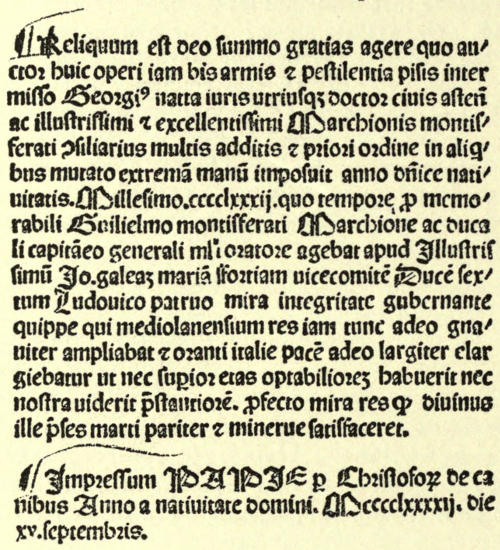
Breslau Missal. Mainz: P. Schoeffer, 1483.
II COLOPHONS AT MAINZ
Latin Bible. Mainz: Fust and Schoeffer, 1462.
It was said at the end of our first
chapter that the presence of a colophon
in an old book is to be taken
as a sign of its printer’s pride in his
work. This being so, it would seem
only reasonable to expect that the
very earliest books of all, the books
in which the new art made its first
appearance before the book-buying world, should be
found equipped with the most communicative of colophons,
telling us the story of the struggles of the inventor,
and expatiating on the greatness of his triumph.
As every one knows, the exact reverse of this is the
case, and a whole library of monographs and of often
bitterly controversial pamphlets has been written for the
lack of the information which a short paragraph apiece
in three of the newly printed books could easily have
given. What was the reason of this strange silence we
are left to guess. It will be thought noteworthy, perhaps,
that all three of these too reticent books are Latin Bibles—the
42-line Bible variously assigned to Gutenberg and
to Fust and Schoeffer, the 36-line Bible variously assigned
to Gutenberg and Pfister, and the 48-line Bible known
to have proceeded from the press of Johann Mentelin of
Strassburg. It is indeed a curious fact, and it is surprising
that the folly of Protestant controversialists has not leapt
at it, that not merely these three but the great majority
of Latin Bibles printed before 1475 are completely silent
as to their printers, place of imprint, and date. Of the
fourteen editions which in the catalogue of the British
Museum precede that which Franciscus de Hailbrun and
Nicolaus of Frankfort printed at Venice in 1475, only
three reveal their own origin—those printed at Mainz by
Fust and Schoeffer in 1462 and by Schoeffer alone ten
years later, and the edition of 1471, printed by Sweynheym
and Pannartz at Rome. On the other hand, the
three editions printed before 1462, as well as those of Eggestein
and the “R-printer” at Strassburg and of Ruppel
and Richel at Basel, are all anonymous. We might
imagine that there was a fear that the natural conservatism
of the church would look askance at the new art, and
that therefore in printing the Bible it was thought best to
say nothing about it. But, as a matter of fact, it was not
only in their Bibles that these printers showed their reticence.
Gutenberg never put his name in any book at all.
Bertold Ruppel never dated one; Eggestein dated nothing
till 1471, Mentelin nothing till 1473, Richel nothing
till 1474. Most of their books are anonymous.
When we remember that Mentelin was printing at Strassburg,
a city with which Gutenberg had many relations,
as early as 1458, and Eggestein not long after; that Ruppel
was Gutenberg’s servant and Richel was Ruppel’s
partner and successor, it would almost seem as if all this
reticence were part of a distinct Gutenberg tradition, an
attempt to keep the new art as secret as possible, either in
order to lessen competitors and keep up prices, or (to take
another alternative) because some of these printers may
have broken promises of secrecy imposed on them with
this object, and were thus less anxious to advertise themselves.
In strong contrast to the almost furtive behavior of
this group of printers is the insistent glorification of themselves
and the new art by Johann Fust the goldsmith and
Peter Schoeffer the scribe, his son-in-law. The contrast
is so great that it must certainly be reckoned with by
those who hold that to Fust and Schoeffer must be
assigned the production of the anonymous 42-line Bible,
though in the tangled relations of the Mainz printers
about 1454 there may have been reasons for silence at
which we cannot guess. As printers in their own names
the known career of Fust and Schoeffer begins with the
publication, in 1457, of the famous Psalter in which we
find our first colophon:
Presens spalmorum [sic for psalmorum] codex venustate capitalium
decoratus Rubricationibusque sufficienter distinctus,
Adinuentione artificiosa imprimendi ac caracterizandi absque
calami vlla exaracione sic effigiatus, Et ad eusebiam dei industrie
est consummatus, Per Johannem fust ciuem maguntinum,
Et Petrum Schoffer de Gernszheim Anno domini Millesimo.cccc.lvij
In vigilia Assumpcionis.
The present copy of the Psalms, adorned with beauty of capital
letters, and sufficiently marked out with rubrics, has been thus
fashioned by an ingenious invention of printing and stamping
without any driving of the pen, And to the worship of God has
been diligently brought to completion by Johann Fust, a citizen
of Mainz, and Peter Schöffer of Gernsheim, in the year of the
Lord 1457, on the vigil of the Feast of the Assumption.
A few notes on some of the words in this colophon may
be offered. “Codex,” which has been paraphrased
“copy,” meant originally a collection of tablets waxed
over for writing on, and so any book in which the leaves
are placed one on another instead of being formed into a
roll. “Capital letters” must be understood of large initials,
not merely, as the phrase is often used to mean,
majuscules, or “upper-case” letters. “Adinventio” appears
to mean simply invention, and not, as with our
knowledge of stories of “prefigurements” of printing
in Holland afterward completed in Germany we might
be inclined to think, the perfecting of an invention. The
epithet “artificiosa” probably only means skilful, without
emphasizing the contrast between the artificial methods
of printing as compared with the natural use of the
hand. About “caracterizandi” it is not easy to feel quite
sure. Does it complete “imprimendi” by adding to the
idea of pressing the further idea of the letter (χαρακτήρ)
impressed, or is “imprimendi” already fully equivalent
to printing, while “caracterizandi” refers to engraving
the letters on the punches? Lastly, it may be noted that
in calamus, “reed,” and exaratione, “plowing up,” which
properly refers to the action of the “stilus” of bone or
metal on the waxed surface of a tablet, we have reference
to two different methods of writing, one or other of
which must necessarily be slurred. Not all colophons
present so many small linguistic difficulties as this, but
few are wholly without them, and many of the renderings
which will be offered in ensuing chapters must be
accepted merely as the best paraphrases which could be
attained.
This first colophon was repeated by Fust and Schoeffer
with very slight alterations in the Psalter of 1459 (in
which were added the words “et honorem sancti iacobi,”
“and to the honour of S. James,” the patron of the Benedictine
monastery at Mainz, for whose use the edition
was printed), in the “Durandus” of the same year, the
Clementine Constitutions published in 1460, and the
Bible of 1462.
Meanwhile, in 1460, there had been published at
Mainz an edition of the “Catholicon,” a Latin dictionary
compiled by Joannes Balbus of Genoa, a Dominican
of the thirteenth century. The colophon to this book,
instinct with religious feeling and patriotism, and interesting
for its pride in the new art and use of some technical
terms, yet lacks the one important piece of information
which we demand from it—the name of the printer.
Altissimi presidio cuius nutu infantium lingue fiunt diserte,
Quique numerosepe paruulis reuelat quod sapientibus celat,
Hic liber egregius, catholicon, dominice incarnacionis annis
Mcccclx Alma in urbe maguntina nacionis inclite germanice,
Quam dei clemencia tam alto ingenij lumine, donoque gratuito,
ceteris terrarum nacionibus preferre, illustrareque dignatus est,
Non calami, stili, aut penne suffragio, sed mira patronarum formarumque
concordia proporcione et modulo, impressus atque
confectus est.
Hinc tibi sancte pater nato cum flamine sacro
Laus et honor domino trino tribuatur et uno
Ecclesie laude libro hoc catholice plaude
Qui laudare piam semper non linque mariam.
Deo Gracias.
Balbus. Catholicon. Mainz: [J. Gutenberg,] 1460.
By the help of the Most High, at Whose will the tongues of
infants become eloquent, and Who ofttimes reveals to the
lowly that which He hides from the wise, this noble book,
Catholicon, in the year of the Lord’s Incarnation 1460, in the
bounteous city of Mainz of the renowned German nation, which
the clemency of God has deigned with so lofty a light of genius
and free gift to prefer and render illustrious above all other nations
of the earth, without help of reed, stilus, or pen, but by the
wondrous agreement, proportion, and harmony of punches and
types, has been printed and finished.
Hence to Thee, Holy Father, and to the Son, with the Sacred Spirit,
Praise and glory be rendered, the threefold Lord and One;
For the praise of the Church, O Catholic, applaud this book,
Who never ceasest to praise the devout Mary.
Thanks be to God.
In addition to the “Catholicon,” the British Museum
possesses three books in the same type, which are, therefore,
ascribed to the same press—a “Tractatus racionis et
conscientiae” of Matthew of Cracow, and two editions
of the “Summa de articulis fidei” of S. Thomas Aquinas;
but these, perhaps because they are only little books,
have no printer’s colophon. On November 4, 1467, a
Latin-German vocabulary known as the “Vocabularius
Ex Quo” was finished at Eltville, near Mainz, by Nicolaus
Bechtermünze and Wigandus Spiess of Ortenberg,
having been begun by Heinrich Bechtermünze, brother
of Nicolaus. It is printed in the same type as the
“Catholicon,” reinforced by some slight additions, and
it is noteworthy (as illustrating what we may call the hereditary
or genealogical feature which runs through
many colophons) that in taking over the type used in
the “Catholicon,” part of the wording of its colophon
was taken over also, though a few words appear to be
borrowed from Fust and Schoeffer. To show this we
may quote the colophon to the 1467 “Vocabularius”
as transcribed by Mr. Hessels (“Gutenberg: was he the
inventor of printing?” p. 141):
Presens hoc opusculum non stili aut penne suffragio sed noua
artificiosaque invencione quadam ad eusebiam dei industrie
per henricum bechtermuncze pie memorie in altauilla est inchoatum
et demum sub anno domini M.cccc.l.xvij ipso die
leonardi confessoris, qui fuit quarta die mensis nouembris, per
nycolaum bechtermuncze fratrem dicti henrici et wygandum
spyesz de orthenberg est consummatum.
Hinc tibi sancte pater nato cum flamine sacro
Laus et honor domino trino tribuatur et uno:
Qui laudare piam semper non linque mariam.
This present little work, not by the help of stilus or pen, but
by a certain new and skilful invention to the worship of God,
was diligently begun at Eltville by Heinrich Bechtermünze of
pious memory, and at last, in the year of the Lord 1467, on
the day of Leonard the Confessor, which was on the fourth day
of the month of November, by Nicolaus Bechtermünze, brother
of the said Heinrich, and Wigandus Spiess of Orthenberg, was
brought to completion.
Hence to Thee, Holy Father, and to the Son, with the Sacred Spirit,
Praise and glory be rendered, the threefold Lord and One.
O thou who never ceasest to praise the devout Mary.
The omission of the third line of the “Catholicon”
quatrain, obviously because the word “Catholice” no
longer had especial import, makes the construction even
more mysterious than in the original, nor is this the only
instance we shall find of such mauling.
While the Eltville colophon thus mainly takes its
phrasing from that of the “Catholicon,” with a few
words from Fust and Schoeffer’s thrown in, the latter
firm were themselves not above borrowing a happy
phrase, since in the “Liber Sextus Decretalium Bonifacii
VIII” not only do we find an antithesis introduced
to the “artificiosa adinuentio,” but in some copies, if
Maittaire is to be trusted, the praise of Mainz is bodily
taken over, so that the full colophon now reads:
Presens huius Sexti Decretalium preclarum opus alma in urbe
Maguntina inclyte nacionis germanice, quam dei clemencia tam
alti ingenii lumine donoque gratuito ceteris terrarum nacionibus
preferre illustrareque dignatus est, non atramento plumali canna
neque aerea, sed artificiosa quadam adinuentione imprimendi
seu caracterizandi sic effigiatum et ad eusebiam dei industrie est
consummatum per Iohannem Fust ciuem et Petrum Schoiffher
de Gernsheim. Anno domini M.cccclxv. die uero xvii mensis
Decembris.
The present splendid edition of this sixth book of Decretals,
in the bounteous city of Mainz of the renowned German nation,
which the clemency of God has deigned with so lofty a light of
genius and free gift to prefer and render illustrious above all
other nations of the earth, has been thus fashioned not by ink
for the pen nor by a reed of brass, but by a certain ingenious invention
of printing or stamping, and to the worship of God diligently
brought to completion by Johann Fust, a citizen of Mainz,
and Peter Schoiffher of Gernsheim, in the year of the Lord 1465,
and on the 17th day of December.
By this time even a patient reader may well be weary
with this ringing of the changes on the two colophons
first printed, respectively, in 1457 and 1460. But, without
pushing the suggestion too far, we may at least hazard
a guess as to how they came thus to be amalgamated in
December, 1465. For it was in this year that Gutenberg,
who, when all is said, is the most probable printer
for the “Catholicon” and the other books which go
with it, became a pensioner of Adolph II, Archbishop of
Mainz, and presumably gave up printing. The two small
books in the “Catholicon” type (i.e. the “Tractatus
racionis et conscientiae” and the “De articulis fidei”)
appear in Schoeffer’s catalogue of 1469-70. Whether
he bought the stock of them as early as 1465 cannot be
proved, but it would seem reasonable to connect his
taking over the “Catholicon” colophon in that year
with the disappearance of Gutenberg from any kind of
rivalry. As between printers in different cities, there was
certainly no copyright in colophons any more than there
was in books. We shall see presently how, when books
of Schoeffer’s were reprinted at Nuremberg and Basel,
his colophons, with slight alterations, were taken over
with them. But in Germany at this time, between citizens
of the same town, trade rights, I fancy, were much
more respected than at Venice, for instance, or at Paris,
where the editions of Caesaris and Stoll were impudently
pirated by two other firms in the very same street.
At all events, it is worth noticing that the “Catholicon”
printer’s colophon seems to have been taken over by
Schoeffer, who bought some of his stock, and by the
brothers Bechtermünze, who had the use of his types.
Passing now to other of Schoeffer’s colophons, we find
in the edition of the “Officia et Paradoxa” of Cicero of
this same year, 1465, a more personal form of the colophon,
which gives us an explicit statement that Fust, the
capitalist of the business, probably owing to failing health,
now left the actual superintendence of the printing to
his son-in-law Schoeffer, the quondam scribe. It runs:
Cicero. De Officiis. Mainz: Fust and Schoeffer, 1465.
“Presens Marci tulii clarissimum opus Iohannes Fust
Moguntinus ciuis, non atramento plumali, canna neque
aerea, sed arte quadam perpulcra, Petri manu pueri mei
feliciter effeci finitum, Anno 1465.” This statement, that
“I, Johann Fust, citizen of Mainz, completed the book
by the labor or instrumentality (manu) of my son Peter,”
was repeated in the reprint of February 4, 1466, and
thenceforth the name of Fust disappears from the annals
of printing.
In 1467 we find the colophon attributed by Maittaire
to some copies of the “Sextus Decretalium” repeated
(with the omission of Fust’s name) in the “Secunda Secundae”
of S. Thomas Aquinas and the second edition of
the Clementine Constitutions, and this became for some
time Schoeffer’s normal colophon. In 1470, however, he
varied it in his edition of S. Jerome’s Epistles in order
to introduce a compliment paid by the saint to the city
of Mainz, which made it peculiarly appropriate that his
work should be popularized by a Mainz printer. This
colophon runs:
[I]gitur Sophronii Eusebii Ieronimi orthodoxi, Ecclesie Christi
propugnatoris clarissimi, Liber Ieronimianus, aut si mauis, quod
et ipse velim, Liber Epistolaris explicit, ut dignitas nominis
Ieronimiani egregio viro Johanni Andree permaneat, qui hoc
ipsum zelo deuotionis erga virum sanctum affectus tempore
prisco vulgauit in orbem. Est autem presens opus arte impressoria
feliciter consummatum per Petrum schoiffer de Gernsshem
in ciuitate nobili Moguntina. Cuius nobilitati vir beatus
Ieronimus scribens ad Agerutiam de monogamia testimonium
perhibet sempiternum multis milibus incolarum eiusdem in ecclesia
pro fide catholica sanguine proprio laureatis.
Huic laudatori reddit moguntia vicem,
Tot sua scripta parans usibus ecclesie.
Anno domini M.cccc.lxx. Die septima mensis septembris que
fuit vigilia natiuitatis Marie. Da gloriam Deo.
S. Jerome’s Epistles. Mainz: P. Schoeffer, 1470.
Thus of Sophronius Eusebius Hieronimus [i.e., S. Jerome],
the Orthodox, the most renowned champion of the Church of
Christ, there comes to an end the book called after him Hieronominian,
or if you prefer it the Book of his Epistles, the
title I myself should wish to give it in order that the honor of
the title Hieronimian may be reserved for the illustrious Johannes
Andreae, who in olden time published to the world this
very work from the zeal of his devotion to the holy man.
Now the present work by the printing art has been happily
brought to completion by Peter Schoiffer of Gernsheim in the
noble city of Mainz, as to whose nobility the blessed man Jerome,
writing to Agerutia concerning monogamy, bears eternal
witness to the many thousands of its inhabitants who with their
own blood have won crowns of laurel in the church for the catholic
faith.
Printing the words of him who gave this praise,
Mainz helps the church the while her debt she pays.
In the year of the Lord 1470, on the seventh day of September,
which was the vigil of the Nativity of Mary. Give glory to God.
In 1472, in the “Decretum Gratiani cum glossis,” we get
another variant and an addition of some importance:
Anno incarnationis dominice 1472 idibus Augustiis, sanctissimo
in Christo patre ac domino domino Sixto papa quarto pontifice
maximo illustrissimo, nobilissime domus austrie Friderico, Romanorum
rege gloriosissimo, rerum dominis, Nobili nec non
generoso Adolpho de Nassau archiepiscopatum gerente maguntinensem,
in nobili urbe Moguntia que nostros apud maiores Aurea
dicta, quam diuina etiam clementia dono gratuito pre ceteris
terrarum nationibus arte impressoria dignata est illustrare, hoc
presens Gratiani decretum suis cum rubricis, non atramentali
penna cannaue, sed arte quadam ingeniosa imprimendi, cunctipotente
adspiranti deo, Petrus Schoiffer de Gernsheym suis consignando
scutis feliciter consummauit.
A similar colophon was used in the “Nova compilatio
Decretalium Gregorii IX” of 1473, and the phrase
“suis consignando scutis” occurs again in Schoeffer’s
edition of S. Bernard’s Sermons (1475) and in several
books of the three following years. In 1479, in an edition
of the “Decretals of Gregory IX,” the phrase is varied
to “cuius armis signantur,” after which Panzer records
it no more. This first mention of the shields has
for us far more interest than the pompous recital of how
Sixtus IV was pope, and Frederick of Austria king of the
Romans, and Adolph of Nassau archbishop of Mainz
when this “Decretal of Gratian” was printed “in the
noble city of Mainz, which our ancestors used to call the
golden city, and which has been so highly favored by
its preëminence in printing.” Needless discussions have
been raised as to what was the use and import of printers’
devices, and it has even been attempted to connect them
with literary copyright, with which they had nothing
whatever to do, literary copyright in this decade depending
solely on the precarious courtesy of rival firms, or
possibly on the rules of their trade-guilds. But here,
on the authority of the printer who first used one, we
have a clear indication of the reason which made him
put his mark in a book—the simple reason that he was
proud of his craftsmanship and wished it to be recognized
as his. “By signing it with his shields Peter Schoiffer
has brought the book to a happy completion.” When
Wenssler of Basel copied Schoeffer’s books, he copied
him also in affixing their marks and in drawing attention
to them in the same way. Wenssler, too, was a good
printer, and though he was certainly not claiming copyright
in books which he was simply reprinting, he was
equally anxious to have his handiwork recognized.
If yet further evidence be wanted, we can find it in
the colophon to Schoeffer’s 1477 edition of the “Tituli
Decisionum antiquarum et nouarum,” which reads as
follows:
Anno domini M.cccc.lxxvij. pridie nonis Ianuariis graui labore
maximisque impensis Romanam post impressionem opus iterum
emendatum: antiquarum nouarumque decisionum suis cum additionibus
dominorum de Rota: In ciuitate Maguntina impressorie
artis inuentrice elimatriceque prima Petrus Schoyffer de
Gernssheym suis consignando scutis arte magistra; feliciter finit.
Some other features which occur in the wording of this
will be noted later on. For our present purpose it is of
interest to find the mark of the shields attached to a book
which is distinctly stated to have been printed “Romanam
post impressionem,” “after the edition printed at Rome,”
and for which, therefore, no literary copyright is conceivable.
In the 1473 reprint of the “Sextus Decretalium” we
note that Schoeffer now considered himself venerable, or
perhaps it would be fairer to say “worshipful” (“per venerandum
virum Petrum schoiffer de Gernshem feliciter
est consummatum”), but in his edition of S. Augustine’s
“De Ciuitate Dei,” of the same year, we find a more important
variant. This reads:
Igitur Aurelii Augustini ciuitatis orthodoxe sideris prefulgidi
de ciuitate Dei opus preclarissimum, binis sacre pagine professoribus
eximiis id commentantibus rubricis tabulaque discretum
precelsa in urbe moguntina partium Alemanie, non calami per
frasim, caracterum autem apicibus artificiose elementatum, ad
laudem Trinitatis indiuidue, ciuitatis dei presidis, operose est
consummatum per Petrum schoiffer de gernsheim. Anno
domini M.cccc.lxxiij. die v. mensis septembris. Presidibus ecclesie
catholice Sixto tercio pontifice summo Sedi autem moguntine
Adolfo secundo presule magnifico. Tenente autem ac
gubernante Christianismi monarchiam Imperatore serenissimo
Frederico tercio Cesare semper augusto.
Thus the most renowned work of Aurelius Augustinus, a shining
star of the city of orthodoxy, the De Ciuitate Dei, with the
notes of two distinguished professors of Biblical Theology, set
out with rubrics and index, in the exalted city of Mainz of the
parts of Germany, not by the inditing of a reed, but skilfully put
together from the tips of characters, to the praise of the undivided
Trinity, ruler of the City of God, has been toilfully brought to
completion by Peter Schoiffer of Gernsheim, in the year of the
Lord 1473, on the fifth day of the month of September, the
catholic church being under the rule of Sixtus III as supreme
pontiff, and the see of Mainz under that of the magnificent patron
Adolf II, while the most serene Emperor Frederick III, Caesar
Augustus, held and guided the monarchy of Christendom.
The struggles of the fifteenth-century Latinists to express
the technicalities of printing are always interesting, and
the phrase “caracterum apicibus elementatum” is really
gallant. Following the Greek στοιχεῖα, the Romans
used the word “elementa” originally for the component
sounds of speech and then, by transference, for the letters
of the alphabet. “Elementatum,” therefore, is strictly
appropriate, and might be rendered “with the letters built
up or put together,” while “caracterum apicibus” of
course refers to the engraving in relief which forms the
face of the type.
In 1475, perhaps as an echo of some verses in the
“Noua compilatio Decretalium Gregorii IX” of 1473,
we find a new phrase tacked on to the “arte impressoria”
in an edition of Justinian, noting the fact that though
Providence did not consider antiquity worthy of the art,
it had been granted to our times (“qua quidem etsi antiquitas
diuino non digna est visa indicio, nostra nichilominus
tempestate indulta”). In 1476 again Schoeffer
advertises that his edition of Justinian’s Institutes was
printed “in the noble city of Mainz am Rhein, the inventress
and first perfectress of the printing art” (“In nobili
urbe Maguncia Rheni, impressorie artis inuentrice elimatriceque
prima”), while in the Clementine Constitutions
of the same year he substitutes “alumnaque” for “elimatriceque,”
presumably in the sense of pupil or practiser,
reverting subsequently to “elimatrice.” In 1478 he once
more varies the praises of Mainz by calling her “domicilium
Minerve firmissimum,” “the most stable home of
Minerva.” With this year 1478, which closes the period
of Schoeffer’s chief activity, we may bring our survey of
his colophons to an end. Thereafter he printed more
intermittently, and, if the absence of colophons may be
trusted, as I think it may, with less interest in his work.
But during these twenty-two years from 1457 to 1478,
inclusive, he had made his books bear continual testimony
to one great fact, that the art of printing had been invented
and brought to perfection in Germany, in the city of
Mainz; and in any weighing of the comparative claims
that have been advanced on behalf of Germany and Holland,
I think that the evidence of Schoeffer’s colophons
alone would suffice to give the priority to Germany and
Mainz.
Of the clearness and energy of the claim made in
these Mainz colophons, we have already given abundant
illustration, nor can there be any doubt that it
obtained wide publicity. Schoeffer printed at least one
advertisement of his books, and he had an agency for their
sale in Paris. Besides this, his editions were copied by
other printers. So far as publicity could be insured in the
fifteenth century, it was insured by Schoeffer, aided by
the printer of the “Catholicon,” for the statement that
printing was invented at Mainz; and despite the rivalry
between city and city, and between country and country,
during all the years that this assertion was being repeated
in one colophon after another, no printer in any other
book ventured to challenge it. No doubt there are facts
on the side of Holland which have to be explained as
best we may, but in the face of these Mainz colophons
the explanation must be of such a kind as to leave undisputed
the fact that it was at Mainz that printing with
movable types—“mira patronarum formarumque concordia
proporcione et modulo”—first became a practicable
art. On the other hand, as to the individual inventor
of this art the fifteenth-century colophons are
absolutely silent. There is nothing in any Mainz colophon
answering to the boast of John of Speier at Venice,
“primus in Adriaca formis impressit aenis,” by which he
asserted his individual priority over any other firm. The
only statement of the kind is in the extraordinarily
crabbed verses added by the corrector Magister Franciscus,
after the colophon, to the “Institutiones Justiniani”
of 1468, and reprinted in that of 1472, and in the
Decretals of 1473, but omitted in 1476. This states that
two Johns, both of whom the town of Mainz produced
(genuit), were the renowned first stampers of books
(librorum insignes protocaragmaticos), and that with
them was associated a Peter; and the natural interpretation
of these allusions identifies the “protocaragmatici”
(though the “proto” may refer to preëminence quite
as well as to priority) with Johann Gutenberg, Johann
Fust, and Peter Schoeffer.
So far as they are intelligible, therefore, these verses in
the Institutes of Justinian confirm and extend the evidence
of the colophons, and may be cheerfully accepted.
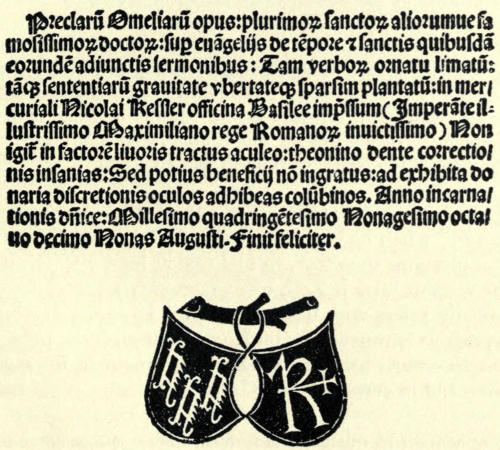
Our last colophon in this chapter is not quite in the same
case. This famous and ingeniously arranged addendum
to the edition of the “Compendium de Origine regum
et gentis Francorum” of Johann Tritheim, printed by
Johann Schoeffer at Mainz in 1515, is shown as one of
our illustrations, but may nevertheless be transcribed
here for the sake of expanding its contractions:
Impressum et completum est presens chronicarum opus, anno
domini MDXV. in uigilia Margaretae uirginis. In nobili famosaque
urbe Moguntina, huius artis impressorie inuentrice
prima. Per Ioannem Schöffer, nepotem quondam honesti uiri
Ioannis Fusth, ciuis Moguntini, memorate artis primarii auctoris.
Qui tandem imprimendi artem proprio ingenio excogitare
specularique coepit anno dominice natiuitatis M.CCCC.L. indictione
XIII. Regnante illustrissimo Romanorum imperatore
Frederico III, praesidente sanctae Moguntinae sedi Reuerendissimo
in Christo patre domino Theoderico pincerna de Erpach,
principe electore. Anno autem M.CCCC.LII. perfecit
deduxitque eam (diuina fauente gratia) in opus imprimendi, opera
tamen ac multis necessariis adinuentionibus Petri Schöffer de
Gernsheim ministri suique filii adoptiui, cui etiam filiam suam
Christinam Fusthinn, pro digna laborum multarumque adinuentionum
remuneratione nuptui dedit. Retinuerunt autem
hii duo iam praenominati, Ioannes Fusth et Petrus Schöffer,
hanc artem in secreto (omnibus ministris ac familiaribus eorum,
ne illam quoquo modo manifestarent, iureiurando astrictis)
Quo tandem de anno domini M.CCCCLXII per eosdem familiares
in diuersas terrarum prouincias diuulgata haud parum
sumpsit incrementum.
Cum gratia et priuilegio Caesaree Maiestatis iussu et impensis
honesti Ioannis Haselperg ex Aia maiore Constantiensis
dioecesis.
This may be rendered:
The present historical work has been printed and completed in
the year of the Lord 1515, on the vigil of Margaret, virgin,
in the noble and famous city of Mainz, first inventress of this
printing art, by John Schöffer, grandson of a late worthy man,
John Fust, citizen of Mainz, foremost author of the said art,
who in due course by his own genius began to think out and
investigate the art of printing in the year of the Lord’s nativity
1450, in the thirteenth indiction, in the reign of the most illustrious
Emperor of the Romans Frederick III, and when the
most reverend father in Christ, Theoderic the cup-bearer, of
Erbach, prince-elector, was presiding over the sacred see of
Mainz, And in the year 1452 perfected and by the favor of divine
grace brought it to the work of printing, by the help, however,
and with many necessary inventions[2] of Peter Schöffer of
Gernsheim, his workman and adoptive son, to whom also he
gave his daughter Christina Fust in marriage as a worthy reward
of his labors and many inventions.[2] And these two already
named, Ioannes Fust and Peter Schöffer, kept this art secret,
all their workmen and servants being bound by an oath not in
any way to reveal it; but at last, from the year of the Lord 1462,
through these same servants being spread abroad into divers
parts of the world, it received no small increase.
With the favor and privilege of the Imperial Majesty and
at the command and expense of the worthy John Haselperg of
Reichenau of the diocese of Constance.
It would be too much to call this colophon untruthful,
inasmuch as the term “primarius auctor,” like “protocaragmaticus,”
does not necessarily claim primacy in
point of time; nevertheless, it certainly suggests this
primacy and generally assigns to Fust a more decisive
part than we can easily believe that he played. We need
not censure too hardly John Schoeffer’s family feeling,
even though it led him to ignore Gutenberg in a way
which earlier testimony forbids us to believe to be just;
but it seems evident that family feeling was so much to
the fore as to place this long historical colophon on quite
a different footing from that of the earlier ones written by
Schoeffer himself.
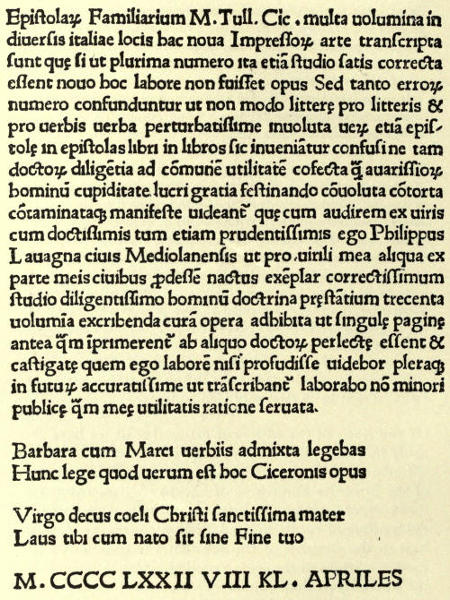
III COLOPHONS AT VENICE
While to Mainz belongs the supreme
credit of having brought
printing to the position of a
practical art, the city in which it
attained its highest perfection and
popularity in the fifteenth century
was undoubtedly Venice. The
output from the Venetian presses
represented some forty per cent. of the entire book production
of Italy, and its quality was at least as remarkable
as its quantity. It is natural, therefore, to turn from
Mainz to Venice in our quest for interesting colophons,
as wherever printers did good work and took pride in it
we may expect to find correspondingly good colophons.
Certainly at Venice we have no ground for disappointment
in this respect. The Venetian colophons are plentiful
and full of information, though chiefly about the
publisher’s side of printing. What makes them a little
alarming to the pedestrian editor is that so many of the
earliest and most interesting specimens are in verse. The
books most favored by the first Venetian printers were
editions of the Latin classics and Latin translations of the
Greek ones. To see these through the press each printer
had to retain the services of a corrector, who filled a position
half-way between the modern proof-reader’s and
editor’s. The printers, not being able to write Latin
themselves with any fluency, naturally left their colophons
in the hands of their correctors, and these gentlemen
preferred to express themselves in verse. The verse,
even allowing for the fact that it is generally intended
to be scanned by accent rather than quantity, is often of
a kind which would get an English school-boy into considerable
trouble; and it would be a nice question as to
whether Omnibonus Leonicenus and Raphael Zovenzonius,
who wrote it for John and Wendelin of Speier;
Antonius Cornazanus, who was in the pay of Jenson; or
Valdarfer’s corrector, Lodovicus Carbo, should be held
the most successful. Just, however, because its poetic ornaments
are commonplace, to render this verse into prose
seems more than usually unsportsmanlike. Good poetry
can stand the test of prose, and the poetaster meddles with
it at his peril, as witness the uniform inferiority of metrical
renderings of the Psalms to the prose of the Great Bible
or Prayer-Book version. But mediocre poetry when
turned into prose becomes simply ridiculous, and so the
present translator, without reckoning himself as even a
“minimus poeta,” has wrestled manfully with these various
verse colophons and “reduced” them, as best he could,
into English rhymes, since these, poor as they are, misrepresent
the originals less than any attempt he could make
in prose. Here, then, without more apology, are the
colophons from the earliest Venetian books, which fall
into an interesting sequence.
The first printer at Venice, it will be remembered, was
John of Speier, who obtained a special privilege for his
work which would have cramped the whole craft at
Venice had not his death removed the difficulty. In his
first book, an edition of Cicero’s “Epistolae ad Familiares,”
printed in 1469, the colophon is cast into these
verses:
Cicero. Epistolae ad Familiares. Venice: John of Speier, 1469.
Primus in Adriaca formis impressit aenis
Vrbe Libros Spira genitus de stirpe Iohannes.
In reliquis sit quanta uides spes, lector, habenda,
Quom labor hic primus calami superauerit artem.
M.CCCC.LXVIIII.
In Adria’s town, one John, a son of Speier,
First printed books by means of forms of brass.
And for the future shall not hope rise higher
When the first fruits the penman’s art surpass?
1469.
Of this first Venetian edition of Cicero’s letters we know
from a subsequent colophon that only one hundred copies
were printed, one twenty-fifth part of the whole edition
now being preserved in the four copies at the British
Museum. It was obviously sold out very rapidly, and in
some three or four months’ time the printer had got out a
second edition, to which he added a new colophon.
Cicero. Epistolae ad Familiares. Second Edition.
Venice: John of Speier, 1469.
Speier befriends Venice: twice in four months has he
Printed this Cicero, in hundreds three.
1469.
The puzzle here is to determine how many copies there
were of the second edition. Mr. Horatio Brown, in
“The Venetian Printing Press” (p. 10), courageously asserts
that “the second edition of the Epistulae consisted
of six hundred copies, published in two issues of three
hundred each; and that the whole six hundred took four
months to print.” This is clearly inadmissible, as everything
we know of fifteenth-century printing forbids us to
suppose that John of Speier kept the whole book standing
in type and printed off a second “issue” when he
found there was a demand for it. The fourth month must
be reckoned from the date of the first edition, and we have
to choose, as to the number of copies in the second, between
supposing that the three hundred, the “tercentenum
opus,” refers to this alone, and that the poet did
not intend to make any statement about the number of
the first edition at all, or else that the second edition consisted
of two hundred copies, and that these, with the
hundred of the first, made up a total of three hundred.
In either case his language is ambiguous, as the language
of poets is apt to be when they try to put arithmetic into
verse.
I have followed Mr. Proctor in making the second edition
of Cicero’s letters precede the Pliny, but—as, in
common with many other students of old books, I am
made to feel daily—to be no longer able to go to him for
information is a sore hindrance. I should have thought
myself that the Pliny, a much larger book, was begun
simultaneously with the first edition of Cicero, and that
Wendelin’s colophon to the “De Civitate Dei” obliged
us to link the Pliny with the first rather than the second
edition. Perhaps, however, this arithmetic in verse is
once more a little loose. Certainly the Pliny colophon,
which is free from figures, is all the better poetry for that
reason. It is the book here that speaks:
Plinius. Historia Naturalis. Venice: John of Speier, 1469.
Quem modo tam rarum cupiens vix lector haberet,
Quique etiam fractus pene legendus eram:
Restituit Venetis me nuper Spira Ioannes:
Exscripsitque libros aere notante meos.
Fessa manus quondam moneo: calamusque quiescat,
Namque labor studio cessit: et ingenio.
M.CCCC.LXVIIII.
I, erst so rare few bookmen could afford me,
And erst so blurred that buyers’ eyes would fail—
To Venice now ’twas John of Speier restored me,
And made recording brass unfold my tale.
Let rest the tired hand, let rest the reed:
Mere toil to zealous wits the prize must cede.
1469.
The aspersion on the scribes was undeserved. If truth be
told, either because they used too thin an ink, or else from
too slight pressure, the early Venetian printers seldom
did full justice to their beautiful types; and though their
vellum copies are really fine, those on paper are no easier
to read than the average fifteenth-century manuscripts
which they imitated. We must, however, forgive John
of Speier his little boastings, as this was the last colophon
he was to print; and our next, which comes at the end
of S. Augustine’s “De Civitate Dei,” contains his epitaph:
Qui docuit Venetos exscribi posse Ioannes
Mense fere trino centena uolumina Plini
Et totidem magni Ciceronis Spira libellos,
Ceperat Aureli: subito sed morte peremptus
Non potuit ceptum Venetis finire uolumen.
Vindelinus adest, eiusdem frater et arte
Non minor, Adriacaque morabitur urbe.
M.CCCC.LXX.
John, who taught Venice there might written be
A hundred Plinys in months barely three,
And of great Cicero as many a book,
Began Augustine, but then death him took,
Nor suffered that he should Venetians bless
Finishing his task. Now Wendelin, no less
With skill equipped, his brother, in his room
Means to take Adria’s city for his home.
1470.
The business which thus passed into his hands was certainly
carried on by Wendelin vigorously, for during the
next three years he turned out over a dozen folios or large
quartos a year. He seems, indeed, to have outrun his
resources, for as early as 1471 his colophons tell us that
some of his books were financed for him by John of Cologne,
and after the summer of 1473 his type passed into
the possession of this John and his “very faithful partner,
Johann Manthen.” As Wendelin’s name disappears
from colophons for three years, it is probable that his services
were taken over with his types; in 1470, however, he
was his own master and the object of much praise from
his colophon-writer. In his Sallust of this year we read:
Quadringenta dedit formata volumina Crispi
Nunc, lector, Venetis Spirea Vindelinus.
Et calamo libros audes spectare notatos
Aere magis quando littera ducta nitet?
To Venice Wendelin, who from Speier comes,
Has given of Sallust twice two hundred tomes.
And who dare glorify the pen-made book,
When so much fairer brass-stamped letters look?
The Livy of the same year ends with a poem of forty-six
lines, which praises Wendelin for bravely rescuing such
of Livy’s Decads as remained, “saevis velut hostibus acri
Bello oppugnatas,” and by multiplying copies saving
them from the fate which had befallen the rest. A poem
like this, however, must be reckoned rather with congratulatory
verses than as a colophon, though the line in
these Venetian books is not always easy to draw. Two
more of Wendelin’s publications in 1470 may be pressed
into our service—a Virgil and a Petrarch. Of these the
Virgil ends:
Progenitus Spira formis monumenta Maronis
Hoc Vindelinus scripsit apud Venetos.
Laudent ergo alii Polycletos Parrhasiosue
Et quosuis alios id genus artifices:
Ingenuas quisquis Musarum diligit artes
In primis ipsum laudibus afficiet:
Nec vero tantum quia multa uolumina, quantum
Quod perpulchra simul optimaque exhibeat.
M.CCCC.LXX.
Wendelin of Speier these records of the art
Of Maro now to Venice doth impart.
Let some of Polycletus praise the skill,
Parrhasius, or what sculptor else you will;
Who loves the stainless gifts the Muses give
Will pray that Wendelin’s renown may live;
Not that his volumes make so long a row,
But rather for the grace and skill they show.
1470.
The colophon to the Petrarch claims credit for the restoration
of a true text, a point on which the scholars of
the Renaissance were as keen, up to their lights, as those
of our own day, and which is often emphasized in their
laudatory verses as the one supreme merit:
Que fuerant multis quondam confusa tenebris
Petrarce Laure metra sacrata sue,
Christophori et pariter feruens Cyllenia cura
Transcripsit nitido lucidiora die.
Vtque superueniens nequeat corrumpere tempus
En Vindelinus erea plura dedit.
The songs that Petrarch to his Laura made
With many a doubt obscure were overlaid:
Now, by Cristoforo’s and Cyllenio’s care,
Than day itself their text shall shine more fair.
Lest by corrupting time they still be tried,
Wendelin these printed copies multiplied.
In 1471 Wendelin, or his correctors, lest their inspiration
should be too hard worked, invented a simple couplet
which would apply to any book equally well.
Impressum formis iustoque nitore coruscans
Hoc Vindelinus condidit artis opus.
Printed from forms, with modest splendors bright,
This Wendelin designed to give delight.
This is found in the “Apophthegmata” of Plutarch, the
“Memorabilia” of Valerius Maximus, the “Singularia”
of Pontanus, the “Aureae Quaestiones” of Bartolus de
Saxoferrato, etc.; and must have been a welcome second
string in case of need. Nevertheless, when a second edition
of Sallust was called for, Wendelin’s private poet
was equal to the occasion, producing the quatrain:
Quadringenta iterum formata uolumina nuper
Crispi dedit Venetis Spirea Vindelinus.
Sed meliora quidem lector, mihi crede, secundo
Et reprobata minus antea quam dederat.
The verses are so incredibly bad, not merely in their entire
disregard of quantity, but in grammar as well, that
it would be pleasant to reproduce the peculiar iniquity
which makes their charm. What the writer meant to
say was something to the effect that:
Wendelin of Speier to Venice now once more
Of printed Sallusts hath given hundreds four.
But here all’s better, all may trusted be:
This text, good reader, is from errors free.
Faithfully to reëcho the discords of the original is above
the present translator’s skill.
As money troubles thickened about him, Wendelin’s
colophons became less buoyant and interesting; but in
1473, when the transfer of his business to John of Cologne
and Manthen of Gerresheim was impending, we
find these verses in one of the huge law-books in which
the early printers were so bold in investing their money—the
“Lectura Bartoli de Saxoferrato super secunda
parte Digesti Veteris”:
Finis. M. cccc. lxxiii.
Non satis est Spire: gratissima carmina Phoebo,
Musarum cantus, historiasque premi.
Omnis habet sua vota liber. Non cessat ab arte.
Has pressit leges, Iustiniane, tuas.
Spira tua est virtus Italas iam nota per urbes,
Ore tuum nomen posteritatis erit.
1473.
’Tis not enough for Speier to print the songs
That Phoebus loves, the Muses’ tales and lays:
Each book is favored. Not for rest he longs,
But thus to print Justinian’s laws essays.
Speier, now Italy’s cities know thy glory,
And future ages shall repeat the story.
When Wendelin resumed business on his own account
in 1476, he published very few books; but one of these,
the “Divina Commedia” of Dante, printed in that year,
has an Italian colophon in the ambitious form of a sonnet:
Dante. Divina Commedia. Venice: Wendelin of Speier, 1476.
Finita e lopra del inclito e diuo
Dante alleghieri Fiorentin poeta
La cui anima sancta alberga lieta
Nel ciel seren oue sempre il fia vivo.
Dimola benvenuto mai fia priuo
Deterna fama che sua mansueta
Lyra opero comentando il poeta,
Per cui il texto a noi e intellectiuo.
Christofal Berardi pisaurense detti
Opera e facto indegno correctore
Per quanto intese di quella i subietti.
De Spiera Vendelin fu il stampatore:
Del mille quattrocento e settanta setti
Correuan gli anni del nostro signore.
Here ends the work of Dante, the most high
Florentine poet, famed to every age,
Whose holy soul now finds glad harborage
(Aye may he there abide!) in heaven’s clear sky.
From Benvenuto d’Imola let none try
To wrest the credit due for comment sage
On this great poem, by which every page,
Poet himself, he helps to clarify.
Pesaro’s son, Christoph Berardi hight,
Hath all corrected, though with many a fear
Of lofty themes, hard to pursue aright.
The printer Wendelin, who from Speier came here:
And since Christ’s birth there urges now its flight
The fourteen hundred six and seventieth year.
This putting of dates into verse is sad work. In Jenson’s
early colophons, instead of dates (which are added in
prose), we have the name of the reigning doge to wrestle
with. Thus, in his edition of the “Rhetorica” and “De
Inuentione” of Cicero we find the following verse and
prose colophon:
Cicero. Rhetorica. Venice: N. Jenson, 1470.
Emendata manu sunt exemplaria docta
Omniboni: quem dat utraque lingua patrem.
Haec eadem Ienson Veneta Nicolaus in urbe
Formauit: Mauro sub duce Christoforo.
MARCI TVLLII CICERONIS ORATORIS
CLARISSIMI RHETORICORVM LIBER
VLTIMVS FELICITER EXPLICIT.
.M.CCCC.LXX.
Omnibonus with his learned hand hath these
Copies revised, skilled in two languages;
And Nicolas Jenson shaped them by his pains
At Venice, while Cristoforo Moro reigns.
The last book of the Rhetorics of Marcus Tullius Cicero, the
most renowned orator, comes happily to an end. 1470.
So again in an edition, of the same year, of the Letters
to Atticus we have a similar colophon, the poetical portion
of which might easily have led a reader to believe
that he was invited to buy a work by Atticus himself instead
of letters mainly addressed to him:
Attice, nunc totus Veneta diffunderis urbe,
Cum quondam fuerit copia rara tui.
Gallicus hoc Ienson Nicolaus muneris orbi
Attulit: ingenio daedalicaque manu.
Christophorus Mauro plenus bonitate fideque
Dux erat: auctorem, lector, opusque tenes.
MARCI T. C. EPISTOLAE AD ATTICVM BRVTVM
et Quintum fratrem, cum ipsius Attici vita feliciter expliciunt.
M.CCCC.LXX.
All Atticus is now in Venice sold,
Though copies were right rare in days of old.
French Nicolas Jenson this good gift has brought,
And all with skill and crafty hand has wrought.
Our doge, Cristoforo Moro, true and kind.
Thus book and author, reader, here you find.
The Letters of Marcus Tullius Cicero to Atticus, Brutus, and
his brother Quintus, with the life of the said Atticus, come happily
to an end. 1470.
In the next year we have to deal with the little group of
vernacular books printed by Jenson, to one of which the
omission of an X from the date in the colophon has given
such notoriety. The three which are correctly dated are:
(i) “Una opera la quale se chiama Luctus Christianorum
ex Passione Christi, zoe pianto de Christiani per la Passione
de Christo in forma de Meditatione.”
Colophon: A Christi Natiuitate Anno M.CCCCLXXI. Pridie
nonas Apriles a preclarissimo librorum exculptore Nicolao gallico.
Impressa est passio christi dulcissima.
In the year 1471 from Christ’s Nativity, on April 4th, by the
most famous engraver of books, Nicolas Jenson, there was
printed The Most Sweet Passion of Christ.
(ii) “Parole devote de lanima inamorata in Misser
Iesu.”
Colophon: MCCCCLXXI. Octauo Idus Aprilis: per
Nicolaum Ienson gallicum opusculum hoc feliciter impressum
est.
1471, April 6th, by Nicolas Jenson, a Frenchman, this booklet
was happily printed.
(iii) “Una operetta la quale si chiama Palma Virtutum
zioe triumpho de uirtude: la quale da Riegola forma et
modo a qualunque stato,” etc.
Colophon: Deo Gratias. Amen. Opus Nicolai Ienson Gallici.
M.CCCCLXXI.
Thanks be to God, Amen. The work of Nicolas Jenson, a
Frenchman. 1471.
It will be noticed that the second colophon is shorter
than the first, and it should be mentioned that in yet
another book of the same kind, the “Gloria Mulierum,”
Jenson did not trouble to put his name at all, doubtless
thinking, according to the view propounded in our first
chapter, that these little vernacular books of devotion
would bring him no particular credit. If we look now
at the book with the misprinted date, “Una opera la
quale si chiama Decor Puellarum, zoe Honore de le
Donzelle: la quale da regola forma e modo al stato de
le honeste donzelle,” we find this colophon:
Decor Puellarum. Venice: N. Jenson, 1461 for 1471.
Anno a Christi Incarnatione MCCCCLXI per Magistrum
Nicolaum Ienson hoc opus quod Puellarum Decor dicitur feliciter
impressum est. Laus Deo.
In the year from Christ’s Incarnation 1461, by Master Nicolas
Jenson, this book, which is called Maidens’ Honor, was happily
printed. Thanks be to God.
Just as the subjects of all the books are of the same class,
and just as they are all printed in the same types and the
same size, so we find a general agreement in the colophons
(as compared with those used by Jenson in the
books issued in 1470), tempered with modifications
which seem to fall into an orderly sequence. In subject
the “Pianto de Christiani” and “Parole devote de
l’anima inamorata” seem to pair best together, and the
“Decor Puellarum” (regola de le honeste donzelle)
with the “Palma Virtutum” (regola a qualunque persona).
The first two are exactly dated within three days
of each other, the second pair have only the date of the
year. Probably there were two sets of compositors, one
of whom printed the first pair, the other the second, and
we see them starting by calling Jenson a “most famous
engraver of books,” dropping these flowers in the “Decor
Puellarum,” and quickly getting down to the curt formula
of the “Palma Virtutum.” The typographical evidence,
without further corroboration, would entitle us
to feel sure that the omission of a second X in the date
MCCCCLXI was purely accidental,[4] but it is satisfactory
to find that the form of the colophon itself makes
it impossible to separate it from its fellows and unreasonable
to place it earlier than the fuller and more
boastful form used in the “Pianto de Christiani.”
Though the colophons of his vernacular books were
thus already tending to curtness in 1471, Jenson still
paid some attention to those of his Latin publications.
Thus, in an edition of Suetonius’s “Lives of the Caesars”
of that year we find the quatrain:
Hoc ego Nicoleos Gallus cognomine Ienson
Impressi: mirae quis neget artis opus?
At tibi dum legitur docili Suetonius ore
Artificis nomen fac, rogo, lector ames.
M.CCCC.LXXI.
Nicolas Jenson, a Frenchman, I
This book have printed. Who’ll deny
The skill it shows? Then, reader kind,
The while ’tis read please bear in mind
The printer’s name with friendly thought
Who this Suetonius has wrought.
1471.
In the “De Bello Italico aduersus Gotthos” of Leonardo
Aretino, printed in the same year, we find this sentiment
expressed more concisely in a couplet which could be
inserted in any book:
Gallicus hunc librum impressit Nicolaus Ienson.
Artifici grates, optime lector, habe.
Nicolas Jenson, a Frenchman, took
The pains to put in print this book.
Then to the craftsman, reader good,
Be pleased to show some gratitude.
Lastly, in this same year, we have two variants of a prose
colophon which contains a fine phrase of epigrammatic
brevity. In an edition of the “Familiar Letters of Cicero”
it runs:
MCCCCLXXI.
Opus praeclarissimum M. T. Ciceronis Epistolarum Familiarium
a Nicolao Ienson Gallico viuentibus necnon et posteris
impressum feliciter finit.
1471.
A very notable book, the Familiar Letters of Marcus Tullius
Cicero, printed by Nicolas Jenson for this and also for future
generations, comes happily to an end.
The phrase, but slightly enlarged, recurs in the “Institutes
of Quintilian” of the same year.
Quintilianum eloquentiae fontem ab eruditissimo Omnibono
Leoniceno emendatum M. Nicolaus Ienson Gallicus viuentibus
posterisque miro impressit artificio annis M.CCCC.LXXI
Mense Maii die xxi.
Quintilian, the fountain of eloquence, corrected by the most
learned Omnibonus Leonicenus, was printed by Nicolas Jenson,
a Frenchman, with wonderful craftsmanship, for this and future
generations, in the year 1471, on the 21st day of the month of
May.
After this, until he joined John of Cologne, Jenson’s
colophons become short and featureless. Meanwhile,
however, a third printer, Christopher Valdarfer of Ratisbon,
had set up a press at Venice, and toward the close of
1470 joined in the contest of poetical colophons. His
first contribution to it appears to be these three couplets
in praise of his edition of Cicero’s “De Oratore”:
Cicero. De Oratore. Venice: C. Valdarfer, 1470.
ANNO DO. M.CCCC.LXX.
Si quem oratoris perfecti audire iuuabit
Materiam: fons est hoc Ciceronis opus.
Hic tersum eloquium uelut Attica lingua refulget:
Christophori impressus hic liber arte fuit.
Cui stirps Valdarfer patria estque Ratispona tellus.
Hunc emat, orator qui uelit esse, librum.
Who’d know the perfect orator’s stock-in-trade
Only this work of Cicero let him read,
Where polished speech, like Greek, doth light impart,
And all is printed by Cristoforo’s art,
Whose clan’s Valdarfer, Ratisbon his home.
The would-be orator need but buy this tome.
In the following year he issued another volume of Cicero,
containing thirty orations, and added to it, doubtless
by the hand of “Lodovico Carbo,” his corrector,
seven couplets of verse whose phrasing has somehow
impelled me to render them into disgracefully jingling
rhymes:
Cicero. Orationes. Venice: C. Valdarfer, 1471.
Germani ingenii quis non miretur acumen?
Quod uult Germanus protinus efficiet.
Aspice quam mira libros impresserit arte:
Quam subito ueterum tot monumenta dedit
Nomine Christophorus, Valdarfer gentis alumnus,
Ratisponensis gloria magna soli.
Nunc ingens Ciceronis opus causasque forenses,
Quas inter patres dixit et in populo,
Cernis quam recto, quam emendato ordine struxit:
Nulla figura oculis gratior esse potest.
Hoc autem illustri Venetum perfecit in urbe
Praestanti Mauro sub duce Christophoro.
Accipite hunc librum quibus est facundia cordi:
Qui te Marte colet sponte disertus erit.
M.CCCC.LXXI. LODO. CARBO.
Of praising German talent what tongue can ever tire?
For what a German wishes, ’tis done as soon as said.
The skilful printing of this book should cause you to admire.
How quickly, too, are published all these records of the dead.
’Tis Christopher who prints them, of the old Valdarfer stock,
A credit and a glory to the soil of Ratisbon;
Who issues now the speeches of great Cicero en bloc,
“To the Senate,” “To the People,” and his Pleadings every one.
You may see the order follows the best editorial school:
No appearance could more justly please the eye.
’Tis printed here in Venice, ’neath the noble Moro’s rule;
Who Cicero reads no other road to eloquence need try.
1471. Lodo. Carbo.
After 1471 Valdarfer moved from Venice to Milan,
where books from his press began to appear in 1474.
Adam of Ammergau made some original contributions
to the poetical tradition, but in his 1472 edition of
Cicero’s Orations conveyed, and very clumsily, a couplet
from Valdarfer’s edition of the previous year:
Hoc ingens Ciceronis opus, causasque forenses
Quas inter patres dixit et in populo,
Tu quicunque leges, Ambergau natus ahenis
Impressit formis. Ecce magister Adam.
M.CCCC.LXXII.
Who prints you now the speeches of great Cicero en bloc,
“To the Senate,” “To the People,” and his Pleadings every one?
Know, reader, that in Ammergau is his ancestral stock;
’Tis Master Adam of that place has this edition done.
1472.
The Venetian verse tradition seems now to have settled
down into a convention that a new printer should announce
his arrival in Latin elegiacs, but need not continue
the practice. Franciscus de Hailbrun complied with it to
this extent in some dull lines in an edition of the “Quadragesimale”
of Robertus de Licio in 1472; and it is in
another edition of the same work that Panzer first records
three couplets which, with the addition of a prose sentence,
also constant in form, occur in numerous books
printed by Bartolommeo de Cremona:
Caracciolus. Quadragesimale (and several other books).
Venice: Bartolommeo of Cremona, 1472.
Quem legis impressus dum stabit in aere caracter
Dum non longa dies uel fera fata prement,
Candida perpetue non deerit fama Cremonae.
Phidiacum hinc superat Bartholomeus ebur.
Cedite chalcographi: millesima uestra figura est,
Archetypas fingit solus at iste notas.
M.CCCC.LXXII. NICOLAO TRVNO DVCE VENETIARVM
REGNANTE IMPRESSVM FVIT HOC
OPVS FOELICITER.
There is nothing very remarkable in these lines, but they
are better than most of those with which I have been
wrestling, and shall be dignified, therefore, by being rendered
into prose instead of doggerel; for which also there
is another reason in the fact that the meaning, just when
it becomes interesting, is not as clear as could be wished.
The best version I can make is as follows:
While the character which you read shall remain stamped in
brass, while neither length of days nor the cruel fates destroy
it, Cremona shall not lack a continuance of glittering fame. By
this craft Bartolommeo surpasses the ivory of Pheidias. Give
place, ye writers in brass; your number is a thousand, but he
alone fashions the well-known models.
In 1472, when Nicolò Truno was ruling Doge of Venice,
this book was successfully printed.
“Chalcographi,” which I have rendered literally as
“writers in brass,” is, of course, no more than “typographers,”
which means literally “writers with type.”
But what exactly were the “notas archetypas,” the well-known
models? And how did Bartolommeo of Cremona
use them so as to distinguish himself from other
“chalcographi”? For a moment the obvious answer
appears to be that Bartolommeo is claiming credit for
himself, not as a printer, but as a type-founder. The explanation,
however, cannot stand in any sense which
would differentiate Bartolommeo from his fellows in the
way in which a modern type-founder differs from the
printers who buy their types of him. For we know that
Bartolommeo was himself a printer; and, on the other
hand, it was the rule at this period for every printer to
cast his own types, so that in doing this he would not be
accomplishing anything exceptional. If he had been a
type-seller in the modern fashion, we may be assured
that he would have addressed the chalcographers, his
presumable customers, much more respectfully. I can
only imagine, therefore, that the “notas archetypas”
was simply a good font of type which Bartolommeo
thought that other printers were likely to copy.
In the editions of Virgil which he printed at Padua
in 1472 (unless there is a mistake in the date), and again
in 1473, Leonardus Achates announces himself very
concisely:
Urbs Basilea mihi, nomen est Leonardus Achates:
Qui tua compressi carmina, diue Maro.
Anno Christi humanati M.CCCC.LXXII. Venet. Duce Nicol.
Trono.
Basel I have for my town, for my name Leonardus Achates,
I who have printed thy lays, Virgil, thou poet divine.
In the year of Christ’s taking our manhood 1472. At Venice,
Nicolò Trono being Doge.
The verse tradition was also complied with by Jacobus de
Fivizano in a Virgil of 1472, by Jacobus Rubeus in an
Ovid of 1474, and by Erhard Ratdolt and his companions
on the title-page of the Calendar of Johannes de
Monteregio in 1476. Two years later, when printing was
becoming so great an industry at Venice that such toys as
colophons in verse must have begun to appear a little undignified,
an editor in the service of John of Cologne,
ordinarily a man of quite commercial colophons, burst
out into this song in his praise, at the end (of all places
in the world) of the Commentary of Bartolus de Saxoferrato
on a section of the Justinian Code:
Sacrarum occiderant immensa uolumina legum,
Proh scelus! et uanos damnabat menda labores,
Tantus in ora hominum calamosque influxerat error.
Nullus erat tantam auderet qui uincere molem,
Et dubium nullus posset qui nauibus equor
Scindere foelici cursu; nulli hec uia uiuo
Insuetumne patebat iter; mortalia nondum.
Ingenia aptarant scribendis legibus era.
Ergo noua est primus celebrandus laude Ioannes
Quem magni genuit preclara Colonia rheni:
Elysiis certe dignus post funera campis
Inuentas propter, iustus si est Iuppiter, artes.
Hic uenetis primus leges impressit in oris
Et canones, nostro grandis prouintia celo,
Quodque hominum generi cunctis uel gentibus unum
Sufficiebat opus: soli hec est palma Ioanni.
Addidit et doctis multum censoribus aurum
Solus matura ut liberarent omnia lance
Peruigiles, magnum emptori et memorabile donum.
Nam uia que erratis fuerat durissima quondam
Nunc facilem cupidis monstrat discentibus arcem.
Emptor habes careant omni qui crimine libri,
Quos securus emas procul et quibus exulat error.
Accipe et Auctori dentur sua premia laudes.
The Volumes of the Sacred Law had died,
So much were they by error damnified;
Which had so deeply steeped each mouth and pen,
To free them seemed too hard for mortal men;
Nor was there one dared hope that he might be
A happy pilot through that doubtful sea.
No feet that unaccustomed road might pass;
None yet for writing laws had moulded brass.
John of Cologne on Rhine, to him we raise,
Earnt by new merits, a new song of praise.
Yes, his invention, if Jove justice yields,
Shall win him when he’s dead Elysian Fields.
To the great profit of our realm, his hands
These laws first printed in Venetian lands;
And from that work which served for all mankind
’Tis given to John alone glory to find.
He, too, alone gave learned men much gold
That they might free each text from errors old,
And in the ready platter place such food
That the blest buyer find there nought but good.
Thus all the road, erst for men’s feet too hard,
Right to the topmost height lies now unbarred.
Buy, then, these flawless books with a light heart;
And, buying, praise the printer for his art.
With these lines, certainly more poetical than those of
most verse colophons, we may bring this chapter to a
close.
IV PRINTERS’ COLOPHONS IN OTHER TOWNS
The examples already quoted from
books printed at Mainz and Venice
will have sufficiently illustrated
some of the general features
which run through early colophons—the
professions of religious
thankfulness and devotion,
and the desire of the printer to
glorify not only the new art but himself as its most expert
practitioner. These features will recur in other
colophons we shall have occasion to quote, but there is
no need to pick out many examples from books printed
in other towns specially to illustrate them. The piety of
German printers frequently prompted such devout colophons
as this which Johann Zainer at Ulm added to his
edition of the “Quodlibet” of S. Thomas Aquinas, and
the one example may serve for all:
Immensa dei clementia finitur Quodlibet liber sancti Thome de
Aquino ordinis fratrum predicatorum in eiusdem gloriam compositus.
Impressus Ulm per Iohannem czainer de Rutlingen.
Anno domini Millesimo quadringentesimo septuagesimo
quinto. Pro cuius consummatione Rex regum laudetur in secula
benedictus. Amen.
By the unbounded clemency of God there is brought to an end
the book Quodlibet of St. Thomas Aquinas, of the order of
Friars Preachers, composed for the glory of the same. Printed
at Ulm, by Johann Zainer of Reutlingen, in the year of the
Lord fourteen hundred and seventy-five. For the completion
of which may the King of kings, for ever blessed, be praised.
Amen.
As to boasting, there is more than enough of it to be found
wherever we turn; but it will not be amiss to collect
some instances of the special vaunts of the prototypographers,—the
men who claimed to have been the first
to practise their craft in any particular town,—as these
are sometimes of importance in the history of printing.
Thus, in the “Lectura super Institutionum libros quatuor”
of Angelus de Gambilionibus de Aretio, printed
by Joannes de Sidriano of Milan, we have a most precise
statement of the day on which the first printed book was
finished at Pavia:
Explicit prima pars huius operis revisa per me Angelum de
Gambilionibus de Aretio die xvi octobris ferrarie. 1448. Fuit
hoc opus impressum Papie per Ioannem de Sidriano Medioanensem
[sic] huius artis primum artificem qui in urbe ticicensi
[sic] huiusmodi notas impresserit et istud pro primo opere
expleuit die xxx mensis octobris 1473.
Here ends the first part of this work revised by me, Angelus
de Gambilionibus of Arezzo, 16th October, 1448, at Ferrara.
This work was printed at Pavia by Joannes de Sidriano of
Milan, the first practiser of this art who printed books of this
kind in the city once called Ticinum, and who finished this as
his first work on the 30th October, 1473.
Equally precise is Bartolommeo de Cividale in the short
colophon he adds to his edition of Petrarch’s Trionfi, the
first book printed at Lucca:
Impressus Lucae liber est hic: primus ubi artem
De Civitali Bartholomeus init.
Anno mcccclxxvii die xii Maii.
This book was printed at Lucca, where Bartolommeo de Cividale
first inaugurated the art, on May 12, 1477.
In the “Manuale” or “Liber de salute siue de Aspiratione
Animae ad Deum” of S. Augustine, printed at
Treviso in 1471, we find Gerard de Lisa boasting, with
more poetry, but less precision:
Gloria debetur Girardo maxima lixae,
Quem genuit campis Flandria picta suis.
Hic Tarvisina nam primus coepit in urbe
Artifici raros aere notare libros.
Quoque magis faueant excelsi numina regis
Aurelii sacrum nunc manuale dedit.
Gerard de Lisa may great glory claim—
He who from Flanders’ glowing meadows came—
For in Treviso’s town he foremost was
To print rare books by the skilled use of brass.
And that the heavenly powers may more him bless,
Comes Austin’s holy manual from his press.
Curiously enough, a year before Joannes de Sidriano issued
the first book at Pavia, printing had been inaugurated
at Mantua with another work by the same not very
illustrious author—Gambiglioni’s “Tractatus Maleficiorum.”
In this Petrus Adam de Michaelibus writes:
Petrus Adam Mantus opus hoc impressit in urbe.
Illic nullus eo scripserat aere prius.
Petrus Adam printed this work in the town of Mantua. None
had written there on brass before him.
All these claims seem sufficiently well established, but
that of Filippo of Lavagna in the “De medicina” of
Avicenna (translated by Master Gerard of Cremona) is
much less tenable. Here he says distinctly at the end of
Book II:
Mediolani die xii februarii 1473 per Magistrum Filippum de
Lauagnia huius artis stampandi in hac urbe primum latorem
atque inventorem.
At Milan, on the 12th day of February, 1473, by Maestro
Filippo of Lavagna, the first bearer and inventor of the art of
stamping in this town.
We know that Antonio Zaroto had printed at Milan a
“Festus de Verborum significationibus” on the 3d August,
1471, while the earliest date credited to Lavagna is
that of his edition of the “Epistolae ad Familiares” of
Cicero, 25th March, 1472. It is true that the pretty
colophon to his “Miraculi de la Vergene Maria” tells
another tale:
Dentro de Milano e doue stato impronta
L’opra beata de miraculi tanti
Di quella che nel Ciel monta e dismonta
Accompagnata con gli angeli e sancti.
Philippo da Lauagna qui vi si conta
E state el maestro de si dolce canti.
Impressum anno Domini MCCCCLXVIIII di xviiii Maii.
Within Milan is where has been printed the blessed work of
so great miracles of Her who ascends and descends in Heaven,
accompanied by the angels and saints. Filippo da Lavagna
here is the speaker, and is become the master of so sweet
songs. Printed in the year of the Lord 1469, on May 19.
But this is another instance of the risks of using Roman
numerals (compare the three “1468” colophons cited in
Chapter III), since the V in this date is clearly a misprint
for a second X, which in some copies correctly takes
its place.
A possible explanation of Lavagna’s boast in 1473 lies
in the fact that he was by birth a Milanese, while Zaroto
came from Parma; so that if we may take the latter half
of the colophon to mean “the first man in this town who
introduced and discovered this art of printing,” it would
be literally correct—that is, if we can be sure that Lavagna
was actually a printer at all, a point on which Mr.
Proctor was very doubtful. But to raise this question is
perhaps only a modern refinement, since without the
help of the doctrine qui facit per alium facit per se we
must accuse many worthy fifteenth-century tradesmen of
lying in their colophons.
Another dubious statement, which may perhaps be
explained, was introduced, amid some very vainglorious
boasting, in the colophon to the Oxford edition of the
Epistles of Phalaris. This runs:
Hoc opusculum in alma vniuersitate Oxonie a natali christiano
Ducentesima et nonagesima et septima Olimpiade foeliciter impressum
est.
Hoc Teodericus Rood quem Collonia misit
Sanguine Germanus nobile pressit opus:
Atque sibi socius Thomas fuit Anglicus Hunte
Dii dent ut Venetos exsuperare queant.
Quam Ienson Venetos docuit vir Gallicus artem
Ingenio didicit terra britanna suo.
Celatos Veneti nobis transmittere libros
Cedite: nos aliis, vendimus, O Veneti.
Que fuerat uobis ars prima nota latini
Est eadem nobis ipsa reperta patres.
Quamuis semotos toto canit orbe Britannos
Virgilius, placet his lingua latina tamen.
This little work was happily printed in the bounteous University
of Oxford in the two hundred and ninety-seventh Olympiad
from the birth of Christ.
This noble work was printed by Theodoric Rood, a German
by blood, sent from Cologne, and an Englishman, Thomas
Hunte, was his partner. The gods grant that they may surpass
the Venetians. The art which the Frenchman Jenson
taught the Venetians, the British land has learnt by its mother-wit.
Cease, Venetians, from sending us the books you engrave:
we are now, O Venetians, selling to others. The art
which was first known to you, O Latin Fathers, has been discovered
by us. Although Virgil sings of the Britons as all a
world away, yet the Latin tongue delights them.
This is certainly not a truthful colophon, for we cannot
believe that any foreign students would have sent to Oxford
to buy the letters of the pseudo-Phalaris or any
other books there printed, while the assertion that Britons
learnt printing by their mother-wit accords ill with
the fact that Theodoric Rood came from Cologne to
practise the art on their behalf. Mr. Horatio Brown,
however, perhaps presses the fifth line a little too hard
when he asserts that “these verses prove that public opinion
abroad assigned the priority of printing in Venice to
Jenson.” John of Speier had died so early in his career,
and the work of Jenson is to this day so universally recognized
as the finest which was produced at Venice, that
the Frenchman may fairly be said to have taught the
Venetians printing, without claiming for him priority in
order of time. It should, perhaps, also be noted that
while Hain and Mr. Brown print the important word as
docuit, Mr. Madan gives it as decuit, from which it might
be possible to extract the assertion, not that he taught
the Venetians the art, but that he graced them with it.
It would need, however, a fifteenth-century Orbilius to
do justice upon the perpetrator of such vile Latin, while
e for o is an easy misprint, and docuit is confirmed by the
obvious antithesis of didicit in the next line.
More important, because more detailed than any of the
boasts we have yet quoted, are the claims and pleas put
forward in the colophons to the edition of the commentary
of Servius on Virgil, printed by Bernardo Cennini
and his son Domenico, at Florence, in 1471-72. The
first of these occurs at the end of the Bucolics, and is repeated,
with the substitution of “Georgica” for “volumen
hoc primum,” after the Georgics. The second
comes at the end of the book.
(1) Ad Lectorem. Florentiae. vii Idus Nouembres. MccccLxxi.
Bernardus Cennius [sic], aurifex omnium iudicio prestantissimus,
et Dominicus eius F[ilius] egregiae indolis adolescens,
expressis ante calibe caracteribus, ac deinde fusis literis,
volumen hoc primum impresserunt. Petrus Cenninus, Bernardi
eiusdem F[ilius], quanta potuit cura et diligentia emendauit
ut cernis. Florentinis ingeniis nil ardui est.
(2) Ad Lectorem. Bernardinus Cenninus, aurifex omnium
iudicio praestantissimus, et Dominicus eius F[ilius], optimae
indolis adolescens, impresserunt. Petrus eiusdem Bernardi
F[ilius] emendauit, cum antiquissimis autem multis exemplaribus
contulit. In primisque illi cura fuit, ne quid alienum
Seruio adscriberetur, ne quid recideretur aut deesset, quod
Honorati esse peruetusta exemplaria demonstrarent. Quoniam
uero plerosque iuuat manu propria suoque more Graeca interponere,
eaque in antiquis codicibus perpauca sunt, et accentus
quidem difficillimi imprimendo notari sunt, relinquendum
ad id spatia duxit. Sed cum apud homines perfectum nihil
sit, satis uideri cuique debebit, si hi libri (quod vehementer
optamus) prae aliis emendati reperientur. Absolutum opus
Nonis Octobribus. M. cccc Lxxii. Florentiae.
(1) To the Reader. At Florence, on November 7, 1471,
Bernardo Cennini, by universal allowance a most excellent
goldsmith, and Domenico his son, a youth of remarkable ability,
having first modelled the stamps with compasses, and afterward
moulded the letters, printed this first volume. Pietro
Cennini, son of the aforesaid Bernardo, has corrected it, as you
see, with all the care and diligence he could. To Florentine
wits nothing is difficult.
(2) To the Reader. Bernardino Cennini, by universal allowance
a most excellent goldsmith, and Domenico his son, a
youth of very good ability, have been the printers. Pietro,
son of the aforesaid Bernardo, has acted as corrector and has
made a collation with many very ancient copies. His first
anxiety was that nothing by another hand should be ascribed
to Servius, that nothing which very old copies showed to be
the work of Honoratus should be cut down or omitted. Since
it pleases many readers to insert Greek words with their own
hand and in their own fashion, and these in ancient codices
are very few, and the accents are very difficult to mark in
printing, he determined that spaces should be left for the purpose.
But since nothing of man’s making is perfect, it must
needs be accounted enough if these books (as we earnestly
hope) are found exceptionally correct. The work was finished
at Florence on October 5, 1472.
The references to the leaving of blank spaces for the
Greek quotations (a common practice of the earliest
printers in Italy) and to the trouble caused by the accents
are particularly interesting, and by ill luck were not noticed
by Mr. Proctor, who would have been delighted
to quote them in his admirable monograph on “The
Printing of Greek.”
Difficulties were natural in the early days of the art,
and must often have beset the path of the wandering
printers who passed from town to town, or from monastery
to monastery, printing one or two books at each. As
late as 1493 one such printer, not yet identified, who
started his press at Acqui, though he was engaged on only
a humble school-book, the “Doctrinale” of Alexander
Gallus, found himself in sore straits owing to the plague
raging in the neighboring towns.
Alexandri de villa Dei Doctrinale (Deo laudes) feliciter explicit.
Impressum sat incommode, cum aliquarum rerum, quae ad
hanc artem pertinent, impressori copia fieri non potuerit in huius
artis initio: peste Genuae, Ast, alibique militante. Emendauit
autem hoc ipsum opus Venturinus prior, Grammaticus eximius,
ita diligenter, ut cum antea Doctrinale parum emendatum in
plerisque locis librariorum vitio esse videretur, nunc illius cura
et diligentia adhibita in manus hominum quam emendatissimum
veniat. Imprimentur autem posthac libri alterius generis litteris,
et eleganter arbitror. Nam et fabri et aliarum rerum,
quarum hactenus promptor indigus fuit, illi nunc Dei munere
copia est, qui cuncta disponit pro sue voluntatis arbitrio.
Amen.
The Doctrinale of Alexander of Villedieu (God be praised!)
comes to a happy end. It has been printed amid enough inconveniences,
since of several things which belong to this art
the printer, in making a beginning with it, could obtain no
proper supply, owing to the plague raging at Genoa, Asti, and
elsewhere. Now this same work has been corrected by the
prior Venturinus, a distinguished grammarian, and that so diligently
that whereas previously the Doctrinale in many places
seemed by the fault of booksellers too little corrected, now by
the application of his care and diligence it will reach men’s
hands in the most correct form possible. After this date
books will be printed in type of another kind, and elegantly, I
think; for both artificers and a sufficiency of other things of
which hitherto the putter forth has been in need he now possesses
by the gift of God, who disposes all things according to
the judgment of his will. Amen.
All these promises may have been carried out, but we
know of no other book from this press, and it is more
than likely that no other was issued. Nor was this the
only press which was inconvenienced by the plague, since
two years later the disease interrupted Conrad Kachelofen
in the pious task of printing a missal at Leipzig, and
caused him to become the first exponent of the art at
Freiberg, as we duly learn from the colophon:
Quanquam alias codices librorum missalium iuxta rubricam ecclesie
Misnensis per Reuerendissimum in christo patrem et dominum
dominum Iohannem f[elicis] r[ecordationis] olim episcopum
Misnensem imprimi satis exacta diligentia procurati sunt:
tamen quia predicti codices multa necessaria que presentes in
lucem dedere omiserunt et eorum numerus Misnensis diocesis
latitudini ac personarum inibi deo famulantium & pro libris
huiusmodi sepenumero auide inquirentium multitudini non satisfacit
Ideo Reuerendissimus in cristo pater et dominus dominus
Iohannes de Salhusen modernus misnensis ecclesie episcopus,
his aliisque penuriis et defectibus succurrere uolens,
presens missalium opus iuxta rubricam iam dicte sue Misnensis
diocesis diligenti opera castigatum atque distinctum per industrium
Conradum Kachelofen huius impressorie artis magistrum
oppidique lipsensis conciuem in oppido eodem inchoari: atque
grassante pestifero morbo in oppido Freiberg perfici et foeliciter
finiri procurauit. Quod quidem opus ad nouarum etiam festiuitatum,
pro diuini cultus augmento, institutiones aptissimum
erit: quarum historie in prioribus codicibus minime habentur et
in presentibus cum multis aliis specialibus uotiuis missis suo ordine
annotantur ita ut hec noua uolumina cum precedentibus
conferentes necessaria potius quam superuacanea fuisse animaduertant.
Anno salutis quinto et nonagesimo supra quadringentesimum
et millesimum, Die uero lune mensis nouembris
nona.
IOANNIS CUBITENSIS EPIGRAMMA
Gallicus hoc nostro Conradus muneris euo
Attulit: ingenio dedalicaque manu.
Antistes Misne, plenus bonitate fideque,
Dux erat. Auctorem lector opusque tenes.
Although copies of the missal-books according to the rubric of
the diocese of Meissen have been caused by the most reverend
Father in Christ and lord, the lord John of happy memory, formerly
Bishop of Meissen, to be printed elsewhere with sufficiently
exact diligence, yet inasmuch as the aforesaid copies
omitted many necessary things which the present ones have published,
and the number of them does not suffice for so wide a
diocese as Meissen and for the multitude of persons of the
household of God in it who ofttimes eagerly seek for books of
this kind, Therefore, the most reverend Father in Christ and
lord, the lord Johann von Salhusen, the Bishop, that now is, of
the Church of Meissen, wishing to come to the aid of these and
other wants and defects, caused the present missal-book, according
to the rubric of his aforesaid diocese of Meissen, diligently
corrected and arranged, to be begun by the industrious Conrad
Kachelofen, a master of this art of printing and citizen of the
town of Leipzig, in that same town, and on the approach of the
plague to be accomplished and happily finished in the town of
Freiberg. The which missal-book will be found most suitable
for the institutions also of new festivals for the increase of the
divine worship, the lessons for these being very defective in the
former copies, while in the present ones they are noted with
many other special votive masses in their proper order, so that
those who compare these volumes with the preceding ones will
count them as necessary rather than superfluous. In the year of
salvation 1495, on Monday, November 9th.
EPIGRAM OF JOHANNES CUBITENSIS
This gift French Conrad brought unto our age;
His wit and skilful hand achieved the task.
Meissen’s good, faithful bishop blessed the page:
Of book or author need none further ask.
From Hain 10425 we learn that a Machasor, or Compendium
of Prayers, for the use of the Italian synagogues
was begun at Soncino in September, 1485, and finished at
Casal Maggiore in August, 1486; but to what this change
of scene was due the colophon does not say. One would
have thought that in the fifteenth century war as well as
pestilence must often have interrupted the printer at his
work; and indeed the sack of Mainz in 1462 was a very
notable event in the history of printing. Yet the only
two references to war I can remember in contemporary
colophons hardly view it as an interruption—the first
Paris printers (Gering, Krantz, and Friburger), indeed,
tried to use it as an advertisement for their Sallust, where
the verses at the end run:
Nunc parat arma uirosque simul rex maximus orbis,
Hostibus antiquis exitium minitans.
Nunc igitur bello studeas gens Pariseorum,
Cui Martis quondam gloria magna fuit.
Exemplo tibi sint nunc fortia facta uirorum,
Quae digne memorat Crispus in hoc opere.
Armigerisque tuis alemannos adnumeres, qui
Hos pressere libros, arma futura tibi.
The King of France his armaments and men is mustering,
Upon his ancient enemies destruction threatening.
Now therefore, men of Paris, show your ardor for the wars,
Who erst won mighty glory in the service of great Mars.
Set before you as examples each brave, heroic deed
Of which in Sallust’s pages due record you may read;
And count us German printers as adding to your store
Of fighters, since this history will stir up many more.
The other allusion takes the form of sympathy with
the sufferers from Turkish oppression and invasion, and
comes at the end of an edition of the story of Attila, in a
colophon which leads up to the statement that the book
was printed at Venice by showing how it was the fear
caused by Attila which brought about the foundation of
the island city.
Atila persecutore de la Christiana fede. Primamente vene
verso aquilegia nel tempo de papa Leone e de odopio imperatore
de li christiani. Laqual cita insembre con molte altre
cita castelli e forteze nela fertile e bella Italia destrusse. Li
habitatori de li dicti luoghi fugiendo la sua canina rabia ad modo
che nel presente tempo, cioe del summo pontifice papa Innocentio,
e di Federico imperatore e del Inclyto duce Augustino
Barbadico in Venetia imperante neli anni del signore del
M.cccc lxxxxi se fuge la crudele ed abhominabile persecutione
del perfido cane turcho il qual come e ditto de sopra abandonando
le lor dolce patrie perueneno a le prenominate isole: nelequale
fu edificata la potentissima famosa e nobile cita de
Venetia laqual Idio per la sua pieta mantenga felice e prospera
e victoriosa per mare e per terra longo tempo.
Finis. Impressum Venetiis.
Attila, the persecutor of the Christian faith, first came to Aquilegia
in the time of Pope Leo and of Odopius, Emperor of the
Christians. The which city, together with many other cities,
castles, and strong places in fertile and beautiful Italy, he destroyed.
The inhabitants of the said places fled from his dog-like
rage just as in the present time (that is, the time of the
most high pontiff Pope Innocent, and of the Emperor Frederick,
and of the renowned doge Agostino Barbadico, holding
rule in Venice, in the year of our Lord 1491) people are flying
the cruel and abominable persecution of the treacherous dog of
a Turk. Abandoning their sweet fatherlands, as was said above,
they came to the afore-named islands, in the which was built
the most potent, famous, and noble city of Venice, the which for
its piety may God long preserve in happiness and prosperity,
victorious by sea and land. Finis. Printed at Venice.
Printers—though Pynson’s head was broken in a street
riot, and Pierre le Dru took part in a Paris brawl during
his prentice days—have usually been men of peace; but
despite this and any care they may have taken in avoiding
the plague, they died like other men, and several
colophons record the death of the master craftsman
while engaged on the work. We have already seen the
rather businesslike lamentation of Wendelin of Speier
for his brother John. In the edition of Boccaccio’s
“Genealogiae Deorum gentilium” printed at Reggio in
1481, Bartholomeus Bruschus (or Bottonus) mourns
rather more effusively for Laurentius:
Dum tua, Boccacci, propriis Laurentius auget
Sumptibus et reddit nomina clara magis,
Hoc opus aere notans, tunc stirps bottona uirentem
Et quem flet Regium mors inopina rapit.
Post lachrymas tandem frater uirtutis amore
Tam pulchrum exegit Bartholomeus opus.
Impressum Regii anno salutis M.cccc.Lxxxi. pridie Nonas Octobris.
Boccaccio, while at his proper cost
Lorenzo toiled your honor to increase,
Printing this book, the Bruschian clan him lost;
And Reggio, in his prime, mourns his decease.
Tears dried, Bartolommeo undertook,
With emulous love, to end his brother’s book.
Printed at Reggio in the year of salvation 1481. October 4th.
But neither do these verses come anywhere near the
simple pathos of the colophon to the “Cronycles of the
londe of England,” printed at Antwerp in 1493, which
records the death of the famous printer Gerard Leeu.
Here ben endyd the Cronycles of the Reame of Englond, with
their apperteignaunces. Enprentyd In the Duchye of Braband
in the towne of Andewarpe In the yere of our Lord M.cccc.xciij.
By maistir Gerard de leew a man of grete wysedom in all
maner of kunnyng: whych nowe is come from lyfe unto the
deth, which is grete harme for many of poure man. On whos
sowle God almyghty for hys hygh grace haue mercy. Amen.
A man whose death is great harm for many a poor man
must needs have been a good master, and a king need
want no finer epitaph, though the phrase is full of the
one thought which makes the prospect of death terrible.[5]
One rather wonders what the workmen of Plato de Benedictis
had to say about him when he died; for, if the colophon
to his edition of “Bononia illustrata” (Bologna,
1494) was worded with his consent, he had a nasty readiness
to take all the credit to himself and leave all the
blame for his workmen.
Bononia illustrata. Bologna: Plato de Benedictis, 1494.
Ad lectorem.
Bononiae: anno salutis .M.cccc.lxxxx.iiii. Ex officina Platonis
de Benedictis huiusce artis exactoris probatissimi Libellus
quam pulcherrimis caractheribus impressus. In quo Origo,
situsque Bononiae. Hinc uiri illustres: qui ingenio claruerint
tam domestici quam externi. Templa quoque ac corpora sanctorum
ibidem consepulta. Postmodum oppida, uicus, factiones:
quae quondam hic uiguere. Gestaque Bononiensium
sub breuitate contenta: una cum illustri Bentiuolorum genologia
[sic] connumerantur. Si quid tamen in eo mendae et
erroris insertum fuerit: non impressoris negligentia sed potius
famulorum incuria pretermissum putes. Nam ille ingenio litteraturaque
non mediocri dotatus: et tali exercitio inter caeteros
excultissimus est.
To the Reader. At Bologna: in the year of salvation 1494,
from the workshop of Plato de Benedictis, a most skilled master
of this art, a book printed with very beautiful types, in which
the origin and position of Bologna, its illustrious men, both
native and foreign, who have become famous for their ability,
its temples also and the bodies of the saints there buried, moreover
the towns, villages, and parties which formerly flourished
here, and the exploits of the Bolognese, briefly set forth, together
with the illustrious descent of the Bentivogli, are all
enumerated. Should anything faulty or erroneous have been
inserted in it, you must think it was overlooked, not by any
neglect of the printer, but rather by the carelessness of his workmen.
For he himself is endowed with exceptional ability and
literary gifts, and in such practices is preëminent among the rest.
Better than this is the frank plea that misprints in a learned
book are very hard to avoid, put forward by Anima Mia
at the end of a book by Raphael Regius containing discussions
on a letter of Pliny’s and on passages in Persius
and Quintilian:
Si quid forte litterarum immutatione: transpositione: inuersione
omissione offenderis studiose lector: id non ulli negligentiae
sed correctionis difficultati ascribas: quoniam nihil verborum
praetermissum esse depraehendis: rogat Gulielmus Tridinensis
cognomento Anima Mia: cuius opera hoc opusculum Venetiis
fuit descriptum. Principe Augustino Barbadico decimo
Calendas Iunias. M.cccc.lxxxx.
Studious reader, if by chance you find a stumbling-block in any
alteration, transposal, inversion, or omission of letters, ascribe
it not to any carelessness, but to the difficulty of correction,
since you find that none of the words have been omitted. This
is the prayer of Guglielmo of Tridino, called Anima Mia, by
whose exertion this little work has been set forth at Venice,
when Agostino Barbadico was doge, on May 23, 1490.
From the colophon of the Lecture of Antonius de Alexandro
“super secundo codicis Iustiniani,” printed at Naples
by Sixtus Riessinger in 1473-74, we learn, though
only by mysterious hints, that at least some printers had
other enemies besides war and pestilence to contend
against. This colophon appears to have been written by
the literary partner in the firm, Francesco Tuppo, since
no one but himself would have used the Chinese humility
of the phrase “inter trecentos studentes minimus.”
From the books which he took up, Tuppo must have
been a man of some culture; but his Latin, if we may
judge by this colophon, was not his strong point.
Finis huius utilissime lecture ordinarie codicis Iustiniani Almani
In florenti studio Neapolitano impresse per expertissimum
ac clarum Sixtum Riessinger Almanum, qui inter sua aduersa
floret uiret atque claret Nec perfidos maliuolos ac uersutos existimat
maiora perficiet [sic] ad gloriam eterni Dei et felicitatem
Ferdinandi Regis patrie. Et licet non miniis apparet ornata Attamen
claret decisionibus et singularibus iurium ciuilis et poli
ut lector studendo doctissimus perfici poterit mendisque caret.
Nam summis uigiliis et laboribus fideliter correcta est per Franciscum
Tuppi Partenopensem tanti clarissimi utriusque iuris interpretis
Antonii de Alexandro legum perule [sic][6] inter trecentos
studentes minimus [sic]. Qui una cum fido sodali Sixto
hanc preclaram et lucidam lecturam de propriis sumptibus
sumpserunt [sic] Finieruntque xxi. die mensis Februarii Anni
.M.cccc.lxxiiii. Feliciter. Amen.
The end of this very useful ordinary exposition of the Codex of
Justinian the German, printed in the flourishing University of
Naples by the most expert and renowned Sixtus Riessinger, a
German, who, amid his obstacles, flourishes, thrives, and wins
renown, nor thinks that traitors, malignants, and shifty rogues
will accomplish more for the glory of Eternal God and the welfare
of the country of King Ferdinand. And although it appears
unadorned by red printing, yet it is clearly set forth with
decisions and single points of the civil and heavenly laws, so that
a reader by studying it may be able to become very learned.
Moreover, it is free from errors, for it has been faithfully corrected
with the utmost watchfulness and toil by Francesco
Tuppo of Naples, the least among the three hundred students
of that so renowned interpreter of both codes, Antonius de
Alexandro. He and his trusty partner, Sixtus, at their own cost
have taken up this noble and lucid exposition and have brought
it successfully to an end on the twenty-first day of February,
1474.
One would like to hear something more about the traitors,
malignants, and shifty rogues (perfidos, maliuolos
ac versutos) against whom the colophon declaims; but I
have failed to discover any other references to them.
The phrase “cum fido sodali,” used of Tuppo’s relations
to Riessinger, raises the question as to whether any real
partnership existed between them. In the colophons to
three other books their names appear conjointly; three
more of later date (1480-89), of which Riessinger appears
to have been the actual printer, are stated to have
been printed by Tuppo. The point is of some little interest
as possibly throwing some light on the vext question
of who were the “fidelissimi Germani” who printed
Tuppo’s Aesop in 1485, and also in the same year the
account of the process of King Ferdinand against his rebellious
nobles. As to this Mr. Proctor wavered between
the claims of Johann Tresser and Martin of Amsterdam
on the one hand, and “Matthias of Olmutz and his German
workmen” on the other. (See his Index, p. 450,
and “CCC Notable Books,” pp. 107 sq.) But Riessinger
also was a German, and from his relations both to Tuppo
and to the king (of whom he calls himself, in the “Super
feudis” of Andreas de Ysernia in 1477, the “devotus
atque fidelis servus”) seems to have some claim to consideration.
The phrase “fidelissimi Germani” is in itself a
very curious one, as it leaves us wondering whether they
were “fidelissimi” in the abstract, or to one another, or
to the king. If to one another, we may find a parallel in
the frequency with which John of Cologne and Manthen
of Gerretzem proclaim their loyalty to each other. Thus
in their first dated book, the Sallust of 23d March, 1474,
we find them writing:
Haec Crispi Sallustii opera quam optime emendata Venetiis
fuere impressa, ductu et impensa Iohannis Colonie Agripinensis,
necnon Iohannis Manthen de Gherretsem, qui una
fideliter uiuunt. Anno a natali Christi M.cccc.lxxiiii. die
xxiii Martii.
These works of Crispus Sallustius, most excellently corrected,
were printed at Venice under the guidance and at the expense
of Johann of Köln and also of Johann Manthen of Gherretsem,
who loyally live together. In the year from the birth of
Christ 1474, on the twenty-third day of March.
As another example we may take their Bartolus of 1476,
where a phrase of the same kind is followed by another
of some interest:
Finis partis prime Bartholi super ff. nouum que peroptime
emendata Venetiis impressionem habuit impensis Iohannis de
Colonia sociique eius Iohannis manthen de Gerretzem: qui vna
fideliter degentes ipsius laboratores conduxerunt. Anno M.CCCC.LXXVI.
The end of the first part of Bartolus on the New Digest, which
has been very excellently corrected and printed at Venice at the
expense of John of Cologne and of his partner Johann Manthen
of Gerretzheim, who, loyally living together, have hired
the workmen engaged on it. In the year 1476.
While many publishers pure and simple took to themselves
the credit of being their own printers, these careful
statements on the part of the loyal partners, that their
function has been that of superintendence and finance
(ductu et impensa), and as to the hiring of the workmen
(laboratores conduxerunt), are rather notable. When
John of Cologne joined with Jenson and others as publishers
in employing Johann Herbort of Seligenstadt to
print for them, he still carried with him one of his old
phrases—witness this typical colophon from the “Super
Decretis” of Guido de Baysio, 1481:
Guido de Baysio. Super Decretis. Venice: John of Cologne and
Nicolas Jenson, 1481.
Exactum insigne hoc atque preclarum opus ductu auspitiis optimorum
Iohannis de Colonia, Nicolai ienson sociorumue. Qui
non tantum summam curam adhibuere ut sint hec et sua queque
sine uicio et menda, verumetiam ut bene sint elaborata atque
iucundissimo litterarum caractere confecta, ut unicuique prodesse
possint et oblectare, more poetico, et prodesse uolunt et
delectare poete. Huiusce autem operis artifex extitit summus
in hac arte magister Ioannes de Selgenstat alemanus, qui sua
solertia ac uigiliis diuoque imprimendi caractere facile supereminet
omnes. Olympiadibus dominicis Anno uero millesimo.cccc.lxxxi.
tertias nonas Apriles.
This noble and distinguished work was finished under the
guidance and auspices of the most excellent John of Cologne,
Nicolas Jenson, and their partners, who have applied the
greatest care not only that this and all their works might be
free from fault and stain, but also that they might be well finished
and set up in a most pleasant style of letter, for general
profit and delight, according to the fashion of the poets, who
desire both to profit and please. And of this work the craftsman
is the distinguished master in this art, John of Seligenstadt,
a German, who in his skill and watchfulness and in the divine
character of his printing easily surpasses all. In the Olympiads
of the Lord and the year 1481, on April 3d.
Herbort was fond both of the phrase about the Olympiads
(which might be more idiomatically translated by
“in the Christian era”) and also of his eulogy on himself,
and several others of his colophons run on the same
lines. The pride which many of the early printers took
in their work was indeed immense. Of some of its manifestations
we have already had more than enough; but we
may stop to note two colophons which show that they
sometimes expected their customers to recognize the
origin of a book by its types, though they can certainly
never have anticipated the scientific investigations of Mr.
Proctor in this field. The first of these is from Hain
*10614, a Mandeville, of which I have never seen a copy.
Explicit Itinerarius a terra Anglie in partes Ierosolimitanas et
in ulteriores transmarinas, editus primo in lingua gallicana a
domino Iohanne de Mandeuille milite, suo auctore, Anno incarnacionis
domini Mccclv. in ciuitate Leodiensi et paulo post
in eadem ciuitate translatus in dictam formam latinam. Quod
opus ubi inceptum simul et completum sit ipsa elementa, seu
singularum seorsum caracteres litterarum quibus impressum,
vides venetica, monstrant manifeste.
Here ends the Itinerary from the land of England to the parts
of Jerusalem and to those further off beyond the sea, published
first in French by Sir John de Mandeville, Knight, its author,
in the year of the incarnation of the Lord 1355, in the city of
Liège, and shortly after in the same city translated into the
said Latin form. And as to where this work has been both
begun and completed, its very elements, the characters of the
single letters with which it has been printed,—Venetian, as
you see,—plainly tell its tale.
A good many literary mistakes, and the investigations
needed to correct them, would have been spared if this
quite accurate statement of the supremacy of the French
Mandeville as compared with the Latin (and also the
English) had been generally accepted. What we are here
concerned with is the attention called to the fact that it
is printed in the Venetian letter. Of course, even before
the invention of printing a school of handwriting would
have grown up at Venice sufficiently distinct for experts
to distinguish it; but this expectation that any buyer of
the book would recognize at once where it was printed
is interesting, and would be made much more so if a copy
of the edition could be found and the press identified. In
our next colophon the printer expects his capital letters
to serve his readers instead of his name. This is from the
first Augsburg edition of the “Catholicon” of Joannes
Balbus, about the Mainz edition of which we have already
had to speak. The Augsburg colophon runs:
Grammatice partes et vocum proprietates
Verius inuenies hoc codice: si quoque queres
Nomen qui libro scripturam impressit in illo,
Tunc cito comperies per litterulas capitales:
Hinc poteris certe cognomen noscere aperte.
Ex Reutling Zainer hic dicitur esse magister,
Recte presentis artis doctissimus ipsus.
Vt pateat nomen libri qui dicitur esse,
Sumptus de varijs autoribus atque poetis
Katholicon, fertur quem collegisse Iohannes,
Cui nomen patrium dat ianua, iuncta sit ensis.
Hoc compleuit opus lux vltima mensis aprilis,
Dum currunt anni nati factoris in orbem,
Mille quadringenti, quis sexaginta nouemque
Adijce. Vindelica finitur in vrbe serena,
Quam schowenberg tenuit qui libro preludia dedit
Titulo cardineus praeses vbique coruscus.
Terminat sed diuus presul ex Werdemberg altus.
Cum paulo secundo papa, imperante fridrico.
Deo Gratias.
The parts of grammar and the proper meanings of vocables you
will truly find in this codex. If you also ask his name who
printed the text in the book, you will quickly discover it by the
capital letters. Hence you will be able for certain to know
openly his surname. He is called Zainer of Reutling, in truth
a most learned master of the present art. To reveal the name
of the book, as it is taken from various authors and poets it is
called Catholicon, and it is said to have been compiled by the
John whose place-name is given by Janua with Ensis joined to
it. The last day of April completed the work, while fourteen
hundred, to which you must add sixty-nine, years are running
since the Creator was born into the world. It is finished in
the town of the Wendels (Augusta Vindelicorum=Augsburg),
where resided he who gave the book its prologue, Schowenberg,
called Cardineus, a distinguished moderator; and it is finished
by a divine president who comes from Werdenberg, Paul
II being pope and Frederick emperor. Thanks be to God.
Not every one could be expected, even at a time when
interest in the new art must have been very keen, to identify
the printer of a book from the type or initials used
in it; and, as has already been noted, the whole reason for
the existence of printers’ colophons was to identify the
master-craftsman with any book of which he was proud,
and so to advertise his firm. To make this advertisement
more conspicuous many printers add their device at the
end of the colophon, and five or six of them call special
attention to this in their colophons, Peter Schoeffer leading
the way in this, as already noted. Suis consignando
scutis and cujus arma signantur are the phrases Schoeffer
used (see Hain, 7885, 7999, 8006), and Wenssler of
Basel, who was often on the lookout to follow Schoeffer’s
leads, followed him also in this. The elaborate praise of
his own work, which we find in his 1477 edition of the
Sixth Book of the Decretals by Boniface VIII, is of a
piece with this desire to hall-mark it as his own by affixing
his device:
Boniface VIII. Decretals. Basel: M. Wenssler, 1477.
Pressos sepe vides lector studiose libellos
Quos etiam gaudes connumerare tuis.
Si fuerint nitidi, tersi, si dogmata digna
Contineant et sit litera vera bona.
Dispeream nisi inuenias hec omnia in istis
Quos pressit Wenszlers ingeniosa manus.
Nam quecunque fuit hoc toto codice pressa
Litera solicito lecta labore fuit.
Insigne et celebratissimum opus Bonifacii octaui quod sextum
decretalium appellant In preclarissima vrbe Basiliensi ingenio
et arte Michaelis Wenszlers Impressum, glorioso fauente deo
suis consignando scutis, feliciter est finitum Anno domini septuagesimo
septimo post millesimum et quadringentesimum
quarto ydus Decembris.
Student, you oft must see a printed book
And think how well upon your shelves ’twould look:
The print of shining black, the page pulled clean,
A worthy text, and misprints nowhere seen!
Where Wenssler’s skilful hand the work has printed
I’ll die for it if of these charms you’re stinted;
For throughout all this book no single letter
Has ’scaped his reader’s care to make it better.
The notable and most celebrated work of Boniface VIII,
which is called the Sixth of the Decretals, printed in the renowned
city of Basel by the skill and art of Michael Wenssler,
by the favor of the glorious God, marked with the printer’s
shields, has come happily to an end, in the year of the Lord
1477, on December 12.
Fasciculus Temporum. Louvain: Veldener, 1476.
Ioh. Faber. Breuiarium super codice. Louvain: John of Westphalia, c. 1475.
So, in 1475, Sensenschmidt and Frisner at Nuremberg issued
their Latin Bible “suis signis annotatis”; and at Cologne,
in 1476, Conrad Winters ends an edition of the
“Fasciculus Temporum”: “Impressum per me Conradum
de Hoemberch meoque signeto signatum” (printed
by me, Conrad de Hoemberch, and signed with my signet);
and in the same year we find Veldener at Louvain
using nearly the same phrase (proprio signeto signata) in
his edition of the “Fasciculus Temporum.”[7] As an amusing
variation on this we have the custom adopted by John
and Conrad of Westphalia, in some of the books they
printed at Louvain, of placing their own portraits after
their colophons and referring to them as their “solitum
signum.” Thus in an edition of Laet’s “Pronosticationes
euentuum futurorum anni lxxvi” John of Westphalia
writes in this very interesting fashion:
Hec ego Ioannes de Paderborne in Westfalia, florentissima in
uniuersitate Louaniensi residens, ut in manus uenerunt imprimere
curaui: nonnullorum egregiorum uirorum desideriis obsecutus,
qui prenominatum pronosticantem futura uere, inculto
quamuis stilo, compluribus annis prenunciasse ferunt. Non reuera
quo utilitatem magnam ipse consequerer (utilius enim opus
eam ob rem suspendi) sed quo simul plurimorum comodis ac
uoluptati pariter inseruiens, stilum meum nouum, quo posthac
maiori et minori in uolumine uti propono, signi mei testimonio
curiosis ac bonarum rerum studiosis palam facerem.
These things have I, John of Paderborn in Westphalia, residing
in the most flourishing University of Louvain, caused to be
printed as they came to hand, following the desires of some noble
gentlemen who say that the aforesaid prognosticator has in many
years truly foretold future things, though in an uncultivated
style. Of a truth my object was not to obtain any great advantage
for myself (for I held over, on account of this, a more
profitable work), but that, while at the same time serving alike
the convenience and pleasure of many, I might make publicly
known to the curious and connoisseurs my new style which
hereafter, both in greater and smaller size, I propose to use as a
witness of my sign.
Laet’s Prognostications were the Moore’s Almanacs of
the fifteenth century, and by putting his new device
(which he used again about the same time in the “Breviarium
super codice” of Iohannes Faber) on such a
publication John of Westphalia secured a wide advertisement.
The arts of advertisement must assuredly have been
needed by the early printers when they came as strangers
and aliens to a new town and began issuing books at their
own risk. Even with the help of Latin as a universal
language, and with the guidance of native patrons and
scholars, pushing their wares must have been a difficult
matter. Sweynheym and Pannartz at Rome tried to
make their names known, and to express at the same
time their obligations to their patron, by a set of verses
which recur frequently in their books:
S. Cyprian. Epistulae. Rome: Sweynheym and Pannartz, 1471 (and in
many other of their books).
Aspicis illustris lector quicunque libellos
Si cupis artificum nomina nosse lege.
Aspera ridebis cognomina Teutona: forsan
Mitiget ars musis inscia uerba uirum.
Conradus Suueynheym Arnoldus pannartzque magistri
Rome impresserunt talia multa simul.
Petrus cum fratre Francisco Maximus ambo
Huic operi aptatam contribuere domum.
.M.CCCC.LXXI.
Illustrious reader, whoever you are, who see these books, if
you would know the names of their craftsmen, read on. You
will smile at the rough Teutonic surnames: perhaps this art
the Muses knew not will soften them. Conrad Sweynheym
and Arnold Pannartz have printed many such books together
at Rome. Pietro da Massimi and his brother Francis have
lent a house fitted[8] for the work.
1471.
Ulrich Han, another German printer at Rome, advertised
himself in many of his books in another set of verses,
perhaps the only instance of a colophon deliberately intended
to raise a laugh, which recall the part played by
the Sacred Geese in defending the Capitol against the
Gauls (Galli), Gallus being also the Latinized form of
Han’s name (Cock).
Cicero. Orationes Philippicae. Rome: Ulrich Han [1470] (and in several
other of Han’s books).
Anser Tarpeii custos Iouis: unde quod alis
Constreperes: Gallus decidit: ultor adest.
Udalricus Gallus, ne quem poscantur in usum
Edocuit pennis nil opus esse tuis.
Imprimit ille die quantum non scribitur anno
Ingenio: haud noceas: omnia vincit homo.
Bird of Tarpeian Jove, though died the Gaul
’Gainst whom thou flap’dst thy wings, see vengeance fall.
Another Gallus comes and thy pen-feather
Goes out of fashion, beaten altogether.
For what a quill can write the whole year through,
This in a day, and more, his press will do.
So, Goose, give over: there’s no other plan;
Own yourself beaten by all-conquering man.
In addition to their colophons, the printers, at least in
Germany, used many modern forms of advertisement.
When he returned to Augsburg from Venice, Ratdolt issued
a splendid type-sheet with specimens of all his different
founts. Schoeffer, the Brothers of the Common Life,
Koberger, and other firms printed lists of their new books
as broadsides, and gave their travellers similar sheets in
which purchasers were promised “bonum venditorem”
(a kindly seller), and a space was left for the name of the
inn at which he displayed his wares, to be filled in by
hand. We have all heard of Caxton’s advertisement of
his Sarum Directory (most indigestible of “Pies”) and
its final prayer, “Please don’t tear down the bill.” In
1474 Johann Müller of Königsberg (Iohannes Regiomontanus),
the mathematician-printer, issued what I take
to be the first fully developed publisher’s announcement,
with a list of books “now ready” (haec duo explicita
sunt), “shortly” (haec duo opera iam prope absoluta
sunt), and those he hoped to undertake. Its last sentence
is not strictly a colophon, but I am sure that I shall be
forgiven for quoting it. “Postremo omnium,” it runs,
“artem illam mirificam litterarum formatricem monimentis
stabilibus mandare decretum est (deus bone faueas)
qua re explicita si mox obdormierit opifex mors
acerba non erit, quom tantum munus posteris in haereditate
reliquerit, quo ipsi se ab inopia librorum perpetuo
poterunt vindicare.”—“Lastly it has been determined
to commit to abiding monuments that wondrous art of
putting letters together (God of thy goodness be favorable!),
and when this is done if the craftsman presently
fall asleep death will not be bitter, in the assurance that
he has left as a legacy to posterity this great gift by which
they will forever be able to free themselves from lack
of books.” Shortly after writing these words Müller was
called to Rome by Sixtus IV to give his help in reforming
the calendar, but his foreboding was not unfulfilled,
for death came to him in 1476, only two years after this
announcement was written.
V PUBLISHERS’ COLOPHONS
The heading adopted for this chapter
is not intended to imply that
the colophons here grouped together
are separated by any hard
line from those already considered,
only that they deal with the publishers’
side of book-making, the
praises by which the printers and
publishers recommended their wares, the financial help
by which the issue of expensive and slow-selling books
was made possible, the growth of competition, and the
endeavors to secure artificially protected markets.
If colophons could be implicitly believed, the early
printers would have to be reckoned as the most devout
and altruistic of men. As a matter of fact, books of devotion
and popular theology were probably the safest and
most profitable which they could take up. Yet we need
not doubt that the thought that they were engaged on a
pious work, and so “accumulating merit,” gave them
genuine satisfaction, and that colophons like this of
Arnold therhoernen’s were prompted by real religious
feeling:
Ad laudem et gloriam individue trinitatis ac gloriose virginis
marie et ad utilitatem ecclesie impressi ac consummati sunt
sermones magistri alberti ordinis predicatorum in colonia per
me Arnoldum therhurnen sub annis domini M.cccc. Lxxiiii
ipso die gloriosi ac sancti profesti nativitatis domini nostri
Iesu Christi.
To the praise and glory of the undivided Trinity and of the
glorious Virgin Mary, and to the profit of the church, the sermons
of Master Albert of the order of Preachers were printed
and finished in Cologne by me, Arnold therhoernen, in the
year of our Lord 1474, on the very day of the glorious and
holy vigil of the Nativity of our Lord Jesus Christ.
Examples of colophons in this vein could be multiplied
almost indefinitely. That appended by the Brothers of
the Common Life, at their convent of Hortus Viridis
(Green Garden) at Rostock, to an edition of the “Sermones
de Tempore” of Johannes Herolt is much more
distinctive. Herolt’s name is duly recorded in editions
printed at Reutlingen and Nuremberg, but his work was
usually quoted as the “Sermones Discipuli,” and the
good brothers begin by commenting on his modesty.
Humilibus placent humilia. Huius gratia rei Doctor hic
precellens supresso proprio nomini uocabulo Sermones hos
prehabitos Discipuli prenotatosque alias maluit nuncupari.
Quique tamen, ut luce clarius patet, de sub manibus euasit Doctor
magistri. Huic applaudere, hunc efferre laudibus, hunc
predicatum iri, miretur nemo, cum certissime constat inter
modernos sermonistas eum in uulgi scientia tenere principatum.
Huius igitur zeli cupientes fore consortes nos fratres presbiteri
et clerici Viridis Horti in Rostock ad sanctum Michaelem, non
uerbo sed scripto predicantes, virum hunc preclarum apud
paucos in conclauis iactitantem foras eduximus Arte impressoria,
artium omnium ecclesie sancte commodo magistra, in
notitiam plurimorum ad laudem cunctipotentis Dei. Anno
incarnationis Dominice M.cccc.Lxxvi. tercio Kalendas Novembris.
Humble courses please the humble. For which cause this eminent
Doctor preferred to suppress his own name and have these
Sermons, already delivered and set down elsewhere, announced
as the Sermons of a Disciple. And yet he, as is clearer than day,
has passed as a Doctor from the rule of his master. Let no one
wonder that he should be applauded, that men should extol him
with their praises, that he should be preached, since it is most
assuredly true that among modern sermon-writers he, in knowledge
of the people, holds the first place. Desiring, therefore,
to be partners of this zeal, we, the brothers, priests, and clergy
of Green Garden in Rostock attached to S. Michael, preaching
not orally but from manuscript, have thought that this admirable
book, which was lurking in the hands of a few in their cells,
should be published abroad by the printing art, chief of all arts
for the advantage of holy church, that it may become known
to many, to the praise of Almighty God. In the year of the
Lord’s incarnation 1476, on October 30th.
Of the dated editions of the Sermons this of Rostock is
the earliest, so that the claim of the brothers to have
rescued it from neglect was apparently justified. Their
praise of printing as “chief of all arts for the advantage
of holy church” is very notable, though quite in accordance
with German feeling. In the sixteenth century the
doctors of the Sorbonne were much more doubtful on the
subject. The brothers printed a few secular works at
Rostock, e.g. the Metamorphoses of Ovid and Guido
delle Colonne’s History of the Destruction of Troy.
But the bulk of their work was theological or devotional,
and their desire to improve their own sermons seems
touchingly genuine and by no means commercial.
In the same year as the Rostock brothers printed the
“Sermones Discipuli,” Leonardus Achates of Basel issued
at Vicenza a Latin Bible to which was appended a
lengthy colophon in praise of the study of the Scriptures,
almost the only eulogy of the kind with which I have
met.
Latin Bible. Vicenza: Leonardus Achates, 1476.
Lector quisquis es, si christiane sentis, te non pigeat hoc opus
sanctissimum, que biblia inscribitur, magna cum animi voluptate
degustare, degustandumque aliis persuadere: nuper impressum
a Leonardo Basileensi magna cum diligentia. In eo enim
fidei nostre fundamentum situm est: et christiane religionis decus
ac radix. Ex eo tibi cognitionem rerum omnium in quibus
salus nostra consistit legendo comparabis: quod eo libentius
facere debes quo in tam felici seculo codex hic preciosissimus in
lucem emendatissimus uenit, pontificatus uidelicet sanctissimi
domini nostri pape domini Xisti [Sixti] quarti anno quinto, et
imperii christianissimi Frederici tertii anno uigesimo sexto, et
Andree Vendramini ducis inclyti uenetorum anno primo.
MCCCCLXXVI sexto ydus maias.
Reader, whoever you are, if you have Christian feelings let it not
annoy you to acquaint yourself with great pleasure of mind
with this most sacred work which is entitled the Bible, and to
persuade others to acquaint themselves with it, as it has lately
been printed by Leonard of Basel with great diligence. For in
it is seated the foundation of our faith, and the glory and root
of the Christian religion. From reading it you will provide
yourself with knowledge of all the things in which our salvation
consists, and you should do this the more willingly because
this most precious manuscript has been published in a most correct
form at so happy an epoch, in the fifth year namely of the
pontificate of our most holy lord Pope Sixtus IV, the twenty-sixth
of the imperial rule of the most Christian Frederick III,
and the first of the noble doge of Venice Andrea Vendramini.
May 10, 1476.
As a rule, the books chosen for praise were of less self-evident
merit, notably grammatical works by which a
royal road was promised to the mysteries of Latin. Thus
an unidentified Strassburg printer (possibly Husner, but
known only as the “Printer of the 1493 Casus breues
Decretalium”) recommended his “Exercitium Puerorum
Grammaticale” not only to boys, but to friars,
nuns, merchants, and every one else who needed Latin, in
these glowing terms:
Finit tractatus secundus exercitii puerorum grammaticalis, in
quo de regimine et constructione omnium dictionum secundum
ordinem octo partium orationis processum est per regulas et
questiunculas adeo lucidas faciles atque breues, doctissimorum
virorum exemplis creberrimis roboratas, ut quisque sine preceptore
eas discere, scire et intelligere possit. In quo si qui grammatici
studiosi, cuiuscunque status fuerint, pueri, fratres, sorores,
mercatores, ceterique seculares aut religiosi legerint, studuerint
atque se oblectauerint, Finem grammatice ausim dicere breuissime
sine magno labore consequentur. Impressum Argentine
et finitus Anno &c M.cccc.xciiij.
Here ends the second treatise of the boys’ grammatical exercise,
in which a course is given on the government and construction
of all phrases according to the order of the eight parts of
speech, by rules and little questions so clear, easy, and short,
and confirmed by very numerous examples from the works of
most learned men, that any one without a teacher can learn,
know, and understand them. If any grammatical students, of
whatever rank they be, whether boys, friars, nuns, merchants,
or any one else, secular or religious, have read, studied, and delighted
themselves in this, I make bold to say that very shortly
and without much labor they will quickly reach the end of
grammar. Printed at Strassburg and finished in the year, &c.,
1494.
So, again, Arnold Pannartz, one of the prototypographers
at Rome, vaunted the “De Elegantia Linguae Latinae”
of Laurentius Valla as affording diligent students (they
are warned that they must bring care and zeal to the
task) a chance of making rapid progress.
Laurentius Valla. Elegantiae. Rome: Arnold Pannartz, 1475.
Laurentii Vallae uiri eruditissimi et oratoris clarissimi de Elegantia
linguae latinae Liber Sextus et ultimus diligenti emendatione
finitus ab incarnatione domini anno M.CCCC.LXXV. die
uero secunda mensis Iulii: sedente Sixto IIII Pon. Max. Anno
eius quarto. Hos uero libros impressit Clarus ac diligentissimus
artifex Arnoldus Pannartz, Natione Germanus, in domo nobilis
uiri Petri de maximis, ciuis Romani. Tu qui Latine loqui cupis
hos tibi eme libros, in quibus legendis si curam studiumque adhibueris,
breui te haud parum profecisse intelliges.
The sixth and last book of Laurentius Valla, a man of the
greatest learning and a most distinguished orator, on the Elegance
of the Latin Tongue, after diligent correction, has been
completed in the year from the Lord’s incarnation 1475, on
July 2d, in the fourth year of the papacy of Sixtus IV. Now
these books were printed by a distinguished and most diligent
craftsman, Arnold Pannartz, a German, in the house of the noble
Pietro dei Massimi, a Roman citizen. You who desire to speak
Latin buy yourself these books, for in reading them, if you
bring care and zeal to the task, in a short time you will understand
that you have made no small progress.
Perhaps the eulogies of their own wares by publishers
reaches its climax in the praises by Paulus Johannis de
Puzbach of his edition of the “Expositio Problematum
Aristotelis,” of which it is said that it will be useful to
every creature in the universal world, though with the
wise proviso that the said creature must use great diligence
in its study (cuius utilitas erit omni creature in universo
orbe que apponet huic operi studium summa cum
diligentia).
Publishers who offered their readers a chance of buying
books like these naturally posed as public benefactors,
and in the colophon to a collection of the works of various
illustrious men (Diui Athanasii contra Arium, etc.)
printed at Paris in 1500 the reader is informed categorically
that he owes four several debts of gratitude which
apparently no such trifling consideration as the price
demanded for the book could affect.
Finis. Habes, lector candidissime, sex opuscula, etc. Reliquum
est igitur vt iis qui hec peperere grati animi significationem feceritis.
Atque adeo in primis prestantissimo viro domino Simoni
Radin, qui hec situ victa in lucem edenda curauit. Deinde
F. Cypriano Beneti: qui castigatrices manus apposuit. Tum
iohanni paruo bibliopolarum optimo qui suo ere imprimenda
tradidit. Nec minus M. Andree Bocard calcographo solertissimo
qui tam terse atque ad amussim castigata compressit: Ad
quartum Calendas Iulias. Anno Millesimoquingentesimo. Deo
sit laus et gloria.
Here you have, most honest reader, six works, etc. It remains,
therefore, for you to make grateful acknowledgment to those
who have produced them: in the first place to that eminent man
Master Simon Radin, who saw to their being brought to light
from the obscurity in which they were buried; next to F.
Cyprian Beneti for his editorial care; then to Jean Petit, best
of booksellers, who caused them to be printed at his expense;
nor less than these to Andrieu Bocard, the skilful chalcographer,
who printed them so elegantly and with scrupulous correctness,
June 28, 1500. Praise and glory to God.
In this book, printed at the very end of the century in
Paris, where the book trade had for centuries been highly
organized, it is natural to find printer and publisher
clearly separated, both being tradesmen working for
gain. The lines for such a distinction already existed in
the days of manuscripts, the scribes and the stationers
belonging to quite separate classes, though they might
assume each other’s functions. In the earliest days of
printing the craftsmen were, as a rule, their own publishers;
but the system of patronage and the desire of
well-to-do persons in various ranks of society to get special
books printed led to divers bargains and agreements.
We find the Earl of Arundel encouraging Caxton to proceed
with his translation of the “Golden Legend,” not
only by the promise of a buck in summer and a doe in winter
by way of yearly fee, but by agreeing to take “a reasonable
quantity” of copies when the work was finished.
The “Mirrour of the World” was paid for by Hugh
Brice, afterward Lord Mayor of London. Whether
William Pratt, who on his death-bed bade Caxton publish
the “Book of Good Manners,” or William Daubeney,
Treasurer of the King’s Jewels, who urged him
to issue the “Charles the Great,” offered any money
help, we are not told. Caxton was probably a man of
some wealth when he began printing, and could doubtless
afford to take his own risks; but other printers were
less fortunate, and references in colophons to patrons,
and to men of various ranks who gave commissions for
books, are sufficiently numerous. Thus at Pescia we
find two brothers, Sebastian and Raphael dei Orlandi,
who subsidized works printed at two, if not three or even
four, different presses. Most of the books they helped to
finance were legal treatises, as for instance the Commentaries
of Accoltus on Acquiring Possession, printed by
Franciscus and Laurentius de Cennis, 1486.
Finiunt Commentaria singularia et admiranda super titulo de
acquirenda possessione, quem titulum mirabiliter prefatus
dominus Franciscus novissime commentatus est in studio
Pisano, Anno Redentionis domini nostri Iesu cristi, M.cccc Lxxx.
ultima Iulii. Impressa vero Piscie et ex proprio auctoris
exemplari sumpta Anno M.cccc Lxxxvi. die Iovis. IIII.
ianuarii. Impensis nobilium iuvenum Bastiani et Raphaelis
fratres [sic] filiorum Ser Iacobi Gerardi de Orlandis de Piscia.
Opera venerabilis religiosi Presbiteri Laurentii et Francisci
Fratrum et filiorum Cennis Florentinorum ad gloriam omnipotentis
Dei.
Here end the singular and wonderful Commentaries on the
title Of Acquiring Possession, which title the aforesaid Master
Franciscus lately lectured on marvellously in the University of
Pisa, in the year of the Redemption of our Lord Jesus Christ
1480, on the last day of July. Printed at Pescia and taken
from the author’s own copy, Thursday, January 4, 1486, at
the charges of the noble youths the brothers Bastian and
Raphael, sons of Ser Jacopo Gerardo dei Orlandi of Pescia,
with the help of the venerable religious priest Lorenzo de
Cennis and Francis his brother, Florentines, to the glory of
Almighty God.
Another law-book was printed for them by the same firm
also in 1486, and three others in that year and in 1489
by firms not yet identified. But their interests though
mainly were not entirely legal, and in 1488, from the
press of Sigismund Rodt, there appeared an edition of
Vegetius, in the colophon to which their views on the
physical degeneration question of the day were very vigorously
set forth.
Non sunt passi diutius situ et squalore delitescere illustrem
Vegetium De militari disciplina loquentem, uirum omni laude
dignissimum, ingenui adolescentes Sebastianus et Raphael de
Orlandis. Quem ob eam maxime causam imprimi curauerunt
ut et antique uirtutis exemplo Italici iuuenes, longa desidia
ignauiaque torpentes, tandem expergiscerentur: cum preter
singularem de arte doctrinam ita in omni genere uirtutum consummatum
iudicamus: ut non solum illius artis meditatione
tyro optimus miles fiat, sed omnis etas solertior, omnis spiritus
uigilantior omne denique humanum ingenium prestantius efficiatur.
Piscie, iiii Nonas Aprilis. M. cccc.lxxxviii. Sigismondo
Rodt de Bitsche operis architecto.
The noble youths Sebastian and Raphael dei Orlandi have
not suffered the illustrious Vegetius (a man most worthy of
every praise), in his speech On Military Discipline, any longer
to lurk in neglect and squalor. And especially for this cause
they have concerned themselves that he should be printed,
that the youths of Italy, drowsy with long sloth and cowardice,
moved by the example of ancient virtue, might at length
awake, since, besides his remarkable teaching on his art, we
hold him so perfect in virtues of every kind, that not only by
meditating on his art may a tyro become an excellent soldier,
but that every age may be made more expert, every spirit
more watchful, finally every human character more excellent.
At Pescia, April 2d, 1488, Sigismund Rodt being the architect
of the work.
Between 1471 and 1474 Ulrich Han printed a dozen or
more books at Rome with Simon Chardella, a merchant
of Lucca, whose help, if we may trust the colophon to
the Commentary of Antonio de Butrio on the Decretals,
was given from the purest philanthropy.
Finis est huius secundi libri eximii ac celeberrimi utriusque
iuris doctoris domini Anthonii de Butrio super primo decretalium
in duobus voluminibus: quem quidem et nonnullos
diuersorum electorumque librorum a domino Vdalrico Gallo
almano feliciter impressos a prudenti equidem uiro Simone
Nicholai chardella de lucha merchatore fide dignissimo: sua
facultate cura diligentia amplexos: quia pauperum census diuitumque
auariciam miseratus, ab egregiis uero uiris emendatos,
in lucem reddidit anno salutis M.cccc.lxxiii. die xv nouembris
III anno pontificatus Sixti IV.
Here ends this second book of the distinguished and most renowned
doctor of both laws, Master Antonio de Butrio, on
the first of the Decretals, in two volumes. And this and some
of the divers selected books successfully printed by Master
Ulrich Han, a German, have been financed and diligently supervised,
in his compassion for the means of the poor and the avarice
of the rich, by the prudent Simone di Niccolo Chardella of Lucca,
a merchant of the highest credit; corrected by noble scholars
and published in the year of salvation 1473, on November 15th,
in the third year of the pontificate of Sixtus IV.
Single books, of course, were financed by people of many
classes and ranks, from kings, princesses, and archbishops
down to the Spanish bell-ringer who paid for a Lerida
Breviary, as its colophon very explicitly sets forth.
Breuiarii opus secundum Illerdensis ecclesie consuetudinem ex
noua regula editum clareque emendatum per dominum Laurentium
Fornes, virum doctum, eiusdem ecclesie presbiterum succentoremque,
prehabita tamen ab egregio Decano ceterisque
Canonicis eiusdem ecclesie licentia, Anthonius Palares campanarum
eiusdem ecclesie pulsator propriis expensis fieri fecit.
Impressitque venerabilis magister Henricus Botel de Saxonia
alamanus, vir eruditus, qui huic clarissimo operi in urbe Illerde
xvi Augusti anno incarnationis dominice millesimo quadringentesimo
lxxixº finem fecit. Amen.
A Breviary according to the use of the church of Lerida, edited
in accordance with the new rule and clearly corrected by Master
Lourenço Fornes, a man of learning, priest and sub-cantor of the
said church, with allowance previously obtained from the illustrious
Dean and the rest of the Canons, published at his own cost
by Antonio Palares the bell-ringer. Printed by the venerable
master Heinrich Botel, a German of Saxony, an erudite man,
who brought this glorious work to an end in the town of Lerida
on August 16th, in the year of the Lord’s incarnation 1479.
Amen.
We might have imagined that, a bell-ringer being sometimes
equivalent to a sacristan, and the sacristan being
often responsible for the choir-books, the commission to
print this Breviary was given by Palares only in the name
of the chapter. We are, however, so distinctly informed
that he caused the book to be printed “propriis expensis”
(at his own cost), that no such explanation is tenable,
and we must imagine either that the bell-ringer was actuated
by very creditable motives, or else that he saw his
way to dispose of the books. On either view of the case,
this bell-ringer’s edition may, perhaps, rank for strangeness
with that of the poems of Gasparo Visconti, printed
to the number of a thousand copies by Franciscus Corniger,
a Milanese poet, to whom he presumably stood in
the relation of a patron.
Ne elegantissimi operis lepos mellifluus temporis edacis iniuria
tibi, lector optime, aliquando periret, aut illustrissimi auctoris
inclyta memoria aeuo obliteraretur, ne etiam posteritas, hac delectatione
defraudata, cupidineis lusibus careret, Franciscus Tantius
Corniger, poeta Mediolanensis, hos rithmos Gasparis Vicecomitis
lingua uernacula compositos, quanquam inuito domino,
in mille exempla imprimi iussit, Mediolani anno a salutifero Virginis
partu M.cccc.lxxxxiii. Quarto Calendas Martias. Finis.
Lest to your loss, excellent reader, the honeyed grace of a most
elegant book should some day perish by the wrongs of devouring
time, or the noble memory of the most illustrious author be
blotted out by age, lest also posterity, defrauded of their pleasure,
should lack amorous toys, Franciscus Tantius Corniger,
a Milanese poet, ordered these Rhythms of Gasparo Visconti,
written in the vernacular tongue, to be printed, against their
master’s will, in an edition of a thousand copies, at Milan, in
the year from the Virgin’s salvation-bringing delivery 1493, on
February 26th. Finis.
No doubt Gasparo Visconti duly repaid the admiration
thus shown for his poems; but though the admiring friend
or patron was not without his uses in the fifteenth century,
and even now is occasionally indispensable, when all is
said and done the success of a book depends on the reception
it meets from an unbiased public, and it is to the
public, therefore, that its appeal must finally be made.
Colophons recognize this in different ways—sometimes,
as we have seen, by praising the book, sometimes by
drawing attention to its cheapness, very often by the care
with which they give the exact address of the publisher
at whose shop it can be bought. Vérard’s colophons are
particularly notable in this respect. What could be more
precise than the oft-repeated directions which we may
quote from his edition of “Le Journal Spirituel” because
of the careful arrangement of its lines?
Journal Spirituel. Paris: Vérard, 1505.
Cy finist le Journal spirituel Imprime a paris
pour honnorable homme Anthoine Verard
bourgoys marchant et libraire demorant
a paris deuant la Rue neufue
notre dame a lymage sainct
Jehan leuangeliste
ou au palais deuant la cha-
pelle ou lon chante la messe de mes-
seigneurs les presidentz. Lan mil cinq
cens et cinq le seziesme iour de decembre.
Here ends the Spiritual Journal printed at Paris
for an estimable man Antoine Vérard
burgess, shopkeeper, and bookseller dwelling
at Paris before the New Street
of Our Lady at the image of Saint
John the Evangelist
or at the palace before the cha-
pel where is chanted the Mass of the Lords
Presidents. In the year one thousand five
hundred and five, the sixteenth day of December.
Occasionally a verse colophon would be employed to
tempt a purchaser to come to the publisher’s shop, as in
the case of the French translation of the “Ship of Fools”
by Jodocus Badius from the German of Sebastian Brant,
printed by Geoffroy de Marnef in 1497. This ends:
Hommes mortels qui desirez sauoir
Comment on peut en ce monde bien vivre
Et mal laisser: approchez, venez veoir
Et visiter ce present joyeux livre.
A tous estats bonne doctrine il livre
Notant les maux et vices des mondains.
Venez y tous et ne faictes dedains
Du dit livre nomme Des Fols la Nef
Si vous voulez vous en trouuerez maints
Au Pellican cheux Geoffroy de Marnef.
Mortal men who fain would know
How well to live in this world below,
And evil quit: come hither, see,
And with this book acquainted be.
To each estate good rede it gives,
Notes all the evils in men’s lives.
Come hither, all, and think no shame
Of this said book, which has to name
The Ship of Fools.
You’ll find good store if in you’ll drop
At honest Geoffroy Marnef’s shop,
Where the Pelican rules.
As to advertisements of cheapness, in addition to instances
already incidentally noted we may take as our example
another colophon partly in verse—that to the edition of
the “Liber cibalis et medicinalis pandectarum” of Matthaeus
Silvaticus printed at Naples by Arnold of Brussels
in 1474.
Explicit liber Pandectarum quem Angelus Cato Supinas de
Beneuento philosophus et medicus magna cum diligentia et
emendate imprimendum curauit, et in clarissima et nobilissima
atque praestantissima dulcissimaque ciuitate Neapoli, regum,
ducum, procerumque matre, prima Aprilis M.cccc.Lxxiiii.
Idcirco excelso deo gratias agamus.
Noscere qui causas et certa uocabula rerum
Et medicas artes per breue queris iter,
Me lege: nec multo mercaberis: Angelus en me
Sic et diuitibus pauperibusque parat.
Cui tantum me nunc fas est debere, Salernum,
Urbs debet quantum, patria terra, mihi.
Here ends the book of the Pandects which Angelus Cato Supinas
of Benevento, a philosopher and physician, has procured to
be printed, with great diligence and correctly, in the most illustrious,
most noble, most excellent, and most delightful city of
Naples, mother of kings, dukes, and nobles, April 1, 1474.
For which cause let us give thanks to God on high.
Who’d quickly learn each ill to diagnose,
The terms of art and all a doctor knows,
Let him read me, nor will the cost be great,
My Angel editor asks no monstrous rate.
To whom, Salernum, I as great thanks owe
As thou upon thy offspring canst bestow.
No doubt in this instance the book was much obliged to
its editor for his care in revising it, and the great medical
school of Salerno might justly be expected to be grateful
for the publication of an important medical work: the
trouble of the situation was that there were so many of
these not wholly disinterested benefactors in the field at
the same time. Editions, it is true, were mostly small,
owing to the slowness of the presswork; and, no doubt,
each several printer reckoned that he had all literary
Europe for his market. But when Rome was vying with
Venice, and the rest of Italy with both, and almost every
important press was turning out classical editions, the
market quickly became overstocked, and great printers
like Wendelin of Speier at Venice and Sweynheym and
Pannartz at Rome found that they had burnt their fingers.
Hence a commercial motive reinforced that natural
self-esteem which still causes every editor to assume
that his method of crossing a t or dotting an i gives his
edition a manifest superiority over every other. In the
next chapter we shall see how editors persistently depreciated
their predecessors; but we may note here how,
even when he had Chardella to help his finances, Ulrich
Han could not help girding at rival firms. Thus in his
edition of the Decretals of Gregory IX he bids his readers
buy his own text with a light heart and reckon its
rivals at a straw’s value.
Finiunt decretales correctissime: impresse alma urbe Roma totius
mundi regina per egregios uiros magistrum Udalricum
Gallum Alamanum et Symonem Nicolai de Luca: cum glosis
ordinariis Bernardi Parmensis et additionibus suis: que paucis
in libris habentur: summa diligentia et impresse ac correcte.
Quas, emptor, securo animo eme. Talia siquidem in hoc uolumine
reperies ut merito alias impressiones faciliter floccipendes.
Anno domini M.cccc.Lxxiiii. die xx mensis Septembris, Pontificatus
uero Sixti diuina prouidentia Pape quarti anno quarto.
Here end the Decretals, most correctly printed in the bounteous
city of Rome, queen of the whole world, by those excellent men
Master Ulrich Han, a German, and Simon di Niccolo of Lucca:
with the ordinary glosses of Bernard of Parma and his additions,
which are found in few copies; both printed and corrected with
the greatest diligence. Purchase these, book-buyer, with a light
heart, for you will find such excellence in this volume that you
will be right in easily reckoning other editions as worth no more
than a straw. In the year of our Lord 1474, September 20, in
the fourth year of the Pontificate of Sixtus IV, by divine providence
Pope.
If Han relied on the superiority of his work to defeat his
rivals, other publishers preferred to have the advantage
of coming earlier to market, and we find Stephanus Corallus,
at Parma, actually apologizing with a very vivid
metaphor for misprints in his edition of the “Achilleis”
of Statius on the ground that he had rushed it through the
press to forestall rivals. Of course, the rivals were envious
and malevolent,—that might be taken for granted,—but
the assumption that a purchaser was to acquiesce in
bad work in order that Corallus might hurry his book
out quickly only for his own profit was merely impudent.
Statius. Achilleis. Parma: Steph. Corallus, 1473.
Si quas, optime lector, hoc in opere lituras inueneris nasum
ponito; nam Stephanus Corallus Lugdunensis inuidorum quorundam
maliuolentia lacessitus, qui idem imprimere tentarunt,
citius quam asparagi coquantur id absoluit, ac summo studio
emendatum literarum studiosis legendum tradidit Parme
M.cccc.lxxiii. x Cal. April.
Should you find any blots in this work, excellent reader, lay
scorn aside; for Stephanus Corallus of Lyons, provoked by the
ill will of certain envious folk who tried to print the same book,
finished it more quickly than asparagus is cooked, corrected it
with the utmost zeal, and published it, for students of literature
to read, at Parma, March 23, 1473.
When publishers were as ready as this to forestall each
other, a cry for some kind of regulation of the industry
was sure to be raised, and at Venice, the greatest book-mart
in the world, regulation came in the form of the
privilege and spread thence to various countries of Europe.
I do not at all agree with the opinion which Mr.
Gordon Duff has expressed so strongly, that the power of
freely importing books given by Richard III was by any
means an unmixed blessing, or that its revocation by
Henry VIII fifty years later had disastrous effects on
English printing. Printing started late in England and
was handicapped by the impoverishment wrought by the
Wars of the Roses. The facility with which all learned
books were supplied from abroad quickened the growth
of English learning, but restricted the English printers
to printing and reprinting a few vernacular books of
some literary pretensions and an endless stream of works
of popular devotion and catch-penny trifles. Neither
Oxford nor Cambridge could support a permanent
printer, and English scholars were obliged to have their
books printed abroad. Nevertheless, free trade, however
hardly it might press on a backward industry, was
infinitely better than the privilege system, which was
altogether haphazard and liable to gross abuse. For
the story of its introduction and development at Venice,
the reader must be referred to Mr. Horatio Brown’s
“The Venetian Printing Press” (Nimmo, 1891), a
book which leaves a good deal to be desired on its purely
typographical side, but which is quite admirable as regards
the regulation of the industry. Our concern here
is only with the privileges in so far as they make their
appearance in colophons. The earliest colophon in
which I have found allusion to them is six years later
than the first grant which Mr. Brown records, that to
Marc’ Antonio Sabellico in September, 1486, for his
“Decades rerum Venetarum,” printed by Andrea de
Torresani in 1487 (Hain *14053). By 1492 the system
must have been in full swing, as is shown by this
colophon to the “Liber Regalis” of Albohazen Haly,
printed by Bernardinus Ricius:
Impressum Venetiis die 25 Septembris, 1492, opera Bernardini
Ricii de Nouaria, impensa vero excellentissimi artium et medicine
doctoris domini magistri Ioannis dominici de Nigro, qui
obtinuit ex speciali gratia ab illustrissimo ducali dominio Venetorum
Quod nemini, quicumque fuerit, liceat tam Venetiis
quam in universa ditione Veneto dominio subiecta, imprimere
seu imprimi facere hunc librum, aut alibi impressum in predicta
ditione vendere, per X annos, sub pena immediate et irremissibilis
omnium librorum, et librarum quinquaginta pro quolibet
volumine. Que quidem pena applicetur recuperationi Montis
Noui.
Printed at Venice on September 25, 1492, by the pains of
Bernardinus Ricius of Novara, at the expense of the most excellent
doctor of arts and medicine, Master Giovanni Dominico
di Nigro, who obtained, by special grace, from the most illustrious
dogal government of the Venetians that no one soever
should be allowed, either at Venice or in the entire dominion
subject to the Venetian government, himself to print this book
or cause it to be printed, or to sell in the aforesaid dominion
a copy printed elsewhere, for ten years, under the penalty of
the immediate and irremissible forfeiture of all the books, and
a fine of fifty lire for any volume, the penalty to be applied to
the restoration of the Monte Novo.
The three points as to the duration of the privilege, the
amount of the fine, and the charity to which it was to be
applied are here stated quite plainly, but many publishers
preferred to leave the amount of the penalty mysterious
by substituting a reference to the grace itself, as for instance
is the case in the edition of Hugo de S. Caro’s
“Postilla super Psalterium,” printed by the brothers
Gregorii in 1496.
Et sic est finis huius utilis et suauis postille super totum psalterium.
Impressa autem fuit Venetiis per Iohannem et Gregorium
de Gregoriis fratres, impensis Stefani et Bernardini de
Nallis fratrum, suasu reuerendissimi patris et predicatoris egregii
fratris Dominici Ponzoni. Habita tamen gratia ab excelso
Venetorum dominio ne quis per decennium primum imprimere
possit aut imprimi facere seu alibi impressam vendere per
totum dominium &c. sub penis &c. prout in ipsa gratia plenius
continetur. Completa uero fuit die 12 Nouembris, 1496.
Thus ends this useful and delightful lecture on the whole
Psalter. And it was printed at Venice by the brothers Giovanni
and Gregorio dei Gregorii, at the expense of the brothers
Stefano and Bernardino dei Nalli, on the persuasion of the
most reverend father and preacher, the noble brother Dominico
Ponzoni. Grace was granted by the exalted government of the
Venetians that no one for the first ten years should print it,
or cause it to be printed, or sell a copy printed elsewhere,
throughout the whole dominion, &c., under penalty, &c., as is
more fully contained in the grace itself. And it was finished
on November 12, 1496.
The Gregorii followed the same course, in their 1498
edition of S. Jerome’s Commentary on the Bible, a work
(rather condescendingly praised by the printers) which it
is amazing to find on the privileged list at all.
Habes itaque, studiosissime lector, Ioannis et Graegorii de Gregoriis
fretus officio, ea nouiter impraessa commentaria: Vnde
totius ueteris et noui testamenti ueritatem rectumque sensum
quam facillime appraehendere possis: quae si tuae omnino bibliotecae
ascripseris magnam consequeris uoluptatem, maioresque
in dies fructus suscipies. Venetiis per praefatos fratres Ioannem
et Gregorium de Gregoriis, Anno domini 1498, die 25
Augusti. Cum priuilegio quod nullus citra decem annos ea imprimere
ualeat nec alibi impressa in terras excellentissimo uenetorum
dominio subditas uenalia afferre possit sub poenis in ipso
contentis.
Thus you have, most studious reader, thanks to the good offices
of Giovanni and Gregorio dei Gregorii, these commentaries
newly printed, whence you can very easily apprehend the truth
and right meaning of all the Old and New Testament, and by
adding these to your library you will obtain a great pleasure
and receive daily greater profit. At Venice by the aforesaid
brothers Giovanni and Gregorio dei Gregorii. With a privilege
that no one within ten years may print them or bring for
sale copies printed elsewhere into territories subject to the most
excellent government of the Venetians, under the penalties
therein contained.
The instances we have quoted so far are of references in
colophons to privileges granted to the printer-publishers.
They were granted also (as in the case of Sabellico) to authors,
and from his translation of Seneca’s plays we learn
that Evangelio Fossa obtained from the Senate protection
for all his writings.
Finisse la nona Tragedia di Senecha ditta Agamemnone in uulgare
composta per el uenerabile Frate Euangelista Fossa da Cremona.
Impressa in Venesia per Maestro piero bergamascho a
le spese de zuan antonio de Monsera. Nel anno M.cccc.lxxxxvii.
adi xxviii zenaro. El Venerabile Frate Euangelista
Fossa compositore de la presente opera a Impetrado gratia che
nesuno possa imprimere ne far imprimere opera chel compona
hic per anni x. poi che la hara data fora, sotto pena da ducati x.
per ogni uolume come apare nella gratia. Amen.
Here ends the ninth Tragedy of Seneca, called Agamemnon,
composed in the vulgar tongue by the venerable Brother Evangelista
Fossa of Cremona. Printed in Venice by Master Piero
Bergamascho at the expense of Juan Antonio of Monsera. In
the year 1497 on the twenty-eighth day of January. The venerable
Brother Evangelista Fossa, the composer of the present
work, has obtained a grace that no one may print or cause to be
printed a work of his composition for ten years after his publication
of it, under penalty of ten ducats for every volume, as appears
in the grace. Amen.
Privileges were obtainable not only by publishers in Venice
itself, but also by those in the towns under Venetian
rule, and the two following examples are taken respectively
from a Quadragesimale printed by Angelus Britannicus
at Brescia in 1497, and a Martianus Capella
printed by Henricus de Sancto Urso at Vicenza in 1499.
Explicit quadragesimale quod dicitur lima vitiorum. Diuino
huic operi Angelus Britannicus ciuis Brixianus optimo fauente
deo: eiusque genetrice Maria: finem optatum imposuit: cuius
fidem solertiamque principes veneti charipendentes: ne quis
alius opus ipsum infra sex annos imprimat: aut impressum vendat
in ditione sua: preter ipsius angeli nutum: Senatusconsulto
pena promulgata cauerunt: anno domini M.cccc.lxxxxvii.
die xviii Aprilis.
Here ends the Quadragesimal which is called the File of Vices.
To this divine work by the favor of God the Most High, and
of his Mother Mary, the desired end has been put by Angelo
Britannico, a citizen of Brescia, whose loyalty and skill the Venetian
princes held so dear that by a decree of the Senate and by
the promulgation of a penalty they gave warning that no one
else should print this work within six years, or sell it, if printed
elsewhere, in their dominion, against the will of the said Angelo.
In the year of the Lord 1497, on the eighteenth day of April.
Martiani Capellae Liber finit: Impressus Vicentiae Anno Salutis
M.cccc.xcix. xvii Kalendas Ianuarias per Henricum de Sancto
Vrso. Cum gratia et priuilegio decem annorum: ne imprimatur
neque cum commentariis: neque sine: & cetera: quae in ipso
priuilegio continentur. Laus deo & beatae Virgini.
Here ends the book of Martianus Capella, printed at Vicenza in
the year of salvation 1499, on December 16th, by Henricus de
Sancto Urso. With a grace and privilege for ten years, that it be
not printed either with commentaries or without, and the other
particulars which are contained in the privilege itself. Praise be
to God and the Blessed Virgin.
As publishers went on applying for these privileges, it is
to be presumed that they found them profitable; but
they were certainly sometimes contravened, and the fines
do not appear to have been enforced. Nevertheless they
soon spread beyond the Venetian dominions. Thus in
1496, for instance, we find Scinzenzeler obtaining one
at Milan, and warning other booksellers, with effusive
friendliness, not to incur these dreadful penalties by ignorant
piracy.
Famosissimi iureconsulti Francisci Curtii ex proprio exemplari
exceptum Consiliorum volumen primum per Iohannem Vinzalium
Turrianum summa cum diligentia reuisum, ac Ulderici
Scinzenzeler artificio operoso impressum Mediolani M.cccc.lxxxxvi
die xx Decembris.
Ne in penam non paruam imprudenter incurras, O bibliopola
au[i]dissime, scias obtentum esse ab Illustrissimo et Sapientissimo
Mediolani principe rescriptum ne Curtiana Consilia ad
decimum usque annum, aut imprimi possint, aut alibi impressa
importari venalia in eius districtum sub poena indignationis
Caesaree et eris in eo contenta. Itaque ne ignarus erres te admonitum
esse voluit Iohannes Vinzalius.
Franciscus Curtius. Consilia. Milan: U. Scinzenzeler, 1496.
The first volume of the Opinions of the most famous jurist
Franciscus Curtius, taken from his own copy, revised with the
greatest diligence by Giovanni Vinzalio Turriano, and by the
busy skill of Ulrich Scinzenzeler printed at Milan on December
20, 1496. To save you from rashly incurring no small penalty,
most greedy bookseller, you are to know that a decree has
been obtained from the most illustrious and most wise prince of
Milan, that until the tenth year from now no copies of the Opinions
of Curtius may be printed, or if printed elsewhere may be
imported for sale into his district, under the penalty of his royal
indignation and a fine, as there expressed. Therefore, lest you
should err in ignorance, Giovanni Vinzalio wished you to be informed.
Without attempting to follow the subject of Privileges
all over Europe, it may be worth while to note a few other
instances of them in different countries. Thus they begin
to make their appearance in Vérard’s colophons at
Paris in 1508, the earliest I can find set forth in Mr. Macfarlane’s
Bibliography being that in the “Epistres Saint
Pol” of 17th January of that year, called 1507 because
of the Paris custom of reckoning from Easter. This reads:
Ce present liure a este acheue dimprimer par ledit Verard le
xviiᵉ iour de ianuier mil cinq cens et sept. Et a le roy nostre
sire donne audit Verard lectres de priuilege et terme de trois
ans pour vendre et distribuer ledit pour soy rembourser des
fraiz et mises par luy faictes. Et deffend le roy nostredit seigneur
a tous inprimeurs libraires et autres du royaulme de france de
non imprimer ledit liure de trois ans sur paine de confiscation
desditz liures.
This present book has been finished printing by the said Vérard
the 17th day of January, 1507. And the king our master
has given to the said Vérard letters of privilege and a term of
three years to sell and distribute the said book to recoup himself
for the costs and charges he has been at. And the king
our said lord forbids all printers, booksellers, and others of the
kingdom of France to print the said book under pain of the
confiscation of the copies.
From this date onwards an allusion to a privilege is found
in most of Vérard’s books, but it will be noted that its
term is the very moderate one of three years. In England,
in the earliest instance I have noted,—Pynson’s edition
of the Oration of Richard Pace in 1518,—it is
shorter still. The colophon here reads:
Impressa Londini anno verbi incarnati M.D.xviii. idibus Nouembris
per Richardum Pynson regium impressorem, cum priuilegio
a rege indulto, ne quis hanc orationem intra biennium in
regno Angliae imprimat aut alibi impressam et importatam in
eodem regno Angliae vendat.
Printed at London in the year of the Incarnate Word 1518,
on November 13th, by Richard Pynson, the royal printer,
with a privilege granted by the king that no one is to print this
speech within two years in the kingdom of England, or to sell
it, if printed elsewhere and imported, in the same kingdom of
England.
Herbert notes of this book, “this is the first dated book,
wholly in the Roman or white letter, that I have seen of
his [Pynson’s] printing, or indeed printed in England.”
The foreign custom of privileges seems to have made its
appearance with the foreign type.
In Spain the duration of the earliest privilege I have
found (in an edition of the “Capitulos de governadores”
printed in June, 1500, with the types of Pegnitzer and
Herbst of Seville) is the same as in those granted to
Vérard in France, and the benevolent Spanish government
accompanies it by a stipulation as to the price to be
charged to purchasers.
Por quanto maestre Garcia de la Torre librero vezino de Toledo
& Alonso Lorenço librero vezino de Seuilla se obligaron de
dar los dichos capitulos a precio de xvi [sic] mrs: manda su
alteza & los del su muy alto consejo que ninguno no sea osado
de los empremir ni vender en todos sus reynos & señorios
desde el dia dela fecha destos capitulos fasta tres años primeros
siguientes sin licencia d’los dichos maestre Garcia de la Torre
& Alonso Lorenço libreros: so pena que el que los emprimiere
[o] vendiere sin su licencia pague diez mill marauedis para la
camara de sus altezas.
Forasmuch as Master Garcia de la Torre, bookseller, of Toledo,
and Alonso Lorenço, bookseller, of Seville, bind themselves to
offer the said Ordinances at the price of sixteen maravedis, His
Highness, with those of his illustrious Council, commands that
no one presume to print nor to sell copies in all his kingdoms
and dominions from the day of the ratification of the said Ordinances
for the first three years following, without the license of
the said Master Garcia de la Torre and Alonso Lorenço, booksellers,
under penalty that the unlicensed printer or vendor
shall pay ten thousand maravedis for the Chamber of their
Highnesses.
In Germany, on the other hand, the longer period favored
in Italy seems to have been adopted. Here the
earliest privileges I have come across are those granted
to the Sodalitas Celtica of Nuremberg—i.e., to Conrad
Celtes and his partners or friends—for printing books in
which he was interested. In the first of these privileges—that
for the Comedies of the nun Hroswitha—the period
for which it held good is not specified;[9] but in that granted
to Celtes in the following year for his own “Quatuor Libri
Amorum” it is distinctly stated, “ut nullus haec in decem
annis in Imperii urbibus imprimat”; i.e., that under
the terms of the privilege no one might print the book in
any town of the Empire for ten years.
The instances of privileges here quoted may not be the
very earliest in their several countries, but they at least
show how quickly the demand for this form of protection
spread from one country of Europe to another. It
seems to me a little remarkable that while publishers
were at the pains to obtain such legal monopolies (which
presumably cost money), and advertised all the other
attractions of their books so freely, they should have said
so little about the illustrations which often form so pleasant
a feature in the editions of this period. In the colophon,
as on the title-page, of the “Meditationes” of
Cardinal Turrecremata printed by Ulrich Han at Rome
we are informed where the woodcuts were copied from:
Contemplaciones deuotissime per reuerendissimum dominum
dominum Iohannem de Turrecremata cardinalem quondam
Sancti Sixti edite, atque in parietibus circuitus Marie Minerue
nedum litterarum caracteribus verum eciam ymaginum figuris
ornatissime descripte atque depicte, feliciter finiunt Anno salutis
M.cccc.lxxii. die uero uigesima quarta mensis decembris
sedente Sixto quarta [sic] pontifice magno, etc.
The most devout contemplations published by the most reverend
lord, Lord Johannes de Turrecremata, formerly cardinal of
S. Sixtus, and in the walls of the cloisters of S. Maria Minerva
not only in words and letters but also in pictorial figures set
forth and painted, come to a happy end, in the year of Salvation
1472, on December 24th, in the pontificate of Sixtus IV.
So again the colophon[10] of the Verona Valturius notes not
only that John of Verona was the first printer in his native
town, but also that the book appeared with most elegant
types “et figuratis signis,” by which we must understand
the pictorial representations of the numerous military
engines he describes. In some of the French Horae the
illustrations are just alluded to in the titles or colophons,
and in Meidenbach’s “Ortus Sanitatis” there is a fairly
long reference, in the Address to the Reader, to the “effigies
et figuras” with which the book is so successfully
adorned. But the only colophon which really does justice
to the illustrations of a fifteenth-century book is that
to Hartmann Schedel’s “Liber Chronicarum,” or “Nuremberg
Chronicle.”
[A]Dest nunc studiose lector finis libri Cronicarum per viam epithomatis
et breuiarii compilati, opus quidem preclarum et a doctissimo
quoque comparandum. Continet enim gesta quecunque
digniora sunt notatu ab initio mundi ad hanc usque temporis
nostri calamitatem. Castigatumque a uiris doctissimis ut magis
elaboratum in lucem prodiret. Ad intuitum autem et preces
prouidorum ciuium Sebaldi Schreyer et Sebastiani Kamermaister
hunc librum dominus Anthonius Koberger Nuremberge impressit.
Adhibitis tamen uiris mathematicis pingendique arte
peritissimis, Michaele Wolgemut et Wilhelmo Pleydenwurff,
quorum solerti acuratissimaque animaduersione tum ciuitatum
tum illustrium uirorum figure inserte sunt. Consummatum autem
duodecima mensis Iulii. Anno salutis nostre 1493.
You have here, studious reader, the end of the book of Chronicles,
compiled by way of an epitome and abridgment, a notable
work indeed, and one to be bought by every learned man. For
it records all the matters specially worthy of note from the beginning
of the world to these last distressful times of our own.
And it has been corrected by very learned men, that it may make
a more finished appearance. Now at the respect and prayers of
those prudent citizens, Sebald Schreyer and Sebastian Kamermaister,
this book has been printed by Master Anton Koberger
at Nuremberg, with the assistance, nevertheless, of mathematical
men, well skilled in the art of painting, Michael Wolgemut
and Wilhelm Pleydenwurff, by whose skilful and most accurate
annotation the pictures both of cities and of illustrious men have
been inserted. It has been brought to an end on July 12th. In
the year of our salvation 1493.
Out of all the hundreds of fifteenth-century books with
interesting pictures, this is the only one I can call to
mind which gives explicit information as to its illustrations.
Perhaps the publishers thought that the woodcuts
were themselves more conspicuous in the books than the
colophons. But it is certainly strange that when authors,
editors, press-correctors, printers, patrons, and booksellers
all get their due, the illustrators, save in this one instance,
should have been kept in anonymous obscurity.
VI COLOPHONS OF AUTHORS AND EDITORS
Booksellers are a much more
learned body than they used to be,
but few readers of second-hand
catalogues can have failed to meet
with ascriptions of dates for the
printing of books long anterior to
the invention of the art, on the
ground of colophons which they
know at once to have been written by the authors. Where
only a few years separate the dates of composition and
publication the mistake is easily made and not always
easily detected. The retention of the author’s original
colophon is, however, common enough for cataloguers
to be prepared for it; and there are plenty of cases in
which a book possesses two quite distinct colophons, the
first by the author, the second by the printer or publisher.
Thus, to take a simple example from a famous book, we
find at the end of the text of the “Hypnerotomachia”
the author’s colophon:
At Treviso, while the wretched Polifilo was confined by love
of Polia with glittering nets. May 1, 1467.
That of the printer is thirty-two years later:
Venetiis mense Decembri M I D in aedibus Aldi Manutii,
accuratissime.
At Venice, in the month of December, 1499, in the house of
Aldo Manuzio, with very great accuracy.
A more interesting instance of a double colophon occurs
in an equally famous book, the “Morte d’Arthur” of Sir
Thomas Malory. In this Malory writes:
Here is the end of the booke of Kyng Arthur and of his noble
Knyghtes of the Round Table, that when they were hole togyders
there was euer an C and xl, and here is the ende of
the deth of Arthur. I praye you all Ientyl men and Ientyl
wymmen that redeth this book of Arthur and his knyghtes
from the begynnyng to the endyng, praye for me whyle I am
on lyue that God sende me good delyuerance, and whan I am
deed I praye you all praye for my soule. For this book was
ended the ix yere of the reygne of Kyng Edward the fourth, by
Syr Thomas Maleore Knyght. As Ihesu helpe hym for hys
grete myght, as he is the seruaunt of Ihesu bothe day and nyght.
This colophon was written between Malory’s outlawry
in 1468 and his death on March 14, 1471, and its request
for the reader’s prayers for his “delyuerance” and
for the repose of his soul after death is made all the more
pathetic when we remember the author’s declaration
that by sickness “al welthe is birafte” from a prisoner
(Book ix, ch. 37). Caxton’s preface as editor, printer,
and publisher, on the other hand, is purely businesslike,
and gives us no more information about the author.
Thus endyth thys noble and joyous book entytled Le Morte
D’Arthur. Notwythstondyng it treateth of the byrth, lyf and
actes of the sayd Kyng Arthur, of his noble knyghtes of the
Rounde Table, theyr meruayllous enquestes and aduentures,
thacheuyng of the Sangreal, & in thende the dolorous deth
& departyng out of thys world of them al. Whiche book was
reduced into englysshe by Syr Thomas Malory Knyght as
afore is sayd, and by me deuyded in to xxi bookes, chapytred
and enprynted, and fynysshed in thabbey westmestre the last
day of Iuyl the yere of our Lord Mcccclxxxv.
Caxton me fieri fecit.
Despite outlawry, sickness, and probably imprisonment,
Malory finished his book. In the troublous days of the
fifteenth century war and disease must often have proved
sad interruptions to authors, and in his “Repetitio de verborum
significatione” (Hain 11679) Georgius Natta is
evidently as proud of having triumphed over these hindrances
as of his official position. Thus he writes:
Reliquum est Deo summo gratias agere quo auctor huic operi,
iam bis armis et pestilentia Pisis intermisso, Georgius Natta,
iuris utriusque doctor, ciuis Astensis ac illustrissimi et excellentissimi
Marchionis Montisferrati consiliarius, multis additis
et priori ordine in aliquibus mutato, extremam manum imposuit
anno dominice natiuitatis Millesimo.cccc.lxxxii, quo tempore
pro memorabili Guilielmo Montisferrati Marchione ac ducali
capitaneo generali Mediolani oratorem agebat apud illustrissimum
Io. Galeam Mariam Sfortiam uicecomitem Ducem
sextum, Ludouico patruo mira integritate gubernante, quippe
qui Mediolanensium res iam tunc adeo gnauiter ampliabat et
oranti Italie pacem adeo largiter elargiebatur ut nec superior
etas optabiliorem habuerit nec nostra uiderit prestantiorem.
Profecto mira res quod diuinus ille preses Marti pariter et Minerue
satisfaceret.
Impressum Papie per Christoforum de Canibus Anno a natiuitate
domini. M.cccc.lxxxxii. die xv septembris.
Georgius Natta. Repetitiones. Pavia: C. de Canibus, 1492.
It remains to give thanks to the Most High God, by whose
grace the author, Georgius Natta, doctor of both laws, a citizen
of Asti and councillor of the most illustrious and most excellent
Marquis of Monferrat, to this work, which had been twice interrupted
by war and plague at Pisa, with many additions and some
changes in the former arrangement, put the finishing touch in
the year of the Lord’s nativity 1482, at which time, on behalf
of the memorable Guglielmo, Marquis of Monferrat, and ducal
captain-general, he was acting as ambassador at Milan, at the
court of the most illustrious Viscount Giovanni Galea Maria
Sforza, sixth duke, whose uncle Lodovico was governing with
wondrous uprightness, inasmuch as he was already so skilfully
enlarging the fortunes of the Milanese, and so liberally imparting
peace to Italy which craved it, that neither did any earlier
age present a more enviable person nor did our own behold one
of greater excellence. Wonderful indeed was it that that heroic
ruler gave their due alike to Mars and to Minerva.
Printed at Pavia by Cristoforo degli Cani in the year from
the Lord’s nativity 1492, on the fifteenth day of September.
Less contented with his lot, Henricus Bruno, in his lectures
“Super Institutionibus” published at Louvain, after
writing the formal colophon takes up his pen anew to
give eloquent expression to the woes of the professional
man who devotes his leisure not to rest but to literature.
Ad laudem et honorem summi ac omnipotentis deique marie
matris sue intacte Explicit Henricus de piro super Institutionibus
Per Egidium van der Heerstraten in alma Louaniensi
uniuersitate Impressus duodecima die Nouembris. Nouissime
domini et fratres dilectissimi reminiscite queso ac tacite in
animis vestris cogitate quantis laboribus quantisque capitis
vexationibus Ego Henricus Brunonis alias de Piro de Colonia
inter legum dectores [sic] minimus hoc opusculum ex scriptis
aliorum pro vestris beniuolenciis atque augmentatione huius
nouelli studii Louaniensis expleuerim Qui singulis diebus post
lectionem fftorum mihi a publico deputatam in continenti hoc
opus quasi intollerabili onere assumpsi. Quare fratres humanissimi
si quicquid erroris vel dignum correctionis inueneritis
oro, rogo atque obtestor vestros immortales animos vt illud
benigne non mordaciter, caritatis zelo non liuoris aculeo, corrigendum
ac emendandum curetis. Ad laudem summi dei qui
viuit et regnat in secula benedictus. Amen.
Henricus Bruno. Super Institutionibus. Louvain: Aeg.
van der Heerstraten [1488?].
To the praise and honor of the Most High and Almighty God
and of Mary his Virgin Mother there comes to an end Henricus
de Piro on the Institutions, printed by Egidius van der Heerstraten
in the bounteous University of Louvain, on the twelfth
day of November. Lastly, masters and most beloved brothers,
remember, I pray you, and silently in your minds consider with
how great toils and how great harassments of the head I, Henricus,
the son of Bruno, otherwise Henricus de Piro of Cologne,
the least among the doctors and readers of the law, have completed
this little work out of the writings of other men for your
profiting and for the advancement of this new university of
Louvain. Now I, day by day, after lecturing on the Pandects
according to the terms of my public appointment, forthwith
took up this work, though intolerably burdensome. Wherefore,
my most courteous brethren, if you find any trace of error or
anything worthy of correction, I request, pray, and entreat you,
by your immortal souls, that you see to its correction and
amendment in a kindly rather than a biting spirit, with the
zeal of love rather than the spur of envy. To the praise of the
Most High God, who lives and reigns, blessed to all ages.
Amen.
Even as late as 1580 an author, a musician this time, used
the colophon to pour out the griefs of which nowadays
we disburden ourselves in prefaces. It is thus that, in his
“Cantiones seu Harmoniae sacrae quas vulgo Moteta vocant,”
Johann von Cleve took advantage of the tradition
of the colophon to bespeak the sympathy of students and
amateurs of music for his troubles in bringing out his
book:
Sub calce operis, Musicae studiosos & amatores admonere,
operae pretium visum est hoc Motetorum opus, primo Philippo
Vlhardo, ciui et Typographo Augustano, ad imprimendum esse
delegatum, qui ob aduersam corporis valetudinem (vt fieri solet)
aequo morosior, saepe nostram intentionem non est assecutus,
meque opus ipsum, praetermissis quibusdam mutetis (quae
tamen breui, vita comite & Deo fauente, in lucem prodibunt)
abbreuiare coegit, praesertim cum idem Typographus, opere
nondum finito, diem suum clauserit extremum: ac deinceps
idem opus Andreae Reinheckel, ad finem deducendum, sit commissum.
Quare si quid, quod curiosum turbare posset occurrerit,
Musici (oro) animam ferunt aequiore. Valete. Anno
Domini M.D.lxxx. Mense Ianuario.
As I come to the end of my task it seems worth while to inform
students and amateurs of music that this collection of Motets
was in the first place entrusted to Philip Ulhard, citizen
and printer of Augsburg, to be printed, and that he (as often
happens), being made unreasonably capricious by bodily ill-health,
often did not carry out our intention, and compelled me,
by leaving out some motets (which, however, if life bears me
company and God helps, will shortly be published), to abridge
the work, and more especially as the same printer, when the
work was not yet finished, came to an end of his days, and
thereupon the said work was entrusted to Andreas Reinheckel
to be completed, if anything, therefore, is found which might
disturb a connoisseur, I pray musicians to bear it with equanimity.
Farewell. In the year of the Lord 1580, in the month
of January.
An earlier author, Bonetus de Latis, when he came to
the end of his “Annulus astronomicus siue de utilitate astrologiae”
(Rome, Andreas Freitag, c. 1496; Hain 9926),
dedicated to the Pope, had no complaints to make of his
printer or of working after office hours, but used the colophon
to ask for lenient criticism of any flaws in his
Jewish Latin.
Hec sunt, Beatissime Pater, Anuli astronomici puncta peregregia
una mecum ad S. tue pedes humillime oblata que positis
superciliis hilari uultu, ut spes fovet, recipias. Nec mirum
si grammatice methas qui hebreus sum latinitatis expers nonnunquam
excesserim. Nolens utile per inutile viciari malui
S. T. rosulas uili quam urticas loliumue in preciosa offerre
sportula: ut que ad S. T. totiusque reipublice commodum omniumque
rerum Opificis laudem utilia comperta sunt ob connexiones
verborum enormes non obmitterentur, summa verum
auctoritate tua interposita a cunctis patule agnoscerentur.
Parce precor rudibus que sunt errata latine:
Lex hebraea mihi est: lingua latina minus.
These notable points of the Astronomical Ring are most
humbly offered, most blessed Father, together with myself, at
the feet of your Holiness. May you lay aside all disdain and
receive them, as hope encourages, with a joyful countenance.
Nor is it any wonder if a Hebrew such as I am, with no scholarship
in Latin, should sometimes have overstepped the bounds
of grammar. In my unwillingness that the useful should be
made of no effect by the useless, I preferred to offer to your
Holiness rosebuds in a cheap basket rather than nettles or
tares in a precious one, so that such useful discoveries as have
been made for the advantage of your Holiness and of the
whole state, and to the praise of the Artificer of all things,
should not be passed over on account of unusual collocations
of words, but by the interposition of your authority should be
plainly recognized by all.
Be lenient, you who find some Latin flaw:
Not Latin I profess, but Hebrew law.
Jacobus Bergomensis, when he finishes his “Supplementum
Chronicarum,” can boast proudly of promises performed,
and gives not only the dates of its completion
and printing, but his own age.
Hic igitur terminum ponam Supplementi historiarum: quam
[sic] me promisi cum omni veritate traditurum. Nisus autem
sum sine errore successiones regum principum et actus eorum:
ac virorum in disciplinis excellentium et origines religionum:
sicut ex libris hystoricorum descriptio continet. Hoc enim in
exordio huius operis me facere compromisi. Perfectum autem
per me opus fuit anno salutis nostre 1483. 3º Kalendas Iulii
in ciuitate Bergomi: mihi vero a natiuitate quadragesimo nono.
Impressum autem hoc opus in inclita Venetiarum ciuitate: per
Bernardinum de Benaliis bergomensem eodem anno. die 23º
Augusti.
Here, then, I will make an end of the Supplement of Histories,
which I promised that I would relate with all truth. Now
I have tried to set down without mistake the successions of
kings and princes, and the activities of them and of the men
who excelled in studies, and the origins of religions as they are
embraced in the description taken from the books of the historians.
For in the introduction of this work I pledged myself
to do this. The work has been finished by me in the year
of our salvation 1483, on June 29th, in the city of Bergamo,
and as regards myself in the forty-ninth year from my birth.
Now this book was printed in the renowned city of Venice by
Bernardino dei Benali of Bergamo on August 23d of the same
year.
When the “Supplementum Chronicarum” was reprinted
in 1485-86, Bergomensis duly altered his statement
as to his age to fifty-one and fifty-two. In the
1490 edition the author’s colophon still reads:
Perfectum autem est et denuo castigatum atque auctum per
me opus fuit Idibus Octobris: anno a Natali Christiano
M.cccc.lxxxvi, in ciuitate nostra Bergomi: mihi vero a natiuitate
quinquagesimo secundo.
That of the printer, on the other hand, is duly brought up
to date:
Impressum autem Venetiis per Bernardum Rizum de Nouaria
anno a Natiuitate domini M.cccc.lxxxx. die decimo quinto
Madii, regnante inclito duce Augustino Barbadico.
It is thus evident that with this and later editions Bergomensis,
though he lived to be eighty-six, did not concern
himself.
An author’s colophon must often have been omitted by
the scribe or printer who was copying his book precisely
because a double colophon seemed confusing, and the
scribe or printer wished to have his own say. Nicolaus
de Auximo in his Supplement to the Summa of Pisanella
ingeniously forestalled any such tampering by linking
his remarks to his exposition of the word “Zelus,” the last
which he had to explain. After quoting from the Psalms
the text “Zelus domus tue comedit me,” “The zeal of
thy house has eaten me up,” he proceeds:
et hic zelus me fratrem Nicolaum de Ausmo, ordinis minorum
indignum pro aliquali simpliciorum subsidio ad huius supplementi
compilationem quod struente domino nostro Iesu Cristo,
excepta tabula capitulorum et abbreuiaturarum et rubricarum
expletum est apud nostrum locum prope Mediolanum sancte
Marie de Angelis nuncupatum, et uulgariter Sancti Angeli,
M.cccc.xliiii, nouembris xxviii, die Sabbati ante aduentum, hora
quasi sexta. Et omnia quae in eo ac ceteris opusculis per me
compilatis compilandisue incaute seu minus perite posita continentur
peritiorum et praesertim sacrosancte ecclesie submitto
correctioni, et cetera.
And this zeal hath urged me, Nicholas of Osimo, an unworthy
brother of the order of Friars Minor, to the compilation, for
some aid of more simple men, of this Supplement, which by the
power of our Lord Jesus Christ, save for the table of chapters
and abbreviations and rubrics, has been completed at our abode
near Milan, called Saint Mary of the Angels, and vulgarly Sant
Angelo, in 1444, on November 28, the Saturday before Advent,
at about the sixth hour. And both in it and in the other works
which either have been or are to be compiled by me, all things
which are found stated incautiously or unskilfully I submit to
the correction of the better skilled and especially of the Holy
Church, etc.
The submission of a book, more particularly a theological
one, to the correction of the learned and the church
was of course “common form” while the Roman dominion
was undisputed, and many colophons containing
such phrases could be collected. We must pass on now,
however, from authors to editors, taking William Caxton,
by the way, as an editor and translator who put so
much of himself into his work that he deserves honorary
rank among authors. That he was his own printer and
publisher as well has certainly rather hindered the appreciation
of his literary merits, but gives to his colophons,
prologues, and epilogues a special flavor of their own.
As to which of these opportunities of talking to his
readers he should use, Caxton seems to have cared little;
but even if we confine ourselves fairly strictly to colophons
properly so called, there is no difficulty in finding
interesting examples, as, for instance, this from his
“Godefroy of Boloyne”:
Thus endeth this book Intitled the laste siege and conqueste of
Iherusalem with many other historyes therin comprysed, Fyrst
of Eracles and of the meseases of the cristen men in the holy
lande, And of their releef & conquest of Iherusalem, and how
Godeffroy of Boloyne was fyrst kyng of the latyns in that
royamme, & of his deth, translated & reduced out of frensshe
in to Englysshe by me symple persone Wylliam Caxton to
thende that euery cristen man may be the better encoraged tenterprise
warre for the defense of Christendom, and to recouer
the sayd Cyte of Iherusalem in whiche oure blessyd sauyour
Ihesu Criste suffred deth for al mankynde, and roose fro deth
to lyf, And fro the same holy londe ascended in to heuen. And
also that Cristen peple one vnyed in a veray peas myght empryse
to goo theder in pylgremage with strong honde for to
expelle the sarasyns and turkes out of the same, that our lord
myght be ther seruyd & worshipped of his chosen cristen peple
in that holy & blessed londe in which he was Incarnate and
blissyd it with the presence of his blessyd body whyles he was
here in erthe emonge vs, by whiche conquest we myght deserue
after this present short and transitorye lyf the celestial lyf to
dwelle in heuen eternally in ioye without ende Amen. Which
book I presente vnto the mooste Cristen kynge, kynge Edward
the fourth, humbly besechyng his hyenes to take no displesyr
at me so presumyng. Whiche book I began in Marche the
xii daye and fynysshyd the vii day of Juyn, the yere of our lord
M.cccc.lxxxi, & the xxi yere of the regne of our sayd souerayn
lord kyng Edward the fourth, & in this maner sette in forme
and enprynted the xx day of nouembre the yere a forsayd in
thabbay of Westmester, by the said Wylliam Caxton.
Here, it will have been noticed, Caxton runs epilogue,
colophon, and dedication all into one after his own happy
and unpretentious fashion. Our next example is from a
book which had indeed a royal patron in France, but in
England was brought out at the request of an unnamed
London merchant, though its name, “The Royal Book,”
has probably had something to do with its high pecuniary
value among Caxton’s productions. This colophon runs:
This book was compyled and made atte requeste of Kyng
Phelyp of Fraunce, in the yere of thyncarnacyon of our lord
M.cc.lxxix, and translated or reduced out of frensshe in to
englysshe by me Wyllyam Caxton, atte requeste of a worshipful
marchaunt and mercer of London, whyche instauntly requyred
me to reduce it for the wele of alle them that shal rede or here
it, as for a specyal book to knowe al vyces and braunches of
them, and also al vertues by whiche wel vnderstonden and seen
may dyrecte a persone to euerlastyng blysse, whyche book is
callyd in frensshe le liure Royal, that is to say the ryal book,
or a book for a kyng. For the holy scrypture calleth euery
man a kyng whiche wysely and parfytly can gouerne and dyrecte
hymselfe after vertu, and this book sheweth and enseygneth it
so subtylly, so shortly, so perceuyngly and so parfyghtly that
for the short comprehencion of the noble clergye and of the
right grete substaunce which is comprysed therin It may and
ought to be called wel by ryghte and quycke reason aboue al
other bookes in frensshe or in englysshe, the book ryal or the
book for a kyng, and also bycause that it was made and ordeyned
atte request of that ryght noble kyng Phelyp le bele kynge of
Fraunce ought it to be called Ryall, as tofore is sayd, whiche
translacyon or reducyng oute of frensshe in to englysshe was
achyeued, fynysshed and accomplysshed the xiii day of Septembre
in the yere of thyncarnacyon of our lord M.cccc.lxxxiiii
And in the second yere of the Regne of Kyng Rychard the thyrd.
Our third Caxton colophon belongs to another book
which had no royal or princely patron, only Master
William Daubeney, keeper of the jewels. There are
certainly, however, no lack of kings in the colophon to
“Charles the Great”; for Caxton, who had good reason
to be attached to the House of York, alludes very ceremoniously
to “his late master Edward IV,” while chronology
compels him to name also both Richard III and
Henry VII, though in neither case does he bestow any
complimentary epithets.
And by cause I Wylliam Caxton was desyred & requyred by a
good and synguler frende of myn, Maister Wylliam Daubeney,
one of the tresorers of the Iewellys of the noble & moost
crysten kyng our naturel and souerayn lord late of noble memorye
kyng Edward the fourth, on whos soule Ihesu haue mercy,
to reduce al these sayd hystoryes in to our englysshe tongue,
I haue put me in deuoyr to translate thys sayd book as ye here
tofore may se, al a long and playn, prayeng alle them that shall
rede see or here it to pardon me of thys symple & rude translacyon
and reducyng, bysechyng theym that shal fynde faute to
correcte it, & in so doyng they shal deserue thankynges and I
shal praye god for them, who brynge them and me after this
short and transytorye lyf to euerlastyng blysse Amen. The
whyche werke was fynysshed in the reducyng of hit in to englysshe
the xviii day of Iuyn the second yere of kyng Rychard
the thyrd, And the yere of our lord M.cccc.lxxxv. And enprynted
the fyrst day of decembre the same yere of our lord
& the fyrst yere of kyng Harry the seuenth.
Explicit per William Caxton.
The double dating which the worthy translator and
printer gives so calmly has here a special interest as (unless
indeed he began setting up the translation before it
was finished) it shows that he was able to print a book of
considerable size between June 18th and December 1st,
and also because between these two dates Bosworth Field
was lost and won, and the English throne had passed to
a new king, on whom Caxton was perhaps at first inclined
to look with rather critical eyes. If this was so,
however, Henry VII found a sure way to conciliate him,
for in the “Fayts of Arms” of Christine de Pisan we find
that the translation and printing of the book were undertaken
at the king’s request, and there is now no lack of
honorific epithets attached to the mention of him.
Thus endeth this boke whiche Cristyne of Pyse made and
drewe out of the boke named Vegecius de Re Militari and out
of th’ Arbre of Bataylles wyth many other thynges sett in to the
same requisite to werre and batailles. Whiche boke beyng in
Frenshe was delyuered to me William Caxton by the most
crysten kynge and redoubted prynce my natural and souerayn
lord kyng Henry the VII, kyng of Englond and of Fraunce in
his palais of Westmestre the xxiii day of Ianyuere the iiii yere
of his regne and desired and wylled me to translate this said
boke and reduce it in to our English and natural tonge, and to
put it in enprynte to thende that euery gentylman born to
armes and all manere men of werre, captayns, souldiours, vytayllers
and all other, shold haue knowlege how they ought to
behaue theym in the fayttes of warre and of bataylles, and so
delyuered me the said book thenne, my lord th’ Erle of Oxenford
awayting on his said grace, Whyche volume conteynyng four
bokes I receyued of his said grace and according to his desire,
whiche to me I repute a comandement, and verili glad to obeye,
and after the lityl connyng that God hath lente me I haue endeuoyrd
me to the vtterest of my power to fulfylle and accomplisshe
his desire and comaundement, as wel to reduce it in to
englyshe as to put it in enprinte, to thende that it may come
to the sight and knowlege of euery gentylman and man of warre.
And for certayn in myn oppinyon it is as necessary a boke and
as requisite as ony may be for euery estate hye and lowe that
entende to the fayttes of werre, whether it be in bataylles,
sieges, rescowse, and all other fayttes, subtyltees and remedyes
for meschieues. Whiche translacyon was finysshed the viii day
of Iuyll the sayd yere and enprynted the xiiii day of Iuyll next
folowyng and ful fynyshyd. Thenne syth I haue obeyed his
most dredeful comaundement I humbly byseche his most exellent
and bounteuous hyenes to pardone me of this symple and rude
translacion, where in be no curyous ne gaye termes of rethoryk,
but I hope to almighti God that it shal be entendyble and vnderstanden
to euery man and also that it shal not moche varye
in sentence fro the copye receyued of my said souerayn lord.
And where as I haue erryd or made defaulte I beseche them
that fynde suche to correcte it and so dooyng I shal praye for
them, and yf ther be ony thyng therin to his pleasir I am glad
and thinke my labour wel enployed for to haue the name to be
one of the litel seruantes to the hiest and most cristen kyng
and prince of the world, whom I byseche almyghty God to
preserue kepe and contynue in his noble and most redoubted
enterpryses, as wel in Bretayn, Flaundres and other placis, that
he may haue victorie, honour and renommee to his perpetual
glorye. For I haue not herd ne redde that ony prynce hath
subdued his subgettis with lasse hurte &c and also holpen his
neighbours and frendis out of this londe, In whyche hye enterprises
I byseche almyghty God that he may remayne alleway
vyctoryous And dayly encreace fro vertu to vertue, and fro
better to better to his laude & honour in this present lyf, that
after thys short and transitorye lyf he may atteyne to euerlastyng
lyf in heuen, whiche God graunte to hym and to alle his
lyege peple Amen.
Passing now from authors and semi-authors (if we may
invent such a class to do honor to Caxton) to editors
of a more ordinary stamp, we shall find that they, or
the printers who hired them, in their anxiety to magnify
their achievements, have frequent recourse to the
opportunities offered by colophons. For unflinching
and pretentious self-advertisement the palm, as far as my
experience reaches, must be given to Bartolommeo Cepolla,
who collected and edited the “consilia,” or counsel’s
opinions, of Paulus de Castro, a celebrated jurist:
Si quis rerum omnium naturas inspexerit: vnamquamque non
minus suo ordine quam partibus constare facile intelliget. Nec
qui pro construendis edibus structori materiam parat sed qui
pro consummati operis expeditione dispositam artificiose connectit
domum edificare perhibetur: eique iure optimo architecti
dum taxat nomen indidimus. Nemo namque sane mentis
plineturgos aut cementarios edificatores merito nuncupabit,
hi licet coctilia ac reliquia pro ceteris conglutinandis particulis
administrent: hominem neque progenuisse naturam iudicaremus
si hominis crura vertebris vero ac inguinibus caput et
humeros addidisset, quando quidem et si nullius portiuncule
integritate caruisset solius tamen situs incongruitate monstruosa
res non rationis particeps animal diceretur. Cum itaque
clarissimi ac excellentissimi iureconsulti Pauli Castrensis dilapsa
undique neque in unum corpus redacta consilia cernerentur
non ea fuisse edita seu composita dici posse videbant[ur],
ac deperiisse potius tantum opus tamque elegantissimum quam
in lucem peruenisse merito arbitraretur, communi studentium
utilitati parens, quibus maxima pro eorum beniuolentia summisque
in eum benemeritis seipsum debere fatetur, insignis
eques et comes ac iuris ciuilis et pontificii interpres famosissimus
Bartholomeus Cepolla Veronensis, aduocatus consistorialis,
in florentissimo gymnasio Patauino ordinariam iuris ciuilis
de mane publice legens, singula queque ab eo clarissimo uiro
hinc inde consulta colligere elaborauit: fieri etiam unum reintegratum
volumen (quod merito Repertorium Pauli Castrensis
appellamus) ad faciliorem doctrinam capescendam curauit
ac omnibus eius professionis imposterum accomodatum patere
studuit. Idque impressoria arte Nurnberge de mense Octobris
M.cccc.lxxxv Indictione tercia: per Anthonium Koburger actum
est et diligentia completum.
Any one who has examined the natures of things in general will
easily understand that each of them is the result quite as much
of its arrangement as of its parts. Nor is he who makes ready
the material for the mason to construct a dwelling considered to
be the builder of the house, but rather he who skilfully combines
the material available for the furtherance of the complete
work, and by the best right it is only to this man that we have
given the name of architect. For no one in his right mind will
entitle tilers and bricklayers builders, although they furnish the
bricks and what else is wanted for cementing together the other
parts, nor should we judge nature to have given birth to a
man if a man’s legs had been added to his vertebræ and a head
and shoulders to his middle, since although every portion were
there in its entirety, yet merely from the incongruity of their
position the result would be called a monstrosity, not an animal
partaking of reason. So when of the most famous and excellent
counsellor Paulus Castrensis the Opinions were perceived to
have been scattered abroad and not brought together into one
body, it seemed impossible to speak of them as having been
edited or compiled, and it might justly be thought that this
great and most elegant work had rather utterly perished than
been brought to the light of day. Obeying therefore the convenience
of students, to whom he acknowledges himself indebted
for their great good will and many services to him, a
noble knight and count and very renowned exponent alike of
civil and papal law, Bartholomeus Cepolla of Verona, an advocate
of the consistorial court, who lectures publicly of a morning
in the most flourishing University of Padua on the ordinary
course of civil law, has taken the pains to gather from all
sides all the individual opinions given by that most distinguished
man, and has arranged, in order that his teaching may
more easily be understood, for the publication of a single renovated
volume, which we rightly call the Repertory of Paulus
Castrensis, and has made it his care that this should be available
in future for all of his profession, and this by the printer’s art
has been finished and diligently completed at Nuremberg in
October, 1485, the third indiction, by Anton Koburger.
A more normal example of the custom of blaming previous
printers and editors—and it must be owned that
the accusations hurled at them are, as a rule, much better
justified than the vituperator’s assertions of his own
superiority—may be taken from another law-book, a lecture
or commentary by Petrus de Ancharano, printed and,
as he asserts, edited by Benedictus Hectoris at Bologna.
Petrus de Ancharano. Repetitio. Bologna: Jo. Jac. de Benedictis for
Benedictus Hectoris, 1493.
Opus pene diuinum celeberrimi vtriusque censure interpretis
d. Petri de Ancharano in materia statutorum super caput canonum
statuta de constitutionibus, quod prius Rome tum Bononie
Impressum fuerat, adeo corruptum atque inemendatum fuerat
vitio scriptorum et impressorum incuria vt vix tanti viri opus
obtenebratum foret: nunc vero per Benedictum Hectoris librarium
prius magna arte castigatum, demum originali proprio reperto
enucleatius emendatum, editum est, quo si vera fateri
licet et multa frustra addita detraxit et maiora detracta addidit
impressitque fideliter in eadem ciuitate Bononie. Anno Domini
M.cccc.lxxxxiij. tertio nonas Augusti.
The little less than divine work of the most famous interpreter
of both codes, Dom. Petrus de Ancharano, in the matter of
the statutes, on the chapter “Canonum statuta de constitutionibus,”
which first at Rome, afterwards at Bologna, had been
printed, by the fault of copyists and the carelessness of the
printers, so corruptly and with so little correction that the work
of so great a man was hardly shadowed out, now, on the other
hand, by Benedictus Hectoris, stationer, has first with great
skill been corrected and then by the discovery of the author’s
original more purely emended, and so published, whereby, if
truth may be told, he has both removed many vain additions
and has added more things that had been removed, and has
faithfully printed it in the same city of Bologna in the year of
the Lord 1493, on August 3d.
Legal works are usually crabbed reading in themselves,
and in the fifteenth century were made infinitely more
so by the multiplicity of contractions used in printing
them. It might seem natural, therefore, that there should
be a special difficulty in obtaining correctness in these
texts. But, as a matter of fact, to whatever department of
knowledge we turn, we shall still find the fifteenth-century
editor exclaiming against the wickedness of his predecessors.
Thus, if we go to divinity, we may find as loud
complaints as any law lecturer could formulate in the
colophon to the Hagenau edition of Gabriel Biel’s sermon
on the Lord’s Passion.
Dominice passionis trium partium notabilium sermo preclarus
domini Gabrielis Biel supranotati. Qui olim negligenter: ex
mendoso exemplari: et sub falso titulo impressus, postea emendatus
ex originali et per prefatum Florentium diel diligenter
revisus: in laudem altissimi innovatus clariusque interstinctus
atque emendatus: non modo in sententiarum quarundam defectibus:
verum etiam in orthographia. Et in imperiali opido
hagenau impressus.
The excellent sermon of the above-mentioned Dom Gabriel
Biel on the three noteworthy parts of the Lord’s Passion,
which formerly was carelessly printed from a faulty copy and
under a wrong title, afterwards corrected from the original and
diligently revised by the aforesaid Florentinus Diel, unto the
glory of the Most High has been renovated, more clearly divided,
and emended, not only in the defects of certain sentences
but also in the spelling, and printed in the imperial town of
Hagenau.
To print a book (i) carelessly, (ii) from a faulty copy, and
(iii) under a wrong title was really reprehensible, yet
after all this detraction there is something quite pleasing
in coming across a colophon like that to S. Augustine’s
Exposition on the Psalms, in which Johann von Amerbach
of Basel, instead of vilifying his predecessors, is content
to appeal to the judgment of experts in matters of
editing and textual criticism.
Post exactam diligentemque emendationem. Auctore deo: perfectum
est insigne atque preclarum hoc opus explanationis
psalmorum: Diui ac magni doctoris Augustini. Opus reuera
maiori commendatione se dignum exhibens legentibus, quam
quibusvis verbis explicari possit: vt ex prefatione et prologo
ipsius evidenter colligi potest. Quanto vero studio et accuratione
castigatum: emendatum: et ordinatum sit: hi iudicent
qui illud aliis similibus sibi: siue manuscriptis: siue ere impressis
litteris contulerint. Consummatum Basilee per magistrum
Ioannem de Amerbach Anno Domini M.cccc.lxxxix.
After exact and diligent revision, by the help of God, this renowned
and excellent work has been completed, the Explanation
of the Psalms of the divine and great doctor Augustine, a
work in very truth approving itself to its readers as worthy
of greater praise than can be unfolded in any words, as can
plainly be gathered from its preface and prologue. But with
how much study and accuracy it has been corrected, emended,
and set in order, let those judge who have compared it with
other texts like itself, whether in manuscript or in brass-printed
letters. Finished at Basel by Master Johann von Amerbach
A.D. 1489.
Perhaps even more cheering than this pleasant and reasonable
self-confidence is the mild shadow of an oath, a
simple “Hercule,” with which Heinrich Quentell asseverates
that his edition of the De Veritate of S. Thomas
Aquinas truly rejoices in the true title of truth! We may
note also the little arrangement by which the printer
contrived to bring his work to an end on the very day of
the saint’s festival.
Diui Thome aquinatis doctoris angelici illuminatissimi summa
de veritate, per theozophie professorem eximium, Magistrum
Theodericum de Susteren, insignis conuentus Coloniensis ordinis
fratrum Predicatorum regentem profundissimum, denuo
peruigili studio in luculentam erecta consonantiam, adeo hercule
vt vere vero veritatis titulo gaudeat. Impressa Agrippine
opera atque impensis prouidi viri Henrici Quentell, ciuis eiusdem.
Anno salutis humane nonagesimonono supra millesimum
quadringentesimum Ipso die celebritatis autoris cursu
felici ad finem vsque perducta.
The Summa de Veritate (Epitome of Truth) of St. Thomas
Aquinas, the angelic and most illuminate doctor, by the distinguished
professor of divine learning Theoderic of Susteren,
a regent deeply versed of the famous Cologne Convent of the
order of Preaching Friars, newly by assiduous study restored to
a fruitful harmony, so by Hercules that it truly rejoices in the
true title of Truth, and printed at Cologne by the efforts and at
the expense of the prudent Heinrich Quentell, citizen of the
same, in the year of man’s salvation 1499, has been brought
with favorable course even unto completion on the very festival
of its author.
In all these books editors could have had no difficulties
to deal with save those which arise when texts are copied
and recopied with the inevitable introduction of small
errors at every stage, and perhaps some even more dangerous
attempts to correct those already made. But in
one class of printing, that of liturgical books, in which
absolute accuracy of text and punctuation was of supreme
importance, the need for careful supervision was really
very great,—so much so, indeed, that the great bulk of
liturgical printing was entrusted to firms who made a
specialty of it. It is not surprising, therefore, to find some
special insistence on the editorial virtues of a missal-printer;
and the colophon to the Salzburg Missal printed
by Georg Stuchs at Nuremberg in 1498 is interesting
for its detailed account of the system of punctuation.
Missale et de tempore et de sanctis non modo secundum notulam
metropolitane ecclesie Salisburgensis ordinatum, verum
etiam haud exigua opera adhibita, tum in quottis foliorum
locandis, tum in remissionis discreto numero tam circa quamlibet
lectionem vel prophetalem vel apostolicam quam circa
quodlibet euangelium alio in loco plenarie locatum, situando
reuisum. Deinde autem per cola et comata distinctum. Simplici
puncto in collectis secretis complendis lectionibus epistolis
et euangeliis locato colum indicante, gemino uero puncto
coma significante: sed in introitu graduali alleluia sequentiis
offertoris et communione puncto simplici locato mediam distinctionem
que comatis appellatione venit presentante, gemino
autem puncto subdistinctionem que colum nuncupatur signante.
Demum uero in officina Georii [sic] Stöchs ex Sulczpach, ciuis
Nurnbergensis, expensa Ioannis Ryman impressum. Idibus
Augusti anni ab incarnatione Messye nonagesimi octaui supra
millesimum quadragintesimum: finit.
A missal both for the seasons and saints’ days, not only arranged
according to the order of the metropolitan church of Salzburg,
but also revised with no small pains, both in setting down the
numbers of the leaves and in assigning a distinctly numbered
reference for every lesson, whether taken from the books of the
Prophets or of the Apostles, and also for every gospel placed
elsewhere in its full form: Distinguished, moreover, by colons
and commas: in the Collects, Secrets, Post Communions, Lessons,
Epistles and Gospels, the placing of a single point denoting a
colon, a double point signifying a comma; but in the Introit,
Gradual, Alleluia, Sequences, Offertory and Communion the
placing of a single point indicating the middle distinction which
goes by the name of a comma, the double point the subdistinction
which is called a colon. Now at last printed in the workshop
of Georg Stuchs of Sulzbach, citizen of Nuremberg, at
the expense of Johann Ryman, and completed on the 13th
August of the year from the Messiah’s incarnation 1498.
In a Roman missal printed by G. Arrivabenus & P. de
Paganinis at Venice in 1484 the colophon alludes to the
common practice of correcting the text of a printed
missal by hand, sometimes to bring it up to date, but also
for the elimination of the printer’s errors. In this case
the printers make bold to say that their text is so correct
that any one who tampers with it rashly is as likely to
turn right into wrong as wrong into right.
Roman Missal. Venice: G. Arriuabenus and P. de Paganinis, 1484.
Explicit missale secundum morem romane ecclesie, summa
cum diligentia et fideli studio purgatum ab his erroribus quibus
uel ignorantia uel incuria librariorum adductis communis abusus
inualuit. Quocirca quicunque legerit obsecratum uelim ne
adhibeat manum precipitem ad corrigendam uel potius corrumpendam
libri rectitudinem magno partam labore, sed multiplicato
sincero examine postmodum exequatur quicquid recta
ratio et spiritus veritatis ingesserit. Ad laudem omnipotentis
dei et sanctissime uirginis matris eius, totiusque curie celestis.
Impressum Venetiis arte et impensis Georgii de Riuabenis
Mantuani et Paganini de Paganinis Brixiani sociorum: sub
Inclyto duce Ioanne Mocenico, quinto kalendas octobris.
M.cccclxxxiiii. Amen.
Here ends the Missal according to the custom of the Roman
Church, with the utmost diligence and faithful study purged
from the errors with which, introduced by the ignorance and
carelessness of copyists, the common perversion became established.
Wherefore I would pray whoever reads it not to lay
hasty hands to the correction, or rather corruption, of the
accuracy of the book, which was obtained only by great labor;
but let him examine it again and again with a single heart and
thereafter carry out whatever right reason and the spirit of truth
suggest. To the praise of Almighty God and of the most
holy Virgin his Mother, and of all the court of heaven.
Printed at Venice by the skill and at the charges of Georgio di
Arrivabene of Mantua and Paganino dei Paganini of Brescia,
partners, under the renowned doge Giovanni Mocenigo, 27 September,
1484. Amen.
Somewhat in the same spirit as the boast of the Venetian
missal-printers, we find Koberger declaring—let us
hope, after consulting ecclesiastical authorities—that his
edition of the Revelations of S. Bridget is so complete
that if any one produces additional revelations they
may be dismissed as spurious.
Finit diuinum volumen omnium celestium Reuelationum preelecte
sponse christi sancte Birgitte de regno Suetie. A religiosis
patribus originalis monasterii sanctarum Marie et Brigitte
in Watzstenis, prematuro studio et exquisita diligentia, in hos
suprascriptos numerum et ordinem accuratius comportatum.
Et si forte alique alie reuelationes, sicut repertum est, beate
Brigitte per errorem aut temerarie a quoque quomodolibet ascribantur,
preter has que in hoc presenti volumine aut in vita
seu legenda sancte Birgitte maiori continentur, tanquam false
et erronee decernentur.
Insuper iam alterato per Anthonium Koberger ciuem Nurembergensem
impresse finiunt. Anno domini M.ccccc. xxi.
mensis Septembris. Laus omnipotenti deo. Amen.
Here ends the divine volume of all the heavenly Revelations
of the preëlect spouse of Christ, Saint Bridget of the kingdom
of Sweden. The religious fathers of the original monastery of
Saints Mary and Bridget in Wadstena, by most mature study and
extraordinary diligence, have reduced them more accurately to
the above number and arrangement. And if haply, as has been
found the case, other revelations are through error or carelessness
by any one or in any manner ascribed to the blessed
Bridget besides those contained in this present volume or in
the larger Life or Legend of Saint Bridget, they shall be treated
as false and erroneous.
Printed now for the second time by Anton Koberger, citizen
of Nuremberg, and brought to an end on September 21st, A.D.
1500. Praise be to Almighty God. Amen.
Of the views of the editors of classical texts we have already
had some specimens in some of the early Venetian
colophons. That of Filippo da Lavagna to his edition
of the Epistolae Familiares of Cicero (Milan, 1472) is,
however, of considerable interest, and tells us, moreover,
the number of copies printed, besides conveying a stray
hint to the students of the day that the production of
further editions of the same excellence would depend on
the liberality of their support.
Epistolarum Familiarium M. Tull. Cic. multa uolumina in diuersis
Italiae locis hac noua impressorum arte transcripta sunt,
que si ut plurima numero ita etiam studio satis correcta essent
nouo hoc labore non fuisset opus. Sed tanto errorum numero
confunduntur ut non modo littere pro litteris et pro uerbis
uerba perturbatissime inuoluta, uerum etiam epistole in epistolas,
libri in libros, sic inueniantur confusi, ne tam doctorum diligentia
ad communem utilitatem confecta quam auarissimorum
hominum cupiditate lucri gratia festinando conuoluta contorta
contaminataque manifeste uideantur. Que cum audirem ex
uiris cum doctissimis tum etiam prudentissimis ego Philippus
Lauagna, ciuis Mediolanensis, ut pro uirili mea aliqua ex parte
meis ciuibus prodessem, nactus exemplar correctissimum, studio
diligentissimo hominum doctrina prestantium, trecenta uolumina
exscribenda curaui, opera adhibita ut singule pagine antea
quam imprimerentur ab aliquo doctorum perlecte essent et castigate:
quem ego laborem nisi profudisse uidebor pleraque in
futurum accuratissime ut transcribantur laborabo non minori
publice quam mee utilitatis ratione seruata.
Barbara cum Marci uerbis admixta legebas:
Hunc lege quod verum est hoc Ciceronis opus.
Virgo decus coeli Christi sanctissime mater
Laus tibi cum nato sit sine fine tuo.
M.cccc.lxxii. viii kal. Apriles.
Of the Familiar Letters of M. Tullius Cicero many volumes
have been copied in different places of Italy by this new art of
the printers, and if these, as they are many in number, were
also zealously and sufficiently corrected, there had been no
need for this new work. But they are confused by so many
errors that not only are letters and words substituted for one
another in a most disorderly tangle, but also whole epistles and
books are found so confused with others that the result plainly
appears not so much a compilation by the diligence of learned
men for the common profit, as some tangled and contorted
mass of corruptions produced by the greed of the avaricious
by hurrying for the sake of gain. This when, by the report
of most learned and also prudent men, I, Philip Lavagna, a
citizen of Milan, understood, in the hope of doing a man’s part
in benefiting in some respect my fellow-citizens, I obtained
by the most diligent zeal a very correct copy with the help of
distinguished scholars, and made it my business to have 300
volumes written out, attention being paid that each page, before
it was printed off, should be read over and corrected by one of
the doctors. And unless I shall find that I have wasted this
labor, I will make it my business that many other texts for
the future shall be most accurately copied, the interests of the
public being as carefully preserved as my own.
With Tully’s words once phrases rude were twined:
Here uncorrupted Cicero you shall find.
Glory of heaven, Christ’s mother, holiest maid,
Ever to thee, with him, all praise be paid.
25 March, 1472.
Even better than this, however, is the colophon to the
Brescia Lucretius, in which we see the editor dismayed
at first by the obvious defects of his copy, but resolving
at length to print it on the ground that his inability to
find any other was the best proof of its rarity.
Titi Lucretii Cari finis. Lucretii unicum meas in manus cum
pervenisset exemplar de eo imprimendo hesitaui: quod erat
difficile unico de exemplo quae librarii essent praeterita negligentia
illa corrigere. Verum ubi alterum perquisitum exemplar
adinuenire non potui, hac ipsa motus difficultate unico etiam de
exemplari volui librum quam maxime rarum communem multis
facere studiosis: siquidem facilius erit pauca loca uel aliunde
altero exemplari extricato uel suo studio castigare et diligentia:
quam integro carere uolumine. Presertim cum a fabulis quae
uacuas (ut inquit poeta) delectant mentes remotus Lucretius
noster de rerum natura questiones tractet acutissimas tanto ingenii
acumine tantoque lepore uerborum ut omnes qui illum
secuti poete sunt: eum ita suis in descriptionibus imitentur, et
Virgilius presertim, poetarum princeps, ut ipsis cum uerbis tria
interdum et amplius metra suscipiant. Thoma Ferando auctore.
The end of Titus Lucretius Carus. When a single copy of
Lucretius came into my hands I hesitated as to printing it, because
it was difficult from a single copy to correct the slips due
to the carelessness of the copyist. But when by diligent search
I could find no second copy, moved by this very difficulty I
was minded even from a single copy to make a book of the
greatest rarity common to many scholars, since it will be easier
to correct a few places, either by a second copy unearthed from
another quarter or by one’s own study and diligence, than to
lack a whole volume. Especially since, far removed from the
fables which (as the poet says) delight empty minds, our Lucretius
handles the keenest questions concerning the nature of
things with so much intellectual acumen and verbal elegance
that all the poets who have followed him imitate him so in
their descriptions, more especially Virgil, the prince of poets,
that with his very words they sometimes make three lines and
more. Thomas Ferrandus.
The name of Lucretius seldom appears in any of the medieval
catalogues, and the number of manuscripts of his
“De Rerum Natura” now extant is so small that his first
printer’s plea may well be received. Even in comparatively
modern books, indeed, a satisfactory text was not
always to be obtained for the asking. Chaucer has had
no more devout lover than William Caxton, and yet
when Caxton printed the “Canterbury Tales” he only
succeeded in obtaining a manuscript of the worst class to
work from, and when a friend offered him a better text
for his second edition the improvement was very slight.
In the same way we find the anonymous Florentine editor
of two tracts of Domenico Cavalca (we cannot be
wrong in assuming that the same editor worked on both)
apologizing for the bad text from which he printed the
first few pages of the “Frutti della Lingua,” and telling
how in the case of the “Specchio di Croce” he had to
collate a number of copies in order to replace them by
a good printed edition.
(i) Frutti della Lingua.
Impresso in Firenze con somma diligentia emendato e correcto,
excepto alcuni fogli del principio di decto tractato: e tale defecto
non da nostra inaduertentia, ma da una copia o uero exemplo
tutto corropto e falsificato, impresso per lo adrieto in
firenze per un altro non diligente impressore procedette. Onde
noi cio conoscendo, inuestigando altra copia emendatissima, secondo
quella, quanto ledebole forze del nostro ingegno ci hanno
porto, habbiamo imposto emendato fine al presente tractato.
Printed in Florence, emended and corrected with the greatest
diligence, except for some leaves of the beginning of the said
tract, and such defect not through our inadvertence, but from a
copy or example wholly corrupt and falsified, printed heretofore
in Florence by another printer by no means diligent. Whence
we, on learning this, sought out another copy of the greatest
correctness, according to which, to the best of the poor powers
of our mind, we have put a revised ending to the present tract.
(ii) Specchio di Croce.
Impresso in Firenze con somma diligentia correcti: nella quale
correptione non poco habbiamo insudato & affatichatoci: concio
sia che di moltissime copie, o vero exempli di questa utile operetta,
parte scripti in penna e parte impressi, nessuno nhabbiamo
trouato correcto, ma tutti aequalmente incorrecti. Onde noi
(benche insufficienti) con quel poco sapere che la natura ci ha
porto, habbiamo transcorrendo di molti corropti facto uno quasi
correpto: Si che preghiamo li lectori di questa operetta da noi
impressa se in epsa alcuna scorreptione troueranno, non ci debbino
biasimare, se di quella non pocha faticha che spesa ci habbiamo
laudare non ci vorranno: Solo in dio regna perfectione.
Printed in Florence, corrected with the utmost diligence: in the
which correction we have sweated and wearied ourselves more
than a little; whereas of very many copies or examples of the
said useful booklet, some written with pen, some printed, we
have found not one correct, but all equally incorrect. Whence
we (though ill equipped), with such little skill as nature has
given us, have by much revision made out of many corrupt
copies one which may be taken as correct. So that we pray
the readers of this booklet printed by us, if they shall find any
incorrectness in it, not to reproach us therefor, if they will not
praise us for the great trouble which we have expended. Perfection
reigns only in God.
No doubt the early printers and the editors whom they
employed made the most of all these difficulties; yet they
must have been real enough, so that, despite the affected
language in which it is phrased, the colophon of Nicolas
Kessler of Basel to his edition of the “Homeliarius Doctorum”
may well command our sympathy.
Homiliae. Basel: N. Kessler, 1498.
Preclarum Omeliarum opus plurimorum sanctorum aliorumue
famosissimorum doctorum super euangeliis de tempore et sanctis,
quibusdam eorundem adiunctis sermonibus, Tam verborum
ornatu limatum, tamque sententiarum grauitate vbertateque
sparsim plantatum, in mercuriali Nicolai Kessler officina Basilee
impressum (Imperante illustrissimo Maximiliano rege Romanorum
inuictissimo). Non igitur in factorem liuoris tractus
aculeo theonino dente correctionis insanias, Sed potius beneficii
non ingratus ad exhibita donaria discretionis oculos adhibeas
columbinos. Anno incarnationis dominice millesimo quadringentesimo
nonagesimo octauo decimo Nonas Augusti. Finit
feliciter.
An excellent book of Homilies of many saints and other most
famous teachers on the Gospels of the Seasons and the Saints,
with certain of their sermons added, polished with verbal ornament
and with weighty and fruitful sayings scattered all over
it: printed in the mercurial workshop of Nicolas Kessler at
Basel (the most illustrious Maximilian the Unconquered, King
of the Romans, being Emperor). Do not therefore, impelled
by the sting of malice, rage against the compiler with the small
satirist’s fang of correction; but rather, not ungrateful for a
benefit, turn to the offerings before you the dovelike eyes of
discretion. In the year of the Lord’s incarnation 1498, on
the tenth of the Nones of August, happily finished.
It is to be feared that the pay of a fifteenth-century “corrector,”
when he was paid at all, was far from princely.
It is pleasant, therefore, to find that at least one printer,
the veteran Ulrich Zell, was so genuinely grateful to a
friendly priest who had helped him in seeing Harderwyck’s
“Commentaries on Logic” through the press as
to make most handsome acknowledgment in his colophon
and in verses added to it.
Commentarii in quatuor libros noue logice processum burse
Laurentiane famosissimi Agrippinensis Colonie gymnasii continentes
per honorabilem virum artium magistrum necnon
sacre theologie licentiatum Gerardum Herdarwiccensem actu
in eodem regentem, ex diuersis et potissimum Magni Alberti
comentarius collecti, et per Udalricum Zell prope Lyskirchen
impressoria artis in sancta Coloniensi ciuitate protomagistrum
fabre characterizati. Anno virginalis partu Millesimo quadragintesimo
super nonagesimum quarto in profesto Conuersionis
euangelice tube Pauli Apostoli ad finem optatum sunt
perducti, de quo sit deo uni et trino laus honor et gloria per
infinita seculorum secula. Amen. Ex quo in hoc tomorum
stromateo opere non paruo adiumento mihi fuit honorabilis
dominus diue memorie Iacobus Amsfordensis, artium liberalium
et sacrarum litterarum professor dum vitam in humanis ageret
profundissimus, Ecclesie sancti Iohannis Baptiste pastor, mihi ut
frater amicissimus, decreui in calce horum titulum sepulcralem,
trito sermone epitaphium appellatum, quem prestantissimus et
generosus dominus Rodolphus Langius, vir omnium litterarum
laude cumulatissimus, ecclesie Monasteriensis Canonicus, in
eundem defunctum, precibus amicorum impulsus, exornauit
subjungere, ut dum hunc quos ab errore salutari exhortatione
reuocauerit legerint apud altissimum pro anima eius vitificum
sacrificium offerant.
The notes on the four books of the new logic containing the
process of the Laurentian bursary of the most famous school
of Cologne, by an honorable man, master of arts and licentiate
of sacred theology, Gerard of Harderwyck, president at
that function, brought together from divers notes and specially
from those of Albertus Magnus, and by Ulrich Zell, near the
Lyskirche, chief practiser of the printer’s art in the holy city of
Cologne, skilfully set in type, in the year of the Virgin Birth
1494, on the eve of the Conversion of the Gospel-trumpet, the
Apostle Paul, have been brought to their wished-for end, for
which to God the One and Three let there be praise, honor,
and glory through infinite ages of ages. Amen. And because
in this laying down of volumes I received no small help from
an honorable master of sacred memory, Jakob of Amsfort,
while he lived among men a most profound professor of liberal
arts and sacred literature, minister of the church of Saint John
Baptist, and to me as a most friendly brother, I determined to
subjoin at the end of all this a sepulchral inscription, commonly
called an epitaph, which the most excellent and well-born
Dom. Rudolph Lange, a man of great distinction in every
kind of literature, canon of the monastic church, urged by
the prayers of friends, furnished in honor of the dead, that
while those whom by his wholesome exhortation he recalled
from error read this, they may offer before the Most High the
life-giving sacrifice for his soul.
And the Epitaph duly follows, though it need not be
quoted here.
VII REPETITIONS, THEFTS, AND ADAPTATIONS
In our opening chapter it was suggested
that if all early books were
provided with colophons the work
of bibliographers would be much
simplified. Some qualifying epithet
ought, however, to have been
inserted; for there are some colophons
which, instead of simplifying
the task of assigning to every book its place, printer, and
date, greatly aggravate the bibliographer’s troubles. Of
deliberately untruthful colophons I can, indeed, only
think of a single fifteenth-century example—that in the
“Incunabulum of Brescia hitherto ascribed to Florence,”
which the late Mr. R. C. Christie tracked down so
neatly in the fourth volume of the Bibliographical Society’s
Transactions. This occurs in a copy of some of
the works of Politian, and reads:
Impressum Florentiae: et accuratissime castigatum opera et
impensa Leonardi de Arigis de Gesoriaco Die decimo Augusti
M.I.D.
Printed at Florence and most accurately corrected by the work
and at the cost of Leonardo dei Arigi of Gesoriaco, on the
tenth day of August, 1499.
As a matter of fact, the book, as Mr. Christie showed
(and Mr. Proctor accepted his conclusions), was printed
with the types of Bernardinus Misinta of Brescia, and the
colophon which looks so simple and straightforward deceived
bibliographers for some four centuries. Even the
increased study of types would by itself hardly have sufficed
to detect the fraud, but the fact that it was alluded
to, though without mention of the name of the book, in
the petition of Aldus to the Venetian Senate (17th October,
1502) put Mr. Christie on the track, and he ran it
down with his accustomed neatness and precision. The
fraud, of course, was the direct outcome of the first imperfect
attempts to give the producers of books a reasonable
copyright in them by means of privileges. As
Brescia was subject to the Venetian Senate, Misinta, had
he put his name in the colophon, could have been punished,
and he therefore used a false imprint in order to
divert suspicion. When restrictions, right and wrong,
multiplied during the sixteenth century, false imprints
became increasingly common, and they form a subject by
themselves with which we must not here meddle farther.
While Misinta’s “Politian” stands by itself, as far as I
know, in deliberately trying to mislead purchasers as to
its place of imprint, there are quite a considerable number
of early books which reprint the colophons of previous
editions, and thus tempt the unwary to mistake
them for the originals which they copied. Since the
decision in the case of Parry v. Moring and another, English
publishers and those they employ are likely to be
much more careful; but in the years immediately preceding
it the carelessness with which one “editor” used
the text of his predecessor to print from was often extraordinary,
one reprint even including a number of
duly initialled and copyright notes from another which
had appeared only a year or two earlier. If this could
be done in our own day, despite the existence of reviewers
and the law courts, we may easily imagine that the
smaller printers and publishers of the fifteenth and sixteenth
centuries, who could not afford to keep their own
scholarly “corrector,” simply handed over existing texts
to their workmen and printed them as they stood. In
most cases, of course, they had the sense to stop when
they came to the colophon; but they did not always do
so, and, more especially, when the colophon was in verse
an unlearned compositor might easily imagine that it
formed an essential part of the book. Thus twelve
Latin couplets from the Milan edition of the “Confessionale,”
of Bartholomaeus de Chaimis, though they
end with the clear statement that Christopher Valdarfer
of Ratisbon came to the help of the Milanese and printed
this book (October, 1474), were reprinted as they stood
in several anonymous Strasburg editions, while Creusner
at Nuremberg and Schoeffer at Mainz compromised by
leaving out the last six lines, which contain Valdarfer’s
name.
Occasionally this careless reprinting leads to a book
possessing a double colophon, as in the 1478 Naples edition
of the “De Officiis” and other works of Cicero,
which uses for his “Letters to Atticus” Jenson’s text of
1470. The colophon begins exactly (save for differences
in contractions, punctuation, etc.) as in the Jenson edition
already quoted (Chapter III):
M. T. C. epistolae ad Atticum Brutum et Q. Fratrem cum
ipsius Attici uita foeliciter expliciunt. M.cccc.lxx
Attice, nunc totus Veneta diffunderis urbe,
Cum quondam fuerit copia rara tui.
Gallicus hoc Ienson Nicolaus muneris orbi
Attulit ingenio Daedalicaque manu.
Christophorus Mauro plenus bonitate fideque
Dux erat. Auctorem, lector, opusque tenes.
and then proceeds:
Principis Latine eloquentie M. T. C. liber quinque operum
intitulatus finit foeliciter. Impressus Neapoli sub pacifico
Ferdinando Sicilie rege anno salutis M.cccc.lxxviii. sedente
Xisto quarto Pontifice maximo.
The book of the five works of the prince of Latin eloquence,
Marcus Tullius Cicero, comes happily to an end. Printed at
Naples under Ferdinand the Peaceful, King of Sicily, in the
year of salvation 1478, Sixtus IV being Pope.
Such an instance as this shows clearly enough that colophons
could be copied verbatim without any intention
to make the purchaser believe that he was purchasing the
original edition, though it must be owned that many
printers took no pains to inform him that he was not
purchasing it. It is thus a matter of opinion as to whether
they deserve the severest condemnation, or whether this
should not rather be reserved for the pirates—for such
they really were—who seized another printer’s book, colophon
and all, merely substituting their own name for
his, and thus claiming in some cases all the credit for
the preparation of an original edition.
A striking instance of piracy of this kind, with a curious
after-story to it, is that of Conrad of Westphalia’s
appropriation of Veldener’s edition of Maneken’s “Epistolarum
Formulae,” and of the colophon attached to it.
Though a wordy and dull composition, this colophon is
certainly distinctive enough:
Si te forsan, amice dilecte, nouisse iuuabit quis huius voluminis
Impressorie artis productor fuerit atque magister, Accipito huic
artifici nomen esse magistro Iohanni Veldener, cui quam certa
manu insculpendi, celandi, intorculandi, caracterandi [sic] assit
industria: adde et figurandi et effigiandi et si quid in arte secreti
est quod tectius oculitur: quamque etiam fidorum comitum
perspicax diligentia, ut omnium litterarum imagines splendeant
ad gratiam ac etiam cohesione congrua gratiaque congerie mendis
castigatis compendeant, tanta quidem concinnitate quod partes
inter se et suo congruant universo, ut quoque delectu materie
splendoreque forme lucida queque promineant, quo pictionis
et connexionis pulchre politure clarique nitoris ecrescat multa
uenustas, sunt oculi iudices. Idnam satis facies huius libelli
demonstrat, quem multiplicatum magni numeri globo sub placidis
atramenti lituris spreto calamo inchoauit, anni septuagesimi
sexti aprilis primus perfecitque dies ultimus! Quem
artis memorate magistrum si tibi hoc predicto aprili mense
cure fuisset querere, facile poteras eundem Louanii impressioni
uacantem in monte Calci inuenire. Hoc ideo dixisse uelim
ne eius rei inscius permanseris, si forsitan ambegeris. Ubi ars
illi sua census erit Ouidius inquit. Ubi et etiam uiuit sua sic
sorte et arte contentus, tam felicibus astris, tantaque fortune
clementia, ut non inducar credere quod eidem adhuc adesse
possit abeundi, ne cogitandi quidem, animi impulsio: id etiam
adiecerim quo tam quid poteris quam quid potuisses agnoscas.
Vale.
Dear friend, if perchance you would fain know who was the
producer and master of this volume of the printing art, learn
that the craftsman’s name is Master Jan Veldener. Your eyes
will tell you what industry he possesses, how sure his hand in
cutting, engraving, pressing and stamping, add also in designing
and fashioning and whatever secret in the art is more closely
hid; how keen-eyed, again, is the diligence of his trusty comrades,
so that the shapes of all the letters are pleasantly clear
and harmonious, hanging together, with all faults corrected, in a
delightful mass, and with such skilful arrangement that the parts
are in agreement both with each other and with their whole, so
that both by choice of material and splendor of form everything
is strikingly distinct, while by his method of inking and joining
the letters there is a great increase in the charm of beautiful
polish and shining clearness. All this the appearance of the
book sufficiently shows, and the multiplying of this in a mass
of great number by the gentle spreading of ink, leaving the pen
despised, the first day of April, 1476, began, and the last completed.
Should you have been anxious to find this master of
the commemorated art in this aforesaid month of April, you
could easily have found him at Louvain, with leisure for printing,
on Flint-hill. This I am anxious to say lest, if haply you
are in doubt, you should remain ignorant of the fact. “Where
he works there will be his wealth,” says Ovid. There also he
lives so content with his lot and craft, under such happy
auspices, and with so much favor of fortune, that I cannot be
induced to believe that any impulse to depart, or even to think
about it, can have come to him. I would also add that by
which you may recognize what you will be able to do as well
as what you could have done. Farewell.
As Veldener’s device is here added, the meaning of the
last cryptic sentence appears to be either that authors with
books to print who had not found his shop in April
might find it by its sign in May, or that readers would
be able to recognize the printer’s handiwork in the future
books they would have a chance of purchasing, as well
as in those already sold out. What Conrad of Westphalia
made of it is doubtful, since, without affixing his own
mark, he cribbed this sentence with all the rest of the
colophon, only substituting his own name and address (“in
platea Sancti Quintini”—“in St. Quentin’s Street”) for
Veldener’s, altering the date of the inception of the book
from April to December, and saying nothing as to when it
was completed. A more disgraceful trick for one printer
to play another living in the same town can hardly be
imagined, and Holtrop may be right in considering it a
deliberate attempt to annoy Veldener and the cause of
his leaving Louvain the next year. Strange to say, however,
the history of the colophon does not stop here. M.
Claudin has shown, in the first volume of his “Histoire
de l’imprimerie en France,” that a copy of Maneken’s
“Formulae” exists printed in the types of Guillaume
Balsarin of Lyons, but with the name of the Paris printer
Caesaris substituted for that of Veldener in the colophon.
It is clear, therefore, that in an edition now lost to us
Caesaris must have played Veldener the same trick as
Conrad of Westphalia had already played him, and that
this Paris edition must have been reprinted by Balsarin at
Lyons without troubling to alter the colophon. Truly
there are pitfalls for the unwary in dealing with early
books!
Perhaps one reason why colophons were sometimes
reprinted as they stood was that a printer without a
scholarly “corrector” to aid him had a wholesome dread
of plunging into the middle of a Latin sentence. Those
who rushed in hastily sometimes left very obvious footprints
in the wrong places. Thus Ulrich Han, in printing
from one of Schoeffer’s editions of the “Liber sextus decretalium,”
changed his well-known “Alma in urbe Maguntina
inclyte nacionis germanice quam dei clemencia
tam alti ingenii lumine donoque gratuito ceteris terrarum
nacionibus preferre illustrareque dignatus est” (see Chapter
II), into “Alma in urbe Roma Totius mundi regina
et dignissima Imperatrix [sic] que sicut pre ceteris urbibus
dignitate preest ita ingeniosis uiris est referta.”
To call Rome “the Queen and most worthy Empress
of all the world, which, as it takes precedence of all other
cities in dignity, so is it filled with men of wit,” was quite
a pleasing variation on Schoeffer’s tune. Unluckily Han
did not note that his Queen and Empress ought to be in
the ablative, and thus printed “Imperatrix” instead of
“Imperatrice.” So again, when we look at the colophon
to the third and fourth parts of the “Speculum” of Durandus
printed at Venice in 1488, we find reason for suspicion:
Explicit tertia et quarta pars Speculi Guilhelmi Duranti cum
additionibus Ioannis Andree et Baldi suis in locis ubique positis.
Impressa Venetiis per Magistrum Paganinum de Paganinis
Brixiensis, ac Georgium de Arriuabene de Caneto qui salua
omnium pace est inter ceteros amandus ac uenerandus propter
ipsius in hac arte curam in corrigendis operibus ac in imprimendo
charactere. Anno domini M.cccc.lxxxviii. vi die Septembris.
Here ends the third and fourth part of the Speculum of Gulielmus
Durandus, with the additions of Joannes Andreae and
Baldus inserted everywhere in their proper places. Printed at
Venice by Master Paganinus de Paganinis of Brescia, and
Georgius de Arrivabene de Caneto, who, with due respect to
every one, is, among all others, to be loved and revered for his
care in this art both in correcting works and in printing them
in type. In the year of our Lord 1488, on September 6th.
The slip of “Brixiensis” for “Brixiensem” is not reproducible
in English, but the reader who notes how the two
partners are treated as singular instead of plural will easily
see that this colophon could not have been written
for them. It appears, indeed, to have been borrowed
from Bernardinus de Tridino.
Sometimes the inaccuracies introduced are not of a
merely verbal kind. Thus at the end of an edition of
the “Fasciculus Temporum” printed by Heinrich Wirzburg
at the Cluniac monastery at Rougemont in 1481
we have the following colophon:
Chronica que dicitur fasciculus temporum edita in alma Universitate
Colonie Agrippinae super Renum, a quodam deuoto
Cartusiensi finit feliciter. Sepius quidem iam impressa sed
negligentia Correctorum in diuersis locis a uero originali minus
iuste emendata. Nunc uero non sine magno labore ad pristinum
statum reducta cum quibusdam additionibus per humilem
uirum fratrem Heinricum Wirczburg de Vach, monachum in
prioratu Rubei Montis, ordinis cluniacensis, sub Lodouico
Gruerie comite magnifico anno domini M.cccc.lxxxi. Et anno
precedenti fuerunt aquarum inundationes maxime, ventusque
[sic] horribiles multa edificia subuertentes.
The Chronicle which is called Fasciculus Temporum, set forth
in the bountiful University of Cologne on the Rhine by a certain
devout Carthusian, ends happily. Often enough has it
been printed already, but by the carelessness of correctors in
various places it has not been amended as justly as it ought
from the true original. Now, however, not without great labor,
it has been restored to its pristine state, with certain additions,
by a humble brother, Heinrich Wirzburg of Vach, a monk in
the priory of Rougemont, of the Cluniac order, under Count
Lodovico Gruerie the Magnificent, in the year of the Lord
1481. And in the preceding year there were the greatest floods
and horrible winds, overthrowing many buildings.
Save that he substituted the address, “by the humble
Bernhard Richel, citizen of Basel, in the year of the Lord
1482, on February 20,” this colophon was taken over in
its entirety the following year by Richel. To us, until
we compare it with the Rougemont version, there may
seem no reason for suspicion. But if any one in those days
remembered that the year of the great floods was 1480,
and not 1481, his doubts may easily have been awakened.
A Genevese printer was much more wise, for, while he
doubtless kept the Rougemont colophon in his mind,
he adapted its local coloring very skilfully, informing us
that the book was:
Imprime a Genesue lan mille cccc.xcv auquel an fist si tres
grand vent le ix iour de ianuier qu’il fit remonter le Rosne
dedans le lac bien ung quart de lieue au-dedans de Geneue.
Printed at Geneva the year 1495, in which year there was so
great wind on January 9th that it made the Rhone mount back
into the lake a full quarter of a league above Geneva.
Even when a colophon was in verse it was not safe from
emendation, for when Giovanni da Reno of Vicenza in
1478 reprinted the Valdarfer Boccaccio we find him substituting
for the line and a half, “Christofal Valdarfer
Indi minprese Che naque in Ratispona,” the variant,
“Giovanne da Reno quindi minprese Cum mirabile
stampa.”
For other instances of more than one printer following
the same leader we may note how Koberger in 1496,
and Pierre Levet in 1497, both adopt the colophon[11] of
the 1485 Cologne edition of the “Destructorium Vitiorum,”
with its curious phrase “ad laudem summe Monadis”;
how Han in his editions of the Clementine
Constitutions in 1473 and 1476, and Wenssler in those
of 1476 and 1478, copy the colophon of Schoeffer’s editions,
substituting the praises of Rome and Basel for those
of Mainz; and how in editions of the Gregorian Decretals
Paganinus de Paganinis in 1489, and Johann Hamann
de Landoia in 1491, adopted the favorite tag of Jenson
and John of Cologne:
Qui non tantum summam curam adhibuere ut sint hec et sua
queque sine uicio et menda, uerum etiam ut bene sint elaborata
atque iucundissimo litterarum caractere confecta: ut unicuique
et prodesse et oblectare possint.
Who not only have taken the greatest pains that these and all
their works may be free from fault and blot, but also that they
may be well finished off and composed with the most pleasing
type, so that they may at once profit and delight every one.
Not to be able to boast with originality is sad indeed, but
to the students of early types and of the manners of the
men who used them these traces of borrowing may at
any point of an investigation prove useful. A printer
who borrowed the wording of a colophon probably borrowed
something else as well. In most cases this was the
text, with which students of early printing seldom concern
themselves as much as they should, but sometimes
also typographical peculiarities which may be worth some
attention.
VIII DATES IN COLOPHONS
Dates form such an important feature
in colophons that this essay
cannot be brought to a close without
some attempt to explain the
difficulties which arise in connection
with them. As regards the
method of expressing the year
there is very little to say. Theodoric
Rood (see page 61) preferred to speak of 1485 as the
297th Olympiad from the birth of Christ, being under
the impression that Olympiads consisted of five years
instead of four. Other printers showed great ingenuity
in finding elaborate synonyms for what we are now
content to express in the two words “Anno Domini,”
and among other phrases employed “Olympiades Dominicae”
(see page 79), but without any attempt to introduce
the intervals between the Olympic Games into
the Christian reckoning.
As an additional method of dating we occasionally
find a reference to the year of the indiction, a method
of dating by cycles of fifteen years, instituted by the
Emperor Constantine in 312. To find the indictional
year, 312 must be subtracted from the year of the Lord
(the same results will be obtained by adding 3), and then
after dividing by 15, the remainder will give the number
of the year in the indiction. Thus (1488-312)/15 or (1488+3)/15 in
each case leaves a remainder of six, and A.D. 1488 was
thus the sixth indiction.
According to different methods of reckoning, indictions
began in September or October, at Christmas or on
January 1st. In colophons, I believe, they are always
used in conjunction with years of the Lord reckoned
from January 1st, and they have only the effect of a
chronological flourish.
A much more important supplementary method of
dating is that by the names of ruling popes, emperors,
sovereigns, or princes, or still better by their regnal
years. I have long cherished an ambition to compile a
kind of “Bibliographer’s Vade-mecum,” one section of
which would be devoted to exhaustive lists of the smaller
as well as the greater sovereigns of Europe during the
period when their names in old books are of chronological
value. Here, however, it must suffice to offer lists
of popes, kings of England and France, and doges of
Venice, for the periods which concern us, and to use
these as illustrations of the way in which such information
can be brought to bear on the dating of early books.
As our first example of how these tables may be used
we will take a colophon where no year of the Lord is
given, and sovereigns are mentioned without their regnal
years. We shall find that even the mere names may
help us to a close approximate date. Our instance shall
be Wendelin of Speier’s edition of the “Supplementum”
of Nicolaus de Auximo, the colophon to which ends:
Vendelinus opus pressit Spireus utrunque:
Labe repurgatum (crede) uolumen emis.
Impressum est Sixto sacrorum antistite quarto,
Et Veneto Troni principis imperio.
Sixtus IV became pope early in August, 1471, Nicolò
Tron was elected doge on November 23d of the same
year, and died in July, 1473. We can thus date the book
as “about 1472” with absolute confidence.
Writers of poetical colophons are naturally more inclined
to use regnal dates than the year of the Lord,
which it is seldom easy to get into a verse. In the
“Moral Prouerbes of Cristyne” Caxton gives us the
month, the day, and the regnal year, together making a
precise date. This colophon runs:
Of these sayynges Cristyne was the aucturesse,
Whiche in makyn[g] hadde suche intelligence,
That thereof she was mireur and maistresse;
Hire werkes testifie thexperience;
In Frenssh languaige was writen this sentence,
And thus englished doth hit reherse
Antoin Wideuylle, therle Ryuers.
Go thou litil quayer and recommaund me
Unto the good grace of my special lorde
Therle Ryueris, for I haue emprinted the
At his commandement, following eury worde
His copye, as his secretarie can recorde,
At Westmestre, of Feuerer the xx daye
And of Kyng Edward the xvij yere veraye.
Emprinted by Caxton
In Feuerer the colde season.
The seventeenth year of Edward IV ran from 4th March,
1477, to 3d March, 1478, so that the “Moral Proverbs”
were finished on February 20th of the latter year.
When a change of sovereigns occurred in the year in
which a book was printed, the mere name of the earlier
or the later of the two shows in which part of the year
the colophon was written, and regnal dates supply the
same information for years in which no change of sovereigns
took place. Thus the colophon to Wynkyn de
Worde’s edition of the “Vitas Patrum” ends: “Enprynted
in the sayd towne of Westmynstre by me Wynken de
Worde, the yere of our lorde M.cccc.lxxxxv. and the
tenthe yere of our souerayne lorde Kyng Henry the
seuenth.” As Henry VII’s reign began 22d August, 1485,
its tenth year would cover the twelvemonth, August,
1494, to August, 1495, and we are thus told not only
that the book was issued in 1495, but that it was printed
before August 21st of that year.
A subsidiary date, of course, as a rule loses its usefulness
when the printer explicitly mentions also the month
and day on which the book was completed. It may,
however, have a special value as furnishing a means of
fixing the day from which the printer reckoned his year.
In the fifteenth century the year could be reckoned as
beginning on Christmas day, on January 1st, on March
1st, on March 25th, or at Easter. In arranging the
books issued from any press in chronological order, it is
of vital importance to know which reckoning the printer
followed, and we may now give some examples to show
how regnal years can be used to settle this.
Finiunt Petri de Abano remedia uenenorum. Rome in domo
nobilis uiri Iohannis Philippi de Lignamine Messanensis, S. D.
N. familiaris, hic tractatus impressus est. Anno domini Mcccclxxv.
die xxvii Mensis Ianuarii, Pontificatu Syxti IIII, Anno
eius quarto.
End the remedies of Petrus de Abano against poisons. At
Rome in the house of the noble gentleman Ioannes Philippus
de Lignamine of Messina, servant of our holy Lord, this tract
was printed. In the year of the Lord 1475, on the 27th day
of the month January, in the pontificate of Sixtus IV, in his
fourth year.
The fourth year of Sixtus IV began on 9th August, 1474,
and ended 8th August, 1475; therefore January, 1475,
in his fourth year must be January, 1475, according to
our modern reckoning, not January, 1476, as it would
be had the year been calculated from March 25th or Easter
day—two similar examples will be found in Hain’s
“Repertorium Bibliographicum” under the numbers
255* and 2050*.
On the other hand, Caxton’s colophon to the “Mirrour
of the World” ends:
whiche book I began first to translate the second day of Ianyuer
the yer of our lord M.cccc.lxxx. And fynysshed the viij
day of Marche the same yere, and the xxj yere of the Regne of
the most Crysten kyng, Kynge Edward the fourth. Vnder the
shadowe of whos noble proteccion I have emprysed and fynysshed
this sayd lytyl werke and boke. Besechynge Almyghty
god to be his protectour and defender agayn alle his enemyes
and gyue hym grace to subdue them, And inespeciall them that
haue late enterpraysed agayn ryght & reson to make warre wythin
his Royamme. And also to preserue and mayntene hym in
longe lyf and prosperous helthe. And after this short and transytorye
lyf he brynge hym and vs in to his celestyal blysse in
heuene. Amen. Caxton me fieri fecit.
As the twenty-first year of Edward IV ran from 4th
March, 1481, to 3d March, 1482, Caxton’s 8th March,
1480, must clearly be 1480, old style, or 1481 of our
reckoning, and Caxton is thus shown to have begun his
year on March 25th.
So again the long colophon or epilogue to the “Cordyale”
tells us that the book “was deliuered to me William
Caxton by my saide noble lorde Ryuiers on the day of
purificacion of our blissid lady, fallyng the tewsday the
secund day of the moneth of feuerer. In the yere of our
lord M. cccc. lxxviij for to be enprinted.… Whiche
werke present I begann the morn after the saide Purification
of our blissid Lady, whiche was the daye of Seint
Blase Bisshop and Martir, And finisshed on the euen of
thannunciacion of our said blissid Lady, fallyng on the
Wednesday the xxiiij. daye of Marche in the xix yere of
Kyng Edwarde the fourthe.”
Earlier bibliographers got very confused over this book
and made absurd mistakes as to the time which Caxton
took to print it. But Mr. Blades had no difficulty in
showing that the different dates follow closely on each
other. Caxton received the book on February 2d, began
printing it on February 3d, and finished it on
March 24th, all in the same year 1479. We have a
double method of proving this, by the two week-days
mentioned and by the regnal year, which covered the
period March 4, 1479, to March 3, 1480. The only
March 24th in this twelvemonth was that in 1479, and
in 1479 March 24th, as Caxton says, fell on a Wednesday.
In 1479, moreover, February 2d fell on a Tuesday,
in 1478 on a Sunday. It is thus clear that the
Tuesday, February 2, 1478, of the colophon must be
an old-style date, answering to 1479 of our reckoning.
The occasional mention of the day both of the week
and the month in German colophons offers us, in the absence
of regnal years, almost the only proof we can obtain
that German printers began their year either at
Christmas or on January 1st,—I am not prepared to say
which. Thus the colophon of an edition of the “De
remediis utriusque fortunae” of Adrianus Carthusiensis
reads:
Explicit liber de remediis fortuitorum casuum nouiter compilatus
et impressus Colonie per Arnoldum therhoernen, finitus
Anno domini Mºccccºlxxiº die veneris octaua mensis Februarii.
Deo Gracias.
Ends the book of the remedies of casual haps, lately compiled
and printed at Cologne by Arnold therhoernen. Finished
in the year of the Lord 1471, on Friday, February 8th.
Thanks be to God.
In 1471 February 8th fell on a Friday, in 1472 on a
Saturday. Therefore it is clear that in therhoernen’s
reckoning January and February were the first months
of the year, as they are with us.
Before inquiring as to what printers reckoned the year
as beginning at Easter, we must give the following table:
EASTER DAY, 1470-1521
1470
April 22
1471
April 14
1472
March 29
1473
April 18
1474
April 10
1475
March 26
1476
April 14
1477
April 6
1478
March 22
1479
April 11
1480
April 2
1481
April 22
1482
April 7
1483
March 30
1484
April 18
1485
April 3
1486
March 26
1487
April 15
1488
April 6
1489
April 19
1490
April 11
1491
April 3
1492
April 22
1493
April 7
1494
March 30
1495
April 19
1496
April 3
1497
March 26
1498
April 15
1499
March 31
1500
April 19
1501
April 11
1502
March 27
1503
April 16
1504
April 7
1505
March 23
1506
April 12
1507
April 4
1508
April 23
1509
April 8
1510
March 31
1511
April 20
1512
April 11
1513
March 27
1514
April 16
1515
April 8
1516
March 23
1517
April 12
1518
April 4
1519
April 24
1520
April 8
1521
March 31
That Pierre Gerard and Jean Dupré at Abbeville reckoned
the year from Easter to Easter, we get a broad hint
in the colophon to their magnificent edition of Augustine’s
“De Ciuitate Dei” in French. This is in two volumes,
the colophon to the first of which is dated “le xxiiii
jour de Nouembre l’an mil quatre cens quatre vingt et
six,” while the second runs:
Cy fine le second volume contenant les xii derreniers liures de
monseigneur saint augustin de la cité de dieu. Imprime en la
ville dabbeuille, par Iehan du pre et pierre gerard marchans libraires:
Et icelluy acheue le xii iour dauril lan mil quatre cens
quatre vingtz et six auant pasques.
Here ends the second volume containing the last twelve books
of my lord Saint Augustin of the City of God. Printed in the
town of Abbeville by Jean Dupré and Pierre Gerard, booksellers:
and it was finished the twelfth day of April, the year
1486, before Easter.
That the second volume of so large a work must have
been printed after the first is so nearly certain that this
alone might have caused us to look out for a means of
making April 12, 1486, later than November 24th of the
same year. The words “auant pasques” put the matter
beyond doubt, for Easter in 1486 of our reckoning fell
on March 26th, but in 1487 on April 15th. Clearly,
therefore, the book was finished on Holy Thursday, 1487,
and Easter was the date from which Dupré and Gerard
reckoned their year.
We can obtain an equally neat proof of the French year
beginning at Easter from a copy of Pierre Gringore’s
“Chasteau de Labour,” in which, underneath the name
of Philippe Pigouchet, appears the colophon:
Le chasteau de labour auec aucunes balades et addicions nouuellement
composees a este acheue le dernier iour de Mars Lan
Mil Cinq cens. Pour Simon Vostre libraire demourant a Paris
en la rue neuue nostre dame a lenseigne sainct iehan leuangeliste.
This edition consists of sixty leaves and does actually contain
a long interpolation not found in the first edition of
22d October, 1499, or the second, which is dated 31st December,
1499, or in yet another edition dated 31st May,
1500, all three of which have only fifty leaves instead of
sixty. Thus it would appear at first sight that Pigouchet
and Vostre printed Gringore’s additions in March, 1500,
and omitted them again two months afterwards in May.
Inasmuch, however, as the French year 1500 ran from
Easter Sunday, 19th April, 1500, to Easter Sunday, 11th
April, 1501, it is obvious that the only 31st March in it
fell in 1501 according to our reckoning, and that the
edition of 31st March, 1500, was really produced in
March, 1501, and is ten months later than that of May,
1500. We thus get an orderly sequence of three unaugmented
editions of fifty leaves, followed by an augmented
one of sixty, and all difficulties vanish.
In Italy the year appears generally to have begun
on January 1st, but in Florence on Lady day, March
25th. At Venice the legal year is known to have
begun on March 1st, and most writers on Aldus have
asserted positively that this was the date to which he
conformed. That other Venetian printers observed January
1st as the first day of the year can be proved from
the mention of Pietro Mocenigo as doge in the colophon
to an edition of the “Istoria Fiorentina” of Leonardo
Aretino. This ends:
Impresso a Vinegia perlo diligente huomo Maestro Iacomo de
Rossi di natione Gallo: Nellanno del Mcccclxxvj. a di xii de
Febraio: Regnante lo inclyto Principe Messer Piero Mozenico.
As our table of Venetian doges shows, Mocenigo died on
February 23, 1476, eleven days after this colophon was
printed; and it is thus clear that February, 1476, meant
the same to “Maestro Iacomo de Rossi” as it does to us.
That the antiquarian Aldus troubled his head about
the beginning of the Venetian legal year seems a strange
inconsistency. But the late Mr. R. C. Christie, who
proved conclusively, in an article in “Bibliographica,”
that in his later books Aldus began his year on January
1st, was yet obliged to admit that the Lascaris, which
is dated “M.cccc.lxxxxiiii ultimo Februarii,” was probably
finished only a few days before the Supplement,
which bears date March 8, 1495, and that the Theodore
Gaza of January, and the Theocritus of February,
1495, both really belong to 1496. I would suggest
that in adopting March 1st as his New Year’s day in
these three volumes, Aldus pleased himself with the idea
that he was reckoning not “more Veneto” but “more
antiquo Romano,” since (as the names of our last four
months still testify) the Roman year originally began in
March, and it was only the fact that after B.C. 153 the
consuls entered office in January that caused our present
reckoning to come into use, the sacerdotal year continuing
to begin on March 1st. If Aldus, after adopting
the Venetian legal year because it agreed with the earliest
Roman reckoning, was convinced that he was being a
little more Roman than the Romans themselves, it is easy
to understand his change of practice.
It would appear, then, that the only books for which
we must reckon the year as beginning later than January
1st are a few early books of Aldus (March 1st), all English
books of the fifteenth and sixteenth centuries, and
books printed at Florence (March 25th) and in France
(Easter). I strongly suspect, moreover, that in Florentine
and French editions of learned works written in
Latin there would be a tendency toward January 1st,
but I cannot offer any proof of this at present, though
it is a question which I hope some day to work
out.
As the examples quoted in our text will have abundantly
shown, the days of the month are expressed either
according to our present use or by the Roman notation,
reckoning from the Calends, Nones, and Ides. The Calends
were always the first day of the month, the Nones
fell on the 5th, and the Ides on the 13th, except in
March, May, July, and October, when they were each
two days later. Days were counted backwards from
the Nones, Ides, and Calends, both the day from which
and the day to which the reckoning was made being
included in the calculation. Thus March 2d was called
the sixth day before the Nones (ante diem sextum Nonas
Martis), and March 25th the seventh before the Calends
of April (ante diem septimum Kalendas Aprilis,
or a. d. vii. Kal. Apr.). July and August are sometimes
called by their old names Quintilis and Sextilis.
In Germany, more especially at Strassburg, and in
Strassburg more especially by an unidentified craftsman
known as the “Printer of the 1483 Jordanus de Quedlinburg,”
we often find books dated on such and such a
day of the week before or after a festival of the church
or a particular Sunday, the Sunday being indicated by
quoting the first word of the introit used at high mass.
Thus in 1485 the anonymous printer of the Jordanus
finished a “De Proprietatibus Rerum” on S. Valentine’s
day (in die Valentini, February 14th), the “Historia
Scholastica of Petrus Comestor” after the feast of S. Matthias
(post festum Matthie, February 24th), the “Postilla”
of Guillermus on Thursday (March 9th) before the
feast of S. Gregory (quarta feria ante festum Gregorii),
a “Casus breues decretalium” on the day of SS. Vitus
and Modestus (in die Viti et Modesti, June 15th), and
Cardinal Turrecremata’s “Gloss on the Psalter” on S.
Michael’s eve (in profesto Michaelis, September 28th).
To another edition of the “Postilla” of Guillermus he
adds the imprint:
Impressa Argentine Anno Domini M.cccc.xciij. Finita altera
die post Reminiscere.
“Reminiscere” is the beginning of the introit for the
second Sunday in Lent, and as Easter in 1493 (see our
table) fell on April 7th, this was March 3d, and the
“Postilla” were finished on Monday, March 4th.
The colophon to a Strassburg edition of the sermons
known by the title “Dormi secure” tells us that it was
issued “secunda feria post Laetare” in the same year
1493. “Laetare” being the first word of the introit for
the fourth Sunday in Lent, it thus appeared on Monday,
March 18th, exactly a fortnight after the “Postilla” of
Guillermus. So again we find Hans Schauer of Augsburg
dating an edition of a “Beichtbuchlein,” or manual
of confession, “am Samstag vor Invocavit in dem XCij.
iar,”—on Saturday before Invocavit, 1492,—which
gives the date (Invocavit marking the first Sunday in Lent
and Easter in 1492 falling on April 22d), Saturday, March
10th. It is generally only the introits of the first four
Sundays in Lent (Invocavit, Reminiscere, Oculi, and Laetare)
and that of the first Sunday after Easter (Quasimodo)
that are used in colophons in this way.
We may bring this chapter to an end by noting one
or two fruitful causes of error in dating books which arise
from misunderstanding the reference or meaning of the
dates in their colophons. In Chapter VI it has already
been noted that where an author or editor has given the
date on which he finished writing, such a date has often
been confused with the date of imprint. More dangerous
but much rarer than such a pitfall as this is the case of
the reprinted colophon (see Chapter VII), which can be
detected only by experts in typography. The majority of
mistakes, however, arise from very simple misreadings.
In many fifteenth-century fonts of type the symbols x and
v are very imperfectly distinguished, so that the five has
often been mistaken for a ten. Modern eyes, again, being
used to the symbols iv, ix, xl, are very apt to read the
fifteenth-century iiii as iii, the viiii as viii, and the xxxx
as xxx. On the other hand, as they neared the end of the
century the printers not only expressed ninety-nine by ic,
but also used the forms vc, iiiic, iiic, iic, to express the
years ’95 to ’98; and, as has been done here for the sake
of brevity, occasionally omitted the precedent Mcccc.,
as in the “in dem XCij. iar” of the colophon of the
“Beichtbuchlein,” quoted a page or two back. They
also, it may be noted, frequently expressed eighty by the
reasonable symbol for fourscore, or quatre vingt—namely,
iiiixx. These latter methods of writing dates, however,
though they may puzzle for a moment, can hardly
mislead; but in the case of books issued in the years 1470,
1480, 1490, and 1500 (more especially the last) there is
one error so easily made that it has left its mark on every
old catalogue of incunabula. Thus when Hermann
Lichtenstein dated an edition of the “Opuscula” of S.
Thomas Aquinas “anno salutis M.cccc.xc. vii Idus septembris”
he encouraged any ignorant or careless cataloguer
to misread the date as 1497 on the “Ides of
September,” instead of 1490 on the seventh day before
the “Ides of September.” The mistake may be made just
as easily when words are used instead of numerals, for
“anno nostre salutis millesimo quadringentesimo octogesimo
quinto kalendas Iunij” is very easily read as 1485.
It is, of course, equally easy to make the opposite mistake
and transfer to the record of the month a number
which relates to the year. As a rule, the printers, by interposing
“die” or “vero” or both, or by a change of type,
put their meaning beyond dispute; but sometimes they
got confused themselves, and by leaving out either the
last numeral of the year, or that of the day of the month,
produced a puzzle which can be solved only by independent
knowledge of the years during which a printer
worked.
FOOTNOTES
[1] We follow Mr. Clark’s rendering,
but think that, in spite of Priscian, the
writer must have intended by “nullum
se putat habere laborem,” “thinks all
that mighty easy.”
[2] Adinuentionibus. The preposition
was probably here intended to be
pressed, giving the meaning of “additional
inventions” or improvements.
But as it may have been suggested by
the “adinuentione” of the Psalter of
1457, I keep the same translation.
[3] I make this emendation with much misgiving, as the medieval use of “quisque”
was very elastic, and the text may be right.
[4] As regards the misprint MCCCCLXI
for MCCCCLXXI, the ease with
which a compositor could omit a second
X is evident of itself; but it may
be worth while, as proof of the frequency
with which this particular error
actually occurred, to quote here four
several colophons from a single year,
1478, in all of which it occurs. These
are:
(i) At Barcelona, in an edition of
the “Pro condendis orationibus iuxta
grammaticas leges” of Bartollommeo
Mates:
Colophon: Libellus pro efficiendis orationibus,
ut grammaticae artis leges expostulant,
a docto uiro Bertolomeo Mates
conditus et per P. Iohannem Matoses
Christi ministerum presbiterumque castigatus
et emendatus sub impensis Guillermi
Ros et mira arte impressa per
Iohannem Gherlinc alamanum finitur
barcynone nonis octobriis anni a natiuitate
Cristi MCCCCLXVIII.
A booklet for making speeches as the
rules of the art of grammar demand, composed
by a learned man, Bartolommeo
Mates, and corrected and amended by
Father Juan Matoses, a minister and
priest of Christ, at the expense of Guillermo
Ros, and printed with wonderful
art by Johann Gherlinc, a German, is
ended at Barcelona on October 7th, in
the year from Christ’s birth MCCCCLXVIII.
(ii) At Oxford, in the edition of the
Exposition on the Creed written by
Rufinus of Aquileia and attributed to
S. Jerome:
Colophon: Explicit exposicio sancti Ieronimi
in simbolo apostolorum ad papam
laurencium Impressa Oxonie et finita Anno
domini M.CCCC.LXVIII, xvii die
decembris.
Here ends the Exposition of St. Jerome
on the Apostles’ Creed addressed to Pope
Laurence. Printed at Oxford and finished
A.D. M.CCCC.LXVIII, on the 17th
day of December.
(iii) At Venice, in an edition of the
“De componendis versibus hexametro
et pentametro” of Mataratius printed
by Erhard Ratdolt.
Colophon: Erhardus Ratdolt Augustensis
probatissimus librarię artis exactor
summa confecit diligentia. Anno Christi
M.CCCC.LXVIII. vii calen. Decembris.
Venetiis.
Erhard Ratdolt of Augsburg, a most
upright practitioner of the bookish art,
finished this with the utmost diligence.
In the year of Christ M.CCCC.LXVIII.
On November 25th. At Venice.
(iv) At Cologne, in an edition of the
letters of Pope Pius II printed by Johann
Koelhoff, the omission in this
case being a double one.
Colophon: Pii secundi pontificis maximi
cui ante summum episcopatum primum
quidem imperiali secretario, mox
episcopo, deinde etiam cardinali senensi
Enee Siluio nomen erat Familiares epistole
date ad amicos in quadruplici vite eius
statu finiunt. Per me Iohannem Koelhoff
de Lubeck Colonie incolam Anno
incarnationis M.CCCC.LVIII.
Of Pope Pius II, who, before he attained
the supreme bishopric, as imperial secretary,
afterward as bishop, then as cardinal,
was called Enea Silvio, the Familiar
Letters, written to his friends in his fourfold
condition of life, come to an end.
By me, Johann Koelhoff of Lubeck, an
inhabitant of Cologne, in the year of the
Incarnation M.CCCC.LVIII.
The antiquaries of Oxford and Barcelona
at various times have made what
fight they could for the correctness of
the dates as printed, but the contest
has long since been decided against
them, while the careers of Ratdolt and
Koelhoff are so well known that in
their cases the incorrectness of the dates
has always been a matter of certainty.
[5] A colophon to Wynkyn de
Worde’s edition of the Lives of the
Fathers (Vitas Patrum) deserves mention
here as presenting us with a picture
of Caxton, like the Venerable
Bede, engaged in his favorite task of
translation up to the very close of his
life. It runs: “Thus endyth the
moost vertuose hystorye of the deuoute
and right renowned lyues of holy
faders lyuuynge in deserte, worthy of
remembraunce to all wel dysposed persones,
whiche hath be translated out
of Frenche into Englisshe by William
Caxton of Westmynstre, late deed, and
fynysshed at the laste daye of his lyff.
Enprynted in the sayd towne of Westmynstre
by me Wynken de Worde the
yere of our lorde MCCCCLXXXXV
and the tenth yere of our souerayne
lorde Kyng Henry the Seuenth.”
[6] Hain put a sic against these words, and I am unable to translate them, unless
they be a misprint for “legum periti”—skilled in the law.
[7] Impressa est hec presens cronica
que fasciculus temporum dicitur in
florentissima vniuersitate louaniensi ac
sicut propriis cuiusdam deuoti carthusiensis,
viri historiarum studiosissimi,
manibus, a mundi inicio vsque ad sixti
huius nomine pape quarti tempora contexta
erat, per me iohannem veldener
summa diligentia maiorique impensa,
nonnullis additis ymaginibus ad finem
vsque deducta, et proprio signeto signata,
Sub anno a natiuitate domini
.M.cccc.lxxvi. quarto kalendas ianuarias
secundum stilum romane curie, de
quo sit deus benedictus. Amen.
The present chronicle, which is
called the “Fasciculus Temporum,”
printed in the most flourishing university
of Louvain and in like manner as it was
compiled by the very hands of a devout
Carthusian, a most zealous student
of history, by me, Jan Veldener, with
the utmost diligence and at unusual
expense, with additional illustrations,
brought to an end and signed with my
own device, in the year from the Lord’s
nativity 1476, on the fourth day before
the Kalends of January (December 29),
by the style of the Roman court. For
which God be blessed. Amen.
[8]Aptatam, a better reading than the optatam of the earliest version. So, in l. 2,
the original reading, nosce, has been corrected to nosse.
[9] Finis operum Hrosvithae clarissimae
virginis et monialis Germaniae
gente Saxonica ortae. Impressum Norunbergae
sub priuilegio sodali[ta]tis
Celticae a senatu Rhomani Imperii impetratae.
Anno Quingentesimo primo
supra millesimum.
Here end the works of Hroswitha,
the most illustrious virgin and nun of
Germany, sprung from the Saxon race,
under a privilege of Celtes and his company,
obtained from the Senate of the
Roman Empire in the year 1501.
[10] Iohannes ex uerona oriundus: Nicolai
cyrugie medici filius: Artis impressorie
magister: hunc de re militari
librum elegantissimum: litteris & figuratis
signis sua in patria primus impressit.
An. M.cccc.lxxii.
[11] Insignis notabilisque compilatio haud
modicum cuique statui conferens omne
genus vitiorum suis cum speciebus clarissime
euidenterque eradicans. ob id non
immerito destructorium vitiorum nuncupata.
a cuiusdam fabri lignarii filio.
maximam ad ecclesie vtilitatem Anno
M.cccc.xxix. collecta de nouo Colonie
exactissime correcta. ac summo studio
impressa. ad laudem summe Monadis.
xvii Kalendas Septembris. Anno domini
Millesimo quadringentesimo octuagesimo-quinto
finita.
[12] The regnal years of Mary before
her marriage are usually added to those
of Philip and Mary as joint sovereigns.
Thus dates from 25 July, 1554-5 July,
1555, inclusive, are quoted as 1st and 2d
Philip and Mary, i.e., the first year of
their joint rule and the second of Mary’s
reign. Dates from 6 July (the anniversary
of her accession) to 24 July,
1555, are 1st and 3d Philip and Mary,
i.e., the first year of their joint rule and
the third of Mary’s reign.
INDEXES — I INDEX BOOKS FROM WHICH COLOPHONS ARE QUOTED — II GENERAL INDEX
PAGE
Accoltus, F. Commentaria de acquirenda possessione. 1486. Pescia, L. & F. de Cennis,
Bruschus, Bartholomaeus, on his brother’s death, 71.
Caesaris, P., his copy of a Veldener colophon copied by Balsarin, 165.
Calends, method of reckoning days of the month by, 182.
Capitales litterae, capitalia, initial letters, not simply majuscules, 12, 81 (N. B. The explanation in the text at p. 81 is wrong, the reference being to the initial letters of the first seven lines of the colophon, which make the name Günther).





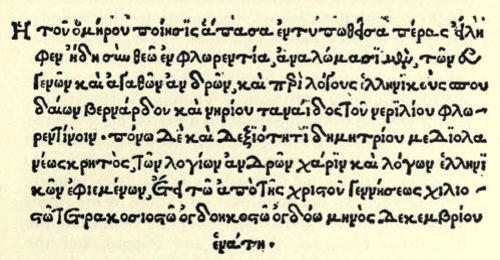

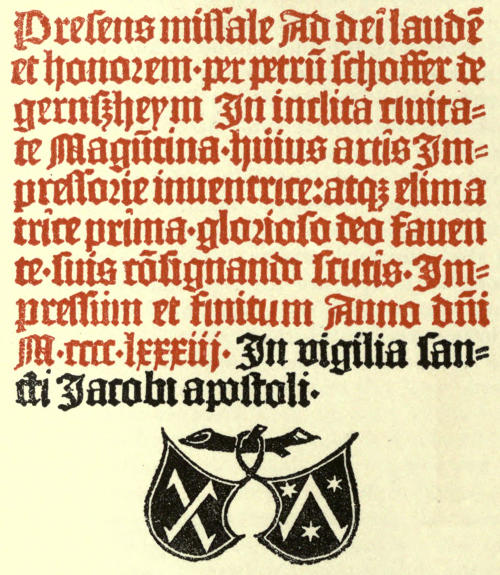

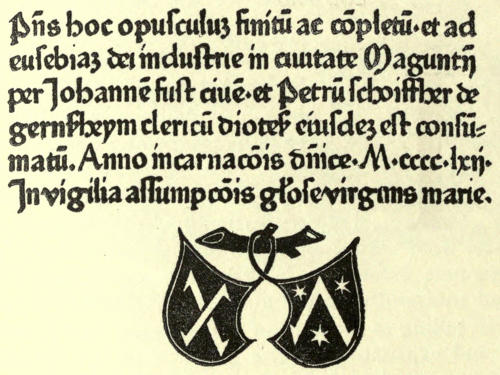

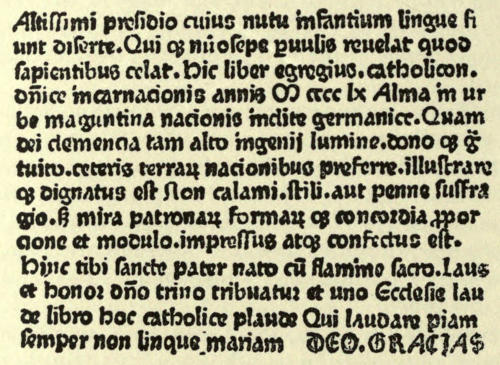
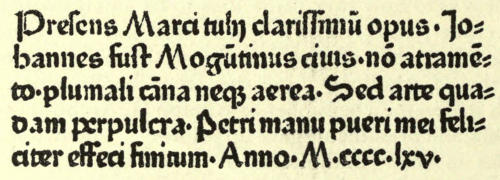
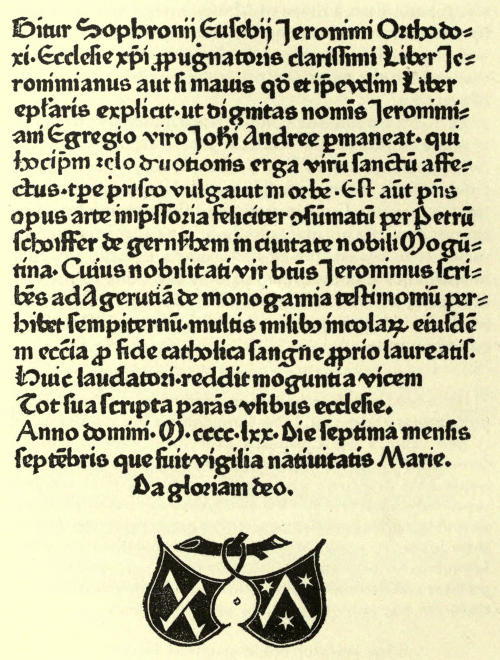
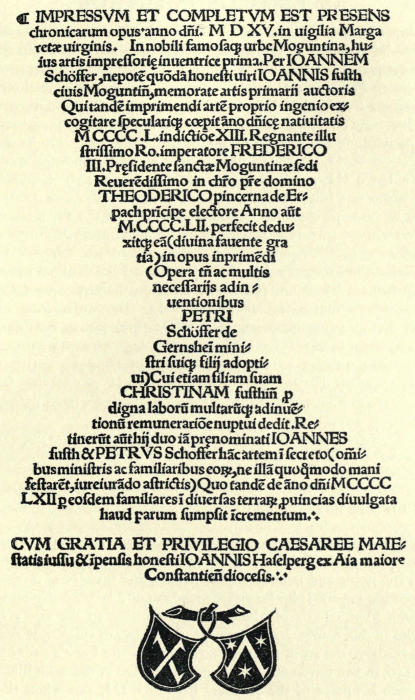

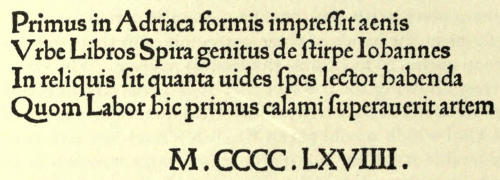
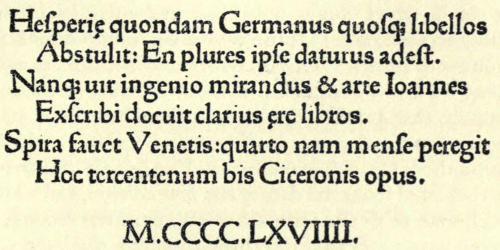
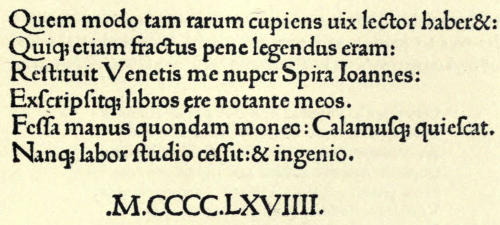
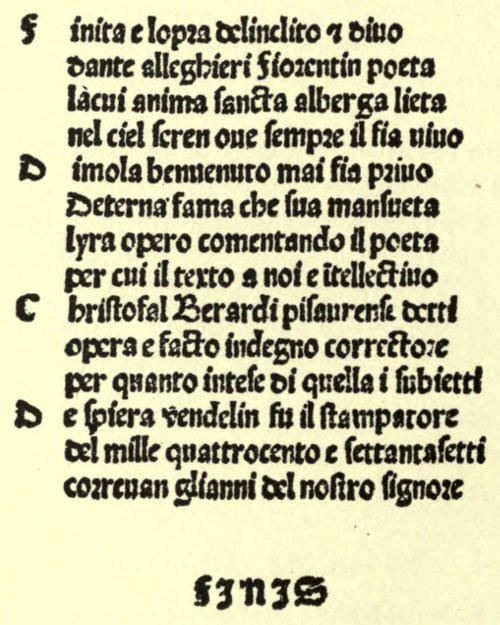

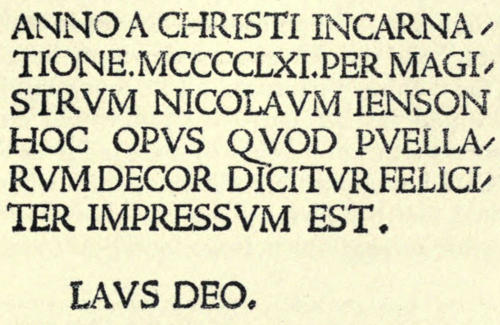
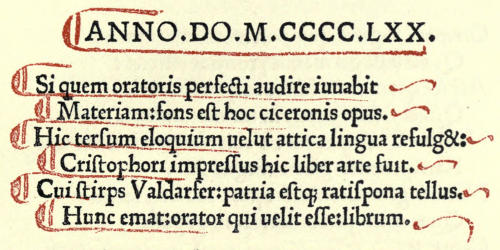
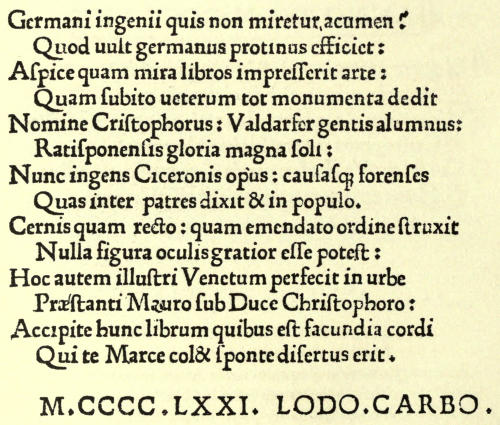
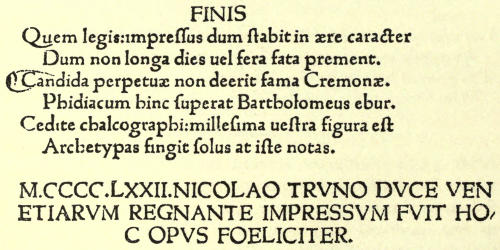

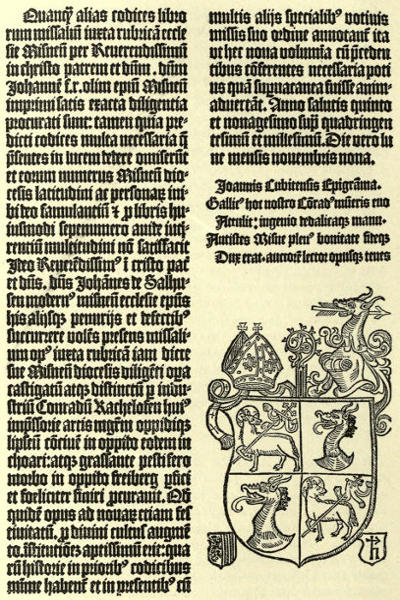
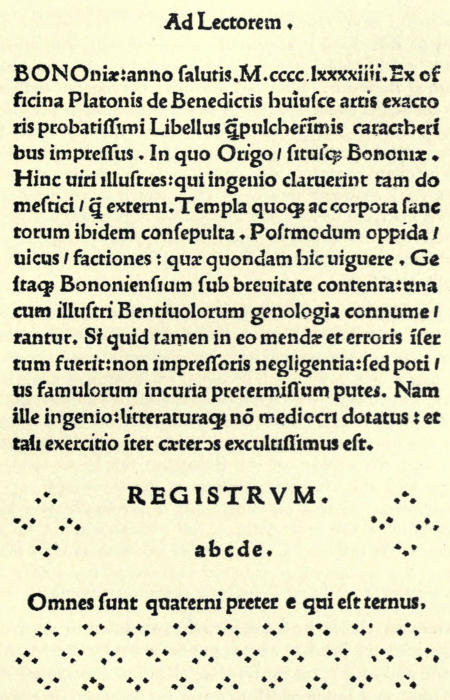
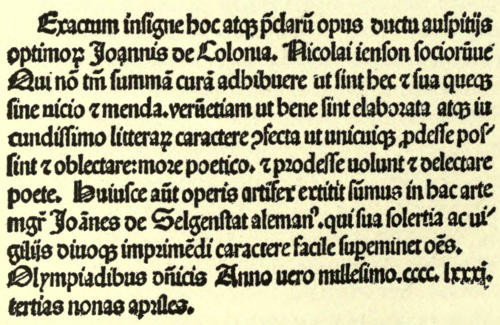
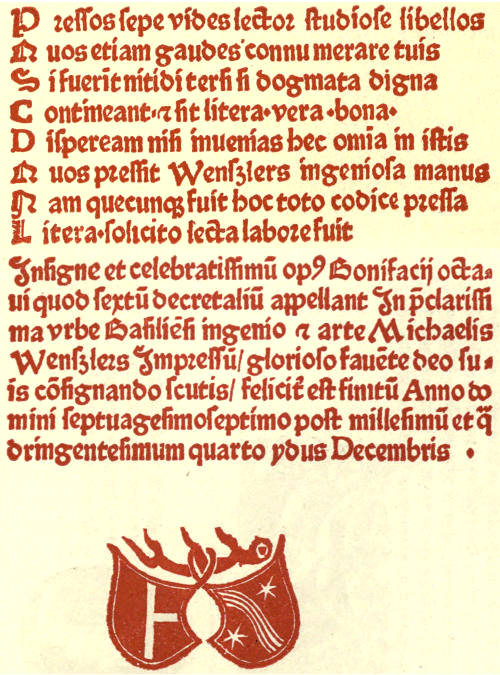
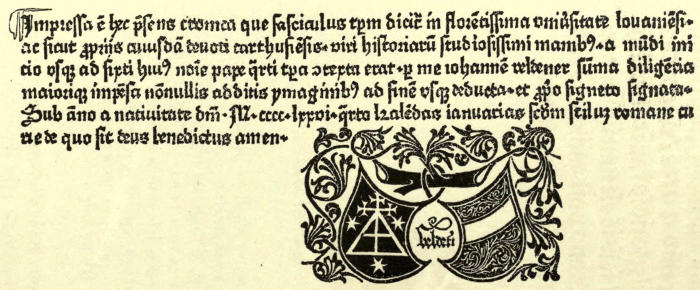
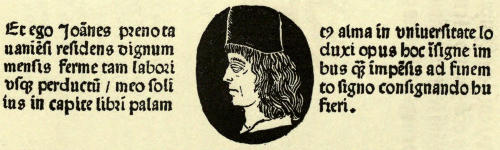
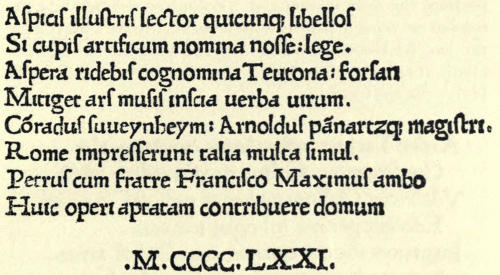
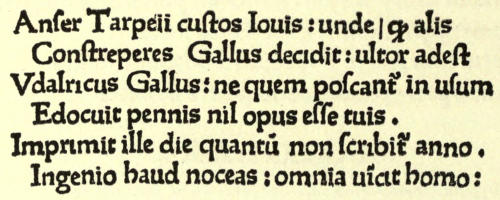

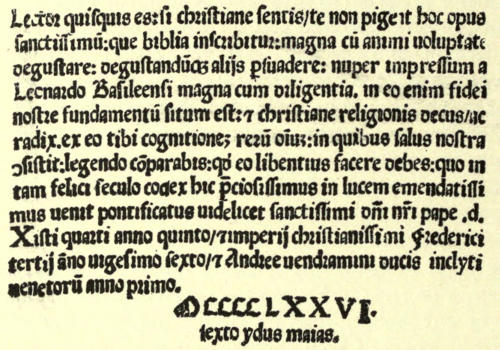
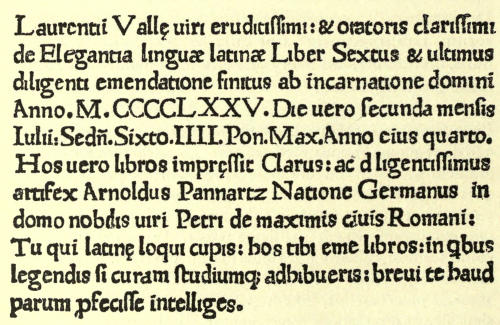
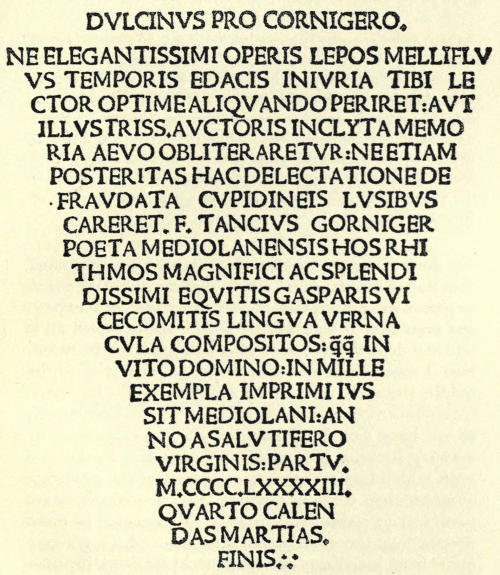
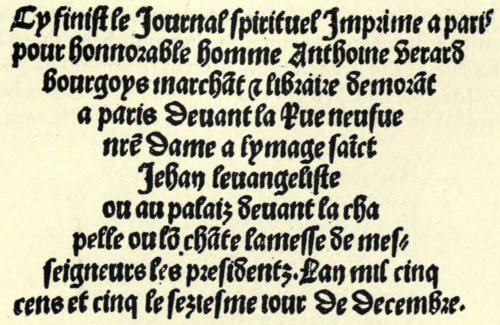
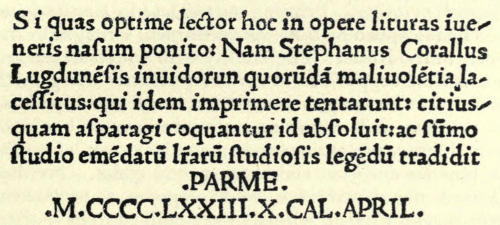
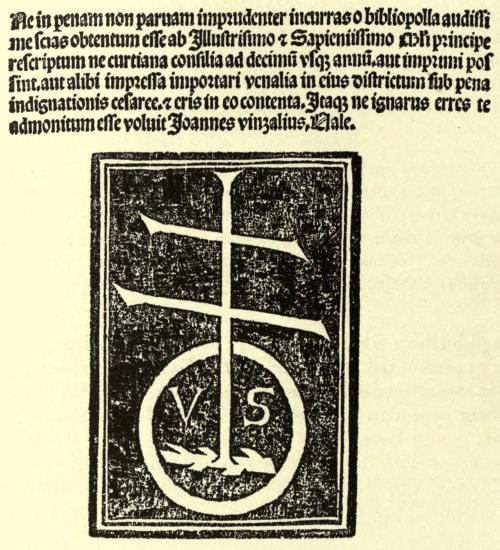

 Thus endyth thys noble and joyous book entytled Le Morte
D’Arthur. Notwythstondyng it treateth of the byrth, lyf and
actes of the sayd Kyng Arthur, of his noble knyghtes of the
Rounde Table, theyr meruayllous enquestes and aduentures,
thacheuyng of the Sangreal, & in thende the dolorous deth
& departyng out of thys world of them al. Whiche book was
reduced into englysshe by Syr Thomas Malory Knyght as
afore is sayd, and by me deuyded in to xxi bookes, chapytred
and enprynted, and fynysshed in thabbey westmestre the last
day of Iuyl the yere of our Lord Mcccclxxxv.