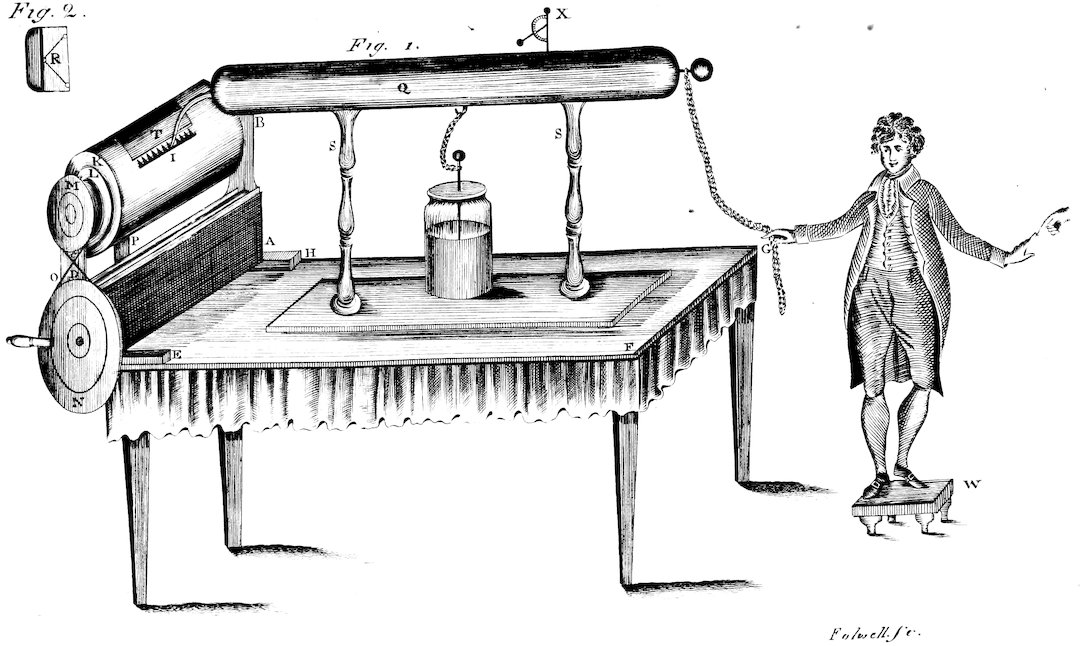
EPITOME OF ELECTRICITY. — DIVISION I. — CHAP. I. Explanation of Terms; with some general Remarks. — CHAP. II. Electric substances; with some of the phenomena attending their excitation. — CHAP. III. Of Electrics and Conductors. — CHAP. IV. Of the electrical machine. — CHAP. V. Of communicated electricity. — CHAP. VI. Of the electric spark. — CHAP. VII. Of the influence of pointed bodies on electricity, and some phenomena attending their operation. — CHAP. VIII. Of electric attraction and repulsion. — CHAP. IX. Of the Leyden phial. — CHAP. X. The electrical battery—and experiments performed with it. — CHAP. XI. A description of the electrophorus, and some of its phenomena accounted for. — CHAP. XII. Of electrometers. — CHAP. XIII. The identity of electricity with lightning. — CHAP. XIV. Of the structure and use of the electrical kite. — CHAP. XV. The structure and use of lightning rods. — CHAP. XVI. Of animal electricity. — CHAP. XVII. The influence of electricity on vegetables. — CHAP. XVIII. Medical electricity. — CHAP. XIX. Directions concerning the use of the electrical apparatus, with some practical rules for performing experiments with it to the best advantage. — DIVISION II. — CHAP. I. Entertaining Experiments, made by electrical Attraction and Repulsion. — CHAP. II. Experiments with electric Light. — CHAP. III. Experiments with Charged Electrics. — CHAP. IV. Experiments relating to the influence of pointed Bodies on Electricity. — CHAP. V. Promiscuous Experiments. — DIVISION III. — CHAP. I. Introductory Observations to the theory of Electricity. — CHAP. II. Theories of Electricity, exclusive of that of Franklin. — CHAP. III. The Franklinian Theory of Electricity.
1
If a glass tube be rubbed in the dark with a dry
hand or piece of buckskin, upon applying the knuckle
to it a luminous stream or spark will appear, passing
from the glass to the knuckle, attended with a crackling
noise: this luminous spark or stream is called electricity.[8]
It is produced by the friction of several other
substances, and was first observed on amber.—Hence
its name, from ηλεκτρον the greek term for amber. It is a
fluid extremely subtle, abounding in all nature, and is
one of her principal agents; which, though generally imperceptible,
sometimes becomes the object of our sight
and other senses.
A glass tube, having been rubbed and producing the
appearances above described, is said to be excited. The
2hand or buckskin, by which this is effected, is called the
rubber. Electrics are all substances which can be made
to produce the same appearances; the most perfect are
glass, amber, sealing-wax, sulphur, gum lac, rosin &c.
These are also called non-conductors, from their inability
to conduct the electric fluid. Conductors or non-electrics
are those bodies which cannot be excited, but have the
power of transmitting electricity; such are metals, water,
the bodies of animals, an imperfect vacuum, heat
&c. But strictly speaking, there are no perfect conductors
or non-conductors.
A body is said to be in its natural state, when it is
in the same state, with respect to electricity, as the mass
of the earth.
When a body has more of the electric fluid than its
natural quantity, it is said to be electrified positively,
when less, negatively; but neither of these cases can occur
in a conductor, unless the communication between
it and the earth be cut off by the intervention of an electric
or non-conductor. When this happens, the conductor
is said to be insulated.
It may not be amiss here to mention, that the terms
electric or an electric per se, and non-electric, were at first
made use of from an erroneous idea that only those
called electrics, contained the electric matter in their
substance, which was capable of being excited by friction,
and communicated by them to those called non-electrics,
and supposed to be destitute of it: for glass
and other electrics, being rubbed, discovered signs of
having it, by snapping on the approach of a finger or
other conductor, and by attracting and repelling light
bodies; while other substances could not be made to
produce any such effect. It has however since been
3proved by experiments, that both electrics and non-electrics
contain this matter in their substance; but
that non-electrics cannot be excited, owing to the fluid
diffusing itself through them as soon as collected.
These terms are therefore improper, and as the only
difference is that some bodies will conduct electricity
and others will not, the terms non-conductor and conductor
are those which might generally be used with
the most propriety in speaking on this subject; though,
in conformity with custom, we shall often use non-conductor
and electric as synonymous.
Those substances by which electrical phenomena
may be produced, form the subject which next demands
our attention; but these are so numerous that
it would be vain to attempt to specify them all. Perhaps
it may be doubted, whether every material substance,
with the exception only of metals, water, and
charcoal, may not be considered as an electric.
Some however exhibit particular phenomena more
obviously than others; and hence a number of catalogues
have been formed, for shewing the effects which
arise when electrics are excited with different rubbers.
The specification which we esteem the most complete,
was formed by the ingenious Mr. Cavallo, and we shall
give it in his own words.
“In the following table (says he) may be seen what
electricity will be excited in different bodies, when rubbed
4with different substances. Smooth glass, for instance,
will be found by this table to acquire a positive
electricity, when rubbed with any substance hitherto
tried, except the back of a cat: (by which I mean the
skin of a cat while on the animal alive:) rough glass,
(viz. glass, the polish of which has been destroyed by
emery or otherwise) will be found to acquire the positive
electricity, when rubbed with dry oiled silk, sulphur
&c. and the negative when rubbed with woolen
cloth, the hand &c. and so of the rest.”
| Electrics. |
Qualities. |
Rubbers. |
| “The back of a cat |
Positive |
Every substance with which it has hitherto been tried. |
| Smooth Glass |
Positive |
Every substance hitherto tried, except the back of a cat. |
| Rough Glass |
Positive |
Dry oiled silk, sulphur, metals. |
| Negative |
Woolen cloth, quills, wood, paper, sealing wax, white wax, the human hand. |
| Tourmaline |
Positive |
Amber, or air blown upon it. |
| Negative |
Diamond and the human hand. |
| White silk |
Positive |
Black silk, metals and black cloth. |
| Negative |
Paper, hand, hare’s & weasel’s skin. |
| Black silk |
Positive |
Sealing wax. |
| Negative |
Hare’s, weasel’s and ferret’s skin, load-stone, brass, iron, silver, hand. |
| Weasel’s skin |
Positive |
Metals, silk, load-stone, leather, hand, paper, baked wood. |
| Negative |
Other fine furs. |
| Sealing wax |
Positive |
Metals. |
| Negative |
Hare’s, ferret’s and weasel’s skin, hand, leather, woolen cloth, paper. |
| Baked wood |
Positive |
Silk. |
| Negative |
Flannel.” |
From the above table it appears, that the powers of
electric substances vary prodigiously from one another;
and that, according to the different rubbers made use of,
we may sometimes produce one phenomenon and sometimes
5another. Hence we have a foundation for classing
electric substances according to the various powers
they occasionally exhibit; which may be done in the
following manner.
First. Those which exhibit a strong and permanent
attractive and repulsive power, of which the most remarkable
is silk.
Second. Those which exhibit the electric light, attraction,
repulsion, and all the other phenomena of electricity
in a very vigorous, though not durable manner;
of these glass is eminently preferable to all others.
Third. Those which exhibit electric appearances for
any length of time, and which communicate to conducting
bodies, the greatest electric power.—Of these, the
substances called negative electrics, such as sealing-wax,
resinous substances, and resinous compounds, are the
best.
Fourth. Those which readily exhibit electrical phenomena
by heating and cooling.—Of these, the tourmaline[9]
is the principal.
The best method of disturbing the electric fluid, that
is of making it pass from one body to another, is friction.
This may be done either by rubbing one electric
with another, or with a conductor; but the electricity is
generally stronger in the latter case. Other methods for
causing electrics to shew electric appearances, are,
6melting, or pouring a melted electric on another substance,
heating and cooling, evaporating or effervescing.
All bodies in nature are, with reference to this
subject, divided into two classes, electrics and conductors.
It has been fully demonstrated by experiment, that
no substance which is a conductor can be excited so
as to exhibit electrical phenomena: and in the same
manner it has been found, that no substance which
can be excited, is a conductor. But as we have already
hinted, there is, strictly speaking, no substance which
is a perfect conductor or non-conductor; because, on
the one hand, the electric fluid meets with some resistance
in its passage through the best conductors; and
on the other, it is in part transmitted through, or passes
over the surface of, most if not all electrics.
The two following lists contain as complete an enumeration
of electrics and conductors as the present
state of knowledge, in regard to electricity, permits us
to make.
The substances are disposed in the order of their perfection;
that is, the best conductors and the best electrics
are placed at the head of their respective lists, and
those of an inferior kind follow, somewhat in the manner
of a scale graduated downward. Perfect exactness
however is not to be here expected, because the subject
forbids it, and some of the specified articles are of classes
of substances among which there may be a sensible
difference.
7
Conductors or non-electrics.
Gold,
Silver,
Copper,
Platina,
Brass,
Iron,
Tin,
Mercury,
Lead,
Semi-metals.
Metallic ores.—Of which those are the best which
contain the greatest number of metallic parts and are
nearest to a reguline state.
Charcoal, either of animal or vegetable substances—
Animal fluids,
Acids,
Saline substances,
Hot water,
Cold water,
Salt water,
All other liquids except oils,
Red hot glass,
Melted rosin,
Flame and the effluvia of flaming bodies,[10]
Ice and snow—but not below the temperature of 13°
Fahrenheit.
Earthy and stony substances, of which the hardest
are the worst.
Glass filled with boiling water,
Vapour or steam of boiling water,
8Smoke.
All compounds which contain the above substances
in different proportions, are conductors in different degrees.
Non-conductors or electrics.
Glass and all vitrifications; even those of metals.
All gems, of which the most transparent are generally
the best.
All resinous substances and resinous compounds,
Amber,
Sulphur,
Baked wood—if not suffered to imbibe moisture.
All bituminous substances,
Wax,
Silk,
Cotton.
All dry animal excrescences; as feathers, hair, wool,
horn, &c.
Paper,
White sugar and sugar candy,
Atmospheric air and other gasses,
Oils,
Dry and complete metallic oxyds,
The ashes of animal and vegetable substances,
All hard stones; of which the hardest are the best,
Powders not metallic.
Ice at and below the temperature of 13° of Fahrenheit’s
thermometer. According to Mr. Walsh’s and Mr.
Morgan’s experiments, the Torricellian vacuum ought
to be placed at the head of this list; but the singular
nature of a vacuum, though a non-conductor, will hardly
entitle it to the name of an electric.
9
Having now explained the terms made use of
in the study of electricity, and noted some of the phenomena
of different electric substances, and the difference
between electrics and conductors; we shall proceed
to describe the electrical machine made use of for shewing
experiments, and for exhibiting other electric phenomena
to the best advantage.
The principal parts of the machine are, the electric,
the rubber, the moving engine, and the prime conductor.
We shall take notice of each of these parts separately
and then describe the whole machine together.
Formerly different kinds of electrics were used; at
present smooth glass is preferred before all others, as
most convenient, and because it will, by itself, answer
the purposes of several others. For when the machine
has an insulated rubber, which is easily prepared, the
operator may produce positive or negative electricity[11]
at pleasure, without changing the electric.
With respect to the forms of the glass, those commonly
used are globes, cylinders and plates. The most
convenient size for a globe is from ten to twelve inches
in diameter. It should have two necks, centrally opposite,
which must be cemented[12] to strong caps, in order
to adapt them to a proper frame. Cylinders are also
made with two necks. Their common size is from six
10to seven inches in diameter, and from ten to twelve
inches in length; the glass generally used is the best
flint.
It has long been questioned whether a coating[13] of
some electric substance, has any effect in increasing
the power of an electric; but now it seems pretty well
determined, that if it does not increase the power of a
good one, it at least considerably improves a bad one.
The next thing to be considered is the rubber which
is to excite the electric. This, as it is now made, consists
of a cushion of buckskin, stuffed with hair or
flannel, and fastened to a piece of wood well rounded
at the edges; to this is glued a flap of Persian black silk,
which goes over nearly one half of the cylinder or globe.
The rubber should be supported by a small iron or
brass spring, placed inside of it, as is represented edgewise
by R, figure 2, in the frontispiece. This acts in a
much more uniform and parallel manner than if it were
placed under the cylinder. It suits any inequalities that
may be on the surface of the glass, and by means of a
screw may be made to press against the cylinder as occasion
requires. It should likewise be insulated in the
most perfect manner by glass, or by baked wood well
varnished. But when experiments are to be made which
do not require or admit of insulation, a communication
must be made between the rubber and the earth, by a
chain or conductor.
To increase the effect of the rubber several substances
have been used with success, particularly whiting
and pulverised chalk. But the best of all is an amalgam
of zinc and mercury.[14] This amalgam is to be used by
11first applying a moderate quantity to the cushion; and
afterwards by spreading it on a separate piece of leather,
and applying it occasionally to the under part of the
cylinder while turning. In this method of using it, only
a small quantity of amalgam is consumed, while the
glass is very strongly excited; and by degrees the whole
rubber contiguous to the cylinder is covered with amalgam,
in the form of a concave cake. It is with such a
rubber that the cylinder is most powerfully excited.
An ingenious friend has favoured us with the following
explanation of the manner in which electrics are
excited, which to us is more satisfactory than any other
we have seen. “In order that electricity may be accumulated
in greater quantity in one body than in the
surrounding ones, it must be set in motion. This may
be effected by the rubbing of electrics; the juxta-position
of non-electrics of different conducting powers;
and by the chemical action of many, if not all bodies on
each other. The rubber will act on the first principle,
and the more perfect the contact between it and the
electric the greater will be the effect. The chalk, whiting,
amalgam &c. while they will, if properly prepared,
make the contact more perfect, will also be of service
on the second principle; and the amalgam will besides
be of use on the third. Mercury and zinc may be exposed
separately to the air without any alteration; but
when combined they readily unite with the oxygen of
the atmosphere; especially when the surface of contact
is frequently renewed, and the temperature increased
by friction.
“The glass, acquiring a different state of electricity
from the rubber, will, as each portion passes from under
it, carry away and impart to the prime conductor
12the excess which it has obtained; and this the more
certainly if the dissipation of the electricity be prevented,
or the accumulation increased, by a piece of silk
connected with the rubber.—The chain making the
communication between the rubber and the adjoining
non-electrics will enable this process to go on; and perhaps
may also assist on the second principle.”
With respect to the engine which is to give motion
to the electric, it has been customary, simply to turn
the globe or cylinder with a winch; but this will not
produce the greatest power of which the glass is capable.
To effect this it should be made to turn six or seven
times in a second, which is more than can conveniently
be done with the winch only; and therefore
multiplying wheels are used with advantage.
The prime or first conductor is an insulated non-electric
substance, furnished with a number of points
on the end towards the electric, in order to collect the
electricity from it. It is usually made cylindrical, but
whatever be its form it should always be perfectly free
from points or sharp edges, except the points toward
the electric already mentioned; and if holes are made
in it, which on many accounts are very convenient,
they should be well rounded and perfectly smooth.—The
larger this conductor is, if not disproportionate to
the cylinder or globe, the stronger and more dense will
be the electric spark, which will proceed from it when
touched by a blunt conductor. There must however
always be a certain proportion between the cylinder or
globe and the prime conductor, for if the former be
small and the latter large, the electricity will not be collected
fast enough, to preserve an accumulation of it in
the prime conductor, because a portion is always taken
13off by the air, in proportion to the surface presented
to it by the conductor.
We shall now give a short connected explanation of
the whole machine, a draft of which is exhibited in the
frontispiece. AB and CD are two pillars of baked wood
well varnished, perpendicularly raised from the top of
the table EFGH—these serve to support the cylinder
I, by the axles of the caps KK; from one of these
proceeds the long axle L, which passes through a hole
in the pillar CD, having the pulley M, fixed on its
square end. N is a multiplying wheel, around which
the band or strap O passes, and likewise around the
pulley M.—The wheel N should be made moveable
with respect to the pulley M, to accommodate the stretching
of the band, or else the pulley should have a number
of grooves of different radii in its circumference.
The rubber R, is fastened to a pillar of glass, or
baked wood P. The pressure of the rubber may be
augmented at pleasure, by means of a sliding board and
tightening screw.
The prime conductor is represented by Q. It is insulated
by the glass pillars SS, which support it. T
represents the points which collect the electricity from
the cylinder.
Cylinders and globes made for electrical machines
are not always to be procured. Their place however,
may be very well supplied by the large show bottles
of the apothecaries. When these are used, one of the
caps, instead of being concave (to receive the neck of
the cylinder) must be made convex—so as to fit the
hollow in the bottom of the bottle.—It is to be fastened
with the cement used in the other machine.
14The most powerful electrical machine ever constructed,
was at Teyler’s museum at Haarlem. It had,
instead of the cylinder or globe as in the common machines,
two circular plates of glass, which were made
to turn upon the same horizontal axis. These plates
were excited by eight rubbers, which acted on their
surfaces. In this machine the prime conductor had
branches which collected the electricity from between
the plates.
It is not necessary however in this form of the machine
to have two plates, the second being added only
to increase the power. The plate must be firmly fastened
by its centre to an axis—so as to turn vertically
between two uprights of baked wood, as in the construction
of the cylindric machines; but in this case
the uprights must be so close together, as barely to
leave room for a rubber on each side of the plate. The
rubbers may be made of the same form with that in the
cylindric machine—except that they must have a projection
at the back, to fit a niche cut in the uprights
which support the plate. The power of the machine
will be increased by having four rubbers; two above
and two below the axis of the plate. The prime conductor
is placed opposite one of the ends of the axis,
and is divided at the end towards the electric into two
branches or arms, which extend horizontally to the circumference
of the plate, each of which is furnished with
points to collect the electricity.
As plates are not always to be procured, a good substitute
may be found in a thick pane of glass or a piece of
an old looking-glass. Mark with a diamond or file a circle
on the glass, of the size you intend for your plate. Then
putting the plate into warm water, after some time cut
15the glass with a diamond in tangents. The more numerous
the cuts, the nearer the plate will be to a circle.
A hole may be made in the centre for the axis, by
scratching with a diamond, and grinding with a rod of
iron (held between the hands) and emery.
Having described the electrical machine, we are now
to consider some of the phenomena attending its operation.
When the prime conductor receives electricity
from the cylinder, it is said to be electrified by communication,
and it then acts in every respect like the cylinder
itself, except that the latter, when touched by a conductor
communicating with the earth, gives a considerable
number of sparks before it is discharged; whereas
the conductor discharges itself by a single spark.
The cause of this difference is that the cylinder, being
an electric, cannot convey the electricity of all its surface
to that part, to which the conducting substance
is applied; but the fluid accumulated in the whole conductor,
passing easily through its substance, is transmitted
at once to the point from which the discharge is
made. Hence it appears that the electricity discharged
from an electrified conductor is more powerful than
that discharged from an electric—the conductor acquiring
a large quantity of electricity from an electric, by
receiving it gradually, spark after spark, and afterwards,
when touched, discharging it all at once.
The velocity of electricity is almost beyond conception.
It is, notwithstanding, in a small degree relative
16to the quantity put in motion, and to the goodness of
the conductor by which it is transmitted. A large quantity
of electricity passes through a good conductor
with such rapidity, that there is no perceptible difference
in the time which it takes to go one foot, or one
thousand feet. A small quantity however has been
found to take a time barely perceptible, in passing
through a long and imperfect conductor. Experiments
relative to this point will be related hereafter.
If a piece of metal be presented to an over-charged
prime conductor, the fluid passes with violence from
the one to the other; an electric spark, having the appearance
of fire, is seen flashing between them, and a
snapping noise, like the cracking of a whip, is heard.
If this piece of metal be insulated, the prime conductor
will be only partially discharged, that is, the redundant
electricity will be divided between it and the piece
of metal, nearly in proportion to their surfaces. This
electric spark has not only the appearance of fire, but,
when large, will actually set fire to a variety of easily
inflammable substances; such as cotton sprinkled with
rosin, spirits of wine &c. This power of exciting flame
is not commonly believed to arise from any culinary
heat in the electric spark, because if the spark be small
it will not excite flame in substances the most inflammable.
It acts probably by friction on the same principle
as the rubbing of sticks against each other produces
fire.
17The electric spark, taken upon any part of a living
animal, causes an unpleasant sensation, which is more
or less pungent and disagreeable, as the spark is stronger
or weaker, and the part more or less delicate.
There is a slight difference between the appearance
of a spark taken from a body positively electrified, and
that from one negatively electrified. The former, if not
very long, appears straight and sharp; the latter is generally
ramified, or appears in a zig-zag line.
The noise which attends the spark, is caused by the
sudden agitation into which the air is thrown, by its
passage through it.
If an uninsulated conductor, which is broad, round
and polished at the end, be presented to the prime conductor,
a short and dense spark, accompanied with
some noise, will be perceived; if the conductor be less
broad, the spark will be longer, less dense, and attended
with less noise; if the breadth be still more diminished,
so that the conductor may come under the denomination
of a point, the electric matter will pass to it,
from the prime conductor, and through a greater space,
with a hissing noise, and in a continual stream; a still
greater sharpness will enable the electricity to pass over
a yet more extended space, but unaccompanied by
noise, and only a small light will be seen upon the
point. The same result will arise if points of different
acuteness be affixed to the prime conductor, instead of
18the uninsulated one: but if both be pointed, the electricity
will be more readily discharged.
In all the above cases, the appearance of the electric
matter at the point, will indicate the kind of electricity
from which it proceeds. A large divergent cone indicates
positive electricity; a small globular light, that
which is negative. Hence it is always easy to ascertain
whether an insulated conductor be electrified positively
or negatively, by presenting a point to it, as the light
at the point is always definitive of the contrary electricity
in the conductor.
If a pointed conductor be electrified, either positively
or negatively, and the face be brought near the point
during the electrization, a wind will be felt blowing
from the point, accompanied with a peculiar sensation,
commonly called the spider’s web. It is remarkable
that the current of air is always in the same direction,
whether the point throws off or receives electricity.
The re-action of the force, by which the air is put in
motion, is exerted upon the pointed body. This is shewn
by a very pleasing experiment called the electric fly.
This fly is composed of four small wires, fastened into
a metallic cap, similar to those used in sea-compasses,
so that the wires may easily move upon a point, in a
horizontal direction. They should be exactly balanced,
and have their ends, which must be very sharp, all bent
in the same direction. Now if this fly be placed on an
insulated point and electrified, its sharp ends will become
luminous in the dark, and it will revolve in a direction
contrary to that in which the ends are bent; or
if it be placed on an uninsulated point and brought
near the electrified prime conductor, the same effect will
follow.
19It is to be observed, that the fly will move round in
the same direction, whether electrified positively or negatively.
The cause of this seeming contradiction depends
upon the repulsive power existing between bodies
possessed of the same electricity; for the air opposite
to the points acquires a strong electricity, analogous
to that of the points, it is therefore repelled, and replaced
by other air, which is also electrified and repelled.
Hence a continual stream is produced, blowing from
the points, and that equally, whether the electrization
be positive or negative; and as action and re-action are
equal and in contrary directions, the points, repelling
the air, must themselves be repelled, and in the opposite
direction; which causes the fly to be always turned
one way, that is, in a direction contrary to that in which
the air is moved.
In vacuo no motion is produced, because there is no
air on which the electric matter can act when it issues
from the points.
In like manner, if air be confined in a receiver, the
motion of the fly soon ceases, because the fluid cannot
pass through the air and the glass. But on applying
the end of a finger to the outside of the receiver, opposite
one of the points of the fly, the motion will begin
again, and by moving the finger occasionally round
the glass, it may be continued till most of the glass is
charged.
The cause of this motion is, that when the finger
is applied to the outside of the receiver, the glass, loosing
part of its natural quantity of electricity from that
side, (i. e. when the fly is electrified positively, and vice versa
if negatively) takes up the fluid from the air on
its inner surface. Hence the air becomes capable of
20being again electrified by the point and this renews the
motion.
We have already stated that if a pointed wire be presented
to a conductor positively charged, it will be illuminated
with a star or globe; and if the conductor be
negatively charged, the illumination will have the form
of a pencil or divergent cone. F. Beccaria explains
this in the following manner. I suppose, says he, that
the star is occasioned by the difficulty with which the
electric fluid is extricated from the air, which is an
electric; suppose for instance that a pointed wire is
presented to a body positively electrified; the electric
fluid is first communicated from that body, to the air
between it and the pointed wire, and then the wire must
extricate it from the air.
The pencil is occasioned by the force with which
the fluid, issuing from the point, passes through the
contiguous air to that which is more remote, i. e. by
dividing the contiguous air, and not by affixing itself
to it.
Beccaria likewise remarks, that if two equally sharp
pointed bodies are brought near the prime conductor,
they will appear luminous at only half the distance that
one of them would. They will also discharge it in half
the time.
It will not be improper to remark here, that when a
point not electrified is opposed to one electrified positively,
both points will have small globular lights upon
them; but if a positive one be opposed to one negatively
electrified, they both preserve their own characteristic
properties.
From the above the following conclusions may be
drawn.
21First, That pointed bodies attract the electric matter
more or less easily, and at a greater or less distance,
according to their acuteness.
Second, That pointed bodies have the power of attracting
electricity as well as of repelling it, in a greater
degree than conductors of any other form.
We shall treat farther of pointed conductors under
the article Thunder-house.
No satisfactory theory of electric attraction and repulsion
has, so far as our knowledge extends, ever yet
been given. The phenomena have been differently accounted
for, as the writers have embraced different
opinions in regard to positive and negative electricity.
One mode of explanation has been adopted by
those who believe, with Franklin, that positive electricity
is only an accumulation of the electric fluid in a
body beyond its natural state; and that negative electricity
is nothing more than a deficiency of this fluid in
a body. Another mode of explanation is given by those
who maintain, in opposition to Franklin, that positive
and negative electricity are either two distinct fluids, or
else vibrations of the same fluid—the positive electricity
always rushing out of a body, and the negative always
rushing in. Those who maintain this hypothesis endeavour
to support it by the easy solution which they affirm
it gives to the phenomena of electric attraction
and repulsion. But after a careful examination of this
theory, we think that, so far from being satisfactory, it
22is scarcely intelligible. We therefore do not choose to
introduce it into our epitome, as affording any solution
of the difficulties that occur on this part of our subject.
We are besides of opinion that the evidence in favour
of a single fluid is conclusive, as we shall show when
we come to discuss the theory of electricity. Yet we
confess that we cannot, on this theory, offer a rationale
of electric attraction and repulsion, that satisfies ourselves.
It is therefore the demand of candour, and in
the spirit of the Newtonian philosophy, to avow explicitly
that this part of our subject is yet involved in much
obscurity. In the mean time we are acquainted with
certain facts, and with the clear explanation which they
give of certain phenomena.
1. That bodies positively electrified, repel each other.
2. That bodies negatively electrified, also, repel each
other.
3. That bodies positively electrified, attract those
which are negatively electrified.
4. That bodies either positively or negatively electrified,
induce a contrary electricity in bodies in their natural
state, brought within the sphere of their action.
This statement is easily verified by experiment, in
the following manner.—By flaxen or hempen threads,
suspend, from the prime conductor, two balls made of
cork or elder-pith, so that they touch each other. On
charging the conductor, these balls, being both electrified
positively, will immediately repel each other, and
be separated to a considerable distance.—Remove one
of the balls, take it in your fingers, and bring it near
to the one which remains positively electrified, and the
two will immediately rush together; because there are
now two substances of which one is electrified positively,
23and the other negatively.—Again. Suspend two
balls, of the kind just mentioned, from an insulated
cushion of an electric machine, and let them touch each
other. Put the machine in motion and the balls, which
are now both electrified negatively, will repel each other
and separate, as in the case first described.
In attempting to explain the first of these phenomena
Dr. Franklin once supposed that there was an electric
atmosphere round each of the balls positively electrified,
the particles of which atmosphere, by mutually
repelling each other, separated the balls. He also supposed
that as bodies negatively electrified, or not having
their proportional quantity of the electric fluid, are
always strongly disposed to receive it, this would account
for the fact that when one of these bodies was
brought near to one that had more than its proportional
quantity, the two would naturally rush together; the
one to impart, and the other to receive the fluid. But
at this time he was not acquainted with the fact, that
two bodies negatively electrified would repel each other.
When this was discovered he candidly acknowledged
the utter deficiency of his theory, in regard to electric
attraction and repulsion. Some of his friends and followers,
however, have endeavoured still to maintain it.
But we think that though their zeal has been greater,
their success has not exceeded that of the Doctor himself:
and we have already stated that other theories are
equally, if not more defective, than that of Franklin.
Let us then leave the explanation of electric attraction
and repulsion to be made when future and fortunate
discoveries shall have furnished the means of making it,
and let us proceed with the application of known facts
and principles.
24A pleasing exhibition of the phenomena of electric
attraction and repulsion, may be made in the following
manner.
Take a glass tube, and after having rubbed it, let a
small light feather fall from your fingers, at the distance
of eight or nine inches from it.—The feather will be
immediately attracted by the tube and stick very close
to its surface for some seconds, after which it will be
repelled, and if the tube be kept under it, the feather
will continue floating in the air, at a considerable distance
from the tube, without coming near it again, except
it touch some conducting substance; and if you
manage the tube dexterously, you may drive the feather
through the air of the room at pleasure.
The cause of this phenomenon is obvious. The feather,
at first, not being electrified, rushes to the excited
tube. There it becomes electrified and is then repelled,
and cannot approach the tube again, unless it first touch
some conducting substance; because it cannot part
with its electricity while floating in the air, and therefore
cannot acquire a contrary electricity; consequently
it must remain in a state incapable of being again attracted
by the excited tube.
There is a remarkable circumstance attending this
experiment, which is, that if the feather be kept at a
distance from the tube by the force of electric repulsion
it always presents the same part towards the tube. The
reason of this phenomenon is, that the equilibrium of
the fluid in the different parts of the feather being once
disturbed cannot easily be restored; the feather being
an electric, or at least a very bad conductor. When
the feather has acquired a quantity of electricity from
the tube it is plain that, by the action of the excited
25tube, that superinduced electricity will, for the most
part be forced to that side of the feather which, at first,
happened to be farthest from the tube; hence that part
will always afterwards be repelled the farthest.
This experiment may be agreeably varied in the following
manner.—A person may hold an excited tube
of glass, within a foot and a half of a stick of sealing-wax,
or any other electric negatively electrified, held
by another person; a feather let fall between these differently
excited electrics will leap from one to the other
alternately, and the two persons will seem to drive a
shuttlecock by the force of electricity.
Another experiment calculated to shew the phenomena
of electric attraction and repulsion is the electric
spider.
Cut a piece of cork in the shape of a spider, and run
a few short threads through it, to represent the legs;
this done, suspend it by a silk thread from the ceiling
of the room, or any other support, so that the spider
may hang mid-way between the knob of a jar and the
knob of a wire fastened to the table, or to the outside
coating of the jar when not charged; let the place where
the jar stands be marked; then charge and replace it.
The spider will now begin to move from knob to knob,
and continue this motion for a considerable time.
In this case, the knob of the jar is charged positively,
and the spider, being in its natural state, is attracted by
it; the knob then communicates to it some of its electricity,
and the spider becoming possessed of the same
electricity with the knob, is repelled by it, and immediately
runs to the other knob, which communicates
with the negative coating, or with the table, where it
discharges its electricity and is again attracted by the
26knob of the jar. This attraction and repulsion continue
till the jar is discharged, when the spider finishes its
motion and seemingly expires.
This consists of a glass phial, jar, or bottle, coated
on the outside and inside with tin-foil, rendered adhesive
by paste or gum water. About two inches of the
glass at the top are left without any metallic covering,
to prevent a communication between the outside and
inside coatings, while the electricity is collecting.—The
mouth of the phial or jar is furnished with a cork
which receives a wire, ending in several ramifications
which touch the inside coating. The upper end of this
wire, which should extend a convenient distance above
the mouth of the jar, is furnished with a metallic ball.
When the phial or jar is to be charged, it may be
held in the hand or placed on an uninsulated table,
with the knob of the wire touching the prime conductor.
The inner surface of the glass now acquires the
same electricity with the prime conductor, and the external
one acquires a contrary electricity by means of
its uninsulated coating.
When a phial similar to the one above described is
highly charged, a spontaneous discharge will usually
take place over the uncoated surface, and seldom
through the glass. But if the uncoated surface be left
larger than from two to three inches, the phial is more
apt to crack and become useless, by the charge passing
through the glass. There is not however an absolute
27certainty that a jar which has once discharged itself
over its surface will not, at another time, break by a
discharge through the glass.
It was long disputed whether the discharge of the
Leyden phial resided in the coating or in the electric.
The following experiment clearly decides, that its residence
is in the electric.
Upon an uninsulated plate of metal, lay a plate of
glass considerably larger, so that there may be a rim
of three or four inches projecting beyond the metal.
Upon the glass lay another piece of metal, of the same
size with the first, and so as precisely to cover it.
Let this instrument be charged, by connecting the
upper metallic plate with the prime conductor. Then
separate the metallic plates from the glass; and upon
examination the glass will be found to possess the contrary
electricities on its opposite sides; that side which
during the electrization communicated with the prime
conductor will have a like electricity with it, and the
other the contrary.
Discharge the electricity of the metallic plates, and
replace the whole apparatus in its former situation.—Take
a discharging rod, formed by a piece of bent
wire with a metallic ball at each end; touch the under
plate and bring the other end of the wire near the upper
plate. The consequence will be, that a strong and loud
spark will pass between the upper plate and the discharging
rod; the electricity of the glass will be discharged,
and there will afterwards remain no signs of
electricity, either in the glass, or the metallic plates.—Hence
it appears that the electricity resides in the glass,
and that the coatings, whether in a plane or spherical
form, are of no other use than to convey the electric
28fluid to the glass; to keep it equably distributed over
the surface; and to form a communication between the
different parts of the electrified glass, so that the discharge
from them may be simultaneous.
When the discharge of a coated electric is made
through the body of a living animal, it occasions a sudden
motion, by contracting the muscles through which
it passes, and gives a disagreeable sensation commonly
called the electric shock.
When a greater degree of electric force is required
than a single jar is capable of giving, the electrical
battery is made use of as part of the apparatus, which
takes its name from the formidable effects it produces.
This battery consists of a number of coated jars, placed
in such a manner that they may all be charged at the
same time, and discharged in an instant; so that the
whole force of electricity accumulated in them, may at
once be exerted on the substance exposed to the shock.
In discharging electrical jars, the electricity goes in
the greatest quantity through the best conductors, and
by the shortest passage. Thus if a chain and a wire be
made to communicate at the same time with the outer
coating of a jar, and be both presented to the knob of
that jar, the greater part of the charge will pass by the
wire, and very little by the chain, because the latter is
a worse conductor than the former, on account of its
discontinuation at every link. When the discharge is
29made by the chain only, sparks are seen at every link,
which is a proof they are not in contact.
The force of an electric shock is not affected by the
inflections of a conductor through which it passes,
though it is sensibly weakened by its length. Hence,
when the circuit or communication between the two
sides of a Leyden phial is formed by one person applying
his hands to the different sides, the shock is stronger
than when it is formed by many persons joining hands.
Yet a considerable shock was given by the Abbè Nollet,
in the presence of the king of France, to one hundred
and eighty men; who formed an electrical circuit.—They
were all shocked in the same instant.
Doctor Watson and many other gentlemen of eminence
in science, were at the pains of making experiments
of the same kind. They found, by means of a
wire insulated on baked wood, that the electric shock
was transmitted instantaneously through the length of
12,276 feet.
Electricity transmitted in large quantities through
living vegetables, destroys their vegetable life.
When transmitted, in the same form, through animals,
it generally puts an end to animal life; though it is said
that there are individuals who are not affected by it.
Possibly the reason why some persons are not killed
by very large electric shocks is, that their muscular
system, or bodily organization, has something peculiar
which protects them.
If an electrical circuit be made by means of imperfect
conductors, as a slender piece of wood, a wet pack-thread,
the discharge will be made silently.
If a small interruption of an electrical circuit be
made in water, on making the discharge, a spark will
30be seen in the water, which never fails to agitate it and
sometimes breaks the vessel in which it is contained.
A strong shock from a battery, sent through a slender
piece of metal, instantly makes it red hot. Usually
it is melted in whole or in part. If the fusion be perfect
it is reduced into globules of different magnitudes.
In this experiment it is a little remarkable that the parts
of the metal at which the fluid enters and issues, are
most likely to be melted.
If the metal be enclosed between pieces of glass,
the shock will force the melted metal into the substance
of the glass, so that it cannot afterwards be removed,
without scraping off part of the glass with it. In this
experiment the glasses which enclose metal are commonly
broken to pieces.—It is seldom that they resist
the force of a strong shock. If the glasses enclosing
metal be pressed by a heavy weight, a small shock
is often sufficient not only to raise the weight, but to
break glasses of considerable thickness. When the pieces
of glass are not broken, they are marked by the
explosion with the most lively prismatic colours, which
lie sometimes irregularly, and sometimes in their prismatic
order.
Gun-powder may be fired by a charge from three
square feet of coated glass. The powder is to be put
into a quill, and then a wire is to be thrust into each
end so as nearly to meet, and afterwards these wires
are to be made a part of an electrical circuit.—A less
charge of electricity will be sufficient if iron filings be
mixed with the gun-powder.
When a shock somewhat less than is sufficient to
melt a piece of metal is sent through a chain, a black
dust, in the form of smoke, is seen to proceed from the
31chain. This dust is probably some of the metal itself,
partly calcined, and by the violence of the explosion
forced from it. If the chain be laid upon a piece of paper,
glass, or other electric, this, after the explosion,
will be found stained with some indelible marks, and
often shew evident signs of having been burnt.
What is more remarkable in considering the effects
of electricity on metals is, that it often, in a considerable
degree, revivifies their calces or oxyds. In making
experiments of this kind, the metallic calx or oxyd is
to be made a part of an electrical circuit, through which
a strong shock is to be sent: when the calx or oxyd
will be found in a measure restored to its metallic state:
the electric shock having, as it appears, taken away
from the oxyd a portion of its oxygen.
The electric shock when passed through the magnetic
needle, sometimes destroys its magnetic virtue, and
sometimes reverses its poles. It is affirmed that two
ships sailing together on the same voyage, were led,
from the effect of lightning on their needles, to steer
exactly opposite courses, after the storm in which they
were exposed to the lightning had subsided. When
the charge of ten, eight, or even a less number of square
feet of coated glass, is sent through a sewing needle, it
will often give it polarity, so that it will traverse when
laid upon water. In this experiment it is remarkable
that if the needle be lying east and west, that end of it
which communicated with the positive coating will
point towards the north; but if the needle be struck while
lying north and south, that end of it which lay towards
the north, will, in any case, point north; and the needle
will acquire a stronger virtue in this than in the former
32case. But if the needle be placed perpendicular to the
horizon, and the electric shock be given to either point
of it, the lower extremity will afterwards point north.
The electric explosion taken upon the leaves of certain
flowers changes their colour.
If the ball of a thermometer be placed in a strong
current of electricity, the mercury or spirit will rise several
degrees.
If a thin bottle be exhausted of air by means of an
air pump, it will receive a considerable charge of electricity,
by applying its bottom to an electrified prime
conductor. In performing this experiment the bottle is
to be held by the neck or near the mouth, and the electric
matter will pass through the vacuum, and along
the inner surface of the bottle, to the hand, from that
end of it which is nearest to the prime conductor. The
luminous appearance exhibited by this experiment is
exceedingly beautiful in the dark, especially if the bottle
be of any considerable length. It exactly resembles
those lights which appear in the northern sky, and which
are called streamers or the aurora borealis. If one hand be
applied to the part of the bottle which was before presented
to the prime conductor, while the other remains
at the neck, a shock will be felt, at which instant the
natural state of the inner surface is restored by a flash,
which is seen pervading the vacuum between the two
hands.—The principle on which this experiment depends
will be explained hereafter.
33
The electrophorus is a machine, consisting of two
plates, usually of a circular form. At first the under
plate was of glass covered with sealing wax; but there
is little occasion to be particular, with regard, either to
the substance of the lower plate, or to the electric with
which it is covered; a metallic plate however is preferable
to a wooden one, though the latter will answer
very well. This plate must be covered with an electric:
pure sulphur answers nearly as well as the dearer electrics
gum lac, sealing wax &c.
The upper plate is made of brass, or a piece of paste-board
covered with tin foil or silvered paper, which
must be nearly of the same dimensions as the electric
plate: this plate must be furnished with an electric
handle, which, by means of a metallic or wooden socket
is fastened to its centre.
This instrument was invented by Mr. Volta, an Italian
philosopher. The manner of using it is as follows.
First, The under plate is excited, by rubbing its
coated surface with a piece of new white flannel, or a
fox’s tail. A hard shoe brush, having the bristles a little
greased, will also excite sulphur very well. When this
plate is excited as much as possible, it is placed on a
table with the electric side uppermost; the metallic
plate is then laid on the excited electric; then the metallic
plate is touched with the finger, or with any other
conducting substance, which receives a spark from it;
finally the metallic plate being held by the extremity
34of its electric handle, is separated from the electric and
after it is raised some distance, it is, on examination,
found strongly electrified, with an electricity contrary
to that of the electric, and will give a strong spark to a
conductor brought near it. By placing the metallic
plate upon the electric, touching it with the finger and
separating them successively, a great number of sparks
may be obtained, apparently of the same strength, and
without exciting the electric again.—If these sparks
be repeatedly given to the knob of a coated jar, it will
become charged.
The action of these plates depends upon the principle
already laid down (page 22,) that an excited electric
has the power of inducing a contrary electricity in a
body brought within its sphere of action. The metal
plate therefore, when set upon the excited electric, acquires
a contrary electricity, by giving its electric fluid
to the hand or other conductor which touches it, when
the electric is positively electrified; or by acquiring
an additional quantity from the hand &c. when the
electric is negatively electrified.
More fully to explain the principle here considered
let the following easy experiment be made—
Electrify any insulated conductor positively. Then
if an electrometer[15] of cork balls be held at some distance
from it, the balls will diverge with negative electricity.
This may be proved by bringing a piece of excited
glass near them, as the balls will be attracted by
it. But if you present to them a piece of excited sealing
wax, they will immediately avoid it—that is, supposing
35the glass to be excited always positively, and
the sealing wax always negatively.
Again. Insulate, in a horizontal position, a metallic
rod with blunt terminations, and about two feet long.
We shall designate the ends of this rod by A and B.
Let a cork ball electrometer be affixed to the extremity
A; then bring an excited glass tube within eight or
ten inches of the other end B—the balls will immediately
diverge with positive electricity. If the tube be
removed the balls will immediately collapse, and no
electricity will remain in them, or in the rod.—But if,
while the tube is near one end B of the rod, and the
balls diverge with positive electricity, the other end A
be touched with a finger or other uninsulated conductor,
the cork balls will immediately come together, as
if the rod were in its natural state: but if, in this state
of things, the excited tube be removed, the balls will
again diverge, but with negative electricity, shewing
that the whole rod AB is now under-charged.
This last experiment is thus explained.—When the
rod is in its natural state, the electric fluid proper to it
is equably distributed throughout the rod; but when
the excited glass tube is brought near one of its ends
as B, the fluid belonging to that end will be driven towards
A; which extremity becomes over-charged,
and the other extremity B under-charged; yet the rod
has no more electricity now than it had before, and
when the tube is removed beyond the sphere of its action,
the redundant fluid of A returns to its former
place B, and the equilibrium is restored. But if the extremity
A be touched, while it is over-charged, by a
conductor, this will carry off its superfluous fluid, and
leave the extremity A in its natural state, the extremity
36B being at the same time negatively electrified: and
when the tube is removed, part of the fluid naturally
belonging to A goes towards B, and the whole rod remains
under-charged.
We have already seen that it is a general law of electricity,
that similar electricities repel, and that dissimilar
electricities attract each other.—On this law all electrometers
are constructed. In fact the cork balls, which
have been mentioned are electrometers, and exhibit at
once the most important phenomena for the explanation
or ascertaining of which the instruments which bear this
name are constructed. Still it is of use to see the application
which may be made of this general principle.
It is applied to ascertain the quantity of the electric fluid
collected either in a prime conductor or a coated jar;
and also the state of the atmosphere in regard to electricity,
and the character of that electricity at any particular
time and place.
The instruments by which these purposes are effected
we shall now shortly describe.
To ascertain the quantity of electricity in a prime
conductor or jar, an electrometer the most easily constructed
and of the most general use has been invented
by Mr. Henley—called the quadrant electrometer.—Of
this we have given a representation in the frontispiece,
(letter X.)
It consists of a perpendicular stem formed at the top
like a ball, and at the lower end with a screw, by which
37it is fastened to the prime conductor. A graduated semicircle
of ivory, horn or stiff paper, is fixed near the
uppermost end of the stem. A moveable index, made
of a slender piece of hickory, extends from the centre
of the graduated semicircle a little distance beyond its
circumference, having a small ball of cork or pith at
its lower extremity.
When the conductor or jar is not electrified, the index
is parallel to the stem, but when it is electrified
the index recedes more or less, according to the degree
of the electrization, which is marked on the graduated
circle.
A simple atmospheric electrometer was constructed
by Mr. Cavallo in the following manner.—
To the end of a common fishing rod, he affixed a
slender glass tube covered with sealing wax, and having
a cork at its end, from which two cork or pith balls
were suspended by hempen strings. From the other end
of the rod proceeded a flaxen or hempen twine a little
longer than the whole rod and tube, with a pin attached
to it, which was stuck into the cork at the extremity of
the glass tube, for the purpose of taking off the insulation.
The twine, to prevent its falling when the pin was
pulled out of the cork, was attached to the rod, by a
small string, running from it and meeting the rod at a
little distance from the glass tube.
To use this instrument, let the pin be pushed into
the cork. Then, holding the rod by the extremity farthest
from the cork balls, project it out, from a window
in the upper part of the house, into the air, raising
the end of the rod to which the balls are appended, so
as to make an angle of 50° or 60°, with the horizon.—After
38having kept it in this situation a few seconds, by
pulling the twine, detach the pin from the cork.—This
leaves the electrometer insulated, and electrified with
an electricity contrary to that of the atmosphere. Now
draw the instrument into the room and you may examine
the quality of the electricity, by applying the knob
of a phial positively charged to one of the balls; if the
ball is attracted by the knob it is negatively electrified—if
repelled, positively electrified.
The satisfaction arising from these experiments is
sometimes abated, from the circumstance that the quantity
of electricity obtained in this way, is so small that
its quality cannot be ascertained. To remedy this inconvenience
Cavallo and Nicholson, have invented machines
which they denominate doublers or multipliers
of electricity. But the structure of these machines is
complex and delicate, and the explanation of them is
long, and not easily understood without the aid of
plates. Our epitome therefore does not admit of inserting
them. Those who may choose to pursue the subject
we refer to the writers above mentioned.
To prevent the inconvenience arising from wind and
rain in the use of the atmospheric electrometer, the following
device has been used by Mr. Cavallo.—Take
a glass vessel open at top and bottom—cement it at
bottom to a convenient piece of wood—let the upper
part be tapering like the neck of a phial, and cement
into it a glass tube, extending a little above and a little
below the neck of the larger vessel. Cover the tube
with sealing wax, both within and without the neck of
the vessel, so as to give it the appearance of one body.
Into this tube cement a brass wire extending a very
39little below the bottom of the tube, and flattened at the
lower end so as to be perforated with two small holes.
Through these holes insert two flaxen threads, or two
very fine silver wires, with small balls of cork or pith
at the end of them, and touching each other:—if wires
are used they should be suspended by small rings at
the top, that they may act more easily. Let the top of
the brass wire screw into a brass cover on the top of
the whole vessel, which cover will not only secure the
vessel against rain, but serve as a conductor to a very
slightly electrified atmosphere—conveying the fluid, first
to the wire, and by means of that to the balls, which
will exhibit, within the vessel, the state of electricity
collected from the atmosphere. There should be two
narrow slips of tin foil stuck to the inside of the glass
vessel, and communicating with the wooden bottom,
which will serve to carry off that electricity which, when
the corks touch the glass is communicated to it, and
which, if accumulated, would disturb the free motion
of the corks.
An useful alteration of this electrometer was made
by Mr. Bennet. It consists of slips of gold leaf or silver
leaf, instead of the corks suspended by threads or wires.
These slips of leaf are to be suspended from the cover
of a cylindrical vessel, and hanging within it. The
slips of leaf are to be about two and an half inches long.
This electrometer is the most sensible instrument of
the kind, manifesting in an unequivocal manner very
small quantities of electricity. But this instrument is
not as portable and easily managed as the other.—If
very fine threads, stiffened with glue, be used without
any balls, they will be found nearly as sensible as the
gold leaf.
40
The identity of the electric matter with lightning
is a discovery, which has been of more use than any
other in electricity.
That the effects of this fluid bore a great resemblance
to those of lightning, had been several times remarked
by philosophers and especially by the Abbè
Nollet; but that they should be found to be effects of
the same cause, and that the phenomena of electricity
could be imitated by lightning, or those of lightning
by electricity, was not suspected, till our countryman
Dr. Franklin made the assertion in 1750, and afterwards
demonstrated its truth by undeniable experiment
in 1752.
This discovery is almost the only one in the whole
science which has not been the result of accident.
The Doctor had for a long time observed the effects
of pointed bodies in drawing off the electric matter
more powerfully than could be done by others.—Improving
upon this, he supposed that pointed iron rods,
raised to a considerable height in the air, when the atmosphere
was loaded with lightning, might “draw off
the matter of the thunder-bolt, without noise or danger.”
As he was waiting for the erection of a spire
in Philadelphia, that he might have an opportunity of
ascertaining the correctness of his hypothesis, it occurred
to him, that, by means of a common kite, he could
have a readier access to the higher regions of the atmosphere
than in any other way. Preparing therefore
a large silk handkerchief, and two cross sticks upon
41which he might easily extend it, he took the opportunity
of the first approaching thunder storm to walk
into a field, where there was a shed convenient for his
purpose; but, dreading the ridicule which too commonly
attends unsuccessful attempts in science, he
communicated his design to no one but his son, who
assisted him in preparing and raising the kite.
A considerable time elapsed before there was any appearance
of success: one very considerable cloud had
passed over the kite without any effect; when, just as
he was beginning to despair, he observed some loose
threads of the hempen string to stand erect, and avoid
one another just as if they had been suspended from
the prime conductor of an electrical machine. On this
he presented his knuckle to a key which was fastened
to the string, and received a spark. Others succeeded
even before the string was wet; but when the rain began
to fall he collected the electrical fire very copiously.
He afterwards had an insulated iron rod, to draw
lightning into his house, and performed almost every
experiment with real lightning, that he had before
made with electricity collected by a machine. Thus a
new field was opened for the philosophy of electricity.
In the structure of an electrical kite, the circumstances
to be principally attended to are those near,
and on the ground. Silk being a non-conductor, the
end of the string which is held in the hand is to be of
that substance—a silk handkerchief tied to the hempen
42twine of the kite will answer very well. An iron key
is to be tied on the hempen string, an inch or two above
its junction with the silk, and from this key, when the
kite is electrified, the sparks are to be received into a
Leyden phial, to be used in the same manner as if it
had been charged from the electrical machine. As curiosity
may prompt many to repeat the experiments
made with this kite, and as no experiments with atmospheric
electricity can be made without some danger,[16]
we shall give the substance of Mr. Cavallo’s
43directions (the best we are acquainted with) relative
to the forming and using of this instrument.—He observes
that the whole power of the machine lies in the
string: and that in other respects a common school
boy’s kite, will answer the purpose as well as any other.
The string is made by twisting two threads of twine
with one of brass wire or copper, such as is commonly
used for trimmings. When a kite constructed in this
manner was raised, the string always gave signs of electricity
except once, when the weather was warm, and
the wind so weak that the kite could not be kept up
for a few minutes; afterwards, however, when the wind
increased, he obtained as usual a considerable quantity
of electricity.
Concerning the management of this kite he gives
the following directions.—
In raising the kite when the weather is very cloudy
and rainy, at which time there is much danger of meeting
a great quantity of electricity, I usually hang upon
the string a chain with one extremity touching the
ground; and sometimes I use another caution besides,
which is, to stand upon an insulated stool; in which
situation, I think that if any quantity of electricity, suddenly
discharged by the clouds, strikes the kite, it cannot
much affect my person. Although I have raised
my electrical kite a hundred times without any caution
44whatever, I have very seldom received a few exceedingly
slight shocks in my arms. In time of a thunder storm,
if the kite has not been raised before, I would
not advise a person to attempt it while the stormy
clouds are over head, the danger at such time being
very great, even when every caution is used. At that
time the electricity of the clouds may be observed by
means of a cork ball electrometer, placed in an open
situation.
But Mr. Cavallo with all his caution could not avoid
danger in making experiments on atmospheric electricity,
as appears from the following account of his
observations on the 13th of October 1773. “After
having rained a great deal in the morning and the night
before, the weather became a little clear in the afternoon,
the clouds appearing separated and pretty well
defined; the wind was west and pretty strong; the
atmosphere was in a temperate degree of heat. In these
circumstances, at three o’clock P. M. I raised my electrical
kite, with 360 feet of string. After the end of
the string was insulated, and a leather ball coated with
tin foil, hung to it, I tried the power and quality of the
electricity, which appeared to be positive and pretty
strong; in a short time a small cloud passing over, the
electricity increased a little; but the cloud being gone
it returned pretty soon to its former degree.
The string of the kite was now fastened by a silk
string to a post in the yard of the house; I was repeatedly
charging two phials, and giving shocks with them:
while I was so doing, the electricity, which was still
positive, began to decrease, and in two or three minutes
it became so weak, that it could hardly be perceived,
with a very sensible cork ball electrometer.—Observing
45at the same time that a large black cloud
approaching the zenith, (which no doubt caused the
decrease of electricity) indicated rain, I introduced the
end of the string through the window on the first floor,
where I fastened it by the silk to an old chair.—The
quadrant electrometer was set upon the same window,
and was, by means of a wire, connected to the string
of the kite. Being now three quarters of an hour after
three, the electricity was actually imperceptible, however
in about three minutes it returned, but now upon
examination, it was found to be negative, which was
evidently occasioned by the approach of the cloud,
which by this time had reached the zenith of the kite;
the rain also began to fall in large drops. The cloud
came farther on, the rain increased and the electricity
keeping pace with it, the electrometer soon arrived at
15°. Seeing now that the electricity was strong, I began
again to charge the phials and to give shocks with
them; but the phials had not been charged more than
three or four times, before I perceived that the index
of the electrometer was arrived at 35°, and was
still rising. The shocks now being very smart, I desisted
from charging the phials, and considering the
rapid advance of the electricity, thought to take off the
insulation of the string, that if it should farther increase
it might be conducted silently to the earth, without occasioning
any bad accident.
To effect this, as I had no proper apparatus near me, I
thought to remove the silk string, and to fasten the
twine itself to the chair. I disengaged the wire which
connected the electrometer with the string; untied it
from the silk, and fastened it to the chair: but while I
was effecting this, which took up less than half a minute,
46I received twelve or fifteen very strong shocks, which
I felt all along my arms, in my breast, and legs, shaking
me in such a manner that I had hardly power to effect
my purpose, or to warn the people of the room to keep
their distance. As soon as I took my hands from the
string, the electricity (in consequence of the chair being
a bad conductor) began to snap between the string and
the window shutter, which was the nearest conductor.
The cloud was now just over the kite; it was black,
well defined, and nearly of a circular form, its diameter
appearing to be about 40°; the rain was copious but not
remarkably heavy.
As the cloud was going off, I went near the string,
and finding the electricity weak, but still negative, I
insulated it again, thinking to keep it up some time
longer; but observing that a larger and denser cloud
was approaching, I resolved to pull the kite in; accordingly
a gentleman, who was near me, began pulling it
while I was winding up the string, he told me he had
received two or three slight shocks in his arms, and if
he should feel one more, he would let the string go;
upon which, I pulled the kite in as fast as I could myself,
without any further observation, being ten minutes
after four o’clock.
N. B. There was no thunder or lightning perceived
that day, nor for some days before, nor afterwards.
The general laws which Mr. Cavallo deduced from
a variety of experiments made by means of electrical
kites, are the following:
1st. The air appears to be electrified at all times; its
electricity is always positive and much stronger in frosty
than in warm weather; it is by no means less in the
night than in the day time.
472d. The presence of the clouds generally lessens the
electricity of the kite, sometimes it has no effect upon it,
and it sometimes, though rarely, increases it a little. To
this the above mentioned instance is a remarkable exception.
3d. When it rains, the electricity of the kite is generally
negative, and very seldom positive.
4th. The aurora borealis seems not to affect the electricity
of the kite.
5th. The electrical spark taken from the string of
the kite, or from an insulated conductor connected
with it, especially when it does not rain, is seldom
longer than the quarter of an inch; but it is exceedingly
pungent. When the index of the electrometer is not
higher than 20° the person who takes the spark will feel
it in his legs; it appearing more like the discharge of
an electrical jar, than the spark taken from the prime
conductor of an electrical machine.
6th. The electricity of the kite is generally stronger
or weaker, according as the string is longer or shorter;
but it does not keep any exact proportion to it; the
electricity, for instance, brought down from a string of
an hundred yards, may raise the index of an electrometer
to 20°, when with double the length of string,
the index of an electrometer will not go higher than 25°.
7th. When the weather is damp, and the electricity
pretty strong, the index of an electrometer, after taking
a spark from the string, or being presented to the knob
of a coated phial, rises surprisingly quick to its former
place; but in dry and warm weather it rises exceedingly
slowly.
48
Since the discovery of the identity of lightning
and the electric matter, long rods of iron, or other metals,
have been made use of, with a view to protect
buildings from the effects of lightning. This is the most
practical and important part of our whole subject, and
deserves to be treated with the utmost attention. Iron
and copper are the metals which, on account of their
conducting power, their cheapness, and the quantity
required for a lightning rod, are principally used. Copper
is preferable to iron. Care should be taken that the
rod be not less than half an inch in diameter. It is best
to have it, if possible, of one continued piece. If this
be not practicable, the pieces should be screwed into
each other; or at least so constructed that the rust will
not separate the perfect metal of one piece from that of
another; because metallic rust is almost a non-conductor
of electricity. The rod should be fastened to the
house by wooden cramps or staples, rather than by
those of metals of any kind; because wood is neither
so good a conductor of electricity, nor so likely to promote
the rust of the metal which it touches. The rod
should be raised above the top of the building or chimney
to which it is attached, at least five or six feet.
The point or points should be made very sharp, and
for a few inches should taper off in the form of a pyramid,
having all the corners or edges sharp. It is not of
much importance whether there be, or be not, more
points than one. If the means afterwards to be mentioned
be not used to preserve the points from rust, it may
49be of use to gild them; and the gilding should extend
downwards a foot or more. It is better to paint the
point of a rod, than to leave it wholly unprotected against
rust. The lower end of the rod should be driven
or sunk at least five or six feet into the ground, and in
a direction from the building. If it can be connected
with the water of a spring, a well, or a cistern, it will
be so much the better. At powder-mills, arsenals, and
all depots of inflammable materials, it is better to attach
the rod to a post, raised for the purpose, a foot or
two from the building, than to the building itself. If
the building be large, there should be a rod at each end;
and it is an additional security, if these rods be connected
by a piece of metal, running from the one to the
other, on the roof of the house. If there be but one rod,
it should, in this country, be put on the western end of
the house; because thunder storms oftenest arise from
that quarter. If the position of the house affords but
little choice in this respect, the rod should be placed
either on the kitchen chimney, or as near to it as possible;
because smoke and heat are conductors, and in
the summer, smoke and heat seldom ascend from any
other chimney than that of the kitchen. When there is
a copper spout to a house, the rod, if convenient, may
be connected with it as a part of the conductor. In this
case however, care should be taken to make the connexion
complete, both at top and bottom. Large barns
and barracks, have even more need of a rod to preserve
them from lightning than a dwelling house, because
the vapour which ascends from them when filled
with vegetable substances, imperfectly dried, is a powerful
conductor.
50Ships, and all vessels which have high masts, have
as much need of conductors as houses on the land. Copper
conductors are in every view the best for ships, as
they will not contract rust from sea water. A conductor,
of this metal, should be attached to the highest mast
of the vessel, and extend three or four feet above its top.
It should be inserted into the side of the mast, so as to
leave the surface smooth, be carried across the deck
and over the side of the ship to the keel; so that it may
terminate where the lower extremity may be always
under the water. Chains are often used as conductors
to ships, but they are far inferior to a piece of metal,
whose parts are not separated.
In the above directions it has been our aim to show
in what manner structures may be best and most effectually
protected against danger from lightning, and
whenever it is practicable the best means ought certainly
to be used. But it is to be remembered that
where means the most effectual cannot be applied,
those of an inferior kind are not to be neglected. A
small rod, however pointed or fastened to a house, is
unspeakably better than none, and a chain should always
be used in a ship, if a rod cannot be obtained. In
ninety nine cases out of a hundred, any metallic conductor,
reaching from the top to the bottom of a structure,
will preserve it from destruction by lightning, and
save the lives or property of the inhabitants, when the
whole might otherwise have been destroyed.
The points of rods have often been found melted by
lightning, and both they and the lower extremities are
often injured by rust. For an effectual method of preventing
both these inconveniencies, the public are indebted
to Robert Patterson Esq. professor of mathematics
51in the University of Pennsylvania, and director of
the Mint of the United States.—His memoir on the
subject is as follows:—
“From the instances which now and then occur of
houses being struck with lightning, that are furnished
with metallic conductors, and the frequent instances of
these conductors having their tops melted off by a
stroke of lightning, it appears that this admirable contrivance
for guarding houses against the dangerous effects
of lightning is, in some degree, still imperfect.
Some improvement seems yet to be wanting at both
extremities of the rod—at the upper extremity, to secure
it against the accident of being melted, which renders
it afterwards unfit to answer its original intention,
viz. drawing off the electricity, or lightning, from the
passing cloud, in a silent imperceptible manner, for it
is only pointed conductors that possess this property—and
at the lower extremity, to afford a more ready passage
for the fluid into the surrounding earth.
The first of these intentions, would I am persuaded,
be effectually answered by inserting in the top of the
rod a piece of black lead, of about two inches long, taken
out of a good pencil, and terminating in a fine point,
projecting but a very little above its metallic socket;
so that if the black lead point should happen to be broken
off by any accident, of which however I think there
can be but little danger, still the point of the rod would
be left sharp enough to answer the purpose of a metallic
conductor.
This substance is well known to be infusible, by the
greatest heat, and hence its use in making crucibles;
nor is it evaporable as remarked by Cronstedt, in his
mineralogy, Sect. 231, except in a slow calcining heat,
52to which it could never be exposed at the top of a
lightning rod.
At the same time its power as a conductor of electricity
is perhaps equal, or but little inferior, to that of
any of the metals. A line drawn on a piece of paper by
a black lead pencil, will as I have often experienced,
conduct an electric explosion seemingly as well as a
similar line of gilding would do, and that without ever
loosing its conducting power, which is not the case with
gilding.
The second intention is, to facilitate the escape of
the electric fluid from the lower part of the rod into the
surrounding earth.
It is in many cases impracticable, from the interruption
of rocks or other obstacles, to sink the rod so deep
as to reach moist earth, or any other substance which
is a tolerably good conductor of electricity. Nor, even
if this were practicable, would it, I presume, be alone
sufficient to answer the desired intention. Iron, buried
in the earth, and especially in moist earth, will presently
contract a coat of rust, which will continually increase
till the whole is converted into rust, but rust of
iron, and indeed the calx of all metals is a non-conductor,
or at most but a very imperfect conductor of the
electric fluid. Hence it is easy to see, that in a few
years after a lightning rod has been erected, that part
of it which is under ground will contribute little or nothing
towards the safety of the building. Besides, the
surface of this part of the rod is too small to afford an
easy and copious discharge of the electric fluid into the
surrounding earth, when this is but an imperfect conductor.
53As a remedy for these defects I would propose, that
the parts of the rod under ground be made of tin, or
copper, which are far less liable to corrosion or rust, by
lying under ground than iron.—Or, which perhaps
would answer the purpose better, let this end of the rod,
of whatever metal it be made, be coated over with a
thick crust of black lead, previously formed into the
consistence of paste, by being pulverised and mixed
with sulphur (as in the manufactory of the ordinary
kind of black lead pencils) and then applied to the rod
while hot. By this means, the lower part of the rod
would, I apprehend, retain its conducting power for
ages, without any diminution.
In order to increase the surface of the lower part of
the conductor, let a hole or pit, of sufficient extent, be
dug as deep as convenient; and into this pit let there
be put a quantity of charcoal, round the lower extremity
of the rod. Charcoal possesses two properties, which,
in a peculiar manner, fit it for answering the purpose
here in view.—(1st.) It is a very good conductor of
electricity and, (2d.) It will undergo little or no change
of property by lying ever so long in the earth. Thus
might the surface of that part of the conductor, in contact
with the earth, be increased, with little trouble or
expense to any extent at pleasure; a circumstance which
every one acquainted with electrical experiments, must
acknowledge to be of great importance to the end here
proposed.”
The following experiments with a thunder-house,
shew the utility of lightning rods, and ascertain what
termination of the rod best answers the end proposed.
54
To shew the effect of lightning on a house not furnished with a conductor, or when the conductor is discontinued.
Provide yourself with the model of a house made
of tin, four inches in breadth, six long, and about five
in height. Let there be a chimney placed in the roof
equidistant from both ends, and let a glass tube pass
through it, the upper extremity of which must reach a
little above the chimney, and the lower one come within
an inch of the floor of the house.—Let a small wire
pass through the bore of the glass tube, the upper end
of which must extend a small distance above the orifice
of the tube, having its extremity, which must be pointed,
furnished with a screw, on which a metallic ball is
to be fastened. The other end must likewise have a
ball fixed upon it.—The instrument being thus prepared,
fill the house with cotton, and sprinkle a little
powdered rosin on that part of it, which is immediately
between the lower knob of the wire, and the floor of
the house. Then connect the lower part of the instrument
with the outside coating of a pretty large jar.—From
the prime conductor, in order to represent the
clouds, suspend a small scale beam, having two balls of
metal or wood coated with tin foil, in the place of the
scale dishes, nicely balanced. The knob of the jar being
connected with the prime conductor; bring the ball on
the wire extending through the glass tube, under one
of the balls representing a cloud.—Now charge the jar.
The cloud will be attracted by the ball on the wire—the
electricity of the cloud will be discharged—and if
the experiment succeeds, the contents of the house will
be set on fire.
55
The effects of lightning, when a house is furnished with a pointed conductor.
Repeat the above experiment with this variation: unscrew
the ball from the upper extremity of the wire
of the house, so that it may remain pointed. Place the
house under the cloud as in the former experiment.—You
will now find it impossible to charge the jar: or
if you charge the jar before the house is placed under
the cloud; the cloud, instead of being attracted by it,
will be repelled, and the jar will be discharged without
any explosion, and without firing the cotton.
These two experiments evince that pointed conductors
are more proper to secure houses from the effects
of lightning that those terminating with a ball or knob,
and that if the pointed conductors fairly act on the cloud
the security is complete.
The electric power, observed by the ancients
only in amber, and perhaps the tourmaline, was in process
of time found to be in glass, rosin, silk, and several
other substances. By degrees it was discovered,
that very strong signs of electricity were exhibited by
a number of animals. The experiment of producing
sparks of electrical fire, by rubbing the back of a cat
in frosty weather, proved that electricity might exist
in a very active state in the bodies of animals, without
injuring their functions. From animals of an inferior
kind a transition was made to the human species. Some
56people were observed to have a remarkably bright lustre
of their eyes, others were found to be so strongly
electrified naturally, that a very sensible electrometer
was perceptibly affected, when brought near them.—Others,
it is affirmed, were found so sensible to the presence
of electricity, as to be affected by a flash of lightning,
though so distant that the thunder could not be
heard. But what principally claims our attention in regard
to this part of our subject is, that there are unquestionably
certain animals which can at pleasure give
an electric shock, of sufficient force to kill other small
animals, and that in fact they often do it. We shall describe
only three of the most remarkable of these electric
animals—the Gymnotus electricus, the Torpedo,
and the Silurus electricus.
The Gymnotus is a genus of fishes, belonging to the
order of apodes. They have two tentacula at the upper
lip; the eyes are covered with the common skin.—There
are five rays in the membrane of the gills; the
body is compressed, and carinated on the belly with a
fin. There are five species; the most remarkable is the
electricus, commonly called the electric eel. This species
is peculiar to the Surrinam river, and they inhabit
the most rocky parts of it, at a considerable distance
from the sea.—The most accurate description of this
fish, is in the Philosophical Transactions, for 1775,
where Alexander Garden M. D. gives an account of
three of them brought to Charleston in South Carolina.
The largest was about three feet eight inches long,
and from ten to fourteen inches in circumference, about
the thickest part of the body. The head was large,
broad, flat, and smooth, impressed here and there with
holes, as if perforated with a blunt needle, especially
57towards the sides, where they are more regular. There
are two nostrils on each side; one is large, tubular,
and elevated above the surface; the other small and
level with the skin. The mouth is large, but the jaws
have no teeth, so that the animal lives by suction, or by
swallowing its food entire.
The eyes are small, flat, and of a blueish colour, placed
a little behind the nostrils. The whole body from
a few inches below the head, was distinguished into
four longitudinal parts, clearly divided from each other
by lines. The carina begins a few inches below the
head, and widening as it proceeds, reaches as far as
the tail, where it is thinnest. The situation of the anus
is very remarkable, being an inch more forward than
the pectoral fins. Across the body, there are a number
of small bands, annular divisions, or rather rugæ of
the skin; by means of which the fish seems to partake
of the vermicular nature, having the power of lengthening
and shortening its body like a worm, and by
means of which it can swim backwards as well as forwards.—For
an anatomical description of this fish, see
the appendix to the 2d. vol. of Mr. Cavallo’s “Complete
treatise” page 303.
The Gymnotus has the astonishing property of giving
the electric shock to any person or number of persons,
either by the immediate touch of the hand or by
the mediation of any metallic conductor. The shock is
interrupted by the intervention of a non-conducting
substance. If the animal be touched only with one
hand, a kind of tremor is felt in that hand only. The
power of giving shocks depends entirely on the will of
the animal.
58As nature is ever provident for her creatures, both
with regard to their preservation and support, she has
endowed the Gymnotus with a peculiar instinctive faculty,
so that if it be pursued by an enemy, it never
fails to communicate a shock, in consequence of which
it eventually makes its escape. In obtaining food it likewise
makes use of its electrical property by which it
kills small fish, and afterwards devours them.
But the most remarkable instinct of this fish is, that
when any substance approaches it, it is sensible whether
it be a conductor or non-conductor. In order to
exhibit this wonderful phenomenon, a variety of methods
were contrived, the easiest and most satisfactory
one was the following. The extremities of two wires
were dipped into the water of the vessel, in which the
animal was kept, after which they were extended to a
considerable distance, where they terminated in two
separate glasses full of water. These wires being supported
by silk at some distance from each other, the
circuit was, of course, incomplete. In these circumstances
if a person completed the circuit, by placing one
hand in one of the glasses and the other in the other,
the fish which never went purposely towards the wires,
while the circuit was interrupted, would now go immediately
towards them and give the shock, and this
though the completion of the circuit was made out of
his sight.
The next electrical fish we are to mention is the Torpedo;
a genus of fishes belonging to the order of Chondropterygia;
the species of this genus are remarkable
and numerous; but we must content ourselves with
the sixth species, called the electrical ray, or cramp fish,
or Torpedo. The head and body, which are indistinct,
59are nearly round, the ventral fins form on each side the
quarter of a circle, the two dorsal fins are placed on a
trunk of the tail, which is round, the caudal fin is
broad and abrupt. The eyes are small, and placed near
each other; behind each is a round spiracle with six
small cutaneous rags on their inner circumference.—The
mouth is small, and the teeth are minute and spicular.
These fish have been taken in Torbay, off Pembroke,
near Waterford in Ireland, and many other parts of Europe,
with a trawl, and sometimes with a bait; they commonly
lie about forty fathoms deep. The food of the
Torpedo is fish.—For an anatomical description we refer
the curious reader to one given by Mr. Hunter, in
the Philosophical Transactions, vol. 63.
The electrical properties of this fish are remarkable;
for a long time they were considered as fabulous; but
the fact having been ascertained beyond the possibility
of doubt, it was endeavoured to be accounted for, by a
variety of ingenious though unsatisfactory arguments.
But when the phenomena of electricity began to be
better understood, considerable light was thrown upon
the subject; and Mr. Walsh at last, not only explained
the phenomena which generally attend it, on the known
principles of electricity, but actually contrived an artificial
fish, by which a shock very similar to that of the
natural one can be given.
The electrical power of the Torpedo is conducted
by the same substances as conduct common electric
matter, and is interrupted also by the same non-conductors:
but its shock will not pass over the least interception
of the circuit, not even if a chain be used.
60This singular fact was also imitated by Mr. Walsh
with his artificial Torpedo.
It has not been in our power to obtain a particular
account of this artificial Torpedo of Mr. Walsh.—But
we know that one may be formed in the following
manner.
Let a number of small thin laminæ of talc, commonly
called isinglass, or thin sash glass, coated in the usual
way, be joined together in the same manner as in the
battery. Let these be placed in the body of an artificial fish
resembling the Torpedo.—Let them then be charged,
and on being touched, the same phenomena which accompany
the real Torpedo will ensue; except that the
shock of this will not be impeded by a small interruption
in the circuit. Similar effects may also be produced,
by means of a large battery weakly charged and
furnished with Lane’s electrometer.
The third and last fish that we shall mention, is the
Silurus or Silurus electricus, a genus in Ichthyology
belonging to the order of Pisces Abdominales.—The
body of this is long, smooth, and without scales, being
rather large and flattened towards the lower part. The
eyes are of the middle size and covered by the skin
which envelopes all the head. Each of the jaws is furnished
with a great number of small teeth. About the
mouth it has six filamentous appendices, two from the
upper, and four from the under lip. The colour of the
body is greyish, with a few dark spots towards the tail.
With regard to its electrical properties very little
is known, enough however to entitle it to the name of
electricus.
61
With regard to this part of our subject there has
been considerable controversy between philosophers,
some of them asserting that electricity is unfavourable,
and others that it is advantageous to vegetation. It was
asserted by the Abbè Bertholon, in his book entitled
Electricitè des meteores, that plants situated near a metallic
conductor increased considerably in consequence
of their situation. And, on the other hand, Giardini says
that plants growing near such conductors are generally
unhealthy, and produce very little fruit, but upon removing
the conductor the plants become luxuriant and
fruitful.
The Abbè Bertholon in endeavouring to establish
his opinion, constructed what he called an electro vegetometer
by means of which the electricity of the atmosphere
may be collected in abundance. “This apparatus
(says he) having been raised with care in the
midst of a garden, the happiest effects were perceived,
viz. different plants, herbs and fruits, in greater forwardness
than usual, more multiplied and of better quality.”
These facts are analogous to an observation that I have
often made, viz. that plants grow best, and are more vigorous
near thunder rods, where their situation favours
their developement. They likewise serve to explain
why vegetation is so vigorous in lofty forests, and where
the trees raise their heads far from the surface of the
earth, so that they seek as it were the electric fluid at
a far greater height than plants less elevated: while the
sharp extremity of their leaves, boughs and branches
62serve as so may points granted them, by the munificent
hand of nature, to draw down from the atmosphere
that electric fluid which is so powerful an agent in forwarding
vegetation, and in promoting the different functions
of plants.—Such are the theory and experiments
of the Abbè, but Doctor Ingenhaus, in two letters to
Mr. Molitor, published in the journal de physique for
1786–88 has shewn the fallacy of the theory, by exposing
the insufficiency of the experiments upon which
it was established.
We shall translate a few passages from the Doctor’s
letter, which will shew us his opinion and the result of
his experiments.
I have frequently made experiments of this kind by
exposing plants to a weak degree of electricity, and at
other times to a considerable quantity, without ever
being able to observe that plants under its influence
prospered more than those which were not electrified
at all. It even appeared to me more than once, that those
which had been electrified were a little less thrifty than
those which were not electrified.
In another place he says, Not being content with
these experiments, I have made others infinitely more
conclusive, by strewing seeds of mustard and cresses,
over the largest plates of delf that I could procure, covering
them with brown paper, and sprinkling them
continually with a sufficiency of water. Each of these
plates was covered with more than a thousand seeds;
I kept them electrified night and day, according to the
method which Mr. Schewankhard directed, in a letter
quoted by Mr. Elermann, but which I shall not repeat
in this place, lest I should swell this memoir: the vegetation
of these little shrubberies was always more or
63less precarious, in proportion to the greater or less
quantity of light that they received; the electricity really
contributing nothing to advance the growth: thus the
controversy stands, we leave the reader to form his own
opinion.
That some plants are more affected than others by
electricity is an unquestionable fact. It is however not
true as some have affirmed, that the contractions of the
mimosa or sensitive plant, are attributable to this cause.
The plant is equally affected when touched either by
a conductor or an electric.
Electricity has one advantage over other
medical applications, in as much as it may be applied to
the healthy, as well as the diseased part of the body,
without proving prejudicial, and because it requires
rather a nice application, than a perfect knowledge of
the complaint. In a number of cases it has unquestionably
proved salutary.
When electricity was first used in removing bodily
complaints, it was done only by means of the Leyden
phial pretty highly charged; but this mode of administering
it, was strenuously opposed by Mr. Lovet, who
was a celebrated electrical practitioner, and in an essay
called Subtil medium proved, asserts that electricity
should be used in small sparks, by which mode of treatment
he affirms he scarcely ever failed curing or at least
relieving his patients.
64The apparatus for medical electricity in addition to
the machine described in chapter IV, is an insulating
stool. This stool is made in the common way, only
that the feet must be of glass, the upper or wooden
part, should be about three feet square, so that a chair
or bench may conveniently stand upon it; care must
be taken to leave no sharp edges about the stool. For
a representation of one, see plate letter W.
The next instrument necessary for the electrical physician
is a coated jar, furnished with Mr. Lane’s electrometer.
This instrument is made in the following manner.
From the wire extending beyond the mouth of the jar,
at about four inches from the upper extremity, let a
piece of glass or baked wood three inches long, project
at right angles. At the outer extremity of this stem
let another piece of baked wood three inches long, be
fixed parallel to the rod of the jar; the upper end of the
parallel stem must be furnished with a brass socket,
through which a graduated wire may easily pass. This
wire must be furnished with a knob upon the end
which is next the jar, and a hook or ring at its other
extremity, to which a chain connected with the outer
coating of the jar must be attached. From this construction
it is readily perceived that the force of the discharge
or shock, will be proportioned to the distance of
the ball of the electrometer, and the usual ball of the jar;
i. e. when the shock is large it will pass from one knob
to the other at a larger distance, and when small at a
smaller distance, and thus the distance will be the measure
of the shock.—The next thing to be provided is
a ball, either of metal, or of wood covered with tin foil;
this must have a metallic handle, which may be separated
65from the ball at pleasure, having at one of its extremities
a sharp point to receive a stream of electric
fire; small pointed pieces of wood made in a conical
shape, may be fixed on this point, when the patient
requires a degree of electricity between a spark and a
stream.
The bottle director is the next instrument to be described.
It is exactly the same with the common Leyden
phial, with the addition only of a hook cemented
to the bottom. To use this director (suppose for instance
you wished to pass a shock through the arm)
let a communication be made between its inner coating
and the prime-conductor, by which means it will be
charged; then let a chain be fastened, by one end, to the
hook which is at the bottom; then by applying the other
end of the chain (which may be furnished with a ball)
to one side of the arm, and the knob of the jar to the
other, a shock will be given.
These are the instruments for the electrical physician.
We are now to describe the manner in which electricity
may be applied to the best advantage.
1st. By simply placing the patient upon the electrical
stool. While the machine is in action the patient
constantly emits the overplus of the electric fluid that
he receives, which continually passes off from every
part of his body, and produces a salutary effect. It may
be suspected that so gentle a treatment could have but
little influence. It is however upon good authority we
assert, that nervous and sedentary persons have derived
considerable advantage from this mode of application.
2d. By electric friction. Let the part affected be covered
with a piece of flannel or woollen cloth, and place
66the patient upon the insulated chair, and connect him
with the prime-conductor; then take a metallic ball,
communicating with the earth, and rub it over the flannel
or woollen cloth. Electricity thus applied has often
removed violent spasms, and many other afflicting complaints.
3d. By drawing sparks. Let the patient, as in the
last instance, be placed upon the insulated stool, and
connected with the prime-conductor; then bring the
metallic ball, communicating with the ground, within
about half an inch of the part affected, and sparks will
pass from it to the ball. Cutaneous eruptions, scrophulous
tumours and deafness, are frequently benefitted, and
sometimes removed, by this method of application. Deafness,
in particular, has been entirely cured by the electric
spark, when every other remedy has proved ineffectual.
One of these cases came under our own observation.
A gentleman who was affected with an almost total loss
of hearing for more than six months, was advised by
his physician to make a trial of electricity as a remedy.
He applied to us, and was under our care about four
or five weeks, when he left us almost entirely recovered.
This gentleman was treated in the following manner.
We placed him on an insulated chair communicating
with the prime-conductor. Then, with a blunt
pointed wire inserted into a glass tube, we drew
sparks from the meatus auditorius. This operation was
continued for eight or ten minutes, at every visit. He
commonly attended us twice or thrice a week. We
were fully persuaded that the cure would have been
more speedy, if he had received the electricity more
frequently.
674th. By the stream. Place the patient as in the two
last instances; then bring the point, instead of the ball,
near the part affected. When the electrical stream is to
be applied the wooden point is preferable to the metallic
one. Inflammations and other diseases of the eyes,
and several other disorders, have been thus removed.
5th. By the director. Place the patient on a chair—insulation
in this case being unnecessary. Then lay the ball,
which communicates with the outside coating of the director,
upon the affected part; after which, bring the director,
which must have been previously charged, near
any other part of the body, and the intended operation will
be performed. It is impossible to tell the precise quantity
of electricity which ought to be administered in every
complaint, because persons who are affected with the same
disease will sometimes require very different degrees
of electrization, which must be judged of by the nature
of their constitution, their habits of body, and other
circumstances. Small sparks will sometimes have more
effect upon a delicate and irritable constitution, than
pretty powerful shocks upon others. The Leyden phial,
with Mr. Lane’s electrometer, is the most convenient
instrument for sending shocks of different powers
through particular parts of the body.—To use this.—Let
the wire of the electrometer be placed at the proper
distance for the required shock; connect a chain
or wire, communicating with this, with the part affected—and
let a communication be made between any
other part of the body and the outside coating of the
phial. Now turn the cylinder, and the phial, when it
has received the proper charge, will discharge itself
through the circuit formed by the chains or wires, and
68the part of the patient which was to be subjected to
the shock.
The machine described in Chapter IV, or one similar
to it, is capable of exhibiting the principal electrical
phenomena, provided it be skilfully managed; but
without such management it will constantly disappoint
the electrician, and prove of little use. Let the following
directions and observations, then, be attentively regarded.
1. Keep all the instruments as free as possible from
dust and moisture.
2. When the weather is clear, the air dry and a little
cold, the electric fire may be easily and copiously collected.
But when the weather is hot or damp, the electrical
machine is much less powerful.
3. Before the machine is used, the cylinder should
be wiped clean, with a linen cloth that is soft, dry, and
warm; after which a clean hot piece of flannel, or old
silk handkerchief, may be applied with advantage.—This
done, if the cylinder be turned pretty fast, when
the prime conductor and other instruments are removed,
the electricity, upon applying the knuckle or other
conductor, will issue from the glass with a crackling
noise, accompanied with sparks; this indicates the machine
to be in good order, so that the electrician may
proceed to perform his experiments. But if, when the
69cylinder is turned and the knuckle applied, no sparks
be perceived, then the fault is most probably in the rubber.
If so, it must be removed and held to a fire, so
that its silk part may be dried. Then take a little tallow
from a candle and just pass it over the leather of the
cushion, after which spread upon it, a little amalgam,
and force it as much as possible into the leather. Replace
it, and let the cylinder be again wiped; the machine
is fit for use.
4. Sometimes the electric matter will not be well collected,
because the machine is not sufficiently supplied
with it from the earth; which happens, when the
table upon which the electrical machine is placed and
to which the chain or wire of the rubber is connected,
is very dry, and consequently a bad conductor. In this
case, the best method is to connect the chain or wire of
the rubber with some moist ground, or with the iron-work
of a water-pump, if convenient. Thus the rubber
will be supplied with as much of the electric fluid as is
required.
5. When the cylinder is very hot (say above 110° of
Fahrenheit’s thermometer,) it will not collect the electric
fluid well.
6. When a sufficient quantity of amalgam has been
accumulated upon the leather of the rubber, and the
machine does not work well, then, instead of putting
more upon it, a small quantity of that which is already
on the leather must be taken off.
7. After the cylinder has been used for some time
it will contract black streaks, which continually increase,
and greatly obstruct its electric power.—These streaks
must be taken off, and the glass frequently wiped to
prevent their being again formed.
708. Coated jars, before they are used, ought to be
made a little warm. If this be done, they will receive
and retain the charge much better.
9. If one of the jars of a battery, as is sometimes
the case, make a spontaneous discharge prematurely,
it will of course discharge the whole battery; and in
such case the faulty jar should be exchanged for one
which is free from this defect.
10. In making the discharge of an electrical battery,
or of a single jar, the electrician must be careful not to
place the discharging-rod upon the thinnest part of the
glass, as that may cause the bursting of the jar.
11. In large batteries, some of the jars frequently
burst in the discharge. To remedy this inconvenience,
Mr. Nairne says that the discharging-rod should never
be made of a good conducting substance, except the
circuit be at least five feet long. But here it may be
remarked, that the length of the circuit weakens the
force of the shock proportionably; the highest degree
of which is in many instances required. When a coated
phial is cracked, either by a spontaneous discharge or
otherwise, the outside coating must be removed from
the fractured part; then make it moderately hot by
holding it near the fire; in this situation apply burning
sealing-wax to the part, so as to cover the fracture
completely, taking care that the thickness of the wax
be rather more than the thickness of the glass; lastly,
cover all the sealing-wax, and part of the glass beyond
it, with a composition made of four parts of bee’s-wax,
one of rosin, one of turpentine, and a little oil of
olives: which composition must be spread upon a
piece of oiled silk, and applied in the form of a plaister.
71In this manner jars which have been broken may
be repaired effectually.
12. When a jar, and especially a battery, has been
discharged, the wires ought not to be touched with the
hand before the discharging-rod has been applied a
second, and even a third time; as there generally remains
a residuum of the charge, which is sometimes
very powerful. This residuum is in a great measure occasioned
by the electricity, which, when the jar is charging,
spreads itself over the uncoated part of the glass,
and which is not discharged at first, but gradually returns
to the coating after the first discharge is made.
13. When an experiment is to be performed which
requires only a small part of the apparatus, the remaining
part should be removed from the table.—Candles
should never be placed near the prime-conductor; for
the effluvia of their flames carry off much of the electric
matter.
14. One or two inches of the lower part of a Leyden
phial should be coated with some thick paint, in order
to prevent the amalgam, which is often scattered upon
the table, from corroding the tin-foil, and thereby diminishing
the charge.
15. When a prime-conductor is used, those sparks
are strongest which are taken from the extremity farthest
from the cylinder.
16. The longest sparks are drawn from any conductor
along an electric substance. Thus, if the conductor
be supported by pillars of glass or baked wood,
the longest sparks may be taken close to the pillar. If
the conductor be bent a little inward, so as to make the
surface concave, a particularly large and undivided
spark may be drawn from that place: but where the
72surface is convex, the spark is more apt to be divided
and weakened.
17. It sometimes happens that cylindric or globe
machines do not work well, owing to the air within
them being too much rarefied by the heat of the cement,
when the caps are fixed on. To remedy this, a small
hole may be bored through one of the caps, so as to admit
air into the cylinder or globe.
18. If the electric by any means become scratched,
the working of the machine will be greatly impeded, if
not altogether prevented. This is accounted for upon
the principle that smooth and rough glass electrify differently
when excited by the same rubber, and the two
different states destroy one another. This may be remedied
by filling up the scratches with a little tallow.
73
Electric attraction and repulsion, observed in
excited amber, was, as we have already had occasion
to remark, the first phenomenon which was noticed in
the science of which we treat. We have also hinted that,
to the present time, no explanation of this attraction
and repulsion which is entirely satisfactory, has been
given. Facts, however, are known in abundance; and
certain principles, relative to this part of our subject,
are clearly ascertained. To exhibit and illustrate these
has been our object in selecting the following experiments;
some of which may be considered as intended
chiefly for amusement, but all of which, if thoroughly
comprehended, will serve to fix the principles of the
science more deeply in the mind of a learner.
74
EXPERIMENTS.
The self-moving Wheel.
This machine was invented by Dr. Franklin. It is
made of a thin round plate of window-glass, 17 inches
in diameter, covered on both sides with tin-foil, except
about two inches next the edge. Two small hemispheres
of wood are cemented to the two sides centrally
opposite, and in each of these a strong thick wire eight
or ten inches long is placed; and these form the hub
and axis of the wheel. It turns horizontally on a point
at the lower end of its axis, which must be insulated.
The upper end of the axis, passes through a hole in a
thin plate of brass, cemented to a strong piece of glass
or baked wood, which keeps it six or eight inches distant
from any non-electric, and is furnished with a ball
of wax or metal on the top, to keep in the fire. In a
circle on the table which supports the wheel, are fixed
twelve small pillars of glass about four inches apart,
with a thimble or metallic ball on the top of each. On
the edge of the wheel is a small metallic bullet, communicating
by a wire with the upper coating of the wheel;
and about six inches from it, is another bullet communicating,
in like manner, with the lower coating. When
the wheel is to be charged by the upper coating, a communication
must be made from the under one to the
table. When it is well charged it begins to move; the
bullet nearest to a pillar is attracted by the thimble or
bullet on that pillar and passing by, electrifies it, and
is immediately repelled from it; the succeeding bullet,
which communicates with the other coating of the glass,
75more strongly attracts that thimble, on account of its
being previously electrified by the other bullet; and
thus the wheel increases its motion, till its velocity is
regulated by the resistance of the atmosphere.—The
wheel will turn half an hour, and make, one minute with
another, 20 turns in a minute, which is 600 turns in
the whole; the bullet of the upper coating giving, in
each turn, 12 sparks to the thimbles or balls, which
make 7200 sparks; and the bullet of the under coating
receiving as many from the thimbles; those bullets
moving in the time near 2500 feet. The thimbles are
well fixed, and in so exact a circle, that the bullets may
pass within a very small distance of each of them. If,
instead of two bullets, there be eight, four communicating
with the upper, and four with the under coating,
placed alternately, the motion will be considerably increased,
but then it will not continue so long. These
wheels may be applied to the ringing of chimes, and
the moving of light-made orreries.
The electrical Dance.
Suspend from the prime-conductor, by means of a
hook, a metallic plate, six inches in diameter. About
three or four inches from this, and directly under it,
place another plate of the same kind, communicating
with the earth. Upon the lower plate, throw small painted
figures of men and women, cut in paper, or made of
the pith of elder. Now, if the cylinder be turned, the figures
will begin to move between the plates, leaping
from one to the other, with surprising velocity, exhibiting
many curious and ludicrous attitudes and motions.
76
The electrified Bells.
The phenomena of attraction and repulsion may be
very satisfactorily shown with the electrified bells. In
order to make this experiment, provide yourself with a
piece of wire, furnished with a hook equidistant from
both ends, and by which it may be suspended from the
prime-conductor. At each end of this wire suspend a
small bell by a chain or wire; and from the middle point
between these two bells, suspend a third, by a silk thread;
let a clapper be hung between each of the bells, also by silk
threads. From the concave or under side of the middle
bell let a chain proceed, communicating with the table,
and having a silk thread at its extremity. Now if the
cylinder of the machine be turned, the clappers will fly
from bell to bell with a very quick motion, and the bells
will ring as long as the electrization continues.
The two outer bells, being suspended by chains or
wires, are electrified first; hence they attract the clappers;
and having communicated to them part of their
electricity, repel them. The middle bell, which is in its
natural state, now attracts them, and deprives them of
their acquired electricity; after which they are again attracted
by the outer bells, and again repelled. If, by
holding the silk thread, the chain of the middle bell be
raised from the table, the bells, after ringing a short
time, will stop; because the middle one, being insulated,
will soon become as strongly electrified as the other two;
in which case, the clappers being equally attracted by
both bells, must discontinue their motion towards either.
77If the experiment be made in a darkened room, a
spark will be seen between the clapper and bells, at every
stroke.
This experiment will have a better effect, if, instead
of keeping the machine in motion, a charged jar be placed
in contact with the prime-conductor; and when
joined with the preceding experiment, the whole will
have the appearance of an electrical ball.
The inflammable air Balloons.
The following experiment may serve to illustrate
some of the phenomena observed in thunder storms.
Provide two balloons, made of the allantoides of a
calf, containing about two cubic feet, and fill them with
inflammable air. To each of these attach, by a silk thread
about eight feet long, a weight sufficient to prevent
their rising higher than the above distance in the air.
Then connect one of them with the positive, and the
other with the negative conductor, or insulated rubber
of the machine, by very thin wires, thirty feet long:
keep them a considerable distance asunder, and as far
from the machine as the wires will admit. On being
electrified, the balloons will rise as high in the air as the
silk thread will allow them, then attract each other, and
uniting as it were in one cloud, will gradually descend.
The rising of these balloons is attributed to the expansion
of the air contained in them, in consequence of the
repulsive power communicated to its particles by the
action of the electric matter upon them.—When in contact,
their opposite electrical powers destroy one another,
and they descend in consequence of the condensation
of the internal air.
78
Dr. Franklin’s Experiment for illustrating his Theory of Thunder Storms.
Take two round pieces of paste-board, two inches
in diameter; from the centre and circumference of each
of them suspend, by fine silk threads eighteen inches
long, seven small balls of wood, or seven peas, equal in
size, so that the balls appended to each paste-board will
form equilateral triangles, one ball being in the centre
and six at equal distances from that, and from each other,
around the circumference. Thus they represent particles
of air. Dip both setts in water; and some of it adhering
to each ball, they will represent air loaded with
moisture. Electrify one sett, and its balls will repel each
other to a greater distance, enlarging the triangles.
Could the water, supported by the seven balls, come in
contact, it would form a drop or drops, so heavy as to
break the cohesion it had with the other balls, and so
fall. Let the two setts then represent two clouds, the
one a sea-cloud electrified, and the other a land-cloud.
Bring them within the sphere of attraction, and they
will instantly draw towards each other. Now you will
see the separated clouds close thus—the first electrified
ball that comes near an unelectrified one, by attraction
joins it, and gives it fire; instantly they separate, and
each flies to another of its own party, one to give and
the other to receive fire; and so they proceed through
both setts, but so quick as to be in a manner instantaneous.
In the collision they shake off and drop their
water, which represents rain.
79
These experiments should be made in a darkened
room, for though the electric light is visible frequently
in day light, yet the appearance of it is very often
confused, so that a distinct idea of it cannot be formed.
Before we proceed to describe the experiments under
this head, it will be necessary to inform the reader that
by the term vacuum which he will frequently meet with
in this chapter, we mean such an one as is formed by
the action of an air pump, which is a good conductor
of electricity.
EXPERIMENTS.
The Aurora Borealis.
Take a phial nearly of the shape and size of a Florence
flask; fix a stopcock or valve to its neck, and
exhaust it of air.—If this phial be rubbed in the usual
way to excite electrics, it will appear luminous within,
being full of a flashing light, very much resembling the
northern lights or aurora borealis. This phial may also
be made luminous by presenting one end of it to the
prime-conductor, while the other is held in the hand.
In this case, the whole cavity of the glass will instantly
appear full of a flashing light, which remains in it for
some time after the glass has been removed from the
prime-conductor.
80A glass tube exhausted of air in the same manner,
and hermetically sealed, may be used instead of this
phial, and perhaps with more advantage.
The most remarkable circumstance attending this
experiment is, that after the phial or tube has been removed
from the prime-conductor, and even several
hours after the flashing light has ceased, strong flashes
will be again visible upon applying the hand.
The causes of this phenomenon are two; first, the
conducting nature of the vacuum; and second, the
charging of the glass; for when one side of the phial is
touched with the prime-conductor, the electric fluid
communicated to that part on the outside, occasions the
natural fluid of the inside surface, to leave its place and
pass to the opposite side of the phial, which does not
communicate with the electrified conductor; this passing
of the fluid through the vacuum occasions the light
within, which is more or less subdivided as the vacuum
is more or less perfect.
That part of the phial which has touched the prime-conductor
is actually charged, for its outer surface has
acquired an additional quantity of the electric fluid, and
the inside has lost part of its natural quantity; but as
the outside of the glass has no coating, when it is removed
from the prime-conductor and is not in contact
with the hand or other conductor, the charged part will
be discharged gradually, that is, while its outside surface
is communicating its redundant quantity to the
contiguous air, the inner surface acquires the electric
fluid from the other parts of the phial or tube, and this
fluid passing through the vacuum, causes the light
which is observed for so long a time. If the phial or
81tube be grasped with the hand, the discharge will be accelerated,
yet it cannot be effected in this way immediately,
because the hand cannot touch every part of the
glass at once.
The Leyden Vacuum.
Take a small phial and coat it, about three inches up
the outside, with tin-foil. At the mouth of this phial cement
a metallic cap, having a hole with a valve; and
from this cap let a wire proceed a few inches within the
phial, terminating in a blunt point. When this phial is
exhausted of air, a metallic ball must be screwed upon
the cap, so as to defend the valve, and prevent the air
from getting into the phial. The reason why this phial
requires no inside coating, is, because the electric fluid
pervades a vacuum, so that it can pass very easily from
the wire to the surface of the exhausted glass, without
the assistance of a non-electric coating.
This phial exhibits very plainly the direction of the
electric matter, both in charging and discharging, for if
it be held by its bottom, and the ball be presented to
the prime-conductor, positively electrified, you will
perceive that the pencil of rays (which always appears
when the body is positively electrified, or is giving out
the electric matter) will proceed from the wire within
the phial, and when it is discharged, the star, (which
always indicates that the body is negatively electrified,
or is receiving the electric fluid) will be seen on the
point instead of the pencil, but if the phial be held by
the ball, and its bottom be presented to the prime-conductor,
the contrary will take place.
82
The luminous Conductor.
This instrument, as well as the preceding, is an invention
of Mr. Henley’s and also shows the direction
of the electric fluid passing through it. The description
of it is as follows. To each end of a glass tube, about
eight inches long and three or four inches in diameter,
is cemented a metallic cap, so as to be perfectly air
tight. A point projects from one of the caps, by which
it is to receive the electricity from an excited cylinder,
and from the other proceeds a wire, terminated by a ball,
from which sparks may be taken. Each cap is furnished
on the inside with a knobbed wire, which extends
some distance into the tube. A stopcock or valve must
be adapted to one of the caps, by which the tube may
be exhausted of air.
The supporters of the instrument are two glass pillars,
fastened to a bottom board.
When the tube is exhausted of air, and its pointed
end placed near the excited cylinder of an electrical
machine, the point will appear illuminated with a star, and
a weak light will be seen pervading the whole tube; but
from the knobbed end of the wire, within the tube, a lucid
pencil will issue, and the opposite knob will be illuminated
with a star or round body of light, which, as well
as the pencil of rays from the other knob, will be discernible
among the other light which occupies the cavity
of the tube. If the point, instead of being presented
to the cylinder, be connected with the rubber, the
appearance will be reversed—the reason is too obvious
to mention.
83If the wires within the tube be pointed, the illumination
will be the same; but it seems not so strong in
this as in the other case.
The electric Light flashing between two metallic Plates.
Let two persons (one standing upon an insulated
stool communicating with the prime-conductor, and
the other upon the floor,) each hold in his hand a polished
metallic plate, in such a manner that their surfaces
may be parallel, and about two inches asunder.
Upon turning the cylinder, you will see the flashes of
light between the two plates, so dense and frequent,
that you can easily perceive any thing in the room.
By this experiment the electric light is exhibited in
a very copious and beautiful manner, and bears a strong
resemblance to lightning.
The spiral Tube.
This instrument is composed of two glass tubes, one
within the other, and furnished with a metallic ball at
each end. The innermost tube has a spiral row of small
round pieces of tin-foil, stuck upon its outside surface,
and lying at the distance of one thirteenth of an inch
apart. Now if the tube be held by one of its extremities,
while the other is presented to the prime-conductor,
every spark that is received from the conductor,
will cause small sparks to appear between all the round
pieces of tin-foil upon the inner tube, which in the dark
appears encompassed by a spiral line of sparkling fire.
84Small pieces of tin-foil are sometimes stuck upon
pieces of glass, so as to represent various fanciful figures,
and upon the same principle is the luminous word produced.
To make an electric Spark visible in Water, and to render various other Substances luminous.
Fill a glass tube, about an inch in diameter and six
inches long, with water, and to each extremity adapt a
cork to confine the water; through the corks let two
blunt wires pass, so as nearly to touch one another within
the tube: connect the outside coating of a small charged
phial with one of these wires, and touch the knob
to the other, which will cause a vivid spark to appear
between their extremities within the tube.
It is necessary in this experiment that the charge of
the phial should be exceedingly slight, otherwise the
tube would burst. If you place in a common drinking
glass almost full of water, two knobbed wires, so that
their knobs may be within a little distance of one another
in the water, and make the charge of a large jar
pass through the wires, the explosion will disperse the
water and break the glass with surprising violence.—This
experiment is very dangerous if not made with
great caution.
Water may be made luminous thus. Connect one
end of a chain with the outside coating of a charged
jar, and let the other lie on the table; place the end of
another chain at about one fourth of an inch from the
former; then set a decanter of water on these separated
ends, and on making a discharge of the jar through
the chains, the water will appear beautifully luminous.
85To render ivory or box wood luminous.—Place an ivory
ball on the prime-conductor of the machine, and take a
spark or send the charge of a phial through its center,
the ball will appear perfectly luminous; but if the charge
be not taken through the center, it will pass off the surface
and corrode it.
A spark taken through a ball of box wood, not only
illuminates it, but makes it appear of a beautiful crimson,
or rather scarlet colour. An egg may also be illuminated
in the same way.
But the most curious experiment to shew the electric
light is made with the real, or more easily with the
artificial Bolognian stone, invented by the ingenious
Mr. J. Canton. This phosphorus is a calcareous substance
(generally used in the form of powder) which
has the property of absorbing light when exposed to it,
and afterwards appearing lucid in the dark. To make
the experiment, take some of this powder, and by means
of spirits of wine or ether, stick it all over the inside of a
clear glass phial, and stop it with a good cork and sealing
wax. If this phial be kept in a darkened room,
(which for this experiment must be very dark,) it will
give out no light; but let two or three strong sparks
be drawn from the prime-conductor, while the phial is
kept about two inches distant from the sparks, so that
it may be exposed to their light, and the phial will afterwards
appear luminous for some time. The powder
may be stuck on a board by means of the white of an
egg, so as to represent figures of planets, letters &c. at
the operator’s pleasure, and these figures may be illuminated
in the dark in the same manner as the phial,
[for the method of making this phosphorus, see appendix,
No. 5.]
86
Experiments with charged electrics should
always be made with caution, for though the discharge
of a small phial through the body is seldom attended with
bad consequences, yet that of a battery is always dangerous,
and sometimes mortal. The operator should
therefore be attentive, not only to the experiments he
is about to perform, but also to the persons who may
happen to be with him, forbidding them to come near
any part of the apparatus.
EXPERIMENTS.
The Magic Picture.
This experiment was contrived by Mr. Kinnersley,
and is thus described by Dr. Franklin.
Having a large mezzotinto with a frame and glass,
(suppose of the king) take out the print and cut out a
pannel of it, near two inches distant from the frame, all
round. If the cut is through the picture it is not the
worse. With thin paste or gum water fix the border
that is cut off on the inside of the glass, pressing it
smooth and close. Then fill up the vacancy, by gilding
the glass well with leaf gold or brass. Gild likewise
the inner edge of the back of the frame all round, except
the top part. Make a communication between that
gilding, and the gilding behind the glass; then put in
the board, and that side is finished. Turn up the glass
and gild the foreside exactly over the back gilding, and
87when it is dry paste on the pannel of the picture which
has been cut out, observing to bring the corresponding
parts of the picture and border together, by which it
will appear of a piece, as at first (only part of it is behind
the glass, and part before it.) Hold the picture
horizontally by the top, and place a little moveable gilt
crown upon the king’s head. If now the picture be moderately
electrified, and another person take hold of the
frame with one hand, so that the fingers may touch the
inside gilding, and with the other hand endeavour to
take off the crown, he will receive a terrible blow. If
the picture were highly charged the consequences
might be as fatal as those of high treason; for when
the spark is taken through a quire of paper, and the
discharge of the picture is made through it, a fair hole
will be perceived in every sheet, (though a quire of paper,
is thought a good armour against the push of a
sword, or even against a pistol bullet,) and the crack
exceedingly loud. The operator who holds the picture
by the upper end, (where the inside of the picture is
not gilt,) to prevent its falling, feels nothing of the
shock, and may touch the face of the picture without
danger, which he pretends is a test of his loyalty.
If a ring of persons take the shock among them, the
experiment is called “the conspirators.”
Colours changed by the Electric shock.
Mr. Cavallo accidentally observing that an electric
spark, passing over the surface of a card painted red,
marked it with a black stroke, was induced to try what
would be the effect of sending shocks over cards painted
with different colours; accordingly he painted several
88cards with different colours, and passed the discharge
of a jar, containing about one foot of coated surface
over them, the result of his experiments are the
following—
Vermilion was marked with a strong black track,
about one tenth of an inch wide. The streak was generally
single, but sometimes divided in the middle.
Carmine received a faint and slender impression, of a
purple colour.
Verdigris was shook off from the surface of the
card, except when it was mixed with a strong gum
water, in which case it received a very faint impression.
White lead was marked with a strong black track,
but not so broad as that on the vermilion.
On the red lead there appeared only a slight mark,
much like that on the carmine.
The other colours he tried were orpiment, gambooge,
sap green, red ink, Persian blue, and some
others which were compounds of the first, but they received
no impression.
It has frequently been observed that, when a flash of
lightning strikes the mast of a ship, it passes over those
parts of the mast, which are covered with lampblack
and tar, or painted with lampblack and oil, without the
least injury; when at the same time it shatters the uncoated
part so as to render the mast entirely useless.—This
singular fact induced Cavallo to carry his investigations
on the subject still farther, particularly with a
view to determine something relative to the properties
of lampblack and oil. But it will not be necessary here
to enumerate all his experiments upon this subject. It
is sufficient to state that the two following propositions
are the result of his observations.
89“First—That a coat of oil paint over any substance
defends it from the effects of an electric shock, that
would otherwise injure it; but that it would by no
means defend it from any shock whatever.[17]
“Second—One colour does not seem preferable to
another, if it is equal in substance and equally well
mixed with oil—but that a thick coating affords a better
defence than a thin one.”
To fire Spirit of wine.
Hang to the prime-conductor a short metallic rod,
having a small ball at the end—then pour some spirit
of wine, a little warmed, into a metallic spoon. Hold the
spoon by the handle, in such a manner that the knob
of the rod may be about an inch above the surface of
the spirit.—In this situation, if by turning the cylinder
a spark be made to pass to the spoon through the spirit,
it will be set on fire.
It will generally be found more advantageous to fix
a metallic dish, containing the spirit, upon the prime-conductor.
This experiment may be varied different ways, so
as to render it very agreeable to a company of spectators.
A person, for instance, standing upon an insulating
stool, connected with the prime-conductor, may
hold the spoon with the spirit, in his hand—another
person, standing on the floor, may fire the spirit by
bringing his finger within a small distance of it—or,
90instead of his finger he may use a piece of ice, which
will make the experiment still more surprising.
To swell Clay, and break small Tubes.
Roll up a piece of soft clay in a small cylinder, and
insert two wires, so that their ends within the tube may
be about one fifth of an inch apart.—If a shock be sent
through this clay, by connecting the wires with the
coatings of a pretty large jar which has previously been
charged, the clay will be inflated, by swelling in the
middle.—If the clay be not very moist, it will be broken
by the explosion, and the fragments thrown about the
room.
To make this experiment with a little variation,
take a piece of the stem of a tobacco pipe, or a glass
tube (which will answer equally well,) and fill the bore
with moist clay; then insert wires as in the preceding
experiment, and send the shock through it. This tube
will not fail to be broken, and the pieces thrown to a
considerable distance.
To pierce Cards &c. with the electric Explosion.
Hold a card or the cover of a book, close to the outside
coating of a jar, then by applying one end of the
discharging rod to the card, discharge the jar; the electricity
rushing through the circuit from the positive to
the negative coating, will pierce a hole through the card,
or book-cover. This hole will be larger or smaller as
the card is more or less moist. The card, upon examination,
will be found to have a sulphureous or rather
91phosphoreal smell. It is remarkable in this experiment
that there is a burr raised on both sides of the card.
Insects may be killed in this manner. If they are
quite small the shock of a common phial will be found
sufficient to deprive them of life: but if they are large,
they will, upon receiving the shock, appear dead, but
after a short time recover.—This however depends
upon the quantity of the charge sent through them.
The shock of a jar, sent through a lump of white
sugar, if strong enough to break it, will illuminate every
part of the sugar, and this illumination will continue a
short time after making the experiment.
To light a Candle by the discharge of a Jar.
Take a wire about the size of a common knitting
needle, and by means of a small flexible chain, let
one end communicate with the outside coating of a jar,
containing at least ten inches of coated surface. To the
other end of the wire some cotton must be twisted very
loosely, so as to cover the extremity of the wire completely.
The cotton must be rolled or sprinkled with
powdered rosin. Now let the jar be charged and bring
the cotton to its knob pretty quickly, so that the discharge
may pass through the rosin on it; the cotton
will instantly inflame, and will last long enough to light
a candle.
Paper, dipped in a solution of nitre and water, and
previously dried, may be fired in the same manner, and
by this a brimstone match may be lighted. The same
effect will follow, if you grease the cotton with a little
sweet-oil, or moisten it with turpentine.—Flame may
be again excited in a candle recently blown out, by
92simply passing the discharge of a jar through the wick
and smoke.
These experiments, though not the most entertaining
are certainly among the most important in electricity.
By the knowledge of them, mankind have received
the greatest practical advantage. But as we have already
treated of this subject, we shall, in this chapter, describe
only two experiments which may serve to set
it in a clearer light, and which may, in a more particular
manner, demonstrate the utility of affixing pointed
conductors to buildings, in order to preserve them from
the dreadful effects of lightning.
EXPERIMENTS.
The electrified Cotton.
Take a small lock of cotton, extended in every direction
as much as can conveniently be done, and by a
linen thread about five or six inches long, fasten it to
the prime-conductor; then let the cylinder of the machine
be turned—the lock of cotton, by the repellency
of its filaments, will immediately swell and stretch itself
towards the nearest uninsulated conductor. In this situation,
if you present your knuckle or a knobbed wire
towards the cotton, it will immediately move towards
it, and endeavour to touch it; now with the other
93hand present a pointed wire to it:—the cotton will immediately
shrink up, and fly towards the prime-conductor.
Remove the point, and the cotton will again
approach the knuckle or knobbed wire—present the
point, and it will again recede.
This experiment shows that a point is the proper termination
for a lightning rod. For the cotton will represent
the cloud, and the two wires, the lightning rods
with different terminations.
The cotton is attracted by the knuckle or knobbed
wire, in order to part with its electricity, this however
cannot be effected unless they come so near as to touch
one another, and then the discharge is effected at once.
But the point is capable of drawing off the electricity
when at a distance, and it does this gradually; at the
same time that it causes a current of air which repels
the cotton; the cotton being deprived of its electricity
is again attracted by the prime-conductor.
The electrified Bladder.
Coat a bladder that is well blown, with gold, silver,
or brass leaf, which may be fastened on with gum water.—Suspend
this bladder at the end of a silk thread,
six or seven feet long, from the ceiling of the room.
Electrify the bladder by giving it a few sparks from a
charged jar, and hold towards it, at some distance, a
knobbed wire; you will perceive that the bladder approaches
the knob, and when it comes within striking
distance, gives it the electricity it received from the
charged jar, and thus becomes discharged. Touch it
again with the charged phial, and instead of the knobbed
wire, present the point of a needle towards it, the
94bladder will now be rather repelled than attracted, especially
if the point be very suddenly presented to it.
We shall in this chapter, describe a variety of experiments,
which are easily made, and which may serve
to illustrate the principles of electricity in general.
EXPERIMENTS.
The electrical Jack.
This is an invention of Dr. Franklin, and turns
with considerable force, so that it may sometimes be
used for the purposes of a common jack. The construction
of it is as follows.—A slender shaft of wood passes,
at right angles, through the centre of a thin, round
board, about twelve inches in diameter, and turns upon
a sharp point of iron, fixed in the lower end; while a
strong wire in the upper end passes through a hole in
a brass plate, which keeps the shaft truly vertical. About
thirty radii, of equal length, made of sash glass, cut into
narrow slips, issue horizontally from the circumference
of the round board, the ends farthest from the centre,
being about four inches apart, and each furnished
with a metallic ball or thimble.
If the wire of a jar, electrified in the common way,
be brought near the circumference of the wheel, it will
attract the nearest ball or thimble, and put the wheel in
motion. That ball or thimble, passing by the knob of
95the jar, receives a spark from it, and being thereby electrified,
is repelled, and driven forward; while the second,
being attracted, approaches the knob, receives a
spark from it, and is driven after the first. This process
is repeated till the wheel has made one revolution;
when the thimbles, before electrified, approaching the
wire, instead of being attracted are repelled, and the
motion presently ceases.—But if another jar, charged
through the coating, or otherwise electrified negatively,
be placed near the same wheel, its wire will attract the
thimble or ball, repelled by the first jar, and thereby
double the force which carries round the wheel.
The self-charging Tube.
Take a glass tube, about eighteen inches long, and
an inch, or an inch and a half, in diameter; coat the inside
with tin-foil, from one extremity of it as far as the
middle; then fix a cork to the aperture of the coated
end, and let a knobbed wire pass through it, and come
in contact with the coating.
The instrument being thus prepared, hold it in one
hand by the uncoated part, and with the hand clean and
dry, or with a piece of buckskin, which has had some
amalgam spread upon it, rub the outside of the coated
part; after every two or three strokes, you must remove
the rubbing hand, and by applying it to the knobbed
wire, you will receive sparks from it. By this means
the coated end will gradually acquire a charge, which
may be increased to a considerable degree. Now, if you
grasp the outside of the coated end with one hand, and
touch the knobbed wire with the other, you will receive
a shock.
96In this experiment, the coated part of the tube answers
the double purpose of the electrical machine and
Leyden phial; the uncoated part serving as a handle,
to hold the instrument by. The friction on the outside
accumulates a quantity of positive electricity upon it,
and this electricity, in virtue of its sphere of action,
forces out a quantity from the inside. Then, by taking
the sparks from the knobbed wire, this inside electricity
is removed, and it consequently remains under-charged,
or negatively electrified; and it also follows, that
the positive electricity of the outside, comes closer to
the surface of the glass, and begins to form the charge.
A small phial may be charged by giving the sparks
from the knobbed wire of the tube to that of the phial;
but the phial will be charged negatively, whereas the
tube is charged positively.
To fire the electrical Cannon by inflammable Air.
This instrument consists of a metallic barrel, made in
the shape of a common cannon,—a glass tube is cemented
into the top of the barrel, in the place of a
touch-hole, and through this tube a wire passes, which
is bent so as to come within an eighth of an inch of
the inner surface of the cannon,—on the outer end
of this wire, a ball is fixed, which serves to receive a
spark from a charged jar, or from the prime-conductor.
The inflammable air with which this cannon is to be
fired, may be prepared in a common porter bottle, by
mixing a handful of iron filings with two wine-glassfuls
of water, and an ounce of sulphuric acid, commonly
called oil of vitriol. The air when thus made should be
kept in a bottle closely stopped.
97To use the instrument, have ready a cork, fitted to
the mouth of the cannon,—uncork the bottle containing
the air, and immediately apply the cannon to the
mouth of the bottle; a sufficient quantity of the gas will
rise into the cannon, in the course of a few seconds,
when both the cannon and bottle must be corked. Now,
if the knob of the wire passing through the tube be
applied to the prime-conductor, so that a spark may
pass through it to the inner surface of the cannon, the
gas will be inflamed with a loud report, and the cork
will be forced out with considerable violence.
Curious Figures made upon Glass, Paper, and other Substances, by means of Electricity.
Professor Lichtenburg first observed some curious
figures made with pulverized rosin, on a large electrophorus;
but since this original discovery, a variety of
other methods have been contrived, for making them
upon glass, paper, resinous substances and many others.
The ingenious electrician may derive considerable information
from these figures; their various appearances,
in many instances, showing him the direction and quality
of the electric fluid.
The principal method of making these impressions
is to electrify a perfect or imperfect electric, and then
to throw certain powders upon the electrified substance,
which will be arranged in different forms. The most
convenient method of projecting these powders is to
put them into a small bottle of India-rubber, and then
fasten a tube of glass or metal to the neck of the bottle;
the orifice of this tube must be covered with a piece of
flannel when used.
98As to the nature of the powders, almost every substance
which can be pulverized will do.—Thus chalk,
rosin, sulphur, rose-pink, dragon’s blood, gum-arabic,
lake, and evaporated decoctions of colouring woods,
may be used with advantage, either singly or mixed.
Take a clean pane of glass, fourteen or fifteen inches
square, and after drying it thoroughly, hold it by one
corner, and pass over its surface the knob of a jar, moderately
charged with positive electricity—then, keeping
it suspended, project upon it, by means of the bottle
above described, a mixed powder of dragon’s blood
and gum-arabic, in equal parts. If you examine the
glass, you will find that the two powders will be separated
upon it, the red powder of dragon’s blood falling
on certain places, and the white powder of gum-arabic
falling upon certain other places, so as to form a
track upon the parts which were touched with the
charged jar, consisting of two colours disposed in a
thousand different ways.
If, instead of drawing the knob of the jar over the
surface of the glass, you only touch it here and there
with it, and then throw on the mixed powders as before,
separate star-shaped figures will be formed about these
places. The stars will be better defined when a single
powder is used; their rays are sometimes few and
strong; at others, many and slight, and frequently they
do not go entirely round the parts which have been
touched by the phial. These different effects depend
chiefly upon the quantity of the charge in the jar.
If the jar be charged negatively, the appearances will
be very different, from those occasioned by positive
electricity. Very few rays will now be observed, the
powders for the most part disposing themselves in round
99figures, and generally a central spot of one powder will
be surrounded by another of a different colour.
Some powders adhere but slightly to the glass, so as
not to bear being touched; but if a piece of paper be
laid upon the painted side, without disturbing the figures,
and the edge of it be fastened all round to the
edge of the glass, the figure may be preserved without
injury. But a better method is to lay another pane of
glass over the one with the figures upon it, and then to
fasten them together with sealing-wax, or a piece of
paper pasted over the edges.
If the powders of such colours as are used for enamel-painting
be projected upon glass or porcelain, and
these substances be afterwards exposed to a proper degree
of heat, as that of an enameller’s furnace, the
figures will be rendered indelible.
Take a piece of common writing paper, and hold it
near the fire, so as to make it quite dry and very hot—lay
it upon a dry table and pass the knob of a charged
jar over it—then take up the paper by one corner, and
holding it suspended, throw upon it a mixed powder
of dragon’s blood and gum-arabic, in the way above
mentioned.—The figures in this instance will be very
beautiful, and may be made in various shapes, as letters,
stars, or stripes. If the paper thus painted be held near
the fire for a few seconds, the powder of dragon’s blood,
being a resinous substance, will be melted and fastened
to the paper, after which the gum-arabic may be
taken off.
Powders of different colours may be projected upon
the paper after the same manner, but unless they be of
a resinous nature, so as to be easily melted by heat, it
is very difficult to fasten them to the paper.
100A little experience will enable the operator to make
them in a neat and handsome manner. It will however
be necessary to observe a few precautions.—The charge
of the jar should not be too great or too small; for in
the former case the figures will be confused and irregular;
and in the latter they will be too faint.—These
experiments should be performed as quickly as possible,
for if the paper be suffered to cool too much, or
the communicated electricity be dissipated, the desired
effect will not be produced.
The Electrified Capillary Syphon.
Let a small bucket of metal be suspended from the
prime-conductor, and put into it a syphon of glass or
metal, so narrow at the outer extremity that the water
may just drop from it.—Now, if the cylinder be turned,
the water, which when not electrified came over only in
drops, will run in a stream, or even be subdivided into
a number of smaller ones.—If the experiment be made
in the dark, the streams appear luminous.
The same phenomenon may be exhibited by a small
bucket, with a jet pipe fixed in the bottom. This must
be hung on the prime-conductor, as in the last experiment:
or the experiment may be agreeably varied, by
hanging one bucket from a positively, and another from
a negatively electrified conductor: so that the two jets
may be about three inches from each other.—The
stream issuing from the one will be attracted by that
issuing from the other, and both will unite into one:
but, though both are luminous in the dark, before meeting,
after this has taken place they will not be so, unless
101one of them was more powerfully electrified than
the other.
The Lateral Explosion.
If a jar be discharged with a rod which has no electric
handle, the hand which holds the rod, on making
the discharge, frequently feels something similar to a
shock, especially when the charge is considerable.—This
shock, or lateral explosion, as it has been called,
may be rendered visible in the following manner.—Connect
a chain with the outside coating of a charged
jar—then discharge the jar through another circuit; for
instance, a discharging rod—The chain which is connected
with the outside coating, but which forms no
part of the circuit, will appear lucid in the dark; that
is, sparks will be seen at every link. This chain will
also appear lucid, if it be only put close to the jar, without
touching it; and on making the discharge a spark
will be seen between the coating and the end of the
chain. This luminous appearance is what has been denominated
the Lateral explosion.
To represent the Constellations.
Provide yourself with a piece of paste-board, of the
size you intend the figure of the constellation, (four or
five inches square will be found convenient) and cover
one side with tin-foil or silvered paper. Let needles, or
any other small metallic points, project from the other
side of the paste-board, from the places where you intend
stars to appear, taking care to form a communication
between each of the points, or needles, and the
102tin-foil on the other side. If the instrument thus prepared
be fixed upon the prime-conductor, negatively
electrified, all the points will be illuminated at once.—The
experiment may be performed with the prime-conductor
positively electrified; but in this case, the
light at the points, being in the shape of a divergent
cone, does not appear so proper to represent stars, as
the round globular lights, which are characteristic of
points negatively electrified.—It is scarcely necessary
to remark that this experiment should be performed in
a darkened room.
The Electrical Snake.
Cut a circular piece of silvered paper into a spiral
form. The outer end must be shaped like a serpent’s
head, with the mouth open and the tongue protruded.
Then provide an upright shaft of wood or metal, terminating
upward in a point, and having the lower extremity
fastened in a foot or bottom-board. The snake,
being put spirally round the shaft, with its tail on the
point, and then placed under a metallic point suspended
from the prime-conductor, will turn round, and in
a darkened room will appear to spit fire.
The luminous Shower.
Electrify a common tumbler, by passing a chain, communicating
with the prime-conductor, over its inner
surface. Place a small heap of steel or brass-filings on
an uninsulated conductor, and invert the electrified
tumbler over it: the filings will be attracted up the
sides of the tumbler, and then thrown off. This, at night,
103forms a very beautiful experiment, as the filings become
luminous, and appear like a shower of fire.
If a tumbler, electrified in this way, be inverted over
pith balls, instead of brass-filings, the balls will leap
with surprising velocity up the sides of it.
The luminous Discharging-rod.
Provide a glass tube in the shape of a common discharging-rod,
about ten inches in length, and let the bore
of the tube be nearly the eighth of an inch in diameter;
upon one end fasten with cement, or otherwise, a brass
knob, so as to be perfectly air tight. Now expel the air from
the tube, by heat or the air pump, and then fix another
knob upon the open end, in a way similar to the former.
If the instrument be used as the common discharging-rod,
it will be found to answer its purposes equally
well; while at the same time all the inner surface of the
tube, during the discharge of a jar with it, is beautifully
luminous.
Mr. Nairne also contrived a luminous discharging-rod.
It consisted of an arched glass tube, with a metallic
ball at each end, and a communication from one ball
to the other was made by a brass chain, which passed
through the bore of the tube.—In the discharge of a jar
with it, small sparks are seen between the links of the
chain within the tube.—Both these dischargers should
have handles fastened to them.
To decompose Water by Electricity.
Let a glass tube, having a small bore, be filled with
water; then close each end of the tube with a piece
104of cork, and let two wires pass through the corks, so
that their extremities may come pretty near each other
within the tube.
If sparks of electricity be made to pass between the
ends of the wires, within the tube, the water will be
converted into oxygen and hydrogen gases.
If this process be continued till the extremities of the
wires become immersed in the two gases, they will explode
and again form water.
The Electrified Fountain.
Insulate a small fountain made of metal, (one on the
construction of Hiero’s will be found most convenient,)
and connect it with the prime-conductor—put it in operation—the
jet will be undivided, except at the top—now
turn the cylinder, and you will immediately perceive
the jet divided much lower than at first; the
drops, which before fell nearly perpendicularly, will
now be thrown off in elliptical lines, and attracted by
any conductor brought near them. A small Leyden
phial may be charged at the top of the jet, which will
present the curious spectacle of fire coming out of
water.
105
There is scarcely any thing to which an inquisitive
mind, such as a philosopher possesses, submits
with more reluctance, than to the inability of assigning
the causes of the most interesting appearances or phenomena
of nature. That every effect has a cause, is a
first or self evident principle, and the mind is not easily
brought to acquiesce in its utter ignorance of the cause,
when the effect is visible and striking.—From this circumstance
proceeded the numerous wild, fanciful, and
delusive systems of natural philosophy, which existed
before the time of the great Lord Bacon.—His penetrating
and discriminating mind saw that nothing solid
could ever be achieved in that noble science, unless
such a procedure were relinquished;—unless men
would consent to confess their ignorance of causes
which were actually unknown;—unless they would
106cease to rely on hypotheses, however plausible, until
they were verified by experiment;—consent to take
facts as they are found, and by experiments alone endeavour
to ascend to their causes. On this immoveable
base the Newtonian philosophy is founded, and it will
of course prove as durable as nature herself.
Two things, however, in regard to this subject, are
of some importance to be remarked.—The first is, that
experiments may sometimes be supposed to ascertain
causes which will afterwards be found not to exist, or
to be wrongly assigned; because the experiments had
not been accurately or extensively made.
The second remark is, that though hypotheses are not
to be taken for philosophy, till they have stood the test of
experiment; yet in the process of the mind in making
discoveries, hypothesis is perhaps always used, where
the discovery is not merely accidental. No man can
rationally make experiments till he has conceived a notion,
supposition, or hypothesis in his mind, which he
imagines experiment may serve to verify.—It is this
which prompts him to his researches and guides him
in conducting them.
In regard to electricity, it is remarked by Dr. Priestley,
that “no other part of the whole compass of philosophy
affords so fine a scene for ingenious speculation. Here
the imagination may have full play, in conceiving of the
manner in which an invisible agent produces an almost
infinite variety of visible effects. As the agent is invisible
every philosopher is at liberty to make it whatever
he pleases, and ascribe to it such properties and powers
as are convenient for his purpose. And, indeed, if he
can frame his theory so as really to suit all the facts, it
107has all the evidence of truth, that the nature of things
can admit.”
For ourselves we are by no means satisfied that there
is yet any theory of electricity which will “suit all the
facts;” and therefore if this be requisite to entitle a
theory philosophy, as contra-distinguished from hypothesis,
we must think that the best theory of electricity
is yet hypothesis, and not philosophy. We believe that
the Franklinian theory accounts for more facts, and is
far more plausible, than any other. But, as we have already
had occasion to remark in a former chapter, it
does not appear to us fully and satisfactorily to account
for all the phenomena of electric attraction and repulsion.
Dr. Franklin always spoke with great diffidence
of his own theory, and always denominated it an hypothesis.
“Every appearance, says he, which I have seen, in
which glass and electricity are concerned, are, I think
explained with ease by this hypothesis. Yet, perhaps, it
may not be a true one, and I shall be obliged to him
who affords me a better.” In like manner Æpinus, who
adopted the theory of Franklin, and who has illustrated
its leading principles in a far more masterly and scientific
manner than any other writer, still denominates the
theory which he maintains an hypothesis. Why should
pupils affect to go farther than their masters? We think
that the theory of electricity is still an hypothesis. We
are however clearly of opinion that the hypothesis of
Franklin is preferable to every other. We have therefore
adopted it in the whole of our system, and mean
to close this division of our subject by giving it, somewhat
in detail, with the leading facts and considerations
by which its claim to superiority appears to us to be supported.
108In the mean time, as every student of electricity
may wish to know, and ought to know, what other theories
have been adopted, we shall fill the following chapter
with a brief and compendious recital of some of the
principal of them.—It would be endless to recite them
all. We shall, however, enter into no extensive argument
to prove their fallacy, as this would be inconsistent
with our plan, as well as unprofitable in itself. We
shall afterwards say what we can to confirm the theory
of Franklin, and if we succeed, every thing opposed to
it, must, of course, appear to be unsupported.
The first electricians supposed that the attraction
of electric substances, was caused by certain unctuous
effluvia, emitted from these substances when they were
excited. Such effluvia were supposed to fasten upon
all bodies which fell in their way, and if not too heavy,
to carry them back to the emitting substances. For at
that time, all effluvia were supposed to return to the
bodies whence they had been emitted; because they
could not otherwise account for the fact, that such substances
were not sensibly wasted by emitting effluvia.
But when the subtilty of light was demonstrated by
Newton, and that of the effluvia of many bodies was
better understood, philosophers gave up the doctrine
of the return of effluvia, both with regard to electricity
and other subjects.
2. They applied to electricity the general, but unknown
principles of attraction and repulsion—properties
109which they supposed to be immediately communicated
by the Creator to certain bodies. But the laws of this
attraction and repulsion, in regard to electricity, we do
not know that they attempted to explain.
3. Mr. Du Faye discovered the two opposite species
of electricity, which he termed the vitreous and the resinous,
because one was found in glass and the other in
rosin, sealing-wax, &c. He immediately adopted the
theory of two distinct electric fluids, repulsive with respect
to themselves, and attractive of one another. But
he did not know at this time, that both these species
were concerned in every electrical operation, and that
glass or rosin alone always produces both of them.
When he found that electric appearances took place at
an insulated rubber, and it was demonstrated that the
action of the rubber did not produce, but only collect
the electric fluid, he perceived that both electricities, as
they had heretofore been called, were produced at the
same time, by one and the same electric; and with a
candour that does him honour, he gave up his theory,
and embraced that of Franklin, which was first suggested
about this time.
4. With some, and particularly Mr. Wilson, the
chief agent in all electrical operations is Sir Isaac Newton’s
ether; which is supposed to be more or less dense
in all bodies, in proportion to the smallness of their
pores, except that it is much denser in sulphureous and
unctuous bodies. To this ether are ascribed the principal
phenomena of attraction and repulsion. “On this
theory, (says Dr. Priestley) I shall make no particular
remarks, because I cannot say that I clearly comprehend
it.”
1105. The ingenious Abbè Nollet, whose theory has been
more the subject of debate than all the others, before
Dr. Franklin’s, supposes that in all electrical operations
the fluid, (of which he admits there is but one) is thrown
into two opposite motions; that the affluence of this
matter drives all light bodies before it, by impulse, upon
the electrified body; and that its effluence carries them
back again. But he seems very much embarrassed in
accounting for facts where both these currents must be
considered as taking place at the same time, and in
finding out expedients to prevent their impeding and
interrupting the effects of each other. To obviate this
great difficulty, he supposes that every excited electric,
and likewise every body to which electricity is communicated,
has two orders or kinds of pores, one for the
emission of the effluvia, and the other for the reception
of them.
The Abbè maintained this hypothesis with a zeal
and ingenuity worthy of a better cause. For it is manifest
at once, that the existence of such kinds of different
pores in bodies, is a mere gratuitous assumption.
Our senses do not inform us of the existence of any
such pores, nor have we evidence of any kind that they
even exist at all, unless we consider it as evidence of
their existence, that they are necessary to account for
the appearances on which the Abbè grounds his theory.
Yet this theory, with some modification, has been
strenuously maintained, and has its advocates to the
present day. They say that “in bodies positively electrified,
there is a flux of electric matter, from their surface
all round; that is, the fluid contained in their pores
pushes out on every side, and communicates a similar
motion to the electric fluid contained in the adjacent
111atmosphere. This must of necessity very soon exhaust
the body of its electric matter altogether, if it was not instantaneously
supplied after every emission. But this supply
is immediately procured from the surrounding atmosphere.
The quantity sent off is instantaneously returned
from the air, and a vibratory motion or struggle between
the air and electric fluid, immediately takes place. The
positive electricity therefore consists in a vibratory motion
in the air and electric fluid; and the force of the
vibration is directed outwards from the electrified body.
In bodies negatively electrified, the fluid contained in
the neighbouring atmosphere is directed towards the
body so electrified. But it is certain, that this motion
inwards cannot be continued unless there is also a motion
of the fluid outwards from the body. In this case
also, there is a vibratory motion, but the force of it is
directed inwards, and as the source of it lies not in the
body, but in the surrounding atmosphere, it manifests
itself somewhat less vigorously.” We have taken this
account of the modification of the Abbè Nollet’s theory
from one who firmly believed it. But we cannot pretend
to controvert it, because, (as Dr. Priestley says,)
“we cannot say that we clearly comprehend it.”
6. There are some who explain the phenomena of
electricity upon chemical principles. They also believe
in the existence of two distinct and positive fluids; but
instead of a mechanical operation, they consider all their
sensible effects as arising from chemical affinity and
union. The following may serve as a specimen of chemical
electricity. It is said—
(1.) “There are two kinds of electric ether, which exist
either separately or in combination. That which is accumulated
on the surface of smooth glass, when rubbed
112with a cushion, is here termed vitreous ether; and that
which is accumulated on the surface of resin, or sealing-wax,
when rubbed in like manner, is here termed
resinous ether; and a combination of them, as in their
usual state, may be termed neutral electric ethers.
(2.) Atmospheres of vitreous, or of resinous, or of
neutral electricity, surround all separate bodies, are attracted
by them and permeate those which are called
conductors, as metallic, aqueous, and carbonic substances;
but will not permeate those which are called non-conductors,
as air, glass, silk, resin, sulphur.
(3.) The particles of vitreous ether, strongly repel each
other, but attract the particles of resinous ether and
vice versa. When the two electric ethers unite, a chemical
explosion occurs, in some respects like that of
gun-powder, light and heat are liberated, and rend or
fuse the bodies which they occupy.
(4.) Glass holds within it, in combination, much resinous
electric ether, which constitutes a part of it, and
which more forcibly attracts vitreous electric ether,
from surrounding bodies which stand on it, mixed
with a less proportion of resinous ether, like an atmosphere,
but cannot unite with the resinous ether, which
is combined with the glass. And resin, on the contrary,
holds within it, in combination, much vitreous electric
ether, which constitutes a part of it, and which more
forcibly attracts resinous electric ether from surrounding
bodies, which stand on it, mixed with a less proportion
of vitreous ether, like an atmosphere, but cannot
unite with the vitreous ether which is combined
with the resin.
(5.) Hence the non-conductors of electricity are of two
kinds, and opposite to each other; the one class of the
113vitreous, and the other of the resinous. But the most
perfect conductor, such as metal, water and charcoal,
having neither kind of electric ether, combined with
them, though surrounded with both, suffer both kinds
to pass through them easily.
(6.) Great accumulation or condensation of the separate
electric ethers, attract each other so strongly that
they will break a passage through non-conducting
bodies. Hence trees and stone walls are rent by lightning.
(7.) When artificial or natural accumulations of these
separate ethers are in a very small quantity or intensity,
they pass slowly and with difficulty from one body to
another, and require the best conductors for this purpose.
Whence many of the phenomena of the Torpedo,
the Gymnotus, and of Galvanism.
(8.) The electric ethers may be separately accumulated,
by the contact of conductors with non-conductors—by
vicinity of the two ethers—by heat—and by
decomposition.
(9.) When these two ethers unite suddenly and with
explosion, a liberation of light and heat takes place, as
in all chemical explosions. Accordingly it is said that a
smell is perceptible from electric sparks, and even a taste,
which must be supposed to arise from new combinations
or decompositions.”
The theory founded on the principles above stated
is supposed, by those who adopt it, to solve many difficulties
which can scarcely be accounted for on the
theory of Franklin.
Dr. Gibbes also adopts a chemical theory of electricity.
He supposes that oxygen gas is produced by the
union of positive electricity with water; and hydrogen
114gas by the union of negative electricity with water: and
that water, uniting in different proportions with the two
electricities, is the ponderable part of all the elastic
fluids. He asserts that by the positive electricity metals
are oxydated, and blue vegetable colours reddened;
and also that the acidifying effect of electric commotions
in the atmosphere, on weak fermented liquors, is unquestionable.—On
the other hand, according to this
writer, by negative electricity the vegetable blue is restored,
and the oxydated metal revived.
These circumstances, among others, led Dr. Gibbes
to conclude that when hydrogen gas is produced by
the affusion of water on red-hot metal, and the metal is
at the same time oxydated, a decomposition of fire rather
than of water has taken place; that the hot metal
has parted with negative electricity, which, uniting with
a small proportion of the water, has formed hydrogen
gas; that a greater proportion of the water has united
with the positive electricity, and entered, as oxygen
gas, into combination with the metal. When the two
gases are inflamed together, the spark attracts to itself,
in due proportions, the two electricities contained in
the two gases, which unite with explosion, and produce
fire. The water with which they were before combined
is of course deposited.
The reason why inflammable substances burn in
oxygen gas, and not in hydrogen, Dr. Gibbes supposes
to be, that negative electricity greatly prevails in all inflammable
substances. Neither of the gases can be inflamed
separately, because fire depends on the union
of the two electricities; and such union cannot be effected
unless both are present in due proportion.
115Dr. Gibbes supposes that the further illustration of
the effects of the two electricities, as chemical agents,
will set aside some of the leading doctrines of the Lavoisierian
theory, and afford an easy solution of certain
phenomena which that theory cannot explain.
Æpinus’ Theory of Electricity.
Mr. Æpinus, of the imperial academy of Petersburgh,
has attempted to class the phenomena of electricity
and magnetism in a mathematical method. In the course
of his works he gives some views of the subject which
are new and highly ingenious, and as some good judges
suppose, calculated to surmount many difficulties, and
to answer many questions, which occur in considering
the Franklinian theory. The leading principles of his
plan are comprehended in the following propositions.
1. Its particles repel each other, with a force decreasing
as the squares of the distances increase.
2. Its particles attract the particles of some ingredients
in all other bodies, with a force decreasing according
to the same law, with an increase of distance; and
that this attraction is mutual.
3. The electric fluid is dispersed in the pores of
other bodies, and moves with various degrees of facility
through the pores of different kinds of matter. In
those bodies which we call non-electrics, such as water
or metals, it moves without any perceivable obstruction;
but in glass, resin, and all bodies called electrics,
it moves with very great difficulty, or is altogether immoveable.
4. The phenomena of electricity are of two kinds:
1. Such as arise from the actual motion of the fluid,
116from a body containing more, to one containing less of
it. 2. Such as do not immediately arise from this
transference, but are instances of its attraction and repulsion.—
These principles are applied at great length, and with
a pleasing degree of precision, by the ingenious theorist,
to the Leyden phial, and to the various phenomena of
electric attraction and repulsion. It will be readily seen
that Æpinus adopts, in substance, the theory of Franklin,
of which, in some particulars, he presents new and more
satisfactory views than the American philosopher. In
the sixty first volume of the Philosophical Transactions,
there is a dissertation by the Hon. Mr. Cavendish on
this subject, which he considers as an extension and
more accurate application of Æpinus’s theory.
We are now to give Dr. Franklin’s theory of plus
and minus, or positive and negative electricity, and adduce
facts, to shew how far this theory will go to explain
the different phenomena.
The Doctor supposed that all the operations in electricity,
depended upon one fluid, sui generis, extremely
subtile and elastic.—That there subsists a very strong
repulsion between the particles of this fluid, in regard
to one another, and as strong an attraction, with regard
to other matter.—Thus one quantity of electric
matter will repel another quantity of the same, but will
attract, and be attracted by, any terrestrial matter that
happens to be near it. The pores of all bodies are supposed
117to be full of this subtile fluid; and when its equilibrium
is not disturbed, that is, when there is neither
more nor less of it in a body than its natural share,
or than it is capable of retaining by its own attraction,
the fluid does not manifest itself to our senses. The
action of the rubber upon an electric disturbs this equilibrium,
occasioning a redundancy of the fluid in one
place, and a deficiency of it in another. This equilibrium
being forcibly disturbed, the mutual repulsion of
the particles of the fluid is necessarily exerted to restore
it. If two bodies be both of them over-charged,
the electric atmospheres repel one another, and both
the bodies recede from each other, to places where the
fluid is less dense.—For as there is supposed to be a
mutual attraction between all bodies and the electric
matter, such bodies as are electrified must go along
with their atmospheres. If both bodies are exhausted
of their natural share of this fluid, they are both attracted
by the denser fluid, existing either in the atmosphere
contiguous to them, or in other neighbouring bodies;
which occasions them still to recede from one
another, as if they were over-charged.
Dr. Franklin’s theory has gained the greatest reputation,
from the easy solution it affords of all the phenomena
of the Leyden phial. The fluid is supposed to
move with the greatest ease in bodies which are conductors;
but with extreme difficulty in electrics per se;
in so much that glass is absolutely impermeable to it. It
is also supposed that all electrics, and particularly glass,
on account of the smallness of their pores, do at all
times contain an exceedingly great, and always an equal
quantity of this fluid; so that no more can be thrown
118into any one part of any electric substance, except the
same quantity go out at another, and the gain be exactly
equal to the loss. These things being premised,
the phenomena of charging and discharging a plate of
glass, or a Leyden phial, may be easily solved. In the
usual manner of electrifying by a smooth glass globe
or cylinder, all the electric matter is supplied by the
rubber, from all the bodies which communicate with it.
If it be made to communicate with nothing but one of
the coatings of a glass plate, while the prime-conductor
is connected with the other, that side of the glass which
communicates with the rubber, must necessarily be
exhausted in order to supply the conductor, which must
convey the whole of it to the coating with which it is
connected. By this operation, therefore, the electric fluid
becomes almost entirely exhausted from one side of the
plate, while it is as much accumulated on the other;
and the discharge is made by the electric fluid rushing,
as soon as an opportunity is given it by means of proper
conductors, from the side which was overloaded to
that which was exhausted.
It is not however necessary to this theory, that the
same individual particles of electric matter which were
thrown upon one side of the plate, should make the
whole circuit of the intervening conductors, especially
in very great distances, so as actually to arrive at the
exhausted side. It may be sufficient to suppose, that
the additional quantity of fluid displaces and occupies
the place of an equal portion of the natural quantity of
fluid, belonging to those conductors in the circuit
which lay contiguous to the charged side of the glass.
This displaced fluid may drive forwards an equal quantity
of the same matter in the next conductor; and thus
119the progress may continue, till the exhausted side of
the glass is supplied by the fluid naturally existing in
the conductors contiguous to it.
To account for the velocity with which electricity
passes through good conductors, Dr. Franklin compares
the electricity in the conductors, to a wire in the
bore of a tube, which it exactly fills.—If one end of
this wire be moved forward, every other part of it will
move in the same direction, and at the same instant.
Dr. Priestley says, it may be thought a difficulty
upon this hypothesis, that one of the sides of a glass
plate cannot be exhausted, without the other receiving
more than its natural share; particularly as the
particles of this fluid are supposed to be repulsive
of one another. But it must be considered, that the
attraction of the glass is sufficient to retain even the
large quantity of electric fluid which is natural to it,
against all attempts to withdraw it, unless that eager
attraction can be satisfied by the admission of an equal
quantity from some other quarter. When this opportunity
of a supply is given by connecting one of the
coatings with the rubber and the other with the conductor,
the two attempts, to introduce more of the fluid
into one of the sides, and to subtract some from the
other, are made, in a manner, at the same instant. The
action of the rubber tends to disturb the equilibrium
of the fluid in the glass; and no sooner has a spark
quitted one of the sides to go to the rubber, than it is
supplied by the conductor on the other; and the difficulty
with which these additional particles move in the
substance of the glass, effectually prevents its reaching
the opposite exhausted side. It is not said, however,
but that either side of the glass may give or receive a
120small quantity of the electric fluid, without altering the
quantity on the opposite side. It is only a very considerable
part of the charge that is meant, when one side
is said to be filled while the other is exhausted.
The above is the substance of the theory most generally
received. It depends upon the following principles.
1. All terrestrial substances, as well as the atmosphere
which surrounds the earth, are full of electric
matter.
2. Glass, and other electric substances, though they
contain a great deal of electric matter, are nevertheless
impermeable by it.
3. This electric matter violently repels itself, and attracts
all other matter.
4. By the excitation of an electric, the equilibrium
of the fluid contained in it is disturbed, and one part of
it is overloaded with electricity, while the other contains
too little.
5. Conducting substances are permeable to the electric
matter through their whole substance, and do not
conduct it merely over their surface.
6. Positive electricity is when a body has too much
of the electric fluid, and negative electricity, when it
has too little.
Of these positions we shall now adduce those proofs,
drawn from different facts, which seem in the strongest
manner to confirm them.
I. “All terrestrial substances, as well as the atmosphere
which surrounds the earth, are full of electric
matter.” The proofs of this are very easy. There is no
place of the earth or sea where the electric fire may not
be collected, by making a communication between it
and the rubber of an electric machine. Therefore, considering
121that the whole earth is moist, and that moisture
is a conductor of electricity, and that every part of
the earth must thus communicate with another, it is
certain that the electric matter must diffuse itself as far
as the moisture of the earth reaches; and this may reasonably
be supposed to be to the very centre.
The case is equally clear with regard to the atmosphere.
The extract from Mr. Cavallo’s journal, given
in the chapter upon atmospheric electricity, is a sufficient
proof that the atmosphere is full of electric matter.
II. “Glass, and other electric substances, though
they contain a great deal of electric matter, are nevertheless
impermeable by it.” The principal arguments
for the impermeability of glass by the electric fluid are
drawn from the phenomena of the Leyden phial. It is
very plain that there is, in charging this phial, an expulsion
of fire from the outside, at the same time that
it is thrown upon the inside. This appears from numberless
experiments, but is most readily observable in
the following. Let a coated phial be set upon an insulating
stand, and the knob of another phial brought near
its coating. As soon as sparks are discharged from the
prime-conductor to the knob of the first, an equal number
will be observed to proceed from its coating to the
knob of the second. This is very remarkable, and an
unphilosophical observer will scarce ever fail to conclude,
that the fire runs directly through the substance
of the glass. Dr. Franklin however concludes that it
does not, because there is a very great accumulation of
electricity on the inside of the glass, which discovers
itself by a violent flash and explosion, when a communication
is made between the outside and inside coatings.
But it must be confessed, there is here no other
122reason for concluding the glass to be impermeable, than
the probability that the electric matter is accumulated
on one side of the glass and deficient on the other.
Another argument against the permeability of glass
and other electrics is, that coated phials can receive but
a very slight charge when their outside coating is insulated,
and this can be effected only with a very powerful
machine.
III. “The electric fluid violently repels itself, and
attracts all other matter.” The proofs of this position
have been so abundantly given in the course of this
work, particularly in the chapter on electric attraction
and repulsion, that we think it entirely superfluous to
repeat them here.
IV. “By the excitation of an electric, the equilibrium
of the fluid is disturbed, and one part of it is overloaded
with electricity, while the other contains too little.”
This position must be considered as entirely hypothetical,
as the manner in which the electric fluid is
collected by the excitation of glass, or any other electric
substance, has not yet been satisfactorily explained.
V. “Conducting bodies are permeable by the electric
fluid, through the whole of their substance, and do
not conduct it merely over their surface.” Take a wire
of any kind of metal, and cover part of it with some
electric substance, as rosin, sealing-wax, &c. then discharge
a jar through it, and it will be found that it conducts
as well as without the electric coating. This, says
Mr. Cavallo, proves that the electric matter passes
through the substance of the metal, and not over the
surface. A wire, adds he, continued through a vacuum
is also a convincing proof of this assertion.
123VI. “Positive electricity is an accumulation, or too
great a quantity of the electric matter contained in a
body; and negative electricity is when there is too little.”
This position, like the fourth, must be considered
as hypothetical—the peculiar nature of the electric
fluid not admitting of experiments to prove, or to disprove
it.
EPITOME OF GALVANISM. — CHAP. I. A Short account of the discovery of Galvanism. — CHAP. II. Of the Animals best fitted for Galvanic Experiments, of the Metals best calculated for making these Experiments, and of Conductors. — CHAP. III. A Description of the Galvanic Trough and Pile. — CHAP. IV. The Method of performing Galvanic Experiments with Frogs; with some conclusions drawn from them. — CHAP. V. Various Experiments with the Galvanic Pile. — CHAP. VI. Experiments on the deflagration of Metals by the Galvanic Pile. — CHAP. VII. Further Galvanic Experiments on Metals, and on other Substances. — CHAP. VIII. Experiments which may be performed without the assistance of the Battery. — To shew the Galvanic light. — To affect the Taste by means of Water. — To prove that Earth-Worms have a nervous system. — CHAP. IX. Some common Effects which are supposed to be occasioned by Galvanism. — CHAP. X. The Effects of Galvanism on Vegetables. — CHAP. XI. Of medical Galvanism. — CHAP. XII. The Identity of Galvanism with Electricity considered. — Facts which seem to indicate that Galvanism and Electricity are the same Fluid. — Facts in which Galvanism and Electricity differ from each other.
129
This part of our subject has been called animal
electricity, by the greater part of those persons who
have written upon it;—but this name seems to be improper;
for, as an author of reputation on the subject,
remarks, “it has by no means been proved that these
phenomena depend either upon electricity or animal
life.” While this is the case, it is certainly best to distinguish
this science by the name of its inventor Louis
Galvani. He was an Italian, and professor of anatomy
at Bologna, when he made the discovery of Galvanism,
which was entirely accidental, as will appear in the following
account.
Whilst Galvani was one day employed in dissecting
a frog, in a room where some of his friends were amusing
themselves with electrical experiments, one of them
happened to draw a spark from the conductor, at the
same time that the professor touched one of the nerves
of the animal. The consequence was, that the animal’s
130whole body was instantly shaken by a violent convulsion.
Astonished at the phenomenon, and at first imagining
that it might be owing to his having wounded
the nerve, the professor pricked it with the point of
his knife, to assure himself whether or not this was the
case; but no motion of the frog’s body was produced.
He now touched the nerve with the instrument as at
first, and directed a spark to be taken at the same time
from the machine, on which the contractions were renewed.
Upon a third trial the animal remained motionless;
but observing that he held his knife by the
handle, which was made of ivory, he changed it for a
metallic one, and immediately the movements took
place, which never was the case when he used an electric,
or non-conducting substance.
After having made a great many similar experiments
with the electrical machine, he resolved to prosecute
the subject with atmospheric electricity. With this
view he raised a conductor on the roof of his house,
from which he brought an iron wire into his room.—To
this he attached metal conductors, connected with
the nerves of the animals, destined to be the subjects of
his experiments: and to their legs he fastened wires
which reached the floor. These experiments were not
confined to frogs alone. Different animals, both of
cold and warm blood, were subjected to them; and in
all of them considerable movements were excited whenever
it lightened. These movements preceded thunder,
and corresponded with its intensity and repetition;
and even when no lightning appeared, the movements
took place when any strong cloud passed over the
apparatus.—That all these appearances were produced
by the electric fluid was obvious.
131Having soon after this suspended some frogs, from
the iron palisades which surrounded his garden, by
means of metallic hooks fixed in the spines of their
backs, he observed that their muscles contracted frequently
and involuntarily, as if from a shock of electricity.
Not doubting that the contractions depended on
the electric fluid, he at first suspected that they were
connected with changes in the state of the atmosphere.
He soon found, however, that this was not the case;
and having varied, in many different ways, the circumstances
in which the frogs were placed, he at length
discovered that he could produce the movements at
pleasure, by touching the animals with two different
metals, which at the same time touched one another,
either immediately, or by the intervention of some other
substance capable of conducting electricity.
Almost every animal can be made to produce
these muscular contractions by the Galvanic power,
but those called cold blooded are the best. Thus frogs
have been found the most convenient, both on account
of their size and abundance. They also retain their
muscular irritability to the Galvanic influence longer
than most other animals, and it is asserted that strong
convulsions can be produced in them many hours after
the brain and spinal marrow have been destroyed; and
132also that when pretty far advanced in the process of
putrefaction they are capable of Galvanic excitement.
No contractions have been produced in animals killed
by corrosive sublimate, nor in those which have been
starved to death: but a very slight motion can be made
to appear in those killed by opium, the electric shock, or
azotic gas.
With regard to the metals used to effect these motions,
almost any two will answer the purpose; but the
most powerful are the following, viz.
Zinc
Tin
Lead |
in conjunction with |
Gold.
Silver.
Molybdena.
Steel.
Copper. |
Those which have the most power are placed first;
that is zinc and gold, will produce greater muscular
contractions than tin and silver, or tin and gold, and so
of the rest.
The process by which these wonderful appearances
are produced consists in effecting, by means of the
Galvanic apparatus, a communication between a nerve
and a muscle, in any part of an animal body. The part
of the animal upon which the experiment is to be performed
is denominated the animal arc: and the Galvanic
instruments which form the communication between
the muscle and the nerve, are called the excitatory
arc. This latter generally consists of three pieces;
one fixed to the muscle, another to the nerve, and a
third forming a communication between both. This last,
called the communicator, may be made of the same metal
with either of the others, or be different from both.
133The best communicators or conductors, are the following.—The
list begins with the most perfect.
- Malleable platina.
- Silver.
- Gold.
- Quicksilver.
- Copper.
- Brass.
- Tin.
- Lead.
- Iron.
- The human body.
- Salt water.
- Fresh water.
The metallic ores are not so good conductors as the
purified metals, and their conducting power varies, according
to the nature of the ores.
The metallic salts are tolerably good conductors.
Dr. Valli observed that human bodies are not all
equally good conductors. Out of four persons in a company,
he found that when two of them formed the circuit
of communication between the nerve and muscles of a
frog, the motions took place very readily. When the
third person formed the circuit, the motions were very
weak; but that, when the fourth person formed the
communication, no motion took place. This experiment,
he adds, was often repeated with the same success.
The effect however may be owing to the different
dryness of the skin.
Vitriolic acid, and even alcohol, appear to conduct
the Galvanic influence rather better than water.
The veins and arteries are not so good conductors as the
nerves; for when a blood-vessel forms part of the circuit
134of communication, the contractions will take place only
when ramifications of the nerves are adhering to it, and
if these be carefully separated, the motion will not take
place. The same thing may be said of the tendons, the
bones, and the membranes; for when either of those
parts is separated from the body, and is introduced into
the circle of communication between the muscles and
nerves of a prepared frog, no motion will ensue; excepting,
indeed, when those parts are full of moisture and
in immediate contact with the nerve.
Professor Volta’s first contrivance for manifesting
Galvanism in a more vigorous manner than had
hitherto been done, was what he called a couronne de tasses.
This consisted of tumblers of glass, half filled with water,
or salt and water. These glasses or tumblers, were
so placed that a metallic arc, in form of a C, could be
fixed with one leg in one glass, and the other in the
next glass. On one end of each arc, was fastened a
small plate of silver or copper, and on the other end, a
similar plate of zinc or tin. These plates were immersed
in the fluid contained in the tumblers.—Thus in the
water of every glass there was a plate of silver or copper,
and another plate of zinc or tin. The metallic arcs
were formed of any good conductor. When thirty or
forty of these glasses were prepared, the experimenter
put one of his hands into the fluid contained in the first
glass, and the other hand into that in the last: when this
was done a shock, something like the electrical one, was
135experienced, and would recur as often as the circuit
was interrupted and completed.
Mr. Volta remarks, that alkaline solutions are used to
the most advantage when one of the metals is tin and
the other silver or copper; but that where zinc is substituted
for tin, salt water is preferable.
After this discovery, Volta invented a much more
convenient instrument, which, besides other advantages
over the former, was more powerful and less expensive.
The instrument is called the Galvanic pile,
and very often the Voltaic pile, from its inventor. It is
made in the following manner—Take a number of circular
plates of copper, or silver and an equal number
of tin or zinc of the same dimensions. Next provide
a like number of round pieces of paste-board, leather,
or any other substance capable of retaining moisture
for a considerable time. This leather, cloth or
other substance, must be rather smaller than the metal
plates and, when used, well moistened with salt
and water. Now form a pile, by laying alternately the
zinc over the silver, and, the cloth or other moistened
substance, over the zinc; and so on successively.—By
thus continuing the series to forty or fifty plates, a
Galvanic pile will be constructed. If the pile is intended
to be of any considerable height, it ought to be secured
by pillars of varnished baked wood; or strong
glass tubes.
To get the shock, one hand must touch the bottom,
and the other the top plate.—The hands should be wet,
as the cuticle or external part of the skin is a bad conductor.
Shocks may be received by applying the hands in
this manner, as long as the leather, or other substance
136interposed between the zinc and silver, continues moist;
but as soon as it becomes dry the operation closes.
The drying of the substance was a great inconvenience
in the Voltaic pile, and the inventor proposed, as
a remedy for this, to station the metallic plates at a
greater distance from one another, and to fill up the
cells or intervals between them with a saline solution.
Mr. Cruickshank, an English chemist at Woolwich, improved
this construction.—His trough as it is called, is
made thus.—
Get a wooden trough, made of hard baked mahogany,
about thirty inches long, and four or five wide
and deep.—On the inside let there be cut in the sides
and bottom, and at equal distances from one another,
as many grooves, as the number of plates required to
be put into the trough;—the grooves of a size to admit
the plates. The plates are to be cemented[18] separately
to each of the grooves, so that no fluid can pass
from one cell to another. In this instrument the plates
are constructed by soldering a plate of zinc to one of
copper. The zinc, or which is the same thing, the spelter
of the shops, should be melted in a vessel which
exposes but a small surface to the action of the air,
otherwise it would absorb oxygen so rapidly as to be
converted into the flowers of zinc.—The melted metal
should be poured as soon as possible into a mould of
the proper size, made of stone or brass.—It is not necessary
that the plates of copper should be more than
one tenth of the thickness of those of zinc.
The two plates are commonly soldered, not through
their whole extent, but about one fourth of an inch
137from the edge; so that at the edge their union may be
complete.
Care must be taken that all the plates be cemented
to the trough in the same direction; so as to have the
copper side of every plate opposite to the zinc side of
the next.
The liquid employed to fill up the cells between the
plates, is formed by diluting muriatic acid with water,
in the proportion of one ounce of the former to a pint
of the latter. When the trough is not in use, it should
be emptied of this solution (which may be preserved
for subsequent experiments, unless saturated with the
metals) and then rinsed clean with fresh water.
This construction is preferable to the Voltaic pile, for
experiments in which it is necessary to have the Galvanic
action for a length of time. But for occasional
experiments the pile is more convenient; as the trough,
if suffered to remain long without the fluid, is apt to
crack and separate the cement from the plates, which
renders it necessary to cement them again.
When several batteries are required, they should be
disposed in the same order as if they all constituted one
trough, (observing through the whole series to keep the
zinc surfaces constantly opposed to the copper ones,) and
connected together by some metallic substance, such as
a piece of sheet lead, or tin-foil, about half the width of
the trough. Batteries combined in this way should all
be, as nearly as possible, of the same power. For if a bad
battery be united to five good ones, each of the same
number of plates, the effect of the whole will be equal
only to six times that of the bad one—as in electrical
batteries, if three jars of different sizes be charged together,
138the whole charge will be equal to only three
times that of the smallest jar.
Every sensible heart must be shocked with the
idea of torturing defenceless animals, merely to gratify
an idle curiosity. The chapter which we shall now lay
before the reader is founded entirely on the assertions
of other writers upon this subject; to which, however,
we have not the least doubt that the fullest credit is due.
But we have not chosen to prove the veracity of their
statements by our own experiments, believing that any
small additional knowledge we might possibly have obtained
in this way, would have been purchased at too
great a price—the sacrifice of feeling and humanity.
Take a living frog, and after amputating the hind
legs, (for they are the best, on account of the number
of joints) let the largest nerve, called the crural
nerve, be laid bare, and surrounded with a slip of tin-foil,
or a piece of sheet lead—then lay a piece of zinc,
or other metal different from that on the nerve, in contact
with the neighbouring muscles; form a communication
by another piece of zinc, or other good conductor,
between the metal in contact with the muscle and
the armed part of the nerve, and violent contractions
will be produced in the limb.
There is another method of producing these convulsions,
which has been preferred on account of its simplicity.—It
139is by forming a communication between
a nerve, armed as above, and an adjoining muscle, by a
piece of zinc, without the assistance of a communicator.—This
was one of the first methods of Galvanizing
frogs, before the invention of the pile and trough. But
since these discoveries, frogs have been made to show
more violent convulsions.
We now proceed to relate some of the conclusions
which have been drawn from the experiments on frogs.
1. The contractions produced in the limb of a frog
are stronger the farther the metal is placed from the
origin of the nerve.
2. When the metal has remained for some time on a
particular part of the nerve the motion will cease; but
it may be renewed by changing the position of the metal,
and carrying it lower on the nerve.
3. Contractions may be produced in the prepared
limb of a frog, by putting it in water, and then bringing
two metals in contact with each other, at a short
distance from the limb.
4. Only those muscles to which the nerves lead suffer
contraction from the Galvanic influence.
5. When a contraction has taken place in any muscle,
no other will follow while the metals remain in contact.—In
order to renew the motions, therefore, the
metals must be separated and joined again.
6. Galvanic excitement, instead of destroying the irritability
of a muscle, gives it an additional support.
Dr. Valli, an Italian physician, has fully confirmed this
principle by the following experiment. “Having prepared
the wing of a fowl, or the paw of a cat or dog,
I subjected it to the customary trial. At the expiration
140of half an hour, I armed the other wing of the fowl, or
the other paw of the cat or dog, and had recourse to
my exciting arc.—The latter wing or paw, however,
did not give any sign of electricity, (for he conceived
the motion to be occasioned by electricity,) while the
parts which had been subjected in the first instance to
the experiment, still continued in a convulsed and agitated
state.”
7. Galvanic experiments do not succeed so well in
a room crowded with persons, as when only two or
three individuals are present.
8. Galvanic contractions are more powerful the instant
the animal is deprived of life, than some time after;
and therefore more violent agitations can be produced
in the living animal.
9. Volta concluded that Galvanism was generated by
the metal, and not by the animal upon which he operated.
These are the principal remarks which we think
worth noticing. If they do not content the reader, we
must refer him to Wilkinson on Galvanism; where
he will find a detail of almost every thing that happened
in the Galvanic world till the time he wrote.
The first experiments which we shall mention were
performed by Mr. Cruickshank, with the Galvanic pile.
He employed plates of zinc and silver, 1.6 inches square,
and the number of plates of both metals varied from
forty to a hundred, according to the power required.
141The lower end of the pile we shall denominate the silver
end, because the plate at the bottom is of silver,
and the upper end the zinc end, because the uppermost
plate is of zinc. The first experiment of Mr. Cruickshank
with the Galvanic pile, was upon water and silver
wires. These wires were passed through corks, fitted
into a glass tube filled with water, and projected
about one third of the way, on both sides, into the tube;
so that the space between the inner ends of the wires
was one third of the length of the tube. One of the
corks was made perfectly tight by cement. The tube
was then placed upright in a tumbler of water, with the
uncemented end downwards.
As soon as a communication was made between the
extremities of the pile by the wires, small air bubbles
began to ascend from the wire connected with the silver
end, and a white cloud made its appearance at the
wire proceeding from the zinc end.—The cloud gradually
increased, assuming a darker colour, and at last
it became purple, and even black. A few air bubbles
were likewise observed upon this wire, which ascended
from it; but when the pile acted well, a considerable
stream of air could be perceived.—When this gas was
examined, it was found to be a mixture of hydrogen
and oxygen, in the proportion of three parts of the former
to one of the latter. No great reliance, however,
can be placed on the accuracy of this analysis. The
wire proceeding from the zinc end, was found much
corroded, and looked as if a portion of it had been dissolved.
Mr. Cruickshank supposed the cloud formed round
the wire of the zinc end to be the muriate of silver,
proceeding from the silver wire which had been somehow
142dissolved, and afterwards precipitated in this state,
by the muriatic salts contained in the common water.
The next experiment was with distilled water, a tincture
of litmus, and silver wires, as before. The apparatus
being adjusted in the manner above described, and
one wire connected with one end of the pile, while
the other touched the other end, gas immediately arose
from both wires, but in greater quantity from the one
connected with the silver plate. In a short time the
whole fluid below the point of the wire from the zinc
plate, became red, and the fluid below the wire from the
silver plate, looked of a deeper blue. Distilled water
tinged with Brazil wood, soon became of as deep a purple
as could be produced by ammonia.—From the two
last experiments, Mr. Cruickshank was led to suppose,
that an acid, probably the nitrous, is produced at the
wire connected with the zinc plate, and an alkali, probably
ammonia, at the one connected with the silver end
of the pile.
As hydrogen gas, whether heated or in its natural
state, reduces metallic oxyds, Mr. Cruickshank resolved
to subject solutions of metallic oxyds to the hydrogen
gas which was produced by the pile.—The result
answered his expectation, for in a minute or two
after the communication was formed, fine metallic needles
or crystals, something resembling a feather, were
perceived round the wire connected with the silver
plate.—The oxygen too which escaped from the metal,
and that generated from the fluid used in the solution,
was commonly pure, when an excess of acid was
added to take up the alkali.—The acetite of lead and
the sulphate of copper, were among the oxyds experimented
upon, but whatever the metal was, the results
143coincided. These experiments were made in a tube
like the preceding ones.—A number of experiments
were made by the same gentleman upon the earths, but
we shall not detail them; we must content ourselves
with some conclusions drawn from his observations.
1. Hydrogen gas, mixed with a small portion of oxygen
and ammonia, is somehow disengaged at the wire
communicating with the silver extremity of the pile;
and this effect is equally produced, whatever the nature
of the metallic wire may be, provided the fluid operated
upon be water.
2. When metallic solutions are used, the same wire
which separates the hydrogen gas, revives the metallic
calx, and deposits it at its extremity, in its pure metallic
state; in this case no hydrogen is disengaged. The
wire employed for this purpose may be of any metal.
3. Of the earthy solutions, only those of magnesia
and argill are decomposed by the wire: a circumstance
which strongly favours the production of ammonia.
The pile with which these experiments were made
consisted of thirty-six plates of silver, and an equal
number of zinc ones, between which were interposed
disks of flannel, moistened with a solution of the muriate
of ammonia.—Each plate had a diameter of ten
inches, or contained 78.58 square inches;—consequently
the whole surface of silver in the pile, reckoning
144only one side, was 2828.57 square inches, and that of
zinc the same.
With this instrument, in December 1801, gold, silver,
copper, tin, lead and zinc were deflagrated with
surprising facility. The gold burned with a vivid white
light, inclining a little to blue, and deposited an oxyd
of a deep purplish-brown colour.—The silver gave a
vivid flame of a greenish hue, and extremely brilliant.
Its oxyd was of a blackish colour. The copper presented
phenomena similar to those which attended the
gold.—Lead gave a very vivid light, of a dilute bluish
purple.—The tin afforded a light similar to that of the
gold, but burnt with much less energy; probably because
the leaves were thicker. The zinc gave a blueish
white flame, which was edged, at the moment of contact,
with red. It was more difficult to inflame than any
of the preceding metals, but the leaves were likewise
much thicker. The oxyds of the four last metals were
not examined.
Water was poured upon the upper plate of the pile,
so as to form a standing pool; and several pieces of the
same kind of metals with those before experimented
upon, were presented to the plate through this aqueous
medium, and were deflagrated. They afforded a flame
of the same colour as when they were brought to the
bare plate.—A vapour was sometimes perceptible immediately
after the deflagration, and was supposed to
arise from a portion of water converted into steam by
the intense heat.
It is very remarkable that the shocks taken from
this pile, which produced such astonishing effects upon
metals, could be received with but very trifling inconvenience,
through the human body.
145Besides these experiments, which were made by
a society of gentlemen, a variety of others were performed,
from which nearly the same conclusions
were deduced.—Two other facts, however, deserve
notice.
1. When metallic leaves are deflagrated in carbonic-acid
gas, the flame is weak: but when in oxygen gas,
the communication between the upper and under plates
of the pile is no sooner formed, than the metallic leaves
are destroyed with one sudden flash.
2. When metals are subjected to Galvanism in an
exhausted receiver, they emit light but are not oxydated.
It is hardly necessary to mention, that every experiment
made by means of the Galvanic pile may be performed,
with equal success, with the trough. The experiments
related in this chapter may be effected by the
pile, but they cannot be done with the same convenience
as when troughs are used. The battery[19] employed
in these experiments consisted of sixty pieces of
silver, and a like number of zinc, each two and a quarter
inches square. The shock produced by this trough,
by means of two metallic conductors, was distinctly
felt in the shoulders, and the contraction or spasm was
146so violent, as to render the operator unable to hold the
conductors, when in contact with the plates by which
the trough terminated each way.—A sensation resembling
that produced by hot water, was at the same time
felt in the wrists and fore-arm.
A small steel wire, which was used for the conductor
to form the communication, upon its contact with
the plates, produced a vivid spark and bright scintillations.—When
a piece of phosphorus was placed upon
the end of this wire, and made a part of the circuit, it
was instantly inflamed.
Another battery of the same size being connected
with the one above described, gun-powder was fired,
and gold leaf deflagrated without any perceptible residuum—being
probably volatilised by the heat occasioned
by the experiment.
Mr. Davy, secretary of the Royal Society, placed a
small piece of pure potash (which had previously been
exposed to the atmosphere, so as to render it a conductor
of the Galvanic fluid,) upon an insulated plate of
platina, connected with the negative[20] end of a battery,
of the power of two hundred and fifty plates, six inches
by four, in a state of intense activity.—A wire communicating
with the positive end, was brought in contact
with the upper surface of the alkali. The whole
apparatus was in the open air. Under these circumstances
a vivid action was soon perceived.—The potash
began to fuse at both points where the fluid acted upon
it.—There was a violent effervescence at the upper
147surface:—at the lower or negative surface there was
no liberation of elastic fluid, but there appeared small
metallic globules, very much resembling quick-silver.
Some of these globules burned with an explosion and
a bright flame, as soon as they were formed, while
others remained which were merely tarnished; and finally
a white film was formed over their surfaces, which
was afterwards found to be pure potash.
Soda was acted upon in the same manner as potash,
and exhibited the same results; but its decomposition
required a stronger action of the battery, or it was necessary
that the soda should be in smaller pieces than
the potash.
The metallic globules produced from the potash remained
fluids in the open air, at the time of their production;
but those from soda, though fluid at the time
of their formation, upon cooling, became solid, having
much the lustre of silver. The alkalies could be made
to produce metallic results in vacuo.
Since Mr. Davy’s first experiments on this subject,
several others have been made, much in the same manner,
upon the earths. Messrs. Pontin and Berzelius, two
Swedish chemists, have succeeded in obtaining metallic
amalgams from lime, magnesia, strontites and barytes;
but they could produce no such effect on alumine and
silex. Mr. Davy however effected this, by a battery of
36000 square inches.—He also improved upon their
other discoveries. He, by distillation, drove off the
mercury from the amalgamated metals which they obtained
from the earths, and procured a pure metal.
Ammonia was also found to contain a metal. This
discovery inclines one to believe, that the air we breathe
contains metal in a gaseous state, as azote, which is a
148component part of ammonia, forms a large portion of
our atmosphere.
When compounds, soluble in water, were put into
water contained in agate cups, and subjected to the action
of Galvanism, their decomposition was rapid.—A
solution of the sulphate of potash, being put into
two cups and Galvanised by fifty pair of plates, for four
hours, the acid was found by itself in the cup connected
with the positive end of the battery, and the alkaline
basis in the cup communicating with the negative
end. Similar phenomena took place in solutions
of sulphate of soda, nitrate of potash, nitrate of barytes,
phosphate of soda, sulphate, succinates, oxalate and
benzoate of ammonia; also with alum. When muriatic
salts were used, they afforded oxymuriatic acid. When
metallic solutions were employed, metallic crystals and
an oxyd were deposited on the negative wire, and a
great excess of acid was found in the positive cup.—Strong
solutions afforded signs of decomposition quicker
than weaker ones.
We could enumerate a variety of similar experiments,
but the limits of our work forbid it.
Place a piece of zinc upon your tongue, and a
piece of silver between your cheek and upper jaw; then
move your tongue so as to bring the two metals in contact
149with each other, and you will perceive a very curious
sensation upon your tongue, accompanied by a
cool sub-acid taste,[21] and at the same time you will see
a flash of light, whether your eyes be open or closed.
The sub-acid taste resembles, in a degree, that produced
by electricity.[22]
Place a tin or pewter bason filled with clean water
upon a silver mug: with both your hands, which
must previously be wet with a solution of salt in water,
grasp the silver vessel, and put your tongue into the
water, taking care not to touch the tin or pewter vessel
with any part of your body; you will now perceive an
acid taste; which will be more sensible, if you withdraw
your hands from the silver vessel while your
tongue remains in the water, and then replace them.
150
Place an earth-worm upon a plate of zinc, resting on
a larger plate of silver.—The animal, as soon as it approaches
the silver, seems to be repulsed by a painful
sensation, and at last becomes fatigued by its repeated
and fruitless exertions to make its escape, which nothing
apparently prevents.
This evidently proves that the animal is provided
with a nervous system, as experiments have proved that
Galvanic irritation is excited only in the nerves.
We have already remarked, that a sub-acid taste
is perceptible when two different metals are applied to
the tongue and fauces: it has also been found that Galvanism
affects the taste, when two different fluids and a
single metal are in contact with the tongue. Upon this
principle a variety of known facts have been accounted
for.—For example—It has long been observed that
beer, cyder, &c. when drunk from a tin or silver vessel,
were more palatable than when received from a vessel
of glass, or any other substance not metallic. The
supposed explanation of this, is as follows.—When the
outer extremity of the vessel is applied to the under lip,
rendered moist by the saliva, and the tongue is extended
so as to be in contact with the liquid contained in
the vessel, a Galvanic arc is formed, which produces
the brisk and lively taste.
151It has been supposed, by persons fond of this theory,
that snuff, when taken from a metallic box, excites a
more agreeable sensation than when taken from a box
of tortoise shell, or leather.
The fact that a silver spoon becomes discoloured by
being used for eating eggs, is familiar to every one.
This, also, is attributed to the Galvanic action. By experiment,
sulphur has been discovered in both the albumen
and yolk of an egg.—The Galvanic combination
is between the sulphur of the egg, the silver spoon,
and the saliva; for no tarnish is produced on the spoon
when it is immersed in either the albumen or yolk; and
that part of the spoon which enters the mouth is most
discoloured. In every Galvanic experiment, water is
decomposed into its constituent parts, hydrogen and
oxygen gases. These things being premised, the fact
is easily accounted for.—The hydrogen, which before
the operation is nascent in the water, (which holds the
sulphur in solution) now readily unites with the sulphur,
and forms sulphurated hydrogen gas, which produces
the tarnish on the silver.[23]
We shall mention a few other common appearances,
and leave the solution to the ingenuity of the reader.
When copper sheathing is fastened on a ship with
iron nails, the nails, and particularly the copper, are
found to be corroded about the places of contact.
Works of metal, the parts of which are joined by a
solder of a different metal, are observed to tarnish about
the places where the different metals meet. A seam
which has been soldered so accurately that it cannot
152be perceived by the eye, may be discovered by passing
the tongue over it.
This part of Galvanism has been particularly attended
to by Humboldt, a German. He first observed
the irritability of the vegetable fibre.
Remarking the great similarity of appearance between
the substance of mushrooms and the muscular
fibre, he wished to ascertain whether they possessed a
similar power of contraction. He accordingly made a
considerable number of experiments, from which he
concluded that the different kinds of mushrooms, which
in becoming putrid emit an animal insipid cadaverous
smell, are as perfect conductors in the Galvanic chain
as the organs of animals. His experiments likewise proved
that they possessed irritability.
Mr. Humboldt afterwards directed his inquiries to
the manner in which Galvanism acted upon the irritable
fibre, which, as we have already mentioned, he first
observed. These experiments, however, were unsuccessful.
We shall not therefore relate them.
The effects of Galvanism on vegetation are supposed
to be deleterious, as will appear from the following
extract from the “Monthly Magazine.”
“It often happens, that some of the limbs of fruit trees,
trained against a wall, are blighted and die; while others
remain in a healthy and flourishing state. This evil is,
by gardeners, generally attributed to the effects of lightning.
But, if this were the case, would not the violent
153action of the electric fluid produce a laceration of the
branch and stalk of the tree? No such effect is to be
perceived. It therefore appears to me, that we must
seek some other cause for this evil, and I flatter myself
that I have discovered the real one.
A few years since, when Galvanism was first introduced
to public notice, I constructed a pile, consisting
of about one hundred plates of copper and as many of
zinc, each about two inches square. Among other experiments,
I applied it to the branch of a tender plant,
(a species of the ficoides.) Having left it for about an
hour, on my return I found the branch withered, and
hanging close to the stalk. It immediately occurred to
me, that Galvanism might be the cause of the above
mentioned defect in wall fruit trees, occasioned by the
oxydation of the nails, by which they are oftentimes
fastened (for I conceive Galvanism to be produced, in
a greater or less degree, by every metal passing into a
state of oxydation.) Recollecting that the limb of a
cherry tree in my garden had, nearly a year before, been
fastened to the wall with an iron cramp, I instantly examined
it, and found it dead; though, when fastened,
it was a flourishing, healthy limb, at least an inch in diameter,
and nine feet in length.
I have since examined several peach and nectarine
trees; and wherever I discovered a limb dead, I invariably
found that one or more of the nails which fastened
it were in contact with the bark. A limb of a peach
tree puzzled me for some time. It was dead, but I
could not perceive that any of the nails were in contact
with it, (the scraps of cloth being left pretty long.) After
a narrow search, however, I found the mud, of which
the wall was built, considerably stained with rust, immediately
154under the branch: and on digging into the
wall with my knife, I brought the hidden mischief to
light.—It was part of a very large spike nail, and which
lay about an inch below the surface.
On mentioning some of those circumstances to a
friend, he observed, that about a year before, he had
fastened some currant trees to a wall, with iron hooks.
On examination, almost every limb so fastened, was
dead.
The effect of the Galvanism in these cases will probably
be found to be greater in rainy seasons, as the
oxydation then goes on more rapidly than it does at
other times.
Hence it appears that, in training fruit trees, wooden
pegs or cramps, should be used instead of iron; or
else, that care should be taken that the iron do not
touch or come near to a limb.
Galvanism, like electricity, has been applied
to the human body, for the purpose of removing complaints,
and apparently with equal success.
The ingenious Galvani, immediately after his discovery
of Galvanism, (or as he called it, animal electricity,)
attempted to explain the causes of several diseases
by it. Thus in a complaint where there was a
total loss of contractile power, as the paralysis, he
ascribed the cause to the interposition of a non-conducting
substance, which prevented the passage of the Galvanic
fluid from the nerve to the muscle, and from the
155muscle to the nerve. “If artificial electricity (says he,)
be conveyed to the head, the nerves or spinal marrow,
by means of the conductor of the Leyden phial, paralysis,
apoplexy, and even death, will be induced,
according as the phial is charged with a greater or less
quantity of the electric fluid.—If such effects result
from common electricity, may it not be presumed that
a sudden afflux of animal electricity towards the brain,
may be productive of the most fatal consequences.”
But omitting, as wholly conjectural and unsatisfactory,
all theories relating to the effect which Galvanism
has upon the animal œconomy, we shall proceed to relate
known facts, and the method of applying Galvanism
for the relief of certain morbid affections of the
human body.
The general mode of operating with Galvanism, is
to apply small portions of it at first, and gradually to
increase the shock, as circumstances may dictate. It has
been customary to remove the cuticle (by means of a
blister or otherwise,) from the parts of the body to
which the wires, communicating with the two extremities
of the battery, are to be applied. This method,
which was adopted because the cuticle is a very bad
conductor, gave excruciating pain to the patient. Mr.
Wilkinson has found it unnecessary, as by moistening
the parts, and applying pieces of gold leaf or Dutch-metal,
he has succeeded in producing the desired effect.
During an operation, one of the conducting wires
should be kept in contact with one of the metallic
leaves, while the other conductor is to be removed, immediately
after it has been brought in contact with the
other metallic-leaf—and then replaced and removed
successively.
156The negative wire of a battery is the most powerful,
and it is necessary in some cases to attend to this
fact.
In a short time after Galvanism has been applied to
a part of the body, a redness becomes perceptible about
the part; and if the application be continued too long,
vesications and ulcerations will be produced. These
symptoms are a little troublesome at first, but do not
require any particular treatment for their cure.
Galvanism should be applied twice in twenty four
hours, otherwise it is supposed the intervals would be
so long, as to prevent any good effects which might
arise from it.
We shall now enumerate some disorders in which
Galvanism has proved beneficial. In paralytic affections
it has afforded considerable relief.—Two instances of
mental derangement are recorded by professor Aldini,
nephew to Galvani, in which its effects were truly surprising.—One
of them afforded an instance of a gradual
diminution of the mental energies, which ultimately
sunk into stupidity. The other was of an opposite nature:—the
system was in a state of violent excitement,
and the patient raving and unmanageable.
In rheumatism, spasmodic affections, and deafness,
where it does not arise from a natural defect in the organ,
Galvanism has been applied generally with advantage.
But the most astonishing effects of this wonderful
principle have been displayed in cases of suspended animation.
Mr. Humboldt made the first experiments
relative to this part of our subject, on apparently
dead linnets. He put a piece of zinc into the bill, and
thrust a sharp piece of silver into the bird, near the
other extremity of the body—he then formed a communication
157between the two, by an iron wire. “What
(exclaims he) was my surprise, when I perceived, the
moment the contact took place, the linnet open its eyes,
stand erect on its feet, and flutter its wings; it again
breathed during six or eight minutes, and then expired
tranquilly.”
Galvanism is now applied to persons apparently dead,
from drowning, hanging, or exposure to noxious gases.
In such cases, the body should be divested of its clothing,
and placed in a warm bed nearly approaching the
natural temperature, and at the same time slight Galvanic
shocks should be passed through the body, in
such a direction as to affect the heart.—Thus by combining
this, with the usual means, the most advantageous
consequences may be expected. It may be laid
down as a principle, that, in all cases where animation
is suspended, and the principle of irritability not destroyed,
the stimulus of Galvanism and electricity, if
prudently employed, may rouse the dormant energies
of vitality, and restore the system to its natural state of
activity.
It has been supposed by many, that the phenomena
of Galvanism and electricity depend upon the
same cause. Others, however, controvert this opinion,
and affirm that Galvanism is a fluid sui generis. That
there is a great similarity between some of the phenomena
of Galvanism and those of the electric fluid, is
158evident; but this analogy cannot be traced in every
instance.
It is not our province to enter into this controversy;
we shall only relate a few facts upon which it is founded,
and leave the speculative reader to draw from them
his own conclusions.
Both Galvanism and electricity exhibit light, in their
passage from one conductor to another, through an intervening
space of air.
Both affect an electrometer.
The deflagration of metals may be produced by
either.
Electricity, as well as Galvanism, produces muscular
contractions in animals, a short time after death.
Some good conductors of electricity are not good
conductors of Galvanism; as was shewn by Dr. Fowler.
The manner of exciting Galvanism is different from
that of exciting electricity;—the former being collected
most copiously from conductors, and the latter from
non-conductors.
The electric fluid affects the sense of smelling—but
no smell has ever been observed from Galvanism.
The electric shock operates on the body by a sudden
and percussive effect—while the one which follows
159the Galvanic process seems to arise from a constant
current, attended by a jarring and tremulous sensation.
In the decomposition of water by Galvanism, hydrogen
gas is formed at one of the wires, and oxygen at
the other. In that by electricity, both gases arise from
the same wire.