An Englishwoman’s twenty-five years In tropical Africa
Whole book · 25 sections
AN ENGLISHWOMAN’S TWENTY-FIVE YEARS IN TROPICAL AFRICA:
BEING THE BIOGRAPHY OF GWEN
ELEN LEWIS, MISSIONARY TO THE
CAMEROONS AND THE CONGO
BY
GEORGE HAWKER MINISTER OF CAMDEN ROAD BAPTIST CHURCH, LONDON
AUTHOR OF “THE LIFE OF GEORGE GRENFELL”
WITH ILLUSTRATIONS AND MAP
HODDER AND STOUGHTON
LONDON NEW YORK TORONTO
To
WILLIAM COULSON PARKINSON, WHO HAS SERVED THE BAPTIST MISSIONARY SOCIETY
ON COMMITTEE FOR TWENTY-TWO YEARS, WHO WAS
SUPERINTENDENT OF CAMDEN ROAD CHURCH SUNDAY
SCHOOL WHEN GWEN ELEN THOMAS WAS A TEACHER,
WHO BECAME AND REMAINED HER TRUSTED FRIEND,
WHOM THE AUTHOR ALSO GLADLY CLAIMS AS FRIEND,
THIS BOOK IS
AFFECTIONATELY DEDICATED.
PREFACE
In July, 1910, I was requested by the Committee
of the Baptist Missionary Society to write the
life of Mrs. Thomas Lewis of the Congo. I had
shortly before arranged with Mr. Lewis to undertake
the work independently; but it accorded well
with his feelings and my own that it should be
done under the direction of the Society which Mrs.
Lewis had served for five-and-twenty years. Unfortunately
the final decision was not arrived at
until Mr. Lewis was on the point of returning to
Africa, having already sent forward his wife’s
journals and papers. Consequently, in executing
my task, I have missed the great advantage of
consultation with him. Chapters III., IV., V., and
VI. only have received his revision.
When I asked him about materials, he replied:
“If you can get hold of the Hartland letters, you
will have almost all you need. Gwen wrote to one
or other member of the family by every mail
during all her missionary life, and told them
everything about her work which was worth
the telling.”
The Misses Lily and Alice Hartland were kind
enough to place “the Hartland Letters” in my
hands. The series was not complete, some letters
having been destroyed, and a few lost. But the
remainder constituted a great mass of most
valuable material, and this book is largely based
upon it. On September 12th I received from Kimpese
a small trunk filled with Mrs. Lewis’s journals
and papers; and meanwhile important parcels of
letters were entrusted to me by the Misses
Percival, Mrs. John Jenkyn Brown, and Miss
Taylor. I am also specially indebted to Mrs.
Percival, the Misses Hartland, and Mrs. W. C.
Parkinson, for personal recollections, and for
many suggestions and corrections.
The Rev. C. E. Wilson, B.A., General Secretary
of the Baptist Missionary Society, has given me
the freedom of the Mission House for the consultation
of books and papers; and the Rev.
Lawson Forfeitt has helped me in many ways,
especially in arranging the illustrations, and in
reading the proofs.
To these, and other friends whose names are
mentioned in the text, I acknowledge my obligations
with warmest thanks.
In the numerous passages selected from Mrs.
Lewis’s letters, the reader will observe that the
name of the correspondent is sometimes given.
When no name appears it must be understood
that the citation is from “the Hartland Letters.”
As my task neared completion I realised that I
had been guilty of one grave omission. During
more than twenty years of her missionary life
Mrs. Lewis was in frequent communication with
Mr. Baynes, her official director, whom she regarded
also as a most dear and honoured friend.
Yet so far as I remember, there occurs in this
book but one incidental and oblique reference
to Mr. Baynes’s esteem for her. Observing this
I wrote to him, expressing regret for my default,
and begging him to send me a few lines of appreciation
of his friend. With prompt kindness he
wrote the following letter, which contains what I
wanted, with some embarrassing additions. My
respect for him prevents me from cutting up
what he has been good enough to write; and if
I incur reproach for printing appreciation of
myself, I must bear it meekly for his sake.
“My dear Mr. Hawker,—I am indeed most
thankful to learn that you have undertaken to
write a Memorial of the life and labours of my
intimate and much-valued friend Mrs. Thomas
Lewis, who gave herself with such whole-hearted
consecration to the uplifting and enlightenment
of the native peoples of the vast Congo Region
of Central Africa, and whose name and labours
will live for long years to come in the hearts and
memories of those on whose behalf she toiled so
lovingly and so cheerfully, and bravely endured
such hardships and privations.
“I cannot help saying I know of no one who
can tell the story of her consecrated life and
labours so sympathetically as yourself, her beloved
Pastor and her valued friend and adviser. Her
name will ever be associated with your Church
at Camden Road, from which have gone forth so
many heroic missionaries and martyrs whose one
desire it was to bear to the benighted peoples of
Central Africa ‘The Light of Life,’ counting it
highest privilege to tell out the Story of His Love,
Who though He was rich for our sakes became
poor.”
“For many years I had the joy of intimate
friendship with Mrs. Lewis, and a more devoted,
consecrated missionary I have never met. It is
a great satisfaction to me that you have undertaken
to write the story of her life and labours,
and I trust that as the result many may be led
to follow in her footsteps, who shall realise in
doing so a joy akin to that which inspired her to
the end, and described in her own words:—
“‘No toil so sweet, no joy so deep as
following in His footsteps who gave Himself
for us.’
“‘Blessed are the dead which die in the Lord.’
“With sincere regard,
“Yours as ever,
“Alfred H. Baynes.’
May the good wish of one who has been a
great helper of the cause of Foreign Missions
be graciously fulfilled.
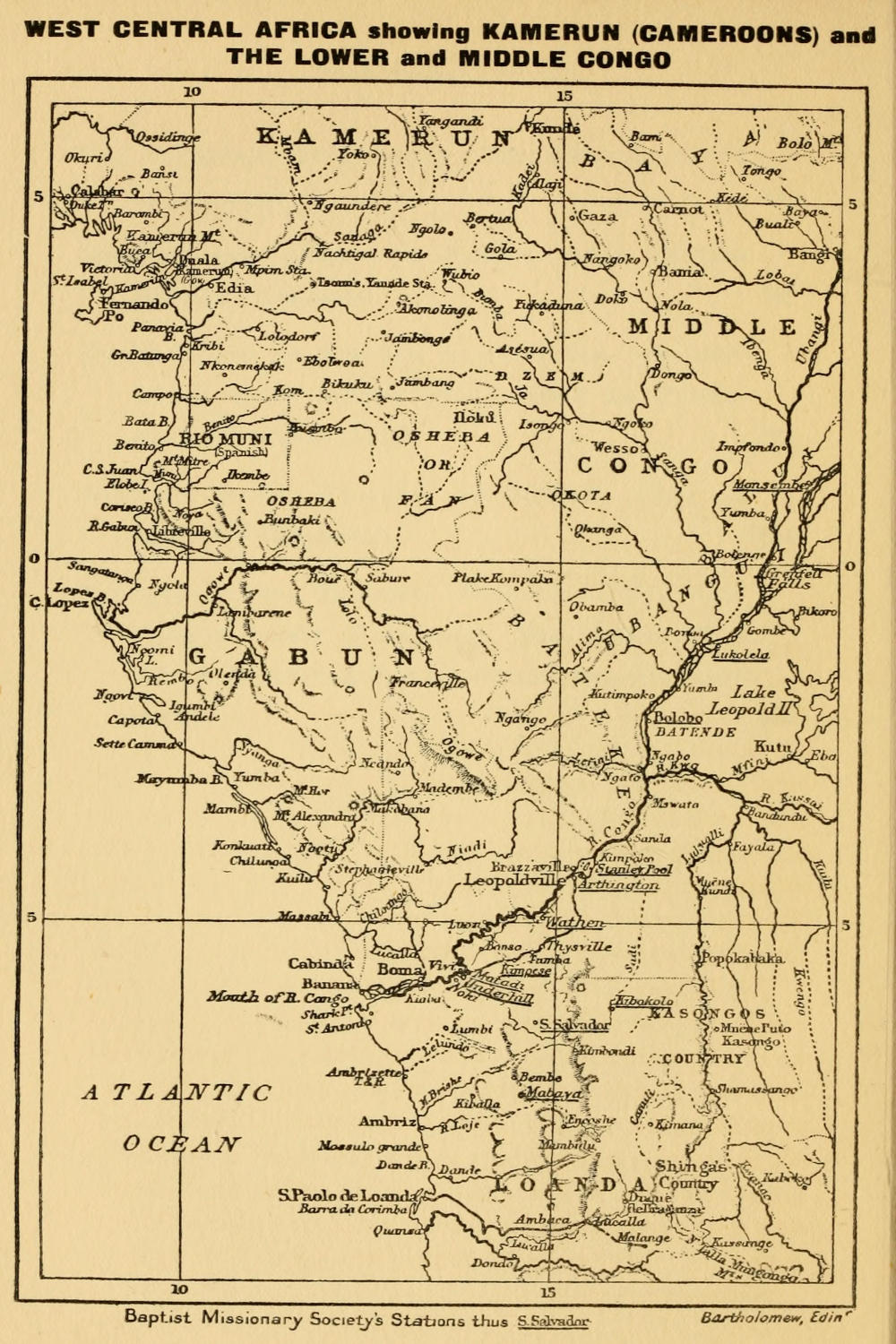
WEST CENTRAL AFRICA showing KAMERUN (CAMEROONS) and
THE LOWER and MIDDLE CONGO
Bartholomew, Edinʳ
Baptist Missionary Society’s Stations thus S. Salvador
CHAPTER I EARLY YEARS
Gwen Elen Thomas was born in London,
and resided in the metropolis until the
call of Africa drew her across the sea. She never
lived in Wales, save during brief holiday visits,
yet the Principality had its rights in her character
and career, and a cherished place in her natural
affection. Her father was a Welshman, and her
husband was a Welshman. All her life long the
beauty of the western hills glimmered through
the dear home talk; she was passing happy in
her occasional holiday sojourns among them; and
often, when spent by labour in the torrid heat of
Africa, longed for wings which might bear her
away to some bracing mountain height in Wales.
Her father, George Thomas, was born at Maentwrog,
to fair-seeming prospects; but his sky was
soon overclouded by dire bereavement, and his
life was much acquainted with adversity and disappointment.
His father, Griffith Thomas of
Maentwrog, early held a good position as “Crown
Agent for the Woods and Forests of North Wales,”
and married a woman whom he loved with intense
devotion. Several children were born of the marriage,
but at the birth of the youngest the
mother died. Two years later her husband was
laid beside her in the grave. It was commonly
affirmed that the death of his wife shattered him,
and that he died of a broken heart.
The heads of this plaintive little story are
inscribed, with customary brevity, upon a tombstone
in the graveyard of the church at
Maentwrog, and read as follows:—
“To the memory of Jane, wife of Griffith
Thomas of Maentwrog, Gent. She departed this
life on the 21st day of September, 1811, aged 37
years. Also of the above-named Griffith Thomas,
died on the 10th day of September, 1813, aged
34 years.”
The young orphaned children were taken charge
of by relatives, and George was brought up by
his grandmother.
At the age of eighteen, or thereabouts, he came
to London to seek his fortune, and obtained a
position in Finchams’ Tea Warehouse at Charing
Cross. Some years later he met a young lady,
Anne Clarke, at an evening party and resolved,
precipitately, that if he ever married, she should
be his wife. His affection was subjected to the
test of time. Three years elapsed before he
secured an engagement, and four more ere he
carried off his bride.
Anne Clarke was the daughter of George Rix
Clarke, a Suffolk man, who wrote a history of
Ipswich, which is still esteemed by antiquarians
and topographers. In middle life he married a
Scottish girl of seventeen, and Anne, their first
child, was born at her mother’s home in Edinburgh.
The china bowl used at her christening
is a treasured possession of the family.
Four children were born to George and Anne
Thomas, of whom Gwen Elen was the third.
At the date of her birth, January 28, 1853, her
parents were residing at Albion Grove, Barnsbury,
in comfortable circumstances. They had
previously become associated with the Baptist
Church worshipping at Providence Hall (now
Cross Street), Islington, under the pastorate of
the Rev. John Jenkyn Brown, who was subsequently
well known to the Nonconformist world
as “John Jenkyn Brown of Birmingham,” and
who in 1882 was President of the Baptist Union
of Great Britain and Ireland. Mrs. Thomas was
received into the fellowship of the Church at
Islington. Her husband, though a man of pronounced
evangelical conviction, was restrained
by invincible compunction from ever assuming
the responsibility of Church membership. None
the less, a warm friendship subsisted between
him and his minister, which was maintained
through all the changes of following life.
When he died, his daughter, Gwen Elen, looked to
Mr. Brown with filial affection which was warmly
answered, and it is significant that upon the occasion
of her marriage, he came from Birmingham
to London to fulfil the paternal office of giving the
bride away.
While Gwen Elen was still in early childhood the
family fortunes sustained a severe reverse. Her
father, who was in business as a Scotch agent, was
the victim of a fraudulent transaction, and the
loss entailed was so heavy that his business was
ruined. There followed years of struggle and
vicissitude. During part of this period the family
resided at Fulham, but before Gwen had emerged
from childhood, they returned to the north of
London and became connected with the Baptist
Church at Camden Road.
One suggestive glimpse of her child-life comes
down to us. Gwen and her younger brother
Herbert, who were great chums, used to sit together,
under the dining-room table, reading stories
of Moffat and Livingstone. Years afterwards,
when they were both still quite young, and the missionary
interest at Camden Road Church had
become acute, Herbert said one day to his sister,
touched surely by the spirit of prophecy: “Gwen,
you had better marry one of these missionaries,
and I will come out and be your lay-helper.” The
forecast was only realised in part. Gwen did
marry a missionary, but before that came to pass,
at the early age of nineteen, Herbert died.
In these days the Church at Camden Road was a
strong and flourishing community, and by way of
becoming yet wealthier and more influential. The
sanctuary was erected in 1854 by the Metropolitan
Chapel Building Association, and at first stood in
the fields. But the tide of building soon swept
beyond it, and the surrounding district became the
kind of suburb in which a Nonconformist Church
enjoys conditions favourable to success. In 1857
the congregation invited the Rev. Francis Tucker,
B.A., of Union Chapel, Manchester, to become its
minister. He accepted the invitation, formed a
Church, and commenced a period of service,
honourably and successfully maintained for twenty-seven
years. Mr. Tucker was a man of winning
personality and sympathetic manners. As a
preacher he possessed commanding advantages; his
musical voice was managed with consummate skill;
he was master of refined, poetic diction, was gifted
with imagination, and swayed withal by fervent
evangelical conviction. Moreover, having held for
a short period a missionary pastorate in Calcutta,
his interest in the foreign work of the Church was
enlightened and intense.
As a child Gwen Thomas passed under the influence
of this estimable man, an influence which
waxed but never waned until the day of his
death. It is touching to recall that upon one
occasion when she was recovering from a severe
attack of fever at the Cameroons, and tormented
by insomnia, her restless mind was haunted by
the thought that if only Mr. Tucker could come
and read to her she would be hushed to sleep.
While yet a girl her heart was given to Christ,
in surrender which knew no recall, and at the
age of eighteen she was baptized by her beloved
minister and welcomed into the fellowship of the
Church. It was at this time, or perhaps a little
earlier, that she became a teacher in the Sunday
School, which she had attended as a scholar for
several years. Owing to circumstances, her
secular schooling had been somewhat irregular,
but she was fortunate in its finishing stage. It
was the day of “Private Schools for Young
Ladies,” now almost obsolete, and one of the best
establishments of this order was conducted in
Hilldrop Road by the Misses Hewitt. The school
was distant from Camden Road Church less than
a hundred yards, the principals were members
of the Church, and were women of high character
and adequate attainments. Their school
was held in great repute in the district, and their
influence was a social factor of happy moment.
That the Misses Hewitt were able to command
the esteem and affection of their pupils is
pleasantly evidenced by the fact that, though
the school has been discontinued for years, “The
Hilldrop Old Girls’ Club” still exists, and it will
interest readers of this book to be informed that
the last annual issue of The Hilldrop Magazine,
the organ of the club, contained an “In
Memoriam” article on Gwen Elen Lewis. To the
pages of this magazine she was an occasional
contributor.
At the age of nearly sixteen she entered the
Hilldrop school, and for about a year enjoyed
advantages which greatly improved her equipment
for the battle of life. Like many of her
fellow pupils, she became warmly attached to her
teachers, and the ensuing friendship was only
broken by her death. I am happily indebted to
Miss Amy Hewitt for the following paragraphs.
Confessedly unable to supply incidents, Miss
Hewitt has conveyed impressions which are as
vivid as they are helpful:—
“It is many years since she was a school girl,
and the lapse of time has naturally robbed my
memory of all but the most startling individual
happenings in our professional experience. Moreover,
Mrs. Lewis was not the sort of girl to make
dramatic school history. High souled, law abiding,
and very conscientious, loving knowledge for its
own sake, and eager to make the most of her
advantages, she was an ideal scholar.
“Coming into an atmosphere thoroughly congenial
to her temperament, she settled happily
at once, and though she has since said that the
influence of the few months spent as a daily pupil
at Hilldrop Road was amongst the most permanently
formative of her life, there was nothing
at the time to distinguish her from a set of like-minded
young girls who were her companions,
and some of whom became her life-long friends.
“Though I have no definite facts to communicate,
my impressions of her personality and character
remain undimmed. I remember that as Gwen
Elen Thomas she entered our school on October 12,
1868, a short, plump, fair, blue-eyed girl of sixteen,
whose slight guttural accent, even without the
additional hint of her Welsh name, would have
suggested her nationality. Her bearing was self-contained
but alert. She was there—her individuality
well developed; and she was there, with
all her faculties alive to receive and to give out
influence. That was the first superficial impression.
“Later on we became familiar with, and learned
to love, the serious, intent face, the steady penetrating
glance, and the quick sense of humour,
which on the slightest provocation lighted up her
countenance with fun, and moved her to hearty
laughter. She was keenly interested in her
studies and brought to bear on them strong
intelligence and powers unusually mature for
her age.
“Monsieur de Lamartinière was at that time our
French master, and Gwen Elen greatly delighted
in his lessons. She had been thoroughly well
grounded in the language, and so was prepared to
profit by advanced lessons; and she made very
rapid progress.
“Gifted and eager, she never seemed to find any
subject dull or distasteful, but, as was natural
to one of her sympathetic and deeply religious
character, History, Literature, and Scripture particularly,
attracted her and brought her original
mind into play.
“The splendid endowments of heart and head
which made her so good a pupil were given unstintedly
to her missionary work, and it was with
great delight that we heard from time to time
of her wonderful success in Africa.”
One of her fellow scholars at the Hilldrop
School was Emily Smith, daughter of Mr. Jonas
Smith, a deacon of Camden Road Church, and
between these two girls there grew up a warm
and helpful friendship. They prepared their
lessons together, and entered with girlish ardour
into each other’s interests. In course of time
Gwen Thomas became a frequent visitor at her
friend’s home. And that it was a genial, hospitable
home, there are not a few who could bear
grateful witness. When her own mother died,
the Smiths loved her the more for her sorrow,
and for the filial devotion she had displayed; and
how the friendship was maintained, and how
Annie Smith a younger daughter followed her
into the mission-field, will appear as this story
proceeds.
And now something must be said of a man
whose influence upon the life of Miss Thomas was
not less than that of her minister, though he was
her senior by a few months only. Thomas J.
Comber was a member of the Baptist Church at
Denmark Place, Camberwell, of which Dr. Charles
Stanford, of gracious memory, was the gifted
honoured minister. The love of Christ and the
passionate desire to be a missionary of the Cross
came to Comber in his early youth. While yet
a lad, he became a Sunday-school teacher at
Denmark Place, and was barely nineteen when he
entered Regent’s Park College to gain equipment
for his ordained career.
It is more than a convenient Sabbath day’s
journey from Regent’s Park to Denmark Place,
and so it fell out that in his student days Comber
became a frequent worshipper at Camden Road.
He loved children, was keen for any kind of
Christian service, and soon found an opening in
the Sunday morning infant class. It occurs to
me to remark, in passing, that he is the only
theological student of my remembrance who ever
found himself effectually called to this modest
sphere of labour. And I am tempted to add that
if there be aught of disparagement in this reflection,
it is not of the sphere.
His increasing interest in Camden Road Sunday
School, and his zeal for the spiritual welfare
of the scholars, led him to request permission
to conduct a week-evening children’s service.
Camden Road Church has always been reasonably
conservative, and the proposed innovation was
not acceded to without demur. But Comber,
thus early, was not a man to be deterred from
treading any path which seemed to him the path
of duty, because certain excellent people might be
in doubt of its expediency. Hesitating, dubious
folk are apt to draw aside when one appears who
will not be denied, and Comber had his way.
The service was instituted, and spiritual forces
generated by its means are working to-day.
The early hour of the children’s meeting made
it difficult for young men to attend, and Comber’s
helpers were at first exclusively drawn from the
teachers on the girls’ side of the school; and now
and then he was twitted by the remark that all
his lieutenants were girls. But he was too much
in earnest to be perturbed by a gentle gibe, and
in the course of a few years the pleasantry would
seem a feeble thing, in relation to a man who had
proved himself, under heroic conditions, to be a
resolute, virile, and resourceful leader of men.
Meanwhile if his lieutenants were girls they
were of the right mettle, believed in him implicitly,
admired him profoundly, backed him
bravely in his Christian endeavours, and were
destined to remain his warm friends as long as he
lived. Gwen Elen Thomas was one of them, and
among others associated with her in this service
were Miss Emily Smith, Miss Rosa Nodes, who
played the harmonium, and Miss Emily Pewtress,
daughter of Mr. Stephen Pewtress, deacon and
secretary of the Church.
Comber believed profoundly in child conversion.
He set himself to bring about early and intelligent
decision for Christ, and his purpose was honoured
of God. There were many such decisions, and in
course of time there was a goodly list of
children who simply but credibly affirmed their
personal faith in Christ. These Comber wisely
accounted babes in Christ, who needed nursing,
and as many of them were girls, some, fourteen
or fifteen years of age, he concluded that their
own teachers were fitter for the business than
himself. So he called his four lieutenants together
and informed them that these young converts
must be divided up into classes, of which they
must take charge. In the course of his instructions
concerning procedure, he said that each
little meeting must be commenced with prayer.
They were dismayed. No one of them had ever
engaged in prayer with a human audience; the
thing could not be done. Practical and gently
autocratic, he bade them meet together and make
their first attempts among themselves. They
were obedient, and the work went on according
to the leader’s plans.
Though Comber did very well with his young
women helpers, it was all joy to him when one
of the teachers from the other side of the school
joined him, and shared his labours in the conduct
of the services. Of John Hartland, now entering
the story of Miss Thomas’s life, much will be
written in the next chapter. Suffice it to say at
this point that he stood beside Comber in his
work among the children at Camden Road, conducted
it after Comber had sailed for the Cameroons,
joined him later on the Congo, and died
in his arms, having won from him a love as deep
and tender as that he gave him.
Comber now had a man lieutenant, and had
need of him. For though the majority of his
weekly audience may have been girls, there were
always boys present, and of the importance of his
work among the boys the following letter from
Mr. S. Leslie Pewtress yields convincing and
beautiful evidence:—
“My remembrances of these services for children
conducted by Mr. Comber at Camden Road are
very hallowed ones. I was quite a lad, but can
distinctly recollect how the talk in our home ran
that he was a very brave young student to attempt
them, and very persevering to get permission to
hold them, in spite of much opposition and cold
water.
“There was no Band of Hope then. For
children there were occasional magic lanterns,
annual Sunday-school meetings, and a composition
and an elocution class for young fellows—also
a singing class. But Mr. Comber’s meetings
were so different from all these. I felt as I
entered the room that there was a holy purpose
in it all. Coming, as Mr. Comber did, from
outside, having no relatives or friends in the
place, he seemed to me a direct messenger from
God. I had a strange awe of him that he dared
speak as he did, and yet I rejoiced that he could.
I wish I could recall the hymns we sang. They
seemed very special at the time I know.
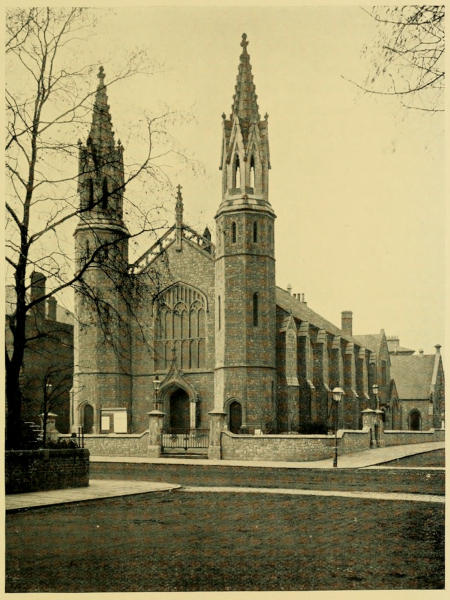
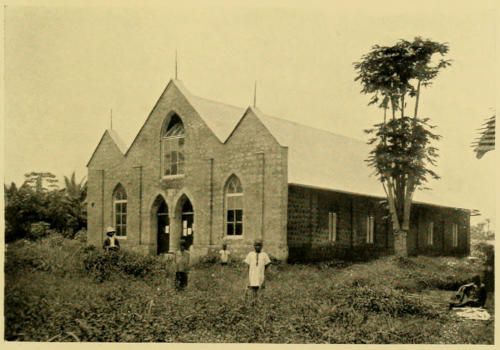
CAMDEN ROAD BAPTIST CHURCH, LONDON.
(Photo: F. Thurston, F.R.P.S., Luton.)
“Mr. Comber made a practice of standing at
the door and saying goodbye to us as we went
out. I tried to avoid him if I could, and being
one of the bigger lads he let me pass many times.
One night, however, he took my hand somewhat
diffidently, and as he said good-night, added, ‘Do
you love the Lord Jesus?’ I was quite dumb
with emotion. I can feel the appealing look with
which I lifted my eyes to his face and met his
kindly loving eyes, even now. Then I broke away
and hurried home to my bedside, where, on my
knees, the tears streaming down my cheeks, and
in utter silence, my heart poured itself out to
God in longing desire to be a better boy. It was
my first conversion, the first yielding of heart
and will to God I ever made.
“Mr. Comber never knew. He said no word to
me at later meetings. What he thought of my
rudeness and coldness I do not know. I fear I
hurt him a little, but he never resented it. His
later work, especially as a missionary, was always
shaming me to myself, while he has always been
to me the ideal Christian young man, and hero.
But when I look at his photograph it is always
to the children’s services that my thoughts are
carried back.”
The writer of this letter, who, to my personal
knowledge, has been for five-and-twenty years a
cultured, devoted, and successful Christian worker
among children and young people, would probably
be in agreement with one of Comber’s four helpers,
already named, who recently told me that he was
unquestionably one of the strongest personal,
spiritual forces she had ever encountered in a
lifetime of Christian service.
That this man exercised a formative and dominant
influence upon the life of Miss Thomas,
during the years of their association, is a statement
that needs no other proof than that afforded
by the facts, that she began her missionary career
in his tracks upon the Cameroons; spent three-and-twenty
years of her life in the great Congo field,
which he and Grenfell opened up for the Baptist
Mission; and, as long as she lived, continued to
speak of him with reverent affection.
In certain regards Comber and Miss Thomas
were greatly unlike in temperament, yet had
they much in common of gravest moment. The
love of Christ was the grand passion of both their
lives. They were both endowed with indomitable
will and the consequent capacity for sustained
industry. They both loved and understood children,
possessed the saving grace of humour, and,
devoutness notwithstanding, took innocent and
wholesome delight in fun.
I met Comber several times during his last
furlough, but my visual remembrances of him are
restricted to two living pictures, typical and contrasting,
which I will endeavour to call up before
the mind of the reader. A children’s party is in
course at the house of Mr. Jonas Smith. The
company is gathered in the drawing-room, and
consists of twenty or thirty children of varying
ages, with a sprinkling of benevolent elders.
Comber is at the piano, singing, to his own
accompaniment, a humorous song. The accompaniment
is mimetic as well as musical. Every
feature of his mobile face, roguishly turned to his
audience, and every muscle of his lissom body,
seem to move in concert with the fun. When it
is over and he is about to leave the instrument, he
is stormed by overwhelming numbers, held to his
place, and coaxed and coerced into singing again.
Three months later I find myself sitting in the
area of Exeter Hall. This time it is not a
children’s party which is in course, but the Annual
Meeting of the Baptist Missionary Society. The
Hall is crowded in every part, and in the middle of
the platform stands a young man, with a keen,
clean-shaven, boyish-looking face. The great
hushed throng is mastered by the speaker, who is
none other than the singer of the laughing song.
He does the storming this time, and he has his
way with the hearts of his audience. There
have been heavy losses on the Congo. Counsels
of retreat have been urged. What has Thomas
Comber to say about it? He has the right to
speak. He is a lonely man. His young bride has
lain for years in a Congo grave, and the Congo
grave of his brother, Dr. Sidney Comber, is newly
made. Yes, surely he has the right to speak!
What has he to say? Even now after four-and-twenty
years I can see the flame of passion
kindling in his face as he pleads that he and his
brethren may be spared the shame, and the cause
of Christ the wrong, which would be involved
in retreat. Would they bid Grenfell back, whose
exploits he praises and whose gallant words he
quotes? It is unthinkable. That speech made
history. Counsels of retreat died into silence.
“Forward,” not “Backward,” became the order of
the day.
Such are my two distinct remembrances of the
man, whom the children at Camden Road loved as
a teacher, admired as a hero, and romped with as
a playmate; whom the Congo natives, when they
came to know him, regarded as a miracle of love
and power; and whom his comrades followed as
a captain whose belt has been buckled by the
fingers of Almighty God.
During the years of Comber’s memorable service
at Camden Road, Miss Thomas lived at home with
her parents. Her mother was a woman of gentle,
retiring disposition, who permitted herself to be
absorbed by domestic interests, and was remarkable
for an inexhaustible patience, which her
daughter Gwen inherited, to the great advantage
of her own soul, her comrades, and her work.
Mr. Thomas was a man of keen intellect and
independent outlook, who was wont to talk freely
with his children about books and men and movements
of the day, and whose conversation was
an educative influence of major importance.
On Christmas Eve, 1876, Miss Thomas sustained
one of the great bereavements of her life, in the
passing away of her mother, long an invalid,
to whom her filial attention had been unremitting.
Three months earlier, in September of
the same year, she, with many others, had said
“goodbye” to Thomas Comber, who sailed for
the Cameroons. The Children’s Service Valedictory
Meeting at Camden Road was at once sorrowful
and enthusiastic. The young folk were grieved
to lose their leader, but loyal enough to be glad
that he was going to the great work marked
out for him by God. A testimonial address,
headed “Mizpah,” was presented to him by John
Hartland, in the name of the children who had
signed it, together with a magic lantern, for
which they had subscribed; and promising faithful,
affectionate, and prayerful remembrance, Comber
passed on his way.
Of course, he continued to correspond with his
young friends, and by way of augmenting their
interest in his work, suggested that they should
support a mission boy. The suggestion was
adopted, and a scholars’ working meeting was
instituted by Miss Gwen Thomas and Miss Emily
Smith, to raise the necessary funds. It was a
modest enterprise at the beginning. The first
sale was held in a corner of the schoolroom, with
goods displayed upon a single table. Later a
second corner was annexed, and a second table
furnished. Later still Mrs. Jonas Smith took
practical interest in the undertaking, a “Ladies’
Missionary Working Party” was formed, and so
on, until the whole Church became involved in the
business of “The Camden Road Congo Sale,”
which at one period ranked as a Denominational
Institution.
The Annual Sale is still maintained, though in
modified form, and in the course of its history
has contributed to the funds of the B.M.S. some
£3,000, more or less. Mrs. Lewis loved “The
Congo Sale,” was often occupied with its business
when on furlough, had the honour of opening
it more than once, when the opening had become
a function, and talked of it when she lay a-dying.
Miss Alice Hartland remembers that at the
early working meeting Miss Thomas used to read
to the children as they sat sewing, “The Life of
Robert Moffat.” Naturally Robert Moffat was
one of her heroes, and many years later she wrote,
in a passage which I propose to quote, that
Mrs. Moffat was her ideal of what a missionary’s
wife should be. Happily, by the grace of God,
she lived to realise her ideal, in marked degree,
and to create a new one for others who may
follow in her steps.
One pathetic family incident relates itself to
this children’s working meeting shortly after its
inception. In 1868 Miss Thomas’s elder sister,
Eliza Jane, was married to Dr. Richard Percival,
and some three years later accompanied him to
St. Lucia, West Indies, where he had secured a
medical appointment. His health failed, and after
a short stay he was compelled to return. There
were three children of the marriage, Ethel, Eva,
and Beatrice, whose names will often appear in
this book. But their father’s health was never
strong, and in 1877 he was lying ill at St.
Leonards. Two of the children were staying
with their Aunt Gwen, and on Saturday afternoon
were taken by her to the Working Meeting.
While engaged in the meeting she received a
telegram bidding her bring the little ones to the
bedside of their dying father. They were taken
immediately, and shortly afterwards he passed
away.
CHAPTER II BETROTHAL, BEREAVEMENT, AND DESIGNATION TO THE CAMEROONS
Comber began his missionary life at Victoria,
the colony founded by Alfred Saker as the
new home of the little Protestant community,
driven from Fernando Po by the intolerance of
the Roman Catholic authorities. Victoria was
situated on the shore of Ambas Bay, and at
the foot of the Cameroons Mountain, which
Comber climbed one day, finding at the top the
bottle left there by Captain Burton, an exploit
which led to a pleasant interchange of compliments
at a meeting of the Royal Geographical
Society in London.
Not long after his arrival Comber was left in
sole charge of the station, and threw himself into
the work with characteristic zeal. Grenfell, meanwhile,
was working at Bethel station on the
Cameroons river. Subsequently the two were
thrown much together and formed a friendship
which was of happiest omen for the cause of
Christianity in Central Africa. Both of them
turned with longing eyes to the interior, yearning
for work among heathen tribes whose original
depravity had not been complicated and deepened
by imported European evils. But their dreams
of local extension were broken by the call to the
Congo.
Stanley’s historic journey “Through the Dark
Continent,” in the course of which he proved that
the Lualaba River and the Congo were one and
the same stream, and the opportune munificence
of Mr. Robert Arthington of Leeds, whose inspired
guess had anticipated the explorer’s discovery,
made a new departure in the work of the Baptist
Mission at once possible and obligatory. I have
told the story of this new departure at some length
in “The Life of George Grenfell,”[1] and must here
compass the matter in a few rapid sentences.
The Committee of the B.M.S. realised that in
Comber and Grenfell they had men who were
providentially raised up, endowed, equipped, and
placed, for the new enterprise. On January 5,
1878, the young missionaries received the expected
invitation to undertake a pioneering expedition
in the Congo region. Their assent was instant
and enthusiastic, and while awaiting final instructions
they made a flying visit to the lower reach
of the Congo, and laid some stepping-stones for
future use.
Encouraged by their reconnoitring experiences,
they returned, completed their preparations, sailed
from Cameroons on June 28th, and early in August
were in San Salvador, the capital of the ancient
kingdom of Congo, making friends with the king.
They felt their way a stage or two further on
toward Stanley Pool, but encountering obstacles,
realising the imperative need of reinforcements,
and being profoundly convinced of the feasibility
and the obligation of the new enterprise, they
went back upon their tracks, Grenfell returning
to the Cameroons, and Comber coming to London
to tell his story and to ask for men. He got
them in the persons of Holman Bentley, Harry
Crudgington, and John Hartland.
Hartland had long cherished in his heart the
desire to be a missionary, but the way had never
opened for him to secure the college training
which seemed to be necessary, and so his desire had
remained his secret, discussed only with his sister.
But Comber’s appeal so stirred him that he could
not restrain himself longer. On returning from
a meeting of the Young Men’s Missionary Society,
held at the Mission House, he wrote to Comber
in these terms:—
“I have longed, I have prayed to go, and have
often cried, ‘Here am I; send Me’; but I have
never yet felt that He was sending me, and I
dare not go alone. But to-night you said you
wanted to take back with you to Africa one or
two men at once. The preparation for mission
work was always my obstacle, but if the men
you need are men ready to dedicate themselves,
as they are, and at once to the Lord’s service—if
the only preparation needed is the preparation
of the Holy Spirit; if the wisdom needed is that
wisdom promised to those who ask; if the sufficiency
is not a college education, but the sufficiency
which is of God—I cannot, I dare not hold back....
My mind is fully made up, that if you will
accept me (and you know what I am, I have no
need to introduce myself to you), as a fellow-helper
in the Lord’s work, and if the Society will
take me as one of their workers, I am ready this
day to consecrate myself to the Lord.”
Comber’s joyous answer was: “Apply at once.”
The application was duly made and accepted,
and on April 26, 1879, John Hartland, to his
heart’s desire sailed with Comber, Bentley, and
Crudgington for the Congo. He was known at
Camden Road, as a quiet, rather nervous, good
young man, and probably none, save two or three
who knew him best, supposed that he had in
him the making of a capable, heroic, missionary
pioneer. But he had. And in quiet station work
at San Salvador, in adventurous journeys in which
he shared attempts to find a practicable way to
Stanley Pool, and in the heavy subsequent labour
of establishing a line of communications for the
traffic of the mission, and especially for the
transport of the steamer Peace, he exhibited
readiness of hand, resource of brain, and devotion
of spirit, which elicited the unstinted admiration
and affection of his colleagues. That he could
write vividly is sufficiently proved by the following
extract from a long and profoundly interesting
letter wherein he tells of an experience which
almost made an end of Comber’s career and his
own:—
“We walked into the town (Banza Makuta)
and asked the people its name, but got no
answer. They drew back a little, and then one
man called out, “Nda bongo nkeli, vonda mindeli!”
(“Fetch the guns; kill the white men!”) and in
an instant they rushed away returning immediately
armed with great sticks, huge pieces of
stone, knives, cutlasses, and guns, and without
any word of palaver, commenced dancing and
leaping round us, and brandishing their weapons.
Mr. Comber sat down by a house, and I was
about to do the same, but our assailants yelled
out, “Get up, get up,” and rushed upon us. Such
fiendish, blood-thirsty, cruel countenances I never
saw. We got up and called to them to stop,
that we would go back, but it was no good, and
stones came flying towards us, and sticks and
knives were brandished around us. We could
see the people were determined, not only to drive
us from the town, but to have our lives, so there
was nothing left for us to do but to attempt flight,
though it seemed hopeless. Away we started,
amid stones and blows. We all got hit and
bruised, but managed to reach the top of the
steep hill, when a sudden report rang out behind
us, above the uproar, and Mr. Comber, who was
in front of me, fell. I dashed up to him and
tried to assist him to rise, but he said, “It’s no
use, John; I’m hit, you go on.”
How Comber got up again, overtook Hartland
and Cam, and ran with them for many miles
with a jagged ironstone bullet embedded in the
muscles of his back; and how ultimately they
all three reached a friendly town and were safe,
is familiar history.
Possibly the reader may be wondering by this
time whether, carried away by interest in John
Hartland and the Congo Mission, I have forgotten
Miss Thomas and my proper business. I hope
the next paragraph may afford adequate proof
that this is not the case.
Early in 1882 Mrs. Seymour, who as Miss Nodes
had been closely associated with John Hartland
in the children’s work at Camden Road, and whose
husband was his friend, received from him a
most interesting and momentous letter. In it he
confessed that before leaving for the Congo he
had conceived a strong affection for Miss Gwen
Thomas, and the hope that one day he might
have the happiness of securing her as his wife.
Foreseeing that he might not be able to endure
the Congo climate, he determined to keep his love
and his hope secret, and had sailed without giving
word or sign. At least he had done his best in
the matter of concealment. But now that he had
become acclimatised, and good prospect of life
and work was before him, he was minded to put
his fate to the test, and he desired Mrs. Seymour
to broach the subject for him. On one condition!
He conceived it possible that during his absence
Miss Thomas’s interest and affection might have
been engaged by some other man. If Mrs. Seymour
had reason to suppose that such was the
case, then he would have her burn his letter, and
keep his secret, as he was sure that if Miss Thomas
knew she had been the innocent occasion of suffering
to him, she herself would suffer, and that
purposeless suffering he would have her spared.
But if the way seemed clear, he desired a friend’s
most friendly mediation. He enclosed a letter
addressed to his sister. If all went well with his
indirect wooing, he desired Mrs. Seymour to hand
this letter to Miss Hartland that his friends at
home might have the earliest possible intimation
of his joy. But if things went awry, he would
have the letter destroyed, that they might not
know that with other burdens he carried the
grievous addition of an unrequited love.
It was obviously the letter of a courteous,
Christian gentleman, and much impressed by its
extreme chivalry, Mrs. Seymour proceeded to execute
her difficult commission. But finding that
the negotiation was not to be precisely a matter
of plain sailing, with sound, womanly wisdom she
made haste to convey to her correspondent the
time-honoured counsel, “Speak for yourself, John.”
John spoke for himself, on such wise that obstacles
were removed, hesitations overcome, and
in due course he received the word of assent which
his heart coveted. But he had to wait for it,
with what patience he could muster, through
several weary months. The following letter will
say much to the discerning reader and spare me
pages of laboured exposition:—
“St. Margaret’s,” Hampstead Heath.
“July 5, 1882.
“My dear Mrs. Hartland,—Thank you so much
for your kind letter of this morning. I am so glad
that our engagement is pleasing to you. I feel
sure that it is the hand of God which has guided us
both in this matter. My only regret is that dear
John should have had such a weary waiting time.
But I try to remember that he is in ‘Our Father’s’
care as well as I. I do most earnestly pray that I
may be a help to him in the great and noble work
he has undertaken: work in which I have so long
wished to have a share, that I am almost afraid to
realise that my heart’s desire is about to be fulfilled.
I can only leave my joy where I have so
often left my desires, at the feet of Him to whom
all hearts are open, all desires known. I am
hoping to go home on Saturday evening to spend
the Sunday. If I am early enough I will try to
look in on my way. If not, I shall be at chapel
on Sunday morning and stay to communion there,
when I shall hope to see some of you. I would
propose coming down in the afternoon, but my
own dear papa is so very unwell that I don’t think
I could leave. With best love to you all,
“Believe me,
“Yours affectionately,
“Gwen Elen Thomas.”
“St. Margaret’s, Hampstead Heath,” from which
this letter is dated, was the residence of Mr. and
Mrs. May, in whose family Miss Thomas was acting
as governess, having responsible charge of their
young children. Her position was a singularly
happy one. She was treated as a friend, and
received the utmost Christian courtesy and kindness,
of which she often speaks in her letters, with
expressions of warm gratitude. Mr. and Mrs. May
used to spend the winter in Spain, and during their
absence Miss Thomas had the care of their children
at Ramsgate. Consequently her opportunities of
seeing Mrs. Hartland were only occasional, but her
letters were frequent and affectionate. It is manifest
that Mrs. Hartland had taken the woman of
her son’s choice into her heart, and that Miss
Thomas gladly accepted the spiritual hospitality.
She had kept John Hartland waiting a long
time. A curious Nemesis ordained that she in
her turn should be kept waiting. Having despatched
the letter which is to abolish his anxieties
and fill his heart with rapture, she naturally yearns
to have the record of the rapture before her in
black and white. Of course, she must wait for
the mails; but the mails come and the record
tarries. Shipwreck and minor mischances cause
her hope to be deferred. Toward the end of
September she writes plaintively to Miss Hartland:
“It seems as if all this year has been taken up for
me and John in waiting for letters.” Meanwhile
her spare time is not occupied in idle dreaming.
She has taken up the study of Portuguese, and
writes out her Sunday-school lessons, finding this
a more fruitful means of studying the Bible than
reading merely. Moreover she thinks her MSS.
“may come in handy by-and-by.” In October,
by the irony of fate, she gets news of her sweetheart
through other people’s letters, and ruefully
writes to Mrs. Hartland: “John seems to have
written to every one by this mail except to Mrs.
Seymour and to me”; and goes on to say that
she will be very glad when the suspense is over
and she can look forward to getting her letters
every month. The November mail brought peace.
“13, Wellington Crescent, Ramsgate.
“November 19, 1882.
“My dearest Mrs. Hartland,—I must write
just a line or two to tell you I had my letter last
night. Wasn’t it nice? On his birthday! And
so the long waiting time is over for both of us at
last. I can hardly believe it. It is all so wonderful,
the way that the Lord has led us both. Poor
dear old boy! he has had a long, weary time
altogether. But it is over at last, and, as he puts
it, ‘The joy of the present is all the sweeter for
past sorrow.’ I suppose you have had a letter,
for he tells me he is going to write to you. In
mine he says it will be nearly another year, he fears,
before he is home. My letter is dated September
15th. I can’t write about other things now. But I
know you will rejoice with us both in our happiness.
With much love to all,
“Believe me, dear Mrs. Hartland,
“Yours affectionately,
“Gwen Elen Thomas.”
At the end of November Messrs. Grenfell and
Doke were on the point of sailing for the Congo,
and Miss Thomas records her regret that she was
unable to see them, but cherishes the hope of
meeting them in Africa. Grenfell she met, though
under other conditions than those she had forecast;
but Doke had passed on. As the year waned
her father’s illness had caused her grave concern,
but before it closed he was better. She records
also with pleasure that she is wearing the ring
which Mrs. Hartland had procured at her son’s
desire.
The little spell of happy work and happy correspondence
to which she had looked forward
was quickly troubled. Later deep called unto
deep. In January her father died, at the age
of seventy-three, and her natural sorrow was
rendered more acute by the fact that he had
been to her, as to his other children, a friend as
well as a father, who desired and received not only
their filial affection, but their understanding and
sympathy in the intellectual interests of his life.
Soon afterwards came news of the death of
Mr. Doke, who had studied and practised engineering,
as well as theology, and had gone out to
the Congo with Grenfell, specially to superintend
the reconstruction of the steamer Peace. This sad
event moved Miss Thomas deeply and touched
her happy dreams with a shadow of new anxiety.
Three months later the shadow suddenly blackened.
On June 19th Mr. Brock called to inform her
that the Baptist Missionary Committee had received
a letter from Grenfell stating that John
Hartland was ailing, and that Grenfell hoped to
send him home immediately, in which case he
might be expected at the end of the month. At
first she was naturally tempted to regard the
news as good, giving promise of an early meeting
with the man she loved. But reflection quickly
taught her that Mr. Brock would not have been
deputed by the Committee to bring her happy
tidings, and she prepared herself for the disclosure
of the fact, designedly withheld from her for the
moment, that John Hartland’s illness was very
grave. For three weeks her heart was tense
with anxiety, and she wrote to Mrs. Hartland
frequently, sometimes day by day, pouring out
her solicitude, her sympathy, the pain of her love
and the comfort of her faith.
On July 4th she wrote in a letter to Mrs. Hartland:
“I heard from Mr. Crudgington this
morning, telling me of the answer he had received.
He seems to think it probable that our
dear John will be on board the English mail, as
it is so late. But I am trying not to count upon
it too much.” This was written in the morning.
In the afternoon the following telegram was
received at the Mission House:—
“Madeira, 1.55, July 4th. Received here 4.11 p.m.
“Baynes, Baptist Missionary Society, London.
“Hartland dead, dysentery. Break news gently.
“Dixon (Congo).”
In the evening Mr. Baynes broke the news to
Mrs. Hartland, and his colleague, the Rev. J. B.
Myers, to Miss Thomas. Mr. Myers has given me
an account of the well-remembered interview.
Upon receiving him Miss Thomas took her seat
upon a couch. When he had communicated his
heavy tidings her features became rigid, but she
gave no other sign of emotion. He spoke gently,
and prayed with her, “Yet she neither moved nor
wept,” and when he left her she remained silent
and still as one in a trance.
When the mail came it was pitiful to learn that
the man she had loved had been lying in his
grave five weeks before the first intimation of
his illness had been received at home. Here I
take leave to reproduce the brief account of John
Hartland’s death, given in “The Life of George
Grenfell”:—
“The timely arrival of Mr. Dixon at Underhill,
and his willingness to take charge while Grenfell
got away, made the desired journey possible. The
‘run-up-country’ was a figure of speech, for he
was so weak that he had to be carried in a
hammock.
“Prior to starting he had written cheerily of
his hope of soon meeting his friend, John Hartland,
who, while willing to stay, was to be constrained
to take furlough in July or August. This
hope was fulfilled earlier than he had forecast,
but under conditions which made the fulfilment
a heart-breaking disappointment.
“At Manyanga, in the middle of April, Hartland
found himself so weakened by fever that he took
boat and came down river to Bayneston, arriving
on April 21st. Hughes, who was in charge of the
station at Bayneston, overborne by the heavy
nursing which Hartland’s serious condition entailed,
wrote to Butcher, who was at the camp
on the Luvu River, beseeching him to hurry on
to Bayneston. With fever upon him, Butcher
started immediately, and by dint of hard walking
arrived at Bayneston the next day, having previously
despatched a message to Grenfell, who
had left Underhill on the 27th. The message
reached him on the second day of his journey,
and though ill himself, he pushed on with forced
marches arriving at Bayneston on May 1st. It was
at once apparent to him that Hartland, whom
Hughes and Butcher had ‘carefully nursed through
ten days of the severest form of dysentery,’ was
in a dangerous condition. But abatement of the
worst symptoms gave hope, which again was
subdued to fear.
“After further fluctuations, hope was abandoned
on May 10th, and it was Grenfell’s duty to
inform his friend that his day’s work was done.
‘I shan’t easily forget,’ he writes, ‘his look, as he
gazed at us and said, ‘Well, I am not afraid to
die. My trust is in Jesus. Whosoever believeth
in Him hath everlasting life!’ A little while later
he said, ‘After four years’ preparation, and just
as I am about to enter upon mission work proper,
it seems strange for me to realise that my work
is done: but He knows best.’
“On the evening of the same day Comber
arrived unexpectedly, and most opportunely, for
the affection of these two men for one another
was intense. They had worked together in the
home country, they had shared early perils, and
were absolutely one in their devotion to Christ
and His work in Africa. Their intercourse during
the two remaining days of Hartland’s life was
very tender and sacred, and the letter which
Comber wrote to Mrs. Hartland is one of the
most beautiful and touching of all our missionary
records. It reveals how the dying man’s gaze
was absorbed by Christ; how he turned from
dear thoughts of home and marriage and happy
work to the dearer thought of being with Him,
and seeing Him as He is. His last words, uttered
at the final moment, were: ‘Christ is all in all;
Christ is all in all. Let me go, my friends. Don’t
hold me back. Let me go, Tom. I must go. I
want to go to Him. “Simply to Thy cross I
cling.” Let me go.’ So he passed on.”
To this account I am now enabled to make a
touching addition. On May 10th Grenfell told
Hartland that he was dying. After hearing the
announcement, and having the witness in himself
that it was true, he indited four letters, severally
addressed to his father, his mother, his two sisters,
and Miss Thomas. The first three have been
placed in my hands.
In the letter to his father Hartland explains
that as the power of writing has passed from
him, his friend Butcher is taking down the words
at his dictation. The same notes of dignity,
tenderness, and calm faith are found in every one.
Assured that only good can come of it, I venture
to print the tenderest of them all.
“Bayneston, Congo River.
“May 10, 1883.
“My dear Mother,—You will be sorry to
know when you get this letter that your missionary
boy has passed away from the field of
active service to rest. My views of missionary
life were not that I should fall after four short
years, but that I should spend my whole life in
Christ’s service. But He knows best. I know
you will not grieve to hear that He has delivered
me from a long and painful illness, and at last
taken me to Himself. But, oh! my dear mother,
I am so sorry for you. Your heart will break.
Oh, may He be very near to you! You have been
a dear, good mother to me, and now in writing
this brief farewell I feel happy that it will not
be so long before we meet again, in His land,
where sickness and dying are no more.
“Comfort poor, dear Gwennie; and while you
live, be a mother and a friend to her.
“Farewell,
“Your affectionate son,
“John.”
Mrs. Hartland was faithful to the charge of
her dying son. From that time forth, as long as
she lived, she was “a mother and a friend” to
Miss Thomas, and from that time forth Miss
Thomas called her “mother.” What wonder that
she wrote to Miss Hartland while her grief was
new, “I feel so thankful ever to have had the
love of such a brave, good, noble man? Oh,
Lily, what have I lost?” With wonted kindness
Mrs. May granted Miss Thomas leave of absence.
Part of the resting-time was spent with Mrs.
Hartland and part with her cousin in Yorkshire.
At first, in the great weariness following suspense
and shock, Miss Thomas confessed more
than once a yearning to follow her dear one into
the great rest. But her native strength of mind,
and her loyalty to God quickly conquered such
weakness. Rather would she live to carry on
his work.
The following extracts from letters written
while her great sorrow was still fresh and keen,
will give the reader some insight into the inner
life of a woman who was learning in the school
of pain, those deeper lessons of the faith, which
may be learned by rote in other schools, but not
by heart, lessons which she never forgot, which
contain the last secret of her victorious life.
“August 21st. (To Mrs. Hartland.) But don’t
think from this that I am worrying or fretting;
for I am not. God is with me, and I feel more and
more as the days go by that our darling’s prayers
for me have been wonderfully answered, that I
am helped and comforted. And is it not an honour
and privilege ‘to know Him and the fellowship of
His sufferings’? He has always been with me in
trouble and sorrow, but never so near as in this
the deepest of all. I hardly like to write thus, but
I want you to know, so that you may not be
anxious about me. And as to my future, I have
left it with Him to do as He will with me, and
I pray for grace to be faithful in whatever work
He calls me to.”
“August 28th. (To Miss Hartland.) To-day
I have had a letter, a very precious one, from Mr.
Comber.... I think he is feeling his loss very
much, though he writes as brightly as he can....
Since I have been back I have read through
Farrar’s ‘Life of Christ,’ and it has helped me so
much. I think these sorrows must be sent to us
to make us know that ‘Christ is all in all’; for
gradually we come to learn that having Him we
can do without all else. And yet, how we long for
human love! Nor do I think it can be wrong to
do so; for even Christ looked for human sympathy
in His sorrow. He could not find it. And,
oh, how much we have had in ours! I never so
much realised before the oneness of the people
of God; so many kind letters from far and near,
some even from unknown friends, and yet so
full of sympathy and prayer. I have thought of
that verse so often:—
“‘His way was much rougher and darker than mine;
Did Christ my Lord suffer, and shall I repine?’”
“Same date. (To Mrs. Hartland.) I am very
thankful the way seems to be opening. Of course
I will go to India if it is thought best. But no one
knows how dear and sacred Africa is to me.... My
only wish now is to live as he lived, and when my
work is done (if God wills) to die as he died, for
Christ and Africa. I do think of you so much, and
could almost envy you at times the sweet, pure
memories of his boyish days. I do feel it is an
honour to have had the love (for so many years
though I did not know it) of such a noble, true,
good man. And I am sure you, dear mother, feel
it a high privilege to have had such a son. It is a
great comfort to look back, and while we sorrow,
to feel there is nothing to regret. A pure, noble
life, and a glorious death. I think of that text so
often, ‘If ye loved Me, ye would rejoice because
I go to My Father.’ Oh, how happy he must be!”
As soon as she had recovered strength after the
shock of her great bereavement, Miss Thomas
formed the determination to go to the mission-field
alone, and with little delay made application
to the Baptist Missionary Society. Her application
was accepted in September. At first there was
thought of sending her to India, but finally, to her
great joy, it was decided that she should labour
at the Cameroons, travelling thither with Miss
Comber, who had already spent one term of
service in the field which her brother had left for
the Congo.
Uncertainty as to the time of her actual
departure compelled her to relinquish forthwith
her engagement with Mrs. May, who was on the
point of going abroad for some months. But she
was opportunely invited to take another position,
for the time being, which she rightly affirmed
that Providence had specially arranged for her.
Her friend Mrs. Seymour required the help of a
lady in her home, and was willing to receive Miss
Thomas on terms which friendship dictated, and
which friendship eagerly accepted. She was
to regard herself as a visitor, and feel perfectly
free to attend to her own affairs, and to depart
whenever the call should come.
So Miss Thomas went from Hampstead to Highbury,
where she passed the busy months of waiting
in an atmosphere of sympathy and friendship.
After some changes of arrangement it was
ultimately fixed that she and Miss Comber
should sail from Liverpool on March 5th. On
Monday, March 3rd, a farewell meeting was held
at Camden Road Church, and on behalf of the
Sunday School, Mr. Parkinson presented Miss
Thomas with a harmoniphon. She also received
at the same meeting a medicine chest, the gift of
Mr. Baynes, whose absence in consequence of illness
was much deplored. There were some forty
other presents privately given of which I have the
list. It included items of practical utility. Among
them, five pounds’ worth of spoons, forks, and
table requisites, from “the Ladies’ Missionary
Working Party”; and (equally useful) from other
friends, four five-pound notes. Notable among the
names of the donors are those of M. Gustave
Masson, French Master at Harrow, Miss Thomas’s
uncle by marriage with her mother’s sister; and
the Rev. William Brock, minister of Heath Street,
Hampstead, whose church Miss Thomas had
attended during her stay in the district, and
from whom she had received much of that discerning,
sympathetic kindness which still endears
him to all who come within its scope.
Miss Thomas spent the last fortnight with her
friends, the Hartlands, at 34, Falkland Road, and
on the morning of March 4th, she and Miss
Comber left St. Pancras after an enthusiastic
valediction from a large group of friends. They
were accompanied to Liverpool by Mr. Percy
Comber, Miss Comber’s younger brother, and Miss
Alice Hartland. Mrs. Fletcher of Edge Lane,
whose daughter was on the field at Cameroons,
entertained them, with warmest hospitality, and
in the evening a drawing-room meeting was held,
at which the Rev. John Jenkyn Brown presided.
The next day shortly after noon they embarked
in a tender, and proceeded to board the ss.
Corisco, which lay in the stream. Many friends
elected to say “goodbye” on board, and when
the bell rang and the tender left, two of them,
Mr. Percy Comber and Miss Alice Hartland,
remained as stowaways, and secured the unchartered
pleasure of a voyage with their dear
ones down the river and across the bar. But their
deferred farewells must needs be said at last.
They also were put off in turn, and the two young
missionary women passed out to sea.
CHAPTER III VOYAGE TO THE CAMEROONS, AND A SURFEIT OF ADVENTURES. 1884
The trials of the missionary life commenced
early for Miss Thomas. During the voyage
to Madeira the weather was exceptionally bad,
and she and Miss Comber endured the horrors of
sea-sickness for a week. Happily their sorrows
were mitigated by invincible good spirits. They
“were very jolly all the time,” made jokes of their
own miseries, and when the doctor enquired with
traditional sympathy whether they yearned to
be flung overboard, his obliging suggestion
was repelled with scorn. The ship carried no
stewardess, and at first they found it embarrassing
to be waited upon by a man. But “any
port in a storm,” and any help in the sickness
which the storm produces! The steward was a
nice kindly person, and they soon became used
to his presence and grateful for his attendance.
During the days of wild buffeting by wind and
wave, the harbour of Madeira was looked forward
to with strong desire, and it was a doleful hour
in which the Captain expressed his fear that the
badness of the weather would preclude his touching
at the Island. That fear was discredited by
the event; the weather moderated, and upon
sighting land the sufferers were able to appear
on deck.
They both found much comfort in the presence
of a third lady, Mrs. Buckenham, who was going
out to her husband, a Primitive Methodist missionary
stationed at Fernando Po. The Captain’s
marked kindness was an additional comfort, and
indeed the source of very many. His cabin on
deck had been annexed by certain gentlemen as a
smoking saloon, but upon the appearance of the
missionary ladies, the smokers suffered summary
eviction, and the cabin was placed at their service.
On the morning of March 12th they steamed
round Madeira and made the harbour in perfect
weather, which permitted them to take unchecked
delight in the lovely scenery. The Captain saw
them ashore, secured for them a spacious, private,
detached apartment at the hotel where he himself
put up, and in the afternoon Miss Thomas sat
down to write a merry letter to her “dear
Mother,” Mrs. Hartland.
As she writes her attention is confessedly distracted
by the dazzling charms of the flower-garden
she looks out upon, and the more sober,
but more enthralling charms of the tea-table,
which is being spread. Her week of sea-sickness
is pleaded as an excuse for gloating over mere
victuals, the validity of which plea the humane
reader will immediately allow. Referring to the
troubles passed, she writes gaily: “And we had
many a laugh at our own expense. To see the
boxes and chairs executing a jig in the middle of
the room, and then to hear the fearful crashes of
crockery in the pantry next our cabin, ourselves
making frantic efforts to get from one side of the
room to the other, and ending by being landed on
the floor in an elegant sitting posture, or coming
up with a spin against the door—all this was very
diverting.”
As the Corisco was timed to sail at nine o’clock
the next morning, Miss Thomas and her friends
had little opportunity of making acquaintance
with Funchal. Yet, in the limited time at their
disposal they moved about briskly, with eyes wide
open, and acquired many vivid impressions of the
natural beauties of the place and the non-English
social novelties which appealed to them in the
shops and in the streets.
From Madeira to Sierra Leone the voyage was
pleasant as a picnic. Miss Thomas and Miss
Comber were much in favour with their fellow-passengers,
and the Captain made them his
peculiar care. He was an English sailor of the
best type, and though he had no special reverence
for their mission, he unfeignedly admired their
British pluck, in which they were at least his
peers. Sometimes he told them dismal, tragical
tales of Africa, with the purpose of testing their
mettle, and when he found that they refused to
be dismayed, he assured them they were just the
kind of folk to do well on the West Coast, where
courage and good spirits are the best defence
against the hostilities of the deadly climate. One
day he came upon them at afternoon tea, winked
at their illicit spirit-stove, and craved to be
allowed to join them. Thereafter, at this little
function, he was their daily guest. He told them
“wonderful stories of his wife, of whom he was
very proud,” made his black boy “Dollar” their
servant, and taught his retriever dog to amuse
them and attend them. His apology for his rather
more than conventional kindness was ingenious
and conclusive. “At Liverpool the ‘Sky-pilot’
(Rev. John Jenkyn Brown) specially charged me
to take good care of both of you, and I am going
to fulfil my commission faithfully.” His protégées
so far imbued him with the missionary spirit that
he promised to give a concert at Bonny in aid of
the work. The promise may have been kept, but
the fulfilment of it is not recorded.
On March 19th the Corisco was “off Sierra
Leone.” Nine days later she lay outside the bar
at the mouth of Benin River. The Captain and
some of his passengers had business up the
river, and took the three missionary ladies with
them. They were deposited in the launch by
means of the crane and the chair, an experience
which they found amusing, the time of their
departure from the ship being 9 a.m. At the
Bar the sea was rough to the point of ugliness,
and the Captain regretted that he had brought
the ladies; but there was no mishap, and very
soon the voyagers, whose pulses had been
quickened by the passage of the Bar, were enjoying
the quiet waters of the mile-wide river, with
its banks “dotted here and there by little towns.”
Miss Thomas shall tell in her own words the rest
of the story of her Benin expedition:—
“As we stopped at the various traders’ wharves
while the Captain and some of the gentlemen
went ashore, the people came crowding down to
look at us, as only two white ladies had passed
up the river before, and that many years ago.
Our eyes were the great attraction, which all
happened to be light. One woman was very proud
because she could manage to say, ‘How do,
Mammy?’
“We went on to see a Mr. Henderson whose
house is built on an island. He is a very good
man, and a total abstainer, so we determined
to lunch with him. Upon arrival we knocked
and made a great noise before we could get any
answer. At last a man came, and most politely
taking off his hat, inquired, ‘You live, Mammy?’
To which we responded, ‘Yes, we live. You live?’
Finally he brought a key and we went into the
courtyard where we met Mr. Henderson whose
astonishment was complete. He said that when
he was told three white ladies had come, he surmised
that the sailors of a ship in the river were
having fun with him, and would not come down.
We had a very nice lunch, and some delicious
tea for which Mr. Henderson is noted. Among
other presents he gave us a tin full of it. We
commenced our return at 3.30 and had a very rough
passage. Our little boat was tossed on the waves,
and the spray kept breaking over us. Darkness
fell, a tornado followed in our track, and the
lightning was most splendid. We sat, well covered
up, singing Sankey’s hymns. It was a fine experience,
and happily we reached the ship just before
the rain fell.”
On Sunday, March 30th, the Corisco reached
Bonny, and on the morrow the mail steamer Senegal
arrived bringing two passengers whose presence
was cordially welcomed; Mr. Buckenham, who
had come so far to meet his wife, and Mr. Liley,
of the Livingstone Inland Mission from the
Congo. But the pleasure of meeting Mr. Liley
was shadowed by the heavy news he bore. From
him Miss Thomas received part of that terrible
budget of evil tidings which greeted George Grenfell
at Stanley Pool, when he returned from his
boat journey to the equator on March 4th. She
learned that Mr. Hartley, the new missionary, and
the two engineers sent out to reconstruct the
Peace, had all died on their journey up-country,
and that the work on the Congo, passing dear to
her, was gravely disorganised by the sickness of
several workers. Moreover, a letter from Miss
Saker announced that Mr. Lewis had broken down
and gone south, Miss Fletcher was ailing, while
the writer herself was in such poor case that she
would be compelled to start for a trip to Gaboon
immediately upon the arrival of Miss Thomas.
This would necessitate that Miss Comber should
come to Bethel Station, Cameroons, to remain with
Miss Thomas during Miss Saker’s absence, instead
of commencing her work forthwith at Victoria.
The young missionaries were delayed several
days at Bonny, made a visit to Opobo, and called
upon King Ja-Ja, whose hospitality they enjoyed,
not without effort. The palm oil “chop” was an
ordeal. The King himself was a nice man and
friendly, but his house was frightfully dirty and
wore the aspect of a curiosity shop, promiscuously
furnished with odds and ends presented him by
the traders. Miss Thomas and the other ladies
were permitted to visit his wives, concerning which
visit she significantly remarks: “It was awful.”
The bright side of a depressing experience was
the King’s earnestly expressed desire that a white
missionary should come to reside in his town, and
she had some hope that Mr. Buckenham’s society
might be able to meet his wish.
Before leaving Bonny Miss Thomas and Miss
Comber said “goodbye” to the Corisco and its
genial captain, and were transhipped to the
Loanda. A few days later they arrived at
Victoria, and the elements accorded them a
boisterous welcome, as the following extract from
the Missionary Herald will make apparent:—
“On April 4th Miss Comber and Miss Gwen
Thomas safely reached Victoria. Miss Comber
writes: ‘When we reached Victoria, Mrs. Thomson
came on the vessel to meet us, and when all was
ready we started for the shore in two boats—our
mission boat, and the ship’s boat—Mrs. Quintin
Thomson, the doctor and the purser of the ship,
going in the mission boat, while Miss Thomas
and I went with the Captain in the ship’s boat.
When we were near the shore a very large wave
came suddenly, and before the Kroo-boys had time
to pull away from it, it broke over us and turned
the boat right over, and we directly found ourselves
in the water. Fortunately the other boat
was not far off, and very quickly came back for
us and picked us up before we had been in the
water many minutes. The children were all on
the beach waiting to welcome us with singing,
but when they saw Miss Thomas carried to the
house (she had lost her shoes) and me walking
up drenched with water, they said they were
“not fit to sing.” Happily we are none the worse
for our wetting. This happened on Saturday.
On Sunday night we had the heaviest tornado I
have ever known. Our people say there has not
been so strong a one for twenty-three years.
Unfortunately it did a good deal of damage to
Brook Mount, taking down the front piazza and
a good deal of the roof. It happened just as we
were going to bed, and a second time we got a
wetting; so we had rather a rough welcome to
Africa.’
“From Bethel Miss Thomas adds: ‘The country
is all so beautiful, and the climate so delightful,
that it is hard to understand it is so unhealthy.
I am very anxious to get on with the Dualla
language, as I see it will be very necessary here.
We had a most delightful day yesterday (Sunday).
Miss Saker is away, just now, having gone South
for her health. But we were just in time to see
her before she left, and Miss Comber is with me
now. I am so glad and thankful to be at last
really engaged in mission work in Africa. We
have six children in the house now, and there
are several more wanting to come.’”
Miss Thomas was an excellent correspondent
from the beginning of her missionary life, but
not many of her earliest African letters are
available, and the reader must be content with
fragmentary notes of the beginnings of her work.
The passage quoted above was written on or
about April 16th, and on that date, in a letter to
Miss Alice Hartland, she states that she is very
well, and has not had a single headache since
leaving England. The rains are just commencing.
She has had a walk through the town with Mr.
Silvey, and is impressed by the size of it. In
the absence of King Aqua she has been granted
the honour of an interview with his chief wife.
She has also paid a visit to the week-old baby
of Dubundu, the native pastor. The lady was
almost as bare of clothing as the baby. The
one struck her as “horrid-looking,” the other as
“funny.” Definite arrangements as regards her
particular work are postponed, pending the return
of Miss Saker, who is expected home in ten days.
A present is enclosed for “Mother’s” birthday.
On April 21st Miss Thomas reports receiving
the sad news of the death of Mr. Johnstone, a
Christian trader, residing at Bonny, who had
shown much kindness to her and her friends
during their stay at that port. Assured of his
sympathy, they had been able to speak to him
with grateful freedom of their ideals and their
work. He had traded on the coast for fifteen
years, was due home in two months, but was
suddenly stricken down with erysipelas and died.
The kind heart of the writer is heavy with the
thought of the desolation which the news will
bear to his wife and children in England. Flags
are flying half-mast in the river. An English
sailor lies dead, who leaves a wife and nine
children in England. The Mission people are
sending a wreath for his burial.
May 12th was the anniversary of John Hartland’s
death, and Miss Thomas wrote to his
mother assured that both would be “thinking of
the dear one who, this day last year, went home
to God.” Sad news has come from the Congo,
including a report of the very serious illness of
Thomas Comber. During Miss Saker’s continued
absence Miss Comber is to remain with Miss
Thomas, much to her joy, as they are like-minded.
But the tidings of her brother’s illness, and the
necessity of a flying visit to Victoria, have prostrated
Miss Comber with fever, through which
she is affectionately nursed by her friend. Mr.
Lewis has come over from Victoria, and Miss
Thomas finds him “nice,” and “a thorough
Welshman.” He had lent her a book on Wales,
which interests her much. But the only time
for a good read is the time of recovering from
fever. The Sunday services are mostly in Dualla,
and although they include a short address in
English, it is framed with a view to local capacities
and requirements, and her soul longs for a Sunday
at Camden Road with Mr. Tucker, to whom she
sends her love.
Miss Alice Hartland had helped Miss Thomas
with some of her packing, and on May 17th the
results were reported. A good many things had
come to grief. A number of books needed to
have their covers washed and to be laid in the
sun to dry—a statement which the book-lover will
read with shuddering. But the worst misfortune
was not to be laid to the charge of the amateur
packers. The Kroo-boys who carried the cases
must needs drop something, and with fine discrimination
they chose a case containing a bath
filled with crockery. The smash was effective,
and the details may be left to imagination.
In this letter Miss Thomas reports her continued
good health, but complains of bad nights as her
worst trouble. “The Kroo-boys on the beach
strike every hour by banging something which
sounds like a tin tray. The natives are constantly
beating their tomtoms, which sets our dog
‘Fidele’ barking. Then the goats begin to bleat,
and the little dogs in the yard to howl, so that
between them all it is horrible. As this happens
almost every night, and storms are frequent, a
good night is consequently a rare blessing.”
Miss Saker and Mr. Lewis are expected from
Victoria, their boat is in the river. Sunday was
enjoyed. Miss Thomas took the two senior boys’
classes, and hopes that a senior boys’ class will
be allotted to her. “They understand English
properly and are very intelligent.”
A month later she refers to a letter which has
told of her first attack of fever and how wonderfully
she had got over it. Her friends think she
will not have it so badly again. Her fevers are
likely to be “strong,” but it is believed she can
bear them better than most people, so anxiety
about her is to be dismissed.
Miss Fletcher, of Victoria, is returning home
broken down. The sorrow of her friends is forecast
and deplored, and Miss Comber’s ensuing
loneliness at Victoria occasions solicitude. In this
letter, dated June 17th, and addressed to Mrs.
Hartland, Miss Thomas pleads for more Camden
Road news and adds, touchingly: “When I was
ill, and my head was so bad that I could get no
sleep, I kept fancying if I could only hear Mr.
Tucker read something it would send me to sleep.
Of course it was only fancy, but it was the one
thing I seemed to long for.” In consequence of
the fever her hair has been cut quite short like
a boy’s. She cares nothing for the look of it,
and it will be much better in case of the recurrence
of fever.
On July 11th Miss Thomas was at Victoria
whither she had been hastily summoned to attend
Miss Comber who was down with fever and dysentery.
Pending Miss Thomas’s arrival Mr. Lewis
had acted as doctor and nurse, and his gentleness
and skill were gratefully appreciated by his
patient and by her nurse, when she came. The
other missionaries at Victoria, Mr. Hay and Mr.
Pinnock, were also full of kindness and concern.
Referring to her call from Bethel Station, Miss
Thomas says:—
“This is how the work is interrupted here. I
will try to give you an idea of it from this week’s
experience. Miss Saker and I had just been
making new arrangements for the management
of our school, and had planned out our daily
work afresh. On Monday morning we had told
the girls of our new arrangements. We had also
set apart a time every day in which Mr. Silvey
and I were to read Dualla with Miss Saker. She
had not been well enough for this previously.
Well, on Monday evening, Mr. Silvey came
running in with Mr. Burnley bringing letters
from Mr. Lewis requesting me to come at once.
First, they had to knock up some men and go to
Dr. Allen’s ship to learn his opinion of the treatment
adopted. It was half-past one a.m. when
they returned. Meanwhile I got my things ready
and at 6 a.m. started. The travelling is bad in
the rainy season....
“I think you may like to know something about
the journey between Cameroons and Victoria.
First we are carried by Kroo-boys into the boat,
which is a six-oared lifeboat with an awning over
one end. Then our course lies down the river
for about twenty miles. After that we cross a
stretch of sea, and then turn into creeks, which
run between mangrove swamps. This time, about
eleven o’clock, the boat was pulled up to the bank,
and tied fast to a tree. Then we all had ‘chop.’ ...
The Kroo-boys eat theirs at the other end of the
boat. After rather a rough passage we reached
Bimbia about 8 p.m. The sea was too rough
to go further that night. I never saw anything
more beautiful than the scene as I lay in the boat
in Bimbia Bay. The water there was comparatively
calm, while outside one could see the raging
breakers. The sky was clear overhead, the moon
shining brilliantly upon the little town, which
consists of a few native houses, surrounded by
loveliest trees. There is only one white man’s
house, that of the German Agent, at which I was
forced to stay the night. He was very kind, got
me supper, made up a bed for me, and provided
a black girl to sleep with me and to wait upon
me. The next morning we started at sunrise,
and arrived here (Victoria) at half-past eight.
Mr. Lewis, Mr. Hay and John Pinnock were on
the beach waiting for me. Mr. Lewis has just
come in to say the mail is leaving to-night, so I
must not write more. Miss Comber has made
good progress. She is sitting up in her room,
and with assistance walked twice round the
sitting-room to-day. I think she will do well
now, with care; but she will need to go for a
trip South before resuming her work. Mr. Hay
and John Pinnock are both down with fever,
and very ill, especially the former. Mr. Lewis is
staying with both and nursing both. I do trust
they will get over it well. I am very anxious
about Mr. Hay. There is a man-of-war at anchor
here now. Mr. Lewis and I went on board
yesterday for a change. That was before John
Pinnock fell ill. The doctor came ashore and
saw the two patients, but he is evidently not
very reliable. We think he had been drinking.
Mr. Lewis is becoming quite a doctor now. I
cannot write more.”
As Mr. Lewis, whose name has been mentioned
two or three times, is destined to take a very
prominent place in this life-story, it is fitting that
at least a few words of formal introduction should
be accorded to him; and if they are but few, the
reader must know that my hand is restrained by
his express desire.
Thomas Lewis was born at Whitland, Carmarthenshire,
in 1859. He was a Welsh-speaking
Welshman, and his early Christian work was done
in the vernacular. He can still preach in Welsh
upon occasion, though he has lost some of his
former fluency. But when he preaches in English
his accent and his lilt bewray him. In the order of
Providence he learned to work in wood and iron
before he studied theology, and his skill as a handicraftsman
has been scarcely less useful to him in
his African career than his book-learning. After
an honourable course at Haverfordwest College
he was accepted by the B.M.S. for service in Africa,
and was sent to the Cameroons in 1883. When Mr.
Lewis first met Miss Thomas he was engaged to
Miss Phillips of Haverfordwest, and how he was
happily married and swiftly bereaved will be told
in the next chapter.
MR. GEORGE THOMAS.
MRS. THOMAS.
MISS THOMAS (At the age of 17).
REV. THOMAS LEWIS. (Photo by Mr. Wickens, Bangor.)
On August 5th Miss Thomas writes of “our
troubles” which came in sequence to the anxious
stay at Victoria. She herself has been down
with fever, has made a good recovery, but has
been “silly enough” to sprain her ankle. Yet
on the whole she is in good form, and is pronounced
“wonderful” by the local doctor. But
Miss Saker’s continued and alarming illness will
necessitate her return home. Her things are
packed, they are awaiting the arrival of the mail,
and Miss Thomas is to accompany her part way.
Miss Thomas continues: “It is now a month
since I went to Victoria to nurse Miss Comber,
and I have been nursing ever since with an
interval of five days for my own fever.” The
news from Victoria is bad. Miss Comber is very
unwell; Mr. Hay is very ill; and the work is at
a standstill.
The mail steamer Bonny arrived on August
19th under the command of Captain Dyson,
who had shown Miss Thomas and Miss Comber
so much kindness on their voyage out from
Liverpool. Captain Dyson was amazed and delighted
to find his young friend looking so well—better
than when she left England, though
perceptibly thinner. Mr. and Mrs. Buckenham
were with Captain Dyson, and they all spent a
day at the Mission. Miss Saker was placed in the
Captain’s boat, in a bed, and carried aboard the
Bonny, and the homeward voyage was commenced.
While at sea Miss Thomas herself fell ill, and
was constrained to go much further than she
intended, even to Madeira. Misadventures retard
her return, and on October 29th she is still at
sea, and dates from the “ss. Congo, between
Akassa and Bonny.” Her letter will return from
the Cameroons by the mail ship on which she
writes. She is quite a good sailor now; never
feels sick, and can take her constitutional, however
badly the ship may be rolling. But her
mind is gravely exercised by grievous thoughts
of the long interruption of her work, and the
heavy expense to the Society, which this voyage
entails. She is dreading to hear from the Mission
House lest the official letter may convey rebuke,
and Mr. Baynes may be vexed by action on her
part which may seem to be ill advised. A vain fear,
at the recollection of which she would smile in
later years, when she came to know how warm
was Mr. Baynes’s friendship for her, and how
from earliest days his insight into character had
taught him to place implicit reliance upon her
good feeling and her good sense. Meanwhile she
adds grimly: “I’ll never come bringing invalids
home again”—the mere voice of a mood which
sympathy will know how to interpret.
While writing this letter her thoughts turn to
Christmas. At the great anniversary seasons,
friends far sundered, meet in spirit, and she will
think much of dear ones at home; though
on Christmas day she will be very busy, as the
school treat at Bethel will then take place. Little
did Miss Thomas realise when she wrote this
down, how strange would be the conditions in
which that treat would be held, and how little
of outward peace the birthday of the Prince
of Peace would bring to the Cameroons. The
German annexation had been negotiated without
the consent of certain local rulers who were
concerned, and this fact bred discontent which
ultimately fomented insurrection and internecine
hostilities between the chiefs who were aggrieved.
For an account of the general aspect of the
German troubles the reader is referred to
Note A at the end of the book. The volcanic
upheaval came at the close of the year, and the
following graphic letter gives the personal experiences
of Miss Thomas, and affords an early
disclosure of the heroic material of which she
was made:—
“Bethel Station,
“December 16, 1884.
“My dearest Mother,—I am afraid you will
get short letters from me this time. The mail
is due in two days, I have not a line written
yet, and I am so busy this week. I had a most
pleasant time at Victoria, and when Mr. Comber
went [who had called at Victoria on his way home
from Congo], Mr. Lewis came to fetch me back.
By the by, he told me some time ago to give
his kind regards to you and to say that he had
heard much about you, and hoped some day to
make your acquaintance. The little steamer did
not come, so I was forced to return in the boat.
The voyage was rather long, but we arrived none
the worse for it. The fact was I slept nearly
all the way. We were very naughty at Victoria
and used to stay up very late talking. Not having
seen one another for so long, we had heaps to
say. I left Carrie well, and also John Pinnock.
“The river here is in a most unsettled state.
There is fighting all round us, but it has not
come to our town yet. It is all in consequence
of the German occupation, and the Germans
encourage it. To-day Bell Town has been burnt
down. I am now expecting Mr. Lewis to tea,
so shall hear all about it. Two men were put
to death there this morning, and one at Hickory
yesterday. Jibarri was burnt down on Monday.
The native teacher has fled, and the place is
deserted. Firing is constantly going on, and war
canoes are passing up and down the river. Do
not be alarmed for me. We are quite safe, and
the trouble has not affected our people yet.
“It seems so strange to think that Christmas
is so near, I can hardly believe it. We are
having fine hot weather, though the rains have
not entirely ceased. Our school examinations are
in course this week, and on Thursday we hold
a public examination in the chapel. I must tell
you about it next time. Our treat is fixed for
Friday, and other treats are to be held at other
stations during next week. Of course it entails
work in looking out prizes, presents, &c., and
on Friday Mr. Lewis is going to show the magic
lantern. The children have come out pretty well
in the examinations. Of course the subjects are
elementary: writing, reading, spelling, dictation,
sums, tables, needlework, and recitation of hymns.
“December 22, 1884. Since writing the foregoing
so much has happened that will be interesting to
all my friends that I beg you to let Mr. Tucker
see this letter, and any others who may desire,
for I cannot write a second, I have so much to
tell. I have already told you of the unsettled
state of the river. On Friday last (this is Monday)
we heard that there were two German warships
at the Bar, and on Saturday morning two small
steamers came up the river towing boatloads of
soldiers. Without giving any notice, they steamed
up to Hickory Town, firing at every canoe on
their way, landed men at Hickory, who set fire
to the town while their comrades kept up a
fusillade from the boats. Epea was down here
and afraid to return. But his wife and children
were at Hickory, so Mr. Silvey went up with
him immediately, and sent Mrs. Epea and the
children down to us, remaining himself with
Epea. He found that Mr. Schmidt (of the German
House) had saved our Mission House, but the
chapel and schoolroom were burnt to the ground.
(By this time the house is burnt also. The people
have all fled to the bush, and the town is destroyed.)
When Mr. Silvey returned he brought
with him about fifty people, whom we managed
to sleep as best we could, some in our house
and some in the school-house. In the meantime
the Germans steamed down the river and attacked
Joss Town, which adjoins Bell Town. There they
met with most determined resistance, and at
first were driven back, forty-one of their soldiers
being killed. The Joss people also went to
Schmidt’s beach, dragged out Mr. Hammer (the
clerk in charge) took him into the bush and
killed him. The fighting went on for hours. Mr.
Lewis could not leave, having no boat; and he
and his two boys had to turn up the table and
lie behind it, as the bullets were flying through
the house; one passed close to his ear. He did
not reach us until 5 p.m., when the tide went
down, and he could walk along the beach, having
had a very narrow escape. Of course all this
time I was alone here and very anxious about
Mr. Silvey and Mr. Lewis. At the first sound of
firing the people came rushing to the Mission
House being terribly frightened, as both the
towns involved in the trouble are so close that
we could see them burning. The firing was going
on all around, and a gunboat was passing up and
down in front of this town, firing on the beach.
One of the white men was wounded, and had
to be carried to Buchan’s ship. Of course we
did not know what was going to happen next.
The house was crowded with people, and I did
my best to quiet them, but with no great success.
“Yesterday we were hoping for a quiet day.
We held a prayer-meeting in the morning instead
of the service, and had Sunday School as usual.
But shortly after our return home, the Mission
premises were surrounded by hundreds of German
soldiers who commenced searching for Hickory
and Joss people. Our houses were full of people,
but they were not those whom the Germans
wanted. Yet they persisted in believing that we
were hiding their enemies. They searched every
nook and corner of Mr. Silvey’s house, and of
mine, walking about with loaded revolvers in their
hands, with which they threatened Mr. Silvey
and Mr. Lewis. They were a little more polite
to me. My house was full of women and children,
who were so frightened that they begged me
not to leave them even to go into the next room.
The Germans then compelled Mr. Lewis to go
with them to Bell Town that they might search
the house there, which is completely ruined, all
his work there having gone for nothing. Bethel
Station only is left now, there being neither
buildings nor people at the others. Yesterday
the Germans sent round a proclamation saying
that any persons who directly or indirectly help
the disaffected people will be treated as enemies
and banished. This morning one of the warships
came up the river and threw shells into Hickory,
completing the ruin. It does seem dreadful that
all this cruel work should be done by people
calling themselves Christians. You may imagine
that it has been, and is, a very anxious time for
us all. But we have great cause for thankfulness,
as we are all well. I am only afraid this news
will reach you before our letters and cause anxiety
on our behalf. What will be the result to the
Mission we cannot tell. We hear that the Basle
Mission are coming. (It is the best Mission on
the coast.) In that case I suppose our Mission
will give up the work. It does seem a pity. But
it will require a large staff to do any good, so
much building will be necessary. I am especially
sorry about Hickory. It was such a nice little
station, and had the best of our chapels. How
strange that these things should be permitted.
But the work is God’s, and we must leave it in
His hands. The worst thing about the Germans
is their manner of treating the people. Morgan,
the pilot, is one of our best men, a very superior
person. They put a rope round his neck, and
told him they would hang him if he did not bring
the man-of-war properly up the river. The people
are full of comparisons between the English and
the Germans, but little complimentary to the
latter.
“Now I will turn to a more pleasant subject.
Last Thursday we held a public examination of
our schools in the chapel, and invited parents
and friends. The children behaved nicely, sang,
recited, and were examined in tables and spelling.
Mr. Lewis presided and gave the prizes, which
consisted of work-boxes, desks, books, shirts, &c.
Then on Friday we held our treat, and had a fine
time. My arms are still stiff from the effects of
it. We began, in the morning, to cut up the
pork, which I had cooked the previous day. It
took me and two of my boys more than an hour
to do this, and it was hot work. Meanwhile two
of the women were cooking the rice in the yard,
while Mrs. Williams made the fish soup in her
house. The soup and the rice were then put into
baths and carried into the chapel. When all
was ready, and two tables covered with toys for
‘dashes,’ the children were let in. Each brought
a plate or something equivalent (in many instances
a wash-basin or old vegetable dish).
Some brought spoons, but the majority were
content with their fingers. Mr. Lewis, Mr. Silvey
and I did ‘the helping,’ while some of the women
and big boys ‘waited.’ You should have heard
the noise! When they had eaten as much as
they could, each one received a toy, and they
were sent out to play. Meanwhile we cleared
up the fragments and came home to rest and
have dinner. After dinner we went out to join
their games, and were soon hard at work. The
play included races, racing in sacks, blind-man’s-buff,
round the mulberry bush, orange and lemons,
&c. You may imagine that it was rather hot
work. Then about five o’clock we set them
scrambling for sweets and nuts, and having
given to each one a packet of sweets, we came
in to our tea. After tea, as soon as it was dark,
the magic-lantern sheet was put up, outside the
big house, and Mr. Lewis showed the pictures
to a very large audience. Indeed, most of the
townspeople turned out. They behaved very well,
and thoroughly enjoyed the exhibition. When
the pictures were finished we sang, “I think when
I read that sweet story of old,” which was thrown
upon the screen, and so brought to an end a
very pleasant, though very tiring day. Everything
went off well, and those concerned departed
having thoroughly enjoyed themselves. Of course
all the other treats are stopped by this horrid
fighting; but I am glad we held ours when we
did.
“December 24th.
“I have written the latter part of this letter
separately, so that you may lend it. Mr. Lewis
and Mr. Silvey are writing to Mr. Baynes so that
he will know all about the trouble. I should be
glad if you could copy my account and send it
to Mrs. Seymour.
“A little branch steamer has just come up the
river, and will take letters early to-morrow
morning. The Benguela came to the Bar a few
days ago, but could not get up river on account
of the fighting. I am so disappointed at getting
no Christmas letters, and so are we all. We hear
that the English Consul and a British man-of-war
are coming to-morrow. The pilot has gone down
to bring her up. I hope the Germans will have
to pay for what they have done. Our people are
all in panic, and are running away as fast as
they can, some to Victoria and others to the bush.
Half the town is deserted.
“I shall be thinking of you all to-morrow. Of
course Mr. Silvey, Mr. Lewis, and I are going to
spend the day together. We have had a goat
killed, and I shall have one of Morton’s puddings.
I would have made one but we cannot get suet,
and eggs are very scarce just now. If all is well,
we shall have a merry evening with our house-children.
But I expect there will be great excitement
as soon as the Consul comes, so I cannot
really tell what we shall do. You must please
give my love to my sister, and to any kind friends
who may ask after me. I am sure they will excuse
my not writing when they hear the cause.
“Yesterday we went to Bell Town. It is a complete
ruin, and not a person was to be seen.
Hickory is even worse, I believe, if that be possible.
Well, I must finish now as it is bedtime. And
with very much love to all,
“I am,
“Yours lovingly,
“Gwen.”
“PS.—I forgot to say that I am quite well;
never felt better in my life. If you should see
Miss Saker, please tell her all, as I cannot write
to her now. I do not understand not hearing
from any of you by this mail. I only had two
letters, one from Miss Saker, and one from Miss
Phillips. I did want some Christmas letters. I
suppose I shall not get them now for another
month, and we are all in the same box.
“I am sure if any of you want adventures, you
had better come to Africa. I have had enough
in eight months to last for some time.”
CHAPTER IV ORANGE BLOSSOMS AND IMMORTELLES . 1885
At this period a strong friendship was formed
between Mr. Lewis and Miss Thomas which
made for joy and strength in both their lives.
It could hardly have been otherwise. They were
kindred spirits and were much thrown together in
experiences which taxed and tested the best that
was in them; and each was conscious that the
other had endured the testing well. Labour, sickness,
peril had proved them, under intimate mutual
observation, to be tireless in service, patient in
pain, and endowed with high courage. Compelled
by the exigencies of their lot, they had in turn
nursed each other through long days and nights
of heavy sickness, when the angel of death seemed
to hover at the door in indecision. They had
passed through scenes of panic without display of
fear. In tedious hours of convalescence they had
exchanged confidences; the woman had spoken of
her dear transfigured sorrow, and the man had
spoken of those tender hopes which, in the winter
of desolation, made music of spring within his
heart. So they became as brother and sister, and
enjoyed high friendship, serene and unperplexed
by such sentiment as the order of their lives disallowed.
That this is all true is amply proved by
the joyous, sisterly interest which Miss Thomas
took in the anticipations of Mr. Lewis’s marriage,
by her part in the celebration of the event, and by
her unfeigned sorrow in the pathetic sequel; all
which things her letters most artlessly record.
But in addition to her high spirits, sober saintliness,
and heroic courage, Miss Thomas was
endowed with a full share of common sense. She
was woman of the world enough to be aware that
a young wife might not regard with perfect complacency
such close comradeship as she and Mr.
Lewis had enjoyed, and wisely prepared herself
for some diminution of friendly intercourse, with
ensuing access of loneliness. Happily this forecast
of worldly wisdom was proved to be superfluous.
Of course Miss Phillips had heard all about the
friendship, and when she came, in the trustfulness
of perfect love which casteth out fear, she straightway
took Miss Thomas to her heart, claimed her
as a sister, and enriched her life with that mystic
gold which is incorruptible, getting back as much
again in sweet commerce which flourished more
and more through all the hurrying days of their
brief friendship, even until its latest hour. This
also Miss Thomas has movingly set down, as will
presently appear.
It must be confessed that this chapter is concerned
with other matters than a wedding and
a funeral, but at this stage these two events have
assumed a certain dominant interest in my mind,
as the title indicates, and herein I expect to secure
the sympathy of the reader.
The events recorded in the previous chapter
had left the future of the English Mission at the
Cameroons in grave uncertainty. Meanwhile the
Baptist Missionary Society made representations
to the German Government, protesting against the
arbitrary and unjust behaviour of its agents, and
demanding compensation for the destruction of
its property; which compensation was never
received. Pending unknown providential issues
the work was continued as far as possible on the
old lines. In January, 1885, Mr. Silvey returned
to England, and Mr. Lewis and Miss Thomas were
left alone in charge of the Mission at Bethel
Station. Mr. Silvey was sorely missed, especially
in the educational work. He had proved, as Miss
Thomas testifies, “a capital schoolmaster,” and
his departure necessitated new arrangements
which added to her burdens. She took charge
of his school, besides her own three classes. John
Diboll, one of the native teachers, managed the
Lower School, and Alfred Bell, the Infants. Miss
Thomas ascribes her slow progress in Dualla to
the fact that all her teaching was done in English.
This pleased the people well, who were eager to
obtain efficiency in the use of our tongue, and
had complained that Miss Saker taught in Dualla.
Miss Thomas wishes that she were able to incur
the same criticism.
In a letter to Mrs. Hartland, which Mr. Silvey
carried with him and posted in England, Miss
Thomas writes: “It seems ages since I left
England. I feel as though I had been in Africa
all my life; and it is not so strange as I anticipated.
I suppose and hope that our next excitement
will be the arrival of Miss Phillips. I hear
that Mrs. Lyall is coming with her, to see her
husband’s grave, and then is going to labour as a
missionary [at Calabar].”
The hoped-for excitement was long delayed.
At the end of March Miss Thomas wrote again
to Mrs. Hartland: “Mr. Lewis tells me to send
his love to you, we often talk about you and
about dear John, and he tells me all about his
‘intended.’ Poor man, he will be disappointed
this mail again, for we hear she is not coming
out until the next. It really is too bad as there
have been plenty of opportunities lately. He
says I cheer him up. I do my best, and he is not
low-spirited at all. But it is very trying for him,
and for her too. We have just had a visit from
Mr. and Mrs. Hay. They came quite unexpectedly
on their way back from Calabar, and stayed from
Friday till Tuesday. They were both fairly well....
I am wondering whom you will get for
pastor. How strange it must seem without dear
Mr. Tucker! Give him my love if you ever see
him.”
Late in April Miss Thomas records that she has
been suffering from bilious fevers, and her friends
must not be surprised by news of her return.
Change is recommended, but she feels, in the
circumstances of the Mission, it would be absurd
to incur the expense of a trip south. The coming
of the wet season, however, has brought hope of
better health. Mr. Lewis has also suffered much
from fever, but has patched himself up by going
out in his boat. They are growing weary of
awaiting the arrival of Miss Phillips and Mr.
Fuller. If she does not come soon, it will scarcely
be worth while for her to come at all, as Mr.
Lewis’s return cannot be long postponed. Meanwhile
they are both reasonably well, but the school
work has suffered damage through their illness.
Some Victoria people, arriving from the Congo,
have brought the heavy news that three more
missionaries have succumbed, and Miss Thomas
wonders whether these casualties are due to the
deadliness of the climate or to want of due care
on the part of the victims. The letter continues:—
“The Sunday before last we had a baptism of
nine converts here. I was so sorry to be in bed
and unable to be present at the service. The
work is very promising, I think, especially considering
the many drawbacks it has had to contend
with. Whatever society comes here after
us will have a fine field to work in. Sometimes
I can’t help wondering if it would not have been
better to develope the work from here, with a
good base station ready established, and native
teachers to hand, than to begin the new work
on the Congo. But, however, that is done, and
I suppose the days of this Mission are numbered,
as far as we are concerned.”
On May 13th Mr. Lewis wrote to Mrs. Hartland,
at the request of Miss Thomas, to explain her
own silence. She is recovering from another
severe attack of bilious fever. When she fell ill
Mr. Lewis was himself in bed; but the next day
he was able to attend her. She is better, but not
well enough to write. He proceeds: “We are
now looking forward to the arrival of Mr. and
Mrs. Fuller, and I venture to hope that Miss
Phillips will accompany them. We have had no
definite news.
“You will have heard of the death of Mrs.
Buckenham of Fernando Po. Mr. Buckenham
brought her here on board the Volta three weeks
ago, hoping she would get better. She could not
come ashore, and died on the ship. Her remains
are now lying in our graveyard, where she was
buried the next day. Poor Mr. Buckenham has
gone home in the Benguela. Things here are
much as usual. The Germans are fairly quiet;
but the natives are profoundly unsettled, and we
do not know what they will do. A large number
of them are in the bush; the rainy season is
coming on, and they will be homeless. This
is hard.
“We heard from Victoria yesterday, and the
friends there are well. It is very evident that
the Committee intend to relinquish this Mission.
It is a great pity, and yet I believe it to be the
best course. I have heard that the authorities
are going to compel the teaching of German in
our schools. I confess I would rather leave at
once than Germanise these people. However, we
trust that all will be for the best in the end.”
The year wore on with its round of duties
varied by intervals of suffering—school-work,
nursing, fevers—and the long-looked-for arrival
of Miss Phillips was still in anticipation. At the
end of August, however, it was known at Cameroons
that she had sailed in the Lualaba, accompanied,
not by Mr. and Mrs. Fuller, but by Mr.
Comber, and a band of young missionaries, including
his own brother Percy, whom he was joyously
convoying to the Congo. And here I must
interrupt the story for a moment to introduce
the following significant little letter. It was
addressed by Miss Thomas to her three nieces,
the daughters of her sister, Mrs. Percival.
“Bethel Station, Cameroons.
“August 29, 1885.
“My dear Ethel, Eva and Beatrice,—I have
written to Ethel already, but when I received
your mother’s letter, with the good news it contained,
I felt I must write to you, if only a few
lines, to tell you how very glad I am to hear
that all three of you have learnt to love the dear
Saviour, and have come forward to confess His
Name. Although I am so far from you, you may
be sure I often think of you and pray for you,
and I am so glad that you have chosen the right
way thus early, and that all your lives will be given
to His service. I hope that you will all become
very useful Christians, and that each of you will
in time find some direct work to do for the
Master. But after all I feel more and more convinced
that it is in the little things of everyday
life we can best show our love to Him.
“That He may bless you all and keep you very
near Himself, is the earnest prayer of
“Your loving aunt,
“Gwennie.”
“The excitement” which was looked for as
imminent in January came in September. On
the 10th news was received in Cameroons that
the Lualaba was due at Calabar some few days
later. For the rest of this chapter I leave the
narrative to Miss Thomas, who shall tell, in her
own words, of the burst of happy sunshine, and
of its sudden dire eclipse, assured that her artless
recital of the happenings, written only for the
loving eyes of friends, with no faintest dream of
publication, will be immeasurably more affecting
than any studied treatment of my own.
On September 14th Miss Thomas sat down in
the Mission House at Old Calabar and commenced
a letter to Mrs. Hartland, accounting at
the outset for her new address:—
“On Friday morning (this is Tuesday) the Loanda
came into Cameroons with our mails, which included
a letter from Mr. Comber telling Mr. Lewis
that he was to meet Miss Phillips here. Their ship
would arrive on Monday, so the only course open
to him was to start off by the Loanda. He was
worried about leaving me alone, as the time of
return was uncertain, so I decided to accompany
him and get a change. The steamer was timed
to start on Saturday, but fortunately waited until
Sunday morning, for we had invited John Pinnock
for the wedding, and arriving on Saturday night
he was able to come with us. We started early on
Sunday morning, and as we were all seasick no
one of us could laugh at the others. In the afternoon
we reached Fernando Po, and went on shore
to see Mr. and Mrs. Welford, who have taken the
Buckenhams’ place there. The Spanish authorities
are most arbitrary. We found that they had put
Mr. Welford in prison, and that poor Mrs. Welford
was sick. Of course she was delighted to see me
and I stayed with her while Mr. Lewis and John
obtained permission and went to visit her
husband.”
“October 2nd. [Bethel Station, Cameroons.] So
much has happened since I wrote the above, which
you will like to hear, that I think I must send you
a kind of diary, which you must please allow my
sister, and any other interested friends, to read, as
I cannot write it twice. Well, just after I had
written the piece above we heard the Kroo-boys
shouting, and knew that the Lualaba was coming
up the river. [At Old Calabar on September 14th.]
We rushed over to the Ludwigs to tell them, then
returned, took a hurried meal, and as a storm was
coming on got into thick dresses and mackintoshes
and made haste down to the beach, where the
others were waiting for us. Very soon we were
on board the Lualaba. Mr. Lewis made his way to
the ladies’ cabin, while I was receiving very warm
greetings from Tom and Percy Comber. Then I
was introduced to the others, and was very pleased
to see such a nice band of young men, for they all
seem nice. I do trust they may have good health.
Then I went in to see Miss Phillips, with whom
I felt at home immediately. We all went on shore
together, took tea, inspected the Mission premises,
and called on Mrs. Beadie, who was ill. We finished
up the evening at Mrs. Ludwig’s. Miss Phillips
stayed with me, and we slept together. Unfortunately
I got fever in the night, which put an end
to my going about. The next day we were to visit
Creek Town, but Mrs. Lyall very kindly remained
at home to look after me, and the next day also.
“I was much amused to have all the young
missionaries coming in to see what African fever
was like. Of course Percy was as playful as ever,
and wanted to take my temperature about every
half-hour. On Friday morning I was a little
better, but still in bed, and the Redland, a small
steamer, was timed to start for the Cameroons. So
there was a grand discussion as to what was to be
done with me. Mr. Lewis could not remain away
any longer, but we did not like Miss Phillips to go
on alone with him and John Pinnock, knowing
what a place this is for talk. I begged to be
allowed to return with them, so Mr. Lewis sent for
Mr. Comber, and left him to decide. At first he
would not hear of my going, but ultimately it was
settled that I should do so, as Mrs. Lyall was
willing to go too. So I was carried down to the
beach in a hammock, Mr. Comber coming to see us
off. At night a tornado broke upon us and Mrs.
Lyall and I were very seasick. Miss Phillips kept
well, and by the time we reached Cameroons we
were all right. I have had no fever since.
“We received a very warm welcome from the
people, who were full of curiosity to see ‘Mrs.
Lewis.’ The next day was Sunday, and we rested
quietly. On Monday Mr. Lewis went to make
arrangements for the wedding, which had been
fixed for the following day, but found that according
to the German law three days’ notice must be
given to all the white residents, which necessitated
the postponement of the event until Saturday....
On Tuesday we all went to the Governor’s, as
we were to be witnesses of the marriage. The
authorities are very particular. Mrs. Lyall had to
declare that she knew Miss Phillips had been sent
out by the Society, and we were minutely questioned
as to our names, ages, birthplaces, professions,
and so on.
“On Wednesday we gave all our house children
(and ourselves too) a treat by taking them for
a picnic to Didumbari beach.”
There follows an account of the picnic, piquant
and diverting enough, but too long to be inserted
here. Thursday was a quiet day, but on Friday
everybody concerned was cumbered with much
serving in preparation for the long-looked-for
rejoicing. The narrative continues:—
“We were determined to have as nice and
home-like a wedding as was possible in our circumstances.
To avoid work upon the day a
cold breakfast was arranged. On Saturday the
weather was most kind. The sun shone brightly,
and everything looked beautiful. The marriage
took place at Bethel Chapel at half-past nine.
Miss Phillips, who looked charming in her bridal
attire, wore a cream satin dress, very simply
made, and a white hat trimmed with lace. A
long spray of real orange-blossom encircled her
neck, and she carried a bouquet of blue and white
flowers culled from our garden. I wore my embroidered
tussore, with the hat you sent out; and
Mrs. Lyall, who acted as mother and gave her
away, a thin black silk, with hat to match. The
children all had new dresses, and each carried a
new handkerchief, in which was tied up as much
rice as it would hold. John performed the ceremony,
and all the way home the happy pair were
well pelted with rice. The breakfast was laid in
my house, and the table really looked quite pretty
with abundance of flowers, and the cake, decorated
with ferns, which Mrs. Lyall had brought with her.
“Later in the day we went off in the boat to
attend the civil marriage, and you would have
laughed to see the undignified manner in which
the bride and bride’s-maids secured their places.
The tide was far out, and we were handed about
from one man to another as if we were babies
in long clothes. We called for Dr. Allen on our
way, as he was to be one of the witnesses. When
we arrived at Government House, we found the
Governor (Baron Von Soden) and his secretary
awaiting us in full uniform. We sat round a
table, and when all the recorded particulars had
been read over the bride and bridegroom were
required to answer the question whether they
really intended to contract matrimony by ‘a
loud and distinct “yes”.’ Thereupon the Governor
pronounced them to be ‘husbands together,’ which
very nearly upset my gravity. He was translating
as he went along. After the business was
over, we were invited into the piazza, and the
Governor brought out champagne to drink their
healths.
“When our boat had started out for the
marriage, the German House hoisted all their
flags, an example which all the other traders
followed, so that as we returned the river was
gay with bunting, and all the flags were dipped
in salute, before being taken down. I thought
this very nice. Great interest was being shown
in consequence of this being the first marriage
of a white man in the river. The Germans were
specially pleased that it was solemnised by
German law. In coming back we had our single
misfortune. One of the Kroo-boys who was
carrying Mrs. Lyall slipped and dropped her
into the water. Happily she took no harm, and
only had to change her clothes and iron out her
dress. Dr. Allen came to tea. Later we all went
into the big house, and after supper and a chat
Mrs. Lyall and I came back, leaving the bride in
her new home. John Pinnock had to start for
Victoria in the afternoon.
“Mrs. Lewis is so jolly and nice, I wish you had
seen her. Mrs. Lyall returned to Calabar on
Monday. She was much pleased with the Mission
here and enjoyed her stay greatly. She said that
prior to coming here she had not had a laugh
since she came to Africa. She had plenty here,
for we are a very merry party, I assure you.
Since the wedding, we have settled down. I
began school again on Tuesday. Last week we
gave holiday in honour of the great event. Things
are very happy here now, and we are just like
one family. I go into the next house for dinner,
and we always have tea together, taking turns.
I am so glad Mrs. Lewis is so nice, for Mr. Lewis
and I are exactly like brother and sister, and now
I seem to have a sister, too. I have been wonderfully
fortunate in having such kind friends, so
that really I never feel lonely.... Two of my
girls have gone to Mrs. Lewis. I have taken two
new ones, and another is to come on Saturday.
I really cannot take any more, as that will make
fourteen. I wish I had a bigger house and room
for a lot more. Many are begging to come. I
was so glad to hear of you all from Tom Comber,
but so sorry to hear that dear Mr. Tucker has
lost his wife. He will miss her dreadfully. They
always seemed so fond of each other. I think
I must finish up now, with heaps of love to Lily,
Alice, Mr. Hartland and yourself, from
“Yours lovingly,
“Gwen.”
Before the honeymoon was over the young
bride had passed on to the Father’s house, with
its many mansions, and its prepared place.
On October 27th Miss Thomas wrote again to
Mrs. Hartland: “This letter I mean for my
sister as well. I cannot write all I wish to say
twice over. I hardly know how to tell you the
news, it is so sad, so sudden, so unexpected. Dear
Mrs. Lewis has gone to a better home than that
which we had prepared for her. She passed away
at about 5 p.m. this day week, Tuesday, 20th.
I told you in my last letter how bright and merry
she was, and how pleased with everything. We
were so happy all together, just like one family.
Breakfast was the only meal we took separately.
I was as a sister to them in everything, and we
were making plans for future work, so that we
might not be separated. But as Grenfell said
about dear John, ‘man proposes, but God disposes,’
and His ways are not our ways. Janie
seemed so suitable to be a missionary’s wife, and
was just getting into our African ways, beginning
to understand the children in the house, taking a
class in the Sunday School, coming to school once
in the week with me, and helping me with the
sewing at home.
“On Saturday, 17th, we went up the river to
Jibarri with Mr. Lewis and Dibundu, who, after
examining six candidates, baptized them in the
river. We then sat down to the Lord’s Supper
together. I do not think I ever enjoyed that
solemn service more, although it was conducted
in Dualla. It was so simple. There were only
twenty-six present, in all; no communion plate,
but just the common things we had with us. It
was indeed a happy, holy time. And that was
the last meal we took together.
“When we returned home I went to get tea, and
coming back in a few minutes found Mrs. Lewis in
fever. Of course I took her into her own house
at once, and put her to bed in blankets; and from
that time, until she died, she was never left without
her husband or me. On Sunday her temperature
fell to 101°, but rose later, and we could
not bring it down again.... Still we were not
alarmed, for the first fever is often very severe, as
my own experience had proved. She had a bad
night on Monday, and spoke then about dying, but
on Tuesday morning seemed better. About 1 p.m.
John Pinnock arrived unexpectedly from Victoria.
She was so pleased to see him, and after talking
a little said she thought she could sleep if we
would all leave her, which we did. But very soon
she felt the fever coming on again, and called her
husband, and he put her into blankets. After
dinner I went to sit with her, and about half-past
three she said: ‘Gwen, I wish you would call Tom.’
I started to do so, but came back and said: ‘Are
you getting low-hearted?’ She said: ‘No, but I
don’t think I shall get over this, do you?’ I told
her that I really thought she might, but would let
her know if I came to think otherwise. Whereupon
she said: ‘Very well, I won’t worry Tom
by telling him.’ However, I took her temperature,
and finding it to be 106·8°, I called Mr. Lewis, and
told him what she had said. I then went to get
her a cup of tea, and left them together.
“After my return she said: ‘I should have liked
to live for your sake, Tom, and for mother and
Katie, but I am not afraid and shall be happier
there.’ She also said: ‘You will give Gwen my
wedding brooch, won’t you?’ Soon after she
became delirious, but still recognised us, turning
from one to the other, and calling us by name.
Just then Dr. Allen came to the beach, and she fell
into a kind of coma, but while I had gone to meet
him she roused again and said a few precious
words to her husband. When we came into the
room she was quite unconscious. Everything
possible was done, but all was unavailing, and she
passed away at five o’clock. Dr. Allen, who was
very kind and attentive, says he never knew of
such a case before.... She was very anxious that
the friends at home should know that she had
been so happy, and never regretted coming to
Africa.
“We buried her the next morning, John Pinnock
officiating, as he had done at the wedding three
weeks earlier. His coming was providential. I
think he was sent, for there was nothing very
special to bring him, and his presence was a great
comfort just then. We put the orange-blossoms
in her coffin, and made a wreath from our garden.
Afterwards, one of the German traders sent a
beautiful wreath for the grave. We had a simple
service in the chapel, which began with the singing
of “Rock of Ages.” Then John read parts of
1 Cor. xv., and Rev. vii., and offered prayer. After
this the first class schoolboys carried her to the
grave, and we sang, ‘Hear what the voice from
heaven proclaims.’ Then John concluded with
prayer, and we left her to rest beside Mrs.
Buckenham.
“It all seems like a dream. Her poor husband!
It is terrible for him, but he bears it so bravely
and patiently. I never knew any one else so
patient. I am very thankful to have been here.
We have been packing some of her things to send
home. Many of her presents had been scarcely
looked at, and most of her dresses were never
worn. I feel so for her friends at home. This
is the second child they have lost abroad, and she
was very anxious about her mother’s health. I
know how you will all sympathise with them and
with us here. It has brought back so vividly
to me all the sad time when dear John died....
I had grown so fond of her, and she was
so kind to me. She brought me a beautiful little
present, always called Mr. Lewis my brother;
and however much we had been together in the
daytime, they never failed to walk in about eight
o’clock, saying, ‘We have come to say good-night
to our sister.’ You will understand what a blow
this has been to me, yet I am thankful to be
keeping so well.
“I can’t think what they are going to do about
sending some one to relieve us. Mr. Silvey does
not mention returning, and Mr. Fuller says he sees
no hope of it yet. Mr. Lewis will have been out
three years in February, and has written saying
he wishes to go home; and although I am anxious
to remain as long as possible, I do not think it
would be wise to stay too long, as I have had so
many shocks since I came. Do not be too anxious
about me, dears. I really take every care, and try
to do my work quietly, having quite given
up the rushing-about system, and in spite of
everything am happy and content. I know you
will pray for us that we may be strengthened and
helped in the work here, and for poor Mr. Lewis
that God may continue to help and comfort him.”
CHAPTER V RETURN, MARRIAGE, AND JOURNEY TO CONGO. 1885-1887
No woman could pass through such experiences
as had befallen Miss Thomas in Africa without
incurring physical and mental strain which
would render a prolonged stay perilous to life.
Her recall was wisely determined upon, and in the
middle of November she wrote to Mrs. Hartland
of her return as decreed and imminent. On
January 12, 1886, Mrs. Hartland wrote to Mr.
Baynes requesting to be informed of the date
of Miss Thomas’s arrival. Mr. Baynes was absent
in Liverpool, but immediately upon his return
replied that he had made inquiries of the secretary
of the African Mail Company, and learned that the
Ambriz had been telegraphed from Madeira, “All
well,” but would not be in Liverpool for another
week. Mr. Baynes also acknowledged the receipt
of a letter from Mr. Lewis, enclosed by Mrs.
Hartland, conveying the sad news of the death
of Mrs. Wright Hay (formerly Miss Comber),
following the birth of her child. It was the first
intimation which had reached the Mission House,
and Mr. Baynes says: “My colleague, Mr. Myers,
communicated the sad intelligence to Mr. Comber
within an hour of the receipt of your letter.” He
adds: “May the Lord comfort and sustain Mr.
Hay, and the sorrow-stricken family at home.”
Upon her return to England Miss Thomas commenced
to keep a diary, as thousands of other
young women have done at certain interesting
periods of their lives. The note of distinction in
her case is, that she continued to do what she had
resolved to do. So it comes to pass that I have
nearly a score of volumes of her journals about
me as I write. The diary commences with the
following entry:—
“Sunday, January 24th.—Arrived at Liverpool.
Came to London by 11.30 train. Got to Hartland’s
about five o’clock. Stayed all night. Had bilious
attack. E. Jane [her sister, Mrs. Percival] and the
children came to see me. They all look well.”
The first entry is typical, and for a year or two
the diary amounts to no more than the barest
indication of daily engagements. Sometimes the
record is a single word, as, for instance, “Indoors.”
Indeed, there were many days upon which the
“awful cold” of the London winter made going
out impracticable for one who had just come from
the tropics. In later years the little pocket diary
was succeeded by a bulkier volume, and the account
of the day’s proceedings was more extended.
It was at this time that I became acquainted
with Miss Thomas, and the reader will appreciate
the touch of anxiety with which I turned to the
next Sunday’s record, expecting to find some hint
of her impressions of the new minister. For it
was only two months earlier that I had succeeded
the Rev. Francis Tucker, whom she loved so well,
in the pastorate of Camden Road Church. Our
friendship grew with the years, but I am grateful
to know that my friend thought kindly of me
from the first.
“Sunday, January 31st.—Went to Camden in
the morning. Heard Mr. Hawker. Like him very
much. Emma came in the afternoon, and Alice H.
[Hartland] came to supper.”
Mrs. Percival’s residence, in which Miss Thomas
found her temporary home, was but little distant
from the church, and she attended many meetings
and paid and received many visits, in which former
associations were renewed and old friendships
deepened. At an early date Miss Saker called
and remained until the next day. The journal
credibly relates that the writer and her guest
“kept awake talking for long time.” In March
Miss Thomas received a proposal of marriage, by
letter. Her answer, declining it, was written on
the morrow. During the spring and summer she
frequently visited at her uncle’s house in Harrow,
and once or twice made a lengthened stay. In
April she went to Haverfordwest, to be the dear
and welcome guest of Mr. and Mrs. Phillips, the
parents of the late Mrs. Lewis; and while she
was there Mr. Lewis arrived. The happiness of
her visit to Wales was marred by illness. Both
guests suffered from serious attacks of African
fever, but were tenderly cared for by the friends
of the girl-bride, whose passing away had involved
them all in one great common sorrow. For Miss
Thomas the visit lasted three weeks.
Thereafter the references to Mr. Lewis in the
journal are more frequent. For some time, and
throughout the May Meetings, which the two
friends attended with keen interest, Mr. Lewis
remains “Mr. Lewis.” But before “the merrie
month” is over the entries give a hint of new
conditions, as significant as the change of pronouns
in the Acts of the Apostles. On Sunday
night Miss Thomas attends Camden Road Church
accompanied by “Mr. Lewis.” On Monday morning
she meets “Tom” at the Mission House, and
thereafter “Mr. Lewis” is dropped in favour of
“Tom.” If Mr. Lewis were in London instead
of in Kimpese, I should endeavour to persuade
him to aid me in increasing the interest of this
page. As it is, I am constrained to depend upon
the diary, and turning over the pages I find the
following pertinent records:—
“Sunday, July 4th.—Went to chapel twice. Communion
in the evening. Stayed at Hartlands’.
Told them about Tom and me.”
“Sunday, July 25th.—Went to the parish church
[Harrow] in the morning. Bishop of G—— preached.
Very poor sermon. Katie and Dora came to tea.
I told them of my engagement.”
“Tuesday, August 10th.—Tom saw Mr. Baynes.
So glad he approves.”
Early in the year Miss Thomas arranged for
a short course of practical study at the Zenana
Medical Home (or College) in St. George’s, E., of
which Dr. Griffiths was principal. She went into
residence in May, sharing a room with Miss Saker,
and on Tuesday, May 25th, reported attending her
first case. Her engagements at the Home permitted
considerable freedom of movement, and
she continued to visit friends and attend services
at Camden Road, Spurgeon’s Tabernacle, and elsewhere.
Affectionate solicitude for her friend Mrs. Seymour
occupied much of her time and involved
many journeys across London. Mr. Seymour’s
health had been broken for some years, and in
the middle of May he died. His wife’s case was
rendered the more pathetic by the fact that she
was shortly expecting the birth of her third child.
Miss Thomas was with her friend when this event
occurred, some six weeks later, and it is not surprising
that an early friendship, deepened by this
passage through the Vale of Tears, held to the
end. Miss Thomas’s letters to Mrs. Seymour—who,
later, became Mrs. W. C. Parkinson—would
alone have supplied ample material for a biography.
The engagement to Mr. Lewis gave the greatest
satisfaction to many of her friends, and the late
summer brought happy relaxations, including a
stay at Deal. The Autumn Meetings of the
Baptist Missionary Society were held in Bristol,
and Miss Thomas and Mr. Lewis were required to
be present, that, with other outgoing missionaries,
they might have part in the valedictory service.
For by this time it had been arranged that after
their marriage Mr. Lewis and his bride would
proceed to the Congo. In a letter written to Miss
Lily Hartland from York, where she was paying
a visit to her cousin, Miss Thomas gives a lively
account of her Bristol experiences, and the story
of her first day may be quoted:—
“We arrived at noon on Tuesday, went straight
to Broadmead Chapel, left our luggage in the
cloak-room there, and thence proceeded to get
some dinner, meeting a good many Welsh
friends on the way. As the afternoon sermon
was to be preached in Tyndale Chapel, we set
out to find it. Bristol is built on seven hills. One
of these, Clifton, seems to be the ‘swell’ part of
the town, and we found that Tyndale Chapel (Mr.
Glover’s) is at the top of it. We got there long
before the time of service, sat down against the
railings, and studied the map to discover the
whereabouts of our respective places of abode.
Happily they were both fairly near, but a long
way from Broadmead, where our luggage was left.
While waiting outside, we met Mr. Phillips, who
was very glad to see us, and came in with us to
the service. The sermon, by Mr. Oswald Dykes,
was very good; but I was rather too sleepy to
appreciate it duly, for the chapel was packed to
excess; pouring rain came on in the middle, and
it became so dark that the gas had to be lighted.
Mr. Ross sat in the same pew with us, and on
coming out introduced me to his wife, whom we
met several times after; she does seem nice.
“Outside, our problem was how to meet Mrs.
Robinson. I heard afterwards that Mr. Baynes
was shouting for me from the platform; but he
was too late. However, we met Mr. Brown, who
undertook to be my guide, while Tom raced down
to send up the luggage. We met Mrs. Robinson
with Mrs. Frank Smith just outside the house.
The Robinsons are such nice people, evidently rich,
but so very kind and friendly.
“After tea we drove down to the Colston Hall.
Rain was still pouring. As Mr. Baynes wished me
to sit on the platform, I had to go to the Committee-room.
Being the only lady, I felt rather odd,
especially as we filed on to the platform in Exeter
Hall style. Colston Hall is an immense place, and
was crowded as tight as could be. You will read
the speeches, so that I need not report them. The
meeting was most solemn, most of all Dr. Maclaren’s
address, which I shall never forget. I was
so thankful that, though I was tired, for the day
had been a very long and exciting one, I was quite
well and had no headache.”
The valedictory meetings of the Baptist Missionary
Society have long been remarkable for
their impressiveness. The meeting at Bristol remains
among the most remarkable. I was present,
and have no doubt that its influence would count
as a constant inspiration in the lives of the
departing missionaries. The valedictory address,
delivered by Dr. Maclaren, which Mrs. Lewis
affirmed that she would never forget, was a
great utterance. The speaker had reached, but
had not passed, the zenith of his powers. The
occasion appealed to him, and commanded all the
resources of his genius and intensity. One sentence
only I could quote from memory: “If you want
to drive a pointed piece of iron through a thick
board, the surest way to do it is to heat your
skewer.” The pronunciation of the word “skewer”
was as extraordinary as the choice of it, and half
achieved the miracle of changing a mere vocable
into a thing of iron, pointed and red-hot.
I have read over again the printed report of the
address, and have felt over again the thrilling
force imparted to its periods by “the sound of a
voice that is still.” The points were: “Have
ever clear before you the ultimate object of your
work”; “Be enthusiasts”; “Cherish a boundless
hope in the possibilities of your work”; “Live in
close communion with your Lord.” The hearing
of such an address in an emotional hour is a
biographical incident of first-rate importance, and
I hold that I shall be minding my own business in
reproducing its opening and closing passages.
“Dear Brethren and Sisters, you are here this
evening probably never to meet again till you give
an account of your stewardship. A momentary
association in this hall will be followed by a wide
separation to strangely different conditions of
work. As Rome’s eagles parted at the city gates
to march east, west, north, and south, pushing
forward in every quarter the boundaries of the
Empire, you go forth to bear the dove of peace
farther than Rome’s eagles ever flew....
“And now, dear friends, the languages of many
nations have different forms of leave-taking. We
would say to you with the Hebrew, ‘Peace be unto
you,’ the peace of conscious communion, the calm
of a quiet heart, the rest of faith, the tranquillity
of submission, be ever yours. We would say with
the Greek, ‘Rejoice’ with the joy which may
blossom amidst sorrow, like the blue and delicate
flowers which blossom on the very edge of the
glacier—the joy which Christ Himself has connected
with keeping His commandments, and
abiding in His love, the joy of the Lord into which
faithful followers even here may enter. We would
say with the Roman, ‘Be strong,’ strong with the
strength of those who wait upon God, and, therefore,
mount up with wings as eagles in contemplation,
who can run without weariness in occasional
spurts of severe effort, and can walk without
fainting along the monotonous dusty road of petty
duties. We would say in our own familiar English,
only venturing to put it in its enlarged and proper
form, ‘God be with you!’ May He, whose presence
makes the solitary place glad as with a sudden
burst of light, be always with you. May He be
with you for your wisdom and your success, for
your shield and exceeding great reward. We wish
you peace, joy, strength. But our highest wish is
that which includes them and a whole universe
besides: Farewell, and God be with you.”
Mr. Lewis and Miss Thomas were married in
Camden Road Baptist Church, on Wednesday,
December 1, immediately prior to the opening
of the Annual Congo Sale. Under normal circumstances
the Sale, which is something of a festival,
would have added brightness to the wedding. But
the sky was overclouded for Sale and wedding. It
had been arranged, most naturally and happily,
that the ceremony should be performed by the
Rev. Francis Tucker, who had been the bride’s
minister from her childhood, and whom she
regarded with reverent and filial affection. But
when the wedding-day came his eloquent lips had
been touched by the great silence, and two days
later his coffin was carried down the aisle of the
church in which he had ministered for twenty-seven
years, on its way to the grave. So it fell to
my lot to conduct the marriage service. Of course
if I had known that twenty-four years later
I should be writing the biography of the bride,
I should now be able to supply a reasonably
interesting account of an hour so momentous
in the life of my friend. I could not know. I
have been told that she was married from the
house of her sister, Mrs. Percival, but all that I
can recall unaided is, that she was “given away”
by the Rev. John Jenkyn Brown, of Birmingham,
and that Mr. Lewis went away in my overcoat.
His case was worse than mine; for whereas in his
coat I had room and to spare, in mine he was in
straitened circumstances. When he was again capable
of observing matters so prosaic, he was prompt
to repair the blunder. The consequences were not
serious, but rather the reverse, for the humorous
reminiscence has many times provoked laughter.
Perhaps it was well that the event should have
one touch of humour, for the atmosphere was inevitably
sombre. Conscious of my own poverty of
remembrance, I consulted a friend who would be
likely to help me. She looked up her diary and
found the following: “Wedding; Congo Sale;
2.30. The most dismal wedding I was ever at.” I
forbore further quest of detail, and make haste to
say that if the wedding was “dismal” the union
which it celebrated was one of rare and radiant
happiness which remained unclouded till its
earthly close.
The first two months of 1887 were busy with
meetings, journeys, including a tour in South
Wales, and the usual necessary preparations for
a long stay abroad. On Thursday, March 3rd, a
farewell meeting was held in Camden Road Church,
and on the following Wednesday, Mr. and Mrs.
Lewis sailed from Liverpool for the Congo, their
particular station being as yet undetermined.
At Old Calabar they found to their great regret
that they had just missed meeting Mr. and Mrs.
Grenfell, who had passed them in the ss. Nubia,
homeward bound. Victoria, and Bethel, Cameroons,
were also visited. Early in May, Mr. and
Mrs. Lewis reached Underhill and learned that
they were to work in San Salvador. Mrs. Lewis
was disappointed in her first impressions of the
Congo, the aspect of the country being oppressively
barren after the luxuriance of the Cameroons.
She and her husband were also saddened by news
of more deaths. But they were eager for their
work, and on May 10th started inland for San
Salvador. The remainder of this chapter will be
occupied with Mrs. Lewis’s diary of the journey.
“Tuesday, May 10, 1887.—We started from
Underhill Station at 2.30. Our men were sent on
before to a town called Vunda, where they were
to pitch the tent for the night. The caravan
consisted of thirty-five carriers—eight for my
hammock, six for the hammock used in turn by
Mr. Phillips and Mr. Lewis, and the rest for loads—Malevo,
who was our interpreter, Mpombolo, who
was our cook, two personal boys, my Cameroon
girl Marian, and ourselves. Mr. Scrivener took us
in a boat to Noki, where we disembarked. I got
into my hammock and the others followed on foot.
We soon reached the bottom of a steep hill, where
Mr. Scrivener said goodbye, and returned. It was
dreadful work for the hammock-bearers to get up
this hill. Most of the time I was nearly perpendicular.
They stumbled once but did not let me
down. The country here is a succession of steep
and barren hills.
“We arrived at Vunda about six o’clock, just as it
was getting dark. Here we met another caravan
from San Salvador with letters from Messrs. Weeks
and Graham, reporting all well and welcoming us.
The Underhill boys were sent back, and we went
on with those from San Salvador. After prayers,
we retired to bed at eight o’clock. The mosquitoes
were very bad. Mr. Phillips slept in a native
house.
“Wednesday, 11th.—We got up at four-thirty
and had breakfast in our tent by candle light.
The morning was very damp, but as I was wrapped
up for the journey in a waterproof sheet and had
a waterproof rug for awning, I did not get wet.
It amuses the people very much to see Mr. Lewis
lift me into the hammock. The carriers object to
stooping, so I am lifted in and tucked up in rug
and rainsheet. Soon after starting we encountered
a very steep hill, but as the path was wide, I was
carried up comfortably sideways. On our way we
passed a market where the people all screamed out
on seeing me, ‘Mundele ankento’ (a white woman),
and were delighted when I pulled back the awning
and looked out. We reached our next camping-place,
a little town with a big name, Kingonde
a miezi, about 10 a.m. Here also I was an object
of interest and wonder, as Mrs. Weeks was the only
white woman they had ever seen before, and she
was very ill as she passed through on her way
home.
“Thursday, 12th.—We started early. The road
to-day is much smoother, and now and then we
come upon pretty patches of tropical vegetation.
We have seen a great number of brilliant birds,
red, with black rings about their necks. The road
being smoother, the carriers took me along at a
brisk run, and I suffered a severe shaking up.
They make the most fearful noises when running,
to keep up their spirits. About 10.30 we came to
a large plateau where we were to camp for the
day. There were few trees, and it reminded me
of Hampstead Heath, only it was flat. We
managed to find one tree which afforded a little
shade, and sat under it until the others came up.
Mr. Phillips was suffering with a touch of fever,
and had his travelling bed set up until the tents
were ready. We have Mr. Weeks’ tent which is
a large one, with a small room behind in which
Marian sleeps. It was dreadfully hot all day, and
we were glad to retire to our tents. In some
respects it is pleasanter to camp out than to stay
in a town. One is tired after a journey and does
not desire to be stared at for the remainder of
the day.
“Friday, 13th.—Last night we were much disturbed
by the carriers, who, having no other
shelter, got under the fly of our tent, and spent
the greater part of the night in telling Congo
tales. After very little sleep, we rose and
had breakfast by moonlight. Mr. Phillips, still
feeling poorly, took the hammock most of the
way. We crossed one or two small streams and
passed through some splendid scenery. A tree
covered with bright scarlet blossoms, and some
magnificent boulders, balanced one on another,
specially attracted my attention.
“About 9 a.m. we came to a place where some
women appeared with ‘chop,’ ready cooked, for
sale. Although we wanted very much to get on
the men insisted on buying; so we got out of our
hammocks and sat on a rock while they took
their refreshment. After making another start
we reached Lombo town. There the hammock
men made a stand, determined to wait for Mr.
Lewis. At this place a kind of play is performed
by which it is hoped to frighten strangers. Men
called ‘Nkimba,’ smeared all over with white
stuff, and wearing petticoats of grass, rush out,
make whirring noises, and screech horribly. However,
seeing two white men, they did not come
very near to us.”
“About 11 a.m. we halted at Kiunga, a small,
wretched place where the people were exceedingly
troublesome. It was some time before the tent
men arrived, and we had to sit under the eaves
of a native house and take our ‘chop.’ Having a
severe headache, Mr. Phillips retired into the
native house in which he was to sleep, and lay
down to rest. Mr. Lewis fell asleep in his chair.
In the meantime the chief, who was absent when
we arrived, returned. Seeing us he ran up, shook
hands with me, and having shaken up Mr. Lewis
went into the house, and in spite of the boys’
protest insisted upon waking Mr. Phillips. After
this he brought us some palm wine. It was
refreshing, but I do not care for it. Later, having
fallen asleep, I was rudely awakened by some one
shaking me, and shrieking something in Portuguese.
It was another man who had just come
home and was decidedly the worse for drink. Of
course, I had to smile and shake hands with him.
Mr. Lewis had retired to our tent. I followed
him, but both he and Mr. Phillips had to submit
to the same process. We were all very tired, and
it was very hot, but there was no rest for us that
afternoon. We were just beginning to enjoy a
little quiet, when a number of men appeared at
the tent door, gesticulating and talking loudly,
several of them having obviously had too much
to drink. They spoke Portuguese, and upon
sending for Lembwa we found they were insisting
that we should give them gin. It was long before
we could be rid of them. At tea-time they returned
clamouring for sugar. As we were short
of that article, we put them off by allowing them
to have a drink of tea all round, which not being
sweet they did not like. We were glad when the
time came for bed, though even there we had
little rest, for the mosquitoes were dreadful in
spite of curtains.
“Saturday, 14th.—We started early, as usual,
and left Kiunga without regret. Hence to San
Salvador the track runs mostly through long
grass. It is from twelve to twenty feet high, and
so thick and strong that the carriers had hard
work to pull the hammock through. In the early
mornings the dews were so heavy that the water
was running off the hammock-pole, and Mr.
Lewis and Mr. Phillips were wet to the skin. We
reached Kongo dia Ntinu about 10.30. I arrived
some time before the others, alighted from the
hammock, and sat on the cushions in the shade
of a house. Here the people did not venture near
me at first, but sat at a respectful distance,
staring with all their might. When our ‘chop’
box arrived we found, on opening it, that the
bottle containing butter had been broken, and
that consequently everything was bathed in oil.
We managed to save a little, but must needs take
everything out, as milk, tea-leaves, butter, and
salt were well mixed together. A man here
brought a queer little animal for sale. It was
quite tame and the boys declared it would make
good ‘chop.’ After some discussion, we decided
that it was an ant-eater. Mr. Phillips bought it
as a pet, but since our arrival at San Salvador
it has disappeared. Kongo dia Ntinu is a clean
town, and a nice native house was placed at our
service, which we found much cooler than the
tent in the afternoon. While walking in the town
we came upon some splendid lime trees growing
wild and laden with fruit; also some guava trees.
We refreshed ourselves from the latter, and
gathered a lot of limes to take with us. I should
have mentioned that our new pet received the
honoured name of ‘Jeremiah.’
“Sunday, 15th.—It was not considered advisable
to make a halt on Sunday, so we started as usual.
The height of the grass made it impossible for my
carriers to turn, so I was carried up hills with
head where my feet ought to be, a posture which
was not productive of pleasant sensations. At the
foot of one hill I had to alight to cross a small
stream, and as I happened to be ahead of the
others I did not relish the prospect of getting
in again on the slope of such a steep hill, so I
ventured to walk up with the assistance of
Lembwa’s climbing-stick. But my husband and
Mr. Phillips shook their heads so gravely over my
imprudence that I did not dare to repeat the
exploit.
“To-day we crossed a river called the Lusu,
which is bridged by a few branches of trees,
twisted and tied together. It was rather awkward,
but we took off our boots and got over safely.
On this side we were detained for some time by
a long palaver about paying toll for the use of
the bridge. When this was settled the chief
‘dashed’ us a goat, for which we returned about
twice its value in cloth. We then resumed our
journey. At most of the towns they ‘dashed’
us fowls, and sometimes one of the women would
bring me something special. Just before arriving
at Mongo Kongo, where we camped to-day, we
had to cross a small stream, in doing which Mr.
Lewis sat down in the middle, and was carried into
camp in a sopping condition, as his boots were
off and shared the immersion. He had to sit,
minus some of his garments, wrapped up in a
rug in a native house till the man arrived with his
bag. We passed through some lovely bits of forest
to-day, but the greater part is not what we understand
by ‘tropical.’
“At Mongo Kongo we met a man from San
Salvador, bearing a letter from Mr. Graham,
begging Mr. Phillips to come on quickly as Mr.
Weeks was very ill. So about 3 p.m. he started
off taking the hammock, his personal boys, and one
or two men with bed and ‘chop’ loads; also
‘Jeremiah,’ leaving us to follow with Lembwa.
Shortly after his departure a number of people
came and knelt down before our tent desiring to
know why rain had not come. It was difficult to
make them understand that we were not responsible,
and as rain came plentifully the next night
I fear we had the credit of the boon.
“Monday, 16th.—On the way to-day we met
some women coming to a small market who
stopped the hammock bearers and insisted on
looking at me. So I got down and submitted to
inspection. They all crowded around me, shaking
hands in turn, and two of them presented me with
a few pieces of sugar-cane.... It was rather late
when we reached Nkiendi our next halting-place,
and shortly after the tent was up a storm came on
which lasted about an hour.
“Tuesday, 17th.—After a wild night with mosquitoes,
in the early morning the storm returned
with increased violence and continued until six
o’clock, so that we could not start till late. We
soon reached the Lunda River, where we were long
delayed. The river is crossed by a curious suspension
bridge, which the natives have constructed of
twisted and plaited branches of trees. It is hung
from two trees which are slightly bent, and the
getting up is a somewhat awkward proceeding, as
is also the getting down. We had to climb and
walk very carefully. The Loangos declined to
take their loads across. After a lot of palavering,
the loads were undone and the Congo men carried
them over. It was getting late when the crossing
was completed, but fortunately the sun was not
hot, and we were able to go on in comfort. We
passed several small rivers, and one larger one, the
Lele, which was much swollen after the rain.
Here we had trouble again with the carriers.
They declared they could not take me over in the
hammock, and had no idea of carrying without it,
except in their own way of carrying gentlemen.
So we were in a fix, as the water was too deep to
permit me to attempt wading. Mr. Lewis was just
going to carry me himself, when two of them at
last consented to return with the hammock and
take me over. We were very glad of this; for the
river-beds are full of big stones, and we might
both have had a dip together. At one place we
noticed a very curious and picturesque formation
of rock which assumed the appearance of a door
cut in the hill. We stopped at a town called
Kimvangi, and here the chief gave us a little goat,
which was killed in the evening. After a short
rest, we went on for about three-quarters of an
hour to Lubamba, where we stayed the night.
“Wednesday, 18th.—We rose very early to-day
and started at 6 a.m. sharp. The hills in this
region are steep and frequent, and we were continually
going up and down. In one place we went
down into a very deep ravine. The descent was
so steep that, after making several attempts, the
carriers found themselves unable to take me down
in the hammock; so I had to get out and walk, for
which I was not sorry. The way was very slippery
and foothold difficult to keep, but with the aid of
Lembwa and his stick I got safely to the bottom.
After comfortably crossing several small rivers we
reached Mbanza Ngozela before 11 o’clock. Here we
rested, and after taking some refreshment, pushed
on again, as it was a dull day and we were anxious
to reach San Salvador. The road was not at all
monotonous now, ascending a place as awkward as
the roof of a house, then forming a narrow path
along the edge of a precipice which made me quite
giddy. There are some magnificent rocks hereabout.
Leaving this region of rocks, we traverse
a wide valley and ascend a small hill to San Salvador,
which lies on high ground, where baobab-trees
grow in abundance. As we neared Kongo
(San Salvador) many women came from their farms
to speak to me. We arrived at the Mission House
about 1 p.m. The boys, arrayed in clean shirts,
came running out to meet us, followed by Messrs.
Phillips and Graham, who gave us a hearty welcome,
as also did Mr. Weeks who was getting
better.”
CHAPTER VI FIRST TERM AT SAN SALVADOR. 1887-1890
The commencement of Mrs. Lewis’s work at San
Salvador was mercifully tame in comparison
with her adventurous beginnings at Cameroons.
The Mission was fairly established. There was a
serviceable chapel, attended by a large congregation.
Work among the men and boys was well
organised, and gave promise of early harvest.
Unhappily, almost immediately after the arrival of
Mr. and Mrs. Lewis, Mr. Weeks, the senior missionary
of the station, was compelled to return
home. He had remained to the last limits of
endurance, and his condition gave rise to grave
fears. By the mercy of God he is still fulfilling a
distinguished ministry in the service of the Mission.
In Messrs. Phillips and Graham, their remaining
colleagues, Mr. and Mrs. Lewis found fellow-workers,
much to their mind, and the friendships
formed in those far back days have known no
interruption but that of death. On Friday, December
4, 1887, five candidates whose lives and
testimony yielded adequate evidence of their conversion
to God, were baptized by Mr. Lewis, and on
the following Sunday a Church was formed. The
next day Mr. Graham wrote a happy letter to Mr.
Baynes, containing the following passage:—
“The names of these five you will doubtless
know. They are: Matoko, who was one of the
first of Mr. Comber’s friends here; Dom Miguel,
the blacksmith; the other three are our own boys—Kivitidi,
who was at first Mr. Hartland’s boy;
Nlekai, whom many of the friends will remember
seeing with Mr. Weeks in England; and Luzemba,
who came up from Tunduwa to visit his family here.
“The baptismal service was very impressive.
Quite a large number of people gathered to witness
the ordinance, and both candidates and onlookers
behaved exceedingly well.
“We all felt it to be a great joy yesterday
evening to sit down at the Lord’s Table for the
first time with native Christians in Congo.
“It seems rather strange that it was just twelve
months on Saturday since Mr. Phillips and I came
to San Salvador. We could scarcely have hoped
that in one year we should enjoy the privilege
we had yesterday.
“As we intended to organise a Church, we called
together these five, who were to be its first members,
a little earlier than our usual time for the
Communion Service, that we might explain matters
to them. Mr. Phillips told them the nature
and some of the principal laws of the Church of
Christ, after which we each gave them the right
hand of Christian fellowship. As it was my turn
to preside at the Communion, I said a few words
on the nature of the ordinance before we proceeded
to the observance of it. It was indeed a
season of hallowed joy.”
As yet there were no women converts. But
from the first Mrs. Lewis realised that she was
specially called to be the teacher and evangelist
of the women and girls of San Salvador. Her
efforts secured quick and encouraging response.
Some three months after her arrival the Rev. H.
Ross Phillips reports: “Here, at San Salvador,
Mrs. Lewis has already gathered a fine class of
girls, and a women’s class also. Great interest is
being shown by the women in the new work, and
evidently it is much appreciated.” It may be
useful to the reader if at this point I reproduce
one or two paragraphs written shortly after Mrs.
Lewis’s death. They anticipate the story, but
present an outline picture, details of which this
and following chapters will supply:—
“The chapel, which also served as school, was
a bamboo structure capable of seating some 250
persons. It was well attended on Sundays, men
sitting in front and women behind; the women
often chattering and inattentive, accounting it ‘a
men’s palaver.’ One day, soon after her arrival,
a woman came to Mrs. Lewis, saying that she
imperfectly understood the teaching in the chapel,
and begged that she might come and be taught
privately. She was, of course, encouraged. The
next week two or three others came with her,
and so began Mrs. Lewis’s women’s meeting,
which, with its developments, has ever since been
one of the most important parts of the work at
San Salvador. It was all to the good that the
first inquirers were women of some distinction—indeed,
wives of the King. Their example
encouraged others. Very wisely Mrs. Lewis
determined that these meetings should be as informal
as possible. The teaching was conducted
in conversational fashion. Questions were welcomed
and comments solicited. The meetings
were held by Mrs. Lewis in her dining-room,
the women sitting on the floor, and when the
dining-room could not hold them they overflowed
into the verandah. Sometimes there were as
many as fifty present. But again, wisely, Mrs.
Lewis preferred, for her special work, the small
class to the large congregation. She could get
closer to ten women than to a hundred, and so
her inquirers and converts were divided up into
many classes, held on different days. As the work
developed, and the surrounding districts were
reached, the women of each district had their
day, and by these means our friend became the
teacher, the friend, the confidante of hundreds of
African women, who understood something of the
love of God as it came to them through her heart.
“While she was acquiring the language her
work was done through an interpreter; an intelligent,
good lad, who followed her about with
absolute devotion and was always at her service.
The first converts were men. But a few months
after Mrs. Lewis’s arrival at San Salvador two of
the King’s wives were baptized, and now for long
years there have been more women members than
men in the Church at San Salvador. In addition
to her women’s classes, Mrs. Lewis conducted, with
great success, a large school of girls held in the
chapel.
“I am indebted to Mr. Lewis for a time-table
of his wife’s day’s work at San Salvador. She rose
at 7, breakfasted at 7.30, concerned herself with
domestic matters until 9, when the morning service
of prayer was held. At 9.30 she dispensed
medicines to sick folk, and then came classes for
women, which lasted till one o’clock, the dinner
hour, followed by an hour’s rest and tea. From
3 to 5 the school occupied her. Once or twice
in the week there was a woman’s prayer-meeting
from 5 to 6, and the evening hours were filled
with domestic duties, writing, and study. A big
day’s work for Africa.”
By a happy coincidence, on the morning of the
day which I had set apart for the composition of
this chapter, the post brought me a letter from
Mrs. Graham of San Salvador. I quote certain
apposite sentences. Mrs. Graham had been asking
some of the elder women to give account of their
earliest remembrances of Mrs. Lewis. “They say
that when she came they had got used to white
people, and were not afraid of her, but none of
the women had come out from heathenism. Her
teaching was so convincing, and she so unwearying
in her efforts to get hold of them, that they never
once doubted the truth of her message, even when
threatened with death by the King. Some of these
women are still among our most consistent members,
and to this day we are reaping the fruit of
the thorough training in elementary theology
which they received from her. She loved teaching,
was devoted to the women and girls, and we
learnt from her wise plans of work.”
Upon arrival at San Salvador, Mr. and Mrs. Lewis
took up their residence in the grass-house, which
was available—a good enough house of its kind,
but leaving much to be desired both as to comfort
and accommodation. Mr. Lewis, like his friend
George Grenfell, was a practical man, who had
been taught to work in iron, and knew, half by
instinct, how to work in wood and stone. Immediately
he set himself to build a more solid, spacious
home for his wife, and on November 5, 1887, this
important addition to the Mission properties in
San Salvador was completed, and Mrs. Lewis
proudly took possession of a house which afforded
better facilities for the ordered housekeeping and
evangelical hospitality to which, by nature and by
grace, she was inclined.
Mr. Lewis’s “right-hand man” in this building
business was his “boy” Kivitidi. And here some
particulars concerning Kivitidi, who will often
appear in the story, may be compendiously set
down. He had been one of John Hartland’s boys.
From his much-loved and lamented master he had
received the seeds of truth and book-learning, and
good measure of instruction in manual work.
From the first he became much attached to Mr.
Lewis, and when he was informed that Mrs. Lewis
had formerly been engaged to John Hartland, he
said he “knew all about her,” and thereafter was
her devoted servant too. His regard was reciprocated,
and his master and mistress were his truest
friends.
Yet Mrs. Lewis finds it in her heart to laugh at
him, a fact which is nowise to his discredit. For
surely she never had a friend from whom her
bright humorous spirit would not derive amusement
as well as other and more momentous
benefits. When the house was roof high, Kivitidi
had to work at an unwonted elevation, and Mrs.
Lewis gives a quaint account of his obvious
tremors. But when Mr. Phillips was about to be
married in San Salvador, some months later,
Kivitidi once more suffered tremors. His own
matrimonial projects were ripening, and he
requested that the Christian marriage service
should be explained to him. Mrs. Lewis complied
with his request. Whereupon he owned himself
appalled at the thought of having “to promise all
that in the presence of all the people.” However,
like many another of his sex, when the day came,
he “screwed his courage to the sticking-point,”
and promised “all that.”
Prior to his marriage, he built a house for himself,
in the vicinity of his master’s, so fine a house
that it excited the dangerous envy of the King;
for was it not the finest native house in Congo?
Within a year of the building of his own house,
Kivitidi was engaged in erecting a temporary
mission chapel in Etoto, and became the first
teacher of the first sub-station of our Congo
Mission. Later, a son was born to him, whom he
named “John Hartland,” and it was one of the
trials of the young mother, that she found her
baby’s name exceedingly difficult to pronounce.
Probably she quickly discovered a manageable
working substitute.
The young interpreter referred to above was
Nlekai, who was devoted to Mrs. Lewis, her
instructor in the native language, and her indispensable
attendant in her labours among the
women. Confessing her profound obligations to
him, she yet yearned for the time when she would
be able to dispense with at least one important
part of his service. This yearning is incidentally
expressed in a letter written to Miss Hartland on
January 25, 1888, a letter which exhibits her work
among the women in process of evolution.
“The women’s meeting on Monday is not well
attended except by the elder girls. I have usually
an attendance of from thirty to forty, but not
more than two or three of the town women. I
long so to be able to talk to them in their own
language, though Nlekai does his best, and really
takes an interest in making them understand. But
many matters come up from time to time which it
is awkward to speak about through a boy. Not
that these women are particular, but it is bad for
the boy. I have another class now, which I think
will become regular. A few Sundays ago three or
four of the King’s wives, and several other women,
came on Sunday afternoon, directly after dinner,
saying, they wanted to hear more of God’s palaver.
This is my resting-time, but, of course, I could not
send them away. They said they would like to
come every Sunday at the same hour, and they
have come several times. Two or three of them
are, I believe, earnestly seeking the way of salvation.
It is very hard for them to understand even
the simplest truths.... I do feel for them! They
are so surrounded by filth of every kind.”
Kivitidi and Nlekai are spoken of as “boys.”
In truth they were young men; and as early as
October, 1887, Mrs. Lewis has occasion to correct
the mistaken impression which the designation
“boys” has made upon the minds of certain of her
friends. They have sent out shirts which are pitifully
scant, and are implored to remember that the
“boy” Kivitidi is as big as Mr. Lewis. Three
months later she has to plead for bigger dresses
for the “girls.” Of the sixty “girls” in her school,
two-and-twenty are married women, some of them
with two or three children; and when the school
examination is held the writing prize is taken by
one of the King’s wives.
The sympathetic appreciation which the “boys”
received from the woman whom they all revered
is indicated in the following luminous and discerning
passage, which occurs in a letter written in
November, 1888, to Mrs. Hartland:—
“I will give the boys the things as you say.
Thank you very much for putting in something
for Nlekai. He has no one in England who sends
him things, and he is such a good boy; a real
earnest Christian worker, who has been my
greatest help all round. He spends two evenings
with me every week, one helping me with Kongo[2]
translation, while on Saturday he receives a
Bible-lesson. We are going through the Epistles
together, and I am also teaching him English at
odd times. He is so very anxious to learn. He
goes with me when I visit in the town, and until
just now has done all my interpreting. Since
Kivitidi’s foot has been bad, Nlekai has been doing
part of his work for him, and now that Kivitidi is
resuming his work, I am going to take Elembe to
translate for me on Sundays so as to set Nlekai
free. During the last year and a half he has had a
thorough drilling by means of interpreting and
visiting, and we think he will make a first-rate
evangelist, though of a kind greatly different from
Kivitidi. They are not in the least alike. Kivitidi
has not the slightest fear of man, and for speaking
to chiefs and big men, or addressing a congregation,
he is far the better of the two. But Nlekai is
our ‘Barnabas,’ and goes so nicely in and out of
the houses and among women and sick people.
Mr. Phillips is going to spare him one day from
school, and he is to have a district to work twice a
week. We pray that these two may have a great
blessing and do much good. Matata, I think you
know, is helping Nlekai with day school, and Mrs.
Phillips with the language. So we hope that in
time both he and Elembe will be able to work on
their own account. Helping us is a capital training
for them.”
Though the work of Mrs. Lewis among the
women of San Salvador prospered from the
beginning, it was not without its vicissitudes, and
she was not without her hours of depression. In
a letter addressed to Mrs. J. Jenkyn Brown, dated
May 15, 1888, she confesses that just before
Christmas she was tempted to give up her
Monday class for the town women, as on several
occasions only one came. But at the time of
writing she is able to report most encouraging
progress. Her day school is increasing rapidly.
From twenty to twenty-five of the town women
attend the Monday class, besides a number of the
schoolgirls who remain. “Then the women came
of their own accord on Sunday afternoon to my
house to hear more, and this has become a regular
institution. On Fridays I have only the Church
members, and on Saturdays any who are inquiring
the way of salvation. There are now five of the
King’s wives awaiting baptism, and several other
women of whom I have great hopes. So you see
we have much reason to rejoice in the blessing of
God, and to take courage for the future. We
might baptize many more, but we feel the need
of great care. A little waiting will not hurt them,
if they are sincere; and meanwhile we are able
to watch their lives and instruct them further. It
is so easy for these people to make a profession
and to make long prayers. It is another thing for
them to give up their bad country customs and to
lead pure lives.”
This letter will probably raise a question in the
mind of the reader, which was raised in the mind
of Mrs. Lewis’s correspondent. Writing some
months later to Mrs. Brown, she says, “I am not
surprised that you should think it strange to hear
of some of the wives of the King being baptized.
But as far as the women are concerned, they cannot
leave their husbands, if they would, and therefore
this could hardly be made a condition of baptism
or Church membership. As to the other side, it is
a very vexed question, and I am not at all sure
that the position we have taken up as a Mission is
the best. But the matter was virtually settled
before we came here. There are so many opinions
upon the subject that it is difficult to say which is
right, in the absence of any absolute command.
Of course, we do not allow Church members to take
any more wives than they have already, and those
not married can only take one wife.”
Having attempted to give the reader some
general idea of Mrs. Lewis’s work among women
during the earlier period of her labours in San
Salvador, I proceed to make some rapid notes of
events in due sequence culled from diaries and
letters. In June, 1887, the missionaries took their
modest part in the Imperial Jubilee rejoicings,
though they mistook the date, and on June 6th
instead of June 22nd, Mr. Lewis dipped the flag,
and in the absence of big guns Mr. Phillips fired
salutes with his revolver.
Little more than a month later the Mission was
plunged into depths of sorrow by news which
afflicted every Christian worker on the Congo,
and sent a thrill of intense pain through thousands
of Christian hearts at home. The diary records:—
“Saturday, July 16, 1887.—Had a very slight
fever last night. While at school letters came
telling of the death of Tom Comber. What can
it all mean?
“Sunday, July 17th.—Had a very sorrowful and
solemn Sunday. Mr. Phillips spoke in the morning,
Tom in the afternoon.”
Mr. Comber had many friends, but none of them
regarded him with more affectionate reverence
than Gwen Lewis, and her remembrance of him
was vivid, and tender, and sacred, until the day on
which she died at sea, as he had died.
Many minor illnesses are recorded, and in a letter
dated January 25, 1888, Mrs. Lewis remarks that
her schoolgirls get holidays when she is sick, but
none other. Even these are ill-esteemed, and the
scholars are painfully eager for the resumption of
their work.
In the same letter reference is made to a case
of more than local interest. A man of some education
obtained an interview with Mr. Lewis, and
expressed a wish that his wife, who was a scholar
in the school, might be taught to obey her husband.
Mr. Lewis stated that such obedience was taught
as a general principle, but that a particular application
of the principle could not be insisted upon
until the nature of the case was known; for if a
husband commanded his wife to do a bad thing
she ought not to obey him. The applicant did not
specify the trouble, but said he came, fearing that
he might grow angry and beat her, and that she
might carry tales about him. Later it was ascertained
that he desired her to leave Mrs. Lewis and
go to the priests’ school. This desire was not
fulfilled.
“Monday, April 23, 1888 (Diary).—A big palaver
between the King and our Mission. He wants our
people to build their houses in another part of the
town. They are to answer to-morrow. Such a
number of women at my meeting to-day.
“Tuesday, April 24th.—School as usual. Palaver
with King finished and all serene. He sent Tom
and Mr. P. a grand stick each. Sat up very late
to finish mails for up-country.”
At the end of May four of the King’s wives
were baptized, and Kivitidi was set apart for the
work of an evangelist by the infant Church which
undertook to support him.
Some three months later Mr. and Mrs. Lewis
accompanied by Matoko, Kivitidi, Elembe, and
three girls made an important journey to Madimba,
a large district to the south and south-east of San
Salvador, with a view to discover some place which
would be suitable for the establishment of a new
station. The little expedition started early on
August 18, 1888. Mrs. Lewis wrote notes of the
journey, and we come up with the travellers as
they are on the point of leaving Nsoni at noon
August 20th.
“We started again at 1 p.m., crossed the Lunda
River, where was a bridge of one stick, passed two
small towns, and arrived at Kiunga at 2.50. The
chief was not ready to receive us, so we sat down
outside an empty house and waited patiently.
The cause of the delay was the fact that, never
having seen a white man in his town before, the
chief was much frightened, and sent for his fighting
men, who were assisting a neighbouring chief.
He appeared at last surrounded by men with guns,
but in obvious perplexity as to what our visit
could mean.
“He was a most picturesque figure; an oldish
man with an extraordinary head-dress, wearing
his cloth arranged in a fashion which reminded
us of the pictures of Aaron. He quite jumped
when Tom offered to shake hands. Tom told
him that we had come to speak to him about
God, and all that we desired of him was a
house to sleep in, and permission to speak to his
people. I felt quite sorry for the old man; for
between his fear of offending the white man, and
his caution against falling into a trap, he did not
know what to do. Tom somewhat allayed his
fears by pointing to me as a proof that he had
come on a peaceful errand. Finally it was agreed
that we should have the house we were sitting
against, and that the people should come to hear
our message when the moon was up.
“At the time appointed the chief and his men
came, fully armed, but said that the women were
afraid. When we had given our message, they
were much relieved, and afterwards a number of
women came saying that they wished to hear too;
so I sat outside my house for some time talking
to them. The next morning chief and people
pressed us to stay, and upon learning that we
could not do so, said that as none of our party
had done any bad palaver they would like to see
a white man again. We were much interested in
the Kiunga people, but decided that it would be
premature to consider the planting of a station
there just now.
“It was late and hot when we started, but I
was comfortable and well shaded in my hammock.
I had to alight twice in this stage of our journey
as we came to rivers through which the men
could not carry me. One passage was very
awkward, the ‘bridge’ consisting of two pieces
of stick which extended only half-way across,
and that under water instead of over it. I took
off shoes and stockings, waded to the end of the
bridge, which was frightfully slippery, and was
carried on two men’s shoulders the rest of the
way. Soon afterwards we reached Lunda.
“This is a large town, but the people are
the most unpleasant we have met with—dirty,
drunken, very much afraid of us, yet so full of
curiosity that they did not leave us for one
minute in peace. There are two chiefs here. One
had just started out to bury his brother. He
was called back, and did not venture forth again
until we had gone. In the evening a crowd
assembled to hear what we had to say, but our
speech made no impression, and they went away,
evidently saying in their hearts, ‘Is that all?’
There were about a hundred and fifty present,
and many of the men were half drunk. The
house they gave us was filthy, and full of cockroaches—you
know how I love them—and we
were not sorry to depart next morning.
“August 21st.—Our journey to-day was short,
and we arrived at Etoto about 11.30. This is a
large town for Congo, containing about four hundred
inhabitants, nicely situated on the top of a
high hill slightly indented in the middle. We
waited some little time for the coming of the
chief, who seems rather an agreeable man, quiet
and less important in his own eyes than most
of these petty rulers are. He gave us one of
his houses, or rather part of one, built of planks.
We ventured to peep in at the other part, and
found it full of old chairs, images of nkixi, and
dreadful rat-holes, so we thought it expedient
not to ask for the loan of that. The rats held
high revels at night and seriously disturbed our
slumbers.
“We discovered in this place a wife of the
King of San Salvador, who was sick, one of my
schoolgirls, and two schoolboys, who afforded us
something of an introduction. The people were
shy but friendly, and we quickly decided that this
was the place we were seeking, if only the people
were willing. Tom spoke to the chief men about
the matter, saying that we should like to come
often to teach the children to read, and to give
them all some knowledge of God; asking them
also if they would be willing for us to build a
house for these purposes. At first they could
hardly believe him. It seemed too good to be
true. But being assured that we were in earnest,
they said, in African fashion, that ‘they would
drink water,’ i.e., consider the matter, and tell
us next day.
“In the morning they declared that they would
much like us to come, and we went with the
chief to seek a site for our house and school.
We chose a good one on the highest point of
the hill, with a fine view across country to
Arthington Falls. This settled, we returned to
our house. I went to visit the King’s wife, and
after ‘chop’ I held a large meeting of women
outside her house. There were some fifty or
sixty present who had remained away from their
farms on purpose. Then the men came, desiring
to hear, and Tom had a long talk with them.
In the evening two women came, asking to hear
more, and after discussing matters with Matoko
and Kivitidi we went to bed.
“August 24th.—To-day we started homewards,
made a long journey, and had much trouble in
getting through a very bad marsh. Once I was
landed comfortably on the branch of a tree, and
my hammock could not be moved one way or
the other until Kivitidi came to the rescue with
his long arms and legs. Our stray sheep (school-children)
came with us from Etoto. We slept
at Nkala, a miserable little town, chief away,
few people, and no opportunity for speaking.
The next morning, August 25th, we left early,
made a long march over the hills, and arrived
at San Salvador at 11 p.m. We had a warm
welcome, and found all well.”
Mr. Lewis hoped, with the aid of Kivitidi, to
commence building at Etoto in the course of a
few weeks, but a series of misadventures and
adversities postponed the work until the new
year, and even then the evangelist had to make
the start without the missionary’s personal oversight
and direction.
In September the marriage of Mr. Phillips to
Miss Phillips was the occasion of glad excitement
in San Salvador. It was intended that the
marriage should take place at Underhill, but legal
difficulties arose, as the parties were to reside in
Portuguese territory. The interest of the event
was increased by the presence of Mr. Holman
Bentley, who was paying a short visit. Mrs.
Lewis records: “September 18th, Tuesday.—Up
early, went to the Resident’s first, where the civil
marriage was performed between Mr. and Miss
Phillips, then came back and went to the chapel,
which Tom and Mr. Bentley had decorated beautifully.
Tom performed the ceremony, Mr. Bentley
giving the bride away. The Resident, with Messrs.
Pereiro and Dumas, came home to breakfast, and
afterward we had our photos taken. Mr. Bentley
left.”
A few weeks later occurs another entry which
the reader will be expecting. “October 31st,
Wednesday. Had breakfast in our bedroom
early. Wedding of Kivitidi and Tomba in chapel
at 11 a.m.; then ‘feed’ at our house, and festivities
all day. Mr. and Mrs. Phillips stayed to tea, and
spent the evening. All went off well.”
It was a grievous disappointment to all concerned
that Mrs. Phillips, who commenced her
missionary work with glad eagerness and no little
aptitude, soon suffered serious illness, and in the
earlier part of January she and her husband were
compelled to leave for England.
Meanwhile, Mrs. Lewis has advanced so far in
her mastery of the language that she finds herself
making some modest literary ventures, of
which she gives an amusing account in a letter
dated December 29, 1888. It is not wonderful,
perhaps, that her appreciation of the language
was not as enthusiastic as that of the man whose
stupendous labours were reducing it to literary
form. Mrs. Lewis writes to Miss Hartland: “I
do not wonder that you are amused by the look
of the Congo hymns. It is a very ugly language,
I think, in sound and appearance. But Holman
Bentley thinks it lovely. It is as the red rag to
the bull if one disparages this language to him.
When he was here, I was wicked enough to
remark that I thought it very unmusical, whereupon
he replied, in severe tones: ‘It has all the
elements of a beautiful language.’ The poetical
mania has taken us all just now. The big boys
are hard at work translating hymns. The trouble
is to understand the English first, and then to
get the right number of syllables. Some of their
verses are not bad, others are most amusing,
and require a great deal of puckering to get them
in. I have just finished ‘There is a Happy Land,’
and our old hymn which we used to sing at
Mr. Tucker’s Bible-class, ‘Children, will you go?’
Mr. Phillips and Tom are both at it. We shall
have quite a San Salvador Supplement soon. But
though the number of the hymns will be considerable,
I will not say much for the quality. Yet
they please the people, and will serve until a
native poet arises.”
In the same letter she tells of how the commencement
of the projected station at Etoto has
once more been delayed by an outbreak of smallpox.
The people of the town, in their distress,
much to the regret of the missionaries, and without
their knowledge, sent for a witch doctor. He
came. But the fear of the white man’s influence
was strong upon him, and, with admirable shrewdness,
he affirmed that the witch was one of the
people who had died of the pestilence, and
having given this judgment, departed with discreet
alacrity. Other troubles caused further
delay, but at the end of January Kivitidi and
Matoko started for Etoto to begin to build.
As the steady strain of the work and the
inevitable trials of the climate were telling upon
Mrs. Lewis, it was thought desirable in the early
part of the year that, somewhat later, she should
return and make a short stay in England. At the
end of March she writes cheerily of the abandonment
of this scheme, and of the possible substitution
of a short visit to Madeira. She reports that
Padre Barosa has written promising great reinforcements
for the Catholic Mission at San
Salvador, which she surmises will prove “mythical,”
as in other instances. The work at Etoto is
making good progress. She also casually mentions
that a leopard has located himself “just
outside our fence,” is raiding the live-stock of the
Mission, but, to her great regret, is too clever to
be seen.
On April 20, 1889, Mrs. Lewis wrote a circular
letter to be read in certain Sunday schools with
which the mission maintained correspondence. It
is too informing and suggestive to be omitted, and
too long to be reproduced in full. So I give it in
slightly condensed form.
“I suppose many of you have read in the
Missionary Herald of the little branch station
which we have established at a town called Etoto,
two days’ journey from San Salvador. Mr. Lewis
visited Etoto about a month ago, and found the
work going on well under the care of Kivitidi,
our native evangelist. The services on Sunday
and daily evening prayers are well attended, and
thirty boys come regularly to school. As yet no
girls have been induced to come. But as soon
as the dry season arrives, I hope to pay them a
visit with my husband, and then I have no doubt
we shall get some girls to attend school. Mr.
Moolinaar has just been spending a month there,
and has visited some towns of the district. The
school-house, with rooms for native teacher and
missionary, is nearly finished. Please think of
this new station and pray that many of the
people may be brought to know and love our
Lord Jesus Christ....
“The town Nlekai goes to on Sundays is called
Mbanza Mputu and is about one and a half hour’s
walk distant. The townspeople have received the
good news very gladly, and have themselves built
a little meeting-house, that the rains may not
stop them from hearing ‘God’s palaver.’ My
husband has visited them several times, and they
have been anxious to see me, as white women are
scarce in this part of the world. As there is a
deep river to be crossed on the road, I sent word
that if they wished to see me they must make
a bridge. They have done this; and last week I
went with Nlekai.
CHIEF NOSO AND PART OF HIS FAMILY.
“I was heartily welcomed. All the people came
together, and I talked to them for a long time
about the death and resurrection of Jesus Christ;
after which, the chief and other people asked
many questions. They are very fond of singing,
and know two or three hymns already; so we
sang all they knew and I taught them another,
‘Oh, what a Saviour!’ which has been translated
by one of our boys. Then I walked about the
town and saw some sick people, everybody being
anxious to know when I would come again.
“Before I left they told me that in a town not
far away a witch palaver was to be held in three
days’ time. Many people had been sick and had
died. A witch doctor had pointed out a certain
woman as the witch. She was to undergo the
trial by poison. But being very angry they had
determined that she should surely die. The chief
and the people of Mbanza Mputu had tried to
prevent this wickedness, but their protests were
not listened to, and they wished to know if we
could do anything. I promised to tell my husband.
He started off the next day and arrived just in
time to stop the cruel deed. There was a long
discussion, and at last they agreed not to harm
the woman. Mr. Lewis then told them something
about God, to which they listened attentively,
and afterwards begged him to come and teach
them again. So you see, their wicked purpose
is likely to turn out for the spread of the Gospel.
The people at Mbanza Mputu have long ago
thrown away their fetishes, and we hope that many
of them may soon become true servants of God.
“When you are thinking about us out here,
do not forget Nlekai and his work. He has just
become engaged, though he will not be married
for some years yet, and I think you may like to
know how he got his future wife. Among the bad
fashions of this dark land, one of the worst is,
that men have many wives. The richer a man is
the more wives he gets. Men buy little girls when
they are quite small, and soon take them away
to live with their other wives. Very often the
little girls do not like to be taken away from their
own families, but if they make a fuss they are
beaten and tied and carried off.
“Well, the little girl whom Nlekai is to marry
had been given by her family to a man who had
ten wives already. He had bought a wife from
the same family before. She had died, and so
they gave him Bwingidi instead. She had been
attending my school for some time, but her
mother died, and soon after this man came to take
her away. One Sunday, just as we had finished
our morning service, she came running to us,
begging to be allowed to stay, as she did not like
the man, and did not wish to go where there was
no school or teacher. He had come to fetch her
the day before, but she had run away, had
remained all night in the bush, and now they were
looking for her.
“The next day all her people came; but when
the ‘husband’ saw Bwingidi here, and dressed like
the other girls, he said he did not want her, now
that she had been living in the white man’s house,
but he wanted the money which he had paid to
her family for a wife. So we settled the matter
by paying the price on condition that her family
made her perfectly free, and they signed a paper
putting her in our charge till she married. She is
a bright girl of eleven or twelve years, and now it
has been arranged that she is to be Nlekai’s wife
when she grows up....
“We have now another member of our mission
family, a baby boy about five months old. His
mother having died, his father left him with some
women, and cared no more for him. No one could
be found to nurse him. So he was just flung into
the corner of a dirty house to starve. When my
husband brought him to me, he was so weak that
he could not move nor even cry, and had a great
boil on his neck. However, after being washed
and fed, he slept well, and in a day or two could
kick and scream finely. He is getting on well now,
though he has many ailments, the effects of his
ill-treatment. We call him ‘Daniel’ and hope he
will grow up to be good and brave like his namesake.
“Now I have told you all these things that
you may know how the little children suffer in
this country, and how much the people need to
be taught about the Lord Jesus, Who loved little
children....”
Mrs. Lewis’s estimate of her staying power
indicated in the March letter proved to be over-sanguine,
and in June she was sent off to England,
where she arrived in August, having made a visit
to the Cameroons on the voyage. Naturally she
was warmly welcomed by many friends and found
refreshment and inspiration in the renewal of
former associations. Her stay was brief, and in
November she sailed for Africa in the ss. Mexican,
accompanied by Mr. and Mrs. Graham, newly
married, and Mr. Walter Stapleton, of whose
character she formed a penetrating estimate, wholly
justified by his notable, but all too short career.
She much enjoyed the voyage and took kindliest
interest in the conversations of the two young men,
who sharpened their wits by the discussion of high
points of doctrine, and essayed to settle minor
questions (of course without prejudice and upon
adequate data), such as “whether dark girls or fair
ones were the pluckiest.”
The voyagers were met by Mr. Lewis and Mr.
Weeks at Banana, and received a tumultuous
welcome at Underhill, whither Mr. Lewis had
been constrained to bring all the girls of the
household, having no one to take charge of them
in his absence. He also brought Daniel Jones,
the one-time squalid, sickly, outcast baby, who in
a few months had developed into a sleek, tiny
tyrant who imagined that the world was made
for him and “wanted to be king of everybody.”
A still more touching welcome awaited Mrs.
Lewis at San Salvador. The women were overjoyed
by her return. They abandoned their work
for the day, and for days to come kept bringing
her presents, not “dashes” to be returned, but
free gifts, “because they saw plenty joy.”
It was “plenty joy” to Mrs. Lewis also to be in
her own home again, which her husband had
furbished and improved during her absence, and
she looked for another year of work before the
long vacation of the proper furlough. But Providence
ordered otherwise. Mr. Lewis’s health
failed, and within six months they were on their
way to England. The following paragraph from
the Missionary Herald of July, 1890, may fitly
close this chapter:—
“We are thankful to report the arrival of the
Rev. Thos. and Mrs. Lewis from San Salvador.
For some months past Mr. Lewis has suffered
greatly from repeated and severe attacks of
bilious fever with strongly marked typhoidal
symptoms, which have greatly reduced his strength
and rendered an immediate change absolutely
needful. For nearly four years Mr. Lewis has
been resident on the Congo without change.”
CHAPTER VII SECOND TERM AT SAN SALVADOR
Mr. Lewis gathered strength during the
voyage. Upon arrival in England he was
pronounced “much better” and Mrs. Lewis “very
well.” A visit to the Parkinsons at Deal and a
stay with the Hartlands at Aberystwyth yielded
much pleasure to all concerned and went far
toward restoring Mr. Lewis to customary vigour.
Toward the end of November Mrs. Lewis is busy
with her old friends at Camden Road preparing
for the Congo Sale and records with evident
delight a surprise visit at the schoolroom by Grenfell,
who had arrived in England two days earlier.
On November 25th the Sale was opened by Mrs.
Lewis, Mr. Baynes, the Secretary of the B.M.S.,
and the Rev. William Brock, of Hampstead, being
among her supporters. She spoke in calm, simple,
restrained, but intense fashion of her work among
the women of San Salvador, and held a large
audience in closest and most sympathetic attention.
And here I may remark—and the judgment is
based not upon this speech only, but also upon
many others heard in later years and more fully
remembered—never was there a missionary
speaker who more conscientiously avoided excessive
use of bright colouring in pictures of missionary
success. Her nature was passionately truthful,
and she ever sought as far as possible to make her
audiences see things as they really were. As far
as possible, I say, for her saddened eyes saw much
which her woman’s lips could never speak, and
this she allowed her friends to understand.
In the New Year Mr. Lewis was sent north,
south, east, and west on deputation journeys, but
Mrs. Lewis’s work was largely confined to the
London district, in which she attended many
meetings advocating the cause to which her life
was given. Once she started at an hour’s notice
for Newport, Mon., and spoke at an evening meeting
the same day, “with Tom and Mr. Evans, of
Merthyr.” As much as possible of her time was
given to her “dear mother,” Mrs. Hartland, who
was at this time a confirmed invalid and subject
to the discipline of much suffering, which she
endured with exemplary Christian patience and
submission.
It is interesting to me, as it will be to many
readers, to gather from the diary that Grenfell
was a frequent visitor at the rooms of Mr. and
Mrs. Lewis. The entry for Saturday, March 21st,
surprised me. “Mr. Grenfell and Mr. Hawker
called.” The eclecticism of memory is one of the
mysteries of life. Incidents of no moment and
little interest are retained with photographic
clearness, other incidents which it would be
precious to recall pass utterly out of mind.
Clearly upon this day I must have spent some
time—probably an hour, perhaps more—in conversation
with two people whom I regarded with
affectionate esteem and whose lives I was destined
to write long years afterwards. Yet I confess
with wonder and humiliation that the utmost
effort at recollection leaves me destitute of the
faintest remembrance of the fact.
Six weeks later Mr. and Mrs. Lewis were both
down with influenza. The illness was somewhat
serious and involved a visit to Ventnor, where
lost energies were recovered. They returned to
London in the middle of June, and on the day of
arrival met Mrs. J. J. Brown and Messrs. Grenfell
and Oram. On June 19th Mrs. Lewis records with
a note of relief that she has “passed Dr. Roberts,”
and on the last day of the month she and her
husband leave London for Liverpool amid the
cheers of a company of friends who had gathered
at St. Pancras for the send-off. Mrs. Parkinson
accompanied them to Liverpool, where Mr. Parkinson
joined them later. On Wednesday, July 1st,
the little party spent the day at Southport.
Surely it must have been a wet day, for Mrs.
Lewis smites the fair town with the scornful
phrase, “wretched place,” and is glad to get back
to Liverpool to tea. An evening entertainment in
Liverpool proved as little satisfactory as Southport.
Perhaps she was in no mood for entertainment.
The next day she sailed upon her fourth voyage
to Africa, which, though enlivened by many
incidents of interest, proved on the whole the most
wearisome and comfortless of her experience. On
August 20th she writes: “Arrived at Banana
about 7 a.m. After breakfast went ashore and
called at the Dutch House. Went to see dear
Annie’s grave. Tom photographed it. Rather
tired.”
The mention of “Dear Annie’s grave” calls
for a slight digression. Annie was the youngest
daughter of Mr. and Mrs. Jonas Smith, of Camden
Road Church, and one of Mrs. Lewis’s girl friends,
whose name has already been mentioned. She
became engaged to Mr. Percy Comber and went
out to Africa to be married. Arriving at St.
Thomé on the voyage, she was overjoyed to find
that the homeward-bound steamer was in port
and that among her passengers were Mr. and Mrs.
Lewis. There lies before me as I write her letter
to Mrs. Hartland, written at the close of this happy
day of meeting, telling of how her friends were
brought aboard her ship and of the eager, happy
converse which ensued.
They parted. The Lewises arrived safely in
England. Annie Smith was married at Matadi on
June 5th, and passed up to Wathen, where she
worked for a few months with great joy and
much promise. Toward the end of the year
serious illness fell upon her, and under doctor’s
orders she started for home, accompanied by her
husband. But her journey ended at Banana on
December 19th. She was laid to rest beside the
sea, and her stricken husband turned back to
his work—alone. The sorrow at Camden Road
was great. She had gone from us such a little
while before, so full of radiant life, so joyous in
her consecration to the great cause. Mrs. Lewis
was present at the memorial service held in
Camden Road Church on January 25, 1891, and
the reader will appreciate the sorrowful interest
of her visit to “dear Annie’s grave,” and the
intensity of her sympathy with “poor Percy, so
sad and lonely.”
On August 28th, Mrs. Lewis writes from Tunduwa
(Underhill) lamenting endless delays. The
old King of San Salvador is dead, and the hoped-for
carriers are detained by the prolonged obsequies
of their late sovereign. She is still in Tunduwa
on September 6th, but has been of service in
nursing Mr. Lawson Forfeitt through an illness,
whose return to England, she suggests, should be
arranged speedily. Finally, on September 12th,
San Salvador is reached, and the longed-for work
is resumed. A fortnight later Mrs. Graham and
Mrs. Phillips are on the point of leaving for
England. Their husbands are to accompany them
to the coast, and Mr. Graham is to remain in
charge at Underhill, while Mr. Forfeitt takes his
much-needed furlough.
It is not practicable, as it is not necessary, to
attempt anything like a continuous story of the
next two or three years. The work proceeds
along the lines laid down, and the days are passed
in the quiet and sometimes monotonous discharge
of routine duties. San Salvador is off the main
line of the Mission, and Mrs. Lewis and her friends
live in a little world of their own, which occasionally
seems to be very small and secluded. But
the work is too constantly exacting to give time
for dispiriting reflection upon its isolation, nor is
it destitute of occasional excitements.
Mrs. Lewis resumed with undiminished zeal her
school work and her women’s classes. Her medical
and dispensary work steadily increases. There are
successes which cheer and disappointments which
test faith and endurance. An untoward accident
interrupts the promising work at the sub-station
of Etoto. Some of the “boys” become less zealous,
and, like certain of their white brethren in England,
yield to the seductions of worldly interest.
Kivitidi resigns the office of evangelist, and occupies
himself in tailoring and trading, which he
finds much more remunerative. Yet he continues
to live the life of a Christian man, and renders
to the Mission much voluntary service. Nlekai
and others involve themselves and their missionary
friends in troubles and embarrassments
by their matrimonial aspirations and ventures.
The marriage business is still more distracting
in relation to the girls. It is not to be thought
of that they should not marry; they marry when
they are mere children, and their babies keep
them away from school at the time when they
would profit most by instruction. In some instances
the grandmothers take care of the babies,
and set the girl-mothers free. Mrs. Lewis observes
that the grandmothers are much more devoted
to the babies than the mothers, and she surmises
that this is due to the fact that the mothers are
mere children themselves, too immature to appreciate
or discharge maternal responsibilities.
1892 was the centenary year of the Baptist
Missionary Society. The little Church at San
Salvador, numbering thirty-nine members, resolved
to make its contribution to the Centenary
Fund in the form of a Christmas collection. The
conditions of native life made it desirable that
the gifts should be brought in as soon as they
were ready. If they were stored up in the native
huts they might be used or lost, so the Christmas
collection began early.
Writing on New Year’s Day, Mrs. Lewis says:
“Kivitidi was the first to bring his offering.
Since then the people have been constantly
coming, and a strange collection you would find
it. Some have brought cloth, some beads, some
fowls, some baskets full of ground nuts. One
woman brought a keg of gunpowder, and one
man—the largest contribution of all—a pig. This
last offering caused much amusement. It was so
difficult to catch that it seemed doubtful whether
it would be ready for Christmas Day, either dead
or alive. However, on the morning of Christmas
Eve, it arrived dead, borne triumphantly in a
hammock, and made a capital Christmas feast
for all the people on the station.[3] The people
have indeed offered willingly, and have both
surprised and gladdened our hearts by their
generosity. On Christmas morning a large congregation
met together in our chapel for a
thanksgiving service, when the names of the
contributors were read out, and it was announced
that the total value of the collection was
£33 14s. 3d. Earnest prayers were offered by
some of the native Christians that God’s blessing
might go with their gifts, and we closed by
singing the Te Deum and the Doxology.”
In the same letter Mrs. Lewis tells of certain
horrible cruelties perpetrated in the district in
deference to native customs. Two runaway slaves
were captured, tied to long poles firmly fixed in
the earth, and left to starve. In returning from
Tunduwa Mr. Phillips saw the charred bones of
a woman who had been burned to death in a
witch palaver. In a town near by a slave, for
a threatening word, was put in irons, his neck
made fast in the fork of a heavy stick six feet
long. In this plight he had remained for twenty-one
days when Mr. Lewis came upon him, while
the death palaver was in process. Happily, in
this instance, he was able to effect a rescue, and
the man was taken to work on the Mission
station.
On April 28th in a long letter to her niece,
Miss Ethel Percival, Mrs. Lewis tells of Nlekai
beginning work in Mawunza; of the hindrance
to the Mission arising from the unpopularity of
the present Portuguese officials and the Catholic
Mission; and then gives the following account
of her garden, which is yielding Mr. Lewis
recompense for his labours.
“We have lots of flowers in our garden—English
ones, too—verbenas, heliotropes, petunias,
and roses pink and white. We have also a
quantity of maize, plantains, and bananas in our
kitchen garden, splendid onions and potatoes,
which will be ready shortly. Yams, too, are
coming on. Limes are in abundance, and the
trees are laden with oranges, which I hope will
ripen in due time. This is the Vegetable dispensation.
Under Mr. Graham it was the Animal
dispensation, and the two do not run well together.
Now our live-stock is kept within bounds,
and consists of one goose, which is fattening for
the table, several ducks, a few goats, a lot of
pigeons, and one dear rabbit, Jack, who has a
spacious yard all to himself, for his tiresome
wife has run away. How she went is a mystery.
Mr. Phillips also possesses a monkey, who lives
in a cage, poor fellow! I forgot the fowls, whose
name is legion.”
“June 28th.—I don’t think I told you that
since I returned this time I have started quite
a midwifery practice. It came without seeking.
Of course I could not do anything in this line
until I could speak without an interpreter. Now
I am in request at the advent of every baby.
I keep a registry of births, that we may have
some idea of the children’s ages. I could tell
you some laughable things about habits and
customs, but I cannot write them. At last, this
month, we have dispensed with interpreters altogether—i.e.,
Tom and I. I think Mr. Phillips will
also when he comes back. We have managed for
some time everything except the regular services.
In these we were afraid of making mistakes,
which are so easy. But for three Sundays Tom
has preached in the native language, and all the
people say he speaks well, and that they can
understand him perfectly. Last Sunday my interpreter
was away, and having asked the women
if they would understand me, and being reassured,
I made the attempt, though I was awfully nervous.
At the end one of the women kindly told me
that they understood perfectly, and liked it much
better. It means a lot more work, as one has
to prepare the words as well as the matter of
one’s sermons; and I have a Bible-class in school
on Wednesday, another in the house on Thursday
evening, and give an address at the women’s
prayer-meeting on Saturday. Then there are the
Sunday school and the women’s meeting on Sunday,
and in every case the preparation must be
different, as some of the audience come to all.
However, we are very thankful to have got so
far. It seems like beginning a new stage in our
missionary work.... People in England seem to
forget sometimes that I am as much interested in
their work as they are in mine. It is the same
work, only we are on distant service. But we
do not forget the work at home, either in our
thoughts or in our prayers.
“July 29th.—I do hope dear mother is not
suffering very much; we so often think of her
and of you all. I am thinking that perhaps to-morrow
you and Mr. Hartland are setting off
upon your travels. We should just like to fly
over and go with you for a month to Wales.
Wouldn’t it be jolly? But we are unable to get
away, even for a journey here. Mr. Phillips has
been away just on three months, and we are
alone. We have heard nothing from Tunduwa
since last mail. We suppose the carriers are
afraid to come, and we cannot get away to go to
him. There is a palaver proceeding in the town,
and the King forbids any one to leave. One
family, who are slaves of the Padres, are claiming
another family as slaves of theirs, and the Padres
are backing them. This same dispute was brought
up and settled several times, some years ago.
The whole town is in a state of commotion, and
nearly every day the people assemble under the
big tree. The King, got up in striking costume
varied from day to day, sits on his throne with
the Queen beside him. They are a pair! The
disputing parties, holding their guns, are ranged
opposite one another. Then the counsellors on
either side sing songs, make speeches, and finish
up with a dance. Of course there is also any
amount of malavu drinking.
“The old road to Noki is shut up. There are
other roads by which we send letters, but the
carriers are all afraid to go for loads. The Portuguese
talk about soldiers coming, but they are
a long time on the way. The Resident told
Tom the other day that they are going to
make a military station half-way to keep the
road open. I wish they would remove this
Resident. There have been palavers ever since
he came, and he does not know how to settle
them. This palaver has brought many strangers
to the town, and they attend our meetings, so
good may come out of evil. But all these things
interrupt our work. The minds of the people
are unsettled, and full of other things. I have
just received a new girl into the house, and she
is a caution! the wildest specimen I have yet had
to deal with. She is put under our protection by
the Resident, and is quite grown up.”
The following extract from a circular letter
written on September 26th gives an instructive
and idyllic picture of a Congo baptism, with
certain other matters suggestive of the dark background:—
“We had a very happy time at Mbanza Mputu
at the end of last month. Tom and I went over
on Tuesday, and stayed two nights. There were
six whom we wished to baptize, the chief, his
sister, three of his wives, and another man. But
we found that one of the women was sick, and
another away. The event caused quite an excitement
in the towns around, as the chief holds a
position, second only to that of the King of Congo.
On the day before the baptism the women of the
town were hard at work preparing to receive
visitors from other places. A pig was killed, and
in every house might be seen groups of women
pounding pepper and skinning pumpkin seeds for
seasoning the dishes on the morrow. We spent
the day in speaking to inquirers, and preparing
the candidates. None of these people had ever
seen a baptism, so it was necessary to explain
every detail to them.
“Early on Thursday morning Mr. Phillips
arrived from San Salvador, our boy Vita coming
with him. Soon afterwards nearly all our Church
members followed. After they had rested a little
we went down to the water. At the bottom of a
very steep hill runs a watercourse, obstructed at
one point by very large stones, forming a natural
basin, into which a spring rises, so that there is
water in the basin even when the course is dry,
as it is now. A steep cliff almost surrounds the
basin, covered with ferns and tropical growths,
the branches of trees interlacing overhead. The
congregation sat on the sides of this dell, which
formed a splendid meeting-place, Tom standing
on one of the big stones in the middle.
“The hymn sounded grandly; Kivitidi prayed;
Tom explained the rite, and then baptized the
candidates, beginning with Vita, of whom you will
have read in the Herald. He took the first place,
that the others might see what was required. He
was followed by the chief, and the other man, and
then came the two women, one of them very old
and thin and shrivelled, the other quite a young
girl. After the benediction we climbed up the hill
and returned to the town, making our way to the
little meeting-house, where we celebrated the
Lord’s Supper. The Church members and those
newly baptized half filled the house, but other
people crowded in, or sat round the doors, curious
to see what we were doing. Mr. Phillips presided
and gave the right hand of fellowship to the five
new members. Nlekai and Kalendenda offered
prayer, and then after a few words of explanation
from Kivitidi we ate and drank together the
memorials of dying Love. We hope soon to
baptize three more at least.
“Pray for these new converts that they may
be kept faithful. At present things go smoothly
with them. The fact that their chief is a humble
Christian makes all the difference, and saves
them from many trials and temptations. Only
one thing marred our pleasure. Mr. Phillips
brought news of a terrible calamity which had
happened in San Salvador the day before. A
young man who has been one of our hammock-bearers
from the beginning of the Mission, Ntoni,
was overtaken by one of the grass fires while
hunting, and horribly burnt. Mr. Phillips did
what he could, but the poor patient died in great
agony the same evening, and upon our return
from Mbanza Mputu the funeral took place. He
had not professed faith in Christ, but he knew
the gospel well, and one of our Christians, who
was with him when he died, says that he spoke
much about his sins and prayed for forgiveness
for Jesus’ sake. We can but leave him
with God, assured that He Who received the
dying thief will never turn away from a dying
sinner’s cry.
“So many horrid things have happened lately.
The other day in a town close by, a man beat his
wife to death. The chief of Mbanza Mputu has
been over to the Resident about the matter, and
is doing his best to find the man, who has run
away. It seems that he was drunk with palm
wine and had been beating his wives all the
evening. The palm wine drinking has been
dreadful this season, the yield has been so plentiful.
We are trying to get our boys to leave off
taking it altogether, but it is very difficult to teach
them self-denial for the sake of others.”
BWINGIDI (EVANGELIST’S WIFE) AND GIRLS’ SCHOOL AT NKABA,
AN OUT-STATION NEAR SAN SALVADOR.
While she was writing this letter, news was on
the way to Congo destined to fill the heart of
Mrs. Lewis with heavy sorrow, sorrow which her
husband would share profoundly, and in which
all our Congo missionaries would have their part.
Some few months earlier, in writing to Miss
Hartland, Mrs. Lewis said: “I am sure we shall
never cease to thank God for all the love and
kindness which dear mother and you have shown
to us. Having lost our own mothers, we have
appreciated her love all the more.”
On September 13th, Mrs. Hartland died. Mrs.
Lewis’s diary for 1892 is missing, and the letter
or letters in which she poured out her own
sorrow, and her sympathy with those whom the
bereavement touched yet more nearly, have not
come to my hand. Assured that Mrs. Lewis would
desire some tribute to the “dear mother,” who
loved her so well, to appear in the record of her
own life, I venture to reprint certain paragraphs
from a short article which I wrote a few days
after Mrs. Hartland had entered into rest[4]:—
“After four years of heroic service John Hartland
died in Comber’s arms, and his mother bowed
her head, as mothers do. But when she rose
again, it was not to regard this costly Congo
Mission with reserved toleration which applauded
itself for not changing to dislike, but with self-devotion
and enthusiastic love. The life of her
son was in the Mission; so she took it to her
heart and carried it gently in her bosom before
God.
“Mrs. Hartland lived as much upon the Congo
as in Falkland Road, and was more intimately
acquainted with the history of the Mission, internal
and external, than perhaps any other
person, excepting only Mr. Baynes. Almost all
the missionaries knew her. Before they went
out they were invited to Falkland Road, and
when the interview was over they knew themselves
to be possessed of at least one mother-hearted
friend. Aware of the secret of her love
each man and woman honoured her unspoken
claim to some measure of their filial affection, and
the motherless among them called her “mother.”
Upon returning to this country they went to see
her, naturally; and while upon the field many of
them corresponded with her, receiving letters
which were like cold water in a thirsty land.
Many times have I seen her, with hands distorted
and half paralysed by relentless rheumatism,
writing painfully and patiently to her friends
upon the Congo. Her letters were peculiarly
precious, because they were indited by one who
understood the work, who loved the workers, and
believed in God. And so from one quiet heart,
in one quiet London home, there went forth waves
of spiritual energy that were felt hundreds of
miles above Stanley Pool. This was her work.
She wrote till she could no longer hold the pen;
she dictated till she could no longer think sustainedly
by reason of agony and growing weakness;
then she sent messages; then she murmured
prayers; and now she is with Him Who ever
liveth to make intercession for us.
“We do not know much about the gates of
heaven. We do not know whether some vigilant
angel on the battlements of God’s city announces
with silver trumpet the coming of the enfranchised
soul. We do not know whether comrades
and kinsfolk hurry to the gates to welcome and
congratulate their beloved. We can only dream.
But if it be so, the sainted heroes of the Congo
Mission were by the gates last week.
“Two things were remarkable in Mrs. Hartland’s
life to all who knew her—unselfishness
and faith, evinced in little things and great. A
few days before her death I visited her, and,
leaning over her bed that my voice might reach
the ear that was growing heavy I noticed four
exquisite roses lying near her face. She insisted
that I should take one. In my prayer, I used the
word ‘doubts,’ and I shall never forget the quick
and confident words that followed the ‘Amen’—‘I
have no doubts.’ Verily, she has none.”
CHAPTER VIII SECOND TERM AT SAN SALVADOR— continued
Though the missionaries craved greater progress
the work of the year 1892 was encouraging,
and their devotion and their hope
were unabated. In his official report Mr. Lewis
records that eleven persons were baptized during
the year, and that the membership stands at
forty-seven, a clear increase of nine. The Christmas
collection was again made with enthusiasm,
and concerning this Mr. Lewis writes: “We
closed the year by making a special effort to seat
our chapel. We have a spacious native building,
but it has never been seated, and our few forms
are next to no good. We suggested that the
Church and congregation should join in defraying
the expenses of good pitch-pine seats on iron
standards, ordered from England. They took it
up enthusiastically, and last week made a collection
with this object. The meeting was the
largest we ever had in Congo, and goods to the
value of £50 were taken. This is more than we
really needed, but we can use it in some other
way.”
The report contains two lines which are significant
in relation to the work of Mrs. Lewis:
“The girls’ school has had no interruption through
the past year, and the girls have made satisfactory
progress. There are sixty-two scholars, four
of whom are boarders.”
On February 2, 1893, Mrs. Lewis wrote a long
letter to Miss Hartland reporting a fortnight’s
itineration, made with her husband, in the course
of which they visited many places where no white
man had been seen before. The women were
delighted to find that she could speak with them,
and she and Mr. Lewis agreed that in most
places “the women were by far the better part
of the population.”
In this letter occurs the following interesting
passage about her girls:—
“You ask in your letter if we have any nice
bright girls, like the boys. Several other people
have asked much the same question, and I begin
to fear that I have not said enough about the
girls and women. I am so much afraid of giving
a wrong impression, and have perhaps gone to
the other extreme. There has been so much fuss
made at home over these boys that many people
seem to think them paragons of excellence, and
that our work lies mainly among them. You see
when people come out first it is only with the
boys they have to do, as they alone understand
English. It takes much longer time to get to
know the girls and women. Since I have been
in Africa my work has lain entirely among them,
and I consider, on the whole, that it is decidedly
encouraging.
“Two of my girls are now teachers, helping us
in school. Another, who is married to Zwarky,
Mr. Grenfell’s boy, has a very good character
from every one up river. Yet another who
married Lo last summer, though not so clever
with her brains as some, is a dear good girl
and a splendid nurse. She nursed Mrs. Graham’s
baby, and was most devoted. These four are all
Christians. Of course we have had some trouble,
some naughty girls, but they do not exceed the
boys in that regard; and although we have many
more women than men in the Church, we have
not yet had to exercise discipline on one. Two
have lately fallen into sin, but have seemed so truly
penitent that we felt we could only say to them,
‘Go, and sin no more.’
“The girls I have in the house now are comparatively
new. Ntumba, who is engaged to
Elembe, is a very quiet useful girl who is getting
on nicely. She has been with us just a year.
Nsukula, who is engaged to our cook, Manwana, is
a very bright little girl and, I believe, a Christian.
She has been in the day school a long time, and can
read fluently, but has only been in the house a few
months. Nsunda, who is quite a young woman,
has been here about six months, and is under our
protection from her own father. She is very wild,
but not at all stupid. Then there is Ndungani,
who has just come. She is the King’s daughter
and is engaged to Vita. She is a very big girl, and
seems very anxious to learn. Another is just
coming, Kuvovwa. She has been at school a long
time, but I fear is rather stupid. However, we
must see what can be done with her.
“Of course our great object in dealing with these
girls is to lead them to become followers of Jesus
Christ, and we are very thankful when this is the
result of our teaching. Unfortunately we can
never keep them as long as we keep the boys,
because they get married too soon, according to
our notions; but I am very glad if they will only
wait until they are fairly grown. The marriage
question in its many aspects is our greatest trouble,
and that can only be remedied by teaching the
girls and women, as well as the boys and men,
to think and act rightly in the matter. Only
women can do this. It is most important to let
the girls understand, as I think they do now here
in San Salvador, that we take them and teach them
for their own sakes, and not simply because they
are engaged to certain boys. I go on the principle
of never keeping a girl against her will, for I have
only a limited amount of time and strength, and I
feel it better that they should be spent in training
a few who wish to learn, than in coercing a larger
number, retained against their will. Although I
have to be very strict, I think they like it, and we
are on the best of terms. I treat them as much as
possible as I should treat school-children at home.
Now I think you know most of what there is to
know about my girls.”
The report said: “The girls’ school has had no
interruption through the past year.” But the girls’
school and all Mrs. Lewis’s work in San Salvador
were destined to suffer serious interruption full
soon. At the end of March, 1893, she records that
her husband has been seriously ill, and that all
things are packed up for a voyage to Grand Canary,
where it is proposed that they shall spend five or
six weeks, in the hope that so much rest and change
may effect such restoration as will enable him to
resume his work without a return to England.
She is thankful that her own health has been preserved,
and the general concern displayed by the
natives in her husband’s illness is noted with
grateful appreciation. The chiefs of neighbouring
towns have been assiduous in their inquiries, and
carriers, many more than they would need, have
eagerly volunteered for the journey to the coast,
that they might serve those whom they esteem
highly, though it is the middle of the wet season.
Mrs. Lewis had received news in advance of a
plum-pudding which had been despatched in honour
of her birthday, and says in a postscript to the
letter containing the foregoing particulars, that
they are hoping to meet the plum-pudding at
Tunduwa. They did meet the plum-pudding at
Tunduwa, but no immediate intimacy ensued.
It was handed to them just before their steamer
sailed, and they handed it back to Mr. John
Pinnock, to be taken care of till the first week in
July, when they hoped to share the joy of it
with him, and maybe others.
On May 10th they arrived at Grand Canary,
having made the voyage in the steamer Lulu
Bohlen, which they hoped to catch again upon
her return from England, as they well liked her
appointments and her officers. Two days after
landing Mrs. Lewis reports that Mr. Lewis is much
better, and that they are comfortably housed in
an hotel which is made charming by spacious
gardens ablaze with flowers. The island is not
so pretty as Madeira, but much drier, and therefore
more suitable to their health requirements.
Her letter continues:—
“This island is, of course, Spanish, and terribly
priest-ridden. The people are wretched and dirty.
Oh, the contrast between the miserable shanties
of Canary, with their dirty, half-naked children,
and the clean, sweet cottages of Wales! We went
into the cathedral the other day, a strange, uninteresting
building, where the priests were droning
the service. The only thing we admired was
a series of pictures, of more than life-size, illustrating
“The Way of the Cross.” I was glad to
see them there, and hoped that some poor people
would derive from them knowledge of Christ’s
love and suffering, which they might not otherwise
obtain.
“There are crowds of lazy, sleek priests about,
who grind every possible penny out of these poor
people. Next to no mission work seems possible
among them, the restrictions are so many. There
is the Sailors’ Institute, for English sailors especially,
and the English church, recently opened,
for English visitors. I think the Searles do a
little, and perhaps the English clergyman does;
I do not know. But it is very little. There is
one comfort, we shall have somewhere to go on
Sunday. There will be the church in the morning;
we have promised to go down to tea with the
Searles; and in the evening there will be the
Gospel Service for sailors. I have promised to do
my best to play the hymns for them. There is
a man-of-war lying here now, so the sailors, or
many of them, will be present. I was asked to
speak, as they say the sailors listen better to
ladies; but I begged off for next Sunday at least.
I am not comfortable in speaking to men only.”
As Mr. Lewis grew stronger they were able to
make interesting excursions into the heart of the
island, and in the course of a journey to an extinct
crater received beautiful hospitality at the hands
of a venerable peasant couple, of which Mrs. Lewis
gives an idyllic picture.
The first day of June brought the sojourners no
little joy in the appearing of Mr. W. C. Parkinson,
who had so timed a flying visit to Grand Canary
that he might spend a few days with Mr. and Mrs.
Lewis. Mr. Parkinson was and is an honoured
and devoted member of the Committee of the
Baptist Missionary Society; he was the Superintendent
of Camden Road Sunday School, under
whom Mrs. Lewis served in earlier years, and
withal an intimate personal friend. Mr. Parkinson
was accompanied by his daughter May, who, as a
child, had known Mrs. Lewis in the Sunday School,
and in the class conducted by Thomas Comber.
She also was inspired by missionary ideals, and has
since served the cause of Christ for many years
on the hard field of Morocco.
The four following days were golden days
glowing with the glad, free intercourse of kindred
minds, maintained amid delightful physical
conditions. The happiness passed into memory
on June 5th, when their friends left, but Mrs.
Lewis’s remark: “We did just enjoy the Parkinsons’
visit. It was splendid, hearing all about
everybody, and I think they enjoyed it too,”
indicates how keen the happiness had been.
The stay in Grand Canary had done all that was
hoped for in mending the health of Mr. Lewis,
and on June 13th, when the Lulu Bohlen was
hourly expected, to take them back to Congo,
Mrs. Lewis wrote a letter to her friend, Miss
Hartland, which bubbles over with high spirits
and pulsates with laughter. It contains a long,
humorous account of an equestrian picnic expedition,
made by the Lewises and certain acquaintances,
to a distant part of the island. The
use of the convenient epithet “equestrian” involves
a certain economy of truth, for most of the
horses were donkeys, and one of them was a mule.
In fact, there was only one horse, but the reader
will pardon the inexactitude for the sake of
euphony. The letter was accompanied by a pencil
sketch of the cavalcade. Candour compels me to
confess that the artistry is of the nursery order,
and that the names written beneath the figures in
the picture are necessary for identification, save
in the case of Mr. Lewis, whose long beard, black
spectacles, and big helmet would enable the reader
of the epistle to be sure of him at once. I quote
one paragraph:—
“As we sat waiting for coffee we rested in
various fashions. Tom lay on the floor with his
feet on a chair. The other two gentlemen sat in
an opposite corner, each with his chair tilted up,
and his feet on another. Our ride had made us
so lively that we laughed continually. When the
waiter appeared with the coffee—none of your
sleek waiters in evening dress, but a very rough
Spanish man in country clothes—he asked if Tom
would have his coffee on the floor. Tom answered
‘Yes.’ Whereupon Mr. Kennedy laughingly instructed
the waiter to pour it down his throat.
And this the obedient fellow was on the point
of doing, with utmost gravity, evidently regarding
it as one more freak of ‘those English,’ who ride
donkeys and take long walks for pleasure. We
had a splendid ride back, my donkey keeping up
with Mr. Kennedy’s horse and coming in at a
gallop, far ahead of all the rest.”
In good health and good heart Mr. and Mrs.
Lewis left Grand Canary on board the Lulu Bohlen,
sailing on June 15th, and early in July were safe
at Tunduwa, greatly cheered by good news of the
Mission. Their short stay at the base station was
made memorable by the arrival of Mr. and Mrs.
Grenfell, who appeared just in time to partake of
the plum-pudding, which was destined for exceptional
honour. Writing on July 5th to Miss
Hartland, Mrs. Lewis says: “We had the plum-pudding
for dinner to-day, and just before ‘chop’-time
Mr. and Mrs. Grenfell arrived, so they partook
of it as well. Mr. G. said he hardly dared
to, but must for your sake. He did not know of
dear mother’s death, as his letters failed to reach
him and were sent back here. He is now reading
them all. Though he looks very well, he has been
ailing for some days. We were ardently hoping
that he would come before we left, as was Mr.
Forfeitt. So the Pinnocks, Messrs. Forfeitt, Pople,
and Kirkland, Mr. and Mrs. Grenfell, Mr. and Mrs.
Roger and ourselves, all ate of your pudding
and enjoyed it. It was first-rate after all these
months. I thought you would like to know.”
“San Salvador, August 27th.—Since my last letter
Messrs. Grenfell and Lawson Forfeitt have been
here for a flying visit. We were so sorry they
could not stay over Sunday. It was such a
pleasure to have them, and they said their coming
did them both good. Mr. Grenfell stayed at Mr.
Graham’s house, and Mr. Forfeitt with us, but
they both ‘chopped’ here, and we had welcome
talk with them about many matters. They are
both special favourites with us. We were sorry
Mrs. Grenfell could not come, but she had not
returned from the Cameroons.”
A fuller account of this visit is given in “The
Life of George Grenfell” (page 338), including a
letter from him, in which he refers to the great
change which had come over the place since
his previous visit, and proceeds: “The Church
members number forty-nine; the scholars in regular
attendance, about twice that number, the
girls being more numerous than the boys; a fact
largely due to the marked influence of Mrs. Lewis,
who is a splendid missionary.”
“October 31.—The commodity, time, has been
very scarce with me lately. You may possibly
have heard that Mrs. Phillips had a son on the
7th of this month. He is a darling little fellow,
and of course I love him muchly, as you know my
predilections in that line. Mrs. Phillips is getting
on nicely. I have just returned from bathing
baby, and getting her up. She is now sitting on
her piazza.
“February 5, 1894.—If you only knew how busy
I am you would forgive a short letter I am sure.
I will just tell you in detail of my day’s work and
then you will know how time flies. Directly after
breakfast this morning came prayers with the
girls, then I gave out ‘chop’ to them and the small
boys, and arranged dinner for ourselves with the
cook. After this I dispensed medicine to over
sixty people, and you can imagine what a job this
is. Next came conversation with some Christian
women who had come over from two other towns
for Communion yesterday, and had many things
to discuss before they went back. Then I took
a class of inquirers from one of these towns,
consisting of six women. By that time it was
after twelve, noon.
“Just as I was coming to sit down quietly, one
of my house-girls came to speak to me. So I sat
down in my bedroom to listen to the good news
that she wished to give her heart to Christ.
While she was speaking another girl came on the
same errand. When I got to the sitting-room
I found Tom talking to one of our boys, one of
those everlasting marriage palavers which is not
settled yet. By that time there were ten minutes
left before dinner, after which we get an hour’s
rest, and need it, especially just now when the
weather is broiling in the middle of the day.
After rest and a cup of tea I wrote a note to one
of our boys at Tunduwa about another matrimonial
affair, and then went to school for two
hours. When I came out I found Mr. Pople in
fever and Tom looking after him. Then I took
a quarter of an hour’s stroll outside, and have
been writing ever since tea. I was forced to
write many letters for this mail. This is a fair
sample of a day. Only the evenings are usually
given to teaching, sewing, or translating.
“We had a delightful baptismal service last
week, when five persons from one town, one from
Mbanza Mputu, and two of my schoolgirls confessed
Christ. I have written in full about the
candidates to Mr. Baynes, so perhaps you may see
the letter in the Herald.... We are so delighted
to hear about the Congo Sale. You have done
splendidly this year!”
“May 22nd. [To a correspondent.]
“There is no doubt we shall require them
[unmarried women missionaries] by and by as the
Mission develops. At present all the work among
women is done by missionaries’ wives. I should
say the chief qualifications for a woman missionary,
either married or single—after, of course, those
which are spiritual—are, first, and most essential,
really good health and a sound constitution, then,
common sense, a sound knowledge of all household
matters including the making of clothes, aptness
to teach, and a cheerful, contented disposition.
These, with a large stock of patience, a heart full
of love, some knowledge of nursing and medicine
if possible, and a single eye to the glory of God,
will, I think, make an ideal missionary. Alas!
we feel we fall far short of this ideal, but it is well
to aim high. I have always regarded Mrs. Mary
Moffat as my model, and have many times taken
ideas from her life and work. I think one who is
to become the wife of a missionary could not do
better than study her life....
“Now a little about our work. We are very
short-handed just now. My husband and I are
quite alone, and are likely to be for some time.
We are always busy, and cannot do half the work.
We have at this station a native Church of fifty-nine
members, thirteen of whom belong to other
towns. These, we believe, are Christians, but the
majority cannot read, and they all need constant
teaching and supervision. Then we have a boys’
school of sixty, which meets every morning, and
a girls’ school in the afternoon with eighty-five
names on the books. Of course some of these are
irregular, so that the average attendance would be
a hundred and ten boys and girls. Then we have
schools in three other towns. Two young men
who were our personal boys are in charge of them,
and there are over a hundred and twenty people
in attendance. In all our schools there are a good
many who are no longer children, but who are
anxious to learn to read.
“Three times a week I have a dispensary, giving
medicines to all who come. I have about one
hundred and fifty patients weekly, sometimes
more. Some are very sad cases for which we can
do little. Others we are able to help and sometimes
to cure. We have the boys and girls living
with us who are trained to work in different ways.
You can imagine that all this with classes, services,
visitations of the sick and others in their own
houses, keeps our hands pretty full. But we long so
intensely to go about among the other towns and
preach the Good Tidings. Several of these towns
are visited on Sundays by the native Christians,
but only those that are within walking distance,
and there are scores beyond, speaking the same
language which would gladly welcome us, but we
cannot go for lack of helpers. If only the young
men of England could really know the greatness
of the work, and the scarcity of the workers, I am
sure many would willingly offer themselves. One
qualification I omitted to mention, needed by men
and women, a good education. We do not need
merely good people, but those who can influentially
lead others. For after all Africa must be evangelised
by her own people.”
“September 5th. (To Mrs. J. Jenkyn Brown.)—You
ask if the deaths occurred near us. Both of
the brethren [Messrs. Oram and Balfern] were well
known to us, but one died at our farthest station
[Bopoto], hundreds of miles distant, and the other
on his way home, at Madeira. It is a rare thing
for us to see any of our colleagues from the other
stations. We are quite out of the world here, even
the Congo world. It is a drawback in some
respects, but there are advantages, and we are so
busy that we have no time to pine for society.
Still it would be very pleasant to see our friends
sometimes, and the idea of being ‘spirited over to
Birmingham for rest and petting’ is most alluring.
But when we look around and see just our two
selves, and our fellow-missionary, Mr. Graham,
with every other influence, in the place and about
it for hundreds of miles, telling against truth and
righteousness, we can only hope and pray to be
allowed to remain and work here.
“October 4th.—Your last letter was written from
Devonshire and called up visions of lovely country
walks which I should not mind sharing if only one
could fly backwards and forwards. But there is no
holiday for us. For the last ten days or so we
have been busier than ever. We have been having
a grand vaccination frolic. A few weeks ago our
Resident left to be promoted to a better place.
He wrote back from Noki to Tom, and sent him
some tubes of vaccine. Most of it was bad, as
it usually is by the time it comes here, but one
tube was good, from which we vaccinated our
house-children; then from them some of the outside
people, and so on. The news soon spread,
and people came in crowds. Every morning
hundreds are to be seen entering the station.
We all go to chapel and have prayers first; then
I take all the medical work, while Tom and Mr.
Graham go at it as hard as they can. You can
imagine it is no play. Yesterday I gave medicine
to over fifty people while they vaccinated 402!—225
were done to-day. This has been going on
for nearly a fortnight, and ‘still there’s more to
follow.’
“The people come from towns far and near,
for they are terribly afraid of smallpox, and
vaccination is something tangible which they
can understand. So many are quite strangers,
knowing nothing of God’s palaver, that it is
very difficult to keep order at prayers. Indeed,
it is hard to get silence to begin, for we have
had the chapel crowded out. I am afraid they
don’t take much in, at just one service. Still, it
prepares the way for them to listen next time.
Up till now the cases have numbered 1,651.
“The rains have just begun, and Tom is busy
with his garden. On Saturday and Sunday he had
a touch of liver trouble, and had to keep quiet
for a couple of days. He is all right again
now. I am thankful to say Mr. Graham and
I are well too. We hear some talk of Mr.
Phillips coming back soon after the new year as
his time will be up, but Mrs. P. is not coming,
and we are very much afraid Mrs. Graham won’t
come either. We are waiting anxiously for this
mail to hear something definite. I don’t mind
much if my health keeps good except that there
might be so much more done. Really my health
is wonderful considering everything. I feel I
can’t be thankful enough for it.
“We are having a hard fight here now, there
are many forces of evil against us. Some of
those who have been trained in the Mission are
doing their very best to keep people away from
us and our meetings, and trying hard to destroy
and lead into sin those who do come. Still we
have God on our side, and in spite of them all
the work goes on. We have large meetings, good
schools, and many people coming to be taught.
Mr. Graham has been visiting the out-stations
since I wrote last. He was very pleased with
the work. He had not seen them before.
“November 23rd.—There is a great deal of opposition
now to girls coming into the station, because
the men find that they will not be slaves afterwards.
Only those who really wish to live in
a decent fashion will allow their girls to come,
and even when they do there is often difficulty
with their families.... But the conceit of these
people, especially the young men and big boys,
is astonishing. It is beyond measure! There is
just that air about them: ‘I’m as good as you.’
They are not at all the poor humble negroes
whom one reads about in story-books. They
are very different even from the Cameroons
people in their behaviour to the white man.
There is one good thing about it. I think it will
be easy to develop independent, self-supporting
Churches as soon as we can find people to take
the leadership.
“December 16th.—You said in your last letter
that there will always be a welcome for us at
34. Thank you very much for the assurance.
I am afraid we shall come to claim it earlier than
we had expected. We did hope to stay out
another year, but Tom is sick in bed with one
of his old attacks, the second he has had, and
a very severe one. So we dare not risk another,
and shall leave as soon as there is some one
with Mr. Graham. We shall not come to
England though, until May, all being well, but
shall stay at Madeira, to avoid east winds,
and to learn Portuguese, which we badly need
here.”
On January 16, 1895, Mr. and Mrs. Lewis left
San Salvador, and after a tedious voyage reached
Grand Canary on March 20. There they were
compelled to wait eight days, and the subsequent
passage to Madeira proved frightfully rough and
perilous. They arrived much knocked about, but
not permanently damaged by the buffeting.
Their friend Mr. Parkinson, who had called upon
them at Grand Canary in the previous year,
dropped in again at Funchal, and remained with
them a week, to the great augmentation of their
pleasure and their cheer, but whether or not to
the advantage of their projected study of the
Portuguese language I cannot say.
Early in May they were in London, and found
a temporary home in the near vicinity of the
church which Mr. Lewis had come to regard
with affection akin to that long cherished by
his wife.
In the following month, Mrs. Lewis had an
important interview with Mr. Baynes respecting
the work of women missionaries on the Congo,
and the advisability of allowing unmarried women
to join the staff. She was of opinion that this
should be done when the Committee had been
educated to adopt right lines in the matter,
concerning which her judgments were very
definitely formulated. Suffice it here to say
that ultimately her recommendations have been
almost exactly embodied in practice.
At the end of July, Mr. and Mrs. Lewis, accompanied
by their niece, Miss Eva Percival, joined
Mr. and the Misses Hartland at Penmaenmawr,
and began a holiday in North Wales which was
ever remembered with enthusiasm. Among the
pious pilgrimages of this sojourn in the hill
country was one to the inn at which Mrs. Lewis’s
father and mother spent their honeymoon, and
another to the churchyard at Maentwrog where
her grandparents and one of her uncles were
buried.
As the year drew to its close, Mr. and Mrs.
Lewis were both in the full swing of deputation
work, and in a letter dated December 16th, Mrs.
Lewis states that she and her husband have each
had fourteen meetings at Loughborough within
one week. Their programme included a five weeks’
working tour in Scotland, in the interests of
the Mission; and after many labours there came
a spell of strenuous rest in Switzerland, of which
no other record has reached my hand than the
following enthusiastic picture-postcard communication,
addressed to Miss Ethel Percival:—
“Chamonix, June 9th.—Here we are in the
midst of glories too big for words. Mont Blanc
showed us his head yesterday. Such a sight!
This morning we walked over the Glacier du
Borson. Had to start by climbing a long ladder,
then steps cut in the ice just big enough for one
foot—woollen socks over our boots. Splendid
walk there and back through pine woods smelling
deliciously! Waterfalls, mountains, streams, and
flowers in abundance. Love to all. Tell Eva I
have got my mountain spirits on.... To-morrow
we go to see another glacier, bigger and farther
off. I go on a dear beast.”
The furlough with its manifold labours and
spells of recreation which constitute the “rest
and change” which missionaries come home to
enjoy, wore to its close. Public and private farewells
were spoken, and on Saturday, July 4th, Mr.
and Mrs. Lewis, Mrs. White, Mr. Wherrett, and
Mr. Gardiner of another mission, left London for
Antwerp. Mr. Parkinson accompanied them upon
this first stage of their journey. Sunday was
spent in Antwerp, where they attended services
at the Seamen’s Church and visited St. Paul’s and
the Cathedral. On Monday Mr. Parkinson took
the whole party to Brussels for the day, but on
returning to Antwerp had to say “goodbye”
without waiting to see them off. They were sorry
at the leave-taking, and would fain have had his
company all the way, as I, who have had the
privilege of travelling with him more than once,
can well believe.
But if Mr. Parkinson did not see them off
a good many other people did. Their ship was
a new one, named Albertville, after the Crown
Prince. When she loosed from the quay flags
were flying, bells ringing, bands playing, all the
craft in the river ablaze with bunting, and
“all Antwerp” at the riverside to see the spectacle;
for the Crown Prince himself had come
aboard, and ten nuns and two priests bound
for Africa had embarked in procession, led by
two dignitaries of the Church wearing gorgeous
apparel. As the Albertville dropped down the
Scheldt “music played while His Serene Highness
was pleased to eat his victuals.” At Flushing the
Crown Prince and the bishops left the ship with
ceremonious adieux and episcopal benedictions.
It was all glorious and affecting, but left somewhat
to be desired. The music which cheered the Prince
at his banquet failed to satisfy the cravings of
hungry English missionaries, and Mrs. Lewis
ruefully records in her journal that they did not
get their lunch until four o’clock.
CHAPTER IX THE BUILDING OF THE NEW CHAPEL AT SAN SALVADOR, AND OTHER MATTERS
The voyagers reached Matadi safely on Sunday,
August 2nd, and before going to San Salvador
made the journey to Stanley Pool to attend meetings
of the local committee. They found great
refreshment in converse with their colleagues, and
Mrs. Lewis wrote a long letter containing brief,
kindly notes concerning every one of them. The
return journey was made in the company of Mr.
and Mrs. Lawson Forfeitt and included a brief but
happy stay at Wathen. Mr. Forfeitt has given me
an idyllic picture of a Sunday evening encampment
upon a hillside, where, in ideal natural conditions,
the travellers worshipped God in informal
service and read together one of Dr. Maclaren’s
sermons. Upon reference to Mrs. Lewis’s journal
I find the date of this incident was August 30th,
and the reading of the sermon is mentioned.
San Salvador was reached on Wednesday,
September 9th, and Mr. and Mrs. Lewis forthwith
settled down to their customary round of duties.
In October they made a journey of visitation to
the outposts, and one incident points the moral
that we appreciate our privileges when we are on
the point of losing them. The people of Mawunze,
among whom Vita and his wife had been working,
had proved apathetic to such a degree that it was
determined to withdraw Vita, for other towns
were clamouring for a teacher. As soon as this
decision was known all Mawunze turned out in a
fit of penitence and besought that Vita might be
allowed to remain, promising all manner of
amendment. In the end he left for a season with
the understanding that if the newly awakened
ardour were maintained he should return.
In November the town of San Salvador was
plunged into excitement by the sudden death of
the King, following a flagrantly nefarious piece of
conduct, the culmination of an evil course. To the
great indignation of Mrs. Lewis and her colleagues
the Resident consented to wink at the following of
certain heathen and illegal customs in the observance
of the obsequies. It was peculiarly painful to
Mrs. Lewis that certain of her women friends and
converts, wives of the deceased King, would have
to sit all day long for months in a house with the
corpse, never going out except at night. The only
concession secured was that those who were professed
Christians should be permitted to attend
the services of the Mission.
Matter for discouragement and encouragement
appears in the following extracts from a letter to
Miss Hartland dated December 21, 1896:—
“The dreadful thing with these children is their
propensity to steal. E. is just the same as D.,
and so are L. and M. at the other houses. We
have tried everything with them—admonition,
punishments of various kinds—but nothing has
any effect. Can you suggest a remedy? We have
even bribed, but to no purpose. Steal they will,
and some of them ‘lie on the top.’ If any one has
doubts about ‘original sin’ let him come here!
“E. is a regular Topsy. She informed Mrs.
Graham once, who was trying to talk to her
seriously, that she didn’t want to go to heaven;
she should prefer going to the other place. Isn’t
it dreadful? What are you to do with a child like
that? One of Mr. Hawker’s sweet little angels of
seven!!! None of the black children would say
that, though they do just as bad things. She is a
mulatto. I do hope she may be converted, for she
is very pretty, unfortunately for her, and what
will become of her I can’t think. She can read
nicely, but is not very clever otherwise.... You
will be glad to know that the chief of Mbanza
Mputu refused to apply for the throne here after
the death of the King, because it would entail his
becoming a Roman Catholic. I think it was a fine
evidence of sincerity, for he was really the rightful
heir.... Another thing you will be interested to
hear. When we were at Mbanza Mputu a fortnight
ago, Matata brought a man to Tom, saying
he came from his town of Bangu (near the Arthington
Falls, you know), and he wanted to come
to learn more about God’s palaver. When Tom
began to ask him questions, it turned out that
he first heard the Gospel from John [Hartland]
when he went to the falls with Matata, and that
he was sent up to Manyanga with a message when
John was ill there. He seems a very hopeful
inquirer, and thus the seed sown so many years
ago seems to be bearing fruit now. It is an encouragement,
too, to us, as one never knows how
even one visit to a town may be the means of
awakening some hearers to a sense of their need.”
Early in the year 1897, Mr. and Mrs. Lewis were
again engaged in visiting the out-stations. In
April San Salvador is visited by mumps, in epidemic
form, and Mrs. Lewis contracts the disease
in the course of her work among the people.
About this time she is filled with sorrow by the
death of Mr. Pople at Tumba; and, two months
later, she and all friends of the Mission are again
plunged into mourning by the death of Mr. White
at Yakusu. In July she is away at Nkoko, concerned
in the appointment of a new teacher—Manwana,
one of their first boys. And in the
following month mention is made of the undertaking
which gives the title to this chapter.
“August 18th. (To Miss Ethel Percival.)—In San
Salvador the sickness is dreadful, and hardly a day
passes without a death. Uncle and Mr. Phillips
are continually at funerals, and we don’t hear of
all those who are buried by the Padres, or in
country fashion as heathens. The Catholics are
beginning to restore the old cathedral.[5] I am
sorry, as they have spoilt the beautiful ruins—the
only pretty thing in the place. And they
won’t do it properly. It will be a very small,
insignificant place when it is finished. Of course
it is to save trouble, for one thing, as some of
the walls are already there. We hope to build
our new chapel next dry season, all being well.
Uncle is busy with plans now. That will be very
much larger. By the way, you would love our
cat! She has two dear little kittens. She had
five—but—I draw a curtain! These two are
sweet! Sandy we shall keep; Tiger goes to Mrs. P.
But Mrs. Tabitha is nearly human in the way she
goes on. We put her in the medicine-room on the
piazza at night; but as soon as our door is open
in the morning she carries her two babies to their
day nursery in our bedroom. She much regrets
that they are not allowed there at night, and
protested loudly when we came home, for she had
been allowed to keep house in our absence. She
likes to be near us, though she does not like being
nursed.”
Early in October Mrs. Lewis reports the glad
and ceremonial welcome accorded to a new colleague,
Mr. Adams, and a journey of itineration
in which she and Mr. Lewis were accompanied
by him. A striking incident occurred in the
course of this tour. As they were on the point
of leaving one town certain women came and laid
a bundle of fetishes before her, saying, “Here are
the things which tempt us.” She had not spoken
of fetishes, but they had made practical application
of her words.
“November 25th.—I think I told you that the
Resident and priests were starting to rebuild the
cathedral. They laid the foundation-stone, with
their names on it, and built very thick stone walls.
But a few days ago, lo, and behold, in the walls
appeared two great cracks, and the workmen were
sent off in a great hurry lest the whole thing
should collapse upon the top of them. They had
built above rotten graves and without sufficient
foundation. So it is left now, and I very much
doubt if it will ever get finished. The King and
the people are rather wild because the priests
have been forcing them to pay for it, taking a
part of the King’s monthly allowance. They have
just managed to spoil the beauty of the old ruins,
though. By the way, one of you speaks about
the future King being in our school. He was in
our school; but as soon as he was appointed to be
King he was taken away to stay with the Resident,
treated like one of themselves, and sent to the
Padres’ school. Now he has been sent to school
at Loanda, and they say in a little while he will
go to Portugal. He was perfectly spoilt before he
left here. He will learn at Loanda every conceivable
kind of wickedness. So I am afraid he is
more likely to be a curse than a blessing when
he returns. However, ‘sufficient unto the day is
the evil thereof.’ We must trust that in some way
things will be overruled for good.”
Some weeks after the foregoing paragraphs were
written, the tottering walls of the new cathedral
crashed down in a storm.
“December 26th.—The new chapel is not yet in
process of building. We are only getting things
ready. The collection is coming in well this year,
and we hope to be quite prepared to commence
the work at the beginning of the dry season, next
May. Tom is architect, and I suppose will be
builder also. It will be a big job.”
SAN SALVADOR: RUINS OF ANCIENT PORTUGUESE CATHEDRAL.
“February 7th. (To Miss Ethel Percival.)—Things
go on much the same here. It is really difficult to
write about anything.
“We have been reading in odd times a book
called ‘The Sowers,’ by the author of the ‘Tents
of Kedar.’ It is good and rather exciting, but it
takes us a long time to get through a book unless
we are ill. Did I tell you that Uncle is busy
building a dispensary among other things? It
will be a nice little building when finished—one
side for men and the other for women, which
latter will be my domain, so I am watching it
with great interest. At present I have to dispense
from our own house, which takes up room,
moreover the smell is not always pleasant. If
you were to see some of the awful sores I don’t
know what you would say! I think I told you
the Resident’s wife has a baby. He is six months
old now, and I nurse him occasionally. He is a
dear. I am his medical attendant. The moment
anything is the matter with him they send off
for me. Poor little chap, it’s hard on a baby
here, though the Portuguese don’t feel it as
we do.”
“March 27th.—What will you say when I tell
you there is every likelihood of our leaving San
Salvador and going to plant a new station? For
a long time Mr. Bentley has had a scheme on
foot for placing a new station in a district some
eighty miles N.E. from here called Zombo. It is
very populous and is a great trading centre. The
people speak nearly the same language as here so
books, &c., would be all ready. At first there were
obstacles in the way, but we are all agreed now
as to the advisability of the plan. There is
nothing definitely settled yet, but we hear that
Mr. Baynes is in favour of it, and that if the
Committee agree, we shall be going there with
John Pinnock, as we and he have offered. It
will be nice to have him for a colleague, as we
shall all be from Camden, and the station will be
a memorial to Tom Comber. I hope that Camden
folks will feel a special interest in it from the
first. Tom and I hope to go there in June to
see the place and people, and to study the prospects
generally. Sometimes some people from
Zombo come here as carriers, otherwise there
has been no evangelistic work done there. Mr.
Bentley paid a visit there two or three years
ago, and Mr. Phillips made a rush to one town
when we were at home. The district is under
Portuguese rule, and there is a Resident, and a
Portuguese trader who used to be here. But
it is a very large district with room for no
end of work. The priests have not gone there
yet. I wonder if they will follow. It will be
beginning again quite at the beginning and we
shall be farther away from civilisation even than
here; but by means of the railway we shall be
able to get to Matadi in case of need in about
the same time as from San Salvador, for Tumba
is about as far from Zombo as we are, and then
there is only a day’s journey in the train. When
we go there I shall be able to tell you all about
it; until then this is all I know. Tom is busy
with the new chapel and it is getting on fast.
He hopes to finish that work before we leave
permanently. Of course we shall regret leaving
here for many things, but we wish to go there
very much and shall be very disappointed if anything
prevents now. Well, these are our plans,
but the future is in God’s hands, and He will order
everything for the extension of His Kingdom in
this dark land.”
“April 11th. (A circular letter.)—I expect you
will be looking for another letter from me by now,
so I am writing to tell you about the commencement
of our new chapel. For eleven years we
have met in a house made entirely of native
materials with a mud floor. It has been repaired
a great many times, and now shows signs that it
will not last much longer. We have been collecting
money for the erection of a new permanent
chapel for the last four years, each New Year’s
collection being set apart for that purpose. At
the beginning of this year the people made a great
effort, and brought a larger amount than in any
previous year, so that we felt justified in beginning
to build. We hope by the end of this year to have
enough to complete it, as it must be opened free
of debt. Mr. Lewis undertook the task of planning
and directing the work, and much time and labour
it cost him, for you must remember that we have
no really skilled workmen. There are one or two
pretty fair bricklayers, but they can build nothing
more elaborate than a plain square wall. Many
of the tools, too, he has had to make himself, in
the smithy. Mr. Lewis drew up a plan and
decided to build a stone chapel capable of seating
five hundred comfortably. The next thing was
to get the stones. There was an old ruined wall,
a part of the old monastery, which was getting
dangerous to passers-by, so that came down and
supplied a good many; then there is the old stone
house which the first missionaries built now fast
going to ruin, that is supplying a good many more.
All the large stones in and about the station were
gathered together, and then the builders began to
make the foundations. It occurred to us that it
would be nice to have a stone-laying ceremony.
Something that would draw the people together,
make them feel that it was their work, and give
them something to look back upon in years to
come. To-day the great event has taken place and
I am sure it will be a red-letter day in the lives of
many. I have never seen them so thoroughly
interested in anything.
“It was decided that Mrs. Phillips and I should
each have the honour of laying a memorial stone.
Mr. Lewis and his men chose two nice grey stones,
upon which he cut our initials and the date of
laying. He also made two pretty little new
trowels, and got everything ready and fitted for
this morning’s ceremony.
“Mr. Phillips, too, was busy. He composed a
special hymn and tune, and taught the people to
sing it. He also got programmes printed, sufficient
to give to all who could read. Meanwhile the
people had not been idle. Down at the bottom of
the hill is a little stream where there are very fine
grey stones. We asked every one to bring a stone,
and every day some people were to be seen going
down to fetch them, until yesterday there was
hardly a house from which any one came to our
Mission, but there lay one or more stones outside
it, waiting for the morrow. Yesterday morning
after service, when Mr. Lewis announced the
meeting of to-day, to our surprise the people
burst out in loud applause, round after round of
clapping, and it was some time before we could
get sufficient quiet to dismiss them. Just now it
is the middle of the wet season, so we were a little
anxious about the weather. We were greatly
rejoiced this morning to find a beautiful bright
sunshiny day with a pleasant breeze keeping it
a little cool. Every one was astir early, and at
half-past eight the bell rang and we five missionaries
all went over to the site of the new chapel.
Then from all directions came women and girls
carrying stones on their heads. Now came one
with a stone balanced on her head, a baby tied on
her back, and a bunch of beads (Congo money) in
her hand; then a little mite of a child with a stone
clutched tight with both hands, then women and
girls of all sorts and sizes down to the tiny tots
in the infants’ class, but each with her stone,
which was deposited in front of the missionaries.
Soon from a little distance came the strains of a
hymn, boys’ and men’s voices joining in singing
‘All hail the power of Jesus’ name’ in the Congo
language, and as we looked we saw a long procession
of men and boys, each carrying a stone,
coming from the opposite direction, Mr. Adams,
who had arranged this little incident, bringing up
the rear. As they reached the place each put
down his stone, and then all stood round singing
lustily till the hymn was finished. By this time
fully five hundred people were gathered together.
Quiet was called for, and the service began with
a short prayer by Mr. Lewis, then a hymn which
was heartily sung, Mr. Phillips presiding at the
harmonium. Mr. Lewis read a few verses telling
how Solomon prepared to build the temple, Mr.
Phillips spoke about the history of the Mission from
the time Messrs. Grenfell and Comber came here
in 1878—when they used to meet under the old
tree in the palaver ground—up till now, and drew
some lessons from it. Then came the ceremony:
Mr. Lewis presented me with the trowel, helped
me to lay the stone, did the same for Mrs. Phillips,
and we declared them ‘Well and truly laid to the
glory of God.’ Behind each stone was deposited
a sealed bottle containing the current number of
our magazine, which gives an account of the formation
and growth of the Church here, with full
details of the station, staff, native teachers, &c.,
also a programme of to-day’s proceedings. After
the stone-laying, freewill offerings were laid upon
them; a great number of people pressed forward
with beads and cloth, one woman with a live fowl,
and others with papers giving part of their wages.
Then Mr. Lewis offered prayer, asking God’s
blessing on all, and His help to complete the work,
so that in years to come, when all we shall have
passed away, many may meet within its walls to
hear the good news of a Father’s and a Saviour’s
love. Then with all our hearts and voices we sang
a translation of ‘O’er the gloomy hills of darkness’
to old ‘Calcutta.’ Mr. Adams pronounced the
Benediction, and we all dispersed after the scene
had been photographed.
“At the end of next month my husband and
I hope to start on a long journey to a country
where no missionary has been before. We expect
to be away many weeks, so you will not hear from
me for some little time probably. I shall hope to
write and tell you about it on our return. Meanwhile
will you pray for us that God may give us
favour in the sight of the people and lead us to a
place which may become another centre of light
in this dark land.”
“May 19th.—There has been quite a smallpox
scare in this town. There have been eight cases,
all at the same time. A house has been built outside
the town to accommodate them. There have
been no fresh cases for about ten days now, so we
hope it is over; but the people are so foolish.
Although they are terribly afraid of it, yet they
will not take any precautions, and hide cases if
they possibly can. We have had to be very careful
with the children in the station, not allowing
them to go visiting in the town, and we have
stopped inquirers and others coming from other
towns, so as not to spread the mischief. Tom
actually found the King hiding a boy with it in
his house. Of course he sent him at once to the
Resident.
“The new chapel is getting on slowly. Tom’s
illness has not helped it. Next week, if well, we
shall be very busy. Going away for so long and
not knowing exactly whither we go is a big job,
and we shall need to take a great many things
with us.”
“August 4th.—The girls’ school flourishes exceedingly,
and now we are getting all the little children,
the children of those we taught in years gone by.
It is so nice to see the little tots coming in, and
they really like coming, and of course will be able
to learn so much more than those who have only
two or three years to learn in and who in many
cases are working hard all day. We have ninety-two
girls on the books. If we go away I hope
they will send another man and his wife out here.
Of course at Zombo we shall not need another
lady just yet, as the work will be very gradual
there. At first we shall have to gain the confidence
of the people and that will take some
time.”
In June Mr. and Mrs. Lewis, with some of
their boys, made the eventful journey to Zombo,
which will be fully described in a later chapter.
After notable adventures, they arrived back safely
at San Salvador on July 6th, and took up their
customary work again. For many months, however,
the chapel building was a matter of commanding
interest, and for Mr. Lewis a matter of
heavy labour and multiplied anxieties. His wife’s
letters teem with lively and sympathetic references
to his trials. His workmen, imperfectly skilled,
need constant supervision. It is passing difficult
to induce them to take an interest in doing things
well. Their invincible propensity to “jabber”
while at work leads them to make mistakes which
necessitate the pulling down again of that which
they have built up, and all this with the rainy
season imminent, making it a matter of moment
that the stone-laying should be swiftly done.
When it comes to constructing the arches for
doors and windows, she fears that Mr. Lewis will
have much trouble in teaching his craftsmen, for
no one in San Salvador has made an arch before.
Yet in spite of all drawbacks, the work goes on.
Meanwhile they await long and anxiously the
final consent of the Committee to the Zombo
Scheme.
Early in April, 1899, Mrs. Lewis reports with joy
that the desired consent has been received, and
gives account of the progress of the building.
“The chapel will look fine when it is finished.
The roof is nearly on. It is a year to-day,
counting by Easter and not by the date, since the
stones were laid. By the way, we missionaries,
the Grahams, the Phillipses, and ourselves are
paying for the pulpit and the baptistery, and
building them in memory of those who have gone.
We intend to affix a brass plate recording that
they are erected in memory of Tom and Minnie
Comber, John S. Hartland, A. Cowe, S. Silvey, and
Wilkinson. We thought it would be good for the
natives not to forget those who have worked and
died for them.”
Before the month of April closed an event
occurred which plunged the Mission into deepest
sorrow. Here follows the account written by
Mrs. Lewis and addressed to Mr. Baynes.
“All last week Mrs. Phillips was very unwell, and
caused us some anxiety, and on Sunday, the 23rd
inst., fever appeared, which continued in spite of
all efforts to subdue it. Mrs. Phillips was much
worse on Tuesday, and we began to fear for her:
from that time until Wednesday afternoon we did
everything we could think of, but, although we
were able to allay the distressing symptoms, the
inward fever remained, and at 1.45 p.m., on April
26th, she passed peacefully away. Mrs. Phillips
was conscious to within an hour of her death,
a fact for which she was very thankful, and so are
we. She was able to speak to us words of faith
and hope, and to send loving messages to all the
dear ones at home, and to the women and children
here. At first she was grieved at the thought of
not seeing her little ones again, and at the thought
of their childish sorrow when they should learn
that mother would come home no more. But even
that passed, and she was able to leave them in the
care of the Heavenly Father. She had taken such
an interest in the building of the new chapel, and
the day before she died asked if it was possible for
her to go to look at it. On Wednesday, when Mr.
Lewis came into the room, she said: ‘Ah! I shall
never see the bonny chapel after all!’ She spoke,
too, of the work to which we hope to go in Zombo,
and said she thought she should see us there, and
hoped we should have great blessing, and was so
grateful for every little thing done for her, and
was brave and unselfish to the last.
“When it became known how ill Mrs. Phillips
was the greatest concern was evinced by the
people. None of the women went to their farms,
but sat and watched outside the house. When
all was over, and she lay as in a peaceful sleep,
with white English roses scattered around, the
women came in to take a last look at their
friend; they burst out into the terrible death
wail, but when we asked them to desist they
stopped, and nothing could have shown the
sorrow and sympathy so much as the absolute
quiet that reigned through all that sad day and
the day following. The people all—men, women,
and children—did their very utmost to show
their love and respect. They cleared the path to
the chapel and to the cemetery, and the next
morning, when six of the station boys carried
the coffin into the chapel, it was through two
long rows of mourners that we passed. Mr.
Lewis conducted a short service and gave a brief
address, and all that day a crowd of women sat
round the coffin until four in the afternoon,
when the funeral took place in the cemetery
on the outskirts of the town. Every one was
most kind. The Resident, the Padres, and the
representatives of the trading houses all came,
the Padres even offering their band. Such a
funeral has never been seen in Congo before,
and all the way to the grave and back again
the most reverent silence. Before starting we
sang a translation of the hymn, ‘Guide me, O
Thou great Jehovah,’ and at the grave, ‘Abide
with me,’ and then we left our sister asleep in
Jesus until the day break and the shadows flee away.
“Mrs. Phillips was one of those quiet, unobtrusive
workers whose work is not much known
or appreciated, but we who have been her fellow-workers
for more than ten years know how real
was her love for the work, and how often in
great weariness and pain she did her utmost
to bring the women and children to the feet of
Jesus. For the last two years she had very few
interruptions from illness, and has been able
to work continuously with me in the school and
other parts of the work, especially in the Sunday
School, taking the oversight of the girls’ department,
and holding a female teachers’ preparation
class. Our hearts are sad for her husband and
the dear little motherless children as well as the
parents and other friends in the homeland. May
the loving Heavenly Father be very near to
sustain them when this news reaches them.
“We mourn, too, for ourselves and the work
here. We have lost a kind and unselfish colleague
and the women’s work a true friend and helper.
Who is to take her place? If you could have
seen the sympathy and sorrow shown yesterday;
if you could have watched the devotion of Mrs.
Phillips’s eldest girl during her illness and all
through this sad time; if you could have heard
the prayers offered by the women this evening,
when we met in our weekly prayer-meeting—prayers
for the friends at home, for us who are
left, and for themselves in their own sad loss—you
would have felt as I did that our work has
not been in vain, and that the Congo women
are priceless jewels to be won for the Saviour’s
crown. You know that I am hoping to go further
afield, and work among the women of Zombo.
I would earnestly beg the Committee to send
some one to help Mrs. Graham in this work.
We are so short-handed here; we want more
workers, both men and women, to do for these
people what they cannot do for themselves. They
are willing to work, but they need teaching and
guiding, and we must have more workers among
the women. These Congo women, with a large
amount of personal freedom and strong will, must
become a power for good if only they are led
aright. The fields are white unto harvest, the
time is short, and the workers swiftly pass away.
May the Lord thrust forth more labourers into
His harvest.”
On June 7th Mr. and Mrs. Lewis, accompanied
by Mr. John Pinnock, started again for Kibokolo,
the journey occupying nearly a fortnight. They
succeeded in securing a plot of ground, and before
they left, six days later, the Comber Memorial
station was commenced. Mr. Pinnock remained
to proceed with the necessary building, while Mr.
and Mrs. Lewis returned to San Salvador for
the short closing period of their work in that
town. They arrived back on July 5th; the chapel
building work was duly completed, and on
Saturday, September 16th, and following days, the
opening ceremonies took place. Mrs. Lewis’s
report of the celebrations will constitute the
next chapter.
CHAPTER X THE OPENING OF THE NEW CHAPEL AT SAN SALVADOR. SEPTEMBER, 1899
The following account of the opening of the
new chapel at San Salvador, and the detailed
reports of two public meetings, were written by
Mrs. Lewis. The reader will, of course, remember
that the speeches reported were delivered in the
Congo language, and that Mrs. Lewis translates
as well as reports. I have thought it worth while
to print these documents, believing that they will
convey more vivid and convincing impressions of
missionary success than many pages of abstract
exposition.
“We have just finished the opening services of
the new chapel at San Salvador, and a splendid
time we had; one which we hope will have good
results in days and years to come. More than
two hundred people from the surrounding towns
gave notice that they intended to be present. So
we formed a hospitality committee consisting of
the deacons, with Mr. Phillips and myself; and on
the Wednesday after the service, we took the
names of those willing to entertain strangers,
while native mats were put down in the old chapel
for any men who failed to find accommodation
elsewhere. Of such there were very few. Indeed,
the difficulty was to provide visitors for all who
wished to receive them. Hospitality was offered
for four days without any expense to the Mission.
A great many brought ‘chop’ themselves, and
whatever else was required was freely given by
the people here, with a little help from the
missionaries themselves, in the form of beef.
“All Saturday we were as busy as we possibly
could be; Mr. Phillips and I receiving our visitors
and sending them to their respective hosts; Mr.
Lewis with Messrs. Beedham and Pinnock putting
the finishing touches to the new chapel. At four
o’clock all was ready, and a crowd waiting outside
which rushed in as soon as the doors were opened.
We, that is Mr. P. and his choir, consisting of the
boys and girls on the station and us three ladies,
took our seats and sang for nearly half an hour
before each service commenced, which had a little
effect in quieting the noise. Mr. Phillips presided
at this first meeting. Prayer was led by two
natives, one man and one woman, an address was
given by Mr. Phillips, and a welcome proffered to
the missionaries new and returned—Nekaka
welcoming them on behalf of the men, and
Mbwanzi on behalf of the women. It was really
wonderful how well they did it, shaking hands
with the missionaries afterward. Mr. and Mrs.
Graham responded, as the others could not speak
Kongo. The chapel looked beautiful, and every
one was delighted. Mrs. Beedham had prepared
three texts, which were hung severally behind the
pulpit and on each side of the chapel: ‘Enter into
His gates with thanksgiving’; ‘The Lord has been
mindful of us’; ‘He will bless us.’
“On Sunday morning there were some six or
seven hundred present at nine o’clock, when Mr.
Pinnock conducted a children’s service, and gave a
capital address from ‘Knock.’ At eleven o’clock
Mr. Lewis conducted the usual meeting, when the
place was crowded, about eight hundred being present.
He preached from the text ‘My house shall
be called a house of prayer for all nations.’ At
half-past two p.m., there was a gathering of
between four and five hundred women. We had
such a good meeting—Mrs. Graham prayed, Mrs.
Beedham gave out the hymns, and I gave an
address from ‘He appeared first unto Mary
Magdalene, out of whom He had cast seven devils.’
The attention and behaviour were really wonderful,
seeing that many had never been to service in
a building before. It was a gathering such as is
rarely seen in Africa, and far exceeded our expectations.
In the evening at five o’clock Mr. Graham
preached to an audience of men only, some three
hundred being present, on the ‘whole armour of
God.’ When in the evening we nine missionaries
met together for our little English service, our
hearts were indeed full of joy and thankfulness.
“On Monday morning all was again excitement,
for this was the great meeting, and long before we
were ready a big crowd was waiting outside, and
Messrs. Pinnock and Beedham had as much as
they could do to prevent the people from tumbling
over one another. The speakers and choir were
already seated, and Mr. Bowskill with four
cameras was taking pictures all the time. Mr.
Lewis was in the chair, and we had a most interesting
meeting, of which I enclose a report. It was
really marvellous at all the meetings to see how
well the natives, both men and women, acquitted
themselves. Some of their speeches would not have
disgraced Exeter Hall; they were so much to the
point and so well put. Nlekai’s was the best in
this meeting, but all were good. We had a time
limit of ten minutes for natives, and five for
missionaries, and the gong kept them up to it.
The meeting lasted for two hours and a half and
was thoroughly enjoyed by all.
“In the afternoon there were many people to see
the children, who played games in the station,
Mrs. Graham helping them to enjoy themselves,
and after tea we all went over again to the chapel
for the service of song, based on the ‘Pilgrim’s
Progress,’ which Mr. Phillips had taken much
trouble to prepare. We were rather afraid that
some accident might happen, as so many strangers
came. The place was crammed to its utmost
capacity. Fully one thousand must have been
present. But Mr. Lewis told them at the beginning,
it was a service, not a play, and asked for
good behaviour, and got it. The King was present,
and when his photo was put on the sheet we
allowed the audience to clap. But during the
service the attention was as good and reverent as
we could wish. All went off well, Mr. Lewis reading
and Mr. Graham showing the pictures, while
Mr. Phillips and Mr. Pinnock accompanied, Mr.
Phillips leading. It reminded me of old days when
we sang the same service with Mr. Charlier at
Camden.
“The next morning (Tuesday) some of the
strangers left to return to their towns, so that
the attendance at the missionary meeting was
not quite so large. But there were about six
hundred present, and a most delightful meeting
we had. The speeches were all good, and that
of Lau was universally acknowledged to be
the best in all the meetings. It was really
wonderful to hear this woman, who can neither
read nor write, stand up and speak as if her
address had all been prepared, with not one word
too much. Vita and Elembe, our old boys, now
teachers in other towns, spoke also very well,
and then Mr. Phillips gave an address, bidding
us goodbye, after which we all three replied,
and the meeting closed with singing ‘God be
with you till we meet again.’
“In the afternoon the whole Church gathered
together to commemorate our Lord’s death, when
three new members were received, two from here
and one, Luvumbu, a Zombo native—who was converted
while working with Mr. Pinnock at Tumba—the
first-fruits of Zombo for Christ. Mr. Graham
presided. The following afternoon Mr. Pinnock
baptized these three.
“And so ended a memorable time in the history
of the San Salvador Church—a time to which we
shall look back joyfully, with thankfulness that
thus God has permitted us to see the result of
our labours, with prayer that He may richly
bless the native Church meeting in this new and
beautiful house, and that in many an instance
‘The Lord shall count, when He writeth up the
people, that this man was born there.’
SAN SALVADOR. OLD SCHOOL-CHAPEL.
SAN SALVADOR. NEW CHAPEL.
“Meeting Held on Monday Morning.
“The Chairman, the Rev. T. Lewis, said how
great a pleasure it was to them to meet in this
new house of God. When they began to build,
many people thought they would not be able
to finish, but by the blessing of God they were
meeting there to-day. He wanted to thank all
who had helped in this work, the bricklayers and
the carpenters, those who had carried stones, and
the labourers and children who had carried water.
Some had worked very, very slowly, and they
knew that sometimes he had had palavers with
them about their slowness and carelessness. Now
he hoped all these things would be forgotten.
The work was finished, and to-day they were
meeting to rejoice together.
“They remembered three who had begun the
work with them, whom God had called in the
middle of it—Makaya, Mponda, and William. But
they had hope in their deaths that they believed
in Jesus Christ, and trusted they were now with
Him. He would say to the workmen just one
thing. Let them take care lest any of those
who had helped to build this house failed to
enter into the house God had built above. The
workmen who built the ark perished because of
their unbelief. Let them make sure that they
had entered into the kingdom now, by faith in
Christ, lest they should be left outside the Holy
City at last.
“He then introduced Mantu Parkinson, who
was the first native baptized. Mantu recalled
the time when the old King of Kongo received
a letter from Mr. Comber, saying that he and
his companions were down at Mosuca. He was
a very little boy then, but he remembered the
excitement of the day when Mr. Comber arrived
with his wife and Messrs. Bentley, Hartland, and
Crudgington; how the people wondered what they
had come for, whether for rubber or slaves.
Then soon after they heard that Mrs. Comber
was sick, and the big people went to see her
day by day, till one day they saw all the white
men crying, and heard that she was dead. There
was a great cry in the town, and he was among
those who followed her to the grave. And though
he could not understand what they said, he and
others began to wonder what it might all mean.
He spoke of several incidents which occurred
in Congo, and then of his visit to England,
and of many things he saw there. Especially he
recalled a remark made to him by the Rev. Francis
Tucker, of Camden Road, that God had remembered
Congoland and sent them His Word. When
he returned with Mr. Comber he often thought of
those words, and he was reminded of them again
this morning, when he saw the text on the wall,
‘The Lord hath been mindful of us.’ Those words
and the teaching he afterwards received brought
him to Christ, and he was baptized.
“Nlekai, teacher in charge of an outstation, was
one of the first five who formed the Church,
December 2, 1887. He said he was a native of
Bangu, Arthington Falls. He was a very little
boy and couldn’t understand much when Mr.
Comber first came to Congo. But he remembered
one day when there was a great noise in his town
and Messrs. Comber and Hartland arrived, and all
the people gathered together to hear them preach.
Some of the other boys went back with them, but
he was left. A short time afterwards Mr. Dixon
visited his town, and after he had preached, asked
the chief for some boys to go back with him.
Then Nlekai was sent with others. Soon afterwards
Mr. Dixon left San Salvador, and he became
Mr. Weeks’s boy. With him he went to England.
While there he went about and saw many people,
and went every Sunday to a big house where they
taught the people (the Metropolitan Tabernacle).
And the people were constantly asking Mr. Weeks
‘Is your boy a Christian?’ And Mr. Weeks used
to answer, ‘I do not know, perhaps he is!’ And
he asked himself what they could mean. ‘Of
course I am a Christian. I have not done any
bad palavers, I have always washed the dishes
properly.’ He thought very much about this till
he came back to Congo, when from the words
spoken by the teachers there he began to see that
a Christian means some one who believes in Christ.
Then Mr. Lewis came, and soon after he was
baptized, and Mr. Lewis taught them they must
join together to work, and they began to go into
the other towns and tell the people there about
the gospel. He finished by an appeal to all to
come to Christ, and then to help in the work.
“The Rev. R. H. C. Graham next spoke. He said
that when in England many people tried to dissuade
him from returning to Congo. They said
the Congos were too lazy to learn to work, and
even if they professed to believe in Christ it was
only with their mouths. Even many Christian
people said, ‘You had better stay at home and
teach the people here.’ But when they heard
about this house which they were building and
saw the photos of it which had been sent home;
when they heard that it was being built by native
workmen, they said, ‘Truly your work is not in
vain.’ He then referred to having seen Mr. Dixon,
and said how pleased he and Mr. Crudgington
would have been had they been present to-day.
“Wavatidi was the next speaker. She, and
another, now dead, were the first women
baptized in 1888. She said she remembered the
day that Mantu was baptized. She, with some
other women, went down to the water to wash
and saw Mr. Comber baptize Mantu. They thought
to themselves, ‘What is this palaver? What can
be the use of it?’ Then she heard many palavers,
and soon after that Mrs. Lewis came, and then she
began to be taught properly, and learnt to love
Christ. When she and Mpuna went to the King,
their husband, to ask permission to be baptized, he
was very angry and threatened to shoot them.
But Padre Barosa interfered, telling the King that
baptism was a very good palaver, and he must let
his wives be baptized if they wished. She then
spoke of how she first went to school and tried to
learn to read, and how Mpuna, who had been
baptized with her, had been called home.
“Mata, who has been chief capita since the
beginning of the Mission, spoke of those who first
came to Congo and of the journeys that he took
with them, especially of the time when he went
to Stanley Pool with Messrs. Bentley and Crudgington,
telling some wonderful ‘crocodile’ tales,
and also some Congo parables quite incomprehensible
to any European.
“The Rev. H. Ross Phillips said his part was to
look after the money, so that his speech would be
about that. First he read out a list of special contributions
from the natives amounting in all to
the value of 578 francs. He then mentioned that
the missionaries at present on the staff had presented
the pulpit and baptistery, with a brass
plate in memory of those who had been on the
San Salvador staff, but were now dead, and
spoke briefly of Mr. and Mrs. T. J. Comber, Mr.
Hartland, Mr. Silvey, Mr. Cowe, Mr. Wilkinson,
and his own wife. He also said that Mr. and
Mrs. Lawson Forfeitt had promised chairs for the
platform, and that he and his children would give
a communion table and desk in memory of Mrs.
Phillips. He spoke of how the work had grown
since he came first to San Salvador, pointing out
the next speaker as an example to the men, he
having learnt to read when grown up, and being
now able to preach to others.
“Ndonzwau, a deacon from an outside town,
remembered the time when he was in darkness.
Nlekai talked to him and taught him to read; and
now that the white man had brought the gospel
to them it was their duty to take it to others.
“At the missionary and farewell meeting held
on Tuesday morning, Mr. Phillips presided, and
after prayer and singing called on Elembe, who
had a bad foot and occupied a chair on the platform.
Elembe, who is teacher at Kimpese, said
he was sorry he could not say much as he was
not well enough to stand up. They all saw great
joy in meeting in that new house, but they must
remember it was not built for them just to sit
down and enjoy themselves. They must remember
it was their duty to go about and teach
the people in other towns. There were many
towns begging for teachers. But very many people
did not like to leave San Salvador. They wanted
to sit down in their houses and be comfortable
there. To-day they saw how their teachers who
were in the pulpit had finished building this
beautiful house, how they had a nice station here;
but they were going to leave all these good things
for the sake of preaching the gospel to the people
in Zombo. This was an example for them.
“Lau, the senior woman deacon, said she remembered
so many things that if she were to
speak of them all they would never get out of that
place. She remembered the time when the first
white men[6] came to San Salvador and went to see
the King, who was ill with smallpox, and gave him
medicine which by the blessing of God was a help
to him. Those white men said they had come
after some stray goats, but truly those who
followed had come to seek the sheep who had
gone astray. She remembered the coming of the
first missionaries and of their present teachers.
She remembered the baptism of the first two
women, and how, very soon after that, she and
two others professed their faith in the same way,
and ever since Mr. and Mrs. Lewis had taught
them well, both men and women. She wanted to
thank Mr. Lewis for building that chapel. They
looked at its strong walls, thick roof, but they
knew they could never have built it had it not
been for Mr. Lewis and the help of God. Let
them remember all that their teachers had left
for their sakes, their good country, their friends
and families. Nengwa (Mrs. Graham), who had
just arrived, had left a little crawling baby. Why
was that? For their sakes and the gospel’s. And
now those in the pulpit were going farther on
to preach to people who were still in darkness.
They saw much sorrow at their leaving, but
should not forget them, always remembering
them in prayer, and when they met together in
that beautiful house.
“Mr. Phillips here said Lau had reminded them
of something they had omitted, viz., to thank Mr.
Lewis for all the trouble he had taken in the
building of that chapel. Many a time after the
workmen had left Mr. Lewis had been busy all
the evening till late planning and arranging, and
if he had not been here, it could not have been
built. He therefore proposed they should thank
Mr. Lewis heartily for all his trouble. This was
vigorously acceded to by clapping of hands.
“Vita, teacher at Mwingu, spoke next. He said
he was a native of Bangu, and when Mr. Dixon
went there to ask for schoolboys many of the
people thought he wanted them to sell, but he,
Vita, thought, ‘If I go with the white man I shall
learn to get rich like him.’ Since then he had
learnt that the missionaries came not to get money
but to teach them about God, and they left their
friends and all their good things behind, for their
sakes. Mr. and Mrs. Lewis had brought him up,
and he was very sorry to lose them, but he knew
it was to preach the gospel in Zombo they were
going. They were leaving their nice house on the
station. So they must all try to do the same, and
be willing to go anywhere to lighten the darkness
all around.
“The Chairman, the Rev. H. R. Phillips, spoke of
the long time he and Mr. Graham and Mr. Lewis and
their wives had worked together happily, so that
there was joy and sorrow in his heart that day—sorrow
because they were now to part, gladness
because the people in Zombo were going to hear
the good news of salvation. He remembered how
his wife on her death-bed spoke of the Zombo
work, and prayed God to bless it. They all knew
Mr. Pinnock’s work at Underhill and Tumba, and
they hoped that God would greatly bless the work
in Zombo, until there, too, there might be a chapel
like this, and numbers of those who loved and
followed Christ. He concluded by wishing them
goodbye and Godspeed.
“The Rev. T. Lewis said he was there just to say
goodbye. They all knew he was not going away
because he wished to leave them or the work there,
or because he wanted to part from his colleagues,
but only so that he and his wife might go to
Zombo and take the gospel to the people there.
He thanked those present for their kindness to
him while he had been with them, and would now
simply say, ‘Sala Kiambote’ (Congo, ‘goodbye,’
lit. remain good).
“Mrs. Lewis said she remembered being at the
farewell meeting of those who first came to Congo.
Mr. Pinnock was present also. She went out to
Africa and worked for a short time with Mr. Comber’s
sister. She remembered the first day she arrived
in San Salvador and the welcome the women gave
her, and ever since then they had loved each other.
Two especially she thought of that day whom God
had called: one Mansonso, who started the work
at Nkaba, although she could not read and did not
know much; the other [Mrs. Phillips], her fellow-worker
among the women who had so recently
passed away. Some there were her children in
the faith, and she had tried to teach them all the
gospel, and to show them good fashions for Christian
women. Now they were to part, and she had
much sorrow because of that. Yet she was glad
to go to Zombo, because they in Congo had other
teachers now just arrived, but the women in
Zombo had none. They should not forget one
another, but should pray for one another very
often, and then if they loved and followed Jesus
here, they would meet one day before the face
of God.
“The Rev. J. Pinnock began by saying he couldn’t
speak, but would try. Many of the men there had
given him plenty of trouble down at Underhill,
grumbling about their loads. He would ask them
not to trouble the missionaries who were there
now, but to try and do their work cheerfully. He
was very glad to go to Zombo, so wished them
goodbye and God’s blessing on the work at San
Salvador.”
CHAPTER XI PIONEERING IN ZOMBO: PERILS AND PROVIDENCES. 1898-1899
Hitherto the events recorded in this book
have been arranged, more or less strictly,
in chronological order. At this point I consult my
own convenience and that of the reader by slight
departure from the order of time, and group
together in one chapter the facts concerning the
initiation of the work in Kibokolo, Zombo. The
story is one of the romances of the Baptist Mission,
and an illustration of the manner in which
Providence ordains that events, seemingly adverse,
shall subserve the progress of the good cause.
Upon their first visit to Kibokolo Mr. and Mrs.
Lewis endured indescribable insult, were riotously
mobbed, threatened with death, and probably only
saved from it by calm fearlessness, which inspired
their persecutors with a secret awe. On their
return journey, Mr. Lewis was enabled to render
signal friendly service to certain fellow-townsmen
of the people who had driven him and his wife
away, and foresaw that good might come of it.
A few months later a deputation arrived in San
Salvador and begged him to come and settle as a
friend among the people who had been thirsty for
his blood. With her own pen Mrs. Lewis wrote
a journal, extending to sixty pages, of the first
pioneering journey, made in June, 1898. Unfortunately
that is lost. But happily a vivid account
written by Mr. Lewis is available, and I give the
story as he wrote it and as it appeared in the
pages of the Missionary Herald.
“Many of the friends at home have been already
interested in the proposal to establish a Comber
Memorial Station in the Zombo country, in memory
of that devoted family who have laid down their
lives in the service of Christ in Africa. The wonderful
story of the labours of the brethren and
sisters who bore that noble name, with their
whole-hearted devotion to the Congo Mission, is
to us who are now on the field much more than
a memory—it is an inspiration to go forward in
the same work, and fills us with hope for the
future, knowing that their labours and ours
cannot be in vain in the Lord. How Thomas
Comber and the rest of them would rejoice with
us to-day were they permitted to gather in the
ripened fruit of their early toil in this land; and
how they would hail with delight the prospect
of carrying forward the banner of the Cross right
into the long-neglected country of the Zombos.
We have already gathered in some of Christ’s
lambs at Makuta, where Thomas Comber was
shot at and wounded on that memorable journey
when he and John Hartland had to abandon their
project of making that their route to the Upper
Congo. Now the country is open for us to penetrate
much further into that dark region, and we
can see God’s finger clearly directing us to go forward
and possess the land in the name of the
Saviour of the whole world. To us it seems
peculiarly fitting that we honour the memory
of the beloved name of the Combers by occupying
that dark and hitherto wholly neglected
district.
“At the request of the Committee, Mrs. Lewis
and myself made a journey into the Zombo
country in the months of June and July, with
a view of ascertaining the suitability or otherwise
of the place for a mission station. We were
well received in most parts, but in some places
we were regarded with much suspicion, and the
people were very much afraid of Europeans.
Until recently no white man had settled among
the Zombos within the Portuguese territory, and
now there are only two Portuguese—one a trader
and the other a Government official. Even these
have settled close on the borders, and they are
the only representatives of civilisation at present.
There are no missionaries anywhere near Zombo,
and the work naturally falls upon our Society.
Besides, the Zombo language being to all practical
purposes the same as that spoken at San Salvador,
we consider it doubly incumbent upon us as a
Mission to establish ourselves among these people
without any further delay.
“I, therefore, confidently appeal to the many
friends at home for their prayerful sympathy
and practical support in this new forward movement.
Let me say at once that we need £1,000
to build temporary and permanent stations, and
that we expect to receive this sum in special
gifts to be devoted to the erection of the Comber
Memorial Station. We are anxious to complete
this work without in any way being a burden
to the general fund of the Society. Many friends
have already intimated their intention of contributing
to this special fund; and we feel sure
that there are many more in all parts of the
country who will co-operate in this matter, and
enable us to raise up a living and lasting memorial
to those who lived, laboured, and died for the
evangelisation of Africa.
“Zombo is a name given to an extensive tract
of country lying to the east of San Salvador
and about a hundred miles distant. The name is
often applied to a wider area than that occupied
by that branch of the Congo family known as
Zombos. Zombo proper has an area of over
three thousand square miles and is very thickly
populated. From native reports we were prepared
to see large townships, but we were astonished
to find so many people everywhere. Nowhere
on the Lower Congo is there anything that can
bear comparison with Zombo for population, and
without any reservation we can say that this
district presents a most promising field for missionary
work.
“Superstition and heathenism are rampant
everywhere, and the moral and spiritual darkness
is simply appalling. We witnessed sights and
scenes which are only possible to the most degraded
of human beings. They know nothing of
God; they have the name of God in their language
and upon their lips, but what idea the name conveys
to their mind it is difficult to say. An
example of this vagueness is seen in the fact that
on several occasions they addressed me by that
name, and on my remonstrating with them and
explaining that we were only men teaching them
of God and His love to us all, they insisted upon
calling me ‘Son’ of God. Such things are very
revolting to one’s feelings, but it shows their utter
darkness and ignorance of spiritual things. In
Zombo the houses and towns are full of fetishes
and charms; we came across many fetishes which
even our carriers had never seen before. One
thing interested us all, and we found it in many
towns. It was a ‘trap to catch the devil.’ It was
cleverly arranged—sometimes on the square space
where the people meet for palavers, and sometimes
in the houses—with cord loops and cane springs,
and they had special charms to attract their prey
into it. The idea was very commendable, and the
trap would be a great blessing to the world at
large if it were successful. But they all confessed
that the trap had not caught yet! I enclose two
photographs, which will serve as samples of
carved images, placed by the roadside to guard
the entrance into the towns.
“In most of the towns we visited we had a good
hearing, as the people were very curious to know
what we had come for. We took with us as
carriers several of our San Salvador Christians,
who were a great help in getting the people together,
as well as in speaking. Our headman,
Mata, is well versed in native customs, and knows
all about the tricks of witch doctors and others,
having gone through them all in his early days.
He is also a capital speaker, and is sharp at taking
up points and meeting objections made. At one
town, where the chief begged us to prolong our
stay a day longer, so that he might call his friends
from other towns to come and hear us, we had one
of the most interesting gatherings that I have seen
in Africa. The crowd which assembled squatted
on the ground in the usual open space, and by the
time we were summoned there was a large audience
of several hundreds. The men arranged
themselves on both sides, leaning on their loaded
guns, while the women kept at a distance right in
front of us, just near enough to hear, and the
carriers and our boys took their position behind
my wife and myself. We sang a hymn to begin
with, and then I spoke to them as simply as I
could of the message which we had come to deliver,
and they all listened attentively. When I
had done Mata got up and told them how the
missionaries had come in their country years ago
in order to tell them of God, how many at San
Salvador and other places had been brought into
the light of the gospel of Christ, and how they
were doing all they could to enlighten and help
their fellow country people. He retold the old
story of the death of Christ and His resurrection.
The people were intensely interested, but on hearing
of the resurrection some of them began with
expressions of dissent, and this led to a lively but
good-natured discussion on fetishism and native
superstitions.
“They wanted Mata to answer some questions
bearing on witchcraft; among other things, they
wished to know that if it was a wicked thing
to kill people, what were they to do with witches?
Killing ‘ndoki’ (witch) was certainly a good thing.
Mata denied that there was such a thing as
‘ndoki,’ and graphically told them how the witch
doctors deceive them with lies and tricks. He
related to them his own personal experiences in
early life, and was often interrupted by shouts of
laughter and approbation from the audience, and
they all saw that the speaker was well up in his
subject. Objectors plied him with questions, and
he took them one by one, and exposed the utter
rottenness of their customs. After much talk and
banter, Mata, with his usual boldness, asked if
there was a witch doctor present who could tell
them all about it, whereupon a grey-bearded old
man rose on his feet and said that he was one.
Mata asked him to tell what ‘ndoki’ was. He
said that for many years he had followed his
calling as a witch doctor, but he himself had never
seen a ‘witch,’ and in a bold speech he went over
what Mata had said, and added emphatically that
all he had told them that day was perfectly true.
The crowd howled and hooted at the old man, and
some became rather angry at this admission of
their witch doctor, but the majority of them sided
with Mata, and declared that ‘God’s palaver’ was
good. I interfered at this point, and order being
restored, I tried to impress upon their mind that
each man must think for himself in this matter.
We had told them the message, and showed them
how they may obtain salvation and go to heaven,
and that we could do no more than this, but that
each man in his heart must decide for himself.
Thus our long afternoon meeting came to a close,
and the people returned to their homes. We hope
and pray that they will retain the thing which
they heard that day for the first time in their
minds, and realise the truth and blessedness of
the gospel message.
“At this and many other towns the women
were particularly friendly, and my wife had them
together separately for teaching. A white man
in Zombo was a wonder to behold, but a white
lady much more so, and the women were not so
frightened at my wife as at myself. Her presence
on this journey was on this account a great help
in getting at the women. The first announcement
that ‘white men’ were coming into a town was
a signal for a general stampede of the women
and children; but my wife generally being the
first to arrive in her hammock, the carriers would
call after them and assure them that this person
was a woman like themselves, then they returned
to her to shake hands. After a while it would
gradually dawn upon them that we spoke their
language, and friendship was at once established,
and very inconveniently they would crowd around
us from morning till night.
“This fresh advance into the ‘regions beyond’
calls for renewed energy and consecration on our
part, and for more sympathy and help from
Christians at home. I feel convinced that these
new responsibilities will move the Churches at
home to a greater liberality than ever before, and
deepen their interests in the work abroad, and fill
them with a fuller measure of prayer and self-sacrifice.
They call upon us all to a purer, whole-hearted
devotion to our Master, and compel us in
all humbleness of spirit to supplicate the Throne
of Grace, whence alone we can obtain strength
and guidance needed for the work. There is much
land still to be possessed in the name of the Lord.
‘Ask of Me, and I shall give thee the heathen for
Thine inheritance, and the uttermost parts of the
earth for Thy possession.’”
The foregoing article was written for publication.
It was accompanied by another, written for
the information of the Committee, to be published
or not, at their discretion. This also was printed
under the title, “Further Incidents,” and I give it
here.
“We first of all made our way to the Makela
towns, where there is a Portuguese Resident and
a trader. There are two or three firms who are
arranging for sites, and are about to send their
representatives there, so they evidently look upon
it as a promising field for trade. As our business
was to make friends with the natives, we declined
the offers of hospitality kindly tendered to us by
the Resident and trader, and stayed in native huts
as guests of the people. We were well received at
all these towns, and the native chiefs were very
pressing in their representations, asking us to
build in their towns. Both at Mbongi (where
the Resident lives) and at Mbanza Makela (the
principal town of the group) they begged of me
to choose a plot of ground and build immediately.
These Makela people came to San Salvador sometimes,
and know me well by name and repute, and
they wanted me to make a promise that I would
come to stay in their town. I explained that I
wanted to see all the country first, and that
I could make no promise just then. Still, we were
very glad to receive such a hearty welcome, and
we stayed there several days, including Sunday.
“The chief of Makela supplied me with a guide
to take us to the next district—Mbuzu—with its
thirty-six towns and a population of about five
thousand. All along the route we passed many
towns, including Ngombe, with its population of
about three thousand. Both on the right and left
there were large towns which I could not visit or
form any idea of the number of people in them.
We were now among people unaccustomed to
white men, very superstitious, frightened, and
suspicious. We were well received at Mbuzu, and
they begged us to stay a day longer, which we did,
and they came in good force to hear our message.
We were making our way to the Nkisi River,
which runs in a north-west direction to the Congo
River, into which it empties itself between Wathen
and the Pool. We had been told that there was a
very large population on the banks of this river,
but on reaching Kibulungu we found that the
towns were not large nor numerous. The valley is
exceedingly swampy, and in the wet season the
river overflows its banks, and crossing in canoes is
a dangerous business. Native ferries are the only
means of crossing, and alligators are plentiful.
Altogether, the river district is not tempting,
either as a place of abode or a field of labour.
The towns are difficult to reach on account of the
river and swamps. We had intended to cross the
Nkissi into the Kidia district, but from the hills on
this side we could see that the towns opposite were
less numerous than on this, and therefore we
decided to turn back and waste no time on an
unlikely district. Besides, the River Nkisi would
be a great obstacle in the transport of goods to the
Kidia side. We therefore gave up all idea of
crossing, and after three days’ stay we made our
way back to Zombo proper.
“Two days’ journey brought us to Kinzau,
another populous district, where we stayed
three days. Three hours’ march further south is
Kibokolo, which may be considered the heart of
Zombo. This district is very thickly populated,
and here is one of the most important markets in
the country. The principal town—shown in the
map—is the largest I have seen in Congo. I
estimate that there are about five thousand people
in it (San Salvador has about fifteen hundred—not
more than two thousand). Within a one-hour
radius there are at least a score of towns of some
considerable size. I was not able to visit these
towns, and cannot therefore form any estimate of
the number of people within easy reach. This
is by far the best centre for mission work.
Heathenism is rampant, and never before have
I seen such a display of fetishes and superstitious
rites. Our appearance in the district caused much
confusion, and the people were afraid lest we
should bewitch them and cause them all to die
right off. There were cries of, ‘The country is
dead, the country is dead’; and I have no doubt
but that they firmly believed it. However, in
about an hour’s time we succeeded in finding the
chief, and he gave us a native house to sleep in,
and then some of the people came round us to
shake hands. That evening the chief and some of
his followers came together, and I talked to them
about the gospel and explained our message.
They could not understand anybody being so disinterested
as to take all this trouble for their sake.
Next day, being market day, the chiefs of the surrounding
towns came and discussed with the Kibokolo
folks our presence in their country. There
was a strong party in favour of fighting and
killing us, carriers and all; but others would not
agree to this, as they heard we had stayed at
many towns on the way but knew of nothing bad
done by the white man or his carriers. At last
they agreed to drive us away from their towns,
but no bodily harm was to be inflicted upon us.
We found this out afterwards; at the time we
knew nothing about the agitation against us.
“Early in the afternoon the townfolk—many of
whom were intoxicated with palm wine and did
not know exactly what they were doing—raised a
cry that the white man’s boys were poisoning the
water (they were washing some clothes in the
stream which runs through the centre of the town,
and the soap was considered poison), and that a
carrier was seen hiding a charm in the ground
outside the town; and again that one of the
carriers was ill with smallpox; all of which were
absolutely false, but the leaders invented them to
create an uproar and force us away. In an extraordinarily
short space of time the greater part of
the town were around us, some with loaded guns
and others with cutlasses, spears, bows and arrows,
and sticks, while the witch doctors and women
brought out their fetishes and commenced dancing
and gesticulating in the wildest manner. This
was heathenism in its worst aspects, and the
scene was indescribable. The excitement was
growing in intensity, and their attitude became
more threatening, and they were demanding our
immediate departure. I got all the carriers and
boys together, and induced them to keep perfectly
quiet. The owner of the house which we occupied
was very friendly, and he with three or four others
tried to keep back the crowd. We told them over
and over that we would not go away that day, do
what they would. The chief sent us the usual
complimentary present of two fowls and a calabash
of native beer—said to be non-intoxicating—for
the carriers. This was to dismiss us from the
town ‘on friendly terms,’ and he considered his
responsibility at an end. The ‘beer,’ as we suspected,
had been previously ‘cursed’ by the witch
doctor, and it was supposed to have the power of
killing us all at once if we partook of it. I
accepted the present, and the carriers finished the
drink in the presence of all, and they were greatly
astonished to find that they did not fall down dead
on the spot. I told the headman, who brought the
present, that we did not mean to go away that
day, but that in the morning we would pay our
respects to the chief before leaving their town.
The excitement among the people, however, did
not cool down, for they kept on at a furious rate
to the middle of the night. We retired to bed
early, and in spite of the beating of drums and
the blowing of horns, we managed to get some
sleep. Next morning we packed up our things,
and the same noise and excitement continued.
They were evidently surprised at our showing no
fight. A crowd followed us about a mile or two outside
the town, with their horns and drums; but for
some reason or other they changed their cursing
into blessing, and were calling upon the ‘spirits’
to protect the white man and his people ‘if they
have done no harm in the town.’ So we left
Kibokolo, but we had carried out our plans in full,
except that we had hoped to stay in this town a
few days longer. We thought that, on the whole,
it was the wiser policy to retire for the time being,
and let the people have time to find out that our
presence did them no real harm. Still, at Kibokolo
there are two or three who gave up their
houses for ourselves and carriers, and who stood
by us all through the uproar.
“On our return journey a most unusual thing
occurred, which I have great hopes will cause
them to change their attitude towards us. When
nearing San Salvador we found that the whole
country was much disturbed on account of a
mistaken policy of the Portuguese Residents, and
the people of Lembelwa and Tanda districts had
closed the road to the coast against all carriers.
We met some five hundred Zombos returning to
their country with their rubber, having failed to
pass. A large number were from the Kibokolo
district. They were much afraid of us, lest we
should retaliate on them for the treatment we had
received in their country; but I succeeded in getting
them together and persuaded them to come
along with me, promising to pass them to the
coast without molestation. It took some time to
convince them of my good intentions, but ultimately
they agreed to trust themselves to me.
On the next day we came to the disturbed district,
and I took my position in front of the whole
company. At the entrance into each town we
were met by armed men, who were stopping
passers-by. I was well known to them all, and
they made no resistance when I asked them to
stand on one side, and waited myself until the
Zombos had passed. That night all of us slept
in one of the disturbed towns, and I gathered the
chiefs together and talked to them very strongly
of the wickedness and foolishness of their behaviour,
the headmen of the Zombos listening
to all.
“The outcome of our palaver was that they
promised to reopen the road and allow carriers
to pass unmolested. The effect of this upon the
Zombos was very remarkable, for they had looked
upon the white man as their enemy, and now they
saw that we were their best friends after all.
When they return from the coast they will inform
their people what happened, and we hope for a
very different reception at Kibokolo next time
we go. The native Christians who accompanied
us as carriers were delighted at the turn of affairs,
and Mata, the headman of the caravan, said to
me that night, ‘Oh, master, I have seen a wonderful
work of God to-day; the Kibokolo people
drove you away, but when these carriers return
home your name will be lifted up to the sky all
through Zombo. Truly God has wrought this
marvellous work.’ We, too, feel in the same
way, and that this incident will help very
materially in the opening up of Zombo to the
preaching of the gospel of Jesus Christ. We
pray that it may be so.
“I have entered fully into this incident, so that
you may be able to understand our position with
regard to Kibokolo. It is by far the best place for
a mission station, and it may be that very soon
we can build there without much difficulty. We
have, however, to face strong prejudices against
the white man, and I feel that it is better to wait
a little and not to unduly force our way contrary
to the will of the people. We cannot, if we wished
it, depend on any protection from the Portuguese
Government. As you know, there are already a
trader and a Portuguese official in Zombo, and
their conduct towards the natives does not make
it easier for us who go on a different mission; and
I deem it of the utmost importance that we should
enter the country as soon as possible. The longer
we delay the more difficult will it be to disabuse
the minds of the people.
“I am deeply sensible of the great responsibility
laid upon me in making suggestions as to
Zombo. I have kept back this report for a month
in order to consider the whole question very carefully,
and now I am in a position to lay before you
the conclusions I have arrived at as to the course
to be taken:—
“1. The Zombo country is beyond doubt a most
promising field for missionary labour, and no
matter where we settle there is a good population;
for itinerating purposes we are within reach
of an immense number of people.
“2. Our duty to occupy the country is emphasised
by the fact that no other society works there,
or anywhere within reach.
“3. The language is practically the same as at
San Salvador, and all the literary work done on
the Lower River will serve for Zombo immediately.
“4. Kibokolo is the most populous district, and
the place where I would most desire to settle and
make our permanent station, if it be possible.
“5. The transport expenses will be about 10s.
per load from Matadi to Zombo, which is lower
than that of any other station of the Congo
Mission, excepting San Salvador. For the first
year we may have to work the transport in two
stages, viâ San Salvador, but there will be no
difficulty in getting carriers to go through with
our loads from Matadi to Zombo after a little
while.”
The reader has been informed in an earlier
chapter of how Mr. and Mrs. Lewis, having returned
from Kibokolo, continued their work in
San Salvador, awaiting the consent of the Committee
for the forward move. When that consent
came it was supposed that the work in Zombo
would have to be begun in Makela, until such
time as the Kibokolo people had come to a better
mind. But in the spring of 1899 the foreseen
revulsion of feeling had already taken place, and
on April 18th Mr. Lewis was able to write to
the Committee in the following terms:—
“It seems now almost certain that we shall be
able to settle at once at Kibokolo, instead of first
going to Makela. We are now in negotiation with
the Kibokolo people, who are most desirous we
should settle with them; and I hope by the next
mail to send you positive information on this
matter. The prospect just now is most encouraging;
the work at San Salvador also is most
cheering. Last week I baptized eleven persons,
and there are fourteen other candidates.”
Reviewing his work in connection with the
Congo Mission, Mr. Lewis wrote at the same
time:—
“It is now nearly seventeen years since my
acceptance by the Society for work at the
Cameroons, and thirteen since my transfer to
the Congo Mission, and during this period I have
been stationed with my wife at San Salvador.
We have seen the formation of a native Church,
which has grown slowly but steadily year by year,
and our Church roll numbers at present 142, and
there are many more inquiring after the truth.
We have experienced much blessing in the work
here, and in many ways it will be hard to tear
ourselves away from the people and the work.
Yet I must confess that never before have I felt
so eager for work in fresh fields where the gospel
has hitherto never been heard of.
“In spite of the fact that I have seen many
years of service in Africa, my feeling to-day is
much as I felt when I was first permitted to
come to this land—a feeling of a young man
just entering upon his life’s work. We look
eagerly forward to this Zombo opportunity, and
pray God to give us all the strength and wisdom
needed, and to guide us in all our ways.
“In entering upon this new and forward work
I trust that what we may have lost of the
enthusiasm and buoyancy of youth will be more
than compensated by the experience which we
have had of the work and of the people. May
God go with us and prosper us. We are delighted
that Mr. Pinnock is associated with us in this
new and deeply interesting movement. The way
is, indeed, being wonderfully opened up, and the
Master Himself seems to be calling to us to go
in and possess the land.”
In the foregoing paragraphs Mr. Lewis speaks
mainly for himself. But his feelings were perfectly
in accord with those of his wife. It was
their singular happiness not only to share
domestic life in confiding love, but to stand side
by side in life’s practical labours and conflicts,
and to be of one mind, without the need of
laborious reconciliation, in those critical junctures
which call for new decisions. They were made
for each other. It was restful to be with them.
The negotiations were successful, and a little
later Mr. Lewis writes with natural exultation,
recalling the facts of his first visit to Kibokolo,
and rejoicing in the fulfilment of his own
prophecy.
“I am now in a position to report the satisfactory
ending of the negotiations with the chiefs
and people of the Kibokolo district, in reference
to the establishment of our new Zombo station
in that neighbourhood.
“You will remember that on our visit to Zombo
last year I was very much impressed with the
large population of the Kibokolo towns, and the
fine sphere presented for missionary work.
There was no doubt in my mind but that this
was the place which we had been looking for.
Unfortunately, however, when they suspected that
we were contemplating to build a station and
settle in Zombo, they were very anxious to get
rid of us, and on the second day gathered around
us with their guns, cutlasses and sticks, demanding
our immediate departure. You will also
remember that on the way back to San Salvador
the caravan route had been closed against Zombos
and other tribes. About five hundred Zombos—and
among them many from the Kibokolo towns—came
with me (after they had been sent back by
the disaffected people who had closed the road),
and I was able to pass them through without any
molestation. When these people returned from
the coast they related all that had occurred, and
the Kibokolo people began to think they had
been foolish in sending us away as they did.
Since then it seems that the natives in the neighbourhood
of Kibokolo are troubled with the
capitas from the Makela traders, who are finding
carriers. These men, coming as they do from the
white men, take many unauthorised liberties, and
do much mischief in these towns. It is chiefly
for this reason that they are anxious for me to
come and build in their district, thinking that our
presence there will be a protection to them. Some
months ago the chiefs of the district called all
the people together to discuss the situation and
see what they could do. They all agreed that the
best thing was to try and get ‘Lewizi’ to come
and build there, or send one of his teachers to
them. But then the difficulty was that they had
driven me away from their town, and they were
afraid to send a messenger to me in case I would
punish him. They then decided to send their
messenger to the chief of Mbanza Mputu, and
enlist his sympathy and help. He is a member
of our San Salvador Church, and next in power
to the King of Kongo. As a preliminary to open
negotiations with me, they asked the chief of
Mbanza Mputu to send a messenger to receive
schoolboys to give me. This messenger went,
and the boys were given him to bring to San
Salvador. The messenger (also one of our Christians),
was able to tell them that Mr. Lewis himself
would be coming in a short time, and that
they had better keep the boys until then, and
that he would very likely build and settle at
Kibokolo. There was a little jealousy between
the different parties as to the town where the
new white man should settle, but they are all
satisfied to let me have my own choice of site
and location. This intimation was received with
great delight, and the messenger says that they
kept on firing guns in all the towns, and there
was general rejoicing. One of the Zombo lads
came with the messenger, and he will return with
us when we go. When we were returning from
Zombo last year, and had passed the Zombos
safely through the country, our headman said,
‘Oh, master, I have seen a wonderful work of God
to-day. The Kibokolo people drove you away, but
when these carriers return home your name will be
lifted up to the sky through Zombo. Truly God
has wrought a marvellous work.’ This prophecy
has already become true, and we thank God for
it. The people at present have only their material
good in view; and we trust that, having won
their confidence in this, we shall be able soon to
make them realise and understand our great
message of God’s love to sinners, and then His
Name will be lifted and praised by the thousands
of Zombos who are now in utter darkness.
“God has opened the way for us in a marvellous
way, and we are now anxious to enter in by this
open door. If all is well we hope to go and start
the work of building at Kibokolo in three or four
weeks from now, but owing to the shorthandedness
of the San Salvador staff we may have to
return and await the arrival of Mr. and Mrs.
Graham, leaving Mr. Pinnock alone in Zombo for
a month or two.”
In June, 1899, Mr. and Mrs. Lewis, with Mr.
Pinnock, left San Salvador for Kibokolo, to found
the Comber Memorial station, as already recorded,
and, in the following letter addressed to Mr.
Baynes, Mrs. Lewis gives an interesting account
of their experiences. The date is July 17th.
“My husband is writing to tell you of our return
from Zombo and the founding of the Comber
Memorial station. It is a peculiar pleasure to me
to have a share in the work, as I have such happy
memories of work at Camden Road with Mr.
Comber, and of my first introduction to mission
work in company with Carrie Comber at the
Cameroons, beside later associations with others
who bore that name. We thought you would
like to know something of the journey we have
just taken, so I am writing down a few incidents.
“You know, I think, that Noso, the chief of
Mbanza Mputu, accompanied us on this journey,
and we found his presence most helpful. His
name as head of the tribe is known everywhere,
although they had not seen him since his conversion,
and great was their astonishment at his
changed demeanour. The lion had become a
lamb. The chief, who formerly thought nothing
of shooting a man for a slight act of disrespect,
was now so meek and humble that his own
carriers took advantage of him, and thought a
great deal more of their own comfort than of his.
After going some distance from San Salvador we
had some difficulty in getting people to show us
the road; we were consequently taken many miles
out of our way, through some most picturesque
scenery, but by roads more fit for monkeys than
men. Some of the hills are very steep, and I had
to scramble up on hands and feet, while it took
the combined efforts of three men to drag and
push the poor old chief. We went through one
very large swamp which is utilised as an eel
fishery. In some of the towns they were very
much afraid at first. In one, on my arriving
first, every woman and child disappeared, and the
men took up their guns. I told my hammock men
to say who we were, and upon their calling out,
‘They are the English teachers who have come
with Noso,’ every gun was put down, they crowded
round to shake hands, and then asked me to speak
that they might ‘hear my voice.’ In many of the
towns we were received with beating of drums,
firing of guns, and dancing. In consequence of
the excitement we were not able to do much
preaching, but in all the towns we stayed at, either
Mr. Lewis or Mata explained to the people the
object of our coming among them, though it is
hard for them to believe that we only go for their
good.
“When we arrived at Nkusu, the place from
which the messengers were sent, we had a very
warm welcome, and found the chief, who is indeed
the head of the whole district, a very nice, quiet
man. We stayed here from Friday till Wednesday.
The people would have liked us to stay
and build, but consented to send for the Kibokolo
chiefs.
“On Sunday morning Noso sent a man round
the town to blow a trumpet and tell the people all
to stay at home and come to meeting to hear the
white man’s teaching; and soon after breakfast he
came for us with a train of chiefs. They came
saluting in Congo fashion, kneeling down every
few yards, and clapping their hands. We went
with them to a cool place and had a meeting, Mr.
Lewis and Mata speaking, and Noso finishing
with a few words, saying how good a thing this
teaching was. Before we had quite finished others
came from surrounding towns, so we began over
again. So it went on, relays of people, and the
old story was told again and again. After a time
I left, but at the door of our hut I had a little
crowd of women and boys, who gladly listened
while I spoke to them.
“In the afternoon we had another meeting
there. A very interesting incident occurred.
Mata was speaking about our teaching—how it
brought peace and good-will, how people should
love one another, and not keep anger in their
hearts. The chief, Ndosimao, was not in the
meeting, but heard it all from his own house.
Now it seems that he and two other chiefs who
were there were at enmity. As Mata finished
speaking Ndosimao appeared, walked through
the crowd up to where we were sitting, and,
kneeling down, said, ‘We have been asking for
the white man; this teaching of his is good, so
let us receive him and his teaching and make
friends.’ He then did obeisance to the other two
chiefs, who returned his salutation, after which
they shook hands and were friends. This man
seems to be prepared for the gospel. We trust
and pray he may receive it. What made this
incident the more remarkable was that both the
others were his inferiors.
“The following day the Kibokolo chiefs arrived,
and then we found that there was a great deal
of jealousy as to where we were to build; in fact,
they became so hot about it that we feared we
should be only creating a disturbance by going
there at all, and we decided when they left to go
off to Makela the next morning. This they said
they would prevent us doing, threatening to shoot
any one who passed through. Some of the carriers
were very much frightened, so the next morning
we sent to Ndosimao, asking for a guide to take
us another way. While Mata was gone, however,
Noso arrived, saying the Kibokolo folks would
agree to anything rather than we should build
at Makela. So it was settled. We went first to
Kinzalu, the chief of which town, Dom Miguel,
was the one who caused the trouble the night
before. He is an intelligent man, who has been
about a great deal. He showed us much kindness,
and his people were very friendly. It is a very
nice town, and only forty minutes from Nzamba,
where we are building the new station. We
went there the next morning, and were received
kindly by the chief, and our friend of last year,
Mbala, who was very pleased to see us again.
The people, as yet, are shy and somewhat
suspicious.
“Noso and Ndosimao both came with us, the
former staying several days, when he left us to
return by another route. On Sunday we had a
very good meeting, when we tried to explain our
message, and in the afternoon eight of us sat
together at the Lord’s Table for the first time in
that dark land—one a Zombo man, who had been
working with Mr. Pinnock at Tumba, and while
there had been brought to Christ. He was
accepted at our last Church meeting at San
Salvador, and sat with us for the first time at
Kibokolo. May he be but the earnest of many
more! It was a hallowed time; we spoke and
thought of those who have gone before, and remembered
Him Who died for us and for all those
thousands of dark souls around. The work before
us is overwhelming. We have now gone and
returned by four different roads. But wherever
we go there are towns close together and crowds
of people in utter darkness. But God has so
wonderfully guided us hitherto and has gone
before us, opening the road and preparing the
people to receive us, that we dare not lose heart
in view of the vastness of the work, but rather
thank Him for all His goodness in the past and
take courage for the future.”
In September the new chapel was opened at
San Salvador, and in October Mr. and Mrs. Lewis
started out to make their new home in Kibokolo.
The parting from dear friends and the relinquishing
of dear work involved pain which no eager
expectations of new service could quench, and in
describing their send-off Mrs. Lewis remarks that
it seemed like going to one’s own funeral. Yet
it was solace to her to remember that whereas
when she began her work at San Salvador no girl
or woman knew the alphabet, now she could leave
many of her classes and meetings in the hands of
young native women, who had been educated and
brought to Christ.
Of their departure, their reception at Kibokolo
and their immediate prospects, Mr. Lewis writes
in the following terms:—
“It is with devout thankfulness to God that
I am able to report our safe arrival and our settlement
at our new Comber Memorial Station. My
wife and I left the many friends at San Salvador
on October 7th, and we reached our destination
on the 15th, when we were warmly received
by our dear friend and colleague, Mr. John
Pinnock, who had preceded us the previous week,
having come to San Salvador to join us in the
festivities in connection with the opening of the
new chapel there. It was difficult to wrench ourselves
finally from the place where we had seen
so many happy days in the service of God, and
it was with very mixed feelings that we said goodbye
to the Christians at San Salvador and to our
co-workers there. Still, the joy at the prospect of
new work in a wholly heathen country more than
overbalanced all our regrets and sorrow. It was
a great comfort to us to feel that the work which
we were leaving was now well provided for in the
appointment of Mr. Bowskill and of Mr. and Mrs.
Wooding to that station, as colleagues of Mr. and
Mrs. Graham. The work at San Salvador has
made great advance during the past few years,
and we are very thankful to God for all that we
have seen there. May the Master be very near to
those who labour there, and abundantly bless the
growing native Church and make it a power for
good in Kongo-land.
FERRY OVER NKISI RIVER. MRS. LEWIS IN CANOE.
HOME OF MR. AND MRS. LEWIS AT COMBER MEMORIAL STATION,
KIBOKOLO (1903).
“At Kibokolo we are surrounded by a very
large population, and we shall have our hands
very full with work. As yet the people are a
little afraid of us, and they find considerable
difficulty in understanding why we have come to
Africa at all. They understand the business of a
Government official or of a trader; but they
cannot account for the purpose of a missionary
in coming to them and not buying either rubber
or ivory. When we tell them that we bring them
the good news by which they may be saved, at
first it gives a fine scope for their superstition to
work. The general opinion among these people
is that we come to take their souls away, and
especially those of children, to be made into white
men in the white man’s country. They believe
that it is our subtle way of carrying on the
slave-trade. This is the common belief; but
of course many know better, especially the men-folk,
who go to sell their rubber, &c., at the
coast. As the people become accustomed to us
and to our ways they will see things in a different
light, and this is so with not a few of them
already.
“Mr. Pinnock has made good use of his two
months’ residence here, for several of the leading
men in this town are on very friendly terms with
him, and will do anything for him. When the
food for workmen is short, he has only to speak
to the chief and he gets it. It is wonderful what
influence he has, when we consider the short time
he has been among them. Nearly all his time has
been spent in putting up a grass-house, which is
to serve all three of us for the present. We are
now living in this house, which is very comfortable.
It has two rooms measuring 18 feet by 15 feet.
Mr. Pinnock occupies one, and my wife and I the
other. At one end we have a ‘lean-to,’ which
serves for a dining-room. The furniture at present
consists principally of cases of provisions and bales
of cloth, with some tin trunks containing our personal
apparel, &c., which we have brought with us
from San Salvador. The rainy season has just
commenced, and we are thankful to be under a
rainproof shelter before the very heavy rains
come. We shall live in this condition until next
May or June, when I trust we shall be in a position
to commence building our permanent houses.”
CHAPTER XII LIFE AT KIBOKOLO
Mr. and Mrs. Lewis began their work in
Kibokolo, Zombo, in October, 1899, and
left it finally seven years later, having spent the
year 1901, and the first half of 1902, in England
on furlough. Those seven years were lean and
hungry years which would have eaten up all the
joy of former harvests if the hearts of the
workers had not been nourished and cheered by
unfailing faith in God. It was their business and
that of their colleagues, in fact and in figure,
to clear the ground, and transform a patch of
wilderness into fields capable of bearing plenty.
Their new neighbours were a wild, shy, suspicious
people, and life at San Salvador with all its
crudities seemed like civilisation when compared
with the unmitigated barbarism of Zombo.
The people had invited Mr. and Mrs. Lewis to
come among them, but they had done so, moved
by considerations which were of the earth earthy,
and it was inevitable that they should experience
a measure of disappointment. The missionaries
were of course prepared for this, and entered the
open door with a good conscience, assured that
in the end their mission would secure for the
people even greater earthly blessings than those
they had forecast.
At first their work consisted in the main of
building houses and making friends. All the time
they preached the gospel, knowing in their hearts
that there was small likelihood of their doctrine
winning acceptance, until they themselves had
been accepted and had won trust and love.
In the beginning, the women, and by consequence
the children, were afraid of Mrs. Lewis,
and it was an event in her life, when the first
Zombo baby stretched out its little arms in welcome
to her, suffered her to nurse it, and was loath
to be given up. She did not wait for the women
to come to her, but went to them in their towns,
exhibiting skilled and patient kindness which could
not fail in the end.
Meanwhile the charge, domestic and educational,
of the children on the station, and multifarious
household duties, kept her perpetually busy. It
should also be mentioned that she maintained a regular
correspondence with many friends at home, and
with several of the missionaries’ wives upon the
Congo, in whose work she took the deepest and
most sisterly interest, and who were wont to consult
her when difficulties arose; and quite commonly
the difficulties were at least as frequent as
the mails.
Somewhat straitened for human society her
affection went out to the tame, dumb creatures
about her, and to one who was not dumb, the
parrot. Her cat, “Sandy,” whom the mail-man lost
on the way to Kibokolo, was brought into San
Salvador after many days, and sent on, safely this
time, to Kibokolo, to the great joy of his indulgent
mistress. “Edward,” Mr. Pinnock’s donkey, was
useful as well as handsome, and her friendship with
him inclined to weakness; so much so that when
one day he walked into the dining-room and eat
her last loaf of bread, she merely reminded him in
gentle tones that it was wicked to steal. After
Edward’s day came Taffy and Queenie, two mules,
who were much esteemed, especially Queenie, who
died too early; and later a cow and bull, the joint
property of Mr. Hooper and Mr. Pinnock. The
bull died. The cow pined and took to wandering.
Mrs. Lewis was sorry for her grief, and when Mr.
Hooper decided to shoot her, to provide beef for a
certain feast, Mrs. Lewis was torn between sentiment
and prudence. She could not touch such
unholy beef, nor could she be sorry that it would
feed a hungry crowd.
Her garden was an increasing joy to her, and
though she loved flowers with something akin to
passion, her dutifulness as a housewife made
kitchen produce her first care. When Mr. Lewis
and Mr. Hooper, who also had the building gift,
much to his senior colleague’s joy, had erected
the permanent houses, residential conditions were
pleasant enough.
But Mrs. Lewis was not in Kibokolo for pleasure,
but for souls; and as the years passed her hunger
grew. It was joy to her when she had a decent
school once more, and women sitting at her feet
to listen to the gospel; and the new chapel and
the ultimately growing congregations called forth
her glad thanksgiving; but she wanted souls; and
when the call to Kimpese came, her lament was
that she would not be in Kibokolo when the
harvest of souls began, of the coming of which
she had no doubt. Even as she was writing this
lament, news arrived of the baptism of the first
Kibokolo convert, and she took her part in the
happiness of Mr. and Mrs. Hooper, and of their
common Lord.
Shortly after her return from furlough in 1902
tragical events occurred which desolated the towns
about the station, and darkened the immediate
outlook of the Mission. But light came again into
the sky, and the work went on.
Mr. and Mrs. Lewis were fortunate in their
colleagues at Kibokolo: an immeasurable mercy!
John Pinnock was their old and tried friend. Mr.
Hooper, who came out to them fresh from Bristol
College, was made of true missionary stuff, and
walked straight into their affections and their
confidence. When later Mrs. Hooper appeared in
Kibokolo she found waiting for her a great
woman’s love, which by God’s grace she knew how
to appreciate, to retain, and to deserve. Mr. and
Mrs. Bowskill’s temporary sojourn in Kibokolo
was also a great joy to Mrs. Lewis, and the friendship
formed in the months of its duration lasted to
the end of her life.
From Kibokolo she made many journeys with
her husband, of which only hints and glimpses can
be given to the reader, and one journey without
him. The story of this journey and its sequel is so
unique and heroic, that I have detached it from
the sequence of events, and related it at some
length in a following chapter.
For the rest the reader must be content with a
selection of passages from Mrs. Lewis’s correspondence,
which I am not without hope may
suffice to convey, in their cumulative effect, a
realistic impression of life at Kibokolo.
“November 13, 1899.—Alice wonders how I
should like to be doing servant’s work. As a
matter of fact that is what I am chiefly doing
these days since coming here. No, none of the
San Salvador people are with us here. We have
two wretched workmen from another town, our
own boy Veza, and John Pinnock’s boy Kinsengwa.
That is our staff of workmen, with another man
who originally came from Zombo, but is leaving
at the end of the year. Then we have Kumbu and
Zika, two boys about twelve, who have been with
us some time at San Salvador and wished to stay
with us; Kidimbu, a little boy of about eight, who
comes from Nkaba, where Nlekai is working, and
John Pinnock’s Mayowela, a little fellow of seven.
I have two girls, Talanga and Salune, aged respectively,
perhaps, eleven and thirteen, and between
us we do all there is to be done, cooking, washing,
mangling, ironing, and the regular routine, besides
some ground clearing and sewing; and I have
school with those six in the afternoon. Of course,
being so small, they can do nothing without help.
All my mornings have to be given up to household
matters; but these things are important, without
which we cannot keep in health, so I don’t consider
it is time wasted, although it is not so much to
my taste as preaching and teaching.
“Yesterday was Sunday, and Tom and I went
to another town to hold a service. The chief
there rejoices in the name of ‘Lion’s tail,’ and is
the most sensible chief about here, though he is
not much interested in God’s palaver yet. Kinzala,
his town, is about an hour from here. I went on
Pinnock’s donkey (who, by the way, has his head
in at the door now). It is rather awkward riding
sideways on a man’s saddle, but I can manage it.
We had not a large congregation as there was a
funeral near, but our great object just now is to
make friends. There was a nice little baby present
who would come to me and didn’t want to leave—the
first in Zombo who has made friends, and I
was quite pleased, for I miss all the little people
at San Salvador who were my special friends.
It was such a broiling day. I got so sunburnt
that I am the colour of a lobster to-day. It was
90° in the shade yesterday. To-day it is raining
and thundering incessantly. The weather just
now is very trying, and in our grass-house, of
course, we feel it more, not having proper doors
and windows, so that the house is very draughty
and one has to be very careful not to take cold.
“In the afternoon yesterday I went round the
town and got into conversation with some women.
One woman, when I asked her if she wouldn’t
come to meeting to hear ‘God’s palaver’ said,
‘But I have nothing to pay so how can I come?’
That, of course, gave me a good opportunity of
telling her about the free gift of God’s love to all
the world. This woman has been very friendly,
and is the only one, so far, who has invited me
into her house.”
“April 10, 1900. (A circular letter to children.)—Since
I last wrote to you we have removed
from our old home at San Salvador, where we
spent so many happy years, and are settled here
at the new station—my husband and self and Mr.
Pinnock. I expect you will have read in the
Herald about the opening of the new chapel at
San Salvador, which Mr. Lewis had just finished
before we left, and also about our arrival here.
We were very sorry to leave all our dear friends,
and on the day we parted we felt very sad indeed.
But we are glad to be allowed to tell of God’s love
to those who have none others to tell them of it,
and we often have nice letters from our old girls
and boys in San Salvador, and sometimes some of
the men come as carriers with our mails, so we do
not forget one another....
“Well, now, I am sure you want to hear something
about our work here. You must remember
it is very different from that at San Salvador. At
present we are living in grass-houses, with just the
sand for a floor. We have no chapel, only an open
porch, where we meet on Sundays, and every
afternoon I have school, a very small one, in our
room, which has to serve all purposes except
sleeping. We have only been here six months,
and the people, although they begin to know us
a little, still cannot understand what we have
come for. They say, ‘These white men do not buy
rubber or cows; they do not come here to rule,
and they want us to come and talk with them
and to send our children. They must want to buy
our spirits and send them to the white man’s
country. We are not going to be caught! We
will keep our women and children away, and while
we will not offend them because they are very
powerful, we will just watch to see what they are
up to.’ Some time ago there was heard a peculiar
rumbling sound, like a very slight shock of earthquake.
When they heard it they said, ‘That is
Lewis’s train, taking the spirits away.’ Some of the
men had been to Tumba and seen the train there.
“For some weeks now the country has been very
unsettled, and the other towns threatened to come
and fight our chief, Kapela, and his people, because
they kept a white man in their town. Just then
there happened, as is common in March, to be a
lull in the rains, and their farms were getting dry.
Now that April is in the rains have begun again.
But the people put this down to us. While they
were unfriendly we stopped the rain; now the
palaver is nearly over we have brought it again.
Poor creatures! how we long for the time when
they shall open their hearts to receive our message
of a loving Father and a tender Saviour and know
that all things are ordered by Him. We have made
a beginning; we have four little Zombo boys on
the station, and I should like to tell you how we
got them. When we had been here two or three
months we thought it was time to make an effort
to get children to school. So we asked all the
chiefs of the district to meet us one day as we
had something to talk to them about.
“They had been expecting this, and fifteen came
with their followers—altogether over a hundred
men assembled. We had made preparation for
their entertainment, had killed and cooked a goat,
opened some tins of sardines, and got some townswomen
to cook ‘luku’ for them. Then we made
three or four large jugs of lemonade. They would
not enter the house, so we spread mats for them
outside, while we three sat under the eaves. Then
Mr. Lewis told them once more the reasons for
our being here, and that we wanted to teach their
children. Those near could come daily; but we
wanted some others to live with us, so that they
might know our ways and might learn to read
in God’s book. There ensued a long discussion.
One after another the chiefs spoke, some saying
that was not what they wished for. They wanted
a trader who would help them to get rich. Finally
they went off to consult among themselves. When
they returned most of them said they were willing
to give us some boys, some did not speak, while
others said they would let us have some carriers,
but did not want their children to come to us.
What was the good? However, they settled a day
when they should bring some boys, and then we
invited them into one of the houses to eat. But
no, they would not enter; so the ‘chop’ was
brought and they eat it as they sat, only one or
two refusing to partake, as to ‘eat goat’ in Kongo
means to acknowledge the one who provides it as
your chief. I wished we could have photographed
the scene, but we thought it might frighten them.
“On the day appointed only two parties turned
up—Kapela, our head chief, and one other.
Kapela brought three little boys and two young
men, but as the latter have wives and families we
said they could come daily to school. The three
boys were delighted, and when their relatives’
backs were turned began to dance for joy, and
very proud they were when I rigged them out in
new shirts and cloths.
“One of them is very bright, and gets on fast;
the others are slower, but the youngest is a dear,
affectionate little fellow. I must not tell you
more about them now, or you will get tired of this
letter; but just one thing I will add, to show you
they are already learning the best of all truths.
The other day in school I asked, ‘Who is the Son
of God?’ and Mpululu answered, ‘Jesus.’ Then,
‘What did He come to earth for?’ and one of my
Congo boys said, ‘To save us.’ But I asked again,
‘To save us from what?’ and again Mpululu
answered, ‘From our sins.’ I thought that a very
nice answer from a little heathen boy; don’t you?
“May 2.—Edward usually comes to school
and has regular ‘larks’ with the children, racing
about with them. Sometimes they get on his
back, and he goes quietly a little way, then suddenly
kicks up his heels and off they go. They
don’t mind: there is only soft sand to fall on. It is
just mischief of his! It is quite pretty to see little
Mvulu cuddling him. I am going to get a snapshot
one day of them. Well, this is a long rigmarole,
mainly nonsense. But really I have not
much to write. It is foundation work just now,
and apparently little or nothing being done. On
Sunday we had three boys, or men, to service here.
J. P. went to a town close by and was sent away:
‘They didn’t want the teaching.’ Tom went to
Nzamba in the afternoon and had a pretty fair
audience, thirty to forty; J. P. to another town
and had twelve. I cannot get about much till the
rain ceases, and, besides, I have not been very first
rate—neuralgia, &c. But I feel better now, and
trust to be all right when the dry season comes.”
“June 22.—We have just returned from a
visit of eight days to Kimfuti, Ndosiman’s town.
There was a funeral there and lots of people from
other towns, so we had splendid opportunities for
preaching. The people are friendly and the women
not afraid, so we had quite a good time and have
brought back with us the chief’s nephew, a nice
little boy of about eleven years old, I should
think. I expect we shall get more from there
later. We stayed at another town half-way, going
and coming, and they too were friendly.”
“July 14.—We have had no news later
than May 25th, so know nothing. How thankful
I shall be to hear that it [the Boer War] is at
an end. Of course we have been interested in the
demonstrations about the relief of Mafeking, and
are delighted at the news, and proud of B. P. &
Co., but people really seem to have gone mad.
“Here we are very quiet, and there is really
nothing to tell. They are waiting for the materials
to come up from Matadi to begin the new house.
But there is a difficulty about carriers.”
“October 12th.—The other day I got into a rare
pickle. I went to a town an hour and a quarter
from here, and, coming home, the donkey, having
fasted for an hour or two, grew thinner, and the
saddle got very loose and kept tumbling on one
side. At last it was hopeless, especially as I had
no bridle, and Edward would keep going round
when the saddle twisted. I did not feel up to
walking all the way home, as it was blazing hot.
Fortunately I only had the three girls with me, so
I made a virtue of necessity, and rode astride
(Don’t be too shocked, there was no one to see!)
until I got within sight of the station; then dismounted
and walked home. But I don’t feel
inclined for that game again.”
In the long interval between the writing of the
paragraph just quoted, and that which follows, Mr.
and Mrs. Lewis spent another furlough in England,
and returned again to Kibokolo. On the outward
voyage they were happy in the company of their
friends, Mr. and Mrs. Lawson Forfeitt. When the
party left England the preparations for the Coronation
were complete. At Teneriffe they heard
the heavy news of the King’s illness, and spent a
week of grave anxiety, to be relieved by hopeful
tidings at Sierra Leone.
“August 25, 1902. (To Mrs. J. Jenkyn Brown.)—We
had a pleasant voyage and a very happy
time at San Salvador with our old friends. Mr.
and Mrs. Graham were well; but Mrs. G. is overworked.
I wish very much she had some one to
help her; I am afraid of her breaking down. We
had an uproarious welcome here from our two
colleagues, Messrs. Pinnock and Hooper, and also
from the people, who really seemed glad to see
us. They are much less afraid of us than they
used to be, and the women come round about
much more freely.
“I am hoping very soon now to have some
women to teach. Several come to talk to the
girls, and seem pleased when I go to them. Mrs.
Graham kindly let me take one of her big girls,
and I have two other little ones who are attached
to two of our boys. I have two or three Zombo
girls promised, but they are too small to come
just yet.
“Mr. Hooper has had wonderful health; not a
day’s illness since he came two years ago. Mr.
Pinnock looked very poorly; he has just left for
his furlough. They have both worked very hard,
and have got up a nice house in which we are now
living. Tom is now beginning our new house. It
is a great comfort to have a boarded floor once
more.
“We miss our old friend Edward very much,
but the two mules we brought out with us are
delightful. I rode nearly all the way up, and you
can hardly imagine the lovely change it was from
the hammock. They go beautifully. Tom rode
the whole way, and so saved all his hammock
men. They will be a great saving both of money
and fatigue if they live. They are dear creatures,
very friendly and tame. We have named them
‘Taffy’ and ‘Queenie.’ My little furry friend
Sandy flourishes still; he actually knew me at
once, and ever since has been doing his pussy best
to let me know how glad he is.
“You will be pleased to know that my little
boy, Daniel, has grown a very nice useful boy, and
I am in hopes that he is going to turn out well.
He with another came down to the coast to meet
us. There and back was a walk of some four
hundred miles. Not bad for a boy of twelve! He
enjoyed it, I think, and was very pleased to see
us again.”
“September 8th.—When I last wrote I had just
recovered from a slight fever; I am thankful to
say I have been quite well since then. Tom has
been suffering from toothache, a most unusual
thing for him; I do hope it will soon go, for it
pulls one down so. He is very busy starting our
new house; Mr. Hooper helps him in the morning,
and takes school in the afternoon. I take the
medicine in the morning, which is not much here
compared with what it was at San Salvador. In
the afternoon I give my three girls some lessons,
and on Wednesday evening I have all the children
to a Bible class. Yesterday was Sunday, and we
had about twenty outside people to the service.
That is the largest number we have had since we
returned. I get two or three women sometimes
to come and talk with me, and the girls on Sunday
afternoons, but as yet I cannot get any girls to
school. Some want to come very much, and one
little thing came several afternoons running; but
she has been stopped by her master, and it is the
same with the others; so there is nothing for it
but patience. They will come in time. I do all
I can to make friends with the women; I go round
the towns as often as possible with the girls, so
as to get them accustomed to me and to get to
know them. Just now there seems nothing but
burials; day and night the drums are going, and
the people dancing and howling. The darkness
is appalling to think of, and although the light is
here, as yet they will not come to it. Of course
it is nothing new; but it is so different from
where we have been before. There the difficulty
was to find time to talk to all the people who
wanted to be taught; here the trouble is to get
the people to listen.”
THE DISPENSARY AT KIBOKOLO. MRS. LEWIS STANDING IN DOORWAY.
“September 30th.—Well! here there is nothing
to write about. Tom is housebuilding, assisted
by Mr. Hooper, who teaches the boys in the
afternoon, and studies the language in the
evenings. They both of them take prayers in turn,
to which we try to get the people to come, without
much success so far. As for me, I am a kind of
maid-of-all-work. I am housekeeper, gardener,
organist, and occasional preacher, i.e., when they
both go out on Sunday morning. Sometimes, too,
I go round to the towns on Sunday afternoon and
hold a service. Last Sunday, after hunting everybody
up, I got thirty, sometimes we only get
two or three. One of the women who lives close
by has just been here to sell plantain. I asked her
why she did not come to service; she said, ‘What
will you give me for coming?’ and that is the
answer one usually gets.”
“October 8, 1902. (A circular letter.)—A sad
trouble has befallen us. As I write I look from
the window upon the still smoking ruins of what
but two days ago was the flourishing and most
populous township in Zombo. But I will begin
at the beginning and try to tell you what has
happened.
“This is Wednesday. On Sunday morning, as
we were just about to sit down to breakfast, two
soldiers came asking to buy something. We told
them to wait till the next day, and inquired then
what they were here for. They said they had
come from the Resident at Makela to demand
carriers which were owing to him from Nzamba
(the town just opposite, across the stream). We
thought the people would be a little frightened, so
did not expect a good meeting. Tom and Mr.
Hooper went off, each to separate towns, and I had
the service here. On their return we all felt a
little encouraged, for I had had over twenty
townsfolk here, and they both had had fair numbers
to listen.
“In passing through Nzamba Tom had found
about fifteen soldiers there, he had also seen some
of our folks and told them to keep quiet and give
the men that were owing. Just before dinner we
heard the sound of rifle firing, and as we sat at
table the boys told us three men had been shot by
the soldiers. Tom and Mr. H. went over to see
if it were true, and found one man, the coming
chief, dead, and two others of the headmen badly
shot, both of whom died that evening. The
soldiers had gone to the town where they were
staying, and the people were vowing vengeance on
Nkil’a nkosi, the chief of that town.
“There is an old feud between these towns and
his, and lately Nkil’a nkosi has attached himself
to the Portuguese Resident and traders at Makela,
and has been doing his best to get our people into
trouble. Now, through their own foolishness, he
has succeeded only too well.
“It seems that the soldiers tied up one of the
headmen, and two others rushed to untie him,
whereupon the soldiers fired and shot all three.
One soldier was badly wounded. He is here now,
and we are afraid he will not recover.
“Tom tried all he could to persuade the Nzamba
people not to follow the soldiers, but they would
not listen, and when they had finished attending
to the sick men the fighting men were all on their
way to the fight.
“In the meantime the people were rushing here,
bringing all their poor belongings into the station
as it was too late to go far. Our yard was soon
full of women and children, goats, pigs, two cats,
fowls, baskets of manioc and other food, and
bunches of plantain which had been hastily cut
down; while under our house were packed matetes
containing cloth, beads, gunpowder, &c. They
were far too frightened to go back to their houses
that night, so we packed them in with the children
as well as we could, only glad to be able to prove
to them that we were sorry for their trouble and
wanted to help them. The men came begging Tom
and Mr. H. to go and fight on their side, and
because they refused, cannot understand how we
can be their friends. Night at last came, and very
little sleep any one had, as you may imagine, and
by dawn the next morning all the women and
children, or nearly all, had left the town to go to
their various families in other and more distant
towns. The Nzamba men buried their dead the
first thing without any noise and did not intend to
fight again that day, but the other side came down
the hill calling out to them, so they went, and
returned in the evening very proud of themselves,
saying they had conquered. But their triumph
was very shortlived.
“Yesterday morning about eleven o’clock we
saw from our window the Portuguese flag on the
top of the hill, and very soon recognised the Resident
just behind, accompanied by four soldiers and
men carrying his hammock.
“He came straight to the station, would not
take any refreshment, said he merely wanted
to hear what we knew of the palaver, and to
ask us to see to the soldier who had been
wounded, and to ask me for some medicine for
his wife.
“October 10th.—I had to leave off, but now I
must try to go on with my tale. The Resident left
us, saying that he was going to see the chiefs of
the towns, but we could see from our windows
that the towns were quite empty, and he simply
passed through and returned whence he came.
Directly after dinner Tom and Mr. Hooper rode
off to see the sick soldier, and met him being
brought here in a hammock. The Resident had
told us that he had a thousand men from Makela
with him, and they saw the valley was full of
armed men. They had come from all the towns
round; some to pay off old scores, others to be
on the winning side, and to save themselves had
joined Nkila. We gathered the children and
workmen into our house and there stood and
watched as they poured down the hill in hundreds
and set fire to all the houses in Nzamba. It was
hard for our three boys who came from there to
see their town in flames and to know that their
enemies had the best of it. ‘They could not have
done it except with the white man’s soldiers,’ they
said. At last they crossed the brook which separates
the two towns, and began burning this one.
The old man who is our nearest neighbour and
the headman of this part stayed on the station,
for his wife had gone with the other women. He
has been a friend to us from the beginning, and
it was very pathetic to see the poor old man
watching with eager eyes as they came nearer
and nearer to his house. They went into all the
huts and took anything that was left. I am glad
to say it was not much in this town, but when
they came near the station they stopped burning,
and just then a tremendous storm came on, the
worst we have had this season.
“The two little towns which I generally visit
on a Sunday afternoon were destroyed, and one
on the other side nearest to us. Whether it was
the storm that stopped them going further we do
not know, but they did not return to burn any
more, though some came down the next morning
to finish looting. We sent up to ask for some
help with the sick man, and two soldiers came
to stay with their wounded comrade. Soon after
that the white sergeant arrived with a message
asking Tom to call the chiefs of Kibokolo together.
We were very glad to be able to say with truth
that we did not know where they were, for it was
only to get them into a trap.
“Yesterday morning the poor soldier died; his
wounds had been left too long for any but skilled
help to avail. They came and carried him away
for burial, and that is the last we have seen of
them. We hear that the Resident has gone back
to meet the delimitation party at Makela, but the
soldiers are left at Kimalomba (Nkila’s town), and
they are vowing vengeance against these people,
so we are afraid we have not seen the end yet.
“There are fifteen houses left in this town; the
next nearest is ten minutes away, and there are
plenty of people within an hour. But it is a terrible
upset, and at present we hardly know what
to do or say. One little consolation we have, that
the people evidently understand that we are their
friends.
“Yesterday one of the wives of Mwan’a Mputu
came to the station saying she did not know where
her husband was, so she and her child are staying
here. In the afternoon a little boy came with a
bad foot; he and his mother were in hiding, and
as his foot was bad he came here. He does not
want to go away again, but that is an after
consideration; he may not be allowed to stay.
“We hear shots in the direction of the town
he has come from, but do not know yet what they
mean. We are in no danger personally, and we
can only trust that God Who led us here and has
been so evidently with us in all times will not fail
us now. We know He will not, neither will He
let His work suffer; but for the present it is a
long set-back, we are afraid.
“Just now we have plenty of food for the
station folks, but we may have a little difficulty
in that important matter.”
CHAPTER XIII LIFE AT KIBOKOLO— continued
“October 20th, 1902. (To Mrs. J. Jenkyn
Brown.)—I expect you will be surprised to
hear from me so soon again. I want you to know
of the events which have happened during the last
fortnight, which have been a great blow to us, and,
as far as we can see at present, to the work here.
“You will, I know, sympathise with us and pray
that we may be guided aright in all we do, and
that good may come out of even this seeming evil.
It is so sad to think of all those poor things
scattered like sheep and wandering about in the
bush during this terribly wet weather. We hear
that two have died already, and I am afraid they
will not be the only ones. Three women with
their little ones have sought refuge here, and are
with us now. We have not been long enough
here for the people to have the confidence in us
which they had in Congo, or no doubt there would
have been many more. All the towns about have
taken a vow not to harbour the Kibokolo people,
and the soldiers are on the look-out for the men to
take prisoners. So far they have not succeeded in
taking any....
“As I write, further bad news has come that
three towns which were spared have decided to
go away. If so, we shall be left in the midst of a
howling wilderness. We can only wait at present
and pray for guidance.”
“November 17th.—Tom is very busy building.
There seems no end to building of one kind and
another. You see here, where our houses only
consist of three or four rooms, there are so many
outbuildings needed to each house, besides chapel,
carpenter’s shed, blacksmith’s shed, and stores.
Now he is just going to build a dispensary. The
old house which we have been using for that and a
store combined, may come down any day in a
heavy storm. Mr. Hooper’s house is going on at
the same time, and with these wonderfully industrious
men I can tell you it is no joke.
“So many sad things seem to be happening
everywhere. I am afraid our dear old B.M.S. is
getting into hot water over these atrocities. I do
think that the Congo State has been too much
praised by some; still it is absurd to suppose that
any of our missionaries would condone brutality
or injustice. Perhaps they have been slow to
believe things which they have not seen themselves.
Personally I never had any love for
King Leopold or the State. I even prefer the
easy-going Portuguese.”
“February 20, 1903.—I had to leave off there the
other night, so must try to finish now. Since then
the old chief of this district came the other day, or
rather sent to say that he was outside the station,
and wanted Tom to go to him, as he had ‘eaten
nkisi’ not to come in. Tom sent word that if he
wanted him he must come in, as he had nothing to
do with his nkisi palavers. So he and the other
men came just inside, to where our new house is,
and had a long talk; but there is no doing anything
with these people. They wanted us to
guarantee that no Makela man should come any
nearer than Nkil’a nkosi’s town, and declared there
would be no peace until Nkila and Nzanza (his
fellow chief) were both killed; that until then
they would not settle down, and the country
would not be at rest.
“They are brimming over with revenge, and
think of nothing else. A man named Luvumbu,
the chief of a little town which was burnt, called
Wembo, is now the head of all this district. He
was the one who refused our ‘chop’ when all the
chiefs promised us boys a long time ago when we
first settled here. He professed to be tamed as
regards having dealings with us, but the other day
when Tom offered a tin of sardines each to the
three chiefs, he refused one. Nearly everybody
here is related to him, and he is the head cook in
all witch palavers, so prospects are not very bright.
I am afraid there is little chance of the regular
people coming back here for a very long time. It
is very disheartening, and just now we are so tied
with one thing and another. Mr. Hooper is not
well, we lack carriers, and the mules are ill, so
that we cannot get about to the other towns as
we should like to do. Even the nearest towns are
difficult to reach this time of the year, as now the
people do not clean the roads, and to walk through
the wet grass means a good wetting and a good
chance of fever. If the mules were well we could
get to those near. Then besides, Tom has his
hands full with the new house and a brilliant lot
of workmen, who mostly do nothing if he is not
there; or if they do attempt anything it is pretty
sure to have to be undone again. So you can see
what a nice hole we are in at present. I hope
things will change for the better before long,
though as far as we can see they are not likely
to.”
“April 18th.—Certainly everything has been so
far most disappointing, and disappointment is depressing
here, for there is nothing to take it off.
As soon as the rains cease and Mr. Bowskill has got
into the station work, Tom and I hope to get out
to the towns round about. We shall not be able
to go far, as Mr. Bowskill will be alone, but
there are very many towns we want to visit. We
are also anxious to get some more children on the
station. Just now the chiefs are at San Salvador,
and we are anxiously awaiting their return. If
they come back with everything settled we are
going to have high jinks, a big feed for them and
the station children and workmen. I think I told
you J. P. and Mr. H. had a bull and cow between
them. Well, the poor bull died, after which the
cow took to wandering, and was away quite a long
time. The other night she returned. Mr. H.
means to shoot her for the feed. I need not say
I shall not partake of it; but I suppose every one
else will enjoy the beef. I daresay it is the
kindest thing to do, for she is very lean, and not
very happy, I should say.”
“June 3rd. (Circular letter to children.)—It seems
a long time since I wrote to you, but no doubt you
have read about us in the Herald, and have heard
how all the towns close to our station were burnt
down, so that the poor people had to run away.
Some had friends in other towns to whom they
could go, but many lived in the bush for several
months, building themselves little shelters in the
tall grass, so that no one might know where they
were. A short time ago the Portuguese Governor
sent word that they might return and build their
towns, and live in peace if they would obey the
laws, but the chiefs of the towns must first go to
San Salvador and obtain permission of the magistrate
there. At first they were very much
frightened at the idea and did not like to go, but
at last we persuaded the chief of the biggest town,
Nzamba, to venture, and when he returned safe
and sound the others consented to go also. Now
it is the dry season, and they want to begin to
build. They were much astonished at all they saw
at San Salvador, and very pleased with their visit.
All this has greatly interrupted our work. A very
few people could come to listen to God’s Word on
Sundays, and those in the towns around were so
frightened and restless that it was of little use our
going to them.
“The witch doctors had passed a law that no
children were to come to school, so if we asked
any boy to come one day, the next he had run
away and was nowhere to be found.
“Now, however, things are beginning to look
brighter. When the people said they were coming
back, we called the chiefs together and told them
they must take away this law about school and
allow any one to come who wished. We also said
we expected them to keep the promise they made
a long time back, to bring us some boys to live on
the station so that we might teach them good
fashions. After a great deal of talk they agreed,
and a few days after came with six boys, such
funny little fellows—the eldest about eight, perhaps;
but he, poor child, is an orphan and slightly
crippled, his feet being deformed. He also has a
skin disease which I hope to be able to cure in
time. He has been badly neglected. His name is
Nsumbi. Next to him is Nekiana; he is about
seven, and is a bright, sharp boy, who, I think, will
learn very quickly. Then comes Ntambu, about six
years old, a good-tempered, lovable little fellow,
but a little inclined to be lazy and dirty. The
three others are about four and five years of age—such
little mites! At first I said they ought to be
with their mothers, but when we were told they
had none we consented to take them. Their
names are Nzingula, Nzuzi, Muntu; their poor
little fingers and toes have been badly eaten by
‘jiggers,’ the nasty little insects of which some of
you have heard; but I hope soon they will be
quite well. You see they are all little, so we hope
to be able to teach them many things, and that
when they know more about Jesus, they will
begin to love Him and try to please Him. They
all go to school, and the two elder ones have
already learnt their A B C.
“So far I have not been able to get any Zombo
girls either to school or to live with us. There are
many nice little girls about who come sometimes
for medicine, and some of them would like very
much to come into the station. A woman told me
the other day that her child wanted to come and
she would like her to, but I am afraid the man to
whom she belongs will not let her. The girls here
are betrothed when quite babies to old men who
have money to buy them. These men do not like
them to learn, because they are afraid if they do
they will not want to be their wives when they
grow up. No doubt that would be so. However,
I am in hopes of getting my first Zombo girl in this
week. The chief of Nzamba has promised to bring
me some girls, and I believe he is trying to get
them; but he owns a number of little girls and
does not like to give them up, and the other people
are just the same; because in this land little girls
are articles that can be bought and sold just like
pigs or goats. It seems so sad that nice little
children should be sacrificed in this way; that is
why we are so anxious to get them to school, so
that when they grow up they may know better.
“There are so many dreadful customs here
which make us feel very sad, and we know that
it is only the light of the gospel of Jesus which
can dispel the darkness and give these people
the desire to live differently.
“I want you all, especially those of you who
love Jesus, to pray with us for these Zombo boys
and girls, that very soon a great many may come
to school, and there learn to read the Word of
God and to love the dear Saviour who died for
us all.”
Toward the end of July, Mr. and Mrs. Cameron
came from Wathen to spend a few weeks at
Kibokolo. This visit was especially welcome to
Mrs. Lewis, as Mrs. Cameron was one of her old
Camden Road friends, and though younger by a
good many years, it is still true that she and Mrs.
Lewis were at school together. The friendship
had been maintained, and the reunion in Zombo
was no small joy and refreshment to both. The
visitors made holiday, but busy holiday. The
work of the Station went on, and Mr. Cameron
accompanied Mr. Lewis upon an eight days’
journey of itineration. The interest of the happy
intercourse at Kibokolo was deepened by the
arrival of Mr. Bentley before the Camerons left,
and Mrs. Lewis records her happiness in his
presence and her concern for his health. Indeed,
all three of her visitors were ill and required
nursing during their stay, which was prolonged
in consequence. On August 27 they all departed,
having given and received cheer.
“September 11th.—Of course we had a big day
when they (Mr. and Mrs. Bowskill) arrived; and the
same week we had other visitors: the Governor
of Cabinda, the Resident from San Salvador, the
Resident from Makela, and another white man
with them. The Governor seems a very nice
man, and we hope that his visit will result in
good to the people. Tom told him exactly how
matters stood, and how the soldiers behaved when
they came to the towns; also how Nkil’a nkosi
used the Resident’s name in terrorising these folk.
The Governor sent for Nkila, who came in style
with all his followers. He also sent for the people
and chiefs of these towns and had a long talk
with them; told them that they must live in
peace and that they were to send their children
to school, so that they might learn good ways
and be able to read, and that if any one came to
trouble them, they might tie him up, and send
him to San Salvador and on to Cabinda. They
were all very polite and tried not to give trouble;
but you can imagine I had a busy time of it,
having eight to sit down to table. They were
here one night only and two days. They looked
at the ground and were supposed to measure it,
but accepted Tom’s measurements. We are very
glad they have been. Nlekai is still with us.
He is to leave in a fortnight. We shall miss him
very much, he has been such a help. By that
time the B.’s will be settled in their own house
and we shall be able to start work regularly
again. I hope you will see Mr. Hooper while
he is at home. Is it not a trial for poor John
Pinnock, having to leave his wife at home so
soon? I am sorry for them both.”
“October 11th.—To-day we have opened the first
chapel in Zomboland. Tom, Nlekai & Co. have
been hard at work for the last three weeks putting
it up, and it looks so nice. Iron walls with four
windows, shutters on each side, two doors, grass
roof and a platform. On the platform to-day was
our travelling table, covered with the cloth which
you and Alice gave me when at home, I think,
my harmonium, Mr. Bowskill as organist, and
the four of us. The school children were just
in front. We had been busy practising hymns,
as we wanted to make it a big day as
well as we could. We sent round to all the
chiefs, but without much success; only Nembamba,
the chief of Kimfuti Nkusu, arrived.
Some of them say they are coming next Sunday
instead, as they had a funeral going on, but!—we
shall see. Still we had a good time. The
children sang very nicely, each of us gave a short
address, and all repeated the Commandments
together. The people listened very attentively;
Tom and Mr. B. both led in prayer, and we can
only hope and pray that some word may have
fallen into good ground and bring forth fruit
in days and years to come.”
In February, 1904, in the course of an itineration,
Mr. and Mrs. Lewis arrived at Kimpemba, where
they met Mr. Bentley. The story of the meeting
is briefly told by Mrs. Lewis as follows: “Kimpemba,
February 15, 1904. There is a chance of
sending, so I am just writing the latest news. We
arrived here Saturday, 13th, and found Mr. Bentley,
who had been suffering from influenza. He was
up, but that night went to bed in fever, and is not
up yet. His cough is bad. It is awkward here
with no proper house, bed, or other comforts.
Fortunately we have plenty of fowls. Expecting
to be back in less than a fortnight, we did not
bring much with us. Of course we shall not leave
Mr. Bentley until he is fairly well, and fit to
return. Tom and I have a little neuralgia, but are
quite well. 17th.—Mr. B. is decidedly better.”
“Kibokolo, March 7. I wrote you a card when
we were at Kimpemba, telling you how ill Mr.
Bentley was. I am glad to say he got fairly well
before we left, and was able to proceed on his
journey, but he is very shaky, though awfully
plucky. I do hope he will go home soon. I did
my best to persuade him, but he said there was
this thing and the other which he must do first.
Still he acknowledged that he must go as soon
as possible, as he did not wish to throw away his
life. We spent six days there and were very
glad to have a little time with him, although
we were only able to have chop together one
day. He was asking about you all.”
“March 25, 1904. (To Miss Ethel Percival)—You
would love the little birds here! on a fine
day there are crowds. Sweet little palm birds,
soft brown, with lovely blue breasts, and the
dancing birds—the cocks with long tail feathers,
some six inches long, and very handsome black
and white plumage, and their little brown mates—dance
a kind of jig while on the wing. This is
a regular bird paradise, for no gun, arrow, or
missile of any kind is allowed to be used within
our part of the station. I am afraid dear Sandy
sometimes makes a meal of poultry, but he
usually confines himself to rats, of which there
is an abundant supply, and he never touches the
chickens or ducks which are all running about.
Some of our English chickens hatched here are
very fine birds, and the ducks do well too. But
I try not to take too much interest in them individually,
because you see some of them have to
be eaten eventually. Dear Dombe is growing,
but I do not think he will be a big donkey. He
is much petted, and I think enjoys his little self.
He does not like Sundays, for his friends then
retire to the chapel for very long periods, he
thinks. He welcomes them rapturously on their
return.
“I have been very busy this week sewing and
writing. It was no use to go into the town for
there are two funerals proceeding, and the people
are too busy and excited with drink and dancing
to listen to anything. Then it is Mrs. Bowskill’s
week for school—we take it week about—so I
have taken the opportunity to answer some of
the letters which have been waiting for replies.
Then too I am writing a catechism for little
children on the Life of Our Lord, which is
getting on.”
“July 10th.—I think I told you in my last that
I am taking school in the morning now, boys and
girls together. There are thirty-six in all. I quite
enjoy having a respectable school again. I like
school teaching better than any work, I think,
when I am well. Then with the medicine, house,
girls’ work and small boys to see to in the afternoon
I am pretty busy, as you may imagine.
Between whiles Tom and I do just a little gardening,
so as to keep some fresh vegetable going
(that is mostly my department); Tom is growing
vines and roses. So between us we are getting
a few things about the station. Then there are
the services for Tom on Sunday, and prayers every
morning in chapel, and my class on Sunday afternoons
for all young folks on station, when they
learn portions of Scripture by rote to repeat to
me, and a class of big boys on Wednesday
evenings, whom I am taking through the Acts.
So though sadly behind in visiting and itineration
we are working for the future, and trust and
pray that some of the young folk may prove to
be blessings in their towns in the years to come.”
“February, 1905. (Circular letter to children.)—It
is rather a long time since I wrote to you about
the work here, but I have no doubt you read the
Herald and so know a little of how we are
going on. This is such a very dark spot, and the
saddest part is that now the True Light has come
into their midst the people still prefer darkness.
Night after night we can hear them shouting and
dancing at their fetish palavers. When any one
falls sick they say it is caused by an evil spirit,
and all the friends of the sick person assemble
after dark to drive it away by charms and incantations,
accompanied by singing and dancing. The
next day they will solemnly tell us that they saw
the spirit go away into the darkness, although
the patient is no better and oftener than not dies.
“Yet in a few cases the light is beginning to
pierce the gloom; some are wishing to learn, and
what I think is even more hopeful, some—very
few at present—of the men are beginning to want
their wives and children taught. For the last six
months all the workmen on the station have been
attending day or night school, and at Christmastime
some of them came and said they saw that
we—the missionaries’ wives—were not happy
because the women did not come to be taught,
so they were going to make an effort to get them,
as they wanted their wives to learn. They made
a feast, to which they invited all the chiefs and
headmen, and told them that now they themselves
went to school and knew there was no witch
palaver in it, so they must not prevent the women
from coming. The chiefs agreed to this, and the
following Monday when we began school after the
holidays two women and a little girl came. These
two have long wished to come, but were prevented
by the superstition of their husbands and relatives.
Others came afterwards, so now we have eleven
besides the nine girls who live with us on the
station, and we hope many more will come since
they have made a beginning. They are not stupid.
Four have already learnt their letters, and I was
surprised yesterday at the slate of ‘a’s’ written by
one of them from the blackboard. She had a child
in her arms, and had never attempted a stroke
until she came to school.
“They are very wild and dirty and not at all
inviting-looking, but it is wonderful to see how
gradually, almost imperceptibly, they are getting
into order and how well they learn to say the
text with which we close school.
“On Sunday afternoons I have started a class
for any girls or women who will come, and I get
from five to fifteen besides the station girls. Some
of these are older women who do not come to day
school. They learn a text, and then I tell them as
simply as I can something about Jesus. Some of
them listen very well, and I want you all to join
in praying for these Zombo women and girls that
many more may come to be taught, and that those
who do come may learn to love and follow the
Saviour.
“A week or two ago my husband and I went
out for a visit to some of the towns to the north
of this place. In some we were well received, as
we had visited them before when we first came to
Zombo. In one group of towns in particular we
were able to make friends and have some nice
talks with the people. In one town there were
several sick folk, who were glad of medicine, and
in the same town there was one woman who had
just lost her daughter, another who had a little
baby, and both of these seemed to like to listen to
what I told them about the great God Who made
us all and loves us.
BRIDGE OVER LUSENGELE STREAM NEAR COMBER STATION, KIBOKOLO.
“One day a rather tiresome incident occurred,
although we cannot help laughing when we think
of it now. We wanted to go to a place called
Kidia, which is on the other side of the Nkisi
river. This is a fine river and too deep to ford;
the only way of crossing is in a large canoe, which
is kept there as a ferry. We crossed, but found
the district most miserable; the people and the
houses all seemed dead or dying, so we did not
stay there long, but returned to the river at
another place, as we wished to come back by a
different route altogether.
“We got to a wretched little town early in the
morning, and as the people did not seem friendly,
and there was not a decent house in the place,
we decided to cross the river and go another
way. When we arrived at the ferry the canoe
was on the farther bank and the ferryman nowhere
to be seen. The carriers called and shouted
for about an hour, when two boys came down
to bring the canoe over, but when they saw
Mr. Lewis they fled, and as we heard afterwards,
went and told the townsfolk there was ‘something’
on the opposite bank, not a man at all!
We sat and waited, hoping they would bring
their master, as our men called after them to
do, but hour after hour passed and still no one
came. At last one of our young men, the only
one who could, swam across; but when he
attempted to punt the canoe, he only fell over
into the water, so the men called to him to go
into the town and fetch the ferryman. We
waited another hour and a half, when the boy
returned, saying he could find neither town nor
people. So there was nothing for it but to go
back to the little town we had left in the
morning. We were very weary, for we had
taken nothing but some biscuits and milk all
day, and had not been able to rest at all between
the hot sun in the open space by the river, and
the insects when we retreated into the shade.
The people were very angry when they saw us
coming back; they thought we had been driven
away from somewhere, and suggested that if we
had only waited till dark, ‘the devil would
have taken us over.’ We got the best house
we could; but there was hardly room for our
beds in the one place in the middle where the
roof was whole, and we had hardly got them
up before a tremendous storm came on. The
next morning we went back to the ferry by
which we had previously crossed and got over
all right.”
In 1908 Mr. Lewis read a paper before the
Royal Geographical Society in London, entitled
“The Ancient Kingdom of Kongo.” It was illustrated
by splendid photographs, and received
with enthusiasm. I was present, and can testify
to the heartiness of the cheer given by the
audience for Mrs. Lewis, who had been her
husband’s fellow-traveller. The following passage
is taken from this paper, which was printed in
the Geographical Journal for June, 1908:—
“Two years ago (August to October, 1905), in
company with my wife (who has always travelled
with me, and assisted me in my observations
for some twenty years), I made a journey through
Nkusu into Mbamba, visiting on my way the
celebrated, but now abandoned, copper mines at
Mbembe.
“The Nkusu district is the most populous I
have visited in the whole of my journeyings
through Northern Angola. The villages are
numerous, and the inhabitants generally seemed
to be strong and healthy. I always judge of the
prosperity of the country by the area of land
under cultivation. The extensive plantations of
manioc, maize, beans, sweet potatoes, and other
native products point to the inhabitants being
industrious and prosperous. The Nkusu folk also
engage in trade like all the other tribes, and
spend much of their time away in the rubber
market. This being a free trade in Portuguese
Congo the natives make good profit by it. The
highest altitude I have registered on the plateau
is in this district, being 3,600 feet above sea-level.
“I cannot help comparing this district with that
of Kidia, on the east side of the Nkisi, where we
passed through some of the most wretched villages
I ever saw. There was hardly a hut fit for any
human being to live in, and all were in a tumbledown
condition. The people were ill-fed and dirty,
and the children—the few I saw—were feeding on
palm-nuts and raw manioc. We came to two
villages close to each other, and found that all
the inhabitants had died of sleep-sickness. The
carriers entered some of the huts and saw the
bodies of two or three in the last stages of decomposition
on the floor. These were possibly
abandoned by the small remnant who had fled
before this terrible scourge of Central Africa.
“It was, therefore, an agreeable change to
travel day after day among a bright and prosperous
tribe of people. But even there we
came across some disagreeable scenes and cruel
customs. One day we arrived at a village where
they were just preparing the body of a woman
for burial in the Lueka River close by. Our
carriers, always attracted by a funeral feast, went
to look on, and one of the lads ran back to tell
us that they were going to bury a four-days-old
baby with the mother. I hastened to the spot
just in time to see the grandmother pulling a
native cord and fastening the living babe to the
neck of the dead mother. Amidst great confusion
and wild protests I rescued the child out of her
hands and carried it to my wife. It only lived,
however, ten days, but we remember with horror
that the child had been left for twenty-four hours
to suck at the breast of a dead woman. The
burying of infants with their dead mothers is a
common practice through the whole Congo region,
except where there are missionaries or Government
officials to stop it. I have heard of one
father who reared his motherless child with native
beer (mbamvu) and palm wine, but I know of no
other case outside the members of Christian
communities.”
In the course of this journey Mr. and Mrs. Lewis
visited Mabaya, a new station far south of San
Salvador, recently founded by Mr. and Mrs.
Cameron. Their coming had been eagerly expected,
and was warmly welcomed. They were
delighted with the progress their friends had made
in so short a time, and in the following letter
Mrs. Lewis gives a brief account of the visit:—
“Mabaya, September 17th. We have been here
nearly a week.... We found Josephine fairly
well though rather depressed, for Mr. Cameron
had been very unwell and she was very anxious
about him. His health is not at all satisfactory.
He has been left far too long without a colleague,
and when the Kirklands come there ought to be
a third man very soon, in case the Camerons have
to return. They are holding on bravely here,
doing with the minimum of comforts to save
transport, and the work seems decidedly promising.
The people here are more like San Salvador folk
than are our wild creatures in Zombo. Josephine
has three meetings for women; that in the near
town is very good, and the women are learning
to sing quite nicely. To-day we are assisting at
the opening of the new chapel, a very nice, large
grass structure—not quite finished. Tom and I
are to speak this afternoon (Sunday), and to-morrow
night Tom is to show a magic lantern.
Then, on Tuesday, we start homewards by a
different route. I shall write a circular letter
about our journey, so I must not write about it
now. I had a nasty fall from my hammock
which might have been serious. It delayed us
a day, and kept me from doing anything for
several days. I am thankful to say the effects
have passed off without any permanent damage,
though I have reminders now and then.”
“November 14th. (To Mrs. J. Jenkyn Brown.)—We
have had a most discouraging year with
regard to the work here. It seems like a blank
wall of superstition and wickedness, and were it
not that we know that there is nothing impossible
to God we might well despair. We have
been here now more than five years, and seem to
make very little headway. I do hope the women’s
meetings I have just begun will be maintained.
I have not been able to get them hitherto, so that
is a step in the right direction. Also, the women
are coming better now to school, but the boys’
school is so interrupted by the constant demands
for carriers from the Portuguese authorities, who
are simply recruiting agents for the traders. At
‘women’s meetings’ so far, I have had a number
of boys and girls and a few men as well, but I am
glad to get any one who will listen. The Sunday
services are a little better attended lately, but the
numbers are still small.”
In January, 1906, Mr. and Mrs. Lewis attended
the United Conference of Congo Missionaries at
Kinshasa, Stanley Pool, to which Mr. Lawson
Forfeitt brought the heavy news of the death
of Dr. Holman Bentley. The following passage
is from a letter dated Kibokolo, February 3rd:—
“The ladies were a good deal to the fore in the
meetings and there were several papers read, and
discussions in which we all took part, about
women’s work. Then the ladies had two close
meetings to talk over private matters with regard
to the time for these girls to marry, &c., &c.
These were felt to be most helpful, especially to
the younger ones among us, who were quite
surprised at many of the customs which we older
ones could tell them of. I certainly feel now that
the time was not wasted which I spent up there,
for they said I had taught them many things
with regard to women’s work here which they
could not have learned otherwise. I was very
glad to have some talks with Dr. Catherine Mabie
of Banza Manteka, on medical matters. She is so
nice, and so are Dr. Leslie and his wife. Their little
boy, ten months old, was with them. Then all
other sides of the work were discussed and many
papers read. On Sunday morning we met for a
memorial service for Dr. Bentley, when Mr. Grenfell
gave such a beautiful address. After that we
all sang a hymn I chose, which seemed to me so
specially appropriate,
“‘Captain and Saviour of the host
Of Christian Chivalry,
We thank Thee for our comrade true,
Now summoned up to Thee.’
“Then we had the Conference sermon by Mr.
Harvey, and in the afternoon a native service, Mr.
Richards preaching in Congo and Mr. James Clark
in Bobangi, and finally a united communion
service.
“All except our own people left on Monday.
We had to stay for our local committee.”
“February 19th, I was very disappointed with
the Baptist Times article about Dr. Bentley.
There is no proper account of the funeral. In the
editorial note it says, and Charles Williams
repeats it, that he had finished translating the
Bible. That is not correct, and we are all so
grieved about it. Arrangements are now being
made for its completion. Then, to crown all the
blunders, C. Williams in writing about the commencement
of the Mission speaks of the four
noble men, Grenfell, Bentley, Comber and Crudgington!
leaving out John altogether. I think it
is too bad in the official organ. I hoped that
Harry Crudgington might see the latter error
and correct it. I wonder if you noticed it. Of
course it does not matter really, for the Master
knows all the faithful workers, but still the
younger generation ought to know the names
of those who lived and died for Christ and Congo.
We are indeed thankful for Dr. Bentley’s life
and work. His place cannot be filled. Although
we disagreed with some of his plans we were
always pleased to see him and to talk with him;
and we are so glad that we had that week with
him, two years ago, when he was ill. Poor Mrs.
Bentley and the children: they must feel his loss
sadly. Mrs. Bentley’s whole life will be changed.
Their photograph came out as a New Year’s
card, and it seemed like a farewell from our old
friend and colleague. He looked so young in it.”
“July 8th. (To Mrs. J. Jenkyn Brown).—We
hope to leave for home in January, as we feel it
would not be wise to attempt to stay another
bad season here. So we do hope a new man for
Mabaya will hurry up. We had purposed to stay
another year, but that is out of the question now.
We enjoyed the Grahams’ visit very much, though
so short, and while they were here we had our
first baptism—not a Zombo, that joy is yet to
come; but a girl who has been with me four
years, and has been the greatest comfort to us
all for the last two. We went down singing to
the beautiful little river at the bottom of the
Mission grounds, a good many Zombos coming
too, to see what we were about. Tom and Mr.
P. had “throats” so Mr. Graham conducted the
service and then Tom baptized. Afterwards we
went into our chapel and sat down to the Lord’s
Table, together with a few Christians from San
Salvador. While they were here Mrs. Graham
went with me to my women’s meetings in two
towns just a little way off. She was so amused
with the women here; she had never seen such a
wild lot.”
“August 3rd.—We are both fairly well but
rather overdone. You will feel as grieved as we
do to hear of dear Mr. Grenfell’s death, and so
soon after Dr. Bentley’s. We were much surprised
when we heard he was hopelessly ill, as he
seemed quite well in January, though very sorrowful
and downhearted. All this trouble with the
State and then Dr. Bentley’s death greatly upset
him. We can ill spare either of them, so if seems
to us, but God knows best. Mr. Grenfell was a
really good man and so humble and meek. May
we have grace to follow him so far as he followed
Christ!”
“August 22nd.—Just now we have with us a
Christian woman from San Salvador Church. She
is a wife of ‘Noso,’ the old chief of Mbanza Mputu,
our old friend. Ditina is an old friend of mine
too, and has been a Christian for many years.
She would have been a deacon long ago but that
she is a co-wife. She is a splendid worker, and we
thought she might be able to get at those whom
we cannot reach. She has been here a week
nearly now, and has been out every day making
friends and talking to the people. She will be
here for about three weeks longer. Then in
October we hope to have Nlekai to go over with
me the second part of ‘The Pilgrim’s Progress,’
which I am translating. I hope he will be able
to come.”
CHAPTER XIV A MISSION OF MERCY
It has long ago been clear to the sympathetic
reader that Mrs. Lewis was a woman of exceptional
determination and heroic courage. In
the late spring of 1904 occurred a series of events
in which, according to the judgment of her friends,
these qualities were revealed in supreme degree.
A cry of distress came from San Salvador, which
her loyal and affectionate heart interpreted as
imperious, and in one of the wildest rainy seasons,
when natives would only take the round under
compulsion, she made the journey of something
like one hundred miles alone.
In April, 1902, the Rev. Arthur Mayo joined the
Mission at Matadi, and a few months later passed
on to San Salvador, his destined sphere of service.
In May, 1903, he went down to Matadi to meet
Miss Sygrave, who had come out from England to
be his wife. They were married on May 17th, and
shortly afterwards Mr. Mayo resumed his work in
San Salvador, happily supported by his wife, who
had been specially trained as a teacher. At this
time Mr. and Mrs. Graham and Mr. Phillips were
also in San Salvador, but the Grahams left for
England in September, and Mr. Phillips for
Matadi before Christmas. Meanwhile Mr. and
Mrs. Wooding had arrived, and the two missionaries
and their wives maintained the service
of the station with no more than the usual vicissitudes
until, in March, 1904, Mr. Wooding was
stricken down by serious fever. The case was
obstinate and assumed a very grave aspect. It
happened that the Portuguese Resident was ill at
the same time, so a messenger was despatched to
Matadi requesting advice from the doctor there.
A few days later news arrived that the messenger
had been killed by an elephant, and under
this final blow Mr. Mayo, overstrained by work
and anxiety for his colleague, staggered and went
down. When the fatal message was delivered he
said, “I am ill, too,” and went to bed. So the
two wives were occupied in nursing their sick
husbands, for Mr. Wooding’s obstinate fever still
burned. For fourteen nights Mrs. Mayo sat up
with her husband. Happily Nlekai and Vita were
on the spot and rendered good service, Nlekai’s
ministry being notably gentle, skilled, and welcome.
As Mr. Mayo’s case grew graver, Mr. Wooding,
still in fever, dragged himself from his bed to
render assistance to his colleague, whose case was
heavier than his own. The trouble deepened.
Mr. Mayo’s temperature rose to 106°·8, and he fell
into delirium. It was obvious that unless relief
came there would be general collapse; and in the
extremity, not without compunction, for it was
one of the worst and deadliest of Congo seasons,
Mr. Wooding wrote to Kibokolo begging Mr. and
Mrs. Lewis to come over and help.
Now at this time Mr. and Mrs. Bowskill were
staying at Kibokolo, and Mrs. Bowskill was in
delicate health. It was at once felt impossible
that she and her husband, new to the place and
people, should be left alone in that wild region.
Therefore Mr. or Mrs. Lewis must needs go alone.
Of course Mr. Lewis wished to go; but his wife
said, “No, this is a woman’s business. Whatever
happens to poor Mr. Mayo, Mrs. Mayo will be at
the end of her tether. She will want a woman’s
comfort and a woman’s nursing. I must go.”
And when Mrs. Lewis said “I must,” her friends
knew that they were confronted by finality, and
she had her way.
Her little caravan was hurriedly loaded, and on
Sunday afternoon, just twenty-four hours after
receiving the summons, she started on her venturesome
journey. Mr. Lewis accompanied her some
few miles on her way; and the parting would
not be without emotion, as during the seventeen
years of her Congo life she had never been
separated from her husband for more than the
briefest period of time.
By one of those mischances which every biographer
has to deplore, the letter in which she wrote
a more or less detailed account of her journey has
been lost, and I can only supply the brief records
of her diary. In following these the reader will
remember that it was the season of heavy rains
and wild tempests; rivers were in flood; rank
grass from twelve to twenty feet high overhung
and obstructed the track in many parts; the track
stretched to a hundred miles, and in covering it
this frail Englishwoman, worn with many years
of strenuous African life, but for her rough, dispirited,
apprehensive native carriers, was alone.
“Saturday, April 16th.—Just at half-past one, as
we were ready for dinner, two men arrived from
Congo (San Salvador) with letter from Mr. Wooding
begging for help. Mr. Mayo very ill and all
knocked up. Decided that I should go. Very
busy all afternoon packing.”
“Sunday, 17th.—Breakfast very late. All
morning arranging things for road, and for those
left behind. Started at 1.45. Tom came to Nzinda.
Road very bad in parts; slippery and grass trying.
Arrived at Mbawa at 5 p.m. After ‘chop’ and
prayers, and writing a few lines to Tom and
Bessie, went to bed early.”
“Monday, 18th.—Wanted sleep so badly last
night but was kept awake by a wretched biti (a
native musical instrument) till very late. Rain
all night; storm early this morning; rain continuing
till 10.30. Headache; took phenacetin; read
‘Weir of Hermeston’ a little. This afternoon sent
forward to prospect, but Lupunde (river) impassable,
so had to stay the whole day. Awfully
tedious. A funeral here. Wrote a little to Tom.
After prayers early to bed.”
“Tuesday, 19th.—Started at 6.50; very bad road;
did not get to Nkamba till 11.50. Started again
at 1.40. Made very quick march to Tadi, arriving
at 3.57. Wrote to Tom. At Nkamba, mail-man
overtook us. Letters from Tom; all well.”
“Wednesday, 20th.—Got to Nkanka to lunch—Fwese
to sleep, arriving at about 3.35. All very
wet when we got in. Had to change, &c. No
harm, but awkward for to-morrow.”
“Thursday, 21st.—First dried all things. Started
at 10.30. Did not reach Nkwimba (Zeka Town)
till 2.45. Hesitated about going on, but big storm
of rain compelled us to stay. Wrote up diary and
letters to Tom. Cannot get a fowl.”
“Friday, 22nd.—Started at 8.5. Found no town
at Zamba, so ‘chopped’ by stream and went on.
Caught in big storm; arrived at Mwinga 6.45,
awfully tired. Found Vita with some clothes, and
‘chop,’ and note from Woodings. Got into bed,
after ‘chop,’ as soon as possible.”
“Saturday, 23rd.—Started at 7.40. ‘Chopped’ at
Kintina. Weather very bad. Had to wade Luanza
[river]. Arrived at San Salvador about 5 p.m.
Very kind welcome. Mrs. Mayo keeping up well.
Wrote to Tom. Up very late talking.”
On the day before her arrival, Mrs. Lewis had
learned from Vita at Mwinga that she was too
late to aid in nursing Mr. Mayo. He had passed
away on Wednesday, the 20th, when she was but
half-way on her journey of mercy. Of course
she was much exhausted when she reached San
Salvador, though perhaps her exhaustion was most
intense on the Friday, when she confesses herself
to be “awfully tired.” The much-abused word
“awfully” is perhaps used legitimately in this
case, for she admitted afterwards to Mrs. Graham
that there were moments in that day during which
she thought she would die before she got through.
Her carriers too were so utterly spent that they
sank down on the verandah of Mr. Wooding’s
house and remained for hours without moving.
For some days Mrs. Mayo kept up, despite
the terrific strain to which she had been subjected,
and Mrs. Lewis was free to throw herself into
the work of the Mission, which she did with
keenest interest. Difficult palavers taxed her
patience and her wisdom. Inquirers were seen,
medicine given out, and on the Sunday, eight
days after her arrival, the diary records:—
“I took the women’s meeting; a crowd; and
they all seemed pleased to see me.”
Mrs. Mayo (now Mrs. Kirkland)—to whom I
am indebted for many of the facts embodied in
the remainder of this chapter, and for some already
recorded—informs me that this women’s
meeting was quite a memorable gathering. The
demonstrations of respect and affection on the
part of the audience were most touching. These
black women clung about their friend and former
teacher, and received her words with enthusiasm
and with meekness. And the meekness was as
great a tribute as the enthusiasm. For Mrs. Lewis
had heard that some of them were not “walking
worthily,” and though she spoke the truth to
them in love, she spoke the truth unsparingly,
giving them a sound and wholesome lecture. On
the same day the thing foreseen happened, and
Mrs. Mayo went down with fever. For several
days Mrs. Lewis was occupied in nursing her
friend. Then Mrs. Wooding became ill and there
was more nursing.
It was early apparent to Mrs. Lewis that Mrs.
Mayo ought to start for England without delay,
and, as other escort was not available, she determined
herself to take her to Matadi. The caravan
was loaded, and on Monday, May 16th, the two
ladies started for the coast. On the second day
out they met Diamanama with mails, who said
that the Lunda river, which lay immediately
before them, was impassable for carriers.
That evening their plight was pitiable. Lodged
in a hut just big enough to accommodate their
two camp-beds, Mrs. Mayo weak from fever,
Mrs. Lewis aware that her turn was coming,
heavy rain blown into their miserable shelter by
a wild wind, a flooded river awaiting them on
the morrow, too dispirited for conversation, they
sat down each on her camp-bed, and “had a good
long cry.” Though the pity of God, Who knoweth
our frame, was not withheld from them, the sky
gave no hint of it; for with the night came a
fierce tropical thunderstorm. When at last they
got to sleep they were attacked by driver ants,
and had to make a hasty midnight flitting. Another
poor shelter was procured, and in the
morning they went down to see the Lunda. In
truth they did not see it. The river had overflowed
its banks, and before they had got through
the long grass, to its normal margin, they were
in deepening water. A colloquy with the head-carrier
ensued. Mrs. Lewis stoutly said, “We
will go across.” The laconic and conclusive answer
was: “But your boxes will not.” Human
will is a mystic and incalculable force, and often
achieves miracles; but when its immediate organ
is the frail body of an exhausted woman, it cannot
lift the dead weight of a passively resistant
caravan. There was but one thing to be done.
They retraced their steps to San Salvador.
I give the record of Mrs. Lewis’s diary for several
days:—
“Thursday, May 19th.—Arrived back at San Salvador
this evening awfully tired.
“Friday, 20th.—Feeling very queer.
“Saturday, 21st.—In bed with fever, bad.
“Sunday, 22nd.—In bed with fever, rather bad.
Bessie (Mrs. Mayo) is nursing me.
“Monday, 23rd.—Sat up to-day. Normal all day.
“Tuesday, 24th.—Loaded and arranged caravan
this morning. Feeling a bit queer, but much
better.
“Wednesday, 25th.—Started, went to Kintina.”
A few words of comment upon these entries are
perhaps called for. The reader will wonder why
Mrs. Lewis, just up from fever, made so much
haste to depart upon the long, trying journey to
Kibokolo. The cause of her haste was her concern
for Mrs. Mayo. She felt that her young
friend must not be allowed to remain a day longer
than was absolutely necessary amid the scenes of
her recent suffering and sorrow. Her nerves were
perilously overstrained; she could not sleep, and
Mrs. Lewis judged that the journey to Kibokolo,
with its inevitable hardships, would be far preferable
to a prolonged stay in San Salvador. In her
own home, too, she would be naturally able to give,
with fuller freedom and competency, the careful,
sympathetic treatment which the case required.
So on the day after her recovery from fever, and
while still “feeling a bit queer,” Mrs. Lewis
“loaded and arranged the caravan.” And these
words are to be taken literally. It was a man’s
job, but masculine help being unavailable at the
moment, in her determination to get away quickly
Mrs. Lewis did it herself.
From Wednesday, May 25th, to Tuesday, 31st,
the diary is blank. The journey yielded no incidents
of special moment. The usual discomforts
were endured, aggravated by the inexperience of
the hammock bearers. On May 31st occurs this
entry:—
“Met Tom on the Nyanza. All came in together
this afternoon. ‘Chopped’ at Bowskills.”
Mr. Lewis was returning from a vain journey to
Tumba. When Mrs. Lewis was starting from San
Salvador to escort Mrs. Mayo to the coast, she
wrote to her husband, informing him of her project,
saying also that in returning she purposed to
take the train from Matadi to Tumba, and asking
him to meet her there and accompany her home.
Turned back from the flooded Lunda, she wrote
again, hoping to be able to prevent his setting
out. The second message arrived too late.
The question naturally arises: If Mrs. Lewis
could not consent to her husband’s leaving Kibokolo
to accompany her to San Salvador, how was
it she felt able to ask him to meet her at Tumba?
One can only surmise either that less anxious conditions
at home made his short absence feasible, or
that she foresaw that her own probable exhaustion
would make his escort necessary, even at some
risk.
A fortnight later Mr. John Pinnock arrived at
Kibokolo, and took Mrs. Mayo to the coast, whence
she sailed for England. At home her health and
vigour were happily restored. Later, she was
married to Mr. Kirkland, with whom she has
since rendered excellent service to the Mission
in the Congo region.
It goes without saying that the woman who did
and dared so much for her in time of trouble, is
remembered by Mrs. Kirkland with intense and
reverent affection. But it is important to add
that she regards her lamented and devoted
friend as an ideal missionary, whose wisdom and
efficiency were as great as her affectionate devotion.
Moreover, Mrs. Kirkland likes to think that
she is not the only woman missionary on the
Congo who endeavours to prosecute her work
according to the plans and methods of one
whose life was a model and whose memory is
an inspiration.
CHAPTER XV LAST FURLOUGH
In the middle of September, 1906, Mr. and Mrs.
Lewis were busy at Kibokolo making plans
for future work, and entertaining no thought of
immediate return to England. Mr. Lewis had been
ill, but was well again, and was on the point of
starting for a local journey. Mrs. Lewis was
expecting the arrival of Nlekai, to aid her in
finishing and correcting a translation of the
second part of “The Pilgrim’s Progress.” Yet,
on November 9th, they were in the English Channel,
aboard the ss. Bruxellesville, and Mr. Lewis
wrote as follows to Mr. Wilson:—
“You will be surprised to hear that Mrs. Lewis
and I are nearing England. When the last Antwerp
mails left Congo we had no intention of
returning so soon. Our letters had scarcely been
posted when I went down with bilious fever, the
second attack within a month; and as I have been
suffering from repeated attacks since January, we
decided to leave at once. We were able to take
this step when Mr. Hooper returned to Zombo
from Mabaya, without seriously crippling the
work at Kibokolo. He arrived ten days before
we left. At Matadi I saw Dr. Sims, who said that
I had been suffering from continued fever for
some time, and, to my astonishment, that I was
in fever at the time of his examination. I think
I am getting rid of it. Indeed, after a week at
sea I felt comparatively well, and am now myself
again. My wife is much run down and tired. We
hope to reach Southampton to-morrow (Saturday)
morning, and to proceed at once to London. We
shall call to see you on Monday morning.”
This call was duly made, and later in the same
week there ensued the necessary interview with
Dr. Habershon, the physician of the B.M.S.
Dr. Habershon reported that the illness which
had sent Mr. Lewis home was “subsiding,” but
felt moved by his study of both their cases to
make representations to the Committee concerning
the advisability of shortening the term of
residence on the Congo between furloughs.
Late in December Mrs. Lewis was called upon
to endure a great sorrow. Childless herself, her
sister’s children had ever been dear to her, and
became dearer as the years passed, and intercourse
and mutual kindness strengthened the ties of
nature and of spiritual affinity. Moreover, one of
them, Eva, was called to the discipline of pain,
lingering, long drawn out.
Not more than a year or two after that radiant
holiday at Penmaenmawr, referred to in a previous
chapter, Eva Percival, a beautiful and winsome
girl, suffered from the first slight assaults of a
mysterious nervous malady which defied the treatment
and even baffled the diagnosis of the best
physicians of the day. For ten years, with fluctuations
and intervals of hopeful improvement, her
trouble grew upon her, until at last, after much
anguish, endured with the patience and the sweetness
of a saint, it quenched her life.
When Mr. and Mrs. Lewis arrived in this country
Eva’s case was grave, and her aunt was continually
with her. Shortly before Christmas, Mr.
Lewis was sent to Edinburgh to make close personal
inquiry concerning the critical illness of the Rev.
George Cameron, and to convey the sympathy of
the Committee. It was felt that his presence and
the loving messages which he bore might be
elements of help to one who lay in extreme weakness.
But while Mr. Lewis was in Edinburgh there
occurred a sudden change for the worse in the case
of his niece, Eva, scarcely less dear to him than to
his wife. He was called back to London by telegram,
and she died the next day.
In the presence of such facts the mystery of
pain is so exigent that it compels us to assume a
simple solution. The spiritual force expended, and
the spiritual peace acquired, in the brave endurance
of such affliction must have their mission and
their future. God is not a prodigal Father Who
wastes His substance in random ordinances; and
what is there, in all the sum of His known belongings,
more precious than such a soul as that of
Eva Percival?
Despite the consolations of the Evangel, the
natural grief of her mother and her sisters was
very great, shared to the full by Mr. and Mrs.
Lewis, whose presence and sympathy yielded the
best earthly comfort. And there were those, themselves
among the number, who felt that it was a
kindly dispensation of Providence which had
brought them home for such a time as this.
Shortly after the commencement of the new
year, Mr. and Mrs. Lewis were able to undertake
deputation work, and early in March, while away
from London on this business, Mr. Lewis received a
momentous letter from the Secretary of the B.M.S.,
the Rev. C. E. Wilson, conveying the request of
the Committee that he would accept the appointment
of B.M.S. tutor, at the projected United
Training Institute, on the Lower Congo, with the
understanding that Mrs. Lewis would take the
educational and general oversight of the women,
wives of the students, who would reside with their
husbands at the Institute during term time. Confessedly
reluctant to abandon pioneering and
forward work, for which he had striven specially
to qualify himself, Mr. Lewis was so impressed by
the importance of the new scheme that he could
not decline the invitation. Meanwhile he asked for
time, that he might consult his colleagues on the
Congo; for gratifying as was the confidence of the
Committee, he could not regard the proposed
position as tenable, unless the brethren on the field
approved.
As the story of the remainder of Mrs. Lewis’s
missionary life is so largely the story of the
Kimpese Institute, it is highly desirable that the
reader should have good understanding of its
character and its aims. I cannot better ensure
this than by quoting at length from an article
subsequently written for the Missionary Herald
by Mr. Lewis. At the time of writing he and
Mrs. Lewis had accepted the proposals of the
Committee, which had received the most cordial
endorsement of the missionaries concerned. It
may also be stated here that the Swedish Missionary
Society, which had been party to the
original scheme, stood aloof in the end, thus for
the time being lessening the scope of the
Institution.
“The very gratifying result which has attended
our work on the Congo, and the rapid growth
of the native Christian Church during the past
few years, have brought the various missionary
societies face to face with the problem of the
better education of a native ministry. So urgent
has this question become that for several years
past it has occupied a prominent position in the
joint Conferences of all the Protestant bodies
labouring in that country.
“Fifteen months ago representatives of the
American and British Baptist Missions met at
Matadi to consider the possibility and advisability
of establishing a United College for the
training of native preachers, evangelists, and
teachers, in connection with the Missions which
work within the Congo-speaking area. There
were some difficulties arising out of differences
of dialects in use in the various Missions, but on
talking over these matters we found that most,
if not all, of these could be surmounted, and the
feeling of the brethren was wholly and strongly
in favour of a joint institution for the three principal
societies working on the Lower Congo and
in Portuguese Congo. Negotiations were entered
into with the Swedish Missionary Society, who
were also desirous of joining. This Society, as
well as the Americans, have training schools
already in connection with their own work; but
all consider that a well-equipped United College
would be an immense advantage to the cause of
Christ in Congoland. Not only can the training
be better and more economically done, but a combined
effort of all the Missions will have the
supreme merit of uniting in Christian activity
all the native Churches in connection with the
different societies. It is confidently hoped that
this bringing together of our future native
teachers and leaders will be a source of true
strength to the Churches in the land, and unite
them all in aggressive evangelistic work.
“The negotiations are now sufficiently advanced
to issue an appeal to the readers of the Missionary
Herald for their help and sympathy in this great
undertaking. All the friends of our Congo Mission
will join us in thanking God that the time
has now come for this advance, and already I am
glad to find great interest is being exhibited by
friends all over the country in this new college
scheme.
“The location of the Institute will be at
Kimpese, a point close to the Congo Railway, at
a distance of about eighty miles from Matadi.
Our American brethren in the early days secured
a plot of ground of about thirty acres, with the
intention of establishing a Mission Station at that
place, but it was not occupied. This property is
now to be transferred to the United College
authority.
“The Constitution provides that ‘in accord with
the commonly understood position of evangelical
Churches, and also in accord with the ordinance
of immersion on a profession of faith, the
instruction given in the Institution shall be based
upon the acceptance of the Old and New Testament
Scriptures as an authoritative standard of
faith and practice. The importance of strict
regard for Scriptural teaching in the observance
of the ordinances of the Church shall be fully
recognised.’
“The Institution is to be controlled by a Board
of Trustees representing the three Missions.
“Three tutors have been appointed, one from
each Society, to form the faculty of the College.
This number is considered sufficient for the
present, but as the work develops we shall
require more assistance.
“It is estimated that we shall have in residence
about 150 students, who will be brought in from
various missions for a three years’ course of
training. Provision is also made for the training
of young women who are, or will become, the
wives of teachers, it being of the utmost importance
to have trained women teachers for
work among their Congo sisters.
“For the first few years the married teachers
who are now in service at sub-stations will come
in for special training. Arrangements will be
made for them to live in native-built houses in
the College grounds—husband and wife together.
Later on, when the married people have received
their course of training, we hope to open a special
branch for young women who will be likely to
become wives of teachers and evangelists.
“In this educational work we attach great
importance to the principle of a native ministry,
and we shall avoid anything in the shape of an
imitation ‘white man.’ Thus the life, housing,
clothing, and feeding will be in accord with native
ideas, only insisting on cleanliness, decency, and
industry.
“The chief aim of the Institution will be to
secure enlightened and intelligent teachers and
evangelists, and to train them for evangelical
work among their own people.
“The students will be required to do a certain
amount of plantation and garden work to secure
a supply of food for themselves. There will also
be carpenters’ and blacksmiths’ shops, and a brick-making
department, so that they will be able, in
their sphere of labour, to build their own houses
and schools and chapels without monetary help
from the native Churches which employ them, and
be in a position to elevate the people by teaching
them these crafts.
“In addition to the cost of buildings, which it is
hoped will be provided for out of the Arthington
Fund, we shall require furniture, fittings, and
accessories for the halls and classrooms, and also
tools for our various industrial workshops.
“The support of students must be provided for,
and it is estimated that £8 per year will keep a
single student at the College, while £14 will
support a student and his wife for the same
period. I feel sure that many friends will count
it a privilege to contribute such a sum yearly for
the training of these young men and women for
the native ministry of the gospel in Congoland.
“I may say that at the request of my brethren
in the field I have consented to become the B.M.S.
tutor in this new college, and I have also just been
appointed Principal. And as first Principal of this
United Training Institute, I most earnestly and
confidently appeal to all friends of the Congo
Mission for their kind co-operation and liberal
help.”
On March 20th Mrs. Lewis wrote to Mrs. Pinnock
of Kibokolo: “Before now you will have
heard about the Training Institute and the probability
that we shall not return to Kibokolo. I
know you will be sorry, and so shall we; but the
Committee are so anxious that we shall undertake
this work, as also are the San Salvador folk, that
we do not see our way to decline. In God’s work
we must do what is best for the work itself and
not consider our own personal wishes, so if all
goes well I suppose we shall go to Kimpese. It is
a big undertaking at our time of life, but I know
we shall have the prayers of you all for our
guidance in all matters. I am sorry not to have
the joy of gathering in when the harvest begins at
Kibokolo, but none the less we shall take an interest
in your work there and rejoice with you when
that time comes.... To-night we go to chapel to
attend our Sunday School Anniversary Tea Meeting.
We had a lovely time on Sunday. Several
hundred young folk occupied the galleries, all
wearing daffodils and singing like larks. It was
grand. I thought they would never finish. Dr.
Clifford preached in the evening, and it was a rare
treat to hear him.”
“March 20th. (To Mrs. Hooper, of Kibokolo.)—I
have written all news to Mrs. Pinnock and have
asked her to let you read it, so please ask for it. I
am very anxious to have news of your husband’s
health. No one mentions him, so I presume he is
much better. ‘It is not good for man to be alone,’
you see, and I shouldn’t be surprised if your company
and care do wonders. I do trust you will
both keep well, and have much blessing on your
work.
“Please pet Sandy for me. I have a dear puss
here, but don’t forget old Sandy. I am afraid it
will be a long time before I shall be able to have
him again, if ever. I don’t know how we shall be
situated in this new station. I am sorry that we
shall not work together again, and especially that
I shall not have the joy of seeing some of those
Zombo women and girls come to Christ. But I
shall think of and pray for them, and I hope you
may have the great joy of reaping a rich harvest
from the seed sown through so many years of
barrenness and discouragement.
“I hope you will write as often and as fully as
you can, for I shall be very anxious to know how
things go on. This work to which we are going is
so important that we shall need all the help we
can get, and trust we may have the prayers of all
our brethren and sisters on the field, so that everything
may be started on the right basis. I hear
that Mr. Weeks has arrived safely, for which we
are thankful. The spring flowers are out now:
oh! they are so lovely. Though as yet there are
not many English ones to be had: plenty of snowdrops
in the country and crocuses in the gardens.”
“May 7th. (To Mrs. Kirkland, of Mabaya.)—That
opposition of the old chief is natural, but I
should think, from what Mr. Graham writes me
with regard to the action of the San Salvador
Resident, that it will turn out rather for the furtherance
of the gospel. Opposition is far better
than indifference. In the old days at San Salvador
it was just at the time when the King so fiercely
opposed his people coming to our services that the
work began to develop and the nucleus of a Church
was formed.”
“June 5th. (To Mrs. Hooper, of Kibokolo).—I
am sorry I did not write last mail, I was visiting
friends and could not. This must be only a few
lines as we are very busy. We leave London on
Monday, 10th, and give up these lodgings until September
or October. I have not seen your folks
yet. I wrote the other day to say that we shall be
going to Wales in September and hope to call
on them if convenient.
“And now I want to tell you how greatly
we rejoice with you in the baptism of Mayungululu.
I am sure it will be a very great joy and encouragement
to you both to feel that you have been
the means of bringing the first Zombo convert to
the Saviour’s feet. May that joy be greatly multiplied
to you all! You may be sure that in all your
successes we shall rejoice with you, and shall ever
pray that you may be guided and helped in all
difficulties.”
June brought holidays, and holiday spirits, and
I would that space permitted me to quote at
length Mrs. Lewis’s letters and postcards. She
is over fifty years old; she has done more than
thirty years of strenuous work at home and
abroad; yet she writes with the enthusiasm and
abandon of a girl of eighteen, just loosed from
a convent school. The beauty of the Rhine
scenery intoxicates her. With her husband’s
assistance she calculates how many Camden Road
Chapels could be housed comfortably in the nave
of Cologne Cathedral. She boasts of sleeping in
a gorgeous chamber, one time occupied by the
Queen of Holland, and chuckles over the deprivations
of a young Anglican priest, who was
evidently pining for splendid ritual, but having
to officiate in a crude little church, must needs be
content with “plain morning prayers and a
sermon,” which none the less she enjoyed exceedingly.
From Stockholm she sends a message
to “Prince,” Mrs. Percival’s dog, saying that she
has seen some distant relatives of his, lovely little
Esquimaux, and is sorry that she cannot send him
photographs of them also.
This missive was dated June 25th. In July the
postmarks are British once more, and on the 3rd
she is in Peebles, N.B., enjoying gracious hospitality
and the delights of long, luxurious drives
among the hills. Ten days later her address is
Maelgwyn, Pwllheli, where, amid familiar scenes,
she is awaiting expectantly the mild discipline
of an imminent “Chatauqua,” meanwhile taking
delight in many simple things, including the happy
freedom of her neighbours—“the dear donkeys
who roam at will across the common, and salute
me from time to time with their melodious voices.”
Late in August she is in Deal, staying with her
friends the Parkinsons, and is one of a merry
party, mostly young folk. Among other diversions
they all get weighed and measured, and Mrs.
Lewis pokes fun at her husband’s proportions and
makes boast of her own. She weighed 8 st. 9 lbs.
10 oz. and measured 5 ft. 2¼ in. She might well
boast, for I recall a Congo entry in her diary, in
which her recorded weight is less by a good 20 lbs.
Early in September she is staying with her
cousin, Mrs. Welch, at the Vicarage, Millington,
in Yorkshire; casually mentions that she cannot
be impeded by more than the lightest baggage,
and is on the point of departure for Swansea.
In the autumn she and her husband are occupied
again by the labours and journeyings of deputation
work. Yet all the while she maintains a voluminous
correspondence with her sister colleagues upon
the Congo, eagerly scanning their news and
earnestly giving the counsel and information and
sympathy which are often solicited or required.
The following letter was written on November
26th to Mrs. Moon, wife of the tutor appointed by
the American Society to be the colleague of Mr.
Lewis at Kimpese.
“66, Hilldrop Crescent, Holloway, London, N.
“November 26, 1907.
“Dear Mrs. Moon,—I have not the pleasure of
knowing you personally, that is yet to come, but
your husband writes that you wish to hear from
me with regard to the work that lies before us,
i.e., the training of the women students in the new
college. As I believe you already know, I have
always taken a great interest in the teaching and
training of the Congo women and girls. I believe
there are great possibilities in them, and that up
till now they have hardly received the attention
they deserve. This being so I greatly rejoice in
the prospect of doing something more for them,
and am very glad to hear that you also are
interested in this most important work.
“I suppose at first the women we have to train
will be mostly wives and mothers, and that fact
must necessarily influence the character and
extent of their training. I do not see how we
can expect those for instance who have babies to
spend more than a small proportion of their time
in the classroom. Then I think we shall have
to arrange somehow for their children to be
cared for while they are attending classes. Perhaps
those without children might have extra
teaching. I see no reason if it is thought desirable
why the brighter ones should not attend
some of the men’s classes or vice versa. Then, too,
there is the question as to men with heathen
wives, or wives who are not professing Christians.
What do you think about them? Are they to
be left in their towns, or to come in with their
husbands? Or is it to be optional? Of course
they could not attend all the classes; should they
attend any?
“Then as to the subjects to be taught, I am
writing somewhat in the dark, as I only know the
teachers’ wives who belong to the San Salvador
Church. But if I were arranging for them alone
I should suggest the following:—
1. Old Testament.
2. New Testament.
3. The Christian Life.
4. Training of children.
5. The art of teaching.
6. Nursing of the sick.
“That course, with their farm work as exercise,
is I fancy as much as we could attempt. Later
on when we have a proper women’s department
with unmarried students, other subjects might
be added. What do you think of this? I hope
you will write and let me have your views freely,
so that we may be able to arrange plans which
shall commend themselves to us all. The wives
of the San Salvador teachers are all Christians,
able to read, write, and sew, and most, if not all,
engaged in teaching. How far that is the case
with others I do not know; perhaps you can tell
me. Details as to our various duties must of
course wait until we can meet and talk over
matters. It seems to me that there will have
to be a school conducted by one of us for the
children of teachers, and for any boys and girls
employed by us in our houses. This will provide a
good opportunity for teaching how to teach.
“These are merely suggestions (which my
husband agrees with), and I shall look forward
to hearing from you with regard to them, or any
others you can make.
“With kindest regards to you and Mr. Moon,
“Yours very sincerely,
“Gwen E. Lewis.”
The co-operation of Mrs. Moon in the work at
Kimpese, to which Mrs. Lewis was looking
forward, was not vouchsafed to her. In the
order of Providence Mrs. Moon’s arrival was
delayed until Mrs. Lewis’s work was almost done,
and the shadow of death fast approaching.
In December Mrs. Lewis suffered from a serious
attack of influenza, and during the spring of 1908
deputation work was sometimes interrupted, and
fears of delayed return to the Congo occasioned,
by the illness of Mr. Lewis. Happily these fears
were dispelled, and in May Mrs. Lewis writes of
packing, and the hope of starting from Antwerp
on June 11th, with Miss Spencer, who is going
out to marry Dr. Gamble.
So the last, and in some respects the happiest,
of her furloughs came to its end. It began with
deep sorrow, but it yielded many joys. She was
happy in her deputation work, happy in her
holidays, happy in her intermittent life at home,
and supremely happy in her relations with the
Church. During these months I saw more of
her than ever before, and was privileged to
hold much converse with her and her husband,
of that trustful order which yields true spiritual
refreshment. I may be permitted to relate a
single incident of our intercourse. During one
of my visits to their home in Hilldrop Crescent
Mr. and Mrs. Lewis spoke of Grenfell, and of
the Committee’s purpose to issue a biography.
Drawn out by them, I freely expressed extemporaneous
judgments as to the possibilities of the
work and the manner in which it should be
done. They listened with quiet interest, and in
due course I went away, to return a few days
later bringing with me, for their perusal, a letter
from Mr. Wilson containing the Committee’s
request that I would write Grenfell’s Life. Instead
of sharing my amazement they broke into hearty
laughter, confessed that they knew all about it,
and that in our previous conversation they had
been quizzing me. Their knowledge had come
to them through attendance at Committee, and
they felt in honour bound not to anticipate the
official communication. Needless to say, after
that Grenfell’s Life became a bread-and-butter
topic between us, and I had the privilege of
submitting certain early chapters for their criticism
before they went away.
They had many missionary visitors, and among
the most welcome and most frequently entertained
were Mr. and Mrs. Lawson Forfeitt, whose disappointment
at being forbidden to return to Congo,
on the ground of Mr. Forfeitt’s broken health,
elicited their warmest sympathy. They attended
as many as possible of the services at Camden
Road Church, and often took part in its meetings;
made many new friends among those who had
joined the congregation in their absence; and were
delightedly received in many homes. As ever, Mrs.
Lewis won her way to the children’s hearts. Two
little girls of one family were specially drawn to
her, and she asked them, when they said their
prayers, to seek God’s blessing upon her husband,
herself, and their work. The little ones gave their
promise, and kept it. When they were informed
of her death, they were much grieved and perplexed,
and at night the younger of them prayed
on this wise: “Dear God, we are very sorry that
you have taken Mrs. Lewis to heaven, for we
wanted her here. And please do not let Mr.
Lewis be too sad.”
Her last farewell meeting at Camden Road will
long be remembered by those who were present.
A few friends in the company had loved her from
girlhood, and many had loved her and her husband
for long years. But during her last furlough the
heart of the whole Church had gone out to them
in notable degree. I mentioned this in the meeting,
and in so doing expressed the common consciousness
of the audience. It is a tranquil joy to
those of us who are left, to realise that in all her
long association with it, the Church was never
dearer to Mrs. Lewis, and that she was never
dearer to the Church, than when it said its last
“goodbye.”
CHAPTER XVI SETTLEMENT AT KIMPESE
A second time Mr. and Mrs. Lewis sailed
from Antwerp amid a storm of music and
enthusiasm. The storm was not raised for them,
yet none the less they enjoyed the thrill of it. The
voyage was propitious, and in the quiet resting
days their thoughts turned fondly backward to
the friends they had left behind, as well as eagerly
forward to the new work they were about to
undertake. In her first letters Mrs. Lewis gives
expression to that feeling of deepened affection
for the Church, to which I have referred, little
thinking that those who had become more than
ever dear to her would see her face no more.
“SS. Bruxellesville, approaching Teneriffe, June
17, 1908. (To Miss Taylor.)—I shall very very
often be thinking of you all, especially on Sundays.
I shall try to keep in with your prayer circle; for
somehow this time we are more than ever bound
up in love and friendship with Camden. Give our
love, too, to the dear friends at Harrow.
“We have had a splendid voyage so far, smooth
and fine. There are three other missionaries on
board—a young couple and a single lady, nice quiet
people, ‘Brethren,’ going to Westcotts’ Mission on
one of the tributaries of the Kasai—and we have
a table together. Thousands of people gathered
to see us off at Antwerp, as our captain is a
Belgian—the first to attain that dignity. He seems
a decent man.
“Matadi, July 8th.—We arrived at Banana ten
days ago and found a letter waiting from Dr.
Gamble, saying he was down with his first fever
at Matadi. However, a week yesterday we came
to Boma, and soon after eleven the next morning
saw a little boat approaching in which was the
Doctor. We were indeed glad for Miss Spencer’s
sake. That day we could do nothing but make
arrangements, as it was a general holiday, flags
flying, a regatta in the afternoon, and a torchlight
procession in the evening, which was very pretty.
On Thursday afternoon, July 2nd, we went ashore—just
Dr. Gamble and the bride, with Tom and me.
The British Consul accompanied us in a tram
(steam) to the Governor’s house, and the marriage
took place in the Court of Justice, according to
Belgian law, with the British Consul as witness.
Then we walked down to the American Mission,
where Tom conducted the religious service. Our
other missionary friends were there from the
ship, and the American missionary, his wife, and
another lady. They had prepared a pretty tea,
with flowers and a sugared cake. It was very
kind. When we returned to the ship the captain,
who was waiting to congratulate the bride and
bridegroom, invited us to his cabin, and we must
needs have tea and cake again. The next day we
came here, where Mr. Phillips and Mr. Norman
gave us a most hearty welcome, and we had letters
awaiting us from San Salvador, Kibokolo, and the
Howells, bidding us welcome back to Congo. We
have had a pleasant few days together. The Kasai
friends left on Monday, and we saw the young
couple off in the train at six this morning. By
the same train went six nuns bound for San Salvador.
I am sorry.
“The news from most of the stations is good,
but Mrs. Graham is very unwell, and we have
written urging her to take the doctor’s advice and
go home as soon as the Bowskills arrive. Mr.
Graham is not well either, so I do hope they
will go.”
“Matadi, July 8th. (To Miss Ethel Percival.)—On
Sunday the Commissaire (that is the magistrate in
charge) and his wife from Boma, paid us a visit.
They gave Kimpese a very good character. It is
very pretty, with good water and plenty of fish,
good food, &c. In that case we shall be better off
than we expected. I shall be able to write more
about this next mail. There is no lady on this
station, so I have been making cakes and pies
since I arrived, of which the gentlemen have been
very glad.”
“Kimpese, July 27th. (To Miss Beatrice Percival.)—This
is such a queer place, just a kind of clearing
in the bush, and we live in a one-roomed grass-house.
On the opposite hill the Roman Catholics
have an establishment, and we can see and hear
the little train as it winds in and out and goes
puffing up the hill. There is a fine range of hills
on one side of us, and we shall look out upon them
from our new home. Uncle is very busy getting
the ground and foundations ready, and I am
endeavouring to teach three bush boys housework
and cooking, as well as I can under the circumstances.
I have also started to make a little
garden with their help this morning, so that we
can get some mustard and cress, lettuces, &c.,
before we get into our regular house, and Uncle
makes the proper garden.”
“August 19th.—We are both well I am thankful
to say, but one never seems clean. It is the dry
season, and the dust and ‘jiggers’ are dreadful.
I am afraid this is a very bad place for insects.
There are no end of flies now and a good many
mosquitoes. What they will be in the rainy season
I don’t know! There is so much bush about. A
good deal has already been cleared, but there is
much yet to be done. It is so unfortunate that
Tom has no one to help him responsibly. Of
course we have a lot of men, but they need constant
looking after. My boys are just beginning
to be of use, and on Sunday two little girls arrived.
They come from Makuta.”
“September 10th. (To Miss Ethel Percival.)—Our
garden is getting on. Yesterday Uncle and I put
in peas and beans. The melons and cucumbers are
coming up, and the flowers, some of them, will
soon be in blossom. Uncle’s carpenter has turned
up ill, and has had to go away for several days,
also one bricklayer. It is very trying, as it keeps
everything back. Mr. Moon arrived on Monday,
and to-day, Thursday, he has gone off to his old
station to see about his things. His wife and two
children are left in America. He has his meals
with us, and seems a nice quiet man, and very
earnest. The weather is getting very much hotter.
Several days lately it has been 86° or 87° in the
shade.”
GRASS HOUSE AT KIMPESE IN WHICH MR. AND MRS. LEWIS LIVED
DURING CONSTRUCTION OF PERMANENT BUILDINGS (1908).
“October 7th. (To Miss Ethel Percival.)—It was
too bad to put you all off last mail with a p.c.,
wasn’t it? But really I could not help it. I was
so rushed, and in consequence, of course, headachy.
On the Sunday Uncle was very poorly, and
I had to take service. He got better, and managed
to finish a classroom he was putting up with iron
walls and grass roof. It is divided by a partition,
and we moved into it on Wednesday. We had just
got in, thinking to get everything in readiness for
the visit of the Trustees on Friday, when Mr.
Moon came back from Matadi, as we expected, and
with him Mr. Lowrie, from Mabaya, on his way
home. We were very pleased to see him, but of
course there had to be a fly round to get him bed,
‘chop,’ &c. Then just in the middle of the stir
Daniel arrived from Zombo, bringing Sandy!
He had to be petted and comforted after his long
journey. Mr. L. went off early the next day, and
just as I was making some cakes in readiness for
the day following, in walked Mr. Frame! Another
fly round! Then on Friday there was, of course,
a big dinner to prepare for night. They all arrived
by midday train, i.e., about half-past two, Mr. and
Mrs. Bain, Mr. Phillips, and Dr. Sims.... As my
cook is so new, I had to look after everything
myself, so that I could not enjoy their company
as I should have liked to do. Mrs. Bain is a
Swede, and very pleasant. Dr. Sims is most
kind. I don’t know what we should do without
him.... I can also consult him about the
medical work which I have begun here. I was
forced to it. We have so many workmen with us,
and lots of other people come as well. I have only
begun regularly to-day. My garden is doing so
well, and looks so pretty; I wish you could see
it.... You would love the pretty little chicks
we have now, such a lot of them. Four broods
are out, and two other hens and the duck sitting.
Yesterday men arrived from Kibokolo with sixty
fowls; so you see we have plenty of fresh ‘chop’,
and do not need to fall back on tins, as we did at
first. All food is much dearer than at Kibokolo
or San Salvador. Uncle is awfully busy, and Mr.
Moon, with the two houses. The roof of the office
is just being put up. By the way, a day or two
after I wrote to Mother, one of our men brought
us a fine big fish from the river, which we
enjoyed very much; but we have not seen any
since.”
“November 18th. (To Miss Ethel Percival.)—It
is just pouring with rain now, and after the
frightful heat of the day the rain is quite a relief.
Our house is going up fast. The office outbuilding
is nearly finished, and to-day our two roll-top
desks were unpacked so as to keep them from the
white ants. The rest of the house has only a
skeleton yet. It will be delightful when finished.
I only wish our friends could see us in it.... The
garden is not flourishing quite as well as it did;
there is too much rain for it, and the insects are
awful.”
“November 30th. (To Miss Beatrice Percival.)—Uncle
is looking for a snake, a Boa, who came and
paid us a visit last evening just as we were going
to tea. Two hens were sitting on one nest. One
was killed, the other they saved and transported to
a place of safety, with her eggs, but in the night
the silly thing went back to the place of peril and
was killed by the snake. It was dark yesterday,
and while the boys were getting a light the snake
made off, and they cannot find it. But we know
it is about, and are afraid it will kill more fowls,
or the ducks. Did I tell you the duck had a family
of fourteen? but there are only ten now. It is
wonderful they have survived; but she is a
splendid mother, and we should be sorry if anything
happened to her, poor thing. The snakes
are plentiful about here. Uncle has just returned,
but can’t find the enemy. December 1st.—I am
just waiting breakfast, 7.25 a.m. This is our
twenty-second wedding day; just fancy! We have
indeed much to be thankful for. Here we are
quite well and very busy—both desirable things.
I believe the ducks and fowls are all right this
morning, so I suppose the Boa has gone elsewhere.
The monkeys came the other night and eat up the
maize which the girls had planted. They say there
are crowds of them, but I have not seen them yet.
I have told the boys and girls to let me know next
time they appear.”
“December 2nd. (To Miss Taylor.)—”We are
still in the classroom, into which we moved from
our grass-house. Our permanent house is getting
on, but the workmen are very slow and very
stupid, and Tom cannot do as much here as in
Kibokolo, the atmosphere is so different. I am
thankful to say that for many weeks now we
have all been quite well. It will be nice when
we get into our new home and really begin the
work of the Institute. But there is much to be
done first, of all sorts.
“We thought of you all very much last week
at the Sale time. I trust it was a great success.
I am glad Mr. Parkinson was there.... I wonder
where you are going to spend your Christmas.
We expect to go down to Matadi on the Saturday
before Christmas Day, remaining until the
Wednesday. Mr. Phillips is marrying a very nice
Swedish lady, a widow, and wishes Tom to tie the
knot. We shall be alone probably on Christmas
Day, as our American colleague, Mr. Moon, is
going for a few days to his friends at Mbanza
Manteka, as soon as we return.”
“December 2nd.—Thank you so much for the
papers. There seem to be stirring times just now—what
with the unemployed and the suffragists.
The Government strikes me as a bit disappointing.
‘Put not your trust in princes’—nor in statesmen!
That was a charming letter to Dr. Clifford from
the Archbishop; I am very glad he wrote it. I
hear they are starting Study Classes at Camden;
I am very glad of that too.”
“December 16th.—It is pouring with rain and
is very dark, as I have had to close the windows,
or rather the shutters, and I have only half of the
door open to let in some light. Tom is over at
the new house getting work done inside, as they
cannot go on with the roof. But part of it is up
and the office, so he can be there to keep the men
at work, which they think very hard. These
people always go to sleep directly there is rain,
and don’t think they ought to work. Seeing that
it rains mostly half of every day now they would
have a pretty easy time of it. Since I wrote last,
we have both been ill again. We were in bed
together for two or three days with fever; Tom
with his usual gastritis, and I with a very bad
head. It hindered things for a week. The boys
and girls were very good. My cook did everything
very nicely, and made us soup and arrowroot,
and the biggest girl waited on us, so we got
through. I was well enough just to say what we
wanted and tell them how to do it. Mr. Moon
kept things going on the station, and looked in
and out.... We are expecting to go down to-morrow
to Matadi to Mr. Phillips’s wedding. I
hope we shall get there all right. The river is in
flood they say, piers covered and trains running
in water. It is an exceptionally wet season.”
“December 16th. (To Miss Beatrice Percival.)—You
would have enjoyed the sight I had recently.
At the back of our house at the bottom of a
steep slope runs a stream, thickly wooded, and
the other day the girls called me to see the
monkeys. I had planted a little sweet maize as
an experiment, and the girls saw a monkey come
right up to within a few yards. When I went I
had a fine view of big and little monkeys, regular
‘Banderlays,’ running up and down, in and out,
among the great tree-branches. Uncle says they
will have to be killed. But I can’t bear the idea.
They do seem like distant relatives, don’t you
think? Dear old Sandy is as sweet as ever. Mr.
Moon is going to see to his feeding. He likes
Sandy, as indeed does every one. I wonder how
the servant is going on; I hope she won’t scoot
after Christmas. It is such a comfort having a
decent girl who can really do things. That book
you sent Uncle by an American, Mr. Bradford, I
like very much. But it does not go far enough.
He is hardly evangelical, I should say. I like that
of Rendel Harris immensely. I am reading now
Mr. Grenfell’s Memoir, by Sir H. Johnston. It is
very interesting, but hardly gives a portrait of
the man. I expect Mr. Hawker’s will do that.
This is more a series of pictures of the country,
and the people and missions in general, to which
the author is most sympathetic. You would like
to read it, I think. Mr. Parkinson sent it to us.”
“Matadi, December 24th.—Your letters were so
sad this time that I hardly know how to write
to you, as I do not know in what circumstances
this letter may find you, but I must write to wish
you from us both very many happy returns of
your birthday; and if this birthday is clouded by
anxiety and trouble [occasioned by Mr. Hartland’s
grave illness], may the new year upon
which you are entering be bright with the sunshine
of the Master’s presence, and even darkest
days and nights be lightened by His countenance
and His help. How I wish I could be with you!
I am afraid your Christmas is a sad and anxious
time. We have had a very queer Christmas, or
rather shall have had when it is over. We came
down here on Thursday last, this day week. On
Sunday morning we proceeded to Boma by the
French steamer. I was in bed with fever all the
time there. Mr. Phillips was married by the
Consul on Monday, and on Tuesday we came up
in the gunboat. I was much better, and was able
to attend the wedding here in the afternoon, and
to help in getting the boys’ feast yesterday. To-day
we have been talking and arranging all sorts
of things and packing. To-morrow (25th) we
expect to go up to Kimpese. I am pretty well,
though not very strong yet.”
“January 4, 1909. (To Miss Ethel Percival.)—I
have just read your letters over, but I am
rather in a ‘wigwam’ as to who sent which
books. We have dipped into them all, I think, and
Uncle is much taken with ‘Lloyd George.’ But
who sent me ‘The House of the Wolf’? Was it one
of you? We got part of our mail here and part
at Matadi: then with the wedding and my fever
I have got regularly mixed. I was interested
about your visit to Mrs. Taylor and should have
loved all the dear animals. But I don’t believe
you like them better than the babies! Of course
some of those are not so interesting. As for
Sandy, I think you might write that book. A
good idea! I have no time or brains for it. My
time seems taken up in all sorts of mundane ways—cooking,
cutting out and machining clothes for
my ten ‘children,’ looking after and growing (and
eating) vegetables, nursing, and so on. Then in
a few weeks’ time I shall have three or four
hours’ teaching daily. I don’t know how all
is to be squeezed in. Now I must leave off
and go to the garden with one of my girls. I
want to transplant some lettuces and sow some
others. We have had lovely cabbages every day
for some time; to-day we had beans again and
tomatoes galore. Yes, I agree with you that I do
not like the fowls having to be killed. Still, I
think it much better for them than getting ill,
and the hens and chicks are most interesting, to
say nothing of the eggs, which are a great blessing.
The ducks, too, are doing splendidly; the nine
ducklings are growing fast. The old drake eats out
of my hands, and the duck is most friendly, I shan’t
make friends with those which have to be killed.
“I wish you could see my convolvuli, they are
so lovely, and the French and African marigolds
do splendidly. Uncle, too, has a lot of flowers
coming on. I only wish his health was better.”
“January 28th. (To Miss Taylor.)—I know you
will be sorry to hear that I have had two fevers
since the one at Boma, and that Tom is only just
recovering from a nasty fever and gastric attack;
so you can imagine things do not go on very fast.
The students (some of them) arrived last week and
are busy building their houses; fortunately Mr.
Moon is well. He is a very hard-working, earnest
man. The wives and children are not to come
until March. I do hope we shall be having better
health by that time. We expect to be in our house
in a few weeks now. We should have been there
long ago but for these illnesses. We had Mr.
Thomas with us for a week from Wathen. He
came to sit for his exam, in the language, and has
come off splendidly. We like him very much. He
seems the right sort of man.... The day after we
returned from Matadi we made a sort of Christmas
for the children, and when they were all here
inspecting their presents, with a lot of the workmen
and other people looking on, I brought out
Bella.[7] You should have seen them. The girl
who was with Mrs. Pinnock rushed at her as an
old friend, and the others were lost in astonishment.
They are all delighted to have her, though
two of them are rather old for dolls.”
“February 24th. (To Miss Ethel Percival.)—We
are in our new house, or at least part of it, two
rooms and the office, and are enjoying the boarded
floors and the advantage of being able to get to the
kitchen without going out of doors. Of course
there is one drawback. The house not being
finished the workmen are busy and the noise is
awful. Fortunately I do not suffer with my
head as I used to do, but it rubs up my spine and
is not conducive to comfort. Still, things are
getting on, so we are very glad. The house will
be lovely when finished. I have not attempted to
beautify yet. That is to come. The men are here
getting their houses ready. Next week the women
and children come, and on the 8th we begin the
real work of the College. Then I shall be very
busy, as besides what I have to do at present I
shall have about three hours’ teaching every day
except Saturday. I shall be able to tell you more
about that later on.
“Concerning the monkeys! they have mostly gone
to another part of our grounds, and have not
troubled us lately. The snakes come after the
fowls and eggs, and that is a real trouble. We
are not afraid of them. It is a strange fact (which
Sir H. Johnston mentions in his book, I see) that
one rarely hears of accidents from snake-bites
either to the natives or white people. I don’t
know how it is except that one does not go out
much at night when the snakes are most abroad.”
CHAPTER XVII THE FIRST SESSION AND THE LAST VOYAGE 1909
The United Training Institute, the evolution
of which has been rather indicated than
described in the previous chapter, was formally
opened on March 15th. It is almost certain that
Mrs. Lewis wrote to some of her friends an account
of this interesting function, which marked at once
the attainment of a goal and the starting of a new
race; or perhaps it would be more fitting to say,
the beginning of the last lap of a long race, run
throughout in the spirit of St. Paul. But such
account has not come to my hand, so I fall back
upon that written by her husband, and printed in
the Missionary Herald.
“When we arrived here in July last we had only
one small grass-house for our shelter. The ground
had to be cleared and laid out, dwelling-houses
and stores as well as lecture-halls had to be erected,
and before the work of teaching could be commenced
nineteen two-roomed grass-houses had to
be built for the accommodation of the students.
This was a great work, and we are grateful to
God for the strength given us to enable us to open
the College for actual teaching within nine months
of our arrival on the ground.
KIMPESE: KONGO TRAINING INSTITUTION—PART OF STUDENTS’
QUARTERS.
“March 15th was a memorable day with us, for
it was the opening day of the first United Training
College on the Congo. We had no great personage
or any strangers to share in our festivities. My
American colleague, the Rev. S. E. Moon, and Mrs.
Lewis and myself had the students all to ourselves.
The proceedings were very simple, and consisted
only in an inaugural address from the Principal, in
which he reviewed the work of the two Baptist
societies on the Congo and the development of the
native Churches and native workers. The importance
of the College work was insisted upon for all
the teachers and their wives, that they might be
better equipped for the Master’s service in Congoland.
Matters of conduct and discipline in the
school were put before them and explained.
Answering a question from one of the men, I told
them that we were not going to make any rules or
regulations, as we expected them in all things to
conduct themselves as men of God, always mindful
of the honour of the school. We started by trusting
them, and we hoped there never would be any
necessity to formulate rules and regulations for
their personal conduct. At the same time we
shall at the commencement of each session make it
clear to all the students what is expected of them.
“We have now had seven weeks of uninterrupted
study, and are most pleased with our first
set of men and women. We have this session
nineteen men and fourteen women, making the
total number of students thirty-three. We consider
this an excellent beginning, and next October
we shall receive several fresh ones. There are a
number of applicants, but at present we cannot
say how many we can receive.
“I undertook the work of this United College
with considerable reluctance and only under pressure
from my brethren of the two Missions. It
has meant a great deal of hardship to Mrs. Lewis
and myself. At our age rough work and poor
accommodation in a country like this are very
trying, but we have been wonderfully preserved
through it all. For some months we were not in
good health, but since getting into our new permanent
house we have been much better. The
anxiety about the successful issue of the College
work was also great, and it is no small satisfaction
to know that not only has the class work been
started, but that everything has gone on smoothly
with the students. Indeed, we have succeeded far
better than I anticipated and are all very happy in
the work.
“Much is due to the manner in which brethren
from other stations have supported us, and I wish
to record my deep appreciation of the confidence
they have given me in this undertaking and of
their brotherly love and sympathy. Moreover,
the trustees of the Institution have taken the
deepest interest in all the work, and we greatly
appreciate the complete confidence they have
shown the staff.”
Two days after the opening Mrs. Lewis wrote
to her niece stating that she was very well, notwithstanding
the fact that the temperature
nearly every afternoon exceeded 100°, sometimes
reaching 103°, and this great heat a damp heat
withal. Mr. Lewis has had another illness, not
severe, and they are looking forward eagerly for
the dry season, when life at Kimpese will be
reasonably pleasant. In reply to congratulations
upon the coming of many visitors she has to
admit with regret that the joy of hospitality is
sometimes a little burdensome, owing to imperfect
domestic conditions and the press of constant
work.
“April 6th.—I was glad to find from your
letters that father [Mr. Hartland] was no worse
and able to keep warm.... We have been
sweltering here with the heat. I have been
sitting in school with perspiration literally
streaming from my face. We have been very
busy, not only with our classes, which begin
at 6.30 a.m. and go on all day, but in getting into
our sitting-room and store. Hitherto we have
only occupied dining-room and bedrooms. The
sitting-room is painted with the pretty green
enamel which Mr. Keep gave us, and when we get
our pictures up and our curtains hung it will look
very well. We have mosquito-netting for windows
and door, so that we may sit there in the evening
without being bitten all over.”
A tea-service, knocked about for months, has
been unpacked with only one small plate broken.
The use of it is a great luxury after the crude
make-shifts of the building-time; and significant
of the bigness of the Congo field is the following
sentence, “We have met the William Forfeitts
at last, after working twenty years together on
the Congo. They were on their way down in
the train, and as a truck got derailed they were
detained, and we had nearly two hours of their
company.”
“May 12th. (A circular letter.)—I am sending
you a few lines with some photos to give you a
little account of our work here.
“In one sense it is quite different to any we
have been engaged in before, for except on Sundays
all our teaching is for Christians and Christian
workers. They are men and women who
have a little knowledge—in most cases very little—but
who wish to learn more that they may be
fitted to help and teach their fellow-country-people.
These students come from different parts
of the Lower Congo, and have been sent here by
the missionaries of the two Societies, our own
and that of the American Baptists. They speak
in various dialects, but are all able to understand
us and one another, as the language is
really one.
“In January the men came (nineteen of them),
and soon a number of little two-roomed grass-houses
could be seen springing up in the portion
of ground set apart for them. They are arranged
in three roads, and look quite a little town. When
the houses were finished the men went back to
their towns and in a fortnight returned with their
wives and children. We have fourteen women
here at present. Two or three of the men have
not their wives with them this term, but hope to
have them next, and one is a bachelor. Then
there are about twenty-four children, some little
ones, belonging to students; others the little
nurses who take care of the babies while the
mothers are in their classes. These children and
our boys in the house have school each afternoon.
“The days are all very busy, and go too quickly.
The school bell rings at half-past six in the morning,
when Mr. Lewis has the men to begin the day.
After breakfast the men’s classes, taught by Mr.
Lewis and Mr. Moon, proceed till noon, in which
they study many subjects, such as Old and New
Testament, Geography, Astronomy, Arithmetic,
and Homiletics; also French and Portuguese
languages.
“The men we have here seem very nice and
intelligent, and all have been engaged in teaching
at the various stations of the two Missions. The
women, two or three of whom are old friends of
mine, cannot give so much time to school as their
husbands, as they have their children to look
after; but we have three hours every day, one and
a half hours in the morning, and the same again
in the afternoon. This kind of teaching is quite
new to them, but they seem really to enjoy it, and
it is quite interesting to see how their minds begin
to open to ideas that have never entered them
before. Many could not even read when they
came, and never tried to sew or write. But sewing
they take to easily, and they are getting on
very quickly with their reading. The writing they
find more difficult, but that will come in time.
Some can read and write well, and can cut out
and sew both with hand and machine, but these
are the women who as girls were on one of the
Mission stations. We have these subjects in the
afternoon, when my four girls join us. Also in
Geography and Arithmetic they are most interested.
On Fridays while they sew I read to
them from ‘The Holy War,’ which has been translated
by Mr. Phillips.
“In the morning we have two classes each day.
Three mornings weekly we give to the study of
the Old and New Testament; on one I am telling
them how we got the Bible; and on Fridays we
have prayer, and a talk about Christian living.
Beside that they are learning a little about Natural
History: our bodies, health, &c., and also how different
things are made. By all these means we
are trying to teach them to see God’s finger in
all His wonderful works, and to enlarge their
thoughts. We finish the week’s work as far as
teaching is concerned by a singing class, which
I hold on Friday evening. All the men and as
many of the women as can crowd into our dining-room,
sing hymns for an hour. That is a hot hour,
and you might see the perspiration pouring off my
face as I play the American organ.
“On Sundays we all meet together—teachers,
students, workmen, and children—for our morning
service, which is conducted alternately by Mr.
Lewis and Mr. Moon. In the afternoon the
students have a service, which any one who likes
can attend, and at the same time I have a class
of all the girls on the Station. There are only
eight of them, but with pictures and hymns and
Bible stories we have a good time. After teaching
the women all the week I am glad to have the
children on Sundays.
“I have not mentioned the industrial classes
which the men attend in the afternoons, or the
gardens in which both men and women work.
Each couple has a piece of land, which they
cultivate for food, and it is a pleasant sight to
see husband and wife working together in these
plantations.
“To us who can remember the conditions which
obtained here when we came to Congo twenty-two
years ago, it is indeed a source of encouragement
and thankfulness to look at the faces of these
young men and women, and to see that they are
the fruit of the toil of the last thirty years. Many
of the labourers have passed away to their rest,
but their works do follow them. Just now we are
at the beginning, and the Institute will grow both
in the number of students and in their attainments.
We are now anxious to lay good and firm
foundations upon which others may build in the
days to come.”
“May 21st.—There has been great excitement
here to-day, we have been terribly busy and are
very tired this evening. The Belgian Colonial
Minister has come out to Congo, and is going to
look at things in general. Yesterday he sent up a
message saying that he was coming here to see us,
so we had to fly round. We had already heard
that he purposed staying at the Catholic Mission,
and Tom had sent a note to say he would like to
have a share in welcoming him. The head priest,
who speaks English, wrote a very pleasant reply.
So we had our road from the station cleaned, the
Catholics had theirs cleaned, and each Mission
erected a triumphal arch. Last night Tom and I
were up quite late finishing a motto: ‘Congo
Training College welcomes Colonial Minister.’ Of
course to-day everything had to be swept and
garnished, and after dinner Tom and Mr. Moon
went down to the station followed by all the
students, workmen, and children, bearing a banner
with ‘Vive le Ministre!’ inscribed. I did not see
all this as I had to stay at home to receive the
great man. The priests were there also with their
contingent. We lent them our rickshaws to convey
the Minister (Mons. Renkin) and his wife.
They went straight to the Catholic Mission, and
then came on here; not the lady, for which I
was sorry, but the Minister and his Secretary,
the Secretary-General of the Congo State, the
attendant Doctor, and a priest. They came and
had a cup of tea first. Of course I got out all my
pretty things for them; then they went and saw
everything. They were especially pleased and evidently
impressed by the students’ quarters, and I
hope this and other things M. Renkin may see will
give him a good idea of Protestant missions. He
seemed quite inclined to be friendly with the
natives, and we hear that his sympathies are with
reform, so we trust good may come of his visit.
Prince Albert has gone through Katanga, and
M. Renkin is going to meet him and bring him
down the Congo home. He had seen Mr. Phillips
and Dr. Sims at Matadi. To-morrow he will
have a send-off from the station.”
“May 25th. (To Mrs. Gamble, San Salvador.)—You
asked about the lemon grass at San Salvador.
We brought it from Matadi, and I suppose
it came originally from Jamaica, but we do not
know; neither do we know its proper name. I
learned from an article by Winston Churchill in
the Strand that it is extensively planted in
Uganda and keeps off mosquitoes. We have some
growing here, and if only it would render this
service it would indeed be a blessing. But I doubt
if anything will rid us of mosquitoes unless we
could alter the whole place. We are longing for
the complete cessation of the rains that we
may have a few months’ respite from these
plagues.”
“June 10th. (To Miss Ethel Percival).—Since Monday—this
is Thursday—I have been in bed with a
nasty liver attack, severe headache, and a little
temperature. I am better to-day, and we hope to
go out this evening for a ride in our rickshaws. It
will do Uncle good, too, to have a blow. My being in
bed is very worrying for him with all his other
work, and he has not been at all fit. Happily he
is better to-day, and we hope that now the dry
season has really set in we shall keep well. We
have been much better lately, but the mosquitoes
here are really dreadful.”
The next day, June 11th, Mrs. Lewis wrote to me,
sending her own and her husband’s congratulations
upon the completion and publication of “The Life
of George Grenfell.” The British Weekly was
the most prized by her of all the papers which
came from England, and its Editor was one of her
oracles. She had received the issue containing
Claudius Clear’s appreciative review, and told of
her joy and pride in reading it, regretting that
expanse of land and sea prevented her from
dropping in to say what she felt with her own
lips. She also wrote in affectionate terms of her
gladness in the recovery of my little daughter
Phyllis, who had lain for weeks in the valley of the
shadow of death. It was my last letter, and abides
a cherished possession.
“June 17th.—Next week we expect Mrs. Moon out....
Mr. and Mrs. Bowskill from San Salvador are
coming to spend a week, and all the Trustees are
coming for two nights. This will make a party of
ten or eleven to provide for. In the middle of July
the Institute breaks up for two months’ vacation,
during which many things will have to be done
which hitherto have been left undone.”
This meeting of the Trustees was much upon
Mrs. Lewis’s mind from the date of the Colonial
Minister’s visit. The instinct of the hostess was
strong in her, and she must needs do all within
her power for the comfort and good entertainment
of so large a company of friends. When
one remembers the exacting and incessant calls of
every day, following the hardships and long strain
of previous months, it is a matter of regret that
this additional stress could not be avoided. Every
week-end she was completely spent, but resting as
much as possible on Saturday and Sunday she commenced
again on Monday, kept the pace and would
not be restrained.
On June 30th, she wrote the following report of
her work to be read at the Trustees’ meeting held
the next day:—
“This session has been very encouraging, and
gives good promise for the future; the women
have attended the classes regularly, and shown
much interest in their work.
“Of the fourteen women who came into the
Institute, only five could read, write, or sew. The
others, with two exceptions, have made good progress
in these subjects, and from among these, two
have done so well that they should be reading in
their New Testaments in a few weeks’ time.
“It is of the utmost importance that teachers’
wives should be able to read, and I would like to
suggest that in stations where the men are
receiving preparatory training some arrangement
should be made whereby their wives should at
least be taught to read.
“Four of the women are so far beyond the
others that they ought to have been taught
separately, but that has been impossible, owing
to my being single-handed. I feel, however, that
they are all benefiting more or less, and some
seven or eight bid fair to make useful teachers
when their term of training is over.
“One hour and a half in the afternoons has
been occupied with ordinary school subjects—reading,
writing, arithmetic, elements of geography,
including the compass and maps of
Palestine and Congo, and sewing, during which
I am reading aloud from ‘The Holy War.’
“In the mornings we have had two classes a
day, in which we have studied the following
subjects: Old Testament: first fifteen chapters
Genesis. New Testament: first three chapters
Luke, and life of John the Baptist. History of
the Bible—till time of Wycliffe. Natural history
of trees and flowers. Simple hygiene and physiology:
cleanliness, prevention of disease, structure
of the eye. Object-lesson: paper, cloth, slates,
glass. These last three subjects, which were
almost entirely new to them, have excited much
interest, and I trust have been and will still more
in the future be the means of opening their eyes
and minds to the wonders of God’s universe.
“On Friday mornings I have given them a series
of talks on the Christian life, taking as my subjects
love, truth, purity, thankfulness, joy, peace,
temperance, prayer. After which a quarter of
an hour or twenty minutes have been spent in
prayer, led by the women themselves; and it has
been good to listen as they voiced their thankfulness
to God for giving them this opportunity of
learning more of His works and will, and asked
for more grace and wisdom in the various relationships
of life.
“In conclusion, I can only express my joy in
the work, which has been a great pleasure to me
personally, and my gratitude to God for health
and strength, so that I have only missed one
week’s teaching during the term.
“Gwen E. Lewis.
“June 30, 1909.”
The much anticipated meeting was duly held,
and all passed off well. The cares of entertainment
were rather lightened than increased for
Mrs. Lewis by the presence of one of her visitors,
Mrs. Bowskill from San Salvador, for whom she
had conceived a warm affection. More than once
she had written expressing earnest desire that
her friend might be able to come, and though
grief-stricken by recent news of the death of her
father, Mrs. Bowskill came, finding solace in
sympathy and relief in service.
KIMPESE: KONGO TRAINING INSTITUTION. THE REV. THOMAS
LEWIS (PRINCIPAL), MRS. LEWIS, THE REV. S. E. MOON (A.B.M.U. TUTOR),
AND STUDENTS, 1909.
All passed off well, but the long tension proved
to be too severe. The dauntless spirit was finally
overborne by the now frail and exhausted body.
A week after the meeting of the Trustees Mrs.
Lewis collapsed, and in the four following letters,
which contain all matters of moment, she brings
her life-story to the verge of conclusion.
When the fever struck her down she had just
finished reading “The Life of George Grenfell,”
and when hæmaturic symptoms appeared she
quietly remarked to her husband: “Hæmaturia
killed Grenfell and it is going to kill me.”
“Kimpese,
“July 22, 1909.
“My dearest Lily and Alice,—I know you
won’t mind another joint letter when you hear the
reason. Thank you so much for your kind letters
telling us all the sad details of dear father’s last
days and funeral. You know how we loved him,
and I cannot think of that armchair without him
and the outstretched hands and kind smile with
which he always greeted us. It is well with him!
May you two dear ones be kept and comforted!
“Well, two weeks ago to-night I went to bed
with fever, and yesterday I got into the sitting-room
for the first time. I am reclining on the
couch writing this, so you must not mind pencil.
On the Sunday hæmaturia appeared, and all Sunday
and Monday I was very seriously ill. On Sunday
morning, as soon as was possible, Dr. Sims arrived,
but I had just taken a turn for the better. He
said the treatment was quite satisfactory, but gave
me some fresh medicine and watched me carefully.
The next morning he pronounced me out
of danger, so was able to return to Matadi, leaving
all directions with Tom. Since then I have been
gradually but surely getting better. The kindness
of every one has been beyond words, and indeed I
cannot but feel that my life has been spared in
answer to prayer, though, under God, I owe it to
the careful and skilful nursing of my dear husband.
He has been my only nurse night and day and has
had strength sufficient. The Moons, Mr. Phillips,
and Dr. Sims have done all they could in every
way. Mr. P. sent up by the mail to San Salvador.
Yesterday two men arrived post haste with letters
so full of kindness and love that they nearly upset
me. When the natives heard of my illness they
arranged to send, and pay, a messenger with a
loving letter of sympathy—had done it, indeed,
before the missionaries were aware. Dr. Gamble
wrote to say he was ready to come at once if Dr.
Sims could not stay, and Mrs. Bowskill wanted to
come and nurse me. Mr. B. said she was ‘pining
to be with me.’ Mr. P. sent to them a special
messenger with the Doctor’s report that I was
better, and part of the morning service was given
up to prayer for us. I think it was lovely of them,
now that we have been away for so long, and very
encouraging; so I tell it you. I cannot write all
these details over again, so read to Mrs. P. what I
have written. I am so glad you were having a
change, and trust you are getting over the strain a
bit now. I am being fed up, only I don’t want to
eat. This afternoon I had a ride round the piazza.
“Ever yours lovingly,
“Gwen.”
“Kimpese,
“August 13, 1909.
“My dearest Fanny.—Many thanks for your
long newsy letter. I am sorry I cannot send you
one ditto. Possibly you may have heard of my
serious illness—hæmaturic fever. It is five weeks
since I went down, and here I am still in bed with
temperature 100°·5. Tom had one of his gastric
and fever attacks in the middle of it, so we had
to nurse each other. Now he is up and about
again. And if all goes well we hope to travel
to England some time next month with Dr. and
Mrs. Gamble. Of course we can only make provisional
plans, and leave our future in God’s
hands. But it seems the only thing to do. Please
tell Mr. Hawker and any other friends. You will,
I know, pray for us that we may reach England
in safety. Love to all dear friends, especially your
dear self.
“Yours lovingly,
“Gwen.”
“Kimpese,
“August 16, 1909.
“My dearest Bee,—Your letters came on
Saturday just as ours had gone. We hope to
send this by French mail, and you will get it in
the middle of September. I am afraid I have
treated you badly without meaning to do so.
Never mind, dear old Bee, we will make it up
when we meet. On Saturday came very kind
letters from San Salvador, and one from Dr.
Gamble, in which he said the only thing to be
done for us folks was that he and his wife should
come to look after us, so they were packing up to
go by the next mail, and would be with us next
week to help us to pack, and then take us home
with them. I suppose, therefore, it is pretty
certain that we shall start by boat on September
5th, and arrive about the end of the month. There
is no knowing where we land. We shall wire
when we get somewhere. I am in bed now, but
yesterday made some headway and was lifted
on to a couch and hope to be again to-day. My
temperature was normal, or below, this morning,
but it rises a little daily. It is a relief to know
the Gambles are coming. I am especially glad for
Uncle’s sake, for although about he is not fit to
do everything. Don’t try to get rooms: I like
to see to that myself. We shall probably be at
66 again.
“Your ever loving Aunt,
“Gwen.”
PS.—Heaps of love to you all. I hope you will
have a nice holiday.
“Kimpese,
“August 26, 1909.
“My dear Mrs. Howell,—I have wanted to
write to thank you so much for your kind letters
and for the lovely eggs, which I have greatly
enjoyed. Your letter to-day is very kind, for
I am sure you will have a busy time preparing
for the Conference. I am thankful to say I am
very much better. I have walked into the bedroom
for the first time with my husband’s assistance.
I daresay you have heard that both Dr.
Sims and Dr. Gamble have ordered us home. Dr.
and Mrs. G. have been here now a week, helping
to nurse and pack, and we hope to go down next
Tuesday to Matadi and home with them. They
have hastened their homegoing by one mail so
as to take us with them, and have been most
kind, as indeed has every one. Mr. Thomas from
Wathen was here for a week giving a hand all
round. As probably you heard, Mr. Lewis was
down for nine or ten days with fever and gastric
attack, so we were both in bed together. Our
children have been most good, indeed I don’t
know what we should have done without them,
especially two. Mr. Frame has kindly consented
to take Mr. Lewis’s place while we are away.
He has just been here for two nights arranging
things, and left us this morning. You can understand
how loath we were to go, but it seems the
only thing to do, as we are neither of us fit to
face another session’s work. Mrs. Moon will do
her best for the women, but she is not free with
the language. Still they will be able to join some
of the men’s classes.
“I am writing this on the couch, so please excuse
pencil. This must be to say goodbye. May you
all be kept in health. We are so sorry to hear of
the bad colds. God bless and keep you in all your
goings and comings. Kindest regards to your
husband and Mr. and Mrs. Stonelake, and love to
yourself, from
“Yours affectionately,
“Gwen E. Lewis.”
This was the last letter Mrs. Lewis ever wrote.
The rest may be told in a few words. The
railway journey was accomplished with comparative
comfort. The authorities reserved a
compartment for her and she travelled in bed.
On September 5th the party sailed from Matadi.
The unremitting and skilled attention of Dr.
and Mrs. Gamble was of greatest comfort to the
patient and her husband, and during five days
there was hopeful improvement, and happy
intercourse was enjoyed. Then hæmaturia suddenly
returned and hope was relinquished. She
said quietly to her husband: “Tom, we know as
much about this as the doctors; I think I am
dying, don’t you?” And he had to reply, “Yes,
my darling, I do.” Then she concerned herself
with messages to her friends, some of whom she
saw with the clearness of vision, and much was
said of Camden Road Church, and even of its
Sale of Work, which she had hoped to attend.
She was especially concerned for her sister and
her nieces, saying simply, “They will be grieved”;
and begged that Mr. Myers, who, five-and-twenty
years before, had brought her news of John
Hartland’s death, might bear the heavy tidings
to them. The words “They will be grieved,”
became a kind of refrain which she repeated
after naming her friends. She could not bear
gloom, and smilingly rebuked her doctors for
looking grave, saying, “One would think it was
a terrible thing to die.” The Mission was more
to her than life, and she said to her husband,
“It is well that I am going. The doctors would
never allow me to return, and that would block
your work; now you will be free to go on
with it.” She lingered for days, calm and bright,
often murmurously singing hymns, the tunes only
when the words no longer came at call; and on
September 17th passed away, holding tightly the
hand of the man to whom she had been gentle
wife, and gallant comrade, and perennial inspiration,
for three-and-twenty years.
“Nothing is here for tears, nothing to wail
Or knock the breast; no weakness, no contempt,
Dispraise or blame; nothing but well and fair,
And what may quiet us in a death so noble.”
Every one on board had exhibited the kindliest
concern during her illness. The captain and the
stewards could not do enough for her; and the
sorrow occasioned by her death was shared by all.
Her funeral was reverently ordered. The officers
attended in full uniform, and all the stewards and
passengers were present. M. Renkin, the Belgian
Colonial Minister, who had so recently been her
guest, for whom she had set out all her pretty
things, and from whom she hoped good service for
Congo, walked in the procession to the main deck,
immediately behind the chief mourner. The
captain read the burial service, and as the day
was dying her body was committed to the deep,
off Cape Blanco.
When Mr. Lewis arrived in this country he
received nearly a hundred letters expressing sympathy
with him in his great bereavement and
appreciation of his wife. The following typical
quotations are taken from letters written by four
friends of Mrs. Lewis whose names are mentioned
in this book.
From Mrs. Edward Robinson, Bristol: “My
thoughts go back to the time when she stayed
with us before she was married, and I always
retained such a loving regard for her, and thought
her one of the finest women I knew. The loss to
the Mission will be almost irreparable.”
From the Rev. William Brock, London: “I knew
your dear wife when she was still Miss Thomas,
and used to come over to Heath Street from the
West Heath. How keenly was she then looking
forward to work in Africa! Yours was an ideal
union: both of you such ardent and far-seeing
missionaries, and each so fitted to the other, as
by the very hand of God. The new sphere, too,
seemed made for you both, and you for it. Well,
she must be wanted for some heavenly ministry.”
From Mrs. Jenkyn Brown, Birmingham: “It is
little to say we all loved her—every one must—but
we had the privilege of knowing her better
than many, and I almost inherited love for her
before we met, from my husband, who had known
her longest.”
From Mrs. Hooper, of Kibokolo: “To me Mrs.
Lewis has ever been a dear elder sister, honoured
and loved unspeakably. My sorrow is too deep
for words.”
CHAPTER XVIII CHARACTERISTICS
More than once, since I began to write this
book, it has been remarked to me by
persons whose thoughts of Mrs. Lewis were altogether
kindly, that she was an ordinary woman,
and that the interest of her life is rather due to
circumstance than to personality. Dissenting profoundly
from this judgment, regarding her as one
of the most extraordinary women I have ever met,
I have wondered how such an opinion could have
arisen. And I have to confess that if the lack of
specific brilliant endowments makes a person ordinary,
then perhaps there is excuse for speaking
of Mrs. Lewis in such terms. Of genius, in the
usual acceptation of the term, she had none. And
no one was more perfectly aware of this than herself.
She had no great learning. She was not a
great speaker. Her speeches were quiet, earnest,
matter-of-fact statements of the things which she
had seen with her eyes, or which she most surely
believed in her heart. She was not a brilliant
writer. Her letters are interesting, and often
fascinating, because she tells, with artless directness,
stories of life and work which are remote
from common experience. And withal her personal
bearing was quiet and unobtrusive to a
degree.
Mrs. Lewis was an extraordinary woman, not by
reason of unusual mental endowments, but rather
by reason of distinguished moral and spiritual
qualities, which achieved such co-ordination and
control and consecration of modest gifts, as resulted
in the building up of exalted character and
the accomplishment of splendid work. Her life
affords an illustration of the truth that common
gifts, conscientiously used to the utmost limits of
their content, become uncommon, and that whoso
does his absolute best in a good cause avails
himself of the mystic forces of a divinely ordered
universe, unconsciously, if unconsciously, fulfilling
Emerson’s injunction: “Hitch your waggon to a
star.”
If Mrs. Lewis’s gifts were common gifts, they
were good gifts, and she had good store of them.
No woman could have done what she did without
a splendid physical constitution, managed and
conserved with the wisdom of common sense.
Her powers of endurance under exhausting and
perilous conditions often elicited her wondering
gratitude. In exigent circumstances, when the
call of God came to her, she could take the
biggest risks, brave woman that she was. But
in normal conditions her devotion to her vegetable
garden and her religious solicitude for all the
details of domestic management which made for
hygiene, proved how precious in her eyes was the
matter of health, without which the work could
not be done. The reader will remember that in
her discussion of the qualifications of a woman
missionary, next after spiritual fitness she places
a sound constitution. In her judgment an imperfect
recognition of the fundamental importance of
this matter was the simple and lamentable explanation
of much sorrow and disappointment
and loss.
Possibly not without subtle relation to her sound
physical constitution was her notable force of will,
which has been sufficiently illustrated in the foregoing
pages. And I think it likely that the
calmness which was one of her marked characteristics
was due to her consciousness that when
all was said she would do what seemed to her to
be right, to the limit of her powers, irrespective
of opposition, protest, or demur. Irritation, fuss,
and fluster are the froth of weakness. She knew
herself to be strong. She feared God and nothing
else, and declined to waste her energy in superfluous
perturbation.
In her native force of will is to be found the
explanation of her extraordinary power of work.
The amount of labour which she got through day
by day in the debilitating climate of tropical
Africa is amazing to many people of normal
health, who perform their tasks in the comparatively
bracing atmosphere of the homeland. What
she willed to do she did. Fluctuations of mood
were disregarded; petty distractions were disallowed.
Enlightened and determined, she kept
her course, as a liner forges on its way in spite
of contrary winds, or buffeting seas, or enervating
calms. Of course the volume and value of her
work were immensely increased by her strict
observance of method. She worked by plan; and
here again it is force of will that tells. We are
all of us methodical in ideal. The most casual
of mortals has probably made schemes of work
and time-tables enough to suffice for the good
ordering of half a dozen lives. We resolve to
make plans, exhaust our impulses in the seductive
labours of construction, and fail in the detail of
fulfilment. Mrs. Lewis made her plans and did
what she planned to do. In an early chapter I
have referred to her diary-keeping. Another
illustration may be cited. Fifteen years before
her death she determined to retain copies of her
letters. The last letter she ever wrote, given in
the previous chapter, was taken from her copy,
and not from the original.
Her patience was as impressive as her strength
of mind, and she had need of it all. The perversities
and the backslidings of men and women and
children for whose salvation she toiled and prayed
tried her sorely, but she never gave up hope or the
effort and the prayer which hope inspires. The
children under training in her household were a
care to her by day and night, which she sustained
to the very end. After the session had closed at
Kimpese, and when the illness was already upon
her which resulted in her death, she wrote a long
letter to Mrs. Bowskill, extending to several
closely written quarto pages, discussing mission
business. In the course of it she gave an account,
not untouched with humour, of the impish tricks
of one small girl of the household, whose genius
for mischief engineered a series of midnight
casualties and alarums suggestive of the interference
of malignant spirits. Detected and foiled
in other matters, the culprit one night startled the
dormitory with outbursts of screaming, ostensibly
occasioned by a recurrent dream that she was
being badly beaten. Finally, Mrs. Lewis sent her
husband to assure the innocent sufferer that next
time the dream came he would fulfil it with a stick.
There was no next time.
But the grand trial of her patience was the
seven years’ work at Kibokolo. By long labour,
by kindness which could not be exhausted and
would not be gainsaid, she won the respect and
confidence of her wild, barbarous neighbours, and
toward the end of her stay there were hopeful
signs of coming harvest—the harvest of souls, for
which her soul longed with passion derived from
the very heart of God. She often spoke of the
weariness and discouragement of those years of
waiting. But her patience never failed. She held
to her work, confident that if not in her day, yet
surely in days that followed hers, the faithful
sowing would be recompensed by Divine increase.
It was even so. And the patience which waited
for it was divine patience. I do not know whether
she was acquainted with Dora Greenwell’s “Carmina
Crucis,” but I can well imagine her finding
comfort in one fine verse, so perfectly expressive
of her own soul’s attitude:
“And while my God is waiting I can wait.”
There is little need to speak of her courage. I
decline to call it masculine. There was nothing
masculine about her. Her courage was sustained
by faith. She was engaged on God’s business; she
trusted Him to take care of His servant, and
trusting found no cause for fear. One incident
which I have failed to locate in the story may be
cited in further illustration. In the course of a
journey which she was making with her husband
through unexplored country, her hammock-bearers
and a number of carriers got ahead of Mr. Lewis,
who had been detained. Suddenly their progress
was barred by armed natives, who opened fire.
The carriers dropped their loads and bolted, and
her hammock-bearers besought permission to set
her down. This she peremptorily refused, and by
sheer power of will kept them to their duty.
There was more firing, but putting large trust in
God and some lesser confidence in the bad marksmanship
of the natives with their flint-lock guns,
she waited until Mr. Lewis came up and placated
the enemy.
If Mrs. Lewis lacked the brilliant intellectual
qualities which are notes of genius, she possessed
in liberal measure what genius often wants, in
disastrous destitution, viz., good sense—sense so
good that it made her far-seeing, as Mr. Brock
justly observes, and of sound judgment. Her
papers which have passed through my hands
prove abundantly how profoundly her practical
wisdom was respected by her colleagues, who,
as I have already stated, were accustomed to
appeal to her for counsel in their many difficulties;
and I know that I can claim the concurrence of
Mr. Baynes and Mr. Wilson when I say that there
was no woman on the field whose opinions concerning
the conduct and the policy of the Mission
were received by the Committee with greater
consideration.
She was an excellent judge of character, and
though charitable toward all men, by no means
confined herself to the use of honeyed words. She
never found fault where there was none; but when
she found it she described it in plain terms. In
confidential letters to her friends occur passages
of personal criticism which would make piquant
reading if it were permissible to publish them.
Conscientious and painstaking herself, she loathed
slackness and slovenliness, especially when they
appeared in what purported to be the service of
God. Once, upon a great occasion, she heard a
paltry speech from a minister of repute. Upon
a lesser occasion he repeated large part of this
speech, watered down to more insipid weakness,
in her hearing and mine. I had known her a long
time, but the withering terms of her criticism were
something of a revelation.
Her habitual calmness of demeanour tended to
suggest that she was unemotional; and this sometimes
placed her at a temporary disadvantage in
dealing with people who looked for demonstration.
She was conscious of such disadvantage; and I
recall a letter in which she congratulates a sister
missionary upon the possession of a temperament
which encouraged instant response. But “still
waters run deep,” and if Mrs. Lewis was a great
woman, as I believe she was, it was in chief
because “she loved much.” She loved the dumb
creatures about her, and was profoundly moved
by the sight of their suffering. I once said to her
husband, since her death, “Was her calmness
never broken up? Did she never explode?” And
he replied, “I only remember three or four occasions
upon which she was carried away by fierce
anger, and in every instance it was cruelty to
animals which provoked the explosion.”
She loved the lowly creatures of God; but her
greater love was given to those whom He has
made in His own image, and for whom Christ
died. Of her love for her husband and her kinsfolk
and her elect friends, who answered her love
in kind, little need be said. It was beautiful and
worthy of her, but still within the common range
of human experience and emotion. The love which
marked her out and made her great was that holy
charity which regards with divine compassion
the ugly, the unthankful, and the evil. Squalid
African babies, men and women foul with hideous
vices and enthralled by bestial customs, were to
her kind heart the dear objects of incessant solicitude.
Enlightened by her great love, she understood
the frightful strength of the forces which
crushed them, yet steadfastly believed in the
possibility of their deliverance. Surrounded by
naked savages possessed by legions of devils, she
saw as in a vision these same savages, clothed
and in their right minds, sitting at the feet of
Jesus, and the vision lured her on to persist, at
any cost, in those ministries of love through
which she hoped He might effect the transforming
exorcism.
And this great love was begotten and sustained
in her soul by faith in “Jesus Christ and Him
crucified.” She was an evangelical Christian. In
early youth, as she journeyed, she came to a place
where there was a cross, and as she gazed at
Him who hung there, the burden of sin rolled
away, but the burden of love came upon her, and
she never dropped the blessed load. “He loved
me and gave Himself for me,” was the dominant
note of those “everlasting chimes” which made
the cheer and inspiration of her sacrificial life.
And the love which was “unto death” for her,
was “unto death” for the whole world. And
where in the whole world were men and women
whose need of the knowledge of the love of God
was more clamant and tragical than that of the
Congo peoples? The fingers of the pierced hand
beckoned her to Africa. To Africa she went; and
for Africa she lived and died.
One personal word, and my task is done. Upon
his return to England, alone, Mr. Lewis told me
that during one whole day, as his wife lay dying,
her minister’s name was continually upon her
lips; and, moreover, that she had expressed the
desire that if anything were written about her it
should be written by his hand. The kindly reader
will understand that this affecting statement could
not fail to impart a certain solemn tenderness to
the temper in which I undertook my work. I
would that the hand had been more cunning, and
the heart and brain behind it worthier of the confidence
and affection of my friend. But I have
done my best. I have observed restraint. I have
painted in quiet colours, as she herself would have
desired. And if this simple memorial of Christian
character and consecrated service carries on the
thought of the reader to the Lord who inspired
them, and elicits sympathy for the cause to which
they were so freely given, my recompense will be
great, and I will render humble thanks to God,
Who made her what she was, and permitted me to
write her story.
FOOTNOTES
[1] “The Life of George Grenfell, Congo Missionary and
Explorer” (Religious Tract Society), p. 91 et seq.
APPENDIX — NOTE A.— P. 55. The German Annexation — NOTE B.— P. 110. Kongo and Congo — NOTE C.— P. 134. “ Concerning the Collection ” — NOTE D.— P. 168. The Old Cathedral — NOTE E.— P. 194. “ The First White Men ” — NOTE F.— P. 310. “ Bella ”
The following passage taken from the Report of the
Baptist Missionary Society, May, 1885, states the case
succinctly:—
“For many years past the Committee of the Society
have indulged the hope that a favourable response would
be returned by the British Government to the repeated
appeals from the chiefs and headmen of the Cameroons
district that their country might be taken under the
government and protection of the English Crown, and
when sending in memorials to successive Governments
asking the same favour for the Society’s settlement of
Victoria and the adjacent district belonging absolutely to
the Mission, the Committee have frequently pleaded on
behalf of the Dualla people also.
“With regard to the Cameroons, however, all such expectations
must be finally abandoned, as the district is now
under German authority, the whole country having been
annexed to the German Empire in August, 1884. The
story of how this was brought about is so plainly told in
a recent Blue Book presented in both Houses of Parliament,
and entitled ‘Africa, No. 1, 1885. Correspondence
respecting affairs in the Cameroons,’ that further
reference to it here is unnecessary.
“The Committee, however, cannot refrain from placing
on record their sincere regret that the British Government
so long delayed taking action in response to the numerous
appeals of the Cameroon chiefs and peoples, as but for
this delay recent painful and disastrous events might
altogether have been avoided, and the often expressed
desires of the Dualla peoples complied with.
“Nor is the recent annexation of the settlement of
Victoria by the British Government likely to be attended
with any real advantage to the dwellers there, if reported
concessions of surrounding territory by the English
Government to Germany be a fact; as by such arrangement
the small township and territory belonging
absolutely to the Mission will be completely environed
by German possessions, and trade with the interior
rendered practically valueless in consequence of restrictive
and almost prohibitive duties and exactions.
“The outlook at present is dark in the extreme, and
it appears more than probable that the work of the
Society on the West Coast, rendered so dear to the
denomination by the sacrifice of many noble lives and
the outlay of large sums of money, may have to be
relinquished.
“Should this eventually prove needful, the Committee
earnestly hope that the work there may be carried on
by some Evangelical German Missionary organisation,
whose agents may have the joy of reaping a rich harvest
from the toils, the tears, and the seed-sowing of devoted
workers, many of whom have fallen asleep.
“Under present circumstances, however, and while
negotiations are being carried on with Her Majesty’s
Government by the Committee, it would be premature
to forecast the future, or take any definite steps in the
matter.
“The Committee are devoting to this painful business
their constant and careful attention, and they earnestly
invite friends of the Society to unite in special prayer on
their behalf, that they may be Divinely guided to such
issues as shall best promote the glory of God and the
truest welfare of the peoples of the West Coast.”
The apprehensions of the Committee were realised,
and in 1887 the stations on the Cameroons River and at
Victoria were handed over to the Basle Mission.
The ancient kingdom, of which San Salvador was the
capital, was the kingdom of Kongo. And the language
of the Lower Congo region, of which Dr. Bentley wrote
the grammar and dictionary, and into which he translated
the New Testament, is the Kongo language. The
San Salvador district is spoken of by the natives as
Kongo. Hence when Mr. and Mrs. Lewis were departing
for Kibokolo, they were said to be leaving Kongo. The
distinction between Congo and Kongo is not always
observed, but the reader will understand, when he meets
the “K” spelling, that it is not used in error.
It may perhaps not be quite superfluous to inform the
reader that the pig was duly paid for, and its price
placed in the treasury, before it was eaten at the Mission
Christmas feast. Obviously all the other items of this
strange collection must needs be in like fashion turned
into money, for transmission to London. Otherwise
Mr. Baynes and his staff would have been decidedly
embarrassed by the receipt of a consignment of goods,
including a very dead pig, a keg of gunpowder, and all
the rest of it.
The Portuguese discovered the Congo River in 1482,
and in course of time San Salvador became the centre of
a Christian civilisation of a kind. Several churches were
built, and the Cathedral ruins referred to were the relics
of the greatest of them. But the slave trade was of
greater interest to the Portuguese than the business of
evangelisation, and ecclesiastics engaged in it. When
our missionaries reached San Salvador, only the faintest
traces of earlier missions remained. For many generations
barbarism had resumed its ancient sway.
When Lieutenant Grandy reached San Salvador in
1873, the King was ill with small-pox. The traveller
treated him, left directions for further treatment, and
foretold the progress of the case. Upon his return from
Tungwa, he found the King full of wonder at the
traveller’s knowledge and gratitude for his own recovery.
By way of proving his gratitude he was asked to treat
kindly the next white men who came along. He promised;
and our missionaries reckoned themselves, in
part, indebted for their good reception to the King’s
fidelity to his promise.
“Bella” is 27 inches high, with fair hair and eyes that
open and shut. She was sent out to Kibokolo by the
children of Belle Isle Church Sunday School, for
Christmas, 1903. In due course she migrated to
Kimpese, and though her complexion had suffered in
the Congo climate, as is usual with English children,
her first appearance made a great sensation, and the
fading of her beauty was overlooked by her admirers.
It was originally intended that she should be the “child”
of a certain black girl whom the Belle Isle scholars
supported. But Mrs. Lewis determined that she should
be the “child” of the Mission; and to this decision, with
its consequent restrictions, “Bella” doubtless owes her
soundness of limb and her comparatively long career.