WAR!
“Albert has gone.”
I jump down from the little vicinal (light
railway) train, which always stops so obligingly
in Manhay Street opposite the inn, and press
Madame Job’s hand in silent sympathy.
“To Liège?” I ask after a pause.
“He is in the forts, Mademoiselle,” she answers
tearfully.
So Madame’s son Albert, the baker, is a soldier
too. Well, he will do his duty like all these Belgians.
But who will bake for the countryside?
I greet the young Lepouses, Mademoiselle Irma,
the pretty eldest daughter, the sixteen-year-old
Louisa, Messieurs Floribert and Alfred, the stalwart
sons. Last of all, the inn’s proprietor, wrinkled
kindly Monsieur Job. I am introduced to M. le
Précepteur,[A] the postmaster, at the post office,
and his wife and children. Together we sit out on
the terrasse and discuss the one and only topic.
“Caught in the war. A nice ending to my
summer’s holiday,” I say cheerfully.
“You had better return to England to-day—it
will be your last chance,” says a dispatch carrier,
a khaki-clad, dusty figure standing before us in
the village street.
“The trains are taken for the soldiers. Besides,
I have only Belgian paper money—unnegotiable
now.”
“Walk then.”
“Too far,” I protest.
“Please yourself, Mademoiselle. But in war-time,
a little hotel, on a high road, with the post
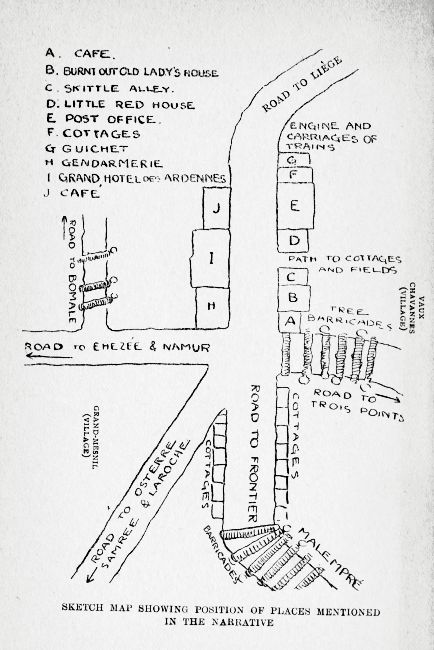
office opposite and the Gendarmerie next door, is
not the place of residence I should personally
choose. Good-bye, Mademoiselle; good-bye, all.
I must be off.”
The dispatch carrier mounts his machine, bends
over the handle bars in best professional style, and
is quickly lost to view in a cloud of dust.
We remain chatting out-of-doors for a little
while. There is a careworn look on the faces of
the women, a certain quiet determination in the
eyes of the men. I understand. At midnight, in a
neighbouring village, I had heard the dreaded
Tocsin sound out the call to arms. The tones of
the harsh, crude bell, mingled with the agonised
cries of sorrow-stricken women. No one slept.
Some were helping loved ones to make their preparations
for departure, others were quietly watching
the ceaseless stream of men pass by. Hour
after hour they came pouring into the village from
outlying hamlets, summoned by beacon fires from
the surrounding hills. Many paused to admire
the long queue of patient, fly-tormented horses
waiting to be shoed by the maréchal. In five hours
the last message had been delivered, the last good-bye
said. The men were gone. But the memory
of their going is not easily effaced....
GETTING READY
“Les Prussiens, les Prussiens!” These words
are uttered in hoarse whispers under my window
while I dress. They send a nervous tremor down
my spine. At breakfast I am informed that the
Germans are only a day’s march distant. They
have already crossed the frontier and are advancing
on us. Bombarded Liège is safer than Manhay,
situated on one of the high roads from the frontier.
The blindest Teuton could not miss this short,
straight line of white-washed houses.
I join the crowd of peasants standing in a
cluster at the cross-roads. Everyone is busy
advising, gesticulating, prophesying. Other peasants
are pouring in from the neighbouring villages
for directions and news. Any stranger at once
forms the nucleus of an entranced group. There
is much chattering but little real excitement.
These people who live on the edge of big events
are never unprepared.
M. le Précepteur is busy in the post office trying
to decipher governmental wires. Several malle-postes,
like two-horsed roofed-in wagonettes, are waiting
about, their drivers ready to take round letters—the
last batch, who knows!—to the scattered
villages around. A very small girl, fortified by a
very large dog, is deftly steering back some wandering
cows from the direction of Malempré. The
village idiot has been trying to get up a game
in the skittle alley, but is promptly squelched.
Motor-cyclists are coming and going in the
direction of Liège. Cars shoot through every few
minutes at a break-neck speed carrying men in
uniform. The Commandant, peaked hat and
uniform complete, lolls at the door of the Gendarmerie.
His horse is being walked up and down by
a farmer’s boy.
He disappears into a back room to answer the telephone,
but when he returns he does not impart his
news to the gaping crowd. The little vicinal train
puffs noisily down the street from its shed at the
end of the village. The peasants of the 13th and
14th classes, called up to-day, climb in. They are
very workmanlike in their dirty-white trousers,
short belted coat, and “bonnet rond.” They
carry necessaries in a small parcel. How I admire
the plucky air of confidence on their manly faces
as they lean over the side of the little car which
is to take them down to the railway ... to Liège
... perhaps to God.
They bend from the train to shake their relatives’
hands with something of the Commandant’s calm
nonchalance. Matters are worse than I imagined.
Men with pitchforks are even being called up to help
guard the frontier. Too late! M. le Directeur is
here in a khaki suit. The brave man. He is about
to take dispatches. His motor-cycle needs petrol.
The entire village hurls itself on the machine. We
are all panting to be useful.
“Doucement, doucement, mes braves gens. Ce
n’est pas un Allemand.” (Quietly, my good people!
I am not a German), he says, laughing.
The spirit of the peasants obviously delights
him. He breaks into a Walloon song. They all
shout the chorus, beating time with their hands.
Then he is off.
One thing is decided on. The magnificent
avenues of trees which line the undulating roads
must be decimated to bar the route against the
German troops. To keep them back a few days, a
few hours, will be something. Already knots of
villagers in wideawake hats and stout corduroys
are stealing away, axe hooked to shoulder, lengths
of rope coiled round their left arms. They look
bored and indifferent, so I know they will work
like demons. A bored-looking Belgian is a man
to be feared.... Soon one hears the steady hack-hack,
followed by a swirl and crash as some huge
fir or oak falls prone across the great white road.
There is something about the sound which makes
one’s blood run cold. It comes as a foretaste of
death.
A car drives up with four busbied officers. The
Belgian guides. The Commandant speaks to them
a moment. They drive on. He re-enters the
Gendarmerie, comes out a moment later, locks the
door and casts a lingering, almost affectionate
glance at the yellow, black and red flag floating
proudly from the masthead. He is wondering,
perhaps, if he will ever see it again. Mounting
his horse, he waves his hand to the villagers, and is
off on his sixty-mile ride to Arlon. Brave Commandant
of the nonchalant mien, but not brave
enough to face those last good-byes. How I feel
for you!
The day wears on. Already the end of the high
road where it turns to Malempré is piled high with
trees. The Noah’s-ark firs on the highway to
Bomale have come toppling down like ninepins.
My thoughts turn to weapons. I never dream for
an instant but that the peasants will fight the
common enemy from behind those bulwark barricades.
It seems the only natural and proper thing
to do. I know nothing of the duties of non-combatants.
A man from a neighbouring village drives up in
his cart. He gets down and feeds his horse with
hunks of black bread which he tears from the loaf.
I feel ashamed not to be armed. He may help.
I approach him.
“Have you a spare rifle?” I ask wistfully.
He stares at me stupidly. “A rifle? No,” he
says. “Why?”
“I could help to shoot the Germans,” I suggest.
“It’s a pity,” he answers, and his mouth twists
in a grin as he turns back to feed his horse.
I have never held a rifle in my hands. But I
feel convinced that the mere sight of a loathsome
Teuton would make the most difficult and antiquated
weapon go off of its own accord.
Madame Job’s little girl, Rosa, was sent back
from Liège some days ago. The school is turned
into a hospital, and the good nuns are acting as
nurses for the wounded. Rosa’s German fellow-pupils
are left behind. They will presently enjoy
the novel sensation of being shelled by their own
countrymen.
Rosa runs about the house like an elf and sings.
For a pupil of the Sisters at the Orphelinat de St.
Joseph she is very lively. Youth has the happy
knack of living in the present. She and Louisa
take it in turns to act at “Prussien,” the fashionable
game. They submit with a good grace to be
chased and well thumped on capture by Victor
and René, the aubergiste’s son.
To-night we all sit out on the terrasse at the
little white tables. The whole family are here.
M. and Mme Job-Lepouse, Floribert, Alfred,
Louisa, Irma, and Rosa. M. le Précepteur and
his wife come over from the post office. The
postman and the picturesque poacher lounge
against the wall. In the distance the old Maids
of Manhay are enjoying their evening chase after
the elusive pig, and the skeleton dog is giving a
series of infuriated yaps at his own enforced detention.
The fair unknown comes out of the red
doll’s house opposite and waters the rosier with
rather tremulous grace. This will be our last
night of peace....
HOW THE UHLANS CAME
“It never rains but it pours,” is as true of the
Ardennes as of more distant lands. It has been
pouring all night. It is pouring now. In the
silence between the pitiless showers, we can hear
the roar of the siege guns already bombarding
Liège.
More trees have been cut down during the dark
hours. A great wall of wood bars the road opposite
the Gendarmerie leading to Vaux Chavannes.
Numberless recumbent tree-trunks are making
great dark tracks across the long and tortuous
route towards the frontier. We have done our
share. We can but wait events.
Everything is curiously quiet this morning ...
in the village. For rustic sounds one only hears
the Manhay pig grunting as he wallows with a
furious enjoyment in the churned-up mud of a
distant field, and the yapping of the miserable imprisoned
dog from his box-kennel chained to an
old wall. I sit out on the terrasse and begin to
sew. Germaine is brought along in her nurse’s
arms and looks at me nervously. It is ironing
day, and her mother is busy collecting the
washing from the garden hedge. Victor plays the
good old game of follow-my-leader up and down
the street with little René.
Madame Job comes out of the inn and leans one
hand for a moment on the back of my chair. The
other steals up to her eyes.
“I can’t help thinking of Albert,” she says
apologetically, “my Albert in the forts there
below.” She gazes in the direction of Liège, which
is hidden behind the distant wooded hills.
“Why fear for him?” I ask. “Is he not lucky
to be in the forts, the forts-which-are-so-strong.”
I know the comforting phrase by heart now.
“The forts-which-are-so-strong.” She repeats
the words after me like a child. A gleam of hope
dawns for an instant on her kindly face, then fades
away. “Supposing he is not fed!” she says with
bitter emphasis. To the Walloon mind, hunger is
almost worse than death.
Comforted by my fibs, she goes back to cook the
dinner over the black oven. The oven and Madame
are indivisible. I always think of them together.
I sew on. Suddenly steps are heard approaching
from the direction of Vaux Chavannes. They
cease. Something is worming its way with a
curious brushing noise round that piled-up barrier
of trees. “It” turns the corner into the Manhay
Street. A peasant is running towards me full tilt.
His face is scarlet, his mouth open with the tongue
sagging over the lips. He rolls from side to side as
if drunken; reaching me he throws up his hands.
“Les Prussiens, les Prussiens!” he shouts, and
falls on his face as though possessed.
We bring him water, we fan him. He revives.
“Three hundred Prussians are at Vaux
Chavannes,” gasps the messenger.
The peasants disperse as though scattered by a
shell. The village idiot takes cover in the pig-sty.
Germaine is dropped by an agitated and diminutive
nurse and immediately begins to scream. She
is forcibly dragged to shelter. A scuttling and
jabbering ensues. One hears the swish of skirts,
the quick tramp-tramp of heavy boots, the sound
of creaking stairs. I drag the fainting man into the
hotel, quickly close and bolt the door, prop him
against the wall, and go to the open dining-room
window.
Manhay might stand as a model for “The Deserted
Village.” The inn is silent as the grave, the family
of Job-Lepouse is doubtless in the fields. With me
curiosity overrides fear. Even if it entails certain
death I must see the Uhlans come. There is a
sharp clitter-clatter of horses’ hoofs along the
Vaux Chavannes road. It stops abruptly at the
barricade. I hear a volley of very German curses,
the crash-crash of weapons and then a mutilated
bicycle comes hurtling through the air. I hear the
cry of a man in pain. Some poor devil has been
caught....
The Uhlans are in our street. They mass by the
Gendarmerie, glare fiercely round. They have
learned the feeling of the countryside in those
barred tree-trunks which have crossed their path.
They suspect a plot and are keen to fight. Charging
down the road they come, lance out, heads
erect, the sun glinting a thousand sparks from the
rim of their metal helmets where it is left unprotected
by the light cloth shield. They are
not quite so smart as when parading last before
their adoring women-kind. Their horses’ flanks
are streaming, their uniforms dusty. “What
splendid men they are!” is my first impression.
“This is just like comic opera,” is my second. But
when, at closer range, my eyes meet those long,
sharp lances and that Teuton glare, I confess my
third is funk!
I shall never forget that first moment of invasion.
The forest of lances, the grey steel of pointed
revolvers, sobbing women and frightened children.
The desertion of the little village street and the
scuttling of agonised peasants into their houses.
The banging and locking of doors, the sudden
silence as they scatter in the stable ... cellar ...
fields. I can see it now.... I shall see it
always.
One peasant is not fortunate enough to escape.
A Uhlan with an over-developed (Teuton) sense of
humour, pricks him in the fleshy part of the
shoulder with the point of the lance. Having
secured a good hold, the German gallops up and
down the village, driving the unlucky man before
him at a furious speed.
The remainder of the troop form up and charge
towards us down the road. They interrupt their
dash at the post office. The officer points a
revolver at M. le Précepteur’s head in the ingratiating
German way and asks some question. I swear
that M. le Précepteur’s hair is standing on end in
the manner hair so frequently assumes in novels,
so very seldom in real life.
Something grey and cold intercepts itself between
me and the sun. Something cold and grey touches
my forehead and a gleaming face comes on a level
with my own. The first contact of that revolver
makes my knees tremble and gives me a cold
sensation down my spine. But I do not budge. My
captor neither addresses me nor I him. We simply
stare stupidly at one another. A wasp, attracted
by the bright metal helmet rim, plays about his
face. The hand that holds the revolver trembles.
I am almost but not quite amused. Suddenly the
weapon is withdrawn. The troop gather up their
reins, canter on through the village and halt in
consultation at the head of the street.
A curious intuition tells me that the Uhlans
are afraid ... of our fear, that those tightly
barricaded doors and closed windows suggest plots—perhaps
armed resistance. It occurs to me that
it would be wiser to show ourselves, to feign indifference.
In times like these men are shot for
showing the white feather.
I rush out and call the peasants by name. One
or two stare stupidly from the windows, the rest
do not budge. Many are in the fields, some
probably in the cellars. I sit down on the terrasse
and draw the little white chair close up to the
painted white table. The moustached postman
in the dirty white ducks comes to my side, so does
the poacher, unshaven but ever picturesque in his
brown corduroys.
The order has been given to charge. They are
coming back, the gallant Uhlans! Will they shoot
us down? We shall know soon enough. I lift my
glass of bock with a rather shaky hand while the
postman puffs at his pipe and the poacher half
smiles. He is a feckless, fearless rascal. Here they
come, lances and all. The foremost misses my
head by half an inch. I wince. The soldiers look
unutterably fierce as they clatter past. The last
few cover us with their revolvers until they turn
the corner of the road. Clitter-clatter—fainter—then
silence. The postman, ever solemn, turns to
me and reaches over an enormous hand.
“Vous êtes—bon soldat, Mademoiselle,” he says,
as he rises abruptly and saunters away down the
street, puffing at his everlasting pipe.
THE “TERRIBLE” FRENCH!
This is a gala day. Company to lunch! The
Tax-collector has walked here from a small town
thirty miles away, en route for Aywaille, another
twenty, where he intends to fetch his son from
school.
“Quelle désastre que cette guerre,” is his opening
remark as we fraternise over the vegetable
soup.
I agree.
He draws something from his pocket and throws
it across to me. It is a bullet. He shows me a
large blister on his finger. “I was over-zealous
for that keepsake this morning,” he says, laughing,
“and tried to pick it up when it was red hot.
There was a fight raging round my little house
before I left. Picture to yourself a patrol of Uhlans
breakfasting in the hotel-barn opposite. A company
of French ride up and demand if the enemy is
within. The innkeeper answers, trembling, ‘No.’
‘The truth!’ thunder the Frenchmen, covering him
with revolvers. He confesses. Mon Dieu! What
a scene! The French force the innkeeper and his
son to set fire to their own barn, and when at length
the Germans come out, one by one, stifled with
smoke, they calmly pot them off, as if they were
so many rabbits. Stay! One Frenchman rushes
in before the fire has done its work. He dies a
moment later, shot through the heart. I found on
him two letters, to his mother and his sweetheart.
Such letters!”
“The French are very brave,” I say.
“I tell you they fight—not like men but—comme
les démons. They don’t ride up as the Uhlans do.
They just ‘appear’ like lightning or earthquake or
any other phenomenon and then—phew—le déluge.”
“Every German who comes in here says that
the Belgians have cut off the ears and gouged out
the eyes of their wounded before Liège,” I say.
“We on our side are horrified at the tale of German
atrocities. Each time a German enters this village
we feel that the tragedy of Visé may be enacted
over again.”
The Tax-collector shrugs his shoulders as he
fingers a cigarette.
“You must remember it is against the rules of
warfare for non-combatants to fire,” he murmurs.
“Have they?”
He flicks an infinitesimal spot of dust from the
table-cloth, and does not answer me.
Yet if one’s country be invaded who shall say
that one may not avail oneself of any means to
oust the hated foe?
The nostalgia of war seizes me. I know a country
where such things could not be. Shall I ever see
England, dear England again? Involuntarily I
breathe the words aloud. The Tax-collector leans
across to me and speaks firmly but very gently
as one would address a tired child, “You will
never see England again, never, Mademoiselle.
Make up your mind to that.”
I scrape my chair back along the wooden
boards and rise in a flurry because “it is so hot,
so hot”—and escape to my room to dream of
what might have been but never can be now——
SPIES AHOY
Chasse-aux-espions! A governmental order has
come through that we are to arrest any suspicious-looking
person who passes through the village. We
suspect ourselves. We suspect everybody. We
are only deterred from action by one thought.
The horror of shooting in cold blood a poor, blindfolded,
unarmed human thing.
The village is thrilled with excitement this
morning. A tourist in tweed suit and knicker-bockers
has arrived. He hangs up his soft felt hat
in the hall and follows up his breakfast order with
comments on the war. He has come from Vielsalm.
He has spoken with the Germans. The peasants
cluster round him.
“Nice kind fellows the Germans seem,” he says
casually, as he walks into the dining-room and
takes his seat.
That is sufficient. The men nudge each other
and direct mysterious glances towards the door. I
am invited to arrest him! I murmur that M. le
Directeur and the Bourgmestre have the prior right
but that I shall be delighted to assist. On one
condition. If found guilty the miscreant must be
despatched round the corner and not before my
eyes. The Bourgmestre when sent for will not
come; I fetch M. le Directeur. “All unconscious
of his fate” the spy is enjoying an excellent meal
of bacon and eggs. He starts up as we enter and
turns rather white. When challenged he opens his
pocket-book and shows us his papers with admirable
composure.
Dreadful error! On his card I read, “Monsieur
Jottrand, Premier Avocat-Général à la Court
d’Appel, Bruxelles.”
There is a burst of merriment from the peasants.
They surge round him. M. le Directeur shakes him
warmly by the hand. I rush to hide myself behind
the big black stove in the kitchen.
The “spy” follows me in a moment later. “I
congratulate myself, Mademoiselle,” he says. “I
have never had the pleasure of being arrested by
an Englishwoman before!”
M. Jottrand is tramping his way back to
Brussels. He has lost all his luggage but is quite
cheerful. So far he has escaped with his life. That
is something these days.
Soon after he leaves us, German troops arrive in
the village and knock at the doors of every house
in Grand-Mesnil. “We give you one hour,” they
say, “to remove those trees on the Bomale and
Vielsalm roads.”
A hurried conference takes place between the
peasants. I interrogate one of them in the street
next day. “How about those trees?” I ask.
“Oh, we removed them all right,” he answers.
“Not quite as the Prussians intended, however.
Un pas de gattes (goat’s path). On a modest
estimate it will take the German army about three
years to pass along in single file!”
THREATENED WITH DEATH
“Sauvez-vous, sauvez-vous!” This warning
yelled in strident, horrified tones is not the most
cheerful awakener on a hot summer’s morning.
I hastily throw on some clothes. With my hair
scruntled up in a little bun I rush to the window.
A German officer is standing before the house
opposite, pointing a revolver at M. Job’s head.
He issues orders in a harsh voice.
As he turns away to address his men, M. Job
leaps across the road like a hare, his little sun-dried
face pale as death.
“Save yourselves, my children. They are going
to shoot us all down and set fire to the village. We
have only a moment to escape. Sauvez-vous,
sauvez-vous.”
He dashes headlong into the house. A second
later the entire Job family are scuttling in and out
of the inn back door, in a concerted arrangement to
convey some of their things to a safe hiding-place
in the fields before it is too late.
I rush back to my room, secrete my jewellery and
a treasured letter or two under my dress, make a
small packet of soap, toothbrush and other necessaries.
Then I go to the front window and peer
through.
The officer is still in the same position, revolver
in hand, addressing his men in rather angry tones.
He has begun no violence as yet.
They are outside the door of a poor old woman
who is quite alone. She understands no German
and must be dying of fear.
I lean from the dining-room window and say with
what firmness I can muster:
“What are you doing?”
“Go indoors,” says a soldier, motioning me
imperiously back.
“The peasants have fired on us, so we shall shoot
most of you and burn the village,” says the officer,
covering me with his revolver.
“Our orders,” adds a soldier nonchalantly.
“But we have no——” (I cannot for the life of
me remember “weapon” in German, so I act the
word in dumb show, one clenched hand to my
shoulder, the other in a straight line but further
away. I shut one eye and look along my fists to
be more convincing.) “There is not one in the
village,” I assure him.
I wish my voice wouldn’t tremble so. It sounds
cowardly.
He turns away and calls to the inhabitants of the
little cottage before which he stands to come out.
The old lady is alone there and I would bet my life
she is hiding under the bed at this moment. So I
run into the street and the sunshine and, quite
beside myself, almost implore the officer not to do
this thing.
Disregarding my entreaties he stands with
uplifted revolver before the cottage door.
“Come out,” he says again.
No answer.
Before I can move, he lifts his weapon once more.
With the gestures of a chef d’orchestre in the opening
bars of his favourite orchestra, he strikes the glass
panes of the door this way and that with the cold
steel. The glass shatters in a thousand fragments
on the square stone step. There is something so
cruel and calculating in the expression of his hard
face. With a smile of satisfaction the officer fires
once, twice, thrice into the recesses of the room.
One would think a mouse could not escape.
He throws something which must be a hand
grenade into the midst of the mysterious still
gloom. In an instant smoke and flames seem to
rise from the very ground before my horrified eyes.
Then he calmly shoots once—twice again into the
seething darkness to make sure that he has missed
nothing. He turns away to look for the next
victim.
I can’t help the tears running down my cheeks,
but I say again:
“Indeed, indeed we have never fired. If you
search the village through you will find we have
nothing to fire with.”
“I heard them,” he says sternly.
In the distance a woman is scuttling along,
trying to reach a neighbour’s house in safety. She
is so terror-stricken, her progress is like the gait of
a sick fowl. A living example is to hand. I point
towards her. “Look at that,” I say. “The poor
women are so frightened they cry all day long.
Besides the women there are only old men and
boys. Their one wish is to get the harvest in in
peace. Is that a crime?”
A conference takes place between the soldiers
I gather that our fate is in the balance. We must
be born under a lucky star. We are saved again.
The officer remounts his horse. He and his
troop ride off briskly in the direction of Grand-Mesnil.
They are scarcely round the corner before the
entire population of the village has rushed out
carrying every bucket and jug they can lay their
hands on. The old lady, not dead as I expected,
but considerably stupefied by smoke, is saved from
the burning house and set under the hedge to
recover. The rest of us form a line and pass
bucket after bucket of water from the pump, in
the best workmanlike, fireman style.
The flames have got a good hold and the smoke
is stifling, but we all work with a will and soon
subdue them.
A young Belgian, just arrived on a motor-bicycle,
says “salle cochons” under his breath,
but does not help in the work of rescue. Later he
confides to me that he is a Belgian spy carrying
dispatches. Two days ago he was at Louvain
talking with an officer of the “men in skirts.” My
heart leaps to think they are so near.
“This morning I have come from Liège,” he
says. “The German dead were piled up each side
of my path, ghastly lolling corpses, one on the top
of each other.” He puts his hand up higher than
his head. “It was the most awful sight I have
ever seen, and then the odour....” And the
poor spy is literally sick in the village street.
I go back to the burnt cottage. Already willing
hands have pulled out odds and ends of still
smouldering furniture. The old lady’s cat, disturbed
in early morning slumber, has once more
resumed its accustomed position on the blackened
doorstep. Its expression is cynical and its back
arched in a definite anti-Prussian hump. I have
no reason whatever to doubt the accuracy of its
language when the next Uhlan comes along. The
young Job-Lepouses who have been foremost in
helping to extinguish the fire, return with me to
breakfast. I have leisure to study their appearance.
Yesterday they were of reasonable size. To-day
they look as though they had undergone a sudden
fattening process which has taken effect in the
most unlikely places. For instance, Mdlle Rosa’s
right shoulder appears to be afflicted with a
monstrous and most unsightly hump. Madame
Job’s instep almost equals in size the girth of her
waist. M. Floribert has a forearm which would not
disgrace a Hackenschmidt. The secret is soon
explained.
“Ha-ha, j’ai mes petites économies,” cries Mlle
Louisa, dragging a fat leather bag from under her
skirt.
M. Floribert smiles anxiously. He has numerous
treasures up his sleeves, including his Sunday ties.
Madame Job lets down her stocking with the
utmost sang-froid and displays a leg bound with
Belgian paper money and bandaged with some
nice old lace.
The house was stripped bare in those few
minutes of pregnant danger. Linen, books and
even bread were transferred to the most remote
and sheltered corner of the vegetable garden. Here
they were deposited in the camion or hooded cart
in which M. Albert in the happy days, now gone,
used to distribute the crisp, round loaves to the
countryside. Here, too, hid Mdme la Précepteur,
the children and Mdme Job until the danger had
passed by....
TO LEAVE OR NOT TO LEAVE
People are leaving the village in ones and twos.
It is pathetic to watch them come out of their
houses, gently turn the key in the lock and then,
with slow, sad step, walk quietly away along the
high road, turning their backs for ever on their little
world. They carry their most cherished possessions
in a square cotton sack-bag of enormous
check design slung from their shoulders. In their
hands are little parcels or perhaps a straw basket
packed with a medley of quaint treasures. Small,
sturdy, brown-faced children run at their heels.
The peasants visualise mentally the awful
atrocities at Visé and tremble at the knowledge
that many men have been shot in the surrounding
countryside. They say to themselves, “What
happens there will happen here to-morrow.” They
are afraid. They leave. If they stay it will be in
a famine-stricken, Uhlan-haunted country. As
they go ... well, I hope they have somewhere to
go to!
As refugees they will earn the sympathy of all.
But charity, compensation, re-instatement, will
never make them amends for the loss of lands and
relatives and the dreadful agony of mind they
have endured.
The lady of the rosier has fled. The watering-can
is thrown carelessly in a corner and the rosier
is already beginning to fade. The curtains are
drawn and the doors locked at the red house
opposite. The old maids of Manhay are suspected
of planning a similar flight or their pig is very
out-of-hand. He has been caught executing weird
manœuvres in the street village, including the
charging of ten tired Uhlans who coldly rebuffed
him at the point of the lance.
Stragglers have come in from the frontier on
their way from here to nowhere. They have the
weary, listless air of people who have lost all interest
in their lives. They carry their possessions
in a small brown parcel and have the inevitable
children dragging behind them. One can only
offer them food and drink (we have not too much
to spare) and speed them on their way.
Refugeeing seems in the air. I am amazed to
find the house of Job-Lepouse, at least the feminine
portion, is now thinking of retreat. I come upon
Madame Job, the two little girls and Messieurs
Alfred and Floribert, all busy packing things in
the backyard. A huge malle-poste with two horses
is drawn up near the stables, a large, wide-mouthed
washing-basket on the roof, lashed to the sides by
stout cords, is being filled with an extraordinary
medley of food, clothes, linen, books and articles
of all kinds.
Madame Job, ever tearful, informs me that they
are leaving for a retired little farm in the country,
near Esneux, where they will be away from this
dreadful high road and comparatively safe.
“You will come too, Mademoiselle?” she implores.
I demur. Any change will only mean out of
the frying-pan into the fire. We may be slaughtered
en route or arrested as spies. While I hesitate
Madame la Précepteur rushes over attired
as for a journey, carrying the little Germaine in
cloak and bonnet. She is followed by Victor,
dressed in sailor clothes. Their belongings are
tied up in a large bag.
“The inn will have to be kept open or it will
be sacked,” I say. “I think I will stay here,
Madame.”
Mdlle Irma links her arm in mine and voices
her determination to stay too.
The others are just about to take their seats
in the great rambling vehicle when M. le Précepteur
comes running across the road, white faced
and agitated.
“They have caught a postman,” he says, “and
torn up and scattered his letters over the forest.”
No need to ask who “they” are!
“Another postman has escaped by throwing
his bicycle down by the roadside and plunging
into the heart of the woods.”
No one seems to know whether the first man
was killed, though rumour surmises he is injured.
The point is, these encounters take place on the
very road the malle-poste has to traverse.
Afraid to stay, afraid to go, poor Madame Job
is in a sad plight. Finally the huge washing-basket
with its moorings of cord is safely transferred
to the cemented kitchen floor. The Précepteur,
his wife and children, the Job-Lepouses and
numerous villagers who had turned in to bid them
good-bye, have a kind of second breakfast of
black bread and coffee round that inevitable big
black stove which I always, in my own mind, call
“the peasants’” friend.
WHAT THE UHLANS THINK
A furious fight is going on in the village street.
Fists and tongues striving to outdo each other.
Les Prussiens, of course. I think if the earth
opened and swallowed us up we should at once
attribute it to German atrocities! But this time
the aubergiste is cuffing the picturesque poacher
for something that gentleman has done.
“Brave garçon,” sneers a passer-by.
“Malain,” retorts the poacher fiercely.
The peasants fling themselves on the malcontents
and proclaim a truce. They argue rightly
that only fools quarrel in war-time.
Truth will out. There is method in the aubergiste’s
madness. The poacher has confessed that
he was responsible for our recent danger. Yesterday,
it seems, he shot at a hare in the woods three
miles away.
A slender thread of evidence on which to convict
us of treason, but apparently any excuse is
sufficient for these arrogant Germans.
I add my voice to the storm of eloquent advice,
“Tickle trout, trap hares, lay night-lines, make
use of any and every device known to the poaching
mind, but do not shoot.”
The culprit slinks meekly round the corner,
still puffing at his curved-stem pipe. But I think
he has learnt his lesson and will not be seen on
the hills for some time to come....
The Uhlans are certainly a queer lot. We have
ample opportunities of studying them, as they
are for ever pushing forward, on their mission of
patrolling the countryside. No sooner have we
become accustomed to one troop and may congratulate
ourselves our lives are safe, than another
arrives to take its place. Sometimes they return
in the evening, half without horses, or with the
full complement of horses but the riders gone.
Of one patrol which went out scouting yesterday
to Laroche, only the officer came back. Someone
informed the French cavalry at a village near, and
they cunningly laid an ambuscade in the wood at
Samrée and cut them off. The greeny-grey uniform
saved the German officer. He threw himself flat
in the pine dust and managed to escape and make
his way back to Manhay, footsore and weary. I
saw him sitting on the bank by the roadside near
the village last night, writing a letter to his mother.
He was little more than a lad. “I shall never see
her again,” he said, crying. No more he will. He
was killed to-day....
The Germans, though brave, seem inferior to
the French in their scouting methods. Time and
again small French patrols would cut them off,
exercising superior finesse. One day in a skirmish
outside the village, however, the Uhlans beat the
French. An officer was triumphantly borne away
prisoner to Werboumont. How thrilled we were
at the sight of the culotte rouge. If there had
only been more of them and free!
No one speaks of the men in skirts any more.
The continuous stream of trains that was carrying
the Highlanders into Liège have gone the way of
all myths. The enthusiasm for the English is
slightly on the wane. “They ought to come soon,”
the peasants mutter discontentedly. “Without
doubt they have their plan of campaign,” says
little M. Job, who is always trusting.
Early morning and late at night is the time when
we have the Uhlans mostly with us. It is nothing
for them to call at 6 a.m. for breakfast, and they
arrive in boisterous spirits (when they have suffered
no losses) and call for beer at night.
They seem to have an extraordinary love for
music—or noise. They do not know in the least
what they are going to war about, but most of
them ask for a piano. The wheezy hotel gramophone
affords them sheer delight. They must
make music to-day if they die to-morrow. “À
Paris, à Paris!” is the cry of the more enthusiastic,
but “I’d rather be at home” is the qualifying
statement of not a few.
One soldier confesses he feels the cord tightening
round his neck each day. “Every advance means
more danger,” says another gloomily. A third
shows me his cartridge case. “Four for the enemy,
one for the Kaiser,” is his pithy comment. There
is an infectious air of gaiety about the frontier-sheltered
lads, which is lacking in those who have
once been shot over. As for the men with sad
faces, it is enough to see their hands. They usually
wear a wedding ring on the third finger.
The soldiers have remarkable ideas on the subject
of the present campaign. Many honestly
believe, and have probably been told so by their
officers, that Belgium wantonly declared war on
Germany. They say gleefully, “all the world is
against us,” and tick off the various countries on
their fingers. They simulate nothing but contempt
for all concerned—except the French. Of them
they have a wholesome awe. Perhaps they are
right. A man’s punch must have an extra kick in
it when backed by three decades of hate....
“Russia! The Cossacks look fierce, but they
run away,” say the Uhlans. “England. A mere
handful of men. What are a hundred and fifty
thousand to us.” They jerk their thumbs over
the shoulders as though casting England to the
deuce. “The French, yes. Terrible men, the
French. But we shall win.”
I hope they will meet the English soon and get
their ideas put right, as they surely will....
THE SIGN OF THE RED CROSS
We no longer inhabit a cheerful Belgian village.
In an unaccustomed country we must train ourselves
to meet new laws. On Sunday we go to
church. After service from the good Curé, M. le
Directeur reads out to us a list of rules.
We must not collect in crowds, nor speak more
than three in the village street.
We must not hide in the houses, but go about
our ordinary avocations when the soldiers pass, or
they will suspect a plot.
We must never run away—unless we want a
bullet in the back—but throw up our hands when
called upon to do so.
We must never do this and we must remember
that, or we may expect to be bowled over as
lightly as the wood blocks in that skittle alley
which is the “distraction” of the Ardennois
Sunday.
A German officer has frankly told us that the
very smallest reprisal for any inimical act will be
house-burning. Should a civilian dare to fire on
the German troops, well, that village may expect
to be decimated of its remaining men. Besides
this the Teutons do not trust our word. Twice
to-day an officer has forced me to drink first from
his glass of beer. The young Job-Lepouses have
to do the same. A suspicious Uhlan intends
to run no unnecessary risk.
No peace for the wicked! There is the air peril
to contend with. A sound often heard here, like a
hundred threshing machines in full swing, made
me think at first that the peasants were working
in the fields. The mystery is solved when glancing
far, far up where sky and cloud seem to meet, an
aeroplane is seen buzzing slowly overhead. Sometimes
we see it near enough to recognise its white
body with the black tail-planes and tips to wings.
German, of course, always German. We never
have any other here. I watch the machine as it
begins to descend at an acute angle. A thousand
feet down, it hovers for a while. Finally, it planes
earthwards like some great, ominous magpie until
hidden from sight in the hollow of a distant field.
“One for sorrow.”
Another machine comes sailing majestically towards
us from the nebulous distance.
“Two for mirth.”
It will take us all our time to derive
any amusement from these bomb-dropping
fiends....
A brain-wave has passed over the village. The
word “red-cross” is mentioned. M. le Directeur
suggests with admirable sense that the inn should
be turned into a hospital for the wounded soldiers.
Wonderful the enthusiasm this idea has evoked.
Extraordinary the unanimity with which it is
received by the peasants.
M. le Précepteur wishes to hang a flag out of his
window too. His step becomes more elastic, his
expression brighter at the mere idea. This seems
to him an opportune way of staving off the awful,
possible hour of arrest. He is actuated, too, by
that beautiful sense of compassion which makes
the Belgian nature so attractive.
The burnt-out old lady is quite vociferous with
joy at the prospect of nursing the enemy. It never
occurs to her that she will thereby heap coals of
fire on the miscreants who so basely tried to
destroy her little home. At this moment she is
sitting out in the potato-patch industriously picking
over the flock in her mattress. The adjacent
hedge is hung with odds and ends of half-burnt
coverlets and clothes. I know she is scheming in
her generous Walloon brain how much of her slender
household stock can be spared for the use of the
wounded soldiers.
These flags—the great red cross on the white
ground—are produced in the shortest space of time.
We breathe more freely when they float out
majestically from the hotel windows. We are as
afire with first-aid enthusiasm as any ignorant
sixteen-year-old Miss who has volunteered for the
front. Every woman in the village has offered her
help. She will insist on giving it too. I pity the
first victim who arrives. He is likely to be pulled
into a thousand pieces!
Scarcely any Uhlans have passed through to-day.
Those who did were well behaved. This fact
and the Red Cross flag have combined to make us
quite jovial. The skittle alley is in use again. A
group of villagers is gathered on the terrasse
telling war-tales which would make our English
fishermen green with envy.
One tale no one tells, however, out of respect to
Madame Job. That is the tale of the Liège forts.
We are all under a solemn pledge to believe that
they are still intact. We know better. Anyone
would know better after the awful cannonade of
the last few days. But in our common humanity
we cannot bear that Madame Job should know
before she must, that her Albert “in-the-forts-there-below”
is dead, safe though she thought him
in those forts, “the-forts-which-are-so-strong.”...
ON THE ROAD
The village is parched for news. Only the black,
yellow and red flag floating majestically above the
Gendarmerie wall and the dull boom-boom of the
cannon which, night and day, still comes from the
direction of Liège, remind us that we are in Belgium,
an integral part of that gallant little land. We
have been without letters and papers for a week.
We know nothing. Scarcely a living soul dares
to find his way along the Uhlan-infested
roads.
The engines of the little vicinal train are still
packed away in their sheds in tidy rows. The
ticket office is deserted. The workmen sit
quietly at home, watching the starvation ghoul
tread nearer day by day. The two-horsed malle-postes
which feed the surrounding villages with
letters from our central Manhay office have ceased
running.
We are athirst for truth. Most would give all
they possess (it is not worth much!) for just one
word of encouragement about the campaign.
It is terrible to hear the cannon dealing out
slaughter to your loved ones, to know that your
houses, your food, your very lives are in hourly
jeopardy, to be “in” the war and yet more ignorant
of its events and trend than the people of India
in all likelihood.
Yet the peasants never curse the enemy. That is
the most wonderful thing. This very day I have
seen a very poor villager give all the drink he had
in his little house to some Uhlans whom he thought
looked tired. He refused payment with indignation.
It was a gift.
We are all suffering from Prussian eye. We see
Uhlans everywhere. Behind the hedges, under the
shade of the trees, popping out of cottage doors,
springing Jack-in-the-box-like from beneath a
bridge. We dream Uhlan, we talk Uhlan, we taste
Uhlan. I think a fine should be inflicted on any
villager who mentions the hated word more than
once in twenty-four hours.
A peasant deserter has been discovered in an
adjacent village. He ought to have joined the
13th Classe by rights when it was called up. Poor
fellow! He has a wife and three young delicate
children and is, I fancy, none too strong himself.
What torture to remain there in disgrace among
the old men and young boys. And the penalty for
him at the end is death....
Heroic M. le Directeur and his wife. I often
think of them in their little country house near
by. The vicinal railway which has opened up this
exquisite corner of the world is due to his initiative.
The peasants look to him as to a father.
His wife goes quietly about her business during
this dreadful time as though there were no such
thing as war. “Il faut feindre” (one must make-believe),
she says to me. She does it well. No one
would guess that her mother is in the burning
village of Visé and the rest of their relations shut
up in Liège. How hard it is for them to possess
their souls in patience when loved ones are suffering
so few—so very few miles away.
Like Madame Job they are thirsting for news.
But unlike her they keep the longing to themselves.
Madame Job has, I believe, a sneaking hope that
Albert may turn up one day outside the little
white-washed inn. I suspect she would rather have
her beloved Albert a live coward than a dead hero.
A wire has come from Erezée, ten miles away,
to say that packets of letters have arrived. A
system of hand-messengers has been successful in
bringing them through from Namur without
mishap. Who will volunteer to rush them to
Manhay through our Uhlan-infested country?
The postmen refuse because of the trouncing
their comrades received yesterday. M. A—— and
I agree to have a try. He harnesses the hotel
horse and we start off in the light spring dog-cart.
Behind we have two refugees from Gouvy. They
own no luggage beyond a bird-cage, so we are not
over-loaded.
Gouvy is a frontier town which the Germans are
fortifying in case of their enforced retreat. They
have installed several regiments there and made
the inhabitants’ lives unbearable. The station-master,
postmaster and other civilians have been
sent off as prisoners of war to Berlin after the
pleasant Teuton fashion. These poor refugees are
going to their parents at Barvaux, near Namur.
May they find peace there as they expect. Personally
I doubt it!
The drive to Erezée is uneventful. We suspect
a Uhlan behind every tree-trunk but none
appears. No living soul is on the road. As we
enter the village street the peasants run out of the
houses to welcome us. It is almost a royal progress.
We realise how isolated these villages now are from
one another.
A tiny Belgian flag is flying from the church at
the top of the hill. Evidently the best the village
could provide; it must have taken the choir, the
Curé and all his merry, merry men to hoist it to its
present height. As a decorative item that flag is
beneath contempt. Its slender flag-pole is of such
curved dimensions as to make it stick out from the
belfry quite lop-sidedly. But as a moral factor it
is beyond all praise....
We alight by the picturesque old pump. A
crowd, including the gypsies from a travelling
caravan, gathers round us anxious to hear the
news.
In return they tell us theirs. One story interests
me. At Hotton, near Melreux, a few miles away,
the Colonel of an invading troop called on the
doctor’s wife and politely asked her for the address
of the Bourgmestre.
The doctor’s wife, not to be outdone in civility,
sent her little girl along to show him.
In a short while the Colonel returned with the
Bourgmestre in tow as prisoner.
“Where is your husband?” he demanded of the
doctor’s wife.
“Out visiting patients,” she replied.
“Out when I ask for him!” shrieked the
infuriated officer, “I will have him shot for disobeying
orders!”
This gross piece of injustice was happily not
perpetrated. The Colonel graciously forgave the
doctor, for, when the soldiers went to fetch him,
he was found tending the German wounded with
tender care....
RUSHING THE MAILS THROUGH
Conventionality dies an easy death in time of
war. Erezée is new to me, but in less than half
an hour I have talked to more people than I do in
England in a twelve-month. They all have the
same tale to tell of sleepless nights, of ever-present
horror at what may be at any moment. But so far
they have been spared atrocities.
There is a sudden scuttle of every able-bodied
person in the direction of the post office. The
long-awaited post is in. An enterprising postman,
“en vélo,” who has rushed them through is congratulated
on every side. A crowd surges round
the open window, stretching out eager hands to
the clerks who are swiftly sorting the numerous
piles of letters. The counter has long been appropriated
by wrinkled peasants whose one anxiety is
for news of the husbands and brothers who are so
gallantly fighting for their rights at Liège.
Someone tears off a wrapper. The thin broad
sheets of a Brussels evening paper flutter in the
breeze. Old men and women, young boys and
girls gather round the owner with uplifted, expectant
faces. Some do not know how to read,
others have their eyes too full of tears. Besides,
good news is so much more convincing when read
aloud. The audience listens entranced. The gallantry
of these Belgian troops—peasants like
themselves—their valour is almost past belief!
The work-worn, tired, rough-hewn faces turn to
meet each other transfigured into beauty by their
mutual look of pride....
We cannot, dare not wait to hear it all. The
Uhlans may be here at any moment. I climb into
the high dog-cart. The dépêches are put under the
seat, even under my feet. I sit on a heap of
them.... So does my companion. They are for
Vaux Chavannes, Grand-Mesnil, all the little
villages around, extending to Aywaille, twenty
kilomètres away.
Carefully masking every sign of paper with a
thick blue rug, we start off on the homeward
journey. Not without tremors, for if we fall into
the Uhlan hands anything may happen.
When we pass the last of the little cottages, and
the last watching peasant has waved us farewell, I
begin to fear.
Six solid miles of thick woods stretch before us
rolling down to the roadside on either hand.
Here it was they caught the facteur yesterday.
I suddenly loathe the sight of those green, feathery
branches; they may cover up so much.
I glance at M. A——. His round happy face is
rounder and happier than usual. He is even
lighting a cigarette, though he finds it difficult, as
he is trying to hold the reins and watch the horse
and the woods at the same time.
Never have I seen an Ardennois without a pipe
or cigarette in his mouth. I think a true son of
the soil would start to light one with the death-rattle
in his throat!
I imagine a dreaded Prussian behind every tree-trunk
and under every bush for some miles. Then
I clear my throat and ask mildly as we jog along
(it would look suspicious to increase our pace):
“Supposing, just supposing we did happen to
run across any Germans, and they did threaten to
shoot us unless we delivered up the letters, which
would you do?”
“Deliver up the letters, of course,” he says
matter-of-factly, puffing at his cigarette.
I breathe a sigh of relief. After all, a whole skin
is a more precious possession than much fine
writing!
Providence watches over us again. As we near
the beautiful avenue of fir trees which connects
the Bomale road with Manhay, a peasant
scout rushes out to warn us that Uhlans are
ahead. We have just time to escape into a little
lane.
More peasants come running up presently to tell
us the road is clear. There is always the danger
of being covered by field-glasses from some wooded
hill, with its sequence of surprise attack, so we jog
slowly along and drive into the yard instead
of drawing up at the post office. Three minutes
later a company of Hussars passes through without
drawing rein. They are in high good humour,
chattering, laughing, quite unsuspicious that the
peasants they despise have been quick-witted
enough to get the mails through under their very
eyes!
Willing men are posted at intervals round the
street and even in the fields to prevent an attack.
M. le Précepteur saunters over from the post office
and sets to work sorting letters in the back kitchen.
It is safer there....
The dining-room blinds are drawn down, and
we all collect by the little French window leading
into the yard. The papers are taken round, and
unfolded. An enormous headline sweeps the page
from end to end:
LA GUERRE VA DE MIEUX EN MIEUX.
Like most newspapers the contents are optimistic
as regards their own side.
Mlle Irma reads the news aloud. She begins
with the heroic defence of Liège.
As she reads, we hear the cannon booming,
booming across the distant wooded hills.
To judge from the printed page, the gallant
little Belgians have defeated the entire German
army to a man. Several regiments have already
covered themselves with imperishable glory,
notably the 11th and 14th Foot. Albert is in
the 14th.
A man named Desmoulins has rushed out of a
fort and slain four Germans with his own hands
before darting back safely to shelter. The enemy’s
losses are enormous. I notice that in war they
usually are. The Belgian casualties are described
as so small that they are, seemingly, scarce worth
mentioning.
“The chief losses,” reads Mlle Irma in her clear,
pretty voice, “were sustained by the 11th” ...
a slight pause quickly slurred over, “and the
32nd.”
“And the names!”
“There are no names as yet,” she returns
quietly and goes on with the notes of a speech, “ce
cher monsieur Askveeth,” had delivered in the
English parliament only yesterday.
But Madame Job is not to be deceived. “It
was the 14th which has been so cut up,” she says,
putting up her apron to her eyes and beginning to
cry again. “I know Albert is dead. Mon pauvre
Albert in that terrible Liège!”
“Don’t fuss, Maman,” says M. Alfred the
peacemaker. “It will be all right now the men in
skirts are there....”
A TEUTON FEAST
Friday.—Two men of the Brandenburger Cuirassiers
come into the inn before breakfast. I am
brought forward, as usual, to interpret. The
shorter of the two, a square-jawed, swashbuckling
kind of fellow, demands hay. I reply with
superb mendacity, “We have no hay.” He
follows this up with enquiries as to the disposition
of the enemy. My face becomes vacant, my
German resolves itself into a fluent mass of unintelligible
sounds.
Woe is me! At that moment the door into the
yard opens, and M. Alfred is seen crossing the
clean wide space, bearing stablewards half a hayrick
on a long pitchfork.
The Cuirassier gives a growl, thrusts his pug-nosed,
underbred face almost into mine, and
lands me a blow that knocks me up against the
wall.
“Isn’t that hay?” he asks fiercely, pointing.
“Hay, but for us,” I answer calmly.
“You lie!” He prods at my left shoulder with
his bayonet, but he either fears to strike hard or
the padded arrangement worn under my dress
with a view to such contingencies does its work
well. My wound is nothing but an abrasion of
the skin.
The swashbuckler swaggers into the yard and
coolly appropriates the hayrick. His friend, a
gentle-faced, blond giant looks down at me with
regret.
“You need not fear. I will see that you come
to no harm. My friend there is a wild fellow,” he
murmurs apologetically.
“Fear. Ich bin Engländerin,” I answer simply.
He laughs. “You are as brave as your brave
little army. But—such a mere handful of men.
How can it stand up against us!”
The swashbuckler returns. They leave the inn
together and later appear before the Gendarmerie
with the weird medley of weapons which every
cavalryman seems to carry. They hammer at the
stable door. It is smashed and their horses feeding
in the empty stalls in less time than it takes to
relate. Their next step is to batter at the door
of the Gendarmerie itself. I go to the back of the
house whence a narrow window commands a view
of the place. Perfidious people! They have no
respect for the sanctity of home. The Commandant’s
little treasures are quickly found.
They run from room to room, opening drawers
and rummaging through the contents, even overturning
furniture. One man gets hold of a pile of
letters, tied with ribbon. Love-letters perhaps.
Downstairs they go and bring up a ham, bread,
some wine. A “pique-nique” in war-time is huge
fun. They thoroughly enjoy their impromptu
meal in the back bedroom. The remains of food
are left scattered about the uncarpeted floors;
some of it is trodden carelessly under the soldiers’
feet.
Everything is tossed about as green hay in the
harvest field. The very sheets are torn from the
beds and lie in little white ghostly heaps on the
dark-stained boards. The Brandenburgers come
out into the street where a row of stalwart bayoneting
Cuirassiers are keeping order. My nice blond
giant has a huge cigar between his teeth, the
Commandant’s cigar, so has my swashbuckling
bully.
They both lunch at the inn and fall to as if
they had had nothing to eat for the last ten months.
I am made to translate and can scarcely speak for
anger. I suspect them of every crime.
Saturday.—The blond giant comes in at all
hours. Everyone in the village likes him now in
spite of his behaviour at the Gendarmerie. He seems
gentle, mild-eyed and very courteous. We have
been used to different treatment. He arranges
everything so nicely, too. For instance, he begs
us all not to put our noses out of the houses after
twilight, under any pretext. “I can’t bear to
think of your being frightened; my sentries might
make a mistake,” he says, smiling pleasantly. The
poor literal peasants don’t see that this is an
euphuism for shooting us on sight. Orders, no
doubt.
Sunday.—I get up early and go to Mass with
Mlle Irma, having first obtained permission from
the soldiers. We walk along the sides of the road,
under the shadow of the trees, a wise precaution
these days. Osterre chapel is packed to the doors.
I have a curious feeling that those paint and plaster
saints high up on their little pedestals are alive.
St. Antoine’s nose looks longer and more pinched
than ever, and he is gazing down as though ashamed
to be of so little use to us in our hour of need. St.
Christopher is mild, so is St. Joseph; the Madonna
seems to smile at us with a modest kind of shrinking
sympathy across pots of flaming geraniums.
Osterre chapel is packed. The sheep-and-goats
division of the sexes appears to obtain in the
Ardennes. The women’s side is over-crowded.
We could hang out “standing room only” and be
merely truthful. The men’s scarcely less so. All
the women are as scrupulously neat in their Sunday
silk blouses and flower-trimmed hats as though
they had never heard of such a thing as war.
One or two of the black-bonneted old peasants are
making their rosaries damp with tears. I can see
the beads, so brightly reflected against the polished
wooden seats, shaking a little. At the end of the
service, a box like a newly opened sardine tin, at
the end of a long pole, is thrust before me by a tiny
acolyte. Then we rise and go home comforted.
We have shifted the burden of our troubles to
other—wiser shoulders.
COALS OF FIRE
The Tax-collector is resting here for a few hours
on his way home. He has brought with him his
son, who looks dead tired with his twenty-mile
walk. The lad’s luggage has all been left behind.
But Aywaille was too near Liège to be safe. The
Tax-collector will be glad to reach his journey’s end.
“All day long yesterday I watched the German
troops march through the town,” he tells me. “It
was pitiable to see those columns of splendidly
equipped men, simply dropping from fatigue.
Some could scarcely put one foot before the
other.”
“They are our enemies.”
“My sister stood in the street for hours, refilling
buckets of water from which the exhausted
men swilled their necks and arms. She cut them
tartine after tartine until all our bread was gone
and she could hardly stand herself.”
“They are probably going down to shoot the
peasants’ fathers, sons and brothers in Liège,” I
remark coldly.
“From my sister’s point of view, they are
suffering and they are men. That is enough....”
Compassion is evidently a Belgian vice!
Even Madame Job is breaking out in an unexpected
quarter. She is satisfied for the moment
as to Albert’s safety, so I am surprised to find her
this evening occupying her favourite position on
the lowest step of the kitchen stairs with her blue
check apron over her head.
Spasmodic snuffles under the cotton screen warn
me what to expect. I gently pull down the
covering and stroke her face.
“We shall win,” I say consolingly.
At this Madame breaks down completely.
“Win? The poor, poor Prussians will be killed,
all killed. There was one so young to-night, with
eyes so sad.” (Snort and snuffle.) “Have they
not also wives and mothers who will mourn their
loss?”
I find no words in which to confute this obvious
truth.
Madame soon revives. In her careful Walloon
brain she has conceived what she calls “un plan.”
“If I care for the Prussians” (I know she is
hoping that heaps and heaps will be brought in
from the battlefield to test her word), “perhaps
they will care for my Albert should he be wounded
in the forts there below....”
I do not dare to tell her that the Belgians have
themselves blown up the Chaudfontaine forts and
that her beloved Albert is doubtless numbered
with the dead....
IN DANGER
One of the Uhlans is quite communicative to-day.
He shows us how the patrols are worked. It is
very interesting, but far too red-tapey. “In
twenty minutes,” he says, “I can summon a
hundred and twenty Uhlans to my aid.” To get
them, however, he has to write on his cross-barred
paper his name, position, date, hour, regiment and
extra details. This human document he places in
an envelope which also has to be addressed and
endorsed with date, hour, name, etc. Business-like
but slightly superfluous when the enemy’s patrols
are almost on you. I pity the Uhlan deputed to
take the message.
The Cuirassier is in a soft mood this morning.
He comforts Madame Job with the assurance that
no great battle can take place in the Ardennes,
where the wooded hills and valleys are ill-suited to
such a scheme. He ridicules our idea of hiding in
the woods as being a fatal plan for escaping the
Germans. “You would be found and dragged out
in a moment,” is his reassuring statement. Later
he turns to me.
“You do not fear the Germans, Fräulein?”
All the Uhlans ask me that. They seem so
amazed that we do not scuttle like rabbits at their
approach.
“No, I am not afraid,” I answer.
“But you are in more danger here than my
brother who is a prisoner in Russia,” he persists.
I translate this to the family of Job, who all tearfully
implore me, as they have done a hundred times
in the last week, to disguise myself as a peasant
and pretend to be one of them....
It seems a skulking thing for a Britisher to do. I
can’t face it.
“You see, Fräulein, there are many spies. They
have shot women as well as men before Liège.
There is short shrift for spies in war-time. You
are alone too. So much the more suspicious.”
“I must take my chance.”
“Stay in your room then.”
Stay in my room, indeed, when ten, twenty times
a day my help is sought in smoothing over difficulties,
interpreting orders for the enemy or the
peasants. A likely plan!
A Cuirassier speaks of himself and the family he
never expects to see again.
“My five brothers are all serving in the army,”
he says, “the sixth is a prisoner in Russia. My
two sisters’ husbands are soldiers too. My father
an engineer, aged sixty-five and in weak health,
has also been compelled to come forward and serve
his country. My mother was like that when we
came away,” he passes the back of his hand across
his eyes.
I begin to pity the German women nearly as
much as I pity the Belgian peasants. But then
the former have suffered no atrocities—as yet.
MAPS AND MINES
One day I ask the Cuirassier why he has no markings
on his shoulder straps. He coughs, blushes,
then unbuttons one and turns it back to show a
large N. surmounted by an Imperial crown embroidered
in blood red.
“The Czar was our Colonel, Fräulein,” he says,
in the horrified accents usually reserved for the
mention of the Prince of Darkness.
The fact does not seem to me so awful. I hide a
smile.
“Many of the men tore the straps off their
uniforms before they would go on active service,”
he says seriously.
I ask him why he is such friends with the swashbuckler.
“One does not choose one’s comrades in war-time,
Fräulein.”
He brings out a map which seems to have every
fir tree and blade of grass in the country accurately
described on it and draws his finger along the page
until he comes to Namur.
“The French have blown up every bridge over
the Meuse.” He indicates the length of the river
between Namur and Liège. “We shall build them
again.” He goes on to tell me facts about the
countryside which I thought only the peasants
knew.
The network of patrols with which Germans
enmesh the country so far in advance of the body
of the army, seems to have done its work well.
I translate to the Job family, who listen
amazed.
The Cuirassier tries to pump me, very deftly,
very innocently.
“Have you heard anything of the number of
French in Namur. Have they been strengthening
the defences there during the last two weeks. Is
it true that their food supply is inadequate to the
needs of the town?”
It is amazing how obtuse I suddenly become.
I forgot that the Job-Lepouses have dinned
into my brain for the past fortnight the pleasing
legend that a hundred and forty thousand Frenchmen,
not to speak of Belgians, are defending
Namur, and that every other tree in the country
side has been cut down to pile up barricades.
I swear I have no knowledge of the (possibly
true) assertion that the avant-garde of the French
troops, two hundred men and officers, are at
Laroche. I am duller witted all of a sudden than
the village idiot who has, by the way, refuted the
charge of idiotcy by keeping mostly to the fields
since the Germans came.
IN THE WOODS
Monday—Notices have now been posted up in
all the Belgian villages that, since the Belgian
civilians, both men and women, have shot at the
Germans and even killed their wounded, anyone
who offers the slightest resistance will be at once
shot down. The house to house search for arms is
rigorously prosecuted. A man in the village is
shot to-day. He was working in the fields and ran
away instead of facing round and throwing up his
arms when challenged.
In one village, so the Germans themselves tell
me, they have shot twenty-nine men out of thirty-four.
They assert that their soldiers were fired on
as they entered the street.
The Kaiserliche regiment is encamped at
Malempré, a mile away. They have taken an
ox and one or two sheep and roasted them whole.
They have also forced the peasants to dig up their
own fields of potatoes for the soldiers and stood
over them to ensure the order being carried out
at once. The Germans give a bit of paper, in
exchange, a governmental I.O.U. redeemable at the
end of the war ... if there is an end and the
peasants are alive to see it!
“All will be paid,” says an orderly complacently,
as he triumphantly carries off our last fresh eggs.
But what is the use of German money or governmental
I.O.U.’s when one cannot reach the town
for fresh supplies.
“All will be paid.” What a mockery! Stay.
They are right. All will be paid. With more than
money. With blood and treachery and women’s
tears....
I sat up all last night as usual. Paraffin and
candles have long given out, but luckily there was a
thrice-blessed moon. In the queer half-light, the
sentries looked like so many demons pursued by
their own shadows. Soldiers were sleeping all
about the hard cobblestone street as though lying
quietly in their beds at home. Only the Cuirassiers
under my window kept up a constant noise. Their
horses, too, were stamping and moving continually
in the stables as though anxious to get away.
This morning I ask one of the more kindly-disposed
soldiers if he is not afraid of death.
“I must do my duty,” he says simply. “But I
feel the cord tightening round my neck each day.”
He looks pale and pinched, as though disease,
not rifle fire, would be his end.
“I was out scouting in the woods last night,
Fräulein,” he tells me later. “It is so cold, so
eerie, and then one only gets a couple of hours’
sleep when the dawn comes. There are horrible
things in the woods, Fräulein—shapes and monstrosities.
The pine dust powders under the
horse’s feet and the green boughs go “swish” in
one’s face just as one turns on the electric torch,
thinking to have spotted a rascally Frenchman——”
“—And you did?” I asked breathlessly.
He rubs a hand over his convict-cropped head
and looks modestly triumphant.
“Two, Fräulein. Both dead. Straight, clean
shots. Couldn’t miss.”
I start up, trying to recall to an elusive memory
my amateurish knowledge of first aid.
The Cuirassier smiles. “Really dead, Fräulein.
We could only find one. I buried him very near
the top because the ground was hard. Here is his
number.”
He compares it with his metal one, slung from his
neck by a cord. A brown leather purse is attached
by the same means.
“Wer spärrt in der zeit,
Hat etwas in der noth”
(Who saves in time,
Has something in adversity [need])
is written on it in German characters.
Mlles Irma, Louisa and Rosa are all sitting
round agape with interest.
“It’s quite like being at home,” says the blond
giant smiling at us complacently.
“This is the first time I have seen a German
soldier unarmed,” I remark sarcastically.
“What need when one is among friends,” says
the German with emphasis.
Madame Job suddenly begins to grind the coffee-mill
in the kitchen.
The peaceful Cuirassier instantly applies the
now familiar revolver to my forehead. The
noise makes his expression change from mild
melancholy to fierce anger. He is capable of any
villainy since he thinks we have arranged an ambush
of the French and that he is at last betrayed.
A speedy explanation frees me from my uncomfortable
position. More Uhlans ride up. At
their head is a scholarly looking officer with a
pointed grey beard.
“The Prince of Meiningen,” whispers a soldier
in a soft round cap, who is passing by the door.
PRISONERS OF WAR
“Everything is bearable so long as there is bread,”
said Sancho Panza. I begin to feel I could reckon
with the Uhlans if only we had enough to eat.
Between the closely-drawn shutters of the little
village shop can be discerned packets of chocolate
in small, neat, silver wrapped rows. I would sell
my chances of seeing England again for two good
sticks or twenty centimes in solid nickel coin with
which to purchase them.
For lunch to-day I have a tiny piece of black
bread. I eat it lingeringly, carefully putting in
the Gladstonian forty bites. Yeastless, heavy as
lead, it seems the most delicious food. I am compunctious
for having eaten so much when I think
that there are only three more such loaves. These
are carefully hidden behind the cellar door. They
will last us some time, and the Uhlans will
not find them easily. But so beautiful is the
Belgian nature, I am sure Mdme Job and the
others would willingly starve themselves that I—and
even the Germans—might have enough.
A hush is on the village since the word is passed
round that the Duke of Meiningen has entered the
Gendarmerie beneath the shadow of the still
waving flag. No doubt it will presently be
pulled down, “by order of the Kaiser,” and
replaced by the Imperial Eagle. We shall
see!
In the meantime all documents and money are
taken possession of by the Prince. He comes out
and speaks to the soldiers with some show of anger.
I gather that the upheaval the interior of the
Gendarmerie has undergone is set down to our
account.
We shall be punished unless I interfere. In
crudest German I explain that none of us has been
within the doors, that the disturbance and looting
are the work of German soldiers, that we should
not dream of interfering with a Belgian Governmental
office. My excuses are met with grunts. But
I can see that they believe me. We shall pay no
penalty for this. I breathe again.
A tin case containing documents and money is
set in the roadway by the Gendarmerie door. The
street is as full of soldiers with bayonets as of
cobblestones. The Prince stalks over to the post
office, his scholarly face grave with thought.
Prince Ernst, his brother, mounted on a splendid
horse, guards the door.
The family of Job is behind fast-shut windows.
So is the rest of the village. Tragedy stalks in the
air. We wonder what M. le Précepteur is doing
and what is going forward inside his house.
Suddenly shriek upon shriek ascends. Madame
la Précepteur is in hysterics. Her husband is
being killed without doubt. The shrieks intensify
to yells. They are joined by a sturdy howl from
M. Victor and a whimpering cry, more pathetic
than either, from the little baby Germaine.
Madame Job puts her handkerchief to her face
and begins to cry. Monsieur puts his fingers in
his ears. Messieurs Alfred and Floribert have disappeared.
I stand irresolute.
The owner of the café next door ventures
into the open, and gazes across that phalanx of
impassive, well-armed men.
“Mademoiselle,” she calls. I go to the door
and slip back the bolt. I am ashamed to say I
still hesitate. It is not exactly fear, but what
can I do, of what use am I, even if murder is being
done; I, a woman, defenceless, alone?
“I must go if you will not,” she says, gazing at
me like a piteous sheep. I am startled into action.
Across the road I slip, in front of the truculent-looking
soldiers and seize Prince Ernst’s horse by
the bridle.
“May I go in?” I ask, hating to be forced to
appeal to the enemy in this way.
Instead of ordering me back or insulting me as
I expect, a look of immense relief flashes over his
face.
“Pray do, Mademoiselle,” he says in French.
“The poor woman is in great distress. At nothing,
nothing at all.”
“She naturally doesn’t like soldiers entering her
house and taking the post office papers and money,”
I say, noting the large tin box on the pavement,
matching in appearance the one outside the
Gendarmerie door.
“That is not the reason,” returns the Prince,
looking a little uncomfortable this time, “she is
troubled because he is taken as prisoner.”
“Prisoner,” I say, stupefied.
“C’est la guerre,” he answers a little cynically,
a little sullenly.
I turn away and stumble over the threshold.
In the sitting-room are the Prince, two officers,
M. le Précepteur, looking hot and sticky yet
deathly white, holding Germaine in his arms.
Mme la Précepteur in a morning wrapper is yelling
in accents which make pig-killing seem gentle by
comparison. Hanging to her skirts is M. Victor,
decidedly unwashed, but, mercifully, by now too
short of breath to cry effectively.
“Mon pauvre mari, mes pauvres enfants,” sobs
Madame. Her face is purple with emotion, the
tears are coursing down her cheeks. She is a
piteous spectacle of unrestrained grief.
The Prince of Meiningen says to me in quiet
tones the words every German seems to use when
in a tight corner.
“Es ist unsere pflicht” (It is our duty).
In front of M. le Précepteur is a little travelling-bag
with a shirt and a few collars. I think he would
go on packing if Madame would not insist on half-throttling
him with her embraces every other
minute.
“It will only be for a short time,” I say comfortingly
to Monsieur le Précepteur.
“Only for the duration of the war,” says the
Prince.
“The duration of the war!” But I am determined
to look on the bright side.
“He will have nothing to eat,” moans Madame
between her sobs.
“He will live well,” asserts the Prince patiently.
He would take his prisoner off at once, only he
does not wish to precipitate more scenes.
Live well! What a mockery. The German
soldiers have themselves told me that the civilian
prisoners only get bread and water during the term
of their imprisonment.
I remember the words of my Belgian friend,
the Tax-collector, when I asked him if they
ever killed civilian prisoners.
“Kill them? No, indeed,” he said nonchalantly.
“They give them too little to eat. That is all.”
I go into the little kitchen at the back and grope
in the cupboard for bread and for butter to make
tartines for M. le Précepteur.
An officer comes in and coolly appropriates some
eggs in a wire-work basket.
“Fresh eggs,” he says appreciatively.
“Will you leave the poor woman nothing?” I
ask fiercely.
He sets them on the table one by one and slinks
back to the outer room.
“Come,” says the Prince.
Half fainting, Madame flings her arms round her
husband’s neck for a last embrace, then falls back
moaning into a chair. He kisses Germaine and
Victor, then walks out into the sunlight and looks
round him, half dazed. We shake hands, but with
such a lump in my throat I cannot say a word.
The postmaster, carrying the little brown bag,
walks off in the direction of Malempré between
the Prince and his brother. The soldiers form up
behind. The procession is soon lost to sight behind
the tree trunks....
The Germans have quite a lust for prisoners
to-day. After lunch the word goes round that the
Bourgmestre is being sought for. At first they
cannot find him. Perhaps he is hiding ... in a
cellar ... somewhere.
Presently he is brought along. He looks shrunken
and very white. Poor man, I am afraid he has
heard rumours of the bread-and-water diet. He,
too, is led off under military escort in the direction
of Malempré....
At Grand-Mesnil they have already secured
12,000 francs from the Caisse Communale. Gold-thirsty
brutes!
There is a panic-stricken cry in the village. The
worst has happened. The beloved Curés are here,
jogging along in a little armoured tumbril such as
those in which one pictured folk passing bravely to
the guillotine in revolution time of old. They suffer
no indignity of bound hands or bandaged limbs.
The swarming lines of troops remove all need for
that.
A squad of soldiers march stolidly behind.
Through the forest of notched bayonets one catches
a glimpse of weeping women. There are other ways
of fighting than with swords. The Curé makes the
Sign of the Cross and smiles down on the scared
faces of the villagers. If his voice would only
carry he would say, like his divine forerunner,
“Be not afraid.”
We run weeping after the tumbril. It seems
sacrilege to take the Curé. Poor things! They
have no seats, but are dexterously balancing
themselves on the top of the Gendarmerie tin boxes.
To the lay mind their attitude savours of the undignified.
But in the good peasants’ eyes their
Curé cannot be ridiculous....
A DISTURBED NIGHT
Monday.—It will be my turn next. The position
is scarcely an enviable one. We seem so unprotected
in this little lonely Belgian village between
Liège, Namur, and the German frontier.
Our few houses extend along the high road too;
we have no cover. The Gendarmerie is next my
bedroom window, its truculent-looking flag still
floating out in the summer breeze. It acts as
a red rag to a bull to every Uhlan who comes into
the village. And the army, a great army, many
army corps are passing by to-morrow.
Often and often when things have looked black
for us, I have longed to suggest to the peasants
that they should stow their danger-signal flag
tidily away in a drawer. But there are some
things one does not say. I am not sure, but I
think, if I happened to have a Union Jack it
would be up alongside....
It is midnight. We are in the usual inky darkness,
since paraffin and candles have given out.
A troop of soldiers ride up and hammer on the
door. No answer. The street is lined with sleeping
men; but these too make no sign. The soldiers
are getting what sleep they can before their onslaught
on Namur.
Without making a tour of inspection I am pretty
sure Madame Job and family are in the fields, or
the sheltering hooded camion. The Germans bang
on the door again and cry in rather tipsy voices,
“Bier, bier.”
I quietly prop a little furniture against the door
and wait events.
They go away. At two in the morning another
lot arrive. A half-hearted crew, or with insufficient
weapons, for the stout, barred door refuses to give
way under their stalwart blows.
Some Brandenburgers sally out of the Gendarmerie
and ask in colloquial but expressive German, “Why
the ... something they are making such a row.”
The intruders sulkily reply they want cognac,
“and quickly too.”
The officers came to the inn yesterday and
ordered that the soldiers should not be served
with cognac. It seems the spirit makes them mad.
There is plenty of cognac in the bar. They have
only got to break in and help themselves. I don’t
propose to do a Joan-of-Arc turn and drive them
away from the enticing bottles.
But the Brandenburgers order them off.
“We have tried ourselves. There is no cognac
in the inn,” they say. “Only a Fräulein who is
very tired.”
The soldiers ride grumbling away. Kind Brandenburgers!
Hardly has the noise of the horses’ hoofs
died down than the ear is assailed by new and
more terrifying sounds. At first it is a mere
rumbling noise as of great carts creaking heavily
along the high road from Vielsalm. Nearer it
comes. It might be a procession of traction
engines. Now it is like one continuous clap of
thunder. As it rounds the bend from Malempré
the noise is positively deafening.
I put my head out of the window. I can see
nothing but vast grey, indeterminate forms,
heralded by what I imagine are rows of innumerable
horses. If only the darkness would lift and
one could see a little. These awful cargoes turn
off by the Gendarmerie in the direction of Namur.
The noise is like hell let loose. It does not require
much imagination to picture them as great
siege guns being slipped through to Namur under
cover of the night....
THE PLOT THICKENS
At four o’clock in the morning I hear the familiar
cry of “Mademoiselle, Mademoiselle.” I am ready
dressed in my Connemara tweed suit. I rush out.
The Job-Lepouses are hanging out of a back bedroom
window. They are bordering on frenzy at the
sight of some Hussars endeavouring to seize their
horse and cart.
They implore me to stop the Germans committing
such a theft. How can I prevent these
armed men from stealing the entire village if they
wish? Rather a thankless task from my point
of view. However, I go into the yard and translate
the wishes of the Job-Lepouse family into very
careful German, adding a bitter comment of my
own.
“It’s only for a quarter of an hour, Fräulein,”
they say sullenly, still harnessing the horse.
“Have you orders?”
Silence. Obviously they have no orders....
More soldiers are heard in the street. An
orderly rushes into the yard. “The army is
coming,” he says.
The men leave the horse and cart and hasten
away. The orderly turns to us and asks for food.
We bring out a few vegetables. He pays with German
money and the usual parrot cry of satisfied
complacency, “Alles wird bezahlt.”
He repeats again, “The army is coming.”
I ask, “Who are commanding?”
He replies, “All are here, all, all.” Then as an
afterthought—“Except the Crown Prince. He is
at Belfort.”
“Wounded?” I ask. The rumour has even
reached us here.
“No more than you nor me,” says the orderly
as he goes smiling away.
This is quite a morning of excitements. We now
have a General with his aide-de-camp “drying”
in the kitchen. They have been caught in an
early morning downpour. I wish the raindrops
had been bullets! Every now and again as the
door opens I see him, standing by the stove, one
hand covering Madame Job with his revolver, the
other applied to his back to see his clothes don’t
scorch.
Poor Madame Job. I know Albert, fried eggs,
generals and revolvers are playing a dreadful, fire-worky,
Catherine-wheel dance in her tired, frightened
brain. For one second I have a sneaking,
naughty sympathy with the red-faced General.
I know from experience he will have a very watery
breakfast....
THE MARCH PAST
Manhay seems alive with soldiers. Generals,
colonels of cavalry regiments and all kinds of
magnificently uniformed beings whose precise rank
in the military scale I am too ignorant to determine,
are riding or driving up in motor-cars, some
from Vaux Chavannes, others from the direction
of Vielsalm. They look so spruce and smart,
especially a colonel of Hussars in a head-dress
resembling a diminutive brown busby, who calls
out orders in a deep, bass voice.
A whole team of horses is picketed in the village
street, splendid horses too. They are pawing the
ground and neighing, longing to be off. They will
get their fill of battle soon enough, poor beasts!
Their pastors and masters confer at the street
corner. They look picturesque in their long blue
military coats. A protective guard of honour is
massed in front of the Gendarmerie door.
Waves of excitement pass over us. A great
personage is here. He drives up in a beautiful car
with an attaché whose banded grey-blue coat fits
to perfection. The horses are brought along. The
mysterious General (the soldiers speak of him with
bated breath) mounts. His long blue cloak, with
its scarlet facings, falls gracefully round him. He
holds the reins in his well-gloved hands.
The entire staff, headed by the General, takes
up its position in a semicircular sweep at the
corner of the street opposite the Gendarmerie. The
officers look the picture of arrogance. How I hate
them! We all crane our necks out of the window.
The army is advancing!
Already they are coming round the bend of the
road. We can see them as they pass the corner
by the château. At first the soldiers scarcely
detach themselves from the firwoods. Then they
seem to be marching on us in one solid block.
Few civilians get the chance to see an army, alien
or otherwise, marching down to battle. The sight
is piteous, thrilling. The imaginative must visualise
ahead so many rotting corpses instead of those
lithe, strong men. Personality seems lacking in
that endless procession which comes streaming
down the road with faces grey as their dust-laden
clothes, mechanical in their movements as so many
clock-work figures. Yet they look efficient, happy,
fit.
A great ceremonial follows. The General of
this vast army shakes hands with the colonel of
each regiment, salutes the captains and lieutenants,
and says some kindly word or two to each line of
on-marching men. It is wonderful to see the spirit
his cheery phrases put into their tired frames.
They are no longer the envy of admiring women on
Potsdam parade, these men with sweating faces
and stiff limbs, but they are in good fettle none
the less. One company has half a cigarette and
the men pass it from hand to hand along the line
so that each may have a whiff.
The soldiers are all jabbering away, odds and
ends of Teuton witticisms, too colloquial for me to
understand, interspersed with a fire of pleasantry
at the expense of the peasants. They break out
at intervals into snatches of song, winding up with
the inevitable “Wacht am Rhein” and “Deutschland
über alles.”
Although they do not march in step, “les
Prussiens” advance in such close formation that
each little company looks like one huge Falstaffian
figure. The solidity of their Wellington boots is
in good contrast to the colossal blunder of the
pickelhauben, the spiky metal helmets covering
their close-cropped heads.
The Kaiserliche regiment is here, dapper
Hussars, regiment upon regiment of infantry, also
the Brandenburgers, well-mounted, grim of feature,
with their shoulder straps buttoned over to hide
the Imperial crown and embroidered N. of their
Colonel-Czar. Here are some of the Landwehr,
too, homely, honest men who would far rather be
working at their civilian tasks.
The troops greet the General as they pass him
by with great bursts of “hoch” or “grüsz”
rising in tempestuous outcries from myriads of
dust-dried throats. They are irrepressibly gay
and certain of themselves, but I think they are
putting a good deal of faith in those devastating
guns which went through in the silence of the
night....
ARRESTED!
I hear an imperious voice say, “Come down,
Fräulein.” The blue-coated attaché is standing
beneath my window, backed by a guard of soldiers,
not in their spiked helmets, as usual, but in their
soft round caps.
Needless to say, I hasten to go down. The
moment I had feared all along has come at last.
“Who are you?” he says, looking straight into
my eyes as though trying to read my very soul.
“I am an Englishwoman,” I answer.
“Dasz sieht mann gerade aus” (That is self-evident),
he replies sternly.
“Do you speak English?” I ask, just to gain
time.
“I know all languages,” he says stiffly, “but
now we will talk German.”
“Very well.”
“What are you doing in Manhay?”
“I am here for pleasure.” Such an imbecile
reply makes the attaché glance at me even more
suspiciously.
“Have you papers?”
“Yes.” I fly up to my room, fetch out a visiting
card and a Lloyd’s bank-book and take them
down to him.
He turns them over. “This bank, I have never
even heard of it,” he says. “You come from
London?”
“Yes.”
“Then you know the German bank——”
Here he utters some unpronounceable name.
“I have never heard of it,” I say in my turn.
His suspicions increase. I have to answer every
conceivable question until I flatter myself I convince
him, by my extremely naïve replies, that I
am not even intelligent enough to be a spy.
He dismisses the soldiers, but continues talking
to me.
“If only the English had stood in with us,” he
says regretfully, “we could have swept the world
together.”
I am silent.
He glances at my tweed suit. “I had ordered
an Irish frieze just like that,” he says in English.
“I was starting for a holiday in the Dolomites
when the war came. Do you know who he is?”
The attaché points to the cloaked General with
the scarlet facings. The suddenness of the question
takes me off my guard.
“Is it the Kaiser?” I ask.
“I shall not tell you,” he answers quietly.
“Then I may consider myself free?” I say
presently.
He hesitates.
“Can’t you see I’m no spy?”
“I am not so sure, Fräulein. If you value
safety you will keep within doors while the army
passes.”
For a time I obey this order. Then some cavalry
come by. There is excitement, a horse has bolted,
someone is hurt. I put my head out of the window
for a moment.
Five minutes later the attaché returns.
“Es thut mir leid, Fräulein. I am sorry, but
you are under arrest. My Chief orders it so.”
My knees feel as if they were giving way. I give
a horrified gasp.
“You have ten minutes to pack a few things,
then you will be sent over to Germany under
escort.”
I run into the house and tell the Job-Lepouses.
They instantly fear the worst and are dissolved in
tears.
It is the affair of a minute to stow a few necessaries
in a suit-case. Unfortunately I stupidly
pack papers too. I have a mouthful of black bread.
Madame la Précepteur cries over me, so do the
Job-Lepouses. I shall never forget their kindness.
Then the attaché returns with a young officer.
I am placed in the charge of this man, an aviator
it seems, by name Lieutenant von ——. He, with
an escort, will convey me seventy miles along the
main road to Germany.
“And then?” I ask with uplifted brows.
“If your papers are in order you will be free to
remain in Germany until the end of the war.”
“But I have no money, or scarcely any.”
A whispered consultation takes place.
The attaché turns to me. “If your papers are
right the Lieutenant may be able to arrange that
you are immured in his Schloss.”
The magnanimity of the offer is lost upon me.
“I would rather scrub a doorstep,” I say, and
bounce out into the street.
It is rather alarming to advance under arrest
in the face of a hostile army. The officers at the
corner by the Gendarmerie salute me as I pass. I
am too angry to bow. Neither have I the courage
to look round and settle the thrilling point as to
whether the General with the red facings is the
Kaiser after all.
I climb with some awkwardness over the high
sides of an armoured car which is waiting in readiness
with its soldier chauffeur some little distance
up the street. My escort get in and take their
seats. The infantry halting by the side of the road
are almost falling over themselves in their excitement
to see a spy, a real spy. We are off at a
speed which would set a London policeman’s hair
on end, in a wild rush into the unknown.
“IT’S A LONG, LONG WAY——”
I sit inside that armoured car, balancing myself
dexterously on the top of my suit-case and begin
to speculate as to how long I have to live. The
soldiers are clustered together at one end of the
strong grey vehicle; I am mercifully alone.
Supporting myself on the top of my box I peer
over the sides and watch the advancing army
as we pass. Mile after mile flies by and still we
are confronted by that endless sea of faces. On
either side of the road are wide devastated
spaces where the troops have encamped the night
before. Once, in the centre of a wide plateau, we
see a biplane, her white wings gleaming in the
morning sun.
“Mine,” says the Lieutenant, indicating the
machine as he turns to me with pride. We pull
up and he gives an order to some soldiers near.
Men are being told off to guard the aeroplane.
Spy mania seems rampant. Perhaps they think
I have the evil eye!
For seventy miles we drive on, now crawling to
allow some soldier’s frightened horse to get out
of our way, now spinning along at a pace that
makes me dance about like a parched pea in the
interior of that steel-sided vehicle. During all
that long, tortuous drive we pass troops. I become
obsessed with faces, jeering, smiling. I get used
to their peculiar brand of verbal humour. I try
to look away from them and prove myself complacent,
superior. But escape is impossible. The
entire country seems to be merged in one huge,
irrepressible Teutonic grin!
I long for an earthquake to swallow us all up,
so deadening becomes the effect of these continually
marching troops. On they come, cavalry,
infantry, artillery, baggage waggons, Red Cross
ambulances, caissons, pontoons, on they come in
a never-ending orderly procession. Every now
and again we pass the still steaming field-kitchens,
mounted in carts, each drawn by two horses, ready
to supply the hot meal which every soldier expects
and gets. The men are fully equipped and fresh-looking.
They for the most part have not yet
been shot over. At times a car filled with officers
dashes past. They direct quizzical glances at my
escort, as if enquiring what kind of cargo they
have on board.
One incongruity in this well-drilled, magnificently
equipped, steadily advancing army. Behind a
troop of cavalry, heading a mile or so of well-filled
baggage waggons, comes an old black
“growler” drawn by two seedy-looking horses.
It might almost be a draper’s brougham taking
round millinery samples in a London street. The
blinds of the carriage are modestly drawn down.
It may enshrine the Kaiser or the latest patterns
in soldier’s socks. History is silent.
We are going through Vielsalm, a frontier town.
The pace is such that I have a momentary impression
of a steep street and curious silent people.
We are out once more in the open country. Germany,
I suppose.
I feel, with the Brandenburger, that the cord is
tightening round my neck each minute. Fool that
I was not to tear up my papers. A Russian passport,
an unsent telegram to an editor, some
journalistic notes about the war—enough evidence
surely to warrant my immediate death. I set my
teeth and prepare my method of defence. I say
to myself sternly, “Keep your head and who
knows if you may not still escape.” But in my
heart I have no hope.
We are approaching a town of size. The foot-paths
are seething with townsfolk who generously
feast the soldiers as they pass through. Vacant
spaces on the paths are piled with a medley of
eatables. The housewives seem to have emptied
the contents of their larders on the pavements,
even in the roads, for the troops to help themselves.
We nearly drive over an enormous pot of
gooseberry jam. Many girls are buttering tartines
and offering the soldiers huge glasses of milk or
lemonade. Others have ready buckets filled with
water for the heated men to enjoy a cooling
splash over face and arms. Some are ladling
out wine into thin-stemmed glasses. Flowers
are thrown but not in quantity. The troops
need something more practical at a time like this.
We draw up at the station. I am delivered into
the hands of the Bahnhof Commandant, Colonel
——. He takes me to a café and sends for the
Bourgmestre. Across a red-clothed table I answer
question after question until my brain begins to
reel.
I am frankly communicative. I admit that I
am a journalist, that I have a telegram, papers,
etc. The Commandant will find them, anyway.
It is safer to confess first. He assures me that
if my documents are in order and I can give the
address of friends in Germany to whom to wire,
matters may be arranged.
Friends in Germany. My heart sinks. I have
none.
The Bourgmestre arrives at this moment. The
Commandant draws him away to a distant corner.
They whisper together.
The owner of the café, a pretty, fair-haired
woman, approaches.
“Mademoiselle is English and alone?” she asks.
“I am arrested as a spy,” I say.
“Espion? Pauvre Mademoiselle. Espion?
Oh, la, la, la.” She wrings her hands. The
Bourgmestre beckons me to follow him. My sympathiser
slips away. I am led towards the town-hall
by the Commandant, followed by a large crowd.
We enter and go upstairs to the Bourgmestre’s
private rooms. Someone brings in my suit-case.
The contents are turned out on the floor. The
Bourgmestre and his companion rummage through
them. They secure much treasure-trove in the
way of papers, including the telegram. The
Bourgmestre’s wife, a fine-looking, fair-haired
woman, takes me to an inner room. I am searched.
“Es ist unsere pflicht,” she says calmly when I
protest. She finds my jewellery, some visiting
cards and a letter and takes them to her husband
in an inner room. The jewellery is returned to
me before I leave.
“Sie schreiben furchtbar viel, Fräulein” (You
write a fearful lot), says the Bourgmestre, when I
am brought back. He wishes he understood
English. So do I. Perhaps if he did he would let
me free.
The Commandant understands a “leetle English.”
Neither he nor the Bourgmestre seem very
shocked at my “incriminating documents.”
The editorial wire and some journalistic notes
are fluttered in my face. I explain away what
I can and confess the rest! I do not confess
that, though no spy, I have a diary about the
war concealed in my hair. Thank goodness they
have not found that yet.
Two more inquisitors arrive. If there exist such
beings as Military Governors of this German town
they are “it.” Their close-cropped hair, fierce
mustachios and fiercer questions play havoc with
my fortitude. The third degree torture of America
is child’s play by comparison. They frown at
me. They shout, jeer and yell. They thrust their
fists in my face and cry “Sie lügen, sie lügen”
whenever I make some (as I consider) specially
apposite rejoinder. They question me for dreary
donkey’s hours, until question and answer seem
to jig in my brain to the tune of the soldiers’ feet
as they march by outside.
“Where were you born?”
“I can’t remember.” (For the life of me I
can’t.)
I am caught in a grey mist with the cannon
booming in my ears again. I feel faint. I am
silent. Presently words detach themselves. I can
still answer my tormentors.
“Do you write?” they ask me maliciously.
“Yes.” What else can I say with that damning
pile of foolscap before me.
“Why do you write?”
I try to evade a question which my conscience,
my kinsfolk and even some editors have often
asked me.
“Have you a mother?” snaps one.
“Yes.”
“Why aren’t you with her?”
With this “have-you-left-off-beating-your-wife”
kind of question I am quite incompetent to
deal. A holiday visit to a country inn is a form
of enjoyment no German could be made to understand.
The inquisitors fiercely smoothe out a map in
front of me.
“Show us!”
I pass a trembling hand over that network of
lines and names. To my accusers, the second’s
indecision spells conclusive guilt.
“La Roche. Here,” I say gently.
“Luxemburg. Ah!” They nod sapiently.
I draw my finger slowly along an infinitesimal
space of map. “Then I took the vicinal train to
Melreux ... so ... and up to Manhay ...
so.”
“Belgium!” They are shouting again, this
time in tones of raucous triumph.
For a moment I am at a loss to understand.
“Manhay is in Luxemburg,” I say.
They prod the map with the tips of their ill-manicured
fingers. They gesticulate. They rage.
“Sie lügen, sie lügen,” they cry again.
“Luxemburg is written up on the wall in our
little village street,” I cry, trembling. So it is, but
I forget that there is a Belgian Luxemburg too.
“She is undoubtedly a spy,” says the fiercer of
the two, twisting on his heels and peremptorily
addressing the Bourgmestre. His colleague echoes
sternly, “Undoubtedly a spy.” A look I do not
like creeps into the Bourgmestre’s eyes. The prison
walls seem closing in on me. I see myself already
blindfolded, led out. I make one last effort.
“In England ladies do not spy,” I say.
My enemies glare at me with looks of such
bitter cold contempt that something seems to
give way in my poor little overwrought brain. I
seize a handful of my papers, crumple them up
and fling them full in the face of my tormentor-in-chief.
“England über alles,” I cry in a voice that
surprises myself. Then I sit down abruptly and
listen to the stertorous conversation which ensues
between my foes. I single out the word “gefangene”
(prisoner) and gather that while the
inquisitors counsel my instant annihilation, the
Bourgmestre has other plans in view. I stagger
to my feet. In a glass opposite I scarcely recognise
myself. I am white-lipped, haggard. There are
great blue lines under my eyes. I look the personification
of guilt. Suddenly the two men are in the
corridor. I hear the Bourgmestre assuring them
he will take me under custody to Cologne and
deliver me up as a prisoner of war to the authorities.
The door is closed, the key turned in the lock. I
am alone....
The Bourgmestre returns and bids me follow
him. I meekly obey. Presently I am having coffee
at a table with his wife and a lady who speaks a
little English. My heart sinks again. It seems
like a ruse. They bombard me with questions.
How impossible to explain a bachelor woman’s
point of view to the average German haus-frau!
The Bourgmestre turns briskly to his wife.
“You have not looked under her hat,” he says
severely. I suddenly remember my diary and talk
on at random. I must think. I must gain time.
My only chance is to feign illness. I push away
my cup and sink back in my chair. I am already
white.
“It’s nothing,” I blurt out as the Bourgmestre
starts up. “Give me a few minutes in my
room.”
I stagger to the door, across the passage, into
the little back bed-chamber. The door is closed,
the key grates in the lock. I remove my hat, take
down my hair and throw my diary in the jug of
water. Having pulped it well, I tear it quickly into
small pieces. These I hastily cram into my mouth
and masticate and swallow as best I may. The
pulpy mixture has a horrible flavour, but it goes
down—that is the main point. I twist up my hair
again and put on my hat. None too soon, for the
door opens and the Bourgmestre’s wife and her
friend appear.
“Take off your hat,” they say.
I comply. I even graciously ask them to feel
my hair. They both do so. They are satisfied.
I show some notes to the English-speaking lady
and fervently hope their unspeakable stupidity
will convince her of my innocence.
The Bourgmestre’s wife looks pleased. I admire
her beauty, her fine air of courage. If they only
hadn’t such a dreadful sense of duty, these Teutons.
“Es ist unsere pflicht,” they say.
She would have shot me herself, without a
tremor, but she will be glad, I believe, if my
innocence is proved.
HOMEWARD BOUND
A little procession of housewives arrives at the
town hall late at night. I see them through the
chinks of the door from the room where I lie. “We
have given our all to the troops,” they say, “we
have nothing to eat.”
“Nothing to eat.” So the German haus-frau
can be just as compassionate as the Belgian
peasant. I go to sleep in a comfortable bed,
locked-in prisoner though I am, and dream sweeter
dreams than I ever enjoyed in the little Ardennois
village.
At four in the morning I am told to get up. My
door is unlocked and I am taken to the dining-room
where the kind Bourgmestre’s wife gives me
breakfast. Her husband is in uniform. After
surrendering me to the authorities at Cologne he
will rejoin his regiment. The wife speaks to me
with tears running down her cheeks as if I were an
old friend. “It is so hard, so very hard, Fräulein,
that he must go. What will happen to me and my
three little ones?”
On the just or the unjust side, in war as in life,
it is always the woman who pays....
The twelve-hour journey to Cologne is uneventful.
The Bourgmestre’s manner has quite changed to
me to-day. He is almost friendly. He puts me
on my parole d’honneur if he leaves the carriage for
a moment. Needless to say I do not run away.
Many people travel with us, mostly men. They
talk of brutal treatment accorded them by the
French when escaping from that country at the
beginning of the war. Some speak scornfully of
the English. The Bourgmestre leans across and
says quietly: “I think you do not notice that we
have an English lady in the carriage.” There are
instant apologies and smiles all round. I begin to
feel safe.
Cologne at last! The Bourgmestre delivers me
up, suit-case and all, to the Bahnhof Commandant.
I say good-bye, thank him gratefully and wish him
luck. My escape from death is entirely due to his
and Col. ——’s kind influence. The Cologne
Commandant questions me a little; another
official asks me if I know a friend of his at
“Tweekenham.” I am delivered up into the
hands of a brow-beating policeman who makes
me follow him through the traffic like a little dog.
Finally he stalks majestically into the hall of the
Hôtel Kron Prinz, and, with a parting “you are
free,” leaves me to my own devices.
Free! Glorious word. I have not had a bath
for three weeks, nor a good square meal for the
same period. I toss up which shall come first.
Bath wins. It is followed by a delicious dinner.
The waiter brings me the Koelnische Zeitung and
points out an illuminating article on the iniquities
of England headed: “Das Perfide Albion.”
After dinner I walk through the streets to the
Polizei. Cologne is a place you can get into with
luck. But it owns a governor to be propitiated
if you wish to escape therefrom. I arrange for
papers to be signed. As I return late editions
announcing German victories are being sold by
little girls all down the street.
The hotel manager tells me several English
families lately staying at the hotel have expressed
their indignation with England for having declared
war!
I am up at an early hour and off to the
Polizei, then the American Consulate and back
again. I feel I must get away before they rearrest
me. The Consulate is brusque. A young
man in a khaki-coloured coat says impressively
that he is not sure about the passport. They have
had a wire this morning.... Something sticks in
my throat and forbids me to ask the wording of
that wire. I hold out my Lloyd’s bank-book and
my visiting-card and I say I will wait until I see
the Consul. Days, weeks, months, are nothing to
me. I can remain there for ever with perfect
equanimity. They begin to fear that I will.
Presently I am shown to the Consul’s room. He
looks at me severely as I open my little nest
of papers.
“Very well,” he says; “but how am I to know
you are the person you claim to be?”
Apparently the only successful way to establish
identity is to have one’s name branded on one’s
forehead.
For the first time, I burst into tears. England
seems slipping away. I can hear the Tax-collector
once more, as he leans across the
table and says in his kindly, serious way, “You
will never see England again, Mademoiselle, make
up your mind to that,” following on the words of
the Brandenburger Cuirassier, “You are in more
danger than my brother in Russia.”
The Consul ultimately accepts my word. He
is kindness itself, and even says he will come to
my aid in the event of my being rearrested on
the homeward journey.
I leave the Hôtel Kron Prinz and wait outside
the station for two hours before the train is due
to leave. I fight literally and fearfully for—not a
seat—but just standing-room. My first-class
ticket procures me a few inches of space in a first-class
corridor where the squash is so great that the
surrounding faces touch mine and I cannot move
hand or foot. There are fifteen people in each
compartment. The corridors even are so full that
men and women are standing in the lavatories.
The order is given to close the windows while we
go over the Rhine. I remember nothing more
until I come to with my back against the wall and
my mouth sweet with the delicious odour and
purifying feel of peppermint. A kind German is
popping little peppermint comfits into my mouth.
Blessed Teuton! We travel like that for hours.
It seems days. We have leisure to study the
methods of the army of men working at the
fortifications outside Cologne. The express pants
along at a walking pace for a few miles, stops at a
wayside station and fat market women fight their
way in and stick their bulging baskets—faute de
mieux—on our heads. One woman gets wedged
in the lavatory door, adding suffocation to the
other trials of the poor souls within. We arrive
at Duisburg. The train will stop here seven hours.
Seven minutes I had understood previously. I
alight. The peppermint-providing Teuton and a
charming German girl who has been already
forty-seven hours on the journey, take me in tow.
We wander through the town, we enjoy cream-laden
chocolate, ice in a café, we speak of anything
and everything except the war.
At the station we admire the wonderful organisation
of the Red Cross. Then we dine together.
An obsequious waiter brings the menu—in French.
A storm-cloud gathers on the faces of my two
companions.
“Take it away. We don’t speak French any
more,” he says roughly. We are reduced to
Wienerschnitzel and beer. I dislike both. The
train comes in bringing German wounded, all pale
and very silent except one who is able to stand on
the platform and becomes instantly the centre of a
thrilled audience.
I offer my fruit to the silent, white-faced men
who are making shift to find comfort on the hard
cushions. “Why not?” says one indifferently
reaching out his hand for the purple grapes. The
others stare at me but are seemingly past interest.
The train starts. Our first-class compartment
is as full as before, but instead of the beating sun,
a blessed coolness has come to us with the darkness.
My German friend meets her mother at
Wesel. They all implore me to stay the night with
them ... as many nights as I like. I am touched
but must get on. I may yet be stopped on the
frontier. Two soldiers, bayonets fixed, descend
on me and demand papers. For the moment I have
mislaid them. A crowd collects. Spy-baiting is
always fun.
There is decided depression when I produce my
passport and the Commandant’s papers. They
let me pass. I enter the train for Goch and a
talkative guard comes to keep me company. He
was in charge of the train which has brought
many prisoners through—thousands of French and
only two English so far. “And very glad the
French are to be here out of the fighting. They
were all laughing as they came by,” he says.
At Goch I fall out. I can afford to sleep here,
since I am in safety. And sleep I do in a small
wayside hotel.
Little old ladies regale me at breakfast with
tales of “hideous Belgian atrocities.” I catch a
train to Flushing.
I hold in my lap all the way a French lady of
eighty-six, who has already been seven days in the
train. I am desperately afraid she will die in my
arms. The rest of the carriage is filled with
Japanese fleeing from Germany after their declaration
of war. For once I bless their smallness of
stature. They curl themselves up on the floor, in
corners, on hand-bags. I am sure if need be they
would travel quite contented in the rack. I notice
their only European language is German. When I
address them in French and English they cannot
understand.
I get on the boat at Flushing. It all seems too
good to be true. Two ladies plump down beside me
and tell of their “terrible adventures,” in leaving
Germany. These harrowing tales resolve themselves
into the loss of some pretty frocks. It
suddenly occurs to me that I too have lost all my
clothes.
Somehow the war had seemed more important!
The deck is a struggling mass of complacent
Americans. The Japanese are so small as to be
overlooked. I am the only Britisher.
The Yankees survey our greyhound cruisers
through their lorgnettes with disrespectful enthusiasm
and guess they’re “just sweet.” They
are enjoying the war with a delightful air of
detachment. I envy them. Even the thought of
mines does not disturb their equanimity. American
subjects exploded by a mine. Impossible!
We arrive at Folkestone. Passports must be
shown. Well-dressed Americans crowd the companion-ways
into the saloon. Men and women,
dressing-cases, floating veils. In between lurk the
Japanese like faithful little dogs. Meekly I
wait last.
A stentorian voice roars out from the saloon.
“British subjects first.” My paltry triumph
comes. I step briskly forward and lay my passport
before the purser’s critical eyes.
A moment later I fall ashore, almost into the
arms of a stalwart British bobby. Dear sweet
soul. I could have kissed him.
London again. A hot bath, a good meal, a deep,
sound sleep to the hum of Piccadilly traffic, and I
am ready to help. War is barbarous, horrible,
but there is a sturdy realism about it which is
lacking in our slug-slim, civilised life.
WILLIAM BRENDON AND SON, LTD., PRINTERS, PLYMOUTH