When the Apostle Snow called upon Mr. Stenhouse to go to
Italy, the Saints willingly accepted the responsibility of providing
for me during his absence.
They thought it was more an honour than a burden to have
this charge committed to them; but it was very humiliating to
me to be placed in such a position, however anxious they
might be to assist me and to serve the general cause. To
face opposition, or to give my all for my religion, I was willing
indeed; but to depend upon others for my daily bread was
utterly repugnant to my feelings, although, of course, if the
Church sent away my husband, whose proper place and duty
it was to support his family, it was only right that the members
of that Church should undertake the responsibility. But
then, and at many other times during my life, I have learned
the truth of Christ’s precept, “It is more blessed to give than
to receive.”
The American Apostle was not without worldly wisdom
when he proposed that an unmarried man should be appointed
to preside over the Southampton Conference, as his wants
would be few. But Mr. Stenhouse had been solicited by a
friend, who had a wife and children, to secure his appointment;
and with ready confidence in that friend, he overlooked
his own interests and my welfare, and I was left to pass
through trials and privations which I can never forget.
The Saints were very kind, and took pleasure in doing all
they could for me; but the mistake which my husband committed
in leaving his friend to succeed him as president of the
Conference was soon apparent. The “friend” thought of his
own family first, and the family required all that the Saints
could reasonably be expected to contribute; and even then they
had not enough. I therefore received only such little sums as
could be withheld from them; and to make the matter worse,
those who had any property or estate were counselled to sell all,
and “gather to Zion.” The more wealthy Saints were soon
gone; and the current expenses of the church fell heavily
upon those who were hardly able to support their own
families.
They tried to send me something every week, and I have
no doubt they did send me all that they could. When their
contributions reached four or five shillings (about $1) I
thought myself fortunate; more often I did not receive the
value of fifty cents in the whole week, at times less, and sometimes
nothing at all. That unfailing comfort to respectable
English poverty, a cup of tea, was my greatest luxury, but at
times for weeks together I had not even that; I had nothing
but bread; but I never complained.
Whenever it was possible I concealed my true situation
from every one, and in my almost daily letters to my husband
not a shadow of a hint was ever dropped relative to my own
privations. I wanted him to be successful in his mission,
and I feared that his energy would desert him if he knew of my
difficulties. I was in extreme poverty, certainly, but for myself
I was not in trouble. God would provide for me, I felt; and it
was glorious to suffer in a sacred cause.
But darker days, days of severer trial, were creeping slowly
near me. Up to this time I had worshipped God and loved
my husband with a perfect heart. Now the dark shadow of
an accursed thing was looming in the distance, and approaching
surely if slowly.
In some way an idea had got abroad that the Mormons
were somewhat unsound respecting the marriage question.
Still the elders stoutly denied the charge, and the more they
were accused the more strenuous became their denials.
At a public discussion at Boulogne-sur-mer, in France, the
Apostle John Taylor, in reply to the accusations of Polygamy
which were brought against him, said,—
“We are accused here of actions the most indelicate and disgusting,
such as none but a corrupt and depraved heart could
have conceived. These things are too outrageous to admit of
belief.... I shall content myself with quoting our views
of chastity and marriage from a work published by us, containing
some of our articles of faith—Doctrine and Covenants.”
He then proceeded to quote from the “Book of Doctrine and
Covenants” such passages as the following:—
“Marriage is ordained by God unto man; wherefore it is
lawful that he should have one wife, and they twain should be
one flesh” (p. 218).
He quoted many other things also, among which might be
enumerated the following:—
“Thou shalt love thy wife with all thy heart, and shalt
cleave unto her, and none else.”
He quoted also many other passages of Scripture which had
reference to the subject—each powerful to put aside even
the idea of polygamy; and each equally powerful as an argument
against polygamy itself.
Let the reader here note the value of what Mormons say
when their faith is called in question. See and judge.
Brother Taylor, who spoke at that meeting, and utterly
denied polygamy, had himself—at that very moment when he
so atrociously perjured himself, and when he swore that no
Mormon had more than one wife—five wives living in Salt
Lake City. One of his friends there present had two wives;
and the other was married to a mother, and her own
daughter!
Any conclusion, any expression of disgust at these abominations
and deliberate perjuries, I leave to the reader.
Among those who came to see Mr. Stenhouse before he left
for Italy, was Elder Margetts, an English elder of some prominence
in the British mission. At the picnic of which I have
already spoken, I noticed that this elder was more than usually
attentive to a pretty young sister who was also present. There
was always an affectionate familiarity among the Saints; as I
previously mentioned, they were like brothers and sisters, and
addressed each other as such. But the attentions of the elder
I speak of pointed a little beyond all this. He could not, perhaps,
be accused of any open impropriety, but he certainly
looked much more like the girl’s lover than an ordinary friend
or her spiritual adviser.
I knew this Elder’s family in London, and his conduct
pained me a good deal. So I drew the attention of my
husband to the circumstance; and he said the Elder was
foolish, but he would speak to them both; and this he did.
After the departure of the missionaries, this elder remained
for several days. He then returned to London, but it was not
long before he was again in Southampton, and he still paid
marked attention to the same young sister. This caused unpleasant
remarks among the Saints, who at this time certainly
did not believe that polygamy was practised in Utah.
At a later date this Elder, with some others, was again in
Southampton, and I was invited to take tea with them at the
house of one of the Saints. In the course of the evening
there was a general conversation on “the work of the Lord,”
in which I, of course, was greatly interested.
Whenever any of the missionaries were visiting, the Saints
would seek their society, just like children who were glad to
meet again their parents after a long absence; and at such
times they were at liberty to ask what questions they pleased.
On the evening I speak of, I well remember that the general
subject of conversation was the apostasy of the Christian
Church from the true order of God’s salvation. Prominence
was given to the history of Abraham and his descendants, and
occasional allusion was made to their marital relations; but
nothing directly was spoken. It was very evident that these
elders only wanted to drop a word or two here and there, to
suit those who wanted it; but nevertheless they spoke so
obscurely and mysteriously that they could easily have retracted
what was said if any one had accused them of teaching
a doctrine which they were unwilling openly to avow.
When I returned home that night I was fully satisfied that
the Elder I have spoken of had a reason for his frequent visits
to Southampton, and shortly after the young sister went to
London. Whether Polygamy was ever to be a doctrine of the
Church or not, it was very clear to me that the London Elder
was a polygamist at heart. The more my mind dwelt on
these things, the more sick at heart did I become, and faint
and weary.
I had, however, personal cares and trials enough to engage
my attention. I found that I could not depend upon the
Saints to provide me with even the barest necessaries of life,
so I looked about me and made inquiries for some light employment
by which I might support myself. My health at
that time would not have allowed me to do much, but for a
long time I could not get anything at all to do. I had, of
course, been used to teaching, but employment of that kind it
was just then impossible for me to take, even if I could have
got it; the only resource which seemed left to me was to
find occupation for my needle, and it was a long and weary
time before I could obtain even this.
At length I got a little plain sewing to do, and out of the
miserable pittance thus earned I contrived to pay my rent and
provide a few necessaries; but at times that too was beyond
my power, and I have gone a fortnight at a time with nothing
to eat but dry bread. Still my faith never failed. And thus
the weary days passed by.
Now, however, a new interest began to gather round my life,
for I expected before the end of the year the arrival of a little
stranger to share my affections and my care. This certainly
was a sad beginning of domestic bliss, but still the thought
was pleasant to me. I had at that time no one to aid me or
comfort me. The Saints were very kind, but they could not
supply the place of an absent husband. My dearest friend,
Mary Burton, used to come as often as she could to see me,
and her presence was like a gleam of sunshine; but she was
so young, and innocent, and happy, that I had not the heart
to trouble her with my sorrows. All my jewellery and trinkets,
and the greater part of my wardrobe, had gone in providing for
my daily wants, and in preparing those necessary trifles upon
which a young mother bestows so much loving care. My
health was daily failing, and sometimes I doubted if I should
ever be well and strong again. But all that I suffered was for
the Church, and that thought sustained me.
Often I would sit alone and think—think of the past, and
all my early day-dreams of love, and hope, and bliss; think
of my husband in a far-off land devoting his life and all his
energies to the preaching of the latter-day glory; think of those
whisperings of that accursed doctrine which has since brought
desolation and anguish to the hearts of so many weary women;
think of my future life, dark as its promise even then appeared.
Sometimes I heard from Italy—heard how my husband was
progressing with his work, and with wifely love I sympathized
with him in all his difficulties, for he told me how arduous the
task was in which he was engaged.
It was not the expectation of the Mormon Apostles that the
missionaries would do much in Catholic Italy. The same
causes were in operation there as affected the work in France.
Few, if any, really good Roman Catholics have ever joined the
Saints. The Irish mission was never successful, and the same
may be said of the French and Italian missions. In France
and Italy by far the greater part of the people might be classed
under two heads—Roman Catholics, and infidels. The first
had already an infallible guide in which they trusted; and as
for the infidels, they ridiculed the idea of any guide at all.
Both classes were utterly devoid of that acquaintance with
Scripture of which the Mormon missionaries understood so
well how to take advantage, and which rendered those so susceptible
to religious influences who took the Bible as their
basis. The missionaries in Italy soon experienced the difficulties
presented by these facts.
After their arrival in Genoa, Mr. Stenhouse was directed to
carry the gospel to the Waldenses—those brave old Protestants
of the dark ages, who so manfully suffered, even unto death,
for conscience sake; and some time after he had begun his
labours among them, the Apostle Snow joined him.
Whatever they might believe or teach theoretically, there
can be no doubt that the American Apostles were largely endowed
with the “organ” of caution. Preaching without purse
or scrip among people who either detest you as a heretic or
else regard you with profound indifference is not a pleasant
task, and the Mormon Apostles very prudently “took up”
liberal collections in England before they started. Had it not
been for this common-sense proceeding, I am at a loss to say
what would have become of the missionaries in Italy; and as
it was, their lot was not a very enviable one.
Besides the scarcity of money, the other great difficulty experienced
by the missionaries was learning the language of
their destined converts. For many years it was supposed
among the Saints that the “gift of tongues” would be all-sufficient
for this purpose. The two distinguished Apostles,
Orson and Parley P. Pratt, whose writings did so much for
Mormonism, had both of them eloquently discussed the subject
in print; but the missionaries soon discovered that for practical
purposes the “gift” was not of much service; and the two
Pratts themselves afterwards experienced—the one in South
America and the other in Austria—the fallacy of their theories.
Without the “gift” in any shape the work in Italy was necessarily
very slow, and an Elder who could speak a little French
was sent out from London to assist them. They had at last
come to the conclusion that if the Lord would not bestow the
“gift” upon them, they must try to acquire it themselves.
The Apostle Snow now thought of sending the Gospel to
the Swiss, and Mr. Stenhouse was selected for the work. But
before he went it was determined that the Church in Italy
should be “organized,” and about a week later, I received a
long account of how this was done. I heard how, one pleasant
November morning, the Apostle Snow, Elders Stenhouse
and Woodward, together with several Waldenses whom they
had converted, ascended the mountain side contiguous to La
Tour, and overlooking the fertile valley of Pinerello. There
they sang praises and prayed. They christened the place
“Mount Brigham;” and the stone upon which the three elders
stood and offered up a written prayer, they named “The Rock
of Prophecy;” and there they organized the church, dedicating
the soil of Italy to the Lord. Moreover, then and there
my husband was solemnly consecrated a “High-Priest after
the Order of the Son of God.”
All this I heard, and much more; and in confiding faith that
this was indeed a great and glorious work, I rejoiced that I
had been accounted worthy to suffer patiently at home, if only
my husband might successfully fulfil his task abroad.
After that I heard that he had left Italy, and had arrived in
Geneva, believing that he would be more successful among the
Swiss than the Italians.
A few days after the arrival of the missionary in Geneva,
an event occurred which interested my own self personally—my
little Clara was born. Very happy was I when I looked
upon her tiny little face for the first time, and kissed her for
being the prettiest baby in the world; very happy was I
when I folded her in my arms, and talked to her as if she
could understand all that I said; very happy indeed, as I
looked at her again and again, and marvelled whether she
really could be, indeed and certainly, my own baby girl. It
seemed as if baby’s papa would never come back again, but I
had a companion now in my child; and weak and weary as I
was, with new responsibilities and less power to help myself,
I found comfort in my new care, and realized the truth of the
old Scotch song:—
“Muckle lichter is the load
When luve bears up the creel.”
I was not now alone.
Then, too, came round to see me, Mary Burton. She was
as fond and tender to me as ever, and tripped quietly about
the room, and tried to wait upon me, and sat by the bed, playing
with baby, calling her all the pretty things she could
think of; and I felt that her presence brought new light and
life to my room. She brought me another letter from my
husband, and I found that he was now acquiring for himself
the “gift” of the French tongue, unable to do much else, as
he and everybody didn’t understand each other. He could not
yet talk to the French-speaking Genevese; and the English-speaking
residents would not listen to him; they had only
heard of Mormonism as a clumsy fraud, and looked upon the
prophet Joseph Smith as an impostor. So, for a whole winter,
he sat shut up in his own room, poring over a French grammar,
and deploring his hard fate in being denied the gift of
tongues.
In the spring of the new year I received a distinguished
visitor, who kindly interested himself in my welfare. The
Apostle Lorenzo Snow left Piedmont for England, and passed
through Geneva en route. On his way to London he called
upon me at Southampton, and expressed much sympathy for
me. He noticed the change in my appearance, and immediately
sent for Mr. Stenhouse to return to England. He acted very
kindly by me at that time; did all that he could to assist me,
and said that he never again would ask any man to make such
a sacrifice. I fully appreciated all his kindness; but much as
I wanted to, I did not venture to ask him about the truth or
falsity of those terrible suggestions which I had heard whispered
of late.
My husband hastened home, coming by way of Calais, in
order to meet his president and receive his instructions. The
Apostle showed much sympathy for him, and very early in the
morning accompanied him some miles to the railway station;
but he never once mentioned how I had been situated in
Southampton until he left him, and then he exacted from him
a promise not to open his lips whatever he might learn.
I need not say that I was happy to see my husband once
again, and to present to him his little daughter, who was now
five months old. He was, of course, soon busy in visiting the
Saints, and he received from them many tokens of attachment.
In the beginning of June a General Conference of the
branches of the Church in Britain was held in London. The
Apostles and foreign missionaries were present, and my husband
and I were also there. We had speeches and prayers.
The business of the Conference occupied but very few minutes,
for no measure was questioned. Among the Mormons there
are no opinions, no discussion. The presiding head has made
out his programme before he comes to the Conference; he
knows what he wants to do, and no one ever questions him.
He may perhaps for form’s sake invite the brethren to speak
on any point he introduces; but when he has furnished the
clue to his wishes, the Elders who speak only spend their time
in arguments in favour of his measures. At the Conference of
which I speak the reports of the native elders were very cheering
to us. Throughout England and Wales they had been
most successful in adding members to the Church. Mormonism
was then most successfully preached in Britain. There
were more Mormons there than in all Utah Territory: there
were fifty Conferences, with over seven hundred organized
“branches,” and more than six thousand men ordained to
the priesthood. That peculiar influence which the Mormons
call “the Spirit,” of which I have spoken elsewhere, was
spoken of by the Elders as being a common experience everywhere.
During all that Conference I listened carefully for a word
from the lips of any of the speakers which might indicate in
any way that Polygamy was part of the Mormon faith; but
not a whisper, not a hint, was uttered. I naturally concluded
that the Elders, whose doubtful expressions at Southampton
had so troubled my mind, were misinformed or unsafe men.
Still I could not altogether banish my apprehension of coming
evil; but so bound to secrecy were those who did know of
Polygamy being practised in Utah, that there was not one
who would admit it, and even my own husband’s lips were
sealed to me. He did not deny it, but he would not talk
about it, and did everything he could to banish the thought
from my mind.
At that Conference the Apostle Snow spoke very strongly
of the way in which I had been neglected; and it was arranged
that Elder Stenhouse should return to Switzerland,
and that I should accompany him. My knowledge of French
was expected to be very serviceable.
We now made preparations for an early departure, and prepared
to leave our friends. To the reader it may seem strange
for a man, his wife, and babe, to be sent out in this way on a
mission without any proper arrangement for their maintenance;
but to my mind, at the time, it seemed to me not only
perfectly proper, but altogether in accordance with God’s word
and commandment.
My young friend, Mary Burton, came round to bid me good-bye;
and the poor girl wept, and I wept with her, and we
kissed one another tenderly as our tears mingled. We had
become very dear to each other, and the thought of separation
for years, or perhaps for ever, was very painful to us. She
hung about my neck at the last moment, kissing me, and begging
me not to forget to write to her very, very often; and
this I gladly promised her, asking the same in return. Then
with a fond embrace we parted, and it was years before I saw
her dear face again.
Thus it was that we three—my husband, my babe, and
myself—set forth on our pilgrimage to convert the Swiss.
It was with no ordinary feelings that I entered the ancient
city of Geneva. I was not ignorant of its history, and the
struggles of its inhabitants for civil and religious liberty. It
had been the refuge for the English Protestants during the
fiery days of Queen Mary; just as in the time of the French
Revolution it was the refuge of infidel and Papist, royalist
and republican alike. There Calvin lived in gloomy austerity,
battling with Rome; there Servetus, the Unitarian, was condemned
to be roasted alive as a heretic; and there we expected
in our own humble way to be able to testify, by our
suffering and patience, to what we firmly believed was the
truth.
In free countries like England and the United states—free
from the surveillance of a military police, it is easy, if he
wishes it, for the missionary to mount a chair at a street corner,
or hold forth under a tree; and such has often been done.
But all over continental Europe there is hardly a place where
this would be possible. In the various grand duchies, kingdoms,
and empires, paternal governments look too closely after
the morals and religion of their subjects; while under the
ephemeral republics, as long as they happen to last, there is
often to be found, under the name of liberty, a despotism more
despotic than under the rule of royalty. It is the colporteur,
the man of books and tracts, who makes the converts there;
and in this slow way we soon found that we were destined to
proceed.
During my husband’s former stay in Geneva he had had
neither Mormon books nor Mormon papers, with the exception
of a paper published at Boulogne, containing a letter by the
Apostle Taylor, in French and English. This single copy he
lent to a Genevese to read, and never saw it again; and yet
in a short time, even before he could properly speak French,
he converted and baptized two men in the Rhone, one of
whom is to-day a devoted Mormon in Southern Utah.
His first attack was upon a shoemaker, whom he visited for
the purpose of repairs. While the shoemaker worked, Elder
Stenhouse talked; and as the English are all reputed wealthy
on the continent, the friendly overtures of the Mormon missionary
were graciously received. As they grew intimate,
Elder Stenhouse would sit down on the bench beside the man
as he worked, and taking from his pocket a French Testament,
which he always carried about with him, would try to read it
aloud—the good-natured shoemaker undertaking to correct
his pronunciation. In this way he kept his auditor’s attention
constantly fixed upon certain passages, more especially those
which spoke of baptism for the remission of sins, and the
laying on of hands for the gift of the Holy Ghost. So persistent
was he that at last the shoemaker’s curiosity was
awakened, and finally he was baptized; but unfortunately, not
long after a small pamphlet upon the mission of Joseph Smith
fell into his hands, and made shipwreck of his faith.
With his second convert he was much more successful.
This time it was his landlord who was to be the subject of
attack. He was a tailor, and, fortunately for the missionary,
somewhat talkative. The same arrangement was made about
reading and correction, and with a like result—the tailor was
baptized. Just at this time came the Apostle Snow’s letter,
telling my husband to return to England; and as he might
not leave the country without a representative, he ordained
the tailor a priest in the Mormon Church.
When we arrived in Geneva, Monsieur le tailleur was all
that constituted the Church of Jesus Christ of Latter-day
Saints in Switzerland.
Soon a few personal friends began to gather, to hear the
English missionary tell about the new religion; and my husband
being very much in earnest, interest before long began
to be excited. I remember well our first meetings among the
Swiss—half-a-dozen people sitting round a table with open
Bibles before them, passages from which Mr. Stenhouse was
trying in very bad French to make them understand. I pitied
him very much, but those who were present made as if they
did not notice his embarrassment, and listened with marked
attention. Among the Mormons it is a woman’s duty to keep
silence; I therefore remained a listener only. But at the
close of the service—for such it was regarded—when I might
speak, my missionary labours began; I was aroused to eloquence,
and our parting was longer than our meeting.
The warmth with which the few who were present responded
to our efforts satisfied me that they had come under the same
mysterious influence which I had observed in England. I
was then convinced that Mormonism could awaken the Christian
soul more to a realization of what it already possessed,
than impart to it any new moral or religious qualities. Mormonism
of itself never made Christians, but Christianity
built up Mormonism. It was an awakening to the teachings
of Christ and His Apostles that begat confidence in the mission
of the Mormon Prophet.
Although we observed the very strictest economy, it did
not take long for us to exhaust what little money we brought
from England. This placed us in a very awkward position.
It is inconvenient enough to be without money in one’s own
country, where one understands and is understood by everybody;
but to be in a strange land, especially in a country like
Switzerland, where every Englishman is supposed to be a
“milor” and the bounteous dispenser of unlimited wealth, it is
more than inconvenient.
We left our first quarters, where we had had so many visitors,
and rented a room from a widow woman, who fortunately was
not inquisitive. She had a family of children to support; and
as we paid our rent monthly in advance, she had no occasion
to know whether or not we kept a bank account; and we were
thankful that it was so, for, had it been so ordained, we could
there have starved to death without attracting the notice of
any one. A nice thing to be thankful for!
We were not hopeless, though we were heavy hearted; but
we had expected trial, and could not complain, for we knew
from the beginning that thus it would probably be.
One day my husband received a letter from an infidel gentleman
who lived in Lausanne, a neighbouring canton, requesting
him to come and see him, that they might talk
together over Mormonism, for he had heard of us and of our
doctrine; and my husband resolved to visit him before our
money was all gone.
When Mr. Stenhouse reached Lausanne, he visited first a
Protestant minister with whom he had some slight acquaintance,
and who was also interested in Mormonism, and told
him that he was going to call upon the Gouverneur de
l’Hôpital. The minister was greatly opposed to my husband
visiting such a man. “He is a socialist,” he said, “a revolutionist;
he fought at the barricades; he is a mauvais sujet,
and anything but a fit person to be spoken to about religion.”
This only increased the interest which Mr. Stenhouse felt
in the governor, and made him more than ever determined to
see him; and he did see him, although the good minister had
represented him “aussi noir que le diable.” So they met; and
my husband began the work for which he had come. They
had long talks together, and my husband—as did the elders
ever in such cases—spoke to the governor of redemption
through Christ, and baptism for the remission of sins. Faith
is not an act of the will. Like the unseen wind, it comes, and
we see the power thereof, but know not whence it proceeds.
Thus at first the unbelieving governor found it; he might
find himself no match for the arguments of his opponent, but
he could not force his heart to believe, and he was by no
means a willing convert. My husband, however, remained
with him; and before he left, the governor had been baptized
into the church.
Our new convert proved to be a most excellent and worthy
man, notwithstanding his former infidelity, and he was subsequently
a great aid to us in our mission. We felt satisfied
that the expenses of that journey had been well spent, although
a few francs at that time could ill be spared.
But our circumstances seemed to be getting worse and
worse, and my health began to fail. For several months
neither of us had had sufficient nourishment, and my anxieties
increased my physical weakness. I was dispirited, yet I feared
to complain, or even to let my husband know what I felt. At
length I fell really ill, and could not leave my bed. I well
remember the solemn silence that reigned in our home one
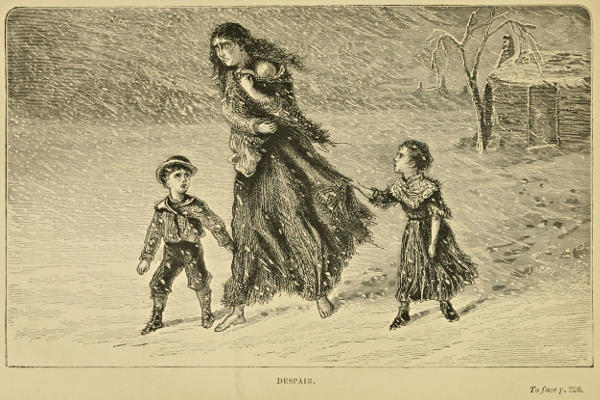
day. I had risen from my bed, weak, and oh, so faint-hearted
that I had scarcely any desire to live; and I was
sitting with my little daughter in my arms. She had cried
herself to sleep, cold and hungry, and, much as I loved her—nay,
idolized her—I confess that for an instant I harboured in
my soul the impious, the unnatural wish, that rather than see
my darling awake again to cold and hunger, she might sleep
her sweet young life away. For me to yield to such a thought—to
wish my child to wake no more! I, who would have
given gladly the last drop of my life-blood to save her! For
me to look upon her innocent little face with such a thought!
I can hardly now believe that such a thing was possible,
even for a moment. But I was desperate, and bold, and
cowardly—all at the same time; or my heart was humiliated
by poverty, and my faith was rousing bitter thoughts in my
mind.
My husband was pacing the room. I knew too well all that
was passing in his mind, although we had long been silent.
At length I said to him, “Take courage, dear, for we are the
servants of the great God, and surely He will find a means of
escape for us. We were sent here; we came because the
Lord wanted us to come, and surely He will provide for us!”
He turned to me in reply, and said kindly, “We can at
least have some water;” and he went for some water; and then,
with as reverential feeling in his soul as ever inspired a grace
before dinner, he blessed it, and we drank.
We had scarcely done so when the mail-courier brought a
letter to our door.
Governor Stoudeman, with a feeling of delicacy, had hesitated,
when my husband visited him at Lausanne, to offer him
any assistance; but, he said in his letter, he had been “impressed”
to do so, and hoped that we should not be offended.
As the letter was opened, a piece of gold fell upon the table.
We could hardly believe that God had so soon answered our
prayers, and sent us relief; and our emotions of gratitude for
this timely aid, found expression in tears.
All this time our landlady knew nothing of our distress;
she was as ignorant of our situation as if she had never seen
us. So long as I was able to walk about, I used at regular
hours to go to the kitchen, get the cooking utensils, and go
through the routine of cooking, as if we had had a well-filled
larder all the time. I set the table with punctilious care, and
the good old widow never suspected but that we had plenty.
Thus supposing that we wanted nothing, she and her children
were more than ordinarily kind to us and to our little girl,
who was now old enough to toddle round and go from room to
room. Very often they would get her into their room at
meal-time, and give her little things to please her; and while
they felt honoured in being permitted to do so, we were
silently thankful for our child’s sake, for her sufferings were
more than we could endure.
The temporary aid from Lausanne was very welcome to us,
though it only served to make us feel more keenly our
dependent position. I might relate stories, alas, too true! of
cold and want; of days, and even almost an entire week, passed
at one time without food—stories which for painful detail
would eclipse romance. It was a weary waiting for Providence!
Such things are better forgotten. And yet I feel
that in after years my temper was more subdued, and my
mind more patient under affliction, than it would have been
had I not experienced this preparatory discipline.
People who have heard, with a sneer, of Mormon missionaries
and their work, would perhaps have realized that faith
may be sincere, although mistaken, if they could have seen us
at that time. The first teachers of a doctrine, whether it be
good or evil, if only it stems the current opinions of the hour,
have ever found that at the end of a rocky way there was
waiting for them a crown of thorns.
Many a time since then I have felt the weight of anxious
care in providing for my family; the trial of our faith has not
been light, or seldom repeated; but those days of trouble in
Switzerland were, I think, the darkest I ever experienced.
We realized literally the necessity of trusting to God’s daily
mercies for our daily bread; and the assurance that the Lord
would provide, was our only hope. To say that we practised
the strictest economy, would be to give but a faint idea of the
way in which we had to consider and contrive in order to
exist at all. For years we kept the “Word of Wisdom”—a
“Revelation of Joseph Smith,” which enjoined abstinence
from wine, coffee, tea, or, in fact, warm drinks of any kind;
and trifling as such self-denial may at first appear, it was not
really so when other privations were added thereto. For
months at a time we existed—for I dare not say lived—without
what are considered, even by the poorest, the most
common necessaries. I can even recall to mind one trying
week in Switzerland, when, for the whole seven long days, we
had less than a pint of corn-flour to live upon, and that was
chiefly reserved for our poor child.
As I look back to those dark, painful times I feel that it
was by little short of a miracle that our lives were spared.
Our faith alone saved us.