"In spite of all temptations
To belong to other nations
He remains an Englishman"—
"H.M.S. Pinafore."
——
The European population of Remyo is small, consisting in fact of but
four resident ladies, and some dozen resident males; but despite their
limited number they form a very friendly and independent little
community. Among them are to be found the usual types of Anglo Indian
society, but they display characteristics not met with among the
dwellers in larger stations.
Remyo is so entirely cut off from civilisation, that the inhabitants
must of necessity depend solely upon themselves for amusement, and as
entertainments, at which one would invariably meet the same half-dozen
guests are apt to become a trifle monotonous, the ladies, deprived of
this usual mode of killing time, are compelled to devote themselves to
domestic pursuits rather more than is the custom of most Anglo Indians.
The comparative coolness of the climate (Remyo being 3,500 feet above
sea level) is conducive to such occupations, and whereas in Rangoon, or
Mandalay, housekeeping duties are reduced to a minimum, in Remyo, the
ladies, having nothing else to do, engage themselves thus with a zeal
and energy worthy of a Dutch housewife.
But, poor souls, they are terribly handicapped!
In the first place, they are mostly unaccustomed to housekeeping
themselves; secondly, the servants and household are quite unaccustomed
to being "kept"; and thirdly, it is practically impossible for a
mistress to do her own marketing unless she possess an unusual knowledge
of the language.
She may resolutely keep accounts, lock up stores, walk about all morning
in an apron, with a large bunch of keys, and have long confidential
conversations with the cook; but in spite of all these possibilities
she can only play at housekeeping; the Cook and Head Boy are the real
managers of the establishment, and they regard the well meant efforts of
their mistress with the kindly amusement one would extend to a child
"keeping house." A Remyo lady's morning interview with her cook, usually
a Madrassee, is an amusing interlude.
Neither fish nor joints can be procured in the native bazaar, so the
poor housekeeper is often at her wits' end to introduce variety into her
evening menu.
She begins cheerfully: "Well cook, what have we for dinner to-night?"
Cook replies laconically, "Chicken."
"Chicken," repeats the mistress doubtfully, "yes, perhaps that will do.
Did you kill it yesterday?"
"No! missis, not killed yet."
"Oh cook!" in a tone of stern reproach, "missis told you always to kill
it the day before, why have you not done so?"
Cook shelters himself behind an unintelligible answer in a mixture of
Hindustani and "Pigeon English," and after an unsuccessful attempt to
understand him, his mistress is forced to pass from the subject, with a
rebuke which he receives with a reproachful look. "Now," she continues,
"what have you for soup?"
"Chicken" is again the prompt reply.
"Is there really nothing else?" demands the mistress uneasily.
"No, there is nothing else."
"Well," hopefully, "you must make a very nice little side dish (entrée),
what can we have?"
"Nice bit of grilled chicken," suggests cook cheerfully.
"Oh no cook," she cries in despair, "we can't have more chicken."
"What would missis like then?"
Missis has not the vaguest idea of any possible suggestion, so
diffidently agrees that perhaps chicken will be nice. She asks about the
savoury, but seeing the word "chicken" again hovering on cook's lips,
decides to make the savoury herself, and turns to receive the daily
accounts.
Then cook rattles off a long account of his expenditure, which his
mistress duly enters in her book, fondly hoping that he isn't charging
her more than double the cost of each article, but having no means of
discovering the truth.
Once or twice, on visits to the bazaar, we asked the price of various
things, and triumphantly confronted the cook with the result of our
researches, but he was never in the least disconcerted, and at once
entered into a long, unintelligible, and quite irrefutable explanation
as to why the article was cheaper on that particular day than on any
other. It is quite impossible to upset the cheerful sang froid of a
Madrassee.
Native servants have the reputation of being most faithful to their
master, and perhaps they deserve the character, for they allow no one
else to cheat him (unless they get the lion's share of the spoil), but
they consider it their special prerogative to cheat him themselves at
every opportunity.
A scolding from a mistress makes little impression on a Madrassee
servant,—he receives it with an air of gentle reproach, while he most
persistently denies the offence, whatever it may be, from a bad dinner,
to a broken plate or an undelivered message. It is only the master, who,
by a wealth of strong language, and judiciously directed remarks,
concerning the origin, parents, and relations of the guilty one, can
hope to make the slightest impression upon the impervious native mind.
A further difficulty for the young and ardent housekeeper is the number
of servants in her establishment. One man is engaged to sweep the floor,
another to dust the furniture, one to fetch the water, a second to pour
it into the bath, one to lay the knives and forks, and a companion to
hand the plates, and so on through every department of the household
work.
This divided duty is exceedingly convenient to the servants, for if
anything be wrong the fault can always be laid on the absent one, or a
scolding delivered to one can be passed on almost unlimitedly until
everyone has enjoyed an opportunity of relieving his feelings. But it is
inconvenient for a mistress; such a delay is caused in carrying out an
order. For example, if a jug of water be spilled, a first servant picks
up the jug, a second dries the table cloth, a third dries the table, a
fourth mops up the water from the floor, a fifth rearranges the
furniture, a sixth carries out the empty jug, and a seventh fetches the
water to refill it.
All orders are delivered to the Head Boy, a most important and dignified
personage, and he transmits them through the various ranks of his
underlings until they reach the servant whose duty it is to carry them
out. During the transmission through so many channels, of course the
orders become hopelessly mixed.
We had only fourteen servants, as our house was not large! A few of
them, such as the cook, sais, and butler had definite duties, the
remainder seemed to be chiefly engaged in getting in one another's way
and quarrelling. But I suppose the work of the house could not have been
carried on without them, though their number was distinctly
inconvenient.
In Rangoon, where servants abound, it would be easy to dismiss and
engage a dozen a day, but not so in the remoter stations. The natives of
India will not leave the plains unless a strong inducement be offered,
and the Burmese much prefer not to work, if they can live without doing
so. Burmans are usually excellent servants, but they are slow to learn
to speak English, and the young housekeeper, who has probably been
accustomed to English, or at least Hindustani-speaking servants in
Rangoon, experiences great difficulty in making herself understood.
All our servants, with the exception of the cook, were Burmese, and when
my brother happened to be away, and the cook was not at hand to
interpret, we felt particularly helpless. Messages brought at such a
time had to go undelivered, and many a struggle have I had to understand
Po Sin's wants, or to make him understand mine. Housekeeping under such
disadvantages is not a happy undertaking.
Another way of passing time in which we indulged, was cooking. It was
cooking under difficulties, for the most important part (the baking) had
perforce to be entrusted to the tender mercies of the cook, no one else
being capable of understanding his intricate oven. And the cook, jealous
of our trespass on his prerogative, almost invariably served up our
cakes in the guise, either of soft dough, or of black cinders.
The chief objects of our cooking experiments were cakes and savouries.
We neither of us knew very much about cooking, but we had cookery books,
and did what we could, supplying the place of the innumerable
ingredients we did not possess, with any we happened to have on hand.
The result was usually distasteful.
I made cakes with exceeding great vigour and confidence during almost
the whole of my stay, but nobody ate them save myself from bravado, the
dogs from greed, and unsuspecting strangers from innocence.
Cake making was a fashionable subject of conversation at the ladies'
"five o'clocks" in Remyo, and everyone gave everyone else recipes. I was
astonished to hear my sister (whom I knew to be almost entirely ignorant
upon such subjects) glibly confiding recipes for all sorts of things, on
one of these occasions. I taxed her with the matter later, but she
explained that it was the fashion to give recipes, and so long as she
was careful to include an ingredient or two, impossible to obtain, she
could safely trust that no one would find her out.
There is one shop in Remyo in addition to the native Bazaar, and the
ladies usually pay it a daily visit, in order, I suppose, to add realism
to their pretence of housekeeping.
The method adopted on these occasions is remarkable. No one expects to
find anything she really wants in the shop, as it is kept by a native of
India, but she begins hopefully asking for various articles, each demand
being greeted by a shake of the head. She then asks the shopkeeper what
he does happen to sell, at which he appears doubtful, but suggests some
useless thing such as antimacassars. The purchaser at length makes a
tour of the shop, picks out the least useless article she can find, and
bears it home in triumph.
The unwise thing to do, is to order an article from Rangoon or Mandalay.
One is indeed lucky if it arrives within twelve months after being
ordered, and without an expenditure of all one's powers of sarcasm in
letters of remonstrance, and a fortune in stamps.
Firstly, there will be received about a dozen letters, with intervals of
four days or so between each, demanding fresh descriptions and
explanations of the desired article. Then, when more specific
description is an impossibility, letters for money will arrive; a
request for a rupee for carriage, another request for five annas for
something else, for half a rupee that has been overlooked in the first
account, and so on for four weeks more. Then the article is announced to
be upon the way, but it does not arrive. More letters bring to light the
fact that it is lost; has most mysteriously disappeared; cannot be
traced anywhere.
New people come upon the scene. Letters from carriers and agents arrive.
Weeks elapse, still the article cannot be found. Another is in course of
construction, when it is suddenly discovered that by some strange
oversight the original was overlooked, never sent off at all, and is
still reposing in the same tiresome shop. At length the once desired
purchase arrives, but the purchaser has now long ceased to feel any
interest in it whatever.
The inhabitants of Remyo live together in apparent peace and
friendliness, but there is between them one never ending source of
rivalry, i.e. their gardens.
Gardening is one of the most fashionable employments in Remyo. Everyone
has a garden, though the uninitiated would probably not recognise the
fact, and the amount of time, thought, and energy expended thereon is
worthy of better results than those I beheld.
For the "Remyoans" are ambitious folk, and are not content with the
flowers, plants and natural products of the country. Their desire is to
have a real English garden, and with this end in view, they sow
innumerable seeds, set many bulbs, rake, dig and water (or superintend
these operations) till life is a burden both to themselves and to their
servants. Possibly, I did not remain long enough, but the results I saw
were not satisfactory; it required a great stretch of imagination to
mark any resemblance between a large bare compound covered with coarse
jungle grass, dotted about with flat grey-soiled beds containing a few
withered looking plants (half-a-dozen violets perhaps, and a haggard
sunflower), and an English garden. Perhaps long absence from home had
dulled their recollection of gardens in England.
We were specially unlucky in our garden. Had we been content to confine
our efforts to plants in pots and boxes (as did some of our wiser
neighbours) we might have been fairly successful. But visions of rose
gardens, artistically laid out beds, and mossy violet covered dells
dazzled us, and our ambitions in this direction were boundless.
The coarse grass, the poor soil, and the persistent reappearances of
unsightly jungle weeds in all sorts of unexpected places should have
daunted us, but we had souls above such trifles. Directly we had formed
our plans we set to work, scorning the advice of more experienced
people, and disregarding all considerations of prepared beds, manure,
and seasons. We marked out several intricately shaped beds, dug them up,
lightly scattered some good soil over the top, and proceeded to sow our
seed with hearty good will.
The first difficulty we met with was with regard to arrangement. Each of
us had a favourite plan, the abandonment of which no arguments on the
part of the others could persuade. At length, after much useless
discussion, we decided each to go our own way, sow our seed where we
chose, and leave it to Nature to settle the difficulty. This was so far
satisfactory, tho' we felt anxious when we found that nasturtiums had
been sown on the top of daffodil bulbs, and one poor little bed of
pansies had a border of sweet peas and sunflowers.
For some days after we had laid out the garden, my sister and I had a
wearing time. The first thing in the early mornings we hurried out for
an eager search after signs of life in our seeds. We divided the day
into watches, that someone might always be at hand to defend the
precious seed from the marauding crows and pigeons. The cool of the
evening, usually given up to tennis and other amusements, was devoted
wholly to the fatiguing task of watering.
At last, sooner in fact than we really expected, we were rewarded by a
few delicate green shoots, peering cautiously above the ground. How
tenderly we cherished these first fruits of our toil; how carefully we
shaded them from the sun, watered them, and protected them from the evil
onslaught of the pigeons. How angry we were when we discovered they were
weeds.
However, we were rewarded at last by the unmistakable appearance of
cultivated plants. Nearly every seed sent up its little green shoot, and
for a few days we were most unpleasantly proud, and treated our friends
with contemptuous pity, while we visited and measured the plants almost
every half-hour, to see if they had grown in the interval. But our joy
was short lived, for from some cause or another, either the strong sun,
the lack of water, or the poor soil, all our plants withered before they
put forth flowers.
At first we refused to believe our ill fortune; we told one another that
it was always thus at first with delicate plants, that they must have
more water and less sun. We covered them over in the heat of the day
with waste paper baskets, topees, and cunningly erected tents of straw,
and we risked our lives a hundred times, by running out in the hot sun
to replace these, when the wind blew them away. We talked bravely of
being able soon to gather bunches of daffodils, and to send our
neighbours baskets of sweet peas. But we each felt all the time in our
heart of hearts, that our hopes were doomed to disappointment.
At last we could keep up the delusion no longer, and owned the fact of
our failure to one another; and being now sadder and wiser folk, threw
away the withered plants, and made a new garden, following this time the
advice of our neighbours.
The only plants which did prosper in this first garden were the
nasturtiums (I verily believe they will flourish anywhere) and for
several hours a tiny bed round the foot of a tree at the bottom of the
compound veritably blazed with the colour afforded by four flourishing
nasturtiums; but while we were at the Club that evening, the crows
pecked off all the petals of the flowers, and our only success was but a
short lived one.
The kitchen garden, which we consigned to the care of Po Sin, our head
boy, was rather more successful, our radishes, and mustard and cress
being the wonder of the country side.
Then we had good hopes for the peas too; there was one row about ten
inches high which looked really promising, and as we sat on the veranda
in the evenings contemplating this cheerful sight, we talked longingly
of the time when we should have a dish of our own peas for dinner.
But alas for the vanity of human expectations. One morning, my sister
had sallied forth to inspect the garden, when I was startled by the
despairing cry of "Come, come at once, the peas are flowering;" and upon
hurrying to the spot I found it too true; our precocious peas were
already in flower, and nothing could be done to discourage them. After a
few days the petals fell away, and miniature pea pods, containing
microscopic peas appeared in their place. Our wishes were fulfilled; we
had a dish, (a very small one) of our own peas for dinner, but alas it
consisted of the produce of the entire row.
Another source of much interest was our strawberry plant. I took 100
strawberry runners out with me from England, but, unfortunately, only
one survived, which put forth three new shoots, and appeared for a time
quite healthy, but never bore fruit. Still, it may yet do so; and in the
meantime it is much admired by all the inhabitants of Remyo.
Our second garden, happily, being prepared with more regard to the
demands of the climate, was a success, and wiped out the stain of our
first failure.
It is well that the Remyo ladies can interest themselves in the manner I
have indicated, for between breakfast and tea time the sun is so
terribly hot, as to render out-door exercise quite impossible, and in
the absence of many books time is sometimes difficult to kill.
Ladies in England, with their hundred and one occupations, their
amusements, household duties, and perhaps charities to attend to, can
have but a very faint conception of how wearisomely long and lonely are
some days, to their Anglo-Indian sisters. Their husbands away, or busy
much of the day, deprived of their children's society, with few books,
few amusements, and practically no duties, life is far from being an
unqualified joy to these exiled women. Let the British matron who would
accuse her Eastern sister of idleness, frivolity, and worse, consider
these things, and forbear to judge.
The men, with their work and sport to engage their time, are less apt
to find the days long; but even they at times feel the same strain.
Indeed, I remember one day, when there was no work to be done, my
brother and sister, (who had but lately left Rangoon with its constant
whirl of gaiety) became so hopelessly and desperately bored, that we
were reduced to revive our drooping spirits by making sugar toffee over
the spirit kettle.
Before breakfast and after tea are the opportunities for exercise and
amusement, and the most is made of these cooler hours.
Remyo boasts a gravel tennis court, and a nine-hole golf course, mostly
bunkers. Two more tennis courts, and a cricket and polo ground are in
course of construction, preparatory to the arrival of the Great Future
to which I have referred. Each form of exercise enjoys about three days
popularity at a time. At one time tennis will be the rage, and every one
repairs to the Club court, tho' so short are the evenings before sunset,
that it is impossible to play more than three sets an afternoon, so we
are forced to be content with about three games each. Then the tennis
rage dies away, and golf suddenly becomes the fashionable game.
Like most occupations in Remyo, golf is golf under difficulties, though
personally, whenever and wherever I play golf, I play under
difficulties. The links are chiefly jungle, and a wood axe would
probably be the most useful accessory to the enjoyment of the game. The
holes are short, and a good player would probably drive on to the green
every time, but at Remyo we were not good players. If by some lucky
chance one drove perfectly straight, there was nothing worse to fear
than a tree, or a deep nullah, filled with reeds and hoof marks, a
nullah where might be spent a harassing quarter of an hour, slashing at
a half hidden ball, which, in sheer desperation, one was at last
compelled to pick out. But if the drive were not straight, then what
endless and interesting possibilities or impossibilities were revealed.
Heaps of stones, inpenetrable bushes, reeds, rabbit-holes, and every
form of acute misery which the golfer's soul can conceive.
Yet the Links are very popular, and are the scene of many an exciting
match, in spite of lost balls, broken clubs, and lost tempers. I have
seen three clubs broken by one man in an afternoon's match, and he was
neither a particularly bad player, nor especially violent.
The Burman is not a success as a caddie. Our loogalays looked upon the
game at first with indifference, then with dislike. I think they
imagined that we purposely drove the ball into a hopeless tangle of
grass and bushes in order to scold them when they could not find it.
They could never be induced to make any distinction between the clubs,
and looked hurt when we curtly refused to drive with our putters. Their
notion of marking balls, too, is very primitive; Po Mya only found one
during my stay, which it turned out was an old one lost some days
before. In fine, they seemed to think it the greatest folly that we
should tramp up and down, and in and out of nullahs, and lose our
tempers so unnecessarily, because of a small white ball, when we had
plenty more at home.
On some afternoons everyone will repair to the new polo and cricket
ground, and walk up and down the new laid turf, discussing solemnly the
drainage, and general advantages and disadvantages of the position; or,
feeling energetic, will practise cricket, and the knowing ones will give
exhibitions of tricky polo strokes.
The making of the polo ground was seriously delayed at first on account
of the divergent opinions as to the best site, each declaring his
selection to be the only one possible, and showering unlimited contempt
upon all others. Every day we were dragged off to inspect a new spot,
and all appeared to me so equally lacking in points of advantage, that I
had no difficulty in impressing each new discoverer with my knowledge in
such matters, by disparaging (in confidence) all other schemes than his.
Finally, a site was chosen, and while the ground was in course of
construction, those whose views had been disregarded, derived the
satisfaction (always to be had in such cases) of discussing the
insurmountable obstacles to the selected proposal.
Some afternoons were devoted to rides. The jungle around Remyo is
lovely, tho' not being there during the Rains, I did not see it to
perfection. There are delightful rides in every direction, and exquisite
views from the hills, whence can be seen for miles nothing but
undulating waves of jungle, every colour from deepest reds and browns to
the bright pink of the peach blossom, and the pale green of the feathery
bamboos. It is a wonderful sight, this unbroken jungle, bordered in the
far distance by the shadowy blue hills of the Shan States.
Sometimes we visited quaint pagodas, with their neighbouring pretty,
many-roofed kyaungs where the yellow robed hpoongyis, wander in
meditation, or study 'neath the shade of the palm and banana groves. The
pagodas are all very similar in shape, and near to each is a tazoung
full of images of Gaudama, with ever the same calm peaceful smile,
denoting a philosophy superior to the cares and artificialities of the
world around.
Sometimes we rode along narrow jungle paths, bordered by a tangled mass
of bright coloured bushes and undergrowth, or by the tall, waving,
jungle grass, which is always whispering. These paths lead to tiny
collections of bamboo huts, surrounded by high fences to keep out
dacoits and other marauders, where the unambitious native leads a
peaceful, contented life, under the shadow of the bamboos and peepul
trees; an uneventful existence, enlivened, perhaps, occasionally by a
Pwé, or visit to a pagoda feast at a neighbouring village.
I enjoyed these expeditions, tho' they were ever fraught with danger to
my limbs. Nothing would induce me again to mount a pony (I had had
sufficient experience) so I accompanied the others on my bicycle.
Of late years many wonderful bicycle riders have exhibited their tricks
to the public, but I am certain none have performed such extraordinary
feats as are called for by the state of the Burmese roads, most of them
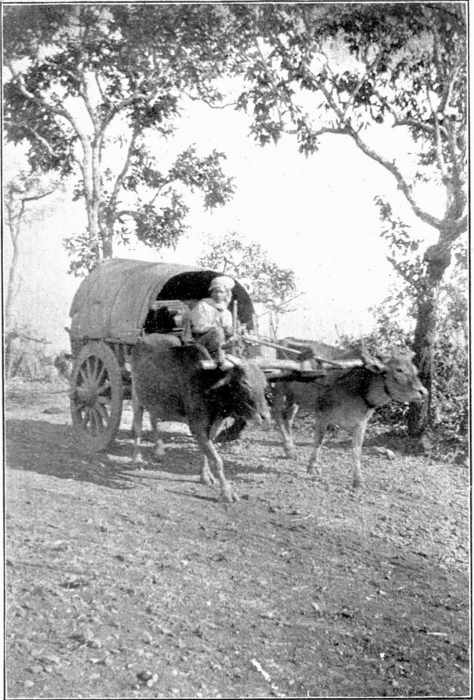
mere jungle tracks, ploughed in every direction into deep ruts by the
bullock carts. It was impossible to ride in the furrows, as they were
not sufficiently wide to allow the pedals to work round, so I was
obliged to perform a sort of plank riding trick along the top of the
rut. Occasionally, my eminence would break off abruptly, and unless the
bicycle succeeded in jumping the gap a fall was inevitable. Never had
bicycle such severe usage, nor ever did such yeoman service as mine; but
save an occasional twist of the handle bars, or a bent spoke, I never
met with a serious accident, and I soon learned the art of "falling
softly."
My anxieties, too, were increased by the mistaken kindness of my
companions, who would persist in riding beside me and conversing. One
man in particular (I have forgiven him, for I know he meant it kindly)
would never consent to leave me to ride alone. He would trot along on
his pony, either just beside, or worse still just behind me, when I felt
I might fall at any moment, and that he could not help riding over me.
He would chatter away gaily, while I, with agonised expression,
struggled along, one eye on the road and one eye on the pony, scarce
heeding his remarks, making the most hopelessly vague replies to his
questions, and committing myself to I know not what opinions.
One day we actually took a walk. We ladies grew weary of our customary
amusements, and though we had none of us done much walking since we left
England, we hailed the new idea with delight. The men refused to
accompany us (the English civilian in the East seems to forget how to
walk) so we went with only a servant or two to carry our cameras,
refreshments, and other necessities.
We walked about five miles thro' the jungle, to a little native village
surrounded entirely by clumps of feathery bamboos, a most exquisite
spot. We climbed a neighbouring hill where stood the inevitable pagoda
and kyaung, and were rewarded by a perfect view.
Our photographic intentions were unfulfilled, for as we were about to
focus our cameras, a jungle fire was set alight below, and the smoke,
drifting across the valley towards us most effectually obscured our
view. We were forced to be content with photographing one another, the
most beautiful substitutes we could find.
We examined the pagoda, peeped into the kyaung, and tried to induce the
hpoongyi to come out and be photographed; but the pious man, evidently a
hermit, shut himself promptly into the inner recesses of his dwelling,
and continued to read in a loud voice until we had taken our departure.
We thought him unnecessarily suspicious, and should have been hurt had
we not felt it to be really rather a compliment to our charms.
Our expedition was on the whole a success, but as we arrived home very
hot and tired, having lost our way once or twice, we failed to convince
the stay-at-homes that we had enjoyed ourselves without them.
One morning early, my sister and I were startled by a succession of
shots which rang out close to the house. My brother was away in the
district, making an official tour among the villages under his charge,
so we were alone and unprotected. Hurrying to the window, what was our
astonishment to see a band of Goorkhas, under command of one of the
subalterns, of the detachment stationed at Remyo, defending our house
against an unseen enemy who lurked in the neighbouring jungle, and kept
up an incessant firing. My mind first flew to dacoits, then to French or
Chinese (I knew there had been trouble on the border), then, on catching
sight of one of the enemy, and recognising him also as a Goorkha, I knew
mutiny must have broken out. Trouble of this kind always breaks out
unexpectedly, I have heard.
Soon however, we were forced to suppose that it must be a revolution,
for leading the enemy on to attack was the second of the two subalterns
of the detachment. It was difficult to believe that this usually shy and
retiring young man could be the leader of a disloyal rising, but there
he was, excitedly encouraging his followers to attack the house.
We hastily prepared lint and bandages for the wounded, and watched with
beating hearts the progress of the fight.
Suddenly, both sides ceased firing, the leaders advanced towards one
another, conversed amicably together, evidently settled their
differences, summoned their troops, and marched them home to breakfast.
It was a sham fight.
This appears to be the favourite amusement of the officers who form the
military element of Remyo society.
I was continually finding myself in the midst of desperate encounters
when taking my rides abroad. It was rather disconcerting at first, but I
grew accustomed to it in time, as one grows accustomed to anything, and
would ride along the line of fire, with a coolness and indifference
worthy of one of the old seasoned campaigners.
I suppose to those who live in a military district, sham fights are
ordinary affairs, but I had never seen one before, and it struck me as
very ludicrous to see these men, in most desperate earnestness,
crouching in ambush, dodging behind trees, and crawling along under
cover to escape the fire of their foes. The little Goorkhas become
wildly excited, and it would not do to allow the two sides to come to
close quarters, or the sham fight might develop into a real one.
The other European male inhabitants of Remyo, are the inevitable Indian
Civilian and "Bombay Burman," whom of course I should not presume to
analyse; two railway men (who seem superfluous as there is as yet no
railway), a P.W.D. (Public Works Department) man, whose work, it seems,
is to make roads (from my point of view as a cyclist they don't do him
credit), an Engineer, and the Policeman.
This last was a mighty shikarri, who had hunted and shot every
imaginable animal; who knew the habits and customs of all the beasts of
the jungle, and after examining a "kill" would give a whole history of
the fight between the tiger and its victim. He was a mighty talker too,
and would converse for hours on any subject.
What he could not accomplish was to speak for three minutes without
giving way to exaggeration; nor could he give an unvarnished reply to a
plain question, so that in Remyo "if you want to know the time don't
ask a policeman" is the popular aphorism.
The Engineer possessed the most striking characteristics amongst the men
of the place. I have never met a man so full of information. He was one
of those men who can give information on every conceivable subject, for
if he knows nothing about it, he will invent a few facts on the spur of
the moment, facts of which he is always justly proud.
I never quite made up my mind whether his actions were the outcome of a
passion for practical joking, or a desire to be of use, but I try to
believe the latter. When I punctured my bicycle tyre he insisted upon
helping me to mend it. His process occupied the whole of an afternoon,
and the front veranda and drawing-room; beyond this, it was too
intricate to describe, except to say that it required all the available
tooth brushes in the house, three basins of water, and a rupee piece,
and necessitated, apparently, the cutting of a large hole in the inner
tube, with a patent tyre remover he had invented out of a broken
teaspoon.
On another occasion, he assured us he had a splendid plan for preventing
our drawing room stove from smoking. We had been obliged to put a stove
in the drawing room to make up for the absence of a fire place; it was a
primitive affair, with a chimney that went through a hole in the wall,
and it smoked "somethink hawful." Our friend tried his plan and a dozen
others, each more wonderful and complicated than the last, and each
necessitating fresh holes in the already perforated wall. Each plan too,
resulted in increased volumes of smoke, and as the furniture and carpet
were being rapidly ruined, and our whilom happy home was being broken
up, we finally remedied the matter ourselves.
But the matter wherein our Engineer excelled himself, was in the matter
of rose trees.
Hearing us one day express a wish for a rose garden, he declared at
once that nothing was easier. He was departing for Rangoon in two days,
and he would there procure and send to us rose cuttings, which we must
plant in carefully prepared boxes of soil, follow the instructions which
he would give us concerning their welfare, and we should soon have
flourishing rose trees. Our gratitude was unbounded, we listened and
carefully noted his instructions, and after his departure eagerly
awaited the fulfilment of his promise.
In a few days a coolie delivered at our house, what I took at first to
be twigs for fire wood, but on examining the letter accompanying them, I
discovered they were the promised rose cuttings. I felt some doubts
about them, but my sister had implicit faith in the Engineer (the stove
incident came later), and would not listen to me.
So we planted the rose cuttings, and for six whole weeks did we tend
them. All the instructions we carried out to the letter, watering twice
daily and sheltering them from the sun by day, and from the cold dews by
night, but all to no avail. Dead sticks they were, and dead sticks they
remained, till at last convinced of the hopelessness of attempting to
restore life to the withered things, we tore them up in desperation and
burnt them.
My sister's faith in the Engineer, however, remained still unshaken, and
she protested that the coolie must have lost the original bundle of rose
cuttings, and substituted these twigs in their place. For my part I
believe no such thing, and when I consider what passionate care and
tenderness we lavished on those unresponsive pieces of wood, I do indeed
feel disposed to "speak with many words."
Varied though the characters and interests of the Remyo inhabitants may
be, in one particular they all agree, i.e. in their dislike of the
Casual Visitor.
The casual visitor is supposed to ruin the servants, to monopolise the
tennis courts, and golf links, to abuse the privileges of honorary
membership of the club, to unjustly criticise the polo ground, and
generally to destroy the peace and harmony of the station.
For the men, the advent of a lady visitor means calls, dinner parties,
and the necessity of wearing best clothes, which fills them with horror.
For the ladies, it means the advent of one who will possess the latest
fashions from Rangoon (possibly from England), who will throw into the
shade their gala costumes of the fashion of two years ago, who will
trespass upon their prerogatives, rival their powers at tennis and golf,
and generally interfere with their peaceful and innocent pursuits.
The arrival of visitors, therefore, is not welcomed as a rule, and
though hospitably received and comfortably housed, they are not admitted
into the inner life of the station until they have shown themselves
quite innocent of the evil qualities which are imputed to them.
This unexpected unfriendliness on the part of the Remyoans has been
brought about by the acts of two people, who once visited this happy
valley, and departed again leaving deeply rooted indignation behind
them. Of the first, a woman, it suffices to say that she amply justified
the suspicions of the Remyo ladies. Her name is never mentioned by them
without a significant look, and she is not a safe subject for
discussion.
The crime of the second sinner against Remyo hospitality (a man) was of
a different nature, and it is perhaps difficult for the female mind to
grasp the enormity of the offence.
A large tiger had made its appearance in the neighbourhood, and a tiger
shoot had been organised. All the arrangements were complete; the men
were sure of success, and speculated which of their number would have
the luck to kill. The evening before the shoot, a visitor on his way
from a remote station, arrived in Remyo, and obtained permission to
accompany the sportsmen. As he was reputed to be a very bad shot this
was readily given, and there was allotted to him a position well out of
the expected line of the beat. The tiger broke near the stranger's
tree, and he killed it with his first shot, the promoters of the shoot
never even getting a sight of the game.
The criminal impertinence of a mere stranger daring to kill their
tiger roused the deepest feelings of indignation among the Remyoans. The
laws of hospitality are above all, so the perpetrator of the crime was
allowed to escape with his life and the tiger skin, but since that day
strangers have been looked upon as suspicious interlopers, and
prospective tiger shoots are not discussed in presence of the Casual
Visitor.
I have given my impressions of the Remyo society candidly, perhaps a
little too candidly; but lest any who read this book be disposed to hold
the latter opinion, let me say one thing more.
The first, the last, and the most indelible impression left on my mind
by all the Anglo-Burmans whom I had the pleasure of meeting, was the
impression of a kindness, friendliness, and hospitality passing belief.
The Anglo-Burmans, while retaining the best qualities of the English
nation, seem to lose entirely that cold and suspicious reserve towards
strangers, of which we are often so justly accused. They appear to have
adopted those Eastern laws of hospitality, which lay so great a stress
on the duty of entertaining strangers, and they cannot do enough to
welcome those fellow countrymen who visit the land of their exile.
This characteristic kindness of the Anglo-Burmans is so universally
acknowledged, that it is really superfluous to mention it, but as I
spent six months among them, without encountering a single unkind look,
word, or deed, I cannot let the opportunity pass without offering my
tribute of gratitude to this most kind-hearted and generous people.