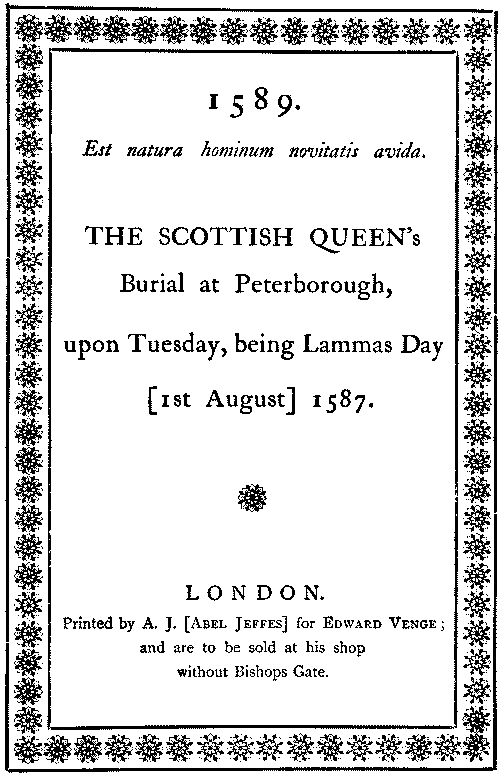
LAURA. — To the no less virtuous than fair, the Honourable Lady Lucy , sister to the thrice renowned and noble Lord, Henry [Percy] Earl of Northumberland . — To the Gentle, and Gentlemen, Readers whatsoever. — Alla bellissima sua Signora. E. C. — LAURA. — THE FIRST PART. — The Conclusion of the First Part. — LAURA. — THE SECOND PART. — The Conclusion of the Second Part. — LAURA. — THE THIRD PART. — The conclusion of the last Part. — A Friend's just Excuse about the Book and [the] Author; in his absence. — 1589. — The Scottish Queen's Burial at Peterborough, upon Tuesday, being Lammas Day [ 1st August ], 1587. — CUPID's Posies, For Bracelets, Handkerchers, and Rings; With Scarfs, Gloves, and other things. — To his Mother Venus, Cupid dedicateth his Posies. — Cupid 's Posies. — CUPID's Posies. — Cupid 's Conclusion. — STRANGE AND WONDERFUL THINGS — The miserable Captivity of Richard Hasleton , born at Braintree in Essex. — The Merchant's Daughter of Bristow [Bristol]. — The First Part. — The Merchant's Daughter of Bristow [Bristol]. — The Second Part. — Posies for Rings, or Mottoes fit for Presents , collected by W. P. — LICIA, or POEMS OF LOVE — Ad Amorem. — Ad Lectorem. — To the Worshipful, kind, wise, and virtuous Lady, the Lady Mollineux , Wife to the right Worshipful Sir Richard Mollineux Knight. — To the Reader. — To Licia , the wise, kind, virtuous, and fair. — SONNET I. — SONNET II. — SONNET III. — SONNET IV. — SONNET V. — SONNET VI. — SONNET VII. — SONNET VIII. — SONNET IX. — SONNET X. — SONNET XI. — SONNET XII. — SONNET XIII. — SONNET XIV. — SONNET XV. — SONNET XVI. — SONNET XVII. — SONNET XVIII. — SONNET XIX. — SONNET XX. — SONNET XXI. — SONNET XXII. — SONNET XXIII. — SONNET XXIV. — SONNET XXV. — SONNET XXVI. — SONNET XXVII. — SONNET XXVIII. — SONNET XXIX. — SONNET XXX. — SONNET XXXI. — SONNET XXXII. — SONNET XXXIII. — SONNET XXXIV. — SONNET XXXV. — SONNET XXXVI. — SONNET XXXVII. — SONNET XXXVIII. — SONNET XXXIX. — SONNET XL. — SONNET XLI. — SONNET XLII. — SONNET XLIII. — SONNET XLIV. — SONNET XLV. — SONNET XLVI. — SONNET XLVII. — SONNET XLVIII. — SONNET XLIX. — SONNET L. — SONNET LI. — SONNET LII. — An Ode. — A Dialogue betwixt two Sea Nymphs, Doris and Galatea , concerning Polyphemus . — A Lover's Maze . — An Elegy. — ELEGY II. — ELEGY III. — The Rising to the Crown of Richard the Third. Written by himself. — Sir Robert Carey , Lord Warden of the Middle Marches; and afterwards Earl of Monmouth . — The True Narration — To the Reader. — A Narration of the Progress and Entertainment of the King's most excellent Majesty, with the Occurrents happening in the same Journey. — Michael Drayton. Odes. [1606, and 1619.] — To the Reader. — ODES. [1606.] — ODE 1. — ODE 2. — ODE 3. — ODE 4. — ODE 5. — ODE 6. — ODE 7. — ODE 8. — ODE 9. — ODE 10. — ODE 11. — ODE 12. — Preface to the additional Odes of 1619. — ODES, with other Lyric Poesies . — The Heart. — The Sacrifice to Apollo . — To his Rival. — The Crier. — To his coy Love. — A Hymn to his Lady's Birth-place . — Thomas , third Lord Fairfax . Short Memorials of some things to be cleared during my Command in the Army. [1645 to 1650 A.D.] — Thomas , third Lord Fairfax . — George Villiers , second Duke of Buckingham . An Epitaph on Thomas , third Lord Fairfax . — ADVICE TO A YOUNG REVIEWER, WITH A SPECIMEN OF THE ART. OXFORD: SOLD BY J. PARKER AND J. COOKE; AND BY F. C. AND J. RIVINGTON, ST. PAUL's CHURCHYARD, LONDON. 1807. — ADVICE TO A YOUNG REVIEWER, &c. — L'Allegro. A Poem. By John Milton . No Printer's name. — W. Hunneman. — Old King Cole , his life and death.
The Toys of a Traveller:
or
The Feast of Fancy.
Divided into Three Parts.
BY
R[obert] T[ofte],
Gentleman.
Poca favilla gran fiamma seconda.
LONDON,
Printed by Valentine Simmes.
1597.
GOod Madam, I make bold to present unto you a
few Toys of mine own travail: [the] most part
conceived in Italy, and some of them brought
forth in England. By which my imperfections,
you may see, as in a lively mirror, your own
perfections; and by the follies of my rechlesse [heedless]
youth, behold plainly the virtues of your flowering age:
hoping your Ladyship will keep them as privately, as I
send them unto you most willingly.
Neither doubt I at all but that your excellent spirit will
judge graciously of this my bare, yet bounden, conceit; and
to accept the same, as a mean[s], at idle times, to drive
away that self-pleasing, yet ill-easing, humour of never-glad
melancholy, which spiteful Fortune, seeking (though in vain)
most injuriously to insult over you, laboureth by all means
possible to inflict upon you: the virtuous behaviour of yourself
being such as, even in the midst of all your crosses, you
cross her designs with an invincible heart, and with your
honourable carriage carry her, with all her devices, as a slave
to follow you, in all your generous and thrice-noble actions;
maugre the intricate labyrinth of so many and infinite
troubles allotted, most unworthily, unto you, by the irrevocable
doom of your too partial and flinty Destiny. All
which notwithstanding, you bear and over-bear, with a
most resolute staiedness; and a resolved courage of a right
PERCY, and of a mind A per se.
But additions breed suspicions; and fair words, for the
most part are counted the blazons of flattery: therefore I
will leave to the temperate judgment of the wise, and to
the uncorrupt censure of the worthier sort, your heroical
and undaunted mind; and the integrity and never-stained
proceedings of your spotless self.
Only this, with submission, will I say, that if the richness
of the ground is known by the corn; the daintiness of the
water, by the sweetness of the fish; and the goodness of the
tree, by the rareness of the fruit: then may every man give
a guess of the internal habit and excellent qualities of your
inward mind, by the outward behaviour and apparent semblance
of your exceeding chaste, and more than admirable,
demeanour in every respect.
And thus, hoping your Honour will as debonairly accept
of these Trifles, as I dutifully bequeath them unto you;
and with the sun-shining favour of your gracious aspect
deign to read these few lines: craving both privilege, and
pardon, for all such faults and defects as shall happen to
be discovered in the same,
I humbly devote myself unto
Your Ladyship's thrice-virtuous and immaculate
disposition and command whatsoever,
Who am bound, as a vassal,
To do homage unto the same for ever,
R. T.
GEntlemen. As the Fencer first maketh a
flourish with his weapon before he cometh
to strokes, in playing [for] his prize: so I
thought good, pro formâ only, to use these
few lines unto you, before you come to the pith of
the matter.
What the Gentleman was, that wrote these verses,
I know not; and what She is, for whom they are
devised, I cannot guess: but thus much I can say,
That as they came into the hands of a friend of mine
[? the R. B. of page 340] by mere fortune; so happened
I upon them by as great a chance.
Only in this I must confess we are both to blame,
that whereas he having promised to keep private the
original; and I, the copy, secret: we have both consented
to send it abroad, as common; presuming
chiefly upon your accustomed courtesies. Assuring
ourselves, if we may have your protections, we shall
think ourselves as safe as Ulysses did, when he
was shadowed under the shield of Pallas against
furious Ajax; so we, by your countenances, shall
be sufficiently furnished to encounter against any
foul-mouthed Jacks whatsoever.
To censure of this Work is for better wits than
mine own: and it is for Poets, not Printers [This
therefore was written by Valentine Simmes, the
Printer of this Book. See also page 340] to give
judgement of this matter. Yet, if I may be bold to
report what I have heard other Gentlemen affirm,
Many have written worse; Some, better; Few, so
well. The Work, being so full of Choice and Change
as, it is thought, it will rather delight every way than
dislike any way.
Thus, courteous Gentlemen, building upon my
wonted foundation of your friendly acceptance, I
rest your debtors; and will study, in what I can,
daily to make you amends.
Yours always
[Valentine Simmes.]
[The Lady's name was E. Caril: see Book II., Poem XXXIII.,
at page 313.]

THrough thee, not of thee, Lady fair I write;
Through power of Beauty, not of Virtues, thine:
With zealous will, though slender be my might,
I, weakling, seek an eagle's nest to climb.
Then guide my feet! and if to slip I chance,
Uphold me by the favour of thy glance!
Accept in gree these verses rudely penned;
A sign of duty which to thee I owe:
And deign with sweet regard them to defend;
Which as condemnèd else are like to go.
In thee, it rests the stamp on them to set:
If current, Pass! Suppressed! if counterfeit.
[R and T stand
here, and elsewhere,
for the
initials of the
Author. E.A.]
And though the note, thy praises only fit,
Of sweetest bird, the dulcet nightingale:
Disdain not little Robin RedbreasT yet!
[A line wanting.]
What he doth want in learning or in skill;
He doth supply with zeal of his good will
For only Thee, they were devised alone:
And unto Thee, they dedicated are.
Who knows? Perhaps this kindness, by thee shown,
Shall make this glimpse shine like a glittering star.
Such is thy virtue in the World his sight;
Thy crow though black, may go for swan most white.
Then doubt me not, though parted we remain:
In England thou; and I in Italy.
As I did part, I will return again,
Loyal to thee; or else with shame I'll die!
True Lovers, when they travel countries strange,
The air, and not their constant minds, do change.
Coelum, non animum, mutant, qui trans mare currunt.
Affettionatissimo servid, della
divina Bellezza sua.
R.T.
I.
FOrtune, cross-friend to ever-conquering Love,
Our bodies, Lady, hath divided far;
But yet our constant minds she cannot move,
Which over-strong for her devices are.
Woe's me! in England thou dost bide, and I,
Scarce shadow of my self, in Italy.
But let her do her worst, and what is frail
And mortal seek to separate and undo;
Yet what immortal is, she never shall!
A string too high for her to reach unto.
In spite of envious seeds, by malice sown,
My heart shall aye be thine; and mine, thine own!
Padoa.
II.
THough I do part, my heart yet doth not part;
My poor afflicted body parts in twain,
And doth in pieces two divide my heart:
One piece my fainting spirit doth sustain,
The other part I leave with thee behind,
(The better part, and of my heart most dear);
Then to that part, so parted, be thou kind!
And to the same impart thy loving cheer!
That I, returning, may again unite
This parted heart; and find for grief, delight.
London.
III.
LIke to the blacksome Night, I may compare
My Mistress' gown, when darkness 'plays his prize:
But her sweet face, like to the sun most fair;
When he in glory 'ginneth to arise.
Yet this no whit the other doth disgrace;
But rather doubleth Beauty in the place.
Contraries like to these set opposite,
So dainty and so pleasing in their show
To lookers on, do breed no small delight;
And pleasure great thereby to them doth grow.
O wonder strange! O solace sweet! to see
In one self subject, Night and Day to be.
IV.
IN the Egean dangerous Sea of Love,
In midst of faithless waves and wicked wind;
Where, to my cost, most bitter brunts I prove:
A new Arion, there, myself I find.
And though, as he, I play on harp and sing;
Yet cannot cunning mine so high aspire
As for to make the skipping fish me bring
Unto that wishèd shore I so desire.
Only my Laura, peerless for to see,
May, in this troubled flood, my dolphin be!
V.
GReat was the strife between the sun on high
And my fair Sun, when first she 'gan to 'pear,
Who should exceed in brightest majesty;
And show in sight of spacious world most clear.
The sun did shine; but she did lighten bright,
And so his burning beams extinguished quite.
Nay more, my Sun on sudden to the sun
Sent light; and yet no light at all did want:
Where else the other had been quite undone
For lack of brightness; which with him was scant.
The beauty then the sun doth use to show,
My Sun doth give; and from her, it doth grow.
VI.
TUrned to a stone was he that did bewray,
Unwitting, to the crafty thief himself
The theft; not thinking he had stolen the prey,
In hope to gain a little paltry pelf.
So I, who unawares to cruel Thee,
The robber of my heart, confessed the theft;
A senseless stone like Battus am to see:
Only in this unlike that shape bereft,
That where to worthless stone he turnèd was;
I for a Touchstone true of Love do pass.
VII.
DOwn from the neck unto that dainty Breast,
(Which Nature made a Mirror of Delight;
And where a World of Beauties sweet do rest)
Doth hang a costly Chain of Pearl most bright;
And of proportion are so just and round,
That such in India rich cannot be found.
Besides, their orient brightness is alike;
So that mine eyes are dazzled with the same,
And, not much used to see so fair a sight
(A sight which doth the sun in glory stain),
Cannot discern, though them they both do see,
If Breast be Pearl, or Pearl in Bosom be.
VIII.
TO give that life, which had not breath before;
Prometheus, from above, stole heavenly fire:
For which his boldness he was plaguèd sore,
A just reward for such a high aspire.
So whilst I steal from thee, my heaven above,
The heat which doth revive my dying sprite:
For rashness, mine eternal grief I prove.
Yet, though our fault's all one—the plague's not like:
He feels of vulture one, alone, the smart;
But I have thousands, which still gnaw my heart.
IX.
LOve, being blind, hath wrought me damage sore;
Thou, blind in this my loving, evil wast;
Nor would I see the snare, being blind far more,
Wherein myself, I did entangle fast.
Yet hath this blindness harm done unto none
But unto Beauty's buzzard, me alone.
When blinded Boy did catch my harmless heart;
Thou didst not see the net so intricate
Which bound me (being blind, blind as Thou art!)
To be a thrall in this most wretched state.
So that, alone to work my misery,
Love blind is; blind wert Thou; and blinder, I.
X.
IF, Laura, thou dost turn 'gainst me in hate;
Then me, such busses sweet why dost thou give?
Why check'st thou not the Cheeks which give the mate?
The vital cause whereby I breathe and live?
Perhaps it is, because through too much joy.
As in sweet swound [swoon], I might away depart:
If so thou do, and think me so to 'noy;
Kiss hardly! and with kissing, breed my smart!
Content am I to lose this life of mine;
Whilst I do kiss that lovely lip of thine.
XI.
UPon triumphant chariot, 'passing rare,
(In which my Sun doth sit like Majesty:
And makes the day shew unto us more fair;
Whose cheerfulness delights each mortal eye.)
I, rash, like to another Phaeton,
With hare-brain haste, too hasty lept thereon.
But for my boldness dearly did I pay;
And had like plague, as he, for being o'er-brave:
Yet though in equal fortune both did stay
(For life he lost; and death She to me gave);
The punisher of both was not the same,
For he, by Jove; and I, by Love; was slain.
XII.
THe beauty, that in Paradise doth grow,
Lively appears in my sweet goddess's Face;
From whence, as from a crystal river, flow
Favour divine and comeliness of grace.
But in her dainty, yet too cruel, Breast,
More cruelty and hardness doth abound;
Than doth in painful Purgatory rest.
So that, at once, She's fair, and cruel, found:
When in her Face and Breast, ah, grief to tell!
Bright Heaven she shows; and crafty, hides dark Hell.
XIII.
WHilst angry Juno, from the scowling skies,
Thick swinging showers did downward send amain;
My Lady, mounting up in stately wise,
From heaven more fast did fiery lightning rain.
So that the people, passing, had less harm
By water wet, than by the fire o'erwarm.
The water only wet their outward skin;
A matter small, in which was danger none:
But this her fire did burn their hearts within;
And forced them, as they went, to sigh and groan.
So that their grief was greater, sans all doubt,
To have within fire, than water, without.
XIV.
THe swift Meander, turning, winds so fast,
And with his stream in circle-wise so runs;
That, wanton-like, from whence he springs, at last,
Back to his fountain-head again he comes.
In me, a river huge of tears, from heart
To watery eyes ascend; from whence they flow,
And running down, do from mine eyes depart,
Descending to my heart again below.
So that, through virtue of most mighty Love,
In heart, a new Meander I do prove.
XV.
THou stranger, who with wand'ring steps dost wend,
Thy gazing eyes turn quickly unto me!
And to my speech, with list'ning ear attend!
In whom four Elements united be.
Mark well; and, as a wonder, tell the same
Of Cupid's force! poor Lovers' Tamburlaine!
First this my body's Earth, and earth most cold.
The Fire within my heart, in covert lies.
The Air's my sighs. Mine eyes do Waters hold.
Thus for my Saint, he doth me martyrize.
Earth is my body; (Strange seems not this same?)
The Air, my sighs; eyes, Water; heart, the Flame.
XVI.
IF lovely Lass, for Fairing thine, of me
Gold, in this Fair, thou meanest for to have;
Then give me of thy hairs! which golden be.
Give unto me! since thou of me dost crave.
Nor by this bargain, shalt thou loss sustain;
Or ought hereby shalt hindered be, sweet Wench!
Since I, to courteous thee, do give again,
As thankful, gold; for gold in recompence.
Thy treasure, so shall mine be; mine, as thine:
Nor shall th' exchange be worse than gold most fine.
XVII.
ROcked in a cradle, like as infants be,
When I was young, a little wanton child,
Two dainty dugs did nourish life in me;
Whilst oft on them, with teat in mouth, I smiled.
Ah, happy I! thrice happy, might I say;
Whilst in that harmless state I then did stay.
But now that I am come to man's estate;
Such dugs as nursed me in delight and joy
Do seek my death, by poisonous sugared bait;
Whose sight, without possession, breeds me 'noy.
So what, in childhood, caused me to live;
Now, in my youth, doth death unto me give.
XVIII.
IF Sea, no other thing doth shew to be
Than most unstable waters moving oft:
With pardon, Lady, you this seem to me;
So most unstable is your changing thought.
I, likewise, hold a River, that o'erwhelms
With wat'ry salt, within these eyes of mine.
Then let us make a mixture 'mongst ourselves
Of this unsteadfastness and wat'ry brine!
Let's fashion, both of us, a novel Sea!
So heaven, the Haven; and Love, the Bay shall be.
XIX.
LAdy, the sun was in Aquarius
When thou wert born; which is the reason why
The water of my plaints delight thee thus;
Without once viewing me with piteous eye.
But when as I was born, the Sign I guess
In Cancer was; a show of my distress.
This is the cause, within my boiling breast
Doth burn a hot and unextinguished fire:
But contrary these Signs in us do rest;
Nor do they well accord to my desire.
Far better had it been, Aquarius's Sign
Had happed to me; and Cancer's had been thine!
XX.
WHat time, with brow, the Loveliest 'gins to scowl;
Shewing disdain and fury in her face:
Methinks I see the clouds wax dark and foul;
And gloomy night begins to run his race.
But, then again, when She to show begins
Her smiling cheer, adorned with favour rare:
Straightways the sun, in chariot bright forth springs;
Clear are the skies; the gladsome day, most fair.
Thus, in one face, I see, against my will,
The rising of the sun; and falling, still.
XXI.
RAnkle the wound did in my head apace;
When fairest She, to play the Surgeon came:
And whilst her snow-white hand did me the grace
To lay the plaster on, which healed the same,
A wonder strange! No sooner did she touch
The hurt; but it appeared to be none such.
Yet, woe is me, no sooner by that hand
Was healed in head my outward fest'ring wound;
But that instead of that, as countermand,
One mortal scar at inward heart I found.
Thus, Love! thou seest is changèd my estate
She checks with Death, that 'fore gave Life for mate.
Venice.
XXII.
IF in the midst of kindling burning fire,
That worthy Roman burnt his valiant hand;
I like another Mutius in desire,
Have scorched my fist likewise, through Love's command,
In freshest moisture; where my Lady sweet,
Her lily hands, for coolness, divèd oft.
But though desire between us was alike;
Yet was the matter diverse which we sought.
He chose to burn his hand, with courage bold,
In flaming fire; and I, in water cold.
XXIII.
THe Gentiles used, in sign of sacrifice,
The blood of men to offer; to appease
The warlike goddess's wrath, in humble wise;
And through the same, her angry mind did please:
But Thou, more wicked Warrior far than she,
In reason may'st more cruel termed be.
On Beauty's altar, to thee dedicate;
Thousands of Lovers, mustering on a row,
Offer their blood and hearts! yet mitigate
Thy hardened mind cannot: which flint doth show.
Then is she cruel less than Thou art now:
Since blood her pleased; and Thee hearts cannot bow.
XXIV.
FOr to behold my Sun, I from the sun
Did seek my face to shadow with my hand,
To shield me from the heat, that 'gan to come
In place, where gazing on her I did stand.
But I no sooner from that sun was free,
But that, in that self instant and that time,
I, of mine own Sun, found myself to be
Burnt with the heat; a most unlucky sign.
So whilst a shade from sun did me defend,
A Sun more hot did hurt me in the end.
XXV.
WHite was the orient pearl which, on a day,
That hand me gave: which scorns the proud compare
Of purest white; and bears the palm away
As of all pearly Fairs, the orient'st fair.
And whilst She offered unto me the same,
I knew not which the Pearl was, of the twain.
So white the hand was of my peerless Pearl
As it did dazzle with delight mine eyes,
And pearl seemed to me, giving me the pearl;
Which made me, sighing, say in whisp'ring wise,
"Ah, why once may I not so happy be,
This Pearl to have; which th' other gives to me?"
XXVI.
WHen you appear, appears the Break of Day;
And shews to be most fair and passing bright:
But if you keep yourself unseen away,
The Day shows not; but keepeth out of sight.
Then if again you 'gin yourself to show;
Behold the Day to shew itself afresh
With sky most clear. So both of you do grow
In beauty like: in heat nor are you less.
Thus if your beams you ope, or hidden been:
The Break of Day appears; else ne'er is seen.
XXVII.
JUstly of thee, Love partial, I complain
That, at one instant and with one self stroke,
Thou dartèd hast into my heart, with pain,
Cold chilly frost; and fiery flaming smoke.
Ay me! within me, both I secret hold:
And whilst th' one burns me, th' other makes me cold.
Then, Cruel, since thou wilt, two contraries,
Against my soul, within my heart shall rest:
Ah, yet make peace 'twixt them, in loving wise!
Or else, sweet Love, do promise this at least!
Flame to my frost, and water to my fire;
Life to my heart, to comfort my desire.
XXVIII.
DIana shineth in the heavens clear;
Because from purest Sun she takes her light:
And Fair, she shews that of Diana here
On Earth, doth borrow beauty passing bright.
The virtue then that is infused in her,
She from Diana hath; or else from none:
For other thews do all in her concur;
And unto her beholding are alone.
O wonder strange of Nature to reveal!
She, Dian' gives; yet doth from Dian' steal.
Sienna.
XXIX.
AS burnished gold, such are my Sovereign's Hairs;
A brace of stars divine, her blackish Eyes;
Like to the fairest black the raven bears;
Or fairer, if you fairer can devise.
So likewise fair's the beauty of her Breasts;
Where Pleasure lurks, where joy still dallying rests.
This Venus' Bower, you rightly may compare
To whitest snow that e'er from heaven fell;
Or to the mines of alabaster fair.
Woe's me! 'Tis sweet to sleep in Cupid's cell!
Whilst he, the heart makes surfeit with delight;
Through golden Hair, black Eyes, and Breast most white.
XXX.
UNto thy favour (which when Nature formed,
She went beyond herself with cunning hand),
I may compare what is, in world, adorned
With beauty most; and with most grace doth stand.
But every mortal whiteness, ne'er so white,
The ivory white of thy white hand exceeds:
So that my soul, which doth fair whiteness like,
Rests on fair whiteness, and on whiteness feeds.
For this is thought, and hoped of from thee:
White as thy hands, so white thy faith shall be.
XXXI.
LAdy, thou seemest like Fortune unto me;
When I most wistly mark, how thou dost go
With golden tresses loose (a joy to see!);
Which gentle wind about thy ears doth blow.
And as thou her resemblest in this sort;
So dost thou in attire, and all thy port.
Only thou wantest for thy swift right hand
The rolling Wheel: and shadowing Veil to hide
Those eyes; which, like Controllers, do command.
But if thou long'st of these to be supplied,
Take me, thy prisoner, for to play this part!
For my desire's the Wheel, the Veil's my heart.
XXXII.
THou, merry, laugh'st, and pleasantly dost smile:
I woeful weep, and mestful sorrow still;
Lest this thy mirth increasing, me beguile,
And weave a web for me of greater ill.
Too well perceive I this thy deep disdain,
By this thy feignèd looks and cloakèd glee.
Thou of disaster mine art glad and fain;
And fain my death, as basilisk, would'st see;
Since that of war and 'bate this laughter is,
And not of gentle peace and calmy bliss.
XXXIII.
SInce thou hast changed thy gown and thine attire;
Ah, change thy thoughts! not always cruel be!
And with new clothes, put on a new desire!
That new, in every point, I may thee see:
And if thou heretofore unkind hast been;
Be courteous now, and gentle be thou seen!
Thy glory great, thy praise more shalt thou find;
If, of unconstant, constant thou become!
And of a foe, a faithful friend and kind!
Then change henceforth thy thoughts! else I, undone.
Give me that colour which so likes mine eyen!
If death, then black: if life, then carnatine [rosy red].
XXXIV.
CHanged is my nature in me; where before
I like was to a chilly freezing ice;
I now a flame am, burning inward sore:
And such a flame that burneth in such wise
That if Love and my Mistress take no care
For this my hurt, my soul must quickly die.
Yet one doth see (for both not blinded are!)
The fire so hot doth burn, wherein I fry,
That fierce Perillus's boiling Bull of brass
May unto this for icy substance pass.
XXXV.
FAr better had it been, I had been dead,
And laid full low in latest home, my grave;
Than with that drink myself for to have fed,
Which Laura mine in crystal glass me gave.
The liquor pleased me, I must needs confess:
Yet to my heart, 'twas poison ne'ertheless.
So that I had contrary quite effect
To my desire; which I so much did wish.
Love was in fault, who Reason doth reject.
And see my cruel luck, what happed in this!
The wine was sweet; yet did his nature turn:
It cooled my mouth, but heart within did burn.
XXXVI.
SWeet sang thy bird, in ebon cage shut fast,
And did delight thy dainty ears so much
As thou vouchsafedst to give him meat at last;
And gently did his feathers stroke and touch.
So, Lady, I likewise, in th' ebony
Of thy bright eyes am prisoner, and do sing
Thy Beauty's praise; and yet not fed am I
By thee: yet live through thee; a wondrous thing!
Love to my heart thy beauty doth supply
For food; which else, through famine starved, would die.
XXXVII.
IF white's the Moon, thou Laura seem'st as white;
And white's the gown which you on body wear.
And if her whitely horns, in calmy night,
She, smoothly gliding, shows to us most clear:
You, in the daytime, more and brighter far
Your beauty show; like bright Aurora's star.
Like brightness both of you abroad do cast;
Though not effect alike per accidens:
You shine, she shines, your powers eternal last;
But yet between you is great difference.
Her brightness freezeth, causing deadly cold:
Yours doth inflame, and lovely fire doth hold.
XXXVIII.
EVen as the lamp goeth out, that oil doth want,
Or as the sun doth fall in th' Occident;
So did my heart within me 'gin to pant;
My vital spirits away by little went:
When, taking on me pity, graciously
My Mistress's hem of garment, trailing down,
Touched me; and me revivèd suddenly.
Then if such virtue be within her gown;
Imagine what doth stay her corpse within!
Which who seeth, through sweetness needs must sin.
XXXIX.
SEated on marble was my Lady blithe,
Holding in hand a crystal looking-glass;
Marking of Lovers thousands; who alive,
Thanks only to her beauty rare, did pass.
To pry in glasses likes her: but afterward
She takes the nature of the stone most hard.
For whilst she cheerfully doth fix her eyes,
Gazing upon the brightness of the one;
Her heart, by th' other's made, in strangy wise,
Hard as a rock and senseless as a stone:
So that if Love this breaketh not in twain;
It will a flint become, to others' pain.
XL.
NO more a man, as once I was, am I:
Since this new Circe, moved by fierce disdain,
Hath changed me to a Fountain never dry;
Wherein myself, with bitter tears I bain [? bathe].
Then am I one who always eyes do bear;
And breast of water flowing only full.
Take heed, you Lovers all, of her! and fear
The sugared baits of this deceitful Trull!
Lest by this Circe new, you be deceived,
As I have been; and be of shape bereaved.
THe Macedonian Monarch once did deign,
In cheerful sort, in kind and loving wise,
To feast in village with a homely Swain;
Who entertained him, as in country guise,
With curds and creams, and such like knacks he had.
Whereof the courteous Prince accepted glad.
So, Lady, boldly I presumèd have
To invite you to a sorry banquet base;
Nor to disdain the same, of you I crave!
Though cates too coarse for you; too poor, the place.
I cannot, as I would, give curds and cream;
But milk and whey: my fortune is so mean.
Yet (if you shall accept it graciously;
And with your favour sweet, this board adorn)
The virtue which is in you, presently,
The whey, to curds; the milk, to cream shall turn.
But if your look (you angry) turn away;
The milk shall still be milk; the whey, still whey.
Then as the sun in glorious wise doth shine
As well on valley low as mountain high;
Vouchsafe one cheerful glimpse of favour thine
On poor me, from out that heavenly eye!
Unworthy I, such grace! I do confess:
Yet worthy thou to do so, ne'ertheless.
R. T.
I.
IF I somewhile look up into the Skies,
I see, fair Lady, that same cheerful light;
Which, like to you, doth shine in glorious wise:
And if on th' Earth, I chance to cast my sight;
The moveless centre firm to me doth show
The hardness which within your heart doth grow.
If Seas I view, the flowing waves most plain
Your fickle faith do represent to me.
So as I still behold you, to my pain;
When as the Skies, or th' Earth, or Seas I see:
For in your seemly self doth plain appear
Like faith; like hardness; and like brightness clear.
II.
MArvel I do not, though thou dost not see
My griefs and martyrs; which I still sustain.
For thou, the Mole of Love dost seem to me;
But if a Mole, th' art only to my pain.
How comes it then that, seeing thou art blind,
Thou me consum'st, as if thou had'st thy sight?
Why, as thy nature by instinct doth bind,
Stayest not below? Pack hence, and leave this light!
Either those eyes still shut, not me to grieve;
Or under ground, in darkness, always live!
III.
IF whilom, in times past, that Spartan Lass
("The Flower of Greece," Dan Paris's costly joy)
Through her fair feature, the only causer was,
So many Knights were slain at Siege of Troy:
Thou, Laura, art unlike unto her far!
In this our Age, a much more blessed star.
For she brought Wars, Strife, Death, and Cruelty;
Where thou, alone, bring'st Peace and Pleasure still.
Ah, happy thrice, that ligs in love with thee!
And if, by chance, un'wares, thou sometimes kill:
Thou, with thy smile, the wound canst heal again;
And give him life, whom thou before hadst slain
Pisa.
IV.
SHoot forth no more those darts from lightning eyes!
Unkind! Why seek'st to stop my fainting breath?
Go, and invent some new kind exercise;
New weapons seek wherewith me to offend!
Play the right Tyrant! Choices use in death;
Whereby, I dying, content may rest thy will.
But tell me? Wouldst so fain my life should end?
And know'st not, Sweet extremes do sudden kill?
Cruel, kiss me but once! and thou shalt see
Ended my life with that same kiss to be.
V.
IF what is heavy craves the Centre base;
The earth below, as Nature wills the same:
Heavy the woeful griefs are, in this case,
Which inward in my heart I do sustain.
And if what's light, by kind, aloft doth mount:
Then light's my love with thee, of light account.
So that in doubtful dangerous extreme,
Wretch that I am! myself am sore afraid:
And doubt of thee, so far from Golden Mean;
Nor know I well out of this depth to wade.
Lest that my life be shortened, or I die;
Whether it heavy, falls; or light, ascends on high.
VI.
LAdy, what time I seek in mournful note
To show mine agonies and bloody moan,
My Voice doth fail; and hoarse and harsh my throat:
And this doth come through you, through you alone.
The whilst I think, by means of you in Song,
To mitigate some part of this my smart;
Instead thereof, you do me double wrong:
And with a glance you take away my Heart.
So that I find great hurt by this your theft:
Since where, before but Voice, now Heart, 's bereft.
VII.
AS rocks become, exposed 'gainst waves and wind,
More hard; such is thy nature, stubborn Dame!
Opposed 'gainst waters of my plaints most kind;
And winds of mine hot sighs, which inward flame,
That hardness such to increase 'bout heart is found,
As to it, soft might seem the diamond.
Henceforward then, let no man think to move
By weeping or lamenting, to his will,
This self-willed Saint; which too too well I prove
A senseless stone to be unto me still.
Since, to my grief, from all good luck debarred;
With plaints and sighs, she doth become more hard.
VIII.
HArk, Lovers! Hark, a strange miracle
Of one, deprived of heart; yet death doth 'scape!
Mine L. a flower gave me, which sweet did smell;
And for the same, away my life did take.
So that I only breathe through scent of flower;
And without heart, not without life, I live.
Then is not this, of might Love his power
A wonder strange? which he for sport doth give:
When that a flower sustaineth me alone
With life; who in my body, heart have none.
IX.
WHen I did part from thee the other night;
Methought a foul black dog, with ugly shape,
Did follow me: and did me sore affright;
And all the way did greedy on me gape.
Nor I this cur, how he at me did howl,
Can well as yet forget, with chaps most foul.
Then thinking of his colour, hateful black;
Methought some ill, my thought did fear to come,
And said within me, "Turn again, turn back!
If forward thou dost go, thou art undone!"
Then pardon, Lady, if I back again
Am come this night, with you for to remain.
X.
MY mourning Mistress's garments, black doth bear;
And I in black, like her, attirèd am!
Yet diverse is the cause why black we wear;
She for another's death doth shew the same.
I for another reason bear this suit;
Only to show by this, my outward weed,
Mine inward grief (although my tongue be mute)
Of tender heart; which deadly sighs doth bleed.
Thrice happy I, if, as in habit [dress] we
Are both in one, our minds both one might be.
XI.
IF April fresh doth kindly give us flowers;
September yields with more increase the fruit.
Sweetest, you have in bosom, Beauty's Bowers,
Both these sweet tides: whence forth they always shoot
Both flower and fruit. All only you, alone,
Can give me, when you please; or else can none.
O dainty bosom, bosom rich in price,
Surmounting mountains huge of beaten gold;
Whose whiteness braves the whitest snow that lies
On highest hills, whose height none can behold.
In you, my soul doth hope, without annoy,
Both Spring and Harvest, one day to enjoy.
Roma.
XII.
DRawn, cunning Painter, hast thou with great art,
The Shadow [Image] of my lovely Laura fair;
Which object sweet not smally joys my heart:
But little didst thou think, nor wast thou 'ware,
That where thou thought'st my fancy for to please,
Effect contrary sorts to my desire:
So that it breeds, in body mine, unease;
And, senseless, burns my heart with feeling fire.
O strange success! What made was for content
Doth most displease; and, lifeless, doth torment.
XIII.
WHen first the cruel Fair deigned graciously
To look on me with kind and courteous view;
And cast on me a lovely glancing eye:
She knew not that I was her servant true.
But She no sooner 'ware was of the same;
But that She turned her back with great disdain.
So as the wound I then close bare in breast;
I now, through grief, show outward in my face:
But if that She, by whom I wounded rest,
Lives in compassion cold towards me, sans grace:
Hard hearted is She, cruel was She to her friend;
And wicked shall be, world withouten end.
XIV.
WHen first the sun did shine upon her eyes,
Who fairest 'mongst her beauteous sex doth show;
The heavens her dainty corpse, in courteous wise,
Covered with chilly cold and whitest snow.
She, through the nature of that humour cold,
Both coldest Ice, at once, and purest White
Draws to herself. Then none, for strange should hold;
Though, to me, fair and cruel is her sight:
Since that the heavens, for favours, did impart
A snow-white corpse to her, and frozen heart.
XV.
THe dusky cloud in sky, with shadow dark,
Doth cover oft the sun's most clearest light:
So as his beams we cannot see, nor mark;
And he himself doth play at least in sight.
Ah were I such a cloud on earth to cover
My sweetest Sun! as doth that cloud, the other.
But if that cloud do vanish soon away,
And doth as momentary pass and vade;
Eternal would I be to hide her aye,
And of a harder mixture would be made.
O happy I! O fortunate eclipse!
With kissing so to darken those fair lips.
XVI.
FRom milk of Juno, as the Poets feign,
The Lily had its whiteness, passing white:
And from Adonis' blood, that lovely Swain,
The Rose his colour red, which doth delight.
Thou, pretty Soul, hast both the colours rare
Of these sweet flowers; which others all exceed.
Thy breast's a bed of beauteous Lilies fair;
Thy dainty cheeks, pure damask Rose breed.
O fruitful garden flow'ring; where appear
The Rose and Lily at all times of year!
XVII.
OF constant love, I am the wasted fire;
The furious wind's my Lady's angry eye:
Who whilst She kindles both, through wrathful ire,
The flame increaseth, mounting to the sky.
In midst is Love, half dead of grievous pain;
And, doubtful, winds about like sparkling flame.
He fears the heat: and trembles, being turned
Unto this blast; which still more sharp doth rise.
Nor is his fear in vain, when so he is burned:
For one of these must hap, in sudden wise,
Either the fire must spoil him as his prey;
Or whirling wind else blow him quite away.
XVIII.
MY Laura wonders that, in visage pale,
I bear of Death itself, the lively show:
But if She muse at this, her musing's stale;
For this sad colour had I long ago.
The fire, close burning in my veins, doth make
That outward ashes in my face you view:
But if that She would on me pity take,
Who is the cause of this my palish hue,
This kindled heat shall die, which now doth burn;
And my first colour shall again return.
XIX.
WHilst foaming steed I spur unto the quick,
To make him gallop to my Love amain:
Love doth my thoughts, through Fancy, forward prick;
The end of wishèd journey mine to gain.
But light's his hurt! 'Tis but a little smart!
Where mine is mortal, sounding to the heart.
Run then, my gelding swift, like Pegasus!
Fly hence with wings! for wings hath my desire:
Both of us, forced amain, are forward thus,
And kindled in us is a burning fire.
Thou, through two spurs in flank, provoked art sore:
But thousands inwardly, my heart do gore.
XX.
RIch is the diamond, a gem of price;
Yet such the nature strange is of the same,
That who the powder thereof drinks, straight dies:
And, as if poison 'twere, doth take his bane.
So thou another precious jewel art;
In name and nature not unmuch alike:
Since death thou giv'st unto the loving heart;
If but a kiss one sucks from thee most sweet.
Whilst he doth swallow down his sugared bait;
The joy's so great, it kills him through conceit.
XXI.
THe Grecians used to offer up their hair
Unto their rivers: whom they did esteem
As mighty gods; and them great honour bare,
As if no virtue small in them had been.
Do thou the like, sweet Laura, unto me!
Who, for my love, deserves a greater fee.
Thy golden tresses on me do bestow!
Who hold whole rivers flowing in mine eyes:
Yet would not I, thou off shouldst cut them though.
Dost muse? and ask, How this thou may'st devise?
I'll tell thee. Give thyself to me for mine!
So shalt thou give, uncut, thy tresses fine.
XXII.
ONe lovely glance, which from the eyes did pass
Of Lady mine, hath changed my gentle heart
From hardest diamond to brittle glass:
And now again (unto my bitter smart),
Through dreadful frown, she turns it suddenly
As 'twas before, from glass to diamond.
So if She will, She may (and presently,
As likes her) change me; who to her am bound.
If cruel She; my heart is hard to break:
If pitiful; 'tis gentle, brittle, weak.
XXIII.
TWo winds, one calm, another fierce, to see;
Th' one of the Spring, of Winter th' other right:
I plainly, Lady, do discern in thee!
The first, which makes me joy, breathes from thy sight
Such dainty flowers, in diverse coloured show,
As makes to blush Dame iris's rainy bow.
The second, which makes me to pine away,
Blows from thine inward breast, a deadly blast;
Where doth eternal hardness always stay,
Which I do see eternal aye to last.
So as calm Zephyrus, in face, thou art!
But rough as boisterous Boreas, in thine heart.
XXIV.
NO sooner do I earnest fix mine eyes
On my fair Sun: but that I her perceive
To vanish like a cloud, in darkest wise;
As if, eclipsed, her light it did bereave.
I know not, If She's troubled thus because
She doth disdain I should behold her so:
Or if for fear, this shadow to her draws;
Lest me her beams should hurt, which glistering show.
Say then, sweet Love, for thou know'st best, if still
I shall behold her; or no more, thou will.
XXV.
O that I were sly Proteus! for to take
On me that form which most I like or wish:
Then would I change myself unto the shape
Of that thy little whelp, thy joy and bliss.
Into that little worm thou so dost like;
And dallying, play'st with him both day and night.
Those savoury smacks, those busses, sweet which be,
Which thou to him dost give, should all be mine:
And I would make my heart to leap for glee;
Whilst I did lick that bosom fair of thine.
But since I to despair of this am brought:
My wish shall Proteus be; thy dog, my thought!
XXVI.
"SAy, gentle friend, tell me in courtesy,
Before what was I? and what am I now?
A senseless Shadow, or a Body, I?"
"Neither of both. Mark, and I'll tell thee how.
No Body now: for that, by proud disdain
Of scornful She, dislived was. Shadow none;
For that did underground go with the same,
Unwilling it should wander all alone."
"What am I then?" "Even one that doth not know
What now he is: or what he was, can show."
XXVII.
THe Blazing Star foretells the hapless fall,
And sudden death of others, soon to come.
To me a Face, brighter than Comets all,
Doth, with her looks, my fortune hard forerun;
And with her shooting darts, from glancing eye,
Presageth that, ere long, I needs must die.
The Blazing Star death only prophesies;
This doth foreshew to me a harder fate:
And dares me to mine end, in warlike wise;
Nor how this Challenge know I to escape.
Ah, cruel Star! of death not only sign;
But murderer th' art of this poor life of mine.
XXVIII.
THe Crow makes war with the Chameleon;
And, being hurt, to th' laurel straight doth fly:
And, through the fruit he findeth thereupon,
Is healed of hurt, finds food, and lives thereby.
Love the Chameleon is; the Crow am I:
And battle wage with him unto the death.
He wounds me deadly; whereupon I his
To thee, my Laural! to restore my breath.
Thou me reviv'st. Such virtue 's in thee rife
As thou, at once, dost give me food and life.
XXIX.
AMongst the Parthians is a kind of ground
Of nature such as, though it far doth stand
From fire: yet fire to take it straight is found;
And flying thither, burns it out of hand.
This prey so sure of Love am I, fair Dame!
And you to me, which burneth me, the flame.
So that if I, to you far off do show;
You kindle straight in me a quenchless fire:
And yet, although within it burn me so,
Sweet is the heat whose fuel is desire.
For rather I, in fire near you would be:
Than freed from flame, you farther off to see.
XXX.
LOve, ope my heart! Hot fire thou forth shall take
Open my Laura's! In it thou shalt find
Cold frost. Then of these two contraries make
But one; and that same one, frame thou more kind!
Of both our hearts, make but one loving heart!
And give it unto which thou please, of twain.
Give it to her! To her do it impart;
Or unto me! It skills not much the same.
I'll doubt no more, when but one heart we have
Between us both: for this is all I crave.
XXXI.
UNto an Image may I right compare
My Mistress, since so cruel She's to me:
Which standeth for a sign or shadow fair;
To which the simple ignorant bow with knee:
And though with eyes, mouth, ears, and feet it show;
Yet doth it neither see, talk, hear, or go.
So plays my Choice, when I appear in sight:
Nor see, nor speak, nor hear, nor stay She will.
So as an Idol, She resembleth right;
Blind, mute, deaf, moveless, senseless standing still.
Then am not I worse than a lifeless block;
To worship such a painted coloured stock.
Fiorenza.
XXXII.
BOth gems, and pearls, their proper value have;
But yet unlike: for not alike's their price.
Some sought for are, and each one doth them crave;
Others, more base, do pass in worthless wise.
A jewel rich, and princelike gem, is She
Whom I esteem; and such account of make:
Yet in herself no price hath for to see.
For it is holden at so high a rate
As all the gold, nor silver, which doth lie
In th' earth, or sea, the same, at worth, can buy.
XXXIII.
IF love, wherein I burn, were but a fire;
I quenched it had, with water of my plaints:
If water, these my Plaints; I this desire
Had dried through inward heat, my heart that taints.
But Love, that in my griefs doth take delight,
Both fire and water turns, to work me spite.
Fly then, this Love! since such is his great power
As waves to fire, and fire to waves, he turns:
And with an absent Beauty, every hour,
My fainting heart with Fancy's fuel burns;
And, 'gainst all sense, makes me, of CARe and IL
More than of good and comfoRT, to have will.
XXXIV.
RIvers unto the Sea do tribute pay.
A most unconstant moving Sea art thou!
And I, within mine eyes, bedewèd aye,
A River hold of bitter tears as now.
Receive then, from these moistened cheeks of mine.
Into thy lap, the water forth I pour!
Of duty mine, and of thy debt, a sign:
And mix together with my sweet, thy sour!
So shall the water to the water be
More precious; and the Sea, more rich to th' Sea.
XXXV.
SUch is the virtue of the sunny heat,
As seizing on the Cockle Shell (which lies
On seaish shore), whereon his beams do beat,
It makes it brightly shine, in orient wise:
So that, through secret power of radiant sun,
Of worthless shell, a pearl it doth become.
So, Lady, you, through force of Beauty's power,
If you shall deign to glance on me your eye,
And rain with grace on me a smiling shower,
A jewel rich you make me by and bye:
And if no pearl; at least a precious stone.
This, only, can you do; or else can none.
XXXVI.
THe blood of fair Adonis, Venus changed
Into a flower: who, whilst he did pursue
In forest thick, where as he hunting ranged,
The savage boar to kill; the boar him slew.
Do thou the like, sweet Love! Do thou the same,
Whilst now my life doth languish, through thy power:
And whilst my wound makes me for to remain
Withouten blood, transform me to a flower!
That where I, living, cannot; dead, I may;
A lovèd flower in Laura's bosom stay.
XXXVII.
AN ocean Sea of water calm am I;
Wherein kind Love the form of Fish doth take,
Leaping alongst the shore most wantonly.
Then, Lady, of a Fisher don the shape!
Ah, what sweet fishing shall you have to like;
If Love you chance to catch, while he doth bite?
Come then, and naked into this water hie!
He cannot 'scape; but, here, perforce must bide!
'Less to my heart, to save himself, he fly.
Then quickly strip thyself! Lay fear aside!
For of this dainty prey, which thou shalt take;
Both Sea, Fish, and Thyself, thou glad shalt make.
XXXVIII.
RIch Damask Roses in fair cheeks do bide
Of my sweet Girl, like April in his prime:
But her hard heart, cold chilly snow doth hide;
Of bitter Januar, the perfect sign.
Her hair of gold shows yellow like the corn
In July, when the sun doth scorch the ground;
And her fair breast, ripe fruit which doth adorn
September rich. So as in her is found
Both Harvest, Summer, Winter, Spring to be:
Which you in breast, hair, heart, and face may see.
XXXIX.
TH' immortal Parcæ, fatal Sisters three,
Of mortal men, do sing the shunless fate:
What once Was, what Is now, and what Shall Be;
Their life, their death, their fortune, and their state.
Our Song let be like theirs! for Three they were;
And so our number is. Three are we here.
Sing Laura then! Sing Love! and sing will I!
Of dreary fortune mine, sing let us all!
Let 's sing in doleful tune most mournfully,
How 'Tis, how 'Twas, and hapless still Shall fall;
The Present, Past, and (which none can mend)
What Shall Be, world to come, withouten end.
XL.
THe heavens, their restless sphere do always move.
In thee doth move the faith, which thou didst plight.
And I, Ixion-like, still in my love
Do roll; and yet I roll my wheel aright.
So that, 'twixt us, continual motions wend.
But which is worse, unconstant Wench, I see!
The heavens will have their motions without end;
Which, never ceasing, roll continually:
And thou, like them, to roll dost mean thy fill;
And since 'tis so, I'll roll too, against my will!
THUS is the Second Course now servèd in.
A Course too coarse for such a dainty Dame:
Yet, Lady, though the cheer be bad and thin;
Because it comes of zeal, accept the same!
And though not worthy of your grace it be;
Yet make it gracious through your courtesy!
Great sumptuous feasts the stomach doth dislike;
Which oft, in body dangerous surfeits breed:
Where dishes few revive our sense and sprite;
And Nature's pleased on little for to feed.
This, as a sauce, your appetite to move,
Accept! where meat's the heaRT, where cook is Love.
Nor think the worse, though I have spun a thread
So fine (I mean your praise) I cannot mend:
Since 'tis a Work to ground the wisest head;
And mar I should this loom, this cloth not mend.
So Venus' matchless shape Apelles drew;
But how to finish it, he never knew.
Far more's my mind than is my feeble might.
My pencil, for thy picture is too weak.
The sun is only for the eagle's flight.
My strength's too small, this hardened ice to break.
Not painted, scarce I thee have shadowed here:
This task 's for such as have in skill no peer.
R. T.
I.
WHo joys in love? The Heart alone, to see.
Who languisheth in love? The Heart alone.
Then is 't a thing impossible for me
To joy or languish: since I Heart have none.
Withouten Heart! Then tell me, What am I?
Even bones and flesh united cunningly.
The Soul, where is 't? Love that hath ta'en away:
My Body only resteth in his place.
Deprived of Soul and Heart, how live? I say,
I live, maintained by love, in this strange case.
O wonder strange, the Body live to see;
The Heart and Soul in other place to be.
Napoli.
II.
THat crimson gown, with drops of blood ywrought,
Which Laura wears, a token is most true,
How that of blood desirous is her thought:
And that 'tis so, I best can tell to you.
My wrongèd heart too well doth find the same;
Who, thousand times, not once, hath wrongèd been
By her: and, now, to aggravate my pain,
(More cruel in desire for to be seen),
By outward habit [dress] covets She to show
What, inward, in her mind She hides below.
III.
THe flaming torch, a shadow of the light,
Put out by hasty hand, doth colour change;
And black becomes, which seemed before most bright:
Nor so to show is any marvel strange.
So was I long a lively fire of Love;
The heat whereof my body oft did prove:
But I, at last, by one who moaned my woe,
Extinguished was, by pitiful Disdain.
Then if my colour black in face do show,
You need not much to wonder at the same;
Since 'tis a sign, by part to know the whole,
That Love made me a fire, Disdain a coal.
IV.
PArdoned of every wicked fact was he,
To Hebe's Temple that, with prayers, came:
And, of such grace in sign, his bonds, as free,
He left hung up on high within the same.
I, Lady, errèd have; and humbly come
To thee, who art the Temple fair of Love:
Off'ring to thee my prayers, all and some,
To free me from my faults, thy heart let move!
In token of which gift, with thee I'll leave
My jealous thoughts; wherewith I did thee grieve.
V.
IF thou art cold, as is the Winter's snow;
I, as the Summer, hot am most extreme:
Then let's unite thy heart, which cold is so,
To mine so warm; and make of both a mean!
So th' one a help to th' other still shall be;
And linked in concord, as two doves shall 'gree.
To form this frame, Love shall the workman play.
Then let's with July, January mix!
Let's make, between us, an eternal May!
An everlasting truce, twain betwix!
Thy Winter, with my Summer let us join!
My fire so warm, with frost so cold of thine!
VI.
THe cruel Nero used on golden hook,
The harmless fish to catch with sugared bait:
So courteous Love, fishing, me quickly took;
Whilst he with dainty prey for me did wait.
Yet far more fortunate am I in this:
For whereas Nero's hooks most sharp did kill;
The other hooks revive the taken fish,
Whilst they do hold him gently by the gill.
But hooks they are none! For hooks they are too fair!
Two golden tresses be they of fine hair!
VII.
WHen She was born; She came, with smiling eye,
Laughing into the world, a sign of glee.
When I was born; to her quite contrary,
Wailing I came into the world to see.
Then mark this wonder strange! What nature gave;
From first to th' last, this fashion kept we have.
She in my sad laments doth take great joy:
I, through her laughing, die; and languish must,
Unless that Love, to save me from this 'noy,
Do unto me, unworthy, shew so just
As for to change her laughter into pain;
And my complaints, into her joy again.
VIII.
IN Love his kingdom great, two Fools there be:
My Lady's one; myself the other am.
The fond behaviour of both, which to see;
Whoso but nicely marks, will say the same.
Foolish our thoughts are. Foolish, our desire.
Foolish our hearts in Fancy's flame to fry.
Foolish to burn in Love's hot scorching fire.
But what? Fools are we none. My tongue doth lie.
For who most foolish is, and fond, in love;
More wiser far than others, oft doth prove.
IX.
NO sooner Laura mine appears to me;
But that a dainty dye, or blushing red,
In both our faces showeth for to be.
But who, alas, doth mine so overspread?
O'er-fervent Love doth draw this shadow pure;
Like cunning'st Painter, long for to endure.
Who painteth hers? Disdain, with pencil hard;
Which turneth all my sweetness into sour.
So that all my designs are quickly marred;
Except Love bind Love, by his awful power,
In Faith's firm bands. Too high th' exchange will grow.
When love, for hate; and not for like, shall go.
X.
PHɶbus had once a bird, his chief delight,
Which, only 'cause he had an evil tongue,
He made him black; who was before most white.
So if all those who, Lovers true have stung
With spiteful speech, and have their loves betrayed;
Or to their Ladies false be and untrue,
Setting at nought the promise they have made;
Love would but change into this coal-black hue:
Thousands abroad, like sea-coal crows should show;
Who, now unknown, for snowy swans do go.
XI.
IN silver stream, on shallow fountain's shelf,
The lively image saw he in the same;
Who was in love with shadow of himself:
Through pride forgetful how his likeness came.
Such one myself, by chance, I see to be;
When as in river I myself did see:
Yet I myself, instead of loving, hate.
And such strange hatred is this, and so strong;
That while he, loving, died by justest Fate,
Himself by seeing, whilst he himself did wrong:
I die will unto him contrary clean;
'Cause I, hating myself, myself too much have seen.
XII.
JOy of my soul! My blindfold eyes' clear light!
Cordial of heart! Right methridate of love!
Fair orient pearl! Bright shining margarite!
Pure quintessence of heaven's delight above!
When shall I taste, what favour grants me touch;
And ease the rage of mine so sharp desire?
When shall I free enjoy, what I so much
Do covet; but I doubt in vain, to aspire?
Ah, do not still my soul thus tantalise;
But once, through grace, the same imparadise!
XIII.
PAinter, in lively colours draw Disdain!
Dost ask, How that may rightly shadowed be?
I'll tell thee. If thou, fine, wilt do the same;
My Lady paint! and thou Disdain shalt see.
Fond man! dost not believe? or think'st I jest?
If doubtful thou remain, then hear the rest!
Mark her but well; and thou shalt, in her face,
See right Disdain: which, coming from her eyes,
Makes her to look with most disdainful grace;
Then if thou seest it, in so plain a guise,
Straight shadow [paint] her! For this one counterfeit [picture]
Of her, and of Disdain, shall show the shape.
XIV.
WIth gold and rubies glistereth her small hand;
But if you match them with her lips or hair,
They seem withouten brightness for to stand:
The others have such lively colours fair.
O worthy Beauty! peerless A PER SE!
To whom all other Beauties are most vile.
O fairness such as fairer none can be!
Thou grace itself, of graciousness dost spoil!
With rubies, thou right rubies dost disgrace!
With gold, bright gold thou stainest in his place!
XV.
A gentle tame deer am I, called a Hart:
The cruel huntress fierce my Mistress is.
With crossbow bent, she comes to me in Park;
Paled in with pleasant thoughts of wanton wish.
She shoots, and hits me; takes me for her prey:
And (having shot, hit, taken) flies her way.
Back she retires from me, with pleasant smile;
Unloosing me, and heals my wound and pain:
When, as afresh incensed (alack the while!)
'Gainst me, desirous me to plague again,
She turns towards me, o'ertakes me, strikes me sore:
And, binding up my wounds, makes deadly more.
XVI.
THe golden tresses of a Lady fair;
At first beginning were of this my love:
But now, at last, unto my double care,
To be the end of my sad life I prove.
Then did my doubtful spirit live in hope:
But now he fears, despairing as it were,
Because he doth perceive in sudden broke
His hope, which dying heart did help and bear;
Since that the hair, that Alpha me did bind
In love, of life the Omega I do find.
XVII.
"SWeet Laura, in the water look no more,
To see if feature thine be fair or no!
Look in mine eyes! which tears rain streaming sore
Of bitter plaints; whose water clear doth show,
As in a looking-glass, most bright to thee,
Those favours which in that sweet visage be."
So said I to her: when She answered blive,
"And thou, my Love! say, Dost thou likewise wish
To see thyself in one that is alive?
Then in this breast, look where thine image is!
Love shall alike in both our bodies rest:
Bear thou me in thine eyes; I'll thee in breast!"
XVIII.
IF, cruel, thou desirous art of blood;
Behold how I do bleed in streaming wise!
Glut then thyself therewith, if thou think good;
And do content, with blood, thy bloody eyes!
From breast it comes, where fainting heart doth lie;
And for a gift, I it present to thee!
Although I know, through this, I soon shall die;
And yet to die it little grieveth me:
Since 'tis my wish, my blood with soul as one
May rest; and that's with thee, or else with none.
XIX.
THat ivory hand, a fan most white doth hold;
And to the milky breast blows wind apace;
And yet is full of chilly ice most cold;
Disgrace to others, to herself a grace.
But I, who wistly mark these whiteness' three,
Vouchsafe, sweet Love, this boon to grant to me!
Distil within the rolling of mine eyes,
By virtue of thy power, such hidden flame;
And let it tempered be, in such strange wise,
That, as I cast my look upon the same,
It quite may take away her cruelty!
Melt straight the ice! and fan burn suddenly!
XX.
THe snakes, amongst themselves, so carefully
Love one another, wonder for to see!
As if th' one want, the other straight doth die.
Lady, unto these snakes unlike we be!
For if I die, thou diest not for my death;
But, through my pain revivest! Such is thy spite!
And pleasure tak'st to see me void of breath.
Ah, yet in love let 's unto them be like!
Thou Cupid, work! that I, poor snake in love,
This 'sdainful snake for to be kind may move.
XXI.
LAura is fair and cruel both in one;
And born was of a dainty diamond.
Then is it marvel, neither wonder, none;
Although her heart as hard as stone be found.
Nature that hardness, as a Keeper, gave
To her, her beauty thereby so to save.
But fond is he, and simple in conceit,
That thinks Love will not, one day, burst the same.
Then quickly, mighty Lord, quickly this break!
Break thou this stony heart, so hard, in twain!
Unto thy power, let Nature's force still yield!
And be thou Conqueror 'gainst her in Field!
XXII.
THe snow-white Swan betokens brightsome Day:
The coal-black Crow, of darky Night is sign.
Thou Day, or Night, bring unto me still may,
With those bright lamps, those glistering stars, of thine.
But, cruel thou, thy heart is bent so hard,
As I that sun can never see with eyes
(That wished-for sun, from these my lights debarred):
Nor aught discern but mists, in foggy wise.
Then since I live in woe; and, blind, nought see:
A Crow, not Swan, thou still shalt be to me!
XXIII.
SAy, Cupid, since thou wings so swift dost bear;
Within my heart, alone, why dost thou lie?
Why dost not seek to lodge some other where;
And to some other place, why dost not hie?
Go unto her, who hath the lily breast!
Who though she hates me; yet I love her best.
If her, to entertain thee thou shalt find;
It is a sign she hateth me no more.
Straight then, return again; and show her mind
To my desire! who for this news longs sore.
Then, prithee, go! No longer ling'ring stay!
Lest, when thou wouldst, thou canst not go thy way.
XXIV.
ON quicksedge wrought with lovely eglantine,
My Laura laid her handkercher to dry;
Which had before snow-white ywashed been.
But after, when she called to memory,
That long 'twould be before, and very late,
Ere sun could do, as would her glistering eyes:
She cast from them such sparkling glances straight,
And with such force, in such a strangy guise,
As suddenly, and in one selfsame time,
She dried her cloth; but burnt this heart of mine.
XXV.
GOld upon gold, mine only Joy did plate,
Whilst She did dress her head by crystal glass:
But whilst She looked on it, it sudden brake;
So as, amazed thereat, much grieved She was;
To whom I said, "To grieve thus, 'tis in vain:
Since what is broke, whole cannot be again.
Look steadfastly, with both thine eyes on me!
Who have my heart, through love, a glass new made."
She on my face looked; and herself did see:
Wherewith contented th'roughly, thus She said,
"Most happy I! Since for to dress my head,
For broken glass, of whole one I am sped."
XXVI.
THe heavens begin, with thunder, for to break
The troubled air; and to the coloured fields,
The lightning for to spoil their pride doth threat.
Each thing unto the furious tempest yields.
And yet, methinks, within me I do hear
A gentle voice, hard at my heart, to say:
"Fear nothing, thou; but be of merry cheer!
Thou only safe, 'fore others all shalt stay.
To save thee from all hurt, thy shield shalt be
The shadow of the conquering Laural Tree."
Fano.
XXVII.
"LOve this fair Lass!" said Love once unto me.
I loved her. "Love her now," saith he, "no more!"
When thousand darts within my breast there be;
And if I love her, he me threateneth sore.
He saith, "Himself is fallen in love with her;
And that himself, 'fore others, he'll prefer!"
His sense is this. He, in her beauteous eyes,
Hath found such Amours as ne'er like were seen:
But thinks he, this shall serve, in cunning wise,
To make me leave? he cozening me so clean?
In spite of him, I'll love! sith heart doth 'gree,
With Love in love as rival for to be.
XXVIII.
MY Mistress writing, as her hand did shake,
The pen did dash, which on her gown did spurt:
One drop, more higher than the rest did take;
And to presume to touch her breast it durst.
Upon her dainty bosom it did light:
Wherewith she blushed, in show like damask rose.
Presumptuous black! how dar'dst thou touch that white,
Wherein a World of gladsome pleasure grows?
Yet, spite of envy, happed it for the best:
To the white, more grace; more beauty, 'twas to th' breast.
XXIX.
NOne dares now look more on my Laura's face,
So dangerous is her beauty to behold:
For he no sooner gives to her the gaze;
But straight his heart, She takes from him so bold.
Such virtue 's locked within those ebon eyes;
Where, dallying with Delight, Dan Cupid lies.
So sweetly rolleth She that radiant sphere,
As She, from whom She lists, robs suddenly:
So as to look on her, each one doth fear;
And yet to look on her, spare will not I!
For though I lose my Heart, and him disease.
I like shall my Desire; and her I'll please.
XXX.
UNbare that ivory Hand! Hide it no more!
For though it death brings to my tender heart
To see it naked, where is Beauty's store;
And where moist pearl with azure doth impart:
Yet fear I not to die, in this sweet wise!
My fancy, so to see 't, is set on fire.
Then leave that glove! (most hateful to mine eyes!)
And let me surfeit with this kind desire!
So that my looks may have of them their fill;
Though heart decay, I'll take it for none ill.
Mantoa.
XXXI.
"MY Mistress seems but brown," say you to me.
'Tis very true, and I confess the same:
Yet love I her although that brown She be;
Because to please me, She is glad and fain.
I lovèd one most beautiful before;
Whom now, as death, I deadly do abhor.
Because to scorn my service her I found;
I gave her o'er, and chose to me this same.
Nor to be faithful, think I, I am bound
To one, in whom no kindness doth remain.
This is the cause, for brown and pitiful;
I left a fair, but yet a faithless, Trull.
XXXII.
WHite art thou, like the mountain-snow to see;
I Black, like to the burnèd coal do show:
Then give some of thy purest white to me!
And I'll some of my black on thee bestow:
So will we these two contraries unite
Together; which so joined, will show more fair.
Let 's both then make this change, for our delight;
Unless to kill me, thou do little care!
But why of White or Black, talk I to thee?
My blood not black 'tis; which thou fain wouldst see.
XXXIII.
AS sacrifice unto a goddess bright,
My heart I offered with devotion great:
Thinking that She, Love's Temple had been right.
But what, un'wares, I spied not then, in heat,
I, wary, now discern her for to be:
Of hell below, the rightest cruelty.
I was deceived, I do confess. That smile,
That wanton smile, that bred in me delight,
Hid in those lips so fair, did me beguile.
O beauty false! O cruelty most right!
Flee, flee my heart! flee then, if thou be wise,
Thy hurt! my burning heat, her treacheries!
XXXIV.
STrange is this thing! My horse I cannot make
With spur, with speech, nor yet with rod in hand,
Force him to go; although great pains I take.
Do what I can; he still, as tired, doth stand.
No doubt he feels a heavy weight of me;
Which is the cause he standeth still as stone:
Nor is he 'ware that now he carrieth three;
He thinks, poor jade, I am on 's back alone.
But three we are, with mine own self I prove:
Laura is in my heart; in soul is Love.
Pesaro.
XXXV.
WHen I, of my sweet Laura leave did take;
Fair Fano's city, for a while to leave:
She gave to me, to wear it for her sake,
Of gold and pearl a dainty woven wreath.
Dear was the gift; because for love it came:
But dearer more; 'cause She gave me the same.
I look on 't still, and kiss it as my joy;
Kissing and bussing it, with it I play:
Which, at one instant, brings me mirth and 'noy;
And sighing oft thus to myself I say:
"White pearls are these; yet hath her mouth more fair!
Fine gold is this; yet finer is her hair!"
Fano.
XXXVI.
WIth thousand bands of furious inward heat,
Love binds my soul; and burns my gentle heart:
And, two ways, Laura, death to me doth threat:
With Colour fresh; and wanton Eye, like dart.
This for reward for all my love I gain.
For my goodwill, two enemies I have:
Laura and Love. Four plagues conspire my pain,
Because I like; and what 's but just, do crave:
Fire, roseal Colour, Eyes, and cruel Band.
These, at the gaze of Beauty, make me stand.
XXXVII.
IF scalding sighs, my faith may testify;
And brinish tears, of love may warrant be:
Both th' one and th' other thou hast seen with eye!
Then what wouldst have, hard hearted! more of me?
But thou, perhaps, though much I have endured,
Wouldst yet be better of my faith assured.
Then with thine eyes, into my breast do peer!
Which, for the nonce, I leave to open sight;
And that which now thou doubt'st, see shalt thou clear.
Ah, mark it then; and view what shows so bright!
But too too cruel art thou, and precise;
That will not credit give to thine own eyes!
XXXVIII.
THe hapless Argus, happy in this same,
The glory of the sun's surpassing light;
The brightness of the stars, the fire which stain:
With hundred eyes, behold them always might.
But I, alas, who have but only twain,
Cannot behold the beauty of my Sun!
For which I live as blind, in endless pain;
And count myself, for want thereof, undone.
I can but wish that I an Argus were!
With hundred eyes to view her everywhere.
XXXIX.
IN vasty sea, fain would my slender Muse
Wade in thy praise! to praise thy beauty right:
But, Lady, I for pardon crave excuse.
To break such waves, too brittle is her might!
Meantime, with lowly verse, in humble show,
Along the shallow shore I'll wading go.
The time may come, perhaps ere it be long,
That this my Quill, more bold, may write thy praise:
And venture for to sail in th' ocean strong;
Though now, on gravelled shore it fearful stays.
And whereas now, to dip his foot he fears:
He then shall dive himself o'er head and ears.
Fano.
XL.
WHen I did part, my soul did part from me;
And took his Farewell of thy beauteous ey'n:
But now that I, returned, do thee see;
He is returned, and lives through kindness thine:
And of thee looketh for a Welcome Home.
I then, not any more, to sorrow need;
Now I am come: and if before, alone,
On Shadow then; on Substance now I feed.
So if my parting bitter was and sad:
Sweet 's my return to thee, and passing glad.
TImantes, when he saw he could not paint
With lively colours, to his lasting fame,
Such works he took in hand; and found too faint
His cunning: seeking for to hide the same,
He over them a subtil Shadow drew;
So that his faults, or none, or few, could view.
So, Lady, I finding my wit too weak,
With current terms, your beauty forth to blaze;
And that to arrive, too blunt is my conceit,
Unto the height of your surmounting praise:
With silence forcèd am, against my will,
To shadow my defect, the want of skill.
Yet do I hope, the Shadow you'll not scorn:
Since Princes, in their stately arbours green,
Account of shade, as trees which fruit adorn;
Because from heat they welcome shelters been.
The Shadow shields, 'gainst sun, your beauty fair;
Which else his scorching heat would much impair.
Then though a Shadow without fruit I be;
And scarce yield leaves to cover this my bark:
Accept these leaves, thy Beauty's Shade, of me!
Where wealth doth ebb, goodwill doth flow from heart.
Deign me, for all my love, but Shadow thine!
Thy Substance 's too too high for fortune mine.
R. T.

WIthout the Author's knowledge, as is before
said by the Printer [at pp. 271, 272]; this
Poem is made thus publicly known; which,
with my best endeavour, the Gentleman
himself, suspecting what is now proved too true, at my
coming up, earnestly intreated me to prevent. But
I came at the last sheet's printing; and find more
than thirty Sonnets not his, intermixt with his.
Helped it cannot be, but by the well judging Reader:
who will, with less pain distinguish between them,
than I, on this sudden, possibly can. To him then,
I refer that labour.
And for the Printer's faults passed in some of the
Books; I have gathered them in the next page.[9]
With the Author, bear, I pray ye! whom I must
intreat to bear with me.
R. B.
Est natura hominum novitatis avida.
THE SCOTTISH QUEEN's
Burial at Peterborough,
upon Tuesday, being Lammas Day
[1st August] 1587.
LONDON.
Printed by A. J. [Abel Jeffes] for Edward Venge;
and are to be sold at his shop
without Bishops Gate.
[The unique copy of this Tract is preserved in the Advocates' Library
at Edinburgh. As it is however, somewhat confusedly written; its
information has been corrected and completed from other contemporary
sources.
✝This is quite incorrect. The following is a truer account:
On Sunday, being the 30th of July, 1587, in the 29th year of the reign
of Elizabeth the Queen's Majesty of England, there went from Peterborough
Master William Dethick, alias Garter Principal King of
Arms, and five Heralds, accompanied by 40 horse and men, to conduct
the body of Mary, late Queen of Scots, from Fotheringhay Castle in
Northamptonshire (which Queen had remained prisoner in England
nineteen years): having for that purpose, brought a royal coach drawn
by four horses, and covered with black velvet; richly set forth with
escutcheons of the Arms of Scotland, and little pennons round about it.
The body (being enclosed in lead; and the same coffined in wood)
was brought down, and reverently put into the coach.
At which time, the Heralds put on their Coats of Arms, and bare-headed,
with torches' light, brought the same forth of the Castle, about
ten of the clock at night: and so conveyed it to Peterborough [eleven]
miles distant from Fotheringhay Castle.
Whither being come, about two of the clock on the Monday morning
[31st July]; the body was received most reverently at the Minster Door
of Peterborough, by the Bishop, Dean and Chapter, and [Robert
Cooke] Clarenceux King at Arms.
And, in the presence of the Scots which came with the same, it was
laid in a Vault prepared for the same, in the Quire of the said Church,
on the south side; opposite to the tomb of Queen Katharine [of
Arragon], Dowager of Spain, the first wife of King Henry the Eighth.
The occasion why the body was forthwith laid into the Vault, and not
borne in the Solemnity; was because it was so extreme[ly] heavy, by
reason of the lead, that the Gentlemen could not have endured to have
carried it, with leisure, in the solemn proceeding: and besides, [it] was
feared that the solder might rip; and, [it] being very hot weather, might
be found some annoyance.
A Remembrance of the Order and Manner of the Burial of Mary,
Queen of Scots. Printed in Archæologia, I., 155 [for 355], 1770.
The following additional details are given in the Account drawn up
by [Doctor Richard Fletcher] the Dean of Peterborough. See S.
Gunton, History of the Cathedral of Peterburgh, p. 78. Ed. 1686.
The body, with the closures, weighed nine hundred weight; which
being carried, and attended orderly by the said persons, was committed
to the ground in the Vault appointed: and immediately the Vault was
covered, saving a small hole left open for the Staffs to [be] broken into.
There were at that time, not any Offices of the Church Service done:
the Bishop being ready to have executed therein. But it was by all that
were present, as well Scottish as others, thought good and agreed, that
it should be done at the day and time of Solemnity.]

HEr body was brought in a coach, about
100 attending thereon, from Fotheringhay
Castle, upon Sunday [30th July], at night.
[Richard Howland] the Bishop of
Peterborough, [Richard Fletcher]
the Dean [of Peterborough], the Prebends,
and the rest [of the Chapter] met the same
at the Bridge: being not far from the
town: and so conveyed it to the Bishop's Palace, and from
thence upon Tuesday being Lammas Day, [it] was carried to
the Church, where she was buried[10]
on the south side of the Hearse by torchlight. [See previous page ✝]
The Hearse [or Catafalque] was made field-bed wise; the
valance of black velvet, with a gold fringe; [and] the top of
the imperial covered with baize. About it, were set ten
Posies [of the Motto of the Arms of Scotland], In my
defence, GOD me defend! with ten Scutcheons great and
little; and, at the top, a double one with a crown imperial
thereupon. The Supporters [were] Unicorns, with 100 pennons
or little flags. It was impaled with baize; and in it
[were] fourteen stools, with black velvet cushions.
Upon the pillars supporting the imperial of the Hearse, the
which were all covered with velvet, were fixed Scutcheons:
bearing either [the] Red Lion alone; or else parted with the
Arms of France, or with the arms of the Lord Lenox.
The Church and Chancel were hanged with baize and
Scutcheons, as at other funerals.
[Here must be inserted some additional information:
Upon Monday, in the afternoon, came to Peterburgh, all
the Lords and Ladies and other Assistants appointed; and
at the Bishop's Palace was prepared [at Queen Elizabeth's
expense] a great supper for them: where all, at one table,
supped in the Great Chamber; [it] being hanged with black.
Dean R. Fletcher, in S. Gunton's History, &c., p. 78, Ed. 1686.]
On Tuesday, being the 1st of August, in the morning,
about eight of the clock, the Chief Mourner, being [Bridget
Russell] the Countess of Bedford [now the Widow of her
third husband], was attended upon by all the Lords and
Ladies; and brought into the Presence Chamber within the
Bishop's Palace: which [Chamber], all over, was hanged
with black cloth.
She was, by the Queen's Majesty's Gentlemen Ushers,
placed somewhat under a Cloth of Estate [canopy] of purple
velvet: where, (having given to the [Gentlemen representing,
on this occasion, the] Great Officers, their Staffs of Office (viz.
to the Lord Steward; Lord Chamberlain; the Treasurer,
and Comptroller [of the Household]), she took her way into
the Great Hall.
A Remembrance of the Order, &c. Archæologia, I., 155 [for 355],
1770].
The Mourners came out of the Bishop's Palace; being set
in order by the Heralds thus:
First 100 Releevants; poor old women, for the most part
widows: in black cloth gowns, with an ell of white holland
over their heads; which they had for their labour, and nine
shillings apiece in money. These divided themselves in the
body of the Church; and stood half on the one side, and
half on the other: and there stood during the whole
Solemnity.
At the Church door, the Singing Men and Quiristers met
the Mourners with a Psalm; and led them the way into
the Chancel, continuing singing, with the Organ, until the
Sermon began.
Then followed two Yeomen, viz.: the Sheriff [of Northamptonshire]'s
Bailiff and the Bailiff of Peterborough; with black
staves.
And after them [100 poor men, in] Mourning Coats.
Then Sir George Savile, in a Mourning gown, carrying
the great Standard: viz. a Cross on a Field azure; the
Streamer, a Unicorn argent in a Field of guiles; a Posy
written, In my defence, GOD me defend!
Then followed Mourning Cloaks, two by two, a great
number: whereof the first were the late Queen's Officers.
And after them, Mourning Gowns.
Among these Officers of her House was [Monsieur du
Preau] a French Jesuit, her Confessor, with a golden
crucifix about his neck; which he did wear openly: and
being told, That the people murmured and disliked at it;
he said, He would do it, though he died for it. Thus we
may see how obdurate their hearts are in malice; and how
obstinate they shew themselves in the vain toys and superstitious
trifles of their own imaginations.
Then [Richard Fletcher] the Dean [of Peterborough].
Next the two Bishops: [Richard Howland] of
Peterborough, and [William Wickham, of] Lincoln.
[Charles Willoughby,] the Lord Willoughby of Parham;
[Lewis Mordaunt,] the Lord Mordaunt [of Turvey];
[Henry Compton,] the Lord Compton;
Sir Thomas Cecil [afterwards Lord Burlegh, and
later Earl of Exeter]:
All four, in gowns, with White Staffs; representing the
[Lord] Steward; [the Lord] Chamberlain; [the] Treasurer,
and [the] Controller [of the Queen's Household].
After these, 16 Scots and Frenchmen; which had been
Officers in her [Queen Mary's] House.
Then Sir Andrew Noel alone, carrying the Banner of
Scotland.
Then [William, afterwards Sir William, Segar] Percullis
the Herald [Portcullis Pursuivant] bearing the Crown
[or Helmet] and Crest: thereon a red lion rampant crowned,
holding a sword the point upward; the Helmet overmanteled
guiles powdered ermine.
Then the Target [or Shield, borne by John Raven,]
Rouge Dragon [Pursuivant];
The Sword by [Humphrey Hales] York [Herald];
The Coat of Arms by [Robert Glover,] Somerset
Herald.
Then [Robert Cooke] Clarenceux [King at Arms]
with a Gentleman at Arms [or rather, a Gentleman
Usher].
Then followed the Coffin [empty of course], covered with
a pall of velvet; six Scutcheons fixed thereon, upon the head
whereof stood a Crown of Gold.
Six Gentlemen bare [the supposed] corpse, under a velvet
canopy borne by these four Knights:
Sir Thomas Manners,
Sir John Hastings,
Sir James Harington,
Sir Richard Knightley.
Eight Banerols [a Banner, about a yard square, borne at
the funerals of great persons] borne by eight Squires; four
on either side of the Coffin.
After the [supposed] corpse, came the Head Mourner
[Bridget Russell,] the Countess of Bedford; assisted
by the two Earls [John Manners,] of Rutland and
[Henry Clinton, of] Lincoln: [Lucy,] the Lady St.
John of Basing bearing her train.
Then followed, by two and two, other Ladies:
[William Dethick gives us a fuller List of these Ladies than
this Tract. The brackets show those who went together.
| Elizabeth Manners, the Countess
of Rutland. |
|
| Elizabeth Clinton, the Countess
of Lincoln. |
| Anne, the [? Dowager] Lady Talbot. |
|
| The Lady Mary Savile. |
| Elizabeth, the Lady Mordaunt. |
|
| Catharine, the Lady St. John of Bletsoe. |
| Theodosia, Wife of Sir Thomas Manners. |
|
| Dorothy, Wife of Sir Thomas Cecil. |
| Elizabeth, Wife of Sir Edward Montagu. |
|
| Mabel, Wife of Sir Andrew Noel. |
| Mistress Alington. |
|
] |
| A Scottish Gentlewoman. |
| The other Gentlemen. |
The ten Scottish and French Women of the [late] Queen's
[Household]: with black attire on their heads, of Taffaty
before; and behind, White Lawn hanging down, like French
Hoods.
They, with the Scottish and French men, did all go out
before the Sermon, except Master Melvin [i.e. Andrew
Melville; and also Barbara Mowbray] who stayed; and
came in when it was ended.
The Head Mourner and the [twelve] Ladies, with the two
Earls assistant were placed within the Hearse [or Catafalque].
The two Knights, with their Banners, were set at the East
end of the Hearse, without the pale: and the eight Squires,
with their Bannerols, four of a side, in like manner without
the pale.
All the rest of the Mourners were carried up by a Herald
above the Hearse; and placed of each side, the women next
the altar.
The Bishop and the Dean [of Peterborough] stood at the
altar, with two gilded basons.
All which being placed and set, and the Church quiet;
[William Wickham,] the Bishop of Lincoln began his
Sermon [out of Psalm xxxix. 5-7].[11]
And in his prayer [when he gave thanks for such as
were translated out of this Vale of Misery, he] used these
words:
"Let us bless GOD for the happy dissolution of Mary,
late the Scottish Queen and Dowager of France. Of whose
life and departure, whatsoever shall be expected, I have
nothing to say: for that I was unacquainted with the one;
and not present at the other. Of Her Majesty's faith and
end, I am not to judge. It is a charitable saying of the
Father Luther 'Many [a] one liveth a Papist; and dieth a
Protestant.' Only this I have been informed, That she took
her death patiently; and recommended herself wholly to
Jesus Christ."
The Sermon ended, a long piece of velvet and a cushion
were carried and laid before the Countess [of Bedford], to
go and kneel upon; hard before the Bishop [of Peterborough]'s
feet.
Then, by [Garter,] the King of Heralds, were carried the
four Officers with their White Staffs; and placed two at
the top of the stairs under the Bishop, and two beneath
them.
Then the two principal Heralds [Garter and Clarenceux]
fetched up the Countess; the two Earls [of Rutland and
Lincoln] leading her, and the Lady St. John [of Basing]
bearing up her train.
There she kneeled awhile.
And then all returned to their places.
This was the First Offering [for Queen Elizabeth].
Not[e] that Brakenbury went this time before her [the
Countess of Bedford].
The two Earls [were] placed without the pale [of the
Hearse], before the Countess.
One of the Kings of Heralds fetched from the Hearse, the
Coat Armour; brought it down to the other King of Heralds;
and he delivered it to the two Earls. They carried it,
obeisance being done to the Countess, to the Bishop [of
Peterborough]; and kissed it in delivering of it. A third
Herald took it of the Bishop; and laid it down on the
altar.
The Sword, the Target, the Helmet, Crown, and Crest, in
like sort was all done by the two Earls: kissing their hands
before them.
Then were the two Banners carried, by one after another,
severally by those that brought them; and so set upon the
altar, leaning to the wall.
The other eight Bannerols were put into the Hearse as
they stood.
Then went the Countess [of Bedford], Master John
Manners [acting as Vice Chamberlain,] holding up her
train the second time; and offered alone [for herself] to the
Bishop.
Then the Ladies and Gentlemen, by two and two, went
up and offered.
Then the [four] Officers with White Staffs offered.
And, last of all, came there a Herald to the pulpit; and
fetched the Bishop of Lincoln.
And then the most part of the Mourners departed, in the
same order they came in: and towards the door of the
Chancel, stood the Scottish women, parted on both sides; and
as the English Ladies passed, they kissed them all.
Then over the Vault, where the body lay; [Richard
Fletcher] the Dean [of Peterborough] read the ordinary
words of [the] Burial [Service].
And this being done: the four Officers brake their White
Staffs over their heads; and threw them into the Vault.
[Dean Fletcher's The Manner of the Solemnity, &c., concludes thus:
And so they departed to the Bishop's House: where was
a great feast appointed accordingly [at Queen Elizabeth's
expense].
The concourse of people was of many thousands.
And, after dinner, the Nobles departed away; every one
towards his own home.
The Master of the [Queen's] Wardrobe paid to the Church,
for breaking of the ground in the Quire, and making the
grave, £10; and for Blacks of the Quire and Church, £20.[12]]
FINIS.
Written by Cupid on a day,
When Venus gave him leave to play.
Verbum sat amanti.
The Lover sheweth his intent
By gifts, that are with Posies sent.
LONDON.
Printed by E. C. for J. Wright, next to
the Globe in Little Britain.
1674.
MOther, your love to me was shown
Before that I could go alone;
For with Nectar then you fed me,
And in tender manner bred me:
Till perceiving once that I
Was able on my wings to fly;
I did descend unto the Earth,
With my bow to make some mirth.
For all the World is my Park;
Where, when I shoot, I hit the mark.
Young Men and Maidens are my game;
While I, the little Bowman am.
Yet lest you may think my leisure
I do only waste in pleasure;
These Posies I have writ of late:
Which to you I dedicate,
That so the love may be exprest,
Of your Son that loves you best.
I that Cupid callèd am,
And shall never be a Man;
But am still the blindèd Boy
That breeds Lovers much annoy:
Having gotten, on a day,
From my Mother leave to play;
And obtainèd use of sight,
I in wantonness did write
These same Posies which I send,
And to Lovers do commend.
Which if they be writ within
The little circle of a Ring;
Or be sent unto your Loves,
With fine Handkerchers, Gloves:
I do know that, like my dart,
They have power to wound the heart;
For instead of Flowers and Roses,
Here are Words bound up in Posies.
1.
A Posy written on a pair of Bracelets, and
sent by a young Man to his Love.
My Love, these Bracelets take, and think of them no harm;
But since they Bracelets be, let them embrace thy arm!
2.
Another.
Receive this Sacrifice in part
From the Altar of my heart!
3.
I do owe both Love and Duty
To your Virtue and your Beauty.
4.
A Posy sent with a pair of Gloves.
You are that one
For whom alone
My heart doth only care:
Then do but join
Your heart with mine,
And we will make a pair.
5.
Another.
I send to you a pair of Gloves.
If you love me,
Leave out the G.!
And make a pair of Loves.
6.
Another.
Though these Gloves be white and fair,
Yet thy hands more whiter are.
7.
Another.
These Gloves are happy that kiss your hands,
Which long have held my heart in Cupid's bands.
8.
The Posy of a Lover to his disdaining Mistress.
Ut Stella in tenebris,
Sic Amor in adversis.
Englished.
As the Stars in darkest night, so Love despised shining.
9.
The Posy of a Handkercher sent from a young Man
to his Love, being wrought in blue silk.
This Handkercher to you assures
That this and what I have is yours.
10.
Another.
Love is like a hidden flame,
Which will at last blaze forth again.
11.
Another in Letters.
My love is true which I. O. U.:
As true to me, then C. U. B.
12.
The Posy of a Ring sent to a Maid from her Lover.
My constant love shall ne'er remove.
13.
Another.
This and I, until I die!
14.
Memento mei!
When this you see, remember me!
15.
Like to a circle round, no end in love is found:
Take me with it; for both are fit.
16.
A young Man's conceit to his dear Love, being
wrought on a Scarf.
This Scarf is but an emblem of my love;
Which I have sent, with full intent my service to approve.
17.
Another wherein the Lover seeketh her Love.
One was the Bow, one was the Dart,
That wounded us both to the heart:
Then since we both do feel one pain,
Let one love cure us both again!
18.
A young Man's Posy to his Sweetheart shewing
that love is most violent in absence.
Love is a flame that, with a violent desire,
Doth burn us most when we are farthest from the fire.
19.
As those that die are said for to depart;
So when you went away, all life forsook my heart:
For though with inward pain, I draw my very breath;
Yet this I will maintain, Departure is a Death.
20.
A Lover coming into a Maiden's chamber in her absence,
did write this Posy on her Looking-Glass.
In this same Looking-Glass, my watery eyes I see;
But I do wish that thou couldst shew her cheerful eyes to me.
Yet why do I accuse thee here?
'Tis not thy fault! for thou art clear!
21.
Posies of Rings for young Lovers, which have
newly discovered their affection.
Let me serve till I desire!
22.
Another.
Had I not spoke, my heart had broke!
The utmost scope of Love is Hope!
23.
Love's delight is to unite:
I now do sue for love to you!
24.
Love I have, yet love I crave!
25.
A Posy of a young Prentice sent to his Love, with
a pair of amber Bracelets.
Let these same bind
You to be kind
Unto me for love's own sake!
And when we meet,
With kisses sweet
We will Indentures make!
And I will bind myself to be
In love a Prentice unto thee!
26.
A young Man to his Sweetheart, setting forth the
better effects of a disdained love.
Love is like a Golden tree,
Whose fruit most pleasant seems to be;
Whiles Disdain doth never sleep
But this Tree of Love doth keep:
Yet I hope you will at last
Think upon my service past!
27.
A Posy sent by a young Man to a pretty young Maid
in the same town, with a very fair Point of
coronation [rose pink] coloured Ribbon.
My dearest Love, I send this Ribbon Point to thee,
In hope the young Men of the town shall not still point at me:
Because I am thy lover true;
Then grant me thy love, sweet Sue!
28.
The Posy of a Ring.
Thou art my heart.
29.
More dearer to me than life can be.
30.
Another.
Love is joy, without annoy.
31.
Another.
'Tis in your will, to save or kill.
32.
A Posy wrought in red silk Letters upon an
ash coloured Scarf.
Every Letter here doth show
That my heart is linked to you:
And by this token is exprest
That you are She whom I love best.
33.
The Posy of a Handkercher very fairly laced about,
with a flaming Heart wrought in the middle.
Great is the grief that I sustain,
Which is here figured by a flame
That doth torment me in each part,
But chiefly seizeth on my heart:
Yet rather than my heart shall turn
From my faith, in love I'll burn.
34.
From a young Man, to his offended Mistress.
Dearest, if I have offended;
Enjoin me then some penance hard,
That my fault may be amended
Ere your favour be debarred:
For if I must penance do,
I'll go unto no Saint but you!
35.
A Posy sent to a Maid, being cunningly interwoven
in a silk Bracelet.
Kindly take this gift of mine,
For Gift and Giver both are thine!
36.
Posies for Rings.
Faithful love can ne'er remove.
37.
Another.
If you consent, I am content.
38.
To his Sweetheart, that had objected against him
for want of means.
Come, my Love, if love you grant,
What is it that love can want?
In thee, I have sufficient store.
Grant me thy love, I wish no more!
39.
A Posy sent from a Maid to a young Man, with a
very fair wrought Purse.
My heart's Purse, you are my wealth!
And I will keep you to myself!
40.
The Posy of a Ring.
True love well placed is ne'er disgraced.
41.
I am your friend unto the end.
42.
Yours I am; be mine again!
43.
Love itself discloses by Gifts with Posies.
44.
A Posy sent with a pair of Gloves.
What should I write? Some words do move
Suspicion unto those that love:
Then, without any further art,
In one word, you have my heart!
45.
Her Reply.
Lest for a heart you should complain;
With mine I send yours back again!
For Love to me this power doth give,
That my heart in your heart doth live.
46.
A young Man's Posy wrought in a Handkercher.
A maiden virtuous chaste and fair
Is a jewel past compare:
And such are you, in whom I find
Virtue is with Beauty joined.
47.
A Maiden's Posy sent with a willow coloured Point
to a young Man that had forsaken her.
Your love was like a spark which in the ashes lies,
That shineth for a time, but afterwards it dies:
Since therefore you did faithless prove;
I do here renounce your love!
48.
Posies for Rings.
Be true to me, as I to thee.
I love none but thee alone.
I do rejoice in thee my choice.
One love, one troth, between us both.
Constant true love comes from above.
You are my friend unto the end.
49.
To his Sweetheart, to whom he sent a Purse with
these verses in it.
Sweetheart, my love to you I commend;
And therewithal this purse to you I send:
Which is not filled with silver or with gold;
Only my heart it doth contain and hold.
50.
To a Maid these lines were sent, with a Scarf.
This scarf will keep off the rude wind
Which to your lips the way would find.
I would have none know the bliss
But myself, at your sweet kiss:
Which I would have none else to taste,
Lest your stock of kisses waste.
51.
On a Knife.
If you love me as I love you.
Nothing can cut our love in two.
52.
To a Gentlewoman who appointed one to buy her a
Mask; which he bought, and sent it
with this Posy.
It is a pity you should wear a mask!
This is the reason if you ask,
Because it hides your Face so fair
Where roses mixed with lilies are:
It clouds your beauty so that we
Your cherry Lips can seldom see:
And from your Face keeps off our eyes;
Which is indeed Love's Paradise.
53.
Verses sent with a pair of Bracelets.
These bracelets like a circle shall
Environ round your arm.
Happy are they, whate'er befall,
That shall be kept warm.
And may they, like two Circles prove,
To charm your heart for to love me!
Let Cupid the Magician be,
To charm your heart for to love me!
54.
Posies for Rings.
I will remain always the same.
You and I will Lovers die.
My vow is past, while life doth last.
Lovers' knot once tied, who can divide?
Verbum sat amanti.
Amo te, si amas me.
I love thee, if thou love me.
55.
To a fair Maid, sent with a Posy of Flowers.
Beauty is like a flower, sweet Maid!
Which quickly doth decay and fade:
Then wisely now make use of time,
Since you are now even in your prime.
56.
Two lines embroidered on the top of a Pair
of Gloves.
I wish that we two were a pair
As these happy Gloves here are.
57.
Nick, a farmer's son, sendeth to Joan Hobson a yard
of blue Ribbon with these lines.
I send you here of ribbon a whole yard:
And money goeth with me very hard;
For else this yard, two yards should be,
Since I do hold nothing too dear for thee.
And part therefore my love, if that thou wilt,
In this same ribbon; which is made of silk.
58.
A Posy wrought on a Handkercher in silk Letters.
Do not too lightly of me think,
Who write in Letters 'stead of ink.
To send this token I made shift;
Esteem the giver, and not the gift!
59.
A Posy on a Thimble.
He that sent me, loveth thee.
60.
A Cabinet being sent to a Gentlewoman, these verses
were put in one of the drawers.
This little Cabinet will conceal
All things which you would not reveal;
Your letters and your other things,
As your jewels and your rings.
Let me know then in what part,
Or box, you will lay up my heart!
Which with it I do send; and pray
That in your heart you would it lay.
Let me such favour from you get:
Make your heart, my heart's Cabinet.
61.
To a Maid, a young Man sendeth a silk Girdle.
This girdle haply shall be placed
To compass round your neat small waist.
I were happy if, in this place,
I might thy slender waist embrace.
62.
A Posy of four lines, written in red letters, the
four sides of a Handkercher.
Things of most constancy still are
Resembled to solid Square;
So my triangular heart shall be
A four square figure of constancy.
63.
Posies for Rings.
Be thou mine, as I am thine.
In weal and woe, my love I'll show.
I will be true always to you.
There is no joy
Like love without annoy.
Love crossed is best,
And prospers best.
Joy doth abound, where love is found.
My vow that's past, till death shall last.
I love none but you alone.
To thee my heart I give, whilst I here do live.
Love joineth hands in wedlock's bands.
64.
A Posy engraven about a Jewel, sent to a Gentlewoman.
There is no jewel I can see
Like love that's set in constancy.
65.
A Posy to an unkind disdainful Maid.
Each frown of yours is like a dart
That woundeth me unto the heart.
What conquest were it, if that I
By your cruel frown should die;
Since love my only trespass is?
And shall I die, alas, for this?
66.
Her Reply.
If alas, for love you chance to die;
'Tis your own folly kills your heart; not I.
67.
A Posy engraven on a gold Ring.
By this ring of gold,
Take me to have and hold!
68.
Another.
What joy in life to a good Wife?
69.
A Posy embroidered on a Scarf.
Fairest, wear this scarf that I do send,
That may your beauty from the wind defend;
For I do know the winds, if like to me,
To kiss your lips and cheeks desirous be.
70.
On the choice of a Wife.
If thou intend'st to choose a Wife,
With whom to lead a happy life;
Look not for Beauty, since there are
Few that can be chaste and fair.
But if thou do her Virtues find,
Which are the beauty of the mind,
Woo her then to gain consent!
For virtuous love can ne'er repent.
CUpid's Posies now at last are done.
For if you read them all, you will like some.
For these new Posies are both sweet and brief,
And will disclose the sighing Lover's grief.
For Cupid, having too much idle leisure,
Composed these Posies for his pleasure.
Fair Maids, my Posies now are done;
Which for your sakes I first begun.
And young Men here may always choose
Such Posies as they mean to use.
I Cupid writ them on a day,
When Venus gave me leave to play;
And if you like them, for my pain:
Then Cupid means to write again.
FINIS.
happened to Richard Hasleton,
born at Braintree in Essex,
in his Ten years Travels in many
foreign countries.
PENNED AS HE DELIVERED
it from his own mouth.
LONDON,
Printed by A. I. [Abel Jeffes] for William Barley,
and are to be sold at his shop in Gratious
[Gracechurch] street, near Leaden Hall.
1595.
[The following Text has been printed from the only extant copy
of the original edition, by the kind permission of Wakefield
Christie-Miller, Esq. of Britwell Court, Bucks.]
To the Worshipful Master Richard Stapar, one of
the Worshipful Company of Merchants Adventurers
of this honourable city of London, trading to Turkey
and the Eastern Kingdoms.
Your Worship's faithful well-willer W[illlam] Barley
wisheth all fortunate and happy success in all your
enterprises, with increase of worldly worship;
and, after death, the joys unspeakable.
WOrshipful sir. The many reports of your rare
virtues generally spoken of all honest travellers
who hath tasted the benefit of your bounty: not
only in our home born country where you
have your residence; but in those far countries where
your honest Factors trade. By whose worshipful and
express command given [to] them, and the good they daily
do for all men which seek them; your Worship is accounted
and called the Pattern of Bounty: especially of such as are,
in their travail [here meaning labours as well as journeys]
distressed with want; which with money are relieved, as
well as [with] other great cost [that] their [the Factors']
favour or friendship can procure. So that not only the poor
and needy are pleasured thereby; but those that swim in
most abundance. All proceeding of your most kind and
courteous disposition.
The remembrance of which [having] moved a longing
desire in me, in some sort, to explain your worthiness and
fame, by your bounty gained: it had never such opportunity
until this time when, perusing my store of Papers and
Writings of sundry men's labours, I chanced on this
pamphlet; which importeth the troublesome travails of our
near neighbour, born at Braintree in Essex, named Richard
Hasleton. Whose miseries as they were many (being in
the hands both of Christian and heathen enemies, for GOD
and our country's cause; and his escapes from death so
often, and so wonderful); with the constant enduring of the
same: his preservation; and safe return to England, where
his longing desire so often wished him.
All which considered, with your Worship's love to all
travellers, emboldened me the rather under your Worship's
patronage to publish the same; especial zeal procuring me
thereunto. And partly in regard of your many favours to the
said Hasleton in his miseries extended; [and partly] that
your Worship's good ensample may lighten others to such
good actions.
Hoping your Worship will accept of it no less friendly
than I offer it willingly: which if you do, then is my desire
satisfied, and myself rest bounden to your Worship's worthiness.
Ever beseeching the Giver of all good to increase the
number of such worthy-minded subjects; by whom our
Prince and country are, in foreign parts, so much honoured.
Your Worship's
To command in what I may,
William Barley.
IN the year 1582, departing the English
coast toward[s] the end of May, in a ship
of London called the Mary Marten (one
of the owners [of which] was a citizen of
London named Master Eastwoode; the
other of them, named Master Estridge,
dwelling at Limehouse), being laden and
bound for Petrach [Patras], a town of
mart, being within the dominion of the Turk: where we
safely arrived and made our mart.
And within eight and twenty days were laden homeward;
and presently we weighed anchor, and set sail. And coming
out of the Gulf of Lepanto, [we] grounded upon a rock, lying
on the larboard side; being in very great danger, [and] in
doubt to lose both ship and goods: yet it pleased GOD that
we recovered.
Then, about the midst of the month of July [1582],
we came right before Cape de Gatte [Cabo de Gata, near
Almeria, in Spain] when, having a very small wind, we
descried two galleys: whereupon the Master commanded
the Gunner to put forth the ordnance, and to heave the skiff
overboard.
Then did the Gunner demand of the Master to make a
shot: which he granted. Then did he bestow eight and
twenty shot, but to no purpose: for the enemy lay very far
out.
Now when we saw our shot and powder spent so much in
waste, some of our company cried to our Master to shew the
Turks' Letters: but he would not; but commanded the
Gunner still to shoot.
For now the galleys were within shot, and did shoot at us,
both with great shot and muskets. And presently both our
Gunners were slain, both with one shot; and some others
maimed, whereby we were in great doubt: for the gallies
lying on both sides of us, one of them had shot us under
water, whereby our ship was foundered before we perceived.
Then we perceiving the ship to sink from us; such as
were wariest leapt into the skiff, as many as it was able to
bear: the rest leaping overboard, such as could swim saved
themselves, going aboard the gallies; the others were
drowned.
Now I being the last man upon the hatches, because I was
at the stern, and being sore hurt with a musket shot; the
Turks [having] made haste to board our ship, hoping to save
some of our goods: two of them came aboard. The first
came to me, and took me by the bosom. I drew out my
knife very speedily, and thrust him into the body; and so
slew him. The other was gone down into the ship, where I
left him; for even then was the ship sinking from me.
Wherefore I betook myself to swimming; and turning me
about to see the ship, I could see nothing thereof but only
the flag. Then did I swim to the gallies; and laying hold
upon an oar, got into the galley.
When I was aboard, I was stripped of my clothes. Then
presently was I commanded to the poop, to talk with the
Captain: who inquired of me, Whether I was a Merchant
[i.e., the Supercargo of the ship]? Which because I would
not confess, he gave me 15 strokes with a cudgel, and then
put me in the galley's hold: where I was six days, taking
very little sustenance; lying in extreme pains, by reason of
my hurts which I had received in the fight; and with
anguish, for my hard hap.
About three months after [? October 1582], the gallies
returned to Argire [Algiers]; where immediately after my
landing I was sold for 66 doubles [the Double Pistoles or
Doubloons; equal according to page 392 to £4, 14s. then; or
say £20 now].
Then did I fall into extreme sickness for ten days' space;
notwithstanding [which] I was sent to sea by my Master to
whom I was sold, to labour in the gallies at an oar's end:
where I remained three months [? November 1582 to January
1583], being very feeble and weak, by reason my sickness
continued the most part of that time; yet was I constrained
either to labour, or else to lose my head. I had no other
choice.
Then the gallies returning home to Argire [Algiers], after
my coming on shore I was in a marvellous weakness; what
with continual labour, with beating, and with sickness:
which endured three months [? February to April 1583],
being in a most miserable estate without all succour seeing
no man to pity my misery; having no nourishment but only
bread and water and [of] that but small quantity, no apparel
on me but a thin shirt and a pair of linen breeches, and
lodged in a stable on the cold ground. Thus I, being almost
in despair ever to recover, yielded myself to the will of
Almighty GOD; whom it pleased, in the end, to give me a
little strength.
And after, for the space of two [or rather four years] or
more [? April 1583 to April 1587], I was divers times at my
labour at the oar's end, after my accustomed manner; till
(such time our fleet of gallies meeting with the gallies of
Genoa near the Christian shore; and they following us in
chase) it chanced, [about April 1587] by reason of tempest,
that our galley was cast away near the west side of the island
[of] Formentera.
There were in it, of Christians and Turks, to the number
of 250; which were all drowned except 15: of which myself,
with two others, with great difficulty brake our chains; and
taking hold of an oar, we escaped to the shore, not without
great danger of drowning.
We being now gotten to land, and accompanied both with
Turks and Christians; we took our rest under bushes and
thickets. The Turks were very unwilling to depart with
[separate from] us; thinking to find some other galley of the
company to take us aboard, and carry us back to Argire
[Algiers].
But we, hoping now to get our liberties, conveyed ourselves
as secretly as we could into the woods; and went unto a
rock, and with sharp stones we did beat off our irons: and
fled immediately to the Christians, and yielded ourselves.
But one of them which escaped with me, who was born in
Sclavony [? Slavonia, or ? Cephalonia], told them, That I was
an English Lutheran.
Then was I presently carried aboard a galley of Genoa,
and put in chains.
And, upon the morrow, was I sent over into the Isle of
Iviza, being within the jurisdiction of Majorca: which are all
in the dominion of Spain.
There was I imprisoned in the High Tower of the Town
Castle [of the town of Iviza], with a pair of bolts upon my
heels, and a clasp of iron about my neck, there hanging a
chain at the clasp: where I remained nine days, fed with a
little bread and water.
Now because I had in no respect offended them; I
demanded, Wherefore they molested me? saying, It was
contrary to [the] law and the profession of Christians.
Then did they ask me, If I had spoken anything against
the King, and against the Church of Rome?
I answered, "Nothing!"
Then they told me, I should be sent to Majorca, to answer
before the Inquisition.
Then the Justice, or Chief Officer, of Iviza brought me
back to Genoa; requesting to have me chained in a galley:
which the Captain did, asking the Justice, Who should be my
surety for running away?
He demanded, If there were not a spare chain?
He said, "Yes." Then he commanded a chain to be brought
forth; and chained me at the sixth oar before: where I
rowed until we came to the Port of Spine [later called
Portpin; now the Bay of Palma] in Majorca, guarding me
with 14 gallies.
Then were the Officers of the Inquisition sent for by the
Captain, which came the second day after our coming there
[i.e., to Palma]: and at their coming, they offered me the
Pax, which I refused to touch.
Whereupon they reviled me, and called me "Lutheran!"
[And] taking me presently out of the galley, carried me
on shore in Majorca: and finding the Inquisitor walking in
the market place, [they] presented me to him, saying, "Here
is the prisoner!"
He immediately commanded me to prison; whither they
carried me, and put a pair of shackles on my heels. Where I
remained two days.
Then was I brought forth into a church, where the
Inquisitor sat usually in judgement. Who being ready set,
commanded me to kneel down and to do homage to certain
images which were before me.
I told him, "I would not do that which I knew to be
contrary to the commandments of Almighty God; neither
had I been brought up in the Roman law, neither would I
submit myself to it."
He asked me, Why I would not?
I answered, "That whereas in England, where I was born
and brought up, the Gospel was truly preached; and maintained
by a most gracious Princess: therefore I would not
now commit idolatry, which is utterly condemned by the
Word of God."
Then he charged me to utter the truth, otherwise I should
abide the smart.
Then was a stool set, and he commanded me to sit down
before him; and offered me the cross, bidding me reverently
to lay my hand upon it, and urged me instantly to do it:
which moved me so much, that I did spit in the Inquisitor's
face; for which the Scribe gave me a good buffet on the face.
So, for that time, we had no more reasoning. For the
Inquisitor did ring a little bell to call the Keeper; and [he]
carried me to ward again.
And the third day, I was brought forth again to the place
aforesaid.
Then the Inquisitor asked me, What I had seen in the
churches of England?
I answered, That I had seen nothing in the Church of
England but the Word of God truly preached.
Then he demanded, How I had received the Sacraments?
I replied, That I had received them according to the
institution of Christ: that is, I received the bread in
remembrance that Christ in the flesh died upon the cross
for the redemption of man.
"How," said he, "hast thou received the wine?"
Whereto I replied and said, That I received the wine in
remembrance that Christ shed his blood to wash away our
sins.
He said, It was in their manner?
I said, "No."
Then he charged me to speak the truth, or I should die
for it.
I told him, "I did speak the truth; and would speak the
truth: for," said I, "it is better for me to die guiltless than
guilty."
Then did he, with great vehemency, charge me again to
speak the truth; and sware by the Catholic Church of Rome,
that if I did not, I should die in fire.
Then I said, "If I died in the faith which I had confessed,
I should die guiltless:" and told him he had made a vain
oath. And so I willed him to use no circumstance to
dissuade me from the truth: "for you cannot prevail.
Though I be now in your hands, where you have power over
my body; yet have you no power over my soul." I told him,
he made a long matter far from the truth.
For which, he said I should die.
Then he bade me say what I could to save myself.
Where I replied, as followeth: Touching the manner of
the receiving of Sacraments, where he said "it was like to
theirs": "you," said I, "when you receive the bread, say it
is the very body of Christ; and likewise you affirm the
wine to be his very blood." Which I denied; saying it was
impossible for a mortal man to eat the material body of
Christ, or to drink his blood.
Then he said, I had blasphemed the Catholic Church.
I answered, That I had said nothing against the true
Catholic Church; but altogether against the false Church.
He asked, How I could prove it? saying if I could not
prove it, I should die a most cruel death.
Note, by the way, that when any man is in durance for
religion; he is called to answer before no open assembly:
but only in the presence of the Inquisitor, the Secretary, and
the Solicitor whom they term the Broker. The cause is, as
I take it, because they doubt [fear] that very many of their
own people would confess the Gospel, if they did but see and
understand their absurd dealing.
Again, to the matter. Because it was so secret, they
urged me to speak the more.
Then he inquired, Whether I had ever been confessed?
I said, "Yes."
He demanded, "To whom?"
I said, "To GOD."
He asked me, If I had ever confessed to any Friar?
I said, "No, for I do utterly defy them. For how can he
forgive me my sins, which is himself a sinner; as all other
men are."
"Yes," said he, "he which confesseth himself to a Friar,
who is a Father, may have remission of his sins by his
mediation."
"Which," I said, "I would never believe."
Wherefore seeing they could seduce me, by no means,
to yield to their abominable idolatry; the Secretary cried,
"Away with him!" The Inquisitor and he frowned very
angerly on me for the answers which I had given: and said,
They would make me tell another tale.
So, at the ringing of a little bell, the Keeper came and
carried me to ward again.
At my first Examination, when the Keeper should lead
me away; the Inquisitor did bless me with the cross: but
never after.
Two days after was I brought again, and set upon a stool
before the Inquisitor.
He bade me ask misericordium.
I told him, "I would crave mercy of Jesus Christ who
died for my sins. Other misericordium would I crave
none!"
Then he commanded me to kneel before the altar.
I said, "I would: but not to pray to any image. For
your altar is adorned with many painted images which were
fashioned by the hands of sinful men: which have mouths,
and speak not; ears, and hear not; noses, and smell not;
hands, and handle not; feet have they, and walk not—which
GOD doth not allow at his altar, for he hath utterly
condemned them by his Word."
Then he said, I had been wrong[ly] taught. "For," said
he, "whosoever shall see these figures in earth may the
better remember him in heaven whose likeness it doth
represent, who would be a Mediator to GOD for us."
But I replied, That all images were an abomination to
the Lord: for he hath condemned them in express words
by his own mouth, saying, "Thou shalt not make thyself any
graven image, &c."
"Yes," said he, "but we have need of a Mediator to make
intercession for us: for we are unworthy to pray to GOD
ourselves, because we are vile sinners."
I said, "There was no Mediator but Jesus Christ."
Where, after many absurd reasons and vain persuasions,
he took a pause.
Then I asked him, Why he kept me so long in prison,
which never committed offence to them: knowing very well
that I had been captive in Argire [Algiers] near[ly] five
years space [July 1582 to April 1587]: saying, "That when
GOD, by his merciful providence, had, through many great
dangers, set me in a Christian country, and delivered me
from the cruelty of the Turks: when I thought to find such
favour as one Christian oweth to another, I found them now
more cruel than the Turks, not knowing any cause Why."
"The cause," said he, "is because the King hath wars
with the Queen of England."
For at that instant [April 1587], there was their Army
[Armado] prepared ready to go for England. Whereupon
they would, divers times, give me reproachful words; saying,
That I should hear shortly of their arrival in England. With
innumerable vain brags, which I omit for brevity.
Then did I demand, "If there were not peace between the
King and the Queen's Majesty; whether they would keep
me still?"
"Yea," said he, "unless thou wilt submit thyself to the
faith of the Romish Church." So he commanded me away.
I asked, Wherefore he sent for me; and to send me away,
not alleging any matter against me?
He said, I should have no other matter alleged but that
which I had spoken with mine own mouth.
Then I demanded, "Why they would have the Romish
Church to have the supremacy?"
Whereto he would make no answer.
Then I asked, "If they took me to be a Christian?"
"Yes," said he, "in some respect[s]; but you are out of
the faith of the true Church."
Then the Keeper took me to prison again.
And after, for the space of three weeks, I was brought
forth to answer three several times every week. At which
times they did sometimes threaten me with death, some
while with punishment; and many times they attempted to
seduce me with fair words and promises of great preferment:
but when they saw nothing would draw me from the Truth,
they called me "shameless Lutheran!" saying many times,
"See, he is of the very blood of Luther! He hath his
very countenance!" with many other frivolous speeches.
After all this, he commanded to put me in the dungeon
within the Castle [i.e. of Palma], five fathoms [30 feet] under
ground; giving me, once a day, a little bread and water.
There remained I one whole year [April 1587 to April
1588], lying on the bare ground, seeing neither sun nor
moon; no, not hearing man woman nor child speak, but
only the Keeper which brought my small victual.
It happened about the year's end, upon the Feast of
Phillip and Jacob
[JAMES], being the first day of May
[1588], that a pretty boy, being the Keeper's son, came to
give me my ordinary food; which he used sometimes to do.
Now, when he opened the [trap] door, and had let down
the basket; I asked, "Who was there?"
He answered by his name, saying, "Here is Matthew!"
I asked him, "Where his father was?"
"He is gone to Mass," said he. So he let down the trap
door, and went his way; leaving the rope with the basket
hanging still.
And forasmuch as I lay without all comfort, reposing
myself only unto GOD's Providence; yet unwilling to lose
any opportunity that lay in me, if GOD were pleased,
whereby I might be delivered. So soon as I heard the boy
was gone: I jumped up and took hold of the rope, and
wound myself up to the [trap] door. Setting my foot
against the wall, with my shoulders did I lift the trap door.
Now when I was aloft, and saw no man; for they were
gone to see some ceremonies of their idolatrous exercises in
the city, I knew [of] no way to escape away; being now in
the midst of the way: wherefore it was impossible to convey
myself [away] so secretly, but I should be espied.
Wherefore, for a present shift, I went secretly into a void
[an empty] room of the Castle [i.e. of Palma] where lay great
store of lime and earth: where I tied an old cloth, which I
had, about my head and face to keep the dust out of my
eyes and ears; and so did I creep into the lime, and covered
myself so well as I could, lying there till towards midnight.
And then hearing no man stirring, I got up, and sought
some way to get forth: but could find none. Then, being
greatly perplexed, I bent myself to the good pleasure of
Almighty GOD; making my humble prayers that he would,
of his mercy, vouchsafe to deliver me out of this miserable
thraldom.
And, searching to and fro, in the end I came where three
great horses stood, tied by the head and feet. Then did I
unloose the halters from their heads, and the ropes from
their legs; and went to the Castle wall. When I had tied
them end to end, I made it [the rope] fast to the body of a
vine which grew upon the wall: and by it did I strike
myself over the wall into the town ditch: where I was
constrained to swim about forty paces, before I could get
forth of the ditch.
Then walked I to and fro in the city [Palma] two hours,
seeing no man: neither could I devise any way forth.
Wherefore I returned back again to the town ditch, to see
if I could find any way to bring me without the town walls:
and following the ditch, at the last I perceived, by the noise
of the water, that there was a Water Gate through the wall;
where I searched and found that the issue of the water was
under the wall.
Then did I very venturously enter the water, and diving
under water got into the Water Gate: and suddenly the
force of the water did drive me through with such violence,
that it cast me headlong against another wall on the outside;
which with the blow did much amaze me.
Yet, by the help of GOD, I recovered, swimming down
the ditch till I came where was a trough or pipe; which I
took to be laid over the ditch, to convey some fresh water
spring into the city.
There did I climb up a post which bare the same, and got
upon the top of the pipe: where some of the Watch, being
near the wall, perceived me; but could not any way come
near to me.
Then cried they, in their tongue, "Who is there?" three
or four times; but I made no answer, but crept as fast as I
could to get off the pipe to land: where, before I could get
down, they shot some of their muskets after me; but,
thanked be GOD, none of the shot did hit me.
Thus, with great difficulty, I escaped out of the city; and
went about six miles from thence before the day brake.
Then I went into a thick wood. For I perceived there
were very many sent forth, with hue and cry, both footmen
and horsemen, to apprehend me. Therefore I lay still the
day and night following.
And after, for seven days' space [3rd-9th May 1588], I
wandered through desert ways, among woods and bushes.
Many times, as I came near the Port ways [i.e. the roads to
the seaport Palma], I heard the pursuers inquiring after me;
demanding of divers, Whether they had seen me pass?
Some were very earnest to take me; others wishing that I
might escape: for very many times I was so near them that
I heard every word they spake.
Thus I imagined, by all possible means, to avoid [escape
from] the hands of these unmerciful tyrants; being in great
extremity with hunger and cold. For since the time I came
out of the prison, which was at the least eight days, I had
none other sustenance but berries, which I gathered from
the bushes; and the roots of palm [trees] and other like
roots, which I digged out of the earth: and no other apparel
but an old linen cloth about my body, and a red cap on my
head; without either hose, shoes, or other furniture. So
that, by reason the way was very hard, I was forced to cut
my cap in two; and [to] lap it about my feet, to defend
them from the sharp stones and gravel.
Thus travelling for the most part by night, I chanced to
come where there was a house standing alone; and near the
house there stood a cart wherein lay certain horse collars.
Where searching among them, I found the collars lined
with sheepskins: which skins I rent from the collars, and
apparelled myself with them in this manner:
I put one piece before me like a breastplate, and another
on my shoulders and back; with the woolly side towards
my body: tying them together over my shoulders and under
my arms with Palmite, which is a weed like to that whereof
our hand baskets are made; which is well known to such as
have travelled [in] those parts. And with another piece I
made me a cap.
And in these seemly ornaments I passed forth, till about
three days after [? 12th May 1588], very early in a morning,
most unhappily I crossed an highway, where a countryman,
travelling with a mule laden with rundlets of wine, espied
me, and demanded of me, Whither I was bound?
I said, I was going to Coothea [Alcudia, 31 miles from
Palma], which is a town lying on the shore side.
But he, suspecting me to be the man which was pursued,
bade me stay.
But I went onward.
He ran after me, and threw stones at me: but I (not
being able to overrun him, being very feeble) turned back;
and, with a pole which I carried, began to defend myself,
striking at him three or four times. At the last I thrust
at him, and hit him on the breast, and overthrew him:
whereupon he made a horrible cry.
And immediately there came to the number of fifteen
more: some having swords; some, harquebuses; and others,
crossbows. When I was thus beset, knowing no way to
escape, I yielded myself.
Then they bound me hands and feet, laid me on a
mule, and carried me back again to [Palma] the city of
Majorca; delivering me to the Inquisitor: who, when he had
sent me to prison, commanded a pair of bolts to be put
on my legs, and an iron clasp about my neck, with a
chain of five fathoms [30 feet] long hanging thereat; which
was done accordingly.
And on the morrow [? 13th May 1588], I was brought
forth to the accustomed place, and in the same manner:
where the Inquisitor sitting, asked first, Why I had broken
prison, and run away?
I said, "To save my life."
"Yea," said he, "but now thou hast offended the law
more than before; and therefore shall the law be now
executed upon thee."
Then I was carried away again. And immediately there
was called an assembly of citizens, and such as were seen
in the Law, to counsel, and to take advice, What punishment
they might inflict upon me?
Which being deliberated, I was brought forth again;
and carried to the Place of Torment: which was in a
cell or vault underground.
There were present but four persons, that is to say,
The Inquisitor,
The Solicitor, or Broker, who is to see the law executed.
A Dutch woman that dwelt in the city; who was commanded thither to tell them what I spake;
because I spake many times in the Dutch tongue.
And lastly, the Tormentor.
The rack now standing ready before them; with seven
flaxen ropes lying thereon, new[ly] bought from the market.
Then the Inquisitor charged me, as at all other times
he used to do, That I should speak what I had to say,
and to speak the truth; otherwise I should be even now
tormented to death.
I, seeing myself in the hands of such cruel tyrants as
always thirst after the blood of the innocent; even as Cain
(who being wroth with his brother Abel, and carrying
a heavy countenance) could be no way eased but with his
brother's blood: so I, past hope of life, turned my back towards
them, and seeing my torments present before me, I fell
down on my knees, and besought the Lord to forgive my
sins, and to strengthen my faith, and to grant me patience
to endure to the end.
Then they took me into a void room, and stripped me
out of my ornaments of sheepskins which I repeated [spoke
of] before; and put a pair of strong canvas breeches upon me.
Then bringing me to the rack again, he commanded
me to lie down. The bars of the rack under me were as
sharp as the back of a knife.
Now I, willingly yielding myself, lay down. Then the
Tormentor bound my hands over my breast crosswise;
and my legs clasped up together, were fast tied the one
foot to the other knee. Then he fastened to either arm
a cord, about the brawn of the arm; and likewise to either
thigh another; which were all made fast again under the
rack to the bars: and with another cord he bound down
my head; and [he] put a hollow cane into my mouth.
Then he put four cudgels into the ropes which were fastened
to my arms and thighs.
Now the woman which was present, being interpreter,
began to persuade me to yield, and confess the faith of
the Church of Rome.
I answered, "If it were the will of GOD that I should
end my life under their cruel hands, I must be content:
but, if it please him, he is able to deliver me, if there were
ten thousands against me."
Then the Tormentor, as he was commanded, began to
wrest the ropes; which he did by little and little, to augment
my pains, and to have them endure the longer: but, in
the end, he drew them with such violence as though he
would have plucked my four quarters in sunder; and there
stayed a good space.
Yet to declare their tyrannical malice, thinking my
torment not sufficient, he added more: pouring water
through a cane which was in my mouth, by little and little,
which I was constrained either to let down, or to have
my breath stopped until they had tunned in such [a]
quantity as was not tolerable to endure; which pained
me extremely.
Yet not satisfied, they took and wet a linen cloth, and
laid it over my mouth till I was almost strangled; when
my body, being thus overcharged with such abundance
of water, after they had thus stopped my breath with the
wet cloth, suddenly with the force of my breath and that
my stomach was so much overcharged, the water gushed
out, and bare away the cloth as if had been the force of
a conduit spout.
When the Inquisitor saw that all this would not make
me yield, he commanded the Tormentor for to wind the
cord on my left arm more strait[ly]; which put me
to horrible pains. And immediately the rope burst in
sunder.
Then said the Inquisitor, "Yea, is he so strong? I will
make him yield!": and commanded the Tormentor to
put a new rope.
Then the woman again bade me yield; saying, It were
better to yield than to die so miserable a death.
But I, beseeching Almighty GOD to ease me of my pains,
and to forgive my sins, answered her, That though they
had power over my body: yet there was no torment should
compel me to yield to their idolatry, whereby I might
bring my soul in danger of hell fire.
Then the Inquisitor asked her, What I said?
She answered, That I had said I would never submit
myself to the Church of Rome.
Then did he most vehemently charge me to yield and
submit myself to the Romish Church: otherwise he would
pluck off one of my arms.
Whereupon I denying still, the Tormentor, in most
cruel manner, wrested the ropes as if he would have rent
my body in sunder. I (being now in intollerable pains;
and looking for nothing but present [instant] death) cried
out, in the extremity of my anguish, "Now, farewell wife
and children! and farewell England!": and so, not able to
utter one word more, lay even senseless.
The Inquisitor asked the woman again, What I said?
She laid her hand upon my head, and perceiving that
I was speechless, told him, I was dead.
Wherefore the Tormentor loosed the ropes, unbound
my hands and feet, and carried me into a chamber which
they termed St. Walter's Chamber. Where I came to
myself, and received some sense and reason; but could have
no feeling of any limb or joint. Thus I lay in a most
lamentable and pitiful manner for five days [? 14th-18th May
1588], having a continual issue of blood and water forth of
my mouth all that space, and being so feeble and weak, by
reason of my torments, that I could take no sustenance.
Till the sixth day [? 19th May 1588] a little recovering
my strength, they gave me a little quantity of bread and
wine sod[den] together: and presently, the very same day,
they carried me forth into the city, and set me upon an ass's
back, and whipped me throughout every street of [Palma]
the city of Majorca; giving me to the number of five
hundred lashes, which made the blood to run down my
miserable carcase in such abundance that it dropped at the
belly of the ass to the ground. Now there were carried with
me about the city very many harlots and whores and other
malefactors which had offended the law; but none punished
like me.
After this, they carried me to the chamber [St. Walter's
Chamber] from whence I came: where I lay without all
worldly comfort.
Can any man, which understandeth the absurd blindness
and wilful ignorance of these Spanish tyrants or Romish
monsters, think them to be of the true Church? which
defend their faith with fire, sword, and hellish torments,
without remorse or pity; as you may perceive by a manifest
trial here set down to the open view of the World. For
when these hell-hounds had tormented this miserable
creature, as you have heard, with a monstrous and most
unchristian kind of torment: which he endured for the space
of three hours, till [he] was at the very point of death and
ready to yield up the ghost: they (not yet satisfied with
these torments, which he had suffered already) reserved his
life, minding to increase his pains; which they were nothing
slack to perform so long as he remained in their power.
Now the second night after they had whipped me about
the city as aforesaid [? the night of the 20th May 1588],
about midnight, I recounting to myself in what misery I
both did and had remained; I thought to put in practice
once again to get my liberty, craving of the Lord, with
hearty prayer, to assist me with his mighty hand.
And immediately searching about, I found an old iron
stub; with the which I brake a hole through the chamber
wall: and crept through into another chamber; where I
felt in the dark many pieces of plate, which I little regarded.
After, I found many towels and table napkins.
Then, seeking further, I found a long cane whereon there
hung many puddings and sausages. I plucked down the
cane, but had little mind on the victual. Then I found
certain knives.
Then I espied some light at a great window in a garret
or loft over me. Wherefore I tied a crooked knife to the
cane, and thrust up a long towel: and with the knife at
the end of the cane, I drew the towel about a bar of
the window, and drew it to me: and with that towel I did
climb up into the window. But then I could not get forth
between the bars, wherefore I digged forth one of the bars;
and tied my towels and napkins together end to end, and
fastened one end to a bar of the window: and then did
slide down by them till I came within three or four fathoms
[18 or 24 feet] of the ground: when the towels brake in
sunder, and I fell down into a well which was direct[ly]
under me, where I was almost drowned. Yet it pleased
GOD to deliver me.
And being then in the city, without the Castle walls;
I, knowing no other way to get out, went again to the
town ditch: where I got through the Water Gate with less
peril than before, by reason there was less water than [there]
was the other time.
Then went I, with all speed into the woods; lying all
days in [the] woods as close as I could, and travelled by
nights through woods and mountains.
And upon the third night [i.e. after his escape, say the
night of the 23rd May 1588], about midnight, I happened
into an olive garden, not above half a bow shot from the
sea-side; in which garden I found a little skiff or boat
lying under a pomgranate tree: and there lay in the boat a
hatchet. All which served happily for my delivery.
Now I, being unable to carry the boat to the water-side,
did cut small truncheons of wood; and upon them did
slide it down to the water-side. Then I cut an arm [a
branch] of an olive tree, to make my boat a mast; and,
having no other shift, made a sail-cloth with my breeches
and a piece of [a] mantle which I had about me. And
for [because] my oars were very mean, yet durst I stay to
look for no better, but presently set sail; and, yielding
myself to the good pleasure of Almighty GOD, betook
myself to the sea: willing rather to abide what the Lord
would lay on me, than to die among these most cruel tyrants.
And by the providence of GOD, upon the second day
[? 25th May 1588], in the forenoon, I descried the Coast
of Barbary: for the wind stood north-east [or rather north-west],
which served me most happily.
Understand that this cut is, from shore to shore [that is,
from some point in Majorca to the east side of the Bay of
Bougiah] 150 [or rather 70] leagues, which is 450 [or, at most,
say 210] English miles; and at that time [there was] a
very rough sea; insomuch if it had not been by the great
and wonderful power of GOD, my vessel and I had both
been overwhelmed.
But I fell in with the country of Cabyles [i.e., the Little
Kabylia, in the present Province of Constantine], commonly
called the King of Cookooe's land, near a town called Gigeley
[the present Djidjelli]: where I went on shore, leaving my
boat to swim which way the wind and weather would conduct
it; thinking it had done me sufficient service.
But see now, when I had escaped through the surges of
the sea from the cruelty of the Spaniard, I was no sooner
landed and entered the mountains but I was espied by the
Moors which inhabit the country; who pursued very
earnestly to take me; supposing me to be come from the
Christian shore to rob in their coast.
For, many times, the Spaniards will pass over in some
small vessel, and go on shore; and if they can catch
any men of the country, they will carry them away
to make galley slaves: wherefore the Moors are very
diligent to pursue them at their landing; and if it
chance they take any Christian, they use him in like sort.
Wherefore I, being very unwilling to fall into their hands,
was constrained to go into a river, which ran between two
mountains; and there to stand in water up to the chin,
where the bushes and trees did grow most thick over me: where
I stood certain hours, until they had left searching for me.
Now when I perceived they were departed, I went out
of the water, being very feeble; for I ate nothing all that
time but the bark of the trees, which I cut with my hatchet.
I went forth as secretly as I could, minding to pass to
Argire [Algiers].
I had not gone above three miles, when I espied a Moor,
a very well favoured old man, who was weeding a field of
wheat.
I spake to him in the tongue of Franke [The Lingua
Franca of the Mediterranean shore], and called him to me.
I, having my hatchet in my hand, cast it from me.
He came unto me; and, taking me by the hand,
demanded very gently, What I would have?
I, perceiving that he did, even at the first sight, pity
my poor and miserable estate, told him all things that
had happened unto me: how I was an Englishman; how
I had been captive in Argire; how I chanced to come to
Genoa; their sending me to Majorca; and all the torment
which I had suffered there; and finally my escape from
thence, with all the rest that followed.
The charitable
mind of a
simple old
man.
This good aged father, when he had heard of my lamentable
discourse, shewing himself rather a Christian
than a man brought up among the Turkish
Mahometists, greatly pitied my misery; and
forthwith led me home to his house, and caused such
victuals as the country yieldeth to be set before me, which
was dried wheat and honey: and baked a cake upon the
fire hearth, and fried it with butter; which I thought very
good meat, for I had not been at the like banquet in six
years before [1582-1588]; the good father shewing me what
comfort he could.
The old man
still pitied him
and did what
lay in him to
deliver him.
There I remained four and twenty hours. In the meantime
the Moors which dwelt in the villages by,
understanding of my being there, came; and,
calling me forth, inquired of me, What I was?
From whence I came? and Whither I would?:
and, with great vehemency, charged their weapons against
my breast; insomuch that I thought they would verily have
slain me. But mine host, that good old man, came
forth and answered for me; and so dissuaded them
from doing me any harm: and took me back again into
his house.
This being past, I requested him to help me to a guide
to conduct me to Argire: and he presently provided two,
whereof the one was his son; to whom I promised to give
four crowns for their pains.
So taking my leave of my good host, we took our way
towards Argire.
When we had not passed above 24 miles on the way, we
chanced to meet a Gentleman of that country who was, as
it were, Purveyor to the King; and went about the country
to take up corn and grain for the King's provision.
He, meeting us upon the way, asked Whither we were
travelling?
My guides answered, That we were going to Argire.
He asked, What had we to do there?
They said to deliver me there.
Then he demanded, What I was?
They told him, I was an Englishman that came from the
Christian shore, and was bound towards Argire.
Then did this Gentleman take me from them, sending
them back from whence they came; but compelled me to
go with him to village by, and very earnestly persuaded me
to turn Moor: promising, if I would, he would be a mean[s]
to prefer me greatly; which I still denied.
Then, upon the next day, he carried me further, to a
town called Tamgote [? Tamgout], and delivered me to a
Nobleman of great authority with the King: which was
Lieutenant-General for the wars. For this King of Cookooe
holdeth continual war with the King of Argire; although
they be both subject to the Great Turk.
I was no sooner brought before this Nobleman, but he
demanded, Whether I would turn Moor?
I answered, That I would not.
Wherefore immediately he commanded a pair of shackles
to be put on my heels; and a clasp of iron about my neck,
with a chain thereat.
Then was I set on a mule, and conveyed to Cookooe, [also
spelt, in maps later than this narrative, Couco or Cocou. It
was not far from the left bank of the river Sahel, that falls into
the Bay of Bougiah,? the present Akbou], where the King lay.
When I was come thither, I was presently brought before
the King: who inquired, What I was? and, From whence I
came? and What my pretence was?
I answered, That I was an Englishman; and that I came
from the Christian shore, intending to pass to Argire.
Then he asked me, What I could do?
I told him I could do nothing.
Then he demanded, Whether I were a Gunner?
Gunners are in
great estimation
with
them.
I said, "No."
Then he persuaded me very instantly to yield to
their religion, offering to prefer me.
Wherefore I desired him to give me liberty to depart: "for
my desire is to be in England, with my wife and children."
"Yea," said he, "but how wilt thou come there?"
For they minded to keep me still: and evermore the King
assayed to seduce me with promises of great preferment,
saying, If I would serve him and turn Moor: I should want
nothing.
But on the contrary, I besought him to give me liberty to
go to Argire; where I was in hope to be delivered, and sent
home to mine own country.
Now he, seeing he could win me by no gentle means,
commanded me to prison; saying, That he would either
make me yield and turn Moor: or else I should die in
captivity.
In this while that I remained in prison; divers of the
King's House came to me, persuading me to yield to the
King's demand: alleging how hardly the King might use
me, being now in his power, unable to escape; and again
how bountifully the King would deal with me, if I would
submit myself.
Within a little time after, it happened there was great
preparation to receive the King of Abbesse [? the present
tribe of the Beni-Abbas, or Beni-Abbès], whose country
adjoineth to the King of Cookooe's land: and [they] are in
league together, and join their armies in one against the
King of Argire.
These men are
nothing expert
in Artillery.
Now, at his coming, I was fetched forth of prison,
and commanded to charge certain pieces of ordinance,
which were three Sacres and two Minions
of Brass [See Vol. IV., pp. 250-251]; which I
refused not to do, trusting thereby to get some liberty.
Wherefore, at the coming of the King of Abbesse into the
town, I discharged the ordnance as liked them very well:
for they are not very expert in that exercise. For which I
had some more liberty than before.
This King of Abbesse tarrying some certain time there, in
consulting with the King of Cookooe for matters touching
the Wars with Argire; and understanding of me, sent for
me, being very desirous to talk with me: where, after certain
questions he desired of the other King, that he might buy
me; which he would not grant.
Very many
offers of preferment
to draw
me from the
Word of GOD.
Then the King of the Cabyles [Kabyles] or Cookooe persuaded
me very seriously to serve him wil[ling]ly,
and to turn Moor: and offered to give me 700
Doubles [? the Double Pistoles, or Doubloons] by
the year, which amounteth to the sum of £50
[= £200 now] of English money; and moreover to give me
by the day, 30 Aspers, which are worth twelve pence
English, to find me meat; and likewise to give me a house,
and land sufficient to sow a hundred bushels of grain yearly,
and two Plow of oxen furnished, to till the same; also to
furnish me with horse, musket, sword, and other necessaries,
such as they of that country use. And lastly he offered to
give me a wife, which they esteemed the greatest matter;
for all buy their wives at a great price. Yea, if there were
any in his Court could content me, I should make my
choice: but if there were not; he would provide one to my
contentment, whatsoever it should cost him.
But when he perceived all he said was in vain, he sent the
Queen and her gentlewomen to talk with me. When she
came, she very courteously entreated me to turn and serve
the King, and to consider well what a large offer the king
had made; saying, That I was much unlike to come to any
like preferment in my country. And many times she would
shew me her gentlewomen, and ask me, If none of them
could please me?
But I told her, I had a wife in mine own country, to whom
I had vowed my faith before GOD and the World: "which
vow," I said, "I would never break while we both lived."
Then she said, She could but marvel what she should be
whom I esteemed so much as to refuse such offers of preferment,
for her sake; being now where I must remain in
captivity and slavery all the days of my life. But when she
could prevail no way with me; when she had uttered these
foresaid speeches, and many others which were frivolous to
rehearse, she left me. Yet, by her means, I had more
liberty than before.
After this, I was set to saw boards and planks; and was
commanded to make a carriage for a piece of ordnance.
Thus they compelled me to labour daily: which I did the
more willingly, because I hoped still to get my liberty
thereby in the end.
Then they willed me to shew the fashion of our edge tools,
after the English [manner]: which when they saw the
fashion; their smiths wrought them very artificially, and
gave them very good temper. For these things I was had
in more estimation; insomuch that they took off my irons,
and let me walk abroad with a Keeper.
I was made
Master of
work, wherein
I had small
skill.
Then was I commanded by the King to teach the
Carpenters to frame a house after the manner of
English building: and for that purpose there were
sent forth Carpenters and workmen with me to
the woods, to fall timber; all which were to do
what I appointed, upon the King's commandment. Now I,
being Chief Master of the work, appointed out the trees
which were very special good timber. In small time, we
had finished our frame; which liked the King very well.
By this means I had more liberty than before; and was very
well intreated.
Yet I was greatly grieved in mind that I could not procure
any means for my liberty; although at that time, I wanted
few necessaries. Yet was I daily devising how I might
escape away, for three special causes:
One was for the special care I had of my salvation:
because, as you have heard, there were many temptations
laid before me
to draw me from a Christian to be
an abominable idolater.
The second cause was for the love and dutiful allegiance
which I owe to my Prince [Sovereign] and
natural country.
The third was the regard of the vow which I vowed
in matrimony; and the care of my poore wife and
children.
Which causes moved me so much that whereas, by reason
of my diligence in these foresaid matters, I [was] walking
abroad with my Keeper who, not suspecting me, was not so
attentive as before he had been: so soon as our frame was
finished, I took opportunity; and, shewing them a clean
pair of heels, took my way over the mountains intending to
go for Argire [which was in a north-westerly direction].
But presently there was a great store of men, both on
horseback and on foot: who, being more perfect in the way
than I was, quickly overtook me; and carried me back
again to Cookooe.
I was presently brought before the King; who asked me
Why I ran away?
I told him, To have liberty.
Then he called certain of his servants to him; and
commanded them to lay me down at his feet, which four of
them did: and laying me flat upon the belly, one of them
gave me 75 stripes with a great cudgel, till I was not able to
remove out of the place.
Then the King commanded to carry me to prison again:
whither two of them carried me and put me in irons, and
there left me. Where I remained for the space of two
months.
I was now
made a Water-bearer.
Then was I brought forth of prison, and sent daily to a
fountain or well, about half a league from the
town, to fetch water with a couple of asses, for the
use of the King's House.
Now, in this time, many artificers (as Smiths, Joiners, and
Carpenters, and many others) came to me to understand the
fashion of many English tools (as plane irons, gouges,
chisels and such like); for which they shewed me some
favour, and gave me some money.
And when I had gotten a little money, I bestowed it upon
apparel, and caused it to be made like to theirs: which I
carried secretly, when I went to fetch water, and did hide it
in a dry cave under the side of a rock. I bought me likewise
a sword and a lance, such as they use to travel with. I also
provided a file. All which I laid up with my apparel.
It happened that the King of Abbesse came again to
visit the King, and to take counsel about warlike affairs; as
usually they did.
Wherefore when they heard of his coming, making great
preparation for him; it fell out so that there wanted water
in the Offices [Kitchens &c.], where, in an evening, there was
exceeding thunder and rain and lightning; so that there
was no man would go for water, but everyone [was] calling
for the Englishman.
Then I, which durst say no "Nay!", took the vessels and
hung them upon the asses; and so went, through rain and
wind and thunder and all, till I came to the well: where I
left my asses to wander whither they would, and went to
my apparel and with my file cut off my irons, and made me
ready in my suit of Moors' clothing, and, with my sword
by my side and my lance on my shoulder, took my way
once again towards Argire.
And that night I went about 20 miles over rocks and
mountains, keeping myself out of beaten ways, casting
[directing] my way by the moon and stars. When the day
began to be light, I lay me down in a brake of thick bushes;
and there I slept the most part of the day: and in the
evening I began to travel forth on my way.
Now, on the third night, I was to pass a bridge where
was continual watch and ward, both day and night; where
I must of necessity pass, by reason the river [? the river Isser]
ran betwixt two mountains: which were so steep that no
man can neither go down to enter [the] water, nor yet being
in can by any possible means get up on the other side;
which river is a great defence to the country.
Where I used no delay, but entered the bridge in the
beginning of the night, about nine of the clock, being in
great doubt [fear] of the Watch. But at the first end of
the bridge, I saw no man, until I was happily passed over.
Then there came one after me, and asked, Who goes
there?
It being somewhat dark, and I in apparel and with my
weapons like a Moor; [I] answered boldly, That I was a
friend, and told him, I was coming to the Governor to
deliver letters from the King. For near the river's side
there is a village where dwelleth he who hath charge of the
keeping of this passage. Whereby I went onward through
the village.
But before I was far passed, I heard horsemen upon the
bridge; which asked, Whether any man had passed that
night?
The watermen told them, There was one gone, even now,
which said, He went to deliver the King's letters to the
Officer.
But I thought [it] no time now to hear any more of their
talk; but betook me to my heels: and so soon as I was
without the town, I went out of the Port way [the road to
Algiers] into [the] woods; and kept desert ways that night
and day following.
And the next night, I came within the liberties of the
King of Argire; where I knew the Cabyles [Kabyles] could
not fetch me back again.
Many dangerous
wild beasts
in that
country.
In this order I escaped their hands, by the mighty power
of GOD. For understand, in these desert mountains
there are all manner of wild beasts, in great
number; as lions, bears, wolves of marvellous bigness,
apes, wild swine; and also wild horses and asses, with
many other hurtful beasts: yet was I never in danger of any
of them.
In this country of Cabyles, there are divers kinds of very
pure metals, as gold, silver, and lead; and good iron and
steel: but they, for want of knowledge and skill, make no
use of any metal except iron and steel. Although at such
times I have been present, while the Smiths have tried their
iron, I have seen, among the dross of the iron, very perfect
gold. Which they, perceiving me to behold, were very inquisitive
to understand, Whether it were gold, or any other
metal of substance?
But I told them, It was but a kind of dross whereof we
made colours for painting in England.
They carried me out to the mountains, and shewed me
the rocks where they gathered their iron; which rocks had
veins of very pure gold. Which I would not reveal to them,
but answered as before: because I doubted [feared] if the
King once knew me to have experience in such mysteries,
he would keep me the more straight[ly]; whereby I might
have remained in bondage during my life.
Now when I was within the country of Argire, I was out of
dangers from the pursuers; and then did I walk by day and
kept the common ways.
Where, coming within the view of Argire, upon the way I
met a Turk who knew me at the first sight; and demanded,
If I had not been captive with such a man?
I said, "Yes."
He then inquired, Whether I went to the city?
I said, "Yes."
Then turned he back, and did accompany me to the city.
When I came there, I would have gone to the English
House; but he led me violently to my old Master [p. 372],
where I rested me a day and night: my Master not being
very earnest, for because, in this time that I was absent
[1587-1588], all the English captives were redeemed and
sent home.
Wherefore I went to the English Consul, hoping to be
presently [instantly] delivered: who gave me very good
words, but did not shew me that favour which he professed.
I could make some discourse of his unkind dealing with
me and others of our countrymen; which I will leave till [a]
more fit occasion.
For, understand, that while I was with him, there came a
messenger from my old Master, with whom I was before I
went to Genoa [in the previous year, 1587]; who would have
carried me away by force: but I would not go, requesting
the Consul to take order for my delivery.
But he persuaded me to go with him, saying, that he
would, in time, provide for my liberty.
But by means I would not yield to go to my Master, nor
yet the Consul would not take order for me: I was taken by
the King's Officers, and put in chains in the King's prison,
among other captives.
And at the next setting out of the gallies, I was put to my
old occupation; where I remained a galley slave for three
years and above after [1588-1592.] In which time, I was
eight voyages at sea: and at such times as the gallies lay in
harbour, I was imprisoned with the rest of the captives, where
our ordinary food was bread and water; and, at some times,
as once or twice in a week, a small quantity of sodden
wheat.
To conclude, I passed my time in sickness and extreme
slavery until, by the help of an honest Merchant [? Master
Richard Stapar, see page 369;
or rather Stapers, see Vol.
III., page 169] of this city of London, and having a very fit
opportunity by means of certain [of] our English ships
which were ready to set sail, bound homeward, upon Christmas
Even, being the 24th of December 1592, I came aboard [at
Algiers] the Cherubim of London; which, weighing anchor,
and having a happy gale, arrived in England towards the
end of February [1593] following.
Thus have you heard how it hath pleased the Almighty
GOD, after many and great miseries, to bring me to the
port which I longed greatly to see: beseeching GOD, of
his mercy, to prolong the days of our most gracious and
renowned Queen; whose fame reacheth far, and whose most
happy government is in admiration with foreign Princes.
So wishing all to the glory of GOD, and
[the] furtherance of the Gospel,
I end.
FINIS.
[Ancient Ballads, etc.
in the Library of
Henry Huth, 1867.]

BEhold the Touchstone of True Love!
Maudlin, the Merchant's daughter of Bristow town,
Whose firm affection nothing could move
Such favour bears the Lovely Brown.
A gallant Youth was dwelling by.
Which many years had borne this Maiden great goodwill.
She lovèd him as faithfully:
But all her friends withstood it still.
The young man now, perceiving well
He could not get nor win the favour of her friends;
The force of sorrows to expell,
To view strange countries he intends.
And now to take his last Farewell
Of his True Love, his fair and constant Maudlin;
With music sweet, that did excell,
He plays under her window fine.
"Farewell," quoth he, "my own True Love!
Farewell, my dear; and chiefest treasure of my heart!
Through Fortune's spite, that false did prove,
I am inforced from thee to part.
"Into the land of Italy:
There will I waste and weary out my days in woe.
Seeing my True Love is kept from me,
I hold my life a mortal foe."
"Fair Bristow town, therefore adieu!
For Padua must be my habitation now:
Although my Love doth lodge in thee,
To whom alone my heart I vow."
With trickling tears thus did he sing,
With sighs and sobs descending from his heart full sore.
He saith, when he his hands did wring,
"Farewell, sweet Love, for evermore!"
Fair Maudlin, from a window high,Beholds her True Love with his music where he stood;
But not a word she durst reply,
Fearing her parents' angry mood.
In tears she spends the doleful night,
Wishing herself (though naked) with her faithful friend:
She blames her friends, and Fortune's spite;
That wrought their loves such luckless end.
And in her heart she makes a vow
Clean to forsake her country and her kinsfolk all;
And for to follow her True Love now,
To bide all chances that might fall.
The night is gone, and the day is come;
And in the morning very early doth she arise.
She gets her down to the lower room,
Where sundry seamen she espies.
A gallant Master among them all:
The Master of a fair and goodly ship was he;
Which there stood waiting in the hall,
To speak with her father, if it might be.
She kindly takes him by the hand;
"Good Sir," she said, "and would you speak with any here?"
Quoth he, "Fair Maid, therefore I stand."
"Then, gentle Sir, I pray you come near."
Into a pleasant parlour by,
With hand in hand she brings this seaman all alone;
Sighing to him most piteously,
She thus to him did make her moan:
She falls upon her tender knee,
"Good Sir," she said, "now pity you a Maiden's woe!
And prove a faithful friend to me,
That I to you my grief may show."
"Sith you repose such trust," he said,
"To me that am unknown, and eke a stranger here;
Be you assured, proper Maid,
Most faithful still I will appear!"
"I have a brother, Sir," quoth she,
"Whom, as my life, I love and favour tenderly.
In Padua, alas, is he
Full sick, GOD wot; and like to die.
"And fain I would my brother see;
But that my father will not yield to let me go.
Wherefore, good Sir, be good to me,
And unto me this favour show.
"Some shipboy's garments bring to me,
That I disguised may get away from hence unknown:
And unto sea I'll go with thee,
If thus much friendship may be shown."
"Fair Maid," quoth he, "take here my hand!
I will fulfil each thing that now you desire,
And set you safe in that same land;
And in the place where you require."
Then gives she him a tender kiss;
And saith, "Your servant, gallant Master, I will be!
And prove your faithful friend, for this.
Sweet Master, then forget not me!"
This done, as they had both decreed,
Soon after, early, even before the break of day,
He brings her garments then with speed;
Wherein she doth herself array.
And ere her father did arise,
She meets her Master as he walkèd in the Hall;
She did attend on him likewise,
Even till her father did him call.
But ere the Merchant made an end
Of all those matters to the Master he could say;
His wife came weeping in with speed
Saying, "Our daughter is gone away!"
The Merchant, much amazed in mind,
"Yonder vile wretch enticed away my child," quoth he,
"But well I wot, I shall him find
At Padua in Italy."
With that bespake the Master brave,
"Worshipful Merchant, thither goes this pretty Youth!
And anything that you would have,
He will perform it, and write the truth."
"Sweet Youth," quoth he, "if it be so,
Bear me a letter to the English Merchants there;
And gold on thee I will bestow.
My daughter's welfare I do fear!"
Her mother takes her by the hand,
"Fair Youth," quoth she, "if there thou dost my daughter see,
Let me thereof soon understand:
And there are twenty crowns for thee!"
Thus, through the daughter's strange disguise,
The mother knew not when she spake unto her child.
And after her Master straight she hies,
Taking her leave with countenance mild.
Thus to the sea fair Maudlin is gone,
With her gentle Master. GOD send them a merry wind!
Where we awhile must leave them alone,
Till you the Second Part do find.
FINIS.

WElcome, sweet Maudlin, from the sea!
Where bitter storms and cruel tempests did arise:
The pleasant banks of Italy,
We may behold with joyful eyes."
"Thanks, gentle Master," then quoth she,
"A faithful friend in all my sorrows thou hast been.
If fortune once doth smile on me,
My thankful heart shall well be seen!
"Blest be the land that feeds my Love!
Blest be that place whereas he doth abide!
No travail will I stick to prove,
Whereby my goodwill may be tried.
"Now will I walk with joyful heart
To view the town whereas my darling doth remain;
And seek him out in every part,
Until I do his sight attain."
"And I," quoth he, "will not forsake
Sweet M. in all her journeys up and down;
In wealth and woe thy part I'll take,
And bring thee safe to Padua town."
And, after many weary steps,
In Padua they safe arrived at the last.
For very joy, her heart it leaps:
She thinks not on her perils past.
But now, alas, behold the luck!
Her own True Love in woeful prison doth she find:
Which did her heart in pieces pluck,
And grieved her gentle mind.
Condemned he was to die, alas,
Except he would his faith and his religion turn:
But rather than he would go to Mass,
In fiery flames he vowed to burn.
How doth fair Maudlin weep and wail:
Her joy is changed to weeping, sorrow, grief, and care.
But nothing can her plaints prevail,
For death alone must be his share.
She walks under the prison walls,
Where her True Love doth lie and languish in distress.
Most woefully for food he calls,
When hunger did his heart oppress.
He sighs, and sobs, and makes great moan.
"Farewell," said he, "sweet England now for ever!
And all my friends that have me known
In Bristow town with wealth and store!
"But most of all, farewell," quoth he,
"My own True Love, sweet M! whom I left behind:
For never more I shall thee see!
Woe to thy father most unkind!
"How well were I, if thou wast here,
With thy fair hands to close up both these wretched eyes!
My torments easy would appear:
My soul with joy should scale the skies."
When M. heard her Lover's moan;
Her eyes with tears, her heart with sorrow filled was.
To speak with him no means was known,
Such grievous doom on him did pass.
Then cast she off her lad's attire;
A Maiden's weed upon her back she seemly set:
To the Judge's house she did enquire,
And there she did a service get.
She did her duty there so well,
And eke so prudently herself she did behave;
With her in love her Master fell.
His servant's favour he doth crave.
"Maudlin," quoth he, "my heart's delight!
To whom my heart in firm affection's tied,
Breed not my death through thy despite!
A faithful friend I will be tried.
"Grant me thy love, fair Maid!" quoth he,
"And at my hands desire what thou canst devise,
And I will grant it unto thee,
Whereby thy credit may arise."
"O Sir," she said, "how blest am I,
With such a kind and gentle Master for to meet;
I will not your request deny,
So you will grant what I do seek."
"I have a brother, Sir," she said,
"For his religion is now condemned to die.
In loathsome prison he is laid,
Oppressed with care and misery.
"Grant me my brother's life!" she said,
"And to you my love and liking I will give!"
"That may not be," quoth he, "fair Maid!
Except he turn, he may not live!"
"An English Friar there is," she said,
Of learning great, and of a passing pure life:
Let him be to my brother sent,
And he will finish soon the strife."
Her Master granted this request.
The Mariner in Friar's weeds she doth array:
And to her Love that lay distresst,
She doth a letter straightway convey.
When he had read her gentle lines,
His heavy heart was ravished with inward joy:
Where now she was, full well he finds.
The Friar likewise was not coy;
But did declare to him at large
The enterprise his Love for him had taken in hand.
The young Man did the Friar charge
His Love should straight depart the land.
"Here is no place for her," he said,
"But woeful death and danger of her harmless life.
Professing truth, I was betrayed;
And fearful flames must end our strife.
"For ere I will my faith deny,
And swear myself to follow damnèd Antichrist:
I'll yield my body for to die,
To live in heaven with the Highest."
"O Sir," the gentle Friar said,
"For your sweet Love, recant and save your wishèd life!"
"A woeful match," quoth he, "is made,
Where Christ is lost to win a Wife."
When she had wrought all means she might
To save her Friend, and that she saw it would not be:
Then of the Judge, she claimed her right
To die the death as well as he.
"For, look, what faith he doth profess;
In that same faith, be sure that I will live and die!
Then ease us both in our distress,
Let us not live in misery!"
When no persuasion would prevail,
Nor change her mind in anything that she had said:
She was with him condemned to die,
And for them both one fire made.
And arm in arm, most joyfully,
These Lovers twain unto the fire then did go.
The mariners, most faithfully,
Were likewise partners of their woe.
But when the Judges understood
The faithful friendship in them all that did remain,
They saved their lives; and afterward,
To England sent them home again.
Now were their sorrows turned to joy,
And faithful Lovers had now their hearts' desire.
Their pains so well they did employ,
GOD granted what they did require.
And when they were in England come,
And to merry Bristow arrivèd at the last;
Great joy there was of all and some,
That heard the dangers they had past.
Her father, he was dead, GOD wot:
And eke her mother was joyful of her sight;
Their wishes she denièd not,
But wedded them with heart's delight.
Her gentle Master she desired
To be her Father, and at church to give her then.
It was fulfilled, as she required,
Unto the joy of all good men.
FINIS.
Printed at London for William Blackwall
[about 1600].
The Wits Academy, 1677.

I love you well, yourself can tell.
Let Virtue guide my lawful Bride!
Sure you mistake! That bargain's to make.
My tender heart, disdain makes smart.
My love shall ever faithful prove!
I moan because I lie alone.
Absence ne'er parts two loving hearts.
This and the giver are thine for ever.
I vow to kiss her that reads this.
The love I owe in this I show.
No turtle dove shall shew more love!
As I affect thee, so respect me.
The gift is small, but Love is all.
When this you see, remember me!
This to a friend I freely send.
Well directed, if well accepted.
I'll not express what you may guess.
When this you see, think well of me!
Virtue and Love are from above.
More near to me than life can be.
Though friends cross love, we'll meet above!
'Tis Love alone makes two but one.
You and I will Lovers die.
I seek to be both thine and thee.
I am sure to die, if you deny.
In thee each part doth catch a heart.
My true love is endless as this.
When Cupid fails, the eye prevails.
Your blest sight is my delight.
I wish to have, but blush to crave.
I wish you knew what I owe you.
My constant love shall ne'er remove.
Take this in part of my true heart.
For one sweet kiss I give you this.
Nothing for thee too dear can be!
Desire like fire doth still aspire.
In troth you know it must be so.
My love you know, then say not "No!"
If you this forego, you are my foe!
I love thee Joan, and thee alone!
I love thee John; therefore come on!
My mind is bent, and I am content.
I'll venture till I find Love's centre.
I were an ass, should I let you pass.
In midst of grief, Love sends relief.
Where hearts agree, no strife can be.
I joy to find a constant mind.
Love never dies where Virtue lies.
Love's delight is to unite.
Let friend nor foe this secret know!
I must confess love goes by guess.
The nigher kin, the further in.
What I have done declare to none!
My name is Harry, and Doll I'll marry!
Come when you will, I am yours still.
I'll take my oath, to part I am loath.
I'll swear and vow that I love you!
I hope to meet some kisses sweet.
Though this be small, you shall have all!
When I am well; have at thee, Nell!
I hope your mind's to love inclined.
Forgive, or else I cannot live.
You'll ever find me very kind.
I am full of love towards you my dove.
I this present with good intent.
What more I owe, you'll shortly know.
True friends, by love are made amends.
Cupid's command; who can withstand?
Think well of me when this you see.
When you see this, blow me a kiss!
My only joy, be not so coy!
I love till death shall stop my breath.
Unto the end, I'll be your friend!
in honour of
the admirable and singular virtues of
his Lady.
To the imitation of
the best Latin Poets, and others.
Whereunto is added
The Rising to the Crown of
Richard the Third.
Auxit Musarum numerum Sappho addita Musis.
Fælix si sævus, sic voluisset Amor.
In the First of the Piscatory Eclogues, which Phineas Fletcher
included in the Volume containing his Purple Island, printed at Cambridge
in 1633 in 4to; he clearly describes, in the person of Thelgon,
the career of his father, Giles Fletcher the Elder, LL.D.: who went
English Ambassador to Muscovy; and, on his return home, published,
in 1591, a book entitled Of the Russ Common Wealth; which was
quickly suppressed, lest it might give offence to the Czar.
The Ninth Stanza of this First Piscatory Eclogue thus begins:
And whether Nature, joined with Art, had wrought me;
Or I too much believed the Fisher's praise;
Or whether Phœbus self, or Muses, taught me;
Too much inclined to Verse and music Plays:
So far credulity and youth had brought me,
I sang....
Thelgon then specifies the subjects of his Latin and English Poems:
amongst which, in the next Stanza, occurs this line:
And raised my rhyme to sing of Richard's climbing.
Upon this allusion the authorship of Licia is ascribed to Phineas
Fletcher's father.
The original edition of these Poems is undated. It was printed
(? privately printed) however about September 1593; as will be seen
from the date on pages 419, 423.
Si cœlum patria est puer beatum,
Si vero peperit Venus benigna,
Si Nectar tibi Massicum ministrat;
Si sancta Ambrosia est cibus petitus,
Quid noctes habitas, diesque mecum?
Quid victum face supplicemque aduris?
Quid longam lachrimis sitim repellis?
Quid nostræ dape pasceris medullæ?
O vere rabidum genus færarum:
O domo stige patriaque digne:
Jam levis sumus umbra, quid lacessis?
Non convitia, nec latrationes,
Nec Ronchos timeo, calumniasve,
Nec ullos obelos severiores.
Non quod judicio meo Poeta
Sim tantus, nihil ut queat reprehendi:
Sed quod judicio meo Poeta
Sim tam ridiculus, parumque doctus,
Ut nullum fore judicem eruditum,
Meos carpere qui velit labores:
Nam quis Æthiopem velit lavare?

HOwsoever, in the settled opinions of some
wise heads, this trifling labour may easily incur
the suspicion of two evils; either to be of an
idle subject, and so frivolous; or vainly handled,
and so odious: yet my resolute purpose was to proceed
so far as the indifferent [impartial] Reader might
think this small pains to be rather an effect, than a cause, of
idleness. And howsoever Love, in this Age, hath behaved
himself in that loose manner as it is counted a disgrace to
give him but a kind look: yet I take the passion in itself to
be of that honour and credit as it is the perfect resemblance
of the greatest happiness; and rightly valued at his just
price, in a mind that is sincerely and truly amorous, an affection
of the greatest virtue, and able of himself to eternize the
meanest vassal.
Concerning the handling of it, especially in this Age, men
may wonder, if a Scholar, How I come by so much leisure?
If otherwise, Why a Writer? Indeed to say truth, though I
cannot justly challenge the first name; yet I wish none to
be Writers, save only such as know Learning. And whereas
my thoughts and some reasons drew me rather to have dealt
in causes of greater weight; yet the present jar of this disagreeing
Age drives me into a fit so melancholy as I only
had leisure to grow passionate. And I see not why, upon
our dissensions, I may not sit down idle, forsake my study,
and go sing of Love; as well as our Brownists forsake the
Church, and write of malice.
And that this is a matter not so unfit for a man, either
that respecteth himself, or is a Scholar; peruse but the
writings of former times: and you shall see, not only others
in other countries, as Italy and France, Men of Learning and
great parts to have written Poems and Sonnets of Love;
but even amongst us, men of best nobility and chiefest
families to be the greatest Scholars and most renowned in
this kind. But two reasons hath made it a thing foolishly
odious in this Age. The one, that so many base companions
are the greatest Writers. The other, that our English Genevian
Purity hath quite debarred us of honest recreation: yet
the great Pillar, as they make him [i.e. Jean Calvin], of
that Cause hath shewed us as much wit and learning in this
kind as any other before or since.
Furthermore for all students, I will say thus much; that
the base conceit which men generally have of their wants is
such, as I scarce term him a Scholar that hath not all the
accomplyments [accomplishments] of a Gentleman; nor sufficiently
wise that will not take opportunity in some sort to
shew it. For I can say thus much, that the University
wherein I lived [evidently Cambridge], and so I think the
other [Oxford], hath so many wise, excellent, sufficient,
men as, setting their learning aside wherein they are most
excellent, yet in all habiliments of a Gentleman they are
equal to any besides. This would that worthy Sydney oft
confess; and [Sir John] Harington's Ariosto (which,
Madam, was respected so much by you) sheweth that his
abode was in King's College [Cambridge]. Yet now it is
grown to this pass, that Learning is lightly respected; upon
a persuasion that it is to be found everywhere: a thing
untrue and unpossible.
Now in that I have written Love Sonnets; if any man
measure my affection by my style, let him say, I am in love.
No great matter! For if our purest Divines have not been
so, why are so many married? I mislike not that, nor I
would not have them mislike this. For a man may be in
love, and not marry; and yet wise: but he cannot marry
and not be in love, but be a mere fool.
Now for the manner. We will dispute that in some other
place; yet take this by the way: though I am so liberal to
grant thus much—a man may write of Love and not be in
love; as well as of husbandry and not go to the plough; or
of witches and be none; or of holiness and be flat profane.
But, wise and kind Lady, not to trouble your ears with
this idle discourse, let this suffice. I found favours undeserved
in such manner as my rude ability wants means to
recompence; and therefore in the mean time I request you
to accept this. If I had not so wondered at your admirable
and rare virtues that my heart was surcharged with the
exceeding measure of your worthiness, I had not written.
You are happy every way, and so reputed. Live so, and I
wish so you may live long! Excuse me, favour me: and, if I
live (for I loath to admire without thankfulness), ere long it
shall be known what favours I received from wise Sir
Richard; to whom in all kind affects I rest bound.
For the Reader, if he look for my letters to crave his
favour; he is far deceived. For if he mislike anything, I am
sorry he took the pains to read: but if he do, let him dispraise;
I much care not. For praise is not but as men
please, and it is no chief felicity. For I have heard some
men, and of late, for Sermons at Paul's Cross and for other
pains, so commended by all, excepting some few Cynics that
commend none that do well, that you would have thought
England would have striven for their speedy preferment:
but, like a wonder, it last but nine days; and all is quiet and
forgotten. The best is, they are young men and may live to
be preferred at another time. So what am I worse if men
mislike and use terms? I can say as much by them. For
our great men, I am sure, they want leisure to read: and if
they had; yet, for the most part, the worst speak worst.
Well let the Printer look he grow not a beggar by such
bargains, the Reader that he lose not his labour, and for
mine that is past! And whoso wisely, after an afternoon's
sleep, gapes, and saith, "O how young men spend their time
idly!"; first, let him spend his time better than to sleep:
secondly, he knows not my age. I feared a hot ague; and,
with Tasso, I was content to let my Wit blood.
But leaving these to their dogged humour; and wishing
your Ladyship all happiness, I humbly take my leave.
From my chamber. September 4, 1593.
I had thought, courteous and gentle Reader, not
to have troubled thy patience with these lines:
but that, in the neglect thereof, I should either
scorn thee, as careless of thine opinion, a thing
savouring of a proud humour; or despair to obtain thy
favour, which I am loath to conceive of thy good nature.
If I were known, I would entreat in the best manner; and
speak for him whom thou knewest. But being not known,
thou speakest not against me; and therefore I much care
not. For this kind of poetry wherein I wrote, I did it only
to try my humour. And for the matter of Love, it may be
I am so devoted to some one into whose hands these may
light by chance, that she may say, which thou now sayest
"That surely he is in love:" which if she do, then have I
the full recompence of my labour; and the Poems have
dealt sufficiently for the discharge of their own duty.
This Age is learnedly wise, and faultless in this kind of
making their wits known: thinking so basely of our bare
English, wherein thousands have travailed with such ill luck,
that they deem themselves barbarous and the island barren,
unless they have borrowed from Italy, Spain, and France
their best and choicest conceits. For my own part, I am of
this mind that our nation is so exquisite (neither would I
overweeningly seem to flatter our home-spun stuff, or
diminish the credit of our brave travellers) that neither
Italy, Spain, nor France can go beyond us for exact invention.
For if anything be odious amongst us, it is the
exile of our old manners, and some base-born phrases
stuft up with such new terms, as a man may sooner feel
us to flatter by our incrouching eloquence than suspect it
from the ear.
And for the matter of Love, where every man takes upon
himself to court exactly; I could justly grace (if it be a
grace to be excellent in that kind) the Inns of Court, and
some Gentlemen like[wise] Students in both Universities:
whose learning and bringing up together with their fine
natures make so sweet a harmony as, without partiality, the
most injurious will prefer them before all others; and therefore
they only are fitted to write of Love.
For others, for the most part, are men of mean reach,
whose debased minds prey upon every bad dish. Men unfit
to know what Love means; deluded fondly with their own
conceit, misdeeming so divine a fancy; taking it to be the
contentment of themselves, the shame of others, the wrong of
virtue; and the refiner of the tongue, boasting of some few
favours. These and such like errors (errors hateful to an
upright mind) commonly by learnless heads are reputed for
Love's Kingdom. But vain men, naturally led; deluded
themselves, [they] deceive others.
For Love is a goddess (pardon me though I speak like a
Poet) not respecting the contentment of him that loves but
the virtues of the beloved, satisfied with wondering, fed with
admiration, respecting nothing but his Lady's worthiness,
made as happy by love as by all favours, chaste by honour,
far from violence: respecting but one; and that one in such
kindness honesty truth constancy and honour, as were all
the World offered to make a change, yet the boot were too
small, and therefore bootless. This is Love, and far more
than this; which I know a vulgar head, a base mind, an
ordinary conceit, a common person will not, and cannot,
have. Thus do I commend that love wherewith, in these
Poems, I have honoured the worthy LICIA.
But the love wherewith Venus' son hath injuriously made
spoil of thousands, is a cruel Tyrant: occasion of sighs,
oracle of lies, enemy of pity, way of error, shape of inconstancy,
temple of treason, faith without assurance, monarch
of tears, murderer of ease, prison of hearts, monster of
Nature, poisoned honey, impudent courtezan, furious bastard:
and in one word, not Love.
Thus, Reader, take heed thou err not! Esteem Love as
thou ought[est]!
If thou muse, What my Licia is? Take her to be some
Diana, at the least chaste; or some Minerva: no Venus,
fairer far. It may be she is Learning's Image, or some
heavenly wonder: which the Precisest may not mislike.
Perhaps under that name I have shadowed "[The Holy]
Discipline." It may be, I mean that kind courtesy which
I found at the Patroness of these Poems, it may be some
College. It may be my conceit, and pretend nothing.
Whatsoever it be; if thou like it, take it! and thank the
worthy Lady Mollineux, for whose sake thou hast it:
worthy indeed, and so not only reputed by me in private
affection of thankfulness; but so equally to be esteemed by
all that know her.
For if I had not received of her and good Sir Richard,
of kind and wise Master Lee, of courteous Master Houghton
,
all matchless, matched in one kindred, those unrequitable
favours; I had not thus idly toyed.
If thou mislike it; yet she, or they, or both, or divine
Licia shall patronize it: or if none; I will, and can, do it
myself. Yet I wish thy favour. Do but say, Thou art content;
and I rest thine. If not, Farewell! till we both meet.
September 8. 1593.
BRight matchless Star, the honour of the sky!
From whose clear shine heaven's vault hath all his light.
I send these Poems to your graceful eye.
Do you but take them, and they have their right.
I build besides a Temple to your name,
Wherein my thoughts shall daily sing your praise;
And will erect an Altar for the same,
Which shall, your virtues and your honour raise.
But heaven, the Temple of your honour is;
Whose brazen tops your worthy self made proud:
The ground an Altar, base for such a bliss,
With pity torn, because I sighed so loud.
And since my skill no worship can impart;
Make you an incense of my loving heart!
SAd, all alone, not long I musing sat
But that my thoughts compelled me to aspire.
A laurel garland in my hand I gat,
So the Muses I approached the nigher.
My suit was this, A Poet to become;
To drink with them, and from the heavens be fed.
Phœbus denied; and sware, "There was no room
Such to be Poets as fond Fancy led."
With that I mourned, and sat me down to weep.
Venus she smiled, and smiling to me said,
"Come drink with me, and sit thee still and sleep!"
This voice I heard, and Venus I obeyed.
That poison, Sweet, hath done me all this wrong;
For now of Love must needs be all my Song.
WEary was Love, and sought to take his rest.
He made his choice upon a Virgin's lap;
And slyly crept from thence into her breast,
Where still he meant to sport him in his hap.
The Virgin frowned, like Phœbus in a cloud,
"Go pack, sir boy, here is no room for such!
My breast, no wanton foolish boys must shroud!"
This said, my Love did give the Wag a touch.
Then as the foot, that treads the stinging snake,
Hastes to be gone, for fear what may ensue:
So Love, my Love was forced for to forsake;
And, for more speed, without his arrows flew.
"Pardon!" he said, "for why you seemed to me,
My mother Venus in her pride to be."
THe heavens beheld the beauty of my Queen;
And all amazed, to wonder thus began:
"Why dotes not Jove, as erst we all have seen,
And shapes himself like to a seemly man?
Mean are the matches which he sought before;
Like bloomless buds, too base to make compare:
And she alone hath treasured Beauty's store;
In whom all gifts and princely graces are."
Cupid replied, "I posted with the sun
To view the Maids that lived in all those days:
And none there was that might not well be won,
But She; most hard, most cold, made of delays."
Heavens were deceived, and wrong they do esteem;
She hath no heat, although She living seem.
LOve and my Love did range the forest wild,
Mounted alike upon swift coursers both.
Love her encountered, though he was a child,
"Let's strive!" said he. Whereat my Love was wroth;
And scorned the boy, and checked him with a smile.
"I mounted am, and armèd with my spear.
Thou art too weak! Thyself do not beguile!
I could thee conquer, if I naked [unarmed] were!"
With this Love wept, and then my Love replied:
"Kiss me, sweet boy, so! Weep, my boy, no more!"
Thus did my Love, and thus her force she tried:
Love was made ice, that fire was before.
A kiss of hers (as I, poor soul, do prove)
Can make the hottest, freeze; and coldest love.
LOve, with her hair, my Love by force hath tied;
To serve her lips, her eyes, her voice, her hand.
I smiled for joy when I the boy espied
To lie unchained, and live at her command.
She, if She look, or kiss, or sing, or smile;
Cupid withal doth smile, doth sing, doth kiss.
Lips, hands, voice, eyes, all hearts that may beguile;
Because She scorns, all hearts but only this.
Venus for this in pride began to frown,
That Cupid, born a god, inthralled should be:
She, in disdain, her pretty son threw down;
And in his place, with love she chainèd me.
So now, sweet Love, tho' I myself be thrall;
Not her a goddess, but thyself, I call.
MY Love, amazed, did blush herself to see,
Pictured by Art, all naked as she was.
"How could the Painter know so much by me,
Or Art effect what he hath brought to pass?
It is not like, he naked me hath seen;
Or stood so nigh for to observe so much."
No, Sweet, his eyes so near have never been;
Nor could his hands by Art have cunning such:
I showed my heart, wherein you printed were;
You, naked you, as here you painted are.
In that, my Love, your picture I must wear;
And show 't to all, unless you have more care:
Then take my heart, and place it with your own!
So shall you naked never more be known.
DEath, in a rage, assaulted once my heart
With love of her, my love that doth deny.
I scorned his force, and wished him to depart,
I heartless was, and therefore could not die.
I live in her. In her I placed my life.
She guides my soul, and her I honour must.
Nor is this life; but yet a living strife:
A thing unmeet, and yet a thing most just.
Cupid, enraged, did fly to make me love;
My heart lay guarded with those burning eyes,
The sparks whereof denied him to remove:
So conquered now, he like a captive lies.
Thus two at once by love are both undone:
My heart not loved; and armless Venus' son.
HArd are the rocks, the marble, and the steel,
The ancient oak with wind and weather tosst;
But you, my Love, far harder do I feel
Than flint, or these, or is the winter's frost.
My tears too weak, your heart they cannot move;
My sighs, that rock, like wind it cannot rent;
Too tiger-like, you swear you cannot love:
But tears and sighs you fruitless back have sent.
The frost too hard, not melted with my flame;
I cinders am, and yet you feel no heat:
Surpass not these, sweet Love, for very shame!
But let my tears, my vows, my sighs entreat!
Then shall I say, as I by trial find,
These all are hard; but you, my Love, are kind.
LOve was laid down, all weary, fast asleep;
Whereas my Love his armour took away.
The boy awaked, and straight began to weep;
But stood amazed, and knew not what to say.
"Weep not, my boy," said Venus to her son,
"Thy weapons none can wield but thou alone.
Licia the Fair, this harm to thee hath done;
I saw her here, and presently was gone.
She will restore them, for she hath no need
To take thy weapons, where thy valour lies.
For men to wound, the Fates have her decreed
With favour, hands, with beauty, and with eyes."
No, Venus, no! She scorns them, credit me!
But robbed thy son, that none might care for thee!
A painter drew the image of the boy,
Swift Love, with wings, all naked, and yet blind;
With bow and arrows bent for to destroy.
I blamed his skill; and fault I thus did find:
"A needless task I see thy cunning take:
Misled by love, thy fancy thee betrayed.
Love is no boy, nor blind, as men him make;
Nor weapons wears, whereof to be afraid:
But if thou Love wilt paint with greatest skill;
A Love, a Maid, a goddess, and a Queen!
Wonder and view at Licia's picture still!
For other Love, the World hath never seen.
For She alone, all hope, all comfort, gives:
Men's hearts, souls all, led by her favour, live."
IN Ida Vale three Queens, the Shepherd saw;
Queens of esteem, divine, they were all three.
A sight of worth, but I a wonder show:
Their virtues all in one alone to be.
Licia the Fair surpassing Venus's pride,
(The matchless Queen, commander of the gods,
When, drawn with doves, she in her pomp doth ride)
Hath far more beauty and more grace by odds:
Juno, Jove's wife, unmeet to make compare;
I grant a goddess, but not half so mild:
Minerva wise, a virtue; but not rare.
Yet these are mean, if that my Love but smiled.
She them surpasseth, when their prides are full,
As far as they surpass the meanest trull.
I wish sometimes, although a worthless thing,
Spurred by ambition, glad for to aspire,
Myself a Monarch, or some mighty King:
And then my thoughts do wish for to be higher.
But when I view what winds the cedars toss,
What storms men feel that covet for renown;
I blame myself that I have wished my loss:
And scorn a Kingdom, though it give a Crown.
A' Licia thou, the wonder of my thought,
My heart's content, procurer of my bliss;
For whom, a Crown I do esteem as nought:
And Asia's wealth, too mean to buy a kiss.
Kiss me, sweet Love! this favour do for me;
Then Crowns and Kingdoms shall I scorn for thee.
INamoured Jove, commanding, did entreat
Cupid to wound my Love: which he denied,
And swore he could not, for she wanted heat;
And would not love, as he full oft had tried.
Jove, in a rage, impatient this to hear,
Replied with threats, "I'll make you to obey!"
Whereat the boy did fly away for fear
To Licia's eyes, where safe entrenched he lay.
Then Jove, he scorned; and dared him to his face:
For now more safe than in the heavens he dwelled;
Nor could Jove's wrath do wrong to such a place,
Where Grace and Honour have their kingdom held.
Thus, in the pride and beauty of her eyes,
The silly boy, the greatest god defies.
MY Love lay sleeping where birds music made,
Shutting her eyes, disdainful of the light:
The heat was great; but greater was the shade
Which her defended from his burning sight.
This Cupid saw, and came a kiss to take;
Sucking sweet nectar from her sugared breath.
She felt the touch, and blushed, and did awake.
Seeing 'twas Love, which she did think was Death,
She cut his wings, and causèd him to stay;
Making a vow, he should not thence depart
Unless to her, the wanton boy could pay
The truest, kindest, and most loving heart.
His feathers still She usèd for a fan;
Till, by exchange, my heart his feathers wan.
I stood amazed, and saw my Licia shine
Fairer than Phœbus in his brightest pride;
Set forth in colours by a hand divine,
Where naught was wanting but a soul to guide.
It was a picture that I could descry,
Yet made with art so as it seemed to live;
Surpassing fair, and yet it had no eye:
Whereof my senses could no reason give.
With that the Painter bid me not to muse,
"Her eyes are shut; but I deserve no blame:
For if she saw, in faith, it could not choose
But that the work had wholly been aflame."
Then burn me, Sweet, with brightness of your eyes;
That, Phœnix-like, from thence I may arise.
"GRant, fairest kind, a kiss unto thy friend!"
A blush replied; and yet a kiss I had.
It is not heaven that can such nectar send;
Whereat my senses, all amazed, were glad.
This done, She fled as one that was afraid;
And I desired to kiss, by kissing more.
My Love, she frowned; and I my kissing stayed:
Yet wished to kiss her as I did before.
Then as the vine, the propping elm doth clasp,
Loth to depart, till both together die;
So fold me, Sweet; until my latest gasp!
That in thy arms, to death I kissed, may lie.
Thus whilst I live, for kisses I must call:
Still kiss me, Sweet, or kiss me not at all!

AS are the sands, fair Licia, on the shore;
Or coloured flowers, garlands of the Spring;
Or as the frosts not seen nor felt before;
Or as the fruits that Autumn forth doth bring;
As twinkling stars, the tinsel of the night;
Or as the fish that gallop in the seas;
As airs, each part that still escapes our sight:
So are my Sighs, controllers of my ease.
Yet these are such as needs must have an end,
For things finite, none else hath Nature done:
Only the sighs which from my heart I send
Will never cease, but where they first began.
Accept them, Sweet, as incense due to thee!
For you immortal made them so to be.
I swear, fair Licia, still for to be thine;
By heart, by eyes, by what I hold most dear!
Thou checkedst mine oath, and said, "These were not mine;
And that I had no right by them to swear."
Then by my sighs, my passions, and my tears,
My vows, my prayers, my sorrow, and my love,
My grief, my joy, my hope, and hopeless fears
My heart is thine, and never shall remove!
These are not thine, though sent unto thy view;
All else I grant, by right they are thine own.
Let these suffice, that what I swear is true;
And more than this, if that it could be known.
So shall all these, though troubles, ease my grief,
If that they serve to work in thee belief.
THat time, fair Licia, when I stole a kiss
From off those lips where Cupid lovely laid,
I quaked for cold: and found the cause was this:
My Life which loved, for love behind me stayed.
I sent my Heart, my Life for to recall;
But that was held, not able to return:
And both detained, as captives were in thrall,
And judged by her, that both by sighs should burn.
Fair, burn them both! for that they were so bold;
But let the altar be within thy heart!
And I shall live, because my life you hold;
You that give life to every living part.
A flame I took when as I stole the kiss:
Take you my life! yet can I live with this.
FIrst did I fear, when first my love began;
Possessed in fits by watchful jealousy,
I sought to keep what I by favour wan,
And brooked no partner in my love to be.
But tyrant Sickness fed upon my Love,
And spread his ensigns dyed with colour white;
Then was Suspicion glad for to remove;
And loving much did fear to lose her quite.
Erect, fair Sweet, the colours thou didst wear!
Dislodge thy griefs, the short'ners of content!
For now of life, not love, is all my fear:
Lest life and love be both together spent.
Live but, fair Love, and banish thy disease!
And love, kind Heart, both when, and whom, thou please!
LIcia, my Love, was sitting in a grove;
Tuning her smiles unto the chirping songs:
But straight she spied where two together strove,
Each one complaining of the other's wrongs.
Cupid did cry, lamenting of the harm,
"Jove's Messenger, thou wrong'st me too too far!
Use thou thy rod! rely upon thy charm!
Think not by speech, my force thou can'st debar!"
"A rod, sir boy, were fitter for a child!
My weapons oft, and tongue, and mind you took:
And in my wrong, at my distress thou smiled;
And scorn to grace me with a loving look."
Speak you, Sweet Love, for you did all the wrong!
That broke his arrows, and did bind his tongue.
"I might have died before my life began;
When as my father, for his country's good,
The Persians' favour and the Sophy wan:
But yet with danger of his dearest blood."
Thy father, Sweet, whom danger did beset,
Escapèd all: and for no other end
But only this, that you he might beget:
Whom heavens decreed into the world to send.
Then, father, thank thy daughter for thy life!
And Neptune praise, that yielded so to thee,
To calm the tempest, when the storms were rife;
And that thy daughter should a Venus be.
I call thee Venus, Sweet! but be not wroth;
Thou art more chaste, yet seas did favour both.
MY Love was masked, and armèd with a fan;
To see the sun so careless of his light:
Which stood and gazed; and gazing, waxèd wan
To see a star, himself that was more bright.
Some did surmise She hid her from the sun;
Of whom, in pride, She scorned for to be kissed:
And feared the harm by him to others done.
But these the reason of this wonder missed;
Nor durst the sun, if that her face were bare,
In greatest pride presume to take a kiss:
But she, more kind, did show she had more care
Than with her eyes eclipse him of his bliss.
Unmask you, Sweet, and spare not! dim the sun!
Your light's enough, although that his were done.
WHen as my Love lay sickly in her bed,
Pale Death did post, in hope to have a prey;
But she so spotless made him, that he fled:
"Unmeet to die," he cried; and could not stay.
Back he retired, and thus the heavens he told:
"All things that are, are subject unto me;
Both towns, and men, and what the world doth hold:
But let fair Licia still immortal be!"
The heavens did grant. A goddess she was made,
Immortal, fair, unfit to suffer change.
So now she lives, and never more shall fade.
In earth, a goddess. What can be more strange?
Then will I hope! A goddess, and so near;
She cannot choose, my sighs and prayers but hear.
SEven are the Lights that wander in the skies:
And at these seven, I wonder in my Love.
To see the Moon how pale she doth arise;
Standing amazed, as though she durst not move:
So is my Sweet, much paler than the snow;
Constant her looks, those looks that cannot change.
Mercury the next, a god sweet-tongued we know;
But her sweet voice doth wonders speak more strange.
The rising Sun doth boast him of his pride;
And yet my Love is far more fair than he.
The warlike Mars can wieldless weapons guide;
But yet that god is far more weak than She.
The lovely Venus seemeth to be fair;
But at her best, my Love is far more bright.
Saturn, for age, with groans doth dim the air;
Whereas my Love, with smiles doth give it light.
Gaze at her brows, where heaven engrafted is;
Then sigh, and swear, There is no heaven but this.
I Live, sweet Love, where as the gentle wind
Murmurs with sport, in midst of thickest boughs;
Where loving woodbine doth the harbour bind,
And chirping birds do echo forth my vows;
Where strongest elm can scarce support the vine,
And sweetest flowers enamelled have the ground;
Where Muses dwell: and yet hereat repine
That on the earth so rare a place was found.
But winds delight: I wish to be content.
I praise the woodbine: but I take no joy.
I moan the birds that music thus have spent.
As for the rest, they breed but mine annoy.
Live thou, fair Licia, in this place alone:
Then shall I joy, though all of these were gone.
THe crystal streams, wherein my Love did swim,
Melted in tears, as partners of my woe;
Her shine was such as did the fountain dim,
The pearl-like fountain, whiter than the snow.
Then, like perfume resolvèd with a heat,
The fountain smoked, as if it thought to burn.
A wonder strange to see the cold so great,
And yet the fountain into smoke to turn.
I searched the cause, and found it to be this:
She touched the water, and it burnt with love.
Now, by her means, it purchased hath that bliss
Which all diseases quickly can remove.
Then if, by you, these streams thus blessèd be:
Sweet, grant me love; and be not worse to me!
IN time the strong and stately turrets fall.
In time the rose, and silver lilies die.
In time the monarchs captive are and thrall.
In time the sea and rivers are made dry.
The hardest flint in time doth melt asunder.
Still living fame, in time doth fade away.
The mountains proud, we see in time come under:
And earth, for aye, we see in time decay.
The sun in time forgets for to retire
From out the East, where he was wont to rise.
The basest thoughts, we see in time aspire.
And greedy minds, in time do wealth despise.
Thus all, sweet Fair, in time must have an end:
Except thy beauty, virtues, and thy friend.
WHen as my Licia sailèd in the seas,
Viewing with pride, god Neptune's stately crown,
A calm she made, and brought the merchant ease;
The storm she stayed, and checked him with a frown.
Love at the stern sat smiling, and did sing
To see how seas had learned for to obey;
And balls of fire into the waves did fling.
And still the boy, full wanton, thus did say:
"Both poles we burnt, whereon the world doth turn;
The round of heaven from earth unto the skies:
And now the seas, we both intend to burn;
I with my bow, and Licia with her eyes."
Then since thy force, heavens, earth, nor seas can move;
I conquered, yield: and do confess I love.
WHen as her lute is tunèd to her voice,
The air grows proud for honour of that sound;
And rocks do leap, to shew how they rejoice
That in the earth such music should be found.
When as her hair (more worth, more pale, than gold)
Like silver thread lies wafting in the air;
Diana-like she looks, but yet more bold:
Cruel in chase, more chaste, and yet more fair.
When as she smiles, the cloud for envy breaks;
She Jove in pride encounters with a check:
The sun doth shine for joy when as she speaks,
Thus heaven and earth do homage at her beck.
Yet all these graces, blots; not graces, are:
If you, my Love, of love do take no care.
YEars, months, days, hours, in sighs I sadly spend.
I black the night, wherein I sleepless toss.
I love my griefs, yet wish them at an end.
Thus time's expense increaseth but my loss.
I musing stand, and wonder at my Love;
That in so fair, should be a heart of steel.
And then I think, my fancy to remove:
But then more painful I my passions feel.
Thus must I love, sweet Fair, until I die;
And your unkindness doth my love increase:
I conquered am, I cannot it deny.
My life must end; yet shall my love not cease.
Then heavens, make Licia fair most kind to me;
Or with my life, my love may finished be!
I wrote my sighs, and sent them to my Love.
I praised that Fair, that none enough could praise:
But plaints, nor praises, could fair Licia move.
Above my reach, she did her virtues raise.
And thus replied, "False scrawl, untrue thou art!
To feign those sighs that nowhere can be found.
For half those praises came not from his heart;
Whose faith and love, as yet, was never found.
"Thy master's life, false scrawl, shall be thy doom!
Because he burns, I judge thee to the flame!
Both your attempts deserve no better room."
Thus, at her word, we ashes both became.
Believe me, Fair, and let my paper live!
Or be not fair, and so me freedom give.
PAle are my looks, forsaken of my life:
Cinders, my bones; consumèd with thy flame.
Floods are my tears, to end this burning strife;
And yet I sigh, for to increase the same.
I mourn alone, because alone I burn:
Who doubts of this, then let him learn to love!
Her looks, cold ice into a flame can turn;
As I distressèd in myself do prove.
Respect, fair Licia, what my torments are!
Count but the tithe both of my sighs and tears!
See how my love doth still increase my care!
And care's increase, my life to nothing wears.
Send but a sigh, my flame for to increase:
Or lend a tear, and cause it so to cease.
WHen as I wish, fair Licia, for a kiss
From those sweet lips, where rose and lilies strive;
Straight do mine Eyes repine at such a bliss,
And seek my Lips thereof for to deprive.
When as I seek to glut mine Eyes by sight;
My Lips repine, and call mine Eyes away.
Thus both contend to have each other's right;
And both conspire to work my full decay.
O force admired, of Beauty in her pride;
In whose each part such strange effects there be,
That all my forces in themselves divide,
And make my senses plainly disagree.
If all were mine, this envy would be gone:
Then grant me all, fair Sweet; or grant me none!
HEar how my Sighs are echoed by the wind!
See how my Tears are pitied by the rain!
Feel what a Flame possessèd hath my mind!
Taste but the Grief which I possess in vain!
Then if my Sighs, the blustering wind surpass;
And wat'ry Tears, the drops of rain exceed;
And if no Flame like mine nor is, nor was;
Nor Grief like that whereon my soul doth feed:
Relent, fair Licia! when my Sighs do blow:
Yield at my Tears! that flintlike drops consume:
Accept the Flame! that doth my incense show:
Allow the Grief! that is my heart's perfume:
Thus Sighs, and Tears, Flame, Grief, shall plead for me;
So shall I pray, and you a goddess be.
I speak, fair Licia, what my torments be;
But then my speech too partial do I find:
For hardly words can with those thoughts agree:
Those thoughts that swarm in such a troubled mind.
Then do I vow my tongue shall never speak,
Nor tell my grief that in my heart doth lie:
But, cannon-like, I, then surcharged, do break.
And so my silence worse than speech I try.
Thus speech, or none, they both do breed my care:
I live dismayed and kill my heart with grief.
In all respects my case alike doth fare.
To him that wants; and dares not ask relief.
Then you, fair Licia, Sovereign of my heart,
Read to yourself my anguish and my smart!
SWeet, I protest, and seal it with an oath,
I never saw that so my thoughts did please:
And yet content, displeased I see them wroth
To love so much, and cannot have their ease.
I told my thoughts, "My Sovereign made a pause:
Disposed to grant, but willing to delay."
They then repined, for that they knew no cause;
And swore they wished She flatly would say "Nay."
Thus hath my love, my thoughts with treason filled;
And 'gainst my Sovereign taught them to repine:
So thus my treason, all my thoughts hath killed;
And made fair Licia say, She is not mine.
But thoughts too rash, my heart doth now repent:
And, as you please, they swear they are content.
FAir matchless Nymph, respect but what I crave?
My thoughts are true, and honour is my love.
I fainting die, whom yet a smile might save.
You gave the wound, and can the hurt remove.
Those eyes, like stars that twinkle in the night;
And cheeks, like rubies pale in lilies dyed;
Those ebon [ivory] hands that darting have such might:
That in my soul, my love and life divide.
Accept the Passions of a man possesst!
Let love be loved, and grant me leave to live!
Disperse those clouds that darkened have my rest;
And let your heaven, a sun-like smile but give!
Then shall I praise that heaven for such a sun;
That saved my life, when as my grief begun.
MY grief began, fair Saint, when first I saw
Love, in those eyes, sit ruling with disdain;
Whose sweet commands did keep a world in awe:
And caused them serve, your favour to obtain.
I stood as one enchanted with a frown;
Yet smiled to see all creatures serve those eyes:
Where each with sighs paid tribute to that crown;
And thought them gracèd by your dumb replies.
But I, ambitious, could not be content
Till that my service, more than sighs made known;
And for that end, my heart to you I sent,
To say and swear that, Fair! it is your own.
Then greater graces, Licia, do impart!
Not dumb replies, unto a speaking heart.
A Sonnet made upon the Two Twins, daughters of the
Lady Mollineux; both passing like, and exceeding[ly] fair.
POets did feign that heavens a Venus had;
Matchless herself, and Cupid was her son.
Men sued to these, and of their smiles were glad;
By whom so many famous were undone.
Now Cupid mourns that he hath lost his might,
And that these Two so comely are to see;
And Venus frowns, because they have her right:
Yet both so like that both shall blameless be.
With heaven's Two Twins for godhead these may strive;
And rule a World with least part of a frown:
Fairer than these Two Twins are not alive;
Both conquering Queens, and both deserve a Crown.
My thoughts presage, which time to come shall try,
That thousands conquered, for their love shall die.
IF, aged Charon, when my life shall end,
I pass thy ferry and my waftage pay,
Thy oars shall fail thy boat, and mast shall rend;
And through the deep shall be a dry footway.
For why? My heart with sighs doth breathe such flame
That air and water both incensèd be:
The boundless ocean from whose mouth they came
(For from my heat not heaven itself is free!).
Then since to me my loss can be no gain;
Avoid thy harm, and fly what I foretell!
Make thou my Love with me for to be slain;
That I with her, and both with thee, may dwell.
Thy fact thus, Charon, both of us shall bless:
Thou save thy boat, and I my Love possess.
FOr if alone thou think to waft my Love,
Her cold is such as can the sea command;
And frozen ice shall let [hinder] thy boat to move.
Nor can thy forces row it from the land.
But if thou, friendly, both at once shall take;
Thyself mayest rest! For why? My sighs will blow.
Our cold and heat so sweet a thaw shall make
As that thy boat, without thy help, shall row.
Then will I sit and glut me on those eyes
Wherewith my life, my eyes could never fill.
Thus from thy boat that comfort shall arise,
The want whereof my life and hope did kill.
Together placed, so thou her scorn shalt cross:
Where if we part, thy boat must suffer loss.
ARe those two stars, her eyes, my life's light, gone?
By which my soul was freeèd from all dark:
And am I left distressed to live alone,
Where none my tears and mournful tale shall mark?
Ah, Sun! why shine thy looks, thy looks like gold;
When, horseman brave, thou risest in the East?
Ah, Cynthia pale, to whom my griefs I told!
Why do you both rejoice both man and beast?
And I alone, alone that dark possess
By Licia's absence, brighter than the Sun:
Whose smiling light did ease my sad distress,
And broke the clouds when tears like rain begun.
Heavens grant that light, and so me waking keep:
Or shut my eyes, and rock me fast asleep!
CRuel fair Love! I justly do complain
Of too much rigour, and thy heart unkind;
That, for mine eyes, thou hast my body slain:
And would not grant that I should favour find.
I looked, fair Love! and you my Love looked fair.
I sighed for love, and you for sport did smile.
Your smiles were such as did perfume the air;
And this perfumèd, did my heart beguile.
Thus I confess the fault was in mine eyes,
Begun with sighs, and endèd with a flame.
I, for your love, did all the world despise;
And in these Poems honoured have your name.
Then let your love so with my fault dispense,
That all my parts feel not mine eyes' offence.
THere shone a Comet, and it was full West.
My thought presagèd what it did portend:
I found it threatened, to my heart unrest;
And might, in time, my joys and comfort end.
I further sought, and found it was a Sun;
Which day, nor night, did never use to set.
It constant stood, when heavens did restless run;
And did their virtues and their forces let.
The World did muse, and wonder what it meant:
A Sun to shine, and in the West to rise.
To search the truth, I strength and spirits spent.
At length I found it was my Licia's eyes.
Now, never after, soul shall live in dark.
That hath the hap, this western Sun to mark.
IF he be dead in whom no heart remains,
Or lifeless be in whom no life is found;
If he do pine, that never comfort gains;
And be distressed that hath his deadly wound:
Then must I die, whose heart elsewhere is clad;
And lifeless pass the greedy worms to feed:
Then must I pine, that never comfort had;
And be distressed, whose wound with tears doth bleed.
Which if I do, why do I not wax cold?
Why rest I not like one that wants a heart?
Why move I still like him that life doth hold;
And sense enjoy both of my joy and smart?
Like Niobe Queen, which, made a stone, did weep:
Licia my heart, dead and alive, doth keep.
LIke Memnon's rock, touched with the rising sun,
Which yields a sound, and echoes forth a voice:
But when it's drowned in western seas is dumb;
And drowsy-like, leaves off to make a noise.
So I, my Love, enlightened with your shine,
A Poet's skill within my soul I shroud;
Not rude, like that which finer wits decline;
But such as Muses, to the best allowed.
But when your figure and your shape is gone;
I speechless am, like as I was before:
Or if I write, my verse is filled with moan;
And blurred with tears, by falling in such store.
Then muse not, Licia, if my Muse be slack:
For when I wrote, I did thy beauty lack.
I saw, sweet Licia, when the Spider ran
Within your house, to weave a worthless web;
You present were, and feared her with your fan:
So that, amazèd, speedily she fled.
She, in your house, such sweet perfumes did smell;
And heard the Muses with their notes refined:
Thus, filled with envy, could no longer dwell;
But straight returned, and at your house repined.
"Then tell me, Spider, why of late I saw
Thee lose thy poison, and thy bowels gone?
Did these enchant and keep thy limbs in awe,
And made thy forces to be small or none?
No, no! Thou didst, by chance, my Licia see;
Who, for her look, Minerva seemed to be."
IF that I die, fair Licia, with disdain;
Or heartless live, surprisèd with thy wrong:
The heavens and earth shall accent both my pain,
And curse the time so cruel and so long.
If you be kind, my Queen, as you are fair;
And aid my thoughts that still for conquest strive:
Then will I sing, and never more despair,
And praise your kindness whilst I am alive.
Till then I pay the tribute of my tears,
To move thy mercy and thy constant truth.
Respect, fair Love, how these with sorrow wear
The truest heart; unless it find some ruth.
Then grace me, Sweet, and with thy favour raise me;
So shall I live, and all the World shall praise thee.
A' Licia sigh! and say, Thou art my own.
Nay, Be my own! as you full oft have said.
So shall your truth unto the world be known:
And I, resolved; where now I am afraid.
And if my tongue eternize can your praise,
Or silly speech increase your worthy fame;
If aught I can, to heaven your worth can raise,
The Age to come shall wonder at the same.
In this respect, your love, sweet Love, I told;
My faith and truth I vowed should be for ever.
You were the cause, if that I were too bold;
Then pardon this my fault, or love me never
But if you frown, I wish that none believe me:
For, slain with sighs, I'll die before I'll grieve thee.
WHen first the Sun, whom all my senses serve,
Began to shine upon this earthly round;
The heavens for her, all graces did reserve;
That, Pandor'-like, with all she might abound.
Apollo placed his brightness in her eyes,
His skill presaging, and his music sweet.
Mars gave his force. All force she now defies.
Venus, her smiles; wherewith she Mars did meet
Python, a voice. Diana made her chaste.
Ceres gave plenty. Cupid lent his bow;
Thetis, her feet. There Pallas wisdom placed.
With these, she, Queen-like, kept a World in awe
Yet all these honours deemèd are but pelf:
For she is much more worthy, of herself.
O sugared talk! wherewith my thoughts do live.
O brows! Love's trophy, and my senses' shrine.
O charming smiles! that death or life can give.
O heavenly kisses! from a mouth divine.
O wreaths! too strong, and trammels made of hair!
O pearls! enclosèd in an ebon [ivory] pale.
O rose and lilies! in a field most fair,
Where modest white doth make the red seem pale.
O voice! whose accents live within my heart.
O heavenly hand! that more than Atlas holds.
O sighs perfumed! that can release my smart.
O happy they! whom in her arms she folds.
Now if you ask, Where dwelleth all this bliss?
Seek out my Love! and she will tell you this.

LOve, I repent me that I thought
My sighs and languish dearly bought:
For sighs and languish both did prove
That he that languished sighed for love.
Cruel rigour, foe to State,
Looks disdainful, fraught with hate,
I did blame: but had no cause
(Love hath eyes, but hath no laws).
She was sad, and could not choose
To see me sigh, and sit and muse.
We both did love, and both did doubt [fear]
Lest any should our love find out.
Our hearts did speak by sighs most hidden;
This means was left: all else forbidden.
I did frown, her love to try
She did sigh, and straight did cry.
Both of us did signs believe
Yet either grievèd friend to grieve.
I did look, and then did smile:
She left sighing all that while.
Both were glad to see that change;
Things in love that are not strange.
Suspicion, foolish foe to Reason,
Caused me seek to find some treason
I did court another Dame.
(False in love, it is a shame!)
She was sorry this to view,
Thinking faith was proved untrue.
Then she swore, She would not love
One, whom false She once did prove.
I did vow I never meant
From promise made, for to relent.
The more I said, the worse she thought:
My oaths and vows were deemed as nought.
"False!" She said, "how can it be,
To court another; yet love me?
Crowns and Love no partners brook:
If she be liked, I am forsook!
Farewell, False! and love her still!
Your chance was good, but mine was ill.
No harm to you: but this I crave,
That your new Love may you deceive!
And jest with you, as you have done,
For light's the love that's quickly won."
"Kind and fair Sweet, once believe me!
Jest I did; but not to grieve thee.
Court I did, but did not love.
Words, and sighs, and what I spent
In show to her; to you were meant.
Fond [foolish] I was, your love to cross
(Jesting love oft brings this loss).
Forget this fault! and love your friend,
Which vows his truth unto the end!"
"Content," She said, "if this you keep."
Thus both did kiss, and both did weep.
For women long they cannot chide:
As I, by proof, in this have tried.
Briefly translated out of Lucian.
[See pages 125-128.]
THe Sea Nymphs late did play them on the shore,
And smiled to see such sport was new begun:
A strife in love, the like not heard before;
Two Nymphs contend, Which had the conquest won?
Doris the fair, with Galate did chide.
She liked her choice, and to her taunts replied.
Doris.
Thy Love, fair Nymph! that courts thee on this plain,
As shepherds say, and all the World can tell,
Is that foul rude Sicilian Cyclop-swain.
A shame, sweet Nymph, that he with thee should mell [mix]!
Galatea.
Smile not, fair Doris! though he foul do seem.
Let pass thy words that savour of disgrace!
He's worth my love, and so I him esteem.
Renowned by birth, and comes of Neptune's race.
Neptune, that doth the glassy ocean tame;
Neptune, by birth from mighty Jove which came.
Doris.
I grant an honour to be Neptune's child;
A grace to be so near with Jove allied:
But yet, sweet Nymph! with this be not beguiled;
Where Nature's graces are by looks descried.
So foul, so rough, so ugly-like a Clown;
And worse than this, a Monster with one eye.
Foul is not gracèd, though it wear a Crown!
But fair is Beauty. None can that deny.
Galatea.
Nor is he foul, or shapeless, as you say
Or worse: for that he clownish seems to be.
Rough, Saytr-like, the better he will play:
And manly looks the fitter are for me.
His frowning smiles are gracèd by his beard:
His eye-light, sun-like, shrouded is in one.
This me contents; and others makes afeard.
He sees enough, and therefore wanteth none. With one eye.
Doris.
Nay, then I see, sweet Nymph: thou art in love;
And loving, doat'st; and doating, dost commend
Foul to be Fair. This oft do Lovers prove.
I wish him fairer, or thy love an end!
Galatea.
Doris, I love not: yet I hardly bear
Disgraceful terms, which you have spoke in scorn.
You are not loved: and that's the cause I fear.
For why, my Love of Jove himself was born.
Feeding his sheep of late, amidst this plain.
When as we Nymphs did sport us on the shore:
He scorned you all, my love for to obtain.
That grieved your hearts. I knew as much before.
Nay, smile not Nymphs! The truth I only tell.
For few can brook that others should excel.
Doris.
Should I envy that Blind did you that spite;
Or that your shape doth please so foul a Groom?
The Shepherd thought of milk. You looked so white.
The Clown did err, and foolish was his doom.
Your look was pale, and so his stomach fed:
But far from fair, where white doth want his red.
Galatea.
Though pale my look; yet he my love did crave.
And lovely You, unliked, unloved, I view.
It's better far, one base, than none, to have.
Your fair is foul, to whom there's none will sue.
My Love doth tune his love unto his harp:
His shape is rude; but yet his wit is sharp.
Doris.
Leave off, sweet Nymph! to grace a worthless Clown.
He itched with love; and then did sing, or say.
The noise was such as all the Nymphs did frown,
And well suspected that some ass did bray.
The woods did chide, to hear this ugly sound:
The prating Echo scorned for to repeat.
This grisly voice did fear the hollow ground,
Whilst Art-less fingers did his harp-strings beat.
Two bear whelps in his arms this Monster bore:
With these new puppies did this Wanton play!
Their skins were rough; but yet your loves were more.
He fouler was and far more fierce than they.
I cannot choose, sweet Nymph! to think, but smile,
That some of us thou fearest, will thee beguile.
Galatea.
Scorn not my Love! until it can be known
That you have one that's better, of your own.
Doris.
I have no Love: nor, if I had, would boast:
Yet wooed have been by such as well might speed.
But him to love, the Shame of all the coast!
So ugly foul, as yet, I have no need.
Now thus we learn what foolish love can do?
To think him fair, that's foul and ugly too.
To hear this talk I sat behind an oak;
And marked their words and penned them as they spoke.
Ad Lectorem, distichon
cujusdam de Autore.
Lascivi quæres fuerit cur carminis Autor:
Carmine lascivus, mente pudicus erat.
[It will be seen that Three of these Stanzas go together, rhyming in
their first words: True, True, New.—Sweet, Sweet, Meet, &c.]
| TRUE are my thoughts: | my thoughts that are untrue. |
| Blind are my eyes: | my eyes that are not blind. |
| New is my love: | my love that is not new. |
| Kind is that Fair: | that Fair that is not kind. |
Thus eyes and thoughts, that fairest Fair, my love;
Blind and untrue, unkind, unconstant prove.
| True are my thoughts: | because they never flit. |
| Untrue my thoughts: | because they me betrayed. |
| Blind are my eyes: | because in clouds I sit. |
| Not blind my eyes: | because I looks obeyed. |
Thus eyes and thoughts, my dearest Fair, may view
In sight, in love, nor blind, nor yet untrue.
| New is my love: | because it never dies. |
| Old is my love: | because it ever lives. |
| Kind is that Fair: | because it hate denies. |
| Unkind that Fair: | because no hope it gives. |
Thus new my love, and still that Fair unkind,
Renews my love; and I no favour find.
| Sweet are my dreams: | my dreams that are not sweet. |
| Long are the nights: | the nights that are not long. |
| Meet are the pangs: | these pangs that are unmeet. |
| Wronged is my heart: | my heart that hath no wrong. |
Thus dreams and night, my heart, my pangs, and all,
In taste, in length, conspire to work my fall.
| Sweet are my dreams: | because my Love they show. |
| Unsweet my dreams: | because but dreams they are. |
| Long are the nights: | because no help I know. |
| Meet are the nights: | because they end my care. |
Thus dreams and nights, wherein my Love takes sport,
Are sweet, unsweet; are long, and yet too short.
| Meet are my pangs: | because I was too bold. |
| Unmeet my pangs: | because I loved so well. |
| Wronged was my heart: | because my grief it told. |
| Not wronged. For why? | My grief it could not tell. |
Thus you, my Love, unkindly cause this smart;
That will not love to ease my pangs and heart.
| Proud is her look: | her look that is not proud. |
| Done all my days: | my days that are not done. |
| Loud are my sighs: | my sighs that are not loud. |
| Begun my death: | my death not yet begun. |
Thus looks and days, and sighs and death, might move
So kind, so fair, to give consent to love.
| Proud is her look: | because she scorns to see. |
| Not proud her look: | for none dare say so much. |
| Done are my days: | because they hapless be. |
| Not done my days: | because I wish them such. |
Thus looks and days increase this loving strife;
Not proud, not done, nor dead, nor giving life.
| Loud are my sighs: | because they pierce the sky. |
| Not loud my sighs: | because they are not heard. |
| My death begun: | because I heartless cry. |
| But not begun: | because I am debarred. |
Thus sighs and death my heart no comfort give:
Both life deny, and both do make me live.
| Bold are her smiles: | her smiles that are not bold. |
| Wise are her words; | those words that are not wise. |
| Cold are her lips: | those lips that are not cold. |
| Ice are those hands: | those hands that are not ice. |
Thus smiles and words, her lips, her hands, and She
Bold, wise, cold, ice, love's cruel torments, be.
| Bold are her smiles: | because they anger slay. |
| Not bold her smiles: | because they blush so oft. |
| Wise are her words: | because they wonders say. |
| Not wise her words: | because they are not soft. |
Thus smiles and words, so cruel and so bold,
So blushing wise, my thoughts in prison hold.
| Cold are her lips: | because they breathe no heat. |
| Not cold her lips: | because my heart they burn. |
| Ice are her hands: | because the snow's so great. |
| Not ice her hands: | that all to ashes turn. |
Thus lips and hands, cold ice, my sorrow bred;
Hands, warm white snow; and lips, cold cherry red.
| Small was her waist: | the waist that was not small. |
| Gold was her hair: | the hair that was not gold. |
| Tall was her shape: | the shape that was not tall. |
| Folding the arms: | the arms that did not fold. |
Thus hair and shape, those folding arms and waist,
Did make me love; and loving made me waste.
| Small was her waist[13]:
| because I could it span. |
| Not small her waste: | because she wasted all. |
| Gold was her hair: | because a crown it wan. |
| Not gold her hair: | because it was more pale. |
Thus smallest waist[14],
the greatest waste doth make;
And finest hair, most fast a lover take.
| Tall was her shape: | because she touched the sky. |
| Not tall her shape: | because she comely was. |
| Folding her arms: | because she hearts could tie, |
| Not folded arms: | because all bands they pass. |
Thus shape, and arms, with love my heart did fly;
That hers I am, and must be till I die.
| Sad was her joy: | her joy that was not sad. |
| Short was her stay: | her stay that was not short. |
| Glad was her speech: | her speech that was not glad. |
| Sporting those toys: | those toys that were not sport. |
Thus was my heart, with joy, speech, toys, and stay,
Possessed with love; and so stolen quite away.
| Sad was her joy: | because she did suspect. |
| Not sad her joy: | because her joy she had. |
| Short was her stay: | because to small effect. |
| Long was her stay: | because I was so sad. |
Thus joy and stay both crossed a lover's sport;
The one was sad, the other too too short.
| Glad was her speech: | because she spake her mind. |
| Not glad her speech: | because afraid to speak. |
| Sporting her toys: | because my love was kind. |
| Not toys in sport: | because my heart they break. |
Thus speech and toys my love began in jest:
Sweet, yield to love! and make thy servant blest!
Tread you the Maze, sweet Love, that I have run:
Mark but the steps, which I imprinted have.
End but your love, whereas my thoughts begun:
So shall I joy, and you a Servant have.
If not, sweet Love, then this my suit deny:
So shall you live, and so your Servant die.

DOwn in a bed, and on a bed of down;
Love, She, and I to sleep together lay.
She, like a wanton, kissed me with a frown,
"Sleep, sleep!" she said; but meant to steal away.
I could not choose but kiss, but wake, but smile,
To see how She thought us two to beguile.
She feigned a sleep. I waked her with a kiss.
A kiss to me she gave, to make me sleep.
"If I did wrong, sweet Love, my fault was this;
In that I did not you thus waking keep.
Then kiss me, Sweet! that so I sleep may take;
Or let me kiss, to keep you still awake!"
The night drew on, and needs she must be gone.
She wakèd Love, and bid him learn to wait.
She sighed, She said, to leave me there alone:
And bid Love stay; but practise no deceit.
Love wept for grief, and sighing made great moan:
And could not sleep, nor stay, if she were gone.
"Then stay, sweet Love!" A kiss with that I gave.
She could not stay; but gave my kiss again.
A kiss was all that I could get or crave:
And, with a kiss, She bound me to remain.
"A' Licia!" still I in my dreams did cry,
"Come, Licia, come! or else my heart will die."
1.
DIstance of place, my Love and me did part;
Yet both did swear, We never would remove!
In sign thereof, I bade her take my heart;
Which did, and doth, and cannot choose but, love.
Thus did we part, in hope to meet again;
Where both did vow most constant to remain.
2.
A she there was that passed betwixt us both;
By whom each knew how other's cause did fare:
For men to trust men in their love are loath.
Thus had we both of love a Lover's care.
Haply he seeks his sorrows to renew,
That for his love, doth make another sue.
3.
By her a kiss, a kiss to me She sent;
A kiss for price more worth than purest gold.
She gave it her. To me the kiss was meant.
A she to kiss: what harm if she were bold?
Happy those lips, that had so sweet a kiss!
For heaven itself scarce yields so sweet a bliss.
4.
This modest she, blushing for shame of this,
Or loath to part from that she liked so well,
Did play false play; and gave me not the kiss:
Yet my Love's kindness could not choose but tell.
Then blame me not, that kissing, sighed and swore,
"I kissed but her, whom you had kissed before!"
5.
"Sweet, love me more! and blame me not, sweet Love!
I kissed those lips: yet, harmless, I do vow:
Scarce would my lips from off those lips remove;
For still, methought, sweet Fair, I kissèd you.
And thus kind love, the sun of all my bliss,
Was both begun, and ended, in a kiss.
6.
"Then send me more; but send them by your friend!
Kiss none but her! nor her, nor none at all.
Beware by whom such treasures you do send!
I must them lose, except I for them call.
And love me, Dear! and still still kissing be!
Both like and love but none, sweet Love! but me!
1.
IF sad Complaint would shew a Lover's pain;
Or Tears express the torments of my heart:
If melting Sighs would ruth and pity gain;
Or true Laments but ease a Lover's smart:
2.
Then should my Plaints the thunder's noise surmount;
And Tears, like seas, should flow from out my eyes.
Then Sighs, like air, should far exceed all count;
And true Laments with sorrow dim the skies.
3.
But Plaints and Tears, Laments and Sighs I spend:
Yet greater torments do my heart destroy.
I could all these from out my heart still send;
If, after these, I might my Love enjoy.
4.
But heavens conspire; and heavens I must obey:
That seeking love, I still must want my ease.
For greatest joys are tempered with delay:
Things soon obtained do least of all us please.
5.
My thoughts repine, and think the time too long.
My love impatient wisheth to obtain.
I blame the heavens, that do me all this wrong:
To make me loved; and will not ease my pain.
6.
No pain like this, to love and not enjoy.
No grief like this, to mourn and not be heard.
No time so long as that which breeds annoy.
No hell like this, to love and be deferred.
7.
But heaven shall stand, and earth inconstant fly;
The sun shall freeze, and ice inconstant burn;
The mountains flow, and all the earth be dry:
Ere time shall force my loving thoughts to turn.
8.
"Do you resolve, sweet Love! to do the same:
Say that you do, and seal it with a kiss!
Then shall our truths [troths] the heavens' unkindness blame;
That cannot hurt, yet shew their spite in this.
9.
"The silly Prentice, bound for many years,
Doth hope that time his service will release;
The town besieged, that lives in midst of fears,
Doth hope in time the cruel wars will cease;
10.
"The toiling Ploughman sings in hope to reap;
The tossèd bark expecteth for a shore;
The boy at school to be at play doth leap,
And straight forgets the fear he had before:
11.
"If those, by hope, do joy in their distress;
And constant are, in hope to conquer time:
Then let not hope in us, sweet Friend! be less;
And cause our love to wither in the prime.
"Let us conspire, and time will have an end;
So both of us in time shall have a friend."
FINIS.
"THe Stage is set, for Stately matter fit:
Three Parts are passed, which Prince-like acted were.
To play the Fourth requires a Kingly wit;
Else shall my Muse, their Muses not come near.
Sorrow sit down, and help my Muse to sing:
For weep he may not, that was called a King.
"Shore's Wife, a subject though a Princesse mate,
[15]
Had little cause her fortune to lament:
Her birth was mean, and yet she lived with State.
The King was dead before her honour went.
Shore's wife might fall, and none can justly wonder
To see her fall that useth to lie under.
"Rosamond was fair, and far more fair than she:
Her fall was great, and but a woman's fall.
Trifles are these. Compare them but with me!
My fortunes far, were higher than they all.
I left this land, possessed with civil strife!
And lost a Crown! mine honour! and my life!
"Elstred I pity, for she was a Queen:
But for myself, to sigh I sorrow want.
Her fall was great; but greater falls have been.
Some falls they have, that use the Court to haunt.
A toy did happen, and this Queen dismayed:
But yet I see not why she was afraid.
"Fortune and I, for so the match began,
Two games we played at Tennis for a Crown.
I played right well, and so the First I wan:
She scorned the loss, whereat she straight did frown
We played again: and then I caught my fall.
England, the Court; and Richard was the ball.
"Nor weep I now, as children that have lost:
But smile to see the Poets of this Age,
Like silly boats in shallow rivers tost,
Losing their pains, and lacking still their wage,
To write of Women, and of Women's falls;
Who are too light for to be Fortune's balls.
"A King I was, and Richard was my name;
Born to a Crown when first my life began.
My thoughts ambitious, ventured for the same;
And from my nephews I the Kingdom wan.
Nor do I think that this my honour stained:
A Crown I sought, and I a Kingdom gained.
"Time-tyrant Fate did fit me for a Crown.
My father's fall did teach me to aspire.
He meant, by force, his brother to put down;
That so himself might hap to rise the higher.
And what he lost by fortune, I have won:
A Duke, the father: yet a King, the son.
"My father, Richard Duke of York was called:
Three sons he had, all matchless at that time.
I, Richard, youngest to them both was thralled;
Yet two of us unto the Crown did climb.
Edward, and I, this realm as Kings did hold:
But George of Clarence could not, though he would.
"Sad Muse! set down, in terms not heard before,
My sable fortune, and my mournful tale.
Say what thou canst! and wish thou couldst say more!
My bliss was great; but greater was my bale.
I rose with speed: and so did fall as fast.
Great was my glory; but it would not last.
"My brother George did plot for to be King.
Sparks of ambition did possess us all.
His thoughts were wise; but did not profit bring.
I feared his Rising, and did make him fall.
My reaching brain did doubt what might ensue.
I scorned his life, and so he found it true.
"My brother George, men say, was slain by me
A brother's part to give his brother wine;
And for a Crown, I would his butcher be!
(From [?] Crowns with blood, the brighter they will shine)
To gain a kingdom, still it me behoved
That all my lets [hindrances] full soundly were removed.
"Henry the Sixth, deprivèd of his Crown,
Fame doth report, I put him to the death.
Thus Fortune smiled, though after she did frown
A dagger's stab, men say, did stop his breath.
I careless was, both how, or who, were slain;
So that thereby a Kingdom I could gain.
"Clusters of grapes full ripened with the heat,
Nor smaller timber builded on a height,
Fall not so fast as persons that are great:
Losing their honours, bruisèd with their weight.
But fewer means, the faster I did rise!
And to be King, I Fortune did despise.
"My thoughts, ambitious spread, began to fly:
And I, a Crown did follow with full wing.
My hope was small; but yet I meant to try.
I had no right: yet longed to be a King.
Fear, or Suspect, amazed me not at all:
If I were crossed, the worst was but to fall.
"The lion fierce, despoilèd of his prey,
Runs not with speed so fast as did my thought.
My doubtful mind forbade me long to stay:
For why, a Kingdom was the thing I sought.
Now was the time when this was to be done;
Or blame my thoughts, because they it begun.
"My brother died, and left two sons behind;
Both under age, unfit to guide the land:
This right fell out according to my mind;
For now these two were rulèd with my hand.
'England's great Lord,' the subjects did me call;
And I was made Protector over all.
"But as the wolf defends the harmless sheep:
Whose bloody mouth can hardly be content
Until he spoil what he was set to keep;
And silly [innocent] sheep be all to pieces rent.
So still a Crown did hammer in my head:
Full of mistrust, till both these two were dead.
"The elder son with speed to London came;
And walls forsook where he had lived before.
London, the place of greatest strength and fame;
The island's treasure; and the English store.
For him, Lord Rivers was appointed guide:
The King's own uncle by his mother's side.
"Rivers was wise; but him I could not brook.
I well foresaw what harm there might ensue:
This to prevent, with speed I counsel took;
And, as I thought, so did I find it true.
For if that Rivers should obtain his mind;
My heart's desire, then hardly could I find.
Rivers and Grey, of treason I accused:
And told the Prince what both they did intend.
My tale was false, and I the King abused:
Thus both their lives unjustly did I end.
The King was young, and greater was the grief
And, needs, my words did urge him to belief.
"Not long this past; but hasting to the Queen
A post was sent to shew what did befall;
And who the Actors of this fact had been:
The Lord Protector was the cause of all.
The Queen amazed, did wonder at this news:
And scarce did think it; yet she could not choose.
"Possessed with fear: four daughters and her son,
She thence conveyed into a sacred place [sanctuary].
Supposing true, the harm but now begun;
And that I thought to murder all her race.
She, York's Archbishop did entreat for aid;
Who in the Abbey not far distant laid.
"The Bishop came, and mourning found the Queen;
Who did lament the fortune of her son;
The realm's distress, the like before not seen;
Her own misfortune; and the State undone.
Thus sighed the Queen, and wished her State were less;
And prayed that heavens would give the King success.
"'My Lord,' she said, 'my thoughts presage some ill;
And mournful sorrow seizeth on my heart.
This sudden news with grief my soul doth fill;
And I, for fear, do quake in every part.
In this distress, we cannot hope to live;
Except this sacred place some safety give.'
"He then replied, 'Dread Sovereign, do not faint!
A causeless fear in wisdom do withstand!
Yield not too soon, with grief to make complaint;
When no such cause approaching is at hand.
For feeble minds, through weakness, coin new fears;
When stronger hearts, true grief more wisely bear.
"'And if they crown some other, not your son;
A thing unlike, yet fear what may befall!
Then shall the same unto this child be done;
Whom brother's right, by due, a King shall call:
But tyrants' force will hardly be so bold;
During the time the other is in hold.'
"Then more advised, he told her what he thought.
She and her son some causes had to fear;
And England's Seal he therefore with him brought,
Which by his Place he customed was to bear.
Thus he resolved to leave the Seal behind,
Till wiser thoughts straight altered had his mind.
"The Bishop home returnèd in all haste;
And sadly sat, suspecting what might fall.
But then my coming made them all aghast;
And for the Bishop I did straightway call.
I knew his deed, and blamed him to his face;
And for the Seal, another had his Place.
"Thus tyrant hate possessed me for a Crown:
My mind, the anvil of a thousand harms.
I raised my friends: my foes I cast them down.
This made the subjects flock to me in swarms.
My will was strong, I made it for a law.
For basest minds are rulèd best by awe.
"I called the Council; and did straight persuade
From mother's side to fetch the other son.
My drift was further than they well could wade:
I gave them reasons why it must be done.
'The King a playmate wanted for his years;
And could not well be fitted with his Peers.'
"The Card'nal went on message to the Queen;
And used persuasions for her other child.
He plainly said, Her fear had causeless been;
Nor need she doubt by me to be beguiled.
I was Protector, chosen by consent;
With Council grave, all treason to prevent.
"'And I protest,' quoth Card'nal, 'on my life!
(For so indeed the Card'nal did suppose).
Your son, with safety, shall cut off this strife;
And you, nor place, nor land, nor son, shall lose.
Dread Sovereign, grant! and let your son be free:
If he hath harm; then set the fault on me!'
"The Queen was moved; and quaking did reply:
'A mother's love doth breed a mother's fear;
And loath I am those mischiefs for to try,
With doubtful hazard of a thing so dear.
I doubt, my Lord, the nearest of his blood;
In true intent scarce wisheth any good.
"'The Laws do make my son his mother's Ward;
Religion bids I should not slack my care;
And Nature binds mine own for to regard:
These, and his health, good Lord, good reasons are
To make my fear no smaller than it is;
Whilst fear persuades what harm may come of this.
"'Yet take my son; and with my son, take all!
Come, kiss me, son! Thy mother's last farewell!
Thy years, sweet boy! suspect not what may fall.
Nor can my tongue for tears thy fortune tell.
But hardly Crowns, their kindred will discern;
As you, sweet child! I fear yet long shall learn.
"'GOD bless thee, son! and I, my son, thee bless!
Thy mother's comfort, and thy brother's life!
Nay, weep not, son! GOD send thee good success;
And safe defend thee from that tyrant's knife!
Card'nal farewell, be careful of my son!
For once I vowed, this never to have done.'
"I and the Council in Star Chamber were:
To whom the Card'nal did in haste resort,
Who brought the child, which ended all my fear.
The mother's care he briefly did report.
I kissed the child, and took it to my arm;
Thus none did think I meant it any harm.
"Then as the wolf, half famished for his prey;
Or hungry lion, that a lamb had got:
My thirsty mind, I meant his blood should stay;
And yet the wisest not perceive my plot.
To the Tower in haste, I sent him to his brother:
And there, with speed, I both at once did smother.
"Now two there were but living, in my way;
Buckingham and Hastings both, to cross my mind.
The one was 'headed straight without delay;
The other, favours did unto me bind.
To match our children, I did him persuade;
And Earl of Hertford, he himself be made.
Now as the sea, before the storm doth swell;
Or fumes arise before we see the flame:
So whispering bruit began my drifts to tell;
And all imparted unto babbling Fame.
I deemed it danger, speech for to despise;
For, after this, I knew a storm would rise.
"London's Lord Mayor, I used for my turn;
And caused him speak, what treason had been done.
I, by these means, the people's hearts did turn;
And made them eye me as the Rising Sun.
Thus whilst I meant the island to bring under:
The people's heads on news I set to wonder.
Then, at the Cross, I caused a Doctor preach,
To tell the subjects what I wished them know.
The man was cunning, and had skill to teach:
Out of my brain I made his Sermon flow.
Thus everywhere I did such notice give,
As all did cry, 'Heavens, let King Richard live!'
"So did I live, and callèd was a King.
Friends swarmed so fast as bees unto the hive.
Thus basest means, the highest fortunes bring.
The Crown obtained did cause my thoughts revive.
I scorned my friends; and those did most despise
That were the means by which I did arise.
"Blood and Revenge did hammer in my head.
Unquiet thoughts did gallop in my brain.
I had no rest till all my friends were dead;
Whose help I used, the Kingdom to obtain.
My dearest friend I thought not safe to trust:
Nor scarce myself; but that, perforce, I must.
"Nor speak I now as if I did repent;
Unless for this a Crown I bought so cheap.
For meaner things men, wits and lives have spent;
Which blood have sown, and Crowns could never reap.
Live Richard long! the honour of thy name:
And scorn all such as do thy fortune blame.
"Thus have I told, how I a Crown did win;
Which now torments me that I cannot sleep.
Where I do end, my sorrow did begin;
Because I got which long I could not keep.
My verse is harsh, yet, Reader, do not frown!
I wore no garland; but a golden Crown.
FINIS.
TO THE READER.
Courteous Reader, for my own fault, I refer thee to my
Preface, but for the Printer's, I crave pardon. The excuse
is just, if thou knew the cause. I desire thee therefore to
correct the greater [faults], thus; the lesser, of thyself; and
to pardon all.
[The corrections have been embodied in the text. E.A.]
Account of the Death of Queen Elizabeth; and of
his ride to King James at Edinburgh,
25th-27th March 1603.
[Memoirs, pp. 135-156; written about 1627,
but first published by Lord Cork in 1759.]
IN this state was this Middle March when
James came in King of England: and in
all the time I continued Officer there, GOD
so blessed me and all the actions I took in
hand, that I never failed of any one enterprise:
but they were all effected to my
own desire and the good of that Government.
Thus passed I forty-two of my
years; [? 1560-1602], GOD assisting with his blessing and
mighty protection.
After that all things were quieted and the Border in safety,
towards the end of five years [1598-1603] that I had been
Warden there; having little to do, I resolved upon a journey
to Court, to see my friends and renew my acquaintance there.
I took my journey about the end of the year [which, according
to the old reckoning, ended on the 24th March: say then,
March 1603].
When I came to Court [at Richmond], I found the Queen
ill disposed, and she kept her inner lodging.
Yet she, hearing of my arrival, sent for me.
I found her in one of her withdrawing chambers, sitting
low upon her cushions. She called me to her.
I kissed her hand, and told her, It was my chiefest happiness
to see her in safety and health, which I wished might
long continue.
She took me by the hand, and wrung it hard; and said
"No, Robin, I am not well!" and then discoursed with me
of her indisposition, and that her heart had been sad and
heavy for ten or twelve days: and, in her discourse, she
fetched not so few as forty or fifty great sighs.
I was grieved, at the first, to see her in this plight: for,
in all my lifetime before, I never knew her fetch a sigh, but
when the Queen of Scots was beheaded. Then [in 1587],
upon my knowledge, she shed many tears and sighs; manifesting
her innocence that she never gave consent to the
death of that Queen.
I used the best words I could to persuade her from this
melancholy humour; but I found, by her, it was too deep
rooted in her heart; and hardly to be removed.
This was upon a Saturday night [? 19th March 1603]: and
she gave command that the Great Closet should be prepared
for her to go to Chapel the next morning.
The next day, all things being in a readiness; we long
expected her coming.
After eleven o'clock, one of the Grooms [of the Chambers]
came out, and bade make ready for the Private Closet; for
she would not go to the Great.
There we stayed long for her coming: but at last she had
cushions laid for her in the Privy Chamber, hard by the
Closet door; and there she heard service.
From that day forwards, she grew worse and worse. She
remained upon her cushions four days and nights, [? Saturday
19th to Tuesday 22nd March 1603] at the least. All about
her could not persuade her, either to take any sustenance,
or [to] go to bed.
I, hearing that neither her Physicians, nor none about her,
could persuade her to take any course for her safety, feared
her death would soon after ensue. I could not but think in
what a wretched estate I should be left: most of my livelihood
depending on her life. And hereupon I bethought
myself with what grace and favour I was ever received by
the King of Scots, whensoever I was sent to him. I did
assure myself it was neither unjust, nor unhonest, for me to
do for myself; if GOD, at that time, should call her to his
mercy. Hereupon I wrote to the King of Scots, knowing
him to be the right heir to the Crown of England; and
certified him in what state Her Majesty was. I desired him
not to stir from Edinburgh: and if, of that sickness she should
die, I would be the first man that should bring him news of it.
The Queen grew worse and worse, because she would be
so: none about her being able to persuade her to go to bed.
[The Earl of Nottingham] my Lord Admiral was sent for:
who (by reason of my sister [Catharine]'s death, that was his
wife) had absented himself some fortnight from [the] Court.
What by fair means, what by force, he gat her to bed.
There was no hope of her recovery, because she refused all
remedies.
On Wednesday, the 23rd of March [1603], she grew speechless.
That afternoon, by signs, she called for her [Privy]
Council: and by putting her hand to her head, when the
King of Scots was named to succeed her, they all knew he
was the man she desired should reign after her.
About six at night, she made signs for [John Whitgift]
the Archbishop, and her Chaplains to come to her. At
which time, I went in with them; and sat upon my knees
full of tears to see that heavy sight.
Her Majesty lay upon her back; with one hand in the
bed, and the other without.
The [Arch]bishop kneeled down by her, and examined
her first of her faith: and she so punctually answered all
his several questions by lifting up her eyes, and holding up
her hand, as it was a comfort to all beholders.
Then the good man told her plainly, What she was; and
What she was to come to: and though she had been long a
great Queen here upon earth; yet shortly she was to yield
an account of her stewardship to the King of Kings.
After this, he began to pray: and all that were by did
answer him. After he had continued long in prayer, till the
old man's knees were weary, he blessed her, and meant to
rise and leave her.
The Queen made a sign with her hand.
My sister [Philadelphia, Lady] Scroope, knowing her
meaning, told the Bishop, The Queen desired he would pray
still.
He did so for a long half-hour after; and then thought to
have left her.
The second time she made sign to have him continue in
prayer.
He did so for half an hour more, with earnest cries to GOD
for her soul's health; which he uttered with that fervency of
spirit as the Queen, to all our sight, much rejoiced thereat:
and gave testimony to us all, of her Christian and comfortable
end.
By this time, it grew late; and every one departed: all
but her Women that attended her.
This that I heard with my ears, and did see with my eyes,
I thought it my duty to set down, and to affirm it for a
truth upon the faith of a Christian; because I know there
have been many false lies reported of the end and death of
that good Lady.
I went to my lodging, and left word with one in the
Cofferer's Chamber to call me, if that night it was thought
she would die; and gave the Porter an angel [10s. = £2 now]
to let me in at any time, when I called.
Between one and two of the clock on Thursday morning
[25th March 1603], he that I left in the Cofferer's Chamber,
brought me word, "The Queen was dead."
I rose, and made all haste to the Gate [of Richmond Palace],
to get in.
There I was answered, I could not enter: the Lords of
the [Privy] Council having been with him [the Porter] and
commanded him that none should go in or out, but by Warrant
from them.
At the very instant, one of the Council [Sir Edward
Wotton, afterwards Lord Wotton; see page 526] the Comptroller
[of the Household] asked, Whether I was at the Gate?
I said, "Yes."
He said, If I pleased, he would let me in.
I desired to know how the Queen was.
He answered, "Pretty well."
I bade him "Good Night!"
He replied and said, "Sir, if you will come in; I will give
you my word and credit you shall go out again at your own
pleasure."
Upon his word, I entered the Gate, and came up to the
Cofferer's Chamber: where I found all the Ladies weeping
bitterly.
He [the Comptroller] led me from thence to the Privy
Chamber; where all the [Privy] Council was assembled.
There I was caught hold of; and assured I should not go
for Scotland till their pleasures were further known.
I told them, "I came of purpose, to that end."
From thence, they all went to [Sir Robert Cecil] the
Secretary's Chamber: and, as they went, they gave a special
command to the Porters, that none should go out at the
Gates but such servants as they should send to prepare their
coaches and horses for London.
Thus was I left, in the midst of the Court, to think my
own thoughts till they had done counsel. I went to
[George, Lord Hunsdon] my brother's chamber: who was
in bed, having been over-watched many nights before.
I got him up with all speed; and when the [Privy]
Council's men were going out of the Gate, my brother thrust
to the Gate.
The Porter, knowing him to be a Great Officer, let him
out. I pressed after him, and was stayed by the Porter.
My brother said angrily to the Porter, "Let him out, I
will answer for him!" Whereupon I was suffered to pass:
which I was not a little glad of.
I got to horse, and rode to the Knight Marshal's Lodging
by Charing Cross; and there stayed till the Lords [of the
Privy Council] came to Whitehall Garden.
I stayed there till it was nine a clock in the morning;
and hearing that all the Lords were in the Old Orchard at
Whitehall, I sent the [Knight] Marshal to tell them, That I
had stayed all that while, to know their pleasures; and that I
would attend them, if they would command me any service.
They were very glad when they heard I was not gone:
and desired the [Knight] Marshal to send for me; and I
should, with all speed, be despatched for Scotland.
The [Knight] Marshal believed them; and sent Sir
Arthur Savage for me.
I made haste to them.
One of the [Privy] Council, [Sir William Knollys] my
Lord of [Banbury] that now is [see page 526], whispered
the [Knight] Marshal in the ear, and told him, If I came;
they would stay me, and send some other in my stead.
The [Knight] Marshal got from them; and met me
coming to them, between the two Gates. He bade me, Be
gone! for he had learned, for certain, that if I came to them,
they would betray me.
I returned, and took horse between nine and ten a clock;
and [by] that night rode to Doncaster [162 miles from London;
and 235 miles from Edinburgh].
The Friday night [the 26th], I came to my own house at
Widdrington [298 miles from London; and 99 miles from
Edinburgh]; and presently took order with my Deputies [of
the Middle Marches, Henry Widdrington and William
Fenwick; see page 499] to see the Borders kept in quiet;
which they had much to do: and gave order [that], the next
morning, the King of Scotland should be proclaimed King
of England [at Widdrington]; and at Morpeth [289 miles
from London] and Alnwick [306 miles from London].
Very early, on Saturday [27th March 1603], I took horse
[at Widdrington] for Edinburgh; and came to Norham
[331 miles from London, 8 miles South of Berwick, and 66
miles from Edinburgh], about twelve at noon. So that I
might well have been with the King at supper time: but I
got a great fall by the way [i.e. after leaving Norham]; and
my horse, with one of his heels, gave me a great blow on the
head, that made me shed much blood. It made me so weak,
that I was forced to ride a soft pace after: so that the King
was newly gone to bed by the time I knocked at the gate
[of Holyrood House, Edinburgh].
I was quickly let in; and carried up to the King's Chamber.
I kneeled by him, and saluted him by his title of "England,
Scotland, France, and Ireland."
He gave me his hand to kiss; and bade me welcome.
After he had long discoursed of the manner of the Queen's
sickness, and of her death; he asked, What letters I had
from the [Privy] Council?
I told him, "None": and acquainted him how narrowly I
[had] escaped from them. And yet I brought him a blue
ring from a Lady,[16]
that I hoped would give him assurance
of the truth that I had reported.
He took it, and looked upon it, and said, "It is enough.
I know by this, you are a true messenger."
Then he committed me to the charge of my Lord
Home; and gave straight command that I should want
nothing.
He sent for his Chirurgions to attend me; and when I
kissed his hand, at my departure, he said to me these gracious
words:
"I know you have lost a near kinswoman and a loving
Mistress: but take here my hand, I will be as good a Master
to you; and will requite you this service with honour and
reward."
So I left him that night, and went with my Lord HOME
to my lodging: where I had all things fitting for so weary
a man as I was. After my head was dressed, I took leave
of my Lord and many others that attended me; and went
to my rest.
The next morning [Sunday, 28th March 1603], by ten
a clock, my Lord Home was sent to me from the King, to
know how I had rested: and withal said, That His Majesty
commanded him to know of me, What it was that I desired
most that he should do for me? [and] bade me, Ask, and it
should be granted.
I desired my Lord to say to His Majesty from me, That
I had no reason to importune him for any suit; for that I
had not, as yet, done him any service: but my humble
request to His Majesty was to admit me a Gentleman of
his Bedchamber; and hereafter, I knew, if His Majesty saw
me worthy, I should not want to taste of his bounty.
My Lord returned this answer, That he [the King] sent me
word back, "with all his heart, I should have my request."
And the next time I came to Court, which was some four
days after [Thursday, 1st April 1603], at night, I was called
into his Bedchamber: and there, by my Lord [the Duke of
Lenox, afterwards Duke] of Richmond, in his presence, I
was sworn one of the Gentlemen of his Bedchamber; and
presently I helped to take off his clothes, and stayed till he
was in bed.
After this, there came, daily, Gentlemen and Noblemen
from our Court; and the King set down a fixed day [Tuesday,
5th April 1603] for his departure towards London.
Upon the report of the Queen's death, the East Border
broke forth into great unruliness; insomuch as many complaints
came to the King thereof. I was desirous to go to
appease them; but I was so weak and ill of my head, that
I was not able to undertake such a journey [expedition]: but
I offered that I would send my two Deputies, that should
appease the trouble and make them quiet; which was by
them, shortly after, effected.
Now was I to begin a new World: for by the King's
coming to the crown, I was to lose the best part of my
living. For [with the death of the Queen] my Office of
Wardenry ceased; and I lost the pay of 40 Horse: which
were not so little, both [of them] as £1,000 per annum.
Most of the Great Ones in Court envied my happiness,
when they heard I was sworn of the King's Bedchamber:
and in Scotland I had no acquaintance. I only relied on
GOD and the King. The one never left me: the other,
shortly after his coming to London, deceived my expectation;
and adhered to those that sought my ruin.
of the
Entertainment of His Royal Majesty, from
the time of his departure from
Edinburgh till his receiving
at London:
with all, or the most special, Occurrences.
TOGETHER WITH
The names of those Gentlemen whom
His Majesty honoured with Knighthood.
AT LONDON.
Printed by Thomas Creede
for Thomas Millington.
1603.
AFter long travail to be informed of every
particular, as much as diligence might
prevail in; this small Work of His
Majesty's Receiving and Royal Entertainment
is brought forth: which, though it may seem
to have been too long deferred [This book was
entered at Stationers' Hall on the 9th May 1603,
Arber, Transcript, etc. III., p. 234. It however
contains information up to the 18th of that month,
see page 518]; yet seeing nothing thereof hath been
public, no time can be too late to express so excellent
a matter. Wherein the dutiful love of many noble
subjects so manifestly appeared to our dread Lord
and Sovereign, and his royal thankfulness in
exchange for that which was indeed but duty; though
so adorned with munificent bounty, that most
Houses where His Highness rested were so furnished
by the owners with plenty of delights and delicates,
that there was discerned no negligence; but if
there were any offence, the sin only appeared in
excess—as more at large you shall hereafter perceive;
where the truth of everything is rather pointed at,
than stood upon.
All diligence was used to get the names of those
Gentlemen that in sundry places received the honour
of Knighthood; and what the Heralds have in
register are duly set down, both for name, time,
and place. If any be omitted; let it please them
but to signify their names, and the House where
they received that honour: and there shall be
additions put to this impression; or, at least, which
will be by order more fitly, placed in the next.
Many, I am sure, there are not missing: and only
in that point we are somewhat doubtful. The rest
is, from His Highness's departure from Edinburgh
[to] his coming to London, so exactly set down as
nothing can be added to it but superfluous words;
which we have strived to avoid.
Thine,
T. M.
THe eternal Majesty, in whose hand are
both the mean and mighty of the earth,
pleased to deliver from weakness of body
and grief of mind, Elizabeth his Hand
Maid, our late royal Mistress and gracious
Sovereign: easing her age from the burthen
of earthly Kingdoms, and placing her,
as we steadfastly hope, in his heavenly
empire; being the resting place, after death, for all them
that believe faithfully in their life.
Thursday, the 24th of March, some two hours after midnight
[i.e. 25th March 1603], departed the spirit of that
great Princess from the prison of her weak body; which
now sleeps in the Sepulchre of her grandfather [i.e. in
Henry VII.'s Chapel in Westminster Abbey].
The Council of State and the Nobility (on whom the
care of all the country chiefly depended), immediately
assembling together, no doubt assisted with the Spirit
of Truth, considering the infallible right of our Sovereign
Lord, King James, took such order that the news of the
Queen's death should no sooner be spread to deject the
hearts of the people; but, at the instant, they should be
comforted with the Proclaiming of the King.
Being hereon determined, Sir Robert Carey took his
journey in post towards Scotland, to signify to the King's
Majesty the sad tidings of his Royal Sister's death; and
the joyful hearts of his subjects that expected no comfort
but in, and by, His Majesty's blessed Government.
This noble Gentleman's care was such that he intermitted
no time: but, notwithstanding his sundry shift[s] of horses
and some falls that bruised him very sore, he by the way,
proclaimed the King at Morpeth.
And, on Saturday [26th March 1603], coming to Berwick,
acquainting his worthy brother, Sir John Carey, how all
things stood, posted on to Edinburgh; where he attained
that night: having ridden near[ly] 400 miles in less than
three days.
But before we come there, you shall understand what
was instantly done at Berwick by Sir John Carey, upon
the news brought by Sir Robert his brother. Who, like
a worthy soldier and politic Statesman, considering it was
a town of great import and a place of war [Berwick was
the Portsmouth of England at this time, and bridled Scotland];
he caused all the garrison to be summoned together, as
also the Mayor, Aldermen, and Burgesses: in whose presence
he made a short and pithy Oration, including Her Majesty's
death, and signifying the intent of the State for submitting
to their lawful Lord.
And presently, with great contentment of all parties, His
Majesty was proclaimed King of England, Scotland,
France, etc. on Saturday, in the afternoon, being the
26th of March [1603], about three of the clock. Where
all the people, though they grieved for their late Queen;
yet was grief suddenly turned to pleasure, in expectation
of their new King. But we will post from Berwick after
Sir Robert Carey, and overtake him in Edinburgh.
You understood before, that Sir Robert came to Edinburgh
on Saturday night; where, being admitted to the
King, be-blooded with great falls and bruises, [he] brought
His Highness the first news of Queen Elizabeth's death:
which howsoever it presented him with kingdoms, glory,
and immense wealth; yet, like his royal self, he showed
apparent signs of princely sorrow. And dismissing Sir
Robert Carey, after so great toil, to his repose: His
Majesty continued in his grief; and through that, expressed
his true piety.
It was thought necessary in so high affairs to let slip
no occasion, however sorrow particularly touched His
Majesty for the loss of his private friend and royal Sister;
yet the general care as well of those his people in Scotland
as for us in England, caused him on Sunday, being the 27th
of March [1603], to despatch [John Bothwell] the Bishop
of Holyroodhouse to Berwick: that he might receive
the town to his use, as the nearest place wherein, by right,
he claimed possession.
Who accordingly, making all the speed he might, came
to Berwick; where of the Governor he was honourably
entertained: and, after signifying His Majesty's pleasure,
reposed himself for that night.
On Monday, being the 28th of March, by sound of
trumpet, the Governor, Mayor, Officers, and Council of the
town were assembled at the Cross; where there the Governor
[Sir John Carey] surrendered to the Bishop of Holyroodhouse
his staff and all his authority, unto the King's
Majesty's use. So likewise did the Mayor deliver up the
keys of the town.
And the said Bishop, being thus seised of all authority
to His Majesty's use, ministered the Oath of Allegiance
unto the Governor, Mayor, and the Superior Officers
belonging to the garrison and to the town.
Which oath taken, the Bishop of Holyroodhouse
(expressing the gracious intention of His Majesty, as well
to them as all others his subjects of England whom he found
like them affected: which was rather to maintain, than to
infringe, their Charters; to give, than to take from them
anything) redelivered the keys and staff of authority to the
Mayor and Governor. So likewise to every Commander,
Captain, Lieutenant, and whatsoever Office they had before
Her Majesty's death, there, in the King's name, he confirmed
them: to their great joy and contentment. Thus spent
the Lord of Holyroodhouse the first part of Monday in
Berwick; and dined with the Magistrates.
In the afternoon, the Lord Governor and his chief Officers
of place called together all the soldiers that were under pay;
so did the Mayor and Aldermen convene all the communalty
of the town. To whom when the oath was read, and the
Magistrates had certified them that they had been their
example; the Lord of Holyroodhouse wondered at, and
much commended, their joy and readiness to be sworn
servants to so regal a Master. Which he amply discoursed
at his return to Edinburgh the next day; not hiding any
of their forward applauses, but delivered their willingness
to His Highness with express and lively words: assuring
him, by his entrance into England at that little door, how
welcome into the wide house His Excellence should be.
While this was a doing in Berwick, there drew to the
King hourly most of the Nobility in Scotland, with sundry
Knights and Gentlemen; gratulating the great blessings
befallen His Highness, and attending his royal pleasure.
Besides, many numbers of Gentlemen came out of England
to salute His Majesty; all [of] whom he graciously welcomed,
and honoured one of them with the Order of Knighthood,
[17]—being
Master John Peyton [co. Norf.], son to Sir John
Peyton, Lieutenant of the Tower of London. This being to
that noble Gentleman no little glory that he was first Knight—yea,
named by the King's Majesty "his first Knight"—that
was made by our Sovereign after he was nominated
and truly known to be the mightiest King in Europe.
During the continuance of His Majesty in Scotland, before
his Progress towards England, his whole care was for the
peaceable government of that Realm, from which he was a
while to part. And to that end, he had sundry conferences
with his Nobility, laying the safest projects that, in his wisdom
and their experiences, seemed likely for effecting his royal
desire: which, GOD willing, will come to pass to his great
liking and [the] benefit of both the Realms.
But that it might more to his people appear; he in person
came graciously to the city of Edinburgh, unto the Public
Sermon. And after the Sermon was finished, in a most
learned but more loving Oration, he expressed his occasion
of leaving them, to the burgesses and a number of the people:
exhorting them to continue in obedience, being the bond
that binds Princes to affect their subjects, which broken
on their part he trusted should never be, and of his they were
assured; persuading them also to agreement amongst themselves,
being the bond of charity that tied all men, especially
Christians, to love and bear with one another. In which
obedience to him, and agreement amongst themselves if
they continued: howsoever he was, in a manner, at that time,
constrained to leave them; yet he would, in his own person,
visit them, and that shortly, in times convenient and most
necessary for his own advancement and their benefit.
Yet for all his kingly oratory, mild behaviour, and true
intention; the people's hearts against his departure were
even dead: and grief seized every private man's reins, saving
only those that were made happy by attending his royal
person into England.
For now they began duly to think upon his unmatched
virtues, which never the most malicious enemy could impeach:
being in the World's eye innocent of any capital and
notorious crime, but such as may be incident to any just
man; who daily falls, but never falls away. They now
considered his affability, mercy, justice, and magnanimity
They remembered how, in late years, Scotland, by his
government, had increased in more riches than in the time
of many [of] his predecessors: besides, his care for establishing
true religion, his traffic almost with all nations, the
royalty of his marriage, the blessings hoped for by his issue.
And such a universal sorrow was amongst them, that
some of the meaner sort spake even distractedly; and
[there were] none but, at his departing (which yet we are
not come unto), expressed such sorrow as in that nation
hath seldom been seen the like: albeit the King's Majesty
was possessed of that which the common sort of the nation
long wished for; I mean, the Kingdom [of England].
The 31st of March [1603], being Thursday, His Majesty,
with great solemnity and pomp, was proclaimed King of
England, Scotland, France and Ireland, at the Market
Cross of Edinburgh, in presence of the whole Officers of
Estate of the Realm, and many of the Nobility of Scotland,
and sundry Knights and Gentlemen of England.
And in the evening of that day, there were many
hundreds of bonfires made all about the city; with great
feasting and merriment held till the appearing of the next
day.
But as joyful as they were of His Majesty's great
advancement, and enlarging of his Empire; so were they,
as I before noted, for their private want of him no less
filled with grief as, above all other times, was most
apparently expressed at his departure from Edinburgh
towards England: the cries of [the] poor people being
so lamentable and confused that it moved His Majesty
to much compassion; yet seeing their clamours were only
of affection and not grounded on reason, with many gracious
and loving words he left them, and proceeded on his Progress.
It was the 5th of April, being Tuesday, that His Majesty
departed from Edinburgh, gallantly accompanied with
multitudes of his Nobility, Lords, Barons, and Gentlemen of
Scotland; and some French, as the French Ambassor
being Leger [? resident] in Scotland, whose wife was carried
betwixt Edinburgh and London by eight pioneers or porters;
one four to relieve the other four by turns, carrying her in a
chair with slings.
As also His Majesty, being accompanied with his own
attendants, as the Duke of Lenox, the Earl of Argyle,
the Earl of Murray, the Earl of Cassillis, the Earl of Mar,
the Lord Home, the Lord Oliphant, and sundry others
too tedious in this place to be repeated; for that several
their names shall hereafter be more particularly expressed.
Besides, there were in His Highness's train, many
numbers of gallant and well appointed English Knights and
Gentlemen: who attended His Majesty that day from
Edinburgh unto Dunglass, a House of the Lord Home's;
where His Excellence reposed himself that night.
Wednesday, the 6th of April, His Majesty progressed
from Dunglass towards Berwick: having then attending on
him many more Noblemen Knights and Gentlemen; besides
the Lords Wardens of the Borders of England and Scotland,
attended by the Borderers with several companies to receive
him. The Lord Governor of Berwick also, being accompanied
with all the Council of War, the Constables with
their Cornets of Horse, and divers of the Captains; the
Band of Gentlemen Pensioners [of Berwick] with divers
Gentlemen; advanced forward to entertain and conduct His
Majesty into the town of Berwick.
Happy day, when peaceably so many warlike English Gentlemen
went to bring in an English and Scottish King, both included
in one person, into that town that, many a hundred
years, hath been a town of the enemy; or at the least held,
in all leagues, either for one nation or the other. But the
King of Peace have glory, that so peaceably hath ordained
a King, descended from the royal blood of either nation, to
make that town, by his possessing it, a harbour for English
and Scots, without thought of wrong or grudging envy.
Not to digress longer, these gallants met him and were
graciously respected of His Highness; so falling in among
the other Trophies, they set forward.
And when His Highness came within some half mile of
the town, and began to take view thereof; it suddenly
seemed like an enchanted Castle. For from the mouths of
dreadful engines (not long before full fed, by moderate arts-men
that knew how to stop and empty the brass and iron
paunches, of those roaring noises) came such a tempest as
dreadful, and sometimes more deathful, than thunder; that
all the ground thereabout trembled as in an earthquake, the
houses and towers staggering: wrapping the whole town in
a mantle of smoke, wherein the same was a while hid from
the sight of his royal owner.
But nothing violent can be permanent. It was too hot to
last: and yet I have heard it credibly reported, that a better
Peal of Ordnance was never, in any soldier's memory (and
there are some [of] old King Harry's lads in Berwick, I
can tell you!) discharged in that place. Neither was it very
strange, for no man can remember Berwick honoured with
the approach of so powerful a Master.
Well, the King is now very near the gates: and as all
darkness flies before the face of the sun, so did these clouds
of smoke and gunpowder vanish at his gracious approach.
In the clearness of which fair time, issued out of the town
Master William Selby [co. Northumb.] Gentleman,
Porter of Berwick, with divers Gentlemen of good repute;
and [he], humbling himself before the King's Majesty,
presented unto him the keys of all the ports [gates]—who
received them graciously: and when His Highness was
entered betwixt the gates, he restored to the said Master
Selby the keys again, and graced him with the honour of
Knighthood, for this his especial service; in that he was the
first man that possessed His Excellence of those keys, Berwick
indeed being the gate that opened into all his dominions.
This done, His Highness entered the second gate, and
being within both the walls he was received by the Captain
of the Ward: and so passed through a double Guard of
soldiers, well armed in all points; but, with looks humble
and words cheerful, they gave His Majesty to know their
hearts witnessed that their arms were worn only to be used
in his royal service.
Between this Guard, His Majesty passed on to the Market
Cross, where the Mayor and his Brethren [the Aldermen]
received him with no small signs of joy, and such signs of
triumph as the brevity of time for preparation would admit.
But the common people seemed so overwrapt with his
presence, that they omitted nothing, their power and
capacities could attain unto, to express loyal duty and
hearty affection: kneeling, shouting, crying "Welcome!"
and "GOD save King James!" till they were, in a manner,
entreated to be silent.
As soon as it pleased the people to give him leave that
he might speak, Master Parkinson, the Recorder of
Berwick, being a man grave and reverend, made a brief
speech to His Majesty, acknowledging him [as] their sole
and Sovereign Lord. To whom, in the town's name, he
surrendered their Charter: presenting His Highness also
from them with a purse of gold; which, as an offering of
their love, he graciously received. And for their Charter,
he answered them most benignly and royally, That it should
be continued: and that he would maintain their privileges,
and uphold them and their town in all equity; by reason it
was the principal and first place honoured with his mighty
and most gracious person.
These ceremonies amongst the townsmen ended: as his
usual manner is after any journey, His Majesty passed to
the Church, there to humble himself before the Exalter of
the humble: and [to] thank him for the benefits bestowed
upon him and all his people. At which time preached before
him, the Reverend Father in God, Doctor Toby
Matthew, Bishop of Durham: who made a most learned
and worthy Sermon.
Which finished, the King departed to his Palace; and then
they gave him a Peel of great Ordnance, more hot than
before: Berwick having never had King to rest within her
walls well nigh these hundred years.
The night was quickly overpassed especially with the
townsmen that, never in a night, thought themselves securer:
but the journey of the hours is always one, however they are
made short or long by the apprehension of joy, or [the]
sufferance of grief.
The morning's sun chased away the clouds of sleep from
every eye; which the more willingly opened that they might
be comforted with the sight of their beloved Sovereign:
who, in his estate, attended upon by the Governor and the
Noblemen, together with the Magistrates and Officers of the
town, passed to the Church, where he stayed the Divine
Prayers and Sermon; which when with his wonted humility
he had heard finished, in the like estate he returned to his
Palace.
This day, being Thursday the 7th of April, His Majesty
ascended the walls; whereupon all the Cannoniers and
other Officers belonging to the great Ordnance stood, everyone
in his place: the Captains with their Bands [Companies]
of soldiers likewise under their several Colours. Amongst
which warlike train, as His Majesty was very pleasant and
gracious; so to shew instance how he loved and respected
the Art Military, he made a shot himself out of a cannon, so
fair, and with such sign of experience, that the most expert
Gunners there beheld it not without admiration: and there
were none, of judgement, present but, without flattery, gave
it just commendation.
Of no little estimation did the Gunners account themselves
after this kingly shot: but His Majesty, above all
virtues in temperance most excellent, left that part of the
wall, and their extraordinary applause.
Being attended by his Nobility both of Scotland and
England (the Lord Henry Howard, brother to the late
Duke of Norfolk; and the Lord Cobham, being then
newly come to the town), and guarded by the Gentlemen
Pensioners of Berwick; he bestowed this day in surveying of
the plots [plans] and fortifications, commending the manner
of the soldiers, and the military order of the town: being
indeed one of the best places of strength in all the north of
England. All which, when, with great liking, he had to his
kingly pleasure beheld; he returned to his Palace, and there
reposed till the next day.
The 8th of April, being Friday, the trumpets warned for
the remove. And, all that morning, His Majesty, with
royal liberality, bestowed amongst the garrison soldiers,
and every Officer for war according to his place, so rich and
bounteous rewards that all soldiers, by his bountiful
beginning there, may be assured that they shall not, as they
have been, be curtailed of their duties [what is due to them]
by exacting Pollers; but used as the servants and servitors
of a King: which very name, but more his largess, adds
double spirit to a man of war.
After dinner, His Highness mounted on horseback and
took leave of Berwick: where, near the bridge, he knighted
Master Ralph Grey [co. Northumb.]; a Gentleman of
great command and possession[s] near the Borders.
As his Excellence left Berwick, and entered the Realm
of England, he was received by Master Nicholas Forster
[of Bamburgh Abbey], High Sheriff of Northumberland,
[whom he knighted at Widdrington]: who, besides his own
servants and followers, was accompanied with a number of
gallant Gentlemen of the Shire; who, riding before His
Majesty, led the way towards Widdrington, where His
Majesty intended to rest that night.
By the way, of his kingly goodness, and royal inclinations
to the honour of arms and reverence of virtuous age, he
vouchsafed to visit that worthy honourable soldier, Sir William
Read: who, being blind with age, was so comforted
with the presence and gracious speeches of the King, that
his spirits seemed so powerful within him, as he boasted
himself to feel the warmth of youth stir in his frost-nipt
blood. The way His Majesty had to ride, being long,
enforced him to stay with this good Knight the less while:
but that little time was so comfortable that his friends
hope it will be a mean[s] to cherish the old Knight all his
life long.
Not to be longer writing this than His Highness was
riding the journey; he departed thence upon the spur,
scarce any of his train being able to keep him company:
for being near[ly] 37 miles, he rode it all in less than four
hours. And, by the way, for a note, the miles, according
to the Northern phrase, are a wey-bit longer than they be
here in the South.
Well, as long as the miles were, His Majesty made short
work, and attained [to] Widdrington [Castle]: where by
the Master of the Place, Sir Robert Carey [Lord Warden
of the Middle Marches. He was afterwards made Earl of
Monmouth. See pages 476-484], and his right virtuous Lady,
he was received with all due affection; the House being
plentifully furnished for his entertainment. Besides for
situation and pleasure it stands very delightful.
His Majesty, having a little while reposed himself after
his great journey, found new occasion to travel further.
For, as he was delighting himself with the pleasure of the
Park, he suddenly beheld a number of deer near the place.
The game being so fair before him, he could not forbear;
but, according to his wonted manner, forth he went, and
slew two of them.
Which done, he returned with a good appetite to the
House, where he was most royally feasted and banqueted
that night.
On Saturday the 9th April [1603], His Majesty prepared
towards Newcastle-[on-Tyne]. But before his departure from
Widdrington; he knighted Master Henry Widdrington,
Master William Fenwick, Master Edward Gorges
[all co. Northum.].
After which, taking his leave with royal courtesy,
he set forwards towards Newcastle; being 16 miles from
Widdrington.
To pass the occurrents by the way, being not very
material; when His Majesty drew near to Newcastle, the
Mayor, the Aldermen, Council, and best Commoners of
the same besides numbers of other people, in joyful manner
met him.
The Mayor presented him with the Sword and Keys
with humble duty and submission: which His Highness
graciously accepting, he returned them again. He gave
also to His Majesty, in token of their love and hearty
loyalty, a purse full of gold. His Majesty gave them full
power and authority under him as they lately held in Her
Majesty's name: ratifying all customs and privileges that
they were possessed of, and had a long time held.
And so, passing on, he was conducted to the Mayor's
house, where he was richly entertained; and remained
there three days.
Upon Sunday, being the 10th April [1603], His Majesty
went to the Church, before whom [Dr Toby Matthew]
the Bishop of Durham preached. And that day, as it is
his most Christianlike custom, being spent in devotion:
he rested till Monday, which he bestowed in viewing the
town, the manner and beauty of the bridge [over the Tyne]
and key [quay]: being one of the fairest in all the north
parts. Besides, he released all prisoners; except those that
lay for treason, murder, and Papistry: giving great sums of
money for the release of many that were imprisoned for
debt; who heartily praised GOD, and blessed His Majesty,
for their unexpected liberty.
So joyful were the townsmen of Newcastle of His
Majesty there being, that they thankfully bare all the
charge of his Household during the time of his abode with
them, being from Saturday till Wednesday morning. All
things were in such plenty and so delicate for variety
that it gave great contentment to His Majesty; and on
the townsmen's part, there was nothing but willingness
appeared; save only at His Highness's departure, but
[of that] there was no remedy. He hath yet many of his
people by his presence to comfort: and forward no doubt
he will; as he thence did, giving thanks to them for their
loyal and hearty affection.
And on the bridge, before he came at Gateside; he made
Master Robert Dudley [? Delavale, co. Northumb.],
Mayor of Newcastle, Knight.
[John Philipot states that the following were also
knighted at Newcastle on this 13th of April 1603:
| Sir Christopher Lowther, |
co. Cumb. |
| Sir Nicholas Curwen, |
co. Cumb. |
| Sir James Bellingham, |
co. Westm. |
| Sir Nicholas Tufton, |
co. Kent; afterwards Earl of Thanet. |
| Sir John Conyers, |
co. York. |
This Wednesday, being the 13th of April [1603], His
Majesty set forward towards Durham. And at Gateside,
near Newcastle; he was met by the Sheriff of the County
and most of the Gentlemen in the same.
In his way, near Chester a Street, a little town betwixt
Newcastle and Durham, he turned on the left hand of the
road to view [Lumley Castle,] a pleasant castle of the Lord
Lumley's: which being a goodly edifice of free stone, built
in quadrant manner, stands on the shoring of a hill, in the
middle of a green, with a river at the foot of it; and woods
about it on every side but to the townward, which is, by the
river [Wear], divided from it.
After His Highness had a while delighted himself with
the pleasures of the place; he returned on his way towards
Durham, being 6 miles from thence. Of which way he
seldom makes [a] long journey.
And when he came near; the Magistrates of the city
met him; and behaving themselves as others before them,
it was by His Highness as thankfully accepted. And
passing through the gates, whence His Excellence entered
the Market Place, there was an excellent oration made
unto him, containing in effect the universal joy conceived by
his subjects at his approach; being of power to divert
from them so great a sorrow as had lately possessed them
all.
The oration ended, he passed towards the Bishop's House;
where he was royally received: [Dr. Toby Matthew] the
Bishop attending His Majesty with a hundred Gentlemen
in tawny liveries.
Of all his entertainment in particular at the Bishop's;
[of] his [the King's] merry and well seasoned jests, as well
there as in other parts of his journey; all his words being of
full weight, and his jests filled with the salt of wit: yet so
facetious and pleasant as they were no less gracious and
worthy of regard than the words of so royal a Majesty—it
is bootless to repeat them, they are so well known.
Thursday, being the 14th day [of April 1603], His
Majesty took leave of the Bishop of Durham: whom he
greatly graced and commended for his learning, humanity,
and gravity: promising to restore divers things taken
from the Bishopric; which he hath accordingly in part
done, giving him already possession of Durham House in
the Strand.
In brief, His Majesty left Durham, and removed towards
[High] Walworth [also called Walworth Castle]; being 16
miles from Durham: where, by the Gentlewoman of the
House, named Mistress Genison [or rather the Widow of
Thomas Jenison], he was so bountifully entertained that
it gave His Excellence very high contentment.
And after his quiet repose there that night, and some part
of the next day; he took his leave of the Gentlewoman, with
many thankful and princely congratulations for her extending
costs in the entertainment of him and his train.
Friday, being the 15th of April [1603], His Majesty set
forward from Mistress Genison's of Walworth, towards
York. His train [was] still increasing by the numbers of
Noblemen and Gentlemen from the south parts, that came
to offer him fealty and to rejoice at his sight. Whose love,
although he greatly tendered; yet did their multitudes so
oppress the country and make provision[s] so dear that he
was fain to publish an Inhibition against the inordinate and
daily access of people's coming, that many were stopped of
their way; and only those that had affairs suffered to have
access, some of great name and office being sent home, to
attend their places.
All this notwithstanding; a number there were in His
Highness's train; still increasing in every shire.
For now [Master Henry Bellassis] the High Sheriff of
Yorkshire, gallantly accompanied, attended His Majesty to
Master [William] Ingleby's [? at Baldersby Park] besides
Topcliffe, being about 16 miles from Walworth; who with
great submission received His Majesty: and there he rested
for that night.
On Saturday, being the 16th of April [1603], His Majesty
removed from Master Ingleby's towards York, being 16
miles from Topcliffe.
And when he came about some 3 miles from York, the
Liberties of the City extending so far; Master Bucke and
Master Robinson Sheriffs of the City met him; and, with
humble duty, presented him with their White Staffs:
which His Majesty receiving, he delivered them instantly
again [to them]. So they attended him towards the City.
Within a mile of which, when His Highness approached,
there met him [William Cecil] the Lord Burlegh, Lord
President of the North, with many worthy Knights and
Gentlemen of the shire. These also attended on his person
to York.
Where, when he came near unto the City, there met him
three of the Sergeants at Arms, late servants to the deceased
Queen: viz., Master Wood, Master Damfort, and Master
Westrop: who delivered up their maces; which His
Majesty, with royal courtesy, redelivered to them; commanding
them to wait on him in their old places, which
presently they did.
And, at the same time, the Sergeant Trumpeter, with
some others of his fellows, did in like manner submit themselves,
and render their service; which he benignly accepted,
and commanded them in like manner to wait on him.
Then rode he on till he came to one of the gates of York;
where [Robert Walter] the Lord Mayor of the City, the
Aldermen, and the wealthiest Commoners, with abundance
of other people, met him.
There a long oration being made, the Lord Mayor
delivered the Sword and Keys to His Majesty, together with
a cup of gold, filled full of gold: which present His Majesty
gratefully accepted; delivering the Keys again to the Lord
Mayor.
But about the bearing of the Sword, there was some contention;
the Lord President [of the North] taking it for his
place, the Lord Mayor of the city esteeming it his.
But to decide the doubt, the King's Majesty merrily
demanded If the Sword being his, they would not be pleased
that he should have the disposing thereof.
Whereunto when they humbly answered, It was all in his
pleasure; His Highness delivered the Sword to one that
knew well how to use a sword, having been tried both at sea
and on shore, [George Clifford] the thrice honoured Earl
of Cumberland; who bare it before His Majesty, riding in
great state from the gate to the Minster.
In which way, there was a conduit that, all the day long,
ran white, and claret, wine[s]; every man to drink as much
as he listed.
From the Minster His Majesty went on foot to his own
House, being the Manor of St Mary's; having all the way a
rich canopy over his head, supported by four Knights: and
being brought hither, he was honourable received by the
Lord Burlegh; who gave cheerful entertainment to all the
followers of His Majesty during the time of his continuance
in York.
The 17th day [of April 1603], being Sunday, His Majesty
passed towards York Minster; being one of the goodliest
Minsters in all the land: England being as famous for
churches as any one kingdom in Europe, if they were kept
in reparations as that Minster is.
To this Minster, the King passed to hear the Sermon; and
at the gate [i.e., of the Manor House] a coach was offered to
His Highness. But he graciously answered, "I will have no
coach. For the people are desirous to see a King, and so
they shall: for they shall as well see his body as his face."
So, to the great comfort of the people, he went on foot to
the Church; and there heard the Sermon, which was
preached by [Dr John Thornborough, Dean of York and
also] the Bishop of Limerick: whose doctrine and method
of teaching was highly by His Majesty commended. And
what his judgment is, is as extant to us all of any understanding
as the light of the clear mid-day, or sun, to every
perfect eye.
The Sermon ended, His Majesty returned afoot, in the
same sort as he came, to his Manor; where he was royally
feasted.
This Sunday was a Seminary Priest apprended, who
before, under the title [appearance] of a Gentleman had
delivered a Petition to His Majesty, in the name of all the
English Catholics. When he was taken, His Highness had
some conference with him: but, by reason of other great
affairs, he referred him to be further examined by the Bishop
of Limerick; who, presenting the effects of his Examination,
the Priest was, the next day committed.
Dinner being ended, His Majesty walked into the garden
of the Palace; being a most delightful place: where there
awaited him a number of Gentlemen of great name and
worth; whose commendations he received from honourable
persons, and beheld honour charactered in their faces. For
this is one especial note in His Majesty. Any man that hath
aught with him, let him be sure he have a just cause! for he
beholds all men's faces with steadfastness, and commonly the
look is the window for the heart.
Well, to that I should handle. Amongst these Gentlemen
it pleased His Majesty to make choice of these following;
whom he graced with the honour of Knighthood:
| Sir William Cecil |
[Lord Burlegh]. |
| Sir Edmond Trafford |
[co. Lanc.] |
| Sir Thomas Holcroft |
[co. Lanc.] |
| Sir John Mallory |
[co. York] |
| Sir William Ingleby |
[co. York] |
| Sir Philip Constable |
[co. Durh.] |
| Sir Christopher Haward |
[co. York] |
| Sir Robert Swift |
[co. York] |
| Sir Richard Wortley |
[co. York] |
| Sir Henry Bellassis |
[co. York] |
| Sir Thomas Fairfax |
[co. York] |
| Sir Henry Griffith |
[co. York] |
| Sir Francis Boynton |
[co. York] |
| Sir Henry Cholmley |
[co. York] |
| Sir Richard Gargrave |
[co. York] |
| Sir Marmaduke Grimstone |
[co. York] |
| Sir Lancelot Alford |
[co. York] |
| Sir Ralph Illerker [or Eliker] |
[co. York] |
| Sir George Frevile |
[co. Durh.] |
| Sir Mauger Vavasor |
[co. York] |
| Sir Ralph Babthorpe |
[co. York] |
| Sir Richard Londer |
┌ not in J. Philipot's ┐ |
| Sir Walter Crape |
└
List ┘ |
The same day, His Majesty caused five Gentlemen to be
sworn his servants, which served Queen Elizabeth before
time: whose names were Master Richard Connigsby,
Master George Pollard, Ushers, Daily Waiters; Master
Thomas Rolles and Master Hariffe, Gentlemen, Quarter
Waiters; and Master Richard Read-head, Gentleman
Sewer in Ordinary of His Majesty's Chamber.
This day likewise, the Mayor of Kingston upon Hull
delivered to His Majesty a petition, which was also subscribed
and justified by divers Aldermen of the said town,
to be done in the behalf of all the poor inhabitants: who,
with one voice, besought His Majesty that they might be
relieved and succoured against the daily spoils done to them
by those of Dunkirk, that had long molested them and
others the English coastmen.
His Highness, as he is naturally inclined to much pity, so
at that time he seemed to have great compassion of their
wrongs and afflictions; which were not hidden from him,
though they had been silent: but he comforted them with
his princely and heroic reply, That he would defend them;
and no Dunkirker should after dare to do any of his subjects
wrong.
In which assurance they departed: and, no doubt, shall
find the effect of his kingly promise.
I told you before, what bounty the Lord Burlegh used
during the continuance of the King's Majesty in the Manor
[of St Mary's at York]: but it was indeed exceeding all the
rest in any place of England before. Butteries, Pantries,
and Cellars [being] always held open in great abundance, for
all comers.
Monday, being the 18th day [of April 1603], His Majesty
was feasted by the Lord Mayor of York, whom he knighted
by the name of Sir Robert Walter [co. York]: at whose
house there was such plenty of all delicates [delicacies] as
could be possibly devised.
After dinner, His Majesty, following the rule of mercy he
had begun with, commanded all the prisoners to be set at
liberty, except Papists and wilful murderers.
Which deed of charity effected, he left York, and rode to
Grimstone [Hall], being a house of Sir Edward Stanhope's;
where he lay that night, and dined the next day: His
Majesty and all his train having their most bountiful entertainment;
all the Offices in the house standing open for all
comers, every man without check eating and drinking at
pleasure.
Before His Majesty's departure from Grimstone, he
knighted these Gentlemen:
| Sir Roger Aston |
[co. Chest.] |
| Sir Thomas Aston |
[co. Chest.] |
| Sir Thomas Holt |
[co. Chest.] |
| Sir James Harington |
[co. Rutl.] |
| Sir Charles Montague |
[co. Northt.] |
| Sir Thomas Dawney |
[co. York] |
| Sir William Bambrough |
[co. York] |
| Sir Francis Lovell |
[co. Norf.] |
| Sir Thomas Gerrard |
[co. Lanc.] |
| Sir Robert Walter [Lord] Mayor of York |
[co. York] |
| Sir Ralph Con[n]i[g]sby |
[co. Hertf.] |
| Sir Richard Musgrave |
[co. York] |
The 19th day [of April 1603] being Tuesday, His Majesty
took his journey towards Doncaster. Where, by the way,
he went to Pomfret [Pontefract], to see the Castle: which
when he had at pleasure viewed; he took horse and rode to
Doncaster where he lodged all night at the sign of the Bear
in an Inn; giving the host of the house, for his good entertainment,
a lease of a Manor House in a reversion, of good value.
The 20th day [of April 1603], being Wednesday, His
Majesty rode towards Worsop [Manor], the noble [Gilbert
Talbot] Earl of Shrewsbury's House: and at Batine
[? Bawtry] the High Sheriff of Yorkshire took his leave of
the King, and there Master [Roger] Askoth [or Ascough,
or Ayscue] the High Sheriff of Nottinghamshire received
him; being gallantly appointed both with horse and man.
And so he conducted His Majesty on, till he came within
a mile of Blyth: where His Highness lighted, and sat down
on a bankside to eat and drink.
After His Majesty's short repast, to Worsop His Majesty
rides forward. But, by the way, in the Park he was
somewhat stayed. For there appeared a number of Huntsmen,
all in green; the chief of which, with a woodman's
speech, did welcome him, offering His Majesty to shew
him some game: which he gladly condescended [agreed] to
see; and, with a train set, he hunted a good space, very
much delighted.
At last he went into the House, where he was so nobly
received, with superfluity of things, that still every entertainment
seemed to exceed others. In this place, besides the
abundance of all provision[s] and delicacie[s], there was most
excellent soul-ravishing music; wherewith His Highness
was not a little delighted.
At Worsop, he rested on Wednesday night, and in the
morning stayed breakfast. Which ended, there was such
store of provision left, of fowl, of fish, and almost everything,
besides bread beer and wine, that it was left open for any
man that would, to come and take.
After breakfast, His Majesty prepared to remove: but
before his departure he made these Gentlemen, Knights;
whose names are following:
| Sir John Manners |
[co. Derb.] |
| Sir Henry Grey |
[co. Bedf.] |
| Sir Francis Newport |
[co. Salop.] |
| Sir Henry Beaumont |
[co. Leic.] |
| Sir Edward Loraine |
[co. Derb.] |
| Sir Hugh Smith |
[co. Som.] |
| Sir Edmond Lucy |
[co. Warw.] |
| Sir Edmond Cokayn |
[co. Derb.] |
| Sir John Harper |
[co. Derb.] |
| Sir William Damcourt |
[not in J. Philipot's List] |
| Sir Henry Perpoint |
[not in J. Philipot's List] |
| Sir Thomas Greslay |
[co. Notts] |
| Sir John Biron |
[co. Notts] |
| Sir Percival Willoughby |
[co. Linc.] |
| Sir Peter Freschvile |
[co. Derb.] |
| Sir William Skipwith |
[co. Leic.] |
| Sir Richard Thekeston |
[co. York] |
| Sir Thomas Stanley |
[co. Derb.] |
| Sir Walter Cope |
[co. Oxon.] |
The 21st [day of April 1603], being Thursday, His
Highness took his way towards Newark upon Trent; where,
that night, he lodged in the Castle, being his own house:
where the Aldermen of Newark presented His Majesty with
a fair gilt cup, manifesting their duties and loving hearts to
him: which was very kindly accepted.
In this town, and in the Court, was taken a cutpurse,
doing the deed; and, being a base pilfering thief, yet was
all Gentleman-like on the outside. This fellow had [a] good
store of coin found about him: and, upon his examination,
confessed that he had, from Berwick to that place, played
the cutpurse in the Court. His fellow was ill missed, for no
doubt he had a walking mate. They drew together like
coach horses, and it is pity they did not go hang together.
For His Majesty, hearing of this nimming gallant, directed
a Warrant presently to the Recorder of Newark, to have
him hanged: which was accordingly executed.
This bearing small comfort to all the rest of his pilfering
faculty, that the first subject that suffered death in England,
in the reign of King James, was a cutpurse: which fault,
if they amend not, heaven suddenly send the rest [the
same fate]!
The King, ere he went from Newark, as he had
commanded this silken base thief, in justice, to be put to
death; so, in his benign and gracious mercy, he gives life
to all the other poor and wretched prisoners: clearing the
Castle of them all.
This deed of charity done; before he left Newark [on the
22nd April], he made these Knights:
| Sir John Parker |
[co. Suss.] |
| Sir Robert Brett |
[co. Devon.] |
| Sir Lewis Lewkenor |
[co. Suss.] |
| Sir Francis Ducket |
[co. Salop.] |
| Sir Richard Mompesson |
[co. Bucks.] |
| Sir Richard Warburton |
[co. Chest.] |
| Sir Richard Wigmore |
[co. Heref.] |
| Sir Edward Foxe |
[co. Salop.] |
| [Sir William Davenport |
co. Chest.] |
The 22nd day [of April 1603], being Friday, His Majesty
departed from Newark, towards Belvoir Castle; hunting all
the way as he rode: saving that, in the way, he made four
Knights, [the first] one being the Sheriff of Nottinghamshire.
| Sir Roger Askoth |
[co. Chest.] |
| [or Ascough, or Ayscue] |
| Sir William Sutton |
[co. Notts.] |
| Sir John Stanhope |
[co. Derb.] |
| Sir Brian Lassels |
[co. York] |
Sir Roger Askoth [or Ascough, or Ayscue], High
Sheriff of Nottinghamshire, being knighted, took leave of
His Majesty; and Master William Pelham, High Sheriff
of Lincolnshire, received His Highness, being gallantly
appointed both with horse and men; divers worshipful men
of the same country [County] accompanying him: who
convoyed and guarded His Majesty to Belvoir Castle, being
the Right Noble [Roger Manners, the] Earl of Rutland's.
Where His Highness was not only royally and most plentifully
received: but with such exceeding joy of the good Earl
and his honourable Lady, that he took therein exceeding
pleasure.
And he approved his contentment in the morning [of the
23rd April 1603]; for, before he went to break his fast, he
made these Knights whose names follow:
| Sir Oliver Manners |
[co. Linc.] |
| Sir William Willoughby |
[co. Linc.] |
| Sir Thomas Willoughby |
[co. Linc.] |
| Sir Gregory Cromwell |
[co. Hunts.] |
| Sir George Manners |
[co. Linc.] |
| Sir Henry Hastings |
[co. Leic.] |
| Sir William Pelham |
[co. Linc.] |
| Sir Philip Tirwhit |
[co. Linc.] |
| Sir Valentine Browne |
[co. Linc.] |
| Sir Roger Dallison |
[co. Linc.] |
| Sir Thomas Grantham |
[co. Linc.] |
| Sir John Zouche |
[co. Derb.] |
| Sir William Jepson |
[co. Southt.] |
| Sir Edward Askoth |
| [or Ascough, or Ayscue] |
[co. Linc.] |
| Sir Everard Digby |
[co. Rutl.] |
| Sir Anthony Markham |
[co. Oxon.] |
| Sir Thomas Cave |
[co. Leic.] |
| Sir William Turpin |
[co. Leic.] |
| Sir John Ferrers
|
[co. Warw.] |
| Sir Henry Pagenham |
[co. Linc.] |
| Sir Richard Musgrave |
[not in J. Philipot's List] |
| Sir Walter Chute |
[co. Kent] |
| Sir William Lambert |
[not in J. Philipot's List] |
| Sir Edward Rosseter |
[co. Linc.] |
| Sir Edward Comines |
[not in J. Philipot's List] |
| Sir Philip Stirley |
[co. Leic.] |
| Sir Edward Swift |
[co. York] |
| Sir Basil Brooke |
[co. Salop.] |
| Sir William Fairfax |
[not in J. Philipot's List] |
| Sir Edward Bussy |
[co. Linc.] |
| Sir Edward Tirwhit |
[co. Linc.] |
| Sir John Thorne[haugh]] |
[co. Notts.] |
| Sir Nicholas Sanderson |
[co. Linc.] |
| Sir Edward Littleton |
[co. Salop.] |
| Sir William Fompt |
| [or Fawnt] |
[co. Leic.] |
| Sir Thomas Beaumont |
[co. Leic.] |
| Sir William Skeffington |
[co. Leic.] |
| Sir Philip Sherrard |
[co. Leic.] |
| Sir John Tirril |
| [or Thorold] |
[co. Linc.] |
| Sir Edward Carre |
[co. Linc.] |
| Sir Richard Ogle |
[co. Linc.] |
| Sir Haman Swithcoate |
| [or rather Hugh Whichcot] |
[co. Linc.] |
| Sir William Hickman |
[co. Linc.] |
| Sir William Fielding |
[co. Warw.] |
| Sir Humphrey Coni[g]sby |
[not in J. Philipot's List] |
| [Sir William Carre |
co. Linc.] |
| [Sir William Ermine |
co. Linc.] |
| [Sir John Wentworth |
co. Essex] |
The 23rd day [of April], being Saturday, after the making
of these Knights, and having refreshed himself at breakfast;
His Majesty took kind leave of the Earl of Rutland, his
Countess, and the rest: and set forward towards Burlegh.
And, by the way, he dined at Sir John Harington's
[House? at Harington-Burley]; where that worthy Knight
made him most royal entertainment.
After dinner, His Highness removed towards Burlegh,
being near Stamford in Northamptonshire. His Majesty on
the way was attended by many Lords and Knights. And,
before his coming, there were provided train-cents and live
hares in baskets [that] being carried to the Heath [? Empington
Heath], made excellent sport for His Majesty. All the
way between Sir John Harington's and Stamford, Sir
John's best hounds with good mouths followed the game;
the King taking great leisure and pleasure in the same.
Upon this Heath, not far from Stamford, there appeared
to the number of a hundred high men, that seemed like the
Patagones [Patagonians], huge long fellows of twelve or
fourteen feet high, that are reported to live on the Main
[mainland] of Brazil, near to the Straits of Magellan. The
King, at the first sight, wondered what they were; for that
they overlooked horse and man. But, when all came to all,
they proved a company of poor honest suitors, all going
upon high stilts, preferring a Petition against the Lady
Hatton. What their request was, I know not: but His
Majesty referred them till his coming to London; and so
passed on from those giants of the Fens towards Stamford.
Within half a mile whereof, the Bailiffs and the rest of the
chief townsmen of Stamford presented a gift unto His
Majesty; which was graciously accepted. So rode he
forward through the town, in great state, having the Sword
borne before him; the people joyful on all parts to see him.
When His Highness came to Stamford Bridge; the
Sheriff of Lincolnshire humbly took his leave, and departed
greatly in the King's grace.
On the other part, the town standing in two Shires,
stood ready [Master William Tate] the High Sheriff
of Northamptonshire, bravely accompanied, and gallantly
appointed with men and horse; who received his Majesty,
and attended him to Burlegh: where His Highness with all
his train were received with great magnificence; the House
seeming so rich as if it had been furnished at the charges of
an Emperor. Well, it was all too little, His Majesty being
worthy [of] much more; being now the greatest Christian
monarch, of himself as absolute.
The next day [24th April 1603], being Easter Day, there
preached before His Highness, [Dr William Chaderton]
the Bishop of Lincoln; and the Sermon was no sooner
done, but all [the] Offices in the house were set open, that
every man might have free access to Butteries, Pantries;
[and] Kitchens; to eat and drink in at their pleasures.
The next day, being Monday the 25th of April [1603],
His Highness rode back again to Sir John Harington's
[House at Harington-Burley]; and by the way his horse fell
with him, and [he] very dangerously bruised his arm; to the
great amazement and grief of all them that were about His
Majesty at that time. But he, being of an invincible
courage, and his blood yet hot, made light of it at the first:
and being mounted again, rode to Sir John Harington's;
where he continued that night.
And, on Tuesday morning, the pain received by his fall
was so great that he was not able to ride on horseback; but
he turned from Sir John Harington's, to take a coach:
wherein His Highness returned to Burlegh, where he was
royally entertained as before; but not with half that joy,
the report of His Majesty's hurt had disturbed all the Court
so much.
The next day, being Wednesday the 27th day of April
[1603], His Majesty removed from Burlegh towards Master
Oliver Cromwell's.
And, in the way, he dined at that worthy and worshipful
Knight's, Sir Anthony Mildmay's [at Apethorpe]; where
nothing wanted in a subject's duty to his Sovereign, nor
anything in so potent a Sovereign to grace so loyal a
subject. Dinner being most sumptuously furnished, the
tables were newly covered with costly Banquets [Dessert]:
wherein everything that was most delicious for taste proved
[the] more delicate by the art that made it seem beauteous
to the eye: the Lady of the House being one of the most
excellent Confectioners in England; though I confess many
honourable women [to be] very expert.
Dinner and Banquet [Dessert] being past, and His
Majesty at point to depart; Sir Anthony, considering
how His Majesty vouchsafed to honour him with his royal
presence, presented His Highness with a gallant Barbary
horse, and a very rich saddle with furniture suitable thereto:
which His Majesty most lovingly and thankfully accepted:
and so, taking his princely leave, set forward on the way.
In this remove towards Master Oliver Cromwell's did
the people flock in greater numbers than in any place
northward. Though many before pressed to see their
Sovereign, yet here the numbers multiplied.
This day, as His Majesty passed through a great common
(which, as the people thereabout complain, Sir I. Spenser
[John Spencer] of London hath very uncharitably molested
[enclosed]), most of the country [district] joined together,
beseeching His Majesty that the common might be laid
open again for the comfort of the poor inhabiters thereabouts:
which His Highness most graciously promised
should be performed, according to their hearts' desire.
And so, with many benedictions of the comforted people,
he passed on till he came within half a mile of Master
Oliver Cromwell's [at Hinchinbrook Priory]; where
met him the Bailiff of Huntingdon, who made a long oration
to His Majesty, and there delivered him the Sword, which
His Highness gave to the new[ly] released [Henry
Wriothsley] Earl of Southampton [the Patron of
Shakespeare] to bear before him.
O admirable work of mercy! confirming the hearts of all
true subjects in the good opinion of His Majesty's royal
compassion: not alone to deliver from the captivity such
high Nobility, but to use vulgarly with great favours not
only him, but also the children of his late honourable
fellow in distress [i.e. of Robert Devereux Earl of
Essex]. Well, GOD have glory, that can send friends, in
the hour he best pleaseth, to help them that trust in him.
But to the matter. His Majesty passed, in state, the
Earl of Southampton bearing the Sword before him, as
I before said he was appointed, to Master Oliver
Cromwell's house: where His Majesty and all his
followers, with all comers whatsoever, had such entertainment,
as the like had not been seen in any place before,
since his first setting forward out of Scotland.
There was such plenty and variety of meats: such
diversity of wines, and those not riffe ruffe but ever the
best of the kind; and the cellars open at any man's
pleasure. And if it were so common with wine, there is
little question but the Butteries for beer and ale were
more common; yet in neither was there difference. For
whoever entered the house, which to no man was denied,
tasted what they had a mind to: and after a taste, found fullness:
no man, like a man, being denied what he would call for.
As this bounty was held back to none within the house;
so for such poor people as would not press in, there were
many open beer-houses erected: where there was no want
of beef and bread for the comfort of the poorest creatures.
Neither was this provision for the little time of His
Majesty's stay; but it was made ready [for] fourteen days:
and, after His Highness's departure, distributed to as many
as had [a] mind to it.
There attended also at Master Oliver Cromwell's, the
Heads of the University of Cambridge, all clad in scarlet
gowns and corner-caps: who, having presence of His
Majesty, there was made a most learned and eloquent
Oration in Latin, welcoming His Majesty, as also intreating
the confirmation of their Charter and privileges: which His
Majesty most willingly and free granted. They also presented
His Majesty with divers books published in commendation
of our late gracious Queen: all which was most
graciously accepted of His Highness.
Also Master Cromwell presented His Majesty with
many rich and acceptable gifts: as a very great and a very
fair wrought Standing Cup of gold, goodly horses, float
[? fleet] and deep-mouthed hounds, divers hawks of excellent
wing. And at the remove, [he] gave £50 [= £200 now]
amongst His Majesty's Officers.
Upon the 29th day [of April 1603], being Friday, after
His Highness had broke his fast; he took kind and
gracious leave of Master Oliver Cromwell
[18] and his
virtuous Lady, late widow to that noble and opulent Knight,
Signor Horatio Paulo Vicino.
Thence, with many regal thanks for his entertainment, he
departed to Royston.
And as he passed through Godmanchester, a town close
by Huntingdon, the Bailiffs of the town with their Brethren
met him; and acknowledged their allegiance. There, convoying
him through their town, they presented him with
threescore and ten team[s] of horse all traced to fair new
ploughs; in shew of their husbandry.
Which, while His Majesty, being very well delighted
with the sight, demanded, Why they offered him so many
horses and ploughs? he was resolved [answered], That it
was their ancient custom whensoever any King of England
passed through their town, so to present His Excellence.
Besides, they added, that they held their lands by that
tenure; being the King's tenants.
His Majesty not only took well in worth their good
minds; but bade them use well their ploughs: being glad
he was landlord of so many good husbandmen in one town.
I trust His Highness, when he knows well the wrong, will
take order for those, as Her Majesty began, that turn
ploughland into pasturage: and where many good husbandmen
dwelt there is now nothing left but a great house
without [a] fire: the Lord commonly at sojourn near
London; and for the husbandmen and ploughs, he only
maintains a shepherd and his dog. But what do I talking
of sheep! when I am to follow the gests of a King. I will
leave them and their wolfish Lords, that have eaten up
poor husbandmen like sheep: and proceed where I left [off].
His Majesty, being past Godmanchester, held on his way
to Royston; and drawing near the town, the Sheriff of
Huntingdonshire humbly took his leave. And there he
was received by that worthy Knight, Sir Edward Denny,
High Sheriff of Hertfordshire, attended upon by a goodly
company of proper men, being in number seven score,
suitably apparelled. Their liveries [were] blue coats,
with sleeves parted in the midst, buttoned behind in
jerkin fashion; and white doublets: and hats and
feathers: and all of them mounted on horses with red
saddles.
Sir Edward, after his humble duty done, presented
His Majesty with a gallant horse, a rich saddle, and furniture
correspondent to the same; being of great value:
which His Majesty accepted very graciously, and caused
him to ride on the same before him. This worthy Knight,
being of a deliver spirit and agile body, quickly mounted,
managing the gallant beast with neat and eiduing workmanship
[? eye-doing horsemanship]: being in a rich suit of a
yellow dun colour; somewhat near the colour of the horse,
and the furniture.
And thus, in brave manner, he conducted His Majesty
to one Master Chester's house [at Cockenhatch]: where
His Highness lay that night, at his own kingly charge.
The 30th day [of April 1603], being Saturday, His
Majesty took his journey towards Standon, to Sir Thomas
Sadler's: and, by the way, [Dr Richard Bancroft] the
Bishop of London met him; attended on by a seemly
company of Gentlemen in tawny coats and chains of
gold.
At Sir Thomas Sadler's, His Majesty was royally
entertained, for himself and his kingly train: nothing
being wanting the best desired, nor the meanest could
demand.
There His Majesty stayed [on] Sunday: before whom the
Bishop of London preached.
His Majesty, now drawing near to London, the numbers
of people more and more increased, as well of Nobility,
Gentry, Citizens, country people, and all; as well of degree
as of no degree. So great a desire had the Noble that
they pressed with the ignoble to see their Sovereign: this
being the difference of their desires, that the better sort,
either in blood or of conceit, came to observe and serve; the
other to see and wonder.
The 1st of May [1603], being Monday, His Majesty
removed to Sir Henry Cock's [at Broxburn Bury], being
9 miles from Sir Thomas Sadler's: where provision for
His Majesty and his royal train was so abundant that there
was no man of what condition soever, but had what his
appetite desired. For His Majesty's private and most to be
respected entertainment: it was such as ministered His
Highness great contentment.
Continuing there but one night, and departing the
next day; [he] honoured the good Knight for his greater
expenses.
The 3rd of May [1603], being Tuesday, His Majesty took
his journey towards Theobalds, a house belonging to Sir
Robert Cecil, and about 4 miles distant from Sir
Henry Cock's: where met him [Sir Thomas Egerton,
afterwards Lord Ellesmere,] the Lord Keeper [of the
Great Seal], [Thomas Sackville, Earl of Dorset,] the
Lord Treasurer, [Charles Howard, Earl of Nottingham,]
the Lord Admiral, with most of the Nobility of the
land and [the] Council of Estate; who were graciously
received.
At which time, the Lord Keeper made a most grave,
learned, brief, and pithy oration to His Majesty: to which
His Highness answered with great grace and princely
wisdom.
At this house there met His Majesty all, or the most part,
of the old servants and Officers in [the] Household of our
late royal Mistress, Queen Elizabeth; and with them, the
Guard of His Majesty's Body: all of them being courteously
received to their own content.
Also in this house of Theobalds, His Majesty made
divers Noblemen of Scotland, of his Honourable Privy
Council [of England], viz:
[Lodowick Stuart,]
the Duke of Lenox.
[John Erskine,]
the Earl of Mar.
[Alexander Home,]
the Lord Home.
Sir George Home
[, afterwards Earl of Dunbar],
Treasurer of Scotland.
Sir James Elphinston
[, afterwards Lord Balmerinoch],
Secretary to the King.
[Edward Bruce,]
the Lord of Kinloss, now Master of His Majesty's Rolls. [He received that
appointment on 18th May 1603.]
Also of the English Nobility, he made these of his secret and Honourable [Privy] Council;
The Lord Henry Howard
[, afterwards Earl of Northampton].
The Lord Thomas Howard
[, afterwards Earl of Suffolk]: who was also made there,
Lord Chamberlain.
[Charles Blount,]
the Lord Mountjoy
[, afterwards Earl of Devonshire].
His Majesty stayed at Theobalds four days [3rd-6th May
1603]; where to speak of Sir Robert's cost to entertain
him were but to imitate geographers that set a little o for
a mighty Province: words being hardly able to express what
was done there indeed, considering the multitude that
thither resorted, besides the train; none going hence unsatisfied.
[See Vol. V., pp. 623-656].
At Theobalds, His Majesty made these Knights [on
7th May]:
| Sir William Killigrew |
[co. Cornw.] |
| Sir Francis Barrington |
[co. Essex] |
| Sir Rowland Litton |
[co. Hertf.] |
| Sir William Peters[? Petre] |
[co. Essex] |
| Sir John Brograve |
[co. Hertf.] |
| Sir William Cooke |
[co. Essex] |
| Sir Arthur Capel |
[co. Hertf.] |
| Sir Herbert Croft |
[co. Heref.] |
| Sir Edward Grevill |
[co. Warw.] |
| Sir Henry Boteler |
[co. Hertf.] |
| Sir Henry Maynard |
[co. Essex] |
| Sir Richard Spencer |
[co. Hertf.] |
| Sir John Leventhorp |
[co. Hertf.] |
| Sir Michael Stanhope |
[co. Suff.] |
| Sir Thomas Pope Blount |
[co. Hertf.] |
| Sir Richard Gifford. |
| Sir Thomas Medcalfe |
[co. York.] |
| Sir Gamaliel Capel |
[co. Essex] |
| Sir William Smith |
[co. Essex] |
| Sir John Ferrers |
[co. Hertf.] |
| Sir Robert Bitton |
[not in J. Philipot's List] |
| Sir Vincent Skinner |
[co. Middl.] |
| Sir Hugh Beeston |
[co. Chest.] |
| Sir John Leigh |
[not in J. Philipot's List] |
| Sir Thomas Bishop |
[co. Suss.] |
| Sir Edward Lewis |
[co. Glam.] |
| Sir Gervase Elwes
|
[or Ellys] |
| Sir Richard Baker |
[the Chronicler, co. Kent] |
| [Sir Henry Fanshaw |
co. Hertf.] |
The 7th of May [1603], being Saturday, His Majesty
removed from Theobalds, towards London, riding through
the meadows: where, within two miles on this side of
Waltham, Sir Henry Denny discharged his followers.
And there, Master Swinnerton, one of the Sheriffs
of London, accompanied with the Sheriff of Middlesex,
met his Majesty, with sixty men in livery cloaks; where
an eloquent and learned oration was made to His Highness.
Besides these men in livery cloaks that attended the
Sheriff, all well mounted on gallant horses; most of the
Sheriff's Officers attended him: who conducted His Majesty
[to] within two miles of London.
And at Stamford Hill [Master Robert Lee] the Lord
Mayor of London presented him with the Sword and Keys
of the City: with whom were the Knights and Aldermen
in scarlet gowns and great chains of gold about their necks,
with the Chief Officers and Council of the City. Besides
500 citizens, all very well mounted, clad in velvet coats
and chains of gold; with the chief Gentlemen of the
Hundreds: who made a gallant shew to entertain their
Sovereign.
There also met his Majesty, all his Officers of Estate, as
Serjeants at Arms with their rich maces; the Heralds with
their Coats of Arms, and Trumpeters: every one in their
order and due place.
The Duke of Lenox bore the Sword of Honour before
His Majesty: and so His Highness passed on in royal and
imperial manner.
At this time, that honourable old Knight Sir Henry
Leigh met with His Majesty, being attended by sixty
gallant men well mounted on fair horses, thirty of them
being great horses: many of his men having chains of gold;
the rest wearing yellow scarfs embroidered with these words,
Constantia et fide. To this old Knight, His Majesty spake very
lovingly: and so paced through his troops very well pleased.
The multitudes of people in high ways, fields, meadows,
closes, and on trees, were such that they covered the beauty
of the fields; and so greedy were they to behold the countenance
of the King that, with much unruliness, they injured
and hurt one another. Some even hazarded to the danger
of death. But as uncivil as they were among themselves;
all the way, as His Majesty past [they welcomed him] with
shouts, and cries, and casting up of hats (of which many
never returned into the owners' hands).
He passed by them, over the fields; and came in at the
back side of the Charterhouse.
Thither being come, he was most royal received and
entertained by the Lord Thomas Howard. Where was
such abundance of provision of all manner of things that
greater could not be; both of rare wild fowls, and many rare
and extraordinary banquets; to the great liking of His
Majesty, and contentment of the whole train.
He lay there four nights [7th to 10th May 1603]: in which
time the Lords of the Council often resorted thither, and sat
upon their serious affairs.
At his departure [11th May 1603], he made divers Knights,
whose names are these:
| Sir Charles Howard |
[co. Suss.] |
| Sir Ambrose Willoughby |
[co. Linc.] |
| Sir Edward Howard |
[co. Surr.] |
| Sir Henry Hastings |
[co. Leic.] |
| Sir Giles Allington |
[co. Camb.] |
| Sir Richard Verney |
[co. Warw.] |
| Sir John Thinne |
[co. Wilts.] |
| Sir William Fitzwilliams |
[co. Linc.] |
| Sir William Carrel |
[co. Suss.] |
| Sir Edward Bacon |
[co. Suff.] |
| Sir Francis Anderson |
[co. Bedf.] |
| Sir John Poultney |
[co. Notts.] |
| Sir Edward Darcy |
[co. York] |
| Sir John Sydenham |
[co. Som.] |
| Sir John Tufton |
[co. Kent] |
| Sir Thomas Griffin |
[co. Northt.] |
| Sir Valentine Knightley |
[co. Northt.] |
| Sir Ralph Wiseman |
[co. Essex] |
| Sir William Ayloffe |
[co. Essex] |
| Sir James Cromer |
[co. Kent] |
| Sir Thomas Rouse |
[co. Suff.] |
| Sir Rodney |
[not in J. Philipot's List] |
| Sir Henry Vaughan |
[not in J. Philipot's List] |
| Sir John Smith |
[co. Kent] |
| Sir John Hunnam |
[co. Chest.] |
| Sir Thomas Mede |
[co. Kent] |
| Sir Eusebius Isham |
[co. Northt.] |
| Sir Arthur Cooper |
[co. Surr.] |
| Sir Robert Wingfield |
[co. Northt.] |
| Sir Thomas Josling |
[co. Herts.] |
| Sir Henry Gooderick |
[co. York.] |
| Sir Maximilian Dallison |
[co. Kent] |
| Sir William Cope |
[co. Northt.] |
| Sir George Fleetwood |
[co. Bucks.] |
| Sir Peter Evers |
[co. Linc.] |
| Sir Henry Cleere |
[co. Norf.] |
| Sir Francis Wolley |
[co. Linc.] |
| Sir Arthur Mainwaring |
[co. Chest.] |
| Sir Edward Waterhouse |
[co. York] |
| Sir William Twysden |
[co. Kent] |
| Sir Hatton Cheeke |
[? co. Essex] |
| Sir Henry Goring |
[co. Suss.] |
| Sir Robert Townsend |
[co. Salop.] |
| Sir William Hynde |
[co. Camb.] |
| Sir Richard Sandys |
[co. Kent] |
| Sir Robert Bruce Cotton |
[co. Hunts.] |
| Sir Oliver Luke |
[co. Bedf.] |
| Sir Thomas Knevet |
[co. Norf.] |
| Sir Henry Seckford |
[co. Suff.] |
| Sir Edwin Sandys |
[co. Kent] |
| Sir John Ashley |
[co. Kent] |
| Sir William Fleetwood |
[co. Bedf.] |
| Sir Walter Mildmay |
[co. Essex] |
| Sir Edward Lewkenor |
[co. Suff.] |
| Sir Miles Sandys |
[co. Camb.] |
| Sir William Kingsmill |
[co. Southt.] |
| Sir Thomas Kempe |
[co. Kent] |
| Sir Edward Tyrrel |
[co. Bucks.] |
| Sir Thomas Russell |
[co. Worc.] |
| Sir Richard Tichborne |
[co. Southt.] |
| Sir Thomas Cornwall |
[co. Salop.] |
| Sir Richard Fermor |
[co. Northt.] |
| Sir William Stafford |
[co. Hunts.] |
| Sir Thomas Carrell |
[co. Suss.] |
| Sir Edward Carrell |
[not in J. Philipot's List.] |
| Sir Thomas Palmer |
[co. Kent] |
| Sir Robert Newdigate |
[co. Bedf.] |
| Sir George Rawleigh |
[co. Essex] |
| Sir Thomas Beaufoe |
[co. Warw.] |
| Sir William Lower |
[co. Cornw.] |
| Sir Thomas Fairfax |
[co. York] |
| Sir Henry Sidney |
[co. Norf.] |
| Sir George Harvey |
[co. Essex] |
| Sir Henry Crippes [or Crispe |
co. Kent] |
| Sir John Heveningham |
[co. Norf.] |
| Sir William Bowyer |
[co. Bucks.] |
| Sir Jerome Weston |
[co. Essex] |
| Sir Edmund Bowyer |
[co. Surr.] |
| Sir Nicholas Haslewood |
[co. Northt.] |
| Sir John Jennings |
[co. Worc.] |
| Sir Ambrose Turville |
[co. Linc.] |
| Sir John Luke |
[co. Bedf.] |
| Sir John Dormer |
[co. Bucks.] |
| Sir Richard Saunders |
[co. Linc.] |
| Sir John Sherley |
[co. Suss.] |
| Sir Thomas Wayneman |
[co. Oxon.] |
| Sir Goddard Pempton |
| Sir Thomas Metham |
[co. York] |
| Sir Edmund Bellingham |
[co. Camb.] |
| Sir John Harington |
[co. York] |
| Sir Edward Harington |
[co. York] |
| Sir William Dyer |
[co. Som.] |
| Sir William Dyer |
[co. Som.] |
| Sir Walter Montague |
[co. Som.] |
| Sir Guy Palmes |
[co. Rutl.] |
| Sir Henry Ashley |
[co. Surr.] |
| Sir Thomas Vackathell [or Vachill.] |
| Sir Thomas Stukeley |
[co. Suss.] |
| Sir Edward Watson |
[co. Northt.] |
| Sir Thomas Preston |
[co. Dors.] |
| Sir William Leeke |
| Sir Charles Cornwallis |
[co. Suff.] |
| Sir Edward Francis |
[not in J. Philipot's List.] |
| Sir Hugh Losse |
[co. Middl.] |
| Sir William Lygon |
[co. Worc.] |
| Sir Thomas [le] Grosse |
[co. Norf.] |
| Sir John Taskerow [or Tasburgh |
co. Suff.] |
| Sir Thomas Fowler |
[co. Middl.] |
| Sir Eusebius Andrew |
[co. Northt.] |
| Sir Edward Andrew |
[not in J. Philipot's List.] |
| Sir William Kingsmill |
[co. Southt.] |
| Sir Robert Lucy |
[co. Warw.] |
| Sir William Walter |
| Sir John Cutts |
[co. Camb.] |
| Sir Richard Blount |
[co. Oxon.] |
| Sir Anthony Dering |
[co. Kent] |
| Sir H. Vaughan |
[not in J. Philipot's List.] |
| Sir John Carew |
[co. Som.] |
| Sir Edward Apsley |
[co. Suss.] |
| Sir Bertram Boomer |
| Sir William Alford |
[co. York] |
| Sir Robert Lee |
[co. Linc.] |
| Sir Thomas Beaumont |
[co. Leic.] |
| Sir Robert Markham |
[co. Oxon.] |
| Sir Francis Castilion |
[co. Berks.] |
| Sir George Savile |
[co. York] |
| Sir George Martham |
[not in J. Philipot's List.] |
| Sir Arthur Attie [or Atey |
co. Middl.] |
| Sir Pecksall Brocas |
[co. Southt.] |
| Sir John Washall [or ? Sir Robert Marshall] |
| Sir Robert Cleveland |
| Sir Richard Fermor |
[co. Northt.] |
| [Sir Thomas Cheke |
co. Essex] |
| [Sir Thomas Ayloffe |
co. Essex] |
| [Sir Walter Tichborne |
] |
| [Sir Thomas Baker |
] |
Upon Wednesday, the 11th of May 1603, His Majesty
set forward from the Charterhouse, to the Tower of London;
in going quietly on horseback to Whitehall, where he took
[his] barge.
Having shot the Bridge [London Bridge], his present
landing was expected at [the] Tower Stairs. But it pleased
His Highness to pass the Tower Stairs, towards St.
Katharine's: and there stayed on the water to see the
ordnance on the White Tower, commonly called Julius
Cæsar's Tower, being in number 20 pieces; [together]
with the great ordnance on Tower Wharf, being in number
100; and chambers to the number of 130, discharged off.
Of which all services were so sufficiently performed by the
Gunners, that a peal of so good order was never heard before:
which was most commendable to all sorts, and very acceptable
to the King.
Then his royal person arrived at his own Stairs, so called
the King's Stairs; and with him these Nobles, besides other
gallant Gentlemen of worthy note, viz:
[Charles Howard, the Earl of Nottingham,] the
Lord Admiral,
[Henry Percy,] the Earl of Northumberland,
[Edward Somerset,] the Earl of Worcester,
Lord Thomas Howard, &c.
At his coming up the Stairs, the Sword was presented to
His Majesty by Sir Thomas Coni[g]sby, Gentleman
Usher of his Privy Chamber; and by the King delivered
to the Duke of Lenox: who bare it before him into the
Tower.
Upon the Stairs, the Gentleman Porter delivered the Keys
of the Tower to [Sir John Peyton] the Lieutenant of the
Tower; and the Lieutenant presented them accordingly
to the King's Majesty: who most graciously acknowledged
the most faithful discharge of the loyal and most great trust
put in him; so, taking him about the neck, [he] redelivered
them again.
After his repose in the Tower some [i.e. about an] hour;
it was His Majesty's pleasure to see some [of the] Offices:
as the Armory, the Wardrobe, the rich Artillery, and the
Church. And after, for recreation, he walked in the garden:
and so rested for that night.
The next day, being Thursday and the 12th of May [1603]
he saw the Ordnance House; and after that, the Mint
Houses; and, last of all, the lions.
The next day, being Friday the 13th of May [1603], he
made these Lords and Knights following, viz:
In his Presence Chamber, before dinner.
| [Sir Robert Cecil,] Lord Essendon |
[, co. Rutl.: afterwards Earl of Salisbury]. |
| [Sir Robert Sydney,] Lord Sydney of Penshurst |
[, co. Kent: afterwards Earl of Leicester]. |
| [Sir William Knollys,] Lord Knollys of Grays |
[, co. Oxon.: afterwards Earl of Banbury]. |
| [Sir Edward Wotton,] Lord Wotton of Mar[her]ley |
[, co. Kent]. |
| Sir John Deane |
[co. Essex] |
| Sir John Treavor |
[co. Flint] |
| Sir Thomas Smith |
[co. Kent] |
| Sir Thomas Hubert |
[co. Norf.] |
| |
| And [in the] afternoon, in the Gallery. |
| |
| Sir William Dethick, Garter [King at Arms |
co. Surr.] |
| Sir Robert Macklarand |
[co. Oxon.] |
| Sir George Morton |
[co. Dors.] |
| Sir Edmund Bell |
[co. Norf.] |
| Sir Thomas Peyton |
[co. Kent] |
| Sir David Fowles |
| Sir William Gardner |
[co. Surr.] |
The following twelve Odes made their first appearance in an undated
Volume of Poems Lyrical and Pastoral: but its date is fixed, as being
in 1606, mainly by the 11th Ode on The Virginian Voyage.
As will be seen from pages 358-359 of the Second Volume of this
Series; James I., on 10th April 1606, divided Virginia into two
Colonies. The Southern (34° to 41° N.), or First, Colony, he granted
to the London Company: and the Northern (38° to 45° N.), or Second,
Colony, to the Plymouth Company.
This 11th Ode must therefore have been written somewhat before
12th August 1606; as, on that day, the Plymouth Company sent off, for
North Virginia, Captain Henry Challon's ship: which was however
taken by the Spanish Plate Fleet, and its crew brought prisoners
into Spain.
Of these twelve Odes; Nos. 4 and 8 were not reprinted in the Second
Edition of 1619. The text of the other ten is largely that of that later
edition, which was carefully revised by Drayton; who, amongst other
changes, added in it those Headings which are here inserted between
square brackets.

ODes
I have called these, the first of my few Poems;
which how happy soever they prove, yet Criticism
itself cannot say, That the name is wrongfully
usurped. For (not to begin with Definitions,
against the Rule of Oratory; nor ab ovo, against
the Prescript of Poetry in a poetical argument: but somewhat
only to season thy palate with a slight description)
an Ode is known to have been properly a Song
moduled to the ancient harp: and neither too short-breathed,
as hastening to the end; nor composed of [the]
longest verses, as unfit for the sudden turns and lofty tricks
with which Apollo used to manage it.
They are, as the Learned say, divers:
Some transcendently lofty; and far more high than the
Epic, commonly called the Heroic, Poem—witness those of the
inimitable Pindarus consecrated to the glory and renown
of such as returned in triumph from [the Games at]
Olympus, Elis, Isthmus, or the like.
Others, among the Greeks, are amorous, soft, and made
for chambers; as others for theatres: as were Anacreon's,
the very delicacies of the Grecian Erato; which Muse
seemed to have been the Minion of that Teian old man,
which composed them.
Of a mixed kind were Horace's. And [we] may truly
therefore call these mixed; whatsoever else are mine: little
partaking of the high dialect of the first
Though we be all to seek
Of Pindar, that great Greek, [p. 531]
nor altogether of Anacreon; the Arguments being amorous,
moral, or what else the Muse pleaseth.
To write much in this kind neither know I how it will
relish: nor, in so doing, can I but injuriously presuppose
ignorance or sloth in thee; or draw censure upon myself
for sinning against the decorum of a Preface, by reading a
Lecture, where it is enough to sum the points. New they
are, and the work of Playing Hours: but what other commendation
is theirs, and whether inherent in the subject,
must be thine to judge.
But to act the Go-Between of my Poems and thy applause,
is neither my modesty nor confidence: that, oftener than
once, have acknowledged thee, kind; and do not doubt
hereafter to do somewhat in which I shall not fear thee,
just. And would, at this time, also gladly let thee understand
what I think, above the rest, of the last Ode of the
number; or, if thou wilt, Ballad in my book. For both
the great Master of Italian rymes Petrarch, and our
Chaucer, and others of the Upper House of the Muses,
have thought their Canzons honoured in the title of a Ballad:
which for that I labour to meet truly therein with the old
English garb, I hope as ably to justify as the learned Colin
Clout his Roundelay.
Thus requesting thee, in thy better judgment, to correct
such faults as have escaped in the printing; I bid thee
farewell.
[M. Drayton.]
To Himself, and the Harp.

ANd why not I, as he
That's greatest, if as free,
(In sundry strains that strive,
Since there so many be),
Th' old Lyric kind revive?
I will, yea; and I may:
Who shall oppose my way?
For what is he alone,
That of himself can say,
He's Heir of Helicon.
Apollo and the Nine
Forbid no man their shrine,
That cometh with hands pure;
Else, they be so divine,
They will not him endure.
For they be such coy things;
That they care not for Kings,
And dare let them know it:
Nor may he touch their Springs
That is not born a Poet.
Pyrenæus,
King of Phocis
attempting to
ravish the
Muses.
The Phocean it did prove,
Whom when foul lust did move
Those Maids, unchaste to make;
Fell as with them he strove,
His neck and justly brake.
That instrument ne'er heard,
Struck by the skilful Bard,
It strongly to awake;
But it th' infernals scared,
And made Olympus quake.
1 Samuel xvi.
As those prophetic strings,
Whose sounds with fiery wings
Drave fiends from their abode;
Touched by the best of Kings,
That sang the holy Ode.
Orpheus the
Thracian Poet.
Caput, Hebre,
lyramque
excipis, &c.
Ovid.
Metam. xi.
So his, which women slew:
And it int' Hebrus threw;
Such sounds yet forth it sent,
The banks to weep that drew,
As down the stream it went.
Mercury, inventor of the
harp, as Horace.
Ode 10, Lib. I.,
curvæque lyræ parentem.
That by the tortoise shell,
To Maya's son it fell,
The most thereof not doubt:
But sure some Power did dwell
In him who found it out.
Thebes feigned
to have been
raised by music.
The wildest of the field,
And air, with rivers t' yield,
Which moved; that sturdy glebes,
And mossy oaks could wield,
To raise the piles of Thebes.
And diversely though strung,
So anciently We sung
To it; that now scarce known,
If first it did belong
To Greece, or if our own.
The ancient
British Priests,
so called of their
abode in woods.
The Druids embrued
With gore, on altars rude
With sacrifices crowned,
In hollow woods bedewed,
Adored the trembling sound.
Pindar, Prince
of the Greek
Lyrics, of whom
Horace,
PINDARUM
quisquis studet,
&c. Ode 2, Lib.
IV.
Though we be all to seek
Of Pindar, that great Greek,
To finger it aright;
The soul with power to strike:
His hand retained such might.
Horace, first of
the Romans in
that kind.
Or him that Rome did grace,
Whose Airs we all embrace:
That scarcely found his peer;
Nor giveth Phœbus place,
For strokes divinely clear.
The Irish Harp.
The Irish I admire,
And still cleave to that Lyre
As our Music's mother:
And think, till I expire,
Apollo's such another.
As Britons that so long
Have held this antique Song;
And let all our carpers
Forbear their fame to wrong:
Th'are right skilful harpers.
Soowthern, an
English Lyric. [His PANDORA was published in 1584.]
Soowthern, I long thee spare;
Yet wish thee well to fare,
Who me pleasedst greatly:
As first, therefore more rare,
Handling thy harp neatly.
To those that with despite
Shall term these Numbers slight;
Tell them, Their judgment's blind!
Much erring from the right.
It is a noble kind.
An Old English
Rhymer.
Nor is't the Verse doth make,
That giveth, or doth take:
'Tis possible to climb,
To kindle, or to slake;
Although in Skelton's rhyme.
To the New Year.

RIch statue double faced!
With marble temples graced,
To raise thy godhead higher;
In flames where, altars shining.
Before thy Priests divining,
Do od'rous fumes expire.
Great Janus, I thy pleasure,
With all the Thespian treasure,
Do seriously pursue:
To th' passed year returning,
As though the Old adjourning;
Yet bringing in the New.
Thy ancient Vigils yearly,
I have observèd clearly;
Thy Feasts yet smoking be!
Since all thy store abroad is;
Give something to my goddess,
As hath been used by thee!
Give her th' Eoan Brightness!
Winged with that subtle lightness
That doth transpierce the air;
The Roses of the Morning!
The rising heaven adorning,
To mesh with flames of hair;
Those ceaseless Sounds, above all,
Made by those orbs that move all;
And ever swelling there:
Wrapped up in Numbers flowing,
Them actually bestowing
For jewels at her ear.
O rapture great and holy,
Do thou transport me wholly
So well her form to vary!
That I aloft may bear her
Where as I will insphere her
In regions high and starry.
And in my choice Composures,
The soft and easy Closures
So amorously shall meet,
That every lively Ceasure
Shall tread a perfect measure,
Set on so equal feet.
That spray to fame so fert'le,
The lover-crowning myrtle,
In wreaths of mixèd boughs;
Within whose shades are dwelling
Those beauties most excelling,
Enthroned upon her brows.
Those parallels so even,
Drawn on the face of heaven,
That curious Art supposes;
Direct those gems, whose clearness
Far off amaze by nearness,
Each globe such fire encloses.
Her bosom full of blisses,
By Nature made for kisses;
So pure and wondrous clear:
Where as a thousand Graces
Behold their lovely faces,
As they are bathing there.
O thou self-little Blindness!
The kindness of unkindness,
Yet one of those Divine:
Thy Brands to me were lever,
Thy Fascia, and thy Quiver,
And thou this Quill of mine.
This heart so freshly bleeding,
Upon its own self feeding;
Whose wounds still dropping be:
O Love, thyself confounding,
Her coldness so abounding,
And yet such heat in me.
Yet, if I be inspirèd,
I'll leave thee so admirèd
To all that shall succeed;
That were they more than many,
'Mongst all there is not any
That Time so oft shall read.
Nor adamant ingravèd,
That hath been choicely savèd,
Idea's name outwears:
So large a dower as this is;
The greatest often misses,
The diadem that bears.
[To Cupid.]

MAidens, why spare ye?
Or whether not dare ye
Correct the blind Shooter?'
"Because wanton Venus,
So oft that doth pain us,
Is her son's tutor.
"Now in the Spring,
He proveth his wing;
The field is his Bower:
And as the small bee,
About flyeth he,
From flower to flower.
"And wantonly roves
Abroad in the groves,
And in the air hovers;
Which when it him deweth,
His feathers he meweth
In sighs of true Lovers.
"And since doomed by Fate
(That well knew his hate)
That he should be blind;
For very despite,
Our eyes be his White:
So wayward his kind!
"If his shafts losing
(Ill his mark choosing)
Or his bow broken;
The moan Venus maketh,
And care that she taketh,
Cannot be spoken.
"To Vulcan commending
Her love; and straight sending
Her doves and her sparrows,
With kisses, unto him:
And all but to woo him
To make her son arrows.
"Telling what he hath done;
Saith she, 'Right mine own son!'
In her arms she him closes.
Sweets on him fans,
Laid in down of her swans;
His sheets, leaves of roses.
"And feeds him with kisses;
Which oft when he misses,
He ever is froward.
The mother's o'erjoying
Makes, by much coying,
The child so untoward."
Yet in a fine net,
That a spider set,
The Maidens had caught him.
Had she not been near him,
And chancèd to hear him;
More good they had taught him!
To my worthy friend Master John Savage
of the Inner Temple.

UPon this sinful earth,
If Man can happy be,
And higher than his birth,
Friend, take him thus of me:
Whom promise not deceives,
That he the breach should rue;
Nor constant reason leaves
Opinion to pursue.
To raise his mean estate,
That soothes no Wanton's sin:
Doth that preferment hate,
That virtue doth not win.
Nor bravery doth admire:
Nor doth more love profess
To that he doth desire,
Than that he doth possess.
Loose humour nor to please,
That neither spares nor spends;
But by discretion weighs
What is to needful ends.
To him deserving not,
Not yielding: nor doth hold
What is not his: doing what
He ought, not what he could.
Whom the base tyrants' will
So much could never awe
As him, for good or ill,
From honesty to draw.
Whose constancy doth rise
'Bove undeservèd spite;
Whose valuers to despise
That most doth him delight.
That early leave doth take
Of th' World, though to his pain,
For Virtue's only sake;
And not till need constrain.
No man can be so free,
Though in imperial seat;
Nor eminent: as he
That deemeth nothing great.
[An Amouret Anacreontic.]
MOst good! most fair!
Or thing as rare!
To call you 's lost;
For all the cost
Words can bestow
So poorly show
Upon your praise,
That all the ways
Sense hath, come short.
Whereby Report
Falls them under:
That when Wonder
More hath seized;
Yet not pleased
That it, in kind,
Nothing can find,
You to express.
Nevertheless
As by globes small
This mighty ALL
Is shewed, though far
From life; each star
A World being:
So we seeing
You, like as that,
Only trust what
Art doth us teach.
And when I reach
At Moral Things,
And that my strings
Gravely should strike;
Straight some mislike
Blotteth mine Ode;
As, with the Load,
The Steel we touch:
Forced ne'er so much;
Yet still removes
To that it loves,
Till there it stays.
So to your praise
I turn ever:
And though never
From you moving;
Happy so loving.
[Love's Conquest.]
WEr't granted me to choose,
How I would end my days,
Since I this life must lose;
It should be in your praise:
For there are no Bays
Can be set above You.
S'impossibly I love You;
And for You sit so high
(Whence none may remove You)
In my clear Poesy,
That I oft deny
You so ample merit.
The freedom of my spirit
Maintaining, still, my cause;
Your sex not to inherit,
Urging the Salic Laws:
But your virtue draws
From me every due.
Thus still You me pursue,
That nowhere I can dwell;
By fear made just to You,
Who naturally rebel;
Of You that excel
That should I still endite.
Yet will You want some rite.
That lost in your high praise,
I wander to and fro;
As seeing sundry ways:
Yet which the right not know
To get out of this Maze.
[An Ode written in the Peak.]
THis while we are abroad,
Shall we not touch our Lyre?
Shall we not sing an Ode?
Shall that holy fire,
In us that strongly glowed,
In this cold air expire?
Long since the Summer laid
Her lusty bravery down;
The Autumn half is weighed,
And Boreas 'gins to frown:
Since now I did behold
Great Brute's first builded town.
Though in the utmost Peak,
A while we do remain:
Amongst the mountains bleak,
Exposed to sleet and rain:
No sport our hours shall break,
To exercise our vein.
What though bright Phœbus' beams
Refresh the southern ground:
And though the princely Thames
With beauteous Nymphs abound;
And by old Camber's streams
Be many wonders found:
Yet many rivers clear
Here glide in silver swathes;
And what of all most dear,
Buxton's delicious baths,
Strong ale, and noble cheer,
T'assuage breem Winter's scathes.
Those grim and horrid caves,
Whose looks affright the day;
Wherein nice Nature saves
What she would not bewray:
Our better leisure craves,
And doth invite our Lay.
In places far, or near,
Or famous, or obscure;
Where wholesome is the air,
Or where the most impure;
All times, and everywhere,
The Muse is still in ure.

SIng we the Rose!
Than which no flower there grows
Is sweeter;
And aptly her compare
With what in that is rare:
A parallel none meeter.
Or made posies,
Of this that encloses
Such blisses:
That naturally flusheth,
As she blusheth
When she is robbed of kisses.
Or if strewed,
When with the morning dewed;
Or stilling;
Or how to sense exposed:
All which in her enclosed,
Each place with sweetness filling.
That most renowned
By Nature richly crowned
With yellow;
Of that delicious lair:
And as pure her hair,
Unto the same the fellow.
Fearing of harm;
Nature that flower doth arm
From danger:
The touch gives her offence,
But with reverence
Unto herself, a stranger.
The red, or white,
Or mixed, the sense delight,
Beholding,
In her complexion:
All which perfection,
Such harmony infolding,
That divided,
Ere it was decided
Which most pure,
Began the grievous War
Of York and Lancaster,
That did many years endure.
Conflicts as great
As were in all that heat,
I sustain:
By her, as many hearts
As men on either parts.
That with her eyes hath slain.
The Primrose flower.
The first of Flora's bower
Is placed:
So is She first, as best:
Though excellent the rest;
All gracing, by none graced.
[A Skeltoniad.]
THe Muse should be sprightly;
Yet not handling lightly
Things grave: as much loath
Things that be slight, to cloathe
Curiously. To retain
The Comeliness in mean
Is true Knowledge and Wit.
Nor me forced rage doth fit,
That I thereto should lack
Tobacco, or need Sack;
Which to the colder brain
Is the true Hippocrene.
Nor did I ever care
For Great Fools, nor them spare.
Virtue, though neglected,
Is not so dejected
As vilely to descend
To low baseness, their end:
Neither each rhyming slave
Deserves the name to have
Of Poet. So, the rabble
Of Fools, for the table,
That have their jests by heart,
As an Actor his part,
Might assume them chairs
Amongst the Muses' heirs.
Parnassus is not clomb
By every such Mome:
Up whose steep side who swerves,
It behoves t' have strong nerves.
My resolution such
How well, and not how much,
To write. Thus do I fare
Like some few good, that care
(The evil sort among)
How well to live, and not how long.
[His Defence against the idle Critic.]
THe Ryme nor mars, nor makes;
Nor addeth it, nor takes,
From that which we propose:
Things imaginary
Do so strangely vary
That quickly we them lose.
And what's quickly begot,
As soon again is not;
This do I truly know.
Yea, and what's born with pain;
That, Sense doth long'st retain,
Gone with a greater flow.
Yet this Critic so stern,
(But whom, none must discern
Nor perfectly have seeing)
Strangely lays about him,
As nothing without him
Were worthy of being.
That I myself betray
To that most public way;
Where the World's old bawd
Custom, that doth humour,
And by idle rumour,
Her dotages applaud.
That whilst she still prefers
Those that be wholly hers,
Madness and Ignorance;
I creep behind the Time,
From spertling with their crime;
And glad too with my chance.
O wretched World the while,
When the evil most vile
Beareth the fairest face;
And inconstant lightness,
With a scornful slightness,
The best things doth disgrace!
Whilst this strange knowing beast,
Man; of himself the least,
His envy declaring,
Makes Virtue to descend,
Her title to defend
Against him; much preparing.
Yet these me not delude,
Nor from my place extrude,
By their resolvèd hate;
Their vileness that do know:
Which to myself I show,
To keep above my fate.
To the Virginian Voyage.

YOu brave heroic minds,
Worthy your country's name,
That Honour still pursue;
Go and subdue!
Whilst loitering hinds
Lurk here at home with shame.
Britans, you stay too long;
Quickly aboard bestow you!
And with a merry gale
Swell your stretched sail!
With vows as strong
As the winds that blow you.
Your course securely steer,
West-and-by-South forth keep!
Rocks, Lee-shores, nor Shoals,
When Eolus scowls,
You need not fear!
So absolute the deep.
And cheerfully at sea,
Success you still entice,
To get the pearl and gold;
And ours to hold,
Virginia,
Earth's only Paradise.
Where Nature hath in store
Fowl, venison, and fish:
And the fruitful soil;
Without your toil,
Three harvests more,
All greater than your wish.
And the ambitious vine
Crowns, with his purple mass,
The cedar reaching high
To kiss the sky.
The cypress, pine,
And useful sassafras.
To whose, the Golden Age
Still Nature's laws doth give:
No other cares that tend,
But them to defend
From winter's age,
That long there doth not live.
When as the luscious smell
Of that delicious land,
Above the seas that flows,
The clear wind throws,
Your hearts to swell,
Approaching the dear strand.
In kenning of the shore
(Thanks to God first given!)
O you, the happiest men,
Be frolic then!
Let cannons roar!
Frightening the wide heaven.
And in regions far,
Such heroes bring ye forth
As those from whom We came!
And plant our name
Under that Star
Not known unto our North!
And as there plenty grows
Of laurel everywhere,
Apollo's sacred tree;
You it may see
A Poet's brows
To crown, that may sing there.
Thy Voyages attend,
Industrious Hakluyt!
Whose reading shall inflame
Men to seek fame;
And much commend
To after Times thy wit.
To the Cambro-Britans and their Harp, his
Ballad of Agincourt.
[Besides this Ballad: Michael Drayton published, in 1627, a much
longer Poem upon this celebrated Battle.]

FAir stood the wind for France,
When we our sails advance;
Nor now to prove our chance
Longer will tarry.
But putting to the main;
At Caux, the mouth of Seine,
With all his martial train
Landed King Harry.
And taking many a fort
Furnished in warlike sort,
Marcheth towards Agincourt
In happy hour;
Skirmishing, day by day,
With those that stopped his way,
Where the French General lay
With all his Power.
Which, in his height of pride,
King Henry to deride;
His ransom to provide,
To the King sending.
Which he neglects the while,
As from a nation vile:
Yet, with an angry smile,
Their fall portending.
And turning to his men,
Quoth our brave Henry then:
"Though they to one be ten
Be not amazèd!
Yet have we well begun:
Battles so bravely won
Have ever to the sun
By Fame been raised!"
"And for myself," quoth he,
"This my full rest shall be:
England ne'er mourn for me,
Nor more esteem me!
Victor I will remain,
Or on this earth lie slain:
Never shall She sustain
Loss to redeem me!
"Poitiers and Cressy tell,
When most their pride did swell,
Under our swords they fell.
No less our skill is,
Than when our Grandsire great,
Claiming the regal seat,
By many a warlike feat
Lopped the French lillies."
The Duke of York so dread
The eager Vanward led;
With the Main, Henry sped
Amongst his henchmen:
Exeter had the Rear,
A braver man not there!
O Lord, how hot they were
On the false Frenchmen!
They now to fight are gone;
Armour on armour shone;
Drum now to drum did groan:
To hear, was wonder.
That, with cries they make,
The very earth did shake;
Trumpet, to trumpet spake;
Thunder, to thunder.
Well it thine age became,
O noble Erpingham!
Which didst the signal aim
To our hid forces:
When, from a meadow by,
Like a storm suddenly,
The English Archery
Stuck the French horses.
With Spanish yew so strong;
Arrows a cloth-yard long,
That like to serpents stung,
Piercing the weather.
None from his fellow starts;
But, playing manly parts,
And like true English hearts,
Stuck close together.
When down their bows they threw;
And forth their bilbowes [swords] drew
And on the French they flew:
Not one was tardy.
Arms were from the shoulders sent
Scalps to the teeth were rent,
Down the French peasants went:
Our men were hardy.
This while our noble King,
His broad sword brandishing,
Down the French host did ding
As to o'erwhelm it.
And many a deep wound lent;
His arms with blood besprent,
And many a cruel dent
Bruisèd his helmet.
Gloucester that Duke so good,
Next of the royal blood,
For famous England stood
With his brave brother.
Clarence, in steel so bright,
Though but a Maiden Knight;
Yet in that furious fight,
Scarce such another!
Warwick, in blood did wade;
Oxford, the foe invade,
And cruel slaughter made,
Still as they ran up.
Suffolk his axe did ply;
Beaumont and Willoughby
Bare them right doughtily:
Ferrers, and Fanhope.
Upon Saint Crispin's Day,
Fought was this noble Fray;
Which Fame did not delay
To England to carry.
O when shall English men
With such acts fill a pen?
Or England breed again
Such a King Harry?
FINIS.
To the worthy Knight, and my noble friend,
Sir Henry Goodere, a Gentleman of
His Majesty's Privy Chamber.
THese Lyric pieces, short, and few,
Most worthy Sir, I send to you;
To read them be not weary!
They may become John Hewes his lyre,
Which oft, at Polesworth,
[19] by the fire,
Hath made us gravely merry.
Believe it, he must have the trick
Of Ryming, with Invention quick,
That should do Lyrics well:
But how I have done in this kind,
Though in myself I cannot find,
Your judgment best can tell.
Th' old British Bards (upon their harps
For falling Flats, and rising Sharps,
That curiously were strung)
To stir their Youth to warlike rage,
Or their wild fury to assuage,
In these loose Numbers sung.
No more I, for fools' censure pass,
Than for the braying of an ass;
Nor once mine ear will lend them:
If you but please to take in gree
These Odes, sufficient 'tis to me:
Your liking can commend them.
Yours,
Michael Drayton.
To his Valentine.

MUse, bid the Morn awake!
Sad Winter now declines,
Each bird doth choose a Make;
This day's Saint Valentine's.
For that good Bishop's sake
Get up, and let us see
What Beauty it shall be
That Fortune us assigns!
But, lo, in happy hour,
The place wherein she lies;
In yonder climbing Tower,
Gilt by the glitt'ring Rise!
O, Jove, that in a shower
(As once that Thunderer did,
When he in drops lay hid)
That I could her surprise!
Her canopy I'll draw,
With spangled plumes bedight:
No mortal ever saw
So ravishing a sight;
That it the Gods might awe,
And pow'rfully transpierce
The globy Universe,
Outshooting every light.
My lips I'll softly lay
Upon her heavenly cheek,
Dyed like the dawning day,
As polished ivory sleek;
And in her ear I'll say:
"O thou bright Morning Star!
'Tis I, that come so far,
My Valentine to seek.
"Each little bird, this tide,
Doth choose her lovèd pheere;
Which constantly abide
In wedlock all the year,
As Nature is their guide;
So may we Two be true
This year, nor change for new;
As turtles coupled were.
"The sparrow, swan, the dove,
Though Venus' birds they be;
Yet are they not for love,
So absolute as we!
For reason us doth move;
But they by billing woo.
Then try what we can do!
To whom each sense is free.
"Which we have more than they,
By livelier organs swayed;
Our Appetite each way
More by our Sense obeyed.
Our Passions to display,
This season us doth fit;
Then let us follow it.
As Nature us doth lead!
"One kiss in two let's breathe!
Confounded with the touch,
But half words let us speak!
Our lips employed so much,
Until we both grow weak:
With sweetness of thy breath,
O smother me to death!
Long let our joys be such!
"Let's laugh at them that choose
Their Valentines by lot;
To wear their names that use,
Whom idly they have got."
Saint Valentine, befriend!
We thus this Morn may spend:
Else, Muse, awake her not!

IF thus we needs must go;
What shall our one Heart do,
This One made of our Two?
Madam, two Hearts we brake;
And from them both did take
The best, one Heart to make.
Half this is of your Heart,
Mine in the other part;
Joined by an equal Art.
Were it cemented, or sewn;
By shreds or pieces known,
We might each find our own.
But 'tis dissolved and fixed;
And with such cunning mixed,
No diff'rence that betwixt.
But how shall we agree,
By whom it kept shall be:
Whether by you or me?
It cannot two breasts fill;
One must be heartless still,
Until the other will.
It came to me to-day:
When I willed it to say,
With Whether would it stay?
It told me, "In your breast,
Where it might hope to rest:
For if it were my guest,
"For certainty, it knew
That I would still anew
Be sending it to you!"
Never, I think, had two
Such work, so much, to do:
A Unity to woo!
Yours was so cold and chaste:
Whilst mine with zeal did waste;
Like Fire with Water placed.
How did my Heart intreat!
How pant! How did it beat,
Till it could give yours heat!
Till to that temper brought,
Through our perfection wrought,
That blessing either's thought.
In such a height it lies
From this base World's dull eyes;
That Heaven it not envies.
All that this Earth can show,
Our Heart shall not once know!
For it's too vile and low.

PRiests of Apollo, sacred be the room
For this learned meeting! Let no barbarous groom,
How brave soe'er he be,
Attempt to enter!
But of the Muses free,
None here may venture!
This for the Delphian Prophets is prepared:
The profane Vulgar are from hence debarred!
And since the Feast so happily begins;
Call up those fair Nine, with their violins!
They are begot by Jove.
Then let us place them
Where no clown in may shove,
That may disgrace them:
But let them near to young Apollo sit;
So shall his foot-pace overflow with wit.
Where be the Graces? Where be those fair Three?
In any hand, they may not absent be!
They to the Gods are dear:
And they can humbly
Teach us, ourselves to bear,
And do things comely.
They, and the Muses, rise both from one stem:
They grace the Muses; and the Muses, them.
Bring forth your flagons, filled with sparkling wine
(Whereon swollen Bacchus, crownèd with a vine,
Is graven); and fill out!
It well bestowing
To every man about,
In goblets flowing!
Let not a man drink, but in draughts profound!
To our god Phœbus, let the Health go round!
Let your Jests fly at large; yet therewithal
See they be Salt, but yet not mixed with Gall!
Not tending to disgrace:
But fairly given,
Becoming well the place,
Modest and even,
That they, with tickling pleasure, may provoke
Laughter in him on whom the Jest is broke.
Or if the deeds of Heroes ye rehearse:
Let them be sung in so well-ordered Verse,
That each word have its weight,
Yet run with pleasure!
Holding one stately height
In so brave measure
That they may make the stiffest storm seem weak;
And damp Jove's thunder, when it loud'st doth speak.
And if ye list to exercise your vein,
Or in the Sock, or in the Buskined strain;
Let Art and Nature go
One with the other!
Yet so, that Art may show
Nature her mother:
The thick-brained audience lively to awake,
Till with shrill claps the Theatre do shake.
Sing Hymns to Bacchus then, with hands upreared!
Offer to Jove, who most is to be feared!
From him the Muse we have.
From him proceedeth
More than we dare to crave.
'Tis he that feedeth
Them, whom the World would starve. Then let the lyre
Sound! whilst his altars endless flames expire.
HEr loved I most,
By thee that 's lost,
Though she were won with leisure;
She was my gain:
But to my pain,
Thou spoilest me of my treasure.
The ship full fraught
With gold, far sought,
Though ne'er so wisely helmèd,
May suffer wrack
In sailing back,
By tempest overwhelmèd.
But She, good Sir!
Did not prefer
You, for that I was ranging:
But for that She
Found faith in me,
And She loved to be changing.
Therefore boast not
Your happy lot;
Be silent now you have her!
The time I knew
She slighted you,
When I was in her favour.
None stands so fast
But may be cast
By Fortune, and disgracèd:
Once did I wear
Her garter there,
Where you her glove have placèd.
I had the vow
That thou hast now,
And glances to discover
Her love to me;
And She to thee,
Reads but old lessons over.
She hath no smile
That can beguile;
But, as my thought, I know it:
Yea to a hair,
Both when, and where,
And how, she will bestow it.
What now is thine
Was only mine,
And first to me was given;
Thou laugh'st at me!
I laugh at thee!
And thus we two are even.
But I'll not mourn,
But stay my turn;
The wind may come about, Sir!
And once again
May bring me in;
And help to bear you out, Sir!
GOod folk, for gold or hire,
But help me to a Crier!
For my poor Heart is run astray
After two Eyes, that passed this way.
Oh yes! O yes! O yes!
If there be any man,
In town or country, can
Bring me my Heart again;
I'll please him for his pain.
And by these marks, I will you show
That only I this Heart do owe [own]:
It is a wounded Heart,
Wherein yet sticks the dart.
Every piece sore hurt throughout it:
Faith and Troth writ round about it.
It was a tame Heart, and a dear;
And never used to roam:
But having got this haunt, I fear
'Twill hardly stay at home.
For God's sake, walking by the way,
If you my Heart do see;
Either impound it for a Stray,
Or send it back to me!
A Canzonet.
I pray thee leave! Love me no more!
Call home the heart you gave me!
I but in vain that Saint adore
That can, but will not, save me.
These poor half kisses kill me quite!
Was ever man thus servèd?
Amidst an ocean of delight.
For pleasure to be starvèd.
Show me no more those snowy breasts
With azure riverets branchèd!
Where whilst mine Eye with plenty feeds,
Yet is my thirst not staunchèd.
O Tantalus, thy pains ne'er tell!
By me thou art prevented:
'Tis nothing to be plagued in Hell;
But, thus, in Heaven, tormented!
Clip me no more in those dear arms;
Nor thy "Life's Comfort" call me!
O these are but too powerful charms;
And do but more enthrall me.
But see how patient I am grown,
In all this coil about thee!
Come, nice Thing, let thy heart alone!
I cannot live without thee!
Coventry finely walled.

COventry, that dost adorn
The country [County] wherein I was born:
Yet therein lies not thy praise;
Why I should crown thy Towers with bays?
'Tis not thy Wall, me to thee weds;
Thy Ports; nor thy proud Pyramids;
The shoulder-bone of a Boar of mighty bigness.
Nor thy trophies of the Boar:
But that She which I adore,
(Which scarce Goodness's self can pair)
First there breathing, blest thy air.
Idea; in which name I hide
Her, in my heart deified.
For what good, Man's mind can see;
Only her ideas be:
She, in whom the Virtues came
In Woman's shape, and took her name.
She so far past imitation
As (but Nature our creation
Could not alter) she had aimed
More than Woman to have framed.
She whose truly written story,
To thy poor name shall add more glory,
Than if it should have been thy chance
T' have bred our Kings that conquered France.
Two famous
Pilgrimages:
one in Norfolk,
the other in
Kent.
Had she been born the former Age,
That house had been a Pilgrimage;
And reputed more Divine
Than Walsingham, or Becket's Shrine.
Godiva, Duke
Leofric's
wife, who
obtained the
freedom of the
city of her husband,
by riding
through it
naked.
That Princess, to whom thou dost owe
Thy Freedom (whose clear blushing snow
The envious sun saw; when as she
Naked rode to make thee free),
Was but her type: as to foretell
Thou shouldst bring forth One should excel
Her bounty; by whom thou shouldst have
More Honour, than she Freedom gave.
Queen Elizabeth.
And that great Queen, which but of late Ruled this land in peace and State,
Had not been; but Heaven had sworn
A Maid should reign when She was born.
Of thy streets, which thou hold'st best,
And most frequent of the rest;
A noted street in Coventry.
His Mistress's birthday.
Happy Mich Park! Every year,
On the Fourth of August there,
Let thy Maids, from Flora's bowers,
With their choice and daintiest flowers
Deck thee up! and from their store,
With brave garlands crown that door!
The old man passing by that way,
To his son, in time, shall say:
"There was that Lady born: which
Long to after Ages shall be sung."
Who, unawares being passed by,
Back to that house shall cast his eye;
Speaking my verses as he goes,
And with a sigh shut every Close.
Dear City! travelling by thee,
When thy rising Spires I see,
Destined her Place of Birth;
Yet methinks the very earth
Hallowed is, so far as I
Can thee possibly descry.
Then thou, dwelling in this place,
(Hearing some rude hind disgrace
Thy city, with some scurvy thing
Which some Jester forth did bring)
Speak these Lines, where thou dost come,
And strike the slave for ever dumb.
[From the holograph,
now Fairfax MS. 36,
in the Bodleian Library,
Oxford.]
[These Memorials are not written in a strictly chronological sequence.
They are of surpassing interest: being the recollections, about 1665, of
many stirring events in England between 1642 and 1650, by a chief
Actor in the same; whose personal motto was, Mon DIEU, je servirai
tant que je vivrai.]
NOw when GOD is visiting the nation [? an
allusion to the Plague of London in 1665]
for the transgressions of their ways, as
formerly he did to one sort of men so
doth he it to another sort; so that all may
see their errors and his justice: and as we
have cause to implore his mercy, having
sinned against him; so must we still vindicate
his justice, who is always "clear when he judgeth."
[Ps. li. 4.]
Now therefore, by his grace and assistance, I shall truly
set down the grounds my actions moved upon during that
unhappy War; and those actions which seemed to the
World the more questionable in my steering through the
turbulent and perilous seas of that time.
The first embarking into the sad calamities of War was
about the year 1641 when the general distemper of the Three
Kingdoms had kindled such a flame even in the hearts (I
mean the Difference between the King and Parliament),
as every one sought to guard his own house by the authority
of both these. But the different judgements and ways were
so contrary that, before a remedy could be found out, almost
all was consumed to ashes.
I must needs say my judgement was for the Parliament,
as the King's, and Kingdom's, great and safest Council; as
others were for the King, and averse to Parliament, as if
it could not go high enough for the Perogative.
Upon which division, different Powers were set up, viz.:
The Commission of Array for the King; and [the Militia
for] the Parliament. But those of the Array so exceeded
their Commission by oppressing many honest people; whom,
by way of reproach, they called Roundheads: they being
(for Religion, Estates, and Interest) a very considerable part
of the country; that occasioned them to take up arms in
their own defence, which was afterwards confirmed by Parliamentary
authority.
Now my father being yet at his house at Denton, where I
then waited on him, though he had notice from his friends
that it was resolved that he should be sent for, as a prisoner,
to York: yet he resolved not to stir from his own house;
not knowing anything in himself to deserve it. But the
country [Yorkshire] suffering daily more and more, many
were forced to come and intreat him to join with them in
defence of themselves and country [Yorkshire]; which [were]
being sadly oppressed by those of the Array, which afterwards
had the name of Cavaliers.
And being much importuned by those that were about
him; he was resolved, seeing his country [Yorkshire] in this
great distress, to run the same hazard with them for the preservation
of it.
Then did the Parliament grant a Commission to him, to
be General of the Forces in the North: myself also having
a Commission under him, to be General of the Horse. But
it is not my intention, in this place, to mention the several
Services that were done in this Cause of the Parliament:
being rather desirous to clear my actions in it than to declare
them. Therefore I shall say no more [See however pp. 577-610]
of this Three Years' War in the North; there being
nothing, I thank GOD! in all that time to be alleged
against me.
But now I shall come to say something how I came to be
engaged in the South.
There being some years spent, in those parts, in a lingering
War between the forces of the King and [the] Parliament;
and several battles so equally fought, as could scarce
be known on which side the business in dispute would be
determined; though it must be confessed the Parliament's
Army was under the command of a very noble and gallant
person, [Robert Devereux] the Earl of Essex: yet finding
Time and Delay gaining more advantage on their affairs
than Force had done; the Parliament resolved to make a
change in the constitution of their Army; hoping by it to
find a change also in businesses, which were then something
in a declining condition.
So as, in this distemper of affairs, the Army was New
Modelled; and a new General was proposed to command it.
For which, by the Votes of the Two Houses of Parliament
[in February 1645], myself was nominated; though most
unfit: and so far from desiring of it, that had not so great an
authority commanded obedience, [I also] being then unseparated
from the royal Interest; besides the persuasions
of nearest friends, not to decline so free and general a Call;
I should have "hid myself [among the stuff," 1 Samuel x.
22.] to have avoided so great a charge. But whether it was
from a natural facility in me, that betrayed my modesty; or
the powerful hand of GOD, which all things must obey: I
was induced to receive the Command.
Then was I immediately voted by the Parliament [in
February 1645], to come to London to take up my charge
[where he arrived on 18th February 1645]; though not fully
recovered of a dangerous wound, which I had received a
little before; and which, I verily believe, without the miraculous
hand of GOD had proved mortal.
But here, alas! when I bring to mind the sad consequences
that designing men have brought to pass since, from these
first innocent undertakings, I am ready to let go that confidence
I had, with Job to say: "Till I die, I will not remove
my integrity from me; nor shall my heart reproach me so
long as I live" [Job xxvii. 5]. But now more fit to take up
his Complaint with a little alteration and to say, Why did I
not die when I had that hurt? Why did I not give up the
ghost when my life was on the confines of the grave? [See
Job x. 18.]
But GOD having been pleased thus to give me my life as
a prey; I took my journey southward: hoping I might be
someway serviceable to the Public. But when I came
thither, had it not been in the simplicity of my heart, I could
not have supported myself under the frowns and displeasures
showed me by those who were disgusted at this alteration;
in which many of them were themselves so much concerned:
and these did not only outwardly express it, but sought by all
means to obstruct my proceedings in this new charge. Who
though they could not prevent what the necessity of affairs
pressed most to do, viz.: To march speedily out with the
Army; yet were we, by them, made so inconsiderable for
want of fit and necessary accommodations, as it rather
seemed that we were sent to be destroyed and ruined
than to do any service for the Kingdom by it. Insomuch
as when I went to take my leave of a Great Person [Can this
have been Denzil Holles?]; he told me, He was very sorry
I was going out with the Army, for he did believe we should
be beaten.
Surely then had some of our ends been Self Interest
merely, this might have discouraged us: but it working no
such effects, gave the more hopes of future success; as it did
to the Parliament's advantage. But if any ill use hath been
made of such mercies, let the mercies be acknowledged from
GOD: but let the abuses receive their due reward of shame
and punishment.
Thus, being led on by good success, and clear intentions
of a Public Good; some of us could not discern the serpent
which was hid in these spreading leaves of so Good Fortune:
nor could believe the fruits of our hopes would prove as
cockatrice's eggs; from whence so viperous a brood should
afterwards spring up.
But, how ill deserving so ever we were: yet still it pleased
GOD to give the Army such success in the years [16]45 and
[16]46; that there remained in England neither Army nor
fortress to oppose the Parliament in settling the peace of
the Kingdom.
But this shining mercy soon became clouded with the
mists of abominable hypocrisy [and] deceit; even in those
men, who had been instrumental in bringing this War to a
conclusion. Here was the vertical point on which the
Army's honour and reputation turned into reproach and
scandal. Here the power of the Army, which I once had,
was usurped by the Forerunners of Confusion and Anarchy,
viz.: the Agitators. [The Army appointed a Committee of
Adjutators on 14th May 1647.]
My Commission as General bound me to act with [the
co-operation of my] Council: but the arbitrary and unlimited
power of this new Council would act without a General: and
all that I could do, could not prevail against this stream;
especially when the Parliament itself became divided, so
that the pay was withheld from the Army, which heightened
their distempers.
Then followed, Free Quarter [in November 1647]; and
that brought a general discontent through the whole nation:
which gave these factious Agitators matter enough for the
carrying on of their designs; viz., To raise their own fortunes
by the ruin of others.
But now, being much troubled to see things in this condition,
I did rather desire to be a sufferer than to be a Commander:
but, before I laid down my Commission, I thought
it fit to consult with some friends rather than gratify my
private sense and reason, which much desired it; especially
having received it from a Public Authority, which might
justly expect to have notice of it before I laid it down.
Which was the cause of my continuing in the Army longer
than I would have done (seeing I could not have my desire
granted): which did indeed preserve the Parliament for some
time, from those confusions and breakings, which afterwards
Time and Confidence emboldened these men to.
But now I shall descend to some particulars of their
Agitation:
At Nottingham was the first time that I took notice of it,
by the soldiers' meetings to frame a Petition to the Parliament
about their arrears [of pay]. The thing seemed just: but,
not liking the way, I spake with some Officers that were
principally engaged in it; and got it suppressed for that
time.
Which was but as the cutting off of Hydra's head, which
soon sprang up again (though not so near the Head Quarters;
but in more remote corners of the Army, which I could not
so timely prevent) so that they presented it to the Parliament;
which they were highly displeased with. And now
falling into difference[s]; the consequence of which proved
fatal not only to the King, but also destructive to one another.
The one striving to uphold his authority: the other (who had
a spirit of unsettlement) to preserve themselves from the ruin
they feared. This (with a natural inclination to change) I
believe created the thoughts of a New Government; which,
in time, attained the name of a Common Wealth: though
it never arrived to the perfection of it; being sometimes
Democratical, sometimes Oligarchial, lastly Anarchial—as
indeed all the ways attaining to it seemed nothing but a
Confusion.
For now the Officers of the Army were placed and displaced
by the will of the new Agitators; who, with violence,
so carried all things, as it was above my power to restrain
it. This made me have recourse to my friends to get me a
discharge of my Command; so as there was a consultation
with several Members of Parliament, who met about it: but
none would undertake to move it to the House, as affairs
then stood. And they perceiving that such a Motion would
be unpleasing to them: which was the answer I received
from them. And further that I should satisfy myself: for
it would be the Parliament's care to compose all things in as
good order as might be most for the good and settlement of
the Kingdom. But these hopes, though they something
supported my spirit; yet could not they balance the grief
and trouble I had, that I could not get my discharge. So
that, if you find me carried on with this stream; I can truly
say, It was by the violence of it, and no consent of mine.
But the Army, having gotten this power and strength by
correspondence with some in Parliament (who themselves
did after find it [to their disadvantage] in the end) they [the
Army] march nearer London [26th June 1647]: and, at
Windsor [20th November 1647], after two days' debate in a
Council of War, it was resolved to remove all out of the
House [of Commons] whom they conceived to "obstruct,"
as they called it, "the Public Settlement."
Upon which expedition in this march, I was vehemently
pressed: but here I resolved to use a restrictive power, when
I had not a persuasive one. So when the Lieutenant General
[Oliver Cromwell] and others pressed me to sign orders
for marching, I still delayed the doing of it [in November
1647]; as always dreading the consequences of breaking
Parliament, and at a time when the Kingdom was falling
into a new War: which was so near, that my delaying but
three or four days giving out Orders, diverted this humour
of the Army from being Statesmen to their more proper
duty of soldiers.
For, even then, Colonel Poyer declared [for the King] in
Wales; great forces were raised with the Lord Goring in
Kent; and Duke [of] Hamilton (almost at the same time)
with a powerful Army of the Scots. All which set out work
enough for that summer [of 1648].
This I write to shew how, by Providence, a few days' delay
did prolong the Parliament more than a year from the violent
breaches that afterwards happened to them.
Here again might be mentioned the great and difficult
businesses the Army went through that year [1648]: hoping,
as well aiming, it would be a good service to the Kingdom.
But, seeing the factious Party grew more insolent as success
made them more powerful, I shall forbear to relate those
Actions; which would, otherwise, have deserved a better
remembrance than, in modesty, [it] were fit for me to record:
and [I] will rather punish myself here, with the continuance
of the Story of the Army's Irregularities.
But one thing, of very great concernment in all after
changes, should have been inserted before the mention of
this Second War: but [it] will come in well enough in this
place, without much interruption of this Discourse, viz.:
THE KING'S REMOVAL FROM HOLMBY,
the sad consequences whereof fill my heart with grief with
the remembrance of it now; as it did then, with thoughts
and care how to have prevented it.
Being then at Saffron Walden in Essex, I had notice that
Cornet Joyce (an arch-Agitator that quartered about Oxford)
had [on 4th June 1647] seized on the King's person, and
removed his Quarters: and [had] given such a check to the
Commissioners of Parliament which were ordered to attend
His Majesty, that they refused to act any further in their
Commission; being so unwarrantably interrupted.
But, as soon as I heard it, I immediately sent away two
Regiments of Horse, commanded by Colonel Whalley to
remove this force; and to set all things again in their due
order and course.
But before he reached Holmby [or Holdenby]; the King
was advanced two or three miles [from thence] on his way
towards Cambridge; attended by Joyce. Here Colonel
Whalley acquainted the King, That he was sent by the
General to let him know how much he was troubled at
those great insolencies that had been committed so near his
person: and as he had not the least knowledge of it before
it was done, so he had omitted no time in seeking to remove
the force; which he had orders from me to see done. And
therefore [Colonel Whalley] desired that His Majesty would
be pleased to return again to Holmby, where all things should
again be settled in as much order and quietness as they were
before. And also he [Colonel Whalley] desired the Commissioners
to resume their Charge, as the Parliament had
directed them: which he had in charge also to desire them
to do, from the General.
But the King refused to return; and the Commissioners
refused also to act any more as Commissioners. Which
Colonel Whalley still further urged, saying, He had an
express command to see all things well settled again about
His Majesty; which could not be but by his returning again
to Holmby.
Which the King said positively, He would not do.
So Colonel Whalley pressed him no further: having
indeed a special direction from me to use all tenderness
and respect, as was due, towards His Majesty.
So the King came that night, or the second [6th June
1647] to Sir John Cutt's house [at Childerley] near
Cambridge: where, the next day, I waited on His Majesty.
It being also my business to persuade his return to Holmby.
But he was otherwise resolved.
I pressed the Commissioners also to act again, according
to the power that Parliament had given them: which they
also refused to do.
So having spent the whole day [7th June 1647] about this
business; I returned to my Quarters.
But before I took my leave of the King, he said to me,
"Sir, I have as great an Interest in the Army as you." By
which I plainly saw the broken reed he leaned upon.
These Agitators [or Adjutators], chameleon-like, could
change into that colour which best served their ends; and
so had brought the King into an opinion that the Army was
for him: though [it was] never less for his safety and rights,
than when it was theirs.
And that it might appear what real trouble this act was to
me; notwithstanding the Army was almost wholly infected
with the humour of Agitation, I called for a Court of War, to
proceed against Joyce for this high offence, and the breach
of the Articles of War. But the Officers (whether for fear
of the distempered soldiers; or rather, as I fear, from a secret
allowance of what was done) made all my endeavours herein
ineffectual: and now (no punishment being able to reach
them) all affairs steer after this compass:
The King and all his Party are in hopes. Those of the
Parliament, and others who kept to their Covenant Interest,
in fears. So as, for many months, Public Councils were
turned into private Junto's. Which would have been less
criminal, if it had ended in General Consent. But, on the
contrary, it begat greater emulations and jealousies one of
another. So that the Army would not entrust the King any
longer with the liberty he had; nor would the Parliament
suffer the King to undertake that which was properly their
work to do, viz.: [the] Settling [of] the Kingdom with its just
rights and liberties. And the Army were as jealous of the
Parliament, that they [the Parliament] would not have care
enough of their [the Army's] security.
All things growing worse and worse made the King
endeavour his own escape, as he did [11th-14th November
1647]; but out of a larger confinement at Hampton Court,
to a straiter one in the Isle of Wight.
Here the Parliament treated upon Propositions of Peace
with the King. But, alas, the Envious One sowed tares
that could not be rooted out, without plucking up the corn
also.
And here was the King, as the golden ball, tossed before
the two great Parties; the Parliament, and the Army:
[which] grew to a great contest, which must again have
involved the kingdom in blood.
But the Army, having the greater power, got the King
again into their hands; notwithstanding all the means that
could be used. The Treaty [? of Newport, ? October 1648]
was scarcely ended, before the King was seized upon by the
hands of the same person, Lieutenant Colonel Cobbett,
who took him from Holmby [; and who now removed him,
on 1st December 1648, from Carisbrooke Castle to Hurst
Castle]. Soon after followed his Trial.
But to prepare a way to this work [the Trial] this Agitating
Council had thought first how to remove out of the Parliament
all those who were likely to oppose them in that
work; which they carried on with that secrecy as that I had
not the least intimation of it, till it was done: as some
Members of the House can witness, with whom I was met,
at that very time, upon especial business, when that horrible
attempt was made by Colonel Pride upon the Parliament
[on 6th December 1648]. It was so secretly carried on that
I should get no notice of it: because I always prevented
those designs when I knew of them. But by this "Purging
of the House," as they called it, the Parliament was brought
into such a consumptive and languishing condition as that it
could never recover again that healthful Constitution which
always kept the Kingdom in its strength and vigour.
But now, this Three-fold Cord being cut by the sword, the
Trial of the King was the easier for them to accomplish.
My afflicted and troubled mind for it, and my earnest
endeavours to prevent it, will, I hope, sufficiently testify
my abhorrence of the fact. And what might they not now
do to the lower shrubs, having thus cut down the cedar?
For, after this, [the] Duke [of] Hamilton, [the] Earl of
Holland, and Lord Capel, and others, were condemned
to death.
But here it is fit to say something for my own vindication
about my Lord Capel, Sir Charles Lucas, and Sir
George Lisle; who were prisoners at mercy upon the
rendition of Colchester: seeing some have questioned the
just performance of those Articles [of Surrender].
I (having laid siege to the town, and several assaults being
made upon it) finding their forces within [to be] much more
numerous than those I had without, forced me to take another
course: blocking them up; and so, by cutting off all supplies,
to bring them to a surrender. Which, after [a] four months'
siege, they were necessitated to; and that upon mercy: they
being between 3,000 and 4,000 men.
Now by Delivering upon mercy is to be understood, that
some are to suffer, and the rest to go free.
So those forementioned persons only were to suffer; and
all the rest freed.
So immediately after our entrance into the town [on 26th
August 1648], a Council of War being called; those persons
were sentenced to die, the rest to be quit.
Yet, on they being so resolved, I thought fit to manumit
the Lord Capel, the Lord Norwich, &c. over to the Parliament
(being the Civil Judicature of the Kingdom, consisting
then of Lords and Commons) as the most proper Judges of
their cases: being considerable for estates and families.
But Sir Charles Lucas and Sir George Lisle being
mere Soldiers of Fortune; and falling into our hands by the
chance of war, execution was done upon them. And in this
distribution of Justice I did nothing but according to my
Commission, and the trust reposed in me.
But it may be objected that I went into the Court during
the Trial.
To this, I answer. It was upon the earnest entreaties of
my Lord Capel's friends; who desired me to explain there,
what I meant by Surrendering to mercy: otherwise I had
not gone, being always unsatisfied with the Court.
But for this I shall need to say no more: seeing I may as
well be questioned for the Articles of Bristol, Oxford, Exeter;
or [for] any other Action in the War, as for this.
And now I have related the most remarkable things that
might be alleged against me during the prosecution of the
War.
Yet one thing more requires that I should say something
to it, before I conclude, viz.: Concerning Papers and Declarations
of the Army that came out in my name and the
Council of Officers. I must needs say. From the time they
declared their Usurped Authority at Triplow Heath [10th
June 1647], I never gave my free consent to anything they
did: but (being then undischarged of my place) they set my
hand [signature] by way of course, to all their Papers;
whether I consented or not.
And unto such failings all Authority may fall. As sometimes
Kingly Authority may be abused to their, and the
Kingdom's, prejudice; sometimes, under a Parliamentary
Authority, much injury hath been done: so here, hath a
General's Power been broken and crumbled into a Levelling
Faction, to the great unsettlement of the Nation.
Yet, even in this, I hope all impartial judges will interpret
as a force and ravishment of a good name; rather than a
voluntary consent whereby it might make me seem to become
equally criminal. Though I must confess, if in a
multitude of words, much more in a multitude of actions,
there may be some transgressions: yet, I can as truly say,
they were never designedly or wilfully committed by me.
But now, when all the power was got into the Army, they
cut up the root of Kingly Government. After this, were
Engagements to relinquish the Title. Then [was] War
declared against Scotland for assisting the King [Charles
II.]: and several Leagues made with foreign Princes to confederate
with their new Government, which was now a
Common Wealth, against the Kingly Power.
Seeing which, with grief and sorrow, though I had as
much the love of the Army as ever; though I was with
much importunity solicited by the remaining Parliament,
the Lieutenant General [Oliver Cromwell], and other
Officers and soldiers, to continue my Command; and
though I might, so long as I acted their designs, attain to
the height of power and other advantages I pleased (for so I
understood from themselves): yet (by the mercy and goodness
of GOD, ever valuing Loyalty and Conscience before
this perishing felicity) I did, so long as I continued in the
Army, oppose all those ways in their counsels; and, when I
could do no more, I also declined their actions, though not
their Commission I had from the Parliament, till the remaining
part of it, took it from me [25th June 1650].
Thus I have given you, in short, the sum of the most
considerable things that the World may censure me for,
during this unhappy War. Yet, I hope, among many weaknesses
and failings there shall not be found crimes of that
magnitude [for me] to be counted amongst those who have
done these things through ambition and dissimulation.
Hoping also that GOD will, one day, clear this Action we
undertook, so far as concerns his honour; and the integrity
of such as faithfully served in it. For I cannot believe that
such wonderful successes shall be given in vain. Though
cunning and deceitful men must take shame to themselves;
yet the purposes and determination of GOD shall have
happy effects to his glory, and the comfort of his people.
A Short Memorial of the Northern Actions;
during the War there,
from the year 1642 till the year 1644.
I did not think to have taken up my pen
any more, to have written on this subject:
but that my silence seemed to accuse me
of ingratitude to GOD for the many
mercies and deliverances I have had; and
of injuriousness to myself in losing the
comfort of them, by suffering them to be
buried in the grave of Oblivion in my
lifetime.
Wherefore I shall set down, as they come to my mind,
such things wherein I have found the wonderful assistance
of GOD to me in the time of the War I was in the North:
though not in that methodical and polished manner as might
have been done; being but intended only for my own satisfaction,
and the help of my memory.
As I said, in the First Part [p. 565], my father was called
forth by the importunity of the country [Yorkshire], to join
with them in the defence of themselves: and [was] confirmed
by a Commission of the Parliament [by Vote on the 23rd
August 1642. He however did not actually receive the Commission
till the 3rd December following.]
The first Action we had was at Bradford, where we had
about 300 men. The Enemy, having about 700 or 800 and
2 pieces of ordnance, came thither to assault us [in October
1642]. We drew out close to the town to receive them.
They had [the] advantage of [the] ground, the town being
compassed with hills; which made us more exposed to their
cannon shot, from which we received some hurt. Yet notwithstanding,
our men defended the passages, which they
[the Enemy] were to descend, so well that they got no
ground of us. And now, the day being spent, they drew off;
and returned back again to Leeds.
A few days after, Captain Hotham, with 3 Troops of
Horse and some Dragoons, came to me; and then we
marched to Leeds. But the Enemy, having notice of it,
quitt[ed] the town in haste; and fled to York.
And that we might have more room, and be less burthensome
to our friends; we presently advanced [in November
1642] to Tadcaster, 8 miles from York.
Now we being increased to 1,000 men, it was thought fit, for
securing of the West Riding, at least the greatest part of it,
from whence our greatest supply came, to keep the Pass at
Wetherby; whither my father sent me with about 300 Foot
and 40 Horse. The Enemy's next design, from York, was
to fall on my Quarters there; which was a place very open
and easy for them to do: there being so many back ways to
enter in; and friends enough to direct and acquaint them
with all we did.
About six of the clock in the morning [in November 1642],
they set upon us with 800 Horse and Foot. The woods
thereabouts favoured them so much as that our Scouts could
get no notice of them; so as no alarm was given till they
were ready to enter the town, which they might soon do for
the Guards were all asleep in houses.
For in the beginning of the War, men were as impatient
of Duty as ignorant of it.
Myself only was on horseback; going out, at the other
end of the town, to Tadcaster: where my father lay.
One came running to me, and told me, The Enemy was
entering the town. I presently galloped to the Court of
Guard [the Piquet], where I found not above four men at
their arms; as I remember, two Foot Sergeants and two
Pike men, [who] withstood with me when Sir Thomas Glenham,
with about six or seven Commanders more, charged
us: where, after a short but sharp encounter, in which Major
Carr was slain, they retired. And in this time more of the
Guard were gotten to their arms. But I must confess I
know [of] no strength, but the powerful hand of GOD, that
gave them this repulse.
Afterward they made another attempt, in which Captain
Atkinson was slain.
And here again, there fell out another remarkable Providence.
During this conflict, our Magazine was blown up:
which struck such a terror in the Enemy, thinking we had
cannon (which they were informed we had not), that they
instantly retreated. And though I had but a few Horse;
they pursued the Enemy some miles, and took many
prisoners.
We lost about eight or ten men, whereof seven were
blown up with [the] powder: the Enemy, many more.
[20]
At this time [Henry Clifford] the Earl of Cumberland
commanded the Forces in Yorkshire for the King.
But (being of a peaceable nature; and by his amiable disposition
having but few enemies, or rather because he was
an enemy to few) he did not suit with their present condition
and apprehension of fears. Therefore they sent to [William
Cavendish] the Earl of Newcastle, who had an Army
of 6,000 men, to desire his assistance: which he answered
by a speedy march to York.
Being now encouraged by this increase of force, they
resolved to fall on Tadcaster. My father drew all his men
thither. But by a Council of War the town was judged
untenable; and that we should draw out to an advantageous
piece of ground by the town. But before we could all march
out; the Enemy advanced [on 7th December 1642] so fast
that we were necessitated to leave some Foot in a slight
Work above the bridge to secure our retreat.
But the Enemy pressing still on us, forced us to draw back
[return back], and maintain that ground.
We had about 900 men. The Enemy above 4,000: who,
in Brigades, drew up close to the Works, and stormed us.
Our men reserved their shot till they were very near; which
then they disposed to so good purpose as forced them to
retire, and shelter themselves behind the hedges that were
hard by.
And here did the fight continue from 11 a clock at noon
till 5 at night, with cannon and musket, without intermission.
They had, once, possessed a house by the bridge; which
would have cut us [off] from our reserves that were in the
town: but Major General Gifford, with a commanded
party, beat them out again; where many of the enemies
were slain and taken prisoners.
They attempted at another place; but were also repulsed
by Captain Lister, who was there slain: which was a great
loss, [he] being a discreet Gentleman.
And now, it growing dark, the Enemy drew off into the
fields hard by; with intention to assault us again the next
day. They left that night about 200 dead and wounded
upon the place.
But our ammunition being all spent in this day's fight;
we drew off that night, and marched to Selby: and the
Enemy entered, the next day [8th December 1642], into the
town [of Tadcaster]. And thus, by the mercy of GOD, were
a few delivered from an Army who, in their thoughts, had
swallowed us up.
Now, the Earl of Newcastle lay between us and our
friends in the West Riding; and so [was] equally destructive
to us both. But, to give them encouragement and help, I
was sent [on Friday, 9th December 1642], with about 200
Foot and 3 Troops of Horse and some arms, to Bradford.
I was to go by Ferrybridge: our intelligence being that the
Enemy was advanced yet no further than Sherburn.
But when I was within a mile of the town [i.e. Ferrybridge];
we took some prisoners who told us That my Lord
Newcastle laid at Pontefract, 800 men in Ferrybridge, and
the rest of the Army in all the towns thereabouts.
So as now, our advance, or retreat, seemed [to be] alike
difficult. But, there being not much time to demur in, a
retreat was resolved on back again to Selby. 300 or 400 of
the Enemy's Horse shewed themselves in our rear, without
making any attempt upon us; and so, through the goodness
of GOD, we got safe thither.
[Here, chronologically, comes in the Fight at Sherburn in Elmet,
on Wednesday, 14th December 1642, described at page 584.]
And, in three days after,
[21] having better intelligence how
they lay, with the same number as before, I marched in the
night by several towns where they lay, and arrived, the next
day, at Bradford: a town very untenable; but, for their good
affections, deserving all we could hazard for them.
Our first work there was to fortify ourselves; for we could
not but expect strong opposition in it: seeing there lay at
Leeds 1,500 of the Enemy, and 1,200 at Wakefield; neither
above six or seven miles from us. They visited us every day
with their Horse; for ours went not far from the town, being
so unequal in number: yet they seldom returned without
loss. Till, at length, our few men grew so bold; and theirs,
so disheartened: as they durst not stir a mile out of their
garrison.
But while these daily skirmishes were among the Horse;
I thought it necessary to strengthen ourselves with more
Foot. So, summoning the country [i.e. the West Riding of
Yorkshire], which now our Horse had given some liberty to
come into us; I presently armed them with the arms we
brought along with us: so that, in all, we were now about
800 Foot.
But being too many to lie idle, and yet too few to be in
continual duty; we resolved rather, through the assistance
of GOD, to attempt them in their garrison than endure
longer this trouble. So summoning the country in again;
we made a body of about 1,200 or 1,300 men: with which
we marched to Leeds, and drew them up [on Monday, 23rd
January 1643] within [a] half cannon shot of their Works, in
Battalia; and then sent in a Trumpet[er] with a Summons
to deliver up the town to me, for the use of [the] King and
Parliament.
They presently returned this answer, That it was not
civilly done to come so near before I sent the Summons; and
that they would defend the town, the best they could, with
their lives.
So presently ordering the manner of the Storm, we all fell
on at one time. The business was hotly disputed for almost
two hours: but, after, the Enemy were beaten from their
Works. The Barricadoes were soon forced open into the
streets: where Horse and Foot resolutely entering, the
soldiers cast down their arms, and rendered themselves
prisoners. The Governor and some chief Officers swam the
river and escaped. One Major Beaumont was drowned,
as was thought. In all, there were about 40 or 50 slain;
and [a] good store of ammunition [was] taken, which we had
much want of.
But the consequence of this Action was yet of more
importance. For those that fled from Leeds and Wakefield,
(for they also quitted that garrison) gave my Lord Newcastle
such an alarm at Pontefract, where he lay; as he
drew all his Army back again to York: leaving once more
a free intercourse between my father [at Selby] and me,
which he had so long time cut off.
But, after a short time, the Earl of Newcastle returned
again to the same Quarters [at Pontefract]; and we to our
stricter duties.
But, after some time, we found that our men must either
have more room, or more action. [This Fight at Sherburn
took place on the 14th December 1642; and should have been
mentioned earlier in this Narrative.[22]] Therefore Captain
Hotham and I took a resolution, early in the morning to
beat up a Quarter [Encampment] of the Enemy that lay at
[Church] Fenton. But they being gone, we marched towards
Sherburn [in Elmet]; intending only to give them an alarm
there.
But they might see us, a mile or two, march over a plain
common which lay by the Town; and therefore had sent
about 20, or 30, Horse to guard a Pass near the town. I
having the Van (For, at this time we [Fairfax and
Hotham] commanded our Troops distinct one from
another; both making 5 Troops of Horse and 2 of
Dragoons), I told him, If he would second me, I would
charge those Horse; and if they fled, I would pursue
them so close[ly] as to get into the town with them. He
promised to second me. I went to the head of my Troops,
and presently charged them: who fled, and we pursued
[them] close to the Barricado. But they got in, and shut
it upon us; where my horse was shot at the breast. We so
filled the lane; being strait [narrow] that we could not
retreat without confusion, and danger of their falling in our
rear. So we stood to it; and stormed the Work with pistol
and sword. At the end of the Barricado, there was a straight
passage for one single horse to go in. I entered there, and
others followed one by one. Close at one side of the entrance
stood a Troop of Horse: but so soon as eight or ten of us
got in they fled. And by this time, the rest of our men had
beaten them from their Barricado, and entered the town,
which soon cleared the streets, and pursued those that fled.
And now my horse, which was shot in the lane, fell down
dead under me: but I was presently mounted again.
They in the towns about having taken the alarm, now
made us think of securing our retreat with the prisoners
we had gotten: and some of them [were] very considerable;
among whom was Major General Windham. But we
scarce[ly] got into good order before General Goring came,
with a good body of Horse, up to us: and as we marched on,
he followed close in the rear, without [our] receiving any
hurt; only my Trumpet[er] had his horse shot close by me.
So we returned again to Selby.
But though this could not free us wholly from a potent
Enemy; yet we lay more quietly by them a good while
after.
In this recess of action, we had several treaties [negotiations]
about prisoners. And this I mention the rather, for
that Captain Hotham here began to discover his intention
of leaving the Parliament's Service, by making conditions
for himself with the Earl of Newcastle (though [it was]
not discovered till a good while after): which had almost
ruined my father, and the forces that were with him.
For, being now denied help and succour from Hull and the
East Riding; he was forced to forsake Selby, and retire to
Leeds and those western parts where [I] myself was.
But to make good this retreat, I was sent to, to bring what
men I could to join with him at Sherburn. For Newcastle's
forces lay so, as he might easily intercept us in our
way to Leeds: which he had determined [to do], and to that
end lay with his Army on Clifford Moor; having perfect intelligence
of our march.
But while my father, with 1,500 men ordnance and ammunition,
continued [on 2nd April 1643] his way from Selby
to Leeds; I, with those I brought to Sherburn, marched a
little aside, between my Lord Newcastle's Army and ours.
And to amuse [deceive] them the more, [I] made an attempt
upon Tadcaster: whither they had 300 or 400 men; who
presently quitted the town, and fled to York. Here we
stayed three or four hours sleighting [destroying] the Works.
This put Newcastle's Army to a stand, which was on
their march to meet us: thinking that he was deceived in
his intelligence; and that we had some other design upon
York.
He presently sent back the Lord Goring, with 20 Troops
of Horse and Dragoons, to relieve Tadcaster. We were
newly drawn off when they came. Goring pressed over
the river to follow us.
But seeing we were far unequal to him in Horse, for I had
not above 3 Troops; and [having] to go over Bramham
Moor, a large plain: I gave direction to the Foot to march
away, while I stayed with the Horse to interrupt the Enemy's
passage in those narrow lanes that lead up to the Moor. Here
was much firing at one another. But, in regard of their great
number, as they advanced we were forced to give way: yet
had gained by it sufficient time for the Foot to be out of
danger.
But when we came up to the Moor again, I found them
where I left them: which troubled me much, the Enemy
being close upon us, and a great plain yet to go over. So
[I] marched the foot in two Divisions, and the Horse in the
rear. The Enemy followed, about two musket shot from us,
in three good bodies: but yet made no attempt upon us.
And thus we got well over the open campania.
But having again gotten to some little enclosures, beyond
which was another Moor, called Seacroft Moor [now called
Whin Moor. It is about five miles from Leeds], much less
than the first. Here our men thinking themselves more
secure, were more careless in keeping order; and while their
officers were getting them out of houses, where they sought
for drink, [it] being an exceedingly hot day; the Enemy got,
another way, as soon as we, on to the Moor. But we had
almost passed this plain also.
They [the Royalists] seeing us in some disorder, charged us
both in Flank and Rear. The countrymen presently cast
down their arms, and fled. The Foot soon after: which, for
want of pikes, were not able to withstand their Horse. Some
were slain; and many taken prisoners. Few of our Horse
stood the charge. Some Officers, with me, made our retreat
with much difficulty; in which Sir Henry Foulis had a
slight hurt. My Cornet was taken prisoner. Yet [we] got
to Leeds about two hours after my father, with those forces
with him, was arrived safe thither.
This was one of the greatest losses we ever received. Yet
was it a great Providence that it was a part, and not the
whole, [of the] Force which received this loss: it being the
Enemy's intention to have fought us that day with their
whole Army, which was, at least, 10,000 men; had not the
Attempt at Tadcaster put a stand to them. And so concluded
that day with this storm that fell on us.
But now, being at Leeds, it was thought fit to possess
some other place also: wherefore I was sent to Bradford,
with 700 or 800 Foot and 3 Troops of Horse. These two
towns being all the garrisons we had. At Wakefield, six
miles off, lay 3,000 of the Enemy: but yet [we] had not
much disturbance from them.
Being most busied about releasing our prisoners that were
taken at Seacroft Moor, most of them being countrymen
[Yorkshire peasants]; whose wives and children were still
importunate for their release: which was as earnestly endeavoured
by us; but no conditions would be accepted. So their
continual cries, and tears, and importunities compelled us to
think of some way to redeem these men: so as we thought
of attempting Wakefield; our intelligence being that the
Enemy had not above 800 or 900 men in the town.
I acquainted my father with our design: who approved
of it; and sent [to Bradford] some men from Leeds; which
enable us to draw out 1,100 Horse and Foot.
So upon Whit-Sunday [21st May 1643], early in the morning,
we came before the town. But they had notice of our
coming, and had manned all their Works, and set about 800
Musketeers to line the hedges about the town: which made
us now doubt our intelligence; which was too late. Notwithstanding,
after a little consultation, we advanced, and
soon beat them back into the town; which we stormed in
three places.
After two hours' dispute, the Foot forced open a Barricado,
where I entered with my own Troop. Colonel Alured, and
Captain Bright, followed with theirs. The street which we
entered was full of their Foot: which we charged through,
and routed; leaving them to the Foot which followed close
behind us. And presently we were charged again with
Horse led by General Goring: where, after a hot encounter,
some were slain; and [he] himself taken prisoner by [the
brother of] Colonel Alured.
And I cannot but here acknowledge GOD's goodness to
me this day: who being advanced a good way single [alone]
before my men, having a Colonel and a Lieutenant Colonel,
who had engaged themselves to be my prisoners, only with
me; and many of the enemies between me and my men, I
light[ed] on a Regiment of Foot standing in the Market
Place.
Thus encompassed, and thinking what to do; I espied a
lane which I thought would lead me back to my men again.
At the end of this lane, there was a Corps du Guard [Piquet]
of the Enemy's, with 15 or 16 soldiers; who were then just
quitting it, with a Serjeant leading them off: whom we met.
Who, seeing their [two] Officers, came up to us; taking no
notice of me. They asked them, What they would have
them do? for they could keep the Work no longer; because
the Roundheads, as they called them, came so fast upon
them.
But the Gentlemen, who had passed their words to me to
be my true prisoners, said nothing. So, looking upon one
another, I thought it not fit now to own them; as so much
less to bid the rest to render themselves to me: so, being
well mounted, and seeing a place in the Work where men
used to go over, I rushed from them, seeing no other remedy,
and made my horse leap over the Work. And so, by a good
Providence, got to my men again: who, before I came, had,
by the direction of Major General Gifford, brought up a
piece of ordnance, and planted it in the Churchyard, against
the body that stood in the Market Place; who presently
rendered themselves.
All our men being got into the town, the streets were
cleared, [and] many prisoners taken. But the Horse got
off almost entire. But this seemed the greater mercy when
we saw our mistake: now finding 3,000 men in the town,
[and] not expecting half the number. We brought away
1,400 prisoners, 80 Officers, 28 Colours; and [a] great store
of ammunition, which we much wanted.[23]
But seeing this was more a Miracle than a Victory; more
the effect of GOD's divine power than human force; and
more his Providence than the success of our prudence in
making so hazardous an attempt: let the honour and praise
of it be His only!
After this, we exchanged our men that were prisoners,
with these: and were freed, a good while; from any trouble
or attempt from [the] Enemy.
But then again it pleased GOD to mix water with our
wine; and to bring us into a better condition by the brinks
of ruin and destruction.
Hitherto, through His mercy, we had held up near[ly] two
years against a potent Army: but they finding us now
almost tired, with continual Services; treacherously used by
our friends; and in want of many things necessary for
support and defence—the Earl of Newcastle marched
with an Army of 10,000 or 12,000 men to besiege us;
and resolved to sit down before Bradford, which was a
very untenable place.
My father drew all the forces he could spare out of the
garrisons hither.
But seeing it impossible to defend the town but by
strength of men; and not [having] above ten or twelve
days' provisions for so many as were necessary to keep it:
we resolved [on 29th June 1643] the next morning, very
early, with a party of 3,000 men, to attempt his whole Army,
as they lay in their Quarters, three miles off; hoping thereby,
to put him into some distraction; which could not, by reason
of the unequal numbers, be done any other way.
For this end, my father appointed four of the clock next
morning [30th June 1643] to begin the march. But Major
General [John] Gifford, who had the ordering of the
business, so delayed the execution of it that it was seven
or eight before we began to move: and not without much
suspicion of treachery in it; for when we came near the
place we intended, the Enemy's whole Army was drawn up
in Battalia.
We were to go up a hill to them, which our Forlorn Hope
[or Advanced Guard] gained by beating theirs into their
Main Body; which was drawn up half a mile further, upon
a plain called Adderton [the correct spelling is Adwalton]
Moor. [It is also spelt Atherston and Atherton.]
We, being all up the hill, drew into Battalia also. I commanded
the Right Wing, which was about 1,000 Foot and
5 Troops of Horse; Major General [John] Gifford, the
Left Wing, which was about the same number. My father
commanded all in chief.
We advanced through the enclosed grounds till we came
to the Moor; beating the Foot that lay in them to their
Main Body.
10 or 12 Troops of Horse charge us in the Right Wing
[which was at the head of Warren's Lane]. We kept [to]
the enclosures, placing our Musketeers in the hedges next
the Moor; which was a good advantage to us, that had so
few Horse.
There was a gate, or open place, to the Moor: where five
or six might enter abreast. Here they strove to enter: we,
to defend. But, after some dispute, those that entered the
pass found sharp entertainment; and those that were not
yet entered, as hot welcome from the Musketeers, that
flanked them in the hedges. All, in the end, were forced to
retreat; with the loss of Colonel Howard, who commanded
them.
The Left Wing, at the same time, was engaged with the
Enemy's Foot. Ours gained ground of them.
The Horse came down again, and charged us: being about
13 or 14 Troops. We defended ourselves as before; but
with much more difficulty, many having got in among us:
but [they] were beat[en] off again, with some loss; and
Colonel Herne, who commanded that party, was slain.
We pursued them [back] to their cannon.
And here I cannot omit a remarkable passage of Divine
Justice. Whilst we were engaged in the fight with those
Horse that entered the gate, four soldiers had stripped
Colonel Herne naked; as he lay dead on the ground, [and]
men still fighting round about him: and so dextrous were
these villains, as they had done it, and mounted themselves
again, before we had beaten them off. But after we had
beaten them to their ordnance, as I said; and [were] now
returning to our ground again; the Enemy discharged a
piece of cannon in our rear. The bullet fell into Captain
Copley's Troop, in which these four men were: two of
whom were killed; and some hurt or mark remained on the
rest, though dispersed into several Ranks of the Troop, which
was [the] more remarkable.
We had not yet Martial Law amongst us: which gave me
a good occasion to reprove it; by shewing the soldiers the
sinfulness of the act, and how GOD would punish when men
wanted power to do it.
This charge, and the resolution our soldiers shewed in the
Left Wing, made the Enemy think of retreating. Orders
were given for it; and some marched off the Field.
Whilst they were in this wavering condition, one Colonel
Skirton, a wild and desperate man, desired his General to
let him charge [on our Left Wing] once more, with a Stand
of Pikes. With which he brake in upon our men; and they
not [being] relieved by our Reserves, ([which were] commanded
by some ill-affected Officers; chiefly Major General
Gifford, who did not his part as he ought to do), our men
lost ground: which the Enemy seeing, pursued this advantage
by bringing on fresh troops. Ours, being herewith
discouraged, began to flee; and so [were] soon routed.
The Horse also charged us again. We, not knowing what
was done in the Left Wing; our men maintained their
ground till a command came for us to retreat: having
scarce any way now to do it; the Enemy being almost
round about us, and our way to Bradford cut off. But there
was a lane [Warren's Lane] in the field we were in, which
led to Halifax: which, as a happy Providence, brought us
off without any great loss; save of Captain Talbot and
twelve more, which were slain in this last encounter.
Of those [on the Left Wing] that fled, there were about
60 killed, and 300 taken prisoners.
This business, having such ill success, our hopes of better
could not be much: wanting all things that were necessary
for defence, and [no] expectations of helps from any place.
The Earl of Newcastle presently lay siege to the town
[of Bradford]: but before he had surrounded it, I got in
with those men I brought from Halifax.
I found my father much troubled; having neither a Place
of Strength to defend ourselves in, nor a garrison in Yorkshire
to retreat to. For [Sir John Hotham the Elder,] the
Governor of Hull had declared himself, If we were forced to
retreat thither, that he would shut the gates on us.
But, while he was musing on these sad thoughts, a messenger
was sent from Hull to let him know, The townsmen
had secured [taken prisoner] the Governor [on the morning
of the 29th June 1643]; and if he had any occasion to make
use of that place, for they were sensible of the danger he was
in, he should be very readily and gladly received [there].
Which news was joyfully received, and acknowledged as a
great mercy of GOD to us: yet was it not made use of till
a further necessity compelled it.
So my father, having ordered me to stay here [at Bradford]
with 800 Foot and 60 Horse: he intruded [retired] that
night [of 30th June 1643] for Leeds, to secure it.
Now Newcastle, having spent three or four days in laying
his Quarters about the town; they brought down their
cannon: but needed to raise no batteries, for the hills, within
half [a] musket shot, commanded all the town; which [cannon],
now being planted in two places, shot furiously upon
us. [They] making also Approaches; which made us spend
very much [ammunition].
Our little store was not above five and twenty, or thirty,
barrels of powder at the beginning of the siege: yet, notwithstanding,
the Earl of Newcastle sent a Trumpet[er] to
offer us Conditions; which I accepted so they were honourable
for us to take, and safe for the inhabitants.
Upon which, two Captains were sent to treat with him,
and a Cessation [was agreed upon] during the time; but he
continued working still, contrary to [the] agreement: whereupon
I sent for the Commissioners again, suspecting a design
of attempting something against us; but he returned them
not till eleven a clock at night [of 1st July 1643], and then
with a slight answer.
Whilst they were delivering it to us, we heard great shooting
of cannon and muskets. All ran presently to the Works,
which the Enemy was storming. Here, for three-quarters of
an hour, was very hot service: but, at length they retreated.
They made a second attempt: but were also beaten off.
After this, we had not above one barrel of powder left;
and no Match. So I called the Officers together: where it
was advised and resolved [evidently about 1 a.m. on the 2nd
July 1643] to draw off presently, before it was day; and by
forcing a way, which we must do (they having surrounded
the town), [in order] to retreat to Leeds.
Orders were despatched, and speedily put in execution.
The Foot, commanded by Colonel Rogers, was sent out,
through some narrow lanes; who were to beat up the Dragoons'
Quarters [Encampment]; and so to go on to Leeds.
[I] myself, with some other Officers, went with the Horse,
which were not above 50, in an opener way.
Here I must not forget to mention my Wife, who ran
great hazards with us in this retreat as any others; and with
as little expression of fear: not from any zeal or delight, I
must needs say, in the War; but through a willing and
patient suffering of this undesirable condition.
But now I sent two or three Horsemen to discover what
they could of the Enemy: which presently returned, and
told us, There was a Guard of Horse close by us.
Before I had gone forty paces, the day beginning to break,
I saw them on the hill above us; being about 300 Horse.
I, with some 12 more, charged them. Sir Henry Foulis,
Major General Gifford, and myself, with three more [i.e., 6
out of 13] brake through. Captain Mudd was slain: and
the rest of our Horse, being close by, the Enemy fell upon
them, taking most of them prisoners; amongst whom my
Wife was, the Officer behind whom she was [on horseback]
being taken.
I saw this disaster; but could give no relief. For after I
was got through, I was in the Enemy's Rear alone; for
those that had charged also through, went on to Leeds;
thinking I had done so too.
But being unwilling to leave my company: I stayed till I
saw there was no more in my power to do; but to be made
a prisoner with them. Then I retired to Leeds.
The like disorder fell amongst the Foot that went the
other way, by a mistake. For after they had marched a
little way, the Van fell into the Dragoons' Quarters [Encampment],
clearing the way. But through a cowardly
fear of him that commanded those men who were in the
Rear; [he] made them face about, and march again into the
town [of Bradford]: where, the next day [2nd July 1643],
they were all taken prisoners.
Only 80, or thereabouts, of the Front, which got through,
came to Leeds; all mounted on horses which they had taken
from the Enemy: where I found them when I came thither;
which was some joy to them, all concluding I was either
slain or taken prisoner.
I found all in great distraction here [i.e., at Leeds].
The Council of War was newly risen, where it was resolved
to quit the town, and make our retreat to Hull; which was
60 miles off, and many garrisons of the Enemy on the way.
Which, in two hours time was done: for we could expect no
less than that the Enemy should presently send Horse to
prevent it. For they had 50, or 60, Troops within three
miles.
But we got well to Selby; where there was a ferry: and,
hard by, a garrison at Cawood.
My father, being a mile before, with a few men getting
over the ferry; word came to us that he was in danger to
be taken. I hastened to him with about 40 Horse: the rest
[of the Horse] coming on after in some disorder. He was
newly got into the boat.
The Enemy, with 3 Cornets of Horse, entering the town;
I was drawn up in the Market Place, just before the street
they came down. When they were almost half come into
the Market Place, they turned on the right hand.
With part of my Troop, I charged them in the Flanks;
[and] so divided them. We had the chase of them down the
long street that goes to Brayton.
It happened, at the same time, [that] those men [which] I
left behind, were coming up that street: [but] being in disorder,
and under [the] discouragements of the misfortunes of
many days before, [they] turned about, and gave way; not
knowing that we were pursuing them in the rear. [That is,
there were tearing along the Brayton road; (1) Fairfax's
disordered Cavalry; then (2) the Royalist Cavalry; followed
by (3) Fairfax with a part of his Troop.]
At the end of this street, was a narrow lane which led to
Cawood. The Enemy strove to pass away there; but [it]
being strait [narrow], caused a sudden stop: where we were
mingled one among another.
Here I received a shot in the wrist of my arm, which
made the bridle fall out of my hand: which [wound], being
among the nerves and veins, suddenly let out such a quantity
of blood as that I was ready to fall from my horse. So
taking the reins in the other hand, wherein I had my sword;
the Enemy minding nothing so much as how to get away:
I drew myself out of the crowd, and came to our men that
turned about; which were standing hard by. Seeing me
ready to fall from my horse, they laid me on the ground:
and [I] now, [being] almost senseless. My Chirurgeon came
seasonably, and bound up the wound, [and] so stopped the
bleeding.
After a quarter of an hour's rest there, I got on horseback
again.
The other part of our Horse also beat the Enemy to
Cawood back again, that way they first came to us.
So, through the goodness of GOD, our passage here was
made clear. Some went over the ferry, after my father.
Myself, with others, went through the Levels [of the Fen
Country, in North Lincolnshire; and south of the Humber] to
Hull. But it proved a very troublesome and dangerous passage;
having oft interruptions from the Enemy; sometimes
in our front, sometimes in our rear.
And now I had been at least twenty hours on horseback,
after I was shot [at Selby], without any rest or refreshment:
and as many hours before. [40 hours from 1 a.m. on the
night of 2nd July 1643, when Fairfax decided to cut his way
out of Bradford, would make it about 5 p.m. of the 3rd July
1643.]
And, as a further addition to my affliction, my daughter
[Mary, who afterwards married George Villiers, second
Duke of Buckingham, see p. 611], not above five years old,
being carried before her maid, endured all this retreat on
horseback: but, Nature not [being] able to hold out any
longer, [she] fell into frequent swoonings; and [was], in
appearance, ready to expire her last [breath]. And having
now passed the Trent [and therefore come into North Lincolnshire],
and seeing a house not far off, I sent her, with
her maid only, thither: with little hopes of seeing her any
more alive; but intending, the next day, to send a ship from
Hull for her.
So I went on to Barton [upon Humber: nearly opposite
Hull]; having sent before to have a ship ready against my
coming thither.
Here I lay down a little to rest; if it were possible to find
any in a body so full of pain; and [in] a mind so full of
anxiety and trouble. Though I must acknowledge it, as the
infinite goodness of GOD, methought my spirits were nothing
at all discouraged from doing still that which I thought to
be my work and duty.
But I had not laid [down] a quarter of an hour before the
Enemy came close to the town [of Barton]. I had now not
above 100 Horse with me. We went to the ship; where,
under the covert of her ordnance, we got all our men and
horses aboard.
So passing [the] Humber, we arrived at Hull; our men
faint and tired: [and I] myself having lost all, even to my
shirt; for my clothes were made unfit to wear, with rents
and the blood which was upon them. Considering which,
in all humility and reverence, I may say, I was in Job's condition
when he said, "Naked came I out of my mother's
womb, and naked shall I return thither. The Lord gave,
and the Lord hath taken away. Blessed be the Name of the
Lord." [Job i. 21.]
But GOD, who is a GOD of Mercy and Consolation, doth
not always leave us in distress.
I having sent a ship, presently after I came into the town,
for my daughter: she was brought, the next day [4th July
1643], to Hull; pretty well recovered of her long and tedious
journey.
And, not many days after, the Earl of Newcastle sent
my Wife back again, in his coach, with some Horse to guard
her: which generosity gained more than any reputation he
could have gotten in detaining a Lady prisoner upon such
terms.
And many of our men, which were dispersed in this long
retreat, came hither again to us.
Our first business now, was to raise new forces: which, in
a short time, were about 1,500 Foot and 700 Horse.
The town [of Hull] being little; I was sent to Beverley
with the Horse and 600 Foot.
But my Lord [of] Newcastle, who now looked upon us as
inconsiderable, was marched with his whole Army into Lincolnshire:
only leaving some few garrisons at York and other
few places. He took in Gainsborough and Lincoln; and
intended [to take] Boston next, which was the Key of the
Associated Countries [Counties]. For his Orders, which I
have seen, were to go into Essex; and block up London on
that side.
But we, having laid a great while [from 4th July to 26th
August 1643] still, were now strong enough in the Field for
those forces that remained in the Country [Yorkshire]. So
we sent out a good party to make an attempt upon Stamford
Bridge, near York. But the Enemy, upon the alarm,
fled thither [i.e. to York]; which put them all there in such
a fear as they sent earnestly to desire him to return, or the
Country [Yorkshire] would again be lost: for the Lord
Fairfax had considerable forces.
Upon which, he returned again into Yorkshire; and, not
long after, came to besiege Hull.
I, lying then at Beverley in the way of his march, finding
that we were not able to maintain such an open place against
an Army, desired Orders from my father to retire back to
Hull.
But the Committee there (having always more mind of
raising money, than to take care of the Soldiers; yet these
[Committee] Men had the greatest share in command at
this time) would not let any Orders be given for our retreat;
and [it were] unfit for us to return without [them].
The Enemy marcheth from York, with his whole Army,
towards us. Retreat, we must not. Keep the town, we
could not. So to make our retreat more honourable, and
useful both; I drew out all the Horse and Dragoons toward
the Enemy, and stood, drawn up by a wood side, all that
night.
The next morning [2nd September 1643], by day[time],
our Scouts, and theirs, fired on one another. They march[ed]
on with their whole body; which was about 4,000 Horse and
12,000 Foot.
We stood till they were come very near [to] us. I then
drew off (having given directions before for the Foot to
march away toward Hull), thinking to make good the retreat
with the Horse.
The Enemy, with a good party, were upon our rear. The
lane being but narrow, we made good shift with them till we
got into Beverley, and shut the gates: which we had scarce
time to do; they being so close upon us. But, in this business,
we lost Major Layton, and not above 2 more.
The Enemy, not knowing what forces we had in the town,
stayed till the rest of the Army came up; which was about
a mile behind. This gave our Foot some advantage in their
retreat: it being 5 miles to Hull, on narrow banks [and] so
fittest for our Foot. I sent the Horse by Cottingham, an
opener road; who got well thither.
But they [the Royalists] overtook the Foot: which, notwithstanding,
made good their retreat till we got to a little
bridge, 2 miles from Hull; where we made a stand.
The Enemy following close, our men here gave them a
good volley of shot; which made them draw back, and
advance no further. So, leaving a small Guard at the
bridge, we got safe to Hull.
Thus not only for want of military skill in the Gentlemen
of the Committee; but, to say no more, for want of good
nature: we were exposed to this trouble and danger.
My Lord of Newcastle now lay siege to Hull, but at a
great distance. The sluices being open, drowned the land
two miles about the town: yet upon a bank, which was the
highway, he approached so near as to shoot cannon shot at
random into the town; which were, for the most part, fiery
bullets. But the diligence and care of the Governor (who
caused every inhabitant to watch his own house; and wheresoever
they saw these bullets fall, to be ready to quench them)
prevented the danger.
Our Horse was now useless: and many [horses] died
every day; having nothing but salt water about the town.
I was therefore sent with the Horse, over [the Humber]
into Lincolnshire, to join with [Edward Montagu,] the
Earl of Manchester's forces; which were then commanded
by Major General [Oliver] Cromwell: who received us
at our landing, with his troops.
Sir John Henderson lay within three or four miles of
this place with 5,000 men, to prevent our conjunction: but
durst not attempt [it].
He marched three or four days near to us: but, for want
of good intelligence, we did not know so much. For I
altogether trusted to the care of our new friends, being a
stranger in those parts: till one morning [9th October 1643]
he set upon our Guards at Horncastle; which, being but
newly raised in that Country [Lincolnshire], fled towards
Lincoln, without giving any alarm to our Quarters, who lay
dispersed and secure.
But Sir John Henderson, marching slowly with his
Army, gave the alarm to some of our Quarters; which
was soon taken by the rest: but, with some disorder,
before we could get into a considerable body. My Lord
Willoughby with his Horse, and my Dragoons commanded
by Colonel Morgan, brought up the Rear. After
some skirmishes, we lodged that night all in the Field.
And, next day [10th October 1643], the Earl of Manchester
came to us with his Foot.
The day following [11th October 1643], we advanced
again towards the Enemy; and choosing a convenient ground
to fight on, we drew up the Army there. The Enemy did
so on the side of another hill close by, having a little plain
betwixt us.
Lieutenant General [Oliver] Cromwell had the Van
[of Horse]; I, the Reserve [of Horse]: my Lord [of] Manchester
all the Foot. After we had faced one another a
little while; the Forlorn Hopes [Advanced Guards] began
the fight. Presently the [Main] Bodies met in the plain:
where the fight was hot for half an hour; but then we
forced them to a rout. Above 200 killed, and 2000 taken
prisoners. This was the issue of Horncastle Fight, or, as
some call it, Winceby Fight.
At the same instant, we heard great shooting of ordnance
towards Hull: which was a sally my father made [out of the
town] upon my Lord of Newcastle's Trenches; who drew
out most part of his Army to relieve them. But our men
charged so resolutely as they possessed themselves of the
cannon; and so pursued their advantage as [they] put
the enemy into a total rout. Upon which, he raised the
Siege, and returned again to York.
These two defeats together, the one falling heavy on the
Horse, the other on the Foot, kept the Enemy all that
Winter [of 1643-1644] from attempting anything.
And we, after the taking of Lincoln, settled ourselves in
Winter Quarters.
But, in the coldest season of it, I was ordered by the Parliament
to go and raise the Siege of Nantwich; which the
Lord Byron, with the Irish Army, had reduced to great
extremity.
I was the most unfit of all the forces; being ever the
worst paid; my men sickly, and almost naked for want
of clothes. I desired the Parliament that they would be
pleased to supply these wants: not to excuse myself, as
some who had no will to stir, though well enough accommodated
with all these; and a business of so much importance.
But their answer was a positive direction to march;
for it would admit of no delay: which indeed was as grievous
to me as that injunction was to the Israelites, to make bricks
without straw.
But, foreseeing I should have such a return to my desires,
I had, seeing the necessity of the business, upon my own
credit got so much cloth as clothed 1,500 men: and
[they were] all ready to march when these Orders came
to me.
So, the 29th of December [1643], we got forwards from
Falkingham in Lincolnshire to Nantwich, with 1,800 Horse
and 500 Dragoons; and a Power to call the Regiments [of
Foot] of Lancashire and Cheshire to make up the body of
the Army. But it was not a little trouble to me, when I
came to Manchester, to find some of them 30, some 40
miles distant: besides the disaffection of some of their
Colonels, who went as their peculiar [individual] safety or
Interest swayed them. But, finding more readiness in the
inferior Officers and common soldiers, I got up, in a few
days, near[ly] 3,000 Foot.
With this Army, we marched [from Manchester, on the
21st January 1644] to Nantwich; which was at the point of
surrendering.
When we were within two days' march, I had intelligence
that the Lord Byron had drawn off his Siege; and intended
to meet us in the Field. I put my men into the order I intended
to fight [in]; and so continued my march till we
came within 3 miles of the town.
There, was a Pass kept with about 250 men. I sent
Colonel Morgan, with his Dragoons, to beat them off: in
which, his brother, who was his Lieutenant, was slain. The
Major who commanded the other party, with some others,
were taken prisoners.
We marched on till we came within cannon shot of their
Works, where half of their Army was drawn up. The river
[Weaver], which runs through the town, being raised with
the melting of the snow, hindered, as we were informed,
those that lay on the other side of the town from joining
with them.
We called a Council [of War, on 25th January 1644]
wherein it was debated, Whether we should attempt those
in their Works [Entrenchments], being divided from the rest
of the Army: or march into the town and relieve them; and,
by increase of more force be better able, the next day [26th
January 1644] to encounter them.
The latter was resolved on. So, making a way with [the]
Pioneers through the hedges, we marched to[wards] the
town.
But, after we had gone a little way, word came that the
Enemy were in the Rear. So, facing about two Regiments
[of Foot] and my own Regiment of Horse, commanded by
Major Rousby, we relieving those that were already engaged.
And so the fight began on all sides. These that
fell on our Rear were those that lay [on] the other side of
the town; which had passed the river [Weaver]. Those
that were drawn up under their Works [about Acton Church],
fell upon our Van, which was marching to the town. Thus
was the battle divided; there being a quarter of a mile
betwixt us.
In the division first engaged, our Foot, at the beginning,
gave a little ground: but our Horse recovered this, by beating
the Enemy's Horse out of the lanes that flanked our
Foot; which did so encourage our men as they gained now
of the Enemy, so as they made them retire from hedge to
hedge till, at length, they were forced to fly to their Works
[Entrenchments]. But their Horse retreated in better order
towards Chester, without much loss.
Our other Wing [the Van], being assisted from the town,
who sallied out with 700 or 800 Musketeers, beat the Enemy
also back into the same Works [at Acton Church]; which we
presently surrounded. ["Where," as Sir T. Fairfax said
in his despatch, "they were caught as in a trap."]
But, being in great disorder and confusion, [they] sooner
yielded themselves prisoners; with all their Chief Officers,
arms, Colours, and ammunition.
Thus, by the mercy of GOD, was this victory obtained:
being yet the more signal in that we were not to deal with
young soldiers, but with men of great experience; and an
Army which had ever been victorious.
After this, we took in several garrisons in Cheshire:
Lathom [House] only in Lancashire held out; which was
besieged by the forces of that Country [County], but afterwards
[the siege was] raised by Prince Rupert.
Having spent three or four months in this Expedition;
my father commanded me back into Yorkshire, that by the
conjunction of forces he might be the more able to take the
Field.
We met about Ferrybridge [in April 1644]: he being
come out of Hull thither, with intention to fall upon the
Enemy's garrison at Selby.
And here I received another Command from the Parliament,
to march immediately with my Horse and Dragoons,
into Northumberland, to join with the Scots Army. The
Earl of Newcastle, who was then at Durham, being much
stronger in Horse than they; for want of which they
could not advance no further. But it being resolved, within
a day or two to storm Selby; I stayed till that business was
over: which proved as effectual for the relief of the Scots
Army.
The Governor of York lay in the town with 2,000 men.
We drew Horse and Foot close to it. Sir John Meldrum
led on the Foot; which had their General Posts appointed,
where they should storm: I, with the Horse, ready to second
them.
The Enemy within defended themselves [on the 11th
April 1644] stoutly a good while. Our men at length beat
them from the Line; but could not advance farther because
of the Horse within.
I getting a Barricado open, which let us in betwixt the
houses and the river. Here we had an encounter with their
Horse. [After one charge, they fled over a Bridge of Boats
to York.]
Other Horse came up, and charged us again, where my
horse was overthrown; [I] being single [alone] a little before
my men: who presently relieved me, and forced the Enemy
back; who retreated also to York. In this charge, we took
Colonel [Lord] Bellasis, Governor of York.
By this, the Foot had entered the town; and also took
many prisoners.
This good success put them into great distraction and
fears at York: who speedily sent to the Earl of Newcastle,
to haste back thither; believing we would presently attempt
them. This news suddenly called him back, leaving the
Scots: who, with cold and oft alarms, were reduced to great
extremity; but now advanced without delay after him.
The Earl of Newcastle gets into York [on 19th April
1644].
The Scots joined their forces with my father's at Wetherby:
altogether making 16,000 Foot and 4,000 Horse. They
marched on to York [, from Tadcaster, on 19th April 1644].
But for this work, it was thought fit to have more men;
the town [of York] being large in compass, and strongly
manned. Therefore the Earl of Crawford, [Lord] Lindsay
and myself were sent to the Earl of Manchester, to desire
him to join with us in the Siege: which he willingly consented
to, bringing an addition of 6,000 Foot and 3,000
Horse [on 2nd June 1644].
So now the Army had three Generals, [Alexander]
Leslie [, Earl of Leven], Manchester, and Fairfax;
who lay apart in three Quarters before the town. But the
north side still remained open to the town.
Some time was spent here without any considerable action
till, in my Lord of Manchester's Quarters, approaches
were made to St Mary's Tower; and soon came to mine it.
Which Colonel [Laurence] Crawford, a Scotsman, who
commanded that Quarter, (ambitious to have the honour alone
of springing the mine [on 16th June 1644] undertook, without
acquainting of the other two Generals with it, for their
advice and concurrence): which proved very prejudicial.
For, having engaged his party against the whole strength of
the town, without more force to second him, he was repulsed
with the loss of 300 men. For which, he had been surely
called to account; but that he escaped the better by reason
of this triumviral goverment.
So after, Prince Rupert came to relieve the town. We
raised the siege [which had lasted from Monday the 3rd June
to Monday the 1st July 1644] and Hessa[y] Moor [a portion
of Marston Moor, 7 miles from York] being appointed the
rendezvous, the whole Army drew thither.
About a mile from whence, Prince Rupert lay; the river
Ouse being only betwixt us: which he, that night, passed
over at Poppleton. And, the next day, [he] drew his Army
into the same Moor we were on: who, being now joined with
the Earl of Newcastle's forces, made about 23,000 or 24,000
men. But we, something more.
We were divided in our opinions what to do. The English
were for fighting them; the Scots, for retreating, to gain (as
they alleged) both time and place of more advantage. This
latter being resolved on; we marched away [on Tuesday 2nd
July 1644] to[wards] Tadcaster; which made the Enemy to
advance the faster.
Lieutenant General Cromwell, Major General [David]
Leslie, and myself, being appointed to bring up the Rear;
we sent word to the Generals, of the necessity of making a
stand. For else, the Enemy, having the advantage, might
put us in some disorder; but, by the advantage of the
ground we were on, we hoped to make it good till they
came back to us.
[Which they did.]
The place was Marston Fields, which afterwards gave the
name to this battle.
Here we drew up our Army. The Enemy was drawn up
in Battalia on the Moor a little below us.
The day being, for the most part, spent in preparation we
now began to descend toward them.
Lieutenant General Cromwell commanded the Left Wing
of Horse; and [was] seconded by Major General [David]
Leslie. I had the Right Wing [of Horse], with some
Scotch Horse and Lances for my Reserves. The three
Generals were with the Foot.
Our Left Wing charged first the Enemy's Right Wing;
which was performed for a while with much resolution on
both sides; but the Enemy, at length, was put to the
worst.
Our Right Wing had not, all, so good success, by reason
of the whins [furze] and ditches which we were to pass over
before we could get to the Enemy, which put us into great
disorder: notwithstanding, I drew up a body of 400 Horse.
But because the intervals of [their] Horse, in this Wing only,
were lined with Musketeers; which did us much hurt with
their shot: I was necessitated to charge them. We were a
long time engaged one with another; but at last we routed
that part of their Wing. We charged, and pursued them a
good way towards York.
[I] myself only [alone] returned presently, to get to the
men I left behind me. But that part of the Enemy which
stood [opposite to them], perceiving the disorder they were
in, had charged and routed them, before I could get to them.
So that the good success we had at first was eclipsed much
by this bad conclusion.
But our other Wing, and most of the Foot, went on
prosperously till they had cleared the Field.
But I must not forget to remember with thankfulness
GOD's goodness to me this day. For having charged
through the Enemy, and my [400] men going after [in]
the pursuit; returning back [alone] to go to my other
troops, I was gotten in among the Enemy, which stood
up and down the Field in several bodies of Horse. So,
taking the Signal [a white handkerchief, or a piece of paper]
out of my hat, I passed through, for one of their own Commanders;
and so got to my Lord of Manchester's Horse
in the other Wing; only with a cut in my cheek which was
given me in the first charge, and a shot [which] my horse
received.
In which [first] charge also, many of my Officers and
soldiers were hurt and slain. The Captain of my own
Troop was shot in the arm. My Cornet had both his
hands cut, that rendered him ever after unserviceable. Captain
Mickelthwaite, an honest stout man, was slain. And
[there was] scarce[ly] any Officer which was in this charge,
which did not receive a hurt.
But Colonel Lambert (who should have seconded me;
but could not get up to me) charged in another place.
Major Fairfax, who was Major to his Regiment, had,
at least, thirty wounds: of which he died; after he was
abroad [out of doors] again, and [had] good hopes of his
recovery.
But that which nearest of all concerned me, was the loss
of my brother [Charles Fairfax]: who, being deserted of
his men, was sore wounded; of which, in three or four days
after, he died.
So as, in this charge, as many were hurt and killed as in
the whole [Parliamentary] Army besides.[24]
Of the Enemy's part, there were above 4,000 slain, and
many taken prisoners.
Prince Rupert returned into the South. The Earl of
Newcastle went beyond the seas [on 5th July 1644], with
many of his Officers. York presently surrendered [on the
15th July 1644], and the North now was wholly reduced by
the Parliament's forces, except some garrisons.
Soon after this, I went to Helmsley, to take in the Castle
there: but received a dangerous shot in my shoulder; and
was brought back to York. All, for some time, being
doubtful of my recovery.
Yet, at the same time, the Parliament voted me to command
in the South.
But my intention being only to keep in mind what I had
been present in, during this Northern War; I shall put an
end to this Discourse, where it pleased GOD to determine
my service there.
Yet thus, with some smart from his rod, to let me see I
was not mindful enough of returning my humble thanks
and acknowledgments for the deliverances and mercies I
received; and for which, alas, I am not yet capable enough
to praise him as I ought. [I] that may say by experience,
"Who is a GOD like unto our GOD?" [Ps. lxxi. 19.]
Therefore, "Not unto us, O Lord; not unto us, but unto
Thy Name; give we the praise!" [Ps. cxv.]
But as for myself, and what I have done, I may say with
Solomon, "I looked on all the works that my hands have
wrought; and on the labour that I had laboured to do:
and, behold, all was Vanity and Vexation of Spirit. For
there is no remembrance of the Wise more than of the Fool
for ever; seeing that which now is, in the days to come shall
be forgotten." Eccles. ii. 16.
FINIS.
[A Third Collection of...Poems,
Satires, Songs, &c. against Popery
and Tyranny. London, 1689. 4to.
[Lord Fairfax, the great General on the side of the Parliament, died
in 1671; and his son-in-law, the Writer of this Epitaph, in 1688.
Villiers never wrote a nobler Poem, irregular though it be.]
Under this stone does lie
One born for Victory,
1.
FAirfax the valiant; and the only He
Whoe'er, for that alone a Conqueror would be.
Both sexes' virtues were in him combined:
He had the fierceness of the manliest mind,
And eke the meekness too of womankind.
He never knew what Envy was, or Hate.
His soul was filled with Worth and Honesty;
And with another thing, quite out of date,
Called Modesty.
2.
He ne'er seemed impudent but in the Field: a place
Where Impudence itself dares seldom show her face.
Had any stranger spied him in the room
With some of those whom he had overcome,
And had not heard their talk; but only seen
Their gestures and their mien:
They would have sworn he had, the vanquished been.
For as they bragged, and dreadful would appear;
While they, their own ill lucks in war repeated:
His modesty still made him blush to hear
How often he had them defeated.
3.
Through his whole life, the Part he bore
Was wonderful and great:
And yet it so appeared in nothing more
Than in his private last retreat.
For it's a stranger thing to find
One man of such a glorious mind,
As can dismiss the Power he has got;
Than millions of the Polls and Braves
(Those despicable fools and knaves),
Who such a pother make,
Through dulness and mistake,
In seeking after Power: but get it not.
4.
When all the nation he had won,
And with expense of blood had bought;
Store great enough, he thought,
Of fame and of renown:
He then his arms laid down
With full as little pride
As if he had been of his Enemies' side;
Or one of them could do that were undone.
He neither wealth, nor Places sought.
For others, not himself, he fought.
He was content to know
(For he had found it so)
That when he pleased, to conquer he was able;
And left the spoil and plunder to the rabble.
He might have been a King:
But that he understood
How much it is a meaner thing
To be unjustly Great, than honourably Good.
5.
This from the World, did admiration draw;
And from his friends, both love and awe:
Remembering what in fight he did before.
And his foes loved him too,
As they were bound to do,
Because he was resolved to fight no more.
So blessed of all, he died. But far more blessed were we,
If we were sure to live till we could see
A Man as great in War, in Peace as just, as he.

[This splendid piece of irony was occasioned by the omniscient
arrogance of the first Writers of the Edinburgh Review, then in its
fifth year of publication, with, as Sir Walter Scott tells us, a sale
of 9,000 copies each quarter, and a paramount influence in British
society.
One usually looks to the reign of Queen Anne, to a Defoe, a
Swift, or an Arbuthnot, for depth and subtilty of invention in
prose; but here it is in abundance: not so much, perhaps, in what is
so wittily said, as in the management and studied unfairness of the
pettifogging malignant sham Review; where everything is said that
ought to have been left out, and everything is left out that ought to have
been said.
The Writer, of course, would only take a noble Poem for such
maltreatment; and we must note the extreme liberality of his mind
that, being a strong Churchman, and also at that time Tutor of Oriel
College, Oxford, he selected a poem of the then scouted Milton for his
example.
Among the brilliant strokes of this Satire, two seem pre-eminent:
(1) The designation of the Archangel of English Song as—Mr. M.
(2) Speaking thus of one whose life and thought were Purity itself—
But we have already had occasion to remark on the laxity
of Mr M.'s amatory notions.]

YOu are now about to enter on a Profession
which has the means of doing much good
to society, and scarcely any temptation to do
harm. You may encourage Genius, you may
chastise superficial Arrogance, expose Falsehood,
correct Error, and guide the Taste and
Opinions of the Age in no small degree by the books
you praise and recommend. And this too may be done
without running the risk of making any enemies; or subjecting
yourself to be called to account for your criticism,
however severe. While your name is unknown, your person
is invulnerable: at the same time your aim is sure, for you
may take it at your leisure; and your blows fall heavier
than those of any Writer whose name is given, or who is
simply anonymous. There is a mysterious authority in the
plural, We, which no single name, whatever may be its
reputation, can acquire; and, under the sanction of this
imposing style, your strictures, your praises, and your
dogmas, will command universal attention; and be received
as the fruit of united talents, acting on one common
principle—as the judgments of a tribunal who decide only
on mature deliberation, and who protect the interests of
Literature with unceasing vigilance.
Such being the high importance of that Office, and such
its opportunities; I cannot bestow a few hours of leisure
better than in furnishing you with some hints for the more
easy and effectual discharge of it: hints which are, I
confess, loosely thrown together; but which are the result
of long experience, and of frequent reflection and comparison.
And if anything should strike you, at first sight, as
rather equivocal in point of morality, or deficient in liberality
and feeling; I beg you will suppress all such scruples,
and consider them as the offspring of a contracted education
and narrow way of thinking, which a little intercourse
with the World and sober reasoning will speedily
overcome.
Now as in the conduct of life nothing is more to be
desired than some Governing Principle of action, to which
all other principles and motives must be made subservient;
so in the Art of Reviewing I would lay down as a fundamental
position, which you must never lose sight of, and
which must be the mainspring of all your criticisms—Write
what will sell! To this Golden Rule every minor
canon must be subordinate; and must be either immediately
deducible from it, or at least be made consistent with
it.
Be not staggered at the sound of a precept which, upon
examination, will be found as honest and virtuous as it
is discreet. I have already sketched out the great services
which it is in your power to render mankind; but all
your efforts will be unavailing if men did not read what
you write. Your utility therefore, it is plain, depends upon
your popularity; and popularity cannot be attained without
humouring the taste and inclinations of men.
Be assured that, by a similar train of sound and judicious
reasoning, the consciences of thousands in public life are
daily quieted. It is better for the State that their Party
should govern than any other. The good which they can
effect by the exercise of power is infinitely greater than
any which could arise from a rigid adherence to certain
subordinate moral precepts; which therefore should be
violated without scruple whenever they stand in the way of
their leading purpose. He who sticks at these can never
act a great part in the World, and is not fit to act it if he
could. Such maxims may be very useful in ordinary
affairs, and for the guidance of ordinary men: but when
we mount into the sphere of public utility, we must adopt
more enlarged principles; and not suffer ourselves to be
cramped and fettered by petty notions of Right and Moral
Duty.
When you have reconciled yourself to this liberal way
of thinking; you will find many inferior advantages resulting
from it, which at first did not enter into your consideration.
In particular, it will greatly lighten your labours, to follow
the public taste, instead of taking upon you to direct it.
The task of Pleasing is at all times easier than that of
Instructing: at least it does not stand in need of painful
research and preparation; and may be effected in general
by a little vivacity of manner, and a dexterous morigeration
[compliance, or obsequiousness], as Lord Bacon calls it, to
the humours and frailties of men. Your responsibility too
is thereby much lessened. Justice and Candour can only
be required of you so far as they coincide with this Main
Principle: and a little experience will convince you that these
are not the happiest means of accomplishing your purpose.
It has been idly said, That a Reviewer acts in a judicial
capacity, and that his conduct should be regulated by the
same rules by which the Judge of a Civil Court is governed:
that he should rid himself of every bias; be patient, cautious,
sedate, and rigidly impartial: that he should not seek to
shew off himself, and should check every disposition to
enter into the case as a partizan.
Such is the language of superficial thinkers; but in reality
there is no analogy between the two cases. A Judge is
promoted to that office by the authority of the State; a
Reviewer by his own. The former is independent of
control, and may therefore freely follow the dictates of
his own conscience: the latter depends for his very bread
upon the breath of public opinion; the great law of self-preservation
therefore points out to him a different line
of action. Besides, as we have already observed, if he ceases
to please, he is no longer read; and consequently is no
longer useful. In a Court of Justice, too, the part of
amusing the bystanders rests with the Counsel: in the case
of criticism, if the Reviewer himself does not undertake
it, who will?
Instead of vainly aspiring to the gravity of a Magistrate;
I would advise him, when he sits down to write, to place
himself in the imaginary situation of a cross-examining
Pleader. He may comment, in a vain of agreeable irony,
upon the profession, the manner of life, the look, dress,
or even the name, of the witness he is examining: when
he has raised a contemptuous opinion of him in the minds
of the Court, he may proceed to draw answers from him
capable of a ludicrous turn; and he may carve and garble
these to his own liking.
This mode of proceeding you will find most practicable in
Poetry, where the boldness of the image or the delicacy
of thought (for which the Reader's mind was prepared
in the original) will easily be made to appear extravagant, or
affected, if judiciously singled out, and detached from the
group to which it belongs. Again, since much depends
upon the rhythm and the terseness of expression (both
of which are sometimes destroyed by dropping a single
word, or transposing a phrase), I have known much advantage
arise from not quoting in the form of a literal extract:
but giving a brief summary in prose, of the contents
of a poetical passage; and interlarding your own language,
with occasional phrases of the Poem marked with inverted
commas.
These, and a thousand other little expedients, by which
the arts of Quizzing and Banter flourish, practice will
soon teach you. If it should be necessary to transcribe
a dull passage, not very fertile in topics of humour and
raillery; you may introduce it as a "favourable specimen
of the Author's manner."
Few people are aware of the powerful effects of what is
philosophically termed Association. Without any positive
violation of truth, the whole dignity of a passage may be
undermined by contriving to raise some vulgar and ridiculous
notions in the mind of the reader: and language
teems with examples of words by which the same idea
is expressed, with the difference only that one excites a
feeling of respect, the other of contempt. Thus you may
call a fit of melancholy, "the sulks"; resentment, "a pet";
a steed, "a nag"; a feast, "a junketing"; sorrow and
affliction, "whining and blubbering". By transferring the
terms peculiar to one state of society, to analogous situations
and characters in another, the same object is attained.
"A Drill Serjeant" or "a Cat and Nine Tails" in the Trojan
War, "a Lesbos smack putting into the Piræus," "the
Penny Post of Jerusalem," and other combinations of the
like nature which, when you have a little indulged in that
vein of thought, will readily suggest themselves, never fail
to raise a smile, if not immediately at the expense of the
Author, yet entirely destructive of that frame of mind which
his Poem requires in order to be relished.
I have dwelt the longer on this branch of Literature,
because you are chiefly to look here for materials of fun
and irony.
Voyages and Travels indeed are no barren ground; and
you must seldom let a Number of your Review go abroad
without an Article of this description. The charm of this
species of writing, so universally felt, arises chiefly from
its uniting Narrative with Information. The interest we
take in the story can only be kept alive by minute incident
and occasional detail; which puts us in possession of the
traveller's feelings, his hopes, his fears, his disappointments,
and his pleasures. At the same time the thirst for knowledge
and love of novelty is gratified by continual information
respecting the people and countries he visits.
If you wish therefore to run down the book, you have
only to play off these two parts against each other. When
the Writer's object is to satisfy the first inclination, you
are to thank him for communicating to the World such
valuable facts as, whether he lost his way in the night,
or sprained his ankle, or had no appetite for his dinner.
If he is busied about describing the Mineralogy, Natural
History, Agriculture, Trade, etc. of a country: you may
mention a hundred books from whence the same information
may be obtained; and deprecate the practice of emptying
old musty Folios into new Quartos, to gratify that sickly
taste for a smattering about everything which distinguishes
the present Age.
In Works of Science and recondite Learning, the task
you have undertaken will not be so difficult as you may
imagine. Tables of Contents and Indexes are blessed
helps in the hands of a Reviewer; but, more than all, the
Preface is the field from which his richest harvest is to
be gathered.
In the Preface, the Author usually gives a summary
of what has been written on the same subject before;
he acknowledges the assistance he has received from
different sources, and the reasons of his dissent from former
Writers; he confesses that certain parts have been less
attentively considered than others, and that information
has come to his hands too late to be made use of; he
points out many things in the composition of his Work
which he thinks may provoke animadversion, and endeavours
to defend or palliate his own practice.
Here then is a fund of wealth for the Reviewer, lying
upon the very surface. If he knows anything of his
business, he will turn all these materials against the Author:
carefully suppressing the source of his information; and
as if drawing from the stores of his own mind long ago
laid up for this very purpose. If the Author's references
are correct, a great point is gained; for by consulting a
few passages of the original Works, it will be easy to
discuss the subject with the air of having a previous knowledge
of the whole.
Your chief vantage ground is, That you may fasten
upon any position in the book you are reviewing, and
treat it as principal and essential; when perhaps it is of
little weight in the main argument: but, by allotting a
large share of your criticism to it, the reader will naturally
be led to give it a proportionate importance, and to consider
the merit of the Treatise at issue upon that single question.
If anybody complains that the greater and more valuable
parts remain unnoticed; your answer is, That it is impossible
to pay attention to all; and that your duty is rather to
prevent the propagation of error, than to lavish praises
upon that which, if really excellent, will work its way
in the World without your help.
Indeed, if the plan of your Review admits of selection,
you had better not meddle with Works of deep research
and original speculation; such as have already attracted
much notice, and cannot be treated superficially without
fear of being found out. The time required for making
yourself thoroughly master of the subject is so great, that
you may depend upon it they will never pay for the
reviewing. They are generally the fruit of long study,
and of talents concentrated in the steady pursuit of one
object: it is not likely therefore that you can throw much
new light on a question of this nature, or even plausibly
combat the Author's propositions; in the course of a few
hours, which is all you can well afford to devote to them.
And without accomplishing one or the other of these points;
your Review will gain no celebrity, and of course no good
will be done.
Enough has been said to give you some insight into
the facilities with which your new employment abounds.
I will only mention one more, because of its extensive
and almost universal application to all Branches of Literature;
the topic, I mean, which by the old Rhetoricians
was called ἐξ ἐναντίων,
That is, when a Work excels in one quality; you may blame it
for not having the opposite.
For instance, if the biographical sketch of a Literary
Character is minute and full of anecdote; you may enlarge
on the advantages of philosophical reflection, and the
superior mind required to give a judicious analysis of the
Opinions and Works of deceased Authors. On the contrary,
if the latter method is pursued by the Biographer; you
can, with equal ease, extol the lively colouring, and truth,
and interest, of exact delineation and detail.
This topic, you will perceive, enters into Style as well
as Matter; where many virtues might be named which
are incompatible: and whichever the Author has preferred,
it will be the signal for you to launch forth on the praises
of its opposite; and continually to hold up that to your
Reader as the model of excellence in this species of Writing.
You will perhaps wonder why all my instructions are
pointed towards the Censure, and not the Praise, of Books;
but many reasons might be given why it should be so.
The chief are, that this part is both easier, and will sell better.
Let us hear the words of Mr Burke on a subject not
very dissimilar:
"In such cases," says he, "the Writer has a certain fire
and alacrity inspired into him by a consciousness that
(let it fare how it will with the subject) his ingenuity will
be sure of applause: and this alacrity becomes much greater,
if he acts upon the offensive; by the impetuosity that
always accompanies an attack, and the unfortunate propensity
which mankind have to finding and exaggerating
faults." Pref., Vindic. Nat. Soc., p. 6.
You will perceive that I have on no occasion sanctioned
the baser motives of private pique, envy, revenge, and
love of detraction. At least I have not recommended
harsh treatment upon any of these grounds. I have argued
simply on the abstract moral principle which a Reviewer
should ever have present to his mind: but if any of these
motives insinuate themselves as secondary springs of action,
I would not condemn them. They may come in aid of
the grand Leading Principle, and powerfully second its
operation.
But it is time to close these tedious precepts, and to
furnish you with, what speaks plainer than any precept,
a Specimen of the Art itself, in which several of them
are embodied. It is hastily done: but it exemplifies well
enough what I have said of the Poetical department; and
exhibits most of those qualities which disappointed Authors
are fond of railing at, under the names of Flippancy,
Arrogance, Conceit, Misrepresentation, and Malevolence:
reproaches which you will only regard as so many acknowledgments
of success in your undertaking; and infallible
tests of an established fame, and [a] rapidly increasing
circulation.
IT has become a practice of late with a certain
description of people, who have no visible means
of subsistence, to string together a few trite
images of rural scenery, interspersed with
vulgarisms in dialect, and traits of vulgar
manners; to dress up these materials in a Sing-Song jingle;
and to offer them for sale as a Poem. According to the most
approved recipes, something about the heathen gods and goddesses;
and the schoolboy topics of Styx and Cerberus, and
Elysium; are occasionally thrown in, and the composition is
complete. The stock in trade of these Adventurers is in general
scanty enough; and their Art therefore consists in disposing
it to the best advantage. But if such be the aim of the Writer,
it is the Critic's business to detect and defeat the imposture;
to warn the public against the purchase of shop-worn goods
and tinsel wares; to protect the fair trader, by exposing
the tricks of needy Quacks and Mountebanks; and to
chastise that forward and noisy importunity with which
they present themselves to the public notice.
How far Mr. Milton is amenable to this discipline,
will best appear from a brief analysis of the Poem before us.
In the very opening he assumes a tone of authority
which might better suit some veteran Bard than a raw
candidate for the Delphic bays: for, before he proceeds
to the regular process of Invocation, he clears the way,
by driving from his presence (with sundry hard names;
and bitter reproaches on her father, mother, and all the
family) a venerable Personage, whose age at least and
staid matron-like appearance, might have entitled her to
more civil language.
Hence, loathèd Melancholy!
Of Cerberus and blackest Midnight born,
In Stygian cave forlorn, &c.
There is no giving rules, however, in these matters, without
a knowledge of the case. Perhaps the old lady had been
frequently warned off before; and provoked this violence
by continuing still to lurk about the Poet's dwelling. And,
to say the truth, the Reader will have but too good reason
to remark, before he gets through the Poem, that it is one
thing to tell the Spirit of Dulness to depart; and another to
get rid of her in reality. Like Glendower's Spirits, any
one may order them away; "but will they go, when you do
order them?"
But let us suppose for a moment that the Parnassian
decree is obeyed; and, according to the letter of the Order
(which is as precise and wordy as if Justice Shallow
himself had drawn it) that the obnoxious female is sent back
to the place of her birth,
'Mongst horrid shapes, shrieks, sights, &c.
At which we beg our fair readers not to be alarmed; for
we can assure them they are only words of course in all
poetical Instruments of this nature, and mean no more
than the "force and arms" and "instigation of the Devil"
in a common Indictment.
This nuisance then being abated; we are left at liberty
to contemplate a character of a different complexion,
"buxom, blithe, and debonair": one who, although evidently
a great favourite of the Poet's and therefore to be received
with all due courtesy, is notwithstanding introduced under
the suspicious description of an alias.
In heaven, ycleped Euphrosyne;
And by men, heart-easing Mirth.
Judging indeed from the light and easy deportment of this
gay Nymph; one might guess there were good reasons for
a change of name as she changed her residence.
But of all vices there is none we abhor more than that of
slanderous insinuation. We shall therefore confine our
moral strictures to the Nymph's mother; in whose defence
the Poet has little to say himself. Here too, as in the case
of the name, there is some doubt. For the uncertainty
of descent on the Father's side having become trite to a
proverb; the Author, scorning that beaten track, has
left us to choose between two mothers for his favourite:
and without much to guide our choice; for, whichever
we fix upon, it is plain she was no better than she
should be. As he seems however himself inclined to
the latter of the two, we will even suppose it so to be.
Or whether (as some sager say)
The frolic wind that breathes the Spring,
Zephyr with Aurora playing,
As he met her once a Maying;
There on beds of violets blue,
And fresh-blown roses washed in dew, &c.
Some dull people might imagine that the wind was more
like the breath of Spring; than Spring, the breath of the
wind: but we are more disposed to question the Author's
Ethics than his Physics; and accordingly cannot dismiss
these May gambols without some observations.
In the first place, Mr. M. seems to have higher notions
of the antiquity of the May Pole than we have been
accustomed to attach to it. Or perhaps he sought to
shelter the equivocal nature of this affair under that
sanction. To us, however, who can hardly subscribe to
the doctrine that "Vice loses half its evil by losing all
its grossness"; neither the remoteness of time, nor the
gaiety of the season, furnishes a sufficient palliation.
"Violets blue" and "fresh-blown roses" are, to be sure,
more agreeable objects of the Imagination than a gin shop
in Wapping or a booth in Bartholomew Fair; but, in point
of morality, these are distinctions without a difference:
or it may be the cultivation of mind (which teaches us to
reject and nauseate these latter objects) aggravates the case,
if our improvement in taste be not accompanied by a proportionate
improvement of morals.
If the Reader can reconcile himself to this latitude of
principle, the anachronism will not long stand in his way.
Much indeed may be said in favour of this union of ancient
Mythology with modern notions and manners. It is a
sort of chronological metaphor—an artificial analogy, by
which ideas, widely remote and heterogeneous, are brought
into contact; and the mind is delighted by this unexpected
assemblage, as it is by the combinations of figurative
language.
Thus in that elegant Interlude, which the pen of Ben
Jonson has transmitted to us, of the loves of Hero and
Leander:
Gentles, that no longer your expectations may wander,
Behold our chief actor, amorous Leander!
With a great deal of cloth, lapped about him like a scarf:
For he yet serves his father, a Dyer in Puddle Wharf:
Which place we'll make bold with, to call it our Abydus;
As the Bankside is our Sestos, and let it not be denied us.
And far be it from us to deny the use of so reasonable
a liberty; especially if the request be backed (as it is in
the case of Mr. M.) by the craving and imperious necessities
of rhyme. What man who has ever bestrode Pegasus for
an hour, will be insensible to such a claim?
Haud ignara mali miseris succurrere disco.
We are next favoured with an enumeration of the
Attendants of this "debonair" Nymph, in all the minuteness
of a German Dramatis Personæ, or a Ropedancer's
Handbill.
Haste thee, Nymph; and bring with thee
Jest and youthful Jollity,
Quips and cranks and wanton wiles,
Nods and becks and wreathed smiles,
Such as hang on Hebe's cheek
And love to live in dimple sleek;
Sport that wrinkled Care derides,
And Laughter holding both his sides.
The Author, to prove himself worthy of being admitted
of the crew, skips and capers about upon "the light
fantastic toe," that there is no following him. He scampers
through all the Categories, in search of his imaginary
beings, from Substance to Quality, and back again; from
thence to Action, Passion, Habit, &c. with incredible
celerity. Who, for instance, would have expected cranks,
nods, becks, and wreathèd smiles as part of a group in
which Jest, Jollity, Sport, and Laughter figure away as
full-formed entire Personages? The family likeness is
certainly very strong in the two last; and if we had
not been told, we should perhaps have thought the
act of deriding as appropriate to Laughter as to Sport.
But how are we to understand the stage directions?
Come, and trip it as you go.
Are the words used synonymously? Or is it meant that
this airy gentry shall come in a Minuet step, and go off in a
Jig? The phenomenon of a tripping crank is indeed novel,
and would doubtless attract numerous spectators.
But it is difficult to guess to whom, among this jolly
company, the Poet addresses himself: for immediately after
the Plural appellative you, he proceeds,
And in thy right hand lead with thee
The mountain Nymph, sweet Liberty.
No sooner is this fair damsel introduced; but Mr M., with
most unbecoming levity, falls in love with her: and makes
a request of her companion which is rather greedy, that
he may live with both of them.
To live with her, and live with thee.
Even the gay libertine who sang "How happy could I be
with either!" did not go so far as this. But we have
already had occasion to remark on the laxity of Mr M.'s
amatory notions.
The Poet, intoxicated with the charms of his Mistress,
now rapidly runs over the pleasures which he proposes to
himself in the enjoyment of her society. But though he
has the advantage of being his own caterer, either his palate
is of a peculiar structure, or he has not made the most
judicious selection.
To begin the day well, he will have the sky-lark
to come in spite of sorrow
And at his window bid "Good Morrow!"
The sky-lark, if we know anything of the nature of that bird,
must come "in spite" of something else as well as "of
sorrow," to the performance of this office.
In the next image, the Natural History is better preserved;
and, as the thoughts are appropriate to the time of day, we
will venture to transcribe the passage, as a favourable
specimen of the Author's manner:
While the Cock, with lively din,
Scatters the rear of darkness thin,
And to the stack, or the barn door,
Stoutly struts his dames before;
Oft listening how the hounds and horns
Cheerly rouse the slumbering morn,
From the side of some hoar hill,
Through the high wood echoing still.
Is it not lamentable that, after all, whether it is the Cock, or
the Poet, that listens, should be left entirely to the Reader's
conjectures? Perhaps also his embarrassment may be increased
by a slight resemblance of character in these two
illustrious Personages, at least as far as relates to the extent
and numbers of their seraglio.
After a flaming description of sunrise, on which the clouds
attend in their very best liveries; the Bill of Fare for the day
proceeds in the usual manner. Whistling Ploughmen, singing
Milkmaids, and sentimental Shepherds are always to be
had at a moment's notice; and, if well grouped, serve to fill
up the landscape agreeably enough.
On this part of the Poem we have only to remark, that
if Mr John Milton proposeth to make himself merry with
Russet lawns, and fallows grey
Where the nibbling flocks do stray;
Mountains on whose barren breast
The labouring clouds do often rest,
Meadows trim with daisies pied,
Shallow brooks, and rivers wide,
Towers and battlements, &c. &c. &c.
he will either find himself egregiously disappointed; or he
must possess a disposition to merriment which even
Democritus himself might envy. To such a pitch indeed
does this solemn indication of joy sometimes rise, that we are
inclined to give him credit for a literal adherence to the
Apostolic precept, "Is any merry, let him sing Psalms!"
At length, however, he hies away at the sound of bell-ringing,
and seems for some time to enjoy the tippling and
fiddling and dancing of a village wake: but his fancy is
soon haunted again by spectres and goblins, a set of beings
not, in general, esteemed the companions or inspirers of mirth.
With stories told of many a feat,
How fairy Mab the junkets eat.
She was pinched, and pulled, she said:
And he, by friar's lanthern led,
Tells how the drudging Goblin sweat
To earn his cream-bowl duly set;
When, in one night, ere glimpse of morn,
His shadowy Flail hath threshed the corn
That ten day-labourers could not end.
Then lies him down the lubbar Fiend;
And, stretched out all the chimney's length,
Basks at the fire his hairy strength:
And, crop-full, out of door he flings
Ere the first cock his Matins rings.
Mr. M. seems indeed to have a turn for this species of
Nursery Tales and prattling Lullabies; and, if he will
studiously cultivate his talent, he need not despair of figuring
in a conspicuous corner of Mr Newbery's shop window:
unless indeed Mrs. Trimmer should think fit to proscribe
those empty levities and idle superstitions, by which the
World has been too long abused.
From these rustic fictions, we are transported to another
species of hum.
Towered cities please us then,
And the busy hum of men;
Where throngs of Knights and Barons bold,
In woods of peace, high triumphs hold:
With store of Ladies, whose bright eyes
Rain influence, and judge the Prize
Of Wit or Arms; while both contend
To win her grace, whom all commend.
To talk of the bright eyes of Ladies judging the Prize of
Wit is indeed with the Poets a legitimate species of humming:
but would not, we may ask, the rain from these Ladies'
bright eyes rather tend to dim their lustre? Or is there any
quality in a shower of influence; which, instead of deadening,
serves only to brighten and exhilarate?
Whatever the case may be, we would advise Mr. M. by all
means to keep out of the way of these "Knights and Barons
bold": for, if he has nothing but his Wit to trust to, we will
venture to predict that, without a large share of most undue
influence, he must be content to see the Prize adjudged to
his competitors.
Of the latter part of the Poem little need be said.
The Author does seem somewhat more at home when he
gets among the Actors and Musicians: though his head is
still running upon Orpheus and Eurydice and Pluto, and
other sombre personages; who are ever thrusting themselves
in where we least expect them, and who chill every rising
emotion of mirth and gaiety.
He appears however to be so ravished with this sketch of
festive pleasures, or perhaps with himself for having sketched
them so well, that he closes with a couplet which would not
have disgraced a Sternhold.
These delights if thou canst give,
Mirth, with thee I mean to live.
Of Mr. M.'s good intentions there can be no doubt; but we
beg leave to remind him that there are two opinions to be
consulted. He presumes perhaps upon the poetical powers
he has displayed, and considers them as irresistible: for every
one must observe in how different a strain he avows his
attachment now, and at the opening of the Poem. Then it was
If I give thee honour due,
Mirth, admit me of thy crew!
But having, it should seem, established his pretensions; he
now thinks it sufficient to give notice that he means to live
with her, because he likes her.
Upon the whole, Mr. Milton seems to be possessed of
some fancy and talent for rhyming; two most dangerous
endowments which often unfit men for acting a useful part
in life without qualifying them for that which is great and
brilliant. If it be true, as we have heard, that he has declined
advantageous prospects in business, for the sake of indulging
his poetical humour; we hope it is not yet too late to prevail
upon him to retract his resolution. With the help of Cocker
and common industry, he may become a respectable
Scrivener: but it is not all the Zephyrs, and Auroras, And
Corydons, and Thyrsis's; aye, nor his "junketing Queen
Mab" and "drudging Goblins," that will ever make him a
Poet.
[? Written between 1830 and 1837]
1.
OLd King Cole was a merry old Soul,
And a merry old Soul was he:
He called for his Pipe, and he called for his Glass,
And he called for his Fiddlers three.
There were Pa-gan-in-i and Spagnioletti,
And to make up the three, Mori:
For King Cole he was fond of a Tri-
O, fond of a Trio was he.
For old King Cole was a merry old Soul,
And a merry old Soul was he:
He called for his Pipe, and he called for his Glass,
And he called for his Fiddlers three.
2.
Old King Cole kept Court at the "Hole
'o the Wall" in Chancery
lane, near the street which is termèd "Fleet"
(A queer name for Chancery!):
So his subjects to cloak from the very provok-
ing Bills of an Attorney;
Old King Cole turned his eyes to Coke,
and a very good Lawyer was he.
For old King Cole, &c.
3.
Old King Cole, though a merry old Soul,
Not read nor write could he;
For to read and write, 'twere useless quite
When he kept a Secretary.
So his mark for Rex was a single "X,"
And his drink was ditto double:
For he scorned the fetters of four and twenty Letters,
And it saved him a vast deal of trouble.
For old King Cole, &c.
4.
Old King Cole was a musical Soul,
So he called for his Fiddlers three;
And he served 'em out a dozen pounds of best German resin,
And they played him a Symphony.
Spagnioletti and Mori, they play an Oratori;
While the great Pa-gan-in-i
Played God save the King, on a single string;
And he went twelve octaves high!
For old King Cole, &c.
5.
Old King Cole loved smoking to his Soul,
And a Pipe hard, clean, and dry;
And Virginny and Canaster, from his Baccy Box went faster
Than the "Dart" or the Brighton "Fly."
With his Fiddlers three, and his Secretary,
He'd kick up such a furious fume;
You'd think all the gas of London in a mass
Had met in his little back room.
For old King Cole, &c.
6.
Old King Cole was a mellow old Soul
And he loved for to lave his clay:
But not with water; for he had in that quarter
An hy-dro-pho-bi-a.
So he always ordered Hemp for those that joined a Temp-
erance Society;
And he swore a Drop too much, should always finish such
As refused for to wet t'other eye.
For old King Cole, &c.
7.
On old King Cole left cheek was a mole,
So he called for his Secretary;
And bade him look in a Fortune-telling Book,
And read him his destiny.
And the Secretary said, when his fate he had read,
And cast his nativity,
A mole on the face boded something would take place;
But not what that something might be.
For old King Cole, &c.
8.
Old King Cole, he scratched his poll;
And resigned to his fate was he:
And he said, "It is our will, that our Pipe and Glass you fill,
And call for our Fiddlers three."
So Pagan-in-i took Viotti in G;
And his Concerto played he:
But at page forty-four, King Cole began to snore:
So they parted company.
For old King Cole, &c.
9.
Old King Cole drank so much Alcohol
That he reeked like the worm of a still;
And, while lighting his pipe, he set himself alight,
And he blew up like a gunpowder mill.
And these are the whole of the records of King Cole
From the Cotton Library;
If you like you can see 'em at the British Museum
In Russell Street, Bloomsbury.
For old King Cole was a merry old Soul,
And a merry old Soul was he:
He called for his Pipe, and he called for his Glass,
And he called for his Fiddlers three.
THE END OF THE
Eighth Volume
OF
AN ENGLISH GARNER,
INGATHERINGS FROM OUR HISTORY AND LITERATURE:
COMPLETING THE SERIES.
TRANSCRIBER'S NOTES.
1. Every effort has been made to replicate this text as faithfully as
possible.
2. Silently corrected simple spelling, grammar, and typographical
errors.
3. The footnotes have been moved to the end of their relevant chapters.
4. Page 7: "Index of First Lines of Poems and Stanzas": Original "All that
this earth" should read "All that this Earth". Corrected.
5. Page 8: "Index of First Lines of Poems and Stanzas": The reference to
Page 229 shows two entries. "If so you would" and "If you so would".
They both link to the same stanza on Page 229. "If you so would" is
correct. The incorrect entry has been removed.
6. Page 9: "Index of First Lines of Poems and Stanzas": Error in index:
"Non convitia" shown in Index as Page 416 and in italics. It should
read "Non convitia" (no italics) Page 415. The index has been corrected.
7. Page 9: "Index of First Lines of Poems and Stanzas": Original;
"Painter, in lovely": should read "Painter, in lively". The
index has been corrected.
8. Page 9: "Index of First Lines of Poems and Stanzas": Original; "Si
coelum patria Page 416". It should read "Page 415". The index has been
corrected.
90. Page 10: "Index of First Lines of Poems and Stanzas": Original; "The
cruel, thou" Page 327. It should read; "If cruel, thou" Page 327. The
index has been corrected and the reference moved to Page 8.
10. Page 10: "Index of First Lines of Poems and Stanzas": The reference to
Page 540 shows two entries. "Thus while we" and "This while we are".
They both link to the same stanza on Page 540. "This while we are" is
correct. The original error in the index has been removed.
11. Page 10: "Index of First Lines of Poems and Stanzas": The reference to
Page 532 showed two entries. "Thy ancient" and "The ancient". They were
both link to the same stanza on Page 453. 'Thy ancient' is correct. The
error in the index has been removed.
12. Page 10: "Index of First Lines of Poems and Stanzas": The reference to
Page 453 showed two entries. "Thy Love, fair"' and "The love fair".
They were both link to the same stanza on Page 453. "Thy love fair" is
correct. The incorrect entry has been removed.
13. Page 56: Hyphenated words left to match original format.
14. Page 67: "(and yet, by long imprisonment"; Round bracket [(] unclosed.
Left as the original as unable to ascertain where the author intended
to place the closing bracket.
15. Page 119: Illustrated "[W]th lovely Neatherd" should read illustrated
"[W]Ith lovely Neatherd". Corrected.
16. Page 344: Closing square bracket ] missing from end of paragraph: "p.
78, Ed. 1686.]". Corrected.
17. Page 508: The original text reads "[Sir Walter Cope co. Oxon.]"; it
should read "Sir Walter Cope [co. Oxon.]". Corrected.
18. Page 520: 'Master ROBERT LEF' corrected to 'Master ROBERT LEE'.