SUBMITTED IN PARTIAL FULFILMENT OF THE REQUIREMENTS
FOR THE DEGREE OF DOCTOR OF PHILOSOPHY
IN THE Faculty of Political Science
in Columbia University
NEW YORK
1912
PREFACE
The writer of the following pages
undertook, at the suggestion of Professor James Harvey Robinson,
to translate passages from Isidore’s Etymologies which should
serve to illustrate the intellectual condition of the dark ages. It
soon became evident that a brief introduction to the more important
subjects treated by Isidore would be necessary, in order to give the
reader an idea of the development of these subjects at the time at
which he wrote. Finally it seemed worth while to sum up in a general
introduction the results of this examination of the Etymologies
and of the collateral study of Isidore’s other writings which it
involved.
For many reasons the task of translating from the Etymologies
has been a difficult one. There is no modern critical edition of the
work to afford a reasonable certainty as to the text; the Latin,
while far superior to the degenerate language of Gregory of Tours, is
nevertheless corrupt; the treatment is often brief to the point of
obscurity; the terminology of ancient science employed by Isidore is
often used without a due appreciation of its meaning. However, the
greatest difficulty in translating has arisen from the fact that the
work is chiefly a long succession of word derivations which usually
defy any attempt to render them into English.
In spite of these difficulties the study has been one of great
interest. Isidore was, as Montalambert calls him, le dernier savant
du monde ancien, as well as the first Christian encyclopaedist.
His writings, therefore, while of no importance in themselves, become important
as a phenomenon in the history of European thought. His resort to
ancient science instead of to philosophy or to poetry is suggestive,
as is also the wide variety of his ‘sciences’ and the attenuated
condition in which they appear. Of especial interest is Isidore’s
state of mind, which in many ways is the reverse of that of the
modern thinker.
It is perhaps worth while to remark that the writer has had in
mind throughout the general aspects of the intellectual development
of Isidore’s time: he has not attempted to comment on the technical
details—whether accurately given by Isidore or not—of the many
‘sciences’ that appear in the Etymologies. The student of the
history of music, for example, or of medicine as a technical subject,
will of course go to the sources.
The writer is under the greatest obligation to Professors James
Harvey Robinson and James Thomson Shotwell for assistance and advice,
as well as for the illuminating interpretation of the medieval period
given in their lectures. He is also indebted to Mr. Henry O. Taylor
and Professors William A. Dunning and Munroe Smith for reading
portions of the manuscript.
The development of European
thought as we know it from the dawn of history down to the
Dark Ages is marked by the successive secularization and
de-secularization of knowledge.[1] From the beginning Greek secular science
can be seen painfully disengaging itself from superstition. For some
centuries it succeeded in maintaining its separate existence and
made wonderful advances; then it was obliged to give way before a
new and stronger set of superstitions which may be roughly called
Oriental. In the following centuries all those branches of thought
which had separated themselves from superstition again returned
completely to its cover; knowledge was completely de-secularized,
the final influence in this process being the victory of
Neoplatonized Christianity.[2] The sciences disappeared as living
realities, their names and a few lifeless and scattered fragments being all that
remained. They did not reappear as realities until the medieval
period ended.
This process of de-secularization was marked by two leading
characteristics; on the one hand, by the loss of that contact with
physical reality through systematic observation which alone had given
life to Greek natural science, and on the other, by a concentration
of attention upon what were believed to be the superior realities
of the spiritual world. The consideration of these latter became so
intense, so detailed and systematic, that there was little energy
left among thinking men for anything else.
At the point where this de-secularizing process was complete, at
the opening of the seventh century, lived the Spanish bishop and
scholar, Isidore of Seville. His many writings, and especially his
great encyclopedia, the Etymologies, are among the most important
sources for the history of intellectual culture in the early middle
ages, since in them are gathered together and summed up all such dead
remnants of secular learning as had not been absolutely rejected by
the superstition of his own and earlier ages; they furnish, so to
speak, a cross-section of the debris of scientific thought at the
point where it is most artificial and unreal.
The résumé that Isidore offers is strikingly complete. In this
respect he surpasses all the writers of his own and immediately
preceding periods, his scope being much more general than that of
his nearest contemporaries, Boethius and Cassiodorus. He goes back
here to the tradition of the encyclopedists of the Roman world,
Varro, Verrius Flaccus, Pliny, and Suetonius, by the last of whom he
is believed to have been especially influenced. Few writers of any
period cover the intellectual interests of their time so completely.
To understand Isidore’s mental world is nearly to reach the limits
of the knowledge of his time.[3]
The influence which he exerted upon the following centuries
was very great. His organization of the field of secular science,
although it amounted to no more than the laying out of a
corpse, was that chiefly accepted throughout the early medieval
period. The innumerable references to him by later writers,[4] the
many remaining manuscripts,[5] and the successive editions of his works[6] after
the invention of printing, indicate the great rôle he played.[7] From the
modern point of view the real benefit he conferred upon succeeding
centuries was that in his encyclopaedic writings he presented to the
intelligent the fact that there had been and might be such a thing
as secular science; while the blunders in which he was continually involved, and the
shallowness of his thinking, offered a perpetual challenge to the
critical power of all who read him. There was contained in his
writings also, as we shall see, the embryo of something positive and
progressive, namely, the organization of educational subjects that
was to appear definitely in the medieval university and dominate
education almost to the present day.
For a fuller understanding of Isidore’s historical
setting some attention must be given to the country in which he
lived. Spanish culture in the early middle ages seems to have been
relatively superior. It is well known that the country had been
thoroughly Romanized. How complete the process had been may be judged
from the list of men of Spanish birth who had won distinction in
the wider world of the empire; it includes the two Senecas, Lucan,
Quintilian, Martial, Hyginus, Pomponius Mela, Columella, Orosius,
and the two emperors, Trajan and Hadrian. In fact Spain had lost its
individuality and had become an integral part of the Roman world,
little inferior in its culture even to Italy itself; and the close
of Roman rule found the people of Spain speaking the Latin language,
reading the Latin literature, and habituated to Roman institutions
and modes of thought.
Moreover the continuity of this ancient culture had been perhaps
less rudely disturbed in Spain than elsewhere by the shock of the
barbaric invasions. Here its geographical situation stood the
country in good stead; the barbarian frontier was far away and the
chances were that barbarians destined by fortune to enter Spain
would first spend much time in aimless wandering within the empire,
with consequent loss of numbers and some lessening of savagery.
Such, at least, was the case with the Visigoths, who alone of the barbarians proved
a permanent factor in the country’s development. They were first
admitted to the empire in 376, and must have passed largely into
the second generation before they began to penetrate into Spain,
while the real conquest by them did not begin until much later. “At
the time of their appearance as a governing aristocracy in Spain”
they “had become by long contact with the Romans to all intents and
purposes a civilized people.”[8] They were thus in a position to coalesce
with the Romanized natives, and that this was largely brought to
pass is shown by the conversion of the Arian Goths to orthodoxy, the
removal of the ban of intermarriage between the two races, the use
of Latin in all official documents, and finally by the establishment
of a common law for both peoples. The “sixty-one correct hexameters”
of the Visigothic king Sisebutus (612–620),[9] compared, for instance,
with the absolutely hopeless attempts of Charlemagne two centuries
later to learn the art of tracing letters,[10] show plainly that
Spanish culture had not sunk to the level of that of other parts
of the western empire.[11]
In this cultural struggle which had taken place between the
native population and their Visigothic rulers the contest between
orthodox Christianity and Arianism had been of prime importance,
and its settlement of the utmost significance. Since the Spaniards
upheld the orthodox faith and the Visigoths were Arians, the victory of orthodoxy
was a victory of the native element over the newcomers. By this
victory, therefore, a position of predominance unusual for the time
was given to the Spanish church organization, and the bishops, the
leaders of the church in the struggle, became the most powerful men
in the nation. Their power was further strengthened by the weakening
of the secular power when the Visigothic royal line became extinct
and it proved impossible to secure a successor to it from among
the families of the turbulent nobility. From the conversion of
the Visigoths in 587 to the invasion of the Saracens, Spain was a
country dominated by bishops.[12]
Of Isidore’s life surprisingly little is
known, considering the bulk and importance of his writings
and his later fame.[13] All that can be ascertained of his family
is that it belonged originally to Cartagena, that it was of the
orthodox religion, and that the names of its members are Roman.[14] It is
extremely probable that it belonged to the Hispano-Roman element of
the population. That Isidore and his two brothers were bishops may be
taken to show that of whatever origin the family was, it was one of
power and influence.
A word may be said of his elder brother, Leander, who was a man
of perhaps greater force than Isidore himself. Born at Cartagena, he became a monk,
and later, bishop of Seville. He was the chief leader of the
orthodox party in its struggle against “the Arian insanity”, and
in the heat of the conflict was obliged to absent himself from
Spain for a time. He visited Constantinople and there became the
friend of Gregory the Great.[15] Returning to Spain, we find him, under king
Reccared in 587, presiding over the council of Toledo, at which the
Visigothic kingdom turned formally from Arianism. Leander was a man
of action rather than a writer, but according to Isidore he engaged
in controversy with the heretical party, “overwhelming the Arian
impiety with a vehement pen and revealing its wickedness”. He wrote
also a little book, which we still have, “On the training of nuns
and contempt for the world”,[16] and contributed music and prayers to the
church service. There seems to be no doubt that Leander was the
foremost churchman of his time in Spain. The prestige of his name
must have made it easier for his successor, Isidore, to devote
himself to the intellectual rather than to the administrative
leadership of the church.[17]
As to Isidore’s early years our only authentic information is that
his parents died while he was still young, and left him in the care
of Leander. It is very probable, however, that he looked forward from
the beginning to the clerical life which his brothers had chosen
and that he therefore went through the educational routine as laid
down for churchmen, which was practically the only formal education
of the time. The best proof of this lies in the fact that Isidore wrote text-books of
the liberal arts—a task that would have been well-nigh impossible to
one who had not been drilled in them in his youth.[18]
Isidore succeeded his brother Leander in the bishopric of Seville
probably in the year 600.[19] His few remaining letters, written in the
stilted religious phraseology of the day, give the impression that
he was much consulted on ecclesiastical and political matters, and
that he held a position of primacy among the Spanish bishops; but
on the whole they contain remarkably little that is of personal
interest. From the records of the councils we learn that he presided
at the second council of Seville in 619, and probably also at the
fourth of Toledo in 633.[20] According to a contemporary account written
by a cleric named Redemptus, he died in April of 636. No other
details of importance are known about his life. His career must have
been a placid and uneventful one, and evidently much of his time
was spent on his voluminous writings, which were the means by which
he won his great ascendancy over the minds of his contemporaries.[21]
Perhaps the most reliable account of the impression which
Isidore made on the men of his own time is given in the somewhat
ponderous Introduction to his works furnished by his friend and
correspondent, Braulio, bishop of Saragossa:[22]
Isidore, a man of great distinction, bishop of
the church of Seville, successor and brother of bishop Leander,
flourished from the time of Emperor Maurice and King Reccared. In him
antiquity reasserted itself—or rather, our time laid in him a picture
of the wisdom of antiquity: a man practiced in every form of speech,
he adapted himself in the quality of his words to the ignorant and
the learned, and was distinguished for unequalled eloquence when
there was fit opportunity.[23] Furthermore, the intelligent reader will
be able to understand easily from his diversified studies and the
works he has completed, how great was his wisdom.... God raised him
up in recent times after the many reverses of Spain (I suppose to
revive the works of the ancients that we might not always grow duller
from boorish rusticity), and set him as a sort of support. And with
good right do we apply to him the famous words of the philosopher:[24]
“While we were strangers in our own city, and were, so to speak,
sojourners who had lost our way, your books brought us home, as it were, so that we
could at last recognize who and where we were. You have discussed the
antiquity of our fatherland, the orderly arrangement of chronology,
the laws of sacrifices and of priests, the discipline of the home and
the state, the situation of regions and places, the names, kinds,
functions and causes of all things human and divine.”
From this characterization, as well as from the very brief life by
another contemporary, Bishop Ildephonsus of Toledo, it is evident
that Isidore impressed his own age chiefly as a writer and man of
learning. Both Braulio and Ildephonsus give lists of his works. That
of the former, who was Isidore’s pupil and correspondent, is the
fuller, and may be regarded as the more reliable. With its running
comment on the content of each title, it is as follows:
I have noted the following among those works [of
Isidore] that have come to my knowledge. He wrote the Differentiae,
in two books, in which he subtly distinguished in meaning what was
confused in usage; the Proœmia, in one book, in which he stated
briefly what each book of the Holy Scriptures contains; the De
Ortu et Obitu Patrum, in one book, in which he describes with
sententious brevity the deeds of the Fathers, their worth as well,
and their death and burial; the Officia, in two books, addressed
to his brother Fulgentius, bishop of Astigi, in which he described
in his own words, following the authority of the Fathers, why each
and every thing is done in the church of God; the Synonyma, in two
books, in which Reason appears and comforts the Soul, and arouses in
it the hope of obtaining pardon; the De Natura Rerum, in one book,
addressed to King Sisebut, in which he cleared up certain obscurities
about the elements by studying the works of the church Fathers as
well as those of the philosophers; the De Numeris, in one book,
in which he touched on the science of arithmetic, on account of
the numbers found in the Scriptures; the De Nominibus Legis et
Evangeliorum, in one book, in which he revealed what the names of persons [in
the Bible] signify mystically; the De Haeresibus, in one book, in
which, following the example of the Fathers, he collected scattered
items with what brevity he could; the Sententiae, in three books,
which he adorned with passages from the Moralia of Pope Gregory;
the Chronica, in one book, from the beginning of the world to his
own time, put together with great brevity; the Contra Judaeos, in
two books, written at the request of his sister Florentina, a nun,
in which he proved by evidences from the Law and the Prophets all
that the Catholic faith maintains; the De Viris Illustribus, in
one book, to which we are appending this list; one book containing a
rule for monks, which he tempered in a most seemly way to the usage
of his country and the spirits of the weak; the De Origine Gothorum
et Regno Suevorum et etiam Vandalorum Historia, in one book; the
Quaestiones, in two books, in which the reader recognizes much
material from the old treatments; and the Etymologiae, a vast
work which he left unfinished, and which I have divided into twenty
books, since he wrote it at my request. And whoever meditatively
reads this work, which is in every way profitable for wisdom, will
not be ignorant of human and divine matters. There is an exceeding
elegance in his treatment of the different arts in this work in which
he has gathered well-nigh everything that ought to be known. There
are also many slight works, and inscriptions in the church of God,
done by him with great grace.[25]
For the present purpose, which is to ascertain something of the
intellectual outlook of the dark ages, the Etymologiae is, of
course, of prime importance, since it contains in condensed form nearly everything
that Isidore has written elsewhere. A passing attention, however,
should be given to some of his other works, especially those of the
more secular sort, in which his characteristic ideas are frequently
developed with greater fullness than in the Etymologies itself.
These include in particular the Differentiae, the De Natura
Rerum, the Liber Numerorum, the Allegoriae, the Sententiae,
and the De Ordine Creaturarum.
The Differentiae is in two books, the first of which treats of
differences of words, and the second, of differences of things. The
plan of the first book is alphabetical; words are ranged in pairs and
distinguished from each other. Usually these words are synonyms, and
directions are given for their proper use; as, populus and plebs,
recens and novus, religio and fides; but frequently words
of similar sound are distinguished; as, vis and bis, hora and
ora, hos and os, marem and mare. From these latter valuable
hints on the Latin pronunciation of the time may be obtained.
The second book, On Differences of Things, treats in a brief way
of such distinctions as those between deus and dominus; between
the nativity of Christ and of man; between angels, demons, and men;
angelic and human wickedness; animus and anima; the grace of God
and the will of man; the life of action and that of contemplation.
The introductory remarks of the Differentiae are worth
translating, since they reveal one of the most marked characteristics
of Isidore’s thinking, the stress that he laid on words. They are as
follows:
Many of the ancients sought to define the differences
of words, making some subtle distinction between word and word. But
the heathen poets disregarded the proper meanings of words under
the compulsion of metre. And so, beginning with them, it became the
custom for writers to use words without proper discrimination. But although words seem
alike, still they are distinguished from one another by having
each an origin of its own.[26] Cato was the first of the Latins to
write on this subject,[27] after whose example I have in part
written myself of a very few, and have in part taken them from
the books of the writers.[28]
The De Natura Rerum[29] is a work of great importance for an
understanding of Isidore’s view of the physical universe. The
preface is of especial interest as giving some hints of his methods
of literary work and of his attitude toward pagan writers. It is
addressed to Sisebutus, who was king of the Visigoths from 612 to
620.[30] It runs as follows:
Although, as I know, you excel in talent and
eloquence and in the varied accomplishments of literature (vario
flore literarum), you are still anxious for greater attainment,
and you ask me to explain to you something of the nature and causes
of things. I, on my part, have run over the works of earlier
writers, and am not slow to satisfy your interest and desire,
describing in part the system of the days and months; the goals
of the year, as well, and the changes of the seasons; the nature
also of the elements; the courses of the sun and moon, and the
significance of certain stars;[31] the signs of the weather, too, and of the winds;
and besides, the situation of the earth, and the alternate tides
of the sea. And setting forth all things as they are written by
the ancients, and especially in the works of catholic writers, we
have described them briefly. For to know the nature of these things
is not the wisdom of superstition, if only they are considered
with sound and sober learning. Nay, if they were in every way far
removed from the search for the truth, that wise king would by no
means have said: “Ipse mihi dedit horum quae sunt scientiam veram
ut sciam dispositionem coeli et virtutes elementorum, conversionum
mutationes, et divisiones temporum, annorum cursus et stellarum
dispositiones.”
Wherefore, beginning with the day, whose creation appears first in
the order of visible things, let us expound those remaining matters
as to which we know that certain men of the heathen and of the
church have opinions, setting down in some cases both their thoughts
and words, in order that the authority of the very words may carry
belief.
The general organization of the matter treated by Isidore in
the De Natura Rerum is worth noticing. The preface quoted above
indicates that the order of treatment is to follow the order of
creation. The first topic, therefore, suggested by the creation
of light, we should expect to be the phenomenon of light. Instead
of this it is the day, in the calendar sense, that is described,
with the natural sequel of the week, month, and year as collections
of days. This section really constitutes a brief account of the
elements of chronology. Next created are the heavens; so we have next
astronomy, presented in a condensed form, to which are appended a
few chapters on meteorological matters, such as thunder, clouds, the
rainbow, wind, and finally pestilence, which comes in appropriately
here as being “a corruption of the air”. The topic next in order,
following the first chapter of Genesis, is the sea; and after that,
the dry land. It
should be noted that this view of the physical universe according
to the order of its creation, corresponds roughly to the analysis
of matter into the four elements, fire, air, water, earth. As will
be shown later, such correspondences are an important factor in
the intellectual outlook of the time. This was the kind of mental
connection with which people were familiar.[32]
The Liber Numerorum contains nothing arithmetical in the modern
sense of the word, in spite of Braulio’s statement that in it
Isidore “touched on the science of arithmetic”.[33] Its fuller title
is “The book of the numbers which occur in the Holy Scriptures”,
and the body of the book is taken up with the mystic significance
of each number from one to twenty, omitting seventeen, and also
of twenty-four, thirty, forty, forty-six, fifty, and sixty. The
method of treatment indicates an advanced mysticism of numbers. The
book is not so much an attempt to show the significance of numbers
occurring in particular connections, as it is a generalized guide
to their mystical interpretation, laying down rules to govern
the interpretation of each number, no matter where it occurs. It
should be remarked that this was really “the science of number” of
the dark ages, and that Braulio’s use of the term “arithmetic” as
applying to it was in accordance with the best usage of the time.[34]
The Allegoriae is of a character similar to the Liber
Numerorum. It contains in brief form the principal allegories which
were read into the books of the Old and the New Testaments, and is
evidently meant to constitute a sort of reference book for Scriptural
allegory. It possesses little interest.
One of the most important of the writings of Isidore is the
Sententiae, in three books. It is a systematic treatise on Christian
doctrine and morals,[35] and is culled chiefly from the Moralia of
Gregory the Great. As might be guessed from its source, it is not a
work of an enlightened character. However, while it is largely taken
up with the technicalities of Christian thinking, it is frequently
valuable as affording fuller and more specific statements on some
matters of interest than are found elsewhere in Isidore’s works.
Isidore and Gregory were in substantial agreement in their attitude
toward life, but there are indications that in some respects Isidore
was not quite as thorough-going as his model.[36]
Among Christian scholars from the beginning there had been a
desire to bring the traditional ideas of pagan cosmography into
subordination to the Christian scheme. This impulse was strongly,
though blindly, felt by Isidore, and it led to his several attempts
at a comprehensive account of the universe. Perhaps the most
interesting of these is the De Ordine Creaturarum, which differs
from the others by including the spiritual as well as the material
universe. The difference did not make for rationality, and in this
short work Isidore is seen at his scientific worst. As in the De
Natura Rerum, the dominating factors in the description of the
physical universe are the first chapter of Genesis and the theory of
the four elements.
That one of Isidore’s books which is of by far the greatest importance for
an understanding of the secular thought of the day, is the
Etymologies. This is a sort of dictionary or encyclopedia
of all knowledge.[37] As Braulio puts it, it contained “about
all that ought to be known”, and it may be taken as representing
the widest possible scope of secular knowledge that an orthodox
Spaniard of the dark ages could allow himself. Indeed, so hospitable
an attitude toward profane learning as Isidore displayed was
unparalleled in his own period, and was never surpassed throughout
the middle ages.
The encyclopedic character of the Etymologies may best be
realized by a general view of its contents. The titles of the twenty
books into which it is divided are as follows:
Etymologiarum Libri XX.
1. de grammatica.
2. de rhetorica et dialectica.
3. de quattuor disciplinis mathematicis.
4. de medicina.
5. de legibus et temporibus.
6. de libris et officiis ecclesiasticis.
7. de Deo, angelis, et fidelium ordinibus.
8. de ecclesia et sectis diversis.
9. de linguis, gentibus, regnis, militia, civibus, affinitatibus.
10. vocum certarum alphabetum.
11. de homine et portentis.
12. de animalibus.
13. de mundo et partibus.
14. de terra et partibus.
15. de aedificiis et agris.
16. de lapidibus et metallis.
17. de rebus rusticis.
18. de bello et ludis.
19. de navibus, aedificiis et vestibus.
20. de penu et instrumentis domesticis et rusticis.
To the modern reader, familiar with the names of only the modern
sciences, this series of titles, which includes an almost complete
list of the ancient sciences, may not be very illuminating. For
this reason it is perhaps allowable to translate them, where it
is possible to do so, into their modern equivalents. Thus we have
grammar (Bk. 1), rhetoric and logic (Bk. 2), arithmetic, geometry,
music, astronomy (Bk. 3), medicine (Bk. 4), law and chronology
(Bk. 5), theology (Bks. 6–8), human anatomy and physiology (Bk.
11), zoölogy (Bk. 12), cosmography and physical geography (Bks.
13–14), architecture and surveying (Bk. 15 and part of Bk. 19),
mineralogy (Bk. 16), agriculture (Bk. 17), military science (Bk.
18). This partial enumeration of the subjects treated in Isidore’s
Etymologies forms an imposing array, and serves to explain
something of the importance of the work in the history of thought.
The secret of this inclusiveness lay, however, not in an expanded,
but in a contracted interest. Although Isidore is not surpassed in
comprehensiveness by any one of the line of Roman encyclopedists
who preceded him, in the quality of his thought and the extent of
his information he is inferior to them all. Secular knowledge had
suffered so much from attrition and decay that it could now be
summarized in its entirety by one man.
In spite of this it is very clear that if Isidore had treated
these topics with any degree of reference to the actual realities
of his own time, he would have left us a work of inestimable value.
But he did not do so; he drew, not upon life, but upon books for his
ideas; there was no first-hand observation. Moreover, the books which he consulted were,
as a rule, centuries old.[38] He tells us practically nothing concerning
his own period, in which so many important changes were taking place.
For example, there are repeated and detailed references to the
founding and early history of Rome, but no direct allusion to the
political and social changes brought about by the disintegration of
the Roman Empire; trifles attributed to a period thirteen centuries
earlier seemed to interest him more than the mighty developments
of his own epoch. Again, although he writes upon law, he does not
appear to have heard of the Justinian code issued a century before;[39]
and in his chronology he fails to mention the proposal for a
new era in chronology made also a century before his time by
Dionysius the Less.[40]
Throughout the Etymologies there is a leading principle which
guides Isidore in his handling of the different subjects, namely,
his attitude toward words. His idea was that the road to knowledge
was by way of words, and further, that they were to be elucidated by
reference to their origin rather than to the things they stood for.
This, in itself, gave an antiquarian cast to his work. His confidence
in words really amounted to a belief, strong though perhaps somewhat
inarticulate, that words were transcendental entities. All he had
to do, he believed, was to clear away the misconceptions about
their meaning, and set it forth in its true original sense; then,
of their own accord, they would attach themselves to the general
scheme of truth. The task of first importance, therefore, in
treating any subject, was to seize upon the leading terms and trace
them back to the meanings which they had in the beginning, before
they had been contaminated by the false usage of the poets and
other heathen writers; thus the truth would be found. It was inevitable that, with
such a preconception, Isidore’s method in the Etymologies should be
to treat each subject by the method of defining the terms belonging
to it.
It is plain, then, that Isidore used the dictionary method
in the Etymologies not as a matter of convenience, but on
philosophic grounds. His unthinking confidence in words was, however,
ill-rewarded. It merely furnished a plan of treatment which evaded
consecutive thought, and made it possible for his work to be a mass
of contradictions, as it really is in very many points. Indeed, the
task of combining in one work the ill-digested ideas of the school of
Christian thought of his day and conflicting ideas borrowed from the
pagans would not have been possible except to a writer who did not
reason on his material, but was satisfied, as was Isidore, to give
the derivation and meaning of his terms in the blind trust that a
harmonious whole was thus constituted.
We have some information in regard to the production of
the Etymologies.[41] It was a work undertaken at the request
of Braulio, bishop of Saragossa, and it occupied the last years of
Isidore’s life. Parts of it, however—presumably those that could be
used as text-books—were in circulation before his death. Braulio
is our authority for the statement that the work as a whole was
left unfinished, and that he himself divided it into twenty books,
Isidore having made no division except that by subjects. As the brief
preface, addressed to Braulio, informs us, the work was the product
of long-continued reading, and contained verbatim extracts from
previous writers, as well as Isidore’s own comments.
CHAPTER II
Isidore’s Relation to Previous Culture
It has been shown that by a combination
of circumstances, geographical, political, and religious, Spain
in Isidore’s day was more fortunately situated than the remainder
of western Europe. Conditions there were ripe for an expansion of
intellectual interest beyond the narrow bounds to which the growth
of religious prejudice and the uncertainties of life had reduced
it. In this expansion, in which it was Isidore’s part to lead,
it was inevitable that the chief element should be an attempt to
re-appropriate what had been lost in the preceding centuries, and
to adapt it in some measure to the changed conditions of life and
thought which had arisen.
Isidore’s relation to previous culture must, therefore, be
examined. It appears certain, although perhaps it cannot be proved,
that he was completely cut off from that world of thought, both
Christian and pagan, which was expressed in the Greek language. The
tradition of wide linguistic learning which was attached to him
after his death and has not been questioned until recent times, has
really nothing to rest upon.[42] Isidore himself does not claim a
knowledge of
Greek, and he seems to have relied on translations for whatever
his works contain that is of Greek origin.[43] He nowhere quotes a
Greek sentence, and since the Etymologies and others of his works
are practically made up of quotations, it seems strange that he did
not do so if he had resorted at all to Greek authors. The detached
Greek words, and the Greek phrases that occur rarely in his works,
are practically all given as derivations of Latin words; and when
it is remembered that such detached words and phrases had been
extremely common in Latin literature for centuries, it becomes plain
that their use by Isidore does not necessarily indicate that he had
a reading knowledge of Greek. His case is similar to that of many
intelligent persons of the present day who are able to trace words to
Latin and Greek roots without being able to read these languages.[44]
What aspects, then, of the Latin literary tradition, which
alone has to be taken into account, are of importance as giving an
understanding of Isidore and his works?
To him, no doubt, the literary past seemed to be filled chiefly
with the succession of Christian writers from Tertullian to
Gregory the Great. These, starting out with a religion to which a
primitive cosmology was tenaciously attached, were really engaged
in amalgamating with it the less hostile items of the Graeco-Roman
intellectual inheritance. Men like Augustine were occupied in
de-secularizing the knowledge of their times; that is, in reshaping
it so that it should fill a subordinate place in the religious scheme
and so support that scheme, or at least not be in opposition to it.
Orosius’ feat of reshaping history so that it was subservient to
religion, is a good example of what was going on in every field.
Such secular knowledge as was allowed to exist was brought into
more or less close relation to the religious ideas that dominated
thinkers, and whatever could not be thus reshaped tended to be
rejected and forgotten. The nearest approach to an exception to this
is found in the subjects that had formed the educational curriculum
of the Greeks and Romans. These offered robust opposition to
de-secularization; and though they were attenuated to almost nothing,
they succeeded in maintaining their separate existence. This process
of de-secularization was about complete by the time of Cassiodorus;
in him we have an intellectual outlook that recognizes, outside of
the religious scheme, only the seven liberal arts.[45]
On the other hand, there was the pagan literary tradition, which
owed all the value that it possessed to contact with Greek culture.
Except in the field of legal social relations, the Romans made
no original contribution to civilization. They had no proper curiosity concerning
the universe, and so could do no thinking of vital importance
concerning it. Anything approaching scientific thought in the modern
sense was absolutely unknown to them. Therefore, while most of their
writers were prosaic and secular in their habit of mind and free from
mystical leanings, the intellectual possession of the Romans was
not of the close-knit rational character which would have enabled
them to resist successfully the avalanche of Oriental superstition
which descended on the Western world in the centuries after the
conquest of the East.[46] Secular thought in the Roman civilization
was thus doomed to undergo a process of decay.
The branch of pagan Latin literature which throws most light
on the character of Isidore’s Etymologies is the succession of
encyclopedias which constituted so conspicuous a feature of literary
history under the Empire. The chief writers in this field, in order
of time, were Varro, Verrius Flaccus, the elder Pliny, Suetonius,
Pompeius Festus, and Nonius Marcellus. While the motives and causes
that impelled them to their task were doubtless many and intricate,
consideration of a few paramount influences by which they were
affected will explain much of the character of their work, and
will indicate the origin of the main peculiarities of Isidore’s
encyclopaedia.
In the first place, it is in these encyclopaedias, which profess
to cover the fields of literary scholarship and natural science,
that the intellectual decline most clearly reveals itself. They may
be regarded on the one hand as representing the successive stages in
the decay of the intellectual inheritance, and in them we may trace
the way in which
the array of ordered knowledge was steadily losing in both content
and quality. Viewed, on the other hand, as a totality, and considered
with reference to the impulses that led to their production, they
are again symptomatic of degeneration; they stand as the most
thorough-going example of the epitomizing tendency which permeated
Roman thought and which evidenced its decline. Written as they were
by the intellectual leaders of their day, they represent a curious
reversal of the modern situation, since where the leaders in the
modern expansion of thought have devoted themselves to specialized
inquiry, those of the Roman empire gave their attention to compiling
and arranging the whole body of knowledge rather than to extending it
at any point. The conditions of their time drove them to generalize
rather than to specialize.
These encyclopedias are pervaded by a tone of literary
scholarship. It was a peculiarity of Latin literature that philology
was almost as old as poetry. The Roman poetry was a mere reflection
of the Greek, the poets invariably knowing Greek and either
translating from it or following Greek models. Poetry so produced was
inevitably artificial and in need of elucidation. These conditions
favored the rapid growth of criticism; grammar, word derivation,
philology, antiquarian history were favorite studies from early
times, engaging the attention even of leading Romans. There was even
a sort of literary science; for example, Varro’s geography, which was
meant to include the geographical allusions of the poets. A mass of
scholarly lore was thus accumulated and this soon became unwieldy. It
was the function of Varro and Verrius Flaccus especially to reduce
this mass to order and to bring it into such shape that it could be
referred to readily. To effect the latter object Verrius Flaccus
introduced the method of alphabetical arrangement, using this for the
first time in his
great work De Verborum Significatu. These two writers gave, then,
in their encyclopedic works a survey of the apparatus for literary
criticism, including a sort of literary science, and the whole
succession of encyclopedic writers was greatly influenced by the
example which they set.
In the works of Pliny and Suetonius, who followed Varro and
Verrius Flaccus, natural science is brought into the foreground.
The change, however, was but slight. The natural science of the
Romans was anything but scientific; neither experiment, systematic
observation, nor research had ever been practiced among them. Their
science was an affair of books and was of an authoritative character.
Even the poets were looked upon as possessing scientific knowledge
and were seriously quoted to maintain scientific theses. There was
no real distinction between the natural and philological sciences of
the time, and therefore the encyclopedia of literary criticism was
closely allied with that of natural science.
As illustrating the character of the encyclopedias it is worth
while to notice more fully the method by which they were produced.
As has been suggested, Roman scholars and scientists under the
Empire were little more than note-takers. Pliny the Elder is the
typical example of this tendency; a student of extraordinary
diligence, his study consisted in reading, making extracts, and
compiling them. Such was the origin of his Natural History. He
left to his nephew, in addition, the legacy of “one hundred and
sixty common-place books, written on both sides of the scroll and
in very small hand-writing”.[47] The full effect of the tendency thus
illustrated cannot be perceived, however, if we think merely of the
process as it was carried on by Pliny, for he consulted chiefly
original works; when, later, extracts began to be made from works that were themselves
compiled from extracts, when epitomes began to be epitomized, a
state of confusion and feebleness of thought inevitably ensued.
This is the condition which is exemplified in the two latest of the
Roman encyclopedists, Pompeius Festus and Nonius Marcellus, and the
tradition is continued in Isidore.
The body of knowledge gathered together under all these influences
possessed little of a positive nature. It was informed by no general
ideas of a striking character and it entirely lacked the element
of reasoned proof. Since its science was a science of authority,
it was easy for the Christian writers to modify it by substituting
the authority of the Scriptures for that of pagan writers. In fact,
the encyclopedias furnished to the church fathers secular knowledge
in a particularly convenient and unobjectionable form. Augustine,
especially, made great use of Varro. It can be seen that this
literary form was better adapted than any other to pass with unbroken
continuity from ancient into medieval literature.
It is then to the succession of Roman encyclopedists that
we must go to explain the method, spirit, and content of
Isidore’s Etymologies. A comparison of the organization of
the material and of the sub-titles of Isidore’s work with those
of the Roman writers,[48] so far as they are known, shows the extent
of his indebtedness. The literary and philological flavor, the
stress on word history and derivation, the pseudo-science based on
authority, the conspicuous tendency to confusion and feebleness of thought, the
habit of heedless copying that we find in an aggravated form in the
Etymologies, all these are inherited characteristics that betray
the origin of the work.
But though the example which was furnished by the Roman
encyclopedists was by far the strongest literary factor which influenced
Isidore in the composition of the Etymologies, it was not the only
one of importance. A minor type of encyclopedia, that of education,
occurs in Latin literature. The first example of it is furnished
by Varro in his Disciplinarum Libri IX;[49] this work had, however,
disappeared before Isidore’s time. Varro found no successor until
the fourth century, when Martianus Capella wrote his account of
the seven liberal arts,[50] giving thus a comprehensive treatment
of the subject-matter of education. He was followed in the sixth
century by Cassiodorus, whose De Artibus et Disciplinis Liberalium
Litterarum Isidore certainly had before him when he wrote the
account of the seven liberal arts which occupies the first three
books of the Etymologies. Isidore’s work therefore appears to
be a fusion of the minor encyclopedia of education and the major
encyclopedia of all knowledge.
We are now in a position to form a clearer judgment of the
personal element which Isidore contributed to the composition of
the Etymologies. It is worth while in the first place to point
out that the essentials of the work are derived from the pagan,
not the Christian, side of the Latin tradition. This in itself
showed a commendable initiative, considering that it was the age
of Gregory the Great. It was Isidore’s function to adjust the
secular learning thus obtained to a new and lower level of thought
and to the Christian philosophy of the time. The way in which this
was accomplished constitutes the only original element in the
treatment of the subject-matter. The adjustment was secured partly
by an amalgamation of the pseudo-science of the church fathers with that found in
the encyclopedic writings, and by the inclusion of the three books
which deal with religious matters, but chiefly by the new spirit
in which secular knowledge was conceived. The works of Pliny and
Suetonius were surveys of what was known; that of Isidore was a
survey of “what ought to be known”. For his age secular knowledge was
valuable, not for itself, but for edification. In theory, at least,
it was Isidore’s notion that such knowledge might “avail for life if
applied to the better uses”.
The question of the actual sources used by Isidore
in the Etymologies and in his other works of a secular nature is
a difficult one. The literary tradition of the period preceding
his, which was mainly a time of compiling and epitomizing, is so
complicated and confused that the student cannot be certain, when
he finds the exact wording of a writer in the work of another who
preceded him, that the former has borrowed from the latter. Both may
have borrowed from another source or even from two different sources
identical as respects the passage in question.[51] In the task of
ascertaining Isidore’s sources the difficulties already enumerated
are increased by the loss of important works upon which it is
pretty certain that he drew,[52] and also by his habit of quoting the
sources quoted by his authorities as if they were his own.[53]
However, although there has been no thorough-going investigation
of this question, much has been accomplished by students interested
in sections of the Etymologies, such, for example, as those on
music and law. Classical scholars also have investigated his sources
in a more general way, but their efforts have been not so much directed to
the elucidation of Isidore himself as inspired by the hope of
recovering some fragments of the classical authors. The varying
conclusions reached show that no great certainty has been attained,
but it is possible to give a tentative list of sources which will
indicate roughly the nature of the influences which contributed
to form Isidore’s ideas.[54] It seems probable that his working library contained works
of the following authors: Lactantius, Tertullian, Jerome, Ambrose,
Augustine, Orosius, Cassiodorus, Suetonius, Pliny, Solinus, Hyginus,
Sallust, Hegesippus, the abridger of Vitruvius, Servius, the scholia
on Lucan, and Justinus.
CHAPTER III
Isidore’s World View
Is it possible to ascertain from the
writings of Isidore what was the general view of the universe and the
attitude toward life held in the sixth and seventh centuries?
On first thought it seems doubtful. As has been indicated, his
works, and especially the Etymologies, form a mosaic of borrowings,
whose ultimate origin is to be traced to unnumbered writings in
both Greek and Latin, and in both Christian and pagan literatures.
We find side by side in Isidore the ideas of Aristotle, Nicomachus,
Porphyry, Varro, Cicero, Suetonius, Moses, St. Paul, Origen, and
Augustine, to mention only a few; and these ideas, although as a rule
they have undergone degeneration, are sometimes in the original words
or a close rendering of them. If viewed closely they are a mass of
confusion and incoherence. This is natural; such eclectism as had
existed for centuries in the Roman, pagan and Christian, systems
of thought is not compatible with consistency. Incoherence in the
intellectual possession was inevitable; equally inevitable was an
increasing indifference to incoherence and even inability to perceive
it. The words of a writer of such a period must therefore not be
pressed too hard. Too close an investigation would land the inquirer
in hopeless confusion.
Furthermore, even in writers far more consecutive in their
thinking than Isidore, there are often fundamental preconceptions
which are naively taken for granted, and which, although unstated, serve as
points around which to mass ideas. If the reader does not happen to
approach the subject with the same preconceptions, a misapprehension
is likely to result. It is the business of the critic to grasp
these preconceptions and place the reader on the same plane of
understanding, as it were, so that he can follow the meaning as
it lay in the mind of the writer. Sometimes this undertaking is
possible, but in the case of a writer like Isidore, whose ideas are
often hazy and whose work is a conglomerate of ten centuries, it
may easily be impossible.[55]
However, it must be remembered that such an absence of an
acute self-consciousness as is indicated in the condition just
described, is exactly the thing that enables men to perform feats
of an astonishing character in constructing a world-philosophy, if
perchance they have a taste in that direction. Their minds, not
being irritated or roused by any perception of inconsistency, rest
happy in the conviction that all is explained, and remain oblivious
of that sense of mystery which forms the background of modern
scientific thought. As tested from this point of view the medieval
period afforded the conditions for a complacent and authoritative
world-philosophy, such as in fact it did possess.
The difficulties in ascertaining the world view held by Isidore
are, then, considerable; but, since he was the leading representative
of the intellect of the dark ages, and the only important writer on
secular subjects in two centuries of western European history, the
attempt to ascertain it seems worth while. In making this attempt,
however, it is necessary to keep these difficulties of interpretation
in mind; the danger is that we shall lay too much stress on the minor
inconsistencies which he probably was not aware of, and so fail to
see that large general consistency which, because of his lack of
critical sensitiveness, he was able to believe that he found.
Isidore’s physical universe[56] in its form is geocentric, and is bounded
by a revolving sphere which he believed to be made of fire, and in
which the stars are fixed. The question of the number of spheres he
treats in an inconsistent way, sometimes speaking of seven concentric
inner spheres, and sometimes of only one.[57] The relative size
of sun, earth, and moon is accurately given—though, it appears,
not without misgiving[58]—and also the cause of eclipses of both the
sun and the moon.
The subject of greatest interest in this connection is, of course,
the question whether or not Isidore believed in the sphericity of
the earth. It is maintained by some authorities that this notion
was not lost at any time during the middle ages. Isidore certainly
believed that the heavens constituted a sphere or spheres, and
that the sun and moon revolved in circles around the earth. He
states the theory of the zones correctly in two passages,[59] applying it, however,
not to the spherical earth but to the sphere of the heavens. On the
other hand, he frequently gives expression to notions belonging
to a primitive cosmology.[60] The suspicion is aroused, therefore, that
when he was stating astronomical ideas, he was usually simply copying
what perhaps he did not understand. A passage that seems to settle
the matter is found in De Natura Rerum. It shows that the fact that
he could state such a theory as that of the zones correctly, is no
proof that he understood its application to the earth. A translation
of the passage follows:
In describing the universe the philosophers mention
five circles, which the Greeks call παράλληλοι that is, zones, into
which the circle of lands is divided.... Now let us imagine them
after the manner of our right hand, so that the thumb may be called
the Arctic circle, uninhabitable because of cold; the second, the
summer circle, temperate, inhabitable; the middle (finger), the
equinoctial (Isemerinus) circle, torrid, uninhabitable; the fourth,
the winter circle, temperate, inhabitable; the fifth, the Antarctic
circle, frigid, uninhabitable. The first of these is the northern,
the second, the solstitial, the third, the equinoctial, the fourth,
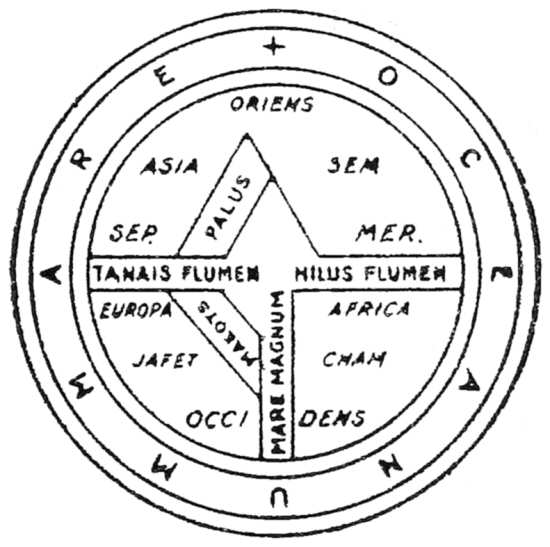
the winter circle, the fifth, the southern.... The following figure
shows the divisions of these circles. (Fig. 1.)
Now, the equinoctial circle is uninhabitable because the sun,
speeding through the midst of the heaven, creates an excessive heat
in these places, so that, on account of the parched earth, crops do
not grow there, nor are men permitted to dwell there, because of
the great heat. But, on the other hand, the northern and southern
circles, being adjacent to each other, are not inhabited, for
the reason that they are situated far from the sun’s course, and
are rendered waste by the great rigor of the climate and the icy
blasts of the winds. But the circle of the summer solstice which is situated in
the east, between the northern circle and the circle of heat, and
the circle which is placed in the west, between the circle of the
heat and the southern circle, are temperate for the reason that they
derive cold from one circle, heat from the other. Of which Virgil
[says]:
“Between these and the middle [zone] two are granted to wretched
mortals by the gift of the gods.”
Now, they who are next to the torrid circle are the
Ethiopians, who are burnt by excessive heat.[61]
Fig. 1.
The explanation of the passage and of the figure which illustrates
it seems to be that Isidore accepted the terminology of the
spherical earth from Hyginus[62] without taking the time to understand it—if
indeed he had the ability to do so—and applied it without compunction
to the flat earth. He evidently thought that zona and circulus
were interchangeable terms,[63] and his “circles” did not run around the
circumference of a spherical earth, but lay flat on a flat earth,
where they filled with sufficient completeness the orbis terrae
or circle of the land.[64] The adjustment of the two conflicting theories was extremely
crude, since it involved placing the arctic and antarctic circles
side by side, and the two temperate circles one in the east and one
in the west.
By such a blunder as this may be measured the stagnation of the
secular thought of the time. Of Greek science only remnants were
in existence, and these were regarded with indifference. Writers
like Isidore might use them, but they did not hesitate to mangle
and distort them. Moreover they were given only second place even
in the science of the day; the first place was held by the notions
of the natural world expressed in the Scriptures. Each one of
these, no matter how primitive or how figurative, had to be taken
seriously into account and given its proper weight in building up
the general scheme. In this intellectual activity Isidore is more
at home than when he is handling the ideas of the pagans, as may be
perceived from his discussion of the shape of the firmament: “As to
its shape, whether it covers the earth from above like a plate, or
like an egg-shell shuts the whole creation in on every side, thinkers
take opposite views. For the mention the Psalmist makes of this
when he says: Extendas coelum sicut pellem,[65] does not conflict
with either opinion, since when his own skin covers any animal, it
envelopes equally every part all around, and when it is removed
from the flesh and stretched out, there is no doubt that it can
form a chamber either rectangular or curved.”[66]
The vastness of the physical universe is an idea not presented
in Isidore’s writings. It was for his mind really a small universe,
and one limited sharply by definite boundaries both in time
and space. It had begun at the creation, its matter being constituted at that
time out of nothing, and it was to have an end as sharply marked.
It extended from the earth to the sphere of the heavens which
revolved about the earth, and what was beyond scarcely appears
even as a question. It was a universe in which high winds might,
and sometimes did, dislodge particles from the fiery heavens;[67] and
in which the sun approached so close to some of the inhabitants of
the earth as to scorch them.[68] In truth, Isidore’s universe was reduced to
rather stifling proportions.
A fundamental part of Isidore’s world-philosophy was his view
of the constitution of matter. This is closely bound up with his
conception of the form of the universe, and it is also the most
important of his ideas in the field of natural science.
He believed in the existence of the four elements, earth,
air, fire, and water,[69] and that they were the visible
manifestations of one underlying matter.[70] They were not mutually
exclusive but “all elements existed in all”, and it was possible
for one element to be transmuted into another. Their properties
were not invariable, but as a rule fire is spoken of as hot and
dry; air, hot and wet; water, wet and cold; earth, cold and dry.
It will be observed that each successive pair of elements had a
common quality: thus fire and air shared the quality of ‘hot’;
air and water, that of ‘wet’; water and earth, that of ‘cold’;
earth and fire, that of ‘dry’. It was by the aid of these common qualities, which
served as means, that the elements could be more easily thought of
as passing into each other.[71]
It should be remarked that the general idea is the same as that
of modern chemistry in so far as it assumes that there are elements
and attributes properties to them. The difference is that the modern
chemist insists that the properties shall be fixed for each element,
while Isidore has no consciousness of such a necessity. For instance,
in a chapter of De Natura Rerum he attributes two separate sets
of properties to the four elements, without realizing at all the
confusion of such a procedure. Again, from the point of view of the
best ancient conception of the four elements, Isidore is equally at
fault. For Aristotle the names given to them had been merely labels.
He perceived in the natural world two significant sets of opposing
qualities, namely, hot and cold, wet and dry. These sets of opposing
qualities interpenetrated one another: the result was four possible
combinations, namely, hot and dry, hot and wet, cold and wet, cold
and dry. His elements designated merely these combinations and were
nothing more than conventional names for them. Isidore, however, took
the names of the elements in a literal sense.[72] The label itself
had become important, while what stood behind it and gave it its
value was regarded as almost meaningless. What has happened here is
typical of the whole development of ancient thought down to Isidore’s
time.
Of Aristotle’s conception of a fifth element, the quinta
essentia, or ether, superior to the others and permeating them,
Isidore shows merely a trace. He says in one passage that “ether is the place
where the stars are, and it signifies that fire which is separated on
high from all the universe”.[73] He offers also another definition in
which he confuses three of the elements of Aristotle: “Ether is
the upper, fiery air”.[74]
The theory of the four elements, as has been already indicated,
has a cosmological bearing. In the universe at large the elements
were thought of as tending to arrange themselves in strata
according to weight. Isidore says it is proved “that earth is the
heaviest of all things created; and therefore, they say, it holds
the lowest place in the creation, because by nature nothing but
itself can support it. And we perceive that water is heavier than
air in proportion as it is lighter than earth.... Fire, too, is
apprehended to be in its nature above air, which is easily proved
even in the case of fire that burns in earthy substance, since as
soon as it is kindled, it directs its flame toward the upper spaces
which are above the air, where there is an abundance of it, and
where it has its place.”[75]
Thus the physical universe consists of the four kinds of matter,
stratified according to the principle of weight. The notion was
one in frequent use,[76] and it was brought into relation with animate
existence by assigning to each of the four strata a peculiar
population. Thus the fiery heavens were occupied by angels; the
air, by birds and demons; the water, by fishes; the earth, by
man and other animals.[77]
The theory of the four elements was fertile in every branch of the natural
science of medieval times. Isidore uses it, for example, to explain
the physical constitution of man:
Man’s body is divided among the four elements. For he
has in him something of fire, of air, of water, and of earth. There
is the quality of earth in the flesh, of moisture in the blood,
of air in the breath, of fire in the vital heat. Moreover, the
four-fold division of the human body indicates the four elements.
For the head is related to the heavens, and in it are two eyes, as
it were the luminaries of the sun and moon. The breast is akin to
the air, because the breathings are emitted from it as the breath
of the winds from the air. The belly is likened to the sea, because
of the collection of all the humors, the gathering of the waters
as it were. The feet, finally, are compared to the earth, because
they are dry like the earth. Further, the mind is placed in the
citadel of the head like God in the heavens, to look upon and govern
all from a high place.[78]
In another passage Isidore tells us that fire has its seat in the
liver, and that “it flies thence up to the head as if to the heavens
of our body. From this fire the rays of the eyes flash, and from the
middle of it, as from a center, narrow passages lead not only to the
eyes but to the other senses”.[79]
Naturally the four elements play a great part in medicine.
They are related to the four humors, blood, yellow bile, black
bile, and phlegm. “Each humor imitates its element; blood, air;[80]
yellow bile, fire; black bile, earth; phlegm, water. Health depends
on the proper blending of these humors.”[81] It appears to have
been the belief of the time that the humors possessed each the same qualities as
the corresponding element. Medical reasoning might confine itself to
the four humors or it might go back of them to the four elements,
as in the explanation of vertigo, where the diagnosis indicates,
apparently, the transmutation of one element into another. Isidore
says: “The arteriae [air passages] and veins produce a windiness
in man’s head from a resolving of moisture, and make a whirling
in his eyes whence it is called vertigo”.[82]
That notions of such a loose, semi-philosophical nature should
survive while the solid empirical content of medical science faded
away, is characteristic of the decline of thought which culminated
in the dark ages. The science of medicine had cut itself loose from
concrete things, and attached itself almost exclusively to the vague
philosophical conceptions from which even the best Greek thinkers had
not been able to free it.
The phenomena of meteorology, also, were explained largely by the
four elements. The upper air was believed to be akin to the fire
above it, and was therefore calm and cloudless; while the lower
air was supposed to be cloudy and disturbed by storms because of
its proximity to water, the next element below it in the series.[83]
Further, the belief in the possibility of the transmutation of
elements was of use here. Air, for example, might be transmuted into
water, or water into air.[84] As Isidore puts it: “[air] being
contracted, makes clouds; being thickened, rain; when the clouds
freeze, snow; when thick clouds freeze in a more disordered
way, hail; being spread abroad, it causes fine weather, for it
is well-known that thick air is a cloud, and a rarified and
spread-out cloud is air.”[85]
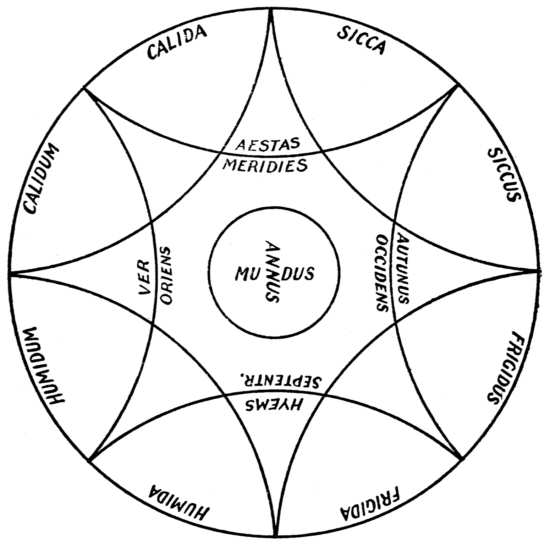
Fig. 2.
The most remote fields are invaded by the four elements. It is
by reference to them that the seasons are explained. Here use is
made rather of their properties than of the elements themselves.
“The spring is composed of moisture and heat; the summer, of
fire and dryness; the autumn, of dryness and cold; the winter,
of cold and moisture.”[86] From this the transition is easy to another
far-fetched application of the theory. The four quarters of the
universe, East, West, North, and South, are connected with the four
seasons, and thus with the four elements. This conception seemed to Isidore
so important that he introduced a figure to illustrate it. (Fig. II.)
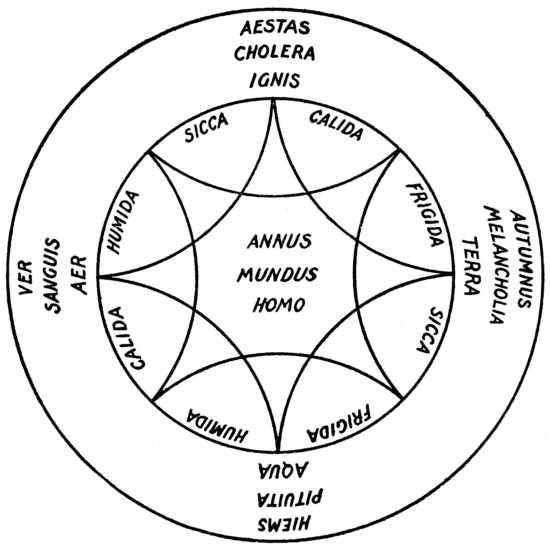
Fig. 3.
The old notion that man is a microcosm or parallel of the
universe on a small scale, was familiar to Isidore. As has been
shown, he believed that man was composed of the same four elements
as the universe, and that they were distributed in him in much the
same way as in it. It was going only a step further for him to
declare that “all things are contained in man, and in him exists
the nature of all things”;[87] after which it was easy “to place man
in communion with the fabric of the universe”[88] by means of a figure.
(Fig. III.)
The idea of the parallelism of man and the universe, when thus
literally conceived, was a fruitful one. Man could be explained by
the universe. And the process could be reversed and the universe
also explained by man, since man may be observed in his entirety and
his life history may be easily followed, while that of the universe
may not. Isidore doubtless took this view, for he says: “The plan of
the universe is to be inquired into according to man alone. For just
as man passes to his end through definite ages, so too the universe
is passing away during this prolonged time, since both man and the
universe decay after they reach their growth.”[89] The division of the
life of the universe, for example, into six definite ages, which he
incorporated into his chronology, was given greater certainty and
meaning from the similar division of man’s life into six ages.
The wide scope assigned by Isidore to the action of the four
elements—which scope includes the immaterial as well as the
material—is completely alien to the modern way of thinking; as
is, also, the bringing of the universe, the year, and man, into
so intimate and specific a connection. Still more difficult is
it for us to grasp such an idea as that the ounce “is reckoned
a lawful weight because the number of its scruples measures the
hours of the day and night”;[90] or that “the Hebrews use twenty-two
letters of the alphabet, following the [number of] books in
the Old Testament”.[91] And the climax is reached when he expresses
the notion that a man bursts into tears as soon as he casts himself down on his knees,
because the knees and the eyes are close together in the womb.[92]
Although these examples of Isidore’s thinking afford excellent
proof of his incoherence and lack of logical consecutiveness,
their explanation goes deeper. Like all primitive thinkers, those
of medieval times were firmly convinced of the solidarity of the
universe; they felt its unity much more strongly than they did its
multiplicity; what we regard as separate kinds of phenomena and
separate ways of viewing the universe they regarded as of necessity
closely inter-related. There were no categories of thought that
were for them mutually exclusive; they carried their ideas without
hesitation from the material into the immaterial, and from the
natural into the supernatural. No conception established in one
sphere seemed impertinent in any other. It was this state of mind
that enabled the medieval thinker to take such erratic leaps from
one sphere of thought to another, without any feeling of uncertainty
or any fear of getting lost.[93]
Perhaps nothing illustrates more clearly the erratic thinking to
which this idea of the solidarity of the universe led, than the way
in which Isidore reasons about number. To his mind the fact, for
instance, that “God in the beginning made twenty-two works” explains
why there are twenty-two sextarii in the bushel; and that “there were
twenty-two generations from Adam to Jacob, and twenty-two books of
the Old Testament as far as Esther, and twenty-two letters of the alphabet out of which
the divine law is composed”,[94] were additional explanations for the
same thing. A like connection is found in his statement that “the
pound is counted a kind of perfect weight because it is made up
of as many ounces as the year has months”.[95]
Isidore’s conceptions in regard to number, indeed, deserve to be
ranked closely after the theory of the four elements as affording
to him “paths of intelligence” through the universe, material and
immaterial. Both in the world at large and in the microcosm of man
the harmony of “musical numbers” is an essential;[96] and number is also
an essential factor in every part and aspect of the universe.
“Take number from all things,” he says, “and all things perish.”[97]
However, his idea of the importance of number in the world is equaled
only by the vagueness with which he conceived its operations as a
working principle. Here he takes absolute leave of the logic which,
in his account of the four elements, he had already so often left
behind. The best he could do, in describing the actual operation of
this principle, was to make lists of instances in which the same
number occurred, and no matter how unrelated the spheres of thought
thus connected, to assume their close interrelation and explanation
of one another.
It is now clear that according to Isidore’s way of thinking, a
fact belonging to one set of phenomena might be caused or explained
by something totally different in another sphere. This being so, it
was inevitable that there should be an effort to pass from the known
to the unknown along the path thus suggested. When we reflect that,
for the medieval thinker, there were three kinds of knowledge—namely,
knowledge of the material, the moral, and the spiritual—and that they were in an
ascending scale of value, it will appear equally inevitable that this
effort to pass from the known to the unknown should be mainly an
effort to pass from the material and obvious to the intangible and
unseen, though more real, spiritual world. In this consideration we
have the chief explanation of medieval allegory.[98]
In Isidore we find that allegorical interpretation is a thing
of little spontaneity. The allegorizing of the Scriptures had
long before his time settled down into a system. In his Certain
Allegories of the Holy Scriptures a list is given of the most
noted mystical interpretations of Scripture, a dry enumeration,
with now and then an interesting side-light upon the opinion of the
time. The extent to which the Scripture was subject to allegorizing
may be guessed from the fact that Isidore specifies that “the
ten commandments must be taken literally”.[99] Allegory is applied
also to the phenomena of nature. In De Natura Rerum Isidore
makes a regular practice of first giving the explanation of natural phenomena and
following this with the “higher meaning”. Thus the sun has Christ
for its allegorical meaning; the stars, the saints; thunder is “the
rebuke from on high of the divine voice”, or it may be “the loud
preaching of the saints, which dins with loud clamor in the ears of
the faithful over all the circle of the lands”.[100] In the Etymologies
this “higher meaning” of natural objects is rarely given.
The view held in the dark ages of the natural and the supernatural
and of their relative proportions in the outlook on life, was
precisely the reverse of that held by intelligent men in modern
times. For us the material universe has taken on the aspect of
order; within its limits phenomena seem to follow definite modes of
behavior, upon the evidence of which a body of scientific knowledge
has been built up. Indeed at times in certain branches of science
there has been danger of a dogmatism akin to, if the reverse of, that
which prevailed in medieval times with reference to the supernatural.
On the other hand, the certainty that once existed in regard to
the supernatural world has faded away; no means of investigating
it that commands confidence has been devised, and any idea held
in regard to it is believed to be void of truth if inconsistent
with the conclusions reached by science. In all these respects the
attitude of Isidore and his time is exactly opposite to ours. To him
the supernatural world was the demonstrable and ordered one. Its
phenomena, or what were supposed to be such, were accepted as valid,
while no importance was attached to evidence offered by the senses as
to the material. It may even be said that the supernatural universe
bulked far larger in the mind of the medieval thinker than does the
natural in that of the modern, and it was fortified by an immeasurably stronger and more
uncritical dogmatism.
It is evident, therefore, that if we compare the dogmatic
world-view of the medieval thinker with the more tentative one of
the modern scientist, allowance must be made for the fact that they
take hold of the universe at opposite ends. Their plans are so
fundamentally different that it is hard to express the meaning of one
in terms of the other.
Isidore’s method of apprehending the supernatural world can hardly
be called mysticism. With mysticism we associate intuition and
exalted feeling, and the examples that have been given of Isidore’s
thinking in terms of allegory and number, show that he thought of the
supernatural in the same prosaic and literal way as he did of the
natural; there was no break for him between them, nor was there any
change of intellectual atmosphere when he crossed the line. So the
higher sense at least of the term ‘mystic’ must be denied him. His
share in the mysticism of his age, which he accepted unquestioningly,
was not a positive one; he exhibits rather the negative side of
mysticism, the intellectual haziness, slothfulness and self-delusion
by which it was so often accompanied in medieval times.
Isidore believed that in point of time the supernatural preceded
the natural. He says that God “created all things out of nothing”,[101]
and, again, that “the matter from which the universe was formed
preceded the things created out of it not in time, but in origin,
in the same sense as sound precedes music”.[102] It is evident that
he regarded the material as an emanation from the spiritual. With
such an origin the material world was naturally subservient to
spiritual control, and miracles caused little wonder. They “are not contrary to
nature, because they are caused by the divine will, and the will
of the Creator is the nature of each created thing.... A miracle,
therefore, does not happen contrary to nature, but contrary
to nature as known.”[103] The supernatural thus not only preceded,
but dominated, the natural. Finally, the universe was to disappear
at the end of six ages, and all was to be reabsorbed in the
supernatural. The world of nature, then, was merely a passing
incident in a greater reality that contained it.
As in the universe at large, so in man the supernatural completely
overshadows the natural. The soul is all-important and theory in
regard to it is precise and dogmatic. “As to the soul,” Isidore says,
“the philosophers of this world have described with great uncertainty
what it is, what it is like, where it is, what form it has, and what
its power is. Some have said it is fire; others, blood; others that
it is incorporeal and has no shape. A number have believed with rash
impiety that it is a part of the divine nature. But we say that it is
not fire nor blood, but that it is incorporeal, capable of feeling
and of change; without weight, shape, or color. And we say that the
soul is not a part, but a creature of God, and that it is not of the
substance of God, or of any underlying matter of the elements, but
was created out of nothing.”[104] He says further, that the soul
“has a beginning but cannot have an end”.[105] All the activities
by which life is manifested are considered as parts or functions of
the soul. Dum contemplatur, spiritus est; dum sentit, sensus est; dum
sapit, animus est; dum intelligit, mens est; dum discernit, ratio
est; dum consentit, voluntas est; dum recordatur, memoria est; et dum
membra vegetat, anima est.[106]
In contrast with the soul the body scarcely deserves to be spoken of except with
disparagement. Its goods are to be unhesitatingly sacrificed to
those of the supernatural element in man, or rather, they are not
regarded as goods at all. “It is advantageous,” Isidore says,
“for those who are well and strong to become infirm, lest through
the vigor of their health they be defiled by illicit passions and
the desire for luxury”.[107] The present life of the body has no
value; it is brief and wretched. “Holy men desire to spurn the world
and devote the activity of their minds to things above, in order
to convey themselves back to the place from which they have come,
and withdraw from the place into which they have been cast.”[108]
Thus philosophy of the supernatural culminated in asceticism.
Isidore’s supernatural world has its inhabitants, and in dealing
with these he has a theology, an angelology, and a demonology; in all
of which fields his ideas are more precise and clear-cut than where
he speaks of the material world.
His theology is of little interest; it consists in the orthodox
view of the time, accepted without a shadow of criticism. He says,
“We are not permitted to form any belief of our own will, or to
choose a belief that someone else has accepted of his own. We have
God’s apostles as authorities, who did not themselves choose anything
of what they should believe, but they faithfully transmitted to
the nations the teaching received from Christ. And so even if an
angel from heaven shall preach otherwise, let him be anathema”.[109]
The minor inhabitants of Isidore’s supernatural world, the angels
and demons, offer a more practical interest. They represent the
stage of development at which the old polytheism of the Jews had
adjusted itself to monotheism, but had by no means faded out of existence. Indeed, it is
plain that at this time the immediate concern of the ordinary man was
with these spirits, good and bad; while between man and God there
were, for the most part, only mediate relations.
The number of these spirits was very great; each place had its
angel, as had each man,—and, presumably, a demon as well. The
seraphim, the highest order in the hierarchy of angels, were a
multitude in themselves. We may surmise that for Isidore, as for
Jerome, the entire human population of the world was as nothing
compared with the entire population of spirits.[110]
The good angels are marshalled in a hierarchy of nine orders, to
which they were assigned in order of merit at the beginning of the
world, and to each of these a specified task is given. For example,
the order named virtues (virtutes) has charge of miracles; and the
business of the seraphim is “to veil the face and feet of God”.[111] The
nature of the angels is described succinctly in a paragraph of the
Differentiae:
Angels are of spiritual substance; they were
created before all creatures and made subject to change by nature,
but were rendered changeless by the contemplation of God. They
are not subject to passion, they possess reason, are immortal,
perpetual in blessedness, with no anxiety for their felicity,
and with foreknowledge of the future. They govern the world
according to command; they take bodies from the upper air;[112]
they dwell in the heavens.[113]
The special virtue of the good angels is subjection to God.
“There is no greater iniquity for them than to wish to glory not in
God but in themselves”.[114] The gaps in their ranks caused by the fall
of the bad angels were to be filled from the number of the elect.[115]
The demons, or bad angels, were created along with the good;
indeed the devil, their leader, was first created of all the angels.
It was “before the time of the visible universe” that their fall took
place; at that time they lost “all the good of their natures” and
all possibility of pardon.[116] They are the “enemies of mankind” and
are “sent on the service of vengeance”. The only restraint on their
malignity is that they are obliged to obey God. Isidore sums up their
activities in a fear-inspiring way:
They unsettle the senses, stir low passions,
disorder life, cause alarms in sleep, bring diseases, fill the
mind with terror, distort the limbs, control the way in which lots
are cast, make a pretence at oracles by their tricks, arouse the
passion of love, create the heat of cupidity, lurk in consecrated
images; when invoked they appear; they tell lies that resemble
the truth; they take on different forms, and sometimes appear in
the likeness of angels.[117]
Their capacity for evil tasks is increased by their superior
intelligence, which retains “the keen perception of the
angelic creation”.[118] Their power of foreknowledge, and, in
addition, the duration of their experience, make the struggle against
them a hopeless one for man. They are also incredibly persistent:
“The devil never rests from his attack on the just man”, who is
“sometimes reduced to straits of despair”.[119]
It is evident that these demons were an all-pervading factor in
the life of the time. They were conceived of as entering the mind,
both waking and sleeping, and furnishing it with the very material
for thought and action. The Christian, by the aid of the good angels,
was alone able to defeat them, and, moreover, he alone realized the
necessity of combating them. The pagans of the pre-Christian era,
on the other hand, were believed to have been willing victims. The
trail of demonic influence could be found in every department of
their life and thought, especially in their religion, which was
very close to demon worship, and in their philosophy and poetry.[120]
It is of interest to notice in detail Isidore’s scale
of values for secular learning, as shown in opinions expressed
throughout his works. How did the fields of thought that had filled
the horizon of the thinker of classical times, appear in the
perspective of the dark ages?
Philosophy,[121] in the first place, no longer stands for
any active principle; all its old aspect of metaphysical and ethical
inquiry has been lost. It is merely a container in which minor
subjects are arranged in a comprehensive plan, and the only interest
which it presents, as philosophy, is to be found in the question
of what minor subjects are included and how they are grouped. Here
Isidore is more inconsistent than usual. He gives three plans of the
field of knowledge, all substantially differing from one another
in details and all strikingly different from his own marshaling of
all knowledge in the Etymologies. The only reflection of value
suggested by the treatment of philosophy in Isidore’s works is that
in being de-secularized it has completely lost its essential content. It can, therefore,
no longer be a source of offence to any Christian.
The pagan philosophy, however, was a different thing. It was
known to have been concerned with the same problems as was Christian
theology. It had thus a certain right to exist and a certain value,
but this terminated with the appearance of Christianity. As Isidore
puts it, “the philosophers of this world certainly knew God, but
the humility of Christ displeased them and they went astray”; “they
fell in with wicked angels and the devil became their mediator
for death as Christ became ours for life”.[122] After Christian
theology had settled beyond the shadow of a doubt the problems
that had occupied the pagan philosophers, these latter could cause
only trouble. Pagan philosophy now stood only for a perversion of
the wisdom which was found in its true form in the books of the
Scriptural canon and the works of the church Fathers. Its “errors”
were believed to be the source of the heresies in the church.
“The same material is used and the same errors are embraced over
and over again by philosophers and heretics”.[123]
Isidore’s idea of the function of poetry is a peculiar one. “It is
the business of the poet,” he says, “to take veritable occurrences
and gracefully change and transform them to other appearances by
a figurative and indirect mode of speech”.[124] From this it might
be inferred that he thought that the use of poetry was to furnish material for
allegorical interpretation. He ranks the poets of pagan antiquity
below the philosophers, and brings serious charges against them.
He asserts that they have “disregarded the proper meanings of
words under the compulsion of metre” and have thus been guilty of
introducing a great amount of confusion into thought and language.[125]
His most vigorous indictment of pagan poetry, however, is that it
had its origin in the pagan religions, which he identifies with
demon worship. He quotes Suetonius to establish this point: “When
men ... first began to know themselves and their gods, they used for
themselves a modest way of living and only necessary words, while
for the worship of their gods they devised magnificence in each”.
This “magnificence” of speech is alleged to have been poetry.[126]
With such opinions, he naturally desired the ostracism of poetry.
“The Christian is forbidden to read their lies.”[127]
Toward pagan philosophy and poetry, then, Isidore’s attitude is
hostile, and it is very improbable that he ever wasted any time
on them. But in the field of secular knowledge apart from these
subjects he has, within limits, a use for the inheritance left by
pagan Rome. It is his chief claim to recognition that he was not
absolutely content with the de-secularized science that he found
in Ambrose, Jerome and Augustine, but had the independence to go
behind it and draw upon its original sources in Roman literature. The
spirit in which he did this, however, was not the spirit of revolt,
but apparently only a natural desire for more extended information.
His critical faculty did not warn him that in seeking this information from pagan
sources he was passing from one intellectual atmosphere to another;
his mind was too literal and plodding and dwelt too much on details
to notice when it was on dangerous ground. His resort to pagan
science was not always happy in its result; but the many blunders
which he made cannot affect the merit of his enterprise in going
beyond the circle of Christian writers; and it must be said for his
version of secular knowledge, as contained in his secular writings,
that, poor as it was, it was one without which the middle ages would
have been a great deal poorer.
As a matter of fact, Isidore did not leave the science of the
Roman Empire in a state much worse than that in which he found it. It
had been undergoing a process of decay for centuries. At their best
the Roman men of science had been unable even to appropriate the more
abstract parts of Greek science. They were governed throughout by a
short-sighted practicality, as when, for instance, in the case of the
mathematical sciences they tried to take over results without taking
the method of reaching or verifying them. In the natural sciences
their inferiority was only less marked. Here the absence of critical
method permitted the incorporation of many superstitious notions.
As has been pointed out, the Roman science was wholly a science of
authority, and the greatest scientist was the greatest accumulator
of previous authorities. Thus throughout its course in the Roman
world science had been beating a retreat. By Isidore’s time these
forces of short-sighted utilitarianism, the spirit of subservience to
authority, and superstition, had brought it to a state of inoffensive
feebleness such that it was more welcome to the Christian than was
either poetry or philosophy.
This Roman pseudo-science could not, however, hold an important
place in the thinking of the time: the fundamental conceptions that prevailed forbade
it. The material world held a low place, as we have seen; on every
side evidence can be found of an ascending scale of values from
the material through the moral to the spiritual. Upon this idea is
founded “the triple method of interpretation”[128] used in the
Scriptures and elsewhere, and with it is connected the triple
division of knowledge into natural science, ethics, and theology.
There was not only an ascending scale of value for the different
sorts of knowledge, but an ascending scale of validity. Spiritual
truth and moral truth transcended the truth of material facts, whose
stubbornness had been forgotten and had not yet been re-discovered.
Yet, with all this depreciation of the material, it in some measure
reasserted itself: as the literal meaning had to be grasped in the
Scriptures before the higher meaning could be educed, so the material
world had to be recognized before its higher meaning could be
ascertained. This was the basis for science in the philosophy of the
dark ages.
In this way Isidore’s pseudo-science was brought into harmony
with religion. Natural science was, indeed, concerned with the
lowest and faintest form of reality, namely, the material world;
but even material things had their spiritual implications, and
because of this were worthy of an orderly survey. The De Natura
Rerum, in which each term is explained first as it relates to the
natural world and then as to its higher meaning, shows how science
played the subordinate part just indicated. It is of great interest
at this point to notice that Isidore’s successor, Rabanus Maurus,
in his comprehensive encyclopedia De Universo, which follows
Isidore’s Etymologies closely, adds, however, the higher meanings which Isidore
had left out in his work.[129] It is the importance of natural science
from this point of view that Isidore has in mind in a passage in the
Sententiae: “It does no harm to anyone if, because of simplicity,
he has an inadequate idea of the elements, provided only he speaks
the truth of God. For even though one may not be able to discuss
the incorporeal and the corporeal natures, an upright life with
faith makes him blessed.”[130]
He is far, however, from expressing complete approval of pagan
science; the perversity of the pagan scientists forbids this. “The
philosophers of the world are highly praised for the measuring
of time, and the tracing of the course of the stars, and the
analysis of the elements. Still, they had this only from God.
Flying proudly through the air like birds, and plunging into the
deep sea like fishes, and walking like dumb animals, they gained
knowledge of the earth, but they would not seek with all their minds
to know their Maker”.[131]
In judging the quality of Isidore’s science as science, we must
remember that he is separated from Pliny, his great predecessor in
the encyclopedic field, by nearly six centuries, and that those six
centuries form a period of continuous intellectual decline; and,
further, we must bear in mind the fact that Pliny himself sometimes
copied what he
did not understand, and was so little of a scientist as even to
welcome the marvelous.[132] After this, what can be expected from
Isidore? That he wrote what he did write, at the time he did, is
in itself the astonishing fact. His work is the only symptom of
intellectual life in two centuries of Western European history.
Isidore’s view of the past was as simple and dogmatic
as his view of the universe at large; in fact it was conditioned by
his world-view. The acceptance of Christianity and the new scale
of values thus introduced had of necessity involved the projection
of the new interests into the past. The legendary background of
the new religion had accelerated the process. The past, as seen by
writers of the pagan civilization and as reflecting the interests
of that civilization, now became of no service, and, as a whole,
was dropped. The pagan histories were regarded as written by men
whose point of view was wholly false and mischievous, even though
sometimes their facts might be correct. They were approached by the
Christian re-adjusters of history in much the same spirit as that in
which the modern historian goes to the medieval chronicle, though
with an opposite aim: the modern historian is after what is social
and human, while Augustine and Orosius were after illustrations of
the ways of God to man.[133]
By Isidore’s time, then, the Christian view of the past had
become completely de-secularized. Biblical tradition dominated
all historical thinking. On the six days of creation was centered
special attention. This point, at which the natural emanated from
the supernatural, fascinated the medieval thinker as the doctrine
of evolution does the modern. It formed the touch-stone by the aid of which was
interpreted not only the material world,[134] but also the course
of history. In parallelism with the six days and the six periods
in man’s life, the history of the world was divided with absolute
definiteness into six ages. Isidore himself was living in the sixth
and last of these, “the residue of which was known to God alone”.[135] His
view of the past had no perspective; or rather, it had an inverted
perspective, because the increasing confusion of every department of
the sublunar world led him to dwell in preference upon the earlier
time when the course of history was confined to the pure stream
of Hebrew tradition, when the supernatural manifested itself more
frequently, and when even the names of personages were charged with
prophetic meaning.
In this inverted perspective the history of the Hebrews naturally
formed a prominent part. The Hebrew people of antiquity and their
language, which is traced back to Adam, were the original race and
language. It was only “at the building of the tower after the flood
that the diversity of languages arose”. On this occasion not only did
the different languages of later history appear, but at the same time
and as a result, the different races of mankind were constituted.[136]
All languages, then, and all races, are variants of the Hebrew
type. Isidore believed that even in his time some of the nations
could be traced back and identified with the original Hebrew stock
by etymologizing on their names. Others, however, had cast aside
their old names and taken others, “either from kings or countries
or customs or other causes”, and the genealogy of these he believed
to be irretrievably lost.[137]
CHAPTER IV
Isidore’s Relation to Education
The question of perpetuating the
pagan range of educational subjects presented a great difficulty
to the leaders of patristic and early medieval thought, so great
a difficulty that some of them were almost more ready to discard
education than to try to separate it from its heathen entanglements.
In both the Greek and Roman worlds formal education had been late
in developing; as a consequence its tone was wholly secular. Its
object was to put the youth of the ruling classes in touch with the
culture and life of the time. The subjects found most serviceable for
study were literature, rhetoric, and philosophy. The sciences known
to the ancients gradually gained a foot-hold also, and instruction
began to be given in a number of them, including geometry, music,
arithmetic, astronomy, medicine, and architecture. Finally, the
subject-matter of education settled down to the stereotyped list of
seven subjects, known as “the seven liberal arts”, from which there
was apparently little deviation in later Roman and medieval times.[138]
This formal education of the Romans was so well established and enjoyed such
prestige that in spite of Christian hostility it continued to
flourish until the increasing disorganization of society in the
fifth and sixth centuries made the continuance of secular schools
impossible.
Upon their disappearance the whole burden of maintaining education
fell upon the church. In the church organization the effective
bodies for such an activity were the groups of clergy attached to
cathedrals and to monasteries. There was no system established
by a central authority and enforced by public opinion to guide
the efforts made by these bodies, and it is plain that in each
case educational facilities for the training of priests would be
provided in accordance with the intelligence and character of the
different bishops and abbots. Where the ecclesiastical authorities
were ignorant or careless, the training of the priest or monk must
have degenerated to a sort of apprenticeship. The evidence which we
possess of the illiteracy[139] of the clergy would lead us to infer that
in the dark ages education, in any sense worthy of the name, was
sporadic, the product of the happy coincidence of opportunity and an
ecclesiastic intelligent enough to realize it.[140]
The first comprehensive effort[141] to deal with the
educational
situation from the Christian standpoint was made by Cassiodorus
and was designed expressly to meet the needs of the inmates of a
monastery in Southern Italy. Naturally he put forth his main endeavor
on the side of what may be called theology, but, in addition, he
felt impelled to give very brief and vague accounts of the seven
liberal arts, which he was reluctantly forced to consider as an
indispensable preparation for the former study.[142]
Cassiodorus’ attitude toward these preliminary studies is a
curious one. He believed that their subject-matter was to be found
scattered through the Scriptures and that “the teachers of secular
learning” had gathered together the disjointed bits of information
and organized them into the seven liberal arts. As a consequence he
thought that a knowledge of these arts was of assistance when any
passage relating to them was met in the reading of the Scriptures.
In spite of this, however, it seems to have been his opinion that
the less use made of them the better, and that, if ignorance of the
liberal arts was a fault, it was certainly one of a minor character
and had the advantage of not endangering the Christian’s faith.[143]
With Cassiodorus the problem of education was little more than that of securing
a training sufficient to enable one to read and study the Scriptures.
The speculation cannot be avoided as to whether, if Christianity had
depended, like Druidism, on an oral tradition, Cassiodorus might not
have been willing to dispense with education altogether.
Isidore is the second writer to deal comprehensively with the
subject-matter of Christian education. Before giving an account,
however, of the way in which he met the problems that were presented
to him, it is necessary to glance at the educational situation
as it then existed in Spain. It appears from the enactments of
the councils of Toledo in the sixth and seventh centuries that
the clergy as a body were beginning to be concerned for the
education of their order.[144] An article of the council of 531 directs
that as soon as children destined for the secular clergy are placed
under the control of the bishop, “they ought to be educated in the
house of the church under the direction of the bishop by a master
appointed for the purpose”.[145] Another article[146] says that “those who
receive such an education” should not presume to leave their own church and go
to another “since it is not fair that a bishop should receive or
claim a pupil whom another bishop has freed from boorish stupidity
and the untrained state of infancy”. It is further directed that
those who were “ignorant of letters” should not become priests.
An article of the fourth council of Toledo in 633, at which
Isidore probably presided, orders that “whoever among the clergy
are youths should remain in one room of the atrium, in order that
they may spend the years of the lustful period of their lives
not in indulgence but in the discipline of the church, being put
in charge of an older man of the highest character as master of
their instruction and witness of their life”.[147] These passages all
refer to cathedral schools, but there is evidence equally good of the
existence of similar schools in the monasteries.[148] Such, then, were
the practical conditions, as far as known, which determined the
educational activity of Isidore’s time.
The spirit in which Isidore approached the task of furnishing
a comprehensive treatment of the secular subject-matter of
education was the one proper to his age. He held that its place
was a subordinate one. He seems to be expressing his own and not
a borrowed view when he says that “grammarians are better than
heretics, for heretics persuade men to drink a deadly draught,
while the learning of grammarians can avail for life, if only it is
turned to better uses”.[149] The same depreciation of the independent
value of secular studies is reflected in his statement that
the order of the seven liberal arts in the curriculum was one
intended to secure a progressive liberation of the mind from
earthly matters and “to set it at the task of contemplating things on high”.[150]
He evidently believed that it was the function of the seven liberal
arts to raise the mind from a lower or material to a higher or
spiritual plane of thought.[151]
In the Etymologies, as has been noticed, Isidore has combined
the encyclopedia of education, as exemplified in the works of
Martianus Capella and Cassiodorus, and the encyclopedia of the
whole range of knowledge, of which the works of Varro, Pliny, and
Suetonius are leading examples. The first three of the twenty books
which are comprised in the Etymologies are evidently educational
texts; the last twelve as evidently belong to the encyclopedia
of all knowledge.[152] The question is in which of these
divisions the intervening books should be classed. If we look to
Isidore’s predecessors for guidance on this point, we find that
Capella gives only the seven liberal arts, while Cassiodorus gives
not only a comprehensive account of preparatory studies in the form
of the seven liberal arts, but adds in his De Institutione Divinarum
Litterarum a treatment of the higher, or religious, education of
the monk. The supposition that Isidore followed the example of
Cassiodorus is the more natural one. Their educational purpose was much the same:
Cassiodorus had in mind the training of the monk, while Isidore
was concerned with the education of the priest. It is, all things
considered, more natural to suppose that Isidore is giving in Books
I-VIII of his Etymologies a comprehensive survey of the education
of the secular clergy, than to suppose that his educational texts
stopped short at the end of the seven liberal arts.
If this supposition is correct, the outline of this survey is
as follows: Grammar (Bk. I), Rhetoric and Dialectic (Bk. II),
Arithmetic, Geometry, Music, Astronomy (Bk. III), Medicine (Bk. IV),
Laws and Times (Bk. V), the books and services of the church (Bk.
VI), God, the angels, and the orders of the faithful (Bk. VII),
the church and the different sects (Bk. VIII). The inclusion of
medicine, law, and chronology, which were not in the corresponding
plan of Cassiodorus,[153] meant merely an enlargement of his
scheme to fit it for the slightly different purpose which Isidore
had in mind. The reason for the inclusion of these subjects is the
practical one: in the absence of any other educated class priests
were obliged to have some slight knowledge of medicine and law, while
the intricacy of the church calendar of the time made chronology a
professional necessity.
At first sight this plan of educational subjects would seem to
be at variance with our accepted idea that the seven liberal arts
covered the whole field of preparatory training. A closer examination
shows, however, that in form at least Isidore kept them in a class
by themselves; and
when he passes from them to medicine he is careful to specify that it
is not one of the liberal arts, but forms a “second philosophy”.[154]
By this he means that medicine—and the same may be assumed for laws
and times—is placed in the higher and not the preparatory stage of
education, and that in this sphere it plays a minor part.
If, then, this view of the subject-matter of the first eight
books of the Etymologies is correct, it will be admitted that in
Isidore’s organization of education a significant step has been
taken. In the education of the Greek and Roman world there was
nothing to parallel the medieval and modern university development,
which has been characterized until recently by the three professional
schools of law, medicine, and theology. In Isidore’s plan we have,
for the first time, as professional studies, first, what corresponds
to the later theology, and, in subordination to this, the subjects
of law, medicine and chronology. It is evident, therefore, that we
have here in embryo, as it were, the organization of the medieval
university; law and medicine have only to be secularized and freed
from their subordination to theology, and the medieval university in
its complete form appears.
PART II THE ETYMOLOGIES — BOOK I
ON GRAMMAR
INTRODUCTION
Grammar did not appear as a separate
body of knowledge until a late period in the Greek civilization.
The merest ground-work of the science had sufficed to meet all the
demands of education, of philosophy, and of a literature in course of
production; for its development it was necessary to await a period of
literary criticism. When the Alexandrian scholars began to compare
the idiom of Homer with that of their own day, the requisite stimulus
for the scientific study of language was given, and grammar may be
regarded as dating from the Alexandrian age.
What was at that time termed grammar, γραμματική, included
far more than the modern science; it was the study of literature
at large. The grammarian might have nothing to do with what we
call grammar, but be a student of textual criticism or mythology.
Any sort of study undertaken for the purpose of elucidating the
poets was grammatical. Like the modern professor of literature,
the only invariable characteristic of the grammarian was his
literary point of view.[155]
The grammatical studies of the Romans were patterned closely after those of
the Greeks; the Greek terminology and organization of the science
were adopted without change. The Roman interest in the subject was no
doubt heightened by the fact that the Roman culture was a bilingual
one; thus a broad basis for the study was furnished, and naturally
much attention was given to the derivation of words. A large number
of scholarly works was produced, and the inferiority of the borrowed
Roman culture is perhaps less noticeable in this department than in
any other.
It was inevitable that this ‘grammar’, in a condensed form, should
come to be used in common education. Its outlines, however, were
rather vague, and many of its departments did not lend themselves
to the concise statement necessary in a text-book. The first
Greek school grammar, the τεχνὴ γραμματικὴ[156] of Dionysius Thrax,
which was destined to be the basis of all the school grammars of
antiquity, appeared about 80 B.C. It is noticeable that although
the definition of grammar that is given[157] is the definition of
the grammar of the scholars, the subjects actually treated are little
more than the parts of speech. It was natural that there should be
this gap between promise and performance. For a long time no doubt
this mere outline was filled in by the oral interpretation of the
masterpieces in
the manner of the scholars; but when these ceased to be studied,
in the early medieval period, the study of grammar was confined
to the material offered in the text-books.[158]
The first of the Romans to produce a school grammar was Remmius
Palaemon, who flourished in the first half of the first century.
He had many successors in the later centuries of the Roman Empire,
and the literary tradition of the school grammar continued unbroken
into the Middle Ages. The most influential exponent of the subject
was Aelius Donatus, whose Ars, written in the fourth century, was
used throughout the Middle Ages. The chief writers of grammatical
texts in the centuries preceding Isidore were Victorinus, Donatus,
Diomedes, Charisius, and Martianus Capella in the fourth; Consentius
and Phocas in the fifth; and Cassiodorus in the sixth. No new
contributions were being made to the science, and these writers
had no other resource than to copy their predecessors, which they
did in a slavish manner.[159] The verbal similarity in all of them is so
strong that it is impossible to trace with certainty the immediate
source of any one of the later writers.
Isidore’s account of grammar is of somewhat more than
the average length[160] found in these text-books, but its lack
of solid substance, in which it differs from the books of the
fourth century, measures the decline in intellectual grasp and
thoroughness of the two intervening centuries. Donatus, Servius,
and even Capella, stick closely to the technique of the subject and
are thorough-going; their books are calculated to afford a severe
discipline to the student. But in Isidore a feebleness in handling
the subject is evident; he is apparently unaware of the superior
importance of such subjects as conjugation and declension, and he is
very easily led into confusion by the trains of thought suggested by
his frequent derivations.[161]
1. The disciplines belonging to the liberal arts are seven. First,
grammar, that is, practical knowledge of speech. Second, rhetoric,
which is considered especially necessary in civil causes because of
the brilliancy and copiousness of its eloquence. Third, dialectic,
called also logic, which separates truth from falsehood by the
subtlest distinctions.
2. Fourth, arithmetic, which includes the significance and the
divisions of numbers. Fifth, music, which consists of poems and
songs.
3. Sixth, geometry, which embraces measurements and dimensions.
Seventh, astronomy, which contains the law of the stars.
Chapter 3. On the ordinary letters.
1. The foundations of the grammatic art are the ordinary letters,
which elementary teachers[176] are occupied with, instruction in which
is, as it were, the infancy of the grammatic art. Whence Varro calls
it litteratio. Letters are signs of things, symbols of words, whose
power is so great that without a voice they speak to us the words of
the absent; for they introduce words by the eye, not by the ear.
2. The use of the letters was invented in order to remember
things. For things are fettered by letters in order that they may not
escape through forgetfulness. For in such a variety of things all
could not be learned by hearing and held in the memory.
4. Latin and Greek letters have evidently come from the Hebrew.
For among the latter aleph was first so named; then [judging]
by the similarity of sound it was transmitted to the Greeks as
alpha; likewise to the Latins as a. For the borrower fashioned
the letter of the second language according to similarity of sound,
so that we can know that the Hebrew language is the mother of all
languages and alphabets.[177]
7. The letter Υ Pythagoras of Samos first made, after the model
of human life, whose lower stem denotes the first of life, which is
unsettled and has not yet devoted itself to the vices or the virtues.
The double part which is above, begins in youth; of which the right
side is steep, but leads to the blessed life; the left is easier, but
leads down to ruin and destruction....
8. Among the Greeks there are five mystic letters.[178] The
first is Υ, which denotes human life, of which we have just spoken. The second is Θ,
which denotes death. For judges used to place this letter, theta, at
the names of those whom they condemned to death; and it is called
theta ἀπὸ τοῦ θανάτου, i.e., from death. Whence also it has a
weapon through its middle, i.e., the sign of death. Of which a
certain one speaks thus:
O multum ante alias infelix littera theta!
9. The third is Τ, indicating the shape of the cross of the
Lord.... The remaining two, the first and the last, Christ claims for
himself. For he is himself the beginning, himself the end, saying: “I
am α and ω,” for they pass into one another in turn, and alpha passes
in regular succession to ω and again ω returns to alpha; in order
that the Lord might show in himself that he was the way from the
beginning to the end and from the end to the beginning.
Chapter 4. On the Latin alphabet.
17. The nations gave the names of the letters in accordance with
the sound in their own language, noting and distinguishing the sounds
of the voice. After they had noted them, they gave them names and
forms; and they made the forms in part at pleasure, in part according
to the sound of the letters; as, for example, i and o, of which one
has a slender stem, just as it has a thin sound; the sound of the
other is gross (pinguis), just as its form is full.
Chapter 5. On grammar.
1. Grammar is the science of speaking correctly, and is
the source and foundation of literature.[179] This one of the
disciplines was discovered next after the ordinary letters, so that
those who have already learned the letters may learn by it the method
of speaking correctly. Grammar took its name from letters, for the
Greeks call letters γράμματα.
4. The divisions of the grammatic art are enumerated by certain
authorities as thirty; namely, eight parts of speech, the articulate
voice, the letter, the syllable, metrical feet, accent, marks of
punctuation, signs and abbreviations, orthography, analogy, etymology, glosses,
synonyms, barbarisms, solecisms, [other] faults, metaplasms,
schemata, tropes, prose, metres, fables, histories.
Chapter 6. On the parts of speech.
1. Aristotle first taught two parts of speech, the noun and the
verb. Then Donatus defined eight. But all revert to these two chief
ones, that is, to the noun and the verb, which indicate the person
and the act. The remainder are appendages, and trace their origin to
these.
2. For the pronoun arises from the noun and performs its function,
as orator, ille. The adverb arises from the noun, as doctus,
docte. The participle from the noun and verb, as lego, legens.
But the conjunction and preposition and interjection are included
in those mentioned.[180] Many therefore have defined five parts
because these are superfluous.
Chapter 21. On critical marks (notae
sententiarum).
1. In addition there were certain marks in the writings of
celebrated authors, which the ancients set in poems and histories to
discriminate among the passages. A mark is a separate form placed
like a letter, to indicate some judgment about a word, thought
or verse. There are twenty-six marks used in annotating verses,
which are enumerated below with their names.[181]
Chapter 22. On shorthand.
1. Ennius[182] first invented 1,100 shorthand signs.
The use of the signs was that scribes wrote whatever was said in
public meeting or in court, several standing by at one time and
deciding among themselves how many words and in what order each
should write. At Rome Tullius Tiro, Cicero’s freedman, was the first
to invent shorthand, but only for prepositions.[183]
2. After him Vipsanius Philargius and Aquila, Maecenas’s freedman,
each added a number of signs. Then Seneca, collecting them all and
arranging them and increasing their number, raised the total to
5,000. The signs (notae) are so-called because they denote words
or syllables by marks,[184] and bring them again to the notice of
readers, and they who have learned them are now properly called
notarii.
Chapter 27. On orthography.
1. Orthography is Greek, and it means in the Latin correct
writing; for ὀρθή in the Greek means correct, and γραφή means
writing. This branch of knowledge teaches us how we ought to
write. For as the art[185] treats of the inflection of the parts of
speech, so orthography deals with the knowledge of writing, as, for
example,
ad, when it is a preposition, takes the letter d; when it is a
conjunction, the letter t.
2. Haud, when it is an adverb of negation, is terminated by
the letter d and is aspirated at the beginning; but when it is
a conjunction, it is written with the letter t and is without
aspiration.
7. Forsitan ought to be written with n at the end, because its
uncorrupted form is forte si tandem.
Chapter 29. On etymology.
1. Etymology is the derivation of words,[186] when the force
of a verb or a noun is ascertained through interpretation. This
Aristotle called σύμβολον, and Cicero, notatio, because it explains
the names of things;[187] as, for example, flumen is so called
from fluere, because it arose from flowing.
2. A knowledge of etymology is often necessary in interpretation,
for, when you see whence a name has come, you grasp its force
more quickly. For every consideration of a thing is clearer when its etymology
is known. Not all names, however, were given by the ancients in
accordance with nature, but certain also according to whim, just as
we sometimes give slaves and estates names according to our fancy.
3. Hence it is that the etymologies of some names are not found,
since certain things have received their name not according to the
quality in which they originated, but according to man’s arbitrary
choice. Etymologies are given in accordance with cause, as reges
from regere, that is, recte agere; or origin, as homo because
he is from the earth (humus); or from contraries, as lutum (mud)
from lavare—since mud is not clean—and lucus (sacred grove),
because being shady it has little light (parum luceat).
4. Certain words also were formed by derivation from other
words; as prudens from prudentia. Certain also from cries, as
graculus (jackdaw) from garrulitas. Certain also have sprung from
a Greek origin, and have changed over into the Latin, as silva,[188]domus.
5. Other things have derived their names from the names of places,
cities, or rivers. Many also are drawn from the languages of foreign
peoples; whence their derivation is perceived with difficulty; for
there are many barbarous words unknown to the Greeks and Latins.
Chapter 32. On barbarism.
1. Barbarism is the uttering of a word with an error in a letter
or in a quantity: a letter, as floriet, when florebit is correct;
a quantity, if the first syllable is prolonged instead of the middle
one, as latebrae, tenebrae. And it is called barbarism from the
barbarian peoples, since they were ignorant of the purity of Latin
speech; for each nation becoming subject to the Romans, transmitted
to Rome along with their wealth their faults, both of speech and of
morals.
Chapter 37. On tropes.
1. Tropes are so named by the grammarians from a Greek word which
in Latin means modi locutionum. They are turned from their own meaning to a
kindred meaning that is not their own. And it is very difficult to
comment on the names of them all, but Donatus gave for practice a
list of thirteen selected from the whole number.
2. Metaphor is the assumption of a transfer of meaning in some
word, as when we say segetes fluctuare (the grain-fields billow),
vites gemmare, when we do not find any waves or gems in these
things, but the words are transferred from the old application to a
new one. These and other tropical forms of speech are veiled with
figurative cloaks with reference to the things to be understood,
with the view that they may exercise the intelligence of the
reader, and may not be cheap because they are unadorned and easily
apprehended.
22. Allegory is the saying of things that do not belong to the
matter in hand (alienoloquium), for one thing is said, another is
understood; as, tres in littore cervos conspicit errantes, where
the three leaders of the Punic war, or the three Punic wars are
indicated; and in the Bucolics, aurea mala decem misi, i.e.,
ten pastoral eclogues to Augustus. There are many species of this
figure, of which seven are conspicuous: irony, antiphrasis, enigma,
charientismus, paroemia, sarcasmus, astysmus.
23. It is irony where the thought is given a contrary meaning by
the manner of speech. By this figure something is said cleverly,
either in the way of accusation or insult, as the following:
Vestras, Eure, domos, illa se jactet in aula
Aeolus, et clauso ventorum carcere regnet.
And why aula (palace) if it is carcer (prison)! It
is made clear by the manner of speech, for the manner of speech says
carcer. Jactet in aula is irony, and the whole is expressed in a
contradictory manner of speech by the figure of irony which mocks by
praising.
24. Antiphrasis is language to be understood to the contrary, as,
lucus (sacred grove), since it is without light (lux) because of
the excessive gloom of the woods....
25. Between irony and antiphrasis there is this difference, that
irony indicates by the manner of speaking alone what is meant,
as when we say to a man doing ill, “Bonum est quod facis”. But
antiphrasis indicates the contrary not by the voice of the speaker,
but only in the words, whose derivation is the opposite [of their
meaning].
Chapter 39. On metres.
4. Whatever is measured by verse feet is a poem (carmen).
It is thought that the name was given because it was pronounced
rhythmically (carptim), or ... because they who sang such things
were supposed to be out of their minds (mente carere).
9. ... [The hexameter] excels the rest of the metres in authority,
being alone of them all fitted as well to the greatest tasks as to
the small, and with an equal capacity for sweetness and delight....
It is also older than the other metres. It is proved that Moses
was the first to use it in the song of Deuteronomy, long before
Pherecydes and Homer. Whence also it is evident that the making of
poems was older among the Hebrews than among the nations. Since Job,
too, who goes back as far as Moses, sang in hexameter verse, [using]
the dactyl and the spondee.
12. Hecataeus of Miletus is said to have been the first among the
Greeks to compose this metre; or, as others think, Pherecydes of
Syros, and this metre before Homer was called Pythian, after Homer,
heroic.
17. It is manifest that David the prophet was the first to compose
and sing hymns in praise of God. Later among the nations Timothoe who
(quae) lived in the time of Ennius, long after David, wrote the
first hymns in honor of Apollo and the Muses. Hymni is translated
from the Greek to the Latin as laudes.
25. Among grammarians they are wont to be called centones who
[take] from the poems of Homer and Virgil with a view to their own
works, and put together in patchwork fashion many bits found here and
there to suit each subject.
26. Proba, wife of Adelphos, composed at great length a cento
from Virgil about the structure of the universe and the gospels,[189] the
subject-matter being made up verse by verse, and the verses being
arranged appropriately to suit the subject-matter. And a certain
Pomponius, among other poems (otia) of his own pen, wrote Tityrus
from the same poet in honor of Christ.
Chapter 41. On history.
1. History is the story of what has been done, and by its means
what has taken place in the past is perceived. It is called in the
Greek historia, ἀπὸ τοῦ ἱστορεῖν, that is from seeing (videre)
and learning (cognoscere). For among the ancients no one wrote
history unless he had been present and witnessed what was to be
described. For we understand what we see better than we do what we
gather by hearsay.
2. For what is seen is told without lying. This discipline belongs
to grammar because whatever is worth remembering is entrusted to
letters....
Chapter 42. On the first writers of history.
1. Moses was the first among us to write a history of the
beginning of the world. Among the nations Dares Phrygius was the
first to publish a history of the Greeks and Trojans, which they say
was written by him on palm-leaves.
2. And after Dares, Herodotus is considered the first historian
in Greece. After whom Pherecydes was famous, at the time when Esdras
wrote the law.
Chapter 43. On the usefulness of history.
1. Histories of the heathen do no harm to their readers where they
tell what is useful. For many wise men have put past deeds into their
histories for the instruction of the present.
2. Besides, in history the total reckoning of past times and years
is embraced and many necessary matters are examined in the light of
the succession of consuls and kings.
Chapter 44. On the sorts of history.
1. There are three sorts of history. The doings of one day are
called ephemeris. Among us this name is diarium....
2. What is arranged according to separate months is called
kalendaria.
3. Annales are the deeds of the years, one by one. For whatever
was related in the commentaries from year to year as worthy of
memory, in peace and war, by sea and land, they named annals from the
deeds of a year.
4. But history is a thing of many years or times, and through
diligence in it the yearly commentaries are put into books. Between
history and annals there is this difference, that history belongs to
the times which we see, and annals belong to years which our age does
not know. Whence Sallust is made up of history; Livy, Eusebius and
Hieronymus of annals and history.
BOOK II — ON RHETORIC — ON DIALECTIC
INTRODUCTION
Rhetoric held a position in the ancient
world that the modern reader has difficulty in understanding.
Democratic government, including the popular administration of
justice, at a time when all discussion was necessarily oral, created
an ideal condition in Athens and the other Greek states for the
development of oratory. In the life of the Roman republic, too,
there was enough of the popular element to make public speaking
of the greatest importance. The art of rhetoric was therefore in
close touch with the real interests of life. It was not merely a
school discipline, but a preparation for a definite activity that
held a high place in the esteem of the people, and it embodied a
set of sensible ideas on public speaking in which the tendency to
over-elaboration and artificiality characteristic of scholastic
disciplines was kept in check by the wholesome influences that came
from practical application.
With the establishment of the Roman Empire public discussion of
political matters quickly disappeared, and forensic oratory for the
same reason tended to decline. Thus the chief element which had
given vitality to ancient rhetoric was eliminated. Roman oratory,
however, died hard. It nursed itself on various pretences and shows.
Much of the old interest in oratory turned back on rhetoric, which
was thus exposed to a double danger, as an educational discipline
that had lost connection with practical life and as a subject that had become too
fashionable. When once the new influence had gained headway a strong
tendency to artificiality was revealed. Rhetoric became scholastic
and ridiculously overburdened with classification and terminology;
it grew more lifeless as it grew more systematic. Interest then
gradually subsided. Treatises grew shorter and drier, and consisted
largely of long lists of terms defined without critical understanding
of their meaning. The subject now held its place by the mere force of
authority.
This was the state of rhetoric in Isidore’s time, and his
treatment reflects the condition to which it had been reduced. He
says that “it is easy for the reader to admire but impossible to
understand” the books on rhetoric, and, further, that when they are
laid aside “all recollection vanishes.” From a writer with this
attitude little need be expected. His few miserable pages, compared
with Quintilian’s interesting treatise, measure fully the decline of
rhetoric during the first six centuries A.D. What Isidore gives is
merely a summary, so cursory and disjointed that it frequently cannot
be understood without liberal reference to the fuller treatises of
his predecessors.
In Isidore’s De Rhetorica practically the whole of Cassiodorus’
text-book on this subject is incorporated without acknowledgment. Two
authorities, Victorinus and Cicero, are quoted,[190] but on referring
to Cassiodorus it becomes plain that even here Isidore is merely copying his
authority’s citation of authority. However his brief chapter on law
cannot be paralleled in any extant treatise before his time and its
insertion must be credited to his initiative.
1. Rhetoric is the science of speaking well in civil questions
for the purpose of persuading to what is just and good. It is called
rhetoric in the Greek ἀπὸ τοῦ ῥητορίζειν, that is, from eloquence of
speech. For speech among the Greeks is called ῥῆσις, and the orator
ῥήτωρ.
2. Rhetoric is allied to the grammatic art. For in grammar we
learn the science of speaking correctly, and in rhetoric we discover
in what way to express what we have learned.
Chapter 2. On the discoverers of the art of
rhetoric.
1. This discipline was invented by Gorgias, Aristotle and
Hermagoras among the Greeks, and translated into Latin by Tullius and
Quintilian, but with such eloquence and variety that it is easy for the reader to
admire, impossible to understand.
2. For while he holds the parchment the connected discourse as it
were cleaves to his memory, but presently when it is laid aside all
recollection vanishes. Perfect knowledge of this discipline makes the
orator.
Chapter 3. On the name of the orator and the parts
of rhetoric.
1. The orator is the good man skilled in speaking. ‘The good man’
means nature, character, accomplishments (artibus). ‘Skilled in
speaking’ means studied eloquence, which consists of five parts:
invention, ordering, diction and style, memory, delivery, and the
purpose, which is to persuade of something.
2. Skill in speaking consists in three things: nature, learning,
practise; nature, that is, talent; learning, knowledge; practice,
continuous labor. These are the things that are looked to not only in
the orator but in every artist with a view to accomplishment.
Chapter 4. The three kinds of causes.
1. There are three kinds of causes: deliberative, epideictic,
judicial. The deliberative kind is that in which there is a
discussion as to what ought or ought not to be done in regard to
any of the practical affairs of life. The epideictic, in which a
character is shown to be praiseworthy or reprehensible.
2. The judicial, in which opinion as to reward or punishment with
reference to an act of an individual is given.
Chapter 16. Style and diction.
2. One must use good Latin and speak to the point. He speaks good
Latin who constantly uses the true and natural names of things, and
is not at variance with the style and literary refinement of the
present time. Let it not be enough for him to be careful of what he
says, without saying it in a clear, attractive manner; nor that only,
without saying what he says wittily also.
Chapter 21. On figures.
1. Speech is amplified and adorned by the use of figures. Since
direct, unvaried speech creates a weariness and disgust both of
speaking and hearing, it must be varied and turned into other forms,
so that it may give renewed power to the speaker, and become more
ornate and turn the judge from an aloof countenance and attention.
INTRODUCTION
In tracing the fortunes of logic through the period of decadence
and the dark ages the effect upon it of a transition from a pagan to
a Christian environment need scarcely be taken into consideration.
Such marks of degeneration as it shows must be attributed simply to
the general decay of thought, which was marked in both pagan and
Christian spheres. By its character logic was well adapted to pass
from the service of Greek philosophy and science to that of Christian
theology: it had been worked out mainly as a method of Greek science,
which was especially backward in the fields where induction plays a
large part; consequently the Greek logic is not inductive. It is the
logic of universals ready-made, and it has nothing to do with their
making; it receives universals as authoritative. It was therefore
most welcome to Christian thinkers, since it was precisely adapted to
“the task of drawing out the implications of dogmatic premises.”[224]
It was not until a very late period that logic appeared
in the Latin language in the form of a school text. In fact,
with the exception of Varro’s Dialectic in his “Nine Books of
the Disciplines,” which has been lost, there were no writings on logic
in the Latin down to the fourth century. Instruction in the
subject was apparently given in Greek and to but few pupils. In
the fourth century, however, Greek was going out of use, and it
became necessary, if logic was to be saved in the schools, to
have Latin text-books.[225] The need was met by a line of
text-writers, of whom Marius Victorinus (c. 350) was the first. The
oldest Latin school-book on logic that has survived, however, is that
of Martianus Capella. Neither he nor his two successors, Cassiodorus
and Isidore, were versed in the subject; they were merely compilers
of educational encyclopedias. Such was the perfunctory origin of the
Latin text-books on logic.[226]
The reader of Isidore’s account of logic is struck by the
enthusiasm displayed. Speaking of Aristotle’s Categories he says:
“This work of Aristotle’s should be read attentively, since,
just as is stated therein, all that a man says is included in
the ten categories.”[227] Further on he quotes the saying
that “Aristotle dipped his pen in intellect when he wrote the
Perihermeniae.”[228] Again, a study of Apuleius “will
introduce the reader advantageously with God’s help to great
paths of understanding.”[229] All of these passages, however, come word
for word from Cassiodorus. Isidore’s enthusiasm as well as his bibliography seems
to lack genuineness.[230]
1. Dialectic is the discipline elaborated with a view of
ascertaining the causes of things. In itself it is the sub-division
of philosophy that is called logical, i.e., rational, capable of
defining, enquiring and expressing precisely. For it teaches in the several kinds of
questions how the true and false are separated by discussion.
2. The first philosophers used dialectic in their discourses, but
they did not reduce it to the practical form of an art. After them
Aristotle systematized the subject-matter of this branch of learning,
and called it dialectic, because there is discussion of words
(dictis) in it; for λεκτὸν means dictio. And dialectic follows
after the discipline of rhetoric because they have many things in
common.
Chapter 23. On the difference between the
dialectical and the rhetorical art.
1. Varro, in the nine books of the Disciplinae, distinguished
dialectic and rhetoric by the following simile: “Dialectic and
rhetoric are as in man’s hand the closed fist and the open palm, the
former drawing words together, the latter scattering them.”
2. If dialectic is keener in expressing things precisely, rhetoric
is more eloquent in persuading to the belief it desires. The former
seldom appears in the schools, the latter goes without a break [from
the schools] to the law-court. The former gets few students, the
latter often whole peoples.
3. Before they come to the explanation of the Isagoge,
philosophers are wont to give a definition of philosophy, in order
that the things which concern it may be shown more easily.
Chapter 24. On the definition of philosophy.
1. Philosophy is the knowledge of things human and divine, united
with a zeal for right living. It seems to consist of two things,
knowledge and opinion.
2. It is knowledge when anything is known with definiteness;
opinion, when a thing lurks as yet in uncertainty and seems in no way
established, as for example, whether the sun is [only] as large as
it seems or greater than all the earth; likewise whether the moon is
a sphere or concave; and whether the stars adhere to the heavens or
pass in free course through the air; of what size the heaven itself
is and of what
material it is composed; whether it is quiet and motionless or
revolves with incredible speed; how great is the thickness of the
earth, or on what foundations it continues poised and supported.
3. The word philosophy, translated into Latin, means amor
sapientiae. For the Greeks call amor φιλὸν, and sapientiae σοφίαν.
The sub-division of philosophy is three-fold: first, natural
philosophy, which in Greek is called physica, in which there is
discussion of the search into nature; the second, moral, which
in Greek is called ethica, in which the subject is morals; the
third, rational, which in the Greek is called logica, in which the
discussion is as to how the truth itself is to be sought in respect
to the causes of things or the conduct of life.
4. In physics, then, the cause of inquiry, in ethics, the manner
of living, in logic, the method of understanding, are concerned.
Among the Greeks, Thales of Miletus, one of the seven wise men, was
the first to search into natural philosophy. For this man first
regarded with contemplative thought the causes of the heavens and the
force of the things of nature. And this division of philosophy Plato
afterward divided into four separate parts, namely, into arithmetic,
geometry, music, astronomy.
5. Socrates first established ethics with a view to correcting and
ordering conduct, and he devoted all his attention to the discussion
of right living, dividing it into the four virtues of the soul,
namely, wisdom, justice, fortitude, temperance.
6. Wisdom is engaged with things, and by it the evil is
distinguished from the good. Fortitude, by which adversity is endured
with calmness. Temperance, by which lust and concupiscence are
bridled. Justice, by which through righteous judgment his own is
rendered to each.
7. Plato added logical philosophy, which is called rational,
and by it he analyzed the causes of things and of conduct, and
examined their force in a rational way, dividing it into dialectic
and rhetoric. It is called logical, that is, rational, for among the
Greeks λόγος means both word and reason.
8. The divine utterances also consist of these three kinds of philosophy. For
they are wont to discuss nature, as in Genesis or Ecclesiastes;
or conduct, as in Proverbs and here and there in all the books;
or logic, instead of which our [philosophers] assert the
claim of theology,[232] as in the Song of Songs or the Gospels.
9. Likewise some of the teachers have defined philosophy in its
name and parts as follows: “Philosophy is the probable knowledge of
divine and human affairs, as far as is possible for man.” Otherwise:
“Philosophy is the art of arts and the science of sciences.” Again:
“Philosophy is the meditation upon death, a definition which better
suits the Christians, who trampling on worldly ambition, live in
the intercourse of learning after the likeness of their future
country.”
10. Others have defined the scheme of philosophy as made up
of two parts, of which the former is contemplative, the latter
practical. The contemplative (inspectiva) is divided into natural,
theoretical, and divine. Theoretical is divided into four parts, into
arithmetic, music, geometry, and astronomy.
11. Practical (actualis) philosophy is divided into moral,
economic, and civil. Contemplative is the name given that in which,
passing beyond the visible, we enjoy some contemplation of the divine
and celestial, and behold them with the mind alone, since they pass
beyond the bodily gaze.
12. Natural philosophy is the name given when the nature of each
and every thing is discussed, since nothing arises contrary to nature
in life, but each thing is assigned to those uses for which it was
purposed by the Creator, unless perchance by God’s will it is shown
that some miracle appears.
13. It is called divine philosophy when we discuss the ineffable
nature of God or the spiritual beings that are in some degree of a
lofty nature.
14. The science which considers abstract quantity is called
theoretical. For that is called abstract quantity which we
separate from the material, or from other accidents, by the intellect, and treat
by reasoning alone, as e.g., equal, unequal, and other matters of
this kind....
16. Further, that is called practical philosophy which by its
workings makes problems clear, of which there are three parts, moral,
economic, and civil. That is called moral by which an honorable
custom (mos) of living is sought and practices tending to virtue
are established. That is called economic (dispensativa) in which
the order of domestic affairs is wisely arranged. That is called
civil by which the advantage of a whole state is secured.
Chapter 25. On the Isagoges of Porphyry.
1. After the definitions of philosophy in which all things are
embraced under general heads, let us now describe the Isagoges of
Porphyry. Isagoge in the Greek means introductio in the Latin,
being meant for those, it is plain, who are beginning philosophy, and
containing an explanation of first principles. In regard to anything
whatever it is made clear what its nature is, by unfailing definition
of the substance.
2. For setting down first the genus, then the species, we subjoin
also other things that are possibly related, and by setting aside
common qualities we make distinctions, continually interposing
differences until we arrive at the proper quality of that which we
are examining, its meaning being made definite, as, for example:
Homo est animal rationale, mortale, terrenum, bipes, risus
capax.
3. When the genus animal is mentioned the substance of man is
declared. For with reference to man the genus is animal; but since
it has a wide application, the species, terrenum, is added and now
what belongs to the air or water is excluded. And a difference is
added, as, for example, bipes, which is given on account of the
animals that go on several feet. Likewise rationale, because of
the animals which lack reason; and mortale, because man is not an
angel.
4. Afterwards, when the common qualities had been set aside,
the property was added at the end, for it is the characteristic
of man alone to laugh. In this way the complete definition to
indicate man was reached. Aristotle and Tully held that the full definition of this
science consisted of genus and differences.
5. Later certain authorities, expressing their position more
fully, in their teaching divided perfect substantial definition into
five divisions, as if into five organic parts. And the first of these
deals with genus, the second with species, the third with difference,
the fourth with proper quality, the fifth with accident.
Chapter 26. On the categories of Aristotle.
1. Next follow the categories of Aristotle, which in Latin are
called praedicamenta, within which all discourse is embraced
throughout its various meanings.
5. There are ten sorts of categories, namely, substantia,
quantitas, qualitas, relatio, situs, locus, tempus,
habitus, agere, pati.
15. This work of Aristotle ought to be read with attention, since,
as has been observed, whatever man speaks is included within the
ten categories. It will help also to the understanding of the books
that are devoted either to rhetoric or to logic.[233]
Chapter 27. On Interpretation (de
Perihermeniis).
1. There follows next the book On Interpretation, which is
extremely subtle and guarded in its various formulas and repetitions,
of which it is said: “Aristotle when he wrote the Perihermeniae
dipped his pen in intellect.”
Chapter 28. On syllogisms.
1. Next follow the syllogisms of dialectic, wherein the advantage
and excellence of that whole art is exhibited, the inferences of
which greatly aid the reader in searching out the truth, so that
the common error of deceiving an adversary by the sophisms of false
conclusions disappears.
2. There are three formulae of categorical syllogisms. To the
first formula belong nine modes....
12. To the second formula belong four modes....
16. To the third formula belong six modes.
22. Let him who desires to understand fully these formulas
of the categorical syllogisms read the book entitled Apuleii
Perihermeniae, and he will learn matters that are treated
with subtlety.[234] And by their clearness and well-weighed
character they will introduce the reader advantageously with God’s
help to great paths of understanding. Now let us come to the
hypothetical syllogisms in order.
23–25. The modes of the hypothetical syllogisms that have a
conclusion are seven.... If anyone desires to know more fully the
modes of the hypothetical syllogisms let him read Marius Victorinus’
book entitled De Syllogismis Hypotheticis.[234]
26. Next let us approach the topic of dialectical definitions,
which have such surpassing worth that they may rightly be called
the clear manifestations of speech, and in a sense the guides to
expression.
Chapter 29. On the division of definitions,
abbreviated from the book of Marius Victorinus.
1. The definition of the philosophers is that which in describing
things sets forth what the thing in itself is—not, of what sort it
is—and how it ought to be made up of its parts. For it is a brief
statement separating the nature of each thing from its class, and
marking it off by its peculiar meaning. Definitions are divided
into fifteen sorts. The first kind of definition is the substantial
(οὐσιώδης), which is named definition in the proper and true
sense, as, for example, Est homo animal rationale, mortale, risus
disciplinaeque capax. This definition descends through species and
differences and comes to the property, and expresses most fully what
man is.
16. Now let us come to the topica, which are the seats of
arguments, the fountains of ideas, and the sources of speech.
Chapter 30. On the topics.
1. Topica is the science of finding arguments. The
division
of the topica or the loci from which arguments are derived
is three-fold. For some inhere in the very thing that is under
discussion; there are others, called affecta (closely connected),
which are known to be derived in a certain sense from other things;
others, which are taken from outside [the subject]....
18. It is clearly a wonderful thing that whatever the nimbleness
and variety of the human mind could discover, searching for ideas in
different cases, could have been gathered into unity; that free and
spontaneous intelligence is limited. For wherever it turns, whatever
thoughts it enters on, the mind must fall upon some of those that
have been described.
BOOK III — ON ARITHMETIC — ON GEOMETRY — ON MUSIC — ON ASTRONOMY
On the Four Mathematical Sciences
INTRODUCTION
In examining Isidore’s De Arithmetica
two peculiarities of the development of the subject should be
borne in mind. In the first place, the predominant position among
the mathematical sciences which Isidore claims for arithmetic
was one acquired by it comparatively late. Owing perhaps to the
awkwardness of the Greek notation of number[235] geometry had been
developed first, and historically arithmetic was an off-shoot
from geometry and borrowed its terminology largely from it.[236]
It was not given an independent form until the time of Nicomachus
(fl. 100 A.D.) whose Introductio Arithmetica was “the first
exhaustive work in which arithmetic was treated quite independently
of geometry.”[237] Once it become independent, arithmetic,
instead of geometry, came to be regarded as the fundamental
mathematical science. The old tradition is reflected in Martianus
Capella’s order of subjects, in which geometry is placed first and arithmetic
second, while the newer tradition is seen in the order of Cassiodorus
and Isidore, who both have passages also emphasizing the fundamental
character of arithmetic.
The second peculiarity is one which will surprise the modern
reader who is familiar with arithmetic as a utilitarian study.
The ancient arithmetica had nothing to do with the art of
reckoning, which was called logistica.[238] The science and the
art of numbers were completely divorced and the latter was excluded
from the higher education as we have it in the seven liberal arts.
Consequently we can expect nothing practical in Isidore’s De
Arithmetica. Nothing is said of methods of calculation, elementary
or advanced, and, as a matter of course, nothing is to be found
here on such topics as the use of the abacus[239] or the method of
computing Easter, though the latter was the greatest mathematical
problem of the time.
Isidore’s source in the De Arithmetica was Cassiodorus,[240]
whom he copies with little change; while Cassiodorus’ work was
apparently a bare abstract of Boethius’ translation of Nicomachus.
Isidore’s account is of great brevity and contains a number of
unexplained technical terms.
EXTRACTS
Preface. Mathematics is called in
Latin doctrinalis scientia. It considers abstract quantity. For
that is abstract quantity which we treat by reason alone, separating
it by the intellect from the material or from other non-essentials,
as for example, equal, unequal, or the like. And there are four
sorts of mathematics, namely, arithmetic, geometry, music and
astronomy. Arithmetic is the science of numerical quantity in itself.
Geometry is the science of magnitude and forms.[241] Music is the science
that treats of numbers that are found in sounds. Astronomy is the
science that contemplates the courses of the heavenly bodies and
their figures, and all the phenomena of the stars. These sciences we
shall next describe at a little greater length in order that their
significance may be fully shown.
Chapter 1. On the name of the science of
arithmetic.
1. Arithmetic is the science of numbers. For the Greeks call
number ἀριθμός. The writers of secular literature have decided that
it is first among the mathematical sciences since it needs no other
science for its own existence.
2. But music and geometry and astronomy, which follow, need its
aid in order to be and exist.
Chapter 2. On the writers.
1. They say that Pythagoras was the first among the Greeks to
write of the science of number, and that it was later described more
fully by Nicomachus, whose work Apuleius first, and then Boethius,
translated into Latin.
Chapter 3. What number is.
1. Number is multitude made up of units. For one is the seed of
number but not number. Nummus (coin) gave its name to numerus
(number), and from being frequently used originated the word.
Unus derives its name from the Greek, for the Greeks call unus
ἕνα, likewise duo, tria, which they call δύο and τρία.
2. Quattuor took its name from a square figure (figura
quadrata). Quinque, however, received its name from one who gave
the names to numbers not according to nature but according to whim.
Sex and septem come from the Greek.
3. For in many names that are aspirated in Greek we use s
instead of the aspiration. We have sex for ἑξ, septem for ἕπτα,
and also the word serpillum (thyme) for herpillum. Octo is
borrowed without change; they have ἔννεα, we novem; they δέκα, we
decem.
4. Decem is so-called from a Greek etymology, because it ties
together and unites the numbers below it. For to tie together
and unite is called among them δεσμεύειν.[242]
Chapter 4. What numbers signify.
1. The science of number must not be despised. For in many
passages of the holy scriptures it is manifest what great mystery
they contain. For it is not said in vain in the praises of God:
“Omnia in mensura et numero et pondere fecisti.” For the senarius,
which is perfect in respect to its parts,[243] declares the
perfection of the universe by a certain meaning of its number. In
like manner, too, the forty days which Moses and Elias and the Lord
himself fasted, are not understood without an understanding of
number.
3. So, too, other numbers appear in the holy scriptures whose
natures none but experts in this art can wisely declare the meaning
of. It is granted to us, too, to depend in some part upon the
science of numbers, since we learn the hours by means of it, reckon
the course of the months, and learn the time of the returning
year. Through number, indeed, we are instructed in order not to
be confounded. Take number from all things and all things perish.
Take calculation from the world and all is enveloped in dark ignorance, nor can he
who does not know the way to reckon be distinguished from the rest of
the animals.
Chapter 5. On the first division into even and
odd.
1. Number is divided into even and odd. Even number is divided
into the following: evenly even, evenly uneven, and unevenly even,
and unevenly uneven.[244] Odd number is divided into the following:
prime and uncompounded, compounded, and a third class which
comes between (mediocris) which in a certain way is prime and
uncompounded, but in another way secondary and compounded.
2. An even number is that which can be divided into two equal
parts, as II, IV, VIII.[245] An odd number is that which cannot be
divided into equal parts, there being one in the middle which is
either too little or too much, as III, V, VII, IX, and so on.
3. Evenly even number is that which is divided equally into even
number, until it comes to indivisible unity, as for example, LXIV has
a half XXXII, this again XVI; XVI, VIII; VIII, IV; IV, II; II, I,
which is single and indivisible.
4. Evenly uneven is that which admits of division into equal
parts, but its parts soon remain indivisible, as VI, X, XVIII, XXX,
and L, for presently, when you divide such a number, you run upon a
number which you cannot halve.
5. Unevenly even number is that whose halves can be divided again,
but do not go on to unity, as XXIV. For this number being divided
in half makes XII, divided again VI, and again, III; and this part
does not admit of further division, but before unity a limit is found
which you cannot halve.
6. Unevenly uneven is that which is measured unevenly by an uneven
number, as XXV, XLIX; which, being uneven numbers, are divided also by uneven
factors, as, seven times seven, XLIX, and five times five,
XXV. Of odd numbers some are prime, some compounded, some mean
(mediocris).
7. Prime numbers are those which have no other factor except unity
alone, as three has only a third, five only a fifth, seven only a
seventh, for these have only one factor.
Compound numbers are they which are not only measured by unity,
but are produced by another number, as IX, XV, XXI, XXV. For we say
three times three are nine, and seven times three are XXI, and three
times five are XV, and five times five are XXV.
8. Mean (mediocris) numbers are those which in a certain
fashion seem prime and uncompounded and in another fashion secondary
and compounded. For example, when IX is compared with XXV, it is
prime and uncompounded, because it has no common factor except
unity alone, but if it is compared with XV it is secondary and
compounded, since there is in it a common factor in addition to
unity, that is, III. Because three times three make nine, and three
times five make fifteen.[246]
9. Likewise of even numbers some are excessive, others
defective, others perfect.[247] Excessive are those whose factors being
added together exceed its total, as for example, XII. For it has five
factors: a twelfth, which is one; a sixth, which is two; a fourth,
which is three; a third, which is four; a half, which is six. For one
and two and three and four and six being added together make XVI,
which is far in excess of twelve....
10. Defective numbers are those which being reckoned by their
factors make a less total, as for example, ten....
11. The perfect number is that which is equalled by its factors,
as VI.... The perfect numbers are, under ten, VI; under a hundred,
XXVIII; under a thousand, CCCCXCVI.
Chapter 6. On the second division of all
number.
1. All number is considered either with reference to itself
or in relation to something. The former is divided as follows:
some are equal, as for example, two; others are unequal, as
for example, three.[248] The latter is divided as follows: some
are greater, some are less. The greater are divided as follows: into
multiplices (multiple), superparticulares, superpartientes,
multiplices superparticulares, multiplices superpartientes.
The less are divided as follows: Sub-multiplices (sub-multiple),
sub-superparticulares, sub-superpartientes, sub-multiplices
sub-superparticulares, sub-multiplices sub-superpartientes.
6. ... The superparticularis numerus is when a greater number
contains in itself a lesser number with which it is compared, and at
the same time one part of it.
7. For example; III when compared with II contains in itself two
and also one, which is the half of two. IV when compared with III,
contains three and also one, which is the third of three. Likewise V,
when compared with IV, contains the number four and also one, which
is the fourth part of the said number four, and so on.
8. The superpartiens numerus is that which contains the whole
of a lesser number and in addition two parts of it, either thirds
or fifths or other parts. For example, when V is compared with III,
the number five contains three and in addition to this two parts of
it.
Chapter 7. On the third division of all number.
1. Numbers are abstract or concrete. The latter are divided as
follows: first, lineal; second, superficial; third, solid. Abstract
number is that which is made up of abstract units. For example, III,
IV, V, VI, and so on.
2. Concrete number is that which is made up of units that are
not abstract, as for example, the number three, if it is understood
of magnitude, whether line, superficies, or solid, is called
concrete.
4. The number of superficies is that which is constituted not only
by length but also by breadth, as triangular, square, pentangular, or
circular numbers, and the rest that are contained in a plane surface
or superficies.
5. The circular number, when it is multiplied by itself, beginning
with itself, ends with itself. For example, Quinquies quini vicies
quinque.
6. ... The spherical number is that which being multiplied by the
circular number begins with itself and ends with itself; for example,
five times five are twenty-five, and this circle being multiplied by
itself makes a sphere, that is, five times XXV make CXXV.
Chapter 8. On the distinction between arithmetic,
geometry, and music.
1. Between arithmetic, geometry and music there is a difference in
finding the means. In arithmetic in the first place you find it in
this way. You add the extremes and divide and find the half; as for
example, suppose the extremes are VI and XII, you add them and they
make XVIII. You divide and get IX, which is the mean of arithmetic
(analogicum arithmeticae), since the mean is surpassed by the last
by as many units as it surpasses the first. For IX surpasses VI by
three units, and XII surpasses it by the same number.
2. According to geometry you find it this way. The extremes
multiplied together make as much as the means multiplied, for
example, VI and XII multiplied make LXXII; the means VIII and IX
multiplied make the same.
3. According to music you find it in this way: The mean is
exceeded by the last term by the part by which it exceeds the first
term, as for example, VI is surpassed by VIII by two units, which is
a third part, and by the same part the mean VIII is surpassed by the
last term which is XII.
Chapter 9. That infinite numbers exist.
1. It is most certain that there are infinite numbers, since
at whatever number you think an end must be made I say not only
that it can be increased by the addition of one, but, however great it is, and
however large a multitude it contains, by the very method and science
of numbers it can not only be doubled but even multiplied.
2. Each number is limited by its own proper qualities, so that no
one of them can be equal to any other. Therefore in relation to one
another they are unequal and diverse, and the separate numbers are
each finite, and all are infinite.
INTRODUCTION
In spite of the high development of geometry among the Greeks it
never took root as a pure science in the western Roman world,[249]
and neither the various practical applications of its principles
nor its use as a disciplinary educational subject sufficed to
fasten thoughtful attention upon it; in consequence, it lost almost
its entire content. As it appears in the four writers who treat
of it in later Roman and early medieval times, Martianus Capella,
Boethius,[250] Cassiodorus, and Isidore, it furnishes a striking
commentary upon the intellectual conservatism that could retain
without a suspicion of criticism a subject that was no longer
anything but empty form.
The substance of Isidore’s De Geometria comes with little change
from Cassiodorus. It is noteworthy that these two writers have
nothing that does not go with the subject according to the modern
conception of it, and do not follow the example of their predecessor
Martianus Capella,[251] in whose account of the seven liberal arts
the void caused by the loss of the proper content of geometry is
filled with geography.
Book III, Chapter 10. On the inventors of geometry and
its name.
1. The science of geometry is said to have been discovered first
by the Egyptians, because when the Nile overflowed and all their
lands were overspread with mud, its origin in the division of the
land by lines and measurements gave the name to the art. And later,
being carried further by the keenness of the philosophers, it
measured the spaces of the sea, the heavens, and the air.
2. For, having their attention aroused, students began to search
into the spaces of the heavens, after measuring the earth; how far
the moon was from the earth, the sun itself from the moon, and how
great a measure extended to the summit of the sky; and thus they laid
off in numbers of stades with probable reason the very distances of
the sky and the circuit of the earth.
3. But since this science arose from the measuring of the
earth, it took its name also from its beginning. For geometria
is so named from the earth and measuring. For the earth is called
γῆ in Greek, and measuring, μέτρον. The art[253] of this science
embraces lines, intervals, magnitudes, and figures, and in
figures, dimensions and numbers.
Chapter 11. On the four-fold division of
geometry.
1. The four-fold division of geometry is into plane figures,
numerical magnitude, rational magnitude, and solid figures.
2. Plane figures are those which are contained by length and
breadth. Numerical magnitude is that which can be divided by the
numbers of arithmetic.
3. Rational magnitudes are those whose measures we can know, and
irrational, those the amount of whose measurement is not known.
4. Solid figures are those that are contained by length, breadth,
and thickness, which are five in number, according to Plato.
Chapter 12. On the figures of geometry.
1. The first of the figures on a plane surface is the circle, a
figure that is plane, and has a circumference, in the middle of which
is a point upon which everything converges (cuncta convergunt)
which geometers call the center, and the Latins call the point of the
circle.
2. A quadrilateral figure is one on a plane surface, and it is
contained by four straight lines....
3. A sphere is a figure of rounded form equal in all its parts.
A cube is a solid figure which is contained by length, breadth,
and thickness.
5. A cone (conon) is a solid figure which narrows from a broad
base like the right-angled triangle.
6. A pyramid is a solid figure which narrows to a point from a
broad base like fire. For fire in Greek is called πῦρ.
7. Just as all number is contained within ten so the outline of
every figure is contained within the circle.
Chapter 13. On the first principles of
geometry.
1. ... A point is that which has no part. A line is length without
breadth. A straight line is one which lies evenly in respect to its
points. A superficies is that which has length and breadth alone.
Chapter 14. On the numbers of geometry.
1. You search into the numbers of geometry as follows: the
extremes being multiplied, amount to as much as the means multiplied;
as for example, VI and XII being multiplied, make LXXII; the means
VIII and IX being multiplied, amount to the same.
INTRODUCTION
As an educational subject music is the oldest of those grouped
under the heading of the seven liberal arts. In Plato’s time music
and gymnastic were the staples of education, and the former term
meant chiefly the study of poetry, with music in the proper sense
of the word as a mere adjunct. As the different subjects, such as
grammar, rhetoric, geometry, arithmetic, appeared in the curriculum,
the field of music narrowed and it held a less commanding place.
Conflicting points of view in regard to it appear to have arisen.
The older educational tradition connected music with grammar and
the other literary studies. On the other hand, the influence of
the Pythagorean theory of number and of its application to music
tended to dissociate grammar and music, and to place the latter in
relation to the mathematical sciences. It has been noticed that among
the older Roman writers from whom evidence on this matter can be
drawn—Cicero, Varro, Seneca, Quintilian, and others—the association
of music and grammar appears the natural one, while in the Roman
writers of the second, third, and fourth centuries both traditions
prevail, with an increasing preference for placing music among the
mathematical sciences, where it finally found itself when the canon
of the seven liberal arts was formed, and where it remained to the
end of the middle ages.[254]
In Isidore little is to be found
to justify the mathematical environment of music. It is true that at
times he defines it as a mathematical science[255] and he insists
on the musical view of the universe as a necessary complement to
other views. “Without music,” he says, “there can be no perfect
knowledge, for there is nothing without it. For even the universe
itself is said to have been formed under the guidance of harmony.”[256]
But, with the exception of a paragraph on the musical mean, his
treatment is entirely taken up with the non-mathematical aspect
of the subject, and the definition “music is the practical
knowledge of melody”[257] is the one that more closely fits the
occasion.
The treatment[258] of music is of about the same length
as that of
arithmetic, and is devoted mainly to definitions of musical terms
and brief descriptions of wind and stringed instruments. It
appears that Isidore knew nothing of music in a technical sense.[259]
EXTRACTS
Book III, Chapter 15. On music and its name.
1. Music is the practical knowledge of melody, consisting of sound
and song; and it is called music by derivation from the Muses. And
the Muses were so-called ἀπὸ τοῦ μῶσθαι, that is, from inquiring,
because it was by them, as the ancients had it, that the potency of
songs and the melody of the voice were inquired into.
2. Since sound is a thing of sense it passes along into past time,
and it is impressed on the memory. From this it was pretended by the
poets that the Muses were the daughters of Jupiter and Memory. For
unless sounds are held in the memory by man they perish, because they
cannot be written.
Chapter 16. On its discoverers.
1. Moses says that the discoverer of the art of music was Jubal,
who was of the family of Cain and lived before the flood. But the
Greeks say that Pythagoras discovered the beginnings of this art from
the sound of hammers and the striking of tense cords. Others assert
that Linus of Thebes, and Zethus, and Amphion, were the first to win
fame in the musical art.
2. After whose time this science in particular was gradually
established and enlarged in many ways, and it was as disgraceful
to be ignorant of music as of letters. And it had a place not only at sacred
rites, but at all ceremonies and in all things glad or sorrowful.
Chapter 17. On the power of music.
1. And without music there can be no perfect knowledge, for there
is nothing without it. For even the universe itself is said to have
been put together with a certain harmony of sounds, and the very
heavens revolve under the guidance of harmony. Music rouses the
emotions, it calls the senses to a different quality.
2. In battles, too, the music of the trumpet fires the warriors,
and the more impetuous its loud sound the braver is the spirit for
the fight. Also, song cheers the rowers. For the enduring of labors,
too, music comforts the mind, and singing lightens weariness in
solitary tasks.
3. Music calms overwrought minds also, as is read of David, who
by his skill in playing rescued Saul from an unclean spirit. Even
the very beasts and snakes, birds and dolphins, music calls to hear
its notes. Moreover whatever we say or whatever emotions we feel
within from the beating of our pulses, it is proven that they are
brought into communion with the virtues through the musical rhythms
of harmony.
Chapter 18. On the three parts of music.
1. There are three parts of music, namely, harmonica,
rhythmica, metrica. Harmonica is that which distinguishes in
sounds the high and the low. Rhythmica is that which inquires
concerning the succession of words as to whether the sound fits them
well or ill.
2. Metrica is that which learns by approved method the measure
of the different metres, as for example, the heroic, iambic, elegiac,
and so on.
Chapter 19. On the triple division of music.
1. It is agreed that all sound which is the material of music
is of three sorts. First is harmonica, which consists of vocal
music; second is organica, which is formed from the breath; third
is rhythmica, which receives its numbers from the beat of the
fingers.
2. For sound is produced either by the voice, coming through the
throat; or by the breath, coming through the trumpet or tibia, for
example; or by touch, as in the case of the cithara or anything else
that gives a tuneful sound on being struck.
Chapter 20. On the first division of music which
is called harmonica.
1. The first division of music, which is called harmonica,
that is, modulation of the voice, has to do with comedians,
tragedians, and choruses, and all who sing with the proper voice.[260]
This [coming] from the spirit and the body makes motion, and out of
motion, sound, out of which music is formed, which is called in man
the voice.
2. Harmonica is the modulation of the voice and the concord or
fitting together of very many sounds.
3. Symphonia is the managing of modulation so that high and
low tones accord, whether in the voice or in wind or stringed
instruments. Through this, higher and lower voices harmonize, so that
whoever makes a dissonance from it offends the sense of hearing.
The opposite of this is diaphonia, that is, voices grating on one
another or in dissonance.
7. Tonus is a high utterance of voice. For it is a difference
and measure of harmony which depends on the stress and pitch of the
voice. Musicians have divided its kinds into fifteen parts, of which
the hyperlydian is the last and highest, the hypodorian the lowest of
all.
8. Song is the modulation of the voice, for sound is unmodulated,
and sound precedes song.
Chapter 21. On the second division, which is
called organica.
1. The second division, organica, has to do with those
[instruments] that, filled with currents of breath, are animated
so as to sound like the voice, as for example, trumpets, reeds,
Pan’s pipes, organs, the pandura, and instruments like these.[261]
Chapter 22. On the third division, which is called
rhythmica.
1. The third division is rhythmica, having to do with strings
and instruments that are beaten, to which are assigned the different
species of cithara, the drum, and the cymbal, the sistrum, acitabula
of bronze and silver, and others of metallic stiffness that when
struck return a pleasant tinkling sound, and the rest of this sort.[262]
2. The form of the cithara in the beginning is said to have been
like the human breast, because as the voice was uttered from the
breast so was music from the cithara, and it was so-called for the
same reason. For pectus is in the Doric language called κίθαρα.
Chapter 23. On the numbers of music.
1. You inquire into the numbers according to music as follows:
setting down the extremes, as for example, VI and XII, you see by
how many units VI is surpassed by XII, and it is by VI units; you
square it; six times six make XXXVI. You add those first-mentioned
extremes, VI and XII; together they make XVIII; you divide XXXVI by
XVIII; two is the result. This you add to the smaller amount, VI
namely; the result will be VIII and it will be the mean between VI
and XII. Because VIII surpasses VI by two units, that is by a third
of six, and VIII is surpassed by XII by four units, a third part [of
twelve]. By what part, then, the mean surpasses, by the same is it
surpassed.
2. Just as this proportion exists in the universe, being
constituted by the revolving circles, so also in the microcosm—not
to speak of the voice—it has such great power that man does not
exist without harmony.[263]
INTRODUCTION
The science of astronomy, in its history from the great period
of Greece down to the dark ages, furnishes almost as complete a
spectacle of decay as does geometry. It is quite certain “that
Aristarchus taught the annual motion of the earth around the sun, and
both he and Seleukus taught the diurnal rotation of the earth,”[264]
but the general scientific development of the age was not sufficient
to assimilate this advanced theory, and astronomers went back to a
geocentric universe. Strange to say, the later rise of practical
astronomy at Alexandria, and the development of pure mathematics,
did not secure a return to the more advanced theory, the efforts of
the later astronomers being devoted, not to a reconsideration of the
fundamental theses of the subject, but to putting the geocentric
theory on a secure mathematical basis. The greatest of these
astronomers, Ptolemy (second century A.D.), left in his Syntaxis a
comprehensive summing up of mathematical astronomy.
Among the Romans no scientists arose to assimilate the results
of the work of the Greeks, and sound ideas as to the form of the
universe were rare even in the most intelligent circles. Since
systematic observation was not practiced, and a knowledge of the
higher mathematics did not exist among the Romans, their astronomy
was a matter of tradition and authority. Therefore upon the
acceptance of Christianity and the realization that there was a
conflict between the Greek and the Hebrew cosmologies, it was a
comparatively easy matter to accept the Scriptures instead of the
secular writers as the source of authority.
In Isidore’s ideas on cosmology a curious inconsistency appears.
On the one hand, he shows that he regards the words of the Scripture
as the final authority, and he frequently gives expression to
primitive notions in accord with the Hebrew cosmology. On the
other hand, he displays a greater liberality than is shown by his
predecessor, Cassiodorus, or by any other Christian writer in the
Latin language up to his time, in borrowing from the pagan writers
on astronomy. The explanation of this may be that it was a natural
reaction from dogmatic narrowness, made possible for him by the
favorable conditions offered by contemporary Spain; but the more
probable supposition is that his natural vagueness of mind and lack
of critical power enabled him to be much more liberal in effect
than he in reality would have wished to be.[265]
Another feature of Isidore’s De Astronomia that deserves
notice is his attitude toward the forbidden science of astrology.[266] He
denies a fundamental assumption of the science, namely, that Mercury
and Venus, for example, have as planets an influence analogous to
their characters in mythology, and he asserts that the names of the
planets and fixed stars, as used in astrology, have no validity. This
was vigorous reasoning for the dark ages, and to all appearance it
completely cut away the foundation of astrology.[267] Nevertheless Isidore
believed that astrology had some truth—the magi who announced the
birth of Christ were, he believed, astrologers—but this truth arose
“out of a deadly
alliance of men and bad angels.” His attitude, then, seems to be that
astrologers may forecast the future, but that their ability to do
so depends on the assistance of demons, and that the drawing up of
nativities is merely a pretence to cloak this partnership.
Little is known of astronomy as a subject in the Roman schools. It
no doubt formed part of the curriculum, but apparently no text-book
was produced between the time of Varro and that of Martianus Capella.
The three school treatises of late Roman and early medieval times,
written by Capella, Cassiodorus, and Isidore, were all the work
of educational encyclopedists from whom nothing of a scientific
character could be expected.
EXTRACTS
Book III, Chapter 24. On the name of astronomy.
1. Astronomy is the law of the stars, and it traces with inquiring
reason the courses of the heavenly bodies, and their figures, and the
regular movements of the stars with reference to one another and to
the earth.
Chapter 25. On its discoverers.
1. The Egyptians were the first to discover astronomy. And the
Chaldeans first taught astrology and the observance of nativity.
Moreover, Josephus asserts that Abraham taught astrology to the
Egyptians. The Greeks, however, say that this art was first
elaborated by Atlas, and therefore it was said that he held the
heavens up.
2. Whoever was the discoverer, it was the movement of the heavens
and his rational faculty that stirred him, and in the light of the
succession of seasons, the observed and established courses of the
stars, and the regularity of the intervals, he considered carefully
certain dimensions and numbers, and getting a definite and distinct
idea of them he wove them into order and discovered astrology.
Chapter 26. On its teachers.
1. In both Greek and Latin there are volumes written on astronomy
by different writers. Of these Ptolemy[268] is considered chief
among the Greeks. He also taught rules by which the courses of the
stars may be discovered.[269]
Chapter 27. The difference between astronomy and
astrology.
1. There is some difference between astronomy and astrology.
For astronomy embraces the revolution of the heavens, the rise,
setting, and motion of the heavenly bodies, and the origin of their
names. Astrology, on the other hand, is in part natural, in part
superstitious.
2. It is natural astrology when it describes the courses of the
sun and the moon and the stars, and the regular succession of the
seasons. Superstitious astrology is that which the mathematici
follow, who prophesy by the stars, and who distribute the twelve
signs of the heavens among the individual parts of the soul or body,
and endeavor to predict the nativities and characters of men from the
course of the stars.
Chapter 28. On the subject-matter of astronomy.
1. The subject-matter of astronomy is made up of many kinds. For
it defines what the universe is, what the heavens, what the position
and movement of the sphere, what the axis of the heavens and the
poles, what are the climates of the heavens, what the courses of the
sun and moon and stars, and so forth.
Chapter 29. On the universe and its name.
1. Mundus (the universe) is that which is made up of the heavens
and earth and the sea and all the heavenly bodies. And it is called
mundus for the reason that it is always in motion. For no repose
is granted to its elements.
Chapter 30. On the form of the universe.
1. The form of the universe is described as follows: as the universe rises toward
the region of the north, so it slopes away toward the south; its head
and face, as it were, is the east, and its back part the north.
Chapter 31. On the heavens and their name.
1. The philosophers have asserted that the heavens are round, in
rapid motion, and made of fire, and that they are called by this name
(coelum) because they have the forms of the stars fixed on them,
like a dish with figures in relief (coelatum).
2. For God decked them with bright lights, and filled them with
the glowing circles of the sun and moon, and adorned them with the
glittering images of flashing stars.
Chapter 32. On the situation of the celestial
sphere.
1. The sphere of the heavens is rounded and its center is the
earth, equally shut in on every side. This sphere, they say, has
neither beginning nor end, for the reason that being rounded like
a circle it is not easily perceived where it begins or where it
ends.
2. The philosophers have brought in the theory of seven heavens
of the universe, that is, globes with planets moving harmoniously,
and they assert that by their circles all things are bound together,
and they think that these, being connected, and, as it were, fitted
to one another, move backward and are borne with definite motions in
contrary directions.
Chapter 33. On the motion of the same.
1. The sphere revolves on two axes, of which one is the northern,
which never sets, and is called Boreas; the other is the southern,
which is never seen, and is called Austronotius.
2. On these two poles the sphere of heaven moves, they say, and
with its motion the stars fixed in it pass from the east all the
way around to the west, the septentriones near the point of rest
describing smaller circles.
Chapter 34. On the course of the same sphere.
1. The sphere of heaven, [moving] from the east towards the
west, turns once in a day and night, in the space of twenty-four hours, within
which the sun completes his swift revolving course over the lands and
under the earth.
Chapter 35. On the swiftness of the heavens.
1. With such swiftness is the sphere of heaven said to run, that
if the stars did not run against its headlong course in order to
delay it, it would destroy the universe.
Chapter 36. On the axis of the heavens.
1. The axis is a straight line north, which passes through the
center of the globe of the sphere, and is called axis because the
sphere revolves on it like a wheel, or it may be because the Wain is
there.
Chapter 37. On the poles of the heavens.
1. The poles are little circles which run on the axis. Of these
one is the northern which never sets and is called Boreas; the other
is the southern which is never seen, and is called Austronotius.
Chapter 38. On the cardines of the heavens.
1. The cardines of the heavens are the ends of the axis, and
are called cardines (hinges) because the heavens turn on them, or
because they turn like the heart (cor).
Chapter 40. On the gates of the heavens.
1. There are two gates of the heavens, the east and the west. For
by one the sun appears, by the other he retires.
Chapter 42. On the four parts of the heavens.
1. The climata of the heavens, that is, the tracts or parts,
are four, of which the first part is the eastern, where some stars
rise; the second, the western, where some stars set; the third, the
northern, where the sun comes in the longer days; the fourth, the
southern, where the sun comes in the time of the longer nights.
4. There are also other climata of the heavens, seven in
number, as if seven lines from east to west, under which the
manners of men are dissimilar, and animals of different species
appear; they are named from certain famous places, of which the
first is Meroe; the second, Siene; the third, Catachoras, that is Africa; the
fourth, Rhodus; the fifth, Hellespontus; the sixth, Mesopontus;
the seventh, Boristhenes.[270]
Chapter 43. On the hemispheres.
1. A hemisphere is half a sphere. The hemisphere above the earth
is that part of the heavens the whole of which is seen by us; the
hemisphere under the earth is that which cannot be seen as long as it
is under the earth.
Chapter 44. On the five circles of the heavens.
1. There are five zones in the heavens, according to the
differences of which certain parts of the earth are inhabitable,
because of their moderate temperature, and certain parts are
uninhabitable because of extremes of heat and cold. And these are
called zones or circles for the reason that they exist on the
circumference of the sphere.
2. The first of these circles is called the Arctic, because the
constellations of the Arcti are visible enclosed within it; the
second is called the summer tropic, because in this circle the sun
makes summer in northern regions, and does not pass beyond it but
immediately returns, and from this it is called tropic.
3. The third circle is called ἰσημερινὸς, which is equivalent to
equinoctialis in Latin, for the reason that when the sun comes
to this circle it makes equal day and night (for ἰσημερινὸς means
in Latin day equal to the night) and by this circle the sphere is
seen to be equally divided. The fourth circle is called Antarctic,[271] for
the reason that it is opposite to the circle which we call Arctic.
4. The fifth circle is called the winter tropic (χειμερινὸς
τροπικός), which in the Latin is hiemalis or brumalis, because
when the sun comes to this circle it makes winter for those who are
in the north and summer for those who dwell in the parts of the
south.
Chapter 47. On the size of the sun.
1. The size of the sun is greater than that of the earth and
so from the moment when it rises it appears equally to east and
west at the same time.[272] And as to its appearing to us about a
cubit in width, it is necessary to reflect how far the sun is from
the earth, which distance causes it to seem small to us.
Chapter 48. On the size of the moon.
1. The size of the moon also is said to be less than that of the
sun. For since the sun is higher than the moon and still appears to
us larger than the moon, if it should approach near to us it would
be plainly seen to be much larger than the moon. Just as the sun is
larger than the earth, so the earth is in some degree larger than the
moon.
Chapter 49. On the nature of the sun.
1. The sun, being made of fire, heats to a whiter glow because
of the excessive speed of its circular motion. And its fire,
philosophers declare, is fed with water, and it receives the virtue
of light and heat from an element opposed to it. Whence we see that
it is often wet and dewy.
Chapter 50. On the motion of the sun.
1. They say that the sun has a motion of its own and does not
turn with the universe. For if it remained fixed in the heavens all
days and nights would be equal, but since we see that it will set
to-morrow in a different place from where it set yesterday, it is
plain that it has a motion of its own and does not move with the
universe. For it accomplishes its yearly orbits by varying courses,
on account of the changes of the seasons.
2. For going further to the south it makes winter, in order that
the land may be enriched by winter rains and frosts. Approaching the
north it restores the summer, in order that fruits may mature, and
what is green in the damp weather may ripen in the heat.
Chapter 51. What the sun does.
1. The rising sun brings the day, the setting sun the night;
for day is the sun above the earth, night is the sun beneath the
earth. From the sun come the hours; from the sun, when it rises, the
day; from the sun, too, when it sets, the night; from the sun the
months and years are numbered; from the sun come the changes of the
seasons.
2. When it runs through the south it is nearer the earth; when it
passes toward the north it is raised aloft. God has appointed for
it different courses, places, and times for this reason, lest if it
always remained in the same place all things should be consumed by
its daily heat—just as Clement says: “It takes on different motions,
by which the temperature of the air is moderated with a view to the
seasons, and a regular order is observed in its seasonal changes and
permutations. For when it ascends to the higher parts it tempers the
spring, and when it comes to the summit of heaven it kindles the
summer heats; descending again, it gives autumn its temperature. And
when it returns to the lower circle it leaves to us the rigor of
winter cold from the icy quarter of the heavens.”
Chapter 52. On the journey of the sun.
1. The eastern sun holds its way through the south, and after
it comes to the west and has bathed itself in ocean, it passes by
unknown ways beneath the earth, and again returns to the east.
Chapter 53. On the light of the moon.
1. Certain philosophers hold that the moon has a light of its
own, that one part of its globe is bright and another dark, and
that turning by degrees it assumes different shapes. Others, on
the contrary, assert that the moon has no light of its own, but is
illumined by the rays of the sun. And therefore it suffers an eclipse
if the shadow of the earth is interposed between itself and the
sun.
Chapter 56. On the motion of the moon.
1. The moon governs the times by alternately losing and
recovering its light. It advances like the sun in an oblique, and not a vertical
course, for this reason, that it may not be opposite the center
of the earth and often suffer eclipse. For its orbit is near the
earth. The waxing moon has its horns looking east; the waning, west;
rightly, because it is going to set and lose its light.
Chapter 57. On the nearness of the moon to the
earth.
1. The moon is nearer the earth than is the sun. Therefore having
a narrow orbit it finishes its course more quickly. For it traverses
in thirty days the journey the sun accomplishes in three hundred and
sixty-five. Whence the ancients made the months depend on the moon,
the years on the course of the sun.
Chapter 58. On the eclipse of the sun.
1. There is an eclipse of the sun as often as the thirtieth moon
reaches the same line where the sun is passing, and, interposing
itself, darkens the sun. For we see that the sun is eclipsed when the
moon’s orb comes opposite to it.
Chapter 59. On the eclipse of the moon.
1. There is an eclipse of the moon as often as the moon runs into
the shadow of the earth. For it is thought to have no light of its
own but to be illumined by the sun, whence it suffers eclipse if the
shadow of the earth comes between it and the sun. The fifteenth moon
suffers this until it passes out from the center and shadow of the
interposing earth and sees the sun and is seen by the sun.
Chapter 60. On the distinction between stella,
sidus, and astrum.
1. Stellae, sidera, and astra differ from one another. For
stella is any separate star. Sidera are made of very many stars,
as Hyades, Pleiades. Astra are large stars as Orion, Bootes. But
the writers confuse these names, putting astra for stella and
stella for sidera.[273]
Chapter 61. On the light of the stars.
1. Stars are said to have no light of their own, but to be lighted
by the sun like the moon.
Chapter 62. On the position of the stars.
1. Stars are motionless, and being fixed are carried along by
the heavens in perpetual course, and they do not set by day but are
obscured by the brilliance of the sun.
Chapter 63. On the courses of the stars.
1. Stars either are borne along or have motion. Those are borne
along which are fixed in the heavens and revolve with the heavens.
Certain have motion, like the planets, that is, the wandering stars,
which go through roaming courses, but with definite limitations.
Chapter 64. On the varying courses of the
stars.
1. According as stars are carried on different orbits of the
heavenly planets, certain ones rise earlier and set later, and
certain rising later come to their setting earlier. Others rise
together and do not set at the same time. But all in their own time
revolve in a course of their own.
Chapter 65. On the distances of the stars.
1. Stars are at different distances from the earth and therefore,
being of unequal brightness, they are more or less plain to the
sight; many are larger than the bright ones which we see, but being
further away they appear small to us.
Chapter 66. On the circular number of the
stars.
1. There is a circular number of the stars by which it is said to
be known in what time each and every star finishes its orbit, whether
in longitude or latitude.[274]
2. For the moon is said to complete its orbit in eight years,
Mercury in twenty, Lucifer in nine, the sun in nineteen, Pyrois
in fifteen, Phaeton in twelve, Saturn in thirty. When these are finished,
they return to a repetition of their orbits through the same
constellations and regions.
3. Certain stars being hindered by the rays of the sun become
irregular, either retrograde or stationary, as the poet relates,
saying:
Sol tempora dividit aevi
Mutat nocte diem, radiisque potentibus astra
Ire vetat, cursusque vagos statione moratur.
Chapter 67. On the wandering stars.
1. Certain stars are called planetae, that is, wandering,
because they hasten around through the whole universe with varying
motions....
Chapter 68.
1. Praecedentia or antegradatio of stars is when a star seems
to be making its usual course and [really] is somewhat ahead of
it.
Chapter 69.
1. Remotio or retrogradatio of stars is when a star, while
moving on its regular orbit, seems at the same time to be moving
backward.
Chapter 70.
1. The status of stars means that while a star is continuing its
proper motion it nevertheless seems in some places to stand still.
Chapter 71. On the names of stars.
3. Stellae is derived from stare, because the stars always
remain (stant) fixed in the heavens and do not fall. As to our
seeing stars fall, as it were, from heaven, they are not stars but
little bits of fire that have fallen from the ether, and this happens
when the wind, blowing high, carries along with it fire from the
ether, which as it is carried along gives the appearance of falling
stars. For stars cannot fall; they are motionless (as has been said
above) and are fixed in the heavens and carried around with them.
16. A comet is so-called because it spreads light from itself as
if it were hair (comas). And when this kind of star appears it
indicates pestilence, famine, or war.
17. Comets are called in the Latin crinitae because they have a
trail of flames resembling hair (in modum crinium). The Stoics say
there are over thirty of them, and certain astrologers have written
down their names and qualities.
20. The planets are stars which are not fixed in the heavens like
the rest, but move along in the air.... Sometimes they move towards
the south, sometimes towards the north, generally in a direction
opposite to that of the universe, sometimes with it, and their Greek
names are Phaeton, Phaenon, Pyrois, Hesperus, Stilbon.
21. To these the Romans have given the names of their gods, that
is, of Jupiter, Saturn, Mars, Venus, Mercury. Deceiving themselves
and wishing to deceive [others] into worship of these gods, who had
bestowed upon them somewhat in accordance with the desire of the
world, they pointed to the stars in heaven, saying that that was
Jove’s star, that Mercury’s, and the empty idea arose. This erroneous
belief the devil cherished, but Christ destroyed.
22. Moreover as to the constellations which are given names by
the heathen, in which the likeness of living creatures is traced by
means of the stars, like Arctos, Aries, Taurus, Libra, and others,
they who first discerned constellations in a number of stars were
influenced by superstitious vanity and imagined a bodily form, giving
them, because of certain reasons, the likenesses and names of their
gods.
23. For they named Aries, the first constellation—to
which, as to Libra, they assign the middle line of
the universe[275]—after Jupiter Ammon, on whose head image
makers fix the horns of a ram (arietis cornua).
24. This the heathen set as the first among the constellations
because in the month of March, which is the beginning of the year,
they say the sun is moving in that constellation.
26. Cancer, too, they so named because when the sun comes to that
constellation in the month of June, it begins to move backward in the
manner of a crab (in modum cancri), and brings in the shorter days;
for in this creature front and rear are indistinguishable and it
advances either way, so that its fore part may be behind and its back
part before.
32. Moreover Aquarius and Pisces they named from the rainy
season, because heavier rains fall in winter when the sun turns at
these constellations. And it is a wonderful folly of the heathen that
they have raised to the heavens not only fish, but rams also, and
he-goats and bulls, she-bears and dogs, crabs and scorpions. They
have also placed among the stars of heaven an eagle and a swan, in
memory of Jove, because of the myths about him.
33. They believed, too, that Perseus and his wife Andromeda were
received into the heavens after their death, so they marked out
likenesses of them in the stars, and did not blush to call them by
their names.
37. But by whatever fashion of superstition these are named by
men, they are nevertheless stars, which God made at the beginning of
the universe and ordained to mark the seasons with regular motion.
38. Therefore observations of these constellations, or nativities,
or the rest of the superstition that attaches itself to the
observance of the stars—that is, to a knowledge of the fates—and is
doubtless opposed to our faith, ought to be ignored by Christians in
such a way that it would seem they had not been written.
39. But a good many, enticed by the fairness and brightness of the
constellations, have in their blindness fallen into the errors of the
stars, so that they endeavor to foreknow future events by the noxious
computations that are called mathesis; but not only the teachers of
the Christian religion, but also Plato and Aristotle and others of
the heathen, moved by truth, condemned them with unanimous opinion,
saying that confusion as to [future] things was produced rather from
such a belief.
40. For if, as they say, men are driven by the compulsion of their
birth to various kinds of acts, why should the good deserve praise,
or the evil feel the vengeance of the law....
41. This succession of the seven secular disciplines was
terminated in astronomy by the philosophers for this purpose
forsooth, that it might free souls, entangled by secular wisdom,
from earthly matters, and set them at meditation upon the things on
high.
The Greek science of medicine was one
which reached a high degree of development. As early as the fifth
century B.C. it appears in the school of Hippocrates, divested of
nearly all trace of its origin in superstition and magic, and largely
relying on careful observation and interpretation of symptoms.
This school already possessed a considerable body of recorded
observations. At Alexandria, later, further progress was made,
especially in the subject of anatomy. At this time the dissection—and
even vivisection—of the human body was practiced, though there are
few traces of it earlier, and later it was forbidden. The last great
land-mark in the history of ancient medicine is to be found in the
works of Galen (second century A.D.) who summed up, extended, and
interpreted the medical knowledge of preceding times.
In medicine, however, as in Greek science generally, theoretical
and philosophical elements often prevailed to the detriment of the
pragmatical. Examples of this are to be seen in the theory of the
four humors, first found in the Hippocratic writings; in the belief
of the Methodist school, which held that disease consisted in the contraction
and relaxation of the pores (πόροι); and in the doctrines of the
Pneumatic school, which maintained that health and disease resulted
from the influence of the universal soul (πνεῦμα). A reaction against
this tendency is evidenced by the empirics, who professed to reject
all general notions and to rely on experience alone. However, the
increasing predominance of the theoretical is shown in the case
of Galen, who secured his ascendency over succeeding ages by his
extravagant theoretical system rather than by his really great
practical knowledge.
No contribution to medicine was made by the Romans. Although
the profession appeared among them in the second century B.C.,
it remained a thing apart, in the hands of Greek physicians.[277] Of
the three chief writers on the subject in the Latin language, two,
Celsus and Pliny, were not physicians but encyclopedists, who were
necessarily compilers rather than scientists.[278] The only writer of
importance who approached his work from a professional standpoint was
Caelius Aurelianus, and his book is of importance chiefly because
its Greek original is lost.[279] This neglect of medicine is explained
in part by the fact that physicians stood low in the social scale.
Another more powerful influence was the increasing fashionableness
of Oriental religions with their superstition and addiction to magic
practices. Toward the close of the empire the decline was rapid in
medicine as in other fields. Abridgements, which cut down quality
unconsciously as much as they did quantity consciously, held the
field. Itinerant quacks and “folk-medicine” gradually ousted the lay
profession until
finally what little science remained was in the hands of priests
and monks, who needed a smattering of the subject for the people
of their parishes, and the inmates of monasteries and hospitals.[280]
Isidore does not say for what purpose he wrote his De Medicina,
whether to serve as a text-book to aid in the education of the
clergy in the way indicated above, or merely in the spirit of
the encyclopedist. A number of considerations point strongly to
the former conclusion. In the first place, medicine is placed in
juxtaposition with the seven liberal arts, and is separated from
subjects more nearly akin to it. Secondly, the attitude which Isidore
displays in speaking of medicine is one which remembers that this
subject was once classed with the liberal arts. He feels called upon
to explain why “the art of medicine is not included among the liberal
disciplines”, and his explanation is one drawn from the pedagogical
sphere; he tells us that medicine is “a second philosophy”, by
which he means to say that it belongs to the highest stage of
education, but plays therein a minor part. Finally, we must remember
that Cassiodorus, whose comprehensive plan of education had great
influence with Isidore, had recognized the need of medical knowledge
in the education of the clergy, as shown in his chapter “On monks
having the care of the infirm”.
It is not known what were the immediate sources of Isidore’s
De Medicina. The ultimate authority for his account of diseases
is the work of the Methodist Caelius Aurelianus, whose eight books
containing a classification of diseases into acute and chronic are
reproduced by Isidore in two chapters that occupy the greater part of
the space that he devoted to medicine.
EXTRACTS
Chapter 1. On medicine.
1. Medicine is that which guards or restores the health of the
body, and its subject-matter deals with diseases and wounds.
2. And so it includes not only those things which are presented in
the art (ars) of those who are called medici in the proper sense,
but food, drink, and covering as well; in short, all the guarding and
defence by which our body is protected against blows and accidents
from the outside.
Chapter 2. On its name.
1. Its name is believed to have been given to medicine from
modus, that is, moderation, so that not enough but a little be
used. For nature is made sorrowful by much and rejoices in the
moderate. Whence also they who drink in quantities and without
ceasing of herb juices (pigmenta) and antidotes, are troubled. For
all immoderation brings not welfare but danger.
Chapter 3. On the founders of medicine.
1. Apollo is called among the Greeks the author and founder of the
art of medicine. His son, Aesculapius, enlarged it by his fame and
work. But after Aesculapius perished by a thunder-bolt, the business
of curing is said to have been forbidden and the art disappeared with
its author.
2. And it remained unknown for nearly five hundred years down to
the time of Artaxerxes, king of the Persians. Then Hippocrates, born
in the island of Cos, his father being Asclepius, brought it back to
the light of day.
Chapter 4. On the three schools (haereses) of
medicine.
1. And so these three men founded as many schools. The
first, Methodica,[281] was established by Apollo, and it
follows
remedies and charms. The second, Empirica,[282] that is, relying
on experience, was established by Aesculapius, which depends
not on the interpretation of symptoms, but on experience alone.
The third, Logica,[283] that is, rational, was invented by
Hippocrates.
2. For the latter, separating the qualities of ages, districts,
and diseases, examined the practice of the art in a rational way.
The Empirici, then, follow experience alone; the Logici add
reason to experience; the Methodici observe neither the elements,
nor seasons, nor ages, nor causes, but the substances of diseases
alone.
Chapter 5. On the four humors of the body.
1. Health is the integrity of the body and the compound
(temperantia) made by nature from hot and moist which is the blood,
whence also it has been named sanitas, as it were sanguinis
status (state of the blood).
2. Under the general name of morbus (disease) all disorders
of the body are embraced, to which the ancients gave the name of
morbus in order to indicate by the very name the power of death
(mortis) which arises from it. Between health and disease the mean
is cure, and unless it harmonizes with the disease it does not lead
to health.
3. All diseases arise from the four humors, that is, from blood,
bile, black bile, and phlegm. Just as there are four elements so also
there are four humors, and each humor imitates its element: blood,
air; bile, fire; black bile, earth; phlegm, water. There are four
humors, as four elements, which preserve our bodies.
4. Sanguis[284] (blood) took its name from a Greek
source, because
it invigorates, sustains and gives life to the body. Cholera[285]
(bile) the Greeks named because it is ended in the space of one
day, whence it was named cholera, that is, fellicula, that is,
effusion of bile (fel). For the Greeks call bile χολή.
5. Melancholia (black bile) is named because an abundance of
bile has been mixed with the dregs of black blood....
6. Sanguis in the Latin is so-called because it is suavis,
whence men in whom sanguis is predominant are pleasant and
bland.
7. Phlegma they have named because it is cold. For the Greeks
call cold φλέγμονα. According to these four humors the well are
governed, and from them the diseases of the infirm arise. For when
they have grown too great beyond the course of nature, they cause
illnesses.
8. From blood and bile acute disorders come, which the Greeks call
ὀξέα; from phlegm and black bile troubles of long standing, which the
Greeks call χρόνια.
Chapter 6. On acute diseases.
1. Oxea is acute disease which either quickly passes or more
quickly kills, as pleurisy, phrensy, for ὀξὺ in Greek means swift and
sharp. χρόνια is prolonged bodily disease which lingers through many
seasons, as gout, phthisis.... Certain disorders have received their
names from causes proper to them.
2. Febris (fever) is derived from fervor, for it is an excess
of heat.
3. Frenzy is so-called because the mind is affected, since
the Greeks call the mind φρένες, or else because they gnash
(infrendant) with the teeth, for frendere means to strike the
teeth together. It is excitement with exasperation and dementia
caused by the power of bile.
17. Pestilence is a contagion, and when it seizes one it
quickly passes to more. It is produced from a corruption of the air, and makes its
way by penetrating into the inward parts. Although this is generally
caused by the powers of the air, still it is certainly not caused
against the will of Omnipotent God.... It is a disease so acute that
it affords no time to hope for life or death, but a sudden weakness
and death come at the same moment.
Chapter 7. On chronic diseases.
3. Scotoma took its name from an accidental quality, because
it brings a sudden darkness to the eyes along with a whirling
(vertigo) of the head. Now there is a whirling as often as the wind
rises and starts the dust going round and round.
4. So too in man’s head the air passages[286] and the veins produce
a windiness from the resolving of moisture[287] and make a whirling
in his eyes whence vertigo is named.
5. Epilepsy took its name because while seizing the mind it also
holds the body. For the Greeks call seizure ἐπιληψία. And it comes
from the melancholy humor whenever it becomes abundant and has turned
toward the head. This disorder is also called caduca (the falling
sickness), because the sick man falls and suffers from spasms.
6. The common herd call these also lunatici because
their madness[288] comes upon them according to the course of
the moon....
Chapter 8. On diseases that appear on the surface
of the body.
11. Leprosy is a scaly roughness of the skin, like lepidus
(pepper-wort), whence it took its name, and its color now turns to
black, now to white, now to red. On the body of a man leprosy is
diagnosed in this way, if a varied color appears here and there between sound parts
of the skin, or if it spreads everywhere in such a way as to make all
of one unnatural color.
12. The morbus elephantiacus[289] is so called from the
resemblance to an elephant, whose naturally hard and rough skin gave
the name to the disease among men, because it makes the surface of
the body like the hide of an elephant; or it may be because it is a
great disorder, like the animal itself from which it has derived its
name.
Chapter 9. On remedies and medicines.
1. The curative power of medicine must not be despised. For we
remember that Isaiah sent something of medicinal nature to Hezekiah
when he was sick, and Paul the apostle said a little wine was good
for Timothy.
3. There are three kinds of cures in all. The first is the
dietetic; the second, the pharmaceutical; the third, the surgical.
Diet (diaeta) is the observance of the law of life. Pharmacy is
curing by medicines. Surgery is cutting with the knife; for with
the knife is cut away that which does not feel the healing of
medicines....
5. Every cure is wrought either by contraries or by likes. By
contraries, as cold by warm and dry by moist, just as in man pride
cannot be cured except by humility.
6. By likes, as a round bandage is put on a round wound, or an
oblong one on an oblong wound. For the very bandage is not the same
for all wounds, but like is fitted to like....
7. Antidotum in the Greek means in the Latin ex contrario
datum. For contraries are cured by contraries in the medical system.
On the other hand likes are cured by likes, as for example, πικρὰ
which means bitters because its taste is bitter. It received a
suitable name because the bitterness of disease is dispelled by its
bitterness.
1. Inquiry is made by certain why the art of medicine is not
included among the liberal disciplines. Because of this, that they
embrace separate subjects, but medicine embraces all. For the
physician is commanded to know grammar, in order to be able to
understand and set forth what he reads.
2. In like manner rhetoric, too, that he may be able to define
by true arguments the diseases which he treats. Moreover logic, to
scrutinize and cure the causes of infirmities by the aid of reason.
So, too, arithmetic, on account of the number of hours in paroxysms
and of the days in periods.
3. In the same manner geometry, on account of the qualities
of districts and the situations of places, in respect to which
it teaches what one ought to observe. Moreover, music will not
be unknown to him, for there are many things that are read of as
accomplished by this discipline in the case of sick men, as it is
read of David that he saved Saul from an unclean spirit by the art of
melody. The physician Asclepiades, too, restored one who was subject
to frenzy to his former health by music.
4. Lastly, he will know astronomy, by which to contemplate the
system of the stars and the change of the seasons, for as a certain
physician says, our bodies change too, along with the qualities
of the heavens. Hence it is that medicine is called “a second
philosophy”. For both disciplines claim the whole man. For as by one
the soul is cured, so is the body by the other.
BOOK V — ON LAWS [291] — ON TIMES [299]
INTRODUCTION
There was a marked difference between
the development of law and that of the other subjects so far treated
by Isidore in the Etymologies. The latter were of Greek origin,
and, with the exception of rhetoric, they appeared as strangers in
the Roman environment and never formed an integral part of Roman
culture. Instead, they suffered from continuous decay, and by the
time of the disintegration of the Roman state they were reduced to
such a condition that the “fall of Rome” meant nothing to them. On
the other hand, law was an indigenous product of Roman society,
upon which the Roman intellect had expended its greatest and most
successful efforts, and although it inevitably shared in the general
intellectual deterioration of the time, and showed a marked decline
after the period of the great jurists, the beginning of its rapid
decay is coincident in each section of western Europe with the close
of Roman rule. Thus “the fall of Rome” played much the same part
in the history of law as the transition from a Greek to a Roman
environment had done for the bulk of the intellectual possession
of the ancient civilization. After this event law was on terms of
equality with the other branches of knowledge, and within two centuries, as judged by
its presentation in the Etymologies, it was reduced to as low an
estate as they.
Isidore’s De Legibus is divided into two distinct parts. The
first is of a general nature, and embraces such topics as law-givers,
jus civile, jus gentium, jus naturale, why laws are made, and
what character a law ought to have. The second part is more specific;
it treats of legal instruments, the law of property, crimes, and
punishments. The whole forms a scholastic conglomerate of elements
derived from every stage in the development of Roman law and exhibits
a point of view that is philological and Christian as much as
legal.
Because of its importance in the history of law, this book
of the Etymologies has been subjected to more detailed study
than any other, but in spite of this its sources have not been
clearly determined. In addition to the Scriptures and Isidore’s
authorities on word derivation, he is believed to have drawn on
the Breviarium Alaricianum, the Theodosian code, the text-books
of Gaius and Ulpian, and the Sentences of Paulus. Although the
Justinian code was issued a century before the compilation of the
Etymologies, it seems improbable that Isidore made any use of it,
or had even heard of it.[292]
The purpose of the De Legibus
was, no doubt, to serve as a text-book.[293] The amount of space
given to it, which is about the average of that allotted to each of
the liberal arts, and the fact that it treats of law in a general
way, point to this conclusion. Its position in the Etymologies,
following, with Medicine, immediately after the liberal arts, is
also an indication of its educational character. The best proof
of this, however, is found in the number of separate manuscripts
in which the De Legibus is reproduced in a catechetical form.[294] At
least eight of these are in existence, and the earliest of them is
attributed to the ninth century.
EXTRACTS
Chapter 1. On law-givers.
1. Moses first of all set forth the divine laws in the sacred
writings for the Hebrew people. King Phoroneus was the first to
establish laws and courts for the Greeks.
2. Mercurius Trismegistus first gave laws to the Egyptians. Solon
first legislated for the Athenians. Lycurgus first made rules of law
for the Lacedaemonians and pretended Apollo’s authority for them.
3. Numa Pompilius, who succeeded Romulus in the kingdom, was the
first to give laws to the Romans. Later, when the people could not
endure their quarrelsome magistrates they appointed decemvirs to
write the laws, and they translated the laws from the books of Solon
into the Latin language, and set them up on twelve tables.
4. These men were A. Claudius, T. Genutius, P. Sextius, Spur.
Viturius, C. Julius, A. Manlius, Ser. Sulpitius, P. Curiatius, T.
Romilius, Sp. Postumius. These were the decemvirs chosen to write the
laws.
5. The consul Pompeius was the first who wished to arrange the
laws systematically, but he did not persevere, through fear of
detractors. Then Caesar began to do it, but he was slain.
6. By degrees the old laws became obsolete through time and
neglect; but a mention of them seems necessary although they are not
in use now.
7. The new laws began with the emperor Constantine and the rest
who followed him, but they were confused and in disorder. Later, in
imitation of Gregorianus and Hermogenianus, the younger Theodosius
arranged a code of constitutions from the time of Constantine, under
the title of each emperor, which he called Theodosian from his own
name.
Chapter 2. On laws human and divine.
1. All laws are either divine or human. Divine laws depend on
nature, human laws on customs; and so the latter differ, since
different laws please different peoples. Divine law is fas; human
law is jus. To pass through another’s property is of divine but not
of human law.
Chapter 3. On the difference between jus,
leges, mores.
1. Jus is the general term and lex is a kind of jus. Jus
is so-called because it is just (justum). All jus is made up of
laws and customs.
2. Lex is the written ordinance. Mos is custom approved by its
antiquity, or unwritten lex. For lex is derived from legere (to
read), because it is written.
3. Mos is old custom and is drawn merely from mores.
Consuetudo (custom) is a sort of jus established by mores,
which is taken instead of lex when lex fails. And it makes no
difference whether it depends on writing or reason, since reason
commends written law also.
4. Moreover if lex is in accordance with reason, all that
is in accordance with reason will be lex, as far as it agrees
with religion, is in harmony with knowledge, and is beneficial for
salvation. And consuetudo is so-called because it is in common
use.
Chapter 4. On jus naturale.
1. Jus is either natural, or civil, or universal (jus
gentium). Jus naturale is what is common to all peoples, and
what is observed everywhere by the instinct of nature rather
than by any ordinance, as the marriage of man and woman, the
begetting and rearing of children, the common possession of all,[295] the
one freedom of all, the acquisition of those things that are taken in
the air or sea or on the land.
2. Likewise the restoring of property entrusted or lent, the
repelling of violence by force. For this, or whatever is like this,
is nowhere considered unjust, but natural and fair.
Chapter 5. On jus civile.
1. Jus civile is what each people or state has enacted as its
own law, for human and divine reasons.
Chapter 6. On jus gentium.
1. Jus gentium is the seizing, building, and fortifying of
settlements, wars, captivities, servitudes, postliminies, treaties,
peaces, truces, the obligation not to violate an ambassador, the
prohibition of intermarriage with aliens. And [it is called] jus
gentium because nearly all nations observe it.
Chapter 7. On jus militare.
1. Jus militare is the ceremony of beginning war, the obligation
in making a treaty, the going out against the enemy when the signal
is given, and the joining of battle; likewise the retreat when the signal is given;
likewise the punishment of a soldier’s fault if a post should be
deserted. Likewise the amount of pay, the grades of office, and the
honor of rewards, as when a crown or a necklace is given.
2. Likewise the determination of the booty, and the just division
according to rank of persons and labors undergone, likewise the share
of the commander.
Chapter 8. On jus publicum.
1. Jus publicum has to do with sacred things, and priests and
magistrates.
Chapter 9. On jus quiritium.
1. Jus quiritium is the law proper to the Romans, by which none
is bound but the Quirites, that is, the Romans, as in regard to
inheritances, declarations of entry upon inheritances, guardianships,
acquiring by prescription; which laws are found among no other
people, but they are proper to the Romans and made for them alone.
2. The jus quiritium is made up of laws, plebiscites, decrees
of the senate, constitutions and edicts of emperors and opinions of
jurists.
Chapter 10. On lex.
1. Lex is the enactment of the people, by which the elders,
together with the plebeians, passed some law.
Chapter 11. On plebiscites.
1. Plebiscites (scita) are what the common people alone
enact....
Chapter 12. On the senatus consultum.
1. A senatus consultum is that which the senators alone
determine in council for the people.
Chapter 13. On the constitution or edict.
1. A constitution or edict is what the king or emperor enacts or
proclaims.
Chapter 14. On the responses of the jurists
(responsa prudentum).
1. They are the responses which the jurisconsults are said to make to men who
consult them. From this the responses of Paulus were so named. For
there were certain wise men and judges of equity who composed and
published institutions of civil law, by which they settled the suits
and contentions of disputants.
Chapter 15. On consular and tribunitian laws.
1. Certain laws are named from those who secured their enactment,
as consular, tribunitian, Julian, Cornelian. Papius and Poppaeus,
consules suffecti[296] under Caesar Octavianus, carried a law
which was called from their names Papia Poppaea, offering rewards
to fathers for rearing children.
2. Under the same emperor, Falcidius, a tribune of the people,
carried a law that no one should bequeath property in such a way that
a fourth, at least, should not remain for the heirs. And it was named
the lex Falcidia from him. Aquilius also secured the passage of a
law which is called Aquilia to the present time.
Chapter 16. On the lex satyra.
1. A lex satyra is one which speaks at the same time of many
things, being so called from the abundance of things, as it were from
saturitas (fullness); whence to write satire is to compose poems
with varied contents, as those of Horace, Juvenal, and Persius.
Chapter 17. On the Rhodian laws.
1. The Rhodian laws are the laws of commerce on the sea, being so
called from the island of Rhodes where was a great trade in ancient
times.
Chapter 18. On privileges.
1. Privileges (privilegia) are laws applying to individuals,
private laws, as it were. For privilegium is so called because it
is applied to a private person (in privato feratur).
Chapter 19. What law can do.
1. Every law either permits something, as that a brave man
should compete for a prize, or forbids, as that no one should be allowed to ask
the sacred maidens in marriage, or punishes, as that he who has
committed murder should suffer capital punishment. For human life is
governed by the reward or punishment of the law.[297]
Chapter 20. Why law was made.
1. Laws were made in order that the boldness of men may be checked
by fear of them, and innocence be safe among the wicked, and the
power of harm bridled among the wicked by the dread of punishment.
Chapter 21. What law ought to be.
1. Law will be honorable, just, possible, according to nature,
according to the custom of the country, adapted to the place and
time, necessary, useful, clear also, lest it contain anything in
its obscurity that tends to fraud, drawn up for no one’s private
advantage, but for the common good of all citizens.
Chapter 24. On legal instruments.
1. Voluntas (will) is the general name for all legal
instruments, and it has received this name because it issues from
free will, not from compulsion.
2. Testamentum (will) is so named because, unless the testator
dies, what is written in it cannot be established or known, since
it is closed and sealed; and it is called testamentum because
it is not in effect until the burial of the testator (testatoris
monumentum); whence the Apostle says: Testamentum in mortuis
confirmatur.
3. Testamentum has not only this meaning in the Holy Scriptures,
that it is in effect only when the testators are dead, but they also
called every agreement (pactum et placitum) testamentum; for
Laban and Jacob made a testamentum which was certainly to be in
effect while they were living. And in the Psalms is read: Adversum
te testamentum disposuerunt; and many others of the sort.
4. The tabulae of a will are so called because not only
wills but letters were written on hewn tabulae (boards) before
paper and parchment were used. Whence letter-carriers are called
tabularii.
5. The testament of the civil law is made valid by the signature
of five witnesses.
6. The testament of the praetorian law is sealed with the seals
of seven witnesses; the former testament is made in the presence
of citizens, and from that is called civile; the latter in the
presence of the praetors, and thence is of the praetorian law.
7. A testamentum holographum is one wholly written and signed
in the hand-writing of the maker. From this it got its name. For the
Greeks use the word ὅλον for whole, and γραφή for writing.
8. A testament has no legal force if its maker has forfeited his
civil rights, or if it has not been made in due form.
9. A testament is inofficiosum where an attempt has been made to
disinherit the children and recourse has been had to persons outside
[the family] without regard to the duty of natural affection.[298]
10. The testamentum ruptum is so named because it is made void
through the birth of a posthumous child who is neither disinherited
nor made an heir by name.
11. A testament is suppressed when it is not publicly made known,
to the injury of heirs or legatees or freedmen; and although it is
not kept secret, it nevertheless is thought to be suppressed if it is
not made known to the aforesaid persons.
12. Nuncupatio (nuncupative will) is when the testator reads
the will aloud, saying: “These things I thus give and bequeath
as they are written on these tablets and on this wax; and do you
Roman citizens be my witness”, and this is called nuncupatio. For
nuncupare means to name and confirm openly.
13. The jus liberorum is the right of childless couples to name
each other as heir in the place of children.
23. Emptio (purchase) and venditio (sale) is an exchange of
goods and a contract arising from agreement.
24. Emptio (purchase) is so called because it is a me tibi
(from me to you); venditio is as it were venundinatio, that is,
from nundinae (market day).
27. Donatio usufructuaria is so named because the giver retains
the usufruct of the thing, the title vesting in him to whom it has
been given.
Chapter 25. On property (rebus).
3. Res is derived from possessing rightly (recte); jus from
possessing justly (juste).... What is wickedly possessed is not the
owner’s. He possesses wickedly who uses his own wickedly or takes
possession of another’s.... He who is captured by greed is possessed,
not possessing.
4. Bona belong to the honorable or noble, and they are called
bona so that they may not have a base use but men may use them for
good things.
5. Peculium belongs properly to minors or slaves. For peculium
is that which the father or master allows his son or slave to treat
as his own....
INTRODUCTION
To the early and medieval Christian chronology was a subject
of absorbing interest. For him the course of the world’s history
was authoritatively laid down in the Biblical account, and
looking back over it he thought he saw that it was passing by well-marked stages
to an end that was to be as sharply defined as its beginning had
been. It was inevitable that there should be an attempt to plot
its progress and even to form some general notion as to its end.
For this purpose the Greek chronology was accepted in its entirety
and extended by a set of extravagant assumptions, acceptable to
the uncritical minds of the time, back to the beginning of the
world. By this means an authoritative chronological exposition of
past time was secured, such as under wise interpretation would
disclose more clearly the rate and manner in which God’s purpose
was working itself out.[300]
The chronology presented by Isidore traces the course of time
along the line of the Roman emperors from Heraclius back to Julius
Caesar, and then by way of the Ptolemaic dynasty to Alexander the
Great. Here a transition is made to the Persian kings, who are
followed back to Darius near the beginning of the fifth age. The four
ages between the captivity of the Jews and the creation are marked by
Biblical personages only.
There are two matters of importance to be noted in connection
with the De Temporibus.[301] Isidore is the first to introduce into
formal chronology the division of the world’s history into six ages.
The idea was not his, however; he was merely putting into practice a suggestion
given repeatedly in Augustine’s writings,[302] and used by Orosius
in his History Against the Pagans. In the second place, it
should be remarked that Isidore shows no signs of being aware of
the proposal of Dionysius Exiguus for an era beginning with the
birth of Christ. It is true that Isidore’s sixth age is supposed to
begin at that time,—although as a matter of fact it begins at the
death of Julius Caesar,[303]—but his era is a world era beginning at
the creation.
EXTRACTS
Book V, Chapter 28. On the word chronica.
1. Chronica is the Greek word which in Latin is rendered
series temporum (succession of times), such as Eusebius, bishop of
Caesarea, wrote in Greek and the priest Hieronymus translated into
Latin; for χρόνος in Greek is translated by tempus in the Latin.
Chapter 29. On moments and hours.
1. Time is divided into moments, hours, days, months, years,
lusters, generations (saecula), ages. A moment is the least and
briefest time, so-called from the motion (motu) of the stars.
2. ... Hora is a Greek name and still has a Latin sound.
For hora is a limit (finis) of time, just as horae are the
limits of the sea and of streams and the borders of garments.[304]
Chapter 30. On days.
5. The days are named from the gods (dii) whose names the Romans
bestowed on certain heavenly bodies. They named the first day from
Sol, which is the chief of the heavenly bodies just as this same day
is the chief of all the days.
6. The second they named from Luna, which is next to Sol in
splendor and size and borrows its light from it. The third they named
from the star of Mars, which is called Pyrois; the fourth, from the
star of Mercurius, which certain ones name Stilbon.
7. The fifth, from the star of Jupiter, which they call Phaeton;
the sixth, from the star of Venus, which they call Lucifer, which has
more light than all the other stars.
The seventh day, from the star of Saturnus, which being placed in
the seventh heaven is said to complete its course in thirty years.
And the heathen gave names to the days from the seven stars because
they thought that some influence was active upon themselves through
the same [stars], saying that they had life (spiritus) from Sol,
body from Luna, ability and eloquence from Mercurius, pleasure from
Venus, blood from Mars, self-control (temperantia) from Jupiter,
and the humors from Saturn. Such indeed was the folly of the heathen
who created such ridiculous imaginations. But among the Hebrews
the first day is called una Sabbati, which among us is dies
Dominicus, which the heathen have dedicated to Sol. The second
day of the week is secunda Sabbati, which the heathen call dies
Lunae; the third day of the week, tertia Sabbati, which they call
dies Martis; the fourth day of the week, quarta Sabbati, which
is called Mercurii dies by the pagans; the fifth day of the week,
quinta Sabbati, that is, fifth day from dies Dominicus, which
among the heathen is called dies Jovis: the sixth day of the week,
sexta Sabbati, which is called by them dies Veneris. The seventh
from dies Dominicus is Sabbatum, which the gentiles have devoted
to Saturnus and have named dies Saturni. Sabbatum is translated
from the Hebrew into the Latin as requies, because God rested on
that day from all his works.
The ecclesiastical method of speaking the names of the days comes
better from the lips of Christians; still, if custom should perchance
influence anyone so that what he disapproves of in his heart comes
forth from his mouth, let him know that all those from whom these
days were named were men, and on account of certain services of a human sort
(mortalia), since they were very powerful and were prominent in
this world, divine honors were bestowed on them by their admirers,
both in respect to the days and the stars, but first the stars were
named after men and then the days were named after the stars.
Chapter 31. On night.
1. Nox is derived from nocere (to injure) because it injures
the eyes. And it has the light of the moon and stars in order that it
may not be without beauty, and that it may comfort all who work by
night, and that the light may be sufficiently tempered for certain
creatures that cannot endure the light of the sun.
3. Night is caused either because the sun is worn out with his
long journey and is weary when he comes to the last stretch of heaven
and blows out his weakened fires; or because he is driven under
the lands with the same force with which he carried his light over
them, and thus the shadow of the earth makes night. Whence Virgilius
says:
Ruit Oceano nox
Involvens umbra magna terramque polumque.
Chapter 33. On months.
1. The word mensis is Greek, being derived from the word for
moon. For in the Greek language the moon is called μήνη; whence among
the Hebrews the regular (legitimi) months are reckoned not from the
circle of the sun, but from the course of the moon, which is from new
moon to new moon.
2. Because of the swifter course of the moon and the fear that an
error of reckoning might arise because of its speed, the Egyptians
began to reckon the day of the month from the course of the sun,
since the slower course of the sun could be comprehended more
easily.
Chapter 34. On the solstices and equinoxes.
2. There are two solstices: first, the summer solstice, eight
days before the Kalends of July, from which time the sun begins to return to the
lower circles; the second, the winter solstice, eight days before
the Kalends of January, when the sun begins to make for the higher
circles, whence the day of the winter solstice is the shortest and
that of the summer solstice the longest.
3. Likewise there are two equinoxes: one in the spring and the
other in the autumn, which the Greeks call ἰσημερίαι. These equinoxes
are the eighth day before the Kalends of April and the eighth
day before the Kalends of October, because the year formerly was
divided into two parts only, that is, into the summer and the winter
solstice, and into two hemispheres.
Chapter 35. On the seasons.
1. There are four seasons of the year: spring, summer, autumn,
winter. And they are called seasons (tempora) from tempering,[305]
since they are tempered in turn by moisture, dryness, heat, and
cold.
2. It is known that after the creation of the universe the seasons
were divided into three months each, according to the quality of the
sun’s course.... And the ancients make the following divisions of
these seasons: in the first month spring is called novum, in the
second, adultum, in the third, praeceps.[306]
7–8. These seasons are assigned also to separate parts of the
heavens. The spring is given to the Orient, because then all things
arise (oriuntur) from the earth; summer to the South, because its
division is more intense in its heat; winter to the North, because
it is torpid with colds and perpetual frost; autumn to the Occident,
because it has serious diseases. Whence, too, the leaves of the trees
fall. The bordering of cold and heat and the contending of opposite
airs causes the autumn to abound in diseases.
Chapter 36. On years.
1. The year is the circle of the sun when it returns to the same place in relation
to the stars, after three hundred and sixty-five days....
3. There are three kinds of years. For the year is the lunar, of
thirty days, the solstitial, which contains twelve months, or the
great year, when all the planets return to the same place, which
happens after many solstitial years.
Chapter 38. On generations and ages.
5. Age (aetas) is used properly in two ways: for it is either
the age of man, as infancy, prime, old age; or the age of the world,
whose first age is from Adam to Noe; the second, from Noe to Abraham;
the third, from Abraham to David; the fourth, from David to the
migration of Judah to Babylon; the fifth, from then to the coming of
the Saviour in the flesh; the sixth, which is now in progress and
which will continue until the world is ended.
6. Julius Africanus was the first of our [writers] to set forth
in the style of simple history, in the time of Marcus Aurelius
Antoninus, the passing of these ages by generations and reigns.
Then Eusebius, bishop of Caesarea, and the priest Hieronymus of
holy memory, published a complex history of chronological tables,
using reigns and dates at the same time.[307]
7. Then others, among them especially Victor, bishop of the church
of Tununa, reviewed the histories of earlier writers and filled out
the deeds of subsequent ages down to the consulate of the second
emperor Justinus.
8. We have noted with what brevity we could the total of these
times from the beginning of the world to the emperor Augustus
Heraclius and Suinthilanus, king of the Goths, adding at the side a
column of dates by the evidence of which the total of past time may
be known.
Chapter 39. On the ordering of times
(chronology).[308]
1. The first age contains at its beginning the creation of the
world. On the first day under the name of light God created the
angels; on the second, under the name of firmament, the heavens; on
the third, under the name of parting, the waters and the land; on
the fourth day, the lights of heaven; on the fifth, living things of
the waters; on the sixth, living things of the land and man, whom he
called Adam.
[Years]
2. Adam in his 230th year begat Seth, from whom
[sprang] the children of God.
230
Seth in his 205th year begat Enos, who began to call
upon the name of the Lord.
435
Enos in his 190th year begat Cainan.
625
Cainan in his 170th year begat Malaleel.
795
Second Age
5. Sem in the second year after the flood begat
Arphaxad, from whom sprang the Chaldeans.
2244
Arphaxad in his 135th year begat Sala, from whom
sprang the Samaritans and Indians.
2379
Sala in his 130th year begat Heber, from whom
sprang the Hebrews.
2509
6. Heber in his 144th year begat Phaleg. The tower
was built.
2643
Phaleg
in his 130th year begat Ragan. The gods are first worshiped.
2773
Ragan in his 132nd year begat Seruch. The kingdom
of the Scythians begins.
2905
7. Seruch in his 130th year begat Nachor. The
king of the Egyptians appears.
3035
Nachor in his 79th year begat Tharam. The kingdom
of the Scythians and the Sycionii appears.
3114
Tharam in his 70th year begat Abraham. Zoroaster
discovered magic.
3184
Third Age
12. Abdon ruled eight years. Troy was captured.
4025
Samson ruled twenty years. Ascanius founded Alba.
4045
The priest Eli ruled forty years. The ark of the
covenant was captured.
4085
Samuel ruled forty years. Homer is believed to
have lived at this time.
4125
Fourth Age
13. David ruled forty years. Carthage is founded
by Dido. Gad, Nathan and Asaph prophesied.
4165
Solomon ruled forty years. The temple at Jerusalem
was built.
4205
Fifth Age
19. The captivity of the Hebrews, seventy years.
Judith writes history.
4680
Darius, thirty-four years. The captivity of the
Jews is ended.
4714
Xerxes, twenty years. The tragedians Sophocles
and Euripides are famous.
4734
20. Artaxerxes, forty years. Esdras renews the law
which was burned.
4774
Darius, called also Nothus, nineteen years. This
time possessed Plato and Gorgias, the first teacher
of rhetoric.
4793
25.
Ptolemaeus, eight years. The art of rhetoric begins at Rome.
5118
Dionysius, thirty years. Pompey takes Judaea.
5148
Cleopatra, two years. Egypt is conquered by the
Romans.
5150
Julius Caesar, five years. He was the first to
possess sole authority.
5155
Sixth Age
26. Octavian, fifty-six years. Christ is born.
5211
Tiberius, twenty-three years. Christ is crucified.
5234
Caius Caligula, four years. Matthew wrote his gospel.
5238
27. Claudius, fourteen years. Mark published his gospel.
5252
Nero, fourteen years. Peter and Paul are put to death.
5266
Vespasian, ten years. Jerusalem was destroyed by Titus.
5266
41. Tiberius, six years. The Lombards take Italy.
5779
Mauritius, twenty-one years. The Goths become Catholic.
5800
Phocas, eight years. The Romans are defeated by
the Persians.
5808
42. Eraclius is now governing the empire in his
seventeenth year.
The Jews in Spain are being made Christian. The
remainder of the sixth age is known to God alone.
After the five books devoted to the
seven liberal arts there follow three which are grouped together
by unity of subject and are sharply differentiated from the
remainder of the Etymologies, which is prevailingly secular in
tone. The contents of these three form a summary of the non-secular
thought of the time.[310] Their presence in the midst of an
encyclopedia of secular learning is to be explained, as we have
seen, by the probability that their purpose was educational, and
that they are to be regarded as the texts of the final stage in
the priestly training. They thus form the conclusion of Isidore’s
educational encyclopedia.[311]
ANALYSIS
I.
The books and services of the Church (Book VI).
1.
The Old and New Testaments (ch. 1).
2.
The writers and names of the holy books (ch. 2).
3.
Books (chs. 3–14).
a.
Libraries.
b.
Translators.
c.
Writers of many books.
d.
Kinds of books.
e.
Writing materials.
4.
The canons of the Gospels (ch. 15).
5.
The canons of the Councils (ch. 16).
6.
The Easter cycle and other feasts (ch. 17).
7.
The services of the Church (ch. 18).
II.
God, the angels and the orders of the faithful (Book VII).
1.
God (ch. 1).
2.
The Son of God (ch. 2).
3.
The Holy Spirit (ch. 3).
4.
The Trinity (ch. 4).
5.
The angels (ch. 5).
6.
The meaning of biblical names (chs. 6–10).
7.
Martyrs (ch. 11).
8.
The clergy (ch. 12).
9.
Monks (ch. 13).
10.
The remainder of the faithful (ch. 14).
III.
The Church and the different sects (Book VIII).
1.
The Church and the synagogue (ch. 1).
2.
Religion and faith (ch. 2).
3.
Heresy (chs. 3–5).
a.
The heresies of the Jews.
b.
The heresies of the Christians.
4.
Heathen philosophers (ch. 6).
5.
Poets (ch. 7).
6.
Sibyls (ch. 8).
7.
Magi (ch. 9).
8.
Pagans (ch. 10).
9.
Heathen gods (ch. 11).
BOOK VI
On the Books and Services of
the Church
EXTRACTS
Chapter 1. On the Old and New Testaments.
1. The Old Testament is so-called because when the New came it was
at an end, of which the Apostle speaks: Vetera transierunt, et ecce
facta sunt omnia nova.
2. The New Testament is so-called because it brings in the new.
For men do not learn it, except those renewed from their former state
through grace and now belonging to the New Testament, which is the
kingdom of heaven.
3. The Hebrews accept on Esdras’ authority twenty-two books of
the Old Testament, according to the number of their letters,[312]
dividing them into three series, namely, the Law, the Prophets, and
the Hagiographi.
4. The first series of the Law is accepted in five books, of which
the first is Beresith, which is Genesis; the second, Veele Samoth,
which is Exodus; the third, Vaicra, which is Leviticus; the fourth,
Vajedabber, which is Numbers; the fifth, Elleaddebarim, which is
Deuteronomy.
6. The second series is that of the Prophets, in which eight
books are contained, of which the first is Josue Ben-Nun, which in
Latin is called Jesu Nave; the second, Sophtin, which is Judges; the
third, Samuel, which is the first of Kings; the fourth, Malachim,
which is the second of Kings; the fifth, Isaias; the sixth,
Jeremias; the seventh, Ezechiel; the eighth, Thereazer, which is called ‘Of the
Twelve Prophets,’ which books are taken as one since they are placed
together on account of their brevity.
7. The third is the series of the Hagiographi, that is, those who
write what is holy, in which are nine books, of which the first is
Job; the second, the Psalms; the third, Misse, which is the Proverbs
of Solomon; the fourth, Cohaleth, which is Ecclesiastes; the fifth,
Sir Hassirim, which is the Song of Songs; the sixth, Daniel; the
seventh, Dibrehajamin, which is Verba dierum, i.e., Paralipomenon
(Chronicles); the eighth, Esdras; the ninth, Esther. And all of these
together, five, eight, and nine, make twenty-two just as they were
inclusively given above.
8. Certain add Ruth and Cinoth, which in the Latin is Lamentatio
Jeremiae, to the hagiographa and make twenty-four volumes of the Old
Testament, like the twenty-four elders who stand in the sight of the
Lord.
9. There is with us a fourth series consisting of those books of
the Old Testament which are not in the Hebrew canon. Of which the
first is the book of Wisdom (Sapientiae); the second, Ecclesiasticus;
the third, Thobias; the fourth, Judith; the fifth and sixth, of the
Machabees. Although the Jews set these aside as apocryphal, still the
church of Christ honors and preaches them among the divine books.
10. In the New Testament are two series: first the Evangelic,
in which are Matthew, Mark, Luke and John; second, the apostolic,
in which are Paul in fourteen epistles, Peter in two, John in
three, James and Jude in one each, the Acts of the Apostles and the
Apocalypse of John.
11. Moreover the whole of each Testament is triply divided, that
is, into history, morals, and allegory. Again those three have many
divisions, for example, what was done and said by God, what by the
angels, or by men, what was foretold by the prophets of Christ and
his body; what of the devil and his members; what of the old and the
new people; what of the present age, and the coming kingdom, and the
judgment.
Chapter 2. On the writers and names of the sacred
books.
1. These are said to be the authors of the Old Testament according
to the Hebrew tradition. First Moses wrote a cosmography of divine
history in five volumes, which is named Pentateuch.
8. The book of Josue received its name from Jesus, son of Nave,
whose history it contains, and the Hebrews assert that the same Josue
was its writer, in the text of which, after the crossing of the
Jordan, the kingdoms of the enemy are overthrown and the land divided
among the people, and by the separate cities, villages, mountains
and boundaries the spiritual realms of the church and the heavenly
Jerusalem are prefigured.
18. Solomon, son of David, king of Israel, wrote three volumes
according to the number of his names, of which the first is in Hebrew
Misle, which the Greeks name Parabolae, the Latins, Proverbia,
because in it he sets forth figurative expressions and likenesses of
the truth under the form of a parallel.
19. The truth itself he has reserved to its readers to
understand. The second book is called Coheleth, which in the Greek
is Ecclesiastes, in Latin, Concionator, because its discourse is not
especially addressed to one, as in Proverbs, but generally to all,
teaching that all things which we see in the universe are perishable
and short-lived, and for this reason little to be desired.
20. The third book he called Sir hassirim, which is translated
Cantica Canticorum in the Latin, where in a marriage song he sings in
mystic fashion the union of Christ and the church....
21. The songs in these three books are said to be written in
hexameter and pentameter verse as Josephus and Hieronymus say.
40. These are the four Evangelists whom the holy spirit indicated
in Ezechiel in the four animals. And there are four animals, because
the faith of the Christian religion is spread by their preaching
through the four quarters of the world.
41. And they were called animals (animalia) because the Gospel
of Christ is preached by them on account of the soul (anima) of
man. And they were full of eyes within and without, since they
perceive that what was said by the prophets and what had been
promised was being fulfilled.
42. And their legs were straight because there is nothing crooked
in the Gospels. And as for the six wings apiece that cover their legs
and faces, those things which were hid are revealed at the coming of
Christ.
50. These are the writers of the sacred books who, speaking by the
holy spirit for our edification, wrote both the precepts of living
and the rule for believing.
51. In addition to these there are other volumes called apocrypha,
and they are called apocrypha, that is, set aside, because they are
doubted. For their origin is hidden and was not clear to the Fathers
from whom the authority of the genuine scriptures has come down to
us by a most certain and well-known tradition. In these apocrypha,
although some truth is found, there is no canonic authority, on
account of the many things that are false, and it is rightly judged
by the wise that they ought not to be believed [to be the work] of
those to whom they are ascribed.
52. For many [works] were brought forward by the heretics under
the name of the prophets, and many of later origin under the name
of the apostles, and all of those after careful examination were
separated from the authority of the canon, under the name of
apocrypha.
Chapter 4. On translators.
1. This man [Ptolemy Philadelphus] asked Eleazer the high-priest
for the Scriptures of the Old Testament, and had them translated
from Hebrew into Greek by seventy translators, and kept them in the
library of Alexandria.
2. Being placed separately in separate cells they so translated
all, by the influence of the holy spirit, that nothing was found in
the text of any one of them, that was different in the rest, even in
the order of the words.
5. The priest, Hieronymus, being expert in the three languages, translated
the Scriptures also from Hebrew into Latin and expressed them
with eloquence, and his translation is rightly preferred to the
rest. For it is nearer to the literal, and plainer because of the
clearness of its expression, and truer, as being done by a Christian
translator.
Chapter 7. Those who wrote much.
1. Marcus Terentius Varro among the Latins wrote innumerable
books. Among the Greeks also Chalcenterus is extolled with marvelous
praises because he wrote so many books that no one of us could even
copy in his own hand-writing as many works of other men.
2. Of our own writers, too, among the Greeks, Origen in his toil
upon the Scriptures surpassed both Greeks and Latins in the number of
his works. Hieronymus asserts that he had read 6,000 of his books.
3. However Augustine surpassed the zeal of all these by his genius
and wisdom. For he wrote so much that no one is able in the days and
nights even to read his books, far less to write them.
Chapter 16. On the canons of the councils.
5. Among the rest of the councils we know there are four venerable
synods which embrace the whole faith in its chief heads, like the
four Gospels or the four rivers of Paradise.
6. Of these the first, the Nicene synod of 318 bishops, was held
when Constantine was emperor. In it the blasphemy of the Arian
perfidy was condemned, which the same Arius gave utterance to
concerning the inequality of the holy Trinity. The same holy synod
in the creed defined God the son as consubstantial with God, the
father.
7. The second synod of 150 fathers gathered at Constantinople
under Theodosius the elder, and condemning Macedonius, who denied
that the Holy Spirit was God, proved that the Holy Spirit was
consubstantial with the Father and the Son, giving the form of the
creed which the whole confession, Greek and Latin, preaches in the
churches.
8. The third synod, the first of Ephesus, of 200 bishops, was held under
Theodosius II, and it condemned with a just anathema Nestorius, who
asserted that there were two persons in Christ, and showed that
the one person of the Lord Jesus Christ was immanent in the two
natures.
9. The fourth synod of 630 priests was held at Chalcedon under
Martianus, and it condemned by the unanimous vote of the fathers
Euthyches, abbot of Constantinople, who asserted that the nature of
the Word of God and of flesh was one, and his defender, Dioscorus,
bishop of Alexandria, and Nestorius himself a second time, along with
the remaining heretics, the same synod stating that Christ the Lord
was so born of the virgin that we confess in him the substance both
of the divine and of the human nature.
These four are the principal synods, stating most fully the
doctrine of faith; and whatever councils there are which the
holy Fathers, full of the spirit of God, have ratified, after
the authority of these four, they continue established in all
strength.
Chapter 17. The cycle of Easter.
10. After the completion of this [95-year cycle][313] a
return must be
made to the beginning. In ancient times the church used to celebrate
Easter on the 14th of the moon at the same time as the Jews, whatever
day it came on; this way of celebrating the holy Fathers forbade at
the council of Nicaea, giving directions to make inquiry not only
for the Easter moon and month, but also to observe the day of the
resurrection of the Lord, and because of this they extended Easter
from the 14th of the moon to the 21st, in order that the dies
Dominicus might not be left out.
12. The eve of Easter is spent in watching because of the coming
of our King and God, that the time of the resurrection may find us
not sleeping but waking. And the reason for this night is a double
one, either because he received life at that time when he suffered,
or because he is to come for judgment at the same hour at which he
arose.
13. And we celebrate Easter in such a way as not merely to call to
memory the death and resurrection of Christ but also to consider the
rest that is told about him with reference to its mystic meaning (ad
sacramentorum significationem).
14. For on account of beginning the new life, and on account of
the new man which we are bidden to put on and to put off the old,
purging away the old ferment in order that we may be a new sprinkling
(conspersio), since Christ is sacrificed as our Pascha (Passover);
on account of this newness of life, then, the first month in the
months of the year is mystically assigned to the Easter festival.
15. And that Easter is celebrated on a day in the third week, that
is, a day that occurs between the fourteenth and twenty-first, this
signifies that in the whole time of the world, which is based on the
unit of seven days, this mystery has now opened a third time.
16. For the first time is before the law, the second under the
law, the third under grace. Wherein the mystery before hidden in the
prophetic allegory is now plain, and the resurrection of the Lord is
on the third day on account of these three periods of the world.
17. As to the fact that Easter day is sought through seven days from the
fourteenth to the twenty-first, this is done on account of the number
seven, by which the meaning of completeness is often figured, which
is also assigned to the church itself because it is universal. For
this reason also John, the apostle, writes to the seven churches.
18. And by the name of the moon in the Scriptures, on account of
its mutability it is signified that the church as yet is established
[only] in the mortality of the flesh.
19. An observance of different opinions as to the feast of Easter
sometimes produces error. For the Latins seek for the moon of the
first month from the third day before the Nones of March to the third
before the Nones of April, and if the fourteenth day of the moon
comes on Sunday, they postpone Easter to another Sunday.
20. The Greeks observe the moon of the first month from the
eighth before the Ides of March to the day of the Nones of April,
and if the fifteenth day of the moon comes on the Lord’s day, they
celebrate Easter. A difference of this sort between them disturbs the
regularity of the Easter canon.
BOOK VII
On God, the Angels, and the
Orders of the Faithful
EXTRACTS
Chapter 1. On God.
1. The most blessed Hieronymus, a man of the greatest learning and
skilled in many languages, first rendered into the Latin language
the meaning of the Hebrew names. And leaving out many for brevity, I
propose to insert certain of them in this work with their meanings in
addition.
2. For the explanation of words sufficiently indicates what they
mean. For certain have the reason for their names in peculiar causes.
And at the beginning we set down ten names by which God is called
among the Hebrews....
Chapter 5. On angels.
2. The word angel is the name of a function, not of a nature; for
they are always spirits, but are called angels when they are sent.
3. And the license of painters makes wings for them in order to
denote their swift passage in every direction, just as also in the
fables of the poets the winds are said to have wings on account of
their velocity....
4. The sacred writings testify that there are nine orders of
angels, namely, angels, archangels, thrones, dominions, virtues,
principalities, powers, cherubim and seraphim. And we shall explain
by derivation why the names of these functions were so applied.
5. Angels are so called because they are sent down from heaven to
carry messages to men....
6. Archangels in the Greek tongue means summi nuntii in the
Latin. For they who carry small or trifling messages are called
angels; and they who announce the most important things are called
archangels.... Archangels are so called because they hold the
leadership among angels.... For they are leaders and chiefs under
whose control services are assigned to each and every angel.
17. Certain functions of angels by which signs and wonders are
done in the world are called virtues, on account of which the virtues
are named.
18. Those are powers to whom hostile virtues are subject, and they
are called by the name of powers because evil spirits are constrained
by their power not to harm the world as much as they desire.
19. Principalities are those who are in command of the hosts of
the angels. And they have received the name of principality because
they send the subordinate angels here and there to do the divine
service....
20. Dominions are they who are in charge even of the virtues and
principalities, and they are called dominions because they rule the
rest of the hosts of the angels.
21. Thrones are the hosts of angels who in the Latin are called sedes; and
they are called thrones because the creator presides over them, and
through them accomplishes his decisions.
22. Cherubim ... are the higher hosts of angels who, being placed
nearer, are fuller of the divine wisdom than the rest....
24. The seraphim in like manner are a multitude of angels, and the
word is translated from the Hebrew into the Latin as ardentes or
incendentes, and they are called ardentes because between them
and God no other angels stand, and therefore the nearer they stand in
his presence the more they are lighted by the brightness of divine
light.
25. And they veil the face and feet of God sitting on his throne,
and therefore the rest of the throng of angels are not able to see
fully the essence of God, since the seraphim cover him.
28. To each and every one, as has been said before, his proper
duties are appointed, and it is agreed that they obtained these
according to merit at the beginning of the world. That angels have
charge over both places and men, an angel testifies through the
prophet, saying: “Princeps regni Persarum mihi restitit” (Dan. x.
13).
29. Whence it is evident that there is no place that angels have
not charge of. They have charge also over the beginnings of all
works.
30. Such is the order or classification of the angels who after
the fall of the wicked stood in celestial strength. For after the
apostate angels fell, these were established in the continuance of
eternal blessedness.
32. As to the two seraphim that are read of in Isaiah, they show
in a figure the meaning of the Old and the New Testament. But as to
their covering the face and feet of God, it is because we cannot know
the past before the universe, nor the future after the universe, but
according to their testimony we contemplate only the intervening
time.
Chapter 6. On men who received prophetic names.
1. Most of the men of early times have the origin of their names
in appropriate causes. And their names have been given in such a
prophetic way that they are in harmony with either their future or
their antecedent causes.
2. However we shall now examine merely their literal meaning in
history, without touching on the inner meaning of the spirit.
Chapter 11. On martyrs.
4. There are two kinds of martyrs, one in open suffering, the
other in the hidden virtue of the spirit. For many, enduring the
lyings-in-wait of the enemy and resisting all carnal desires, have
become martyrs even in time of peace, because they have sacrificed
themselves in their heart to the omnipotent God, and if they had
lived in time of persecution, they could have been martyrs in
reality.
Chapter 12. On the clergy.
4. The order of bishops is four-fold, namely, patriarchs,
archbishops, metropolitans, and bishops.
5. Patriarch in the Greek tongue means highest of the fathers,
because he holds the first, that is, the Apostolic place, and he is
honored by such a name because he holds the highest office, as for
example, the patriarch of Rome, Antioch or Alexandria.
4. The church began at the place where the holy spirit came from
heaven and filled those who were sitting together.
5. In view of its present sojourn in strange parts the church is
called Sion, because from the distant viewpoint of this sojourn it
contemplates the promise of heavenly things, and therefore it has
received the name Sion, that is, contemplation.
6. Moreover in view of the peace of the future land it is called
Jerusalem, for Jerusalem means vision of peace. For there, all
suffering ended, it shall possess with near contemplation the peace
which is Christ.
Chapter 3. On heresy.
1. Haeresis is so-called in the Greek from choosing, because,
forsooth, each one chooses for himself what seems to him to
be better, as the Peripatetic philosophers, the Academic, the
Epicureans, and the Stoics, or as others who, following perverse
belief, have departed from the church of their own free will.
2. And so heresy is named in the Greek from its meaning of
choice, since each at his own will chooses what he pleases to teach
or believe. But we are not permitted to believe anything of our own
will, nor to choose what someone has believed of his.
3. We have God’s apostles as authorities, who did not themselves
of their own will choose anything of what they should believe, but
they faithfully transmitted to the nations the teaching received from
Christ. And so, even if an angel from heaven shall preach otherwise,
he shall be called anathema.
Chapter 5. On the heresies of the Christians.
69. There are also other heresies[315] without founders or
names: some of whom believe that God has three forms; and others say
that the divinity of Christ is capable of suffering; and others set
a date in time to the generation of Christ by the Father. Others
believe that by the descent of Christ the liberation of all[316]
in the lower regions was accomplished; others deny that the soul
is the image of God; others think that souls are changed to demons
and to animals of every sort; others hold different views about the
constitution of the universe; others think there are innumerable
universes; others make water co-eternal with God; others go on their
bare feet; others do not eat in company with men.
70. These heresies have arisen against the catholic faith and have
been condemned beforehand by the apostles and the holy fathers, or
by the councils, and while they are not consistent with one another,
being divided among many different errors, they still conspire with
one assent against the church of God. But whoever understands the
holy Scripture otherwise than as the sense of the Holy Spirit, by
whom it was written, demands, though he do not withdraw from the
church, he can be still called a heretic.
Chapter 6. On the heathen philosophers.
1. Philosophers are so-called by a Greek name, which in Latin
means amatores sapientiae. For he is a philosopher who has a
knowledge of divine and human things, and keeps wholly to the way of
right living.
2. The name of the philosophers is said to have first originated
with Pythagoras. For when the ancient Greeks boastfully named
themselves sophists, that is, wise men, or teachers of wisdom, he was
asked what he professed to be, and he modestly replied that he was a
philosopher, that is, lover of wisdom, since to make a profession of
wisdom seemed very arrogant.
3. And so in later times it became the practice to give only the
name of philosopher, no matter how great the learning in matters
pertaining to wisdom each seemed to himself or to others to possess.
And these philosophers are divided into three classes: for they are
either natural philosophers (physici), or moral (ethici), or
rational (logici).
4. The natural philosophers are so-called because they treat of
nature....
5. The moral philosophers are so-called because they discuss
morals....
6. The rational philosophers are so named because they add
reason to nature and morals.... These are divided into their
schools, some having names from their founders, as Platonici,
Epicurei, Pythagorici; others from their places of meeting, as
Peripatetici, Stoici, Academici.
7. The Platonici are named from the philosopher Plato. They
assert that God is the creator of souls, the angels of bodies;
they say that after many cycles of years souls return to different
bodies.
9. [The Stoics] assert that no one is happy without virtue. They
claim that every sin is equally sinful, saying: “He is as guilty
who steals chaff as he who steals gold, he who kills a waterfowl as
he who kills a horse; for it is not the thing but the spirit (non
animal sed animus) that makes the sin.”
10. These also say that the soul perishes with the body. They love
the virtue of self-control, and seek eternal glory although they
assert that they are not immortal.
11. The Academici are named from Academia, Plato’s villa at
Athens, where he taught. These believe that all things are uncertain;
but although it must be admitted that many things which God willed to surpass the
understanding of man, are uncertain and hidden from us, yet there are
very many things which can be received by the senses and apprehended
by man.
15. The Epicureans are named from Epicurus, a certain philosopher,
a lover of vanity not of wisdom, whom the very philosophers
themselves called a swine because he wallowed in carnal filth and
asserted that bodily pleasure was the highest good, and even said
that the universe was not formed and ruled by a divine Providence.
16. But he assigned the origin of things to atoms, that is, to
indivisible material bodies, from the chance combination of which all
things arise and have arisen. He said that God did nothing, that all
things are corporeal, that the soul is not different from the body.
And so he said, “I shall not exist after I die.”
22. These errors of the philosophers have given rise also to
heresies in the church....
23. When it is said that the soul perishes, Epicurus is honored;
and the denial of the resurrection of the flesh is taken from all the
philosophers; and where matter is put on an equality with God, it is
the teaching of Zeno; and where anything is read about a God of fire,
Heraclitus comes in. The same material is used and the same errors
are embraced over and over by heretics and philosophers.
Chapter 7. On poets.
1. Tranquillus thus tells why poets were so named: “When men
putting off savagery first began to have a settled mode of life and
to obtain a knowledge of themselves and their gods, they contrived a
modest way of living and necessary words for themselves, but sought
for magnificence in each for the worship of their gods.
2. And so, just as they made temples more beautiful than the homes
of that time, and images larger than men’s bodies, so they thought
that [the gods] must be honored with an eloquence even more stately,
and they extolled their merits in splendid words and pleasure-giving
verse.”
10. The function of a poet is in this, that by the aid of a
figurative and indirect mode of speech he gracefully changes and
transforms to a different aspect what has really taken place. But
Lucan is not placed in the number of poets because he seems to have
composed a history, not a poem.
Chapter 8. On the sibyls.
3. The most learned authors relate that there were ten Sibyls. Of
whom the first was the Persian; the second, the Libyan; the third,
the Delphian, born in the temple of the Delphian Apollo, who foretold
the Trojan wars and very many of whose verses Homer inserted in his
work; the fourth, the Cimmerian in Italy; the fifth, the Erythraean,
Herophyla by name, born in Babylon, who foretold to the Greeks on
their way to Ilium that they would perish and Homer would write lies;
she was called Erythraean because her verses were found in that
island; the sixth, the Samian....
5. The seventh, the Sibyl of Cumae, who brought nine books
to Tarquinius Priscus in which were written the secrets[317] of
Rome....
6. The eighth, the Sibyl of Hellespont, born in Trojan territory,
who is said to have lived in the days of Solon and Cyrus.... The
ninth, who prophesied at Ancyra. The tenth, the Sibyl of Tibur,
Albunea by name.
7. Verses of all these are published, in which it is manifestly
proved that they wrote many things about God and Christ and the
heathen. The Erythraean Sibyl, however, is said to be the most
celebrated and famous of them all.
Chapter 9. On the magi.
1. The first of the magi was Zoroaster, king of the Bactrians,
whom Ninus, king of the Assyrians, slew in battle, and of whom
Aristotle writes that on the evidence of his works it is clear that
he composed 2,000,000 verses.
2. This art was enlarged by Democritus many centuries later when
Hippocrates was famous for his knowledge of medicine....
3. And so this vanity of the magic arts flourished during many
generations in the whole world by the teaching of the bad angels,
through a certain knowledge of the future and the summoning up of
infernal spirits. Their inventions are divinations, auguries, the
so-called oracles, and necromancy.
4. And there is no miracle in the feats of the magicians, whose
arts of wickedness reached such perfection that they actually
resisted Moses by wonders very like his, turning twigs to serpents
and water to blood.
5. It is said that there was a very famous magician, Circe, who
turned Ulysses’ companions into beasts. We also read of a sacrifice
which the Arcadians offered to their god Lycaeus when all who ate of
it were changed to the shapes of beasts.
6. And it is plain that the famous poet wrote of a certain
woman who excelled in the magic arts: “She promises to soothe by
her charms the minds of whomsoever she wishes, and to cause others
cruel anxieties; to stay the current in the stream, to turn the
stars back. She summons the spirits of the dead at night; you shall
hear the earth bellow beneath your feet and see the ash trees come
down the mountain side.”[318]
7. Why should I tell further of the sorceress—if it is right to
believe it—how she summoned the soul of the prophet Samuel from the
secret places of hell and presented him to the gaze of the living—if
we are to believe that it was the soul of the prophet and not some
fantastic deceit created by the trickery of Satan.
8. Prudentius, too, tells of Mercury: “It is said that he recalled
the souls of the dead to the light by the power of the wand he held,
and others he condemned to death.” And a little later he adds: “The
wicked art can summon unsubstantial forms with its magic murmur and
utter incantations over sepulchral ashes, and others it can deprive
of life.”
9. The magi are they who are usually called malefici because of
the greatness of their guilt. They throw the elements into commotion,
disorder men’s minds, and without any draught of poison they kill by
the mere virulence of a charm.
10. ... They summon demons, and dare to work such juggleries that
each one slays his enemies by evil arts. They use blood also, and
victims, and often touch dead bodies.
11. Necromancers are they by whose incantations the dead appear to
revive and prophesy and answer questions.... To summon them blood is
thrown on a corpse; for they say demons love blood, and therefore as
often as necromancy is practiced blood is mixed with water, that they
may be more easily attracted owing to the color of blood.
12. The hydromantii are so named from water. For it is
hydromancy to summon the shades of demons by looking into water and
to see their likenesses or mockeries, and to be told some things
by them, while the pretence is made that it is actually the dead
who are being questioned by the aid of blood.[319]
13. This sort of divination is said to have been introduced by
the Persians. Varro says there are four kinds of divination, namely,
by earth, air, water, fire; hence geomancy, hydromancy, aeromancy,
pyromancy.
14. Divini (sooth-sayers) are so called as if they were Deo
pleni (full of God); for they pretend that they are full of divinity
and they guess men’s future by a deceitful cleverness.
There are two sorts of [this] divination, skill and frenzy.
16. Arioli (sooth-sayers) are so named because they utter their
execrable prayers at the altars (aras) of idols and make funeral
offerings, and because of their solemn observances they receive
responses from demons.
23. The genethliaci are so named because of their observance of
natal days. They lay out men’s nativities according to the twelve
constellations of heaven, and by the course of the stars endeavor
to foretell the characters, deeds, and fortunes of the new-born, that is,
under what sign each has been born, and what result it has for the
life of him who is born.
25. At first the interpreters of the stars were called magi, as
is read of those who announced the birth of Christ in the Gospel;
later they had only the name of mathematici.
26. A knowledge of this art was granted up to the time of the
Gospel, that when Christ was born no one after that should read the
nativity of anyone from heaven.
30. To these belong also the ligatures, with their accursed
remedies, which medical science condemns, whether in charms or in
signs or in suspending and binding articles.
31. In all these the demonic art has arisen from a pestilential
association of men and bad angels. Whence all must be avoided
by Christians and rejected and condemned with thorough-going
malediction.
Chapter 10. On the heathen.
2. The Gentiles are they who are without the law and have not yet
believed. Moreover they are called Gentiles because they are in their
con-genital state, that is, just as in the flesh they have plunged
down into sin, to wit, serving idols and not yet regenerate.
Chapter 11. On the gods of the heathen.
1. They whom the pagans assert to be gods are known to have been
men at one time, and in accordance with the life and services of each
one they began to be worshiped among their own people after their
death, as, in Egypt, Isis; in Crete, Jove; among the Moors, Juba;
among the Latins, Faunus; among the Romans, Quirinus.
2. ... And in their praises the poets, too, have helped, and by
writing poems have raised them up to the heavens.
3. It is said that the invention of certain arts has given rise to
worship, as medicine for Aesculapius, craftsmanship for Vulcan. And
they get their names from their activities, as Mercurius because he
is in charge of merchandise; Liber from liberty.
4. There were also certain brave men and founders of cities, upon
whose death men, because they loved them, made images of them, so as
to have some comfort from the contemplation of their likenesses, but
this error, it is now plain, so insinuated itself among later men by
the influence of demons, that the persons whom earlier men honored
for the sake of memory and nothing else, were believed by their
successors to be gods, and were worshiped.
5. The use of images arose when, because of longing for the
dead, likenesses or representations were made of them as if they
had been received into heaven. And demons substituted themselves to
be worshiped on earth in their place, and persuaded deceived and
wretched men that sacrifices should be made to them.
12. While wicked pride, whether of men or of demons, commands and
desires this worship, on the other hand pious humility, whether of
men or of holy angels, refuses it when offered to them and shows to
whom it is due.
15. Demons, they say, were named by the Greeks as if δαήμονας,
that is, clever and knowing about things. For they foreknow many
things that are to come, and because of this they are wont to give
some responses.
16. For there is in them a knowledge of things greater than is in
human weakness, partly by the keenness of their subtler sense, partly
by the experience of very long life, partly by God’s command as
revealed by the angels. They are strong in the nature of their aerial
bodies.
17. Before their transgression, indeed, they had celestial bodies.
But they fell and changed to an aerial quality, and they are not
allowed to occupy the purer stretches of yonder airy space, but those
misty parts, and this serves as a sort of prison for them until the
time of judgment. These are the apostate angels, and their chief is
the devil.
18. The devil (diabolus) in Hebrew means flowing downward
(deorsum fluens), because he despised a calm station at heaven’s
height and fell in downward ruin by the weight of his pride; but
in Greek devil means accuser, whether because he reports the guilty deeds to
which he is himself the tempter, or because he accuses the innocence
of the elect with false crimes. Whence the angel’s voice says in the
Apocalypse: “The accuser of our brethren has been cast down, who
accused them in the sight of God day and night.”
19. Satanas signifies in Latin the adversary, or deserter. He is
the adversary, for he is the foe of truth, and struggles to resist
the virtues of the holy; and the deserter, because he became an
apostate and did not stand by the truth in which he was created; and
the tempter, because he demands that the uprightness of the just be
tried, as is written in Job.
20. Antichrist is so named because he is going to oppose Christ.
It is not as certain simple-minded persons understand, that he is
called Antichrist because he is going to come before Christ, that is,
that Christ will come after him; not so, but Antichrist in the Greek
means in the Latin contrarius Christo, for ἀντὶ in Greek means
contra in Latin.
21. For when he comes he will say falsely that he is Christ, and
he will fight against him, and will oppose the sacraments of Christ,
in order to destroy the Gospel of truth.
22. For he will try to repair the temple at Jerusalem and to
restore all the ceremonies of the old law; moreover he is Antichrist
who denies that Christ is God, for he is opposed to Christ; all who
go out of the church and are cut off from the unity of faith are
themselves Antichrist.
37. They say that Janus is the gate (janua), as it were, of
the universe, or the heavens or the months; they make Janus with
two faces because of the East and the West; when they make him with
four faces and call him the double Janus they refer this to the four
quarters of the universe or to the four elements or seasons. But when
they make this pretence they make a monster, not a god.
56. They say that Diana [Apollo’s] sister is at the same time Luna
and the divinity of roads. And they represent her as a maiden because
nothing grows on a road. And both [Apollo and Diana] are falsely
represented as having arrows because the sun and moon send their rays
from heaven down to the earth.
81. Pan is a Greek name; the Latin is Silvanus; the god of the
country people whom they invented to represent nature, whence he is
called Pan, that is, all. For they pretend that he is made out of
every kind of element.
82. For he has horns to represent the rays of the sun and moon; he
has a skin, marked by spots, because of the stars of heaven; his face
is red to represent the ether; he carries a Pan’s-pipe of seven reeds
because of the harmony of the heavens in which are seven sounds, and
the seven notes of the voice.
89. These[320] and others are the fabulous imaginations
of the heathen, and, being rightly understood, they are such that
their worship, though in ignorance, brings damnation.
100. They say manes are the gods of the dead, whose power, they
assert, is between the moon and the earth....
101. Larvae they say are demons made from men who have been
wicked. It is said to be their nature to terrify little ones and to
gibber in dark corners.
BOOK IX
ON LANGUAGES, RACES, EMPIRES, WARFARE, CITIZENS, RELATIONSHIPS
INTRODUCTION
In spite of the apparent lack of
unity indicated by the title, the subject of Book IX may be fairly
described as mankind. It is true that language is the first topic,
but it is brought in merely because Isidore believed that differences
of race were based on differences of language. It is followed by a
survey of the races of mankind, ending with an account of the races
that had won military prominence. Isidore then turns to man within
the state and treats of him first as a soldier and then as a citizen.
Finally man is taken up as a member of the family, and an account of
family relationship and of marriage is given.[321]
ANALYSIS
I.
Languages (ch. 1).
II.
Mankind (ch. 2).
1.
Mankind the descendants of the sons of Noah (Secs. 2–37).
2.
General view of the peoples of the earth with their Hebrew
origin where known (Secs. 37–135).
III.
Empires, rulers, and warfare (ch. 3).
IV.
Terms relating to civil life (ch. 4).
V.
The family (chs. 5–7).
1.
The direct line (ch. 5).
2.
Relatives and degrees of relationship, with the “prohibited
degrees” (ch. 6).
3.
Marriage (ch. 7).
EXTRACTS
Chapter 1. On the languages of the nations.
1. The diversity of languages arose after the flood, at the
building of the tower; for before that proud undertaking divided
human society among different languages (in diversos signorum
sonos) there was one tongue for all peoples, which is called
Hebrew. This the patriarchs and prophets used, not only in their
conversation, but in the sacred writings as well. At first there
were as many languages as peoples, then more peoples than languages,
because many peoples sprang from one language.
3. There are three sacred languages, Hebrew, Greek, and Latin,
and they are supreme through all the world. For it was in these
three languages that the charge against the Lord was written above
the cross by Pilate. Wherefore, because of the obscurity of the holy
Scriptures, a knowledge of these three languages is necessary, in
order that there may be recourse to a second if the expression in one
of them leads to doubt of a word or its meaning.
4. But the Greek tongue is considered most famous among the tongues of the
nations. For it is more resonant than the Latin and all other
tongues, and its variety is discerned in its five divisions: of which
the first is called κοινή, that is, debased or common, which all
use.
5. The second is Attic, that is, the Athenian speech which all
the writers of Greece used. The third is Doric, which the Egyptians
have and the Sicilians. The fourth is Ionic. The fifth, Aeolic, which
the Aeoles spoke. In observing the Greek tongue there are definite
distinctions of this sort; for their language is divided in this
way.
6. Certain have asserted that there are four Latin languages,
namely, the early, the Latin, the Roman, the corrupted. The early is
that which the oldest Italians used in the time of Janus and Saturn,
a rude speech, as is shown in the songs of the Salii; the Latin,
which they spoke in Latium under Latinus and the kings of Tuscia, in
which the twelve tables were written.
7. The Roman, which began to be spoken by the Roman people after
the kings were driven out, which was used by the poets Naevius,
Plautus, Ennius, Virgilius, the orators Gracchus, Cato, Cicero, and
the rest. The corrupted Latin, which, after the empire was extended
more widely, burst into the Roman state along with customs and men,
corrupting the soundness of speech by solecisms and barbarisms.
10. Every language, Greek, Latin, or of other nations, any man can
grasp by hearing it, or can get from a teacher by reading. Though a
knowledge of all languages is difficult for anyone, still no one is
so sluggish that, situated as he is in his own nation, he should not
know his own nation’s language. For what else is he to be thought
except lower than the brute animals? For they make the sound that
is proper to them, but he is worse who lacks a knowledge of his own
language.
11. What sort of language God spoke at the beginning of the world
when he said “Let there be light”, it is difficult to discover. For
there were no languages yet. Likewise [it is hard to learn] in what
tongue he spoke later to man’s external ear, especially when he spoke
to the first man or to the prophets, or when God’s voice sounded corporally[322]
as when he said, “Thou art my beloved son”, where it is believed by
certain authorities that he used that one and single language that
existed before there was a diversity of language. However among the
different nations it is believed that God speaks to them in that same
tongue which they themselves use, so as to be understood by them.
12. God speaks to men, not through the agency of invisible
substance, but by an embodied being, in which form he has willed to
appear to men when he has spoken. The Apostle says also: “If I speak
with the tongues of men and of angels”, where the question arises in
what tongue angels speak. Not that angels have languages, but this is
said figuratively.
13. Likewise it is asked what tongue men will speak in future. The
answer is nowhere found....
14. And we have written first about tongues and later about
nations for the reason that nations have arisen from tongues, not
tongues from nations.
Chapter 2. On names of Nations.
2. The nations among whom the earth is divided are seventy-three.
Fifteen from Japhet, thirty-one from Cham, twenty-seven from
Sem, which make seventy-three, or rather, as calculation shows,
seventy-two, and as many languages began to exist throughout the
lands, and increasing they filled the provinces and islands.
9. ... These[323] are the nations
of the stock of Sem,
possessing the southern land from the sun-rise all the way to the
Phoenicians.
25. ... These[323] are the nations of the stock of Cham, who
hold all the southern part from Sidon all the way to the Strait of
Cadiz.
37. These are the nations of the stock of Japhet, which possessed the half of
Asia and all Europe as far as the British Ocean, leaving names to
both places and peoples from Mt. Taurus to Aquilo, of which at a
later time a great many were changed, but the rest remain as they
were.
38. For the names of many peoples have remained in part, so that
it is evident to-day whence they were derived, as the Assyrians from
Assur, the Hebrews from Heber, but they have changed in part, through
length of time, so that the most learned men scanning the oldest
histories have with difficulty been able to find the origins, not of
all, but of some of them.
39. ... And if all things should be considered, it is evident that
a greater number of peoples have changed their names than have kept
them, and different reasons have imposed different names on them. For
the Indi were so-called from the river Indus which bounds them on the
west.
40. The Seres[324] obtained a name from their own town, a
people lying toward the East, among whom wool taken from trees is
woven.
89. The Goths are believed to have been named from Magog, son of
Japhet, from the likeness of the last syllable. These the ancients
called Getae, rather than Goths, a race brave and very powerful, of
lofty massive stature, fear-inspiring in the matter of arms....
96. The Vindilicus is a river bursting forth in the extremity of
Gaul, near which stream the Vandals are said to have dwelt, and to
have derived their name from it.
97. The nations of Germany are so-called because their bodies are
of monstrous size, and their tribes are terrible, being inured to
the fiercest cold, and they have derived their characteristics from
the rigor of the climate, of fierce spirit and always unconquerable,
living on plunder and hunting. Of these there are very many tribes,
varying in their armor and in the color of their dress and with
different languages, and the derivation of their names is doubtful.... The
frightfulness of their barbarism contributes a certain fearfulness of
sound to their very names.
100. The tribe of Saxons, dwelling on the shores of the Ocean and
among pathless marshes, brave and active. And from this they get
their name, because they are a hardy and very strong race of men, and
one that surpasses other tribes in piracy.
101. It is believed that the Francs were so-called from a certain
leader. Others think that their name comes from the savagery of their
character. For their customs are uncouth, and they have a natural
fierceness of spirit.
102. Certain suspect that the Britons were so-called according to
the Latin because they are stupid (bruti), a people situated in
the midst of the Ocean, separated by the sea, as it were, beyond the
circle of lands.
105. In accordance with diversity of climate, the appearance of
men and their color and bodily size vary and diversities of mind
appear. Thence we see that the Romans are dignified, the Greeks
unstable, the Africans crafty, the Gauls fierce by nature and
somewhat headlong in their disposition, which the character of the
climates brings about.
132. The Anthropophagi, a very fierce people, situated in the
direction of the Seres. And they are named Anthropophagi because they
eat human flesh. And just as in the case of these, so in the case of
other peoples throughout the ages, names have been changed either
because of kings, or countries, or customs, or some other causes, so
that the first origin of their name is not evident, owing to distance
of time.
133. Moreover those who are called Antipodes, because they are
believed to be opposite to our feet, so that, being as it were placed
beneath the earth, they tread in footsteps that are opposed to our
feet. It is by no means to be believed, because neither the solid
texture nor the center of the earth admits it. Besides, this is not
established by any historical evidence, but the poets arrive at this
conclusion by a sort of reasoning.
Chapter 3. On kingdoms and terms used in
warfare.
2. Whole nations have enjoyed sovereignty each in its own turn,
as the Assyrians, Medes, Persians, Egyptians, Greeks, whose turns
the lot of time so rolled around that one was destroyed by another.
Amid all the kingdoms of the earth, however, two are said to be more
glorious than the rest; that of the Assyrians first, then that of the
Romans, being separated and distinguished from one another both in
time and place.
3. For as the former was earlier and the latter later, so the
former arose in the East and the latter in the West; finally at the
destruction of the former the beginning of the latter immediately
appeared. All other kingdoms and all other kings are regarded as
appendages of these.
1. Though the derivation of words by the philosophers involves
this belief, that homo comes from humanitas, sapiens from
sapientia, because sapientia exists before sapiens, still
another special cause is evident in the derivation of certain names,
as homo from humus, whence in a true sense homo is so called.
And we have set down certain of these derivations in this work for
the sake of example.
44. Compilator, one who mixes the words of other men with his
own as painters are wont to mix and pound different things in a
mortar. Of this crime the famous poet of Mantua was once accused
when he had translated certain verses of Homer and mingled them with
his own, and when he was called by his rivals a plunderer of the
ancients he replied: “Magnarum esse virium clavam Herculi extorquere
de manu”.
194. Nepos,[326] so called from a certain kind of scorpion
that eats its own young, excepting one which has a seat upon its
back; this one, being saved, eats its father. Whence men who eat up
in luxury the goods of their parents are called Nepotes.
235. Rationator, so-called, a great man because he can give a
reason for all the things which are allowed to be wonderful.
BOOK XI [327]
ON MAN AND MONSTERS
ANALYSIS
I.
Man and his parts (ch. 1).
A description of the human body.
II.
The six ages of man (ch. 2).
III.
Monsters.
1.
Monstrous births (ch. 3, 1–11).
2.
Monstrous races (ch. 3, 12–27).
3.
The imaginary monsters of pagan mythology (ch. 3, 28–39).
4.
Transformations (ch. 4).
EXTRACTS
Chapter 1. On man and his parts.
4. Homo is so named because he is made of humus (earth), as
it is told in Genesis: “Et creavit Deus hominem de humo terrae.” And
the whole man made up of both substances, that is, of the union of soul and body, is
termed homo by an abuse of the word.
6. Man is two-fold, the inner and the outer. The inner man is the
soul (anima); the outer man, the body.
7. Anima received its name from the heathen, for the reason that
it is wind (ventus). Wind is called in the Greek ἄνεμος; and we
seem to live by drawing air into the mouth. But this is most clearly
false, because anima comes into being long before air can be
received into the mouth, because it is already alive in the womb of
the mother.
8. Anima therefore is not air, as certain have thought who have
not been able to form a conception of an incorporeal nature.
9. The evangelist asserts that spiritus is the same thing as
anima, saying: “Potestatem habeo ponendi animam meam et rursus
potestatem habeo sumendi eam.” And in regard to the anima of the
Lord at the time of the passion, the same evangelist thus spoke,
saying: “et inclinato capite emisit spiritum.”
10. For what is it to send forth the spiritus, if not to lay
down the anima. But the anima is so called because it lives,
and the spiritus because of its spiritual nature, or because it
breathes (inspiret) in the body.
11. Likewise animus is the same as anima. But anima is of
life, animus of wisdom. Whence the philosophers say that even
without animus the life remains, and without the mind, anima
endures....
12. ... It is not anima, but what excels in anima that is
called mens, its head or eye, as it were. Whence man himself is
called the image of God in respect to mens. However all those
things are united to anima so that it is one thing. The anima
has received different names according to the working of different
causes.
13. ... When it gives life to the body, it is anima;
when it wills,[328] it is animus; when it knows, it is
mens; when it recollects, it is memoria; when it judges what is right, it
is ratio; when it breathes, it is spiritus; when it is conscious
of anything, it is sensus....
14. Corpus is so called because being corrupted, it perishes.
For it is perishable and mortal and must sometime be dissolved.
16. The body is made up of the four elements. For earth is in the
flesh; air in the breath; moisture in the blood; fire in the vital
heat. For the elements have each their own part in us, and something
is due them when the structure is broken up....
18. The bodily senses are five: sight, hearing, smell, taste,
touch. Two of these open and close; two are always open.
56. The arteries are so named because the air, that is, the
breath, is carried by them from the lungs; or because they retain the
breath of life in their narrow and close passages, whence they emit
the sounds of the voice, which would all sound alike if the movement
of the tongue did not create differences of the voice.
77. Lac (milk) derives its name from its color, because it is
a white liquor, for the Greeks call white λεῦκος and its nature is
changed from blood; for after the birth whatever blood has not yet
been spent in the nourishing of the womb flows by a natural passage
to the breasts, and whitening by their virtue, receives the quality
of milk.
86. Ossa (bones) are the solid parts of the body. For on these
all form and strength depend. Ossa are named from ustus (burned),
because they were burned by the ancients, or as others think, from
os (the mouth), because there they are visible, for everywhere else
they are covered and concealed by the skin and flesh.
92. Terga, because it is on the back that we lie flat on the
earth (terra); men alone can do this, for dumb animals lie either
on the belly or on the side; whence the word tergum is applied to
them mistakenly.
108. The knees are the meeting-points of the thighs and lower
legs; and they are called knees (genua) because in the womb they are opposite
to the cheeks (genae). For they adhere to them there and they are
akin to the eyes, the revealers of tears and of pity. For the knees
(genua) are so called from the cheeks (genae).
109. In short they assert that man in his beginning and first
formation is so folded up that the knees are above, and by these the
eyes are shaped so that there are deep hollows. Ennius says: “Atque
genua comprimit artagena.” Thence it is that when men fall on their
knees they at once begin to weep. For nature has willed that they
remember their mother’s womb where they sat in darkness, as it were,
until they should come to the light.
118. Cor is derived from a Greek term—what they call καρδία
(heart)—or, it may be, from cura (cure). For in it dwell all
anxious thought and wisdom. And it is near the lungs for this reason,
that when it is fired by anger it may be cooled by the liquid of
the lungs. It has two arteries, of which the left has more blood,
the right, more air. From it also is the pulse we find in the right
arm.
120. The pulsus (pulse) is so called because it beats
(palpitet), and by its evidence we perceive that there is
sickness or health. Its motion is two-fold; a simple motion which
is made up of a single beat, and a composite, made up of several
movements—irregular and unequal. And these movements have definite
limits....
121. The veins are so called because they are the passages of the
flowing blood, and its streamlets spread through all the body, by
which all the parts are moistened.
124. The Greeks call the lungs πλεύμων, because they are the
bellows of the heart and in them is πνεῦμα, that is, spiritus,
by which they are stirred and moved, whence they are called
pulmones....
125. Jecur (liver) has its name because in it fire (ignis)
has its seat, and from there it flies up into the head. Thence it
spreads to the eyes and the other organs of sense and the limbs, and
by its heat it changes into blood the liquid that it has appropriated
from food, and this blood it furnishes to the several parts to feed and nourish
them. In the liver pleasure resides and desire, according to those
who dispute about natural philosophy.
127. The spleen is so called from corresponding to
(supplementum) the liver on the opposite side in order that there
may be no vacuum, and this certain men believe was formed with a
view to laughter. For it is by the spleen we laugh, by the bile we
are angry, by the heart we are wise, by the liver we love. And while
these four elements remain, the animal is whole.
Chapter 3. On human monstrosities.
1. Portents, Varro says, are those births which seem to have
taken place contrary to nature. But they are not contrary to nature,
because they come by the divine will, since the will of the creator
is the nature of each thing that is created. Whence, too, the heathen
themselves call God now nature, now God.
2. A portent, therefore, happens not contrary to nature, but
contrary to known nature....
4. Certain creations of portents seem to have been made with
future meanings. For God sometimes wishes to indicate what is to come
by disgusting features at birth, as also by dreams and oracles, that
he may give forewarning by these, and indicate to certain nations
or certain men coming destruction. This has been proved by many
trials.
5. ... But these portents which are sent in warning, do not live
long, but die as soon as they are born.
12. And just as there are monstrous individuals in separate races
of men, so in the whole human kind there are certain monstrous races,
as the Gigantes, Cynocephali, Cyclopes, and the rest.
15. The Cynocephali are so called because they have dogs’ heads
and their very barking betrays them as beasts rather than men. These
are born in India.
16. The Cyclopes, too, the same India gives birth to, and they
are named Cyclopes because they are said to have a single eye in the midst of the
forehead. These have the additional name ἀγριοφαγίται because they
eat nothing but the flesh of wild beasts.
17. The Blemmyes, born in Libya, are believed to be headless
trunks, having mouth and eyes in the breast; others are born without
necks, with eyes in their shoulders.
18. In the remote east, races with faces of a monstrous sort are
described. Some without noses, with formless countenances; others
with lower lip so protruding that by it they shelter the whole face
from the heat of the sun while they sleep; others have small mouths,
and take sustenance through a narrow opening by means of oat-straws;
a good many are said to be tongueless, using nod or gesture in place
of words.
19. They say the Panotii in Scythia have ears of so large a size
that they cover the whole body with them. For πᾶν in Greek means all,
and ὦτα, ears.
21. The Satyrs are manikins with upturned noses; they have horns
on their foreheads, and are goat-footed, such as the one St. Anthony
saw in the desert. And he, being questioned, is said to have answered
the servant of God, saying, “I am mortal, one of the inhabitants of
the waste, whom the heathen, misled by error, worship as the Fauns
and Satyrs.”
23. The race of the Sciopodes is said to live in Ethiopia. They
have one leg apiece, and are of a marvelous swiftness, and the
Greeks call them Sciopodes from this, that in summertime they lie on
the ground on their backs and are shaded by the greatness of their
feet.
24. The Antipodes in Libya have feet turned backward and eight
toes on each foot.
28. Other fabulous monstrosities of the human race are said to
exist, but they do not; they are imaginary. And their meaning is
found in the causes of things, as Geryon, King of Spain, who is
said to have had a triple form. For there were three brothers of
such harmonious spirit that it was, as it were, one soul in three
bodies.
Chapter 4. On transformations to beasts.
2. Moreover they affirm with no fabulous lying but with historic
proof, that Diomedes’ companions were changed to birds. And certain
say that witches are created from human beings. For the shapes of the
wicked change for their many villanies, and they turn bodily into
beasts, whether by magic charms or by the use of herbs.
3. Many creatures go through a natural change and by decay pass
into different forms, as bees [are formed] by the decaying flesh of
calves, as beetles from horses, locusts from mules, scorpions from
crabs.
BOOK XII
ON ANIMALS
INTRODUCTION
The history of zoölogical knowledge
during the ten centuries from Aristotle to Isidore may be indicated
with sufficient clearness by enumerating three of the works that
survive. They are Aristotle’s “History of Animals”, the zoölogical
part (Books VIII-XI) of Pliny’s “Natural History”, and Isidore’s
“On Animals”. On the first, belonging to the fourth century B.C.,
Cuvier has pronounced judgment as “one of the greatest monuments
that the genius of man has raised to the natural sciences”.[329]
Pliny, four centuries later, is commended by Cuvier for his
industry and learning, but reproached for his predilection for
the fabulous, and his absolute lack of scientific order and of
the scientific spirit.[330] Six centuries later a résumé of zoölogical
knowledge is given in the Etymologies, which is of no value except
for the information it gives of the benighted character of the
medieval intellect.
Isidore’s zoölogy is shown in a better light, however, when it
is compared with that of the Physiologus,[331] his great rival in this
field throughout the Middle Ages. This is a collection of fabulous
accounts of animals, with the moral and spiritual lessons that were
drawn from them. In it the ancient science is seen in its most
de-secularized form; nature knowledge is made absolutely subservient
to religious teaching, and in the process actual knowledge is
driven out and fable takes its place. It must be reckoned to
Isidore’s credit that he resisted the temptation to give “the higher
meaning”.
ANALYSIS
I.
Flocks and herds and beasts of burden (ch. 1).
II.
Wild beasts (ch. 2).
III.
Small creatures (ch. 3).
IV.
Serpents (ch. 4).
V.
Worms (ch. 5).
VI.
Fishes (ch. 6).
VII.
Birds (ch. 7).
VIII.
Small flying creatures (ch. 8).
EXTRACTS
Chapter 1. On flocks and work animals.
1. Adam first named all living creatures, assigning a name to each
in accordance with its purpose at that time, in view of the nature it
was to be subject to.
2. But the nations have named all animals in their own languages.
But Adam did not give those names in the language of the Greeks or
Romans or any barbaric people, but in that one of all languages which
existed before the flood, and is called Hebrew.
9. A sheep is a domesticated animal with soft wool, harmless and
calm in disposition.
10. The wether (vervex) is so called from its strength (vires)
... or because it has a worm (vermen) in its head, and, excited by
the itch of these worms, they butt one another and fight and smite
one another with great fury.
17. And so these animals (Ibices), as we have said, remain among
the loftiest rocks, and if ever they perceive the hostile presence
of wild beast or of man they throw themselves down from the highest
summits, and land unharmed on their horns.
18. [Deer] are foes of snakes, and when they feel that they are
weighed down with weakness they draw snakes out from their holes
by the breath of their nostrils and overcoming the deadly poison[332]
they refresh themselves by eating them. They made known the plant
dittany. For they eat it, and shake out the arrows that have stuck in
them.
19. They give a wondering attention to the whistling sound of
the Pan’s pipes. They listen sharply with up-pricked ears, not with
hanging ears. If ever they swim across great rivers or seas, they lay
the head on the haunch of the one in front, and following one another
in turn they feel no weariness from the weight.
43. Horses have a high spirit; for they prance in the fields,
they scent war, they are roused by the trumpet-sound to battle, they
are roused by the voice and urged to the race, they grieve when they
are beaten, they are proud when they win a victory. Certain know the
enemy in battle, so that they bite the foe. Some recall their own
masters, and forget obedience if their masters are changed; some
allow none but their masters to mount them; when their masters are
slain or are dying, many shed tears. The horse is the only creature
that weeps for man and feels the emotion of grief....
Chapter 2. On beasts of prey.
5. When lions sleep, their eyes are on the watch; when they walk
about they obliterate their tracks with their tails that the hunter
may not find them. When a cub is born it is said to sleep for three
nights and three days. Then the shaking, as it were, of the ground where it lies,
because of its father’s roaring, is said to awaken the sleeping
cub.
6. Toward man the nature of the lion is kind, so that they cannot
become angry unless attacked. Their pity is shown by continual
examples. For they spare the fallen, they allow captives they meet to
return home; they do not kill man unless very hungry.
17. The Gryphes are so called because they are winged quadrupeds.
This kind of wild beast is found in the Hyperborean Mts. In every
part of their body they are lions, and in wings and head are like
eagles, and they are fierce enemies of horses. Moreover they tear men
to pieces.
20. They say the urine [of the lynx] is changed to the hardness of
a precious stone, which is called lincurius, and by the following
proof it is shown that the lynxes are conscious of this; for when
they have urinated, they cover the urine with sand as well as they
can, from a sort of meanness of nature, lest such a product be turned
to the advantage of man.
21. Castores (beavers) are so named from castrating. For their
testicles are useful for medicine and therefore when they perceive
a hunter, they castrate themselves and cut away their potency by a
bite. Of these Cicero speaks in Scauriana: “They ransom themselves
by that part of the body for which they are most sought.”
24. [The wolf] is a ravenous beast and greedy for blood, and of it
the country people say that a man loses his voice if a wolf sees him
first. And therefore if a person is suddenly silent, they say, “It is
the wolf in the fable”. But if the wolf perceives that he has been
noticed first, he lays aside his boldness....
25. ... No creature is more sagacious than dogs, for they have
more understanding than other animals.
26. For they alone recognize their names, love their masters,
guard their masters’ houses, risk their lives for their masters, of
their own free will rush upon the prey with their master, do not
abandon even their master’s dead body. And finally their nature is
such that they cannot exist without men. In dogs two things are to be
regarded, courage and speed.
38. Musio is so called because it is a foe to mice (muribus).
Common people call it cat (catus) because it catches [mice]. Others
say, because it sees (catat). For it has such sharp sight that it
overcomes the darkness of the night by the brightness of its eyes.
Chapter 3. On small animals.
1. Mus (mouse) is a tiny animal; it has a Greek name;[333] but
any word that is derived from it becomes Latin. Others say mures
are so named because they are born from the humor (moisture) of
the earth. For mus is equivalent to terra, and from the word
comes humus too. The liver of these creatures grows at the full
moon, just as certain things that belong to the sea grow, which grow
smaller again when the moon lessens.
3. Mustella (weasel) is so called, being, as it were, mus
longus (long mouse); for telum (missile) is so called from its
length. This creature, somewhat wily in its disposition, moves and
changes its nest in the house when it is nursing its young. It chases
snakes and mice. And there are two sorts of weasels. For one is a
creature of the woods, and is of a different size, which the Greeks
call ἴκτιδες. The other wanders about in houses. Now they have an
erroneous idea who say that the weasel conceives in its mouth, and
gives birth through its ear.[334]
4. In Sardinia is a very tiny creature, spider-shaped, which is
called solifuga, because it shuns the daylight. It is very common
in silver mines, secretly creeping along, and it poisons those who
unknowingly sit down on it.
8. Grillus (cricket or grasshopper) has its name from the sound
of its voice. This creature walks backward, tunnels the earth, makes
a loud sound at night. The ant goes hunting it, having itself lowered
by a hair into its hole, first blowing the dust out, that it may
not hide itself, and thus it is dragged out in the embrace of the
ant.
9. Formica (ant) is so called because it carries morsels (ferat
micas) of grain. Its wisdom is great. For it looks forward to the
future and in summer makes ready food to be eaten in winter. At the
harvest, too, it picks out wheat and refuses to touch barley. After
it rains it always puts out the grain [to dry]. It is said there are
ants in Ethiopia of a dog’s shape, and these dig up golden sands with
their feet, and they watch them in order that no one may carry them
off, and those that do seize them, they pursue till they kill.
10. Formicoleon (ant-lion) has its name for this, that it is a
lion of the ants, or at least ant and lion at the same time. For it
is a small creature that is very hostile to ants. It hides itself
in the sand and kills the ants as they are carrying grains. And it
is called lion and ant because it is, as it were, an ant to other
animals, but a lion to ants.[335]
Chapter 4. On serpents.
3. The serpent has received its name because it crawls (serpit)
with unnoticed steps; for it does not go with strides that are
observable, but creeps on by the trifling impulses of its scales. But
those that go on four feet, like lizards and newts, are called not
serpents but reptiles. Now serpents are reptiles because they creep
(reptant) on their belly and breast; and there are as many poisons
as there are genera; as many deaths as there are species; as many
dolors, as colors.
4. The dragon (draco) is the largest of all serpents and of
all living things upon earth. This the Greeks call δράκοντα. And
it was taken into the Latin so that it was called Draco. And
frequently being dragged from caves it rushes into the air, and the
air is thrown into commotion on account of it. And it is crested,
has a small face and narrow blow-holes through which it draws its breath and
thrusts out its tongue. And it has its strength not in its teeth but
in its tail, and it is dangerous for its stroke, rather than for its
jaws.
5. It is harmless in the way of poison, but poison is not
necessary for it to cause death, because it kills whatever it has
entangled in its folds. And from it the elephant is not safe because
of its size. For it lies in wait near the paths by which elephants
usually go, and entangles the elephant’s legs in its folds, and kills
it by strangling. It grows in Ethiopia and in India, in the very
burning of perennial heat.
12. It is said that when the asp begins to feel the influence of
the wizard who summons her forth with certain forms of words suited
thereto, in order that he may bring her out from her hole—when the
asp is unwilling to come forth, she presses one ear against the
earth, and the other she closes and covers up with her tail, and so
refuses to hear those magical sounds, and does not come out at the
incantation.
36. The Salamander is so called because it is strong against fire;
and amid all poisons its power is the greatest. For other [poisonous
animals] strike individuals; this slays very many at the same time;
for if it crawls up a tree, it infects all the fruit with poison and
slays those who eat it; nay, even if it falls in a well, the power
of the poison slays those who drink it. It fights against fires, and
alone among living things, extinguishes them. For it lives in the
midst of flames without pain and without being consumed, and not only
is it not burned, but it puts the fire out.
Chapter 5. On worms.
1. A worm is a creature that as a rule comes into being
without any begetting from flesh or wood or any earthy substance,
although sometimes they are born from eggs, as the scorpion.
Worms belong either to earth or water or air[336] or flesh or leaves or
wood or clothes.
3. Sanguissuga, a water worm, is so named because it sucks
blood. For it lies in wait for drinkers, and when it is carried into their throats or
fastens itself anywhere, it draws the blood, and when it has taken
its fill of gore, it vomits it out, to suck in again fresh blood.
Chapter 6. On fishes.
3. Certain kinds of fishes are amphibious, being so called because
they have the practice of walking on land and of swimming in the
water.
4. Men gave names to the beasts of the field and wild animals and
birds, before the fishes, because they were seen and known first. And
later, when the kinds of fishes had been learned by degrees, names
were applied either from their likeness to land animals, or to suit
the species, whether in regard to habits, color, shape, or sex.
6. [Fish receive their names] from sex, as the musculus (mussel)
because it is the masculine of whale, for by union with the mussel it
is said this monster conceives.
8. There are huge sorts of whales with bodies the size of
mountains, like the whale that received Jonah, whose belly was of
such magnitude that it held something like a hell, the prophet
saying: “He heard me from the belly of hell”.
14. Thynni (tunnies) have a Greek name. They appear in
spring-time. They come in on the right side and go out on the left.
They are supposed to do this because they see more keenly with the
right eye than with the left.
25. Mullus, so called because it is mollis (soft) and most
tender, by eating which they relate that lust is held in check and
that the keenness of the sight is dimmed; moreover men who have often
eaten it have a fishy smell. The killing of a mullet in wine brings a
distaste for wine to those who have drunk thereof.
34. Echeneis, a small fish, half-a-foot long, took its name
because it holds a ship[337] back by clinging to it. Though the winds
rush and the gusts rage it is seen nevertheless that the ship stands
still as if rooted in the sea, and does not move, not because the
fish holds it back but merely because it clings to it.
35. The
uranoscope is so called from an eye which it has in its head, by
which it always looks upward.
41. The likeness of the eel (anguilla) to the snake (anguis)
has given it its name. Its origin is in mud. Whence whensoever it is
taken, it is so slippery that the more determinedly one squeezes it
the quicker it slips away. They say, too, that a river of the east,
the Ganges, produces them three hundred feet long. If an eel is
killed in wine they who drink of it have a loathing for wine.
43. Lamprey (muraena) the Greeks term μύραινα, because it coils
itself in circles. They say that this fish is of the female sex only,
and that it conceives from the serpent. On this account it is enticed
by the fishermen by hissing like a serpent, and it is taken. It is
killed with difficulty by the stroke of a club but at once by that of
a ferule. It is certain that it has its life in its tail, for if the
head is struck it is hard to kill it, but when its tail is struck it
dies at once.
53. Mussels (musculi) as we have said before are shell-fish, and
oysters conceive from their milk, and they are called musculi as if
it were masculi.
56. Certain relate what is incredible, that ships go more slowly
if they carry a tortoise’s right foot.
Chapter 7. On birds.
3. Birds (aves) are so called because they have no definite
roads (viae) but speed hither and thither through pathless (avia)
ways.
9. Many names of birds were evidently made up from the sound of
their cry, as grus, corvus, cygnus, pavo, ulula, cuculus,
graculus, and so on. For the variety of their cry told men what
they were to be called.
10. The eagle (aquila) is so called from its sharpness
(acumine) of sight. For it is said to possess such power of vision
that when it is borne over the sea with motionless wing and is not
visible to human sight, even from such a lofty place it sees the
fishes swim, and descending like a missile from an engine it seizes
its booty and flies with it to the shore.
11. It is also said not to lower its gaze from the rays of
the sun, and for
this reason it lifts its young ones in its talons and exposes them to
the rays of the sun, and keeps as worthy of its kind those which it
sees keep a motionless gaze, and drops down as degenerate whatever
ones it sees turning their gaze downward.
18. The swan (cygnus) is so called from singing, because it
pours forth sweet song in modulated tones. And it sings sweetly for
the reason that it has a long curving neck, and it must needs be that
the voice, struggling out by a long and winding way, should utter
various notes.
19. They say that in the Hyperborean regions when cithara players
lead, many swans fly up and sing very harmoniously.
44. The crow (cornix), a bird full of years, has a Greek name[338]
among the Latins, and augurs say it increases a man’s anxieties by
the tokens it gives, that it reveals ambushes, and foretells the
future. It is great wickedness to believe this, that God entrusts his
counsels to crows.
66. To the hoopoe (upupa) the Greeks give its name because it
attends to (consideret) human excrements and feeds on stinking
filth, a most foul bird, helmeted with upstanding crests, always
lingering at graves and human excrements. And whoever anoints himself
with its blood, on going to sleep will see demons choking him.
67. Tuci, which is the name the Spaniards give to cuckoos
(cuculi), were evidently named from their peculiar cry. These
have a time for coming, perched on the shoulders of kites because
of their short and weak flights, in order that they may not grow
weary and fail in the long spaces of the air. Their saliva produces
grasshoppers. [The cuckoo] eats the eggs it finds in the sparrow’s
nest, and substitutes its own, which the sparrow receives and sets on
and cares for.
79. All kinds of flying things are born twice. For first the eggs
are born, then by the heat of the mother’s body they are formed and
given life.
Chapter 8. On small winged creatures.
1. Bees (apes) are so called because they hold to one another by
the feet, or it may be because they are born without feet (pes).
For it is only later on that they get feet and wings. These are
skilful in the business of producing honey, they dwell in homes
allotted to them, they arrange their dwellings with a skill that
makes no mistake, they store the hive from various flowers, and
forming their wax-cells, they fill the camp with unnumbered young,
and they have an army and kings, they make wars, flee from smoke, and
are enraged by noise.
2. A good many have proved by experiment that these spring from
the carcasses of cattle. For in order to create them the flesh of
slain calves is beaten, in order that worms may be created from the
rotten gore, and these afterward turn to bees. In a correct sense
bees (apes) are so called because they spring from boves as
hornets from horses, drones from mules, wasps from asses.
BOOKS XIII AND XIV
[On Universe and Earth]
INTRODUCTION
In books XIII and XIV Isidore gives
a complete and systematic account of the material universe, taking
up and treating in order the heavens, the atmosphere, water,
and earth. His treatment of the last two is especially full and
constitutes a geographical description of the earth’s surface
as known at his time.[339]
Preface.—In this book, as it were in a
brief outline we have commented on certain causes in the heavens, and
the sites of the lands, and the spaces of the sea, so that the reader
may run them over in a little time, and learn their etymologies and
causes with compendious brevity.
Chapter 1. On the universe.
1. The universe is the heavens, the earth, the sea, and what
in them is the work of God, of whom it is said: “And the universe
was made by him”. The universe (mundus) is so named in Latin by
the philosophers because it is in continued motion (motu), as
for example, the heavens, the sun, moon, air, seas. For no rest is
permitted to its elements, and therefore it is always in motion.
2. Whence also the elements seem to Varro living creatures, since,
he says, they move of themselves. The Greeks have borrowed a name for
the universe from ornament, on account of the variety of the elements
and the beauty of the stars. For it is called among them κόσμος,
which means ornament. For with the eyes of the flesh we see nothing
fairer than the universe.
3. It is agreed that there are four climata, that is, tracts of
the universe: East, West, North, South.
Chapter 2. On the atoms.
1. The philosophers call by the name of atoms certain parts of
bodies in the universe so very minute that they do not appear to the
sight, nor admit of τομή, that is, division, whence they are called
atoms. These are said to flit through the void of the whole universe
with restless motions, and to move hither and thither like the finest
dust that is seen when the rays of the sun pour through the windows.
From these certain philosophers of the heathen have thought that
trees are produced, and herbs and all fruits, and fire and water, and
all things are made out of them.
2. Atoms exist either in a body, or in time, or in number, or in
the letters. In a body as a stone. You divide it into parts, and the
parts themselves you divide into grains like the sands, and again you
divide the very grains of sand into the finest dust, until if you
could, you would come to some little particle which is now [such]
that it cannot be divided or cut. This is an atom in a body.
3. In time, the atom is thus understood: you divide a year, for
example, into months, the months into days, the days into hours, the
parts of the hours still admit of division, until you come to such an
instant of time and fragment of a moment as it were, that it cannot
be lengthened by any little bit and therefore it cannot be divided.
This is the atom of time.
4. In numbers, as for example, eight is divided into fours,
again four into twos, then two into ones. One is an atom because
it is indivisible. So also in case of the letters. For you divide a speech
into words, words into syllables, the syllable into letters. The
letter, the smallest part, is the atom and cannot be divided.
The atom is therefore what cannot be divided, like the point in
geometry....
Chapter 3. On the elements.
1. Hyle[341] is the name the Greeks apply to the first
material of things, which is in no way formed, but has a capacity
for all bodily forms, and out of it these visible elements are
shaped. Wherefore they have derived their name from this source.[342]
This hyle the Latins called materia, for the reason that
everything in the rough from which something is made, is always
called materia....
2. The Greeks moreover call the elements στοιχεῖα,[343]
because they are akin to one another in the harmony of like quality
and a sort of common character, for they are said to be allied with
one another in a natural way, now tracing their origin from fire all
the way to earth, now from earth all the way to fire, so that fire
fades into air, air is thickened to water, water coarsened to earth,
and again earth is dissolved into water, water refined into air, air
rarefied into fire.
3. Wherefore all elements are present in all, but each of them has
received its name from that which it has in greater degree. And they
have been assigned by divine providence to the living creatures that
are suited to them, for the Creator himself filled the heaven with
angels, the air with birds, the sea with fish, the earth with men and
other living creatures.
Chapter 5. On the parts of the heavens.
1. Ether is the place in which the stars are, and it signifies
that fire which is separated on high from the whole universe. Ether
is the element itself; and aethra is the glow of the ether and is a
Greek word.
Chapter 7. On the air and the clouds.
1. Air is emptiness, having more rarity mixed with it than the
other elements. Of it Virgil says:
Longum per inane secutus.
Air (aer) is so called from αἴρειν (to raise),
because it supports the earth or, it may be, is supported by it.
This belongs partly to the substance of heaven, partly to that of
the earth. For yonder thin air where windy and gusty blasts cannot
come into existence, belongs to the heavenly part; but this more
disordered air which takes a corporeal character because of dank
exhalations, is assigned to earth, and it has many subdivisions:
for being set in motion it makes winds; and being vigorously
agitated, lightnings and thunderings; being contracted, clouds; being
thickened, rain; when the clouds freeze, snow; when thick clouds
freeze in a more disordered way, hail; being spread abroad, it causes
fine weather; for it is known that thick air is a cloud and that a
cloud that thins and melts away, is air.
2. ... Now the thickening of the air makes clouds. For the winds
gather the air together and make a cloud. Whence is the expression:
“Atque in nubem cogitur aer.”
Chapter 8. On thunder.
1. Thunder (tonitruum) is so called because its sound terrifies
(terreat), for tonus is sound. And it sometimes shakes everything
so severely that it seems to have split the heavens, since when a
great gust of the most furious wind suddenly bursts into the clouds,
its circular motion becoming stronger and seeking an outlet, it tears
asunder with great force the cloud it has hollowed out, and thus
comes to our ears with a horrifying noise.
2. One ought not to wonder at this since a vesicle, however
small, emits a great sound when it is exploded. Lightning is caused
at the same time with the thunder, but the former is seen more
quickly because it is bright and the latter comes to our ears more
slowly....
Chapter 9. On thunder-bolts.
1. ... Clouds striking together make thunder-bolts: for in all
things collision creates fire, as we see in the case of stones, or
when wheels rub together, or in the woods. In the same way fire is
created in the clouds; whence they are clouds before, lightnings
later.
2. It is certain that it is from wind and fire that thunder-bolts
are formed in the clouds, and that they are launched by the impulse
of the winds; and the fire of a thunder-bolt has greater force in
penetrating because it is made of subtler elements than our fire,
that is, the fire we make use of....
Chapter 10. On the rainbow and the causes of
clouds.
1. The rainbow is so called from its resemblance to a bent bow.
Its proper name is Iris and it is called Iris, as it were aeris (of
the air), because it comes down through the air to earth. It comes
from the radiance of the sun when hollow clouds receive the sun’s ray
full in front, and they create the appearance of a bow, and rarified
water, bright air, and a misty cloud under the beams of the sun
create those varied hues.
2. Rains (pluviae) are so called because they flow, as if
fluviae. They arise by exhalation from earth and sea, and being
carried aloft they fall in drops on the lands, being acted upon by
the heat of the sun or condensed by strong winds.
13. Shadow (umbra) is air that lacks sun, and is so called
because it is made when we interpose ourselves in the rays of the
sun. It moves and is ill-defined, because of the motion of the sun
and the force of the wind. As often as we move in the sun, it seems
to move with us, because wherever we encounter the rays of the sun,
we take the light from that place, and so the shadow seems to walk
with us and to imitate our motions.
Chapter 11. On the winds.
2. There are four chief winds. The first of these is from
the east, Subsolanus, and Auster from the south, Favonius
from the west, and from Septentrio (north) a wind of the same name blows. These
winds have kindred winds one on each side.
3. Subsolanus has on its right Vulturnus, on its left Eurus;
Auster has on its right Euroauster, on its left Austroafricus;
Favonius on its right Africus, on its left Corus. Further,
Septentrio has on its right Circius, on its left Aquilo. These
twelve winds surround the globe of the universe with their blasts.
20. ... In the spring and autumn the greatest possible storms
appear when it is neither full summer nor full winter, whence, as
[the time] is an intervening one, bordering on both seasons, storms
are caused from the conjunction of contrary airs.
Chapter 12. On the waters.
2. The two most powerful elements of human life are fire and
water, whence they who are forbidden fire and water are seriously
punished.
3. The element of water is master of all the rest. For the waters
temper the heavens, fertilize the earth, incorporate air in their
exhalations, climb aloft and claim the heavens; for what is more
marvelous than the waters keeping their place in the heavens!
4. It is too small a thing to come to such a height; they carry
with them thither swarms of fishes; pouring forth, they are the cause
of all growth on the earth. They produce fruits, they make fruit
trees and herbs grow, they scour away filth, wash away sin, and give
drink to all living things.
Chapter 13. On the different qualities of
waters.
5. Linus, a fountain of Arcadia, does not allow miscarriages to
take place. In Sicily are two springs, of which one makes the sterile
woman fertile, the other makes the fertile, sterile. In Thessaly are
two rivers; they say that sheep drinking from one become black; from
the other, white; from both, parti-colored.
10. Hot springs in Sardinia cure the eyes; they betray
thieves, for their guilt is revealed by blindness. They say there is a spring in
Epirus in which lighted torches are extinguished, and torches that
are extinguished are lighted. Among the Garamantes they say there is
a spring so cold in the daytime that it cannot be drunk, so hot at
night that it cannot be touched.
Chapter 14. On the sea.
2. ... The depth of the sea varies; still the level of its surface
is invariable.
3. Moreover that the sea does not increase, though it receives all
streams and all springs, is accounted for in this way; partly that
its very greatness does not feel the waters flowing in; secondly,
because the bitter water consumes the fresh that is added, or that
the clouds draw up much water to themselves, or that the winds carry
it off, and the sun partly dries it up; lastly, because the water
leaks through certain secret holes in the earth, and turns and runs
back to the sources of rivers and to the springs.
Chapter 15. On the ocean.
1. Oceanus is so named by both Greeks and Latins because it
flows like a circle around the circle of the land; it may be from its
speed because it runs swiftly (ocius); or because like the heavens
it glows with a dark purple color. Oceanus is, as it were, κυάνεος
(dark purple). It is this that embraces the shores of the lands,
approaching and receding with alternate tides. For when the winds
breathe in the depths, it either pushes the waters away or sucks them
back.
2. And it has taken different names from the neighboring lands;
as Gallicus, Germanicus, Scythicus, Caspius, Hyrcanus,
Atlanticus, Gaditanus. The Gaditanian strait was named from
Gades where the entrance to the Mare Magnum first opens from the
Ocean. Whence when Hercules had come to Gades he placed the columns
there, believing that there was the limit of the circle of the
lands.
Chapter 16. On the Mediterranean Sea.
1. The Mare Magnum is that which flows from the west out of the
Ocean and extends toward the South, and then stretches to the North. And it
is called Magnum because the rest of the seas are smaller in
comparison with it. It is also called Mediterranean because it flows
through the midst of the land (per mediam terram) as far as the
Orient, separating Europe and Africa and Asia.
Chapter 20. On the abyss.
1. The abyss is the deep water which cannot be penetrated; whether
caverns of unknown waters from which springs and rivers flow; or the
waters that pass secretly beneath, whence it is called abyss. For all
waters or torrents return by secret channels to the abyss which is
their source.
Chapter 21. On rivers.
6. Certain of the rivers have received their names from causes
peculiar to them, and of these some which are told of as famous in
history should be mentioned.
7. Geon is a river issuing from Paradise and surrounding the whole
of Ethiopia, being called by this name because it waters the land of
Egypt by its flood, for γῆ in the Greek means terra in the Latin.
This river is called Nile by the Egyptians, on account of the mud
which it brings, which gives fertility.
8. The river Ganges, which the holy Scriptures call Phison,
issuing from Paradise, takes its course toward the regions of
India.... It is said to rise in the manner of the Nile and overflow
the lands of the East.
9. The Tigris, a river of Mesopotamia, rises in Paradise, and
flows opposite the Assyrians (contra Assyrios), and after many
windings flows into the Dead Sea. And it is called by this name
because of its velocity, like a wild beast that runs with great
speed.
10. The Euphrates, a river of Mesopotamia, greatly abounding in
gems, rises in Paradise and flows through the midst of Babylonia....
It irrigates Mesopotamia in certain places just as the Nile does
Alexandria. Sallust, however, a most reliable author, asserts that
the Tigris and the Euphrates arise from one source in Armenia, and
going by different ways are far separated, an intervening space of many miles being
left, and the land which is enclosed by them is called Mesopotamia.
Therefore as Hieronymus noted, there must be a different explanation
of the rivers of Paradise.
24. Tanus was the first king of the Scythians, from whom the river
Tanais is said to have been named. It rises in the Riphaean forest,
and separates Europe from Asia, flowing in the midst between two
divisions of the world, and emptying into the Pontus.
35. Certain rivers were overwhelmed in the flood, and shut off
by the mass of the lands, but certain ones which were not, burst
forth by passages that were at that time violently formed from the
abyss.
Chapter 22. On floods.
2. The first flood occurred under Noah, when the Omnipotent,
offended at man’s guilty deeds, covered the whole circle
of the lands[344] and destroyed all, and there was one
stretch of sky and sea; and we observe the proof of this to the
present time in the stones which we are wont to go to see in the
distant mountains, which have mingled in them the shells of mussels
and oysters, and besides are often hollowed by the waters.
3. The second flood was in Achaea in the time of the patriarch
Jacob and of Ogygius, who was the founder and king of Eleusina, and
gave his name to the place and time.
4. The third flood was in Thessaly in the time of Moses and
Amphictyon, who reigned third after Cecrops. At which time a flood
of waters destroyed the greater part of the peoples of Thessaly, a
few escaping by taking refuge in the mountains, especially on mount
Parnassus, on whose circuit Deucalion then possessed dominion. And
he received those who fled to him on rafts, and warmed and fed them
on the twin peaks of Parnassus, and so the fables of the Greeks say
that the human race was re-created from stones—because of the inborn
hardness of the heart of man.
BOOK XIV
On the Earth and its Parts
EXTRACTS
Chapter 1. On the earth.
1. The earth is placed in the middle region of the universe, being
situated like a center at an equal interval from all parts of heaven;
in the singular number it means the whole circle;[345] in the plural[346]
the separate parts; and reason gives different names for it; for it
is called terra from the upper part where it suffers attrition
(teritur); humus from the lower and humid part, as for example,
under the sea; again, tellus, because we take (tollimus) its
fruits; it is also called ops because it brings opulence.[347]
It is likewise called arva, from ploughing (arando) and
cultivating.
2. Earth in distinction from water is called dry; since the
Scripture says that “God called the dry land, earth”. For dryness is
the natural property of earth. Its dampness it gets by its relation
to water. As to its motion (earthquakes) some say it is wind in its
hollow parts, the force of which causes it to move.
3. Others say that a generative water moves in the lands, and
causes them to strike together, sicut vas, as Lucretius says.
Others have it that the earth is sponge-shaped, and its fallen parts
lying in ruins cause all the upper parts to shake. The yawning of the
earth also is caused either by the motion of the lower water, or by
frequent thunderings, or by winds bursting out of the hollow parts of
the earth.
1. The circle of lands (orbis) is so called from its roundness,
which is like that of a wheel, whence a small wheel is called
orbiculus. For the Ocean flowing about on all sides encircles its
boundaries. It is divided into three parts; of which the first is
called Asia; the second, Europe; the third, Africa.
2. These three parts the ancients did not divide equally; for Asia
stretches from the South through the East to the North, and Europe
from the North to the West, and thence Africa from the West to the
South. Whence plainly the two, Europe and Africa, occupy one-half,
and Asia alone the other. But the former were made into two parts
because the Great Sea enters from the Ocean between them and cuts
them apart. Wherefore if you divide the circle of lands into two
parts, East and West, Asia will be in one, and in the other, Europe
and Africa.
Chapter 3. On Asia.
1. Asia was so called from the name of a certain woman who held
dominion over the East in the time of the ancients. Lying in the
third part of the circle of lands it is bounded on the east by the
sun-rise, on the south by the ocean, on the west by our sea, on the
north by lake Maeotis and the river Tanais. It has many provinces
and regions, of which I shall briefly explain the names and sites,
beginning with Paradise.
2. Paradise is a place lying in the parts of the Orient, whose
name is translated out of the Greek into the Latin as hortus. In
the Hebrew it is called Eden, which in our tongue means delight. And
the two being joined mean garden of delight; for it is planted with
every kind of wood and fruit-bearing tree, having also the tree of
life; there is neither cold nor heat there, but a continual spring
temperature.
3. And a spring, bursting forth from its center, waters the
whole grove, and divides into four rivers that take their rise
there. Approach to this place was closed after man’s sin. For it is hedged
in on every side by sword-like flame,[349] that is, girt by a
wall of fire whose burning almost reaches the heaven.
4. A guard of cherubim, too, that is, of angels, is set over the
burning of the fiery rampart to ward off evil spirits, in order that
the flames may keep men off, and good angels, bad ones, that the
approach to Paradise may not be open to any flesh or to the spirit of
wickedness.
5. India is so called from the river Indus, by which it is
bounded on the west. It stretches from the southern sea all the way
to the sun-rise, and from the north all the way to Mount Caucasus,
having many peoples and cities and the island of Taprobana, full of
elephants, and Chryse and Argyra, rich in gold and silver, and Tyle,
which never lacks leaves on its trees.
Chapter 4. On Europe.
2. Europe, which was parted off to form a third part of the
circle, begins at the river Tanais, passing to the west along the
Northern ocean as far as the limits of Spain. Its Eastern and
Southern parts begin at the Pontus, extend along the whole Mare
Magnum, and end at the island of Gades.
Chapter 5. On Libya (Africa).
3. It begins at the boundaries of Egypt,[350] extending along
the South through Ethiopia as far as Mt. Atlas. On the north it
is bounded by the Mediterranean Sea, and it ends at the strait of
Gades, having the provinces Libya Cyrenensis, Pentapolis, Tripolis,
Byzacium, Carthago, Numidia, Mauritania Stifensis, Mauritania
Tingitana, and in the neighborhood of the sun’s heat, Ethiopia.
14. Ethiopia is so called from the color of its people, who are
scorched by the nearness of the sun. The color of the people betrays
the sun’s intensity, for there is never-ending heat here. Whatever
there is of Ethiopia is under the south pole. Towards the west it is
mountainous, sandy in the middle, and toward the eastern region, a
desert. Its situation extends from the Atlas Mts. on the west to the
bounds of Egypt on the east. It is bounded on the south by the ocean,
on the north by the river Nile. It has many peoples, of diverse
appearance and fear-inspiring because of their monstrous aspect.
17. Besides the three parts of the circle there is a fourth
part across the Ocean on the South,[351] which is unknown to
us on account of the heat of the sun, in whose boundaries, according
to story, the Antipodes are said to dwell.
Chapter 6. On Islands.
2. Britannia, an island of the Ocean, completely separated from
the circle of lands by the sea that flows between, is called by the
name of its people. It lies in the rear of the Gauls and looks toward
Spain. Its circuit is 4,875 miles; there are many large rivers in it
and hot springs, and an abundant and varied supply of metals. Jet is
very common there, and pearls.
3. Thanatos, an island of the Ocean in the Gallic sea, separated
from Britain by a narrow strait, with fields rich in grain and a
fertile soil. It is called Thanatos from the death of snakes, for it
is destitute of them itself, and earth taken thence to any part of
the world kills snakes at once.
4. Thyle is the furthest island in the Ocean, between the region
of North and that of West,[352] beyond Britain, having its name from the
sun, because there the sun makes its summer halt, and there is no day
beyond it; whence the sea there is sluggish and frozen.
6. Scotia, the same as Hibernia, an island very near Britain,
narrower in the extent of its lands but more fertile; this reaches
from Africa towards Boreas, and Iberia and the Cantabrian ocean
are opposite to the first part of it. Whence, too, it is called
Hibernia. It is called Scotia because it is inhabited by the tribes of Scots. There
are no snakes there, few birds, no bees; and so if any one scatters
among beehives stones or pebbles brought thence, the swarms desert
them.
8. The Happy Isles (Fortunatae insulae) ... lie in the Ocean
opposite the left of Mauretania, very near the West, and separated
from one another by the sea.
12. Taprobana is an island lying close to India on the Southeast,
where the Indian Ocean begins, extending in length eight hundred and
seventy-five miles, in width, six hundred and twenty-five. It is
separated [from India] by a river that flows between. It is all full
of pearls and gems. Part of it is full of wild beasts and elephants,
but men occupy part. In this island they say that there are two
summers and two winters in one year, and that the place blooms twice
with flowers.
21. Delos is said to be so named because after the flood which is
said to have come in the time of Ogygius, when continuous night had
overshadowed the circle of lands for many months, it was lightened
by the rays of the sun before all lands, and got its name from that,
because it was first made visible to the eye. For the Greeks call
visible δῆλος.
Chapter 9. On the under parts of the Earth.
9. Gehenna is a place of fire and sulphur, which they think is
so named from the valley sacred to idols which is near the wall of
Jerusalem, which was filled in former time with bodies of the dead.
For there the Hebrews used to sacrifice their own sons to demons, and
the place itself was called Gehennon. Therefore the place of future
punishment where sinners are to be tortured is denoted by the name of
this place. (We read in Job) that there is a double Gehenna, both of
fire and of frost.
11. Just as the heart of an animal is in its midst, so also
infernus is said to be in the midst of the earth.
BOOK XV
ON BUILDINGS AND FIELDS
ANALYSIS
I.
Cities (ch. 1).
Of India (6), Persia (7–10),
Mesopotamia (12–13), Syria (14–15), Palestine (16–26),
Phoenicia (27–28), Egypt (31–36), Asia Minor (37–41),
Greece (43–48), Italy (49–62), Gaul (63–65), Spain (66–72),
Northern Africa (74–77).
5. The Jews assert that Shem, son of Noah, whom they call
Melchisedeck, was the first after the flood to found the city of
Salem in Syria, in which was the kingdom of the same Melchisedeck.
This city the Jebusaei held later, from whom it got the name
Jebus, and so the two names being united, Jebus and Salem became
Hierusalem, and this was later called Hierosolyma by Solomon, as if
Hierosolomonia.
42. Constantinople, a city of Thrace, Constantine called after
his own name, the only city equal to Rome in deeds and power. This
was first founded by Pausanias, king of the Spartans, and called
Byzantium, because it extends between the Adriatic and the Propontis,
or because it is a store-house for the wealth of land and sea.[355]
Whence Constantine judged it very fit to become his store-house for
land and sea. And it is now the seat of Roman power, and the capital
of the whole Orient, as Rome is of the Occident.
66. Caesaraugusta Tarraconensis,[356] a town of Spain,
was both founded and named by Caesar Augustus, excelling all the
cities of Spain in the beauty of its site and in its attractions (deliciis), and
more famous than all, and distinguished (florens) for the graves of
the sainted martyrs.
67. The Africans under Hannibal occupied the coast of Spain and
built Carthago Spartaria, which presently was captured and made a
colony by the Romans, and gave its name also to the province. But now
it has been destroyed and reduced to desolation by the Goths.
69. Caesar Augustus built Emerita after he had taken Lusitania and
certain islands of the Ocean, giving it a name from the fact that he
placed his veteran soldiers there. For veterans, freed from service,
are called emeriti.
70. Olyssipona (Lisbon) was founded and named by Ulysses, and at
this place, as historians say, the heavens are separated from the
earth and the seas from the lands.
71. Hispalis (Seville) Julius Caesar founded, and called it Julia
Romula from his own name and the name of the city of Rome. It is
called Hispalis from its situation, because it is placed on marshy
ground, the stakes (palis) being driven deep, that it might not
slip because of its slippery and unsteady foundations.
72. Gades is a town founded by the Carthaginians who also founded
Carthago Spartaria.
Chapter 4. On sacred buildings.
8. Fanes (Fana) are so called from Fauns to whom the heathen
blindness erected temples wherein those who sought for guidance might
hear the responses of demons.
9. Delubra, the name the ancients gave to temples having springs
in which they washed themselves (diluebantur) before entering....
These are at the present time sanctuaries with sacred springs in
which the regenerate faithful purify themselves, and they were well
called delubra with a sort of prophetic meaning; for they are for
the washing away of sins.
Chapter 15. On land measurements.
1. Measure is whatever limit is set in respect to weight,
capacity, length, height and mind (animus). And so the ancients
divided the circle of lands into parts, the parts into provinces, the
provinces into regions, the regions into districts, the districts
into territories, the territories into fields, the fields into
centuries, the centuries into acres (jugera), the acres into
climata [about sixty feet square], then the climata into actus
[120 x 4 ft.], perches, paces, grades (gradus), cubits, feet,
palms, inches, (uncia), and fingers. For so clever were they.
Earthy substances made out of water
(de glebis ex aqua[358]) (ch. 2).
III.
Common stones (ch. 3).
IV.
The less common stones (ch. 4).
V.
Marbles (ch. 5).
VI.
Gems (chs. 6–15).
1.
Green gems (ch. 7).
2.
Red gems (ch. 8).
3.
Purple gems (ch. 9).
4.
White gems (ch. 10).
5.
Black gems (ch. 11).
6.
Parti-colored gems (ch. 12).
7.
Crystalline gems (ch. 13).
8.
Glowing gems (ch. 14).
9.
Gold-colored gems (ch. 15).
VII.
Glass (ch. 16).
VIII.
Metals (chs. 17–24).
1.
Gold (ch. 18).
2.
Silver (ch. 19).
3.
Bronze (ch. 20).
4.
Iron (ch. 21).
5.
Lead (ch. 22).
6.
Tin (ch. 23).
7.
Amber (ch. 24).
IX.
Weights (ch. 25).
X.
Measurements (chs. 26, 27).
Abbreviations for units of measurement (ch. 27).
EXTRACTS
Chapter 4. On the less common stones.
3. Gagates (jet) was first found in Cilicia, thrown up by the
water of the river Gagates. Whence it was named, although it is
very abundant in Britain. It is black, flat, smooth, and burns when
brought near to fire. Dishes cut out of it are not destructible. If
burned it puts serpents to flight, betrays those who are possessed by
demons, and reveals virginity. It is wonderful that it is set on fire
by water and extinguished with oil.
19. Amiantos (amianth) ... resists all poisons, especially those
of the magi.
Chapter 7. On green gems.
8. Certain believe that the jasper gives both attractiveness and
safety to its wearers, but to believe this is a sign not of faith but
of superstition.
9. The topaz is of the green sort and it glitters with every
color. It was found first in an island of Arabia in which Troglodyte
pirates, worn out with hunger and storm, discovered it when they
pulled the roots of herbs. This island was sought for afterward, and
was at length found by seamen, being all covered with clouds. And
on this account the place and the gem received the name from cause. For τοπάζειν in
the Troglodyte language denotes seeking.
12. Heliotropium[359] ... receives the sun-light after the
manner of a looking-glass, and reveals the eclipses of the sun,
showing the moon passing under. In the case of this gem there is also
a most manifest proof of the shamelessness of the magi, because they
say its wearer is not visible if he takes an infusion of the plant
heliotrope and in addition utters certain charms.
Chapter 8. On red gems.
1. ... The magi assert that [coral] resists thunder-bolts,—if it
is to be believed.
Chapter 10. On white gems.
4. Galactites (milk-stone) is milk-white, and being rubbed it
gives a white fluid that tastes like milk, and being tied on nursing
mothers it increases the flow of milk. If it is hung on the necks of
children it is said to create saliva, and it is said to melt in the
mouth and take away the memory.
Chapter 13. On crystals.
1. It is said that crystal glitters and is of a watery color
because it is snow that has hardened into ice in the course of the
years.... It is produced in Asia and Cyprus, and especially in
the Alps of the north, where there is no hot sun even in summer.
Therefore the ice itself is bared, and hardening through the years
gives this appearance which is called crystal. This, being set
opposite to the rays of the sun, so seizes upon its flame that it
sets fire to dry fungi or leaves. Its use is to make cups, but it can
endure nothing but what is cold.
2. Adamas ... Though this is an unconquerable despiser of the
steel and of fire, yet it is softened by the fresh, warm blood of
stags, and then is shattered by many blows of an iron instrument.
3. It is said to reveal poisons as does amber (electron), to
drive away useless fears, to resist evil arts.
Chapter 14. On glowing gems.
7. Dracontites is forcibly taken from the brain of a dragon, and
unless it is torn from the living creature it has not the quality of
a gem; whence magi cut it out of dragons while they are sleeping. For
bold men explore the cave of the dragons, and scatter there medicated
grains to hasten their sleep, and thus cut off their heads while they
are sunk in sleep, and take out the gems.
Chapter 15. On yellow gems.
17. Glossoptera is like the human tongue whence it took its
name. It is said to fall from heaven when the moon is in eclipse, and
the magi attribute great power to it, for they think that to it the
motions of the moon are due.
21. There are also certain gems which the heathen use in certain
superstitions.
22. By the fragrance of the liparia,[360] they relate that all
wild beasts are summoned. By the ananchitis[360] in divination
by water they say the likenesses of demons are summoned. By
the synochitis[360] they assert that the shades of those below
that have been summoned forth, are held.
23. Chenelites is the eye of the Indian tortoise, of a varied
purple. By means of this magi pretend that the future is foretold, if
it is put on the tongue.
25. Hyaenia is a stone found in the eye of the hyena and they
say that if it is placed under the tongue of a man he foretells the
future.
Chapter 20. On bronze.
4. Corinthian bronze is a mixture of all metals, and it was first
made by accident at Corinth, when the city was taken and burned. For
when Hannibal had taken the city, he piled all the statues of bronze
and gold and silver into one heap and burned them.
Chapter 21. On iron.
2. There is no body with elements so dense, so closely interlacing and interwoven,
as iron; whence in it there is hardness and cold.
Chapter 25. On weights.
1. It is a delight to learn the manner of weights and measures.
For all corporeal substances, as it is written, from the highest even
to the lowest, are ordered and shaped within the limits of measure,
number, and weight. To all corporeal things nature has assigned
weight. Its own weight regulates everything.
2. Moses, who preceded all the philosophers of the nations in
time, first told us of measures and numbers and weight in different
passages in the Scripture. Phidon of Argos was the first to establish
a system of weights in Greece.
19. Uncia ... And it is reckoned a lawful weight for this
reason, that the number of its scruples measures the hours of the day
and night, or because reckoned twelve times it makes a pound.
20. Libra (pound) is made up of twelve ounces, and thence is
counted a kind of perfect weight, because it is made up of as many
ounces as a year is months. And it is called libra because it is
libera (free) and embraces all the aforementioned weights within
itself.
23. Centenarium is a weight of one hundred pounds. And this
weight the Romans established because of the perfection of the number
one hundred.
Chapter 26. On measures.
1. Measure is the limiting of something in amount or time. It has
to do with either corporeal substance or time. It has to do with
corporeal substance as, for example, the length or shortness of men,
pieces of timber, and columns; even the sun has a measure proper to
its circle, which geometricians dare to inquire into. It has to do
with time as, for example, hours, days, years; whence we say that we
measure the feet of the hours.
2. But speaking in a limited sense, measure (mensura) is so
named because by it fruits and grain are meted, that is, wet and dry measure, as
modius (peck), artabo (three and half modi), urna (pitcher),
amphora (jar).
10. Modius (peck) is so named because after its own mode it is
perfect. It is a measure of forty-four pounds, that is, of twenty-two
sextarii. The cause of this number is derived from this, that in
the beginning God made twenty-two works. For on the first day he
made seven, that is, matter in the rough, angels, light, the upper
heavens, earth, water, and air. On the second day, the firmament
alone. On the third day, four things: the seas, seeds, sowing, and
plantings. On the fourth day, three things: the sun and moon and
stars. On the fifth day, three: fishes, and creeping things of the
water, and flying creatures. On the sixth day, four: wild beasts,
flocks, creeping things of the earth, and man. And in all twenty-two
kinds were made in the six days. And there are twenty-two generations
from Adam to Jacob, from whose seed sprang all the people of Israel,
and twenty-two books of the Old Testament as far as Esther, and
twenty-two letters of the alphabet out of which the doctrine of
the divine law is composed. According to these precedents a modius
of twenty-two sextarii was established by Moses according to the
measure of the holy law, and although different nations in their
ignorance add weight to this measure or detract from it, still among
the Hebrews it is kept unchanged by divine ordinance.
Chapter 27. Abbreviations for weights.
1. The marks for weight are unknown to most and thence they
cause readers to err. So let us add their shapes and characters
as they were set down by the ancients.[361]
1. Spectacles, as I think, is the general name given to pleasures
which defile not of themselves, but through those things that take
place there.
3. The origin of the word (ludus) is of no consequence when the
origin of the thing is idolatry.... On this account the stain of its
origin must be regarded, lest one should regard as good what took its
origin in evil.
Chapter 27. On the sports of the circus.
1. The sports of the circus (ludi circenses) were established on
account of worship, and because of the honoring of the heathen gods.
Whence those who view them seem to be furthering the worship of evil
spirits. For horse-racing was in former times practiced by itself,
and its ordinary practice at least was no guilt, but when this
natural practice was included in the games, it was transferred to the
worship of demons.
1. The same heathen have associated the colors worn by the horses
with the elements: likening the red to the sun, that is, to fire; the
white to air; the green to earth; the blue to the sea. Likewise they
wished the red to run in summer because they are of a fiery color
and all things are of a golden hue at that time; the white in winter
because it is icy and everything is white; the green during the
verdure of spring, because then the vine leaves are thickening.
2. They also consecrated the red to Mars from whom the Romans
are sprung, because the Roman standards are adorned with scarlet
or because Mars delights in blood. The white [they consecrated] to
western breezes and fine weather, the green to flowers and earth, the
blue to the sea or air because they are of a caerulean color, the
golden or saffron to fire and the sun, and the purple to Iris, which
we call the bow, because Iris has many colors.
3. And so while under this pretence they pollute themselves
with the gods and the elements of this world, they are known to be
certainly worshiping the same gods and elements. Whence you ought to
notice, Christian, how many unclean gods they have around. Therefore
the place which many spirits of Satan have seized shall be alien to
you. For all that place the devil and his angels have filled.
Chapter 45. On tragedians.
1. Tragedians are they who sang in mournful verse the ancient deeds and
crimes of guilty kings, while the people looked on.
Chapter 46. On comedians.
1. Comedians are they who represented by song and gesture the
doings of men in private life, and in their plays set forth the
defilement of maidens and the love affairs of harlots.
Chapter 59. On the execration of these.
1. These spectacles of cruelty and this gazing upon vanities
were established not only by the fault of men but by the command of
demons. Wherefore a Christian ought to have nothing to do with the
madness of the circus, with the shamelessness of the theatre, with
the cruelty of the amphitheatre, with the atrocity of the arena,
with the luxury of the ludus. For he denies God who ventures on
such things, becoming a violator of the Christian faith—he who seeks
afresh that which he long before renounced in baptism, that is, the
devil, his parades and his works.
3. The names of other articles of clothing (ch. 22).
4. Peculiar costumes of certain peoples (ch. 23).
5. Men’s garments (ch. 24).
6. Women’s garments (ch. 25).
7. Bedding, tablecloths, and so forth (ch. 26).
8. Wools (ch. 27).
9. Colors of garments (ch. 28).
10. Instruments for making cloth (ch. 29).
VI.
Ornaments (chs. 30–32).
1. Head ornaments for women (ch. 31).
2. Rings (ch. 32).
VII.
Girdles (ch. 33).
VIII.
Footwear (ch. 34).
BOOK XX
ON PROVISIONS AND UTENSILS OF THE HOUSEHOLD AND THE FIELDS
ANALYSIS
I.
Tables (ch. 1).
II.
Food (ch. 2).
III.
Drink (ch. 3).
IV.
Dishes.
1. For food (ch. 4).
2. For drink (ch. 5).
3. For wine and water (ch. 6).
4. For oil (ch. 7).
V.
Cooking utensils (ch. 8).
VI.
Receptacles (ch. 9).
VII.
Lamps (ch. 10).
VIII.
Beds and seats (ch. 11).
IX.
Vehicles (ch. 12).
X.
Other utensils (ch. 13).
XI.
Tools for the country (ch. 14).
XII.
Tools for the garden (ch. 15).
XIII.
Horse trappings (ch. 16).
APPENDIX I
[Isidore’s Use of the Word Terra]
Further light on Isidore’s conception of the earth can be gained by
noticing his use of the word terra in the following passage, and
comparing the passage with that from Hyginus on which it is based.
Isidore.
Hyginus.
Nunc terrae positionem definiemus et mare quibus
locis interfusum videatur, ordine exponemus.
Terra, ut testatur Hyginus, mundi media regione collocata,
omnibus partibus coeli aequali dissidens intervallo centrum obtinet.
Terra mundi media regione collocata, omnibus partibus
aequali dissidens intervallo, centrum obtinet sphaerae.
Hanc mediam dividit axis in dimensione totius terrae.
Oceanus autem regione circumductionis spherae profusus
prope totius orbis alluit fines. Itaque et siderum
signa occidentia in eum cadere existimantur.
Oceanus autem regione circumductionis spherae profusus,
prope totius orbis alluit fines. Itaque et signa occidentia
in eum decidere existimantur. Sic igitur et terras
contineri poterimus explanare.
Regio autem terrae dividitur trifariam e quibus una pars
Europa, altera Asia, tertia Africa vocatur. Europam
igitur ab Africa dividit mare ab extremis oceani finibus, et
Herculi columnis. Asiam autem et Libyam cum Aegypto
disterminat ostium Nili fluvii, quod Canopicon appellatur.
Asiam ab Europa Tanais dividit bifariam se conjiciens in
paludem, quae Maeotis appellatur. Asia autem, ut ait beatissimus
Augustinus, a meridie per orientem usque ad septentrionem
pervenit. Europa vero a septentrione usque ad occidentem,
atque inde Africa ab occidente usque ad meridiem.
Nam quaecumque regio est quae inter Arcticum et Aestivum finem
collocata est, ea dividitur trifariam e quibus una pars,
Europa; altera, Asia; tertia, Africa vocatur. Europam igitur ab
Africa dividit mare ab extremis Oceani finibus, et Herculi
columnis. Asiam vero et Libyam cum Aegypto disterminat os Nili
fluminis quod Canopicon appellatur. Asiam ab Europa
conjiciens in paludem quae Maeotis appellatur. (Hygini
Poeticon Astron., Mythographi Latini, Thomas Muncherus,
Amsterdam, 1681, vol. i, p. 353.)
Unde videntur orbem dimidium duae tenere, Europa et Africa.
Alium vero dimidium sola Asia. Sed ideo illae duae partes factae
sunt, quia inter utramque ab Oceano ingreditur, quidquid
aquarum terras influit, et hoc mare Magnum nobis facit. Totius
autem terrae mensuram geometrae centum octoginta millium
stadiorum aestimaverunt. (De Natura Rerum, ch. 48.)
In the passage from Hyginus, terra in the singular is the
spherical earth occupying the centre of the sphere formed by the
universe. The ocean is on the surface of this spherical earth, and
it washes “the limits of the circle of lands”. For this reason the
heavenly bodies “are [popularly] supposed to set in it.” Hyginus then
turns to the dry land (terras), and describes the land surface
“between the
boundaries of the Arctic and torrid zones” as divided into three
parts, Europe, Asia, and Africa.
In Isidore terra means in the first instance, dry land, in the
second—if he realized the meaning of Hyginus—the sphere; in the
third, the dry land; in the fourth, the sphere. There is no evidence
that Isidore was conscious of having made these transitions. He
entirely omits the sentence in which Hyginus passes from the subject
of the spherical earth to that of the lands. It is clear that Isidore
has fallen into the same confusion here as in the passage quoted on
p. 51; he uses the terminology of the spherical earth, while having
no conception of anything but the flat earth.[367]
The difficulty offered by the word sphera in the passage quoted
above from Isidore, is not insuperable, since it is clear from the
following passage that he was not very definite in his notion of what
a sphere was. A sphere and a circle apparently meant about the same
thing to him.
Cujus perfectionem spherae vel circuli multis argumentationibus
tractans, rationabile Plato Fabricatoris mundi insinuat opus. Primo,
quod ex una linea constat. Secundo, quod sine initio est et sine
fine. Tertio, quod a puncto efficitur. Denuo, quod motum ex se
habeat. Deinde quod careat indicio angulorum, et quod in se ceteras
figuras omnes includat, et quod motum inerrabilem habeat, siquidem
sex alii motus errabiles sunt, ante, a tergo, dextra, laevaque,
sursum, deorsum. Postremo, et quod necessitate efficiatur, ut haec
linea ultra circulum duci non possit. D. N. R., 12, 5.
APPENDIX II
Subdivisions of Philosophy
Philosophy was regarded by Isidore as a comprehensive term embracing
all knowledge. He gives its subdivisions as follows:
I.
Philosophia
Naturalis or Physica
Arithmetica
Geometria
Musica
Astronomia
Moralis or Ethica
Prudentia
Justitia
Fortitudo
Temperantia
Rationalis or Logica
Dialectica
Logica
That Isidore felt the need of an adjustment of this plan to the
Christian scheme of things is to be perceived in the statement with
which he accompanies it, that the Scriptures are made up of the
three kinds of philosophy, natural, moral, and rational; and in
the further statement that Christian scholars asserted the claims
of Christian doctrine (theorica) to take the place of rational
or logical philosophy.[368]
In connection with this outline also an attempt at adjustment is
made. Christian doctrine is placed, somewhat inappropriately, under the head of
ethical philosophy: “Wisdom (prudentia) is the recognition of
the true faith and the knowledge of the Scriptures, in which one
must have regard for the triple method of interpretation. The
first is that by which certain things are taken literally without
any figure, as the Ten Commandments; the second is that by which
certain things in the Scriptures are taken in a double sense,
both in the definite historic meaning and in accordance with the
understanding of figures, as in regard to Sara and Hagar; first,
because they existed in reality, second, because the two Testaments
are figuratively denoted by them. The third kind is that which is
taken in a spiritual sense only, as the Song of Songs. For if it is
understood according to the sound of the words and their literal
force, the result is bodily wantonness rather than the excellence of
the inner meaning. After the definition of wisdom let us now give the
parts of justice (justitia), of which the first is to fear God, to
venerate religion, to honor parents, to love the fatherland, to help
all, to harm none, to embrace the bonds of brotherly love, to face
the dangers of others, to bring aid to the wretched, to repay a good
turn, to observe equity in judgments.” (Diff., 2, 39.)
BIBLIOGRAPHY [371]
I. Sources
Boetius, A. M. S. Opera. Migne, Patrologia Latina, vols. 63,
64.
Boetius, A. M. S. De Institutione Arithmetica libri duo, de
Institutione Musica libri quinque. Accedit Geometria quae fertur
Boetii. Edited by Friedlein, Leipzig, 1867.
Breviarium Alaricianum. Edited by Conrat, Leipzig, 1903.
Dionysius Thrax. Ars Grammatica. Uhlig, editor. Leipzig,
1883.
Einhard. Vita Caroli in Monumenta Germaniae Historica,
Scriptores (ed. Pertz).
Grammatici Latini. 7 vols. Edited by H. Keil, Leipzig,
1857–1880.
Hyginus, C. Julius. Poeticon Astronomicon, in vol. 1 of
Mythographi Latini, edited by Thomas Muncker, Amsterdam, 1691.
Isidore of Seville. De Natura Rerum. G. Becker, editor. Berlin,
1857.
Isidore of Seville. Opera. Migne, Patr. Lat., vols. 81–84 (a
reprint of the edition of Arevalus, Rome, 1796).
Isidore of Seville. Opera. Edited by Du Breul. Paris, 1601.
Isidore of Seville. De Rhetorica, in Halm, Rhetores Latini
Minores.
Martianus Capella. De Nuptiis Philologiae et Mercurii. Edited by
Eyssenhardt, Leipzig, 1866.
Metrologicorum Scriptorum Reliquiae (2d vol., Scriptores
Romani). Edited by F. Hultsch, Leipzig, 1866.
Orosius. Historiarum adversus paganos libri VII. Edited by
Zangemeister, Leipzig, 1889.
Physiologus. Greek version contained in Lauchert’s Geschichte
des Physiologus. Strassburg, 1889.
Plinius Secundus, Gaius. Naturalis Historiae Libri XXXVII.
Edited by L. Janus, Leipzig, 1854–65.
Rhetores Latini Minores. Edited by C. F. Halm, Leipzig, 1863.
Tertullianus. De Spectaculis in Opera Omnia, Migne, P. L.,
vol. i.
II. Secondary Works
Altamira, R. Historia de España y de la civilización española. 4
vols. Barcelona, 1900–11.
Ball, W. W. R. A Short Account of the History of Mathematics.
London, 1901.
Baas, J. H. Outlines of the History of Medicine and the Medical
Profession. Translated and, in conjunction with the author, revised
and enlarged by H. E. Handerson. N. Y., 1889.
Beazley, C. R. The Dawn of Modern Geography: A History of
Exploration and Geographical Science from the Conversion of the Roman
Empire to A.D. 1420. London, 1897–1906.
Boissier, G. Étude sur la vie et les ouvrages de M. Varron.
Paris, 1861.
Boissier, G. La Fin du paganisme; étude sur les dernières luttes
religieuses en occident au 4ème siècle. 2 vols. Paris, 1891.
Bury, J. B. History of the Later Roman Empire from Arcadius to
Irene. 2 vols. London, 1889–92.
Cahier, C. Physiologus (Latin version), Mélanges d’Archéologie
(1851–53), Paris.
Cajori, F. A History of Elementary Mathematics. New York,
1907.
Cambridge Medieval History, planned by J. B. Bury, edited by H.
M. Gwatkin and J. P. Whitney. Vol. 1. New York, 1911.
Cañal, Carlos. San Isidoro. Exposición de sus obras e
indicaciones acerca de la influencia que han ejercido en la
civilización española. Sevilla, 1897.
Cantor, M. Die Römischen Agrimensoren und ihre Stellung in der
Geschichte der Feldmesskunst. Leipzig, 1875.
Cantor, M. Vorlesungen über Geschichte der Mathematik. 3 vols.
Leipzig, 1894–1900.
Chaignet, A. E. La Rhétorique et son histoire. Paris, 1888.
Christ, W. Geschichte der Griechischen Literatur. München, 1905.
Müller’s Handbuch der Altertumswissenschaft.
Conrat, M. Geschichte der Quellen und Literatur des Römischen
Rechts im früheren Mittelalter. Leipzig, 1891.
Conrat, M. Die Epitome Exactis Regibus. Berlin, 1884.
Coussemaker, E. de. Histoire de l’harmonie au Moyen Age. Paris,
1852.
Cumont, F. Les Religions orientales dans la paganisme romaine.
Paris, 1906.
Cuvier, G. L. C. F. D. Histoire des sciences naturelles chez tous
les peuples connus. Paris, 1841–45.
Delambre, J. B. J. Histoire de l’astronomie ancienne. 2 vols.
Paris, 1817.
Delambre, J. B. J. Histoire de l’astronomie du moyen âge. Paris,
1819.
Dill, S. Roman Society in the Last Century of the Western
Empire. 2d ed. London, 1899.
Dressel. De Isidori Originum Fontibus in Rivista di Filologia,
vol. 3 (1874–75).
Dreyer, J. L. E. History of the Planetary Systems from Thales to
Kepler. Cambridge, 1906.
Ebert, A. Allgemeine Geschichte der Literatur des Mittelalters
im Abendlande bis zum Beginne des 11 Jahrhundert. 3 vols. Leipzig,
1880–89. French translation by Aymeric and Condamin. Paris, 1884.
Flach, J. Études critiques sur l’histoire du droit romain au
moyen âge avec textes inédits. Paris, 1890.
Gams, P. B. Die Kirchengeschichte von Spanien. 3 vols.
Regensberg, 1862–79.
Gleditsch, H. Metrik der Griechen und Römer mit einem Anhang über
die Musik der Griechen, 1901. (In Müller, Handbuch der klassischen
Altertumswissenschaft.)
Gow, J. A Short History of Greek Mathematics. Cambridge,
1884.
Günther, S. Abriss der Geschichte der Mathematik und der
Naturwissenschaften in Altertum. An appendix to Geschichte
der alten Philosophie (München, 1894) (Müller’s Handbuch der
klassischen Altertumswissenschaft).
Harnack, A. History of Dogma, translated from the 3d German
edition by N. Buchanan. 7 vols. Boston, 1897–1900.
Hertzberg, H. Die Chroniken des Isidors in Forschungen zur
deutschen Geschichte, vol. 15.
Histoire générale du IVe siècle à nos jours: ouvrage publié
sous la direction de MM. E. Lavisse et A. Rambaud. Tome premier, Les
Origines (395–1095).
Hoefer, F. Histoire des mathématiques. Cinquième édition. Paris,
1902.
Ideler, C. L. Handbuch der mathematischen und technischen
Chronologie. 2 vols. Berlin, 1825–26.
King, C. W. The Natural History, Ancient and Modern, of Precious
Stones and Gems, and of the Precious Metals. London, 1865.
Klussman, M. Excerpta Tertullianea in Isidori Hispalensis
Etymologiis. Hamburg, 1892.
Lauchert, F. Geschichte des Physiologus. Strassburg, 1891.
Relation of Isidore’s De Animalibus to the Physiologus, pp. 103
ff.
Leminne, J. Les quatre elements, le feu, l’air, l’eau, la terre.
Histoire d’une hypothèse, in Mémoires couronnées par l’Académie
Royale de Belgique, vol. 65.
Lindsay, W. M. Nonius Marcellus, De Compendiosa Doctrina.
Oxford, 1903.
Manitius, M. Geschichte der Lateinischen Literatur des
Mittelalters. München, 1911. (In Müller’s Handbuch der klassischen
Altertumswissenschaft.)
Menéndez y Pelayo. Estudios de Crítica Literaria. 2 vols. (San
Isidoro in vol. 1). 2d edition. Madrid, 1893.
Meunier, L. Histoire de la médicine depuis ses origines jusqu’à
nos jours. Paris, 1911.
Muirhead, J. Historical Introduction to the Private Law of Rome.
London, 1899. Second edition revised by H. Goudy.
Nettleship, H. Lectures and Essays on Subjects Connected with
Latin Literature and Scholarship. Oxford, 1885.
Nettleship, H. Lectures and Essays; second series, edited by F.
Haverfield. Oxford, 1895.
Neuberger, Max. Geschichte der Medizin. 2 vols. Stuttgart,
1906–11. Translated by E. Playfair. 2 vols. London, 1910.
Parker, H. The Seven Liberal Arts in English Historical
Review. Vol. 5, 1890.
Poole, R. Lane. Illustrations of the History of Medieval
Thought. London, 1894.
Prantl, K. von. Geschichte der Logik im Abendlande. 4 vols.
Leipzig, 1855–70.
Rashdall, H. Universities of Europe in the Middle Ages. 2 vols.
Oxford, 1895.
Reifferscheid, A. Suetoni Tranquilli Reliquiae. Leipzig,
1860.
Reinach, Salomon. Orpheus, Histoire générale des religions.
Paris, 1909.
Ritschl, F. W. Opuscula philologica. 5 vols. Leipzig,
1866–79.
Roger, M. L’Enseignment des lettres classiques d’Ausone à
Alcuin. Paris, 1905.
Saintsbury, G. A History of Criticism and Literary Taste in
Europe. 3 vols. New York, 1900.
Sandys, J. E. History of Classical Scholarship. Cambridge,
1903.
Sandys, J. E. M. Tullii Ciceronis ad M. Brutum Orator.
Cambridge, 1885. (The introduction contains a brief history of
rhetoric.)
Schanz, Martin. Geschichte der Römischen Literatur. München,
1899–1911.
Schenk, Arno. De Isidori Hispalensis de natura rerum libelli
fontibus. Jena, 1909.
Schmidt, C. Quaestiones de musicis scriptoribus Romanis, imprimis
de Cassiodoro et Isidoro. Darmstadt, 1899.
Schöne, A. K. J. Die Weltchronik des Eusebius in ihrer
Bearbeitung durch Hieronymus. Berlin, 1900.
Steinthal, H. Geschichte der Sprachwissenschaft bei den Griechen
und Römern mit besonderer Rücksicht auf die Logik. Zweite Auflage.
Berlin, 1890.
Stolz, F. Lateinische Grammatik. München, 1900. In Müller’s
Handbuch der klassischen Altertumswissenschaft.
Tannery, P. Recherches sur l’histoire de l’astronomie ancienne.
Paris, 1895.
Tardif, J. Un Abrégé juridique des Etymologies d’Isidore de
Seville in Mélanges Julien Havet. Paris, 1895.
Taylor, H. O. The Classical Heritage of the Middle Ages. New
York, 1901.
Taylor, H. O. The Medieval Mind; a History of the Development of
Thought and Emotion in the Middle Ages. 2 vols. London, 1911.
Teuffel, W. S. Geschichte der Römischen Literatur. Sechste
Auflage, neu bearbeitet von W. Kroll und F. Skatsch. 2 vols. Leipzig,
1910. Translated from the 5th German edition by G. C. W. Warr,
1891.
Tozer, H. F. A History of Ancient Geography. Cambridge, 1897.
Ueberweg, F. History of Philosophy. Translated by Morris. New
York, 1885.
Ueberweg, F. System of Logic and History of Logical Doctrines.
Translated by Lindsay. London, 1871.
Vinogradoff, P. Roman Law in Medieval Europe. London, 1909.
Volkmann, R. Rhetorik. München, 1890. In Müller’s Handbuch der
klassischen Altertumswissenschaft.
White, A. D. Warfare of Science with Theology. 2 vols. N. Y.,
1898.
Wulf, M. de. History of Medieval Philosophy. 3d edition.
Translated by P. Coffey, London, 1909.
Wolf, R. Geschichte der Astronomie. München, 1877.
Woodridge, H. E. The Oxford History of Music. Vol. 1, The
Polyphonic Period. Oxford, 1901.
VITA
The writer of this thesis was born in
Prince Edward Island, Canada. He attended Dalhousie College, from
which he graduated in 1894 with high honors in the Classics. He
entered Harvard University in 1895, and received the degree of A.
B. in 1896, and A. M. in 1897. From 1898 to 1908 he was Instructor,
Assistant Professor and Professor of Latin at Colorado College, and
from 1908 to 1911 Professor of History at the same institution. He
spent the years 1908–9 and 1911–12 in the school of Political Science
of Columbia University. He has taken courses with Professors Burgess,
Dunning, Osgood, Robinson, Shotwell, and Sloane of Columbia. He is
thirty-eight years old.
[2] Neoplatonism, the last phase
in the decline of ancient philosophy, profoundly influenced the
Christian philosophy of patristic and medieval times, for which
it prepared the way. The “first principle” of this philosophy was
“the supra-rational, that which lies beyond reason and beyond
reality.” It was from this source that Christian mysticism and
contempt for empirical knowledge were largely drawn. It has been
said that Catholic Christianity “conquered Neoplatonism after it
had assimilated nearly everything that it possessed.” Its influence
was far greater in the eastern than in the western empire. See
Harnack, History of Dogma, vol. i, App. 3, for a brief account
of Neoplatonism. See also Encycl. Brit., 11th edition, Art.
“Neoplatonism.”
[3] Nihil enim Isidorus intentatum
reliquit: facultates omnes attigit, scientias humanas divinasque
pertractavit, scriptores veteres profanos et sacros evolvit, atque in
suum usum descripsit; nec contentus etymologico suo opere scientiarum
encyclopaediam comprehendere, multa singillatim in sacrarum
litterarum interpretatione disseruit, multa in omni alio theologiae
genere, multa in philosophicis atque astronomicis argumentis, multa
in re litteraria, chronologica et historica. Arevalo, Prolegomena in
Editionem S. Isidori Hispalensis, cap. 1, 3.
[4] Arevalo in his Prolegomena, cap.
33, collects passages containing “laudes Isidori” from medieval
writers, including Fredegarius, Alcuin, William of Malmesbury,
Vincent of Beauvais, and others. Isidore is cited by Petrarch in a
way which shows that he was much read in his time. Petrarch is giving
authorities for his theory of poetry, and after mentioning Varro
and Suetonius, he says: “Then I can add a third name, which will
probably be better known to you, Isidore.” Cf. Robinson and Rolfe,
Petrarch, p. 263.
[5] Ac portenti quidem simile est,
quot mihi antiquissimi Isidori Codices in Urbis (Rome) bibliothecis
sed maxime in Vaticana occurrerint. Arevalo, Prolegomena, cap. 1,
7. Manuscripts of Isidore’s works are numerous also in Spain and
France.
[6] The editions of Isidore’s complete
works are as follows: (1) that of de la Bigne published at Paris in
1580; (2) that of Grial, Madrid, 1599; (3) that of du Breul, Paris,
1601; that of Arevalus, Rome, 1796. Arevalus, in the Prolegomena
to his edition, enumerates ten editions of the Etymologies between
1477 and 1577. Others of Isidore’s works appeared also in frequent
separate editions.
[9] See Teuffel and Schwabe, History
of Roman Literature, vol. ii, sec. 495, 1, and Poetae Latini
Minores, 5, 357.
[10] See Einhard, Vita Caroli Magni
in Monumenta Germaniae Historica, Scriptores (Pertz ed.), vol. ii,
p. 456.
[11] Another factor in the history
of Spain at this time that may have had a slight influence on the
culture of the country was the reoccupation of the southeastern part
of the country by the Eastern Empire, which lasted from Justinian’s
time down to 628. The region so held included even Seville for some
years.
[12] For the history of Spain under
the Visigoths, see Lavisse et Rambaud, Histoire Générale, vol. i,
chap. 3 (by M. A. Berthelot), and Altamira, Historia de España,
vol. i, c. 1.
[13] In the Acta Sanctorum, Aprilis
1 (April 4) is the life of Isidore supposed to have been written by
Lucas Tudensis (13th century). Arevalo also gives a life by Rodericus
Cerratensis (also 13th century). These ‘lives’ are full of fables and
cannot be trusted as sole authorities for any detail of Isidore’s
career.
[18] In one of Isidore’s letters,
addressed to Duke Claudius (Claudio duci), he says: “Memento
communis nostri doctoris Leandri.” This seems to point to formal
instruction given by Leander, and possibly to the existence of a
school at Seville. Migne, P. L. 83, col. 905.
[19] Isidore, in his life of Leander
(De Viris Illustribus, cap. 41), says: “(Leander) fluorit sub
Reccaredo (d. 601) ... cujus etiam tempore vitae terminum clausit.”
Ildephonsus, in his life of Isidore (d. 636), says of him, “Annis
fere quadraginta tenens pontificatus honorem” (Migne, P. L. 82,
col. 68). Gregory the Great has a letter to Leander and one to
Reccared belonging to the year 598–599 (Migne, P. L. 77, col.
1050–1056).
[20] Gams, Kirchengeschichte von
Spanien ii, 2, pp. 89, 101.
[21] Contemporary sources for
Isidore’s life are: the passage in the regula of his brother
Leander (Migne, P. L. 72, col. 892); the correspondence of
Isidore (Migne, P. L., 83, col. 893); Braulio’s Introduction to
Isidore’s works (Migne, P. L. 82, col. 65); the life of Isidore
given by Ildephonsus, bishop of Toledo (d. 667) in his continuation
of Isidore’s De Viris Illustribus; and the letter of the clerk
Redemptus, describing Isidore’s death (Migne, P. L. 82, col.
68).
[22] Sancti Braulionis, Caesaraugust.
episcopi Praenotatio librorum Isidori, Migne, P. L. 82, col.
65.
[23] The reference in this passage
is undoubtedly to the difference between the colloquial Latin and
that of the scholar. The same consideration may perhaps explain the
decidedly peculiar comment of Ildephonsus on Isidore as a public
speaker: “Nam tantae jucunditatis affluentem copiam in eloquendo
promeruit, ut ubertas admiranda dicendi ex eo in stuporem verteret
audientes, ex quo audita bis, qui audisset non nisi repetita saepius
commendaret.” Migne, P. L. 82, col. 68.
[24] This passage is found in Cicero,
Academica Posteriora 1, 3, and is addressed to Varro.
[25] Braulio’s list mentions a
Liber de Haeresibus which does not appear in Arevalo’s edition,
and fails to mention the Liber de Ordine Creaturarum and the
Epistolae, which are included. Ildephonsus’s list is still less
complete, leaving out the Proœmia, Allegoriae, Numeri,
Officia, Regula, De Ordine Creaturarum, Chronicon, De Viris
Illustribus, and the Epistolae.
[27] Cato did not himself write on
synonyms. But Isidore probably got this idea from the fact that
synonyms were excerpted from his writings by later grammarians. See
Teuffel, History of Roman Literature, 121, 6.
[29] There is a critical edition of
De Natura Rerum by G. Becker, Berlin, 1857.
[30] Isidore describes this ruler in
his History of the Goths as scientia literarum magna ex parte
imbutus. See Migne, P. L. 83, col. 1073.
[31] “The higher meaning.”
Compare De Natura Rerum, chapter 26, 4: “Per hunc Arcturum,
id est, Septentrionem, Ecclesiam septenaria virtute fulgentem
intelligimus.”
[35] “La Suma Teológica del Siglo
VII.” Menéndez y Pelayo, Estudios de Crítica Literaria, vol. 1, p.
149.
[36] If Isidore had been as
thorough-going as Gregory in depreciating the secular he certainly
would not have written the Etymologies. His strongest anti-secular
spirit is shown in the chapter (13) de libris gentilium of the
Sententiae where, following Gregory, he denounces “all secular
learning.” It is pretty plain, however, that he is here following
his model rather than working out his own position, and in the last
section of the chapter he modifies what he has said by admitting that
grammar may “avail for life if only it is applied to better uses.”
[37] It is not of great length—three
hundred and twenty-eight quarto pages in the reprint of Arevalo’s
edition in Migne, Patrologiae Latinae, with about one-fifth of each
page occupied by footnotes.
[41] The circumstances under which the
Etymologies was written are referred to in Braulio’s Introduction
and in the life of Isidore by Ildephonsus (both in Migne, P. L.
82, col. 65–68); in the correspondence between Braulio and Isidore
(Migne, P. L. 83, col. 910–914); and in the preface of the
Etymologies.
[42] The oft-repeated expression,
Latinis, Graecis et Hebraicis litteris instructus, found in the
Vita Sancti Isidori, deserves no attention. There is no historical
basis for the assertion that Isidore knew Greek or Hebrew. In view
of the time, it would be more reasonable to demand proof that he
did know them rather than that he did not. As to his knowledge of
Greek, see Dressel, De Isidori Originum Fontibus in Rivista di
Filologia, vol. iii (1874–75), p. 216. The legend of Isidore’s wide
linguistic learning persists, however, even in the 11th edition of
the Encyclopedia Britannica. See Art. “Encyclopedia.”
[43]Cf. Etym., 2, 2,
1; 2, 25, 1 and 9; 3, 2. See pp. 111, 120, 125.
[44] The point has been made that
Isidore shows his ignorance of the Greek language by the mistakes he
made in the use of Greek words in his derivations. A few examples
selected almost at random may be useful in this connection, although
it must be remembered that the possibility of corruption in the text
is always great.
(a) 3, 22, 6. “Chordas autem dictas a corde.” (b) 3, 22, 8. “Lyra
dicta ἀπὸ τὸ λυρεῖν a varietate vocum.” (c) 12, 1, 35. “Camur enim
Graecum verbum curvum significat.”
Why Isidore in (a) does not give the natural derivation from
χορδή is not clear unless his knowledge of Greek was very slight.
λυρεῖν, in (b), is a form that is not found in Greek. In (c) camur
is not a Greek word written in Roman letters, as Isidore apparently
thought. See Harper’s Latin Dictionary. Compare also the form
in which Aristotle’s περὶ ἑρμηνείας is cited: de perihermeniis,
praefatio perihermeniarum, in libro perihermeniarum (2, 27).
Isidore’s Greek has given his editors much trouble. See Migne, Patr.
Lat. 81, 328, for comment upon it by Vulcanius, who edited the
Etymologies in 1577.
[46] For a brief account of Oriental
influences in Roman religion, see Dill, Roman Society in the Last
Century of the Western Empire (London, 1898), ch. 4.
[48] An outline of the contents of
leading encyclopædic works, so far as known, is here given for
purposes of comparison with the contents of the Etymologies.
Marcus Terentius Varro, 116–28 B.C.
Antiquitatum Rerum Humanarum et Divinarum Libri XLI.
Rerum Humanarum Libri XXV.
Bk. 1.
Introduction.
2–7.
de hominibus.
8–13.
de locis (8, Rome; 11, Italy; 12, remaining Europe;
13, Asia and Africa).
14–19.
de temporibus (14, introduction; 15, de saeculis; 16, de
lustris; 17, de annis; 18, de mensibus; 19, de diebus).
20–25.
de rebus.
Rerum Divinarum Libri XVI.
Bk. 26.
Introduction.
27–29.
de hominibus.
30–32.
de locis.
33–35.
de temporibus.
36–38.
de rebus.
38–41.
de diis.
This encyclopedia stands for the interests of the scholarly
antiquarian rather than for those of the man interested in natural
science. The work itself is lost, but the nature of its contents is
fairly well known, thanks to St. Augustine. For further information
regarding Varro’s encyclopedic works, see Boissier, Étude sur la
vie et les ouvrages de M. Varron, Paris, 1861; and Geschichte der
Römischen Literatur, Martin Schanz, München, 1909, Erster Teil,
Zweite Hälfte, 187, 188.
Verrius Flaccus (flourished under Augustus).
De Verborum Significatu.
The work itself has been lost, as also the greater part of the
abbreviation of it to twenty books made by Pompeius Festus before 200
A.D. Festus’s abridgement was further abridged by Paulus Diaconus
in Charlemagne’s time. It is regarded as certain that material in
Isidore’s Etymologies came directly or indirectly from the De
Verborum Significatu. Nettleship, Lectures and Essays, Oxford,
1885.
Pliny the Elder (23–79 A.D.).
Naturalis Historiae Libri XXXVII.
Bk. 1.
Contents and lists of sources.
2.
Description of the universe.
3–6.
Geography.
7.
Man.
8.
Animals.
9.
Fishes.
10.
Birds.
11.
Insects.
12–27.
Trees, shrubs, plants, including medicinal botany.
27–32.
Medicinal zoölogy.
32–37.
Metals, colors, stones, and gems, especially from the
artist’s point of view.
Dressel, De Isidori Originum Fontibus, pp. 243–247, in Rivista
di filologia, 1874–75, gives an incomplete list of Isidore’s
borrowings from Pliny. He points out Isidore’s carelessness in
borrowing in one case where he shows that what Pliny tells us of the
echineis, Isidore hastily assigns to the mullus. Cf. Isidore
12, 6, 25, with Pliny, 32; 8, 9, 70, 138–39.
Suetonius Tranquillus (last of first century
and first half of second).
Prata.
This work is lost. It was an encyclopedia in at least ten
books, of which the titles of some books and fragments have been
recovered, a large portion of them from the Etymologies and De
Natura Rerum. Among the subjects were leges, mores, tempora,
mundus, animantium naturae. Isidore quotes Suetonius twice. See
A. Reifferscheid, C. Suetoni Tranquilli Reliquiae, Leipzig, 1860,
pp. 155 et seq., and Schanz, Geschichte der Römischen Literatur,
Dritter Teil, pp. 47–66.
Nonius Marcellus (early fourth century).
Compendiosa Doctrina ad Filium.
Bks. 1–12.
Grammatical in character, including one book, (5) De
Differentia Similium Significationum.
13.
de genere navigiorum.
14.
de genere vestimentorum.
15.
de genere vasorum vel poculorum.
16.
de genere calciamentorum.
17.
de coloribus vestimentorum.
18.
de genere ciborum vel potorum.
19.
de genere armorum.
20.
de propinquitatum vocabulis.
This work is, in part, in dictionary form (Bks. 1–6). There is
much resemblance between passages in Nonius Marcellus and in the
Etymologies, which Nettleship believes to be due to the use of
a common source. Nettleship, “Nonius Marcellus,” in Lectures and
Essays. Lindsay, Nonius Marcellus, Oxford, 1901.
[49]Disciplinarum Libri IX. Bk.
1. Grammar. Bk. 2. Dialectic. Bk. 3. Rhetoric. Bk. 4. Geometry. Bk.
5. Arithmetic. Bk. 6. Astrology. Bk. 7. Music. Bk. 8. Medicine. Bk.
9. Architecture. (Conjectural list of disciplines given by Ritschl,
Opusc. 3, p. 312.)
[50] Martianus Capella, De Nuptiis
Philologiae et Mercurii.
[54] Dressel, De Isidori Originum
Fontibus, in Rivista di filologia, 1874–75, discusses Isidore’s
method of using his sources, and gives a list of writers and works
to which he traces passages in Isidore, giving usually a list of the
latter. The writers include Sallust, Justinus, Hegesippus, Orosius,
Pliny, Solinus, the abridger of Vitruvius, Lucretius, Hyginus,
Cassiodorus, Servius, the scholia on Lucan.
Nettleship, Lectures and Essays, Oxford, 1885, devotes attention
chiefly to the encyclopedic tradition, treating of Verrius Flaccus,
the Glosses of Placidus, the Noctes Atticae of Gellius, Nonius
Marcellus, and Servius. He treats of Isidore only by the way, and
lays stress on his debt to Suetonius, Prata, and Verrius Flaccus,
De Verborum Significatu. See pp. 330–336, and for opinion of Latin
encyclopedic tradition, pp. 283–285.
Reifferscheid, Suetoni Reliquiae, recovers several passages of
Suetonius from Isidore.
C. Schmidt, Quaestiones de musicis scriptoribus Romanis imprimis
de Cassiodoro et Isidoro, traces Isidore’s De Musica to an unknown
Christian writer.
G. Becker, editor of De Natura Rerum,
Berlin, 1857, discusses the sources of that work especially, tracing
it to Suetonius, Solinus, and Hyginus on the one hand, and Ambrose,
Clement, Augustine, on the other.
H. Hertzberg, Die Chroniken des Isidors, Forsch. zur deutschen
Geschichte, 15, 280 et seq., discusses the sources of Isidore’s
Chronica, which he traces to Jerome’s translation of Eusebius with
later continuations. The same writer also treats of the sources of
The History of the Goths (Gött. 1874).
H. Usener, Anecdoton Holderi (Bonn, 1877), p. 65, asserts that
Isidore did not use Cassiodorus’ encyclopedia of the liberal arts.
M. Conrat, Geschichte der Quellen und Literatur des Römischen
Rechts im früheren Mittelalter (Leipzig, 1891) treats of the
sources of Isidore’s Leges, pp. 151 et seq.; as also Voigt, Jus
Naturale, 1, 576 et seq., and Dirksen, Hinterlassene Schriften,
1, 185 et seq.
Arno Schenk, De Isidori Hispalensis de natura rerum libelli
fontibus, Jena, 1909, finds that Isidore wrote the De Natura
Rerum and the Etymologiae from his collection of excerpts which
is drawn from Ambrose, Clement, Augustine, Jerome, the scholiast
on Germanicus, Hyginus, Servius, the scholia on Lucan, Solinus,
Suetonius, and a number of the Roman poets. This dissertation is
largely meant to show that Reifferscheid in his work, Suetoni
Reliquiae, had gone too far in attributing passages found in Isidore
to Suetonius.
M. Klussman, Excerpta Tertullianea in Isidori Hispalensis
Etymologiis, Hamburg, 1892, gives a list of nearly seventy passages
borrowed by Isidore from Tertullian, at the same time pointing out
that credit for the passages is nowhere assigned to the latter.
[55] For example, Isidore evidently
had a theory as to the origin and value of language, but he does
not state it anywhere, although innumerable times he approaches
the subject in an oblique sort of way. See p.
99. Again, he never tells us whether he believed the earth to
be flat or spherical; he uses at one time language that belongs to
the spherical earth, and at another, language that can have sense
only if he believed the earth to be flat. Here we have not only no
definite statement of the conception—although it must have existed in
his mind, considering the frequency of his writings on the physical
universe—but we have in addition the puzzle of deciding which set
of expressions used in this connection was meaningless to him. See
pp. 50–54 and Appendix.
[56] For Isidore’s physical universe
in general, see Etym. 3, 24–71; 13, 4–6; De Natura Rerum, 9–27.
See pp. 142–154, 234, 243.
[57] Isidore seems to have kept an
open mind on the question of the number of the spheres. He says: de
numero eorum [coelorum] nihil sibi praesumat humana temeritas.
D. N. R., 13, 1.
“In definitione autem mundi circulos aiunt philosophi quinque,
quos Graeci παραλλήλους—id est, zonas—vocant, in quibus dividitur
orbis terrae.... Sed fingamus eas in modum dextrae nostrae, ut pollex
sit circulus ἀρτικός, frigore inhabitabilis; secundus circulus
θερινὸς, temperatus habitabilis; medius circulus ἰσημερινὸς, torridus
inhabitabilis; quartus circulus χειμερινὸς, temperatus habitabilis;
quintus circulus ἀνταρτικὸς, frigidus inhabitabilis. Horum primus
septentrionalis est, secundas solstitialis, tertius aequinoctialis,
quartus hiemalis, quintus australis....
“Quorum circulorum divisiones talis distinguit figura (Fig. I).
3. “Sed ideo aequinoctialis circulus inhabitabilis est, quia sol
per medium coelum currens nimium his locis facit fervorem, ita ut
nec fruges ibi nascantur propter exustam terram, nec homines propter
nimium ardorem habitare permittantur. At contra septentrionalis
et australis circuli sibi conjuncti idcirco non habitantur, quia
a cursu solis longe positi sunt, nimioque caeli rigore ventorumque
gelidis flatibus contabescunt.
4. “Solstitialis vero circulus, qui in Oriente inter
septentrionalem et aestivum est collocatus, vel iste qui in
Occidente inter aestivum et australem est positus, ideo temperati
sunt eo quod ex uno circulo rigorem, ex altero calorem habeant. De
quibus Virgilius:
“Has inter mediamque duae mortalibus aegris
Munere concessae divum.
“Sed qui proximi sunt aestivo circulo, ipsi sunt Aethiopes nimio
calore perusti.” De Natura Rerum, ch. x.
[62] The two passages in which Isidore
states the theory of the zones correctly are from Hyginus, Poeticon
Astronomicon (Mythographi Latini, ed. Muncker, Amsterdam, 1691).
Cf. p. 146.
[63] For a similar confusion of
sphaera and circulus see Appendix I.
[64] That this was Isidore’s
conception of the land surface is evident from many passages (e.g.,
see p. 244) and is made certain from his map
(p. 5). This map is found in an old edition
of the Etymologies (Libri Etymologiarum ... et de Summo Bono
Libri III, Venetiis, 1483) in the library of Union Theological
Seminary.
[69] For a clear account of the theory
of the four elements in medieval thought see Les Quatre Elements,
J. Leminne in Mémoires couronées par l’Académie Royale de Belgique,
v. 65, Bruxelles, 1903.
[71] The theory of atoms is also
stated by Isidore. See p. 235. It is not
used, however, and is not fully stated. The part played in the theory
by atoms of different sizes is not mentioned, and although “the void”
is mentioned, its importance is not brought out.
[72] See Art. “Chemistry,”
Encyclopedia Britannica, 11th edition.
[75]De Ordine Creat. Liber, 4, 5–6.
Cf. D. N. R., 11. The problem of “the waters above the firmament,”
which occupied the minds of the church fathers so much, and which
is at variance with the cosmological side of the theory of the four
elements, Isidore seems inclined to settle by regarding it as a
miracle. Cf. D. N. R., 14.
[76] In the De Natura Rerum and
the De Ordine Creaturarum, as well as in Books XIII-XIV of the
Etymologies, Isidore follows the order of the four elements in
describing the universe. His fidelity to this order, as well as the
variations of emphasis and of minor treatment which he introduced
into it, are of interest. These may be exhibited in parallel form as
follows:
Etymologies Books xiii and xiv
De Natura Rerum
De Ordine Creaturarum
xiii, chaps. 4–6
chaps. 9–27
4–6
Fire (the heavens)
Astronomy
Astronomy, fuller
Astronomy, briefer, with an account of the angels,
the inhabitants of the element of fire
xiii, 7–12
28–39
7–8
Air
The atmosphere and meteorological phenomena
The same, fuller
The same, briefer, with an account of demons, the
inhabitants of the air
xiii, 12–22
40–44
9
Water
A description of water with a geography of the water
surface of the earth
The same in very much abbreviated form
The same, briefer, without the geography
xiv, 1–9
45–48
10–15
Earth
A description of the dry land with a geography of the
land surface of the earth
The same in very much abbreviated form
The same, briefer than in De Natura Rerum, with
an account of men as the inhabitants of this element, their nature and
future life
This table indicates the great stress Isidore laid
upon the cosmological side of the theory of the four elements, as
well as his tendency to use his large general ideas in relating the
individual branches of knowledge. Here astronomy, meteorology, and
geography are thus grouped together, and angelology is put into
relation with astronomy and demonology with meteorology.
[80] Here blood and the element,
air, are related; the passage quoted in the preceding paragraph
shows a similar relation between blood and the element water. Such
inconsistencies are extremely common.
[85]Etym., 13, 7. Almost side
by side with this explanation of rain is another which says that
rains “arise from an exhalation from land and sea, which being
carried aloft falls in drops on the lands, being acted upon by the
sun’s heat, or condensed by strong winds,” 13, 10, 2. Lightning is
explained as caused by the collision of clouds (13, 9, 1); thunder,
by their bursting (13, 8); the rainbow, by the sun shining into a
hollow cloud (13, 10, 1).
[88] “Mundus est universitas omnis,
quae constat ex coelo et terra.... Secundum mysticum sensum, mundus
competenter homo significatur, quia sicut ille ex quatuor concretus
est elementis, ita et iste constat quatuor humoribus uno temperamento
commistis. Unde et veteres hominem in communionem fabricae mundi
constituerunt. Siquidem Graece mundus κόσμος, homo autem μικρόκοσμος,
id est minor mundus, est appellatus.” D. N. R., 9, 2, and 3. Cf.
11, 3.
[93] While this mode of viewing the
universe had its origin in pagan antiquity, and even earlier, its
scope was greatly enlarged by Christian thinkers. Living in a world
whose general constitution and purpose they thought they thoroughly
understood, they were confident that even in its smallest details
there could be perceived a conscious adaptation to the whole. This
idea they often carried so far as seemingly to leave no place for
chance or convention. Each trifling matter was given a meaning that
was greater than itself.
[98] The explanation suggested
accounts for the prevalence of allegory in medieval times. Among
the less comprehensive and not characteristically medieval causes
for it must be reckoned the influence of the parables that are
explained in the New Testament, the occasional grossness of Biblical
characters and language which called for an interpretation that would
remove offence and offer edification, the congenial activity which
allegorizing offered to the pious mind, and, finally, the fact that
by a clever use of allegorical interpretation some desired end might
be obtained.
[99] Migne, P. L., 83, col. 303.
“Inter haec igitur omnia decem praecepta solum ibi quod de Sabbato
positum est figurate observandum praecipitur. Quam figuram nos
intelligendam, non etiam per otium corporale celebrandam, suscipimus.
Reliqua tamen ibi praecepta proprie praecepta sunt, quae sine ulla
figurata significatione observantur. Nihil enim mystice significant,
sed sic intelliguntur ut sonant. Et notandum quia sicut decem plagis
percutiuntur Aegyptii, sic decem praeceptis conscribuntur tabulae,
quibus regantur populi Dei.” The Scriptures were for Isidore un
vasto simbolismo (Cañal, San Isidoro, p. 51).
[121] Four definitions are
given, 2, 24, 3 and 9. Cf. 8, 6, 1; Diff., 2, 149. See pp.
116–119. For
the marshaling of the minor subjects under philosophy see Appendix II.
[123]Etym., 8, 6, 23. In books
VII and VIII of the Etymologies, where the subjects taken up
appear to be treated in the order of merit, the place of the pagan
philosophers in the list is an instructive one. The list is as
follows: God, the persons of the Trinity, angels, patriarchs,
prophets and martyrs, the clergy, the faithful, heretics, pagan
philosophers, poets, sibyls, magi, the heathen, and heathen gods, who
are the equivalent of demons. See p. 196, note.
[127]Sentent., 3, 13, 1. It seems
extremely probable that Isidore did not quote from the poets directly
but merely appropriated along with other material the quotations
contained in the sources which he consulted.
[128] “Illud trimodum intelligentiae
genus,” Diff., 2, 154. Cf. “Tripliciter autem scribitur, dum
non solum historialiter vel mystice sed etiam moraliter quid in
unum quodque gerere debeat edocetur.” Contra Judaeos, 2, 20.
See also De Ord. Creat., 10, 4–7 and Etym., 6, 1, 11 (p. 186).
[129]De Universo is published in
Migne, Patr. Lat., 3. In the preface Rabanus says: “Much is set
forth in this work concerning the natures of things and the meanings
of words and also as to the mystical signification of things.
Accordingly I have arranged my matter so that the reader may find
the historical and mystical explanations of each thing set together
(continuatim positam); and so may be able to satisfy his desire to
know both significations.” Isidore’s Etymologies is said to have
been left unfinished (quamvis imperfectum ipse reliquerit. Braulio’s
Introduction. See p. 25). The conjecture may
be offered that the finishing of the work might have meant chiefly
the insertion of “the higher meaning”.
[138] The basis on which the canon
of the seven liberal arts was formed is indicated by a passage in
Martianus Capella, who makes Apollo say in regard to the exclusion of
medicine and architecture from it that “their attention and skill is
given to mortal and earthly things, and they have nothing in common
with the ether and the gods; it is not unseemly to reject them with
loathing.” (Ed. Eyssenhardt, IV, 13). The Christian Isidore held much
the same notion as the pagan Capella. He believed that the order of
the seven liberal arts terminating in astronomy was one whose object
was “to free souls entangled by secular wisdom from earthly matters
and set them at meditation upon the things on high” (3, 71, 41). See
also pp. 65, 77. It is
plain enough that education in both the pagan and Christian spheres
was strongly affected by the mystical tendency of the time, and it is
not too much to say that the seven liberal arts stand not so much for
the impracticality of a “gentleman’s” education as for that desirable
in the education of a mystic.
[139]Cf. Cañal, San Isidoro
(Sevilla, 1897), p. 23.
[140]Cf. Roger, L’Enseignement
des lettres classiques d’Ausone à Alcuin (Paris, 1905), pp.
126–129.
[141] Of Augustine’s treatises on
grammar, dialectic, rhetoric, geometry, arithmetic, and music, all
but that on music were lost within a very short time. They could have
had but little influence. Cf.Retract., 1, c. 6, and Teuffel and
Schwabe, History of Roman Literature, Sect. 440, 7.
[142] M. Aurelii Cassiodori, De
Institutione Divinarum Litterarum and De Artibus ac Disciplinis
Liberalium Litterarum. In Migne, P. L., vol. 70.
[143] Cassiodorus, De Institutione
Divinarum Litterarum, Migne, P. L., 70, 1108 and 1141. In the
former of these passages Cassiodorus discusses also the question
whether there should be absolute reliance on divine aid in the
interpretation of the Scriptures—in which connection he cites
miraculous interpretations by illiterate persons—or “whether it is
better to continue in the use of the ordinary learning.” He decides
on the whole for the latter course. The fact that Cassiodorus wrote
an account of the seven liberal arts shows perhaps that he was more
benighted in his theory than in his practice. Gregory the Great,
however, was more consistent and thorough-going. He stands as the
typical example of extreme illiberality in the history of European
education. His position is shown in the notorious letter addressed
to the Bishop of Vienne: “A report has reached us which we cannot
mention without a blush, that thou expoundest grammar to certain
friends; whereat we are so offended and filled with scorn that our
former opinion of thee is turned to mourning and sorrow.... If
hereafter it be clearly established that the rumor which we have
heard is false and that thou art not applying thyself to the idle
vanities of secular learning (nugis et secularibus litteris), we
shall render thanks to our God.” Gregory the Great, Ep. ix. 54. The
translation is that given in R. Lane-Poole, Medieval Thought.
[144] The second council of Toledo
(531) devoted especial attention to the subject of preparation
for the priesthood. See Mansi, Sacrorum Conciliorum Collectio
(Florence, 1764), vol. 8 (Concilium Toletanum II).
[151] To this conception of the time,
that the secular side of education was a necessary evil, of which a
minimum use must be made, the school disciplines had in reality been
adapting themselves for centuries by their growing formalism and
loss of content. Among the seven liberal arts rhetoric is the best
example of the former characteristic. It was so purely conventional
a discipline in Isidore’s time that, even though he wrote of it, he
confesses that it made no impression on him, either good or bad.
“When it is laid aside,” he says, “all recollection vanishes.” The
loss of content, on the other hand, is best seen in Isidore’s account
of the four mathematical sciences, especially in that of geometry,
which consists of nothing more than a few definitions.
[153] However, Cassiodorus had in
the De Institutione Divinarum Litterarum a chapter entitled “On
monks having the care of the infirm”. In this he urged upon them
the reading of a number of medical works (those of Dioscorides,
Hippocrates, Galen, Caelius Aurelianus, and “various others”. Migne,
P. L., 70, 1146).
[155] See Sandys, History of
Classical Scholarship, pp. 6–10.
[156] It is still in existence. The
best text is that of Uhlig, 1883 (Leipzig).
[157] “Grammar is a practical
knowledge of the usages of language as generally current among
poets and prose writers. It is divided into six parts: (1) trained
reading with due regard to prosody; (2) explanation according to
poetical figures; (3) ready statement of dialectical peculiarities
and allusions; (4) discovery of etymology; (5) an accurate account
of analogies; (6) criticism of poetical productions, which is the
noblest part of grammatic art.” The Grammar of Dionysius Thrax,
translated by T. Davidson (St. Louis, 1874), p. 3. In contrast
to this definition the body of the work is devoted to reading,
punctuation, the alphabet, syllables, and the parts of speech.
[158] The older definition or its
substance was still retained, however. See p.
97. Its retention is rather an evidence of conservatism than a
proof of the continued study of the poets.
[159] The following list of passages
gives some idea of the way in which grammatical works were produced
in this age.
Vox sive sonus est aer ictus, id est percussus, sensibilis auditu
quantum in ipso est. Probi, Instituta Artium in Keil, Grammatici
Latini, vol. vi, p. 4, 13.
Vox est aer ictus sensibilis auditu, quantum in ipso est. Donati,
Ars Grammatica. Ibid., vol. iv, p. 367, 5.
Vox est aer ictus sensibilis auditu, verbis emissa, et exacta
sensus prolatio. Sergii, Explanationum in artem Donati, Liber I.,
Ibid., vol. iv, p. 487, 4.
Vox est aer auditu percipibilis quantum in ipso est. Marius
Victorinus, Ars Grammatica. Ibid., vol. vi, p. 4, 13.
Vox quid est? Aer ictus sensibilisque auditu quantum in ipso est.
Maximus Victorinus, Ars Grammatica. Ibid., vol. vi, p. 189, 8.
Vox articulata est aer percussus sensibilis auditu quantum in ipso
est. Cassiodorus, Institutio de Arte Grammatica. Ibid., vol. vii,
p. 215, 4.
Vox est aer ictus sensibilis auditu, quantum in ipso est. Isidore,
Etymologiae, 1, 15.
These grammars are almost altogether
made up of definitions which had become stereotyped.
[160] The greater length of his
treatment is due to the fact that he includes more subjects than
do the preceding writers of text-books. A comparison of his table
of contents with those of Cassiodorus, Martianus Capella, Donatus,
and Servius shows that he professes to cover much more than they;
he has ten topics that do not appear in Donatus’ Ars Grammatica,
and a greater number that do not appear in Servius, Capella, or
Cassiodorus.
[161] See especially his definition
of verbum, 1, 9, 1.
[162] The analysis is meant to
indicate briefly the formal organization of the subject. It
is followed by selected passages in translation, which, while
illustrating the technical treatment, are meant rather to give
what is of more general interest. It must be remembered that this
treatment by selected passages fails to give a just idea of the
meagerness, attenuation, and confusion of the material considered as
a whole.
[164] A set of terms unfamiliar to
the modern student of grammar is given under this head. Nouns having
six distinct case-forms are called hexaptota; those having five,
pentaptota, and so on. See 1, 7, 33.
[165] Pronouns are classified
according to use into finita, infinita, minus quam finita,
possessiva, relativa, demonstrativa; and according to origin
into primigenia and deductiva.
[167] Note part of the definition:
“Adverbium autem sine verbo non habet plenam significationem, ut
hodie: adjicis illi verbum, hodie scribo, et juncto verbo implesti
sensum.” 1, 10, 1.
[168] Isidore asserts that there
are one hundred and twenty-four sorts of metrical feet, “four of
two syllables, eight of three, sixteen of four, thirty-two of five,
sixty-four of six.” 1, 17, 1.
[169] The ten so-called accents of
the grammarians are described: the acute, the grave, the circumflex,
the marks to indicate long and short vowels, the hyphen, the comma,
the apostrophe, the rough and smooth breathing.
[170] This section is to be explained
by reference to the chief controversy in the history of the science
of grammar in classical times, that between analogy and anomaly, or
whether grammatical regularity or irregularity was the more basic
phenomenon. In Capella’s grammar analogia is the heading under
which declensions of nouns and conjugations of verbs are given, while
exceptions are grouped under the heading anomala. See Martianus
Capella, Eyssenhardt, pp. 75–97. Also Sandys, History of Classical
Scholarship, Index.
[171] Solecism is “the failure to
put words together according to the correct method”, while barbarism
includes blunders in the use of single words. 1, 33, 1.
[172] Chiefly a parade of long words,
like perissologia, macrologia, tapinosis, cacosyntheton, etc.
1, 34.
[173] A large number of poetical
figures are described. This section is probably nothing but an
evidence of conservatism, since Isidore certainly did not include a
study of the poets in his scheme of education.
[174] A number of metres are
described and some attention is given to different kinds of poetry,
such as the elegiac, bucolic, hymn, cento, etc.
[190] Isidore, Etym., 2, 19, 14,
“Praeterea secundum Victorinum enthymematis est altera definitio. Ex
sola propositione, sicut jam dictum est, ita constat. ‘Si tempestas
vitanda est, non est navigatio requirenda.’”
Cassiodorus, De Rhet. Halm, Rhetores Latini, p. 500.
“Praeterea secundum Victorinum enthymematis est altera definitio.
Ex sola propositione, sicut jam dictum est, ita constat enthymema,
ut est illud: ‘si tempestas vitanda est, non est navigatio
requirenda.’”
Isidore, Etym., 2, 9, 18. “Hunc Cicero ita facit in arte
rhetorica.”
Cass. in Halm, p. 500, 18. “Hunc Cicero facit in arte
rhetorica.”
[191] The analytical treatment of
this subject is obviously carried to an absurd degree. The whole
activity of the orator is analyzed into five parts: inventio,
dispositio, elocutio (wording), memoria, pronuntiatio. The
whole subject-matter is analyzed into three parts: deliberative,
epideictic, forensic. All court cases are analyzed from the point
of view of the defence, according to status, that is, according
to the nature of the leading point in the case. The speech itself
(oratio) is analyzed into four parts: introduction, narrative,
argument and conclusion. All cases are analyzed again according to
the psychological impression they make on the audience. All arguments
are analyzed into regular and irregular syllogisms. Even negation,
giving the lie, is analyzed into several sorts. Rhetorical figures
are analyzed elaborately.
[192] “In which there is discussion
of what ought or ought not to be done in regard to any of the
practical affairs of life.” 2, 4, 1. The genus deliberativum is
divided into suasio and dissuasio, and each of these again, under
the three headings, honestum, utile, possibile.
[193] Epideictic; divided into laus
and vituperatio, 2, 4.
[195] Under this heading we have the
chief effort of ancient rhetoric to be helpful to the defense in
cases brought before the courts. The term status meant the crucial
point in a case, and its subdivisions are intended to include the
chief kinds of crucial points upon which the advocate must base his
speech. The inference in both Isidore and Cassiodorus is that there
is only one status in a case, but Quintilian (3, 6, 21) expressly
says that there are more than one, and that the chief status in a
case “is the strongest point in it on which the whole matter chiefly
turns.”
In this section Isidore borrows from Cassiodorus almost without
change in the wording. In one case he has made a serious blunder in
copying: the subdivisions that Cassiodorus places under qualitas,
Isidore has placed under finis. (Cass., De Rhet., Halm, p.
496.)
[196] “When an act that is imputed
to a person is denied by another” (2, 5, 3), and the balancing of
evidence is the method of deciding.
[197] “When it is maintained that the
act that is the matter of accusation is not that [specified], and its
nature is shown by the use of definitions.” 2, 5, 3.
[198] “In which the nature of justice
and right and the abstract grounds of reward and punishment are gone
into.” 2, 5, 5.
[200] “Which of itself offers no
satisfactory ground for defence but seeks for defence beyond its own
limits.” 2, 5, 5.
[201] “When the accused does not deny
the act but demands that it be pardoned.” 2, 5, 6.
[202] “When the deed is confessed but
guilt is denied” on the ground of ignorance, accident, or necessity.
2, 5, 8.
[203] “When the accused confesses
that he has committed the wrong and has done so purposely, and
still demands that he be pardoned, which kind can be of very rare
occurrence.” 2, 5, 8.
[204] “When the accused endeavors
energetically to divert the charge made against him from himself and
his guilt to another.” 2, 5, 6.
[205] “When it is urged that there is
justification because another had committed a wrong before.” 2, 5,
7.
[206] “When some other honorable or
expedient act of another is alleged, for the accomplishing of which
the act specified in the accusation is asserted to have been done.”
2, 5, 7.
[207] “In which there is discussion
of what is just in view of civil custom and equity.” 2, 5, 5.
[208] “When the nature of the case
is inquired into; and since the dispute is concerned with the real
meaning and classification of the matter at stake, this is called the
constitutio generalis.” 2, 5, 3. This is the general heading under
which all the sub-heads classified under finis should have been
placed. Isidore made a mistake in copying from Cassiodorus, in whom
the classification is correct.
[209] “When the case depends on this,
that it is not the proper person who brings the action, or that it
is not before the proper court, at the proper time, according to
the proper law, charging the proper crime, demanding the proper
punishment.” 2, 5, 4.
[210] “When the words seem to be at
variance with the intention of the writer.” 2, 5, 9.
[211] “When two or more laws are
perceived to be in conflict with one another.” 2, 5, 9.
[212] “When what is written seems to
have two or more meanings.” 2, 5, 10.
[213] “When from what is written
another thing also which is not written is inferred.” 2, 5, 10.
[214] “When inquiry is made as to
what is the force of a word.” 2, 5, 10.
[215] A division applying only to the
genus deliberativum.
[216] Six are usually given.
Cassiodorus has exordium, narratio, partitio, confirmatio,
reprehensio, conclusio. Halm, Rhetores Latini Minores, p.
497.
[217] An analysis of cases according
to the emotional effect they are likely to have on the audience.
[218] “Ut admirentur (judices)
quenquam ad defensionem eius accedere.” Halm, 316, 34, from Sulpitius
Victor.
[219] The irregular syllogism. Each
sub-head is exhaustively analyzed.
[220] Giving the lie as conclusion of
an irregular syllogism.
[221] A short account of the nature
of law. This sub-head is not found in the text-books on rhetoric
before Isidore’s time.
[222] In the use of letters, words,
and sentences.
[223]Figurae verborum et
sententiarum. Samples of the former are anadiplosis,
paradiastole, antimetabole, exoche; of the latter (forty-seven
in all), coenonesis, parrhesia, aposiopesis, aetiologia,
epitrochasmus. Cf. p. 107, note.
[224] H. W. Blunt, Art. “Logic,” in
Encycl. Brit., 11th ed. See also Rashdall, Universities of Europe
in the Middle Ages (Oxford, 1895), vol. i, p. 36.
[225] It was thought that the Latin
vocabulary was not well suited to the expression of the ideas of
logic. Cf. Martianus Capella, De Nuptiis Philologiae et Mercurii
(ed. Eyssenhardt) where Dialectica is about to speak: “Ac mox
Dialectica, quanquam parum digne latine loqui posse crederetur, tamen
promptiore fiducia restrictisque quadam obtutus vibratione luminibus
etiam ante verba formidabilis, sic exorsa.”
[226] It is true that the works
of Boethius, which were not school texts, served to revivify the
subject, but his influence was very slight in this respect until
long after Isidore’s time. M. Manitius, Geschichte der lateinischen
Literatur des Mittelalters (München, 1911), pp. 29–32.
[230] The substance of Isidore’s De
Dialectica is taken chiefly from Cassiodorus. A number of passages
seem to be based on Martianus Capella: for example, Etym., 2, 31,
1, on Martianus Capella (Eyssenhardt), 118, 8 ff.; Etym., 2, 31,
4–5, on M. C., 118, 15–25; Etym., 2, 31, 7, on M. C., 120, 9 ff.
[231] Isidore’s ignorance of
Greek has been inferred from his use of the forms, isagogae and
perihermeniae. See p. 36.
[233] This passage is copied from
Cassiodorus and is not an indication that Isidore had read the work
of Aristotle that is mentioned.
[234] A recommendation copied word
for word from Cassiodorus.
[235] “The cumulative evidence is
surely very strong that the alphabetic numerals were first employed
in Alexandria early in the third century B.C.” J. Gow, A Short
History of Greek Mathematics (Cambridge, 1884), p. 48.
[236] We have in Isidore, for
example, the terms numerus trigonus, numerus quadratus, numerus
quinquangulus, and linealis, superficialis, and circularis
numerus.
[238] Gow, speaking of the Greek
ἀριθμητική, says: “Its aim was entirely different from that of the
ordinary calculator, and it was natural that the philosopher who
sought in numbers to find the plan on which the creator worked,
should begin to regard with contempt the merchant who wanted only to
know how many sardines at ten for an obol he could buy for a talent.”
Gow, op. cit., p. 72.
[239] Cantor believes that the
use of the abacus had been forgotten before Isidore’s time, cf.
“calculator a calculis, id est a lapillis minutis quos antiqui in
manu tenentes numeros componebant.” Etym., 10, 43. See Cantor,
Vorlesungen über Geschichte der Mathematik (Leipzig, 1894–1900),
vol. i, p. 774.
[240] Isidore adds to the account as
found in Cassiodorus a few remarks about numbers in the Scriptures,
some derivations of numbers, and the sections on the means and on
infinity.
[241] Du Breul has magnitudinis et
formarum; Arevalo, magnitudinis formarum.
[242] This derivation points to a
soft c in decem.
[243] Six was regarded as a perfect
number, because it is equal to the sum of all its factors.
[244]Pariter par, et pariter
impar, et impariter par et impariter impar. Since these all profess
to be divisions of even number, the word odd is not used in the
translation.
[245] To remind the reader of
Isidore’s notation Roman numerals are kept wherever he used them.
[246] The division into even, odd,
and numbers sharing the characteristics of even and odd numbers goes
back to Nicomachus. It is not a logical division, as the second class
contains the third. See Gow, p. 90.
[248] The examples are found in Du
Breul. They do not appear in Arevalo.
[249] Cantor, Vorlesungen über
Geschichte der Mathematik, vol. i, p. 521.
[250] The authenticity of the work
on geometry that has been handed down under Boethius’ name is
questioned. (See Cantor, ibid., pp. 536 et seq.) It contains
the complete proof of only three of Euclid’s propositions. It also
contains calculations of areas of geometrical figures. See edition of
Friedlein (Leipzig, 1867).
[251]Cf. Martianus Capella’s
definition: “Geometria vocor quod permeatam crebro admensamque
tellurem eiusque figuram, magnitudinem, locum, partes et stadia
possim cum suis rationibus explicare neque ulla sit in totius terrae
diversitate partitio quam non memoris cursu descriptionis absolvam.”
Eyssenhardt, 198, 30.
[252] The whole of Isidore’s De
Geometria is here given, with the exception of a few passages that
are untranslatable. It is given as a whole to enforce attention to
the loss of the traditional content, partial or complete, which was
so striking a feature of all the members of the quadrivium in early
medieval times.
[253]Hujus ars disciplinae.Ars
may be equal to ‘hand-book’ here.
[254] Schmidt, Questiones de musicis
scriptoribus Romanis, imprimis de Cassiodoro et Isidoro (Darmstadt,
1899). This dissertation is in part an examination of the question
whether the Roman writers associated music with grammar or the
mathematical sciences in their enumerations of educational subjects.
It contains a useful list of passages bearing on the seven liberal
arts.
[255] Five definitions of music
are given by Isidore, two making no allusion to its mathematical
character. They are as follows:
“Musica est peritia modulationis sono cantuque consistens.”
Etym., 3, 15, 1.
“Musica est disciplina quae de numeris
loquitur qui inveniuntur in sonis.” Etym., 3, Preface.
“Musica est disciplina quae de numeris loquitur qui ad aliquid
sunt his qui inveniuntur in sonis.” Etym., 2, 24, 15.
“Musica quae in carminibus cantibusque consistit.” Etym., 1, 2,
2.
“Musica est ars spectabilis voce vel gestu, habens in se numerorum
ac soni certam dimensionem cum scientia perfectae modulationis. Haec
constat ex tribus modis, id est, sono, verbis, numeris.” Diff., ii,
cap. 39.
[258] C. Schmidt, op. cit., after
a detailed comparison of passages, concludes that Isidore did not
obtain his material for De Musica from Cassiodorus or Augustine,
but that all three go back independently to an original work produced
by an unknown Christian writer. However, the numerous identical
passages in Cassiodorus and Isidore would indicate that the latter
had used the former at least as a guide in plagiarism. See Schmidt,
pp. 26–52, and compare Dressel, De Isidori Originum Fontibus
(Turin, 1874), pp. 5 and 6.
[259] Woodridge in the Oxford
History of Music (Oxford, 1901), vol. i, p. 33, note, says of
Isidore’s De Musica, that it “clearly reveals the complete
ignorance of his time. His dicta upon music are chiefly crude and
misleading paraphrases from Cassiodorus and others, from which it is
evident that the signification of the terms employed had completely
escaped him. Modes are not mentioned by him [but cf. 3, 20, 7] and
keys and genera are confounded together.”
[261] The pandura was a stringed
instrument! In the succeeding sections these instruments are briefly
described, and the sambuca, another stringed instrument, is also
included.
[262] Other instruments mentioned
are psalterum, lyra, barbitos, phoenix, pectis, indica,
aliae quadrata forma vel trigonali, margaritum, ballematica,
tintinnabulum, symphonia.
[263] The general sense of the
passage: “ut sine ipsius perfectione etiam homo symphoniis carens non
consistat.” 3, 23, 2. See p. 65.
[264] J. L. E. Dreyer, History of
the Planetary Systems from Thales to Kepler (Cambridge, 1906), p.
141.
[266] Tannery in his Recherches
sur l’histoire de l’astronomie ancienne (Paris, 1893), has an
interesting discussion of the successive names of the science of
the heavenly bodies. He attributes the revival of the older term
astronomy about the end of the third century A.D., to the association
of the term astrology with divination. In Varro the name used was
astrology.
[276] Subjects of medical interest
are treated also in book xi (parts of the body, monstrous births,
etc.), in book xii (healing springs), and in book xxii (diet). There
is also a chapter (39) on pestilence in De Natura Rerum.
[280] Neuberger, op. cit., vol. ii,
pp. 240–278 for an account of medicine in the early middle ages.
[281] This school was really founded
in the first century B.C. According to it disease consists in a
contraction or relaxation of the pores (strictus status or laxus
status). Nothing but the supposed general condition of the body
was of importance. Neuberger, Geschichte der Medizin, vol. 1, pp.
303–309.
[282] A school that appeared in the
third century B.C., and corresponded in medicine to the skeptical
movement in philosophy. All a priori reasoning was rejected.
Ibid., vol. 1, pp. 276–284.
[283] The classical school of
medicine founded by Hippocrates. Isidore fails to mention the
Pneumatici and the Eclectici (ibid., vol. 1, pp. 327–336), other
prominent schools of medicine.
[284] The derivation which Isidore
had in mind was probably ζῆν (to live).
[285] The sentence is a confused one.
Isidore probably had in mind the derivation of cholera from χολή
and ῥέω.
[286]Arteriae. Compare “Sanguis
per venas in omne corpus diffunditur et spiritus per arterias.”
Cicero, N. D., 2, 55, 138.
[287] Referring to the idea that the
elements could pass into one another. See p. 60.
[291] The De Legibus constitutes
Isidore’s formal account of law. In bk. ii a chapter is devoted
to the subject of law as a sub-division of rhetoric; it consists
of definitions of general terms. In bk. ix there are chapters on
citizens, and on degrees of kinship, which have a legal bearing.
Cf. also bk. xviii, 15.
[292] Considering the intellectual
stagnation of the time, it seems quite possible that the Justinian
code was unheard of wherever it was not actually the law of the land.
Vinogradoff gives the conclusion of modern scholarship as to this
when he says (Roman Law in Medieval Europe, London, 1909, p. 8):
“The Corpus Juris of Justinian, which contains the main body of law
for later ages, including our own, was accepted and even known only
in the East and in those parts of Italy which had been reconquered
by Justinian’s generals. The rest of the western provinces still
clung to the tradition of the preceding period, culminating in the
official code of Theodosius II (A.D. 437).” Compare also Conrat,
Die Epitome Exactis Regibus, Introd., pp. 248–257; Flach, Droit
Romain au Moyen Age (Paris, 1890), especially pp. 52–57. Conrat, in
his Geschichte der Quellen und Literatur des Römischen Rechts in
Früheren Mittelalter, pp. 150–153, maintains, first, that there is
no trace of evidence elsewhere in Isidore’s works, of a knowledge of
the existence of the Justinian code; and, second, that the internal
evidence in the De Legibus points to the use of other sources. See
also Ureña, Historia Crítica de la Literatura Jurídica Española
(Madrid, 1897), vol 1, p. 294.
[293] The De Legibus should not be
regarded as a text-book for a law school, but for the subject of law
as forming a minor part of the preparation of a priest. See Introd.,
p. 87, and Flach, op. cit., the fourth
section of which (pp. 104–128) deals with the teaching of law from
the sixth to the eleventh century.
[294] For an account of separate MSS.
of Isidore’s De Legibus (often containing also legal matter from
bks. ii, ix and xviii), see Joseph Tardif, Un Abrégé Juridique des
Etymologies d’Isidore de Seville in Mélanges Julien Havet (Paris,
1895).
[299] In his “On Times,” Isidore is
apparently condensing what he has written elsewhere. The first part
of it, which gives an account of the divisions of time—the moment,
hour, day, week, month, year, and so forth—is drawn from De Natura
Rerum, which in turn was based on Suetonius, Solinus, Hyginus,
of the heathen writers, and Ambrosius, Clement, and Augustine, of
the Christian. (See p. 46.) In the second
part, which consists of a brief chronology, Isidore condensed his
Chronicon, which was drawn from Eusebius as translated and modified
by Jerome, and supplemented by the later work of Prosper, Victor
Tunnensis, and Joannis Biclarensis. The sources of the Chronicon
have been thoroughly discussed by H. Hertzberg, Ueber die Chronicon
des Isidors von Sevilla in Forschungen zur Deutschen Geschichte
(Göttingen, 1875), vol. xv.
[300] At the same time chronology
was incidentally made to show in a statistical way what a great
priority Hebrew civilization had over its pagan rivals. Cf. pp. 79, 80.
[301] In some respects Isidore’s
chronology is peculiar, and differs from any known chronology of
world-history of the time. For example, where Hieronymus gives the
time from the flood to Abraham as 1072 years, Isidore gives it as
942 years; and where Africanus put the birth of Christ in the year
5500 of the world, Isidore put it in 5197. See Hertzberg, p. 376.
Again, only the full years are noticed, the fractions of the older
chronologies being either counted as integers or ignored, though this
is not done according to any system. For table showing irregularities
here, see ibid., p. 325, notes 3 and 4.
[306] So in the case of summer,
autumn, and winter.
[307] The reference in “complex
history” (complicem historiam) is to the parallel sets of
chronological tables of the histories of different peoples given by
Eusebius.
[308] Sufficient of Isidore’s
chronology is translated to give an idea of its method and of the
events mentioned in it. His dates for the six ages of the world are
as follows:
First age
0–2242.
Second age
2242–3184.
Third age
3184–4125.
Fourth age
4125–4610.
Fifth age
4610–5155.
Sixth age
5155–?
The world according to Isidore’s chronology was in its
5825th year. Although Isidore professes to start the sixth age with
the birth of Christ, he really starts it with the beginning of the
reign of Augustus. See Chronicon; Migne, P. L., vol. 83, col.
1038.
[309] These three books are not
grouped by Isidore under one name. There apparently was no name in
existence by which to designate them, as theologia was not applied,
commonly at least, to Christian doctrine before Abelard’s time.
[310] The sources of bks. vi-viii
differ from those of the remaining books of the Etymologies
in being almost exclusively Christian. Isidore himself, in his
non-secular writings, covers more fully the subjects which he here
treats in a summary fashion. Compare bk. vi, chaps. 1 and 2, with
Proemia in Libros Veteris ac Novi Testamenti; bk. vii, chaps. 6
and 7, with Expositiones Mysticorum Sacramentorum and De Ortu et
Obitu Patrum; bk. viii, chaps. 1–5, with Sententiarum Libri Tres;
bk. vi, chap. 19, and bk. vii, chaps. 12, 13, with De Ecclesiasticis
Officiis.
[313] This passage is preceded by
a table indicating the date of Easter for 95 years (627–721). It
is clear that although Isidore was not acquainted with the plan of
Dionysius Exiguus to institute the Christian era, he was acquainted
with the essentials of his Easter table. Dionysius had given the
dates for Easter in five 19-year cycles, dating from 525; in
Isidore this is continued for the years 627 to 721. Isidore’s table
consists merely of parallel columns of the days of the month and
corresponding days of the moon on which Easter fell. Each date is
marked C or E, abbreviations for communis annus and embolismus
which describe respectively the year of twelve and that of thirteen
lunar months in use in the Hebrew chronology. A further abbreviation,
B, stands opposite each fourth year, to mark the leap-years. The
years are not numbered according to any era, and the assignment
of dates, 627–721, is inferred from the dates given for Easter.
See Ideler, Chronologie, vol. ii, p. 290 (Berlin, 1826). Isidore
does not make it plain that he understood the mathematics of the
computation of Easter. It is of interest that in 643 the fourth
synod of Toledo passed an enactment to secure a common observance
of Easter throughout the Spanish churches, no doubt according to
this Easter-table. See Gams, Die Kirchengeschichte von Spanien
(Regensburg, 1874), vol. ii, part 2, p. 94.
[314] It is worth noticing that in
bks. vii and viii Isidore gives a list of the whole hierarchy of
supernatural and human existences beginning with God and ending with
the devil. An inspection of the order of subjects will suggest to
the reader that he was arranging them in order of merit. If this
supposition is correct, the table of contents of these two books is
a very significant one, as throwing light upon Isidore’s scale of
values for the divine, the human and the demonic.
[321] Isidore gives a table of “the
prohibited degrees” within which marriage was forbidden by the rule
of the church. Since the introduction of Christianity these had been
steadily extended until in Isidore’s lifetime intermarriage within
the seventh degree was prohibited by Pope Gregory. The analogy
between the wide extension of “the prohibited degrees” in the dark
ages and that found among primitive peoples generally is remarkable.
Westermarck, History of Human Marriage, p. 297, says: “As a rule
among primitive peoples unaffected by modern civilization, the
prohibited degrees are more numerous than in advanced communities,
the prohibitions in many cases referring even to all the members of a
tribe or clan.” For an account of this development of marriage, see
Westermarck, op. cit., p. 308, and Smith and Cheetham’s Christian
Antiquities, art. “Prohibited Degrees.” This social phenomenon of
the dark ages is a development parallel to the recrudescence of the
primitive in the intellectual sphere which is illustrated in so
marked a manner in the Etymologies (cf. pp. 50–54).
[323] The names of the nations are
enumerated in the preceding sections.
[324] The name China appeared for the
first time in the Christian Topography of Cosmas Indicopleustes. It
does not appear in the Etymologies.
[325] This is the only part of
the Etymologies in which Isidore gives up every principle of
organization of his subject-matter except the alphabetical one.
Elsewhere the terms are grouped according to their meaning, with
sometimes traces of alphabetical order in the groups, but here the
dictionary method alone is used.
[326] Grandson, sometimes has meaning
of prodigal, spendthrift.
[327] In the first part of book xi
are contained the remnants of the sciences of human anatomy and
physiology as the ancients had known them. The second part is devoted
to unnatural births, which were regarded as having a prophetic
meaning, and to monstrous races. It is not known what were Isidore’s
immediate sources for bk. xi. Most of the natural science of the
later Roman empire, however, was drawn ultimately from Pliny. To
correspond to Isidore’s topics in this book of the Etymologies,
comparative anatomy and physiology are found in Pliny’s Natural
History, bk. xi, ch. 44 et seq., and chapters on monstrous races
(Gentium mirabiles figurae) and on unusual and unnatural births
(prodigiosi, monstruosi partus) are found in bk. vii.
[331] The Physiologus probably
originated at Alexandria in the first century A.D., and was
translated into the Latin about the end of the fourth century. It
was very popular with the church fathers. Isidore’s De Animalibus
exhibits its influence in many passages. See Lauchert, Physiologus
(Strassburg, 1891), p. 103. A Greek version of the Physiologus is
given by Lauchert and a Latin by Cahier in Mélanges d’Archéologie,
Paris, vols. ii, iii, iv (1851–53).
[335] This animal is of literary
origin and illustrates the danger of a literary science. For some
reason the Septuagint translators translated the Hebrew word for lion
in Job 4:11 by the word μυρμηκολέων. The commentators later on, in
their efforts to explain the term, evolved a new animal, a compound
of ant and lion. See Lauchert, Geschichte des Physiologus, p. 21,
and art. “Physiologus” in the Encyclopedia Britannica, 11th ed.
[353] Architecture appears in a
disintegrated form in the Etymologies (bks. xv, chs. 2–12; xix,
chs. 8–19). A comparison with Vitruvius’s work on architecture
(translated by J. Gwilt, London, 1880) shows that the main
differences between the subjects treated by Isidore and those in
Vitruvius’s work lie in the omission by the former of the account of
building materials (bk. ii), temple architecture, water supply (bk.
viii), dialling, and mechanics.
[354] See Introd., p. 32. The two chapters, “De Mensuris Agrorum”
and “De Itineribus,” together with three chapters of bk. xvi, “De
Ponderibus,” “De Mensuris,” “De Signis,” are given in Hultsch,
Metrologicorum Scriptorum Reliquiae, Leipzig, 1886 (Scriptores
Romani in vol. ii). Hultsch finds (vol. ii, 34) that Isidore made
use of Columella and a number of minor writers on these subjects.
[355] Isidore probably had in mind
some derivation of Byzantium, which would explain his meaning here,
but he gives no hint of what it was.
[357] Pliny’s five books
(xxxiii-xxxvii) on mineralogy in his Natural History are the chief
source upon which later writers drew. An epitome of them, or rather,
an epitome of an epitome, was made by Solinus in the third century.
This underwent a further revision in the sixth century. Isidore is
supposed to have used both the epitome and the original, as well
as an unknown source, from which he drew the medical virtues of
the precious stones. Cf. King, The Natural History, Ancient and
Modern, of Precious Stones (London, 1865), p. 6.
[362] The information on military
matters contained here and in bk. ix was drawn ultimately from the
succession of Roman writers on military science. The chief of these
were Frontinus, Hyginus, Vegetius.
[363] The title, De Spectaculis,
and much of the material are drawn from Tertullian’s De
Spectaculis. See M. Klussman, Excerpta Tertullianea in Isidori
Hispalensis Etymologiis (Hamburg, 1892).
[364] Compare Tertullian, De
Spectaculis, chs. 6–9.
[365] At this point in his work
Isidore turns from the ‘sciences’ to the useful arts.
[366] For a similar subject and
treatment, compare De Genere Navigiorum, in Nonius Marcellus’s
encyclopedia. See p. 43.
[367] For passages illustrating
Isidore’s cosmology, see Etym., 2, 24, 2; 3, 52, 1; 3, 47; 9, 2,
133; 11, 3, 24; 13, 1, 1. See also pp. 50–58 and notes.
[371] The list given here is not a
complete list of works consulted. The wide range of topics included
in Isidore’s encyclopedia has made it necessary to consult a great
many books, and the great modern encyclopedias have been used
continuously, especially the 11th edition of the Encyclopedia
Britannica.
Transcriber’s note
The book cover image was created by the transcriber and is placed in the public domain.
Obvious printer errors have been silently corrected.
Original spelling was kept, but variant spellings were made consistent when a predominant
usage was found, except the variants “encyclopedia”, “encyclopaedia”, “encyclopædia”, and
their derivatives, which are preserved as printed.
Blank pages have been skipped.
Footnotes have been renumbered and moved to the end of the book.
Illustrations have been slightly moved so that they do not break up paragraphs while
remaining close to the text they illustrate.