An economic interpretation of the constitution of the United States
Whole book · 14 sections
AN ECONOMIC INTERPRETATION OF THE CONSTITUTION OF THE UNITED STATES
Transcriber’s Note:
The cover image was created by the transcriber and is placed in the public domain.
AN ECONOMIC INTERPRETATION OF THE CONSTITUTION OF THE UNITED STATES
THE MACMILLAN COMPANY
NEW YORK · BOSTON · CHICAGO · DALLAS · ATLANTA · SAN FRANCISCO
MACMILLAN & CO., Limited
LONDON · BOMBAY · CALCUTTA · MELBOURNE
THE MACMILLAN CO. OF CANADA, Ltd.
TORONTO
BY
CHARLES A. BEARD
ASSOCIATE PROFESSOR OF POLITICS IN COLUMBIA UNIVERSITY
New York
THE MACMILLAN COMPANY
1914
All rights reserved
Copyright, 1913,
By THE MACMILLAN COMPANY.
Set up and electrotyped. Published April, 1913. Reprinted July, 1914.
Norwood Press
J. S. Cushing Co.—Berwick & Smith Co.
Norwood, Mass., U.S.A.
PREFACE
v
The following pages are frankly fragmentary. They
are designed to suggest new lines of historical research
rather than to treat the subject in an exhaustive fashion.
This apology is not intended as an anticipation of the
criticism of reviewers, but as a confession of fact. No
one can appreciate more fully than I do how much of the
work here outlined remains to be done. The records of
the Treasury Department at Washington, now used for
the first time in connection with a study of the formation
of the Constitution, furnish a field for many years’ research,
to say nothing of the other records, printed and
unprinted, which throw light upon the economic conditions
of the United States between 1783–1787.
If it be asked why such a fragmentary study is printed
now, rather than held for the final word, my explanation
is brief. I am unable to give more than an occasional
period to uninterrupted studies, and I cannot expect,
therefore, to complete within a reasonable time the survey
which I have made here. Accordingly, I print it in the
hope that a few of this generation of historical scholars
may be encouraged to turn away from barren “political”
history to a study of the real economic forces which condition
great movements in politics.
Students already familiar with the field here surveyed
will discover that I have made full use of the suggestive
work already done by Professor Turner, Drs. Libby,
Ambler, and Schaper.
viI am indebted to Mr. Merwin of the Treasury Department
for his great courtesy in making available the old
records under his jurisdiction; to Mr. Bishop, of the
Library of Congress, for facilitating the examination of
thousands of pamphlets as well as for other favors; and
to Mr. Fitzpatrick, of the Manuscript Division, for keeping
his good humor while bringing out hundreds of manuscripts
which seemed to yield results wholly out of proportion
to the labor entailed.
I am under deep obligation to two friends, nameless
here, without whose generous sympathy and encouragement,
this volume could not have been written.
CHARLES A. BEARD.
Washington, D.C.,
February, 1913.
CONTENTS — CHAPTER I HISTORICAL INTERPRETATION IN THE UNITED STATES
AN ECONOMIC INTERPRETATION OF THE CONSTITUTION OF THE UNITED STATES
1
Broadly speaking, three schools of interpretation have
dominated American historical research and generalization.
The first of these, which may be justly associated
with the name of Bancroft, explains the larger achievements
in our national life by reference to the peculiar moral endowments
of a people acting under divine guidance; or
perhaps it would be more correct to say, it sees in the course
of our development the working out of a higher will than
that of man. There is to be observed in the history of the
struggle for the Constitution, to use Bancroft’s words,
“the movement of the divine power which gives unity to
the universe, and order and connection to events.”[1]
Notwithstanding such statements, scattered through
Bancroft’s pages, it is impossible to describe in a single
phrase the ideal that controlled his principles of historical
construction, because he was so often swayed by his deference
to the susceptibilities of the social class from which
he sprang and by the exigencies of the public life in which he
played a by no means inconspicuous part. Even telling
2the whole truth did not lie upon his conscience, for, speaking
on the question of the number of Americans who were
descendants from transported felons and indented servants,
he said that “Having a hand full, he opened his little finger.”[2]
Nevertheless, Bancroft constantly recurs in his writings to
that “higher power” which is operating in human affairs,
although he avoids citing specific events which may be
attributed to it. It appears to him to be the whole course
of history, rather than any event or set of events, which
justifies his theory. “However great,” he says, “may be
the number of those who persuade themselves that there is
in man nothing superior to himself, history interposes with
evidence that tyranny and wrong lead inevitably to decay;
that freedom and right, however hard may be the struggle,
always prove resistless. Through this assurance ancient
nations learn to renew their youth; the rising generation is
incited to take a generous part in the grand drama of time;
and old age, staying itself upon sweet Hope as its companion
and cherisher, not bating a jot of courage, nor seeing cause
to argue against the hand or the will of a higher power,
stands waiting in the tranquil conviction that the path of
humanity is still fresh with the dews of morning, that the
Redeemer of the nations liveth.”[3]
The second school of historical interpretation, which in
the order of time followed that of Bancroft, may be called
the Teutonic, because it ascribes the wonderful achievements
of the English-speaking peoples to the peculiar political
genius of the Germanic race. Without distinctly repudiating
the doctrine of the “higher power” in history, it
finds the secret to the “free” institutional development of
the Anglo-Saxon world in innate racial qualities.
3The thesis of this school is, in brief, as follows. The
Teutonic peoples were originally endowed with singular
political talents and aptitudes; Teutonic tribes invaded
England and destroyed the last vestiges of the older Roman
and British culture; they then set an example to the world
in the development of “free” government. Descendants
of this specially gifted race settled America and fashioned
their institutions after old English models. The full fruition
of their political genius was reached in the creation of the
Federal Constitution.
For more than a generation the Teutonic theory of our
institutions deeply influenced historical research in the
United States; but it was exhausted in the study of local
government rather than of great epochs; and it produced
no monument of erudition comparable to Stubbs’ Constitutional
History of England. Whatever may be said of this
school, which has its historical explanation and justification,[4]
it served one exceedingly useful purpose: it was
scrupulously careful in the documentation of its preconceptions
and thus cultivated a more critical spirit than that
which characterized the older historians.[5]
The third school of historical research is not to be characterized
by any phrase. It is marked rather by an absence
of hypotheses. Its representatives, seeing the many pitfalls
which beset the way of earlier writers, have resolutely
turned aside from “interpretation” in the larger sense, and
concerned themselves with critical editions of the documents
and with the “impartial” presentation of related facts.
4This tendency in American scholarship has been fruitful in
its results, for it has produced more care in the use of historical
sources and has given us many excellent and accurate
surveys of outward events which are indispensable to the
student who would inquire more deeply into underlying
causes.[6]
Such historical writing, however, bears somewhat the
same relation to scientific history which systematic botany
bears to ecology; that is, it classifies and orders phenomena,
but does not explain their proximate or remote causes and
relations. The predominance of such a historical ideal
in the United States and elsewhere is not altogether inexplicable;
for interpretative schools seem always to originate
in social antagonisms.[7] The monarchy, in its rise and
development, was never correctly understood as long as it
was regarded by all as a mystery which must not be waded
into, as James I put it, by ordinary mortals. Without the
old régime there would have been no Turgot and Voltaire;
Metternich and Joseph de Maistre came after the Revolution.
But the origin of different schools of interpretation in
controversies and the prevalence of many mere preconceptions
bolstered with a show of learning should not lead us
to reject without examination any new hypothesis, such as
5the theory of economic determinism, on the general assumption
of Pascal “that the will, the imagination, the disorders
of the body, the thousand concealed infirmities of the intelligence
conspire to reduce our discovery of justice and
truth to a process of haphazard, in which we more often
miss than hit the mark.” Such a doctrine of pessimism would
make of equal value for the student who would understand,
for instance, such an important matter as the origin of the
state, Mr. Edward Jenk’s severely scientific History of
Politics and Dr. Nathaniel Johnston’s The Excellency of
Monarchical Government, especially the English Monarchy,
wherein is largely treated of the Several Benefits of Kingly
Government and the Inconvenience of Commonwealths....
Likewise the Duty of Subjects and the Mischief of Faction,
Sedition, and Rebellion, published in 1686.
It is not without significance, however, that almost the
only work in economic interpretation which has been done
in the United States seems to have been inspired at the
University of Wisconsin by Professor Turner, now of Harvard.
Under the direction of this original scholar and
thinker, the influence of the material circumstances of the
frontier on American politics was first clearly pointed out.
Under his direction also the most important single contribution
to the interpretation of the movement for the
federal Constitution was made: O. G. Libby’s Geographical
Distribution of the Vote of the Thirteen States on the Federal
Constitution.
In a preface to this work, Professor Turner remarks that
the study was designed to contribute “to an understanding
of the relations between the political history of the United
States, and the physiographic, social, and economic conditions
underlying this history.... It is believed that
many phases of our political history have been obscured
6by the attention paid to state boundaries and to the sectional
lines of North and South. At the same time the
economic interpretation of our history has been neglected.
In the study of the persistence of the struggle for state
particularism in American constitutional history, it was
inevitable that writers should make prominent the state
as a political factor. But, from the point of view of the
rise and growth of sectionalism and nationalism, it is much
more important to note the existence of great social and
economic areas, independent of state lines, which have acted
as units in political history, and which have changed their
political attitude as they changed their economic organization
and divided into new groups.”[8]
Although the hypothesis that economic elements are the
chief factors in the development of political institutions
has thus been used in one or two serious works, and has
been more or less discussed as a philosophic theory,[9] it has
not been applied to the study of American history at large—certainly
not with that infinite detailed analysis which
it requires. Nor has it received at the hands of professed
historians that attention which its significance warrants.
On the contrary, there has been a tendency to treat it with
scant courtesy and to dismiss it with a sharpness bordering
on contempt.[10] Such summary judgment is, of course,
wholly unwarranted and premature; for as Dr. William
Cunningham remarks, the validity of no hypothesis can be
7determined until it has been worked to its utmost limits.
It is easier to write a bulky volume from statutes, congressional
debates,[11] memoirs, and diplomatic notes than it is
to ascertain the geographical distribution and political significance
of any important group of economic factors. The
theory of economic determinism has not been tried out in
American history, and until it is tried out, it cannot be found
wanting.
Sadly as the economic factors have been ignored in historical
studies, the neglect has been all the more pronounced
in the field of private and public law. The reason for this
is apparent. The aim of instruction in these subjects is
intensely practical; there are few research professorships
in law; and the “case” system of teaching discourages
attempts at generalization and surveys.[12] Not even the
elementary work has been done. There has been no generous
effort to describe the merely superficial aspects of the
development of private law in the United States. There
has been no concerted attempt to bring together and make
available to students the raw materials of such a history.
Most of the current views on the history of our law are
derived from occasional disquisitions of judges which are
all too frequently shot through with curious errors of fact
and conception.
Nor has England advanced far beyond us in the critical
interpretation of legal evolution—its explanation in terms
of, or in relation to, the shifting economic processes and
8methods in which the law is tangled. It is true that English
scholars have produced admirable histories of the law in its
outward aspects, such as the monumental work of Pollock
and Maitland; and they have made marvellous collections
of raw materials, like the publications of the Selden Society.
But apart from scattered and brilliant suggestions thrown
off occasionally by Maitland[13] in passing, no interpretation
has been ventured, and no effort has been made to connect
legal phases with economic changes.
In the absence of a critical analysis of legal evolution,
all sorts of vague abstractions dominate most of the thinking
that is done in the field of law. The characteristic view
of the subject taken by American commentators and lawyers
immersed in practical affairs is perhaps summed up as
finely by Carter as by any writer. “In free, popular states,”
he says, “the law springs from and is made by the people;
and as the process of building it up consists in applying,
from time to time, to human actions the popular ideal or
standard of justice, justice is only interest consulted in the
work.... The law of England and America has been a
pure development proceeding from a constant endeavor to
apply to the civil conduct of men the ever advancing standard
of justice.”[14] In other words, law is made out of some
abstract stuff known as “justice.” What set the standard
in the beginning and why does it advance?
9The devotion to deductions from “principles” exemplified
in particular cases, which is such a distinguishing sign of
American legal thinking, has the same effect upon correct
analysis which the adherence to abstract terms had upon
the advancement of learning—as pointed out by Bacon.
The absence of any consideration of the social and economic
elements determining the thought of the thinkers themselves
is all the more marked when contrasted with the
penetration shown by European savants like Jhering,
Menger, and Stammler. Indeed, almost the only indication
of a possible economic interpretation to be found in current
American jurisprudence is implicit in the writings of a few
scholars, like Professor Roscoe Pound and Professor
Goodnow,[15] and in occasional opinions rendered by Mr.
Justice Holmes of the Supreme Court of the United States.[16]
What has here been said about our private law may be
more than repeated about our constitutional history and
law. This subject, though it has long held an honorable
position in the American scheme of learning, has not yet
received the analytical study which its intrinsic importance
merits. In the past, it has often been taught in the law
schools by retired judges who treated it as a branch of
natural and moral philosophy or by practical lawyers
10who took care for the instant need of things. Our great
commentaries, Kent, Story, Miller, are never penetrating;
they are generally confined to statements of fact; and
designed to inculcate the spirit of reverence rather than of
understanding. And of constitutional histories, strictly
speaking, we have none, except the surveys of superficial
aspects by Curtis and Bancroft.
In fact, the juristic theory of the origin and nature of the
Constitution is marked by the same lack of analysis of
determining forces which characterized older historical
writing in general. It may be stated in the following manner:
The Constitution proceeds from the whole people;
the people are the original source of all political authority
exercised under it; it is founded on broad general principles
of liberty and government entertained, for some reason, by
the whole people and having no reference to the interest
or advantage of any particular group or class. “By calm
meditation and friendly councils,” says Bancroft, “they
[the people] had prepared a Constitution which, in the
union of freedom with strength and order, excelled every
one known before.... In the happy morning of their
existence as one of the powers of the world, they had chosen
justice for their guide; and while they proceeded on their
way with a well-founded confidence and joy, all the friends
of mankind invoked success on their endeavor as the only
hope for renovating the life of the civilized world.”[17]
With less exaltation, Chief Justice Marshall states the
theory, in his opinion in the case of McCulloch v. Maryland:
“The government proceeds directly from the people; is
‘ordained and established’ in the name of the people; and
is declared to be ordained ‘in order to form a more perfect
union, to establish justice, insure domestic tranquillity, and
11secure the blessings of liberty’ to themselves and to their
posterity. The assent of the states, in their sovereign
capacity, is implied in calling a convention, and thus submitting
that instrument to the people. But the people
were at perfect liberty to accept or reject it; and their act
was final.... The government of the Union, then (whatever
may be the influence of this fact on the case) is emphatically
and truly a government of the people. In form and in
substance it emanates from them. Its powers are granted
by them, and are to be exercised directly on them, and for
their benefit.... It is the government of all; its powers
are delegated by all; it represents all, and acts for all.”[18]
In the juristic view, the Constitution is not only the
work of the whole people, but it also bears in it no traces of
the party conflict from which it emerged. Take, for example,
any of the traditional legal definitions of the Constitution;
Miller’s will suffice: “A constitution, in the
American sense of the word, is any instrument by which
the fundamental powers of the government are established,
limited, and defined, and by which these powers are distributed
among the several departments for their more safe
and useful exercise, for the benefit of the body politic....
It is not, however, the origin of private rights, nor the foundation
of laws. It is not the cause, but the consequence of
personal and political freedom. It declares those natural
and fundamental rights of individuals, for the security and
common enjoyment of which governments are established.”[19]
Nowhere in the commentaries is there any evidence of
the fact that the rules of our fundamental law are designed
to protect any class in its rights, or secure the property of
12one group against the assaults of another. “The Constitution,”
declares Bancroft, “establishes nothing that interferes
with equality and individuality. It knows nothing
of differences by descent, or opinions, of favored classes, or
legalized religion, or the political power of property. It
leaves the individual along-side of the individual.... As
the sea is made up of drops, American society is composed of
separate, free, and constantly moving atoms, ever in reciprocal
action ... so that the institutions and laws of the
country rise out of the masses of individual thought, which,
like the waters of the ocean, are rolling evermore.”[20]
In turning from the vague phraseology of Bancroft to an
economic interpretation of constitutional history, it is
necessary to realize at the outset that law is not an abstract
thing, a printed page, a volume of statutes, a statement by
a judge. So far as it becomes of any consequence to the
observer it must take on a real form; it must govern actions;
it must determine positive relations between men; it must
prescribe processes and juxtapositions.[21] A statute may
be on the books for an age, but unless, under its provisions,
a determinate arrangement of human relations is brought
about or maintained, it exists only in the imagination.
Separated from the social and economic fabric by which
it is, in part, conditioned and which, in turn, it helps to
condition, it has no reality.
Now, most of the law (except the elemental law of community
defence) is concerned with the property relations
of men, which reduced to their simple terms mean the processes
by which the ownership of concrete forms of property
is determined or passes from one person to another. As
society becomes more settled and industrial in character,
13mere defence against violence (a very considerable portion
of which originates in forcible attempts to change the
ownership of property) becomes of relatively less importance;
and property relations increase in complexity and
subtlety.
But it may be said that constitutional law is a peculiar
branch of the law; that it is not concerned primarily with
property or with property relations, but with organs of
government, the suffrage, administration. The superficiality
of this view becomes apparent at a second glance.
Inasmuch as the primary object of a government, beyond
the mere repression of physical violence, is the making of
the rules which determine the property relations of members
of society, the dominant classes whose rights are thus
to be determined must perforce obtain from the government
such rules as are consonant with the larger interests necessary
to the continuance of their economic processes, or they
must themselves control the organs of government. In a
stable despotism the former takes place; under any other
system of government, where political power is shared by
any portion of the population, the methods and nature of
this control become the problem of prime importance—in
fact, the fundamental problem in constitutional law.
The social structure by which one type of legislation is
secured and another prevented—that is, the constitution—is
a secondary or derivative feature arising from the
nature of the economic groups seeking positive action and
negative restraint.
In what has just been said there is nothing new to scholars
who have given any attention to European writings on
jurisprudence. It is based in the first instance on the doctrine
advanced by Jhering that law does not “grow,” but
is, in fact, “made”—adapted to precise interests which may
14be objectively determined.[22] It was not original with Jhering.
Long before he worked out the concept in his epoch-making
book, Der Zweck im Recht, Lassalle had set it forth
in his elaborate Das System der erworbenen Rechte,[23] and
long before Lassalle had thought it through, our own Madison
had formulated it, after the most wide-reaching researches
in history and politics.[24]
In fact, the inquiry which follows is based upon the
political science of James Madison, the father of the Constitution
and later President of the Union he had done so
much to create. This political science runs through all of
his really serious writings and is formulated in its most
precise fashion in The Federalist[25] as follows: “The diversity
in the faculties of men, from which the rights of property
originate, is not less an insuperable obstacle to a
15uniformity of interests. The protection of these faculties is
the first object of government. From the protection of
different and unequal faculties of acquiring property, the
possession of different degrees and kinds of property immediately
results; and from the influence of these on the
sentiments and views of the respective proprietors, ensues
a division of society into different interests and parties....
The most common and durable source of factions has been
the various and unequal distribution of property. Those
who hold and those who are without property have ever
formed distinct interests in society. Those who are creditors,
and those who are debtors, fall under a like discrimination.
A landed interest, a manufacturing interest, a mercantile
interest, a moneyed interest, with many lesser
interests, grow up of necessity in civilized nations and
divide them into different classes, actuated by different
sentiments and views. The regulation of these various and
interfering interests forms the principal task of modern
legislation, and involves the spirit of party and faction in
the necessary and ordinary operations of the government.”
Here we have a masterly statement of the theory of
economic determinism in politics.[26] Different degrees and
kinds of property inevitably exist in modern society; party
doctrines and “principles” originate in the sentiments and
views which the possession of various kinds of property
16creates in the minds of the possessors; class and group
divisions based on property lie at the basis of modern government;
and politics and constitutional law are inevitably a
reflex of these contending interests. Those who are inclined
to repudiate the hypothesis of economic determinism
as a European importation must, therefore, revise their
views, on learning that one of the earliest, and certainly one
of the clearest, statements of it came from a profound student
of politics who sat in the Convention that framed our fundamental
law.
The requirements for an economic interpretation of the
formation and adoption of the Constitution may be stated
in a hypothetical proposition which, although it cannot be
verified absolutely from ascertainable data, will at once
illustrate the problem and furnish a guide to research and
generalization.
It will be admitted without controversy that the Constitution
was the creation of a certain number of men, and
it was opposed by a certain number of men. Now, if it
were possible to have an economic biography of all those
connected with its framing and adoption,—perhaps about
160,000 men altogether,—the materials for scientific analysis
and classification would be available. Such an economic
biography would include a list of the real and personal
property owned by all of these men and their families:
lands and houses, with incumbrances, money at interest,
slaves, capital invested in shipping and manufacturing, and
in state and continental securities.
Suppose it could be shown from the classification of the
men who supported and opposed the Constitution that
there was no line of property division at all; that is, that
men owning substantially the same amounts of the same
17kinds of property were equally divided on the matter of
adoption or rejection—it would then become apparent
that the Constitution had no ascertainable relation to
economic groups or classes, but was the product of some
abstract causes remote from the chief business of life—gaining
a livelihood.
Suppose, on the other hand, that substantially all of the
merchants, money lenders, security holders, manufacturers,
shippers, capitalists, and financiers and their professional
associates are to be found on one side in support of the
Constitution and that substantially all or the major portion
of the opposition came from the non-slaveholding farmers
and the debtors—would it not be pretty conclusively
demonstrated that our fundamental law was not the product
of an abstraction known as “the whole people,” but
of a group of economic interests which must have expected
beneficial results from its adoption? Obviously
all the facts here desired cannot be discovered, but the data
presented in the following chapters bear out the latter
hypothesis, and thus a reasonable presumption in favor
of the theory is created.
Of course, it may be shown (and perhaps can be shown)
that the farmers and debtors who opposed the Constitution
were, in fact, benefited by the general improvement which
resulted from its adoption. It may likewise be shown, to
take an extreme case, that the English nation derived immense
advantages from the Norman Conquest and the
orderly administrative processes which were introduced, as
it undoubtedly did; nevertheless, it does not follow that
the vague thing known as “the advancement of general
welfare” or some abstraction known as “justice” was the
immediate, guiding purpose of the leaders in either of these
great historic changes. The point is, that the direct, impelling
18motive in both cases was the economic advantages
which the beneficiaries expected would accrue to themselves
first, from their action. Further than this, economic
interpretation cannot go. It may be that some larger world-process
is working through each series of historical events;
but ultimate causes lie beyond our horizon.
CHAPTER II A SURVEY OF ECONOMIC INTERESTS IN 1787 — THE DISFRANCHISED — GROUPS OF REAL PROPERTY HOLDERS — GROUPS OF PERSONAL PROPERTY INTERESTS
19
The whole theory of the economic interpretation of
history rests upon the concept that social progress in general
is the result of contending interests in society—some
favorable, others opposed, to change. On this hypothesis,
we are required to discover at the very outset of the present
study what classes and social groups existed in the United
States just previous to the adoption of the Constitution
and which of them, from the nature of their property,
might have expected to benefit immediately and definitely
by the overthrow of the old system and the establishment
of the new. On the other hand, it must be discovered
which of them might have expected more beneficial immediate
results, on the whole, from the maintenance of
the existing legal arrangements.
The importance of a survey of the distribution of property
in 1787 for economic as well as political history is so
evident that it is strange that no attempt has been made to
undertake it on a large scale. Not even a beginning has
been made. It is, therefore, necessary for us to rely for
the present upon the general statements of historians who
have written more or less at length about the period under
consideration; but in the meanwhile it can do no harm to
suggest, by way of a preface, the outlines of such a survey
and some of the chief sources of information.
I. In the first place, there were the broad interests of
real property which constituted, in 1787, a far larger proportion
20of all wealth than it does at the present time. The
size, value, and ownership of holdings and their geographical
distribution ought to be ascertained. In the absence of
a general census, the preparation of such an economic
survey would entail an enormous labor, and it could
never be more than approximately complete. Neither the
census of 1790 nor the assessment for direct taxes under the
law of 1798 covers this topic. The assessment rolls of the
several states for taxation, wherever available, would yield
the data desired, at least in part; but a multitude of local
records would have to be consulted with great scrutiny
and critical care.
II. In order to ascertain the precise force of personalty
in the formation and adoption of the Constitution, it would
be necessary to discover not only the amount and geographical
distribution[27] of money and public securities; but also
the exact fields of operation in which personalty looked for
immediate and prospective gains. A complete analysis
of the economic forces in the Constitution-making process
would require the following data:—
1. The geographic distribution of money on hand and
loaned and the names of the holders. It is apparent that
much of the material from which evidence on these points
may be obtained has disappeared; but an intensive study
of the tax returns of the states, the records of the local
assessors, wills probated, mortgages recorded, and suits in
courts over loans and mortgages, would no doubt produce
an immense amount of illuminating information.
2. The geographic distribution and ownership of the
public securities. Fortunately the unpublished and unworked
records of the Treasury Department at Washington
throw great light on this fundamental problem. Shortly
21after the federal government was established the old debt
was converted into a new consolidated, or funded, debt; and
holders of public securities, state and continental, brought
their papers to their local loan office (one for each state) or
to the Treasury to have them recorded and transformed
into the stocks of the new government.
The records of this huge transaction (which was the first
really great achievement of nascent capitalism in the United
States), if they had been kept intact, would constitute,
perhaps, the most wonderful single collection on economic
history ever possessed by any country. Were they complete,
they would form a veritable Domesday Book of the
politics during the first years of the new government. But
unfortunately they are not complete. The records of
Hamilton’s administration at the Treasury itself seem to
have largely disappeared, and the records of the loan offices
in the several states are generally fragmentary, although
in one or two instances they are indeed monumental.
A complete set of these financial documents should show:
(1) the owners of certificates of the old government as
issued, during the Revolution and afterward, to original
holders; (2) the transfers of certificates from original
holders to other parties; (3) the names of those who held
certificates in 1787, when the Convention was called to
frame the Constitution; (4) the records of transactions in
stocks between the announcement of the Convention’s work
and the adoption of Hamilton’s funding system; (5) the
names of those who brought in securities for funding into
the new debt; (6) the names of those for whom the brokers,
whose names appear on the loan office books, were, in fact,
operating.
None of the records preserved at the Treasury Department
presents all of the evidence required for the scientific
22study of a single state. Nearly one-third of the operations
were at the Treasury and of these only a meagre fragment
seems to have escaped the ravages of time. In the documents
of some of the commonwealths, however, it is possible
to ascertain the names of hundreds of patriots who risked
their money in original certificates or received certificates
for services rendered. The books of a few loan offices are so
kept that it can be easily discovered who brought in securities
to be funded into the new debt and also to whom these
securities were originally issued.
In some states the ledgers were carefully preserved and
it is possible to find out the names and addresses of the
holders of securities funded at the local loan office and the
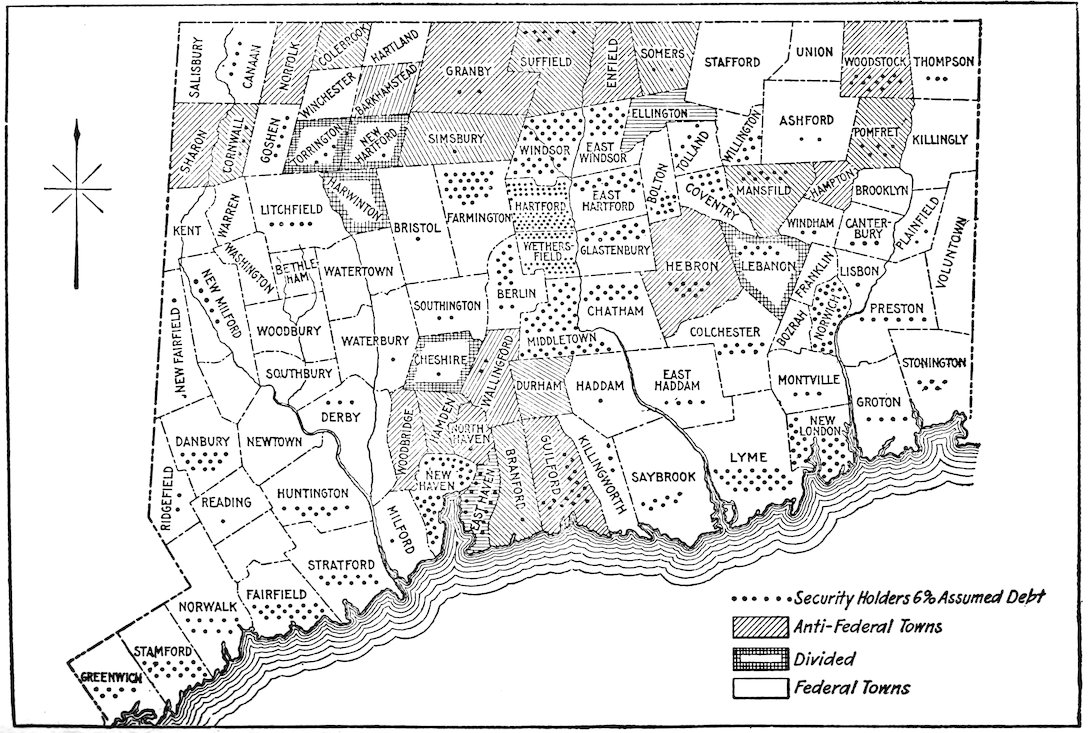
amount held by each person. The ledgers of Connecticut,
for example, offer a rich field for the study of the names
and geographical distribution of public creditors, and the
tracing of these interests through their myriad local ramifications
would afford an interesting and profitable undertaking.
But unfortunately multitudes of the most significant
operations are forever lost; it is to be particularly
deplored that the “powers of attorney” for the period are
not forthcoming. Unless the Government at Washington
follows the example of enlightened administrations in Europe
and establishes a Hall of Records, the precious volumes
which have come down to us will be worked only with great
difficulty, if they do not disintegrate and disappear altogether.[28]
3. The geographic distribution of small mortgaged farms
and their connection with various schemes for depreciation
of the currency and impairment of the obligation of contract.
23No doubt work in local records would yield valuable results
in this field.
4. Owners and operators in western lands. Speculation
in western lands was one of the leading activities of capitalists
in those days. As is well known, the soldiers were paid
in part in land scrip and this scrip was bought up at low
prices by dealers, often with political connections. Furthermore,
large areas had been bought outright for a few
cents an acre and were being held for a rise in value. The
chief obstacle in the way of the rapid appreciation of these
lands was the weakness of the national government which
prevented the complete subjugation of the Indians, the
destruction of old Indian claims, and the orderly settlement
of the frontier. Every leading capitalist of the time
thoroughly understood the relation of a new constitution
to the rise in land values beyond the Alleghanies. This
idea was expressed, for example, by Hugh Williamson, a
member of the Convention from North Carolina and a
land speculator in a letter to Madison.[29] The materials
for the study of land operations exist in enormous quantities,
largely in manuscript form in Washington; and a
critical scrutiny of the thousands of names that appear on
these records, in their political relations, would afford results
beyond all measure. Here, too, is the work for a lifetime.
5. The geographic distribution of manufacturing establishments
and the names of owners and investors. On
this important topic a mass of printed and manuscript
materials exists, but no attempt has yet been made to
catalogue the thousands of names of persons with a view to
establishing political connections. To produce the materials
for this study, searches must be made in the local records
from New Hampshire to Georgia. Wills probated, transfers
24of property, law suits, private papers, advertisements in
newspapers, shipping records, Hamilton’s correspondence
in the Manuscript Division of the Library of Congress,
unclassified Treasury Records and correspondence, and
innumerable other sources must be searched and lists of
names and operations made.
Pending the enormous and laborious researches here
enumerated, the following pages are offered merely as an
indication of the way in which the superficial aspects of
the subject may be treated.[30] In fact, they sketch the broad
outlines of the study which must be filled in and corrected
by detailed investigations.
In an examination of the structure of American society
in 1787, we first encounter four groups whose economic
status had a definite legal expression: the slaves, the indented
servants, the mass of men who could not qualify
for voting under the property tests imposed by the state
constitutions and laws, and women, disfranchised and subjected
to the discriminations of the common law. These
groups were, therefore, not represented in the Convention
which drafted the Constitution, except under the theory
that representation has no relation to voting.
How extensive the disfranchisement really was cannot be
determined.[31] In some states, for instance, Pennsylvania and
Georgia, propertyless mechanics in the towns could vote; but
in other states the freehold qualifications certainly excluded
a great number of the adult males.
25In no state, apparently, had the working-class developed
a consciousness of a separate interest or an organization
that commanded the attention of the politicians of the
time. In turning over the hundreds of pages of writings
left by eighteenth-century thinkers one cannot help being impressed
with the fact that the existence and special problems
of a working-class, then already sufficiently numerous to
form a considerable portion of society, were outside the realm
of politics, except in so far as the future power of the proletariat
was foreseen and feared.[32]
When the question of the suffrage was before the Convention,
Madison warned his colleagues against the coming
industrial masses: “Viewing the subject in its merits alone,
the freeholders of the Country would be the safest depositories
of Republican liberty. In future times a great majority
of the people will not only be without landed, but any
other sort of property. These will either combine under
the influence of their common situation; in which case,[33]
the rights of property and the public liberty will not be
secure in their hands, or, which is more probable, they will
become the tools of opulence and ambition; in which case
there will be equal danger on another side.”[34]
So far as social policy is concerned, however, the working-class
problem had not made any impression on the
statesmen of the time. Hamilton in his report on manufactures,[35]
dismisses the subject with scant notice. He observes
26that one of the advantages of the extensive introduction
of machinery will be “the employment of persons
who would otherwise be idle, and in many cases, a burthen
on the community, either from bias of temper, habit, infirmity
of body, or some other cause, indisposing or disqualifying
them for the toils of the country. It is worthy of
remark, that, in general, women and children are rendered
more useful, and the latter more early useful, by manufacturing
establishments, than they would otherwise be. Of
the number of persons employed in the cotton manufactories
of Great Britain, it is computed that four-sevenths, nearly,
are women and children; of whom the greatest proportion
are children, many of them of a tender age.” Apparently
this advantage was, in Hamilton’s view, to accrue principally
to the fathers of families, for he remarks: “The
husbandman himself experiences a new source of profit
and support, from the increased industry of his wife and
daughters, invited and stimulated by the demands of the
neighboring manufactories.”
Passing beyond these groups which were politically nonexistent,
except in so far as those who possessed the ballot
and economic power were compelled to safeguard their
rights against assaults from such quarters, we come to the
social groupings within the politically enfranchised mass.
Here we find no legal class distinctions. Social distinctions
were very sharp, it is true, as every student of manners
and customs well knows; but there were no outward legal
signs of special class privileges.
Nevertheless, the possessors of property were susceptible
of classification into several rather marked groups, though
of course they shade off into one another by imperceptible
27gradations. Broadly speaking, there were the interests of
real and personal property. Here, however, qualifications
must be made. There was no such identity of interest
between the large planters and the small inland farmers
of the south as existed in England between the knights and
yeomen. The real property holders may be classified into
three general groups: the small farmers, particularly back
from the sea-coast, scattered from New Hampshire to
Georgia, the manorial lords, such as we find along the
banks of the Hudson,[36] and the slaveholding planters of the
south.
1. The first of these groups, the small farmers, constituted
a remarkably homogeneous class. The inland section
was founded and recruited by mechanics, the poorer whites,
and European (particularly Scotch-Irish) immigrants. It
had peculiar social and political views arising from the
crude nature of its environment, but its active political
doctrines were derived from an antagonism to the seaboard
groups. One source of conflict was connected with the
possession of the land itself. Much of the western country
had been taken up by speculators and the settlers were
either squatters or purchasers from large holders. This
is illustrated by the situation in Virginia, where, as Ambler
points out, “liberality in granting her unoccupied lands did
not prove to be good policy. True, large numbers of settlers
were early attracted to the state, where they made permanent
homes, but much of the land fell into the hands of
speculators. Companies were formed in Europe and
America to deal in Virginia lands, which were bought up
in large tracts at the trifling cost of two cents per acre.
This wholesale engrossment soon consumed practically
all the most desirable lands and forced the home seeker to
28purchase from speculators or to settle as a squatter.”[37] As
the settler sought to escape from the speculator by moving
westward, the frontier line of speculation advanced.
In addition to being frequently in debt for their lands, the
small farmers were dependent upon the towns for most of
the capital to develop their resources. They were, in other
words, a large debtor class, to which must be added, of course,
the urban dwellers who were in a like unfortunate condition.
That this debtor class had developed a strong consciousness
of identical interests in the several states is clearly
evident in local politics and legislation.[38] Shays’ Rebellion
in Massachusetts, the disturbances in Rhode Island, New
Hampshire, and other northern states, the activities of the
paper-money advocates in state legislatures, the innumerable
schemes for the relief of debtors, such as the abolition
of imprisonment, paper money, laws delaying the collection
of debts, propositions requiring debtors to accept land in
lieu of specie at a valuation fixed by a board of arbitration,—these
and many other schemes testify eloquently to the
fact that the debtors were conscious of their status and
actively engaged in establishing their interest in the form of
legal provisions. Their philosophy was reflected in the writings
of Luther Martin, delegate to the Convention from Maryland,
who disapproved of the Constitution, partly on the
ground that it would put a stop to agrarian legislation.[39]
2. The second group of landed proprietors, the manorial
lords of the Hudson valley region, constituted a peculiar
aristocracy in itself and was the dominant class in the
politics of New York during the period between the Revolution
29and the adoption of the Constitution, as it had been
before the War. It was unable or unwilling to block the
emission of paper money, because the burden of that operation
fell on the capitalists rather than itself. It also took
advantage of its predominance to shift the burden of taxation
from the land to imports,[40] and this fact contributed
powerfully to its opposition to the Constitution, because it
implied a transference of the weight of taxation for state
purposes to the soil. Its spokesmen indulged in much high
talk of state’s rights, in which Federalist leaders refused
to see more than a hollow sham made to cover the rural
gentry’s economic supremacy.
3. The third group of landed proprietors were the slave-holders
of the south. It seems curious at the first glance
that the representatives of the southern states which sold
raw materials and wanted competition in shipping were
willing to join in a union that subjected them to commercial
regulations devised immediately in behalf of northern
interests. An examination of the records shows that they
were aware of this apparent incongruity, but that there
were overbalancing compensations to be secured in a strong
federal government.[41]
Money-lending and the holding of public securities were
not confined to the north by any means; although, perhaps,
as Calhoun long afterward remarked,[42] the south was devoid
30of some of the artifices of commerce which characterized
New England. Neither were attempts at relieving debtors
by legislative enactment restricted to Massachusetts
and Rhode Island. The south had many men who were rich
in personalty, other than slaves, and it was this type, rather
than the slaveholding planter as such, which was represented
in the Convention that framed the Constitution. The
majority of the southern delegates at Philadelphia in 1787
were from the towns or combined a wide range of personalty
operations with their planting. On this account there was
more identity of interest among Langdon of Portsmouth,
Gerry of Boston, Hamilton of New York, Dayton of New
Jersey, Robert Morris of Philadelphia, McHenry of Baltimore,
Washington on the Potomac, Williamson of North
Carolina, the Pinckneys of Charleston, and Pierce of Savannah
than between these several men and their debt-burdened
neighbors at the back door. Thus nationalism was created
by a welding of economic interests that cut through state
boundaries.
The southern planter was also as much concerned in
maintaining order against slave revolts as the creditor in
Massachusetts was concerned in putting down Shays’
“desperate debtors.” And the possibilities of such servile
insurrections were by no means remote. Every slave-owner must have felt more secure in 1789 when he knew
that the governor of his state could call in the strong arm
of the federal administration in case a domestic disturbance
got beyond the local police and militia. The north might
make discriminatory commercial regulations, but they could
be regarded as a sort of insurance against conflagrations
that might bring ruin in their train. It was obviously better
to ship products under adverse legislation than to have no
products to ship.
31
A second broad group of interests was that of personal
property as contrasted with real property. This embraced,
particularly, money loaned, state and continental securities,
stocks of goods, manufacturing plants, soldiers’ scrip, and
shipping. The relative proportion of personalty to realty
in 1787 has not been determined and it is questionable
whether adequate data are available for settling such an
important matter.[43]
Personalty in Money.—Although personalty in the
form of money at interest or capital seeking investment did
not constitute in 1787 anything like the same amount,
relative to the value of real estate, which it does to-day,
it must not be thought that it was by any means inconsiderable
in any state. The tax returns of New Hampshire
for 1793 report the value of all buildings and real estate
as £893,327:16:10 and the amount of money on hand or
at interest as £35,985:5:6. The Massachusetts tax returns
of 1792 show £196,698:4:6 at interest and £95,474:4:5
on hand. The Connecticut returns for 1795 show £63,348:
10:1 at interest.[44]
Money capital was suffering in two ways under the Articles
of Confederation. It was handicapped in seeking profitable
outlets by the absence of protection for manufactures, the
lack of security in investments in western lands, and discriminations
against American shipping by foreign countries.
It was also being positively attacked by the makers
of paper money, stay laws, pine barren acts, and other devices
for depreciating the currency or delaying the collection
of debts. In addition there was a widespread derangement
32of the monetary system and the coinage due
to the absence of uniformity and stability in the standards.[45]
Creditors, naturally enough, resisted all of these schemes
in the state legislatures, and failing to find relief there at
length turned to the idea of a national government so constructed
as to prevent laws impairing the obligation of
contract, emitting paper money, and otherwise benefiting
debtors. It is idle to inquire whether the rapacity of the
creditors or the total depravity of the debtors (a matter
much discussed at the time) was responsible for this deep
and bitter antagonism. It is sufficient for our purposes to
discover its existence and to find its institutional reflex in
the Constitution. It was to the interest of the creditors
to see the currency appreciate, to facilitate the process
for securing possession of forfeited mortgaged property,
and to hold the rigor of the law before the debtor who was
untrue to his obligations. Whether the creditors were driven
into class consciousness by the assaults of their debtors or
attained it by the exercise of their wits is, for scientific
purposes, immaterial.
Personalty in Public Securities.—Even more immediately
concerned in the establishment of a stable national
government were the holders of state and continental
securities. The government under the Articles of Confederation
was not paying the interest on its debt and its
paper had depreciated until it was selling at from one-sixth
to one-twentieth of its par value.[46] Grave uncertainties
as to the actions of legislatures kept state paper at a low
price, also, even where earnest attempts were being made
to meet the obligations.
The advantage of a strong national government that
33could discharge this debt at its face value is obvious; and
it was fully understood at the time. The importance
of this element of personalty in forcing on the revolution
that overthrew the Articles of Confederation is all the more
apparent when it is remembered that securities constituted
a very large proportion of the intangible wealth. In Massachusetts,
for example, it is set down in 1792 at a sum greater
than all the money at interest and on hand in the state.[47]
The amount of the public securities of the United States
and of the several states at the establishment of the new
government was estimated by Hamilton, in his first report
on credit, as Secretary of the Treasury.[48] The foreign debt,
that is, money borrowed abroad, was fixed at $10,070,307
and arrears of interest up to December, 1789, were estimated
at $1,640,071.62, making a total of $11,710,378.62.
The domestic continental debt, including the registered
debt, army certificates, etc., amounted to $27,383,917.74,
to which was added arrears of interest to the amount of
$13,030,168.20, making a total of $40,414,085.94. The
amount of the state debts was unknown in 1790, but Hamilton
placed it at about $25,000,000, which appears to have
been rather high. The issue, later authorized to cover them,
was $21,500,000 and the amount actually paid out was
$18,271,786.47.[49]
The enormous total of the national debt after state and
national securities were funded is shown by Hamilton’s
report of January 16, 1795:—
Foreign Debt
$13,745,379.35
Funded domestic debt
60,789,914.18
Unsubscribed debt
1,561,175.14
Total unredeemed debt
$76,096,468.67
34In addition to this sum, there was an amount of $1,400,000
due to the Bank of the United States on account of the loan
from that institution, but this was more than counterbalanced
by the value of the stock.[50]
It is evident from this statement that a vast mass of state
and continental securities was scattered throughout the
country in 1787. The degree of its concentration or distribution
cannot be determined until the Domesday Books
of the Treasury Department have been carefully studied,
and their incompleteness makes an absolute statement
impossible. The value of this paper in the hands of the
holders in the spring when the Convention met cannot be
ascertained with mathematical precision, for prices varied
from state to state. Furthermore, the prices obtained by
the holders of public paper after Hamilton’s funding system
had gone into effect can only be roughly estimated, for it
depends upon the market in which they were sold. For
example, 6 per cents were bringing 17 shillings in the
pound on March 5, 1791, and 22 shillings in the pound on
October 3, 1792. On these dates, deferred sixes were 9/1
and 13/7, respectively, and 3 per cents were 9/1 and 13/1,
respectively.[51]
If we leave out of account the foreign debt, it appears
that some $60,000,000 worth of potential paper lay in the
hands of American citizens in the spring of 1787. This
paper was changing hands all of the time at varying prices.
The common selling price in good markets before the movement
for the Constitution got under way ranged from
one-sixth to one-tenth its face value; and some of it sold as
low as twenty to one. In fact, many holders regarded
continental paper as worthless, as it might have been had
the formation of the Constitution been indefinitely delayed.
35It seems safe to hazard a guess, therefore, that at least
$40,000,000 gain came to the holders of securities through
the adoption of the Constitution and the sound financial
system which it made possible. This leaves out of account
the large fortunes won by the manipulation of stocks after
the government was established and particularly after
the founding of the New York Stock Exchange in 1792.[52]
It should be pointed out, however, that this was not all
gain for the original holders of public paper, that is, for
those who had loaned the Revolutionary government
money or had rendered it services during the War. Nevertheless,
they would have lost all their continental securities
under the prevailing methods of the Congress. As Pitkin
points out, “The interest of the debt was unpaid, public
credit was gone, the debt itself was considered of little
value, and was sold at last by many of the original holders
for about one-tenth of its nominal value.”[53] From this
point of view, the appreciation due to the adoption of the
new government was so much clear gain, even to original
holders; and in some states more than one-half of the
paper had passed into the hands of speculators at low figures.
The significance of this huge national debt and of the
enormous gain made in the appreciation of securities can
36be understood only in comparison with other forms of wealth
at that time. Unfortunately, our statistics for the period
of the formation of the Constitution are meagre, but under
an act of Congress passed in 1798 a valuation of lands was
made for the purposes of direct taxation. The surveys
were made between the years 1798 and 1804. The following
table[54] exhibits the value of lands (not including houses,
which amounted to more than $140,000,000 in addition)
in each of the states at the close of the eighteenth century,
and also the amount of money paid out by the loan offices
of the respective states for the year 1795 in discharging
the interest on the public debt and the payment of 2 per
cent towards the reimbursement of the 6 per cent stocks
held in the several commonwealths:—
55. No table showing the capital amount of the loan office books of the states after
the funding was complete was discovered, so that interest payment is given here.
37To the total amount of payments made through the loan offices
must be added the payments made at the Treasury on
the securities registered there, bringing the total annual interest
and capital disbursements to $2,727,959.07.
It seems safe to assume from the table that $400,000,000
would cover the total taxable value of all the lands in the
thirteen states in 1787.[56] Very probably the estimate
should be much lower, but letting the figures stand at this
amount, it will be seen that an advance of $40,000,000 in
securities would have represented one-tenth of the total
taxable value of all the land in the thirteen United States
at the time of the formation of the Constitution.
To put the matter in another way: The amount gained
by public security holders through the adoption of the
new system was roughly equivalent to the value of all the
lands as listed for taxation in Connecticut. It was but
little less than the value of the lands in New Hampshire,
Vermont, and Rhode Island. It was about equivalent
to one-half the value of the lands in New York and to
two-thirds the value of the lands in Massachusetts. It
amounted to at least ten dollars for every man, woman,
and child in the whole United States from New Hampshire
to Georgia.[57]
The significance of the figures showing the annual interest
disbursement also when the debt had been funded becomes
38evident only by comparison. Tench Coxe, as commissioner
of the revenue, estimated the amount of goods, wares, and
merchandise exported from the United States between
October 1, 1791, and September 30, 1792, at $21,005,568.
In other words, the annual interest on the domestic debt was
more than one-tenth the total value of the goods exported
annually. The average imports for each of the three years
ending March 4, 1792, was $19,150,000, so that the interest
on the domestic debt was more than one-tenth of the value
of the goods imported into the United States.[58]
One of the most potent effective forces of these public
securities was the Society of the Cincinnati which was composed
of the officers of the Revolutionary Army organized
into local branches in the several states. Like other soldiers,
the members of this order had been paid for their
patriotic services partly in land warrants and depreciated
paper; but unlike the privates, they were usually men of
some means and were not compelled to sacrifice their holdings
to speculators at outrageously low prices. The members
of this Society appear in large numbers on the loan
office records of the several states preserved in the Treasury
Department; and many, if not all, of the state branches
had funds derived from this source.
The political influence of the Society was recognized in
the Convention. When the popular election of President
was under consideration, Gerry objected to it. “The ignorance
of the people,” he said, “would put it in the power
of some one set of men dispersed through the Union and
acting in concert to delude them into any appointment.
He observed that such a Society of men existed in the Order
of the Cincinnati. They were respectable, United, and influential.
39They will in fact elect the chief Magistrate in
every instance, if the election be referred to the people—His
respect for the characters composing this Society
could not blind him to the danger and impropriety of throwing
such a power into their hands.”[59] In this view Colonel
Mason concurred.[60]
An observant French chargé d’affaires, writing to his
home secretary of state for foreign affairs in June, 1787,
calls attention to the weight of the Order of the Cincinnati
in the movement for a new government, but remarks that
their power has been greatly exaggerated. “Les Cincinnati,”
he says, “c’est à dire les officiers de l’ancienne armée
américaine, sont intéressés à l’éstablissement d’un Gouvernement
solide, puisqu’ils sont tous créanciers du public, mais,
considérant la foiblesse du Conseil national et l’impossibilité
d’être payés par la présente administration, ils proposent
de jeter tous les États dans une seule masse et de
mettre à leur tête le gai. Washington avec toutes les
prérogatives et les pouvoirs d’une tête couronné.” He
also says that they threaten a revolution by arms in case
the Convention fails, but adds that this project is too extravagant
to merit the least consideration.[61]
This society was, however, compactly organized. Correspondence
among the members was frequent, extensive,
and frank. Almost uniformly, they were in favor of a
reconstruction of the national government on a stronger
basis.[62] They were bitter in their denunciation of the popular
40movements in the states; particularly Shays’ revolt in
Massachusetts. War had given them a taste for strong
measures, and the wretched provisions which had been
made for paying them for their military services gave them
an economic interest in the movement to secure a government
with an adequate taxing power. Moreover, they
were consolidated by the popular hostility to them on
account of their “secret” and “aristocratic” character.
Personalty in Manufacturing and Shipping.—The
third group of personalty interests embraced the manufacturing
population, which was not inconsiderable even at
that time. A large amount of capital had been invested
in the several branches of industry and a superficial study
of the extensive natural resources at hand revealed the immense
possibilities of capitalistic enterprise. The industrial
revolution was then getting under way in England
and the fame of Arkwright was being spread abroad in the
land. In the survey of the economic interests of the members
of the federal Convention, given below, it is shown
that a few leading men were directly connected with industrial
concerns, although it is not apparent that the protection
of industries was their chief consideration, in spite
of the fact that they did undoubtedly contemplate such a
system. But outside of the Convention vehement appeals
were made by pamphleteers for protection, on the score
that the discriminatory measures of Great Britain were
disastrous to American economic independence.
As early as April, 1785, a memorial from prominent
merchants and business men of Philadelphia was laid before
the legislature of the state lamenting that Congress did
not have “a full and entire power over the commerce of the
United States,” and praying that the legislature request
Congress to lay a proposal conferring such a power before
41the states for their ratification. The memorialists assured
the legislature that there was a “disposition in the
mercantile interest of Pennsylvania favorable thereto.”[63]
Among the signers were T. Fitzsimons and George Clymer,
who were destined to sit in the constitutional Convention
as representatives of the state of Pennsylvania and of the
mercantile interest which they had so much at heart.
The supporters of the Constitution were so earnest and
so persistent in their assertion that commerce was languishing
and manufactures perishing for the lack of protection
that there must have been some justification for their claims,
although it is impossible to say how widespread the havoc
really was. The exaggeration of danger threatened by a
tariff reduction is not peculiar to our times; it was sharply
marked in older days. That the consumer suffered from
the lack of the protection sought in 1787 by merchants and
manufacturers is not apparent. Indeed the “mechanics
and manufacturers of New York” in their humble petition
to Congress for relief in 1789 complain that “their countrymen
have been deluded by an appearance of plenty; by
the profusion of foreign articles which has deluged the
country; and thus have mistaken excessive importation
for a flourishing trade. To this deception they [the petitioners]
impute the continuance of that immoderate prepossession
in favor of foreign commodities which has been
the principal cause of their distresses, and the subject of
their complaint.”[64]
That innumerable manufacturing, shipping, trading,
and commercial interests did, however, look upon the
adoption of the Constitution as the sure guarantee that
42protection could be procured against foreign competition,
is fully evidenced in the memorials laid before Congress
in April, May, and June, 1789, asking for the immediate
enactment of discriminatory tariff laws.[65]
The first of these petitions was from Baltimore in particular
and Maryland generally, and was communicated to
the House of Representatives on April 11, 1789, a few days
after that body had settled down to business. The second
was laid before the House a week later by a committee representing
the mechanics and manufacturers of New York.
On May 25, 1789, the shipwrights of Philadelphia laid their
pleas before Congress; and on June 5, the tradesmen and
manufacturers of Boston put in their appearance. These
petitions for protection from the four great trading and
shipping centres of the country, Baltimore, Philadelphia,
New York, and Boston, which had been most zealous in
securing the establishment of the new government, are in
themselves eloquent documents for the economic interpretation
of the Constitution.
The first of these, from Baltimore, bears the names of two
members of the federal Convention from that state, Daniel
Carroll and James McHenry, and the names of two or three
hundred other citizens of that community, the analysis of
whose politico-economic connections would doubtless repay
the detailed scrutiny which the painful labor would entail.
The petition cites the sad state of decline in which manufacturing
and trading interests have been since the close
of the Revolution and the ineffectual attempts of the states
acting alone to remedy the evils. “The happy period
having now arrived,” the memorialists exultingly exclaim,
“when the United States are placed in a new situation;
when the adoption of the General Government gives one
43sovereign Legislature the sole and exclusive power of laying
duties upon imports; your petitioners rejoice at the prospect
this affords them, that America, freed from the commercial
shackles which have so long bound her, will see and
pursue her true interest, becoming independent in fact as
well as in name; and they confidently hope that the encouragement
and protection of American manufactures will
claim the earliest attention of the supreme Legislature of
the nation.”
The Maryland petitioners are conscious of no narrow
motives in asking for relief at the hands of the government:
“the number of her poor increasing for want of employment; foreign
debts accumulating; houses and lands
depreciating in value; trade and manufactures languishing
and expiring”—these are the evidences of need for the
expected legislation. They, therefore, ask for duties on all
foreign articles that can be made in America, which will
give “a just and decided preference to their labors.” And
lest Congress might not understand the precise character
of the relief for which they ask, they append a long list of
articles, which are, or can be, manufactured in Maryland,
and on which protection is needed—including ships, hardware,
clocks, boots, shoes, saddles, brushes, food-stuffs, and
raw iron, to mention only a few.
The second petition, from the mechanics and manufacturers
of New York, recites how the memorialists had expected
great prosperity on the successful issue of the Revolution
and had seen their hopes blasted “by a system of commercial
usurpation, originating in prejudices, and fostered
by a feeble government.” They had struggled in vain
against dire adversity and “wearied by their fruitless exertions,
your petitioners have long looked forward with
anxiety to the establishment of a government which would
44have the power to check the growing evil, and extend a
protecting hand to the interests of commerce and the arts.
Such a government is now established. On the promulgation
of the Constitution just now commencing its operations,
your petitioners discovered in its principles the remedy
which they had so long and so earnestly desired. They
embraced it with ardor, and have supported it with persevering
attachment.” Lest Congress might not have the
information necessary for the formulation of a protective
tariff on correct principles, the petitioners subjoined a
list of articles manufactured in the state and susceptible
of protection.
The petitioners from Philadelphia, humbly seeking protection
for shipping, lament that the tonnage built at that
harbor has fallen to about one-third the amount constructed
before the Revolution, and call attention to the fact that
the British navigation act totally prevents them from building
for English customers. They add that they “have waited,
with anxious expectation, for the sitting of the honourable
Congress under the new Constitution of the United States,
firmly relying that every exertion would be used to reinstate
so necessary and useful a branch of business.” Like
the representatives from Baltimore and New York, they
append for the information of Congress a list of suggestions
as to the best method of protecting American shipping
interests.
Finally come the manufacturers and ship builders of
Boston. Ship-building with them has also declined since
the Revolution, and the revival of manufacturing in the
north depends upon adequate protection from the federal
government. Accordingly they request that “heavy duties
may be laid on such articles as are manufactured by our own
citizens, humbly conceiving that the impost is not solely
45considered by Congress as an object of revenue, but, in its
operation, intended to exclude such importations, and, ultimately,
establish these several branches of manufacture
among ourselves.” Rope-makers, hatters, pewterers, soapboilers,
and tallow-chandlers, wool card-makers, ship-carvers,
sailmakers, cabinet-makers, coachmakers, tailors, cordwainers,
glue and starch makers, brass-founders, and
coppersmiths are among the memorialists.
In the processions which celebrated the adoption of the
Constitution in Boston, Philadelphia, Baltimore, Charleston,
and New York, the several local manufacturing concerns
were extensively represented by floats and banner-men,
which shows that they were not unaware of the gain
that had been made in their favor by the establishment of
the new system. But it must not be supposed that the
consolidation of interests in support of the Constitution
was purely local in character. On the contrary it was nationwide.
Immediately after the Revolution the local groups were
being welded into a national interest by correspondence
committees. Before the formation of the Constitution,
Boston merchants were sending out appeals to other merchants
in the several states to join in a national movement
for protection; and before the new government went into
effect, they were active in stirring up united action among
the merchants and manufacturers of the whole country.
In 1788, a committee of the association of Boston merchants
and manufacturers sent out a circular to “their brethren
in the several seaports of the union,” asking for cooperation
in this grave juncture.[66] To this Boston appeal are appended
the names of John Gray, Gibbins Sharp, Benjamin Austin, Jr.,
46Larson Belcher, William Hawes, and Joshua Witherle—all
of whom signed the petition addressed to Congress the
following year asking for protection.[67]
During the struggle over the reconstruction, the advocates
of a constitution made use of the argument that the
consumption of foreign luxuries, manufactured stuffs, was one
of the chief causes of the economic distress which was said
to prevail; and declared that national legislation was the
only source of relief from this heavy importation. A
writer in the American Museum for February, 1787, complains
that “the articles of rum and tea alone, which are
drank in this country, would pay all its taxes. But when we
add sugar, coffee, gauzes, silks, feathers, and the whole list
of baubles and trinkets, what an enormous expense! No
wonder you want paper currency. My countrymen are
all grown very tasty. Feathers and jordans must all be
imported. Certainly, gentlemen, the devil is among you.
A Hampshireman, who drinks forty shillings worth of rum
in a year and never thinks of the expense, will raise a mob
to reduce the governor’s salary.”[68]
The Connecticut Courant, of November 12, 1787, in an
argument for ratification declares: “In the harbour of New
York there are now 60 ships of which 55 are British. The
produce of South Carolina was shipped in 170 ships, of
which 150 were British.... Surely there is not any
American who regards the interest of his country but must
47see the immediate necessity of an efficient federal government;
without it the Northern states will soon be depopulated
and dwindle into poverty, while the Southern ones
will become silk worms to toil and labour for Europe.”
It is worthy of remark, however, that the gloomy view
of economic conditions persistently propagated by the advocates
of a new national system was not entertained by all
writers of eminence and authority. One of the members
of the Convention, Franklin, early in 1787, before the
calling of that assembly, declared that the country was, on
the whole, so prosperous that there was every reason for
profound thanksgiving.[69] He mentioned, it is true, that
there were some who complained of hard times, slack trade,
and scarcity of money, but he was quick to add that there
never was an age nor a country in which there were not
some people so circumstanced as to find it hard to make a
living and that “it is always in the power of a small number
to make a great clamour.” But taking the several classes
in the community as a whole, prosperity, contended Franklin,
was widespread and obvious. Never was the farmer
paid better prices for his products, “as the published prices
current abundantly testify. The lands he possesses are
continually rising in value.” In no part of Europe are the
laboring poor so well paid, fed, or clothed. The fishing
trade, he thinks, is in a rather bad way, and mercantile
branches are overcrowded; but he is not distressed by the
extensive importation of English goods, because this is nothing
new, and America has prospered in spite of it.
It may very well be that Franklin’s view of the general
social conditions just previous to the formation of the
Constitution is essentially correct and that the defects in
the Articles of Confederation were not the serious menace
48to the social fabric which the loud complaints of advocates
of change implied. It may be that “the critical period”
was not such a critical period after all; but a phantom of
the imagination produced by some undoubted evils which
could have been remedied without a political revolution.
It does not seem to have occurred to those historians, who
have repeated without examination Fiske’s picturesque
phrase that it is a serious matter to indict a whole system,
an entire epoch, and a whole people. It does not appear
that any one has really inquired just what precise facts
must be established to prove that “the bonds of the social
order were dissolving.” Certainly, the inflamed declarations
of the Shaysites are not to be taken as representing
accurately the state of the people, and just as certainly the
alarmist letters and pamphlets of interested persons on the
other side are not to be accepted without discount. When
it is remembered that most of our history has been written
by Federalists, it will become apparent that great care should
be taken in accepting, without reserve, the gloomy pictures
of the social conditions prevailing under the Articles of
Confederation. In fact, a very learned, though controversial,
historian, Henry B. Dawson, in an article published
more than forty years ago makes out quite a plausible case
(documented by minute research) for the statement that
the “chaos” of which historians are wont to speak when
dealing with the history of the years 1783–87, was a creation
of their fancies.[70]
However this may be, and whether or not Franklin’s
view is correct,[71] it cannot be denied that the interests seeking
protection were extensive and diversified. This is conclusively
49shown by the petitions addressed to public bodies,
by the number of influential men connected with the movement,
and by the rapidity with which the new government
under the Constitution responded to their demands.
Capital invested in Western Lands.—Although
companies had been formed to deal in western lands on a
large scale before the Revolution, it was not until the close
of the War that effective steps were taken toward settlement.
At that time, says Professor Haskins, “the number
of emigrants, the cheapness of the lands, and the lack of an
established system of sale in small quantities offered many
inducements for the formation of great land companies
whose opportunities for speculation were increased by the
depreciated currency and general ignorance concerning
the West.... ‘All I am now worth was gained by speculations
in land,’ wrote Timothy Pickering [a member of the
Pennsylvania ratifying convention] in the same year [1796];
and many eminent men could have said the same, often
with a later experience quite similar. Land speculation
involved Washington, Franklin, Gallatin, Patrick Henry,
Robert Morris, and James Wilson, as well as many less
widely known.”[72]
The situation was this: Congress under the Articles of
Confederation adopted a policy of accepting certificates in
part payment for lands; and it was hoped by some that
the entire national debt might be extinguished in this way.
However, the weakness of the Confederation, the lack of
proper military forces, the uncertainty as to the frontiers
kept the values of the large sections held for appreciation
at an abnormally low price. Those who had invested their
50funds in these lands or taken stocks in the companies felt
the adverse effects of the prevailing public policy, and foresaw
the benefits which might be expected from a new and
stable government. Their view was tersely put by Williamson,
a member of the Convention from North Carolina, in
a letter to Madison on June 2, 1788: “For myself, I conceive
that my opinions are not biassed by private Interests,
but having claims to a considerable Quantity of Land in
the Western Country, I am fully persuaded that the Value
of those Lands must be increased by an efficient federal
Government.”[73]
The weight of the several species of property in politics
is not determined by the amount, but rather by the opportunities
offered to each variety for gain and by the degree
of necessity for defence against hostile legislation designed
to depreciate values or close opportunities for increments.
When viewed in this light the reason for the special pressure
of personalty in politics in 1787 is apparent. It was receiving
attacks on all hands from the depreciators and it found
the way to profitable operations closed by governmental
action or neglect. If we may judge from the politics of
the Congress under the Articles of Confederation, two related
groups were most active: those working for the establishment
of a revenue sufficient to discharge the interest
and principal of the public debt, and those working for
commercial regulations advantageous to personalty operations
in shipping and manufacturing and in western land
speculations.[74]
It should be remembered also that personalty is usually
more active than real property. It is centralized in the
51towns and can draw together for defence or aggression with
greater facility. The expectation of profits from its manipulation
was much larger in 1787 than from real property.
It had a considerable portion of the professional classes
attached to it; its influence over the press was tremendous,
not only through ownership, but also through advertising
and other patronage.[75] It was, in short, the dynamic element
in the movement for the new Constitution.
CHAPTER III THE MOVEMENT FOR THE CONSTITUTION
52
Did the system of government prevailing in the United
States in 1787 affect adversely any of the economic interests
enumerated in the preceding chapter? Furthermore, were
the leaders in the movement which led to the adoption of
the Constitution representatives of the interests so affected?
Fortunately, it is not necessary to devote any considerable
attention to the first of these questions. It is answered
in part above, and all of the standard treatises show conclusively
that the legal system prevailing at the opening
of 1787 was unfavorable to the property rights of four
powerful groups above enumerated.[76] That system was, in
brief, as follows. There was a loose union of thirteen sovereign
states under the Articles of Confederation. The
national government consisted of a legislature of one house
in which the states had an equal voting power. There was
no executive department and no general judiciary. The
central government had no power to regulate commerce
or to tax directly; and in the absence of these powers all
branches of the government were rendered helpless. Particularly,
money could not be secured to pay the holders of
public securities, either their interest or principal. Under
this system, the state legislatures were substantially without
restrictions or judicial control; private rights in property
were continually attacked by stay laws, legal tender laws,
53and a whole range of measures framed in behalf of debtors;
and in New England open rebellion had broken out.
That the economic groups in question looked to a new
national government as the one source of relief and advantage,
is shown in a hundred contemporary pamphlets and
newspaper articles. It was in fact the topic of the times.
For example, a letter from Philadelphia, under date of
August 29, 1787, sums up concisely the interests which were
turning to the new Constitution: “The states neglect their
roads and canals, till they see whether those necessary improvements
will not become the objects of a national government.
Trading and manufacturing companies suspend
their voyages and manufactures till they see how far their
commerce will be protected and promoted by a national
system of commercial regulations. The lawful usurer locks
up or buries his specie till he sees whether the new frame
of government will deliver him from the curse or fear of
paper money and the tender laws.... The public creditor,
who, from the deranged state of finances in every state and
their total inability to support their partial funding systems,
has reason to fear that his certificates will perish in his
hands, now places all his hopes of justice in an enlightened
and stable national government. The embarrassed farmer
and the oppressed tenant, who wishes to become free ...
by emigrating to a frontier country, wait to see whether they
shall be protected by a national force from the Indians.”[77]
A final answer to the second question propounded above
would require an exhaustive analysis of the “movement for
the Constitution,” in the following form:—
1. A study of the economic forces in the Revolution and
particularly in the Continental Congress that drafted the
Articles of Confederation.
542. An inquiry into the first signs of discontent with the
prevailing system, their geographic distribution, and their
economic sources.
3. An examination of the several attempts in the Congress
under the Articles of Confederation to secure the power to
regulate commerce and establish a revenue for discharging
the debt.
4. A description of the economic interests of all the members
who were most active in these attempts.
5. A description of the economic forces in the communities
whose representatives in Congress were zealous in
securing a revision of the Articles.
6. A study of the nature and distribution of the several
legislative attacks on private rights in property between
1783 and 1787.
7. A minute study of the personnel of the movement for
revision and the economic interests of the leading spirits in
Congress and the state legislatures and outside of legislative
chambers.
Any one superficially acquainted with the sources of
American history will see at once the nature of the work
which must be done to secure the raw materials for such a
study. The enormous mass of unprinted papers of the
Continental Congress in the Library at Washington would
have to be thoroughly searched; proceedings in state legislatures
during the years under consideration would have to
be scrutinized; local archives and newspapers would have
to be examined.
In the present state of our historical materials, therefore,
all that can be attempted here is a superficial commentary
on some of the outward aspects of the movement for the
Constitution which are described in the conventional works
on the subject. Many of the eminent men prominently
55identified with the events which led up to the Convention
of 1787 were themselves members of that Assembly, and
their economic interests are considered below in Chapter V.
But it is not without significance to discover that some of
the leading men outside of the Convention who labored
for an overthrow of the old system were also directly interested
in the results of their labors.
As early as January, 1781, General Philip Schuyler moved
in the senate of New York “to request the eastern states
to join in an early convention, which should form a perpetual
league of incorporation, subservient, however, to
the common interest of all the states; invite others to accede
to it; erect Vermont into a state; devise a fund for
the redemption of the common debts; substitute a permanent
and uniform system for temporary expedients; and
invest the confederacy with powers of coercion.”[78] General
Schuyler was a large holder of depreciated securities.[79]
In February, 1781, Congress recommended to the states
that they vest in the national legislature a power to levy
a duty to pay the principal and interest of the debt. In
April, 1783, Congress again appealed to the states for
authority to lay duties for the purpose of supplying a
revenue with which to discharge the debt. Among the
leaders in Congress who favored this increase in power were
Gorham, Higginson, Ellsworth, Dyer, Boudinot, Fitzsimons,
Williamson, Izard, Johnson, and King, all of whom held
securities which were daily depreciating under the failure
of the government to meet its just obligations.[80]
In 1785, Governor Bowdoin, of Massachusetts, in his
inaugural address urged the necessity of a stronger union
with larger powers, and recommended a convention to deliberate
56upon the whole matter.[81] Governor Bowdoin was
a large holder of public securities.[82] The legislature of the
commonwealth, thereupon, resolved that the Articles of
Confederation were inadequate, and directed the representatives
in Congress to take steps looking toward a
strengthening of the union; but they failed to act.
Men less eminent than Bowdoin and Schuyler were being
educated in Federalism by the march of events. In Boston
merchants were petitioning Congress for relief from British
discriminations[83]; in the Virginia legislature the representatives
of the commercial interests were learning their
lessons[84]; the demands for positive action were increasing
daily in number. Every failure to find a remedy under the
Articles of Confederation only served to augment the ranks
of those who were ready for a complete reconstruction of the
prevailing system.
A few illustrations will serve to show how the demand for
reform was being fostered and also the connection between
the leaders in the agitation and the personnel of the public
bodies which later achieved the great work of framing and
ratifying the Constitution. Even before the war was over
and the Articles of Confederation tested in a time of peace,
the inability of the government under it to afford defence
to commerce on the high seas was deplored by merchants
whose vessels were falling prey to the British. In April,
1782, a number of prominent merchants presented a
petition to Congress in which they lamented the British
depredations on American trade and the want of adequate
naval protection at sea.[85] Among the signers of this
petition were several men who were later known as warm
57supporters of a strong federal government. One of them,
Thomas Fitzsimons, was a member of the Convention
which drafted the Constitution; another, John Barclay,
was a member of the Pennsylvania convention and voted
in favor of the ratification of the new system of government.
Six years before the Convention met in Philadelphia, the
disordered financial system under the Confederation was the
subject of protest by interested parties. In 1781, “divers
inhabitants of the state of Pennsylvania,” were petitioning
Congress to take some action designed to put the credit
of the country on a sound basis.[86] Thus runs the petition:
“Humbly sheweth that whereas you thought fit heretofore
in the course of your wisdom to emit bills of credit for good
and great purposes, but the same depreciating to such an
amazing degree beyond the expectation of all living did
therefore lay open wide door for the most monstrous and
absurd injustices by fraudulent payments which we conclude
is directly contrary to your good and great purposes in
emitting the same, we therefore, not only firmly relying
on the extraordinary clearness of the circumstances of our
agrievances, but likewise on the uprightness of your understandings,
Do therefore presume to pray your honors
would be pleased to recommend to the several states to adopt
such measures as they may think most likely to afford a
safe and effectual redress to all such agrievances....”[86]
Among the signers to this petition are Thomas Bull, John
Hannum, and Thomas Cheyney, who six years later as
members of the Pennsylvania convention had the pleasure
of voting for the ratification of an instrument of government
that put an end to the evils against which they had so
earnestly protested.
58The failure of repeated attempts in Congress to secure an
amendment authorizing the laying of impost duties, the refusal
of the states to pay the requisitions made by Congress,
and the obvious impossibility of gaining their ends through
the ordinary channels of ratification by state legislatures,
drove the advocates of these measures to desperation.
Republican government, as it had been tried out, had failed
to secure for personalty that protection and opportunity for
advancement which it enjoyed under monarchy. The
despair of the representatives of the property interests thus
jeopardized and their readiness for some heroic measures
were fully manifest in the correspondence of the time.
Washington, who was not given to undue alarms, wrote
to John Jay from Mount Vernon, on August 1, 1786, to the
effect that men of leadership were ready for drastic action:
“What astonishing changes,” he said, “a few years are
capable of producing. I am told that even respectable
characters speak of a monarchical form of Government without
horror. From thinking proceeds speaking, thence to
acting is often but a single step. But how irrevocable and
tremendous! What a triumph for our enemies to verify
their predictions—what a triumph for the advocates of
despotism to find that we are incapable of governing ourselves,
& that systems founded on the basis of equal liberty
are merely ideal & fallacious! Would to God that wise
measures may be taken in time to avert the consequences
we have but too much reason to apprehend.”[87]
Later in that year, General Knox, who was a holder of
public securities, wrote to Washington in the following
strain: “The people who are the insurgents [Shaysites] have
never paid any, or but very little taxes—But they see the
weakness of government; They feel at once their own
59poverty, compared with the opulent, and their own force,
and they are determined to make use of the latter, in order
to remedy the former. Their creed is ‘That the property
of the United States has been protected from the confiscations
of Britain by the joint exertions of all, and therefore
ought to be the common property of all. And he that
attempts opposition to this creed is an enemy to equity and
justice, and ought to be swept from off the face of the earth.’
In a word they are determined to annihilate all debts
public and private and have agrarian Laws, which are easily
effected by means of unfunded paper money which shall be
a tender in all cases whatever—
“The numbers of these people may amount in Massachusetts
to about one fifth part of several populous counties, and to
them may be collected, people of similar sentiments, from
the states of Rhode Island, Connecticut, and New Hampshire
so as to constitute a body of 12 or 15000 desperate
& unprincipled men—They are chiefly of the young and
active part of the community, more easily collected than
perhaps kept together afterwards—But they will probably
commit overt acts of treason which will compel them to
embody for their own safety—once embodied they will be
constrained to submit to discipline for the same reason.
Having proceeded to this length for which they are now ripe,
we shall have a formidable rebellion against reason, the
principle of all government, and the very name of liberty.
This dreadful situation has alarmed every man of principle
and property in New England. They start as from a dream,
and ask what has been the cause of our delusion? what is
to afford us security against the violence of lawless men?
Our government must be braced, changed, or altered to
secure our lives and property. We imagined that the mildness
of our government and the virtue of the people were
60so correspondent, that we were not as other nations requiring
brutal force to support the laws—But we find that we are
men, actual men, possessing all the turbulent passions belonging
to that anim[al] and that we must have a government
proper and adequate for him. The people of Massachuse[tts]
for instance, are far advanced in this doctrine,
and the men of reflection, & principle, are determined to
endev[or] to establish a government which shall have the
power to protect them in their lawful pursuits, and which
will be efficient in all cases of internal commotions or foreign
invasions—They mean that liberty shall be the basis, a
liberty resulting from the equal and firm administration of
the laws. They wish for a general government of unity as
they see the local legislatures must naturally and necessarily
tend to retard and frustrate all general government.”[88]
A few months later, Madison, writing to Edmund
Pendleton from New York, the seat of the government,
corroborated the views expressed by Washington and Knox
and set forth what he conceived to be the desperate
state of republican government. His letter, dated February
24, 1787, three days after Congress had issued
the call for a national Convention, ran as follows: “In
general I find men of reflection much less sanguine as
to a new than despondent as to the present System. Indeed
the Present System neither has nor deserves advocates;
and if some very strong props are not applied will quickly
tumble to the ground.... If the approaching Convention
should not agree on some remedy, I am persuaded that
some very different arrangement will ensue. The late
turbulent scenes in Massachusetts & infamous ones in
Rhode Island, have done inexpressible injury to the republican
character in that part of the U. States; and a propensity
61towards Monarchy is said to have been produced
by it in some leading minds. The bulk of the people will
probably prefer the lesser evil of a partition of the Union
into three more practicable and energetic Governments.
The latter idea I find after long confinement to individual
speculations & private circles, is beginning to show itself
in the Newspapers.”[89]
A few days after this letter was written by Madison,
John Armstrong wrote to Washington from Carlisle that
the suppression of the insurrection in Massachusetts had
not allayed the fears of leading men in his state. “The
alarming flame in Massachusetts,” he says, “seems nearly
extinguished, but if the subsequent measures of that State
respecting the insurgents should be severe, amounting to
death, Confiscation, or disfranchisement, the consequence
may be bad, as tending to reinkindle the flame. Shall I
tell you in confidence, I have now twice heard, nor from low
authority (some principal men of that State) begin to talk
of wishing one general Head to the Union, in the room of
Congress!”[90]
By correspondence such as this just cited, by an increasing
recognition of the desperate straights in which they were
placed, a remarkable fusion of interested forces was effected.
The wealth, the influence, and a major portion of the educated
men of the country were drawn together in a compact
group, “informed by a conscious solidarity of interests,”
as President Wilson has so tersely put it.[91]
Having failed to obtain relief through the regular channels
of amendment by Congress ratified by the state legislatures,
the leaders struck out on a new path. Operating through
the Virginia legislature, they secured a resolution inviting
62the sister commonwealths to send delegates to a convention
at Annapolis to take into consideration the trade and commercial
system of the United States.[92] The convention duly
met, but the attendance was so slim that, as Professor
Burgess has put it, “a coup d’état attempted by so small
a body could not but fail.”[93]
Although the Annapolis convention was ostensibly concerned
with commercial regulation primarily, there is no
doubt that it was the creation of the men who had been
working in Congress and out for a general revision of the
whole system. There is no doubt also that it was not
regarded as of much significance in itself, but rather as a
preliminary to a national convention which would afford
an opportunity for reconstructing the government. For
this view we have a witness of high authority, James Madison,
who in a letter of August 12, 1786, to Jefferson, written
a month before the Annapolis conference, said: “Many
gentlemen, both within and without Congress, wish to make
this meeting subservient to a plenipotentiary Convention
for amending the Confederation. Tho’ my wishes are in
favor of such an event, yet I despair so much of its accomplishment
at the present crisis that I do not extend my
views beyond a commercial Reform.”[94]
Under the influence of Hamilton, the conference at Annapolis
contented itself with merely recommending that
another convention be called “to devise such further provisions
63as shall appear to them necessary to render the constitution
of the federal government adequate to the exigencies
of the Union.” Acting on this modest suggestion,
Congress, in February, 1787, invited the states to send delegates
to a Convention at Philadelphia for “the sole and
express purpose of revising the Articles of Confederation.”
Certain tentative conclusions emerge at this point.
Large and important groups of economic interests were
adversely affected by the system of government under the
Articles of Confederation, namely, those of public securities,
shipping and manufacturing, money at interest; in short,
capital as opposed to land.
The representatives of these important interests attempted
through the regular legal channels to secure amendments
to the Articles of Confederation which would safeguard
their rights in the future, particularly those of the public
creditors.
Having failed to realize their great purposes through the
regular means, the leaders in the movement set to work
to secure by a circuitous route the assembling of a Convention
to “revise” the Articles of Confederation with the
hope of obtaining, outside of the existing legal framework,
the adoption of a revolutionary programme.
Ostensibly, however, the formal plan of approval by
Congress and the state legislatures was to be preserved.
CHAPTER IV PROPERTY SAFEGUARDS IN THE ELECTION OF DELEGATES
64
Under the protection afforded by these outward signs
of regularity, the leaders in the movement for the new Constitution
set to work in their respective legislatures to secure
the choice of delegates prepared to take the heroic measures
which the circumstances demanded. The zealous and
dynamic element, of course, was favored by the inertness,
ignorance, and indifference of the masses, and the confidence
of the legislatures in their ability to exercise the ultimate
control through the ratifying power. No special popular
elections were called to complicate the problem of securing
the right kind of a Convention and the leaders were confronted
with the comparatively simple task of convincing
the legislatures of the advisability of sending delegates.
Naturally the most strenuous and interested advocates of
change came forward as candidates.
The resolution of the Congress under the Articles of Confederation
calling for the Convention provided that the
delegates should be “appointed by the states.” The actual
selection was made in each case by the legislature, both
houses participating, except in Georgia and Pennsylvania,
which had unicameral assemblies. That is, the delegates
to the federal Convention were selected in the same fashion
as were United States Senators under the present Constitution,
in all states, previous to the adoption of the principle
65of direct election. This fact in itself removed the choice of
delegates one degree from the electorate.
A further safeguard against the injection of too much
popular feeling into the choice of delegates to the Convention
was afforded by the property qualifications generally
placed on voters and members of the legislatures by the
state constitutions and laws in force in 1787.[95] In order to
ascertain the precise character of the defence afforded to
property by this barrier to universal manhood suffrage, it
is necessary to inquire in detail into the qualifications then
imposed.[96]
The New Hampshire constitution of 1784 was in force
when the call for the election of delegates came. It provided
that “no person shall be capable of being elected a senator
who is not of the Protestant religion, and seized of a freehold
estate in his own right of the value of two hundred
pounds.”[97] Members of the lower house were required to
possess an estate “of the value of one hundred pounds, one-half of which to be a freehold.” The suffrage was widely
extended, for freeholders, tax payers, and even those who
paid a poll tax could vote.
Massachusetts conferred the suffrage upon all males
possessing a freehold estate of the annual income of three
pounds, or any estate of the value of sixty pounds. A
66senator was required to be “seized in his own right of a
freehold within this commonwealth, of the value of three
hundred pounds at least, or possessed of a personal estate of
the value of six hundred pounds at least, or of both to the
amount of the same sum.” Every member of the house of
representatives was required to be “seized in his own right
of a free hold of the value of one hundred pounds, within the
town he shall be chosen to represent, or any ratable estate
to the value of two hundred pounds; and he shall cease to
represent the said town immediately on his ceasing to be
qualified as aforesaid.”
Like the neighboring state of Rhode Island, which sent
no delegates to Philadelphia, Connecticut had continued
after the Revolution under the old royal charter form of
government without taking the trouble to draft a constitution.
Under this old system, the suffrage was restricted to
holders of real or personal property of a certain value.
According to McKinley, “The forty-shilling freehold, translated
later into seven dollars income from land, was retained
as one of the alternative qualifications of the suffrage until
the amendment in 1845 of the constitution of 1818.”[98] The
alternative qualification here spoken of was the ownership
of forty pounds’ worth of personal property, which was
established in 1702 and remained until after the Revolution.
The Connecticut Register of the time thus quaintly describes
the franchise: “The qualifications for freemen are
that they be at least twenty-one years of age, possessed of
freehold estate to the value of 40s. per ann. or £40 personal
estate in the general list of estates in that year wherein
they desire to be admitted Freemen; or are possessed of
estate as aforesaid and by law excused from putting it into
the list; and being of quiet and peaceable behaviour.”[99]
67New York gave a special position to the rights of property
in the senate. Senators were required to be freeholders,
and were chosen by freeholders “possessed of freeholds of
the value of one hundred pounds.” With regard to the
voter for members of the lower house, it was stipulated
that “he shall have been a freeholder, possessing a freehold
of the value of twenty pounds within said county, or have
rented a tenement therein of the yearly value of forty
shillings, and been rated and actually paid taxes to this
state.” An exception to this rule conferred the suffrage
on all who were freemen in Albany, and in New York City,
on or before October 14, 1775.
These qualifications worked an extensive disfranchisement
in New York. “The census of 1790 shows that out
of a population of thirty thousand [in New York City], there
were but 1,209 freeholders of £100 valuation or over; 1,221
of £20, and 2,661 ‘forty-shilling’ freeholders. Property
interests—something like a landed aristocracy—controlled
municipal elections.”[100] Some notion of the extent
to which the adult males would have voted if permitted,
is afforded by the elections of 1788, at which members of the
state ratifying convention were chosen under the universal
manhood suffrage rule,[101] and members of the assembly
were chosen under the regular property qualifications.
For example, Richard Harrison received 2677 votes as
member of the convention, and 1500 votes as member of
the state assembly.[102] In Albany county the vote for members
of the assembly ran about 1600 under that for members
of the convention.[103] It looks as if one could safely guess
that about one-third more voters would have been active
68participants in elections if they had not been shut out by
the prevailing property qualifications in New York.
New Jersey had a legislature of two houses, a council
and a general assembly. Every member of the former had
to be a freeholder and “worth at least one thousand pound
proclamation money, or real and personal estate within the
same county;” and every member of the latter body was
required to possess at least half as much in real and personal
property. As for the suffrage, the constitution provided
“that all inhabitants of this colony, of full age, who are
worth fifty pounds proclamation money clear estate in the
same ... shall be entitled to vote for Representatives in
Council and Assembly.”
The Delaware constitution of 1776 provided that members
of both branches of the legislature should be chosen from
among the freeholders of the county, and that “the right of
suffrage in the election of members for both houses shall
remain as exercised by law at present.” The election law
which then governed the suffrage in Delaware was the act
of 1734 which enfranchised freeholders owning “fifty acres
of land, with twelve acres cleared and improved, or otherwise
worth £40 lawful money.”[104]
The first constitution of Pennsylvania established in 1776
was the work of a radical party, and it provided for a single
chambered legislature based on a widely extended suffrage.
“Every freeman of the full age of twenty-one years,” runs
the instrument, “having resided in this state for the space
of one whole year ... and paid public taxes during that
time, shall enjoy the right of an elector: Provided always
that sons of freeholders of the age of twenty-one years shall
be entitled to vote although they have not paid taxes.”[105]
69In Maryland a distinction was made between town and
county in the choice of delegates to the lower house of the
state legislature. Generally every freeman “having a freehold
of fifty acres of land,” or “having property in this
state above the value of thirty pounds current money”
could vote in the county in which he resided for members
of the house of delegates. All persons qualified by the
charter of Annapolis to vote for burgesses could vote for
delegates from that city; and in Baltimore persons “having
the same qualifications as electors in the county” could vote
for delegates. County delegates in the state legislature
were required to possess “real or personal property above
the value of five hundred pounds current money.” The
senators were chosen indirectly by electors selected by the
qualified voters for delegates. These senatorial electors
were to possess the qualifications of delegates, and senators
themselves had to possess “real and personal property above
the value of one thousand pounds current money.”
The Virginia constitution of 1776 stipulated that members
of both houses of the legislature must be “freeholders or
duly qualified according to law;” and added that “the right
of suffrage in the election of members of both houses shall
remain as exercised at present.” Under this provision,
persons owning twenty-five acres of improved land or fifty
acres of unimproved land were admitted to the suffrage,
“together with certain artisans residing in Norfolk and
Williamsburg.”[106]
At the time of choosing delegates to the Convention,
North Carolina was under the constitution of 1776 which
prescribed property qualifications for members of the legislature
and for voters as well. Each member of the senate
70was required to possess “not less than three hundred acres
of land in fee,” and each member of the lower house “not
less than one hundred acres of land in fee or for the term of
his own life.” A freehold qualification of fifty acres of
land was required of voters for senators, and the suffrage
for voters for members of the lower house was extended to
all freemen who paid “public taxes.” In the towns entitled
to representation the possession of a freehold or the
payment of a public tax qualified for voting in the election
of members of the lower house.
The legislature of South Carolina, that chose the representatives
of that state to the Philadelphia Convention, was
elected under the constitution of 1778 which prescribed
high property qualifications.[107] “No person who resides in
the parish for which he is elected shall take his seat in the
senate, unless he possess a settled estate and freehold in
his own right in the said parish or district of the value of
two thousand pounds currency at least, clear of debt.”
Non-resident senators were required to be the holders of
such an estate worth at least seven thousand pounds, clear
of debt. The member of the lower house was required to
possess an estate and slaves or realty worth one thousand
pounds,[108] while each non-resident member of that house had
to own a freehold estate worth at least three thousand five
hundred pounds, clear of debt. The suffrage was restricted
to persons owning fifty acres, or a town lot, or paying taxes
equivalent to the taxes on fifty acres of land.
In 1787, the Georgia legislature consisted of one chamber,
under the constitution of 1777, which stipulated that members
of the house of representatives “Shall be of the Protestant
religion, and of the age of twenty-one years, and
71shall be possessed in their own rights of two hundred and
fifty acres of land or some property to the amount of two
hundred and fifty pounds.” The suffrage was widely extended
to every white male having in his own right property
“of ten pounds value and liable to pay tax” or “being of any
mechanic trade.”
From this review it is apparent that a majority of the
states placed direct property qualifications on the voters,
and the other states eliminated practically all who were not
taxpayers. Special safeguards for property were secured
in the qualifications imposed on members of the legislatures
in New Hampshire, Massachusetts, New York, New Jersey,
Maryland, North Carolina, South Carolina, and Georgia.
Further safeguards were added by the qualifications imposed
in the case of senators in New Hampshire, Massachusetts,
New Jersey, New York, Maryland, North Carolina,
and South Carolina.
While these qualifications operated to exclude a large
portion of the adult males from participating in elections,
the wide distribution of real property created an extensive
electorate and in most rural regions gave the legislatures a
broad popular basis.[109] Far from rendering to personal
property that defence which was necessary to the full realization
of its rights, these qualifications for electors admitted
to the suffrage its most dangerous antagonists: the small
farmers and many of the debtors who were the most active
in all attempts to depreciate personalty by legislation.
Madison with his usual acumen saw the inadequacy of such
defence and pointed out in the Convention that the really
serious assaults on property (having in mind of course,
personalty) had come from the “freeholders.”[110]
Nevertheless, in the election of delegates to the Convention,
72the representatives of personalty in the legislatures
were able by the sheer weight of their combined intelligence
and economic power to secure delegates from the urban centres
or allied with their interests. Happily for them, all the
legislatures which they had to convince had not been elected
on the issue of choosing delegates to a national Convention,
and did not come from a populace stirred up on that question.[111]
The call for the Convention went forth on February 21,
1787, from Congress, and within a few months all the legislatures,
except that of Rhode Island, had responded. Thus
the heated popular discussion usually incident to such a
momentous political undertaking was largely avoided, and
an orderly and temperate procedure in the selection of
delegates was rendered possible.
CHAPTER V THE ECONOMIC INTERESTS OF THE MEMBERS OF THE CONVENTION
73
Having shown that four groups of property rights were
adversely affected by the government under the Articles
of Confederation, and that economic motives were behind
the movement for a reconstruction of the system, it is now
necessary to inquire whether the members of the Convention
which drafted the Constitution represented in their own
property affiliations any or all of these groups. In other
words, did the men who formulated the fundamental law of
the land possess the kinds of property which were immediately
and directly increased in value or made more secure
by the results of their labors at Philadelphia? Did they
have money at interest? Did they own public securities?
Did they hold western lands for appreciation? Were they
interested in shipping and manufactures?
The purpose of such an inquiry is not, of course, to show
that the Constitution was made for the personal benefit of
the members of the Convention. Far from it. Neither
is it of any moment to discover how many hundred thousand
dollars accrued to them as a result of the foundation
of the new government. The only point here considered
is: Did they represent distinct groups whose economic
interests they understood and felt in concrete, definite form
through their own personal experience with identical property
rights, or were they working merely under the guidance
of abstract principles of political science?
74Unfortunately, the materials for such a study are very
scanty, because the average biographer usually considers as
negligible the processes by which his hero gained his livelihood.
The pages which follow are, therefore, more an evidence
of what ought to be done than a record of results
actually accomplished. They would be meagre, indeed,
were it not for the rich unpublished records of the Treasury
Department which are here used for the first time in this
connection; and they would doubtless have been fuller
were it not for the fact that most of the books showing the
central operations of the Treasury Department under
Hamilton have disappeared. The names of the attending
members of the Convention are given in alphabetical order.
Of Abraham Baldwin’s private fortune there is little known.
His father was evidently well-to-do, for he enjoyed the
advantage of a classical education at Yale before he established
himself in the practice of law at Savannah, Georgia.
He soon rose to eminence in his profession, and was reckoned
among the ablest and shrewdest lawyers of his adopted
commonwealth. A short sketch of him states that by “his
constant habits of economy and temperance,” he accumulated
enough to enable him to assist many young men in
their education and establishment in business. When his
father died, in 1787, he was able to pay the debts of the
insolvent estate, and he educated his six half brothers and
sisters “in a great measure at his own expense.”[112]
Some portion of Baldwin’s fortune was invested in public
securities. He possessed a few thousand dollars worth of
the stocks of the new government at its very inception,
which doubtless represented old paper of the Confederation
acquired by original subscription or by purchase. The
ledgers and other principal records of Georgia are apparently
75unavailable—at all events a search at the Treasury
Department failed to reveal them; but Baldwin held some
paper which is entered on the books of his native state, Connecticut,
in April, 1792: deferred 6 per cents, funded 6
per cents, and 3 per cents to the amount of about $2500.[113]
At later dates, 1797 and 1804, he appears on the Treasury
Records for several thousand dollars worth of 6 per cents
and 3 per cents, but the sources of these sums are not apparent.[114]
It is probable, however, that these stocks were
paper which Baldwin funded at the Treasury instead of a
loan office. He was a member of Congress, and naturally
would have transacted business with the agency nearest at
hand. They may, of course, represent purchases for investment,
made after the great appreciation had taken place.[115]
There is no exhaustive biography of Richard Bassett, of
Delaware. A brief sketch of him relates that he “was born
in 1745. He was the adopted son of Mr. Lawson, a lawyer,
who married a Miss Inzer. The Inzer family was Herman’s
heir to Bohemia Manor.... Mr. Bassett was
educated and trained for the profession of law by Mr. Lawson,
whose heir he became. By this inheritance he came into
possession of six thousand acres of Bohemia manor, which
we are informed, embraced the fairest and best portion of
76the Manor.”[116] Through his inheritance and his accumulations
in the practice of law, he became one of the wealthy
men of his state. Another biographer notes that “His
fortune was large and he entertained lavishly at his three
homes in Wilmington, Dover, and at Bohemia Manor.”[117]
He was on intimate terms with the leading financial men of
the community; he was very active in securing a charter
in Delaware for the Bank of North America when it was
attacked by the Pennsylvania legislature, and was warmly
thanked for his success by President Willing, in a letter
dated February 6, 1786.[118]
Whether any considerable amount of Mr. Bassett’s large
fortune was invested in public securities at the inception of
the new government it is impossible to ascertain, on account
of the meagre records of the state of Delaware preserved
in the Treasury Department. In the later documents of
the central office of the Treasury there appears the remnant
of “an old account” to the amount of a few hundred dollars
worth of 3 per cents and 6 per cents under dates of 1796 and
1797.[119] A reasonable inference from the entry would be
that Bassett, like other members of Congress, carried on his
transactions directly with the Treasury (whose early records
are missing), and that these holdings were based on paper
originally funded.
Gunning Bedford, of Delaware, was the son of a “substantial
land owner”[120] and a Bedford of that name appears
on the tax lists of Newcastle county for the year 1776 for
the amount of sixteen pounds, a moderate sum for those
77days.[121] He was a lawyer, but the extent of his practice is
not known. He was of high standing in the community,
and was elected governor of his state a few years after the
Convention met. He took an interest in the financial affairs
of the state, and under his administration as governor the
Bank of Delaware was organized. How far Bedford had
an interest in public securities cannot be determined on
account of the fact that only a few scraps of the loan office
papers for Delaware seem to be preserved in the Treasury
Department. An old loan office volume shows a Gunning
Bedford down for one $400 certificate of May, 1779[122] and
traces of the financial connections of the member of the
Convention with the government are to be found in the
Pennsylvania loan office records.[123]
John Blair, of Virginia, was born in that state about 1731.
He received a collegiate education, prepared for the law, and
“in a very few years rose to the head of his profession.”[124]
Pierce, in his notes on the men of the Convention, says:
“Mr. Blair is one of the most respectable men in Virginia,
both on account of his Family as well as fortune. He is
one of the Judges of the Supreme Court of Virginia, and
acknowledged to have a very extensive knowledge of the
Laws. Mr. Blair is however no orator, but his good sense
and most excellent principles compensate for other deficiencies.”[125]
Blair took advantage of the excellent opportunity afforded
by the formation of the new Constitution to profit
by the rise of securities. He appears frequently in the
78fiscal transactions between the federal government and the
Virginia loan office, of which a few illustrations need be
given here. In March, 1791, he presented £577:16:7 in
Virginia certificates toward the United States loan; and of
these securities £249 had been invested by Blair himself in
1782. The remaining amount he had purchased on his own
account.[126] In the same year an agent of Blair presented
two small certificates which had evidently been purchased
by the principal because they were issued to other parties
in 1778.[127] In September of that year, Blair himself turned
in nearly $10,000 worth of paper on the United States loan,
of which a part was purchased and a part original issues to
the holder.[128]
William Blount, of North Carolina, was the son of Jacob
Blount who died in 1789, “leaving a large estate.”[129] Of
the younger Blount’s property interests in 1787 it is impossible
to speak in detail. Very early after the establishment
of the new government he was connected with land speculations
on a large scale.[130] In 1790 he was appointed by Washington
to the post of governor of the Territory South of
the Ohio and it seems that he did not consider the employment
of public office for personal gain as incompatible with
the discharge of his administrative duties. In July, 1797,
President Adams sent a message to Congress asserting that
there was a conspiracy in the southwest to wrest New Orleans
and the Floridas from the King of Spain and transfer them
to the English crown, and adding that Blount, who was
then a Senator from Tennessee, was implicated in the plot.
The United States Senate immediately took action, and
79after inquiry expelled him by a vote of twenty-five to one on
the charge of “high misdemeanor inconsistent with public
trust and duty.” When the sergeant-at-arms went to arrest
him and take him to Philadelphia for trial he refused
to go; and in his refusal he was warmly supported by his
friends, of whom he had a legion, for, as his biographer remarks,
“He was a man of commanding presence, courtly
yet simple manners, and having a large salary and large
private means, he entertained lavishly at his house.”[131]
It does not appear that Blount combined dealings in
securities with speculations in land, for the loan office of
North Carolina credits him with only a small holding, and
the origin of that is not apparent.[132] It is true that the records
of that state are incomplete, but Blount’s appointment to
the western post at the beginning of Washington’s administration
must have precluded extensive operations in securities.
David Brearley, of New Jersey, was the grandson of John
Brearley, who “owned 1600 acres of land near Newton,
N. J. ... a hundred acre plantation on the Delaware ...
besides several thousand acres of land near Lawrenceville.”[133]
A brief sketch of him states that he “received the honors of
Princeton at the age of eighteen. On leaving that celebrated
seminary, he commenced the study of law, and in a
few years stood foremost at the bar of his native state.”[134]
In 1779 he was appointed chief justice of New Jersey, a
post which he held until 1789 when he resigned to accept
a position as judge of the United States district court of
that state.[135]
80Brearley died in the summer of 1790 and consequently
could not have established any fiscal relations with the new
government. The incompleteness of the early loan office
records for New Jersey, preserved in the Treasury Department,
renders impossible a positive statement concerning
Brearley’s holdings of securities at the time of the Convention.
Only one small entry appears in his name for a few hundred
dollars in a certificate purchased in 1779;[136] his relatives,
however, appear frequently on the loan office books of his
state; but their aggregate holdings were small. Joseph
Brearley’s name occurs several times, for example in July,
1791, for $505.80 worth of 3 per cents;[137] David Brearley had a
son and a brother bearing that name.[138] Elizabeth Brearley
is also among the small holders, and the Chief Justice’s
first and second wife and a daughter bore that name.[139] The
name of Zerujah Brearley—a sister of the member of the
Convention[140]—also appears.
Jacob Broom, of Delaware, was born at Wilmington, in
1752. His father “originally a blacksmith was regarded
as one of ‘the gentry’ of the day, and was ‘a man of considerable
substance, in real estate, silver, and gold,’ although
not one of the very wealthiest of his class. ‘Class’ distinctions,
arising from birth, education, and worldly possessions
were not wholly ignored at that time by those who came to
this land, to find a home, a sanctuary, and liberty. And so
in the transactions of the period we find James Broom,
Jacob’s father, referred to as James Broom, Gentleman;
and Jacob Broom as Surveyor. And both of these men had
81lands and houses to rent and sell and gold and silver to loan
on good security. And both of them sold and rented and
loaned.”[141]
Broom was a man of diversified financial resources. He
was interested in cotton mills and other enterprises. He
was one of the original stockholders of the Insurance Company
of North America organized at Philadelphia in 1792.[142]
He was also one of the organizers and original stockholders
of the Delaware Bank established under Bedford’s administration.[143]
As mentioned above, the fragmentary records
of Delaware in the Treasury Department throw little light
on the public security holders of that state at the time of
the formation of the Constitution; but the ledgers of the
central Treasury show that Broom was a holder of a small
amount of 3 per cents in 1797 and that this was a remnant
of an older account.[144] Broom was also willing to serve the
new government in an official capacity, for he applied to
Madison in April, 1789, for an appointment as collector at
Wilmington.[145]
Pierce Butler, of South Carolina, was a descendant of the
Duke of Ormond and was very vain of his noble birth.[146]
William Pierce in his notes on the members of the Convention
records that Butler “is a gentleman of fortune and takes
rank among the first in South Carolina.”[147] He was a large
slave-holder, having thirty-one in his possession at the time
of the first census. He also possessed some public securities,
for he was a stockholder and director of the first United
82States Bank, and must have purchased his shares on the
same basis as other stockholders, that is, by the exchange
of securities. He does not appear on the records of South
Carolina, however, but his daughter, Sarah, had in 1792
a small amount of the assumed debt.[148]
Daniel Carroll, of Maryland, is recorded by his contemporary,
Pierce, as “a man of large fortune and influence in
his state.”[149] His interests were wide and varied. He was a
stockholder in the Potomac Company;[150] and he favored the
adoption of a protective tariff, for he was among the signers
of the petition for such a measure laid before the first Congress
under the new Constitution.[151] He was a holder of
public securities, for his name occurs frequently in the
Treasury records of the period.[152] His chief source of profit
out of the new system was however in the location of the
capitol at Washington, on land which he owned.[153] Incidentally,
he was able to facilitate this last transaction, for
he was a member of the Congress of 1789–1791 and was one
of the commissioners appointed to lay out the District of
Columbia.
George Clymer, of Pennsylvania, was the son of “a wellto-do
83merchant and ship builder of Philadelphia” who had
augmented his fortunes by marrying the daughter of a
fellow merchant of the same city.[154] On the early death of
his parents he was placed under the guardianship of William
Coleman, one of the first business men of his native city,
whose counting house he entered to learn all the arts of
mercantile pursuits and “the principal part of whose fortune
he inherited.”[155] Clymer’s personal fortune was further
enhanced by a happy marriage to Elizabeth Meredith, the
daughter of Reese Meredith, “one of the principal merchants
of Philadelphia.”[156] He was thus a brother-in-law of
Mr. Meredith the first treasurer of the Union, also a man
of “large fortune.”[157] For some time Clymer was associated
in business with his father- and brother-in-law.[158]
Mr. Clymer’s intimate associations were therefore merchantile
and financial, and his large fortune and quick understanding
of the needs of trade and commerce made him one
of the first men of his city in the Revolution and gave him a
wide influence during the critical period, the formation of
the Constitution, and the establishment of the new government,
which he served as a member of Congress and later in
several official capacities.
In all financial matters he took a deep interest. He
helped to create the temporary Bank of Pennsylvania in
1780, and subscribed £5000 to its capital stock. When
the Bank of North America was organized he became one
of the directors and later was president of the Philadelphia
Bank.[159]
Clymer turned his extensive financial experience to some
84account in handling the securities of the new government
which he had been instrumental in framing, for he is recorded
in the Pennsylvania books as holding, in August, 1791, over
$3000 worth of 3 per cent securities.[160] If he held sixes deferred
and funded, as may be assumed, although the incomplete
records apparently do not permit of a verification
or denial of this, he had in all over $10,000 worth of the
government paper.
Wm. R. Davie, of North Carolina, was born in England
in 1756 and was brought to America in 1763 by his father,
who left him in care of his maternal uncle, William Richardson,
a Presbyterian clergyman, who took charge of his education
and on his death bequeathed to him his estate.[161] Davie
chose the profession of law, and by a lucrative practice
“he quickly accumulated a large estate.”[162] He was of
counsel in the famous case of Bayard v. Singleton, and he had
the satisfaction of securing from the court an opinion declaring
an act of the state legislature unconstitutional.[163]
He held a fine plantation at Tivoli and at his death left a
considerable estate which was the subject of litigation as
late as 1892 in the Supreme Court of the United States.
His personal property certainly was not small for he was
able to pay $5000 for a thorough-bred colt.[164] His connections
with the landed proprietors of his region were intimate
and extensive and he is reported to have drawn all the wills
made during his time in that part of the state.[165]
85Jonathan Dayton, of New Jersey, was associated with,
and agent for, John Cleves Symmes, in the purchase of an
enormous tract of land in Ohio in July and October, 1787,
the year of the Convention (formally consummated in 1788),
and before the ensealing of the contract Symmes and his
associates had paid into the Treasury $82,198 “one seventh
in military rights and the residue in the public securities
of the United States.” The remainder was to be paid in
gold or silver or the securities of the United States, and part
(one seventh) in military rights. In 1792 Symmes and
Dayton complained that on account of the “advanced price
of certificates,” they must have easier terms. It is apparent
from this record,[166] that they were engaged in buying
up military certificates and government securities about
the time of the meeting of the Convention.
Afterward, by collusion with Ludlow, the official surveyor,
and the inadvertence of Hamilton, Secretary of the Treasury,
Symmes, Dayton, and associates secured “the advantage
of paying almost two-sevenths of their contract and above
one-half of their actual payments in military warrants of
one acre for an acre and a half of the supposed million,
instead of one-seventh part of the actual payments” at a
loss to the United States of more than $30,000.[167] In March
and April, 1800, Dayton purchased about 15,000 acres of
public lands with military certificates.[168]
If further evidence were needed that Dayton was speculating
vigorously in government securities and military
certificates, it is to be found in a suit brought by him and
his partner, Lawrence, against Childs, a member of their
concern in 1800, which was carried before Chancellor
Livingston and later withdrawn. In this case Childs exhibited
86sixteen letters from Dayton, showing that while
the latter was Speaker of the House of Representatives he
had been engaged in speculations in public land warrants.
Dayton was not unaware of the improper character of such
transactions, for in a letter of April 17, 1796, he wrote to
Childs: “The contents of this letter are of such a nature as
to render it improper to be seen by any except yourself;
burn it therefore, when you have perused it.”[169]
The conclusive evidence of Dayton’s extensive operations
in public securities during the period of the establishment of
the new government and his term of service as Speaker is
afforded by the records of the Treasury Department. Here
he appears so frequently on the books of the loan offices of
several states that some pages of this volume would be required
to present the bare data of his transactions. However,
a few examples of his dealings may be given by way of
illustration. He appears on the loan office books of New
York in February and March, 1791, for the following amounts:
$17,060.82, $8530.40, $11,332.93, $7401.31, $3700.73, and
$5100.61, totalling more than $50,000.[170] At another point
he is recorded for more than $15,000;[171] and at another point
for $6000.[172] Although Woods is not celebrated for the
painstaking impartiality of his famous History of Adams’
Administration, he is singularly accurate in one of his characterizations:
“Jonathan Dayton, of New Jersey, the late
speaker of Congress, is notorious from Boston to Georgia.
The deeds of other members of Congress were scarcely known
beyond the circle of their respective states, but the speculations
of this man have rung throughout the western world.”[173]
87John Dickinson, of Delaware, was a member of one of the
established landed families of the south. He was born in
1732, on a plantation in Talbot County, on the eastern shores
of Maryland; and eight years after his birth, his father,
Samuel Dickinson moved from Maryland to Delaware
“where he purchased a large estate in Kent County, near
Dover.”[174] Dickinson was a student of law in the Middle
Temple and took up the practice of his profession in Philadelphia
in 1757.[175] Within five years he had acquired an
extensive practice and won a respectable standing at the bar.
If his personal fortunes, however, had not been sufficient
to assure him a satisfactory position in the business and
professional world at Philadelphia, his marriage into one
of the first and wealthiest commercial families would have
more than made up for his deficiencies.
In 1770 he married Mary Norris, and for a time lived at
the family estate, Fairhill, one of the show places of the day:
“This house,” says Simpson,[176] “was in its day a very grand
mansion and a place of great celebrity, with a large front
of sixty feet. It was surrounded by forest and evergreen
trees of majestic growth and well-arranged shrubbery. It
commanded a beautiful prospect of the city, with a distant
view of the Delaware.... The mansion was two stories
high and most substantially built, with a very wide hall
running through its centre. The library was papered, but
the parlors and hall were wainscotted with oak and red
cedar unpainted, but polished with wax and kept in bright
and handsome order by constant rubbing. The carriage
way was finely graduated and wound through an extensive
lawn, from its approach on the Germantown road which
was bordered with shrubbery. The pleasure grounds,
88lawn, green house, and gardens, fish-ponds, and walks,
embraced a large area of several acres in extent.” It is
true the vast estates bequeathed to Miss Norris by her
father were transferred to collateral male heirs in order to
preserve the family holding and name, but she retained the
“considerable personal property” which her father left to
her.[177] Dickinson was able to make a large gift to Dickinson
College, named in his honor; and he and his wife were widely
celebrated for their extensive benefactions.[178]
The meagreness of the Treasury records for Delaware
make it impossible to determine whether Dickinson was
engaged in fiscal operations along with his intimate friends,
Robert Morris, Thomas Willing, George Clymer, and other
prominent Philadelphia men of affairs. It is possible that
he was not largely engaged in the public security transactions,[179]
for he was an extremely cautious man in finances,
and had got into serious discredit with the patriot party
during the Revolution, because it was rumored that he had
advised his brother against accepting the payment of debts
in paper which was sure to depreciate. He was also unhappily
involved with Robert Morris to the amount of
£7000 at the time of the latter’s embarrassment, and may
not have wished to incur further risks.[180]
Oliver Ellsworth, of Connecticut, was the son of a clever
Connecticut farmer who inherited a hundred pounds and
“had the industry and the shrewdness to accumulate a considerable
estate and to win the reputation of an excellent
farmer.”[181] Oliver was educated at Yale and Princeton and
became a lawyer in spite of his father’s determination to
89force him into the ministry. Though he was almost briefless
during the early days of his practice, he had the good
fortune to wed the daughter of William Wolcott, of East
Windsor, “a gentleman of substance and distinction.”[182]
He is described by his biographer as a man of great purpose,
persistency, and of little imagination, and he rose rapidly
to wealth and power at the bar of his native state. “It
is doubtful,” says Brown, “if in the entire history of the
Connecticut bar any other lawyer has ever in so short a
time accumulated so great a practice.... Measured
either by the amount of his business or by his earnings, it
was unrivalled in his own day and unexampled in the history
of the colony. Naturally shrewd, and with nothing of the
spendthrift in his nature, he quickly earned a competence,
and by good management he increased it to a fortune which
for the times and the country was quite uncommonly large.
From a few documents still in existence it is clear that he
became something of a capitalist and investor. He bought
lands and houses and loaned out money at interest. He
was a stockholder in the Hartford Bank and one of the
original subscribers to the stock of the old Hartford Broadcloth
Mill (1788).”
With that natural shrewdness and economy which his
latest biographer ascribed to him, Ellsworth accumulated
a by no means negligible amount in public securities from
which he profited by the rise of credit that accompanied
the establishment of the new government. He was among
the first citizens of Connecticut to have his paper funded
into the new government securities, for he appears in December,
1791, with $1330.50 in deferred sixes, $2660.98 in
funded sixes, and $1995.75 in 3 per cents.[183] His wife,
90Abigail, and other members of her family, the Wolcotts,
had also invested in securities.[184]
William Few, of Georgia, was almost unique among the
members of the Convention in being a representative, in
origin and education, of the small farming class. His father
was a Maryland farmer who was led by a successive failure of
crops to try his fortune in North Carolina, where young
Few labored with the ax and plow. Even here the elder
Few did not prosper, and he became so deeply involved in
debt that his son had to take over the management of his
property. William, afterward, in 1776, settled in Georgia,
and soon became engaged in politics and the Revolutionary
War.
At the close of the War, he relates, “I possessed not much
property nor had I any expectation that I did not acquire
by my own industry. I therefore determined to commence
the practice of law, although I had never spent one hour in
the office of an attorney to prepare for business, nor did I
know anything of the practice.” He adds, however, that
his practice grew in spite of his deficiencies and that his
“pecuniary prospects were very flattering,” by the time
he was elected a member of the Convention. At all events
he acquired a plantation in Columbia County, and after
the expiration of his term as Senator in 1793, he retired
there and engaged in agricultural pursuits. In 1799 he left
Georgia for New York, where he managed his small fortune
in real and personal property, according to his own estimate,
about $100,000.[185]
Few’s personal interest in the new government was probably
rather small, but the absence of the full records of
Georgia from the books of the Treasury Department renders
91impossible a categorical statement. He was connected with
the Georgia Union Company, which was involved in the
Yazoo land deals;[186] and he presented for funding a certificate
of the issue of 1779 to the amount of $2170 nominal value,
which he had secured from one Spears.[187] His name appears
occasionally on other records for small amounts, and the
index in the office of the Register of the Treasury cites him
as being among the security holders recorded in a volume
not found.[188]
Thomas Fitzsimons, of Pennsylvania, was intimately
identified with the mercantile interests of his city. He is
described as “an extensive merchant,” and his family connections
were with people engaged in his own line. He
married the daughter of Robert Meade, and established
business relations with his brother-in-law “who was one of
the prominent merchants and shipowners of Philadelphia.”[189]
It is recorded of him that “His influence in the country and
especially among merchants was second to none.... Mr.
Fitzsimons was one of those efficient and able men who
laid the foundations of the commercial and financial systems
of the United States.”[190] It is not surprising to find that he
was also a “conspicuous advocate of a protective tariff.”[191]
Like his prominent associates in Philadelphia, Mr. Fitzsimons
combined mercantile and financial operations. He
was “for a long time a director in the Bank of North America
and President of the Insurance Company of North America,
in which latter office he continued until his death.”[192] Indeed
92he was so extensively involved in the speculations of Robert
Morris that his resources were seriously crippled by the
failure of that gentleman.[193]
His intimate knowledge of finance and his immediate
business connections doubtless invited him to deal in public
securities; and Maclay sets him down among the speculators
as follows: “The Speaker gives me this day his opinion
that Mr. Fitzsimons was concerned in this business [of
speculating] as well as Mr. Morris, and that they stayed
away (from Congress) for the double purpose of pursuing
their speculation and remaining unsuspected.”[194] It is probable
that Maclay’s version is correct, for in 1791 Fitzsimon’s
agent, Michael Conner, presented for him certificates
of 1778 to the amount of nearly $12,000 nominal value which
he had evidently bought up.[195] He appears also on the
records of the 6 per cents and the threes for small amounts,
and his operations extended beyond his native state.[196]
Fitzsimons was also involved extensively in land speculations
with Robert Morris, for the latter in a letter of October
9, 1795, writes to James Marshall, their European agent,
to the effect that Fitzsimons and he had put on sale in
London “about 360,000 acres of land situated in Georgia.”[197]
But as pointed out above Fitzsimons’ relations with Morris
cost him dearly and snatched away from him all that he
had made in public securities and more besides.
Benjamin Franklin, of Pennsylvania, in the midst of his
93varied activities as printer, diplomat, statesman, and philosopher,
managed withal by thrift and investments to accumulate
a considerable fortune for his day, about $150,000.[198]
At his great age on the assembling of the Convention, it
would hardly have been practicable for him to have engaged
in investments in public securities had he been so inclined;
and he died in 1790, before the funding system went into
effect. A short time before his death, however, he was
interested in land speculations;[199] and in his will he bequeaths
“lands near the Ohio” and three thousand acres granted
by the State of Georgia to him.[200] He does not appear to
have held any public paper.
Nicholas Gilman, of New Hampshire, was in public life
from his youth until his death. He entered the army at
the age of twenty-one, and after the War he served in Congress
and in other public positions. He does not seem to
have been a man of much weight either in private life or
the Convention. A French observer remarks of his election
as a member of the Federal Convention: “Cette circonstance
prouve qu’il n’y a pas un grand choix à faire dans
cet Etat, ou que du moins les hommes des plus sensés et
les plus habiles ne sont pas assés riches pour accepter une
place publique.”[201]
In financial matters, there was no doubt of Gilman’s
ability. He managed to accumulate a considerable amount
of public securities before the meeting of the Convention,
and apparently added to his holdings later. In the Nicholas
Gilman papers preserved in the Library of Congress there
is a list of certificates of the liquidated debt to the amount
of $5400.67, declared to be the property of Nicholas Gilman,
94on December 9, 1786. This paper was bought up by Gilman,
for the list of original holders is given. A receipt bearing
the date of June 29, 1787, preserved in the above papers,
shows Nicholas Gilman to have received interest on $6654.79
of the public debt. He and the various members of the
Gilman family of New Hampshire were extensively engaged
in transactions in public securities.[202] One entry in
the Treasury books of the new government shows Nicholas
Gilman to have $11,021.95 worth of 6 per cent Deferred
Stock;[203] and he supplemented his purely fiscal operations
by dealing in military certificates (that is, soldier’s paper
which could be bought from necessitous holders at a fraction
of its value), and in public lands.[204]
While Gilman was quick to look after his own interests,
his devotion to his native state made him anxious for
her towns to participate in the general prosperity enjoyed
by holders of public securities after the formation of the
Constitution. On September 3, 1787, he had already discovered
the probable effect of the proposed Constitution,
not yet ready to lay before the people, upon the securities
of the government. On that day he wrote to the President
of New Hampshire advising the towns to buy up public
securities at the prevailing low price in order to have paper
to transfer to the federal government in lieu of taxes and
other charges. He says: “I find many of the states are
making provision to buy in their quota’s of the final settlements,
and I must ardently wish that the towns in New
Hampshire may be so far awake to a sense of their interest
as to part with their property freely in order to purchase
their several quota’s of the public securities now in circulation,
95while they are to be had at the present low rate; which
is in this place, at two shillings and six pence on the pound.
If they suffer the present opportunity to pass and we should
be so fortunate as to have an efficient Government, they
will be obliged to buy them of brokers, hawkers, speculators,
and jockeys at six or perhaps eight times their present
value.”[205]
Elbridge Gerry, of Massachusetts, was born in Marblehead
in 1744. His father was a merchant of good standing
and comfortable estate. His biographer states that after
his graduation from Harvard, Elbridge “turned his attention
to that line of life in which his father’s prosperity seemed
to hold out the greatest inducements to a young and enterprising
mind; and he plunged at once into the most active
pursuits of commerce. His fairness, correctness, and assiduity,
and the extensive knowledge of commercial concerns
which he acquired from his father’s experience and
his own exertions were crowned with good fortune, and while
yet young in business and in years he acquired a considerable
estate and a very high standing at Marblehead.”[206]
As a merchant, Gerry was closely in touch with the needs
of commerce, and was deeply impressed with the necessity
for national resistance to the discriminations of Great
Britain. In April, 1784, he presented a report to Congress
in which he called attention to the fact that Great Britain
had adopted regulations destructive to American commerce
in the West India Islands, and that these measures of discrimination
were growing into a system. “Unless the
United States in Congress assembled,” he urged, “shall be
vested with powers competent to the protection of commerce,
they can never command reciprocal advantages in trade;
96and without these, our foreign commerce must decline and
eventually be annihilated.” The West Indian trade affected
New England particularly, and Gerry is thus reflecting
a local interest in demanding a national system of commercial
protection.[207]
In addition to his mercantile interests, Gerry was concerned
in financial affairs. In the Convention he strongly
urged inserting in the Constitution a clause conferring on the
new government not only the power but also the obligation
to provide fully for the holders of public securities. According
to Madison’s notes, “Mr. Gerry considered giving
the power only, without adopting the obligation, as destroying
the security now enjoyed by the public creditors of the
United States. He enlarged on the merit of this class of
citizens, and the solemn faith which had been pledged under
the existing Confederation.”[208] Later in the Convention,
when Colonel Mason objected to making the full discharge
of the debt obligatory, Gerry again took exceptions. He
said, “that for himself he had no interest in the question,
being not possessed of more of the securities than would by
the interest pay his taxes. He would observe, however, that
as the public had received the value of the literal amount,
they ought to pay that value to somebody. The frauds
on the soldiers ought to have been foreseen. These poor
and ignorant people could not but part with their securities.
There are other creditors who will part with anything rather
than be cheated out of the capital of their advances....
If the public faith would admit, of which he was not clear,
he would not object to a revision of the debt so far as to
compel restitution to the ignorant and distressed who had
been defrauded. As to the Stock-jobbers he saw no reason
97for the censures thrown on them. They kept up the value
of the paper. Without them there would be no market.”[209]
Gerry here explains to his colleagues that he is a holder
of securities; but he modestly underestimates the amount,
or his taxes were rather high, for the loan office records of
Massachusetts show that the interest on his securities,
issued pursuant to the act of Congress of April 28, 1784, was
about $3500 a year, an amount which, even at the prevailing
rate of depreciation, would have covered the taxes on a considerable
estate.[210] The incompleteness of the records in the
Treasury Department does not permit of an exact estimate
of Gerry’s holdings; but they must have been large, for the
following items appear to his credit: $14,266.89 on the
Liquidated Debt Book of the Massachusetts loan office,[211]
$2648.50 worth of sixes and threes in 1790 on the Pennsylvania
loan office books,[212] $409.50 in threes on the Pennsylvania
ledger under the date of December 13, 1790,[213] and
£3504:8:10 worth of old paper funded into federal securities
in the Massachusetts loan office, August 24, 1791.[214] There
may be of course some duplication of amounts but
there can be no doubt that Gerry’s interest income from
confederate securities in one year shortly before the meeting
of the Convention was about $3500, and also there can be no
doubt that Gerry had bought largely with a view to speculation,
for a very few of his certificates were issued to him
originally. He had therefore more than an academic sympathy
with the stockbrokers. Nevertheless, it should be
98noted that notwithstanding his large interests at stake,
Gerry for several reasons strongly opposed the ratification
of the Constitution.[215]
However, Gerry during his entire public career seems to
have intermixed his official relations with his private economic
affairs. While he was a member of Congress, before
the adoption of the Constitution, he became interested in
the public lands. On March 1, 1785, Timothy Pickering,[216]
one of the leading land operators of the period, wrote to
Gerry: “As you have expressed your wishes to be concerned
in the purchase of lands on the other side of the
Alleghany mountains thro’ our agency, we think it very
material to your interest as well as our own that we be informed,
if possible, what plan Congress will probably adopt
in disposing of those lands which lie west of the Ohio. If
they mean to permit adventurers to make a scramble ...
it will behove us to engage seasonably with some enterprising,
but confidential character, to explore the country and
make locations.... If there must be a scramble, we have
an equal right with others, and, therefore, the information
99desired in the beginning of this letter may be of essential
importance. Your answer to this letter will much oblige
your sincere friends who wish to advance your interest with
their own.”[217]
Gerry was then a member of Congress, which had under
consideration the disposal of the western lands. If this
land company, of course, could secure inside information, it
would be advantageous to Mr. Gerry who contemplated
speculating in those lands, as well as to Mr. Pickering’s
agency.
Gerry undoubtedly took advantage of the opportunity
to invest in western enterprises, for he was a share-holder in
the Ohio Company, proprietors of lands on the Muskingum
River[218]—a concern in which he apparently became interested
while a member of the Congress under the Articles of
Confederation, during the organization of the Company
and the procuring of the public grant.
Nathaniel Gorham, of Massachusetts, was a successful
merchant at Charlestown, the place of his birth. He was
prominent in the political life of his community, having
served as a member of the legislature and the constitutional
convention of his state.
In addition to his mercantile and political pursuits, Gorham
engaged in land speculation on a large scale. In 1786,
Massachusetts, by a compromise with New York, secured a
large area of western country, and in April, 1788, “sold all
this land to Nathaniel Gorham, of Charlestown, and Oliver
Phelps, of Granville, for a million dollars, to be paid in three
annual instalments in the scrip of Massachusetts, known
as consolidated securities, which were then much below par....
Behind Phelps and Gorham there was a syndicate
100of persons who desired to speculate in the lands, but who,
in order not to compete with each other, had united and
allowed these two to act for all.”[219]
Robert Morris was one of Gorham’s associates in this
venture, and other prominent men were behind the project;
but the projectors were unable to realize fully on their
scheme, because the rise of Massachusetts scrip, after the
adoption of the Constitution, made it impossible for them
to fulfil the original terms of their contract. Consequently,
they received only a portion of the original purchase.
The unhappy outcome of this venture apparently left
Gorham without a very large fortune at his death in 1796.
He does not seem to have combined any considerable transactions
in continental securities with those in state scrip;
although he was doubtless a holder in some amount because
his will shows him to have been possessed of twenty shares
in United States Bank stock.[220] Inasmuch as holders of this
paper secured it in exchange for old securities and some
specie, it may be surmised that Gorham must have had
some of the continental paper at the time of the establishment
of the Bank, although it may be that he purchased
the stock as an investment. The tangled state of his affairs
at his death makes this latter conclusion improbable
at least.
We have now come to the colossal genius of the new
system, Alexander Hamilton. It is true, that he had little
part in the formation of the Constitution, but it was his
organizing ability that made it a real instrument bottomed
on all the substantial interests of the time. It was he who saw
most keenly the precise character of the social groups which
101would have to be rallied to the new government in order to
draw support away from the states and give the federal
system a firm foundation. He perceived that governments
were not made out of thin air and abstract principles. He
knew that the Constitution was designed to accomplish
certain definite objects, affecting in its operation certain
definite groups of property rights in society. He saw that
these interests were at first inchoate, in process of organization,
and he achieved the task of completing their consolidation
and attaching them to the federal government.
He saw, in the first place, that the most easily consolidated
and timorous group was composed of the creditors, the
financiers, bankers, and money lenders. He perceived that
they were concentrated in the towns and thus were easily
drawn together. He saw that by identifying their interests
with those of the new government, the latter would be
secure; they would not desert the ship in which they were
all afloat. It has been charged that he leaned always on
the side of the financial interest against the public as represented
in the government; but it must be remembered
that at the time the new system went into effect, the public
had no credit, and financiers were not willing to forego their
gains and profits for an abstraction. It is charged against
him that he did not buy up government paper in behalf of
the public at the most favorable terms; but to have done
so would have diminished the profits of the very financiers
whose good will was necessary to the continuance of the
government.
The second group of interests which Hamilton saw ready
for organization were the merchants and manufacturers
who wished protective tariffs. He would have been blind,
indeed, if he had not discovered and interpreted the widespread
movement for protection which was swiftly gathering
102headway during the years preceding the formation of the
Constitution. He was not blind. His first report on manufactures
show how keenly alive he was to the extent and
diversity of the groups whose financial advantage lay in
a system of protection. Whether this was for the good of
the whole people need not be argued here. Hamilton’s
relations were with the immediate beneficiaries. They were
the men who were to throw their weight on the side of the
new government. How persistently Hamilton sought to
inform himself of the precise nature of the interests needing
protection in the separate localities, from New Hampshire
to Georgia, is evidenced by his unpublished correspondence
with business men in all the commercial centres.[221]
The third interest which Hamilton consolidated was composed
of the land speculators and promoters and embraced
all the leading men of the time—Washington, Franklin,
Robert Morris, James Wilson, William Blount, and other
men of eminence.[222] This dealing in land was intimately
connected with public securities, for a large portion of the
lands were bought with land warrants purchased from the
soldiers, and with other stocks bought on the open market
at low prices. Hamilton saw clearly the connection of this
interest with the new government, and his public land policies
were directed especially to obtaining the support of this
type of operators.[223]
Without the conciliation and positive support of these
powerful elements in American society, the new government
could not have been founded or continued. With keen insight,
Hamilton saw this. He made no attempt to conceal
it; for whatever may have been his faults he did not add
the crime of demogogy. It is true that in private he often
103expressed a contempt for popular rule which is absent from
his public papers; but his public papers contain a plain
statement of his policies, and show why he considered them
necessary to the strength and stability of the government.
Thousands of small farmers and debtors and laboring mechanics
were opposed to his policies, but they did not have the
organization or consciousness of identity of interests which
was necessary to give them weight in the councils of the new
government. They were partly disfranchised under the
existing laws, and they had no leaders worthy of mention.
The road to power and glory did not yet lie in championing
their cause. It required the astute leadership of Jefferson,
and the creation of a federal machine under his direction, to
consolidate the heterogeneous petty interests against the
Federalist group.
But during Hamilton’s administration, representatives of
these smaller interests began to attack his policies as inimical
to public interest, i.e., their own interests; and out
of this attack grew the charge that Hamilton himself was
privately engaged in augmenting his personal fortune by
the methods which he had created for the advantage of
public creditors and financiers generally. Although this
charge, even if true, should not be allowed to obscure the
real greatness of Hamilton’s masterly mind, and has little
bearing upon a scientific application of the economic interpretation
to the period, it deserves examination at length.
Rumors that Hamilton was personally interested in securities
were persistent from the beginning of his career as
Secretary of the Treasury, and in his famous Reynolds pamphlet,
published in 1797, he precisely states the charge against
himself: “Merely because I retained an opinion once common
to me and the most influential of those who opposed
me, that the public debt ought to be provided for on the
104basis of the contract upon which it was created, I have
been wickedly accused with wantonly increasing the public
burthen many millions in order to promote a stock-jobbing
interest of myself and friends.”[224] That this heavy burden
was necessary to secure the support of the financial interests
concerned, and that their support was absolutely indispensable
to the establishment of the new national system on a
substantial basis, was admitted by many of Hamilton’s
worst enemies; but this did not prevent their attacking the
Secretary on mere rumors of private peculations.
It now remains to examine the evidence against Hamilton,
and state the case fairly so far as our existing records will
allow. In 1793, Hamilton was accused of a criminal violation
of the laws, and laid under the suspicion of being a
defaulter. The House of Representatives was so impressed
with the charges that it appointed a committee to investigate
the conduct of the Treasury Department, particularly with
regard to the charge that Hamilton had made the public
moneys “subservient to loans, discounts, and accommodations”
to himself and friends.
The result of this investigation was a vindication of the
Secretary by the committee on the basis of affidavits from
the officers and employees of the various banks involved,
public and private. Hamilton cites the report of this committee
of the House as containing the “materials of a complete
exculpation.”[225] But this investigation does not cover
the dealings which Hamilton might have had with stock
brokers and other persons handling public securities.
Evidences of such relations would not have been contained
in the public and private papers available to the committee.
Indeed, on account of his intimate business relations with
all the leaders who were buying and selling public securities,
105and, on account of the fact that he could have seen them
personally at New York and Philadelphia, it would not have
been necessary for him to make any written record of such
transactions. But of the larger charges brought against
him in Congress we may regard this report as a complete
vindication.
The direct charge, however, that Hamilton had violated
the solemn obligations of his own office by buying up public
securities, as distinct from the charge that he had employed
his high authority in the interests of his friends and his class,
first took on a serious form in 1797, when the notorious
pamphleteer J. T. Callender, in his History of the United
States for the Year 1796 published a series of papers purporting
to show that in 1791 and 1792 Hamilton had been
engaged in speculative ventures with one James Reynolds
and Mr. Duer.[226] It appears that in 1792 a Mr. Clingman,
then in jail for a crooked transaction with the government,
got into communication with Speaker Muhlenburg and
hinted that a fellow-prisoner, Reynolds, had been associated
with Hamilton in security operations, and had in his possession
papers that would establish the facts in the case. Muhlenburg
communicated with Monroe and Venable, and the
three heard from Reynolds and his wife grave charges against
the Secretary.
On learning of these serious charges, Muhlenburg,
Venable, and Monroe confronted Hamilton with them and
the Secretary explained that the whole charge of speculation
was false and that his relations with the Reynolds grew out
of an unhappy amour with Mrs. Reynolds. The three investigators
accepted this explanation, although Monroe
prosecuted further inquiries which resulted in his accumulating
additional charges. The papers in the case, it was
106agreed by Hamilton and his three investigators,[227] were to
be kept secret and out of the reach of publication. It
turned out, however, that Monroe, angered by the abuse
heaped upon him later by the Federalists, gave the documents
out for publication, much to the scandal of the country.
Hamilton promptly replied in a pamphlet in which he denied
any improper financial relations with Reynolds, and explained
in painful detail his affair with Reynolds’ wife.[228]
When all the external and internal evidence is taken in
this case, and the documents connected with it are carefully
analyzed, it will be apparent that a decision will rest upon
the answer to this question: “Shall Hamilton’s testimony
as to speculations outweigh that of an undoubted rascal and
his wife?” Mr. F. T. Fox, in a recent study of the matter,
attempts to convict Hamilton on the internal evidence of
his vindication; and apparently does so. But on an examination
of Mr. Fox’s brief against the Secretary, it soon
comes out that he has made a mistake in the crucial dates on
which turns his whole case.[229] Consequently, this particular
matter rests just where it did more than a hundred years
ago. Fair-minded men will be inclined to exonerate Hamilton
of the charge brought in the Reynolds indictment.
That Hamilton himself made any money in stocks which
he held personally has never been proved by reference to
any authentic evidence. He did hold a small amount of
public securities, for in a letter of June 26, 1792, to William
107Seton, he says, “All my property in the funds is about $800,
3 per cents. These at a certain period I should have sold,
had I not been unwilling to give occasion to cavil.”[230] The
origin of this holding is not explained. Even if it was derived
from the funding under the acts of August, 1790, and
the 6 per cents, funded and deferred were added, it would
not have made more than a trifling amount.
That Hamilton ever held any considerable sum in securities
seems highly improbable, for he was at no time a rich
man, and at his death left a small estate. Though he lived
well, and had a large income apart from his paltry salary as
Secretary, his earnings as an eminent lawyer may very well
account for such sources of revenue as he may have enjoyed.
Certainly, had he seen fit to employ his remarkable
talents in private enterprise, he might have died one of the
rich men of his day. However this may be, the question
may be legitimately asked whether Hamilton had any personal
connections with any of the security operations which
were carried on during his administration of the Treasury?
Hamilton’s defenders, in response to such an inquiry,
will cite his famous reply to Henry Lee in 1789, when the
latter asked him for his opinion about the probable rise of
public securities: “I am sure you are sincere when you say
that you would not subject me to an impropriety, nor do I
know that there would be any in answering your queries;
but you remember the saying with regard to Cæsar’s wife.
I think the spirit of it applicable to every man concerned in
the administration of the finances of the country. With
respect to the conduct of such men, suspicion is ever eagle-eyed,
and the most innocent things may be misinterpreted.”[231]
108On the other hand, Maclay, who, as United States Senator
during the funding operations, had opportunities for first-hand
information, answers the above question in the affirmative.
He says, in his record of the Senate on February
1, 1790: “If I needed proof of the baseness of Hamilton, I
have it in the fullest manner. His price was communicated
in manuscript as far as Philadelphia. Thomas Willing, in
a letter to the speaker of the Representatives, after passing
many eulogiums on Hamilton’s plan, concludes, ‘For I
have seen in manuscript his whole price,’ and it has been
used as the basis of the most abandoned system of speculation
ever broached in our country.”[232] What Maclay doubtless
means here is that Hamilton had communicated to one
of the leading financiers of Philadelphia, a partner of Robert
Morris and dealer in securities,[233] his proposed plans for redemption
of the public debt in full, previous to their publication
in the first report to the House on public credit,
January 9, 1790. On the question as to how much credence
should be given to the assertions of the querulous
Maclay, students of history will differ, and impartial scholars
will seek further evidence.
Far from admitting any truth in Maclay’s allegations,
Hamilton’s friends would indignantly deny that he had any
private connections with security operations in any form.
Hamilton’s son, in his Reminiscences, states that “Hamilton
requested his father-in-law, General Schuyler, not to permit
his son to speculate in the public securities lest it should be
inferred that their speculations were made upon information
furnished by Hamilton; or were made in part on Hamilton’s
account. Schuyler inhibited any speculations; as Van
Rensellaer Schuyler, my uncle, told me, complaining at
109the same time that, but for this inhibition, he would have
made a large sum of money.”[234]
The General, however, evidently did not regard this inhibition
as binding upon himself, for he appears upon the
records as one of the large dealers in public paper in New
York. Examples of his extensive financial transactions
can be readily found by reference to the old loan books in
the Treasury Department; there appear in March, October,
and November, 1791, the following amounts to his credit:
$23,189.21; $15,594.61, $8036.50, $20,689.21.[235]
Neither did Hamilton deem it necessary to inhibit his
brother-in-law, J.B. Church, from dealing in securities.
During Hamilton’s administration of the Treasury, Church
was a large holder of public securities.[236] One entry credits
him with $28,187.91 worth. Moreover, while Secretary
of the Treasury, through his agents, Thomas Willing in
Philadelphia, and Wm. Seton in New York, Hamilton bought
and sold for his brother-in-law. In the Hamilton Mss. in
the Library of Congress is preserved a letter from Thomas
Willing bearing the date of February 24, 1790, and addressed
to Hamilton, which shows that the former was then selling
stocks under the latter’s orders for Church.[237]
110At a later date, Hamilton was engaged in an extended
correspondence with William Seton of the New York Bank,
which shows that the latter was buying United States Bank
stocks for Church, under Hamilton’s orders. On November
21, 1793, Seton writes that he has not been able to make an
investment for Mr. Church on account of the high price of
bank stock.[238] Five days later Seton writes to Hamilton
that he thinks it will be possible in a day or two to purchase
stock for Mr. Church “under your limits;” and adds, after
further remarks, “I therefore feel loth to enter into the market
without further orders from you.”[239] Here follows
voluminous correspondence showing Seton’s successful purchases.
Hamilton’s operations for his brother-in-law, Church,
also extended to speculations in public lands; for in the
Hamilton Manuscripts there is a letter bearing the date of
August 24, 1792, from William Henderson to him relative
to the purchase of large quantities of land (45,000 acres).[240]
It appears that Hamilton, Church, and General Schuyler
were involved in this negotiation, and that Church was the
principal.
Hamilton was also personally interested in western land
schemes, for he held five shares of the Ohio Company, proprietors
111of land on the Muskingum River.[241] Although this
concern was organized before the formation of the Constitution,
Hamilton as Secretary of the Treasury was called upon
to pass upon the validity of claims involving thousands of
acres. He felt the delicacy of this situation, for on May 9,
1792, he wrote to Washington that he regretted that he was
required by law to decide a case in which he was an interested
party, and stated that he had left the matter to be adjusted
by the accounting officers of the Treasury acting under an
opinion of the Attorney General.[242]
Although Hamilton showed great hesitancy in passing
upon his own land claims while Secretary, he did not deem
it incompatible with his official duties to communicate
occasionally with friends as to the probable prices of public
securities and bank stock.
For the communication to Willing, mentioned above,[243]
we have, of course, only Maclay’s testimony; and if his
statement is true Hamilton transmitted official secrets of
the most significant character to a financier who, however
great his integrity, was in a position to take advantage of
them, and was engaged in dealing in securities on his own
account and for Hamilton’s brother-in-law, Church, under
Hamilton’s orders. When we remember that Maclay’s
journal was private in its nature, not intended for publication,
and not given to the world until long after all the men
mentioned in it were dead, we are constrained to give some
credence to his straightforward statements like the one in
question, even though he was a bitter enemy of the Federalist
leaders. But we are not constrained to attribute to
Hamilton any improper motives. Those who assume that
the Secretary of the Treasury could have carried out his
112enormous reorganization of the finances without conferring
with the leading financiers of the time have only an elementary
knowledge of Treasury administration.
As Secretary, he often found it necessary to set rumors
at rest. An instance is afforded in a letter written by
Hamilton, on August 17, 1791, to Rufus King, in which he
mentioned having given out his opinion on prices to counteract
an undue rise in script on the stock market, and concluded
by giving King his standard of prices on that day,
saying “I give you my standard that you may be able if
necessary to contradict insinuations of an estimation on my
part short of that standard for the purpose of depressing
the funds.”[244]
This letter from Hamilton was evidently drawn by one
from King bearing the date of August 15, 1791, in which the
latter cautions the former against giving out any statements
which might affect prices, and informs him that his opinions
had been quoted in efforts to depress stocks.[245] King also
adds that Duer had been injured in attempts to raise prices,
but is of the opinion that “his conduct has been as correct
as any buyer’s and seller’s could be.” King had little liking
for popular vagaries in finance, for he tells Hamilton that
“the fall of Bank certificates may have some good effects;
it will operate to deter our industrious citizens from meddling
in future with the funds, and teach them contentment in
their proper avocations.”
On the same day that Hamilton replied to King’s letter
which had informed him of Duer’s danger, he wrote to Duer
cautioning him against pushing prices too high and repeating
earlier warnings. He says: “I will honestly own I had
serious fears for you—for your purse and for your reputation;
113and with an anxiety for both, I wrote you in earnest
terms. You are sanguine, my friend. You ought to be
aware of it yourself and to be on your guard against the propensity....
I do not widely differ from you about the
real value of bank script. I should rather call it about 190,
to be within bounds, with hopes of better things, and I
sincerely wish you may be able to support it at what you
mention.”[246] There is of course, little beyond friendly
advice in this, although Hamilton’s enemies may see impropriety
in his communicating his own price to a man
deeply engaged in speculation.
There is some evidence, however, which may reasonably
be interpreted to imply that Hamilton might have used his
official power in behalf of Duer. In reply to a letter from
Duer (after his disastrous failure) making some request
which is not explained by Mr. Lodge, the Secretary says:
“Your letter of the 11th got to hand this day. I am affected
beyond measure at its contents, especially as it is
too late to have any influence upon the event you were apprehensive
of, Mr. Wolcott’s instructions having gone off
yesterday.”[247] Wolcott was Hamilton’s subordinate in the
Treasury Department, and evidently he had issued some
instructions which affected Duer’s fortunes. Wolcott was
the auditor of the Treasury whose duty it was under the act
of September 2, 1789, “to receive all public accounts and
after examination to certify the balance, and transmit the
accounts with the vouchers and certificates to the Comptroller
for his decision thereon.” This connection with Duer
is the sole piece of evidence of what might be termed the
possible use of the Secretary’s office in a private matter. The
nature of this is not clear, and the plan was not carried out.
114The conclusion to be reached from this evidence is that
Hamilton did not have in 1787 any more than a petty amount
of public securities which might appreciate under a new
system; that he did have some western land; but that
an extensive augmentation of his personal fortune was no
consideration with him. The fact that he died a poor man
is conclusive evidence of this fact. That he was swayed
throughout the period of the formation of the Constitution
by large policies of government—not by any of the personal
interests so often ascribed to him—must therefore be admitted.
Nevertheless, it is apparent from the additional
evidence given here that it was no mere abstract political
science which dominated his principles of government. He
knew at first hand the stuff of which government is made.
William C. Houston, of New Jersey, was of no consequence
in the Convention, and little is known of his economic interests.
He was a Princeton graduate, and was for a time
professor of mathematics and natural philosophy. He
entered the practice of law at Trenton, and from 1784 until
his death in 1788 he was clerk of the Supreme Court of his
state. On account of ill health he was unable to remain
through the sessions of the Convention. A search among
the New Jersey loan office records in the Treasury Department
failed to reveal Houston as a holder of securities;
but the records for that state are incomplete and Houston’s
death in 1788 would have prevented his appearing on the
Treasury Records of the new government. A William
Houston is recorded in the New York books for small amounts
of deferred sixes,[248] but, although William Churchill Houston
had a son by that name, the identity of the son and the
public creditor cannot be established.
115Houston was, however, interested in the possibilities of
western land speculations, for his biographer relates that he
“joined with others in procuring for John Fitch, the steamboat
inventor, the office of Deputy Surveyor. After the
treaty of peace with England, the question of how the lands
northwest of the Ohio should be disposed of was mooted in
Congress. It was thought that they would be sold to pay
the debts of the confederacy. Fitch was a land jobber and
supposed that a good operation might be made by a presurvey
of the country, so that when the Land Offices were
opened, warrants might be taken out immediately for choice
tracts. He found no difficulty in forming a company to
forward such an enterprise. It was composed of Dr. John
Ewing, Rev. Nathaniel Irwin, Wm. C. Houston.... These
gentlemen put £20 each in a fund to pay expenses.”[249] How
far this venture was carried and whether Houston acquired
lands through it is not related. As a member of the Congress
under the Articles of Confederation, he doubtless
learned of the advantages to be gained in the West.
William Houstoun, of Georgia, took some part in the proceedings
of the Convention, but he was of little weight. He
was the son of a royal officer in the government of Georgia;
and he received his education in England and studied law
at the Inner Temple. His colleague Pierce records that
“Mr. Houstoun is an Attorney at Law, and has been a member
of Congress for the state of Georgia. He is a gentleman
of family, and was educated in England. As to his legal or
political knowledge, he has little to boast of.”[250] The meagre
biographical details available do not permit a statement of
his economic interests; and the paucity of the records of
116the Georgia loan office in the Treasury Department makes
it impossible to say whether he was among the beneficiaries
through the appreciation of public securities. An index
to a volume of Treasury Records not found (Vol. XXVI,
folio 44) contains the name of William Houstown, but
whether this holder of public debt and the member of the
Convention were identical cannot be determined.
Jared Ingersoll, of Pennsylvania, was the son of Jared
Ingersoll of Connecticut, sometime agent of that colony as
commissioner in England and later admiralty judge in
Pennsylvania. He graduated at Yale and studied in the
Middle Temple. At the bar in Philadelphia he “soon rose
to first rank. His practice was larger than any others.
His opinions were taken on all important controversies,
his services engaged in every great litigation.”[251] Ingersoll
was a man of considerable wealth, but he does not seem to
be involved in the large transactions in public securities
which engaged the attention of his intimate friends in the
Convention.[252] He does not appear on the Pennsylvania
books as a holder of securities. If he held any, his transactions
must have been with the Treasury direct, and this
would have been very convenient as it was located in Philadelphia
during the funding process. Ingersoll was a son-in-law
of Charles Pettit, one of the security operators in
Philadelphia.[253]
Daniel of St. Thomas Jenifer, of Maryland, is reported
by Pierce to have been “a gentleman of fortune” in his
state.[254] He was a planter and a slave-holder; the census
117of 1790 records his holding twenty slaves on one plantation
under an overseer, but the number on his own plantation
is illegible.[255] It is probable also that he held a small amount
of public securities at the establishment of the new government.
He died in the latter part of the year 1790, but his
son,[256] Daniel Jenifer, Jr., appears on the loan office records
as the holder of nearly six thousand dollars’ worth of paper
in December, 1790,[257] which he disposed of the following
year.[258]
William Samuel Johnson, of Connecticut, was a son of
Samuel Johnson, a clergyman of Stratford, Connecticut,
and a gentleman of some means. He was a graduate of
Yale, and entered the practice of law. He refused to aid in
the Revolutionary cause, because he could not “conscientiously”
take up arms against England, and he lived in
retirement until the War was over. After the establishment
of independence he resumed the prominent position
in public life which he had enjoyed before the struggle;
and according to his biographer he took “the highest rank
in his profession and became the renowned and high-minded
advocate who was always crowded with cases and had his
clients in New York as well as in every part of Connecticut.”[259]
He added to his own patrimony by marrying the daughter
of a “wealthy gentleman” of Stratford.
Johnson was a member of the first Senate under the new
Constitution, and he was included by Jefferson in the list of
men “operating in securities.”[260] It is highly probable that he
did not aid the Revolutionary cause by investing his money
in the original paper; and he does not appear on the Treasury
118Books for large amounts of stock,[261] but there is every
reason for believing that he carried on extensive operations
through his son Robert Charles Johnson. The latter was
speculating extensively in New York and Connecticut
immediately after the establishment of the new government,
and two entries show a credit to the father through the son.[262]
The loan office books under the date of December 13, 1791,
credit Robert Charles Johnson, of Stratford, Gentleman,
with nearly fifty thousand dollars’ worth of sixes and threes.[263]
Connecticut loan office receipts confirm this evidence of his
extensive holdings. The New York loan office also shows
large transactions in the name of Robert Charles Johnson.[264]
Rufus King, of Massachusetts, was born in Scarborough,
Maine, then in the province of Massachusetts, March 24,
1755. His father, in 1740, was “in prosperous business as
a trader and factor for Ebenezer Thornton, one of the principal
merchants in Boston for whom he purchased and prepared
large quantities of timber.” On settling at Scarborough,
his father became “both a farmer and a merchant,
and in each capacity was so successful as to become the owner
of three thousand acres of land divided into several valuable
farms and to be the largest exporter of lumber from Maine.”
119Rufus was educated at Harvard. When his father died in
1775 he left a good estate which was divided among several
children. Rufus King was also fortunate in his marriage;
his wife was Mary Alsop. Her father at first sympathized
with the movement against Great Britain, but, “taking
umbrage at the manner in which the New York convention
had conveyed their adhesion to the Declaration of Independence
to the Congress, and besides unwilling to close the
door of reconciliation with Great Britain,”—he retired to
Middletown, Connecticut, and stayed until after the War
was over, when he returned to New York, resumed business,
and became president of the Chamber of Commerce.
According to King himself, his wife “was the only
child of Mr. John Alsop, a very respectable and eminent
merchant in this city [New York]. Mr. Alsop declined
business in 1775 with a very handsome fortune.”[265] King
thus had extensive mercantile and other business interests
which were largely managed for him by others, so that he
was able to devote most of his time to politics.
Nevertheless, he did not neglect matters of private economy.
Robert and Gouverneur Morris were engaged in
1788 in a plan to associate a number of Americans in a project
to purchase up the debt (or portions thereof) of the
United States due to France. Wadsworth, General Knox,
Osgood, and Colonel Duer were involved in it. It was first
proposed to send Gouverneur Morris as minister to Holland to
further the scheme. The originators of the plan finally hit
upon the appointment of Rufus King. King replied to the
overture: “I told Col. Duer that I was not indisposed to a
foreign appointment—that the honor and duties of such an
office wd. be my sovereign rule of Cond. and that if in perfect
consistence with the duties and dignity of the office, I cd.
120promote the interest of my friends, it wd. be a great satisfaction
to me. But that I desired not to be considered as
giving an answer any way at present, that ... the opinions
of Mr. Jay and Col. Hamilton were of consequence in my
mind. That previous to any decision on my part I must be
ascertained of their opinions.”[266]
Whether King engaged in this ambitious project or not,
there is evidence to show that he was a considerable holder
of government paper shortly after its establishment. It
may be that a part of his fortune had been invested originally
in public securities, although this is not apparent from the
early loan office books in the Treasury Department. Jefferson
puts King down among the holders of bank stock
and public securities;[267] and he is correct in his statement.
King was director in the first United States bank.[268] He
was also a large holder of government securities—one entry
records more than $10,000 worth to his credit.[269] King
thought that speculations should be reserved to the experienced,
and rejoiced in the hope that one of the crashes
would teach the ordinary industrious citizens “contentment
in their proper avocations.”[270]
John Langdon, of New Hampshire, was born on the family
farm near Portsmouth in 1740, and “after a mercantile
education in the counting room of Daniel Rindge, he entered
upon a sea-faring life, but was driven from it by the revolutionary
troubles.” He must have prospered, however,
before the War blighted his trade, for when the news of the
fall of Ticonderoga reached Exeter, he rose in the legislature
121of which he was the speaker and said: “I have a thousand
dollars in hard money; I will pledge my plate for three
thousand more. I have seventy hogsheads of Tobago rum
which will be sold for the most they will bring. They are
at the service of the state. If we succeed ... I will be
remunerated; if we do not then the property will be of no
value to me.”[271]
After the war, Langdon’s various mercantile and commercial
enterprises took on new life, and there is every
evidence that in his worldly affairs he was uniformly prosperous.
A French report to the Ministry of Foreign Affairs
on the Congress of 1788 speaks of John Langdon as a
man of great wealth and pressing commercial interests:
“M. L. a fait une grande fortune dans le commerce, c’est
le Rob. Morris de son Etat, faisant une grande dépense
et s’attachant beaucoup de citoyens par ses libéralités.”[272]
John Langdon-Elwyn, grandson of John Langdon, in
whose family were preserved the valuable private papers
of the elder Langdon, wrote, sometime in the early part of
the nineteenth century, a pamphlet on his celebrated grandfather.
The author of this useful brochure “was nineteen
years of age at the time of his grandfather’s death.
A critical observer of men and affairs, his opportunities as
a member of the family of Governor Langdon give the production
of his pamphlet a special significance.”[273] This
writer characterizes John Langdon as “a man that loved
money, at an age when it gets the upper hand, that was prone
to banking and funding, to whom such atmospheres were
familiar and congenial, that knew how to make it and keep
it, and felt no envy of others that did so too.”[274]
122That Langdon was deeply concerned in the financial
operations connected with the new government is evidenced
in many sources. According to his grandson, quoted above,
“He voted for this bank [the first United States Bank];
and was we suppose an original subscriber of some account....
We believe he had been concerned in the Bank of
North America: the first real National Bank: He was an
intimate friend of Robert Morris.”[275]
Maclay also adds his testimony to that of Langdon’s
grandson. When he was a Senator, Langdon lodged in New
York with a Mr. Hazard who followed the business of buying
up government certificates of public debt which had been
“issued in place of the paper money of the old Congress
and bore interest for their face value,” and had depreciated
to even as low as seven cents on the dollar. Maclay writes,
“Mr. Hazard told me he had made a business of it; it is
easy to guess for whom. I told him, ‘You are then among
the happy few who have been let into the secret.’ He seemed
abashed and I checked by my forwardness much more information
which he seemed disposed to give.”[276]
The loan office books of New Hampshire show that
Langdon was a large creditor of the new government, and
indeed he was one of the heavy original contributors who
risked their fortunes on the outcome of the War.[277] One
entry in the New Hampshire ledger credits him with more
than $25,000 worth of sixes and threes;[278] and there are
other entries as well. His brother, Woodbury Langdon, was
also among the holders of public paper.
With that patriotism to his state and thrift in her interest
123that characterized his colleague, Gilman, Langdon sought
to give the commonwealth some advantage in the various
speculations in securities. On January 7, 1791, he wrote
to the President of New Hampshire advising him of the
approaching passage of the National Bank bill and advising
that the state use its continental securities and some cash
to buy stock in the new Bank. He says that the stock
“would undoubtedly sell for specie at par at any time ...;
and in all probability it would soon sell above par, the state
would therefore run no risque of looseing.”[279]
John Lansing, of New York, was a lawyer at Albany and
the mayor of that city. William Pierce, in his notes on the
Convention, speaks of him in the following language: “His
legal knowledge, I am told, is not extensive nor his education
a good one. He is however a man of good sense, plain
in his manners, and sincere in his friendships.”[280] Lansing
was one of the stout opponents of the Constitution and left
the Convention early. He was there long enough however
to learn (what was not a very deep secret) the certain effect
of an efficient government on continental securities; for
in January, 1791, immediately after the establishment of
the new financial system, he appeared at the New York
loan office with paper to fund to the amount of over seven
thousand dollars.[281] All the members of the Lansing family
in Albany seem to have taken advantage of the opportunity
to augment their fortunes.[282]
William Livingston, of New Jersey, was a member of the
distinguished Livingston family which was among the
largest proprietors in New York. He graduated at Yale,
124and in 1745 married Miss French “whose father had been a
large proprietor of land in New Jersey.” He entered the
practice of law in 1748 “and soon became a prominent
member of the bar and employed in most of the important
legal controversies of that day in New York and New
Jersey.” He apparently accumulated a comfortable fortune,
but had lost a portion of it in 1773 by the failure of his
debtors, and the necessity of accepting depreciated continental
currency.[283]
Whether Livingston held any of the securities of the confederacy,
it is impossible apparently to determine, for his
death in the summer of 1790, before the funding system went
into effect, would have precluded his appearing on the Ledger
records. It is probable, however, that he did not entertain
views in regard to the relation of public and private
affairs different from those of his eminent colleagues. This
theory will seem justified when it is understood that his
son and heir, Brockholst Livingston, a New York lawyer,
was among the heaviest security holders in that city; and
in view of the wide-reaching ramifications of his operations
and his connections with Le Roy and Bayard was reckoned
among the princely speculators of his day. One entry in
1791 credits him with about $70,000 worth; another in
the same year, in conjunction with Le Roy and Bayard,
with nearly $30,000.[284] At a slightly later date, 1792 and
1793, his 6 per cents alone amount to more than $100,000,[285]
and he appears frequently in the records of other states.
How much of this was his own paper and how much was for
friends who did not wish to appear among the records cannot
be determined.
125James Madison, of Virginia, was a descendant of one of
the old landed families of Virginia whose wealth consisted
principally of plantations and slaves, and whose personal
property was relatively small in amount. Madison’s
father “was a large landed proprietor occupied mainly
with the care and management of his extensive rural concerns.”
Madison graduated at Princeton and studied law,
but the practice of his profession did not appeal to him.
His inclinations were all toward politics, for which he was
prepared by long and profound researches in history, law,
and political economy. He was constantly in public life,
and seems to have relied upon the emoluments of office and
his father’s generosity as a source of income. The postponement
of his marriage until 1794 enabled him to devote
himself to political pursuits rather than commercial or
economic interests of any kind. He does not appear to
have been a holder of public securities; for the small amounts
credited to James Madison on the books of the Treasury
Department[286] seem to have belonged to his father, also named
James Madison.[287]
Having none of the public securities, Madison was able
later to take a more disinterested view of the funding system
proposed by Hamilton; and the scramble of politicians and
speculators which accompanied the establishment of the
new government did more than anything else to disgust him
with the administration party and drive him into opposition.
Writing to Jefferson in July, 1791, he said: “The
subscriptions [to the Bank] are consequently a mere scramble
for so much public plunder, which will be engrossed by those
126already loaded with the spoils of individuals.... It
pretty clearly appears, also, in what proportions the public
debt lies in the Country, what sort of hands hold it, and by
whom the people of the United States are to be governed.
Of all the shameful circumstances of this business, it is among
the greatest to see the members of the legislature who were
most active in pushing this job openly grasping its emoluments.
Schuyler is to be put at the head of the Directors,
if the weight of the New York subscribers can effect it.
Nothing new is talked of here. In fact, stock-jobbing
drowns every other subject. The Coffee-House is in an
eternal buzz with the gamblers.”[288]
Alexander Martin, of North Carolina, was a graduate of
Princeton, and practised law. He was for a time governor
of his state. Later he served in the United States Senate,
and supported Adams and the alien and sedition laws;
but was defeated for election in 1799.[289] Martin was among
the well-to-do planters and slave-owners of his state;[290] but
his tastes do not seem to have turned to dealings in public
securities, for the Index to the holders of the public debt
preserved in the Treasury Department does not contain his
name, and a search among the papers of North Carolina
fails to reveal any record of his transactions.
Luther Martin, of Maryland, was a descendant of English
ancestors who had obtained “large grants of land in New
Jersey [and] removed their domestic establishment there
when a greater part of the colonial domain was a dense wilderness.”
He was a graduate of Princeton and took up the
practice of law. Being the third of nine children, and having
little or no assistance from his parents, who were in pinched
127circumstances, he was thrown upon his own resources. He
commenced his career in Virginia “where he soon acquired
a full and lucrative practice, amounting, as he informs us,
to about one thousand pounds per annum; which, however,
was after a period diminished by the disturbance growing
out of the American Revolution.”[291]
Luther Martin’s fortune was never very large, although
he had among his clients men of great wealth and influence,
like Robert Morris.[292] The census of 1790 records his owning
only six slaves,[293] and his holdings of public securities were
apparently meagre—a few thousand dollars at most. One
entry of sixes and threes on June 15, 1791, credits him with
$1992.67, and he occasionally appears in other records.[294]
He was always more or less in sympathy with poor debtors,
and was unwilling to preclude altogether the issue of paper
money or moderate impairments of contract. He was accordingly
a bitter opponent of the adoption of the Constitution
in his state.[295]
George Mason, of Virginia, was born in 1725. He was the
son of a rich slave owning and planting family of Dogue’s
Neck, and on account of the early death of his father he
came into his vast estate on attaining his majority.[296] His
family fortunes were augmented by speculations in western
lands. He married the daughter of a Maryland merchant,
from whom a large estate came into his family.[297] He was a
member of the Ohio Company which was organized in 1749,
and obtained a grant of “six hundred thousand acres of
128land, lying mostly west of the mountains and south of the
Ohio.”[298] In 1754 he also secured a patent for about fifteen
hundred acres of land in Northern Neck.[299] He was constantly
increasing his holdings,[300] and in 1769 “he seems to
have come into possession of two thousand acres of land in
the district of Kentucky.”[301] As a member of the Virginia
legislature he drew a bill “to encourage the making of
hemp, woollen, linen, and other manufactures.”[302]
His property at the time of the establishment of the Constitution
was unquestionably large, for at his death in 1792
“he devised to his sons alone, some fifteen thousand acres,
the greater part of his own acquisition, of the very best land
in the Potomac region. Most of these estates were well
improved, with large and comfortable mansions and all
necessary outbuildings. But he left to be divided among
his children what was solely acquired by himself: sixty
thousand of among the finest acres in Kentucky, some
three hundred slaves, more than fifty thousand dollars’
worth of other personal property, and at least thirty thousand
dollars of debts due on his books, while his own indebtedness
was absolutely nothing.”[303] Very little of this personal
property seems to have been in public securities, for a search
in the records of the Treasury Department shows one small
entry of a few hundred dollars’ worth of threes and sixes to
his credit.[304]
Mason frankly admitted his personal interest in certain
landed property to be among his many objections to
the Constitution—which he refused to approve and the
adoption of which he bitterly opposed. Speaking on the
129dangers from the supremacy of the federal courts, in the
Virginia ratifying convention, he said: “I am personally
endangered as an inhabitant of Northern Neck. The
people of that part will be obliged, by the operation of this
power, to pay the quit rent of their lands.... Lord
Fairfax’s title was clear and undisputed. After the revolution
we taxed his lands as private property. After his
death, an act of Assembly was made, in 1782, to sequester
the quit rents due, at his death, in the hands of his debtors.
Next year an act was made restoring them to the executor
of the proprietor. Subsequent to this, the treaty of peace
was made, by which it was agreed that there should be no
further confiscations. But after this an act of Assembly
was passed, confiscating his whole property. As Lord Fairfax’s
title was indisputably good, and as treaties are to be
the supreme law of the land, will not his representatives be
able to recover all in the federal court? How will gentlemen
like to pay an additional tax on lands in the Northern
Neck?”[305]
Mason proposed to limit the judicial power in such a
manner that it should “extend to no case where the cause
of action shall have originated before the ratification of
this Constitution, except in suits for debts due the United
States, disputes between states about their territory, and
disputes between persons claiming lands under grants of
different states.” He expressed a fear that under the
Constitution as it stood the titles to all the country between
the Blue Ridge and Alleghany Mountains would be upset
in the federal courts and that the vast Indiana purchase
would be rendered a subject of dispute.[306]
James McClurg, of Virginia, was an accomplished man of
130letters and distinguished physician of his native state. He
was born there in 1747, studied at the college of William and
Mary, and finished his training in medicine at Edinburgh
and Paris. He established himself in the practice first at
Williamsburg, and about 1783 he settled in Richmond, where
he took first rank as a physician, scholar, and man of the
world.[307]
McClurg’s knowledge of government was not academic.
He knew the subject practically, as well as theoretically;
for as early as November 23, 1790, he was engaged in operations
in federal securities.[308] And on February 17, 1791, he
presented to the local loan office Virginia certificates to the
amount of $26,819, all of which, except a few hundred
pounds originally subscribed by himself, he had evidently
bought for speculation.[309] McClurg was also an investor
in stock in the first United States Bank and one of the
directors.[310]
James McHenry, of Maryland, received a classical education
in Ireland, the country of his birth, and came to Baltimore
in 1771. He studied medicine with Dr. Benjamin
Rush at Philadelphia and became an army surgeon during
the War. He was for a time secretary to Washington and
later to Lafayette, and from 1783 to 1786 he was a member
of Congress from Maryland.[311]
McHenry was the son of Daniel McHenry, a Baltimore
merchant, who achieved “considerable financial success”[312]
and was in business with his son, John, a brother of James,
until his death in 1782. John and James began buying
131town property, and when the former died in 1790, the latter
inherited the entire estate, as John had never married. The
death of James’ father, says Steiner, left him financially
independent.
McHenry’s personal property must have been considerable.
A casual letter of August 4, 1792, shows that
one Dickinson owed him an amount secured by a bond for
£5000.[313] He was one of the original stockholders of the
Insurance Company of North America organized in 1792.[314]
It is not apparent that he was among the original holders
of federal securities, but an entry in 1797 records an old
account to the amount of $6970.90, brought forward.[315]
McHenry’s early mercantile interests left a deep impression
on him, and he sympathized with the efforts made in
his state to secure an adequate protective tariff. Indeed,
he was among the signers of the memorial from Baltimore
laid before Congress on April 11, 1789, praying for the protection
and encouragement of American manufactures.[316]
John Francis Mercer, of Maryland, was born in Virginia
and graduated at William and Mary College in 1775. He
served in the army and after the war studied law with
Jefferson. He moved to Maryland in 1786. He seems to
have been a man of some fortune, for he held six slaves,[317]
and a moderate amount of public securities.[318] His sympathies,
however, were with the popular party in Maryland. He
joined with Luther Martin in violent opposition to the adoption
of the Constitution. In 1801 he was elected governor
of the state, and as governor he attacked the property qualifications
132on voters under the constitution of the commonwealth,
at length securing the repeal of the provisions.
Thomas Mifflin, of Pennsylvania, was born in Philadelphia
in 1744 and graduated at the College of Philadelphia,
where he distinguished himself as a student of the classics.
His father introduced him to a mercantile life by placing
him in the counting house of William Coleman, one of the
most eminent merchants of his native city. “When he
was twenty-one years of age he visited Europe to improve
his knowledge of commercial affairs, and after his return
home he entered into business with his brother, the connection
continuing until after the Revolution.”[319]
Mifflin was deeply interested in the protection of American
manufactures. He was prominently identified with the
Philadelphia Society for the Encouragement of Manufactures
and Useful Arts, organized in the summer of 1787. In fact,
he presided at the meeting at which it was established in
August of that year, during the sessions of the Convention.[320]
General Mifflin was a holder of public securities, but it
does not appear that his paper aggregated more than a
petty sum. He and Jonathan Mifflin are down for a few
hundred dollars’ worth of continental paper in 1788;[321] and
he held in his own name another small account in 1791.[322]
It is, therefore, apparent that General Mifflin appreciated the
position of the powerful class of security holders who looked
to the Convention for relief, and had a more than abstract
interest in the establishment of public credit.
Gouverneur Morris, of Pennsylvania, was born in 1752 at
the family manor house at Morrisania. He “belonged by
133birth to that powerful landed aristocracy whose rule was
known by New York alone among all the northern colonies.”
He graduated at King’s College, entered the practice of law,
and very soon began to take a hand in colonial politics,
attacking with great vehemence the propositions of the
paper money party. “He criticised unsparingly the attitude
of a majority of his fellow-citizens in wishing such a measure
of relief, not only for their short-sighted folly, but also
for their criminal and selfish dishonesty in trying to procure
a temporary benefit for themselves at the lasting expense
of the community.”[323]
He was a member of the Continental Congress and was
regarded as a considerable expert in financial affairs. He
assisted Robert Morris in the establishment of the Bank
of North America, and seems to have been able, in the midst
of his public engagements, to augment his private fortunes
and to engage in divers economic enterprises. At the
time of the formation of the Constitution, he had accumulated
enough to purchase the family estate from his elder
brother, and “he had for some time been engaged in various
successful commercial ventures with his friend Robert
Morris, including an East India voyage on a large scale,
shipments of tobacco to France, and a share in iron works
on the Delaware river, and had become quite a rich man.”[324]
He declared in the Convention that he did not hold any
public securities, and the records seem to bear out his assertion,
although his name does appear on an index to a volume
of Treasury Records not found.
Of all the members of the Convention, Robert Morris of
Pennsylvania, had the most widely diversified economic
interests. He was born of humble parents in Liverpool in
1734, and came to America at an early age. The death of
134his father, about 1750, left him a small estate of a few
thousand dollars, which stood him in good stead in his
relations with the Willings, whose counting house he had
entered to learn mercantile arts, in which he showed an
early proficiency.[325]
In the course of his long career he owned and directed
ships trading with the East and West Indies, engaged in
iron and several other branches of manufacturing, bought
and sold thousands of acres of land in all parts of the country,
particularly in the west and south, and speculated in lots
in Washington as soon as he learned of the establishment of
the capital there. He was instrumental in organizing
the Bank of North America in Philadelphia, with Thomas
Willing, his partner, as first President, and Thomas
Fitzsimons, an associate in his land and speculative enterprises,
as one of the directors,[326] and was in short a merchant
prince, a captain of industry, a land speculator, a financier,
and a broker combined.[327] Had he been less ambitious he
would have died worth millions instead of in poverty and
debt, after having served a term in a debtor’s cell.
It is impossible to gauge correctly the extent of his land
speculations, for they ran into the millions of acres. Before
and after the adoption of the Constitution, he was busy
interesting his colleagues in every kind of enterprise that
promised to be profitable. James Marshall, a brother of
John Marshall, was his chief agent, and carried on operations
for him in the United States and Europe. Marshall
was given the power of attorney by Morris and his wife to
sell enormous quantities of lands and other properties, and
received from his principal letters of introduction to European
135capitalists and persons of prominence, including Mr. Pinckney,
the representative of the United States in France.[328]
The exact extent of Morris’ speculations in the securities of
the new government is a matter beyond the scope of the
present inquiry, but it is sufficient for our purposes to know
that he held practically every kind of continental security,
that his deals in stocks mounted upward into the tens of
thousands of dollars,[329] and that in the Convention and in the
first Senate under the Constitution, of which he was a member,
he was uniformly strenuous in his support of public
credit. No man of his time had such wide-reaching interests
or involved in his personal affairs so many eminent men,
like Hamilton, John Marshall, Thomas Fitzsimons, Thomas
Willing, Gouverneur Morris, John Langdon, and Robert
Clymer, all closely identified with the new system of government.
It may be truly said therefore that Morris was an effective
representative of the speculative land operators, the holders
of securities, the dealers in public paper, and the mercantile
groups seeking protection for manufactures—in short every
movable property interest in the country. It was fortunate
for the new government to have in its support a man whose
economic power and personal acquaintanceship extended
from New Hampshire to Georgia. It seems fair to say that
no man contributed more to the establishment of our
136Constitution and the stability of our national institutions
than Robert Morris, “the Patriot Financier.”
Washington, therefore, showed his acumen when, as
first President of the United States, he selected Morris for
the office of Secretary of the Treasury; but the latter, on account
of the pressing nature of his private business, was
unable to accept the post thus tendered. Indeed, he wisely
concluded that he could be more serviceable to the new
government in his capacity as senator from Pennsylvania;
and in this position he lent his powerful support to the
funding system, the new Bank, and the establishment of a
protective tariff. “Morris and Hamilton together worked
out a tariff bill,” says Oberholtzer.[330] “But for the influence
of the Senator from Pennsylvania the measure, important
because it would provide the national government with
ample revenues, and because it had protective features
of utility in the development of the country industries, could
not have passed Congress in the form which would have
commended it to the Secretary of the Treasury.... All
witnesses agree that Robert Morris was a stupendous political
force in Washington’s administration, and his influence
did not decrease when, in December, 1790, the capital was
removed to Philadelphia, where he resumed his princely
entertainment of public men, surrendering his home on
Market Street to Washington, and becoming the President’s
most intimate friend and closest companion.”
William Paterson was born in the north of Ireland, came to
this country in 1747, graduated at Princeton in 1763, and
received his license to practise law in 1769. His father was a
merchant, and he was himself for a time engaged in the
mercantile business.[331] A by no means extensive search has
137failed to bring out any of Paterson’s later economic
interests.
William Pierce, of Georgia, does not seem to have made
any considerable impression on his age, for the biographical
material relating to him is meagre indeed. His economic
interests do not appear to have been looked into, although
it is known that he was “in business in Savannah as the
head of the house of William Pierce and Company.”[332]
His private fortune was probably not large, for he applied
to Madison in 1788 for a position as collector in his
district.[333]
Charles Cotesworth Pinckney was the son of “Chief Justice
Pinckney, a man of great integrity and of considerable
eminence under the Provincial Government.” He received
a fine classical and legal education in England. He began
the practice of law in the provincial courts in 1770, and very
soon “began to acquire business and reputation.” After
the Revolutionary war “his business was large and its profits
commensurate—reaching in one year the amount of four
thousand guineas, a considerable sum for that day.” He
became “a considerable landholder in the city of Charleston.
He had numerous tenants living on his property.... His
benevolence was of the most enlarged character, and was experienced
not only by the poor and such as were dependent
on him, but in his liberal support of churches, seminaries
of learning, and every object of public utility.”[334] He also
held a country estate at Pinckney Island, and is recorded in
the first census as the owner of forty-five slaves.[335]
Pinckney had a large practice for the merchants of Charleston,
and his knowledge of maritime law must have been
138extensive.[336] Through this direct experience, he must have
learned the importance of a national commercial system,
not only to merchants and manufacturers, but also to those
having occasion to appear in the courts. In the midst of
the local conflict between the creditors and debtors, he took
a firm stand against any weakening of public and private
credit.
The significance and importance of the public credit
he understood from first-hand knowledge, for his holdings of
public securities were large when compared with the average
holdings in the South. Shortly after the establishment of
Hamilton’s funding system, Pinckney is credited with over
ten thousand dollars’ worth of sixes and threes on the loan
office books of his state.[337]
Charles Pinckney, like his distinguished cousin, was also
an eminent lawyer in Charleston and enjoyed a large
practice with the merchants. He was likewise a land-owner
on a considerable scale, for the census of 1790 records the
number of his slaves as fifty-two.[338]
Charles Pinckney was also identified with the conservative
forces of the state in their fight against the debtor or paper
money party, and he thoroughly understood the meaning
of the sacredness of private and public obligations. He was
a holder of government securities on a large scale, his transactions
139early in the history of the new system amounting to
more than fourteen thousand dollars.[339] In common with
the men of his party he naturally feared the effect of popular
lawmaking upon the value of personalty.[340]
Edmund Randolph was a grandson of Sir John Randolph,
an English gentleman of ancient and honorable lineage.
Through an uncle he inherited “three farms ... negroes,
and other property;” but this estate was burdened with
debt.[341] As a lawyer, however, he enjoyed a magnificent
practice which furnished him a considerable revenue. When
charged with having defrauded the Treasury of the United
States during his official service as Secretary of State, he
advanced as a counter claim the fact that the condition of
his fortune was evidence that he could not have engrossed
any large government funds. He reported on that occasion
(1801) that in money claims he had £14,200 Virginia currency
which he traced “to the best of all resources, the independent
labors of my own hands.”[342] About that time, his
other property which had come to him by way of inheritance
amounted to “some seven thousand acres of land, several
houses, and near two hundred negroes. The slaves had
long been an incumbrance on account of his refusal to sell
their increase and his inability while at Philadelphia to
hire them properly.”[343]
Indeed, Randolph was apparently never very prosperous.
He held ten or fifteen thousand dollars’ worth of public securities
about the time of the establishment of the new government;[344]
but he seems to have been in debt to Hamilton for
140a considerable sum that gave him some embarrassment.
On April 23, 1793, he wrote to Hamilton asking an extension
of time on the paper, saying: “I am extremely
thankful to you for your readiness to accommodate me on
the subject of the bills.... The sum which I want to
sell is much less than £2600 stg. It is only £1300; as I
prefer waiting for a rise....”[345]
George Read, of Delaware, was the grandson of a “wealthy
citizen of Dublin.” His father had migrated to America
and established himself as “a respectable planter” in Delaware.
George studied law under John Moland, a distinguished
attorney in Philadelphia, and began business for
himself in Newcastle in 1754 where he soon acquired a
lucrative practice.[346] Although he surrendered all claim to
his father’s estate on the ground that he had received
his portion in his education,[347] Read managed to accumulate
a modest competence.
Of his economic position, so far as it was reflected in his
style of living, a descendant writes: “The mansion of Mr.
Read commanded an extensive view of the river Delaware....
It was an old-fashioned brick structure, looking very
comfortable but with no pretensions to elegance.... Here
Mr. Read resided for many years in the style of the colonial
gentry who, when having no more than the moderate income
of Mr. Read, maintained a state and etiquette which
have long disappeared.... How could this be, Mr. Read
not being affluent? His income would buy more then than
now, and he had a small farm ... and besides he generally
owned his servants.” In addition to his income from
official positions and his practice, Read possessed some
capital for investment, because he appears among the subscribers
141to the stock of the Bank of North America issued in
1784.[348]
A small part of his worldly goods he had invested in the
securities of the Continental Congress in 1779, during the
dark days of the Revolution when the chances of ever recovering
it were slight indeed. He was among those who risked
their lives and fortunes in the Revolutionary cause, and has
the honor of being one of the signers of the Declaration of
Independence. The loan office of Delaware records that
in March and April, 1779, Read subscribed for $2000 worth
of certificates, and that Mary Read subscribed for $11,500
worth of the same paper.[349] The incompleteness of the records
of Delaware in the Treasury department prevents the tracing
of these securities, but an entry of 1797 shows Read as
holding a small account (old) of threes.[350] At all events,
Read had felt personally the inconveniences of depreciated
paper, and knew the value of a stable government to every
owner of personal property.
John Rutledge, of South Carolina, was the son of Dr.
John Rutledge, a native of Ireland who settled in Carolina
about 1735. He was educated under a classical tutor and
pursued the study of law in the Temple. He opened his
practice in Charleston in 1761, and a biographer relates
that “instead of rising by degrees to the head of his profession,
he burst forth at once the able lawyer and accomplished
scholar. Business flowed in upon him. He was employed
in the most difficult causes and retained with the largest
fees that were usually given.”[351]
142Rutledge was elected president of South Carolina, under
the first constitution, and when a new frame of government
was made by the legislature, in some respects more democratic,
he vetoed it, preferring “a compound or mixed government
to a simple democracy, or one verging towards it.”[352]
“However unexceptionable democratic power may appear at
first view,” said Rutledge, “its defects have been found
arbitrary, severe, and destructive.”
He resigned because he was unable to prevent the adoption
of the new constitution; but he was soon elected
governor under it; and inasmuch as it provided that no
person could be governor unless he held in his own right, on
his election, “a settled plantation or freehold ... of the
value of at least ten thousand pounds currency, clear of
debt,” it must be assumed that Rutledge was the owner
of a considerable plantation and a number of slaves. Indeed,
the census of 1790 records the number at twenty-six, which,
though small, was considerable for a man whose interests
were not primarily in planting.[353] Unlike his other colleagues
from South Carolina, John Rutledge does not seem to have
invested in securities, though several members of the Rutledge
family appear on the records.
Roger Sherman, the shoemaker of New Milford,[354] Connecticut,
was one of the very few men of the Convention who had
risen from poverty to affluence largely through his own efforts,
and had none of the advantages of education and support
which a family patrimony can give. But as his biographer
remarks of him: “In regard to worldly circumstances, Mr.
Sherman was very happily situated. Beginning life without
143the aid of patrimonial wealth or powerful connections,
with nothing but his good sense and good principles, he,
by his industry and skilful management, always lived in a
comfortable manner, and his property was gradually increasing.”[355]
In common with other far-seeing business men of his day,
Sherman seems to have invested a portion of his accumulations
in public securities, for shortly after Hamilton’s fiscal
system went into effect he funded nearly eight thousand
dollars’ worth of paper at the loan office of his native state.[356]
Richard Dobbs Spaight, of North Carolina, was of respectable
origin. His father had been secretary of the colony under
the crown, and his mother was a sister of Dobbs, a royal
governor of the colony. He came into his father’s estate
early; he studied in Ireland, and finished his education at
the University of Glasgow. At the time of the Convention,
he was, according to Pierce, a “worthy man, of some abilities,
and fortune.”[357] He was among the large planters of his
state, and is recorded to have held seventy-one slaves.[358] He
seems to have taken no share in the public security transactions.
At least a search in the incomplete records does not
reveal him as an original holder—but an old account of
3 per cents for the sum of a few dollars, shows that he was
not unaware of the relations of public credit to stable institutions.[359]
It was largely through his influence that
Washington went to North Carolina to aid in the fight for the
adoption of the Constitution by that state.
Caleb Strong, of Massachusetts, was the descendant of an
old and honorable family of Northampton, the place of
144his birth. He was educated at Harvard and entered the
practice of law.[360] He early began a public career for which he
showed remarkable aptitudes, and was rewarded by election
to the convention which drafted the constitution of his state, to
the federal Convention, to the first United States Senate, and
later to the office of governor of the commonwealth. Whether
he inherited a fortune or accumulated considerable wealth
in the practice of law is not recorded by his biographer,
Senator Lodge,[361] but he took advantage of his superior knowledge
of public affairs, and bought up £3271:0:6 worth of
certificates of issues up to May, 1787, which he funded into
federal securities in September, 1791.[362]
Washington, of Virginia, was probably the richest man in
the United States in his time, and his financial ability was
not surpassed among his countrymen anywhere. He
possessed, in addition to his great estate on the Potomac, a
large amount of fluid capital which he judiciously invested
in western lands, from which he could reasonably expect
a large appreciation with the establishment of stable government
and the advance of the frontier.
Perhaps the best way to illustrate his economic interests
is to give the data from the schedule of his property
attached to his will, drawn up in 1799. He possessed in
Virginia, counting the enormous holdings on the Ohio,
and the Great Kenhawa, more than 35,000 acres, valued
at $200,000; in Maryland, 1119 acres, at $9828; in
Pennsylvania, 234 acres, at $1404; in New York, about
1000 acres, at $6000; in the Northwest Territory, 3051
acres, at $15,255; in Kentucky, 5000 acres, at $10,000;
property in Washington, at $19,132; in Alexandria, at
$4000; in Winchester, at $400; at Bath, $800. He held
145$6246 worth of United States securities; and of this
holding he said: “These are the sums which are actually
funded; and though no more in the aggregate than
7566 dollars, stand me in at least ten thousand pounds,
Virginia money; being the amount of bonded and other debts
due me and discharged during the war when money had
depreciated in that rate—and was so settled by the public
authority.” He held $10,666 worth of shares in the Potomac
Company presented to him by the state of Virginia
(which he left to establish a national university);
$500 worth of James River Company shares; $6800 worth
of stock in the Bank of Columbia, and $1000 worth of
stock in the Bank of Alexandria. His own slaves were
to be emancipated on the death of his wife. His live-stock
he estimated at $15,653—making a grand total at a conservative
estimate of $530,000.[363]
Washington was also a considerable money lender and
suffered from the paper money operations of the Virginia
legislature. He “had bonds and mortgages to ‘nigh £10,000’
paid off in depreciated paper currency worth at times as
little as 2/6 in the pound, and when he attended the federal
Convention he was in arrears for two years’ taxes through
having been unable to sell the products of his farms.”[364]
If any one in the country had a just reason for being disgusted
with the imbecilities of the Confederation it was
Washington. He had given the best years of life to the
Revolutionary cause, and had refused all remuneration for
his great services. He was paid his personal expenses to the
amount of $64,355.30 in paper that steadily depreciated.
M. Otto writing to Vergennes on February 10, 1787, says of
Washington’s losses: “I have before me a letter of this
146honored man in which he complains of being obliged to
sell at a rate of twenty for one the certificates which Congress
sent to him in payment for the arrearages due him.”[365]
Hugh Williamson, of North Carolina, was the son of “an
industrious tradesman” of Dublin, who settled in America
about 1730—five years before Hugh was born. The
latter received a fine education and graduated at the College
of Philadelphia in 1757. About this time his father died,
leaving him sole executor of the estate, the settlement of
which required the greater part of two years.[366] He studied
divinity, but later turned to medicine and went to Edinburgh
to pursue his studies in that subject. He practised for a
time in Philadelphia, but afterward went South to reside.
During the Revolutionary War he engaged in mercantile
speculations in Charleston and later at Edenton, “from
which he afterward traded to the neutral islands in the West
Indies.” While continuing his mercantile connections with
his brother, “then also engaged in the West India trade, he
determined to resume the practice of medicine; this he did
with the same success as he had done formerly at Philadelphia.”
He was an opponent of the emission of paper
money in North Carolina and published an essay against
fiat currency.
He happily combined a theoretical and practical knowledge
of finance, for he seems to have accumulated a large amount
of public securities. He appears frequently on the records of
the Treasury Department; for example in December, 1791,
for $2444.84 worth of sixes and threes.[367] Furthermore, his
correspondence with Hamilton and others shows that he
had “the smallest of two large trunks” full of 6 per cents,
147threes, and deferred stock which he had delivered to Hamilton
for transfer to the New York loan office, in 1793.[368]
Williamson also engaged in western land speculations,
and was not unaware of the advantage to that class of property
which the new Constitution afforded. On June 2,
1788, he wrote to Madison from New York, “For myself,
I conceive that my opinions are not biassed by private interests,
but having claims to a considerable quantity of
land in the Western Country, I am fully persuaded that the
value of those lands must be increased by an efficient federal
government.”[369] After his long and assiduous public services,
Williamson settled in New York, where he engaged
in historical writing and the management of the considerable
fortune which he had accumulated in the midst of his pressing
public duties.[370]
James Wilson, of Pennsylvania, was born in Scotland in
1742 and received a fine classical education there. He came
to America in 1766, began the study of law with John
Dickinson, and was admitted to the bar in 1767. He
developed a lucrative practice at Carlisle, where he first
settled; but in 1778 he removed to Philadelphia where he
established a close connection with the leading merchants
and men of affairs including Robert Morris, George Clymer,
and General Mifflin.[371] He was one of the directors of the
Bank of North America on its incorporation in 1781;[372] and
he also appears among the original stockholders of the Insurance
Company of North America, organized in 1792.[373]
Wilson’s largest interest seems to have been in public
lands, for he was among the members of the Georgia Land
148Company, a highly speculative concern tainted with fraud,
to put it mildly, for ten shares, £25,000 cash and 750,000
acres.[374] Haskins says, “James Wilson, of the Supreme
Court of the United States, held shares to the amount of at
least one million acres and it is asserted was influential in
securing the grants.”[375]
Wilson does not appear to have been a large holder of
public securities; for a search in the records of the Pennsylvania
loan office preserved in the Department of the Treasury
reveals only a trivial amount of 3 per cents to his credit, on
June 2, 1791.[376] It may be that the extent of his other operations
prevented his taking advantage of the opportunities
offered in this line.
George Wythe, of Virginia, was born in 1726 on the shores
of the Chesapeake in the colony of Virginia. “He was
descended from a respectable family and inherited from his
father, who was a farmer, an estate amply sufficient for all
the purposes of ease and independence, although it was
seriously impaired by the Revolution.” He studied law,
and “by reason of his extensive learning, correctness of
elocution, and his logical style of argument, he quickly
arrived at the head of the bar.”[377] His second wife “was a
lady of a wealthy and respectable family of Taliafero, residing
near Williamsburg.” He was a slave-owner, but he emancipated
his slaves and made provisions to keep them from
want. His public security holding was not large. On
March 12, 1791, he presented Virginia certificates to the
amount of £513:2:8 which he had acquired from their
original owners.[378]
149Robert Yates, of New York, was born in Schenectady,
and received a classical education at New York City. He
read law and began the practice at Albany where he soon
built up an extensive business. He was made a judge of
the Supreme Court under the state constitution of 1777, but
his salary was small. “Indeed before the scale of depreciation
of continental money had been settled, he received one
year’s salary in that money at its nominal value, the whole
of which was just sufficient (as he humorously observed)
‘to purchase a pound of green tea for his wife.’” He refused
to enrich himself by speculating in confiscated estates,
a favorite occupation of some of his friends, and “he died
poor.”[379] He opposed the adoption of the Constitution,
and apparently took no part in the transactions in public
securities; but several members of the Yates family, Richard,
Adolphus, and Christopher were large operators.[380]
A survey of the economic interests of the members of the
Convention presents certain conclusions:
A majority of the members were lawyers by profession.
Most of the members came from towns, on or near the
coast, that is, from the regions in which personalty was
largely concentrated.
Not one member represented in his immediate personal
economic interests the small farming or mechanic classes.
The overwhelming majority of members, at least five-sixths,
were immediately, directly, and personally interested
in the outcome of their labors at Philadelphia, and were
to a greater or less extent economic beneficiaries from the
adoption of the Constitution.
1. Public security interests were extensively represented
150in the Convention.[381] Of the fifty-five members who attended
no less than forty appear on the Records of the Treasury
Department for sums varying from a few dollars up to more
than one hundred thousand dollars. Among the minor
holders were Bassett, Blount, Brearley, Broom, Butler,
Carroll, Few, Hamilton, L. Martin, Mason, Mercer, Mifflin,
Read, Spaight, Wilson, and Wythe. Among the larger
holders (taking the sum of about $5000 as the criterion)
were Baldwin, Blair, Clymer, Dayton, Ellsworth, Fitzsimons,
Gilman, Gerry, Gorham, Jenifer, Johnson, King,
Langdon, Lansing, Livingston,[382] McClurg, R. Morris, C.
C. Pinckney, C. Pinckney, Randolph, Sherman, Strong,
Washington, and Williamson.
It is interesting to note that, with the exception of New
York, and possibly Delaware, each state had one or more
prominent representatives in the Convention who held more
than a negligible amount of securities, and who could therefore
speak with feeling and authority on the question of
providing in the new Constitution for the full discharge of
the public debt:
Langdon and Gilman, of New Hampshire.
Gerry, Strong, and King, of Massachusetts.
Ellsworth, Sherman, and Johnson, of Connecticut.
Hamilton, of New York. Although he held no large amount
personally, he was the special pleader for the holders of public
securities and the maintenance of public faith.
Dayton, of New Jersey.
Robert Morris, Clymer, and Fitzsimons, of Pennsylvania.
Mercer and Carroll, of Maryland.
Blair, McClurg, and Randolph, of Virginia.
Williamson, of North Carolina.
The two Pinckneys, of South Carolina.
Few and Baldwin, of Georgia.
1512. Personalty invested in lands for speculation was represented
by at least fourteen members: Blount, Dayton,
Few, Fitzsimons, Franklin, Gilman, Gerry, Gorham, Hamilton,
Mason, R. Morris, Washington, Williamson, and Wilson.
3. Personalty in the form of money loaned at interest
was represented by at least twenty-four members: Bassett,
Broom, Butler, Carroll, Clymer, Davie, Dickinson, Ellsworth,
Few, Fitzsimons, Franklin, Gilman, Ingersoll, Johnson,
King, Langdon, Mason, McHenry, C. C. Pinckney, C.
Pinckney, Randolph, Read, Washington, and Williamson.
4. Personalty in mercantile, manufacturing, and shipping
lines was represented by at least eleven members: Broom,
Clymer, Ellsworth, Fitzsimons, Gerry, King, Langdon,
McHenry, Mifflin, G. Morris, and R. Morris.
5. Personalty in slaves was represented by at least
fifteen members: Butler, Davie, Jenifer, A. Martin, L.
Martin, Mason, Mercer, C. C. Pinckney, C. Pinckney,
Randolph, Read, Rutledge, Spaight, Washington, and Wythe.
It cannot be said, therefore, that the members of the
Convention were “disinterested.” On the contrary, we
are forced to accept the profoundly significant conclusion
that they knew through their personal experiences in economic
affairs the precise results which the new government
that they were setting up was designed to attain. As a
group of doctrinaires, like the Frankfort assembly of 1848,
they would have failed miserably; but as practical men
they were able to build the new government upon the only
foundations which could be stable: fundamental economic
interests.[383]
CHAPTER VI THE CONSTITUTION AS AN ECONOMIC DOCUMENT — THE UNDERLYING POLITICAL SCIENCE OF THE CONSTITUTION [387] — I. THE STRUCTURE OF GOVERNMENT OR THE BALANCE OF POWERS — II. THE POWERS CONFERRED UPON THE FEDERAL GOVERNMENT — III. RESTRICTIONS LAID UPON STATE LEGISLATURES — THE ECONOMICS OF INTERNATIONAL POLITICS
152
It is difficult for the superficial student of the Constitution,
who has read only the commentaries of the legists,
to conceive of that instrument as an economic document.
It places no property qualifications on voters or officers;
it gives no outward recognition of any economic groups in
society; it mentions no special privileges to be conferred
upon any class. It betrays no feeling, such as vibrates
through the French constitution of 1791; its language is
cold, formal, and severe.
The true inwardness of the Constitution is not revealed
by an examination of its provisions as simple propositions
of law; but by a long and careful study of the voluminous
correspondence of the period,[384] contemporary newspapers and
pamphlets, the records of the debates in the Convention at
Philadelphia and in the several state conventions, and particularly,
The Federalist, which was widely circulated
during the struggle over ratification. The correspondence
shows the exact character of the evils which the Constitution
was intended to remedy; the records of the proceedings
in the Philadelphia Convention reveal the successive
153steps in the building of the framework of the government
under the pressure of economic interests; the pamphlets
and newspapers disclose the ideas of the contestants
over the ratification; and The Federalist presents the
political science of the new system as conceived by three of
the profoundest thinkers of the period, Hamilton, Madison,
and Jay.
Doubtless, the most illuminating of these sources on the
economic character of the Constitution are the records of
the debates in the Convention, which have come down to
us in fragmentary form; and a thorough treatment of
material forces reflected in the several clauses of the instrument
of government created by the grave assembly at
Philadelphia would require a rewriting of the history of the
proceedings in the light of the great interests represented
there.[385] But an entire volume would scarcely suffice to
present the results of such a survey, and an undertaking of
this character is accordingly impossible here.
The Federalist, on the other hand, presents in a relatively
brief and systematic form an economic interpretation of
the Constitution by the men best fitted, through an intimate
knowledge of the ideals of the framers, to expound the
political science of the new government. This wonderful
piece of argumentation by Hamilton, Madison, and Jay
is in fact the finest study in the economic interpretation of
politics which exists in any language; and whoever would
understand the Constitution as an economic document
need hardly go beyond it. It is true that the tone of the
writers is somewhat modified on account of the fact that
154they are appealing to the voters to ratify the Constitution,
but at the same time they are, by the force of circumstances,
compelled to convince large economic groups that safety
and strength lie in the adoption of the new system.
Indeed, every fundamental appeal in it is to some material
and substantial interest. Sometimes it is to the people at
large in the name of protection against invading armies
and European coalitions. Sometimes it is to the commercial
classes whose business is represented as prostrate
before the follies of the Confederation. Now it is to creditors
seeking relief against paper money and the assaults of
the agrarians in general; now it is to the holders of federal
securities which are depreciating toward the vanishing point.
But above all, it is to the owners of personalty anxious to
find a foil against the attacks of levelling democracy, that
the authors of The Federalist address their most cogent
arguments in favor of ratification. It is true there is much
discussion of the details of the new framework of government,
to which even some friends of reform took exceptions;
but Madison and Hamilton both knew that these were incidental
matters when compared with the sound basis upon
which the superstructure rested.
In reading the pages of this remarkable work as a study in
political economy, it is important to bear in mind that the
system, which the authors are describing, consisted of two
fundamental parts—one positive, the other negative:
I. A government endowed with certain positive powers,
but so constructed as to break the force of majority rule
and prevent invasions of the property rights of minorities.
II. Restrictions on the state legislatures which had been
so vigorous in their attacks on capital.
Under some circumstances, action is the immediate interest
of the dominant party; and whenever it desires to make an
155economic gain through governmental functioning, it must
have, of course, a system endowed with the requisite powers.
Examples of this are to be found in protective tariffs,
in ship subsidies, in railway land grants, in river and harbor
improvements, and so on through the catalogue of so-called
“paternalistic” legislation. Of course it may be shown
that the “general good” is the ostensible object of any
particular act; but the general good is a passive force, and
unless we know who are the several individuals that benefit
in its name, it has no meaning. When it is so analyzed,
immediate and remote beneficiaries are discovered; and
the former are usually found to have been the dynamic
element in securing the legislation. Take for example, the
economic interests of the advocates who appear in tariff
hearings at Washington.
On the obverse side, dominant interests quite as often
benefit from the prevention of governmental action as from
positive assistance. They are able to take care of themselves
if let alone within the circle of protection created by
the law. Indeed, most owners of property have as much
to fear from positive governmental action as from their
inability to secure advantageous legislation. Particularly
is this true where the field of private property is already extended
to cover practically every form of tangible and intangible
wealth. This was clearly set forth by Hamilton:
“It may perhaps be said that the power of preventing bad
laws includes that of preventing good ones.... But this
objection will have little weight with those who can properly
estimate the mischiefs of that inconstancy and mutability
in the laws which form the greatest blemish in the character
and genius of our governments. They will consider every
institution calculated to restrain the excess of lawmaking,
and to keep things in the same state in which they happen
156to be at any given period, as more likely to do good than
harm.... The injury which may possibly be done by
defeating a few good laws will be amply compensated by
the advantage of preventing a number of bad ones.”[386]
Before taking up the economic implications of the structure
of the federal government, it is important to ascertain
what, in the opinion of The Federalist, is the basis of all
government. The most philosophical examination of the
foundations of political science is made by Madison in the
tenth number. Here he lays down, in no uncertain language,
the principle that the first and elemental concern of
every government is economic.
1. “The first object of government,” he declares, is
the protection of “the diversity in the faculties of men, from
which the rights of property originate.” The chief business
of government, from which, perforce, its essential nature
must be derived, consists in the control and adjustment of
conflicting economic interests. After enumerating the various
forms of propertied interests which spring up inevitably
in modern society, he adds: “The regulation of these
various and interfering interests forms the principal task of
modern legislation, and involves the spirit of party and
faction in the ordinary operations of the government.”[388]
2. What are the chief causes of these conflicting political
forces with which the government must concern itself?
Madison answers. Of course fanciful and frivolous distinctions
have sometimes been the cause of violent conflicts;
“but the most common and durable source of factions has
157been the various and unequal distribution of property.
Those who hold and those who are without property have
ever formed distinct interests in society. Those who are
creditors, and those who are debtors, fall under a like discrimination.
A landed interest, a manufacturing interest, a
mercantile interest, a moneyed interest, with many lesser
interests grow up of necessity in civilized nations, and divide
them into different classes actuated by different sentiments
and views.”
3. The theories of government which men entertain
are emotional reactions to their property interests. “From
the protection of different and unequal faculties of acquiring
property, the possession of different degrees and kinds
of property immediately results; and from the influence of
these on the sentiments and views of the respective proprietors,
ensues a division of society into different interests and parties.”
Legislatures reflect these interests. “What,” he asks, “are
the different classes of legislators but advocates and parties
to the causes which they determine.” There is no help for
it. “The causes of faction cannot be removed,” and “we
well know that neither moral nor religious motives can be
relied on as an adequate control.”
4. Unequal distribution of property is inevitable, and
from it contending factions will rise in the state. The government
will reflect them, for they will have their separate
principles and “sentiments”; but the supreme danger will
arise from the fusion of certain interests into an overbearing
majority, which Madison, in another place, prophesied
would be the landless proletariat,[389]—an overbearing majority
which will make its “rights” paramount, and sacrifice
the “rights” of the minority. “To secure the
public good,” he declares, “and private rights against the
158danger of such a faction and at the same time preserve the
spirit and the form of popular government is then the great
object to which our inquiries are directed.”
5. How is this to be done? Since the contending classes
cannot be eliminated and their interests are bound to be
reflected in politics, the only way out lies in making it difficult
for enough contending interests to fuse into a majority,
and in balancing one over against another. The machinery
for doing this is created by the new Constitution and by the
Union. (a) Public views are to be refined and enlarged
“by passing them through the medium of a chosen body of
citizens.” (b) The very size of the Union will enable the
inclusion of more interests so that the danger of an overbearing
majority is not so great. “The smaller the society,
the fewer probably will be the distinct parties and interests
composing it; the fewer the distinct parties and interests,
the more frequently will a majority be found of the same
party.... Extend the sphere, and you take in a greater
variety of parties and interests; you make it less probable
that a majority of the whole will have a common motive to
invade the rights of other citizens; or if such a common
motive exists, it will be more difficult for all who feel it to
discover their strength and to act in unison with each other.”
Q. E. D., “in the extent and proper structure of the Union,
therefore, we behold a republican remedy for the diseases
most incident to republican government.”[390]
159
The fundamental theory of political economy thus stated
by Madison was the basis of the original American conception
of the balance of powers which is formulated at length
in four numbers of The Federalist and consists of the following
elements:
1. No mere parchment separation of departments of
government will be effective. “The legislative department
is everywhere extending the sphere of its activity, and
drawing all power into its impetuous vortex. The founders
of our republic ... seem never for a moment to have turned
their eyes from the danger to liberty from the overgrown
and all-grasping prerogative of an hereditary magistrate,
supported and fortified by an hereditary branch of the legislative
authority. They seem never to have recollected
the danger from legislative usurpations, which, by assembling
all power in the same hands, must lead to the same
tyranny as is threatened by executive usurpations.”[391]
2. Some sure mode of checking usurpations in the
government must be provided, other than frequent appeals
to the people. “There appear to be insuperable objections
against the proposed recurrence to the people as a provision
in all cases for keeping the several departments of power
within their constitutional limits.”[392] In a contest between
the legislature and the other branches of the government, the
former would doubtless be victorious on account of the
ability of the legislators to plead their cause with the people.
3. What then can be depended upon to keep the government
160in close rein? “The only answer that can be given
is, that as all these exterior provisions are found to be inadequate,
the defect must be supplied by so contriving the
interior structure of the government as that its several constituent
parts may, by their mutual relations, be the means
of keeping each other in their proper places.... It is of
great importance in a republic not only to guard the society
against the oppression of its rulers, but to guard one part of
the society against the injustice of the other part. Different
interests necessarily exist in different classes of citizens.
If a majority be united by a common interest, the rights of
the minority will be insecure.”[393] There are two ways of
obviating this danger: one is by establishing a monarch
independent of popular will, and the other is by reflecting
these contending interests (so far as their representatives
may be enfranchised) in the very structure of the government
itself so that a majority cannot dominate the minority—which
minority is of course composed of those who possess
property that may be attacked. “Society itself will be
broken into so many parts, interests, and classes of citizens,
that the rights of individuals, or of the minority, will be in
little danger from interested combinations of the majority.”[394]
4. The structure of the government as devised at Philadelphia
reflects these several interests and makes improbable
any danger to the minority from the majority. “The House
of Representatives being to be elected immediately by the
people, the Senate by the State legislatures, the President
by electors chosen for that purpose by the people, there
would be little probability of a common interest to cement
these different branches in a predilection for any particular
class of electors.”[395]
5. All of these diverse interests appear in the amending
161process but they are further reinforced against majorities.
An amendment must receive a two-thirds vote in
each of the two houses so constituted and the approval of
three-fourths of the states.
6. The economic corollary of this system is as follows:
Property interests may, through their superior weight in
power and intelligence, secure advantageous legislation
whenever necessary, and they may at the same time obtain
immunity from control by parliamentary majorities.
If we examine carefully the delicate instrument by which
the framers sought to check certain kinds of positive action
that might be advocated to the detriment of established and
acquired rights, we cannot help marvelling at their skill.
Their leading idea was to break up the attacking forces at
the starting point: the source of political authority for
the several branches of the government. This disintegration
of positive action at the source was further facilitated
by the differentiation in the terms given to the
respective departments of the government. And the crowning
counterweight to “an interested and overbearing
majority,” as Madison phrased it, was secured in the
peculiar position assigned to the judiciary, and the use of
the sanctity and mystery of the law as a foil to democratic
attacks.
It will be seen on examination that no two of the leading
branches of the government are derived from the same
source. The House of Representatives springs from the
mass of the people whom the states may see fit to enfranchise.
The Senate is elected by the legislatures of the
states, which were, in 1787, almost uniformly based on
property qualifications, sometimes with a differentiation
between the sources of the upper and lower houses. The
President is to be chosen by electors selected as the legislatures
162of the states may determine—at all events by an
authority one degree removed from the voters at large.
The judiciary is to be chosen by the President and the
Senate, both removed from direct popular control and holding
for longer terms than the House.
A sharp differentiation is made in the terms of the several
authorities, so that a complete renewal of the government
at one stroke is impossible. The House of Representatives
is chosen for two years; the Senators for six, but not at
one election, for one-third go out every two years. The
President is chosen for four years. The judges of the
Supreme Court hold for life. Thus “popular distempers,”
as eighteenth century publicists called them, are not only
restrained from working their havoc through direct elections,
but they are further checked by the requirement that they
must last six years in order to make their effects felt in the
political department of the government, providing they can
break through the barriers imposed by the indirect election
of the Senate and the President. Finally, there is the check
of judicial control that can be overcome only through the
manipulation of the appointing power which requires time,
or through the operation of a cumbersome amending
system.
The keystone of the whole structure is, in fact, the system
provided for judicial control—the most unique contribution
to the science of government which has been made by
American political genius. It is claimed by some recent
writers that it was not the intention of the framers of the
Constitution to confer upon the Supreme Court the power
of passing upon the constitutionality of statutes enacted
by Congress; but in view of the evidence on the other side,
it is incumbent upon those who make this assertion to bring
forward positive evidence to the effect that judicial control
163was not a part of the Philadelphia programme.[396] Certainly,
the authors of The Federalist entertained no doubts on the
point, and they conceived it to be such an excellent principle
that they were careful to explain it to the electors to
whom they addressed their arguments.
After elaborating fully the principle of judicial control
over legislation under the Constitution, Hamilton enumerates
the advantages to be derived from it. Speaking on
the point of tenure during good behavior, he says: “In a
monarchy it is an excellent barrier to the despotism of the
prince; in a republic it is no less an excellent barrier to the
encroachments and oppressions of the representative body....
If, then, the courts of justice are to be considered as
the bulwarks of a limited Constitution against legislative
encroachments, this consideration will afford a strong
argument for the permanent tenure of judicial offices,
since nothing will contribute so much as this to that independent
spirit in the judges which must be essential to the
faithful performance of so arduous a duty.... But it is
not with a view to infractions of the Constitution only that
the independence of the judges may be an essential safeguard
against the effects of occasional ill humors in the society.
These sometimes extend no farther than to the injury of
private rights of particular classes of citizens, by unjust
and partial laws. Here also the firmness of the judicial
magistracy is of vast importance in mitigating the severity
and confining the operation of such laws. It not only
serves to moderate the immediate mischiefs of those which
may have been passed, but it operates as a check upon the
legislative body in passing them; who, perceiving that obstacles
to the success of iniquitous intention are to be expected
164from the scruples of the courts, are in a manner compelled,
by the very motives of injustice they meditate, to
qualify their attempts. This is a circumstance calculated
to have more influence upon the character of our governments
than but few may be aware of.”[397]
Nevertheless, it may be asked why, if the protection of
property rights lay at the basis of the new system, there is in
the Constitution no provision for property qualifications for
voters or for elected officials and representatives. This
is, indeed, peculiar when it is recalled that the constitutional
history of England is in a large part a record of conflict over
the weight in the government to be enjoyed by definite
economic groups, and over the removal of the property qualifications
early imposed on members of the House of Commons
and on the voters at large. But the explanation of
the absence of property qualifications from the Constitution
is not difficult.
The members of the Convention were, in general, not
opposed to property qualifications as such, either for officers
or voters. “Several propositions,” says Mr. S. H. Miller,
“were made in the federal Convention in regard to property
qualifications. A motion was carried instructing the committee
to fix upon such qualifications for members of Congress.
The committee could not agree upon the amount
and reported in favor of leaving the matter to the legislature.
Charles Pinckney objected to this plan as giving
too much power to the first legislature.... Ellsworth objected
to a property qualification on account of the difficulty
of fixing the amount. If it was made high enough for the
South, it would not be applicable to the Eastern States.
Franklin was the only speaker who opposed the proposition
to require property on principle, saying that ‘some of the
165greatest rogues he was ever acquainted with were the
richest rogues.’ A resolution was also carried to require a
property qualification for the Presidency. Hence it was
evident that the lack of all property requirements for office
in the United States Constitution was not owing to any
opposition of the convention to such qualifications per
se.”[398]
Propositions to establish property restrictions were defeated,
not because they were believed to be inherently
opposed to the genius of American government, but for
economic reasons—strange as it may seem. These economic
reasons were clearly set forth by Madison in the debate
over landed qualifications for legislators in July, when he
showed, first, that slight property qualifications would not
keep out the small farmers whose paper money schemes had
been so disastrous to personalty; and, secondly, that
landed property qualifications would exclude from Congress
the representatives of “those classes of citizens who were
not landholders,” i.e. the personalty interests. This was
true, he thought, because the mercantile and manufacturing
classes would hardly be willing to turn their personalty into
sufficient quantities of landed property to make them
eligible for a seat in Congress.[399]
The other members also knew that they had most to fear
from the very electors who would be enfranchised under
a slight freehold restriction,[400] for the paper money party was
everywhere bottomed on the small farming class. As
Gorham remarked, the elections at Philadelphia, New York,
and Boston, “where the merchants and mechanics vote,
are at least as good as those made by freeholders only.”[401]
The fact emerges, therefore, that the personalty interests
166reflected in the Convention could, in truth, see no safeguard
at all in a freehold qualification against the assaults
on vested personalty rights which had been made by the
agrarians in every state. And it was obviously impossible
to establish a personalty test, had they so desired, for there
would have been no chance of securing a ratification of the
Constitution at the hands of legislatures chosen by freeholders,
or at the hands of conventions selected by them.
A very neat example of this antagonism between realty
and personalty in the Convention came out on July 26, when
Mason made, and Charles Pinckney supported, a motion
imposing landed qualifications on members of Congress and
excluding from that body “persons having unsettled accounts
with or being indebted to the United States.” In
bringing up this motion Mason “observed that persons of
the latter descriptions had frequently got into the state legislatures
in order to promote laws that might shelter their
delinquencies; and that this evil had crept into Congress if
report was to be regarded.”[402]
Gouverneur Morris was on his feet in an instant. If
qualifications were to be imposed, they should be laid on
electors, not elected persons. The disqualification would
fall upon creditors of the United States, for there were but
few who owed the government anything. He knew that
under this rule very few members of the Convention could
get into the new government which they were establishing.
“As to persons having unsettled accounts, he believed
them to be pretty many. He thought, however, that such
a discrimination would be both odious and useless and in
many instances unjust and cruel. The delay of settlement
had been more the fault of the public than of individuals.
What will be done with those patriotic Citizens who have
167lent money or services or property to their country, without
having been yet able to obtain a liquidation of their claims?
Are they to be excluded?” On thinking it over, Morris
added to his remarks on the subject, saying, “It was a
precept of great antiquity as well as of high authority that
we should not be righteous overmuch. He thought we ought
to be equally on our guard against being wise overmuch....
The parliamentary qualifications quoted by Colonel Mason
had been disregarded in practice; and was but a scheme
of the landed against the monied interest.”[403]
Gerry thought that the inconvenience of excluding some
worthy creditors and debtors was of less importance than
the advantages offered by the resolution, but, after some
reflection, he added that “if property be one object of
government, provisions for securing it cannot be improper.”
King sagely remarked that there might be a great danger in
imposing a landed qualification, because “it would exclude
the monied interest, whose aids may be essential in particular
emergencies to the public safety.”
Madison had no confidence in the effectiveness of the
landed qualification and moved to strike it out, adding,
“Landed possessions were no certain evidence of real
wealth. Many enjoyed them to a great extent who were
more in debt than they were worth. The unjust laws of the
states had proceeded more from this class of men than any
others. It had often happened that men who had acquired
landed property on credit got into the Legislatures with a
view of promoting an unjust protection against their Creditors.
In the next place, if a small quantity of land should
be made the standard, it would be no security; if a large
one, it would exclude the proper representatives of those
classes of Citizens who were not landholders.” For these
168and other reasons he opposed the landed qualifications and
suggested that property qualifications on the voters would
be better.[404]
The motion to strike out the “landed” qualification for
legislators was carried by a vote of ten to one; the proposition
to strike out the disqualification of persons having
unsettled accounts with the United States was carried by
a vote of nine to two. Finally the proposition to exclude
persons who were indebted to the United States was likewise
defeated by a vote of nine to two, after Pinckney had
called attention to the fact that “it would exclude persons
who had purchased confiscated property or should purchase
Western territory of the public and might be some obstacle
to the sale of the latter.”
Indeed, there was little risk to personalty in thus allowing
the Constitution to go to the states for approval without
any property qualifications on voters other than those
which the state might see fit to impose. Only one branch
of new government, the House of Representatives, was required
to be elected by popular vote; and, in case popular
choice of presidential electors might be established, a safeguard
was secured by the indirect process. Two controlling
bodies, the Senate and Supreme Court, were removed altogether
from the possibility of popular election except by
constitutional amendment. Finally, the conservative members
of the Convention were doubly fortified in the fact that
nearly all of the state constitutions then in force provided
real or personal property qualifications for voters anyway,
and radical democratic changes did not seem perilously
near.[405]
169
1. The powers for positive action conferred upon the new
government were few, but they were adequate to the purposes
of the framers. They included, first, the power to
lay and collect taxes; but here the rural interests were conciliated
by the provision that direct taxes must be apportioned
among the states according to population, counting
three-fifths of the slaves. This, in the opinion of contemporaries
eminently qualified to speak, was designed to prevent
the populations of the manufacturing states from shifting
the burdens of taxation to the sparsely settled agricultural
regions.[406]
In a letter to the governor of their state, three delegates
from North Carolina, Blount, Spaight, and Williamson,
explained the advantage of this safeguard on taxation to
the southern planters and farmers: “We had many things
to hope from a National Government and the chief thing we
had to fear from such a Government was the risque of
unequal or heavy Taxation, but we hope you will believe as
we do that the Southern states in general and North Carolina
in particular are well secured on that head by the proposed
system. It is provided in the 9th section of article the first
that no Capitation or direct Tax shall be laid except in proportion
to the number of inhabitants, in which number
five blacks are only counted as three. If a land tax is laid,
we are to pay the same rate; for example, fifty citizens of
North Carolina can be taxed no more for all their Lands
than fifty Citizens in one of the Eastern States. This must
be greatly in our favour, for as most of their farms are small
170and many of them live in Towns we certainly have, one with
another, land of twice the value that they possess. When
it is also considered that five Negroes are only to be charged
the same Poll Tax as three whites, the advantage must be
considerably increased under the proposed Form of Government.
The Southern states have also a better security
for the return of slaves who might endeavour to escape than
they had under the original Confederation.”[407]
The taxing power was the basis of all other positive
powers, and it afforded the revenues that were to discharge
the public debt in full. Provision was made for this discharge
in Article VI to the effect that “All debts contracted
and engagements entered into before the adoption of
this Constitution shall be valid against the United States
under this Constitution as under the Confederation.”
But the cautious student of public economy, remembering
the difficulties which Congress encountered under the Articles
of Confederation in its attempts to raise the money to meet
the interest on the debt, may ask how the framers of the
Constitution could expect to overcome the hostile economic
forces which had hitherto blocked the payment of the requisitions.
The answer is short. Under the Articles, Congress
had no power to lay and collect taxes immediately; it could
only make requisitions on the state legislatures. Inasmuch
as most of the states relied largely on direct taxes for their
revenues, the demands of Congress were keenly felt and
stoutly resisted. Under the new system, however, Congress
is authorized to lay taxes on its own account, but it is evident
that the framers contemplated placing practically all of
the national burden on the consumer. The provision requiring
the apportionment of direct taxes on a basis of population
obviously implied that such taxes were to be viewed
171as a last resort when indirect taxes failed to provide the
required revenue.
With his usual acumen, Hamilton conciliates the freeholders
and property owners in general by pointing out that
they will not be called upon to support the national government
by payments proportioned to their wealth.[408] Experience
has demonstrated that it is impracticable to raise
any considerable sums by direct taxation. Even where the
government is strong, as in Great Britain, resort must be
had chiefly to indirect taxation. The pockets of the
farmers “will reluctantly yield but scanty supplies, in the
unwelcome shape of impositions on their houses and lands;
and personal property is too precarious and invisible a fund
to be laid hold of in any other way than by the imperceptible
agency of taxes on consumption.” Real and personal
property are thus assured a generous immunity from
such burdens as Congress had attempted to impose under
the Articles; taxes under the new system will, therefore, be
less troublesome than under the old.
2. Congress was given, in the second place, plenary power
to raise and support military and naval forces, for the defence
of the country against foreign and domestic foes.
These forces were to be at the disposal of the President in
the execution of national laws; and to guard the states
against renewed attempts of “desperate debtors” like Shays,
the United States guaranteed to every commonwealth a
republican form of government and promised to aid in quelling
internal disorder on call of the proper authorities.
The army and navy are considered by the authors of
The Federalist as genuine economic instrumentalities. As
will be pointed out below, they regarded trade and commerce
as the fundamental cause of wars between nations; and the
172source of domestic insurrection they traced to class conflicts
within society. “Nations in general,” says Jay,
“will make war whenever they have a prospect of getting
anything by it”;[409] and it is obvious that the United States
dissevered and discordant will be the easy prey to the commercial
ambitions of their neighbors and rivals.
The material gains to be made by other nations at the
expense of the United States are so apparent that the former
cannot restrain themselves from aggression. France and
Great Britain feel the pressure of our rivalry in the fisheries;
they and other European nations are our competitors in
navigation and the carrying trade; our independent voyages
to China interfere with the monopolies enjoyed by other
countries there; Spain would like to shut the Mississippi
against us on one side and Great Britain fain would close
the St. Lawrence on the other. The cheapness and excellence
of our productions will excite their jealousy, and the enterprise
and address of our merchants will not be consistent
with the wishes or policy of the sovereigns of Europe.
But, adds the commentator, by way of clinching the argument,
“if they see that our national government is efficient
and well administered, our trade prudently regulated, our
militia properly organized and disciplined, our resources and
finances discreetly managed, our credit re-established, our
people free, contented, and united, they will be much more
disposed to cultivate our friendship than provoke our resentment.”[410]
All the powers of Europe could not prevail against us.
“Under a vigorous national government the natural strength
and resources of the country, directed to a common interest,
would baffle all the combinations of European jealousy to
restrain our growth.... An active commerce, an extensive
173navigation, and a flourishing marine would then be
the offspring of moral and physical necessity. We might
defy the little arts of the little politicians to control or
vary the irresistible and unchangeable course of nature.”[411]
In the present state of disunion the profits of trade are snatched
from us; our commerce languishes; and poverty threatens
to overspread a country which might outrival the world
in riches.
The army and navy are to be not only instruments of
defence in protecting the United States against the commercial
and territorial ambitions of other countries; but
they may be used also in forcing open foreign markets.
What discriminatory tariffs and navigation laws may not
accomplish the sword may achieve. The authors of The
Federalist do not contemplate that policy of mild and innocuous
isolation which was later made famous by Washington’s
farewell address.[412] On the contrary—they do not
expect the United States to change human nature and make
our commercial classes less ambitious than those of other
countries to extend their spheres of trade. A strong navy
will command the respect of European states. “There can
be no doubt that the continuance of the Union under an
efficient government would put it within our power, at a
period not very distant, to create a navy which, if it could
not vie with those of the great maritime powers, would at
least be of respectable weight if thrown into the scale of
either of two contending parties.... A few ships of
the line sent opportunely to the reinforcement of either
side, would often be sufficient to decide the fate of a campaign,
on the event of which interests of the greatest magnitude
174were suspended. Our position is, in this respect, a
most commanding one. And if to this consideration we
add that of the usefulness of supplies from this country,
in the prosecution of military operations in the West Indies,
it will be readily perceived that a situation so favorable
would enable us to bargain with great advantage for commercial
privileges. A price would be set not only upon
our friendship, but upon our neutrality. By a steady adherence
to the Union, we may hope, ere long, to become
the arbiter of Europe in America, and to be able to incline the
balance of European competitions in this part of the world
as our interest may dictate.”[413]
As to dangers from class wars within particular states,
the authors of The Federalist did not deem it necessary
to make extended remarks: the recent events in New England
were only too vividly impressed upon the public mind.
“The tempestuous situation from which Massachusetts
has scarcely emerged,” says Hamilton, “evinces that dangers
of this kind are not merely speculative. Who can determine
what might have been the issue of her late convulsions,
if the malcontents had been headed by a Cæsar or by a
Cromwell.”[414] The strong arm of the Union must be available
in such crises.
In considering the importance of defence against domestic
insurrection, the authors of The Federalist do not overlook
an appeal to the slave-holders’ instinctive fear of a servile
revolt. Naturally, it is Madison whose interest catches
this point and drives it home, by appearing to discount it.
In dealing with the dangers of insurrection, he says: “I
take no notice of an unhappy species of population abounding
in some of the states who, during the calm of regular
government are sunk below the level of men; but who, in
175the tempestuous scenes of civil violence, may emerge into
human character and give a superiority of strength to any
party with which they may associate themselves.”[415]
3. In addition to the power to lay and collect taxes and
raise and maintain armed forces on land and sea, the Constitution
vests in Congress plenary control over foreign and
interstate commerce, and thus authorizes it to institute
protective and discriminatory laws in favor of American
interests,[416] and to create a wide sweep for free trade throughout
the whole American empire. A single clause thus reflects
the strong impulse of economic forces in the towns and young
manufacturing centres. In a few simple words the mercantile
and manufacturing interests wrote their Zweck im
Recht; and they paid for their victory by large concessions
to the slave-owning planters of the south.[417]
While dealing with commerce in The Federalist[418] Hamilton
does not neglect the subject of interstate traffic and intercourse.
He shows how free trade over a wide range will be
to reciprocal advantage, will give great diversity to commercial
enterprise, and will render stagnation less liable by
offering more distant markets when local demands fall off.
“The speculative trader,” he concludes, “will at once perceive
the force of these observations and will acknowledge that
the aggregate balance of the commerce of the United States
would bid fair to be much more favorable than that of the
thirteen states without union or with partial unions.”
4. Another great economic antagonism found its expression
in the clause conferring upon Congress the power to
dispose of the territories and make rules and regulations for
their government and admission to the Union. In this contest,
the interests of the states which held territories came
176prominently to the front; and the ambiguity of the language
used in the Constitution on this point may be attributed to
the inability of the contestants to reach precise conclusions.[419]
The leaders were willing to risk the proper management of
the land problem after the new government was safely
launched; and they were correct in their estimate of their
future political prowess.
These are the great powers conferred on the new government:
taxation, war, commercial control, and disposition
of western lands. Through them public creditors may be
paid in full, domestic peace maintained, advantages obtained
in dealing with foreign nations, manufactures protected,
and the development of the territories go forward
with full swing. The remaining powers are minor and need
not be examined here. What implied powers lay in the
minds of the framers likewise need not be inquired into;
they have long been the subject of juridical speculation.
None of the powers conferred by the Constitution on
Congress permits a direct attack on property. The federal
government is given no general authority to define property.
It may tax, but indirect taxes must be uniform, and these
are to fall upon consumers. Direct taxes may be laid, but
resort to this form of taxation is rendered practically impossible,
save on extraordinary occasions, by the provision
that they must be apportioned according to population—so
that numbers cannot transfer the burden to accumulated
wealth. The slave trade may be destroyed, it is true, after
the lapse of a few years; but slavery as a domestic institution
is better safeguarded than before.
Even the destruction of the slave trade had an economic
basis, although much was said at the time about the ethics
177of the clause. In the North where slavery, though widespread,
was of little economic consequence, sympathy with
the unfortunate negroes could readily prevail. Maryland
and Virginia, already overstocked with slaves beyond the
limits of land and capital, had prohibited the foreign trade
in negroes, because the slave-holders, who predominated in
the legislatures, were not willing to see the value of their
chattels reduced to a vanishing point by excessive importations.
South Carolina and Georgia, where the death rate in
the rice swamps and the opening of adjoining territories
made a strong demand for the increase of slave property,
on the other hand, demanded an open door for slave-dealers.
South Carolina was particularly determined,[420] and gave
northern representatives to understand that if they wished
to secure their commercial privileges, they must make concessions
to the slave trade. And they were met half way.
Ellsworth said: “As slaves multiply so fast in Virginia
and Maryland that it is cheaper to raise than import them,
whilst in the sickly rice swamps foreign supplies are necessary,
if we go no farther than is urged, we shall be unjust
towards South Carolina and Georgia. Let us not intermeddle.
As population increases; poor laborers will be so
plenty as to render slaves useless.”[421]
General Pinckney taunted the Virginia representatives in
the Convention, some of whom were against slavery as well
as importation, with disingenuous interestedness. “South
Carolina and Georgia cannot do without slaves. As to
Virginia she will gain by stopping the importations. Her
slaves will rise in value and she has more than she wants.
It would be unequal to require South Carolina and Georgia
to confederate on such unequal terms.”
178
Equally important to personalty as the positive powers
conferred upon Congress to tax, support armies, and regulate
commerce were the restrictions imposed on the states.[422]
Indeed, we have the high authority of Madison for the statement
that of the forces which created the Constitution,
those property interests seeking protection against omnipotent
legislatures were the most active.
In a letter to Jefferson, written in October, 1787, Madison
elaborates the principle of federal judicial control over state
legislation, and explains the importance of this new institution
in connection with the restrictions laid down in the Constitution
on laws affecting private rights. “The mutability of
the laws of the States,” he says, “is found to be a serious evil.
The injustice of them has been so frequent and so flagrant
as to alarm the most steadfast friends of Republicanism.
I am persuaded I do not err in saying that the evils issuing
from these sources contributed more to that uneasiness
which produced the Convention, and prepared the public
mind for a general reform, than those which accrued to
our national character and interest from the inadequacy
of the Confederation to its immediate objects. A reform,
therefore, which does not make provision for private rights
must be materially defective.”[423]
Two small clauses embody the chief demands of personalty
against agrarianism: the emission of paper money is prohibited
179and the states are forbidden to impair the obligation
of contract. The first of these means a return to a specie
basis—when coupled with the requirement that the gold
and silver coin of the United States shall be the legal tender.
The Shays and their paper money legions, who assaulted
the vested rights of personalty by the process of legislative
depreciation, are now subdued forever, and money lenders
and security holders may be sure of their operations. Contracts
are to be safe, and whoever engages in a financial
operation, public or private, may know that state legislatures
cannot destroy overnight the rules by which the game is
played.
A principle of deep significance is written in these two
brief sentences. The economic history of the states
between the Revolution and the adoption of the Constitution
is compressed in them. They appealed to every money
lender, to every holder of public paper, to every man who
had any personalty at stake. The intensity of the economic
interests reflected in these two prohibitions can only be
felt by one who has spent months in the study of American
agrarianism after the Revolution. In them personalty won
a significant battle in the conflict of 1787–1788.
The authors of The Federalist advance in support of these
two clauses very substantial arguments which bear out the
view here expressed. “The loss which America has sustained
since the peace, from the pestilential effects of paper
money on the necessary confidence between man and man,
on the necessary confidence in the public councils, on the industry
and morals of the people, and on the character of
republican government, constitutes an enormous debt
against the States chargeable with this unadvised measure,
which must long remain unsatisfied; or rather an accumulation
of guilt which can be expiated no otherwise than by a
180voluntary sacrifice on the altar of justice of the power which
has been the instrument of it.” Speaking on the contract
clause—that “additional bulwark in favor of personal
security and private rights”—Madison is sure that the
“sober people of America are weary of the fluctuating
policy which has directed the public councils,” and will
welcome a reform that will “inspire a general prudence
and industry and give a regular course to the business of
society.”[424]
Hamilton on several occasions laid great stress on the contract
clause as one of the features of the Constitution which
had warmly commended it to its supporters. In a communication
to Washington, dated May 29, 1790, he wrote:
“This, to the more enlightened part of the community, was
not one of the least recommendations of that Constitution.
The too frequent intermeddlings of the state legislatures in
relation to private contracts were extensively felt and seriously
lamented; and a Constitution which promised a preventative
was, by those who felt and thought in that manner, eagerly
embraced.”[425]
There was not a little discussion of the obligation of contract
clause in the contemporary press during the period of
ratification, and there can be no doubt that it was favorably
viewed by the supporters of the Constitution as an added
safeguard against paper money and stay laws. A writer
in the New Hampshire Spy, on November 3, 1787, in
commending the new frame of government to his fellow
citizens, calls particular attention to this provision: “It also
expressly prohibits those destructive laws in the several
states which alter or impair the obligation of contracts;
so that in future anyone may be certain of an exact fulfilment
181of any contract that may be entered into or the penalty
that may be stipulated for in case of failure.”
Another writer of the period approves the same principle
with more vigor. “My countrymen, the devil is among
you. Make paper as much as you please. Make it a
tender in all future contracts, or let it rest on its own credit—but
remember that past contracts are sacred things—and
that legislatures have no right to interfere with them—they
have no right to say, a debt shall be paid at a discount, or
in any manner which the parties never intended.... To
pay bona fide contracts for cash, in paper of little value, or
in old horses, would be a dishonest attempt in an individual:
but for legislatures to frame laws to support and encourage
such detestable villainy, is like a judge who should inscribe
the arms of a rogue over the seat of justice.”[426]
The full import of the obligation of contract clause was
doubtless better understood by Chief Justice Marshall than
by any man of that generation. He had taken an active
part in the adoption of the Constitution in his state, and he
had studied long and arduously the history of the period for
his classic defence of Federalism, The Life of Washington.
In more than one decision he applied the clause with great
effect, and voiced the views of his Federalist contemporaries
on this point, explaining the deep-seated social
antagonism which is reflected in it.[427] And when at length,
in his declining years, he saw it attacked in the legislatures
by Jacksonian democracy, and beheld the Supreme Court
itself surrendering the position which he had earlier taken,
he spread on record in a dissenting opinion a warning and
a protest which for cogency and vigor equals any of his
great dissertations delivered in the name of the Court.
In the case of Ogden v. Saunders, decided in the January
182term of 1827, the Supreme Court was compelled to pass
upon the issue: “Does a bankrupt law which applies to
contracts made after its passage impair the obligation of
those contracts?” The newer school on the bench, Washington,
Johnson, Trimble, and Thompson were of opinion
that such a law did not impair the obligation of contract and
was valid. Marshall, Duvall, and Story dissented. The
Chief Justice took the high ground that the obligation of a
contract inhered in the contract itself, and could not be
changed by any external legislation whatever. Therefore,
obviously, legislation affecting adversely the obligation of
future contracts was just as unconstitutional as legislation
attacking contracts already made. In other words, Marshall,
who ought to have known what the framers of the Constitution
intended better than any man on the supreme bench,
believed that it was designed to bring under the ban substantially
all legislation which affected personalty adversely—in
other words that it was similar in character to the due
process clause of the Fourteenth Amendment.
Speaking on the contract clause he said with great solemnity:
“We cannot look back to the history of the times when
the august spectacle was exhibited of the assemblage of
the whole people by their representatives in convention, in
order to unite thirteen independent sovereignties under one
government, so far as might be necessary for the purposes of
union, without being sensible of the great importance
attached to the tenth section of the first article. The power
of changing the relative situation of debtor and creditor, of
interfering with contracts, a power which comes home to
every man, touches the interest of all, and controls the conduct
of every individual in those things which he supposes
to be proper for his own exclusive management, had been
used to such an excess by the state legislatures as to break
183in upon the ordinary intercourse of society, and destroy all
confidence between man and man. The mischief had
become so great, so alarming as not only to impair commercial
intercourse, and threaten the existence of credit, but
to sap the morals of the people, and destroy the sanctity of
private faith. To guard against the continuance of the evil
was an object of deep interest with all the truly wise, as well
as virtuous, of this great community, and was one of the
important benefits expected from a reform of the government.”[428]
The authors of The Federalist carry over into the field of
international politics the concept of economic antagonisms
which lie at the basis of their system of domestic politics.
Modern wars spring primarily out of commercial rivalry,
although the ambitions of princes have often been a source
of international conflict. “Has commerce hitherto done
anything more than change the objects of war?” asks Hamilton.
“Is not the love of wealth as domineering and enterprising
a passion as that of power or glory? Have there
not been as many wars founded upon commercial motives,
since that has become the prevailing system of nations, as
were before occasioned by the cupidity of territory or
dominion? Has not the spirit of commerce, in many instances,
administered new incentives to the appetite, both
for the one and for the other?”[429] Let history answer.
Carthage, a commercial republic, was an aggressor in a war
that ended in her destruction. The furious contests of
Holland and England were over the dominion of the sea.
Commerce has been for ages the predominant pursuit of
England, and she has been constantly engaged in wars.
184Even the Hapsburg-Bourbon wars have in a large measure
grown out of commercial considerations.
In this world-wide and age-long conflict of nations for
commercial advantages, the United States cannot expect
to become a non-resistant, an idle spectator. Even were
pacific ideals to dominate American policy, she could not
overcome the scruples of her ambitious rivals. In union,
therefore, is strength against aggression and in support of
offensive operations. Moreover, the Union will be better
able to settle disputes amicably because of the greater
show of power which it can make. “Acknowledgements,
explanations, and compensations are often accepted as
satisfactory from a strong united nation, which would be
rejected as unsatisfactory if offered by a state or a confederacy
of little consideration or power.”[430]
Turning from the material causes of foreign wars the
authors of The Federalist examine the possible sources of
danger from domestic discord among the states, regarded as
independent sovereignties. And how may such domestic
discord arise? The North will probably grow strong and
formidable and be tempted to despoil the South: nor “does
it appear to be a rash conjecture,” says Jay, “that its young
swarms might often be tempted to gather honey in the
more blooming fields and milder air of their luxurious and
more delicate neighbors.”[431]
Then the apple of discord may be thrown among the
states by foreign countries if several confederacies take the
place of union. And what is this apple of discord? Each
of the proposed confederacies, says Jay, “would have its
commerce with foreigners to regulate by distinct treaties;
and as their productions and commodities are different
and proper for different markets, so would those treaties
185be essentially different.” Treaties are subject to the law of
greatest economic pressure. “Different commercial concerns,”
he continues, “must create different interests, and
of course different degrees of political attachment to and
connection with different foreign nations.”[432] The degrees
of political attachment also follow the law of greatest economic
pressure; and if foreign nations come to blows among
themselves, their allies in America are likely to be drawn
into the conflict. Thus domestic discord may arise among
the states indirectly through their material connections with
other countries.
But internecine warfare will more probably arise from
causes operating within the states; and what may be the real
sources of such conflict? asks Hamilton.[433] They are numerous:
lust for power and dominion, the desire for equality
and safety, the ambitions of leaders. Has it not invariably
been found, he adds, “that momentary passions, and
immediate interests have a more active and imperious
control over human conduct than general and remote considerations
of policy, utility, or justice?... Has commerce
hitherto done anything more than change the objects
of war? Is not the love of wealth as domineering and
enterprising a passion as that of power or glory? Have
there not been as many wars founded upon commercial
motives since that has become the prevailing system of
nations, as were before occasioned by the cupidity of territory
or dominion?”
Of course such acute observers as the authors of The
Federalist do not omit to remark that the personal ambitions
of monarchs have been a cause of wars, and the
passions of men for leadership have been a source of domestic
insurrections. But they are quick to add that the aggrandizement
186and support of their particular families are
among the motives that have led monarchs to undertake wars
of conquest;[434] and as to personal element in domestic insurrections,
Hamilton expresses a doubt whether Massachusetts
would recently have been plunged into civil war
“if Shays had not been a desperate debtor.”[435]
Turning from the question as to the extent of the economic
motive in the personal element, Hamilton makes an inquiry
into the more probable sources of wars among the states
in case a firmer union, endowed with adequate powers, is not
established. These he enumerates:[436]
1. “Territorial disputes have at all times been found one
of the most fertile sources of hostility among nations.”
The several states have an interest in the Western Territories,
and “to reason from the past to the future, we shall
have good ground to apprehend that the sword would sometimes
be appealed to as the arbiter of their differences.”
2. “The competitions of commerce would be another fruitful
source of contention.” Each state will pursue a policy
conducive to its own advantage, and “the spirit of enterprise,
which characterizes the commercial part of America,
has left no occasion of displaying itself unimproved. It
is not at all probable that this unbridled spirit would pay
much respect to those regulations of trade by which particular
states might endeavor to secure exclusive benefits to
their own citizens.” The economic motive will thus probably
override all considerations of interstate comity and all
considerations of international law. But that is not all;
says Hamilton, in italics, “We should be ready to denominate
injuries those things which were in reality the justifiable acts of
independent sovereignties consulting a distinct interest.” Commerce
187will have little respect for the right of other peoples
to protect their interests, and it will stigmatize as an “injury”
anything which blocks its enterprise.
3. “The public debt of the Union would be a further
cause of collision between the separate states or confederacies.”
Some states would oppose paying the debt. Why?
Because they are “less impressed with the importance of
national credit, or because their citizens have little, if any,
immediate interest in the question.” But other states,
“a numerous body of whose citizens are creditors to the
public beyond the proportion of the state in the total amount
of the national debt, would be strenuous for some equitable
and effective provision.” In other words, citizens who had
nothing at stake would be indifferent, and those who had
something to lose would clamor. Foreign powers also might
intervene, and the “double contingency of external invasion
and internal contention” would be hazarded.
4. “Laws in violation of private contracts, as they amount
to aggressions on the rights of those states whose citizens
are injured by them, may be considered as another probable
source of hostility.” Had there not been plenty
of evidence to show that state legislatures, if unrestrained
by some higher authority, would attack private rights in
property? And had there not been a spirit of retaliation
also? “We reasonably infer that in similar cases, under
other circumstances, a war, not of parchment, but of the
sword, would chastise such atrocious breaches of moral
obligation and social justice.”
These, then, are the four leading sources of probable
conflict among the states if not united into a firm union:
territory, commerce, the national debt, and violations of
contractual rights in property—all as severely economic
as could well be imagined.
188To carry the theory of the economic interpretation of the
Constitution out into its ultimate details would require
a monumental commentary, such as lies completely beyond
the scope of this volume. But enough has been said to
show that the concept of the Constitution as a piece of abstract
legislation reflecting no group interests and recognizing
no economic antagonisms is entirely false. It was
an economic document drawn with superb skill by men
whose property interests were immediately at stake; and
as such it appealed directly and unerringly to identical
interests in the country at large.
CHAPTER VII THE POLITICAL DOCTRINES OF THE MEMBERS OF THE CONVENTION
189
Having examined the economic implications of the Constitution
in the light of the greatest of all commentaries,
The Federalist, it is now interesting to inquire whether
the members of the Convention at large entertained substantially
identical views as to the political science of the
system. There are several difficulties in the way of such
an investigation. Not all of the delegates, indeed not all
of the most influential, were speech makers or writers or
philosophers. As intensely practical men they were concerned
with tangible results, not with the manner in which
political scientists might view the details of their operations.
There is, accordingly, a considerable danger of attempting
too much in making generalizations, and to obviate this as
far as possible, the method of taking the members in alphabetical
order is adopted, and the evidence of the views
entertained by each is fully documented.[437]
The leaders in politics and political philosophy in the
eighteenth century were not far removed from that frank
recognition of class rights which characterized English
society, and they were not under the necessity of obscuring—at
least to the same extent as modern partisan writers—the
essential economic antagonisms featuring in law and
constitution making. Their clarity of thought was greatly
facilitated by the disfranchisement of the propertyless,
190which made it unnecessary for political writers to address
themselves to the proletariat and to explain dominant
group interests in such a manner as to make them appear
in the garb of “public policy.”
There does not appear, of course, in the writings of American
political scientists in the eighteenth century, that sharp
recognition of class rights which characterizes the feudal
legists, because within the propertied interests politically
represented in the government, there were divisions which
had to be glossed over; and there were also mutterings of
unrest on the part of the disfranchised which later broke
out in the storm that swept away the property qualifications
on voters and introduced political equalitarianism. Under
these circumstances the supporters of the Constitution had
to be somewhat circumspect in the expression of their views;
but, happily for science, the proceedings at Philadelphia
during the drafting of the Constitution were secret, and
they were able to discuss with utmost frankness the actual
politico-economic results which they desired to reach.
Fortunately, also, fragmentary reports of these proceedings
have come down to us, and have been put in a definitive form
by Professor Farrand.
Abraham Baldwin, of Georgia, did not indulge in any
lengthy disquisitions on government in the Convention,
and his literary remains are apparently very meagre. However,
his view that the Senate of the United States ought to
represent property came out in the debate on June 29, over
a motion by Ellsworth to the effect that the “rule of suffrage
in the second branch be the same as that established by the
Articles of Confederation.” Baldwin immediately opposed
the proposition, saying, “He thought the second branch
ought to be the representation of property, and that in
forming it therefore some reference ought to be had to the
191relative wealth of their constituents, and to the principles
on which the senate of Massachusetts was constituted.”[438]
At the time the senate of that commonwealth rested upon
special freehold and personalty qualifications,[439] and the members
were apportioned among the several districts on the
basis of the amount of taxes paid by each. It is thus apparent
that Baldwin wished the Senate of the new government
to be based frankly upon property.
Gunning Bedford, of Delaware, did not participate extensively
in the debates of the Convention, but it seems
from the character of the few remarks that he made that
he favored a more democratic form than was finally adopted,
although he signed the Constitution. This inference is
drawn from a brief notice of his objection to the establishment
of a council of revision composed of the executive
and a certain number of the judiciary to exercise a sort of
censorship over the acts of Congress. Madison records as
follows: “Mr. Bedford was opposed to every check on the
Legislative, even the Council of Revision first proposed.
He thought it would be sufficient to mark out in the Constitution
the boundaries to the Legislative Authority, which
would give all the requisite security to the rights of the
other departments. The Representatives of the People
were the best judges of what was for their interest, and ought
to be under no external controul whatever. The two
branches would produce a sufficient controul within the
Legislature itself.”[440]
Jacob Broom was among those who wished to “lessen the
dependence of the general government on the people,” to
use Jefferson’s phrase, by lengthening the terms of public
officers. He seconded Read’s motion to increase the term
192of Senators to nine years;[441] he opposed the election of the
executive by popular vote, and supported Luther Martin’s
resolution in favor of election by electors appointed by the
legislatures of the several states;[442] he wished to give life tenure
to the executive, that is, during good behavior,[443] and he
favored the suggestion that Congress should be given a
negative over state legislatures.[444] Broom seldom spoke in
the Convention, but there is no doubt that he believed in
a restricted and well “balanced” democracy.
Pierce Butler, of South Carolina, on more than one occasion
urged the desirability of making property at least
one of the elements in the distribution of representation.
On June 6, when Charles Pinckney moved that the lower
house of the national legislature should be chosen by the
state legislatures and not by the people, Butler said: “I
am against determining the mode of election until the ratio
of representation is fixed—if that proceeds on a principle
favorable to wealth as well as numbers of free inhabitants,
I am content to unite with Delaware (Mr. Read) in abolishing
the state legislatures and becoming one nation instead
of a confederation of republics.”[445] In connection with a
discussion of the Senate, “he urged that the second branch
ought to represent the states according to their property.”[446]
Later in the sessions of the Convention he again “warmly
urged the justice and necessity of regarding wealth in the apportionment
of representation.”[447] He was also particularly
solicitous about slave property, and he declared that “the
security which the southern states want is that their negroes
may not be taken from them.”[448]
Daniel Carroll favored the popular election of the executive,
193but he advocated a three-fourths vote in Congress to
overcome the executive veto. Speaking on this point, “He
remarked that as a majority was now to be the quorum,
seventeen in the larger and eight in the smaller house
might carry points. The advantage that might be taken
of this seemed to call for greater impediments to improper
laws.”[449] Carroll did not indulge in any philosophic reflections
in the Convention so that his “political science,”
if he had worked out any definite system, is not apparent
in the records.
George Clymer entertained the notions of government
which were common to the Federalists of his time. He held
that “a representative of the people is appointed to think
for and not with his constituents”;[450] and invariably, during
the course of his career, he “showed a total disregard to
the opinions of his constituents when opposed to the matured
decisions of his own mind.” It was on these principles
that he “warmly opposed the proposition introducing a
clause in the Constitution which conferred upon the people
the unalienable right of instructing their representatives.”[451]
W. R. Davie, although he is reputed to have been an accomplished
orator and profound student, does not figure
extensively in Madison’s meagre records. At no point
does he expound any philosophy of government. His
views were always practical. On the proposition to count
slaves in apportioning representation, he threw down the
gauntlet to the Convention, and declared that if the rate was
not at least three-fifths, North Carolina would not federate.[452]
As to the basis of government Davie “seemed to think that
wealth or property ought to be represented in the second
branch; and numbers in the first branch.”[453]
194Davie fully understood the significance of the obligation
of contract clause which was designed as a check on the
propensities of popular legislatures to assault private rights
in property, particularly personalty. Speaking in the convention
of North Carolina on this clause, he said: “That
section is the best in the Constitution. It is founded on
the strongest principles of justice. It is a section, in short,
which I thought would have endeared the Constitution to
this country.”[454] Davie undoubtedly understood and approved
the doctrines of balanced classes in the government,
as expounded in Adams’ Defence of American Constitutions.[455]
At no time does Davie appear to have courted popular
favor in his native state, for a writer speaking of his candidacy
for the legislature in 1798 says: “The ‘true Whigs,’
as they styled themselves, dined together under the oaks
and toasted Mr. Jefferson. The other party, who were
called ‘aristocrats,’ ate and drank in the house on entirely
different principles. General Davie dined in the house
with the ‘aristocrats.’ The ‘true Whigs’ took offence at
this and resolved to oppose his selection, and it was only
with much address that they were kept quiet.... If
any person had had the impudence to dispute the election,
General Davie would certainly not have been returned.
The rabble, which in all places is the majority, would have
voted against him.”[456]
John Dickinson, of Delaware, frankly joined that minority
which was outspoken in its belief in a monarchy—an action
that comported with his refusal to sign the Declaration of
Independence and his reluctance to embark upon the stormy
sea of Revolution. At the very opening of the Convention,
195on June 2, he expressed his preference for a regal government,
although he admitted that the existing state of affairs
would not permit its establishment in America. Madison
records him as saying: “A limited Monarchy he considered
as one of the best Governments in the world. It was not
certain that the same blessings were derivable from any
other form. It was certain that equal blessings had never
yet been derived from any of the republican form. A
limited monarchy, however, was out of the question.”[457]
Dickinson was also among the members of the Convention
who wished to establish a property qualification for
voters because he thought no other foundation for government
would be secure. In the debate on this subject on
August 7, according to Madison’s notes: “Mr. Dickinson
had a very different idea of the tendency of vesting the right
of suffrage in the freeholders of the Country. He considered
them as the best guardians of liberty; And the restriction
of the right to them as a necessary defence agst.
the dangerous influence of those multitudes without property
& without principle, with which our Country like all
others, will in time abound. As to the unpopularity of
the innovation it was in his opinion chimerical. The great
mass of our Citizens is composed at this time of freeholders,
and will be pleased with it.”[458]
According to King’s notes: “Dickinson—It is said
yr. restraining by ye Constitution the rights of Election to
Freeholders, is a step towards aristocracy—is this true,
No.—we are safe by trusting the owners of the soil—the
Owners of the Country—it will not be unpopular—because
the Freeholders are the most numerous at this Time—The
Danger to Free Governments has not been from Freeholders,
but those who are not Freeholders—there is no
196Danger—because our Laws favor the Division of property—The
Freehold will be parcelled among all the worthy men
in the State—The Merchants & Mechanicks are safe—They
may become Freeholders besides they are represented
in ye State Legislatures, which elect the Senate of the U.S.”[459]
No member of the Convention distrusted anything savoring
of “levelling democracy” more than Oliver Ellsworth.
Later as Chief Justice he denounced from the bench Jefferson
and the French party as “the apostles of anarchy,
bloodshed, and atheism.”[460] In the Convention, he opposed
the popular election of the President[461] and favored
associating the judges with the executive in the exercise
of a veto power over acts of Congress.[462] He believed in the
restriction of the suffrage to those who paid taxes.[463] He
was a warm advocate of judicial control, in general, and
thoroughly understood the political significance of the
system.[464]
Thomas Fitzsimons, the wealthy merchant and stockbroker
from Pennsylvania, was, after his kind, not a loquacious
man, but rather a man of action—a practical man;
and the records of the Convention contain no lengthy
speech by him. When Gouverneur Morris, on August 7,
proposed to restrain the right to vote to freeholders, Fitzsimons
seconded the motion, apparently without saying
anything on the point.[465] While he thus sympathized with
the movement to set the Constitution frankly on a property
basis, Fitzsimons was naturally more interested in such
matters as protection to manufactures and harbor improvements.[466]
197Benjamin Franklin, who at the time of the Convention
was so advanced in years as to be of little real weight in the
formation of the Constitution, seems to have entertained a
more hopeful view of democracy than any other member of
that famous group. He favored a single chambered legislature,[467]
opposed an absolute veto in the executive,[468] and
resisted the attempt to place property qualifications on the
suffrage.[469] He signed the Constitution when it was finished,
but he was accounted by his contemporaries among
the doubters, and was put forward by the opponents of
ratification in Pennsylvania as a candidate for the state
convention, but was defeated.[470]
Elbridge Gerry, of Massachusetts, participated extensively
in the debates of the Convention, but his general view
of government was doubtless stated in his speech on May
31, when he expressed himself as not liking the election of
members of the lower house by popular vote. He said on
this point: “The evils we experience flow from the excess
of democracy. The people do not want virtue; but are
the dupes of pretended patriots. In Massts. it has been
fully confirmed by experience that they are daily misled
into the most baneful measures and opinions by the false
reports circulated by designing men, and which no one on the
spot can refute. One principal evil arises from the want of
due provision for those employed in the administration of
Governnt. It would seem to be a maxim of democracy to
starve the public servants. He mentioned the popular
clamour in Massts. for the reduction of salaries and the
attack made on that of the Govr. though secured by the
spirit of the Constitution itself. He had, he said, been too
republican heretofore: he was still, however, republican,
198but had been taught by experience the danger of the levelling
spirit.”[471]
When the proposition that Senators should be elected by
the state legislatures was up for consideration, “Mr. Gerry
insisted that the commercial and monied interest wd. be
more secure in hands of the State Legislatures, than of the
people at large. The former have more sense of character,
and will be restrained by that from injustice. The people
are for paper money when the Legislatures are agst. it. In
Massts. the County Conventions had declared a wish for a
depreciating paper that wd. sink itself. Besides, in some
States there are two Branches in the Legislature, one of
which is somewhat aristocratic. There wd. therefore be
so far a better chance of refinement in the choice.”[472]
Nicholas Gilman was by temper and interest a man of affairs,
more concerned with the stability of public securities
and the development of western land schemes than with
political theorizing. From Madison’s record he does not
appear to have said anything in the Convention.
Nathaniel Gorham was opposed to property qualifications
on the suffrage in the federal Constitution and the association
of the judiciary with the executive in the exercise of the
veto power.[473] Speaking on the latter point, however, he
said, “All agree that a check on the legislature is necessary.
But there are two objections against admitting the judges
to share in it which no observations on the other side seem
to obviate. The 1st is that the judges ought to carry into
the exposition of the laws no prepossessions with regard to
them; 2d that as the judges will outnumber the executive,
the revisionary check would be thrown entirely out of the
executive hands, and instead of enabling him to defend himself
would enable the judges to sacrifice him.”
199Alexander Hamilton had a profound admiration for the
British constitution. “The House of Lords,” he said in the
Convention, “is a noble institution. Having nothing to
hope for by a change and a sufficient interest by means
of their property, in being faithful to the national interest,
they form a permanent barrier against every pernicious
innovation whether attempted on the part of the Crown or
of the Commons.”[474] Doubtless his maturely considered
system of government was summed up in the following words:
“All communities divide themselves into the few and the
many. The first are the rich and well born, the other the
mass of the people. The voice of the people has been said
to be the voice of God; and however generally this maxim
has been quoted and believed, it is not true in fact. The
people are turbulent and changing; they seldom judge or
determine right. Give therefore to the first class a distinct,
permanent share in the government. They will check
the unsteadiness of the second, and as they cannot receive
any advantage by a change, they therefore will ever maintain
good government. Can a democratic assembly who
annually revolve in the mass of the people, be supposed
steadily to pursue the public good? Nothing but a permanent
body can check the imprudence of democracy....
It is admitted that you cannot have a good executive upon
a democratic plan.”[475] In consonance with these principles
Hamilton outlined his scheme of government which included
an assembly to consist of persons elected for three
years by popular vote, a senate chosen for life or during good
behavior by electors chosen by the voters, and a president
also elected for life or during good behavior by electors
chosen by the voters. The Convention failed to adopt his
programme, and he entertained a rather uncertain view of the
200Constitution as it was finally drafted, doubting its stability
and permanency.
William Houstoun, of Georgia, seems to have spoken only
once or twice; but he gave an indication of his political
science in a remark which he made to the effect that the
Georgia constitution “was a very bad one, and he hoped it
would be revised and amended.”[476] The constitution to
which he alludes was the radical instrument made in 1777,
which provided for a legislature with a single chamber and
an unusually wide extension of the suffrage.[477]
Jared Ingersoll, in spite of his great abilities as a student
and lawyer, seems to have taken no part at all in the debates
of the Convention. Such at least is the view to which
Madison’s records lead. Something is known, however, of
the political principles which he entertained. Though he
became intimately associated with President Reed on his
migration to Philadelphia in 1778, he never accepted the
extreme democratic principles embodied in the constitution
of that state in 1776.[478] His biographer, after making an
exception of Ingersoll’s services in the Convention, says:
“I am not aware that he held or sought a position in any
popular or representative body whatever. He was what is
called conservative in politics; that is to say, he was not
by constitutional temper a rebuilder or reconstructor of
anything that had been once reasonably well built; nor was
his favorite order of political architecture, the democratic.
After the great subversion in 1801 he was found as rarely
as anybody in Pennsylvania on the side of the majority.
He was known to be inclined to the contrary, so far that
with or without his consent he was selected in that state, in
the year 1812, as the opposition or anti-Madisonian candidate
for the office of Vice-President of the United States.”[479]
201Rufus King correctly understood the idea of a balanced
government independent of “popular whims” and endowed
with plenty of strength. He favored a long term for the
President, and speaking on the executive department in
the Convention he “expressed his apprehensions that an
extreme caution in favor of liberty might enervate the government
we were forming. He wished the house to recur to
the primitive axiom that the three great departments of
governments should be separate and independent: that
the executive and the judiciary should be so, as well as the
legislative: that the executive should be equally so with
the judiciary.... He [the executive] ought not to be
impeachable unless he hold his office during good behavior,
a tenure which would be most agreeable to him; provided
an independent and effectual forum could be devised.
But under no circumstances ought he to be impeachable
by the legislature. This would be destructive of his independence
and of the principles of the constitution. He
relied on the vigor of the executive as a great security for
the public liberties.”[480] King also believed in the principle
of judicial control—that most effective check on the popular
attacks on property through legislatures.[481]
It was largely on King’s initiative that the prohibition
against interference with contracts was placed in the Constitution.[482]
William Livingston took a middle ground between the
“high-toned” system of John Adams and the simple democracy
of such writers as “Centinel” of Pennsylvania.[483]
The Defence of the Constitutions he impatiently characterized
as “rubbage”; and a “Humiliating and mortifying
202acknowledgement that man is incapable of governing
himself.” But for the opposite party that would set up
a simple democratic government through legislative majorities,
Livingston had just as little patience. “The
security of the liberties of a people or state depends wholly
on a proper delegation of power. The several component
powers of government should be so distributed that no one
man, or body of men, should possess a larger share thereof
than what is absolutely necessary for the administration
of government.... The people ever have been and ever
will be unfit to retain the exercise of power in their own
hands; they must of necessity delegate it somewhere....
But it has been found from experience that a government
by representation, consisting of a single house of representatives,
is in some degree liable to the same inconveniences
which attend a pure democracy; a few leading men influence
the majority to pass laws calculated not for the public
good, but to promote some sinister views of their own. To
prevent this, another representative branch is added:
these two separate houses form mutual checks upon each
other; but this expedient has not been found to be altogether
effectual. If the legislative power, even tho’ vested
in two distinct houses is left without any controul, they will
inevitably encroach upon the executive and judicial....
But further, as prejudices always prevail, more or less, in
all popular governments, it is necessary that a check be
placed somewhere in the hands of a power not immediately
dependent upon the breath of the people, in order to
stem the torrent, and prevent the mischiefs which blind
passions and rancorous prejudices might otherwise occasion.
The executive and judicial powers should of course then be
vested with this check or controul on the legislature; and
that they may be enabled fully to effect this beneficial purpose,
203they should be rendered as independent as possible....
Tho’ it is so short a time since our governments have been
put in motion, yet examples have not been wanting of the
prevalence of this dangerous thirst after more power in
some of our legislatures; a negative therefore lodged in
the hands of the executive and judicial powers, is absolutely
necessary in order that they may be able to defend themselves
from the encroachments of the legislature.”[484] Livingston
thought that there were some grave defects in the
Constitution as drafted at Philadelphia and proposed some
emendations. He believed that the President should enjoy
the appointing power without any control by the Senate;
he thought the Chief Justice should hold office during good
behavior and be empowered to appoint his colleagues;
and he further held that the President, the Chief Justice,
and a Superintendent of Finance should be organized into
a council of revision to pass upon the acts of Congress.
James McClurg, of Virginia, left the Convention during
the early part of August, and was silent on most of the
questions before that body. On July 17th, he proposed
that the term of the executive should be changed from seven
years to “good behavior”;[485] and he was particularly anxious
to have the executive independent of the legislature. He
said that he “was not so much afraid of the shadow of
monarchy as to be unwilling to approach it; nor so wedded
to republican government as not to be sensible of the tyrannies
that had been and may be exercised under that form.
It was an essential object with him to make the executive
204independent of the legislature; and the only mode left for
effecting it, after the vote destroying his ineligibility the
second time, was to appoint him during good behavior.”[486]
That McClurg had small respect for legislatures in general
is shown by a letter which he wrote to Madison from Virginia
on August 7, 1787, in which he said: “The necessity
of some independent power to controul the Assembly by a
negative, seems now to be admitted by the most zealous
Republicans—they only differ about the mode of constituting
such a power. B. Randolph seems to think that a magistrate
annually elected by the people might exercise such a controul
as independently as the King of G. B. I hope that
our representative, Marshall, will be a powerful aid to Mason
in the next Assembly. He has observ’d the continual depravation
of Mens manners, under the corrupting influence
of our Legislature; & is convinc’d that nothing but the
adoption of some efficient plan from the Convention can
prevent Anarchy first, & civil convulsions afterwards.”[487]
James McHenry belonged to the conservative party of
his state and opposed “radical alterations” in the constitution
of that commonwealth as it stood in November, 1791.[488]
Writing in February, 1787, on the property qualifications
placed on voters and representatives in Maryland, McHenry
explained that “These disabilities, exclusions, and qualifications
have for their object an upright legislature, endowed
with faculties to judge of the things most proper
to promote the public good.” He was warmly opposed
to the doctrine that the people had a right to instruct their
representatives.[489] Democracy was, in his opinion, synonymous
with “confusion and licentiousness.”[490]
205James Madison was the systematic philosopher of the
Convention and set forth his views with such cogency and
consistency on so many different topics that no short quotations
will suffice to state his doctrines. His general scheme
of political science was, however, embodied in the tenth
number of The Federalist which has been discussed above
and need not be reconsidered here.[491]
Alexander Martin was among the silent members of the
Convention, for Madison records only an occasional and
incidental participation by him in the proceedings.
Luther Martin was the champion of the extreme states’
rights’ view, and entertained rather democratic notions for
his time, although, in arguing against the clause prohibiting
Congress to issue paper money, he held that, “considering
the administration of the government would be principally
in the hands of the wealthy,” there could be little danger
from an abuse of this power. Martin was in fact a champion
of paper money in his state, and he opposed that part
of the Constitution which prohibited the emission of bills
of credit. As a representative of the more radical section
of his community, he was against the clauses restricting
the states to the use of the gold and silver coin of the United
States, and was opposed to the clause forbidding the impairment
of the obligation of contract. Speaking on the
latter point he said: “There might be times of such great
public calamities and distress, and of such extreme scarcity
of specie, as should render it the duty of a government for
the preservation of even the most valuable part of its citizens
in some measure to interfere in their favor, by passing laws
totally or partially stopping the courts of justice, or authorizing
the debtor to pay by installments, or by delivering
206up his property to his creditors at a reasonable and honest
valuation. The times have been such as to render regulations
of this kind necessary in most or all of the states, to
prevent the wealthy creditor and the moneyed man from
totally destroying the poor, though even industrious debtor.
Such times may again arrive.... I apprehend, Sir,
the principal cause of complaint among the people at large,
is the public and private debt with which they are oppressed,
and which in the present scarcity of cash threatens them
with destruction, unless they can obtain so much indulgence
in point of time that by industry and frugality they may
extricate themselves.”[492]
As might have been expected, a man entertaining such
radical notions about the power and duty of a government
to interfere with the rights of personalty in behalf of the
debtor could not have accepted the instrument framed at
Philadelphia. In fact, Martin refused to sign the Constitution;
he wrote a vehement protest against it to the legislature
of his state; he worked assiduously against its ratification;
and as a member of the state convention, he
voted against its approval by his commonwealth—but in
vain.
George Mason thoroughly understood the doctrine of a
balanced government. Speaking in the Convention on the
function of the upper house, he said: “One important
object in constituting the senate was to secure the rights of
property. To give them weight and firmness for this
purpose a considerable duration in office was thought necessary.
But a longer term than six years would be of no
avail in this respect, if needy persons should be appointed.
He suggested therefore the propriety of annexing to the
office a qualification of property. He thought this would
207be very practicable; as the rules of taxation would supply
a scale for measuring the degree of wealth possessed by
every man.”[493] On another occasion, he presented a motion
requiring “certain qualifications of landed property, in
members of the legislature.”[494] Although Mason refused to
sign the Constitution, his reasons were based on personal
economic interests, not on any objections to its checks on
democratic legislatures.[495]
J. F. Mercer, of Maryland, who opposed the Constitution
in its final form and became the belligerent anti-federalist
leader in that state, does not appear to have been so warmly
devoted to the “people’s cause,” behind the closed doors
of the Convention, for he took exceptions to the proposition
that the determination of the qualifications of voters should
be left to the several states. But his particular objection
was “to the mode of election by the people. The people
cannot know and judge of the characters of candidates.
The worst possible choice will be made.”[496]
Thomas Mifflin took no part worthy of mention in the
proceedings of the Convention, and expounded no views of
government during the debates.
Gouverneur Morris, of Pennsylvania, was the leader of
those who wanted to base the new system upon a freehold
suffrage qualification; and, on August 7, he made a motion
to this effect. In the course of the discussion which followed,
Morris said: “He had long learned not to be the dupe of
words. The sound of Aristocracy, therefore, had no effect
on him. It was the thing, not the name, to which he was
opposed, and one of his principal objections to the Constitution
as it is now before us, is that it threatens this Country
with an Aristocracy. The Aristocracy will grow out of
208the House of Representatives. Give the votes to people
who have no property, and they will sell them to the rich
who will be able to buy them. We should not confine our
attention to the present moment. The time is not distant
when this Country will abound with mechanics & manufacturers
who will receive their bread from their employers.
Will such men be the secure & faithful Guardians of liberty?
Will they be the impregnable barrier agst. aristocracy?—He
was as little duped by the association of the words,
‘taxation & Representation’—The man who does not
give his vote freely is not represented. It is the man who
dictates the vote. Children do not vote. Why? because
they want prudence, because they have no will of their own.
The ignorant & the dependent can be as little trusted with
the public interest. He did not conceive the difficulty of
defining ‘freeholders’ to be insuperable. Still less that the
restriction could be unpopular. 9/10 of the people are at
present freeholders and these will certainly be pleased with
it. As to Merchts. &c. if they have wealth & value the
right they can acquire it. If not they don’t deserve it.”[497]
In all the proceedings of the Convention, Morris took a
deep interest and expressed his views freely, always showing
his thorough distrust of democratic institutions. As his
biographer, Mr. Roosevelt puts it, “He throughout appears
as the advocatus diaboli; he puts the lowest interpretation
upon every act, and frankly avows his disbelief in all generous
and unselfish motives. His continual allusions to the
overpowering influence of the baser passions, and to their
mastery of the human race at all times, drew from Madison,
although the two men generally acted together, a protest
against his ‘forever inculcating the utter political depravity
of men, and the necessity of opposing one vice and interest
209as the only possible check to another vice and interest.’”[498]
This protest from Madison, however, betrays inconsistency,
for on more than one occasion in the Convention he expounded
principles substantially identical with those which
he reprobated in Morris.[499] Indeed, what appeared to be
cynical eccentricity on the part of the latter was nothing
more than unusual bluntness in setting forth Federalist
doctrines.
Robert Morris, the merchant prince and speculator of
Pennsylvania, seems to have broken his rule of absolute
silence only two or three times in the Convention, and he
apparently made no speech at all. He nominated Washington
as president of the assembly, and seconded Read’s
motion that Senators should hold office during good behavior.[500]
There is no doubt that Morris appreciated the
relative weight of speeches and private negotiations.[501]
In the proceedings of the Convention, William Paterson
was chiefly concerned with protecting the rights of small
states; but he signed the Constitution, and after its adoption
became an ardent Federalist, serving as an associate
justice of the Supreme Court. On the bench he was one of
the most scholarly and eminent supporters of the doctrine
of judicial control over legislation.[502]
William Pierce took little part in the proceedings of the
Convention. On the question of states’ rights he held a
broad view, saying, “state distinctions must be sacrificed
so far as the general government shall render it necessary—without,
however, destroying them altogether. Although
210I am here as a representative from a small state, I
consider myself as a citizen of the United States, whose
general interest I will always support.”[503] On no occasion,
apparently, did Pierce indulge in any general reflections on
the basis of all government. He did not sign the Constitution,
but he explained this fact by saying, “I was absent in
New York on a piece of business so necessary that it became
unavoidable. I approve of its principles and would
have signed it with all my heart had I been present. To
say, however, that I consider it as perfect would be to make
an acknowledgement immediately opposed to my judgment.”[504]
Charles Pinckney was among the members of the Convention
who thought that it was desirable to fix the property
qualifications of members of the national legislature firmly
in the Constitution. Speaking on the subject of property
and government he said: “The Committee as he had conceived
were instructed to report the proper qualifications
of property for the members of the Natl. Legislature; instead
of which they have referred the task to the Natl.
Legislature itself. Should it be left on this footing, the
first Legislature will meet without any particular qualifications
of property; and if it should happen to consist of
rich men they might fix such qualifications as may be too
favorable to the rich; if of poor men, an opposite extreme
might be run into. He was opposed to the establishment
of an undue aristocratic influence in the Constitution, but
he thought it essential that the members of the Legislature,
the Executive, and the Judges—should be possessed of
competent property to make them independent & respectable.
It was prudent when such great powers were to be
trusted to connect the tie of property with that of reputation
211in securing a faithful administration. The Legislature
would have the fate of the Nation put into their hands.
The President would also have a very great influence on it.
The Judges would have not only important causes between
Citizen & Citizen but also where foreigners were concerned.
They will even be the Umpires between the U. States and
individual States as well as between one State & another.
Were he to fix the quantum of property which should be
required, he should not think of less than one hundred
thousand dollars for the President, half of that sum for
each of the Judges, and in like proportion for the members
of the Natl. Legislature. He would however leave the sum
blank. His motion was that the President of the U. S., the
Judges, and members of the Legislature should be required
to swear that they were respectively possessed of a clear
unincumbered Estate to the amount of —— in the case of
the President, &c &c—”[505]
Pinckney, in fact, had no confidence in popular government,
for on March 28, 1788, he wrote to Madison: “Are
you not ... abundantly impressed that the theoretical
nonsense of an election of Congress by the people in the
first instance is clearly and practically wrong, that it will in
the end be the means of bringing our councils into contempt.”[506]
General Charles Cotesworth Pinckney entertained views
with regard to the special position that should be enjoyed
by property, which were substantially identical with those
held by his cousin. He proposed that no salary should be
paid to members of the Senate. As this branch, he said,
“was meant to represent the wealth of the country, it ought
to be composed of persons of wealth; and if no allowance
212was to be made the wealthy alone would undertake the
service.”[507] General Pinckney also wished to extend property
qualifications not only to members of the legislature,
but also to the executive and judicial departments.[508]
Edmund Randolph was not only fully aware of the distress
to which property had been put under the Articles of
Confederation, but he also understood the elements of a
“balanced” government. Speaking on the subject of the
structure of the Senate, he said: “If he was to give an
opinion as to the number of the second branch, he should
say that it ought to be much smaller than that of the first,
so small as to be exempt from the passionate proceedings
to which numerous assemblies are liable. He observed that
the general object was to provide a cure for the evils under
which the U. S. Laboured; that in tracing these evils to
their origin every man had found it in the turbulence and
follies of democracy: that some check therefore was to be
sought for agst. this tendency of our governments: and
that a good Senate seemed most likely to answer the purpose....
Mr. Randolph was for the term of 7 years. The Democratic
licentiousness of the State Legislatures proved the
necessity of a firm Senate. The object of this 2d. branch
is to controul the democratic branch of the Natl. Legislature.
If it be not a firm body, the other branch being more numerous,
and coming immediately from the people, will overwhelm
it. The Senate of Maryland constituted on like
principles had been scarcely able to stem the popular torrent.
No mischief can be apprehended, as the concurrence of the
other branch, and in some measure, of the Executive, will
in all cases be necessary. A firmness & independence
may be the more necessary also in this branch, as it ought
to guard the Constitution agst. encroachments of the Executive
213who will be apt to form combinations with the
demagogues of the popular branch.”[509]
George Read was most outspoken in his desire to see the
Articles of Confederation completely discarded. He said
that “he was against patching up the old federal system:
he hoped the idea would be dismissed. It would be like
putting new cloth on an old garment. The Confederation
was founded on temporary principles. It cannot last; it
cannot be amended.”[510] He favored vesting an absolute
veto power in the executive;[511] and he proposed that Senators
should hold office during good behavior.[512]
John Rutledge held that the apportionment of representatives
should be on a basis of wealth and population.[513] He
favored a property qualification for the legislative, executive,
and judicial departments;[514] and he thought that Senators
should not be paid.[515] In fact, he was one of the most ardent
champions of the rights of property in government in the
Convention. He was strictly opposed to the introduction
of sentimental considerations in politics, for, speaking on an
aspect of slavery and the Constitution, he said: “Religion
& humanity had nothing to do with this question—Interest
alone is the governing principle with Nations—The
true question at present is whether the Southn.
States shall or shall not be parties to the Union. If the
Northern States consult their interests they will not oppose
the increase of Slaves which will increase the commodities
of which they will become the carriers.”[516]
Roger Sherman believed in reducing the popular influence
in the new government to the minimum. When it was proposed
that the members of the first branch of the national
214legislature should be elected, Sherman said that he was
“opposed to the election by the people, insisting that it
ought to be by the state legislatures. The people, he said,
immediately should have as little to do as may be about the
government. They want information and are constantly
liable to be misled.”[517]
Richard Dobbs Spaight does not seem to have made any
very lengthy speeches in the Convention, but his occasional
motions show that he was not among those who believed
in “frequent recurrence to the people.” On September 6,
he moved that the length of the President’s term be increased
to seven years, and finding this lost he attempted to
substitute six years for four.[518] Spaight was the one member
of the Convention, however, who came out clearly and denounced
judicial control;[519] but he nevertheless proved a
stout champion of the Constitution in North Carolina—defending
it warmly against charges to the effect that it
was aristocratic in character.[520]
Caleb Strong carried into the Convention the old Massachusetts
tradition in favor of frequent elections. He favored
a one year term for representatives,[521] voted against a seven
year term for President,[522] and also opposed a seven year
term for Senators.[523] He supported the Constitution, however,
in his native state, and was a member of the convention
that ratified it.
George Washington’s part in the proceedings of the Convention
was almost negligible, and it does not appear that
in public document or private letter he ever set forth any
coherent theory of government. When he had occasion to
dwell upon the nature of the new system he indulged in the
215general language of the bench rather than that of the penetrating
observer. For example, in his Farewell Address,
which was written largely by Hamilton, he spoke of the
government’s being “the offspring of our own choice, uninfluenced
and unawed, adopted upon full investigation,
and mature deliberation, completely free in its principles,
in the distribution of its powers, uniting security with
energy.”[524] He feared, however, the type of politics represented
by the Democratic Societies which sprang up during
his administration, and looked upon criticism of the government
as akin to sedition.[525] Like Jefferson, he also viewed
with apprehension the growth of an urban population, for
in a letter to La Fayette at the time of the French Revolution,
he said, “The tumultuous populace of large cities are
ever to be dreaded. Their indiscriminate violence prostrates
for the time all public authority.”[526]
Hugh Williamson was against placing property qualifications
on voters for members of Congress;[527] and he was
opposed to the association of the judges with the executive
in the exercise of the veto power.[528] He preferred to insert
a provision requiring a two-thirds vote for every “effective
act of the legislature.”[529] He was, however, an opponent of
the paper money party in North Carolina[530] and in the Convention
he supported a proposition forbidding the states
to pass ex post facto laws, on the ground that “the judges
can take hold of it.”[531]
James Wilson was among the philosophers of the period
who had seriously pondered on politics in its historical and
practical aspects. In the Convention he took a democratic
216view on several matters. He favored the annual election
of representatives by the people,[532] he advocated the popular
election of United States Senators,[533] and he believed also in
the popular election of the President.[534] He furthermore
opposed the proposition to place property qualifications on
voters.[535] His check on popular legislation was to be found in
judicial control, at first in the association of the judges
with the executive in its exercise, and later in its simple,
direct form.[536] In fact, Wilson shared the apprehensions of
his colleagues as to the dangers of democratic legislatures,
though he did not frankly advocate direct property checks.[537]
He doubtless believed that judicial control would be
sufficient.
George Wythe was a representative of the old school of
lawyers in Virginia, and he was a profound student of historical
jurisprudence, although he apparently made no
attempt to apply his learning to any of the general political
questions before the Convention. He was a warm advocate
of the doctrine of judicial control and gave practical effect
to principles while on the bench in Virginia.[538]
The conclusion seems warranted that the authors of The
Federalist generalized the political doctrines of the members
of the Convention with a high degree of precision, in spite
of the great diversity of opinion which prevailed on many
matters.
CHAPTER VIII THE PROCESS OF RATIFICATION
217
On the 17th day of September, 1787, the Convention at
Philadelphia finished its work and transmitted the new
Constitution to Congress, with the suggestion that “it
should afterwards be submitted to a convention of delegates
chosen in each state by the people thereof, under the recommendation
of its legislature for their assent and ratification;
and that each convention assenting to and ratifying
the same should give notice thereof to the United States
in Congress assembled.” The Philadelphia Convention
further proposed that when nine states had ratified the new
instrument, it should go into effect as between the states
ratifying the same. Eleven days later, on September 28,
the Congress, then sitting in New York, resolved to accept
the advice of the Convention, and sent the Constitution to
the state legislatures to be transmitted by them to conventions
chosen by the voters of the respective commonwealths.
This whole process was a departure from the provisions
of the then fundamental law of the land—the Articles of
Confederation—which provided that all alterations and
amendments should be made by Congress and receive the
approval of the legislature of every state. If to-day the
Congress of the United States should call a national convention
to “revise” the Constitution, and such a convention
should throw away the existing instrument of government
218entirely and submit a new frame of government to a popular
referendum, disregarding altogether the process of amendment
now provided, we should have something analogous to
the great political transformation of 1787–89. The revolutionary
nature of the work of the Philadelphia Convention
is correctly characterized by Professor John W. Burgess
when he states that had such acts been performed by
Julius or Napoleon, they would have been pronounced
coups d’état.[539]
This revolutionary plan of procedure was foreshadowed
in the Virginia proposals at the opening of the Convention,
and was, therefore, contemplated by some of the leaders
from the beginning. When it was under consideration on
June 5, Sherman, of Connecticut, opposed it on the ground
that it was unnecessary and that regular provisions were
already made in the Articles for amendments. Madison
wanted to establish the Constitution on some foundation
other than mere legislative approval. Gerry “observed
that in the Eastern states the Confederation had been
sanctioned by the people themselves. He seemed afraid
of referring the new system to them. The people in that
quarter have, at this time, the wildest ideas of government
in the world. They were for abolishing the senate in
Massachusetts.” King thought that “a convention being
a single house, the adoption may be more easily carried
through it than through the legislatures where there are
several branches. The legislatures also being to lose power
will be most likely to raise objections.”[540]
219On July 23 the resolution regarding ratification came
before the Convention again for discussion,[541] when it was
moved that the Constitution be referred to the state legislatures.
One of the principal objections urged against this
plan was the possibility of a later legislature’s repealing the
ratification by a preceding body of the same authority;
but the chief problem was whether there was more likelihood
of securing a confirmation by legislatures or by conventions.
“Whose opposition will be most likely to be
excited against the system?” asked Randolph. “That of
the local demagogues who will be degraded by it from the
importance they now hold. These will spare no efforts
to impede that progress in the popular mind which will be
necessary to the adoption of the plan.... It is of great
importance, therefore, that the consideration of this subject
should be transferred from the legislatures where this
class of men have their full influence to a field in which their
efforts can be less mischievous. It is, moreover, worthy
of consideration that some of the states are averse to any
change in their constitution, and will not take the requisite
steps unless expressly called upon to refer the question to the
people.”
Mr. Gorham, of Massachusetts, was of the same opinion.
He “was against referring the plan to the legislatures.
1. Men chosen by the people for the particular purpose will
discuss the subject more candidly than members of the
legislature who are to lose the power which is to be given
up to the general government. 2. Some of the legislatures
are composed of several branches. It will consequently be
more difficult in these cases to get the plan through the
legislatures than through a convention. 3. In the states
many of the ablest men are excluded from the legislatures,
220but may be elected into a convention. Among these may
be ranked many of the clergy who are generally friends
to good government.... 4. The legislatures will be
interrupted with a variety of little business; by artfully
pressing which, designing men will find means to delay
from year to year, if not to frustrate altogether, the national
system. 5. If the last article of the Confederation
is to be pursued the unanimous concurrence of the states
will be necessary.”
In the Convention, Ellsworth preferred to trust the legislatures
rather than popularly elected conventions. “He
thought more was to be expected from the legislatures
than from the people. The prevailing wish of the people
in the eastern states is to get rid of the public debt; and the
idea of strengthening the national government carries
with it that of strengthening the public debt.” After the
plan of ratification by conventions was carried in spite of
Ellsworth’s objections, he defended it in his appeal to the
populace by saying: “It proves the honesty and patriotism
of the gentlemen who composed the general Convention,
that they chose to submit their system to the people rather
than to the legislatures, whose decisions are often influenced
by men in the higher departments of government, who have
provided well for themselves and dread any change least
they should be injured by its operation. I would not wish
to exclude from a state convention those gentlemen who
compose the higher branches of the assemblies in the several
states, but choose to see them stand on an even floor with
their brethren, where the artifice of a small number cannot
negative a vast majority of the people. This danger was
foreseen by the federal convention and they have wisely
avoided it by appealing directly to the people.”[542]
221A study of the opinions of the members of the Convention
shows that four leading reasons led to the agreement on
ratification by state conventions. It permitted the disregard
of the principle of unanimous approval by the states.
A firmer foundation would be laid for the Constitution if
it had the sanction of special conventions rather than
temporary legislatures. One of the first objects of the Constitution
was to restrict the authority of state legislatures,
and it could hardly be expected that they would voluntarily
commit suicide. Another leading purpose of the Convention
was to pay the public debt at par, and the members
had learned from the repeated appeals to the state legislatures
for funds to meet this national obligation that no
relief was to be expected from this source. There was a
better chance of getting the right kind of citizens elected to
a convention than to a legislature. By separating the
election of delegates to state conventions from the election
of members to the state legislatures, the supporters of the
Constitution were better able to concentrate their campaign
of education. As for the provision of the Articles
of Confederation requiring the approval of every state for
any amendment in the Articles, the urgent necessities of
the advocates of the new system could not permit such a
mere technicality to stand in their way.
The question of their legal right to cast aside their instructions
and draft a totally new instrument was more or
less troublesome for those who entertained a strict regard
for the observance of the outward signs of propriety. No
doubt the instructions of the delegations from the several
states limited them to the “revision” of the Articles of
Confederation, and it is highly improbable that in the state
of public temper then prevailing a Convention would have
assembled at all if its revolutionary purposes had been
222understood. During the debates behind closed doors Mr.
Paterson declared that the delegates were bound by their
instructions, but Randolph replied that “he was not scrupulous
on the point of power”; and Hamilton agreed with
this view saying, “We owed it to our country to do on this
emergency whatever we should deem essential to its happiness.
The states sent us here to provide for the exigencies
of the union. To rely on and propose any plan not adequate
to these exigencies merely because it was not clearly
within our powers would be to sacrifice the means to the
end.”[543]
Outside the halls of the Convention it also became necessary
to defend this revolutionary departure from their instructions.
Madison took up the cause in The Federalist[544]
and made out an unanswerable case for his side, frankly
pleading the justification of revolution if the legal arguments
which he advanced were deemed insufficient.
At the outset he is unwilling to admit that the Convention
had broken with its instructions and performed a
revolutionary act. He, accordingly, puts forward a legal
and moral justification first, based upon an analysis of the
instructions of the delegates. They were bound, he shows,
to make such revisions in the Articles as would render them
adequate to the exigencies of the union; but an adequate
government, he pleads, could not be made by revising the
Articles, and the Convention was either compelled to sacrifice
the greater for the less by strictly obeying its instructions
or to do its whole duty by sacrificing the letter of the
law. Then he clinches the argument: “Let them declare
whether it was of most importance to the happiness of the
people of America that the Articles of Confederation should
be disregarded and an adequate government be provided
223and the Union preserved; or that an adequate government
should be omitted and the Articles of Confederation preserved.”
But Madison, after having paid his respects to Legality,
hastens to add that in all great changes in government
“forms ought to give way to substance.” A rigid adherence
to mere technicalities “would render nominal and nugatory
the transcendent and precious right of the people ‘to abolish
or alter their governments as to them shall seem most likely
to effect their safety and happiness.’” That is, the right
of revolution is, at bottom, the justification for all great
political changes. If it is argued that this right of revolution
should not be exercised by a small group of men, such
as the Convention of fifty-odd delegates at Philadelphia,
Madison replies that it is impossible for the whole people
to move forward in concert, and “it is therefore essential
that such changes be instituted by some informal and unauthorized
propositions made by some patriotic and respectable
citizen or number of citizens.” This was the manner in
which the recent revolt against England was carried out;
and in the present case the people had the right to pass
upon the work of the Philadelphia assembly.
The opponents of the Constitution were able to see the
significance of that clause of the Constitution which cast
aside the legal system under which they were living and provided
that the new instrument should go into effect when
ratified by nine states—as between those states. “Cornelius,”
in Massachusetts, exhibited great anxiety on this
point, and in his letters of December 11 and 18, 1787, he
asked concerning this departure: “Will not the adoption
of this constitution in the manner here prescribed be justly
considered as a perfidious violation of that fundamental
and solemn compact by which the United States hold an
224existence and claim to be a people? If a nation may so
easily discharge itself from obligations to abide by its most
solemn and fundamental compacts, may it not with still
greater ease do the same in matters of less importance?
And if nations may set the example, may not particular
states, citizens, and subjects follow? What then will become
of public and private faith? Where is the ground of
allegiance that is due to government? Are not the bonds of
civil society dissolved? Or is allegiance founded only in
power? Has moral obligation no place in civil government?
In mutual compacts can one party be bound
while the other is free? Or, can one party disannul such
compact, without the consent of the other? If so, constitutions
and national compacts are, I conceive, of no
avail; and oaths of allegiance must be preposterous things.”[545]
On all hands the “unconstitutional” procedure of the
Convention was attacked by the Anti-Federalists. “A system
of consolidation,” says another writer, “has been formed
with the most profound secrecy and without the least
authority: And has been suddenly and without any previous
notice transmitted by the federal convention for
ratification—Congress not disposed to give any opinion
on the plan, have transmitted it to the legislatures—The
legislatures have followed the example and sent it to the
people. The people of this state, unassisted by Congress or
their legislature, have not had time to investigate the subject,
have referred to the newspapers for information, have
been divided by contending writers, and under such circumstances
have elected members for the state convention—and
these members are to consider whether they will
accept the plan of the federal convention, with all its imperfections,
and bind the people by a system of government, of
225the nature and principles of which they have not at present
a clearer idea than they have of the Copernican system.”[546]
Whatever was thought of the merits of the controversy
over the proposed plan of ratification, it was accepted by
the state legislatures which were invited by Congress to
transmit the Constitution to special conventions. It remains
to inquire, therefore, what methods were employed
in calling these conventions and setting the seal of approval
on the new and revolutionary proposals of the Philadelphia
assembly.
The resolution calling the convention in New Hampshire
to pass upon the federal Constitution was adopted by the
legislature on December 14, 1787. The time for holding the
elections was left to the selectmen of the several towns, who
were instructed to warn the duly qualified voters of the
event. The date for the meeting of the convention was fixed
on the second Wednesday of February, 1788.[547] Four hundred
copies of the Constitution were ordered to be printed
for distribution.
The elections seem to have been held about mid-January,
for the New Hampshire Spy, for January 25, 1788, contains
a long list of delegates already chosen, and adds that “several
of the towns not mentioned in the above list were to have had
their meetings this week.”
A majority of the members of the state convention so
chosen, writes a student, who has inquired into the personnel
of that body, “were undoubtedly opposed to the Constitution....
The talent of the convention was decidedly
on the side of the Federalists and a majority of the ablest
members were in favor of ratification.... For a time the
226friends of the Constitution had hopes of securing its ratification
without a recess of the convention. Although the
greater number of the members from the upper part of the
state came down rather opposed to its adoption, yet on the
final question it was hoped that a majority would be found
to favor it. But these hopes proved delusive. While some
of the members who came to the convention instructed to
vote against the Constitution had been led by the discussions
to a change of opinion and now favored it, they still felt
bound by their instructions, and frankly said that if a final
vote was to be taken before they had an opportunity to
consult their constituents their vote would be adverse to
ratification.”[548] Under these circumstances the Federalists
adjourned the convention and set to work to convert the
enemy. When the convention reassembled a few months
later, they were able to carry the day by the uncomfortably
small margin of 57 to 47.[549]
In Massachusetts the Federalists lost no time in moving
for a convention. As early as October 20, 1787, they
carried a favorable resolution in the senate of the state, and
secured the concurrence of the house four days later. This
resolve provided that the delegates should be chosen by
those inhabitants “qualified by law to vote in the election
of representatives,” and the elections should take place
“as soon as may be” in the several towns and districts.
The date for the meeting of the delegates was fixed as the
second Wednesday in January next. On January 9, 1788,
the Convention met at Boston; and a real battle of wits
ensued.
227As in New Hampshire, the delegates, when they came together
fresh from their constituents, appeared to be opposed
to adopting the new instrument of government. A careful
scholar, who has studied the period intensively, takes this
view: “Had a vote been taken on the adoption of the Constitution
as soon as the convention assembled, there can
be no question but that it would have been overwhelmingly
against the proposed plan.”[550]
Even after powerful influences had been brought to bear,
the margin for the Federalists was uncomfortably close—187
to 168. Harding remarks: “The majority in favor of
ratification, it will be seen was only nineteen. The nine
delegates whose names were returned to the convention,
but who were not present when the vote was taken, might
almost have turned the scale in the other direction. Bearing
in mind that it was mainly the Antifederalist towns
that were unrepresented, it may be safely asserted that
out of the forty-six delinquent corporations there were
enough which were Antifederalist to have procured the rejection
of the constitution. This calculation, however, is
based on the assumption that a corresponding increase did
not take place in the Federalist representation. Had all
the towns entitled to send representatives done so, and had
all the delegates been present to cast their votes, it is
probable that the final result would not have been changed,
though the Federalist majority would have been cut down
to scarcely more than a bare half-dozen.”[551]
After turning over the debates in the Massachusetts
convention, one can scarcely escape the conclusion that the
victory in eloquence, logic, and pure argumentation lay on
the side of the Federalists; and it would not be worth while
228to consider at all the charges that improper influence was
brought to bear on the delegates, were it not for the fact
that they were made at the time and have lasted in the literature
on the ratification in Massachusetts. We have “the
sober assertion of a reputable historical writer within the
last thirty years” to the effect “that enough members of the
Massachusetts convention were bought with money from
New York to secure the ratification of the new system by
Massachusetts.”[552] Harding, after making an examination
of the charges, dismissed them as “baseless”; and quite
properly, for whoever would convict men of such high standing
in the community as King, Gorham, and Strong of being
associated with such a reprehensible transaction should produce
more than mere unsubstantiated evidence.
The legislature of Connecticut, determined not to be
behindhand in setting the approval of the state on the new
instrument, called a convention on October 11, 1787.[553] A
month was given to the electors to deliberate over the choice
of delegates who were to decide the momentous issue.
The election was held on November 12; the convention
assembled on January 3, 1788; and after a few days’ discussion
gave its assent on January 9, 1788, by a vote of
128 to 40.[554]
In New York the voters were given more time than in
Connecticut to consider the new Constitution before they
were called upon to settle the question of ratification at the
polls by choosing delegates to the state convention. It was
not until February 1, 1788, that the legislature of that
commonwealth issued the call for the special election to be
held on the last Tuesday of the following April.[555]
229The contest in New York was hot from the start. Governor
Clinton, in his message to the legislature in January, 1788,
did not mention the Constitution—an omission which gave
the Federalists some hope as they had feared an executive
attack. The resolution calling the state convention passed
the lower house by a narrow margin; and in the senate
a motion to postpone the matter was almost carried,
receiving nine out of nineteen votes.[556]
When, at length, the convention assembled, at least two-thirds
of the sixty-four members were found to be against
ratification. Such is the view of Bancroft, and the contemporary
press bears out his conclusion.[557] Nevertheless,
by much eloquence and no little manœuvring, the Federalist
champions were able to obtain a majority of 30 to 27. The
assent of the requisite number of opponents was secured
only after an agreement that a circular should be issued
recommending the call of another national convention at
once to revise the Constitution as adopted.
In pursuance of this agreement, the legislature at its
next session, on February 5, 1789, called upon Congress to
summon another convention to revise the new instrument
of government at once. The address of the legislature
stated that the Constitution had been ratified “in the
fullest confidence of obtaining a revision of the said Constitution
by a general convention, and in confidence that certain
powers in and by the said Constitution granted would not
be exercised until a convention should have been called and
convened for proposing amendments to the said Constitution.”
The legislature went on to say that it complied with
the unanimous sense of the state convention, “who all
united in opinion that such a revision was necessary to
230recommend the said Constitution to the approbation and support
of a numerous body of their constituents, and a majority
of the members of which conceived several articles of the
Constitution so exceptionable, that nothing but such confidence
and an invincible reluctance to separate from our sister
states could have prevailed upon a sufficient number to assent
to it without stipulating for previous amendments.”[558]
The commonwealth of New Jersey made haste to ratify the
new Constitution as soon as possible after its transmission
by Congress. On November 1, 1787, the legislature issued
the call for the convention, ordering the inhabitants who
were “entitled to vote for representatives in General Assembly,”
to elect delegates on the fourth Tuesday in the following
November, i.e., November 27. The date for the meeting
of the convention was fixed as the second Tuesday in December,
the 11th, and on the 18th day of that month, the members,
“Having maturely deliberated on and considered the
aforesaid proposed Constitution,” unanimously agreed to its
adoption.[559]
The legislature of Delaware, influenced by “the sense and
desire of great numbers of the people of the state, signified
in petitions to their general assembly,” adopted a resolution
on November 10, 1787, calling for the election of delegates
within a few days—that is on November 26—for the state
convention to pass upon the Constitution. The convention
met at Dover on December 3; and after four days’ deliberation
on the matter adopted the Constitution by unanimous
vote on December 6, 1787.[560]
231In Pennsylvania the proceedings connected with the
ratification were precipitous and narrowly escaped being
irregular. Before it was known that Congress would even
transmit the Constitution to the states for their consideration,
George Clymer,[561] who had been a member of the
national Convention and was then serving in the Pennsylvania
legislature, “rose in his place and moved that a state
convention of deputies be called, that they meet at Philadelphia,
and that they be chosen in the same manner and
on the same day as the members of the next general assembly.”[562]
In vain did the opponents urge that this was
irregular, that it was not known whether Congress would
act favorably, and that deliberation rather than haste should
characterize such a weighty procedure. The legislature,
nevertheless, resolved to call the convention, and adjourned
until the afternoon, leaving the date of the convention and
manner of selecting delegates to be settled later. The
opposition thereupon decided to secure delay by staying
away and preventing the transaction of business for want
of a quorum.
Meanwhile the news reached Philadelphia that Congress
had sent the Constitution to the states for their consideration.
The Federalists in the legislature, now having
secured the sanction of regularity, determined not to brook
further delay, so they sent officers after some of the recalcitrants,
who thought “filibustering” justifiable in view of
the importance of securing more deliberation before acting.
These officers, ably assisted by a Federalist mob “broke into
their lodgings, seized them, dragged them through the
streets to the State house, and thrust them into the assembly
232room, with clothes torn and faces white with rage. The
quorum was now complete.”[563] The legislature (September
29) fixed the election of delegates to the state convention at
a date five weeks distant, November 6, 1787. Thus the
people of the state were given a little over a month to
deliberate on this momentous issue before selecting their
agents to voice their will. Some Federalists, like Tench
Coxe, expressed regret at the necessity of adopting these
high-handed methods; but the stress was so great that
it did not admit of delay.
After the convention assembled, the Federalists continued
their irregular practices, although from the vote on the Constitution
in the convention this latter manipulation seems
to have been a work of supererogation. Everything was done
that could be done to keep the public out of the affair.
“Thomas Lloyd applied to the convention for the place of
assistant clerk. Lloyd was a shorthand writer of considerable
note, and when the convention refused his request,
determined to report the debates and print them on his own
account. His advertisement promised that the debates
should be accurately taken in shorthand and published in
one volume octavo at the rate of one dollar the hundred
pages. These fine promises, however, were never fulfilled.
Only one thin volume ever came out, and that contains
merely the speeches of Wilson and a few of those of Thomas
M’Kean. The reason is not far to seek. He was bought up
by the Federalists, and in order to satisfy the public was
suffered to publish one volume containing nothing but speeches
made by the two federal leaders.”[564] The Federalists appear
to have suppressed other attempts at issuing the debates,
and they “withdrew their subscriptions from every publication
233that warmly supported the Antifederal cause.”[565] The
Constitution was ratified by a vote of 46 to 23.
Against these precipitous actions on the part of the
Federalists in carrying the ratification of the Constitution,
a minority of the state convention, twenty-one members,
protested in an address to the people after the day had been
lost. The protestants told how the federal Convention had
been called by Congress, and then recited the facts as they
viewed them: “So hastily and eagerly did the states comply
[with the call of Congress for the Convention] that their legislatures,
without the slightest authority, without ever stopping
to consult the people, appointed delegates, and the
conclave met at Philadelphia. To it came a few men of
character, some more noted for cunning than patriotism, and
some who had always been enemies to the independence of
America. The doors were shut, secrecy was enjoined, and
what then took place no man could tell. But it was well
known that the sittings were far from harmonious. Some
left the dark conclave before the instrument was framed.
Some had the firmness to withhold their hands when it was
framed. But it came forth in spite of them, and was not
many hours old when the meaner tools of despotism were
carrying petitions about for the people to sign praying the
legislature to call a convention to consider it. The convention
was called by a legislature made up in part of members
who had been dragged to their seats and kept there against
their wills, and so early a day was set for the election of
delegates that many a voter did not know of it until it was
passed. Others kept away from the polls because they were
ignorant of the new plan; some because they disliked it, and
some because they did not think the convention legally
called. Of the seventy thousand freemen entitled to vote
234but thirteen thousand voted.”[566] For a long time the war of
the dissenters against the Constitution went on in Pennsylvania,
breaking out in occasional riots, and finally in the
Whiskey Rebellion in Washington’s administration; but
they were at length beaten, outgeneralled, and outclassed in
all the arts of political management.
In November, 1787, the Maryland legislature, after hearing
Luther Martin’s masterly indictment of the Constitution
and McHenry’s effective reply, “unanimously ordered
a convention of the people of the state; it copied the example
set by Virginia of leaving the door open for amendments;
and by a majority of one the day for the choice and
the day for the meeting of its convention were postponed
till the next April.”[567] Several months were thus given
for deliberation, in marked contrast to the speedy despatch
of the business in Delaware, New Jersey, Connecticut,
Pennsylvania, and Massachusetts. The elections were duly
held on the first Monday in April, 1788; and the convention
assembled on April 21. The opponents of the Constitution,
Chase, Mercer, and Martin, hurled themselves against
it with all their might; but, it is related, “the friends to the
federal government ‘remained inflexibly silent.’”[568] After
a week’s sessions, “the malcontents having tired themselves
out,” the convention ratified the Constitution by a vote of
235sixty-three against eleven on the afternoon of Saturday,
April 26. The instrument was formally sealed on the 28th.
The legislature of Virginia, by a resolution passed on
October 25, 1787, and a law enacted on December 12th, called
a convention to be elected in March, 1788, and to assemble
on June 2, 1788.[569] In no state were the forces for and against
the Constitution more ably marshalled and led. In no
state was there higher order of debate in the convention
than took place in Virginia, the birthplace of the Constitution.
It was a magnificent battle of talents that was waged
during those June days, from the 2nd until the 25th. Then
“the roll was called; and from the cities of Richmond and
Williamsburg, from the counties near the ocean, from
the northern neck, and from the counties between the
Blue Ridge and the Alleghanies, eighty-nine delegates
voted for the Constitution. From the other central and
southern border counties of Kentucky, seventy-nine cried
No.” The margin of victory was small, but it was safe.
North Carolina was recalcitrant. The call for the convention
was issued by the legislature on December 6, 1787;[570]
the election was held on the last Friday and Saturday of
March, 1788; and the convention assembled on July 21,
1788. In this body “the Antifederalists obtained a large
majority. They permitted the whole subject to be debated
until the 2d of August; still it had been manifested
from the first that they would not allow of an unconditional
ratification.” On that day the convention deferred
236the ratification of the Constitution by a vote of 184 to 84,[571]
and adjourned sine die. The new federal government
was inaugurated without North Carolina; but the economic
pressure which it brought to bear on that state, combined
with the influence of eminent Federalists (including Washington),
and the introduction of constitutional amendments
in Congress, brought her into the union on November 21,
1789.[572]
South Carolina was one of the most deliberative of all
the states, for it was not until January 18, 1788, that the
legislature by unanimous resolution called a convention
which was elected in April, and organized in Charleston, on
May 13 of that year. The discussion there was evidently of
a high order. Those who participated in it took first rank
in the commonwealth, and the defenders of the new system
put forth efforts worthy of the distinguished forensic leaders
of the Charleston bar. The opponents exhausted the armory
of their arguments, and seeing the tide running against
them, they sought an adjournment of five months for further
deliberation; but a motion to this effect was lost by a vote of
89 to 135. Finally at five o’clock on the tenth day of the
sessions, May 23, the Constitution was carried by a large
majority—149 to 73.[573]
The legislature of Georgia, on October 26, 1787, called for a
state convention to be chosen “in the same manner as representatives
are elected,” at the next General Election,
held on the first Tuesday in December, i.e., December 4, 1787.
237The convention was duly chosen, and met at Augusta on
December 25; and after “having taken into serious consideration
the said constitution” for four or five days, solemnly
ratified the instrument on January 2, 1788.[574]
Rhode Island was the last of the thirteen states to accept
the Constitution. She had refused to send delegates to the
federal Convention; and the triumphant paper money
party there would have none of the efficiency promised by the
new system. It was not until May 29, 1790, that Rhode
Island ratified the Constitution, and this action was brought
about by the immediate prospect of coercion on the part of
the government of the United States,[575] combined with the
threat of the city of Providence to join with the other
towns which were Federalist in opinion, in a movement to
secede from the state and seek the protection of the federal
government.[576] Without these material considerations pressing
upon them, the agrarians of that commonwealth would
have delayed ratification indefinitely; but they could
not contend against a great nation and a domestic insurrection.
A survey of the facts here presented yields several important
generalizations:
Two states, Rhode Island and North Carolina refused to
ratify the Constitution until after the establishment of the
new government which set in train powerful economic forces
against them in their isolation.
In three states, New Hampshire, New York, and Massachusetts,
the popular vote as measured by the election of
delegates to the conventions was adverse to the Constitution;
and ratification was secured by the conversion of
238opponents and often the repudiation of their tacit (and in
some cases express) instructions.
In Virginia the popular vote was doubtful.
In the four states which ratified the constitution with
facility, Connecticut, New Jersey, Georgia, and Delaware,
only four or five weeks were allowed to elapse before the
legislatures acted, and four or five weeks more before the
elections to the conventions were called; and about an
equal period between the elections and the meeting of
the conventions. This facility of action may have been
due to the general sentiment in favor of the Constitution;
or the rapidity of action may account for the slight development
of the opposition.
In two commonwealths, Maryland and South Carolina,
deliberation and delays in the election and the assembling
of the conventions resulted in an undoubted majority in favor
of the new instrument; but for the latter state the popular
vote has never been figured out.[577]
In one of the states, Pennsylvania, the proceedings connected
with the ratification of the Constitution were conducted
with unseemly haste.
CHAPTER IX THE POPULAR VOTE ON THE CONSTITUTION — FEDERALIST — ANTI-FEDERALIST
239
In the adoption of the Constitution, says James Wilson,
we have the gratifying spectacle of “a whole people exercising
its first and greatest power—performing an act of sovereignty
original and unlimited.”[578] Without questioning the
statement that for juristic purposes the Constitution may be
viewed as an expression of the will of the whole people,
a historical view of the matter requires an analysis of “the
people” into its constituent elements. In other words, how
many of “the people” favored the adoption of the Constitution,
and how many opposed it?
At the very outset, it is necessary to recall that the
question whether a constitutional Convention should be
held was not submitted to popular vote, and that it was
not specially passed upon by the electors in choosing the
members of the legislatures which selected the delegates.[579]
In the second place, the Constitution was not submitted
to popular ratification. The referendum was not unknown
at that time, but it was not a fixed principle of American
politics.[580] At all events, such a procedure does not seem to
have crossed the minds of the members of the Convention,
and long afterward, Marshall stated that ratification by
state conventions was the only mode conceivable.[581] In
240view of the fact that there was no direct popular vote taken
on the Constitution, it is therefore impossible to ascertain the
exact number of “the people” who favored its adoption.
The voters, who took part in the selection of delegates
to the ratifying conventions in the states, may be considered
as having been divided into four elements: those who were
consciously in favor of the Constitution, those who were just
as consciously against it, those who were willing to leave the
matter to the discretion of their elected representatives, and
those who voted blindly.
The proportions which these four groups bear to one
another cannot be determined, but certain facts may be
brought out which will throw light on the great question:
How many of the people favored the adoption of the Constitution?
The first fact to be noted in this examination is that a
considerable proportion of the adult white male population
was debarred from participating in the elections of delegates
to the ratifying state conventions by the prevailing property
qualifications on the suffrage. The determination of these
suffrage qualifications was left to the state legislatures;
and in general they adopted the property restrictions already
imposed on voters for members of the lower branch
of the state legislatures.
In New Hampshire the duly qualified voters for members
of the lower house were authorized to vote for members
of the convention, and those Tories and sympathizers with
Great Britain who were excluded by law were also admitted
for this special election.[582] In Massachusetts the voters
were those “qualified by law to vote in the election of representatives.”[583]
In Connecticut, those “qualified by law
241to vote in town meetings” were enfranchised.[584] In New
Jersey, those who were “entitled to vote for representatives
in general assembly;”[585] and in Delaware, those “qualified by
law to vote for Representatives to the General Assembly”[586]
were empowered to vote for delegates to their respective
conventions. In Pennsylvania, voters for members of
the assembly selected the delegates to the convention.[587]
In Maryland, voters for members of the lower house;[588] in
Virginia, those possessing the “qualifications now established
by law;”[589] in North Carolina, those entitled to vote for
members of the House of Commons;[590] in South Carolina,
those voting for members of the lower house; and in Georgia,
those voting for members of the legislature (one branch)
were admitted to participation in the election of delegates
to their respective state conventions.[591]
In New York alone was the straight principle of manhood
suffrage adopted in the election of delegates to the ratifying
convention. Libby seems inclined to hold that this exception
was made by the landed aristocracy in the state legislature
because it was opposed to the Constitution and wished
to use its semi-servile tenants in the elections; but this
problem has not yet been worked out, and any final conclusion
as to the “politics” of this move is at present mere guesswork.[592]
It is impossible to say just what proportion of the adult
242males twenty-one years of age was disfranchised by these
qualifications. When it is remembered that only about
3 per cent of the population dwelt in towns of over 8000
inhabitants in 1790, and that freeholds were widely distributed,
especially in New England, it will become apparent
that nothing like the same proportion was disfranchised
as would be to-day under similar qualifications.
Dr. Jameson estimates that probably one-fifth of the adult
males were shut out in Massachusetts,[593] and it would probably
be safe to say that nowhere were more than one-third of the
adult males disfranchised by the property qualifications.
Far more were disfranchised through apathy and lack of
understanding of the significance of politics. It is a noteworthy
fact that only a small proportion of the population
entitled to vote took the trouble to go to the polls until
the hot political contests of the Jeffersonian era. Where
voting was viva voce at the town hall or the county seat,
the journey to the polls and the delays at elections were
very troublesome. At an election in Connecticut in 1775,
only 3477 voters took part, out of a population of nearly
200,000, of whom 40,797 were males over twenty years of
age. How many were disfranchised by the property qualifications
and how many stayed away through indifference
cannot be shown.[594]
Dr. Jameson, by most ingenious calculations, reaches the
conclusion that in Massachusetts about 55,000 men in
round numbers or about 16 or 17 per cent of the population
were entitled to vote under the law. Assuming that 16
per cent were entitled to vote, he inquires into the number
who actually exercised the franchise in the years from 1780
to 1790 in elections for governor; and his inquiry yields
243some remarkable results. To give his conclusions in his
own words: “Something like three per cent [of the population,
or about one-fifth or one-sixth of those entitled to
vote] took part in the first election in the autumn of 1780.
During the next six years the figures remain at about two
per cent only. In 1784, only 7631 votes were cast in the
whole state; in the spring of 1786 only a little over eight
thousand. Then came Shays’ Rebellion and the political
excitement of that winter brings up the votes in the spring
election of ‘87 to a figure nearly three times as high as in ’86,
and amounting to something between five and six per cent
of the population. The political discussions of the next
two winters respecting the new federal government keep
the figure up to five per cent. Then it drops to something
between three and four and there it remains until
1794.”[595]
For the purposes of a fine analysis of the economic forces
in the ratifying process, it would be of the highest value to
have the vote on delegates to the state conventions in each
town and county throughout the whole country; but unfortunately
no such figures are compiled and much of the
original materials upon which the statistical tables could be
based have doubtless disappeared.[596] Even such tables would
be unsatisfactory because in several instances there were no
contests and the issue of adoption or rejection of the Constitution
was not squarely put before the voters.
In a few instances, however, the number of voters participating
in the election of delegates to the state conventions
244has come down to us. In Boston, for example, where the
fight was rather warm, and some 2700 men were entitled
to vote, only 760 electors turned out to pass upon the
momentous issue of the national Constitution—about half
as many as voted in the next gubernatorial election.[597]
The treatises on the Constitution do not give any figures
on the popular vote for delegates to the state convention
in New York, but the following partial list taken from contemporary
papers shows that in some of the counties the
vote ran to almost 10 per cent of the population, while in
others the percentage of the electorate participating (even
under the universal manhood suffrage provision) was about
that in Massachusetts, namely, 5 per cent. It will be
noted also that the distribution of representation in the convention
was grossly unequal and decidedly unfavorable
to the Anti-Federalists. The classification into Federalist
and Anti-Federalist is based upon the election returns as
reported in the contemporary press, not on the vote in the
state ratifying convention.
Several conclusions are obvious from this table. Measured
by the popular vote, New York was overwhelmingly
against the ratification of the Constitution. With the apportionment
of representation against them, the Anti-Federalists
elected nearly twice as many delegates as the
Federalists. The popular vote in favor of ratification was
largely confined to the urban centres of New York City
and Albany City, thus correcting assumptions based on
the convention vote alone.
But with this decided popular vote against them the
Federalists were able to carry through their program by a
narrow margin of thirty to twenty-seven. Why did so
many Anti-Federalists whose popular mandate was clear and
unmistakable, for there was a definite fight at the polls on
246the issue, go over to their enemies? Three Anti-Federalist
members, who did go over and carry the day for the Federalists,
John DeWitt, John Smith, and Melancton Smith,
later appeared as holders of public securities;[609] but this does
not explain the event.[610]
In Pennsylvania, the vote on the election of delegates
to ratify the Constitution was apparently very slight. The
dissenting minority in their famous manifesto declared:
“The election for members of the convention was held at
so early a period and the want of information was so great
that some of us did not know of it until after it was over....
We apprehend that no change can take place that will
affect the internal government or constitution of this commonwealth
unless a majority of the people should evidence a
wish for such a change; but on examining the number of
votes given for members of the present State convention,
we find that of upwards of seventy thousand freemen who
are entitled to vote in Pennsylvania, the whole convention
has been elected by about thirteen thousand voters, and
though two-thirds of the members of the convention have
thought proper to ratify the proposed Constitution, yet those
two-thirds were elected by the votes of only six thousand
and eight hundred freemen.”[611] Though the partisan source
of these figures might lead one to question their accuracy,
nevertheless it is hardly probable that they would have
greatly exaggerated figures that were open to all.
Philadelphia was the scene of perhaps the hottest contest
247over the election of delegates that occurred anywhere.
The city had at that time a population of about 28,000 inhabitants.
At the election, the candidate who stood the
highest at the polls, George Latimer, received 1215 votes
while his leading opponent received only 235 votes.[612] Thus
a total of 1450 votes was cast in the election—about 5 per
cent of the population.
The total population of the state in 1790 was 434,373, and
allowing for the difficulty of journeying to the polls in the
rural districts, it seems that the estimate of the dissenters
was probably not far from correct.
It appears that in Baltimore 1347 voters participated in
the election of representatives from that city. McHenry
at the head of the poll received 962 votes and it was known
that he favored unconditional ratification of the Constitution.
His leading opponent received 385 votes.[613] This
vote was taken after a considerable demonstration, for a
newspaper report says that “On the same day, the ship
builders, the tradesmen concerned in navigation, the merchants,
the manufacturers and several thousand inhabitants
walked in procession through the different streets of the
town.” Baltimore had at that time a population of 13,000
so that a very large proportion of the adult males took part
in the election.
Further light is thrown on the vote in Maryland by an
opponent of ratification in a long paper printed in the
Maryland Journal of May 16, 1788, signed “Republican.”
The author, says Steiner, “asserts that the ‘common class’
of people knew little of the Constitution. The two thousand
copies of that document printed by order of the Assembly
were too few to go far. The Annapolis paper is of
248small circulation, and the two Baltimore ones are never
seen on the Eastern Shore, while the severe weather during
the past winter prevented any newspapers from being sent
over thither. Of the 25,000 voters in the state, only 6000
voted at the election and 4,000 of these votes were cast in
Baltimore town and seven of the counties. The rich and
wealthy worked for the Constitution to prevent the loss
of their debts, and in some counties the opposition had
named no candidates.”[614]
In South Carolina, the distribution of representation
in the convention was such as to give a decided preponderance
to the personalty districts along the seaboard.
The convention of 1788 was composed of approximately
twice the number of the house of representatives in 1794
and the apportionment was similar in character. In the
latter year, R. G. Harper, under the pen-name of “Appius”
pointed out the great disparity in the weight of the upper
and lower districts in the legislature: “The lower country,
including the three districts of Charleston, Beaufort, and
Georgetown [which were strongly in favor of ratification
of the Constitution], contains 28,694 white inhabitants, and
it elects seventy representatives and twenty senators.
Divide 149,596, the whole number in the state, by 28,694,
those of the lower country, and the result will be more than
five, from whence it appears, that a large majority of both
branches of the legislature is elected by less than one-fifth of
the people.”[615] The upper district [largely Anti-Federal],
on the other hand, contained 120,902 white inhabitants, and
sent only fifty-four members to the house of representatives.
On this basis, the seventy-three votes cast in the convention
249against ratification may in fact have represented a majority
of the white inhabitants and voters in the state.[616]
While one hesitates to generalize about the vote cast in
favor of the Constitution on the basis of the fragmentary
evidence available, it seems worth while, nevertheless, to
put together several related facts bearing on the matter.
In addition to the conclusion, brought out by Dr. Jameson,
that about 5 per cent of the population voted in Massachusetts
in the period under consideration, we have other
valuable data. Dr. Paullin has shown that the electoral
vote in the presidential election of 1788 in New Hampshire
was 2.8 per cent of the free population; that the vote
in Madison’s electoral district in Virginia in the same
election was 2.7 per cent of the white population; that
the vote in the first congressional election in Maryland
was 3.6 per cent of the white population and that
the vote in the same congressional election in Massachusetts
was 3 per cent.[617] Speaking of the exercise of the
franchise as a whole in the period, Dr. Paullin says, “The
voting was done chiefly by a small minority of interested
property holders, a disproportionate share of whom in the
northern states resided in the towns, and the wealthier and
more talented of whom like a closed corporation controlled
politics.”
In view of these figures, in view of the data given above
on the election of delegates (to the ratifying conventions)
in the cities of Boston, Philadelphia, and Baltimore, in
view of the fact that the percentage participating in the
country was smaller than in the towns, and in view of the
fact that only 3 per cent of the population resided in cities
250of over 8000, it seems a safe guess to say that not more
than 5 per cent of the population in general, or in round
numbers, 160,000 voters, expressed an opinion one way or
another on the Constitution. In other words, it is highly
probable that not more than one-fourth or one-fifth of the
adult white males took part in the election of delegates to
the state conventions. If anything, this estimate is high.
Now in four of the states, New Hampshire, Massachusetts,
New York, and Virginia, the conventions at the time of their
election were either opposed to the ratification of the Constitution
or so closely divided that it was hard to tell which
way the final vote would go. These four states, with Rhode
Island and North Carolina,[618] which were at first against
ratification, possessed about three-fifths of the population—in
round numbers 1,900,000 out of 3,200,000 free persons.
Of the 1,900,000 population in these states we may, with
justice it seems, set off at least 900,000, that is, 45,000
voters as representing the opposition. Add to these the
voters in Pennsylvania who opposed the ratification of the
Constitution, approximately 6000, and we have 51,000 dissenting
voters, against ratification. Adding the dissenters
in Maryland, South Carolina,[619] and Connecticut, and taking
the other states as unanimous, we may reasonably conjecture
that of the estimated 160,000 who voted in the election
of delegates, not more than 100,000 men favored the adoption
of the Constitution at the time it was put into effect—about
one in six of the adult males.
Admitting that these figures are rough guesses, it appears,
nevertheless, that the Constitution was not “an expression
of the clear and deliberate will of the whole people,” nor of
251a majority of the adult males, nor at the outside of one-fifth
of them.
Indeed, it may very well be that a majority of those who
voted were against the adoption of the Constitution as it
then stood. Such a conjecture can be based on the frank
statement of no less an authority than the great Chief
Justice Marshall who took a prominent part in the movement
which led to the formation and ratification of the new
instrument of government.[620]
At all events, the disfranchisement of the masses through
property qualifications and ignorance and apathy contributed
largely to the facility with which the personalty-interest
representatives carried the day. The latter were alert
everywhere, for they knew, not as a matter of theory, but
as a practical matter of dollars and cents, the value of the
new Constitution. They were well informed. They were
conscious of the identity of their interests. They were well
organized. They knew for weeks in advance, even before
the Constitution was sent to the states for ratification, what
the real nature of the contest was. They resided for the
most part in the towns, or the more thickly populated
areas, and they could marshall their forces quickly and
effectively. They had also the advantage of appealing
to all discontented persons who exist in large numbers in
every society and are ever anxious for betterment through
some change in political machinery.
Talent, wealth, and professional abilities were, generally
speaking, on the side of the Constitutionalists. The money
to be spent in the campaign of education was on their side
also; and it was spent in considerable sums for pamphleteering,
organizing parades and demonstrations, and engaging
the interest of the press. A small percentage of the enormous
252gain to come through the appreciation of securities
alone would have financed no mean campaign for those
days.
The opposition on the other hand suffered from the
difficulties connected with getting a backwoods vote out to
the town and county elections. This involved sometimes
long journeys in bad weather, for it will be remembered that
the elections were held in the late fall and winter. There
were no such immediate personal gains to be made through
the defeat of the Constitution, as were to be made by the
security holders on the other side. It was true the debtors
knew that they would probably have to settle their accounts
in full and the small farmers were aware that taxes would
have to be paid to discharge the national debt if the Constitution
was adopted; and the debtors everywhere waged
war against the Constitution—of this there is plenty of
evidence.[621] But they had no money to carry on their campaign;
they were poor and uninfluential—the strongest
battalions were not on their side. The wonder is that they
came so near defeating the Constitution at the polls.
CHAPTER X THE ECONOMICS OF THE VOTE ON THE CONSTITUTION — MEMBERS WHO VOTED IN FAVOR OF RATIFICATION — OPPONENTS OF RATIFICATION
253
As in natural science no organism is pretended to be
understood as long as its merely superficial aspects are
described, so in history no movement by a mass of people
can be correctly comprehended until that mass is resolved
into its component parts. To apply this concept to the
problem before us: no mathematically exact conclusion
can be reached concerning the material interests reflected
in the Constitution until “the people” who favored its
adoption and “the people” who opposed it are individualized
and studied as economic beings dependent upon definite
modes and processes of gaining a livelihood. A really fine
analytical treatment of this problem would, therefore, require
a study of the natural history of the (approximately) 160,000
men involved in the formation and adoption of the Constitution;
but for the present we must rely on rougher
generalizations, drawn from incomplete sources.
It would be fortunate if we had a description of each of the
state conventions similar to that made of the Philadelphia
Convention;[622] but such a description would require a study
of the private economy of several hundred men, with considerable
scrutiny. And the results of such a search would
be on the whole less fruitful than those secured by the study
of the Philadelphia Convention, because so many members
of the state ratifying bodies were obscure persons of whom
biography records nothing and whose property holdings do
254not appear in any of the documents that have come down to
us. In a few instances, as in the case of Pennsylvania, a
portion of this work has been done in a fragmentary way—as
regards economic matters; and it may be hoped that a
penetrating analysis of the public security holdings and
other property interests of the members of all state conventions
may sometime be made—as far as the sources will
allow. Nevertheless, for the purposes of this study, certain
general truths concerning the conflict over the ratification
of the Constitution in the several states have already
been established by scholars like Libby, Harding, Ambler.
The first of these authors, Dr. Libby, has made a painstaking
study of the Geographical Distribution of the Vote
on the Constitution, in which he sets forth the economic
characteristics of the areas for and against the adoption of
the Constitution. These conclusions are all utilized in
this chapter; but they are supplemented by reference to
the later researches of Harding[623] and Ambler,[624] and by a
large amount of new illustrative materials here presented
for the first time. The method followed is to exhibit, in
general, the conflict of economic interests in each of the
several states over the adoption of the Constitution.
New Hampshire.—There were three rather sharply
marked economic districts in New Hampshire which found
political expression in the convention that ratified the
Constitution. Two of the three were the sea-coast area
and the interior or middle region. “The former,” says
Libby, “the coast area, represented the commercial and
urban interests; here were to be found most of the professional
men, leaders of thought, men of wealth and influence.
The second section, the interior, was composed
255of those representing the small farmers; a population cut
off from the outside world by lack of good roads, and which
raised little for market except to exchange for the few things
that could not be produced at home. The former class,
progressive and liberal and familiar with the practical details
of government, as a rule voted for the Constitution.
The latter, conservative by environment and having little
knowledge of what went on outside the narrow bounds of the
home village or township, quite as generally voted against
the Constitution.”[625]
The third region in New Hampshire (whose representatives
favored ratification) was “the Connecticut valley or border
district” whose interests were akin to those of the sea towns
because it had commercial connection with the outside
world through the Connecticut River. It was to this
region particularly that Oliver Ellsworth must have appealed
in his open letter to the citizens of New Hampshire
in which he said: “New York, the trading towns on the
Connecticut River, and Boston are the sources from which
a great part of your foreign supplies will be obtained, and
where your produce will be exposed for market. In all
these places an import is collected, of which, as consumers,
you pay a share without deriving any public benefit. You
cannot expect any alteration in the private systems of these
states unless effected by the proposed government.”[626]
Several economic facts of prime significance in the ratification
of the Constitution in New Hampshire are afforded
by the tax returns of 1793. These show that of the £61,711:9:5
“total value of stock in trade” in the state in that year
(Vermont being then cut off) no less than £42,512:0:5 or
over two-thirds was in Rockingham county, the seat of the
commercial town of Portsmouth, whose citizens were the leading
256agitators for the new system, and whose delegates in the
state convention were overwhelmingly in favor of ratification.
Moreover, of the total amount of the “money on hand or
at interest” in the state, £35,985:5:6, about two-thirds,
£22,770:9:4 was in Rockingham county. It is of further
significance that of the £893,327:16:10 worth of real estate
and buildings in the state, less than one-half, £317,970:7:2,
was in that county.[627] Thus the stronghold of Federalism
possessed about two-thirds of all the personalty and only
about one-half of the realty values in the commonwealth.
All personalty was not equally interested in ratifying
the Constitution, as pointed out above; holders of public
paper multiplied their values from six to twenty times in
securing the establishment of the new system. Further
interesting data would be revealed, therefore, if we could
discover the proportion of public securities to other personalty
and their geographic distribution.[628] The weight of
the securities in New Hampshire is shown by the fact that
the tax list for 1793 gives only £35,985 as the total
amount of money on hand or at interest (including public
securities)[629] in the state, while the accounts of the Treasury
department show that $20,000 in interest on the
public debt went to the loan office of that state to discharge
that annual federal obligation.[630] It is highly probable
that the tax list is very low, but even at that the public
securities constituted a considerable mass of the capital of
the commonwealth. The leading supporters of the Constitution
257in New Hampshire were large holders of public
paper,[631] and there is no doubt that as personalty was the
dynamic element in the movement for the Constitution, so
securities were the dynamic element in the personalty.
Massachusetts.—The vote in Massachusetts on the Constitution
was clearly along class or group lines: those sections
in which were to be found the commerce, money,
securities—in a word, personalty—were in favor of the
ratification of the new instrument of government; and
those sections which were predominantly rural and possessed
little personalty were against it. Libby classifies
the sections on the basis of the vote as follows:—
Eastern section
Yeas, 73 per cent
Nays, 27 per cent
Middle section
Yeas, 14 per cent
Nays, 86 per cent
Western section
Yeas, 42 per cent
Nays, 58 per cent
Speaking of this table he says: “Such striking differences
as these indicate clearly that there is something fundamental
lying back of the vote. Each of these sections is an economic
and social unit, the first representing the coast region, the
second the interior, and the third the Connecticut valley
and border districts of the state. In the eastern section the
interests were commercial; there was the wealth, the influence,
the urban population of the state.... The middle
section of Massachusetts represented the interior agricultural
interests of the state—the small farmers. From
this section came a large part of the Shays faction in 1786.
The Connecticut valley or western district may be subdivided
into the northern, most interior, and predominantly Antifederal
section, and the southern section, nearest the coast
and predominantly Federal, with the trading towns of the
Connecticut River in its southeastern part.”[632]
258Harding, after an independent study of the opposition
to the Constitution in Massachusetts, comes to substantially
the same conclusion. Among the weighty elements in the
struggle he places “the conflict of interest, partly real and
partly fancied, between the agricultural and the commercial
sections of the state.” Underlying the whole opposition,
he continues, “was the pronounced antagonism between
the aristocratic and the democratic elements of society in
Massachusetts.... Massachusetts was not alone in this
experience; in most, if not all, of the states a similar contest
had arisen since the war. The men who at Philadelphia
had put their names to the new Constitution were, it seems
quite safe to affirm, at that time identified with the aristocratic
interest.... There can be no question that this
feeling [of antagonism between democracy and aristocracy]
underlay most of the opposition in the Massachusetts convention.”[633]
Of course this second element of opposition—aristocracy
versus democracy—introduced by Harding is really nothing
but the first under another guise; for the aristocratic
party was the party of wealth with its professional dependents;
and the democratic party was the agrarian element
which, by the nature of economic circumstances, could have
no large body of professional adherents. This economic
foundation of the class division was fully understood by
Adams and set forth with unmistakable clearness in his
Defence of the American Constitutions. Hamilton, Madison,
and all thinkers among the Federalists understood it also.
To speak of a democratic interest apart from its economic
sources is therefore a work of supererogation; and it does
not add, in fact, to an exposition of the real forces at work.
Harding himself recognizes this and explains it in a luminous
fashion in his introductory chapter.
259And what were the economic and social antecedents of
the opponents of the Constitution in the Massachusetts
convention? Harding, with his customary directness, meets
the inquiry: “A half-dozen obscure men, it must be answered,
whose names are utterly unknown, even to most
students of this period.” He continues: “William Widgery
(or Wedgery) of New Gloucester, Maine, was one of these.[634]
A poor, friendless, uneducated boy, he had emigrated from
England before the Revolution, had served as a lieutenant
on board a privateer in that contest, had then settled in
Maine, had acquired some property, and by 1788 had
served one term in the Massachusetts legislature....
Samuel Thompson, of Topsham, Maine, was another of the
anti-federalist leaders. A self-made man, he had the obstinacy
of opinion which such men often show.... He
was wealthy for the times, but inclined to be niggardly....
Another determined opponent of the proposed Constitution
was Samuel Nasson (or Nason) of Sanford, Maine. Born
in New Hampshire and a saddler by trade, he became a
store keeper in Maine, served awhile in the War ... and
finally settled down as a trader at Sanford.... In 1787
he served a term in the General Court, but declined a reelection
because he felt ‘the want of a proper education.’...
From Massachusetts proper, Dr. John Taylor, of Douglas,
Worcester County, was the most prominent opponent of
the new Constitution.... But the slightest information, it
seems, can now be gathered as to his history and personality.
He had been one of the popular majority in the legislature of
1787 where he had taken an active part in procuring the extension
of the Tender Law.... Another delegate from this
part of the state who was prominent in the opposition was
Captain Phanuel Bishop, of Rehoboth, Bristol County. In
260him the Rhode Island virus may be seen at work.... He
was a native of Massachusetts and had received a public
school education. When or why he had been dubbed Captain
is not now apparent. Belknap styles him ‘a noted insurgent’;
and he had evidently ridden into office on the crest
of the Shaysite wave. His first legislative experience had
been in the Senate of 1787 where he had championed the
debtor’s cause.”[635]
This completes the list of leaders who fought bitterly
against the Constitution to the end in Massachusetts, according
to a careful student of the ratification in that state:
three self-made men from the Maine regions and two representatives
of the debtor’s cause. Nothing could be more
eloquent than this description of the alignment.
Neither Harding nor Libby has, however, made analysis
of the facts disclosed by the tax lists of Massachusetts
or the records in the Treasury Department at Washington,
which show unquestionably that the live and persistent
economic force which organized and carried through the
ratification was the personalty interests and particularly the
public security interests. As has been pointed out, these
had the most to gain immediately from the Constitution.
Continental paper bought at two and three shillings in the
pound was bound to rise rapidly with the establishment of
the federal government. No one knew this better than the
members of the federal Convention from Massachusetts
and their immediate friends and adherents in Boston.
Of the total amount of funded 6 per cents in the state,
£113,821, more than one-half, £65,730, was concentrated
in the two counties, Essex and Suffolk, of which Boston was
the urban centre—the two counties whose delegates in
the state convention were almost unanimous in supporting
261the Constitution. Of the total amount of 3 per cents,
£73,100, more than one-half, £43,857, was in these two counties.
Of the deferred stock, amounting to £59,872, more
than one-half, £32,973, was in these two counties. Of the
total amount of all other securities of the state or the United
States in the commonwealth, £94,893, less than one-third
or £30,329, was in these counties. Of the total amount of
money at interest in the state, £196,698, only about one-third,
£63,056, was in these two counties, which supports
the above conjecture that public securities were the active
element.[636]
Further confirmation for this conjecture seems to be
afforded by the following tables, showing the distribution of
the vote and of public securities.[637] The first group shows the
votes of the delegates from Essex and Suffolk counties—the
Federalist strongholds—on the ratification, and also
the amount of public securities in each as revealed by the
tax lists of 1792:
Essex
For the Constitution
38 votes
Against
6 votes
Suffolk
For the Constitution
34 votes
Against
5 votes
Table of public securities listed for taxation in each of these
counties:
SUFFOLK
ESSEX
Funded, sixes
£29,228
£36,502
Funded, threes
17,096
26,761
Funded, not on interest
14,854
18,119
Other securities
14,056
16,273
Money at Interest
29,941
33,115
262Now let us take the vote in the convention, and the
property in two counties which were heavily against the
Constitution.[638] The vote is as follows:
Worcester
For the Constitution
7 votes
Against
43 votes
Berkshire
For the Constitution
7 votes
Against
15 votes
The tables of public securities and money in these counties
follow:
WORCESTER
BERKSHIRE
Funded, sixes
£12,924
£981
Funded, threes
8,184
665
Funded, not on interest
5,736
384
Other securities
10,903
602
Money at interest
25,594
6298
Now if we take the securities in these two counties which
went heavily against the Constitution several economic
facts are worthy of notice. Of the total amount of 6 per
cents in the state, only £13,905, or about one-eighth is
to be found in them. Of the 3 per cents, we find £8,849,
or about one-eighth of the total amount in the commonwealth.
But if we take money at interest, we find £31,892,
or about one-sixth of the total amount in the state. This
is not surprising, for Worcester was the centre of the Shays
rebellion in behalf of debtors, and a large portion of their
creditors were presumably in the neighborhood.[639]
“The courts were burdened with suits for ordinary debts
by means of which creditors sought to put in more lasting
263form the obligations which their debtors could not at that
time meet. In Worcester county alone, with a population
of less than 50,000, more than 2000 actions were entered in
1784, and during the next year 1700 more were put on the
list.”[640]
These figures, like all other statistics, should be used
with care, and it would require a far closer analysis than can
be made here to work out all of their political implications.
We should have a thorough examination of such details
as the distribution of the public securities among towns and
individual holders; and such a work is altogether worthy
of a Quetelet.
Meanwhile, it may be said with safety that the communities
in which personalty was relatively more powerful
favored the ratification of the Constitution, and that in
these communities large quantities of public securities were
held. Moreover, there was undoubtedly a vital connection
between the movement in support of the Constitution
and public security holding, or to speak concretely,
among the leading men in Massachusetts who labored to
bring about the ratification was a large number of public
creditors.
For example, Boston had twelve representatives in the
state ratifying convention, all of whom voted in favor of
the Constitution. Of these twelve men the following were
holders of public securities:[641]
Samuel Adams
James Bowdoin, Sr.
Thomas Dawes, Jr.
Christopher Gore
John Coffin Jones
William Phillips
Thomas Russell
John Winthrop
264In other words, at least eight out of the twelve men representing
the chief financial centre of the state were personally
interested in the fate of the new Constitution. How
deeply, it is impossible to say, for the Ledgers seem to have
disappeared from the Treasury Department and only the
Index to the funded debt remains. Supplementary records,
however, show some of them to have been extensively engaged
in dealing in paper. The four men who, apparently,
were not security holders were John Hancock, Caleb Davis,
Charles Jarvis, and Rev. Samuel Stillman.[642]
The towns surrounding Boston in Suffolk county also
returned a number of men who were holders of securities:[643]
Fisher Ames, Dedham
John Baxter, Medfield
James Bowdoin, Jr., Dorchester
Richard Cranch, Braintree
J. Fisher, Franklin
William Heath, Roxbury
Thomas Jones, Hull
Benj. Lincoln, Hingham
Rev. Daniel Shute, Hingham
Increase Sumner, Roxbury
Cotton Tufts, Weymouth
Ebenezer Wales, Dorchester
Ebenezer Warren, Foxboro
Rev. Anthony Wibird, Braintree
In other words, twenty-two of the thirty-four men from
Boston and Suffolk county who voted in favor of the ratification
of the Constitution in the Massachusetts convention
were holders of public securities, and all of the twenty-two
except two (Wales and Warren) probably benefited
from the appreciation of the funds which resulted from the
ratification.[644]
265To recapitulate. There were thirty-nine members of the
Massachusetts convention from Suffolk county, which includes
Boston. Of these, thirty-four voted for the ratification
of the Constitution, and of the thirty-four who so
voted, two-thirds, or twenty-two to be exact, were holders
of public paper.
That other supporters of the Constitution from other
Massachusetts counties held paper so extensively is not to be
expected, and a casual glance through the records shows that
this surmise is probably true. Boston was the centre of
the Federalist agitation, and it supplied the sinews of war
for the campaign which finally secured the adoption of the
new system of government.
Connecticut.—The vote on the Constitution in Connecticut
was so largely in favor of ratification that no very
clear lines of cleavage are apparent on the surface.[645] The
opposition, as measured by the vote of the delegates in the
Convention, was “scattered and unimportant. Its two
chief centres were in New Haven county on the coast, and
in five or six towns on the Connecticut river at the northern
boundary, connecting with a group of opposition towns
in Massachusetts.”[646] It is worthy of note that the considerable
towns for the time, Windsor, Norwalk, Stamford,
Litchfield, Hartford, and New Haven were for the Constitution,
while much of the opposition came from small inland
towns like Cornwall, Norfolk, and Sharon.[647]
The map facing this page shows that the Federalist towns
266were the financial centres of the time in Connecticut. The
representatives of the “shaded” towns in the state convention
voted against the Constitution; those from the partially
“shaded” towns were divided; and those from the plain
white towns voted for the Constitution.[648] Each black dot
represents a holder of one 6 per cent assumed debt bond.[649]
It is apparent at a glance that there must have been some
relation between security holding and the “sentiments,” to
use Madison’s term,[650] of the respective proprietors. Hartford
alone had almost as many security holders as all of the Anti-Federalist
towns combined. It would be interesting to
have a map showing the distribution of all other forms of
wealth as well as the assumed debt.
What a more searching study would produce were we able
to carry the contest back into the town meetings that
chose the delegates cannot be conjectured. But the local
evidence—even that which was recorded—has largely
disappeared or would require years of search to unearth.
Moreover, the tax system in Connecticut at the time was
not such as to yield the data most needed for such an inquiry,
for “loans to the state and the United States were
exempt from assessment.”[651] Whether this grew out of a
public policy or the fact that the chief politicians of the day
were large holders of securities—evidenced by the records
in the Treasury Department at Washington—is also a
matter for conjecture. No documents, no history.
Nevertheless, as in Massachusetts, the public securities
formed a dynamic element in the movement for ratification.
267One hundred and twenty-eight members of the Connecticut
convention voted in favor of the new system. Of these
men at least sixty-five held public paper in some amount
(ranging from a few dollars to tens of thousands) previous
to or about the time of the adoption of the Constitution.
They are given here in alphabetical order with the names
of the towns which they represented.
Nehemiah Beardsley, New Fairfield
Philip B. Bradley, Ridgefield
Hezekiah Brainerd, Haddam
Daniel Brinsmade, Washington
Gideon Buckingham, Milford
Thaddeus Burr, Fairfield
Charles Burrall, Canaan
Samuel Canfield, New Milford
Samuel Carver, Bolton
Jabez Chapman, East Haddam
Moses Cleaveland, Canterbury
Wheeler Coit, Preston
Seth Crocker, Willington
James Davenport, Stamford
John Davenport, Stamford
Benjamin Dow, Voluntown
Joshua Dunlop, Plainfield
Eliphalet Dyer, Windham
Pierpont Edwards, New Haven
Oliver Ellsworth, Winsor
Jabez Fitch, Greenwich
Daniel Foot, Colchester
Isaac Foot, Stafford
Mathew Griswold, Lyme (President of the Convention)
It must not be thought that the ramifications of economic
interest ends with these names.[653] A large number of men
who do not appear on the records as holding securities personally,
belonged to families having such holdings. For
example, John Chester, of Wethersfield, is apparently not
on the books, but he was a colonel in the war and doubtless
received the soldiers’ certificates or other paper at some
period. Thomas Chester and Sarah Chester of Wethersfield
appear on the records. Whether there were family
connections might be ascertained by a study of local history.
It is evident what infinite pains would be required to trace
out all of these genealogical data.
New York.—There can be no question about the predominance
of personalty in the contest over the ratification
in New York. That state, says Libby, “presents the problem
in its simplest form. The entire mass of interior counties ... were solidly Antifederal, comprising the agricultural
portion of the state, the last settled and the most
thinly populated. There were however in this region two
Federal cities (not represented in the convention [as such]),
Albany in Albany county and Hudson in Columbia county....
269The Federal area centred about New York city and
county: to the southwest lay Richmond county (Staten
Island); to the southeast Kings county, and to the northeast
Westchester county; while still further extending this
area, at the northeast lay the divided county of Dutchess,
with a vote in the convention of 4 to 2 in favor of the
Constitution, and at the southeast were the divided counties
of Queens and Suffolk.... These radiating strips
of territory with New York city as a centre form a unit, in
general favorable to the new Constitution; and it is significant
of this unity that Dutchess, Queens, and Suffolk
counties broke away from the anti-Federal phalanx and
joined the Federalists, securing thereby the adoption of
the Constitution.”[654]
Unfortunately the exact distribution of personalty in New
York and particularly in the wavering districts which went
over to the Federalist party cannot be ascertained, for the
system of taxation in vogue in New York at the period of
the adoption of the Constitution did not require a state
record of property.[655] The data which proved so fruitful
in Massachusetts are not forthcoming, therefore, in the
case of New York; but it seems hardly necessary to demonstrate
the fact that New York City was the centre of personalty
for the state and stood next to Philadelphia as the great
centre of operations in public stock.
This somewhat obvious conclusion is reinforced by the
evidence relative to the vote on the legal tender bill which
the paper money party pushed through in 1786. Libby’s
analysis of this vote shows that “No vote was cast against
the bill by members of counties north of the county of New
York. In the city and county of New York and in Long
270Island and Staten Island, the combined vote was 9 to
5 against the measure. Comparing this vote with the
vote on the ratification in 1788, it will be seen that of the
Federal counties 3 voted against paper money and 1 for
it; of the divided counties 1 (Suffolk) voted against
paper money and 2 (Queens and Dutchess) voted for it.
Of the anti-Federal counties none had members voting
against paper money. The merchants as a body were opposed
to the issue of paper money and the Chamber of
Commerce adopted a memorial against the issue.”[656]
Public security interests were identified with the sound
money party. There were thirty members of the New
York constitutional convention who voted in favor of the
ratification of the Constitution and of these no less than
sixteen were holders of public securities:[657]
New Jersey.—New Jersey was among the states which
pushed through the ratification of the Constitution without
giving the agrarian party time to organize its forces; and,
from the records, the vote in the state convention was
unanimous. This unanimity is rather startling in view of
the fact that the year before a paper money party had
been able to force through an emission bill by a narrow margin.
Either there was a violent reaction against inflation,
or the Federalist campaign had been highly organized.
What little opposition appears to have been raised in that
state seems to have been by the debtor and paper money
class.[660]
It must be admitted, however, that no detailed study of
the ratification in New Jersey has ever been made. Libby
passes it over briefly; and the older writers like Bancroft
and Curtis dismiss it with their usual lightness of touch.
Unfortunately for such a study, the records of the convention
in that state are no more than bare minutes; and the
materials in the Treasury Department from the New Jersey
loan office are extremely fragmentary. Until extended
search in local and state history is made on the points
here raised, New Jersey must be dismissed cursorily.
There were thirteen counties in the state represented in
the Convention, and each of nine counties had one or more
representatives who had learned the elementary lessons in
public finance through holding at least some small amounts
of public securities—often certificates of only trivial value.
272The meagre character of the records of that state do not
permit of a satisfactory statement. There were three delegates
from Bergen county; of these John Fell appears on
the Register of Land Office Certificates; there is no record
of Peter Zabriskie either as a subscriber to original funds or
as owner of securities; but a Jacob Zabriskie appears on a
later Ledger. From Essex county, John Chetwood and
David Crane appear among the holders; from Middlesex,
John Beatty, John Neilson, and Benjamin Manning—the
entire delegation; from Somerset, Fred. Frelinghuysen;
from Gloucester, Andw. Hunter; from Salem, Edmund
Wetherby; from Hunterdon, David Brearley and Joshua
Corshon; from Morris, John Jacob Faesch; and from
Sussex, Robert Ogden and Thomas Anderson, and even
the Secretary, Saml. W. Stockton, was a considerable holder.
Thus every county except Cumberland, Cape-of-May, Burlington,
and Monmouth had its spokesmen for public creditors.[661]
Delaware.—Although there had been a strong paper
money party in Delaware it does not seem to have manifested
any considerable influence in the ratification of the
Constitution, for that commonwealth was the first to set
its seal on the new instrument, and it did so with apparent
unanimity. No detailed scrutiny of the local contests over
the election of delegates has ever been made; and the records
of the loan office of that state preserved in the Treasury
Department are defective. The records for taxation are
273also of little help. The absence of any contest of course
contributes to obscuring the economic forces which may have
been at work.[662]
Pennsylvania.—In strong contrast to the uniformity in
Delaware is the sharp division which existed in Pennsylvania.
There, says Libby, “the opposition to the Constitution
came from those counties belonging to the great
interior highland of the state, extending from the head
waters of the Schuylkill to the Alleghany and Monongahela
rivers, with only Huntingdon county (one vote—Federal)
interrupting the continuity from east to west....
The Federal area contained ... York, Lancaster, Chester,
Montgomery, Philadelphia, Bucks, Luzerne, and Northampton,
and the largest population, most of the men of wealth
and influence and the commercial classes of the state.
Pittsburg with 400 inhabitants was Federal in an Anti-Federal
county.”[663]
Each of the eastern counties of Pennsylvania was represented
in the state convention by one or more members
who held public securities.[664] From Philadelphia city and
county, five of the ten members, all of whom favored ratification,
274were interested in stocks, George Latimer, James Wilson,
Thomas M’Kean, Samuel Ashmead, and Enoch Edwards.
From Bucks came John Barclay, a large dealer, to whose
credit $17,056.56 is set down in one entry. Two of the six
members from Chester, John Hannum and Thomas Bull,
were security holders. James Morris, of Montgomery
county, John Black and David Grier, from York, Timothy
Pickering, from Luzerne, Stephen Balliet, David Deshler,
and Joseph Horsfield of Northampton (three of the four
from that county) were interested. From Lancaster came
Jasper Yeates, a large holder (one entry $11,986.65), Robert
Coleman, Sebastian Graff, and John Hubley (four of the six
delegates), who had a first-hand knowledge of the relation of
a new and stable government to public paper.
In other words at least nineteen out of the forty-six
men who voted for the Constitution in the Pennsylvania convention
were interested in public paper at or about the
time of the adoption of the Constitution. Their names
follow with the references to each,[665] but it is not to be supposed
that this list is complete, for the records of Pennsylvania
are not full, and a great many of the transactions in
that state were not with the local loan office, but directly
with the Treasury, a part of whose early records were
probably burned in one of the fires at the Treasury
Building:
Samuel Ashmead (I)
Stephen Balliet (LT)
John Barclay (JA)
John Black (M)
Thomas Bull (I)
Robert Coleman (R)
David Deshler (M)
Enoch Edwards (JA)
Sebastian Graff (I)
David Grier (I)
275John Hannum (3 C)
Joseph Horsfield (M)
John Hubley (77)
George Latimer (JB)
Thomas M’Kean (M)
James Morris (I)
Timothy Pickering (I)
James Wilson (I)
Jasper Yeates (JA)
Fortunately, also other data are easily available for the
study of the economic interests of the members of the
Pennsylvania convention. McMaster and Stone[666] have
appended to their work on the ratification of the Constitution
in that state brief biographical sketches of the members
of the convention, in which many clues are given to
their respective economic interests. The following table
is prepared from these biographies, and every effort is made
to state in the language of the authors the exact occupation
and interests of the delegates. These details are given so
that the student may draw his conclusions independently.
John Allison “received a thorough English and classical education;”
laid out the town of Greencastle in 1781; in the War, rank
of Colonel.
John Arndt. Father a mill owner on the Bushkill; for a time
a commissary of supplies during the War; “advanced large sums
of money to the government, most of which was refunded to him;”
devoted the latter years of his life to “mercantile pursuits.”
Samuel Ashmead. “Little is known of his early history, save
that he received a good education and was brought up to mercantile
pursuits.” [Securities.]
Hilary Baker “received a good classical education, entered
mercantile life, became an iron merchant, which business he carried
on for some years.”
Stephen Balliet, “acquired a very limited education and was
brought up to mercantile life under his father;” an agent for
276forfeited estates in Northampton county. Held many offices.
Colonel in War. [Securities.]
John Barclay “was a son of Alexander Barclay, an officer of
the Crown under the proprietary government, and received a classical
education.” Captain in the War and member of the Cincinnati.
Sometime president of the Bank of the Northern
Liberties. [Securities.]
John Black was a graduate of Nassau Hall. Was an eminent
Presbyterian clergyman in his time. [Securities.]
John Boyd. Little known of early life and education. In the
War. Member of the Cincinnati. After the War “entered into
merchandising at the town of Northumberland” and was interested
in a mill.
Thomas Bull. “Meagre education” and “learned the trade
of a stone-mason. Prior to the Revolution he was the manager
of Warwick Furnace.” Resumed this place after service in the
War. [Securities.]
Thomas Campbell “was a farmer by occupation.” Captain
in the War and member of the Cincinnati.
Stephen Chambers. A lawyer. Captain in the War and member
of the Cincinnati.
Thomas Cheyney, “An intelligent and progressive farmer.”
Grandfather bequeathed to his father half of a large tract of land
in Thornbury.
Robert Coleman. “By his energy and indomitable perseverance
became the most enterprising and successful iron-master in
Pennsylvania.” [Securities.]
David Deshler was a shopkeeper and afterwards operated
grist and saw mills. He “advanced money out of his private
means at a time when not only the United States treasury but
also that of Pennsylvania was empty.” [Securities.]
Richard Downing operated “a fulling, grist, and saw mill.”
Enoch Edwards “received a classical education, studied medicine,
and was in practice when he went into the War serving as a
surgeon.” [Securities.]
Benjamin Elliott “settled in the town of Huntingdon prior
to the Revolution.” Held many local offices. Regular occupation,
if any, not given.
277William Gibbons resided for a time in Philadelphia and later
moved to “a fine farm left him by his parents”. Later held local
offices. Lieutenant Colonel.
Sebastian Graff. Son of a Lancaster “shopkeeper”, and was in
“active business when the War broke out.” [Securities.]
George Gray. “The fifth of that name in the line of descent
from George Gray, a wealthy member of the Society of Friends.”
Office-holder; in the War; apparently a gentleman of means.
David Grier. Classical education. Lawyer. Served in the
War, rank of Colonel. [Securities.]
John Hannum. Settled on a large farm. Local office-holder.
In the War, rank of Colonel. [Securities.]
Thomas Hartley. Classical education. Lawyer. In the War,
rank of Colonel; member of the Cincinnati. Purchased a tract
of one thousand acres of land during the Revolution.
Joseph Horsfield. Man of good education. Local postmaster
under Washington. [Securities.]
John Hubley was a lawyer by profession. [Securities.]
John Hunn was a captain in the merchant marine service at
the outbreak of the War. Engaged in privateering during the
war and saw service in the field also.
George Latimer was a merchant, bank director, and wealthy
capitalist. [Securities.]
Thomas M’Kean received a classical education. Was a lawyer.
Extensive office-holder. In the War, and a member of the Cincinnati.
Capitalist of some quality. [Securities.]
William MacPherson was the son of a noted “privateersman in
the French and Spanish wars.” Educated at the College of New
Jersey. Officer in the British Army; but joined the American
cause. Major and member of the Cincinnati. Man of some
means.
James Morris possessed “a house and gristmill and ninety-four
acres of land” which his father had given him. [Securities.]
F. A. Muhlenberg. Studied at the University of Halle. Clergyman,
but entered into the politics of the Revolutionary War. Extensive
office-holder.
John Neville. Soldier and large landholder. Office-holder
and member of the Cincinnati.
278Benjamin Pedan. Farmer and office-holder.
Timothy Pickering. Harvard graduate. In the War, rank
of Adjutant-general; member of the Cincinnati. Lawyer and
office-holder and land speculator. [Securities.]
John Richards owned a fine estate. He was “a progressive
farmer, a store-keeper, and iron-master.”
Jonathan Roberts was brought up as a farmer. Office-holder.
Benjamin Rush, graduate of the College of New Jersey and distinguished
physician in Philadelphia.
Thomas Scott settled in Western Pennsylvania as a farmer.
Became local office-holder and later (1791) entered the practice
of law.
Henry Slagle was a provincial magistrate. Joined the Revolutionary
cause and held a number of political offices and was connected
with the loan office.
Abraham Stout seems to have been “an influential farmer.”
Anthony Wayne was the son of a farmer and surveyor. Soldier,
and a member of the Cincinnati.
James Wilson. Lawyer. Member of the constitutional Convention
of 1787. Wealthy land speculator. [Securities.]
William Wilson. Officer in the War. Office-holder. In mercantile
business and millowner.
Henry Wynkoop. Collegiate education. Major in the War
and office-holder.
Thomas Yardley, farmer owning a large tract of land.
Jasper Yeates, educated at the College of Philadelphia, lawyer,
judge, and man of large means for his time. [Securities.]
John Baird “took up land” and “appears to have been a man
of mark west of the Alleghanies.” Held local offices.
Richard Bard was a farmer and proprietor of a mill.
John Bishop “was brought up as a farmer, an occupation he
was engaged in all his life.... He had extensive business connections,
and became an iron-master. He was a large landholder.”
Advanced large sums of money to the Revolutionary cause.
Nathaniel Breading received a classical education, taught
school, was in the War, and held local offices. “In deference to
his constituents he did not sign the ratification.”
279William Brown descendant of a farmer; was a frontiersman;
in the War.
James Edgar was born on a farm and died on a farm.
William Findley received a fair English education and “towards
the close of the war he removed with his family to Western Pennsylvania
and took up a tract of land ... on which he resided until
his death.”
John Andre Hanna received a good classical education; admitted
to the bar and was a successful lawyer at Harrisburg.
John Harris was a farmer and laid out Mifflintown.
Joseph Hiester acquired the rudiments of a good education, and
“until near age he worked upon his father’s farm when he went
to Reading and learned merchandising.” Was in the War.
Jonathan Hoge. Nothing known.
Abraham Lincoln was brought up on a farm and died on a farm.
Local office-holder.
John Ludwig was a substantial farmer. Was in the War.
Local office-holder.
Nicholas Lotz was a millwright by occupation and established
a mill near Reading. Was in the War.
James Marshel “moved to the western country some three
years prior to the Revolution, and settled in what is now Cross
Creek Township.” Frontiersman and local officer.
James Martin was born in the Cumberland valley and resided
in what was then (1772) Colerain township. Was in the War.
Adam Orth was “brought up amid the dangers and struggles
of Pennsylvania pioneer life. He received the limited education
of the ‘back settlements.’... He was one of the pioneers in
the manufacture of iron in Lebanon county.”
John Reynolds.
Joseph Powell.
John Smilie. His father settled in Lancaster county and
evidently was a farmer. In 1781 John Smilie “removed with his
family to then Westmoreland county,” which meant that he went
to the frontier. Office-holder.
William Todd went to Western Pennsylvania about 1765 and
later “removed to Westmoreland county where he settled upon
land subsequently warranted to him.”
280John Whitehill, “son of an Irish immigrant who settled on
Pequea Creek in 1723.” Received a good education. Local office-holder.
At his death he left “a large landed estate”.
Robert Whitehill, brother of the above Whitehill. “In the
spring of 1771 he removed to Cumberland county, locating on a
farm two miles west of Harrisburg.” Extensive public career.
“Died at his residence in Cumberland county two miles west of
the Susquehanna.” Evidently dependent largely upon agriculture,
but farmer of some means.
Obviously such a table is more or less superficial so far
as economic aspects are concerned, for the forms of wealth
possessed by each member and the numerical proportions
of the several forms at the time of the Pennsylvania state
convention are not apparent. More than the ordinary margin
must therefore be allowed for error on both sides. Evidently
also it is difficult to classify these men from the meagre data
given; but the following table may be taken to be roughly
correct as to the men about whom we have some economic
facts.
FOR THE CONSTITUTION
AGAINST
Merchants
4
1
Lawyers
8
1
Doctors
2
Clergymen
2
Farmers
10
13
Capitalists
12
3
Total classifiable
38
18
Of the thirty-eight in favor of the Constitution, who may
be reasonably classified, ten, or one-fourth, represented agricultural
interests primarily. Of the eighteen, opposed to
the Constitution, who may be satisfactorily classified, thirteen
or more than two-thirds were primarily identified with
281agricultural interests. Of the forty-six favorable, twenty
were capitalists and lawyers; of the twenty-three opposed,
four were in these categories. When all allowance for error
is made, the result is highly significant and bears out the
general conclusion that the Constitution was a reflex of
personalty rather than realty interests.
Maryland.—In Maryland the mercantile interests of the
towns were all on the side of the Constitution; and as the
urban centres were the seats of operations in public securities
these too must be thrown into the balance. The opposition
came from the rural districts and particularly from
the paper money constituencies. Libby discovered there,
“a correspondence between the friends of paper money and
debt laws and the Anti-Federal party of 1788, both as to
leaders and to the rank and file of the respective parties.”[667]
But it should be noted that we are now leaving the regions
of small farms and of estates tilled by free labor and are coming
into the districts where slavery and the plantation system
dominate rural economy. Indeed, the slaveholding plantations
were so extensive and the small farming class so restricted
that the paper money party would have been seriously
weakened had it not been for the fact that their ranks were
recruited from other sources. A contemporary, speaking
of the election of delegates to the convention, says: “Baltimore
and Hartford counties alone are clearly anti-Federal,
in which are many powerful and popular men who have
speculated deeply in British confiscated property and for
that reason are alarmed at shutting the door against state
paper money. The same men, their relations and particular
friends are more violently anti-Federal because they paid
considerable sums into the treasury in depreciated continental
currency and are scared at the sweeping clause ... which
282may bring about a due execution of the treaty between Great
Britain and America to their loss.[668]
Virginia.—Fortunately, for Virginia we have a somewhat
detailed study of the economic forces in the politics of that
commonwealth by Dr. Charles H. Ambler. By way of
preparation he examines the geographical distribution of
economic characteristics, and takes up first the Tidewater
region. Of this portion of the state, he says, “The industrial,
social and political life of the Tidewater centered in the large
estate.... The society which developed in the Tidewater ... resembled that of the mother country. It consisted
of several strata separated by no clearly marked lines.
Along the large rivers there were the great landowners who
lived in a style of luxury and extravagance beyond the means
of other inhabitants. Immediately below them were the
half-breeds, persons descended from the younger sons and
daughters of the landed proprietors. They had all the
pride and social tastes of the upper class but not its wealth.
Then came the ‘pretenders,’ men of industry and enterprise
but not of established families.... Below these classes
were the ‘yeomen,’ most of whom were very poor. The
system of entail and primogeniture operated to preserve
these strata intact.”[669] The Tidewater region was almost
solid in favor of ratifying the Constitution.
The second geographical division of Virginia, according
to Dr. Ambler, was the Piedmont region, which resembled
in many respects the Tidewater but had some decided characteristics
of its own. “Although one and two-thirds times
as large as the Tidewater, the Piedmont, in 1790 contained
a much smaller negro slave population. Immigrants from
the northern colonies, who, as will be shown, had pushed
283into the Valley, came into the Piedmont from the rear. For
the most part they were conscientiously opposed to slaveholding
and consequently did not become tobacco-growers.
On the other hand the poorer whites of the Tidewater had
been pushed by the gradual advance of the plantation into
the less desirable lands of the Piedmont. Lack of ability and
the presence of conscientious scruples prevented them from
becoming large planters. These elements constituted a large
and influential democratic and non-slaveholding population
in the Piedmont.”[670] This region was largely against ratifying
the Constitution.
Beyond the Piedmont lay the Valley which was largely
settled by Scotch-Irish and Germans, and the economic
basis was the small farm with all that it implies. Here
the political theories, says Ambler “differed widely from
those entertained in the east. The Germans and the Scotch-Irish
brought to the Valley the sacred traditions of the years
of religious wars which taught hatred to an established
church, antipathy to a government by the privileged, and
a love for civic and personal liberty. To the Scotch-Irish,
the political leaders, civil liberty meant freedom of person,
the right of fee-simple possession, and an open door to
civic honors.”[671] The markets for this region were at Baltimore
and Philadelphia. This fact, coupled with several
peculiar social characteristics may partially account for
the heavy vote for the Constitution; but the sentiment in
favor of the new government in this region has not yet been
traced to economic reasons.
To the far West lay the Kentucky region whose frontier
economic characteristics need no description. There the
sentiment was almost solid against the ratification of the
Constitution.
284At the time of the movement for the adoption of a new
national Constitution, the self-sufficient western regions of
Virginia were practically indifferent; and the eastern section
was the part of the state in which there was a conscious determination
to bring about a change. At this time, says
Ambler, “The towns of the Tidewater chafed under the
British restrictions upon trade and desired better commercial
relations between the states. Of the numerous petitions to
the assembly on these subjects, that from Norfolk was, perhaps,
the most significant. It claimed that the restrictions
on the West India trade and the foreign commercial monopolies
were producing injury to Virginia, and asked for restriction
on British trade and better commercial relations
between the states.... Petitions of a similar tone came
from Fredericksburg, Falmouth, Alexandria, and Port
Royal.”[672]
Against the indifference and opposition of the western
districts, the east prevailed in the contest over the proposition
to send delegates to the federal Convention; and
Washington, Madison, Mason, Henry, Randolph, Wythe,
and Blair were named—“all residents of the Tidewater,
except Henry and Madison.”[673] This result was partly
due to the fact that the Tidewater region was over-represented
in the state legislature according to population, and
partly to the superior cohesion of the interests affected.[674]
The same economic antagonism that was manifested in
the selection of delegates to the federal Convention was
again manifested in the state convention called to ratify
the Constitution. “The democratic leaders of the interior,”
says Ambler, “declared that it [the Constitution] sacrificed
285the state’s sovereignty. Accordingly they made a desperate
fight to secure the election of delegates pledged to vote
against ratification. When the canvass was ended it was
not known which side would be successful, so evenly were the
friends and enemies of the new plan of federal government
matched. From the Tidewater came a strong delegation
favorable to ratification. It numbered among its members
the most prominent characters of the Virginia bar, former
sympathizers with Great Britain, and representatives of
interests essentially commercial. The other delegates favorable
to ratification came from the Valley and the northwestern
part of the state. Most of them had seen service in
the Revolutionary armies and were largely under the influence
of Washington. The Kentucky country and the
Piedmont sent delegates opposed to ratification....
The vote on the ratification was: ayes 89, nays 79 ...
practically all the lower Tidewater [being] in favor of
ratification. Only two delegates from Shenandoah valley
and that part of the Trans-Alleghany north of the Great
Kanawha voted nay. The democratic Piedmont and the
Kentucky country was almost unanimous in opposition to
the Constitution.”[675]
These conclusions reached by Ambler closely support
Libby’s survey. In speaking of the distribution of the vote
on the Constitution in Virginia, he says: “Four well-marked
sections are to be noted.... The first, the
eastern, comprised all the counties in tidewater Virginia.
Its vote on the Constitution stood 80 per cent for and 20 per
cent against ratification. This was the region of the large
towns, and where commercial interests were predominant.
The middle district, lying farther west to the Blue Ridge
mountains, represented the interior farming interests of the
286state; the class of small farmers made up the principal part
of its population. Its vote on the Constitution stood 26
per cent for and 74 per cent against adoption. The third, the
West Virginia district is really double, composed of the
Shenandoah Valley, in which lay the bulk of the population
and the sparsely settled Trans-Alleghany region. This,
also, was an agricultural section with a population chiefly
Scotch-Irish and Germans from Pennsylvania. Its vote
stood 97 per cent for and 3 per cent against the Constitution....[676]
The fourth, or Kentucky district comprised
all that territory west of the great Kanawha to the Cumberland
River. Its vote stood 10 per cent for and 90 per cent
against.... The question of the opening of the Mississippi
river was the decisive one in determining the vote of this
section.”[677]
That public securities also carried some weight in the
Virginia counties which were strongly favorable to the
Constitution is shown by the following table of the delegates
(all, except Thomas Read, favorable to the Constitution)
to the state convention from the towns and the seaboard
or tidewater regions. Those italicised were holders of paper
to some amount and appear on the Index to Virginia Funds
in the Mss. of the Treasury Department. Those not italicised
were not discovered on the books.
Fairfax County—David Stuart and Charles Simms.
King George—Burdet Ashton and William Thornton.
Westmoreland—Henry Lee and Bushrod Washington.
Northumberland—Walter Jones and Thomas Gaskins.
Richmond County—Walker Tomlin (as Executor) and William Peachy (as Executor).
Lancaster—James Gordon and Henry Towles.
Gloucester—Warner Lewis and Thomas Smith.
287York—John Blair and George Wyeth.
Princess Anne—Anthony Walke and Thomas Walke.
Norfolk—James Webb and James Taylor. (Portsmouth.)
Henrico—(Richmond City)—Edmund Randolph and John Marshall.
North Carolina.—North Carolina was at first overwhelmingly
Anti-Federal. It had peculiar economic characteristics.
Though in the south, it had a large body of small farmers;
and the great slave-tilled plantation was not such a marked
feature of its economy as it was of South Carolina. It had
small mercantile interests as compared with Massachusetts,
New York, Maryland, Pennsylvania, and South Carolina,
with their considerable seaport towns. And perhaps
most significant of all was the fact that a very large proportion
of the public securities in that state were bought
up by speculators from northern cities[679] and therefore not
held by native inhabitants in the centres of influence. This
must have had a very deadening effect on the spirit of the
movement for ratification.
Owing to these peculiarities, it is impossible to lay out
North Carolina into such sharply differentiated economic
regions as some of the other commonwealths. Nevertheless,
certain lines are marked out by Libby in his survey of the
vote in 1789 when the Constitution was finally ratified.
“The counties around Albemarle and Pamlico Sounds
constituted the bulk of the federal area.... This region
was the earliest settled, the most densely populated, and
represented most of the mercantile and commercial interests
of the state.” With this region went some additional inland
288districts when the swing to the Federalists carried the state
for ratification. The second region was in the centre of the
state where the “interests were wholly agricultural;” this
region was strongly Anti-Federal. To it was added the
Tennessee region, also Anti-Federal, for the same reasons
that carried western Virginia against the Constitution.[680]
South Carolina.—South Carolina presents the economic
elements in the ratification with the utmost simplicity.
There we find two rather sharply marked districts in antagonism
over the Constitution. “The rival sections,”
says Libby, “were the coast or lower district and the upper,
or more properly, the middle and upper country. The
coast region was the first settled and contained a larger
portion of the wealth of the state; its mercantile and commercial
interests were important; its church was the Episcopal,
supported by the state.” This region, it is scarcely
necessary to remark, was overwhelmingly in favor of the
Constitution. The upper area, against the Constitution,
“was a frontier section, the last to receive settlement;
its lands were fertile and its mixed population were largely
small farmers.... There was no established church, each
community supported its own church and there was a great
variety in the district.”[681]
A contemporary writer, R. G. Harper, calls attention to
the fact that the lower country, Charleston, Beaufort, and
Georgetown, which had 28,694 white inhabitants, and about
seven-twelfths of the representation in the state convention,
paid £28,081:5:10 taxes in 1794, while the upper country,
with 120,902 inhabitants, and five-twelfths of the representation
in the convention, paid only £8390:13:3 taxes.[682]
The lower districts in favor of the Constitution therefore
289possessed the wealth of the state and a disproportionate
share in the convention—on the basis of the popular distribution
of representation.[683]
These divisions of economic interest are indicated by the
abstracts of the tax returns for the state in 1794 which
show that of £127,337 worth of stock in trade, faculties,
etc. listed for taxation in the state, £109,800 worth was in
Charleston, city and county—the stronghold of Federalism.
Of the valuation of lots in towns and villages to the
amount of £656,272 in the state, £549,909 was located in
that city and county.[684]
The records of the South Carolina loan office preserved
in the Treasury Department at Washington show that the
public securities of that state were more largely in the hands
of inhabitants than was the case in North Carolina. They
also show a heavy concentration in the Charleston district.
At least fourteen of the thirty-one members of the state ratifying
convention from the parishes of St. Philip and
Saint Michael, Charleston (all of whom favored ratification)
held over $75,000 worth of public securities, which amount
was distributed unevenly among the following men:
290Georgia.—Georgia was one of the states that gave a
speedy and unanimous consent to the adoption of the Constitution.
If there was any considerable contest there, no
record of it appears on the surface; and no thorough research
has ever been made into the local unprinted records.[686]
Libby dismisses the state with the suggestion that the pressing
dangers from the Indians on the frontiers, which were
formidable and threatening in the summer and autumn of
1787, were largely responsible for the swift and favorable
action of the state in ratifying the new instrument of government
that promised protection under national arms.[687]
Three conclusions seem warranted by the data presented
in this chapter:
Inasmuch as the movement for the ratification of the
Constitution centred particularly in the regions in which
mercantile, manufacturing, security, and personalty interests
generally had their greatest strength, it is impossible
to escape the conclusion that holders of personalty saw in
the new government a strength and defence to their advantage.
Inasmuch as so many leaders in the movement for ratification
were large security holders, and inasmuch as securities
constituted such a large proportion of personalty, this
economic interest must have formed a very considerable
dynamic element, if not the preponderating element, in
bringing about the adoption of the new system.
The state conventions do not seem to have been more
291“disinterested” than the Philadelphia convention; but in
fact the leading champions of the new government appear to
have been, for the most part, men of the same practical
type, with actual economic advantages at stake.
The opposition to the Constitution almost uniformly
came from the agricultural regions, and from the areas
in which debtors had been formulating paper money and
other depreciatory schemes.[688]
CHAPTER XI THE ECONOMIC CONFLICT OVER RATIFICATION AS VIEWED BY CONTEMPORARIES — MARSHALL’S ANALYSIS OF THE CONFLICT — THE CONFLICT IN THE STATES — CONCLUSIONS
292
Having discovered the nature of the social conflict connected
with the formation and adoption of the Constitution,
and having shown the probable proportion of the people
who participated in the conflict and the several group interests
into which they fell, it is interesting, though not
fundamentally important, to inquire whether the leading
thinkers of the time observed the nature of the antagonisms
present in the process. A full statement of the results of
such an inquiry would require far more space than is at
command in this volume; and consequently only a few
illustrative and representative opinions can be given.
No one can pore for weeks over the letters, newspapers,
and pamphlets of the years 1787–1789 without coming to the
conclusion that there was a deep-seated conflict between a
popular party based on paper money and agrarian interests,
and a conservative party centred in the towns and resting
on financial, mercantile, and personal property interests
generally. It is true that much of the fulmination in pamphlets
was concerned with controversies over various features
of the Constitution; but those writers who went to the
bottom of matters, such as the authors of The Federalist,
and the more serious Anti-Federalists, gave careful attention
to the basic elements in the struggle as well as to the
incidental controversial details.
293The superficiality of many of the ostensible reasons put
forth by the opponents of the Constitution was penetrated
by Madison. Writing to Jefferson, in October, 1788, he
says: “The little pamphlet herewith inclosed will give you
a collective view of the alterations which have been proposed
by the State Conventions for the new Constitution.
Various and numerous as they appear, they certainly omit
many of the true grounds of opposition. The articles relating
to Treaties, to paper money, and to contracts, created
more enemies than all the errors in the system, positive and
negative, put together.”[689]
Naturally the more circumspect of the pamphleteers
who lent their support to the new system were careful about
a too precise alignment of forces, for their strength often
lay in the conciliation of opponents rather than in exciting
a more deep-seated antagonism. But even in such conciliatory
publications the material advantages to be expected
from the adoption of the Constitution are constantly put
forward.
Take, for example, this extract from a mollifying “Address
to the Freemen of America” issued while the Convention
was in the midst of its deliberations: “Let the public creditor,
who lent his money to his country, and the soldier and citizen
who yielded their services, come forward next and contribute
their aid to establish an effective federal government.
It is from the united power and resources of America
only that they can expect permanent and substantial justice....
Let the citizens of America who inhabit the
western counties of our states fly to a federal power for
protection [against the Indians].... Let the farmer who
groans beneath the weight of direct taxation seek relief
from a government whose extensive jurisdiction will enable
294it to extract the resources of our country by means of
imposts and customs. Let the merchant, who complains
of the restrictions and exclusions imposed upon his vessels
by foreign nations, unite his influence in establishing a power
that shall retaliate those injuries and insure him success in
his honest pursuits by a general system of commercial
regulations. Let the manufacturer and mechanic, who are
everywhere languishing for want of employment, direct
their eyes to an assembly of the states. It will be in their
power only to encourage such arts and manufactures as
are essential to the prosperity of our country.”[690]
It is in the literature of the contest in the states where
the battle over ratification was hottest that we find the
most frank recognition of the fact that one class of property
interests was in conflict with another. This recognition
appears not so much in attacks on opponents as in appeals
to the groups which have the most at stake in the outcome
of the struggle, although virulent abuse of debtors and
paper money advocates is quite common. Merchants,
money lenders, public creditors are constantly urged to
support the Constitution on the ground that their economic
security depends upon the establishment of the new national
government.
Perhaps the spirit of the battle over ratification is best
reflected in the creed ironically attributed to each of the
contending parties by its opponents. The recipe for an
Anti-Federalist essay which indicates in a very concise way
the class-bias that actuated the opponents of the Constitution,
ran in this manner: “Wellborn, nine times—Aristocracy,
eighteen times—Liberty of the Press, thirteen
times repeated—Liberty of Conscience, once—Negro
295slavery, once mentioned—Trial by jury, seven times—Great
Men, six times repeated—Mr. Wilson, forty times....—put
them altogether and dish them up at pleasure.”[691]
To this sarcastic statement of their doctrines, the Anti-Federalists
replied by formulating the “Political Creed of
Every Federalist” as follows: “I believe in the infallibility,
all-sufficient wisdom, and infinite goodness of the late
convention; or in other words, I believe that some men are
of so perfect a nature that it is absolutely impossible for
them to commit errors or design villainy. I believe that
the great body of the people are incapable of judging in
their nearest concerns, and that, therefore, they ought to
be guided by the opinions of their superiors.... I believe
that aristocracy is the best form of government....
I believe that trial by jury and the freedom of the press
ought to be exploded from every wise government.... I
believe that the new constitution will prove the bulwark
of liberty—the balm of misery—the essence of justice—and
the astonishment of all mankind. In short, I believe
that it is the best form of government which has ever been
offered to the world. I believe that to speak, write, read,
think, or hear any thing against the proposed government
is damnable heresy, execrable rebellion, and high treason
against the sovereign majesty of the convention—And
lastly I believe that every person who differs from me in
belief is an infernal villain. Amen.”[692]
It must not be thought that this antagonism of economic
interests which, in the language of controversy, frequently
took on the form of a war between “aristocracy” and
296“democracy” was observed only by partisans whose views
were distorted by the heat of battle. On the contrary, it
was understood by the keenest thinkers—in fact, one may
say that the more profound the wisdom of the observer,
the clearer was his comprehension of the issues at stake.
Next to Madison, whose concept of the Constitution-making
process has already been fully discussed,[693] John Marshall
probably understood best the nature of the new instrument,
the social forces which produced it, and the great objects it
was designed to accomplish. In speaking from the bench, as
Chief Justice, he used, of course, the language of jurisprudence
and spoke of the Constitution as a creation of
the whole people.[694] But as a historian of great acumen, in
which capacity he was not hampered by the traditional
language of the bench and bar, Marshall sketched with unerring
hand the economic conflict which led to the adoption
of the Constitution, and impressed itself upon the nature of
that instrument. In his masterly Life of Washington, he sets
forth this conflict in unmistakable terms:
1. In the first place, the mercantile interest was sorely
tried under the Articles of Confederation. There “was a
general discontent with the course of trade. It had commenced
with the native merchants of the north who found
themselves incapable of contending in their own ports with
foreigners; and was soon communicated to others. The
gazettes of Boston contained some very animated and angry
addresses which produced resolutions for the government of
the citizens of that town, applications to their state legislature,
a petition to congress, and a circular letter to the
merchants of the several sea ports throughout the United
States.... The merchants of the city of Philadelphia
297presented a memorial to the legislature of that state, in
which, after lamenting it as a fundamental defect in the
constitution that full and entire power over the commerce
of the United States had not been originally vested in Congress ... they prayed that the legislature would endeavour
to procure from Congress a recommendation to the several
states to vest in that body the necessary powers over the
commerce of the United States.”[695]
2. The public creditors had lost faith in the old government.
“That the debt of the United States should have
greatly depreciated will excite no surprise when it is recollected
that the government of the Union possessed no funds,
and without the assent of jealous and independent sovereigns
could acquire none to pay the accruing interest; but the
depreciation of the debt due from those states, which made
an annual and adequate provision for the interest, can be
ascribed only to a want of confidence in the governments
which were controlled by no fixed principles; and it is
therefore not entirely unworthy of attention. In many
of those states which had repelled every attempt to introduce
into circulation a depreciated medium of commerce
or to defeat the annual provision of funds for the payment
of the interest, the debt sunk in value to ten, five, and
even less than four shillings in the pound. However unexceptionable
might be the conduct of the existing legislature,
the hazard from those which were to follow was too
great to be encountered without an immense premium.”
3. A profound division ensued throughout the United
States based on different views of the rights of property.
“At length,” continues Marshall, “two great parties were
formed in every state which were distinctly marked and
which pursued distinct objects with systematic arrangement.
298The one struggled with unabated zeal for the exact
observance of public and private engagements. By those
belonging to it, the faith of a nation or of a private man was
deemed a sacred pledge, the violation of which was equally
forbidden by the principles of moral justice and of sound
policy. The distresses of individuals were, they thought,
to be alleviated only by industry and frugality, not by a
relaxation of the laws or by a sacrifice of the rights of others.
They were consequently the uniform friends of a regular
administration of justice, and of a vigorous course of taxation
which would enable the state to comply with its engagements.
By a natural association of ideas, they were
also, with very few exceptions, in favor of enlarging the
powers of the federal government....
“The other party marked out for themselves a more
indulgent course. Viewing with extreme tenderness the
case of the debtor, their efforts were unceasingly directed
to his relief. To exact a faithful compliance with contracts
was, in their opinion, a harsh measure which the people
would not bear. They were uniformly in favor of relaxing
the administration of justice, of affording facilities for the
payment of debts, or of suspending their collection, and of
remitting taxes. The same course of opinion led them to
resist every attempt to transfer from their own hands into
those of congress powers which by others were deemed
essential to the preservation of the union. In many of
these states, the party last mentioned constituted a decided
majority of the people, and in all of them it was very powerful.
The emission of paper money, the delay of legal proceedings,
and the suspension of the collection of taxes were
the fruits of their rule wherever they were completely predominant....
Throughout the union, a contest between
these parties was periodically revived; and the public
299mind was perpetually agitated with hopes and fears on subjects
which essentially affected the fortunes of a considerable
proportion of society.”
4. Finally, so sharp was this division into two parties
on the lines of divergent views of property rights, that the
Constitution, far from proceeding from “the whole people,”
barely escaped defeat altogether. So positive is this statement
by the great Chief Justice and so decidedly does it
contradict his juristic theory of the nature of the supreme
law that the two should be studied together. For this
reason, the two views enunciated by Marshall are printed
in parallel columns:
“So balanced were the parties
in some of them [the states] that
even after the subject had been
discussed for a considerable time,
the fate of the constitution could
scarcely be conjectured; and so
small in many instances, was the
majority in its favor, as to afford
strong ground for the opinion that,
had the influence of character been
removed, the intrinsic merits of
the instrument would not have
secured its adoption. Indeed it
is scarcely to be doubted that in
some of the adopting states a majority
of the people were in the
opposition. In all of them, the
numerous amendments which were
proposed demonstrate the reluctance
with which the new government
was accepted; and that a
dread of dismemberment, not an
approbation of the particular system
under consideration, had induced
an acquiescence in it....
North Carolina and Rhode Island
did not at first accept the constitution,
and New York was apparently
dragged into it by a repugnance
to being excluded from the
confederacy.” Marshall, in his Life
of Washington, written in 1804–07.
“The government [of the United
States] proceeds directly from the
people; it is ‘ordained and established’
in the name of the people;
and it is declared to be ordained
‘in order to form a more perfect
union, establish justice, insure
domestic tranquillity, and secure
the blessings of liberty’ to themselves
and to their posterity....
The government of the Union then
(whatever may be the influence of
this fact on the case) is, emphatically
and truly, a government of
the people. In form and substance
it emanates from them. Its
powers are granted by them and
are to be exercised directly on them
and for their benefit.... It is
the government of all; its powers
are delegated by all; it represents
all, and acts for all.” Marshall,
in McCulloch vs. Maryland (4
Wheaton, 316), in 1819.
300
Turning aside from these more general observations on the
nature of the conflict over the ratification of the Constitution,
let us now take up the struggle in the several states and
examine the views entertained by some of the representative
participants in it.
New Hampshire.—That New Hampshire was rather
sharply divided into an “aristocratic” and a “country”
party at the period of the adoption of the Constitution was
remarked by an observing Frenchman;[696] and the New Hampshire
Spy, published at Portsmouth, in the issue of October
27, 1787; aligns the mercantile and mechanical interest on
the side of the new Constitution; adding that the “honest
farmer” can have no objections, either. “The honest man,”
runs the plea, “can have no objection to a federal government,
for while it obliges him to pay a sacred regard to past
contracts, it will eventually secure him in his person and his
property. The mercantile interest have suffered enough to
induce them to wish for, and espouse a federal reform....
The mechanical interest can have no aversion to it, when
they are informed that an efficient government will protect
and encourage commerce, which is the very soul of mechanism....
Nor can the honest farmer have any objection;
the increase of commerce will naturally increase the demand
for such articles as he may have for sale; he will be enabled
to pay his taxes and, if economy shakes hands with industry,
increase his farm and live independent of troublesome creditors.
Since then no one respectable order of citizens can
have any just reason to reject the new Constitution, we may
301venture to conclude that none but fools, blockheads, and mad
men will dare oppose it.”
Massachusetts.—The contest over the Constitution in
Massachusetts was a sharp conflict between the personalty
interests on the one hand and the small farmers and debtors
on the other, and this fact seems to have been recognized
by every thoughtful leader on both sides. This view of the
social struggle was set forth on so many occasions and by
so many eminent observers that it is difficult to select from
the mass of material the most typical statement of the situation.
Perhaps that by General Knox is not excelled for its
clarity and conciseness. Writing to Washington, January
14, 1788, a few days after the state convention had begun its
labors, he describes the alignment over ratification as
follows:
“There are three parties existing in that state [Massachusetts]
at present, differing in their numbers and greatly differing
in their wealth and talents.
“The 1st. is the commercial part of the state to which are
added all the men of considerable property, the clergy,
the lawyers—including all the judges of all the courts, and
all the officers of the late army, and also the neighborhood
of all the great towns—its numbers may include 3/7ths of
the state. This party are for vigorous government, perhaps
many of them would have been still more pleased with the
new Constitution had it been more analogous to the British
Constitution.
“The 2d party are the eastern part of the state lying
beyond New Hampshire formerly the province of Main—This
party are chiefly looking towards the erection of a
new state and the majority of them will adopt or reject
the new Constitution as it may facilitate or retard their
designs—this party 2/7ths.
302“The 3d party are the Insurgents or their favorers, the
great majority of whom are for an annihilation of debts,
public and private, and therefore they will not approve the
new Constitution—this party 2/7ths.”[697]
Several months before Knox had formulated this view
of the conflict, indeed, early in the struggle over ratification,
the Federalist agitators were busy with appeals to practical
economic interests. The Massachusetts Gazette of October
26, 1787, for example, contains a letter signed by “Marcus”
in which the groups likely to be affected advantageously
by the new Constitution are enumerated and an argument
directed to each of them: “It is the interest of the merchants
to encourage the new constitution, because commerce
may then be a national object, and nations will form
treaties with us. It is the interest of the mechanicks to
join the mercantile interest, because it is not their interest
to quarrel with their bread and butter. It is the interest of
the farmer because the prosperity of commerce gives vent
to his produce, raises the value of his lands, and commercial
duties will alleviate the burden of his taxes. It is the interest
of the landholder, because thousands in Europe, with
moderate fortunes will migrate to this country if an efficient
government gives them a prospect of tranquillity. It is the
interest of all gentlemen and men of property, because they
will see many low demagogues reduced to their tools, whose
upstart dominion insults their feelings, and whose passions
for popularity will dictate laws, which ruin the minority
of creditors and please the majority of debtors. It is the
interest of the American soldier as the military profession
will then be respectable and Florida may be conquered in
a campaign. The spoils of the West Indies and South
America may enrich the next generation of Cincinnati.
303It is the interest of the lawyers who have ability and genius,
because the dignities in the Supreme Court will interest
professional ambition and create emulation which is not
now felt.... It is the interest of the clergy, as civil
tumults excite every passion—the soul is neglected and the
clergy starve. It is the interest of all men whose education
has been liberal and extensive because there will be a theatre
for the display of talents.”
In fact, from the very beginning of the movement, the
most eminent advocates of a new system were aware of the
real nature of the struggle which lay before them. They
knew that there was a deep-seated antagonism between the
“natural aristocracy” and the “turbulent democracy” which
was giving the government of Massachusetts trouble. Such
an analysis of the difficulty is set forth by Stephen Higginson,
a leading Federalist of Boston, in March, 1787: “The
people of the interior parts of these states [New England] have
by far too much political knowledge and too strong a relish
for unrestrained freedom, to be governed by our feeble
system, and too little acquaintance with real sound policy or
rational freedom and too little virtue to govern themselves.
They have become too well acquainted with their own weight
in the political scale under such governments as ours and
have too high a taste for luxury and dissipation to sit down
contented in their proper line, when they see others possessed
of much more property than themselves. With these
feelings and sentiments they will not be quiet while such
distinctions exist as to rank and property; and sensible of
their own force, they will not rest easy till they possess the
reins of Government and have divided property with their
betters, or they shall be compelled by force to submit to
their proper stations and mode of living.”[698]
304Discerning opponents of the Constitution, as well as its
advocates, were aware of the alignment of forces in the battle.
Rufus King explained to Madison in January, 1788, that the
opposition was grounded on antagonism to property rather
than to the outward aspects of the new system. “Apprehension
that the liberties of the people are in danger,”
he said, “and a distrust of men of property or education
have a more powerful effect upon the minds of our opponents
than any specific objections against the Constitution....
The opposition complains that the lawyers,
judges, clergymen, merchants, and men of education are all
in favor of the Constitution—and for that reason they
appear to be able to make the worse appear the better
cause.”[699]
The correctness of King’s observation is sustained by a
vigorous writer in the Boston Gazette and Country Journal
of November 26, 1787, who charges the supporters of the
Constitution with attempting to obscure the real nature of
the instrument, and enumerates the interests advocating its
adoption. “At length,” says the writer, “the luminary of
intelligence begins to beam its effulgent rays upon this important
production; the deceptive mists cast before the
eyes of the people by the delusive machinations of its INTERESTED
advocates begins to dissipate, as darkness flies before
the burning taper.... Those furious zealots who are for
cramming it down the throats of the people without allowing
305them either time or opportunity to scan or weigh it in the
balance of their intelligences, bear the same marks in their
features as those who have been long wishing to erect an
aristocracy in this Commonwealth—their menacing cry is
for a RIGID government, it matters little to them of what
kind, provided it answers THAT description.... They incessantly
declare that none can discover any defect in the
system but bankrupts who wish no government and officers
of the present government who fear to lose a part of their
power.... It may not be improper to scan the characters
of its most strenuous advocates: it will first be allowed that
many undesigning citizens may wish its adoption from the
best motives, but these are modest and silent, when compared
to the greater number, who endeavor to suppress all attempts
for investigations; these violent partisans are for
having the people gulp down the gilded pill blindfolded,
whole, and without any qualification whatever, these consist
generally, of the NOBLE order of C—s, holders of public
securities, men of great wealth and expectations of public
office, B—k—s and L—y—s: these with their train of
dependents from [form] the aristocratick combination.”
Probably the most reasoned statement of the antagonism
of realty and personalty in its relation to the adoption of
the Constitution in Massachusetts was made in the letters of
“Cornelius” on December 11 and 18, 1787: “I wish,” he
said, “there never might be any competition between the
landed and the mercantile interests, nor between any different
classes of men whatever. Such competition will, however,
exist, so long as occasion and opportunity for it is given,
and while human nature remains the same that it has ever
been. The citizens in the seaport towns are numerous;
they live compact; their interests are one; there is a constant
connection and intercourse between them; they can,
306on any occasion, centre their votes where they please.
This is not the case with those who are in the landed interest;
they are scattered far and wide; they have but little intercourse
and connection with each other.... I conceive a
foundation is laid for throwing the whole power of the federal
government into the hands of those who are in the mercantile
interest; and for the landed, which is the great interest
of this country, to lie unrepresented, forlorn, and without
hope. It grieves me to suggest an idea of this kind: But I
believe it to be important and not the mere phantom of
imagination, or the result of an uneasy and restless disposition.”[700]
Connecticut.—There was no such spirited battle of wits
over ratification in Connecticut as occurred in Massachusetts.
Nevertheless, Ellsworth, in that state, produced a
remarkable series of essays in support of the new Constitution
which were widely circulated and read. In these papers
there is revealed a positive antagonism between agrarianism
and personalty, but an attempt is made at conciliation by
subtly blending the two interests. Ellsworth opens: “The
writer of the following passed the first part of his life in mercantile
employments, and by industry and economy acquired
a sufficient sum on retiring from trade to purchase and
stock a decent plantation, on which he now lives in the
state of a farmer. By his present employment he is interested
in the prosperity of agriculture and those who derive a
support from cultivating the earth. An acquaintance with
business has freed him from many prejudices and jealousies
which he sees in his neighbors who have not intermingled
with mankind nor learned by experience the method of
managing an extensive circulating property. Conscious
of an honest intention he wishes to address his brethren on
307some political subjects which now engage the public attention
and will in the sequel greatly influence the value of
landed property.”[701]
The fact that the essential implications of this statement
about his primary economic interests being those of a farmer
are untrue does not affect the point here raised: Ellsworth
recognised that the opposition was agrarian in character, and
he simulated the guise of a farmer to conciliate it. Later
on Ellsworth classifies the opposition. In the first rank he
puts the Tories as leading in resisting the adoption of the
Constitution because it would embarrass Great Britain. In
the second class, Ellsworth puts those who owe money.
“Debtors in desperate circumstances,” he says, “who have
not resolution to be either honest or industrious will be the
next men to take alarm. They have long been upheld by
the property of their creditors and the mercy of the public,
and daily destroy a thousand honest men who are unsuspicious.
Paper money and tender acts is the only atmosphere in
which they can breathe and live. This is now so generally
known that by being a friend to such measures, a man
effectually advertises himself as a bankrupt.... There is
another kind of people who will be found in the opposition:
Men of much self-importance and supposed skill in politics
who are not of sufficient consequence to obtain public employment,
but can spread jealousies in the little districts of
country where they are placed. These are always jealous
of men in place and of public measures, and aim at making
themselves consequential by distrusting everyone in the
higher offices of society.... But in the present case men
who have lucrative and influential state offices, if they act
from principles of self interest will be tempted to oppose
an alteration which would doubtless be beneficial to the
308people. To sink from a controulment of finance or any other
great departments of the state, thro’ want of ability or opportunity
to act a part in the federal system must be a terrifying
consideration.”[702]
Leaving aside the Tories and office-holders, it is apparent
that the element which Ellsworth considers the most weighty
in the opposition is the agrarian party. The correctness
of his analysis is supported by collateral pieces of evidence.
Sharon, one of the leading paper money towns which opposed
the ratification of the Constitution in Connecticut had
voted to assist Shays and had repeatedly attempted to secure
paper emission legislation.[703] In a few letters and speeches
against the Constitution the plaintive note of the agrarian
is discernible.
The opponents of the Constitution in Connecticut found
no skilled champions such as led the fight in Pennsylvania
and Massachusetts; and no such spirited discussion took
place. The debates in the state ratifying convention
were not recorded (save for a few fragments); but the contest
in the legislature over the proposition to send delegates to
the Philadelphia Convention showed that the resistance
came from the smaller agrarian interests similar to those in
Rhode Island and Massachusetts which had stood against
the whole movement.
Mr. Granger from Suffield was opposed to the proposition
to send delegates to Philadelphia because “he conceived it
would be disagreeable to his constituents; he thought the
liberties of the people would be endangered by it; ... and
concluded by saying that he imagined these things would
have a tendency to produce a regal government in this
country.” Mr. Humphrey from the inland town of Norfolk
309sided with Mr. Granger and “concluded by saying that he
approved the wisdom and policy of Rhode Island in refusing
to send delegates to the convention and that the conduct
of that state in this particular, was worthy of imitation.”
Mr. Perkins of Enfield “was opposed to the measure and said
that the state would send men that had been delicately bred
and who were in affluent circumstances, that could not feel
for the people in this day of distress.”[704]
New York.—When it is remembered that the greatest
piece of argumentation produced by the contest over
ratification, The Federalist, was directed particularly to
the electorate in New York, although widely circulated
elsewhere, it will appear a work of supererogation to inquire
whether the leaders in that commonwealth understood the
precise nature of the social conflict which was being waged.[705]
Nevertheless, it may be worth while to present Hamilton’s
analysis of it. On the side of the Constitution, he placed
the “very great weight of influence of the persons who framed
it, particularly in the universal popularity of General
Washington—the good will of the commercial interest
throughout the states which will give all its efforts to the
establishment of a government capable of regulating, protecting,
and extending the commerce of the Union—the
good will of most men of property in the several states who
wish a government of the Union able to protect them against
domestic violence and the depredations which the democratic
spirit is apt to make on property ...—a strong
belief in the people at large of the insufficiency of the present
confederation to preserve the existence of the Union.”
Over against these forces in favor of the Constitution,
Hamilton places the antagonism of some inconsiderable
310men in office under state governments, the influence of
some considerable men playing the part of the demagogue
for their own aggrandizement;—“and add to these causes
the democratical jealousy of the people which may be
alarmed at the appearance of institutions that may seem
calculated to place the power of the community in a few
hands and raise a few individuals to stations of great preeminence.”[706]
New Jersey and Delaware.—The speedy ratification of the
Constitution in these states gave no time for the development
of a sharp antagonism, even had there been an economic
basis for it. In the absence of this actual conflict over the
Constitution we can hardly expect to find any consideration
of the subject by contemporary writers of note.[707]
Pennsylvania.—The opposition between town and
country, between personalty and realty in other words, was
so marked in this commonwealth during the struggle over
the ratification of the Constitution that it was patent to all
observers and was the subject of frequent and extensive comment
by leaders on both sides. On September 28, 1787,
Tench Coxe wrote to Madison describing the disturbance
over the resolution in the state legislature calling the ratifying
convention, and after reciting the events of the day he added,
“It appears from these facts that the Western people [i.e.
the agrarians] have a good deal of jealousy about the new
Constitution and it is very clear that the men who have been
311used to lead the Constitutional [or radical party][708] are against
it decidedly.”[709] A month later Coxe again writes to Madison:
“The opposition here has become more open. It is by those
leaders of the constitutional [local radical] interest who have
acted in concert with the Western interest. The people
of the party in the city are chiefly federal, tho’ not so I fear
in the Counties.”[710]
Writing about the same time from Philadelphia to Washington,
Gouverneur Morris said: “With respect to this state,
I am far from being decided in my opinion that they will
consent. It is true that the City and its Neighborhood was
enthusiastic in the cause; but I dread the cold and sower
temper of the back counties and still more the wicked industry
of those who have long habituated themselves to
live on the public, and cannot bear the idea of being removed
from power and profit of state government which has
been and still is the means of supporting themselves, their
families, and their dependents.”[711] Such comments on the
nature of the alignment of forces might be multiplied from
the writings of other Federalist leaders in Pennsylvania, but
it appears to be unnecessary to say more.
The leaders on the other side were constantly discanting
upon the opposition between town and country. The recalcitrant
members of the legislature in their protest to
the people against the hasty calling of the state convention
declared, “We lamented at the time [of the selection of
delegates to the national Convention] that a majority of
our legislature appointed men to represent this state who
were all citizens of Philadelphia, none of them calculated to
represent the landed interests of Pennsylvania, and almost
312all of them of one political party, men who have been
uniformly opposed to that [state] constitution for which you
have on every occasion manifested your attachment.”[712]
The author of the famous “Centinel” letters saw in the
movement favorable to the new Constitution a design of
“the wealthy and ambitious who in every community think
they have a right to lord it over their fellow creatures.”[713]
In fact the most philosophic argument against the adoption
of the new system on account of its intrinsic nature was
made by the author of these letters.
At the opening of his series, Centinel inveighs against the
precipitancy which characterized the movements of the
Federalists, and then attacks the Constitution as the work of
an active minority. “The late revolution,” he says, “having
effaced in a great measure all former habits and the present
institutions are so recent that there exists not that great
reluctance to innovation, so remarkable in old communities
and which accords with reason, for the most comprehensive
mind cannot foresee the full operation of material changes
on civil polity.... The wealthy and ambitious, who in
every community think they have a right to lord it over
their fellow creatures have availed themselves very successfully
of this favorable disposition; for the people thus unsettled
in their sentiments have been prepared to accede
to any extreme of government. All the distresses and difficulties
they experience, proceeding from various causes,
have been ascribed to the impotency of the present confederation,
and thence they have been led to expect full
relief from the adoption of the proposed system of government;
and in the other event immediately ruin and annihilation
as a nation.”[714]
313After warning his countrymen against being lulled into
false security by the use of the great names of Washington
and Franklin in support of the Constitution, Centinel takes
up the fundamental element in the new system: the balance
of powers as expounded in Adams’ Defence of the Constitutions;
and shows the inherent antagonism between “democracy”
and the Federalist concept of government in a
manner that would do honor to the warmest advocate of
the initiative and referendum in our time. “Mr. Adams’
sine qua non of good government is three balancing powers;
whose repelling qualities are to produce an equilibrium of interests
and thereby promote the happiness of the whole community.
He asserts that the administrators of every government
will ever be actuated by views of private interest
and ambition to the prejudice of the public good; that
therefore the only effectual method to secure the rights of
the people and promote their welfare is to create an opposition
of interests between the members of two distinct bodies
in the exercise of the powers of government, and balanced by
those of a third. This hypothesis supposes human wisdom
competent to the task of instituting three co-equal orders
in government and a corresponding weight in the community
to enable them respectively to exercise their several parts and
whose views and interests should be so distinct as to prevent
a coalition of any two of them for the destruction of the
third. Mr. Adams, although he has traced the constitution
of every form of government that ever existed, as far as
history affords materials, has not been able to adduce a
single instance of such a government; he indeed says the
British constitution is such in theory, but this is rather a
confirmation that his principles are chimerical and not to be
reduced to practice. If such an organization of power were
practicable how long would it continue? Not a day—for
314there is so great a disparity in the talents, wisdom, and industry
of mankind, that the scale would presently preponderate
to one or the other body, and with every accession
of power the means of further increase would be greatly
extended. The state of society in England is much more
favorable to such a scheme of government than that of
America. There they have a powerful hereditary nobility,
and real distinctions of rank and interests; but even there,
for want of that perfect equality of power and distinction
of interests in the three orders of government, they exist
but in name; the only operative and efficient check upon
the conduct of administration is the sense of the people at
large.... If the administrators of every government are
actuated by views of private interest and ambition, how is
the welfare and happiness of the community to be the result
of such jarring adverse interests?”[715]
In opposition to the Adams-Madison theory of balanced
economic interests and innocuous legislatures, which was
the essence of the Federalist doctrine, Centinel expounded
his reasons for believing that distinct property groups
should not be set against one another in the government,
and that trust in the political capacity of the broad undifferentiated
mass of the community should be the basis of
the Constitution; but it should be noted that his undifferentiated
mass was composed largely of property holders.
“I believe,” he says “that it will be found that the form of
government which holds those entrusted with power in the
greatest responsibility to their constituents, the best calculated
for freemen. A republican or free government can only
exist where the body of the people are virtuous and where
property is pretty equally divided. In such a government the
people are sovereign and their sense or opinion is the criterion
315of every public measure; for when this ceases to be the case,
the nature of the government is changed and an aristocracy,
monarchy, or despotism will rise on its ruins. The highest
responsibility is to be attained in a simple structure of
government, for the great body of the people never steadily
attend to the operations of government, and for the want of
due information are liable to be imposed upon. If you
complicate the plan by various orders, the people will be
perplexed and divided in their sentiment about the sources of
abuses or misconduct; some will impute it to the senate,
others to the house of representatives, and so on, that the
interposition of the people may be rendered imperfect or
perhaps wholly abortive. But if imitating the constitution
of Pennsylvania, you vest all the legislative power in one
body of men (separating the executive and the judicial),
elected for a short period, and necessarily excluded by
rotation from permanency and guarded from precipitancy
and surprise by delays imposed on its proceedings, you will
create the most perfect responsibility; for then, whenever
the people feel a grievance, they cannot mistake the authors
and will apply the remedy with certainty and effect, discarding
them at the next election.”[716]
It is evident that a considerable number of the voters in
Pennsylvania clearly understood the significance of the
division of powers created by the Constitution. In a petition
circulated and extensively signed by Philadelphia
citizens immediately after the completion of the labors of
the Convention and directed to the state ratifying convention,
the memorialists expressed their approval of the Constitution,
and added: “The division of the power of the
United States into three branches gives the sincerest satisfaction
to a great majority of our citizens, who have long
316suffered many inconveniences from being governed by a
single legislature. All single governments are tyrannies—whether
they be lodged in one man—a few men—or a
large body of the people.”[717]
Maryland.—The contest in Maryland over the ratification
was keen and spirited and every side of the question
was threshed out in newspaper articles and pamphlets.[718]
Through all the controversy ran the recognition of the fact
that it was a struggle between debtors and creditors, between
people of substance and the agrarians. Alexander
Hanson in his considerable tract in favor of the ratification,
dedicated to Washington, treats the charge that the Constitution
was an instrument of property as worthy of a dignified
answer. “You have been told,” he says, “that the
proposed plan was calculated peculiarly for the rich. In
all governments, not merely despotic, the wealthy must,
in most things, find an advantage from the possession of
that which is too much the end and aim of mankind. In
the proposed plan there is nothing like a discrimination in
their favor.... Is it a just cause of reproach that the
Constitution effectually secures property? Or would the
objectors introduce a general scramble?”[719]
Recognizing the importance of the interests at stake,
another Federalist writer, “Civis,” in the Maryland Journal
of February 1, 1788, appeals to the voters for delegates to
the coming state convention to be circumspect in order to
procure the ratification of the Constitution. He laments
that “men of property, character, and abilities have too
much retired from public employment since the conclusion
of the war,” but expresses the hope “that, in this all important
317crisis, they will again step forth, with a true patriotic
ardour, and snatch their dear country from the dreadful
and devouring jaws of anarchy and ruin.” He cautions
the citizens against voting for undesirable persons: “The
characters whom I would especially point out as your
particular aversion, in the present critical conjuncture, are
all those in desperate or embarrassed circumstances, who
may have been advocates for paper money, the truck-bill,
or insolvent act; and who may expect to escape in the
general ruin of the country.”
On the other hand many opponents of the Constitution
in Maryland definitely declared the contest to be one between
property and the people of little substance. Such
was practically the view of Luther Martin[720] in basing his
resistance on the ground that the new system prevented
the states from interfering with property rights. The
spirit of this opposition was also well reflected in a reply
to the letter of “Civis,” mentioned above, which took the
form of an ironical appeal to the voters to support only
men of property and standing for the coming state convention.
“Choose no man in debt,” it runs, “because being
in debt proves that he wanted understanding to take care
of his own affairs.... A man in debt can scarcely be
honest.... Vote for no man who was in favor of paper
money, for no honest man was for that measure. None but
debtors and desperate wretches advocated the diabolical
scheme.... Elect no man who supported the law allowing
insolvent debtors to discharge their persons from perpetual
imprisonment, by honestly delivering up all their
property to the use of their creditors. The legislature
have no right to interfere with private contracts, and debtors
might safely trust to the humanity and clemency of their
318creditors who will not keep them in gaol all their lives, unless
they deserve it.... Men of great property are deeply
interested in the welfare of the state; and they are the most
competent judges of the form of government, best calculated
to preserve their property, and such liberties as it is
proper for the common and inferior class of people to enjoy.
Men of wealth possess natural and acquired understanding,
as they manifest by amassing riches, or by keeping
and increasing those they derive from their ancestors, and
they are best acquainted with the wants, the wishes, and
desires of the people, and they are always ready to relieve
them in their private and public stations.”[721]
Virginia.—Madison remarked that he found in his
state “men of intelligence, patriotism, property, and independent
circumstances”[722] divided over the ratification
of the Constitution although in some other commonwealths
men of this stamp were “zealously attached” to the new
government. This general reflection is not borne out however
by some of his contemporaries. Marshall, as we have
noted above,[723] regarded the conflict as being between two
rather sharply divided parties, those who favored maintaining
public and private rights in their full integrity and those
who proposed to attack them through legislation.[724] In fact,
Madison himself at a later date declared that “the superiority
of abilities” was on the side of the Constitution.[725]
Charles Lee claimed that “except a few characters, the
members [of the Virginia convention] with the most knowledge
319and abilities and personal influence are also in favor
of the Constitution.”[726]
In the opposition Patrick Henry put the whole mass of
small farmers. “I believe it to be a fact,” he declared in
the Virginia convention, “that the great body of yeomanry
are in decided opposition to it. I may say with confidence
that, for nineteen counties adjacent to each other, nine-tenths
of the people are conscientiously opposed to it. I
may be mistaken but I give you it as my opinion; and my
opinion is founded on personal knowledge in some measure,
and other good authority.... You have not solid reality—the
hearts and hands of the men who are to be governed.”[727]
North Carolina.—It would have been strange if the
leaders for and against the Constitution in this commonwealth
had not taken cognizance of the nature of the conflict
they were waging. The popular paper money and
debtor party had been powerful and active and had aroused
the solicitude of all men of substance; and the representatives
of the latter, as practical men, knew what they were
doing in supporting an overthrow of the old system. “It
is essential to the interests of agriculture and commerce,” exclaimed
Davie, in the state ratifying convention, “that the
hands of the states should be bound from making paper
money, instalment laws, and pine barren acts. By such
iniquitous laws the merchant or farmer may be defrauded
of a considerable part of his just claims. But in the federal
court, real money will be recovered with that speed which
is necessary to accommodate the circumstances of individuals.”[728]
Speaking on the same theme, paper money, Governor
320Johnston said: “Every man of property—every man
of considerable transactions, whether a merchant, planter,
mechanic, or of any other condition—must have felt the
baneful influence of that currency.”[729]
The recognition of the nature of the clash of interests is
manifest in scattered correspondence, as well as in speeches.
For example, in a letter to Iredell, January 15, 1788, Maclaine
says: “In New Hanover county the people if left to themselves
are in favor of the change. Some demagogues, a few
persons who are in debt, and every public officer, except
the clerk of the county court, are decidedly against any
change; at least against any that will answer the purpose.
Our friend Huske is the loudest man in Wilmington against
the new constitution. Whether ambition, or avarice, or a
compound of both actuates him I leave you to judge....
I expect in a few weeks The Federalist in a volume. He is
certainly a judicious and ingenious writer, though not well
calculated for the common people.... Your old friend
Huske and Col. Read have joined all the low scoundrels in
the County [i.e. the country party] and by every underhand
means are prejudicing the common people against the new
constitution. The former is a candidate for the county.”[730]
This conflict between the town and country is explained
by Iredell’s biographer: “Soon after the [Revolutionary]
War commenced a feud between the town of Wilmington
and the county of New Hanover. The leading men ‘upon
’Change’ were either Tories or those whose lukewarmness
had provoked suspicion: the agrestic population could
but illy brook their prosperity. From that day to the present
[1857] the politics of the burgess have been antagonistical
to those of the former. The merchants have ever
321been the predominant class in the borough: daily intercourse
has enabled them with facility to form combinations
that have given them the control of the moneyed institutions
while their patronage has added a potent influence with the
press.”[731]
South Carolina.—The materials bearing on the ratification
of the Constitution in South Carolina which are available
to the northern student are relatively scanty.[732] Nevertheless,
in view of the marked conflict between the agrarian
back-country and the commercial seaboard, it may easily
be imagined that it was not unobserved by the leaders in
the contest over ratification who championed the respective
regions. This antagonism came out in a pamphlet war
over the amendment of the state constitution which was
being waged about the time of the adoption of the new
federal system. In this war, “Appius,” the spokesman for
the reform party is reported to have declared that “wealth
ought not to be represented; that a rich citizen ought to
have fewer votes than his poor neighbor; that wealth should
be stripped of as many advantages as possible and it will
then have more than enough; and finally, that in giving
property the power of protecting itself, government becomes
an aristocracy.”[733]
“Appius,” after this general statement of his theory, then
explains wherein the distribution of economic interests engendered
antagonism in politics in that state. “The upper
and lower countries, have opposite habits and views in
almost every particular. One is accustomed to expense,
the other to frugality. One will be inclined to numerous
offices, large salaries, and an expensive government; the
322other, from the moderate fortunes of the inhabitants, and
their simple way of life will prefer low taxes, small salaries,
and a very frugal civil establishment. One imports almost
every article of consumption and pays for it in produce;
the other is far removed from navigation, has very little to
export, and must therefore supply its own wants. Consequently
one will favor commerce, the other manufactures;
one wishes slaves, the other will be better without them.”[734]
In view of this opposition of interests, “Appius” holds that
there should be a redistribution of representatives which
will give the back-country its proper proportion and enable
the majority to rule.
To this argument Ford replies in the language of Federalism.
The rights of property are anterior to constitutions;
the state constitution recognizes and guarantees these
rights; the substantial interests of the minority must be
forever immune from attacks by majorities. Otherwise
“the weaker party in society,” he declares, “would literally
have no right whatever: neither life, liberty, or property
would be guaranteed to them by the social compact, seeing
the majority are not bound by it, but might destroy the
whole and by the same rule any part of it at pleasure....
Virtue and vice would lose their distinction; the most
vicious views would be sanctified if pursued by the greater
number, and the most virtuous resistance punishable in the
less. If the principles of justice are derived from a higher
source than human institutions (and who will deny it?)
I contend that the majority have no right to infringe them.”[735]
Hence, any change in the system which deprives the seaboard
minority of their preponderance in the state government
cannot be too severely reprobated.
It can hardly be supposed that an economic antagonism
323in the state that was so clearly recognized by publicists in
1794, and that manifested itself in the vote on the ratification
of the Federal Constitution six years before, was overlooked
in the earlier contest.
Indeed, evidence that it was not appears in a pamphlet
written in defence of the Constitution by Dr. David Ramsay,
who was afterward a member of the ratifying convention
in South Carolina. He particularly warns his fellow-citizens
against the debtor element. “Be on your guard,”
he says, “against the misrepresentations of men who are
involved in debt; such may wish to see the Constitution
rejected because of the following clause, ‘no state shall emit
bills of credit, make anything but gold and silver coin a
tender in payment of debts, pass any ex post facto law, or
law impairing the obligation of contracts.’ This will doubtless
bear hard on debtors who wish to defraud their creditors,
but it will be real service to the honest part of the community.
Examine well the characters and circumstances of
men who are averse to the new constitution. Perhaps you
will find that the above clause is the real ground of the opposition
of some of them, though they may artfully cover
it with a splendid profession of zeal for state privileges and
general liberty.”[736]
Georgia.—The speedy and unanimous ratification of the
Constitution in Georgia seems to have prevented any very
vigorous pamphleteering on the question. Indeed, the
energies of the state were being strained to the limit in preparing
for defence against the Indians, and there was little
324time for theorizing. Foreign invasion generally silences
domestic discord.
At the close of this long and arid survey—partaking of
the nature of catalogue—it seems worth while to bring
together the important conclusions for political science
which the data presented appear to warrant.
The movement for the Constitution of the United States
was originated and carried through principally by four
groups of personalty interests which had been adversely
affected under the Articles of Confederation: money, public
securities, manufactures, and trade and shipping.
The first firm steps toward the formation of the Constitution
were taken by a small and active group of men
immediately interested through their personal possessions
in the outcome of their labors.
No popular vote was taken directly or indirectly on the
proposition to call the Convention which drafted the Constitution.
A large propertyless mass was, under the prevailing suffrage
qualifications, excluded at the outset from participation
(through representatives) in the work of framing the Constitution.
The members of the Philadelphia Convention which
drafted the Constitution were, with a few exceptions, immediately,
directly, and personally interested in, and derived
economic advantages from, the establishment of the new
system.
The Constitution was essentially an economic document
based upon the concept that the fundamental private rights
of property are anterior to government and morally beyond
the reach of popular majorities.
325The major portion of the members of the Convention are
on record as recognizing the claim of property to a special
and defensive position in the Constitution.
In the ratification of the Constitution, about three-fourths
of the adult males failed to vote on the question,
having abstained from the elections at which delegates to
the state conventions were chosen, either on account of
their indifference or their disfranchisement by property
qualifications.
The Constitution was ratified by a vote of probably not
more than one-sixth of the adult males.
It is questionable whether a majority of the voters participating
in the elections for the state conventions in New
York, Massachusetts, New Hampshire, Virginia, and South
Carolina, actually approved the ratification of the Constitution.
The leaders who supported the Constitution in the ratifying
conventions represented the same economic groups as
the members of the Philadelphia Convention; and in a
large number of instances they were also directly and personally
interested in the outcome of their efforts.
In the ratification, it became manifest that the line of
cleavage for and against the Constitution was between substantial
personalty interests on the one hand and the small
farming and debtor interests on the other.
The Constitution was not created by “the whole people”
as the jurists have said; neither was it created by “the
states” as Southern nullifiers long contended; but it was
the work of a consolidated group whose interests knew
no state boundaries and were truly national in their
scope.
4. It has been left to a Russian to explain to Englishmen the origin of Teutonism
in historical writing. See the introduction to Vinogradoff, Villainage in England.
W. J. Ashley, in his preface to the translation of Fustel de Coulanges, Origin of
Property in Land, throws some light on the problem, but does not attempt a systematic
study.
5. Note the painstaking documentation for the first chapters in Stubbs’ great work.
6. What Morley has said of Macaulay is true of many eminent American historical
writers: “A popular author must, in a thoroughgoing way, take the accepted maxims
for granted. He must suppress any whimsical fancy for applying the Socratic
elenchus; or any other engine of criticism, scepticism, or verification to those sentiments
or current precepts or morals which may in truth be very equivocal and may
be much neglected in practice, but which the public opinion of his time requires to
be treated in theory and in literature as if they had been cherished and held semper,
ubique, et ab omnibus.” Miscellanies, Vol. I, p. 272.
7. For instance, intimate connections can be shown between the vogue of Darwinism
and the competitive ideals of the mid-Victorian middle-class in England.
Darwin got one of his leading ideas, the struggle for existence, from Malthus, who
originated it as a club to destroy the social reformers, Godwin, Condorcet, and
others, and then gave it a serious scientific guise as an afterthought.
8. See also the valuable and suggestive writings on American history by Professor
W. E. Dodd, of Chicago University; W. A. Schaper, “Sectionalism in South Carolina,”
American Historical Association Report (1900), Vol. I; A. Bentley, The Process
of Government; C. H. Ambler, Sectionalism in Virginia. There are three works by
socialist writers that deserve study: Simons, Social Forces in American History;
Gustavus Myers, History of Great American Fortunes and History of the Supreme
Court.
9. See Seligman, The Economic Interpretation of History.
10. Vincent, in his treatise on Historical Research (1911), dismisses the economic
theory without critical examination.
11. The Congressional Record requires more care in use than any other great source
of information on American politics.
12. Attention should be drawn, however, to the good work which is being done in
the translation of several European legal studies, the “Modern Legal Philosophy
Series,” under the editorial direction of the Association of American Law Schools.
Perhaps the most hopeful sign of the times is the growth of interest in comparative
jurisprudence. See Borchard, “Jurisprudence in Germany,” Columbia Law Review,
April, 1912.
13. For examples of Maitland’s suggestiveness, see the English Historical Review,
Vol. IX, p. 439, for a side light on the effect of money economy on the manor and
consequently on feudal law. See also the closing pages of his Constitutional History
of England, where he makes constitutional law in large part the history of the law
of real property. “If we are to learn anything about the constitution, it is necessary
first and foremost that we should learn a good deal about the land law. We
can make no progress whatever in the history of parliament without speaking of
tenure; indeed our whole constitutional law seems at times to be but an appendix
to the law of real property” (p. 538). Maitland’s entire marvellous chapter on “The
Definition of Constitutional Law” deserves the most careful study and reflection.
He was entirely emancipated from bondage to systematists (p. 539).
14. J. C. Carter, The Proposed Codification of Our Common Law (1884), pp. 6–8.
15. Of the newer literature on law, see the following articles by Professor Roscoe
Pound: “Do we need a Philosophy of Law?” Columbia Law Review, Vol. V, p. 339;
“Need of a Sociological Jurisprudence,” Green Bag, Vol. XIX, p. 607; “Mechanical
Jurisprudence,” Columbia Law Review, Vol. VIII, p. 605; “Law in Books and Law
in Action,” American Law Review, Vol. XLIV, p. 12; Professor Munroe Smith,
“Jurisprudence” (in the Columbia University Lectures in Arts and Sciences);
Goodnow, Social Reform and the Constitution.
16. Consider, for example, the following remarks by this eminent Justice in his
dissenting opinion in the New York Bakery case: “This case is decided upon an
economic theory which a large part of the country does not entertain.... The
Fourteenth Amendment does not enact Mr. Herbert Spencer’s Social Statics....
General propositions do not decide concrete cases. The decision will depend on a
judgment or intuition more subtle than any articulate major premise.” 198
U. S. 75.
18. 4 Wheaton, p. 316. No doubt the learned Justice was here more concerned
with discrediting the doctrine of state’s rights than with establishing the popular
basis of our government.
19. S. F. Miller, Lectures on the Constitution (1891), p. 71.
22. In the preface to his first edition, Jhering says: “Die Schrift, von der ich
hiermit die erste Hälfte der Öffentlichkeit übergebe, ist eine Ausläuferin von
meinem Werk über den Geist des römischen Rechts. Der letzte Band desselben ... schloss ab mit einer Grundlegung der Theorie der Rechte im subjektiven Sinn,
in der ich eine von der herrschenden abweichende Begriffsbestimmung des Rechts
im subjektiven Sinn gab, indem ich an Stelle des Willens, auf den jene den Begriff
desselben gründete, das Interesse setze. Dem folgenden Bande war die weitere
Rechtfertigung und Verwertung dieses Gesichtspunktes Vorbehalten.... Der
Begriff des Interesses nötigte mich, den Zweck ins Auge zu fassen, und das Recht
im subjektiven Sinn drängte mich zu dem im objektiven Sinn, und so gestaltete
sich das ursprüngliche Untersuchungsobjekt zu einem ungleich erweiterten, zu dem
des gegenwärtigen Buches: der Zweck im Recht.... Der Grundgedanke des
gegenwärtigen Werkes besteht darin, dass der Zweck der Schöpfer des gesamten
Rechts ist, dass es keinen Rechtssatz gibt, der nicht einem Zweck, d.i. einem praktischen
Motiv seinen Ursprung verdankt.”
23. Was ist es, das den innersten Grund unserer politischen und socialen Kämpfe
bildet? Der Begriff des erworbenen Rechts ist wieder einmal streitig geworden—und
dieser Streit ist es, der das Herz der heutigen Welt durchzittert und die tief
inwendigste Grundlage der politisch-socialen Kämpfe des Jahrhunderts bildet.
Im Juristischen, Politischen, Oekonomischen ist der Begriff des erworbenen Rechts
der treibende Springquell aller weitern Gestaltung, und wo sich das Juristische als
das Privatrechtliche völlig von dem Politischen abzulösen scheint, da ist es noch
viel politischer als das Politische selbst, dann da ist es das sociale Element. Preface
to Das System der erworbenen Rechte by Ferdinand Lassalle.
24. And before Madison’s century, Harrington had perceived its significance.
H. A. L. Fisher, Republican Tradition in Europe, p. 51.
26. The theory of the economic interpretation of history as stated by Professor
Seligman seems as nearly axiomatic as any proposition in social science can be: “The
existence of man depends upon his ability to sustain himself; the economic life is
therefore the fundamental condition of all life. Since human life, however, is the
life of man in society, individual existence moves within the framework of the
social structure and is modified by it. What the conditions of maintenance are to
the individual, the similar relations of production and consumption are to the community.
To economic causes, therefore, must be traced in the last instance those
transformations in the structure of society which themselves condition the relations
of social classes and the various manifestations of social life.” The Economic Interpretation
of History, p. 3.
27. The question of geographic distribution will be considered below, Chap. X.
28. A few years ago a negro attendant at the Treasury sold a cart-load or more of
these records to a junk dealer. He was imprisoned for the offence, but this is a
small consolation for scholars. The present writer was able to use some of the records
only after a vacuum cleaner had been brought in to excavate the ruins.
30. See Curtis, The Constitutional History of the United States, Book I, Chaps. II-VII;
Fiske, Critical Period of American History; McMaster, History of the People
of the United States, Vol. I; Channing, History of the United States, Vol. III.
32. Working-men in the cities were not altogether indifferent spectators. See
Becker, Political Parties in New York. They would have doubtless voted with
the major interests of the cities in favor of the Constitution as against the agrarians
had they been enfranchised. In fact, this is what happened in New York. See
below, Chap. IX.
33. “If the authority be in their hands by the rule of suffrage,” struck out in the
Ms. See also the important note to this speech in Farrand, Records, Vol. II, p. 204,
note 17.
38. Libby has shown the degree of correspondence between the rural vote on paper
money measures, designed for the relief of debtors, and the vote against the ratification
of the Constitution. Op. cit., pp. 50 ff.
40. The landholders were able to do this largely because New York City was the
entry port for Connecticut and New Jersey. The opportunity to shift the taxes
not only to the consumers, but to the consumers of neighboring states, was too
tempting to be resisted.
41. For a paragraph on nascent capitalism in South Carolina, see W. A. Schaper,
“Sectionalism in South Carolina,” American Historical Association Report (1900),
Vol. I. See the letter of Blount, Davie, and Williamson to the governor of North
Carolina, below, p. 169.
42. It is not without interest to note that about the time Calhoun made this criticism
of New England capitalist devices he was attempting to borrow several thousand
dollars from a Massachusetts mill owner to engage in railway enterprise in
the south.
43. See, however, State Papers: Finance, Vol. I, pp. 414 ff.
52. Callender, not a very reliable authority on most matters concerning Hamilton,
claims that twenty-five million dollars was made by the funding of the public
debt, and that about ten millions more was made out of the state debt assumption
process. He further declared that a public debt of eighty million dollars had been
created of which only about thirty millions was all that was necessary. Gallatin
held also that the unnecessary debt created by the assumption act amounted to
about eleven million dollars. Callender, A History of the United States for 1796,
pp. 224 ff. The ethics of redeeming the debt at face value is not here considered
although the present writer believes that the success of the national government
could not have been secured under any other policy than that pursued by Hamilton.
Callender claims that those who held it were, in large measure, speculators and that
they made huge fortunes out of the transaction. By a stroke of the pen the federal
government created capital to the amount of millions in the hands of the holders.
53. A Statistical View of the Commerce of the United States, p. 31.
54. Tables from Pitkin, A Statistical View of the Commerce of the United States,
pp. 367–368, and An Account of the Receipts and Expenditures of the United States
for the Year 1795, p. 65
56. Undoubtedly a large appreciation had taken place between 1787 and 1800.
57. “The public securities of the United States of America were a dead, inactive
kind of property, previous to the establishment of the constitution of the new government;
then they became at once the object of avarice. They before had an existence
as to value, on the slender hope of having something done for them at some
distant future period; and obtained a motion only from the sagacity of the few, who
happened to be right in their conjectures respecting the then future events of
American financeering. Upon the adoption of the new system of government they
assumed all the properties of a rising credit, and became an immense active capital
for commerce.” James Sullivan, An Inquiry into the Origin and Use of Money
(1792). Duane Pamphlets, Library of Congress.
58. Tench Coxe, A View of the United States of America (1795), p. 360. Tucker,
Progress of the United States (1843), p. 205.
62. “A large majority of the officers of the army of the Revolution were in favor
of the new Constitution. The Cincinnati were mostly among its warmest advocates;
and as they were organized and were, many of them, of exalted private and
public worth and could act in concert through all the states, their influence was
foreseen and feared by its opponents.” Blair, The Virginia Convention of 1788,
Vol. I, p. 36, note 41.
63. American Museum, Vol. I, p. 313. Other signers were C. Pettit, J. Ross, I.
Hazlehurst, M. Lewis, T. Coxe, R. Wells, J. M. Nesbit, J. Nixon, J. Wilcocks, S.
Howell, and C. Biddle.
65. American State Papers: Finance, Vol. I, pp. 5 ff.
66. Carey, American Museum, Vol. IV, p. 348. See also Winsor, Memorial History
of Boston, Vol. IV, p. 77.
67. For illustrative evidence that the protection of manufactures and shipping was
being widely agitated previous to the adoption of the Constitution, and that an
extensive consciousness of identity of interest was being developed among the
individuals concerned, see the articles in The American Museum, Vol. I, on American
Manufactures; Winsor, Memorial History of Boston, Vol. IV, Chap. III. See
memorials in The American Museum, from Philadelphia mercantile interests (April
6, 1785), Vol. I, p. 313; from Boston merchants, ibid., Vol. I, p. 320. For the merchants’
movement in New York, see the Magazine of American History, April,
1893, pp. 324 ff.
69. M. Carey, The American Museum, for January, 1787, Vol. I, pp. 5 ff.
70. The Historical Magazine (1871), Vol. IX, Second Series, pp. 157 ff.
71. For an interesting and novel view of the state of commerce under the Articles
of Confederation, see Channing, History of the United States, Vol. III, pp. 422 ff.
72. Haskins, The Yazoo Land Companies, p. 62. American Historical Association
Papers for 1891. See also the lists printed in A. M. Dyer, First Ownership of Ohio
Lands (1911).
73. Documentary History of the Constitution, Vol. IV, p. 678.
74. But see Madison’s view as to the chief reason for calling the Convention,
below, p. 178.
75. A study of the newspapers of the period shows a large number of prominent
advocates of the Constitution among the merchants and brokers advertising in the
Federalist press.
76. Bancroft, op. cit., Book I, Chaps. II-VII; Fiske, Critical Period; Marshall,
Life of Washington (1850 ed.), Vol. II, pp. 75 ff.
92. James Monroe to James Madison. New York, September 3, 1786. “I consider
the convention of Annapolis as a most important æra in our affairs—the eastern
men be assur’d mean it as leading further than the object originally comprehended.
If they do not obtain that things shall be arranged to suit them in every respect,
their intrigues will extend to the objects I have suggested above—Pennsylvania
is their object—upon succeeding or failing with her they will gain or lose confidence—I
doubt not the emissaries of foreign countries will be on the ground.” Documentary
History of the Constitution, Vol. IV, p. 25.
93. Political Science and Constitutional Law, Vol. I, p. 103.
94. Writings of James Madison (1865), Vol. I, p. 246.
95. On the suffrage and elections in general in the eighteenth century, see the
state constitutions in the well-known collections of Poore and Thorpe; A. E.
McKinley, The Suffrage Franchise in the Thirteen English Colonies; Paullin’s
“The First Elections under the Constitution,” Iowa Journal of History
and Politics, Vol. II; Jameson, “Did the Fathers Vote,” New England Magazine,
January, 1890; Thorpe, Constitutional History of the American People; S. H. Miller,
“Legal Qualifications for Office,” American Historical Association Report (1899),
Vol. I; F. A. Cleveland, Growth of Democracy; C. F. Bishop, History of Elections
in the American Colonies; see below, Chap. IX.
96. The data on the constitutions here given are taken from Thorpe’s collection,
Charters, Constitutions, etc.
97. Senators were apportioned among the respective districts on the basis of public
taxes paid by the said districts.
98. The Suffrage Franchise in the English Colonies, p. 414.
99. Greene’s Register for the State of Connecticut, for the Year 1786, p. 4.
100. Magazine of American History, April, 1893, p. 311.
114. Ibid., Ledger E, Treasury, Vol. 44, folio 46; Ledger C, Treasury, 6 per cents,
Vol. 42, folio 55; and Treasury Ledgers, passim. Consult Index.
115. It is here assumed that when a member of the Convention appears upon the
funding books of the new government he was a public creditor at the time of the
Convention. Of course, it is possible that some of the members who are recorded
as security holders possessed no paper when they went to Philadelphia, but purchased
it afterward for speculation. But it is hardly to be supposed that many
of them would sink to the level of mere speculators. There is plenty of evidence for
the statement that many of the members did possess public paper before the meeting
of the Convention, but the incompleteness of the old records prevents the fixing of
the exact number. Those members who purchased after the Convention for speculation
must have had idle capital seeking investment.
116. Papers of the Delaware Historical Society, No. XXIX (1900).
117. National Encyclopædia of Biography, Vol. XI, p. 530.
148. Ms. Treasury Department: Loan Office, S. C., 1791–1797, folio 128. The entry
in the ledger notes the residence of Sarah Butler as Charleston; there was another
Sarah Butler in South Carolina at the time, but according to the first Census she did
not reside in that city. For the evidence that Sarah Butler was the daughter of Pierce
Butler, see Salley, South Carolina Marriages, p. 108, for the record of her marriage.
152. Ms. Treasury Department: Loan Office, Maryland, 1790–1797, folio 98;
Loan Office, Penna., 1790–1791, folio 94; Ledger C, 3% Stock (Pa.), folio 54. Alphabet
to Dividend Book of Domestic Debt, Maryland, under “C” (book not found).
Charles Carroll was also a holder of securities. Ms. Treasury Department: Maryland
Loan Office, 1790–1797, folios 157 and 226 for over $5000 worth of sixes and
threes.
153. Scharf, History of Western Maryland, Vol. I, p. 679; H. Crew, History of
Washington, p. 108.
154. Magazine of American History, Vol. V, p. 196.
155. Sanderson, Biography of the Signers (1831 ed.), Vol. III, p. 147.
159. McMaster and Stone, Pennsylvania and the Federal Constitution, p. 705.
160. Ms. Treasury Department: Ledger C, 3% Stock, Pa., folio 231; see also
Ledger E, Treasury, 3%, Vol. 44, folio 170; and Ledger C, Treasury, 6%,
Vol. 42, folio 114. The existence of this latter small account in sixes in 1797 is
the basis for the surmise above that Clymer held also his quota of sixes. With
his business acumen he might very well have disposed of most of this stock after
“taking the rise” in 1787–1792, for he could have made more money in business
than from the interest which the government paid.
161. Peele, Lives of Distinguished North Carolinians, p. 59.
195. Ms. Treasury Department: Register of Certificates of Public Debt Presented to
the Auditor of the Treasury.
196. Ibid., See Ledger E, Treasury, 3%, Vol. 44, folio 335. Also Ledger C,
Treasury, 6%, Vol. 42, folio 300 for small entries.
197. Morris Mss. in the Library of Congress: Private Letter Book, Vol. I, p. 529.
Marshall (a brother of John Marshall) was the confidential and trusted agent of
Morris in large transactions in land.
210. Ms. Treasury Department: Mass. Loan Office, Register of Certificates of Interest
Issued (Vellum bound), folios 15 ff.
211. Ibid., Mass. Loan Office, Certificates for Liquidated Debt, folios 3, 4, 5, 6, and 7.
This paper had evidently been bought by Gerry for speculation.
214. Ibid., Massachusetts Loan Office, 1791, Item 582; this was also paper bought
up by Gerry for speculation.
215. Gerry was accused by Ellsworth (q.v.) of having turned against the new Constitution
because the Convention refused to put the old continental paper money
on the same basis as other securities. Toward the close of the Convention, “Gerry,”
says Ellsworth, “introduced a motion respecting the redemption of the old continental
money—that it should be placed on a footing with other liquidated securities of
the United States. As Mr. Gerry was supposed to be possessed of large quantities
of this species of paper, his motion appeared to be founded in such bare-faced
selfishness and injustice, that it at once accounted for all his former plausibility
and concession, while the rejection of it by the convention inspired its author with
the utmost rage and intemperate opposition to the whole system he had formerly
praised.” Ford, Essays on the Constitution, p. 174. Gerry indignantly denied that he
ever made such a motion in the Convention, or that he held much continental money.
Ibid., p. 127. It does not appear in Farrand, Records, that any such motion was
made in the Convention; and under the circumstances it seems not unjust to remark
that Ellsworth’s charges were made with very bad grace, particularly in view
of the fact that he and members of his family and intimate friends held considerable
amounts of public securities. “Bare-faced selfishness” was not monopolized by
Gerry in the Convention.
217. King, Life and Correspondence, Vol. I, p. 72.
218. A. M. Dyer, The Ownership of Ohio Lands, p. 68.
219. Sumner, The Financier and the Finances of the Revolution, Vol. II, pp. 253 ff.
See Turner, Pioneer History of the Holland Purchase of Western New York, pp.
326 ff.
220. T. Wyman, Genealogies and Estates of Charlestown, Vol. I, p. 424.
221. To be found in the Hamilton Mss., Library of Congress.
227. Mr. Lodge calls the three investigators “inquisitors,” but this seems like a
strong word to apply to members of Congress engaged in running down rumors
relative to the official conduct of a government officer. Works (Lodge ed.), Vol. VI,
p. 450 note. The impropriety of Monroe’s action in allowing the story to escape
is another matter.
228. The pamphlet by Hamilton in his defence is printed in the Lodge edition, Vol.
VI, pp. 449 ff.
229. Compare the date of the receipts on page 20 of Mr. Fox’s A Study in Hamilton
with the date in the pamphlet (Lodge ed.), Vol. VI, p. 494.
230. Works of Hamilton (Lodge ed.), Vol. VIII, p. 268. Perhaps the remnant of an
old account of Hamilton on the Treasury Books in 1797 refers to this petty holding.
Ms. Treasury Department: Ledger E, Treasury, 3%, Vol. 44, folio 434.
235. Ms. Treasury Department: N. Y. Loan Office, 1791, folio 24. See also
the volume of N. Y. Loan Office Receipts in the Mss. Division of the Library
of Congress for General Schuyler’s receipts for interest on securities. The intimate
correspondence between Hamilton and General Schuyler during the period of the
formation of the Constitution was destroyed by a son of one of the latter’s executors.
American Historical Review, Vol. X, p. 181. See Tuckerman, Life of General
Schuyler.
236. Ms. Treasury Department: N. Y. Office, Deferred 6%, 1790–1796, folio 325.
I have had this day the honor of yours inclosing your power of substitution on
behalf of Mr. Church. At present the sale of stock, and indeed every other money
transaction is nearly at a stand. The produce of the State and the sale of Bills of
Exchange will alone command it, untill we receive a supply from sea.
Mr. Constable has informed me of the purchase he had made of 20 shares and
when they appear the transfer will be compleated.
I observe what you say respecting the sale of what remains of Mr. Church’s
shares and shall do whatever may be in my power to dispose of them, whenever
I receive the certificates and your orders to make the sale. I am, Sir, with great
respect,
Yr Obedt Servt
Thos. Willing.
Hamilton Mss., Vol. XXIII, p. 1.
238. Library of Congress: Hamilton Mss., Vol. XX, p. 180.
239. Ibid., Vol. XX, pp. 182 ff. Lodge omits references to this correspondence on
Seton’s part, although he gives selected letters from Hamilton to Seton. Works of
Alexander Hamilton, Vol. VIII, pp. 231 ff.
240. Library of Congress: Hamilton Mss., Vol. XXIII, p. 180.
241. A. M. Dyer, The Ownership of Ohio Lands, p. 69.
252. His private fortune was much impaired by the failure of Robert Morris, for
whom he had pledged his faith in several transactions. Morris Mss., Library of
Congress: Private Letter Book, Vol. II, pp. 193, 261, 327, 351, 414.
253. H. Binney, Leaders of the Old Philadelphia Bar, p. 83; State Papers: Finance,
Vol. I, p. 81.
264. Ibid., New York Loan Office, 6% Ledger, 1791–1797, folio 161; ibid., New
York Office, Deferred 6%, 1790–1796, folio 107—two entries of about $25,000
each. Ledger B, New York Office, Deferred 6% Stock, 1790, folios, 152, 457. Ledger
E, Treasury, 3%, Vol. 44, folio 529. There can be no question of the identity
of the Robert Charles Johnson who appears on the public security records
and the Robert Charles Johnson who was the son of William Samuel. The
cross entries between father and son in the records constitute one piece of evidence.
The residence of Robert Charles in Stratford presents another, for that was the
family place. Furthermore, the signature to the Loan Office Receipts is the signature
of Robert Charles, son of William Samuel Johnson.
265. Rufus King, Life and Correspondence, Vol. I, 132.
266. Life and Correspondence of King, Vol. I, p. 624.
267. Writings (Ford ed.), Vol. I, p. 223. Maclay makes some quite uncomplimentary
remarks about King, Journal, p. 315.
269. Ms. Treasury Department: N. Y. Office, 6%, Ledger, 1791–1799, folio 14.
Ibid., Ledger B, N. Y. Office, Deferred 6%, 1790, folio 60; ibid., Deferred 6%,
1790–1796, folio 14. The Treasury Index gives a number of references to volumes
not found.
281. Ms. Treasury Department: New York Loan Office, 1791, folio 97.
282. Johannis, Garrit, Abraham, John J., Henry R., and other Lansings appear on
Ledger C, Funded 6%, 1790, Ms. Treasury Department. Consult Index.
283. L. Elmer, The Constitution and Government of New Jersey (1872), pp. 57–59.
284. Ms. Treasury Department: Ledger B, N. Y. Office, Deferred 6% Stock, 1790,
folios, 72, 306, etc.
285. Ibid., N. Y., 6%, Ledger, 1791–1797, folio 123.
286. Ibid., Virginia Loan Office, 1791, under date of September 30, 1791; Ledger A,
Funded 6% Stock, 1790, folio 123.
287. In a letter of February 13, 1791, Madison advises his father to fund his Virginia
certificates at Richmond: “I do not see what better you can do with your certificates
than to subscribe them to the public fund at Richmond.” Writings of James
Madison (1865 ed.), Vol. I, p. 529.
304. Ms. Treasury Department: Ledger A, Funded 6% Stock, 1790, folio 130;
see Loan Office Virginia, 1790–1793, folio 132. The Index gives references to other
volumes not found, Vols. 41, 43, 45, folios 93, 15, and 18 respectively.
305. Elliot, Debates (1836 ed.), Vol. III, pp. 528–529.
322. Ibid.: Ledger C, 3% Stock, Pa., folio 48. John F. Mifflin was a holder of
paper to the amount of several thousand dollars funded in 1790. Ibid., Loan Office,
Pa., 1790–1791, folio 6; Ledger C, 3% Stock, Pa., folio 6.
327. For his multifarious operations see Oberholtzer, Robert Morris; Sumner, The
Financier and the Finances of the American Revolution, 2 vols.
328. Library of Congress: Morris Mss. Consult the Index to the three volumes of
Morris’ Letter Books of Private Correspondence for references, under “James Marshall.”
Only by turning over this enormous mass of correspondence can one gain
a correct notion of the ramifications of Morris’ interests and the number of prominent
men involved in his schemes.
329. Hamilton Mss., Library of Congress, Vol. XXII, p. 179; two minor illustrations
of his operations may be given: January 1, 1791, $7588.78, July 1, 1792,
$26,408.66. See also the enormous transactions in the name of Willing and Morris
scattered through the books of nearly every state. Ms. Treasury Department:
Ledger C, 3%, Pa., folio 334; Register of Certificates of Public Debt Presented: Auditor
of Treasury; folios not given. Consult Index to holders of old securities in the
Treasury Department.
335. Census of 1790—Heads of Families, S.C., p. 33.
336. Speaking of the nature of the practice in Charleston just after the Revolution,
Charles Fraser says, in Reminiscences of Charleston, p. 71: “It was stated by
the Duc de Liancourt, who was well acquainted with most or all of the gentlemen
named, that General Pinckney, Mr. Rutledge, Mr. Pringle, and Mr. Holmes, made
from eighteen to twenty-three thousand dollars a year.... The extensive commercial
business of Charleston at that time opened a wide field of litigation. Our
courts were constantly employed in heavy insurance cases—in questions of charter
party, foreign and inland bills of exchange, and in adjusting foreign claims. There
was also a good deal of business in admiralty, and, occasionally, a rich prize case.”
337. Ms. Treasury Department: Loan Office, S.C., 1791–1797, folio 38. For other
entries, Loan Office, S.C., folio 70; a later entry of $8721.53 in trust for Mary
Pinckney, ibid., folio 152.
338. Census of 1790—Heads of Families, S.C., p. 34.
348. History of the Bank of North America, p. 147.
349. Ms. Treasury Department: Loan Office, Delaware, 1777–1784, passim. His
mother and daughter bore the name of “Mary.” J. W. Reed, The Reed Family,
pp. 433 and 436.
350. Ibid., Ledger E, Treasury, 3%, Vol. 45, folio 202. The Index gives references
to several other volumes which were not found.
352. Flanders, Lives of the Chief Justices, Vol. I, p. 551.
353. Census of 1790—Heads of Families, S.C., p. 42.
354. When Roger Sherman resided in Park Lane and ran a store in New Milford,
Connecticut, he lost money through the depreciation of bills of credit, and he thereupon
declared a war on paper money which he continued to the end of his days.
Proceedings of the American Antiquarian Society, 1906–1907, pp. 214 ff.
355. Sanderson, Lives of the Signers, Vol. II, p. 66.
356. Ms. Treasury Department: Loan Office: Connecticut, Ledgers A, B, and C,
Threes and Sixes, folio 28 in each; January, 1792.
382. See above, p. 124. Livingston’s holdings are problematical.
383. The fact that a few members of the Convention, who had considerable economic
interests at stake, refused to support the Constitution does not invalidate the general
conclusions here presented. In the cases of Yates, Lansing, Luther Martin, and
Mason, definite economic reasons for their action are forthcoming; but this is a
minor detail.
384. A great deal of this valuable material has been printed in the Documentary History
of the Constitution, Vols. IV and V; a considerable amount has been published
in the letters and papers of the eminent men of the period; but an enormous mass
still remains in manuscript form. Fortunately, such important papers as those
of Washington, Hamilton, Madison, and others are in the Library of Congress; but
they are not complete, of course.
385. From this point of view, the old conception of the battle at Philadelphia as a
contest between small and large states—as political entities—will have to be
severely modified. See Professor Farrand’s illuminating paper on the so-called
compromises of the Constitution in the Report of the American Historical Association,
1903, Vol. I, pp. 73 ff. J. C. Welling, “States’ Rights Conflict over the Public
Lands,” ibid. (1888), pp. 184 ff.
390. This view was set forth by Madison in a letter to Jefferson in 1788. “Wherever
the real power in a Government lies, there is the danger of oppression. In our
Governments the real power lies in the majority of the Community, and the invasion
of private rights is chiefly to be apprehended, not from acts of Government contrary
to the sense of its constituents, but from acts in which the Government is
the mere instrument of the major number of the constituents. This is a truth of
great importance, but not yet sufficiently attended to, and is probably more
strongly impressed upon my mind by facts, and reflections suggested by them,
than on yours which has contemplated abuses of power issuing from a very different
quarter. Wherever there is an interest and power to do wrong, wrong will
generally be done, and not less readily by a powerful and interested party than by a
powerful and interested prince.” Documentary History of the Constitution, Vol. V,
p. 88.
396. Beard, The Supreme Court and the Constitution. See also the criticisms of this
work by Professor W. F. Dodd, in the American Historical Review for January,
1913.
404. Debate in Farrand, Records, Vol. II, pp. 123–124.
405. See above, pp. 65 ff. The members of the Convention could not foresee the
French Revolution which was to break out just as the new federal government was
being put into operation in 1789.
406. It was a curious turn of fortune that this provision prevented the agrarians and
populists in 1894 from shifting a part of the burden of taxes to the great cities of
the East. Thus the Zweck im Recht is sometimes reversed.
407. Clark, The Records of North Carolina, Vol. XX, p. 778.
412. Washington’s farewell address which was partially written by Hamilton is one
of the most ingenious partisan documents ever written. It, too, has its economic
interpretation.
422. There are, of course, some restrictions on Congress laid down in the Constitution;
but the powers of the national legislature are limited and the restrictions
are not of the same significance. Radical action on the part of the national legislature
was anticipated in the structure of the government itself, but specific provision
had to be made against the assaults of popular majorities in state legislatures on
property rights.
423. Writings of James Madison (1865), Vol. I, p. 350. This entire letter deserves
careful study by anyone who would understand the Constitution as an economic
document.
484. Observations on Government, Including Some Animadversions on Mr. Adams’s
Defence of the Constitutions of Government of the United States of America, etc., published
in 1787, by Livingston, under the pen-name of “A Farmer of New Jersey.”
The pamphlet is sometimes ascribed to J. Stevens, but there is good authority for
believing that Livingston is the author. It is not inconsistent with his notions
on judicial control; see American Historical Review, Vol. IV, pp. 460 ff.
501. For an example see ibid., p. 11, note. He also entertained Washington during
the sessions of the Convention. American Historical Association Report (1902),
Vol. I, p. 92.
502. Beard, The Supreme Court and the Constitution, p. 37.
535. Ibid., Vol. I, p. 375; Vol. II, p. 125 and passim.
536. Ibid., Vol. I, p. 98; Beard, The Supreme Court and the Constitution, p. 42.
537. Lectures on Law (1804 ed.) Vol. I, pp. 398 ff.
538. Beard, The Supreme Court and the Constitution, p. 48.
539. “What they [the Convention] actually did, stripped of all fiction and verbiage,
was to assume constituent powers, ordain a constitution of government and of
liberty, and demand a plébiscite thereon over the heads of all existing legally organized
powers. Had Julius or Napoleon committed these acts they would have
been pronounced coups d’état.” Political Science and Comparative Constitutional
Law, Vol. I, p. 105.
547. Batchellor, State Papers of New Hampshire, Vol. XXI, pp. 151–165; Documentary
History of the Constitution, II, p. 141.
548. J. B. Walker, A History of the New Hampshire Convention, pp. 22 ff.
549. Four members are not recorded, and “there is a pretty well authenticated
tradition that a certain prominent federalist of Concord gave a dinner party on the
last day of the session at which several members reckoned as opposed to ratification
were present and discussing the dinner when the final vote was taken.” Ibid., p.
43, note.
550. Harding, The Federal Constitution in Massachusetts, p. 67.
558. State Papers: Miscellaneous, Vol. I, p. 7. For valuable side-lights on the
opposition to the Constitution, see E. P. Smith’s essay, “The Movement towards
a Second Constitutional Convention,” in Jameson, Essays in the Constitutional
History of the United States, pp. 46 ff.
559. Documentary History of the Constitution, Vol. II, pp. 46 ff.
560. Bancroft, History of the Constitution of the United States, Vol. II, p. 250; Documentary
History of the Constitution, Vol. II, p. 25; Delaware State Council Minutes,
1776–1792, pp. 1081–82 (Delaware Historical Society Papers); Connecticut
Courant, Dec. 24, 1787.
566. McMaster and Stone, op. cit., p. 20. The following year [1788] when the
ratification of the Constitution was celebrated in Philadelphia, James Wilson, in
an oration on the great achievement said: “A people free and enlightened, establishing
and ratifying a system of government which they have previously considered,
examined, and approved! This is the spectacle which we are assembled to
celebrate; and it is the most dignified one that has yet appeared on our globe....
What is the object exhibited to our contemplation? A whole people exercising
its first and greatest power—performing an act of sovereignty, original and unlimited!...
Happy country! May thy happiness be perpetual!” Works
(1804 ed.), Vol. III, pp. 299 ff.
567. Bancroft, op. cit., Vol. II, p. 278; Votes and Proceedings of the Senate of
Maryland, November Session, 1787, pp. 5 ff.
569. Bancroft, op. cit., Vol. II, p. 316. The resolution provided that the “election
shall be held in the month of March next on the first day of the court to be held for
each county, city, or corporation respectively.” The qualifications of voters were
“the same as those now established by law.” Blair, The Virginia Convention of
1788, Vol. I, p. 56–57. Only freeholders were eligible to seats in the Convention.
Ibid., p. 56. Hening, Statutes at Large, Vol. XII, p. 462.
570. Laws of North Carolina (1821), Vol. I, p. 597; North Carolina Assembly Journals,
1785–98, p. 22.
572. Hugh Williamson, writing to Madison on May 21, 1789, said: “Our people near
the sea-coast are in great pain on the idea of being shut out from the Union. They
say that unless they can continue in the coasting trade without the alien duty, they
must starve with their families or remove from the state. Can no exception be
made in favor of such apparent aliens for so long a period as the first of January
next?” Madison Mss., Library of Congress.
594. McKinley, Suffrage Franchise in the English Colonies, p. 420.
595. Dr. J. F. Jameson, “Did the Fathers Vote,” New England Magazine, January,
1890.
596. A detailed statement of the vote in many Connecticut towns on the members
of the state convention could doubtless be compiled after great labor from the local
records described in the report on the public archives of Connecticut, Report of
the American Historical Association for 1906, Vol. II.
597. Harding, The Federal Constitution in Massachusetts, p. 55, note 3. The Connecticut
Courant gives the number as 763, December 17, 1787.
608. The Journal for June 5 reports the Anti-Federalist ticket carried in Washington
County by a vote of two to one.
610. See a forthcoming dissertation on this subject by Wm. Feigenbaum. There
was a threat of secession on the part of some New York City interests in case the
Constitution was defeated. Weight was given to this threat by the news of the
ratification from New Hampshire and Virginia. The possibility of retaining New
York as the seat of the new Government was used by Jay, Hamilton, and Duane
as an argument in favor of ratification. James Madison, Writings, Vol. I, p. 405.
627. Data given here are from State Papers: Finance, Vol. I, p. 442. It should be
remembered that the figures would have been relatively different in 1787 on account
of the union of Vermont with New Hampshire, but they are doubtless
roughly correct.
628. Some painstaking research in the Treasury Department would produce valuable
data toward the solution of this problem.
629. State Papers: Finance, Vol. I, p. 442 (public funds included. See p. 419).
633. The Federal Constitution in Massachusetts, p. 75.
634. As to the opposition in Maine, see General Knox’s view, below, p. 301.
635. The Federal Constitution in Massachusetts, pp. 63–66.
636. State Papers: Finance, Vol. I, pp. 451. Of course some changes in distribution
may have occurred between 1789 and 1792, but this may be taken as approximately
correct.
637. State Papers: Finance, Vol. I, p. 443; Libby, op. cit., p. 107 for the vote.
638. Libby, op. cit., for vote, p. 107; State Papers: Finance, Vol. I. pp. 450 and 449
for taxes lists.
639. The full significance of the Worcester vote and property lists would involve
an analysis of the distribution of each among the towns.
640. American Antiquarian Society Proceedings (1911), p. 65.
641. Ms. Treasury Department: Index to the Three Per Cents (Mass.). Gore,
Dawes, and Phillips appear on the New Hampshire Journals and other Massachusetts
Records.
642. The Index shows several holders by the name of Davis: Jonathan, James,
Aaron, Susanna, John, Nathl., Joseph, Moses, Thomas, Saml., Wendell, and
John G. Whether they were relatives of Caleb is not apparent. Leonard and
Nathl. Jarvis also appear on the Book. Also Mary and Belcher Hancock.
643. All of these men except Wales and Warren appear on the Index to the Three
Per Cents (Mass.). Wales and Warren appear on the books as holders of old certificates
(Loan Office Certificates, 1779–1788, Mass.); and it does not appear when
or how they disposed of their holdings.
645. On September 3, 1787, the Connecticut Courant in a letter from Philadelphia
(Aug. 24) says: “One of the first objects with the national government to be elected
under the new constitution, it is said, will be to provide funds for the payment of
the national debt, and thereby restore the credit of the United States, which has
been so much impaired by the individual states. Every holder of a public security
of any kind is, therefore, deeply interested in the cordial reception and speedy establishment
of a vigorous continental government.”
648. Towns not represented or not voting in the convention are counted against the
Constitution.
649. The assumed debt is taken because the Ledgers of that debt are in excellent
shape and apparently complete. They do not contain, however, half of the security
holders in that state. Several of the towns that had no assumed debt-holders were
represented in the convention by holders of other paper. See table, p. 267.
652. The sources for the information as to these securities are in the Treasury Department:
Connecticut Loan Office, 1781–1783 (Register of Certificates); Connecticut
Loan Office, Ledger B, Assumed Debt; Ledger C, 1790–1796; Ledger A,
1790–1797; Loan Office Certificates of 1779, etc.
653. No doubt a study of local economic interests in Connecticut would yield highly
important data. See, for example, the early capitalist enterprises connected with
the navigation of the Connecticut River. Proceedings of the American Antiquarian
Society, 1903–1904, p. 404. Such local histories as E. D. Larned, A History of Windham
County, contain veritable mines of information on the economic interests of
men prominent in local politics.
654. Libby, op. cit., p. 18. Libby here takes the vote in the New York convention,
but that did not precisely represent the popular vote. Above, p. 244.
657. Those marked “C 6”, Ms. Treasury Department: New York, 6% Funds, 1790;
“N. Y. 3” ibid., 3% Funds; “R,” New York Loan Office Receipts, Ms. Division,
Library of Congress. Melancton Smith appears on the Ledgers of the Connecticut
Loan Office; and N. Y. Loan Office, 1791, folio 138, for $10,000 worth of sixes
and threes.
659. Not present on final vote, but see Elliot, Debates, Vol. II, p. 411.
660. Libby, op. cit., pp. 60–61. Writing on October 14, 1787, Madison said “I do not
learn that any opposition is likely to be made [to the ratification] in New Jersey,”
Writings of James Madison, Vol. I, p. 342.
661. These records are drawn principally from incomplete lists of early certificates
issued, or from some later funding books in the Treasury Department. The real
weight of securities in the New Jersey convention must remain problematical, at
least, for the present. The amounts set down to the names above recorded are
for the most part insignificant—a few hundred or thousand dollars at the most,
and often smaller. The point, it may be repeated, is not the amount but the
practical information derived from holding even one certificate of the nominal
value of $10.
662. Dr. Jameson says of the records of the Delaware convention: “Neither journal
nor debates, has, I believe, ever been published,” American Historical Association
Report (1902), Vol. I, p. 165.
664. The Massachusetts Gazette, on October 19, 1787, prints a letter from Philadelphia
(dated October 5) in which the activities of speculators in public securities are
fully set forth: “Since the grand federal convention has opened the budget and
published their scheme of government, all goes well here. Continental loan office
certificates and all such securities have risen twenty-five per cent. Even the old
emission which has long lain dormant begins to show its head. Last week many
thousand pounds’ worth of it were bought up. Moneyed men have their agents
employed to buy up all the continental securities they can—foreseeing the rapid
rise of our funds. Such men as have the cash to spare will certainly make large
fortunes.... We send our factors to the distant towns who know nothing of
the rise and buy them cheap; for there is no buying them on reasonable terms in
Philadelphia, as the wealthy men are purchasing them to lay up. Thus we go on—pray
how is it with you?”
665. Ms. Treasury Department: “I,” Index to Funded 6 C; “JA,” Journal A,
1790–1791 (sixes and threes); “JB,” Journal B; “R,” Register Loan Office Certificates,
1788; “77,” Register Certificates of 1777; “3 C,” Ledger C, 3% Stock; “LT,”
Treasury Ledger; “M,” Miscellaneous.
666. Pennsylvania and the Federal Constitution. It will be noted that there were
at least seven members of the Order of Cincinnati in the convention, all of whom
were in favor of the Constitution.
684. State Papers: Finance, Vol. I, p. 462. In 1783 an attempt to establish a bank
with $100,000 capital was made in Charleston, S.C., but it failed. “Soon after
the adoption of the funding system, three banks were established in Charleston
whose capitals in the whole amounted to twenty times the sum proposed in 1783.”
D. Ramsay, History of South Carolina (1858 ed.), Vol. II, p. 106.
685. Ms. Treasury Department: South Carolina Loan Office Ledger, consult Index.
No general search was made for other names.
686. On the subject of ratification in Georgia, Dr. Jameson says: “Nothing of
either journal or debates is known to have been printed, unless in some contemporary
newspaper outside the state; the Georgia newspapers seem to have nothing
of the sort.” American Historical Association Report (1902), Vol. I, p. 167.
687. This danger may have had some influence in the concessions made by the
Georgia delegates in the Convention for they were kept informed of the Indian
troubles in the summer of 1787. Force Transcripts, Georgia Records, 1782–1789:
Library of Congress.
688. Some holders of public securities are found among the opponents of the Constitution,
but they are not numerous.
696. Farrand, Records, Vol. III, p. 232. Speaking of New Hampshire, Madison says,
“The opposition [to the Constitution], I understand, is composed precisely of the
same description of characters with that of Massachusetts and stands contrasted
to all the wealth, abilities, and respectability of the State.” Writings, Vol. I, p. 383.
697. Documentary History of the Constitution, Vol. IV, p. 442.
698. Report of the Manuscripts Commission of the American Historical Association,
December 20, 1896, p. 754. A writer in the Chronicle of Freedom (reprinted in the
Massachusetts Centinel, October, 27, 1787) complains of the dangers to the freedom
of the press from the new Constitution and continues: “One thing, however, is
calculated to alarm our fears on this head;—I mean the fashionable language
which now prevails so much and is so frequent in the mouths of some who formerly
held very different opinions;—That common people have no business to trouble
themselves about government.” The Massachusetts Centinel (November 24, 1787)
declares it to be “a notorious fact that three of the principle enemies of the
proposed constitution were heart and hand with the insurgents last winter.”
706. Documentary History of the Constitution, Vol. IV, p. 288. On the antagonism
in New York see some clues afforded in an article in The Magazine of American
History, April, 1893, pp. 326 ff.
707. Dickinson’s Fabius letters were printed after the ratification by Delaware and
were directed to the “general public” rather than fellow-citizens in that commonwealth.
Among the opponents to the Constitution, he put “men without principles
or fortunes who think they may have a chance to mend their circumstances
with impunity under a weak government.” Ford, Pamphlets on the Constitution,
p. 165.
708. See Harding, “Party struggles over the First Pennsylvania Constitution,”
American Historical Association Report (1894).
709. Documentary History of the Constitution, Vol. IV, p. 305.
724. “It is currently reported,” says the New Hampshire Spy, on December 7,
1787, “that there are only two men in Virginia who are not in debt, to be found
among the enemies to the federal constitution. Debtors, speculators in papers,
and states demagogues act consistently in opposing it.”
725. Documentary History of the Constitution, Vol. IV, p. 584.
727. Elliot, Debates, Vol. III, p. 592. See W. C. Ford, “The Federal Constitution
in Virginia,” in the Proceedings of the Massachusetts Historical Society for October,
1903.
736. Ford, Pamphlets on the Constitution, p. 379. On May 24, 1788, after the Constitution
had been approved in South Carolina, General Pinckney wrote to Rufus
King, saying, “The Anti-Federalists had been most mischievously industrious in
prejudicing the minds of our citizens against the Constitution. Pamphlets, speeches,
& Protests from the disaffected in Pennsylvania were circulated throughout the state,
particularly in the back country.” King, Life and Correspondence, Vol. I, p. 329.
TRANSCRIBER’S NOTES
Silently corrected obvious typographical errors and variations in spelling.
Retained archaic, non-standard, and uncertain spellings as printed.