First Day, April 17, 1820.
The interest excited by this trial was strongly manifested by the
assemblage of a crowd in front of the Sessions-house, as early as seven
o’clock. Previous to this time a numerous body of the civil force
had arrived, and were stationed in such situations as to control the
multitude. For the purpose of preventing the interruption arising from
the passage of carriages and carts through the Old Bailey, rails were
erected at the two ends, next Ludgate-hill and Fleet-lane. These were
only opened to admit the carriages of persons engaged in the business
of the Court.
At eight o’clock the arrival of the jurymen who had been summoned
created considerable bustle, and this was greatly increased by the
pressure of other persons for admission to the Court. Regulations were
adopted to prevent the entrance of those who were not provided with
tickets. This was the more necessary, as from the limited nature of the
Court but a small portion of the public could obtain accommodation.
The Jury alone, who stood in the body of the Court, were upwards of
two hundred in number. Certain boxes were devoted to the reception of
females, several of whom were present.
The witnesses for the Crown were divided into two parties. The more
respectable were placed in the Grand Jury room, and those of an humbler
class remained in a contiguous apartment.
Monument, who remained a prisoner in the Tower, was brought from thence
in the care of two warders, and Lavender and Bishop. He was placed in
a room by himself, as was Adams, who was brought from the House of
Correction in the custody of Governor Adkins.
The pikes, swords, guns, pistols, grenades, ammunition, and other
articles intended to be produced on the trial, and which the witnesses
brought with them, presented a most formidable appearance.
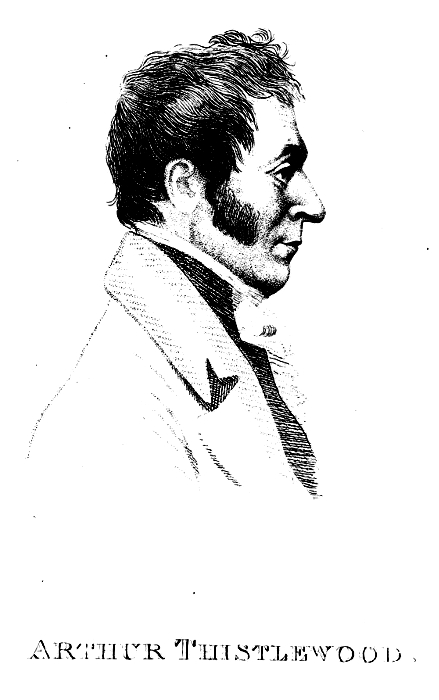
At half-past eight Thistlewood was conducted from his cell, in the care
of one of the Turnkeys. He appeared greatly dejected. He was placed in
the apartment usually devoted to those about to be put on their trials.
The other prisoners were not brought down.
As the time appointed for the sitting of the Commissioners approached,
the body of the Court became greatly crowded; while the galleries,
which are private property, and to which admission could only be
obtained by the payment of a guinea, were comparatively thin. The
boxes assigned to the Committee of City Lands and the Grand Jury were
completely filled.
At nine o’clock the Commissioners entered the Court in the same order
as described on Saturday. The Court was then opened in the usual form.
Mr. Shelton immediately proceeded to call over the names of the
Jurymen summoned. As they answered, they were asked, whether they were
freeholders in the county of Middlesex to the amount of ten pounds
a-year, or of a freehold and copyhold together of that amount? In the
event of their answering in the negative, they were passed over. Those
who did not answer when called, were called upon their summonses “to
come forth and save their fines of 100 shillings and issue.” Several
were in this predicament.
The object of this ceremony was to ascertain the number and eligibility
of the Jurymen in attendance, preparatory to their being subsequently
subject to the challenges of the crown officers and the prisoners. Some
of the gentlemen were excused from attendance on the ground of their
health being so infirm as to preclude them from doing their duty as
Jurymen.
While this form was going through, the prisoner Thistlewood was put
to the bar, and attracted general attention. He was dressed as on
Saturday, and came forward with apparent firmness. He had in his hand a
pencil and a sheet of paper. He paid particular attention to the names
as they were called over.
The Council for the Crown in attendance were, the Attorney-General,
the Solicitor-General, Mr. Bolland, and Mr. Littledale. Those for
the prisoners were, Mr. Curwood, Mr. Adolphus, Mr. Walford, and Mr.
Broderick. Such was the pressure occasioned by the assemblage of the
Jury, that they were constrained to ask permission to quit the Court as
their names were called over. This request was complied with, but they
were desired to remain within hearing.
As the prisoner stood at the bar, and while the Court was occupied in
attending to the list of the jury being called over, a man of shabby
appearance contrived to get to the corner of the dock, and to place his
hat on the board in front, and then, calling Thistlewood’s attention,
directed him to take the contents. Thistlewood immediately took from
the hat five oranges, which he put in his pocket. Mr. Brown, who was
in his box, witnessed the transaction, and admonished the obtruder. He
afterwards directed one of his turnkeys to take the oranges into his
possession. Thistlewood, on being asked, delivered up the fruit, and
they were carried out of Court to be examined.
There might seem, in this conduct, on the part of Mr. Brown, something
of harshness; but when it is recollected that an orange might be
made the vehicle of conveying to the prisoner the means of personal
destruction, or some other thing which the precautions already taken
were meant to prevent, it will be seen that he did no more than
became the vigilant execution of his duty. The oranges, having been
examined, were returned. It was intimated to Thistlewood that he should
be provided with any thing in the way of refreshment which he might
require. We have already stated, that all communication with the
prisoner, save under an order from the Secretary of State, had been
most positively interdicted. The act of the individual in the present
instance, however well-intentioned, was in direct contravention of this
order.
Subsequent to this transaction, two letters, which had come by post,
were delivered to Mr. Brown. We believe they were addressed to the
prisoners, and, after they had been shewn to him, Mr. Brown felt it his
duty to enclose and send them to the Solicitor of the Treasury.
At twelve o’clock the whole of the jury had been called over.
Thistlewood then addressed the Court, and said, “Will your Lordship
allow me a chair?”
The Lord Chief Justice.—Considering the length of time which your
trial is likely to last, the Court will grant you this indulgence.
A chair was then placed at the front of the dock, and the prisoner sat
down, having first thanked the Court.
THE TRIAL.
Mr. Shelton then announced to the prisoner, that the jury were about
to be called; and that, if he was disposed to challenge any or either
of them, he would do so on their coming to the box to be sworn, and
before they were sworn.
A considerable number of challenges then took place, both on the part
of the crown and of the prisoner; at length the following jurymen were
impannelled:
Alexander Barclay, Teddington, gent. and grocer.
Thomas Goodchild, North-end, Hendon, Esq.
Thomas Suffield Aldersey, Lisson-grove, North, Esq.
James Herbert, Isleworth, carpenter.
John Shooter, North-end, Hendon, gent.
Samuel Granger, Blackwall, lighterman.
George Dickenson, Colt-street, Limehouse, builder.
John Edward Sheppard, Eden-grove, Holloway,
John Fowler, St. John-street, iron-plate-worker.
William Gibbs Roberts, Ropemakers-field, Limehouse, cooper.
John Dobson, Felix-place, Islington, Esq.
William Cooper, Grove-street, St. Pancras, Esq.
After which the Lord Chief Justice thus delivered himself:—“As there
are several persons charged with the offence of high treason by this
indictment, whose trials are likely to be taken one after the other, I
think it necessary, in the furtherance of justice, strictly to prohibit
the publication of the proceedings of this, or any other day, until
the whole of the trials shall be brought to a conclusion. It is highly
necessary to the purposes of justice that the public mind, or the
jurymen who are hereafter to serve, should not be influenced by the
publication of any of the proceedings which may take place, until the
whole of those proceedings shall be finished. It is expected that all
persons, therefore, will attend to this admonition.”
Mr. Shelton then called the attention of the prisoner, and read the
indictment.
Mr. Bolland, as junior Counsel for the Crown, having shortly opened
the indictment, the Attorney-General, at half-past one, proceeded to
address the jury.
“May it please your Lordship, and gentlemen of the jury; you are
now assembled to discharge one of the most important duties that
can devolve to the province of a jury, to decide upon the guilt or
innocence of a party charged with the highest offence known to the
law; and, upon such an occasion, I am satisfied it is unnecessary for
me to bespeak your patient attention to the case before you, still
less even to hint to you the necessity of coming to the investigation
with unbiassed and unprejudiced minds. You, I am sure, will discharge
from your recollection every thing you may have heard or read relative
to the charge which is about to be preferred against the prisoner
at the bar, confining your attention solely and exclusively to the
evidence which will be adduced in support of the charge, and forming
your conclusion on that evidence only. Gentlemen, the charge as I have
stated to you, is one of the highest nature known to the law. Other
offences, generally speaking, however heinous and however enormous, may
in their consequences, except so far as example is concerned, end with
the fate of the perpetrators, or with the individuals who have been
injured; but, with respect to high treason, not only in its inception,
but still more so if it is unfortunately completed, it draws after
it consequences of the most important kind, affecting, not merely
individuals, but the whole community against whom it is directed.
“Gentlemen, I shall not trouble you in the observations I have to make
to you, painful as the duty now imposed upon me is, with any lengthened
detail with regard to the law as it affects the charge imputed to the
prisoner; because, if I mistake not, that law is so clear, and if I err
not greatly, the facts that will be proved to you will establish the
case against the prisoner in so clear and satisfactory a manner, that
it would be an idle affectation in me to cite any authorities before
you in support of the charge; because if the overt acts, as they are
called, or any of them, are proved to your satisfaction (and I have no
doubt but a considerable number of them will be proved,) no man who
hears me can entertain the slightest doubt that the offence charged in
the indictment will be established in point of law.
“Gentlemen, the charges in this indictment, though four in number,
will be all proved to you by the same evidence; and if the evidence I
shall lay before you be sufficient to establish one of them, it will, I
believe, completely establish the whole. Three of the offences charged,
consist in compassing and imagining the deposition of the King from his
throne; the death of the King; and a conspiracy to levy war, in order
to compel him to change his measures for the government of the kingdom.
“It is hardly necessary for me to state to you, that in proof of
these charges, it is not essential that the plans of the parties
accused should aim directly and immediately either at the life or the
deposition of his Majesty; because, if they are aimed at that form of
government which now exists—if intended to bring about a change in the
system of rule now established, by means of war, which would naturally
tend to effect that which must ultimately result either in the removal
of the King from his kingly dignity, or in compelling him to change
his measures in Council, that would be high treason; and therefore
in these cases it is quite sufficient to shew that the plans framed
were of a description and nature aiming against the government, (which
will undoubtedly be proved in this case) although not directly and in
the first instance aimed against the personal safety or the personal
authority of the Crown. If, therefore, the consequences of the acts
of the accused in this case, if those acts had been perfected, must
inevitably have led to these results, they establish in point of law
the treason charged; and therefore, Gentlemen, not to bewilder you
in the inquiry which you are about to enter upon, I think it quite
sufficient in the outset to state to you, that, in which I believe I
shall be confirmed by the highest authority in the law when this case
comes to be summed up to you, viz., that if the overt acts and facts
charged in the indictment as evidencing the intention existing in the
minds of the conspirators be proved to your satisfaction, they do prove
the charges laid in this indictment; and, therefore, it is unnecessary
to trouble you with any further observations on the law of the case.
“Gentlemen, important as the duty is which you are called upon to
discharge, and anxious as that duty certainly must be to you, mine, I
say, is no less anxious; for although in the address I purpose making
to you, I do assure you I mean only to inform your minds of the nature
of the charge brought before you, and of the evidence by which that
charge will be substantiated, yet my duty is most painful; and I make
this address with no view of leading your minds to any conclusion which
the evidence itself does not warrant—with no intention of making any
addition of my own, for, God knows, the facts want no addition to
accelerate the inevitable conclusion to which you must come. It is my
duty to state to you, as counsel for the prosecution, the case against
the unfortunate man at the bar, as detailed to me in my instructions.
My anxiety, therefore, is, I do assure you most conscientiously, not
by any thing I shall state to you to attempt to lead or direct your
minds to the conclusion which you ought only to draw from the evidence,
but to state to you calmly and fairly the facts which I believe will
be proved, without any attempt at exaggeration on the one hand, or
any thing but a fair and candid narrative on the other, without any
colouring whatever, because no colouring can alter the real facts
of the case, however high. If I should err in this, and if in any
thing I state to you, you shall, when you come to make up your minds,
think the statement not proved in evidence, or the observations or
inferences which I may have drawn shall not be fairly borne out by
the facts proved, you will dismiss them from your minds, and confine
your attention to that alone which is proved. But if you believe the
statement I shall make, if you believe the observations made in that
statement are fair and natural on the facts, then you will give them
the weight they deserve, and you will suffer them to operate so far,
and no further, as you, in your judgment, think they ought.
“Gentlemen, having said thus much, I will, without farther preface,
call your attention as perspicuously and as shortly as I can to the
facts which will be proved in evidence to support the charges. The
prisoner at the bar, Arthur Thistlewood, must be already known to you
by name; but, as I before stated to you, let nothing that you have
known or heard of him before you came into this court to discharge the
solemn duty you are bound to perform, have the least effect upon that
verdict you are to pronounce. The prisoner at the bar, however, I state
to you, as it will be proved in evidence, had for some time conceived
the wicked and nefarious plan of overturning the government so long
established in this country; and it will appear to you that several,
nay, all of the persons mentioned in the indictment, were participators
in the same design; some of them, probably, coming into that purpose
and design at a later period than others, but all of them concurring in
the last criminal event which led to their detection. I shall prove to
you by the most satisfactory evidence, that all of them were combining
in that act, which was to be the commencement of that revolution in the
country, which was meditated. I would, however, call your attention to
two persons, whose names you will frequently hear in the course of this
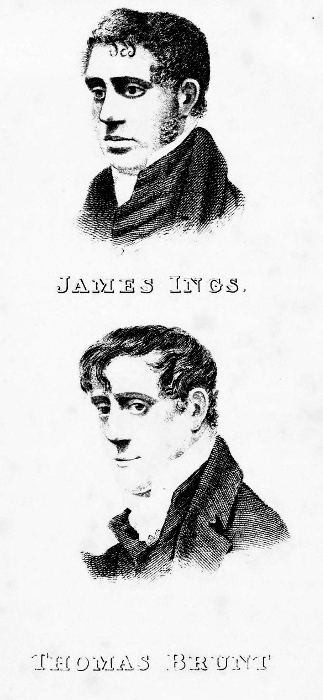
inquiry, I mean a person of the name of James Ings, and a person of the
name of John Thomas Brunt.
“The prisoner at the bar resided, during the time of the transaction
which I am about to relate to you, in Stanhope-street, Clare Market.
The person named Brunt, I believe, was a shoe-maker or boot-closer,
residing at a place which will be frequently mentioned in the course
of the evidence, Fox-court, Gray’s Inn-lane; he inhabited two rooms in
a house in that court, I believe the second floor, and in one of which
his trade was carried on, and in the other his family, consisting of
himself, his wife, an apprentice of the name of Hales, and his son,
lived.
“I shall not carry your attention very far back in the narrative of
this transaction; it will be sufficient for me particularly in the
outset, to call your attention to circumstances that took place between
the close of the month of January and the 23d of the following month of
February. Undoubtedly it will appear to you, that long prior to that
period the prisoner at the bar, the two persons I have mentioned, and
several of the others, whose names are included in this indictment,
had consulted and devised plans for the purpose of overturning the
Government. They had frequent meetings at a public-house, called the
White Hart, in Brooks’ Market, in a room which they had obtained for
the purpose of these meetings, behind that public-house.
“About the latter end of January, or at the commencement of the month
of February, they thought it prudent to remove their meetings from this
place, and that it would be better that they should be carried on, if
possible, in a room in the house where Brunt lived in Fox-court; and
to avoid suspicion, they therefore had recourse to this contrivance,
that another room in that house, and upon the same floor on which Brunt
resided, should be taken by the prisoner Ings, who is, I believe, by
trade a butcher. Brunt and Ings on that occasion hired that room,
for the avowed purpose of a lodging for Ings, but for the secret and
real object of having their meetings there, where they might devise
their plans, and prepare the means for carrying the object of their
conspiracy into execution; that being a place of more security and
privacy than the one at which they had previously held their assemblies.
“At the close of the month of January, or the beginning of the month
of February, you will learn, that having previously prepared means
for effecting their plans, their meetings at Brunt’s room became more
frequent and regular. They had determined—and, Gentlemen, I here
regret, that in an English Court of Justice I have to state to you
the horrible purpose which then entered into their minds, and the way
in which they intended to consummate the nefarious operations they
had in view.—It was thought by Englishmen, that the assassination
of several, if not all, of his Majesty’s ministers would be a proper
step towards carrying into effect the revolution they intended; and
you will find that they meditated and consulted on the means by which
that horrible purpose was to be completed. They entertained hopes that
they might be enabled, at some meeting of his Majesty’s ministers, to
effect all at once the double purpose they had conceived. Having done
that, they intended at the same moment, or about the same time, to
set fire to various parts of this metropolis—to endeavour to obtain
possession of the cannon which were at the Artillery Ground, and at the
Light Horse Volunteers’ Stables in Gray’s Inn-lane—to create as much
confusion and dismay as they could by these various operations, and
then to establish, what, in their vain expectations, they had imagined
themselves capable of effecting—a provisional government, the seat of
which was to be at the Mansion-house. They had frequent deliberations
on this plan.
“You will recollect that his late Most Excellent Majesty died on the
29th of January. At this time their deliberations were going on with
the greatest activity. During the latter end of that month and the
beginning of February, it was thought that the meeting of his Majesty’s
ministers at the King’s funeral would be a proper occasion for carrying
their plans into effect. They had intimation that upon that occasion,
the greater part of the troops centred in the metropolis would be
removed to Windsor, to witness the solemnity; and they imagined that
would be a fit and proper period to commence their operations; but,
however, they found that their schemes embraced more objects than at
that period they had the means of effecting, and upon that night they
did not attempt the purposes they had in view. But, gentlemen, brooding
over their nefarious schemes, many of these men became impatient at
the delay which from unavoidable circumstances, interposed between the
present day and that on which they hoped to accomplish their purposes;
and you will find that on the 19th of February, to which I shall
presently call your attention, the impatience became so great on the
part of many of these persons as to be restrained no longer. They found
that during this delay, an opportunity offered at which they could
effect the horrible purpose I have mentioned—the assassination of all
his Majesty’s ministers assembled at one and the same house.
“They got intimation on Saturday the 16th of February, that on the
Wednesday following the opportunity would occur when they would be able
to effect their purpose, by finding that his Majesty’s ministers would
be assembled at the same house. Upon hearing that such an assemblage
was to take place, they determined, at a meeting held for that purpose,
that at all events, on the following Wednesday some blow should be
struck, and that the revolution they had in contemplation should
actually take place.
“Having thus determined, they appointed a meeting on the following day,
Saturday, at Brunt’s house, for the purpose of forming a committee,
upon whom should devolve the plan which was to be effected on the
ensuing Wednesday, at that meeting; and indeed at all the meetings,
you will find the prisoner foremost in every thing. He was to be
their leader, and he was to be one of the men on whom they placed the
greatest reliance. You will find that at this meeting he is the person
who addressed them, and prepared the plans, and in whose plans they
placed the greatest confidence.
“Gentlemen, upon this 19th of February it was, that Thistlewood
proposed that which I have stated to you. He stated, that as it did not
appear from the intelligence they could collect, that Ministers were
likely to meet at the cabinet-dinner soon, they immediately ascertained
the strength of their respective parties, and having so ascertained
them, these parties should be divided into different bodies, upon some
of whom should devolve the horrible duty of destroying as many of his
Majesty’s ministers as their means and convenience would allow; that
upon others should be imposed the duty of setting fire to various
parts of the metropolis; and that others should be assigned other
duties, which were there pointed out by the prisoner.
“This plan, formed at that meeting, was seconded by Brunt, whose
name I have already mentioned; and there too it was agreed as I have
already stated, that on the following day, Saturday, a meeting should
take place at Brunt’s room, in order to appoint a committee, upon
whom should devolve the final arrangement of the plan which was to be
executed on the following Wednesday.
“On the Sunday the meeting accordingly took place, attended by the
prisoner, by Ings, by Harrison, by Wilson, and by other persons, whose
names are mentioned in this indictment, and with which I do not at
this moment trouble you, because, as your attention is confined to the
present prisoner, it is unnecessary to do so. At the same time, in the
course of this investigation, connecting, as we shall do, all these
persons in one common plan and design, the acts and declarations of
each will be most important, because they will all be answerable for
the acts of each in furtherance of their common purpose. Upon that
occasion they met at Brunt’s, and it was then agreed that they should
meet again on the following morning, Monday, February 21.
“After the plans, I should tell you, on the Sunday were again repeated
by Thistlewood, they were again approved by these persons. I think the
number who attended on that occasion amounted to fourteen or fifteen
persons. They then agreed that no activity should be wanting in the
mean time. I mean to prepare that to which I shall by-and-by, call
your attention. They met again on Monday at Brunt’s. The same plan was
again canvassed. No objection was made, and they then separated for the
purpose of communicating it to their different friends in different
parts of the town; and for the purpose of collecting as many persons as
they were enabled to do for the meeting on the following Wednesday. On
Tuesday the 22d of February, a meeting took place again in the morning,
at Brunt’s; and upon that occasion, one of the parties communicated
to some who were present, that he had discovered by the newspapers,
that a cabinet dinner was to be given on the following day, Wednesday,
at my Lord Harrowby’s, in Grosvenor-square. Gentlemen, you will be
shocked when you come to hear the evidence detailed, to find with what
exultation this intelligence was received. Brunt, with an impiety
which must shock every well-regulated mind, exclaimed, ‘that till then
he disbelieved the existence of a God, but that now he was satisfied
the Almighty was favouring their designs, and that this dinner was
appointed by Providence on the following day to enable them at one blow
to effect that purpose which had been levelled against each of his
Majesty’s ministers separately, and that they might be enabled by that
means to accomplish at once, the whole destruction they meditated.’
The exultation was not confined to him; you will find, that Ings
and the other persons present equally rejoiced at the prospect of a
speedy termination of their nefarious purposes, and hoping that on the
following night they should at length attain that which was so great
an object of their desire, and which they had pursued with the utmost
anxiety. The newspaper was then sent for, to see if the intelligence
was true. On being brought it was immediately determined, that instead
of the plan of endeavouring to assassinate some of his Majesty’s
ministers at their respective houses, that my Lord Harrowby’s should
be the place of attack; and that there in the evening, between eight
and nine o’ clock, after all the guests were assembled, and were lulled
into security, that the attack should be made on the house, and that
the ministers should be destroyed by the means I shall state to you.
“Their activity on this intelligence being received, was redoubled;
they met again in the evening—their different partizans were requested
at once to obtain all their fire-arms, the ammunition they had
previously collected, and the different instruments of mischief which
you will find they had prepared for execution, and that they should
be in a state of preparation on the following evening to effect this
purpose. I should have stated to you, gentlemen, before I had come to
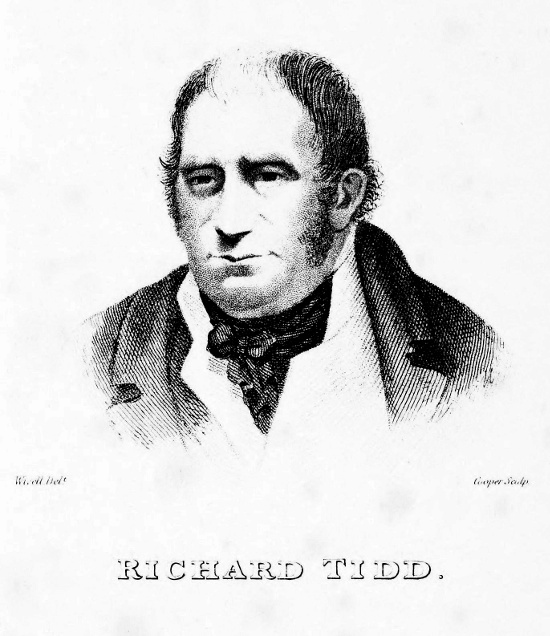
this part of the narrative, that a person of the name of Tidd, who
is also included in this indictment, and who lived, I believe in the
Hole-in-the-Wall-alley, Brooks’-market, was one of the conspirators,
and had embarked in these plans. His house was made the depôt of arms
and ammunition.
“As the meeting of the conspirators had been held at Brunt’s, they had
a suspicion that their proceedings might be watched, and they thought
it unsafe that that should be the place of deposit, and therefore
Tidd’s house had, for some time, been the depository for the arms and
ammunition which had been collected.
“As Brunt’s house was, as you know, at some considerable distance
from Grosvenor-square, where the commencement of this scene of blood
was to take place, they thought it would be better to procure some
place of rendezvous nearer to the house of Lord Harrowby; and you will
find therefore, though it was not communicated at that moment to the
different parties, who were to be engaged in the transaction, that
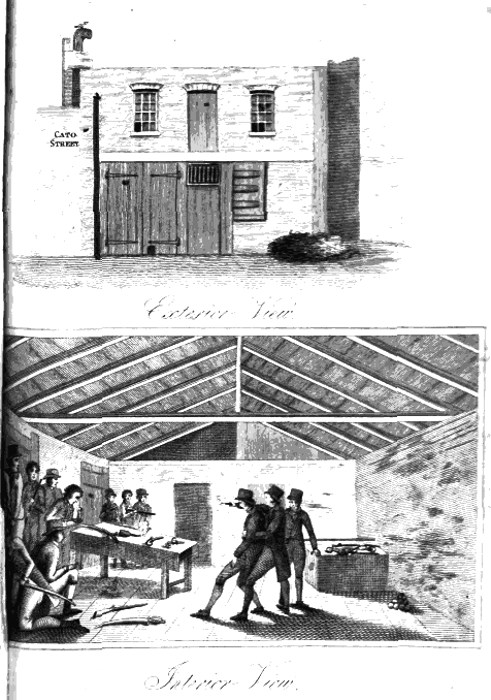
a place was procured at the west end of the town, in Cato-street,
which runs into John-street, and thence to the Edgeware-road. A place
was there procured by Harrison, another of the conspirators, for the
purpose of meeting on the following evening, preparatory to their going
to Grosvenor-square.
“Gentlemen, it frequently and providentially happens, as it generally
will in conspiracies of this nature, that some of the parties, previous
to the perpetration of their wicked designs, feel some compunction,
which leads to a disclosure of their plans, and a prevention of their
intentions; and you will find in evidence, in this case, that upon the
Tuesday, the day on which the intelligence was received that the dinner
was to be at Lord Harrowby’s the next day, which really was the case,
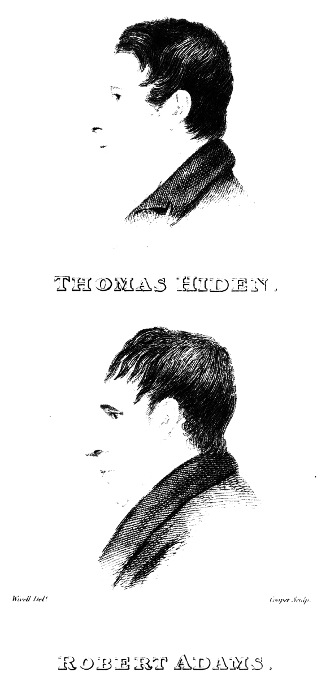
one person of the name of Hiden, who had these plans communicated to
him, because it was hoped that he would become a participator in their
designs, felt such compunction as to compel him to communicate to Lord
Harrowby the plan that was designed; and you will find, that upon that
day, this person took an opportunity of watching Lord Harrowby from his
house, on horseback, into the park, and there he generally communicated
to him that some mischief was intended against him, and therefore
forewarned him of it.
“It will also appear to you, that at their meeting on Tuesday some
little alarm had been excited in the minds of some of the party, by
a person named Adams, who had been told by the publican at the White
Hart, that their meetings had been suspected, and that they were in
some hazard of being discovered. He therefore stated to Thistlewood,
and others, on Tuesday, that a communication had been made to him
by the landlord that their meetings at the White Hart public-house
had been observed by some of the police officers, and therefore he
expressed his apprehensions, that their plans had been discovered,
or were likely to be discovered. This excited in the minds of those
present the greatest agitation. They were astonished that Adams should
have ventured at such a meeting, consisting of fourteen or fifteen
persons, to hint that there was a possibility of their plans being
discovered. The intelligence produced the greatest alarm, and they
immediately took into consideration what was best to do.
“The prisoner Brunt, in order to ascertain whether there was any ground
for the suspicions entertained by Adams, proposed that some of the
party should be posted near Lord Harrowby’s house, on Tuesday evening,
and early on the following Wednesday, with a view of seeing whether any
preparations were made to receive any intended attack, and thereby to
ascertain to their satisfaction whether or not their plans had been
discovered; and you will find that the suggestion of Brunt was carried
into effect, by sending two or three parties, amongst whom was a man
named Davidson, who will be a very conspicuous person throughout this
transaction, and one of the most active partizans, to watch the house.
They sent him and another person about six o’clock that evening, to
watch Lord Harrowby’s house, and they were to be relieved between eight
and nine o’clock by two others of the party, who were to keep three
hours’ watch; at the end of which time they were to be relieved by
others, who, in their turn, would be relieved by four in the morning.
It will be proved to you that they actually went there on that night,
and were seen by different persons in Grosvenor-square, watching Lord
Harrowby’s house for the purpose mentioned, and finding, as was the
case, that there appeared to be no alarm—that there were no police
officers, or troops of any description introduced into Lord Harrowby’s
house, or stationed in the neighbourhood, they felt quite satisfied
that it was a groundless alarm on the part of Adams—that there was no
foundation for suspecting that any of their plans were discovered; and
therefore they proceeded without hesitation or dread to complete, as
far as they could, the purpose they had in view.
“On the Wednesday morning, great preparations were made. Arms were
brought by Brunt in great abundance to the stable in Cato-street; they
consisted of sabres, swords, guns, pistols, and other destructive
instruments of offence. But one of the most terrific instruments,
and calculated for the most deadly purposes, and which they prepared
themselves, was what was called a hand-grenade. It was composed in
this way—there was a quantity of gunpowder enclosed in a tin case,
three or four inches in circumference, round which was tied a quantity
of tow, and on the outside was a quantity of iron, in pieces of
various descriptions, sharp-pointed, and otherwise shaped, which were
fastened together, and tied round with the same sort of material I have
mentioned, so as to enable the instrument to explode with the greatest
force; and the object of this machine was stated without disguise to be
this: that upon their entrance into Lord Harrowby’s house, it was to be
lighted by a fusee, communicating with the powder, and then thrown into
the room; and by the explosion, the persons exposed to the mischief
might be killed or wounded, as would naturally be the case. It seems
they had prepared a great number of these destructive instruments; I
know not how many.
“They had also prepared what they, in their mode of expression,
called illumination balls, made for the purpose of setting fire to
any buildings which it was their object and purpose to destroy. They
had prepared also a large quantity of ball cartridges, the amount of
which will probably surprise you, considering the apparently feeble
means these persons had of procuring articles of this description.
Will it be believed, that they had prepared between 11 and 1,200
rounds of ball cartridges? They had also prepared several sorts of
cartridges of a different description, made with flannel bags, and had
provided themselves with a very large quantity of powder. They had also
prepared a great number of pikes, and pike handles, for the purpose of
arming their friends and associates, who had no other arms. All these
preparations must, obviously, have been the work of a considerable
length of time. They must have been the fruits of very great labour,
and they were all prepared and ready on the 23d of February for their
intended operations.
“On the morning of the 23d of February, several of the conspirators
assembled at Brunt’s house, where they were engaged in completing
their hand-grenades, putting flints into their pistols, loading their
arms, and, in short, making every preparation for the approaching
attack. These facts will be proved to you by Brunt’s apprentice. I
have already told you, that for the purpose of their meeting, and for
the convenience of having some place near to Lord Harrowby’s house, a
stable had been hired by one of the conspirators in Cato-street, near
the Edgeware-road.
“I know not whether curiosity has led any of you, as it has done a
great many of the public, to visit the place; but if it has not, I will
endeavour to describe the situation, and I think you will agree with
me, that a more appropriate situation for the purpose contemplated
could hardly be selected. It is an obscure street, having a very narrow
access at either end. I think at one end there is not any access for
carriages, and at the other there is an archway, and under it posts,
to prevent none but foot-passengers going in or out. The east end
passes into John-street, and the west end, which is a very narrow
cartway, runs into Queen-street, both John-street and Queen-street
running parallel with each other into the Edgeware-road. The stable
is the first building as you enter Cato-street from John-street on
the right-hand side of the way, and it is nearly opposite the small
public-house, called by the sign of the Horse and Groom. The stable
had been occupied by General Watson, who is abroad, and rented of him
by a person of the name of Firth, by whom it was let to Harrison for
this purpose. It consists below stairs of a stable, with three stalls,
and a small place adjoining, for the reception of a carriage or cart;
and at the further end of it, nearly opposite the door, as you enter,
is a step-ladder leading up into the loft over the stable, on the side
of which are two small rooms, which are immediately over the cart or
coach-house.
“It will be proved to you, that previously to the meeting on that
evening, which was to take place about seven or eight o’clock,
preparations had been made by Harrison, and several others of the party
in the stable, for the reception of those who were to be assembled. In
order to avoid the observation of the neighbourhood, some pieces of
canvass had been nailed up against the window of the loft, to prevent
persons from observing on the opposite side of the street what might be
passing; and it was remarked by several of the neighbours, that this
place was visited by a great number of persons during the afternoon,
who were carrying something on their backs which the neighbours did
not discover, but which, I have no doubt, were the arms and other
implements of mischief collected there, and found when the prisoners
were taken. Harrison, who was known to be one of those persons, was
observed going into the stable in the afternoon; and on being asked
what his purpose was in going there, he said, he had taken it from
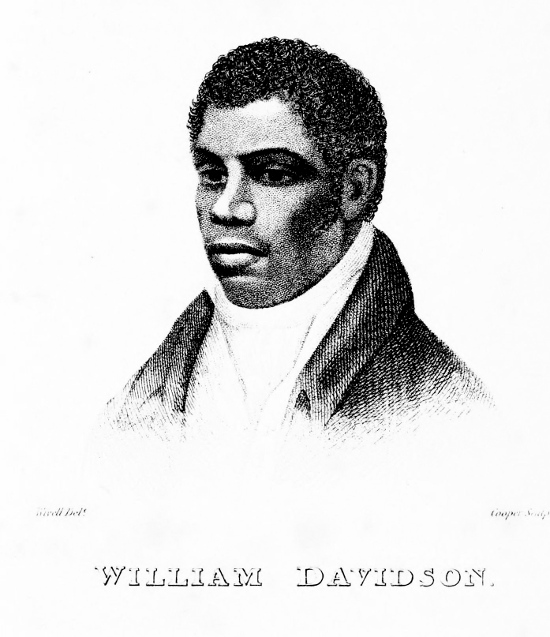
Firth, and was cleaning it out. About six o’clock, Davidson, the man
of colour, was also observed by some of these persons residing close
to the stable, going in with something on his back, and under his arm,
which they could not discover, and a number of candles in his hand. You
will find that he applied at one of the houses adjoining the stable, at
six o’clock, to light one of these candles, with which he went into the
stable. A party was to meet at Brunt’s lodgings, in order to proceed
from thence to this stable. Tidd, whose name I have already mentioned,
and who lived in the Hole-in-the-Wall-alley, was to accompany another
party. They had not communicated to all the party, at first, the
precise place of meeting, but some were to meet at the Horse and Groom,
and others were to go to the Edgeware-road, near John-street, where
some of the conspirators were to shew them to the place of rendezvous.
“Between seven and eight o’clock Brunt, and some others from his
house, took their departure with arms, with which they had there
provided themselves, and concealed under their coats, to this stable in
Cato-street. They met there Thistlewood, Ings, Wilson, and some others,
and here they proceeded to arm themselves with the weapons provided,
and which were afterwards found; such as guns, pistols, swords, a great
number of hand-grenades, and a considerable number of pikes, rudely
formed, but sufficient for the purpose of doing incredible mischief.
The handles of the pikes were composed of rough ash sticks of a large
size, the ends of which were planed off, to admit a ferrule, and at the
end was stuck a pike-head or bayonet; for articles of both descriptions
were found, screwed on for the purpose of being afterwards used.
“At first their party at Cato-street consisted only of fourteen or
fifteen persons, and some little alarm was excited, and some little
suspicion evidently raised, in the mind of Thistlewood and some
others, at Tidd’s not making his appearance at the appointed time, for
there being some remarks made that their number was not so large as
was expected, it was stated by Thistlewood, and by some others, that
there were other persons, who would by-and-by assemble, and that other
parties were gone for different purposes about the metropolis, who were
not to accompany them to Lord Harrowby’s house in Grosvenor-square.
In a short time afterwards, however, Tidd made his appearance with a
person named Monument, who will be produced as a witness; a person who
had only been recently induced to participate in their schemes—who a
short time before had been introduced to Thistlewood, and who had an
intimation generally with respect to their particular views; but he
had not been admitted to a knowledge of the whole scope of the plan,
until he arrived at Cato-street, although he might be aware that their
object was to overturn the Government in some way or other. He arrived,
however, with Tidd about seven o’clock, and the party at that time
consisted of about twenty-five persons; two of them were appointed to
remain as sentries below stairs to prevent any interruption. These
persons were Davidson and Ings, and they remained on guard whilst the
other conspirators were above stairs talking over their plans, and
making the final arrangements for proceeding to Lord Harrowby’s house,
in Grosvenor-square, which they proposed to do between seven and eight
o’clock. Some alarm, as I have already told you, had prevailed in the
party. Some of them expressed a fear that their own strength was hardly
adequate to the object in view. Upon which Thistlewood and Ings said
the opportunity must not be lost; that there was enough to complete
the purpose of destroying his Majesty’s ministers; that when that was
accomplished, the other consequences would follow; that they should
have parties ready to set fire to different parts of the metropolis;
that they would be joined by immense numbers the moment the first blow
was struck, and therefore, there could be no hesitation in their minds
to execute the intended purpose.
“Having thus assembled their forces, and prepared themselves for
the desperate object of their enterprise, they began between seven
and eight o’clock to consider who should be the party to enter Lord
Harrowby’s house to destroy the ministers. The plan had been, that
Thistlewood was to knock at the door, under the pretence of having a
note to deliver to Lord Harrowby, and by that means having obtained
access to the hall, they were to compel the servants to shew them to
the room where the ministers were assembled; that they were to secure
the servants, who, they naturally believed, would be soon overpowered,
and should then immediately make their way into the room; and then
they should, without discrimination, without reserve, or without any
remorse, destroy every one of his Majesty’s ministers who should be
assembled.
“I have stated to you, gentlemen, already the exultation and impiety
displayed by Brunt on one occasion, when he contemplated the completion
of his sanguinary purpose; and I cannot conceal from you one fact,
as it affects the man named Ings, which will be distinctly proved;
he had been a butcher, and he had armed himself on this occasion
not with a blunderbuss, a gun, or any thing of that sort, but with
a large butcher’s knife, and for the purpose of enabling him to use
it with more effect he had twisted round the handle a quantity of
thread, in order that when saturated with the blood of his victims,
it might not slip out of his hand; and he stated, in language of the
most gross and horrible import, that with this knife he would himself
effect the murder and mutilation of some of the persons who should be
assembled. The cruelty of the designs this man expressed, is beyond
all description. The scenes, in fact, which had disgraced another
country some years back, were to be acted again on British ground, and
the heads of some of the ministers were to be triumphantly paraded
through the streets, to procure converts to this detestable cause!
Gentlemen, that very knife was found upon, and taken from, that man;
and I mention that only as a corroborating fact, if corroboration be
needed. Gentlemen, thank Heaven, that Providence which kindly watches
over the acts and thoughts of men, mercifully interposed between the
conception of this abominable plot, and its completion, which was all
but perfected.
“In consequence of the communication made to Lord Harrowby, measures
were taken in other quarters to prevent the impending danger. It being
stated that these persons had met in Cato-street, for the purposes I
have already mentioned, means were immediately taken to secure the
conspirators, which, however, were not so effectual as could have been
wished, but certainly so far as to prevent the execution of their
dreadful purposes. In order to remove all suspicion from the minds
of the conspirators, it was determined by Lord Harrowby, that the
preparations for the dinner, which he had intended undoubtedly for his
Majesty’s ministers, on that occasion, should go on; and in order that
there should be no suspicion in the house of my Lord Harrowby, his
servants were desired to proceed in the necessary arrangements for the
dinner, because there is no doubt, that if any alteration had taken
place in the arrangements of the day, it would have been communicated
to the conspirators; and if they suspected that the dinner was not
intended to take place, they would have changed their measures, and the
ends of justice would have been defeated.
“In consequence, therefore, of the seeming perseverance in the design
of having a cabinet dinner, all suspicion was removed from the minds of
the Cato-street conspirators, who no doubt expected that they should
be enabled, from the short distance of their rendezvous, to reach Lord
Harrowby’s in about ten minutes or a quarter of an hour, and accomplish
their purpose unmolested—a circumstance not unlikely, considering
that the hour of eight was chosen; considering that the neighbourhood
was the most quiet and retired in London; at a time, too, when the
inhabitants of the square and its vicinity were employed in domestic
retirement; at that hour when suspicion must be lulled asleep, and
when no apprehensions could be entertained of personal danger; for
that hour, and that moment was chosen by the Cato-street conspirators
to issue from the scene of their nefarious deliberations. Precautions,
however, had been taken as I have stated to you, in order to prevent
the accomplishment of their designs. A number of Bow-street officers
and patrol, had been directed to go to the spot, and endeavour to watch
their movements, and counteract their operations, before they took
their departure, and endeavour to secure the whole assemblage.
“A party of the Guards also were to attend in John-street, to assist
the police; and, just at the moment that these persons were about
to set out, and when Thistlewood was calling over those who were to
separate from the rest to execute this horrible plan, the officers
entered the loft. Upon their entrance into the stable below, they
found two persons there, armed, who will be proved to be Davidson,
for his colour, which is nearly black, was perceived; he had a double
belt round his waist, in which were pistols and a cutlass, and he had
a gun over his shoulder; they found him inside the door, and another
person, who will be distinctly identified to be Ings. He was found at
the bottom of the ladder, with this knife, with a cutlass, a sword, and
with pistols.
“The officers, with a resolution and courage which does them high
honour, considering the desperation and determination of these
characters, immediately ascended the ladder without securing the
persons below. They merely gave directions to those who followed,
to keep them secure, and they thought that would be enough, without
actually confining them. The first man who went up was a person of the
name of Ruthven, who will be called to you: he was followed by a man
named Ellis: after whom came a man, of whom you have undoubtedly heard
before, named Smithers, who met his death by the hand of Thistlewood.
“On Smithers ascending the ladder, either Ings or Davidson hallooed
out from below, as a signal for them to be on their guard above, and
upon Ruthven ascending the ladder, Thistlewood, who was at a little
distance from the landing-place, and who was distinctly seen, for
there were several lights in the place, receded a few paces, and the
police-officers announced who they were, and demanded a surrender.
Smithers unfortunately pressed forward in the direction in which
Thistlewood had retreated, into one of the small rooms over the
coach-house, when Thistlewood drew back his arm, in which there was a
sword, and made a thrust at the unfortunate man, Smithers, who received
a wound near his heart, and, with only time to exclaim, “Oh! God!” he
fell a lifeless corpse into the arms of Ellis. Ellis, seeing this blow
given by Thistlewood, immediately discharged a pistol at him, which
missed its aim. Great confusion followed; the lights were struck out;
the officers were forced down the ladder, which was so precipitous,
being almost perpendicular, that they fell, and many of the party
followed them.
“Thistlewood, among the rest, came down the ladder; and, not satisfied
with the blood of one person, he shot at another of the officers as he
came down the ladder, and pressed through the stable, cutting at all
who attempted to oppose him, and made his escape out into John-street,
the military not having yet arrived; and he was no more seen at that
time, except with a sword in his hand in the Edgware-road. By the other
persons an equally desperate resistance was made.
“Conscious of the evil purpose for which they had assembled, they
waited not to know on what charge they were about to be apprehended;
but instantly made a most desperate resistance. Ings, Davidson, and
Wilson, were particularly desperate, each, I believe, firing at some of
the officers or military, who had only come to the ground on hearing
the report of the fire-arms, not having been previously directed to the
exact spot.
“Notwithstanding the resistance, however, which they so desperately
made, and in which resistance Thistlewood, Tidd, Davidson, Ings, and
Wilson took a most active part, by attacking the officers and soldiers,
the whole of the conspirators were, at length, fortunately overcome,
and eventually eleven of them secured. Not on that night, however,
for three out of the eleven for the time escaped, namely Thistlewood,
Brunt, and Harrison. The officers, however, not only secured on that
night the eight men, but various articles of fire-arms, numerous
weapons, and certain combustibles.
“The prisoner Brunt, gentlemen, one of those who escaped, returned
that night to his own house. He was accompanied by another man, and
his own boots were in such a state, as not to fail to excite the
attention of some persons in the house. His boy (an apprentice, named
Hale) soon learned, from the conversation which passed between his
master and the man, that they had just escaped from Cato-street, and
Brunt expressed a belief that his person had not been discovered.
The prisoner, gentlemen, remained home the whole of the night, but
early on the morning following, he called to him the apprentice boy
I have named, and asked him as to his knowledge of some street in
the Borough, where he wanted to convey some baskets. These were all
carefully packed up, and it is a remarkable circumstance, which will
be spoken to in evidence, that so anxious was he for the concealment
of its contents, that one of the baskets was secured with the apron of
his wife! Gentlemen, the prisoner now thought all secure; but he had
scarcely effected his plan, and retired into another room, previous to
despatching the baskets, when the officers entered the house and seized
him. This, you may suppose, was not a little surprising to Brunt; for,
most material would it have been to him to have the baskets removed.
Upon searching these, gentlemen, were found a number of hand-grenades,
fire-balls, and other articles of destruction. Upon their discovery,
Brunt for some time affected ignorance of the thing, but he was told it
was of no use.
“The prisoner at the bar, Thistlewood, who also escaped on the
night of the 23d, retired not to his own house, however, but to an
obscure lodging in White-street, where he thought to conceal himself.
Information, however, soon reached the police-office, Bow-street, of
his retreat, and early the next morning, a strong party of officers,
headed by Bishop, were sent to apprehend him. Upon their arrival at
the place, every precaution was, of course, taken to prevent an alarm;
while the officers, at the same time, knowing the desperate sort of
character they had to contend with, were equally guarded to resist any
attack which might be made upon them. They proceeded to search the
house, beginning with the top and descending to the lower rooms. They
then observed a small room on the ground-floor, the door of which was
locked, and Bishop demanded the key, which he procured; and knowing
from what had taken place, the determined desperation of this man, he
opened the door as softly as he could, and perceived by some slight
light that came through two or three holes in the window-shutters,
the person of Thistlewood lying on a turn-down bed. The moment he
opened the door, Thistlewood put his head up, and Bishop immediately
discovered him, and he immediately threw himself upon him, to prevent
mischief. He then said, he should make no resistance, and on being
taken out of bed, it was discovered that he had been laying in his
breeches and stockings. Gentlemen, by these means the prisoner at the
bar was taken; and thus ends, in point of fact, the evidence which will
be adduced before you.
“Gentlemen, I have now to state to you, at the suggestion of a learned
friend, a fact which I had almost forgotten. It is material for you to
know, that on the 22d February, the conspirators held a consultation
at the house of Brunt. Every thing was, on this occasion considered
as finally arranged. I have already told you, it was their plan to
set fire to various parts of the metropolis, and among other places,
the barracks in King-street were fixed upon, not only because troops
would be there, but because Harrison, who had been, I am sorry to
say, in his Majesty’s service, was acquainted with the situation of
the building, and pointed out the means by which it could be easily
fired; and thus the soldiers, who would have retired to rest, would
be unable to accoutre themselves or their horses. But this is not
all, gentlemen; for at this very consultation, Thistlewood sat down
and wrote two proclamations, in anticipation of the success of his
diabolical schemes, and which proclamations were upon that success to
be issued. But you will observe, gentlemen, it was not considered by
the prisoner duly official to write these proclamations on paper, and
Hale (the apprentice of Brunt) was sent in search of parchment. This
being procured, he wrote an address to the following effect, intended
for the people generally:—
PROCLAMATION.
“Your Tyrants are destroyed!
“The Friends of liberty are desired to come forward and
support the Provisional Government, which is now sitting.”
“So that, Gentlemen, if any doubt could be entertained of these men’s
ulterior designs not being confined to the destruction of his Majesty’s
Ministers, this proclamation, written by Thistlewood, would put it
beyond all doubt. He wrote two or three of these. He read them aloud
to the party assembled, and told them that they were to be stuck up
where the houses were on fire, that the people might see it. Afterwards
he sat down, and endeavoured to compose another proclamation, which
was to be issued to the soldiers, and that contained an offer to the
soldiers, calling on them to join the friends of Liberty; promising
them twenty pounds each to carry them home, and that they should be
rewarded with full pay and a pension for life!! These proclamations,
Gentlemen, were read aloud by Thistlewood to the conspirators, and they
were unanimously approved. Some of them, I should tell you, were to be
posted as convenient as possible to every barrack or public place which
might be set fire to or destroyed. Thistlewood himself carried the
proclamations from the house of Brunt to Cato-street.
“And now, Gentlemen, having stated these facts, let me pause to ask
you, whether, if I prove them in evidence, you can come to any other
conclusion than that the prisoner who stands before you, is guilty?
What answer, I will ask, can be given to such evidence as this, and
if no answer can be given in evidence, what answer can be given
in reason? It may be urged, in a general sense, that such schemes
and such plans as the facts I have related to you disclose, ought
scarcely to be credited in a Court of Justice. This may be inferred
from the circumstance of heated men with heated passions conceiving
and proposing the adoption of plans, wild and visionary, and in fact
wholly impracticable. In this case, however, such a principle did not
exist; for here were long laid regular plans, extensive schemes, and
the most abundant preparations, to effect a wicked purpose. And will
not desperate and designing men, infuriated by their passions either
influence others to the accomplishment of such plans, or be worked upon
by them themselves. Look then, Gentlemen, to the facts of the case
yourselves. You will view them as calm and sober men, and in doing
so, you will perceive such a system and such an adroitness towards
the execution of that system, that their object requires but little
solution.
“Gentlemen, it is not your duty to consider whether the schemes in
question were wild and visionary, but whether they had for their object
an illegal or wicked purpose; and if illegal, and that towards the
execution of their plans they took but one step, they have then done
that which renders them amenable to the offended laws of their country.
If these arguments, Gentlemen, won’t avail, what then may not be urged
for the prisoner? But you will also be told that accomplices are not to
be believed on their oath in a Court of Justice. I contend, however,
that they should; and if it was not permitted to accomplices in guilt
to give evidence for the purposes of justice, then the blackest and
foulest crimes would be daily committed, and go unpunished. But it is
not the law of England, alone, to hear the evidence of an accomplice.
It is the law of reason also, and has been the law of all ages and
nations. I admit that you should watch with the greatest caution
and jealousy the testimony of an accomplice. You should weigh his
story well, and see whether it be confirmed by the more indifferent
witnesses. Not confirmed in every part, for then his evidence would not
be required at all: but in certain collateral parts which may be found
to correspond with the other testimony. If therefore, Gentlemen, an
accomplice is produced before you, and you believe a part of what he
relates, you are bound in a great measure to believe that the whole of
what he tells you is true.
“No man, or set of men, who had ever conceived such plans as I have
laid before you, could have so conceived them without an intention of
pursuing them. The plans, therefore, at least for some time, could be
known only to themselves and to their God. I say then that the evidence
of an accomplice is not only highly necessary, but even laudable; for
if you resist such a principle, the more dark will be the crime, the
more secret the scheme, and the more wicked the purpose. As I told you
before, Gentlemen, it has long been the law of England to receive the
evidence of an accomplice, and even in cases of murder, it has proved
most salutary in the administration of justice.
“I will call a witness before you,Gentlemen, named Adams, an
accomplice, as you will find, and he being in the full confidence of
the conspirators, will prove to you the nature of all their proceedings
from time to time, and of the different plans and communications
which were made between him and them. I will call another man to you,
Gentlemen, who was the first to make known the diabolical plans of the
conspirators, to my Lord Harrowby; but this man was not much known to
them, nor did he therefore rank high in their councils.
“This man in fact, when he heard the dreadful plan related of visiting
his Majesty’s ministers with destruction and death, his heart
shuddered, his conscience smote him, and he could hold out no longer.
Some men, you know, have very strong minds, and are not to be deterred
from the most wicked purpose. Others are less firm, and more easily
shaken in the accomplishment of a cruel or immoral design. The witness
whom I shall produce to you, Gentlemen, and whose name is Hiden, is one
of this description.
“A third witness I shall produce to you, is an individual who was
rather more in confidence with the conspirators. His name is Dwyer,
and you will find that Thistlewood and Davidson applied to him for
his advice and assistance towards the execution of their murderous
purpose. You will even find that they solicited his aid on the very
day in which that purpose was to be put into execution. This witness,
however, horror-struck at the intended massacre, and feeling it to be
his bounden duty, ran almost instantly and communicated the fact to
others. He first communicated it to his wife, and next to an officer
in the army, named James, with a view that it might be immediately
conveyed to his Majesty’s ministers. This, under the special order of
Providence, was done.
“And now let me again ask you, Gentlemen, is this testimony to be
rejected? Surely it never can by enlightened men such as you are. But
this even does not furnish my case for the prosecution; for I assure
you it does not rest upon the testimony of Adams, Hiden, and Dwyer;
but there are facts in this case which, I fear, the prisoner will
not be able to answer. Why, I would ask, were these men assembled in
Cato-street, and why at night? There were none of them related to
each other, yet they were all armed with deadly weapons, and found in
close deliberation in an obscure stable. There were also found there
a quantity of destructive grenades and fire-balls, together with a
large portion of ammunition. But this is not all. At the houses of two
others of the conspirators, namely, Brunt and Tidd, there were found
similar articles of destruction, particularly ammunition. The weight
found of the latter, gentlemen, amounted to between eleven and twelve
hundred pounds; and I would ask, in the name of God, what object could
these men have had in the possession of such a quantity of ammunition?
Surely it could not even be for an individual murder! No, gentlemen, it
was the destruction of his Majesty’s ministers in the first place, the
burning and levelling of public barracks and edifices in the next, and
finally, the establishment of a revolution, and the appointment of a
Provisional Government.
“These men, Gentlemen, could never have been unfriendly towards
ministers as individuals. It must have been a hatred of them in the
character of their office alone, and their design was more particularly
levelled at Lord Harrowby, because his Lordship was President of the
Council. Can you doubt, that after this dreadful blow was made, and
it had succeeded, that it was the intention of these conspirators to
have established a provisional government, and thus spread anarchy
and confusion around. In fact, that was the eventual blow meant to be
carried into execution. I say, therefore, that even if the learned
counsel for the prisoners were to contend most successfully against
the evidence of the accomplices, the facts I shall produce to you by
other testimony, will answer the purposes of this just and necessary
prosecution.
“What was the conduct of the prisoners when they were discovered in
Cato-street? I want not, Gentlemen, by a repetition of this term, to
inflame your minds: but it will be extremely important for you to
remember, that when the officers entered the loft there, and said, ‘we
are officers,’ they submitted not to their authority, but resisted them
even in the most ferocious manner, and one officer, as you have before
heard, unfortunately lost his life. The prisoner at the bar, however,
is not under trial for that offence, nor should the fatal circumstance
operate in the present case against him. But I must again ask you, what
became of the prisoner on the 23d, the intended night of blood and
slaughter? Why he flies from the desperate scene, not to his own home,
as you have already been told, but to an obscure place of concealment.
These, then, Gentlemen, are the facts of this momentous case; and once
more I ask you, what possible conclusion can you draw from such facts,
if they be supported in evidence?
“Gentlemen, I repeat it, that this is a momentous and important
case, and if these plots of the conspirators, and of the prisoner in
particular, be proved to have existed—if the means had been used which
I have described to you for effecting the nefarious and diabolical
plans they had formed, then I call upon you, in the name of justice,
to give that verdict which will best satisfy the laws of your country,
and tend to protect the lives of your fellow-creatures. Commiseration
(if I may use the term) towards a prisoner, I never should withhold;
and God forbid, Gentlemen, that you should not give to the man at the
bar the advantage of every, even the slightest, circumstance of doubt
which may arise in his favour. If these doubts also should predominate,
it will be your duty to acquit the prisoner; but if, on the other hand,
the facts which I have laid before you be substantiated, and you feel
in your consciences that the charge is made out, it will then become
your painful but bounden duty to convict him. Should these facts, I
say, for the last time, be brought home to the prisoner, it will then
be your duty, as men, as citizens, and as fathers—as men desirous of
maintaining the laws, and of acting under the solemn obligation of your
oaths, to pronounce him guilty.”
The learned gentleman’s speech occupied the attention of the Jury for
nearly two hours.
Before the first witness for the prosecution was put into the box, all
the prisoners named in the indictment were brought up, with the view,
we suppose, of having an opportunity of hearing the evidence, it being
principally the same which is to be adduced against most of them. They
entered the Court with much apparent indifference.
Davidson and Ings were particularly remarked for the calm indifference
with which they surveyed the Bench and the spectators around them.
During the examination of Adams, some of the prisoners whispered
together. Thistlewood throughout preserved the most perfect composure.
The first witness called was
Robert Adams, examined by the Solicitor-General.—I live at
No. 4, in Hole-in-the-Wall-passage, Brooks’-market. I am a shoemaker.
I was in the Royal Regiment of Horse Guards. It is 18 years last
Christmas since I left them. I knew Brunt at Cambray, in France, he
went then by the name of Thomas Morton, it is 18 years ago since I
first knew him. I know Thistlewood. I knew him first on the 16th of
January last. He then lived in Stanhope-street, Clare-market. I was
introduced to him by Brunt and Ings. I saw him at his own place. We had
some conversation together.
Here Mr. Adolphus objected to the witness mentioning any thing of the
conversation which passed on that occasion. The crime against the
prisoner was charged in the reign of his present Majesty, and against
his crown and dignity, and no act of the prisoners in the late reign
ought to be adduced.
Lord Chief-Justice Abbot said, the Court might hear of the commencement
of the transaction, as connected with what had occurred in the present
reign.
The examination of the witness was continued.
When I went in, Brunt said to Thistlewood, This is the man I was
speaking to you about. Thistlewood said, “You were once in the
Life-Guards?” I said, “No, I was not, I originally belonged to the
Blues.” Thistlewood said, “You are a good swordsman?” I said, “I could
use a sword to defend myself; but I could not use it very expert, as
I had not used any arms for a long time.” Thistlewood said, there was
no one who was worth 10l. who was worth any thing for the good of
his country. As to the shopkeepers of London, they were all a set of
aristocrats together, and were all working under the same system of
government. He should glory to see the day that all the shops were
shut up, and well plundered. He then alluded to Mr. Hunt, and said,
he (Hunt) was a d——d coward, and were he (Thistlewood) to go to
Whitehall, he was sure he would find his (Hunt’s) name there, as a spy
to government. He then turned the conversation to Cobbett, and said, he
was equally the same as Hunt, and for all his writings, he had no doubt
he was also a spy. This ended the conversation then. I was afterwards
confined for debt in Whitecross-street Prison. The next interview I
had with Thistlewood was on the 16th, at the White Hart public-house.
It was in a room in the back yard. Thistlewood was present, and Ings,
Brunt, and Hall, and before they broke up, Tidd. On the 17th I went to
prison, and remained fourteen days there. I came out on Sunday, the day
after the death of the King. I saw Thistlewood on the Monday evening
following. I saw him in the same floor in the house where Brunt lived,
in a back room. This was in Fox-court, Gray’s Inn-lane. There were
Brunt, Ings, Hall, and Davidson, present. There was nothing particular
took place that night. To the best of my recollection, I met them next
on the Wednesday, (by them he meant Thistlewood, Brunt, Davidson,
Harrison, and Ings,) I had a conversation—
Mr. Curwood here objected to the witness speaking to what then
occurred, as no over-act was set forth in the indictment on that day.
It merely referred to a meeting on the 16th, and at divers other times.
Lord Chief-Justice Abbott observed, that the present mode was the
invariable form of such indictments, and no objection was ever made
to it. If all the particulars of overt-acts were set forth, it would
occasion a great prolixity.—The objection was over-ruled.
Witness continued—I went into the room and saw a number of pike
staves, and Thistlewood wanted to have them ferruled. Thistlewood
then asked why Bradburn (the prisoner) was not present, and he added
that Bradburn was intrusted with money to purchase ferrules, and was
not satisfied lest he should not buy them. The staves were green, and
seemed as if they had just come from the country. Thistlewood said he
would not give a damn for a man who would spend the money in such a
way. I do not recollect any thing further then. The meetings were held
twice a-day from thence to the 23d of February. The room was hired
by Brunt for Ings; Brunt said so. I remember one circumstance that
occurred: one evening, about ten days before the Cato-street business,
I went in and saw Harrison, Thistlewood, and Brunt. Harrison said, he
had been speaking to one of the horse-guards, and he told him, that
the whole of them would be down at Windsor at the King’s funeral; and
Harrison said, this would be a good opportunity to do something that
night (the night of the funeral.) Thistlewood said it was a good place,
and added, that if they could get the two pieces of cannon in Gray’s
Inn-lane, and the six pieces in the Artillery-ground, they could so
help themselves as to have possession of London before morning; and he
said, that when the news should reach Windsor, the soldiers would be
so tired as not to be able, when they came back to London, to do any
thing; but that by activity some might go to Hyde-park, and prevent
any person or messenger from going to Windsor. He also said, that
they should go over the water and take the telegraph, to prevent any
communication with Woolwich.
He then said that they should form a Provisional Government, and
send to the sea-ports, to prevent any gentlemen from leaving England
without passports. He particularly mentioned to send to Dover,
Brighton, Margate, and Ramsgate, and he most particularly mentioned
Brighton—not that he thought the new King would be there, or at the
funeral. He said the present family had inherited the throne long
enough, and it was no use for the present King to think of being
crowned. Brunt and Ings came in after this, and Thistlewood mentioned
to them what passed; but they said that nothing would satisfy them but
their plan of assassination. They had talked at a former meeting of
this plan of assassination. Two or three of them had drawn out a plan
of assassinating his Majesty’s Ministers at the first public dinner
they had. They talked of assassination at every one of their meetings.
I could not say there were pikes in the room before this. I met them on
Saturday, the 19th of February, at eleven or twelve in the forenoon.
I saw Thistlewood, Davidson, Brunt, Harrison, Ings, and Hall. They
were all set round the fire, and seemed in a conversation betwixt
themselves. They all got up and turned round, and said, “It is agreed,
if nothing turns out before next Wednesday night, next Wednesday we
will go to work.” It was said they were all sworn that they would not
wait any longer.
Thistlewood proposed they should meet the following morning at nine, to
draw out a plan to go by. Thistlewood said to Brunt, “You had better
go round this afternoon and mention it, in order to have the committee
to-morrow.” Brunt said, he did not think he should be able to go, as he
had some work to do, but he would go on the next morning, and perhaps
he might see some of them: it was not necessary to bring a great many.
Brunt appeared to be leaving the room then, and Thistlewood called
to him, and said—“O, Brunt, it will be highly necessary for those
that come to-morrow morning to bring fire-arms with them, in case any
officers should come up.” On which Brunt said, “D—n my eyes, if any
officer should come in here, the time is so near now, I would run him
through the body. I would murder him here sooner than we should be
discovered.”
On the next morning I went there about eleven o’clock. It was a little
dark in my eyes when I went in after the snow. There were Thistlewood,
Brunt, Harrison, Cooke, Bradburn, Tidd, Edwards, and Wilson, myself,
and another. William Cooke, on looking round the room, said, “There
are twelve in the room, and I think it enough to form a committee.”
Thistlewood proposed that Tidd should take the chair. Tidd took the
chair, and sat with a pike in his hand. Thistlewood was on his right
and Brunt on his left. Thistlewood said, “Gentlemen, you all know
what we are met for;” and then he turned to the door, as if unwilling
to mention it, and said, “the west-end job.” Brunt then said, “D—n
my eyes, name it.” On which Thistlewood again said, “Gentlemen, we
are come to the determination to do this job, that we were talking
about so long, and as we find there is no probability of meeting them
(Ministers) altogether, we shall, if no opportunity of doing them
altogether occurs, take them separately, at their own houses, and do
as many as we can. If we can only get three or four at a time we must
do them.” He also said, “I suppose we can take forty or fifty men to
do this west-end job; and I propose to take the two pieces of cannon
in Gray’s Inn-lane, and the six pieces in the Artillery-ground.” He
proposed Cooke to lead this party, and he himself would command. He
said they should take the Mansion-house as the seat of the Provisional
Government.
They were next to take the Bank of England; and Palin should be the
man who should set fire to the barracks, and several parts of London.
This was the principal part of the plan, but if any thing else occurred
before Wednesday, they would think of it. Brunt was then going to
put a proposition which he had for assassinating the Ministers, but
Thistlewood said, his plan should be first put from the chair, as they
were nearly all agreed on it. He desired the chairman to ask if any of
them had any thing to say, and that they should say it; but none of
them saying any thing, the plan was carried unanimously. Brunt then
came forward with his plan, which was, that they should assassinate
as many of his Majesty’s Ministers as possible; that they should draw
lots to assassinate some of the Ministers; and whoever the fellow was
on whom the lot fell, he should murder the Minister, or be murdered
himself; and that if any man failed in the attempt, he (Brunt) swore by
all that was good, he should be run through the body. On which I got
up, and said, “Mr. Brunt, do you not think it possible for a man to
attempt such a thing, and not succeed in it; and do you mean to say he
should be run through the body for not doing it?” To which he said, “I
do not: if a man should attempt it and not succeed, he is a good man;
but if he shews any cowardice, he deserves to be run through the body.”
This proposition of Brunt’s was then put to the meeting.
Soon after this, Palin, Potter, and Strange, came in. They were
welcomed, and were desired to sit near the fire, as they were wet.
Palin said, “There is one thing I want to know; if it can be done, it
will be a great assistance to our plan. I want to know what men are to
perform each part of the plan, and who are to take the cannon. I want
to know, in calling upon the men, whether I can tell them in part or
whole what is to be done.” The chairman said, “I don’t see where the
harm is of telling what is to be done.” Mr. Palin, seeing that he had
that liberty, sat down quite satisfied. Nothing regular was transacted
in the chair after that. Mr. Thistlewood said, “O, Brunt, that is well
thought of, as Palin is here: you and Palin go, and see if the house
near Furnival’s Inn is fit for setting fire to.” They went (Palin and
Brunt), and reported it would make a d——d good fire. Thistlewood
talked of getting means for a treat on Tuesday and Wednesday. Brunt
said, he would be d——d, but he would contribute the only 1l. note
he had earned for a long time. They proposed the White-Hart for the
house. Thistlewood proposed his own room; but afterwards thought it
would not do, as it might lead to suspicion. This was all on the Sunday
morning. On Monday morning they met again. Witness then told them
what Hobbes told him on Sunday night, of inquiries made respecting
radical meetings at his house, and that information of it was given at
Bow-street office, and at Lord Sidmouth’s office. Harrison turned round
on witness like a lion, and said “Adams, you have acted d——d wrong.”
Brunt said so too, and added, “Whatever you have to communicate, you
have no business to communicate but to me and to Thistlewood.” Witness
said, it concerned all, and he should tell all of it. They repeated the
same observations. They talked of calling a meeting of the Mary-le-bone
Union, as they wanted some money; and Brunt said, it would be of use
for that purpose.
Witness and Potter went in the evening to the White-Hart; Palin and
Bradburn joined them. Next morning they were there too, and with them
Thistlewood, Tidd, Ings, Harrison, and Brunt. Edwards came, and told
them there was to be a cabinet dinner next night. Thistlewood said,
he did not think it was true. A newspaper was sent for, and read
by Thistlewood. He read that they were to dine at Lord Harrowby’s,
Grosvenor-square. Brunt then said, “I’ll be d——d if I don’t believe
there is a God. I have often prayed that he would bring all these
thieves together, in order to destroy them. He has answered my prayer.”
Thistlewood proposed, that they should form a committee and sit
immediately. Witness took the chair.
Thistlewood proposed immediately a fresh plan to be formed respecting
the assassination. Witness expressed a hope they had paid due
consideration to what he said yesterday. All got into confusion.
Harrison said, “D—n that man who attempted to throw cold water on the
plan, but he would run him through with the sword.” Witness left the
chair, and Tidd took it. Brunt moved that a watch should be set on the
Earl of Harrowby’s house that night. The object was to see if any men
or soldiers went into Earl Harrowby’s. Two were to go at six, to be
relieved at nine, and they were to continue till twelve. The watch was
to be resumed at four next morning.
Thistlewood said he hoped they would be satisfied that no officers or
soldiers went in. They would do what they had determined to-morrow
evening; and added, that it would answer their purpose much better than
to attack their houses separately, when only two or three could be got
together. Here they would have fourteen or sixteen; a rare haul to
murder them all. “I propose,” continued he, “when the door is opened,
to rush in, seize the servants, present pistols, and threaten to kill
them if they make any noise; two to take the entrance to the stair
upwards, and two others to the stair to the lower part of the house,
armed with blunderbusses and hand-grenades; and if any attempt to pass,
to throw hand-grenades and destroy them all. Others are to go where the
ministers are to murder them all. If there shall be any good men, kill
them for keeping bad company.” All agreed. Ings said, he would go in
first, with a brace of pistols and knives. The two swordsmen would cut
off all their heads; and Castlereagh’s and Sidmouth’s should be flung
in a bag by themselves. He added, “I shall say, my Lords, I have got
as good men here as the Manchester yeomanry; enter citizens, and do
your duty.” Harrison and witness were to be the swordsmen. After the
execution of Lord Harrowby, at his house, Harrison proposed that some
should go to King-street horse-barracks, and set fire to the premises
by throwing fire into the straw in the stable.
Harrison and Wilson were to go to Gray’s Inn-lane, and, in case they
could not carry the cannon out of the military-school, they were to
wait till a party came to assist them. Thence they were to proceed to
the artillery barracks, to assist Cooke in taking the cannon there. If
they found their strength sufficient to proceed, they were to advance
to the Mansion-house, and plant three of the cannon on each side of the
Mansion-house, and to demand the Mansion-house. If it were refused,
they were to fire, and then it would be given up. The Mansion-house was
to be made the seat for the Provisional Government.
The Bank of England was next to be taken. They would take the books,
which would enable them to see further into the villany of the
government. The further parts of the plan were delayed till Wednesday.
They agreed upon a sign and countersign. The word was “Button;” the man
who came up was to say B-u-t; and the other was to reply t-o-n.—Being
asked as to the watch, witness said, There are other things which I
wish to state. I went there next morning, and found Edwards, Ings, and
Hall, making fusees for the hand-grenades. Davidson went on the watch
at six. Witness and Brunt went to relieve the watch. They saw Davidson
in the square, on the watch. They went into a public-house, where
Brunt played at dominos with a young man.
About eleven they went out into the square, and walked for some time,
till witness got ashamed of himself. They went away at twelve o’clock.
He went next day to Fox-court, between two and three. He found Brunt
there. Strange came in, and in a few minutes afterwards two more
strangers. Strange and another were trying the flints. They went into
a back room to avoid the strangers, where witness saw cutlasses,
blunderbusses, &c. Thistlewood, Ings, and Hall came in. Thistlewood
said, “Well, my lads, this looks like something to be done.” He touched
witness on the shoulder, and asked how he was. Witness replied that
he was very unwell, and in low spirits. Thistlewood sent for beer and
gin. Thistlewood then wanted some paper to write bills on. Witness
said, cartridge paper would do. The paper was brought; and table and
chair were got. The bills were then written; they were to be set on the
houses, to let the people know what had been done. Thistlewood read as
part, “Your tyrants are destroyed—the friends of liberty are called
upon to come forward—the Provisional Government is now sitting. James
Ings, Secretary. February 28.” Thistlewood was much agitated, and could
write only three. Another bill was written, which was an address to
the soldiers. Another person was employed to write it, and Thistlewood
dictated to him.—Witness said he would tell what he had seen.
Mr. Adolphus objected to this, and contended, that the writing alone
was evidence.
Witness could not say what became of the papers, and he had not seen
them since.
Mr. Solicitor-General now stated, that notice had been given to produce
the writings.
Witness said that this second kind of bill was not finished,—they
could not agree as to the terms.
Mr. Adolphus renewed his objection to the question what Thistlewood
dictated to be written.
Lord Chief-Justice Abbot.—In whose hands had you last seen the paper?
Witness did not know him.
His Lordship said, some doubts were entertained by some part of the
Court.
Mr. Solicitor-General said, he would not press it.
Witness went on.—Ings had two black belts on, one for two pistols, the
other for cutlasses. He had two bags on his shoulders, like soldiers
haversacks. He looked at himself and said, he was not complete yet,
he had forgot his steel. He took out a large knife, and brandished
it about, and said, it would cut off the heads of Castlereagh and
Sidmouth, and it would be thought a great deal of at some future time.
The knife was a large broad knife, twelve inches long, the hand bound
round with wax to keep a firm hold of it. Others were busy at other
arms. They began to leave the room about half-past four or five, to go
about the business.
Palin came in half an hour before. Palin said they ought to be aware
of what they were about, and to think within themselves whether they
were to do their country service or not, and whether the assassination
would be countenanced by their country. If they thought their country
would join them, then the man who flinched should be run through on the
spot. Unless they came to this determination they would do no good.
A tall man came in, and asked what the business they were about was.
Witness had never seen him before. The tall man said, if they were
to serve their country, he was their man, and if any one was afraid
of his life, he ought to have nothing to do with such a concern as
that. Thistlewood was then gone. Brunt was told, that inquiries were
made by some who were present, as to the plan they were about, Brunt
said, that was not the room for telling that; but they should go
with him, and they would know. Brunt promised spirits; and the tall
man cautioned against drunkenness, as ruinous to a cause like that.
They went along the street, two and two, and at some distance, that
they might not be observed. There was a cupboard in the room used for
swords, hand-grenades, and flannel bags for cartridges, one of which
was full. The rest of the arms were in Tidd’s room; that was the depôt.
Thistlewood was always in a hurry to carry every thing that was got
ready into the depôt, lest any officer should see it. Witness carried
a brass-barrelled blunderbuss. There were pikes made of old files.
Witness as he went on missed all his associates. He returned back, and
met Brunt, who returned back with him along the Edgeware-road, till
they met Thistlewood.
They went altogether to the stable in Cato-street. Witness stayed
behind till Harrison came up, and made him go in. He saw there,
Davidson and Wilson below, Thistlewood, Ings, Hall, Bradburn, Strange,
Cooper, the tall man, and others above. There were, as Thistlewood
calculated, at last, eighteen above and two below. There was a bench
above and arms on it. Some beer was standing on the table. There
were lights. There was a chest. Before Tidd came, Thistlewood went
out for some time. Witness heard a deal of talk below, and he found
Thistlewood, Brunt, Harrison, Davidson, and Wilson. They spoke of
the good news, they heard that the carriages were arriving at Lord
Harrowby’s as fast as they could. Witness went up to the loft, and saw
Thistlewood and Brunt much agitated. They spoke of Tidd’s absence.
Brunt pledged his word that he would come. He soon afterwards came.
Thistlewood said, “I hope you will not give up what you are going to
do; if you do, this will be another Despard’s business.” He then
counted twenty persons, and said that was enough, fourteen would be
sufficient to go into the room, and the other six would take care of
the servants and doors. They then set apart fourteen.
The gin bottle was then started. Thistlewood said, if Lord Harrowby had
sixteen servants, that was nothing, as they would not be prepared. A
noise was heard below. Thistlewood took a candle and looked down to see
who they were, and then set down the candle quite confused, according
to witness’s judgment. Two officers took command of the room, holding
small pistols, and said, “A pretty nest there is of you. We have got
a warrant to apprehend you all, and hope you will go peaceably.” A
man who was on the step of the ladder said, “Let me come forward.”
This was the man murdered. A group of persons had got into the little
room, and then came forward, and one of them stretched forward an arm,
witness saw nothing in it, and another presented a pistol. The man
fell. It was impossible for him to give a particular account of the
other transactions. He got away, went home, and was apprehended on the
Friday, and remained in custody since. He identified Davidson, Wilson,
Brunt, Ings, Cooper, Harrison, Tidd. There were two he did not know.
They were again called forward, but he said he could not swear to them.
He was sent forward near the dock: but he said he did not know them.
One of them, he said, he saw at the meeting.
Cross-examined by Mr. Curwood.—He went not there to assassinate his
Majesty’s Ministers. His legs carried him there. His outward intent
to all appearance was for that; but his inward intent was against it.
He was kept to it, because Brunt said, whoever forsook them would be
marked. He became acquainted with Brunt in Cambray, in 1816. He had
been a soldier years before. He was a shoemaker. He had never been
treasurer to a benefit society. He carried with him 40l. He thought
the money his own. He had never been charged with stealing it. He
was introduced to Thistlewood by his friend Brunt, to assassinate
his Majesty’s Ministers. That was the first object. He first gave
information on the Saturday after. It was indeed from compunction.
“My motive was, gentlemen of the Jury, I do assure you, that I made a
vow to God that I should tell the whole truth. I did indeed regard it
with horror. I felt compunctious visitings before I was in custody. It
was not because I felt my neck in danger, or because I thought it was
better eighteen should be hanged than myself.” The greatest number he
ever saw present was fifteen men. The greatest sum he saw was sixpence.
There was no collection of halfpence and pence for the newspaper.
Tidd’s was the depôt. He saw no muster-roll, and no cannon-ball. The
cannon were to be charged with cartridges, and a large hammer was to
be bought to strike down the tops of the iron palisades, as it was
thought they would do more execution than balls. The newspaper was
“The New Times.” Witness did not know whether it was correct. He had
seen nothing of Edwards since. He was employed to carry a sword, as
being expert at it. He was not sufficiently near to have killed the man
in the loft with the sword. His hand was not extended. He could tell
nothing of the proceedings that followed. He went away, and did not
deliver himself up, because he saw no officer. He went home to abide
the event.
Re-examined in chief.—He said, the British army were at Cambray when
he became acquainted with Brunt there.
Another witness was then called, but the Court and Jury were of
opinion, as it was half-past seven, that it was the best time for
adjourning. The Court was accordingly adjourned till nine o’clock on
Tuesday morning.
SECOND DAY.—Tuesday, April 18.
The Court met this morning at nine o’clock, and the names of the Jury
having been called over, and Thistlewood and the other prisoners being
put to the bar, the evidence for the prosecution was continued.
Eleanor Walker examined by Mr. Gurney.—I am servant to Henry
Rogers: he lives at No. 4, Fox-court, Gray’s-Inn-lane. We had a lodger
named Brunt. He occupied two rooms on the second floor. They were
front rooms. In January a lodger came, introduced by Brunt. This was
a month or five weeks before Brunt was taken up. He (Brunt) said the
lodger lately came from the country, and he wanted a room; and as we
had one to let, he wished him to have it. The room was unfurnished. He
paid three shillings a week for it. He (the lodger) said he might not
bring his goods in for a week or better. He never brought any in to my
knowledge. I do not think I should know him again. I do not remember
having heard him called by his name. The room he took was a two-pair
back room.
This witness was not cross-examined.
Re-called.—While this person occupied the room, I heard persons
frequently go up stairs.
Mary Rogers, the aunt and mistress of the last witness,
examined by Mr. Gurney.—The room was let by my maid while I was out.
After the lodger had been in the house for a week, I said to Mr. Brunt,
“You have brought a lodger.” He said, “Yes, I have, and I hope he will
pay you. I know nothing of the man, but seeing him at a public-house,
and seeing him want a room.” He said he was a butcher out of work. He
paid me for four or five weeks. I cannot say whether he ever slept
there; he did not to my knowledge. I and my maid in the evening saw
three men coming up stairs. The one in the middle was a black man. The
light from my room was on their faces. At other times I heard persons
going up stairs, but took no particular notice.
This witness was not cross-examined.
Joseph Hale, a young lad, the apprentice of Brunt, examined
by Mr. Gurney.—I am apprentice to Brunt. I have served two years
and better of my apprenticeship. I lived with him in Fox-court. I
remember a person coming to lodge there in January. His name was Ings,
a butcher. Brunt and he looked at the room. Brunt said, “It will do;
go down and give them a shilling.” After that Ings used to come to the
room. The key was mostly left in the front room, and Ings used to come
there for it. Persons used sometimes to come to the room before my
master was taken up. This was every evening. I saw different persons.
They were Ings, Tidd, Thistlewood, Bradburn, Edwards, Hall, Potter, and
Strange. I remember a man named Adams: he came. Davidson, the black
man, came also. Others used to come, but I do not recollect them. They
used to stay nearly about two hours. There was no furniture in the
room that ever I saw. They used to take chairs in, out of the front
room. I did not hear any of their conversation. They used to call
Thistlewood sometimes T., his initial, and sometimes Arthur. I once saw
the door of Ings’s room open, and saw some long poles, like branches
of trees cut rough; I suppose about twenty of them. I sometimes heard
hammering and sawing in the room. My master was taken on Thursday,
the 24th of February. On the Sunday before that there was a meeting
in the room. There were more that morning than ever I had seen come
up before. All the persons whom I have named were there that morning.
After the meeting broke up I saw Strange in my master’s room. There
was no meeting on the Monday evening. There was no meeting on Tuesday.
On the Wednesday there were several persons going in and out. Some of
them came into the front room, where I worked. They got some pistols,
and were putting new flints in them. There were five or six pistols.
One of the men said there were people overlooking them from the next
house, and Brunt told them to go to the back room. Strange and a man
whom I did not know were the men who had the pistols. I cannot say how
many I saw go in and out. I saw Thistlewood that day. In the afternoon
he asked me for a sheet of writing-paper. I gave him one. He took it, I
believe, into the back room.
My master after this came out of the back room, and desired me to get
six sheets of cartridge paper. He gave me sixpence. I bought the paper
and gave it to him, and he took it into the back room. This was about
four or five in the afternoon. I heard people going down stairs between
five and six. My master was in and out several times. He went away
finally about six. There was a man went with him. It was not one of
the men I used to see there. A table had been taken that day from my
mistress’s room to the back room. I wanted the table, and went for it.
I knocked at the door, and Potter opened it. There were four or five in
the room besides Potter. After my master was gone, I saw Tidd between
seven and eight. Mrs. Brunt called him, and he came into her room. She
showed him a pike-head and a sword. She asked him what she should do
with them. She then gave them to him, and he took them out of the room
into the back room. After this I heard some persons go down stairs.
Tidd left a message, that if any persons called they should be sent
to the White Hart. Some persons did call on my master, and I went to
show them to the White Hart. Potter came, and he went. He knew the way
himself. There were three came to whom I shewed the way.
My master came home that night at about nine o’clock. I observed his
dress was dirty. He appeared confused. I heard him say to his wife, it
was all up, or words to that effect. He said that where he had been,
a great many officers had come in. He said he had saved his life, and
that was all. Just as he said this, another man came in. I do not know
that man. Brunt shook hands with him, and asked him if he knew who had
informed. The man said, no. The man then said, he had had a dreadful
blow on the side, which knocked him down. Brunt then said, “There is
something to be done yet.” After this Brunt and the other man went
away together. Mrs. Brunt and I after this went to Ings’s room. I saw
several rolls of brown paper with tar in them. I saw only one pole
remaining. I saw something rolled up, and tied round with strings. I
understood them to be hand-grenades. I saw an iron pot belonging to
Brunt. My master came in about eleven o’clock. He told me to get up
in the morning as soon as I could and clean his boots. They were very
dirty. He called me in the morning at half past six, and when I got up
he asked me if I knew the Borough. I told him yes. He then asked if
I knew Snow’s-fields. I said no. He then went into the back room and
put the things out of the cupboard into two baskets; one of which was
afterwards put into a blue apron belonging to Mrs. Brunt. This apron
had before this been as a curtain in Ings’s room.
My master told me that Potter lived in Snow’s fields. When we had the
baskets ready, two officers came in and took my master into custody.
I knew where Tidd lived. He lived in the Hole-in-the-Wall-passage,
Brooks’-market. Adams lived next door.
Cross-examined by Mr. Adolphus.—My master is a journeyman shoemaker:
not a very poor man. Adams is also a shoemaker. Ings had the lodgings
five weeks. I believe they had meetings there every night. I thought
there were about twenty persons there on the Sunday. I know some of the
prisoners. Strange is a boot-seller—selling boots in a shop. Edwards
was an artist. Edwards was there very often: oftener than Adams—almost
every day. Hall was a journeyman tailor, I believe. I don’t know where
he lives. I cannot say how many persons were there at one time on
Wednesday. The baskets used by my master were rush baskets. As near as
I can guess there were about twenty poles. They were branches of trees
in a green raw state. I believe they kept a fire in Ings’s room. I do
not know whether the poles were cut up to light the fire or not.
Thomas Smart examined by Mr. Littledale.—I am a watchman of
the parish of St. George, Hanover-square. I was on watch on the south
side of Grosvenor-square, on Tuesday the 22d of February. I went there
about eight o’clock. About half-past eight I saw four suspicious men
walking the square. I thought they were after no good; one of them was
a dark man, and the other a tall man. I watched them. They were looking
down the areas. Charles Bissix’s box is at the west side of the square.
Cross-examined by Mr. Curwood.—It was not a very uncommon thing to see
suspicious men walking about.
Henry Gillan examined by Mr. Bolland.—I am a servant to Mr.
Whittle, apothecary, at 15, Mount-street, Grosvenor-square. I sometimes
use the Rising-sun public-house. It is in Charles-street, which
runs into Grosvenor-square and Mount-street. I was there on Tuesday
the 22d of February. I saw that short man (pointing to the prisoner
Brunt) there. There was a tall man with him. They had some bread and
cheese and porter. There were dominos on the table, and the short man
challenged me to play with him. I played two games with him, and left
the house before ten, leaving them there.
John Hector Morris examined by the Attorney-General.—I am
a journeyman cutler to Mr. Underwood, in Drury-lane. I remember on
Christmas-eve a man brought a sword to my master’s shop. The man was
habited like a butcher. He drew the sword from under his smock-frock,
without a scabbard. He wished to have it ground sharp, particularly
at the point. He said to put the name of Inns on it; but I am hard of
hearing, and it might be Ings. He called for it in a few days. In about
a fortnight he brought another sword to have it sharpened in the same
way. It was much longer than the other. [Here the witness identified
the prisoner Ings as the man who brought the swords.] I should know the
swords again.
Edward Simpson examined by the Attorney-General.—I am a
corporal major of the 2nd Regiment of Life-Guards. I know a person
named Harrison. He was in the Guards. (Here he identified Harrison.)
He was discharged in 1814. When I knew him, he was in King-street
barracks, Portman-square. He had an opportunity of knowing them. Part
of the barracks looked into Gloucester Mews. There was a loft with five
windows looking into it. There was hay and straw in that loft; the
windows had been stopped up since the Cato-street business.
Cross-examined by Mr. Curwood.—I don’t know how many men are in
Knightsbridge barracks; they would hold about 300.
James Adams examined by the Attorney-General.—I am a
pawnbroker in Berwick-street. I know the prisoner Davidson from his
having pledged things at my shop. He came on the 23d of February, in
the morning, and took a brass-barrelled blunderbuss out of pledge.
This witness was not cross-examined.
Thomas Hyden examined by Mr. Gurney.—I am a cow-keeper. I was
formerly a member of a shoemakers’ club. I knew Wilson there. I saw
him a few days before the 23d of February; he met me in the street,
and made a proposition to me. He asked me if I would be one of a party
to destroy his Majesty’s Ministers; he said they were waiting for a
cabinet dinner, and that all things were ready. He told me they had
a sort of things which I never saw; they were called by the name of
hand-grenades,—and, he said, he depended on me to be one. He said
that Mr. Thistlewood would be glad to see me, if I would be one. He
said, the use to be made of the hand-grenades was to be put under the
table, at the cabinet dinner, with the fuse alight, and those who
escaped were to be destroyed by the sword or some other weapon. He
also said that fires were to be lighted, and the town to be kept in
confusion for several days, till the thing became general. He named
some houses. Lord Harrowby’s, Lord Castlereagh’s, Lord Wellington’s,
Lord Sidmouth’s, the Bishop of London’s, and several others which I
do not remember. I told him I would make one. This was, I believe,
four or five days before the Cato-street business. Before that I
went to Lord Harrowby’s. I do not remember the day. I followed his
Lordship in the park. I gave him a note. On Wednesday, the 23d, I saw
Wilson again. I believe it was between four and five o’clock in the
afternoon. I met him in Manchester-street, Manchester-square. He said,
“Hyden, you are the very man I wanted to see.” I asked him what there
was going to be; and he said, there was to be a cabinet dinner at Lord
Harrowby’s, Grosvenor-square. He told me I was to go to the Horse and
Groom public-house, the corner of Cato-street. I was to go in there,
or otherwise I was to wait at the corner until I was shoved into a
stable close by. I asked him the hour, and he said about half past
five or a quarter before six. I then asked him how many there were
to be, and he said twenty or thirty. I asked him, was that all there
was going to be? and he said, there was to be another party in the
Borough, another in Gray’s Inn-lane, and another in Gee’s-court, or
in the city. He said, all Gee’s-court were in it; but they would not
act till after the English began, as they had so often deceived them
before. Gee’s-court is inhabited by Irish. It is at the St. Giles’s
end of Oxford-street. He also said there was a gentleman’s servant
supporting them with money; and, if they would act on the subject, he
would give them a great deal more. He asked me if I had a gun; and I
said yes, but it was only a rubbishing one. He then said they would
provide me with a gun, and something to work with. There were, he also
said, two pieces of cannon in Gray’s Inn-lane, which they could get by
breaking in a small door. He said there were four pieces of cannon in
the Artillery Ground, and they could be very easily taken, by killing
the sentinel. After they left Grosvenor-square, they were to meet near
the Mansion-house. I was told to come to my time, or the thing would be
done before I came.
I went to John-street that evening; it was nearly seven o’clock. The
entrance to Cato-street is a little gateway from John-street. When I
got there I saw Wilson and Davidson; I had seen him (Davidson) before.
Davidson said I was come, and he asked me if I would go in. I said no,
as I was going somewhere else to look for some cream. He said if I
would go in, Mr. Thistlewood was there. I asked him what time I should
be there, and he said eight o’clock. If I were not there in time, he
said, I was to follow them down to Grosvenor-square, and, at the fourth
house from the corner, at the bottom of the square, I should find them.
Cross-examined by Mr. Adolphus.—I am not certain whether the
first conversation I had with Wilson was before the Sunday, before
the Cato-street business. I am not quite certain. It was four
or five days before. I am not able to say what day I gave the
information to Lord Harrowby. It might be a day or two before I saw
Wilson in Manchester-street. The conversation with Wilson was in
Manchester-street; we were walking up and down the street.
A note was here put into witness’s hand, which he said was the one
given by him to Lord Harrowby. It was in his own hand-writing.
Cross-examined.—The reason why I gave the note to Lord Harrowby was,
because I could not see Lord Castlereagh.—I did not call at Lord
Castlereagh’s house, but I went three or four times near the house,
in order to see him. I did not see him, and then I gave the note to
Lord Harrowby. I am certain that in Wilson’s conversation with me, the
words, “His Majesty’s Ministers,” were used.
The Earl of Harrowby examined from the bench by the
Attorney-General.—I reside in Grosvenor-square, on the south side,
near Charles-street, next door to the Archbishop of York’s. I am a
Privy-Councillor, and one of his Majesty s Ministers. I am President
of the Council, and one of the Cabinet. On the 23d of February last,
I intended giving a cabinet dinner; I think it was on Wednesday, the
23d. Only those who compose the Cabinet are invited to Cabinet dinners.
I believe the invitations went out the latter part of the week before,
but my head servant can speak to that more correctly. Invitations were
sent to the Lord Chancellor; to the Earl of Liverpool, the First Lord
of the Treasury; to Mr. Vansittart, the chancellor of the Exchequer;
to Earl Bathurst, the Secretary of State for the Colonial department;
to Lord Sidmouth, the Secretary of State for the Home Department; to
Lord Castlereagh, the Secretary of State for Foreign Affairs; the Duke
of Wellington, Master General of the Ordnance; Mr. Canning, the First
Commissioner of the India Board; Mr. Robinson, President of the Board
of Trade; Mr. B. Bathurst, Chancellor of the Duchy of Lancaster; Mr.
Wellesley Pole, the Master of the Mint; and the Earl of Mulgrave; all
these are Privy-Councillors. They are employed in the different offices
I have mentioned, and also form what is called the Cabinet. In common
parlance they are called his Majesty’s Ministers. On the Tuesday before
the intended dinner, I was riding in the Park without a servant. It
was about two o’clock. I went to a Council at Carlton-House. I am not
positive as to the hour. As I came near Grosvenor-gate a person met me,
and asked me if I was Lord Harrowby. I said, yes. He said he wished to
give a note to Lord Castlereagh, which was of considerable importance
to him and to myself. He then gave me a letter. After some further
conversation, he gave me a card, with his address. I saw the man again
by appointment on Wednesday morning in the ring, among the young
plantations in Hyde-Park. The dinner did not take place at my house
on Wednesday. The preparations went on as if the parties were to dine
together, until I wrote a note from the Earl of Liverpool’s to my head
servant, to say the Cabinet would not dine there. It would be seven, or
half past, at which the party would dine.
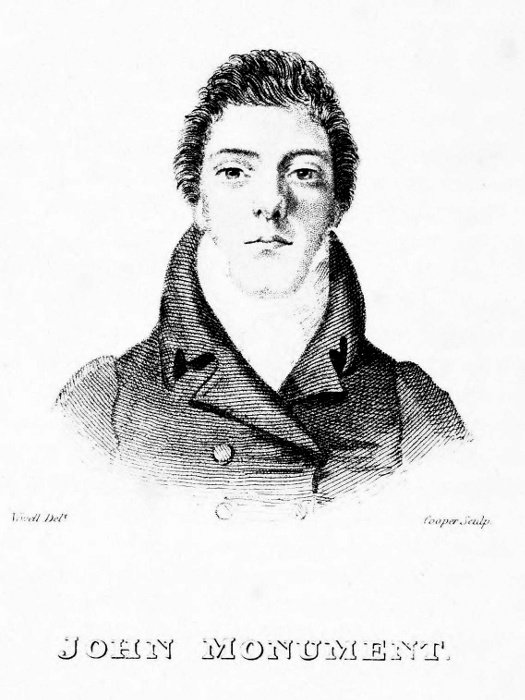
Cross-examined by Mr. Curwood.—I had some general knowledge of
some conspiracy, or something of the kind, going on before this. I
do not know a person named Edwards. We had some general information
a considerable time before this, that some plan was in agitation,
but we did not know the time at which it was to take place, or the
particulars. I will not say to two months. It was some considerable
time before this.
John Baker examined by the Attorney-General.—I am butler to
Lord Harrowby. The cards of invitation were issued for the cabinet
dinner on the 18th, or 19th. It was about eight in the evening of the
23d when I first knew that the Cabinet were not to dine at my Lord
Harrowby’s. The preparations for it went on till then. The Archbishop
of York lives next door to my Lord Harrowby’s. I can’t say whether his
grace had company on the 23d of February. I noticed several carriages
draw up at his door.
John Monument examined by the Solicitor-General.—I am by
trade a shoemaker. I generally live near Brooks’-market, but I am now
a prisoner in the Tower. I know the prisoner Thistlewood. I met him at
the house of one Ford some weeks before the transactions of the 23d
of February. He afterwards called upon me at my lodgings. He was not
alone. Brunt was with him. He told me that he wanted to speak with me
in private. In consequence I went out of the room with him, my mother
and brother being at that time in the room with me. Brunt staid behind
when I went out. Thistlewood then said to me, “Great events are now
close at hand—the people are every where anxious for a change. He had
been promised support by a great many men, who had deceived him, but
he had now got men who would stand by him.”
He then asked me if I had any arms. I said, “No, I had not.” He said,
that every man of them, that is, of those who were attached to him,
had arms, pikes, pistols, or sabres; and added, that I might buy a
pistol for four or five shillings. I said that I was too poor to buy
one. He replied, that if such were the case, he would see what could
be done for me. Brunt called upon me again in four or five days. He
said, that he could not stay long with me; there were several more men
of his trade waiting to see him on this business, and he must call on
them. I did not see him afterwards for some time. He called, however,
again upon me on the Tuesday previous to the 23d. I then told him
that I thought I had lost him, as he had staid away so very long. He
replied, that owing to the King’s death, an alteration had taken place
in their plans. I asked what those plans were. He said that I should
know them better at a meeting to be held the night afterwards, than
he could tell me. I asked him where the meeting was to be. He said at
Tyburn-turnpike. He did not tell me what was to be done there.
I asked him if I was to see any persons there how I was to know them
as friends, and requested him to give me the word. Brunt then told
me, that if I saw any persons about, I was to say B-U-T; and if they
were friends, they would say T-O-N. He would, however, call on me the
following morning, and tell me more particulars.
On the Wednesday afternoon, between four and five, he did call again:
he came by himself. He called me down stairs, and asked me if I was
ready to go. I said, “No, I have got some work to do, and it must be
done before I go.” He asked me how long it would be before it was
finished. I said, that it would be done about six o’clock. He then
said, that he could not wait for me so long—that I must therefore come
to the place appointed along with the man to whom he had introduced
me; that man’s name was Tidd. He charged me not to be later than six
o’clock, as Tidd had others as well as myself, to take with him to the
place of meeting.
I went to Tidd’s at half-past six, who complained that many men had
disappointed him. We waited till seven, but no person came. Tidd then
went into a corner of the room, took out a large pistol, and stuck it
in a belt, which he wore round his waist. He also took out four or five
pike-heads, which he wrapped up in brown paper. He took also several
shafts, four or five feet long. We then went out, along Holborn, and
up Oxford-street. I asked him, in his room, where we were going. He
said to a room in a mews in John-street, Edgware-road. When we got into
Holborn, he gave me the pike-shafts, and told me to take care of them.
I asked him again, as we were going along, where we were going; and
wanted to know whether it was to the House of Commons. He said, “No,
there were too many soldiers near there.” I again pressed him on the
subject, and he said that they were going to Grosvenor-square, as there
was a cabinet dinner there that evening. I did not ask him any more
questions; for on his saying that, I was satisfied for what purpose
they were going.
We then went to Cato-street. Under the archway I saw two men, whom Tidd
appeared to know. He spoke to them; and, after a few moments we all
went into the stable together. There were in the loft and stable about
twenty-four or twenty-five persons. I had not been there long when some
one proposed to count the numbers assembled. Thistlewood replied, that
there was no occasion to do so, as he knew that there were about four
or five and twenty persons in the room. There was a person in a brown
great coat sitting on a carpenter’s bench, who spoke of the impropriety
of going with so small a number to Lord Harrowby’s. Thistlewood
replied, there were quite enough of them. He only wanted thirteen to go
into the room, and supposing Lord Harrowby to have sixteen servants,
that number would be quite enough to master them.
The man in the brown coat said, “After we have done, there will be a
crowd about the door, how are we to make our escape?” Thistlewood said,
“You know the larger body is already gone to arrange matters; we, the
smaller, are left to do the business.” Davidson then blamed the tall
man in the brown great coat for throwing cold water on the plan, and
added, that if he was afraid, he might as well go away. Brunt said,
“Rather than give up the business, I will go to the house and blow
it up, though I perish myself in the ruins, for you know we have got
that which can easily do it.” The man in the great coat then said, as
they were all for it, he would not oppose it. He then proposed that
all in the room should put themselves under the orders of Thistlewood.
Upon which Thistlewood said, that all engaged in the business were
equal, and should have the same honour as himself, and proposed that
fourteen should volunteer to go into the room at Lord Harrowby’s. Those
that volunteered were to range themselves on the side in which the
fire-place stood. They did so in the course of a few minutes. Whether
they were exactly fourteen I don’t know.
I heard nothing said of what the rest were to do. On somebody asking
that question, Thistlewood replied, that they all knew their places.
Thistlewood then went out for a few moments. On his return, he said
that he had received intelligence that the Duke of Wellington and
Lord Sidmouth had arrived at Lord Harrowby’s. I was myself taken into
custody in the room.
Cross-examined by Mr. Adolphus.—I never saw Thistlewood till
I saw him at Ford’s. I attended at the meeting in Finsbury-market. I
was so far off that I could not tell whether Thistlewood was there, nor
even the purpose of the meeting. There was no particular acquaintance
at that time between me and Thistlewood. I did not then know Brunt
or Edwards. There was a long interval between my first and second
conversation with Brunt. I thought that they had done with me, finding
me so reluctant to join in their measures. The man in the brown coat
was not Adams. I have seen Adams since, at Hicks’s Hall. The room
was much crowded—the parties in it were eating bread and cheese. I
do not know that I ever saw Adams before I saw him at Hicks’s Hall.
I recollect the prisoner Davidson from his colour. If any person had
addressed them besides the man in the brown coat, I must have heard
him. I was taken in the room when the soldiers came. I had no arms. I
made no resistance.
Re-examined by the Solicitor-General.—I was nearly the last person who
entered the room. I was there nearly a quarter of an hour before the
officers came. I was unacquainted with every person in the room except
Thistlewood, Brunt, and Tidd. It was candlelight. On the bench were
swords, pistols, and blunderbusses. When I was brought up to Whitehall,
I was handcuffed to Thistlewood; who advised me, when I came before
the Privy-Council, to say that I had been brought to Cato-street by
Edwards. I asked him how I could tell such a falsehood, when I had
never seen such a man as Edwards in my life. He said that was of no
consequence. If asked what sort of a man he was, I was to say, he was a
little taller than myself, and dressed in a brown coat.
By a Juryman.—I have had no communication with Adams since my
apprehension.
By the Solicitor-General.—I never saw him except when I was brought up
as a witness to Hicks’s Hall.
Thomas Monument.—I am brother to the last witness. I remember
Thistlewood calling upon my brother. He brought Brunt with him. They
did not stay in the room more than five or ten minutes. Thistlewood
then asked my brother if he might speak with him. On my brother’s
replying yes, they went out together for ten minutes. They then
returned; and Brunt and Thistlewood went away.
On the Tuesday before the Cato-street business, Brunt called again on
my brother, with a man named Tidd. My brother said, “Brunt, I have not
seen you for so long a time, that I thought I had lost you.” Brunt
said, “The King’s death had made some alteration in our plans.” My
brother asked what those plans were. Brunt said, they had different
objects in view. Brunt asked my brother to meet him at Tyburn-turnpike
that evening, when an outline of their plan should be given to him.
Brunt said that he ought to be there at six o’clock: if he saw any
persons about, he should say, B-u-t, and if they were of their party
they would say, t-o-n. They did not press me to go, but spoke only to
my brother. I did not go. Brunt called at five the next evening for
my brother to go. He said, he could not go then, as we had work to
do. Brunt then bade my brother call on Tidd, at the Hole-in-the-wall
passage, at seven. He did so, as I was informed.
Cross-examined by Mr. Curwood.—Not suspecting that any mischief was
going on, I was not anxious to know to what the conversation of my
brother and Brunt referred. I thought that it might perhaps relate to
some club-dinner.
Thomas Dwyer examined by Mr. Gurney.—I live in Cheese-court,
Oxford-street. Some time in February I became acquainted with Davidson.
He introduced me to Thistlewood. We went together to a public-house
at the end of Molyneux-street, not far from Cato-street. This might
be about the 9th, 10th, or 11th of February. Thistlewood said nothing
particular to me at that time. He observed, that he had been in four or
five revolutions, and that Ireland was in a disturbed state. I am an
Irishman. Thistlewood said, that he had a good many of my countrymen
with him. He pressed me to go with him also.
I saw Davidson on the night before the 23d. He told me that he was
going to stand sentry. The next morning I was called upon by a person,
who took me to Fox-court, Gray’s Inn-lane. He was a tall man, and his
name is Harrison. We went into a two-pair back room; the room door was
locked. He knocked at another door, and a woman gave him the key. He
opened the door, and we entered.
There was a cupboard in the room, out of which was taken a ball,
wrapped up in yarn. Harrison told me the purpose for which it was
intended, and called it a grenade. Shortly afterwards Thistlewood,
Davidson, and a few more, came in. Davidson had a blunderbuss, a pair
of pistols, and a bayonet, in his side pocket. Others also came in, but
I did not know their names. [The witness was here told to look into the
dock, and see if he could identify any of the prisoners as being then
present. He instantly identified Brunt.] On Davidson’s saying that he
had only given twelve shillings for his pistols, Brunt said he would go
out and buy a pair.
I had some conversation with Thistlewood about the hand-grenades.
Thistlewood said, that some of them were to be thrown into the
horse-barracks, and others into Lord Harrowby’s house, to set fire to
it, and blow it up. Thistlewood asked me how many of my countrymen
I could muster, as he should want some of them at half-past eight
that evening. I told him that I could muster about twenty-six or
twenty-seven. He told me that they, meaning himself and friends,
were to assemble at the Horse and Groom; and ordered me to be at
the Pontefract Castle, at the end of Barret’s-court, a house much
frequented by Irishmen. He told me that I was to pick out the best of
my countrymen, and go to the Foundling Hospital, knock at the porter’s
lodge, put a pistol to his breast, and turn on to the right hand, as
there were twenty-five or twenty-six stand of arms in the other lodge:
these I was to seize. At the same time another party would secure
two pieces of cannon which were in the Light Horse Riding-School,
Gray’s Inn-lane. Another party was in the meantime to go to the
Artillery-ground, Finsbury, and seize what was there. He also mentioned
that there was to be a cabinet dinner at Lord Harrowby’s, and that the
party there were to be attacked.
After this, I saw a bundle, containing gunpowder, taken out and laid
upon the floor; a tin measure was produced, and several smaller woollen
bags were filled with it. This was done by Harrison. I afterwards heard
Thistlewood give directions generally to them all. He said that a dozen
pike-handles were to be taken to Mary-le-bone, some others to Finsbury,
and some elsewhere. I was asked, but refused, to take some of them. I
saw a bag; and the powder which had been measured out, and also the
grenades, were put into it.
I heard directions given to a man by Harrison, to take something to the
Horse and Groom, at the end of Cato-street. In the mean time another
person went out to get the pike-handles. I got back to my own place at
twelve o’clock. I told Major James of what I had seen and heard: in
consequence of what he said, I went to the Secretary of State about
one, or half-past one o’clock that day.
Cross-examined by Mr. Curwood.—I am a bricklayer by trade. I never,
before the month of February, saw Davidson. Davidson introduced me
to Thistlewood on the ninth of that month. They did not know me, and
I did not know them, yet I was let into their secrets on the morning
of the 23d of February. I have lived fifteen years in the parish of
Mary-le-bone, with a good character, and yet all of a sudden a band of
traitors intrusted me with their traitorous designs. I told them that
it was a hard thing to inveigle men into a scheme like theirs, and
doubted whether I should be able to accomplish it. Though I expressed
this doubt, I was sent to the Foundling Hospital to take the arms.
I acceded to their proposal at the time, but had no intention of
executing it. I do not know a man of the name of Hugglestone. I never
was in a court before, except on the trial of a woman for stealing. I
was in Ireland at the time of the rebellion. I cannot tell how old I
was then.
George Kaylock examined by Mr. Littledale. I live at 22,
Cato-street. I saw Harrison and another against the stable-door in
Cato-street, at five o’clock on the 23d February. I asked Harrison how
he did. He replied, pretty well; he had taken two rooms there, and was
going to do them up. Between five and seven o’clock I saw more than
twenty people go in at the stable-door.
Richard Monday examined by Mr. Littledale.—I live at 23,
Cato-street. About twenty minutes after four, on the 23d, as I was
coming from my work, I saw Davidson standing under the archway. I knew
Davidson, from seeing him with Firth, the cow-keeper. I went home and
got my tea. I came out again at twenty minutes past five, and went to
a public-house. On leaving it, I saw Davidson going into No. 1 for a
light. In going into the stable, into which Harrison admitted him, he
stooped for a bundle, and I then observed that he had two belts on,
one across his shoulder, and the other round his waist; in that round
his waist, on the left side, two pistols were inserted; on the other
a sword was suspended, which jutted out considerably. The place where
they met is a stable, belonging to General Watson; it has lately been
used as a cow-house by Firth. There is a chaise-house, and a stable
below, and a loft, with two rooms above. One of these rooms has a
window, the other is dark. I observed, in the course of the afternoon,
that something like a coarse matting was hung over the windows, and the
partition in the stable-yard.
Elizabeth Westall.—I live at No. 1, Cato-street. About three
o’clock I saw a man go into the stable with a sack on his shoulder.
About six o’clock I went out, and saw a man of colour standing by the
stable. I was much alarmed by that circumstance, thinking that the
stable was unoccupied. I was out ten minutes. Shortly after I returned,
the man of colour came into my house, and asked me for a light. I gave
him a light. He then went back to the stable where I had seen him at
first.
George Ruthven, the police-officer, was then examined by Mr.
Bolland.
I went, on the 23d of February, to Cato-street. Three others were to
meet me there. When we were all assembled we were about twelve of us.
I went into the stable, and saw a man with a sword by his side, and
a blunderbuss on his shoulder. I saw one man below, and I have some
faint recollection that I saw another. The whole of my party followed
me into the stable. On seeing the man with the blunderbuss on his
shoulder, I told some of the party to secure him. I went up a ladder,
which led to a loft.
When I got there I saw several men; heard the clattering of arms, and
saw swords and pistols. Three or four of my party went up with me. I am
sure that Ellis and Smithers were with me. From the view which I had
of the place, I think there were 24 or 25 persons present. The size of
that room is 15 feet, five one way, and ten feet ten the other. There
are two rooms adjoining this, separated by doors. When I got into the
room, I said, “we are officers; seize their arms.” I saw in the room
Thistlewood, whom I have known for four or five years.
Thistlewood was standing, at the time we entered, at the right hand
side of the table, near the door of the little room. On my saying, “We
are officers,” he seized a sword, which was drawn, and retreated to
the little room. The sword was a very long one, and rather bright. He
stood in the entry of the door fencing, to prevent any one’s approach.
Smithers approached him. Thistlewood stabbed him, and Smithers fell,
saying, “Oh, my God! I’m done,” or something to that effect. Somebody
from the corner of the room where Thistlewood stood said, “Put out the
lights—kill the b——rs, and throw them down stairs.” The lights were
then put out; I joined in their cry of “kill them,” and rushed down
stairs.
I did not observe any thing till I got into John-street, where I met
the soldiers, whom I brought. Several shots were fired from the corner
of the room where Thistlewood was standing; I think down the stairs.
On arriving a second time at the stable, I met Tidd grappling with one
of the military. I secured him. I was afterwards in the public-house,
(Horse and Groom) and saw Bradburn brought in. On him were found six
ball-cartridges and three balls. Davidson and Wilson were brought in.
Davidson sang a song. I then went back to the loft, and found there,
Shaw Strange, Cooper, Monument, and Bradburn. I saw arms in the hands
of several persons. I found two swords and a bag. The bag contained
ten hand-grenades. I also found balls and fusees. They were brought to
Bow-street, and remained since in possession of an officer. Afterwards
I went to the Horse and Groom. I had seen Cooper there, with a stick,
and Gilchrist came back for it, but did not get it. I observed it cut.
Cross-examined by Mr. Adolphus.—Thistlewood had not been much out of
sight since Watson’s trial. Witness had seen him five or six times. He
had a motive for it. It was not for this purpose, that he was aware
of. There were four or five Edwardses, officers with him, but he was
not aware that Edwards, who had been concerned in this business, was
connected with any of them. He knew nothing further, than that he was
directed to watch Thistlewood.
James Ellis, by the Attorney-General.—Went with the other
officers to Cato-street on the 23d of February; he went in immediately
after Ruthven. He saw two men, one having on two cross-belts; either
in his right or left holding a carbine, in the other a sword. Witness
observed, that he was a man of colour. The other person was between
the foot of the ladder and the stall next to it, for there were three.
He followed Ruthven up as close as he could. The man of colour said
something ending with “men.” He heard the men above rushing back behind
the carpenter’s table, and a noise like fencing with swords. There
might be twenty or twenty-five men. Ruthven said, “We are officers,
seize their arms, or surrender your arms.”
Witness had not known Thistlewood before, but he was satisfied it was
he who menaced with the sword. Witness had before held forward his
staff of office; he now presented a pistol, and desired him to desist,
or he would fire. Smithers then gained the top of the ladder, and
advanced towards the little room. Thistlewood struck him with the sword
near the breast. Smithers fell back, held up his hands, and exclaimed,
“O, God!” Witness fired on Thistlewood, and Smithers staggered towards
him. The candles were put out, and the witness was forced down. He
stood at the door to the street. Several shots were fired: some balls
passed him. On going out he heard a cry. Saw a man running towards
Queen-street, with belts on. He secured him. It was Davidson, the man
of colour. He had a carbine in the one hand, and a sword in the other.
He afterwards assisted in securing four, to whom he could not speak
positively.
Cross-examined by Mr. Curwood.—He was a constable, and had the
warrant. He had a part in conducting the officers; but Mr. Ruthven was
there.
William Westcott had part in conducting the patrol at
Bow-street, and was a constable. He was down in the stable the whole
time, and heard firing on the loft. He saw Ings in the stable, who
wanted to rush out, while the other officers were up. Witness and
Ings had a contest. There was terrible confusion in the loft; some
came tumbling down, and some singly. He knew Thistlewood. There was a
light. Thistlewood fired at witness. Three holes were in his hat by
balls. Witness rushed towards Thistlewood, when he was struck down.
Thistlewood then made a cut at him with a sword, and ran out. Witness
was wounded in the back of his hand with one of the balls, as he had
held up his hand to protect his head.
Hugh Nixon, one of the Bow-street officers, saw Ruthven,
Ellis, and the deceased go up the ladder. He went up, and saw Ellis
fire. There was a rush down, and he saw a man fire a pistol; he rather
believed it was Thistlewood. Ings was pursued and brought back. Witness
found a sword in the stable, and a bayonet up stairs.
John Wright, a patrol of Bow-street, was one of the officers
who went to Cato-street. They mustered at the Horse and Groom. He saw
Cooper having a broom-stick, and another coming to drink beer. Cooper
left the stick. Witness took a sword and a knife from a man who was in
the stable, near a stall. That moment he was knocked down, and received
a stab in his side. Wilson and Bradburn were afterwards taken. Witness
found about two dozen ball-cartridges in Wilson’s pocket, and a pair of
scissors; and found two haversacks on his sides.
William Charles Brookes, a patrol, being directed by Mr.
Birnie towards persons passing, saw Ings, and a person in front of him
with a cutlass, and spoke to them. Ings fired, and slightly wounded him
on the shoulder. Witness staggered into the road. Ings went off towards
the Edgware-road. Witness pursued. Ings threw away the pistol. Moy took
him. Witness asked him why he had fired at him, a man whom he had never
seen. He said, “I wish I had killed you.”
Ings.—“Pray, my Lord, am I not allowed to ask any question?”
Court.—“You are not on your trial at present.”
Witness stated, that two haversacks, a knife-case, and a tin box, three
parts full of powder, were found on Ings.
Giles Moy confirmed this evidence, so far as he was concerned.
Robert Chapman, one of the Bow-street officers, went to
Cato-street; saw Ings in the stable, and heard him say, “Look out,
above.” Witness, in the watch-house, took from Ings a knife-case, two
balls, and a pistol-key. He saw one running through the stable with a
sword in his hand.
Captain Fitzclarence appeared on the right of the bench,
and said, he was a lieutenant in the Coldstream Guards; he went with
a piquet to John-street on the 23d of February, about eight in the
evening. On hearing reports of pistols, they went to Cato-street. He
was directed by a police-officer to the stable. He met two men at
the door: the man on his right cut at him with a sword, the other
man presented a pistol. He got in and seized a man, who called out,
“Don’t kill me, and I will tell you all.” He gave him in charge, and
then secured another man in one of the stalls. On going up stairs, he
secured three, four, or five persons. He fell against the body of poor
Smithers, who was lying dead. He saw several arms.
Samuel Taunton, a Bow-street officer, went to Brunt’s
lodgings, searched the front and back rooms, and found two baskets.
Brunt, who was in the front room, and had been previously taken into
custody, said, he knew nothing of the baskets. The room did not belong
to him in which they were; it was the back room. In the same room there
was a pike-staff and an iron pot. Witness sent for the landlady, Mrs.
Rogers. She said, her niece had let the back-room to a man she did not
know. Brunt, said, it was a man at the public-house, and he did not
know his name.
Witness then went to Tidd’s, in the Hole-in-the-Wall passage, near
Gray’s Inn-lane. There he found a box full of ball-cartridges, 965
in number; he found ten grenades, and a great quantity of gunpowder.
He found, in haversacks, 434 balls. He found also sixty-nine
ball-cartridges, and about eleven bags of gunpowder, one pound each.
The grenades were in a wrapper. In one of the baskets at Brunt’s were
nine papers of rope-yarn and tar; in the other, three of the same, two
flannel bags of powder, one pound each, and five empty bags, a paper of
powder, one leathern bag, with three balls in it. They were all here.
Cross-examined by Mr. Adolphus.—This was on the 24th. Brunt had been
in custody before. Tidd was absent.
Daniel Bishop, a Bow-street officer, went on the morning
of the 24th, with other officers, to apprehend Thistlewood, about
ten in the morning, to Whitecross-street, Moorfields. The house was
kept by Harris. He received a key from Mrs. Harris, which opened a
ground-floor. There he saw Thistlewood, who thrust his head from under
the clothes in bed; the shutters were shut. Witness told his name
and business, and, having a sword in one hand, and a staff in the
other, threw himself on the bed. Thistlewood said, he would make no
resistance. He had his breeches on, in the pockets of which they found
two balls, two cartridges, and some flints. They also found a small
silk sash.
Cross-examined.—A man of the name of Edwards did not go, nor any who
knew where Thistlewood was.
Lavender produced and identified the belt found in
Thistlewood’s coat-pocket.
Ruthven produced the pike-staff, grenades, &c.
All the soldiers and officers who had any of the articles seized were
now arranged behind the witness-box, and handed to Ruthven their
several charges, and Ruthven laid them on the table. A pike was
screwed on a staff, and handed to the Jury. The whole of the frightful
apparatus was now exposed to view. Guns, blunderbusses, carbines,
swords, pistols, pikes, sticks, cartridges, bullets; even the pot in
which the tar was boiled,—all were produced and identified.
The fire-arms remained loaded till produced on this occasion, when the
charges were drawn; they were loaded with ball. One of the grenades had
been given to a person by an order of Colonel Congreve to be examined.
The production of Ings’s knife excited an involuntary shudder; it was a
broad desperate-looking weapon.
The Jury inspected the arms separately, and particularly the pikes,
the construction and formation of which have already been minutely
described. The whole had a most formidable appearance.
John Hector Morrison, servant to Mr. Underwood, cutler, in
Drury-lane, was re-called, and looked at two swords, which, he said,
were the same he had ground for Ings.
Serjeant Edward Hanson, of the Royal Artillery, examined
by Mr. Gurney.—I examined one of the grenades produced to me at
Bow-street; it is composed of a tin case, in the form of a barrel, in
which a tube is soldered. The case contains three ounces and a half
of gunpowder. The priming in the tube is a composition of saltpetre,
powder, and brimstone. The tin was pitched, and wrapped round with
rope-yarn, which was cemented with rosin and tar. Round the tin, and in
the rope-yarn, twelve pieces of iron were planted. From the lighting
of the fusee to the explosion might take about half a minute. If one
of them were to be exploded in a room where there were a number of
persons, it would produce great destruction. The pieces of iron would
fly about like bullets.
[The witness here opened another of the grenades for the satisfaction
of the Jury; it was composed in the manner already described. The
pieces of iron principally consisted of old cart-nails, such as the
tires of wheels are nailed on with. The carcase, or tin-case, was
wrapped in an old stocking, and the powder which it contained was
pronounced very good.]
Witness, in continuation.—I examined one of the fire-balls; it
consisted of oakum, tar, rosin, and stone-brimstone, pounded. If one of
these was thrown into a house, and alighted on wood, it would be sure
to set it on fire. The effect would be still more certain on straw or
hay.
The Attorney-General.—“That is the case, my Lord, on the part of the
Crown.”
THE DEFENCE.
Mr. Curwood now rose to address the Jury on the part of the
prisoner. He commenced by stating, “That if it were consistent with a
sense of moral and professional duty, he would not have stood there
to address them. It was one of the characteristics of the profession
to which he had the honour to belong, however, and one which perhaps
reflected upon it the greatest credit, that they were not at liberty to
refuse their assistance to persons in the situation of the unfortunate
man at the bar. No man could feel more impressed than himself with the
sense of the great and weighty duty he had to perform. He felt that the
unhappy prisoner had a right to call upon him to do his duty boldly and
fearlessly, and without any consideration for the Government who were
the prosecutors on this occasion; he felt also that he had a duty to
perform to his country, by assisting in the administration of the law,
and not by any power which he possessed, if he did possess such power,
to endeavour to pervert that law. He owed something too, to his own
fair fame, which was all, his only inheritance.
“With these feelings pressing upon him, he might truly say, he was
placed in a trying and critical situation. It was fit on an occasion of
this sort, that they should know something of the man by whom they were
addressed. It could not be denied that the unfortunate transactions,
to which their attention had been so painfully directed, had arisen
out of that state of the country which they must all alike lament and
deplore. It was clear also, that while they had attachments to certain
parties, prejudices would arise which it was out of their power to
control in favour of the sentiments of those parties. With respect to
himself, although like every other Englishman, he had his feelings upon
certain points, yet he never belonged to any particular party, nor
was he in the habit of attending political meetings. With respect to
Government, he never had received any place or appointment from them,
nor was it likely that he should. In the present instance, therefore,
he had no motive to influence him in doing his duty, or at least in
endeavouring to do it fairly and honestly.
“It was due to his Learned Friends and to himself to state, that in
consequence of the lateness of the moment in which they were called
upon to undertake this arduous task, not having received their
instructions till a late hour on Thursday, that the difficulties with
which they had to cope were of no ordinary kind; and these difficulties
became the more formidable, when it was recollected that they had
arrayed against them the most distinguished talents which it was in
the power of the Crown to procure—talents not a little aided by the
advantage of study, and of a mature consideration of all the facts
of the case which they were called upon to discuss. No doubt, in the
notice which they (the Jury) had given to the Attorney-General, when he
opened this case, they had not failed to observe, and he had observed
it with unfeigned surprise, that he had not stated to them precisely
what were the points which they were called upon to try. He had indeed
stated that it was a prosecution for high treason, but he had only
defined what was the quality of the treason which he meant to impute.
“Unfortunately, there was mixed up with this transaction a great deal
for which the prisoner might hereafter be answerable, and which was
calculated to make a deep impression on the minds of the Jury; but
whatever was their opinion upon the moral guilt of the prisoner, if,
upon a review of the evidence, they should not be of opinion that he
had committed the precise offence charged in the indictment, it was
their duty to pronounce a verdict of Not Guilty. It therefore devolved
upon him to state precisely what they had to try; it was not merely a
question of high treason, but a question of a particular species of
high treason.
“The indictment was very long, and contained many things which, in the
language of the law, were called overt acts. They were not, however,
because a great body of evidence had been given to them, to jump at the
conclusion, that the substantive treason alleged had been committed.
The sorts of treason charged were four in number: the first was founded
upon the late statute of the 36th of the King, for conspiring to depose
his majesty from his imperial style and dignity. It was now nearly
400 years since that statute, to which Englishmen had been wont to
look with veneration as a protection for the dearest rights of man—he
meant the statute of Edw. III.—had been passed. There, among other
treasons set forth, was the conspiring to take away, or the compassing
and imagining, or intending to compass or imagine the King’s death—but
there had subsequent treasons started up. There was now another Act of
Parliament in existence, which embraced not merely the compassing and
imagining the King’s death; but the conspiring to depose him from his
imperial style and dignity. It was also treason to conspire to levy war
against his majesty. This was the question then which they had to try.
“First, had the prisoners at the bar conspired or imagined the death
of the King; secondly, had they conspired to depose his Majesty from
his imperial style and dignity; thirdly, had they conspired to levy war
against the King; and lastly, had they actually levied war against the
King? He apprehended that they must be satisfied that one or other of
these charges was proved, before they could find a verdict of guilty.
“Before he came to these topics, they would look to the probability of
the evidence which had been laid before them. The great mass which had
been adduced certainly led them to conclude that a conspiracy of some
kind had existed; but it did not follow that the substantive treason
charged in the indictment had therefore been committed. It did not
follow, as a matter of course, that the removal of the administration
of the King must be succeeded by the deposition of the Monarch himself.
Let them go by steps. There was continually in Parliament one party
endeavouring to remove another; that was to say, endeavouring to remove
the existing administration. He would admit, probably with the best
intentions.
“Would it be contended, that this removal of an administration was
necessarily connected with the deposition of the Monarch, and that
every man who attempted to effect such a purpose would be involved in
the crime of high treason?
“Again, other men might think it necessary that an administration
should be removed by violence; and this too with the most virtuous
intentions. He desired not to be misunderstood, as meaning under
that plea to justify assassination. Nothing was further from his
feelings; but all he meant to argue was, that they must not take it
as a necessary consequence that the death or destruction of a whole
administration involved the death or deposition of the King. If they
(the Jury) were of opinion that it did not involve such a consequence,
the evidence on this occasion did not support the substantive treason
laid in the two first divisions of the indictment.
“There were two other treasons, however; one was the conspiracy to levy
war against his Majesty; and the other, the actual levying of war. Now
he called upon them to look to the evidence, and see whether they could
draw from that a fair inference, that there was a conspiracy to levy
war, and that what had been done amounted to an actual levying of war.
In the detail given by the first witness, Adams, who in fact proved
the whole case—he thought there was much more for ridicule, than for
serious consideration. In his opinion, the testimony of this man was
utterly incredible, independent of the fact of his being an accomplice.
“The Attorney-General had told them that an accomplice was a necessary
witness; but though necessary, he was not of necessity to be believed.
The more atrocious the guilt in which he had steeped himself, the less
worthy he was of credit; and where a most atrocious and wicked witness
came to tell them a tale, not only improbable, but most ridiculous in
itself, would they not at once dismiss him from their notice?
“It often happened, that those who were the most ingenious in devising
and promoting mischief, were the first to become informers; and that
this was the case in the present instance, he should be enabled to
prove. They would, however, consider the evidence which had been given
by Adams to support the fact of there having been a conspiracy to levy
war against the King. They would lay out of their consideration for a
moment all that had been said of the assassination of his Majesty’s
Ministers; and they would consider the evidence as it had been given
by him to support that conspiracy. They had here everything to raise
their passions.
“They had all the materials and preparations for war before them (the
arms on the table); but what was the result of all the discussions
which took place at all the meetings of the conspirators from the 4th
of February, in which the assassination of his Majesty’s Ministers had
been repeatedly debated?
“In the cross-examination of Adams, it appeared that one of the
conspirators, Palin, had, with some degree of sense, when all those
things were talked of, asked where the men were to come from to effect
this mighty revolution? In one moment his Majesty’s Ministers were to
be assassinated!—a detachment was to go and take possession of two
pieces of cannon in Gray’s Inn-lane!—another detachment was to make
a descent upon the Artillery-Ground!—a third party were to seize the
Mansion-house, as a seat for the Provisional Government! and yet to
effect all this, what was the actual strength of the conspirators in
its most exaggerated state? Why, forsooth, forty men, two old sabres,
six shillings, and a reputed pound-note!! Where an infamous witness
told them such a story could they believe it?—was it credible? Would
they take away the life of a man under such circumstances? If it were
possible for them to do so, he could only say that they would be more
insensible than the deluded men themselves.
“Then as to the other point, the actual levying of war; what a
levying of war was, he hardly knew how to define. Lord Hale had said,
that this was a question of fact, which a Jury alone was capable
of deciding.—That learned Judge had also talked of “marching with
unfurled banners, and being furnished with military officers”—but
where were the unfurled banners here, or where the military
officers?—The only military man they had heard of was one disbanded
soldier, and the purpose to which he was to be applied was the
destruction of his Majesty’s Ministers—an act which, he contended,
even if effected, did not amount to a levying of war.—If they were
told the contrary, he was sure they would treat such an intimation as
absurd and ridiculous. Where was this great conspiracy concocted? In
a two-pair back room! Where was the battle fought? In a stable! Where
were the traitors incorporated? In a hay-loft! How were they armed?
With a few rusty swords, halberts, and old pistols!
“He would put it to the plain common sense and understanding of the
Jury, whether they would pronounce persons so assembled and so armed,
guilty of levying war against the King? It was rather a levying war
against the constables, at the very name of whom they trembled. Then,
if there was no levying of war, was there a conspiracy to levy war? The
only evidence they had of such a conspiracy came out of the mouth of
those three witnesses who were so far contaminated, that it was beyond
all doubt they had themselves been deeply implicated in the projected
assassination of his Majesty’s Ministers.”
“The question, then, for their consideration resolved itself into this
point: they would consider, even supposing that the assassination of
the Ministers was intended, whether this of necessity implied that his
Majesty was also to be deposed. If they did not think that the one must
of course follow the other, then their verdict must be “Not Guilty.” He
implored them to do their duty strictly according to law, to consider
what the law of the country was, to step neither to the right nor
to the left, but to come to a fair and impartial and unprejudiced
conclusion. He implored them to do so, not only for their own sakes,
but for the sake of the country; for if once jurymen suffered their
feelings of indignation towards one offence to lead them to admit the
existence of another of a different character, not proved, there would
be an end of the due distinctions of justice. If this man had been
guilty of another offence, there was another indictment against him, on
which he must take his trial if he were acquitted of this: and if he
were convicted under that, he would suffer the penalty of the law. But,
upon this occasion, he called upon them not to find him guilty of High
Treason, because they thought him worthy of death for having incurred
the guilt of assassination.
“In conclusion, the learned gentleman said, he would proceed to call
a witness to prove that Adams, who had been called for the Crown,
together with an accomplice of the name of Edwards, who had not been
called, were the persons who had conveyed the arms and ammunition to
the house of Tidd on the very morning they had been found there by the
Bow-street officers.”
Mr. Adolphus then proceeded to call the
EVIDENCE FOR THE DEFENCE.
Mary Parker examined.—I am the daughter of Richard Tidd; I
live with my father; I remember the police officers coming and finding
some boxes and things in our lodgings; they came about half-past eight;
those things had been in the house when they came, about a quarter
of an hour; they were brought that morning; among them were the pike
staves; it was no person in my father’s employment who brought them; he
had been taken into custody the night before; I know a person of the
name of Adams; I have seen him at my father’s; I know a person of the
name of Edwards; I have also seen him there; he has been there often; I
have seen similar things before the officers came; I believe these to
be the same things; Edwards took part away; I do not know who took the
rest; he took them away on Wednesday; my father did not take them away;
Edwards did not take away the box; he only took away some things that I
have since heard were used; the box was brought a day or two before my
father was taken; it never was uncorded; Adams brought a large grenade;
I do not know what Edwards was.
The Attorney-general declined asking this witness any question.
Edward Hucklestone examined by Mr. Curwood.—I know a man of
the name of Dwyer. I have known him for some years. Latterly I have
known him intimately. I used the same public-house. I do not think he
is to be believed on his oath.
Cross-examined by the Attorney-General.—I saw him with plenty of
money, and knowing that he had little or no work, I was surprised. I
was in distress. He told me he would put me in the way to make plenty
of money, if I would go with him. I agreed; and he proposed that we
should charge gentlemen with an unnatural offence. That he was to go up
first, and then I was to join him. I left him quite shocked. This was
about three months ago. He said he had got ten pounds at a time from a
gentleman in St. James’s-street, by only catching him by the collar,
and accusing him. I met him the next night at the Rodney’s-head, and
he called me a coward. I told him of the danger, and reminded him that
his brother had been transported for the same thing. He said he knew
better how to general it than his brother. I ought to have communicated
it to a magistrate; but I was afraid of falling a “wictim” to the
Irishmen who lived in the neighbourhood. I have spoken to him since. I
was a shoemaker, but am now articled to a cow-doctor in Newman-mews.
I first communicated this to my brother, about a week ago. I did not
mention it before, lest I might be ill-treated, as I had to go so
much about among the cows. Some of the Irishmen have gone away from
the neighbourhood now, and that induced me to summon up courage to
mention it to my brother. I did go with Dwyer to the Park, but I was
always struck with the horror of the thing. When I saw the names of the
witnesses in this case in the paper, I made the communication to my
brother.
(The witness was desired not to go out of Court.)
Mr. Joseph Doane examined by Mr. Adolphus.—I am called
the Court Reporter; I prepare for the newspapers an account of the
movements of the Court, the cabinet dinners, &c. I send the same
accounts to six papers, among others to The New Times, [Looked at the
announcement in the New Times, of the cabinet dinner, on Tuesday the
22d of February.] The intelligence respecting the Court in this paper
I sent. The paragraph respecting the cabinet dinner, from the wording,
I think I did not send. I think so from the use of the word “grand;”
cabinet dinners are always alike, and I do not think I used the word
“grand.”
Andrew Mitchell: I am printer of The New Times; I produce
the original of the paragraph respecting the cabinet dinner, announced
in The New Times on the 22d of February.
Mr. Doane recalled: That is not my manuscript; I always write from a
manifold.
Andrew Mitchell: I did not receive that from Mr. Doane, but from a
person of the name of Lavenue, who furnishes things in the same way.
John Whittaker: I searched in eleven newspapers of the 22d of
February for the annunciation of a cabinet dinner at Lord Harrowby’s,
and in none of those papers was there such an announcement as that in
The New Times.
The Attorney-General: These papers ought to be here.
The Chief Justice Abbot: Strictly speaking, they ought to be here.
The witness: The New Times alone had the annunciation of the dinner
at Lord Harrowby’s on the 22d of February.
Mr. Adolphus: This is all the evidence I intend to offer on the part of
the prisoner.
Mr. Gurney: I wish, my Lord, that Dwyer should be again called.—The
witness, Dwyer, was then again put in the box, and examined by Mr.
Gurney: I do not know a man of the name of Hucklestone.—[The witness
Hucklestone was desired to stand up.]—Dwyer: I know that man, but did
not know his name was Hucklestone. I have met him in Oxford-road. Not
in a public-house. I never proposed to him to charge any person with an
unnatural offence. In February last I was at work at the parish mill,
and got three shillings. I have a wife and family.
Cross-examined: I did not know Hucklestone by name. I saw him with
other chaps at the corner of James-street, near where I live; but
I never associated with him. I have seen him in Hyde-park. I never
went into a public-house with him. I resorted to the Rodney’s-Head,
but never knew him to resort there. I have not repeatedly met him
in a public-house. I don’t know that I can swear I never saw him
in a public-house. I will swear I have not been with him at the
Rodney’s-Head within this three months. I am a bricklayer by trade, and
worked fourteen years for one master.
Mr. Adolphus now entreated permission to be allowed till the ensuing
day to prepare himself to address the Jury on the part of the prisoner.
The state of exhaustion to which he had been reduced, as well as the
shortness of the time which had elapsed since he had received his
instructions, and the great importance of the duty which he had to
perform, where the life of a fellow-creature was at stake, the more
imperiously impelled him to entreat this indulgence, if consistent with
the views of the Court.
The Lord Chief Justice felt the propriety of the appeal, and after some
conversation relative to the convenience of the Jury, the Court was
adjourned till the following morning.
THIRD DAY, Wednesday, April 19, 1820.
The Court opened again at nine o’clock this morning, and a few minutes
after Mr. Adolphus rose to address the Jury on behalf of
the prisoner, and commenced by observing, that “he could not request
their attention to the feeble and humble efforts which he was going
to make in defence of the prisoner at the bar, without returning them
his sincere thanks for the kind and gracious manner in which they
had conceded to him further time for the preparation of his defence.
Under all the circumstances of the case, the situation in which he
(Mr. Adolphus) stood was sufficiently distressing; but it would have
been still more so if he had been compelled to address them yesterday
evening with a mass of evidence totally undigested, with a memory
wandering over all, but steadily directed to none of the points which
had come out during the trial; and without any of that simplification
of the case which he had been able to effect, though imperfectly, in
the few hours which, by their kindness, he had been able to steal from
sleep.
“The inquiry in which they were then engaged was a most anxious and
important inquiry: indeed, so anxious and so important was it that
it was only natural to expect that the minds of counsel engaged in
conducting it would sink under the heavy task imposed upon them. During
the course of his professional career many trials similar to the
present had taken place: but in none of them did the parties accused
labour under such dreadful charges as were now brought against the
prisoner at the bar; in none of them had they been so totally deprived
of all assistance and support as the unfortunate individual had been on
whose fate they now stood impanelled to decide.
“To say that he (Thistlewood) had all the weight of office arrayed
against him—to say that the prosecution was conducted with all the
talent and all the power of Government, was to say nothing more than
that Thistlewood was indicted for high treason. He (Mr. Adolphus)
meant not to blame the Government for exerting all its energies in a
case like the present; by no means—the Crown had, on all occasions,
and particularly on an occasion like this, a right to demand of its
best servants their best services: he only meant to contrast the
difficulties against which Thistlewood had to contend with those which
had surrounded other unfortunate men in his situation.
“Against the great legal talent which had been employed against them by
the Crown, there had come forward advocates of high character, and not
inferior ability—advocates who voluntarily embarked themselves in the
cause of their clients—gave up their whole time and attention to their
interests, methodized and simplified the evidence necessary to maintain
them, and entered the Court prepared to meet the case brought forward
by the Crown on every one of its points and bearings.
“Far different was the case of the unhappy man then standing at their
bar.
“On the evening previous to his trial he was scarcely acquainted with
the name of the counsel who was to defend him: and that counsel had
scarcely more early information of the grounds on which his defence
was to be rested. He (Mr. Adolphus) could assure them that he was only
chosen counsel for Thistlewood on Thursday last; that unavoidable
business had kept him out of town during the whole of Friday; and that
he had appeared before them on the Monday with such information as he
could collect in the interim. He deplored this circumstance, but he
could not complain of it. His want of ability and preparation was not,
however, the only circumstance which rendered Thistlewood’s case more
desperate than that of the individuals who had formerly been placed in
his situation. Many of them had been allied with, or supported by, men
of power, and rank, and influence in the country. Thistlewood, on the
contrary, was aided by no party, was supported by no subscription, but
was deserted by men of every class and party in the community. He (Mr.
Adolphus) had received no assistance, no information, no instructions,
from him; all that he knew of the case was derived from the materials
which the solicitor, the gratuitous solicitor for the defence (Mr.
Harmer), had been able to collect within the last few days.
“Besides these circumstances was another still more extraordinary and
unfortunate. At the state trials of 1794, whoever was discharged by
a verdict of his countrymen was discharged at once from all further
prosecution; and with the inquiry of that Court ended all inquiry into
his conduct.
“This man, Thistlewood, however, was so beset, that, even though he
obtained at their hands a verdict of acquittal upon this charge, he
had to undergo a similar trial upon other indictments: indeed he (Mr.
Adolphus) did not hesitate to say that he (Thistlewood) was surrounded
by every danger which could possibly environ the life of a single
individual. It appeared as if this melancholy choice alone were left
him, whether he would have the execution of his sentence end with the
severing of his head from his body, or whether he would have his body
given up after his execution to the dissecting knife of the surgeon.
If his guilt were of such a nature as to demand that penalty to be
added to the others inflicted by the law, he had only himself to blame
for it: far was it from his (Mr. Adolphus’s) intention to palliate his
conduct upon that point: the only reason which he had for even alluding
to it was to implore them to place out of their consideration every
circumstance which was not connected with the subject of their present
investigation, and which had not been brought regularly before them in
the course of the trial.
“The Attorney-General had made the same request to them, and it had
well become his character and legal knowledge to do so. It was not
less his duty as a man and as a Christian, than as a high officer of
the Crown, to give them that advice: for, bound as he was to protect
the interests of the Crown, he was not less bound not to exercise his
power in wantonly running down those subjects, who were living under
its fostering care and protection. Made, then, as this request had
been made to them by the Attorney-General, he (Mr. Adolphus) could
not help repeating it; for he was well aware how difficult it was to
dismiss from the mind the impressions of ill-will and dislike which
were naturally conceived against any one who was, or ever had been, the
subject of general reprobation.
“On occasions like the present a man’s usual convictions stole into
his mind, in spite of himself: it therefore became them to be doubly
on their guard, and to view the case then under their consideration
as if they had never heard the name of Thistlewood before, and as if
they had never received any other information than that which had come
under their notice in the course of the trial, upon which, and upon
which alone, they were sworn to give their verdict. He agreed with the
Attorney-General that the present was a case of infinite importance;
not, however, to the prisoner at the bar merely, whose life was at a
stake, (indeed in that point of view it was of less importance than in
any other) but also to the state and to all posterity.
“It was of importance to the state that verdicts should be given
upon strict evidence alone, and not upon favourable or unfavourable
impressions conceived by the Jury regarding the party on his trial. It
was of importance also to posterity; because if, as against a bad man,
a certain kind of evidence should now be allowed to procure conviction,
it would, in time, be also allowed to procure conviction against a
good one; and, in that case nobody could tell whose fame might not be
impeached, whose property might not be injured, whose life might not be
destroyed, by the same kind of evidence as had been produced on this
trial; evidence which ought never to have the credence of any jury, or
the sanction of any court.
“It was not, therefore, so much for the value of Thistlewood’s life
(though God forbid that he should undervalue the life of any man) as
for the value of a precedent in a case of treason, that he was then
contending; for if a charge of high treason could be substantiated
against any British subject on such evidence as had just been adduced
there would be an end to all our well-founded boasts of the excellence
of our law regarding high treason. Such an event, however, he, for
one, did not anticipate, when he recollected with what care the law
of treason had been guarded by the legislature, and with what caution
executed by our juries, ever since the period of its first institution.
Nor was such caution, vigilance, and correctness, as had been always
exhibited by our juries, with some few exceptions, and those in bad
times, unnecessary or uncalled-for.
“An accusation of high treason was a fearful accusation. In all other
criminal cases, from a simple assault up to a murder, the King though
not the real, was the ostensible prosecutor: in a case of high treason,
however, the King was not merely the ostensible but also the real
prosecutor; he was directly arrayed against the prisoner, and therefore
it was the imperative duty of the Jury to see that the subject was not
oppressed. The present case of high treason was as important as any of
those which had ever preceded it; and the Jury ought, therefore, to be
peculiarly careful not to allow one tittle of evidence to weigh with
them which had not been admitted on former occasions, and, if they
had any doubts with regard to its admissibility, ought to lean to the
prisoner, and not to the Crown, however interested they might be in its
preservation, and the preservation of its authority.
“He had before had occasion to state to them, that the defence of the
prisoner at the bar had come to him, in the course of his professional
business, as an enforced duty. He had not sought it; he had not refused
it; indeed, as an advocate, he could do neither one nor the other.
Standing, however, as he did, in that Court, as the advocate, the
unfee’d, and therefore, in some respect, the voluntary advocate of the
prisoner Thistlewood, he deemed it right (unnecessary and improper as
it might be on any other occasion for an advocate to press his own
political opinions on the Jury) to state that, during the whole of his
life he had never given his assent to any proposition tending to change
the constitution, as established at the Revolution, either in church or
state. He had been born a subject of his late most gracious Majesty;
to him, whilst alive, he had paid a subject’s loyal obedience. He was
now a subject of his present most gracious Majesty, and the allegiance
which he had paid to the father he willingly transferred, as his due to
the son.
“To the questions which had lately agitated the country, he had never
lent himself for a single moment; on the contrary, he had always
opposed, to the utmost of his power, every design of faction and
innovation. Thus much he thought it necessary to state in the peculiar
situation in which he stood; but making as he had that declaration
of his political principles, he also felt, both as a man and as an
Englishman, that he had a strong principle to advance and establish
in this defence; and he therefore trusted that, if any persons were
present who felt an interest in the fate of the prisoner, they would
not think that he would relax, in his efforts on his (Thistlewood’s)
behalf, on account of the difference of their political opinions.
If any thought that he would relax, he was sorry that they should
entertain such an opinion of him: he would, however, use every exertion
to make a fair defence for the prisoner: if it were not conducted with
ability, it would be not from want of intention, but from want of
ability, which would be the prisoner’s misfortune as well as his own.
“The learned Counsel then proceeded to observe, that the line of
defence which he found it necessary to pursue was the most difficult
which it had ever fallen to the lot of an advocate to make good; and
he should here be deficient in respect to the good sense and talent
of the jury, if he pretended to assert that the prisoner at the bar
was perfectly guiltless. He was afraid that it was but too evident
that he (Thistlewood) and those with whom he was connected had
meditated assassination, a crime which was little less horrible than
the commission of it. He did not intend to palliate Thistlewood’s
conduct in doing so—far from it: it was a crime not to be palliated:
the very blood recoiled from it—the best feelings of human nature
revolted against it, and the indignation and execration of society
always followed it. Still he thought it possible that Thistlewood,
though he might be guilty of murder and the other crimes imputed to
him in the various indictments, might not be guilty of high treason.
Unless, therefore, he was fully and clearly proved to be so, it was
their duty to acquit him; and in so acquitting him, in spite of all the
odium and prejudice which surrounded him, they would be doing honour to
themselves, and benefit to their posterity.
“He was not weak enough to say this in any hope that, by flattering
them, he should obtain their verdict; he should be sorry to obtain it
on such terms; for if they gave a verdict for him against the evidence,
they would be doing no honour to themselves, and a great injury to
their posterity. He had once thought of stating to them, at some
length, the nature of the law of treason, but he had afterwards found
reason to change his opinion, it having been suggested to him that
the law on that subject would come better to them from the Court. He
should therefore proceed, before he entered into a minute examination
of the evidence (on the general nature of it he had already made some
comments) to state to them the nature of the indictment.
“They had heard the indictment read over to them, and would have
perceived, unacquainted as they were with the technicalities of the
law, that the same offence was charged against the prisoner, though
somewhat varied in terms. There were four charges, or counts, to which
he particularly wished to call their attention; there were to each of
these ten or eleven overt acts, all of which, it had been said, must
be considered as shewing the intention with which the prisoner had
acted.
“The prisoner was charged, in the first count, with “compassing,
imagining, inventing, devising, and intending to deprive and depose our
Lord the King, from the style, honour, and kingly name of the imperial
crown of this realm.” The overt acts stated in the indictment were,
conspiring to assassinate several of the Privy-Council; procuring
large quantities of arms with intent to assassinate them; as also to
subvert and destroy the constitution as by law established; issuing
proclamations to the King’s subjects containing solicitations to aid
and assist them in making and levying insurrection; and various other
acts specified therein. Before, however, they found the prisoner
guilty upon this count; they ought to be convinced that the intention
to depose the King existed previously, and not subsequently, to the
commission of these overt acts. For though they should be perfectly
convinced that the prisoner had gone to Lord Harrowby’s house with the
intention of killing the King’s ministers, that fact alone did not
render him guilty of high treason: it was necessary that a treasonable
intention should be first proved to exist.
“To meditate the assassination of a privy-councillor was certainly
a crime of great magnitude, and by 3 Hen. VII. cap. 14., had been
made a felony; and by a later statute, that of 9th Anne, cap. 16, to
assault or attempt to kill one in the execution of his office was made
a felony, without benefit of clergy. Thus it was clear that to kill a
privy-councillor was not in itself an act of high treason, unless it
were coupled with other acts tending to prove a treasonable intention
previously existing in the mind of the prisoner. They must, therefore,
before they brought in a verdict of guilty against him, be convinced
of one of these four points: either that he did intend to deprive and
depose our Lord the King from the style, honour, and kingly name of the
imperial crown of this realm; or that he did intend to excite rebellion
and insurrection within this realm, in order to subvert the government;
or that he did intend to levy war against the King, in order, by force
and restraint, to compel him to change his measures and councils; or
that he did intend, with force and arms, to effect those purposes.
“These were the points which must be established before they could
find the prisoner at the bar guilty of high treason; and what was the
evidence produced to establish them? He did not hesitate to affirm,
that never was evidence so weak tendered to prove charges so heinous.
It was contradictory, it was inadmissible, it was incredible, coming
from any quarter, but still more incredible, coming, as it did, from
men destitute of all character, avowedly engaged in a conspiracy to
effect a hideous murder, and therefore men of such a description as
ought never to be allowed by their oaths to bring the life of man into
danger at all. Before he proceeded any further, it would be requisite
to call their attention to the degree of credit which ought to belong
to an accomplice. The Attorney-General, in calling an accomplice
as witness, had stated that he was to be believed, whenever he was
supported by other collateral evidence. On this doctrine he would not
comment just at present, but would content himself with observing,
that it must be clear to all of them that the whole charge of high
treason rested in this case solely on the evidence of an accomplice.
For if the testimony of Adams were to be dismissed from their notice,
there was not a single syllable said by all the other witnesses who had
been produced, (so loosely indeed had they supported the testimony of
Adams) tending to convict Thistlewood of high treason.
“The question then came to this point, whether a charge of high
treason ought to be considered as made out, which rested solely on the
testimony of an accomplice, and an accomplice, too, like Adams. He
maintained that it ought not, for if Adams were believed, no witness
could hereafter be rejected as unworthy of credit, and consequently
no man’s life or honour could be considered secure.” An accomplice,
however, continued the Attorney-General, not indeed in those very
words, but in words to that effect, “ought not to be expected to
receive support on every point which he mentions in evidence, because
if he were to receive such support, there would be no reason to call
him at all.”
“It was true that the evidence of an accomplice might be believed
under certain circumstances, that is, when he was supported by other
more respectable witnesses; but then he must not be supported by only
a few witnesses, but by all the witnesses which could be called to
confront him. He would even go so far as to say that those who availed
themselves of the evidence of an accomplice were bound to produce every
witness acquainted with the facts to which he swore, not merely those
who could support, but even those who were likely to contradict them.
These persons were the solemn gages of his truth, and like witnesses
to the signature of deeds, ought to be called forward for the common
good of all parties. This was not merely his opinion, but the opinion
of many eminent lawyers who had gone before him. Indeed he had read an
opinion of one of them in a book, which he could not with propriety
mention there; an opinion which was so much in unison with his own,
though much more forcibly expressed, that he could not omit the
opportunity of reading it to them. The argument in it was clear and
satisfactory, and the law was not more accurately laid down than it was
forcibly expressed. The passage to which he alluded was as follows:
“‘An accomplice may be a witness; even unconfirmed, he is a witness
competent to be heard.’—A witness of the most infamous character,
unless he has been actually convicted of certain specific crimes,
and the record is brought into Court, may indeed be heard; but it
is for you, gentlemen, to determine what degree of credit you will
give to his evidence. Let him be heard; let him be examined; I thank
them for calling this witness: I thank them for submitting him to the
admirable cross-examination of my learned friend: I thank them for
stopping certain subjects of inquiry; all this must satisfy you, that
no reliance can be placed upon his testimony. I am sure, that if this
were a case not of the immense importance which it is; but if it were
a suit instituted to decide the smallest question of civil right, that
you would not attend or give the slightest credence to such evidence.
But in a case of this nature and of this magnitude, in a criminal case,
in a case of treason, in a case of the highest description of crime,
and, with respect to its inflictions and penalties, the severest that
the law recognizes; in a case of high treason, I say, to build your
decision upon evidence of this character, upon such a witness, and such
a treacherous foundation, is it possible that my friends on the other
side can expect it; is it possible that they can hope, or even wish for
it? Can you believe that they could have known the previous conduct and
character of this man, when they brought him into Court? It would be an
insult to your understandings; it would be an outrage to common sense;
a mockery of justice, to suppose that the smallest degree of reliance
can be placed upon such evidence.
“But it is said that he is confirmed; and because he is confirmed
in some facts, you are therefore to believe him in the rest. This
is a position which lawyers are in the habit of stating in a very
unqualified manner; but it is not a position which can be maintained to
this extent, according to any principle of common sense. There is no
man who tells a long and complicated story, like that which you have
heard, who may, and must not of necessity, be confirmed in many parts
of it. The witness was upwards of eight hours in giving his evidence,
and of course stated many facts, which no man denies, which have been
in all the newspapers for weeks and for months past; and because he is
confirmed in certain particulars, you are therefore required to believe
the whole of his story to be true. Is this a proposition to be insisted
upon? Can it for a moment be maintained to this extent, and in this
broad and unqualified way? But, gentlemen, every profession and science
has its phrases; the necessary qualifications are by degrees lost sight
of, and the worst errors are thus introduced.
“Let us then look at the mischief of this doctrine, and see the evils
and injustice that have arisen out of it. The notorious Titus Oates,
the witness for the Crown in the trials founded upon the Popish Plot,
in the reign of Charles the Second, that most infamous and perjured
wretch, who was afterwards convicted of perjury for his evidence upon
those trials, and suffered the punishment of the law for his crime,
was confirmed in his testimony in many most important particulars.
Unfortunately, the juries, misled in those times of heat and party
animosity, were prevailed upon to believe him, and many unhappy persons
suffered in consequence of the extreme punishment of the law; and
murders were committed, under the forms of justice, in consequence of
the reliance placed upon the frail and fallacious testimony of a man
of that description. You perceive, then, gentlemen, the danger of this
doctrine; and that it is not because a man is confirmed in certain
circumstances that you can safely believe him, as to other facts where
that confirmation is wanting.
“What is the character of falsehood? Who has lived in the world,
and has at all examined the operations of the human heart and mind,
who does not know that this is the usual and proper character of
falsehood—that it does not wholly invent, falsehood engrafts itself
upon truth, and by that artifice misleads and deceives, truth is
exaggerated, things that exist are discoloured or distorted—these
are the usual operations of falsehood; this is a part of its nature,
its address and dexterity. It arises, therefore, out of the very
nature of perjury, that it must be confirmed to a certain extent; and
it is because there is confirmation in certain particulars, to which
particulars I shall, by-and-by, take the liberty of drawing your
attention, that you are gravely required to believe the whole of the
miserable fictions with which you have been insulted in the evidence of
this abandoned wretch.
“But let us look with a little more accuracy to the shades and
distinctions upon this material point. I beg you to follow me; for it
is most important, according to my apprehension of the question. A man
may be seduced into the commission of an offence, who had previously
maintained a good character; he may repent of his crime, and give
information, and then come into court as a witness. If the story which
he tells is found to be probable; if he is not only uncontradicted in
any facts, but is confirmed in essential particulars; if there are
no circumstances of suspicion arising out of the situation in which
he stands, a jury, may, possibly, upon such evidence, be justified
in finding a verdict of guilty. I repeat it, that if the previous
character of the man were good; that if the story he tells is probable;
if it is not proved to be false in any part of it; if he is confirmed
in essential particulars, and there are no circumstances of suspicion
arising out of the persons with whom he is connected, and by whom he is
surrounded, then the Jury may give credit to his evidence.
“He could not help observing, that, if he had desired the best friend
whom he had in the world to enlarge his mind by the infusion of good
sound legal opinions, or to compose for him a dissertation on this
express subject, that friend could not have given him any sentences so
adequate to the expression of the sentiments which he wished to convey
to the Jury, as were the sentences which he had just read to them. He
could have wished to have given them the book which contained these
sentences to keep in the box with them, but the practice of the Court
prevented him from doing so; he would, however, ask them to retain
them, if they could, in their minds, as a shield of protection for the
prisoner, against a man, who ought not to be believed on any one point,
but who had interwoven with his falsehoods many truths, which he had
acquired either from common report in common conversation, or which had
been impressed on his recollection by the injunction of those under
whom he acted.
“The next step which he had to take, would be to comment on the
evidence, but before he entered into an examination of it, he should
beg leave to describe the nature of the defence which he was going
to make. He thought it, therefore, his duty, to say at once, that no
doubt could be entertained of Thistlewood having been at a meeting
in Cato-street, and that he, with the other members of that meeting,
had determined to murder all the Cabinet Ministers. To entertain a
doubt of the existence of the meeting, or the sanguinary designs which
those who attended it entertained, would be full as absurd as to doubt
the existence of light now that the sun was casting its full radiance
upon the Court. Whilst that meeting was in deep deliberation, it was
interrupted by the arrival of a party of police officers. In the affray
which ensued, Smithers met his death, or, he ought rather to speak out
plainly, was murdered.
“Making, however, these concessions, and admitting the facts to be as
bad as bad could be against the prisoner at the bar, believing even, as
he did believe, that Thistlewood was guilty of the murder of Smithers,
still he maintained that his guilt did not amount to high treason.
He would admit, that from motives of a personal nature, Thistlewood
wished to kill one of his Majesty’s ministers; and that, in order to
effect that purpose, he had no objection to kill them all. The Jury
ought, however, to recollect that, whilst influenced by this wish, he
had always been accompanied by two spies: how far they had advised
these plots was not clear, but one thing was clear, that, upon such
evidence as theirs, they were called upon to convict Thistlewood of
high treason. That he had been guilty of murder he (Mr. Adolphus) was
not now going to dispute; but it was too bad that the crimes of murder
and treason should now be blended together, and that he should be
represented as meditating a crime which he never had for one moment in
his heart.
“He had already stated to them, that if Adams’s evidence did not
convict Thistlewood, none else did, for the evidence of the other
witnesses was little or nothing. If, therefore, he shewed them, as
he hoped and trusted he should shew them, that the witness Adams was
totally unworthy of belief, then a verdict of acquittal must be given
for the prisoner at the bar. In order to convince them how totally
undeserving he (Adams) was of credit, he (Mr. Adolphus) should beg
leave to direct their attention to three points. He should ask them how
far Adams had been confirmed in that part of his evidence which related
to the treason; then how far he had been contradicted by his own
evidence, or that of others; and, lastly, how far he might have been
confirmed by others, if the Counsel for the Crown had thought proper to
call them.
“What then was the testimony which Mr. Robert Adams had given to
them? He (Mr. Adolphus) would tell them. The man had commenced his
evidence by informing them, that he had been a soldier some years in
the Blues. That any subject of the King should entertain such schemes
as had been entertained by these alleged conspirators, was certainly
deplorable; but that a man in the situation of Adams, a soldier, sworn
to defend his Majesty to the best of his ability from all harm and
danger, should have voluntarily entered into them, and should never
have felt any of what he (Adams) had termed compunctious visitings as
to the guilt in which he was going to involve himself, until four days
after the execution of that guilt had been rendered impossible, was a
circumstance so atrocious as to deprive him of all claim to credibility
and respect.
“This loyal soldier, however, proceeded to inform them, that he had
become acquainted with Brunt about three years ago, when the British
army was at Cambray, at which time Brunt was attending it in the
capacity of a shoemaker. After the dispersion of the army he lost sight
of him for some time, but afterwards met him again in the month of
January last, when Brunt introduced him to Thistlewood. Then occurred
one of the most extraordinary circumstances which he (Mr. Adolphus)
had ever heard of, though it appeared to be nothing else than the
fashion throughout the whole of this case. At his very first meeting
with this Mr. Adams, Thistlewood let him into the whole secret of his
traitorous designs. But could any one believe that Thistlewood himself
was so reckless of life, as to use language to a stranger equivalent
to this?—‘My fate is so hard, my circumstances are so desperate,
that I care not a straw what becomes of me. I put myself, and all my
designs, into your hands, without any regard to the consequences; and
yet those designs are so horrible and so sanguinary, that if you have
the slightest portion of loyal feeling about you, you must denounce
me to Government, you must hand me over to justice, you must embrace
the opportunity which I have given you of condemning me, without any
scruple, out of my own mouth.’ Was it possible that any man in his
senses could be thus blind and foolish? Could the most credulous man
alive be persuaded to attach credit to so incredible a story? He
thought not; and he therefore trusted, that on such evidence, they
would never find the prisoner guilty of high treason.
“But though the prisoner, and those with whom he was connected, had
not meditated so great a crime as treason, the evidence inclined him
to believe, that after the perpetration of the bloody deeds which
they meditated, they had intended, under shelter of the confusion
which such atrocities would have created, to have commenced a general
plunder and devastation of the metropolis. Such an intention, though
it enhanced their guilt, did not make it amount to high treason; and,
indeed, any person who carefully perused the evidence, would observe
that it tallied well throughout with a design to plunder, but very
ill indeed with a design to depose the King and to alter the form
of Government. For what was it that Mr. Adams next said? Why, after
some conversation as to his excellence as a swordsman, Thistlewood is
represented as saying, ‘No man worth 10l. was worth any thing for
the good of his country. The tradesmen and shopkeepers of London were
a set of aristocrats together, and all worked under the same system of
government. He should like to see the day when all the shops should be
shut up and well plundered.’ Why, the whole intent of their conspiracy
was disclosed in this sentence. Here was nothing about depriving
the King of his style and dignity; but there was a good deal about
plundering the city. Their arms, too, were fitted for this purpose,
but not for overturning the Government, as must have been evident to
all, from the miserable display of their armory which had been so
ostentatiously made on the preceding evening. Therefore, unless they
could suppose, that to murder the man whom they hated, and to plunder
the shops during the trepidation ensuing on such murder, amounted to a
deposing of the King, they must acquit Thistlewood of high treason.
“At another meeting, this formidable band of traitors declared that
they were so poor, that they could not wait longer than the ensuing
Wednesday for the effecting of their intended revolution. He left it to
the jury to say, whether such a declaration savoured more of plunder
or of high treason. But, in his opinion, a scheme of plunder was the
only thing which could be thus easily arranged; not a revolution in the
state, which must depend upon many fortuitous events and circumstances.
After this, their conversation became sportive; they gave certain
facetious nick-names to certain distinguished noblemen; how justly
it was not their business then to decide. This occurred on the 13th
of January, just one month and ten days before the transaction in
Cato-street. What occurred next, according to the testimony of the
respectable Mr. Adams? Why, that three days afterwards he was himself
arrested for a small debt, and carried to Whitecross-street prison,
which residence he did not leave until the 30th of January. Was this
man, who could not even preserve his liberty, more likely to be found
engaged in a design to destroy the state, or in a design to commit
pillage and plunder, to enrich himself? He had nothing to lose, he had
every thing to gain; and if the worst came to the worst, he had only to
save himself, and hang the rest of his companions, by turning King’s
evidence against them.
“After Adams had got out of prison, he returned to his old friends,
and had several conversations with them, at all of which Edwards was
present. He wished to call their attention to this curious fact, that
Edwards, who could have proved all the conversations which had taken
place—Edwards, whose name was placed on the back of the indictment as
a witness to be summoned on behalf of the Crown, had never once been
put into the box. Shortly afterwards they took a room to themselves,
and had meetings in it twice or thrice every day. Adams attended
them all, became acquainted with all their projects, made himself an
active partner to all their intended atrocities; and yet, though a
soldier of the King’s, never disclosed a syllable of them to any of
the constituted authorities until he was apprehended. What next? Why,
between the 3d and the 16th of February, another conversation occurred;
and then this plot is described as assuming, for the first time, a
treasonable shape, ‘One evening,’ says this respectable witness, ‘I
went in and saw Harrison, Thistlewood and Brunt: Harrison said, that
he had been speaking to one of the horse-guards, who had told him that
the whole of their regiment would be down at Windsor on the King’s
funeral. He said that this would be a favourable opportunity to kick
up a row, and to see what could be done.’ Kick up a row! That very
phrase explained the whole matter—all the troops would not, indeed, be
out of town, but all the officers of police would, and therefore it was
a favourable opportunity to kick up a row, and to commit depredation.
‘Thistlewood’ continued Mr. Adams, ‘said that it was a good plan;
and, added, that if they could get the two pieces of cannon in Gray’s
Inn-lane, and the six pieces in the Artillery-ground, they would so
help themselves as to have possession of London before morning. He
also said, that when the news should reach Windsor, the soldiers would
be so tired from being up all night, as to be incapable of doing any
thing when they returned to London.’ In possession of London! Why
this fellow, with his military education, ought to have known that he
could not take military possession of any single respectable street in
the metropolis with ten times the number of men said to be engaged in
this wild attempt to overthrow a mighty empire. For were their numbers
unknown? No—their whole battalia was well known to consist of not more
than twenty-five men; and yet, with this mighty force, and with eight
pieces of artillery, they were to be able to keep possession of London,
because the poor dear soldiers would be tired to death by being kept up
on duty a whole night at Windsor. Were such idle dreams and dotages to
be credited in a court of justice? or were they to be dismissed from
their recollection with that scorn and contempt which was so eminently
their due?
“Adams then represented Thistlewood continuing as follows:—‘By
persevering after they had got the cannon, and by using some activity,
they might go to Hyde-park and prevent any person or messenger from
going to Windsor, and giving the alarm. Another party should then
cross the water, and take the telegraph, to prevent any communication
being made at Woolwich of what was going forward at London.’ The man
who devised such a plan, might, indeed, be considered as mad—but at
least there was method in his madness. Roads were to be commanded in
this, important diversions operated in that direction, telegraphs to be
seized in one town, and soldiers paralyzed in another. All this, too,
was to be done by twenty-five men and eight pieces of artillery, who
were to be gifted, in addition to all their other qualifications, with
the most wonderful ubiquity.
“That a wicked man, or that even a madman, might devise such a
project, he could easily believe; but that any man should propose
it as a feasible project to any body of men, was more than he could
ever be induced to credit. For no story of oriental romance was
so extravagant—no exploit of any hero of school divinity was so
inconsistent with reason and probability, as was the design which Adams
had shown to have been recommended by Thistlewood to his associates.
And yet these men were to form a provisional government, and the
forming of this provisional government was to constitute a chief point
of their guilt! They form a provisional government for this mighty
empire! In what way? by what means? out of what materials? Out of those
illiterate and beggarly individuals, he supposed, who could not agree
on the drawing up, on cartridge-paper, of three lines, to be exposed on
the great day of the revolution on the blazing buildings of London, for
the good of the people.
“This provisional government, formed from such materials as he had
described, was not to begin the exercise of its authority, however,
until the soldiers, who were to be tired to death by sitting up all
night at Windsor, were fairly disposed of. From his talking thus coolly
of tiring the poor soldiers to death by the labours of one night,
it was quite clear that Adams, with all his military education, had
either never heard of such a thing as a bivouac, or else that he had
conceived all virtue and all valour, as well as all honesty, to have
left the army when he quitted it. The provisional government being
formed, it was only natural to expect that the business of the drama
would crowd more thickly upon the Jury, and therefore they might be
excused for asking what came next. Why, the provisional government was
to send to the sea-ports to prevent any gentlemen from leaving England
without passports: it was to send to Dover, to Brighton, to Margate,
to Ramsgate, and other places, orders to that effect; to send to all
of them, too, during the night of the King’s funeral—and, above all,
was to send these orders to Brighton in particular. Why so? because
the mention of Brighton brought the prisoner at the bar into contact
with the reigning Sovereign, and laid a foundation for a charge of high
treason.
“The King, however, was not at that time at Brighton, but unfortunately
confined to his palace in London by so severe an indisposition as to
require the issuing of daily bulletins regarding the state of his
health. From that indisposition he had now recovered, and he (Mr.
Adolphus) prayed to God that he might long be preserved from the
recurrence of it. The prisoner at the bar, however, if they were to
believe the testimony of Adams, was of opinion, that the present family
had inherited the throne long enough, and that it was of no use for the
present King to think of ever being crowned.”
The learned Counsel proceeded, “Thus, gentlemen, is the secret
detected! Here is the word of the wise and the edict of the powerful!
By means like these was the greatest metropolis in the world to be
taken, the great roads of communication with the country occupied,
and the sea-port towns seized! Yet, by this shameless fabricator of
incredible falsehood, and by him alone, is the first count of the
indictment supported. It required the greatest human fortitude of face
to state it. Well, it was discovered that the first Cabinet dinner was
to be given. Cabinet dinners were said to be suspended during the death
of the late King, and the illness of the present. On occasion of this
first Cabinet dinner the plan was to be executed. Mark, now, how this
story breaks itself to pieces!
“On the 16th of February the plot is formed; yet then there was no
ministry, and no intention of a Cabinet dinner. This is flagrant,
gross, and palpable, too palpable for detection, too flagrant
for exaggeration. Several meetings are said to have been held at
Fox’s-court. It was found, on the 19th February, that the soldiers had
done their duty, and were not to be surprised, therefore something new
must be devised. For this purpose comes the ever memorable information
in The New Times. They had nothing in view but plunder; they sought
only the surest way to plunder. Poverty was their goad, plunder their
aim. Their designs were not directed against any individuals, however
exalted, but as means of plunder. But a committee was appointed, and
we see them assembled on the 20th. This is eminently worthy of your
attention. On Sunday, at eleven o’clock in the morning, when the snow
fell so thick that one could scarcely see his way, the committee met.
Tidd took the chair at this rehearsal of the provisional government.
Tidd sat in the chair with a pike in his hand. Thistlewood took his
station on his right; Brunt was on the left; Thistlewood opens:—‘I
presume you know what you have met here for; I mean the west-end
job.’ This is presumptuous enough, certainly. Brunt speaks next: he
never speaks without an oath, and he, characteristically, says,
‘D—n my eyes, mention it out.’ Tidd calls to order. So orderly was
this meeting! Thistlewood then proposes to assassinate the ministers
separately, as they cannot be got together.
“Their arrangements for this are like all the other arrangements;
barracks were to be taken, cannons carried away, ministers
assassinated, government subverted, the Mansion House occupied, all by
fifteen or twenty men. Twenty-five were the greatest number ever spoken
to. Twenty-five would find themselves completely lost in the Mansion
House; they might as well wander through the Tower of Babel. Palin,
who was to be particularly important in his services, was to travel
from place to place with satchels of burning materials on his back,
and was alone to set fire to several places. Mr. Palin alone was to be
seen wandering about, setting fire to houses for amusement, or for the
perfection of their plan. Each individual was to have his distinct act
of assassination; whoever failed was to be himself assassinated. But
who the spare assassin was, to assassinate the rest if they failed, was
not told. But this is one of the many fictions which you are called
upon to swallow.
“The witness ventured, for the first time, to express here some
difficulty, and asked whether, if failure proceeded from unavoidable
causes, and not from cowardice, the same consequence must follow.
Thistlewood relieved him from this apprehension. But how the
court-martial was to be formed to try the case was not discovered.
Such, gentlemen, is the delirium of delusion, or the suggestions of
frenzy, which you are called upon to believe. Mr. Palin delivers a
speech in parliamentary form. ‘Agreeing as I do with the plan proposed,
I wish to know where men are to be found.’ Then he asks whether the
plan is to be communicated to those he meant to call upon. Thistlewood
authorizes him to use his own discretion. Gentlemen, if you find in
this testimony some remote pointing to probability, believe it; but can
you, for a moment, hesitate respecting this gross and flagrant fiction?
Furnival’s Inn was selected for setting fire to. No building is less
liable to be burnt. It is a modern building, and there are strong
party-walls. Other places, which I shall not name, and where some of
us live, would be much fitter. Many places between Furnival’s Inn and
Fetter-lane, all timber, would take fire at once. But Furnival’s Inn
appeared fittest in fiction.
“The witness had been in prison, and having forgotten that Furnival’s
Inn was rebuilt, and inventing what he should say to the Privy-Council,
he represented Furnival’s Inn as the place to be burnt, because, in
its former state, it would readily take fire. The Privy Council,
their clerk, as well as the Attorney General, I believe, gave him no
assistance; they only placed him before an impartial jury. You know
that if the plan were contemplated and effected, a chandler’s shop at
Charing-cross, where the various communications diverge into the town,
would create more alarm. But this suited the grossness of fiction, or
the fondness of delusion, by which this witness looked for impunity
and reward. We now come to the business of the exchequer. Brunt says,
“D——n my eyes, though I have not worked for some time, I have a
1l. note, and I shall give it for a treat.” You will not, gentlemen,
suppose that I repeat these oaths as feeling pleasure in doing so. It
is painful to me, and disgusting to you; but, in my humble judgment, it
is not a needless repetition.
“Suppose Brunt’s generous purpose accomplished, it will give a slice of
cheese, a piece of bread, and a glass of gin to each. It appears that
6s. was the largest sum seen with them: there was 1s. on another
occasion; there was 7d. for a newspaper, 7s. 7d. was the treasury
then. Whether this and the prospect of sharing in the produce of a
1l. note, could induce fifteen men to subvert the Government, I leave
you to judge. Nothing stimulated them, then, but the hope of plunder.
When they should have done something to create alarm, they expected to
have full liberty of plunder.
“Thus have I endeavoured, gentlemen, by hours stolen from my rest, to
lay before you the real character of their intentions. My Lord will
fairly state the law to you; I need not, therefore, anticipate any
thing on that subject. At the meeting on the 21st, information is said
to have been given that their proceedings were known at Bow-street,
and at the Secretary of State’s office. We might have had evidence
whether this information could be well founded, but we have none. Next
day, the 22d, the cabinet dinner is announced. Who announces it? Mr.
Edwards. This corresponds with what is in evidence before you, that the
intelligence was fabricated, and put into the paper for this purpose.
“Poverty goads on these men; it is fit,” said the prompters, “that we
put them on to what will serve our own purposes.”
“The Court reporter himself did not know of the cabinet dinner. He has
told you, that the word ‘grand’ could not be applied by him, as one
cabinet dinner was not grander than another. You see, then, how it has
been fabricated. I will here once more allude to the execrations of
Brunt, and from this time dismiss them from your observation.
“The Attorney General animadverted properly on the impiety and obduracy
of heart which the language of Brunt indicated. If it was true, his
infamy baffles description. It is, that up to that moment he had been
an infidel, but he had been praying to God, and he now believed,
because his prayer was answered. Such are the words uttered by the
fiction-making witness’s mouth. ‘I have prayed to God, in whom I did
not believe, to put in our power innocent men, who are highly favoured
in this world.’ These are the fictions of a gross, rank, ignorant,
conspirator; they defy the grasp of human investigation; they almost
persuade us to believe them, because they are impossible. We are almost
led to say, as one said on another occasion, ‘I believe it, because no
man would invent what is so incredible.’ But, on a question of life and
death, gentlemen, you will not listen to such fictions; you will not
regard such fantastical decoys. Perforated by the witness’s own act,
his creation sinks to the bottom of the sea; it can form neither buoy
nor vessel—it is sunk and destroyed for ever. But he is an infamous
witness who cannot be believed at all. You find himself next in the
chair; and when one turns upon him like a bull-dog, and another like a
bear, he remains firm.
“It was then resolved to have a watch set upon Lord Harrowby’s
house. This was certainly done, and was a part of the plan which was
undoubtedly formed to murder his Majesty’s Ministers. But after that
should have been done, so barren were they of invention, that they were
to fall back on their old plan of carrying away cannons without horses;
of occupying posts without men; and of performing great deeds without
any means.
“Provisional Government! Unless the pronouncing of these words were to
‘raise spirits from the vasty deep,’ I know not what it could mean.
A printing press, one would have thought, was indispensable. But no
means of printing a placard had they. Their proclamations were written
on a piece of cartridge paper. I beg pardon, let me not understate the
means possessed by them; on three pieces of cartridge paper were the
magical words written. ‘Your tyrants are destroyed.’ Ministers were the
tyrants then. Be it so. This is not high treason. It might have been
murder; but it is not high treason. ‘The friends of liberty are invited
to come forward.’ If this were told by a witness deserving of faith, it
would stagger belief; told by one tainted as this witness is, it can
excite no inclination towards faith. On the blazing building, I think I
am correct in stating it so, these proclamations were to be stuck up,
in order that the friends of liberty, happening to pass by the ruins,
might know that a provisional government was sitting, we know not
where, or for what purpose.
“Is it possible, gentlemen, to sacrifice human life upon evidence like
this? Is it possible to credit evidence that has no point of contact
with common sense? The Provisional Government, dropped from the clouds,
is sitting: the finger-post is destroyed, with the blazing building to
which it was attached; you know not where the Provisional Government is
to be found.
“The witness stated, that Ings, the butcher, was arrayed in a belt
and two bags. The articles which were exhibited to you last night
are removed from the table to-day. The bags were to carry human
heads. If there is in the human mind any thing so atrocious as to
crown assassination with an exhibition like this, I am truly, truly
heart-struck with sorrow for it. I was led to review the French
Revolution, to which allusion has been made by the Attorney General,
and at that early age every drop of blood in my body was chilled with
horror at human heads paraded through the streets, and at the atrocious
barbarities inflicted on the royal family. I rejoiced that the country
to which I belonged was free from such crimes.
“From the hasty view I took of the bags, and it did not occur to me
till I left the Court, but from the hasty view I took, I think they
are not large enough to contain a human head. I am told that they are:
if so, I only say it has the impression of a hasty view. But, for
God’s sake, let us not decide by these ignorant visions. Was not Lord
Harrowby’s plate, the salvers and goblets, &c., a more natural object
of desire, and not heads, which, if any carried, every hand would
instinctively strike him from the face of the earth? The hand of Lord
Castlereagh was to be put into pickle, whether in order to be shewn
for money, as might appear suitable to the situation of Ings, or to be
exhibited as a trophy, does not appear.
“The witness says, when the officers entered the loft in Cato-street,
they cried out, ‘Here’s a pretty nest of you,’ &c. I shall afterwards
remark upon this, because I think it pregnant with importance as to
the witness’s testimony, for I think he was not there at all. With the
experience which you have had in courts of justice, some of you may
have felt astonished that my learned friend did not proceed further
into the cross-examination of this witness. Every art has its own
difficulties, and my learned friend never shewed more consummate skill
in his art than when he refrained from further cross-examination of
this witness.
“When my learned friends, the Solicitor General and Mr. Gurney
asked questions of this witness, which were the natural and regular
inquiries, you heard him refuse to answer, and add, ‘No, I have
something else to say before I come to that.’ When their experience and
judgment suggested the proper questions, he would not let his contrived
and fabricated tale be mutilated. ‘No,’ says the untractable witness,
‘I have not come to that yet.’ If my learned friend had wasted time
in cross-examination, he could only have got repetitions of the same
words. Such testimony is not to be overthrown by cross-examination,
but by his manner before you, and by the probability of the statements
he makes. But this important declaration was got from him by
cross-examination.
“When my learned friend asked him, in the words quoted by the Attorney
General from a great poet, whether he had given information from
‘compunctious visitings,’ he replied, that conscience alone made him
disclose what he knew. He is quiet from the murder of Smithers on
Wednesday night till Saturday, when he plumes his wings, and goes to
the Privy-Council to disburthen his heart. I have had a good deal of
experience of the evidence of such persons; and I have heard one, who
was chairman of the quarter-sessions for Middlesex twenty-six years,
say, that, from the moment that observation was made by an accomplice,
he was not to be believed, because that was incredible. Apply that
here. He sees the murderer, and goes away, unconcerned as if nothing
had happened. He rests on the stings of his conscience for four days.
He must think that you have no hearts yourselves—no consciousness of
the operations of human feelings—if he imagines that you can believe
what no schoolboy would give credit to.
“Have I used levity upon this subject? for God’s sake, absolve me
from the intention! Have I treated lightly the contemplation of
assassinating men possessing and deserving the highest veneration?
For God’s sake, excuse the observations which the absurdity of the
evidence made necessary! I cannot hear, without indignation, that the
wisdom which has so long presided in one of the most important of our
Courts, was thus to become a corpse; and that the valour which fought
at Waterloo (for the Duke of Wellington was to have been at the dinner)
was to have fallen by assassins. From these two take the measure of
all.
“When the destruction of worth and wisdom, of learning and talent, is
thus contemplated, the most hardened and flinty heart that ever dwelt
in a human bosom recoils with horror, and melts with compassion.
“If then, I have used a light expression, impute it, gentlemen, to
inadvertence of language, and not to hardness of heart, because the
absurdity of the witness made the observations I offered unavoidable.
“Let us now see how far this witness is supported by other witnesses.
Mary Rogers proves his statement as to the lodgings; Joseph Hall
confirms him to a similar extent. Lord Harrowby and his servant
confirms him so far, as to prove the intention of giving his cabinet
dinner on Wednesday night. Of this there is no doubt. Hyden is proved
to have spoken to his Lordship in the Park. Three witnesses are called,
which was not necessary, to prove that the room in Cato-street had
been taken; but the parade of confirmation in this matter is meant to
cast an air of credibility over other parts of the evidence. I now
advert to collateral confirmations. The sharpening of Ings’s sword, the
acquaintance of Harrison with the state of the barracks, the redeeming
of a blunderbuss from pawn for murder, not treason, have been all
proved.
“It is true, Hyden and Dwyer are not accomplices, they are to be
believed, if their testimony is credible. Hyden long ago, before
his late Majesty’s death, states to Wilson, with whom alone he was
acquainted, that grenades were to be thrown under the table, and
that those who should escape were to be killed with the sword. But
he mentions no ulterior object deserving of the name of treason.
Whatever the object might be, Hyden goes first to Lord Castlereagh,
who was the object of their peculiar spleen; then not finding him,
to Lord Harrowby. But what the nature of their plan was you may
judge from this that, Wilson would not, for the accomplishment of
it, lose a shilling or half-a-crown to be gained by going with cream
to a nobleman. He knew that no such thing as a revolution was to be
done. This, gentlemen, is not the way that kings are destroyed, and
governments overthrown.
“I do not say that the question should not enter into your
consideration, but I say that you cannot find a verdict for the
Attorney General, if you do not believe Adams; and I have laboured very
much in vain, if you have not dismissed his evidence from your minds.
Monument has not in the slightest degree confirmed Adams as to the
proceedings previously to those in Cato-street; and he has no memory of
having ever seen so remarkable a man as Adams at Cato-street. Monument
knew nothing of the murder of Ministers, and the expectation of plunder
as the consequence of its effects on others.
“You have next the very extraordinary and very irregular evidence of
Dwyer. He, according to his own account, is a very modest bricklayer,
and has for thirty years served one master. His conscience told him,
and he told Thistlewood, “It is a very hard thing for me to inveigle
the minds of men.” A man who had such notions of right and wrong, ought
to have told him that it was very wrong to murder. He gave information
to Colonel James within an hour of the time the communication was
made to him on the 23d of February. Colonel James advised him to go
to the Secretary of State. He tells that Thistlewood was in five or
six revolutions. I don’t know Thistlewood’s history or revolutions.
[Here the learned Council read large extracts of Dwyer’s evidence.]
Here is evident intention of riot, but nothing of a revolution; and it
is remarkable that there is not a tittle of mention of a Provisional
Government.
“The whole fabric of treason falls to the ground like the card-house
of a baby. Adams sees not what is done in Cato-street. Monument sees
not Adams, and is not seen by Adams. Dwyer sees neither Adams nor
Monument on any occasion. Monument, like Wilson, is so cold in the
cause, that, when he has a pair of shoes to mend, he pays no attention
to the plot. This is not evidence on which you can believe the
existence of treason.
“As a plot, it is beneath the attention of Government.
“That plan of assassination which has filled the nation with horror,
was such, that nothing can be too effectual to guard against it, and
the utmost vigilance of the magistrates ought to be exercised to
prevent a mischief so nefarious from finding shelter in society. But
I will say, in the words of a great writer, that ‘the chirpings of
the grasshoppers disturb not the stately ox, who grazes unconscious
of their noise.’ So is it unworthy of the Government of this country
to prosecute as traitors some dozen of ragged beggars, impatient of
extreme poverty.
“I shall point out to you in what points Adams is materially
contradicted. Here you will remember that one contradiction is of
more importance than ten thousand confirmations. Confirmations to any
extent, only prove that the witness spoke truth to that extent; one
contradiction proves the unprincipled contempt of an oath, and the
wilful fabrication of falsehood.
“The learned gentleman again adverted to the meetings which were held
in the house where Brunt lodged, and asked, ‘was it not strange that
the landlady, Mrs. Rogers, should have known nothing of those frequent
meetings, where so many persons attended, and where such noises were
made as had been described. Would not the Jury think it a very singular
circumstance that the landlady should have been ignorant of all this
passing in her own house?’ Let the Jury now look to the account given
by Adams of what passed in Cato-street. He stated that there was only
one candle lighted. The officers, however, proved that there were
eight, and that they were all put out on the firing of the pistol. He
was equally incorrect in describing what was said. It was not as he
swore, ‘there is a pretty nest of you.’ No; for the evidence of the
officers themselves went only to the words,—‘We are officers, lay down
your arms.’ He (Adams) knew when in prison, that something was said
by the officers, and he made that account which he thought the least
likely to be contradicted.
“What would the Jury infer from those contradictions and
inconsistencies in his evidence; but, that he was a man who respected
neither God nor his Gospel, and who swore to that which he knew to be
untrue. Would they, under such circumstances, attach any weight to
his evidence? But he (Mr. Adolphus) would come to another part of his
evidence, where he was not only contradicted with the account given by
others, but where he was inconsistent with himself.
“It would be recollected, that he swore to Strange being present at
the meetings on two occasions; yet, when Strange was put to the bar he
could not recognise him—not point him out whom he swore to as having
been present at two meetings held in the open day. Was this the man
upon whose evidence the Jury could return a verdict, which would affect
the life of the unfortunate prisoner at the bar.
“He now begged the attention of the jury to another part of the case.
They had heard of the name of Edwards in this case; this man, who lived
at 166, Fleet-street, who afterwards lived at Ranelagh-place, why was
not this man called? He was not an accomplice in any criminal degree,
as must be inferred from the conduct of Government in letting him go
quite at large. Why was not this man called? They would then have the
spy to support the testimony of the informer. He could tell the Jury
why; because it was remembered what had been the effect of calling a
witness of a similar description on a former occasion. The witness
then produced underwent a long and able cross-examination from the
Counsel employed for the prisoners, and the result was, that he and
his testimony were put out of Court together, and had no other effect
on the minds of the Jury, than to convince them that the whole was a
fabrication.
“If Edwards had been called, he would have told the Jury how this case
had been got up; for he was well acquainted with the whole machinery of
it. It would be recollected, that it was he who made the fusee for the
hand-grenades; what would the Jury infer from his non-appearance, but
that the whole of this case, as far as related to the charge of high
treason, was a fabrication destitute of any foundation whatever.
“He would now come to a part of the statement made by the
Attorney-General in his address to the Jury. He had said, that
he supposed a part of the defence would be, that the Jury should
discredit the whole of this story, from its great improbability. He
(Mr. Adolphus) had never any such intention, nor did he think, that
the youngest advocate at the bar would have attempted such a line of
defence.
“To deny the existence of a plan, however wild and visionary, on the
ground that it was improbable, would be to go in the face of the most
authentic historic authority. He would take as an example one of the
most familiar cases on record. The Earl of Essex, it was known, in a
moment of moody displeasure with Queen Elizabeth, did not contrive a
regular plan for displacing her from the throne, but in the instant
he rushed forth into the streets, at the head of some few of his
followers, and endeavoured to stir up the citizens to rebellion;
imagining that the people might be induced to second his scheme, and
effect in a moment that which he had madly fancied.
“This was a most wild and visionary plan; but, if we were reject it on
the ground of its improbability, we should be blotting a page from our
history, the truth of which was never before doubted. No, it was not
his intention to deny the existence of the present plan, on the ground
of its improbability, but he wished the Jury to disbelieve the witness,
on the ground of the improbability of the plot as he had described
it. When, in the course of yesterday, they saw the pikes, and swords,
and pistols and guns, and hand-grenades, which were taken from the
prisoners, or at their houses, no doubt they might have felt some alarm.
“They might have participated in the feelings of some persons who
were near him at that moment; one of whom said, he should not like
to have one of those instruments presented to his breast. No doubt;
nobody would like it: but let the Jury seriously consider, how those
instruments were to be applied. If they took the twelve hundred rounds
of ball-cartridge which were said to have been taken, and divided them
by twenty-four, they would find that they had just ammunition enough
only for fifty men; but where were those fifty men—or if they were
in existence, where were the arms to use this ammunition with? They
had only seen a few guns and pistols, and putting them together, there
was not sufficient for a party to commit more than an ordinary highway
robbery with. Could it be supposed that it was ever intended to upset a
government, and dethrone a sovereign, by such means? Was there, taking
the evidence of those who appeared before them, recollecting that
others who might have been called were kept out of the way; was there,
he would ask, sufficient to shew that the object of the prisoners was
to upset the government and constitution of this country? He thought he
could shew, that their object was quite of another description.
“Let the Jury look at the situation in which the prisoner at the bar
stood. They had, as was stated by the Attorney General, often before
heard of him. He had, not very long before the present transaction,
been released from Horsemonger-lane prison, where he had been confined
in consequence of a letter sent to my Lord Sidmouth. He came forth
from that prison with rancorous feelings against that noble lord, and
probably against others of his Majesty’s ministers; would not such a
man be a fit subject to work upon, in proposing an attack upon the
lives of those ministers? Must not the Jury suppose that the other
prisoners would have heated feelings, after the transaction which
took place at Manchester? He would not offer any comments upon that
transaction, further than to say, that all which was said and written
upon it, was not without an effect; and, on the minds of the prisoners,
would it be strange, that an artful and cunning man might work such
an effect as to excite them to the murder of his Majesty’s ministers,
which would not of itself amount to high treason? With their feelings
worked up, some of them with strong personal enmity against some of
those ministers, they had determined upon making an attack upon several
of them at their houses.
“They were in this state, when forth came the never-to-be-forgotten
announcement in The New Times, placed there by the hand that was to
betray them, that a Cabinet dinner was to take place on the Wednesday
following at Lord Harrowby’s. Did not the whole of their conduct
shew that it was against the ministers themselves that the attack was
intended, and not against the government, or with a view of effecting
a revolution? and was there not proof, that this personal feeling was
excited by some of the recent transactions at Manchester to which he
had alluded? What was the speech which Ings was to have made on the
arrival of the party at Lord Harrowby’s house, where the ministers
were expected to be assembled? ‘My lords, you see we have got men as
good as the Manchester yeomanry;’ and then, turning to his associates,
‘Citizens, advance, and do your duty!’
“During the whole of these proceedings, nothing was heard of any
intended attack upon Carlton-House, or upon any of the branches of
the illustrious family of Brunswick. There was no such thing. The
whole which their preparations and intentions embraced, were—first,
the murder of his Majesty’s ministers, and then robbery. This was the
object of setting fire to some houses, that plunder might be obtained
in the confusion which might be thereby created.
“These, to be sure, were heinous crimes, but they did not amount to
the charge of high treason against the prisoners. The setting fire
to buildings, with the intention of robbing in the confusion which
the fire would create, was not, unfortunately, a novel case. He was
old enough to remember, and perhaps some of the jury might also
recollect the circumstance of the setting fire to the premises of a
timber-merchant, in order to rob a pawn-broker’s shop, which was close
by it. Indeed, the manner in which some of the prisoners had spoken of
the shopkeepers of London, shewed that their object was plunder, and it
appeared that bags were made for the purpose of holding such plunder.
“He had now gone through the whole of the points on which it was his
intention to trouble the Jury. He had done so, perhaps, imperfectly,
but he would not apologize for the time which he had delayed them. He
had not, on this occasion, all the preparation which was desirable. On
the contrary, he had but a very short notice of the duty which he was
to perform; and, he remembered, on a former occasion, that one of the
most learned Counsel at the bar expressed his inadequacy to a similar
task, though he stated, that he had occupied a month in preparing for
the defence.
“In pleading for the life of the unfortunate man at the bar, and,
after him, of the other prisoners, it was not too much for him to
ask the Jury to consider well the nature of the evidence which had
been given in support of the charge of high treason. He now, however,
left the case entirely with the Jury. If they thought, under all the
circumstances, that there was evidence sufficient to prove the charge,
then he should submit; but if, on the other hand, they were of opinion
that the case was not made out, or that it was not proved to their
satisfaction, they would, he was confident, acquit the prisoner.
“The learned gentleman again expressed his own inability to give the
Jury a perfect direction on this important trial; and concluded by
praying that God might direct and enlighten their minds on the awful
occasion, so that they might administer impartial justice, always
remembering that the highest attribute of justice was mercy; and that,
whether the result of their verdict should be, that the prisoner
would only have a week to live, or run out his days to that length to
which Providence might please to extend them, it would be dictated by
justice, tempered with mercy.”
The Lord Chief Justice now addressed the prisoner, and said, if you
wish to offer any thing for yourself, in addition to what has been
said by your Counsel, you are at liberty so to do.
Thistlewood.—I wish, my Lord, to have two witnesses examined to the
testimony of Dwyer. There is a man in Court who will prove that Dwyer
extorted money from him.
The Lord Chief Justice.—You must not state that; you should have
consulted with your Counsel. The time for giving evidence is now past.
Thistlewood.—I will waive it then, my Lord. I have nothing further
to offer.
The Solicitor-General now commenced his reply. He said,
“That in rising to address the Jury in support of this prosecution,
he felt that he had a most anxious and painful duty to discharge. As
the servant of the public on this occasion, it was his duty to perform
the service with which that public had intrusted him to the utmost of
his ability and power. He was anxious, therefore, that nothing should
be omitted on his part for the purpose of presenting this case in a
fair and proper view before them. At the same time, he felt anxious
that, in the prosecution of what he was about to state, he should not
misrepresent a single fact, far less a single argument, against the
prisoner, or offer an observation which the justice of the case might
not fairly warrant.
“He begged leave to join with his learned friend (Mr. Adolphus) in
praying the gentlemen of the Jury to dismiss from their minds all
prejudices and impressions unfavourable to the prisoner, and to confine
their attention solely and undividedly to the evidence which had been
laid before them, on the oaths of the witnesses whom they had heard.
In saying this, he was aware that it was superfluous and unnecessary.
He was addressing an English Jury—a body of men sworn to administer
justice to the public on the one hand, and to the prisoner on the
other; and he ought to apologize for suggesting a doubt, that, in the
discharge of their momentous duty, they would not keep their eyes
steadily fixed on the evidence, upon which the fate of the person at
the bar must ultimately turn.
“The situation in which the prisoner then stood was an admirable proof
of the excellent system of our laws, and of their being built and
formed upon the principles of liberty and freedom. They had had it not
only proved in evidence, but admitted by the Counsel for the prisoner,
that he had projected and harboured in his mind the assassination of
the confidential servants of the Crown.
“They were aware of the passions and prejudices which were excited by
this discovery in the public mind, and they saw that this prosecution
was not commenced, nor was the unfortunate man placed upon his trial,
until an opportunity was afforded for those passions and prejudices to
subside. Independent of this, he was entitled to the delivery to him
of all the particulars of the accusation which he was called upon to
answer; and these particulars had been delivered to him at a period
so far back as three weeks from the present time. This indulgence
was granted to him, in order that he might have an opportunity of
consulting Counsel as to any point of law, or any objection which might
arise in his favour; and in order also that he might bring forward such
testimony as might be necessary to his defence. He had also a list
of all the Jurymen, who could by possibility be called to sit on his
trial, and these he might reject, without assigning a cause, to the
number of thirty-five.
“On this account he was justified in saying, that the Jury whom he was
then addressing, whatever might be the result of their deliberations,
was a Jury of the prisoner’s own choice. The prisoner, also, had
received a list of the witnesses who were to be called by the Crown.
That list was furnished in order that he might have an opportunity
of inquiring into the previous character, history, and conduct of
every witness who might be called against him, and for the purpose of
enabling him to impeach their character, if his inquiry should enable
him so to do. Such was the benevolent spirit of the British law; and
such the advantages to which a man, placed in the situation of the
prisoner, was entitled.
“The charge against the prisoner was, that of having conspired to
overturn the Constitution under which that system of Government
existed. It was a question whether the substitution of the Government
which he might have contemplated, would have been distinguished by
a character of so admirable a description. He had no doubt that the
Jury would pay that anxious and careful attention to this case which
its importance demanded, and that they would not come to a verdict of
Guilty, unless they were satisfied that that verdict was justified
by the clearest evidence. But, at the same time, he called upon them
to perform their duty, fearless of all consequences; to turn neither
to the right nor to the left, but to pronounce such a verdict as was
consistent with a proper feeling towards their country, and with a due
regard to the solemn obligation into which they had entered.
“With respect to the law upon the subject, it was not necessary to
trouble them with any observation. In the charge against the prisoner
there was nothing of a difficult or questionable description. He was
charged with conspiring for the purpose of overturning the Government
of the country, and with endeavouring to accomplish that by means of
the assassination of his Majesty’s Ministers. If the Jury, upon a due
and careful examination of the evidence, were satisfied that he had so
conspired, and that he had been found taking measures to accomplish
that object, then, in point of law, he was guilty of the crime imputed
to him. It was admitted on all hands that a plot had been formed to
assassinate the Ministers of the King, and not to assassinate one,
two, or three, of those individuals against whom the prisoner might
be supposed to have some personal enmity. The blow had been aimed not
against one, but against all.
“The Jury would consider whether such an intention was founded with a
view to overturn the Government of the country; or, whether, as had
been fancifully surmised by the Counsel for the prisoner, the sole
object had been the plunder of private property, and the gratification
of private revenge. They would look with jealousy to the testimony
which had been adduced before them, and upon that they would conclude
whether the steps which had been taken were directed by the desire of
promoting revolution, or solely with a view of obtaining plunder in the
confusion which would necessarily follow.
“In considering the evidence of an accomplice, they would naturally
look to his previous character; they would see whether there was any
thing in his former course of life, from whence to conclude that he was
a man capable of pursuing a continued and undeviating course of crime;
but, above all, they would consider from all the circumstances of the
case, what degree of credit ought fairly to be given to his evidence.
He knew of no law that applied to accomplices, which did not apply to
every other witness who came into a Court of Justice.
“The evidence of every witness ought to be examined with care and
jealousy, and in proportion only as his story was consistent with
probability was he entitled to belief. Now let them look to the fair
test upon which the evidence of Adams was to be tried. His character,
up to the time of his entering into the diabolical schemes of the
prisoner, was unimpeached; and, if any thing could be urged on that
score, no doubt the prisoner Brunt, with whom he had been intimately
acquainted, would not fail to have adduced it. In so much, therefore,
he stood upon fair and eligible grounds.
“Then they would ask themselves, what interest he could have in stating
that which was not true? The more criminal the plot which he disclosed,
the blacker hue he gave to his own reputation; and, added to this, he
knew that, from the candour and correctness of his confession could he
alone hope for mercy towards himself. Then he must be aware, that if he
stated that which was false, his story was capable of contradiction,
and therefore altogether fruitless. So that, in every point of view, he
was a competent witness. As was before said, however, the Jury still
had the power of exercising their own sound discretion, and of placing
in him only that degree of confidence which he seemed to deserve, and
which the confirmation he had received fairly justified.
“The learned counsel for the prisoner had made use of the gratuitous
expression, that this man, Adams, was the only witness to prove the
case. Was this the fact? Were there not three other witnesses who
all spoke to the same occurrences; he alluded to Monument, Hiden,
and Dwyer; the two latter of whom were, in all respects pure and
uncontaminated; for what had been said of Dwyer was absolutely beneath
consideration. These men were all unknown to each other—had never seen
each other—and yet they all agreed in their story as to the plan for
assassinating his Majesty’s Ministers, seizing cannon, providing arms,
burning houses, and establishing a provisional government. Independent
of these, a variety of other witnesses had been examined, who spoke to
points trivial in themselves, but all confirmatory of Adams, and, as it
were, completely dovetailing with the most minute parts of his story.
“This was the case with regard to Brunt’s apprentice; to the landlady
of the house in which Brunt lived, and her daughter; to the officers by
whom Brunt’s house had been searched; and even to Tidd’s own daughter,
whose story was precisely consistent with the plan which had been
detailed, but which had been so providentially frustrated. In fact,
each witness formed a link in the general chain, which was complete in
all its parts. But there was a still stronger argument in favour of all
that had been stated, and that was, that it had not been contradicted
by evidence, although such evidence was capable of being produced.
For, if what Adams had disclosed was not true, why were Potter, and
Cook, and Palin, to all of whom he spoke as having been present at the
various meetings which took place, and who were eligible witnesses for
the prisoner, not called.
“The absence of these men afforded an additional reason for giving
implicit belief to all which the witnesses for the crown had said. The
learned gentleman then proceeded in a luminous and eloquent strain,
still farther to illustrate his argument, and with great ingenuity
to contend that it was impossible, under all the circumstances of
the case, for the Jury to come to any other conclusion than that the
several charges of high treason imputed to the prisoner had been
established beyond all doubt. If, however, as had been said by his
learned friend (Mr. Adolphus) any doubt did exist, to the benefit of
that doubt the prisoner was fully entitled.”
Lord Chief-Justice Abbot proceeded to sum up. “This, he said, was
an indictment against Arthur Thistlewood, the prisoner then at the
bar, and several other persons, who, in the progress of the trial,
had appeared at the bar, in order to be identified for the crime of
High Treason. That offence had truly been stated as the
highest crime known to the law. It was so, because it did not merely
produce individual and private evil, as most other crimes did, but, in
addition to that, it created great and extensive public mischief.
“A charge so grave and serious required therefore, at the hands of an
English Jury (and would, he was sure, from what he had seen, receive)
the most mature and patient consideration. The charge, as it stood in
the indictment, consisted of several counts. First, conspiring and
imagining to depose the King; 2d, conspiring and imagining to put the
King to death; 3d, conspiring and imagining to levy war against the
King, in order to compel him to change his councils; and 4th, actually
levying war against the King.
“Two of these offences, conspiring the deposition of the Monarch,
and levying war against him, were declared to be treason, by a
statute passed so long ago as the reign of Edward the Third. In the
construction of that statute, it had been held, not only in many cases
decided in this country, but also in the opinion delivered to us by
various learned writers on this law, that all conspiracies and attempts
to depose his Majesty, and all conspiracies to levy war against him,
were treasonable, and must be considered as overt acts, proving an
intention to take away his life; because, as historical experience
showed, the death of a sovereign generally followed the loss of his
kingly authority.
“But, in order to remove any mistake that persons might fall into on
this subject, a statute was passed in the reign of his late Majesty,
similar in substance, and nearly so in language, to statutes that
had been enacted in former years, but which had expired. By that
statute, the conspiring or compassing to depose the King, or to levy
war against him, were declared to be substantive treasons. Some of the
persons called before them on this occasion were represented, and truly
represented, to have been accomplices in this traitorous design. This
character did not, however, apply to all the witnesses who had been
brought forward.
“Much observation had been made on the degree of credit that ought to
be given to persons, who admitted that they had joined in the design.
On this point he should only say, that, according to the law of this
country, and, he believed, of every other country, accomplices were
considered competent witnesses; but the credit that should be given to
them was matter of consideration. The evidence of an accomplice was to
be weighed, with reference to the probability of the story he told, the
confirmation of it, so far as it was capable of confirmation, and the
absence of that contradiction which might be adduced, if the story were
false.
“There was, however, no rule of law which said, that the testimony of
an accomplice ought to be credited; neither was there any rule of law
which declared that it must be rejected. To declare the latter would be
to open the door, and give the greatest latitude and impunity to crime.
For, as had been said by the learned counsel for the prosecution, if
such a doctrine were acted on, bad men would feel that they might
proceed in their base designs with perfect security, and they would
trust each other without reserve; whereas bad men now distrusted each
other. They were afraid of detection; and that distrust prevented the
commission of many offences which could not be perpetrated without the
assistance of several persons.
“Having made these general observations, to direct their attention
to the evidence, he would now, some hours having elapsed since the
witnesses were heard, read to the Jury such parts of the testimony as
were necessary for their consideration in coming to a decision. [Here
his Lordship proceeded to recapitulate the evidence, briefly commenting
on it as he went on.]
“The first witness was R. Adams, who undoubtedly stood in the situation
of an accomplice. But, if the story he told were false, there were
several persons mentioned by him, and they could have been brought
forward to disprove his statement, and to discharge themselves of the
crime imputed to them, if they were innocent, but whom the Crown could
not compel to appear. This witness said, that the officers, when they
entered the room in Cato-street, cried out, ‘Here’s a pretty nest of
you; we have a warrant to take you all;’ and the officers swore they
only called out, ‘We are officers—surrender.’ This difference was not
material. The two expressions were nearly the same in import; and, in
the scene of confusion which undoubtedly occurred on the entrance of
the officers, it was very possible that a mistake might arise as to the
exact expression used.
“That part of the evidence, in which Adams described his irresolution,
gave, his Lordship observed, the exact picture of a man of weak mind,
not knowing whether he should go on or recede—balancing whether he
should remain true to his associates, or make a discovery—and who,
when taken into custody, did come to the resolution to disclose all he
knew. If his testimony were true in substance and general effect, it
proved not only a determination to assassinate his Majesty’s Ministers,
but shewed to them that that was only a part of a more extended
and general plan, which embraced the seizure of arms, the taking
possession of the Mansion-house, and the forming of a Provisional
Government; a plan formed on some vain expectation, that, if the blow
were ever struck, there were a great number of people in the metropolis
who would readily join in the scheme, and levy war against his Majesty.
Such an expectation was vain then, and he hoped would ever be found so
when such treasonable attempts were made.
“This witness mentioned a man, named Edwards. Why he was not examined
his Lordship could not say. Perhaps the prosecutors did not wish to
call him for very good reasons. How far the Jury would disbelieve Adams
on that account, it was for them to say. What he had remarked on the
evidence of this witness, he was sorry to say, was considerably against
the prisoner. As to the character of Adams, before this transaction,
they knew nothing. No person had said any thing about it. Hyden was a
witness of a very different description; for he, it appeared, disclosed
all he knew, early enough to prevent the mischief that was meditated.
“John Monument, another accomplice, corroborated Adams. He stated
that the prisoner said to him, ‘Great events are at hand; the people
everywhere are anxious for a change.’ This observation shewed that the
assassination of Ministers was not the sole and only object of the
parties. The evidence of Thomas Dwyer, as far as it went, confirmed
the testimony of those who were examined before him. If his statement
were correct, the prisoner told him the general plan and object which
he and his associates had in view. These were the four witnesses
called to explain the designs of the accused parties. Two of them were
accomplices; but, in general, none but accomplices could be acquainted
with such foul and illegal designs. The two other witnesses did not
stand in the same situation. Communications were made to them, on
the subject of the conspiracy, it appeared, with little reserve;—a
circumstance of which the Jury were to judge.
“A great many other persons had been called, chiefly for the purpose
of confirming the testimony given by these witnesses; for, if they had
spoken to truth, without farther evidence to the facts, treason was
undoubtedly proved. They proved the intention to levy war, to form a
Provisional Government, and, of course, to change the Government as by
law established. Eliza Walker proved that the prisoner Brunt had hired
a lodging for Ings in the house where he resided; and Joseph Hale,
Brunt’s apprentice, deposed to the meetings that were held from time
to time in Brunt’s room. He proved that meetings were held there every
evening, and that grenades, fire-balls, and pikes, were on the premises.
“Thomas Sharp, a watchman, deposed, that he saw four suspicious
persons, on the 22d of February, watching about Lord Harrowby’s house.
Morrison, a cutler, proved that Ings brought him two swords to sharpen,
and a sword found at Cato-street appeared to be one of them. Alderson,
a pawnbroker, deposed, that, on the 23d of February, Davidson took a
blunderbuss out of pawn. Thomas Monument, the brother of John confirmed
his testimony in several points. This was the evidence confirmatory of
the testimony of the first four witnesses. Many of the facts stated by
Adams were spoken to by them; but the treasonable purpose could not be
well proved, except by accomplices. Information on that point could
scarcely be expected from a pure source. Hyden was a witness of that
description; but Dwyer, to a certain degree, was not.
“The prosecutors then called persons to prove what occurred at the
stable in Cato-street; and Captain Fitzclarence, and several Bow-street
officers, gave a detailed account of the transactions there. It did
not appear to him necessary that he should go, in detail, through the
testimony of these witnesses. It was not necessary to inquire by what
particular hand a gun or a pistol was fired; but it was material to
observe, that, when the officers did come, many at least of the persons
present made a most desperate resistance. A knife, said to belong to
Ings, was found on the premises; and two bags and a case-knife were
found on his person. The bags were important; because it was sworn that
he stated the purpose for which he brought them. It was argued by the
Counsel for the defendant, that they were meant for the reception of
plunder, and not for the horrible purpose that had been stated; but
this did not invalidate the testimony of Adams, because Ings might not
have wished to declare that he meant to put plate in the bags; and, if
so he might have said, what he was sworn to have uttered, as a reason
for carrying them. This closed the evidence for the Crown.
“On the part of the prisoners, Mary Baker was called, who, the Jury
would recollect, was not cross-examined. This arose from a commendable
delicacy, on account of the near relationship in which she stood to one
of the prisoners. The Jury would say, whether her evidence went at all
to shake the case. Indeed, it appeared from her statement, that she had
seen at Tidd’s lodgings instruments similar to those produced in Court.
A man named Hucklestone was then called, to prove that Dwyer was not
to be believed on his oath; and he stated, that he thought he was not
worthy of belief, because Dwyer had informed him that he procured money
by base accusations. This however, was entirely contradicted by Dwyer;
and it was for the Jury to say which of the two witnesses was entitled
to their credit.
“The Jury would also consider the character and bearing of the
evidence of Doane and Mitchell, with respect to the paragraph in The
New Times, announcing a cabinet dinner at Lord Harrowby’s, which,
according to Whittaker, was not on the same day in any other newspaper
in London. It was, however, a matter of no consequence how it found
its way into the paper, since it was proved that cabinet dinner was
intended to be given on the 23d of February. This was the whole of the
evidence on each side. No witness was called to impeach the veracity
of Adams, Hyden, and Monument. And if they gave credit to any one of
those persons, (even to Hyden, who supported what the others told them,
and whose account, though more concise than theirs, was the same in
effect), they must find a verdict against the prisoner.
“Besides the testimony of the witnesses, they had seen on the table a
considerable quantity of arms, which were proved to have been found
in Cato-street, and at the lodgings of one of the prisoners. It was
almost conceded, that a conspiracy was entered into for the purpose of
assassinating his Majesty’s Ministers at Lord Harrowby’s house. Indeed
there could be little doubt of it.
“If then it were admitted that this most wicked scheme was entertained,
it was for them to consider whether it could reasonably be supposed
that that was all which was intended? They were to consider, what was
the probability that those persons, unconnected in any respect with
each other, except so far as this plan brought them together—and
certainly quite unconnected with the persons who conducted the affairs
of his Majesty’s Government—did not view that assassination as part
of a scheme, having for its object a general and tumultuous rising of
the people, to levy war against the King; or whether they conspired to
effect that assassination alone?
“Whether they adopted this plan to satisfy their thirst for blood, or
to accomplish that ulterior scheme to which the witnesses had spoken?
In deciding this question, it was fit that the Jury should attend to
the great quantity, as well as the nature of the instruments produced.
They certainly were far more in number than could have been wanted, or
used in the abominable attempt that was to be made at Lord Harrowby’s.
Some of them could not have been used there at all. The hand-grenades
might have been thrown, but the fire-balls could not have been used
for the purpose which they meant to effect at that house. When those
dangerous articles were found, some at one place and some at another,
it was for the Jury to take the circumstance into their serious
consideration.
“If, on a view of the whole case, they, as just and conscientious men,
felt satisfied that a conspiracy to levy war was made out in proof
before them, if their minds were freed from all doubt on the subject,
they would, he was convinced, discharge the painful duty that devolved
on them with proper firmness. But if, after a due examination of all
the circumstances, and after attending to the observations of the very
eloquent counsel, who had addressed them on the part of the prisoner,
first and last, their minds were not satisfied that the case was
proved, they would discharge the more pleasant duty of acquitting the
prisoner. The case was now in their hands; and he doubted not but their
verdict would be consonant with the principles of justice.”
The Jury then retired; but, in a few minutes returned into court, and
requested his lordship to read to them the Act of the 36th of Geo. III.
Lord Chief-Justice Abbot said, he meant to hand it to them; but he
would, in the first place, state, that, by the terms of the statute,
it was to continue in force during the life of his late Majesty, and
till the end of the next session of Parliament: therefore the Act had
not expired when the alleged conspiracy was discovered. But, if it ever
had expired, it would have been of no consequence, since, by a late Act
of Parliament, the statute of the 36th of Geo. III. was made perpetual.
His lordship then read the Act, and particularly pointed out the clause
which made it treason—“to compass, imagine, invent, devise, or intend
to deprive or depose the King from the style, honour, and kingly
name of the imperial crown of this realm; or to levy war against him
within this realm, in order to compel him to change his councils.” His
lordship observed, that it seemed to be admitted by the Counsel on both
sides, that if the project stated on the part of the prosecution were
proved, it fell within the meaning of this Act; for, if a Provisional
Government were formed, the royal style must of necessity cease. To
levy war did not require soldiers drawn up in military array. It was
sufficient if a number of people met to do some public act, in which
they had no private interest, but which affected the country at large.
Devising to force the King to change his measures was always considered
a levying of war, under the old statute of Edward III.
The Jury again retired, and, in about a quarter of an hour, returned
with a verdict of—GUILTY, ON THE THIRD and FOURTH COUNTS OF THE
INDICTMENT. That is to say, on those counts which charged the prisoner
with conspiring to levy war, and with the actual levying of war against
the King.
The verdict, which was in some measure anticipated, was received by the
Court in perfect silence; and the wretched man was taken from the bar,
surrounded by several officers.
Throughout the trial he had maintained the greatest composure, but
during the absence of the Jury he seemed poignantly to feel the
melancholy situation in which he was placed. The candid avowal,
however, of his Counsel, as to his ultimate fate upon the indictments
for murder, had left him no hope of escape of an ignominious death.
When taken back to the cell, he seemed to be absorbed in the melancholy
contemplation of his approaching fate, which he of course felt was
irrevocably sealed. He scarcely uttered a single word to those by whom
he was accompanied, but threw himself into a chair, and appeared to be
entirely abstracted from all about him. He partook of some refreshment,
but was unable to recover his spirits.
In the course of the evening he asked for a glass of wine, which Mr.
Brown instantly sent to him.
It appeared that up to the last moment, Thistlewood confidently
anticipated an acquittal, as indeed did many persons of respectability
who were in Court. The speech of Mr. Adolphus had a powerful effect
upon his auditors; but the reply of the Solicitor-General at once
dissipated the momentary impression which he had made.
It was observed that a number of persons were collected in the
neighbourhood of the Sessions-house, who were known to have been
constant attendants at the Smithfield, Spa-fields, and Finsbury
Meetings. Some of these intimated an intention to give three cheers if
the verdict was such as they expected; but upon the real verdict being
announced, they departed with strong manifestations of disappointment.
At the termination of Thistlewood’s trial, the Court was adjourned till
the following Friday, the 21st of April.