Betty's plan was beautifully simple. As Cyril said, he could easily have
thought of it himself. It was nothing more than to effect a
reconcilement between their grandfather and their mother, and the means
to bring it about was to be "ghosts."
"Mother said he was superstitious," said Betty; "she says all sailors
are. He doesn't like omens and things, mother says. What we want to do
is to give him a severe fright."
She had thought out alone all the details of her plan, helped only by a
few incidental words of her mother's. The story of baby Dorothea being
taken to melt a father's heart, for instance, had fired Betty with the
resolve to try what baby Nancy could do in that direction.
Cyril was more matter-of-fact.
"If he wouldn't forgive mother when she took Dot, he's not very likely
to soften to you with Baby," he said.
But Betty had counted that risk too.
"You forget he's ever so many years older," she said. "He's an old man
now, and it's quite time he woke up. I've been thinking of everything
we've to do and everything we've to say."
"Ghosts don't talk," said Cyril.
"They moan," replied Betty; "and they do talk. In Lady Anne's
Causeway there's a ghost, and it speaks in sepulchral tones and says:
'Come hither, come hither to my home; thy time is come.'"
The little girl's eyes were shining; the very thought of that other
ghost's "sepulchral" tones gave her a thrill down her back and lifted
her out of herself. Of all her plots and plans, and they were many and
various, there was not one to compare in magnitude with this. In her
thoughts she became a ghost, straightway. She glided about the house,
her lips moved but gave no sound, her eyes shone. Underneath the
exhilaration, that her ghostly feelings gave, was the smooth sense of
being about to do a great deed that would benefit every one—Cyril, her
mother, her father, Dot, every one. Tears glistened in her eyes as she
thought of the meeting between her grandfather and her mother, and
beheld in fancy her pretty mother clasped at last in the sea-captain's
arms.
Throughout that Saturday afternoon she made her preparations, only now
and then giving Cyril a trifling explanation. He was much relieved to
hear he would not be expected to take any active part in the
proceedings, only to be at hand, in hiding, to help his ghostly sister
carry the baby.
Tea was always an early meal at The Gunyah, that Mr. Bruce might have a
long evening at his writing, and the children at their home lessons.
To-night, after the last cup and saucer had been washed and dried by
Betty and put away by Dot, and after the baby, had been tucked into her
little crib, by Betty again, a long pleasant evening seemed to stretch
before every one.
Mr. Bruce brought out My Study Windows, and declared he had "broken
up" till Monday. Mrs. Bruce opened a certain exercise book her eldest
daughter had given her, imploring secrecy, and Dot sat down to the piano
and wandered stumblingly into Mendelssohn's Duetto. The twins, to every
one's entire satisfaction, "slipped away"—Betty to her bedroom to make
her preparations, and Cyril (who was strictly forbidden even to peep
through the key-hole) to the dark passage that ran from the bedrooms to
the dining-room and front door. He went on with his plans while he
waited. All day he had been thinking of the rainbow coloured future
Betty assured him was his. He had quite decided to leave school directly
he was adopted, and to have "some one" come to teach him at home. Of
course his grandfather would not be able to bear him out of his sight.
He had heard of such cases, and supposed he was about to become one.
Then he decided to have a pony, a nice quiet little thing with a back
not too far from the ground; and he would have a boat and sail her
where the coral islands were, and he would have a few new marbles—and
get his grandfather to have the emus killed.
He had just arrived at the part of the story where his grandfather was
giving orders for the destruction of his emus, when Betty opened the
bedroom door a crack, and whispered his name.
She shut the door at once, before he was fairly inside the room, and
then he saw her.
Such a strange new Betty she was, that he almost cried out. Her
face was white—white as death; two black cork lines stood for
eyebrows, and black lines lay under her eyes, making them larger
and unnatural-looking. She wore a black gown of her mother's, and
a black capacious bonnet, and had a rusty dog chain tied to one
arm. She moved her arm and fixed her eyes on her startled brother.
"Do you hear my clanking chain?" she asked in what she fondly believed
to be "sepulchral tones." "Ghosts always have them. Come on."
But Cyril hung back somewhat—perhaps the glories of "being adopted"
paled beside the unpleasantness of walking a lonely road in such unusual
company.
"It's—it's a silly game," he said. "I don't see any good in it at all."
But the little ghost turned upon him spiritedly.
"This isn't a game at all," she said. "This is real. It'll make mother
friends with grandfather, and get you adopted. Get baby and come on—it
might frighten her if she saw me."
"They'll find out that she's gone," said Cyril, still leaning upon the
bed-foot and eyeing his sister distrustfully. "Let's chuck it, Betty,
we'll only get in a row."
"We won't get in a row," said Betty staunchly. "She'll be only too glad
when we come back and tell them all. I didn't undress Baby to-night, and
I put on her blue sash and everything. All you've to do is to wrap that
shawl round her and catch me up. I'll be at the gate."
Baby was used, as were all of the others except Dot, to an open-air
existence. Most of her daylight hours were spent, either rolling on the
rough lawn, or sleeping in a hammock swung beneath an apple tree, and as
a result, night-tide found her a very drowsy baby indeed. The children
might romp and sing and chatter around her very cot as she slept, but
she could not steal out of her slumbers even to blink a golden eyelash
at them.
So that when Cyril overtook Elizabeth at the gate, my Lady Baby was
asleep in his arms, and so she stayed in spite of the thumping of his
heart, and the chatter of the ghost, and the rough road.
The night was dark with the luminous darkness of an Australian summer
night. The tender sky was scattered with star-dust, a baby-moon peeped
over the hill-top and the leaves and branches of the great bush trees
lay like dark fretwork over the heavens.
Betty, holding her dress well up, and Cyril carrying the sleeping baby,
hurried through the belt of bush that lay between their home and their
grandfather's. Betty strove to instil energy into her listless brother,
telling him stories of a golden future in store for him. But at the
two-rail fence below "Coral Island Brook," Cyril came to a standstill,
and urged Betty, who was under it in a trice and on her feet again, to
"come along home."
Betty turned her ghastly face towards him indignantly. "I won't," she
said fiercely. "Give me the baby and go home yourself if you like."
Between the outer world of bush and the house was a slip of ground
called the banana grove, and known in story to both boy and girl, as the
play-place of their mother.
Cyril followed Betty through this grove, trying to make up his mind as
he went, whether to go or stay. To stay and take his part in the
proceedings; to do and be bold—as an inner voice kept urging him—to
blend his moans with Betty's, and carry the heavy baby; or to turn upon
his heels, and fly through the darkness from these horrid haunted
grounds where his grandsire, and the great emus and dogs lived; where
John Brown stated he had his dwelling—away from all these terrors to
his small cottage home on the other edge of the bush, where were parents
and sisters, music and lights—and another voice urged this.
So he neither followed Betty nor went home; but, in dreadful doubt and
great fear, he hung between the two courses in the banana grove, and
shivered at the tree-trunks and the rustling leaves and the stray
patches of moonlight.
And Betty went forward alone with the baby. Her heart was beating in a
sickening way, but her courage was, as usual, equal to the occasion. It
was far easier to her to go forward than backward now, and she braced
herself up with a few of her stock phrases—"He won't eat me anyway";
"It'll be all the same in a hundred years"; "No Bruce is afraid ever."
A great bay window jutted into the darkness and gave out a blaze of
light. This was the lowest room in the tower portion of the house and
was, as Betty knew, her grandfather's study.
Betty's mind was swiftly made up. All fear had left her, and she
stepped into the soft moonlight—a ghost indeed.
She called Cyril, and her voice was so imperative that he quitted his
sheltering tree and ran to where she stood on the edge of the grove.
"Take Baby," she said whisperingly; "I can't do what I want with her in
my arms."
"Come home, B—B—Betty," implored the small youth—and his teeth
chattered as he spoke—"I—I don't want to be adopted. I——"
"Hush!" urged Betty, and filled his arms with the baby. "I—I don't want
to be r—rich," cried Cyril. "It's b—b—better to be poor."
"H—sh!" said Betty again.
"I—I don't want to be like a c—camel!" whimpered the boy. "R—remember
about rich men getting to Heaven."
"Stay close here with Baby," ordered the little ghost, and the next
second she had glided away over the path to the verandah. She went close
to the window—three blinds had been left undrawn and the window panes
ran down to the verandah floor. Surely the room had been designed
expressly for this night.
Cyril, in horror, beheld his sister creep to the first window and peep
in; creep to the second—to the third.
All the other windows were darkened; only this one room in all the great
house seemed to be awake.
Then, in the silence which lay everywhere, a blood-curdling thing
happened. Betty's "clanking chain" came in contact with something of
iron reared up near the window and gave forth a fearsome sound. Cold
chills played about Cyril's back, a distant dog barked—and Baby awoke.
Betty at once perceived this to be the one moment. Many people can
recognize their moment when it has gone. Betty's talent lay in seeing it
just as it arrived.
If truth must be confessed, fear had once or twice during this campaign
tugged at her heart; when Cyril had urged home, her greatest desire had
been to flee. But Betty never quite knew herself—was never in any
crisis of her life absolutely certain what this second terribly
insistent self would do.
Instead of scampering away with Cyril through the night, her feet had
taken her to the windows, and the proportions of her plan had grown
gloriously, albeit her heart-beats could be heard aloud.
Now, when her chain clanked, it seemed to her the war drum had been
sounded. She darted from the verandah across the path and snatched the
baby from her brother's arms; then, running back to the verandah, her
chain clanked again and again, and she rent the air with a dismal wail—
"Father! Father!"
From the depths of an easy chair whose back was to her there rose the
tall bent figure of an old man.
Betty had arranged to "rend the air with wail upon wail"—to "press her
pinched white face, and her little one's, time after time upon the
window pane," but opportunity interfered, the window flew up, and Betty
crouched on the floor in terror.
In the banana grove Cyril fled from tree to tree, crying dismally. The
darkness, the screams, the chain, the opening of the window, had each
and all terrified him almost past endurance. Now he felt convinced his
grandfather was chasing him with the emus.
Meanwhile Betty on the verandah was also quaking. A stern voice from the
open window demanded "Who is there?" but her fortitude was not equal to
a wail.
"I heard some one say 'Father, Father,' I'll swear," said a somewhat
familiar boyish voice.
"I saw a face," said the old man.
And then Baby began to whimper piteously, and Betty's heart sank into
her shabby small shoes.
Footsteps were coming her way; the inevitable was at hand and she
recognized it, and with an effort stood upright cuddling the baby close.
The old man put his hand on her shoulder, and with a "I'll just trouble
you—this way please," and not so much as a quaver in his voice, led her
into the brightly-lighted study.
And there followed him "big John Brown," of mathematical and pugilistic
renown.
He stared at Betty very hard, and Betty stared at him—only for a
moment, though, for Baby began to cry and had to be hushed—and the
chain clanked and frightened her while it produced no visible effect
upon her grandfather.
The old man turned sharply to the wondering boy.
"Is this a trick of yours, John?" he demanded sharply.
"No," said Betty, "it's—it's only me," and she looked straight into her
grandfather's face, although her voice was trembling.
"And who are only you?"
The child hesitated. In a vague way she felt she would be doing her
mother's and Cyril's great future an injury to tell her name. And yet,
quick-witted as she was, it did not occur to her to find a new one.
The young face in the old black bonnet looked beseechingly into the
man's.
"Please don't ask my name," she begged.
"Take off your bonnet."
She put Baby on the floor at her feet and pulled off her bonnet. And
her dark curly hair fell loosely around her odd white face.
"Now—your name!" shouted the old captain, as if he were calling to a
sailor high up a mast.
"Elizabeth Bruce," faltered the girl, for her reason showed her in a
second how John Brown would give it if she did not.
A certain gleam that had been in the old man's eyes went away and his
brow grew black as thunder. Betty instinctively picked up the baby again
and gathered up the train of her dress.
"Ah!" said the old man, breathing hard.
Then suddenly a light dawned on Betty and she saw things as this old man
would see them, which was the very way of all others that he must not
do.
She repeated swiftly to herself her old charm against fear—"No Bruce is
afraid. I can only die once. He won't eat me."
"It's all my fault," she said, and her brown eyes looked into his brown
ones. "Cyril and I got tried of being poor, and I—I thought it would be
a good plan if you adopted Cyril—and—and I came to frighten you."
"Ah——"
"I thought you were old, and—and—might be sorry now, and I thought a
bit of a fright—I thought if a ghost——"
Her chain clanked and her hands trembled, and Baby bumped up and down in
her arms. The very remembrance of her words left her, for a great frown
was spreading over the old man's face. He turned angrily to the boy.
"Put her out of the door," he said. "Put her out of the place!" and some
hot words, fearful and unintelligible some of them to the small girl,
burst from his lips.
And Betty, Baby and chain and all went out into the darkness. Only the
bonnet remained.
Cyril was on the outermost edge of the grove, and with danger behind
him, and Betty and Baby before his eyes, safe and unhurt, a wave of very
ill-temper swept over him. He refused to have part in any more of
Betty's "silly games," left her to carry the baby unaided, and told her
she had spoilt his chance of ever being adopted. But he was all the time
wishing passionately that he too had "done and dared"—that he had not
crouched there among the trees, afraid and trembling. A small inner
voice, that spoke to him very sharply after such occasions, told him
contemptuously, that he had been more afraid than a girl; that he had
been a coward; and as soon as he reached their small lamp-lit home, he
ran away from silent Betty and the babbling baby, to his own bedroom, to
cry in loneliness over this second self who had done the wrong.
And Betty stole silently into her bedroom. The dining room door was
still closed, and those quiet elder ones were having their "pleasant"
evening. She undressed the baby, and kissed her over and over, then put
her into her little cot and gave her a dimpled thumb to suck. And she
herself cuddled up very close to her, and began to cry too. So much for
all her show of bravery now.
And a small voice spoke to her also, and showed her the seamy side of
this great deed of hers. Told her that no one else in all the world
would have dreamed of doing so wrong a thing; pointed out her mother and
father and pretty Dot, Mrs. and Mr. Sharman as examples of great
goodness. When the baby was placidly sleeping, she sat upright on the
end of her mother's bed in her earnestness to "see" if any of those
righteous five would be guilty of the wickedness of becoming ghosts to
frighten an old man. She would have felt easier at once if she could
have convinced herself that they would; but she could only see each of
them rounding eyes of horror at her, and her sobs, broke out afresh.
The door opened and Cyril came into the darkness, whispering and
whimpering,—
"I didn't play fair, Betty," he said—"I wish I'd played fair—I——"
"Oh," said Betty sobbingly—"Oh, Cyril, you're ever so much nobler than
I am. You wouldn't frighten an old man, neither. Oh, I wish I was as
good as you!"
Whereat a sweet sense of well-doing stole over Cyril. "Never mind," he
said cheerfully, "do as I do another time."
"There won't be another time," said Betty. "I'm going to turn over a new
leaf, and be as good as if I was grown up."
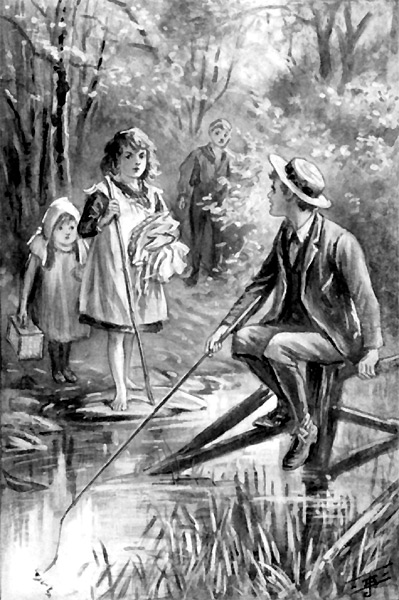 "Seated on a partly submerged post ... was John Brown."
(Page 25.)
"Seated on a partly submerged post ... was John Brown."
(Page 25.)