Nikko, August 12.
I need not tell you that the pervading manner of
spending time and money is always within our reach.
We do not go after the owner and seller of bric-à-brac;
he comes to us.
Coming from afar,—from Tokio, a hundred miles away,
and from Ozaka, four times that distance,—bales of
merchandise are unloaded at our door, or at our friends'
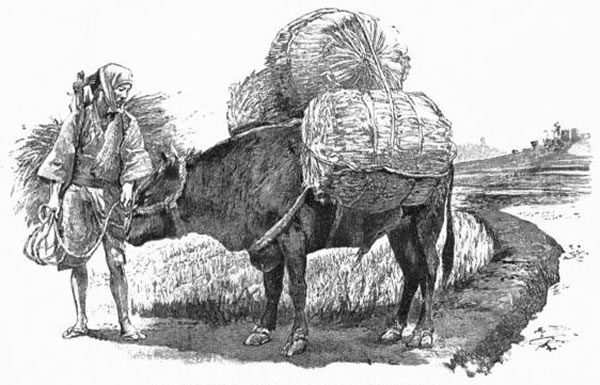
for us. Patient pack-horses stand in the inclosure of
the yards; big parcels, and piles of boxes and bundles,
encumber the verandas. Weary hours, beginning with
excitement and ending with gentle disappointment, are
spent in indecision of judgment and uncertainty of purchase.
But there remains always at the bottom of the
boxes a delusive hope, and some treasure may perhaps
reward our patience.
And then, besides occasional beauties in color or design,
there is something in looking over all these débris of civilization
in their own home; and odds and ends, having
not much more excuse for themselves than that they
remain, help to explain either the art or the habits of
the country, or its history, or the nature we see about us.
We have found almost nothing among the things brought
us which can rank as work of high art, and I am afraid
that we must be looked down upon by our friends for
purchases which have no excuse in any lofty esthetic code.
But they have the charm of being there, and of explaining,
and in another way of teaching, even when they are
bad, and often because they are bad. Because their very
poverty helps to a classification and to an analysis of the
means through which the artist worked, and to a knowledge
of the prevalent subjects and arrangements which
he found ready to his hand, bequeathed to him by an
earlier and nobler choice.
From all this poor stuff exhales the faded scent of a
greater art and refinement, which is now invisible, or destroyed,
or subsisting only in fragments, difficult of access,
or which are far away. And there is a peculiar unity in
the arts of the extreme East. We must remember that
this very sensitive Japanese race has developed in its art,
as in everything, without being subjected to the many
direct and contradictory influences which have made our
Western art and civilization. There have been here,
within historic times, no vast invasions of alien races,
bringing other ways for everything in thought and in life,
and obliging an already complex civilization to be begun
over and over again on readjusted bases; no higher living
and advanced thought obliged to yield for times and half
times, until the grosser flames of energy could be purified;
no dethronement, within society tried by every other calamity,
of the old primeval faith. Instead of a tempest of
tastes and manners of feeling blowing from every quarter,
and in which the cruder dislikes have held for centuries
the balance against cultured likings and devotion, Japan
has been carried on in one current, in which have mingled,
so as to blend, the steady influences of the two most conservative
civilizations of India and of China.
All here to-day, and for far back, is interwoven with
Chinese thought, breaks through it, returns to it, runs
alongside of it. And through Buddhism, its fervor, its
capacity for taking up in its course boulders of other
creeds or habits, a something different, higher in aspiration
and in form, has lived with everything else and
affected all.
This impressionable race found, contrasting with and
supporting its nature, secure, steady, undeviating guides,
so that these foreign ideals have persisted here with a
transplanted life. In fact, it is possible to look to Japan
to find something of what ancient China was. So much of
what has here been done, as their language does to-day,
saves for us a hint or a reflection of the great Chinese
ages, when China had not yet been conquered by the
foreigner, and when energies apparently unknown to the
China of to-day flourished with the strength of youth.
The art and literature of Japan, therefore, represent in
great part the Chinese prototype—an original which for
us has practically disappeared. We cannot easily know
what arrangements and compositions, what free interpretations
of the world, or severe imitations of nature, the
old Chinese adopted, but they are reflected or continued
in the styles and subjects and treatments of what we call
Japanese. The limits and definitions of each may be clear
to the Japanese critic, but to our casual Western eye they
merge or derive one from the other, like some little-known
streams which make one river.
Almost all the arrangements that we know so well on
Japanese drawings, screens, bronzes, lacquers, ivories, etc.,
have Chinese prototypes. And all this is over and above
the constant use of Chinese legend, and story, and philosophy,
which are to Japan what Greece and Rome used
to be to us—a storehouse of associated meanings and
examples.
Would it amuse you if I made out some of the types
that you see?
Here are the pine-tree and the stork, emblems of long
life; or the bamboo and the sparrow, which typify the
mildness and gentleness of nature.
The willow waves in the wind to and fro, and the swallows
swing forth and back again.
The names of Color and of Love are joined by a similarity
of sound, and probably by a mystic association:
and so you will see upon the screens that the leaves of
the maple turn red in autumn, when the stag calls the
doe. The cherry-blossom's splendor is for show, like the
pheasant's plumage.
Long centuries ago the plum became the poet's tree,
because of an early poet's verses; and the nightingale,
also a singer and a poet, is associated with the tree.
The tiger hiding in the jungle has a background of
bamboo, as the oxen have the peach-tree, from an old
Chinese sentence: "Turn the horse loose on the flower-covered
mountain, and the ox into the orchard of peaches."
The cock stands on the unused war-drum, which is a
Chinese symbol of good government, the aim of which is
peace.
Or, again, legends and stories are referred to.
The cuckoo flies across the crescent of the moon, and
the story of Yorimasa is called up, who slew with bow
and arrow the mysterious monster that had tormented
the life of the Mikado Narihito. I despair of telling the
story without great waste of words, and I half-regret
having chosen the example; but, perhaps, it is all the
more Japanese for its complication.
You must know that the Mikado—this was about the
year 1153—had been ill night after night with terrible
nightmares, to the confusion of his numerous doctors;
and that his many feminine attendants had done all they
could to soothe him, to no avail. Every night, at the hour
of the Bull (two A. M., an hour when evil power is great),
the dovecote was fluttered by this fearful visitation. But,
at length, either these gentle dames or other watchers
noticed that before each access a cloud had drifted over
the palace, and that, resting just above the sleeping-apartments,
two lights shone out from the dark mass.
Then the bells of the city temples sounded the hour of
the Bull. The gentlemen of the palace and the imperial
guards were set on watch, the priests prayed to ward off
the evil influence; but uselessly. Then Yorimasa—a
brave warrior, a famous archer, one of the guards—was
allowed, or ordered, to try to destroy the evil thing, whatever
it might be. He, with a follower, watched nightly
until the dark cloud and the shining orbs were near, when
the great bow of Yorimasa was discharged, and a strange
and wonderful beast fell blinded to the ground.
The sword of Yorimasa despatched it in nine separate
blows, and the thing,—said to have had something of the
monkey, the tiger, and the serpent,—was burned to ashes.
For this Yorimasa was given the girl he loved, the Lady
Iris-flower (who, therefore, had not watched in vain), and
with her the celebrated sword called Shishino-o (King of
Wild Boars). Now the imperial deputy, as he presented
this sword to Yorimasa, tried him with a punning verse,
while a cuckoo sang. This is what the verse said:
"The cuckoo above the clouds, how does it mount?"
But it meant, "Like the cuckoo to soar so high, how is it
so?" To which Yorimasa answered, filling in the necessary
couplet, "The waning moon sets not at will," which
might also mean, in modest disclaimer of ambitious effort,
"Only my bow I bent; that alone sent the shaft." And
so this moon stands in the picture, as in the verses, for
the bent bow of Yorimasa.
It is a shorter story, that which makes the allusion in
the type of the chrysanthemum and the fox. It is a variation
of the perpetual story. The prince royal of India
had a lovely mistress, who had bewitched him, and who
fell asleep one day in a bed of chrysanthemums, where
her lover shot at and wounded a fox in the forehead. The
bleeding temple of the girl discovered the evil animal she
really was. For the fox, as in China, is in Japan a wicked
animal, capable of everything in the way of transformation
and suggestion.
There are endless stories about him, and the belief or
superstition is still very strong. O—— was talking to us
lately about the scorcerers and spiritual mediums and fortune-tellers,
and, as an explanation of the power of some
medium, told us that he claimed to have in his service
tame foxes. Only, when I asked where they might be
lodged in the little city house, he explained that they
were not living in the body, and therefore cumbersome,
but were the spirits of foxes, thus subservient, and able to
penetrate everywhere and report.
The badger also is a misleading creature, and the cat is
considered uncertain.
Or take the way in which Hokusai refers to ancient
story when, at the end of one of his books, he makes a
picture of the devoted knight Kojima Takanori clad in
armor, covered with the peasant's rain-cloak; and he is
writing on the trunk of the cherry-tree the message of
warning for his master, the Emperor Go-Daigo Tenno.
But instead of the old verse, Hokusai has put: "In the
sixth year of the era Tempo, in the month of April, my
seventy-sixth year, this is written by me, formerly by
name Hokusai, but now more correctly known as 'The
Old Man gone Mad for Painting.'"
Here I have been wandering into Japan, while my
theme was rather the persistence of Chinese subjects, or
of subjects connected with China, the list of which would
be endless, from Shoki, the devil-killer, hunting his prey
of imps over sword-guards and round the corners of
boxes, to pictures of aphorisms, such as this saying of
Confucius, of which I found a drawing yesterday: "Avoid
even the appearance of evil; do not stop to tie your shoes
in the melon-patch of an enemy." And so these innumerable
subjects are common property, and serve as a
field for the artist to try to be himself, to bring out the
story or part of it, or his way of looking at it, or its decorative
capacity, or any way of anchoring the Japanese
imagination. I cannot say that for many of the ordinary
arrangements, the most simple and conventional, one does
not often suffer the boredom of repetition, as we do at
home, with the eagle and the stars, and armorial bearings,
and the stereotyped symbolism of churches. But it suffices
to see the thing well done again, to start once more
into some new enjoyment of the choice of subject.
So there can exist with regard to these subjects, apparently
mere motives of form, and partly because they are
conventional, a deeper convention or meaning, more or
less visible to the artist when at work, according to his
temperament or his school, as in our poetry, where an
idea may or may not be overlaid with realistic or esthetic
decoration.
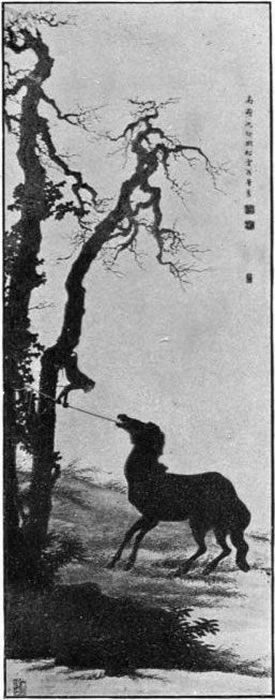 PAINTING BY CHIN-NAN-PIN.
I reach out for the first design that my hand can find,
which turns out to be a drawing by Chin-nan-pin. I have
chosen at haphazard, but the choice is perhaps all the
better. We shall have no example of a great man to deal
with, but merely the work of a remarkable Chinaman who,
somewhere in the early eighteenth century, happened to
come to Japan, or to be born there, so as to fit into a certain
Chinomania then prevalent. The photograph that I
send you is a poor one. You can merely discern the pattern,
or what might be called the masses, of the design.
A horse is tied to a tree,—a horse of Japan,—and a
monkey slides down the trunk and clutches at the halter
that prevents escape. I need not ask you to admire the
stealthy and yet confident step of the ape, and the motions
and repugnance and fright of the horse. I don't think
that they could be better given. Withal, there is a gravity
of general outline and appearances, and a pleasantly
managed balance of the full and empty spaces. But these
decorative points are not those I wish to refer to just now.
What I wish to indicate now is that this subject, which
might have suited a Dutchman for realism and for its
choice of the accidental, will mean, if you wish to see it,
the natural resistance and struggle of the inferior nature
against a superior mastery which it does not understand,
and which at first appears capricious and unreasonable.
Without being quite certain of the accuracy of my definition,
I know that the design is based upon a like convention.
This may not be spirituality, but how far it is from
what we call realism, and how wise the acceptance by the
artist of a convention which allows him to give all his energies
to a new interpretation, through his own study of
nature! As with those who have chosen distinctly religious
subjects, and whose vitality and personality can
triumph and coexist with the absence of novelty in the
theme, so the artist in more ordinary subjects may be
wise in keeping to themes which are known to those
whom he addresses, and in which they can fully grasp
and enjoy his success. These general themes allow a
stricter individuality in the artist who uses them, when he
is capable, and make his want of individuality tolerable,
and even laudable and pleasant, when, like most of us, he
has little of his own. Then he can never be so offensive
if we do not like him. Those that we do not like are
often offensive because their personal vanity appears upon
a solid ground of their own stupidity. Perhaps this is
why the Japanese objet d'art never offends, at least in the
older work done under the general influences that have
obtained with the race.
Hence, also, their astonishing variety. A thousand
times, many thousand times, you will have seen the same
subject, but never the same rendering, never the same object,
twice repeated. That is to say, that whenever it is
worth while we can get at the most valuable and costly
part of the work of art, the humanity that made it,
the love of something that went with the work. It is this
that makes the mystery of the charm of innumerable little
pieces of older work, like the metal-work that belongs to
the old swords, any one of which is superior to anything
that we do, unless in the rare cases when we bring in the
expensive life of a great master to rival it—some part of
the work left by a Barye, a Cellini, a Pisano.
All that our great men have done is exactly opposite
to the tendency of our modern work, and is based on the
same ground that the Japanese has lived and worked on—i. e.,
the reality and not the appearance, the execution
and not the proposition of a theme. The whole principle
is involved in the analysis of, say, a successful study from
nature—a beautiful painting, for instance, of a beautiful
sky. In such a case the subject is all provided; the importance
of the result depends upon the artist's sensitiveness
to the facts supplied to him, upon his use of his hereditary
and acquired methods of recording them, and
upon his personal variation of those methods. No one
dreams of praising the art of the sky itself, that is to say,
the fact that the facts existed; to praise the artist for the
thing having occurred from which he worked. It is this
apparent want of comprehension of the first principles of
the plastic arts in our poor work, and in a vast proportion
of our best, that makes any reasonable man a pessimist as
to our near future. Every poor element of our civilization
is against it, and our influences are now deteriorating
the art of Japan. We value material or the body instead
of workmanship or the right use of the body; and instead
of style and design, the intellect and the heart. To us a
gold object seems spiritually precious, and we hesitate at
working in other than costly materials. To the Japanese
workman wood and gold have been nothing but the means
to an end. We had rather not do anything than do anything
not enduring, so that when our materials are difficult,
the life has flown that was to animate them; the
Japanese is willing to build a temporary architecture, and
make a temporary lacquer, which holds more beauty and
art than we to-day manage to get in granite or in metal.
And when the Oriental workman takes the hardest surfaces
of steel or of jade, he has had the preparations for
using it with mastery; it is again plastic and yielding for
him, as the less abiding materials have been before. Nor
would the Japanese artist understand the point of view of
many of our men, who do their best to put an end to all
art, so lost are they in our vanity of "advertisement."
The Japanese would never have invented the idea of
doing poorly the work one is forced to do to live, so as to
reserve vast energy for more important or influential work
that might draw attention to him. The greater part of
our "decoration" is carried out just the contrary way to
his. Our artists accept as a momentary curse the fact
that to live they may have to draw patterns, or work in
glass, or paint or model subsidiary ornamentation. They
look forward to the glorious time when they may wreak
their lofty souls in the dignity of paint mixed with the
sacred linseed oil, or in the statue done in bronze or
carved in marble by other hands than theirs. And yet
if their nature be not too far removed from ours, the
habit of doing less than their best, the habit of doing
poorly, the scorn of anything but the fine clothes of a fine
material, will never be gotten over, and throughout this
little cheapness of soul, this essential snobbishness, will be
felt to puzzle and disconcert those who wish to admire.
That is to say, that they too often do not look to the
end, but to the means, while to the artist the means are a
mere path—as with the Greeks, whose work will live,
even if its very physical existence is obliterated, because
it is built in the mind, in the eternity of thought. So
Greek art existed, and has lived, and lives, the most flourishing
and richest that we know of—with less to represent
it than we turn out daily. So it lived, when it had
no longer anything of its own body to represent it, in
everything that was done in every country which kept
its lessons; and lives still, without examples to refer to,
even into the very painting of to-day. It is the principle
of the proper place of means that makes the little piece
of Japanese metal-work—for instance, the sword-guard
or the knife-handle—an epitome of art, certainly a greater
work of art than any modern cathedral. And as certainly
we shall never even produce good ordinary ornamental
work until we feel the truth that I have lamely indicated.
"I might perhaps do as well as this," said an intelligent
architect, as we looked at some excellent but not noblest
details of French Renaissance, "but how could I spend the
time on it? And not only that, but how could I have
spent the time previous to this in doing other similar
work to train me? I can only make a project, have it
carried out by the best commercial firm, not anxious to
change the course of trade, and shut my eyes to the result.
I should never be criticized, because I did not give
more than my bargain." And yet to give more than your
bargain is merely to give art.
Look at this little netsuke,[5] or inro,[6] or sword-guard,
and follow the workman as you admire each detail of the
execution. He has chosen some subject or some design
which may have an associated meaning, or may be of
good omen, and bear good wishes, or he may have chosen
out of the entire world of observation, of fancy, or of tradition;
and may have chosen just as much because it fits
well the space which he has to cover.
He will take as well a design that has been used a hundred
times as a newer one. For he has to reinvent it in
execution, even as the Greek sculptor who recut again
the "egg and dart," or the orator who is to expound and
carry out to success some argument all ready in his mind—as
the old architect who rebuilt a glorious Greek temple
upon the rules and canons of proportion that others
had used before him. But he has to see that this design
in his mind—or nearer yet, perhaps on paper—shall
fit the spaces of the material and of the object which
he is to make, so that it shall be made, as it were, for that
place only. He will then go again to nature,—perhaps
working directly from it, perhaps only to his memory
of sight,—for remember, that in what we call working
from nature—we painters—we merely use a shorter strain
of memory than when we carry back to our studios the
vision that we wish to note. And more than that, the
very way in which we draw our lines, and mix our pigments,
in the hurry of instant record, in the certainty of
successful handling, implies that our mind is filled with
innumerable memories of continuous trials.
The workman then goes to nature, and finds in it the
reality and the details of his design, even, let us say, to
the very markings of a tree trunk that he has chosen:
they are all there, since they exist in the design, and the
design is good. But they exist only in so far as they exist
also in the ivory that he cuts—in the veining of the
tortoise-shell or malachite that is to render it. Now with
patient pleasure he can hunt out these associations; he
can use gold, or silver, or vulgar lead, or lacquer, or the
cutting and filing of steel, or the iridescence of mother-of-pearl
for his leaves, or his stems, or the water, or the
birds,—for the clouds or the moonlight,—for the sunshine
and the shadow,—for the light and dark,—for the
"male and female" of his little manufactured world.
These he will model, chisel, sink, or emboss as the story
needs, and do it coarsely, or loosely, or minutely, or delicately,
as the unity of his little world requires. And he
will work in a hurry, or work slowly, he will varnish it
and rub it down, and polish it again, and bake it many
times, and let it weather out of doors, or shut it up carefully
from the smallest track of dust, or bathe it in acids
or salts, and all this for days and months in the year.
And when he has finished,—because to do more or less
would not be to finish it,—he has given me, besides the
excellency of what we call workmanship, which he must
give me because that is the bargain between us—he
has given me his desires, his memories, his pleasures, his
dreams, all the little occurrences of so much life. As
you see, he is following the law of Tao, so that however
humble his little world, it has a life of its own which cannot
be separated from its materials; no picture of it, no
reproduction, will give its full charm, any more than a
photograph gives that of a human being. Take out the
word Japanese wherever I have put it, take out the actual
materials that I have mentioned, and the description and the
reasoning will apply. That is all there is to any work of
art. It does not exist in a fine abstract of intention—nor again in the
application of some method of toil—to define "technic," as so many
young idiots most excusably try to persuade themselves. It exists in an
individual result with origins so powerful and deep that th
ey
are lost in shade.
To go on, I wish to put it that the same reasons will
cause the artist, then, to elaborate profusely, to work in
long patience, to use precious materials, to work slightly
or carelessly, to finish his work with minute details, or to
sketch rapidly with the end of a brush filled with the
single color of India ink.
There is no difference in reality; there is only the
question of the kind of interest he wishes to evoke, the
sort of relation he wishes to establish between himself
and his work, and incidentally to me, the looker-on.
I am afraid that this hazy weather is affecting the sequence
of my dreaming, or what I am pleased to call my
thought, so that you may not clearly understand me.
Again I wish you to remark that in all fullness of work
other things are suggested than those directly represented,
upon the same principle, for the same reasons, that the
successful sketch, as I said before, is richer than it looks.
Hence the suggestion of color when there is really but
black and white; hence the suggestion of modeled light
and shadow when there is really but flat color and outlines.
Hence the success of all great periods in what we
call decorative work, because there was no separation;
there was merely art to be used to fill certain spaces, and
to recall the fact that it was so used.
Many years ago I used to read Mr. Ruskin, when "my
sight was bad, and I lived within the points of the compass,"
and also the works of other men, who laid down
the exact geography and the due distances, north and
south, of a certain department or land of art which they
called "Decoration." Some of them are not yet dead.
The light of Tao fell upon the subject from the words of
a child who had been listening to a talk in which I and
others wiser than myself were trying to follow out these
boundaries that outlined "true" methods of decorative
art, and kept to the received instructions of abstention
from this and that, of refraining from such and such a reality,
of stiffening the flow of outline, of flattening the
fullness of modeling, of turning our backs on light and
shade, of almost hating the surface of nature; and we
wondered that when our European exemplars of to-day
had fulfilled every condition of conventionality, had carefully
avoided the use of the full methods of art, in the
great specialties of painting and sculpture, their glorious
work had less stuff to it than a Gothic floral ornament or
a Japanese painted fan. "Father," said the child, "are
you not all making believe? Is the Japanese richness in
their very flat work so different from what you can see in
this sketch by my little brother? See how his tree looks
as if it had light and shadow, and yet he has used no
modeling. He has used only the markings of the tree
and their variation of color to do for both. He has left
out nothing, and yet it is flat painting."
Nor have the Japanese left out things. They have not
been forced to overstudy any part, so as to lose the look
of free choice, to make the work assume the appearance
of task-work—the work of a workman bored, nobly
bored perhaps, but still bored, a feeling that is reflected
in the mind of the beholder. The Japanese artist makes
his little world,—often nothing but an India-ink world,—but
its occupants live within it. They are always obedient
to all the laws of nature that they know of.
However piercing the observation of actual fact, its record
is always a synthesis. I remember many years ago
looking over some Japanese drawings of hawking with
two other youngsters, one of them now a celebrated artist,
the other a well-known teacher of science. What struck
us then was the freedom of record, the acute vision of
facts, the motions and actions of the birds, their flight,
their attention, and their resting, the alertness and anxiety
of their hunters, and the suggestions of the entire landscapes
(made with a few brush-marks). One saw the
heat, and the damp, and the dark meandering of water in
the swamps; marked the dry paths which led over sounding
wooden bridges, and the tangle of weeds and brush,
and the stiff swaying of high trees. All was to us realism,
but affected by an unknown charm.
Now this is what the artist who did this realism has
said, as well as I can make it out: "The ancient mode
must be maintained. Though a picture must be made
like the natural growth of all things, yet it lacks taste and
feeling if it simulates the real things."
Evidently the painter had not learned our modern distinctions
of the realist and the idealist.
If you wished to know what I admire most in these
forms of art, I might say to you, keeping, I hope, within
the drift of what I have been writing, that it is their
obedience to early rules which were once based on the
first primeval needs of the artist. And if you pushed me
further, and wished to make me confess what I thought
that these necessities might be, and to make me give you
a definition of them, and thereby force me into a definition
of art itself, I should hesitatingly state that I do
not like to define in matters so far down as causes. But
if you would not tell, or take advantage of my having
been drawn into such a position of doctrine, I might
acknowledge that I have far within me a belief that art
is the love of certain balanced proportions and relations
which the mind likes to discover and to bring out in
what it deals with, be it thought, or the actions of men, or
the influences of nature, or the material things in which
necessity makes it to work. I should then expand this
idea until it stretched from the patterns of earliest pottery
to the harmony of the lines of Homer. Then I should say
that in our plastic arts the relations of lines and spaces are,
in my belief, the first and earliest desires. And again
I should have to say that, in my unexpressed faith, these
needs are as needs of the soul, and echoes of the laws of
the universe, seen and unseen, reflections of the universal
mathematics, cadences of the ancient music of the spheres.
For I am forced to believe that there are laws for our
eyes as well as for our ears, and that when, if ever, these
shall have been deciphered, as has been the good fortune
with music, then shall we find that all best artists have
carefully preserved their instinctive obedience to these,
and have all cared together for this before all.
For the arrangements of line and balances of spaces
which meet these underlying needs are indeed the points
through which we recognize the answer to our natural
love and sensitiveness for order, and through this answer
we feel, clearly or obscurely, the difference between what
we call great men and what we call the average, whatever
the personal charm may be.
This is why we remember so easily the arrangement
and composition of such a one whom we call a master—that
is why the "silhouette" of a Millet against the sky,
why his placing of outlines within the rectangle of his
picture, makes a different, a final, and decisive result, impressed
strongly upon the memory which classifies it,
when you compare it with the record of the same story,
say, by Jules Breton. It is not the difference of the fact
in nature, it is not that the latter artist is not in love with
his subject, that he has not a poetic nature, that he is not
simple, that he has not dignity, that he is not exquisite;
it is that he has not found in nature of his own instinct
the eternal mathematics which accompany facts of sight.
For indeed, to use other words, in what does one differ
from the other? The arrangement of the idea or subject
may be the same, the costume, the landscape, the time
of day, nay, the very person represented. But the Millet,
if we take this instance, is framed within a larger line, its
spaces are of greater or more subtle ponderation, its building
together more architectural. That is to say, all its
spaces are more surely related to one another, and not
only to the story told, nor only to the accidental occurrence
of the same. The eternal has been brought in to sustain
the transient.
For fashions change as to feelings and sentiments and
ways of looking at the world. The tasks of the days of
Angelico, or of Rubens, or of Millet are not the same;
religions live and disappear; nations come and go in and
out of the pages of history: but I can see nothing from
the earliest art that does not mean living in a like desire
for law and order in expression. It is, therefore, because
we consciously or unconsciously recognize this love of
the unwritten harmonies of our arts, the power of recalling
them to us, in some painter or in some architect, that
we say that such a man is great. He is great because he
is the same as man has been, and will be; and we recognize,
without knowing them by name, our ancestral primordial
predilections.
Yes, the mere direction or distance of a line by the
variation of some fraction of an inch establishes this
enormous superiority—a little more curve or less, a mere
black or white or colored space of a certain proportion,
a few darks or reds or blues. And now you will ask,
Do you intend to state that decoration—? To which I
should say, I do not mean to leave my main path of
principles to-day, and when I return we shall have time
to discuss objections. Besides, "I am not arguing; I am
telling you."
This is the unity, this is the reality, which disengages
itself from the art of Japan, even as we know it in common,
through what we usually call "bric-à-brac." Our
introduction to it is rather curious when one comes to
think of it. Suddenly, owing to enormous social changes
in Japan, involving vast fluctuations in fortunes, most of
all that was portable was for sale, and flooded our markets.
Ignorant dealers held in masses small treasures of temples,
adornments of the wealthy, all the odds and ends
of real art, along with the usual furniture, along with all
the poor stuff that would naturally be made for us barbarians,
and had been made for us for centuries through
the trade of Holland. It was as if Paris or London
had suddenly been unloaded of everything portable, from
works of art to household furniture. Naturally the main-spring
of it all,—the works of great draftsmen, for instance,—being
more debatable, more inexplicable, more
useless, in a word, or detained by stronger bands, just as
it would be with us, have somewhat escaped the drain.
Our perceptions have been confused in all this mixture
by repetitions, imitations, which in every form of art, as
we know so well in literature, degrade the perception and
enjoyment of what is good. I can only wonder that the
world has not been tired out and disgusted with Japanese
bric-à-brac. And had we not been in such bad straits of
taste ourselves, such would have been the case. I have
always considered that the artist needed to be forgiven
for his turn toward bric-à-brac; not for his liking to have
odds and ends for help and refreshment, but for having
too many; because his life is to make, not to collect. To
others, that can be forgiven easily; for the pieces of the
past are a consolation of the present, and one would like
to feel that a man's likings are his important self, and are
betrayed by his choices. "Dis-moi ce que tu aimes—je
te dirai ce que tu es."
If one had time and did not do, what pleasure it might
be to describe forever the innumerable objects and things
that might be found here, even though words are a poor
rendering of sight. And what pleasure it might be to
try to describe the greatest of all bric-à-brac, the greatest
remains of the higher arts—sculpture and painting.
I have begun some such letter for you, but I fear that
it may never be finished. Nor do I see any way of giving
an account of the history of painting in Japan, which
would have to stand for a still further explanation. Should
I study it further, can I do more than to increase my own
knowledge,—and all knowledge is a burden,—and to give
you cursory proof, by names and a few examples, that
the art of painting and the art of sculpture are very old
here? I should have to begin to ask myself for you if the
earliest remains do not already prove still earlier schools
and accepted or debated tradition, and I should then have
still one thousand years of design to account for.
 SIGNATURE OF HOKUSAI.
I shall probably leave my letter to you unfinished.
It has already become unwieldy, and
I could give you only my own impressions. And
then in the history of art everything is needed.
It would not be merely reproduction in words,
however beautiful, of the surfaces of works that
have survived time, nor of the men who made
them, of their characters, the accidents of their
lives, and their technical beliefs. It would be
simply a history of humanity at a given place.
It could not be solved by a mere account of the
place and the race, according to some of our
later scientific fads. I was writing to you but
yesterday, and trying to make out that the work
of art is often a contradiction of the period, or a
step in advance; that the moods of feeling of
the future are as often reflected by art as the
habits of the present. But whatever personal
sense of solitariness or of antagonism has inspired
or oppressed the artist, he must have had
partners since he has had admirers, even when
he antagonizes his time. However transient certain
of his forms, however much to us who come
afterward they indicate the period, he has expressed
not his time, but the needs of others
who have been looking in the same ways, and
yet have had no voice. And even if they have
not quite sympathized, the accumulations of like tendencies
have become stronger and clearer in their descendants.
To reflect fully, then, in words, the face of the work of
art, one would have to melt into it in some way the gaze
of those who have looked at it; to keep upon it still the
gentle looks of the pitiful and the loving, the rapt contemplation
of the saints, the tender or mocking smile of
women, the hard or contemptuous appreciation of rulers,
the toleration of the wise, all of which have been in
reality a part of the very work. Their negations or
sympathies have fallen on the work, and these ineffable
delicacies of impression are transmitted in it to successive
generations, even as the shadowing of innumerable years
of incense-burning has browned the gold and blackened
the azure, as concealment in the shade has sometimes
paled, sometimes preserved, the edges of the outlines and
the modeling of the colors, or exposure and heat and
damp have cracked and channeled and dusted all surfaces.
You see what I should consider a true carrying out of
such a task, and how unsatisfied I should be with anything
that I could accomplish, unless it were to stand to
you as something fragmentary and evanescent. One
thing I should like to do,—should I remain long enough,
and be able to get it from the few acquaintances who
may know,—and that is, to save some part of the artists
themselves out of that obscurity by which the lives of great
workers are almost always clouded. To me Rembrandt,
and Balzac, and Delacroix, each contradictory to his surroundings,
have become more intelligible through the
record of their every-day struggle, the exactness of measurement
which one can place upon the personal circumstances
in which they carried out their work, the limitations
of its exact meaning and importance in their own eyes, as
we follow them in the daylight of favor, or in the gloomy
endings that so often close the lives of great artists.
I hear occasionally of the wanderings of Kano Motonobu,
the founder of the great school and family of artists
who have lasted through four centuries to the present
day, and have filled Japan and the temples here with
works better or poorer, until the family name becomes a
burden. I hear about Okio, the charmer, the painter of
everything and of animals, who began as a little child, by
sketching on the earth with bamboo sticks when he followed
his parents into the fields to work. One might
perhaps learn about Hokusai, who is tabooed here, and
about whom I dare not inquire, but whose charming last
letter, as given by Mr. Morse, comes back to my memory—it
is so gay and so sad, so triumphant over circumstances,
so expressive of the view of the world which explains his
woodcuts. I quote from memory: "King Em-mā" (he
writes to a friend)—"King Em-mā" (the ruler of the
under world) "has become very old, and is thinking of
retiring from business; so that he has ordered a little
country house to be built, and he asks of me to come to
him that I may paint him a 'kakemono'; so that in a few
days I must be ready to travel and to take my sketches
with me. I shall take up my residence at the corner of
the Street of the Under World, where it will give me
much pleasure to receive thee, when thou hast the opportunity
to come over there."
Or this mocking challenge to old age, at the end of one
of the volumes of his pictures of Fuji:
"Since my sixth year I have felt the impulse to represent
the form of things; by the age of fifty I had published
numberless drawings; but I am displeased with
all I have produced before the age of seventy. It is at
seventy-three that I have begun to understand the form
and the true nature of birds, of fishes, of plants, and so
forth. Consequently, by the time I get to eighty, I shall
have made much progress; at ninety, I shall get to the
essence of things; at a hundred, I shall have most certainly
come to a superior, undefinable position; and at
the age of a hundred and ten, every point, every line,
shall be alive. And I leave it to those who shall live
as I have myself, to see if I have not kept my word.
Written, at the age of seventy-five, by me, formerly
known as Hokusai, but now known as Gakyo Rojin (The
Old Man gone Mad for Painting)."
... I had been intending to add, when I interrupted myself some way
back, that I enjoyed in this art of Japan—at least in this drawing
which they call painting—the strange nearness I seem to be in to
the feelings of the men who did the work. There is between us only a
thin veil of consummate skill. The habit and the methods resulting from
it, of an old obedience to an unwritten law common to all art, have
asked for the directest ways of marking an intention or an observation.
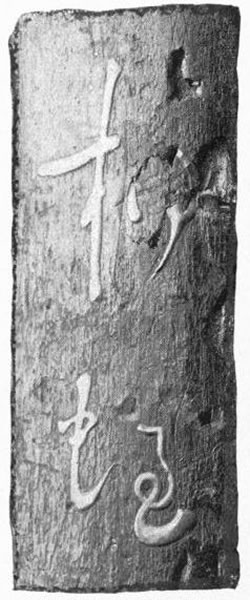 INSCRIPTION ON OLD LACQUER.
This reference to a previous tradition of meaning, of ideal arrangement
by rule, this wish for synopsis, this feeling for manners of expressing
one's self in the thing seen, will naturally make art out of anything.
And it is not wonderful that what we call handwriting may then give full
play to art, in a written language of which ideography
is the key. Given the Chinese characters, their original intentions, the
associations, historical and literary, connected with them, is it
anything strange in reality, however strange to our habits, to find
writing a form of art in Japan? It may have all I have just referred to,
and be full of the meaning of ideas, and be literature, and then it can
be made conformable to the laws of beauty of form and spacing; and above
all, to give character of style, and character of personality, to look
more or less grave, or elegant, or weighty, according to circumstances,
be elegiac, or lyric, or epic, and reflect on its face the intentions of
the text. And again it will be the mark or sign of the person; so that
my Japanese friends can object to Hokusai's bad writing, as betraying
something not refined, for a weighty argument against his other works
done with a similar implement, the brush, which is the pen of the far
East.
It will then be in what we call drawing—which is an
abstraction, the synopsis of the outlines of things meeting
together, of their relative intensities, of their own colors,
of their relations to the place they are in, that is to say,
the picture—that this art of Japan, the daughter of the
art of China, will attain its highest form; so that in reality
those of us who think of it as appearing at its best
only in color, in external charm, have not understood it.
An etching of Rembrandt could fairly be said to represent,
not so much in itself, but in its essence, what a great
Chinaman would have liked to do in India ink—the material
of all others which, even to us, is his especially.
The line, the abstract line of Rembrandt, its elegance, its
beautiful patterning of the surface, is concealed to us by
the extraordinary richness of some of his modeling and
the extreme gradations of what we call light and shade.
But it is there all the same, as a geologic foundation, in the
same way that inside of the Titian's splendor of surface
there is a decorative substructure as well balanced and
fixed as a Venetian brocade—just as the works of other
great colorists, as we call them (to designate more complex
men), imply, in their constitution and the mechanism
of their technic, powers of design and drawing
sufficient to furnish out armies of such draftsmen as flourish,
for instance, in the Paris of to-day. It is this surplus
of richness that conceals the identity. Our arts have
undertaken an enormous accession of truths and ambitions
upon which the arts of the extreme East have never
ventured. They have attained their end, the end of all
art, at an earlier mental period. They are younger, perhaps
even more like children, and their work cannot involve
the greater complications of greater age; but it
has also all that grasp of the future that belongs to youth,
and that has to be accompanied by deficiencies of knowledge;
that is to say, of later acquirement and the practice
of good and evil. And it is impossible to look at
the expression of nature, or of any intention made by the
child in full sincerity, without realizing that the aim of
the artist, be he even Michael Angelo, is to return to a
similar directness and unity of rendering. Not that the
Eastern artist, any more than the child, could be conscious
of deficiencies of which he had not thought. He
has been satisfied, as we have been satisfied, but for a
longer time and under a greater prestige. As the fruit
painted by the Greek deceived the birds, and the curtain
painted by the Greek painter deceived his fellow-artist,
so the horses of Kanaoka have escaped from their "kakemonos,"
and the tigers sculptured in the lattices of temples
have been known to descend at night and rend one another
in the courtyards. O—— tells me the Chinese
story of the painter forced to let go his painting of the
moon for a nominal sum to repay an oppressive money-lender,
and how, when the banker happened to unroll it,
the whole room was illumined, and he grew into a habit
of spending evenings in the mild effulgence of the painted
rays. But when, after an absence, he looked at it again,
the moon was gone,—where old moons go,—and he was
enraged at the painter, though he might well have noticed
that for many days the moon had not been so bright, and
indeed had seemed to be ill drawn. O—— tells me that
the artist got it back for little, and waited the necessary
number of days to have its crescent reappear again; and
A—— says that, though the picture is lost to-day, he
hopes to find it again in China in following years.
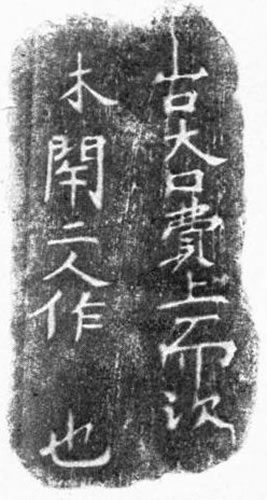 INSCRIPTION FROM HO-RIU-JI.
These stories serve as a way of stating to you that as
long as new wants were not
felt, newer accuracies did not
begin to exist, and these limitations
are naturally seen to
be more easily put up with in
a civilization of uninterrupted
tradition. To acquire something
when one's hands are
full, something has to be
dropped. In the stations of
our own progress in art, the
advance has at every stage
involved some deficiency, or
failure, or weakening on another
side. This is the only
explanation I can make for
painting in the extreme East
not having taken up portraiture—that
is to say, not having
triumphed in it, while sculpture has reached out
toward it in a splendid way. We have seen the same
thing in the transition from the Middle Ages, when sculpture
outreaches painting in the direction of reality. But
then sculpture is to a certain extent easier and in a certain
way inferior, because it gives a sort of duplicate of
the object, not a relation of it to other things.
So that the Japanese have not come to the work from
the "model," which has at so many periods and so long
been ours. Theirs are types of types; they are not, as
with us, persons, and the pursuit of beauty in the individual
has not been followed apparently by the art of the
far East. The personal love and preference of the artist
embodied in another person their art does not show; nor
have their artists given a nameless immortality to certain
human beings, so that for ages their types, their images,
their moods, their characters, their most transitory variations
of beauty, have been proposed to us as an example.
Have you ever reflected how the nameless model reigns
in the memory of man with a personal fame more intimate
than that of Cheops, or Helen, or Cæsar, because the artist
has been obliged to build upon this person his own dream
of the world—as with the Roman girl who is the Madonna
of San Sisto?
... So, again, the Eastern artists have suggested,
and implied, and used light and shade, and perspective,
and anatomy, and the relations of light to color, and of
color to light, only so much as they could take into their
previous scheme.
In many cases their success is still an astonishment to
us. Certainly their records of motion, their construction
of plants and flowers and birds, we have all appreciated;
and their scientific, easy noting of colored light in landscape
made even Rousseau dream of absorbing its teaching
into his pictures, which certainly represent the full
Western contradictory idea, in the most complicated acceptance
of every difficulty.
The artist here, then, has not made separate analytical
studies of all the points that trouble us, that have cost at
times some acquirement of the past, in the anxiety for
working out a new direction; as to-day, for instance, in
learned France, where the very art of painting, as a mirror
of the full-colored appearance of things, has for a
quarter of a century been in peril, under the influence of
the academy drawing-school, the model in studio light,
and the vain attempt to rival the photograph. And perhaps
it is needless to repeat again how we have lost the
sense of natural decoration and expression of meaning by
general arrangement of lines and spaces, so that again in
France we are astonished at M. Puvis de Chavannes, who
uses powers that have once been common to almost all
our race.
Here the artist does not walk attired in all the heavy
armor which we have gradually accumulated upon us.
His learning in side issues is not unnecessarily obtruded
upon me, so as to conceal the sensitiveness of his impressions
or the refinement of his mind. As for us, we have
marched on in a track parallel to science, striving now for
centuries to subdue the material world—to get it into the
microcosm of our paintings. Each successive great generation
has taken up the task, heavier and heavier as time
goes on, halting and resting when some new "find" has
been made, working out a new discovery often with the
risk of the loss of a greater one.
But how often the processes have covered up what is
most important,—to me at least,—the value of the individual,
his aspirations, and indeed the notions or beliefs
that are common between us.
Sometimes this covering has been sordid and mean,
pedantic or unesthetic, sometimes most splendid. But
how difficult it has been always for the many to read, for
instance, in our great Rubens, the evidences of a lofty
nature, the devout intentions of a healthy mind!
Not that we can turn back to-day and desert. From
the time when the Greek first asserted in art the value of
personal manhood to the date of the "impressionist" of
to-day, the career has been one. And certainly in the art
of painting a vaster future lies before us, whenever we are
ready to carry the past. But remember that whatever
has been really great once will always remain great.
Even if I were competent to make more than approaches
to reflection, this place of dreams is not well
chosen for effort. I feel rather as if, tired, I wished to take
off my modern armor, and lie at rest, and look at these
pictures of the simplicity of attitude in which we were
once children. For, indeed, the meaning of our struggle
is to regain that time, through toil and the fullness of
learning, and to live again in the oneness of mind and feeling
which is to open to us the doors of the kingdom.
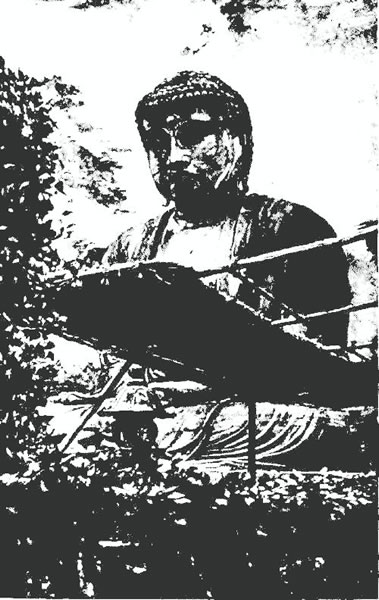 The Great Statue of Buddha at Kamakura
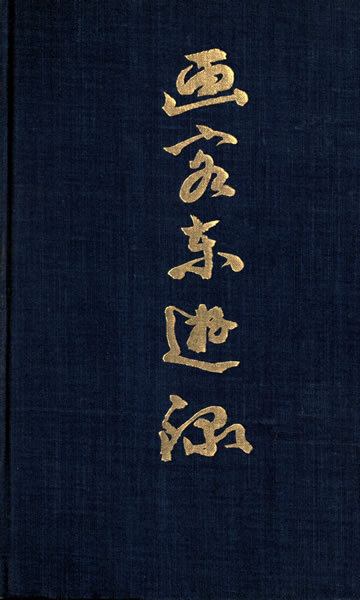
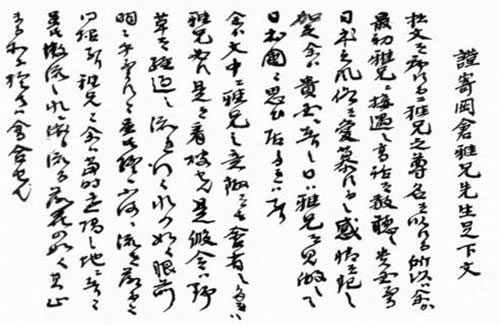 WHICH IN ENGLISH MEANS: