I ENDEAVOURED, in a former book on Egypt, to
give my first impressions while the glamour of the
East had not been dimmed by familiarity; and the
kind reception of that, my first literary attempt, has
encouraged me to write again after spending some
years in the Nile Valley. Though first impressions
may have a charm which familiarity lacks, it would be
astonishing if a country so full of beauty, and of such
varied interests as is Egypt, had caused familiarity to
breed contempt. I may safely say that it has not had
that result. A lengthened stay has certainly added to
my experiences as well as to my stock of drawings,
and I trust it has also given me some insight into the
character of the people amidst whom I dwelt.
Mediæval Cairo is doubtless year by year the poorer
by many picturesque ‘bits’ which have vanished. But
Cairo is a large city, and happily many years may elapse
before artists will cease to go there for material. What
is still untouched by the jerry builder, or has not been
allowed to fall into ruin, is probably more beautiful
than anything other oriental cities can show. Less
change is seen in the smaller towns, and the villages are
much the same in aspect as when the Saracen invaders
first occupied the valley of the Nile.
Every season adds to the knowledge of Ancient
Egypt, and gives us something which for centuries lay
hid beneath the desert sands. It was my good fortune
to spend some winters at Thebes while some of the
most interesting of recent discoveries were made,
and through the courtesy of Mr. Weigall, the Chief
Inspector of Upper Egypt, I was enabled to dwell and
do my work in these congenial surroundings. I have
also to thank him for the unique opportunities which
our desert journey, from the Nile to the Red Sea,
offered; of all my experiences in Egypt, none has
given me more pleasure in recalling.
AFTER a lapse of some years, I returned to Cairo
to attempt once again to paint its ancient buildings,
as well as the picturesque incidents seen
in the shadows they cast or bathed in light against
their sunlit walls.
I made an early start on the first morning after my
arrival, partly to look for a subject, and more particularly
to see whether the pictorial side of the old quarters of
the city would still impress me as it did on my first visit.
It was a fateful morning, for had what I saw failed
to stir up my former enthusiasm, I was resolved to pack
up my traps, and try my hand in Upper Egypt.
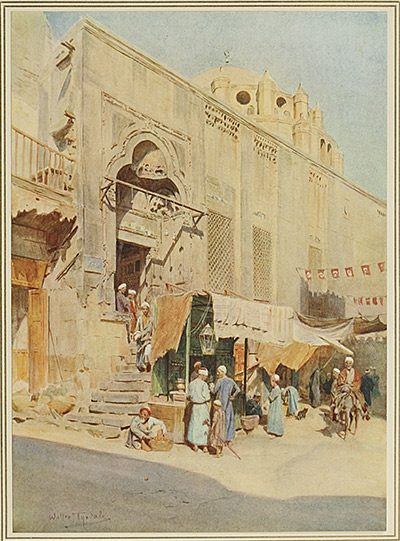
I hurried along the Mousky as fast as its usual
crowd of people would allow, and turned down the
Khordagiyeh to see if an old favourite subject of mine
had not been ‘improved away.’
Needless to say, it was a brilliant morning, for the
occasional grey days of midwinter were still a long way
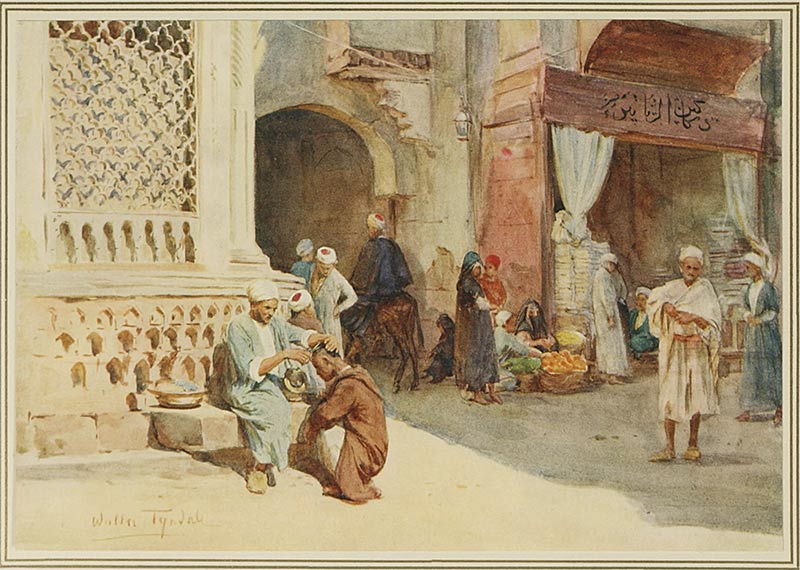
off. Great awnings hung across the street, and on one
side the shopmen were lowering blinds or rigging
up matting, in anticipation of the sun which would
shortly be streaming down on them. Everything still
had its summer look, though October was far spent;—and
Cairo, let me say, is much more beautiful in hot
weather than during the comparatively chill days of
winter.
The particular houses I had gone in search of were
happily untouched; but had they been restored out of
all shape or allowed to fall down for want of repair, I
should hardly have had room for a depressing thought.
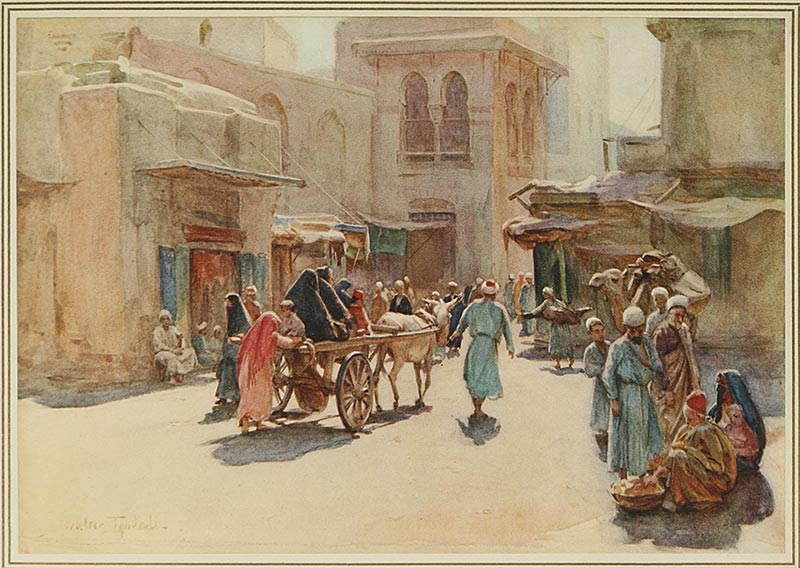
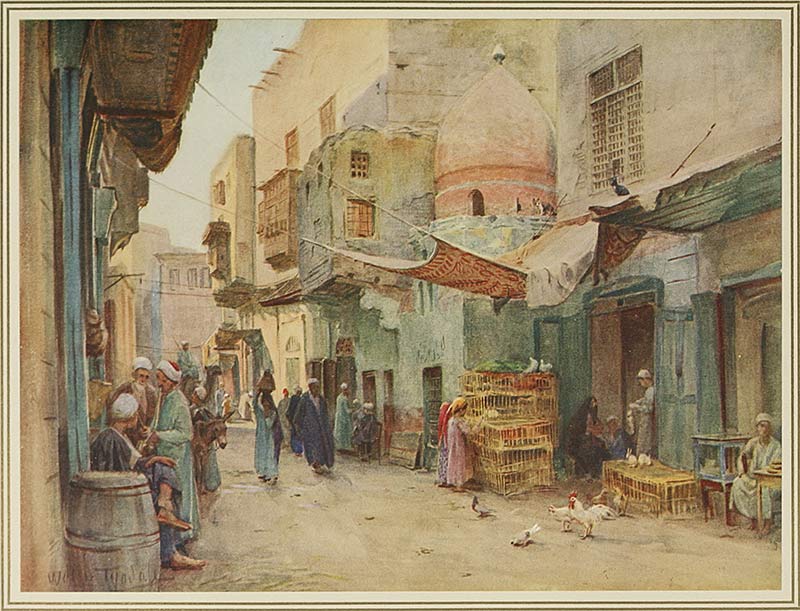
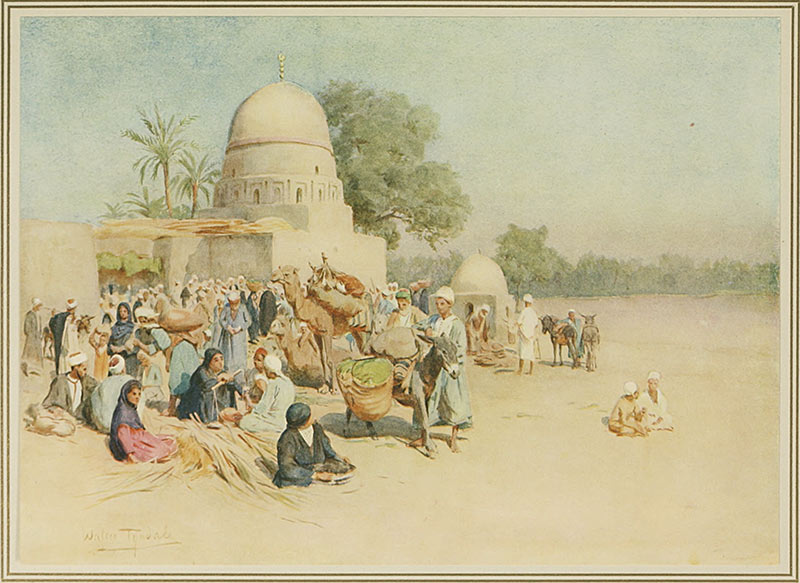
From the crowd of country folk and the heavily
laden camels and donkeys, it was evident that a market
was being held in the open space in front of the Beit-el-Kadi.
Locomotion was difficult till the Nahasseen
or coppersmith street was reached, for here the road
widens out at the Muristân. This handsome building,
together with the mosques of Kalaûn, en-Nasir, and of
Barkûk, formed a magnificent group, massed as they
then were in a luminous shade. It was a meeting of
old friends, and old friends looking their best. The
dark awnings stretched across the road gave this pile of
masonry a light and ethereal look, though they were
dark in contrast to the azure above, save where the sun
tipped the domes and a face of the minarets.
The crowd allowed but little time for contemplation;
I had to move with it, and reaching the short street
which leads to the Beit-el-Kadi, a converging stream of
people carried us along till we arrived at the market
square. I picked my way through the heaps of fruit
and vegetables which littered the ground, passed behind
a group of camels, and worked my way to the steps of
the court-house, which gives its name to the market.
From this point of vantage I was enabled to make some
rough studies of the animated scene before me.
The sun had now risen high enough to flood the
larger part of the square in light. Bits of matting, sailcloth,
or anything which can cast a shadow, were rigged
up to protect the more perishable goods, and the early
comers had taken advantage of the shade of the acacia
trees at the further end of the market.
The general impression is one of light, colour, noise
and movement. The detail is full of human as well
as pictorial interest. Various combinations of colour—some
beautiful, some inharmonious—leave ample
scope to the painter to arrange his scheme. A pile of
oranges and lemons, with the black and deep purple
dress of the fellaha saleswoman, make a striking note in
the foreground; the stacks of pitchers brought down
from Balliana, in Upper Egypt, give a variety in buffs
and greys, and the blue garments of the buyers are
sufficiently faded not to contrast too violently. It is also
a great study of types and characters. The noisy Cairene
is chaffering with the quieter Shami from far Damascus
for some pomegranates which are heaped before him;
the Maghraby hawks a bundle of yellow slippers; Jew
and Greek are trying to outdo each other in a deal over
a spavined horse.
Through the motley crowd passes the brightly
garmented lemonade-seller, tinkling his brass cups; his
rival, who retails licorice-water, seems more in demand;
one, carrying a heavy pitcher with a long brass spout,
invites the thirsty ones to partake of the charity offered
them in the name of God. ‘Sebeel Alháh yá atchan,’
he drones out at stated periods. He is less often met
at markets than at religious festivals, and he is paid by
some visitor to the tomb of a saint to distribute the water
as a thank-offering.
A young camel about to be slaughtered is being
led about and sold piecemeal, intending purchasers
chalking on the hide of the beast the joint they wish
to secure.
The cheap-jack, with his usual flow of language,
tempts the fellaheen to buy his European shoddy;
Karakush, the Egyptian Polichinelli, is here, and also
the quack doctor.
The effect is now rapidly changing as Bibar’s ancient
palace ceases to cast its shadow over the further part of
the market, and my vantage-ground becomes untenable
as the sun creeps round to the steps of the court-house.
I work my way to the archway at the eastern side of
the square, and find another picture here well worth
going to Cairo to paint, for from this point I get a view
of the Muristân and the domes and minarets of its
adjacent mosques, now in the full noonday sun. A
stately background to the busy scene before me.
The studies I had made of the market, though far
from satisfying me, left me too tired to do more than
make a few notes and a promise to come here again on
a future occasion.
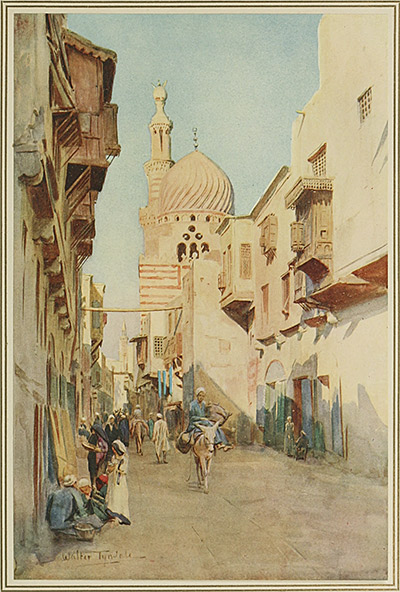
It is a relief, after the glare and noise of a similar
subject, to turn down the narrow dark lanes which are
found in the residential parts of Old Cairo. The
one entered from the archway winds through the
Hasaneyn quarter and ends at the eastern entrance of
the Khan Khalil.
These lanes where the old houses are still intact
are even more characteristic of Cairo than are the
busy streets, for something similar to the latter can be
seen in most eastern cities. The projecting latticed
windows, which relieve the plane surfaces of the
backs of the houses, are a distinct feature of this city.
Known generally as mushrbiyeh, they were originally
small bays in which the water-bottles were placed
to cool. The word is derived from the root of the
Arabic shirib, to drink, from which we also get our
word sherbet.
The bays were gradually enlarged so as to allow two
or three people to sit in them and see up and down
the street without being seen themselves. What corresponds
to a glass pane in Europe is here replaced by a
wooden grating. Each joint is turned, and so arranged
as to make a pretty pattern. This grating is much
closer in the apartments of the hareem, and though it
freely admits the air and a sufficiency of light, it effectually
screens the inmates from those outside.
From the enlarged bays one or more smaller ones
often project in which the earthen bottles are now
placed. There are also small windows in the lower
panels, through which I have often seen things hauled
up in small baskets from the street. Sellers of fruit or
sweetstuffs are often met in these lonely lanes, and
a stranger might wonder where they expect to find
custom. Presently a little grating will open and a face
will nearly fill the opening. Should the stranger have
been seen through the lattice-work, the face will be
partly veiled unless it be that of a child, and after some
bargaining with the hawker, a small basket containing
a coin will be lowered. The coin having been carefully
examined, the purchased article is placed in the
basket and they are hauled up to the window. ‘Ma’s
salama, ya sitt,’ ‘ya bint,’ or ‘ya Amma,’ according to
the degree of the purchaser, is usually the farewell
salutation of the hawker. But should the purchase
not prove on further examination to be up to expectations,
a lively altercation is sure to ensue, and voices
from unseen parties behind the grating may also be heard.
It is sad to see how much of this mushrbiyeh is
disappearing; it is seldom now repaired and is often
replaced by cheap sashes or is roughly boarded up.
There are several causes for this: it is expensive, and
the owners of the larger houses have mostly gone to
live in the modern quarters and have let out their old
homes in tenements to the poorer people. Much also
has been destroyed by fire. The houses usually project
over the lane as each story is reached, so that the upper
windows often nearly meet the ones of the opposite
houses. It is easily imagined how a fire will spread
with so inflammable a material for it to feed on. The
cheap imported petroleum lamps, which are replacing
the earlier form of lighting, have much to account for.
Many of the best examples of mushrbiyeh have been
bought up by dealers to be made into screens or re-used
in the modern suburbs.
As seen from the lane, the houses have a gloomy
appearance; but it should be remembered that the
Cairene dwelling was not built to make an outward display,—its
beauty is seen from its inner courts or garden.
When he views them from the narrow sunless lane, the
visitor wonders how people can live in such unhealthy
surroundings. Should he be fortunate enough to have
the entrée to a house which is still inhabited by a
prosperous owner, he will probably come to the conclusion
that no more suitable plan could have been adopted
in a country where the summer lasts for three-quarters
of the year.
I shall attempt to describe a visit to a beautiful
dwelling later on; at present let us wander through the
Hasaneyn quarter, thankful that the rays of the sun are
so carefully excluded.
Reaching the wider thoroughfare, where stands the
mosque which gives the district its name, the difference
in the temperature is immediately felt. We carefully
keep to the shady side of the road till we arrive at the
entrance of the Khan Khalil.
This Khan, more commonly called the Turkish
Bazaar, is one of the few which every tourist is taken
to see; it is in reality a series of bazaars, the most conspicuous
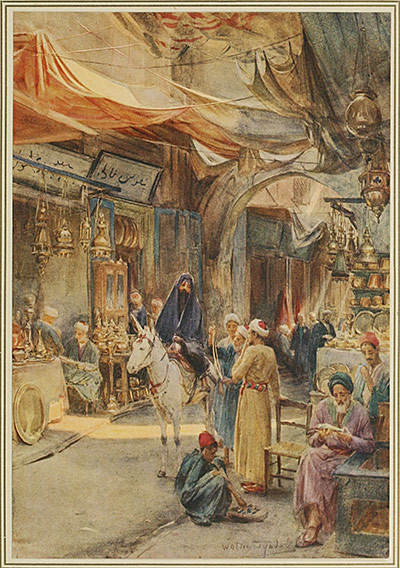
being that of the metal workers. Passing
through a massive doorway we enter a lane, roofed in
overhead with long rafters and matting; the warm light,
which filters through this, harmonises the various-coloured
silks and stuffs which are piled up in every
little shop or hung out to attract a customer. Each
shop is little more than a square cupboard, but as
carriages do not enter here the owners have been
allowed to retain the mastaba, or raised seat, on a level
with their floors and projecting two feet or more into
the roadway. This was characteristic of every shop in
Cairo, until carriages began to replace the litter and the
ass as a means of locomotion. The merchant drops his
slippers as he enters his place of business, while the
customer can sit on the mastaba and keep his slippered
feet in the street.
An old acquaintance recognises me and invites us
to sit down; he claps his hands, and the boy from the
coffee shop runs across to take his orders. When it is
decided whether we shall have coffee or green tea,
cigarettes are produced and a series of courteous inquiries
then follow. I in return ask after his health and that
of his children, but am not sufficiently intimate to allude
to his wife. ‘Allah be praised, all are well.’ I ask
how his business is, and he tells me that it is Allah’s will
that things are not what they used to be. ‘Large rival
stores now exist in the modern parts of Cairo and are
injuring the trade of the Khan Khalil.’ He might
have added that prices are more fixed in these new
stores and that visitors have not the time to spend hours
over a purchase. He asks me when I am coming to
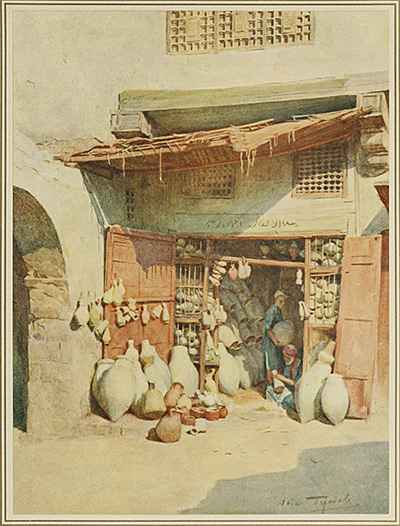
sit in his shop, again to paint that of Seleem, his opposite
neighbour. He calls out to Seleem and asks him if he
has forgotten the ghawaga who painted him and his
wares. ‘Ya salaam!’ says Seleem, and crosses over to
join in the conversation. When the greetings are over
it is time to begin the leave-taking, and with a promise
to come again and possibly bring a customer we continue
our way.
I am glad to find that both men still retain the
kuftân and ample turban, and have not adopted trousers
and the ugly red tarbouch, as most of the metal workers
have done.
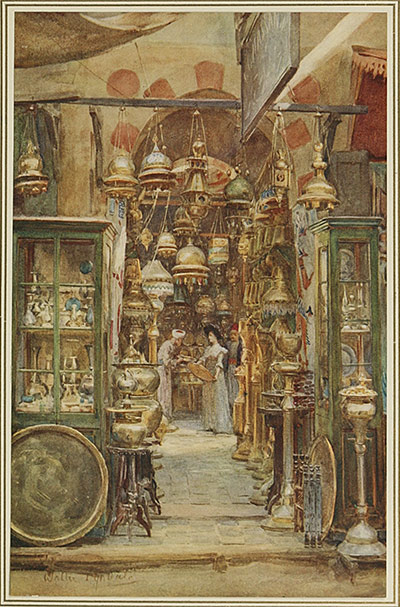
Descending some steps we come to the handsome
gateway built by Garkas el-Khalíly in 1400; innumerable
lamps, copied from those which used formerly to
adorn the mosques, are exposed here for sale; brass
finger-bowls, salvers and ewers cover the counters, and
tall damascened lamp-stands fill up every available place
on the floor.
The original colouring of the gateway seems to
have worn itself down to making a quiet and harmonious
background to this sparkling mass of metal work.
I am soon recognised by the owner of one of the
stalls, from whose shop I had also painted a part of this
bazaar, and am again invited to sit down to coffee and
a cigarette. As some seven or eight seasons had passed
since my last visit to Cairo, and considering the thousands
of foreigners who must have passed through these bazaars
during that time, it is astonishing that he should have
remembered my face. There is, however, no time now
to accept of the good man’s hospitality, but ‘In-sháalláh,’
I shall return before many days.
Each turning gives us a fresh scheme of colour and
the interest of another handicraft. The carpet bazaar
leads out of that of the metal workers. The small
cupboard-shaped shop is here replaced by one or two
important show-rooms, and here and there a beautiful
old Persian rug makes one regret the crude colouring
of the aniline-dyed modern ones which are replacing
them. Be the colours ever so glaring, the subdued
warm light which passes through the awnings makes
them part of one harmonious whole.
A mass of red and yellow is what catches our eyes
as we look down the slipper market, at a right angle
from the carpet bazaar. Festoons of slippers hang from
shop to shop, they are piled in stacks on the counters,
and large skins, both red and yellow, are being cut up
and hammered about as if the supply was not yet equal
to the demand.
We have them on our right, and pass through a
double row of stalls where we are pestered to buy
strings of beads, amber mouthpieces, cut and uncut
stones, ‘Nice bangles for your lady,’ besides many other
things we are equally not in want of. Here we take
our leave of the Khan Khalil, and I also of the imaginary
reader whom I have attempted to conduct through it.
I am fortunate enough to find an arabeyeh, the
Cairene cab, and can ponder over my morning while
returning to the hotel.
Yes, Cairo is good enough for a second visit, and,
please God, a good many more. My second impressions
were perhaps pleasanter than my first ones, for I had
not now that bewildering sense of how I should set to
work, and also if it were possible to give anything like
a pictorial presentment of these scenes. The physical
inconveniences of working in crowded streets and
amongst a strange people appalled me; but I did not
then realise, as I do now, how much a tactful guide can
do to make this work a possibility.
CHAPTER II RENEWAL OF MY ACQUAINTANCE WITH MOHAMMED BROWN AND SOME REFLECTIONS ON MATRIMONY
NOW the first thing to do was to look up my
former servant, Mohammed el-Asmar, now a
dragoman known as Mohammed Brown, the
surname being the English interpretation of Asmar. I
have described him fully in Below the Cataracts, a
previous book I have written when Egypt was much
newer to me than at present.
I went to that haunt of the dragomans, the pavement
outside the terrace of Shepheard’s hotel, late enough to
have allowed for the post-prandial nap. I found one
or two hanging about on the chance of some tourist
who might be taking Cairo on his way home from yet
hotter climates.
They had not seen Mohammed lately and did not
know to what part of Cairo he had moved; but one of
them knew a relation of his and promised that he should
be made to know that I was in Cairo.
That same evening Mohammed was awaiting me in
the hall of the hotel.
After the first greetings I remarked on what a swell
he had become, and asked him why he should have an
English covert-coat over his becoming oriental dress, on
so hot an evening as it was. Instead of the old red slippers,
he wore European tanned-leather boots, and the turban
was replaced by the hideous tarbouch. He had forgotten
my dislike for this half-and-half get-up, and he told me
it was now quite ‘the thing’ amongst the better-class
dragomans.
I was glad, however, to find that the seven seasons
during which he had been preying on the tourists had
not, apart from these changes in his garments, altered
him much for the worse.
‘Well, how is the baby?’ I asked him. ‘Oh, he is
getting a big boy now.’ ‘And the wife?’ I ventured
this time. A rather crestfallen look prepared me that
something was wrong. ‘Which wife, sir, do you mean?’
‘You must be doing uncommonly well if you can afford
two wives,’ I said; ‘most of us who have to earn our
living in England find one as much as we can manage;
besides, Mohammed, you used to agree with me that it
was a very foolish thing for any one to have more than
one.’ He certainly seemed to agree with me now, for it
was evident that trouble began when number two made
her appearance.
‘It came about like this,’ he went on. ‘You
remember I told you that my first wife, the mother of
our Hassan, was very pretty, and that I loved her very
much.’ ‘Yes, I remember she was very pretty, for you
know I caught sight of her that day my wife and I
dined at your house.’ He smiled, but shook his head,
as much as to say that he, a Moslem, ought not to have
allowed his wife to be seen unveiled. As I, however,
was not a Moslem myself, he tried to console himself
that he had not transgressed Mohammedan law.
‘A pretty face, sir, she still has, but her tongue gets
worse and worse.’
I asked the foolish young man if he expected to
improve her tongue by introducing her to a second wife.
‘I have been a great fool,’ was his mournful reply; and
after a pause, ‘I think I shall have to divorce her; but
I love her very much in spite of her temper.’
‘Well, now, about number two?’ I asked. ‘It came
about like this,’ he began again. ‘You must remember
Ahmed Abd-er-Rahman, the old dragoman that used to
come here.’ ‘I don’t remember him, but no matter.’
‘Well, I asked his advice about curing a wife’s temper,
but got little encouragement from him. The few
remedies he suggested, and which I tried, only made
matters worse.
‘One day he said to me: “Mohammed, I have always
loved you as if you were a son of mine, and as I have
still an unmarried daughter, it would add to my happiness
as well as to yours if you became my son-in-law.
I shall only ask a small dowry of you, whereas if I were
to marry her to the one-eyed Mustâpha, he could and
would give a much larger one. She is young and
beautiful, and has the sweetest disposition; and while I
kept you waiting in the hôsh the other day, it was but
to give her an opportunity of gazing on you through the
mushrbiyeh. You can divorce your Rasheeda and live
happily with my Fâtimah.”
‘This sounded very well, and I tried to get the old
man to fix the sum I should have to pay as the dowry.
He kept telling me of the price one-eyed Mustâpha was
prepared to pay; but I wanted to know nothing about
Mustâpha, and have since found out that this was all lies.
After many days he agreed to content himself with ten
pounds, and I paid him half that sum, the other half, as you
know, to be paid when the marriage had taken place.
‘I had done well that season, and spent much of
my earnings on the wedding; when I left my friends
below to go to the hareem, I gave my bride a handsome
present as “the price of the uncovering of the face,” and
when I threw back the shawl, and saw her for the first
time, I nearly fainted.’
It was as much as I could do not to laugh, but the
poor fellow seemed so overcome in recalling his bad
bargain that I tried to look sympathetic.
‘I thought of divorcing her there and then,’ he went
on, ‘but I had not the heart to pronounce those terrible
words on the day of the poor creature’s wedding. She
was ugly and old—at least thirty—and had as brown a
face as I have.’
After a pause he went on. ‘Her father—may
Allah blacken his face!—did not lie as regards her
temper; but even the best of tempers could not withstand
the jeering and scoffing to which Rasheeda used to
treat her. My mother used to take her part, and we
had more rows between Rasheeda and my mother.
When I could stand it no longer, I went with two
witnesses to the Kadi’s court and had her written a
nashizeh, and she returned to her own people. Fâtimah
tried to mother our little Hassan, but she could not
console him. He got ill, and I was afraid we might
lose him. I then took a room near Saida Zenab, and
fetched Rasheeda away from her people, and she and the
child are now living there. My life has been more
peaceful since then, but the cost of two households
makes me a very poor man. I assure you, Mr. Tyndale,
that though I did very well last season, I hardly know
where to turn for a piastre.’
It would be two months or more before the next
season would be in full swing, so we arranged that he
would accompany me during that time, and would
procure me some one else while he was engaged with
the tourists. He promised to be in good time the next
morning, and took his departure.
Probably nothing has tended more to separate the
East from the West than their differing views as to the
relation of the sexes. Such education as there is has
until quite recently been entirely confined to the sons
of the more well-to-do, and even at present the instances
of a girl being taught to read or write are very rare.
It therefore follows that as only one parent has had any
mental training, the offspring has less mental capacity
to inherit than where both parents will have had some
form of schooling. The religious instruction which
forms so large a part of a Moslem’s training is almost
entirely withheld from the girls, which accounts no
doubt for the erroneous idea held by Europeans that
Mohammedans believe women to have no souls. Religious
text-books give pages as to a child’s duty to its
father, and they sum up in a couple of lines the duty to
the mother. Educated Egyptians will often complain
that their wives are no companions to them, but what
can they expect when their womenkind are brought up
in a manner so distinctly inferior?
Polygamy is less common than is generally supposed,
but a man can divorce his wife so easily that he has
not the necessity of keeping more than one at a time.
It is true that a father will hesitate to give his daughter
to a man who has often used the divorce court, and
that he will also advise his son to keep to one wife if
he possibly can.
A young doctor, who appeared to be happily
married, told me of the advice his father gave him
previous to the wedding. ‘Don’t be foolish enough,
O my son, ever to take a second wife; for if you do,
trouble is sure to begin. Should you tire of Zenab,
get her another dress; women are all much the same,
it is the clothes which make the difference.’ I asked
if this plan had succeeded. ‘Yes, only too well,’ said
my friend, ‘for she is continually encouraging me to
get her a new dress.’ He also told me that previous
to his wedding he had not even seen his wife veiled,
though they were brought up in the same town. His
sisters had described her so well to him that when he
saw her for the first time, she was very much like what
he had anticipated.
I have described more fully elsewhere a marriage
to which my wife and I were invited as guests, and as
such full details of the ceremonial are given in Lane’s
Modern Egyptians I shall not dwell on it here. Lane’s
argument to those who severely condemn Islamic
marriage laws is this: ‘As Moses allowed God’s chosen
people, for the hardness of their hearts, to put away
their wives, and forbade neither polygamy nor concubinage,
he who believes that Moses was divinely
inspired to enact the best laws for his people, must
hold the permission of these practices to be less injurious
to morality than their prohibition, among a people
similar to the ancient Jews.’ This sounds fairly plausible,
but we must not forget that Mohammedans accept
Christ as a prophet as well as Moses, and also avow
that each prophet taught them something higher than
the preceding one had done, and there is certainly no
licence as to polygamy or concubinage allowed in the
teaching of our Lord. Their last prophet, and according
to them their greatest, Mohammed, had overlooked this,
and probably only codified what had more or less
become a common practice in his day.
As the modern Jews now hold to one wife just as
do the people amongst whom they live, so it is possible
that in time the Moslems may also modify their marriage
customs. Supply and demand has already had its
effect, for with the restrictions on slavery, concubinage
has of necessity lessened and respect for the husband of
one wife is increasing amongst the better educated
classes.
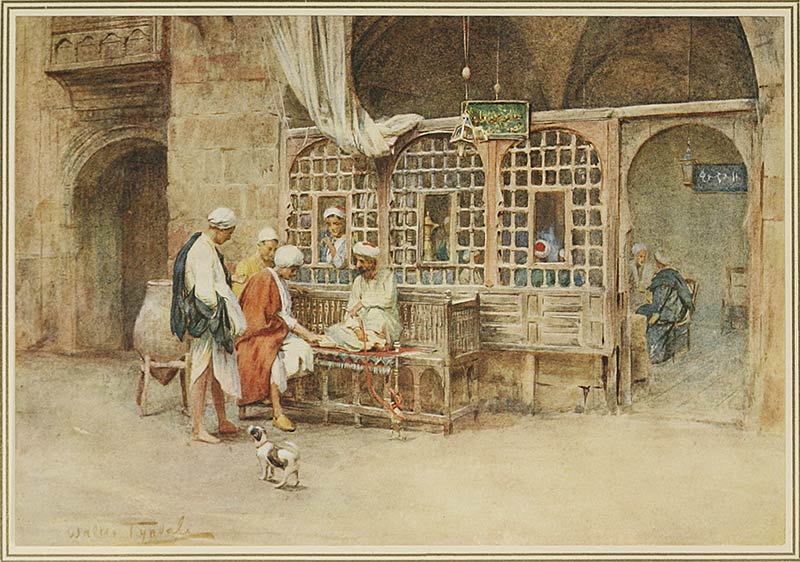
I started on a subject on the following morning, of
an old house built alongside and overhanging an entrance
to a mosque. A little coffee-shop under an archway,
on the opposite side of the street, made an excellent point
of vantage from which I could do my work without
attracting too much attention. Mohammed, who accompanied
me, made arrangements with the owner of the
stall for my accommodation, and sat on the high bench
near me, so as to keep off the more inquisitive. An
ideal post for him, for he could smoke a nárgeeleh, sip
coffee, and chat with the other clients as much as he
pleased. He would brush away the flies with one end of
his whisp, and poke with the other end any small boy
who ventured too near me. ‘If one comes it may not
matter, but if one stays fifty others will come also,’ he
would say, as the stick of the whisp and a boy’s head
came in contact.
It was also in the interest of the owner of the coffee-shop,—as
Mohammed was careful to explain to him,—to
make things comfortable for me, as I should spend
many mornings here if I were not molested in my work.
Besides my subject, which was a very beautiful one in
itself, this was a useful perch from which to make studies
of the people and animals which passed. It was in the
Nahasseen, one of the busiest thoroughfares of Cairo,
and scarcely an hour would go by without hearing the
zaghareet, the shrill cries of joy which told of the
approach of a bridal procession, or the doleful chorus,
‘Lá iláha illa-lláh,’ would prepare one for the passing of
a funeral.
It has happened that the zaghareet was not always
the accompaniment of the more cheerful procession, for
these shrill cries of joy replace those of lamentation when
a welee, a person of great sanctity, is carried to his last
resting-place. The idea conveyed is that the joys now
awaiting him more than compensate those he has left
behind for his loss. There is a curious superstition, or
maybe some other cause which we cannot explain, that
if these cries of joy cease for more than a minute the
bearers of the corpse cannot proceed. It is also maintained
that a welee is able to direct the steps of his
bearers to a particular spot where he may wish to be
buried. Lane tells the following anecdote, describing
an ingenious mode of puzzling a dead saint of this
kind. ‘Some men were lately bearing the corpse of
a welee to a tomb prepared for it in the great cemetery
on the north of the metropolis; but on arriving at the
gate called Bab-en-Nasr, which leads to this cemetery,
they found themselves unable to proceed further from
the cause above-mentioned. “It seems,” said one of the
bearers, “that the sheykh is determined not to be buried
in the cemetery of Bab-en-Nasr; and what shall we
do?” They were all much perplexed; but being as
obstinate as the saint himself, they did not immediately
yield to his caprice. Retreating a few paces, and then
advancing with a quick step, they thought by such an
impetus to force the corpse through the gateway; but
their efforts were unsuccessful; and the same experiment
they repeated in vain several times. They then
placed the bier on the ground, to rest and consult; and
one of them beckoning away his comrades to a distance,
beyond the hearing of the dead saint, said to them,
“Let us take up the bier again, and turn it round quickly
several times till the sheykh becomes giddy; he then
will not know in what direction we are going, and we
may take him easily through the gate.” This they did;
the saint was puzzled, as they expected, and quietly
buried in the place he had striven to avoid.’
I witnessed a similar thing in Japan, a year or two
ago; but in that case it was an idol which showed a
similar obstinacy. It was at the ‘Gion Matsuri,’ which
annually takes place at Kyôto, when the Shinto god
Susa-no-o is carried to his O Tabisho—that is, his
sojourn in the country with his goddess.
No sooner had the god been placed on his portable
throne than the wildest excitement was manifested by
his bearers; some wished to carry him one way and
some another, while others seemed rooted to the ground.
A Japanese gentleman, who was with me, explained that
until all the bearers felt drawn to pull one way, it was not
known by which route the god had decided to go.
It is singular that a similar superstition should obtain
with people differing as much as the Egyptians do to
the Japanese.
The constant funerals which passed between me and
my subject seemed little heeded by Mohammed and the
other frequenters of the café, except when the chorus
mentioned the name of the prophet, some would
murmur, ‘God bless and save him’—‘Salla-lláhu-’aleyhi
wasellem.’
The bridal procession, on the contrary, seemed to
have a very depressing effect on my man, and he would
hardly cheer up till a distant wail suggested another
funeral.
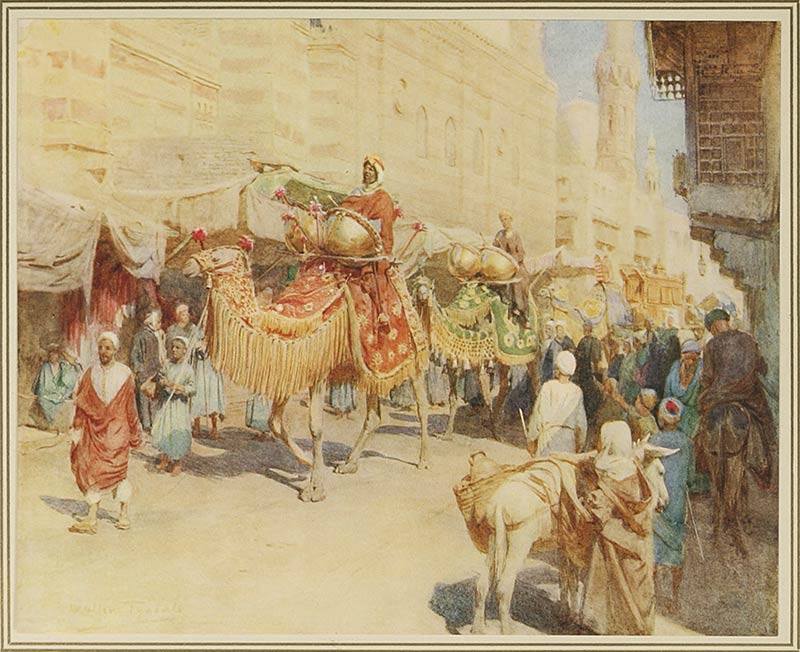
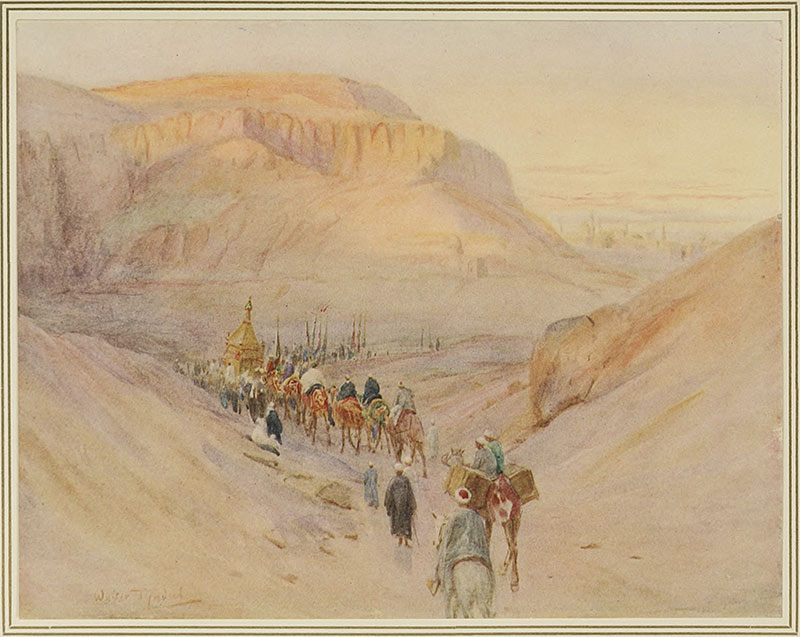
On one occasion I recognised the camels with the
magnificent trappings used when the holy carpet is
conveyed to Mecca; they were doing duty as a
kind of vanguard to a bride who followed in a litter
swung between two other camels. It was a most
picturesque sight, and one to take as many notes of as
possible for reference to in a future picture. Fortunately
the progress of the procession is slow, the traffic of the
street compelling it frequently to stop. This would
enable me to get ahead of it and jot down some of the
arrangements of colour. The heavy gold and crimson
trappings of one camel, a combination of green and
gold on a second, while the gold brocade of a third was
in a purple setting; all this in a blaze of sunshine, yet
subdued compared to the light caught by the brass
kettle-drums. The background in some places, too
cut up in violent patches of light and shade by the
awnings over the shops or too intricate with the drawing
of a saracenic mosque entrance, filled me with confusion
as to how I could ever treat such a subject.
When the broad plain surfaces of Barkûk’s and
Kalaûn’s shrines made a setting to this gorgeous procession,
I felt that my task had become more hopeful.
The number of facts I had to crowd into my memory
in a half-hour or so, I found more exhausting than a
long morning’s work on a subject such as the one I had
left to pursue this one. To return to the little café
where I had left Mohammed in charge of my painting
materials, pack up my traps and go back to the hotel,
was about as much as I was fit for during the rest of
that morning.
CHAPTER III THE MOSQUE OF MURISTÂN KALAÛN, MY EXPERIENCE WITH THE FAKÍR, AND A DIGRESSION ON THE SUBJECT OF DERVISHES
PASSING once more the mosque of Kalaûn, I was
attracted to one of its windows; not on account
of its particular interest as such, but of its
possibilities as a point of vantage from which I might
paint the opposite side of the road, and, unmolested,
make studies of the interesting incidents which take
place in it.
There was still time to go to the Wakfs ministry
before it closed for the midday ‘siesta.’ ‘El Wakfs’
is the name of what we might term the Board of
Religious Endowments. It is here where artists must
apply for a pass to allow them to paint inside the
mosques.
I fortunately found Herz Bey, the architect of the
Wakfs, and he very kindly gave me what I required.
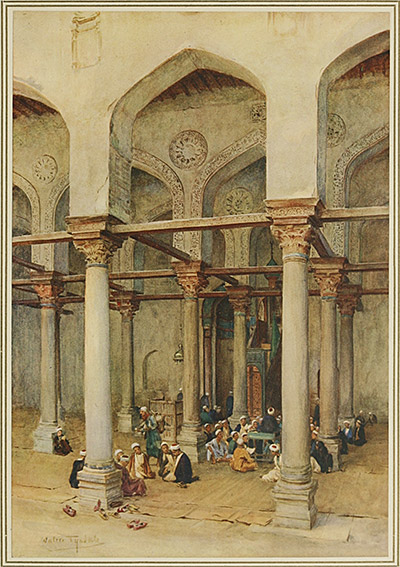
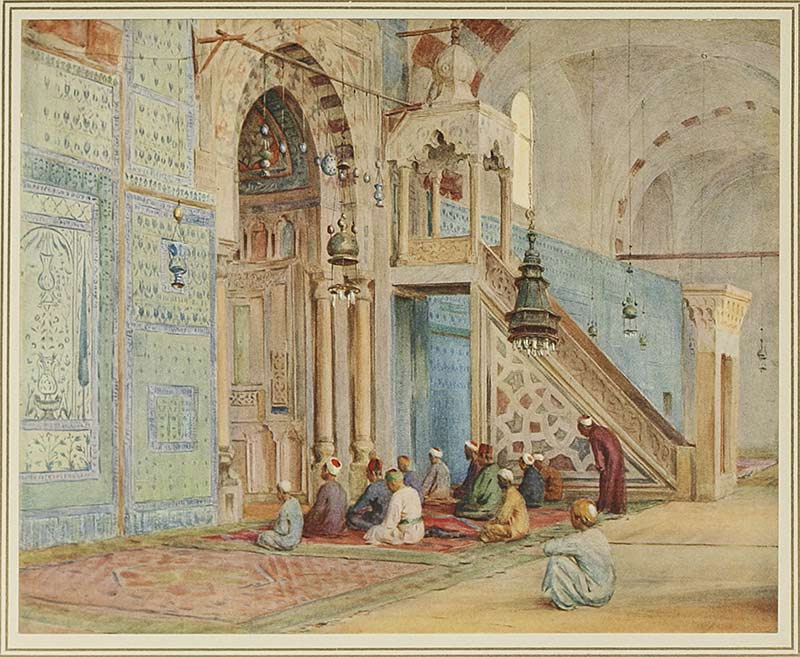
Apart from the window of Kalaûn’s mosque which
would be of great use to me, its interior is one of the
finest and most ornate in the whole of Cairo. I had
found several subjects there in former years, and I looked
forward to finding a pleasant asylum in which I could
restfully do some work after the fatigue of some days of
street painting.
The mosque was falling into a ruinous state when
I had last entered it. Originally most gorgeous, its
colouring had then been softened down by more than
six centuries since en-Nasir completed the dome which
covers the tomb of his father.
I also looked forward to a cooler spot than my
café, for Cairo has far from cooled down during the
first days of November. Though the thermometer may
not register so high as in June, the damp heat during
the high Nile is more felt than the greater, but dryer,
temperature of early summer.
I was prepared not to find the mosque as paintable
as in the earlier days,
‘Before Decay’s effacing fingers
Have swept the lines where beauty lingers’;
yet I was hardly prepared to find it to all appearance a
brand new building. It had been admirably restored,
and restoration was necessary, I have no doubt, to
prevent its falling into complete ruin, as so many other
monuments have done. But, alas, its poetry was gone.
Nor is this likely to return so long as it is kept as a
show-place merely, and only visited by the tourist or
student of Saracenic architecture. The hundred and
one signs which suggested the worshippers who had
gathered here during the six bygone centuries were all
swept away; the worn praying mats were gone, and
any of the movable furniture which is not now shelved
and labelled in a museum may have found its way to
some dealer’s shop,—the place for which these things
were designed knows them no more.
I started a large drawing, for in spite of all it is a
beautiful building, and looks now in all probability
very much as it looked when Nasir’s work-people left
it. I worked hard at this drawing; spent whole
mornings getting the intricate arabesque patterns into
perspective and their relative tones; but the longer I
worked the more my drawing became the lifeless
perspective elevation plate of some book on architecture.
Some day, when my last impressions of the place
may fade and I may remember more clearly the shrine
retaining its human associations, I may possibly be
able to take up this drawing again and infuse some life
into it.
I did better from the window overlooking the
Nahasseen.
The ruinous domed mosque—built before the one
of Kalaûn—to shelter the remains of Ayyub es-Salih,
has been heavily dealt with by ‘decay’s effacing fingers.’
Copper-smiths have rigged up their stalls against its
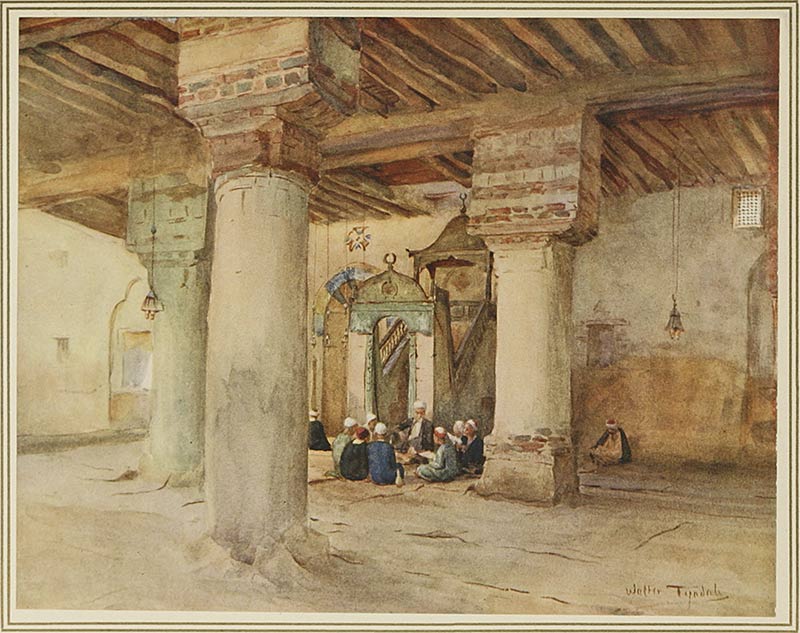
crumbling walls, and the mosque school still hangs
together sufficiently to be used by the youths repeating
their Koran. This and an ever-moving crowd of
people had at all events a soul left in it.
My regrets at having lost so much time in producing
an artistic failure decreased in proportion as the use I
was able to make of this window increased.
Facing immediately the street leading to the Beit-el-Kadi,
I was able to take notes, on a market day, of
all the incidents mentioned in the last chapter, and
at ordinary times there would always be more than
enough subject-matter to furnish the foreground of the
couple of drawings I made from here.
The mosque being now a ‘sight’ more than a
place of worship, a fee is charged for admittance;
and even this matter, which I was regretting before now,
proved an advantage to me, for the attentions of the
inquisitive are usually more marked while making figure
studies than while painting some inanimate subject.
Small boys would occasionally crawl on to the sill
and hang on to the grating to try and see what I was
doing, till my man, whom I kept outside, would send
them away.
A ragged fakir chose the bit of pavement just
below my window to do a little basking in the sun.
Mohammed whispered to me, through the grating,
that he was a great saint, and squatted next to him in
the full odour of his sanctity. A current of air would
now and again bring some of this odour my way;
but I restrained Mohammed from disturbing the fakir in
his sleep. Others were not so considerate, for, in spite
of the old man’s saintly repute, a number of young
hooligans soon surrounded him, and comments on his
appearance provoked such laughter as to wake him up.
The fakir now seemed as one possessed of a devil;
he laid about with his staff and cursed his tormentors
with a fluency which only a long practice, during his
unregenerate days, could have given him. A young
woman at a safe distance called out to him that the
ghawaga, that is I, was sketching him, whereupon he
turned round and directed the flow of bad language in
my direction. The grating was a protection from the
old fellow’s staff, and an unused-up lot of curses soon
fell on the head of Mohammed, who moved him off.
Too much attention having been drawn to my
window, I retired with my materials within the shades
of the mosque interior.
I made inquiries about the old man. The term,
fakir, is used in Egypt to denote a wandering dervish, and
is also applied to any poor beggar. His rags were not
simply the torn garments of a poor man, but a carefully
made coat of many patches and of variously coloured
stuffs, known as a ‘dilk.’ Shreds of coloured cloth
were also fastened to the end of his staff. He wore no
turban, and had supplemented his own hair with what I
believe ladies call ‘a front’ made from a horse’s tail.
I was told that he belonged to the Rifaiyeh order
of dervishes, and was famous in his day for being able
to pass swords through his body without leaving a
wound; he would also charm serpents and scorpions
away from a house, eat live coals and chew glass.
As I have seen many appear to do these wonders
without necessarily being considered very holy men,
there remained a more potent reason for his reputed
sanctity. I tapped my forehead once or twice, suggesting
that an excess of miracles must have made him mad.
‘His mind is in heaven and only his body remains on
earth,’ was the answer to my suggested question.
A superstitious awe for persons whose intellect is
affected obtains all over the Mohammedan world—the
Cairo hooligan being apparently the exception.
The great majority of dervishes are men of some
trade or another and take part in a zikr during the
religious festivals; a few lead a tramp’s life and beg their
way from town to town where one of these festivals
may be taking place; while those who are mentally
afflicted without being actually dangerous can generally
find the wherewithal to live in the district to which
they belong. The latter are now rarely met with in
the European parts of Cairo, and as they seem generally
bereft of all sense of decency, the police may have
something to say in the matter.
I attended a zikr during my first visit to Egypt,
when an evening with the Howling or Dancing dervishes
was still looked upon as one of the ‘sights.’ These
were often got up by the dragomans as an entertainment
for the tourists. H. H. the Khedive has since forbidden
these shows as liable to bring Islamism into disrepute.
Some wit remarked of the dragomans, that they believed
in Mohammed and his profits. The dervishes (or
darweesh, as they are called in Egypt) were genuine
ones, and argued that their religious exercises might be
just as acceptable even if they resulted in some profit
in the shape of a ‘baksheesh’ from the unbelievers.
The first part of the performance was the same as
may be seen any evening, in any village, during the
month of Ramadan.
About a dozen men sat in a double row facing
each other, and, taking their time from a leader, began
by slowly repeating the first words of the Moslem’s
confession of faith: ‘Lá iláha illa-lláh,’ which they
accompanied with a swaying of their bodies backwards
and forwards. Gradually they would increase the
speed of the repetition and the movements, always
taking their time from the leader. This got faster and
faster till their chief shouted ‘Alláh!’ Then, repeating
this one word, the swaying of their bodies became so rapid
that one or two fell down exhausted. The remainder
kept it up as long as their physical endurance would
allow; their mouths foaming, their faces livid, and a
mad look in their eyes. Presently more would fall
down; some lying still, and others to all appearance in
their death agony. The cry of ‘Allah’ finally ceased
when the leader fell forward, and, saving a gasp or a
gurgle, all was still.
Some of us were preparing to leave when a sign
from the conductor of our party kept us in our seats.
These bodies stretched on the floor—to all appearance
dead or dying—looked ghastly in the light of the
flickering torches.
We sat on some time wondering what the next
move would be. A heavy breathing with alternate
choking on the part of one of the performers directed
our attention his way. After making several attempts
to rise, he succeeded in getting into a sitting posture
and stared vacantly at us. When he seemed conscious of
where he was and what he was doing, he rose rapidly to
his feet and spun round and round for several minutes; he
next seized hold of a torch, continued his gyrations, and
without stopping held the lighted torch under his one
garment, allowing the flames to pass all over his body.
It reminded me horribly of the straw fires with which
peasants are wont to burn the bristles off a stuck pig.
A foreign princess who was of our party, and on
whose behalf this zikr had been arranged, had now
seen as much as she could stand, and she and her
immediate suite went away.
The performers seemed quite unconscious of this
disturbance; the man kept on spinning round, toasting
his chest and then his back till he let fall the torch
and sank down on the matting.
Another had in the meanwhile come to life again
and begun to spin like a teetotum. He drew two
knives from his girdle and, while continuing his motion,
rested the points on his lower eyelids; he next
hacked his face and forehead, and when the blood-letting
had sufficiently cooled his frenzy he joined his
companions on the floor.
The low muttered ‘Alláh’ from the other dervishes
showed that they were awakening from the kind of
cataleptic sleep they had fallen into.
A third one now arose and startled one of the
spectators by rushing forward and seizing a tumbler
near him; he bit off pieces of glass and crunched them
in his teeth. He looked absolutely loathsome as he
appeared to swallow the glass, with the blood streaming
from his mouth. His craving for glass was not satisfied
yet. The glass of an oil lamp near me caught his eye,
and catching hold of it, hot as it was, he chewed it
up as a half-starved dog would chew a bone.
I had now had more than enough, and slipped
quietly off before a fourth began his ‘turn.’
Mohammed followed me out. He was not very
communicative about the unnatural orgy we had assisted
at, and as he is a good Moslem, I fancy he seemed
ashamed of the performance.
While walking down the Mousky on the following
morning, a cabman seated on the box of his arabeyeh
greeted Mohammed with an unusually cheery ‘Salaam
Alêkum.’ The answer, ‘Alêkum es-Salaam, ya ibne
Kelb,’ with an accompanying shake of the finger, was
surprising; that is, ‘The peace be with you, O son of
a dog.’ The cabby laughed and drove on. Mohammed
looked rather consciously at me, and seeing that
I looked puzzled, he asked me if I did not recall that
cabman’s face. Yes, I had seen him before, but when
or where I could not say. ‘Why, he is the darweesh
who ate all that broken glass last night.’
True enough, it was the very man! But no première
danseuse seen with her tinsel and spangles behind the
footlights, and afterwards met in everyday garb, could
have shown as great a contrast as did this cabby and
the wild dervish of the previous night. He was
dressed in European clothes, except for the red tarbouch,
and he seemed none the worse for his last night’s
glass supper.
CHAPTER IV THE FESTIVAL OF THE ‘HASANEYN’ AND THE STORY OF THE PRINCESS ZOHRA
THE promise I had made to my acquaintances in
the Khan Khalil, to come again, was soon
fulfilled. This great bazaar attracts me most
when the season in the modern quarters of Cairo is
over or not begun. I have painted so many of its shops
and corners, that I and my faithful servant must be as
familiar to the stall-holders as they are to us.
An opportunity occurred to see it by night, for,
except on the great festival of the ‘Hasaneyn,’ the gates
of the Khan are closed before the evening prayer.
The mosque of Hoseyn stands opposite the east
entrance, and it is the one most used by the shopkeepers
of these bazaars.
It is a spacious building, but of little interest from
an architectural point of view. Its great popularity is
one cause of this, for money could always be found to
restore it, and unhappily a great wave of enthusiasm for
the shrine of the martyred sons of Ali obtained during
a late period of debased Saracenic architecture, during
which the mosque was almost entirely rebuilt.
Before the Napoleonic invasion of Egypt no
Christian or Jew dared pass down the street in which it
stands, and even at the present day, when foreigners
may visit the other mosques of Cairo, while the services
are not being held, the actual shrine where the head of
Hoseyn lies may only be entered by the faithful.
On the night in question it was possible to see as
much as I wanted, as the doors stood wide open, and
the interior was lighted with thousands of lamps. The
whole street was roofed over with particoloured tent-cloth,
which caught the light of the torches of the
dervishes who filed in at the central doorway.
The noise of the cymbals, drums, and hautboys of
the musicians mingled with the babel of voices which
came from the mosque. Many inside were performing
the zikr, and others were marching round and reciting
the Fáthah, or a form of blessing on the prophet.
Every house was profusely decorated with flags,
lamps, and festoons of coloured glass globes. The cafés
were overflowing with customers, and high benches on
the pavements outside were all occupied with listeners
to the professional story-tellers who related the deeds
of Hasan and Hoseyn.
It seemed strange to hear the names of these two
brothers from the lips of so many orthodox Moslems,
for at a previous festival in their honour, which I
witnessed, only such as were under police protection
dared shout ‘Hasan, Hoseyn.’ It was when the heretic
Sheeas, mostly Persians, paraded the streets of Cairo—a
gruesome sight it was—but at present we will confine
ourselves to the doings of the orthodox Sunnees, to
which sect the bulk of the Egyptians belong.
‘Though those dogs of Sheeas,’ an Egyptian will
tell you, ‘almost make gods of Hoseyn and also of his
father Ali, is that a reason why we should fail to honour
his birthday? Was he not, after all, a grandson of the
Prophet?’ It is fortunate, however, that both sects do
not keep the festival on the same day, or it would be
more than the police could do to prevent them coming
to blows.
How different the Khan looked, lighted up as it
then was by hundreds of lamps in and around the shops!
In places brilliantly coloured tent-cloths stretched across
the lanes, and on every mastaba the store-keeper was
entertaining his friends. The dark intervals were the
shops kept by Christians or Jews, which were carefully
shuttered up for the night.
The silk merchant, Mustâpha, and his opposite
neighbour Seleem were both here, and I was not sorry
to accept the former’s kindly invitation to sit down.
Being unused to smoking the nargeeleh or the almost
obsolete shibook which were offered me, he procured
some cigarettes and clapped his hands to summon the
boy from the coffee-stall. He regretted that the
mooled of the Hasaneyn was not now as in former
days, when hardly a shop in the whole Khan was not
lighted up like as his and Seleem’s. ‘Jews, Nazarenes,
Parsees, and what not else, were invading the stalls held
by the faithful,’ he said, pointing to the shutters of
those unenlightened people.
‘Allahu! Allahu!’ from the street outside was
clearly heard during the pauses in the conversation.
‘Was it possible now for a Nazarene to enter the
mosque and see the tomb where Hoseyn’s head lay
buried?’ I asked, and also showed him the ticket I
had, allowing me to paint in the mosques of Cairo.
He read the instructions, and pointed out a line which
made an exception for that particular shrine as well as
for two others. The talk then drifted to an instance
when one of my countrymen, disguised as a Moslem,
was accidentally discovered near the tomb while the
mooled was being held; of how he was nearly killed
by the infuriated mob and saved by the intervention of
the princess Zohra.
The story is so full of dramatic interest that, instead
of giving the garbled versions which obtain in the
bazaars, I will try to tell it as Max Eyth tells it in
‘Hinter Pflug und Schraubstock.’ Eyth was in Egypt
during the lifetime of the princess and heard all the
details from a former member of her household.
Zohra was the youngest living daughter of
Mohammed Ali, Egypt’s first viceroy. She was the
idol of her father and partook of his character more
than did any of her numerous brothers and sisters.
Her childhood was spent in the same hareem as that of
her nephew Abbas, who was the same age as herself.
Self-willed children as they both were, quarrels were
of frequent occurrence. When Abbas would taunt
her that she was only a little girl, she would remind
him that she was the great Ali’s daughter, whereas he
was only the son of her brother Tussûn. Words
ending in blows one day, Abbas was packed off to
a school and a governess was found for the young
princess.
Wishing to have her taught both English and
French, they engaged the services of a young Irish
lady, a Miss O’Donald, who had been brought up in
Paris and spoke French as well as her own language.
Western ladies had hitherto been little seen in
Egyptian hareems; the Mohammedan ladies disapproved
of the greater liberty enjoyed by the newcomer
and soon grew jealous of the great influence the
governess held over her pupil.
As Zohra grew older, Miss O’Donald became more
of a companion than a teacher, and she remained in
the viceroy’s service for eight years. Abbas had in the
meantime left his school and had a hareem of his own
in his grandfather’s palace. He never forgave Zohra
for having been the cause of his banishment, and
awaited his time to wreak his vengeance.
Mohammed Ali had not yet found a husband for
his daughter; he aspired to marrying her to a Sultan
or to a son of the Khalif himself. It therefore happened
that at the age of sixteen Zohra still remained single.
It was at a festival of the Hasaneyn that she met
her fate. Accompanied by Miss O’Donald and two of
the eunuchs, she went to visit the tomb of Hoseyn, for
women at all times, says the narrator, are more attracted
to the shrines of heroes than to even that of the Prophet
himself. The mosque was so crowded with people that
the dervishes could hardly find room in which to perform
the zikr.
The eunuchs managed to force a way through the
crowd so as to allow the princess to approach the tomb,
and while she was saying her prayers at the shrine of
the hero, she was disturbed by an uproar which arose
not far off. Shouts of ‘a Christian’ resounded through
the building. Sticks were raised and knives unsheathed
by an infuriated mob, who surrounded a tall, fair-haired
man who, with his back to the wall, was hitting out
right and left to keep his assailants at bay. His turban
had fallen off, and his fair and unshaven head showed
only too clearly that he was not a Moslem.
‘It’s my brother,’ called out the governess, and
appealed to those near her to go to his rescue. Zohra,
who had now reached her side, first saw the blood-stained
and handsome face of the young Irishman, and
uttering a piercing scream, she ordered the assailants to
desist. Seeing from her attendants that she belonged
to the viceregal household, there was a slight pause, and
those near her made way for her to reach the one they
had been attacking. She took the young man by the
hand and led him, through the murmuring crowd, into
the street.
As they disappeared, loud cries of ‘Allahu!
Allahu!’ resounded throughout the mosque. The
princess threw her arms in the air and victoriously
repeated the cry: ‘Allahu! Allahu!’—Such was their
first meeting.
Two young mamelukes of the household of Abbas
also happened to have witnessed the scene, and repeated
every detail of it to their master. The narrator
goes on to say that ‘Abbas was silent, like a serpent
who coils itself in readiness for a spring.’
Spies were sent forth to find out who this man in truth
might be. His name was O’Donald, and there was no
doubt that he was the governess’s brother. He had
first come to Egypt in 1840, when, after the siege of
Beirut, Napier’s troops lay outside Alexandria. Fortune
had then forsaken Mohammed Ali. He could not
prevent his enemies from drinking Nile water as much
as they pleased, and as the Arabs say: ‘He who has
drunk Nile water will sooner or later return to the
Nile.’
After the British troops had quitted Egypt, O’Donald
resigned his commission and returned to Alexandria,
where he had got a situation as manager to the overland
route from that port to Suez. His sister had
doubtless described his pupil to him, and had also entertained
the princess with tales of his gallant deeds while
serving in the army. Business matters had taken him
to Cairo at the time of this festival, and his love of
adventure had led to his disguising himself and entering
a mosque forbidden to all save the believers.
Zohra, whose affections had so far been disengaged,
was all too ready to fall in love with this handsome
Irishman, whose praises she had so often heard from the
lips of his sister. Beholding him for the first time
bravely repelling the attack of the infuriated mob, he
personified in her imagination the heroism of those who
first spread the Mohammedan faith. To use the words
of the narrator: ‘She was taken as in a whirlwind.
Love consumed her as a fire. She wept through the
whole of that hot night. She implored one of her
sisters to help her to meet her lover, and on her refusal
she bit her in the cheek.’
Miss O’Donald was alarmed at the state of her pupil
and also for the safety of her brother. She wrote and
warned him to keep away from Cairo, and if possible
to get away from Egypt. Unfortunately the eyes of the
young princess confirmed the glowing descriptions of
her beauty which his sister had given, and the young
Irishman seems to have been consumed with the same
fire as that of his lady-love. Instead of keeping away
from Cairo, he contrived to get his company to give
him a post in that city.
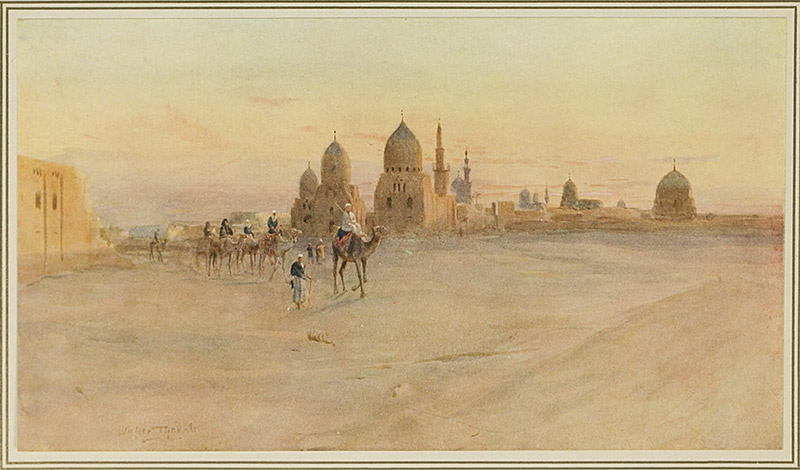
On the third night of Bairam, when rich and poor,
old and young, repair to the cemeteries to pray at the
graves of their belongings, the young lovers seized on
this opportunity to see each other once more. Zohra
went with the women of her hareem to that great
wilderness of tombs on the south-eastern outskirts of the
city. She was not slow in recognising her lover in the
apparently devout Moslem who came to pray at the
tomb where she sat. The wailing of the women and
the howling of the dervishes, performing the zikr, were
a sufficient noise to prevent the words the two interchanged
from being heard by Zohra’s attendants, and
before they parted a future means of meeting had been
arranged.
‘I believe,’ goes on the story-teller, ‘that she loved
him as the heroes of our faith in the olden times loved
the beautiful women whom Allah had given them as a
foretaste of Paradise. He also must have loved her as
one bereft of his senses, for he must have known that
he moved amidst naked daggers or even worse.’
On the night previous to the ‘Yóm Gebr el-Bahr,’
which signifies ‘the Breaking of the River’ (and when
the dam is cut to enable the Nile to replenish the canal
which used to flow through Cairo), great festivities take
place. Tents are erected on each bank of the canal
and also on the edge of the island of Rodah, which
faces the canal’s entrance. The river is crowded with
boats lit up with numerous lanterns; fireworks are let
off and guns are fired; yet they fail to drown the noise
of the musical instruments and the eternal refrain of the
singers. Cairo makes a night of it.
From the farther side of the island of Rodah our
princess stepped on to her dahabieh which was moored
at the river edge of the palace gardens. She was
accompanied by the hareem, and she gave orders to let
the barge drift down the river and to drop the anchor
where the crowd of boats was not so great.
The ladies of the hareem, including Miss O’Donald,
remained on the deck, from whence they obtained a
good view of the fireworks and of the festivities taking
place on the Nile. Zohra retired to her cabin, and
might by the light of her candle have been seen by
many of the folks outside, were these not too much
occupied in merry-making. The candle was moved to
and fro for a few seconds and then extinguished.
From the shadow of a clump of trees overhanging
the edge of the river an English-built skiff issued
into the main stream, then shot along the side of the
dahabieh and came to a standstill. The lovers had met
once again.
Skilfully as this had been managed, it had not
been unobserved by Miss O’Donald, who, in a fever of
anxiety, paced up and down the deck. The skiff
could be seen by the lights of some boats which had
drifted that far down the stream. The governess also
suspected that Abbas had spies amongst the women of
the hareem; but she dared not breathe a word of warning
to her brother below for fear of attracting attention.
Not only had he been seen, but from a neighbouring
cabin an assignation had been overheard and in
due time reported to Abbas. They were to meet the
following night in the garden of the palace at Rodah.
Zohra felt sure of the silence of the eunuchs and also of
her female attendants; she had not, however, bribed
some of the crew as highly as Abbas had done.
O’Donald, the next night, fastened his boat under
the trees which project over the garden wall and picked
his way along the edge of the river to the steps at the
Nile entrance. He found the gates unlocked, and
walked in. Instead of his lady-love four armed mamelukes
issued from the shrubbery and rushed to attack
him. The Irishman dropped two with his revolver, and
the other two turned and bolted.
Abbas was awaiting events at the garden door
of the hareem, which he had locked from outside.
When he heard the firing and the howls of his mamelukes,
he felt sure that events had not turned out
quite as he had intended. Miserable creature as he was,
Abbas was no coward, and his agents having failed him,
he rushed down himself to attack the enemy.
A kick on his shin sent him sprawling into a flower-bed,
and O’Donald made off to his skiff. He had,
however, recognised whom it was that he had knocked
over. But before he could take safety in flight he felt
bound to send a warning to Zohra and also to get his
sister away.
The story-teller goes on to say: ‘In such moments
one’s reasoning becomes confused. Allah alone can
help one. But why should Allah stretch forth a helping
hand to the unbeliever whose audacious conduct
well merited punishment?’
A French Jewess, known as Madame Ricochette,
resided in Cairo at that time. She used to visit all the
principal hareems to trade in Paris jewellery and bonbons.
O’Donald went to see her early on the following
morning, and with promises and flattery induced her to
take a note to the princess and to bring back an answer.
He was to meet Zohra in the garden for the last time,
his sister was to come away with him in his boat, and
they were to leave Cairo at once.
They never saw each other alive again. He was
shot on the threshold of the hareem in Zohra’s garden.
Abbas had intercepted the letters and had apprised
Mohammed Ali of the affair. Six Arnauts—good,
dependable shots—were sent and were placed behind
some bushes which the ill-fated man would pass on
the way to his love. Six bullets ended his earthly
career.
Abbas was a clever organiser. A mule was kept
in readiness to carry the body away, and two of the
Arnauts placed it on the beast while the others remained
with the prince. The hareem door was thrown open
and, as Zohra approached, Abbas laughingly welcomed
her to her lover.
‘Such women,’ goes on the narrator, ‘do not go
off in a faint, as do yours in the West. She flew, as
one possessed, to the corpse of her beloved, and steeped
her hands in his blood. She had to be dragged away
and carried back to the hareem. When she had recovered
from her stupefaction, she ordered two servants
to see Miss O’Donald off to Alexandria, where friends
would see her safely on board the first home-going
steamer; the princess also provided her handsomely
with the means to get back to her country.’
Worse is still to follow. The devil in Abbas had
become more potent than ever. He had the body
of the Irishman taken to Shubra and buried in an
outlying field—upright, with the head below and the
feet sticking out of the ground. Then spoke Abbas:
‘Allah, do thou with him as thou wilt; but the dogs
shall devour the feet which kicked me.’
The field was guarded during a week; no one dared
enter by day, and at night the jackals and dogs did
their work. There in that field, to this day, stands
with head downwards a footless corpse!
The O’Donalds, we are told, had no influential
relations to get this matter investigated, and the English
company to which O’Donald belonged knew more than
enough to keep them silent. The young Irishman had
placed his life in the balance with his love and had lost.
‘Alláhu! Alláhu! Alláh, láh, láh, láh,’ came the
ever-increasing cries from the mosque outside the Khan.
The dervishes were working themselves up into a state
of frenzy; and had my permit to work in the mosques
not made an exception of the Hasaneyn, it would have
taken a bolder man than myself to have entered then.
I bade my kindly host good night and found my way
back to the European quarter.
CHAPTER V OF THE OLD AND THE NEW CAIRO, AND OF A VISIT TO THE SHEYKH AMMIN SAHEIME
IT is unfortunate that an artist, residing in Cairo for
the purpose of painting its people and its buildings,
cannot live in the city where his chief interests lie.
For there are at present two Cairos: the one an old
oriental city, the other a nondescript modern European
town, placed, as it were by accident, between the Nile
and its more venerable neighbour. The foreigner who
speaks of Cairo alludes to the great blocks of buildings
and the palatial hotels which form this modern town, and
he usually terms those other parts which he has scarcely
seen—the native quarters. The true Cairo, and the
one of which we speak, lies in a rough parallelogram
between the walls running from the Citadel to the Bab
el-Futouh at the eastern extremity and the Khaleeg, or
the old canal now filled in, on the west. The northern
and southern extremities end at the mosques of Hakim
and of Ibn Tulún respectively. Two outlying bits still
remain north and south of the new quarters, and are
known as Bulak and Old Cairo. There are remains
here and there of a yet older Cairo, which stood on the
south-west of the present city.
I should dearly love to live in that part spoken of
as the native quarters, instead of having to live at some
distance and amongst surroundings which do not lend
themselves to pictorial treatment. I had the opportunity
to live in a beautiful old house which has been
carefully restored under the superintendence of Herz
Bey, and which stands in the very heart of the old town.
The inconvenience of housekeeping, the putting in of
necessary furniture, and, above all, the insanitary condition
of its immediate neighbourhood, decided me not
to avail myself of this opportunity. There would also
have been the fear of fire. The beautiful mushrbiyeh
work which encloses all the windows, and is as dry as
touchwood, might at any moment be set on fire through
the action of a careless servant. The house is a perfect
specimen of an old Cairene dwelling, and it has been
wisely repaired and is kept in order at the expense of
the Wakfs administration. Possibly restrictions as to
the lighting of fires would have been imposed on me,
which would have necessitated a journey to the European
quarters whenever I wished for a hot meal.
No, one cannot live here surrounded with what
one loves to paint; one may remain a lifetime in Cairo
and not be of it.
The joy of having bright sunny weather in midwinter
is very great, and it is also a pleasure to meet friends at
the club or hotels, and for those inclined that way balls
and parties can be attended on most evenings during
the season. Personally I would forego most of these
things to live more in touch with the life of the old
city. As an illustration of how little the inhabitants of
the European quarters are concerned with what takes
place in Cairo proper, I will give the following:—
While I was painting in the Suk es-Selah, or the
gun-makers’ bazaar, an old house fell in not many paces
from where I was sitting. As the house was inhabited,
willing hands were soon on the spot to assist in excavating
those who might be buried under the ruins. Help
was also soon available from official quarters, and during
the course of the day five dead bodies were unearthed.
I did not expect this to be given as important a space
in the newspapers—edited and circulating in the modern
quarters—as an account of the last ball at Shepheard’s
would have received; but I thought a line describing
an event which cost the lives of five people might have
appeared amongst the smaller items of news. There
was no mention of it in any of them. When I remarked
on this to some European residents, I was casually told
that a house felling down was of constant occurrence,
and a lady remarked on hearing of the five Arabs who
had been killed, ‘Il en reste encore bien assez.’ From
the little interest shown, one might have supposed that
this event had taken place somewhere in China, instead
of within a couple of miles from the hotel we were in.
I witnessed the funeral procession of a noted Sheykh
of Islam this last winter. The cortège was more than
a mile in length, and thousands of people crowded the
streets to pay their last respects to so eminent a coreligionist.
A roar of voices, repeating the profession of
the Mohammedan faith, rose from every quarter of the
Arab city. I looked for some information in the
Cairo papers, but not a mention of it did I find. The
Arabic papers were doubtless full of the event; but as
few Europeans, though they may speak the colloquial
language fluently, can read the written Arabic, the news
of the old town rarely spreads to the new.
The older residents are seldom seen in the old parts
of the city, and that is easy to understand, for familiarity
with things eastern breeds an indifference with the
majority, even if it does not descend to contempt. The
surprise is that so few are met there of the thousands of
people who flock to Egypt for a short season. A drive
down the Mousky—one of Cairo’s least interesting streets—a
visit to the Khan Khalil, then a walk round three or
four mosques and a view from the citadel. After this
a feeling of satisfaction that the ‘native quarters’ have
been thoroughly done. The fear of smells seems to
haunt them, for the hands not carrying a kodak or fly-whisp
often hold a handkerchief near their noses. Bad
smells are to be found for those who seek them, though
not as many as in most old European towns.
These might be removed to advantage. But how
much would Cairo not lose of its charm if, deprived of
the sense of smell, one wandered through its bazaars or
loitered about its market-places? I cannot think of
the coffee-stalls without their aroma of moka and of
latakiyeh. The spice bazaar recalls the warm land
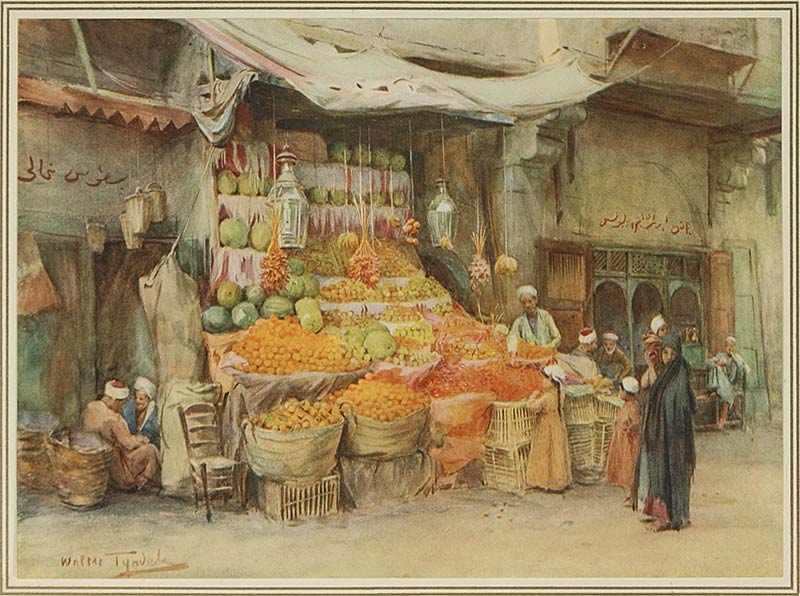
breezes from some tropic isle. Would the colour of
the fruit-stalls charm the eye equally, were the scent
gone from their piles of russet and gold? Even the
smell of tan seems to enhance the sight of the brilliantly
hued skins in the leather-workers’ bazaar.
Though each sense may occasionally be shocked,
each plays its part in the enjoyment of all things. To
any one keenly interested in this mediæval city, and who
has studied its buildings, the eye is unhappily more
often now shocked than the nose. Uglinesses which
are hardly noticeable in the European quarters are
slowly invading the old parts of the city. I have seen
many a beautiful latticed window replaced by ready-made
imported sashes, or where the seclusion of the
hareem is necessary, an ugly fretwork in lieu of the
turned mushrbiyeh which gave so much character to
the Cairene dwelling. Streets formerly covered in with
rafters and matting are now exposed to the baking sun,
so as to allow more light on the cheap European goods
behind the plate-glass windows. The official mind is
obsessed with the idea that official work needs trousers,
and all aspirants to official billets don these ugly
garments and abandon the graceful kuftân and the
flowing gibbeh. The same thing has occurred in the
government schools.
Trousered policemen tread their beat by day, while
the night watch is allowed to go its rounds in the native
costume; presumably because it is less seen. The metal
fanus which swing before the mosque entrances are being
replaced by ugly petroleum lamps. The water-carrier
will disappear as each stand-pipe is erected; this doubtless
has its hygienic advantages. But had the well-to-do
still the same pride in their city as had their forefathers,
the water would have been conducted to the beautiful
fountains which are now allowed to fall into decay.
Fortunately Cairo is large, and some years may yet
elapse before ugliness will have crept into its innermost
recesses.
Round and about the Tumbakiyeh—where the
coarse Persian tobacco is retailed to the smokers of the
nárgeeleh and the sheesheh—the old-world look seems
still stern enough to frighten off any shoddy European
accessories. Massive doors, nail-studded and heavily
hinged, close in the Wekálehs where the tumbak is
stored. More or less dilapidated gateways lead into
spacious Khans where formerly caravans from Syria and
Arabia unloaded their merchandise. The convent
mosque of Beybars, the Taster, dominates this district.
From its pepper-box minaret one can look down on
extensive warehouses now partitioned into tenements of
the very poor; houses of erstwhile merchant princes
are now falling into decay, and their gardens used as
rope-walks or bleaching-grounds. The mueddin’s call
to prayer sounds like the funeral dirge of the departed
glories of the Tumbakiyeh. The main street, known
as the Gamalieh, has all the dignity of age; it is too poor
a district, and too far from the present business centres,
to be rejuvenated with the lack of taste which has ruined
the Mousky.
Down a narrow lane leading out of the Gamalieh, a
fine old doorway and some well-preserved oriel windows
gave every promise that this was the back of a fine old
Cairene house, still inhabited by its owner, and not
allowed to fall into the ruinous state of most of its neighbours.
My man Mohammed was with me when I made
the discovery. I asked him to inquire to whom it
belonged, and to try to find out if the interior was at
all in keeping with what we saw from the lane.
Mohammed is a man of great resource. After
considering his mode of procedure for a moment, he
pushed open the door, which stood ajar, and we could
see the bowab, or doorkeeper, asleep on the stone seat
at the angle of the passage. Mohammed stepped lightly
along this passage, evidently in hopes of getting round
the angle and obtaining a peep into the courtyard,
without awaking the sleeper. Not succeeding in this,
and being asked what he wanted, he started inquiries
after an imaginary relative who surely was once a servant
in this household. ‘Is this not, then, the house of
so-and-so?’ giving the name of an imaginary owner.
‘Then who does live here?’ The real name of the
owner was then given by the doorkeeper. By a few
more leading questions, it was found out that the owner
was in his country place, and would not return till the
cooler weather set in. Mohammed had in the meanwhile
got his peep into the court, and had seen quite
enough to feel satisfied that here was what I wanted.
As the hareem was in the country, there would be
no objection to the ghawaga also having a peep into
the court, especially as a baksheesh might follow on
the peep.
I was then allowed in, and here was a court similar
in plan to many ruinous ones I had seen; but in a
perfect state of preservation, and suggesting many
beautiful things in the house which overlooked it. I
had never painted in the interior of a fine Cairene house,
still kept up as in the days before Ismael Pasha uttered
his boast—‘L’Egypte fait partie de l’Europe.’ I made
inquiries amongst Egyptian as well as European friends
regarding the owner, and whether it would be possible
to get an introduction to him. I was told that he was
one of the old school, lived as his forebears had done,
and did not frequent the modern quarters. The more
inaccessible this gentleman seemed to be, the more I
longed for an entrée into his house. Years went by,
and this court remained in my memory as a beautiful
picture which Lewis only could have adequately
painted.
Towards the latter part of my last season in Cairo,
I mentioned to my friend, Mr. Bowden Smith, how
difficult it was to obtain permission to paint in the few,
yet remaining, genuine old Cairene houses. His work,
connected with the ministry of finance, had brought
him in contact with many of the upper class Egyptians,
and he named several houses he could take me to see.
‘Have you seen the house of the Sheykh Saheime near
the Gamalieh?’ he asked, and described the very place
which years since had made so lasting an impression
on me.
We went there the very next day, and were fortunate
in finding the Sheykh at home. We were received in
the takhtabosh, a spacious recess opening on to the
court, and under the principal guest-chamber, which
latter is supported by a handsome granite column. A
row of carved wooden benches line the three walls of
the recess, and rest on a paved floor a few inches higher
than the open court. Cushions were placed for our
accommodation, and we were courteously asked to sit
down. Here we took our coffee and conversed with
our host.
I told him how glad I was to meet one who still
had a pride in the beautiful things his country had produced,
and who preferred keeping up the home of his
ancestors to living à l’Européenne in the modern
quarters. He could not foretell what his sons might
do; but as far as he was concerned, he would keep to
the dress of his forebears and end his days in the
dwelling-places which they had built. ‘Should I better
myself,’ he asked, ‘if I left this house for one at Kasrel-Aine,
or in the Ismaelieh quarter?’ A vision of the
pretentious villas ‘en style Arabe,’ ‘en style Egyptien,’
or, worse yet, the Levantine’s conception of ‘l’art
nouveau,’ rose up before me, and by contrast made
more beautiful the court we overlooked. The gentle
cooing of the doves, and the sound of running water
amidst the flowering shrubs, would never here ill-tune
with the hooting of a motor. The roses, which garlanded
the trellised windows, seemed more beautiful than
those which try to hide the cast-iron balconies of modern
Cairo. No sound from the outside world penetrated
here till the solemn call to prayer from Beybar’s mosque
recalled the hour of day.
We made a move, thinking that our host might
wish to attend the Asr. To our delight, however,
he asked if we would care to go over the house
with him. Nothing suiting us better, he conducted us
across the court to a door and passage leading to the
mandarah or guest-room. The anteroom we passed
through suggested a good subject, and I threw out some
hints that I should like to do a sketch of it. Whether
our host understood what I was driving at or purposely
passed on to another subject, I could not quite make
out; but a wink from my friend that he would have
another try later on reassured me. The room was
sparsely furnished, as is generally the case in oriental
houses. High wooden benches lined the walls, and if
we add to these a few cushions, some rugs, and one or
two hanging lamps, we shall have described about all
this anteroom contained. The light trickling through
the latticed windows showed up the design of the
mushrbiyeh, and it is not appreciable how decorative
these turned wooden gratings are until they are seen from
the inside. The wall surfaces were quite plain, and gave
a value to the ornamentation surrounding the lintels of
the three doors which opened into the room. On each
lintel was a Koranic text in raised lettering and relieved
on a blue ground.
The simplicity of the anteroom served to enhance
the rich decoration of the guest-room itself. The
durkááh, which is that part of the floor nearest to the
entrance, had a beautiful tesselated pavement. In the
centre stood a double-basined marble fountain sending
up several jets of water, which were caught in a shallow
well around its base. It is in the durkááh that the
guest drops his slippers before ascending to the liwán,
which is raised a few inches above the pavement and
occupies about one-third of the apartment. Handsomely
covered mattresses with heavy cushions line the
three enclosing walls and form the diwaan or divan, as
we call it. In this instance the ceiling of the liwán
was several feet lower than the roof of the durkááh,
and with its retaining arch bore much the same relation
to the rest of the apartment as does that of the chancel
to a one-aisled church. The intricate pattern of the
mushrbiyeh occupied the place of an east window.
Cupboards with minute panels of varying arabesque
designs, and shelves with bowls and dishes of Rhodian
or Egyptian ware, furnished the walls above the divan.
The geometrical patterns on the ceiling and the vivid
colours with which they were defined would have been
disturbing to the eye, were it not for the subdued light,
in which the decoration was partially lost.
Everything was harmonious, all seemed exactly
right. I would fain have lingered on the divan and
heard our host relate of deeds which may have been
done within these walls. But there was more to see.
Leaving this beautiful guest-chamber and crossing the
anteroom, we were taken up a winding staircase to the
hammám. Our Turkish baths are modelled on a
similar plan, but as this one was only for private use, it
was on a smaller scale than a public one, and marble
floors and seats here took the place of more ordinary
materials. From thence we were taken through a
corridor and into another guest-chamber.
A slight smile on the face of our host seemed to
express a question as to what we should say about this
room, having exhausted our terms of admiration on
the one below. Here was the place where he wished
us to linger and sip our coffee until the mueddin once
more called to prayer at the close of the day.
Some of the features of the mandarah—as the
guest-room below is called—were here: the two levels of
the floor defining the limits of the durkááh and that of
the liwán; the tesselated pavement and marble fountain
in the one and the mattressed and cushioned divan of
the other; the mushrbiyeh also split up the light in a
pattern suggesting the interlacing of strings of beads,
and the panelling of the doors and ceiling were as rich
in arabesque design as that which we had seen below.
The one apartment was as truly Egyptian as the other,
yet it left a distinctly different impression.
The more subdued light of the mandarah, as well
as the chancel-like appearance of the liwán, had an
impressiveness which was not here; but it might easily
have appeared gloomy had we visited this lighter and
more highly coloured room first.
We were now in what was probably the Káá, or
principal apartment of the hareem of former days. I
have learnt since that the Sheykh’s family is a small one,
so the rooms overlooking the garden and in a wing of
the house—which we were of course not shown—would
be amply sufficient for the women-folk of his
household.
The hareem, or harem, as it is often miscalled in
England, is also often misunderstood. Its true meaning
is the ‘prohibited,’ that is ‘sacred’ to the master of
the house. It is that portion of the house which is confined
to the women and children, and is not necessarily
a kind of luxurious prison for a number of wives,
which many unacquainted with the East often suppose.
The ‘selamlik’ is that part of the house used by the
male portion of the household. As the great majority
of Egyptians have only one wife at a time, the hareem
generally occupies less of the house than the ‘selamlik.’
The term ‘el hareem’ also applies to women collectively.
It would not have been proper to ask if the
beautiful apartment we were in had ever been used as
the Káá, for one must be on very intimate terms with a
Moslem before alluding in any way to what concerns
his women-folk. A feminine touch of lightness absent
in the selamlik convinced me that we were being
entertained in what at one time formed a part of the
hareem.
The chief attraction was the grand display of
beautiful old tiles which covered the walls. The design
showed a Persian influence, and was not confined to
the geometrical patterns of the more orthodox Saracenic
work, and pretty as this is, it is the colour which gives
it its great charm. Blues tending to green played with
blues of a violet shade, touches of puce and emerald
green joined in the revelry of colour. No ornaments
were hung or bracketed on these wall spaces, for were
they not ornament sufficient in themselves? The
mattresses and cushions of the divan had richer coverings,
were more elegant in pattern, and less sombre in
hue than those of the divan we had first seen.
What a studio this would have made for any one
desirous to paint eastern subjects! Better that it
remain as it is—a dignified setting to a worthy
Egyptian gentleman.
As the sun got more round to the west, the shadow
of the mushrbiyeh patterned the floor, and gem-like
touches of light crept slowly up the wall facing the
great window. Above the turned wooden grating,
which showed its design so beautifully in the shadow
it cast, a second window admitted the light through
numerous pieces of coloured glass set in deep mouldings
of old plaster work.
Mr. Bowden Smith chatted with the Sheykh about
mutual acquaintances and of affairs pertaining to the
present day; but whether it was my insufficient knowledge
of Arabic or whether my surroundings had carried
my thoughts elsewhere, I lost the thread of their conversation.
When appealed to about some point, I had,
before I could answer, to disentangle my thoughts from
‘The story of the Humpback’ which I had pictured
Shahrazad rehearsing to her sister in anticipation of one
of the thousand and one nights. The two daughters of
the Vizir had hardly settled the point as to the working
of this story into the one of ‘Noor ed-Deen and Enees
el Jelees,’ when the deep wail ‘Alláhu Akbar!’ from
Beybar’s minaret announced the maghrib.
The patterned shadow had left the floor, and the
touches of light from the stained glass, intensified in
colour by the declining sun, crept from wall to ceiling
as we rose to depart.
CHAPTER VI MY SECOND VISIT TO THE SHEYKH AND MY EXPERIENCES WITH AN UNFAITHFUL SERVANT
MY friend explained to the Sheykh my desire to
set up an easel in some parts of his house. A
suspicious fear added to his wish to please gave
me an uncomfortable feeling of having presumed on the
good man’s hospitality. It took some time to clear his
mind of any prejudicial effects which might ensue on
my working here. Picture painting is so foreign to
the Moslem’s education, and strictly speaking is a breach
of Koranic law, that a slight hesitation in giving me
permission is understandable. The likeness of nothing,
which is in heaven above or in the earth beneath, hung
on his walls to assist us in explaining the nature of my
work; and that veil which is ever in a degree between
the western and the oriental mind seemed thickened
for a while. The wish to please, however, predominated
over the suspicious fears, and he bade us farewell with
the assurance that his house was at my disposal.
It was days before I returned, as I wished to complete
a street scene I was then engaged on. I had lost
my guide, philosopher, and friend, Mohammed, whom I
did not wish to do out of a lucrative job up the Nile, and
I had in his stead one with a plausible exterior, but
possessing none of the virtues and all the vices which
go to make up a dragoman. To work in the streets
and bazaars in Cairo without a man to keep off the
small boys is almost an impossibility, and much of one’s
comfort depends on the tact and willingness of the man
one employs.
Mansoor (to give him an alias) spoke and read
English remarkably well, and having learnt like a parrot
some sentences concerning the Pyramids and some of
the chief monuments of Cairo, he was in hopes of soon
obtaining a dragoman’s licence. Without this licence,
happily, none may guide the tourist, and as an examination
of sorts is now required, and also a character from
some previous employer as to the good behaviour of the
applicant, the tourist may run less risk in future of
being hopelessly swindled than he did in earlier days.
But acting merely as my servant, such licence was not a
necessity. He had an irritating way of giving me uncalled-for
information. The parrot-like sentences he
had stored in his memory were repeated each time we
passed a monument the tourist is taken to see. These
might have been amusing had I not heard them ad
nauseam before. I did not check him at first, and I
even tried to supplement some facts absent from the
little book which he had learnt by heart. His usual
answer, ‘This is all the dragomans say,’ discouraged
me from trying to teach him anything.
The Khan Khalil was the school in which the true
tricks of his trade were to be studied. While I worked
there, Mansoor would crawl about listening to the
prices paid for the various purchases, and probably
passed sleepless nights till he had found out about the
commission the guides had obtained for bringing a
customer. His smart clothes and his fluent English
must have imposed on many a stall-holder that he was
either a licensed dragoman or was shortly to become
one. Coffee and cigarettes were pressed on him at
whatever mastaba he deigned to sit.
While I worked in a mosque not far from this
bazaar he would sit at the window and watch for
tourists. Several times he had an uncle to bury. He
would explain that there was only just time for him to
pay his last respects to his deceased relative, and if I
would let him go he would be sure to be back by the time
I was prepared to leave. I would tell him to go and
bury his relative, and had he asked to bury himself, I was
prepared by this time to give him my full permission.
The last time he left me on his sorrowful errand, I
mounted on to the window-sill where he was wont to
watch for the prey as yet withheld from him. I saw a
party of tourists just disappearing into an alley leading
into the Khan Khalil, while Mansoor was questioning
the driver of one of the cabs which they had left, and
then he also was lost in the shadow of the selfsame alley.
He returned some time after I was ready to start for my
hotel, and I told him that as he had taken so long in
burying his uncle, he should attend no more funerals
while he was in my service. To be told a lie is seldom
pleasant; but a very stupid lie reflects on the intelligence
of the hearer, and this may partly have accounted for my
growing dislike of this man.
I had unfortunately not found another to take his
place when I went to the house of the Sheykh Saheime
to start a drawing. I was most courteously received,
and was told to ask for anything which I might
require. I began a drawing from the anteroom of the
mandara looking into the court and through the passage,
which also led to the stairs of the former hareem.
I did not wish to begin a too elaborate subject till I felt
more sure that repeated visits were not inconvenient to
my host. Mansoor joined the doorkeeper and the eunuch
on their bench at the front entrance, where he doubtless
enhanced his own importance by lying about my
riches and relationship to the various high English
officials in Cairo. The inconvenience of such lies is
that a tip proportionate to such imagined wealth is
looked forward to. He came presently as the bearer
of a message from the Sheykh, that had the latter known
I was coming that day, he would have prepared a dinner
for me; but that he hoped I would return on the
following morning and would honour him with my
presence at the midday meal. I was grateful for his
kind intentions, and yet sorry that I might be putting
him to some trouble and inconvenience. I wished to
come here often, and would only feel comfortable about
doing so if I felt sure that I was not disturbing him.
Not feeling sure as to my intentions, he came himself,
and was not satisfied till I had promised to dine with
him the next day. Mansoor was later cross-questioned
as to whether I liked such and such a dish. Did I
always eat with a knife and fork? He supposed I sat
on a chair while I fed, and could Christians get through
a meal without strong drink? Such questions were
duly repeated to me, so I sent my man back to the
Sheykh with a message that the more the dinner was as
he was accustomed to have it, the more I should appreciate
his hospitality.
I was there early on the following morning, as I
wished to complete my drawing before the meal took
place. I had a good long paint with no other company
but a weasel, which is often seen in Egyptian houses to
keep off the mice and rats, or whatever one chooses to
call that creature which is too large for the former and
too small for the latter. I know of but one name for
either of these pests, and firán does duty for both.
Cats are also household pets, but are less adaptable for
spying out the secret places where the firán are wont
to nest their young.
A message came from the Sheykh to know if I
wanted my dinner at twelve or at one o’clock. I sent
Mansoor to find out what his usual hour was, and
being told that it was just after the midday prayer, I
sent word that no other time would suit me better.
About half-past twelve the Sheykh appeared, followed
by a gentleman in European clothes and a ‘tarbouch.’
I was introduced, and informed that this was a cousin
and a judge of a native tribunal. I was relieved to find
that the judge spoke French fluently, for my Arabic is
liable to fail me if put to too severe a test. They
seemed interested in my drawing, and held it close to
their eyes to enable them to decipher the text engraved
on the lintel of the door. It is a never-failing surprise
to Easterns if they can read any lettering which one
may have introduced in a drawing. ‘The ghawaga
says he can’t write Arabic; then how is it that we
can read what he has here written?’ My explanation
that I had merely copied the strokes and dots which I
saw before my nose seldom satisfied these inquiries,
and generally left a suspicion of something uncanny.
Needless to say here that the lady now shown in the
illustration was non-existent at that time, and not being
of the beau sexe myself, the privilege of seeing one at
any time in this house was not to be expected. There
are still some things left which the painter may do and
which are still beyond the power of the camera.
Now, a word of warning to any one who may be
about to dine for the first time with one of the Near
East. To put it crudely: Come with an empty
stomach and eat as sparingly of the first dishes as
you can. They may be very good; but our powers
of absorption may fail us, and we might have to pass
several subsequent courses untouched, which might be
taken as a slight to the quality of the fare. I was prepared
for this, and had made a very light breakfast.
The grace, repeated in a low voice by the master, is
always impressive:
‘Bi-smi-lláhi-r-raḥmani-r-raḥeem’
(In the name of God, the Compassionate, the Merciful),
and the smell of the savoury dish which had been
placed before us made the ‘Tafaddal’ or invitation to
sit down doubly welcome. Chairs had been borrowed,
as a concession doubtless to the requirements of the
Ferangi, and a plate, knife, and fork were also placed
before me. I dismissed the latter articles as only being
necessary to cut up the tougher food of Europeans,
and as quite useless with the tenderer dishes of the
Muslemeen. The Sheykh seemed pleased at this and,
as is the custom, first tasted of the dish.
When I tore a piece off the thin flat loaf placed
before me and, doubling it, I hooked a piece of meat
out of the dish, he exclaimed that I had eaten in Arab
fashion before. The judge agreed with me that with
Arab dishes he did not see where a knife and fork came
in. Not partaking so freely of the yachnee as to
satisfy our host, he took a delicate morsel out of the
stew and handed it to me.
The manner of eating with the fingers seems strange
at first; but it is astonishing how soon one gets accustomed
to it, and also how much more delicate it seems
than when described to those who may never have
witnessed it. The right hand should always be used if
possible, and should a fowl be served, it is polite to
catch hold of one leg, so as to enable the master to dismember
the bird without having to use his left hand.
It may take as long to learn the etiquette pertaining to
the Arab mode of eating as for an Arab to acquire all
the niceties observed at an English table. Should a
stranger, however, from want of experience do something
contrary to the usages of the country, an oriental
will pretend not to notice it, as a well-bred Englishman
would do if the cases were reversed.
Dish followed on dish; when some sweetstuffs
were placed on the table my hopes revived, till they
were replaced by yet another stew. My powers of
absorption had about reached their limit. I appealed to
my host to consider the limited dimensions of my lower
waist, and that that only prevented me from doing full
justice to his generous fare. This had some effect, and
I was let off with a tit-bit which he politely handed to
me in his fingers.
‘El-ḥamdu li-lláh!’
(Praise be to
God) from the judge, who rose up and continued the
conversation while washing his hands, was the abrupt
sign that our feast was at an end.
A servant held a brass basin while a second poured
the water from a ewer over my hands, and, our ablutions
at an end, we were conducted to the takhtabosh
to sip our coffee and smoke. I was asked where I had
dined before in Arab fashion, and my host was interested
to hear about some dishes peculiar to Morocco,
also how I had fared with the Druses in the Lebanon.
An Arab meal, in fact, was not in itself a novelty to me;
but, as I explained to the Sheykh, I had never dined in
such beautiful surroundings. We got on to the subject
of Japan, where the mode of eating is much more difficult
to acquire than that of the Near East. My hearers
showed a much greater interest in things Japanese than
I expected, for as a rule a Moslem’s sympathies rarely
extend to countries beyond the sway of Islam. How I
had got on without meat, bread, milk or butter surprised
them, and settled any possible doubts as to
whether they might wish to go there themselves. I am
told that during the Russo-Japanese war events were
followed with keen interest in Egypt. Every victory
of the Japanese was construed into a victory of a non-Christian
people over a Christian power—of the Asiatic
over the European. When a book I had written on
my experiences in Japan appeared at the Cairo booksellers’,
I was interviewed by the editor of an Arabic paper
to give him as many particulars as I could concerning
Japan.
I avoided all talk as to the present régime in Egypt.
Though one of my hearers had a safe billet, and the
Sheykh probably felt a greater security for the property
he holds than he would if our occupation of Egypt
ceased, nevertheless the sting of being governed by the
unbelievers is always there, let the unbeliever’s yoke be
ever so light a one.
A suspicion that I might be hindering the afternoon
nap induced me to bid farewell to my host and the
judge.
Mansoor had been having a good time feasting with
the servants, and when he joined me I asked him to
divide a riyal between those who had served me. I
watched him present the money to one of them and in
the presence of the others, for I had reason to suspect
his honesty. I could not hear the talk which followed,
but saw the money passed on to a boy, who was told
to go to a shop and change it. I saw no object in
waiting any longer, so left the house. Mansoor wished
to stay behind, and as I did not see why he should get
any of the tip, I made him come with me. In the
main street I hailed a passing cab. Mansoor now
seemed rather disturbed and asked if he could go back.
‘The boy will not know where to bring the change
of the riyal.’ ‘Did you not tell the boy to give the
changed money to be divided among the servants?’
I asked. ‘No, I did not say it was for the servants,’
he answered, with the look of a detected thief; ‘I told
him to bring the change back to you, sir. Please
allow me to return to the house and I will tell them
what your intentions were.’ I could not return myself
to see the matter through, as I remembered an appointment
I had to keep, and I let the man go. It dawned
on me as I drove to my hotel that Mansoor’s object in
hanging behind was to intercept the boy returning with
the change and to pocket the lot himself.
Explaining the circumstances to one who had had a
long experience of native servants, I was assured that
my suspicions were not unfounded. This villain, who
had been well entertained by the servants of the house,
had conceived this ingenious manner of robbing them
of their gratuity.
When he turned up the next morning I told him I
should want him no longer. Seeming to question the
reason of his sudden dismissal, I suggested a police
inquiry as to the disposal of the riyal. He wished to
hear no more, and vanished like the ghost who was
asked for a subscription.
Now this is a type of man who, but for the salutary
regulation as to granting licences, would have become
a dragoman, and have reaped a good harvest, during
the short season, by robbing the tourist by day, and
conducting others by night to witness every kind of
abomination.
CHAPTER VII IN WHICH I GET ANOTHER SERVANT AND HUNT FOR A CROCODILE; ALSO A CONTINUATION OF THE STORY OF PRINCESS ZOHRA
I FOUND a man, who was used to attending artists
on their rounds, sooner than I had hoped for. He
was a rougher type of man than my last one, but
one to whom I took much more readily. He spoke
no English, which was in his favour, for though this
might sometimes be inconvenient, it suited my purpose
better to practise my Arabic than to have him airing his
English on me.
Mahmood Hanafy is his name. I give it with pleasure,
and in hopes that possibly these lines may be read by
some one who might be glad of his services. No two
men of the same nationality could have been a greater
contrast than this Mahmood and the disgraced Mansoor.
The more traps Mahmood had to carry, the more he
seemed to like it; when I suggested taking a cab, he
would say the place was no distance, and cabs were very
dear—he had evidently been well trained by former
brother-brushes. Mansoor, on the other hand, always
had a cab near the hotel when we started, and would
place my sketching things on the box in hopes I would
take it. Distances were always enormous with him, and
when I took a cab, he would declare that the doubled
fare asked was none too much. The extra squeeze he
could then get out of the cabby harmonised with his
natural laziness. Mahmood was a plucky fellow, and
ready to clear a street of people if he thought they were
in my way; while Mansoor’s bravery never went further
than slapping a child if the parents were not present,
whereas, if some hooligans promised to be a nuisance, he
generally slipped away.
Mahmood had one drawback which his predecessor
had not, and that was a loud voice. Now, as no pillow
was ever thick enough to prevent my hearing my watch
ticking, a huge volume of sound was not necessary when
he answered my questions. If he thought I did not
understand him, he evidently took it for hardness of
hearing, and his answers would be loud enough to
startle the street. I could not correct him of this,
though he tried to mend. Trained as a donkey-boy,
this voice had doubtless been of use both in directing
his beast and in the altercations which often end a ride.
Possibly the deafest donkeys were placed in his care.
He was now the owner of many donkeys, he told me,
and he let them out by the month instead of running
after one himself. He was always ready, however, to
run after one if I should require it. His dress was
more humble than that of Mansoor, but he never pleaded
poverty to try and get something over his wage. He
told me he had all he wanted, and should I not wish to
use him for a few days, he would willingly rest till his
services would be required.
The other man, though smartly dressed, had always
some tale of poverty handy when I gave him his wage,
and always begged for an advance on his future pay.
Had he not a number of people dependent on him?
and the cost of food, had it not risen so much? I
found out afterwards that he had no dependants, and
that he sponged on his sisters when he was out of work.
He had the appearance of one addicted to hashsheesh,
and probably only smoked this of an evening, for I could
never detect the smell.
This drug is happily now forbidden to enter the
country, and strong measures are taken to prevent its
use. A certain amount does, however, get smuggled
in, and the
ḥashshash
or victim to the drug can still
procure it if he can pay for its enhanced price. The
smell of its fumes was much more familiar formerly in
the humbler coffee-shops; but it is not quite absent
now. It is often mixed with tumbák, a kind of Persian
tobacco, and is smoked in the gózeh, a pipe made of a
cocoanut-shell, which has a long cane stem. One who
indulges slightly in the habit would not be termed a
ḥashshash
any more than a moderate drinker in England
would be termed a drunkard. The opprobrium attached
to the term is much increased through its association
with the
Ḥashshashseyn
of the time of the Crusades,
whom we know as the Assassins—the subjects of the
‘Sultan of the Castles and Fortresses,’ more commonly
called ‘the old man of the mountain.’ They
were said to indulge freely in hashsheesh when sent on
some murderous errand by their chief. Rowdy or
riotous people are often termed ‘Hashshasheen’ whether
they be addicted to the drug or not.
Seeing an excitable crowd quite recently, in one of
the principal squares of Cairo, I approached to see what
was the matter. A brutal-looking man was struggling
with a couple of policemen who were taking him off to
jail, while others were placing on a stretcher a youth
who was terribly hacked about his face and head. On
inquiry I heard that the man in charge of the police
was employed at the public slaughter-house, that he
was given to hashsheesh, and that in a fit of madness he
had just assaulted with his butcher’s knife the wounded
youth. The term hashshash, which was freely used by
the crowd, had a particularly gruesome sound on that
occasion.
Loud and furious were the comments of Mahmood,
and had he not been carrying my materials he would
have joined in the struggle with the butcher.
As this took place just within the limits of the
European quarter, it was fully reported in the foreign
Cairo papers. The youth succumbed to his wounds,
and the hashshash paid the death penalty.
I was on my way to the Khaleeg to look for a subject
which had attracted me on a former visit, and before
this canal had been filled in by the tramway company.
A change for the better, possibly, from a hygienic point
of view, and also as a means of communication; but a
sad loss to the picturesque. Many historic buildings
which backed on to the canal have been pulled down,
and commonplace frontages will soon blot out all
remembrance of them.
The tramway having come to stay, it is as well to
make the best of it, and to use its cars along the couple
of miles which bisect the city from north to south.
From this route many a peep into some old courtyard,
or the back of a mosque or palm-shaded shrine, may
induce a descent from the cars and a tramp along the
dusty road.
Just beyond the present governorat was an angle
of the enclosure known as the ‘guarded city.’ This
formed more or less of a square of rather more than
half a mile each way, and its western wall stood on the
east side of the present filled-in canal. The building
of this enclosure marks such an important date in the
mediæval history of Egypt that a few words here may
not be amiss.
Stanley Lane Poole tells us, in the Story of Cairo,
how in 959 Gawhar, the victorious general of el-Mo’izz
(the first Khalif of the Fatimid dynasty), entered Masr,
as the capital of Egypt was then called, and still is by
its native inhabitants. Plague and famine had so reduced
the population, that scarcely any resistance was
offered to the troops which Gawhar had led from Tunis
into the valley of the Nile. His first thought was to
build a fortified place away from the plague-stricken
city, and yet near enough to keep it in subjection.
Beyond its northern extremity he pitched his camp on
a sandy waste, unobstructed by any buildings save an
old convent. The prevailing winds being from the
north, hygienic reasons were also in favour of this site.
When the boundaries of the enclosure were marked
out, astrologers were consulted as to an auspicious hour
in which to start digging the foundations. From poles
stuck in the ground ropes were stretched, from which
bells were hung, and thousands of men stood ready
with shovel and pick to dig out the trenches as soon as
the astrologers shook the poles, and by the tinkling of
the bells announced the auspicious moment. The intentions
of the astrologers were, however, forestalled by
a raven who, alighting on a rope, set the bells aringing,
and every spade was instantly stuck into the soil. It
was during the hour when the planet Mars (el-Káhir)
was in the ascendant—an evil omen for the future peace
of the place. ‘Masr el-Káhira’ thus became the name,
not only of the fortified enclosure, but also of the
adjacent city. ‘El-Káhira,’ or the Martial, is that from
which we get our Cairo. The omen was turned to
good account by the astrologers. Messengers were
sent to Mo’izz to announce that the foundations of a
triumphant Masr had been laid; the name of the last
of the Abbasid Khalifs was no more heard in the prayers
which were offered up in the mosque of Amr, and
Mo’izz was proclaimed the ruler of Egypt. His conquests
now extended from the Atlantic to the Arabian
desert, and for two centuries the Fatimid dynasty ruled
the country.
Walls, described as being thick enough to allow
four horses to be driven abreast on them, were built
round the enclosure; the foundations of a vast palace
worthy of the great Khalif were laid; and buildings
were planned to accommodate his court, and those who
would guard his sacred person. The common folk
were not admitted within the gates of the enclosure
after the Khalif had taken up his residence. It was
then designated ‘Kahira-el-Mahrusa,’ or the guarded
city.
The Sheea heresy which Mo’izz had fostered,
whether from conviction or from policy, had a far-reaching
influence on the destiny of the country.
In the mosques orthodox Moslems were replaced
by sheykhs of the favoured sect. Christians and Jews
were tolerated and often put in high positions. What
civilisation gained here it more than lost by cutting off
Cairo from the great centres of Saracenic learning, and
though bent on destroying the power of the Sunnee or
orthodox Moslems, there is no reason to suppose that
leanings of Mo’izz were towards Christianity. To
remedy this he built the university mosque of el-Azhar,
proudly called ‘The Resplendent.’ He endowed it
liberally, and gave the students every opportunity to
study the Sheea teaching which had caused the rift in
the Mohammedan world. A great impetus was given
to art by the removal of the prohibition to copy any
natural objects; and birds and beasts, flowers and foliage
were freely made use of in design during the Fatimid
period. Unfortunately little remains of this, for, when
the orthodox party gained the ascendant during the rule
of the House of Salahedin, these decorations were ‘a
mark of the beast’ and were in most cases destroyed.
Vivid descriptions exist of the splendour of Mo’izz
and the great ‘East Palace’ which he built. But nothing
of all this now remains except the Azhar, which
justly is still one of the most famous monuments of
Cairo.
Parallel to the canal runs a narrow street called
‘Beyn-es-Sureyn’ or ‘Between the walls,’ and this conducts
into another called ‘sharia el-Benât,’ which means
the street of the sisters. It is here I have come to make
a study of a doorway of little architectural pretensions;
it leads into a house built in the middle of the nineteenth
century and which backed into the canal. A
terrific-looking crocodile used to hang over the door,
and this one as well as others had caught my attention
during former visits as being a characteristic ornament of
a Nile city. Stories, I have since heard, refer to this
crocodile, and made me wish to make a drawing of it.
Children used to pass it and speak with bated breath;
for it was said that it had grown to its size from feeding
on the children, the parents of whom the master of the
house had slain in Sennaar.
The house was built by the awe-inspiring Defterdar
Ahmed, whom Mohammed Ali had sent to the Sudan
to avenge the murder of one of his sons, and so terrible
were his acts of retribution that he is since known as
the ‘Tiger of Sennaar.’ His chief interest, however,
for the present is, that, partly as a reward for his valour,
the great Pasha gave him one of his daughters in marriage.
Mohammed Ali is reported to have said that the
Tiger would be a fitting mate to his Tigress.
If my readers have not forgotten the fate of O’Donald,
the young Irish officer, they may recognise in this Tigress
the lady of his undoing.
It is related that the princess Zohra, after the murder
of her lover, was for many days as one bereft of her senses.
The first conscious act we hear of her is when she stole
from the palace in the dead of night and found her
way to the field where O’Donald was buried. The
jackals and dogs had left no trace visible of where the
unfortunate man was placed,—they had done their work
as well as Abbas could have wished. The poor woman
was found at break of day, grubbing with her hands in
the soil to find the body of her beloved one. She was
forcibly led back to the palace and the matter was reported
to her father. The servants were severely
punished for allowing her to escape from the hareem,
and Zohra was kept in strict confinement.
When the Defterdar returned soon after, from his
campaign in the Sudan, Ali wished to honour him as
highly as he could. He saw also in him one who had
strength of will sufficient to be a match for his wilful
daughter. Ahmed was proud of the alliance, and built
and furnished a palace here in the ‘sharia el-Benât,’
worthy to be the home of his exalted bride. Whether
the Defterdar’s life was a happy one we are not told.
But it was a short one:—his death was due to a stroke,
said the court physicians; poison, whispered the neighbours;
and poison, said Abbas, whose hatred of his aunt
and former playmate grew as time went on.
Little was seen or heard of the widowed princess
for some time after. Few ladies from the different
hareems were bold enough to call on her, and the huge
crocodile seemed more like a bogey to frighten people
off than an emblem of luck to the house which he
adorned.
The mysterious disappearance of one or two young
men became the talk of the neighbourhood, and this
increased as the absence of others was observed. The
body of one was found in the canal close to the water-gate
of Zohra’s palace, and shortly after this a second one
was seen there. No one dared voice their suspicions;
but when the public story-tellers (the shoara) told of
Kattalet-esh-Shugan, the Arabian Messalina, knowing
looks were passed amongst the audience. The tragedies
were repeated from time to time, and every mother of a
handsome son trembled lest he should be caught in the
toils of one she hardly dared name, but whose name was
in the thoughts of all.
Abbas kept himself well informed as to what went
on in Zohra’s palace, but he abided his time until
Mohammed Ali should return from the wars, or until
fortune should favour his accession to the viceregal
throne. In 1841 the firmân of investiture, as it is
called, brought the wars, which Mohammed Ali had
waged with varying success, to a close. The hereditary
sovereignty of Egypt had been secured to the family of
the great Pasha and, except for the annual tribute to be
paid to the Porte, Egypt had become an independent
state.
Prince Abbas now informed his grandfather of the
goings-on in his daughter’s palace. Gentle persuasion
was never a characteristic of the old gentleman, and
the manner in which he put a stop to these scandals
reads like a story in the Arabian Nights. It is related
that thirty masons and twenty-five donkeys laden
with bricks were immediately despatched to wall up,
during that very day, every outside window and door
except the one surmounted by the crocodile. A company
of soldiers were also sent to see that these orders
were strictly carried out. Before sundown Zohra’s
palace had become a veritable prison.
A modest house immediately facing the crocodile
was inhabited by a Coptic scribe. This innocent man
and his family were bundled out with all their belongings,
and his house was turned into a guard-room. A
watch was kept here day and night to see that no one,
or nothing but what was necessary to the upkeep of
the household, should pass through the one access to
the palace.
We are not told how the princess passed the next
few years in her prison. Mohammed Ali sank into his
dotage, and the reins of government were taken over by
his adopted son Ibrahim. Prince Abbas had not to
wait long before the legitimate succession came to him,
for Ibrahim Pasha died within a year of his viceroyalty
and shortly before the demented Mohammed Ali’s
decease. Abbas then became the ruler of Egypt.
Zohra now realised her danger in remaining in
Cairo. In spite of the guard set to watch her movements
she succeeded in escaping from the canal side of
her palace, and she crossed into Syria before her flight
became known to her nephew. From Syria she
repaired to Constantinople, where she sought and
obtained the protection of the Sultan of Turkey.
We will leave her there for the present, and perhaps
we may refer to her doings later on.
The crocodile I was in search of had disappeared,
and nothing remained whereby I could exactly locate
the palace. The story of Zohra, though of so recent a
date, seems now to take its place with the tragedies
enacted within Mo’izz’s ‘guarded city.’
CHAPTER VIII OF A CAIRO CAFÉ AND OTHER MATTERS
I HAD not far to go along the filled-in canal before
a partly pulled down housefront enabled me to
see the court of a once important dwelling. It
was similar in plan to many I have seen; but it was
the only instance I have met of a vaulted takhtabosh.
A wooden screen partly shut it off from the yard, and
an opening in one of the panels served as a doorway.
Whether this screen belonged to the original building I
cannot say; but it certainly added greatly to its picturesque
appearance. The recess was now converted into
a coffee-shop, while the rest of the house was let out in
tenements to poor people.
It is never safe to leave a good subject to a later
period, if it can possibly be helped. Some arrangement
of line or colour, often hard to define, may be just
what gives the subject its charm. Something may have
disturbed this, or some touch of colour may have gone,
before a second visit, and it leaves the painter wondering
as to what he could have seen in the place to have
made him wish to paint it. I started sketching in
the café at once, hoping that some customers might
arrive to suggest a grouping of figures. Should these
customers be queer ones, I could trust to Mahmood to
keep them from disturbing me at my work.
I had not long to wait before a half-dozen men
came in. They seemed sufficiently interested in
something not to take much notice of me. They
squatted down on their heels, forming a ring, and two
of them each pulled a game-cock from under their
cloaks and pitched them on to the ground. The
Cairene is usually very noisy during his entertainments;
but in this case few words were spoken, though the
men watched the varying success of their birds with
intense interest. I was too occupied in taking notes of
the men and the action of the cocks to feel any interest
in the sport, and by the time one of the birds was at its
last gasp, and lay bleeding on the ground, I felt a
sufficient disgust for the whole thing to decide me not
to make it the subject of a picture.
I saw them refer to Mahmood as to who I might
be, for Koranic law forbids all betting, and I believe
cock-fighting is contrary to police regulations. They
seemed satisfied that I was harmless enough, and they
departed as quietly as they had come.
The sport must be a very popular one, for these
birds, with their combs closely cut and with plucked
necks, may be seen in almost any street in the poorer
parts of the town. Whether the ancient Egyptians
indulged in cock-fighting, I have never been able to
ascertain. I can recall no wall inscriptions depicting
the sport, neither does Wilkinson refer to it in his
Manners and Customs of the Ancient Egyptians. It
was probably introduced into Egypt during the Ptolemies
or, at the latest, during the Roman occupation. Quail-fighting
is common in Upper Egypt, though I have
personally never witnessed it.
The sun soon made my place untenable, so I decided
to return in the afternoon, when I might also
expect to find more customers to suggest some figure
arrangement suitable to my picture. It was a grand
place for Mahmood—cups of coffee at two for a penny.
I could treat him to as many as he liked, and please the
Kahwegee at the same time. I confess to a good many
cups myself, for coffee made in Turkish fashion is
most seductive. The cups are very small, and there is
only a sip of liquid before reaching the grounds, which
are allowed to settle at the bottom. But it is a delicious
sip, and it is also very stimulating. The habit of afternoon
tea acquired in England is hard to break, and to
make a journey into the modern quarters to indulge it
would have cut seriously into my work, and I found in
one of these little cups of coffee an excellent substitute.
Paint where one wishes, a coffee-shop is sure to be
within easy reach, and the Kahwegee will always for a
trifle bring coffee, a chair, and a glass of water, and place
them next to one’s easel. Now that the native quarters
are supplied with pure water, one can drink the latter
with safety. Coffee drinking is often carried to excess
in Egypt, with deleterious effects to nerves and digestion;
but its victims are less objectionable neighbours to the
sketcher than the fuddled European, who may bore him
with questions and breathe on him the odour of his
complaint.
It is said that drunkenness is on the increase amongst
the natives, and it is true that tipsy men are occasionally
seen. They are chiefly the loafers who hang about the
European quarters, where modest coffee-shops hardly
exist, and where nearly every other house retails some
or other intoxicant. Beer or spirits are hardly obtainable
in the purely native parts of Cairo.
Towards evening this quaint little café would liven
up. The wooden bench which served as a mastaba
might seat an álim (as any one who can read is often
called), who would drone out the news from the daily
paper to a group of listeners, and the sound of the
chequers slammed on a backgammon-board would make
an accompanying click, click, from inside the recess.
This game has been borrowed from the Firangi, and is
still called by its French name of ‘tric-trac.’ It is
immensely popular amongst the effendi class, and is
gradually being adopted by those of a humbler station.
The more primitive mankaleh is still played in Cairo,
and is still universal in the villages where tric-trac has
not yet found its way. I have been shown how to play
it, but space will not allow of a lengthy description of
its details. It is played on an oblong board with twelve
hollows in two rows of six each, each row forming an
opposing camp. There are seventy-two cowries, or,
failing these, small pebbles, and it is according to the
manner in which these are distributed into the hollows
that makes the game. An elaborate account of the various
modes of playing it is given in Lane’s Modern Egyptians.
It is reported as having obtained in Pharaonic times,
but this has never been satisfactorily confirmed.
Turkish draughts is also a popular game, and to
my thinking much more amusing than the way we play
it in England. That this game was known (or a form
of it) amongst the ancients is certain, and most visitors
to Medinet Habú will have been shown the presentment
of Rameses III. playing it with his queen.
Games of chance, as well as betting, are forbidden
by the Koran. A point is, however, usually stretched
in allowing the loser to pay for the cups of coffee. In
mankaleh the player backs his skill more than his luck,
whereas in backgammon the throw of the dice brings
in a large element of chance. A strict Mohammedan
will therefore abstain from the latter game.
As the day declined, more customers would drop
in, and by the time the lamps were lit I often regretted
that my hotel table d’hôte called me away to the
Ismaeliyeh quarter.
The light from the primitive lamps piercing a blue
atmosphere of smoke, and falling on the groups of
figures intent on their games, left a picture in my mind
which I hoped might not be dimmed by the more
commonplace aspect of an up-to-date hotel.
Perhaps, after all, it is as well that circumstances
oblige me to reside away from that part which I regard
as the true Cairo. Putting aside matters of health, it
is a loss to be cut off from one’s countrymen, or those
of other countries whose mode of life resembles one’s
own. Unless a man can take his wife with him, he
may pass months without seeing a woman’s face, or
exchanging a word with one of his opposite sex. This
has been my experience in Upper Egypt and while
camping in the desert, where the woman will hide away
from a strange man, and where her voice will never be
heard except she be screaming at one of her children,
or in altercation with a neighbour. The servants are
always males, and the food bought in the villages is
always sent by a man or a boy. If I strolled in to see
the Omdeh or the village sheykh, I should have to wait
till his women-folk were well out of the way. Their
conversation might not have been edifying; but was
that of the men always so? Life in a purely Mohammedan
country, if separated from wife and family, is a
one-sex existence.
I have met cultured men in the Near East, who for
long periods had had little intercourse with those of
their own nationality, and I noticed how ill at ease they
seemed when brought in contact with European ladies
and gentlemen. Life was strange enough away from
the European settlements in Japan, but it was a more
complete life. Though I might not understand a word
spoken by the Okosan or the mousume, their smiles of
welcome were perfectly understandable.
The hotel Villa Victoria, which I have of late made
my headquarters in Cairo, is out of the general rush of
tourists, and is frequented by many who are at times
engaged in excavating, or are in some way connected
with the Antiquities Department. There are also permanent
guests in various Government Offices, as well
as others whose business brings them in contact with
things Egyptian. I was here long enough for acquaintance
with my fellow-lodgers to ripen into friendship,
and besides the pleasure of their company, I was enabled
to pick up a good deal of information. I could also
stay here at any time of the year, whereas most of the
huge caravansaries put up their shutters when the tourist
season is over.
There were also ladies here who had the entrée into
the hareems of the principal houses, and though they
were careful not to give away what is not intended for
general discussion, I was yet able to get some idea of
the life which is led in the ‘prohibited places.’ The
interior of a princely home in Cairo at present must
resemble that of a large Parisian or London house,
much more than that of the Sheykh Saheime which I
attempted to describe in a former chapter. The picture
which a reception-room in the hareem conjures up in
the western mind—of love-sick Zuleikas sprawling on
cushioned floors, sighing for their Selims and sucking
sweets—may be safely dismissed. Diaphanous divided
skirts no more conceal their lower limbs, nor do gold-braided
corsets set off the symmetry of their figures.
The Parisian modiste ‘a changé tout cela.’ To us
poor males, who only catch a sight of them as they
drive by in their broughams, they look still as oriental
as ever. The black silk habarah entirely covers the
‘creation’ from Paris, and the coiffeur’s art is hid
beneath its folds. The white muslin burko veils the
face except the eyes, and whether these veils be thinner
than formerly I cannot say. But they are not sufficiently
thick to hide completely an often very pretty outline of
cheek and chin.
My informant went there to read, or hear read, the
French classics, and though some of the ladies may
have felt bored with extracts from Corneille, I was told
that many were intelligently interested. For fear lest
my readers might take Zohra as a fair specimen of an
Egyptian princess, I hasten to assure them that she was
as great an exception among the women as was her
illustrious father amongst the men of his time.
There was much in common between father and
daughter. The great Pasha let nothing stand between
himself and his ambitions; any means were good enough
to remove those who obstructed his plans. He was a
brave man and a great soldier, and yet he could stoop
to treacherously murdering the mameluke Beys and their
followers, when he considered his rule in Egypt was
safer without them. His young daughter was prepared
to sacrifice any one who might thwart her in her misplaced
love; and the form of madness which followed
on her unsatisfied desires had its parallel in the loss of
reason by her father, when his ambitions to found a
great empire were not realised. He is reported to have
had eighty-five children, and strange it is that, with a
family of such dimensions, the succession of the present
Khedive should have come through an adopted son.
Therefore, as far as we know, there is no blood relationship
between the actual members of the ruling house
and Mohammed Ali and his descendants.
It is pleasant to turn from Zohra to the mistress of
a princely hareem, who is now a great lady in Cairo.
Though having children of her own, she still finds
room in her affections, as well as in her palace, to
mother many little girls who have either lost or have
been abandoned by their parents. She not only gives
them a good education, but, as children by adoption, she
keeps them until suitable husbands are provided for
them. A kinder form of charity is hard to conceive.
Entertainments and visits from lady friends are of
constant occurrence in the wealthier hareems in Cairo,
though the life of Egyptian ladies in a general way
must, from a European standpoint, be exceedingly dull.
Girl schools are on the increase as well as home instruction;
but taking the whole female population of Egypt,
it is barely one per cent. as yet who can either read or
write. The percentage among men is low enough—about
five in a hundred; but as the enormous majority
of Egyptians are peasants, five per cent. may cover those
who are above the status of labouring men.
I have heard the complaint from educated Moslems
that their wives were poor companions, and that they
therefore spent but little of their time in their company.
I don’t know what else they could expect. The fellaha
woman may at times be overworked, but her existence
seems a happier one than that of many of her wealthier
sisters in their enforced idleness.
A fashionable French modiste was for a while a
guest at the Villa Victoria. She spent her time running
from one hareem to another, getting orders for the
latest things in hats. As some of these hats, at the
time of which I am writing, were about half the size
of a billiard table, we would see her driving to her
clients nearly lost amongst colossal bandboxes. For
convenience she wore her chef-d’œuvre, that is the
biggest, on her own head, and she would sometimes
return crowned with a smaller one, having, as she told
us, disposed of the masterpiece in one of the hareems.
We were curious to know when and where her clients
could wear them, for they never appeared in Cairo with
a European hat on their heads. ‘Oh! mais c’est pour
Paris ou Vienne,’ she said, and assured us that they
looked ‘bien chics.’
Just think of it!—Zuleika in a Paris taxi balancing
one of these shapeless masses of millinery on the top of
her head!
To see things as others see them may often be the
wish of most of us. I have never felt this wish stronger
than when I have seen some old village sheykh asking
his way about modernised Cairo. Some evil ginn must
have raised these huge blocks of buildings which house
the unbelievers. Strange things to help them on their
road to perdition are exposed in the stores, and sheets
of some invisible material which his eye can penetrate,
but which resists the touch of his finger, hang before
the accursed articles. Cars run along the streets with
neither an ass nor a camel to draw them. Sparks which
fly from beneath the wheels and overhead, accompanied
by a crackling sound, must be sure evidence of the afrit
who drives them. Naserene women talk in a strange
language to men, and shamelessly expose their faces to
all. He passes a large modern café, and sees coreligionists
unturbaned and dressed as the Frank, partaking
of forbidden drinks and disregarding the call of the
mueddin, which alone brings a ray of hope to the poor
sheykh. He hastens to the mosques—it is some way
off, for mosques are few and far between in this godless
part—he makes his prostrations, and he prays to Allah
that the Muslemeen may come by their own again.
After he has rested in the native quarters, and he
meditates on his well-watered fields, he may wish that
some of his prayers be not too literally answered. He
may still remember the time when excessive taxation
robbed his people of the fruits of their labour, and scars
may yet remain on his back of the Kurbág which drove
him to the forced labour.
I have much in sympathy with the old sheykh,
though we may see things from opposite points of view.
Were the old town not being slowly robbed of its
beauty and oriental character, I might feel indifferent
as to what was being done in the new, for my object in
spending so many seasons in Egypt has never been to
paint the modern city, which at its best could never
equal that which I could find nearer home. The
inconsistency of the old man’s prayer, and the contemplations
of his better watered fields, finds a parallel
in my regrets that the old order gives place to the new;
while I am certainly not indifferent to the creature
comforts which a Europeanised hotel allows me to
enjoy. The discomforts I have endured in native inns
in the unfrequented places may not have left permanent
scars; but they would recall some very unpleasant
experiences had not the interest of what I was in search
of given them a back seat in my memory. Apart from
this selfish point of view, it is a joy to know that the
thousands who dwell in the old city can now drink an
unpolluted water, that their sick can have an enlightened
medical treatment, and that the education of their young
is at present adapted to a useful citizenship.
Our countrymen who are guiding the destinies of
Egypt, and who are honestly working for the betterment
of its people, are not primarily responsible for the unsuitable
planning of the modern Cairo. Ismael Pasha’s
boast, ‘L’Egypte fait partie de l’Europe,’ came after
the remodelling of Alexandria, and since the time when
Clot Bey drew the plans of a northern city to be built
in a semi-tropical country.
From what I hear, this unfortunate example is being
followed in Khartúm, which is well inside the tropics.
The wide sun-baked streets may be pleasant to those
who only visit it during the short winter; but they who
have to remain there during the long summer months
may long for the shady lanes which wind amongst the
habitations of the ancient parts of Cairo. The well-to-do
in the mediæval city were not obliged to migrate to
Europe during the hottest season, as the clients of our
modiste feel now constrained to do.
CHAPTER IX THE COPTIC CONVENTS OF WADI NATRUN
AMONGST the guests who halted at the Villa
Victoria, it was my good fortune to make the
acquaintance of Mr. Palmer-Jones, an enthusiastic
architect who had measured up some of the early Coptic
convents, and had also reconstructed on paper dynastic
buildings of which little but the plan is at present
traceable. He was making preparations for a journey to
Wadi Natrun to continue his work at the old convents
which are dotted about that valley.
During a stay in Professor Garstang’s camp at
Abydos, a few years ago, my interest in what concerns
the Copts had been considerably excited, while I painted
in the Coptic settlement which is a mile or two distant
from Seti’s temple. Although these convents are of
recent date compared to far-off pharaonic times, a
period of fifteen centuries has nevertheless elapsed since
many of them have been built. They also have this,
which gives them a human interest above the earlier
shrines, and that is their preservation of the uses for
which they were founded. Many are now no more
than a heap of ruins; but there yet remains a good
number still inhabited by monks, and where the
Christian liturgy of the early centuries is still repeated
in the chapels.
When Mr. Jones kindly proposed that I should join
him in his expedition, I was not long in making up
my mind to do so. His preparations took longer
than mine, for he had to procure a camp outfit for a
stay in the desert, a good distance from the rest-house
where he and I proposed to spend a week together. I
could not afford the time to accompany him further
afield, and a week of desert air I hoped would suffice
to shake off the evil effects of a touch of influenza.
It took over a week to get an answer from the
manager of the Salt and Soda Company, in whose rest-house
we proposed to stay, although he wrote by return
of post telling us we could come. The distance was
within a hundred miles from Cairo; but postal arrangements
are not expeditious in the desert.
The delay gave me time to paint the street which
has been reproduced as an illustration to this book.
The noise and dust, as well as the importunities of the
inquisitive, made me long for the quiet and the fresh
air of the desert. A change of work and of interests
now and again is wholesome, and should but little work
be the result of my expedition, the interest and the
fresh air would compensate me for any loss of time.
We started at midday by a train which runs along
the edge of the Libyan desert, just outside the cultivation
area, and not far from the western bank of the Rosetta
branch of the Nile. This is the Behera line, and if
any one could be found with sufficient patience, he
could reach Alexandria by one of its trains, and cover
rather less ground than by the main route. After a
crawl along the fringe of the desert for some seventy
miles in a north-westerly direction, the train strikes into
the Delta, and joins the main line at Teh el-Barûd.
Fortunately we could leave it after a thirty-mile crawl,
at a station called el-Khatatbeh. We were met here by
the agent of the Salt and Soda Company, and invited to
wait in his house until the steam-tram would take us to
the rest-house. This runs twice a week, and carries
coal and other necessaries to the works. When the
passenger carriage had been coupled on to the trucks,
we started on this novel desert journey.
There seemed something sinister in the name of
our destination—‘The Valley of Natron.’ It lay in the
direction of the reddening sky, and seemed somehow to
recall a valley with which Bunyan has made us familiar.
The ‘Lacus Asphaltites,’ as classical atlases call the
Dead Sea, is a name which in a similar way brought
passages of the Pilgrim’s Progress back to me, when
years ago I took a journey to Jericho. The engine,
which pluckily dragged us into the increasing darkness,
breathed sparks of fire into the clouds of smoke. Was
it the mystery of the desert that got hold of me? The
fire and smoke which snorted from the funnel of the
little engine brought Apollyon clearly back to my
mind.
I have passed months on end in the desert, and yet
that awe which it inspires at sundown never leaves me.
For three hours we continued our course through
the dreary waste. A crescent moon revealed an
interminable series of low sand-hills; broken flints
caught its light and looked like the reflections of the
stars on a billowy sea. Though our horizon was not a
distant one, the sense that we might have continued
in our present direction for more than two thousand
miles impressed us with the immensity of the great
Sahara.
The quickened pace of our train told us that we had
reached the depression where the series of natron lakes
lies. Before we came to a standstill my illusions had
vanished into thin air. A smell of caustic soda, and
the sight of the works, of the coal trucks, the shunting
cabin, and as we got nearer, that of the men in greasy
overalls, carried me away from the Sahara, and set me
down near some north-country manufacturing village.
We were met by the manager of the rest-house, and
some natives (who might have hailed from Wednesbury
from their get-up) shouldered our luggage while we
picked our way to a long one-storied building we
could see outlined against the starlit sky.
It had turned very cold, as it often does in the
desert, even after a baking hot day. I blessed the whole
of the Salt and Soda Company, Limited, for having
provided a good stove in the rest-house sitting-room,
and I poured more blessings on the Italian manager,
who soon announced the dinner. What with our long
fast and the keen desert air, we were able to do full
justice to the padrone’s efforts. We asked him if he
could hire us donkeys to take us to the convents the
following morning. ‘Leave it to me,’ he said, ‘and you
shall have them at whatever hour you like.’ We
decided on half-past seven, and were promised that
they should be there to the minute. We were up with
the lark, and ready to start at the appointed time; but
we might scan the horizon and never a donkey could
we see, and the padrone was as invisible as the donkeys
he had promised. After waiting an hour, I proposed
our walking down to the works to make inquiries.
Amongst a number of natives, who all knew nothing
about donkeys—never seemed to have heard of such
things—I noticed a fellow-countryman. He was stirring
a bubbling, oily-looking liquid in a huge caldron.
‘Look out, sir,’ he cried, ‘a drop of this’ll burn right
through your clothes, and if you step on it, your boots
won’t be worth sixpence.’
The pot being sufficiently stirred and the lid duly
adjusted, the man stepped over to where I had retreated,
and seemed pleased to be able to talk in his own
language again. He was a genial fellow, and was prepared
to tell me all I might wish to know about natron.
I got on the subject of donkeys as soon as I could, and
learnt from him that the only three donkeys (excluding
the padrone) which the company possessed, were probably
down at the salt-pits. I explained that I did not
expect to use the Company’s donkeys, but understood
that we could hire some. I then learnt that there were
none nearer than el-Khatatbeh.
Later on the manager of the works appeared, and I
got Jones to introduce me to him. After thanking him
for letting me use the rest-house, I told him my difficulties.
All he could do, he kindly told us, would be
to send the trolley to the rail-head, and from thence we
should have to walk to the convents, as no donkeys
were available that day. Ibrahim, my friend’s servant,
put our lunch and materials on to the trolley, and as
soon as the mule was harnessed, off we went to the
rail-head.
A thin black line on my map of Northern Egypt is
drawn from the great Sahara, through this part of the
Libyan desert, till it reaches Cairo. It then winds
along the valleys of the Arabian desert, and disappears
out of the map just north of Suez. About the spot
where our trolley now runs the map describes this line
as Derb el-Hagg el-Meghârbe, that is, the ‘Pilgrim’s
Way of the Westerns.’ Within a space of twenty miles
on this route stand four Christian convents, two of
which we then saw outlined against the sky. They
stood there before this desert tract was first used by
Moslem pilgrims on their way to Mekka; and until
the Behera railway was opened, this same track was
followed by the monks on their journeyings to and
from Cairo.
It was not an unfrequented route even before the
early Christians settled here. The mineral alkali, which
these marshes produce, was known and used while
Memphis was the capital city of Egypt.
Salt, extracted from the poisonous-looking marshes
below us, lay in hillocks on each side of the little tramway,
as we neared its termination. During the first
mile of our tramp to the nearest convent the ground
looked as if it were covered with hoar-frost. It crackled
under our feet as would thin ice, and I longed to reach
the sandy plain on the higher level. The wintry
appearance of this uninviting tract of land contrasted
strangely with the hot sun which beat down on us.
The sandy plain, when we reached it, may have been
pleasant to our eyes, but it was infinitely more troublesome
to walk over. We sank ankle deep at every step
we took, and I now realised why the ‘Pilgrim’s Way’
ran through the plague-stricken-looking stretch which
we had crossed.
As we neared our objective, the Dêr Amba-Bishai,
it looked more and more like a mediæval fortress than
a retreat for the religious. Its massive outer walls now
masked the little domes seen from a greater distance.
Hungry Moslem pilgrims journeying to Mekka might
have proved unwelcome visitors to the handful of
Gubti monks within, and some recent repairs of the
walls were probably done more for security than from
any sense of tidiness. The gateway was large and
imposing; but the door itself was small and sufficiently
recessed to be defended through the loopholes in the
projecting jambs.
We were glad to rest in the shadow of the walls
till we managed to get admitted into the convent.
Repeated pulls at the bell-rope seemed to have no
effect, though the noise broke violently the stillness of
the desert. Ibrahim then picked up a big stone, and
using it as a battering-ram against the door, explained
that the sound would reach further than that of the
bell which hung outside from the wall. His exertions
finally had some effect. A shutter was slid back from
an iron grating in the door, and a voice called out,
‘Who’s there?’
We explained our errand to the man inside with
the persuasiveness of those addressing one in an advantageous
position. The stupid face at the grating had
no expression but that of suspicion; a slight look of
intelligence showed itself when the word baksheesh was
whispered, and we were told that the Prior must first
be consulted.
The man returned after a while, and we heard him
remove a heavy stone from behind the door. Heavy
wooden bars had then to be unfastened, and after
several attempts to unfasten the lock, the old door
creaked back on its rusty hinges. An angular passage,
through the square tower of the gateway, led us into a
spacious court, in the centre of which stood the church
and the monastic dwellings. Most of the latter were
in a woeful state of disrepair, and in some cases they
had completely fallen in. A well and a fig-tree, as
well as some green vegetables, showed that this court
might have been made into a garden. This was a
proof of the lethargic state of the monks, for the
Egyptians as a rule will turn any ground into a garden
if only water be available.
We were received by the Prior in a bare and once
whitewashed room, with a wooden bench round the
walls. After the usual salutations, he ordered coffee,
and even produced cigarettes; but argue as long as we
liked, he would not give us permission to sketch in the
convent. The permission my friend had got, from the
Patriarch in Cairo, mentioned the other convents, and
not the one we were in; we should be allowed to see
the church, but no sketching was to be done.
As Jones had worked here during the previous
winter with a permit from the Patriarch, and had
required ladders and other help to do his measuring
up, he did not think it necessary to get an authorisation
merely to make a few sketches at present. I suspected
ill-will more than mere stickling about these formalities
was the cause of this, so I proposed that we should
have a look at the church, and then go off to the
neighbouring convent.
The most aggravating part was that the little church
was picturesque in the extreme. Its whitewashed walls
and vaulted roof emphasised the rich colouring of the
primitive altar. I have been in the inner sanctuaries of
wellnigh every Egyptian temple, and have entered most
of the mosques of Cairo; but never had I been more
impressed with the sentiment of any than with that
of this rude place of Christian worship. I longed to
sit down and paint it; no ‘treatment’ would be required,
for the composition was perfect. Should I go
back and offer the Prior a baksheesh? I even meditated
on how, ‘to save his face,’ I might pretend it was for
the upkeep of the chapel. On Jones suggesting that
the church in the other convent might suit my purpose
as well, we decided to take our departure.
We were told that the coffee was now ready for us,
and were asked to return to the parlour. My irritation
at not being allowed to paint was increased by the fleas
which had got at my ankles, and I neither wished to
see the Prior again nor touch his coffee. Though
Ibrahim had the Moslem’s poor opinion of the Copts,
he implored me not to refuse the coffee, as it would be
such an insult to the whole convent. Ibrahim did not
want to paint, and he was probably less sensitive than I to
the fleas, so he could view the matter in a calmer frame
of mind. I saw, however, that he was right, so we
went and sipped our coffee, made our salaams to the
Prior, tipped the tatterdemalion of a lay-brother who
had let us in, and were once more in the outside
world.
While writing these lines, and missing the accompanying
illustration of the chapel which might
have fitted in so well here, I feel mean for having
drunk that coffee.
It took us less time to gain admittance to the next
convent, which was separated from its neighbour by
about a quarter of a mile. Its outward appearance was
much the same as the other, it having been built about
the same period and under the same conditions. The
dwellings and church also formed a group in the centre
of the enclosure, and though somewhat different in
plan, it had nevertheless much the same character. A
spreading sycamore-tree, with a goat and one or two
sheep lying in its shade, gave the place a less dead-alive
look than had its neighbour, though the same signs of
neglect and decay were visible everywhere.
As we turned the angle of the main building, an
expression of disgust escaped my friend. What we saw
was disgusting enough, but not quite sufficiently so to
account for my friend’s expression, as he is the least demonstrative
of men. A new erection between two wings of
the earlier work had been run up by some builder whose
architectural taste was of the café chantant order. It
was already in a state of disrepair, which failed to give it
a look of respectable age, but was merely a sign of bad
material and still worse workmanship.
I told Jones what a pity it was that they had not
asked him to design something which would have been
in keeping with the rest of the convent, and I was
answered that not only had he done so, but that he had
also gone carefully into the cost of the building, and
had given them his services for nothing. What had
been run up during the preceding summer must have
cost more than if his designs had been carried out, for
workmen must have been got from Cairo to do the
tawdry ornamentation.
We were shown into this place, with a certain
amount of pride, by the monk who conducted us. The
Prior was having his post-prandial sleep, and we were
asked to make ourselves at home till he came to receive
us. We begged that he might not be disturbed just
yet, and asked to be allowed to have our lunch in the
meantime. It was now about two o’clock, and our
breakfast in the early dawn seemed a long way off. We
had a hen and a brood of chicks as company in this
new reception-room. The hen seemed to appreciate
the samples of our lunch which fell her way, and her
clucking brought more poultry to join the company.
The monk appeared quite indifferent to the mess they
made, and he squatted on the floor and conversed with
Ibrahim. He would not join us in our food, but he
willingly helped us with a bottle of wine we had
brought.
Before we had finished, a very old man shuffled into
the room from a neighbouring apartment, and muttered
some greeting. We rose to meet him and to explain
our errand. Jones tried to recall to his mind the days
he had spent there during the previous winter; but
whether the old man had any recollection of this or
not his blank expression did not reveal. He wore a
brown woollen habit, such as the first Christians who
settled here would have worn, and a great rent in the
garment showed that this was all he had on. He did
not wish to see the Patriarch’s authorisation for us to
work here; all things pertaining to this world seemed
indifferent to him. He gave a shiver as if he felt the
air passing through the rent in his garment, and shuffled
out to sit on the doorsteps in the sun.
I made signs to Ibrahim to get a spirit-flask from
out the basket and offer some to the old man, who
mechanically accepted it, and drank it down. This
seemed to revive him a little, and he passed the cup to
have it refilled. Ibrahim gave him a second dose, and
asked him his age. Not getting an answer that we
could understand, the second monk told us that he
must be more than a hundred years old. The poor old
man looked it, and that was probably the only data
which the other monk had.
The church was very interesting, and a more important
structure than the previous one; but so dimly
lighted that we had to wait till our eyes got used to
the gloom before we could distinguish anything. Two
or three minute windows in the vaulting admitted the
only light. As our eyes got used to the gloom, the
dilapidated condition of everything became more noticeable;
some grease marks on the floor, beneath the few
hanging lamps, seemed all the evidence of the place
having been used in recent times.
I started a drawing of an interesting subject, one
which might have consoled me for my disappointment
in the other convent had I been able to see more clearly
what I was about. The heykel, which corresponds to a
chancel, was not here divided from the nave by the
wooden screen common to most Coptic churches, but
by a wall reaching to the vaulted roof. A high doorway
was in the centre surmounted by a wooden grating,
through which we could trace the outlines of the Coptic
cross, and a curtain, as is usual, hung in the place of the
door itself. A massive dresser stood to the left of the
doorway, and a lectern slightly to the right. Rude
Byzantine paintings hung from the top of the dresser,
and an ikon of the Virgin and Child was fixed above
the curtain.
The afternoon being far advanced, I hoped I might
do better, with more light, on the following morning.
It was a long weary tramp we had back to the rest-house,
for no trolley awaited us at the rail-head, in spite
of the most solemn promises that it should be there.
We were more fortunate the next day, as the donkeys
were kindly lent us, and we were able to be back at the
convent in fairly good time.
Though I was in the church nearly the whole day,
I witnessed no service, and remarking on this to Jones,
he told me that during the weeks he had worked
there he could never remember one having taken
place.
What on earth had the eight other monks who
resided here to do? They were supplied with corn
and beans by the charity of others, and all initiative to
do anything for themselves seemed to have left them
during their lethargic existence. Possibly, when the
dust of the old Prior will have returned to the dust
of the desert around him, some one younger and
more energetic may put some life into the Sleepy
Hollow.
CHAPTER X THE MOSQUE OF ES-SALIH TALAI
I RETURNED to Cairo little the richer in artistic
material, but feeling much the better for the few
days of desert air. Though Cairo stands on the
fringe of a desert, the three-quarters of a million of its
inhabitants are bound to vitiate its air, and they have
certainly polluted its soil. No drainage system as yet
carries off the sewage from the main part of the native
city, where the dust is often laid by the slops emptied
on the roadway. It is true that the Tanzím employs a
large number of scavengers; but their efforts are chiefly
confined to the modern quarters, where there is some
hope of dealing with so difficult a task. The Arab’s
ideas as to road-cleaning, when he is left to himself, is
to sweep the dust about rather than to clear it away;
the scavenger is therefore the greatest nuisance of all
the nuisances the sketcher has to contend with. When
taken unawares, a sweep from one of these idiots’
brooms may cover with dust your drawing and your pallet
before you can stop him or get out of his way. Were
it not for the sun, which sterilises this dust, a large
population could never have existed here.
Cairo is unpaintable during the few grey days of
midwinter, and perhaps this is just as well, for when
the Great Germicide does not shine, the place must be
very unhealthy. An overcast sky often drove me
into the mosques, where I could spend my time in
drawing my subject, until the warm reflections from
the sunlit court should make me feel instinctively for
my pallet.
I flattered myself that few nooks and corners existed
in the old city which I had not explored, till I turned
up a narrow lane outside the Bab Zaweyla and found
myself in the ruinous court of a delightful old mosque.
It is extraordinary that I should have overlooked this
during the many seasons I have spent in Cairo. The
lane is called Haret es-Salih, and the mosque servant
informed me that this was the mosque of Salih. Who
this Salih might be was more than the servant could
tell—he had not been there more than twenty years—should
it be a mosque called after the founder of the
mameluke dynasty, its date could not be earlier than
the middle of the thirteenth century. There is much
remaining which suggests an earlier period, both in the
plan and in the construction of the arches; the foliated
background, to the Kufic lettering which decorates
these arches, seemed hardly in keeping with the work
of the orthodox Moslems who succeeded the Fátimid
dynasty.
I looked up all the Salihs who crop up in Stanley
Lane-Poole’s Story of Cairo—a handy little volume,
published by Messrs. Dent and Co., which no visitor to
Egypt should fail to get—and I succeeded in placing
him as Talái ibn-Russik, who on his accession to
power styled himself el-Melik es-Sâlih. He was the
last but one of the Fátimid khalifs, and he built this
mosque in 1160, the sixth year of his reign.
There is little now remaining of all that was built
in the enclosure which Gawhar pegged out as the site
of el-Mo’izz’s ‘guarded city’; the small mosque, el-Akmar,
happily still exists and enables students to study
the less restricted forms of decoration which the Sheea
heresy permits. The boundaries of el-Kahira were considerably
extended during the two centuries of Fátimid
rule; the three great gates and Hakim’s mosque remain
as specimens of the work of that period, and they also
mark the limits of the extended city.
It was outside the walls of the Cairo of those days
where Talái ibn-Russik built his mosque, and it remained
for Saladin, who succeeded the Fátimid khalifs, to yet
further enclose and bring this mosque well within the
walls of his enlarged capital.
The entrance is through a gateway supporting the
minaret, which latter is probably of a later period than
the rest of the building. The colonnade, which surrounded
three sides of the square court, has almost
disappeared, as well as parts of the enclosing wall.
The liwán, which is the subject of the accompanying
illustration, is still intact. Kept sufficiently in repair
so as to prevent its falling down, it has never suffered
the hand of the renovator to sweep out every trace
of the mellowing influence of near eight centuries of
use.
An ugly wooden fence enclosed it from the court,
but I was able to see enough through the palings to
paint it as if this disfigurement were not there. The
court is on a higher level to the liwán owing to the
accumulation of rubbish which has not been cleared
away, and this accounts for the high horizon in the
picture. It also enabled me to see less of the exasperating
fence. Though still used as a place of worship on
Fridays, it serves as a school during the rest of the week.
The young students squatting on the matting and committing
to memory verses of the Koran form picturesque
groups, and the little crowd around the rostrum of the
teacher centralises the subject.
The scenes are on a smaller scale than those which
may be witnessed any day at the Azhar, or University
Mosque. The latter has been so over-restored, and not
always in a judicious manner, that I have never been
tempted to paint there. The students here are mostly
lads, and are either preparing for the university or are
the children of parents who may not approve of the
modernised form of instruction at the Khedivial schools.
As in all purely Arab schools, the training is almost
entirely confined to exercising the memory rather than
the development of the reasoning faculties. It is often
quite sufficient qualification for a teacher to know his
Koran by heart, so that he can detect any mistakes in
the verses which he hears his scholars repeat. As every
lad repeats aloud what he tries to learn by heart, the noise
is easily imagined. There seems little restraint; the lads
nibble at their lunch or buy drinks from the lemonade-seller
when it pleases them; those to whom the teacher’s
back is turned may indulge their liking for mankalah
or any other games easily secreted under their cloaks;
and had it not been for the powerful lungs of Mansoor,
most of the scholars would have taken up a position
around my easel.
When the clouds dispersed and the further angle of
the court formed a warm sun pocket, the greater number
would leave the liwán and repeat their verses in the
warmth. Mansoor’s work of keeping the lads away from
me then became more arduous. He found an ally in
the mosque servant, and when gentle persuasion failed
more drastic measures were used. The noise in the
court did not in the least seem to disturb the good-natured
teacher, and when he left his rostrum he would
come and have a look at the work I was doing.
I came here many times, for not only did the drawing
and detail of this subject take up several long mornings,
but I had a second one on hand of which these lads in
the sun made the foreground. That they should be
curious to see what I had made of them was natural
enough, so I gave them an opportunity of satisfying
their curiosity before I packed up to go. In sketching
a group of figures which is constantly on the move, the
head of one may be suggested on the body of another
who may have moved away. This seemed to perplex
my spectators considerably. When Ahmed had identified
his kuftan or galabieh, Seleem would point out the
head as belonging to himself. A good stare at me to
see if any signs of the evil one were visible would follow:
if some afri’t had not assisted me in this uncanny work,
how else was it to be explained.
As mornings begun in sunshine may turn to grey in
winter, or the other way about, my having two good
subjects in the same place was a great advantage, for
though a reflected sunlight improved my liwán, I
could nevertheless find plenty of detail to draw while
the sky was overcast. ‘Good gracious!’ it actually
rained one morning, and with my drawings I joined in
the rush for shelter under the arches. Volunteers to
carry my belongings were numerous, but Mansoor would
only allow some privileged youngster to carry my stool.
The teacher would drone out the verses of the Fáthah
quite regardless of the disturbance.
The profession of a fikee is, I am told, not a lucrative
one. A half-piastre, i.e. five farthings, per week per
pupil used to be his earnings, though this may
have increased slightly with the general increase of
wages. If we consider his intellectual equipment and
compare it with that of a schoolmaster at home, it is
possible that the pay of the fikee may compare very
favourably. They often eke out this miserable pittance
by reading a chapter of the Koran in the houses of the
well-to-do. One recently ‘killed two birds with one
stone’ by posing as a model to me, while he also
repeated the Fáthah, outside the entrance to a hareem.
I am afraid that some giggling, which I could hear
through the mushrbiyeh, may have been caused by my
attempt at portraiture. I turned my easel towards the
wooden grating to satisfy a legitimate curiosity which
might possibly have been excited in the ‘prohibited
place.’ The giggles developed into loud laughter. I
rather fancied my sketch, and, in spite of this unfavourable
criticism, I still fail to see anything funny in it.
The fikee turned out to be as big a fraud as most of the
natives whom I have induced to pose to me. The value
of time becomes enormous to any loafer who poses for an
hour, and, according to this fikee, it might have been as
valuable as that of a Harley Street specialist. Some
feminine jeers, heard through the mushrbiyeh, hastened
his departure.
According to Lane the schoolmasters in Egypt are
mostly persons of very little learning; few are acquainted
with any writings except the Koran and certain prayers,
which, as well as the contents of the sacred volume,
they are hired to recite on particular occasions. It is
fair to say that the Egypt of Lane is the Egypt of full
seventy years ago. Under the advisership of Mr. Dunlop
and his staff of able school-inspectors, a sound education
on enlightened lines is now obtainable even in the
smallest towns for the children whose parents can or
will afford the fees of the Khedivial schools. But the
kuttáb, as the poorer and purely Mohammedan schools
are called, seem to have drifted into a backwater, and
are little influenced by the stream of enlightenment
which flows past them.
The story Lane tells of a fikee of his time might still
apply to present-day teachers in some of the villages,
and may be worth repeating here: ‘I was lately told
of a man who could neither read nor write succeeding
to the office of a schoolmaster in my neighbourhood.
Being able to recite the whole of the Koran, he could
hear the boys repeat their lessons; to write them, he
employed the areef (or head-boy and monitor of the
school), pretending that his eyes are weak. A few
days after he had taken upon himself this office, a poor
woman brought a letter for him to read to her from her
son, who had gone on pilgrimage. The fikee pretended
to read it, but said nothing; and the woman, inferring
from his silence that the letter contained bad news, said
to him, “Shall I shriek?” He answered, “Yes.” “Shall
I tear my clothes?” she asked; he replied, “Yes.” So
the poor woman returned to her house, and with her
assembled friends performed the lamentation and other
ceremonies usual on the occasion of a death. Not
many days after this her son arrived, and she asked him
what he could mean by causing a letter to be written
stating that he was dead? He explained the contents
of the letter, and she went to the schoolmaster and
begged him to inform her why he had told her to
shriek and tear her clothes, since the letter was to
inform her that her son was well, and he was now
arrived at home. Not at all abashed, he said, “God
knows futurity. How could I know that your son
would arrive in safety? It is better that you should
think him dead than to be led to expect to see him and
perhaps be disappointed.” Some persons who were
sitting with him praised his wisdom, exclaiming, “Truly,
our new fikee is a man of judgment!” and for a little
while he found that he had raised his reputation by
this blunder.’
I must refrain from quoting from that fund of
knowledge, Lane’s Manners and Customs of the
Modern Egyptians, for since it has been so ably edited
by Mr. Ernest Rhys, it has been placed within the
reach of every one by Messrs. Dent in the ‘Everyman’s
Library’ series.
As my view of the mosque is from the court, there
was no objection to my painting there during the duhr
or midday service on Fridays. I was much tempted
to make that my subject, but I refrained from doing so,
as I have done that subject once or twice before. The
ritual has become more familiar to me, and I was able
to follow better what was going on.
The mosque servant, who often helped my man to
keep off the boys during the week-days, increased in
importance on Fridays (which, I need hardly inform
my readers, correspond to our Sundays). Half an hour
before noon the mueddin ascends the minaret and chants
the selám from one of the balconies. This is not the
adán or ordinary call to prayer, but a salutation to the
Prophet, the adán being called a little after the noon.
The worshippers soon arrive, for there are the ablutions
to be performed before they take their seats in the
liwán. A reader, in the meanwhile, ascends the
rostrum facing the prayer-niche or mirhab, and begins
reciting the ‘Soorat el-Kahf,’ which is one of the
chapters in the Koran. Each worshipper drops his
slippers before he steps on to the matting, and places
them sole to sole next to where he sits down. He
performs two prostrations and then sits patiently till
the adán is called from the minaret, when the recitation
of the soorat ceases. During this call the whole
congregation, which faces the prayer-niche, kneels
instead of sitting cross-legged as hitherto. On the
last syllable of the adán every man rises and, holding
his hands, palm outwards, close to his ears, he repeats
the ‘Allahu Akbar’ which has descended from the
minaret. He then makes the various prostrations of
the rekah, repeating the same words at each different
posture, and concludes with the salutations to the
Prophet.
The murakkee (who was no other than the mosque
servant and my ally of the courtyard) then proceeded
to open the folding-doors of the pulpit, and took a
wooden sword from behind them, and holding it with
its point to the ground, he also repeated the salutation.
From a raised platform (known as the dikkeh, and
standing at the entrance to the liwán) an officiant
now chants the praises of Mohammed. The servant
then recites each verse of the adán, and they are repeated
in a sonorous voice by the man on the dikkeh.
During this the khateeb, as the preacher is called,
advances to the pulpit, and taking the sword from the
murakkee, he slowly ascends the steps, and reaching the
top one, he waits till the recital is concluded.
The preacher stands, holding the sword point
downwards, and delivers his address in a solemn and
effective manner to his congregation, who sit rapt
in attention.
No special vestments are worn by those who
officiate, and the ordinary robes of a sheykh seem
perfectly appropriate. The sword, the only object
used in the simple ritual, is to remind the hearers
that Islam was spread by the sword and that by its
power it should, if necessary, still be maintained.
Little outward reverence is shown to the mosque, as
such, at ordinary times, for I have seen it used as a
convenient place to sleep in during the heat of the
day, and the playing amongst its columns of lads during
the intervals of their tasks strikes no one as unseemly
behaviour. But at the call to prayer the demeanour
of all present is strikingly reverent.
I have worked in a great number of mosques and
must have seen thousands of men attending the services,
but I don’t recall having seen half a dozen worshippers
in any other but the native dress. Now that all the
youth of the country, who attend the Khedivial schools
or have of late years passed through their classes, adopt
the European garb; that the numerous employees in
the government and other offices have all forsaken the
native dress—is it not strange that a trousered Moslem
should hardly ever be seen inside a mosque unless he
goes there merely as a spectator? The effendi, a title
loosely given to every native in European dress and
tarbouch, feels, I’m sure, ill at ease amongst his co-religionists
when the services of his religion are being
held. The devout Moslem views the western garb as
‘a mark of the Beast.’ This is felt so strongly in
Morocco, that should a Moor appear in coat and
trousers, his co-religionists would tear them off him.
The encouragement given in Egypt to the adoption of
western clothes is a fatal mistake. The courteous manners
of the oriental seem to leave him with his cast-off kuftán;
his morals are distinctly worse when the ties of his creed
are loosened; and the Christian missionary knows well
enough that the westernised Egyptian is not a fertile
soil for the Gospel seed. We must not flatter ourselves
that our hold on Egypt is in any way strengthened by
this silly fashion; we have only to attend a nationalist
demonstration to see how the trousered effendi out-numbers
the robed Egyptian. Should the sword of
the preacher unhappily be held aloft and a holy war
proclaimed from every pulpit, this European veneer
would vanish like smoke, and the effendi would revert
to the garb of the sheykh.
During my first season in Egypt I painted a crowd of
young students at the entrance of one of the Khedivial
schools. The lads were all robed and turbaned, and
whatever their social positions may have been, each
individual looked a dignified young gentleman. When
next I visited Cairo all this was changed. The kuftán
and the gibbeh were replaced by sweated tailor goods
from some Greek departmental stores. I felt a personal
dislike to the whole education department, and
especially to the British Adviser. I am glad to add
that I have since learnt that our countrymen had
nothing to do with it. It was the Egyptian officials
who inaugurated the change. Education has made
such advances since the British occupation, through
the efforts of a hard-working and certainly not overpaid
British staff, that I am glad to know that I was
not justified in attributing to it so foolish a blunder.
CHAPTER XI THE BLUE MOSQUE AND KASR-ESH-SHEMA
I HAVE never passed a season in Cairo without
making a study of some sort in the Blue Mosque.
There are many mosques of much greater architectural
pretensions, as well as of more historical interest;
but so long as artists continue to flock to Egypt in search
of subjects, so long will the Blue Mosque serve them for
material. On entering the blue-tiled liwán after a tramp
through the glare and the dust of the open spaces around
the citadel, something of the pleasure is experienced of
him who, after a desert journey, first rests his eyes on
the green of cultivation. The pleasure is as much a
physical as an intellectual one, for the hot season draws
one there far more than does the cold. The temperature
would be no higher were the walls a scarlet, but
I’m sure it would be more felt; and this is not only
so to those whose training inclines them to search out
beautiful colour, for I have observed that more people
come here to sleep through the heat of the day than to
any other mosque.
The actual structure was raised by a certain
Aksunkur during the middle of the fourteenth century,
and many much finer mosques of that period
are still remaining. It was restored more than three
centuries later by Ibrahim Agha, and, whatever the
purist may have to say to the contrary, it is these
restorations which give the charm to the place.
Blue tiles cover the whole wall of the vast liwán;
from the matted pavement to the spring of the vaulting
they spread around the prayer-niche till, high up, they
reach the ribbing of the dome. This was a great
undertaking of Ibrahim Agha, for though the tiles
were not worth the fancy prices of the present day,
it must have been a very costly affair even in his time.
The domed chapel, containing the tomb of the founder,
is more beautiful still, but it is almost too dark to make
painting a possibility.
The look of neglect and gentle decay is not depressing,
as in many a Cairene building which lies under
the sentence of complete renovation or of a total
collapse. Some structural repairs have lately been made,
which were doubtless badly needed; but I hope it
may stop at that. The Moslem has all he wants now
for his frequent prayers or his midday nap, and no
renovation of the mosque would ever compensate for the
loss of its present charm.
The mosques of Cairo can be an endless source of
instruction to any one interested in the builder’s art,
their number is so great (over four hundred) and they
are so varied in character; they suit their surroundings
as if they had grown into the spaces they occupy, and
those who worship there look as if they had been grown
for that purpose.
Interesting as are the temples of ancient Egypt, they
have not the human interest of the Cairene mosques.
Old and decrepit as the latter may be, the beauty of
life is still there; the temple at its best has but the beauty
of a corpse. The restoration of the mosques, if well
done, as happily is often the case here, may rob them
of some temporary charm, but it preserves to the people
a valuable heritage; whereas the restored temples will
merely give future generations something to laugh at.
What temple is grander than Tulún’s mosque? Or
in which of them did the builder’s art excel that of the
Sultan Hassan? Yet how few visit these mosques
compared with the crowds who are rushed through the
temples of Upper Egypt. The one of all others which
every tourist is taken to see is the mosque of Mohammed
Ali, which crowns the citadel heights. It is imposing
from its magnificent position; but who ever leaves it
with any higher thought than of the money which has
been lavished on it?
An appreciative guide to the mosques may now be
found in Douglas Sladen’s Oriental Cairo, and to do
here inadequately what he has done so well is not the
purpose of these pages.
If so much enjoyment is to be got out of the study
of Saracenic structures, what about the early Christian
churches? They provide less æsthetic entertainment
than do the mosques, solely because their number is
very much more restricted. But where in this wide
world can any one interested in the dawn of Christianity
find a spot to appeal more to his sympathies than in
the seven Coptic churches which cluster round the old
fortress of Babylon? Concealed as they are from public
view, one enters their precincts with much the same feelings
as on entering the catacombs of Rome. Within
the walls of this Christian settlement, dark and narrow
passages lead to the unobtrusive interiors of the churches.
The search for the doorkeeper, and when he is found,
the primitive key with which he unbolts the ponderous
lock, and the man’s dress, which twelve centuries of
Mohammedan rule has not altered, all tend to take
one back to the days when in these hidden places the
shrines of Abu-Sarga and of Kadisa-Barbára were raised.
The first of these two, which is more familiar to us
as Saint Sergius, is usually visited before the others. It
dates from the tenth century, when the more tolerant
rule of the first Fátimid khalifs would allow of its
construction; but it stands on the site of a church of
a very much earlier date. The crypt of its predecessor
still remains, and this takes one back to the times when
Memphis stood where some rubbish hills now only
mark its site on the western banks of the Nile; when
Bab-li-On was in truth the southern gate of On, the
‘City of the Sun,’ of which nothing now is visible but
the obelisk of Heliopolis.
A tree marks the spot where the Virgin and the
child Jesus are said to have rested. It is about a mile
this side of the obelisk, and some fifteen miles from
the fortress of Babylon which the Romans built on
the site of the gate of On, and whose name it retained.
Tradition has it that near this tree the Virgin bathed
her child in some brackish water, and this becoming
sweet, the pilgrims to this day drink of that fountain.
Tradition helps us to trace the journey of the Holy
Family from this tree to the crypt below the church of
Abu-Sarga, for it tells us of another resting-place about
midway, and that is Joseph’s well on the citadel hill.
We are taken down some dilapidated steps to visit
the crypt, which we are told was the Egyptian house of
Joseph and Mary while they hid their child from
Herod’s wrath. Needless to say that the crypt is a
Christian structure, and of a later date than the Roman
fortress, which at its earliest is placed in the second
century of our Lord. But there is no reason why this
spot should not have been chosen by the Holy Family
after their flight into Egypt. Some ruined shrine to a
god of the decadent mythology may have stood here in
which they may have made their home, as the early
Christians oftentimes did some three centuries later.
To build a church on so hallowed a spot would have
been the first thought of these Christians, if any record
still remained. When Babylon was besieged by the
Mohammedan invaders, this church might have then
been destroyed, or if it survived so long a siege, it would
have disappeared after Merwán, the last of the Omayyad
khalifs, had set fire to Fostat.
Be this as it may, it is quite probable that this pretty
tradition has some foundation in fact.
There is little at present to see in the crypt by the
light of the tallow dip which the Coptic servant holds
in his fingers, but I should have regretted not to have
seen that little. The tenth-century church above it is
a little gem, and however much the dirt of those who
attend it, and the formal ritual which few of the
worshippers can understand, may prejudice one against
the modern Copts, the fact remains that their faith has
withstood centuries of persecution. Stanley Lane-Poole
wisely remarks that ‘no one can stand unmoved in a
Coptic church during the celebration of the Mass, or
hear the worshippers shout with one voice, just as they
did some fifteen hundred years ago, the loud response,
“I believe this is the Truth,” without emotion.’
The whole of the Coptic settlement here is built
within the girdle-wall of the Roman castle of Babylon,
or ‘el-Kasr-esh-Shema,’ as the natives still call it. This
Arabic name, ‘The Castle of the Sun,’ emphasises the
position it held in regard to ancient Heliopolis, of which
it was a bulwark. We also hear mention of this esh-Shema
in the prophecies of Jeremiah xliii. 13: ‘He shall
break also the images of Beth-shemesh, that is in the
land of Egypt; and the houses of the gods of the
Egyptians shall he burn with fire.’
Perched up between two bastions of the Roman
castle, and over its gate, is the Mu’állaka or the ‘hanging’
church. Less rich in traditions than its neighbour, with
some of its romance destroyed by a modern approach, it
gives the intelligent visitor even greater pleasure than
Abu-Sarga which he has seen. He may confuse its
plan with that of the neighbouring churches, and time
may obliterate the construction of its piers and barrel-shaped
roof, but never will he forget the little Byzantine
pulpit standing on the fifteen slender Saracenic columns,
and relieved against as rich a screen as ever closed in a
sanctuary.
I have attempted to enter into more of the details
of these Coptic churches in Below the Cataracts, also
of the history of Fostat, the ‘Town of the Tent,’ which
Amr Ibn el-Âs built around the fortress of Babylon,
and which during successive dynasties of khalifs was
extended until it covered the space now occupied by
the old city of Cairo. The topography and history has
been admirably given to us by Stanley Lane-Poole;
students of early Christian architecture can find all that
is known of the Coptic churches in that scholarly work
of Dr. A. J. Butler, The Ancient Coptic Churches of
Egypt.
I cannot, however, refrain from mentioning the
‘hanging garden’ which adjoins the Mu’állaka. The
palms which grow there, high above the fertilising Nile,
are watered by the faithful to perpetuate the tradition
that the Virgin Mary, on arriving at her new abode, first
broke her fast with some dates which she culled from a
palm-tree growing near this spot.
Four more Coptic churches are within easy reach of
this one, and as parts of them date back to the third
century, there is much to occupy the time of the archæologist
even if the artist does not always find what is
best suited to his brush.
The fortress of Babylon and the Coptic settlement
within its walls are two or three miles south-west of the
main part of the city, and situated at the back of an old
suburb, opposite the island of Rodah, known as Old
Cairo. This name is misleading, for the present mediæval
Cairo existed long before this suburb, which was built
on land recovered from the Nile after Fostat had become
a ruinous waste. It looks old enough now, but it does
not require many generations to impart an ancient
appearance to the poorer Arab dwellings.
The Kasr-esh-Shema, on the higher level, is that
part which might justly be called Old, for it is the
nucleus from which the present huge city developed.
There are also several Coptic churches in Cairo
proper, and one in Beyn es-Sureen, near the Armenian
Church, is said to be the oldest in Egypt, and consequently
one of the earliest churches in Christendom.
A portion of the Copts, who have joined communion
with the Roman Catholics, have their church close by.
I saw a great deal of their priest, and of some leading
members of his community, while I spent a summer
in a village on the Lebanon. They had gone there
partly for their health and partly to escape the hottest
months of the Egyptian summer. The priest was a
very different type of man intellectually from the
lethargic monks I met in the convents at Wadi el-Natrún.
I am indebted to him for much information
about the Catholic churches in the Near East. He had
been prepared for Holy Orders in Rome, although he
and his community are under allegiance to the Pope,
and do not call themselves Roman Catholics, but
members of the Coptic Catholic Church, while they are
very tenacious of the privileges which they secured
when they seceded from the main body of the Copts.
The priests are allowed to marry, and also to say Mass
in the obsolete Coptic language. My friend told me
that though allowed to marry if he wished to do so, he
had come to the conclusion that the Latin Church was
right in enforcing celibacy on its clergy. ‘No! no!
no!’ from the ladies who were present at our conversation,
shows that my friend’s views were not popular.
Similar privileges have been allowed to the other
members of eastern Christian churches when they submitted
to the Church of Rome. It is the exception
when their priests go to a theological college at Rome,
and the great majority evidently do not hold my friend’s
views on matrimony, for few remain single.
As only the Church of Rome repeats the Mass in
Latin, it might have been expected that the eastern
churches under her authority would have made use of
languages understood by their congregations. But this
is not so. No Copt can understand the Coptic liturgy
which he hears repeated; only a few cultured Syrian
Maronites can follow the Syriac Mass, and the Catholic
Greeks, the Armenians, and the Chaldeans all hear the
liturgy in languages long obsolete.
My friend could follow the meaning of the Coptic
phrases he daily used; but apart from these, Coptic is a
dead language to him. He kindly repeated the Lord’s
Prayer to me, and, with possibly an Arabic accent, his
words must have sounded the same as those in use in
the days of the Ptolemies. A few Coptic words have
still survived and are in use amongst the peasantry of
Upper Egypt, and possibly philologists may discover
some in the colloquial Arabic of the Delta. It is in
Upper Egypt that we still find the type portrayed in
the ancient sculptures, amongst the Moslems as well as
the Christians; but in the Delta the Copt shows his
ancestry more conspicuously, as the Moslems amongst
whom he dwells have there a greater admixture of Arab
blood. I was very much struck with the resemblance
a Coptic gentleman, who was staying at the same inn
as myself, bore to the celebrated ‘Sheykh-el-Beled,’ the
fifth dynasty statue in the Cairo museum. He was
younger and not as stout as the statue, but he might
have passed for a younger brother. The broad nose
and full lips, the rather prominent cheek-bones, and a
slight upward inclination of the eyes from the nose,
were all there as in his prototype of some sixty centuries
ago. I remarked to him that while we were savages
his forebears were the greatest people in the world. His
answer was, ‘Yes; and now you are the greatest people
in the world, while we are the savages.’ Lane remarks
that the Egyptian, in answering a question, is more
likely to say what he thinks may be agreeable to his
hearer than to stick to the absolute truth. This looked
rather like it.
I have heard our missionaries accused of deceiving
the subscribers to the missions, by stating the numbers
of their converts and not specifying whether these converts
were from Islam or were merely Copts who had
changed from one form of Christianity to another. If
this is true, the subscribers might justly feel that they
had been deceived. But I should like further proof of
this accusation before accepting the truth of it; the
tendency of Europeans in the East is to believe anything
which may discredit the missionary. That Islam
is a barrier which the missionary has so far failed to
break through is true enough, and missionaries whom
I have met have been the first to admit this. Can one
wonder, then, that they turn from so barren a soil to
sow their seed amongst the Copts, who have shown
some tendency to receive it? The faith of the Copts
has sustained them through centuries of persecution;
but it is amazing how stagnant a faith may sometimes
hold a people together.
When I think of those lazy monks at Wadi el-Natrún;
their neglected chapels; their barren gardens,
though water was there had they the energy to draw it;
I marvel how this people has ever risen to be a power
in Egypt. That they are a power to be reckoned with
we have lately seen. The common mistake of judging
a people from a few specimens who are forced into one’s
notice is evident here. A very much larger proportion
of them are literate compared with the Moslem Egyptians,
and they fill, in consequence, a much larger proportion
of situations where some instruction, other than that of
the Koran, is necessary. The grievance they are ventilating
is that they do not get their share of the highly
salaried government posts, and as far as I could ascertain,
they have a subject of complaint. Their numbers will
probably increase largely, now that persecution no more
drives their weaker brethren into the folds of Islam.
They are fervent in business if they do not always
serve the Lord, and some have accumulated great
wealth.
The black and sometimes the blue turban, which
distinguishes them from the Mohammedans, was originally
forced on them with other and more vexatious
enactments; they still wear it, however, though of
course free to put on what they like. The women
used to wear the face veil when out of doors, more as a
protection than as an ordinance of their religion, and at
present most of them have discarded it.
CHAPTER XII THE SPHINX, AND A DISSERTATION ON TOMMY ATKINS
I WELL remember how sentiment was shocked when
it was proposed to construct a tram-line to the
Pyramids of Gizeh: I may also have turned up
the whites of my eyes at the mere thought of such a
desecration. It is now a well-established concern, and
we may congratulate ourselves that neither the Pyramids
nor the Sphinx seem much the worse for it. The line
ends just below the plateau on which the Pyramids have
been raised, and by the time these are reached the
prosaic tram-cars are well out of sight. The Antiquities
Department holds all the ground which contains anything
here of interest, so we shall be spared the erection
of anything tending to vulgarise it. The tram is in truth
a great boon to many, and not the least to those who,
like myself, spend much time in the bazaars and streets
of the old city.
I can look back on nothing more pleasurable,
during my last sojourn in Egypt, than the moonlit
evenings quietly spent on the glorious Pyramid plateau.
I put this off until the season was well on the wane
and the first great heat had emptied Cairo of the bulk
of its foreign sightseers. A forty minutes’ run—and,
my word, there is no dawdling here!—along the Gizeh
road, blows the heat and the bazaar stuffiness well out
of one’s system, and the pure dry air of the desert, when
the higher level is reached, prepares one to enjoy everything
to the uttermost. Familiarity may have lessened
the excitement which a first gaze at the world’s greatest
wonder must produce, but familiarity has never robbed
it of its awful impressiveness.
The rays of the declining sun or the light of the
moon may glorify the most commonplace subjects; but
that which is always grand here reaches the sublime on
a fine moonlight night. Let us cross the broad shadow
cast by Kheops’ mighty tomb, and glance up that vast
surface, rapidly receding and lessening, yet more and
more clearly defined as it rises into the deepening background
of the star-spangled blue. Its base is hardly
definable from the pale golden sand on which it rests,
and the distance to the further angle is hard to judge.
To our left three shapeless masses stand out dark against
the eastern horizon: they are the ruins of the small
pyramids beneath which were laid the Pharaoh’s
daughters. Was Henwetsen young or fair when she
found her resting-place beneath that heap of stones?
Had no monument been raised to mark the spot, the
sixty centuries since elapsed might not have disturbed
her sleep.
Following a straightish course over the sand-buried
necropolis, we soon see, rising from a hollow in the
plateau, a mushroom-shaped rock, and we know that
our objective is in sight. We skirt the depression in
the soil till we are arrested by the huge human profile,
which is now clearly defined against the sky. I leave
my companion to his contemplations; for the supreme
moment, when I consider the Sphinx is to be at his
best, has now arrived. I run round the edge of the
hollow to compare a three-quarter view with his full face.
He seems too sunk and dwarfed by the ground behind
him, and I descend to the lower level till his shoulders
just appear above the horizon. I feel I can’t better
this view, and I settle down to try and absorb as much
as my memory will hold, with a dim hope of being
able to record it on the following morning.
The moon shines so brightly in these latitudes, that
I had looked forward to being able to paint by its light.
That was in my earlier days, and the muddy-looking
mess, which the next morning’s light revealed, made
me abandon any further attempts in that direction. To
take all the notes one can, and to retain as much of the
colour as one’s memory can hold, is the only possible
way to battle with this subject.
There are moments when uncalled-for information
might almost justify homicide. I had flattered myself
that, hid away as I was in the shadow of the shelving
slope of the hollow, I might have remained unobserved
by the Pyramid pests who look upon every stranger as
their fair prey. Some broken stones sliding down the
slope make me look up, and there to my horror I find
one of these pests taking his seat just above me. ‘Hi,
mister, you take my donkey; Roosevelt best donkey
in Egypt; take you to Mena House for two piastres.’
I tell the man in Arabic to go away and not to disturb
me. He is evidently disappointed in me when he finds
I am not entirely new to the country; possibly this is
only a phrase I may have learnt in a guide-book, so he
begins again: ‘Yaas, Roosevelt best donkey in Egypt;
two piastres not much money; you ride my ...’ I
jump up on murder intent, though I am the most peaceable
of mortals. The Arab jumps up also and, throwing
himself on Roosevelt’s back, moves off faster than
he came. When my irritation has calmed down, I
have to begin over again to try and impress on my
mind the essentials of the grand subject before me.
I admit that the nuisance of the Pyramid Bedouins
has been somewhat diminished of late; but they are
nevertheless a great nuisance still. The fault lies to
a certain extent with the tourists, especially the
ladies, who take far too much notice of them. If the
ladies were aware of what these blackguards say of
them, they would perhaps keep them at a better
distance. They have lost all the virtues of the true
Bedouins, and have acquired all the vices of the
Fellaheen. They are a good-looking set of ruffians,
which accounts for the way some visitors spoil them;
but this does not excuse the police from stopping their
importunities.
I found on the following morning that a second
visit was necessary, and allowing for the later rising
of the moon, I went a second time accompanied by
a sympathetic friend. We managed to shake off the
Pyramid limpets, and my friend kept guard over me
while enjoying his pipe. I think I got what notes I
wanted before another distraction came. Some half-dozen
British soldiers were having an evening out, and
were also attracted to the moonlit Sphinx. Their
object was also to get a presentment of the ‘Mysterious
One,’ though chiefly as a background to themselves.
The conventional group, which may be seen here any
day during the season, did not satisfy the Tommy with
the camera. He was probably a corporal, for he directed
his sitters as one accustomed to command. ‘Crawl up
on to his mug, can’t yer,’ to two or three who had
found a safe seat on the shoulders. ‘Right you are,
Cocky,’ came from an adventurous sitter, who proceeded
to climb the neck and swarm up the wig till
he reached a safe position in the Sphinx’s ear. A more
dangerous climb was that of one who worked his way
round the cheek to find a foot-hold in a crack where
the nose used to be. Another proceeded by a northern
route and risked his neck to get on to the lip. Finding
this an insecure place he appealed to the artist below.
‘’Ang on to ’is eyelid and put your foot into ’is norstril,’
came the word of command, as well as plenty of advice
from the Arab spectators. ‘Now—ready—present—fire!’
A dim light from a lucifer match was all the
fire we saw, and loud jeers from the Arabs drowned
what language was addressed to the defective flashlight.
An Arab who had some magnesium wire saw his
opportunity to do a deal. ‘I give you plenty light
for one shilling.’ ‘One shilling, you blighter, for an
’aporth of wire!’ came from the photographic artist,
with comments from the sitters up aloft. The one
safely fixed in the Sphinx’s ear was for holding out,
while the one hanging on to the eyelid proposed
coming to terms. ‘We’ll give ye three piastres
when ta job’s feenished,’ bawled out the latter in a
strong North British accent. ‘Me know what them
piastres feel like,’ from the Arab, who had not yet
learnt that the word of a Briton is equal to his bond.
A ready-money transaction was clearly indicated, and
two piastres down was finally taken in preference to
the promise of three from the Scot hanging on to the
eyelid. A flash of white light and a ‘Hip, hip, hip,
hurrah!’ from the Arab spectators, brought the séance
to a close.
The British infantry, when quartered in the East,
develop a passion for riding some beast or another.
Donkey-boys fought for its custom, and the supply
being greater than the demand, satisfactory terms were
arranged. One Tommy declaring that the ‘commisairy
camuel’ was the boy for him, camels were soon on
the spot. ‘’Ands off, you measly son of the Proofit,
or I’ll give you a clip on the side of the ear,’ was
Tommy’s warning to an over-zealous claimant for his
custom. The driver moved off quickly to take his ear
out of danger, and a less presumptuous rival got the
fare. We heard, as might be expected, the well-worn
jest about the camel having the hump when the beast
showed a disinclination to rise, and soon after the merry
party disappeared in the shades of the desert.
Times and oft have I heard our occupation of Egypt
criticised, not by foreigners residing there, but by those
who could easily clear out if things looked awkward.
It is naturally also a reproach to the native that his
people should not be considered fit to govern themselves,
even when he doubts that fitness himself. But,
be this as it may, the conduct of the British soldier is
rarely a cause of complaint. I will even go further and
say that Tommy Atkins is popular with the very people
whom he is called upon to hold in check. He spends
his money—often injudiciously, I admit—more freely
than does the Levantine, and the natives feel sure that
the payment of a just debt can always be enforced.
Besides this, he is a jolly fellow, and a bit of rough fun
appeals to the lower orders in Cairo. British military
police patrol the streets at night, and woe betide Tommy
if he is caught in a broil.
How far Cairo is conducive to our soldier’s morals
is another matter; Cairo, however, may be more to
blame in this than the men we send there. The
military authorities do their utmost to ensure good
behaviour, but they can’t prevent the men from enjoying
themselves in their own particular way when off
duty. Should we be anxious to know the latest ‘turn’
of the London music-halls, we have but to walk down
some of the streets north of the Esbekiyeh an hour or
two before tattoo, and we will find Tommy giving the
‘turn,’ with suitable action, to an admiring crowd in
the drink-shop. There is also generally one to play a
piano accompaniment, and I have often wondered how
and when this soldier could have found the opportunity
to acquire a sufficient knowledge of his instrument. A
concertina obbligato is also of frequent occurrence. When
the Levantine landlord’s raw spirits begin to tell, the
songs do not of necessity become more uproarious, as
might be expected; but a mawkish sentimentality is
the chief characteristic. ‘The sailor sighs’ or ‘The
soldier dropt a tear’ is then more the type of song than
the livelier ones with rollicking choruses. Donkey-boys
hang about these drink-shops and other less
reputable places, and manage somehow to get the
carousers back to barracks before tattoo has sounded.
Unfortunately, it is those who spend their evenings
in the least profitable manner who are most in evidence.
The places where harmless recreation is provided for the
soldiers are not in like manner open to the street, and
the number who use them may well resent being judged
by the samples who frequent the drink-shops.
Let us return to the Sphinx: the very thought of the
gaslit streets near the Esbekiyeh makes the air seem
purer and cooler; the expression of the ‘Mysterious
One’ is no more ruffled by his late indignities than
would be the face of a sheykh after having brushed off
a few flies. I had taken the notes I wanted and my
companion had been well entertained by the comic
interlude the soldiers had provided. It was a glorious
moonlight night, the Sphinx looked majestic despite his
battered features, the pale warm colouring of the neck
and shoulders harmonised beautifully with the desert
shades in which it was partly lost, and the more sombre
lines of the head were relieved against a low-toned blue
of a quality as hopeless to attempt to describe as it seemed
hopeless ever to match with the limitations of the pallet.
One leaves such a scene with much the same sensations
as after having witnessed some grand and solemn function.
It is as well that these scenes are not of daily occurrence,
lest the critical eye rob it of its solemnity.
The tram-cars run us back across the five miles of
cultivation which separate the Pyramid plateau from
the Nile; they cross by the new bridge to the island of
Rodah, and then, skirting Old Cairo, we are carried along
the east bank of the river till we are put down in the
heart of the modern quarters.
CHAPTER XIII THE HAMSEEN, THE LAMP-SHOP, AND THE ACCESSION OF SAID PASHA
FROM the end of March, when the wind shifts to
the south, we get a taste of summer’s heat. The
talk in the hotels is of home-returning steamers,
and Cook’s offices are besieged with visitors anxious to
secure early bookings. The Hamseen, as this unpleasant
wind is called, causes a rapid rise in the temperature,
and while it lasts the whole aspect of northern
Egypt changes. The sky partakes of the colour of
the desert, and has something of the look of a slight
London fog; the sun also reminds us of the pale
orange sphere visible when Londoners remark on its
being a fine day. Apart from these appearances the
sensations felt are very different. Neither moisture nor
smoke give that yellowish look here; it is the sand
which the wind collects as it blows across the desert
in its northern course. As the wind increases, so the
temperature rises, and the extreme dryness of the air
causes those unpleasant sensations felt with the first
symptoms of fever.
Cairo becomes unpaintable, the sun hardly casts a
shadow through the thickening clouds of dust, and such
shadow as it is has none of that blue reflected light
which gives the true shadow quality. Did not experience
teach me that it is only a passing phase, my inclination
would be to pack up and leave by the first available
steamer and join the migration to the north. It is useless
to hunt about the streets for subjects; for even if one
were found sufficiently attractive, the dust would render
the work an impossibility. Some subject of a still-life
nature in the shelter of the bazaars or an interior must
be found, unless one makes up one’s mind to stay
indoors until the wind sets in a more favourable
quarter.
The word hamseen means fifty, and is given to this
wind because of the fifty days during which spells of it
may be expected. If street rows are more frequent, if
irritability or headaches are complained of, the Cairene
shrugs his shoulders and says ‘Hamseen.’ It was a day
of that kind that took me once more to the Khan Khalil.
I had often been attracted by a lamp-shop there, but had
put off painting it on account of the elaborate detail, and
doubts whether the results would be proportionate to
the work involved. A corner well sheltered from the
wind and an obliging shopman induced me to set up
my easel. Should the wind change, I could always
leave it and return when the next hamseen would make
work impossible elsewhere.
Every type of Egyptian lamp hung round the
entrance, and lamps and lampstands lined the walls of
the passage leading into the store beyond. There, in
the deeper shades, the sparkle of polished metal suggested
innumerable lamps of which the near ones were
samples. Brass bowls and trays, teapots and candlesticks,
filled up the spaces where lamps could not be
hung. With the buff-coloured stone of the building,
this metal-work made a harmonious whole. To pull
this together so as not to lose the breadth of effect
would be no easy task. During the third day in this
corner of the bazaar a ray of sunlight heralded a return
of beautiful weather; a drop in the temperature and
the feel of one’s skin were enough to tell one that the
wind blew no more from the south, and that once more
the cool breezes from the sea ran counter to the flow
of the Nile. The little sunlight which found its way
between the awnings and matting which roof in this
bazaar was enough to alter the whole effect of my
subject. My drawing looked leathery and sodden compared
to the rich glow which lit up the shop, and
proved that even the nearest bit of still-life is better
when the presence of the sun is felt. I sponged out
more lamps in two minutes than I had put in in two
days, and this corner knew me no more on hamseen
days. It was, after all, only during beautiful days that I
could complete the drawing which illustrates these
pages.
Nassán is the proprietor of the shop, and Nassán
seemed much exercised in his mind why I should have
so ruthlessly made away with so many lamps, though
they were only on paper. What did a ray of sunlight
matter as long as the name of Nassán was conspicuous
on the signboard which hung over the entrance? As
new lamps replaced the old, Nassán’s interest in my
drawing reawakened, and overtures were even made for
its acquisition. I told him I wished to take it to England,
as I wanted illustrations for a book I was about
to write, and he, not wishing to lose a gratis advertisement,
got me to promise to say that he was prepared
to supply any one with as many lamps as they could
possibly wish. He had recently furnished the Heliopolis
hotel with three hundred metal ones, and his stock was
not nearly exhausted.
I looked up Mustapha, the silk-merchant with whom
I had spent an interesting evening during the Hasaneyn
festival. While we sipped our coffee on the mastaba
of his shop, we reverted to the tragic story of the Irishman
O’Donald and his first meeting with the princess
Zohra. Her history has been continued during this
narrative, and my readers may remember that we last
saw her settled down in Constantinople under the protection
of the Sultan of Turkey. How her hatred of
Abbas (the then ruling Viceroy) outlived her thwarted
love for O’Donald will now be related. From the
account given by the German engineer, Max Eyth, I
was able to tell the silk-merchant more of what happened
than he knew; for Eyth had the details from
Halim Pasha, Zohra’s own brother, who was an important
actor in the drama. But nothing to incriminate
his sister fell from Halim’s lips; the part she played
was related by the servant Ramés, from whom Eyth
obtained most of her history. Why no English edition
of Max Eyth’s Hinter Pflug und Schraubstock should
exist is a mystery to the present writer.
It will be remembered that when the great Mohammed
Ali, towards the end of his reign, fell into a state
of imbecility, the reins of government were seized by
his famous general and adopted son Ibrahim, and that
the latter died within a year after becoming the ruler of
Egypt. Mohammed’s death occurred soon after, and
the viceregal throne passed to his grandson, Abbas I.,
who reigned from 1849 to 1854. During these five
years the Europeanisation of Egypt ceased. Abbas
would have none of the Frankish innovations which his
grandfather encouraged; European schools, western
legal procedure and military instruction were banished,
and the ulemas, dervishes, and fakirs came by their own
once more. His country nevertheless prospered during
his reign.
As in so many instances in the history of Egypt,
this ruler was a terror to his numerous near relatives
who might be able to establish a claim to the succession.
Of the eighty-five children of Mohammed Ali but few
were living, and this few were well alive to the danger
of their august relationship. Even the princess Zohra,
after she had fled to Constantinople, must be careful
of what she ate or drank, and of the loyalty of those
who served her. The Taster became once more an
important personage in the various palaces, and not the
least in that of Abbas himself. His two uncles, Said
and Halim, were both much the same age as their
nephew—a thing of constant occurrence in the hareem
life in the East. They lived on tenterhooks, as being
possible rivals to the succession of Abbas’s only son, a
delicate little boy called El Hami. Said Pasha lived at
Alexandria when he was not enjoying himself in Paris.
He was the minister of the Egyptian navy—not an
arduous post, for most of the ships had been destroyed
during the wars of his father and those of Ibrahim.
Halim Pasha lived in retirement in his mother’s palace
at Shubra.
Abbas and his large hareem divided their time at
the palace at Abbasiyeh, at another which he built in
the desert near Suez, and at a third on the banks
of the Nile at Benha. The chief ulema of the Azhar
who was tutor to El Hami, and Elfy Bey, the Governor
of Cairo and Minister of War, became the leading men
in the state. Rumours soon spread through the bazaars
that a holy war might any day be proclaimed, and, if
so, a general massacre of the Christians would follow.
Later on it was reported that the day of the horse races
at Alexandria was the day decided on for the rising.
Said and Halim, who were both friendly to the Europeans,
trembled at the consequences which might follow;
for in a general rising opportunities are easily found to
dispose of relations who may be thought in the way.
The Minister of the Navy found an excuse for going to
Marseilles about the purchase of a frigate, and he made
preparations to sail the day before the races.
It was during the first days of the hamseen that
these sinister rumours spread in the bazaars, and Abbas
decided to migrate with his court to the palace at Benha,
which is about a third of the way on the road from Cairo
to Alexandria. It was also decided to send the young
prince El Hami to Syria for the good of his health. From
his stables at Benha the Viceroy would send his favourite
horse, el Dogaan, to compete in the Alexandrian races.
The narrator goes on to say that ‘man may propose,
but God disposes.’ Abbas and his court duly arrived
at the palace at Benha; the hamseen increased in strength,
and with it the temper of Abbas, which at no time was
a good one. It was an easy task for the ulemas and
dervishes, who formed a part of his suite, to dispel any
misgivings which the Pasha may have had as to the
contemplated massacre. The court astrologer, Soliman
el Habeshi, had fixed the auspicious hour on which to
begin. The hamseen favoured their designs, for we
are told that the wind increased in violence, and that
el Habeshi had to make his calculations when no stars
were visible, owing to the clouds of dust which hid them.
Rames, the servant of Halim Pasha, now relates to
Eyth what followed. ‘I had long been supplanted in
my post of pipe-filler to Abbas, who at that time was
my master, by two handsome young mamelukes called
Hassan and Husseyn. They were twins, the same as
were the heroes after whom they were named. They
had been sent from Constantinople as a present from
the Sultan to the ruler of Egypt. Abbas had every
confidence in them and loaded them with marks of
his favour, while I was relegated to the stables. I did
not mind that, for I always loved horses, and el Dogaan
was as the apple of my eye. As no one could ride
this horse as I could, it was decided that I should do
jockey in the coming races. I was in the seventh
heaven, and was attending to my charge one night, when
I was startled by the appearance in the stables of the
astrologer. His wild looks and gestures were alarming.
“Be silent, Rames!” he said, “the all-knowing
God ordains what is right, but our Lord the Basha is in
his bath! He bathes in his own blood!”
‘The horror of this awful news gave way to a sense
of relief that I was at last freed from a lifelong tyranny.
I ran to the palace and crept silently up the stairs and
through the passages which led to the bathroom. A
lamp hung outside the curtain at the entrance. I feared
to pull this aside—I listened, and hearing no sound my
curiosity overcame my fear. I pulled back the curtain,
and a red ray from the hanging lamp fell on to the
marble bath. A naked arm hung over the further edge
and a head lay against the end wall. As if to make him
look ridiculous, his assassins had slit the mouth till it
nearly reached the ears, and a horrible grimace added
to the awfulness of the scene. A gash in the throat
showed how the Basha had met his death, and a dark
red stream still trickled from this to colour the water
in which the body lay.
‘I still see, when I close my eyes, that bloodless
face with its diabolical smile, lit by the red rays of the
hanging lamp; though the Basha was dead, the evil
spirit which possessed him still clung to its tenement.
The costly marble bath, the gilded stalactites which
hung from the dome-shaped roof, and all the luxury
with which this room was fitted only added to the
horror of the spectacle.
‘I heard voices not far off, and knew the danger I
ran if I were caught here. I slipped off as fast and as
silently as I could and returned to my stables, where I
saddled el Dogaan and led him along the footpath to
the bank of the river. Huddled in a heap, there sat
the astrologer, who trembled as the aspen leaf. I asked
him what he was doing there, and, putting his fingers to
his lips, he whispered, “Do you not know, O Rames,
that they seek to kill me? The court physician is
already under lock and key, and all who know of this
murder must die—you also—for the secret must on no
account leak out until El Hami can be placed on the
throne.” “They must catch me first,” I called out, and
jumping into the saddle I stuck my spurs into el Dogaan
and rode towards Shubra as fast as I could.
‘Halim Basha had oft befriended me, and he would
not forsake me now in my dire necessity. El Dogaan
raced along the Cairo road as fast as if he took part in
the Alexandrian meeting. In two hours he covered the
ground between Benha and the Shubra palace, where
we arrived before daybreak. Allah el Azeem! how he
ran. I thought not only of my safety, but of the far-reaching
effects my news might have.’
The prince Halim here continues the narrative: ‘I
was awakened when the first light of the rising sun was
visible over the edge of the desert beyond the Abbasiyeh
palace. They told me that a man had brought a
message which had to be delivered at once. I descended
to the courtyard and found Rames; but so
covered with dust was he that I could hardly recognise
him. After the greeting he whispered in my ear:
“God is just! Your nephew lies dead in his bath at
Benha.” You may imagine the shock this news gave
me. But was this mameluke to be trusted? Might
it not be a ruse of Abbas to trap me with a word or
gesture, which would have been my undoing? “God’s
will be done,” I said, and ordered Rames to return at
once to Benha and let no one know that I had knowledge
of the crime.
‘No time was to be lost in apprising my brother
Said, as he was to have sailed that very day from
Alexandria, and, unless Rames had lied, our country
was now without a ruler. The lad El Hami was at
Damietta on his way to Syria, and if that child were
made Viceroy, Egypt and all of us would be at the
tender mercies of Elfy Bey and the Ulema. The
English had lately set up a telegraph office in Cairo;
but how could I word this message so as to be only
understood by my brother? The following at last
suggested itself, and Said would not have been a son of
his father had he misunderstood the meaning: “The
house thou seekest in Cairo is empty. The door stands
open. Walk in.” Said understood.
‘He told me later that my message was only just in
time, for he was about to start for the steamer. He
decided promptly to leave for Cairo instead, and he and
his bodyguard were on the road before the steamer
had disappeared beyond the horizon. They reached
Damanhur that evening, and at an early hour next
morning, when he arrived at Benha, he was informed
that Abbas and his court had just left to return to
Cairo. He questioned some of the notabilities of the
town, only to hear with what pomp the Viceroy had set
out on his journey. What was my brother to make of
all this? Was this telegram a trap? or had he perhaps
misunderstood its meaning? The palace was deserted,
so he and his followers rested there till the following
day, and then continued their journey to Cairo.
‘I spent an anxious morning at Shubra,’ continued
Halim Pasha, ‘but imagine my astonishment when a
runner in my employ arrived from Kalioub to inform
me that Abbas had passed through that village, and
would in all probability arrive at Shubra towards five
o’clock that very afternoon. “That damned mameluke
must have lied,” said I to myself, and I had to make
preparations, as the custom is, to welcome the Viceroy,
or (should he not wish to break his journey) to greet
him at the door of my palace. I had hardly put on
my court dress when two messengers were announced,
and they informed me that they had been sent ahead
by His Highness, my nephew, to beg me not to stay
his journey, as he was in great haste to reach his palace
at Abbasiyeh that evening. In one of these messengers
I recognised Rames, who hung back while the other
spoke. He drooped his head and closed his eyes—was
this a sign? And what could be the interpretation?
‘Towards midnight of the following day Said and
his guard arrived. We had to hide the latter as well
as we could in the stables and outhouses, for it was a
dangerous business. Some trusty servants whom I had
sent into Cairo reported on the crowds of people who
had gathered to witness the Viceroy’s progress through
the city, and declared that His Highness bowed in
acknowledgment of the ovations he received. Our
anxiety increased with each fresh report. My mother,
however, did not share our misgivings. “Rames has
not lied,” she said; “I watched him carefully, and his
actions told me clearly that Abbas was dead.”
‘We spent the following day here awaiting some
report which might help to clear up the mystery.
Towards evening some servants of mine brought in
the astrologer, Soliman, whom they had picked up
more dead than alive on the road from Benha. I
told them to feed the old blackguard, and when he had
somewhat recovered I questioned him. He wished to
tell me what the stars had revealed, but I soon was
satisfied in my mind that Rames had not lied. There
was still time to take action before the young prince El
Hami could have reached Cairo from Damietta, and we
could not anyhow have kept Said and his thirty retainers
here without exciting suspicion. I sent word at once to
the Commandant of the Citadel to open the gate at
midnight and admit the ruler of Egypt.
‘That very night my brother Said rode into the
old fortress as Viceroy of this country. The artillery
had orders to defend the place should the necessity
arise. Before daybreak we learnt that El Hami had
arrived from Damietta, and presently the Ulema rode
up and demanded the gates to be opened to admit the
Viceroy of Egypt. Said admitted the learned scribe
into the audience-chamber and complimented him on
his zeal in coming so early to greet his new master.
The Ulema stared as one bereft of his senses. Said,
my brother, was a good-hearted man, and did not seize
on this opportunity to destroy the enemy whom fortune
had delivered into his hands. He was fond of a little
joke, and felt that now he could afford to indulge in
one: a barber was summoned to cut off the Ulema’s
beard, and the poor man was sent off with a message
to Elfy Bey to inform the latter that his game was up,
and that he would be received by his new master as
soon as he wished to present himself.
‘Elfy, though a devout Moslem, was not the man
to bow to the decrees of fate—a self-inflicted pistol-shot
ended the career of the Governor of Cairo and
Egypt’s Minister of War. The Ulema did not long
survive the loss of his beard, and the young prince
El Hami was allowed to start once more for Syria for
the good of his health.’
The reader may now be curious to learn how Abbas’s
progress from Benha to Cairo was accomplished, for when
we left that prince in his blood-stained bath his earthly
journey was doubtless over.
Rames now continues the narrative:—‘By Allah,
the compassionate, the merciful, how I rode back to
Benha! What dangers I incurred in returning to that
palace no one knew better than myself; but to serve
my present master, Halim Basha, was my chief thought.
It was barely ten o’clock, as you Franks reckon the
time, when I and el Dogaan arrived. None of the
horses in the stables had been attended to, and two of
them were missing. I had hardly been ten minutes
there when I was called and had to repair to the anteroom
of the bath. The mamelukes who personally
attended our late Basha had also been summoned there;
but I noticed that of the twelve two were missing,
namely Hassan and Husseyn. Their non-appearance
was evidently accounted for and no one spoke of them.
Presently Elfy Bey and the Ulema entered. They
ordered us to repeat the profession of our faith, and
each one had to take an oath that what we should now
see should not be revealed to any living creature. We all
solemnly swore that we would keep the secret, and then
Elfy Bey warned us that if a word escaped our lips, our
tongues should be torn out and our flayed bodies would
hang from the walls of Sultan Hassan’s mosque. He
then drew back the curtain, and by the light of day I
again witnessed the terrible sight of the previous night.
‘Six mamelukes were ordered to lift the body out of
the bath and to dress the mortal remains in the garments
used on state occasions. I and three others had
to return to the stables to prepare the state coach and
to harness six white horses. When this was brought
round to the door of the hareem, as ordered, the body
of Abbas was placed in a sitting posture on the back
seat of the carriage, and the Ulema sat beside it to hold
it in position. Elfy Bey and the favourite eunuch sat
with their backs to the horses. A veil was wound round
the corpse’s turban, and an embroidered litám concealed
the lower part of the face, as the fashion often is with
the Bedouin, as a protection from the dust. Two sat on
the box and two stood, as is the style of the Franks,
on the backboard of the coach. Six cavaliers, of whom
I was one, served as an escort.
‘Such is the manner in which we started on that
progress to the capital! The fellaheen greeted us as
we passed through the villages. I heard some remark
that our lord looked ill, and they committed him to
the protection of Allah. As I rode el Dogaan, which
is famous for his speed, I was fortunately sent ahead
with the second messenger to announce the viceregal
progress to Halim Basha. I dared not speak; but
hoped that my signs would be understood. By night-fall
we reached Cairo and, as was customary, we carried
lighted torches on each side of the coach. Thousands
witnessed our progress through the streets; I heard again
the remark that the Effendina looked ill, and there was
also a silence amidst the onlookers which made me
wonder whether any suspected the truth. When we
had passed through the Bab en-Nasr and were crossing
the tract of desert which separates that gate from the
palace at Abbasiyeh, the Ulema praised God and let the
corpse fall forward. Elfy Bey cursed the old man and
lifted the body into position again.
‘Once inside the palace there was nothing further
to do than to await the return of El Hami from Damietta.
It would then be time enough to announce the
death of Abbas and to proclaim his young son as
successor to the viceregal throne. Elfy would then have
been the virtual ruler of Egypt. By the mercy of Allah
his plans were frustrated and a bullet ended his earthly
career. I was not long in seeking out my present
master, and what services I may have rendered have
been liberally rewarded.
‘You may wish to know more of Hassan and
Husseyn, whose disappearance after the murder I
had noticed. I have since heard that they are now
in the service of Princess Zohra, and, to tell you the
truth, they were in her service before they ever set
foot in Egypt.’
Zohra had at last avenged the death of her first
love.
CHAPTER XIV MOHAMMEDAN FESTIVALS: THE HOLY CARPET—THE FAST OF RAMADAN AND THE ASHURA
WOMAN so seldom figures in the history of the
Mohammedan world that when she appears
in the long records of the khalifs, the emirs
and the vizirs, she is as welcome as a treble solo after a
prolonged bass chorus. The story of the beautiful but
unhappy Zohra may not be edifying in all its details,
but it lifts for a moment the veil which conceals
the hareem life, and gives us an insight into the tragic
events occasionally enacted behind these closed doors.
The curtain has but recently descended on the drama
in which Zohra took a leading part. If we change the
names and omit a few details referring to present times,
it would be hard to believe that this was not some mediæval
story such as the shoara recite in the market-places.
We have to go back to the thirteenth century to
find the name of a woman who played an important
part in the government of Egypt. There is something
refreshing in her name, Sheger-ed-Durr, which means
‘The Spray of Pearls,’ coming as it does amongst the
list of the blood-stained warriors of those stirring times.
She was a slave who became the wife of the mameluke,
Emir es-Salih, not of him who built the Fátimid mosque
mentioned further back, but of the Salih who founded
the mameluke dynasty when he usurped the throne of
the last of the house of Saladin. He was killed while
fighting the Crusaders shortly after Sheger-ed-Durr had
become his queen. The heir to the throne was a son
of es-Salih by a former wife, and some time elapsed
before he could be brought from the outlying province
where he also was endeavouring to hold the Crusaders
in check. The widowed queen undertook the management
of affairs in the meanwhile, keeping the death of
her husband a secret until the succession should be
established. The new khalif, Turán-Shah ibn es-Salih,
was not long on the throne before he met his death in
a brawl, and Sheger-ed-Durr once more took up the
reins of government. She sank her identity in that of
her baby son, and ruled under the title of ‘Mother of
the victorious King Khalil.’
While this baby king’s victories were confined to
the nursery, his mother’s generals were defeating the
Crusaders in every part of his dominions. The battle
of Mansúra decided the fate of the last Crusade, and
Louis IX. was taken prisoner by the Emir Beybars.
The mother of Khalil arranged the ransom which
was paid to release the King of France; and, though
not in name, she in fact governed the country during
some seven or eight years. The baby king died, and
Mohammedan prejudice could not brook a woman
at the head of affairs. The khalif of Baghdád was
appealed to, and a husband was chosen for her in the
person of Aybek. It appears that she ruled her husband
with as firm a hand as she ruled her country. But this
rule was not of long duration. ‘Like a true woman,’
says Stanley-Lane Poole, ‘she could be jealous; she
made him divorce another wife, and when Aybek
ventured to propose a fresh marriage with a princess of
Mosil, the queen gave way to a regrettable act of resentment;
having lured him by fair words to the Citadel—the
facts unhappily can’t be softened—she had him
murdered in his bath’—not unlike Zohra’s vengeance
of six centuries later. ‘Her punishment was speedy and
terrible. In three days all was over. The mamelukes
shut her up in the Red Tower, where she vindictively
pounded her jewels in a mortar that they might adorn
no other woman, and then she was dragged before the
wife whom she had made Aybek divorce, and there and
then beaten to death with the women’s clogs. For
days her body lay in the Citadel ditch for the curs to
worry, till some good Samaritan buried it. Her tomb
may be seen beside the chapel of Sitta Néfisa, and a
pious hand of these latter days has shrouded it with a
cloth on which the Arabic name “Spray of Pearls” is
worked in gold.’
The object of the present writer is not the ambitious
one of attempting a history of Egypt, but to give a
simple account of such things as he saw and heard
while in pursuit of his work as an artist. The story of
Zohra is still told in the bazaars, and the professional
reciter still entertains his audience with the doings of
Sheger-ed-Durr. This queen has also a bearing on that
vexed question of the origin of the Holy Carpet. The
departure of the Mahmal and its return from Mekka
are the two events in Cairo which annually excite the
greatest interest.
The hodag, or the gorgeous covered litter borne by
a camel, is usually taken by the foreign sightseers to
be the covering of the Holy Carpet which is destined
to be placed on the Kaabah at Mekka. There is little
wonder that this should be so, for it is by far the most
striking object in the procession. It does not, however,
contain the carpet, or for that matter anything else. Its
origin dates from the pilgrimage which ‘The Spray of
Pearls’ made to the Holy City six centuries and a half
ago; and though she is only reported to have gone
once, her camel and litter were yearly sent to represent
her. The original hood of this litter has since been
replaced, and the Mahmal, as it is called, has ever since
been sent with the pilgrims to represent Royalty at the
yearly hagg.
I have had the good fortune to see the procession
of the Mahmal several times, both on its starting for
Mekka and on its return to Cairo. The Kisweh, as
the carpet itself is called, is taken in four separate pieces,
which are enclosed in boxes and borne by camels.
Though handsome cloths cover these boxes, and the
trappings of the camels are magnificent, they yet look far
less important than the empty litter which precedes them.
A new carpet, or, properly speaking, a new covering
for the Kaabah is annually made, and, when the fast of
Ramadan is over, its component parts are deposited in
the mosque of the Hasaneyn, there to remain for the
few weeks which elapse before the pilgrimage sets out.
When the great day arrives, all Cairo assembles in
the large open space on the south of the Citadel walls,
and east of the great mosques of Sultan Hassan and of
el Rifaiya. His Highness the Khedive and all the
great state functionaries are here, and smart up-to-date
soldiers keep back the crowds of sightseers to make
way for as picturesque and truly oriental a spectacle as
any one could wish to see. I confess that familiarity
has in this case robbed the proceedings of some of its
charm; for I have seen and sketched some of these
camels in their gorgeous trappings when they have
done duty at weddings, and also in the courtyard of the
man who hires them out. The pictorial effect is there,
however, none the less. I have enjoyed it more while
seeing it pass through the old mediæval streets, or file
out into the desert through the Bab en-Nasr. Until
quite recently its route lay through the passes in the
Mokattam hills, and by the desert track which leads to
Suez. It is now taken by train to Alexandria, and
shipped to Jiddeh, as the nearest port to the Holy
City.
My illustration to this chapter is the return journey
to Cairo, and though I may have taken some liberties
with the background, it will give some idea of its aspect
during its desert march. My picture of the marriage
procession in the earlier part of this book shows some
of the properties which figure in this yearly spectacle.
As the Mohammedan year is composed of lunar
months, it is eleven days short of the year as we understand
it. Thus these and all other religious festivals
are set back eleven days annually. When, in the course
of time, the pilgrims will start on their journey during
the summer months, few foreigners will have an
opportunity to see this picturesque pageant. The
Great Beiram will also fall during the time when Cairo
is empty of visitors, and this is the most important
holiday in the Mohammedan world. It is the day of
the sacrificial feast which the pilgrims partake of in
Mekka after they have heard the sermon on Mount
Arafat. As this impressive gathering on the holy mount
is only to be witnessed by the followers of the Prophet,
we must content ourselves with seeing all we can of its
commemoration in more accessible places. The Lesser
Beiram, with which we must not confuse it, is the holiday
and feastings which follow the last day of the fast of
Ramadan. To be spared the month of Ramadan is a
loss no visitor need regret. He will not be much aware
of it in his modern hotel, where Frankish servants may
eat and drink their fill; but should his occupation lie
amongst the natives, he will indeed rejoice when the
last gun is fired to herald the advent of the Lesser
Beiram.
As in many other matters, this fast fells much more
heavily on the poor than on the rich. The well-to-do
can pass most of the hours, between the rising and the
setting of the sun, in sleep or in their cool and comparatively
dustless homes. But just think what a long
day spent in the sun and the dust must be to a man
who may not let a drop of water pass his lips! The
callous remark that they are used to it is nonsense.
They are used to a drink of water whenever they feel
inclined during the eleven months preceding the fest,
and this must quite have broken the habit of a rigid
abstinence.
I spent one Ramadan in the camp of the Egyptian
Exploration Fund, and have seen two or three hundred
men and boys working the whole day in a perpetual
dust. What their cravings for a drink of water must
have been was easily imagined; for though I worked
in the shade and as far from the excavation dust as I
could, the dry desert air often induced me to have a
pull at the water-bottle. Mr. Currelly, who directed
the work, was considerate enough to alter the hours,
when we appreciated how these men suffered; and by
starting at daybreak and working till dark, a long rest
during the extreme heat of the day was permissible.
In the streets and bazaars of Cairo the fast seems
to affect the tempers of the people even more than the
hamseen is wont to do. Quarrels are much more
frequent, and the only occasion when I had a serious
row with a native which might have led to very unpleasant
consequences was during Ramadan.
I had secured a comfortable seat on the mastaba
of a little shop and was painting a fruit-stall on the
opposite side of the road. My man Mohammed
induced the woman who kept the stall to pose to me
while she squatted amidst the apples and oranges which
she sold. The usual bargaining took place between
my man and the woman, and inquisitive neighbours
were interested as usual in the proceedings. When it
was agreed that she would pose for about the value of
her whole stock in trade, I set to work. She was a
young woman and wore no face-veil, which suggested
that she was of easy virtue. I was, however, more
concerned with my drawing than with the morals of
my model. A rough-looking fellow presently started
an altercation with her, and as he stood between me
and my subject, I told Mohammed to ask him to
stand aside. It appeared that the man objected to
the woman being painted, and he turned furiously on
Mohammed when the latter tried to induce him to
move on. Had I then had Mahmood as a servant,
he would have made short work of my interrupter; but
Mohammed had neither the courage nor the physical
strength for such strong measures. Gentle persuasion
had no effect on the brute, and he suddenly ended his
arguments with my model by giving her a violent slap
on her cheek. He then rushed across to where I was
sitting and roughly sat down beside me. I was new
to Cairo then and could not understand what he said,
and I put my materials aside before attempting to rid
myself of my unpleasant neighbour. Leaning over me
he stuck his fingers right on to my drawing, and was
rewarded by a blow in his ribs which sent him sprawling
on to the road. That was one for touching my drawing
and two for the slap on the woman’s cheek.
Personal courage is not a characteristic of the
Egyptians; but when they ‘see red,’ as they describe it,
they become like raving madmen. A crowd collected
before the man had hardly picked himself up, and I
did not at once know what the attitude of the crowd
towards myself might be. Mohammed’s persuasive
powers were of good service now, and several onlookers
held back the man, who made frantic efforts to get at
me. He then ran back to the shop, and picking up
the thickest piece of sugar-cane, he yelled out his
curses and made another rush at me. The crowd
seemed happily to side with the Nusranee, or possibly
wished to prevent the Moslem from getting into further
trouble. However that might have been, the man was
well guarded until I could get away.
Mohammed had doubtless been of great service to
me; he had most likely lied to the crowd that I was a
nephew of Lord Cromer’s, or son-in-law to the head of
the police, as I found out on later occasions that he had
inspired a certain respect for me by similar falsehoods.
Be this as it may, I was fortunate to have got out of
the row as well as I had. But why should Mohammed
have been so alarmed when I insisted on his going with
me to the nearest police-court? He was about to turn
tail when we reached the entrance; I was, however, in
no mood to argue the matter—he should either come
in or leave my service.
The Moslem magistrate and his clerks fortunately
spoke French, and I was able to state my case. They
questioned Mohammed in Arabic, and he, having got
over his fears of the police-court, gave a fair account of
what had taken place. I was assured that the man
would be found, and that I should hear again from them
before long.
I returned the next day to the fruit-stall, and made
some compensation to the woman for the slap on her
cheek of which I had been the innocent cause; but
nothing would persuade her to sit to me any more.
When I got to work she closed up her shop and
departed. I consoled myself, while I put in the detail
of the mushrbiyeh oriel which projected over her
closed shutters, that the solatium I had given her would
more than cover any loss of custom during a Ramadan
morning. When an Arab in the poorer quarters buys
an orange, it is for immediate consumption. To be
seen buying one, unless just before or after the gun
announces the setting of the sun, would awaken suspicions
as to the orthodoxy of the purchaser. A stray
Jew or Copt might turn up as a customer; but the
chances were slight, as we were far from either the
Jewish or Coptic quarters.
I had to finish my fruit-shop as best I could from
other studies, and find another woman to help me
to finish the figure.
Days went by, and I heard nothing further about
my aggressor, and concluded that either he had not been
found, or that my statement had been pigeon-holed,
and its existence forgotten. I was anyhow singularly
free from interruptions when I worked in the street
where I had been molested, and did not much mind if
I heard no more about it. After a fortnight or so, I
received a letter from the British consulate, telling me
to appear at the police-court on such and such a day.
I went at the appointed time, and waited in the
magistrate’s office until my case should come on. The
clerk was pleased to air his French, and tell me about
the prisoner, and the punishment he would probably
undergo. Had he called me a Kelb? seemed a matter
of great import. He had probably called me the ‘son
of a dog’; but I was more concerned at the time as to
what he would do with the thick cane than hurt by
these reflections on my parentage. I was asked if I
would go into the hall and see the man, and I did so.
I not only found him there, in the custody of a policeman,
but I was introduced to a crowd of his relations.
One and all beseeched me to let him off, and Mohammed
told a woeful tale of how many were dependent
on the loafer’s earnings. The starvation of a numerous
offspring would be laid to my account should the
prisoner be prevented from loafing in his own particular
manner. The tears of his mother had some effect—but
what could I do? I did not run this show, I got
Mohammed to explain, and the decision must rest
with the magistrate. I would, however, make as light
of the case as I could, seeing that it was during Ramadan
that it happened. There being no skirt to my garments,
the old mother had a try at kissing the hem of my
trousers, and as to the prisoner himself, I could hardly
recognise in the poor lachrymose creature the furious
ruffian of the fruit-stall.
The result of all this pleading put me in the unusual
position (when our case was called) of advocate for the
defence rather than that of the prosecutor. When the
man got off with sixteen days, I had to slip away
quickly to avoid the marks of gratitude from his relations.
The part which struck me as odd was that
none of his sentence was due to his violent slap of the
poor woman’s cheek. She was not his wife, I explained
to the clerk while I waited in the office. ‘There had
been matrimonial relations of a sort,’ he explained, and
he seemed to hold that that might cover his right to
administer corporal punishment. It was my first season
in Egypt, so I had still much to learn.
Had the sixteen days of my aggressor’s confinement
been passed while the fast lasted, it would have been a
light sentence. But Ramadan was now far spent, and
the term lasted over the holidays of the Lesser Beiram.
That must have been a bitter pill for him to swallow,
for there are great rejoicings and feastings on the first
day of Shauwâl. Except those under lock and key, few
Arabs sit down to a meal where a bit of mutton does
not enrich their stew.
Some months after, while I passed through the street
of my fruit-shop, I noticed a man smiling at me, and
making his salaams; I seemed to remember his face,
though I could not quite place him. I asked Mohammed
who my acquaintance might be, and he said,
‘Do you not remember the man you had put in
prison?’
I have met with many cases since, where an Egyptian
has been justly punished, and has shown as little resentment.
I have asked large employers of labour as to
whether any spiteful action ever followed to the master
who had sent one of his men to the lock-up. I was
told that acts of vengeance were common enough; but
never in a case where punishment was merited. They
are not slow to wrath, but the sun seldom goes down
on their anger. I have known cases, however, where
some fellah having been grossly cheated, and not
being able to get justice in the courts, has nursed his
revenge for a long while. A burning stack or a lighted
thatch may be so long after the first wrong that suspicion
may fall on others than the incendiary. ‘Never
hurry your revenge; it will be just as sweet in two years’
time,’ is a saying amongst the fellaheen; but nothing
but the grossest injustice will excite this passion in so
light-hearted a people.
It is a matter of congratulation to every one in
Mohammedan countries, whether he be a follower of
the Prophet or not, when the festivities of Shauwâl
announce that the fast of Ramadan is over.
The streets are full of colour during the first days
of the month of Shauwâl. Parents take their children
from house to house to show them off in their new
garments; for all who can possibly afford it cast off
their old clothes at the end of the fast and appear in
new ones to enjoy the feast. Primitive merry-go-rounds
are erected in the vacant spaces, and the various eatables
appropriate to the Little Beiram are on sale everywhere.
The rich give of their substance to the needy,
and happy faces contrast pleasantly with the saddened
looks so frequent during the great fast.
There is a pause in the festivals during the month of
el-Kaadeh, which follows Shauwâl, and el-Heggeh, which
is the last month of the Mohammedan year, makes up
for this in the excitements pertaining to the Mekka
pilgrimage. The Great Beiram, or the ‘Eed el-Kebir,’
as it is called by the Egyptians, falls on the tenth day
and it lasts during the three following ones. Its advent
is noticeable from the flocks of sheep and goats and also
the buffaloes which enter Cairo from the fertile plains
of the Delta. Sheep are brought round to the bazaars
to sell to the merchants who may not wish to attend
the markets, and they are frequently to be seen tethered
outside the stalls in the poorer quarters, where they
are fatted for the sacrifice which takes place at the
same hour as the one offered up by the pilgrims at
Mekka.
Almsgiving is an important duty and is well
observed in the Mohammedan world: on the tenth
day of el-Heggeh those who cannot afford a sheep
partake of the sacrificial offerings of their well-to-do
neighbours.
The new garments of the Lesser Beiram appear
again on the greater festival, and the gaily coloured
dresses of the children once more enliven the streets.
For three days all business is at a standstill, and merry-making
and religious exercises go on all the while.
On the third night it is usual to visit the tombs of the
deceased relatives—a less mournful ending to the
festivities than might be supposed. The approaches
to the cemeteries are gay with booths and tents, rigged
up either for entertainments or for religious zikrs.
Should the festival fall during the hot season the tomb
visiting is somewhat of an all-night picnic.
Moharram is the month which follows the last, and
with it begins the Mohammedan year. The tenth day
is called the Ashura, and an event which takes place on
the evening of that day is not easily forgotten by any
strangers who may happen to have witnessed it. The
Sheeas in Cairo (mostly Persians) then commemorate
the death of Husseyn, the twin brother of Hassan and
grandson of the Prophet. They claim that as Hassan
had died, the succession should have continued through
Husseyn and his son, Ali Akbar, after him; whereas the
Sunnees claim that as Abubekr was chosen by the
Prophet himself as his successor, Abubekr’s descendants
had a claim prior to that of Mohammed’s actual blood relations.
This caused the great split in the Mohammedan
world. The Sunnees revere the memory of the twin
brothers, and the festival which takes place on their
birthday is one of the great events in orthodox Egypt.
The Sheeas commemorate the day of Husseyn’s
death, which he met on the field of Kerbala while
fighting the usurper of his rights to the Khalifate.
That they should do so in Persia is easily understood;
but that they should be allowed to parade the streets of
Cairo and proclaim their heresy to the crowds of
orthodox Sunnees, speaks well for the toleration of the
latter. It is true that the police rope the streets through
which the procession passes, and a large body of them
guard the processionists from molestation. But were
the fanaticism of the populace really stirred, the events
which I witnessed could never take place.
I got a seat in a coffee-shop close to the Hasaneyn
mosque about an hour after sunset; and although the
Persians would not be allowed to enter the mosque
itself, I felt sure that their enthusiasm would be stirred
to the highest pitch when they passed by the shrine
where the head of Husseyn is said to be buried.
Crowds of people awaited alongside the route which
the Sheeas would take; the display of so much heresy
seemed to trouble them very little, and, like myself,
they looked forward to an evening’s entertainment.
The street was not lighted up as on the day of the
birth of the twin brothers, so that the light which
presently appeared at the further end of the street
attracted the attention of every one at once.
A number of flaming cressets lit up the grey houses
where the procession turned from out the Mousky into
the Hasaneyn street. As it approached, the short jerky
chorus of the men was more often repeated: ‘Hassan,
Husseyn! Hassan, Husseyn!’ The shouts got wilder
and more frequent as the procession drew near to the
mosque. The first to pass us was a man on horseback,
who harangued the crowd during an interval in the
chorus. He told of how the young Husseyn died in
fighting for his faith and against the usurper of his
throne. The crowd seemed as little inclined to contradict
him as I was, although a few murmurs of dissent
came from some who sat on the bench beside me. The
men who carried the flaming cressets followed next,
and then several mounted policemen. These were not
necessarily Sheeas, but were there to preserve the
heretics from any hostile demonstrations on the part
of onlookers. A number of men carrying tall banners
and others with more cressets followed the guardians of
the law. Two led horses between a long double file
of Persians carrying lanterns were the next objects of
interest, for these horses represented the twin sons of
Ali, who both were killed while mounted on their
steeds.
The ever-increasing noise at the further end of the
procession prepared me somewhat for an exciting scene;
but I hardly expected the gruesome sight which now
followed. A number of men, some half-clad and
others in long white garments, were literally streaming
with blood. They carried naked swords, with which
they occasionally slashed their foreheads, and the
white garments which caught the jets of blood seemed
as if they had been worn with the purpose of making
the sight more ghastly. Some swayed as if about to
fall, and had hardly any voice left to shout the names of
their heroes. Others, in a state of frenzy, brandished
their swords and shouted, ‘Hassan! Husseyn!’
We were so near some of these men in the narrow
street that I had to withdraw my legs so as not to touch
their blood-stained garments. They wore no turbans,
and the awful wounds on their close-shaven heads made
me feel sick. There were some without swords who
preferred to flog their naked bodies with chains, and
though this ordeal may have been worse than the other,
it was, at any rate, less gruesome to behold. A small
boy on a led white horse followed, and blood ran down
his face and stained his white robes. I felt indignant
that a child should take part in this ghastly orgy; but
a suspicion that the blood had been skilfully placed
there before the procession had started cooled my
indignation.
I witnessed the above some fifteen years ago, and it
is possible that some of the worst features may have
been modified. It might well be prohibited, for these
Sheeas are strangers in the land, and no orthodox
Egyptian could object to the prohibition of practices
carried on by those whom they consider heretics.
When the Dóseh was stopped soon after the British
occupation, it was a much greater interference with the
religion of the people, for the Dóseh was not a Sheea
practice; it was, on the contrary, one of the great
events during the Moolid en-Nebi, the birthday of the
Prophet. It was a barbaric performance and many
people were seriously injured, though to this day
Moslems have tried to assure me that when the Sheykh
rode over the prostrate bodies of the faithful, none were
injured by the horse’s hoofs, and all received great
blessings through this act of faith. They have, however,
quietly submitted to the prohibition of being
trampled on, and would doubtless raise no objection
to the heretics living in this country being similarly
prohibited from practising the barbarities of the Ashura.
Towards the end of Safar, the second month, the
return of the Mekka caravan may be expected, and we
again witness the picturesque procession of the Mahmal
which has been described.
The third month, or Rabeea el-Owwal, is the month
of the Prophet. His birth and death are both said to
have taken place on the twelfth day; and any one
wishing to see as much of the life and character of the
Egyptians as possible will find something of interest
during the first two weeks of that month. With the
exception of the Dóseh, all the ceremonies which Lane
describes as having taken place in his day may now be seen
during the latter end of the tourist season, for the first
day of the Mohammedan year 1330 was on the twenty-second
day of December 1911. Three lunar months
added to that date takes us into the middle of March
1912. As these dates get a set-back of eleven days
each year, visitors in the near future will not have to
wait to as late a date to assist in the festivities of the
Moolid en-Nebi.
If not pressed for time and a certain amount of heat
can be borne, both April and May are delightful
months in Egypt, always excepting the days of hamseen.
Apart from this festival (which then fell in April)
modern Cairo is beautified with its numerous blossoming
trees. The trying hot winds cease early in May, and
though that month is, I admit, a hot one, I consider it
and also June to be the months when the painter may
do his best work in Egypt.
CHAPTER XV MORE RELIGIOUS OBSERVANCES, SPRING’S AWAKENING, AND THE CAIRENE HOUSE OF COUNT ZOGHEB
THE religious observances, the festivals, and the
superstitions of Islam have been so fully described
by Lane that it seems presumptuous to attempt
to do so here. But they are so intimately associated
with the life and character of the Egyptians that it is
impossible to describe the people amongst whom I
have so long lived without referring to these observances.
From the first day of the month of the Prophet every
street and bazaar in Cairo show some signs that the
Moolid en-Nebi will soon be on us. Bands of dervishes,
carrying the banners of the sects to which they belong,
make happy incidents in the streets through which they
pass. Should we go past a dervish tekke the sound of
a zikr will be heard; and should we be bold enough to
peep in we may see a group of men swaying backwards
and forwards, and hear them repeat in unison the name
of Allah till physical exhaustion causes a pause. Queer-looking
fakirs beg for alms in the name of the Prophet;
and whether they have lain low during ordinary times
and only donned their rags for the great occasion, I
cannot tell, but they turn up now like butterflies on
a fine spring morning.
It is pleasant to wander about the streets of the old
quarters after sunset. Their usual dark and deserted
appearance is enlivened here and there by a display of
lanterns hung beneath a marvellously patterned awning,
and one’s curiosity is incited to know with what
thrilling romance the sháer is engaging the attention
of his audience. It is also curious to find men who,
after the religious excitement of a zikr, will sit in
ecstasies in the little theatres while the sensuous dance
of the ghazeeyeh is performed. Arabic music can
also be heard at its best. Incomprehensible at first, as
a strange language to the foreigner, it has a subtle
charm which increases as the sounds become more
familiar. A dark lane, where one or two small lanterns
mark the entrances of some old mameluke palaces, may
of a sudden be lighted at one end by the approach of
a band of dervishes carrying now flaming cressets in
lieu of the banners we may have seen in the daytime.
I neglected the old quarters, during my last stay
in Cairo, when the month of the Prophet was on us.
The commonplace, but luxurious, modern quarters were
made glorious by the wreath of blossoming shrubs and
trees which adorned them. The Esbekiyeh gardens,
which I usually avoid, were a great attraction to me
then. A large and rather gimcrack grotto, which I
thought a horror during the winter, was now almost
smothered by the gorgeous blossom of the bougainvillea.
Seldom have I seen such an orgy of colour. I made
some studies of it which I have since found useful; but
I should then have left the bougainvillea severely alone.
I heard of a fine display of its blossom in the zoological
gardens, where I knew that the small entrance fee as
well as the other attractions would allow me to work
with less of an admiring crowd. Captain Flower (to
whom we are indebted for having made this collection
of the fauna and birds of Africa one of the most
interesting in the world) gave me every facility for
working in the gardens which he controls. Besides
the masses of bougainvillea, I found the bohenia in full
bloom; the hibiscus was in flower, the poinciana regia,
as well as many other subtropical shrubs.
I started a morning as well as an afternoon drawing
of the bougainvillea, and much as I was taken by this
display of colour in nature, I found that somehow or
another I could not get it to look pictorially right on
my paper. The purplish-crimson fought unpleasantly
with the green, and with the blue of the sky. It is a
pity; for the otherwise delightful days I spent at the
Gizeh gardens have this black mark against them.
The bougainvillea had hardly shed its blossom when
the jacaranda began to show what it is capable of, both
as to its beauty as in the difficulties it sets before the
painter who attempts to record the delicacy of its
colouring. I thought nothing more of the bougainvillea
when the jacaranda put on its spring garments. Leafless
trees of a graceful growth, which may be seen in almost
every garden, but which we simply label in our minds as
trees without paying them any further attention, become
each one an object of admiration when April glides
into May. I had generally been in Upper Egypt
during that season, or had left the country too soon to
see the jacaranda in bloom. The cherry-blossom had
attracted me to Japan the previous year, I have made
studies of the almond tree and the peach during one
or two seasons in Italy, and I never fail to get at the
apple-blossom should I happen to be in England in
May. Each in its turn has filled me with enthusiasm.
But there is none to compare with the beauty of the
jacaranda.
Its local colour is a pale violet, but when the
declining sun plays amongst its bloom-laden twigs, it
tells as a mass of warm pink against the turquoise sky.
The fear of a hamseen increases as the blossom gets to
perfection, for two or three days of the hot dry wind
may rob the trees of most of their beauty. The colour
is so different under a sand-laden sky that it is hopeless
to continue a drawing begun when the wind came from
a better quarter. Should the hamseen have done its
worst before these trees break into blossom, we may
enjoy their beauty for a fortnight or more. When
once the green buds show between the blossoms, we
know that in a day or two all will be over. The
rapidity with which a leafless tree changes to a mass
of green is surprising to any one who has spent his
years in northern climes.
Whether the oleander was exceptionally fine that
season I cannot tell, but I had seen nothing like it anywhere—and
an oleander in flower is a thing no one
with any æsthetic sense would pass unnoticed. The
scorching winds may have shrivelled up some of its
bloom, but the profusion of buds was ever ready to
fill up any gaps left by the falling petals.
Where water is available anything seems to grow in
this rich alluvial soil. Flowers were in plenty during the
whole winter, but the flower gardens in Egypt attracted
me less than do those nearer home. The blackish
mud from which they grow makes an unpleasant
setting. The large flowering shrubs get their moisture
deeper in the soil, and little or no irrigation seems
required. Cairo is but a few feet above the level of
the Nile, and the roots of the larger trees probably
reach down to where a continuous supply of water is
ever available. I can only account in this way for the
luxuriance of growth often seen in a dry and sandy
courtyard.
It is difficult to say when the rose season is at its
best; we were seldom without them. The bushes
possibly take a rest during the hottest months of
summer; during the autumn, the winter, and the
spring they are hardly ever denuded of their bloom
before they show signs of renewed efforts to break into
flower.
The new suburbs, which are ever stretching out
to the north and south of the modern Cairo, have
little to attract one. Architectural studies may be
made there to learn what to avoid. I avoided them
altogether until the blossoming trees, the flowering
shrubs, and the gorgeous colour of some of the creepers
attracted me from one otherwise villainous house to
another. There are scarcely any flowers to be seen
in the old parts of the city, so that the houses and
mosques could wait; but not so the blossoming trees
in the gardens of the modern quarters.
Count Zogheb kindly showed me over his house,
which forms a striking exception to the many tasteless
buildings in its neighbourhood, and it was a pleasure to
find that the planning and decoration of the best mameluke
palaces can be adapted to modern requirements
if the possessor has the means and the good taste to
appreciate them. Herz Bey designed the building,
and though it is no slavish copy of any existing old
Cairene house, it has the spirit and the good taste of
the best Saracenic work. I was also glad to see that it
is possible to reproduce the handsome tiles, which I had
repeatedly heard to be a lost art. Some panels which
the owner pointed out to me were made up partly of
old and partly of modern tiles, and I confess I found it
difficult to tell which were which. Connoisseurs in old
faience may smile at this, and they might have pointed
out some differences in the glaze; but in the decorative
effect on the walls one was quite as useful as the other.
I wish they had been made in Egypt, for any signs of a
revival of the lost handicraft would be most welcome.
The Count informed me that some were made in
Venice from patterns he sent there, and others were
manufactured in Austria.
Nassan, he of the lamp-shop, must have acquired a
good customer in my new acquaintance, for a great
number of his lamps were seen here, and they were
beautifully adapted to the electric light. A fear I had
before entering the house was that it might look
theatrical and not suitable to present-day use; but
I lost that completely after I had been there some
while. There was no affectation on the part of my
host and his family to live as mediæval Moslems, any
more than the possessor of an old English house
attempts to live as did his predecessors. Chairs,
tables, books and all other modern requirements were
there, and they looked no more incongruous than did
the unveiled faces of the handsome wife and daughters
of my host. It was a bold venture, and if a less able
architect than Herz Bey had had the designing of this
home, it might have been a deplorable failure, instead of
an encouragement to other wealthy Cairenes to try to
do likewise.
The first attempt at a revival of Saracenic domestic
architecture was the French Agency. I can only judge
of it from its exterior, which is a dignified and handsome
building; competent judges have assured me that the
interior is very beautiful. It is singular that this noble
attempt to build according to the traditions of Cairo’s
best period went on while Ismael Pasha was tearing
down fine old mameluke palaces and destroying one
of the most picturesque parts of the old city, in order
to construct the hideous ‘Boulevard Mohammed Ali.’
This act of vandalism went on under French influence
while a French architect was constructing the ‘Maison
de France,’ as the agency is called, and endeavouring
to give it the appearance of the houses the Cairenes
were destroying. Fine old mushrbiyeh work was to
be had in plenty, and the furniture of a fine mosque,
which was partly demolished in order to preserve the
alignment of the Boulevard, were available to the
architect of the agency. It contains, therefore, much
genuine old work which was not procurable when
Count Zogheb recently built his home. It is as well
that this should be so. Age does little to improve the
woodwork, whose chief beauty consists in the design,
and of this plenty of examples remain. It is a hopeful
sign that all that I saw in the Count’s beautiful house
can still be achieved, providing an able architect be
selected.
CHAPTER XVI DER EL-BAHRI, AND SOME INCIDENTS WHICH TOOK PLACE DURING MY STAY THERE
FROM 1905 and onwards I spent five long seasons in
Upper Egypt. I was engaged during a part of
that time in reproducing a series of eighteenth
dynasty bas-reliefs for four different museums. By the
courtesy of the Antiquities Department I was allowed
the use of the hut built by the Egyptian Exploration
Fund, when, under the direction of Professor Naville,
the excavations of the Mentuhoteb temple at Thebes
were begun. I joined the camp during the last season
of its work there. I spent a delightful winter in the
companionship of four enthusiastic excavators. The
exciting finds while Professor Currelly was in charge
of the camp, as well as the epoch-making discovery of
the tomb of Queen Tyi in the Valley of the Tombs of
the Kings, all tend to make the winter of 1905–1906
a memorable one in the annals of Egyptian research.
It was an exciting time; but as these events, as well
as my own work for the museums, has been given in
detail in Below the Cataracts, I propose now to recount
some of the incidents which occurred since the Egyptian
Exploration Fund broke up their camp to carry on their
work at Abydos.
The reproduction of the bas-reliefs in the Hatshepsu
temple, which I originally undertook rather as an experiment,
brought me numerous commissions from various
museums. The work was interesting as well as lucrative;
but after some months of it I yearned to get back to my
water-colour drawings. I therefore engaged an artist
in Paris to come out the following season to assist me.
We then had the hut to ourselves, and we turned the
antiquities store-room into a studio for such work as
we had not to do in the temple itself.
We led the ‘simple life’ here with a vengeance.
We slept under the canopy of the starlit heavens; we
fed on what our Arab cook could find in the village
between us and the cultivated land, supplemented with
preserves I had sent out from England; we rose with the
sun and retired not very long after it had set. Hatshepsu’s
temple rises in terraces a couple of hundred yards from
the hut, and the foundations of the newly excavated
shrine of Mentuhoteb lie beside it, the former more
or less an enlarged copy of its neighbour of twelve
centuries earlier date. An amphitheatre of imposing
limestone cliffs backs the two ruins and divides us from
the Valley of the Tombs of the Kings.
The great Theban necropolis spreads over the desert
between us and the cultivation, and stretches some two
miles both to the north and to the south of our hut,
the vast temple of Medinet Habu being at the southern
extremity and the road to the Valley of the Kings at its
northern end. In these two to three square miles of
broken ground, raised above the limits of the Nile’s overflow,
can we read most of what is known of the history of
Egypt from the Middle Empire up to the Mohammedan
invasion. Little is known from the decline of the
twelfth dynasty until the rise of the New Empire some
five-and-thirty centuries past. But the story of the renaissance
during the eighteenth dynasty, the conquests
of the second and the third Rameses, as well as the
gradual decline of the empire until the foreign domination,
can be read here by the Egyptologist as in an
open book. Of the rule of the Tanites, of the Libyans,
and of the Ethiopians, we find fewer indications. Some
remains remind us of the second renaissance during the
late Egyptian period, and we are also reminded of Cambyses
and the Persian domination, when we behold the
overturned colossal image of Rameses. A beautiful
little temple of Nektanebos carries us forward to when
the Egyptians came by their own again.
The Ptolemaic façade at Medinet Habu, the beautiful
little shrine at Der el-Medineh, and the inner
sanctuary of Hatshepsu’s temple remain as examples of
the work done under the Ptolemies. If we go a mile
beyond Medinet Habu we find a little temple of Isis
erected by Hadrian and Antoninus Pius, and bearing
the inscriptions of Vespasian, Domitian, and Otho.
The early Christians have left their mark in
Hatshepsu’s shrine to Ammon Ra; unfortunately little
of their constructive work is seen, but a great many
obliterations of beautiful eighteenth dynasty bas-reliefs
make us regret their pious zeal. Until recently a
partly ruined Christian church stood in the centre of
the second court of the Rameses III. temple at Medinet
Habu. Misplaced zeal on the part of Egyptologists
caused this primitive place of Christian worship to be
cleared away so as not to obstruct the view of the
earlier building. A broader view of archæology might
have spared such an interesting structure.
To settle down to a stay of seven consecutive
months in an arid waste, surrounded by tombs and the
crumbling remains of a bygone age, might strike the
man in the street as holding out a gloomy prospect.
The idea that I had not been particularly favoured
never entered my head till, after four or five months
passed here, I received a visit from a relative. This
lady had picked her way on a donkey, through a mile
or more of pit tombs, rock tombs and broken mausoleums,
on a hot and dusty day, before she reached my
hut. After our greetings she remarked, ‘You must be
fed up with this place by now.’ She asked me to come
and stay, as her guest, in the huge new hotel which we
could see from here outlined against the eastern horizon.
That I had become an object of pity instead of one to be
envied was a new and strange idea to me. To give up
my free life in this fine air, surrounded as I was with
an infinity of things which filled me with interest, and
my only regret being that the days were far too short—to
give this up to loaf about the hotel at Luxor amidst
a crowd of people whose one object is to kill time—the
very thought of it gave me a shudder. I tried to
console my kindly intentioned relative that she would
think better of my locality when she had seen the
beautiful things Hatshepsu’s temple had in store for her.
The beautiful series of reliefs illustrating the expedition
to the Land of Punt, the presentation of
Queen Aahmes to Ammon Ra and the divine birth
of Hatshepsu, all executed during the best period of
the eighteenth dynasty, did less to expel the gloomy
thoughts of my relation than did the cup of tea which
my Arab cook had prepared for her. The frank admission
that the chipped and cracked examples of an archaic
art did not appeal to her was refreshing, and I began
already to have my suspicions as to the genuineness
of many exclamations of admiration I had heard.
Early Egyptian art must ever remain as caviare to
the masses until they learn that art is not merely a
slavish reproduction of some natural objects. They
would do well to credit those who have studied it and
who assure them that it is in truth a very great art, and
that it well repays any intelligent person who approaches
it with proper reverence. The absence of perspective
and of all foreshortening in these low reliefs shocks the
tyro, and he may express himself that the figures must
be wrong when an attitude is depicted which it is impossible
to hold. The mind, however, soon accepts these
conventions and is free to admire the wonderful drawing
of the outline, the sense of proportion, and the marvellously
suggested modelling in a relief that seldom surpasses
the eighth of an inch in thickness. Apart from the
purely æsthetic pleasure the eighteenth dynasty work gives
us, it is a delight to be carried back to a remote age and
to see depicted not only the gods and the kings, but the
everyday life, with its joys and its sorrows, of a people
who flourished more than three millenniums ago.
The past may seem too remote to awaken much
sympathy in many who are always surrounded by the
comforts of the present day. But if we enter into the
life of the fellaheen who dwell in the villages where
desert and cultivation meet, we find much in common
between the early Egyptians and this country-folk.
Some actually live in the tombs, using the forecourts
for their beasts. Where exceptionally interesting wall
inscriptions exist in the ancient sepulchres, the Antiquities
Department has stepped in and protected them from the
risk of being damaged. The evicted tenants then build
their homes nearer the cultivation. The one I give as
an illustration to this chapter is a fair sample of a
modern Theban homestead. The dress of the people
has altered slightly from that of their remote ancestors,
and the camel was presumably non-existent in pharaonic
times; but little else has been changed. The rude
bins made of dried mud are of early Egyptian rather
than of Saracenic design. The stone in the right-hand
corner with which the fellaha grinds the corn,
finds its prototype on the walls of many an adjacent
tomb.
The farming operations have little changed during
this great lapse of time. The scenes depicted on the
walls of the tomb of Nakht: the men reaping with
sickles, the women gleaning; others packing the ears
of corn or measuring the garnered grain—all this can be
seen now, in any of these villages, and it is done in the
same simple and primitive manner. The types of the
labouring people are less changed than their simple
garments. The women plucking durra or winnowing
the corn in Nakht’s sepulchre might have been drawn
from any of the women we now see carrying their
pitchers of water from the wells. All are now followers
of the Prophet save a few Coptic Christians; the worship
of Isis gave way to that of the risen Christ, and the
crescent has since replaced the cross. But many a
superstition has survived these changes. The mental
characteristics of the Upper Egyptian differ very much
from those of the true bred Arab; it is therefore
rational to believe that these have been transmitted as
well as the cast of the features.
Some allowance must be made for the inhabitants
of Gurna, the long straggling village at the base of the
necropolis. Year after year tourists pass by its hovels,
and from a coin thrown now and again to the children,
a breed of beggars is replacing an otherwise hard-working
people. The demand for ‘antikas’ has caused
a supply of false ones, or tempted the men to steal from
the temples whenever a favourable chance presents
itself. Many have lost the habit of work in consequence
of these evil influences; thus, on the whole, the Gurna
peasants compare badly with those of less frequented
villages.
With the exception of a few friends who were connected
with the excavations, or an occasional visit from
acquaintances who were spending a season in Upper
Egypt, I saw few human beings beside the Gurna
peasants. I endeavoured to see the best side of their
natures, and to make allowances for the centuries of
bad government under which they have existed. I
found them not quite so bad as they are painted. Their
ingratitude, of which I had heard a good deal, can be
explained in two ways; firstly, hospitality is a duty of
the Mohammedan religion, and hospitality of a kind is
expected and taken for granted. We are seldom grateful
for what we consider our due. Secondly, many
favours conferred by the foreigner are little more than
common humanity demands, and he is liable to place
too high an estimate on what he may have done. Where
too much gratitude was not expected for some service
performed, I generally found that the fellah could be as
grateful as the peasant nearer home.
Their greed for money is a characteristic which the
tourist cannot fail to perceive; but the tourist seldom
meets any of the fellaheen save those who live near the
frequented ‘sights.’ The annual influx of sightseers
has become as a crop, to these peasants, from which a
harvest should be gathered. In their eyes the Sauwâhîn
are all millionaires, and, according to the oriental mind,
the rich man should pay out of the abundance of his
riches, and not necessarily in proportion to the services
rendered. Our mediæval ‘largess’ was taken in that
light by our forebears, and corresponds very much to the
fellaheen’s notion of baksheesh. This is not expected of
those who live and work amongst them, for ‘How can
a man be rich if he works daily with his hands?’
Baksheesh from such as myself would be expected not
as largess, but more as a gratuity after a certain period
of service.
I remember a man asking where the Beled es-Sauwâhîn
was, that is, the ‘Land of the Foreigners.’
On being told that the English, the French and
Germans, who were all Sauwâhîn, had each a separate
country, my questioner retorted, ‘But surely you are
not one of them?’ I told him that as I was an
Englishman, I was of course one of them, and I, in my
turn asking him a few questions, managed to arrive at
his views on the subject. He was aware that there
existed beyond the seas a land of the Ingleesi, also one
of the Fransowi, and one of the Nemsawi; but besides
these there was a land of the Sauwâhîn, a rich people
who apparently did no work, and annually migrated to
the south to visit the temples and tombs of the ancient
Egyptians for some obscure purpose which he had not
quite fathomed.
They are superstitious to a greater degree than the
pure Arab, who, to my thinking, is less so than most other
illiterate people, and it would be an interesting study to
sift the superstitions which date back to the Pantheism
of the early Egyptians from those which have been
imported since the Mohammedan invasion.
They seem to credit every foreigner who lives
amongst them with a certain amount of medical knowledge,
and when their own treatment will have failed in
its object, any European living amongst them may
expect a visit from the sufferer. A supply of Epsom
salts and a solution of boracic acid, left in my hut by
the last tenants, did duty for most internal and external
complaints which were brought to me during my first
season; and these remedies, largely assisted by the
antiseptic air of the desert, soon established my reputation
as a hakeem. The remedies being gratis, and a
bottle thrown in, it is possible that the bottle may have
attracted some of my patients. There is a well-appointed
hospital at Luxor to which I vainly tried to persuade
many to apply. Wild stories of imaginary horrors
practised there, and the usual fear that some means would
be used to extract money from them, prevents many an
excellent hospital from being the blessing it should be.
A painful case that was brought to my notice
decided me to augment not only my medical stores, but
also to gain some elementary knowledge as to first-aid
treatment. In early November scorpions are still active,
and are not hibernating, as they do while the tourist’s
season is on, and only those who live here in the hot
season have any idea what a pest scorpions can be.
The case in point was that of a little girl who had been
stung, and the father hurried round to my hut to ask
me for a remedy. The only treatment I had then
heard of was to take alcohol in sufficient quantities to
counteract the poison of the scorpion. As the child
was only eleven years old, I put more water than
whisky in the bottle, and told the man to give his girl
a teaspoonful about every half-hour, and to be careful
to keep the wound clean. I saw the man the next day,
and he told me that the child was well again; how far
he had applied the whisky solution I could not tell. A
suspicion crossed my mind that he had probably drunk
the whisky, and possibly rubbed the wound with the
empty bottle. The child, however, being well, I thought
no more about it till I again met the man, a week or
so later. I playfully remarked that I hoped no more
whisky might be required for scorpion stings, and
received the startling answer that the child was dead.
The man took his loss in the resigned fatalistic manner
of most Mohammedans. ‘It was the will of Allah, and
we must accept that as all for the best.’
I sent a letter the next day to the dispensary which
is attached to the American mission, and begged the
man in charge of it to supply me with any known
remedies for the sting of the scorpion, and also to
kindly write out how the remedies should be applied.
My servant brought back two preparations of ammonia,
some lint, and detailed instructions how to use them.
There was no mention of alcohol, so I trusted that my
suspicions as to who had swallowed my whisky had been
well founded.
As we got into December, we heard and saw little
of scorpions, and, during the season of hibernation, I
forgot about these creatures as well as about the remedies,
till a very rude reminder of their existence brought one
and the other back to me.
While lifting up some stones in the Ramesseum so
as to arrange a level place to stand my sketching-stool,
I put my hand inadvertently on a sleeping scorpion.
He was soon awake, and the sting I got in my hand
caused the most acute physical pain I can ever remember.
I was a mile away from my hut and the remedies; but
remembering the first instructions, I endeavoured to tie
my handkerchief tightly round my wrist, so as to stop
the poison, which I felt shooting up my arm. I could
not manage this with one hand, and had to call in the
assistance of two American ladies who happened to be
viewing the temple. When one kindly tied the handkerchief
as tight as I could stand, the shooting pains up
my arm lessened, and the poison then worked its way
to my finger-tips. My good Samaritan tried to induce
me to mount her ass and ride into Luxor to see a
doctor. This and the crossing of the Nile would have
taken me over an hour, and the pain in my finger-tips
became too acute to make an hour of it even thinkable.
Besides which, I was keen on trying my new
remedies.
The treatment which my missionary friend had
written out worked very well; the application of
ammonia to the wound, and the drops taken internally,
soon had some effect, and Ebers’s Bride of the Nile,
which I was reading, and on which I tried hard to
concentrate my thoughts, probably did some good also.
A native acquaintance called to suggest a cure. I was
to repeat certain words accompanied by some signs, and
I know not what else, for I was not in the mood to
take his instructions in. Not wishing, however, to throw
cold water on his good intentions, I told him that,
good as his remedy might be, I was afraid that it might
act counter to the one I was trying. The cabalistic
words and signs might not agree with the ammonia
treatment prescribed by one who had no belief in these
words, and my friend admitted that he had never
thought of that. I also pretended to fall asleep, and
succeeded thereby in ridding myself of my well-intentioned
visitor.
A peculiar stiffness hung about my finger-joints for
nearly a week and then left me; it was my left hand, so
it did not interfere with my work. One detail I had
omitted may be well to mention, in case a reader be
similarly circumstanced, and that is, when using some
sharp instrument to open the puncture so as to squeeze
out as much poison as possible, be sure to disinfect
this instrument properly. I imagined a good wipe of
the hypodermic syringe I used for the purpose would
be a sufficient precaution; but a sore place which
took some time to heal has taught me in future either
to dip the instrument into carbolic acid, or, failing that,
to heat it in the flame of a candle before trying any
surgical operations with it.
No patients from scorpion stings applied to me
again, for the death of the poor little girl may have been
put to my charge. As an eye doctor I was in great
request. Dirt being the chief cause of the complaints,
a wash with the boracic solution did no harm, and
generally did some good. Some brought blind people
to my hut—rather a lot to expect from a little boracic
acid! Some cases were probably only cataract, and
quite curable; but say what I would, I could not
persuade these people to go to the Luxor hospital.
Since then I hear that a member of the Khedivial
family has devoted a large sum of money to send
properly equipped medical men to the villages to see
how far they can cope with the various eye maladies.
A wiser and better charity it is hard to conceive. Had
my patients dwelt in the towns or on the cultivated
land, my cures might have been few and far between.
The pure desert air had much to do with my healings.
I mentioned the case of the little girl who had died
to a medical friend who happened to be spending the
season at Luxor. In his opinion the poison from the
scorpion was not the cause of the death; but when
picking at the little wound some poisonous matter must
have got in and caused blood-poisoning.
I went out the next season more fully provided with
medical stores, and our good doctor in Haslemere had
given me some hints as to bandaging a wound and
applying first-aid treatment. I had not long to wait
before putting my freshly acquired knowledge to a test.
One of the guards at the Hatshepsu temple trod with
his naked foot on a jagged bottle end which some careless
picnickers had left there. It was a ghastly wound,
and though I told the man I would pay for a donkey
to take him to Luxor, and would see that he lost no
wages while he might be laid up, he would not go,
and preferred taking the risk of losing his foot. As
all persuasion failed, I set to work to do my best. I
washed his foot and bandaged it with the antiseptic
material I had, and sent him home with a broomstick
for a crutch. He and the broomstick appeared early
next morning to have the wound dressed, and his visits
were repeated twice daily for the best part of a week.
The rapidity with which that foot healed up made me
doubt as to whether I had not missed my vocation. No
London surgeon could have effected a cure as rapidly
with all his experience and his up-to-date appliances.
But lest I should become too conceited, I reflected
that the London surgeon had neither the desert air to
operate in, nor had he as abstemious patients as mine
was. No strong drinks had ever heated his blood, and
his simple fare was sufficient for the easy work he had
to do, but not enough to produce the acids of the often
overfed Britisher.
Now this man was grateful for the trouble I had
taken, and I’ll be bound to say, more so than many
London hospital patients who take all that is gratuitously
done for them as a matter of course.
He tried to show his gratitude one day in a manner
I had to decline. I found him shaving the head of his
fellow-guard with pieces of broken glass. I watched
him for some time performing this dry shave: he would
break a piece off a bottle and then jag the sharp edge
over his mate’s skull. When the edge was blunted, he
would break off another piece of glass and continue the
operation, till finally the head appeared as free of hair as
a billiard ball. It took the best part of an afternoon to
complete the job to his satisfaction. It was past the
season when visitors to the temple might be expected,
and time was therefore of no object. Seeing that my
hair wanted cutting badly, my late patient seriously
offered to shave my head in like manner.
I dislike long hair, especially in hot weather, but I
thought I might dislike the broken glass still more.
Neither I nor my assistant from Paris wished to lose a
whole day by going to Luxor to visit the hairdresser,
and the latter decided that he would let our cook
try his hand on his head. Our cook appeared to be as
expert a barber as the temple guard, and time being
rather more valuable to him, he cleared the hair off
my companion’s head very quickly.
Even this did not encourage me to submit to the
operation, and I reflected that as my time was more
valuable than that of a native Luxor barber, I would get
a barber from thence to come to me. I also prefer
these artists in hair to use my own brushes to any
they may themselves possess. The brushes were, however,
of little use, for there was nothing to brush for a
fortnight after the Luxor hairdresser’s visit.
I have no picture of the broken bottle school of
barber; but I painted one of the craft, at a recent date,
plying his trade in a street in Cairo. He had a pair of
scissors to take off the main crop, and a dry shave
(where no blood was spilt) followed with a razor. He
got through his job very much quicker than the
amateurs at Der el-Bahri, but he did not do it as
cleanly. While I painted my street corner, I noticed
several heads the worse for the razor, and though some
talk as to the charge for the operation usually preceded
it, there were seldom any complaints about the cuts in
the scalps.
CHAPTER XVII DER EL-BAHRI—( continued )
FROM the middle of January till the beginning of
March not a day went by but some parties
of visitors passed through Der el-Bahri to see
Hatshepsu’s temple. They usually went to the Valley
of the Tombs of the Kings first, and then crossing
over the mountain which separated us from that valley,
we would see them defiling down the steep incline
which leads to Cook’s rest-house. After lunch the
guide would rush them through Hatshepsu’s shrine, and
then start them off to see the tombs of Sheykh Abd-el-Gurna;
the Ramesseum would then be visited, and with
hardly a pause for breath every one would remount
their donkeys or get into their litters to be rushed off
to Medinet Habu. The Valley of the Tombs of the
Queens might then be visited, and a long ride, with a
short halt at the Colossi of Memnon, would take them
to the Nile, to be crossed after sunset, before the Luxor
hotels could be reached.
I have no doubt that most of these good people
were thankful when so fatiguing a day was well over,
and vowed that no power on earth would ever induce
them to go through it again. A week would barely
suffice to get more than a cursory glance of all the
sights which are crowded into this one long day. The
following day is usually devoted to ‘doing’ the Luxor
temple, and being rushed through the ruins of Karnak.
These people who do their sights at such a giddy speed
usually take part in a tour up the Nile organised by
some travelling agency. A few well-advised ones
remain at Luxor till the steam dahabieh, which has taken
them so far, picks them up on its return trip from
Assuan. This gives them time to see at their ease that
which the ill-advised ones had merely been rushed
through.
It was amusing, after some months of solitude, to
see my fellow-creatures again, but before the tourist
season was over I longed to get back to the usual
quietude of our valley. The trippers would arrive in
batches of from one to two hundred, and add to this an
equal number of donkeys and their drivers—Der el-Bahri
on those occasions became a veritable pandemonium.
Fortunately they generally swept down on
us at about the same hour of the day—in time to
lunch at the rest-house opposite my hut; by three
o’clock they were driven off, by the guide in charge of
the party, to see the Ramesseum. I had to rearrange
my day and feed when they fed, and take a ‘siesta’
until the temple was empty once more. Until the
tripper season we were almost flyless, being sufficiently
far in the desert to be away from that pest. The
donkeys and the débris of the picnickers brought the
usual swarms of flies with them, and work in any of the
temples was as bad in that respect as in the bazaars at
Cairo.
The smaller parties who dropped on us unawares were
most to be feared. I might be making some studies in
one of the tombs, which are airless enough at the best
of times, and be suddenly aware that a party was
approaching by hearing, ‘Dis way, ladies and shentlemens,
to de Tomb of Rekmaré.’ There would be no
help for it but to pack up my traps and be off. If I
returned after the crowd had been rushed off somewhere
else, the air would be unbreathable, both from the numbers
who had been there, and from the extinguished
tapers or magnesium wire.
By the end of March I, and possibly some artist
friend, would again reign supreme at Der el-Bahri. It
is a hot valley, for it is shut off from the northerly
breezes, and the cliffs throw back the rays of the sun.
By rearranging our days we managed to avoid the worst
of the heat. We breakfasted at daybreak, and we took
our midday meal about eleven, and from twelve till
four we would sleep in some recess where the sun’s rays
had never penetrated. After that, and a cold bath and
some tea, we could get to work till sundown. The
hut became unbearable in April, for it had no double
roof. The coolest spot I could find for the midday
rest was in the Ptolemaic sanctuary in Hatshepsu’s
temple. This is cut deep into the overhanging cliffs,
and in the hot season would be some twenty degrees
cooler than my hut. I put an Arab bed in here, and by
lying with my head to the entrance, there was just light
enough to be able to read myself to sleep.
There was no fear of trippers now, and the few
visitors who remained on in Luxor would only arrive
before or after the heat of the day. On first entering
my temporary boudoir nothing would be visible on the
dark walls; but on getting accustomed to the dim
light, rows of gods and goddesses would appear. The
hawk-headed Homs, jackal-laced Anubis, and the
unspeakable Min of Koptos were all here; also the
rounded forms of Euergetes’s Queen, and Maat, the
goddess of truth. The tiger-headed Sekhmet, Bellona’s
prototype, and Sobk with his crocodile snout made a
foil to the rounded features of Hathor and Isis.
A squeaky sound somewhere above would make me
aware that I was not the only living tenant of this
sanctuary. Bats have long since discovered that it is
fairly cool here in summer, and not too cold in winter.
A noise like gentle taps from a hammer would draw
my eyes to a wide crack in the wall, and around two
shiny little beads I would make out the form of a large
lizard. The little beads would stare at me for some
time, and if I just moved my head they would disappear
into the depths of the wall. The bats like myself only
used this place as a shelter from the heat, and would
venture out towards night to find a living; but what
could this lizard (a gecko, I believe, it is called) find
here to subsist on? Flies kept away from this dark
sanctuary, and except the water I had in my water-bottle
no moisture finds its way here.
The guards occasionally shot a snake, but all I have
seen in this temple appeared to be harmless ones; anyhow,
none ever shared my resting-place with me. It
was different in the enclosure of the Ramesseum, which
is nearer the moisture of the cultivated land. I was
returning from my work there one evening, and passed
close to a large cobra. It was curled round a stone
which was partly hid in the scrub growing near the
pylon. I had no stick with me, or I might have been
able to kill it. It was the first I had ever seen, except in
captivity, and I was very interested in comparing it with
its numerous presentments in every temple in Egypt.
To kill it, with as little risk as possible of its killing
me, became my chief wish when I had watched it for
some time, and reflected what a danger this beautiful
creature was to the numbers of people who roam about
the temple. When I picked up a good-sized stone, it
shifted its place and disappeared in the scrub.
I came to the spot on the following evening with
Mr. Howard Carter and a shot-gun; we also brought
some milk in a pan, and placed it near where I had seen
the cobra. We waited till dark in the hopes of our bait
attracting it, but I am sorry to say we saw it no more.
Professor Flinders Petrie told me that he had killed
several with his walking-stick. They are easily destroyed;
but if one merely wounds the creature with
a blow, it may strike its fangs into one before a second
blow can be dealt. We told the guardians of the
temple, and they promised to try to shoot it. I never
heard of their having done so, and I have a suspicion
that the prospect of a gratuity from a snake-charmer
may have prevented them. Whether this cobra has
since hearkened to the voice of the charmers, charming
never so wisely, and is now occasionally pulled out of
a sack to perform on the pavement in front of Shepheard’s
hotel, I cannot say. I have never seen as large
a specimen in Cairo, and I expect they are taken when
they are young.
As this is an art practised now as in pharaonic times,
it may be of interest to hear what Canon Tristram says
about it in The Natural History of the Bible: ‘The art of
serpent charming, referred to in Ps. lviii. 4 and Jas. iii. 7,
is of immense antiquity, and is practised not only in Africa
but in India. In the latter country it is exercised on
another species of cobra (naja tripudians) very like the
haje. The resources of the charmers appear to be very
simple—the shrill notes of a flute, which are the only
kind of tones which the serpent, with its very imperfect
sense of sound, is capable of distinctly following: and,
above all, coolness and courage, combined with gentleness
in handling the animal, so as not to irritate it.
The charmers are not impostors; for though they may
sometimes remove the fangs, it is a well-attested fact
that they generally allow them to remain, and they will
operate on the animals when just caught as willingly as
on individuals which have long been in their possession;
but they are very reluctant to make experiments on any
other species than the cobra. When a cobra has been
discovered in a hole, the charmer plays at the mouth
until the serpent, attracted by the sound, comes out,
when it is suddenly seized by the tail, and held at arm’s
length. Thus suspended, it is unable to turn itself so
as to bite, and, when it has become exhausted by its own
efforts, it is put into a basket, the lid of which is raised
while the music is playing, but, at each attempt of the
serpent to dart out, the lid is shut down upon it, until
it learns to stand quietly on its tail, swaying to and fro
to the music, and ceases to attempt to escape. If it
shows more restlessness than ordinary, the fangs are
extracted as a precaution. Instances are not uncommon
in which, with all their care, the jugglers’ lives are
sacrificed in the exhibition.’
We were surprised one evening by a much more alarming
creature than a cobra, and that was a raving madman.
My friend Erskine Nicol was staying with me, and we had
asked Howard Carter to dine with us. When the latter
arrived within sight of our hut, he was accompanied by
a native who farmed a large part of the land between the
fringe of the desert and the Nile. The man appeared
very excited about something, and Carter was doing his
best to pacify him. As they got nearer, we heard him
accusing some one who had cut down a tree belonging
to him, and he kept pointing to our hut, and saying
that the culprit lived there. Nicol then approached
the man, and asked what the excitement was about, and
after some conversation he called out to me not to let
the man in as he was out of his mind. It was dusk at
the time, and my cook had lighted the lamp and set
the table; we had a lot of inflammable material about,
as I and my assistant were packing a large number of
casts to send off to America. A madman amongst our
casts was about the last thing we wanted, besides the
danger of his upsetting the petroleum lamp.
The man of a sudden dodged away from my two
friends and made a dash for the hut. I was just in
time to close the door, and my assistant and I had to
lean against it to prevent the madman from bursting it
in. It was a frail double door and could not long
resist the onslaughts of our unwelcome visitor. I managed
to reach a crowbar, and, by sticking one end in the
floor and jamming the other under one of the transoms,
it made a powerful buttress. Finding that that half of
the door resisted his efforts too stubbornly, the man threw
himself on his back and kicked his foot through a panel
and forced his leg well inside. ‘Hold on a bit longer,’
called out my friends outside, ‘we have sent for the
temple guards and some rope.’ I had to dislodge that
leg or we should have had the whole man in through
the broken panel. A severe bastinado on the sole of
the foot finally made the man withdraw it. He then
butted the door with his head and, making several rushes,
threw the weight of his body against it. Another panel
had just given in when the guards arrived.
My two friends then closed with the man and called
on us to come out, and we also threw ourselves on
to the poor fellow. The guards handed us a bit of
rope, but would not touch the man, not through
physical fear so much as apprehension of making an
enemy of one who from his wealth was a power in the
village. With his turban we pinioned his arms, and we
tied his ankles together with the rope, and then sat on
his body till his relations had been sent for. We did
our best not to hurt the unfortunate man; but as he
was powerfully built, it was all we could do to master
him.
When his relations arrived he was sufficiently exhausted
to allow of his being lifted on to a donkey and
taken away into the darkness.
That same evening we had several of his relatives
round, as well as the Omdeh of the village, and they all
implored us not to let the authorities in Luxor know
about it. They would keep him locked up till he was
safe to be at large; whereas, if he were taken to the
Mamúr, he would be sent to the madhouse at Keneh,
and there, according to these villagers, he would be
treated with the utmost cruelty. Now the right person
to report him was the Omdeh of the village, and we
reminded him of this, and told him that if any one was
harmed by this madman we should report the Omdeh
for having neglected his duty. The latter promised to
take all responsibility, and said that we could rest assured
that the man would never come near my hut again.
For a couple of days we had peace, for the poor
madman had probably not recovered from his exhaustion.
After that time we saw him rushing about the neighbourhood
with half the village-folk after him. We called
on the Omdeh to tell him that he must inform the
authorities at Luxor, or we should do it ourselves, and
he promised that he would send a messenger that very
day. I did not expect him to keep his promise, and
decided to write to the Mamúr the next day to report
on the madman as well as on the Omdeh for neglect of
duty. This time, however, the latter did not lie, and
we heard that some mounted police and a litter had
arrived and had taken the man off.
An important official and his secretary rode over to
my hut on the following day and gave us a good
example of Egyptian red-tapism: age, place of birth,
nationality, profession, etc., of all the witnesses had to
be taken down by the secretary; each one in turn
down to the cook and our messenger had to give their
testimony. ‘Did the man call you names, and if so
how many?’ was one of the questions put to me; as if
it mattered what a madman said, for the poor man had
been pronounced insane by the doctor that very morning.
It is also difficult to see how our ages and places of
birth bore on the subject, unless one had the mind of
an Egyptian and that of an official as well.
We heard that the patient had gone out of his mind
once before some years previously, and that he had now
been sent to the lunatic asylum at Keneh. Madness
must either be quickly cured there or else the rumours—that
baksheesh (if in sufficient quantity) can get a
patient out—must be true, for in less than three weeks
the man was in our neighbourhood again. He was,
however, carefully watched by his relatives, and we had
no further visits from him.
To give some idea of the dread the fellaheen have
of hospitals (unless they go as out-patients), as well as
of lunatic asylums, I will repeat what one of these
peasants maintained takes place in the latter. He declared
that those of unsound mind were hung by their heels
from the ceiling, over a charcoal brazier, and then holes
were bored in their heads to let out a valuable juice for
which the doctors got a large price. ‘A piastre a drop,’
said one; ‘No, three piastres a drop,’ declared another.
It would be curious to trace the origin of such an
absurd statement. In some of the out-of-the-way
places, I am, however, sorry to hear that some native
doctors are not above extracting baksheesh from their
patients.
I heard this from an Englishman and his wife, whose
words I cannot doubt. A man whom they employed
as gardener in Upper Egypt, where they were living,
had to go to a hospital owing to some accident to his
leg. The doctor who attended him said he could cure
the leg, but might possibly have to amputate it. He
then asked the patient what he earned and what his
relatives were worth, and on being told, suggested that
a certain sum would be necessary to save the leg. The
poor gardener could not pay this, and, after the usual
bargaining, the sum agreed on was obtained from the
patient’s people, and the man soon left the hospital with
both his legs. Of course, had the doctor’s villainous
behaviour been reported to high quarters he would
have been summarily dealt with. Let us hope that he
has been found out since.
Any one seeing the poor hovels many of the fellaheen
dwell in would be surprised at the attachment they have
for their homes. During my second winter at Thebes
we had a poor Nile, and a large portion of the land
near us had not had its usual share of inundation; besides
this, the Egyptian Exploration Fund having started
their work elsewhere, the three hundred men and boys
it had been employing for some years past had not this
work to do. It was therefore a singularly bad year for
the people of Gurna. Work at the Assuan dam was
being paid at three times the rate these men got while
the excavations were on, and now a great many were
stranded with no means of a livelihood. It was useless to
try and persuade any to apply at Assuan for work, the
idea of going more than a hundred miles to better their
circumstances was abhorrent to them. It was pitiable to
see the number of men who applied for the little work
I could give them in connection with the reproduction
of the bas-reliefs.
Towards the end of the season the view of the
Ramesseum was being spoilt by a great bank of earth
that was being raised round it as an encircling wall. I
was sorry to see this, as it ruined the effect of the temple
from a distance; but I had some consolation in the fact
that it gave employment to a number of the villagers.
Let us hope that a similar amount of work in pulling it
down again may be reserved for the next bad Nile.
CHAPTER XVIII THE CROSS DESERT JOURNEY TO KOSSEIR
I PROPOSE now to break the sequence of events
during my second season at Thebes, and attempt
to describe a desert journey I took early in
November. During the months I spent at Der el-Bahri,
when I joined the camp of the Egyptian Exploration
Fund, I was awakened every morning by the first light
in the eastern sky, and daily saw the sun rise above the
distant hills which shut off the Nile valley from the
Arabian desert. The Libyan desert, on the eastern
fringe of which we camped, stretches for two thousand
miles and more in a westerly direction till it reaches
Morocco, that land of the setting sun known in Egypt
as el-Maghrib, the West.
The ‘call of the desert’ could easily have been
satisfied without crossing the Nile valley; but the
Libyan desert called me no further into its tractless
wastes than to the Valley of the Tombs of the Kings.
Distance lent an enchantment to the view of the low-lying
hills between me and the rising sun, and as Alice
wished to see what went on in the room beyond the
looking-glass, so I felt drawn to the land which lay
between those hills and the Red Sea.
It was across that tract that the Thebans of old
journeyed to the port of Kosseir to bring back the
products from the far East. Beyond those hills gangs
of slaves were driven to dig for the gold now found in
the tombs of the Pharaohs—King Solomon’s mines are
spoken of as being there—and the Rehenu valley of the
ancient Egyptians, shut in with black breccia cliffs,
echoed to the sounds of hammer and pick, while many
a statue was there being fashioned, to be dragged down
to the Nile and floated to far-away Gizeh or Memphis.
From the earliest dynasties right up to the present
day each generation has left its mark on the rock
surfaces between those hills and the sea-coast. Ancient
Kosseir, which remained a port of some importance to
within a quite recent date, had often been the goal of
imaginary journeys I had made across the desert which
lay between it and my present camp.
Imagine my surprise when, shortly after I and my
assistant from Paris had settled down at Der el-Bahri,
Mr. Weigall, who is Chief Inspector of Antiquities in
Upper Egypt, told me he was about to take that desert
journey, and wondered whether I would care to accompany
him. I had only to provide my own camel and
to share in the provisions we should need on the way;
the chief expense of the train of camels and men to take
the tents, the water-supply, and the other necessaries of
a desert journey, would be borne by the government, as
Mr. Weigall was going to get information connected
with his department. Mr. Charles Whymper, who had
come out from England with me, and Mr. Erskine
Nicol, whom I had long known in Egypt, were also
asked to join the party. None of us wished to lose
such a chance, and in three or four days after first hearing
the proposal, we mounted our camels and started from
Luxor for the over and beyond which had been my
dream for many a long day.
Our caravan consisted of twenty-three camels, fourteen
of which left an hour or two before us, to take our
heavy baggage to that night’s halting-place. We four
started in company of the sheykh of the camel-drivers,
two guards, Mr. Weigall’s servant, who carried our lunch,
and an Ababdi son of the desert, who acted as our
guide. We struck inland for a short distance and then
took a northern course parallel to the Nile; we skirted
the further side of the ruins of Karnak, and shortly after
left the cultivation to continue our route on the higher
level of the desert. During the twenty miles of our
first day’s ride nothing could have been more dissimilar
than the country on our right to that which we beheld
to the left of us. The contrast was startling—the
scorching desert on one hand, and on the other the
shady palm groves on the fringe of the cultivation, with
the rich dark soil covered in places by the Nile’s overflow
or just turning to green by the lately sown crops.
Yet this very contrast is more characteristic of Egypt
than anything else; and it is this which must have called
forth the saying of Herodotus that ‘Egypt is the gift of
the Nile.’
We halted for lunch under the shade of the
tamarisk trees, which seem able to grow on a slightly
higher level than the palms. The shade was more than
welcome; for sitting still in the noonday sun is a
very different matter to passing through it even at the
gentle trot of our camels. It was a beautiful spot, for no
trees harmonise with a desert background as do the
tamarisks, and these had an especially massive and
plumy leafage of an even more delicate grey than
usual; their gnarled and twisted trunks seeming a
mute protest to the poor soil in which fete had forced
them to grow.
We did not remain here long, as we wished to reach
the Coptic convent, Maris Bughtra, while there was
still daylight, and there we proposed to pitch our camp
for the night. Though the sun was hot, the crisp air
was so invigorating that what would be a very fatiguing
day elsewhere is easily borne in the desert. The
motion of the camel is trying till one has got accustomed
to it, and a few miles will cause the beginner an incredible
amount of stiffness. There being no stirrups,
it takes some time to learn to rise and fall with
the motion of the beast, and until that is acquired
every stride means a bump for the would-be rider. I
had unhappily not acquired this, and felt rather stiff and
sore when I dismounted for lunch; when we halted at
the end of that day’s journey the stiffness was positive
pain. I had misgivings as to how I should feel by the
time Kosseir was reached and when longer hours in the
saddle would be the order of the day. To lie down
seemed more painful than to walk about, for on whatever
part of one’s anatomy one rested that part seemed
more painful than any other—until one tried that
other.
Outside the walls of the Coptic convent we came on
our baggage, and found the men already pitching our
tents, hobbling the camels, and boiling some water over
a fire of dry brushwood. We sent some one to Qus
(on the outskirts of which little town this convent is
situated) to find the priest who could show us over the
building. No monks dwell there at present and the
chapel is only used on the day dedicated to Saint
Bughtra, whoever he may be. All that remains of the
convent, except the chapel, could be seen before the
priest arrived, as the fortress-like wall which encircled
it had crumbled down in several places. A few cells
were still roofed over, but for the most part ugly ruin
had disfigured the buildings. Except where some fine
columns or portals have endured the wear and tear of
ages, as in the case of some of the temples, a desert
ruin is a depressing sight; no growth to hide the
shapeless bits of fallen masonry are there, neither moss
nor lichen give it the beautiful colouring associated with
the remains of bygone structures. A shrine which may
have crumbled down centuries ago might have fallen
in the day before yesterday unless the desert winds had
swept a covering of sand to give it a partial burial.
The little many-domed church still stood erect
amidst the fallen masonry, and when the priest arrived
and fumbled with his wooden key to loose the bolt in
the ponderous lock, our expectations somewhat revived.
Some tawdry objects of piety showed that some folks
still remained who gave this place of worship a passing
thought; but in the otherwise neglected interior these
tawdry ornaments reminded me horribly of the patches
of paint I have seen on the cheeks of a corpse laid out
for burial in Portugal. The simile may be far-fetched,
but there it was, and I was pleased when we had gone
through the farce of giving the priest his gratuity—called,
to save his face, ‘for the upkeep of the church.’
We found our camp all prepared for us when we
rejoined it. The packing-cases which served as a table
were neatly set for dinner, and our saddles were arranged
to do duty as chairs. Our two sleeping-tents stood
primly one on each side of the small marquee which
served as a dining-room. Weigall’s servant was an
excellent cook, and a long day in the desert had
prepared us to do justice to his dishes. The saddles
make very good chairs when sitting is not a painful
operation; they are covered with sheepskin, but the
thickest fleece, in my condition, could not disguise the
hard wooden skeleton beneath it. An air-cushion
helped matters a trifle, though the air seemed harder
than it usually is. Stiffness crept over the bodies of the
two of us who had most recently come from England;
but on comparing our complaints I fancied that I had
more than my share—I was more conscious of it
anyhow.
When the dinner was cleared and pipes were alight,
we discussed our several interests in our desert journey.
To Charles Whymper the birds we had seen along the
fringe of the cultivation were of the greatest importance.
We had passed many white Egyptian vultures; we had
also put up some coveys of cream-coloured coursers;
the desert lark, the sand-grouse, and desert martins had
all been seen as well as the familiar hoopoes, the black
kite, the little owl, and green bee-eaters—or shall we
call them blue, for they can be either colour according
as the light catches their plumage? The archæological
interests were still before us, and though these had not
been explored for some time, records of journeys in
this eastern desert have been left by the German
Egyptologist Lepsius, by Golenischeff, the Russian, as
well as by the more recent Schweinfurth. Its pictorial
aspects appealed to each of us, and as I had brought
my sketching materials I hoped that there might be
sufficiently long halts to allow of my doing some
painting. Erskine Nicol is well versed in the habits of
the wandering tribes who pitch their tents on the higher
levels where the cultivation stops short. The Ababdi
and the Bishareen territories meet on this desert highroad,
and we should probably come across a few of
both one and the other. As we were to start soon
after sunrise the next morning, we deferred our topics
of conversation to another occasion.
It was still dark in our tents when we were awakened,
because the heavy baggage was to be got off as soon
after daybreak as possible. The tents were lowered and
stowed away on the camels, leaving us to pack our
bedding in the open, and it was surprising to find what
a difference in temperature there was when our canvas
shelters were removed. It was bitterly cold, and much
movement was impossible in my case, for I was rigidly
stiff. I stuck to a couple of blankets, and with some
straps improvised a primitive garment; my camel served
as a shelter from the cold breeze and made a warm back
to lean against, while we squatted in a circle to have our
breakfast. The blankets would serve later, when the
sun got up, as extra padding to the saddle.
Our cross desert journey began this morning, for on
the previous day we had skirted the cultivation to reach
at Qus the mediæval route from the Nile to the Red Sea
port. We started before the baggage train of camels,
which would overtake us before we reached Lakéta, a
small oasis where we should spend the night. Selim,
as the cook was called, and our Ababdi guide accompanied
us. The former looked a quaint object, seated
on his camel amidst pots and kettles, photographic
apparatus, sketching materials, and any other odds and
ends which we might require before the camp would
again be pitched.
The rising sun was very beautiful; when I have tried
to paint it, it has always risen and lost its rich colouring
too quickly. This morning I was concerned with the
slowness of these proceedings, for until it rose well
above the distant hills I felt perished with the cold.
We could plainly see the cliffs around Hatshepsu’s
temple, right across the Nile valley; they and the Theban
hills were pink in the early sunlight whilst we were
still in the shade. Slowly the light caught us on our
high mounts, while the soil beneath us was still in a
blue grey tone. Looking back after a while camel legs
a mile long could be seen in pale shadow on the track
behind us, and by the time they contracted to a
lengthened silhouette of a comprehensible form, I began
to feel my blankets were more than I could stand.
To unrobe on a trotting camel was no easy matter,
and to make the camel do anything different from those
ahead of it was an impossibility. I had practised making
the peculiar noise of the bedouin when they wish to
make their beasts kneel down—it spells something like
this, ‘ghrrr,’ and is repeated at rapid intervals. Laura,
as my camel was called, either affected not to understand
me or felt too great a contempt for her rider to heed
what he said. She was very nearly riderless before the
unrobing was completed, and I am not sure that Laura
had not that wish in her mind. When I was near
landing on her neck, I thought I saw Laura’s mouth
working up towards my boot, which was her way
of smiling. I tried to fix the blankets over the saddle,
for the wooden skeleton beneath the sheepskin seemed
painfully near parts of my skeleton; but I only gave
Laura fresh cause to smile.
The clatter of Selim’s pots and pans was not far
behind me, so I yelled out to the cook to overtake me
and to stow my blankets amongst his ironmongery.
Laura disapproved of this, for, as the clatter, clatter
behind me got louder, she quickened her pace. There
are no reins to check the creatures; the camel rope is
merely fastened to a face strap, which is held in place
by a second strap passing behind the nape of the neck.
I lugged on to the rope as hard as I could, but as
there were no stirrups I should have pulled myself off
the saddle before I could have bent the beast’s stiff
neck. Not to be beaten, I placed my foot on her neck,
and thus got a sufficient leverage to pull her head sideways
till I could see her ugly profile; by this means I
checked her pace sufficiently for the cook to overtake
me, and I threw the blankets amid the pots and pans.
We reached Gebel el-Korn about noon; we had
seen this hill for the last two hours reflected in what
appeared to be a lake, and as this effect of the mirage disappeared
here, we saw it repeated in the distance beyond.
Three routes to Kosseir join at this point; the mediæval
one we had been on was a part of the highway which the
caravans took since the Mohammedan invasion and until
Keneh eclipsed Qus as a Nilotic town. The Keneh route,
starting some twenty miles further down the river, is still
used by the Arabs, who bring camels from Arabia to
barter in the Nile valley. The ancient Egyptian road
was from Kuft, known as Koptos in Græco-Roman
times, and starts about midway between the two others
to join the one great highway uniting the Thebaid to
the sea.
Gebel el-Korn, or the Hill of the Horn, would have
been more attractive had it been steep enough to shade
us from the midday sun. The rise in temperature in
the moist air of cultivated lands is as nothing to what it
is in the dry air of the desert. We saw some bushes ahead,
along what appeared to be a dried watercourse, and we
decided to move on and possibly to find some shade in
which to pass our midday halt. This, however, was
nothing more than camel-thorn—a dried-up mass of
prickles—as useless for shade as it apparently was for
fodder. But Laura and the other camels thought
differently; the absence of shade did not trouble them,
and the way they started devouring these long sharp
thorns reminded us that of the twenty-three camels
which formed our caravan not one carried anything in
the shape of fodder. They would be away no less than
a fortnight from the cultivation, and on questioning our
guide as to what the creatures would have to eat, he
seemed to think that enough fodder could be picked
up on the journey. ‘You forget the hump,’ said one
of our companions. Camels having ‘the hump’ is an
old and well-seasoned jest, but their feeding on their
humps was news to me. I decided to examine Laura’s
hump when next she was unsaddled and see if it held
a fortnight’s nutrition, also to take daily observations
of its disappearance. The throaty noise spelt ‘ghrrr!’
from our guide brought his camel down on its haunches.
I made the same noise, or thought I did, and, like
descending a lift in two shifts, Laura came down to the
ground. She looked at me when I jumped off, as much
as to say, ‘Don’t flatter yourself that I have come down
owing to the silly noise you made; I was only following
the example of my husband over there.’
Laura was not her real name, it was more like
Laharrha with a throat-scraping sound in the middle.
This was not euphonious, and all the throat-scraping
sounds I could produce were to be reserved for when a
halt should be called.
We decided to lunch on the top of a low-lying hill
where, if there was no shade, we should at all events
get the benefit of what breeze there was. My word!
we did enjoy that lunch. I forget what we had, and
can only remember the appetite with which we ate it.
I kept some back for Laura, to see if kindness could
overcome the dislike I felt sure she had for me. She
gobbled it up, and nearly took a bit of my hand with it.
I think she preferred this to the sharp thorns of her last
snack; but if she felt any gratitude, she carefully disguised
it. It was probably more contempt for me as a
rider than a dislike of me personally. Her expression
was as a sealed book with an ugly cover.
Now was the time to fix the blankets on to the
saddle, and the Ababdi guide and Selim made a good
job of it. The trot at which we started was less painful
in consequence, and I had also, by carefully watching
the motion of our guide, fallen into the movement myself,
and the bump, bump of the previous day, which
had caused my discomfiture, disappeared, and I rose
and fell to the motion of my mount. When once this
is acquired, a long day’s ride will cause less stiffness than
an hour’s journey to a novice.
It was not until we had reached Gebel el-Korn that
we finally lost sight of the Der el-Bahri cliffs. A feeling
of being far away from home and of venturing into
the unknown got hold of me, though I was barely
twenty miles in a direct line from the hut beneath those
cliffs. I consoled myself that the assistant I had brought
out from Paris had some French neighbours close by,
who could assist him with his novel housekeeping.
M. Baraize and his wife would also appreciate having a
near neighbour who spoke their language.
Nothing much in the way of archæological finds
were made during the day, and these were not to be
expected till the wide track closed in between the rock
surfaces. We saw in the distance the little oasis of
Lakéta, with its palms upside down in illusive sheets of
water at their bases; for a moment it looked like an
island shimmering in the sunlight, and which might
vanish as easily as the reflections it cast. It looked as
if it might be reached in a half-hour’s trot; but it had
that look for a long while—the appearance of water
gave way to that of the arid waste all around us more
than an hour before the oasis was reached.
How strange it looked when we were near enough
to see some crops, between the palms, growing apparently
out of the desert soil. We then caught sight of a man
working a shadoof, and after that we could distinguish
the chessboard patterning of the ground, so familiar in
the Nile valley. The whole oasis seemed little more
than three or four acres in extent; but probably a good
deal more cultivable soil had been covered by the sand
drifts where no walling existed to prevent this. Some
half-dozen Ababdi families lived here; our guide found
friends amongst them, and we heard some greetings in
their dialect. The people seemed very little surprised
to see us, and this not being a tourist-ridden spot, we
had no beggars. A building with a many-domed roof
stood here, and looked very like a deserted Coptic
convent, though I was told that it was formerly built for
an Arab caravanserai.
I watched a woman patching up the mud runnels to
carry the water from the shadoof to the furthest squares
of cultivated ground, and I tasted the water when the
man first tilted it out of his leathern bucket. It was
distinctly brackish—the only thing, of course, which
these poor creatures had to drink. The man did not
seem to mind that; but he complained that it was a
thirsty soil, and that working all day at the shadoof
hardly brought up a sufficiency of water to irrigate his
little patch of corn. Taking me for an official, he
asked me if I could not induce the government to place
a small pumping station here. ‘Were it only known
what a lot could be grown here if enough water could
be got up, the government would not hesitate to bring
the machinery.’ The poor man might genuinely have
thought so; but the cost of the fuel, brought to this
out-of-the-way place to raise the brackish water, had
evidently not entered the man’s calculations.
Canon Tristram mentions in his book, The Great
Sahara, that artesian wells were used by the Rouaras
centuries before the principle of those wells was
acknowledged in Europe. What a blessing they might
be here! Possibly the sub-soil would not be suitable
for such borings or they would have been in use.
The sun was still hot enough for us to enjoy our
tea in the shade of the tamarisks which grew here.
The children watched us from a distance and spoke in
hushed voices. ‘Were these people dangerous who
spoke in an unknown tongue and wore a strange garb?’
A smile and a hint that sugar was good brought them a
little nearer. A venturesome little tot came near enough
to pick up a lump, and then scampered away; by the
time we had finished our tea, the juvenile population of
Lakéta knew the taste of a Huntley and Palmer biscuit
and a lump of sugar.
A little bird, the green willow-wren, according to
our ornithologist, was less shy than the children, and
picked up crumbs long before the latter ventured so
near us.
Our baggage camels were only just in sight when
we sat down, and at their rate of travel it would take an
hour and a half before they reached us. I tried to make
a sketch of the little oasis, which looked charming in
the evening sunlight, but I was too stiff and tired to do
much. A vague hope that it might look as well on our
return journey induced me to put up my materials and lie
on my back and stare at nothing in particular, till I
became unconscious of my surroundings.
It was dark when I was awakened by the noise of
the men driving in the tent-pegs. The four tents, including
the little one which served as a cook-shop, were
being erected, camp beds and bedding sorted out and
fixed up, and all the other bustle was going on of
pitching a camp. While I slept, Weigall had found our
first graffiti: it was a fragment of stone on which we
could read the name of the Emperor Tiberius Claudius.
A very good account of the archæological finds we
made during our journey is given in Mr. Arthur
Weigall’s Travels in the Upper Egyptian Deserts,
published by Messrs. Blackwood and Sons. These have
been so fully described in that handy volume, that I do
not purpose to mention more than one or two.
CHAPTER XIX THE VALLEY OF HAMMAMÁT
WE left Lakéta at dawn the next day. Being on
higher ground and so much further in the
desert, we felt the cold more than on the
previous morning, and it was hard to realise that we
should be seeking a shady spot for our luncheon at
midday. We trotted our camels faster than previously,
as if in a hurry to get nearer the luminous red disk
which was peering over the distant hills.
The desert so far was hard surfaced, and not the
sandy waste one is given to expect. When I attempted
to make Laura go at more than a fast trot, I soon looked
anxiously about for soft places below, and I was lucky
in having kept my seat till she caught up with the rest
of the party, when she as usual took her pace from that
of the leader.
We passed nothing of exceptional interest during
the first ten miles. The valley we followed would widen
out to a mile or more, and sometimes contract to a few
hundred feet. The rows of camel tracks, marked here
and there by the skeleton of one which had fallen on
the way, showed that this was still an important highway.
I counted over twenty of these skeletons during
one hour’s ride. Some may have been bleaching there
for many years, but a few were of sufficiently recent
date to make it advisable to keep on the windward side
of them. The hackneyed camel ribs in the foregrounds
of pictures of desert incidents are not the stage property
I used to think they might be.
The Kasr el-Benat, or ‘the Castle of the Maidens,’
was the first object of real archæological interest we
reached. It is a Roman station known formerly as the
Hydreuma, and is still in a very fair state of preservation.
No new builders have been at work near here since, to
use it as a quarry with ready-cut stones; and Time in
the desert deals gently with the structures of bygone
ages. Roman soldiers in charge of gangs of quarrymen
have used the little vaulted chambers within the large
rectangular enclosing wall.
A huge rock close by was covered with inscriptions
and rude drawings, dating from the early dynasties to
the times when Arab traders began to use this highway to
the coast. Drawings and photographs were duly taken of
these records; and during most of that day we zigzagged
across the valley to wherever a smooth rock surface
showed any likelihood of inscriptions being found. We
were seldom disappointed, and on one rock in particular
our interest was particularly excited, for the graffiti here
threw some light on the much vexed question as to the
age of Akhnaton when he first came to the throne. I
have described elsewhere our excitement at Thebes when,
during the previous season, the royal tomb of Queen
Thiy was discovered; how, after the body had been
bereft of its royal casing, the archæological world was
startled to find that the body was that of a young man.
Since then Weigall has made out a strong case in
favour of the mummy being that of the heretic Queen’s
son, Ammonhotep IV. (vide the October number of
Blackwood’s Magazine for 1907). This same Ammonhotep,
when secure of his throne, at the instigation of
his mother, proclaimed the worship of Aton—the one
supreme God whose earthly manifestation was the sun’s
disk—and, so as to sever every tie with the worship of
Ammon and the lesser divinities of that pantheism, the
young Pharaoh changed his name from Ammonhotep
to Akhnaton, i.e. the Beloved of Aton.
The weak point in Weigall’s contention was the youth
of the mummy, which Dr. Elliot Smith declared could
not have exceeded some five-and-twenty years of age,
and it was doubtful whether he could have inaugurated
and carried out a great religious revolution had he died
at so early an age.
The three cartouches on this rock face are: one of
Queen Thiy, one of her son as Ammonhotep IV., and
one of the same prince under the name of Akhnaton.
The symbols of royalty are placed beneath each cartouche,
while the rays of the sun’s disk embrace the three
from above. This clearly proves that the Pharaoh was
still a child when he came to the throne, and that his
mother ruled in fact if not in name, otherwise the royal
cartouches would not have been united as here they
are; and it also proves that the worship of Aton had
begun while the prince was still under the tutelage
of his mother.
As the images of Ammon and the lesser divinities
were destroyed during the youth of Akhnaton, so did
the priests of Ammon, when the old religion was restored,
deface the inscriptions relating to the newer creed.
The cartouches here of both Thiy and Akhnaton were
partly erased; but the rays, terminating in hands, from
the disk above were left intact as if the workmen, sent
to obliterate the ‘marks of the beast,’ feared to desecrate
the divine symbol. Thus after three and a half millenniums
this rock gives an echo of the religious movement
which caused the fall of the eighteenth dynasty.
I have so far encroached on a subject fully treated
by Weigall because I had devoted a chapter to it in
Below the Cataracts and sent this into print before the
subject had been so fully thrashed out, and while
speculation was rife as to whom to ascribe the mummy
found in the royal sarcophagus of the great Queen
Thiy.
Shortly after losing sight of the tell-tale rock and
the Roman Hydreuma, our path lay through a narrowing
valley which contracted to a pass between imposing
masses of granite, now known as el-Mutrak es-Salâm.
It was an awe-inspiring pass. These gigantic and
shiny black rocks which rose up on each side of us,
deprived as they were of every vestige of growth,
seemed hardly terrestrial, and suggested some landscape
in the moon. There was no difficulty in finding a
shady place for our midday meal and rest; but I was
glad when we moved on, for there was something as
oppressive in the aspect of the pass as there was in the
atmosphere. More graffiti were found and duly
photographed; but wishing to get into a more open
country I pushed on ahead. I was safe not to lose my
way as long as I followed the tracks of previous caravans,
which were plainly visible. After a couple of hours of
this pass the black shiny rocks became hateful to me,
and when I emerged into a wide valley again my spirits
rose rapidly.
Ranges of sandstone rock were to the right and
left of me, and though not as beautiful in form as the
limestone cliffs of Der el-Bahri, they were congenial
in colour, and set off the intense blue of the distant
mountains.
My solitary ride had to come to an end when the
road branched off on two sides of a range of hills on
both of which were camel tracks, though not in equal
quantities. There is no risking a wrong route in a
wilderness such as this, so I chose a shady place, and
felt proud when I induced my camel to go down on
its knees. I tied up its foreleg in the approved fashion
to stop its running away in case I might fall asleep.
My companions might easily fail to see me, but they
would be sure to catch sight of the camel.
I tried to analyse the charm of the desert, the ‘Call
of the Desert,’ as Hichens aptly names it; for while I
rested here its inexplicable charm pervaded my whole
being. I am fond of my fellow-creatures and am in
no wise cut out for the life of a hermit; besides, many
lonely places exist far removed from desert wastes where
solitude can still be enjoyed. It was not, therefore,
the feeling of solitude that could alone explain the
desert’s attraction, now that I had left behind me the
oppressive blackness of the Mutrak es-Salam pass. A
drowsiness soon began to displace my futile analysis,
when a slight tickling of my ankle prevented me from
felling asleep. My presence was being resented by a
colony of ants whose operations I was impeding. I had
to shift my position, and there being room enough for
them as well as for myself in this vast desert, I returned
those, which were exploring my leg, to their companions.
We were some fifty miles from any cultivation,
except the little oasis where we had last camped, so
what on earth could have induced these ants to choose
this spot? The inexplicable charm of the desert
would soon fizzle out were we cut off from water and
provisions; and where could these ants have found
either? I followed the trails, which started from the
nest, to discover what means of subsistence they had,
and found that some camel’s dung, buried beneath
the sand-drift, was the ‘call’ which had attracted them
so far.
Hardly an hour had passed since we left the Nile
valley but we had seen some animal life. Birds follow
the camel tracks and flies and beetles infest the Mabwala,
or stations, where the caravans rest. These
are often in the only shady places, and they often
obliged us to take our midday meals in the blazing sun;
for we could hardly add a tent to the load which was
carried on Selim’s longsuffering camel. We had seen
two butterflies that very morning, and accounted for
them as having been carried here by the prevailing
wind. A poor look-out for them, for the desert
reaches to the Red Sea coast. The ants puzzled me,
for I saw no signs of any organic matter when I chose
my resting-place.
Meditations in this climate soon end in sleep, and I
became unconscious of my surroundings till I heard my
name being shouted. I looked up, and behold, my
camel was gone, and following the track in the loose
sand I saw Laura hobbling on three legs, about half a
mile away, and making for the guide who rode the
leading camel; my companions in the meanwhile
were zigzagging across the valley to find me. When
I caught the beast up and satisfied my friends that I
was not lost, I made Laura go down on her knees to
allow me to mount, and now all the cussedness of her
camel nature showed itself. I had to undo the end of
the halter which tied the foreleg into its bent position
and also keep at a safe distance from Laura’s teeth. The
instant I got it undone, up she would jump before I
had a chance of getting my seat. She did this several
times, till I was obliged to hang on to her as best I
could and climb into my saddle while she moved off.
Canon Tristram says: ‘The camel is by no means
an amiable animal, and its owner never seems to form
any attachment to his beast, nor the animal to reciprocate
kindness in any degree. I never found one
camel valued above his fellow for intelligence or affection.
A traveller always makes a friend of his horse,
most certainly of his ass, sometimes of his mule, but
never of his camel. I have made a journey in Africa
for three months with the same camels, but never
succeeded in eliciting the slightest token of recognition
from one of them, or a friendly disposition for
kindness shown.’ Canon Tristram never wrote truer
words. Laura was a beast! I would do my best
to get something for her to feed on, other than on
her hump, when we should reach Kosseir; but no
corner of my eye would moisten when Laura and I
should part company.
When we got to a further reach in the valley, we
were surprised to see some gazelle. This was more
surprising than the ants, for surely gazelle could find
neither fodder nor water here. That the poor creatures
had been frightened further and further away from the
cultivation was probable, but until they returned there
nothing but a long fast awaited them; if they were
making for the coast, nothing to feed on awaited them
there. We were near enough to have shot some with a
rifle, but I am glad to say that none of us had a rifle;
we had even packed up our revolvers with the baggage.
We regretted the latter for a moment the next day, but
of this anon.
We reached a second Roman station as the shadows
were lengthening; it was considerably smaller than the
Hydreuma of the morning, and was also in a worse state
of repair. We heeded it little beyond using one of the
walls for our backs while Selim brewed us some tea.
The guide climbed one of the hills to see if there was
any sign of the baggage, and on his reporting that none
was visible, we could take the next ten or twelve miles
to Bîr Hammamât at our ease. The colour of the
landscape took extraordinary combinations as the sun
declined, and as we again approached the blackish hills
which contracted the caravan route.
The lower-lying sandstone hills turned a greyish
violet, except where a roseate light caught their summits,
and purple black hung about the base of the Hammamât
mountains. The altitude of the latter being considerably
more than any we had so far seen, the heights
still reflected the light from the setting sun—a flame-colour
split up in violet patches of shade. It was
wonderful, but was it beautiful? Where strange combinations
of colour and form are first seen, this question
is often difficult to answer. We watched the dark
shades rise and spread over these mountains till they
told black against an ash-grey sky. The Rehenu Valley
of the Egyptians was a spooky place to enter. Our
path wound through great masses of breccia rock, and
it contracted in places so that we could hardly ride
abreast. The darkness increased till the camels of my
companions were lost in the gloom, and the white
helmets rising and falling with the motion of the beasts
were soon all that I could see of our party.
Our track becoming quite invisible, there was just
a chance that our Ababdi guide might take a wrong
turning, and if once well out of the beaten road, in a
wilderness such as this, it is doubtful whether we could
find our way before our water-supply gave out.
The longed-for moon showed herself at last, and by
her light we pursued our way to the well where we had
settled to camp for the night. The valley opens up
here to a considerable width, and the well, known as
Bîr Hammamât, is a conspicuous object in the centre.
There was nothing now to do but to wait for our
baggage camels, and to keep ourselves as warm as we
could.
Our guide rode back to reconnoitre, and when we
could distinguish an answer to his calls, other than the
echo, we were filled with a sense of relief.
Lakéta is only thirty miles from Bîr Hammamât,
but with our crossing and recrossing the valleys in
search of graffiti we must have ridden half again as far.
Dinner and sleep, and an easy day to follow, were
pleasant things to contemplate.
CHAPTER XX THE WADY FOWAKIYEH AND BÎR HAGI SULIMAN
WE slumbered till the sun beat down on our tents.
There was enough water obtainable to fill
our collapsible baths to the brim, and good
enough for the camels to drink—poor brackish stuff
we should have found it, had we depended on it for
our own consumption.
The well seemed an immense depth, and had a
spiral staircase down it, though it was dangerous to
descend more than a few yards. A mining company
had of late years partially restored the building which
stood over it, and for the first time since we left Luxor
we saw the names of some fellow-countrymen who
had put this well in workable order. Unfinished sarcophagi
lay near by, with some flaws in the stone to
account for their having been left here by the workmen
of one of the Ptolemies.
We did not propose to travel more than a few miles
that day, for the Wady Fowakiyeh, as the natives call it,
is that part of the Hammamât valley where Lepsius and
other former explorers made their greatest finds.
Now, as Mr. Weigall devotes to this valley many pages
in his Travels in Upper Egyptian Deserts, I shall not
attempt to describe what he has so ably given to the
public. I will quote what he says of our arrival
there, and of the earliest inscription which was found:
‘Amidst these relics of the old world our tents were
pitched, having been removed from Bîr Hammamât as
soon as breakfast had been finished; and with camera,
note-book, and sketching apparatus, the four of us dispersed
in different directions, my own objective, of
course, being the inscriptions. The history of Wady
Fowakiyeh begins when the history of Egypt begins,
and one must look back into the dim uncertainties of
the archaic period for the first evidences of the working
of the quarries of the valley. Many beautifully made
bowls and other objects of this tuff are found in the
graves of Dynasty I., fifty-five centuries ago; and my
friends and I scrambling over the rocks were fortunate
enough to find in a little wady leading northwards from
the main valley a large rock-drawing and inscriptions
of this date. A “vase-maker” here offers a prayer to
the sacred barque of the hawk-god Horus, which is
drawn so clearly that one may see the hawk standing
upon its shrine in the boat, an upright spear set before
the door; and one may observe the bull’s head, so often
found in primitive countries, affixed to the prow; while
the barque itself is shown to be standing upon a sledge
in order that it might be dragged over the ground.’
By the modern German school of computation,
which Mr. Weigall accepts, the period of the Shepherd
Kings was but of two centuries’ duration; but according
to the reckoning of the majority of Egyptologists, this
period lasted a millennium longer. Should the latter be
right these graffiti would date back sixty-five centuries;
and from that remote period (with the exception of the
dark ages known as that of the Hyksos or Shepherd
Kings) some signs of human activity were visible in this
valley, telling us something of the various peoples who
ruled Egypt until the three Englishmen scratched their
names with a penknife shortly after the British occupation.
Every collection of Egyptological objects will have
some specimens of sculptured stone quarried out of
these tufa and breccia rocks.
I found a large smooth surface of stone, forming
the back wall of a hollow quarried out of a gigantic
mass of breccia, which, in Ptolemaic times, had been
made to serve as a shrine to the god Min of Koptos,
the protecting deity of the Upper Egyptian deserts.
There were signs that this shady nook had recently
been used as an Arab encampment, and it suggested a
delightful subject to paint. I was torn with conflicting
emotions: whether to secure so good a background for
a figure subject, or whether to join my companions in
their search for archæological treasure. The background
won the day. A faint hope that we might
spend a second morning here on our return journey,
which would make it possible to complete my study,
finally decided me.
The smooth stone at the back of the hollow was
decorated with very delicately incised Ptolemaic work.
The spacing of the panels containing the deities was
most artistically done, and the figures were chiselled
with a delicacy and style not usually seen in work of
that period. I had seen little Ptolemaic sculpture on any
other material than on sandstone, and this was bound
to look coarse compared to the eighteenth dynasty
work on the finer grained limestone. The hard breccia
rock surface gave the sculptor a chance; and though
it lacked the distinction of earlier work, it compared
well as to delicacy of treatment. Greek influence
seemed more apparent than ever. Hathor looked less
of a goddess, and was possibly more charming as a pretty
little mortal; Ammon Ra without his headdress would
have passed for a lithe and well-proportioned Greek
slave; but the god Min, owing to his conventional
pose, combined the Hellenic sensuosity with the severer
Egyptian traditions. The Ptolemy who made offerings
to the above trilogy was a Greek grandee in the pose
and apparel of a Pharaoh. The figures measured about
two feet high except that of an attendant priest, who, as
modesty demanded, was a few inches shorter. There
were one or two more panels in which Min figured
conspicuously.
The bold forms of the massive rock which overhung
this wall may have helped to emphasise the delicacy of
the sculpture. The colour of the rock formation is as
extraordinary as its drawing: the untouched portions
are a chocolate brown, and those parts exposed by the
work of the quarrymen vary from green to a bluish
black.
When the sun shifted to where I sat, the effect
changed so much that it seemed hardly worth risking
sunstroke by continuing my study. My companions
calling out their several discoveries tempted me to join
in the hunt. So much of interest was crowded into the
one day spent at Wady Fowakiyeh that the thirteenth
day of November 1908 will remain as a landmark in my
somewhat varied existence.
One long inscription, which Mr. Weigall interpreted,
tells us of 10,000 men who were sent during the eleventh
dynasty to work the quarries. Amongst this army of
quarrymen there were miners, artists, draughtsmen, stone-cutters,
gold-workers, and officials, and full directions
were given as to the work they were sent to do. When
one thought of the voices of this host of men, awakening
the echoes of the cliff-bound valley, the present silence
became almost oppressive. As the shades deepened with
the declining sun, the impressiveness of our surroundings
seemed to have got hold even of our escort. We could
just hear them muttering their evening prayer, and
when that was over nothing but the crackling of the
fire, round which they sat, disturbed the stillness of the
night.
Till this point in our journey, the road we trod is
sufficiently hard and smooth to allow a motor-car to do it
in three or four hours. We had now reached the highest
part of the desert highway, but the incline is so imperceptible
that only the aneroid could prove that we were on a
greater altitude than when we left Qús. No motor-car
could, however, cross the mile or two of boulders which
choked up the road on which we made an early start
the following morning. Most of this we did on foot,
jumping from boulder to boulder, the men leading the
camels a serpentine route or assisting them over the
rocks which blocked the way. We followed up a
narrow pass in the mountains to inspect the abandoned
workings of the gold-mines. We soon came across
some huts used by miners who had in quite recent years
come here to glean where the early Egyptians had
reaped a good harvest. The huts were already in worse
repair than many we saw at the Roman Hydreuma.
From what I have heard since, the modern working of
these mines had soon been abandoned as a hopeless task.
There are, however, other mines north of these which
are now worked at a profit.
We decided to continue on this pass and join the
main route to Kosseir a few miles further on, the
baggage train, of course, following the usual caravan
road. Our guide declared that he knew the road, so
there seemed nothing to apprehend. Nevertheless we
took the precaution of leaving a trail behind us, as boys
do on a paperchase, for there were tracks in the sand
of other camels than our own, and the road, such as it
was, split up into several winding passes through the
hills. As one of our party had chosen to follow the
baggage, we decided to send back Selim to the main
highway to tell him when and where we expected to
join him, and Selim had also instructions to prepare
our midday meal at that spot.
The landscape became more extraordinary than
ever when we left the tuff and breccia rocks behind
us. On either side of us rose sandstone cliffs worn
into the most fantastic shapes. It is difficult to associate
rain with such a country as the one we were in,
yet rain and nothing else could have worn this stone
into the shapes we now beheld. An inscription which
Weigall had carefully copied described a torrential
shower which descended on the quarrymen in early
dynastic times, and which they considered a good omen
of a successful issue to their labours. Rain descends at
long intervals, but during periods as counted by geologists
an immense amount of water had fashioned these
sandstone rocks into their unearthly shapes, for no
growth is here to impede the action of the torrential
streams.
We wound amongst these hills for two or three
hours, and I was delighted when we regained the highway
and returned to less strange, though more beautiful
scenery. But where was Selim? We fortunately
could see our companion in the distance, while the
baggage camels which he followed were disappearing
round an angle in the range of hills. We managed to
make him hear, and he rode back to meet us. He had
neither seen nor heard anything of our cook, and had
the latter followed the trail he should have joined the
main body a couple of hours ago. Our guide went
back to try to find the lost cook, and as he was born to
the desert, we had little fear of losing him. After a
hunt of a couple of hours the guide returned, hoping
that Selim might have found his way to us by the main
road. There was nothing to be done but to send the
guide back to try some of the passes which he had
considered too unlikely for the cook to have taken.
It was awkward to lose the man on whom depends
your midday meal. But worse than a long day’s fast
was the possibility that the man had completely lost his
bearings, in which case, his bones and those of his mount
might, at the time I am writing, be bleaching in the
desert surrounded by his pans and kettles as well as by
our sketching and photographic paraphernalia.
About four o’clock a clatter, clatter awoke us from
a doze we had indulged in under the shade of a projecting
rock. The cook had turned up at last, still
trembling with the danger of being lost which he had
experienced, and also expecting a blowing up for being
so late with our lunch. A puff of wind had, it
appeared, blown some of our paper trail over a low
hillock into a pass which we had not taken, and seeing
camel tracks there he followed it up and got lost in the
labyrinth amongst the sandstone cliffs. Though he
rode his camel well, his practice had hitherto been
confined to the cultivated land where he could hardly
go a quarter of a mile without meeting some one to
direct his way.
We made a hasty meal, for we had a long ride
before we could reach our night’s camping-place. We
passed two more Roman stations, but could not give
them much time. The scenery increased in grandeur
and beauty, for the Hammamât mountains we had left
behind us are in truth more extraordinary than beautiful.
A high range of limestone mountains caught the
evening light, while the meaner hills in the foreground
were lost in a subtle grey-violet shade.
Twilight is of short duration, and not long after
admiring the after-glow on the limestone heights, we
had to trace our way in no other light than that from
the starlit sky.
When we reached our halting-place for the night
we found our tents pitched, table set, and our meal
ready to be served up. Selim had got over his fright,
and was anxious to do his best to make up for the
inconvenience he had put us to during the day; the
Ababdi guide likewise arrived before we turned in for
the night. Our camp was near another Roman station,
known by the name of the well close by, Bîr Hagi
Suliman. Whatever else of interest there may be in
a desert highway, the vital importance of water (even
though it be brackish) is such that the name of the
supply is the name the district is known by. Beer runs
this close in London, judging from the names of public-houses
being so conspicuous on any omnibus route.
Should you ask an Ababdi Arab where the Hydreuma
was he would shrug his shoulders; but if you mention
a well, el Bîr, anywhere within fifty miles, he will be
able to direct you. The similarity in the name of
their water-supplies to that of the British favourite
drink is a curious coincidence.
The domed enclosure of the Bîr Hagi Suliman was
in good repair, and a tablet in the wall bore these
three names and a date: ‘Briggs, Hancock, and Wood,
1832.’ Probably the names of three Englishmen who
were prospecting for gold in these regions.
We decided the next morning to follow the caravan
road, and that we should return from Kosseir by a
second route which joins this one near the well. No
archæological find was as welcome as the first rays of
sun which fell on our perishing bodies. To get out
of the cold wind and creep along the rocks which first
caught the morning sun was our only thought. One
is obliged to dress in thin summer clothes, as these
valleys are very hot by the time the sun is high in
the heavens. I strapped enough blankets round me to
give me the appearance of a well-packed breakable
object stowed on the top of a camel, and I kept near
the useful Selim, so as to enable him to catch the
blankets as I shed them. I had hardly got down to
my cotton suit when we arrived at another Roman
station. It seemed as difficult to avoid Roman ruins
here as to get away from trippers in the Nile valley.
Some Cufic inscriptions on a doorpost interested us
the most, as an indication of this route being used
soon after the Mohammedan conquest of Egypt. Our
ornithologist had his sketch-book out to note the
flight of some sandgrouse which rose from amongst
the ruins as we entered them.
We had met but one or two nomad Arabs since we
left the oasis of Lakéta, so that our interest was considerably
excited when we perceived a considerable
caravan advancing towards us in the distance. They
were undoubtedly Arabs from the Hedjaz who had
crossed the Red Sea to barter their camels in the Nile
valley—queer customers for so small a party to meet
in this lonely place. We were miles ahead of our
baggage train, and I found that my companions had, as
I had done, packed their revolvers in their kit-bags.
We consoled ourselves with the thought that our want
of precaution would not be suspected by the people we
were approaching, and I was more anxious to get a shot
at them with a hand camera than with any more deadly
weapon. They were a most picturesque lot, and might
have posed for a group of Hyksos invaders, or, to come
to modern times (which only their long-barrelled guns
suggested), they might have been a small host of the
Midianite Arabs who plunder the pilgrims on the Mecca
road. Some of their womenfolk were with them, but
enclosed in litters on the camels’ humps.
I managed with difficulty to get a couple of snapshots:
the head of my own camel had to be avoided,
and I wished not to attract too much attention from
the evil-looking men, who greeted neither us nor the
two Arab servants in our party—a most unusual occurrence
anywhere in the Near East.
The first bit of news we heard, when we got back
to Luxor, was that a party of three Egyptians had been
attacked by Arabians travelling from Kosseir to Keneh,
and the date given was that of the day after we had met
these people. One Egyptian had been killed, and the
two others had managed to escape. The attacking
party could have been no other than the one we passed.
Whether they were ever brought to justice, or whether
they were able to recross the Red Sea and get safe back
to the Hedjaz, I was never able to ascertain. Little
news, except that which an occasional European paper
gave us, reached my camp at Der el-Bahri when I was
reinstalled there.
We halted at midday at a well in an open plain.
Bîr el-Ingliz, as this well is called, and also the names of
two Frenchmen, on a rock near by, and dated 1799,
vaguely recalled some incidents in the fight between
France and England during the Napoleonic wars.
Desaix, who commanded the French troops in Upper
Egypt 1799, must have sent his men by this route to
garrison the still existing fort at Kosseir. We know of
no record that the young French general was ever at
Kosseir himself; but we know that in January 1800
both Desaix and Kleber signed the convention of el-Arish,
six months after Buonaparte had left Egypt.
The two Frenchmen, Forcard and Materon, whose
names we find near the well, were therefore in all
probability returning with a detachment from Kosseir
to join Desaix before he went north to el-Arish. The
English could not have restored this well till two years
later, as it was not till May 1801 that an Anglo-Indian
force, under Baird, landed at Kosseir and drove the
garrison back into the desert.
Though the well is known as Bîr el-Ingliz, it is
probable that the English put an already existing one
into working order, and built the well-house as a protection
to it. Some of its slightly brackish water may
have been the cause of these Frenchmen resting here.
A magnificent range of limestone cliffs, which came
into view soon after our rest, shut us off from any
glimpse we might have had of the sea. These were the
finest mountains I had seen in Egypt; their formation is
very similar to that of the Der el-Bahri cliffs, but they
were more imposing from their greater altitude.
As we approached the northern extremity of the
range, a patch of vivid green had a singular attraction for
us, and hastened the trot of our camels. It could not be
a mirage, for the form that phenomenon took, as far as our
experience went, was that of reflecting, in what appeared
water, objects above our horizon. Our Ababdi guide
knew it as the Bîr Ambagi. We had been only a few
days in the desert; but we felt some of the excitement
of pilgrims in the wilderness who, after a prolonged
journey, catch their first glimpse of a land of Canaan.
Our oasis turned out to be nothing more than a mass
of rushes surrounding some pools of water; it was,
however, a refreshing sight to our eyes, and possibly
more refreshing to the stomachs of our camels—there
was not much left of Laura’s hump when I had last
taken observations.
A half-dozen goats—sole milk-supply of Kosseir, as
we later on found out—grazed peacefully here, while
the young goat-herds stared round-eyed at the newcomers.
The air we breathed was different, and though no
air is purer than that of the desert, there was something
singularly exhilarating in that which was here. The
sea, which we could not yet catch a glimpse of, had
sent its breezes to welcome us to its shores.
On remounting our camels we followed the dry
bed of a river—a wash-out,—and after descending it for
a few miles, we turned the corner of some low-lying
sand-hills, and the Red Sea was before us. How
intensely blue it looked! I had not at that time gone
down the Red Sea, or I might have been prepared for
its being no redder than a blue band-box. It is just as
well that its colour was no other, for no sight could
have given us greater pleasure. We kept our camels at
the trot, and it looked as if we should be there in half
an hour. The low white houses of Kosseir were on
our left horizon, with some huge ugly erection over-topping
them. In a couple of hours we cleared the
sandy waste, and jumped off our camels on the
strand.
One of our party threw off his clothes to have a
swim, in spite of our warning him that the water might
be infested with sharks. ‘I’ll risk it anyhow,’ he called
out, and we watched him splashing about with mixed
feelings of sour grapes. Weigall sent our guide with a
note to the Mudir to tell him of our arrival, and Selim
lighted the spirit lamp to prepare our tea. We strolled
some way along the beach, when we came on the body
of a young shark, with its throat cut, lying on the edge
of the water, and our looks at our venturesome companion
silenced his boastings of how he had enjoyed
his bathe.
CHAPTER XXI KOSSEIR
WE had not long to wait before the Mudir, or
Governor of Kosseir, arrived to welcome us. He
was a stout, good-natured, middle-aged Maltese;
he spoke English fluently, but with the accent of his
countrymen. His pleasure at seeing us was very genuine,
and the more we heard him tell of life in Kosseir, the
more we appreciated what an event in his dull existence
our arrival must have been. Besides his wife and little
daughter there was not a European in the place, except
an Austrian mechanic who attended to the sea-water
condenser. A Syrian doctor had been sent here to
attend to the sick, and as no one ever was sick, and the
Mudir never had any cases to try, their only topic of
conversation was of the dulness of the place. There
were 1500 souls in Kosseir when the Mudir was first
appointed, and now there are barely 300. They lived
on the fish they caught and some bags of flour which a
coasting steamer left here at long intervals. The arrival
of the steamer was the one event which awakened the
inhabitants, who, during the intervals, spent most of
their time in sleep.
I asked what the large building was which we
noticed when first we caught sight of the place, and I
was told that it was a condenser which the government
had erected so as to save the people having to go four
miles to the nearest well to fetch the brackish water it
supplied. The Mudir would show us over it the following
morning, as well as the other objects of interest
in the town. We were told we could not get some
necessaries we thought we might be able to procure
for our return journey. ‘There is nothing here, nothing,
nothing,’ and which he pronounced ‘Nozing,
nozing, nozing,’ while the tears almost started from the
poor man’s eyes.
It appeared that when he was first sent here the
people were often reduced to eating chopped straw with
their fish. The little trade, which had hitherto kept
the place going, disappeared when Suakin and Suez
became the only places of call on that coast. The
great condenser had supplied the ships with water, and
a trade in fish gave the men an occupation and brought
a little money into the place. The Mudir sent a report
to the government on the starving condition of the
inhabitants, and a grant was voted to transplant the
population to more prosperous districts. Three-quarters
of the people left when the means were given them to
do so, and as none but the aged remained, it was hoped
that Kosseir would soon cease as an inhabited town.
So great, however, is the native’s attachment to his
locality, that a certain number returned, after a while,
to the semi-starvation of their natal place.
We asked if the people were honest and well-behaved.
‘Dere is nozing to steal, and when they are not fishing
dey sleep,’ was our answer. The doctor had as little to
do as the Mudir in his capacity as magistrate, for, in
spite of the poor living, old age was the only physical
complaint from which any one suffered.
On this barren coast, where no blade of grass can
grow, the germs of disease do not easily spread, and the
filth from the habitations is soon sterilised in the perpetual
sunshine. To rust out takes longer than to wear out in
such a climate, and this must account for the great age
which most of the inhabitants attain.
Our baggage had arrived during these tales of woe,
and we tried to induce the governor to share our dinner.
He would not stay, but promised to have tea with us
the next day, and to bring his daughter, the Austrian
mechanic, and the Syrian doctor. He had hardly taken
his departure when some men arrived bringing half a
dozen chairs and a present of fish, with a message that
if there was anything Kosseir could supply, it was at our
orders. I think the kind-hearted Mudir left to spare us
our expressions of gratitude.
To lie on the soft sand within a few yards of the
gentle plashing of the incoming waves, and to watch
the full moon slowly emerging above the sharp-cut line of
the blue waters, consoled us that Kosseir could at least
supply a half-hour of as exquisite enjoyment as any
wealth could command in the most prosperous of cities.
The fizzling sounds which proceeded from Selim’s
cooking-tent did not jar in the least, for the anticipation
of some fresh fish, after a régime of tinned meats, was
far from disagreeable. After a course of crayfish and of
a well-served belbul, we told Selim that he could give his
tin-opener a thorough rest.
We returned to our soft couches in the sand, and
lay there till the moon was high in the heavens, when
we turned in for the night.
The Mudir was awaiting us when we arrived at his
office at eight o’clock on the following morning. It
was in a large building, for our host’s duties were various:
he was consul to many nations, of whom a subject might
be here cast ashore; he was also postmaster-general, in
case a letter ever arrived; head of the customs—on
what dutiable articles was not related. As captain of
the coastguards a chance of some work might occur,
for were this coast not guarded, hasheesh would be sure
to find an inlet and poison some of the people in the
Nile valley. He was here also to enforce the orders
given by the sanitary inspectors in regard to pilgrims
returning from Mecca through this port. In spite of
these and other duties, Mr. Wirth (as we discovered his
name to be) had plenty of time to place at our disposal,
and when we had sipped the usual cup of coffee we
started to see Kosseir under his guidance.
The huge and unsightly building which housed the
condensing machinery was, as might be expected, the
pièce de résistance, and with pride we were shown the one
thing left in which some lingering signs of vitality
remained. The government had spent £14,000 to put
this thing up. It was large enough to supply water to
10,000 souls, and now by working it during two
mornings per month it more than supplied the present
population. A paternal government had decreed that
a charge of one millième, that is a farthing, should be
made for each pailful supplied; but as many had not
the farthing, it was a case of ‘thank you for nothing.’
The governor informed us that many women filled their
pitchers at the brackish well, four miles off, from want
of this money to pay for the distilled water: a case
of farthing wise and pound foolish on the part of the
government.
I was glad when we got out of the place and proceeded
to inspect the chief mosque. When we had awakened
the caretaker, he started removing the matting, so as not
to oblige us to take off our shoes. Mr. Wirth wittily
remarked that the ground would be less likely to dirty
our shoes than would the mats if we stepped on them.
We prevented the man from moving one of them, so
as not to disturb the sleep of one or two worshippers
who lay there. It was a picturesque old mosque, and
Mr. Whymper and I decided to return and make a
drawing of it when we had seen what else Kosseir had
to show.
The fort stands close by, and we were taken to see
the place where Desaix had quartered some troops, and
where these French soldiers pined, during two years,
for their native country, until they were hurriedly
dislodged by the Anglo-British force under Baird. Our
Maltese friend, being a British subject, pointed out
with pride the gate through which the English and
Indian soldiers effected an entrance, and at the back of
the fort he showed us from whence the poor Frenchmen
escaped to try and reach the Nile across the desert.
How many succeeded, history does not relate. Knowing
what preparations have to be made to make a desert
journey, it is awful to contemplate the fate of these
soldiers with only the food they could hurriedly grab
up, and the wells guarded by the enemy. We are told
that the British troops reached Keneh, and that the
French had by that time evacuated Egypt. General
Desaix had joined Napoleon’s army more than a year
before, and fell in the battle of Marengo on the 14th
of June 1800.
His brilliant career was cut short while only in his
thirty-second year, his greatest achievement being the
conquest of Upper Egypt, where he became known by
the natives as the Just Sultan.
The custodian of the fort told us how the British
fired water from their ships on to the ammunition of
the French, and the latter, then being unable to return
the fire, tried to reach Keneh as best they could.
Strange things are often related by Arab custodians!
The main street of Kosseir is picturesque, with the
minaret towering above the deserted shops, or rather it
might have been, had the coloured stuffs and fruits and
a busy throng been there to furnish it with the usual
properties which make up an oriental street picture.
The two stalls which had something to sell had no
other customers than a swarm of flies, and we should
hardly have had the heart to wake the shopman from
his profound sleep had there been anything worth
buying. The Mudir had had the little quay repaired,
as well as the wooden pier which formed the breakwater
to a small harbour. He had also fenced in a
space of about a hundred yards square in the sea, so as
to allow any one who wished to bathe to be able to do
so in safety from the sharks. We mentioned that one
of our party had bathed near our camp, and he was
horrified, for the sea, he told us, was alive with sharks.
‘Had we not noticed a shark lying on the strand with
its throat cut?’ We mentioned that we had, though
not till after our friend’s bath. We were then told
that a youth was standing there with his feet just in the
sea when a shark made a dash at him, and, missing his
prey, landed too high on the beach to be able to get
back into the water before the youth cut its throat.
This had only happened a couple of days before our
arrival at the coast.
Two high-sterned dhows were beached near here
for repairs; they added considerably to the characteristics
of the place, which had something un-Egyptian about
them. Kosseir is a Red Sea port, and it bears something,
hard to define, but which is not to be observed
till on this side of Suez. The people dressed as
Egyptians; but on studying their features more carefully,
one could discern that nothing of the old Egyptian
stock was here. Their blood is Arabian intermixed
with that of the Ababdi tribe. We were neither
pestered with beggars nor importuned by the officiousness
met with in the Nile resorts.
I returned to the mosque to start my drawing, and
remained there until it was time to join our tea-party
at the camp. Two or three men dropped in during
the midday prayer, but the caretaker beckoned to me
not to move my easel. Some boys arrived later on
and sat around an old sheykh who expounded the
Koran to them.
A date stone of two hundred years ago, probably only
alluded to a restoration. I should place the original
construction some five centuries earlier, though in an
out-of-the-world place such as this architectural style
changes very slowly.
I arrived at the camp in time for our tea-party.
The governor regretted that Mrs. Wirth was not well
enough to accompany him; his daughter was a pretty
girl of about thirteen years of age. The poor child
seemed very conscious of having outgrown her frock,
judging from the way she kept smoothing it down over
her knees. She had plenty to say for herself, and
could say it in four different languages. Her father
regretted that no means of educating the child existed
except such instruction as her mother could give her,
and that there was not another child in Kosseir for
her to associate with. ‘If I could only get her to
Alexandria and get there myself also,’ he said with a
sigh. ‘It is four years since we had an opportunity of
getting her some frocks.’ The poor girl coloured up
and seemed more conscious of her legs than ever, and
had the last pleat of her skirt not been newly let out
to its full limits, we should probably not have seen her
at our party.
The Austrian mechanic was pleased to find some
one who could speak German; but he, poor man,
seemed conscious of being without a collar to his shirt.
It was difficult to put him at his ease till he got well
launched into the subject of what a dismal hole Kosseir
was to live in. The Syrian doctor seemed disappointed
at not seeing a possible patient amongst us; we all
looked in disgustingly rude health. We promised to
look in at his dispensary the next day, where he assured us
he had the means of coping with every ailment; but
as the whole population was always in the best of health,
time hung heavily on his hands.
He amused himself by fishing occasionally, and told
us of the extraordinary number of crayfish which were
to be got by the simple process of getting on to the
coral reefs at night and holding a candle over the pools.
The stupid creatures then come to have a look at the
light, and you have only then to pick them out of the
water and put them in the basket. Should we care to
have a try, he would be delighted to take us to the best
place that very night. The moon was the difficulty,
for a dark night was necessary. It was settled that he
should bring some men and lanterns at midnight, when
he reckoned that the moon would have disappeared.
We turned in after our dinner, so as to get what
sleep we could before starting on our fishing expedition.
When the doctor summoned us that night, the moon
was so high in the sky that we were loath to turn out.
Bed was so comfortable; while pottering about on a
sunken reef, with the moon to spoil our sport, seemed
hardly good enough. The doctor hoped that the moon
would be down before we reached the coral reefs, and for
the first time we realised that the reefs were three miles
away. It seemed, however, ungracious not to go, so off
we started.
The doctor was rather depressed when he heard
moonlight effects being discussed, though we were
thinking more of its pictorial aspects than of its influence
on crayfish. Early recollections of coral islands,
in a book which made my tenth birthday memorable,
excited my curiosity to see at last what a coral reef was
like. Grottos as pink as a necklace, of a ten-year-old
little girl I associated with my book, rose in my
imagination, and to see these in a brilliant moonlight
might more than compensate me for a poor catch of
crayfish.
We found several fishermen on the reefs, and we
were puzzled to guess what they were up to. They
appeared to be walking on the water, for when we first
saw them they were some distance out at sea, and the
water looked no shallower than that which we had
hitherto skirted. Some were running about and beating
the surface with long sticks, and the proceedings had an
uncanny look until we got near enough to follow what
they were about. A long net, which a couple of men
hung on to at the water’s edge, reached some distance
into the sea, making a slight curve to its furthest
extremity, which was held by some men far out on the
partially submerged reef; the water was being beaten
with the object of driving the fish into the net. The
men furthest out presently advanced towards the shore,
dragging the net through the deep water while they
walked along the edge of the reef. We were able to
reach them by seldom being more than ankle deep,
taking care, however, to avoid the deep holes in the
coral. As the net curved more and more on the
advance to the shore of its further end, our interest to
see what it would bring in became as great as that of
the fishermen.
When finally the whole net was drawn on to the
strand, we beheld as strange an assortment of creatures
as can be seen in the Naples Aquarium. Some had
transparent bodies with long filmy tentacles, others were
difficult to class, whether as fish or as marine plants,
for they were so rapidly picked up and thrown into
baskets that we had little time to examine them. The
queer things left on the shore might safely be classed as
unedible. The men telling us that the moon would
not be down till three o’clock, I bothered no more
about crayfish, but found plenty of entertainment in
peering into the holes in the reef. The water was so
transparent that, where the moonlight reached the
bottom, the shadow of my head was clearly defined. I
might have been looking into a depth of one or two
feet instead of into several fathoms of water. Some of
the beautifully arranged tanks in the Aquarium at
Naples might have been modelled on what I saw here.
The holes were sometimes globular in shape, though
passages might have existed where the moonbeams did
not fall. Two lights, an inch or two apart, moved
about in the shadow of one of these holes, and disappeared
whenever they reached the moonlit part. I
crept down on my knees to see if I could distinguish
any form around these weird lights, and as I could
not do so, I concluded that they were the eyes of
a transparent fish such as those we had seen taken
out of the fishermen’s nets. The lights disappearing, I
crept round to a hole a few yards off, and there I could
distinguish the entrance to a passage leading towards
the hole I had left. The two lights reappeared, were
lost again as they passed through the moonlit space, and
seen once more until they were lost in some cavern in
the darkness.
Sea-anemones stuck to the sides and hung from
the roofs of these fairylike chambers, the claws of a
hermit crab just distinguishable in a hollow at the base
of what looked more like some hot-house plant than
of a conscious creature. On touching the spreading
tentacles with my stick, they rapidly contracted to a
conical knob.
The reefs in themselves were a disappointment, for
I should hardly have known them as coral had I not
been told so; but what we saw of the marvellous forms
of life contained in their caverns well repaid us for our
night’s excursion. Some attempts were made to beguile
the crayfish with lighted candles; three were brought
back to our camp, but I never quite got rid of a
suspicion that the Syrian doctor had caught these out of
the fishermen’s net by means of a piastre. He need
not have looked so sad about his miscalculations, for
each one of us had spent a most interesting hour or
more on the reefs. It became too cold for us to remain
any longer in our wet clothes, and we were glad to
tramp briskly back to our camp.
Weigall and Erskine Nicol rode on the following
morning to the ruins of Old Kosseir, some five miles
north of the Arab town, while Whymper and I returned
to the mosque to finish our drawings. We paid the
doctor a visit in his dispensary, and were shown how
up-to-date was its equipment. ‘But what is the use of
all this,’ he said, ‘if no one is ever ill?’—one more
proof of the ingratitude of the native.
We bid farewell to the kindly governor, and hoped
for his sake that he might soon be transferred to some
more congenial place, trusting that one who had the
welfare of the people at heart as much as he had might
be found to fill his post. May his charming little
daughter be where suitable companions abound, and also
frocks long enough to reach to her ankles. The doctor
may now be surrounded with patients more than enough,
for the two years’ exile he then anticipated are now over.
Let us hope that the Austrian engineer has been replaced
by one whose orders may allow him to distribute the
distilled water without having to exact the farthing per
bucket from the impoverished people of Kosseir.
We bought some pretty shells—about the only things
the town had to sell. The good Mudir spoke the truth
when he said, ‘In Kosseir dere is nozing, nozing,
nozing!’
Some fish was sent to us as a departing present when
we were starting on our return journey to the Nile
valley. The whitewashed town was pink in the light
from the rising sun when we again mounted our camels.
Kosseir was asleep, and Kosseir has probably slept ever
since, just waking up for a short while when the coasting
steamer brings the bags of flour.
CHAPTER XXII EDFU AND THE QUARRIES OF GEBEL SILSILEH
THE few incidents which occurred during the
following six months, after I was reinstalled in
my hut at Der el-Bahri, have been related in
previous chapters. During the short season at Luxor
friends and acquaintances often paid me a visit when
going the rounds on the Theban side of the Nile. Mr.
and Mrs. Herbert Parker induced me to leave my camp
to spend Christmastide with them in the delightful house
they had lately built at Assuan. It is one of the few
new houses in Upper Egypt which in aspect fits in
exactly with its surroundings. Situated as it is on the
western bank of the Nile, it commands a beautiful view
both up and down the river, and Elephantine Island,
the only green spot near Assuan, lies just opposite. A
more ideal residence in which to pass the winter months
would be hard to conceive. Would that he who built
it had been spared to enjoy it for more than a few short
seasons! Two years previously I had spent three months
with them on their dahabieh. Henry Simpson, the
artist, was of our company. We visited everything
worth visiting between the first and second cataracts,
mooring the ship wherever we found a subject we
wished to paint. This is the ideal way of seeing the
Nile, and when, as in this case, congenial companionship
is added to the comforts of a well-equipped dahabieh,
no more delightful way of tiding over the winter months
is imaginable.
A diary in the form of caricatures of the daily events,
which Mr. Simpson had left with the Parkers, brought
those pleasant times vividly back to us.
Mrs. Parker and I made several excursions to Philae
while there was still a chance of recording some of its
beauty before it would be entirely submerged by the raising
of the Assuan dam. As it is proposed that I should
treat of Nubia in another volume, I shall defer what I may
have to say on Assuan and of the country south of it.
Towards the end of my season at Der el-Bahri, which
as usual was two months after the hotels at Luxor had
put up the shutters, Mr. Weigall suggested my spending
June with him in the tombs and temples south of
Thebes. The valley in which I camped had become a
veritable oven, and my hut was untenable till the sun
sank behind the cliffs which form the amphitheatre
behind Hatshepsu’s shrine. Some work I wished to do
in the temple of Edfu, as well as to get shelter from the
burning sun, tempted me to accept this kind invitation.
The quarries and shrines at Gebel Silsileh, the tombs of
Assuan and the courts and colonnades at Philae, all held
out hopes of shady places in which I should find plenty
of subjects to paint.
Our preparations were soon made. On the first day
of June we took the train from Luxor to Edfu, and
were encamped that afternoon in the dark shades of the
great temple of Horus.
The thermometer fell to 100° Fahrenheit in the
hypostyle hall, and we were grateful for this comparative
coolness. Our attire could safely be of the scantiest,
as there was no fear of a party of trippers arriving
at this time of the year. Shoes were advisable till the
pavements had been examined, for in some seasons the
temple is infested with scorpions. Happily this was a
poor scorpion season, and barely a dozen were killed
during the eight days we spent there.
We decided on the hypostyle hall as our dining-room,
unless the open court should cool down sufficiently after
sundown; our beds were to be made on the roof of the
great vestibule, and no cooler spot could be apportioned
for our midday siesta than in one of the corridors
which run round the sanctuary. What earthly potentate
could claim so majestic a dwelling-place? If an apology
for its modernity be needed to those whose interests lie
in the earlier dynastic remains, we at all events had a
roof over our heads, and Edfu temple, though shorn of
its furniture, is not a ruin. Going back to pre-Ptolemaic
times, no temple in Egypt exists where imagination has
not to fill in great portions which are not in the places
which the builders designed for them. Edfu temple is
doubtless the grandest preserved edifice in the world
which can date back rather more than two thousand years.
Some portions are out of repair; but let us hope
that no more attempts at restoration may be made, more
than to tie or buttress such places that may be in
danger of falling. All credit is due to Mariette, who,
under the auspices of Saîd Pasha, cleared the temple of
the rubbish which in places filled it to the roofing
slabs; a part of the town actually stood on the roof.
The rubbish hills which surround it are gradually
lessening, for the septic material of which they are
composed serves as a valuable manure to the fields
around.
The entire building took 187 years to complete,
its progress going on more or less uninterruptedly
during the rule of eleven of the Ptolemies. The
design is so complete that it is hard to believe that one
architect did not draw up all the plans. I do not
purpose to give the details of this vast building, as this
has been so adequately done by Baedeker and in other
guide-books. Curiously enough the Baedeker, which
so accurately describes the most interesting details to
be observed, makes no mention of the dimensions,
though the first thing which impresses the visitor is the
vastness of the building. Actual measurements are
liable to do little more than give an impression of size,
but a comparison with well-known structures often
conveys a truer conception. The area of St. Paul’s, in
square feet measurement, is 28,050, that of St. Peter’s
at Rome is 54,000, while the temple at Edfu covers
an area of 80,000 square feet. There is but one other
temple in Egypt with which we can compare it, and
that is the temple of Denderah. But in every way it is
Denderah’s superior. The great temple of Ammon at
Karnak was raised when Egyptian art was at a higher
level than at the time of the Ptolemies, and, grand as
that ruin may be, it fails to impress one as much as the
almost intact structure here at Edfu.
The temples of Edfu, of Denderah, and of Esneh,
though all three were raised during a debased period
of Egyptian art, owe their impressiveness chiefly to the
fact that they still have a roof above them. The
subdued light of the vestibule, the dimmer light of the
hypostyle hall, and the increasing darkness as one
passes through the next two chambers till the blackness
of the sanctuary is reached, strikes the imagination
to a degree which no sunlit ruins can do, be they ever
so fine. The reliefs which cover every wall space and
column are not to be compared with the refined work in
Hatshepsu’s shrine; but in this dim religious light they
serve their purpose, and the general effect is in no wise
diminished. The sculptured reliefs, on the girdle-wall
and the pylons, which are seen in broad daylight,
suffer greatly in comparison with the eighteenth dynasty
work. But taken as a whole, the design of these
temples is probably more beautiful than was that of the
earlier structures, of which only fragments now remain.
A Greek most likely furnished the design, the detail
being left to Egyptians who had lost much of their
artistry.
We ascended to the roof by a long inclined plane
in the thickness of one of the walls, and in the comparative
coolness of the evening we watched the sun
dip into the coloured mists which hung over the
cultivation between us and the Libyan desert. Edfu
spreads round three sides of the temple, and we got a
bird’s-eye view of the medley of mud huts, little courtyards,
and modest places of worship which go to make
up a small Nilotic town. Children were at play amidst
the cattle and fowls in the yards, while their elders were
attending to their household duties on the roof. The
houses were on a higher level as they neared the temple, and
the piles of débris on which they stood were sharply cut
away a few yards from the girdle-wall, forming a second
enclosure on that side of us. It was easily seen that
before the temple was cleared the incline of the rubbish
mounds would have reached to the roof we stood on.
In a letter which Mariette wrote in 1860 to the
Révue Archéologique, he says: ‘I caused to be demolished
the sixty-four houses which encumbered the
roof, as well as twenty-eight more which approached
too near the outer wall of the temple. When the
whole shall be isolated from its present surroundings by
a massive wall, the work of Edfu will be accomplished.’
Something similar to what Mariette found here
fifty years ago may still be seen at the north end of the
Luxor temple, where a mosque and a cluster of houses
still remain on the top, on the yet unexcavated portions.
The apertures in the roofing slabs (which now at midday
allow of some rays of sunlight to lighten the
interior) served as drains to carry off the filth from the
houses on the roof. No wonder that the fellaheen
gladly now fatten their land with the scourings from
the temple enclosure. Many of the smaller objects
now seen in the Antika shops are found by the peasants
while they load their asses with this septic rubbish.
Sub-inspectors and guards are told off to watch these
operations; but it is seldom that anything which is not
too heavy to carry off can be saved to the Antiquities
Department.
It is no sinecure being Chief Inspector over as
extended an area as that which is in Mr. Weigall’s
charge.
By the light of a couple of candles we dined in
the courtyard. The afterglow caught the top of the
propylon as we sat down—from a deep rose it sank to
a slaty grey, and then slowly darkened to a black mass
against the starlit sky.
The two guardians preceded us with candles, so
that we could find our way to the stairway entrance at
the further end of the temple. Thousands of bats
squeaked and fluttered above, disturbed by these unwonted
lights; and from the rounded columns, whose
summits were lost in the darkness, beast and bird
headed gods seemed to resent our intrusion into the
sacred precincts. When we ascended the inclined
stairway we rubbed shoulders with the divinities and
the Ptolemies which lined the wall surfaces of the
narrow passage to the roof.
Selim had fixed up our camp beds above the great
vestibule, which is considerably higher than the inner
precincts of the temple; and here we slept well above
the gods, but beneath the canopy of the heavens.
We arose with the first glimmer of light in the
eastern sky and found Selim preparing our bath on the
roof. When we descended to the interior of the
temple we found that the thermometer had only fallen
three degrees. The courtyard was again our coolest
breakfasting place, besides being more or less free from
the smell of bats, which is a distinctive feature of all
enclosed temples.
The town is as unspoilt as any on the banks of the
Nile, and the early morning and evening are the only
times when it is possible to explore it in comfort at
this time of the year. I found some delightful subjects
in the little bazaar, and could paint here till the sun
drove me from where I had set up my easel. The
temple interior, even at a hundred degrees of Fahrenheit,
then became a welcome shelter from the burning sun.
My companion was engaged on some literary work
and never stirred out of the temple till dusk. After
lunch we would retire to improvised beds near the
sanctuary, and a ray of sunlight descending through a
slit in the roof gave us light by which we could read
till we fell asleep.
We spent eight days in the shades of this majestic
shrine, and though Weigall had brought quite a library
of books on things Egyptological and was also able
fluently to read the inscriptions with which the walls
are covered, we could only cull a fraction of the
flowery descriptions of the deeds that were done while
this temple of Horus was being raised. I made a
careful study of a fine panel on the inner side of the
western girdle-wall. It represents a ship with expanded
sail, with Isis kneeling at the prow and Horus astride on
the deck launching a javelin into a minute hippopotamus
near the edge of the river; both he and the goddess
hold a cord which is attached to the beast. The
king stands on the bank and is also driving a spear
into the victim. The figures are so beautifully drawn
and the panel is so decoratively filled, that when
we speak of the debased art of the Ptolemies, it must
be understood as being so only in comparison with
the superlatively fine work of some of the earlier
dynasties.
We left Edfu in the early morning to step on to a
steam-launch which would run us up to Gebel Silsileh
in six hours. I seemed awakened from a sleep gently
disturbed with dreams in which the great, of an age long
past, and their strange divinities had slowly filed before
me, to be lost in the darkness of Edfu’s sanctuary.
The steam-launch seemed an anachronism after the
eight days during which we had been transported back
to times before the dawn of Christianity. Running
against the current our progress was slow; but it
was a giddy speed compared with that of the Nile
boats we overtook, though their great sails were swelled
with the wind blowing up the river. Lying on a
mattress in the shade of an extemporised awning and
enjoying the breeze which overtook us, we could
thoroughly enjoy some hours of complete laziness which
we glorified by the name of well-deserved rest. It
seemed a pity to fall asleep and to lose consciousness
for a moment of this delicious feeling of fresh air and
pleasant coolness. Objects we passed were just of
sufficient interest not to over-excite us, but just to
prevent any feeling of monotony. The remains of a
Byzantine fortified town with the ruins of a convent
spread picturesquely over the crest of the hill es-Serâg.
I should like to have made a sketch of this, though I
soon found consolation in the thought that I might
pass here again and catch it in a more pictorial lighting.
Consolation for most ills comes easily while afloat on
the Nile.
The character of the landscape changes considerably
here. The nummulite limestone hills, with their pretty
crag and cliff drawing, give place to the sandstone
rocks. Ancient quarries with inscriptions abound, and
had we not been making for the far-famed quarries of
Silsileh, we might have felt inclined to stop and examine
some.
We reached our destination in the early afternoon,
and moored on the west bank of the river. Gebel Silsileh
(the Mountain of the Chain) is so called on account of
a tradition that ancient kings here blocked the river
with a chain stretched across it from the cliffs on either
side. The Nile contracts to within a couple of hundred
yards, and the rocks rise, in most places, sheer out of
the water. That a more natural barrier than this chain
once blocked the river is evident, and also that it held
up the waters in Lower Nubia sufficiently to force a
second arm of the river to flow along the low-lying
land between the first cataract, and on the western side
of Assuan. A great disruption of the barrier is said to
have taken place towards the end of the Hyksos period,
when until then it was probably a rushing cataract.
But in prehistoric times, when the course of the Nile
was completely blocked at this gorge, the river must
have flowed through other channels for a hundred miles
or more.
We fixed on a tomb recess, cut out of a rock facing
north, as our living-room, and put off deciding where
we should sleep till we found which place might be the
coolest after the sun had gone down. Selim improvised
a kitchen in a disused tomb nearer the edge of the river.
These arrangements being completed, we visited the
numerous objects of interest on our side of the Nile.
The rock chapel, known as the Speos of Haremheb,
lies furthest north, and it contains some very beautiful
late eighteenth dynasty work. A relief of the young king
taking the divine milk at the breast of a goddess can be
compared in beauty with the similar subject in the Seti
temple at Abydos. The workmanship appearing coarser
here is owing to the sandstone not having the marble-like
surface of the nummulite limestone in the latter
temple. The relief of King Haremheb returning in
triumph from Cush (generally supposed to be the district
between the first two cataracts, which we now
know as Nubia) is also very beautiful, and reminds one
strongly of some of the Der el-Bahri work. The Speos
itself is very interesting, being a form of shrine of a
plan different to any I had so far seen. It is a long
narrow chamber parallel with the rock-face, and entered
by five doorways which are separated from each other by
four square pillars hewn out of the rock. In the centre
of the back wall is an entrance to an inner chamber also
covered with reliefs, except the end which faces the
doorway where damaged statues of the Pharaoh and
of six gods occupy each a recess.
For the best part of half a mile we scrambled over
the rocks and through disused quarries, examining a
number of little shrines, tomb recesses and stele, all of
which are more or less ornamented with reliefs while
some show traces of colour.
Three imposing chapels hewn out of the solid rock
are at the south end of the quarries. These are votive
shrines to Seti I., Rameses II., and to the son of the
latter, Merenptah—proscenium-shaped alcoves supported
by columns of the clustered papyrus type, and
surmounted with bold cornices. A rank growth of
scrub on the strip of land between the shrines and the
river relieved the amber hues of the sandstone, and some
touches of pure colour in the shrines themselves helped
to make this a promising subject for a picture.
Our camp was about midway between the Speos
and these votive shrines. Selim was preparing our dinner
when we returned, and during these odd moments we
enjoyed a swim in the Nile. As usual we cut our
evenings short by retiring early to bed, and we began
our days with the first glimmer of light.
We spent four delightful days here, Weigall collecting
Egyptological facts, and I increasing my number of
drawings. We should have stayed here longer; but
how this sojourn, as well as the remainder of our
expedition, came to an end, will form the subject of
another chapter.
CHAPTER XXIII MY EXPERIENCES AS AN INMATE OF A NATIVE HOSPITAL — INDEX
I HAD placed my bed on a rock high enough
to get the benefit of any breath of cooler air
which the north breeze might bring; the nightly
drop in the temperature usual in the desert does not
obtain in like manner on the edge of the Nile. Our
exalted position on the roof of Edfu temple had been
conducive to sleep, and during the first three nights I
slept well, perched up on my rock. Strange dreams,
however, disturbed the fourth night. My identity got
hopelessly mixed up with that of Horus; the steam-launch
and the ship I had copied at Edfu temple became
a composite craft, with the lassoed hippopotamus
serving as a drag anchor. I resented the anxiety shown
by the goddess in the prow to meet the handsome
young king on the bank, and felt I was handicapped in
my courtship by having a hawk’s head. My divinity
was outweighed by the good looks of the mortal, and I
was preparing to use my spear in as effective a manner
on him as I had on the hippopotamus, when the boat
bumped heavily against the bank and awoke me.
I was shivering on the rock, having fallen out of
my bed, and was soon conscious enough to know that
I had fever. I never sleep out of doors without having
a blanket handy to pull over me in case of a sudden
drop in the temperature, and I made use of it now. I
could not trust myself to climb down the rock and get
to the more sheltered place of my companions, nor
could I make any one hear me. Slowly the night went
by, shivering fits alternating with fantastic dreams—yet
no inclination to rise came with the dawn. I heard
shouts from below that breakfast was ready, but all the
breakfast I wanted was a dose of quinine. My friend
climbed up bringing me the drug, and was anxious to
see what was the matter. Thinking it was a touch of
the malarious fever which for years I had been subject
to, I hoped that in a day or two I should be all right
again. I could not, however, remain where I lay, for
as the sun got up, so my rock became untenable. Getting
into the shade of the tomb, which we called our
living-room, ways and means were discussed, I acquiescing
in whatever my friend proposed.
Assuan was the nearest place where a doctor could
be found, and a four-mile ride would take us to the
nearest station on the line. A train left about two
o’clock, and donkeys might be obtainable at the nearest
village. We drifted down the Nile to the nearest spot
from which we could ride to the station, and while
writing these lines that ride comes back to me as a
horrible nightmare. The midday sun of June in Upper
Egypt is carefully avoided by those in the best of health,
even when a well-saddled donkey is obtainable. But
ill as I was, with nothing but a sack of straw for a saddle,
the trials of that ride are indescribable. My sketching
umbrella and pith helmet were a protection from the direct
rays of the sun, but none from the scorching heat which
rose from the baked soil. When we left the sandstone
rocks on our right we got on to the cultivated land, and I
could see the little station, across the plain, trembling in
the heated air. I managed somehow to get there without
tumbling off the straw sack, and I had that sack taken
off my donkey to use it as a pillow on the station floor.
Some fellaheen were lying about on the flags, and even
they seemed overcome with the oven-like heat of the
station, on the flat roof of which the vertical rays of
the sun had been beating.
The train service in Upper Egypt is excellent while
the tourist season is on; but, as may be supposed, few
trains crawl along the desert track in midsummer.
Happily there is generally one first-class car attached,
on the chance of some official being obliged to make a
journey, and in this car there is often a sunk well in the
floor, which serves as a small ice cellar. I had at other
times unfavourably contrasted the luxuriousness of the
official car with the cattle trucks which seemed good
enough for the natives. I forgave them readily enough
now, while I greedily drank of the cold water obtainable
by means of the ice cellar. Fortunately, also, one decent
hotel remains open at Assuan after the more luxurious
ones put up their shutters. I could, therefore, look
forward to a comfortable bed after the five long hours
of the train journey.
When the proprietor seemed satisfied that I had
neither the plague nor cholera, a room was got ready
for me, and the only European doctor then in Assuan
was soon at my bedside. He was a kind-hearted Swiss
missionary, who had still four days to remain here before
he left for Jerusalem, and should I not be well enough
to move then, the permanent medical man at the dam
could be sent for from Shellal. He said I was down
with sunstroke, and ordered an ice-bag to be put to my
head, and told me I could put another on my chest if
I liked. He looked in again about midnight, and several
Englishmen also called to offer any assistance they could
give. Who they were and what they said I only found
out when I returned to Egypt the following season.
One sentence, however, I understood, and that was that
the thermometer had reached 124 degrees in the shade
during the afternoon. I was also conscious enough,
when left alone, of a cutting pain in the right side of my
chest, and decided to dispense with the ice-bag there
until I knew what this pain meant. I heard voices in
another room, and a declaration of ‘no trumps,’ also an
argument about ‘going diamonds,’ and I felt a certain
comfort that countrymen of mine were near at hand.
While I lay awake that night a curious sensation
that I was two people got hold of me. Was it I or my
double who felt this cutting pain? And whose turn
was it to take the medicine the doctor had left? It
was very nasty, and I rather resented that my double
had not fairly shared in the taste. The Ka (which the
ancient Egyptians believed was born with the body, as
distinct from the soul) served as a guardian spirit or
‘double,’ who accompanied the mortal during his lifetime
and tended to his wants after death as long as his
remains were preserved in their mummy state. One of
us must be this Ka, I thought; and whether I or the
other fellow was the ‘double’ exercised what little mind
I could bring to bear on the subject.
The Swiss missionary came early the next day, and
was evidently not satisfied that sunstroke was entirely
my complaint. He sounded my chest, and called out,
‘Oh, it is pleurisy.’ He seemed very excited, and said
that, though occupied most of his time with people’s
bodies, it was their souls which concerned him most.
‘As a doctor I can give you no hope, but as a missionary
I can tell you that everything is possible with God.
What is your name?’ I told him this, and, startled as
I was, I still puzzled whether the name applied to me
or to my ‘double.’ I can just recall the good man
going down on his knees, and also his loud and earnest
prayers; but owing to my semi-delirious state I can
recall nothing of the latter but the good man’s foreign
accent.
Why pleurisy should have so much alarmed him I
cannot say, as I can recall many who have got the better
of it. One good thing about it was that I could be
attended to by the hotel servants, who up till that time
would not answer my bell; they evidently were not
satisfied till then that I was not down with cholera.
The fever abated somewhat with the new treatment,
and I was able to recognise Weigall and one or two
other acquaintances who looked in. The doctor was
most attentive, and advised my going with him as far as
Assiout, where there is a good hospital run by the
American Mission. He called in the native medical
man to get a second opinion as to whether I could do
the journey, and between the two of them it was decided
that I had better risk the journey than risk remaining
in the terrible heat of Assuan without any means of
proper nursing.
The Swiss doctor would accompany me as far as
Assiout, and he would wire to the mission to have me
met at the station and take me to the hospital.
We left Assuan after I had been there four days,
and a friend who was a manager of the line got a sleeping-car
put on to the train. We started in the morning,
and after a thirteen-hour journey we reached Assiout in
the dead of night. Here I had to part company with
the Swiss doctor, who was on his way to Jerusalem.
Now, whether the telegram ever reached the mission or
not I can’t say; anyhow, the doctor looked in vain for
any one connected with the hospital. A good Samaritan
in the shape of a Scot, connected with the government,
had fortunately travelled down in the same train, and
by good luck Assiout was his destination also. I can
recall his carrying me to a carriage, and I can also
recall his slapping the cheek of a native who tried to
force his way in while he clamoured for baksheesh.
He rang up the hall-porter at the hospital, when
we reached it, and asked if I was not expected. The
porter knew nothing about it, and said every one had
retired for the night; there was, however, an empty bed
in the room kept for occasional paying patients. I was
then placed on that bed while the porter was sent to
inform the head of the mission of my arrival. On his
return he told us that the hakim was dressing and would
be down in a few minutes; there was therefore no
occasion for the Scotsman, who had been such a friend
in need, to wait any longer. It was then about one
o’clock, and I lay on that bed till half-past seven in the
morning before I saw another soul except that porter,
and he kept out of my way as much as he could, for I
don’t believe he ever went to the doctor’s rooms.
Never shall I forget that night, and how I regretted
that I had not spent it in the train and gone to a
hospital in Cairo. The porter snored in the passage
until it was time for him to give out doses to the
patients, and then he rang a bell just over the entrance
to my room and bawled out the names of those who were
to take their medicine. The watchmen in the street,
at intervals, called wahed with a long plaintive drawl on
the last syllable, and this started every sleeping dog
barking once more. A fretful baby in a dormitory
next to my room put a treble to the bass notes of the
watchmen and the howling of the dogs. I tried to
awaken the snoring brute of a porter so that I might
get something to drink; but my voice was not strong
enough to have any effect, and I had to lie there
perishing with thirst till the time came for that dreadful
bell to be rung. When finally he brought me a glass
of milk my ‘double’ was once more keeping me
company—and one small glass for two people seemed
a perfect mockery of my thirst. Thus I lay in the
clothes I travelled in till a vision of a ministering angel,
in white cap and pinafore, appeared in the doorway.
She asked the porter who I was and when I had
arrived, for until that moment no one in the hospital
was aware of my existence except that lying porter.
She sent for the doctor, got a sleeping-suit out of my
trunk, and with the help of a male attendant she put
me to bed.
Dr. Henry, an active, rather over-middle-aged
American who has charge of the mission, was about as
great a contrast to the little Swiss doctor as it is possible
to conceive. He asked no questions till he had sounded
my chest, and then gave the ministering angel, otherwise
Sister Dora, orders to prepare a pneumonia jacket.
‘Ever had pneumonia before?’ he jerked out, and on
my saying that I had not, and also that the Swiss
doctor said I had pleurisy, he retorted, ‘Guess you’ve
got both.’ Possibly lying all night between the open
window and door had added this to the list of my
complaints.
Dr. Henry was too practical a man to waste much
thought on idle speculations as to causes; here was
something definite to go for, and he went for it in good
earnest. ‘That lung is clearing itself tiptop,’ he
would say with professional pride after the fourth or fifth
examination. The sunstroke was curing itself, unless
my ‘double,’ who had left me, had gone off with it.
The pneumonia jacket and the night noises were my
chief discomfort after a few days. Assiout was distinctly
cooler than Assuan, though there is plenty of room for
heat without reaching 124° of Fahrenheit in the shade.
A cotton-wool jacket about two inches thick was a
severe trial and it stuck to me like a wet hot sponge,
and before it was thinned down to vanishing point I
was covered with prickly heat which I did not lose
till after I had got back to England.
I was very anxious to write home, as my wife
must have been alarmed at not having heard for some
time. The Swiss doctor’s gloomy forecasts might
easily be correct, and I wished to put my affairs in
order. Writing was, however, such an exertion that
I decided first to ask Dr. Henry whether my chances of
recovery were good, and if so to put off correspondence
until I could more easily manage it.
I asked him to tell me if I was likely to die, and
his short ‘Guess not’ acted as a stimulant, and one also
which was not followed by a reaction. Had I not had
that irritating prickly heat I should have enjoyed the
feeling of daily gaining strength. Three other nurses
used to come and relieve Sister Dora; the head one
was a fine strapping American lady with a strong and
cheery face which acted like a tonic. There was also
a sister from Holland who could wash me as clean as
a Dutch milk-can. I could chat with her in her own
language, and while we talked of the juicy green
meadows of her country, it seemed to make my room
feel cooler. I saw least of the German sister, who had
some accident cases which took up most of her time.
What a godsend to have educated women who will
devote their lives to alleviating the sufferings of so many
people!
The hospital was full to overflowing; but, being
the only European patient, I had the room allotted to
them to myself. The two assistant doctors were both
ill themselves, and the whole burden fell on Dr. Henry
alone and his excellent nurses. No wonder he had
not much time for conversation.
Sister Dora had been in Morocco before she came
to Egypt, and was able to tell of her experiences while
nursing the sick in Fez. I was also interested to hear
about this mission, and how it is supported; for it is
a large building, equipped for a hundred in-patients,
which number was at that time using it. It is a great
work, and though Assiout has a good government
hospital, there is more than room enough for both.
Subscriptions to the mission fell off when statistics
showed that converts from Mohammedanism were few—a
proof of Dr. Henry’s honesty; for the converted
Egyptian Moslem hardly exists, whatever other statistics
may attempt to prove. He did a great work amongst
the Copts, Assiout being more or less their headquarters,
and a large proportion of the patients in the hospital
were Copts.
One Sunday afternoon a chorus of men singing in
the next ward surprised me. The tune seemed familiar,
and tunes rendered by unassisted Egyptians are not
always easy to follow. It was an Arabic version of
Sankey’s ‘Safe in the Arms of Jesus.’ Loud prayers to
Allah followed, asking Him to look down in compassion
on these sick people. It was very touching to hear the
afflicted ones calling out Ameem! Ameem! whenever
there was a pause in the deep voice of the Elder. I
was informed by Sister Dora that a Coptic Plymouth
brother visited that ward (which was set apart for the
Christian patients) every Sunday, and held a service. A
sermon in Arabic with no mention of Mohammed was
new to me, and familiar texts in that sonorous language
sounded very much as they must have sounded to
Hebrew ears. The Arabic of an educated Egyptian
has a strong affinity with the original language of the
Old Testament.
After about ten days Dr. Henry told me that my
lung was cleared, ‘and, mind you, if you had not been
a teetotaller, you could never have pulled through this.’
I had to disappoint him by telling him that I had never
taken the pledge; the disappointment did not abash
him, as I expected it would. ‘The little you’ve taken
has made no difference, anyhow,’ was his answer. I
seldom feel the want of stimulant, but I felt it strongly
then. I longed for a glass of port, and I told him so.
He shook his head: total abstinence was the rule of the
mission. There was something, however, in my next
medicine that proved that the word ‘total’ must not
always be taken too literally. It tasted very like a
favourite prescription friends in Oporto order on the
least provocation. I drank Sister Dora’s health in it,
likewise that of the three other ladies who brightened
the lives of all who entered this hospital. The only
health the three doctors seemed to neglect was their
own. One had to leave, during my stay, to try to
recruit in a cooler climate, another was awaiting an
operation, and Dr. Henry looked as if the strain of
overwork was telling on him.
I left Assiout by the same night train which had
brought me there from Assuan, and recruited sufficiently
during ten days in Cairo to enable me to take the
homeward voyage.
Having arrived at Assiout and having left it also during
the night, I have seen no more of what is considered
the capital of Upper Egypt than I could see from my
bedroom window in the hospital.
I often feel indignant at the sneers the very word
missionary provokes amongst the self-indulgent people
I meet in the hotels in eastern countries; for whatever
the religious or moral convictions of these critics may
be, their self-indulgence contrasts unfavourably with the
self-denial of the many missionaries I have happened to
meet.
After a stay of three months in England, I was ready
to return to Egypt to complete a series of water-colour
drawings for a future one-man show in London. The
incidents related in this volume have not always followed
a consecutive order: some took place after my return
to Cairo, when also several of the illustrations to this
book were painted. At Luxor I ran across my Scottish
good Samaritan, whom I had not seen since he left me
to the care of the hospital porter. He asked me if I
remembered his slapping the face of the man who had
importuned us while we drove from Assiout station, and
on my replying that I did, he told me that on the
following day he received a summons to appear before
the Mamoor for assault and battery. This might have
led to very serious consequences had the Mamoor reported
him to his chief in Cairo, for to strike a native is as
much as an Englishman’s place in a government office
is worth. It would also have been an easy way for
the Mamoor to gain popularity with the Moslems, to
have got a British official dismissed for such an offence.
Fortunately the Scotsman had made the Mamoor’s
acquaintance on a previous visit to Assiout, and both
men liked each other. When the native had told his
version of the services he had rendered and the brutal
reward he received, my friend explained what really
happened, namely, that while he was lifting an apparently
dying compatriot into the cab, this man, who
had done no more than to pick up the hat which had
fallen off the sick man’s head, tried, in his greed for
baksheesh, to force his way into the cab as it was
driving off. For this impertinence he received his slap
in the face.
‘Come here,’ said the Mamoor, ‘and show me
exactly where you were struck.’ The man approached
and showed his left cheek, whereupon the modern
Solomon gave him a smart slap on the right one, and
told him that neither cheek could then be jealous of its
fellow.
For once I left Egypt before the exodus of the
tourists, as I was due in Japan before the cherry-trees
had shed their blossom. As the ship slowly moved
through the Suez Canal, the remembrance of unpleasant
hours I had spent in Egypt vanished with the smoke
from the funnel, and only happy recollections sped me
on my voyage from the Near to the Far East.
Printed by T. and A. Constable, Printers to His Majesty
at the Edinburgh University Press
Transcriber’s Note:
Attempts have been made to retain variations
in hyphenation, spelling, capitalisation, and accented
characters as they appear in the original publication.