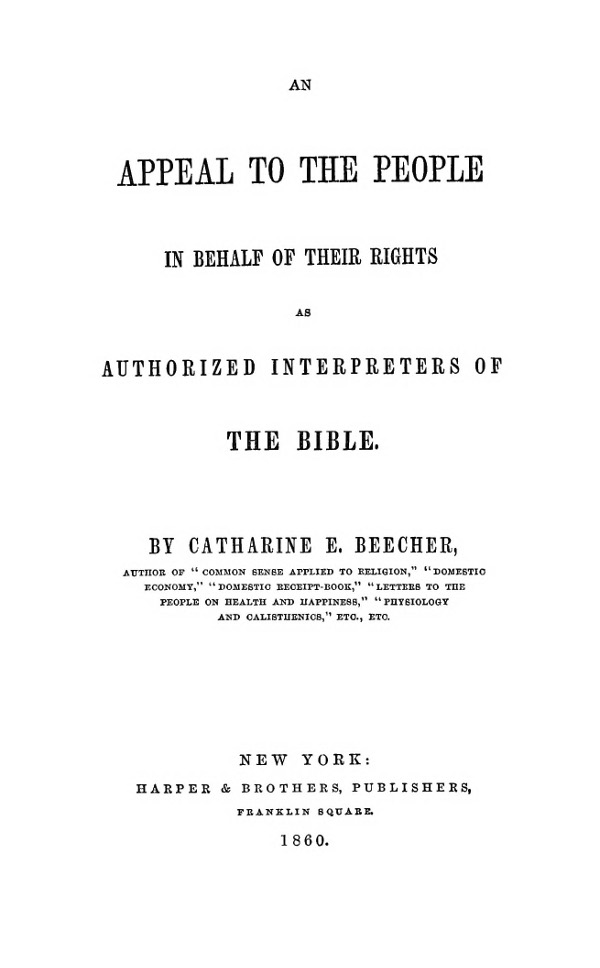
An Appeal to the People in Behalf of Their Rights as Authorized Interpreters of the Bible by Catharine E. Beecher
by Catharine Esther Beecher
★★★★★No ratings yet
Language: English
Sign in to rate this book.
Sign in to shelve this book.
About this eBook
- Author
- Beecher, Catharine Esther, 1800-1878
- Title
- An Appeal to the People in Behalf of Their Rights as Authorized Interpreters of the Bible
- Language
- English
- LoC Class
- BR: Philosophy, Psychology, Religion: Christianity
- Subject
- Religion -- Philosophy
- Category
- Text
- Project Gutenberg
- eBook-No. 56354
- Release Date
- January 10, 2018
- Copyright
- Public domain in the USA.
Contents
- 1.Contents — Chapter I. Introduction. — Chapter II. The Augustine Theory of the Origin of Evil.
- 2.The Augustinian Theory. — Chapter III. Questions Connected with the Augustinian Theory.
- 3.In what does the depraved nature transmitted from Adam consist?
- 4.Ability and Inability.
- 5.What is Regeneration?
- 6.What must we do to be saved?
- 7.True virtue, or right moral action. — Chapter IV. The Difficulties Involved in the Augustinian Theory.
- 8.The Catholic Method.
- 9.Mode of Augustine and of President Edwards.
- 10.The Princeton Mode.
- 11.The Constitutional Transmission Mode.
- 12.Condition of infants.
- 13.The difficulties not removed but rather increased by these methods.
- 14.Illustration of the Augustinian Theory. — Chapter V. The Augustinian Theory in Creeds.
- 15.Creed of the Catholic Church.
- 16.John Calvin.
- 17.Westminster Assembly.
- 18.The Episcopalians.
- 19.The Methodists.
- 20.Arminius.
- 21.Various Protestant doctrines. — Chapter VI. Modes of Meeting Difficulties by Theologians.
- 22.Augustine's Mode.
- 23.Princeton Mode.
- 24.Constitutional Transmission Mode.
- 25.Catholic Mode. — Chapter VII. Theologians Themselves Concede the Augustinian Dogmas Indefensible.
- 26.The Princeton Mode against the Catholic Mode.
- 27.The Transmission Mode against the Imputation Mode.
- 28.Dr. Woods in behalf of the Catholic Mode against the Constitutional Transmission Mode. — Chapter VIII. The Augustinian Theory Contrary to the Moral Sense of Mankind.
- 29.Julian to Augustine.
- 30.Dr. Watts.
- 31.Dr. Whelpley.
- 32.John Adams.
- 33.Dr. Channing.
- 34.John Foster.
- 35.Dr. Edward Beecher. — Chapter IX. The Principles of Common Sense Defined. — Chapter X. Common Sense Applied to Gain the Existence of God.
- 36.Every change has a producing cause.
- 37.Things are and will continue according to our past experience till there is evidence of a change. — Chapter XI. The People's Mental Philosophy. — Chapter XII. The Nature of Mind, or Its Powers and Faculties.
- 38.Intellectual Powers.
- 39.The Susceptibilities, or Feelings.
- 40.The Will.
- 41.Reason, or Common Sense. — Chapter XIII. Nature of Mind.—Regulation of the Thoughts.
- 42.Mode of regulating our thoughts. — Chapter XIV. Nature of Mind.—The Moral Sense, or Moral Susceptibilities. — Chapter XV. The Nature of Mind.—The Will.
- 43.Irrational Free Agency.
- 44.Rational Free Agency.
- 45.Subordinate and General Purposes.
- 46.On a Ruling Purpose or Chief End.
- 47.How the Thoughts, Desires and Emotions are controlled by the Will. — Chapter XVI. Constitutional Varieties of the Human Mind. — Chapter XVII. Nature of Mind.—Habit. — Chapter XVIII. The Nature of Mind Our Guide to the Natural Attributes of God. — Chapter XIX. The Nature of Mind Our Guide to the Moral Attributes of God.
- 48.Intellectual Powers.
- 49.The Susceptibilities. — Chapter XX. Additional Proof of the Moral Attributes of God. — Chapter XXI. Nature of Mind as Perfect in Construction. — Chapter XXII. Right and Wrong—True Virtue.
- 50.Right Actions and Rewardable Actions.
- 51.Right in Tendency and Right in Motive.
- 52.Right General Purpose.
- 53.Definitions.
- 54.Is True Virtue Possible before Regeneration?
- 55.Perfectness in Construction and Perfectness in Action and Character.
- 56.Common Sense Theory of the Origin of Evil. — Chapter XXIII. Laws and Penalties—Sin and Holiness.
- 57.Several Classes of Moral Actions.
- 58.Sin and Holiness. — Chapter XXIV. Love to God And Love to Man. — Chapter XXV. Increased Civilization Increases Moral Difficulties. — Chapter XXVI. Humility and Meekness. — Chapter XXVII. The Standard of Right and Wrong Decided by The Risks of Eternity. — Chapter XXVIII. The Destiny of Man in the Future Life. — Chapter XXIX. What Must We Do To Be Saved? — Chapter XXX. How Far Reason and Experience are Sufficient Without Revelation. — Chapter XXXI. Augustinian Creeds and Theologians Teach the Common-Sense System. — Chapter XXXII. Augustinian Creeds and Theologians Contradict the Common-Sense System, and Thus, Also, Contradict Themselves. — Chapter XXXIII. The Augustinian Theory Not In The Bible.
- 59.Interpretation of the Apostolic Age.
- 60.Augustinian Interpretation.
- 61.Princeton Interpretation. — Chapter XXXIV. A Reliable Revelation From The Creator Impossible If It Contains The Augustinian Theory. — Chapter XXXV. Tendencies of the Two Opposing Systems. — Chapter XXXVI. Tendencies of the Two Systems As They Respect the Cultivation of the Moral and Intellectual Powers.
- 62.Tendencies of the Two Systems in Regard to the Cultivation of the Reasoning Powers and Moral Sense. — Chapter XXXVII. Tendencies of the Two Systems in Respect to Individual Religious Experience.
- 63.Tendencies of the Common-Sense System. — Chapter XXXVIII. Tendencies of the Two Systems in Reference to the Character of God. — Chapter XXXIX. Tendencies of the Two Systems as to Church Organizations. — Chapter XL. Tendencies of the Two Systems in Regard to Humility, Meekness and a Teachable Spirit. — Chapter XLI. Tendencies of the Two Systems in Regard to Dogmatism, Persecution and Ecclesiastical Tyranny. — Chapter XLII. Tendencies of the Two Systems as Shown in Controversy and Sects. — Chapter XLIII. Practical Tendencies of the Two Systems. — Chapter XLIV. Tendencies of the Two Systems in the Training of Children. — Chapter XLV. The People Rejecting the Augustinian System.—Position of Theologians.
- 64.Present Position of Theologians. — Chapter XLVI. Present Position of the Church. — Chapter XLVII. State of the Pastors of Churches. — Chapter XLVIII. The Position of Popular Education. — Chapter XLIX. The Position of Woman as Chief Educator of Mind. — Chapter L. Present Position of Young America. — Chapter LI. Present Position of the Religious Press. — Chapter LII. The Present Position of the Secular Press. — Chapter LIII. What The People Will Do?
- 65.What Theologians will do?
- 66.What the Pastors will do?
- 67.What the Church will do?
- 68.What Women will do?
- 69.What Young America will do?
- 70.What the Religious Press will do?
- 71.What the Secular Press will do? — Note. — Notes.
- 72.Note A.
- 73.Note B.
- 74.Note C.
- 75.Note D.
- 76.Note E.
- 77.Note F.
- 78.Note G. — Footnotes
Community reviews
Sign in to write a review.
No reviews yet.