AN APOLOGY FOR THE COLOURING OF THE GREEK COURT IN THE CRYSTAL PALACE.
Transcriber’s Note:
The cover image was created by the transcriber and is placed in the public domain.
BY
OWEN JONES.
CRYSTAL PALACE LIBRARY;
AND
BRADBURY & EVANS, 11, BOUVERIE STREET, LONDON.
1854.
BRADBURY AND EVANS,
PRINTERS TO THE CRYSTAL PALACE COMPANY,
WHITEFRIARS.
AN APOLOGY
FOR THE
COLOURING OF THE GREEK COURT.
By OWEN JONES.
WITH ARGUMENTS
By G. H. LEWES AND W. WATKISS LLOYD,
AN EXTRACT FROM THE REPORT OF THE COMMITTEE APPOINTED TO EXAMINE THE ELGIN MARBLES IN 1836, FROM THE TRANSACTIONS OF THE ROYAL INSTITUTE OF BRITISH ARCHITECTS,
AND
A FRAGMENT ON THE ORIGIN OF POLYCHROMY,
By PROFESSOR SEMPER.
AN APOLOGY FOR THE COLOURING OF THE GREEK COURT. — COLOURING OF THE COURT. — MOULDINGS ENCLOSING THE PANATHENAIC FRIEZE. — THE PANATHENAIC FRIEZE. — BACKGROUND. — THE HAIR. — THE FLESH. — HORSES. — THE DRAPERIES. — NOTE BY MR. PENROSE. — REPLY.
5
The coloured or colourless state of the monuments of the
Greeks, and more particularly of their monumental sculpture,
has long been a subject of discussion in the world of art; a
discussion which, although it may have been carried on with
too much faith on the one side, has certainly been accompanied,
on the other, with too much prejudice.
At a very early stage in the arrangements for forming in the
Crystal Palace a series of reproductions of architectural monuments,
I felt that to colour a Greek monument would be one
of the most interesting problems I could undertake; not
indeed in the hope that I might be able completely to solve it,
but that I might, at least, by the experiment remove the
prejudices of many.
I felt persuaded that when we had a Greek monument
placed side by side with reproductions of other coloured monuments,
the authorities for which were indisputable, people
would be more willing to recognise the necessity for believing
that the monuments of Greece were no exceptions to those of
civilisations which preceded or followed them, but that they
also like the rest were coloured in every part, and covered with
a most elaborate system of ornamentation.
So early as the publication of the “Antiquities of Athens,” by
6Stuart and Revett, the traces of ornaments on the mouldings of
the Greek temples were known and published by them, some
of the painted ornaments, however, which they found, being
engraved in their work as if in relief; but artists were for long
after unwilling to accept these fragments as evidence that an
entire system of ornamentation prevailed on the Greek buildings.
The late Jules Goury and Professor Semper, from whom will be
found a paper on Polychromy in the Appendix, were amongst
the earliest to direct attention to this subject; but the most
diligent labourer in the field is M. Hittorff, of Paris, who has
devoted many years to the production of a magnificent work, in
which will be found all the facts that are known, and a history
of the long discussion which this subject has provoked.
Mr. Penrose also, in his work on the “Principles of Athenian
Architecture,” has recorded all that he himself saw, but is
reluctant to believe that any ornaments existed where traces of
ornament can no longer be found. He feels that there is
“some slight ground of evidence that a peculiar yellow tinge
upon some parts of the columns, especially of the west front of
the Parthenon, is not simply the yellow said to result from the
oxidation of iron contained in Pentelic marble, but has been
applied externally as a tint, though perhaps so delicately as
merely to reduce the high light of the marble without obscuring
its crystalline character.”
He considers it “unreasonable to suppose that the ancients
entirely concealed, or even materially altered in appearance,
the general surface of the white marble, which they made a
great point of obtaining whenever possible; but that no one
who has witnessed the painfully dazzling effect of fresh Pentelic
marble under the Athenian sun will deny the artistic value of
toning down the almost pure white of its polished surface,
and the more so when considerable portions of the architecture
were painted in the most positive colours. We need not
suppose,” he says further, “this tone to have produced more
than the difference between fresh white marble and ivory.”
7An examination of the facts recorded by these various
authorities will convince any one that the question is now
narrowed to one of degree only—
“To what extent were white marble temples painted and
ornamented?”
I would maintain that they were entirely so; that neither
the colour of the marble nor even its surface was preserved;
and that, preparatory to the ornamenting and colouring of the
surface, the whole was covered with a thin coating of stucco,
something in the nature of a gilder’s ground, to stop the
absorption of the colours by the marble.
The Egyptians covered their buildings and statues in a
similar way, no matter what the material; the Greek temples,
which were built of lime-stone, were so undoubtedly; the
ancient Greek terra-cottas almost without exception have traces
of this ground.
To the belief that the Greeks employed it also on their marble
temples, there is only one stumbling-block—the artificial value
which white marble has in our eyes.
The Athenians built with marble because they found it
almost beneath their feet, and also from the same cause which
led the Egyptians to employ granite, which was afterwards
painted—viz., because it was the most enduring, and capable
of receiving a higher finish of workmanship. With these high
thoughts of perfection and durability, they not only built their
temples of Pentelic marble, but paved their carriage-way to
them with the same material.
The ruin of the Parthenon, as seen at this day on the
Acropolis, with the rich tones which the sun of centuries has
developed upon it, is a very different thing from a bran-new
white marble Parthenon, with many of its enrichments proved
to have been picked out in the strongest colours. Such a
building would have been horrible to behold under any sun,
much more under that of Athens.
Could we set aside the whole of the evidence to the contrary;
8could we forget the paintings recorded on its cella walls—its
interior filled with upwards of six hundred statues, many of
them of colossal dimensions, enriched with painting, ivory,
gold, and precious stones, which would demand a far different
treatment of the building which contained them; could
we forget that when a marble statue left the hand of the
first of sculptors, it passed into the hands of an equally celebrated
encaustic painter to receive its ultimate finish;[1] could
we forget the varieties of material which they combined,
certainly harmoniously, in the statues of their gods—the
varieties of colour which they gave to a material, by us considered
to be so uniform as bronze, in which to heighten the
expression they wished to obtain; (by alloys of iron, silver, and
gold, used on the various portions of a figure, the greatest
known sculptors produced the paleness of death,—the blush of
shame,—the smile on the mouth,—the fire of the eye, and the
healthy redness of the cheek;)[2] the ornaments of metal with
which many of the marble statues were covered—earrings,
bracelets, armlets, sandals, bands round the hair, crowns,
diadems of pearls, precious stones, eyes of silver, glass, and
precious stones; the metal crown of the Laocoon, the metal
casque of the statue of Mars, the metal drapery of the Antinous,
the earrings of the Venus de’ Medici, or her golden hair;—could
we set aside the evidence either of that which is
recorded, or of that which may still be seen, we should yet
have felt that it must have been so, from the knowledge we
have of the practice of those civilisations which preceded and
followed that of the Greeks. How can one believe that at
one particular period in the practice of the Arts, the artistic
eye was so entirely changed that it became suddenly enamoured
of white marble? Such an idea belongs only to an age like
that through which we have just passed—an age equally
devoid of the capacity to appreciate, and of the power to
9execute, works of art—when refuge is taken in whitewashing.
Under this influence, however, we have been born and
bred, and it requires time to shake off the trammels which
such early education leaves.
There is another theory which it is necessary to notice,
viz., that the marble was not painted, but stained in some
way or other, so as still to retain the transparency of the
marble. As this has never been tried, and can only be tried
on marble, I dare not say that it would not produce an
agreeable result. I am not able, however, to conceive it,
and feel certain that it could not fulfil the required conditions
of monumental sculpture, though presenting more chance of
success with isolated works.
As far as regards monumental sculpture, the evidence of
Mr. Bracebridge, which was produced before the committee
of the Institute,[3] would appear to settle the point. The
fragments dug up at Athens in the winter of 1835–36, are
stated by him to have been in perfect preservation, and
“painted with the brightest red, blue, and yellow, or rather,
vermilion, ultramarine, and straw colour, which last may have
faded in the earth.” He further states, that “the colours
were laid on in thick coats.”
I may state at the outset that I have been restrained in
this attempt at rendering the effect of the coloured architecture
of the Greeks—that I have set bounds to my
imagination. I most fully believe that the Greek monuments
were coloured and ornamented on a much higher key than I
have ventured to attempt, whilst the public eye requires
preparation for receiving what there are as yet so few facts to
substantiate.
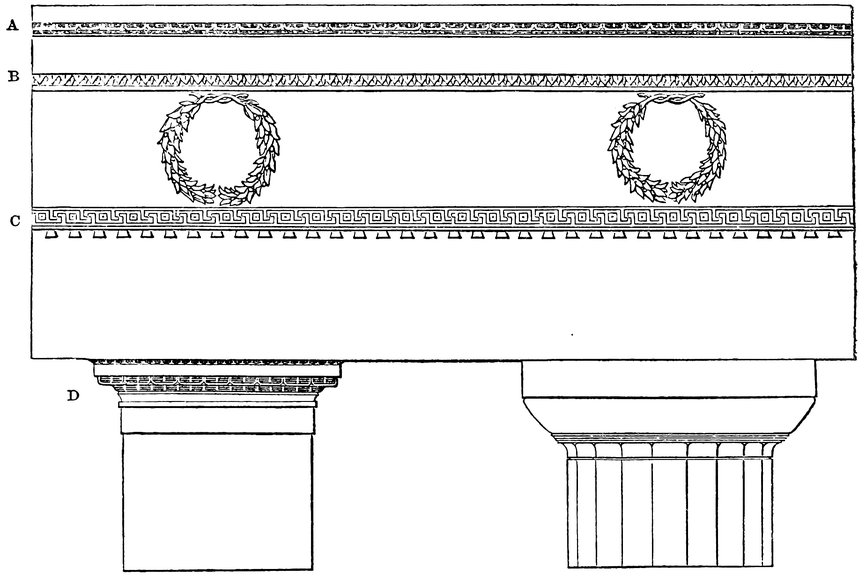
10The only portions of the colouring of this court for which
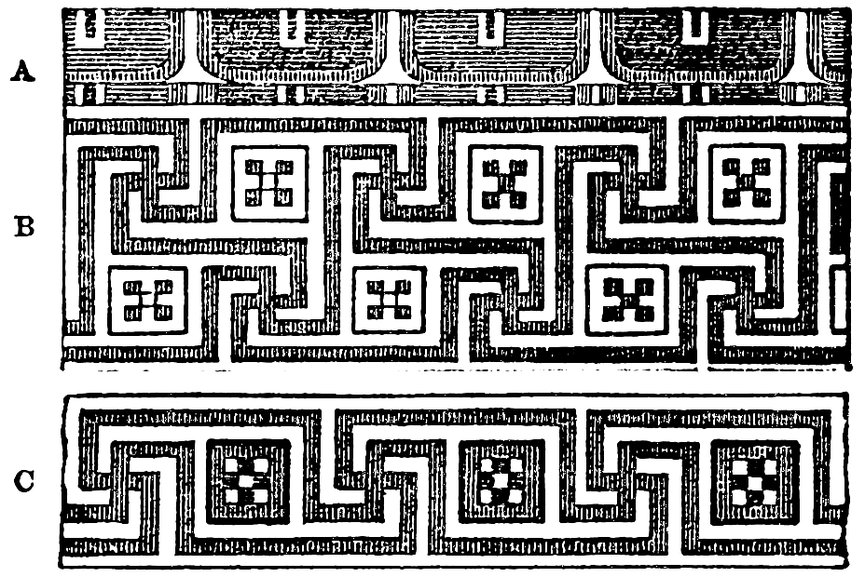
there is absolute authority, are the leaves on the moulding A, and
the enrichments on the pilaster-caps, D, which are thus published
by Mr. Penrose, in his work. Traces exist of the enrichment
B, and the fret on the architrave band, C, of a stain indicating
the form of the ornament, but without traces of colour.
The colouring of the moulding A, which is known, is alone
sufficient for our purpose. It establishes two broad principles
for our guidance; first, that of the alternation of colour, second,
that the colours were so employed as best to define the
moulding they enriched.
Specks of blue and red (or, as observed by others, green
and red) have been found in several monuments on this
moulding, which from its form is more likely to have retained
colour than any other. The absolute value of these colours
is of course not known; hence the liberty of believing that
they were only stains or tints, not positive strong colours.
A glance at the experiment is sufficient to upset this theory
11at once; the ornament, with anything short of the strength of
colour we have employed, would have been invisible even at
the height we see it, much more so at the height the original
was placed.
As the bed-mould B represents, by the lines of the stain,
similar mouldings carved in relief in other monuments, I
felt I was safe in using the colours in such a way as best to
represent the object it imitated. I have therefore placed
the gold where, had the ornament been in relief and gold
employed, gold must have been placed to have been seen to
the best advantage, that is, on the convex surfaces. So of the
other colours.
In colouring the fret C I have followed the same principle;
if they took the trouble to paint so minute an ornament at
such a height, we may be quite sure that they took every pains
to make it as distinct as possible, and, therefore, in using blue
and red alternately, I have endeavoured to make the lines of
the fret more apparent.
I was led at once to adopt a blue ground for the frieze, occupying,
as it does, the place of the usual frieze of triglyphs and
metopes in other monuments where the blue ground predominated;
I felt the Greek eye would have demanded it here
had such an arrangement as that of our frieze existed on a
Greek monument.
The red within the wreaths was necessary, both for general
harmony, and also to prevent the eye passing through the
wreaths, which would have been the case had the blue ground
been uninterrupted.
The soffit of the cornice I have coloured red, because I have
no doubt that wherever blue, red, and yellow or gold were used,
this must always have been the place of the red; and I experienced
great pleasure, when in speaking on this subject with
M. Hittorff of Paris, he brought forth a fragment of a soffit
from Selinus, which, as he held it in his hand, showed a surface
perfectly white, but removing his hand from it, discovered a
12large patch of the strongest red still remaining on the surface
of the preparatory coat of stucco with which the temple at
Selinus was covered.
Known.
Unknown.
The boldest step I have taken is in colouring the capitals
of the columns; the abacus E and the echinus F.
The echinus of the Greek column is a moulding so perfect,
and so much refinement was used upon it by the Greeks, that few
believe it was ever intended to be ornamented. It is supposed
that much of this refinement was exercised by the Greeks on
this curve in order to prepare it for the shadow which the
angle of the abacus cast upon it, and that all this would have
been lost or disturbed by a painted ornament on the surface.
There are others, however, equally strong in the belief that
it was painted and ornamented, amongst whom M. Hittorff,
who, in his work, gives two illustrations from drawings of
Greek columns on vases, one of which has an ornamental
abacus, and the other with the honeysuckle ornament on the
echinus. As all the ornaments on Greek vases are analogous
to those of Greek temples, it is fairly concluded that the painter
of the columns on the vases only represented what he was
accustomed to see on the columns of buildings.
I am not alone in the belief that the echinus was ornamented
with the egg-and-tongue ornament; in fact, the form of the
moulding suggests this in preference to any other. It certainly
gives the best form for resolving the upward running-lines of
the flutes.
As from all the examples we have, the fret ornament is found
13universally on flat bands, I have adopted it for the surface of
the abacus, and have chosen a fret which, returning within itself,
prevents the eye from running outwards, upwards, or downwards,
which is generally the case with most frets.
The spandrils of the abacus I have supplied with an ornament
which I thought would best carry the eye from the square of
the angle into the circular moulding.
It is difficult to suppose that the capitals of the columns
could appear unornamented side by side with pilaster-caps so
elaborately enriched; and we think it will freely be admitted
that of the two, the known Greek pilaster-cap, and that of my
experimental column, the latter is more quiet.
A simple reference to the cuts will be sufficient to convince
any unprejudiced person that the minute scale of the ornaments
on the pilaster-cap demands a higher key of ornamentation
than that I have adopted.
For the general tone of the plain portions of the monument,
I have adopted a general tint of yellow, but, as I said before, I
believe that the Greeks carried their ornamentation much
beyond this. I think the architrave was enriched with
ornaments—certainly the soffits; and in monuments like the
Parthenon, I can come to no other conclusion but that the
columns were gold.
In the flutes of the Ionic columns of the Erectheum red has
been distinctly seen. This can only have been the ground for
gold; the fillets which separate the flutes of the Ionic column
may then have been white, but the flutes of the Doric column
presenting a sharp arris, which could not receive colour to
separate the colours of the flutes, the columns must have had
one uniform tint, whatever it might have been, and we can
conceive no other worthy of such a building as the Parthenon,
or able to support the decoration above, but gold.
There is no authority for the gilding of the antefixæ, nor for
the guttæ, but their form suggests the only mode of treatment
they could receive with effect.
14
CEILING UNDER THE GALLERY.—THE TWO END BAYS.
Portion of the Ceiling, showing what is known of the Decoration.
Portion of the Ceiling as Painted.
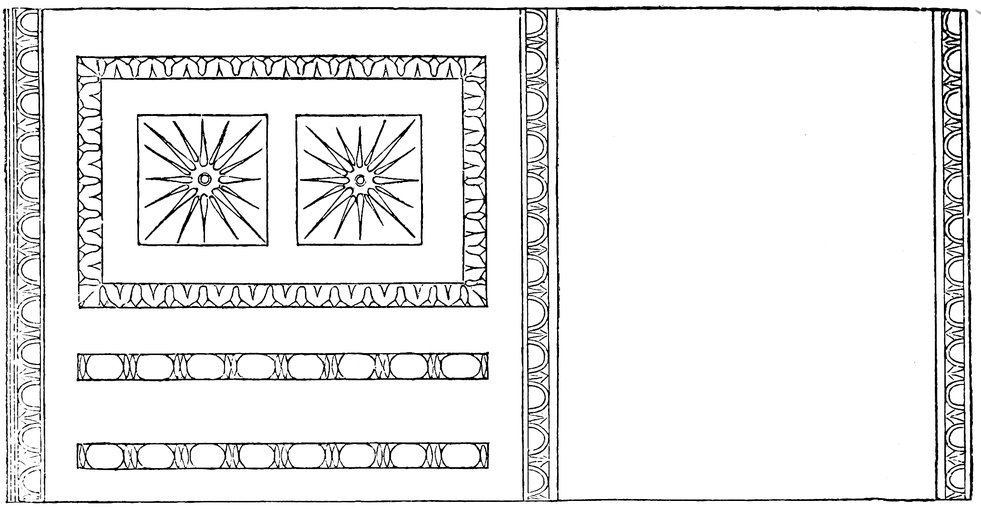
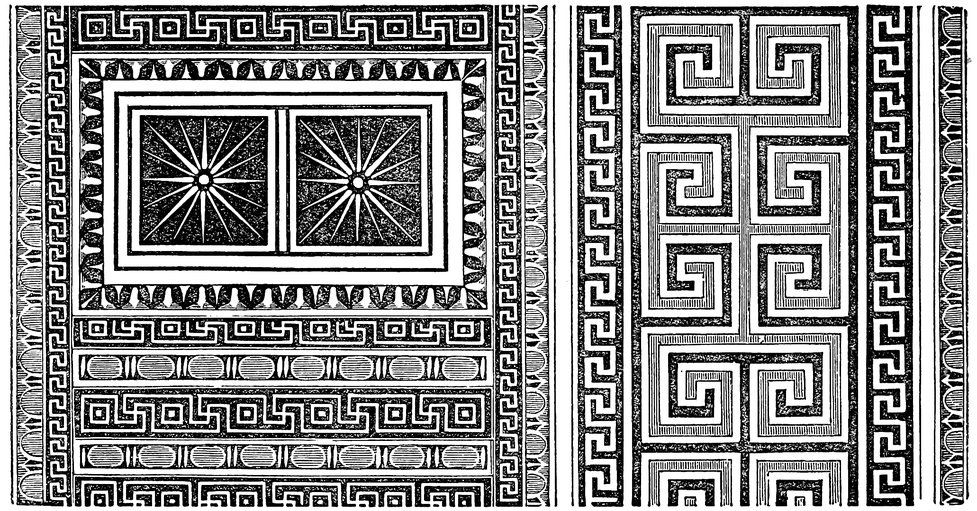
The diagram at once explains what is known in this attempt
of supplying the colours for a Greek ceiling; the colours however
even of this are doubtful. Traces only of the stains are
known, and some of the ornaments have been supposed to be
15coloured in such a way as to destroy the very effect, which a
mere glance at the diagram will show was intended to be
produced—viz., to imitate, or rather take the place of ornaments
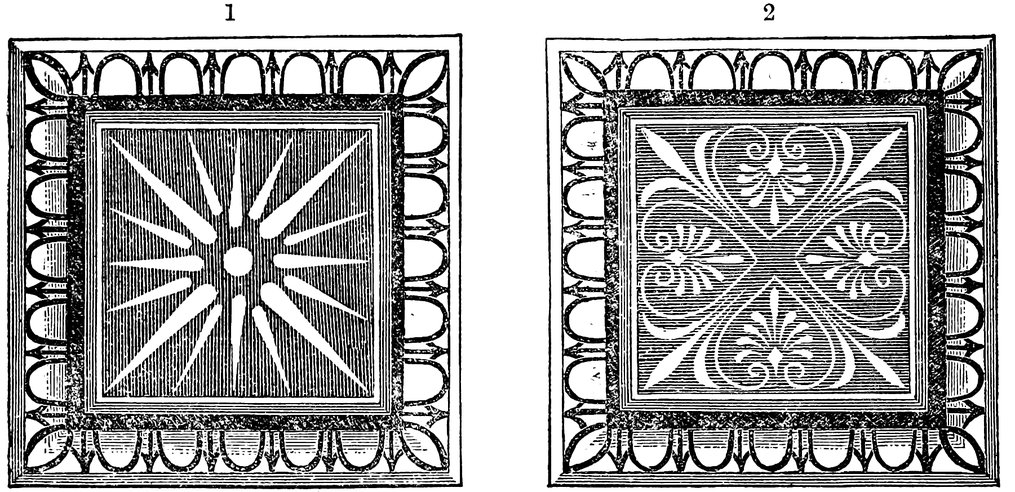
in relief. The star in the centre of the coffer has traces
of red upon it, and has been published as a red star on a blue
ground; but Mr. Penrose, in his work, makes it gold, which is
a much more probable arrangement.
Painted Ornaments in the Centres of the Coffers of the Ceiling of the Propylaea, Athens, as published by Mr. Penrose.
It will be seen that the parts I have supplied are frets on
the plain soffits of the beams and the ornament on the side of
the beams; the frets I have used in such a way as best to define
the architectural lines of the ceiling.
Those who are inclined to believe that wherever the Greeks
ornamented, there traces of ornament are found, and that consequently
where no ornament is found none existed, of course
stop at the stage represented by the outline diagram, and
believe that the general harmony which such partial ornamenting
would disturb was restored by covering all the plain parts
with stains or tints which may or may not have been varied.
Till more is known all this must ever remain matter of opinion
and subject to dispute.
This opinion, however, is entirely based on the fact that the
16traces of ornament which do remain are all engraved in outline
on the marble with a sharp instrument; and it is therefore
concluded that this was the universal practice of the Greeks,
and that, where no engraved line exists there was no ornament.
I think this a very bold assumption.
It is evident that in such enduring ornaments as those of the
Greeks, provision must have been made for repaintings; and,
therefore, on their moulded surfaces they took care to leave an
enduring mark of the pattern, more especially as these mouldings
were in positions most difficult of access; whilst on the broader
surfaces this labour in the beginning would not be necessary,
as the ornaments may have been readily repainted without it.
In the three centre bays we have attempted a still higher
key of colour. The ornaments of the coffers are suggested by
No. 2, from the coffers of the Propylaea.
The enrichment A, and the fret B and C, are published by
Mr. Penrose; A, coloured exactly as I have shown it, and
B and C with the fret only in gold, of which he imagines the
pattern now on their surfaces may have been the trace.
Architrave Band, as published by Mr. Penrose.
The principle of colouring on the moulding A helps to the
colouring of the frets B and C, which, placed in the original
40 feet from the ground, would have been invisible in gold
alone or any other tint.
17
I have placed in the gallery behind the Greek and Roman
Courts, casts from the Elgin frieze of the British Museum,[4]
for the express purpose of showing how it might possibly have
been coloured.
4. The casts obtained from the British Museum were first fixed in their place;
the missing portions were then supplied, by inserting casts of portions of the
frieze found perfect in other parts of it. Thus, when a head, hand, or foot was
wanting, a cast was taken of a head, hand, or foot, where found perfect, and
then inserted. So that this frieze, although not an absolute reproduction of
the original, is as nearly as possible all Greek. This restoration was confided to
Mr. Raffaelle Monti, assisted by Franz Mitterlöchner and Andreas Grass.
18That it was coloured in some manner or other there can be
no manner of doubt, and we think that any unprejudiced
person who will examine the portion of the frieze in white at
the end of gallery, with the known painted ornament above
and below it, will at once admit this. There are other considerations
which would lead one to imagine it destined to
receive colour, even had no traces of colour been found on
the architecture above and around it. As there are still many
who believe, and will believe against all evidence, that this
frieze never was painted, I must bring forward some arguments
which appear to me so strong as to render the idea of its
colourless state impossible.
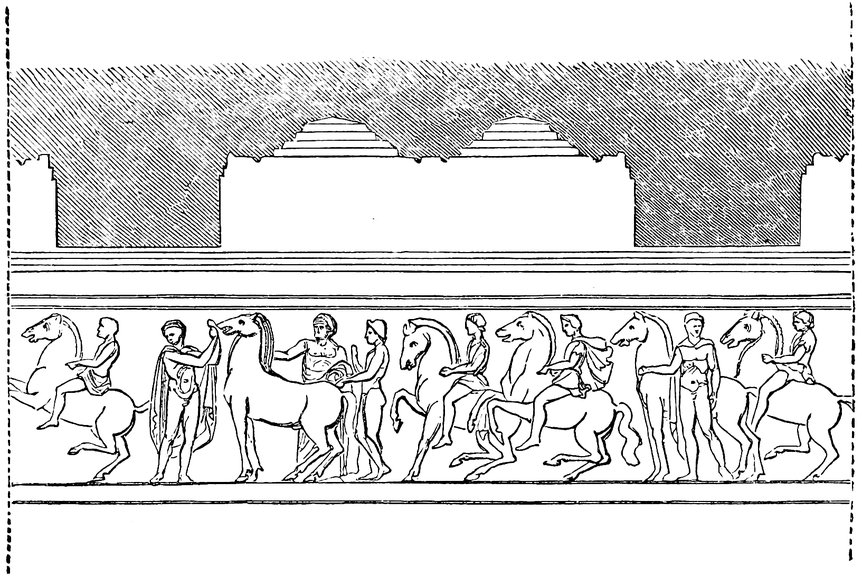
This frieze in the Parthenon is 40 feet from the ground to the
centre of it, and in the position A on the section (p. 17), whilst
our experiment is only 16 feet, to the centre of the bas-relief:
to be seen at an angle of 45°, the eye of the spectator must
have been at least 60 feet from it: now only let the visitor
stand at this distance from the portion of our cast that
remains in white, and he will see how little of the detail is
visible to the eye.
Section showing the position of the Panathenaic Frieze.
19Let him place himself at the same distance from the portion
of frieze which I have painted, and he will see how visibly
colour develops form.
How many thousands pass daily the Athenæum Club in
Pall Mall and are not conscious that there is above their heads
a copy of this divine work of Phidias; if this were coloured
(as it ought to be) who could pass by and escape it. The
frieze in the Parthenon could not have been seen without
colour as distinctly as the copy on the Athenæum Club, as it
was under a portico, and in shadow.
People are apt to argue that Phidias never could have taken
such pains to study the light and shade of this bas-relief if
the fineness of his workmanship had had to be stopped up when
bedaubed with paint.
Now people who argue thus have never understood what
colour does when applied to form. The very fact that colour
has to be applied, demands the highest finish in the form
beneath. By more visibly bringing out the form it makes all
defects more prominent. Let any one compare the muscles of
the figures in white, with the muscles of those coloured, and he
will not hesitate an instant to admit this truth. The labours
of Phidias, had they never received colour, would have been
thrown away; it was because he designed them to receive colour
that such an elaboration of the surface was required.
My attempt is seen under every disadvantage; it is too near
the eye and too near the light; and it is painted on a material
which is most ungracious for the reception of colour. The
minute undulations of marble always lose something in a
plaster reproduction, but when the plaster has further to be
painted with four coats of oil paint to stop the suction, it may
readily be imagined how much the more delicate modulations
of the surface will suffer.
I have preferred, however, to put forth this experiment with
all its disadvantages, than attempt to soften the asperities
by any artificial arrangement, convinced that if it can find
20some favour in its present position, it would gain immeasurably
by being seen in a position analogous to that occupied by the
original.
It will be seen further on that no traces of colour exist at the
present time on these marbles. They were moulded in Athens
prior to their removal to this country, and whatever colour they
may have then retained disappeared during the cleansing of the
marbles by soap-lees, after the process of moulding.
We are therefore driven to the remains of colour on other
monuments, and to analogy for the proposed restoration of the
several colours.
The colour of the background of some of the pediments of
the Greek temples is known to have been blue, and if we admit
that the bodies of the figures were painted at all, it could have
been no other colours. The flesh colour being necessarily some
kind of red, would have been injured by a red ground, while
yellow would have advanced to the eye, and can form a background
only to white, the only colour more advancing than
itself. I believe, and it is generally accepted as proven, that
the ground was blue; and as there are many who stop here,
admitting the blue ground, but denying the colouring of the
figures, a portion of the frieze has been left in this stage, to
enable them to form a judgment upon it.
When I first attempted the experiment, I had a strong
instinct that the hair should be gold; but not having the
authority for it, I was induced to try it both brown and grey;
neither of these colours, however, was satisfactory, but
having afterwards seen the collection of terra-cottas in the
Louvre, I became convinced that I was right in supposing
that they should be gold. In all these specimens the hair is
of an intense red, which can only have been the ground of
21gilding, now obliterated. In the Elgin frieze, in the British
Museum, may still be seen the holes which were drilled to fix
on the metallic trappings, which were also, no doubt, gilt; and
were these affixed in our experiment, the effect would be much
more harmonious.
The most difficult point to determine, is the colour of the
flesh. It is evident that the Greeks would avoid every attempt
at representing nature. Whatever colours they used, we
may be sure that they were treated conventionally only, so
as to suggest the nature of the object represented, yet not
to attempt a direct imitation; we must feel, however, that they
went to the utmost limit of conventionality.
M. Hittorff has in his possession a fragment of a figure from
Selinus, retaining a flesh colour very similar to that which we
have employed.
Although colour has been found on the hair, eyes, lips, and
drapery of Greek fragments of marble, no traces have as yet
been found on the nude portions. And those who believe that
the marble of the Greeks was only stained and not painted,
build up a triumphant argument on this. The explanation,
however, is very simple; it is evident that the smooth portions
of a coloured object would lose their colour first under the
influence of time, and, in fact, all traces of colour that ever
are found, are found in the folds and crevices, from which it is
fairly argued that the surface of which they formed a part was
of that colour.
Even in the Alhambra, which was entirely covered with
colour, and which is so many centuries nearer our time than
the Greek temples, colour is but rarely found on the surface:
it is only by what is found in the depths and hollows, that we
know how the whole was coloured.
On the terra-cottas of the Louvre there are figures where
the white ground with which the whole surface of the terra-cottas
22was covered, remains perfect over the whole of the
figures, at the same time that a fragment of flesh tint still
remains upon some portion of it. Were this absent, it might
equally well be argued, that the Greeks were in the habit of
painting the flesh white on their terra-cottas.
In seeking a colour for the horses, I felt the choice lay
between red, white, black, or grey; further, that whatever
colour was employed, it would be in such a way as best to
define and distinguish the various portions of the groups. I
do not think that a single colour, or shades of the same colour,
would have fulfilled this condition. White horses would have
been too prominent, black too sombre. The red I have employed
appeared to be the best colour for the principal horses, as best
balancing by their masses the blue background, whilst the
relief between horse and horse could be harmoniously obtained
by the employment of grey for the back horses. Authority for
this mode of treatment exists on the Greek vases and in the
Etruscan tombs, where, when one horse passes before another,
there is a change of colour. As the horses in this frieze are in
ranks of nine, it is most probable that there was still more
variety of colour than I have attempted, to keep the various
groups together.
I was led to adopt this mode of treating the draperies from
the inspection of the Louvre collection of terra-cottas, where
the draperies are very well preserved. They are mostly
pale blue and pale pink, the pale blue with a pink border
and the pink drapery with a blue border. I have arranged
the draperies in the way I felt most conducive to the general
effect, so as to bring the whole into harmony. The colours of
the other portions of the dresses are suggested by the materials
which they may be presumed to represent.
23In placing this experiment before the public, I am quite
aware how vain would be the hope that I had produced a
result worthy of the Greeks; where there is so little to guide,
success is well nigh impossible. The most that I could hope to
attain was to produce a result that might have existed, and that
would not have been discordant with the other portions of a
Greek monument. My failures even would answer a useful
purpose, if they served to direct other minds to work out this
most interesting problem, and to induce further researches on
the monuments of Greece, which have hardly yet been examined
in this direction, because they have not as yet been examined
with faith, but rather with reluctance.
The experiment cannot be fairly tried till tried on marble,
and in conditions of space, atmosphere, &c., similar to those
under which the originals were placed.
I would ask those critics who stand on the ground of traditional
opinion, not too rashly by hard words to attempt to stop
the inquiry which this experiment may suggest. The facts
are too strong to be put aside by any opinion. If all who are
anxious for the truth will only seek it, there is little doubt that
we may approach, if we do not reach it.
I have done all in my power to aid the cause. I have stood in
the breach, and shall be content should others walk over me to
a more complete victory. I am only anxious, in the meanwhile,
that the Greeks should not be condemned on my account.
I have no authority whatever for the colouring of the
monument of Lysicrates in the Great Transept. One fact
deserves to be recorded, the beautiful bas-reliefs of the
frieze were absolutely invisible from below, when in white,
and this made me certain that it was a monument designed to
receive colour, and I therefore determined to attempt its
restoration.
OWEN JONES.
Crystal Palace, June, 1854.
24
I have seen no reason to alter my opinion (quoted p. 6) that the
surface of the marble played a considerable part in the general
effect, and that it was not concealed with paint, but tinged or
stained in some manner to the proper tone. An extensive and
careful examination of the Pentelic quarries by the orders of King
Otho has shown that large blocks such as were used at Athens are
very rare indeed. The distance also from the city is considerable:
whereas there are quarries on Mount Hymettus at little more than
one-third of the distance (and most convenient for carriage), which
furnish immense masses of dove-coloured marble (much prized, it
would seem, by the Romans, Hor. ii. 18), and inferior in no respect
but that of colour to the Pentelic. It could therefore only have
been the intrinsic beauty of the latter material that led to its
employment by so practical a people as the Athenians. With
respect to the use of the outline traced with a sharp point (p. 16),
had this been a provision for repaintings, its absence from the Doric
echinus is at least conclusive that there was no ornament painted
on that member; for on no part of the architecture would the
difficulty of reproducing the pattern have been greater. But since
these outlines are found indifferently both on small and large
mouldings, it seems to be a sound conclusion which limits the
painted ornaments to the parts so outlined.
I do not think that, with our present ideas of economy, we are
able to appreciate the motives of the Athenians in choosing their
marble from the Pentelic quarries in preference to those of Mount
Hymettus. We must remember that the Greeks built for their
gods; and the Pentelic marble, by presenting greater difficulties in
its acquisition may have been a more precious offering. I can more
easily understand this than the use of granite by the Egyptians,
which was sought for from quarries much more distant, and presented
difficulties of workmanship many times greater.
Mr. Penrose has examined most minutely the capitals of the
columns of the Parthenon, and is convinced that no outline of any
kind exists upon them; but I am not so convinced that there
never was one there, because, although outlines are found on
fragments of some of the mouldings, they do not exist everywhere
on the same moulding: it is only under favourable circumstances
that the outline has been preserved. A Doric echinus may yet be
found with outlines upon it.
OWEN JONES.
HISTORICAL EVIDENCE. — NOTE.
25
26
I have been favoured by Mr. G. H. Lewes with the following
arguments derived from a perusal of Quatremère de Quincey,
Winckelmann, and the passages of ancient authors which are supposed
to throw light on this question; these I have submitted to
a well known authority on Greek literature, Mr. W. Watkiss Lloyd,
and place here his observations on the argument of Mr. Lewes,
as I am most anxious that the public should be in possession of
whatever can be said on either side.
HISTORICAL EVIDENCE.
27
The idea of the Greeks having painted their statues is so
repugnant to all our modern prejudgments, that the mind is
slow in familiarising itself with the fact, even when indisputable
evidence is brought forward. The Greeks were artists of such
exquisite taste, and of principles so severe, that to accuse them
of having painted statues, is to accuse them of committing what in
our day is regarded as pure “barbarism.” The Greeks did not
aim at reality, but at ideality; and the painting of statues is
thought to be only an attempt to imitate reality.
Nevertheless, however startling, the fact remains: the Greeks
did paint their statues. Living eyes have seen the paint. Living
testimony supports the testimony of ancient writers, and all that
will be necessary in these pages is to furnish some of the principal
points of evidence.
In the first place, the reader must get out of all sculpture
galleries, erase from his mind all preconceptions derived from
antique remains and modern practices. Having done so, let him
reflect on the historical development of sculpture, and he will see
this idea of painted figures falling in its true place.
Sculpture of course began in Greece, as elsewhere, with idols.
It is the custom of all barbarous nations to colour their idols.
The Egyptians, as we know beyond all doubt, not only coloured,
but dressed theirs. So did the Greeks. It may be a question,
whether the Greeks borrowed their art from the Egyptians,
improving it, as they did everything else. Let scholars decide
that question. This, however, is certain, that in either case the
Egyptian practice would obtain—
1st. If the Greeks borrowed from the Egyptians, they would
borrow the painting and dressing.
2nd. If they did not borrow—if their art was indigenous—then
it would come under the universal law of barbarian art; and
painting would, at any rate in the earlier epochs, have been
28employed. (We know that both painting and dressing were
employed in all epochs.)
This being so, and the custom being universal, unless the change
from painted to unpainted statues had been very gradual, insensibly
so, the man who first produced a marble statue without any
addition would have been celebrated as an innovator. No such
celebrity is known.
Ancient literature abounds with references and allusions to the
practices of painting and dressing statues. Space prevents their being
copiously cited here. Moreover, many of them are too vague for
direct evidence. Of those which are unequivocal a few will be given.
Dressing Statues.—Pausanias describes a nympheum, where the
women assembled to worship, containing figures of Bacchus, Ceres,
and Proserpine, the heads of which alone were visible, the rest of
the body being hidden by draperies. And this explains a passage
in Tertullian (“De Jejun.,” 16), where he compares the goddesses
to rich ladies having their attendants specially devoted to dress
them—suas habebant ornatrices. For it must be borne in mind
that the Greek idols, like the saints in Catholic cathedrals, were
kept dressed and ornamented with religious care. Hence Homer
frequently alludes to the offerings of garments made to propitiate
a goddess; thus, to cite but one, Hector tells Hecuba to choose
the most splendid peplos to offer to Minerva for her aid and favour.
Dionysius, the Tyrant of Syracuse, according to a well known
anecdote, stripped the Jupiter of his golden cloak, mockingly
declaring that it was too heavy for summer, and too cold for winter.
“The golden cloak of the Sicilian Jupiter seems scarcely to illustrate
the subject of dressing statues—as it was probably not
drapery, not cloth enriched with gold—but solid, like the
golden Ægis of the Minerva of Phidias, which could be
removed and replaced.”—W. W. Lloyd.
These dressed statues were for the most part dolls, however
large. The reader must remember that the dolls of his nursery
are the lineal descendants of ancient idols. Each house had its
lares or household gods; each house had its dressed idols. Statues,
in our sense of the word, were, it may be supposed, not dressed;
but that they were painted and ornamented there seems to be
ample evidence.
Coloured Statues.—If we had no other evidence than is
afforded in the great variety of materials employed—ivory, gold,
ebony, silver, brass, bronze, amber, lead, iron, cedar, pear-tree, &c.,
29it would suffice to indicate that the prejudice about “purity of
marble” is a prejudice. The critic may declare that a severe
taste repudiates all colour, all mingling of materials; but the
Greek sculptors addressed the senses and tastes of the Greek
nation, and did so with a view to religious effect, just as in Catholic
cathedrals painted windows, pictures, and jewelled madonnas
appeal to the senses of the populace.
The Greeks made statues of ivory and gold combined. They
also combined various metals with a view of producing the effect of
colour. One example will suffice here. Pliny tells us (lib. xxxiv.
cap. 14) that the sculptor of the statue of Athamas, wishing to
represent the blush of shame succeeding his murder of his son,
made the head of a metal composed of copper and iron, the dissolution
of the ferruginous material giving the surface a red glow—ut
rubigine ejus per nitorem æris relucente, exprimeretur verecundiæ
rubor. Twenty analogous examples of various metals employed
for colouring purposes might be cited. Quatremère de Quincey,
in his great work, “Le Jupiter Olympien,” has collected
many.
The reader may, however, admit that statues were made of
various materials, and that the bronze statues—which were incomparably
more numerous than the marble, may have been tinted,
but still feel disinclined to believe that the marble statues were
ever painted. A few decisive passages shall be adduced.
Let it be remembered that Socrates was the son of a sculptor,
and that Plato lived in Athens, acquainted with the great sculptors
and their works; then read this passage, wherein Socrates employs,
by way of simile, the practice of painting statues: “Just as if,
when painting statues, a person should blame us for not placing
the most beautiful colours on the most beautiful parts of the figure—inasmuch
as the eyes, the most beautiful parts, were not painted
purple, but black—we should answer him by saying, Clever fellow,
do not suppose we are to paint eyes so beautifully that they should
not appear to be eyes.” (Plato, “De Repub.” lib. iv., near the
beginning.)
This passage would long ago have settled the question, had not
the moderns been pre-occupied with the belief that the Greeks did
not paint their statues. They, therefore, read the passage in
another sense; many translators read “pictures” for “statues.”
But the Greek word ανδριας signifies “statue,” and is never used to
signify “picture.” It means statue, and a statuary is called the
maker of such statues, ανδριαντοποιος. (Mr. Davis, in Bohn’s
30English edition of Plato, avoids the difficulty by translating it
“human figures.”)
“This passage is decisive as far as it goes, but it does not touch
the question of colouring the flesh. It proves that as late as
Plato’s time it was usual to apply colour to the eyes of statues;
and assuming, what is not stated, that marble statues are in
question, we are brought to the same point as by the Æginetan
marbles, of which the eyes, lips, portions of the armour and
draperies were found coloured. I forget whether the hair was
found to be coloured, but the absence of traces of colour on
the flesh, while they were abundant elsewhere, indicates that
if coloured at all it must have been by a different and more
perishable process—by a tint, or stain, or varnish. The
Æginetan statues being archaic, do not give an absolute rule
for those of Phidias. The archaic Athenian bas-relief of a
warrior in excellent preservation, shows vivid colours on
drapery and ornaments of armour, and the eye-balls were also
coloured; but again, there is no trace of colour on the flesh.”—W.
W. Lloyd.
Here is a passage which not only establishes the sense of the
one in Plato, but while unequivocally declaring that the ancients
painted their statues gives the reason why the paint is so seldom
discoverable in the antique remains. It is from Plutarch (“Quæst.
Roman.” xcviii., at the end): “It is necessary to be very careful
of statues, otherwise the vermilion with which the ancient statues
were coloured will quickly disappear.”
“This passage refers to archaic sacred figures, and at Rome (not in
Greece), where after providing for the sacred geese and ganders,
the first duty of certain officials on taking office was to furbish
the agalma, or statue, which was necessary on ‘account of the
quick fading of the vermilion with which they used to tinge the
archaic statues.’ This is an accurate translation and a literal—and
implies a difference between the archaic and the more
modern in respect of colour, though not necessarily excluding
all colour from the latter.”—W. W. Lloyd.
Had this passage been generally known the dispute could never
have maintained itself. There is nothing equivocal in the use of the
word μιλτινον, which means “vermilion;” nothing which admits of
doubt in the phrase ῳ τα παλαια των αγαλματων εχρωζον.
And there are abundant notices extant which illustrate it.
31One will suffice. The celebrated marble statue of a Bacchante by
Scopas is described as holding, in lieu of the Thyrsus, a dead
roebuck which is cut open, and the marble represents living flesh.
People have tried to explain this by saying that Scopas discovered
coloured veins in the marble, which he used to indicate living
flesh. The explanation is absurd. In the first place veins do not
so run in marble as to represent flesh; in the second, unless
statues were usually coloured, such veins, if they existed, would be
regarded as terrible blemishes, and the very thing the Greeks are
supposed to have avoided—viz., colour as representing reality—would
have been shown.
But colour was used, as we know, and Pausanias (“Arcad.”
lib. viii., cap. 39) describes a statue of Bacchus as having all those
portions not hidden by draperies, painted vermilion, the body being
of gilded wood. He also distinctly says that the statues made of
gypsum were painted, describing a statue of Bacchus γυψου πεποιημενον,
which was—the language is explicit—“ornamented with
paint” επικεκοσμημενον γραφη.
“This statue was apparently ithyphallic, and probably archaic.
Not drapery, but ivy and laurel, concealed the lower part of
it. The colour of the exposed part was not local, but applied
to the whole of it.”—W. W. Lloyd.
Virgil, in an epigram, not only offers Venus a marble statue of
Amor, the wings of which shall be many-coloured and the quiver
painted, but he intimates that this shall be so because it is
customary—
Marmoreusque tibi, Dea, versicoloribus alis
In morem pictâ stabit Amor pharetrâ.
And in the seventh Eclogue, Virgil, speaking of the statue of
Diana, describes it as of marble with scarlet sandals bound round
the leg as high as the calf.
Si proprium hoc fuerit, levi de marmore tota
Puniceo stabis suras evincta cothurno.
And there is a passage in Pliny which is decisive, as soon as
we understand the allusion. Speaking of Nicias (lib. xxxv.
cap. 11), he says, that Praxiteles, when asked which of his marble
works best satisfied him, replied, “Those which Nicias has had
under his hands.” “So much,” adds Pliny, “did he prize the
finishing of Nicias”—tantum circumlitioni ejus tribuebat.
The meaning of this passage hangs on the word circumlitio.
32Winckelmann follows the mass of commentators in understanding
this as referring to some mode of polishing the statues; but
Quatremère de Quincey, in his magnificent work “Le Jupiter
Olympien,” satisfactorily shows this to be untenable, not only
because no sculptor could think of preferring such of his statues
as had been better polished, but also because Nicias being a painter,
not a sculptor, his services must have been those of a painter.
What were they? Nicias was an encaustic painter, and hence it
seems clear that his circumlitio—his mode of finishing the statues,
so highly prized by Praxiteles—must have been the application
of encaustic painting to those parts which the sculptor wished to
have ornamented. For it is quite idle to suppose a sculptor like
Praxiteles would allow another sculptor to finish his works. The
rough work may be done by other hands, but the finishing is
always left to the artist. The statue completed, there still
remained the painter’s art to be employed, and for that Nicias was
renowned.
Even Winckelmann (“Geschichte der Kunst,” buch I. kap. 2),
after noting how the ancients were accustomed to dress their
statues, adds, “This gave rise to the painting of those parts
of the marble statues which represented the clothes, as may be
seen in the Diana found at Herculanæum in 1760. The hair is
blonde; the draperies white, with a triple border, one of gold, the
other of purple, with festoons of flowers, the third plain purple.”
There are still traces visible of gilding in the hair of statues.
Even the Venus de’ Medici has such. And the bored ears speak
plainly of earrings.
While the testimony of antiquity is thus explicit, there is the
still more convincing testimony of living eyes, which have seen this
painting on statues. The celebrated Swedish traveller, Akerblad,
says, “I am convinced that the practice of colouring marble
statues and buildings was much more frequent than is supposed.
The second time I visited Athens, I had opportunity of narrowly
inspecting the frieze of the Temple of Theseus, and I came away
convinced it had been painted.” Quatremère de Quincey mentions
statues he has seen, and refers especially to the Apollo in the
Louvre, made of Pentelic marble, almost all over the naked
surfaces of which a trace of red was faintly perceptible. The same
with a Diana at Versailles; but he adds, “these traces grow daily
fainter.” The eyes and mouth of the colossal Pallas de Velletri
still retain the violet colour.
Such are a few of the evidences. On examining them, we find
33them not only unequivocal in themselves, but complementary of
each other. Living testimony, supposing it to be accepted without
demur, would not suffice to settle the question of what was the
ancient practice; for it might not unreasonably be argued that
these traces of painting on the statues are only evidences of a
degenerate taste—like our whitewashing of cathedrals—and no
evidences of Greek artists having perpetrated such offences against
taste. But when it is seen, by the testimony of ancient writers,
such as Plato, Pliny, Plutarch, and Virgil, that the Greek artists
did colour their statues, the fact of the statues being discovered
with traces of colour is explained, while on the other hand this
fact helps to clear away all trace of doubt which might linger in a
supposed equivocalness in the passages from ancient writers.
G. H. LEWES.
“As regards archaic sculpture in Greece, we may be considered
to have decisive proof from Pausanias and others, that the
ancient sacred figures, that were rather venerated as idols
than admired for art, were often entirely coloured—flesh and
drapery with vermilion, perhaps conventionally and rudely
enough, as we find on the archaic vases, the flesh of women
painted white, and that of men black.
The marble statues of Ægina, and others, that are works of
truly fine art, offer a second form of the application of colour.
Here the eyes, lips, draperies, ornaments, and details of arms,
have their true local colour, but the monuments themselves
only give us the negative evidence with respect to the flesh,
that if coloured at all, it must have been less solidly. Unless
it were tinged or stained, it is difficult to understand how the
effect of the coloured part could have been otherwise than
very disagreeable—spotty, patchy, crude, ghastly to the last
degree; but the experiment might be tried.
On the other hand, it is most certain that in the chryselephantine
statues, the Minerva of the Parthenon, the Jupiter Olympian,
the Juno of Argos, by Phidias, and by Polycletus, the
greatest variety of colour was applied throughout—or rather
variety of colour was given by the different materials of which
these figures were composed, ivory, gold, various coloured
woods, stones and gems. But painting or staining in the
proper sense of the words, was certainly applied to some
portions; as, for instance, Pausanias states that the robe of
Jupiter had lilies painted on it.
34The application of colour to the details of the architecture at
least, and to portions of the architectonic sculpture, would
be absolutely required, to harmonise them with the chief
object in the temple itself.
Lastly, as to the flesh of marble statues of the best age, no rule
can be deduced for this from any practice that obtained in
primitive times, or from chryselephantine works, which seem
to have been in designed contrast in the whole of their
treatment.
The argument for colour on marble flesh of the best age, from
existing remains, so far as I am aware, is equal to zero. But
the passage respecting Nicias and Polycletus, is of very great
force. There is no escape from its application to marble
statues, nor from the great skill that there was occasion and
scope for in the circumlitio. Whatever this tinging or
colouring may have been, we may be sure that it was so
employed as to heighten the purest effects. The edge and
sharpness, and smoothness and brilliancy, of the material,
cannot have been destroyed by it; rather sobered it may
be, but still enhanced. Doubtless it aided the peculiar
glories of sculpture, the display of forms, by rendering them
more visible—idealised rather than imitated nature, and
treated every part under the law of regard to the supreme
intention and sentiment of the whole. The same remarks
(such as they are) apply to bas-reliefs, which, however, have
difficulties of their own.
Vitruvius (vii. 9), after describing the preparation of minium or
vermilion, goes on to speak of its liability to change colour
from the action of direct sunlight, and gives instructions for
protecting it; he does not mention the medium employed with
the colour, but as it is insoluble, we must assume the use of
size, as in other instances, or gum, &c. The wall he is thinking
of is apparently stucco.
‘When the wall is painted with vermilion and dry, lay on with
a brush (of bristles, a hard or rough brush), Punic wax melted
over the fire, and a little tempered with oil; then by means
of hot coals in an iron vessel, warm the wall well and make
the wax run, and equalize itself; afterwards rub it with a wax
candle and clean cloths, as nude marble figures are treated.’
Pliny (xxi. 14) gives the preparation of Punic wax by a process
of which the chemical result, according to Dr. Turner, was a
soap of twenty parts wax to one of soda. He also (xxxiii. 7)
35describes the same process as Vitruvius above, apparently copying
him or a common authority. The wax, he says, is
applied hot, heated with coals (admotis gallæ carbonibus,
whatever they may be), and then rubbed with wax candles,
and afterwards with clean linen cloths, as marbles also become
bright (or shiny), (sicut et marmora nitescunt).
Now how much of the treatment thus expressed applies to sculpture?
Putting the case most strongly, it might be said,—the
whole, and that nothing less than the whole, will accord with
the circumlitio of statues mentioned elsewhere, and by applying
the whole we might connect these notices with those of Plutarch
and Pausanias of the employment of vermilion in colouring
statues, though these latter go for very little as applicable to
the best works of the best time. The construction of the words
of both authors imply in strictness that the wax and linen rubbings
of statues were applied to the wax previously laid on
and heated.
The treatment of statues is referred by Vitruvius specially to the
nude; it seems, therefore, to have had connection with a
design to assist or heighten the effect of the sculptured nude
flesh, as distinguished from drapery, &c. This would be
natural enough, though no colours were employed, or not for
every part, but if they were we must suppose that Vitruvius
has vermilion in his mind leading him to limit his observation.
Pliny’s expression shows that even assuming colour there is no
opaqueness in question.
If a verdict were to be given on this evidence as it stands, I am
much disposed to think that it must be in favour of a tinge of
vermilion, protected by a brilliant varnish, having been applied
to the nude portions of (? some) marble statues in such a manner
that both colour and varnish assisted the fine surface and brilliant
effect of the lucent marble. So much for this part of
the evidence and its bearing on a final decision.”—W. W.
Lloyd.
MATERIAL EVIDENCE.
39
In 1836 a committee was appointed by the Royal Institute of
British Architects, to examine the Elgin Marbles in the British
Museum, in order to ascertain whether any evidences remained as
to the employment of colour in the decoration of the architecture
or sculpture.[5]
5. Extracted from the report of the committee, published in the Transactions
of the Royal Institute of British Artists, Vol. I. Part II. 1842.
This committee consisted of Mr. Hamilton, Sir Richard
Westmacott, Sir Charles L. Eastlake, R.A., Mr. Cockerell, R.A.,
Dr. Faraday, and Messrs. Angell, Donaldson, and Scoles. The
committee found on several architectural fragments from the
Erectheum and the Propylaea of Athens, traces of ornaments which
had been engraved with a tool on the surface of the marble, and
also verified a difference of texture in the parts occupied by the
coloured surface from the ground, but were unable to decide
“whether the parts now smooth and rough were originally in that
state, or whether the part now rough has become so in consequence
of the action of the atmosphere upon it, the smooth part having
been protected from that action by gilding or colour.”
No traces of colour were discovered on any of the figures
of the bas-reliefs, metopes, or sculptures of the pediments,
but it was stated to the committee by Mr. Sarti, the
modeller, who was engaged in taking moulds of the whole
series of the Elgin Marbles belonging to the Parthenon,
“that the whole surface of the marbles had been twice washed
over with soap leys, subsequently to their having been moulded on
former occasions, as that or some other strong acid is necessary for
the purpose of removing the soap which is originally put on the
surface in order to detach the plaster of the mould; Dr. Faraday
was of opinion that this circumstance was of itself sufficient to
have removed every vestige of colour, which might have existed
originally on the surface of the marble.”
A letter was read to the committee, from Mr. Bracebridge,
40“forwarding a memorandum of colours and patterns from the
Erectheum; they are drawn from the northern portico of that
conjoint temple of Minerva Polias, Pandrosus, and Erectheus, so
well known in the Acropolis. This side of the temple, being so
well sheltered from the sea breeze, has preserved its sculptured
ornaments as fresh and sharp as if lately finished; and the columns
of this portico, being fluted with capitals elaborately worked and
well sheltered, have retained remains of colour. At the top of the
flutings especially, a thin coat of slate-coloured paint is visible, at
other points yellow and red colour may be traced; but the remaining
pieces are so small and the colours so much faded, as to
leave the subject in dispute; this being alone certain that there
was once colour carefully applied (at all events, to the entaglio
parts of the relief or concave parts of the capitals, &c.), and that
this colour was of various shades; the protuberant part of the
work retains no colour. The probability that blue, red, and yellow
were used is very strong.”
Mr. Bracebridge further states, that “in the winter of 1835–6,
an excavation was made to the depth of twenty-five feet, at the
south-east angle of the Parthenon; here remains were found of
huge blocks of marble fresh from the quarries, chippings, &c. &c.;
and below these, fragments of vessels, pottery, and burnt wood.
No one who saw these could doubt that a level was dug down to
below that where the workmen of the Parthenon had thrown their
refuse marble, in fact the level of the old Hecatompedon, of which
possibly the burnt wood may have been the remains.
“Here were found many pieces of marble, and among these
fragments parts of triglyphs, of fluted columns, and of statues, particularly
a female head (the hair is nearly the costume of the present
day).
“These three last-mentioned fragments were painted with the
brightest red, blue, and yellow, or rather vermilion, ultramarine,
and straw colour, which last may have faded in the earth.
“These curious specimens are carefully preserved in the Acropolis,
but much fear is entertained of their retaining the brightness
of their highly contrasted colours for any length of time. The
colours are laid on in thick coats. The female face had the eyes
and eyebrows painted. When we consider the brilliancy of Pentelic
marble when fresh worked, there appears a reason for using
colours beyond that of imitating the usages of Attica, in more
ancient temples, namely, that the minutiæ of the work in many parts
would have been lost to the eye amidst the general brilliancy.”
41The committee finally concluded that “Upon a consideration
of all the facts in the preceding minutes, it appears to the
committee, that there remain no indications of colour artificially
applied upon the surface of the statues and bas-reliefs,
that is upon the historical sculpture. That, according to Dr.
Faraday’s opinion, those portions of the marbles, which, from the
tone and surface might be supposed to be the result of colour
applied thereon, are the original surface of the marble, stained by
the atmosphere, the presence of iron in the marble, or by some
such natural cause. That some of the architectural fragments
present indisputable traces of tone, indicative of regular architectural
ornaments, and the outlines of such ornaments are distinctly
traceable, being marked with a sharp instrument on the surface of
the marble.
“The committee cannot positively state, from the appearance of
the marble, that such tones have been produced by colour, as they
think that none of the colour itself remains, but that the indication of
tone results from the mere variation of surface. Judging, however,
from the information contained in Mr. Bracebridge’s communication,
there appears no reason to doubt that colour has been applied.
This is confirmed by the portions of coatings brought from Athens
by Mr. Donaldson, and analysed by Dr. Faraday, who has detected
frit, or vitreous substance, and carbonate of copper, mixed with
wax, and a fragrant gum. This analysis proves that the surface
of the shafts of the columns of the Theseum and other parts
of the edifices from which these coatings were taken, were covered
with a coloured coating. The glass eyes also of the Ionic capitals
of the tetrastyle portico of the Acropolis, at Athens, prove, that
various materials were employed by the Athenians in the decoration
of the exterior of their marble buildings.
“But although the statues and bas-reliefs of the Parthenon, at
least those portions of them preserved in the Elgin Collection, do
not afford any evidence of the use of colour, yet there is a constant
repetition of small circular holes in the horses’ heads and manes,
and in one hand of each rider, showing that there had been originally
bridles and straps to the horses, either of metal, leather, or
some other similar substance. Similar holes are perceptible in the
statue, No. 94 (in red), of Proserpine, one of the two female
figures of the eastern tympanum of the Parthenon, called also the
Seasons or the Hours; they are in the arm, just above the wrist,
apparently for the purpose of attaching bracelets, and in the
shoulders at the junction of the drapery, as though a metal rosette
42had been affixed there. On the neck of one of the Fates, No. 97
(in red), are also two holes, which seem to have been for a necklace.
In the back of the torso of Victory, No. 96 (in red), are
large holes, in which it is supposed bronze wings were fastened.
No. 101 (in red) is a fragment of the upper part of the head[6] of
Minerva; the sockets of the eyes are hollow, and were evidently
filled with metal or with coloured stones, and holes remain in the
upper part of the head, affording a presumption that there was originally
a bronze helmet attached to the marble. The angles of the
ægis of No. 102 (in red), which is a fragment of the statue of
Minerva, one of the principal figures of the western pediment, are
drilled with holes, by which the metallic serpents were attached,
and in the centre a head of the Gorgon.”
6. “This fragment alone may perhaps be considered as an exception to the
previous statement, that there are no evidences of colour on the statues or
figures of the Parthenon. The hair appears to have a red tint, which becomes
distinctly apparent upon the application of water.”—Note of the Committee.
(Signed)
“Thos. L. Donaldson, Hon. Sec.”
The following is the report which was laid before the committee,
from Dr. Faraday, upon some portions of coatings of marble taken
from several buildings, at Athens, by Professor Donaldson.
“My dear Sir,
“I return you the box, with the remains of the samples.
“A. Portion of coating taken from the antæ of the Propylaeum.
“The blue produced by carbonate of copper: wax being
mingled with the colour.
“B. Portion of coating taken from the soffits of the mutules of
the Theseum.
“The blue is a frit or vitreous substance coloured by copper.
Wax is present here.
“C. Portion of coating taken from the columns of the Theseum.
“I am doubtful about this surface. I do not find wax or
a mineral colour, unless it be one due to a small portion of
iron. A fragrant gum appears to be present in some pieces,
and a combustible substance in all. Perhaps some vegetable
substance has been used.
43“D. Portions of coatings from the caissons or lacunaria of the
Theseum.
“The blue is a copper frit, or glass, with wax.
“E. Portions of coating from the northern wing of the Propylaea.
“The colour a carbonate of copper. Wax is present.
“F. Ditto, ditto (north wing of the Propylaea) as E.
“I also return you the drawings and letter.
“Every truly yours,
(Signed) “M. Faraday.
“T. L. Donaldson, Esq., &c.”
ON THE ORIGIN OF POLYCHROMY IN ARCHITECTURE. [7] — THE ASSYRIANS. — THE PERSIANS. — THE EGYPTIANS. — THE CHINESE. — THE INDIANS. — THE JEWS AND PHENICIANS. — THE GREEKS.
45
By PROFESSOR SEMPER.
47From the time of antiquity to our own day men have sought to discover
or invent the probable origin of the various systems of architecture.
Besides the well known hut of Vitruvius, and the no less celebrated grotto of
the Ichthyophagi or fish-eating races, (the supposed type of the Egyptian
temples), the tent of the Nomad, or wandering races, occupies a very
important place in our theories of the origin of styles. In the catenary
formed by the fall of the drapery of a Mongol tent, has been recognised
the type of Chinese and Tartar architecture.
7. Extracted from an Essay written in 1852, and published in Germany under the
title of “The Four Elements of Architecture.” By Professor Gottfried Semper.
But no notice has been taken of the much more evident and less doubtful
influence, which drapery itself, in its quality of a vertical wall, or partition,
has exercised on certain architectural forms. Nevertheless it is the motif
which I venture to cite, as the one on which ancient art has been principally
founded.
It is well known that the nascent taste for the beautiful among those
races which are in a state of social infancy, is first exercised in the manufacture
of coarse tissues, which serve either as beds or as partitions.
The art of dress is less ancient than that of the manufacture of stuffs,
as several examples of people to whom clothing is unknown, and who
nevertheless possess an industry, more or less developed, in tissues and
embroidery, may satisfy us.
The earliest woven work would seem to be the fence, that is, branches
of trees interlaced, serving the purpose of enclosure and of partition. The
most savage tribes are acquainted with this method of construction. Thus
the employment of coarse tissue or woven work (which was a mere fence)
as a means of securing privacy from the world outside certainly far preceded
the constructed wall of stone, or of any other material; this last
only became necessary at a much later period, for requirements which in
their nature bear no relation whatever to space and its subdivision. The
stone wall was made for greater security, longer duration, and to serve as a
support for heaps of various materials and stores; in fine, for purposes
foreign to the original idea; viz., that of the separation of space, and it is
most important to remark, that wherever the secondary motives did not exist,
woven fabrics maintained, almost without exception, especially in southern
lands, their ancient office, that of the ostensible separation of space; and even
in cases where the construction of solid walls became necessary, these last
are but the internal and unseen scaffolding of the true and legitimate
48representatives of division, that is to say, of drapery richly varied with
ornamental work, interlacings, and colours.
The difference which exists between the ostensible and principal separation,
and the constructed separation, is expressed in ancient and modern
languages by terms more or less significative.
In the Latin tongue, a distinction is made between paries and murus.
The Germans, in the word wand (of the same root with gewand,
which means texture) recal still more directly the ancient origin and type
of a wall.
New inventions soon led to different methods of replacing the primitive
drapery, and every art was successively called in to contribute its part to
these innovations, which may have been brought about by various reasons;
such, for example, as the desire for longer endurance, for the sake of cleanliness,
economy, comfort, distinction, coolness, heat, &c.
One of the most ancient and most general methods of replacing the use
of drapery or tapestry is the coat of stucco or of plaster, furnished by the
masons who built the walls.
Another very ancient method of replacing the original tapestry is, that
of wooden panels, with which the wall was covered internally. That which
proves the antiquity of this custom is, that in several ancient languages
the expression which is only properly applicable to panels of wood, serves
indifferently to signify every kind of flat surface (table) in wood, metal,
ivory, or any other material.
It is thus we must explain the Greek expression πιναξ, (in Latin
tabula) as a painting on wood, or also on marble, baked clay, &c.
Plates of burnt clay, thin but of large circumference, were equally called
“πινακες.”
The style of mural painting at Pompeii is only to be understood by the
same ancient custom of covering and inlaying the walls which they reproduced
in appearance by divisions and painted draperies. See Vitruvius,
on this point, in the chapter on Plastering. Wiegmann has erred in attributing
the same system of ancient painting to purely technic causes.
The Ceramic art was, in its turn, called on as a means of replacing
drapery. It is certain that potter’s clay painted, and even glazed,
served, at a very remote period, as a covering for walls. It may even be
admitted, that the employment of the potter’s art on the surface of walls,
preceded the manufacture of burnt bricks, and that the invention of burning
bricks was the result of the custom cited above.
The mural incrustations in baked clay were the precursors of brick
masonry; in the same manner as the Assyrian slabs may be considered
to be the forerunners of constructions in hewn stone. We shall return again
to this subject.
Among the various methods of replacing the use of drapery, should be
also mentioned those furnished by metallurgic processes. Vestiges of
metallic coverings on walls have been found on the oldest existing monuments;
and the most ancient annals of mankind are filled with recitals of
buildings resplendent with gold and silver, bronze and tin respectively.
As an invention of relatively recent date, may be cited lastly, the use of
slabs of marble or stone, granite, alabaster, &c., notwithstanding that we
find traces of this custom, but as it were already effaced, on the most
ancient monuments of the earth. (See farther on).
In all the cases we have named, the character of the substitute followed
49that of its original type, and the painting and sculpture, or rather the two
united, on wood, plaster, burnt clay, metal, stone, or ivory, was—and
traditionally continued to be—an imitation, more or less faithful, of the
embroideries or variegated interlacings which ornamented the antique
wall-coverings.
It may be asserted that the entire system of decoration, with the art of
painting and sculpture in relief, up to the period of its highest application,
which is that of the tympanums of the pediments in the Greek
temples, proceeded from the manufactures of the Assyrian weavers and
dyers; or rather from their predecessors in human inventions. In any
case, it was the Assyrians—next to the Chinese—who appear to have
preserved most faithfully the antique type, even in its application to a
different material. We will enter a little more explicitly on this subject.
The ancient writers often mention and praise the Assyrian tissues for
the art employed in their manufacture; for the splendour and harmony
of their colours, and the richness of the fanciful compositions with which
they were embroidered. The mystical figures of bucentaurs, lions, dragons,
unicorns, and other monsters, which the authors describe, are absolutely
identical with those which we see on the bas-reliefs of Nimroud and
Khorsabad. But this identity was not in the subjects alone. There is no
doubt that the manner of treatment, the style of these subjects, was
identical with that of the objects embroidered on the tissues, which
ancient authors have described.
On examining somewhat attentively the Assyrian sculptures, it is easy
to satisfy oneself that the art of the Assyrian sculptor moved within
limits traceable from its origin, viz., embroidered work, allowance being
made for certain alterations of style, caused by the requirements of a new
material.
One perceives in these Assyrian sculptures, the desire on the artist’s
part of an attention to the truth of Nature, but that he has been hindered
in his task, not—as with the Egyptians—by a regular hieroglyphic system
and hieratical laws, but rather by the caprices of a method difficult, and
indeed foreign to sculpture, the influence of which was still strongly felt.
Thus the sculpture of this people kept itself within the bounds of a very
low and flat relief, exactly similar to that of some productions of Chinese
woven work, seen in the Great Exhibition of 1851, which possessed peculiar
interest in the history of Art, inasmuch as they exhibited the transition of
the high woof into polychromic bas-relief.
The Assyrian figures, without being embalmed mummies like those of
Egypt, show, nevertheless, much stiffness and irregularity; they appear as
it were imprisoned and confined within an invisible canvas. Their contours
are, so to speak, tacked in with threads. One recognises in them an
awkwardness and hardness arising from the contest of the artist with a
material foreign to the style: whilst the Egyptian bas-reliefs evince an
original, canonical, and voluntary stiffness. I am tempted to believe that
all those slabs of alabaster from Assyria, with their religious, warlike, and
domestic scenes, are nothing more than exact copies in stone, after originals
in tissues, at that time celebrated and executed by good native artists,
who worked on that material only, whilst they employed mere workmen
50to transfer the originals on to stone, as well as the material would allow,
which explains the difference between the design and execution which
these works betray. This same character is also found on the Assyrian
paintings.
It is not to be doubted that the true tapestries were employed with
profusion, side by side with the stereotyped copies: and probably these
last were often covered with the originals, on the occasion of solemn
ceremonies, &c., and that they were only exposed during the intervals
between the fêtes, &c. We observe the same thing at this day in the
Catholic churches, where this ancient custom, with many others, is strictly
preserved. The inscriptions and their application in bands, indicate the
same origin. Does it not appear as if the cuneiform characters were
invented and designed for execution in needlework? In fine, the simplicity
of the system of paving of the rooms, otherwise so richly ornamented,
goes to prove that they were originally covered with tapestry. It is only
the slabs which form the cills of the doors on which tapestry could not
be placed, which indeed form an exception, being ornamented with
engraved work, in imitation of tapestry. (See Layard.) It is thus that
these last became also the types of parquetry work in mosaic.
Up to the present point, we have only considered what relates to the
representations found on the Assyrian slabs. But these, in themselves,
give us still more cause for reflection, and singularly justify our assertion
of the importance, in an architectural point of view, of the coverings of
walls.
The principle of panelling constructed work shows itself here in all its
primitive simplicity. We know that almost all the lower portions of walls,
within and without, were covered with thin slabs of alabaster or basalt. The
same principle under another form, obtained in the upper portions of the
walls; here, the walls of unbaked brick were inlaid with glazed bricks;
but the plan pursued by the Assyrians in executing this incrustation differs
greatly from that which we observe elsewhere, and from what we pursue
at the present day.
The Assyrian bricks are only glazed on the external side, and the ornaments
and other subjects which were figured on them in the glazing, bear
no relation to the construction, so that the ornamental lines cross the joints
of the bricks irregularly.
The enamel is very fusible and the bricks but slightly burnt, evidently
with the sole intention of fixing the glazing on them, which induces me to
conjecture, that the use of glazed pottery preceded and prepared the way
for that of baked bricks, and that the art of pottery was already far
advanced before the introduction of burnt brick work. Other indications
which would take too long to specify here, have proved to me, that the
bricks received their coating placed in a horizontal position: First, they
were ranged in the order which they would take when in their place, they
then traced the design formed on this arrangement of unburnt bricks;
next, they covered with these painted bricks—observing still the same
order—the interior of the room; and lastly, they placed a fire in the room
to fix the varnish which covered the walls.[8]
8. The same method is to be found in some old buildings in Scotland.
It results, from what I have observed, that the decoration of the wall
did not depend upon the construction of the same, even when baked and
glazed bricks were employed.
51The constructive system—after the manner of mosaic—of decoration in
enamelled bricks is a later invention, probably a Roman one. The enamelled
Assyrian bricks, should be regarded as a mural incrustation, as a covering
absolutely independent of the wall itself, and even of the terra-cotta slab or
tile, on which it was directly fixed.
The Assyrian system of panelling the lower portions of their buildings
with slabs of alabaster, may be considered as the first step towards construction
in hewn stone, and towards the introduction of the “coupe de
pierre” into the number of architectural and ornamental elements.
It is only in the terraces, and the sub-basements of buildings, in the primitive
ages of art, that hewn stone and its construction appeared to the eye. These
parts of the buildings were the mason’s oldest domain.
The Persian monuments of Murgaub and Istakir, afford us the means of
observing the second step which decorative art made towards the principle
of construction. They were composed, like their models in Assyria, of
unbaked bricks, of which nothing remains, whilst however, the direction of
the walls is still indicated by marble pillars, which originally served to
strengthen the angles of the walls, and by the jambs of doors and windows
and by niches, with which the walls were ornamented.
All these parts were ornamented in the Assyrian manner, and testify to
the principles of which we have been speaking. But here we have no
longer slabs, but hewn masses of stone of enormous dimensions, frequently
monoliths. Nevertheless, in spite of their solidity, they betray their type,
in a most remarkable manner, inasmuch as they form a kind of framework
hollowed out internally to receive the mass of masonry in unbaked brick,
which they were designed to cover and to protect, and which, in the interspaces
of the pillars and jambs above-named, were covered with slabs of
marble, or more probably, with panels of cypress-wood, covered in turn
by plates of gold and silver, or it may be also with richly embroidered
stuffs.
The theocratic system of the Egyptians, although its origin extends
beyond the horizon of history and even of tradition, is not the less based
on the ruins of a social state more ancient still, and much more natural.
The founders of this system, have altered the primitive style of architectural
decoration in petrifying it; that is to say, in making it a style eminently
adapted for stone constructions and monuments.
But amidst the hieroglyphical symbols may still be recognised the
traces of its origin, obscure it is true, but unmistakeable. It has been
observed by travellers in Egypt, that Egyptian art bears quite a different
character in the sepulchral tombs, to that which is observed on the great
temples and palace temples of the kings. It is that in these sepulchral
chambers, art could move somewhat more freely than it was permitted to
do in those grand monumental edifices, which were raised under the
immediate influence of the priesthood.
Now it has been proved that in all the tombs, the ancient method of
draping the walls, or rather of decorating them in the style of tapestry,
52was apparent in its greatest simplicity. It is observable, first in the
character of the ornaments themselves, which consist of interlacings and
gracefully varied knots, whilst these decorations borrowed from the
weaver’s art, are almost banished from the temples and are replaced by symbolic
figures and ornament. It may be recognised, in the second place, by
the fact, that the paintings in the sepulchral tombs are generally enclosed
with borders, as if to indicate that they represent suspended tapestry.
Although this primitive type shows itself less positively in the temples,
indications are nevertheless not wanting which remind us of it.
The contemporary artists of the French expedition have already observed—and
their discovery has been since then verified—that the monuments of
Egypt, including even those executed in granite, have been covered with
a complete coating of colour and varnish, over the entire surface. That
indeed might be expected, for the hewn stonework of the Egyptian constructions,
in spite of the neatness of its workmanship, is not laid in
regular courses, which tends to prove that this irregularity, which contrasts
with the symmetrical system of the decoration on it, was hidden beneath a
coating which covered the whole mass.
These monuments exhibit then the third transition step towards regular
construction in hewn stone.
The construction, though massive and real, is always hidden, and
does not enter yet as an ornamental motive in the compositions of the
architect.
It is worthy of observation, that one of the mouldings of Egyptian architecture
seems to be explained by the same ancient custom of encrusting
brick buildings with stone slabs, which we have remarked on the Assyrian
monuments. I allude to the torus moulding which encloses the external
walls of edifices. It served to hide the joints of the slabs which covered
the internal work.
It is certain that the most ancient monuments in Egypt were constructed
in unbaked bricks, which must have been covered with stone
slabs in the manner above indicated. The Pyramids afford us very
remarkable examples of this system of panelling, which is found still
perfect in the sepulchral chambers contained in them, and the traces of
which are still visible on the exterior. The same observation applies to
the Palace of Osirtesen at Karnak, the walls of which are panelled with
slabs of polished red granite, bearing the traces of a transparent coating
with which they were covered.
China is a country where architecture has remained stationary from its
early birth, and, consequently, the elementary motives of it are most distinctly
preserved; they are placed side by side, without being conjoined
by a general ruling idea. The external surface of the wall is still quite
independent of the wall itself, and indeed is most frequently movable.
The wall bears its own burden alone, and has only in view the filling up
of the intervals between the wooden columns which support the third
elementary want, (i. e.) the roof. The wall is only a screen, more or
less solidly executed than others, constructed in slight brick work, covered
externally with painted stucco decoration or interlaced cane work, and
internally with tapestry, or its substitute, painted paper. The internal
53divisions are formed by screens of the same description, and by drapery
hung from the ceiling. The design of the ornament, painted and carved
upon them and throughout the building, is founded on the same principle
of interlacings and cane trellis-work, more or less intricate, and hardly to
be recognised through the oddities of successive fashions. A polychromy,
rich and brilliant, prevails, which has not been considered with that
attention which it deserves in its relation with the ancient style of
polychromy.
The monuments of Oriental India, bear the impress of a settled civilisation,
at least of the tertiary period. They are comparatively modern in
principle and in date; but they furnish us, nevertheless, with very important
hints on the history of polychromy.
The frequent use of stucco, which is better made in India than anywhere
else, recals the system of the ancients, in covering their fine hewn stonework
with a very fine and hard incrustation of stucco.
The Indian edifices constitute, as it were, but a scaffolding from which
to hang the drapery forming divisions of their spaces, as in China, and as
formerly in Assyria, Egypt, and Greece.
At present we have only mentioned existing examples; but the ancient
writings furnish us with other no less important matter. The description
of the celebrated Ark of Moses, and of the Tabernacle, taken with that of
the Temple of David, contains a complete history of polychromy. This
curious recital of Jewish antiquities presents us with a progressive development
of that elementary principle of architecture which I term “the
Enclosure.”
The documents and chronicles of other nations furnish us with parallels
to what is contained in the holy writings. The Temple of the Slaves at
Mechlenburg, according to the description of Baron von Rumohr, on the
faith of ancient chroniclers; was constructed in the Oriental fashion, and
richly ornamented with tapestry and gilded wood work.
We now come to the Greeks. Hellenic art must have partaken of the
composite character which is manifested in Hellenism generally, and
which is so well expressed in the Grecian mythology.
As the beautiful marble, which forms the cliffs and coasts of Greece,
notwithstanding its homogeneous transformation, betrays by veins, by
fossils, and other indications, its sedimentary origin, so Hellenism,
although it may appear homogeneous, and cast—so to speak—in one single
jet, betrays, nevertheless, its secondary origin, and the sediment which
constitutes its material groundwork.
It would be important to follow up these vestiges of rudimentary
Hellenism, since they might enlighten us on certain phenomena in Hellenic
art, which have been up to the present time inexplicable without them.
This applies especially to the polychromy of Greek edifices. Much yet
54remains to be done in this department of Art History, which has been
generally discussed either by learned men but no artists, or artists with
little learning. The vestiges of rudimentary Hellenism of which I speak,
wherever visible, present the same features that we meet with in Assyria,
Egypt, and China, and even among savage races; but it would appear that
the Greeks, prior to treating in their peculiar manner those principles of
art which they inherited, had partly forgotten their origin and their
material or hieratical meaning. Thus, only, could they have had the mind
free, and ready to commence them anew with an artistic and poetical
feeling.
Exactly the same thing occurred in their mythology, which is only
poetic fiction based on traditions and fables, partly native, partly foreign,
the primitive meaning of which was no longer understood by the poets,
who formed them into the groundwork of their cosmogony.
The system of Greek polychromy is the richest of all those of antiquity;
but it is, apparently, based neither on a principle of construction or
material as among the Assyrians, nor on a hierarchical principle as among
the Egyptians. The most striking oppositions of principle are found
united in it and harmonised, a more artistic and elevated, but less positive
conception. Nevertheless, this applies only to the edifices of a period when
art was in a state of high development among them, since the ancient Doric
system appears to have had much in common with Egyptian art before it was
penetrated by Ionian influence, which depended rather on Asiatic traditions.
I am convinced that the style of Doric polychromy was essentially
different to that of the Ionic, which was, notwithstanding, of equal
antiquity and originality.
Doric polychromy was based on the Egyptian system, whilst that of
Ionia was based on Asiatic models. The first named was lapidary; the
colours were detached on a whitish or yellowish ground; there was no
gilding, and the use of blue was common, that being the holy colour of
the Egyptians (a turquoise blue), the symbolic colour of the priesthood
and aristocracy.
The second was more primitive in its nature and recalled more directly
the elementary motive of tapestry and embroidery. The ground was
generally of a rather deep colour, blue or red, even in the constructive
portions, such as the shafts of columns, architraves, &c., a good deal of
gilding and sea-green (prasinum) was used; the favourite colour of the
Assyrians, the symbolic colour of absolutism and of democracy. The
green is still now the holy colour of the successors of the Assyrians in Asia.
This difference of style, analogically observable in the music of these
two races, explains the divergent investigations made on the temples of
Sicily, and those of Athens. The monuments of Athens, Doric in their
general appearance partook, nevertheless, a good deal of the Ionic character.
The Ionic mind had penetrated Doric matter, and colour being the least
material was that which the Ionian sentiment most easily mastered.
It would be a difficult but very interesting task to unravel the religious
and political signification of certain colours in ancient times. We know
that red, blue, turquoise, and sea-green, were the four colours by which
the factions of the circus distinguished themselves. These were not
capriciously chosen, each faction having adopted that colour, the symbolic
and traditional meaning of which agreed with the political principles
professed by it.
55Traces of the antique system of covering construction with tables of
wood, plates of metal, or slabs of stone, representing tapestry-work, may
still be perceived in the Grecian monuments, for those parts of them
which were destined to be ornamented with historical paintings or painted
sculpture, are executed in the Assyrian fashion; as, for example, the
tympanums of the pediments, the metopes, the friezes, the parts between
the columns, and round the walls of the “cella.” It is thus that Grecian
monuments show us the fourth path which architecture made towards
stone style.
The constructive parts of the building, that is to say, those parts which
constituted the entablature of the roof, and its supports, the columns, were
painted with the colour of the Greek vases, viz., a very transparent and
vaporous brown-red. The walls, inclusive of the “antæ,” which formed
only projecting parts of the walls, were of a blue, which was broken by
black and a little yellow, and not very dark. This colour formed also the
ground for most of the sculptures, except the metopes, which I believe
had red grounds. The red in the ornamented mouldings was a very bright
vermilion, differing from the red of the ground by colour and treatment.
The same is the case for the blue, which, in the ornamented mouldings,
is deeper than on the large surfaces, and tinted in different shades. The
oves, or eggs, for instance, were blue, with a darker blue tint around.
The green is a colour which occurs frequently on the Athenian temples,
so on the leaves on the moulding which runs under the frieze of the
opisthodome of the temple of Theseus, and between the red and blue leaves
of the capitals of the antæ. The same sea-green occurs on the draperies of
some sculptured figures.
The enamels of wax were frequently covered with washes of thinner
colours. This has not been remarked by our restorers of antique polychromy,
but is nevertheless necessary for giving softness to the general
effect.
The ornaments, as I have just observed, are placed in pieces and
soldered together; the solderings forming fillets slightly elevated from the
surface and of another colour. I cannot say whether in gold, black, or
even in some parts white. I have, for my own part, adopted the hypothesis
that it was gold in the Athenian temples, but not on those of Sicily where
a strict Doric character prevailed.
I have not found many traces of colour on the Ionic temple of Minerva
Polias, and cannot say if the red, which I found on the columns of the
Northern Portico, belonged to the ancient colouring, or was of more recent
date. On the plate, in my work, which gives a panel of the temple of
Theseus, is seen the design of a row of pearls, with a double range of disks.
I can guarantee the exactitude of my observations, although this extreme
richness and smallness of detail in an object destined to be seen from a
distance may well astonish us.
I have traced every mark on the stones themselves: and, moreover,
subjects of this kind are not capable of being invented; indeed it would
be a great compliment to suppose me capable of inventing these designs,
which I consider charming.
In the portion which I have found in the wall with the niche (see my work),
these details are not to be seen. I have also discovered traces of colour, very
much effaced, on the small choragic Monument of Lysicrates, which I have
carefully examined. It appears that on the ornament which surmounts
56the roof, there was a variety of blue and red, and that the acanthus leaves
were coloured green. The tripod was not placed upon this ornament, but
round it, the feet resting on the three volutes which descend from the
roof, analogously to the marble tripods which are often met with in various
museums of antiquities.
I will not speak of the colours of the Parthenon, which are not so well
preserved as those on the Temple of Theseus, but the traces of ornament
which decorated that temple are seen by the incisions still remaining. It
would appear that the system of ornament there applied was similar to
that on the Temple of Theseus.
Some years after my sojourn at Athens, portions of this building have
been excavated, with the colours very well preserved; as well as other
fragments of architecture which belong to the old Hecatompedon (destroyed
by the Persians) covered with painted stucco.
I have not found very decided traces of the colours employed on the
Temple of Minerva Polias; the columns appear to have been red, as at the
Temple of Theseus. The ceiling of the Temple of the Caryatides had
painted frets and orvolos, which I have traced; but the colour was no
longer visible. Traces of painted ornaments are to be found also on the
Tower of the Winds. I have not been able to get a close view of them.
As regards the sculptures, I have found some regularly encrusted with
colour. I have found green (prasinum) on the tunic of one of the seated
goddesses, on the frieze of the Temple of Theseus: another figure was
clad in a vestment of a deep rose colour. The Caryatides of the Erectheum
had blue tunics. We may see that, even on the one in the British
Museum.
Mr. Bracebridge has described statues which were excavated in his
presence near the Parthenon with flesh tints and painted eyes. The
figures of the pediment of the Temple at Egina still retain traces of the
colours with which they were decorated. The same observation applies to
the metopes of the temple at Selinuntum, now at Palermo. Curious
fragments of painted architecture may also be seen at the museums of
Syracuse and Girgenti.
The Romans painted their white marbles, like the Greeks. The three
columns of the Jupiter Stator in the Roman Forum are painted red on that
portion which has remained a long while buried.
The Trajan Column, which I have examined, retains traces of colour and
gilding: the entire column had been once covered with a rather thick
coating of colour, in which I recognised green, blue, and yellow; but it is
probable that this last was the remains of the gilding.
BRADBURY AND EVANS, PRINTERS, WHITEFRIARS.
TRANSCRIBER’S NOTES
Silently corrected typographical errors and variations in spelling.
Archaic, non-standard, and uncertain spellings retained as printed.