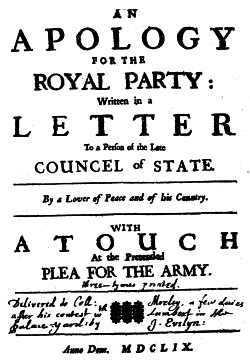
On October 24, 1659, a quarto pamphlet was published in
London with the following title: “The Army’s Plea for Their
present Practice: tendered to the consideration of all ingenuous
and impartial men. Printed and published by special command.
London, Printed by Henry Hills, Printer to the Army,
dwelling in Aldersgate Street next door to the Peacock. 1659”.
Three days afterwards, on October 27, John Evelyn had finished
writing an answer, which was published a week later, on November
4, under the title: “An Apologie for the Royal Party ... With a
Touch At the pretended Plea for the Army. Anno Dom. MDCLIX”.
No author’s name, printer or place was given. Evelyn afterwards
made the note in his Diary under the date November 7, 1659, that
is, three days after the actual publication: “Was publish’d my
bold Apologie for the King in His time of danger, when it was
capital to speak or write in favour of him. It was twice printed,
so universaly it took.”1 Evelyn was by conviction an ardent
royalist, but by temperament he was peaceable, and the publication
of this pamphlet was a courageous act on his part, involving
considerable risks.
The Apologie for the Royal Party contains an eloquent and
outspoken attack upon the parliamentary party, the depth of the
author’s feelings making his style of writing more effective than
it usually was.
Events were at this date nearing their climax, and Evelyn,
soon after the publication of his pamphlet, made persistent
attempts to induce Colonel Henry Morley, then Lieutenant of the
Tower of London, to declare for the King. In the edition of
Baker’s Chronicle of the Kings of England, edited by Edward
Phillips, 1665, is given the following account of the negotiations
(p. 736): “Mr. Evelyn gave him [Col. Morley] some
visits to attemper his affection by degrees to a confidence in
him, & then by consequence to ingage him in his designes;
and to induce him the more powerfully thereunto, he put into
his hands an excellent and unanswerable hardy treatise by him
written and severall times reprinted, intituled An Apology for
the Royall Party, which he backed with so good Argument and
dextrous Addresses in the prosecution of them, that, after some
private discourse, the Colonel was so well inclin’d, as to recommend
to him the procurement of his Majestie’s Grace for him, his Brother-in-law
Mr. Fagg, and one or two more of his Relations”. Phillips
added an account of a letter written by Evelyn to Colonel Morley,
and gave him great credit for the influence which he exerted, though
Evelyn endorsed a draft of the narrative with a statement saying
there “was too much said concerning me”. Nevertheless part of
the narrative was confirmed by Evelyn when he wrote on the title-page
of the copy of the pamphlet here reproduced: “Delivered to
Coll. Morley a few daies after his contest wth Lambert in the
palace yard by J. Evelyn”. The “contest” with General Lambert
took place on October 12 or 13 when Morley, pistol in hand, refused
to allow him at the head of his troops to pass through the
Palace Yard.
Evelyn also wrote on the title-page of this copy of his
pamphlet “three tymes printed”. In fact there were four printings,
all described in the writer’s John Evelyn, a Study in
Bibliophily & a Bibliography of his Writings, New York, The
Grolier Club, 1937, the one here reproduced being the fourth
and final form. Nevertheless all four issues are now extremely
scarce, the first printing being known in three copies (one in
the United States), the second in seven (two in the United
States), the third in one, and the fourth in one. This apparently
unique relic of Evelyn’s bold gesture on behalf of his King
is in the writer’s possession and is still as issued, edges untrimmed
and with its eight leaves stitched in a contemporary
paper wrapper. It has been reprinted only in Evelyn’s Miscellaneous
Writings, 1825, pp. 169-192.
When Charles II actually returned to England in 1660
Evelyn’s feelings were deeply stirred. He had played some
part in the restoration of the monarchy, and, with his literary
instinct, naturally felt impelled to be among those who wished
to present the King with an address on the day of his Coronation.
This took place on April 23, 1661, and on the following day
Evelyn recorded in his Diary: “I presented his Matie with his
Panegyric in the Private Chamber, which he was pleas’d to
accept most graciously: I gave copies to the Lord Chancellor
and most of the noblemen who came to me for it.”2
Evelyn’s Panegyric was thus distributed privately and no
doubt in small number, so that it is today extremely uncommon,
being known only in five copies, not more than one of which is
in the United States of America. Evelyn possessed a copy in
1687 according to his library catalogue compiled in that year,
and a copy (not necessarily the same one) is now among his
books in the library of Christ Church, Oxford, but it seems to
have been unknown in 1825 and was not included in the Miscellaneous
Writings. William Upcott, the editor, in fact erroneously
identified the Panegyric with the anonymous piece in folio: “A
Poem upon his Majesties Coronation ... Being St Georges day ...
London, Printed for Gabriel Bedel and Thomas Collins ... 1661”.
This mistake was not put right until a copy of the true Panegyric
with Evelyn’s name on the title-page was acquired for the
British Museum in 1927 from the Britwell Court Library. The
copy here reproduced is in the writer’s collection, and has a
few corrections in Evelyn’s hand: (a) XXXIII. of April, on title-page
corrected to XXIII; (b) p.6. l.18 Family altered to Firmament;
(c) p.8. l.16 from bottom suffer altered to surfeit.
When the Panegyric was identified it was realised that it
was not a poem, but an eloquent and extravagant composition
in prose, in which Evelyn invested Charles II with every conceivable
virtue and all wisdom. This was no doubt written
with sincere enthusiasm, though Evelyn suffered a profound
disillusionment in later years; and if he ever read his effusion
again it must have caused him some distress. The Panegyric
is now reprinted for the first time.
Geoffrey Keynes
AN
A P O L O G Y
FOR THE
ROYAL PARTY:
Written in a
L E T T E R
To a Person of the Late
COUNCEL of STATE.
By a Lover of Peace and of his Country.
WITH
A T O U C H
At the Pretended
PLEA FOR THE ARMY.
three tymes printed.
Delivered to Coll: Morley, a few daies
after his contest wth Lambert in the
Palace Yard: by J. Evelyn:
Anno Dom. MDCLIX.
AN
A P O L O G I E
FOR THE
R O Y A L P A R T Y:
Written in a Letter to a Person of the late
COUNCEL of STATE,
By a Lover of Peace and of his Countrey:
With a Touch at the pretended Plea for the Army.
SIR,
The many Civilities which you are still pleased to continue to
me, and my very great desire to answer them in the worthiest
testimonies of my zeal for your service, must make my best
Apology for this manner of Addresse; if out of an extream
affection for your noblest Interest, I seem transported a
little upon your first reflections, and am made to despise the
consequence of entertaining you with such Truths, as are of the greatest
danger to my self; but of no less import to your happiness, and, which
carry with them the most indelible Characters of my Friendship. For if
as the Apostle affirms, For a good man, some would even dare to dy, why should
my Charity be prejudged, if hoping to convert you from the errour of
your way, I despair not of rendring you the Person for whose preservation
there will be nothing too dear for me to expose?
I might with reason beleeve that the first election of the Party wherein
you stood engaged, proceeded from inexperience and the mistake of your
zeal; not to say from your compliance to the passions of others; because
I both knew your education, and how obsequious you have alwayes
shewed your self to those who had then the direction of you: But, when
after the example of their conversion, upon discovery of the Impostures
which perverted them; and the signal indignation of God, upon the several
periods which your eyes have lately beheld, of the bloudiest Tyrannies,
and most prodigious oppressors that ever any age of the world produc’d,
I see you still persist in your course, and that you have turn’d about
with every revolution which has hapned: when I consider, what contradictions
you have swallowed, how deeply you have ingaged, how servilely
you have flatter’d, and the base and mean submissions by which
you have dishonour’d your self, and stained your noble Family; not to
mention the least refinement of your religion or morality (besides that
you have still preserved a civility for me, who am ready to acknowledge
it, and never merited other from you) I say, when I seriously reflect upon
all this; I cannot but suspect the integrity of your procedure, deplore the
sadness of your condition, and resolve to attempt the discovery of it to
you; by all the instances, which an affection perfectly touch’t with a zeal
for your eternall interest can produce. And who can tell, but it may
please Almighty God, to affect you yet by a weak instrument, who have
resisted so many powerfull indications of his displeasure at your proceedings,
by the event of things?
For, since you are apt to recriminate, and after you have boasted of the
prosperity or your cause, and the thriving of your Wickedness (an Argument
farr better becoming a Mahumetan then a Christian) let us state
the matter a little, and compare particulars together; let us go back to the
source, and search the very principles; and then see, if ever any cause had
like success indeed; and whether it be a just reproach to your Enemies,
that the judgments of God have begun with them, whilst you know not
yet, where they may determine.
First then, be pleased to look North-wards upon your Brethren the
Scots, who (being first instigated by that crafty Cardinal Richlieu to disturb the
groth of the incomparable Church of England, and so consequently the tranquility
of a Nation, whose expedition at the Isle of Ree, gave terrour to the
French) made Reformation their pretence, to gratifie their own avarice,
introduce themselves, and a more then Babylonish Tyranny, imposing upon
the Church and state, beyond all impudence or example. I say, look upon
what they have gotten, by deceiving their Brethren, selling their King,
betraying his Son, and by all their perfidie; but a slavery more then Egyptian,
and an infamy as unparallel’d, as their treason and ingratitude.
Look neerer home on those whom they had ingaged amongst us here, &
tell me if there be a Person of them left, that can shew me his prize, unless it
be that of his Sacriledg, which he, or his Nephews must certainly vomite
up again: What is become of this ignorant and furious zeal, this pretence
of an universall perfection in the Religious and the Secular, after all that
Blood and Treasure, Rapine and Injustice, which has been exhausted, and
perpetrated by these Sons of Thunder? Where is the King, whom they
swear to make so glorious, but meant it in his Martyrdome? Where is the
Classis, and the Assembly, the Lay-elder; all that geare of Scottish discipline,
and the fine new Trinkets of Reformation? Were not all these taken
out of their hand, while now they were in the height of their pride and
triumph? And their dull Generall made to serve the execution of their
Sovereign, and then to be turn’d off himself, as a property no more of use
to their designes? Their riches and their strength in which they trusted,
and the Parliament which they even idoliz’d, in sum, the prey they had
contended for at the expence of so much sin and damnation, seizd upon
by those very instruments, which they had rais’d to serve their insatiable
avarice, and prodigious disloyalty. For so it pleased God to chastise their
implacable persecution of an excellent Prince, with a slavery under such a
Tyrant, as not being contented to butcher even some upon the Scaffold,
sold divers of them for slaves, and others he exild into cruell banishment,
without pretence of Law, or the least commiseration; that those who before
had no mercy on others, might find none themselves; till upon some
hope of their repentance, and future moderation, it pleased God to put
his hook into the nostrills of that proud Leviathan, and send him to his
place, after he had thus mortified the fury of the Presbyterians. For unlesse
God himself should utter his voice from Heaven, yea, and that a
mighty voice, can there any thing in the world be more evident, then his
indignation at those wretches and barefac’t Impostors, who, one after another,
usurped upon us, taking them off at the very point of aspiring, and
præcipitating the glory and ambition of these men, before those that
were, but now, their adorers, and that had prostituted their consciences
to serve their lusts? To call him the Moses, the Man of God, the Joshua,
the Saviour of Israel; and after all this, to treat the Thing his son with
addresses no lesse then blasphemous, whose Father (as themselves confess
to be the most infamous Hypocrite and profligate Atheist of all the Usurpers
that ever any age produc’d) had made them his Vassalls, and would
have intaild them so to his posterity for ever?
But behold the scean is again changed, not by the Royall party, the
Common Enemy, or a forreign power; but by the despicable Rumpe of a
Parliament, which that Mountebanke had formerly serv’d himself of, and
had rais’d him to that pitch, and investiture: But see withall, how soon
these triflers and puppets of policy are blown away, with all their pack
of modells and childish Chimæras, nothing remaining of them but their
Coffine, guarded by the Souldiers at Westminster; but which is yet lesse
empty then the heads of those Polititians, which so lately seemed to fill it.
For the rest, I despise to blot paper with a recitall of those wretched Interludes,
Farces and Fantasms, which appear’d in the severall intervalls;
because they were nothing but the effects of an extream gyddiness, and
unparallel’d levity. Yet these are those various despensations and providences
in your journey to that holy land of purchases and profits, to
which you have from time to time appeal’d for the justification of your
proceedings, whilst they were, indeed, no other then the manifest judgments
of God upon your rebellion and your ambition: I say nothing of
your hypocriticall fasts, and pretended humiliations, previous to the
succeeding plots, and supposititious Revelations, that the godly might fall
into the hands of your Captains, because they were bugbears, and became
ridiculous even to the common people.
And now Sr. if you please, let us begin to set down the product and survey
the successe of your party and after all these faces and vertigo’s tell
me ingenuously, if the single chastisment which is fallen upon one afflicted
man, and his loyall subjects, distressed by the common event of war,
want of treasure, the seizure of his Fleet, forcing him from his City, and
all the disadvantages that a perfidious people could imagine; but in fine
the crowning him with a glorious Martyrdome for the Church of God
and the liberty of his people (for which his blood doth yet cry aloud
for vengeance) be comparable to the confusion which you (that have
been the conquerours) have suffered, and the slavery which you are like
to leave to the posterities which will be born but to curse you, and to groan
under the pressures which you bequeath to your own flesh & blood? For to
what a condition you have already reduced this once flourishing kingdom,
since all has been your own, let the intolerable oppressions, taxes, Excises,
sequestrations confiscations, plunders, customes, decimations, not
to mention the plate, even to very thimbles and the bodkins (for even to
these did your avarice descend) and other booties, speak. All this dissipated
and squandred away, to gratifie a few covetous and ambitious wretches,
whose appetites are as deep as hell, and as insatiable as the grave; as if
(as the Wise-man speaks) our time here were but a market for gain.
Look then into the Churches, and manners of the people, even amongst
your own Saints, and tell me, if since Simon Magus was upon the
earth, there were ever heard of so many Schismes, and Heresies, of Jewes
and Socinians, Quakers, Fifth-monarchy-men, Arians, Anabaptists, Independents,
and a thousand severall forts of Blasphemies and professed Atheists,
all of them spawned under your government; and then tell me what a
Reformation of Religion you have effected?
Was there ever in the whole Earth (not to mention Christendom alone)
a perjury so prodigious, and yet so avowed as that by which you have taken
away the estate of my L. Craven, at which the very Infidels would
blush, a Turke or Sythian stand amaz’d?
Under the Sun was it never heard, that a man should be condemned for
transgressing no law, but that which was made after the fact, and abrogated
after execution; that the Posterities to come might not be witnesses of your
horrid injustice: Yet thus you proceeded against my L. Stafford. How
many are those gallant persons whom after articles of war, you have
butchered in cold-blood, violating your promises against the Lawes
of all Nations, civill or barbarous; and yet thus you dealt in the case of
my L. Capel, Sr. J. Stawel and others.
Is not the whole nation become sullen and proud, ignorant and suspicious,
incharitable, curst, and in fine, the most depraved and perfidious
under heaven? And whence does all this proceed, but from the effects of
your own examples, and the impunity of evill doers?
I need not tell you how long Justice has been sold by the Committees, and
the Chair-men, the Sequestrators and Simoniacall Tryers, not to mention
the late Courtiers, and a swarm of Publicans who have eaten up the
People as if they would eat bread.
Will you come now to the particular mis-fortunes, and the evident hand
of God upon you for these actions (for he has not altogether left us without
some expresse witnesses of his displeasure at your doings,) Behold
then your Essex and your Warwick, your Ferfaix, and your Waller,
(whom once your Books stiled the Lord of Hosts) Cashiered, Imprisoned,
Suspected and Disgraced after all their Services. Hotham,
and his Son came to the block; Stapleton had the buriall of an Asse, and
was thrown into a Town Ditch; Brookes and Hamden signally slain in
the very act of Rebellion and Sacriledge; your atheisticall Dorislaw, Ascam
and the Sodomiticall Ariba, whom though they escaped the hand of Justice,
yet Vengeance would not suffer to live: What became of Rainsborough?
Ireton perished of the Plague, and Hoyle hanged himself; Staplie ’tis said,
died mad, and Cromwell in a fit of raging; and if there were any others
worthy the taking notice of, I should give you a list of their names
and of their destinies; but it was not known whence they came
which succeeded them; nor had they left any memory behind them, but
for their signal wickednesses, as he that set on fire the Ephesian Temple to
be recorded a Villain to posterity. Whereas those noble souls whom your
inhumanity, (not your vertue) betrayed, gave proof of their extraction,
Innocency, Religion and Constancy under all their Tryals and Tormentors;
and those that dyed by the sword, fell in the bed of honour, and
did worthily for their Country; their Loyalty and their Religion will
be renowned in the History of Ages, and pretious to their memory,
when your names will rot with your Carkasses, and your remembrance
be as dung upon the face of the Earth. For there is already no
place of Europe where your infamy is not spread; whilst your persecuted
brethren rejoyce in their sufferings, can abound, and can want, blush
not at their actions, nor are ashamed at their addresses; because they have
suffered for that which their Faith and their Birth, their Lawes and their
Liberties have celebrated with the most glorious Inscriptions, and Everlasting
Elogies.
And if fresher instances of all these particulars be required, cast your
eye a little upon the Armies pretended Plea, which came lately a birding to
beat the way before them, charm the ears of the Vulgar, and captivate
the people; That after all its pseudo-politicks and irreligious principles,
is at last constrained to acknowledg your open and prodigious violations,
strange and illegal Actions, (as in termes it confesses) of taking up
Armes, Raising and Forming Armies against the King, fighting against his
Person, Imprisoning, Impeaching, Arraigning, Trying and Executing
Him: Banishing his Children, abolishing Bishops, Deans and Chapters;
taking away Kingly Government, and the House of Lords, breaking
the Crowns, selling the Jewells, Plate, Goods, Houses and Lands
belonging unto the Kings of this Nation, erecting extraordinary High
Courts of Justice, and therein Impeaching, Arraigning, condemning, and
Executing many pretended notorious Enemies, to the publick Peace;
when the Lawes in being, and the Ordinary Courts of Justice could not
reach them: By strange and unknown practises in this Nation, and not
at all Justifiable by any known Lawes and Statutes, But by certain diabolical
principles of late distilled into some person of the Army, and which
he would entitle to the whole, who (abating some of their Commanders,
that have sucked the sweet of this Doctrine) had them never so much as
entred into their thoughts, nor could they be so depraved, though they
were Masters only of the Light of Nature to direct them. For Common
sence will tell them, that whoever are our lawful Superiours, and invested
with the supreame Authority, either by their own vertue, or the peoples
due Election, have then a just right to challenge submission to their precepts,
and that we acquiesce in their determinations; since there is in nature
no other expedient to preserve us from everlasting confusion: But it is the
height of all impertinency to conceive, that those which are a part of
themselves, and can in so great a Body, have no other interests, should
(without the manifest hand of God were in it to infatuate all your proceedings)
fall into such exorbitant contradiction to their own good, as a
child of four years old would not be guilty of; and as this Pamphleter wildly
suggests in pp. 6. 11. 27, &c. did they steer their course by the known laws
of the Land, and as obedient Subjects should do, who without the King
and his Peers, are but the Carkass of a Parliament, as destitute of the Soul
which should inform and give it being. And if so small a handful of men
as appeared in the Palace-Yard, without consent of a quarter of the English
Army, much lesse the tenthousand’th part of the Free-people that are not
clad in red, shall disturb and alter your Government when it thinks fit to set
aside a few imperious Officers, who plainly seek themselves, and derive
their Commissions from superiours to whom they swear obedience; how can
you ever hope, or live to see any government established in these miserably
abused Nations? Behold then with how weak a party you are vanquish’d,
even by those very instruments you had so long flatter’d with the
title of the Free-people; imputing all the direful effects of your depraved
principles to their desires, when as I dare report my self to the ingenuity
of the very Souldiers themselves, if they, who have effected all
these changes by your wretched instigations, and blind pretences,
imagine themselves the People of this Nation, but are a very small
portion of them, compared to the whole, and who are maintained
by them to recover, and protect the Civill Government, according
to the Good old Lawes of the Land; not such as they themselves shall invent
from Day to Day, or as the interests of some few persons may engage them.
But if the essential end of Rulers be the Common peace, and their Lawes
obliging as they become relative: Restore us then to those under which we
lived with so much sweetness and tranquility, as no age in the World, no
Government under Heaven could ever pretend the like. And if the People
(as you declare) are to be the Judges of it, summon them together in a
Free Parliament, according to its legal Constitution; or make a universal
Balott, and then let it appear, if Collonel Lambert and half a dozen Officers,
with all their seduced Partizans, make so much as a single Cypher to the
Summe Total. And this shall be enough to answer those devious Principles
set down in the porch of that specious Edifice; which being erected upon
the Sand, will (like the rest that has been daubed with untempered mortar)
sink also at the next high wind that blowes upon it. But I am glad it is
at last avowed, upon what pretexts that late pretended Parliament have
pleaded on the behalf of themselves and party, their discharge from all the
former Protestations, Engagements, solemn Vowes, Covenants, with
hands (as you say) lift up to the most high God, as also their Oaths
and Allegiance, &c. because I shall not in this discourse be charged
with slandering of them, and that the whole World may detest the Actions
of such perfidious Infidels, with whom nothing sacred has remain’d
inviolable.
But there is yet a piece of Artifice behind, of no less consequence then
the former, and that is, a seeking to perswade the present Army, that They
were the men, who first engaged thus solemnly to destroy the Government
under which they were born, and reduce it to this miserable condition:
whereas it is well known by such as converse daily with them, that there
is hardly one of ten amongst them, who was then in Armes; and that it was
the Zelots under Essex, and the succeeding Generals, who were the persons
whose
perfidiousness he makes so much use of, and that the present
Army consists of a far more ingenuous spirit, and might in one
moment vindicate this aspersion, make their conditions with all advantage,
and these Nations the most happy People upon the Earth, as it
cannot be despaired but they will one day do, when by the goodness of
Almighty God, they shall perfectly discern through the mist which you
have cast upon their eyes, lest they should discover the Imposture of these
Egyptian Sorcerers.
And now, Sir, if after all this injustice, and impiety on your parts, you
have prosecuted that with the extreamest madness, which you esteemed
criminal in your enemies, viz. To arrogate the supream power in a single person;
condemn men without Law; execute, and proscribe them with as little: Imprest
for your Service, violate your Parliaments, dispense with your solemn Oaths;
in summe, to mingle Earth and Heaven by your arbitrary proceedings: All
which, not only your printed books, this pretended plea; but your Actions
have abundantly declared; have you not justified the Royal party, and
pronounced them the only honest men which have appeared upon the
stage, in Characters as plain, that he which runs may read, whilst yet you
persecute them to the death? Therefore, thou art inexcusable, O Man, that
perpetratest these things; For wherein thou judgest another, thou condemnest
thy self, seeing thou that judgest doest the same things. But thinkest thou this
O Man, that thus judgest them which do such things, and doest the same, that
thou shalt escape the vengeance of God? I tell ye nay, but except ye repent, ye
shall all likewise perish.
Truly, Sir, when I compare these things together, and compare them I
do very often, consider the purchases which you have made, and the damnation
you have certainly adventured; the despite you have done to the
name of Christ, the Laws of Common humanity which you have violated,
the malice and the folly of your proceedings; in fine, the confusion which
you have brought upon the Church, the State, and your selves; I adore
the just and righteous judgment of God; and (howsoever you may possibly
emerge, and recover the present rout) had rather be a sufferer among
those whom you have thus afflicted, and thus censure, then to enjoy
the pleasures of your sins for that season you are likely to possess them:
For if an Angel from Heaven should tell me you had done your duties,
I would no more believe him, then if he should preach another Gospel,
then that which has been delivered to us; because you have blasphemed
that holy profession, and done violence to that Gracious Spirit, by whose
sacred dictates you are taught to live in obedience to your Superiours, and
in Charity to one another; covering yet all this Hydra of Impostures with
a mask Of Piety and Reformation, whilst you breath nothing but oppression,
and lye in wait to deceive. But O God! how long shall the Adversary
do this dishonour, how long shall the Enemy blaspheme thy name, for ever? They
gather them together against the soul of the Righteous, and condemn the innocent
blood. Lo these are the ungodly, these prosper in the World, and these have
riches in possession: And I said, then have I cleansed my heart in vain, and
washed my hands in innocency. Yea, and I had almost said as they; but lo, then
I should have condemned the generation of thy Children. Then thought I to understand
this, but it was too hard for me, untill I went into the Sanctuary of God;
then understood I the end of these Men. Namely, how thou dost set them in slippery
places, castest them down and destroyest them.
O how suddenly do they consume, perish, and come to a fearfull end!
We have seen it, indeed Sir, we have seen it, and we cannot but acknowledge
it the very finger of God, mirabile in oculis nostris; and is that,
truly, which even constrains me out of Charity to your Soul, as well as
out of a deep sense of your Honour, and the Friendship which I otherwise
bear you, to beseech you to re-enter into your self, to abandon those false
Principles, to withdraw your self from these Seducers, to repent of what
you have done, and save your self from this untoward Generation: There is
yet a door of Repentance open, do not provoke the Majesty of the great
God any longer, which yet tenders a Reconciliation to you. Remember
what was once said over the perishing Jerusalem. How often would I
have gathered you together, as a hen doth gather her brood under her winge,
and ye would not? Behold, your House is left unto you desolate.—For do
not think it impossible, that we should become the most abandon’d, and
barbarous of all the nations under heaven. You know who has said it:
He turneth a fruitfull land into a Wildernesse, for the iniquity of them that inhabit
therein. And truly, he that shall seriously consider the sad Catastrophe
of the Eastern Empire, so flourishing in piety, policy, knowledg, literature,
and all the excellencies of a happy and blessed people; would almost
think it impossible, that in so few years, and a midst so glorious a light of
learning and Religion, so suddain, and palpable a darknesse, so strange
and horrid a barbarity should over-spread them, as now we behold in all
that goodly tract of the Turkish dominions: And what was the cause of all
this, but the giddinesse of a wanton people, the Schisms and the Heresies
in the church, and the prosperous successes of a rebellious Impostor,
whose steps we have pursued in so many pregnant instances; giving countenance
to those unheard of impieties, and delusions, as if God be not infinitely
merciful, must needs involve us under the same disasters? For, whilst
there is no order in the Church, no body of Religion agreed upon, no government
established, and that every man is abandoned to his own deceitfull
heart: whilst learning is decried, and honesty discountenanc’d, rapine
defended, and vertue finds no advocate; what can we in reason expect,
but the most direfull expressions of the wrath of God, a universall desolation,
when by the industry of Sathan and his crafty Emissaries, some desperate
enthusiasme, compounded (like that of Mohomet,) of Arian, Socinian, Jew,
Anabaptist, and the impurer Gnostick, something I say made up of all
these heresies, shall diffuse it self over the Nation, in a universall contagion,
and nothing lesse appear then the Christian which we have ingratefully
renounced?
For this plague is already beginning amongst us, and there is none to take
the Censer, and to stand between the living and the dead, that we be not consumed
as in a moment; for there is wrath gone out from the Lord. Let us then
depart from the tents of these wicked men (who have brought all this upon
us) and touch nothing of theirs, lest we be consumed in all their sins.
But you will say, the King is not to be trusted: judg not of others by
your selves; did ever any man observe the least inclination of revenge in
his breast? has he not betides the innate propensity of his own nature to
gentlenesse, the strict injunctions of a dying father and a Martyr, to forgive
even greater offenders then you are? Yes, I dare pronounce it with
confidence, and avouch it whith all assurance, that there is not an individuall
amongst you, whose crimes are the most crimson, whom he will not be
most ready to pardon, and graciously receive upon their repentance; nor
any thing that can be desired of him, to which he would not cheerfully
accommode, for the stopping of that torrent of blood, and extream confusion,
which has hitherto run, and is yet imminent over us. Do but reason
a little with your self, and confider sadly, whether a young Prince, mortified
by so many afflictions, disciplin’d by much experience, and instructed by
the miscarriages of others, be not the most excellently qualified to govern
and reduce a people, who have so succeslesly tried so many governments,
of old, impious and crafty Foxes, that have exercised upon us the most intollerable
Tyrannies that were ever heard of?
But you object further, that he has lived amongst Papists, is vitiously
inclin’d, and has wicked men about him: What can be said more unjustly,
what more malitious? And can you have the foreheads to tell us he has
lived amongst Papists to his prejudice, who have proscrib’d him from Protestants,
persecuted him from place to place, as a Patridg on the Mountains?
You may remember who once went to Achich the King of Gath and changed
his behaviour before them, and fain’d himself mad in their hands; had
many great infirmities, and was yet a man after Gods own heart; Whilst
the Catholick King was your Allie, you had nothing to do with Papists,
it was then no crime: God is not mocked, away with this respect of persons: But
where is it you would have him to be? The Hollander dares not afford him
harbour, lest you refuse them yours: The French may not give him bread
for fear of offending you; and unless he should go to the Indies, or the
Turk (where yet your malice would undoubtedly reach him) where
can he be safe from your revenge? But suppose him in a Papist Countrey,
constrained thereto by your incharity to his Soul as well as body; would
he have condescended to half so much, as you have offered for a toleration
of Papists, he needed not now have made use of this Apology, or wanted
the assistance of the most puissant Princes of Christendome to restore him,
of whom he has refused such conditions as in prudence he might have
yielded to, and the people would have gladly received; whilst those
who know with what persons you have transacted, what truck you have
made with the Jesuites, what secret Papists there are amongst you, may
easily divine why they have been no forwarder to assist him, and how far
distant he is from the least wavering in his Faith. But since you have
now declared that you will tollerate all Religions, without exception; do
not think it a sin in him, to gratifie those that shall most oblige him.
For his vertues and Morality, I provoak the most refined Family in this
Nation to produce me a Relation of more piety and moderation; shew me
a Fraternity more spotlesse in their honour, and freer from the exorbitances
of youth, then these three Brothers, so conspicuous to all the world
for their Temperance, Magnanimity, Constancy, and Understanding;
a friendship and humility unparallel’d, and rarely to be found amongst the
severest persons, scarcely in a private family. It is the malice of a very
black Soul, and a virulent Renegado (of whom to be commended were the
utmost infamy) that has interpreted some compliances, to which persons
in distress are sometimes engaged, with those whom they converse withall,
to his Majesties disadvantage: whilst these filthy dreamers defile the flesh themselves,
and thinking it no sin to despise dominion, speak evill of dignities, and of
the things which they know not. But woe unto them, for they have gone in the way
of Kain, and run greedily after the errour of Balaam, for reward, having
mens persons in admiration because of advantage.
For the rest, I suppose the same was said of Holy David, when in his
extream calamity, he was constrain’d to fly from Saul. For every one
that was in distresse, and every one that was in debt, and every one
that was discontented, gathered themselves unto him, and he became Captain
over them. And to this retinue, has your malice and persecution reduced
this excellent Prince; but he that preserv’d him in the Wood, and delivered
David out of all his troubles, shall likewise in his appointed time, deliver
him also out of these distresses.
I have now answered all your calumnies, and have but a word to add,
that I may yet incline you to accept of your best interest, and prevent that
dreadfull ruine which your obstinacy does threaten. Is it not as perspicuous
as the Sun, that it lies in your power to reform his Counsell, introduce
your selves, make what composition you can desire, have all the security
that mortall men can imagine, and the greatest Princes of Europe
to engage in the performance? This were becoming worthy men, and honourable
indeed; this ingenuous self-denyall: And it is no disgrace to
reforme a mistake, but to persist in it lyes the shame. The whole Nation
require it of you, and the lawes of God command it, you cannot, you
must not deferr it. For what can you pretend that will not then drop into
your bosomes? The humble man will have repose, the aspiring and ambitious,
honours: The Merchant will be secure, Trades immediately recover,
Aliances will be confirm’d, the Lawes reflourish, tender Consciences
consider’d, present purchasers satisfied; the Souldier payed, maintained
and provided for; and what’s above all this, Christianity and Charity
will revive again amongst us, Mercy and Truth will meet together; righteousness
and peace shall kiss each other.
But let us now consider on the other side, the confusion, which must
of necessity light upon us if we persist in our rebellion and obstinacy; We
are already impoverisht, and consum’d with war and the miseries that attend
it; you have wasted our treasure, and destroyed the Woods, spoyled
the Trade, and shaken our properties; a universall animosity is in the very
bowells of the Nation; the Parent against the Children, and the Children
against the Parents, betraying one another to the death; in summe,
if that have any truth which our B. Saviour has himself pronounced, That
a Kingdome divided cannot stand, it is impossible we should subsist in the condition
we are reduc’d to. Consider we again, how ridiculous our late proceedings
have made us to our neighbours round about us. Their Ministers
laugh at our extream giddinesse, and we seem to mock at their addresses:
for no sooner do their Credentialls arrive, but behold the scean is changed,
and the Government is fled, he that now acted King, left a fool in his
place, and they stand amazed at out Buffoonery and madnesse.
What then may we imagine will be the product of all these disadvantages,
when the Nations that deride and hate us, shall be united for our destruction;
and that the harvest is ripe for the sickle of their fury? shall we
not certainly be a prey to an inevitable ruine, having thus weakned our
selves by a brutish civill war, and cut off those glorious Heros, the wise
and the valiant, whose courage in such a calamity we shall in vain imploar,
that would bravely have sacrificed themselves for our delivery? Let us
remember how often we have served a forraign people, and that there is
nothing so confident, but a provoked God can overthrow.
For my part, I tremble, but to consider what may be the issue of these
things, when our iniquities are full, and that God shall make inquisition
for the bloud that has been spilt; unlesse we suddainly meet him by an
unfained repentance, and turn from all the abominations by which we have
provoaked him; And then, it is to be hoped, that he who would have
compounded with the Father of the faithfull, had there been but ten Righteous
men in Sodom; and that spared Nineveh that populous and great City;
will yet have mercy on us, hearken to the prayers, and have regard to the
teares, of so many Millions of people, who day and night do interceed
with him: The Priests and Ministers of the Lord weeping between the porch
and the Altar, and saying, Spare thy people O Lord, spare thy People, and give
not thine Inheritance to reproach.
And now I have said what was upon my Spirit for your sake, when, for
the satisfaction of such as (through its effect upon your soule) this Addresse
of mine may possibly come to, I have religiously declared, that the
Person who writ it, had no unworthy or sinister design of his owne to gratifie,
much lesse any other party whatever; as being neither Courtier,
Souldier, or Church-man, but a plain Country Gentleman, engag’d on neither
side, who, has had leisure, (through the goodnesse of God) candidly,
and without passion to examine the particulars which he has touched,
and expects no other reward in the successe of it, then what Christ has
promised in the Gospels: The Benediction of the peace maker; and which he
already feels in the discharge of his Conscience being for his own particular,
long since resolv’d with himself, to persist in his Religion, and his loyalty
to the death; come what will; as wrongfully perswaded, that all the persecutions,
losses, and other accidents which may arrive him for it here, are
not worthy to be compared to that eternall weight of glory which is to be revealed
hereafter; and to the inexpressible consolation, which it will afford on his
Death-bed, when all these guilded pleasures will disappear, this noise, and
empty pompe, when God shall set all out sins in order before us; and
when, it is certain, that the humble, and the peaceable, the charitable and
the meek shall not loose their reward, not change their hopes, for all the
Crownes and the Scepters, the Lawrells and the Trophies which ambitious
and self seeking men contend for, with so much Tyrannie and injustice.
Let them therefore no longer deceive you, dear Sr. and as the guise of
these vile men is, tell you they are the Godly-party, under which for the
present they would pass, and courage themselves in their wickedness, stoping
their ears, and shutting their eyes against all that has been taught and
practised by the best of Christians, & holiest of Saints these sixteen hundred
years: You shall know them by their fruites, do men gather Grapes of Thornes,
or Figs of Thistles? But so, being miserably gall’d with the remembrance
of their impieties, and the steps by which they have ascended to those fearfull
precepices, they seek to allay the secret pangs of a gnawing worme,
by adopting the most prodigious of their crimes into a Religion fitted for
the purpose, and versatile as their giddy interest, till at last, encourag’d by
the number of thriving Proselytes and successes, they grow feared and
confident; swallowing all with ease, and passing from one heresie to another;
whilst yet they are still pursued, and shalt never be at repose: For Conscience
will at last awake, and then how frightful, how deplorable, yea, how
inexpressably sad will that day be unto them! For these things have they
done, and I held my tongue (saith God) and they thought wickedly, that I am
such a one as themselves; but I will reprove them and set before them the things
that they have done. O consider this ye that forget God, least he pluck you away,
and there be none to deliver you!
And now Sir, you see the liberty which I have taken, and how farr I
have adventured to testifie a friendship which I have ever professed for
you: I have indeed been very bold; but it was greatly requisite; and
you know that amongst all men there are none which more openly use the
freedom of reprehension, then those who love most: Advices are not rejected
by any, but such as determine to pursue their evill courses; and the language
which I use, is not to offend, but to beseech you to return. I conjure
you therefore to re-enter into your self, and not to suffer these mean
and dishonourable respects, which are unworthy your nobler spirit, to
prompt you to a course so deform’d, and altogether unworthy your education
and Family. Behold your friends all deploaring your misfortunes,
and your Enemies even pitie you; whilst to gratifie a few mean and desperate
persons, you cancell your duty to your prince, and disband your Religion;
dishonour your name, bring ruine and infamy on your posterity.
But when all this shall fail (as God forbid a title of it should) I have yet
this hope remaining; that when you have been sufficiently fated with this
wicked course, wandred from place to place, government to government,
sect to sect, in so universal a deluge, and find no repose for the sole of your
foot (as it is certain you never shal) you with at last with the peaceful Dove,
return to the Arke from whence you fled, to your first principles, and to sober
counsels; or with the repenting Prodigall in the Gospel, to your Father
which is in heaven, and to the Father of your Countrey: For in so doing, you
shall not only rejoyce your servant, and all good men, but the very Angels
which are in heaven, and who are never said to rejoyce indeed, but at the
Conversion of a sinner.
This 27. Octob.
1659
Et tu conversus, converte Fratres.
PSAL. 37.
10. Yet a little while, and the ungodly shall be clean gone, thou shalt look
after his place, and he shall be away.
36. I my self have seen the ungodly in great power, and flourishing like
a green Bay-tree.
37. I went by, and lo he was gone; I sought him, but his place could no where
be found.
38. Keep innocency, and take heed unto the thing that is right: For that
shall bring a Man peace at the last.
I request the Reader to take notice, that where, mentioning the Presbyterian,
I have let fall expressions, somewhat relishing of more then usuall
asperity; I do by no means intend it to the prejudice of many of that
Judgment, who were either men of peaceable spirits from the beginning;
or that have of late given testimony of the sense of their errour, whilst
they were abused by those specious pretences I have reproved; but I do
regard them with as much charity and affection, as becomes a sincere
Christian, and their Brother.
FINIS.
A
P A N E G Y R I C
TO
Charles the Second,
PRESENTED
TO HIS MAJESTIE
The XXXIII. of APRIL, being the Day
OF HIS
CORONATION.
MDCLXI.
By JOHN EVELYN, Esquire
LONDON,
Printed for John Crooke, and are to be sold at the Ship in
St. Paul’s Church-Yard.
A
PANEGYRIC
TO
CHARLES the II.
PRESENTED
TO HIS MAJESTY
On the Day of His Inauguration,
April 23. MDCLXI.
I have decreed with myself (O best and greatest of Kings!)
to publish the just resentiments of a heart, perfectly touch’d
with the Joy and Universal Acclamations of your People,
for your this dayes Exaltation and glorious investiture.
And truly, it was of custome us’d to good and gracious
Princes, upon lesser occasions, to pronounce and celebrate their merits
with Elogies and Panegyrics; but if ever they were due, it is to your
Majesty this Day; because as your Virtues are superiour to all that
pass’d before you; so is the Conjuncture, and the steps by which you
are happily ascended to it, Miraculous, and alltogether stupendious:
So that what the former Ages might produce to deprecate their
fears, or flatter the Inclinations of a Tyrant, we offer spontaneously,
and by Instinct, without Artifice to your Serene Majesty, our just and
rightfull Soveraign. And if in these expressions of it, and the formes
we use, it were possible to exceed, and so offend your Modesty; herein
only (great Sir) do we not fear to disobey you; since it is not in
your power to deny us our rejoycing, nor indeed in ours, to moderate.
Permit us therefore (O best of Kings) to follow our genius, and to
consecrate your Name, and this dayes exaltation to that posterity
which you alone have preserved, and which had certainly seen its period,
but for your happy Restauration; so that your Majesty does not
so much accept a benefit from, as give it to your Subjects. For though
the fulness of this Dayes joy, be like the seven years of plenty; yet,
is that bread far more sweet, which is eaten with remembrance of
the past Famine (too bitter, alas! to be forgotten on the suddain) especially,
when it may serve to illustrate our present felicity, and conduce
to your Majesties glory: For so the skillful Artist, studious of making
a surprising peice, or representing some irradiated Deity, deepens the
shadowes sometimes with the darkest touches, and approaching to horrour
it self, thereby to render his lights the more refulgent, and striking
in the eyes of the Spectator.
Let us then call to mind (and yet for ever cursed be the memory of it)
those dismal clouds, which lately orespread us, when we served the
lusts of those immane Usurpers, greedy of power, that themselves
might be under none; Cruel, that they might murther the Innocent
without cause; Rich, with the publick poverty; strong, by putting the
sword into the hands of furies, and prosperous by unheard of perfidie.
Armies, Battails, Impeaching, Imprisonment, Arraining, Condemning,
Proscribing, Plundring, Gibbets and Executions were the eloquent expressions
of our miseries: There was no language then heard but of Perjury,
Delusion, Hypocrisie, Heresie, Taxes, Excises, Sequestration, Decimation,
and a thousand like barbarities: In summe, the solitudes were filled
with noble Exiles, the Cities with rapacious Theives, the Temples with
Sacrilegious Villains; They had the spoiles of Provinces, the robbing of
Churches, the goods of the slain, the Stock of Pupils, the plunder of
Loyal Subjects; no Testament, no State secure, and nothing escaped
their cruelty and insatiable avarice. For if it be sweet in prosperity, to
consider of the past adventures, if tempests commend the Haven; War,
Peace; and our last sharp sickness, our present Health and Vigour; why
should it not delight your Majesty to hear of the miseries we have suffered;
since they re-inforce your own felicity, and the benefits which
we receive by it? where then should I begin but with thy Calamities,
O unfortunate England! who hadst only the priviledge of being miserable,
when all the World were happy: But I will not go too for in repeating
the sorrowes which are vanish’t, or uncover the buried memory
of the evils past; least whilst we strive to represent the vices of others,
we seem to contaminate your Sacred purple, or alloy our present rejoycing;
since that only is sign of a perfect and consummate felicity,
when even the very remembrance of evils past, is quite forgotten.
Miraculous Reverse! O marvel greater then Mans Counsel! who
will believe that which his eyes do see? what before a twenty years
confusion had destroy’d; behold a few moneths have restor’d: But the
wonder does yet so much more astonish, that the grief was not
so universal for having suffer’d under such a Tyranny, as for having been
so long depriv’d of so excellent a Prince: No more then do we henceforth
accuse our past miseries; All things are by your presence repair’d,
and so reflourish; as if they even rejoyc’d they had once been destroy’d,
Auctior tuis facta beneficiis. So as not only a Diadem binds your
sacred Temples this day; but you have even crown’d all your Subjects
too; so has your auspicious presence gilded all things; our Churches,
Tribunals, Theaters, Palaces, lift up their heads again; the very fields
do laugh and exalt. O happy, and blessed spring! not so glorious yet
with the pride and enamel of his flowers, the golden corn, and the
gemms of the pregnant Vine, as with those Lillies and Roses which
bloom and flourish in your Chaplet this day, to which not only these, but
even all the productions of nature seem to bend, and pay their homage.
And let it be a new year, a new Æra, to all the future Generations,
as it is the beginning of this, and of that immense, Platonic Revolution;
for what could arrive more justly, more stupendious, were even
the eight sphear it self now hurled about? For no sooner came
our CHARLES on shore, but every Man was in the Haven where
he would be; the storm Universally ceas’d, and every one ran forth to
see our Palladium, tanquam cœlo delapsum: Virgins, Children, Women,
trembling old Men, venerating the very ship that wafted our Jason
and his Heroes, ravish’d with the sight, yet hardly believing for
astonishment; the greatness of the miracle, oppressing our sences, and
endangering our very faith.
Credetne hoc olim ventura posteritas?
I would prayse you Great Prince, but having begun; where shall I
make an end? since there remains not a Topic through all that kind,
but one might write Decads of it, without offending the truth, were it as
secure of your modesty; since I am as well to consider what your ears
can suffer, as what is owing to your Virtues: On what heads shall I
extend then my discourse? your Birth, Country, Form, Education,
Manners, Studies, Friends, Honours and Fortune run through all partitions
of the Demonstrative: An Orator could have nothing more to
wish for, nor your Majesty to render you more accomplish’d.
Shall I consider then your Majesty as you were a Son to that glorious
Father before his Apotheosis? As you were your self a Confessor after
it; As you are now thus day in your Zenith and exaltation; and as
we Augure you will by Gods blessing prove to your Subjects hereafter:
For even through all these does our prospect lead us; Nor may
it be objected that what shall be spoken of your Majesty, can be applied
to any other; since the Fortune and Events of the rest of Princes,
have been so differing from yours; as seeming to have been conducted
by Men alone, and second Causes; yours only by God, and as it
were by Miracle.
I begin then with your early Piety to that Kingly Martyr whose
Sacred dictates did institute your tender years, and whose sufferings
were so much alleviated by your Majesties early proficiency in all that
might presage a hopefull and glorious Successor: For so did you run
through all his Vicissitudes, during that implacable war, which
sought nothing more then to defeat you of all opportunities of a Princely
education, as fearing your future Virtues; because they knew the stock
from whence you sprung, was not to be destroy’d by wounding the
body, so long as such a Branch remained.
Duris ut ilex tonsa bipennibus
Nigræ feraci frondis in Algido,
Per damna, per cædes, ab ipso
Ducit opes, animumque ferro.
Whilst he Reign’d and Govern’d, you learn’d only to obey; Living
your own Princely Impress; ICH DIEN. as knowing it would best instruct you one
day how to Command, and which we now see accomplish’d: These
then are the effects, when Princes are the Sons of Nobles; since only
such know best to support the weight, who use to bear betimes, and
by degrees; not those who rashly pull it on their shoulders; because
they take it with less violence, less ambition, less jealousie: None so
secure a Prince, as he that is so born.
But no sooner did that blessed Martyr expire, then our redivive Phœnix
appear’d; rising from those Sacred Ashes Testator and Heir; Father
and yet Son; Another, and yet the same; introsuming as it were
his Spirit, as he breath’d it out, when singing his own Epicedium and
Genethliack together, he seem’d prodigal of his own life to have it redouble’d
in your felicity: Thus, Rex nunquam moritur. O admirable
conduct of the Divine Providence, to immortalize the image of a just
Monarch: Ipsa quidem, sed non eadem, quia & ipsa, nec ipsa est. Since
that may as truly be apply’d to your Majesty, which was once to the wisest
of Kings: Mortuus est Pater ejus, & quasi non mortuus, similem enim reliquit
sibi post se.
But with how much prudence, is serenity attributed amongst the
titles of Princes, and the beams of the sun to irradiate their Crowns;
That the Scepter bears a Flower; since as that glorious planet produces,
so does it also wither them; and there is nothing lasting, save their vertues,
which are indeed their essential parts, and only immortal; For
even yet did the clouds intercept our day with the continuance of so dismall
a storm, as it obnubilated all those hopes of ours. It is an infinite
adventure, if in a Princes Family Firmament  (once overcast) it ever grow fair weather
again, but by a singular and extraordinary providence. I mention
this to increase the wonder, and reinforce your felicity. Empires passe,
Kingdomes are translated, and dominions cease: The Cecropides of old,
the Arsacides, the Theban, Corinthian, Syracusian, and sundry more lasted nor
to the fourth Age without strange and prodigious tragedies; but why go
we so far back, when a few Centuries present us with so many fresh Revolutions?
How many nests has the Roman Eagle changed? Bulgarian,
Saracen, Latine; In the Comneni, Isaaci, Paleologi, &c. even till it dash’d
it self in pieces against the Oetoman rock. What mutations have been in
the house of Arragon? How many Riders has the Parthenopean horse unsaddl’d
and flung? How many Sicily? What changes have been in Italy,
What in France, and indeed through all Europe by Vandals, Saxons, Danes,
Normans, by external invasion, internal Faction, Envy, Ambition,
treachery and violence? The Consulate degenerated into Oligarchy, which
occasion’d the Aventine sedition; Democraty into Ochlocraty under the
Tribunes and wicked Gracchi; and Monarchy it self, (the very best of
Governments) into Tyranny.
(once overcast) it ever grow fair weather
again, but by a singular and extraordinary providence. I mention
this to increase the wonder, and reinforce your felicity. Empires passe,
Kingdomes are translated, and dominions cease: The Cecropides of old,
the Arsacides, the Theban, Corinthian, Syracusian, and sundry more lasted nor
to the fourth Age without strange and prodigious tragedies; but why go
we so far back, when a few Centuries present us with so many fresh Revolutions?
How many nests has the Roman Eagle changed? Bulgarian,
Saracen, Latine; In the Comneni, Isaaci, Paleologi, &c. even till it dash’d
it self in pieces against the Oetoman rock. What mutations have been in
the house of Arragon? How many Riders has the Parthenopean horse unsaddl’d
and flung? How many Sicily? What changes have been in Italy,
What in France, and indeed through all Europe by Vandals, Saxons, Danes,
Normans, by external invasion, internal Faction, Envy, Ambition,
treachery and violence? The Consulate degenerated into Oligarchy, which
occasion’d the Aventine sedition; Democraty into Ochlocraty under the
Tribunes and wicked Gracchi; and Monarchy it self, (the very best of
Governments) into Tyranny.
Indeed your sacred Majesty was cast out of your Kingdoms, but could
never be thrown out of our hearts; There, you had a secure seat; and
the Prince that is inthron’d there, is safe in all mutations; Keep there
Sir, and you are inexpugnable, immoveable. And how should it otherwayes
be? A Prince of your virtue could not miscarry, that being truly
verified of Your Majesty, as well in your perfections, as your person,
Certe, videtis quem elegit Dominus in Regem, quoniam non sit similis illi in omni
populo. Nature design’d your Majesty a King, Fortune makes others;
nor are you more your peoples by birth, and a glorious series of Progenitors,
then by your merits: This appeared in all those digits of your darkest
Eclipse; The defect was ours, not your Majesties. For the Sun
is alwaies shining, though men alwaies see him not; and since the too
great splendor, and prosperity did confound us, it pleased God to interpose
those clouds, till we should be better able to behold you with
more reverence and security; For then it was that you prepar’d your self
for this weighty government, and gave us those presages of your Virtue,
by what you did, for your people, and what you suffered for them; signalizing
your Courage, your Fortitude, Constancy, Piety, Prudence and
Temperance upon all occasions. Your Travels and Adventures are as
far beyond those of Ulysses, as you exceed him in Dominions; Si quis enim
velit percensere Cæsaris res, totum profecto terrarum orbem enumeret: For
he must go very far that would sum up your perfections: Your skill in
the customes of Nations, the situations of Kingdomes, the Advantages
of places, the temper of the Climates; so as the Ages to come shall tell
with delight, where you fought valiantly, where you suffered gallantly,
Quis sudores tuos hauserit campus, quæ refectiones tuas arbores, quæ somnum
saxa prætexerint, quod denique tectum magnus hospes impleveris, and all those
sacred Vestigia of yours: Thus what was once applyed to Trajan, becomes
due to your Majesty, and I my self am witness both abroad, and at home,
of what I pronounce, having now beheld you in both fortunes with love
and admiration; But this is not halfe, and to stop at single perfections,
were to give jealousie to the rest yet untouched, and should I but succinctly
number them all, were not to weave a Panegyrick, but an Inventory.
But amongst all your Vertues none was more eminent then your constancy
to your religion, which no shocks of Fortune, no assaults of sophisters,
events and successe of adversaries, or offers of specious Friends
could shake; so great a thing it was that you did persevere, so much
greater quod non timuisti ne perseverare non posses.
But whilst Armies on earth fought for the Usurper, the Hosts of Heaven
fought in their courses for your Majesty; Spaine. dashing your greatest enemy
upon that Rock, which afforded you shelter, till that Tyranny was
over past: And how welcome to Us was that blessed day qui tyrannum
abstulit pessimum, Principem dedit optimum! He liv’d by storming others,
dyed in one himself, & post Nubila, Phœbus. Yet did not that
quite dissolve our fears, till that other head of Hydra was cut off, that
despicable Rump which succeeded, not by the sword, or any humane
addresse, least we should sacrifice to our own Nets; but by the immediate
hand of heaven, without noise, without Armes, or stratageme,
the fame of your vertues, more then the sense of our own misery, universally
turning the hearts even of your very Enemies; and then that
Northern Star began the dawning of this day, till your nearer approach
did guild our Horizon, brighter then the rayes of the Eastern sun, from
whose spicy coast, like a true Phœnix you were to come; For so at the
sight of that Royal Bird was the memory of Sesostris, of Amasis and Ptolemy
ever fortunate, and so was yours to us;
——Tum rusticus ergo
Suspicit observans volucrem; nam creditur annus
Ille salutaris——
the happy presages of our glorious Returne, stupendious indeed and almost
indicible: For no sooner did your Argo hoise sail, that the Eagles
themselves fled not swifter, then the report of your approach from ten
thousand mouthes of brasse, echoing from ship to ship, and shore to
shore, with their thundring voices, out done yet with the shouts and
acclamations of your glad people, when our shaken Republique rushed
at once into your princely Armes for safety and Asylum, not by the occult
power of Destiny, or blind revolution, but the extraordinary hand
of Providence, whose pathes are in the great Waters, and whose footsteps are
not known: O novum atque inauditum ad principatum iter, who that shall
write Annals, or Verses can ever forget that day? not decrepit age,
not the sick, not the tender Sex were kept back from resolving to behold
that miraculous entry of yours; The very little children pointed to you, the
striplings and young men exsulted, the Antient men stood amazed, and
those who were under the empire of a cruel disease, leaped out of their
beds, to have the sight of you, that were the safety of the People, returning
with cure and refreshment: Others protested, they had even now lived
long enough, and were ready to expire with joy, and the transports of
their spirits; as satisfied that this Ball could not present them with an
other object worthy their admiration; others wished now to live more
then ever, that they might still enjoy their desired object; and women
forgetting the pains of childbirth, brought forth with joy, because they
gave Citizens to their Prince, and Souldiers now to their lawful Emperour.
Your Majesty must needs remember, nor is the sound yet out of your
sacred ears, when the houses of this your August Metropolis were covered
with the loud and cheerful spectators, because the earth was too
narrow to contain them; the wayes and the trees were filled with the
shouting of your people, LONG LIVE KING CHARLES THE II.
tamque æqualiter ab omnibus ex adventu tuo lætitia percepta est, quam omnibus
venisti. For when the wise Arbiter of things began to look down upon
us, all things conspir’d to make us happy; our Deliverance by your Majesty
as by another Moses, leading us out of that Ægyptian bondage; or
by a nearer resemblance that of the Babylonish captivity, if not yet farr
greater; since God did there only turne the heart of a Prince to let a
nation go: Here, the hearts of a whole Nation, to invite a banish’d
Prince to come, when no other visible power interpos’d. Let others
boast then of their miracles; we can produce such, as no age, no people
under heaven can shew; God moving the hearts of his most implacable
Enemies in a moment as it were, and those who had been before inhumanely
thirsty after your blood, now ready to sacrifice their own for your
safety; Digna res memoratu! ibat sub ducibus vexillisque Regiis, hostis aliquando
Regius, & signa contra quæ steterat sequebatur. But I suffer surfeit 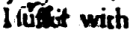 with
too much Plenty, and what eloquence is able to expresse the triumph
of that your never to be forgotten Entry, unlesse it be the renewing of it
this day? For then were we as those who dream, and can yet hardly be
perswaded, that we are truly awake: Dies ille æternis seculis monumentisque
mandandus, A day never to be forgotten in all our Generations,
but to be consecrated to posterity, transmitted to future Ages, and inserted
into Monuments more lasting then Brasse. Away then with
these Woodden and temporary Arches, to be taken down by the People
at pleasure; erect Marble ones, lasting as the Pyramids, and immovable
as the mountains themselves, and when they fail, let the memory
of it still remain engraven in our Hearts, Books, Records, novissimo
haud peritura die.
with
too much Plenty, and what eloquence is able to expresse the triumph
of that your never to be forgotten Entry, unlesse it be the renewing of it
this day? For then were we as those who dream, and can yet hardly be
perswaded, that we are truly awake: Dies ille æternis seculis monumentisque
mandandus, A day never to be forgotten in all our Generations,
but to be consecrated to posterity, transmitted to future Ages, and inserted
into Monuments more lasting then Brasse. Away then with
these Woodden and temporary Arches, to be taken down by the People
at pleasure; erect Marble ones, lasting as the Pyramids, and immovable
as the mountains themselves, and when they fail, let the memory
of it still remain engraven in our Hearts, Books, Records, novissimo
haud peritura die.
And yet not this altogether, because we have received a Prince, but
such a Prince, whose state and fortune in all this blessed change, we so
much admire not, as his mind; For that is truly felicity, not to possesse
great things, but to be thought worthy of them: And indeed Great Sir,
necessity constrains me, and the laws of Panegyric, to verifie it in your
Praises, by running over at least those other Appellations, which both
your vertue has given to your Majesty, and your Fortune acquir’d. For
he is really no King who possesses not (like you) a Kingly mind, be his
other advantages what they may: If the Republick belong then to Cæsar,
Cæsar belongs much more to the Republick; and of this you have
given proof.
For no sooner were we possess’d of your sacred Majestie, but you suddainly
gave form to our confused Chaos: We presently saw when you
had taken the reigns into your sacred hands, and began to sit at Sterne,
our deviating and giddy course grow steady, and the fluctuating Republick
at drift ready to put into a secure Port.
You began your Entry with an act of general Clemency, and to make
good the advice of your Martyr’d Father, and the best Religion, forgave
you bitterest Enemies; and not only barely forgiving, but by an excesse
of charity, doing honour to some, ut nemo sibi victus te victore videatur.
This was plainly Godlike: For so rare a thing we find it, that Princes
think themselves oblig’d; or if they think it, that they love it; that
your example will reproach all who went before you: As you promis’d,
so you perform’d it, punctually, and with advantage. Nor indeed do
you desire any thing should be permitted your Majesty, but what is
indulg’d your Vassals, subjecting even your self to those Lawes by which
you oblige your Subjects; For as it is a great felicity to be able to do
what one will, so is it much more glorious, to will only what is just
and honourable. All other Princes before your Majesty spake as much;
you only have performed it; nor is there a Tittle of your engagements,
which even your very enemies diffide of, much lesse your Friends suspect:
They enjoy, and these hope; because those were to be conciliated by
present effects, these are secure by past promises; and none that receives
them of your Majesty reckons from the time they injoy it, but the period
of your promise; because it proceeds (they know) from a Princely and
candid mind; and if it seem long in acquiring, it is not (I perswade my
self) because you are difficult, much less unmindful; but that the benefit
may be more acceptable, and the sense of it more permanent; since
too suddain felicity astonishes, and sometimes renders the Recipient ingrateful,
whilst your favours are not fugitive but certain. It was only for
Your Majestie to be compleatly happie, when you began to be so;
and yet your subjects had as much as they could well support; since you
have made it your only businesse to sublevate the needie, and give them
as it were a new Fate, your piety not more appearing in pardoning your
Enemies, and receiving the Penitent, then your justice in restoring the
Oppressed: For how many are since your returne, return’d to their own
Homes, to their Wives, Children, Offices, and Patrimonies? Addiditque
Dominus omnia quæ fuerant Jobi duplicia; some of them with immense
advantages; and of this the languishing Church of England is a most
eminent instance; That she, which was first and most afflicted, should
be first and chiefly refreshed.
You have taken away the affluence to the Committees, Sequestrators,
Conventicles, and unjust Slaughter-houses, and converted their
zeal to the Temples, the Courts, and the just Tribunals: Magnanimity
is return’d again to the Nobility, Modesty to the People, Obedience to
Subjects, Charity to Neighbours, Pietie to Children, Fidelity to Servants,
and Reverence to Religion; In summe, You are the Restorer of Your
Countrie.
The lawes that were lately quiescent, and even trampled under foot,
your Majesty has revived; and been yet so prudent in reforming, that
even those which your Enemies made upon good deliberation, you permit
to stand, shewing your self rather to have been displeased with the
Authours, then the Things.
As to Discipline (after the sacrifice due for that innocent blood of your
glorious Father) you are not only careful to reject vice your self; but are severe
to discountenance it in others; and that yet so sweetly, as you seem
rather to perswade then compell; and to cure without a corrosive.
The Army is disbanded, and the Navy paid off without Tumult; because
you are trusted without suspicion, and are more secure in the publick
love and affection of your people then in men of Iron, the locks and
Bars of Tyrants Palaces: And truely Sir, there is no protection to innocency,
which is a fort inexpugnable: In vain therefore do Princes
confide in any other; for Armes invite Armes, Terrour, suspition. To
this only do you trust, and the few which you maintain about your person,
is rather for state, then fear. Quid enim istis opus est, quum firmissimo
sis muro Civici amoris obtectus? Here is then the firm Keeper of our
Liberties indeed, whom the Armies love for His own sake, and whom
no servile flattery adores; but a simple, and sincere devotion; and
verily such a Prince as Your Majesty, deserves to have friends, Prompt,
steady and faithful; such as You have, and which Virtue rather
then Fortune procures. Of this I obtest the fidelity of Your own inviolable
Party, distinguished formerly by the invidious name of Cavalier,
though significant and glorious; but I provoke the World to produce
me an example of parallel Loyaltie: What Prince under heaven, after
so many losses, and all imaginable calamities, can boast of such a party?
The Grecians forsook their Leaders upon every sleight disaster; the
very Romans were not steady of old, but followed the fortune of the
Common Victor. The German and the French will happily stick to their
Prince in distresse, as far as the Plate, the Tapistry, or some such superfluous
moveable may abide the pawn; But where shall we find a Subject
that hath persisted like Your Majesties, to the losse of Libertie, Estate,
and life it self, when yet all seem’d to be determin’d against them; so as
even their enemies were at last vanquish’d with their constancy, and their
very Tormentors wearied with their insuperable Patience; nor can they in
all that tract of Time, hardly brag of having made one signal Proselyte in
twenty Years that this difference continu’d; and that because the obedience
of your Majesties Subjects, is engraffed into their Religion and Institution,
as well as into the adoration of Your Virtues.
I would not therefore that Your Name should be painted upon Banners,
or Carved in stone, sed Monumentis æternæ laudis; and Your Majesty
did well foresee, and consult it, when you furnish’d a Subject for
our Panegyrics, and our Histories, which should outlast those frail materials.
The Statues of Cæsar, Brutus and Camillus were set up indeed because
they chased their enemies from the Walls of a proud Citie; You
have done it from a whole Kingdom; not (as they) by blood and slaughter,
but by your prudence and Counsels: Nor is it lightly to be passed
over, that your Majesty was preserved in that Royal Oak, to whom a Civical
Crown should so justly become due.
But I now arrive to the Lawes you have made, and the excellent things
which your Majestie hath done since you came amongst Your people.
Truely, there is hardly an hour to be reckoned wherein your Majesty has
not done some signal benefit. I have already touch’d a few of them, as
what concern’d the most, I would I could say the best; for you have oblig’d
your very Enemies, You have bought them; since never was there,
till now, so prodigious a summe paid, a summe hardly in Nature, to verifie
a Word only; and which the zeal of Your good Subjects (had you taken
the advantage of the fervour which I but now mentioned, at Your
wonderful Reception) might easily have absolv’d You of; had You paid
them in kind, and as they were wont to keep faith with your Majestie.
I provoke the World again to furnish an instance of a like generositie,
unlesse he climb up to heaven for it. How black then must that ingratitude
needs appear, which should after all this, dare to rebell; Or, for
the future once murmur at Your Government? Since it was no necessity
that compell’d You, but an excesse of your good nature, and your charitie.
Your Majestie has abolished the Court of Wards; I cannot say we have
freed ourselves in desiring it, if it were possible to hope for so indulgent
a Father as Your Majestie is to Your Countrie, in those who shall succeed
You.
The Compositions You have likewise eased us of, if that could be esteem’d
a burthen, to serve so excellent a Prince, who receives nothing of his
Subjects but what he returnes again in the Noblest and worthiest Hospitality,
that any Potentate in earth can produce; Thus what the Rivers
pay to the Ocean, it returns again in showers to replenish them. But
Your Majestie would dissipate even the very shadows, which give us umbrage;
and rather part with your own just right, then those few of your
Subjects which it concern’d, should think themselves aggreiv’d, though
by a mistake even of their duty.
His Majesties Declaration.
But I should first have mention’d your settlement of the Church, and
Your bringing back the Ark of God: Your Majesties wise composure of our
Frailties, and tendernesse as well in the Religious as the Secular; whilst
yet You continue fervent to maintain what is decent, and what is setled
by Law. But what language is capable to expresse this Article? Let
those who wait at the Altar, and to which you have restor’d the daily sacrifice,
supply the defect of this period, and celebrate your piety.
Nor has yet Your zeal to the Church, lessen’d that which is due to the
Common-wealth; witnesse your industry in erecting a Counsel of Trade,
by which alone you have sufficiently verified that expression of your Majesties
in your Declaration from Breda, That You would propose some
useful things for the publick emolument of the Nation, which should
render it opulent, splendid and flourishing; making good your pretence
to the universall Soveraignty by Your Princely care, as well as by
your birth and undoubted Title.
You have Restor’d, Adorn’d, and Repair’d our Courts of Judicature,
turning the Shambles where your Subjects were lately butcher’d, into a
Tribunal, where they may now expect due Justice; and have furnish’d
the Supreame seat there with a Chancelour of antient candor, rare
experience; just, prudent, learned and faithfull; in summe, one, whose
merits beget universal esteem, and is amongst the greatest indications
of your Majesties skill in persons, as well as in their Talents and perfections
to serve you. Thus you have gratified the long robe, so as now
again,
Te propter colimus leges, animosque ferarum
Exuimus——And there is hope we may again be civiliz’d.
For you are (we hear) publishing Sumptuary Lawes to represse the
wantonness and excess of Apparel, as you have already testifi’d your abhorrency
of Duelling, that infamous and dishonourable gallantry: In
fine, you have establish’d so many excellent constitutions, that you
seem to leave nothing for us to desire, or your Successor to add either
in the Ethicall or Politicall.
——Similem quæ pertulit ætas
Consilio, vel Marte virum?——
O happy Greece for Eloquence, that hast celebrated the fortune of thy
Heroes trifling Adventures! who shall set forth and immortalize the glory
of our illustrious Prince, and advance Great CHARLES to the skies?
You had Poets indeed that sung the fate of an unfortunate Lady, the
theft of a simple fleece; what wouldst thou have done, had the glorious
Actions of such a King been spread before thee, who has not robbed
with Armies, depopulated Cities, or violated the Rights of Hospitality;
but restor’d a broken Nation, repair’d a ruin’d Church, reform’d,
and re-establish’d our ancient Laws; in summe, who has at
once render’d us perfectly happy? What then have we to do with
Augustus, or Titus, with Trajan, Hadrian, Antoninus, Theodosius or
even Constantine himself? There is not in any, there is not in all these
Subjects more worthy of praise, and to which your Majesty; O best of
Princes, ought at all to render.
We are told Periculosæ rem aleæ esse, de iis scribere quibus sis obstrictus;
because it is so difficult to observe a mediocrity, where our affections are
engaged: But your Majesty is as secure from flattery, as your Virtues
are above its reach; and to write thus of ill Princes, were both a
shame and a punishment: For this the Senate condemn’d the History
of Cremutius to the flames; and Spartianus told Dioclesian boldly, how
hard it would be to write their Commentaries, except it were to record
their Impudence, Murthers, Injustice, and the (for most part) fatal
periods of Tyrants; which if any esteem a glory, you envy not, whilst
your Majesty is resolv’d to secure your own by your virtue and your
Justice; so as no age to come shall possibly find an æmulator, or produce
an equall.
——Fuerint aliis hæc forte decora,
Nulla potest Laus esse tibi quæ crimina purget.
But I shall never have done with your obligations of the publick; and
the measure which is assign’d me, would be too narrow but to mention
briefly those your private and interiour perfections which crown your
Majesties Person, and dazle our eyes more then the bright purple
which this day invests you. To give instance in some; you are an excellent
Master to your Domesticks. Their Lives, Conversations and
Merits as well as Names, and Faces, are known to your Majesty
as the Companions of Cæsar were: Honour is safe under your Banner,
and the Court so well regulated, that there is no need of Censors to inspect
Mens Manners; vita principis pro censura est. He who knowes that
every body eyes, speaks and writes of him, cannot in prudence, or think,
or act things unworthy and abject: You Sir direct all your objects and
motions so, as may recommend you to posterity; and even burn with desires
of immortality, so as Histories may relate the Truth without fear or
adulation.
How happy then those Servants of yours, whose fidelity and Industry
is known to your Majesty, not from the interpretation and reports
of others, but your own experience! So as you Reward as well
with Judgment, as Bounty; and verily that is true Beneficence to
place your Recompense as well equally as freely: Most other
Virtues are competent to the rest of Men; Beneficence only
to a Prince, as his most Essential property, and the noblest ingredient of
his Elogy. Hence that great Saint, as well as Courtier and Prelate has
directed, Si quis Principem laudare vellet, nihil illi adeo decorum adscriberet
quam Magnificentiam; S. Chrysost.
and Criticks observe, that where the wise
King Solomon sayes, Multi colunt personam Principis, the Hebrew version
reads it, personam Benefici, as importing both; and in that of his
Who was greater then Solomon, Qui dominantur eorum Benefici vocantur,
the Chaldy turnes, Principes vocantur, as if by a convertible figure,
He could not be a Prince who were not Beneficent; nor he
that is truly Beneficent, unworthy of that Title. I remember ’tis
somewhere said of Saul that he Reign’d but two years; because he was
so long it seems good to his people, and reigned in their hearts; For as
the Sun himself should not be the Sun, if he did not shine; no more
should a Prince be worthy of his dignity, if he unjustly Ecclips’d his influence,
or abused his Magnificency. But as we said, this virtue is
added to your Majesties also; who know so well to adjust its Definition
by your constant practice, rendering it (as indeed it ought) productive
of your will for glorious and honest ends only; But I now proceed
with the rest.
There is such a Majesty in your Countenance, such Lenity in your
Eyes, gravity in your speech, as that for your gracefull presence that
may be truly affirm’d of you what was once appli’d to a great Prince
resembling you, Jam firmitas, Jam proceritas corporis, jam honor Capitis
& dignitas oris, ad hoc ætatis indeflexa maturitas, nonne longe lateque
principem ostentant? since even all these assemble in your Majesties personage;
Nor has fortune chang’d you after all your Travels and Adventures
abroad; but brought you back to us not so much as tinged in the
percolations through which you have been forc’d to run, like the Fountain
Arethusa through the River Alpheus without commixture of their
waters. None having more constantly retained his vertue then
your Majesty, nor guarded it with more caution.
And now in all this height of glory, you receive all Men with
so much humility, that the difference of your change seems to be
only this; that you are now beloved of more, and love more, treating
every man, as if every man were your proper care, and as becomes the Father
of so great a Family; Sometimes you are pleased to lay more aside
the beams of Majesty, that you may descend to do mutual offices of
Friendship; as considering that these Virtues were not concredited
to you by God, for your self only, but for others also: In short,
you are so perfect a Prince, that those who come after you, will fear to
be compared to you, Experti quam sit onerosum succedere bono Principi;
since to possess your Virtues, they must support your sufferings; nor
can every head know how to sustain the weight of such a Crown as
yours, where the thornes have so long perplext the Lillies and the
Roses of it.
I might here mention Your Heroic and masculine Spirit in dangers,
and yet Your foresight of them; Your tenderness to compassionate,
Your Constancie in suffering, Your Modestie in Prosperitie, Equalitie in
Adversitie, and that sweetness of access which attracts both love and
veneration from all that converse with You; but these have already
adorn’d your Character by that excellent Hand who did lately describe it.
Col. Tuke.
You are frequent at Councels, Patient in hearing, pertinent in answering,
judicious in Determining, and so skilfull in the several Languages,
that You many times transact by Your self, what others do by
Interpreters; affecting rather expedition in Your affairs, then insignificant
State, which these acquired parts of Your Majesties do yet augment
so much the more.
You are curious of brave and Laudable things; You love shipping,
Buildings, Gardens (having exceeded Cyrus already in Your Plantations)
Piscinas, Statues, Pictures, Intaglias, Music: You have already amass’d
very many rare collections of all kinds, and there is nothing worthy and
great which can escape Your research.
Nor must I here forget the honour You have done our Society at
Greshham Colledge by Your curious enquiries about the Load-Stone, and
other particulars which concern Philosophy; since it is not to be doubted
but that so Magnanimous a Prince, will still proceed to encourage that
Illustrious Assembly; and which will celebrate and eternize Your memory
to the future Ages, beyond Your Majesties Predecessors, and
indeed all the Monarchs on the Earth, when for You is reserv’d the
being Founder of some thing that may improve practical and Experimental
knowledg, beyond all that has been hitherto attempted, for
the Augmentation of Science, and universal good of Man-kind, and
which alone will consummate Your Fame and render it immortal.
What shall I superadd to all these? That You rise early, that You
are alwaies employ’d, that You love Hunting, Riding, swimming, manly
Robust and Princely Exercises, not so much for delight, as health and
relaxation. Et vitæ pars nulla perit.
O best Idea of Princes, sit to me yet one moment, that I may add this
last touch to Your fair Table; nor wonder that I should attempt so bold
an enterprise; since he that would take the height of Olympus, must stand
below in the plain: Subjects can best describe their Princes Virtues;
Princes best know their Subjects, and therefore most fit to rule them.
And long may You live to rule us great Sir. We wish that all you do, or
may do, be propitious to you, to us, to the public; or in a word, to your
Majesty alone, in which both we and the public are mutually concern’d.
Time was (and too long alas it was!) that what was fortunate to the
Tyrant, was unhappy to your Subjects: now they are common to both
and reciprocal; nor can we more be happy without you, then you without
us; and truly all Princes have known, that they are seldom beloved
of God, who are hated of their People; nor can they be long secure.
Vox Populi, vox Dei est. But you have seen the Effects of our Prayers against
an Usurper; hear now, O Heaven our Vowes for a just Prince. Not
for peace, not for Riches, not Honours, or new conquests do we supplicate;
but for all these in one, The Safety of CHARLES. You alone
snatch’d him out of those cruel hands, now preserve him from them:
Render him fortunate to us, to our Children, succeeding Generations give
him a late Successor, and when You do it, let it be such a one as himself.
Let your Majestie now proceed in his Triumph, and hear the Acclamations
of his people; what can they more expresse who are ready to
pave the very streets with their bodies, in testimonie of their zeal? behold
all about You, the Gratulating old Fathers, the exulting Youths,
the glad mothers; And why should it not be so? Here’s no goods publicated,
none restrain’d or mulcted of their Libertie, none diminish’d of dignitie,
none molested, or exil’d; all are again return’d into their houses,
Relations and Properties, and which is yet more then all, to their antient
innocencie and mutual charitie.
If the Philosopher in the Ethicks enquiring whether the felicity of the
sun, do any whit concern the happinesse of the defunct progenitor, after
much reasoning have determin’d that the honour only which his son acquires
by worthie and great actions, does certainly refresh his Ghost:
What a day of Jubilee, is this then to Your blessed Father! Not the
odor of those flowers did so recreate the dead Archemorus which the
Nymphs were yearly wont to strow upon his watry Sepulcher, as this daies
Inauguration of Yours, does even seem to revive the Ashes of that sacred
Martyr.
Should some one from the clouds that had looked down on the sad face
of things, when our Temples lay in dust, our Palaces in desolation, and
the Altars demolished; when these Citie Gates were dashed to pieces,
Gibbets and Executions erected in every Street, and all things turned
into universal silence and solitude, behold now the change of this daies
glorious scean; that we see the Churches in repair, the sacred Assemblies
open’d, our Cities re-edified, the Markets full of People, our Palaces
richly furnished, and the Streets proud with the burden of their Triumphal
Arches, and the shouts of a rejoycing multitude: How would he
wonder and stand amaz’d, at the Prodigie, and leap down from his lofty
station, though already so near to heaven, to joyne with us in earth,
participate of our felicitie, and ravish’d with the Ecstasie, cry out aloud
now with Us.
Set open the Temple-Gates, let the Prisoners go free, the Altars
smoak perfumes, bring forth the Pretious things, strow the Waies with
Flowers, let the Fountains run Wine, Crown the Gobblets, bring
Chapplets of Palmes and Lawrells, the Bells ring, the Trumpets sound,
the Cannon roar, O happy Descent, and strange Reverse! I have seen
Englands Restorer, Great CHARLES the II. RETURN’D, REVENG’D,
BELOV’D, CROWN’D, RE-ESTABLISH’D.
Terrasque Astræa Revisit.
And O that it were now in my power to speak some great thing,
worthy this great day; I should put all the flowers of Orators and Raptures
of Poets into one lofty & high Expression, and yet not Reach what I
would say to Your Majestie: For never since there was a Citie, or
Kingdom, did a Day appear more glorious to England, never since it was
a Nation, and in which there either was, or ought to be so universal a
Jubilation: Not that Your Triumphal Charriots do drag the miserable
Captives, but are accompanied by freed Citizens; perfidie is now vanquished,
popular fury chayn’d, crueltie tam’d, luxury restrained, these
lie under the spondells of Your Wheeles, where Empire, Faith, Love,
and Justice Ride Triumphant, and nothing can be added to Your Majesties
glory but its perpetuitie. But whence, alas! should I have this
confidence, after so many Elogies and Panegyricks of great and Eloquent
men, who consecrate the memorie of this daies happinesse; and (were the
subject, like that of all other things) would have left me nothing more to
add, unless he who was sometimes wont to employ his pen for Your Majestie
being absent, should now be silent that you are present, and inflame
me with a kind of new Enthusiasme: I find myself then compell’d
out of a grateful sense of my dutie for the publick benefit, and if your
Majestie forbid not, or withdraw your influence, who shall hinder, that
even my slender voice should not strive to be heard, in such an universall
consort, wherein everybody has a part, every one a share?
Permit me therefore (O best of Kings) to present, and lay these my
vowes at your sacred feet, to exsult, and to Rejoyce with the Rest of
your Loyal Subjects; not as I desire, but as I am able, and as I would do
it to God, and as he best loves it,
Sentiendo copiosius, quam loquendo.
DIXI.
William Andrews Clark Memorial Library: University of California
The Augustan Reprint Society
General Editors
| H. Richard Archer |
E. N. Hooker |
| William Andrews Clark Memorial Library |
University of California, Los Angeles |
| R. C. Boys |
John Loftis |
| University of Michigan |
University of California, Los Angeles |
The society exists to make available inexpensive reprints (usually facsimile reproductions) of rare seventeenth
and eighteenth century works.
The editorial policy of the Society continues unchanged. As in the past, the editors welcome suggestions
concerning publications.
All correspondence concerning subscriptions in the United States and Canada should be addressed to the
William Andrews Clark Memorial Library, 2205 West Adams Blvd., Los Angeles 18, California. Correspondence
concerning editorial matters may be addressed to any of the general editors. Membership fee continues $2.50
per year. British and European subscribers should address B. H. Blackwell, Broad Street, Oxford, England.
Publications for the fifth year [1950-1951]
(At least six items, most of them from the following list, will be reprinted.)
Frances Reynolds (?): An Enquiry Concerning the Principles of Taste, and of the Origin of Our Ideas of
Beauty, &c. (1785). Introduction by James L. Clifford.
Thomas Baker: The Fine Lady’s Airs (1709). Introduction by John Harrington Smith.
Daniel Defoe: Vindication of the Press (1718). Introduction by Otho Clinton Williams.
John Evelyn: An Apologie for the Royal Party (1659); A Panegyric to Charles the Second (1661). Introduction
by Geoffrey Keynes.
Charles Macklin: Man of the World (1781). Introduction by Dougald MacMillan.
Prefaces to Fiction. Selected and with an Introduction by Benjamin Boyce.
Thomas Sprat: Poems.
Sir William Petty: The Advice of W. P. to Mr. Samuel Hartlib for the Advancement of some particular
Parts of Learning (1648).
Thomas Gray: An Elegy Wrote in a Country Church Yard (1751). (Facsimile of first edition and of portions
of Gray’s manuscripts of the poem).
| To The Augustan Reprint Society |
Subscriber’s Name and Address: |
| William Andrews Clark Memorial Library |
|
| 2205 West Adams Boulevard |
|
| Los Angeles 18, California |
|
|
|
|
|
| As MEMBERSHIP FEE I enclose for the years marked: |
| The current year |
$ 2.50 __ |
The current, 2nd, 3rd. & 4th year |
$10.00 __ |
| The current & the 4th year |
5.00 __ |
The current, 1st, 2nd, 3rd, & 4th year |
11.50 __ |
| The current, 3rd, & 4th year |
7.50 __ |
(Publications no. 3 & 4 are out of print) |
|
Make check or money order payable to The Regents of the University of California
Note: All income of the Society is devoted to defraying cost of printing and mailing.
PUBLICATIONS OF THE AUGUSTAN REPRINT SOCIETY
First Year (1946-1947)
1. Richard Blackmore’s Essay upon Wit (1716), and Addison’s Freeholder
No. 45 (1716).
2. Samuel Cobb’s Of Poetry and Discourse on Criticism (1707).
3. Letter to A. H. Esq.; concerning the Stage (1698), and Richard Willis’
Occasional Paper No. IX (1698). (OUT OF PRINT)
4. Essay on Wit (1748), together with Characters by Flecknoe, and Joseph
Warton’s Adventurer Nos. 127 and 133. (OUT OF PRINT)
5. Samuel Wesley’s Epistle to a Friend Concerning Poetry (1700) and
Essay on Heroic Poetry (1693).
6. Representation of the Impiety and Immorality of the Stage (1704) and
Some Thoughts Concerning the Stage (1704).
Second Year (1947-1948)
7. John Gay’s The Present State of Wit (1711); and a section on Wit from
The English Theophrastus (1702).
8. Rapin’s De Carmine Pastorali, translated by Creech (1684).
9. T. Hanmer’s (?) Some Remarks on the Tragedy of Hamlet (1736).
10. Corbyn Morris’ Essay towards Fixing the True Standards of Wit, etc.
(1744).
11. Thomas Purney’s Discourse on the Pastoral (1717).
12. Essays on the Stage, selected, with an Introduction by Joseph Wood
Krutch.
Third Year (1948-1949)
13. Sir John Falstaff (pseud.), The Theatre (1720).
14. Edward Moore’s The Gamester (1753).
15. John Oldmixon’s Reflections on Dr. Swift’s Letter to Harley (1712);
and Arthur Mainwaring’s The British Academy (1712).
16. Nevil Payne’s Fatal Jealousy (1673).
17. Nicholas Rowe’s Some Account of the Life of Mr. William Shakespear
(1709).
18. Aaron Hill’s Preface to The Creation; and Thomas Brereton’s Preface
to Esther.
Fourth Year (1949-1950)
19. Susanna Centlivre’s The Busie Body (1709).
20. Lewis Theobald’s Preface to The Works of Shakespeare (1734).
21. Critical Remarks on Sir Charles Gradison, Clarissa, and Pamela (1754).
22. Samuel Johnson’s The Vanity of Human Wishes (1749) and Two
Rambler papers (1750).
23. John Dryden’s His Majesties Declaration Defended (1681).
24. Pierre Nicole’s An Essay on True and Apparent Beauty in Which from
Settled Principles is Rendered the Grounds for Choosing and Rejecting
Epigrams, translated by J. V. Cunningham.
- ‘but are a very small’: word unclear in
original.

- Original reads ‘perfidiousuess’; changed to ‘perfidiousness’.
- Original reads ‘single person condemn’; changed to ‘single person; condemn’.
- Original reads ‘extram’; changed to ‘extream’.
- ‘The Benediction of the peace maker’: word unclear in
original.

- ‘to that eternall weight of glory’: word unclear in
original.

- Original reads ‘Hypocrsie’; changed to ‘Hypocrisie’.
- Original reads ‘butt hat’; changed to ‘but that’.
- Original reads ‘ito their houses’; changed to ‘into their houses’.
- Original reads ‘innocenie’; changed to ‘innocencie’.
- Original reads ‘I have seens’; changed to ‘I have seen’.
- Original reads ‘univresall’; changed to ‘universall’.