In the morning, after breakfast, it was decided that the men should
begin to dig a sloping bed which would allow the Halbrane to slide
to the foot of the iceberg. Would that Heaven might grant success to
the operation, for who could contemplate without terror having to
brave the severity of the austral winter, and to pass six months
under such conditions as ours on a vast iceberg, dragged none could
tell whither? Once the winter had set in, none of us could have
escaped from that most terrible of fates—dying of cold.
At this moment, Dirk Peters, who was observing the horizon from
south to east at about one hundred paces off, cried out in a rough
voice: “Lying to!”
Lying to? What could the half-breed mean by that, except that the
floating mass had suddenly ceased to drift? As for the cause of this
stoppage, it was neither the moment to investigate it, nor to ask
ourselves what the consequences were likely to be.
“It is true, however,” cried the boatswain. “The iceberg is
not stirring, and perhaps has not stirred since it capsized!”
“How?” said I, “it no longer changes its place?”
“No,” replied the mate, “and the proof is that the others,
drifting on, are leaving it behind!”
And, in fact, whilst five or six icebergs were descending towards
the south, ours was as motionless as though it had been stranded on
a shoal.
The simplest explanation was that the new base had encountered
ground at the bottom of the sea to which it now adhered, and would
continue to adhere, unless the submerged part rose in the water so
as to cause a second capsize.
This complicated matters seriously, because the dangers of positive
immobility were such that the chances of drifting were preferable.
At least, in the latter case there was some hope of coming across a
continent or an island, or even (if the currents did not change) of
crossing the boundaries of the austral region.
Here we were, then, after three months of this terrible voyage! Was
there now any question of trying to save William Guy, his comrades
on the Jane, and Arthur Pym? Was it not for our own safety that any
means at our disposal should be employed? And could it be wondered
at were the sailors of the Halbrane to rebel, were they to listen to
Hearne’s suggestions, and make their officers, or myself
especially, responsible for the disasters of this expedition?
Moreover, what was likely to take place, since, notwithstanding
their losses, the followers of the sealing-master were still a
majority of the ship’s company?
This question I could clearly see was occupying the thoughts of
Captain Len Guy and West.
Again, although the recruits from the Falklands formed only a total
of fourteen men, as against the twelve of the old crew, was it not
to be feared that some of the latter would take Hearne’s side?
What if Hearne’s people, urged by despair, were already thinking
of seizing the only boat we now possessed, setting off towards the
north, and leaving us on this iceberg? It was, then, of great
importance that our boat should be put in safety and closely watched.
A marked change had taken place in Captain Len Guy since the recent
occurrences. He seemed to be transformed upon finding himself face
to face with the dangers which menaced us. Up to that time he had
been solely occupied in searching for his fellow-countrymen; he had
handed over the command of the schooner to West, and he could not
have given it to anyone more zealous and more capable. But from this
date he resumed his position as master of the ship, and used it with
the energy required by the circumstances; in a word, he again became
sole master on board, after God.
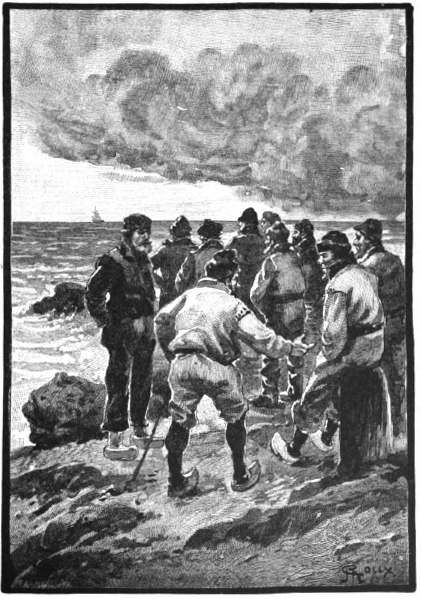
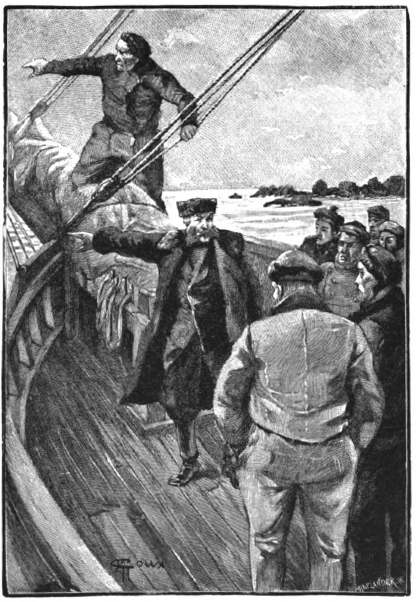
At his command the crew were drawn up around him on a flat spot a
little to the left of the Halbrane. In that place the following were
assembled:—on the seniors’ side: Martin Holt and Hardy, Rogers,
Francis, Gratian, Bury, Stern, the cook (Endicott), and I may add
Dirk Peters; on the side of the new-comers, Hearne and the thirteen
other Falkland sailors. The latter composed a distinct group; the
sealing-master was their spokesman and exercised a baneful influence
over them.
Captain Len Guy cast a stern glance upon the men and said in a sharp
tone:
“Sailors of the Halbrane, I must first speak to you of our lost
companions. Five of us have just perished in this catastrophe.”
“We are waiting to perish in our turn, in these seas, where we
have been dragged in spite of—”
“Be silent, Hearne,” cried West, pale with anger, “or if not—”
“Hearne has said what he had to say,” Captain Len Guy continued,
coldly. “Now it is said, and I advise him not to interrupt me a
second time!”
The sealing-master might possibly have ventured on an answer, for he
felt that he was backed by the majority of the crew; but Martin Holt
held him back, and he was silent.
Captain Len Guy then took off his hat and pronounced the following
words with an emotion that affected us to the bottom of our hearts:—
“We must pray for those who have died in this dangerous voyage,
which was undertaken in the name of humanity. May God be pleased to
take into consideration the fact that they devoted their lives to
their fellow-creatures, and may He not be insensible to our prayers!
Kneel down, sailors of the Halbrane!”
They all knelt down on the icy surface, and the murmurs of prayer
ascended towards heaven.
We waited for Captain Len Guy to rise before we did so.
“Now,” he resumed, “after those who are dead come those who
have survived. To them I say that they must obey me, whatever my
orders may be, and even in our present situation I shall not
tolerate any hesitation or opposition. The responsibility for the
general safety is mine, and I will not yield any of it to anyone. I
am master here, as on board—”
“On board—when there is no longer a ship,” muttered the
sealing-master.
“You are mistaken, Hearne, the vessel is there, and we will put it
back into the sea. Besides, if we had only a boat, I am the captain
of it. Let him beware who forgets this!”
That day, Captain Len Guy, having taken the height of the sun by the
sextant and fixed the hour by the chronometer (both of these
instruments had escaped destruction in the collision), obtained the
following position of his ship:—
South latitude: 88° 55ʹ.
West longitude: 39° 12ʹ.
The Halbrane was only at 1° 5ʹ—about 65 miles—from the south
pole.
“All hands to work,” was the captain’s order that afternoon,
and every one obeyed it with a will. There was not a moment to lose,
as the question of time was more important than any other. So far
as provisions were concerned, there was enough in the schooner for
eighteen months on full rations, so we were not threatened with
hunger, nor with thirst either, notwithstanding that owing to the
water-casks having been burst in the collision, their contents had
escaped through their staves. Luckily, the barrels of gin, whisky,
beer, and wine, being placed in the least exposed part of the hold,
were nearly all intact. Under this head we had experienced no loss,
and the iceberg would supply us with good drinking-water. It is a
well-known fact that ice, whether formed from fresh or salt water,
contains no salt, owing to the chloride of sodium being eliminated
in the change from the liquid to the solid state. The origin of the
ice, therefore, is a matter of no importance. However, those blocks
which are easily distinguished by their greenish colour and their
perfect transparency are preferable. They are solidified rain, and
therefore much more suitable for drinking-water.
Without doubt, our captain would have recognized any blocks of this
description, but none were to be found on the glacier, owing to its
being that part of the berg which was originally submerged, and came
to the top after the fall.
The captain and West decided first to lighten the vessel, by
conveying everything on board to land. The masts were to be cleared
of rigging, taken out, and placed on the plateau. It was necessary
to lighten the vessel as much as possible, even to clear out the
ballast, owing to the difficult and dangerous operation of
launching. It would be better to put off our departure for some days
if this operation could be performed under more favourable
circumstances. The loading might be afterwards accomplished without
much difficulty.
Besides this, another reason by no means less serious presented
itself to us. It would have been an act of unpardonable rashness to
leave the provisions in the store-room of the Halbrane, her situation
on the side of the iceberg being very precarious. One shake would
suffice to detach the ship, and with her would have disappeared the
supplies on which our lives depended.
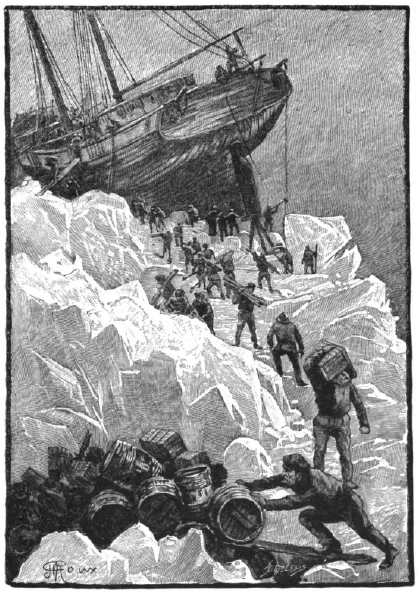
On this account, we passed the day in removing casks of half-salted
meat, dried vegetables, flour, biscuits, tea, coffee, barrels of
gin, whisky, wine and beer from the hold and store-room and placing
them in safety in the hammocks near the Halbrane.
We also had to insure our landing against any possible accident,
and, I must add, against any plot on the part of Hearne and others
to seize the boat in order to return to the ice-barrier.
We placed the long boat in a cavity which would be easy to watch,
about thirty feet to the left of the schooner, along with its oars,
rudder, compass, anchor, masts and sail.
By day there was nothing to fear, and at night, or rather during the
hours of sleep, the boatswain and one of the superiors would keep
guard near the cavity, and we might rest assured that no evil could
befall.
The 19th, 20th, and 21st of January were passed in working extra
hard in the unshipping of the cargo and the dismantling of the
Halbrane. We slung the lower masts by means of yards forming props.
Later on, West would see to replacing the main and mizzen masts; in
any case, we could do without them until we had reached the
Falklands or some other winter port.
Needless to say, we had set up a camp on the plateau of which I have
spoken, not far from the Halbrane. Sufficient shelter against the
inclemency of the weather, not unfrequent at this time of the year,
was to be found under tents, constructed of sails placed on spars
and fastened down by pegs. The glass remained set fair; the wind was
nor’-east, the temperature having risen to 46 degrees (2° 78ʹ C.).
Endicott’s kitchen was fitted up at the end of the plain, near a
steep projection by which we could climb to the very top of the berg.
It is only fair to state that during these three days of hard work
no fault was to be found with Hearne. The sealing-master knew he was
being closely watched, and he was well aware that Captain Len Guy
would not spare him if he tried to get up insubordination amongst
his comrades. It was a pity that his bad instincts had induced him
to play such a part, for his strength, skill, and cleverness made
him a very valuable man, and he had never proved more useful than
under these circumstances.
Was he changed for the better? Did he understand that general good
feeling was necessary for the safety of all? I know not, but I had
no confidence in him, neither had Hurliguerly!
I need not dwell on the ardour with which the half-breed did the
rough work, always first to begin and the last to leave off, doing
as much as four men, and scarcely sleeping, only resting during
meals, which he took apart from the others. He had hardly spoken to
me at all since the schooner had met with this terrible accident.
What indeed could he say to me? Did I not know as well as he that it
would be necessary to renounce every hope of pursuing our intended
voyage?
Now and again I noticed Martin Holt and the half-breed near each
other while some difficult piece of work was in progress. Our
sailing-master did not miss a chance of getting near Dirk Peters, who
always tried his best to escape from him, for reasons well known to
me. And whenever I thought of the secret of the fate of the
so-called Parker, Martin Holt’s brother, which had been entrusted
to me, that dreadful scene of the Grampus filled me with horror. I
was certain that if this secret were made known the half-breed would
become an object of terror. He would no longer be looked upon as the
rescuer of the sailing-master; and the latter, learning that his
brother— Luckily, Dirk Peters and myself were the only two
acquainted with the fact.
While the Halbrane was being unloaded, Captain Len Guy and the mate
were considering how the vessel might be launched. They had to allow
for a drop of one hundred feet between the cavity in which the ship
lay and the sea; this to be effected by means of an inclined bed
hollowed in an oblique line along the west side of the iceberg, and
to measure two or three hundred perches in length. So, while the
first lot of men, commanded by the boatswain, was unloading the
schooner, a second batch under West’s orders began to cut the
trench between the blocks which covered the side of the floating
mountain.
Floating? I know not why I use this expression, for the iceberg no
longer floated, but remained as motionless as an island. There was
nothing to indicate that it would ever move again. Other icebergs
drifted along and passed us, going south-east, whilst ours, to use
Dirk Peters’ expression, was “lying to.” Would its base be
sufficiently undermined to allow it to detach itself? Perhaps some
heavy mass of ice might strike it and set it free by the shock. No
one could predict such an event, and we had only the Halbrane to
rely upon for getting us out of these regions.
We were engaged in these various tasks until the 24th of January.
The atmosphere was clear, the temperature was even, and the
thermometer had indeed gone up to two or three degrees above
freezing-point. The number of icebergs coming from the nor’-west
was therefore increasing; there were now a hundred of them, and a
collision with any of these might have a most disastrous result.
Hardy, the caulker, hastened first of all to mend the hull; pegs had
to be changed, bits of planking to be replaced, seams to be caulked.
We had everything that was necessary for this work, and we might
rest assured that it would be performed in the best possible manner.
In the midst of the silence of these solitudes, the noise of the
hammers striking nails into the side, and the sound of the mallet
stuffing tow into the seams, had a startling effect. Sea-gulls, wild
duck, albatross, and petrels flew in a circle round the top of the
berg with a shrill screaming, and made a terrible uproar.
When I found myself with West and the captain, our conversation
naturally turned on our situation and how to get out of it, and upon
our chances of pulling through. The mate had good hopes that if no
accident occurred the launching would be successfully accomplished.
The captain was more reserved on the subject, but at the thought
that he would have to renounce all hope of finding the survivors of
the Jane, his heart was ready to break.
When the Halbrane should again be ready for the sea, and when West
should inquire what course he was to steer, would Captain Len Guy
dare to reply, “To the south”? No! for he would not be followed either
by the new hands, or by the greater portion of the older members of
the crew. To continue our search in this direction, to go beyond the
pole, without being certain of reaching the Indian Ocean instead of
the Atlantic, would have been rashness of which no navigator would be
guilty. If a continent bound the sea on this side, the schooner
would run the danger of being crushed by the mass of ice before it
could escape the southern winter.
Under such circumstances, to attempt to persuade Captain Len Guy to
pursue the voyage would only be to court a certain refusal. It could
not even be proposed, now that necessity obliged us to return
northwards, and not to delay a single day in this portion of the
Antarctic regions. At any rate, though I resolved not again to speak
of the matter to the captain, I lost no opportunity of sounding the
boatswain. Often when he had finished his work, Hurliguerly would
come and join me; we would chat, and we would compare our
recollections of travel.
One day as we were seated on the summit of the iceberg, gazing
fixedly on the deceptive horizon, he exclaimed,—
“Who could ever have imagined, Mr. Jeorling, when the Halbrane
left Kerguelen, that six and a half months afterwards she would be
stuck on the side of an ice-mountain?”
“A fact much more to be regretted,” I replied, “because only
for that accident we should have attained our object, and we should
have begun our return journey.”
“I don’t mean to contradict,” replied the boatswain, “but
you say we should have attained our object. Do you mean by that,
that we should have found our countrymen?”
“Perhaps.”
“I can scarcely believe such would have been the case, Mr.
Jeorling, although this was the principal and perhaps even the only
object of our navigation in the polar seas.”
“The only one—yes—at the start,” I insinuated. “But since
the half-breed’s revelations about Arthur Pym—”
“Ah! You are always harking back on that subject, like brave Dirk
Peters.”
“Always, Hurliguerly; and only that a deplorable and unforeseen
accident made us run aground—”
“I leave you to your delusions, Mr. Jeorling, since you believe
you have run aground—”
“Why? Is not this the case?”
“In any case it is a wonderful running aground,” replied the
boatswain. “Instead of a good solid bottom, we have run aground in
the air.”
“Then I am right, Hurliguerly, in saying it is an unfortunate
adventure.”
“Unfortunate, truly, but in my opinion we should take warning by
it.”
“What warning?”
“That it is not permitted to us to venture so far in these
latitudes, and I believe that the Creator forbids His creatures to
climb to the summit of the poles.”
“Notwithstanding that the summit of one pole is only sixty miles
away from us now.”
“Granted, Mr. Jeorling, but these sixty miles are equal to
thousands when we have no means of making them! And if the launch of
the schooner is not successful, here are we condemned to winter
quarters which the polar bears themselves would hardly relish!”
I replied only by a shake of my head, which Hurliguerly could not
fail to understand.
“Do you know, Mr. Jeorling, of what I think oftenest?”
“What do you think of, boatswain?”
“Of the Kerguelens, whither we are certainly not travelling.
Truly, in a bad season it was cold enough there! There is not much
difference between this archipelago and the islands situated on the
edge of the Antarctic Sea! But there one is not far from the Cape,
and if we want to warm our shins, no iceberg bars the way. Whereas
here it is the devil to weigh anchor, and one never knows if one
shall find a clear course.”
“I repeat it, boatswain. If this last accident had not occurred,
everything would have been over by this time, one way or another. We
should still have had more than six weeks to get out of these
southern seas. It is seldom that a ship is so roughly treated as
ours has been, and I consider it real bad luck, after our having
profited by such fortunate circumstances—”
“These circumstances are all over, Mr. Jeorling,” exclaimed
Hurliguerly, “and I fear indeed—”
“What—you also, boatswain—you whom I believed to be so
confident!”
“Confidence, Mr. Jeorling, wears out like the ends of one’s
trousers. What would you have me do? When I compare my lot to old
Atkins, installed in his cosy inn; when I think of the Green
Cormorant, of the big parlours downstairs with the little tables
round which friends sip whisky and gin, discussing the news of the
day, while the stove makes more noise than the weathercock on the
roof—oh, then the comparison is not in our favour, and in my
opinion Mr. Atkins enjoys life better than I do.”
“You shall see them all again, boatswain—Atkins, the Green
Cormorant, and Kerguelen! For God’s sake do not let yourself grow
downhearted! And if you, a sensible and courageous man, despair
already—”
“Oh, if I were the only one it would not be half so bad as it
is!”
“The whole crew does not despair, surely?”
“Yes—and no,” replied Hurliguerly, “for I know some who are
not at all satisfied!”
“Has Hearne begun his mischief again? Is he exciting his
companions?”
“Not openly at least, Mr. Jeorling, and since I have kept him
under my eye I have neither seen nor heard anything. Besides, he
knows what awaits him if he budges. I believe I am not mistaken, the
sly dog has changed his tactics. But what does not astonish me in
him, astonishes me in Martin Holt.”
“What do you mean, boatswain?”
“That they seem to be on good terms with each other. See how
Hearne seeks out Martin Holt, talks to him frequently, and Holt does
not treat his overtures unfavourably.’’
“Martin Holt is not one of those who would listen to Hearne’s
advice, or follow it if he tried to provoke rebellion amongst the
crew.”
“No doubt, Mr. Jeorling. However, I don’t fancy seeing them so
much together. Hearne is a dangerous and unscrupulous individual,
and most likely Martin Holt does not distrust him sufficiently.”
“He is wrong, boatswain.”
“And—wait a moment—do you know what they were talking about
the other day when I overheard a few scraps of their conversation?”
“I could not possibly guess until you tell me, Hurliguerly.”
“Well, while they were conversing on the bridge of the Halbrane, I
heard them talking about Dirk Peters, and Hearne was saying: ‘You
must not owe a grudge to the half-breed, Master Holt, because he
refused to respond to your advances and accept your thanks! If he be
only a sort of brute, he possesses plenty of courage, and has showed
it in getting you out of a bad corner at the risk of his life. And
besides, do not forget that he formed part of the crew of the
Grampus, and your brother Ned, if I don’t mistake—’”
“He said that, boatswain; he spoke of the Grampus?” I exclaimed.
“Yes—of the Grampus!”
“And of Ned Holt?”
“Precisely, Mr. Jeorling!”
“And what answer did Martin Holt make?”
“He replied: ‘I don’t even know under what circumstances my
unfortunate brother perished. Was it during a revolt on board? Brave
man that he was, he would not betray his captain, and perhaps he was
massacred.’”
“Did Hearne dwell on this, boatswain?”
“Yes, but he added: ‘It is very sad for you, Master Holt! The
captain of the Grampus, according to what I have been told, was
abandoned, being placed in a small boat with one or two of his
men—and who knows if your brother was not along with him?’”
“And what next?”
“Then, Mr. Jeorling, he added: ‘Did it never occur to you to ask
Dirk Peters to enlighten you on the subject?’ ‘Yes, once,’
replied Martin Holt, ‘I questioned the half-breed about it, and
never did I see a man so overcome. He replied in so low a voice that
I could scarcely understand him, “I know not—I know not—”
and he ran away with his face buried in his hands.’”
“Was that all you heard of the conversation, boatswain?”
“That was all, Mr. Jeorling, and I thought it so strange that I
wished to inform you of it.”
“And what conclusion did you draw from it?”
“Nothing, except that I look upon the sealing-master as a
scoundrel of the deepest dye, perfectly capable of working in
secret for some evil purpose with which he would like to associate
Martin Holt!”
What did Hearne’s new attitude mean? Why did he strive to gain
Martin Holt, one of the best of the crew, as an ally? Why did he
recall the scenes of the Grampus? Did Hearne know more of this
matter of Dirk Peters and Ned Holt than the others; this secret of
which the half-breed and I believed ourselves to be the sole
possessors?
The doubt caused me serious uneasiness. However, I took good care
not to say anything of it to Dirk Peters. If he had for a moment
suspected that Hearne spoke of what happened on board the Grampus,
if he had heard that the rascal (as Hurliguerly called him, and not
without reason) constantly talked to Martin Holt about his brother,
I really do not know what would have happened.
In short, whatever the intentions of Hearne might be, it was
dreadful to think that our sailing-master, on whose fidelity Captain
Len Guy ought to be able to count, was in conspiracy with him.
The sealing-master must have a strong motive for acting in this way.
What it was I could not imagine. Although the crew seemed to have
abandoned every thought of mutiny, a strict watch was kept,
especially on Hearne.
Besides, the situation must soon change, at least so far as the
schooner was concerned. Two days afterwards the work was finished.
The caulking operations were completed, and also the slide for
lowering the vessel to the base of our floating mountain.
Just now the upper portion of the ice had been slightly softened, so
that this last work did not entail much labour for pickaxe or
spade. The course ran obliquely round the west side of the berg, so
that the incline should not be too great at any point. With cables
properly fixed, the launch, it seemed, might be effected without any
mishap. I rather feared lest the melting of the ice should make the
gliding less smooth at the lower part of the berg.
Needless to say, the cargo, masting, anchors, chains, &c., had not
been put on board. The hull was quite heavy enough, and not easily
moved, so it was necessary to lighten it as much as possible. When
the schooner was again in its element, the loading could be
effected in a few days.
On the afternoon of the 28th, the finishing touches were given. It
was necessary to put supports for the sides of the slide in some
places where the ice had melted quickly. Then everyone was allowed
to rest from 4 o’clock p.m. The captain had double rations served
out to all hands, and well they merited this extra supply of
spirits; they had indeed worked hard during the week. I repeat that
every sign of mutiny had disappeared. The crew thought of nothing
except this great operation of the launching. The Halbrane in the
sea would mean departure, it would also mean return! For Dirk Peters
and me it would be the definite abandonment of Arthur Pym.
That night the temperature was the highest we had so far
experienced. The thermometer registered 53° (11° 67ʹ C. below
zero). So, although the sun was nearing the horizon, the ice was
melting, and thousands of small streams flowed in every direction.
The early birds awoke at four o’clock, and I was one of their
number. I had scarcely slept, and I fancy that Dirk Peters did not
sleep much, haunted as he was by the sad thought of having to turn
back!
The launch was to take place at ten o’clock. Taking every possible
difficulty into account, and allowing for the minutest precautions,
the captain hoped that it would be completed before the close of the
day. Everyone believed that by evening the schooner would be at the
foot of the berg.
Of course we had all to lend a hand to this difficult task. To each
man a special duty was assigned; some were employed to facilitate
the sliding with wooden rollers, if necessary; others to moderate
the speed of the hull, in case it became too great, by means of
hawsers and cables.
We breakfasted at nine o’clock in the tents. Our sailors were
perfectly confident, and could not refrain from drinking “success
to the event”; and although this was a little premature, we added
our hurrahs to theirs. Success seemed very nearly assured, as the
captain and the mate had worked out the matter so carefully and
skilfully. At last we were about to leave our encampment and take up
our stations (some of the sailors were there already), when cries of
amazement and fear were raised. What a frightful scene, and, short
as it may have been, what an impression of terror it left on our
minds!
One of the enormous blocks which formed the bank of the mud-bed
where the Halbrane lay, having become loose owing to the melting of
its base, had slipped and was bounding over the others down the
incline.
In another moment, the schooner, being no longer retained in
position, was swinging on this declivity.
On board, on deck, in front, there were two sailors, Rogers and
Gratian. In vain did the unfortunate men try to jump over the
bulwarks, they had not time, and they were dragged away in this
dreadful fall.
Yes! I saw it! I saw the schooner topple over, slide down first on
its left side, crush one of the men who delayed too long about
jumping to one side, then bound from block to block, and finally
fling itself into space.
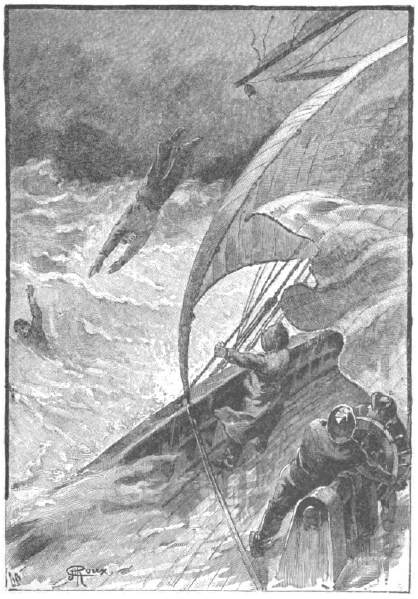
In another moment the Halbrane, staved in, broken up, with gaping
planks and shattered ribs, had sunk, causing a tremendous jet of
water to spout up at the foot of the iceberg.
Horrified! yes, indeed, we were horrified when the schooner, carried
off as though by an avalanche, had disappeared in the abyss! Not a
particle of our Halbrane remained, not even a wreck!
A minute ago she was one hundred feet in the air, now she was five
hundred in the depths of the sea! Yes, we were so stupefied that we
were unable to think of the dangers to come—our amazement was that
of people who “cannot believe their eyes.”
Prostration succeeded as a natural consequence. There was not a word
spoken. We stood motionless, with our feet rooted to the icy soil.
No words could express the horror of our situation!
As for West, when the schooner had disappeared in the abyss, I saw
big tears fall from his eyes. The Halbrane that he loved so much was
now an unknown quantity! Yes, our stout-hearted mate wept.
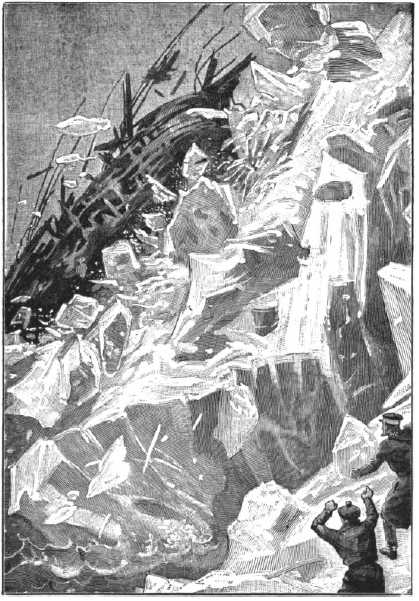
The Halbrane, staved in, broken up.
Three of our men had perished, and in what frightful fashion! I had
seen Rogers and Gratian, two of our most faithful sailors, stretch
out their hands in despair as they were knocked about by the
rebounding of the schooner, and finally sink with her! The other man
from the Falklands, an American, was crushed in its rush; his
shapeless form lay in a pool of blood. Three new victims within the
last ten days had to be inscribed on the register of those who died
during this fatal voyage! Ah! fortune had favoured us up to the hour
when the Halbrane was snatched from her own element, but her hand
was now against us. And was not this last the worst blow—must it
not prove the stroke of death?
The silence was broken by a tumult of despairing voices, whose
despair was justified indeed by this irreparable misfortune!
And I am sure that more than one thought it would have been better
to have been on the Halbrane as she rebounded off the side of the
iceberg!
Everything would have been over then, as all was over with Rogers
and Gratian! This foolish expedition would thus have come to a
conclusion worthy of such rashness and imprudence!
At last, the instinct of self-preservation triumphed, and except
Hearne, who stood some distance off and affected silence, all the
men shouted: “To the boat! to the boat!”
These unfortunate fellows were out of their mind. Terror led them
astray. They rushed towards the crag where our one boat (which could
not hold them all) had been sheltered during the unloading of the
schooner.
Captain Len Guy and Jem West rushed after them. I joined them
immediately, followed by the boatswain. We were armed, and resolved
to make use of our arms. We had to prevent these furious men from
seizing the boat, which did not belong to a few, but to all!
“Hallo, sailors!” cried the captain.
“Hallo!” repeated West, “stop there, or we fire on the first
who goes a step farther!”
Both threatened the men with their pistols. The boatswain pointed
his gun at them. I held my rifle, ready to fire.
It was in vain! The frenzied men heard nothing, would not hear
anything, and one of them fell, struck by the mate’s bullet, just
as he was crossing the last block. He was unable to catch on to the
bank with his hands, and slipping on the frozen slope, he
disappeared in the abyss.
Was this the beginning of a massacre? Would others let themselves be
killed at this place? Would the old hands side with the new-comers?
At that moment I remarked that Hardy, Martin Holt, Francis Bury, and
Stern hesitated about coming over to our side, while Hearne, still
standing motionless at some distance, gave no encouragement to the
rebels.
However, we could not allow them to become masters of the boat, to
bring it down, to embark ten or twelve men, and to abandon us to our
certain fate on this iceberg. They had almost reached the boat,
heedless of danger and deaf to threats, when a second report was
heard, and one of the sailors fell, by a bullet from the
boatswain’s gun.
One American and one Fuegian less to be numbered amongst the
sealing-master’s partisans!
Then, in front of the boat, a man appeared. It was Dirk Peters, who
had climbed the opposite slope.
The half-breed put one of his enormous hands on the stern and with
the other made a sign to the furious men to clear off. Dirk Peters
being there, we no longer needed our arms, as he alone would suffice
to protect the boat.
And indeed, as five or six of the sailors were advancing, he went up
to them, caught hold of the nearest by the belt, lifted him up, and
sent him flying ten paces off. The wretched man not being able to
catch hold of anything, would have rebounded into the sea had not
Hearne seized him.
Owing to the half-breed’s intervention the revolt was instantly
quelled. Besides, we were coming up to the boat, and with us those of
our men whose hesitation had not lasted long.
No matter. The others were still thirteen to our ten.
Captain Len Guy made his appearance; anger shone in his eyes, and with
him was West, quite unmoved. Words failed the captain for some
moments, but his looks said what his tongue could not utter. At length,
in a terrible voice, he said,—
“I ought to treat you as evil-doers; however, I will only consider
you as madmen! The boat belongs to everybody. It is now our only
means of salvation, and you wanted to steal it—to steal it like
cowards! Listen attentively to what I say for the last time! This
boat, belonging to the Halbrane, is now the Halbrane herself! I am
the captain of it, and let him who disobeys me, beware!”
With these last words Captain Len Guy looked at Hearne, for whom
this warning was expressly meant. The sealing-master had not
appeared in the last scene, not openly at least, but nobody doubted
that he had urged his comrades to make off with the boat, and that
he had every intention of doing the same again.
“Now to the camp,” said the captain, “and you, Dirk Peters,
remain here!”
The half-breed’s only reply was to nod his big head and betake
himself to his post.
The crew returned to the camp without the least hesitation. Some lay
down in their sleeping-places, others wandered about. Hearne neither
tried to join them nor to go near Martin Holt.
Now that the sailors were reduced to idleness, there was nothing to
do except to ponder on our critical situation, and invent some means
of getting out of it.
The captain, the mate, and the boatswain formed a council, and I
took part in their deliberations.
Captain Len Guy began by saying,—
“We have protected our boat, and we shall continue to protect
it.”
“Until death,” declared West.
“Who knows,” said I, “whether we shall not soon be forced to
embark?”
“In that case,” replied the captain, “as all cannot fit into
it, it will be necessary to make a selection. Lots shall determine
which of us are to go, and I shall not ask to be treated differently
from the others.”
“We have not come to that, luckily,” replied the boatswain.
“The iceberg is solid, and there is no fear of its melting before
winter.”
“No,” assented West, “that is not to be feared. What it
behoves us to do is, while watching the boat, to keep an eye on the
provisions.”
“We are lucky,” added Hurliguerly, “to have put our cargo in
safety. Poor, dear Halbrane. She will remain in these seas, like the
Jane, her elder sister!”
Yes, without doubt, and I thought so for many reasons, the one
destroyed by the savages of Tsalal, the other by one of these
catastrophes that no human power can prevent.
“You are right,” replied the captain, “and we must prevent our
men from plundering. We are sure of enough provisions for one year,
without counting what we may get by fishing.”
“And it is so much the more necessary, captain, to keep a close
watch, because I have seen some hovering about the spirit casks.”
“I will see to that,” replied West.
“But,” I then asked, “had we not better prepare ourselves for
the fact that we may be compelled to winter on this iceberg.”
“May Heaven avert such a terrible probability,” replied the
captain.
“After all, if it were necessary, we could get through it, Mr.
Jeorling,” said the boatswain. “We could hollow out
sheltering-places in the ice, so as to be able to bear the extreme
cold of the pole, and so long as we had sufficient to appease our
hunger—”
At this moment the horrid recollection of the Grampus came to my
mind—the scenes in which Dirk Peters killed Ned Holt, the brother
of our sailing-master. Should we ever be in such extremity?
Would it not, before we proceed to set up winter quarters for seven
or eight months, be better to leave the iceberg altogether, if such
a thing were possible?
I called the attention of Captain Len Guy and West to this point.
This was a difficult question to answer, and a long silence preceded
the reply.
At last the captain said,—
“Yes, that would be the best resolution to come to; and if our
boat could hold us all, with the provisions necessary for a voyage
that might last three or four weeks, I would not hesitate to put to
sea now and return towards the north.”
But I made them observe that we should be obliged to direct our
course contrary to wind and current; our schooner herself could
hardly have succeeded in doing this. Whilst to continue towards the
south—
“Towards the south?” repeated the captain, who looked at me as
though he sought to read my thoughts.
“Why not?” I answered. “If the iceberg had not been stopped
in its passage, perhaps it would have drifted to some land in that
direction, and might not our boat accomplish what it would have
done?”
The captain, shaking his head, answered nothing. West also was
silent.
“Eh! our iceberg will end by raising its anchor,” replied
Hurliguerly. “It does not hold to the bottom, like the Falklands
or the Kerguelens! So the safest course is to wait, as the boat
cannot carry twenty-three, the number of our party.”
I dwelt upon the fact that it was not necessary for all twenty-three
to embark. It would be sufficient, I said, for five or six of us to
reconnoitre further south for twelve or fifteen miles.
“South?” repeated Captain Len Guy.
“Undoubtedly, captain,” I added. “You probably know what the
geographers frankly admit, that the antarctic regions are formed by
a capped continent.”
“Geographers know nothing, and can know nothing about it,”
replied West, coldly.
“It is a pity,” said I, “that as we are so near, we should not
attempt to solve this question of a polar continent.”
I thought it better not to insist just at present.
Moreover there would be danger in sending out our only boat on a
voyage of discovery, as the current might carry it too far, or it
might not find us again in the same place. And, indeed, if the
iceberg happened to get loose at the bottom, and to resume its
interrupted drift, what would become of the men in the boat?
The drawback was that the boat was too small to carry us all, with
the necessary provisions. Now, of the seniors, there remained ten
men, counting Dirk Peters; of the new men there were thirteen;
twenty-three in all. The largest number our boat could hold was from
eleven to twelve persons. Then eleven of us, indicated by lot, would
have to remain on this island of ice. And what would become of them?
With regard to this Hurliguerly made a sound observation.
“After all,” he said, “I don’t know that those who would
embark would be better off than those who remained! I am so doubtful
of the result, that I would willingly give up my place to anyone who
wanted it.”
Perhaps the boatswain was right. But in my own mind, when I asked
that the boat might be utilized, it was only for the purpose of
reconnoitring the iceberg.
We finally decided to arrange everything with a view to wintering
out, even were our ice-mountain again to drift.
“We may be sure that will be agreed to by our men,” declared
Hurliguerly.
“What is necessary must be done,” replied the mate, “and
to-day we must set to work.”
That was a sad day on which we began our preparations.
Endicott, the cook, was the only man who submitted without
murmuring. As a negro, who cares little about the future, shallow
and frivolous like all his race, he resigned himself easily to his
fate; and this is, perhaps, true philosophy. Besides, when it came
to the question of cooking, it mattered very little to him whether
it was here or there, so long as his stoves were set up somewhere.
So he said to his friend the mate, with his broad negro smile,—
“Luckily my kitchen did not go off with the schooner, and you
shall see, Hurliguerly, if I do not make up dishes just as good as
on board the Halbrane, so long as provisions don’t grow scarce, of
course—”
“Well! they will not be wanting for some time to come,” replied
the boatswain. “We need not fear hunger, but cold, such cold as
would reduce you to an icicle the minute you cease to warm your
feet—cold that makes your skin crack and your skull split! Even if
we had some hundreds of tons of coal—But, all things being well
calculated, there is only just what will do to boil this large
kettle.”
“And that is sacred,” cried Endicott; “touching is forbidden!
The kitchen before all.”
“And that is the reason why it never strikes you to pity yourself,
you old nigger! You can always make sure of keeping your feet warm
at your oven!”
“What would you have, boatswain? You are a first-rate cook, or you
are not. When you are, you take advantage of it; but I will remember
to keep you a little place before my stove.”
“That’s good! that’s good, Endicott! Each one shall have his
turn! There is no privilege, even for a boatswain! On the whole, it
is better not to have to fear famine! One can fight against the
cold. We shall dig holes in the iceberg, and cuddle ourselves up
there. And why should we not have a general dwelling-room? We could
make a cave for ourselves with pickaxes! I have heard tell that ice
preserves heat. Well, let it preserve ours, and that is all I ask of
it!”
The hour had come for us to return to the camp and to seek our
sleeping-places.
Dirk Peters alone refused to be relieved of his duty as watchman of
the boat, and nobody thought of disputing the post with him.
Captain Len Guy and West did not enter the tents until they had made
certain that Hearne and his companions had gone to their usual place
of rest.
I came back likewise and went to bed.
I could not tell how long I had been sleeping, nor what time it was,
when I found myself rolling on the ground after a violent shock.
What could be happening? Was it another capsize of the iceberg?
We were all up in a second, then outside the tents in the full light
of a night in the polar regions.
A second floating mass of enormous size had just struck our iceberg,
which had “hoisted the anchor” (as the sailors say) and was
drifting towards the south.
An unhoped-for change in the situation had taken place. What were to
be the consequences of our being no longer cast away at that place?
The current was now carrying us in the direction of the pole! The
first feeling of joy inspired by this conviction was, however,
succeeded by all the terrors of the unknown! and what an unknown!
Dirk Peters only was entirely rejoiced that we had resumed the route
which, he believed, would lead us to the discovery of traces of his
“poor Pym”—far other ideas occupied the minds of his companions.
Captain Len Guy no longer entertained any hope of rescuing his
countrymen, and having reached the condition of despair, he was
bound by his duty to take his crew back to the north, so as to clear
the antarctic circle while the season rendered it possible to do so.
And we were being carried away towards the south!
Naturally enough, we were all deeply impressed by the fearfulness of
our position, which may be summed up in a few words. We were no
longer cast away, with a possible ship, but the tenants of a
floating iceberg, with no hope but that our monster tenement might
encounter one of the whaling ships whose business in the deep waters
lies between the Orkneys, New Georgia, and the Sandwich Islands. A
quantity of things had been thrown into the ice by the collision
which had set our iceberg afloat, but these were chiefly articles
belonging to the Halbrane. Owing to the precaution that had been
taken on the previous day, when the cargo was stowed away in the
clefts, it had been only slightly damaged. What would have become of
us, had all our reserves been swallowed up in that grim encounter?
Now, the two icebergs formed but one, which was travelling south at
the rate of two miles an hour. At this rate, thirty hours would
suffice to bring us to the point of the axis at which the
terrestrial meridians unite. Did the current which was carrying us
along pass on to the pole itself, or was there any land which might
arrest our progress? This was another question, and I discussed it
with the boatswain.
“Nobody knows, Mr. Jeorling,” was Hurliguerly’s reply. “If
the current goes to the pole, we shall go there; and if it
doesn’t, we shan’t. An iceberg isn’t a ship, and as it has
neither sails nor helm, it goes as the drift takes it.”
“That’s true, boatswain. And therefore I had the idea that if
two or three of us were to embark in the boat—”
“Ah! you still hold to your notion of the boat—”
“Certainly, for, if there is land somewhere, is it not possible
that the people of the Jane—”
“Have come upon it, Mr. Jeorling—at four thousand miles from
Tsalal Island.”
“Who knows, boatswain?”
“That may be, but allow me to say that your argument will be
reasonable when the land comes in sight, if it ever does so. Our
captain will see what ought to be done, and he will remember that
time presses. We cannot delay in these waters, and, after all, the
one thing of real importance to us is to get out of the polar circle
before the winter makes it impassable.”
There was good sense in Hurliguerly’s words; I could not deny the
fact.
During that day the greater part of the cargo was placed in the
interior of a vast cave-like fissure in the side of the iceberg,
where, even in case of a second collision, casks and barrels would
be in safety. Our men then assisted Endicott to set up his
cooking-stove between two blocks, so that it was firmly fixed, and
they heaped up a great mass of coals close to it.
No murmurs, no recrimination disturbed these labours. It was evident
that silence was deliberately maintained. The crew obeyed the
captain and West because they gave no orders but such as were of
urgent necessity. But, afterwards, would these men allow the
authority of their leaders to be uncontested? How long would the
recruits from the Falklands, who were already exasperated by the
disasters of our enterprise, resist their desire to seize upon the
boat and escape?
I did not think they would make the attempt, however, so long as our
iceberg should continue to drift, for the boat could not outstrip
its progress; but, if it were to run aground once more, to strike
upon the coast of an island or a continent, what would not these
unfortunate creatures do to escape the horrors of wintering under
such conditions?
In the afternoon, during the hour of rest allowed to the crew, I had
a second conversation with Dirk Peters. I had taken my customary
seat at the top of the iceberg, and had occupied it for half an
hour, being, as may be supposed, deep in thought, when I saw the
half-breed coming quickly up the slope. We had exchanged hardly a
dozen words since the iceberg had begun to move again. When Dirk
Peters came up to me, he did not address me at first, and was so
intent on his thoughts that I was not quite sure he saw me. At
length, he leaned back against an ice-block, and spoke:
“Mr. Jeorling,” he said, “you remember, in your cabin in the
Halbrane, I told you the—the affair of the Grampus?”
I remembered well.
“I told you that Parker’s name was not Parker, that it was Holt,
and that he was Ned Holt’s brother?”
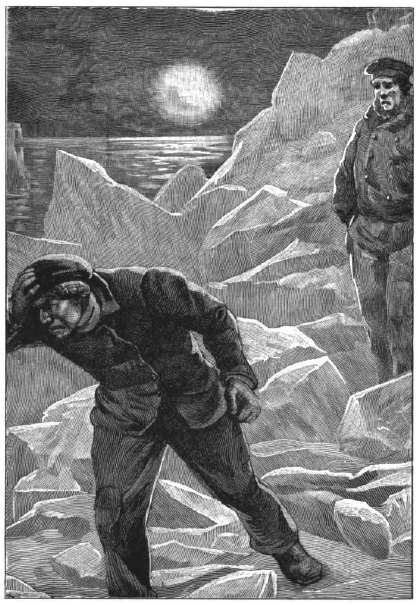
“I was afraid; I got away from him.”
“I know, Dirk Peters,” I replied, “but why do you refer to
that sad story again?”
“Why, Mr. Jeorling? Have not—have you never said anything about
it to anybody?”
“Not to anybody,” I protested. “How could you suppose I should
be so ill-advised, so imprudent, as to divulge your secret, a secret
which ought never to pass our lips—a dead secret?”
“Dead, yes, dead! And yet, understand me, it seems to me that,
among the crew, something is known.”
I instantly recalled to mind what the boatswain had told me
concerning a certain conversation in which he had overheard Hearne
prompting Martin Holt to ask the half-breed what were the
circumstances of his brother’s death on board the Grampus. Had a
portion of the secret got out, or was this apprehension on the part
of Dirk Peters purely imaginary?
“Explain yourself,” I said.
“Understand me, Mr. Jeorling, I am a bad hand at explaining. Yes,
yesterday—I have thought of nothing else since—Martin Holt took
me aside, far from the others, and told me that he wished to speak
to me—”
“Of the Grampus?”
“Of the Grampus—yes, and of his brother, Ned Holt. For the first
time he uttered that name before me—and yet we have sailed
together for nearly three months.”
The half-breed’s voice was so changed that I could hardly hear him.
“It seemed to me,” he resumed, “that in Martin Holt’s
mind—no, I was not mistaken—there was something like a suspicion.”
“But tell me what he said! Tell me exactly what he asked you. What is
it?”
I felt sure that the question put by Martin Holt, whatsoever its
bearing, had been inspired by Hearne. Nevertheless, as I considered
it well that the half-breed should know nothing of the
sealing-master’s disquieting and inexplicable intervention in this
tragic affair, I decided upon concealing it from him.
“He asked me,” replied Dirk Peters, “did I not remember Ned
Holt of the Grampus, and whether he had perished in the fight with
the mutineers or in the shipwreck; whether he was one of the men who
had been abandoned with Captain Barnard; in short, he asked me if I
could tell him how his brother died. Ah! how!”
No idea could be conveyed of the horror with which the half-breed
uttered words which revealed a profound loathing of himself.
“And what answer did you make to Martin Holt?”
“None, none!”
“You should have said that Ned Holt perished in the wreck of the
brig.”
“I could not—understand me—I could not. The two brothers are
so like each other. In Martin Holt I seemed to see Ned Holt. I was
afraid, I got away from him.”
The half-breed drew himself up with a sudden movement, and I sat
thinking, leaning my head on my hands. These tardy questions of
Holt’s respecting his brother were put, I had no doubt whatsoever,
at the instigation of Hearne, but what was his motive, and was it at
the Falklands that he had discovered the secret of Dirk Peters? I
had not breathed a word on the subject to anyone. To the second
question no answer suggested itself; the first involved a serious
issue. Did the sealing-master merely desire to gratify his enmity
against Dirk Peters, the only one of the Falkland sailors who had
always taken the side of Captain Len Guy, and who had prevented the
seizure of the boat by Hearne and his companions? Did he hope, by
arousing the wrath and vengeance of Martin Holt, to detach the
sailing-master from his allegiance and induce him to become an
accomplice in Hearne’s own designs? And, in fact, when it was a
question of sailing the boat in these seas, had he not imperative
need of Martin Holt, one of the best seamen of the Halbrane? A man
who would succeed where Hearne and his companions would fail, if
they had only themselves to depend on?
I became lost in this labyrinth of hypotheses, and it must be
admitted that its complications added largely to the troubles of an
already complicated position.
When I raised my eyes, Dirk Peters had disappeared; he had said what
he came to say, and he now knew that I had not betrayed his
confidence.
The customary precautions were taken for the night, no individual
being allowed to remain outside the camp, with the exception of the
half-breed, who was in charge of the boat.
The following day was the 31st of January. I pushed back the canvas
of the tent, which I shared with Captain Len Guy and West
respectively, as each succeeded the other on release from the
alternate “watch,” very early, and experienced a severe
disappointment.
Mist, everywhere! Nay, more than mist, a thick yellow,
mouldy-smelling fog. And more than this again; the temperature had
fallen sensibly: this was probably a forewarning of the austral
winter. The summit of our ice-mountain was lost in vapour, in a fog
which would not resolve itself into rain, but would continue to
muffle up the horizon.
“Bad luck!” said the boatswain, “for now if we were to pass by
land we should not perceive it.”
“And our drift?”
“More considerable than yesterday, Mr. Jeorling. The captain has
sounded, and he makes the speed no less than between three and four
miles.”
“And what do you conclude from this?”
“I conclude that we must be within a narrower sea, since the
current is so strong. I should not be surprised if we had land on
both sides of us within ten or fifteen miles.”
“This, then, would be a wide strait that cuts the antarctic
continent?”
“Yes. Our captain is of that opinion.”
“And, holding that opinion, is he not going to make an attempt to
reach one or other of the coasts of this strait?”
“And how?”
“With the boat.”
“Risk the boat in the midst of this fog!” exclaimed the
boatswain, as he crossed his arms. “What are you thinking of, Mr.
Jeorling? Can we cast anchor to wait for it? And all the chances
would be that we should never see it again. Ah! if we only had the
Halbrane!”
But there was no longer a Halbrane!
In spite of the difficulty of the ascent through the half-condensed
vapour, I climbed up to the top of the iceberg, but when I had
gained that eminence I strove in vain to pierce the impenetrable
grey mantle in which the waters were wrapped.
I remained there, hustled by the north-east wind, which was
beginning to blow freshly and might perhaps rend the fog asunder.
But no, fresh vapours accumulated around our floating refuge, driven
up by the immense ventilation of the open sea. Under the double
action of the atmospheric and antarctic currents, we drifted more
and more rapidly, and I perceived a sort of shudder pass throughout
the vast bulk of the iceberg.
Then it was that I felt myself under the dominion of a sort of
hallucination, one of those hallucinations which must have troubled
the mind of Arthur Pym. It seemed to me that I was losing myself in
his extraordinary personality; at last I was beholding all that he
had seen! Was not that impenetrable mist the curtain of vapours
which he had seen in his delirium? I peered into it, seeking for
those luminous rays which had streaked the sky from east to west! I
sought in its depths for that limitless cataract, rolling in silence
from the height of some immense rampart lost in the vastness of the
zenith! I sought for the awful white giant of the South Pole!
At length reason resumed her sway. This visionary madness,
intoxicating while it lasted, passed off by degrees, and I descended
the slope to our camp.
The whole day passed without a change. The fog never once lifted to
give us a glimpse outside of its muffling folds, and if the iceberg,
which had travelled forty miles since the previous day, had passed
by the extremity of the axis of the earth, we should never know it.
![[Illustration]](https://openoldbooks.sgp1.digitaloceanspaces.com/books/an-antarctic-mystery/images/colophon.jpg)