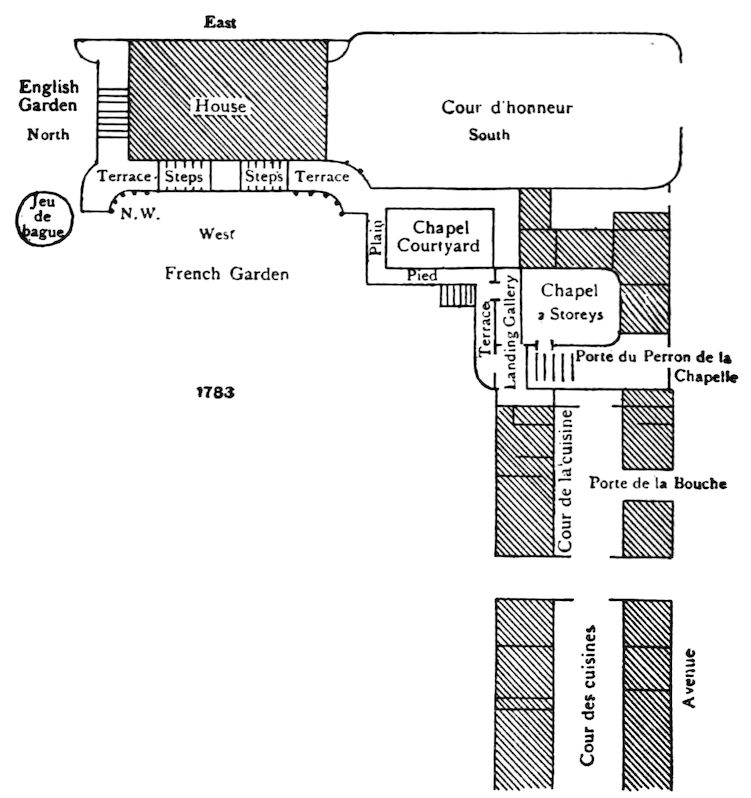
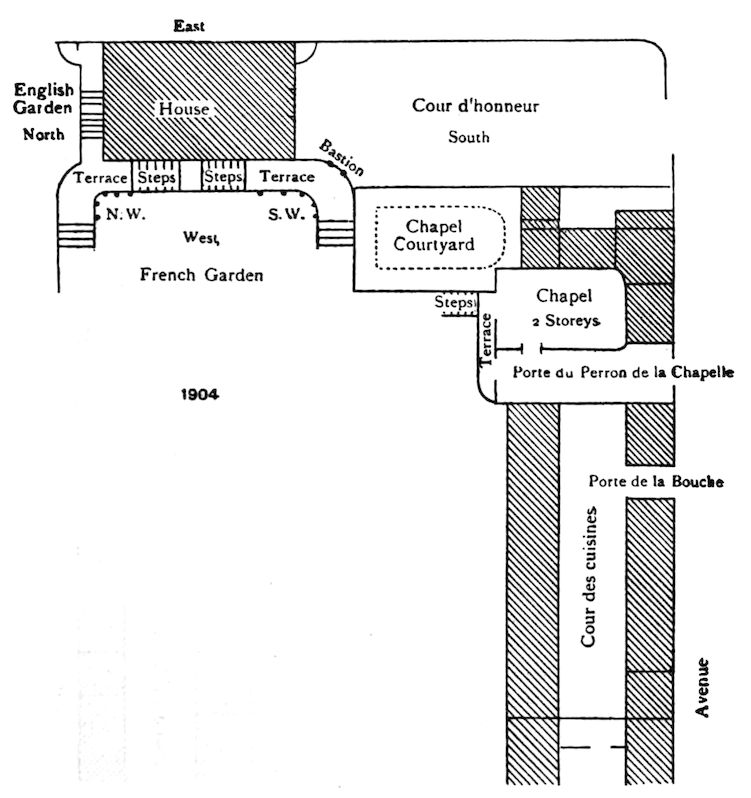
The cover image was created by the transcriber and is placed in the public domain.
MACMILLAN AND CO., LIMITED
ST. MARTIN’S STREET, LONDON
1911
GLASGOW: PRINTED AT THE UNIVERSITY PRESS
BY ROBERT MACLEHOSE AND CO. LTD.
PREFACE — PUBLISHERS’ NOTE
v
It is a great venture to speak openly of a
personal experience, and we only do so for
the following reasons. First, we prefer that
our story, which is known in part to some,
should be wholly known as told by ourselves.
Secondly, we have collected so much evidence
on the subject, that it is possible now to
consider it as a whole. Thirdly, conditions
are changing at Versailles, and in a short
time facts which were unknown, and circumstances
which were unusual, may soon become
commonplaces, and will lose their force as
evidence that some curious psychological conditions
must have been present, either in
ourselves, or in the place.
It is not our business to explain or to
understand—nor do we pretend to understand—what
happened to put us into communication
with so many true facts, which, nine
viyears ago, no one could have told us of in
their entirety. But, in order that others may
be able to judge fairly of all the circumstances,
we have tried to record exactly what
happened as simply and fully as possible.
ELIZABETH MORISON.
FRANCES LAMONT.
The ladies whose Adventure is described in
these pages have for various reasons preferred
not to disclose their real names, but the
signatures appended to the Preface are the
only fictitious words in the book. The Publishers
guarantee that the Authors have put
down what happened to them as faithfully and
accurately as was in their power.
CHAPTER I VISITS TO THE PETIT TRIANON — Miss Morison’s Account of the First Visit to the Petit Trianon — Miss Lamont’s Account of her First Visit to the Petit Trianon in 1901 — Miss Lamont’s Account of her Second Visit to the Petit Trianon — 1902–4.
1
August, 1901
After some days of sight-seeing in Paris, to
which we were almost strangers, on an August
afternoon, 1901, Miss Lamont and I went to
Versailles. We had very hazy ideas as to
where it was or what there was to be seen.
Both of us thought it might prove to be a dull
expedition. We went by train, and walked
through the rooms and galleries of the Palace
with interest, though we constantly regretted
our inability through ignorance to feel properly
the charm of the place. My knowledge of
French history was limited to the very little I
had learnt in the schoolroom, historical novels,
2and the first volume of Justin M’Carthy’s
French Revolution. Over thirty years before
my brother had written a prize poem on Marie
Antoinette, for whom at the time I had felt
much enthusiasm. But the German occupation
was chiefly in our minds, and Miss Lamont
and I thought and spoke of it several times.
We sat down in the Salle des Glaces, where
a very sweet air was blowing in at the open
windows over the flower-beds below, and finding
that there was time to spare, I suggested
our going to the Petit Trianon. My sole
knowledge of it was from a magazine article
read as a girl, from which I received a general
impression that it was a farmhouse where the
Queen had amused herself.
Looking in Baedeker’s map we saw the sort
of direction and that there were two Trianons,
and set off. By not asking the way we went
an unnecessarily long way round,—by the great
flights of steps from the fountains and down the
central avenue as far as the head of the long
pond. The weather had been very hot all the
week, but on this day the sky was a little
overcast and the sun shaded. There was a
lively wind blowing, the woods were looking
3their best, and we both felt particularly
vigorous. It was a most enjoyable walk.
After reaching the beginning of the long
water we struck away to the right down a
woodland glade until we came obliquely to the
other water close to the building, which we
rightly concluded to be the Grand Trianon.
We passed it on our left hand, and came up
a broad green drive perfectly deserted. If
we had followed it we should have come
immediately to the Petit Trianon, but not
knowing its position, we crossed the drive and
went up a lane in front of us. I was surprised
that Miss Lamont did not ask the way from a
woman who was shaking a white cloth out of
the window of a building at the corner of the
lane, but followed, supposing that she knew
where she was going to. Talking about
England and mutual acquaintances there, we
went up the lane, and then made a sharp turn
to the right past some buildings. We looked
in at an open doorway and saw the end of a
carved staircase, but as no one was about we
did not like to go in. There were three paths
in front of us, and as we saw two men a little
ahead on the centre one, we followed it, and
4asked them the way. Afterwards we spoke
of them as gardeners, because we remembered
a wheelbarrow of some kind close by and the
look of a pointed spade, but they were really
very dignified officials, dressed in long greyish-green
coats with small three-cornered hats.
They directed us straight on.
We walked briskly forward, talking as before,
but from the moment we left the lane an extraordinary
depression had come over me, which,
in spite of every effort to shake off, steadily
deepened. There seemed to be absolutely no
reason for it; I was not at all tired, and was
becoming more interested in my surroundings.
I was anxious that my companion should not
discover the sudden gloom upon my spirits,
which became quite overpowering on reaching
the point where the path ended, being crossed
by another, right and left.
In front of us was a wood, within which, and
overshadowed by trees, was a light garden
kiosk, circular, and like a small bandstand, by
which a man was sitting. There was no green
sward, but the ground was covered with rough
grass and dead leaves as in a wood. The
place was so shut in that we could not see
5beyond it. Everything suddenly looked unnatural,
therefore unpleasant; even the trees
behind the building seemed to have become
flat and lifeless, like a wood worked in tapestry.
There were no effects of light and shade, and
no wind stirred the trees. It was all intensely
still.
The man sitting close to the kiosk (who had
on a cloak and a large shady hat) turned his
head and looked at us. That was the culmination
of my peculiar sensations, and I felt a
moment of genuine alarm. The man’s face
was most repulsive,—its expression odious.
His complexion was very dark and rough. I
said to Miss Lamont, “Which is our way?”
but thought “nothing will induce me to go to
the left.” It was a great relief at that moment
to hear someone running up to us in breathless
haste. Connecting the sound with the
gardeners, I turned and ascertained that there
was no one on the paths, either to the side or
behind; but at almost the same moment I
suddenly perceived another man quite close
to us, behind and rather to the left hand,
who had, apparently, just come either over or
through the rock (or whatever it was) that
6shut out the view at the junction of the paths.
The suddenness of his appearance was something
of a shock.
The second man was distinctly a gentleman;
he was tall, with large dark eyes, and had
crisp, curling black hair under the same large
sombrero hat. He was handsome, and the
effect of the hair was to make him look like
an old picture. His face was glowing red as
through great exertion,—as though he had
come a long way. At first I thought he was
sunburnt, but a second look satisfied me that
the colour was from heat, not sunburning. He
had on a dark cloak wrapped across him like
a scarf, one end flying out in his prodigious
hurry. He looked greatly excited as he
called out to us, “Mesdames, Mesdames,” or
(“Madame” pronounced more as the other),
“il ne faut (pronounced fout) pas passer par
là.” He then waved his arm, and said with
great animation, “par ici ... cherchez la
maison.”[1]
I was so surprised at his eagerness that I
looked up at him again, and to this he responded
with a little backward movement and
7a most peculiar smile. Though I could not
follow all he said, it was clear that he was
determined that we should go to the right and
not to the left. As this fell in with my own
wish, I went instantly towards a little bridge
on the right, and turning my head to join Miss
Lamont in thanking him, found, to my surprise,
that he was not there, but the running began
again and from the sound it was close beside
us.
Silently we passed over the small rustic
bridge which crossed a tiny ravine. So close
to us when on the bridge that we could have
touched it with our right hands, a thread-like
cascade fell from a height down a green
pretty bank, where ferns grew between stones.
Where the little trickle of water went to I
did not see, but it gave me the impression
that we were near other water, though I saw
none.
Beyond the little bridge our pathway led
under trees; it skirted a narrow meadow of
long grass, bounded on the further side by
trees, and very much overshadowed by trees
growing in it. This gave the whole place a
sombre look suggestive of dampness, and
8shut out the view of the house until we
were close to it. The house was a square,
solidly-built small country house;—quite
different from what I expected. The long
windows looking north into the English
garden (where we were) were shuttered.
There was a terrace round the north and
west sides of the house, and on the rough
grass which grew quite up to the terrace and
with her back to it, a lady was sitting, holding
out a paper as though to look at it at arm’s
length. I supposed her to be sketching, and
to have brought her own camp-stool. It
seemed as though she must be making a
study of trees, for they grew close in front of
her, and there seemed to be nothing else to
sketch. She saw us, and when we passed
close by on her left hand, she turned and
looked full at us. It was not a young face,
and (though rather pretty) it did not attract
me. She had on a shady white hat perched
on a good deal of fair hair that fluffed round
her forehead. Her light summer dress was
arranged on her shoulders in handkerchief
fashion, and there was a little line of either
green or gold near the edge of the handkerchief,
9which showed me that it was over, not
tucked into, her bodice, which was cut low.
Her dress was long-waisted, with a good deal
of fullness in the skirt, which seemed to be
short. I thought she was a tourist, but that
her dress was old-fashioned and rather
unusual (though people were wearing fichu
bodices that summer). I looked straight at
her; but some indescribable feeling made me
turn away annoyed at her being there.
We went up the steps on to the terrace,
my impression being that they led up
direct from the English garden; but I was
beginning to feel as though we were walking
in a dream,—the stillness and oppressiveness
were so unnatural. Again I saw the lady,
this time from behind, and noticed that her
fichu was pale green. It was rather a relief
to me that Miss Lamont did not propose to
ask her whether we could enter the house
from that side.
We crossed the terrace to the south-west
corner and looked over into the cour d’honneur;
and then turned back, and seeing that one
of the long windows overlooking the French
garden was unshuttered, we were going towards
10it when we were interrupted. The terrace was
prolonged at right angles in front of what
seemed to be a second house. The door of it
suddenly opened, and a young man stepped out
on to the terrace, banging the door behind him.
He had the jaunty manner of a footman, but
no livery, and called to us, saying that the way
into the house was by the cour d’honneur, and
offered to show us the way round. He looked
inquisitively amused as he walked by us down
the French garden till we came to an entrance
into the front drive. We came out sufficiently
near the first lane we had been in to make
me wonder why the garden officials had not
directed us back instead of telling us to go
forward.
When we were in the front entrance hall we
were kept waiting for the arrival of a merry
French wedding party. They walked arm in
arm in a long procession round the rooms, and
we were at the back,—too far off from the
guide to hear much of his story. We were
very much interested, and felt quite lively
again. Coming out of the cour d’honneur we
took a little carriage which was standing there,
and drove back to the Hotel des Réservoirs in
11Versailles, where we had tea[2]; but we were
neither of us inclined to talk, and did not
mention any of the events of the afternoon.
After tea we walked back to the station, looking
on the way for the Tennis Court.
On the way back to Paris the setting sun at
last burst out from under the clouds, bathing
the distant Versailles woods in glowing light,—Valerien
standing out in front a mass of
deep purple. Again and again the thought
returned,—Was Marie Antoinette really much
at Trianon, and did she see it for the last time
long before the fatal drive to Paris accompanied
by the mob?
For a whole week we never alluded to that
afternoon, nor did I think about it until I
began writing a descriptive letter of our expeditions
of the week before. As the scenes
came back one by one, the same sensation of
dreamy unnatural oppression came over me
so strongly that I stopped writing, and said to
Miss Lamont, “Do you think that the Petit
Trianon is haunted?” Her answer was prompt,
12“Yes, I do.” I asked her where she felt it, and
she said, “In the garden where we met the two
men, but not only there.” She then described
her feeling of depression and anxiety which
began at the same point as it did with me, and
how she tried not to let me know it. Talking
it over we fully realised, for the first time, the
theatrical appearance of the man who spoke to
us, the inappropriateness of the wrapped cloak
on a warm summer afternoon, the unaccountableness
of his coming and going, the excited
running which seemed to begin and end close
to us, and yet always out of sight, and the
extreme earnestness with which he desired us
to go one way and not another. I said that
the thought had crossed my mind that the two
men were going to fight a duel, and that they
were waiting until we were gone. Miss Lamont
owned to having disliked the thought of passing
the man of the kiosk.
We did not speak again of the incident
during my stay in Paris, though we visited
the Conciergerie prisons, and the tombs of
Louis XVI. and Marie Antoinette at Saint
Denis, where all was clear and fresh and
natural.
13Three months later Miss Lamont came to stay
with me, and on Sunday, November 10th, 1901,
we returned to the subject, and I said, “If we
had known that a lady was sitting so near us
sketching it would have made all the difference,
for we should have asked the way.” She
replied that she had seen no lady. I reminded
her of the person sitting under the terrace; but
Miss Lamont declared that there was no one
there. I exclaimed that it was impossible that
she should not have seen the individual; for we
were walking side by side and went straight up
to her, passed her and looked down upon her
from the terrace. It was inconceivable to us
both that she should not have seen the lady,
but the fact was clear that Miss Lamont had
not done so, though we had both been rather
on the lookout for someone who would reassure
us as to whether we were trespassing or
not.
Finding that we had a new element of
mystery, and doubting how far we had seen
any of the same things, we resolved to write
down independent accounts of our expedition
to Trianon, read up its history, and make
every enquiry about the place. Miss Lamont
14returned to her school the same evening, and
two days later I received from her a very
interesting letter, giving the result of her first
enquiries.
E. M.
November, 1901.
15
August, 1901
In the summer of 1900 I stayed in Paris for
the first time, and in the course of that summer
took a flat and furnished it, intending to place a
French lady there in charge of my elder schoolgirls.
Paris was quite new to me, and beyond
seeing the picture galleries and one or two
churches I made no expeditions except to shops,
for the Exhibition of 1900 was going on, and
all my free time was spent in seeing it with my
French friends. The next summer, however,
1901, when, after several months at my school
in England, I came back to Paris, it was to
take the first opportunity possible of having a
visitor to stay there: and I asked Miss Morison
to come with me.
Miss Morison suggested our seeing the historic
part of Paris in something like chronological
order, and I looked forward to seeing it
16practically for the first time with her. We
decided to go to Versailles one day, though
rather reluctantly, as we felt it was diverging
from our plan to go there too soon. I did not
know what to expect, as my ignorance of the
place and its significance was extreme. So we
looked up general directions in Baedeker, and
trusted to finding our way at the time.
After spending some time in the Palace, we
went down by the terrace and struck to the
right to find the Petit Trianon. We walked
for some distance down a wooded alley, and
then came upon the buildings of the Grand
Trianon, before which we did not delay. We
went on in the direction of the Petit Trianon,
but just before reaching what we knew afterwards
to be the main entrance I saw a gate
leading to a path cut deep below the level of
the ground above, and as the way was open
and had the look of an entrance that was used,
I said: “Shall we try this path? it must lead
to the house,” and we followed it. To our
right we saw some farm-buildings looking
empty and deserted; implements (among others
a plough) were lying about; we looked in, but
saw no one. The impression was saddening,
17but it was not until we reached the crest of the
rising ground where there was a garden that
I began to feel as if we had lost our way, and
as if something were wrong. There were two
men there in official dress (greenish in colour),
with something in their hands; it might have
been a staff. A wheelbarrow and some other
gardening tools were near them. They told us,
in answer to my enquiry, to go straight on.
I remember repeating my question, because
they answered in a seemingly casual and
mechanical way, but only got the same answer
in the same manner. As we were standing
there I saw to the right of us a detached
solidly-built cottage, with stone steps at the
door. A woman and a girl were standing at
the doorway, and I particularly noticed their
unusual dress; both wore white kerchiefs tucked
into the bodice, and the girl’s dress, though she
looked 13 or 14 only, was down to her ankles.
The woman was passing a jug to the girl, who
wore a close white cap.[3]
18Following the directions of the two men we
walked on: but the path pointed out to us
seemed to lead away from where we imagined
the Petit Trianon to be; and there was a
feeling of depression and loneliness about the
place. I began to feel as if I were walking in
my sleep; the heavy dreaminess was oppressive.
At last we came upon a path crossing ours, and
saw in front of us a building consisting of some
columns roofed in, and set back in the trees.
Seated on the steps was a man with a heavy
black cloak round his shoulders, and wearing a
slouch hat. At that moment the eerie feeling
which had begun in the garden culminated in a
definite impression of something uncanny and
fear-inspiring. The man slowly turned his face,
which was marked by smallpox: his complexion
was very dark. The expression was
very evil and yet unseeing, and though I did
not feel that he was looking particularly at us, I
felt a repugnance to going past him. But I did
not wish to show the feeling, which I thought
was meaningless, and we talked about the
19best way to turn, and decided to go to the
right.
Suddenly we heard a man running behind us:
he shouted, “Mesdames, mesdames,” and when
I turned he said in an accent that seemed to
me unusual that our way lay in another direction.
“Il ne faut (pronounced fout) pas passer
par là.” He then made a gesture, adding “par
ici ... cherchez la maison.” Though we
were surprised to be addressed, we were glad
of the direction, and I thanked him. The man
ran off with a curious smile on his face: the
running ceased as abruptly as it had begun, not
far from where we stood. I remember that the
man was young-looking, with a florid complexion
and rather long dark hair. I do not remember
the dress, except that the material was dark and
heavy, and that the man wore buckled shoes.
We walked on, crossing a small bridge
that went across a green bank, high on our
right hand and shelving down below as to a
very small overshadowed pool of water glimmering
some way off. A tiny stream descended
from above us, so small as to seem to lose itself
before reaching the little pool. We then followed
a narrow path till almost immediately we
20came upon the English garden front of the
Petit Trianon. The place was deserted; but
as we approached the terrace I remember
drawing my skirt away with a feeling as though
someone were near and I had to make room,
and then wondering why I did it. While we
were on the terrace a boy came out of the door
of a second building which opened on it, and I
still have the sound in my ears of his slamming
it behind him. He directed us to go round to
the other entrance, and seeing us hesitate, with
the peculiar smile of suppressed mockery,
offered to show us the way. We passed
through the French garden, part of which was
walled in by trees. The feeling of dreariness
was very strong there, and continued till we
actually reached the front entrance to the Petit
Trianon and looked round the room in the
wake of a French wedding party. Afterwards
we drove back to the Rue des Réservoirs.
The impression returned to me at intervals
during the week that followed, but I did not
speak of it until Miss Morison asked me if I
thought the Petit Trianon was haunted, and I
said Yes. Then, too, the inconsistency of the
dress and behaviour of the man with an August
21afternoon at Versailles struck me. We had
only this one conversation about the two men.
Nothing else passed between us in Paris.
It was not till three months later, when I
was staying with her, that Miss Morison
casually mentioned the lady, and almost refused
to believe that I had not seen her. How that
happened was quite inexplicable to me, for I
believed myself to be looking about on all
sides, and it was not so much that I did not
remember her as that I could have said no one
was there. But as she said it I remembered
my impression at the moment of there being
more people than I could see, though I did
not tell her this.
The same evening, November 10th, 1901, I
returned to my school near London. Curiously
enough, the next morning I had to give one of
a set of lessons on the French Revolution for
the Higher Certificate, and it struck me for the
first time with great interest that the 10th of
August had a special significance in French
history, and that we had been at Trianon on
the anniversary of the day.
That evening when I was preparing to write
down my experiences, a French friend whose
22home was in Paris came into my room, and
I asked her, just on the chance, if she knew
any story about the haunting of the Petit
Trianon. (I had not mentioned our story to
her before, nor indeed to anyone.) She said
directly that she remembered hearing from
friends at Versailles that on a certain day in
August Marie Antoinette is regularly seen
sitting outside the garden front at the Petit
Trianon, with a light flapping hat and a pink
dress. More than this, that the place, especially
the farm, the garden, and the path by the
water, are peopled with those who used to be
with her there; in fact that all the occupations
and amusements reproduce themselves there
for a day and a night. I then told her our
story, and when I quoted the words that the
man spoke to us, and imitated as well as I
could his accent, she immediately said that it
was the Austrian pronunciation of French. I
had privately thought that he spoke old[4]
French. Immediately afterwards I wrote and
told this to Miss Morison.
F. L.
November, 1901.
23On receiving Miss Lamont’s letter I turned
to my diary to see on what Saturday in August
it was that we had visited Versailles, and
looked up the history to find out to what
event she alluded. On August 10th, 1792,
the Tuileries was sacked. The royal family
escaped in the early morning to the Hall of
the Assembly, where they were penned up for
many hours hearing themselves deposed, and
within sound of the massacre of their servants
and of the Swiss guards at the Tuileries.
From the Hall the King and Queen were
taken to the Temple.
We wondered whether we had inadvertently
entered within an act of the Queen’s memory
when alive, and whether this explained our
curious sensation of being completely shut in
and oppressed. What more likely, we thought,
than that during those hours in the Hall of
the Assembly, or in the Conciergerie, she had
gone back in such vivid memory to other
Augusts spent at Trianon that some impress of
24it was imparted to the place? Some pictures
which were shown to me proved that the outdoor
dress of the gentlemen at Court had been
a large hat and cloak, and that the ladies wore
long-waisted bodices, with full gathered short
skirts, fichus, and hats.
I told the story to my brother, and we
heartily agreed that, as a rule, such stories
made no impression at all upon us, because
we always believed that, if only the persons
involved would take the trouble to investigate
them thoroughly and honestly for themselves,
they could be quite naturally explained. We
agreed that such a story as ours had very little
value without more proof of reality than it had,
but that as there were one or two interesting
points in it, it would be best to sift the matter
quietly, lest others should make more of them
than they deserved. He suggested lightly and
in fun that perhaps we had seen the Queen as
she thought of herself, and that it would be
interesting to know whether the dress described
was the one she had on at the time of her
rêverie, or whether it was one she recollected
having worn at an earlier date. My brother
also enquired whether we were quite sure that
25the last man we had seen (who came out of the
side building), as well as the wedding party,
were all real persons. I assured him with
great amusement that we had not the smallest
doubt as to the reality of them all.
As Miss Lamont was going to Paris for the
Christmas holidays, I wrote and asked her to
take any opportunity she might have to see the
place again, and to make a plan of the paths
and the buildings; for the guide books spoke
of the Temple de l’Amour and the Belvédère,
and I thought one of them might prove to be
our kiosk.
E. M.
26
January, 1902
On January 2nd, 1902, I went for the second
time to Versailles. It was a cold and wet day,
but I was anxious not to be deterred by that, as
it was likely to be my only possible day that
winter. This time I drove straight to the
Petit Trianon, passing the Grand Trianon.
Here I could see the path up which we had
walked in August. I went, however, to the
regular entrance, thinking I would go at once to
the Temple de l’Amour, even if I had time to go
no further. To the right of the cour d’honneur
was a door in the wall; it led to the Hameau
de la Reine and to the gardens. I took this
path and came to the Temple de l’Amour,
which was not the building we had passed in
the summer. There was, so far, none of the
eerie feeling we had experienced in August.
But, on crossing a bridge to go to the Hameau,
27the old feeling returned in full force; it was
as if I had crossed a line and was suddenly
in a circle of influence. To the left I saw a
tract of park-like ground, the trees bare and
very scanty. I noticed a cart being filled with
sticks by two labourers, and thought I could go
to them for directions if I lost my way. The
men wore tunics and capes with pointed hoods
of bright colours, a sort of terra-cotta red and
deep blue.[5] I turned aside for an instant—not
more—to look at the Hameau, and when I
looked back men and cart were completely out
of sight, and this surprised me, as I could see a
long way in every direction. And though I
had seen the men in the act of loading the cart
with sticks, I could not see any trace of them
on the ground either at the time or afterwards.
I did not, however, dwell upon any part of the
incident, but went on to the Hameau. The
houses were all built near a sheet of water, and
the old oppressive feeling of the last year was
noticeable, especially under the balcony of the
Maison de la Reine, and near a window in
what I afterwards found to be the Laiterie.
28I really felt a great reluctance to go near the
window or look in, and when I did so I found
it shuttered inside.
Coming away from the Hameau I at last
reached a building, which I knew from my plan
to be the smaller Orangerie; then, meaning to
go to the Belvédère, I turned back by mistake
into the park and found myself in a wood, so
thick that though I had turned towards the
Hameau I could not see it. Before I entered
I looked across an open space towards a belt of
trees to the left of the Hameau some way off,
and noticed a man, cloaked like those we had
seen before, slip swiftly through the line of
trees. The smoothness of his movement
attracted my attention.
I was puzzling my way among the maze of
paths in the wood when I heard a rustling
behind me which made me wonder why people
in silk dresses came out on such a wet day;
and I said to myself, “just like French people.”
I turned sharply round to see who they were,
but saw no one, and then, all in a moment, I
had the same feeling as by the terrace in the
summer, only in a much greater degree; it was
as though I were closed in by a group of people
29who already filled the path, coming from behind
and passing me. At one moment there seemed
really no room for me. I heard some women’s
voices talking French, and caught the words
“Monsieur et Madame” said close to my ear.
The crowd got scarce and drifted away, and
then faint music as of a band, not far off, was
audible. It was playing very light music with
a good deal of repetition in it. Both voices
and music were diminished in tone, as in a
phonograph, unnaturally. The pitch of the
band was lower than usual. The sounds were
intermittent, and once more I felt the swish
of a dress close by me.
I looked at the map which I had with me,
but whenever I settled which path to take I felt
impelled to go by another. After turning backwards
and forwards many times I at last found
myself back at the Orangerie, and was overtaken
by a gardener.[6] I asked him where I
should find the Queen’s grotto, that had been
30mentioned in De Nolhac’s book which I had
procured while in Paris. He told me to follow
the path I was on, and, in answer to a question,
said that I must pass the Belvédère, adding
that it was quite impossible to find one’s way
about the park unless one had been brought up
in the place, and so used to it that “personne
ne pourrait vous tromper.” The expression
specially impressed me because of the experience
I had just had in the wood. He pointed
out the way and left me. The path led past
the Belvédère, which I took for granted was
the building we had seen in August, for coming
upon it from behind, all the water was hidden
from me. I made my way from there to the
French garden without noticing the paths I
took.
On my return to Versailles I made careful
enquiries as to whether the band had been
playing there that day, but was told that though
it was the usual day of the week, it had not
played because it had played the day before,
being New Year’s Day.
I told my French friends of my walk, and they
said that there was a tradition of Marie Antoinette
having been seen making butter within the
31Laiterie, and for that reason it was shuttered.
A second tradition they mentioned interested
me very much. It was that on October 5th,
1789—which was the last day on which Marie
Antoinette went to Trianon—she was sitting
there in her grotto, and saw a page running
towards her, bringing the letter from the minister
at the palace to say that the mob from Paris
would be at the gates in an hour’s time. The
story went on that she impulsively proposed
walking straight back to the palace by the
short cut through the trees. He would not
allow it: but begged her to go to the “maison”
to wait whilst he fetched the carriage by which
she was generally conveyed back through the
park, and that he ran off to order it.
F. L.
January, 1902.
32
During the next two years very little occurred
to throw light on the story. The person
living in Versailles to whom we had been
directed as having related the tradition of the
Queen’s being at Trianon on October 5th,
1789, was unable to remember anything at all
about it. The photographs of the Belvédère
made it clear that it was not identical with
the kiosk. On the many occasions on which
Miss Lamont went to the Trianon she could
never again find the places,—not even the
wood in which she had been. She assured
me that the place was entirely different;
the distances were much less than we had
imagined; and the ground was so bare that
the house and the Hameau were in full view
of one another; and that there was nothing
unnatural about the trees.
Miss Lamont brought back from Paris La
Reine Marie Antoinette, by M. de Nolhac,
and Le Petit Trianon, by Desjardins. We
33noted that M. de Nolhac related the traditional
story of the Queen’s visit, and that the
Comte de Vaudreuil, who betrayed the Queen
by inviting her to the fatal acting of the
“Barbier de Séville” in her own theatre at
Trianon, was a Creole and marked by smallpox
(pages 61, 212). Turning over the pages
of Desjardins I found Wertmüller’s portrait of
the Queen, and exclaimed that it was the
first of all the pictures I had seen which at
all brought back the face of the lady. Some
weeks later I found this passage: “Ce tableau
fut assez mal accueilli des critiques
contemporains qui le trouvèrent froid, sans
majesté, sans grace. Pour la posterité, au
contraire, il a le plus grand mérite; celui de
la ressemblance. Au dire de Madame Campan,
il n’existe de bon portrait de la reine que cette
toile de Wertmüller et celle que Madame
Lebrun peignit en 1787” (page 282).
In January, 1904, Miss Lamont went to the
Comédie Française to see the “Barbier de
Séville,” and noticed that the Alguazils standing
round were dressed exactly like our garden
officials, but had red stockings added. This
was interesting, as the Comédie Française
34is the descendant of the Royal Private
Theatre, and the old royal liveries worn by
the subordinate actors (who were, in earlier
times, the royal servants) are carefully
reproduced at it. Also, she reported, that
Almaviva was dressed in a dark cloak and a
large Spanish hat, which was said to be the
outdoor dress of French gentlemen of the
period.
E. M.
35On Monday, July 4th, 1904, Miss Lamont
and I went to the Trianon, this being my
second visit. We were accompanied by
Mademoiselle ——, who had not heard our
story. On the Saturday of the same week
(July 9th) we went again unaccompanied.
Both days were brilliant and hot. On both
occasions the dust, glare, trams, and comers
and goers, were entirely different from the
quietness and solitude of our visit in 1901.
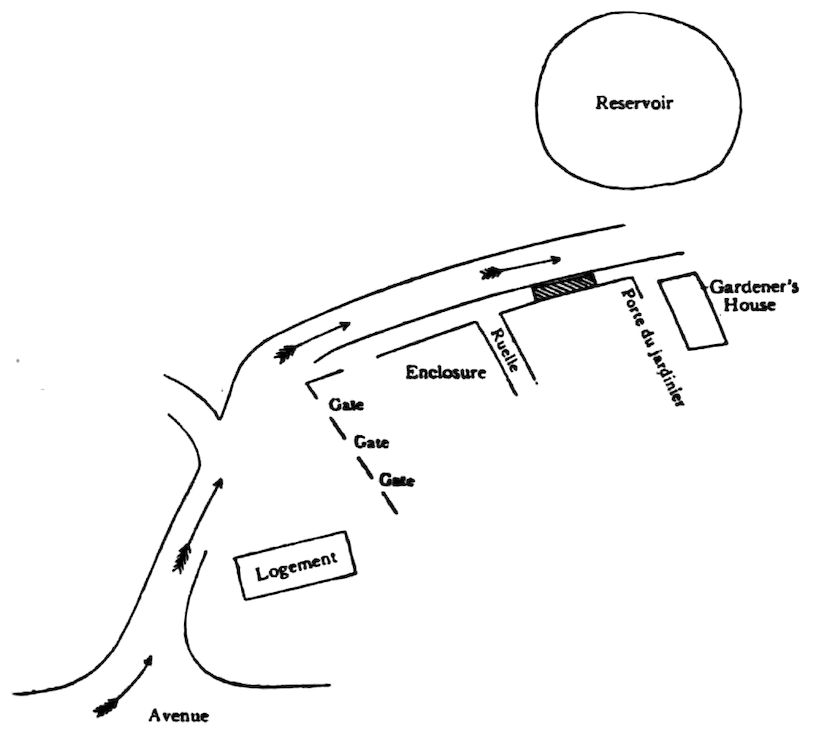
We went up the lane as at the first time
and turned to the right on reaching the
building, which we had now learnt to call
the logement des corps de gardes. From this
point everything was changed. The old wall
facing us had gates, but they were closed,
and the one through which we had seen the
drive passing through a grove of trees seemed
to have been closed for a very long time.
We came directly to the gardener’s house,
which was quite different in appearance from
the cottage described by Miss Lamont in 1901,
36in front of which she saw the woman and
the girl. Beyond the gardener’s house was
a parterre with flower-beds, and a smooth
lawn of many years’ careful tendance. It did
not seem to be the place where we had met
the garden officials.
We spent a long time looking for the old
paths. Not only was there no trace of them,
but the distances were contracted, and all was
on a smaller scale than I recollected. The
kiosk was gone; so was the ravine and the
little cascade which had fallen from a height
above our heads, and the little bridge over
the ravine was, of course, gone too. The
large bridge with the rocher over it, crossing
one side of the lake at the foot of the
Belvédère, had no resemblance to it. The trees
were quite natural, and seemed to have been a
good deal cleared out, making that part of the
garden much less wooded and picturesque.
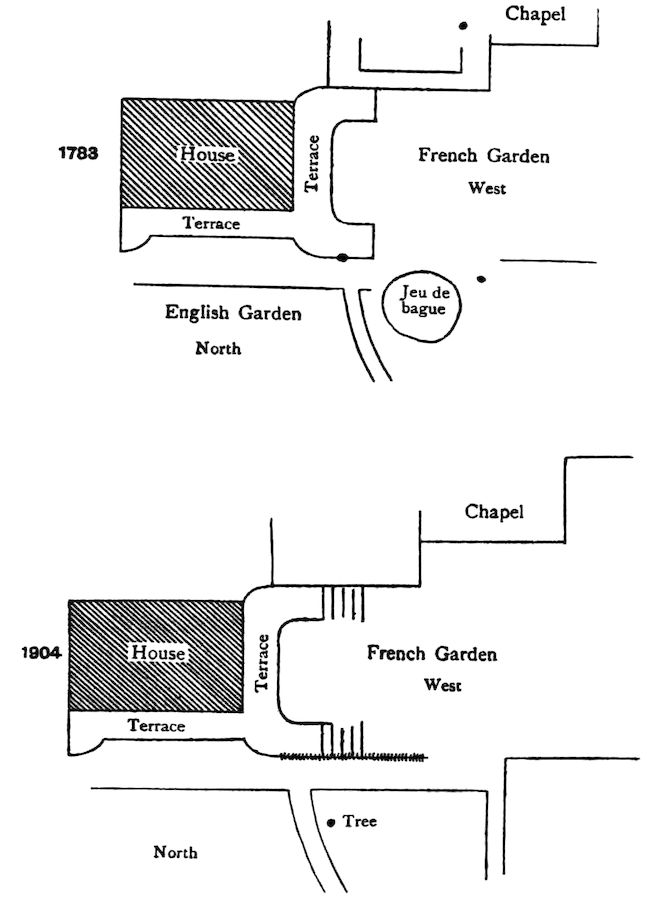
The English garden in front of the house
was not shaded by many trees; and we
could see the house and the hameau from
almost every point. Instead of a much
shaded rough meadow continuing up to the
wall of the terrace, there is now a broad
37gravel sweep beneath it, and the trees on
the grass are gone. Exactly where the lady
was sitting we found a large spreading bush
of, apparently, many years’ growth. We did
not recognise the present staircase, which
leads up to the north-west end of the terrace,
nor the extension of wall round which one has
now to go in order to reach the staircase.
We thought that we went up to the terrace
from some point nearer to the house from
the English garden. The present exit from
the French garden to the avenue was not
so near the house as we expected, nor was
it so broad as we remembered it.
To add to the impossibility of recalling
our first visit, in every corner we came across
groups of noisy merry people walking or
sitting in the shade. Garden seats placed
everywhere, and stalls for fruit and lemonade
took away from any idea of desolation. The
common-place, unhistorical atmosphere was
totally inconsistent with the air of silent mystery
by which we had been so much oppressed.
Though for several years Miss Lamont had
assured me of the change, I had not expected
such complete disillusionment.
38One thing struck me greatly—people went
wherever they liked, and no one would think
of interfering to show the way, or to prevent
anyone from going in any direction. We
searched the place at our pleasure.
We went to the Hameau, following the path
taken by Miss Lamont on January 2, 1902.
We tried to find the thick wood in which
she had lost her way, but there was nothing
like it, and such paths as there are now are
perfectly visible from one another, even in
summer. We asked a gardener sweeping one
of the paths whether that part of the grounds
had ever been a thick wood. He said he
believed that it had been, but could give us
no date beyond the fact that it was before
his time—more than twenty years ago.
On our return to Versailles, we went into
a bookseller’s shop and asked if he had any
maps or views of the Petit Trianon as it
had been in old days. He showed us a
picture (which he would not part with) of
the Jeu de Bague. We saw at once that
the central building had some likeness to the
kiosk, but the surrounding part was not like,
and its position was unsuitable for our
39purpose. We enquired about the green
uniforms of the garden officials, and he
emphatically denied their existence. He said
that “green was one of the colours of the
royal liveries,” and when we answered that
three years before persons in long green
coats had directed us in the grounds, he
spoke of it as “impossible, unless (he added)
they were masqueraders.” One of the gardiens
of the Palace also told us that “green was a
royal livery and that now only the President
had the right to use it on certain occasions.”
We asked how long the gardens had been
thrown open to the public and people
allowed to wander everywhere, and were
told that “it had been so for years,” and
this evidently implied a great many years.
The result of this visit was to make us
take a graver view of the two first visits,
and we resolved to look into the matter as
carefully as we could, and to be entirely
silent about the change of scenery until we
had explained it somewhat to ourselves.
After some years, and in spite of various
false leads, we have been able to put
together some very interesting facts. The
40details of the search are recorded in a book
which, to us, goes by the name of the
Green Book. It contains the original papers
written in 1901, the history of the gradual
accumulation of information, correspondence
with one another and also with others on
the subject, the accounts written by one or
two friends who have helped us at different
times, also pictures, maps, and lists of books
consulted, and the account of curious incidents
which took place during the search.
E. M.
F. L.
CHAPTER II SUMMARY OF RESULTS OF RESEARCH — The Plough — The Guards — Cottage, Woman, and Girl — The Kiosk — The Man by the Kiosk — The Running Man — Bridge over Little Cascade — Isolated Rock — Pelouse — The Lady — Jeu de Bague — The Chapel Man — Two Labourers with Cart and Horse — The Wood — The Music — The Tall Gardener
41
The first incident in our expedition to Trianon
in 1901 was that, after passing the logement des
corps de gardes, a small hand plough was seen
by Miss Lamont lying on the ground not far
from some wide open gates in an old wall
opposite to us, through which we could see
the stems of a grove of trees, and a drive
leading through it.
In 1905 Miss Lamont was told by a gardener
that no plough was kept at Trianon; there
was no need of one, as the government only
required the lawns, walks, water, trees, and
flowers, to be kept up.
In 1908 another gardener told us both that
ploughs have entirely altered in character since
42the Revolution, and it was not likely that the
old type would be seen anywhere in France
now.
It would seem that no plough was used ordinarily
at Trianon even in old days, for amongst
a list of tools bought for the gardeners from
1780–1789, there is no mention of a plough.[7]
We learned, in 1905, from Desjardins’ book,
that throughout the reign of Louis XVI. an
old plough used in his predecessor’s reign had
been preserved at the Petit Trianon and sold
with the king’s other properties during the
Revolution.[8]
A picture of this identical plough, procured in
1907, showed that it had handles like the one
seen in 1901, but the cutting part was hidden
in the ground and could not be compared.[9]
In the old map of 1783 there is ploughed
land where later the Hameau was built and
the sheet of water placed: but there is none
in the later maps, nor any now to be seen in
the grounds.
43
44
The second event was our meeting with two
dignified, thoughtful-looking officials, dressed in
long green coats and three-cornered hats, holding
something in their hands which Miss Lamont
wrote of in 1901 as possibly being staves. In
response to our enquiry for the Petit Trianon
they coldly directed us forward.
There are no officials so dressed at Trianon
now. At present they wear black, with tricolour
rosettes in their hats; in summer they
have white trousers.
In 1904 we were told by fully-informed
persons at Versailles that it was “impossible”
that we should have seen such uniforms,
“unless they were worn by masqueraders,” for
green was a royal livery, and no one wore it
now at Trianon.
Supposing them to have been masqueraders,
the dress may have been that of gardes de la
porte. The ceremonial overdress of the gardes
de la porte, as was that of part of the gardes du
corps (gardes de la Manche), was green, with
gold and silver embroidery and red stockings:
45they carried halberds.[10] But the officers had
galon instead of embroidery, and no red stockings:
they carried an ebony cane with an ivory
ball.[11]
The livery of the Comte d’Artois, who was
colonel-général of the gardes Suisses was green;
and those of the gardes du corps and Suisses
who were in his service had green uniforms.[12]
There is evidence of a much quieter dress
without even galon, called the “petite livrée,”
which was probably green, as it was worn by
the Suisses, piqueurs, gardes de la porte, and
the garçons jardiniers.[13] The traditional dress
of those royal servants who filled the minor
parts in the Royal Theatre at Versailles is still
to be seen at the acting of the Barbier de
Séville in the Comédie Française, which is
the descendant of the Royal Theatre. This
dress (except for the added red stockings) is
the same as the one we saw in 1901.
In 1908 we learned that the porte du jardinier
at the Petit Trianon was always guarded
46‘dans le temps,’ and that on October 5th, 1789,
the guards were two of the three Bersy brothers
who, with Bréval, were generally on duty whenever
the Queen was in residence at Trianon.
From their writing and spelling they were
evidently well educated.[14] In 1910 we found
that they had the title of garçons jardiniers de
la Chambre, and they are said to have been
stationed in “la pepinière proche la maison.”
The most ancient pepinière was close to the
gardener’s house.
Whilst speaking to the two men, Miss Lamont
observed on her right hand a solidly-built
cottage with stone steps, on which a woman in
old-fashioned dress was standing, handing something
to a girl of about 13 or 14, who wore a
white cap and skirts nearly reaching to her
ankles.
In 1904, Miss Lamont saw a picture resembling
this cottage in its general appearance in
the Album de Trianon at the Bibliothèque
nationale. In 1908, she and a friend discovered
47such a cottage (more than one) within
the gates which were not far from the place
where she had seen the plough. These cottages
were not in the right position for our experience
in 1901, but the type was the same.
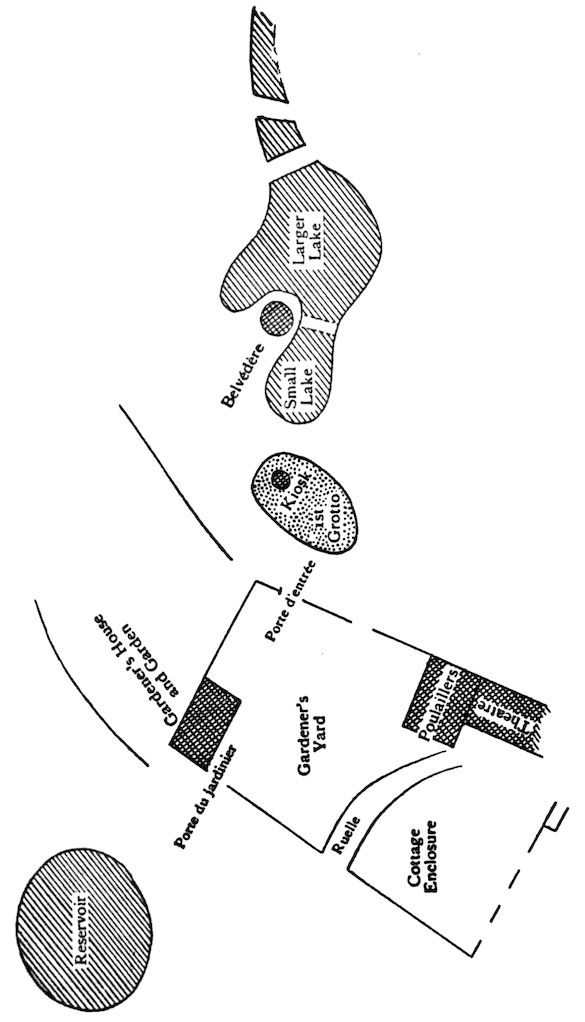
In 1907 we discovered from the map of 1783
that there was a building, not now in existence,
placed against the wall (outside) of the gardener’s
yard between the ruelle and the porte
du jardinier; if our original route lay through
this yard to the English garden, this building
would be exactly in the right place for Miss
Lamont’s cottage.
In September, 1910, we saw from marks on
this wall that a building might have stood
here; for the cornice of the wall is broken
into, and there seems to be a perpendicular
line from it to the ground visible through
the plaster. A photograph shows this.
If the girl seen should be the “Marion” of
Madame Julie Lavergne’s story (first read in
1906), she would have been 14 years old in
1789, and her mother was then alive. Her
father’s house would have been near the reservoir
and not within the locked gates of any
enclosure, for she let herself out at night by
48an open window.[15] All this would suit the
position of the building in the map.
On our entrance into the English garden in
1901, we found our path crossed by another,
beyond which, in front of us but rather to the
left hand, stood a small circular building having
pillars and a low surrounding wall. It was on
rough uneven ground, and was overshadowed
by trees.
Repeated searches during seven years by
ourselves and others have failed to discover
this building.
In September, 1908, Miss Lamont found in
the archives a paper (without signature or date)
giving the estimate for a “ruine” having seven
Ionic columns, walls, and a dome roof. (A
“ruine” seems only to mean a copy of an older
building.) If the walls of this building were
low it would correspond in appearance with
our recollection of the kiosk. This “ruine”
is said to have formed a “naissance de la
rivière,” suggesting its position above the small
49lake which fed the principal river.[16] A piece of
old water pipe is still to be seen on the north-western
side of the small lake.
If this “ruine” and two others of those
alluded to in the archives were one and the
same, there is additional reason for placing the
columned building in this part of the garden.
I. In 1788 it is stated that rocks were placed
at intervals on a path leading from “la ruine”
to the “2ième source du ravin” beyond the
wooden bridge.[17] Desjardins considers one of
the “sources” to have been close to the theatre
which was at our right hand; this might have
been the second spring.[18] II. Mique states that
in 1780 he placed a small architectural “ruine”
above the grotto. A note in the archives,
dated 1777, speaks of the “porte d’entrée au
bout du grotte.”[19] If, as we believe, we had
just passed out of the gardener’s yard by this
“porte d’entrée” we should have been close to
the earliest placed grotto.
In 1909 two old maps were procured from
Paris; in one, dated 1840(?), there is something
which may indicate a small round building
50placed on the rocher behind the Belvédère.
The other map was reproduced from an old
one of 1705, but added to until a railway
appears in it. In this map below the name
“pavillon de musique” (the Belvédère) is the
name “Le Kiosque.” It does not seem likely
that a second name for the Belvédère should
be given, and it may therefore refer to something
else which does not appear in this map.
Therefore the mere chance name which from
the first moment we gave to our building was
justified by there having been something called
by that name exactly in that part of the garden.
In 1910 we looked out this name in the best
etymological French dictionary and found that
it was admitted to the French Academy in 1762,
as “pavillon ouvert de tous côtés”: and defined
by Thévenot (contemporary) as “kioch ou divan
qui est maintenu de huit grosses colonnes.”
On our first visit a dark-complexioned man,
marked by smallpox, was sitting close to the
kiosk; he wore a large dark cloak and a
slouch hat.
51Though we were assured in 1908 by a very
good authority, that no gentleman now living
at Versailles would wear a large cloak either in
winter or summer, there might be nothing surprising
in what we saw if the kiosk could be
found. But considering that it is gone, it is
historically interesting that we discovered in
1904 that there is one man in the story of
Trianon who exactly suits the description.
Most of the intimate accounts of the period
say that the Comte de Vaudreuil was a Creole
and marked by smallpox.[20] He was at one time
one of the Queen’s innermost circle of friends,
but acted an enemy’s part in persuading her to
gain the King’s permission for the acting of the
politically dangerous play of Le Mariage de
Figaro. The King had long refused to allow
it, saying that it would cause the Bastille to be
taken. The earlier version of the same play,
Le Barbier de Séville,[21] was last acted at
52Trianon (August 19th, 1785), just at the beginning
of the diamond necklace episode, when
Vaudreuil took the part of Almaviva and was
dressed for it in a large dark cloak and Spanish
hat.
In 1908 we found out from Madame Éloffe’s
Journal (the Queen’s modiste) that in 1789 the
broad-brimmed hat had entirely displaced the
three-cornered hat, and was generally fashionable;
also that swords were no longer generally
worn.[22]
Vaudreuil left the court of France amongst
the first party of émigrés after the taking of the
Bastille, July, 1789.
Though we were surprised when the second
man, also dressed in a large cloak and hat, ran
up to us and with extreme earnestness directed us
to go to the right rather than to the left, yet we
merely thought his manner very French; and
as he said in the course of a rather long unintelligible
sentence “cherchez la maison,” we
imagined that he understood that we were
looking for the house, and followed his direction.
We noticed that he stood in front of a
rock and seemed to come “either over, round,
or through it.”
53
54The following year (1902), we learned that
there was a tradition that on October 5th, 1789,
a messenger was sent to Trianon to warn the
Queen of the approach of the mob from Paris:
that she wished to walk back to the Palace by
the most direct route, but the messenger begged
her to wait at the house whilst he fetched the
carriage, as it was safer to drive back as usual
by the broad roads of the park.
A local tradition affirming this has been
embodied by Madame Julie Lavergne in a
volume entitled (unfortunately for historical
purposes) Légendes de Trianon. This particular
scene in the story, called “La Dernière
Rose,” interested us greatly, for it seemed to
come from an eye-witness and recalled many of
the points of our vision. The Queen, it is said,
had been walking with and talking to Marion
(the daughter of an under-gardener) before
going to her favourite grotto. After remaining
there some time, and on growing alarmed at
her own sad thoughts, the Queen called to
55Marion and was surprised to see, instead of the
girl, a “garçon de la Chambre” suddenly appear,
trembling in all his limbs. After reading the
letter brought to her from the Minister at
the Palace, the Queen desired him to order
the carriage and to let Madame de Tourzel
know. The messenger bowed (as our man
had done), and once out of sight, ran off at
full speed. The Queen followed him to the
house.[23]
Enquiries through the publisher, in 1907, as
to Madame Lavergne’s sources of information,
elicited the fact that her informant as to every
detail of that scene had been Marion herself.
This Marion, the Légendes tell us, afterwards
married M. Charpentier, an under-gardener,
known in 1789 by the name of “Jean de
l’Eau,” on account of his bringing water daily
from Ville d’Avray for the Queen’s table.
He afterwards became jardinier en chef, being
appointed in 1805 by Napoleon in succession to
Antoine Richard.[24]
The name “Charpantier” appears in 1786
amongst the “ouvriers terrassiers,” who clear
56up sticks and leaves, plant flowers, and
rake.[25]
In 1783, “Mariamne” received wages for
picking up leaves in the Trianon grounds;[26]
this is quite possible, as children are said to
have been used for that work, and the absence
of surname suggests that she was the daughter
of one of the gardeners.
The marriage certificate of Alexandre Charpentier,
in 1823, gives his father’s name as
Louis Toussaint Charpentier, and his mother’s
name as Marie Anne Lemaignan. The marriage
certificate of these persons (from which
we should have learnt their age) is said to have
been destroyed.[27]
In the wages book the names of two
“Lemonguin” (elder and younger) appear; also
“Magny,” but not, so far as has been discovered,
Lemaignan.[28] If this Marie Anne Charpentier
was 21 years old at her son’s birth (November,
1796), she would have been eight years old
in 1783, and 14 in 1789. This would suit
57the “Mariamne” of the Archives, Madame
Lavergne’s story, and the girl seen by Miss
Lamont.
Two more points show the faithfulness of
“Marion’s” account of that scene. Madame
Lavergne (quoting her) says that “pale rays of
autumn sunshine lighted up the faded flowers.”
It must, therefore, have been fairly fine; and in
the wages book it appears that on October 5th,
1789, all the gardeners were at work in the
grounds, and it is stated that on wet days they
worked under cover, sometimes clearing out the
passages of the house.[29] Secondly, she says
that the Queen sat at the entrance of her
grotto, where fallen leaves choked the course
of the “ruisseau.” From entries of payment
it appears that the streams were cleared of
dead leaves on October 1st, 2nd, and 3rd, 1789,
but not on the 4th or 5th, or ever again.[30] It
is exactly a point which Marion would have
noticed.
Madame Lavergne lived at Versailles from
1838 till her marriage in 1844, at which time
Marion would have been 69; and as we believe
that Alexandre Charpentier was head gardener
58at the Petit Trianon for over fifty years, his
mother would have been easily accessible to
Madame Lavergne during her repeated visits
to Trianon, even after her marriage. Her
father, M. Georges Ozanneaux, was a personal
friend of Louis Philippe, and was constantly
about in the royal palaces.[31]
It is necessary to speak of the grotto; for
Madame Campan says that the Queen “était
assise dans sa grotte ... lorsqu’elle reçut un
mot d’écrit ... qui la suppliait de rentrer à
Versailles.”[32] Madame Lavergne says “Marion
se dirigea vers le parterre des rosiers, et la
Reine alla s’asseoir à l’entrée de sa grotte
favorite, auprès de la petite source. Les feuilles
jaunies tombées des arbres couvraient la terre
et obstruaient le cours du ruisseau.... Le
murmure de la petite cascade qui arrose
l’intérieur de la grotte, retentissait seul dans
le bosquet.... Effrayée d’être seule, elle
appela Marion; mais, au lieu de la jeune fille,
un garçon de la Chambre ... parut, une lettre
à la main.”[33] The Queen cannot, therefore,
59have been many steps away from the grotto,
at one end or the other, when the messenger
came to her.
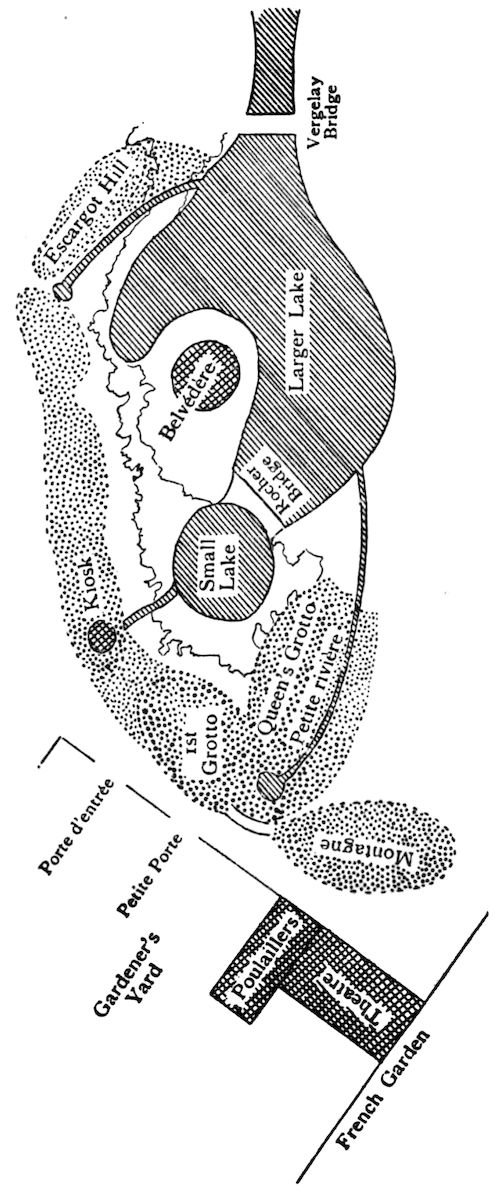
In 1908 we asked to be shown this grotto,
and we were taken to one on the further side
of the Belvédère, near the hill called l’Escargot,
which was formed in 1781. We felt sure that
this could not have been either of the two
grottos spoken of in the archives.
In 1777 the end of one grotto is mentioned
as being near the porte d’entrée, “à la cloison
de la porte d’entrée du jardin au bout du grotte
trois pottereaux et deux traverses.”[34]
In 1777 there was a “projet d’un pont et
chutte en rocher, avec parapet.” This was
probably a bridge (the Vergelay bridge?) over
the principal river where it issued from the
larger lake. The river was made at this time.[35]
In June, 1780, a new “petite rivière” was
planned to receive the water drained from the
“ravin de la grotte,” and to conduct it into the
larger lake. For this purpose a new grotto was
made of a “forme ovale, ornée en glaçon,”
through which the “petite rivière” was to run.
A “ravin du petit pont” was also planned.[36]
60In August, 1780, masses of rock were procured,
and the “petite rivière” was begun, and
also a hill was thrown up “pour couvrir la
grotte.”[37]
In September, 1780, “Bourdin a passé la
journée ... à poser le deuxième pont venant
du coté de la grotte.”[38] This second bridge
was probably the present Rocher bridge, being
the second placed over the lakes. Neither
of these two bridges would be the “pont de
bois,”[39] and “la conduitte en bois,”[40] two descriptions
of, and identical with, the one alluded
to in the words “ravin du petit pont,” which was
said to have been erected on high ground “au
dessus du Rocher du Ravin.”[41]
In December, 1780, the work was finished:
“Conduitte de l’exécution de la grotte, petite
rivière, et chutte d’eau retombante dans le
grand lac, autre petits ravins dans la montagne
près du grand lac à la fin de la petite rivière de
la grotte.”[42]
61In 1781 a “montagne” was made “en face du
jardin français—en face de la comédie.”[43]
In March and April, 1781, a hill called
“l’Escargot” was piled up[44]—beyond the Belvédère—and,
presumably, a third and very
small grotto was made. The creation of the
Escargot hill would have made the “ravin” on
the north side of the Belvédère, which is still
visible, and leads to the greater lake.
There are several reasons why we think that
the Queen’s grotto (the second made) was on
the theatre side of the Belvédère.
1. D’Hezecques’ description of it in 1789
shows that, though a “ruisseau” passed through
it, persons could go freely out at both ends;[45]
whereas when water was passing down through
the upper entrance of the “escargot” grotto,
no one could have used it at the same time:
there is only room for the water.
2. He speaks of the “prairie” being visible
from “une crevasse, qui s’ouvrait à la tête du
lit”; this would have been possible from a
grotto on the theatre side, but not on the other,
as the “escargot” hill would have been in the
way.
62
633. D’Hezecques describes a staircase which
“conduisait au sommet de la roche,” enabling
persons to leave hurriedly. There is something
like an ancient rock staircase attached to the
back of the large rock, giving the name to the
Rocher bridge.
4. He says that the grotto was very dark on
first entering, and L’Espinasse’s picture of the
Belvédère in 1783 shows the opening to a
cavern on its southern side close to the Rocher
bridge,[46] which could be truly described as
“venant du coté de la grotte.” Could the
rock out of which the cavernous mouth was
cut have been lifted over the long bridge at
some later time? for in L’Espinasse’s picture
there is no such rock over the bridge as there
is now, and the cavern has disappeared.
5. The map of 1783 represents (according to
Desjardins) “le projet de Mique complètement
exécuté.” In it the figure (5) (indicating the
grotto) occurs both at the “escargot” and also
on the theatre side of the Belvédère.
In September, 1910, Miss Lamont was asked
whether she had seen a map of the place
recently placed in the front hall of the Petit
64Trianon, and she said No. On going there
she found the map, which had not been there
at any of her former visits, and saw that the
grottos were put, as far as she could judge,
just where we had long ago, through elaborate
personal research, decided must be their real
position. She could only make this out by
standing on the table amongst the books and
photographs, the map being hung too high to
be easily seen.
Several further points of interest have
emerged in connection with the running
man.
1. In April, 1908, we learned that our being
directed at all in the grounds was unusual, for
since September, 1870, they have been thrown
open until dark. The difficulty now experienced
is to find a guide.
2. He spoke of the “maison.” In 1907 we
found out that the Queen was in the habit of
calling the Petit Trianon “ma maison de
Trianon,” to distinguish it from the Palace and
the Chateau.[47] Louis XVI. had presented it to
Marie Antoinette on his accession.
653. The Queen is reported by Marion to have
addressed the messenger as “Breton.”[48] This
was not an uncommon name about the court
and old Versailles. The court almanack for 1783
shows that then the Queen had a Page “de
l’Écurie,” called “De Bretagne.” (The Pages de
la Chambre sometimes became “de l’Écurie”
before receiving a commission or some other
office.[49]) He is not mentioned in the almanack
of 1789, but (as we know from other instances)
it does not follow necessarily that he had no
office in the household. Madame Éloffe (the
Queen’s modiste) mentions a Mademoiselle
Breton amongst the Queen’s women, who does
not appear in the almanack.[50]
If “De Bretagne” was 16 years old in 1783,
he would have been 22 in 1789,—just in the
fresh young vigour suitable to our running
man.
The name “Breton” may have referred to
his nationality only, for in November, 1907,
we discovered that the accent in which the
man spoke to us resembled the Breton accent,
66in which the consonants are strengthened and
the diphthongs broadened.
In the autumn of 1909 we read the Baron
de Frénilly’s Souvenirs, in which it is stated that
wigs were universally worn by gentlemen in
French society up till 1787. After that date
powdered hair became the general usage; the
first person (M. de Valence) who ventured to
appear with unpowdered hair did so, apparently,
in 1788, after which it became a mark of
extreme fashion.[51]
The same was the case with buckled shoes.
Gold, silver, stones, and rosettes had been
required for a gentleman’s dress ornaments;
but after the commercial treaty with England
in 1786, steel was used for everything.
Buckled shoes are expressly mentioned as
being very fashionable in 1789, and there was,
at that time, a rage for steel ornaments.[52]
Following the man’s direction, we turned to
the right and walked over a small rustic bridge
which crossed a tiny waterfall coming from
67above us, on our right hand, and flowing in
front of a little rocky cliff with ferns growing in
the crevices. The water seemed to have formed
a steep narrow little ravine, which shelved away
below us to a little glimmering pool.
Neither bridge, nor cascade, nor ravine can
be found, or anything suggesting them. In
1905 the person in charge at the house assured
Miss Lamont that there never had been more
than one cascade, meaning the rush of water
under the Rocher bridge. The Rocher bridge
is certainly not the one we crossed, which was
high above the level of the lakes.
In 1907 we bought Souvenirs d’un Page by
the Comte D’Hezecques. He says: “En face
du chateau, une pelouse ... se terminait par
une roche ombragée de pins, de thuyas, de
mélèzes, et surmontée d’un pont rustique,
comme on en rencontre dans les montagnes de
la Suisse et les précipices du Valais. Cette
perspective agreste et sauvage rendait plus
douce celle ... de la troisième façade du
chateau.”[53]
He also speaks of water passing through the
moss-lined grotto, which, according to our idea,
68must have been below us, but close by on our
right hand.[54] Madame Lavergne writes of the
“petite cascade” and of the sound of it in the
grotto.[55]
In April, 1908, extracts from Mique’s accounts
and plans for the Trianon grounds were procured
from the archives, giving the history of
the grottos. “Juin 4, 1780, fait un model en
terre du ravin du petit pont.”[56] “1788, Pièce
au dessus du Rocher du Ravin et ... passage
des voitures sur le pont de bois ... Pièce à
droite en face du Rocher du Ravin.”[57] “Au
long du chemin de l’emplacement de la Ruine
sur la conduitte en bois à la deuxième source du
Ravin.”[58] The first source was probably close
to the “Ruine” (our kiosk?). The second
“source” might coincide with Desjardins’
“source,” which he places a few steps from the
poulaillers,[59] and was probably meant to feed
the “petite rivière,” which passed through the
Queen’s grotto, carrying off the water from the
stagnant pool between the grottos to the larger
lake.[60] That would exactly agree with the
69position of our little cascade, small bridge, and
glimmering pool.
In April, 1908, an old MS. map was found
amongst such archive papers as relate to the
grottos, showing a small bridge in the right
position relatively to the lakes, the Rocher
bridge, and the place where we believe the
Queen’s grotto to have been.
In 1908 we found a mass of rocks standing
in the dry bed of the small lake. On one rock
covered with ivy were two full-grown pine
trees. It seems unlikely that the trees should
have originally been in the small circular basin
of water.
D’Hezecques says that thuya and pine trees
were planted high up over the grotto to give it
the appearance of a Swiss mountain.[61] The
grotto was destroyed about 1792, and it is
possible that some of the rocks covering it were
displaced and allowed to slip into the lake
below, and that the present pine trees may
have been seedlings at the time, for we are
70told that the life of a pine tree is from 100
to 200 years old.
In 1908 we noticed that at one side of this
ivy-covered rock were peculiar projections; one
of these was broken off short, but the other
was intact. We thought they might once have
formed supports for a small bridge.
Rocks are said to have been placed in 1788
at the “montagne des Pins à gauche et en
montant au Rocher.” “Montagne des Pins à
droite en montant au Rocher.”[62]
In January, 1791, trees were torn up from the
montagnes.
In February, March, April, 1792, every few
days occurs the entry: “Journée à arracher les
Thuja sur les montagnes.”[63]
According to the old picture by L’Espinasse
(1783), there was nothing over the low long
bridge between the two lakes, but there was by
the side of it, just where the grotto would have
ended, a cavern in a rock.[64] This is no longer
there; but possibly the face of rock with the
cavern-like opening may have been lifted over
the bridge, and account for the very peculiar
71rock which is at present above the bridge,
causing it to be called the Rocher bridge. A
rough rock staircase which has no meaning is
attached to this rock behind. D’Hezecques
speaks of a staircase as having been within
the grotto leading up to its entrance on the
high ground on the montagnes—has it been
moved to the lower end of the grotto?
There is now no isolated rock standing up as
we saw it behind the running man;—only
mounds covered with shrubs and trees. But in
the archives there is a note saying that in 1788
rocks were placed in various parts, and one is
especially mentioned, “pièce donnant au bord
du lac de l’ancien côté des rochers ... au long
du chemin de l’emplacement de la Ruine sur la
conduitte en bois à la deuxième source du
Ravin.”[65] This would have been the path we
were on in 1901.
It is easy to suppose that between the years
1901–4 trees were cleared away from the rough
ground on the north side of the house, which in
721901 had given it the look of an orchard. So
much was this the case that the lady sitting
under the north terrace was thought to be
making a study of tree stems; for she was
looking into trees, and she held a large paper
in her hand, and, as we passed, held it out at
arm’s length.
At present there are trees on each side of
the pelouse, and one growing near the site of
the old Jeu de Bague, but none growing in
front of the house, and it all looks drier,
brighter, and less confined than in 1901.
We have found two interesting mentions of
this pelouse.
Before the new theatre was built in 1779,
the old comédie stood on it for three years.
When the comédie was moved it gave place to
a “pelouse parsemée d’arbres.”[66]
Nothing unusual marked the lady sitting on
a low seat on the grass immediately under the
north terrace. I remember recognising that
73her light-coloured skirt, white fichu, and straw
hat were in the present fashion, but they struck
me as rather dowdy in the general effect. She
was so near us that I looked full at her, and
she bent slightly forward to do the same.
I never doubted that we had both seen her,
and three months after was astonished to hear
that Miss Lamont had not done so. That sounds
simple to others, to ourselves it is inexplicable.
Miss Lamont had seen the plough, the cottage,
the woman, and the girl, which I had not; but
she is generally more observant than I, and
there were other things to look at. At this
moment there was nothing to see on the right,
and merely a shady, damp-looking meadow on
the left, and the lady was sitting in front of the
house we had come to see, and were both
eagerly studying. The lady was visible some
way off; we walked side by side straight up to
her, leaving her slightly on the left hand as we
passed up the steps to the terrace, from whence
I saw her again from behind, and noticed that
her fichu had become a pale green.
The fact that she had not been seen at a
moment when we were both a little exercised
by our meeting with the men,—one looking so
74unpleasant, and the other so unaccountably and
infectiously excited,—made a deep impression.
The legend that we heard the following
winter of the Queen having been occasionally
seen sitting in front of the house in the English
garden, is of course incapable of proof; but
three things were to us full of interest.
I. In 1902 I saw Wertmüller’s picture of
the Queen, which alone of all the many portraits
shown me in any way brought back the
face I had seen; for the face was more square
and the nose shorter. A few weeks later we
read that Madame Campan considered it almost
the only picture of her that was really like,
though other people thought that it did not do
her justice.
II. In April, 1908, we learned that there was
only one time during the Queen’s tenure of
the Petit Trianon when she could have seen
strangers in her gardens, from which, in earlier
days, the Court was entirely excluded, and to
which even the King only came by invitation.
For four months, after May, 1789, when the
Court was carried off to Paris, the public
streamed in as it liked. So many came to see
the place that had been too much talked about,
75that the King and Queen had gone that summer
to Marly for a little rest and quiet. That
was the time when D’Hezecques, with one
of the deputies, walked round and saw the
grotto and the little bridge. At the time
the Trianon officials must have learnt to treat
strangers with cold politeness, but probably
resenting the necessity. This exactly accounts
for the manner of the guards at the porte du
jardinier; they made no difficulty, and told us
that we should find the house by going that
way, but in quite an unusual manner for
Frenchmen. It was mechanical and disengaged.
III. In the summer of 1908 we read the Journal
of Madame Éloffe (the Queen’s modiste).
She says that during the year 1789 the Queen
was extremely economical, and had very few
dresses made. Madame Éloffe repaired several
light, washing, short skirts, and made, in July
and September, two green silk bodices, besides
many large white fichus. This agrees exactly
with the dress seen in 1901. The skirt was not
of a fresh white, but was light coloured,—slightly
yellowish. The white fichu in front seemed to
have an edge of green or gold, just as it would
76have appeared if the white muslin, or gauze,
was over green. The colour would have shown
more clearly at the back, but in front, where
the white folds accumulated, the green would
have been less prominent. The straight edge
in front and the frill behind had often puzzled
me, but in Madame Éloffe’s illustrations of the
fashions at that time there are instances of the
same thing. There is in the book a coloured
picture of the green silk bodice, with all the
measurements to enable her to fit the Queen
perfectly.[67]
As we approached the terrace at the north-west
corner of the house, we had some barrier
on our right hand entirely blocking the view, so
that we could see nothing but the meadow on
our left hand, and the house with its terrace in
front.
At present the pathway which curves towards
the house, and is very likely the old one, has a
large bare space on the right hand with one
beautiful old tree growing on the edge of it;
77and from some way off one can easily see across
it to the chapel beyond the French garden. A
long piece of wall extends westward from the
terrace, round which one has to go into the
French garden in order to find the staircase;
whilst the whole length of wall, including part
of the north terrace, is hidden by a large old
spreading bush, completely covering the place
where the lady sat.
Originally, we could not see the steps whilst
on the path, but after we had passed the barrier
on our right hand we found them at once without
going round any wall.
The map of 1783 shows us that the Jeu de
Bague (put up in 1776) once stood on what is
now bare space. It was a circular building
surrounded by a wooden gallery, masked by
trees. This would have completely shut out
the view, and the path was probably curved on
its account.
In 1907, we learnt that the Queen had a
passage made under the terrace from the house
to the Jeu de Bague; and in 1908 we discovered
the old walled-up doorway leading into
the English garden behind the bush. The
ground seems to have been a good deal raised
78since it was used. Four feet to the right of
this door, just at the point where the top of the
present staircase is reached, is a change of
masonry, the rest of the wall being plastered
over.
In 1910 we found that this extension of the
wall was composed of rubble. Perhaps it had
been added to the stone terrace in the time of
Louis Philippe. If the present staircase is old,
we could have reached it easily from the
English garden in the absence of the wall, but
if it is not old, and it is not indicated in Mique’s
map, there may have been something quite
different—even steps turned northward towards
the English garden.
In 1910 we also learned that the bush had
been planted when the Duchesse d’Orleans
occupied the house.
79
80
Whilst we were standing at the south-west
end of the terrace above the French garden, the
door of a building at right angles to the house
suddenly opened, and a young man came out
and slammed the door behind him. He came to
us very quickly along a level. His manner was
jaunty and imperious, and he told us that the
only way to the house was by the cour d’honneur.
It was difficult to hear what he said.
We thought at once that we were trespassing
and looked for some way down from the terrace,
upon which he constituted himself our guide,
and with an inquisitive, amused expression,
went with us a little way down the French
garden, and showed us out into the avenue by
a broad road.
There is much to say about this incident.
I. The man evidently did not mean us to
stand on the terrace so near to the house, and
forced us to move away. He was the second
person that afternoon who had excitedly insisted
on our going one way rather than another; but
now we know that since 1870 the gardens and
terraces have been made public until dark, and
people walk about freely. No one has ever
stopped us since, nor can we hear of anyone
else who has been guided as we were.
II. In 1905 we found that the building out
of which the man came was the old chapel,
which is in a ruinous condition.
In 1906, Miss Lamont had leave to go into the
81chapel, which she had to enter from the avenue,
there being no entrance from the garden.
When inside she saw that the door out of
which he had come was one leading into the
royal gallery. The gallery now stands isolated
high up on the north wall of the chapel. Formerly,
from inside, it was reached by a door on
a landing at the top of a staircase. This staircase
is completely broken down, and the floor
of the landing is gone, so that there is now no
access to the gallery. The terrace door of the
gallery is bolted, barred, and cobwebbed over
from age and disuse. The guide said that the
door had not been opened in the memory of
any man there: not since it was used by the
Court.
In April, 1907, Miss Lamont went again to the
chapel, this time with two companions. Their
guide then told them that the doors had not
been opened to his knowledge for fifteen years,
and the great door not since it was used by the
court of Louis XVI. “Moi, je suis ici depuis
quinze ans, et je sais que les portes ont été condamnées
bien avant cela.” He added that
having the sole charge of the keys, no one
could have opened the doors without his knowledge, and smiled at the idea as he looked at
the blocked-up old doors.
82
83
84In August, 1907, two other friends went to
the chapel and entirely confirmed all that had
been said about its ruined condition and the
impossibility of the great door having been
opened in 1901. Their guide told them that
the big door had been Marie Antoinette’s
private entrance. The gallery was still standing
and had two chairs on it of gilt and old red
velvet; but when they asked whether it was
possible to enter it, the guide laughed and
pointed to the staircase. There was no other
entrance, he said, and the stairs had been in
that condition for the last ten years. They
thought from the look of the stairs that they
had probably been so for much longer.
In September, 1910, a fifth friend went to
the chapel and bore witness to the impossibility
of the doors having been used in 1901, and was
told that the staircase had finally broken down
fifteen years before.
III. From Desjardins’ book we learned that
the Queen’s concierge had been Bonnefoy du
Plan. He had rooms between the chapel and
the cour d’honneur and kept his stores in a loft
85over the chapel, reached by the now broken-down
old staircase. The window of this attic
still looks over the French garden, and from it,
in old days, he would have seen anyone
approaching the house from that side. The
name of the suisse (the porter) in charge of
the porte du perron de la chapelle in 1789
was Lagrange. His rooms were immediately
behind the chapel, looking into the avenue.[68]
He could easily have been sent through the
chapel to interview strangers on the terrace.
IV. We did not lose sight of the man when
he came to us. As it is now he must have
gone quite out of sight, down one flight of
steps outside the chapel door, and (after passing
under a high wall) have reached the terrace
(where we were standing) by a second set of
steps. The present wall of the chapel courtyard
is so high as to hide half the door, and a
large chestnut tree in the courtyard hides it
from the part of the terrace on which we
were,—even in winter.
In April, 1907, we discovered that a continuous
ground-floor passage from the kitchens
once passed the chapel door to the house.
86This set us wondering as to whether there
had ever been a pathway above it. The same
year we were told that the chapel courtyard
round which the passage had gone had been
enlarged.
In August, 1907, two friends reported to us
and photographed a mark on the outside of the
courtyard wall, showing where it might at some
time have been raised.
In March, 1908, another mark on the chapel
was discovered, revealing that there had once
been an inner wall to the courtyard, which
might have been removed when the courtyard
was enlarged. We also found out that the
levels were so different that the passage would
have been partly underground on the side of
the French garden, but in the rez de chaussée
in the courtyard and where it flanked the cour
d’honneur. We noticed from the photographs
that the bastion at the south-west corner of the
house in the cour d’honneur looked older than
the top part of the wall adjoining it above the
chapel courtyard.
In September, 1910, permission was given
to enter this courtyard; when within, it was
definitely explained that above the kitchen
87passage there had been a covered way, by
which the Queen could enter the chapel from
the house in wet weather. The top of this
covered way had been “de plain pied,” joining
the bit of terrace outside the chapel door to
the terrace by the house. This would have
been the level way along which our man came
to us.
The marks of the passage and covered way
(forming the intervening piece of terrace) were
perfectly clear both on the inside of the present
wall and on the ground in the courtyard.
The present balustrade adjoining the bastion
was probably placed when the old covered
way was destroyed and the outside wall was
raised. It was also noticed that the round
windows in the bastion lighted the lower
kitchen passage; but that those facing the
French garden, being on a higher level, lighted
the covered way.
The guide stated that the tree in the centre
of the chapel courtyard had certainly been
planted after the days of the monarchy.
V. The road from the garden to the avenue
(through which the man ushered us) was not
far from the chapel, and was broad enough to
88admit a coach. The present one is narrower
and further to the west.
In 1907, we read a note by M. de Nolhac in
Les Consignes de Marie Antoinette in which he
says that the old porte de la ménagerie which
must have led from the avenue to the French
garden is now lost, but that it must have been
“tout auprès des bâtiments de la Conciergerie
et des cuisines.”[69] We thought that perhaps it
was the one we went by, and on looking at
Mique’s map of 1783 found a broad road
dividing the kitchen court into two parts.
At present solid continuous buildings on the
two sides of the kitchen court show no sign of
an entrance, though in two places the roofs
have a difference of level.
In April, 1909, a Frenchman, who sold prints
and seemed to be a specialist in maps, said that
Mique’s map was the only authoritative one.
In September, 1910, we learned from the
first authority that Mique’s map was “exact”:
that the road found in it had certainly existed,
and its position relatively to the pond in the
French garden was explained. A search for
some sign of it was at once made, and successfully.
89On the garden side, not at all far from
the chapel, the jamb of an old opening still
projects from the building, covered with ivy;
and the stones on the ground are laid, for a
space of about twelve paces, the other way
from the stones on either side, evidently to
make a carriage road. A large rectangular
stone was lying on the ground which might
either have been a step, or part of the second
jamb. On the avenue side marks of an opening
of some sort can be traced through the
plaster with which Louis Philippe finished the
buildings after restoring and also altering them.
The opening would have included two present
windows not far from the porte de la bouche, as
the signs of it are visible on both sides of the
opening, and the space between is from twelve
to twenty paces.
Within the kitchen court the buildings have
been so altered and plastered over that no
traces of change could be found.
All the points corresponded with the recollection
of the roadway through which we had
passed in 1901.
90
On her second visit, January 2nd, 1902, Miss
Lamont saw, in the field near the Hameau, two
labourers, in brown tunics and bright-coloured
short capes, loading a cart with sticks. The
capes hardly came below their shoulders and
had hoods: one was bright blue and the other
red.
In May, 1904, a search was made in the
archives with the result that it was clear that
carts and horses for the purpose of tidying the
grounds were hired by the day in old times,
and not kept in the farm for constant use. In
January, 1789, two men, instead of the usual
one (“plus un homme”), were hired “pour
ramasser les loques des chenilles et les brûler.”[70]
In 1906 we discovered that the tunic and
short cape were worn by the bourgeoisie in the
fourteenth century.
In April, 1908, we had proof that the artisans
were wearing them in the eighteenth century,
and that some of the working men at Trianon
in 1776 had “hardes de couleur.”[71]
91The entry in the wages book showed that
up to 1783, from time to time “une voiture à
cheval, et un conducteur,” were hired for picking
up branches and sticks in the parks: but
on October 4th, 1789, a cart with two horses
(almost certainly requiring two men) was hired
for three days for the purpose.[72]
In August, 1908, a former gardener, who had
been at Trianon long enough to remember both
the Charpentiers, father and son, laughed at the
idea of such a dress being worn now at Trianon,
as it belonged to the “ancien régime.” He
assured us that carts of the present day in
France had scarcely altered at all in type, and
that the two now in use at Trianon (which we
found in a shed at the ferme) were of the old
pattern.
Miss Lamont then went from the Hameau
towards the small Orangerie. Whilst on the
ascending path she saw, on looking back, a
man passing in front of, or in, a distant
plantation on his way to the Hameau. He
92was dressed in the cloak and hat we had
seen the previous summer.
She then descended to the low ground in
front of the Belvédère and crossed one of
the bridges over the principal river (not the
Rocher bridge, but possibly the Vergelay
bridge). After going forward a little she
turned, meaning to go back to the Hameau,
and recrossed either the same bridge, or the
next one which is very near the Vergelay.
She immediately found herself in a wood of
very tall trees, with such high, thick undergrowth
that (even though it was winter) she
could not see through it. Well-kept paths
opened at intervals right and left at different
angles, and they gave the impression of being
so arranged as to lead round and round.
She had the feeling of being in the midst of
crowds passing and repassing her, and heard
voices and sounds of dresses. On looking
back she found the view as completely blocked
as it was in front and to the sides. After
vainly pursuing the confusing paths for some
time, she found herself close to the hill leading
to the Orangerie.
In 1904 and in 1908 we tried to find this
93wood, without results. There are open plantations,
but they have no undergrowths concealing
paths from one another, even in summer.
Several people have gone independently to
look for the wood, but have not found it.
In 1905 Miss Lamont was told by the chief
authority that in this direction trees had been
thinned and not replaced.
The entries in the archives indicate that
there must have been woods near by in
which paths were cut for the Queen; it is
also likely that the older woods, such as
Les Onze Arpents, are not referred to; for
when these plantations were made thousands
of lower shrubs were bought to be placed
under the trees, which were paid for by the
King.[73] In the gardeners’ wages book, the
gathering up and occasional burnings of
undergrowths in a wood (apparently in this
part of the garden) are alluded to.[74]
In Mique’s map (1783) the wood with its
diverging paths can be plainly seen. It is
approached by the two bridges over the
river, and stretches towards the hill on
which the Orangerie stands.
94
Whilst in the wood Miss Lamont heard
sounds of a band of violins drifting past
her from the direction of the house. The
sounds were very soft and intermittent, and
were lower in pitch than bands of to-day.
She could afterwards write down from
memory about twelve bars, but without all
the inner harmonies.
She ascertained immediately afterwards that
no band had been playing out of doors that
afternoon at Versailles. It was a cold, wet
winter’s afternoon.
In March, 1907, the twelve bars were
shown to a musical expert, who said (without
having heard the story) that the bars could
hardly belong to one another, but that the
idiom dated from about 1780. He found a
grammatical mistake in one bar. After
hearing the story, he said that bands in the
eighteenth century were lower in pitch than
they are now. He suggested the name of
Sacchini.
In March, 1908, Miss Lamont and a friend
95were told in Versailles that no bands had been
allowed to play in the park in winter until
1907. They also ascertained that no music
played at Versailles, or in the park, could
have been heard at Trianon.
In the same month they searched through
a great deal of unpublished music in the
Conservatoire de Musique at Paris, and
discovered that the twelve bars represented
the chief motives of the light opera of the
eighteenth century, excluding Rameau and
his school, and that, as far as they could
discover, nothing like them occurred in the
opera of 1815 onward. They were found
in Sacchini, Philidor, Monsigny, Grétry, and
Pergolesi. Grammatical mistakes were found
in Monsigny and Grétry.
Sacchini.
“Dardanus.” General likeness.
“Œdipe à Colone.” Number 6.
Two bars intact in the key
answering to that heard in 1902,
allowing for the rise of a semi-tone,
which had taken place since
the eighteenth century. This was
proved by later editions of operatic
96music, in which the songs were
dropped a semi-tone to retain the
original key.
Philidor in a collection of single airs
(Rigaudons, 1767)—the cadence.
“Le Maréchal Ferrand”: repetition of
single notes, the first bar of the
melody, and many other hints of
likeness.
Duni. 1765. The same general characteristics,
but no exact resemblance.
Monsigny.
“Le Roi et le Fermier.” Written for
performance at the opening of the
new theatre at the Petit Trianon,
August 1, 1780, when the Queen
first acted herself. Up to 1908 it
had not been republished. In it
the figure of the first of the twelve
bars was found.
“Le Déserteur.” No published edition
was found after 1830. In one published
before that date the last three
bars of the music were found, and
the melody of the first bars was
assigned to the second violins,
97and very freely, in inversions and
variations, in other places. The
character of the accompaniment was
reminding.
Thirds and sixths constantly occur
in Monsigny’s music.
Grétry. The same phrases were used and
the ascending passage was found.
Also, hidden consecutive fifths.
Pergolesi.
“Largo and Andante in D.” Similar
phrases were used.
Miss Lamont then went along the upper path,
and when between the Escargot hill and the
Belvédère, she met a very tall gardener of
apparently great strength, with long muscular
arms. She thought that with his long hair and
grizzled, untidy beard and general appearance,
he had the look of an Englishman rather than
a Frenchman.
He was dressed in a rough knitted jersey,
and a small dark blue round cap was set at
the back of his head. She enquired where
98she should find the Queen’s grotto, and he
walked a little way beside her to show her
the way.
Miss Lamont expected to have to turn back to
the present grotto, and when she remarked
that they were going past the Belvédère, he
replied firmly that they must go past the Belvédère,
and said that it was necessary to have
been born and bred in the place to know
the way so that “personne ne pourrait vous
tromper.”
It appears that from 1870 onwards the
gardeners at Trianon have been selected from
the technical schools, and that it is now a matter
of competition, no one being appointed simply
because he was born and bred there. We
do not know whether this is the case with the
under-gardeners; nor whether the tall gardener
was a chief official or not.
In August, 1908, we were told by a former
gardener that their dress now is the same as
the traditional dress of the ancien régime, viz.,
a rough knitted jersey with a small casquette
on the head.
In the old weekly wages book there appears,
for several years, the name “l’Anglais”—probably
99a nickname.[75] He must not be confused
with John Egleton, who remained at Trianon
only a few months, and whose wages were
settled on his departure by a bill which is still
in existence, but is not in the wages book.[76]
We owe our researches as to the position
of the Queen’s grotto almost entirely to the tall
gardener’s decided directions and guidance to
the part of the English garden between the
Belvédère and the montagnes close to the
theatre.
E. M.
F. L.
September, 1910.
CHAPTER III ANSWERS TO QUESTIONS WHICH WE HAVE BEEN ASKED
100
1. One of us has to own to having powers
of second sight, etc., deliberately undeveloped,
and there are psychical gifts in her family.
She comes of a Huguenot stock. The other
is one of a large and cheerful party, being
the seventh daughter and of a seventh son;
her mother and grandmother were entirely
Scotch, and both possessed powers of premonition
accompanied by vision. Her family has
always been sensitive to ghost stories in
general, but mercilessly critical of particular
ones of a certain type.
2. Both of us have inherited a horror of all
forms of occultism. We lose no opportunity of
preaching against them as unwholesome and
101misleading; because they mostly deal with
conditions of physical excitement, and study of
the abnormal and diseased, including problems
of disintegrated personality which present such
close analogy to those of insanity. We have
the deepest distrust in, and distaste for, stories
of abnormal appearances and conditions. We
find narratives of revenants unconvincing, and
studiously avoid (as utterly lowering) all
spiritualistic methods of communication with
the dead. We have never had the curiosity, or
the desire, to help in the investigations of
psychical phenomena.
3. We belong to no new schools of thought:
we are the daughters of English clergymen,
and heartily hold and teach the faith of our
fathers.
4. We are quite certain that neither of us
exerted any conscious influence over the other;
for though we saw much in common, yet each
had independent vision. We should think it
wrong either to exercise, or to submit to, influence
of that nature. We are independent
people and accustomed to stand on our own
feet.
5. Our condition at the time was one of
102perfect health and enjoyment of a holiday in
the midst of very hard work.
6. We were entirely ignorant of the history
and traditions of the place, and continued our
conversation about other things after every
interruption. We did not even know that we
were in the grounds of the Petit Trianon until
we saw the house.
7. At the time Miss Lamont thought that
there was something unusual about the place
and was puzzled; the same idea returned to her
occasionally during the following week. Miss
Morison put her feeling of oppression down to
some physical fatigue in herself, and so said
nothing; for we did not know one another very
well at that time, were in the relation of hostess
and guest, and neither of us thought of enlarging
on uncomfortable sensations. After some
days, when Miss Morison was writing an
account of the expedition, she thought it over
with care, and realised that her sensations had
not been caused by fatigue, but had produced
fatigue. She became convinced that the oppression
had been due to some unusual cause in
the place itself, and instantly turned to Miss
Lamont and said so. Miss Lamont agreed.
103We then discussed the man by the kiosk and
the running man, but said that there was much
besides which had caused dreamy depression.
Miss Morison returned to her letter and wrote
down: “We both think that the Petit Trianon
is haunted.”
When we met next (three months later) we
talked it over again, and finding that Miss
Lamont had not seen the lady, and that Miss
Morison had not seen the plough, cottage,
woman, or girl, we resolved to write separate
accounts of our visit in order to find the discrepancies,
but with no idea of making exhaustive
histories. These papers are still in
existence. Miss Lamont, in her story, used the
words “uncanny” and “eerie” to describe her
feelings, but they did not mean that she had the
least idea at the time that any of the people
encountered were unreal or ghostly; this was
still more true of the scenery.
8. During the next three years, Miss Lamont
repeatedly took parties of girls over the Trianon,
and she reported that the place was changed;
but Miss Morison could not believe it, and even
made maps to remind her what their old route
had been. After Miss Morison had paid a
104second visit to Trianon in July, 1904, and had
found out for herself that the place was entirely
changed, it was resolved to undertake a personal
research into the matter, and to say no more
until we had discovered for ourselves whether
our vivid recollections of the people and
the place tallied with any ancient reality or
not.
Up to that time we had told the story freely,
with the result that we have constantly traced
it inaccurately reported in histories, sometimes
purporting to have come from other sources,
and even in newspapers and small periodicals.
After research had begun to yield interesting
results, we were obliged to be silent, finding
that publicity prevented our getting at
evidence.
We are very busy people, and have refused
to let the incident take a prominent place in our
time, interests, or fancy, though from the first
we agreed to lose no given opportunity of
elucidation. The evidence has, therefore, come
slowly; but the manner in which it has come
has often been a source of surprise. If a helpful
person came in our way, we showed the whole
thing: if we were casually asked if certain
105reports were true, we confirmed them (when we
could), but said nothing further. We were
anxious to wait until we had exhausted every
possible means of satisfying ourselves as to the
exact amount of interest attaching to the story;
and it was several years before we had to
believe that we had seen the place as it had
been a hundred years before, and as it had not
been, in several important particulars, since
1835. The research had been undertaken with
the idea of disproving the suggestion that anything
unusual had happened, for we were
resolved not to deceive ourselves or anyone
else, if personal industry could prevent it.
9. In the course of the last four or five
years, Miss Lamont has searched for evidence
bearing on the story (either by word or picture)
in the Archives nationales, in the library,
museum, Mairie, and Archives departmentales
at Versailles: also in the libraries Nationale,
Hôtel de Ville, and in the Musée Carnavalet,
and in the Conservatoire de Musique at Paris.
She has poked about in French book and
print shops, and must have seen a large
number of the originals of the published plans,
illustrations, and accounts of the place. We
106believe that there is not likely to be any
striking documentary evidence other than we
have dealt with.
10. The historical interest of the story seems
to depend on the truth of the tradition that
the Queen went to Trianon on October 5th,
1789. We can find no negative evidence of
this, but extremely little which is both affirmative
and trustworthy. Madame Campan’s
short statement remains the basis of other
people’s longer and more detailed narratives.
General La Fayette’s full account of the day
was burned by his wife during the Terror.
Count Fersen’s memoirs were also partly destroyed.
The Abbé Bossuet had Madame de
Tourzel’s careful history of that day burned;
but in the published memoirs she says that
she was in residence that day at Versailles, as
Gouvernante des enfants de France; she does
not mention having gone to Trianon, as implied
by Marion’s story, but it is still possible.
Most French historians now adopt Madame
Campan’s statement, but (in the words of one
of them) “with some doubts.” It is worth
mentioning that many later historians insert
the fact (though it is not recorded by Madame
107Campan) that “the Queen was accompanied
by a single valet.” Is this a tradition?
11. We do not believe in anniversaries in
the usual sense. We have tested both our
days (August 10th and January 2nd), going,
as far as possible, under the same circumstances,
without any result at the Petit Trianon.
Yet it is possible that if we entered into an act
of memory, it may well have been first made on
the terrible 10th of August, 1792, though the
memory itself was occupied (in the central place)
with the events of October 5th, 1789. The dress
of the messenger was more suitable for October
than August. At the same time Vaudreuil
left France the previous summer and cannot
have sat in the Trianon woods after the taking
of the Bastille, July 14th, 1789.
There is an incoherence about both the large
and small incidents which seems to require
combination within a single mind, and the only
mind to which they could all have been present
would have been that of the Queen. Our
theory of 1901, that we had entered within
the working of the Queen’s memory when she
was still alive, is now enlarged. We think
that the two first visits to Trianon (August
10810th, 1901, and January 2nd, 1902) were part
of one and the same experience; that quite
mechanically we must have seen it as it appeared
to her more than a hundred years ago,
and have heard sounds familiar, and even something
of words spoken, to her then.
Having been for two most trying years confined
to Paris, and (excepting for a visit to
St. Cloud) through two hot summers, and being
in the midst of the tumultuous horrors of the
great tenth of August, she may, as the day
wore on, and she grew more used to her miserable
position in the Hall of the Assembly—where
she sat for eighteen hours—have fancied
(in memory) the grounds at Trianon more
spacious than they really were; and have seen
the trees, as one sees trees in recollection, like
a picture without life, depth, or movement.
In rêverie her mind may have wandered from
the familiar sight of the two Bersys at the gate,
to the little vision of two men gathering up
garden rubbish into a cart (which we know
happened on October 5th, 1789, as well as one
day during the last winter she spent at Versailles),
and which—without any reason—had
remained in her mind. She may have thought
109of the place as it was during that year of the
meeting of the States-General when the
grounds were, for the first time, thrown completely
open to the public, and intruding
strangers could be seen there. Or she may
have gone back to the earlier years and the
pleasant afternoons when the band played on
the pelouse in front of the house, and to the
excitement of acting in the little theatre with
her special friends, perhaps letting herself
realise the unkindness of the pressure put upon
her by Vaudreuil to have the acting of the
Mariage de Figaro authorised.
How naturally the thought of him would
have formed one picture in her mind with the
memory of the last scene, when she was
hurriedly summoned from Trianon, never to
return! For she may very likely have supposed
all that she was suffering to have been
more exclusively the result of her own former
mistakes than could have been just, and have
been going over them in her mind.
On our return to Paris on the day of the
original visit to Trianon, when undoubtedly her
image was uppermost in our thoughts, and the
recollection of her terrible end was hardly to
110be endured, the recurring consolation to Miss
Morison was, “She has forgiven it all now,
and knows the true meaning of the French
Revolution on both its good and bad sides, and
also the exact proportion of her own part in it.”
But the act of memory which had so strangely
and mechanically clung to the place, with
which we had, perhaps, been associated in
the grounds, was incoherent and pictorial. It
was oppressive to us because it represented a
more limited view of those times than after a
hundred years we have learnt to take of them,
and was far more limited than any thought the
Queen can have about them now.
12. Our answer to the suggestion that we
were in a state of suspended consciousness is
that our conversation and sense of the quiet
continuity of things remained unbroken, and,
in spite of oppression, believed ourselves to
be particularly wide awake and on the
alert. When we were first asked whether
the man from the side building was real
or not, we laughed at the idea of any unreality;
all was so quietly natural that we
are still uncertain whether the tall gardener
belonged to another century or not. It has
111taken us nine years to work out all the
details which bear witness to the strangeness
of what we saw and did, and to justify us in
our present conviction, that from the moment
of our leaving the lane until we emerged into
the avenue we were on enchanted ground.
13. The theory of coincidences would have
to be considerably strained to cover more than
twenty points quickly succeeding one another.
14. In the municipal records kept in the
Library at Versailles there is a list of fêtes
in the grounds. Miss Lamont has examined it
carefully. There had been one for which
people had been dressed in Louis XVI. costume
in June, 1901, but there is a note to say
that it had been confined to the Hameau.
There was none in August, 1901. We know
that since 1901 there have been fêtes in the
grounds with scenes in character, so that other
people may have come across them; an
examination of the records as to dates would
probably reveal such possibilities.
In the same catalogue notices are made of
photographs taken of historical groups at fêtes;
there had been some in connection with the
June fête, and “Otto” was mentioned by name.
112On enquiry Otto wrote that he had not taken
“l’ensemble de la fête, c’était des groupes
de jeunes filles, et des dames séparément.”
“Dufayel” took pains to look the matter
up, and Miss Lamont and one of his employées
went all through his lists and books
of specimen photographs, and found that he
had not taken any photographs at Trianon
between 1900 and 1906. He recommended
enquiries at Pierre Petit’s, as Petit would have
Lafayette’s as well as other photographers’
pictures. No photographs of the scenes we
wanted were to be heard of there, and Pierre
Petit wrote afterwards that his only photographs
at Trianon had been taken in 1900
for the Exhibition.
It has been suggested to us that our story
can be explained by people posing for a cinematograph
in order to register the scene of the
messenger running to the Queen, whilst something
further has been said of a girl sweeping
up leaves as forming part of the group. Naturally,
from the first, we had thought of some
such explanation, but had rejected it as insufficient.
We did not see the man running; we
only heard him; then he suddenly appeared,
113standing close to us, and addressed us personally,
earnestly, and with excitement. As a
scene it would have been nothing; we saw no
Queen, and no girl sweeping up leaves. He
remained by us until we turned away from him.
The cinematograph theory does not explain
how it was that he came over and stood with
his back against rocks of considerable size
piled on one another, when rocks have not
been there for nearly a hundred years, though
we find that they had been placed in that part
of the garden in 1788. Nor does it explain
how it was that both before and during the
man’s coming we were both gazing at a kiosk
which is not now in existence, though both
rocks and kiosk we found out years after to
have made part of the original scenery in 1789.
Not a word is hinted about the little bridge
over the ravine, and the little cascade close
by, all being essentials both to our, and, we
believe, to the original story. We suspect the
explanation to be simply that we had not talked
about them at first, not knowing their significance
till later, and so they have not got
into any widely-spread story. We know from
the archives that the streams were not cleared
114from leaves after October 4th, 1789, and that
“Mariamne” is only mentioned as having been
paid for work in the grounds in 1783, as one of
several children so occupied.
If masqueraders were posing as guards at the
porte du jardinier, the cinematograph idea does
not explain the reappearance of the old cottage
close by, in its former position as placed in
Mique’s map of 1783. If the part of the Queen
was being acted, what of the orchard of trees
we saw her looking into, not now in existence;
also, what is the account of the barrier at our
right hand screening off the present view and
exactly answering to the old enclosure of the
Jeu de Bague?
The cinematograph does not explain the man
who opened the great door of the chapel, easily
banging it behind him as he came out; for in
1907 the people living in the place believed that
it had not been opened since the days of Louis
XVI., and the keeper of the key knew that
even the door of the landing had not been
opened for fifteen years. How was the wall
lowered, which now largely hides the great
door from the terrace, and makes it necessary
to go down one flight of steps and up another,
115whereas we saw the man coming along a level,
in full view, from the moment of his opening
the door until he reached us standing on the
terrace outside the window of the antichambre?[77]
A cinematograph would not explain the
reappearance of the old wood in all its denseness;
nor the rapid disappearance of the
cart and horse in an open field; nor the
music, which, six years later, was found to
be a piecing together of eighteenth century
operas.
No amount of masqueraders explains to us
the ease with which we dismissed from sight
and hearing the usual August crowds in the
middle of a fine afternoon, and the impossibility
of harmonising our recollections of the scenery
with anything but the old maps and records.
Certainly none of the persons we met were
being photographed at the moment, or we must
have seen it; and had scenery been erected for
the purpose, we must have observed such large
artificial arrangements; there would probably
have been sightseers; and, presumably, the fact
116of anything so considerable would have been in
the catalogue.
Even should it be proved that a cinematograph
had been taken that very day, it would
not be a possible explanation to us. The
groups we saw were small and isolated from
one another. There was the deepest silence
everywhere, and no sunshine; whilst the light
was the worst possible for a picture, for the
sky was overcast. And though whilst we
stood there an indefinable air of strangeness
dropped over everything, including the tall
forest trees, it was not of a kind that could be
accounted for by fictitious scenery. The people
moved and spoke as usual, but their words were
extraordinarily difficult to catch.
In September, 1910, the question of such
representation was settled by an enquiry of the
authorities. No leave to take cinematographs
had been granted in August, 1901. The fête
had been on June 27th, and the photographs of
it had been taken sufficiently near the time to
be published in the July number of Versailles
Illustré. Not one of the pictures in this number
is in the least like what, we saw either in the
matter of subjects, costumes, or places. The
117inaccuracy is so great, that in an article in
the same magazine the scene of the messenger
coming to the Queen is transferred from the
grotto to the Hameau, though the sole authority
for the tradition places it at the grotto.
15. During the last five or six years much
research into topographical and archæological
details has been made by the newly-formed
“Société des amis de Versailles,” probably from
the same archives examined by Miss Lamont,
so that many points of likeness to what we
saw may soon reappear. Old music with old-fashioned
instruments is now frequently introduced
at summer fêtes at Trianon. Even the
water arrangements in our part of the garden
seem likely to be altered, and the little cascade
may yet be seen again. At the beginning of
1910 Miss Lamont saw engineers searching for
the first and second sources, and in the following
autumn she found iron grids placed on the
ground near the positions we had allotted for
them; but nothing had been altered up to September,
1910. We are most curious to know
whether the restorations will be exactly according
to our recollections of the scenery or not.
16. Stories retailing just so much of our own
118as we had first talked about are constantly being
repeated to us; some with the little additions
we can recognise as our own early surmises;
generally with the omission of points we did
not know to be interesting until later; and
often with all the muddles arising from the
attempt to shorten a long story, with a few
unauthorised additions and explanations thrown
in. These stories are told to us as being the
property of persons we have never heard of.
We have constantly enquired on what authority
they rest, and, if there is any at all, we have
not infrequently been able to discover the track
they have followed from us back to us again.
17. We do not think that deception explains
it. If we were deceived in one, two, or three
points, could we have been in all? For out of
them we have been able to reconstruct the story
of Trianon in many tiny details, the truth of
which we have had to discover for ourselves.
18. We are constantly asked why we, of all
people, should have had such an adventure?
We are equally puzzled; and have come to
think that it may not be so unusual as it seems.
We can imagine that people, even if they suspected
anything unusual (which they might
119easily not do), may have thought it best not to
follow it up. The peculiarity in our case may
simply have been that two persons were equally
able to consider the circumstances, and did do
so: that we found there was available evidence,
and that we had the opportunity for obtaining
it.
19. Certain unusual conditions were present.
(1) Two people in broad daylight, good
health, and normal conditions, were equally
able to bear witness to the facts, yet not in the
manner of thought transference between each
other, for they did not see alike in every point.
(2) Some of the facts were so small that no
historical knowledge, however dim, could have
suggested them.
(3) They concerned such well known historical
personages that much documentary proof as
to the reality of the incidents is accessible; yet,
in some particulars, they are of such a nature
as to be incapable of reproduction by any tricks
of scenic effects; and some of the evidence
found in the archives had, to all appearance,
not been disturbed since its collection by the
National Assembly until Miss Lamont in 1904
undid the old fastenings that had stuck together
120through age and disuse: for instance—much of
the evidence about the gardeners taken from
the wages book.
E. M.
F. L.
September, 1910.
CHAPTER IV A RÊVERIE — A Possible Historical Clue
121
To find the causes of the universal movement,
which for convenience we call the French
Revolution, one should be a trained historian,
philosopher, and theologian, and be able to
pass in review and justly estimate the aspirations
for political consolidation, greater individual
responsibility, and the revolt against Papal
tyranny over consciences, as they had been
working in all European countries for many
centuries. To find the causes for the particular
form which this universal development took in
France, it would be necessary to weigh the
moral, social, and political (including the fiscal)
tendencies of earlier generations. This would
be manifestly impossible in a paper dealing
with the revolution in France as it may have
122appeared to a single mind, on one special
day, at a time of great mental excitement.
There can be no doubt that Marie Antoinette
was the innocent victim of a world-wide upheaval
in the moments when men were first
consciously developing it, and we can well
believe that to herself the reasons for such
reversals of older thoughts seemed inscrutable;
whilst she would have vainly sought, in reflecting
over her own mistakes, for grounds sufficient
to justify the enormous misfortunes which
overwhelmed her personally.
The tenth of August, 1792, was a marked
day in the history of the French Revolution.
The tide of French democratic reaction against
the ever-increasing selfishness of privilege, and
the inability of the rulers to sympathise with
the growing desire for greater freedom and less
personal government, had been gathering force
with constantly increasing momentum; and on
this day Louis XVI. virtually relinquished all
independence as Head of the State by surrendering
himself, for the sake of the safety of
his family and to save France from the crime
of massacring its King, into the doubtful care
of the Legislative Assembly.
123That Assembly grew out of the States-General
which had been convened by the
King, May 5th, 1789, at one of the critical
moments when the dissatisfaction of the nation
with its financial conditions produced keen
anxiety to the Court; and it had (on another
epoch-making day of that unrestful period)
refused, on June 23rd, 1789, to be dissolved by
mandate of the King. From that moment the
National Assembly had become the centre of
the reforming party in France. Louis XVI.,
as King, did not seem to stand in the way of
the wishes of the nation as expressed by the
Assembly. He appeared to be willing to
forego more of his prerogatives than was
compatible with the existence of monarchy as
understood in France; but, it was believed, the
Queen was of a different opinion and desirous
of upholding the ancient monarchical idea as a
practical force, which at that time, in spite of
the King’s amiability and absence of policy,
could not be otherwise than hostile to the still
vague, but unbounded, aspirations of the
democratic party. “Madame Veto” had that
influence over the King due to a strong
personality and her position as a much loved
124wife; upon her, therefore, fell the wrath of the
nation. It was instinctively recognised that
as a wife and mother she had every reason to
desire the continuance of things as they were,
and the people quickly interpreted every act
of vacillation on the King’s part to the Queen’s
active enmity to the rising forces of democracy.
It was on August 10th, 1792, that the Legislative
Assembly was made to realise another
function belonging to it beyond that of fighting
the prerogatives of the King and of the aristocracy.
In such a restless age, and in such a
country as France, it was impossible to suppose
that the outspoken longings of philosophers,
poets, and statesmen for freedom, should not
stir up the hope of freedom from all authority
and restraint whatever in the lowest stratum
of society. The lengths to which the mob in
Paris could go had, during the last three years,
shown itself on isolated occasions, but with
increasing frequency and savagery. Both mob
and Assembly were animated by the same
desire, viz. to make monarchy in France absolutely
helpless to withstand their will. The
Assembly was trying to bring it about with
some appearance of constitutional decency,
125without apparently perceiving that unless the
King was allowed to banish himself, a discrowned
monarch without any raison d’être
whatever in the country inevitably meant his
ultimate, and perhaps speedy, disappearance
by death. The mob saw its policy more
clearly, and was ready to get rid of him and
the Queen by instant murder.
Thus, on the morning of August 10th, the
Legislative Assembly had the double part to
play of continuing its assault on privilege whilst
protecting the royal family from destruction.
When, at some moment between 7 and 9
a.m., Louis XVI. and Marie Antoinette entered
the Manège in which the Council met, there
was, at first, some attempt at restrained courtesy
showing itself in the grave assurance of
protection in reply to the King’s request, and
also in half an hour’s doubt as to where he
should sit down. But the Assembly was entirely
aware of its victory in this act of unconditional
surrender on the part of the King, and would
allow no royal guards of any description to
enter. There was a short alarm lest it should
have to defend itself against the cannon of the
insurgents, the sound of firing approaching
126nearer to the building than the nerves of some
of the deputies could sustain with calmness.[78]
But the mob had not yet realised that it had
the upper hand, and was content to believe
that the protected King was the imprisoned
King, and only continued to howl ferocious
threats outside the grilles.
If the Assembly did not immediately see
its way to the definite imprisonment of the
Sovereign, neither did it choose that the
royal party should sit on its own benches, so
it ordained that they should be placed in the
logographie—the reporter’s room—a sort of
den not far from the President’s chair, open
to the Manège and within sight and hearing of
all that passed, but without dignity or decent
comfort.[79] Here, without apparently any opportunity
for resting or meals, the King, Queen,
Princess Elizabeth, Madame Royale, and the
Dauphin remained, until (at least) 10 p.m.[80] A
few faithful attendants, such as the Princesse
de Lamballe, Madame de Tourzel, the Prince
de Poix, and the Duc de la Rochefoucauld,
127were with them, and at first other royalists
were allowed to bring them news and to pass
in and out, but this was stopped in the course
of the day.
From Dufour’s account it would seem that
no one was busying themselves to supply their
wants until he undertook to do so the next
day.[81] A draught of water brought to them in
their cells at night to quench their raging thirst
is all that he speaks of. If the story of the
King eagerly devouring food in public is true
(and it is impossible to believe that the children
had nothing), yet it is doubtful whether the
Queen, who had had no rest the night before,
had any food during the day.
What a tumult of disgust, fears, indignation,
and overwhelming regrets must have occupied
the Queen’s mind! It was difficult enough
to maintain an outwardly calm, queenly demeanour;
her thoughts must have been confused,
half formed, reflecting the agitation of
despair and anxiety. She knew only too well
that she was looked upon as the political enemy
of the crowd for reasons that were not altogether
untrue. She had had a policy inconsistent
128with republicanism and, though worsted
in it, the events of the last three years probably
justified it in her own mind.
She inherited a belief in a strong rule, beneficent
as her own kindly nature required, but
one that could fight its battles and make full
use of such opportunities as hereditary kingship
possessed. Again and again she had felt that the
King’s action was worse than nothing. Marie
Antoinette would have sternly punished the
crime of killing the King’s officials;[82] she would
have upheld the sovereign office as long as
there were those who prized it. The country
could never have reached the present point
of rebellion if the taking of the Bastille, for
instance, had not been condoned and the murders
and outrages connected with it had not been
allowed to pass without adequate punishment.
Why were the troops dismissed so soon after,
and the nobles allowed to emigrate? It may
have been right for the monarch to urge upon
some of them the danger in which they stood
129by remaining, but where was their courage
and loyalty in leaving the country?[83]
The sensation of loneliness was terrible.
Where were the illustrious families and statesmen
who had not left France, who, had the
Queen only known it, were to go during the
next year in one long procession to the
scaffold? They were, she knew, paralysed
by the King’s inaction and weakness. Surely
they would have rallied had he called upon
them with decision to defend their rights and
had placed himself at their head, even though
many of those princely families who had surrounded
her during the first years of her reign
had been alienated and in opposition to herself
before the disaffection became general. Where
were the faithful Swiss guards who only that
morning had escorted them in safety to the
Manège, and would have fought bravely and
perhaps been the rallying point for all who
were not declared democrats? Alas, alas, the
sounds of screams and fiendish massacre were
in her ears at the moment; cannon, musketry,
130and cold-blooded carnage were then and there
destroying the last stronghold! The tiny loge,
only 10 feet square, so painfully hot and full of
comers and goers, seemed to the despairing
Queen empty of all who should have been
there to represent the monarchical principle.
The presence of the Prince de Poix and the
Duc de la Rochefoucauld and a few others,
who were endangering their lives by being
with them, only emphasised the forlornness of
the royal condition.
Looking from her dismal corner in the loge
at the King, who sat with impassive mien
facing the assembly, what waves of painful
emotion must have swept across her brain!
The King could not see things from her point
of view, but he had loved and spoilt her. He
had been faithful to her, as no French monarch
for many generations had been loyal to his
wife. He was devoted to her and to their
children; had paid her debts again and again;[84]131had ennobled and enriched her friends; his
patience and magnanimity were saintly; but
how often had she raged against his theory
that the King’s duty was to set an example
of lofty forbearance and forgiveness of every
injury even when done to him as representing
the law, justice, and power of the whole French
peoples. She had instinctively felt that had
she been in the King’s place she would have
found her way through the past crises without
either descending from her throne or doing
wrong to the most Christian charity. She
knew that she was kind-hearted, and had
always loved to be the benefactress of others:
yes, she too could forgive royally when forgiveness
was due from her in her own person,
but not when it required injustice to others.
But Marie Antoinette was too clear-sighted
to impute all the blame of this downfall to the
King’s mistakes. No doubt his feeble idea
had been to behave as though the democrats
only were the nation, forgetting the contrary
view of those who had either banished themselves
or who were perforce silent unless he
132could lead the way. To obey every behest of
the Legislative Assembly and of the mob showed
a lamentable lack of wisdom, but even such a
poor policy had brought him an undoubted
though fleeting popularity. He had appeared
to take the side of the opponents of monarchy;
he had divested himself of prerogatives; had
sworn to a Constitution beyond his power to
carry out, and had submitted to the indignity of
placing the red bonnet on his head; but had
she not helped to make all this short-sighted
weakness even more unavailing than it need
have been? What was the use of humbling
the aristocracy along with himself, and of
acting against his own convictions, if at the
same time he consented to plans for escaping,
and was known to be so far untrustworthy to
his own professions that at every crisis he
listened to her incessant urgings to the more
spirited policy, by which he could instantly
rally the royal forces?
Bitterly she knew that she had never prevailed
to overcome his fatal belief that the
King was never to shed the blood of a Frenchman,
even if he were a disturber of the public
peace; but she had ever to bear the blame of
133every mistake. She thought of that terrible
message sent only two hours ago at the bidding
of the Assembly that their guards were not to
defend themselves, but to disarm.[85] Only this
morning there were 600 Swiss and 200 gentlemen,
and even companies of the national guard
whom they could trust, but whispered reports
had reached even the loge that their noble
supporters had died unsoldierly and cold-blooded
deaths. There was no longer any
nucleus in the country of loyalty to the consecrated
ruler.
There was nothing now to prevent the
passing of the formal decree by which she
heard the King finally deprived of the crown
and of every vestige of authority. Though
Louis XVI. appeared unheeding and expressionless,
could she bear this indignity, this
wrong to her son? Could they not escape
from this wicked durance? But she had
consented to this surrender to their enemies
in the hope of saving her son’s life. It had
been the only chance. As long as they were in
some shelter from the howling savages outside
who were screaming for their blood, the life
134of her son was secure. She had long accustomed
herself to the thought of being assassinated,
but there was no fear of a judicial murder; no
government of France would sink to such a
point of wickedness and unwisdom in the face
of a united Europe.[86] They would be condemned
to more years of miserable bondage,
but they would be together; friends would
rally; circumstances would clear themselves.
The Queen had it in her still to do and dare
everything if there were any hope of surmounting
the present crisis.
If she might only act! But no, the Queen’s
heart sank again as the numbing sense of helplessness
came over her, remembering that she
would not be allowed to act. It was always the
King who had the last word. She might plan,
but he, with all his love and confidence in her,
invariably thwarted every attempt requiring
some spirit of defiance. He had ruined the
Varennes scheme by letting himself be recognised
at critical moments. Why did he
review the guards that morning, and make it
135unavailing by omitting to speak words of courage
and confidence? Why did he seek the
protection of his enemies rather than fire on the
mob, which an hour later fled away at the
volleys fired by the Swiss?[87] No, there was no
hope of contending against the difficulties
imposed on their party by the inertia of the
King. And now things had gone so far,
perhaps he had no choice but to advise obedience
when the Assembly decreed that the few
friends outside their household who had pressed
into the loge should no longer hold communication
with them, but should retire. More than
once during those sad hours they had to see
faithful servants bleeding and with torn clothes
judged at the bar of the Assembly for having
defended them.[88] The handkerchief that was
handed to the Queen in the place of her own,
which was soaked with tears, in order that she
might wipe the drops of sweat off the brow
of the young Dauphin, was tinged with blood.[89]
136Exhausted by horror and disappointment,
what strength remained to the Queen must
have spent itself in thoughts for her little
son, who with touching obedience was trying
to be “bien sage avec ces vilains hommes.”[90] If
she was personally helpless to save his crown,
surely the Kings of Europe would see to it.
Again hope revived at the thought of a
successful war already beginning. The false
moves of the last years perhaps only meant
at the worst, that though she and the King
had to die at the hands of an enraged but
defeated France, the boy would escape. With
victorious armies surrounding Paris, there
would be those within who would then be
roused to get the lad into the protection of
friends. Surely God would help him then!
But what if everything should fail?
Fatality had overtaken every reasonable
hope since this terrible revolution had begun.
There were forces of mysterious and terrific
magnitude, which seemed to her to be
bearing away everything that had been stable
hitherto. Her ignorance of what constituted
these forces increased their terror for her.
137During the two hours when the deputies
separately repeated the words of the oath to
maintain liberty, equality, or die, the Queen in
utter weariness tried to penetrate the mystery
of that fatality which seemed to overtake
royalty in France, and herself in particular.
Perhaps for a moment she realised that had
she seriously studied history some light might
have come as to the meaning of this crushing
movement. The volumes of Hume’s History
of England, which in early days had been
carelessly listened to, conveyed little to her
inattentive mind.[91] She did not know even
the history of France intelligently enough to
be able to guess whether the enveloping
force owed its strength to anything which
could have been foreseen. Was there anyone
who could have foreseen this trend of events,
when it was only last year that the Constitution
had been applauded to the skies as
the consummation of political wisdom?[92]
Was the penury of the country and the
starving condition of the poor at the bottom of
138this earthquake? But why visit them upon the
Court? People must know that she and the
King were most kindly and anxious and troubled
for all. They had reduced every possible expense
in their household. Had she not nine
years ago refused the diamond necklace on
account of its expense? She had not gambled
in old days more than others; neither had she
enriched her friends more than sovereigns were
in the habit of doing. The Pompadours and
Dubarrys had rolled in wealth. What was the
cost of Trianon compared to the millions of
money spent in building the Palace at Versailles?[93]
It was unjust to make her and her
children bear the punishment of the sins of
former generations.
Were such writers as Voltaire and Rousseau
responsible in any degree for the gathering
forces that were crashing all law and order as
they had been hitherto understood? The
Queen knew something of their views, but their
139invectives against kings as tyrants seemed
unjust and exaggerated, and had repelled her.
To her mind, her mother, husband, and brothers
were not selfish oppressors; they meant to be
useful to their subjects, and would have been
unwise to have rejected the wisdom of former
times embodied in traditions and old customs.
Moreover, any truths uttered by Voltaire were
vitiated to the Queen by his declared hostility
to religion as she knew it. Such overwhelming
forces as were destroying France could not be
the outcome of such feeble views; there must
be stronger reasons than such writings could
account for.
But here there was some tangle of ideas
which could not be unravelled. The Queen’s
mind was not one to dwell on abstractions; it
was wholly untrained and incapable of thinking
out points of philosophical or religious argument.
She could not disentangle the various
points of view which distracted her mind.
As the long hours went on, her sorrows which
admitted of no comfort: the strange impassiveness
of the king: the sight of her weeping
companions: the efforts of the children not to
140give trouble: and the physical suffering entailed
on all alike, boxed up in this stifling
hole on a hot August afternoon, filled her with
maddening oppression. Whilst the cold and
insolent words of the hostile Assembly, the
unspeakable insults incessantly hurled at her
by the cruel voices outside, the noise, the heat,
the smells, the want of room, added to the
effects of sleepless nights and absence of
nourishment, must have filled her with an
uncontrollable longing to get away. As the
afternoon wore on with no hope of relief, black,
helpless despair closed in on the mind of the
tired Queen. She must have felt that, if she
was not to go mad, it was necessary to extricate
herself from her present surroundings by
at least a semi-unconsciousness of them. Her
brain was on fire. Could she not force her
imagination to take some rest? Even in happy
times some natural impatience in the Queen’s
nature made it imperative to her to run away
and be alone sometimes. It was at the Petit
Trianon that she had found relief from tiresome
restrictions, importunities of etiquette,
and obsequious crowds. There at least she
could have her own way and her love of simple
141pleasures and country freedom had been satisfied.
If only she could fly to that beloved
spot away from this horrible smell of blood,
what happiness it would be to her jaded spirits!
Only to think of it afforded her a dim pleasure
overcoming the inevitable bitterness of the
recollection.
Yes; it was the Petit Trianon which of all
places in France she loved best. The bare
memory of its trees and grass and cool shadows
brought a little refreshment. It was there that
she had always found a reprieve from the
stately formalities of Versailles and that she
had been able to unqueen herself and be on
an equality with her friends. But was there
no pang as she realised with fresh point that
the King had just been deposed, and that she,
by the voice of the only authority at present
recognised in the country, was no longer Queen
of France? That favourite pastime of pretending
to be no queen in the privacy of
Trianon had been a dangerous game! Marie
Antoinette had not attempted to be on an
equality with the old haute noblesse whose
absence at this moment was so deplorable.
Such familiarity would have lowered them in
142their own eyes; for their rank and consideration
rested on their service to the sovereigns, and
only by etiquettes rigorously kept could the
princes and old nobility find their own raison
d’être. With keen pain the truth flashed upon
her that a thoughtless Queen had done her
best to undermine Cardinal Richelieu’s policy
in bringing the great feudal princes to squabble
in small rivalries about positions at Court
rather than leave them to combine into factions
and fight each other in wars dangerous to the
State. Etiquettes had been laughed at, and
the nobles superseded in her favour by persons
without claim to the titles and fortunes lavished
upon them. But was it possible that such
small considerations had really alienated the
most powerful class in France? The Queen
had only to recollect the restrained indignation
of the Comtesse de Noailles: those dismal
years when no one attended her balls at
Versailles[94]: the immense offence given to
the distinguished families of Soubise, Condé,
Rohan, Guemenée, and all who were connected
with them, by her furious and undignified
anger with Cardinal Rohan[95]: besides the
143murmurs of all who considered themselves
wronged by their exclusion from her friendship
at Trianon to realise bitterly what had alienated
the aristocracy from her, beyond, apparently,
hope of recall.
Too worn and sad to pursue such painful
thoughts, it was a relief to let the vision of her
favourite home float before her mind’s eye
and to remember the loyalty of her Trianon
servants, such as Antoine Richard, jardinier en
chef, who had succeeded to the post so long
held by his father Claude Richard.[96] How
loyally they had carried out her wishes, and,
under the direction of her architect Mique,[97] had
altered their much loved nursery gardens into a
fashionable “jardin anglais”! It had been
delightful planning that garden and altering
the arrangements and decorations of the house
and grounds with her own rare good taste, until
144scarcely any part was left bringing to mind the
sojourn there of Madame de Pompadour, but
the house itself,[98] and the little ménagerie with
its vacherie, bergerie, and poulaillers,[99] or of
Madame du Barry, but the formal French
garden,[100] the chapel,[101] with the kitchens beyond.
In the stuffy dirty loge the royal family had
resigned itself to a melancholy silence, the
Dauphin was sleeping across her knee, and
the Queen surrendered herself to a trance-like
condition in which she saw again with extreme
vividness and longing the place of former
enjoyment. She was again free, opening all
the gates with her own passe-partout, and
wandering into all the corners of the grounds.[102]
The beautiful trees planted by the two Richards
in rich variety were, she recollected, in full
summer foliage, and she would fain have felt
some breath of the cool evening air, which she
knew well must be blowing at that moment,
though not for her. Or she was again in the
145mazy wood beyond the Vergelay bridge following
in thought the sound of the light operatic
music, so often played on bright afternoons,
which drifted past her as she made her way
along the wood paths. Well-known bars of
Monsigny’s music mingled with reminiscences
of Sacchini’s and Grétry’s operas. Was it
not on an August day, twelve years ago,
that she first acted herself in the charming
little newly-built theatre?[103] It was in a play
of Sedaine (Le Roi et le Fermier) for which
Monsigny had written music, especially for
the Trianon; and with pain it was remembered
that the plot of the play was the favourite one
at Trianon, viz. the superiority of the farmer’s
condition over that of the King. Vaudreuil
had acted the part of the farmer lover to
her Jenny. The Queen’s thoughts flew to
another, and the last, acting,[104] so immediately
followed by the frightful episode of the diamond
necklace when outrage first touched her and
personal popularity was finally lost.[105] Under
pressure from the Comte de Vaudreuil she had
146prevailed with the King, against his better
judgment, to allow the Mariage de Figaro to
be acted in Paris.[106] In the following year, the
older version of the same play had been performed
at Trianon;[107] she had acted Rosina, the
Comte d’Artois had taken the part of Figaro,
and Vaudreuil that of Almaviva. Four years
later the King’s prophecy had come true, and
the destruction of the Bastille had been the
signal for Vaudreuil’s hurried flight from the
country.[108]
Well she remembered that false friend,[109]
whom she had willingly received into her most
intimate circle, though latterly he had often
wearied her with his violent temper and
importunities for more lucrative posts.[110]
There was one day in that last summer at
Trianon, shortly before Vaudreuil’s final departure
in July, which stood out, every detail being
147imprinted on her memory. She had wandered
up the lane past the logement des corps de gardes,
and had noticed on the ground near the lodge
gates the old plough,—a reminiscence of Louis
XVI.’s boyhood.[111] Coming towards the porte
du jardinier, she had seen Rodolphe and Fidel
Bersy[112] in the long green coats of the petite
livrée of the gardes.[113] They were directing some
strangers. These guards were special friends
of hers. Had she not paid all expenses out of
her own purse when Rodolphe’s children had
been ill with smallpox?[114] Whilst passing them
she had noticed Marie Anne Lemaignan[115]148standing near her mother[116] on the steps of
their cottage outside the enclosure.[117] The
Queen calculated that the girl, who had then
been fourteen years old,[118] must now be a young
woman of seventeen, and with her promise of
beauty[119] would soon marry: probably, she
thought, to young Charpentier,[120] who was
149already, she knew, attached to the girl. The
Queen’s intimacy with her servants at Trianon
had been a never-failing happiness, and she
thought with infinite tenderness of the troubles
their loyal sympathy for her must be causing
them now.
Passing through the gardeners’ enclosure
and the porte d’entrée she had come into the
English garden. Advancing a few steps, she
had suddenly caught sight of Vaudreuil sitting
by the small circular “ruine,”[121] dressed, she
remembered, in the slouch hat and large cloak
which had become fashionable since he had
150acted in such as Almaviva.[122] He turned and
looked at her, but did not rise or make the
smallest gesture of recognition. It was by her
own orders that at Trianon her ladies and
gentlemen did not rise or put away their
occupations when the Queen entered a room;
but she had lately become sensitive, and on this
occasion she had felt his rudeness.[123] After all,
she was the Queen; he was there as her
honoured guest, where the highest in the land
desired to be, and ordinary good manners
required him to do more than sit still and look
at her without seeming to notice her. The
Queen remembered her sensation of displeasure.
151And now her extraordinarily excited
memory which was enabling her to see Trianon
again down to the smallest details of the
scenery, also revealed to her her short-sighted
folly in undermining the first principles of
that mutual courtesy which constitutes best
Court life, at a time when France was on the
verge of an immense political whirlpool.
Yes; it was on that very same spot that the
messenger came to her, a few months later, to
announce the crowd of disaffected women from
Paris en route for Versailles. She could never
forget that October morning, for from that time
her life had entirely altered in character and
the Queen had endured a weary round of
perpetual and open insult. Throughout the
preceding summer the grounds at the Petit
Trianon, which had formerly been so jealously
guarded even from the Court, had been thrown
open to the public,[124] and in order to take the
chance of walking there in any privacy the
Queen had lately been in the habit of driving
over during the morning. That fifth of October
had been fairly fine during the early hours, and
she remembered having seen the gardeners at
152work in the different parts of the gardens;[125] and on
her way from the Temple de l’Amour to the
Hameau, she had passed the prairie, and had
seen two labourers in their picturesque brown
tunics and coloured chaperons rouges[126] filling a
hired cart with sticks.[127]
Crossing the Vergelay bridge she had
approached the cavernous mouth of her
favourite grotto,[128] over which ivy fell in graceful
wreaths.[129] For the first time in her experience
153she had noticed that the little stream issuing
from the grotto had not been cleared, but was
choked with dead autumn leaves.[130] This unusual
and forlorn sight had remained in her
mind. Here she had sat for a time looking at
the place now deserted by all who had formerly
been with her there, and, as was inevitable at
that time of political anxiety, became engrossed
in mournful anticipations of further troubles.[131]
They had pressed more than she could bear,
and feeling a sudden desire to speak to someone
she had entered the moss-lined grotto.[132]154Passing the point on her left hand where the
little cascade entered from above,[133] she climbed
the rock staircase[134] leading to the upper opening[135]
near the porte d’entrée. Coming out upon
155the elevated rocks, she called to Marie
Anne Lemaignan, whose father’s cottage was
not far off. Fancying that she heard the
girl running to her, the Queen had turned
and was surprised to see, instead of the girl,
a garçon de la Chambre, who, in a state of great
agitation, handed her a letter from M. de
Saint Priest, a minister at the Palace.[136] Her
memory recalled the look of that man, also
in the fashionable Spanish hat and cloak,
flying over one of the upright rocks placed
near the path by her orders.[137] He had been
so anxious that she should wait at the
house whilst he fetched the carriage that she
relinquished her first thought of hurrying
back by the woods, and she turned instead
to go to the little bridge which crossed the
tiny waterfall. How fond she was of that
little rustic bridge, which she had had placed
high up on rocks, hiding the Theatre and
156surrounded by thujas and pine trees![138] It
had been one of the most charming of her
inventions, and in fancy the Queen again saw
every step of the way, and the trickling
stream pouring over the rocks at her right
hand, amidst ferns and moss, on its way into
the grotto below the bridge.
Sitting under the north terrace near the door
leading from the house to the Jeu de Bague,
she had re-opened and re-read the minister’s
letter whilst waiting for the carriage. Womanlike,
the Queen remembered that the dress
she had been wearing that morning was one
of the light skirts repaired during that summer,
the green silk bodice made in July, a large
white fichu, and a straw hat.[139]
At that moment two of the many strangers
157who now came in as they liked passed her by
and even went up on to the terrace behind
her by the staircase at her left hand.[140] The
Queen knew that her concierge (Bonnefoy Du
Plan)[141] was informed that she was there, and
would certainly, on seeing them from his attic
window over the chapel, send someone to ask
them to go further from the house. It might
not have been wise, but her old servants had
done all they dared to protect her privacy. She
had before now, when wandering about alone,
heard the coldness and unconcern with which
the Bersy brothers had directed strangers in
the grounds. Just as she had expected, a
moment later, the Queen had heard the slam of
the chapel door[142] and had thought that Lagrange[143]
would probably conduct them into the avenue
by the passage of the porte de la ménagerie,
158that being the nearest way out of the
gardens.[144]
The carriage was ready, and the moment
had come for rallying her force to act the
part of a true queen in whatever circumstances
were before her. The vivid dream
was over, and in proportion as her retrospect
was concerned with more important matters,
the details stood out less clearly in her
mind.
There was no refreshment in going over the
events of the rest of that day; though some of
them came back to her in rapid succession.
The hurried return of the King from hunting
at Meudon; the councils; the variations of
policy; the presence of a rough and alarming-looking
crowd on the Place d’Armes; the free
fights; the deputation of women escorted by
Mounier on the part of the Assembly: then
the final ordering of the carriages too late for
escape; the heavy depressing rain from 4 p.m.
159onwards which at last helped to clear away the
crowd; the arrival at midnight of Lafayette
and his national guard. All had been confusing
and miserable. But agitating as the 5th
had been, there was no comparison between it
and the tension of October 6th.
The Queen remembered that she had only
gone to bed that morning at 2 a.m. in order
that her ladies might have some rest, but for
herself there was none. Both on October 6th,
1789, and now on August 10th, 1792, outside
disturbances had begun at 5 a.m. amidst the
glories of a perfect summer dawn. But on
the former occasion it had been first realised
in one of her own suite of rooms. She had
heard the sounds of actual fighting close to her
bedroom, and the hasty shout of the guards,
“Sauvez la Reine!” informed her of their
deadly peril. The escape to the King’s room
and the gathering of the family together was
quickly effected; but the comfort of the reunion
had been followed by terrible hours when
Lafayette had done his utmost to quell the
fury of the mob. There had been amongst it
a company of, as it seemed, veritable fiends,
come from no one knew where, whose faces
160were terrible to look at.[145] It was they who
enacted the horrid scene of beheading the two
murdered guards (Varicourt and Deshuttes)
under the royal windows in the Cour de
Marbre; and until they marched off to Paris
carrying with them the two decapitated heads
on spikes, it was impossible to come to any
terms with the mob. But after their departure,
by Lafayette’s wish (which at that time amounted
to command), first the King and then the Queen
had ventured on to the balcony, and had been
greeted with some warmth.
And now, three years later, they had not the
161protecting influence of Lafayette to depend on,
nor even the doubtful friendship of Mirabeau.
The mob had gained the upper hand, and
seemed to be altogether composed of wild
beasts thirsting for blood. Who would save
them from the horrible crowd pressing against
the grille? It had not been without relief that
Marie Antoinette had just heard the decree
passed to keep them in the building where
they were for the night. But what afterwards?
Clearly they were not to go back to the
Tuileries. The mention of the Luxembourg
palace was interesting; still more so, the arguments
of the opposition that it contained
dangerous subterranean passages and opportunities
for escape. The Queen’s brain was
eagerly at work again, and intensely conscious
of the present.
But Madame Royale and the Dauphin had
borne all they could, and at 7 p.m. Madame de
Tourzel was allowed to see the accommodation
being prepared for the party in the cells of the
ancient couvent des Feuillants. It was not till
10 p.m. that they were escorted thither by
representatives of the Assembly; but for the
162elders it was neither to rest nor to sleep, for
they were still within sound of the fierce mob
outside as well as of the distant hum of the all-powerful
Assembly about to decree their final
destiny.
Three more weary days and nights spent in
much the same manner were forced upon the
unhappy family before they were conducted to
the Temple, and into what proved to be for
the majority of them the valley of the shadow
of death.
E. M.
November, 1908.
1. The man said a great deal more which we could not catch.
2. I remember that on account of the wind I put on my coat.
3. The woman was standing on the steps, bending slightly
forward, holding a jug in her hand. The girl was looking up
at her from below with her hands raised, but nothing in them.
She might have been just going to take the jug or have just
given it up. Her light-brown hair escaped from under her
cap. I remember that both seemed to pause for an instant, as
in a tableau vivant; but we passed on, and I did not see the
end.
4. By old I mean old or unusual forms, perhaps surviving in
provincial French.
5. One man wore red, the other blue; the colours were not
mixed.
6. I thought this gardener did not look like a Frenchman; he
had more the air of an Englishman. He had hair on his face,
a grizzled beard, was large and loosely made. His height was
very uncommon, and he seemed to be of immense strength.
His arms were long and very muscular. I noticed that even
through the sleeves of his jersey.
20. La Reine Marie Antoinette, De Nolhac, pp. 61, 212.
21. Le Barbier de Séville, by Beaumarchais, was first played in
1775; it was rewritten and made politically scandalous as Le
Mariage de Figaro in 1781. This version was played in
Vaudreuil’s private theatre at Gennevilliers and at the Odéon,
1783, and for the first time in Paris, by permission, April 27th,
1784.
De Launay; governor of the Bastille, Flescelles; prévôt des marchands,
July 14, 1789.
Foulon; ministre, Berthier; intendant de l’Ile de France,
July 4, 1789.
83. Comte d’Artois, Les Condés, Les Polignacs, Baron de
Breteuil, le marechal de Broglie, le prince de Lambesc, le comte
de Vaudreuil, ministres Bareuton, Villedeuil, Vauguyon, l’abbé
de Vermond.
84. In 1783 the Queen’s wardrobe cost 199,000 livres; in 1784
it cost 217,000 livres; in 1785 it cost 252,000. One dress only
worn once cost 6000 livres, not counting the material. La Reine
Marie Antoinette, De Nolhac, pp. 36, 63.
In 1777 the Queen’s personal debts amounted to 487,000
livres, which the King paid out of his own purse. All this was
changed after the birth of her first child, and the Queen, from
that time, cut down every possible expense.
86. Even in the Conciergerie the Queen seems to have disbelieved
in the likelihood of a formal condemnation to death.
Marie Antoinette, Lenotre, pp. 247, 270.
87. Histoire de Marie Antoinette, La Rocheterie, p. 435.
88. Vicomte de Maillé, sent to L’Abbaye prison, murdered in
the September massacres. M. de la Porte, intendant de la
liste civile, also imprisoned and murdered in September.
Mémoires de M. de Tourzel, p. 226.
92. Almanack Historique de la Revolution Française pour
l’année, 1792, par M. J. P. Rabaut (contemporain).
93. The exterior masonry of the Palace cost 1,350,000 livres,
apart from all the magnificent interiors, the grounds, and the
outside buildings. La Grande Écurie cost 844,784 livres
(Versailles, Peraté, p. 14). Expenses at Trianon under Louis XV.,
340,000 livres; under Louis XVI., 1,649,529 livres (Desjardins,
pp. 2, 407).
96. Claude Richard was appointed jardinier en chef at Trianon
in 1750. He was the intimate friend of Linnæus, who called
him “the cleverest gardener in Europe.” He was the son of
François Richard who followed James II. from Windsor to
St. Germains. The son, Antoine Richard, became jardinier-botaniste-adjoint
at Trianon, 1765, jardinier en chef, 1784–1805,
and died 1807.
102. “Avoir netoyer le passe-partout que la Reine avait perdue
avoir gravée de nom de la Reine dessus qui ouvrait les portes
du Chateau et jardin de Trianon.” Locksmith’s account, 1785
(Archives Nat. O1, 1882).
109. La Reine Marie Antoinette, De Nolhac, pages 161–212,
223, 224.
110. Le Petit Trianon, Desjardins, pages 180, 178, 342.
111. Histoire de Marie Antoinette, Rocheterie, pages 289, 290.
Vol. i.
112. The brothers Bersy with Bréval were generally selected for
guarding the porte du jardinier whenever the Queen was at
Trianon, Arch. Nat. OI, 1880. They had the title of garçons
jardiniers de la Chambre, OI, 1878.
113. Probably green, as it was worn by the Suisses, piqueurs,
gardes des portes, garçons jardiniers, and such royal servants
as filled the minor parts at the royal theatre at Versailles,
Arch. Nat. OI, 1883. The traditional dress is still to be seen
at the Comédie Française, which is the descendant of the old
Royal Theatre. The Comte d’Artois was captain of the guards
(including the gardes des portes) in 1789, and his livery was
green.
115. The names “Lemonguin” and “Magny” are to be found in
the old lists of under-gardeners at Trianon, Arch. Nat. OI,
1876, 1877. “Mariamne” is mentioned among the children
paid for picking up dead leaves in the grounds, 1783, Arch.
Nat. O1, 1877.
116. Marion’s mother died shortly before 1793, Légendes de
Trianon, Lavergne.
117. In Mique’s map of 1783 there is a building outside the wall
between the ruelle and the porte de jardinier.
118. If Marianne was 21 at her son’s birth in 1796 she would
have been 8 in 1783, and 14 in 1789.
119. In 1793 “Marion” (daughter of an under-gardener) was
chosen by the Versailles Republican Club to personate the
local Goddess of Reason. Horrified at the prospect, the night
before the installation on the altar of the Versailles Notre
Dame, she so completely disfigured her face with scratches
from a thorn branch that she never completely lost the marks
(Légendes de Trianon, Mdme Julie Lavergne, pp. 91–97).
120. In 1786 “Charpentier” is mentioned as an ouvrier terrassier,
having to clear up sticks and leaves, plant flowers, and rake
(Arch. Nat. O1, 1878).
Charpentier seems to have been the “Jean de l’eau,” so
called from his daily duty of fetching water from Ville d’Avray
for the Queen’s table. He even tried to get it to her when
she was in the Conciergerie, August, 1792. He was afterwards
wounded at Marengo and became a captain, and in 1805 was
appointed by Napoleon jardinier en chef at the Petit Trianon,
and married Marion (Légendes de Trianon, p. 97).
The marriage certificate of Alexandre Charpentier, in 1823
(at that time chef d’atelier aux Pepinières Royales de Trianon,
and, later, for many years jardinier en chef at Trianon), shows
that he was the son of Louis Toussaint Charpentier, pensionnaire,
and Marie Anne Lemaignan (Mairie de Versailles).
121. “Dec. 5, 1780. Commencé par ordre de M. Mique le model
de la partie de la grotte ... du coté des montagnes ... là
dessus une petite ruine d’architecture, l’avoir penté, planté, et
gazonné.”
“Detail estimatif d’une ruine formant la naissance d’une
rivière, savoir—Fouille de terre—maçonnerie ... le massif
et le rigolle des fondations ... pierre dure ... colonnes avec
les murs au derrière ... 7 colonnes ... 7 chapiteaux ...
partie de la voute ... le parement des murs ... le fossite
pour l’architecture ... Recapitulation ... 7 chapiteaux Ioniques,
antique ... 5 membres ... 5 rosaces ... 9358 livres”
(Arch. Nat. OI, 1878).
The Temple de l’Amour is more than once called a “ruine,”
which did not seem to mean more than the reproduction of an
older building. One “ruine” mentioned had six Corinthian
pillars, and was near the “onze arpents.”
122. “Le chapeau ronds a larges bords, que l’on appelait à la
jockey, remplaçait déjà le chapeau à trois cornes nommé à
l’Androsmane.” On avait quitté le rabat, la bourse, les manchettes
et l’épée (Modes et Usages, De Reiset, vol. i. p. 469).
123. “J’ai beaucoup vu le comte de Vaudreuil à Londres, sans
avoir jamais découvert la distinction dont ses contemporains
lui out fait honneur. Il avait été le coryphée de cette école
d’exaggération qui régnait avant la Revolution, se passionnant
pour toutes les petites choses, et restant froide devant les
grandes ... Il ... gardait ses grands airs pour le salon de
Madame de Polignac; et son ingratitude pour la Reine, dont
je l’ai entender parler avec la dernière inconvenance” (Memoirs
de la Comtesse de Boigne, p. 144).
125. The wages book shows that all the gardeners were at work
out of doors on Oct. 5th, 1789, whereas on wet days they worked
under cover, sometimes clearing out the passages of the house,
Arch. Nat. O1, 1879.
126. This was the dress of the bourgeoisie in the 14th century.
See illustration of 14th century play Pathelin. Artisans wore
it in the 17th century. See Les Foires des Rues de Paris.
Musée Carnavalet. It was probably worn by field labourers up
to the Revolution.
127. There is no mention of a cart and horse as part of the regular
expenses at the Ferme, but from time to time “une voiture à un
cheval, et un conducteur” were hired for picking up sticks in
the Park. Jan., 1789, there is an entry for paying “plus un
homme” for that purpose; and on Oct. 4th, 1789, we read of the
hiring of “trois journées de voiture et deux chevaux” (almost
necessarily requiring two men) (O1, 1843).
128. See old picture by L’Espinasse, 1783. In Mique’s map (1783)
two grottos are indicated, one close to the rocher bridge, on the
left of it coming from the Hameau, and one near the Escargot
hill, still to be seen to-day.
129. May 28th, 1781.... Out attachés le lierre de la grotte (O1,
1875).
130. The streams were cleared of dead leaves on Oct. 1, 2, 3, but
not on the 4th or 5th or after that date (O1, 1877).
131. Memoirs of Marie Antoinette, by Madame Campan, p. 201.
Légendes de Trianon, by Madame Julie Lavergne, p. 75.
132. In the time of Marie Antoinette there were at least three
grottos at Trianon, of which only one remains intact, and that
possibly the last created; it may have been formed along with
the Escargot hill, raised in 1781 (Arch. Nat. O1, 1877).
The oldest grotto is mentioned in 1777 as ending at the porte
d’entrée (O1, 1875). Issuing from the side of this first grotto was
a “naissance de rivière,” which fed (perhaps by pipes) the
small circular lake, whose waters passed under the Rocher
bridge, through the great lake to the stream which meandered
through the grounds. A small “ruine” having seven columns, a
dome roof, and walls, stood above the spring “formant la
naissance de la rivière” (O1, 1878, Desjardins, p. 90).
Such waters as drained naturally through the first grotto seem
to have collected in a little pool at the lower end. In June,
1780, a new “petite rivière,” intended to carry these stagnant
waters away direct to the great lake, was made; a grotto of
“oval form” was dug round it, and a montagne raised to cover
it in (O1, 1875). This second grotto was probably the one
described by D’Hezecques: it must have turned at an angle
from the first grotto and ended near the Rocher bridge, the tiny
ruisseau passing through and beyond it into the great lake
(O1, 1875).
133. A small ravine between the first and second grottos may
have been spanned by the “pont rustique” of D’Hezecques,
passing over the miniature waterfall issuing from “la 2ième source
du Ravin” (nearer the Theatre than the first spring) (O1, 1882).
This would have given the name “ravin du petit pont” (O1,
1875). The waterfall probably fell into the little pool, whose
waters were carried by a “ruisseau” through the second (the
Queen’s) grotto to the great lake. A rough sketch in the Arch.
Nat. shows a small bridge in this position.
The cavern-like mouth at the lower end of the Queen’s grotto,
close to the Rocher bridge, is shown in L’Espinasse’s picture of
1783. It is to be observed that in this picture no large rock
(such as there is now) was over the long bridge which stood
upon low rocks between the two lakes. The picture suggests
that the rock opening of the grotto has been lifted away from its
original place to its present position over the long Rocher bridge.
134. D’Hezecques describes the grotto as dark on first entering,
lined with moss, and as having a staircase within it leading to
the summit of the rocks. This staircase may be identical with
the rock staircase now attached by modern masonry to the back
of the great rock over the bridge, without any apparent reason.
135. A view of the prairie (also a condition of the Queen’s grotto
described by D’Hezecques) is obtainable from the high ground
in this part of the English garden.
136. Légendes de Trianon, Madame Julie Lavergne, p. 76.
137. (Rocks placed) “Pièce donnant au bord du lac de l’ancien
jardin cote des rochers ... au long du chemin de l’emplacement
de la Ruine sur la conduitte en bois à la 2ième Source du
Ravin” (OI, 1882).
In 1788 “Pièce au dessus du Rocher du Ravin et ... passage
des voiture sur le pont de bois.... Pièce à droite en face du
Rocher du Ravin.”
138. “En face du chateau ... une pelouse ... se terminait par
une roche ombragée de pins, de thujas, de mélèzes, et surmontait
d’un pont rustique, comme on en rencontre dans les montagnes
de la Suisse et les précipices du Valais ...” (Souvenirs d’un Page, p. 242).
(Rocks placed), “1788 ... sur les montagnes des Pins à
gauche et en montant au Rocher.... Montagne des Pins à
droite en montante au Rocher” (Arch. Nat. O1, 1882). In 1791,
every few days during January, February, March of that year,
trees were torn up from the montagnes. In April, 1792,
“Journée à arracher les Thujas sur les montagnes” (O1, 1879).
139. Livre-Journal de Madame Éloffe, pp. 404, 423, 365, 369.
140. After May, 1789, the grounds were thrown open (Desjardins,
p. 345).
142. The great door of the chapel, which led into the royal
gallery, opened upon a terrace then joined to the western terrace
of the house.
143. The name of the Suisse (in 1789) in charge of the porte du
perron de la Chapelle was Lagrange. His rooms were behind
the chapel (Desjardins, p. 189).
144. According to M. de Nolhac (see note to Consignes de Marie
Antoinette, p. 7) the porte de la ménagerie should be placed
near the buildings of the kitchens and conciergerie. In Mique’s
map (1783) a broad passage led through these buildings from
the French garden to the avenue.
145. “Parmi eux se trouvoient des hommes de figure étrange,
ce qui sembloient y avoir été appelés; car le peuple de Paris
a sa physionomie, et ceux qui le connoissent savent bien distinguer
les étrangers qui s’y confondent. Ces bandes farouches
avoient précédé la garde nationale, dont il faut bien la distinguer;
elles causèrent tout le désordre du lendemain.... Au
dehors, les brigands s’étoient emparés de deux gardes du
corps; ils leur coupèrent la tête, malgré les efforts de ceux
des gardes nationaux qui arrivoient.... Enfin cette bande de
scélérats reprit la route de Paris, emportant en signe de victoire
les deux têtes des gardes des corps. Avec eux disparut toute
l’horreur des scènes sanglantes du matin. Alors le caractère
national se montra dans toute sa candeur. Les soldats parisiens
et les gardes du roi s’embrassent.”—Almanach Historique de
la Revolution Française, M. J. P. Rabaut, pp. 151–153.
This was written in 1791, and Rabaut was guillotined later
“comme Girondin.”
GLASGOW: PRINTED AT THE UNIVERSITY PRESS BY ROBERT MACLEHOSE AND CO. LTD.
TRANSCRIBER’S NOTES
P. 131, changed “No double his feeble idea” to “No doubt his feeble idea”.
Archives Nationales OI and Archives Nationales O1 are used interchangeably. Did
not alter.
Silently corrected typographical errors and variations in spelling.
Archaic, non-standard, and uncertain spellings retained as printed.