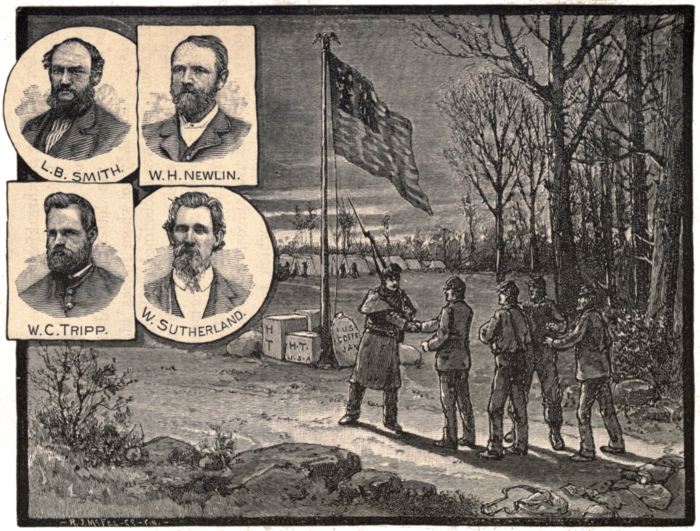
CHAPTER I.
CAPTURE—PRISON AT RICHMOND—AT DANVILLE—SMALL-POX—HOSPITAL AND CONVALESCENT
CAMP—WARD-MASTER AND NURSES—ESCAPE PROM THE GUARDS—TRAIN OF
CARS—FOILED AT SEVEN-MILE FERRY—NARROW ESCAPE—HIDING IN CAROLINA—CROSSING
DAN RIVER—SINGING AND DANCING—EATING AT MIDNIGHT—SABBATH DAY
RETREAT—PROVISION EXHAUSTED—EFFORT TO PROCURE SUPPLIES—ITS FAILURE—HARD
MARCHING—HUNGER AT MIDNIGHT—HIDING PLACE—WASHINGTON'S BIRTHDAY—SLEEP.
The writer hereof was among the prisoners captured by the
enemy in the battle of Chickamauga, Georgia, September
20, 1863. Others of the regiment to which I belonged also fell
into the enemy's hands. As we had served together through
all the vicissitudes of a soldier's life in the camp, on the march,
and in battle, we resolved to remain together, and stand by each
other as prisoners as long as circumstances would permit. On
the day after the battle, September 21st, we were placed on
board the cars at Tunnel Hill, and sent under a strong guard,
by a circuitous route, through Georgia and the Carolinas, to
Richmond, Virginia. We arrived in Richmond on September
29th, eight days having been occupied in the transfer of prisoners
from the battle-field. We remained in Richmond through
the month of October, and until November 14, 1863, when we
were removed to Danville, Virginia, which is south-west of Richmond
about one hundred and fifty miles, in Pittsylvania county.
The transfer was by rail, and each member of our squad succeeded
in getting aboard the same car. Near noon of November
15th we reached Danville, and were immediately introduced to
our new quarters. Our squad was allotted a space on the second
floor of Prison No. 2, a large frame building, where it remained
unbroken until December 15, 1863.
A short time previous to this date the small-pox had made
its appearance among the prisoners. On December 14th I was
taken sick, the usual symptoms of small-pox appearing in my
case; and on the 15th I was examined by the Confederate surgeon
and sent to the hospital, in company with three other patients
from other prisons in the vicinity.
As I here separate from the six persons with whom I had
been associated since my capture, and with whom so much discomfort
and inconvenience and so many privations had been
borne, I here give their names. They were John Hesser and
John North, of Company A, Seventy-Third Illinois Infantry Volunteers,
and James Kilpatrick, of Company B; Enoch P. Brown,
John Thornton, and William Ellis, of Company C. They were
all of the same regiment with myself, and the three last named
were of the same company. The two first named and myself
were all of our squad that lived through the term of imprisonment.
My term, however, did not last as long as that of the
others, as the following pages will show. If my information is
correct James Kilpatrick died as a prisoner under parole early
in 1865, at Wilmington, North Carolina. E. P. Brown and John
Thornton died at Andersonville, Georgia, in September, 1864.
Brown died on the first anniversary of his capture, September
20th, and Thornton died a few days before. William Ellis died
at Charleston, South Carolina, near the close of the year 1864.
Hesser and North were among the last of the Andersonville prisoners
that were exchanged and sent North.
On arriving at the small-pox hospital I was placed on a bunk
in Ward No. 1. I kept in-doors for the space of five or six days,
at the end of which time I was classed among the convalescents.
On or about December 22d, three convalescents, of whom I was
one, accompanied by only one guard, went into the woods on the
right bank of Dan River, in quest of persimmons. We went some
distance into the country, probably four miles, and secured a
quantity of persimmons, which we distributed to the patients in
Ward No. 1 on our return to it in the evening. While out on
this ramble through the woods, guarded by only one person, I
was favorably impressed with the notion of attempting an escape
from the Confederates at some future time, when strength would
permit. The idea was suggested to my mind by the carelessness
of the guard, who more than once set his gun against trees and
wandered some distance from it.
About Christmas a row of eight wall tents was put up on the
hospital grounds, to be used as quarters for convalescents. I was
one of eight persons assigned to tent No. 1, and, as I was a non-commissioned
officer, the hospital steward placed me in charge
of the sixty-four men occupying the eight tents. It is needless
to recite here what the duties were that belonged to my position,
but I discharged them as faithfully as I could, so as to keep out
of the prison-house in Danville as long as possible.
Sometime in the month of January, 1864, the nurses in each
of the three wards of the hospital escaped from the guards, and
started for our lines. This necessitated another detail of nurses
for the wards, and the detail was made from among the convalescents.
The hospital steward did me the favor to appoint me
as ward-master of Ward No. 1, giving me the privilege of selecting
those who were to assist me as nurses in the ward. I selected
those with whom I had become most intimately acquainted as
convalescents. Lucien B. Smith, of Company F, Fourth Michigan
Cavalry; William Sutherland, of Company H, Sixteenth
United States Infantry; Watson C. Trippe, of Company H, Fifteenth
United States Infantry, and John F. Wood, of Company
G, Twenty-Sixth Ohio Infantry, were the persons selected. After
a short time, Robert G. Taylor, of Company G, Second Massachusetts
Cavalry, was added to our force of nurses, to make the
burden of labor in the ward a little lighter on us. We attended
the patients in Ward No. 1 day after day, and night after night,
as well as we could with the scanty supplies of medicine and
food furnished by the Confederates, until the night of February
19, 1864. Very many of our fellow-prisoners came under our
care while we were acting the part of nurses. Many of them
died, and we saw their bodies carted away to the burying-ground
and deposited in their last earthly resting places.
By the 12th of February the small-pox had begun to abate.
As a consequence, the convalescent camp and Ward No. 3 were
discontinued. A day or two later and Ward No. 2 was cleared
of patients and its doors closed. Those who had been attending
as nurses were returned to prison. Two weeks, or three at
most, could hardly elapse before the hospital would be entirely
broken up. In this event we should be returned to the dreary
prisons in Danville, whence escape was scarcely possible. To be
kept in prison many months, perhaps until death alone should
bring release, was an unwelcome prospect, and we looked upon
it with feelings of dread. We had friends and comrades among
the prisoners, whom we disliked to leave behind us, but as our
presence with them could do neither them nor us any good, we
determined to improve the first opportunity of attempting an
escape from the Confederates, and avoid the prison entirely.
February 19, 1864, was a cool day for lower Virginia, and
we would have deferred our escape for a few nights had we not
luckily and accidentally ascertained that we should be sent into
prison on the morning of the 20th. Our careful, though hasty,
preparations for slipping off from the guards were accordingly
commenced just before dark on the evening of February 19th.
Before entering upon the detailed account of our escape and subsequent
trip to the Union lines, it will be requisite to describe
briefly the hospital buildings and surroundings.
The hospital was situated one mile south-west of Danville, on
the right bank of Dan River. The river runs in a north-east
course, consequently the hospital was on the south of it. There
were three wards at the hospital, each capable of accommodating
fifty patients. The wards were numbered one, two, and three.
There were also a cook-house, a steward's office, and a dead-house.
These buildings were constructed of undressed pine lumber.
Ward No. 1 was located on the top of a high round hill;
near its south-east corner, and almost adjoining it was the cook-house.
A few steps north of the ward, and equidistant from its
eastern and western extremities, stood the steward's office. At
the west end of the ward was the dead-house. About one hundred
yards south-west of the dead-house Ward No. 2 was situated,
on the hill-side. At the foot of the hill, nearly one hundred
yards south-west of Ward No. 2, stood Ward No. 3. Directly
east of Ward No. 2, and south of Ward No. 1, was the row of
tents which had been used by convalescents. Still further east,
at the foot of the hill, was a considerable branch, coursing its
way northward to Dan River. Just across the branch, on its
right bank, was a large wall tent, in and near which all the
clothes washing for the hospital was done. The persons detailed
to do the washing slept in the tent. The Confederate surgeon
in charge of the hospital had his quarters in Tent No. 1 of the
row of tents formerly occupied by convalescents. His tent was
nearest the cook-house and Ward No. 1. The tent we occupied,
when not on duty in the ward, stood just south of the surgeon's
tent, and so near it that the ropes supporting it interlocked or
crossed those which supported the surgeon's tent. In Ward
No. 1 was the receptacle or place of deposit for all clothing that
had been washed. Quite a lot of clothing, belonging in part to
patients in the different wards, but mainly to the unfortunate
ones who had died, was stored away for the use and benefit of
those who might be insufficiently clothed. Wards No. 1 and 3
had been whitewashed, but Ward No. 2, which had been put up
between them, at a subsequent date, was not.
Near Ward No. 3, at the base of the hill, was a spring of
water, from which the hospital was supplied. Between the wards
and other hospital buildings, and all about over the hill-sides,
stood tall and straight pines. To the north of the hospital, about
three-quarters of a mile distant, was Dan River, with its swift,
noisy waters, hedged in by steep, rugged banks. To the south-east
and south were cleared lands, traversed by a branch and its
tributaries. Still farther south were heavy woods, with one point
of timber projecting some distance northward, into the cleared
land toward the hospital.
During the afternoon of February 19th, William Sutherland
and myself were wheeling wood on a wheelbarrow from Ward
No. 3 to Ward No. 1. Having to wheel it up hill it was a
wearisome task, and we occasionally stopped for rest. Near four
o'clock in the evening, while resting about half-way up the hill-side,
Sutherland said to me, "It looks to me very much as if
this hospital would be broken up soon." I agreed with him in
his opinion, and remarked that our lease of time at the hospital
was growing short. After a little further conversation, we resolved
to consult with the other nurses on the propriety of attempting
an escape, and get them to set out with us for our
lines on the next night.
In less than an hour's time we had finished our task of wheeling
wood, and were resting on our bunks in the tent. Before
either of us had met with our comrades, Smith, who was off
duty that evening, came to us and informed us he had something
to tell us that we would not like to hear. We told him to acquaint
us with his news, however unwelcome it might be. We
readily conjectured what it was that so interested Smith, and
our conjecture proved correct. He had overheard some of the
guards in their talking, and had learned that it was the purpose
of the Confederates to send us to prison in the morning. This
news did not surprise us, and we were heartily pleased to learn
the intentions of the Confederates, although they were not of an
amicable nature. We resolved to prevent, if possible, the carrying
of these intentions into effect. Smith was then told of the
resolution we had formed an hour before to set out on the next
night for the Union lines. The sun had already disappeared behind
the hills. We knew our fate if we remained at the hospital
until its light should again break forth in the east. Our
purpose to attempt at least, even if we did not succeed, to leave
the hospital, the sick, the Confederate guards, and the Danville
prisons that night was immediately and firmly fixed.
Our preparations were at once commenced. We were obliged
to exercise the utmost caution in all our movements, as a few
of the guards were standing about over the hospital grounds;
some of them were in the cook-house. We wished by no word,
or look, or act of ours, to lead them to suspect our purpose of
eluding them and striking for liberty.
Smith left Sutherland and me in the tent and joined Trippe,
Taylor, and Wood, who were on duty in the ward. Smith soon
found an opportunity of conferring with his associates, and telling
them of the meditated escape. Taylor and Wood were anxious
to join it, but Trippe, who had but recently recovered from the
small-pox, was distrustful of his strength; and as he had once
before escaped, and got some fifty miles away, only to be recaptured
and brought back, he did not so readily sanction the
project. The nurses who were on duty in the ward now, assisted
by Smith, gave their exclusive attention to the sick; they were
even more attentive than usual. No one would have suspected
from their conduct that they would ever forsake the sick ones
under their care.
Just before dark Sutherland suggested the propriety of determining
on a place of rendezvous for our party after the guards
were passed, as it was certain we could not all pass out at once
without being seen. I stepped outside the tent, and walked
leisurely up hill, and stood near the south end of the cook-house.
Directly south of me, about a mile distant, was a prominent
point of timber, projecting northward from the main body toward
the hospital. This point of timber seemed suitable for the
purposes of a rendezvous, and on returning to the tent I directed
Sutherland's attention to it. He concurred with me as to the
fitness of the place for a rendezvous, and went to the ward to
call the attention of Smith, Trippe, Taylor, and Wood to it. As
it was important that our party should fix in the mind the place
of rendezvous before it was too dark to see, those who were engaged
in the ward came out, one at a time, and glanced across
at the point of timber. By so doing misunderstanding and delay,
at the critical moment, would be prevented. While Trippe
was out taking a look he noticed two or three guards approaching
him. He walked on down hill in the direction of the wash-house,
as if going after clean bed-clothes or other clothing for
patients.
Near eight o'clock, P. M., Sutherland sought an interview
with the cook, but found the Rebels had not yet left the cook-house
for their own quarters; so he quietly withdrew from the
room. The cook—who of course was one of our own men—followed
him to the door and asked if any thing was wanted. As
the Rebels were within hearing, Sutherland answered, "There is
a man in the ward who would like to have a little soup, but I
guess he can get along without it. If he must have some," continued
Sutherland, "I will come back and let you know."
"All right," answered the cook.
Soon after the guards went to their quarters, which were situated
near the guard line, but little more than a quarter of a
mile distant, south-west of the cook-house. The cook was again
sought by Sutherland, and this time he was found alone, and
just ready to retire for the night. Sutherland lost no time in
making his business known to him. Six haversacks, the best
that could be found in the deposit for clean clothing, were delivered
to the cook, who agreed to fill them with the best provision
the cook-house at the time afforded. Sutherland then
busied himself in selecting clothing for our party from the deposit
of clothing that had been washed and stored away. When
he had selected the number of garments required he carried
them down to our tent. He and I then took off the clothing
we had long worn, and put on entirely clean suits. We then
went to the ward and relieved our four associates, who immediately
went down to our tent and put on clean suits also. The
six haversacks, which were filled with the best provisions the
cook could provide, were brought to the tent from the cook-house.
Near eleven o'clock, P. M., our arrangements for leaving were
about complete, or as nearly so as was possible with the means
at command. Taylor, Sutherland, and Wood, each had an overcoat
and blanket; Smith had an overcoat and a large bed-quilt.
Trippe and I each had a blanket; we had no overcoats, but we
wore an extra shirt and blouse apiece. For our feet we provided
the best shoes that could be found about the hospital, and took
pains to secure long and strong strings for them. During our
attendance in the ward, patients about dying, or near death, had
in several instances presented the nurses with their overcoats.
These overcoats had been sold by the nurses to the guards for
Confederate scrip. In this way we had obtained near two hundred
dollars in scrip to carry with us on our journey. Taylor
had a watch which was in time-keeping order. He also had a
canteen. Smith had a half-moon tin bucket, which held about
three quarts. The only knives we had were made of sheet-iron.
We had watched in the ward, and perfected our arrangements
for leaving by turns, until near midnight. A little after eleven
o'clock we waked up two or three of the stoutest patients in the
ward, and told them our departure was near at hand, and that
they must watch in the ward for us, and keep the lights burning
until morning. We then bid them good-by, cast a last
glance over the sick, and closed the door of the ward behind us
for the last time. We repaired immediately to our tent and completed
our final preparations for the trip.
As our tent was near that of the Rebel surgeon we were
obliged to carry on our conversation in a low tone. We put out
blankets in a convenient shape for carrying, and made every
thing ready for starting. It was settled, in the first place, that
we should slip out from the hospital grounds two at a time.
Which two should go first was the next question that came up
for decision. Six small sticks were prepared, and we drew cuts.
These sticks were of three different lengths, and the two who held
the short ones were to pass out first. The two who held the sticks
next shortest were to follow in a given time, and the two holding
the longest sticks, in due time, were to bring up the rear. When
the drawing was over Sutherland and I held the short sticks.
As time was precious we placed our haversacks and blankets
under our arms and stepped outside the tent. We stood a moment
at the tent door, listening for the voices or footsteps of the
guards. No sound fell upon our ears save that of the wind blowing
through the tops of the tall pine-trees. On starting we went
to the top of the hill and stopped at the south-east corner of the
cook-house, where we again listened intently, but heard nothing.
The moon, which had been shining at intervals since night-fall,
had become partially obscured by floating vapor clouds. We
kept our haversacks and blankets under our arms in such a shape
as to imitate closely a bundle of clothing. We then walked
slowly down the hill toward the wash-house. We followed the
path leading to the wash-house until we reached the branch.
Instead of crossing the branch on the foot-log we turned to our
right and went directly up stream, stepping sometimes on the ice
and breaking it. We kept close to the bluff, and stooped slightly,
so that it screened us from the west. To our left, on the east
of the branch, was a flat or bottom, covered with pine shrubs and
other bushes, which hid us from view in that direction. Unless
the sentinel on duty had happened to be near the branch while
we were passing, we could scarcely have done otherwise than
escape unseen. At length we had proceeded, with much caution,
a sufficient distance in the direction of our appointed rendezvous
to feel light-hearted and secure. We pushed forward rapidly,
crossed two rail-fences and gained the shelter of the woods, where
we were to await the coming of Smith and Taylor, who had held
the sticks of medium length at the drawing a few moments before.
Sutherland and I laid our haversacks and blankets aside, and
quietly, though anxiously, awaited their approach.
While waiting, after the anxiety and excitement of the moment
had somewhat subsided, we found the weather quite cold. Our
whiskers became stiff and whitened with frost, and the winds
penetrated our clothing. The moon shone out brightly. The
sky was without a cloud. Those which had partially covered it,
only a few moments before, had cleared entirely away. Our
patience was severely tried, as our comrades, so anxiously expected,
had not joined us. On getting quite cold in the breezes
of the wintery midnight, we danced about on our feet, and extended
our arms to quicken the circulation of the blood, and get
ourselves warm. In this manner we passed some two or three
minutes, when we stood still to listen for the coming of Smith
and Taylor. We listened anxiously, but the sound of their welcome
footsteps did not greet our ears. "Can it be that they
have been caught?" we asked ourselves.
"If they have been caught the Rebels will soon miss us, and
be on the alert, searching for us," said Sutherland.
"Perhaps we had better be off then," I answered.
We listened a moment longer, but heard nothing. We then
gathered our haversacks and blankets, and started westward
through the woods. We had gone but a few steps before we
heard the noise of persons climbing the fence. We halted and
remained perfectly still, as we were not sure the rebels were not
on our trail. Soon we could distinguish the forms of two persons
in the moonlight. They were moving toward the point of timber
we had just left. We now knew they were Smith and
Taylor, and soon had the pleasure of hearing our names called
in low, subdued tones by their familiar voices. Our whereabouts
was soon made known to them, and they were soon with us.
Smith and Taylor wished to know why we had not stopped in
the point of timber, as agreed upon. We told them we had
stopped there, had waited some time for them, and had given
them up as lost, and then started on our journey alone, getting
as far as that before hearing them.
We had not long to wait for Wood and Trippe. They had
followed Smith and Taylor more closely than the latter had followed
Sutherland and myself. When Trippe and Wood had
joined us, we introduced ourselves as Federals, and late nurses
at the small-pox hospital near Danville, Va. As the squads of
two each had formed a junction, our party of six was ready to
move.
After adjusting our haversacks and blankets about us, so that
we could easily carry them, we set out through the woods in a
westerly direction. In the woods we found that the snow which
had fallen a few days before had not melted. We disliked to
walk on it, as we left a distinct trail behind. We pushed on,
however, and soon struck a wagon road, from which the snow
had either blown off or melted away. It was not a public road,
but was used merely as a timber road, to get out of the woods
with loads of rails and wood. Its surface was very hard and
gravelly, and we followed it a mile or two in a southerly direction
without leaving many distinct foot-prints.
The railroad leading from Danville, Va., to Greensboro, N. C.,
was soon reached, and we followed it in a south-west course: we
walked on the ties, and made very good time. Soon we had
reached a part of the road which ran over a high grading. On
hearing a distant rumbling noise in the south, we judged there
was a train of cars coming. In a few minutes more we saw the
head-light on the engine as it came around the curve made necessary
by the hills. We quickly slipped down the side of the
grading into the bushes, and watched the train as it passed.
But one person on the train was visible to us, and that was a
man standing at the door of the last car with a lantern in his
hand.
On regaining the top of the grade, we resumed our travels,
walking on the ties as before. We followed the railroad until
we had gone about five miles from our starting-point, when we
came to a wagon road, which crossed the railroad at right angles.
This road had the appearance of being much traveled; by turning
to our right and following it, we went north-west—the direction
we wished to go. As we passed a house near the road side,
Trippe recognized the place as one he had seen when out before,
making his first attempt to escape. He also knew the road we
were following would lead us to the Seven-mile Ferry. This ferry
was so called from the fact of its being seven miles up Dan
River from Danville. We wished to gain the left or northern
bank of Dan River before daybreak, if possible, and we pushed
on eagerly and rapidly. The road was smooth. Its white sandy
surface could be plainly seen. Dense woods, with thick bushy
undergrowth, closely lined it on either side. The hill leading
down to the ferry was at length reached. It was a long, but not
a steep hill. The road as it led us down the hill-side was
meandering in its course.
When we were but little more than half-way down hill, the
thought that there might be a guard at the ferry happened to
suggest itself to Trippe's mind. He proposed that we should
retire into the brush near the road side, and wait until he should
go on toward the ferry and reconnoiter. We assented to this
proposal, and went a dozen steps or more from the road and
halted. Trippe went on down hill alone. He was gone several
minutes, a half hour almost it seemed to us in our restless
anxiety and concern. We became impatient for his return, and
quitting our places in the brush, walked down hill on the road.
Near the foot of the hill we saw Trippe slowly retreating from
the ferry. He had seen us, and removing the cap from his head,
was excitedly motioning for us to halt. We stopped immediately,
and kept still. Trippe also stopped, and turned around, looking
anxiously toward the ferry. He looked only for a moment, and
then quietly rejoined us where we had been waiting. He whispered
to us, saying, "Let's go back up hill." We turned about,
and walked silently up the road. No word was spoken until we
had reached the hill-top. It was to us a moment of deep and
thrilling interest and expectancy.
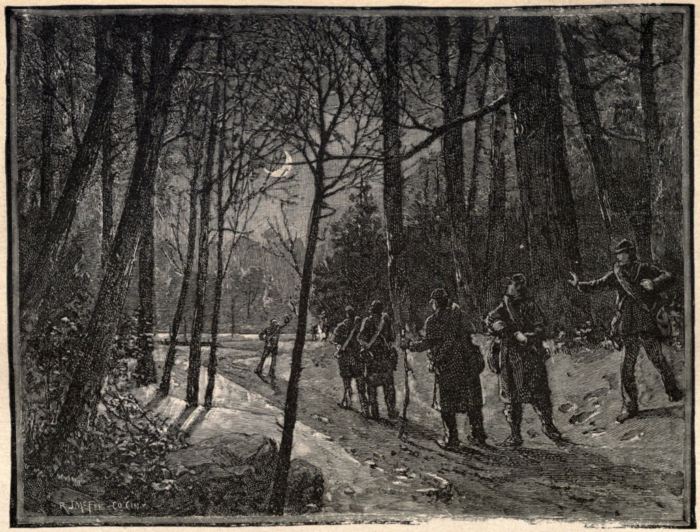
"Foiled at Seven-Mile Ferry."—Page 20.
On reaching the upland we halted at the road side, and Trippe
reported the discoveries he had made at the ferry. He had gone
very cautiously down hill, and had soon stood where he could
see the river plainly, and also the ferry-boat. He had stood
perfectly still until he had assured himself that no guard was
near. He could see nothing but the forest-trees, the river, and
the ferry-boat, in the light of the brightly shining moon, which
made the frost and waters sparkle. He could hear no sound,
save those of the swiftly running waters, and these amply sufficed
to drown any noise he himself might make. He turned around
and started back to us, to beckon us forward. Almost at the same
instant he heard a noise. Thinking he might have trodden on a
stick and broken it, thus making the noise himself, he proceeded
half a dozen steps further; when, still hearing something, he
stopped, and again looked in the direction of the ferry. A little
to the right of it, in the edge of the woods, he saw the sparks of a
fire flying upward. He watched the fire closely, and it sent up a
blaze which shed light far around. One Butternut cavalryman
was first seen to stir the fire, and then add fuel to it. Soon
three others got up from their bed and warmed themselves.
Trippe stood still, and watched them, until they laid down and
covered themselves in their bed. He then silently withdrew,
feeling sure he had not been heard or seen. As he did so, the
horses of the cavalrymen neighed, and pawed the ground, as if
manifesting uneasiness. As we were sure the Confederates were
not aware of our presence, we felt glad we had escaped so well.
Our escape was a narrow one, however; had we arrived at the
ferry ten minutes sooner, we should most certainly have been
recaptured.
Our disappointment in not getting across the river at the
ferry was great, as we could make no progress in the direction
we wished to go until we had gained its northern bank. We
consulted briefly as to the course we should pursue; and soon determined
to retrace our steps until we should find another road,
or some path that would lead us up the river. We started. As
the weather was cold and morning approaching, we hurried on.
An obscure road, leading off in a south-west direction, was soon
found. We changed our course, and followed it. It led by some
plantation houses. We left the road and houses some distance
to our right, as we did not wish to alarm the dogs and set them
to barking.
On returning to the road, we followed it directly up the river
until we had traveled five or six miles, from Seven-mile Ferry.
It became evident that day-break was at hand. A safe hiding-place
for the day next engaged our attention, and we halted. It
was first determined that one of our number should go a quarter
of a mile further up the road, to see if any houses were near in
that direction. Sutherland went some distance ahead, and on
returning reported none. As we had passed but one house since
falling back from the ferry, we judged we were some distance
from any human habitation. The query then arose, shall we
hide in the open woods on our left, or in the inclosed woods on
our right? After a short parley, we concluded to secrete ourselves
in the inclosed woods. We could then get to the river
without having the road to cross. Any parties of cavalrymen
that might be out scouring the country, were also less likely to
come across us in our retreat. Accordingly we crossed the rail-fence,
and left it and the road directly behind us. We worked
our way through the thickets of brush and briers until we were
fully a quarter of a mile from the road, in the direction of the
river. On a spot of ground entirely surrounded by pine-trees
and bushes we made our bed, and, lying down, soon fell asleep.
The weather being quite cold in the early morning, we waked
up at sunrise, on account of cold feet and general discomfort of
body. Trippe got up and took a partial survey of the adjacent
woods. He went northward, still further from the road we had
left at day-break, and found an open space where we could make
our bed in the sunshine. To this open space, which was covered
over with tall dead grass, we moved our haversacks and bedding.
As we wished to rest well during the day, we took pains to make
a good bed. Quite a lot of dead grass and leaves was first
gathered. On the grass and leaves we spread the four overcoats
belonging to our party. On the overcoats we spread Smith's
bed quilt. Our caps, haversacks, and blouses were used as pillows,
and our five blankets were used as covering. In this manner
we usually made our bed all through our trip, varying it,
of course, according to circumstances. Having completed our
bed, we laid ourselves down to rest, and slept comfortably until
late in the day. We made it a rule for each of our party to
sleep as much as desired during the day. We did not require
one of our number to keep awake as a watch for the others during
the day. If we had done so, we, of course, would have
watched by turns. The propriety of so doing was often discussed,
but we generally deemed it safest to have no watch, as the person
watching would have to sit or stand up, and would thus expose
himself to the danger of being seen by somebody who might
be passing, and so lead to our recapture.
It was near four o'clock in the afternoon of February 20th,
when we aroused ourselves from our first slumber as refugees
from prison. We got up and went down into a hollow near us,
where there was running water, and washed our faces. After
combing our hair, we opened our haversacks, and were about
commencing to eat, when we discovered that our corn-bread
was frozen. Our matches—of which we had two small boxes—which
we had luckily procured some two weeks before, now
came in good play, as it was needful to have a small fire in
order to thaw our bread. We secured a small lot of dry pine
limbs and twigs, and built a fire in the hollow sufficient for
our purposes; and soon we had dispatched our first meal since
leaving Ward No. 1. After finishing our meal, we put our
blankets and other baggage in traveling order. As it was too
early to set out, we engaged in conversation, laying plans and
expedients for effecting a crossing of the river. We resolved
to put ourselves across Dan River that night, or on the following
day, at almost any risk. As a final preparation for the
night's marching, we each secured a stout stick or cane. One
of the boys alleged our canes would be needed in case of attack.
Taylor had a very large cane for a man of his size. On
being spoken to concerning it, he remarked that he was going to
cross the river on it. The evening wore away. The king of day
having sunk below the western horizon, we began to look for the
moon, whose light was to shine upon our pathway. It had not
appeared above the horizon; soon afterward, however, the moon
arose, and began shedding light. We felt a kind of loneliness on
leaving the place which had sheltered us during the day.
As Danville, Virginia, was within one mile of the southern
boundary of the State, and as we were at least thirteen miles
south-west of that place, we knew we were in the friendly brush
and thickets of North Carolina. On setting out, instead of going
directly back to the road, we traveled parallel with it for
more than a mile. We then changed our course and went back
to it, thinking it late enough to travel it without meeting any
one. We had gone but a few miles on the road, and passed but
one house, when the noise of the river assured us it was not far
off. We then left the road and sought the banks of the stream.
We crossed an old field, in which we found much mud and
water. The walking was slavish and wearisome, as the wet,
clayey soil adhered to our shoes. The snow, which had recently
melted, had swollen the branches. We found it necessary to
cross a branch or almost go back on our trail. By means of a
fence, a water gate, and some rails, we succeeded in crossing it
without much difficulty. It required time and close watching,
however.
On leaving the branch behind us we climbed a fence and
entered the woods. These woods were dense, and there was a
thick, brushy undergrowth, which greatly impeded our progress.
We found it impossible to go directly to the river. It was
quite dark, for, although the moon was shining brightly, its
light penetrated the heavy woods imperfectly. From the incessant
roar of waters we judged we were near the river; but
we struggled on through vines and thickets for a full half-hour
longer. It was not a great while until we could see, ahead of
us, quite an opening; it was the course of the river through the
forests. We pressed on and soon stood upon the bank, against
which dashed the angry waters. Huge pieces of ice were borne
swiftly down the swollen stream. We had thought of constructing
a raft of poles and rails, lashing them together with bark
and vines; but such materials were not at hand, and the condition
of the river forbade the attempt at crossing on a raft.
We longed to get across the river, but the prospect seemed all
but hopeless.
We pushed on up stream, hoping to find suitable materials
for building a raft and a place where the condition of the river
would admit of launching it. We had gone a mile or more
without discovering any means by which we could cross the
stream; still we did not despair; hope continued to struggle
against reality. We must get across the river that night, we
thought, or venture too far and risk too much to-morrow. The
current of water became more rapid and impetuous as we advanced;
the roar of the river sounded much louder than before,
and our chances of getting across did not seem to improve. We
soon came to a drift of logs, slabs, and rails, but owing to the
condition of the stream, the quantities of ice and other obstructions
in it, we concluded it would be time and labor lost to make
a raft and attempt a crossing there. Our resolution to follow
on up stream, keeping close to the water's edge until morning,
was then fixed. If we failed to find a canoe or other means of
crossing before that time we were then to resort to other measures
to get us out of our difficulties.
After our minds were fully made up as to the course we
should pursue we traveled about two and a half or three miles,
when Sutherland and I, who were considerably in advance, espied
a canoe fastened to the shore-with a chain and padlock. We
were almost overjoyed at the discovery. We could not wait for
our associates to come up, but followed back down stream to
meet them. They were soon informed that we had found a canoe,
but they were almost incredulous. In a few minutes, however,
all doubts were removed, as they beheld with their own eyes
the object of our anxious and careful search. We felt as jubilant
and hopeful as if deliverance from all our troubles was just
at hand; but, in the excitement of the moment, we did not forget
to exercise caution. It was evident the canoe had not been
used for several days; the oar was lying in it, frozen in the ice,
which had thawed but little; the ice near the middle of the
canoe, where the oar was lying, was about three inches thick. In
loosening the oar and breaking the chain which secured the canoe,
much noise would be made. It was necessary to have two or
three rails or poles. Smith and I went out some distance from
the river to procure them, and to see if any house was near.
We found an old orchard, inclosed by a dilapidated fence. On
the southern borders of the orchard we found two log huts, but
they were old and tenantless.
We returned to the river carrying with us three or four stout
rails. As we were satisfied we should not be heard we set to
work regardless of the noise we made. We found the canoe
was locked or fastened in a large slab of ice, which extended
beyond it into the swift water. We first used our sheet-iron
knives and some sharp-pointed and sharp-cornered rocks, and
loosened the canoe from its icy bed. A passage-way for the
canoe was next broken through the ice to the current of the
stream. We then took our stoutest rail and broke the chain by
prying on it. I took a rail and placed myself in the end of the
canoe farthest out from the shore. Our haversacks, coats, and
blankets were then placed in it, and Trippe and Taylor came
aboard. Trippe, with the oar in hand, launched us out into the
river. We found a swiftly rushing current, and were compelled
to row up stream. We kept bearing to our right, however, and
soon came in contact with the ice, which extended out from the
opposite bank. I took my rail and began breaking the ice. Soon
I had broken a narrow passage-way for the canoe, into which we
thrust it, and it became steady. I kept on breaking the ice and
pushing the pieces aside. The canoe was pushed nearer and nearer
the bank. Soon I could reach the low branches of a tree, which
stood near the water's brink. I held on to the boughs of the
tree, and walked ashore on the ice. Taylor and I removed our
baggage from the canoe to the bank. Trippe went to bring over
our three comrades, who had been patiently waiting and watching.
He found some difficulty in entering the passage way as he
neared the bank upon which they stood. In due time our party
was safely landed on the shore, for which we had been anxiously
striving the best part of two nights.
The first great obstacle to our journey was surmounted. We
felt freer and safer. We were several miles from Danville—at
least twenty. It was past midnight. The sky above us was perfectly
clear. The moon was high in the heavens, and sent down
rays of silvery light. Northward, in the direction we wished to
travel, the country appeared clear of timber, and we had hopes
of finding a good road before going a great distance. When we
were ready to leave the river this question arose: what shall we
do with our canoe—tie it up or allow it to float down the river?
We felt gratefully, even tenderly toward it. It had done us a
great service. We concluded to lash it fast to the tree, whose
branches hung low upon the bank. We did so; and left it and
the river behind us.
We pushed due northward across the cleared fields. Some
houses were soon discernible in the moonlight, not far ahead of
us. Turning a little to the left, we soon reached a point directly
west of the houses. We heard much noise, and stopped to see
if we could make out what it meant. We approached a few
steps nearer, and heard singing and dancing. We thought it
late for such exercises; but as it was Saturday night all was
explained, that night being known in Carolina as negroes' night.
As we had provisions enough for a meal or two, we did not interrupt
the exercises, or make our presence known to the negroes.
Nor did we tarry long, as we had no time to lose. We were in
Carolina, and had many miles to travel and many weary marches
to make through a bleak mountain country before our escape was
made good. Our circuit around the houses was continued at a
safe distance, until we struck a road running south-east and
north-west. We turned to our left and followed the road north-west
a little more than a mile. As we felt somewhat hungry,
we halted among some bushes at the road side and eat a few
pieces of corn-bread. After eating, we pushed on, feeling much
refreshed. In a short time we came to a cross-road, when we
changed our course and went due north. In that direction we
traveled until day-break. A safe hiding-place for the day was
next in order, and we set about finding it. We went into the
woods some distance to the left of the road, where we found
quite a cluster of cedar bushes, in the midst of which we thought
we could safely spend the Sabbath day, February 21st. Our
bed was at once made and we gladly laid ourselves down to slumber
soundly.
It was near three o'clock in the evening when we awoke.
On looking about us in all directions, and seeing nobody, we got
up. We ventured to a branch, nearly a hundred yards distant,
and washed our faces. The canteen and bucket were filled with
water and brought near where we had been sleeping. Our toilet
was completed by combing our hair, after which we sat down
and eat the last of our provisions. How we should procure
another supply became the subject of discussion. Various plans
were proposed; one of which we determined to try. If it failed
we were, of course, to resort to another. The late hours of the
evening were passed in adverting to the good fortune which had
attended us so far on the trip. The possibilities and probabilities
of the future were also alluded to.
As we became deeply interested in our talk the time passed
quickly. The tall forest-trees cast long shadows over us. The
sun was disappearing in the west. The sky was cloudless. Our
preparations for the third night of travel were complete. Soon
after dusk we emerged from our hiding place, and in due time
were upon the road. Our rest during the day had been refreshing,
and we walked briskly forward. We passed one house early
in the night. It was too early, we thought, to try our plan for
procuring food, and the appearance of the house and its surroundings
did not justify the belief that the occupants had any
food to spare. So we passed on. Near ten o'clock we came to
another house on our left. It was near the road, not more than
twenty yards distant. From appearances all inside were asleep.
At least no light was visible, and silence reigned. At most of
the houses we had passed, the dogs had barked at us. It was
not so at this one. We went a few yards beyond the house and
halted in the road. Five of us were to lie in wait, while the
sixth went forth on the errand of necessity. Which one of us
should go upon the errand was a question for decision. It was
decided by drawing cuts. Taylor was chosen to attempt the experiment.
Taylor's overcoat was of a light-gray color, and had
once belonged to a Confederate soldier. Smith's cap was also of
"secesh" antecedents. Taylor donned them both, and was to
play the Confederate soldier on furlough. He was to go to the
front door of the house and knock. When the door was opened
to him, if he was asked to come in he was to decline on the pretext
of not having time. He was then to apply for something
to eat, enough for himself and two comrades a supper that night
and breakfast the next morning, which would suffice for one meal
for our party. He was to insist on immediate compliance to the
request on the plea that he and his comrades were hungry and
obliged to march all night. If asked why so? he was to answer
that they had been home on furlough, that their time was nearly
out, and that they must report to the company by a certain time—we
had anticipated many questions that we judged would be
asked, and had answers to suit.
After we had drilled Taylor for a few minutes at the road
side, and found him to be a hungry soldier, with nothing Confederate
about him except his overcoat and cap, he started to the
house. Our eyes followed him as long as he could be seen. We
then retired from the road to the fence and waited about twenty
minutes, until Taylor returned and made report. He entered
the yard in front of the house and approached the door. Before
reaching the door his heart suddenly failed of its purpose. He
felt himself unequal to the emergency. He immediately turned
to his left to examine a smoke-house or other out-house, in
which he hoped to find something that would do to eat. The
door was securely fastened, which fact caused him to suspect
there were some provisions inside. The house was constructed
of round logs, and Taylor reached his arm through the space
between them to see if he could feel any meat. He examined
carefully on each side, but his arm was too short. He could feel
nothing. In the mean time, his attention was attracted to another
out-building, and he went to examine it. He passed the dwelling,
leaving it between him and the road. His search was still
unfruitful.
While examining the second out-house he noticed a stable or
shed about sixty yards distant. By going to it he would be still
farther from the dwelling, and he would feel safer while prosecuting
his search. As a last resort before going to the dwelling,
he visited the stable in the hope of finding some corn, upon
which we would have subsisted in preference to running too
great a risk in procuring more palatable food. He could find
no corn in the stable, nor grain of any kind. There was some
hay or straw, and a lot of corn-blades tied in bundles. In a shed
adjoining the stable were six or seven horses feeding on corn-blades.
Taylor was impressed with the idea that they were
cavalry horses, and on farther examination a saddle or rig for
each of the horses was found. He then determined not to visit
the dwelling at all, as it was certain there was half a dozen or
more men, perhaps cavalry-men, inside of it, sheltering for the
night. He then quietly rejoined us at the road side. We had
run a great risk; our escape had been narrow. Had Taylor
gone half a dozen steps nearer the house he would have walked
on some plank or slabs in front of the door; his footfalls might
have been heard by those inside, and his presence become known.
It was manifest that good fortune was still a companion of our
journey. Had the plan we had devised been followed our recapture
would certainly have ensued.
It was yet early in the night—near eleven o'clock—and we
determined to put several miles between those cavalry-men and
our stopping-place in the morning. Before starting, however,
we held a short parley as to the propriety of taking the horses
and riding them until day-break. On the question of taking the
horses our party was about equally divided. The views of those
who opposed the project prevailed. The chief objection to it was
the great and necessary risk, at the time, in getting the horses
to the road without disturbing their owners, and that in case
we were retaken, and found guilty of horse-stealing or other
depredations, it might go hard with us. By the light of the
moon we discovered we had made numerous foot-prints in the
road. We could not obliterate them without taking time, and
leaving even plainer traces behind us. So we walked backward
several yards on the road. On the north of the road were open
woods. We stepped aside from the road a few yards and walked
parallel with it, face foremost, through the woods, where we could
make no tracks. On going about a mile we crossed to the opposite
side of the road. In so doing we went south, but left
tracks in the road as though we had gone north. We walked
rapidly through the woods near the road until we had gone
another mile, which brought us to fields. As the walking was
not good in the fields on account of the moist clay, we took the
road and hurried forward. At short intervals we went on the
double-quick. By midnight we had traveled ten or eleven miles.
More than one-third of the distance had been gone over since
we had found the cavalry horses. Our speed had been accelerated
by that discovery. We were much wearied, and halted at
a fence near the road side to rest. We were hungry, and would
have eaten something, but our haversacks were empty, and hanging
loosely at our side. Our rest was brief, but sufficiently long
to stiffen our knee and ankle joints.
Our journey was resumed, and we trudged on slowly at first,
but soon increased our speed. There were but few houses near
the road, and these we passed with cautious steps. A second
attempt to get rations was not made that night, as we were fearful
of making a second failure, and losing time besides. We
resolved to wait until the morrow, and trust to luck or Providence
to feed us. The road improved as we advanced, and we
made good progress. It bore a little north of west. On crossing
a branch we halted and took up some water in our half-moon
tin-bucket and drank freely. We then filled our canteen
and bucket with water and carried it with us. We were exceedingly
tired, and did not wish to take the time and trouble
to look out for a hiding-place convenient to water. The gray
light of morning was faintly appearing in the east, and we knew
our journeying must cease for a time. Our sense of hunger had
subsided, or been overcome by weariness. We left the road and
went some distance south of it into a heavy forest. When nearly
a mile from the road we halted, and quickly spread our bed upon
the ground. We then sank wearily to rest, and were sleeping
soundly before sunrise.
It was on the morning of February 22d that we had thus
sought repose in the wintery forest of Virginia. We had got out
of Carolina soon after crossing Dan River, and had traveled almost
due northward until we passed Martinsville, Henry county,
Virginia. We passed about two miles to the right of Martinsville,
and then bore a little west of north. On February 22d
we were hid not many miles—probably not more than a night's
march—from the southern boundary of Franklin county, Virginia.
It was the anniversary of Washington's birth. We remembered
the fact, and revered the memory of Washington,
although his native State had tendered us a very poor and meager
hospitality, and was treating us shabbily. The forest of
Virginia, however, protected us from her own and our country's
enemies.
CHAPTER II.
SLEEP DISTURBED—NOISE IN THE WOODS—ITS CAUSE—NEGROES FURNISH FOOD—WE
HIDE NEAR THE TRAIL—HOUNDS AND HORSEMEN—EXCITEMENT OF THE CHASE—WE
BUY A QUANTITY OF PROVISIONS—OUR OBLIGATIONS—ON THE HIGHWAY IN DAYLIGHT—UNDER
DIFFICULTIES—WOOD CHOPPER—WOMAN AND DOGS—WE PASS ROCKY
MOUNT C. H.—INSECURE HIDING-PLACE—CHANGE OF BASE—WE COME ACROSS A CITIZEN—HE
TAKES STEPS TO CATCH US, BUT IS TOO SLOW—OUR FLIGHT—OUR ESCAPE—RUN
INTO A WAGON TRAIN—HID AWAY—MAKING MUSH—SNOW—SORE FEET AND
LAMENESS—TAYLOR FALLS BEHIND—TAYLOR LEFT ALONE—HIS CONDITION.
When the sun was nearly an hour high, we were aroused
from our slumbers by a loud and incessant racket in the
woods. We did not uncover our heads at first. A squad of
cavalry-men was the first thing of which we thought, but on uncovering
our heads and raising up on our elbows, we found it,
was the noise of wood choppers that had disturbed us. We
looked all around us, but could see nobody. The chopping continued,
and from the noise we judged several axes were being
used. We at once concluded that a party of negroes were at
work not far from us, and that we would have an opportunity
of procuring supplies. The prospect pleased us. Had we known
our conclusion was correct we should have been in an ecstasy of
gratitude.
About one hundred yards south of us was a high ridge extending
east and west. East of us, about seventy yards distant,
was another ridge or spur putting out due northward from the
main ridge. We judged from the sounds that the wood choppers
were east of us and the ridge last described. By consent of
our party, Sutherland and I got out of bed and walked eastwardly
to the ridge, striking it not far from the point where it
was lost in the level ground. We then crept along on our hands
and feet, keeping close together so that we could talk to each
other and be understood without speaking loudly. Soon we got
around the point of the ridge to a thicket of brush, where we
halted. We could see the colored folks at work, plying their
axes vigorously. We waited and watched anxiously a few minutes,
to see if any whites were with them. We saw none, and
were glad of it; we returned to our comrades and made report.
We were in a blissful state of mind, and comforted ourselves on
the cheering prospect before us. Our feelings no doubt were
similar to those of weary travelers in the desert on approaching
an oasis.
Our determination to consult with the negroes, and make
overtures for food and such other assistance as they could give,
was soon made. It was agreed that Sutherland and I should go
upon this delicate mission. We went, and soon reached the point
from which we had watched the negroes before. We again
watched them closely, and assuring ourselves that no whites were
near, we emerged from the thicket, and walked briskly toward
them. As we approached one of the negroes noticed us. He
immediately called the attention of the others to us. Instantly
all chopping ceased, and quiet succeeded. At the same moment
we halted, and Sutherland put his hand to his mouth and asked
if any whites were about? The negro nearest us answered, "No,
sah; massa was heah dis mornin', but he done gone home now."
We then advanced to the fires, around which the negroes had
collected to the number of ten or a dozen, large and small. Our
wants were immediately made known to them. They were
quite willing, even anxious to respond to our call for food. They
offered to divide with us at noon, when "missus" brought their
dinner out. We told them they would not have enough to spare,
as there were six of us, and we were very hungry. The oldest
negro or "boss hand," as he was called, then sent one of the
younger ones to bring us something to eat. The negroes were
all deeply interested in us, and were anxious to learn where our
four comrades were hid. We told them, and inquired if that
was a safe place. We were informed it was safe enough, but
there was a better place south of it, across the ridge. We told
the boss we would cross the ridge and look out a good hiding-place.
He promised to bring our dinner to us as soon as it was
brought to him where he was at work.
Sutherland and I then returned to our comrades and informed
them it would not be long until we should have something
to eat. In accordance with the advice received from our
colored friends we gathered our things and moved across the
ridge. We had passed the summit of the ridge and were going
down its southern declivity when we came to a bench or level
place, where we concluded to stop and make our bed. We had
intended to go to the level ground near the base of the ridge, but
on reaching the bench we knew of no reason why we should not
stop there for the remainder of the day. We made our bed
anew, and then washed our hands and faces, using the water
from our bucket and canteen for that purpose. We then seated
ourselves upon our bed, and quietly awaited the approach of the
"boss" with our dinner. We had waited a short time, probably
a half hour, when we saw him with a large bucket in hand near
the base of the ridge hunting for us. One of our party rolled a
small stone down hill toward him to let him know where we
were. He soon discovered us, and climbed the hill-side, and delivered
to us our dinner. We began eating immediately, and
found we had been bountifully provided for. A bucket full of
eatables, consisting of fried ham, fried eggs, boiled beans, and corn-dodgers,
was furnished us. We had a keen relish for such fare,
and devoured it all. When we had finished eating, the negro
took his bucket and returned to his work; first telling us he
would see us again in the evening. Our appetites were fully
satisfied, and we covered ourselves in our bed and went to sleep.
We had slept but a short time before our rest was disturbed
by a considerable noise. It was the noise of cavalry-men, without
doubt, we thought, or of horses running at their utmost speed.
We uncovered our heads and raised them slightly. On looking
southward we saw two hounds pass near the base of the ridge.
They ran swiftly, and were hot in pursuit of game. They were
closely followed by three or four white citizens on horseback.
The hounds and horsemen were soon out of hearing, and we felt
greatly relieved. Just then the excitement of the chase was not
agreeable to us. We were heartily glad we were not the objects
of pursuit. Had we gone to the level ground, at the base of the
ridge, before halting, as was at first intended, we would most
likely have placed ourselves directly on the trail. The result to
us in that case would have been unfortunate. As our hiding-place
was on the steep side of the ridge, almost surrounded by
small trees and brush, we thought it a safe one, and again gave
ourselves over to rest. We slept well until late in the day.
When we awoke the first object almost which met our vision
was our colored benefactor sitting near us whittling a stick.
He informed us we should have another meal at dusk. We told
him any thing good to eat would be acceptable to us, and place
us under lasting obligations to those who furnished it. We told
him, too, that we had some Confederate money, and would buy
as much provisions as he could deliver to us at dark, if it was
not more than we could carry. He promised to see if we could
be supplied, and told us to come up where they were at work
after sunset.
As the day was already far spent, we began to fit up for
another night's journey. On completing our preparations, we
waited a few minutes longer for the sun to disappear in the
west. Soon it had shed its last ray over us for the day, and we
picked up our things and started from our retreat. By the twilight
we made our way through the woods to the place where
the negroes had been at work during the day. Just before dark
we reached them. They had ceased from their labors and were
expecting us. Some fruit pies fried in grease were furnished us
for supper. While we were eating, the negroes asked what kind
of provisions we could carry most of, or most conveniently. We
told them we could do best on meat, salt, and meal. Two or
three of them then went to bring us a supply of those articles.
In due time they returned with a ham of meat, a little salt, half
a bushel of meal, and half a dozen corn-dodgers. Wood had with
him a clean pillow-slip, brought from the hospital. In it we put
the corn-meal. The ham was cut in pieces and put in our haversacks.
The salt was carried by one of our party in a blouse
pocket.
On setting out we had the corn-dodgers, for which there was
no room in our haversacks; and as, on account of their size, we
could not get them into our blouse pockets without breaking
them, we carried them in our hands until midnight. The ham
had cost the negroes three dollars a pound, and it weighed twelve
pounds and a half. We paid them thirty-seven dollars and fifty
cents for it in Confederate shin-plaster. For the meal, salt, corn-bread,
and what we had eaten during the day, we gave them
twenty-two dollars and fifty cents. We paid them sixty dollars
in all. It was not necessary, they did not exact it, but we had
the scrip and were made no poorer by parting with it. It was
current there at the time, and was much below par in the country
we hoped to reach ere long.
We conversed briefly with the colored people before leaving
them. We learned from them that we had traveled twenty-three
miles the previous night, and that it was about forty miles to
Rocky Mount Court-House, in Franklin county. It was growing
late. The moon had risen, and was advancing in its course.
Every hour of the night was precious to us and must be improved.
We expressed to our benefactors our obligations. We
thanked them heartily and sincerely. We told them they had
no idea of the value of the service they had performed. It was
a service to us; it was also a service to the cause in which we
had struggled and suffered much. We could not pay them adequately,
but hoped in the end they would have their reward in
the results of the war.
We bade them good-night and left them, and sought the road
immediately; on reaching it we could but contrast our feelings
with those we had experienced on leaving it early in the morning.
Our minds were at perfect ease on the question of supplies,
as our pillow-slip was full, our haversacks were full, and each
of us had a corn-dodger in his hand besides. We thought we
should make a long stride toward our lines before our supplies
should be exhausted. The meal in the pillow-slip was carried by
turns. As we had eaten a great deal during the day we did not
feel like walking rapidly. We put in the whole time, however,
until after midnight, when we stopped to rest and eat some
bread. A few minutes' rest sufficed, and we resumed our travels.
As no incident in our travels particularly interesting, or
worthy of record, transpired for two or three nights or days, we
pass on to the events of a subsequent date. We will say, first,
that during the interval of time over which we pass without
noting every circumstance of our journey, we were very cautious.
In the night-time, while passing houses near the road, we maintained
the strictest silence. We walked carefully, and even then
the dogs often discovered us, and made the night dismal with
their howling. We made it a rule not to allow daylight to find
us upon the road; but before we go much farther in our narrative
we will give an instance in which it did so find us. The
first rays of the sun generally shone upon us in our bed asleep.
During our waking hours in day-time, when hid in the lonely
woods, we were careful not to talk, or laugh out boisterously,
knowing the liability to be heard at a distance. We did not
stand up or walk about a great deal. When we had supplies
there was no occasion to incur risks, or purposely come in contact
with any persons, black or white. We always hid, if possible,
where water would be convenient to us. We had fire in
day-time with which to broil our meat and make mush. During
the day we prepared our midnight lunch. When we were in a
secure retreat for the day we generally prepared a quantity of
mush, for fear our hiding-place next day would be in a place
too much exposed to admit of fire or smoke. In all our movements
we tried to exercise the utmost caution. As the distance
between us and our prison became greater we became, if possible,
more cautious. The farther we got from prison the greater
would be our disappointment in being caught and taken back.
The early morning of February 24th found us upon the road,
which led through an open country. Cleared and fenceless lands
bordered it on either side. We pushed on, in the hope of reaching
woods, until broad daylight. At length the rays of the
rising sun began to illuminate the face of Nature. We were
then obliged to leave the public highway. The road had led us
northward the last two nights, and still led us in that direction.
We looked to our right, where the lands were hilly or a little
broken. We went in that direction, thinking we could hide behind
a knoll, or rising ground. Soon we gained a point or crest,
from which the ground sloped gently to the east. A hundred
yards or more ahead of us we saw the tops of scattering trees
projecting above a bluff. We pressed on, and soon stood upon a
precipice, and looked beyond it, over a narrow wooded valley.
We clambered half-way down the precipice to hide among the
rocks. We had laid our blankets, haversacks, and bag of meal
aside. We were going to make our bed, but found the space in
which we stood was not large enough for all of us. We would
be hampered by the rocks. Smith and I had unrolled our
blankets; Sutherland, Wood, Trippe, and Taylor had gone a
little farther down among the rocks to find more room. About
the same time we saw a smoke rising through the trees in the
valley. We were sure a house was there, although we could not
see it. It was south-east of us, apparently half a mile distant.
We were about beginning the preparations for our daily rest
when the noise of an ax resounded in our ears. The noise was
so unexpected and so near us that we were startled, and at first
looked around wildly, and in amaze. We soon recovered from
the shock of astonishment and surprise, and peered cautiously
around the rocks and looked below us. Not more than a hundred
yards from us, in the woods near the base of the precipice, we
saw a single white man wielding his ax. His dog was near him.
On account of the dog we lay low. If he had got a glimpse of
us his master would have become aware of our presence. We
could not make our bed; we could do nothing but keep still.
Smith and I had near us all the blankets, and all the provisions
belonging to our party. Our comrades were about thirty feet
below us, almost under us. Smith ventured to drop their blankets
to them, after which we all kept quiet. We slept but little. As
long as the ax was used we felt no fear of being seen by the
man, but every half hour we peered out from the rocks to see
if the dog was near him.
About noon, or a little later, the man ceased chopping. We
thought we should have a short respite while the man went to
dinner, and would embrace that opportunity to eat our own.
We looked out to see him leaving. We were greatly disappointed.
A woman—his wife perhaps—had brought his dinner
to him, and he was eating. She was accompanied by another
dog. The two dogs then pranced and prowled about in the
woods, and we watched them closely. We were fearful they
would go around, and get above and behind us, but they did not
do so. We were in a very restless and impatient mood; each
moment seemed an hour almost. We would have parted with
jewels, if we had possessed them, to have been away from there.
When the man had finished eating, the woman took her bucket
and went away, followed by the dogs. We were highly pleased
to know the dogs were gone, for they had annoyed us greatly.
The man resumed his toil unconscious of our presence. As he
chopped almost incessantly, and could, therefore, look around
but little, we felt a little safer. Smith and I opened our haversacks
and took out some meat. We cut off a few thin slices and
sprinkled them with meal. On raw meat and meal we made our
dinner. While eating, Smith and I exhibited ourselves to our
comrades below us. They looked up wishfully, and signified
their desire to eat. As Smith and I had all the commissary
stores we continued eating, to tantalize our comrades. At length
we put some meal and a chunk of meat in a haversack and
dropped it to them.
The day had been a long one to us. Our rest had not been
refreshing. We were in constant apprehension and suspense.
The loss of sleep and comfort, in consequence of having no bed,
had its effect upon our bodies. We felt chilled and sore, and we
longed for the approach of night. Near four o'clock, P. M., the
wood chopper ceased from toil and went off with his ax on his
shoulder. Erelong the sun went down, and, as soon as we got
every thing ready, we climbed the precipice and went directly to
the road. Early in the night we found we were about entering
the suburbs of a town. It was Rocky Mount Court-House, Franklin
county. We approached it on a road which bore a little west
of north. We fell back a few paces and began our circuit around
the place. On leaving the road we first climbed a fence and
went across the corner of an inclosed tract of timber lands. We
then climbed a second fence and entered open fields, in which we
continued until the road north-west of the place was reached. In
making our circuit we were guided by the lights in the town,
which were yet burning. Near midnight we halted and eat
some meal and meat, upon which, with an occasional swallow of
water, we made a respectable supper.
On the morning of February 25th, as on the previous morning,
we were in an open country. At daylight we looked ahead
of us on the road, but saw no woods. A house, however, was
discernible in the distance. As we dared not pass it, we left the
road which had been leading us westward. South of the road,
about half a mile, we saw a space of ground covered over with
numerous rocks, large and small. To it we directed our steps,
in the hope that the rocks would afford us shelter for the day.
We soon reached the place, but did not much like it, and were
loath to remain in its inadequate protection. But as the sun was
up, we could not look for a better or more secure hiding-place
without incurring even greater risks than there would be in
making our bed, and keeping it during the day, where we were.
We cleared the small rocks from a space sufficiently large for our
bed and spread it upon the ground. We then lay down to sleep.
Our heads were near the base of a large rock which was between
us and the road we had left a few moments before, and it hid us
from view in that direction. To our right and left and at our
feet were many rocks of smaller size, which partially concealed us
as long as we lay low. On lying down we looked all around us,
but scarcely a tree or bush was visible. Nothing but a waste of
barren ground with an undulating and rocky surface could be
seen. South of us, perhaps a little west, and nearly a mile distant,
was higher ground. Beyond and above it, a few of the topmost
branches of the tallest trees projected. The chief feature of
the country immediately surrounding us was barrenness and
nakedness. We could not resist the impression that our hiding-place
was poorly chosen. A feeling of insecurity crept over us.
The primeval forest of Virginia, with only the exception of the
previous day, had hitherto protected us from the view of the
rebellious citizens of the State. Near three hours of undisturbed
repose was granted us.
Near ten o'clock, A. M., we were awakened by a clattering
noise. Taylor looked out cautiously and discovered it was made
by a wagon passing over a stony road. It was not on the road
we had left in the morning, but on one just west of us, which
crossed or intersected it. It was nearly two hundred yards from
us. The man in the wagon was driving north-east, having come
on the road from the south-west. On stopping in the morning
we had not noticed the road, as the surface of the ground was a
little broken, and many rocks and knolls intervened between it
and ourselves. It had washed and worn considerably below the
level of the ground. On finding we were so near a public highway,
we felt uneasy, and still more dissatisfied with our hiding-place.
We did not leave it yet, however, as the wagon had
passed on out of hearing.
We again essayed to sleep. We fell into a kind of dozing
sleep, from which we were soon aroused by the hum of voices.
We looked westward and saw several persons, mostly women and
children, walking on the road. They were a great while passing,
it seemed to us, and were disposed to loiter by the way. We
felt in an exceedingly disagreeable and unsafe position. At
length the hum of voices died away and we tried to feel at ease,
but could not. Very soon another rattling on the stony road
disturbed our equanimity and patience. We looked and saw a
cart on the road driven by a negro. It was a one-horse concern,
and was followed by a white man on horseback. We judged we
were not far from town, and resolved to flee our hiding-place,
for fear some strollers, or home guards, or somebody should come
upon us and report us, and take measures to recapture us.
We waited and watched until nearly noon, when, concluding
there would be no passing on the road, we put our things in
convenient shape for our first day-time traveling. Just as we
had completed our preparations, we looked westward and northward
to see if any persons were upon the road. We saw none.
We immediately started southward, bearing slightly to our left.
We did not run, but walked rapidly, without looking behind us.
When we had gone about a mile, we reached a point from which
we could look down an inclined plane into woods. We halted
and looked all around us, but saw no one. We judged we had
not been seen, and deemed our movement a successful one. We
were glad to see woods once more, and pushed on until we stood
in the midst of forest-trees.
We sat down on a large rock to rest and watch awhile. We
were on a wooded hill-side, which sloped gently to the south-west.
Trippe got up from his seat and went in a south-east course on
the hill-side, to look for a place in which to hide. He was gone
some time, and we became impatient for his return. We did not
wish to leave the place where he had left us until he came back,
as he would not know where to find us. Nearly a half hour
passed before we saw Trippe returning. He was walking slowly
and hesitatingly. He occasionally looked back in the direction he
had gone. Before he reached us we discovered something wrong
had happened; or if nothing wrong, something at least which we
would rather had not transpired.
Trippe was vexed and almost spiritless. He had been recaptured
once, and now he thought his time had come to be
caught again and taken back to prison. He told us the cause
of his discouragement. He had gone south-east of us, an eighth
of a mile, or more, along the hill-side. He had turned directly
south to go down hill, when he saw a man clad in "butternut"
coming up hill. Trippe thought, and hoped, he had not been
noticed by the citizen, and stood still to see if he would pass.
The citizen came on up hill. His foot slipped, and he caught
hold of a little tree to keep from falling. In getting around
and above the tree his head turned slightly, and he noticed
Trippe, about twenty steps from him. As soon as he recovered
from his surprise he approached Trippe, and asked what he was
doing there. Trippe said he was just looking through the woods a
little. Other questions were asked, and answered by each party.
Trippe tried at first to equivocate, but found it useless, as his
uniform was plainly that of a Federal soldier. He told the
citizen he had been a prisoner at Danville, and with others was
trying to make his way to the Union lines. He also told him
where we were, and how many there were of us in all. The
citizen feigned sympathy with Trippe, and expressed a hope that
he would get home all right. Trippe had very little faith in
him. He advised Trippe not to fight any more against the
South, and at the same time offered his hand. Trippe took the
hand in his own with not the slightest confidence in its possessor.
The Rebel pledged to Trippe his word and honor not to lay a
straw in his path, and immediately turned and went directly
back on his trail. Trippe watched him, and soon saw that he
hurried himself, as if suddenly imbued with a new purpose.
When Trippe related the circumstance to us we became intent
on getting away from there, as quickly and as far as possible.
We placed no reliance in the promise of the Confederate
not to lay a straw in our path, but thought he would take
measures to interpose greater obstacles in the way of our progress.
Our things being already in compact marching order,
we started immediately. The meal in the pillow-slip, though not
heavy, being more than two-thirds used, was all the surplus
thing we had to carry. All else was in our haversacks. We
went south-east, and soon reached the spot where the citizen had
been encountered by Trippe. We then turned to our right and
went south-west. On reaching the base of the ridge we found
we would emerge from the woods and cross cleared lands, in a
narrow valley, or change our course. There was no time for
debate, and we pushed ahead.
Near the outskirts of the woods two little boys and a little
girl were playing. As we passed, the largest boy cried out,
"Uncle Jim has gone for the guards to catch you uns with."
We hurried forward, scarcely taking time to thank the children
for the information. If we had to be hunted we were glad to
know it. A short distance ahead of us was a house. We passed
near it, leaving it a little to our right. When we were just
opposite the house, a woman came to the door and exhorted us
to hurry. She said her brother-in-law was a "mean man," and
had gone to report us to the home guards. As time was gold to
us just then, we did not halt, but heeded the exhortation so
earnestly given. As we crossed the branch which traversed the
narrow valley we heard the woman say her husband had been
killed in the war. She talked on, but we were soon out of
hearing.
As we approached the upland, on the opposite side of the
valley, we began to think about obscuring our trail. We noticed
where a hollow, or ravine, entered the valley from the wooded
hill-side. We got into the hollow and followed on its rocky bed,
where we made no tracks, until we got some distance into the
woods. A portion of the time we went on the double-quick, and
sometimes, when on level ground or going down hill, we went
even more rapidly. It was two o'clock, or a little later in the
day, when we first halted to listen for "Uncle Jim" and his
guards. We did not hear them, nor did we wish to; so we
pressed on. We had so far traveled three miles or more, mostly
in a western direction.
A point had been reached from which we could look across
fields and open country in all directions, except south, south-west,
and east—the course we should take in retracing our steps.
As we did not wish to cross fields, or go back on our trail, we
turned southward. In that direction we proceeded until we had
gone over a mile, when we turned to our right, and again pushed
rapidly westward, through a heavy wood. Soon we came to a
branch of clear running water. As we were tired we concluded
we would wade in the water, following the stream down, and
thus obscure our trail. As we had made tracks in the wet soil
near the branch on approaching it, we pushed on across it, going
some distance until the solid ground was reached. We then got
back to the branch, walking on scattering rocks, sticks, and logs,
so as to leave no traces behind us. If the guards were on our
trail, we hoped, when they reached the branch, they would cross
it, and push on westward as speedily as possible.
We followed down stream in a south-west course for more
than a mile. When in the water we traveled at a moderate gait,
as the branch traversed a very narrow, thickly wooded valley,
and we could not be seen at a distance. A point on the branch
was at length reached where a road crossed it. The road had
the appearance of being traveled a great deal, and we looked up
and down it to see if any body could be seen. On seeing no one
we crossed to the south of the road, still wading in the water.
After getting a short distance into the woods, south of the road,
we left the branch and pushed rapidly westward. Our feet had
become wet, and we resorted to brisk walking to get our socks
dry. We would have taken time to take our socks off and wring
the water from them, but, should the guards come upon us, we
did not wish to be barefooted.
Our flight was continued until sunset. We had intended
traveling on a line parallel with the road, but found it necessary
to bear southward occasionally to avoid crossing open fields.
When the sun had gone down we called a halt. The country
was very rough and broken where we halted; heavy woods and
brushy undergrowth were all around us on all the hill-sides.
We took refuge in a thicket, near a considerable bluff. No sounds
of pursuers could be heard; every thing was still. We rested
well, and slept a little. Our feet were worsted by the wetting
they had received and our subsequent rapid walking. On a few
scraps of meat dipped in meal we made a scanty supper. We
dared not build a fire after dark or we would have made some
mush and taken a fuller meal.
Before the moon arose it was very dark. We waited half an
hour or more for its appearance above the horizon. At length
its light shone dimly through the woods. The sky was a little
clouded and the woods were dense, but the moon served to guide
us upon our course, if its light did shine imperfectly and at intervals.
We gathered our things and started. We steered
northward. When obliged to turn aside, or vary from that
course, we varied to the west. Many difficulties beset us. Our
hurried march in the day had considerably taxed our powers of
endurance; our rest at dark was brief, only, long enough for
our limbs to stiffen; our feet were sore; we were hungry; our
hasty meal at dark had not sufficed. It was the first we had
eaten since midnight of the night before, on getting around
Rocky Mount Court-House. The country was hilly; we got
over and down one hill only to begin the ascent of another;
the woods were dark, and logs and brush obstructed our pathway
and impeded our progress. We persevered, however, and
pressed on. One of our party went in advance and pushed the
brush aside; the other five of us followed just behind him, in
"close order."
Fully an hour passed before we emerged from the brush and
woods into more open ground. We climbed a fence and crossed
a field. On getting out of the field we struck a road running
east and west. We followed it at a moderate gait until we had
gone a mile, when we reached a cross-road. We then turned to
our right and went due north. On going two miles or more we
called a halt. We were much fatigued; nearly worn down, in
fact, and, besides, we were faint and hungry. The road we were
following seemed not to be much traveled. We had passed no
house since dark. We had stopped on the road, where it was
winding along the side of a ridge, which was heavily wooded.
We determined to look for a retreat where we could rest awhile,
build a fire, and make some mush. We left the road and went
up hill west of it. Soon we gained the top of the hill or ridge.
We then went down the hill on its western slope, and in the
bushes near the foot of it we halted. The noise of rippling or
running waters could be distinctly heard. Two of our party
took our canteen and bucket and went to fill them. While they
were gone we built a fire. A blanket was unrolled and spread
on the bushes above the fire to partially conceal its light. Our
bucket was then made three times full of mush. Small, thin
slices and bits of meat were cut off and put in the mush as it
was cooking. Soon our hunger was appeased, and our weariness
hung not so heavily upon us. We put up our things, scattered
our fire, sought the road, and resumed our journey.
Near midnight, and just after we had crossed a branch, we
were startled by hearing a solitary shot in the woods. We immediately
halted. Seemingly the sound of the shot came from
a point not very far ahead of us, but some distance to our left.
Our first conjecture was that we were in the vicinity of a cavalry
bivouac. Two or three of our party thought the home guards
had been posted on the roads, and were about to hem us in.
There was no time to be lost in parleying, and we determined
to go on slowly and slyly. Before going two hundred yards we
came to a turn in the road. The road had been leading us
northward, but on going around the turn it led us west. We
again halted, thinking it was possible there was a guard on the
road, as it led in the direction from whence the sound of the
shot had proceeded. Trippe proposed going on a few paces to
see. He did so. We followed him at the distance of fifty or
sixty paces. In this way we advanced fully half a mile, when
we reached a point where the road passed between fields. Trippe
waited until we came up, when he pronounced the road clear, as
far as pickets were concerned.
We then pushed on, and discovered we were about passing a
house on the left of the road. We checked our speed and passed
the house with care and celerity. When we had got about
twenty steps beyond the house, and just as we were becoming
careless again, the dogs began a lively barking. We proceeded
a dozen steps further when we noticed the sparks of a fire flying
upward. The fire was about twenty steps ahead of us, on the
left of the road. It was near the corner of the rail-fence, where
the lane terminated. We stopped instantly, but said nothing.
We watched the fire closely for a moment. The dogs kept up
their howling. In the light of the fire, which soon blazed up,
we distinctly saw several covered wagons ahead of us near the
road side. We knew, or thought at least, that we were about
running into a supply train. We hardly knew what to do. The
dogs continued barking furiously, and would soon arouse somebody,
to see what disturbed them. We could not go forward, as
the guards, or teamsters, with the train would discover us. We
did not wish to go back by the house, as there was danger of
being observed by persons within, or about it. There was no
time for deliberation. We climbed the rail-fence to our right
on the north of the road. We were careful not to make any
noise; although the dogs made hubbub enough to drown any
noise we should make.
We had left tracks on the road, and found on getting into
the field that its surface was moist and impressible. We determined
to make a trail that would mislead any person who might
have the curiosity to follow us. On reaching a point in the field
about a quarter of a mile due north of the road we turned east.
In that direction we traveled half a mile. We then turned
south and crossed the fence at the corner of the field. On getting
into the road we followed it east nearly a quarter of a mile,
when we went some distance in a south-east course. By so doing
we got into thick woods where the ground was covered with
leaves, where we could leave only very indistinct traces behind
us. We then turned and traveled directly west, keeping parallel
with the road, and a little more than a quarter of a mile south
of it. The dogs at the house still kept up their howling; and
as the train and those with it were just at hand, we kept off at
a safe distance. The shot we had heard an hour before, we
judged had been fired by some one with the train.
When we had gone far enough, in a western direction, to
reach a point directly south of the house, where the dogs were
still barking, we bore considerably to our right, and went north-west.
We continued in that direction until we struck the road
some distance west of the wagon train. After going something
more than a mile further on the road, in a direction a little
north of west, we halted. It lacked an hour or more of being
daylight, but as we were very tired, having traveled many miles
in the last twenty-four hours, we determined to look out for a
secure hiding-place for the day. We accordingly left the road
and penetrated some distance into the woods on the north of it.
Just after crossing a small branch we halted, and made our preparations
for a refreshing sleep. We fell into a sound slumber
immediately on lying down on our bed.
About mid-day we awoke and found ourselves very stiff and
sore all over. We felt very little like moving about. We had
pulled off our shoes on lying down, and on getting up we found
our feet were so very sore that we could hardly get them on
again. The sky was overcast with clouds, threatening snow.
Our stock of provisions was getting very low, and other circumstances
seemed to conspire in making the woods around us and
the prospect before us quite cheerless. That we had not fallen
into the hands of the home guards was the only circumstance
that afforded us consolation. After getting our shoes on, we set
about building a fire. We went to the branch near us and
washed our hands and faces; afterward feeling some better.
Our vessels were filled with water at the branch, to be used in
making mush. When we had dispatched our dinner we had
some meal left, also a little salt, but no meat. The meal was
emptied from the pillow-slip and made into mush, which, with
the exception of the last bucket full made, was put into the
pillow-slip. The last mush made was left in the bucket. When
the mush became cold it sliced off nicely, and was ready for our
midnight meal.
Shortly after noon one of our party wandered out northward
from our hiding-place some distance, and spied a man engaged in
plowing in an old field. It was early in the season, we thought,
for plowing, but as we had seen plowing near Danville in January,
we knew it was nothing unusual for that country. Sutherland
and I went out and lay close to the fence which inclosed
the field, to watch the man who was plowing, and see if we
could determine whether he was white or black. It so happened
that he did not plow on out to the fence near which we were
hid, as a strip of sod or grass land intervened between him and
the fence. We were somewhat disappointed, as we could not
make out at that distance whether the man was white or black.
If we had been assured he was a black man, we would have
made an effort to procure more food.
Near the close of the day we went to the branch and bathed
our feet thoroughly, hoping, if it did not improve them, it would
keep them from getting sorer than they were already. We then
lay down and slept about an hour, and on waking we found that
our blankets and the ground were covered with snow to the
depth of an inch. We got up and shook the snow from our
blankets, and put every thing in order for the night's marching.
Awhile before sunset the snow ceased falling, the clouds began
to clear away, and the weather was perceptibly cooler. No
clouds obscured the sun as it shed its last rays over us for the
day, and sank from view in the west.
Just at dark we left our hiding-place and went directly to
the road. It was quite dark, as the moon had not appeared;
but as our feet were sore, we could only advance slowly any how,
and we pushed on. In the road, where there were no leaves, the
snow had melted, making the walking slippery and slavish.
When the moon arose we walked at the side of the road, and
got along some better. Early in the night Taylor began to fall
behind. Sore feet, we judged, was the cause of his slow progress.
He fell behind several times, and we waited as often for
him to come up. We asked him no questions, only supposing
that his feet were sorer than our own. About ten o'clock, or a
little later in the night, we struck a pike running north-east and
south-west. The road we had been following did not cross it.
As we had to change our course, and as Taylor was some distance
behind, we waited for him to catch up. When he had
caught up we waited awhile longer for him to rest.
On renewing our travels we followed the pike in a north-east
course toward Lynchburg. Before going very far on the pike,
we passed one house on the left. We went nearly half a mile
beyond the house, when we discovered an obscure road leading
westward. We changed our course, as we wished to reach and
cross the Blue Ridge Mountains as soon as possible. Taylor had
kept up with us while following the pike, but again fell behind
on leaving it. The road was a poor one. Its clay surface had
been considerably moistened by the melting snow, late in the
day and early in the night. Before midnight the mud began
freezing, and it stuck tenaciously to our shoes. The country
was rough and broken, and the road led us over a succession of
ridges and hollows. In breaking the frozen crust of mud our
feet were continually slipping backward or forward, or sideways,
as we went up and down the hills, making our march extremely
fatiguing and wearisome. We were obliged to keep the road
on account of the trees, logs, and brush near it on either side.
Our way, however, was plain before us, as the road looked black
in contrast with the snowy woods.
We trudged on in the difficult and lonely way, and, though
our progress was slow, Taylor had fallen far behind. Near midnight
we were on the point of stopping to eat some mush, but
concluded to move on slowly for awhile, and give Taylor a chance
to catch up with us or gain on us. We slackened our pace considerably,
and, on going half a mile, we halted at the road side.
Taylor had not caught up with us, neither was he in sight or
hearing. We sat on a log, and waited patiently for his approach.
Several minutes passed while we were waiting. We took the
mush from our bucket and cut it in slices ready for eating. While
so doing Taylor came dragging himself along the road. We
called to him, and he turned aside to join us in the woods. He
was lame and weary. On reaching us he sank almost exhausted
to the ground, sitting in the snow and placing his back against
the log upon which we sat. We made no inquiries of Taylor as
to the cause of his lameness, supposing he could not tell us more
than we knew already.
One or two observations were made respecting the bad condition
of the road, after which we began eating our midnight
lunch. When we had finished eating we gathered our things and
started. Trippe and I were ahead, and had reached the road
and gone on it a few steps. Wood and Sutherland were closely
following us. Sutherland looked back and saw Smith coming,
but did not see Taylor. Sutherland then asked, "Smith, where
is Taylor? an't he coming?" Smith answered, "I thought he
was following me;" and then looked behind and called aloud,
"Come on, Taylor." Smith not understanding Taylor's reply,
went back to him. On being asked why he had not started,
Taylor said he was unable to go any farther, as his broken leg
had failed him. Smith at once called to us to come back to the
place where Taylor was. We did so. It was painfully apparent
that he could go no farther that night. We learned for the first
time that he had been wounded in the leg, and had one of its
bones broken. He was not a Chickamauga prisoner, but had
been wounded and captured at or near Leesburg, Virginia, in a
cavalry engagement, early in July, 1863, at the time of the battles
of Gettysburg, Pennsylvania. During our four or five weeks'
association with him it so happened we had not learned of his
wound.
We at once concluded that our travels for that night were at
an end, and began looking around for a place in which to lie over
until the following night. When Taylor heard our determination
he objected, saying he felt sure he would not be able to travel
by the following night, and might not be able to renew the journey
for a week. He would not consent that we should remain
with him until the next night, unless he knew he would be able
to go on with us by that time. We insisted on waiting with him
as long as that, as we should lose only three hours' time by so
doing. Taylor still objected, saying he would not detain us a
single hour, and if we failed in reaching the lines, it should not
be laid to his charge. We determined to remain, when Taylor
assured us he could not travel for at least three or four nights,
and was unwilling to feel himself responsible for the consequences
that might ensue from so long a detention of our party.
We then offered to divide our party, to leave two with Taylor,
and let the other three go on. But he objected to this proposal
also, saying he would not delay a single one of us, and probably
be the cause, immediate or remote, of the return of that one to
prison. He would rather take his chances of ultimately reaching
the lines alone, and feel clear of responsibility for any accident
or disaster that might overtake us than to do otherwise.
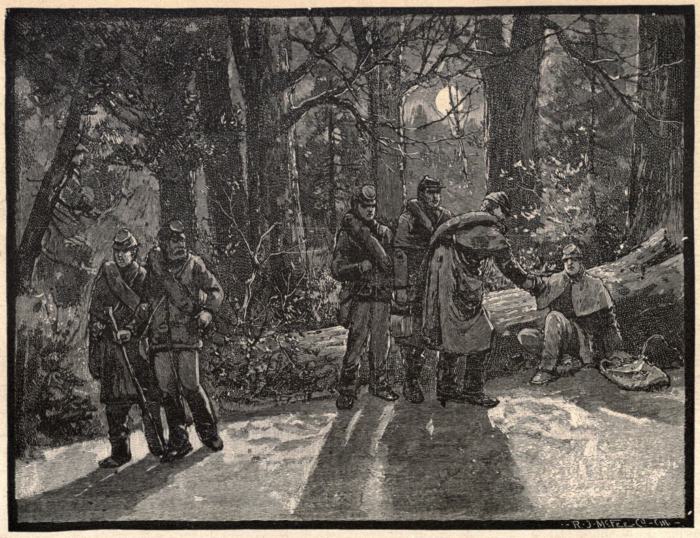
We had offered fairly, as we thought, and concluding Taylor
knew the nature and extent of his disability much better than
we did, we determined to leave the case to him. If he said remain,
we would cheerfully do so; or if he said for us to go on
and leave him behind, we would do that regretfully. Taylor
then said for us to lose no time on his account, but to push on
to the Union lines, and make our escape good. It required but
a few moments to arrange for resuming our journey, and to advise
Taylor as to the best course to pursue; to say to him the
parting good-by, and leave him behind. The mush in the pillow-slip,
all the provisions we had, except a little salt, was then
taken out and divided into six parts. The largest part was given
to Taylor. The other five parts were put in our haversacks.
Nearly or quite half of the scrip on hand was given him, as he
was going to tarry awhile in the Confederacy, and might use it
to advantage. A portion of the salt was also given him. The
canteen which had been used by our party so far on the trip,
and which belonged to Taylor, was left with him. He had a
watch and a supply of scrip to barter for food, or for the services
of a guide, to conduct him to the lines, or both. With
these, and with his canteen and haversack, we left him alone in
the woods, wrapped in his overcoat and blanket. It was a sad
and melancholy scene we witnessed in parting from Taylor. It
was painful and trying to us to shake his hand, and say to him
"good-by." Our feelings were similar to those occasioned by
the fall of a comrade on the battle-field. We had left Taylor,
and were getting into the road when we heard him say, "Company
G, 2d Massachusetts Cavalry," giving his address, and
asking us to write to him if we reached the lines. We each of
us then gave him the name of the company and regiment to
which we respectively belonged, so that he might write to us if
he got through all right.
The substance of the advice we gave to Taylor was to remain
where he was until daylight, at which time he could move to a
better or more secure hiding-place, if able to do so, where he
could command a view of the road, and see persons that might
pass upon it. The first negro, or party of negroes, he saw passing,
if no whites were with them, he was to hail, and beckon them
to him and make his condition known, and get them to harbor
him, or take him to some house where he could be harbored
until he was able to renew his journey. If he saw no person
pass during the day, he was to go in the evening in search of a
habitation where assistance might be given him. When able to
travel, he was to secure, if possible, the services of a guide, to
conduct him to some point within or in the vicinity of the
pickets or outposts of our army. He could reward his guide, if
fortunate enough to secure one, with his watch and Confederate
money.
It was the night of Friday, February 26, 1864, that we
left Taylor behind. We left him within six miles of the Blue
Ridge Mountain, at a point between eighty and one hundred
miles south-west of Lynchburg, Va., and nearly three miles
west of the pike leading to that place. We must have left him
somewhere near the boundary line between Franklin and Bedford
counties, Va., in the north-west corner of one, or in the south-east
corner of the other. If it was trying to us to part with
Taylor and leave him, it must have put his resolution and self-denial
to a severe test to persist in being left alone in his crippled
and almost helpless condition. On stopping he was warm, as the
road was bad, and he had exerted himself to catch up with us.
By sitting down in the snow, he cooled suddenly, and his lame
leg became stiff and useless. His condition was critical and unenviable,
as he was unable to move about with ease or comfort,
and his supply of food was small in quantity and poor in quality.
No house was near him. We had not passed a house since
leaving the pike. The weather was cold, as the snow and mud
was freezing. He was in a bleak mountain country alone. No
friend was near him. We had been his friends and comrades,
and were his friends still, but had forsaken him. His prospect
was cheerless. His desponding heart had little on which to
predicate a hope. He dreaded to meet a man of his own color,
for fear of meeting an enemy, and in the mountain districts
the blacks were few. The woods around him were dreary, although
the ground was covered with snow, and the moon shone
brightly. The trees with their leafless branches and skeleton
shadows could be dimly seen, but were poor companions for a
maimed and wearied traveler in an enemy's land. It was a
touching, but a necessary or unavoidable incident of our journey
to leave Taylor behind in the Winter, and in the wilderness, as
a lonely and solitary sentinel in the silent watches of the night.
But we could do no better, as our supply of provisions was nearly
exhausted, and we could not recruit it, or seek assistance for him
without jeopardizing his safety as well as our own. So we left
him to whatever fate might fall to him in the merciful dispensation
of Providence.
I have never heard from or of Taylor to this date, December,
1869. Whether he got able to travel, and succeeded in
making his escape from the Confederacy, or whether he was recaptured
and returned to prison, is not known to me. He may
have perished from starvation where we left him, on account of
inability to get away from there.
CHAPTER III.
PROVISIONS GONE—CROSS THE BLUE RIDGE—SECURING FOOD—GOING THROUGH BIG
LICK—RAIN AND DARKNESS—WE ARE COMPELLED TO SEEK SHELTER—LYING OVER—THE
TOBACCO—ITS OWNER—MORE FOOD LAID IN—UP THE VALLEY—STRIKE FOR THE
ALLEGHANIES—DIFFICULT TRAVELING—ROUGH COUNTRY—WE REACH A STREAM—TOO
WEARY TO FORD—FALL BACK TO HIDE—MAKING OUR BED—FALL ASLEEP.
Having parted with Taylor, our travels were resumed
through the later hours of the night. Once or twice in
traveling the distance of four, or four and a half miles, we almost
concluded to return to him, but feared disaster might come
upon us if we turned back. It soon became evident that daybreak
was at hand, but we proceeded a mile farther before turning
into the woods. The sun was just rising when we began
making our bed, for the 27th of February, in a place surrounded
by woods and brush. On lying down we fell asleep. We awoke
about the middle of the afternoon. Shortly after arousing from
our slumbers, we eat the last of our mush. A little salt was all
we had left of the supplies we had received from our negro
friends in Henry county. When, where, and how our next supply
of food should be secured we did not know. We judged we
should cross the mountain during the approaching night, and determined
to give ourselves no concern on the score of rations
until the valley on the other side was reached.
The sad event of the previous night formed the subject of our
conversation for the evening. "It wouldn't surprise me a bit,"
said Wood, "if Taylor should beat us to the lines yet."
"He may," said Trippe, "if he lives through the first night
or two, does well, and is lucky enough to secure the services of
a good guide to take him through by the short cuts."
"Our lines will be down this way some of these days," said
Smith.
"The only difficulty with Taylor," remarked Trippe, "will be
in avoiding Rebel citizens and finding a true Union friend to care
for him a few days."
"He must have nothing to do with any body but a negro,"
said Sutherland, "or he's a goner." "Boys," he continued,
"supposing it should become necessary for us to separate into
two squads, how'll we divide?"
"Draw cuts," answered Wood.
"If it should become necessary for us to separate," remarked
Trippe, "it will most likely be under such circumstances as will
forbid drawing cuts."
"Yes, boys," answered Wood, "we'll have to draw cuts now,
and have the thing understood."
Five small sticks were accordingly prepared. They were of
two different lengths. It being understood how the division
should stand, we drew cuts. It was decided that Smith, Wood,
and Sutherland should go in one direction, while Trippe and I
should go in another. We determined, however, never to separate
unless no other alternative would answer, and to push on
and endeavor to reach our lines together.
At sunset we began arranging our things for journeying. As
soon as it was dark we sought the road, and on reaching it we
heard voices. We retired a few paces into the bushes and waited
until a half dozen or more persons, mostly if not all colored, had
passed by. "Now, boys," whispered Wood, as the women and
children were passing, "here is a good chance to get something
to eat." But we had decided to cross the mountains before
looking after food, and allowed the opportunity to pass. We
then set out on our ninth night of travel, and had gone but little
more than a mile when we came to a considerable branch.
We crossed it with but little trouble, and soon after passed near
a house on the road whose occupants had not retired for the
night. We got by the house without attracting attention, or at
least without exciting curiosity. On following the road a little
further, we found it commenced its winding ascent of the mountain,
passing through a gap near the boundary line between
Franklin and Bedford counties, Va. We had heard before leaving
prison that the Blue Ridge Mountains were infested with
bush-whackers. We had a wholesome dread of these, and advanced
cautiously up the road, hoping, if there were any, we
should hear or see them before they should hear or see us.
In little more than an hour's time we reached the highest
point in the gap, over which the road passed. We met with no
one to dispute our progress, and the descent of the western slope
was immediately commenced. We had followed the road but a
short distance down the mountain-side, when, on making a turn
in the road, we saw a light ahead, apparently about one hundred
yards distant from us. Judging it to be the light of a torch, or
small fire, we halted, and, on doing so, we heard voices engaged
in conversation. Trippe at once proposed going ahead alone a
few yards to see what might be seen. We consented, and he did
so. A few minutes of intense anxiety to us passed, as we imagined
the reports concerning bush-whackers were about to be
verified. Before Trippe returned we heard a door shut, the fire
or light at the same time disappearing. We then knew there
was a house, or hut of some kind, near the road, not far from
us; but of the number and character of its occupants we were
not so well informed.
On coming back to us Trippe reported a house down there,
and the light we had seen was the light of a fire in the house.
Trippe said, further, that some one was just leaving the house,
and, as soon as that person had started off down the road, the
conversation ceased, and the door of the house was closed. We
waited a few minutes for the folks in the house to get to sleep,
and for the person on the road ahead of us to get out of our
way, when we again started forward. On coming to the house
we found it a very small one, situated within a few steps of the
road. Passing it without discovery, we slowly walked on, and in
due time reached the valley below.
Near the foot or base of the ridge was what appeared to be
a considerable stream of water; but on reaching it we found it
to be more wide than deep. We went a short distance down
stream and found four foot logs, from sixteen to twenty feet long,
extending across the stream. On these we crossed, and on reaching
the opposite side we halted for awhile to rest before proceeding
to the road.
"If we only had some meat and bread," said Smith, "now
would be a good time to eat it."
"This would be a good place, too," added Sutherland, "as
water is handy."
"I guess we wouldn't be particular as to the place," observed
Smith, "if we only had something to eat."
Being reminded of the fact that we were out of rations we
resolved to try our luck at the first house that came in our way.
We were not long in reaching one, probably not more than half
an hour. As we had crossed the mountain without difficulty;
as we felt glad we had not met with guerrillas—felt considerably
hungry, and were, withal, much emboldened, we were not overcautious
in our movements. Each of our party of five entered
the yard through the gate in front, and on reaching the house—an
old two-story frame house, unpainted—we rapped violently at
the front door. There was no answer from within. We called
and rapped repeatedly, but with the same results. We then
passed around the house to its south side, where we found another
door. Sutherland knocked loudly on it, but no response came.
He then put his mouth to the string-hole and asked, "Is any
body at home?"
A man inside answered, in a tone of voice indicating fright,
"I guess there's somebody about."
"Why don't you get up, then?" asked Sutherland. "Nobody's
going to hurt you."
"What do you want?" inquired the man.
"We want something to eat, and want you to get up and set
about getting it forthwith," said Sutherland. He refused to even
get out of bed, whereupon Sutherland demanded, "Shall we burst
your door down?" and Wood added, "and come in and burst
your noggin?"
The man said, "That rests with you," and inquired, "Who
are you, and where are you going?"
"We are soldiers going to Rocky Mount Court-House,"
Sutherland answered.
"Go on over the mountain, and you will be fed in the morning,"
returned the man.
Preferring to risk our chances at the next house to doing any
very rash or violent acts, we left this one, telling the man he
showed a very poor quality of patriotism.
"If it was any other time, if it twas daylight, I might do
something for you."
"We don't have to stand picket in the night-time; we don't
have to march, skirmish, and frequently fight in the night-time,
I suppose?" retorted Sutherland, in a very unamiable voice.
"And skedaddle in the night-time from such rusty Butternuts
as you are," added Smith, in a tone just loud enough not
to be heard by the man, as we were withdrawing from the yard.
We passed out of the yard through the gate to the road as
quickly as we could, intending to hurry on our way. As Sutherland
closed the gate he threatened the man with, "We shall report
you when we get to Rocky Mount, mark that."
On starting forward on the road Wood observed, "We commenced
too heavy on the gentleman: we got him so badly scared
he didn't know what to do, or how to do it."
We kept up our conversation, dwelling chiefly on the causes,
real and supposed, of our failure in procuring food, and of the
method to be resorted to in supplying our necessities. It was
agreed that Wood and I should try our hands at the next house.
It was after midnight, and should we not reach the next house
soon we decided not to disturb its inmates, as we must have time
to get out of reach after so doing before hiding for the day.
In a few moments we halted in front of a house on the south
of the road at a distance of sixty or seventy yards from it.
Wood and I entered the yard and approached a door in the one-story
part of the house, supposing the darkies slept there. On
knocking slightly at the door, and hearing no answer, we jerked
the latch string once or twice. A voice inside—which was undoubtedly
that of an elderly white person—remonstrated strongly
against being disturbed at so late an hour. Wood seeing the
smoke-house a few steps to his left, went to examine it, and
proceeded from thence to the yard south of the house.
At the same time I stepped upon the porch in front of the
two-story part of the house, and walked on it until I discovered
a pair of steps or stairs. On going up the steps I found the
porch had a second story also. Just at the top of the steps
was a doorway to the second story of the main building. I
found the door fastened, when I called out, asking if any one
was inside. A voice, plainly that of a negro, answered there was.
I told him to get up, and come out doors, as there were some
folks at the road who would like very much to see him. The
negro declined, saying, "You can't come dat game on dis chile:
Ise not coming out dar."
"Get out of bed and come to the string hole," said I, "I
want to speak to you." He did so, when I said, "Put your ear
to the string-hole." He complied; and in a loud, distinct whisper,
I pronounced the word "Yankees." As soon as the negro
could draw on his clothing, the bar of the door came down and
he and I descended the steps into the yard.
On seeing us, Wood approached, saying to the negro, "Where
did you come from?"
"Ise from Knoxville," was the answer.
"But just now, where did you come from just now?" asked
Wood.
"From up in the loft," was the negro's reply.
"Come out to the road, old fellow," said I, "there's some
more Yankees out there."
"Lord, massa! golly! dat so?" ejaculated the astonished
negro.
We then went to the road accompanied by the negro. On
rejoining Trippe, Smith, and Sutherland, at the point where we
had left them, the last named, on seeing the negro, remarked,
"You don't expect us to eat that fellow, do you?"
We lost no time in telling the negro what was wanting; that
we were hungry and had no provisions. The negro said the
cellar and smoke-house were locked, and the old master had the
keys. We asked him how soon he could get something for us to
eat. He replied, "In the mornin', 'fore massa and mistress gits
up."
"How about the keys; don't the whites get up and unlock?"
"No, sah; we gits de keys, onfastens, and gits breakfast 'fore
de white folks gits out o' bed," replied the negro.
On ascertaining beyond doubt that provisions would be furnished
us in the morning, we had the negro conduct us to a safe
hiding-place for the day, which was near at hand. He took us
to a secure retreat in the midst of a large grove of heavy oak
timber situated about a mile from the house, on the north of the
road. In all directions from our hiding-place for the day—Sunday,
February 28th—were open fields. The woods or grove we
were in covered three or four hundred acres of land. Our camp
for the day was close to a rivulet, and was immediately surrounded
by tall dead grass; and a little further from us were
numerous small trees and bushes. The negro told us he would
fetch us breakfast by ten o'clock, and then hurried home.
It was an hour or more before day when we made our usual
preparations for sleep. Soon after lying down we were lost in
slumber. Near nine o'clock, A. M., we awoke from our slumbers
and got up and washed our faces at the rivulet. Our toilet completed,
we had not long to wait for the appearance of our negro
friend, with a small basket of eatables, a pitcher of milk, and a
mug of molasses. We fared sumptuously on wheat cakes, fried
bacon, potatoes, molasses, and milk. When we had finished our
meal the negro took the molasses and milk pitchers in his basket
and went homeward. While eating we learned from the negro
that we were in Roanoke county, and that the nearest town on
the road we expected to travel was Big Lick, a station on the
East Tennessee and Virginia Railroad.
Shortly after noon the negro came out and talked quite a
while with us. He wished to know when we would have another
meal brought out. We expressed our willingness to receive
another meal at any time before sunset. We asked the negro
how much provision he could furnish us to carry with us. He
replied that he had not a good chance in day-time to get at the
meat, flour, and potatoes, without being seen by his master or
mistress, and at night he had no chance at all to secure any
thing, as the cellar and smoke-house were always locked at dark
by the whites, who kept the keys until morning.
The man on whose provision we were subsisting was named
Schooler, or Schuyler. Being an original secessionist, he left
Knoxville, Tennessee, and settled in Roanoke county, Virginia,
where he would be less troubled with Federal troops. The negro
had also lived in Knoxville, and had before seen Yankee soldiers.
When he left us he went home, and soon returned with another
supply of food for our present consumption. While we were eating,
the negro informed us that Schooler, his master, had seen the
man at whose house we had attempted to get rations on the previous
night. The man told Schooler of the demonstrations we
had made at his house before leaving it to go on over the mountain.
Schooler in turn told the man that he, too, had been interrupted
during the night, but the disturbers of his sleep had
done no harm, and gone on, he knew not where.
Our supper finished, we had an understanding with the negro
as to the place where we should receive the corn and meat. He
then left us, and we rolled up our blankets and made other needful
preparations for our tenth night's travel. Just at dark we
started for the point designated to receive what provisions our
negro host could provide for us. As we found him there with
the corn and meat, we were not long delayed. We were told it
was seven miles to Big Lick, and that Salem Court-House was
nine miles west of that place. I gave the negro one of my
blouses as a slight compensation for his services to us, and as a
token of remembrance. We thanked the negro heartily for befriending
us in the hour of need, and then put the corn, which
was shelled, in our haversacks, and the meat in our pillow-slip,
and started for the road, accompanied that far by the negro.
On reaching the road we bade our negro friend farewell and
left him. We found the road better than we expected, and
pushed forward rapidly, hoping to get around Big Lick by midnight.
We had thought of bearing to our right and passing
east of the place. As soon as we thought we had gone six miles
we saw a few small houses not far ahead of us, and concluded to
pass them before commencing our circuit around the town.
When we were just opposite the first house, Wood supposed it to
be the domicile of a negro family, and went to the door, opened
it, and asked how far it was to Big Lick. "You are there
now," was the answer given. Closing the door without asking
any more questions, Wood hastily rejoined us at the road.
On finding we were in town we pushed on through it, walking
silently and briskly. Near the railroad depot we halted,
and after consulting briefly concluded to leave the road, so as to
elude pursuers, fearing the man we had inquired of might be a
white Rebel, and might collect a party to look after us in the
morning. After leaving the road we reached in a few minutes'
time the railroad bridge. We passed under the bridge, walking
partly in the waters of the little stream which it spanned until
we gained the woods north of the railroad. We then traveled
due northward until the sky became cloudy, when it grew much
darker, and we found great difficulty in making our way through
strange woods, with no road to guide us.
Before morning it began raining, and the night became black
and dismal in its last hours. We could scarcely proceed, but
we kept on the move. Just at daylight we came to a road running
east and west. It seemed to be a very public one. As it
was raining hard we thought we should not be seen, and we
crossed the road and pushed on northward something more than
a mile, when we halted in the midst of a considerable forest of
pines. Through this forest was a string of rail-fence, and as it
was raining hard, so that we could not make our bed down on
the ground, we placed rails across from one panel to another, on
which we sat with our coats and blankets disposed about us so
as to shed the water off as much as possible. In this manner
we occupied two corners of the fence; three of us in one corner
and two in the other.
Near noon we were compelled by the severity of the storm
to seek shelter. We started and kept close to the fence on its
north side, going in an easterly direction. In a few minutes we
came to another fence, running north through open fields. We
changed our course, and followed it until we came to a branch
running in a south-east course. As the ground was much lower
near the branch we could follow it and at the same time be
screened from view. Soon we came in sight of a lone building
to our left a short distance, in the edge of the woods. We went
directly to it, and found it to be a tobacco-house. In it we
found shelter from the rain, as the roof was good. We then
took off our coats and blankets, and wrung the water from them.
As there was a lot of corn-blades tied in bundles stacked in one
corner of the room, we soon had a good resting-place. A small
lot of tobacco leaves, hanging above our heads, soon attracted
our attention, when the following conversation took place:
"There's some tobacco," said Smith. "I'll bet there will
be somebody out here before night to look at it."
"Not while it rains this way," said Trippe.
"Well, let them come," said Wood, "it belongs to nobody
but a darkie, any how."
"And when he comes out here we'll only have him to furnish
us with more rations," said Sutherland.
"I'm only afraid he won't come," added Trippe.
There was no floor in the tobacco-house, and we cleared the
corn-blades and straw from the center and built a fire. For
fuel we used tobacco sticks, of which there was a large quantity
piled up in a corner of the building. After burning enough
sticks to make sufficient coals and ashes for the purpose, we
went to parching corn. This we did by scattering the corn near
the fire and raking hot ashes and coals over it. When the corn
was parched sufficiently, we raked it from the ashes with small
sticks. After eating all we wished of parched corn and broiled
meat, we parched a lot of corn for future use.
The rain continued falling, and the day was far spent, when
we came to the conclusion we should be compelled to lie over for
the approaching night—February 29th. At dark we stretched
our blankets on sticks around the fire, for the twofold purpose of
drying them and concealing the fire. Soon we were obliged to
allow the fire to go down, as its light shone against the roof and
through the cracks of the building between the logs. We had
seen but one house during the evening from where we were, and
that was away some distance to the north of us. But for fear
somebody would be passing, and see the light of our fire, and
thus discover us, and publish the fact of our presence in the
vicinity, we put it out entirely. Becoming reconciled to the
necessity of stopping over for the night and following day, we
thought we would make the best of it, and rest, and recuperate
as much as possible in that time. So, taking time and pains,
and a goodly quantity of corn-blades, we made us a good bed.
A roof over our heads and the pelting rain-storm without were
conducive to sleep, and the night was passed in quiet and repose.
We waked up shortly after daylight in the morning, but did
not get out of bed until about eight o'clock, A. M. The rain
had ceased, but clouds still overspread the sky, causing us to
feel doubtful about getting off even that night. We went out
one at a time to the pools of water, and washed our hands and
faces. Soon after we built a fire and began parching corn, and
broiling meat for breakfast and dinner. While thus engaged,
Sutherland, looking through a crack between logs, espied an old
negro approaching. As he was alone he gave us no concern,
and we were not averse to his coming. Approaching nearer and
nearer the building, the old negro finally came upon our trail
and noticed our tracks. He followed them a few steps, when,
discovering they led to the tobacco-house, he came to a halt.
He watched the house closely for a moment or two, when hearing
or seeing us, he turned to go back. Sutherland opened the
door and said, "Hullo, old man! that'll never do; come in here,
we'll not hurt you."
The old man turned about, and after further entreaty approached
the house and entered it. He had come out to examine
his tobacco. He was well stricken in years, being ninety years
of age, having children, grandchildren, and great grandchildren.
On account of his age he was slow of speech and comprehension.
We had trouble in getting him to understand who and
what we were, and the situation in which we were placed. He
did not seem, at first, to correctly understand the meaning of the
term Yankee, but soon came to it, inquiring, "Is you uns some
of them fellers that's penned up in the 'backer-houses in Richmond?"
We answered that we were. We found it necessary
to impress on his mind the necessity of keeping secret from the
whites the fact of our presence in the country. Our need of
procuring provisions from time to time was also explained to the
old man. We urged the old man to either bring or send us
some meat of some kind, if nothing else, and to have it at the
tobacco-house by sunset. He promised to do so, and shortly
after examining and arranging his tobacco, he went slowly on
his way home. We finished our breakfast, and continued parching
corn for awhile. A little before noon we laid-ourselves down,
and slept until about three o'clock in the evening.
On getting up we finished parching corn, and then all the
provisions we had with us were ready for eating. When we first
got up the sky was partially clear, and by sunset it was cloudless.
Just after sunset the old negro arrived with some six or
eight pounds of meat, mostly boiled beef, the remainder being a
small piece of side meat. A couple of corn-dodgers were also
furnished us, which we set apart for our midnight meal. Having
got our baggage, quartermaster and commissary stores, ready
for the trip, we expressed our obligations to the aged negro who
had befriended us, and bade him good-by. He then started
home, and soon after we set out on our eleventh night's journey,
March 1, 1864.
Finding the ground soft and well saturated with water, we
thought we should do well if we trudged through eight or ten
miles that night. On reaching the road, which had been pointed
out to us by the negro, we found the walking much better than
we expected, as the water could not so easily penetrate its hard
surface. In a short time we passed the house where lived the
owner of the plantation to which the tobacco-house in which we
had been sheltering belonged. The house was near the road,
and the lights in it were burning brightly. While we were
passing the house the dogs began a lively barking, and kept it
up until we had gone some distance, and crossed a creek, when
we heard no more of them. Near midnight we halted at the
road side amid a cluster of small trees, and eat some beef and
corn-bread.
We soon resumed our travels. As we could not walk very
rapidly, owing to the condition of the road, we put in the whole
time until day-break, so that we could have it to say that we
were at least eight or ten miles nearer our goal than when setting
out. The road we were traveling bore northward in its
general direction, but as the country on either side was covered
with unfenced woods, it frequently deviated from its general
course. At length day-break came, and we went to the left of
the road in search of a secure hiding-place for the day, March
2, 1864.
The distance gone over during the night had not been more
than eleven miles, or twelve at the furthest, but we were that
distance further north, which was a gratifying feature of the
night's journey. The ground being yet very damp, we were
compelled to seek an open space in which to make our bed, and
a quantity of brush and leaves on which to make it, so that our
bedding should not get damp or muddy. A suitable hiding-place
having been found, we collected leaves and brush from the
adjacent woods, and made our bed on them, and retired to sleep
for the day. We went about a mile from the road before locating
our camp. It was further than may have been necessary,
as the road was not a very public one, judging from appearances,
and the country was very sparsely settled.
Some time in the evening we awoke and got up, finding the
sky clear, and the weather mild for the time of year. We found
we had not stopped convenient to water, but on looking around
a little we found water not far off sufficient for our needs. As
we had no use for fire we built none, but made a meal on parched
corn and beef, and quietly awaited the approach of night. The
evening was spent in conversation, dwelling chiefly on our trip,
past and prospective. We talked of things that had taken place,
which, if we had them to do over again, we should do differently;
of some fork of the road or cross-road, where, if we were only
there again, we would take a different course. Sometimes we
would imagine certain things to happen us, and decide in our
minds what we should do, should the event actually transpire.
Our minds seemed always occupied, either with thoughts and reflections
on the journey, so far as completed, or with plans and
expedients for the journey yet before us.
At dark our luggage was fitted up in readiness for starting
out on the twelfth night of our travels, being the thirteenth night
out. In a half hour's time we were on the road, wending our
way northward. We found the road had improved under the
day's sunshine, and we were enabled to make better progress than
we had made on the previous night. On coming to a cross-road
near midnight we stopped a few minutes to eat a little and consult
as to the course to take, north or west. It was evident that,
no matter which course we took, we should soon reach the first
ranges of the Alleghany Mountains. As we had previously determined
to travel in day-time across the ridges, gorges, valleys,
and barren wastes of those mountains, we thought we would turn
west and reverse, as soon as possible, the order of our times of
sleep and travel, sleeping at night and traveling in day-time.
We accordingly turned our faces to the west. By so doing we
did not reach the mountains as soon as we should have done had
we continued in the northward course.
We spent another night and day, March 3, 1864, in the
valley between the Blue Ridge and Alleghany Mountains. Nothing
deserving of particular notice transpired during that day.
An hour or more before day, on the early morning of March 4th,
we came to a considerable stream, washing the base of one of
the principal ridges of the Alleghanies. We had been traveling
the greater part of the night over a very rough and hilly road,
and were getting tired and sleepy. As we expected to begin
traveling in day-time over the mountains on the day then approaching,
in accordance with our previous programme, we determined
not to cross the stream that night, or morning rather, and
followed the road back a short distance to where the woods bordered
it on the south. We then left the road and entered the
woods, going in a south-east course a little more than a half
mile. In a spot surrounded by small trees and bushes, where
the surface of the ground was covered with rock large and small,
we halted for the day, March 4th. We cleared the rocks from
a small space, sufficiently large for our bed. We then made it
and went to rest for a few hours.
CHAPTER V.
ACROSS RIDGE AND VALLEY—WE SEE NEW CASTLE IN THE DISTANCE—CHILDREN SCARED—WOMEN
AMAZED—WE VISIT THEM—THEY THINK WE ARE "SECESH"—WE THINK
THEY ARE "SECESH"—EACH PARTY MISTAKEN—ALL GOOD UNIONISTS—A DESERTER
HID UNDER THE BED—HE COMES FORTH—AT "JEEMES" HUFFMAN'S—HE THINKS WE
ARE CONFEDERATES—FINE SUPPER AT MIDNIGHT—WE ARE BEWILDERED IN THE
DARKNESS AND RAIN—DUCKED IN CRAIG'S CREEK—WE AVOID REBEL RENDEZVOUS—HIDE
IN THE MOUNTAINS—AT THE HOUSE OF A CONFEDERATE HOME GUARD—HE IS
SICK—PROVES TO BE A UNION MAN—ONE CORN-DODGER—HE SENDS US TO ANOTHER
UNION MAN—WE LOSE OUR WAY—PRECIOUS TIME LOST—WE ARRIVE AT WM. PAXTON'S—SUPPER
AT MIDNIGHT—AN OLD REBEL BADLY FOOLED—PAXTON DIRECTS US
TO ROBERT CHILDS'S—CHILDS NOT AT HOME—HIS WIFE PRETENDS TO BE SECESH—SHE
THINKS WE ARE SECESH—CHILDS COMES HOME—HE VISITS US IN THE WOODS—HE
IS A RABID SECESH—ADMITS WE ARE UNIONISTS—BUT BELIEVES THE CONTRARY—THE
MYSTERY ACCIDENTALLY SOLVED—MRS. CHILDS A UNIONIST—MR. CHILDS A
UNIONIST—THEY COME TO KNOW WE ARE UNION SOLDIERS—GOOD FEELING—WE ARE
FED—WE ARE SENT TO DAVID HELPER—WE SEPARATE FROM CHILDS.
We rested in the gorge for the space of half an hour. Soon
after leaving it we reached the valley. We crossed the
valley, and immediately began the ascent of another ridge, and
on gaining its summit we could see a town in the distance to the
west of us. We ascertained, late in the day, that the town was
New Castle, Craig county, Virginia. We went down the mountain-side
into another valley, and then changed our course, and
followed up the valley in a direction a little east of north. In
passing through a dense thicket we came to a dilapidated rail-fence.
We crossed the fence, and soon emerged from the thicket
into more open ground. We were bearing considerably to the
east, following around the thicket, when we suddenly came upon
a hut. Three or four children were at play near the door. They
saw us and ran into the house immediately, when two women
appeared at the door and gazed at us in apparent amazement.
As it was growing late, the sun having gone down, we knew
the women could bring no harm upon us, and we approached the
humble dwelling and entered it without waiting for an invitation.
We took seats, and opened the conversation by telling the women
to set before us, on the table, what they had cooked, as we were
hungry, and had nothing to eat. The women complied, setting
out a few slices of cold boiled meat, a couple of corn-dodgers,
and four bowls of milk. We sat around the table and eat all
that had been placed upon it. After eating we told the women
that was the first milk, with one exception, we had drank for
many months, and that was the first bread we had eaten for
two days.
The women seemed very much astonished, and inquired who
we were, and where we were from. We told them we had been
prisoners at Danville, Virginia, and were now trying to make
our way through the mountains to the Union lines. They then
apologized to us for the scantiness of the meal they had given
us, saying they thought we were Confederate guards from New
Castle. We also apologized to them for ordering them, in so
abrupt a manner, to set out supper for us, saying we thought
they were "Secesh." The women then called for "Jim" to come
out from under the bed. "Jim" immediately came forth. On
our approach he had hid under the bed, thinking we were Confederate
home guards. Jim was a deserter from Buckner's
army in East Tennessee. We told these Unionists of the event
of the afternoon; of our being pursued, and of losing one of our
number in our flight. They seemed to manifest much anxiety
on account of the lost one, and asked us many questions concerning
him.
We inquired if there was any good Union man living in the
valley of whom we could procure provisions to carry with us.
We were told that "Jeemes" Huffman lived four miles up the
branch, and could furnish us with provisions. A path was
pointed out to us that led up to Huffman's house. Just at dusk
we bid our Union friends "good evening" and set out, intending
to give Huffman a call. About half the distance had been
gone over when darkness fully set in. After dark our progress
was much slower in following the strange and devious pathway.
Near nine o'clock, P. M., we saw the light of a fire, shining
dimly through Huffman's window. We crossed a fence and followed
the path a short distance up the mountain-side to the
house. The door was standing open, and we entered and stood
before Huffman and his wife. They were not a little surprised,
and seemed doubtful as to the manner in which they should treat
us. We were soon seated before the fire, however, and began
to acquaint Huffman with our condition and necessities. Having
heard with interest our narrative of the facts in our case the
woman asked if we would have supper. We answered in the
affirmative, and she went to work, and by ten o'clock, P. M., we
sat down to a table bountifully supplied with food.
While eating we learned from Huffman that he lived two and
a half miles from New Castle, Craig county. We learned, also,
that the home guards at New Castle searched the premises of
the mountaineers every two weeks for deserters from the Confederate
army. When we first entered the house Huffman supposed
we were home guards from New Castle, and the hesitancy
on his part to avow, at first, his Union sentiments, was the result.
Huffman said it had been two weeks since his house had
been searched, and he was in hourly expectation of the guards.
As Huffman was engaged in shelling corn, we asked of him the
privilege of shelling a few ears to carry with us to eat on the
morrow. This favor was readily granted, and some three or four
dozens of Irish potatoes were also furnished us.
Near eleven o'clock on that night of March 4th we were ready to
set out again on our travels. Huffman gave us directions how
to get across Craig's Creek, and how to avoid a certain house,
which he described, where a Rebel family lived, and where the
home guards sometimes stopped, when out on their semi-monthly rounds.
After bidding Huffman and his wife good-night, we left
them, and followed, as well as we could, the directions we had
received. It had become very dark and cloudy, and before we
reached Craig's Creek it began raining, and we found it impossible
to follow the directions Huffman had given us. But we
pushed on in the darkness, and in the course of an hour we
reached the stream. We found we were considerably off the
track, having missed the crossing Huffman had described. We
spent half an hour or more in wandering up and down the creek,
looking carefully for the crossing, but failed to find it. We spent
another half hour in procuring a stout staff, or stick, apiece, to
be used in the stream while wading it. Having supplied ourselves,
we plunged into the waters of the creek, steadying ourselves
against the swift current with our sticks as best we could.
It was very dark, and the rain continued falling. To add to
the difficulty of crossing, we found that the bed or bottom of the
creek was very treacherous, being full of rocks and holes. We
found the water very cold, and the current strong and swift.
We stumbled often, and came near falling into the water, but
finally got safely across, with a thorough and cold wetting. All
our clothing was wet, and dripping with water, as we stood upon
the bank. We took off our blouses and wrung the water from
them. After re-arranging our things, we set out again in a
northern direction, following up the valley. We found it necessary
to walk briskly before morning, in order to excite warmth
of body to dry our clothing. As we had not crossed the creek
at the point where we had expected to do so, we had avoided
the house which was the rendezvous of the Rebel guards. A
road was soon reached, on which we walked with much energy,
and the clothing next our bodies soon became dry of the dampening
effects of the plunging and stumbling in Craig's Creek.
Daylight having broke upon us, we began looking for a hiding-place.
Owing to the ill luck attending our first day's travel, we
were induced to fall back on the old plan of lying by in day-time.
As there were home guards in the country, we thought
we should feel safer in trusting ourselves to the friendly shelter
of the woods during the day.
Day-break found us on the road where it passed between two
high ridges of mountains. There was no alternative but to hide
far up in the side of the ridge east of the road. We began the
ascent of the ridge, and were not long in gaining its summit;
and on its eastern slope we halted for the day, among the huge
rocks. In a short time we cleared a space sufficiently large for
our bed. Our bedding was a little damp; but as we had lost
much sleep in the last twenty hours, that circumstance did not
hinder us from sleeping soundly. We slept until late in the day,
when we made a fire preparatory to parching corn and roasting
potatoes. We eat as much as we wished of the potatoes and
corn, and finding we did not much relish such fare, since the
excellent though late supper at Huffman's the night before, we
determined to have something better to eat the next day, if possible.
We resolved that the first house we came to, after setting
out, should be the scene of an attempt, at least, to get some provisions.
The time of starting having arrived, and all being in
readiness, we crossed the summit of the ridge and descended to
the road in the valley. We walked leisurely along the road,
not wishing to reach the first house too early in the night.
Near nine o'clock we came to a house on our left, a short distance
from us. We heard music as we halted, and questioned the
propriety of entering the house; but finally concluded not to
forego our resolution to try our hand at procuring supplies.
We crossed the rail-fence a few steps from the house, and went to
the door. We opened the door, entered the house, and took
seats without waiting to be asked to do so. Four or five children
were seated before the fire. The oldest, a boy about fifteen
years old, had been playing the violin. As we entered the house
the mother of the children stepped out the back door, but did not
close it entirely. The mother held the door slightly open, and
listened to what we had to say to the children. On finding we
talked kindly, she came into the room, and then we made known
the object of our call at such a time. The woman represented
herself as being very poor, with a sick husband and five children
to provide for. She pointed to the bed in the corner in which
her husband lay. On looking, we saw the unfortunate man, and
conversed with him. We learned he had lost his health while
serving in the Confederate army under Buckner. On account
of disability, he had been discharged from service, and allowed
to return to his family. He now belonged to a home guard
company. In the course of the conversation, the sick man
claimed he was really a Union man, but had been obliged to yield
to the pressure of public opinion, and had been conscripted into
the army. He now belonged to the home guards, to keep from
being again sent to the front. He said he would gladly give us
something to eat, but as it was beyond his ability to do so, he
could only direct us to a man who could provide for us. After
giving us particular directions how we should find the home of
William Paxton, he said no more. We bade the sick man and
family "good-night," and left the house. Before we had reached
the fence, one of the children opening the door called out to us
to wait a minute. We waited, and the boy brought us one
corn-dodger. Taking it, we expressed our thanks, and went on
our way.
On getting some distance from the house, we debated as to
the propriety of seeking Paxton's aid. We feared Paxton was a
Rebel. It seemed strange that a late follower of Buckner, and
a Confederate home guard, should give directions to escaping
Federals; but as he had given us bread from his limited supply
and had told us just how to avoid and get around a certain
house where Confederate guards often met, we concluded to follow
his directions, if possible, and if we found things as represented,
we would go to Paxton's.
It was seven miles to Paxton's house, which was situated on
the road as it passed over a mountain. After going some four
miles on the road, we came to the house where the Rebels congregated.
It was near the road, and lights shone from all the
windows. We passed some distance south of it, but near enough
to hear the noise of revelry. At a point nearly two miles west
of this house, we should have gone on the mountain; but owing
to the indistinctness of the road, and the darkness of the night,
we missed our way. When we found we were off the right
track, we retraced our steps for over a mile. As it was near
morning we began a careful search for the point where the
mountain road led off to the left from the other, and found it
just at day-break. We could now do nothing but look out for
a hiding-place for the day, Sunday, March 6th.
According to the account of the sick man, we were hid but
little more than a mile from Paxton's abode. Our retreat for
the day was close to a spring, where we could wash and get
water to drink. In the evening, fearing ramblers would come
to the spring, we moved further from it. Having eaten our
corn-dodger the preceding night, we were obliged to resort for
subsistence to the remnant of roasted potatoes and corn left over
from yesterday's fare. The day seemed long, but it wore away,
and we took up our line of march, near nine o'clock, P. M., for
Paxton's house. In less than two hour's time we came to a
house answering the description we had received. We passed
through the gate in front and approached the door. We rapped
gently, and were invited by an old man to come in. As we were
being seated, one of our party asked the old man if his name
was Paxton. He answered that it was; and wished to know
how and where we had learned his name. We told him, and he
seemed much surprised, as our informant had been considered
by him as a disunionist. All had retired to sleep at Paxton's excepting
himself. We told him we wished something to eat, and
he immediately called his two daughters to get our supper for
us. Paxton knew we were Federals, and made no attempt to
conceal his Union sentiments. While waiting for supper, we
conversed on war topics, on prison life, and our trip since leaving
prison. When supper was announced, we sat down to a
table bountifully supplied with food. While we were eating, an
old man stopped at Paxton's, who had been out from Fincastle,
where he lived, to take a woman to her home in the country.
This new-comer did not seem to notice us until we had finished
supper and taken seats before the fire. As I was sitting next
him, he took hold of my pants at the knee, and inquired rather
roughly, "Where do you belong?" Not knowing what answer
to make, under the circumstances, to such a question, I merely
turned my head, and glanced at my three comrades, who in turn
looked immediately to the old man Paxton, who very quickly
spoke up saying, "They belong to the 22d, which you know is
stationed at the bridge." Paxton immediately added, "They
have been home on furlough, their time is up, and they are now
on their way to the bridge." The old Fincastle man seemed
satisfied with Paxton's explanation. One of our party soon after
observed, as he was rising from his seat, "Well, boys, we must
be off now; we must put in an appearance at the bridge as soon
as possible." We then gathered our things and went out of the
house. As we passed out, Paxton was seating the Fincastle man
at the supper table. That done, he opened the door, and said
to us, "Boys, you'll find it cold traveling over the mountain
to-night."
"Yes," said Wood, laughing, "but we'll only walk the faster
and get to the bridge sooner."
Paxton then came out, closing the door behind him. He told
us the old fellow at the supper table was a notorious Rebel. As
Paxton wished to get in the house as soon as possible, to attend
to his Rebel guest, thus keeping down suspicion, he told us
where and how to find the house of Robert Childs, who lived
eleven miles from there. Childs, he said, was a good Union
man, and his wife was a true Union woman, who would be glad
to help us on our way. On getting over the mountain, and
reaching a point about seven miles from Paxton's, we were to
turn to our right, and go north four miles to another road, on
which Childs lived.
We then set out anew on the night's travel. In two hours'
time we had traveled, as we thought, about seven miles, and we
called at a house and inquired of a negro how far we were from
the road leading north to the mill. We were told it was half a
mile east of there; and without delay we hastened back on the
road a short distance, and began looking carefully for the turning
off place. We soon found it, and also found much difficulty
ahead of us. The road, it seemed, was a new one, having been
cut but recently through a heavy wood. We made slow progress;
we stumbled often over stumps and rocks. The moon was
shining, but its light scarcely reached our pathway, as the dense
woods closely hedged it in. We trudged slowly on, and reached
Childs's Mill before day-break. The mill was near the point
where the road we had been following intersected another running
east and west. Although it was not yet day, we concluded
to call on Childs at his house, tell him our wants, and ask him
to show us where we could stop for the day and be safe.
We halted opposite the house, and Sutherland went into the
yard and rapped at the door, but no answer came. He next attempted
to raise a window, but a woman's voice protested against
it. Sutherland then inquired if Childs was at home, and the
woman answered that he was not. The woman's tone of voice
plainly indicated that she was considerably frightened; so we
determined to seek a hiding-place in the forest. When we had
found a suitable place, we made our bed and lay down on it to
sleep. Morning was faintly appearing when we lay down, and
we heard chickens crowing in the distance. In about two hours'
time we awoke, and found the sun shining brightly. We consulted
briefly as to what we should do, and determined that one
of our party should go back to Childs's house, to see if he had
got home, and to get something to eat, as we had brought
nothing with us from Paxton's on account of the presence of the
Fincastle Rebel. Each of us was anxious to perform the errand,
and we drew cuts to see which of us should go upon it. It fell
to my lot, and I at once started.
As it was early in the morning, I encountered no persons
upon the road. On reaching the house I rapped moderately at
the door. Mrs. Childs first looked at me through the window,
and then admitted me. I first told her I was one of those who
had called at the house before day. I then asked her if her
husband had got home. She answered that he had not. I asked
when she expected him. She answered that he would be at
home by ten o'clock in the day. She then inquired what business
we were on, and what we wanted with her husband. I told
her we had been prisoners of war at Danville, and had been trying
for over two weeks to make our way through the Confederacy
to the Federal forces. I told her of our stopping at Paxton's,
and of his directing us to Robert Childs. At this Mrs. Childs
seemed surprised, and remarked that Paxton would better be in
other business than giving aid to Federals. Mrs. Childs talked
very much like a Rebel, and though I could hardly understand
the situation, I felt no uneasiness. After further talking I asked
her if she could furnish us something to eat. She said she
supposed she could, but wasn't in the habit of feeding roving
squads of soldiers. She then asked me to sit up to the
table and eat with her; but I declined, telling her if she would
allow me to carry a dishful to the woods, and share it with my
comrades, I would be thankful. Mrs. Childs and her children
eat their breakfast, while I sat by keeping up the talk with her.
Shortly after finishing her meal, Mrs. Childs gathered what she
had left on a large dish and gave it to me. I thanked her, and
told her there must be a mistake somewhere, as we had found
things very different from what Paxton had represented.
"Paxton don't know every thing," said Mrs. Childs.
"Time alone will settle the matter," said I. I told the
woman where we were hid, and asked her to send her husband
to see us when he returned. She answered that she would do so.
"If you will," said I, "we shall have a friendly talk with
him, do him no harm, and send your dish back to you."
I then returned to our retreat in the woods. On the way I
felt, from some cause, that Paxton was not mistaken in his opinion
of Mrs. Childs, and that some recent development had made
necessary her avowal of disunion sentiments. We found the
provisions furnished by Mrs. Childs very acceptable, whether she
was a secessionist or not. After finishing our meal we spent the
time in conjecturing the cause of Mrs. Childs's strange conduct,
if she was really a Union woman. We became satisfied that, for
some reason yet to be explained, she had only pretended to be a
devotee of the Confederacy.
Near noon Robert Childs came to us in the woods. He
approached us with extreme caution, and looked as if he would
rather not see us. We talked with him an hour or more.
During the whole conversation he upheld the Confederacy. He
could not imagine how Paxton got the impression he was a Union
man or a disloyal citizen. We asked Childs if he should take
any steps to recapture us. He replied that he would do nothing
either to help or hinder us. To this we replied, that we could
ask no more from a "Secesh." He started home when we gave
him the dish, and told him we were grateful to his wife and to
him for what we had received from them. We urged Childs to
call on us again before night. He said he would if he had time,
and then went homeward.
Near four o'clock, P. M., he came out again to see us, and
remained with us until near sunset. The tenor of his conversation
was the same as in the morning. He had no word of encouragement
to give us, and, of course, offered us no assistance.
It was growing late, and we began getting ready to travel. We
continued talking with Childs, however, and Smith said to him,
"I suppose you haven't reported us, have you?"
"I've seen nobody to report to," he answered.
"Hasn't any one been to mill?" inquired Smith.
"O, one or two," answered Childs, "but they were in a hurry,
and didn't stay long?"
"You didn't say any thing about us, then?" asked Wood.
"I didn't say a word about you to any body," said Childs.
Sutherland then said, "I'll be switched if I don't believe he
is a Union man after all."
Childs manifesting some uneasiness, then said in an emphatic
manner, "Don't fool yourselves about that, boys."
Sutherland then asked, "Did you ever see or hear of any
Yankee prisoners escaping through here before?"
Childs said he had heard of a squad passing through about
six weeks before.
"How many were there in the squad?" Smith inquired.
"Only two, I believe," was the reply.
"I'll bet," said Smith, "they were Davis and Tige; they
left the hospital about two months ago."
Childs seemed to evince unusual interest in this remark of
Smith's. Sutherland then said, "I wonder where Davis and
Tige are by this time?"
"O, they've got through before now," I replied.
"Unless they've been caught and sent back," added Sutherland.
Childs then inquired rather anxiously who Davis and Tige
were. We told him who they were, where we had known them,
and described them particularly. Davis had been steward at
the hospital near Danville, and Tige had been a nurse. Childs
then recanted his secession doctrines, and confessed he was a
Union man, and had harbored Davis and Tige for three or four
days. He also explained in full the reasons for his conduct toward
us in pretending to be a Rebel.
It seems the Confederate commander in that district—General
Echols, I think it was—had adopted a plan of ascertaining who
were aiding Federal prisoners in their efforts to escape. He had
dressed small squads of his men in tattered Federal uniforms,
armed them with weapons concealed about their persons, and had
sent them over the country to such persons as were suspected
of Unionism; to whom they would apply for food and other assistance
in making their way to the Union lines. These squads
were called "bogus Yankees" by the Union people, who learned
to keep continually on the guard against falling victims to their
deceptive practices. Many true Union citizens of the South
were made prisoners by the "bogus Yankees," taken from their
homes, and imprisoned at Richmond, Atlanta, and other points,
for many months.
Childs thought we were "bogus," and was glad enough to
help us when he found the contrary was true. Paxton had not
yet learned of the "bogus Yankees," and Childs had only been
put on his guard a day or two before by hearing of the arrest
and carrying off in irons of one of his Union friends, who had
the misfortune to fall into the hands of the impostors. Childs
said he would take it upon himself to go and see his friend Paxton,
and warn him of the danger of playing into false hands.
Robert Childs, in treating us as he had, only thought he was
evading arrest and a hopeless imprisonment. He first assured
himself of our genuineness; then, knowing our actual need of assistance,
he did not withhold it. It was purely accidental—perhaps
Providential—that our real character became known to
Childs. The allusion to Davis and Tige was the merest accident
in the world, but proved sufficiently powerful to dispel the mystery
we had been unable to solve.
The day, March 7th, was drawing to its close. It was time
for us to resume our secret march. Before we set out Childs
went to his house and brought us enough provisions for one meal,
which was all that we required, as he then gave us particular
directions as to how we should find the house of David Hepler,
another good Union man, only eight miles away. We then parted
with Childs, who had so recently proved our friend, in a better
mood than we had anticipated an hour before. We were sorry
we could remain no longer with him after he had found us also
true, and of the number in whom he could confide.
CHAPTER VI.
"HAD NO HORNS LATELY"—WE REACH HEPLER'S—HE IS ON HIS GUARD—WE KNOW HOW
TO TAKE HIM—SUPPER AND LODGING—ADIEU TO HEPLER—WE GO TO LEWIS'S HOUSE—LEWIS
NOT AT HOME—TROUBLE AT LEWIS'S HOUSE—ITS OCCUPANTS PROPOSE MAKING
US PRISONERS—WE PROPOSE DIFFERENTLY—NEITHER PARTY ACTS—ONE-SIDED MISUNDERSTANDING—AN
UNDERSTANDING NOT ATTAINABLE—WE RETURN TO HEPLER—HE
DREADS TO SEE US—HE IS SOON ALL RIGHT AGAIN—HE ASCERTAINS LEWIS'S FATE—IS
UNABLE TO SECURE US A GUIDE—WE ARE PRONOUNCED "SPURIOUS"—FINAL ADIEU TO
HEPLER—WE RETURN TO LEWIS'S HOUSE—GET PROVISION THERE AND SOMETHING
MORE—FURTHER TRAVELS—OUR MATCHES LOST—WE REACH GREENBRIER RIVER—COME
UNEXPECTEDLY TO TWO WOMEN—THEY SEND US TO MRS. MANN'S—WE BEST
OURSELVES—VOLUNTEER GUIDE.
It was near sunset when we separated from Childs. Just before
dark we felt uncertain as to whether we had not got off
the route to Hepler's. As there was a house a short distance
to our left, we concluded to inquire the way, as we preferred
risking a little to getting bewildered in the darkness. We found
one young woman and two older ones at the house. On seeing
us they seemed badly scared, and were about to forsake their
dwelling as we entered it, leaving us in full possession. After
some entreaty on our part, the young woman came in cautiously
and deferentially, and was followed by the older ones. Our inquiries
were principally addressed to the young woman, the older
ones standing near gazing in mute astonishment. In the course
of the talk we had occasion to acknowledge that we were
Yankees, when one of the old women blurted out, "I'd say! I
thought they had horns."
"We do have, sometimes," said Wood, "but not lately."
On gaining the information desired, we resumed our journey.
By eight o'clock we had traversed the rough, broken country lying
between Childs's and Hepler's house. We found Hepler on
the look out for false Unionists; but as Childs had told us Davis
and Tige had been befriended by him—Hepler—we found no difficulty
in proving our genuineness to him. Near nine o'clock we
took supper at Hepler's table, and after a two hours' talk, we
were comfortably lodged in his house. After breakfasting the
next morning, having got ready to set forth again on our journey,
we bade Hepler's family adieu, and he conducted us to the
top of a lofty range of mountains, at the base of which his house
stood. Having reached the highest elevation in the mountain,
Hepler pointed out to us another range upon which the home of
William Lewis was situated. The exact locality of Lewis's
house was pointed out, although we could scarcely see it, and
were eight and a half miles distant. Hepler told us we could
go to Lewis's in day-time without much risk, but it would be
impossible for strangers to go over the route by night. He also
informed us that it was probable we could get Lewis to guide
us a portion of, if not all, the way to the Federal lines. On
hearing some further instructions to enable us to find our way
more easily, we bade our friend adieu, and left him. It was
fully ten o'clock in the day when we set out on our journey to
Lewis's house. We crossed two ridges, as many valleys, and
many small rivulets of the mountains before reaching our objective
point. On commencing the ascent of a third ridge, we
found a path of which Hepler had spoken. We then knew we
were on the ridge upon which we would find the house of a
friend. We took the path as a guide, and followed its devious
course. When little more than half-way up the mountain side
we met two men and a woman and child. The men were on
foot. The woman, with her child in her arms, was on horseback.
The largest man was carefully leading the horse down the mountain
path. No word was spoken at this meeting, each party
maintaining silence and casting suspicious glances at the other.
Soon after we gained the top of the ridge, and came in sight of
Lewis's house, situated in a bowl-shaped depression in the top
of the mountain. We did not wish to go to the house while it
was yet day, for fear of finding some Secessionist there, and thus
placing Lewis as well as ourselves in an embarrassing situation.
We went aside from the path nearly two hundred yards, and
hid in the brush. We found we had stopped in a place from
which we could watch the house. Our position also commanded
a view of the path we had just left, and of persons that might
pass upon it.
It was near four o'clock, P. M., when we halted. We kept
our eyes at intervals on the house and its immediate surroundings,
but saw no person during the evening. One dog, a calf,
and a few chickens, were the only living objects visible. The
doors of the house were closed, and we concluded Lewis and his
family had gone from home; but as smoke was issuing from the
chimney, we hoped they would return by dark. We feared the
man we had met leading the horse was Lewis with his family,
going with a friend to make a visit. If so, we should be delayed,
we thought, in our journey, and be compelled to push on without
seeing him. We decided to wait until dark in our hiding-place,
and see if Lewis would return. Just after sunset the man we
had met on the mountain, leading the horse, went along the path
to Lewis's premises. He was leading a horse, and was accompanied
by two other men, each leading horses. They first put
their horses in the stable and fed them. They then chopped
some wood at the wood-pile and carried it to the house. Darkness
came on, and we saw sparks flying from the chimney top.
Feelings of joyous gratitude heaved our bosoms as we felt certain
we should soon meet Lewis and enjoy the company and consolations
of a native thorough-bred Union man. We were
destined to meet with disappointment, however, and to experience
difficulties from which a mere allusion to Davis and Tige would
not relieve us.
In less than an hour after dark we left our position in the
thicket and went to the house. We knocked three times before
we were told to come in. With a show of reluctance on the
part of the three men, we were furnished seats near the fire.
Wood, addressing the largest of the men, asked, "Your name is
Lewis, I suppose?"
"No, but Lewis is a brother-in-law of mine," was the answer.
"Well, this is Lewis's house, is it?" Wood asked. "We were
told it was."
"Where is Lewis?" inquired Sutherland.
"I don't know," said the man, "he hasn't been at home for
several days."
"What's your name?" continued Sutherland.
"My name is Hepler."
"Are you akin to David Hepler?" Sutherland asked.
"Yes, David Hepler is my father," replied the man, at the
same time turning very pale.
Judging Hepler was fearful some great calamity had befallen
his father through the agency of "bogus Yankees," I said, "You
think we are Rebels," and Smith immediately added, "We have
not harmed a hair of your father's head."
We assured Hepler we were real Union soldiers, honestly
endeavoring to make our way from prison to our lines.
"I don't know so well about that," said Hepler, "but as for
myself, I belong to the Confederate army."
We then told him we knew he belonged to the Confederate
army, and knew, too, that he was a Union man, having been
informed of those facts by his father. David Hepler had told us
how his son, in the earlier months of the war, had hid himself
among the rocks and caverns of the mountains for more than
eighteen months, and how at last he was caught by the Rebels
and conscripted into the army.
We spent some time, two hours at least, in trying to convince
young Hepler we were not "bogus," but all in vain. He said
he knew what he was, and supposed we knew what we were, and
was going to have nothing to do with Federal prisoners, unless
it would be to catch them and take them to Jim Crow's. As he
spoke thus he directed our attention to a stack of guns in the
corner.
"There's as many of us as there is of you," suggested Wood,
"when it comes to that."
"Jim Crow's" was a small town a few miles distant, as we
afterward learned.
We became satisfied that our efforts to procure assistance, or
derive information from young Hepler and his associates would
prove unavailing, as they refused to answer our questions as to
the roads, the streams, or the nature of the country west and
north of us, and refused us the shelter of the house until morning.
We, however, understood the situation perfectly, knowing
that the only difficulty with us was our inability to furnish satisfactory
proof of our genuineness as real "Yankees." Hepler
having been absent in the service, knew nothing of Davis and
Tige, or of the aid his father had rendered them, and our telling
him of them was of no avail. We could not establish our character
as escaping Federals to the satisfaction of those who, we
knew, would have been our friends could we have done so, but
were compelled to leave them under the impression we were really
soldiers of the Confederacy.
Near eleven o'clock that night, March 8th, we left the house
of Lewis not a little discomfited. Where we had expected assistance
and encouragement we met only with disappointment
and defeat. We felt our defeat more keenly in consequence of
the certainty we felt that Hepler and his associates would have
been quite willing, even anxious, to aid us on our way had they
been assured beyond a doubt as to our real character.
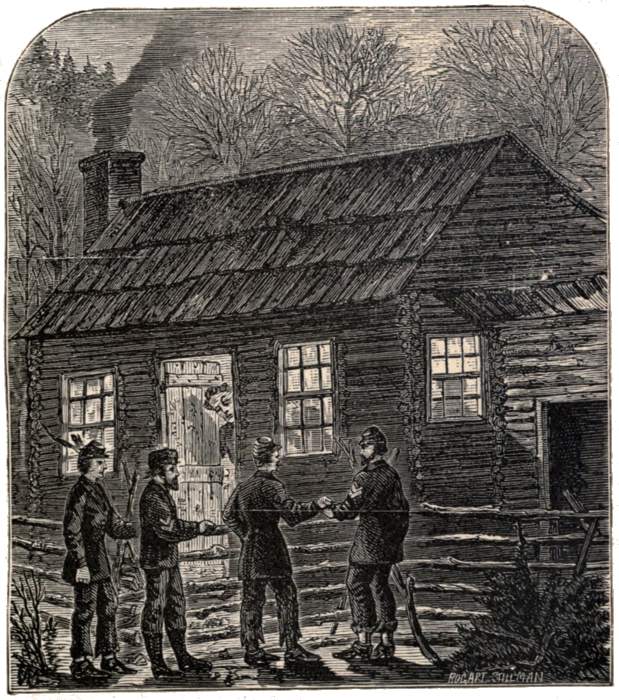
"Trouble at Lewis's House."—Page 93.
After we had gone out of the house we halted at the fence,
a few steps from the door, and consulted briefly as to the course
to pursue. Our situation was critical in the extreme. We were
in Alleghany county, in the midst of the rugged and barren
mountains, where the country was thinly inhabited. We had
no supplies with us, as we had left David Hepler's expecting to
get food at Lewis's. We soon determined to return to David
Hepler's, tell him of the situation at Lewis's house, and see if
he could give us other directions to follow. Smith suggested
that young Hepler might be willing to go with us to his father
if we should wait until morning. Smith called to him to come
out, saying, "We wish to talk with you."
Hepler did not come out; but on being called the third time
he came to the door and said, "Kill me in the house if you
want to; I sha'n't come out there to be killed."
We were trying to assure him that we would do him no harm
when he closed the door in our faces and barred it. We then
started away from the house, going about a mile east of it. Near
the mountain top we halted until daylight of March 9th. The
sky was overcast with clouds, threatening rain, when we stopped,
and we felt very much disheartened. Our hopes were exultant
before going to Lewis's house. We expected to get assistance
there, and possibly a guide to conduct us on our way; but all
had failed. We felt we had been turned empty away from the
house of a friend, and Nature it seemed was about to frown on
us. We came near regretting the start we had made from prison.
One consolation, however, was left us; if there was any change
in our prospects it would be for the better.
We made preparations for sleep, but there was little sleep
for us that night. Before day rain commenced falling, and we
were obliged to fold our blankets, to keep them as dry as possible.
We leaned against trees, and so disposed our coats over our
shoulders as to shed most of the rain off until daylight. As
soon as we could see our way plainly we set out on our return
to David Hepler's. We had a very disagreeable time in walking
over the mountains in a drenching rain shower. We reached
Hepler's just at twelve o'clock. We found him at home. He
was very much surprised, even astonished, at seeing us again.
He even dreaded to see us, as he at once concluded his time had
come to surrender himself a prisoner into the hands of sham
Yankees, his country's worst enemies. We soon explained to
him the reason for our return, telling him all that had transpired
since separating from him the morning before. He immediately
conjectured that Lewis had fallen a victim to "bogus
Yankees," and said he would go to-morrow to see his son, with
whom we had met at Lewis's house, and ascertain what had become
of him. After taking dinner with Hepler's family we went
some distance up the mountain-side and hid ourselves among the
rocks. The rain continued; but we could not shelter under
Hepler's roof, as it would not do, either for Hepler or ourselves,
to be found there by Rebel citizens. Near night our suppers
were brought to us by Hepler. Soon after dark we took refuge
from the storm in a small log hut near the road, which passed
through Hepler's premises. Early in the morning of March 10th
we breakfasted at Hepler's table, and soon after hid for the day
among the rocks of the mountains. At noon our dinner was
brought to us by Hepler's wife and daughter.
At night Hepler brought our suppers out, and reported the
information he had received from his son concerning Lewis. As
had been conjectured, a squad of Confederates had called at
Lewis's house, and solicited his services as a guide to conduct
them to the Union lines. As they were dressed in blue, and
represented themselves as Federal prisoners trying to escape,
Lewis consented to conduct them as far as Greenbrier River.
After the necessary preparations, he started with them from his
house, and, when only a few hundred yards away, these "bogus
Yankees" suddenly presented their revolvers and made him their
prisoner. His captors conducted him to White Sulphur Springs,
and from that place he was sent, in company with three or four
others, under a strong guard, to Richmond.
David Hepler's son was a brother-in-law of Lewis. At the
time we were at Lewis's house, young Hepler and those with
him had come there to get the household goods belonging to the
family, intending to carry them over the mountain on horses the
next morning. It was young Hepler, with Lewis's wife and
child, accompanied by another person, that we had met on the
mountain. Mrs. Lewis and her child, and the plunder, were
moved to her father's house, to remain during her husband's
captivity, or longer if he died. Had young Hepler known we
were not "bogus," and not trying to deceive him, we could have
had all the provisions we desired when at Lewis's house, and
could have been sheltered there until morning. But, unhappily,
we had been unable to convince him of our honesty of purpose,
and as he was determined to avoid the calamity which had befallen
his brother-in-law, he felt obliged to deny us all "aid and
comfort."
In the evening of March 10th the rain ceased and the
weather became cooler. On the morning of the 11th the mountains
were covered with snow. During the day the snow melted
away, and the mountain streams became swollen and almost impassable.
While waiting for the waters to subside, we mended
our shoes and other clothing, and washed our shirts. The pegs
and other materials for cobbling were furnished by Hepler. We
parched a quantity of corn, to carry with us on going forth anew
on our journey. During our stay Hepler tried to procure a
guide to conduct us to the lines, but failed. One man whom he
tried to enlist in our behalf, although a good Union man, refused
to have any thing to do with us, alleging we would yet prove
spurious. Hepler would have guided us as far as the Greenbrier
River, had not his aged parents, who were in a feeble condition,
been under his care.
On the morning of March 12th we took leave of Hepler and
his family. In our most cheerless hour of adversity we had
found with them a harboring place. They befriended us when
we were encompassed by enemies and suspected by friends.
During the days of rain and snow, and swollen streams, we incurred
a debt we can not easily repay. We are under lasting
obligations to them. Having been provided with sufficient food
to last us two days, we set out for the lines afresh. Hepler
could send us to no one who could direct us on our way, and we
went westward until we came to Lewis's house. We reached it
before three o'clock in the evening. We watched in its vicinity
for over an hour, and saw no one; not even the dog, the calf, or
smoke curling from the chimney, could be seen as when we had
watched it before. We went to it, and finding the doors securely
fastened, we judged there was something inside worth looking
after. We thought we might get a supply of provisions that
would partially compensate us for the disappointment of our first
visit to the house. We entered it through the window, and
levied on all we could find that would do to eat. A small sack
nearly full of meal, a cup of salt, a part of a ham of meat and
a ham of venison, were obtained as the fruits of our seizure.
We got out of the house with our commissary stores, taking an
iron pot with us, and went west about a mile into a gorge
through which ran a small stream of water. Here we halted,
built a fire, and made mush by the quantity. After eating to
our satisfaction, we had enough left for breakfast the next morning.
By ten o'clock that night we had made our arrangements
for a comfortable sleep. We rested well.
With the first dawning of morning light on the 13th, Wood
and Sutherland returned to Lewis's house and got four case-knives,
one for each of our party, a file, and a tin cup. The
file we thought would be of use in loosening canoes or in opening
smoke-houses as a last resort in procuring food. We completed
our preparations for the day's travel, and were on our way
shortly after sunrise. The country traversed was very rough
and mountainous, being little more than a barren waste. It
would have been impossible for us to have made our way over
it in the night-time. We saw no person during the day. When
following high ridges we occasionally saw huts and houses in the
valley on either side below us. Sometimes we could see smoke
when the house or chimney from which it came was concealed.
Just after sunset we halted in a depression of the ridge we had
been following, prepared our suppers, and made ready for the
night's rest. As near as we could estimate, we had traveled
during the day about fourteen miles in a north-west course. The
night was passed in quiet sleep.
On the morning of the 14th we awoke before day. On getting
up we rebuilt our fire, and hastily prepared our breakfast.
Soon after we were equipped for our day's journey. We were
in excellent spirits. We could but contrast our feelings with
those we had experienced in the early morning, after our signal
disappointment at Lewis's house. Then we were discouraged and
baffled, now we were cheerful and hopeful. The sky was clear,
the air was pure and bracing, and we made good progress. We
traveled quite fifteen miles in a direction a little north of west,
over the ridges, valleys, and streams of the mountain districts.
At night we halted in the valley, where water was convenient.
After making a fire, we spent an hour or more in preparing and
eating our suppers. Our sleep during the night was refreshing.
Before sunrise on the 15th we had finished our breakfast.
Our provisions were not yet exhausted, and there was no need
of running any risks in replenishing our stock. We traveled
only about six miles before discovering that the country became
more open and more thickly settled. It was prudent for us to
go no further in day-time. We accordingly looked about for a
safe retreat for the residue of the day. After finding a place in
the woods in which we thought we could trust ourselves, we
devoted the greater part of the day to sleep, as we expected to
travel at night. Just at dark we were ready to move. The
first thing necessary on setting out was to find a road on which
to travel. Our journeyings of the past three days had been off
the roads, across mountains and valleys, in a rough, broken
country, almost inaccessible to travelers except on foot or on
horseback. We found much difficulty in finding a road that
would lead us aright. We kept on the move, however, taking
care that our steps should be toward the goal we wished to gain.
A little after midnight we halted, as the sky became cloudy,
and we could not see our way plainly before us. We went some
distance north of the last road we had been following, and made
our bed in the woods. Very soon after lying down we fell
asleep. On waking up on the morning of the 16th, we found
the ground covered with snow. Getting up we found the air
very cool. We set about collecting suitable material for building
a fire, but on searching for our matches we found we had lost
them. As it was too cool for comfort without briskly exercising
ourselves, we determined to set out in a northern direction.
After getting our things in readiness we started through the
woods. We had proceeded but little more than a mile before
we reached an open space. In crossing it we noticed not far to
our left, just beyond the crest of a hill, a small log cabin. Smoke
was issuing from the mud and stick chimney and curling gently
upward. After a moment's deliberation we concluded we should
hazard little in visiting the tenants of this humble abode and
warming at their fire. We did so, and found the two women
and one boy whom we found there to be friendly and disposed
to make us comfortable. While waiting half an hour for a warm
breakfast we learned we were in Greenbrier county, and within
three miles of the Greenbrier River. Having ascertained that
the folks were Unionists, we questioned them concerning the
people in the surrounding country. We learned that the Rebel
element held sway and that the few Union people were obliged
to keep their sentiments to themselves.
Breakfast over, we set out again on our travels. Before
leaving the cabin we discovered that snow had commenced falling.
We had not gone far until the large flakes almost blinded
us as they fell. We felt certain no one would be out on such a
wintery day, and we thought we should incur but little risk in
pushing forward to the river. Near ten o'clock we reached it,
and began looking up and down the bank for a canoe in which
to cross. After the snow had almost ceased falling, we were passing
through a sugar-camp and came suddenly to two women, who
were turning the troughs over. As they had seen us plainly,
we being within a few yards of them when we first noticed them,
we did not try to avoid them. We approached nearer the women,
and one of our party made some observation on the state of the
weather, and Sutherland added, "It's a bad day to be out."
One of the women, smiling, answered, "I'll guess you are out
a good piece from home."
On being questioned further, we told the women who we were,
where we were from, and the point we were aiming to reach.
They told us their "men folks" were in the Kanawha Valley,
which was within the Union lines. We were not long in assuring
ourselves that the women, as well as their "men folks," were
strong Unionists. We were invited to the house. We accepted
the invitation, and were soon seated before the fire, where we
remained for a few minutes. Just before noon the women told
us they were poor and unable to furnish us a meal, but Mrs.
Mann, who lived about a mile back from the river, was not only
able, but willing to keep us over until the following night, if we
wished to stop so long as that. The eldest woman had already
gone to Mrs. Mann's to see if any Secessionists were there. She
soon returned, accompanied by two of Mrs. Mann's little boys,
who were to conduct us by an obscure way to their mother's
house. As no one was at Mrs. Mann's, we started immediately
to her house, her boys leading the way. These boys were quite
young—aged about nine and eleven years—but seemed to understand
perfectly the necessity of our keeping out of sight of the
Rebels.
We arrived at the house of Mrs. Mann by one o'clock. A
little after two o'clock we took dinner. The dinner reminded us
of the days gone by, and made us think we were almost home
again. After dinner we conversed at length with Mrs. Mann
and her family, treating mainly of the war as it affected the
Union people of the South. Mrs. Mann had been despoiled of
much property during the war by Confederates; and soon after
the breaking out of hostilities her husband had been arrested
because he would not forsake his Union principles. He had been
imprisoned at Richmond, where, after lingering a few months, he
died.
In the evening a man was seen approaching the house. When
he was near enough to be recognized it was ascertained that he
was a Rebel, and we were sent upstairs forthwith, to remain
there until he should leave. We were detained nearly an hour
upstairs, when the "Secesh" having taken leave, we were
permitted to come down, and were interrupted no more that
evening.
A little after dark we had supper. Soon after supper we began
our preparations for setting forth on our way, but Mrs. Mann
urged us to stop until the following night. As we were considerably
worn and fatigued, we decided, after a short consultation,
to do so. We passed the night of March 16th in Mrs.
Mann's haymow. We could not stop in the house for the reason
that a Rebel doctor from Frankfort was expected there that
night to see a sick child. On the morning of the 17th, after the
doctor had gone, we returned to the house for breakfast, and remained
there during the day. When any one was seen coming
we went upstairs, being very careful not to leave any caps behind
to excite inquiries.
About four o'clock, P. M., a young man called at Mrs. Mann's,
who belonged to a Union family west of the river. He offered
to conduct us, after dark, to a man who would guide us some
distance on our way, and give us directions to follow which would
lead us to Gauley River. We eagerly accepted the offer. Our
delay of twenty-four hours, it seemed, was going to prove profitable.
We had supper just at dark, and soon after our preparations
for the journey were complete. Our haversacks were filled
with food sufficient to last us two or three days. We tendered
our sincere thanks to Mrs. Mann and family for generous treatment
received, and bade them farewell.
Historical Memoranda. — FOOTNOTES: — Transcriber's Notes:
COMPANY "C,"
73D REGIMENT ILLINOIS INFANTRY VOLUNTEERS.
BY W. H. NEWLIN.
Enlistments in the company dated from July 12, 1862, to
April 11, 1864. One hundred and four names appear on the
company roll. All members who enlisted on or before July 23,
1862, were sworn in, the first time, by John Newlin, J. P., in
West's pasture, village of Georgetown, Vermillion County, Ill.
On the same day, July 23d, Patterson McNutt, Mark D. Hawes,
and Richard N. Davies, were elected captain, first and second
lieutenants respectively.
July 24th, company transported in wagons from Georgetown
to the "Y," a point on the T. W. & W. R. R., near the site of
Tilton. Taking the cars at the "Y," company reached Camp
Butler early next morning.
By August 1st company organization was completed, by appointment
of the following named as sergeants: Tilmon D.
Kyger, first sergeant; Wm. R. Lawrence, second sergeant; David
A. Smith, third sergeant; Wm. H. Newlin, fourth sergeant;
Robert B. Drake, fifth sergeant; and by the following named as
corporals, in their order: David McDonald, John W. Smith,
Carey A. Savage, Wm. M. Sheets, Samuel W. Sigler, Wm. O.
Underwood, John V. Don Carlos, William Henderson. Pleasant
B. Huffman, fifer; William B. Cowan, drummer; and
Amacy M. Hasty, teamster.
Time, at Camp Butler, was spent in drilling, guarding prisoners,
and other duty. Some pay and an installment of bounty
was received by each member of the company. Twenty-five
dollars bounty was paid by Vermillion County to each married
man and ten dollars to each unmarried man. To hasten the
muster in of regiment, Company C loaned to Company E—also
enlisted in Vermillion County—fourteen men, all but three
of whom were re-transferred to C. Regiment was mustered into
United States service August 21, 1862.
August 24th, left camp Butler, going by rail via Danville, Ill.,
Lafayette Junction, Indianapolis, and Seymour, Ind., to Louisville,
Ky. Went into quarters at Camp Jaquess—named for our
colonel—south-west of the city. At this camp some guard duty
was done, without arms, other than clubs and revolvers; all the
clubs and nearly all the revolvers being soon discarded.
About August 30th regiment was supplied with muskets—Austrian
or Belgium pattern—and ammunition for same. Muskets
were of the kicking kind. From July 24th company had
been in receipt of government rations, and was becoming inured
to service in this respect.
September 1st or 2d moved to Camp Yates, three or four
miles south-east of the city. Other regiments were at this
camp, and a Division was formed, the Seventy-third and One
Hundreth Illinois, and Seventy-ninth and Eighty-eighth Indiana
Regiments making one brigade, commanded by Colonel
Kirk. Lieutenant Hawes and Sergeant Lawrence were detailed
for duty at Kirk's head-quarters, and a very ludicrous mistake
was made, in supposing there were two vacancies created. Accordingly
there was an advance along the line; Davies being
promoted first lieutenant, as was thought; Orderly Kyger to
second lieutenant; D. A. Smith to orderly, and Corporal John
W. Smith to second sergeant, the latter being promoted over the
writer. The joke fell heaviest on Kyger, as he incurred the expense
of the purchase of sword, belt and straps. J. W. Smith
resumed his place as corporal, much to the gratification of the
writer, who did not like the idea of being "jumped."
Before the middle of September an inspection was ordered,
requiring the command to march to Louisville, taking all luggage,
accompanied also by wagon-train. The number and
variety of articles thrown out of knapsacks and train was amazing
to the old soldiers. This inspection was for the purpose of
reducing luggage and baggage to articles of necessity. Directly
after this the defeat of Union forces at Richmond, Ky., occurred.
A rapid advance of a day's march was made by the command to
assist in covering the retreat of those forces. Following this defeat
came the invasion by Kirby Smith's Confederate forces,
menacing Cincinnati and Covington. To meet this emergency
the command was ordered at once to the latter place, going via
Jeffersonville and Seymour, Ind., and Cincinnati, Ohio. The
marching of the Seventy-third in the streets of Cincinnati excited
comment, and inquiry was made if it was an old regiment.
There was a fine engraving produced about this time representing
the regiment, marching in column, on to the pontoon
bridge.
Fears of invasion subsiding, the command was ordered back
to Louisville, returning via Indianapolis. Buell's army having
reached Louisville, a general reorganization of all forces—old
and new—took place. The Forty-fourth and Seventy-third Illinois,
and Second and Fifteenth Missouri Regiments formed the
Thirty-fifth Brigade, Eleventh Division of reorganized army.
Bragg's army, which had followed Buell's into Kentucky,
was gathering much strength and material in its march in the
interior, and on October 1st the Union army was put in motion
and started in pursuit. A dozen or more members of the company
were left sick at Louisville. Army caught up with the
enemy October 8th. Regiment was placed in and withdrawn
from an exposed position, just in the "nick of time," a position
within easy range of Confederate battery. Being withdrawn, as
above, and resuming position in main line, regiment was actively
engaged in battle of Perryville, nearly two hours, the casualties
to Company C being as follows:
| Josiah Cooper, wounded, |
Died Oct. 31, 1862. |
| Samuel Boen, wounded, |
|
| David W. Doop, wounded, |
Discharged Feb. 9, 1863. |
| John S. Long, wounded, |
Discharged Jan. 13, 1863, died. |
| Francis M. Stevens, wounded, |
Discharged Dec. 5, 1862. |
| Zimri Thornton, wounded, |
Died Oct. 30, 1862. |
| James E. Moore, wounded, |
Discharged March 17, 1863, lost foot. |
| John Murdock, Co. E, wounded, |
Died, Oct. 9, 1862. |
The last named enlisted in C, but had been one of the fourteen
men "loaned," as before mentioned. Several members of
Company C, who had been left at Louisville, came up Oct. 9th
and 10th.
Followed to Crab Orchard, marching from there, via Danville,
Lebanon, Bowling Green, and Mitchellsville, to Nashville,
Tenn. At Bowling Green, Rosecrans relieved Buell. Arrived
at Nashville Nov. 7, 1862, encamping first at Edgefield, then
at Mill Creek. Nov. 20, 1862, Second Lieutenant Richard N.
Davies, resigned. Nov. 28th, First Lieutenant Mark D. Hawes
resigned. These resignations, the losses resulting from the action
at Perryville, the loss by death of the following named members:
Samuel W. Blackburn, John C. Sheets, Thomas Millholland, Israel
H. Morgan, John and Alex. Gerrard, and William Henderson;
and the following named discharged for disability: Thos. T.
Ashmore, John Trimble, and Wm. O. Underwood, discharged,
Oct. 9, 1862, made a total loss to company by Jan. 1, 1863, of
eighteen men. Three of these, viz: David W. Doop, John S.
Long, and James E. Moore, were discharged after Jan. 1st, on
Feb. 9th, Jan. 13th, and March 17th, 1863, respectively. Nov.
25, 1862, Kyger was mustered in as first lieutenant, and Dec.
6, 1862, Lawrence was mustered in as second lieutenant.
Dec. 26, 1862, started on movement to Stone River. Regiment
not engaged until Dec. 31st, was then engaged fully one-third,
and under fire two-thirds of the day. Seventy-third was
in Second Brigade, of Sheridan's (Third) Division, Twentieth
A. C., and associated with the same regiments as before. The
change in number of Brigade and Division occurred when Rosecrans
assumed command. At Stone River Company C suffered
casualties as follows: John Dye and James Yoho, killed; John
J. Halsted, wounded, discharged Feb. 23, 1863; three or four
others very slightly wounded, and Lieutenant Lawrence and
Daniel Suycott, captured. Lawrence and Suycott were exchanged
in the following Spring, returning to the Company in
May. About Jan. 7, 1863, a detail from company, Lieutenant
Kyger in charge, sought the bodies of Dye and Yoho and buried
them. The writer saw both these men expire; they were near
together, and died at about the same time.[A]
Were in two different camps at Murfreesboro, first Bradley,
then Shafer—named for our brigade commander killed at Stone
River. From Jan. 1st to June 30th, 1863, inclusive, the company
lost members as follows, in addition to the three already
noted, viz:
| John W. Smith, |
Discharged, Jan. 3, 1863, disability. |
| Carey A. Savage, |
Discharged, Feb. 6, 1863, disability. |
| John V. Don Carlos, |
Discharged, May 10, 1863, disability. |
| Enoch Braselton, |
Discharged, March 12, 1863, disability. |
| William Cook, |
Discharged, Jan. 28, 1863, disability. |
| Robert W. Cowan, |
Discharged, Feb. 9, 1863, disability. |
| Lawrence Dye, |
Discharged, Jan. 28, 1863, disability. |
| Benj. F. Edmonds, |
Discharged, Feb. 10, 1863, disability. |
| Wright Madden, |
Transferred to gun-boat service, April 16, 1863. |
| Jacob Martin, |
Died at Murfreesboro, Feb. 21, 1863. |
| William McEntyre, |
Died at Nashville, Jan. 15, 1863. |
| Thomas Elwood Madden, |
Discharged, Feb. 20, 1863, disability. |
| Joshua T. Nicholson, |
Died at Nashville, Jan. 18, 1863. |
| Christopher C. Shires, |
Discharged, May 28, 1863, disability. |
| John M. Thompson, |
Discharged, Feb. 20, 1863, disability. |
| James F. Williams, |
Discharged, March 26, 1863, disability. |
| George Miley, |
Died at Nashville, Feb. 3, 1863. |
| Robert B. Drake, |
Discharged, June 30, 1863, disability. |
In all, twenty-one men, making a total loss to July 1, 1863,
of thirty-nine men.
Started June 23, 1863, on Chattanooga campaign. First injury
to member of Company was the wounding of Alex. C.
Nicholson, at Fairfield.
Followed on, passing Manchester and Estill Springs, wading
Elk River, and passing through Winchester to Cowan's Station.
Halted at latter place, July 3, 1863, hearing next day the news
of Gettysburg and Vicksburg.
A few days later passed through Cumberland Tunnel, and
on to Stevenson, Alabama. At Stevenson there was a delay
until Sept. 2d, when the command pushed on to the Tennessee
River, at Bridgeport, crossing on the 3d, and going over Sand
Mountain, and on down to Alpine, Georgia. When company left
Stevenson I remained, with others, in consequence of chills,
having had medicine prescribed for breaking same about
August 30th.
Captain Patterson McNutt resigned July 29, 1863, and First
Lieutenant Tilmon D. Kyger was mustered in as captain of
company, Sept. 4th, following.[B]
The movement to Alpine, by Thomas' and McCook's corps,
having forced Bragg out of Chattanooga, next came the hard
marching necessary to concentrate the Union forces, before the
reinforced enemy should turn and crush Crittenden's corps.
Arrived in vicinity of Chickamauga battlefield, late September
18th. Got nearer next day; was under fire, but not engaged.
Saturday night, September 19th, company furnished a corporal,
R. J. Hasty, and two or three guards for duty at Sheridan's
head-quarters. McCook, Crittenden, and other generals,
were at head-quarters in course of the night. Sheridan was
restless and dissatisfied, and altogether indications, as interpreted
by our corporal and guards, were unfavorable as to our prospects
for to-morrow. Bradley's brigade (Sheridan's third), had
been very roughly used in the afternoon, and his first and
second brigades would probably "catch it" to-morrow. We were
in the second (Laibold's brigade.) The night was dark, the
weather was cool, and fire was forbidden. Our position was in
heavy woods; the noise and racket in our front, whether made
by the enemy or by our own troops, sounded and resounded
terribly ominous in our ears. Daybreak came, and with it orders
to move; we were out of rations, or nearly so, and not allowed
time to draw a supply. Lytle persisted in drawing rations for
his (the first) brigade, notwithstanding orders to move immediately.
Moved two miles or more to the left; took position, and
awaited further orders.
Before noon orders came, and we "went in." Of this memorable
battle history tells; it has been "fought over," and
"wrote up," many times. As within an hour from "going in,"
we had, with others, surrendered, and passed to the rear of five
lines, two ranks each, of Confederate troops, we will not attempt
a description of the small part of the battle we witnessed. For
the first time we viewed the situation amid and to rear of the
enemy. Doubt and uncertainty seemed to have place among
the Confederates, although they were advancing. Officers were
busy gathering up stragglers and hurrying them forward. Too
many wanted to guard prisoners. Swords were drawn, and
wildly flourished, and much ado made, probably because of the
presence of so many "Yankees." Rope lines and traces, and
other rope rigging to artillery, and sorghum stalks, sticking in
haversacks of Bragg's men, attracted our attention. We saw
Gen. Longstreet with an immense escort following him. We
saw Gen. Hood lying under the fly of a tent, wounded; later he
had his leg taken off. After one o'clock enemy's right fell
back, and our left advanced. We saw several solid shot, skipping
over the ground, which had been sent by Crittenden's batteries.
We had many companions in our new and strange experience,
and formed many new acquaintances, most of them of
short duration. Some fourteen hundred of Gen. Sheridan's division,
and many from other commands, had been collected in
one place. Hesser and North, of Company A, and Brown and
myself, of Company C, were one little squad of the Seventy-third
that did not scatter much. We encountered no other members
of our regiment until reaching Richmond.
Up to this point we have given facts, in the history of the
company, of which we had personal knowledge. What few incidents
or accidents in its history, from Chickamauga up to
opening of Atlanta campaign here given are vouched for, my
information touching the same being derived from reliable
sources. The losses sustained by company in battle of Chickamauga
were as follows: David A. Smith, Enoch Smith, and
Artemas Terrell, killed; Wm. R. Lawrence, John R. Burk,
Henderson Goodwin, Nathaniel Henderson, Henry C. Henderson,
Austin Henderson, Jehu Lewis (color bearer), and John
Bostwick (discharged May 27, 1864), wounded; and all the
following named were captured, viz: Enoch P. Brown, Wm.
H. Newlin, John R. Burk, Wm. F. Ellis, Austin Henderson,
and John Thornton. Of those that were captured, Burk and
Lewis were soon exchanged, being seriously wounded; Burk,
however, went to Richmond; losing an arm, he was discharged
June 9, 1864. Lewis was exchanged on battlefield.
Austin Henderson was exchanged late in 1864. John Thornton,
Enoch P. Brown, and William F. Ellis, died in Andersonville
prison, in order named: September 16th, 20th, and 23d,
1864, respectively. Number of Brown's grave, 9,350; Ellis',
9,703. Number of Thornton's grave not given. Wm. H. Newlin
was never either paroled or exchanged. Nearly every member
of company was struck by balls, or fragments of shell, or
trees, in some part of the body, accoutrements, or clothing. At
nightfall only three of the company were present at call of the
captain. During the night a dozen or more others rallied upon
this feeble remnant. Chickamauga was a dreadful strain upon
the strength and powers of endurance of the soldier, and September
20, 1863, is, and will ever be, a memorable day in our
country's history. By September 22d, some twenty or more of
the company had reached Chattanooga, and were beginning to
assume at least a defensive attitude. Early in September
commissions for Lawrence and Smith, as first and second
lieutenants, respectively, were sent for, but neither were ever
mustered in on them; Lawrence resigning, November 24, 1863,
as second lieutenant, and Smith having met his fate as already
noted.
Following Chickamauga came the siege of Chattanooga, and
with it very scant supplies, and hard picket and forage duty.
The "cracker line" being often disturbed, and foraging not
yielding, or "panning out" very heavily, the supply of rations,
provender, for man and beast, was far short of ordinary
demands. November 25th the battle of Missionary Ridge occurred,
in which Company C fortunately suffered very few casualties,
the most serious one being the wounding of Stephen Newlin.
After Missionary Ridge company and command went to
the relief of Burnside at Knoxville. On this winter campaign
much hard marching and great fatigue were endured. Some
one or two, or more, of the company, not starting with the command,
followed up later with squads and detachments. In one
or more instances the enemy's cavalry attempted to "gobble
up" these squads. During its stay in East Tennessee, regiment
encamped for a time at Haworth's Mill, near New Market, and
also at Lenoir's Station. From latter place, it is said, some
members of company made frequent visits in the country east
of river, and it is further alleged, one or more of them got
married. Dandridge, I believe, was the farthest point eastward
to which command penetrated in the Knoxville campaign. Capt.
Kyger was very sick at Knoxville, in course of winter, and on
recovering sufficiently was granted leave of absence.
Winter breaking, and time for opening of the Atlanta campaign
approaching, the regiment returned to vicinity of Chattanooga,
encamping at Cleveland, at which point we rejoined it,
on our return from prison. April 11, 1864, Wm. R. Cook was
mustered in, as a recruit to company, being last name entered
on company roll.[C]
From June 30, 1863, to July 1, 1864, the total loss to company,
from all causes, was fourteen men, including Amos Bogue.
Transferred to Invalid corps, August 1, 1863; Clark B. Brant,
discharged November 12, 1863; Merida Thornton and Aaron
Willison, transferred to Invalid corps, January 15th and February
1, 1864; James T. Slaughter, transferred to V. R. C.,
May 1, 1864; Charles W. Cook, permanently detached as blacksmith
to Bat. G., First Mo. Art., August 26, 1863; and James
W. Trimble, transferred to V. R. C., April 10, 1864, the other
seven already noted; making a total loss to date of fifty-three
men.
Moved from Cleveland, May 3, 1864, with command, first
brigade, second division, fourth army corps. Under fire first
time, on Atlanta campaign, in the vicinity of Catoosa Springs,
May 5. At Rocky Faced Ridge, May 9th, was again under
fire, but not engaged. Sharpshooters from the regiment did
good work here; Company C being represented by John P.
Jones, Alex. C. Nicholson, and James T. Maudlin. Was engaged
at Resaca, May 14th. Wm. D. Bales struck by piece of
shell. Was engaged at Adairsville, May 17th. Up to, and including
Adairsville, Company C was in my charge, there being
no commissioned officer present. On this date Capt. Kyger
arrived at the front and took command of company. At Kingston
there was a delay of three or four days. Pursuant to orders,
all vacancies in line, and non-commissioned officers were filled,
or selections made with that object in view. May 22d, Company
C attended to this duty. The company was entitled to a
lieutenant, and an election was held. Candidates were voted
for, for orderly sergeant, with the understanding that the successful
candidate should be commissioned first lieutenant. Election
resulted in my favor by a small majority—four votes, I believe—which,
considering all the circumstances, my long absence,
and the fact that my competitor had been present all the
time, was a No. 1 soldier, none better, I regarded as extremely
flattering, and was therefore very thankful for the advancement.
My commission was sent for; it bears date June 9, 1864.
The list of non-commissioned officers being filled, stood as
follows:
| Wm. M. Sheets, |
orderly sergeant. |
| James T. Maudlin, |
second sergeant. |
| Jehu Lewis, |
third sergeant. |
| Robert J. Hasty, |
fourth sergeant. |
| Alex. C. Nicholson, |
fifth sergeant. |
| Wesley Bishop, |
first corporal. |
| Jonathan Ellis, |
second corporal. |
| Austin Henderson, |
third corporal. |
| Samuel Hewitt, |
fourth corporal. |
| Alfred E. Lewis, |
fifth corporal. |
| George W. Martin, |
sixth corporal. |
| Stephen Newlin, |
seventh corporal. |
| Geo. Hollingsworth, |
eighth corporal. |
It was at this time and place that A. E. Lewis notified Ellis
of his appointment as corporal; adding, "and your commission
has gone on to Washington for approval." All of the above
were mustered out June 12, 1865. The list does not contain one
of the original sergeants or corporals; except that Orderly Sheets
was one of the first corporals.
Recommenced active operations about May 25th. June 18th
John Braselton was wounded. By June 25th the actions at
Pine and Lost Mountains, Dallas, New Hope Church, and preliminary
battles before Kenesaw Mountain had taken place,
without inflicting serious damage to company. Capt. Kyger
was sick, a week or more, up to and including June 27th, the
day of the assault on Kenesaw. This assault was the first
heavy battle occurring after my muster in as lieutenant, and
owing to the formation of each regiment preparatory to the
assault, and the absence of my seniors, I was placed in command
of two companies, C and H, forming the third or middle
division of regiment. Two lines, of two ranks each, were in
front of, and two lines, of two ranks each, were in rear of companies
C and H. Owing to nature of ground these companies
came off well, suffered less than any of the others. From point
of starting in, the ground sloped considerably to line immediately
without, or in front of the very elaborate, systematic obstructions
in front of enemy's works, and from this same line
the ground covered by these obstructions was gradually ascending
to line of fortifications. Pending the heaviest fire of enemy,
companies C and H were on the lowest ground, all the other
companies, whether in front or rear, being on higher ground, so
that fire of enemy was comparatively harmless to C and H,
there being only four or five slight wounds received in the two
companies, and these inflicted while getting back to position
from which they started. Of the regiment, three were killed,
and some twelve or fifteen wounded. There were several cases
of overheating, the weather being extremely hot, and the assault,
from some cause, not being made as early as intended. The
casualties to regiment, seeming so few, in an assault of such
magnitude, it is proper to state that number of men in regiment
that day, present for duty, did not exceed three hundred.
In our front, too, were very heavy earth-works, feebly manned;
but for the arrival of reinforcements we could have effected, at
least, a temporary breach in the enemy's line.
Early July 3d it was found that the enemy had fallen back.
Followed up immediately; regiment lost one man, killed, July
4th. There was a delay of a week at the Chattahoochie River.
Command took position, near river, above Vining's Station.
July 9th division marched to Roswell; destroyed some mills or
factories, and crossed and recrossed the Chattahoochie while
gone, returning on the 12th. Writer was not with company on
Roswell trip; but owing to depletion of strength was favored;
left behind in charge of regimental camp, and those who had
been excused from duty. July 13th, crossed Chattahoochie
River on pontoon bridge. While crossing, writer was taken
sick, and was obliged to drop behind soon after getting across
the river. In attempting to reach the upland and overtake
company, was prostrated, the result of over-heating or partial
sun-stroke, and have no recollection whatever of events occurring
after the crossing of the Chattahoochie, up to the crossing
of Nance's Creek, July 18. There had, however, been a delay
at Buck's Head, and also a general inspection. Late on the
19th there were two or three severe skirmishes along the line
of Peach Tree Creek, one of which approached the dignity of a
battle, and several prisoners, including a general officer, were
captured by our forces. Crossed Peach Tree Creek at ten o'clock,
P. M., of the 19th.
About noon, on the 20th, brigade was assigned position in
line, and hastily built slight breast-works of logs, limbs, and
rails. This done, was ordered to make reconnoisance to front.
In execution of this order, the enemy was found in force, and
we came back at a double-quick, to find our temporary works
occupied by other troops. Took another position, further to
right, the Seventy-third holding the extreme right of fourth
corps. There was a gap of two hundred yards or more, between
right of fourth and left of twentieth corps; so the right
of Seventy-third was retired, swung back a little in order to
cover this gap. The battle immediately opened, giving no time
for construction of works, however slight, and continued about
an hour, with two casualties to Company C—William Martin
and the writer, wounded. Sampson McCool, of Company E,
was also wounded. Sampson and William McCool, and John
Murdock, the latter killed at Perryville, being the three loaned
by Company C to Company E, that were never retransferred to
C. Of regiment, one man was killed, and several others
wounded. My wound, being slight, healed entirely by August
1st, but I was detained at division field hospital until August
16th, on account of general physical debility, resulting from the
sunstroke of 13th. Command was not in the battles of July
22d and 28th, so my hospital and prison experience, covering in
all eight months, deprived me of participation in only one battle—Missionary
Ridge—and one campaign—the East Tennessee—in
which the company engaged.
The latter part of August, started on the flanking movement
to Jonesboro and Lovejoy station. September 1st, engaged in
tearing up railroad, burning the ties, and twisting the heated
rails around trees. Arrived at Jonesboro too late to accomplish
more than the capture of a hospital and a few hundred prisoners,
as the battle there was closing. Night of September 1st,
Company C stood picket out north-east of Jonesboro, and toward
morning the rumble of Hood's artillery and trains could
be heard, as they were passing hurriedly on a road still further
eastward, retreating from Atlanta. Later, the explosions at
Atlanta were distinctly heard. Followed on to Lovejoy's.
Were under fire, but had no good opportunity of returning it.
Withdrew from enemy's front at Lovejoy's the night of September
5th or 6th, returning to Atlanta, arriving on the 8th.
Went into quarters with some expectation of remaining inactive
for a longer time than we did. Writer, however, saw the exterior
of the barracks, the interior of which he had seen, as a
prisoner, just a year before.
About September 26th to 28th, were ordered to Chattanooga,
going by railway; and from thence marched down into Alpine
valley again, about October 18th, returning the latter part of
October, via Chickamauga battle-ground, to Chattanooga. On
this return march from Alpine, quite a number of recruits of
Fifty-first Illinois fell behind, "straggled," and no wonder, as
most of them wore overcoats, and carried knapsacks packed full;
one of them carried his bayonet fixed, instead of in scabbard,
whereupon Corporal Lewis (who had just awakened from a
short sleep at roadside, where company was resting) cried out,
"Halt, halt, you Fifty-firster; I want to know WHERE YOU GOT YOUR GUN SHARPENED."
About November 1, 1864, went by rail to Huntsville, Alabama,
and from there marched to Athens, and from thence, via
Lynnville and Pulaski, to Columbia, Tenn. Here a part of
twenty-third corps met, and reinforced the fourth corps. Hood's
rebel army was becoming very troublesome and apparently impatient
for large results, and was pressing ours very closely.
Considerable skirmishing took place about Columbia, in which
Company C bore its full share. Under pressure of enemy our
forces crossed Duck River the night of November 28th, the
Seventy-third standing picket the balance of that night on north
bank of river. Next morning, the pressure being great, there
was no time to relieve us, and being already deployed, we fell
back, first as flankers, then as skirmishers, in the direction of
Spring Hill, arriving there about four o'clock in afternoon of
29th. We were to the right, or south-east of Pike and of
Spring Hill. The part of the Seventy-third in the action at
Spring Hill was to assist in resisting a cavalry dash by enemy,
just before sunset. To do this we were only compelled to
shorten our line a little, and deliver a brisk fire for the space
of about ten minutes. Heavy fighting was going on near us, in
which enemy's infantry was engaged, pending which, night fall
ended the contest, luckily for our forces. There was great confusion,
one result of which was, our being compelled to stand
picket all night, as on the preceding night. We must have
been VERY CLOSE indeed to enemy's pickets, though we did
not see or hear them; but could distinctly see the enemy at a
little distance around his camp-fires. Our trains were hustling
the whole night through, and got well on the way before morning
toward Franklin.
Daylight of November 30th came, and we were still on the
picket line. By sunrise we began falling back, deployed as
skirmishers, and skirmishing began, and was kept up with more
or less severity to within one mile of Franklin, when our brigade
was relieved. Very soon after skirmishing began in the
morning we crossed to the left of the road, and when but little
more than half way to Franklin, Capt. Kyger being sick, was
unable to remain longer with company, and was taken in
charge by Surgeon Pond, and we saw him no more until arriving
at Nashville. Being relieved, as before mentioned, by passing
within, and to rear, of skirmish line, which had been
thrown out, the brigade, Opedycke's first brigade, second division,
fourth army corps, formed and marched in column, with little
delay, to Franklin, passing on the way a brigade which must
have been the third brigade of our division, posted some distance
in front of a temporary line of breastworks, which had been hastily
built, extending from a point above to another point on the river
below the town. These works, scarcely a mile in length, semi-circular
in form, and covering, not only Franklin, but also the bridge
across the Harpeth, were filled with troops; so our brigade passed
on to the rear, and took position behind Carter's Hill. This was at
about 3:30 o'clock, P. M. The men at once set about preparing
coffee and something to eat, being greatly fatigued from loss
of sleep, and almost constant duty since evening of 28th, on
crossing Duck River. All the trains, and the first division of
the fourth corps, were north of the Harpeth.
Dinner over once, we should probably have followed and
taken the advance, having assisted two days in covering the retreat.
But no; not all of us were permitted to finish dinner
before Hood had martialed his forces, swept up suddenly, driving
in the brigade, posted in front, as before stated, in its wake,
and under cover of same crushing in, making a fearful breach
in our main line. Heavy firing began, clouds of dust and smoke
arose, hundreds of rebel troops were thrust into the breach
which they had made, and beyond; singly, and in squads, small
and great, our men began flying from the front, throwing away
their guns; pieces of artillery and cassions, with horses attached,
came thundering down; confusion and consternation indescribable
had been wrought in five minutes or less time.
The Thirty-sixth, Forty-fourth, and Seventy-third Illinois,
and Twenty-fourth Wisconsin, and One Hundred and Twenty-fifth
Ohio, five regiments, composing Opedycke's brigade, were
instantly on their feet, anticipating orders, seizing their guns,
which had been stacked on one line, made a simultaneous, irresistible
rush to the front, carrying every thing before them at
the point of the bayonet, capturing thirteen battle-flags, nearly
one thousand prisoners, and restoring and strengthening our
line, so that it was broken no more. Stung to desperation at
this sudden turning of the scales in this important battle, the infuriated
enemy charged, and CHARGED again and AGAIN, carrying
his reckless resistance right up to, yes on to, our slight
works, to the very muzzles of our guns. But we were there to
stay, at least until getting ready to leave of our own accord;
but it took work, HARD WORK, PERSISTENT, UNFLAGGING and
UNFLINCHING WORK, to maintain our position. How it was
done I can scarcely hope to describe.
On arriving at the point from whence our forces had been
driven, there were too many troops to operate to advantage,
and afford all a semblance of protection. Fortunately, the
ground, beginning at the works, was gradually declining to the
rear. Company C, with a few soldiers of other companies, was
posted between, and to the front of, two pieces of artillery. All
were either lying on the ground or in a low, stooping posture.
Immediately at the works was a strong line of men, with barely
elbow room, who did nothing but fire; in rear of this line were
two or three tiers of men, who were busy loading pieces and
passing them forward; to rear of these were still others, who
were cleaning guns, breaking open boxes of ammunition, and
distributing cartridges to the loaders; others still further back,
carried up the boxes of ammunition from a point where left by
ammunition wagons. There was work for all, and all WORKED.
There was a full half hour of desperate fighting, perhaps equalled
at some time and place, but scarcely ever, if ever, surpassed.
For several fearful minutes, as a result of combined, sturdy,
heroic effort on the part of all, from end to end of our line, the
small arms volleyed; there was no determining of intervals between
volleys; it was as one. The cannon thundered; the shell
shrieked; the smoke rolled; the earth trembled; the heroic,
reckless, desperate, enemy surged, and surged again and AGAIN,
right up to our line, and recoiled as often, recoiling last, before
the merciless tempest of death.
Darkness came on, and shrouded the scene; there was a lull in
the fight; a great calm after a great storm. Many of our soldiers
had been slain, but for each one, from three to five of the rebels
had bitten the dust. Very many on both sides were wounded, the
few mortally, the many slightly. Did those who had not finished
dinner, now finish it? No. Was supper prepared? No. Was
there time for coffee? Not much. The foe, threatening and defiant,
was right there, within sixty feet, waiting to pounce upon
us. Guns were put in order, ammunition in abundance was got
ready at hand, and all precautions taken. Nor had we long to
wait until the first night assault was made; right up to our
works they charged, coming within space measured by the
flashes from our rifles. But before our galling fire the enemy
quailed and fell back. Our fire slackened some; but within an
hour two or more assaults were made, with like result.
After the last assault we kept up a heavy fire for some minutes,
until some person, some officer perhaps, between the lines,
but nearest ours, yelled out: "Cease firing, cease firing;" repeating
the command several times. Amid the smoke and
darkness it could not be told who or what he was, whether
Union or rebel. In a few minutes the firing did, in a great
measure, cease; later it ceased almost entirely. At same time a
burning building in the suburbs of Franklin fell in, making a
great light, by which we saw several, as many as a dozen, standards
raise along enemy's line. He was preparing, no doubt, for
a last desperate effort to break our front. Brisk firing immediately
opened from our side, increasing in volume and ceasing
not until every battle-flag on enemy's front was laid low. This
ended the contest; quiet succeeded; and by midnight our weary
forces had withdrawn from the field; crossed the Harpeth, and
were slowly wending their way to Nashville.
The loss to Seventy-third, in this battle, was nine killed and
two wounded that died soon afterward; one of the former being
Adjt. Wilmer, and one of the latter being Major Motherspaw; the
loss to Company C being one killed, Zenas Fulton, and one
wounded, Joseph A. Allison, who died in enemy's hands. There
were three or four others of company wounded, including the
writer; and there were several others of the regiment wounded;
but nearly all of these were slight wounds, excepting that of
Captain Jonas Jones, and one or two others. Some two or
three years ago writer saw a statement from Gen. D. S. Stanley,
who commanded the fourth corps, until wounded, in this battle;
which statement, published in a Philadelphia paper, asserted
that the fourth corps used ninety wagon loads of ammunition
the afternoon and night of November 30, 1864. It is reasonable
to suppose that much of this ammunition was destroyed; wasted
in other ways than in "wild firing," the enemy's losses, all
told, being about five thousand five hundred, or three times
our own.
Col. Opedycke was breveted brigadier-general, and merited
praise was bestowed in congratulatory orders, for the part borne
by his brigade in the battle of Franklin. Any other brigade
that was there would probably have done as well, under the
same circumstances; but as three-fifths of the brigade were Illinoisians
we take a pardonable pride in making this imperfect
record of its most conspicuous achievement.
Arrived at Nashville at one o'clock, P. M., December 1,
1864. We were a very tired, sorely-taxed, and dirty lot of soldiers.
Sleep was imperatively demanded; and most of us, as
soon as halted, or assigned camping space, dropped on the
ground and slept until sunset; by which time Capt. Kyger had
found us, and was anxiously ascertaining how we had fared.
Hood followed up immediately, taking position in our front;
and on December 3d, James Ashmore, of Company C, a faithful
soldier, was shot dead while standing picket. His body was
buried in the cemetery at Nashville. This was the last loss
which befell Company C, except in case of two or three members
who were mustered out a few days in advance of the regiment
at hospitals, and one recruit—Wm. R. Cook—transferred
to the Forty-fourth Illinois. About this time we received notification
of the death of three members of the company in Andersonville
prison, as before noted, viz.: Brown, Ellis, and Thornton,
with whom the writer had spent three months as a prisoner.
How fortunate had we been, not only in escaping prison, but in
passing comparatively unharmed through twelve battles, since
separating from prison comrades, and standing now upon the
threshold of the thirteenth, destined to pass safely through that.
Fortunate indeed we were, and thankful, very thankful we are,
and ought to be.
On December 15th and 16th, 1864, occurred the battles of
Nashville, in which command performed the part assigned it
both days; in the afternoon of the 16th joining in the grand,
majestic charge, which was the finishing stroke to the rebellion
in the west. Casualties to Company C, none to speak of, and
to regiment very few, only one man killed, and probably a
dozen wounded. Enemy hugged his works so closely that his
fire passed above our heads. On our reaching the works, those
of the enemy who did not surrender fled with precipitated
haste. With utmost enthusiasm our troops pursued the flying
enemy, until darkness closed the race. Started early on the
17th, but our cavalry took the job off our hands, pursuing
Hood so closely that he crossed the Tennessee River, with only
a few shattered and broken fragments of his late offensive
army. We followed to Pulaski, Tenn., at which point, a day or
two before Christmas, we heard, for the last time, the whiz of
an enemy's bullet.
Leaving Pulaski we took up our line of march for Huntsville,
Ala., arriving January 5, 1865. Here we remained until
March 28th; then going by rail to Blue Springs, East Tennessee.
While at Blue Springs the war closed; Lee and Johnston surrendered,
and Abraham Lincoln was assassinated. News of the
latter produced the wildest frenzy among our troops. The latter
part of April were ordered to Nashville. Going by rail, we
arrived in due course. Hostilities having ceased, the excitement
incident thereto having subsided, we led a quiet camp life
up to middle of June. The regiment was mustered out June
12, 1865, starting a day or two later for Springfield, Ill., to receive
final payment and to disband.
We give name of each member of Company C that was
present for muster out June 12th, except where already noted;
see list of sergeants and corporals and remarks below on page
126, which with the fifty-three men dropped from the roll by
July 1, 1864, and the following dropped since, or mustered out
in advance of the regiment, make the one hundred and four
men, with which company entered the service: N. Brady and
I. W. Ward, transferred to United States engineer corps, July
20th and August 21st, 1864; E. P. Brown, Wm. F. Ellis, and
John Thornton, died at Andersonville; James A. Allison and
Zenas Fulton, killed at Franklin; James Ashmore, killed at
Nashville; Nathaniel Henderson, mustered out May 4th; William
B. Cowan, May 17th, John Braselton, June 2d, and Daniel
Suycott, June 8, 1865; Samuel W. Sigler, transferred to Veteran
Reserve Corps, January 10, 1865, and William R. Cook,
transferred to Forty-fourth Illinois, June 12, 1865, fourteen
in all.
| Tilmon D. Kyger, deceased. |
| William H. Newlin. |
| David McDonald. |
| Pleasant B. Huffman. |
| Samuel J. Boen. |
| David Branson,[D] deceased. |
| William D. Bales. |
| John Doop. |
| Henderson Goodwin. |
| Amacy M. Hasty. |
| Henry C. Henderson. |
| George J. Harrier. |
| John P. Jones. |
| Thomas Judd. |
| Abraham Jones. |
| Claiborne Madden. |
| William Martin. |
| James S. Peck, deceased. |
| Harland H. Reagon. |
| Joseph W. Reagon. |
| Walter Scott. |
| Isaac H. Thompson.[D] |
| Benjamin Purdum. |
| Isaac R. Thornton. |
| In all, | 24 |
| Add five sergeants and eight corporals, | 13 |
| Previously dropped from all causes as indicated, | 67 |
| Total, | 104 |
Danville, Ill., September 4, 1886.
Every effort has been made to replicate this text as faithfully as possible, including obsolete and variant spellings, inconsistent hyphenation, and other inconsistencies.
Obvious punctuation errors and minor printer errors repaired.
Frequent use of 'eat' in place of 'ate' kept as printed.