Engraved by E. Scriven (Historical Engraver to H.R.H. the
Prince Regent.) from an Aquatinta profile by Mrs.
Read.
Published Augst.
12th. 1811. by G. & W. Nicol. Pall Mall.
An Accurate Map
of West Barbary, Including Suse and Tafilelt, forming the Dominions of the present Emperor of Marocco, Containing several Towns, & Districts never
inserted in any former Map,
By James Grey Jackson 1811.
London Published Augst.
30th. 1811. by G. & W. Nicoll Pall Mall.
S. T. Neele. sc. Strand.
AND THE
DISTRICTS OF SUSE AND TAFILELT;
COMPILED
FROM MISCELLANEOUS OBSERVATIONS MADE DURING A LONG
RESIDENCE IN,
AND VARIOUS JOURNIES THROUGH, THESE COUNTRIES.
TO WHICH IS ADDED AN
ACCOUNT OF
SHIPWRECKS ON THE WESTERN COAST OF AFRICA,
AND AN
INTERESTING ACCOUNT OF
TIMBUCTOO, THE GREAT EMPORIUM OF CENTRAL AFRICA.
العالم بارض
ميلاده
كالد هب في معدنه
Vide Proverbs of Lokman.
BY JAMES GREY JACKSON, ESQ.
ILLUSTRATED WITH IMPROVED MAPS
AND NEW ENGRAVINGS.
SECOND EDITION, CORRECTED, NEWLY ARRANGED, AND
CONSIDERABLY ENLARGED.
LONDON:
PRINTED FOR THE
AUTHOR, BY W. BULMER AND CO.
CLEVELAND-ROW, ST. JAMES’S;
AND SOLD BY G. AND W. NICOL, BOOKSELLERS TO HIS MAJESTY,
PALL-MALL.
1811.
TO HIS ROYAL HIGHNESS GEORGE, PRINCE OF
WALES, &c. &c. &c. &c. THIS ACCOUNT OF THE EMPIRE OF
MAROCCO, IS, WITH PERMISSION, RESPECTFULLY INSCRIBED, BY HIS ROYAL HIGHNESS’S MOST OBEDIENT, MOST HUMBLE, AND MOST DEVOTED SERVANT,
THE AUTHOR.
Bloomsbury-square, May 30, 1809.
ADVERTISEMENT TO THE SECOND EDITION.
The very favourable
manner in which the first Edition of this Account of Marocco was
received by the Public, and the flattering terms in which it was
spoken of by the most eminent Critical Journals of the day,[1]
afford me now an opportunity, in presenting a second Edition to the
world, of thus publicly returning my most grateful acknowledgments,
and at the same time of enlarging and improving the work, and
thereby rendering it still more worthy of public approbation: this
I have been enabled to do from my own original notes, many of which
were forgotten or overlooked in the first arrangement of the
book.
The new matter now submitted to the Public, consists
principally in a fuller account of the revenues of the state,
several additions on various other subjects, as the natural history
of the country, its inhabitants, and their modes of life,
administration of justice, treatment of children, and education of
youth; some further observations on the plague, and the diseases
incident to the inhabitants; a comparison between the ancient
language of the Canary Islands and that of the Shelluhs of South
Atlas; Mr. Betton’s philanthropic Will and patriotic intentions,
manifested in his liberal bequest to emancipate British seamen from
captivity; cautions to navigators; laws, manufactures, and customs
of Timbuctoo; and, for the amusement of the Arabic scholar, three
Letters are introduced, with their translations, to enable him to
compare the Arabic of Africa with that of Asia. Finally, there is
scarcely a page that has not received some additional matter or
improvement.
Indeed I have been anxious to discuss every subject that could
in any manner tend to
illustrate the actual state of the Empire of Marocco, being
confident that the more these subjects are discussed among us, the
more they will merit our attention: and that, if ever the interior
of Africa is to be explored by Europeans, if ever we are to reach
the grand object of our research, the Emporium of Central Africa
(Timbuctoo), Marocco is the most eligible point to set out from.
But it is indispensably necessary that we should first overcome our
own prejudices and misconceptions respecting this country; we
should first secure to ourselves all those advantages which would
result from an active and uninterrupted commercial intercourse with
the principal Sea Ports of the Western Coast; and when these
objects shall have been accomplished, the rest will readily
follow.
In the first Edition I promised that, should my labours meet
with approbation, I would publish the political history of Marocco:
this I had written, and intended as a second part to this Edition
(indeed three sheets of it were printed); but considering that the
subject has been before discussed, and being unwilling to trouble
the public with intelligence not altogether new, I have
thought it expedient to suppress it.
It is not probable that I shall do any thing more to this work,
I therefore now dismiss it as perfect as I can render it. The
greater part of it, I repeat, is the fruit of my own knowledge and
experience; and I have never spoken on the authority of others, but
when I have had opportunities of investigating the sources of their
intelligence, and when I have had every reason to believe their
information correct.[2]
J. G. JACKSON.
Burton Street, Sept. 30th, 1811.
FOOTNOTES:
[1]Edinburgh Review, No. 28. Critical Review,
Aug. 1809. London Review, August 1809. Anti-jacobin Review, Aug.
and Sept. 1809. &c. &c.
[2]Since this book first appeared, the
Proceedings of the Society for promoting the Discovery of the
interior Parts of Africa have been published in two volumes octavo.
In the second volume are two letters from me to Sir Joseph Banks,
wherein I observe the following errors of the press, which I take
the liberty here to correct: P. 366, for zahaht, read
rahaht; p. 373, for Alshærrah, read Emsharrah; p.
376, for Ait Elkoh, read Ait Ebkoh; for Idantenan, r.
Idautenan; for Kitrivæ, read Kitiwa; and for
Alsigina, read Emsegina.
PREFAC E.
The following sheets
have been compiled from various notes and observations made during
a residence of sixteen years in different parts of the Empire of
Marocco, in the successive reigns of Cidi Mohammed ben Abdallah ben
Ismael, Muley Yezzid, Muley el Hesham, and Muley Soliman ben
Mohammed; and which were originally intended merely as memoranda
for my own use; but shortly after my last arrival in England, I had
the honour to converse with a distinguished Nobleman[3] on
the subject of African knowledge, and from his Lordship’s
suggestions I first determined to submit to the public such
information as a long intercourse with the natives of Barbary, as
well in a political as a commercial capacity, and a thorough
knowledge of the languages of North Africa had enabled me to
obtain.
It was justly observed by Mr. Matra, our late consul at Marocco,
that “there are more books written on Barbary than on any other
country, and yet there is no country with which we are so little
acquainted.” The cause of this is to be found in the superficial
knowledge which the authors of such books possessed respecting this part of the world;
having been generally men who came suddenly into the country, and
travelled through it without knowing any thing either of the
manners, character, customs, or language of the people. Indeed, the
greater part of the compositions respecting North Africa, are
narratives of journies of Ambassadors, &c. to the Emperor’s
court, generally for the purpose of redeeming captives, compiled by
some person attached to the embassy, who, however faithfully he may
relate what passes under his own eye, is, nevertheless from his
situation, and usual short stay, unable to collect any satisfactory
information respecting the country in general, and what he does
collect, is too often from some illiterate interpreter, ever
jealous of affording information to Europeans even on the most
trifling subjects.
Leo Africanus is, with very few exceptions, perhaps the only
author who has depicted the country in its true light; and although
he has committed some errors, chiefly geographical, yet Marmol, as
well as many moderns, have servilely copied him. There is some
original matter contained in a book, entitled, “A Journey to
Mequinez, on the occasion of Commodore Stuart’s Embassy, &c.
&c.” London, 1725. Lemprière’s Marocco contains an interesting
description of the Horem, or the Seraglio; but the rest of his
account has many errors; the map appears to be copied chiefly from
Chenier, some of whose orthographical errors he has adopted. The work of the last
mentioned author is the best I have seen,[4] and
this is to be attributed to his having resided in the country
several years; and though his ridiculous pride did not allow him to
associate generally with the Moors, yet a partial knowledge of
their language, and his natural penetration and judgment, enabled
him to make many useful observations derived from experience.[5]
It must be obvious to every one, that a considerable portion of
time and study is requisite to obtain a thorough acquaintance with
the moral and political character of any nation, but particularly
with one which differs in every respect from our own, as does that
of Marocco; he, therefore, who would be thoroughly acquainted
with that country, must reside in it for a length of time; he must
possess opportunities of penetrating into the councils of the
State, as well as of studying the genius of the people; he must
view them in war and in peace; in public and in domestic life; note
their military skill, and their commercial system; and finally, and above all, he
must have an accurate and practical knowledge of their language, in
order to cut off one otherwise universal source of error,
misconception, and misrepresentation.
Certainly no country has of late occupied so much attention as
Africa, and the exertions of the African Association to explore the
interior of this interesting quarter of the globe, do them the
highest credit; and if their emissaries have not always been
successful, or obtained information only of minor importance
compared with the great object of their researches, it is to be
attributed to their want of a sufficient knowledge of the nature of
the country, and the character and prejudices of its inhabitants,
without which, science to a traveller in these regions, is
comparatively of little value. When we consider the disadvantages
under which Mr. Parke laboured in this respect, and that he
travelled in an European dress, it is really astonishing that that
gentleman should have penetrated so far as he did, in his first
mission; and we are not so much surprised at the perils he endured,
as that he should have returned in safety to his native country.
Had he previously resided a short time in Barbary, and obtained
there a tolerable proficiency in the African Arabic, and with the
customs adopted the dress of the country, what might we not have
expected from his perseverance and enterprising spirit? Whatever
plans future travellers may adopt, I would recommend to them to lay
aside the dress of
Europe; for, besides its being a badge of Christianity wherever he
goes, it inevitably exposes him to danger; and it is so indecent in
the eyes of the Arabs and Moors, that a man with no other clothing
than a piece of linen round his middle, would excite in them less
indignation.
Mr. Horneman, in the above respects, certainly set out with a
more probable chance of success; though I much fear the
expectations which he raised will never be fulfilled. From his
Journal, indeed, he appears to have been of far too sanguine a
disposition, and to have relied too much on the fair professions of
his African fellow-travellers, an instance of which occurs in his
letter from Mourzouk, where he says, “Under protection of two great
Shereefs I have the best hopes of success in my undertaking.” Here
the hopes of success originate in the very cause that would induce
a man versed in the character and springs of action of the
Africans, to despair of success. It was the promises of these
people that led Major Houghton to his ruin; and the fair
representations made by some of them to the first emissaries of the
African Association have been proved to be false by the
difficulties and dangers which their successors have had to
encounter, in attempting to penetrate to Timbuctoo. The Shereefs
are very plausible people; many of them possess uncommon suavity of
manners, which is too apt to throw the confiding European off his
guard, and make him the victim of their artful designs; as to their information,
it is not to be depended on; they will say every thing to mislead,
an instance of which will be presently mentioned in the case of Mr.
Parke. In another place Mr. Horneman says, “In respect to my
astronomical instruments, I shall take special care never to be
discovered in the act of observation; should these instruments,
however, attract notice, the answer is ready, they are articles of
sale, nor is there fear I should be deprived of them whilst master
of my price.” Nothing can evince greater ignorance of the people
than this; indeed I am surprised Mr. Horneman could entertain such
an idea. The mode of travelling in Africa will prevent the
possibility of his availing himself of these precautions; there is
no cafilah, or caravan of itinerant merchants and traders in that
country, which does not contain some person who has either been to
sea, or has seen nautical instruments, and knows their use. That
they are articles for sale would indeed sound very well for a
person going through Europe, but there are no purchasers for such
things in Africa; besides, no people under heaven are more jealous,
or suspicious of every thing which they do not comprehend, than the
Africans. The description of them by Sallust holds at this day, and
is perhaps a better drawn character of the modern African (although
it alludes to their ancestors) than any description which has
hitherto been given of this extraordinary people. These ignorant, barbarous savages, as
we call them, are much more sagacious, and possess much better
intellects, than we have yet been aware of.
The error above alluded to, into which Mr. Parke was led by a
Shereef, was in regard to the distance from Marocco through
Sueerah, or Mogodor, to Wedinoon, which he makes twenty
days,[6] when it is in reality but ten, as I
have repeatedly travelled the distance; viz. Marocco to Sueerah, or
Mogodor, three days; to Agadeer, or Santa Cruz, three; to Wedinoon
four. There is also another error in the same gentleman’s book,
which it is proper to notice; he says, Saheel signifies
the north country; nothing but an ignorance of Arabic
could have thus misled him; Saheel in that language signifying
nothing more than an extensive plain; thus the extensive plains
south-east of the river Suse are called Saheel; the low country
near El Waladia is called Saheel; and if an Arab were to pass over
Salisbury Plain, he would term it Saheel. In these few notices
respecting the travels of two of the hitherto most successful
emissaries of the African Association, I have no other object in
view than to point out errors which may mislead those who follow
them, and I therefore hope, that they will be favourably received
by that respectable body, and by the authors themselves, should
they happily return to this country. I had written several remarks on Mr. Horneman’s
Journal, which I intended to give in an appendix, but as they might
create ill-will, and involve me in useless controversy, I have
suppressed them.
With regard to the following Work, it has been my endeavour
throughout, to give the reader a clear account of the present state
of the Empire of Marocco, and of its commercial relations with the
interior, as well as with Europe: on the latter some readers may
perhaps think I have enlarged too much, but it was my wish to be
particular, on that subject, and to shew the advantages which this
country might, and ought to derive from an
extensive trade with Barbary. In other respects, I have been as
concise as possible, introducing little or nothing of what has been
satisfactorily detailed by late writers on the same subject. In the
Map of Marocco, I have given the encampments of the various tribes
of Arabs, and omitted such towns and villages as are found in
modern maps, but which now no longer exist. The track of the
caravans through the Desert to Timbuctoo, is, together with the
account of that city and the adjacent country, given from sources
of information which I had every reason to believe correct. The
engravings are from drawings made on the spot by myself; but from
the extreme jealousy of the natives, particularly those of the
interior provinces, and the consequent difficulty of
taking views
without being discovered, trifling inaccuracies may have been
committed in some of them. Some apology ought perhaps to be made
for my language; but any defect, in this respect, will, I trust be
excused, when it is recollected that a plain relation of facts, and
not an elegant composition, was all I had in view. Some readers,
probably may express surprise, that I have said nothing of the
political history of the country; but this I have reserved for a
future publication should the present one meet with the approbation
of the public.
[4]There is a small volume translated from the
French of the Abbé Poiret, entitled, Travels through Barbary in a
series of letters, written from the Ancient Numidia, in the years
1785 and 1786, which contains many judicious observations. The Abbé
was doubtless a man of penetration, and understood the character of
the people whom he described.
[5]There is an interesting and, I believe, a
very faithful account of an embassy from Queen Elizabeth to Muley
Abd El Melk, Emperor of Marocco in 1577, in the Gentleman’s Mag.
September 1810, page 219, in which the reader may correct the
following errors of the press: for Elchies, r. Alkaids;
for lintals, r. quintals.
Description of the Inhabitants of West
Barbary — their Dress — Religious Ceremonies and Opinions — their
Character — Manners and Customs — Diseases — Funerals — Etiquette
of the Court — Sources of Revenue
Some Account of a peculiar species of
Plague, which depopulated West Barbary in 1799, and 1800, and to
the effects of which the Author was an eye-witness
Languages of Africa — Various Dialects of
the Arabic Language — Difference between the Berebber and Shelluh
Languages — Specimen of the Mandinga — Comparison of the Shelluh Language with
that of Siwah, and also with that of the Canary Islands, and
Similitude of Customs
General Commerce of Marocco — Annual
Exports and Imports of the Port of Mogodor — Importance and
Advantages of a Trade with the Empire of Marocco — Cause of its
Decline — Present State of our Relations with the Barbary
Powers
Shipwrecks on the Western Coast of Africa
about Wedinoon and Sahara — State of the British and other Captives
whilst in possession of the Saharawans, or roving Arabs of the
Desert — Suggestion of the Author for the Alleviation of their
Sufferings — Mode of their Redemption
Commercial Relations of the Empire of
Marocco with Timbuctoo, and other Districts of Soudan — Route of
the Caravans to and from Soudan — Of the City of Timbuctoo — The
productive Gold Mines in its Vicinage — Of the navigable
Intercourse between Jinnie and Timbuctoo; and from the latter to
Cairo in Egypt: the whole being collected from the most authentic
and corroborating testimonies of the Guides of the Caravans,
Itinerant Merchants of Soudan, and other creditable sources of
Intelligence
The empire of
Marocco,[7] including Tafilelt,[8] is
bounded on the north by the Mediterranean sea; on the east by
Tlemsen,[9] the Desert of Angad, Sejin Messa,[10]
and Bled-el-jerrêde;[11] on the south by Sahara (or the Great
Desert); and on the west by the Atlantic Ocean. It may be divided
into four grand divisions.
1st, The northern division, which contains the provinces of
Erreef,[12] El Garb, Benihassen, Temsena, Shawia, Tedla,
and the district of Fas;[13] these are inhabited by
Arabs of various tribes, living in tents, whose original stock
inhabit Sahara; to
which may be added the various tribes of Berebbers, inhabiting the
mountains of Atlas,[14] and the intermedial plains, of which the
chief clans or Kabyles are the Girwan, Ait Imure, Zian,[15]
Gibbellah, and Zimurh-Shelluh.
The principal towns of this division are, Fas (old and new city,
called by the Arabs Fas Jeddede and Fas el Balie), Mekinas, or
Mequinas, Tetuan, Tangier, Arzilla, El Araiche, Sla, or Salée,
Rabat, Al Kassar, Fedalla, Dar-el-beida, and the Sanctuary of Muley
Dris Zerone, where the Mohammedan religion was first planted in
West Barbary.
2d, The central division; which contains the provinces of
Dukella or Duquella, Abda, Shedma, Haha, and the district of
Marocco.[16] The chief towns being Marocco, Fruga, Azamore,
Mazagan, Tet, Al Waladia, Asfie, or Saffee, Sueerah, or
Mogodor.[17]
3d, The southern division; containing the provinces of Draha and
Suse; which latter is inhabited by many powerful tribes or Kabyles,
the chief of which are Howara, Emsekina, Exima, Idautenan,
Idaultit, Ait-Atter, Wedinoon, Kitiwa, Ait-Bamaran, Messa, and
Shtuka; of these Howara, Wedinoon, and half of Ait-Bamaran are Arabs; the others are
Shelluhs. The principal towns of this division are Terodant,
Agadeer,[18] or Santa Cruz, Inoon, or Noon, Ifran, or Ufran,
Akka, Tatta, Messa, and Dar-Delemie.
4th, The eastern division, which lies to the east of the Atlas,
and is called Tafilelt; it was formerly a separate kingdom. A river
of the same name passes through this territory, on the banks of
which the present Emperor’s father, Sidi Mohammed ben Abdallah,
built a magnificent palace. There are many other adjacent buildings
and houses inhabited by sherreefs, or Mohammedan princes of the
present dynasty, with their respective establishments.[19]
FOOTNOTES:
[7]Marakusha in the original Arabic; and called
by the Spaniards Marruecos.
[14]The Atlas mountains are called in Arabic
Jibbel Attils, i.e. the mountains of snow; hence, probably, the
word Atlas.
[15]Zian is a warlike tribe; it lately opposed
an imperial army of upwards of thirty thousand men. This Kabyle is
defended from attacks by rugged and almost inaccessible passes.
[16]By the negligence of authors Marocco has
been called Morocco, as Mohammed or Muhammed has been transformed
to Mahommed, and Mohammedan to Mahommedan.
[17]Sueerah is the proper name; Europeans have
called it Mogodor, from a saint who was buried a mile from the
town, called Sidy Mogodool, which last word, from oral tradition,
has been corrupted to Mogador, and sometimes to Mogadore.
[18]Agadeer is the Arabian name, Guertguessem
the ancient African name, and Santa Cruz is the Portugueze
appellation.
[19]The modern Arabs divide Northern Africa into
three grand divisions: the first extends from the Equator to the
Nile el Abeede, or river of Nigritia, and is called Soudan, which
is an African word indicative of black, the inhabitants being of
that colour: the second extends from the river of Soudan to
Bled-el-jerrêde, and is denominated Sahara, from the aridity and
flatness of the land: the third division comprises Bled-el-jerrêde,
the maritime states of Barbary, Egypt, and Abyssinia. Some authors
have affirmed that Bled-el-jerrêde signifies the Country of Dates;
others, that it signifies the Country of Locusts; dates certainly
abound there; but the name does not imply dates. Jerâad is the
Arabic for locusts; but it is a different word from Jerrêde, which
signifies dry.
CHAPTER II.
Rivers, Mountains, and Climate of Marocco.
The following are the
principal rivers in the empire of Marocco:
The Muluwia, which separates the empire from Angad and
Tlemsen, rises at the foot of the Atlas, and, passing through the
desert of Angad, discharges itself into the Mediterranean about
thirty miles S.E. of Mellilla. This is a deep and impetuous stream,
impassable in (Liali) the period between the 20th of December and
30th of January inclusive, or the forty shortest days, as computed
by the old style; in summer it is not only fordable, but often
quite dry, and is called from that circumstance El Bahar billa ma,
or, a sea without water.
El Kose, or Luccos, at El Araiche, so called
from its arched windings, El Kose signifying in the Arabic of the
western Arabs an arch. Ships of 100 or 150 tons may enter this
river at high water; it abounds in the fish called shebbel: it is
never fordable, but ferries are constantly crossing with horses,
camels, passengers and their baggage, &c.
The Baht rises in the Atlas, and partly loses itself in
the swamps and lakes of the province of El Garb; the other branch
probably falls into the river Seboo.
The Seboo is the largest river in West Barbary; it
rises in a piece of water situated in the midst of a forest, near
the foot of Atlas, eastward of the cities of Fas and Mequinas, and
winding through the
plains, passes within six miles of Fas. Another stream, proceeding
from the south of Fas, passes through the city, and discharges
itself into this river: this stream is of so much value to the
Fasees, from supplying the town with water, that it is called (Wed
el Juhor) the river of pearls. Some auxiliary streams proceeding
from the territory of Tezza fall into the Seboo in Liali (the
period before mentioned). This river is impassable except in boats,
or on rafts. At Meheduma, or Mamora, where it enters the ocean, it
is a large, deep, and navigable stream; but the port being
evacuated, foreign commerce is annihilated, and little shipping has
been admitted since the Portugueze quitted the place. This river
abounds more than any other in that rich and delicate fish called
shebbel. If there were any encouragement to industry in this
country, corn might be conveyed up the Seboo to Fas at a very low
charge, whereas it is now transported to that populous city on
camels, the expense of the hire of which often exceeds the original
cost of the grain.
The Bu Regreg.—This river rises in one of the mountains
of Atlas, and proceeding through the woods and valleys of the
territory of Fas, traverses the plains of the province of Beni
Hassen, and discharges itself into the ocean between the towns of
Salée and Rabat, the former being on the northern, the latter on
the southern bank: here some of the Emperor’s sloops of war, which
are denominated by his subjects frigates, are laid up for the
winter. This river is never fordable, but ferries are constantly
passing to and fro.
The Morbeya also rises in the Atlas mountains, and
dividing the territory of Fas from the province of Tedla, passes
through a part of Shawia, and afterwards separates that province
and Temsena from
Duquella; dividing that part of the empire west of Atlas into two
divisions. There was a bridge over this river at a short distance
from the pass called Bulawan, built by Muley Bel Hassen, a prince
of the Mareen family; at this pass the river is crossed on rafts of
rushes and reeds, and on others consisting of inflated goat skins.
Westward of this pass, the river meanders through the plains, and
enters the ocean at the port of Azamor. The Morbeya abounds in the
fish called shebbel, the season for which is in the spring. This
river not being at any time fordable, horses and travellers,
together with their baggage, are transported across by ferries.
The Tensift.[20]—This river rises in the
Atlas, east of Marocco, and passing about five miles north of that
city, it proceeds through the territory of Marocco, Rahamena, and
nearly divides the two maritime provinces of Shedma and Abda,
discharging itself into the ocean about sixteen miles south of the
town of Saffy. This river receives in its course some tributary
streams issuing from Atlas, the principal of which is the Wed
Niffis, which, flowing from the south, enters it, after taking a
northerly course through the plains of Marocco or Sheshawa. The
Tensift is an impetuous stream during the Liali, but in summer it
is fordable in several places; and at the ferry near the mouth of
the river, at low water, reaches as high as the stirrups. In many
places it is extremely deep, and dangerous to cross without a
guide; about six miles from Marocco, a bridge crosses it, which was erected by Muley
El Mansor; it is very strong but flat, with many arches. One of the
Kings of Marocco attempted to destroy this bridge, to prevent the
passage of an hostile army, but the cement was so hard that men
with pick-axes were employed several days before they could sever
the stones; and they had not time to effect its destruction, before
the army passed. The shebbel of the Tensift is much esteemed, as is
also the water, which is extremely salubrious, and aids
considerably the powers of digestion, which, from the intense heat
of the climate, are often weakened and relaxed. This river is
supposed to be the Phut of Ptolemy; on the northern bank,
where it falls into the ocean, is to be perceived the ruins of an
ancient town, probably the Asama of that Geographer.
There is a small stream two miles south of Mogodor, from whence
that town is supplied with water; and about twelve or fourteen
miles more to the south, we reach
The River Tidsi, which discharges itself into the ocean
a few miles south of Tegrewelt, or Cape Ossem, where the ancient
city of Tidsi formerly stood. Passing to the south in the plains at
the foot of that branch of Atlas which forms Afarnie, or the lofty
Cape de Geer,[21] we meet
The River Benitamer, which, with the before mentioned
branch of Atlas, divides the provinces of Haha and Suse.
Farther to the south
is another river called
Wed Tamaract; and about sixteen or seventeen miles
south of that place, and about six south of Agadeer, or Santa
Cruz,[22] the majestic
River Suse discharges itself into the ocean. This fine
river rises at Ras-el-Wed, at the foot of Atlas, about thirty miles
from the city of Terodant. The (fulahs) cultivators of land, and
the gardeners of Suse have drained off this river so much in its
passage through the plains of Howara and Exima, that it is fordable
at its mouth at low water in the summer, so that camels and other
animals are enabled to cross it with burthens on their backs: at
its mouth is a bar of sand which at low water almost separates it
from the ocean. The banks of this river are inundated in winter,
but in summer are variegated with Indian corn, wheat, barley,
pasture lands, beautiful gardens, and productive orchards. Either
this river, or that of Messa, must have been the Una of
Ptolomy, which is placed in lat. 28° 30′ N. We may presume that the
Suse was anciently navigable as far as Terodant, as there are still
in the walls of the castle of that city immense large iron rings, such as we
see in maritime towns in Europe, for the purpose of mooring
ships.
Draha.—The river of this name flows from the north-east
of Atlas to the south, and passing through the province of Draha,
it disappears in the absorbing sands of Sahara. A great part of the
country through which it passes being a saline earth, its waters
have a brackish taste, like most of the rivers proceeding from
Atlas, which take their course eastward. It is small in summer, but
impetuous and impassable in winter, or at least during Liali. It is
not improbable that this river formerly continued its course
westward, discharging itself into the ocean at Wednoon, and called
by the ancients Darodus; but it often happens in Africa,
particularly on the confines of any desert country, that the course
of rivers is not only changed by the moveable hills of dry sand,
but sometimes absorbed altogether, as is now the case with the
Draha, after its entrance into the Desert.
River of Messa, called Wed Messa, flows from Atlas; it
is, as before observed, a separate stream from the river Suse, and
is drained off by the (fulah) cultivators or farmers during its
passage. It was navigated by the Portugueze before they abandoned
this place for the New World. Leo Africanus has committed another
error (which has been copied by modern writers,[23]
in calling the river of Messa the river Suse,[24]
which I ascertained to be quite a different stream when I was at
Messa, and thirty miles distant from the former, though they both
flow from E. to W. A bar of sand separates this river entirely
at low water from the
ocean, but at flood tide it is not fordable. Between the mouth of
the river Messa and that of Suse, is a road-stead called Tomée; the
country is inhabited by the Woled Abbusebah Arabs, who informed me,
when I went there, during the interregnum, with the (Khalif)
Vice-regent Mohammed ben Delemy, by order of the (Sherreef) Prince,
that British and other vessels often took in water there: it is
called by the Arabs (Sebah biure) the place of seven wells, of
which wells three only remain, and these we found to contain
excellent water. After inspecting the place, and the nature of the
road-stead, we returned to the Vice-regent’s castle in Shtuka.
Concerning this remarkable sea-port it would be inexpedient at
present to disclose more.
River Akassa.—This river is navigable to Noon, above
which it becomes a small stream, fordable in various places; it has
been called by some Wed Noon, i.e. the river of Noon, but the
proper name is Wed Akassa; the word Wedinoon is applied to the
adjacent territory.
The Mountains of West and South Barbary
are the Atlas and its various branches, which receive different
names, according to the provinces in which they are situated. The
greater Atlas, or main chain of these mountains, extends from
(Jibbel d’Zatute) Ape’s Hill to Shtuka and Ait Bamaran, in Lower
Suse, passing about thirty miles eastward of the city of Marocco,
where they are immensely high, and covered with snow throughout the
year. On a clear day, this part of the Atlas appears at Mogodor, a
distance of about a hundred and forty miles, in the form of a
saddle; and is visible at sea, several leagues off the coast. These
mountains are extremely fertile in many places, and produce excellent fruits;
having the advantage of various climates, according to the ascent
towards the snow, which, contrasted with the verdure beneath, has a
singular and picturesque effect.
Plate 2.
Drawn by J. G. Jackson.
Engraved J. C. Stadler.
A Distant View of the Atlas Mountains East of
the City of Marocco as they appear from Mogodor on a clear morning
before the rising Sun
taken from the Terras of the British Vice Consuls
House.
1
Mosque of Seedy Usif.
3
Genoese Consuls Tower.
2
Atlas Mountains, distant 140 Miles.
4
Sand Hills.
London Published June 4. 1811. by W. &
G. Nicholl Pall Mall.
In many places the mountains are uninhabited, and form immense
chasms, as if they had been rent asunder by some convulsion of
nature; this is the case throughout the ridge that intersects the
plains which separate Marocco from Terodant. In this part is a
narrow pass, called Bebawan, having a chain of mountains on one
side, ascending almost perpendicularly; and on the other side, a
precipice as steep as Dover Cliff, but more than ten times the
heighth. When the army which I accompanied to Marocco crossed this
defile, they were obliged to pass rank and file, the cavalry
dismounted: two mules missed their step, and were precipitated into
the abyss: the path was not more than fifteen inches wide, cut out
of a rock of marble, in some parts extremely smooth and slippery,
in others rugged.
In the branches of the Atlas east of Marocco, are mines of
copper; and those which pass through the province of Suse produce,
besides copper, iron, lead, silver, sulphur, and salt-petre: there
are also mines of gold, mixed with antimony and lead ore. The
inhabitants of the upper region of Atlas, together with their herds
(which would otherwise perish in the snow), live four months of the
year in excavations in the mountains; viz. from November to
February, inclusive.
The climate of Marocco is healthy and invigorating; from March
to September the atmosphere is scarcely ever charged with clouds;
and even in the rainy season, viz. from September till March, there
is seldom a day wherein the sun is not seen at some interval. The heat is cooled by
sea-breezes during the former period; in the interior, however, the
heat is intense. The rainy season, which begins about October, ends
in March; but if it continue longer, it is generally accompanied
with contagious fevers. The trade winds (which begin to blow about
March, and continue till September or October) are sometimes so
violent, as to effect the nerves and limbs of the natives who
inhabit the coast. The inhabitants are robust; and some live to a
great age. The Shelluhs, or inhabitants of the mountains of Atlas,
south of Marocco, are, however, a meagre people, which proceeds, in
a great measure, from their abstemious diet, seldom indulging in
animal food, and living for the most part on barley gruel, bread,
and honey: the Arabs, the Moors, and the Berebbers, on the
contrary, live in a hospitable manner, and eat more nutritious
food, though they prefer the farinaceous kind.
FOOTNOTES:
[20]This river is vulgarly called Wed Marakosh,
or the river of Marocco, because it passes through the district of
that name; but the proper name is Wed Tensift, or the river
Tensift; and this is the name given it by Leo Africanus (Book IX.),
the only author who has hitherto spelt the word correctly; he has
however committed a considerable error in affirming that it
discharges itself into the ocean at Saffy.
[21]A Shelluh name, expressive of a quick wind,
because there is always wind at this Cape; but ships should be
extremely careful not to approach it, in going down the coast; not
but that the water is very deep, as the Cape rises almost
perpendicularly from the ocean, but because the land is so
extremely high that those ships which approach within a league of
it, are almost always becalmed on the south side of it, and are in
consequence three days in getting down to Agadeer, whilst other
vessels which keep more to the west, reach that port in a few
hours. This Cape is a western branch of the Atlas.
[22]Leo Africanus, who undoubtedly has given us
the best description of Africa, commits an error, however, in
describing this river. “The great river of Sus, flowing out of the
mountains of Atlas, that separate the two provinces of Hea and Sus
(Haha and Suse) in sunder, runneth southward among the said
mountains, stretching unto the fields of the foresaid region, and
from thence tending westward unto a place called
Guartguessen,[a] where it dischargeth itself into the main
ocean.” See 9th book of Leo Africanus. The Cape de Geer was
formerly the separation of the provinces of Haha and Suse, but now
the river of Tamaract may be called the boundary, which is fifteen
miles to the northward of the mouth of the river Suse; and
Guartguessen, or Agadeer, or Santa Cruz, is six miles north of the
river Suse. Had I not resided three years at Santa Cruz, in sight
of the river Suse, which I have repeatedly forded in various parts,
I should not have presumed to dispute Leo’s assertion.
[a]The ancient name of Agadeer or Santa Cruz in
Leo’s time.
[23]Vide Brooks’s Gazeteer, 12th edition, title
Messa.
[24]Through the three small towns of Messa
runneth a certain great river called Sus. Vide Leo Africanus, 2d
book, title Town of Messa.
CHAPTER III. — ERREEF, or RIF. — EL GARB. — THE DISTRICT OF FAS, AND PROVINCE OF BENIHASSEN. — PROVINCES OF TEMSENA, SHAWIA, DUQUELLA, ABDA, SHEDMA; AND THE DISTRICT OF MAROCCO. — PROVINCE OF HAHA. — PROVINCE OF SUSE. — DRAHA AND TAFILELT.
Description of the different Provinces, their
Soil, Culture, and Produce.
In describing the soil
and produce of this extensive empire, we will proceed through the
various provinces, beginning with the northern, called
This province extending along the shore of the
Mediterranean sea, produces corn and cattle in abundance; that part
of it contiguous to Tetuan produces the most delicious oranges in
the world; also figs, grapes, melons, apricots, plums,
strawberries, apples, pears, pomgranates, citrons, lemons, limes,
and the refreshing fruit of the opuntia, or prickly pear, called by
the Arabs (Kermuse Ensarrah) Christian fig. This fruit was probably
first brought into the country from the Canary Islands, as it
abounds in Suse, and is called by the Shelluhs of South Atlas,
(Takanarite) the Canary fruit. A ridge of mountains passes from
Tangier, along this province to the eastward, as far as Bona, in
Algiers; these mountains are called Jibbel Erreef by the natives,
and the Lesser Atlas by Europeans.
The next province is called El Garb[25]
(g guttural.) It is of the same nature with that already described; from
the port of El Araiche, eastward, as far as the foot of Atlas, is a
fine champaign country, extremely abundant in wheat and barley:
here are the extensive plains of Emsharrah Rumellah, famous for the
camp of Muley Ismael, great grandfather of the present Emperor
Soliman, where he retained his army of Bukarrie Blacks to the
amount of one hundred thousand horse. This army possessed the
finest horses in the empire. The remains of the habitations are
still discernible. There is a forest eastward of El Araiche of
considerable extent, consisting chiefly of oak, with some cork, and
other valuable large trees; more to the southward and eastward, we
discover a forest of cork only, the trees of which are as large as
full grown oaks. From Mequinas to Muley Idris Zerone, the renowned
sanctuary at the foot of Atlas, east of the city of Mequinas, the
country is flat, with gentle hills occasionally, and inhabited by
the tribe of Ait Imure, a Kabyle which dwells in straggling tents,
and a warlike tribe of Berebbers. The Emperor Seedy Mohammed,
father to the reigning Emperor Soliman, used to denominate the Ait
Imure the English of Barbary.[26]
The country between Fas and Mequinas, and from
thence to Salée, is of the same description as the foregoing; a
rich champaign, abounding prodigiously in corn, and inhabited
altogether by Arabs, with the exception, however, of the Zimur’h
Shelluh, another Kabyle of Berebbers. In short, the whole
northern[27] division of this empire is an uninterrupted
corn field; a rich black, and sometimes red soil, without stones or
clay, with scarcely any wood upon it (the forests before mentioned,
and the olive plantations and gardens about the cities of Fas and
Mequinas excepted), but incalculably productive. The inhabitants do
not use dung, but reap the corn high from the ground, and burn the
stubble, the ashes of which serve as manure. During this period of
the year, viz. August, enormous clouds of smoke are seen mounting
the declivities of hills and mountains, penetrating without
resistance the woods, and leaving nothing behind but black ashes
and cinders: these fires heat the atmosphere considerably, as they
continue burning during two months. In sowing, the husbandmen throw
the grain on the ground, and afterwards plough it in. Oats they
make no use of: beans, peas, caravances, and Indian corn, are
cultivated occasionally in lands adjacent to rivers: the fruits are
similar to those before described, and are in great abundance,
oranges being sold at a ducket or a dollar a thousand, at Tetuan,
Salée, and some other places; grapes, melons, and figs of various
kinds, and other fruits, are proportionally abundant. Cotton of a
superior quality is grown in the environs of Salée and
Rabat, also hemp. The
tobacco called Mequinasi, so much esteemed for making snuff, is the
produce of the province of Benihassen, as well as the country
adjacent to the city of Mequinas.
These are most productive in corn; the crop of one
year would be sufficient for the consumption of the whole empire,
provided all the ground capable of producing wheat and barley were
to be sown. These fine provinces abound in horses and horned
cattle; their flocks are numerous, and the horses of Abda are of
the most select breed in the country. The cavalry of Temsena is the
best appointed of the empire, excepting the black troops of the
Emperor, called Abeed Seedy Bukarrie.
Two falls of rain in Abda are sufficient to bring to maturity a
good crop of wheat; nor does the soil require more. The
water-melons of Duquella are of a prodigious size, and indeed
everything thrives in this prolific province: horses, horned
cattle, the flocks, nay even the dogs and cats, all appear in good
condition. The inhabitants are, for the most part, a laborious and
trading people, and great speculators: they grow tobacco for the
markets of Soudan and Timbuctoo. Nearly midway between Saffee and
Marocco is a large salt lake, from which many camels are daily
loaded with salt for the interior.
The province of Shedma produces wheat and barley; its fruits are
not so rich as those of the north, or of Suse; it abounds however
in cattle. Of goats it furnishes annually an incalculable number,
the skins of which form a principal article of exportation from the
port of Mogodor; and such is the animosity and opposition often among the merchants
there, that they have sometimes given as much for the skin, as the
animal itself was sold for. Honey, wax, and tobacco are produced in
this province, the two former in great abundance; also gum arabic,
called by the Arabs Alk Tolh, but of an inferior quality to that of
the Marocco district.
Haha is a country of great extent, interspersed
with mountains and valleys, hills and dales, and inhabited by
twelve Kabyles of Shelluhs. This is the first province, from the
shores of the Mediterranean, in which villages and walled
habitations are met with, scattered through the country; the before
mentioned provinces (with the exception of the sea-port towns and
the cities of Fas, Mequinas, Marocco, and Muley Idris Zerone) being
altogether inhabited by Arabs living in tents. The houses of Haha
are built of stone, each having a tower, and are erected on
elevated situations, forming a pleasing view to the traveller. Here
we find forests of the argan tree, which produces olives, from the
kernel of which the Shelluhs express an oil,[28]
much superior to butter for frying fish; it is also employed
economically for lamps, a pint of it burning nearly as long as
double the quantity of olive or sallad oil. Wax, gum-sandrac and
arabic, almonds, bitter and sweet, and oil of olives, are the
productions of this picturesque province, besides grapes,
water-melons, citrons, pomgranates, oranges, lemons, limes, pears,
apricots, and other fruits. Barley is more abundant than
wheat. The Shelluhs
of Haha are physiognomically distinguishable (by a person who has
resided any time among them) from the Arabs of the plains, from the
Moors of the towns, and from the Berebbers of North Atlas, and even
from the Shelluhs of Suse, though in their language, manners, and
mode of living they resemble the latter. The mountains of Haha
produce the famous wood called Arar, which is proof against rot or
the worm. Some beams of this wood taken down from the roof of my
dwelling-house at Agadeer, which had been up fifty years, were
found perfectly sound, and free from decay.
We now come to Suse, the most extensive, and,
excepting grain, the richest province of the empire. The olive, the
almond, the date, the orange, the grape, and all the other fruits
produced in the northern provinces abound here, particularly about
the city of Terodant (the capital of Suse, formerly a kingdom),
Ras-el-Wed, and in the mountains of Edautenan.[29]
The grapes of Edautenan are exquisitely rich. Indigo grows wild in
all the low lands, and is of a vivid blue; but the natives do not
perfectly understand the preparation of it for the purpose of
dying.
Suse contains many warlike tribes, among which are Howara, Woled
Abbusebah, and Ait Bamaran; these are Arabs;— Shtuka, Elala, Edaultit, Ait Atter,
Kitiwa, Msegina, and Idautenan, who are Shelluhs.
There is not, perhaps, a finer climate in the world than that of
Suse, generally, if we except the disagreable season of the hot
winds. It is said, however, and it is a phenomenon, that at Akka
rain never falls; it is extremely hot there in the months of June,
July, and August; about the beginning of September the (Shume) hot
wind from Sahara blows with violence during three, seven, fourteen,
or twenty-one days.[30] One year, however, whilst I resided at
(Agadeer) Santa Cruz, it blew twenty-eight days; but this was an
extraordinary instance.[31] The heat is so extreme
during the prevalence of the Shume, that it is not possible to walk
out; the ground burns the feet; and the terraced roofs of the
houses are frequently peeled off by the parching heat of the wind,
which resembles that which proceeds from the mouth of an oven: at
this time clothes are oppressive. These violent winds introduce the
rainy season.
The (Lukseb) sugar-cane grows spontaneously about Terodant.
Cotton, indigo, gum, and various kinds of medicinal herbs are
produced here. The stick liquorice is so abundant that it is called
(Ark Suse) the root of Suse. The olive plantations in different
parts of Suse are extensive, and extremely productive; about
Ras-el-Wed and Terodant a traveller may proceed two days through
these plantations, which form an uninterrupted shade impenetrable to the rays of the sun;
the same may be said of the plantations of the almond, which also
abound in this province. Of corn they sow sufficient only for their
own annual consumption; and although the whole country might be
made one continued vineyard, yet they plant but few vines; for wine
being prohibited, they require no more grapes than they can consume
themselves, or dispose of in the natural state. The Jews, however,
make a little wine and brandy from the grape, as well as from the
raisin. The date, which here begins to produce a luxurious fruit,
is found in perfection on the confines of the Desert in Lower Suse.
At Akka and Tatta the palm or date-tree is very small, but
extremely productive; and although the fruit be not made an article
of trade, as at Tafilelt, it is exquisitely flavoured, and
possesses various qualities. The most esteemed kind of date is the
Butube, the next is the Buskrie.
Suse produces more almonds and oil of olives than all the other
provinces collectively. (Gum Amarad) a red gum partaking of the
intermediate quality between the (tolh gum) gum arabic and the
Aurwar, or Alk Soudan Senegal gum, is first found in this province.
Wax is produced in great abundance; also gum euphorbium, gum
sandrac, wild thyme, worm-seed, orriss root, orchillo weed, and
coloquinth. Antimony, salt-petre of a superior quality, copper, and
silver, are found here; the two latter in abundance about Elala,
and in Shtuka.
Draha and Tafilelt produce a superior breed of
goats, and a great abundance of dates: the countries situated near
the banks of the rivers of Draha and Tafilelt have several
plantations of Indian
corn, rice, and indigo. There are upwards of thirty sorts of dates
in this part of Bled-el-jerrêde;[32] the best and most esteemed
is that called Butube, which is seldom brought to Europe, as it
will not keep so long as the Admoh date, the kind imported into
England, but considered by the natives of Tafilelt so inferior,
that it is given only to the cattle; it is of a very indigestive
quality: when a Filelly[33] Arab has eaten too many
dates, and finds them oppressive, he has recourse to dried fish,
which, it is said, counteracts their ill effects. This fruit forms
the principal food of the inhabitants of Bled-el-jerrêde, of which
Tafilelt is a part; the produce of one plantation near the imperial
palace[34] at Tafilelt sold some few years past for five
thousand dollars, although they are so abundant there that a camel
load, or three quintals, is sold for two dollars. The face of the
country from the Ruins of Pharoah to the palace of Tafilelt is as
follows:
Tafilelt is eight (erhellat[35] de lowd) days journey on
horseback from the Ruins of Pharoah; proceeding eastward from these
ruins, the traveller immediately ascends the lofty Atlas, and on
the third day, about sun-set, reaches the plains on the other side;
the remaining five days journey is through a wide extended plain
totally destitute of vegetation, and on which rain never falls; the soil is a whitish
clay, impregnated with salt, which when moistened resembles soap. A
river, which rises in the Atlas, passes through this vast plain
from the south-west to the north-east; at Tafilelt it is described
to be as wide as the Morbeya at Azamor in West Barbary, that is,
about the width of the Thames at Putney; the water of this river
receives a brackish taste, by passing through the saline plains:
after running a course of fifteen erhellat,[36]
or four hundred and fifty miles, it is absorbed in the desert of
Angad. It has several (l’uksebbat) castles of terrace wall on its
banks, inhabited by the (Sherreefs) princes of the reigning family
of Marocco. Latterly wheat and barley have been cultivated near the
river and the castles. The food of the inhabitants, who are Arabs,
consists, for the most part (as already observed), in dates; their
principal meal is after sun-set, the heat being so intolerable as
not to suffer them to eat any thing substantial while the sun is
above the horizon.
There is another river, inferior to the one before mentioned,
which rises in the plains north of Tafilelt, and flowing in a
southerly direction, is absorbed in the great desert, of Sahara:
the water of this river is so very brackish, as to be unfit for
culinary purposes; it is of a colour similar to chalk and water,
but if left to stand in a vessel during the night it becomes clear
by the morning, though it is still too salt to drink. These
extensive plains abound every where in water, which is found at the
depth of two cubits,[37] but so brackish as to be palatable only
to those who have been long accustomed to the use of it.
The people have
among themselves a strict sense of honour; a robbery has scarcely
been known in the memory of the oldest man, though they use no
locks or bars. Commercial transactions being for the most part in
the way of barter or exchange, they need but little specie: gold
dust is the circulating medium in all transactions of magnitude.
They live in the simple patriarchal manner of the Arabs, differing
from them only in having walled habitations, which are invariably
near the river.
It is intensely hot here, during a great part of the year, the
(Shume) wind from Sahara blowing tempestuously in July, August, and
September, carrying with it particles of earth and sand, which are
very pernicious to the eyes, and produce ophthalmia.
A considerable trade is carried on from this place to Timbuctoo,
Houssa, and Jinnie, south of Sahara, and to Marocco, Fas, Suse,
Algiers, Tunis, and Tripoli. Indigo abounds here, but from the
indolence of the cultivators it is of an inferior quality. There
are mines of antimony and lead ore: the Elkahol Filelly,[38]
so much used by the Arabs and African women to give a softness to
the eyes, and to blacken the eye-brows, is the produce of this
country. The common dress of the inhabitants consists of a loose
shirt of blue cotton, with a shawl or belt round the waist.
An Akkabah, or accumulated caravan, goes annually from hence to
Timbuctoo.
Woollen hayks[39] for garments are manufactured here of a
curious texture, extremely light and fine, called El Haik
Filelly.
If we except the
habitations and castles near the river, the population of the
plains is very inconsiderable: a few tents of the Arabs whose
original stock inhabit Sahara, are occasionally discovered, which
serve to break the uniformity of the unvaried horizon. A person who
imagines a vast plain, bounded by an even horizon, similar to the
sea out of sight of land, will have an accurate idea of this
country.
The goats of Tafilelt are uncommonly large: there is a breed of
them preserved by the Emperor of Marocco on the island of
Mogodor.
FOOTNOTES:
[25]This is the westernmost province of Marocco
northward, as its name denotes, El Garb signifying the West. There
is a tradition among the Arabians, that it was originally united to
Trafalgar and Gibraltar, shutting up the Mediterranean sea, the
waters from which passed into the western ocean by a subterraneous
passage; and at this day they call Trafalgar Traf-el-garb,
i.e. the piece or part of El Garb; and Gibraltar
Jibbel-traf, i.e. the mountain of the piece, or part of El
Garb.
[26]The ignorance of the Mohammedans in
geography, added to their vanity, induces them to imagine that the
empire of Marocco is nearly as large as all Europe, and they
accordingly ascribe to the inhabitants of the various provinces the
character of some European nation: thus the warlike Ait Imure are
compared to the English, the people of Duquella to the Spaniards,
and those of Shawia to the Russians.
[27]The country north of the river Morbeya. See
the Map.
[28]This oil possesses a powerful smell, which
is extracted from it by boiling with it an onion and the crumb of a
loaf; without this preparation it is said to possess qualities
productive of leprous affection.
[29]North of Santa Cruz, and south-east of Cape
de Geer, are several lofty inaccessible mountains, proceeding from
the main chain of Atlas, which form some intermediate plains,
inhabited by a bold and warlike race of Shelluhs, denominated
Edautenan. On account of certain essential services afforded by
this people to Muley Ismael, or some ancient Emperor of Marocco,
they are free from all imposts and taxes, a privilege which is
confirmed to them, whenever a new Emperor ascends the throne of
Marocco. They wear their hair long behind, but shaved, or short,
before; they have an interesting and warlike appearance.
[30]If it blow more than three days, it is
expected to continue seven; and if it exceed seven, it is said to
continue fourteen, and so on. During the years that I was in the
country, it never blew at Mogodor more than three or seven.
[31]The Bashaw then informed me that he had
never before known it to continue more than twenty-one days, and he
was a man of seventy, and a native of Suse.
[32]Bled-el-jerrêde is the country situated
between the maritime states of Barbary and Sahara, or the
Desert.
[33]Filelly is the term given to the natives of
Tafilelt, as Drahawie is to those of Draha.
[34]The father of the present Sultan Soliman
built a magnificent palace on the banks of the river of Tafilelt,
which bounds his dominions to the eastward; the pillars are of
marble, and were many of them transported across the Atlas, having
been collected from the (Ukser Farawan) Ruins of Pharoah, near to
the sanctuary of Muley Dris Zerone, west of Atlas.
[35]A horse erhella (or day’s journey) is
thirty-five miles English.
[38]Elkahol Filelly signifies lead ore of
Tafilelt.
[39]The hayk of the Arabs is a plain piece of
cloth, of wool, cotton, or silk, and is thrown over their under
dress, somewhat similar to the Roman toga.
CHAPTER IV. — MAROCCO. — MEQUINAS. — FAS. — TERODANT.
Population of the Empire of Marocco. — Account
of its Sea-ports, Cities, and Towns.
Various and
contradictory statements have been made by travellers, of the
population of this country. From all the accounts which I have been
able to collect on the subject, and from authentic information,
extracted from the Imperial Register, of the inhabitants of each
province, I think the following as correct a statement as can
possibly be made:
Inhabitants.
The city of
Marocco
270,000
Fas, old and new city
380,000
Mequinas
110,000
Muley Dris Zerone
12,000
Tetuan
16,000
Tangier
6,000
Arzilla
1,000
El Araiche
3,000
Mamora
300
Salée
18,000
Rabat
25,000
Total
841,300
Brought over
841,300
El Mensoria, Fedalla, and El
Kasser Kabeer
1,000
Dar el Beida
1,000
Azamor
1,000
Mazagan, Tet, and El Woladia
3,000
Saffy, or Asfee
12,000
Mogodor, or Sueerah
10,000
Santa Cruz, or Agadeer
300
Terodant
25,000
Messa
1,000
Total population of the
towns
895,600
The Province of
Erreef
200,000
El Garb
200,000
Benihassen
300,000
Tedla
450,000
District of
Fas, exclusive of the cities or
towns
1,280,000
Duquella
966,000
Temsena and Shawia
1,160,000
Abda
500,000
Shedma
550,000
District of
Marocco
1,250,000
Haha
708,000
Draha
350,000
Carried forward
7,914,000
Brought forward,
7,914,000
Suse, viz.
Benitamer,
11,000
Idautenan,
10,000
Msegina
87,000
Exima,
11,000
Howara
80,000
Kitiwa
50,000
Shtuka
380,000
Ait Bamaran
300,000
Wedinoon
200,000
Ras el Wed
80,000
Elala
25,000
Seedi Hamed O Musa sanctuary and
district
20,000
Akka, and territory
10,000
Tatta, and ditto
10,000
Ufran, or Ifran
10,000
Ilirgh
10,000
Messa, and territory
10,000
Teeselerst
25,000
The district of Agadeer, or Santa
Cruz including Tildi, Taddert, and Tamaract
1,000
Woled Busebbah, the part of that
Kabyle, which now inhabits Suse
1,000
Ait Atter
360,000
Idaultit,
400,000
Carried over
10,005,000
Brought over
10,005,000
Inferior Kabyles, forming other
parts of Suse, not specified
336,000
10,341,000
Total.
The tribes of the Berebbers of
North Atlas altogether
3,000,000
District of Tafilelt
650,000
Provinces of the Marocco Empire,
West of Atlas
10,341,000
Inland cities, towns, and
ports
895,600
Total population of the whole
empire, including Tafilelt
14,886,600
Persons who have travelled through the country, unacquainted
with the mode of living of the inhabitants, may, probably, consider
the above as an exaggerated statement: but it should be understood,
that a stranger, in such cases, sees little of the population, as
the various douars of Arabs are at a considerable distance
from the roads, from which they always retire, to avoid the visits
of travellers, whom they are compelled, by the laws of hospitality,
to furnish with necessary provisions for three days, without
receiving any pecuniary remuneration; of this fact travellers, in
general, have not been apprised, and have, in consequence, formed
calculations which represent the population very inferior to what
it actually is.
The western coast
of Marocco is defended with numerous rocks, level with the surface
of the water, which extend along the shore in various parts, from
the Streights of Gibraltar to Agadeer: we find, however,
occasionally, in the intermediate places, an extensive beach, where
the water is shallow, and the surf runs high. The empire of Marocco
is separated from Algiers by the river Muluwia, which falls into
the Mediterranean sea, in long. W. from London, 1° 30′.
The sea-ports of this empire have but a limited commerce with
foreign nations: and are consequently neither very extensive nor
populous.
Proceeding along the coast of the Mediterranean, we come to the
town of Melilla, (the ancient Ryssadirium,) called by the Arabs
Melilia, in possession of the Spaniards, who have a garrison here;
the country, in its vicinity, abounds with wax and honey, which
latter is equal to that of Minorca, and when kept a year, is nearly
as hard and white as loaf sugar. The Goths, in whose possession
Melilla was when the Arabs invaded the country, abandoned it; and
the latter, after retaining it some years, forsook it to dwell in
their tents. The Spaniards took possession of it about the
beginning of the 15th century. It was besieged by Seedy Mohammed
ben Abdallah, Emperor of Marocco, in the year 1774, but without
effect.
The next town worthy of notice is Bedis de Gomaira, situated
between two mountains, at the bottom of which there was anciently a
city called Bedis, supposed to have been founded by the
Carthaginians. The Arabs call it Belis, and some Europeans, by a
corruption of the word, Velis, the name given it in most of our
maps and charts. In the neighbourhood of this place are forests of excellent timber,
with which the Moors, before the Spaniards obtained possession of
it, built fishing-vessels.
Proceeding from hence westward, we discover the river Busega,
near Tetuan, or Tetawan, as it is called by the Arabs, where some
of the Emperor’s gallies occasionally winter. About four miles
inland from the roadstead, stands the town of Tetuan, in the
province of El Garb: this town is built on the declivity of a rocky
hill, but is neither large nor strong: its walls are built of mud
and mortar, framed in wooden cases, and beaten down with mallets.
The inhabitants are rich from commerce, receiving from Spain and
Gibraltar dollars, German linens, and cloths, also British
manufactures, for which they barter wax, skins, leather, raisins,
almonds, olives, oranges, honey, &c. It is inhabited by Moors
and Jews, who, for the most part, speak a corrupt Spanish, in which
language their commercial negociations are transacted. The environs
of Tetuan abound in gardens of the most delicious fruits; here are
grown the finest oranges in the world, and they are in great
abundance; the adjacent country abounds also in vineyards, the
grapes of which are exquisite, and in great variety. From the
raisins and figs the Jews distil an ardent spirit (called Mahaya),
which, when a year old, is similar to the Irish usquebah, and they
prefer it to European brandy or rum, because it does not (as they
pretend) heat the blood: they drink immoderately of this spirit,
and generally take a glass of it before eating.
Tetuan was founded, according to report, by the Africans, and
was a populous town at the time the Moors were driven out of Spain.
It was the place of residence for many of the consuls of the
European powers, till the year 1770, when an Englishman having shot or wounded a Moor,
all the Europeans were ordered to quit the place, and the Emperor
Seedy Mohammed declared, he would never suffer an European to
settle there again. It is remarkable, that in this declaration he
literally kept his word.
This port carried on a considerable trade in provisions with
Gibraltar, as vessels are obliged to come here in preference to
Tangier, whenever the wind is in the west, and does not permit them
to make the latter place; at this time ships may lie in security,
and our fleets often water and victual here, as did that of the
immortal Nelson, previous to his victory in Aboukeer Bay.[40]
We next come to Cibta, or Ceuta, as it is called by Europeans;
it is situated near (Jibbel d’Zatute) Ape’s Mountain, called by the
ancients Abyla, one of the pillars of Hercules.
The town of Ceuta is probably of Carthaginian origin; the Romans
colonized it; it afterwards became the metropolis of the places
which the Goths held in Hispania Transfretana; was next
occupied by the Arabs; and, in 1415, taken by the Portugueze; it is
now in the possession of Spain. It is celebrated for the strength
of its fortifications, its advantageous situation at the entrance
of the Mediterranean, being the nearest point to Europe. It is
situated on a rising ground, at the foot of the mountain; near it
stands the mountain with seven summits, called by the Arabs Sebat
Jibbel, and by the ancients, Septem Fratres. If the Emperor Yezzed
had succeeded in taking Ceuta, which he twice besieged about the
close of the last century, without success, his intention was to harass
the trade of the European nations, by fitting out gallies and
rovers, for the purpose of capturing and carrying the merchant
ships into Tangier, Tetuan, and Ceuta, as they passed through the
Streights; but the place is capable, on the land side, of resisting
every attack that may be made upon it by the Mohammedans, unless
they were aided by some European naval force.
The whole coast from hence to Tangier, the next town we come to,
is rugged, and interspersed with projecting cliffs. Tangier,
anciently called Tinjis, and Tingia, and now, by the Arabs,
Tinjiah, is situated at the western mouth of the Streights, and a
day’s journey distant from Tetuan. This town was first possessed by
the Romans, next by the Goths, and was given up by Count Julian to
the Mohammedans. It was taken in the 15th century by the crown of
Portugal, which gave it, in 1662, as part of the dowry of the
princess Catherine of Portugal, upon her marriage to Charles the
Second of England. The English, however, finding the expenses of
keeping it to exceed the advantages derived from the possession of
it, abandoned it in 1684, after destroying the mole and
fortifications. It still retains some batteries in good condition,
facing the bay, at the bottom of which is a river, and the remains
of the bridge of Old Tangier; but the sand has so accumulated at
the mouth of this river, that the bridge, had it stood, would have
been now useless.
Tangier is favourable to Moorish piracy, even without the
possession of Ceuta, being the narrowest part of the Streights; but
it will never become a commercial town, having but few productions
in its vicinage. The Spaniards here ship eggs, fowls, vegetables,
and some fruits; but the chief exports are cattle and edible vegetables, which are
carried to Gibraltar for the supply of the garrison: this supply is
allowed by the Emperor, not perhaps from any predilection towards
us (although he apparently prefers the English to any other
European power), but because it was a grant from his great
grandfather Muley Ismael, whose successors have not infringed on
the ordinances of their renowned ancestor, the Mohammedans having a
great respect for the deeds of their forefathers.
Westward of Tangier is Cape Spartel, the headland which divides
the Streights from the western ocean; after doubling this Cape, at
the distance of 15 miles, stands the little town of Arzilla, called
by the Carthaginians Zilia, and by the Romans, who had a garrison
here, Julia Traducta; it belonged afterwards to the Goths, and
latterly to the Mohammedans. Alphonso of Portugal took it in 1741;
but about the end of the 16th century, it was abandoned by the
Portuguese, and again fell into the hands of the Moors. A river
discharges itself at this place into the ocean; but there is no
trade carried on.
Proceeding down the coast southward, we discover, at the
distance of 33 miles, the town of El Araiche, standing on the river
El Kos. El Araice, whence its name is derived, signifies, in the
Arabic, flower, or pleasure gardens.[41]
This was formerly a town of some commerce; remains of the
commercial houses, which appear to have been large and spacious,
still exist. The adjacent country is very fine and productive, and
furnishes corn, wax, and oil, the two former in abundance; it also
contains woods of full-grown trees, fit for ship building. The
river El Kos has a bar of sand at its entrance, but is sufficiently
deep to admit ships
of 100 tons. The gardens of the Hesperides have been supposed to
have been situated here.
El Araiche was fortified about the end of the 16th century by
Muley ben Nassar; in 1610 it was given up to Spain, and in 1689
retaken by Muley Ismael. There is an excellent market-place in the
town: the castle, which commands the entrance of the road, is in
good repair, and the guns well mounted, an uncommon thing in this
country: and it is further strengthened by several batteries on the
banks of the river. The French entered the river in 1765, but by a
feint of the Moors, they were induced to go too far up, when they
were surrounded by superior numbers, and fell victims to their own
impetuosity.
Some foreign commerce was carried on here by the nations of
Europe so late as the year 1780, when the Emperor Seedy Mohammed,
for some reason unavowed, caused it to be evacuated, and ordered
the Europeans to quit it; some of whom went to Mogodor, and others
to Europe.
The larger vessels of the Emperor, which, however, are but
small, when compared to our ships of the line, generally winter in
a cove on the north side of the river, where there are magazines of
naval stores, sufficient for the equipment of such force. The soil
is sandy, and too loose to admit of the erection of stocks for ship
building. The road is not secure in winter, when the winds blow
from the south and west, but from April to September inclusive, it
is a safe anchorage. El Araiche stands in 35° 11′ N. lat.
Proceeding southward from El Araiche, we reach Maheduma (or
Mamora, as it is called by Europeans), distant sixty-five miles.
This town is situated on an eminence, close to the river, near the
southern banks; it is a poor neglected place, the ferrymen and the inhabitants of
which subsist by fishing for (Shebbel) a species of salmon, of
which they take an incredible quantity, for the supply of the
interior, as well as the neighbouring country, from the autumn till
the spring.
The country hereabouts is a continued plain, in which are three
fresh-water lakes, one of which is 20 miles in length. This country
was formerly populous, but the incalculable number of musquitos,
gnats, nippers, and other annoying insects, have obliged the
inhabitants to quit the place. These lakes abound in eels, which
are taken and salted for preservation and sale; ducks and all kinds
of water-fowl also abound on them. Skiffs made of the fan palm and
of rushes, about seven feet long and two broad, are used by the
fisherman, who guides them with a pole, and pierces the eels with a
lance, or long dart, when he sees them in the water, which is not
deep. There are a few insulated spots in the largest lake, on which
are (Zawiat) sanctuaries, inhabited by the Maraboots, who are held
in veneration by the inhabitants of the plains. The plains and
valleys are delightfully pleasant in the months of March and April;
but in June, July, and August, when musquitos are so indescribably
troublesome, they are parched up. On an eminence, at the southern
extremity towards the river Seboo, is a sanctuary and asylum for
travellers, annexed to which are several gardens and plantations of
olives and almonds. The sand bank at the mouth of the Seboo has
partially disappeared, and perhaps a little nautical skill might
make the river navigable with safety to ships of 200 tons
burden.
Travelling to the south from Meheduma, at the distance of
sixteen miles we reach Slâa, or Salée, on the northern bank of the
river, which is formed by the junction of the streams of
the Buregreg and
Wieroo; the river at Salée was formerly capable of receiving large
vessels; when going thence, however, a few years since, to Mogodor,
the vessel which conveyed me, being about 150 tons burden, struck
three times on the bar; and as the sand continues to accumulate, it
is likely that in another century there will be a separation from
the ocean at ebb tide, as is the case in some of the rivers of Haha
and Suse already mentioned.
Salée is encompassed by a strong wall, about thirty-five feet
high and three feet thick, on the top of which are battlements
flanked with towers of considerable strength. At the south-west
corner of the town there is a battery of twenty-four pieces of
cannon, which commands the entrance of the Buregreg. To the north
of the town, in the plains, are the remains of many gardens, and
the ruins of a town, built by Muley Ismael for his (Abeed Seedy
Bukaree) black troops. When I visited Salée, I was conducted to the
subterraneous apartment, where the Europeans were formerly
confined, who had the misfortune to fall into the hands of these
miscreants:[42] it is a miserable dungeon, though spacious. The
streets of Salée, like those of all old towns in this country, are
narrow; and the Kasseria, or department for shops and buying and
selling, as well as many of the streets, have a canopy which
extends across from house to house, which is expedient to the
comfort of the people, protecting them from the fierce effulgence
of the meridian sun. Salée stands in 34° 2′ N. lat.
After crossing the river we enter the town of Rabat,
sometimes denominated
New Salée, which is more modern, and rather larger than Salée.
European factories have been established at different times in
Rabat, but have been frequently quitted, or altogether abandoned,
on account of some new order from the Emperor, the instability of
whose decrees, whenever they relate to commerce, is but too well
known. At other times these establishments have been neglected from
the insufficiency of the supplies from Europe, owing to a want of
confidence in the security of property in a country whose affairs
are directed too frequently by the momentary impulse of a despot,
who often orders, judges, and executes, without considering cause
or consequence. The walls of this town enclose a number of gardens,
orchards, and corn-fields. Near the entrance of the river, at
Rabat, on an eminence, are to be seen the ruins of an old castle,
built by the Sultan El Monsor, in the 12th century: some
subterraneous magazines, remarkable for their strength, being bomb
proof, are still preserved; there is also the remains of a small
battery, which defended the entrance of the river. Some batteries
were rebuilt here in 1774, on a more extensive plan, but the
engineer has made the embrasures so close, that it would be
inconvenient to work the guns against an attacking enemy. At a
short distance south of the castle, on an elevated situation, is a
square fort erected by Muley El Arsheed. The walls were built by
the Sultan El Monsor, when he resided here; they are about two
miles in circuit, and strengthened by square towers; they enclose
the castle, the town of Rabat, and a large space of ground, where a
palace, and the mausoleum of Seedy Mohammed, the reigning Emperor’s
father, stand; here lamps are burning night and day, and fakeers
are continually praying with a loud voice, under the colonnade
surrounding the latter building, which gives an air of solemnity to
the place, impressing with awe the minds of the passengers, who
halt and repeat an ejaculatory prayer.
The town and walls of Rabat having been built by Spanish slaves,
taken by the Sultan El Monsor, in his wars with Spain, are not very
strong; and it has even been reported that the Christians expressly
built the houses weak, that the roofs might fall on the Moors,
which, it is also said, actually happened, and the Emperor, in
retaliation, ordered the same Spaniards to be decapitated at the
iron gate.[43]
This Sultan repaired the Roman well at Shella, and built a
spacious mosque at Rabat, the roof of which was supported by 360
columns of marble; toward the east were apartments for those who
had employment in the mosque. Many of the rough marble columns are
still remaining, broken and scattered about; there are also the
remains of a large (mitfere) subterranean cistern, which was
attached to the mosque, the tower of which is called (Sma Hassen,)
the tower of Beni Hassen, so named from the province in which it
stands. I have frequently visited this curious tower, and once went
to the top of it with a very ingenious Frenchman, the Comte de
Fourban;[44] it is built of hewn stone, and is 180 feet in
height: the view from it is pleasing and extensive. It has a
gradual ascent to the top, made of a mixture of lime and sand,
which time has so hardened, that when the Emperor Seedy Mohammed
ordered the building to be destroyed (he having been informed that
it was a place of
assignation to gratify illicit passions), the workmen, after
hammering at it for several days, were able only to destroy a few
cubits of the terraced floor; the Emperor afterwards came to Rabat,
and having been informed of the slow progress of the workmen, he
himself visited the tower, and was so struck with the durability of
the work, that he ordered them to desist, and caused the entrance
to be closed up, which, however, has since been opened. A man on
horseback may ride up to the top of this building. At every two or
three circles of the terrace are apartments, built of solid stone.
It is reported that this tower, the grand tower at Marocco, and the
tower of Seville in Spain, were built after the same plan, and by
the same architect, in the 12th century. At a small distance to the
north of it, are to be seen the ruins of an ancient wall, on which
were formerly erected a battery and a castle.
The country, in the neighbourhood, is planted with vines,
olives, figs, pomgranates, almonds, oranges, and cotton of an
excellent quality; at Rabat there is a manufactory of cotton cloth,
which is made more for durability than sale. There are docks for
ship-building at Salée, as well as at Rabat; at the latter place,
when I was last there, the hulls of two sloops of war were nearly
finished; I went aboard of them, and was astonished to learn that
they had been built by a man who must have had a natural genius for
ship-building, as he built them by the eye, without the
use of rules and compasses, a circumstance which appeared to me
very extraordinary and incredible; but I was repeatedly informed by
many of the inhabitants of Rabat, Moors, Jews, and Christians, that
it was a known fact, and might be ascertained by going to see the
daily progress made in the building of them.
The road of Salée
is dangerous for shipping, and the accumulation of sand at the
entrance, will scarcely permit a vessel of 100 tons to enter the
river without danger. Vessels may lie in safety out of the river,
near Rabat, from April till September inclusive; but they are not
secure the rest of the year, the wind blowing from the southern
quarter, and often obliging them to quit their moorings. The best
anchorage in this season, is between the Mosque of Rabat and the
old Tower of Hassen, having the latter to the north. A great number
of anchors having been lost, much attention must be paid to the
cables and buoys. Rabat stands in 34° 3′ N. lat.
On the eastern side of Rabat is a walled town named Shella: this
is sacred ground, and contains many Moorish tombs, held in great
veneration: the town is a sacred asylum, and is entered only by
Mohammedans. Once, however, when I was staying at Salée, an English
captain dressed himself in the Arabian habit, and accompanied by a
confidential friend, entered this sacred town, and viewed what his
guide told him were the tombs of two Roman generals; but he had not
time to examine the inscriptions thereon, for fear of exciting
observation. Shella was probably the Carthaginian metropolis on the
coast of the ocean. Various Roman and ancient African coins used to
be continually dug up here, but the exorbitant price given for them
by some agents of European antiquarians, induced the Jews to
imitate them, which they did so correctly, that these amateurs were
deceived; and lately people have fallen into the opposite extreme,
being now so over cautious as to dispute even the antiques
themselves; for this reason the Moors often sell them to the silver
and goldsmiths for their weight in silver. The last time I was in
Africa, I collected a number of these coins, but the vessel, in which I was
coming to England, sprung a leak, and foundered: and although I
saved some clothes, I could not get at the coins, which were stowed
away in a secret part of the ship, to be secure from discovery, in
the event of our falling in with any French privateer.
About twenty-five miles south of Rabat is a square building
called (El Monsoria) the Building of El Monsor, it having been
erected by that Sultan in the 12th century, as a refuge for
travellers during the night; as the adjacent country is favourable
to the depredations of robbers; and the people of this
neighbourhood have been noted, from time immemorial, as mischievous
plunderers.
Following the coast southward for 25 miles more, we reach
Fedala; where a peninsula, which forms an indifferent shelter to
small vessels, has been called in some maps an island. The Emperor
Seedy Mohammed, before he founded Mogodor, was desirous of building
a city here. The situation, as to country and produce, is
delightful; and to encourage commerce, he caused the corn to be
brought from the Matamores[45] of the adjacent provinces,
and allowed it to be shipped here; it being cheap, he induced the
merchants to build houses, as a condition of their being allowed to
export it; but the place, although an excellent situation, was
abandoned soon after the corn was shipped, owing to some new whim
of the Emperor; for such is the fickle instability of the Moors,
that it is no uncommon thing in this extraordinary country, to see
a town deserted before the buildings are all completed, and such
indeed was the case with this delightful place. The road here is, I
believe, with the
exception of that of Agadeer, the only one where ships may ride at
anchor in security in winter, which is owing to the land south of
the peninsula before mentioned, projecting into the ocean towards
the west.
About twelve miles to the south of Fedala, is Dar el
Beida,[46] a town formerly belonging to Portugal, but now
in ruins, and consisting only of some huts. The plains in the
vicinage of Dar el Beida are so abundant in grain, that when the
old Emperor (Seedy Mohammed) reigned, he received annually for
duties on corn shipped at this place, five or six hundred thousand
Mexico dollars; but since the accession of his son, the present
Emperor, and the consequent prohibition of the exportation of
grain, the soil here and elsewhere has lain fallow, as it would be
useless for a people, whose mode of life renders their wants so
few, to sow corn, without having a market to sell it at; and I
myself know, that in consequence of this prohibition, corn had
become so cheap, that many husbandmen, after the famine and plague
in 1800 had subsided, let their crops stand, the value of them
being insufficient to pay the expense of reaping them.
Forty-four miles south of Dar el Beida, stands the town of
Azamore, in the Arab province of Duquella, at some distance from
the mouth of the river Morbeya; the entrance to this river being
dangerous, the town of Azamore is not adapted to commerce. The
walls built here by the Portuguese are still standing. It was
besieged in 1513 by the Duke of Braganza, but abandoned by the
Portuguese about a century afterwards.
There is an
immense quantity of storks here, insomuch that they considerably
exceed the number of inhabitants. The air is very salubrious.
A little to the south of Azamore, on the northern extremity of
the bay of Mazagan, are the ruins of Têtt, which signifies in
Arabic Titus, and is therefore supposed to be the ruins of the
ancient city of Titus, founded by the Carthaginians. On the
southern extremity of this bay stands the town of Mazagan, built in
1506 by the Portuguese, and called by them Castillo Real, or the
Royal Castle. There is a dock on the north side of the town,
capable of admitting small vessels, but large vessels anchor about
two miles from the shore, on account of the Cape of Azamore
stretching so far westward, as, in the event of a south-west wind
blowing, they would not be able to clear it, if they lay
nearer.
Mazagan was besieged by the Moors in 1562 ineffectually, and in
1769 the Portuguese had resolved to abandon it when the Emperor
Seedy Mohammed ben Abdallah laid siege to it, and took it, the
Portuguese having previously evacuated it. It is a strong and well
built town, having a wall twelve-feet thick, strengthened with
bastions mounting cannon. The air of Mazagan is peculiarly
salubrious; the water is also excellent, and has a good effect on
horses soon after their arrival here, after passing a country where
that element is very indifferent, and is taken up in buckets from
wells about one hundred feet deep.
There still exists in this town a subterranean cistern,
constructed by the Portuguese in a very elegant style, sufficiently
large to supply the garrison with water, which is collected in the
rainy season from the terraces of the houses, which are made with a gentle
inclination towards the cistern; this water becomes extremely
clear, and the lime brought with it from the terraces, clarifies
and preserves it from worms and corruption; the cistern was
somewhat damaged by the bombs thrown into the town during the siege
in 1769, but it still serves the purpose of preserving the water.
The vaulted roof is supported by twenty-four columns of the Tuscan
order; and the descent is by stairs.
The exportation of corn and wax from this place was very
considerable in the time of Seedy Mohammed ben Abdallah.
At a short distance south-west of Mazagan, is an ancient town,
called Bureeja, whence the Moorish name Bureeja, which they give to
Mazagan.
Thirty-five miles south of Mazagan, is the town of El Waladia,
situated in an extensive plain. Here is a very spacious harbour
sufficiently extensive to contain 500 sail of the line: but the
entrance is obstructed by a rock or two, which, it is said, might
be blown up; if this could be effected, it would be one of the
finest harbours for shipping in the world. The coast of El Waladia
is lined with rocks, at the bottom of which, and between them and
the ocean, is a table land, almost even with the surface of the
water, abounding with springs, where every necessary and luxury of
life grows in abundance. The view of this land from the plains
above the rocks, is extremely beautiful and picturesque.
The town of El Waladia is small, and encompassed by a square
wall: it contains but few inhabitants. It may have been built
towards the middle of the 17th century by Muley El Waled, as the
name seems to indicate.
To the south of this, at the extremity of Cape Cantin,
are the ruins of an
ancient town, called by the Africans Cantin, probably the Conte of
Leo Africanus.
Twenty-five miles south of El Waladia, we discover the ancient
town of Saffy, situated between two hills, which render it
intolerably hot, and in winter very disagreeable, as the waters
from the neighbouring mountains, occasioned by the rains, discharge
themselves through the main-street into the ocean, deluging the
lower apartments of the houses; and this happens sometimes so
suddenly and unexpectedly, that the inhabitants have not time to
remove their property from the stores.
The walls of Saffy are extremely thick and high; it was probably
built by the Carthaginians; but in the beginning of the 16th
century it was taken by the Portuguese, who voluntarily quitted it
in 1641, after having resisted every effort of the Mooselmin
princes, who endeavoured to take it. The road is safe in summer;
but in winter, when the winds blow from the south or south-west,
vessels are obliged to run to sea, which I have known some do
several times in the course of a month whilst taking in their
cargoes.
There are many sanctuaries in the environs of Saffy, on which
account the Jews are obliged to enter the town barefooted, taking
off their sandals, when they approach these consecrated places; and
if riding, they must descend from their mule, and enter the town on
foot. The people of Saffy, although it has been a place of
considerable trade, particularly in corn, are inimical to
Europeans, fanatical, and bigotted, insomuch that till lately,
Christians found it an unpleasant residence. The surrounding
country abounds in corn, and two falls of rain a year are sufficient
to bring the crops to maturity.
South of Saffy, we come to a defile close to the road, where
only one person can pass, called (Jerf el Eudee) the Jew’s Cliff,
so named, (as it is reported,) from a Jew, who, in passing,
slipped, and fell down the cavity, which is some hundred feet
deep.
Sixteen miles south of Saffy, we reach the river Tensift, which
discharges itself into the ocean, near the ruins of an ancient
town, probably the Asama of Ptolomy. Travellers pass the
Tensift on horseback in summer, but on rafts in the rainy season,
which, in passing, drift down to a square fort surrounded by trees,
on the opposite side of the river, built by Muley Ismael for the
accommodation of travellers.
Proceeding through the plains of Akkeermute, we discover the
ruins of a large town near the foot of Jibbel el Heddid,[47]
depopulated by the plague about 50 years since; and after a journey
of 48 miles from the river, we reach Mogodor, built by the Emperor
Seedy Mohammed ben Abdallah ben Ismael, in 1760, and so named from
a sanctuary in the adjacent sands, called Seedi Mogodol; but the
proper name is Saweera,[48] a name given by the
Emperor in allusion to its beauty, it being the only town
altogether of geometrical construction in the empire.
Mogodor is built on a sandy beach forming a peninsula, the
foundation of which is rocky adjoining to a chain of lofty hills,
of moveable sand impelled by the wind into waves
continually changing
their position, resembling the billows of the ocean, and hence
aptly denominated a sea of sand, which sandy sea separates it from
the cultivated country. The town is defended from the encroachment
of the sea by rocks, which extend from the northern to the southern
gate, though at spring tides it is almost surrounded. There are two
towns, or rather a citadel and an outer town; the citadel
(Luksebba) contains the custom-house, treasury, the residence of
the Alkaid, and the houses of the foreign merchants, together with
those of some of the civil officers, &c. The Jews who are not
foreign merchants are obliged to reside in the outer town, which is
walled in, and protected by batteries and cannon, as well as the
citadel.
Plate 9.
Drawn by J. G. Jackson.
Engraved J. C. Stadler.
West View of (Jibbel Heddeed) the Iron
Mountains from the plains of Akkurmute
in the Province of Shedma.
1
Circular encampment of Arabs.
3
Circular encampment of Arabs at a
distance.
2
Ruined town of Akkermute
destroyed by the plague.
4
Palm of Date Trees.
5
Sanctuary at the top of the Iron
Mountains.
London Published June 4. 1811. by W. G.
Nicholl Pall Mall.
Plate 10.
Drawn by J. G. Jackson.
Engraved J. C. Stadler.
A South East View of Mogodor.
1.
Part of the Island of Mogodor.
2.
A Ship entering the Port.
3.
A Battery at the entrance of the
Port.
4.
Do.Do.
5.
A Battery at the Landing Place.
6.
Building over the Emperor’s
Scale.
7.
Emperor’s Coffee Alcove.
8.
British Vice Consuls tower.
9.
Mosque of the Citadel.
10.
French Vice Consuls tower.
11.
Spanish Vice Do.
12.
Batavian Vice Do.
13.
Entrance Port to the outer town.
14.
Grand Mosque of Seedy Usif.
15. 16. & 17.
Mosques.
18.
Duquella Battery.
19.
Duquella Gate.
20.
Gate near the Sea.
21.
Sandy Beach with loaded Camels
approaching the town with the (Stata) or Convoy on horseback.
22.
Boat entering the passage.
23.
Landing Place.
London Published June 4. 1811. by G. &
W. Nicholl Pall Mall.
The wind being high all the summer, with little intermission,
nothing will grow here in sufficient quantity to supply the
inhabitants, all kinds of fruits and vegetables are therefore
brought from gardens from four to twelve miles distant; and the
cattle and poultry are also brought from the other side of the
sandy hills, where the country, although interspersed with
(Harushe) stony spots, is yet capable of producing every necessary
of life. The insulated situation of Mogodor, and the want of fresh
water, which is brought from the river a mile and a half distant,
deprive the inhabitants of all resource, except that of commerce,
so that every individual is supported directly or indirectly by it:
in this respect it differs from every other port on the coast. The
island which lies southward of the town is about two miles in
circumference, between which and the main-land is a passage of
water, where the ships anchor; but as there is but ten or twelve
feet at ebb tide, ships of war, or those of great burden, do not
enter the port, but lie at anchor about a mile and a half west of
the (Skalla) Long
Battery, which extends along the west side of the town towards the
sea. This battery was constructed by a Genoese, and is perhaps more
remarkable for beauty than strength, and better calculated for
offensive than defensive operations. Proceeding southward, towards
the entrance of the road, we come to a circular battery, on which
are cannon and some mortars, besides a curious brass gun taken by
General Lord Heathfield, during the siege of Gibraltar: the
carriage, which is also of brass, is in the form of a lion, opens
in the middle, and contains the gun within it.[49]
Underneath this Battery is an extensive and copious mitfere, or
cistern, into which the rain falls from the flat roofs or terraces
during the wet season, and is sufficient to supply the garrison a
twelvemonth.
Within the harbour, at the landing-place, are two long batteries
mounted with very handsome brass eighteen pounders, which were
presented to the Emperor Seedy Mohammed, by the Dutch government.
The town is defended on the landside by a battery of considerable
force to the eastward, and is fully adequate to keep the Shelluhs
and Arabs at a distance.
Plate 11.
Drawn by J. G. Jackson.
Engraved J. C. Stadler.
North View of the Port of Mogodor taken on the
Terras of a House.
1.
Vessel entering the Road.
2.
Battery on the Island.
3.
The Island.
4.
Battery on the Island.
5.
A Mosque on Do.
6.
A Battery on Do.
7.
A Bastion where the powder is
deposited.
8.
A long Battery mounted with brass
Cannon.
9.
Custom House Entrance.
10.
Emperor’s Scale.
11.
Warehouses.
12.
Sandy Hills and Desert Country.
13.
Battery near the River.
14.
The Emperor’s Palace.
15.
Village of Diabet.
16.
Dwaria or Summer house, attached to
the Emperor’s Palace.
17.
Wall to prevent the encroachment of
the Sea.
18.
Battery on a Rocky ground, forming
the North entrance to the port.
19.
Cape Tegriwelt or Ossim.
20.
Road for Shipping.
21.
Battery where the State Prisoners are
confined, previous to their transportation to the Island.
22.
Sandy Beach.
London Published June 4. 1811. by W. &
G. Nicholl Pall Mall.
Various opinions have been given of the strength of Mogodor by
the different naval officers who have visited it, and with whom I
have gone round the fortifications by permission of the Governor of
the citadel; I think the best one is, that if the works were all
completely mounted, and well manned, it would require six or seven
large frigates to capture, or rather destroy the place;[50]
for if it were entered by storm, a dreadful slaughter would be made among the
assailants by the inhabitants from the tops of the houses, every
house being a battery from whence the most destructive fire might
be kept up with small arms. This was the case when the Arabs of
Shedma, headed by their Sheiks, entered the town one Friday
afternoon after prayers.[51] The cause was this: some
persons in the town being dissatisfied with the Governor, who was a
Bukarie black, or slave, and not a (horreh) freeman, engaged the
Bashaw of Shedma[52] to enter the town with the chiefs of his
province, assuring him, the people were well disposed towards him,
and would, in the event of his forcing an entrance, give up the
government to him, thereby securing to the town the necessary
supplies of provisions, with which it had of late been but ill
supplied, owing to the enmity between the Alkaid of the town, and
the Bashaw of the neighbouring province. Things being mature for
execution, the army of Arabs secreted themselves behind the sand
hills in the hollows, about a mile from the town, whilst the Bashaw
and chiefs rode in, and reached the entrance gate, just as it was
opened after prayers, and secured the gate-keepers until about 17
or 18 of the chief Arabs of the province had passed into the town: by this time the
inhabitants made a desperate push, and got the gate closed again;
and the chiefs running about the streets, were fired upon by the
armed populace from the tops of the houses, until the whole were
killed. The Bashaw took refuge in an old house near the Haha gate,
and offered a large sum of money if they would spare his life, but
to no purpose; he was shot by the rabble. In the mean time the
scouts from the army secreted in the bottoms seeing no signal from
the town for their approach, were dismayed, and too soon found it
necessary to return to their homes, with the loss of the flower of
the province, the most undaunted warriors, who had so often
signalized themselves against their neighbours, the Abda and Haha
clans. The Arabs entered the town one by one, with fixed bayonets,
a very unusual thing in that country, and the whole was conducted
in so private a manner, that whilst I was walking round the town
with Mr. C. Layton, we met the Bashaw, who saluted us (for he was
attached to the English) and said we had nothing to fear, that all
would terminate to our satisfaction before the morning. As the
balls were flying in all directions, we went to the battery at the
landing-place, and there remained till the tumult was over; and
when we returned again into the town, were received by the Governor
with compliments of congratulation on our escape.
The houses at Mogodor are built as in other towns of the empire;
but those of the foreign merchants are more spacious, having from
eight to twelve rooms on a floor, which are square or long, and
open into a gallery which surrounds a court or garden in the
interior of the house, which, if occupied by merchants, is
appropriated to the packing and stowing of goods. The roofs are
flat and beat down with terrace, a composition of lime and small stones, and when
this is properly done, it will remain several years without
admitting the rain, provided it be washed over once every autumn
with lime white-wash: these terraces serve to walk on to take the
air, and are preferable to the walks out of the town, where there
is nothing but barren sands drifting with the wind. When, however,
the trade-wind does not blow strong, which is but seldom the case,
during the summer months, one may walk without being annoyed by the
sand.
Mogodor has a very beautiful appearance at a distance, and
particularly from the sea, the houses being all of stone, and
white: but on entering the streets, which cross each other at right
angles, we are greatly disappointed, for they are narrow, and the
houses having few windows towards the street, they have a sombre
appearance.
In case of an attack, Mogodor would find some difficulty in
procuring water, which is brought from the river, about a mile and
half to the south, in jars and casks, by mules and asses.
The Emperor Seedy Mohammed, to impress on the minds of his
subjects, his desire to make Mogodor the principal commercial port
on the ocean, ordered the Bashaw Ben Amaran, and others of the
great officers about his person, to bring him mortar and stones,
whilst he with his own hands began to build a wall, which is still
to be seen on the rocks west of the town; and, in order to
encourage the merchants to erect substantial houses, he gave them
ground to build on, and allowed them to ship produce, free of duty,
by way of remuneration for their expenses. This is the only port
which maintains a regular and uninterrupted commercial intercourse
with Europe.
A winter seldom passes but some ships are driven
ashore here by the
south-west winds, and this happens generally between the 12th of
December, and the 22d of January, the season called Liali by the
Arabs, and the only period dangerous to shipping in the bay.
Proceeding to the south along the coast, the next port we reach
is Agadeer, or Santa Cruz, called, in the time of Leo Africanus,
Guertguessem; it is the last port in the Emperor’s dominions, on
the shores of the Atlantic. The town, which stands on the summit of
the Atlas, is strong by nature, and almost impregnable; its walls
are also defended by batteries; but the principal battery is at a
short distance from the town, half way down the west declivity of
the mountain, and was originally intended to protect a fine spring
of fresh water, close to the sea; this battery also commands the
approach to the town, both from the north and south, and the
shipping in the bay. The town called by the Portuguese Fonté, and
by the Shelluhs Agurem, is still standing at the foot of the
mountain towards the sea, and the arms of that nation are yet to be
seen in a building erected over the spring. This town was
appropriated to warehouses for the merchants of Santa Cruz to
deposit their effects during its establishment.
Santa Cruz was walled round and strengthened by batteries in
1503, by Emanuel, king of Portugal, but it was taken from the
Portuguese by the Moors in 1536.
This place would make an excellent depot for the produce of
South America; the natural strength of the place, situated on the
summit of Atlas, would secure it from the attacks of the Shelluhs
and Arabs, who would soon become hospitable and friendly: they are
addicted to traffic. Plantations of olives, vines, dates, and
oranges abound in the adjacent country; it produces also gum, almonds, copper, lead,
salt-petre, and sulphur. Gold dust is brought here from Soudan,
silver from the adjacent mountains, and ambergris from the coast to
the southward.
The bay of Agadeer is probably the best road for vessels in the
empire, being large, deep, and well defended on every side from all
winds: a proof of this is, that during my three years residence
there, there was not a ship lost or injured. It abounds in
exquisite fish, immense quantities of which are caught by the
inhabitants of the town, and prepared in ovens, for transportation
to the interior.[53]
In the reign of Muley Ismael, Agadeer was the centre of a very
extensive commerce, whither the Arabs of the Desert, and the people
of Soudan, resorted to purchase various kinds of merchandize for
the markets of the interior of Africa; and caravans were constantly
passing to and from Timbuctoo. The natural strength of the place,
however, its imposing situation, and capability of resisting any
force, excited the jealousy of the Emperors, which was confirmed in
1773 by the inhabitants becoming refractory, and Talb Solh, the
governor, refusing to deliver it up. On learning this, the Emperor
Seedy Mohammed immediately levied an army, and marched from Marocco
against it; the place did not make a long resistance, for the
rebellious governor, finding it impossible to withstand the
imperial army, yielded to the persuasions of the chiefs to accept
an invitation the Emperor had sent him to come and declare his
allegiance, as on doing that he should receive his pardon;
he accordingly
repaired to Tamaract,[54] but found, too late, that this was only a
stratagem to seize his person, as he was immediately imprisoned;
but procuring, by the assistance of a friend, a penknife, which was
sent to him, baked in a loaf of bread, he with this terminated his
existence, and the town soon after surrendered. The merchants were
allowed but a short time to collect together their effects, when
they were ordered to proceed to Mogodor, where the Emperor, as
before mentioned, encouraged them to build houses.
Beyond Santa Cruz there is no port frequented by shipping: there
is a tract of coast, however, which holds out great encouragement
to commercial enterprize, and secure establishments might be
affected upon it, which would amply remunerate the enterprizing
speculator; the people of Suse are also well disposed towards
Europeans, particularly the English; and the communication, and
short distance, between this place and the provinces, or districts,
where most of the valuable products of Barbary are raised, render
it peculiarly adapted to trade.
When curiosity induced me to visit this coast, I was invited by
the Amarani Arabs to establish a factory at a certain eligible
place; the Sheik offered to get a house built for me, free of
expense, and declared that all exports and imports should be
regulated by a duty of only two per cent. on the value; as he was,
however, liable to be shot, being a celebrated warrior, and as I
was not sufficiently known in England to procure the credit
necessary to carry on advantageously such an establishment, I
thought it prudent at that time to decline the overture. If,
however, I had been able to procure the same support
from Europe that I
should have had from the natives and their Sheik, an eligible
opportunity would have presented itself to open an extensive and
lucrative trade with the interior, which in a short time would have
supplied the whole of the inland countries of North Africa with
European manufactures and produce.
From Santa Cruz southward the sovereignty of the Emperor
slackens, so that at Wedinoon it is scarcely acknowledged, and the
difficulty of passing an army over that branch of the Atlas which
separates Suse from Haha, secures to the Wedinoonees their
arrogated independence. There are but two roads yet discovered fit
for shipping between Santa Cruz and Cape Bojador, an extent of
coast, for the most part desert, of seventy leagues, the whole of
which is inhabited by various tribes of Arabs, who have emigrated
at different periods from the interior of Sahara, and pitched their
tents wherever they could find a spot capable of affording pasture
to their flocks. All along this dangerous and deceitful coast,
there are rocks even with, or very near, the surface of the water,
over which the waves break violently; and the rapidity of the
currents, which invariably set in towards the land, too often drive
vessels ashore here.[55]
In these southern climates the people are more superstitious
than in the northern provinces; the heat inflaming the imagination,
multiplies the number of fanatics, who under the name of Fakeers,
or saints, impose on the credulity of the people: they have but few
mosques, and therefore pray in the open air, or in their tents.
Here we see horses, camels, and other beasts, living together with
men, women, and children indiscriminately. When they are in want of
water for their religious ablutions, they substitute the use of sand.
These restless people are continually at war with their neighbours,
which originates in family quarrels; plunder keeps them incessantly
in motion, and they traverse the Desert to Soudan, Timbuctoo, and
Wangara, with as little preparation as we should make to go from
London to Hampstead.
Wedinoon is a kind of intermediate depot for merchandize on its
way to Soudan, and for the produce of Soudan going to Mogodor. Gums
and wax are produced here in abundance; and the people living in
independance, indulge in the luxuries of dress, and use many
European commodities. A great quantity of gold dust is bought and
sold at Wedinoon. They trade sometimes to Mogodor, but prefer
selling their merchandize on the spot, not wishing to trust their
persons and property within the territory of the Emperor of
Marocco. With Timbuctoo, however, they carry on a constant and
advantageous trade, and many of the Arabs are immensely rich; they
also supply the Moors of Marocco with (Statas) convoys through the
Desert, in their travels to Timbuctoo.
Some of the more enlightened merchants of Mogodor, towards the
close of the last century, had a great opinion of an establishment
somewhere on this coast, between the latitude of 27° and 30° north;
but a famine, and afterwards a most destructive plague, added to
various other incidents, conspired to prevent the execution of the
plan. It is certain that a very profitable commerce might be
carried on with these people; and most probably Bonaparte, if he
succeed in the final conquest of Spain, will turn his mind
decidedly to an extensive factory somewhere here, which (besides
many advantages, which existing circumstances prevent me explaining
here) would effectually open a direct communication with Timbuctoo, and
Soudan, and supply that immense territory with European
manufactures at the second hand, which they now receive at the
fifth and sixth.
Having said thus much about the coast, we will proceed to
describe the principal inland towns, viz. Marocco, Mequinas, Fas,
and Terodant.
Plate 12.
Drawn by J. G. Jackson.
Engraved J. C. Stadler.
West View of the City of Marocco with the
Mountains of Atlas.
1
Circular encampment of Arabs Tents.
3
Grove of Palm of Date Trees.
2
Strait encampment of Arabs Tents.
4
Do.Do.
5
Atlas Mountains.
London Published June 4. 1811. by W. &
G. Nicholl Pall Mall.
The city of Marocco is situated in a fruitful plain, abounding
in grain, and all the other necessaries of life, and depastured by
sheep and cattle, and horses of a superior breed, called (Sift Ain
Toga) the breed of Ain Toga. At a distance, the city has a
beautiful and romantic appearance, the adjacent country being
interspersed with groves of the lofty palm, and the towering
snow-topped mountains of Atlas, in the back-ground, seem to cool
the parched and weary traveller reposing in the plains; for
although none
“Can hold a fire in his hand,
“By thinking on the frosty
Caucasus;”
Shakspeare.
yet, in the sultry season, the traveller, by
viewing these mountains, experiences an agreeable sensation,
difficult to be described. The lily of the valley, the
fleur-de-lis, lupins, roses, jonquils, mignonet, jasmines, violets,
the orange and citron flowers, and many others, grow here
spontaneously; and in the months of March and April, the air in the
morning, is strongly perfumed with their grateful and delicious
odours. The fruits are, oranges of the finest flavour, figs of
various kinds, water and musk melons, apricots, peaches, and
various kinds of grapes, pears, dates, plums, and pomgranates.
The city of
Marocco was founded in the 424th year of the Hejira[56]
(1052) by Jusuf Teshfin, of the family of Luntuna, a tribe of Arabs
inhabiting the plains east of Atlas, on the way to Tafilelt; and in
the time of his grandson, Aly ben Yusif, it is said to have
contained a million of inhabitants; latterly, however, it has been
much depopulated, and owing to the devastations of succeeding
conquerors, retains little of its ancient magnificence; the
accumulated ruins of houses and gardens within the town, which were
once the sites of habitations, indicate its decay. It is surrounded
by extremely thick walls, formed of a cement of lime and sandy
earth,[57] put in cases, and beaten together with square
rammers. These walls were in many places broken and decayed, so
that horses might pass through them; but the breaches were repaired
previous to the siege and capture of the city by Muley Yezzid, in
February, 1792. Some of the houses are built with much elegance and
taste, but being all behind high walls, they are not visible from
the street; and these outer walls are of the rudest construction,
for every individual here is anxious to conceal his wealth, and to
impress the public and the State with an idea that he is poor and
distressed!
The imperial palace of Marocco, which faces Mount Atlas, is
built of hewn stone, ornamented with marble. It is not so
magnificent a building as that of Mequinas; the architecture of the
principal gates is Gothic, embellished with various ornaments in
the Arabesque taste; the walls of some of the rooms are of filligree-work, and
others of (ezzulia, or) glazed tiles, similar to the Chinese tiles,
which are fixed in the walls with much art, and have a cool effect.
Three gardens are attached to the palace, the first and largest is
called Jinen el Erdoua, the second Jinen el Afia, and the third,
which is the smallest, and situated at a private door, Jinen Nile,
or the Garden of the Nile, so named from its containing the fruits
and plants of the Nile, Timbuctoo, and Soudan, with many others,
the produce of Barbary. In the two former of these gardens, the
Emperor allows the foreign merchants to pitch their tents whenever
they visit him, which is generally every time he goes to Marocco,
and in the Jinen Nile they have their audience of business, that
is, the second audience, the first being an interview of ceremony,
and the third, an audience of leave to depart. The two first
gardens abound with olives, oranges, grapes of various kinds,
apricots, peaches, pomgranates, water-melons, citrons, limes,
&c.; these, however, are surpassed in richness by the Jinen
Nile, the orange trees of which are small, but very fruitful, and
the flowers extremely odoriferous; the roses, in particular, are
unequalled, and matrasses are made of their leaves for the men of
rank to recline upon. In these gardens are (Kobba) pavilions about
forty feet square, with pyramidal roofs covered with glazed tiles
of various colours, and lighted from four lofty and spacious doors,
which are opened according to the position of the sun; they are
painted and gilt in the Arabesque style, and ornamented with square
compartments containing passages from the Koran, in a sort of
hieroglyphic character, or Arabic shorthand, understood only by the
first scholars. As the luxury and convenience of tables, chairs,
and curtains are unknown in this country, the furniture of these
apartments is very simple, consisting of a couple of sofas or couches,
some china, and tea equipage, a clock, a few arms hung round the
walls, a water-pot, and carpets to kneel upon in prayers. Here the
Emperor takes coffee or tea, and transacts business with his
courtiers.
The grand pavilion in the middle of the enclosure is
appropriated to the women; it is a very spacious building, and
fitted up in the same style of neatness and simplicity as the
others.[58]
Near to the palace is (the M’shoar, or) Place of Audience, an
extensive quadrangle, walled in, but open to the sky, in which the
Emperor gives audience to his subjects, hears their complaints, and
administers justice.
In Marocco are many temples, sanctuaries, and mosques; of these,
the most curious is one in the middle of the city, called Jamâa
Sidi Yusif, built by a prince named Muley el Mumen, on the site of
one erected by Sidi Yusif, which the former destroyed with a view
to obliterate the latter prince’s name; in this, however, he was
disappointed, for though he expended great sums in the erection of
the present building, and called it after himself, for the purpose
of transmitting his own name to posterity, yet the people continued
to call it by the old name, which it retains to the present
time.
There is another mosque, said to have been built by
Muley el
Monsore;[59] the body of it is supported by many pillars of
marble, and under it is a (mitfere) cistern, which holds a large
quantity of water, collected in the rainy season, and used by the
Mohammedans for their ablutions. The tower is square, and built
like that of Seville in Spain, and the one near Rabat already
described;[60] the walls are four feet thick, and it has seven
stories, in each of which are windows, narrow on the outside, but
wide within, which renders the interior light and airy: the ascent
is not by stairs, but by a gradually winding terrace composed of
lime and small stones, so firmly cemented together as to be nearly
as hard as iron. On the summit of the tower is a turret in the form
of a square lantern, hence called (Smâa el Fannarh) the Lantern
Tower, which commands a most extensive prospect, and from whence
Cape Cantin, distant about 120 miles, is distinctly visible. The
roofs of the different chambers in this building, which are all
quadrangular, are very ingeniously vaulted: and indeed the whole
workmanship is of the most excellent kind. Prayers are performed
here every Friday in presence of the Emperor. That part of the city
adjoining this edifice is quite a heap of ruins.
There is another tower in the city, which may be mentioned, from
the circumstance of its having three golden balls on its top,
weighing together, it is said, 10 quintals, equal to 1205 lbs.
avoirdupois. Several kings, when in want of money, have, it is
said, attempted to take them down, but without success, as they are
very firmly and artfully fixed; the superstitious people say they
are fixed by magic, that (jin) a spirit guards them from all
injury, and that all those who have attempted their
removal, were soon
after killed.[61] There is a tradition, that the wife of Muley el
Mumen, desirous of ornamenting the temple built by her husband,
caused these globes to be made of the gold melted down from the
jewels which the king gave her.
At the extremity of the city, towards the Atlas, and near the
imperial palace, is the department for the Jews, called El Millah,
the gates of which are shut at night: these people have an Alkaid
appointed over them, to whom they apply for protection against
insult: they pay a certain tribute or poll-tax, (called Elgazia),
to the Alkaid; they are for the most part rich; but from motives of
policy, under this despotic government, they endeavour to appear
poor, miserable, and dirty. Not more than two thousand Jewish
families now reside here, great numbers having been induced, from
various causes, to emigrate to the adjacent mountains, where they
are free from taxation.
In this quarter stands the Spanish convent, which, till lately,
was inhabited by two or three friars; but it is now deserted.
The Kasseria, or department for trade, is an oblong building,
surrounded with shops of a small size, filled with silks, cloths,
linens, and other valuable articles for sale. Here the people
resort to transact business, hear the news, &c. much in the
same manner as is done on the exchanges of European towns; and
independent gentlemen, who have no occupation at court, often hire
one of these shops, merely for the purpose of passing the morning
here in conversation on politics, and other subjects.
The principal gates of Marocco are the Beb El Khumise and Beb
Duquella; the former takes its name from a market called Soke El
Khumise, or the fifth day’s market, or Thursday’s market, where horses, cattle,
and all kinds of merchandize are bought and sold; the latter, or
Duquella Gate, takes its name from the province of that name.
Besides these, there is the Gate of the Millah, the Gate of the
Luksebba, or palace, and two or three other gates.
The city of Marocco is supplied with water from numerous wells
and springs amongst the different olive plantations, and the rich
procure it from the river Tensift, which flows at a short distance
from the city: this water is very salubrious, and anti-bilious, and
is drank in cases of indigestion. There is also a subterraneous
aqueduct built of brick, which surrounds the town, twenty feet
below the surface, and from which, at about every hundred yards,
pipes of brick-work branch off, and convey the water into the
different houses; over each of these branches are excavations from
the surface, through which persons descend to repair any injuries
below; but this aqueduct is now much neglected, and out of
repair.
This city being now on the decline, little can be said of its
cleanliness; the streets are mostly filled with ruins of houses
which have gone to decay; and in the Millah, or Jews’ quarter,
heaps of dung and other filth are seen, as high as the houses. The
Moors, however, from a natural desire of cleanliness, in which the
Jews are scandalously deficient, pay more attention to the streets
in which they reside. The houses of the Alkaids, Shereefs, or
nobles, and other military officers, are lofty, spacious, and
strongly built, with a turret in the middle, or on one side, where
the women take the air, and pass the evening in fresco.
The rest of the houses being almost all old, they swarm with
vermin, particularly bugs, which, in the summer season, are
literally a plague, the walls being covered with them; at
this period also, the
inhabitants are much annoyed with scorpions, which are frequently
found in the beds, and other places;[62]
to these may be added the domestic serpent, but this is rather
considered as an object of veneration, than a nuisance.[63]
The air about Marocco is generally calm; the neighbouring
mountains of Atlas defend the plain in which it stands from the
scorching Shume, or hot wind (which blows from Tafilelt and
Sahara), by arresting its progress, and the snow with which they
are always covered, imparts a coolness to the surrounding
atmosphere; in summer, however, the heat is intense, though the
nights during that period are cool; in winter the cold is very
sensibly felt: but the climate is altogether extremely healthy. The
inhabitants, particularly the Jews, are, however, affected with
ophthalmia.
On the death of Aly ben Yusif, a private individual named El
Meheddi, a man of ambitious character, sprung up in the Atlas
mountains, and levying a large army, proceded to Marocco, and laid
siege to the town, which was then commanded by Muley Bryhim,
successor to Aly ben Yusif, who collecting his forces, marched out
to give El Meheddi battle; but being completely overpowered and
defeated, he fled to Imsmise in the Atlas east of Marocco. El
Meheddi not satisfied with his escape, ordered his general in chief
to pursue him with one half of his numerous army, whilst he took
possession of Marocco with the other; the general pursued the King
so closely, that he arrived immediately after him at Oran, where
the latter, finding no support, and being driven to despair,
mounted his horse in
the night, and placing his queen behind him, rode out of the place,
and clapping spurs to the horse, passed over a precipice, and was,
together with his queen, dashed to pieces. His body being
discovered, the general, who was a prince, and named Muley el
Mamune, returned with the army to the city of Marocco, where, on
his arrival, finding El Meheddi dead, and succeeded by his son, he
attacked the city, and after a year’s siege took it; irritated at
being so opposed, he put El Meheddi’s son to death, and a dreadful
massacre of the army and citizens ensued, after which he was
proclaimed Sultan and Amer el Mumenine,[64]
and established the first Diwan, which consisted of ten men learned
in the Arabic language, and in the laws of the Koran. This El
Mamune’s posterity reigned at Marocco from the 516th to the 668th
year of the Hejira,[65] and then were dispossessed by a king of
the tribe of Marin, whose posterity reigned with despotic sway till
the year 785 of the Hejira.
The city of Mequinas stands in a beautiful valley about sixty
miles from Salée, near the sanctuary of Muley Dris Zerone; and is
surrounded by gentle eminences, and highly cultivated vales,
ornamented with plantations of dates, grapes, figs, pomgranates,
oranges, olives, &c., all which grow in abundance, the
surrounding country being well watered by various springs and
streams.
This city owes its present extent and consequence to
the Sultan Muley
Ismael, who, after having secured to himself the undisputed
sovereignty of the small kingdoms which now form the empire of
Marocco, determined, in order to keep his people in more complete
subjection, to have two imperial cities, and in consequence made
Marocco the capital of the south, and Mequinas that of the north;
he at the same time considerably enlarged the city to the westward,
and erected a beautiful palace, which is defended by two bastions
mounted with a few guns of small calibre.
In the plain, on that side of the city towards the Atlas
mountains, is a wall of circumvallation about six feet in height,
which was built as a defence against the Berebbers, whose attacks,
though impetuous, are momentary, and do not require a long defence.
Muley Ismael, and his successor, Muley Abdallah, have repeatedly
defended themselves in this city against these people, when, in
attempting to bring them under their yoke, they have been routed,
and their armies pursued to its very walls.
At the south end of the city stands the palace (which encloses
the Horem, or seraglio), a very extensive quadrangular edifice,
built by Ismael, after his own design; it contains several gardens
admirably laid out, and watered by numerous streams from the
adjacent country. I obtained permission to view this building from
the Emperor’s brother, as no person is suffered to enter it without
leave. In the centre of the enclosure is the horem, within which is
a spacious garden, planted with tall cypress trees; it is
surrounded by a gallery, supported by columns, which communicates
with the adjoining apartments, the largest of which are
appropriated to the women (the smaller rooms being for the eunuchs
and female attendants), and terminate in a hall, or large chamber, built
on a causeway which divides the gardens; here the females look
through the iron-latticed windows, and take the air, which, in the
summer, is perfumed with the smell of violets, jasmines, roses,
wild thyme, and other delectable odours. The palace is also
interspersed with buildings called Kobbah, which contain a spacious
square room, the roof of which is pyramidical, and on the inside
curiously carved and ornamented with painting and gilding.
This extensive palace is rendered more spacious by being built
altogether on the ground floor; the rooms are long and lofty, but
narrow, being about 12 feet wide, 18 high, and 25 long; the walls
are inlaid with glazed tiles of bright colours, which give an air
of coolness to the apartments; and the light is communicated by
means of two large folding doors, which are opened, more or less,
according to the degree of light required in the room. Between the
different suites of apartments are courts regularly paved with
squares of black and white marble; and in the centre of some of
these stands a marble fountain.
The Millah, or that part of the city inhabited by the Jews, is
walled round, and is extensive, and in good repair. Many of the
Jews live in affluence.
Contiguous to the Millah is another enclosure called the
Negroes’ quarter, built by Ismael for the residence of the families
of his black troops;[66] of this, however, nothing remains but the
walls.
In this city was an hospitium, or convent of Spanish
monks, founded about
a century since by the king of Spain, for the relief and spiritual
comfort of Catholic captives, and Christian travellers. This
convent, and that at Marocco, were much respected by the
Mooselemin, from the essential service afforded by the monks to the
poor, whom they used to supply with medicines gratis; but, after a
long practice, they found their prescriptions were grossly abused
by the Moors, who took them without any regard to regimen; they
were therefore obliged to make a general medicine for all
applicants, composed of a decoction of simples with honey, and this
they denominated the dua sheriff, or princely remedy. This
convent was deserted by the monks previous to the accession of
Soliman, the present Emperor.
The streets of Mequinas are not paved, and on this account it is
a very disagreeable place in winter, as the rains cause the mud to
accumulate, which renders walking abroad very unpleasant. The
inhabitants are extremely hospitable: they invite strangers to
their gardens, and entertain them sumptuously: indeed, the manners
of the people in this part of the empire, are more mild, perhaps,
than in any other.
Nature seems to have favoured the women of Mequinas, for they
are handsome without exception, and to a fair complexion, with
expressive black eyes, and dark hair, they unite a suavity of
manners rarely to be met with even in the most polished nations of
Europe.
This city (which is divided into old and new, called Fas Jedide,
and Fas El Bâlee) is the most celebrated in West Barbary; it was
founded about the 185th year of the Hejira (A.C. 786) by Idris,[67]
a descendant of Mohammed. It stands for the most part upon gentle
hills, except the centre, which is low, and in winter very wet and
dirty. It is not so extensive as Marocco, but the houses being more
lofty and spacious, it contains more inhabitants. The houses have
flat roofs ingeniously worked in wood, and covered with terrace, on
which the inhabitants spread carpets in summer, to recline upon,
and enjoy the cool breezes of the evening; a small turret,
containing a room or two, is also erected upon them for the use of
the females of the family, who resort thither for amusement and
pastime. In the centre of each house is an open quadrangle
surrounded by a gallery, which communicates with the staircase, and
into which the doors of the different apartments open; these doors
are both wide and lofty, and are made of curiously carved wood
painted in various colours. The beams of the roofs of the different
apartments are whimsically painted with gay colours in the
arabesque style. The portals of the houses are supported with
pillars of brick plaistered over. The principal houses have
(Mitferes) cisterns under them, containing water used in the baths,
which are built of marble or stone. Every house is also supplied
with water from a river which rises in the Atlas, and enters the
town in various places by covered channels. The hospitals,
colleges, and houses of the great and wealthy have, withinside,
spacious courts, adorned with sumptuous galleries, fountains,
basons of fine marble, and fish-ponds, shaded with orange, lemon,
pomgranate, and fig trees, abounding with fruit, and ornamented
with roses, hyacinths, jasmine, violets, and orange flowers,
emitting a delectable fragrance.
In the city are a great number of mosques, sanctuaries, and
other public buildings; about fifty of these are very sumptuous
edifices, being ornamented with a kind of marble, unknown in
Europe, procured in the Atlas mountains.[68]
The maintenance of professors and students in the mosques, has
lately become very scanty, the wars having destroyed many of the
possessions by which learning was promoted. The students are mostly
employed in reading the Koran; if any one read a text which he does
not understand, the professor explains it to him in public; at
other times they dispute among themselves, and the professor
finally explains the passage.
A public bath is attached to each mosque, for religious
ablutions; there are also public baths in various parts of the
town, whither the common people resort;[69]
the men at one hour and the women at another; when occupied by the
latter, a rope is suspended from the cieling of the first
apartment, as a signal to the stranger not to proceed farther; and
so particular are they in this respect, that a man would not be
here permitted to speak to his own wife, such regard have they for
their reputation. These baths produce a considerable sum annually.
Besides these there are chalybeate, sulphureous, and antimonial
baths; there is also a bath celebrated as a specific for the
venereal disease, which is said to be an infallible cure in three
months.
The hospitals
which have been mentioned by early writers as being in Fas, must
have fallen greatly into decay, as there are now very few; in these
the poor are fed, but no surgeon or physician is attached to them;
women attend the infirm and sick till they recover, or death
terminate their sufferings. There is a Muristan, or mad-house,
where deranged people are confined; they are chained down, and
superintended by men who use them very harshly; their apartments
are disgustingly filthy.
There are nearly two hundred caravanseras or inns, called
Fondaque, in this city; these buildings are three stories high, and
contain from fifty to one hundred apartments, in each of which is a
water-cock to supply water for ablution and various other purposes.
As the mode of travelling is to carry bedding with one, they do not
provide beds in these inns, but leave you to make use of what you
have got, providing only a mat: and if you want any refreshment you
cannot order a meal, but must purchase it at a cook’s shop, or
procure it at the butcher’s, and get it dressed yourself, paying so
much per day for your apartment, the master of the Fondaque
supplying charcoal and Umjummars, or portable earthen fire-pots,
&c.
There are a great many corn-mills in Fas; for the inhabitants
being mostly poor, and unable to lay up corn sufficient in store,
they purchase meal of the millers, who make great profit by it. The
rich buy their own corn, and send it to the mills to be ground.
Each trade or occupation has its separate department allotted to
it; in one place are seen several shops occupied by notaries or
scriveners, two in each shop; in another stationers; in another
shoe-makers: here a fruit market, there wax chandlers; another part is allotted to
those who fry meat, and make a light kind of bread called Sfinge,
fried in oil, and eaten with honey. Animals are not suffered to be
slaughtered in the city; this is done at a distance from it, near
the river, and the meat is sent from thence to the different shops
in the town, but first to the Mutasseb, or officer who superintends
the price of provisions, who, after examining it, sets a price upon
it on a piece of paper; this the venders show to the people, who
buy at the rate affixed.
The inhabitants of Fas are fond of poultry, which they rear in
cages to prevent them from running about the house, and dirting the
rooms.
The Kasseria is a square place walled round, and divided into
twelve wards, two of which are allotted to the shoe-makers, who
work for the princes and gentlemen; the others consist of
silk-mercers and cloth and linen shops. There are sixty (Dellel)
criers, or itinerant auctioneers, who receive from the various
shops, pieces of cloth, linen, &c. and going about crying (al
ziada) “who bids more,” sell the lot to the highest bidder.
Fas Jedide, or New Fas, which lies contiguous to Old Fas, is a
well built town, in which are the looms and other machinery for the
different trades. The gardens here abound with all sorts of
delicious fruits; and roses and other odoriferous flowers perfume
the serene air, so that it is justly called a paradise. Westward,
towards the Emperor’s palace, stands a castle, built by one of the
princes of the Luntuna family, wherein the Kings of Fas kept their
court before the palace was built; but when New Fas was begun by
the sovereigns of the Marin dynasty, the castle became the
residence of the Governor of the city.
This is the metropolis of the South, and was formerly that of
the kingdom of Suse: the town is spacious, and very ancient. The
buildings, generally speaking, are handsome. There is a magnificent
palace here, with gardens producing in abundance a variety of the
most delicious fruits. The adjacent plains are incredibly fertile.
The population of this city has decreased considerably; it is now
celebrated for salt-petre of a very superior quality; for the
manufacture of leather, and for saddles; also for dyeing. The river
Suse passes through the town. Terodant has stood various sieges;
and during the last, the inhabitants were reduced to the necessity
of eating rats and dogs, and burning their doors for fuel.
FOOTNOTES:
[40]There is in the middle of the town a
mattamora, or dungeon, where they used to confine their Christian
captives taken by the corsairs.
[41]In distinction from El Bahaira, which
implies a kitchen garden.
[42]It is well known that the vessels formerly
fitted out by the town of Salée, for the purpose of capturing the
defenceless merchant ships of Europe, were navigated by desperate
banditti.
[44]The Count was nephew to the Duke de Crillon,
and had been confined in France during the reign of Robespierre,
but had effected his escape; the rigour of his confinement,
however, brought on a disorder which carried him off.
[45]Subterraneous vaults, or holes made in the
form of a cone, where corn is deposited, and these being closed at
the opening, it will keep thirty years or more.
[46]Formerly called Anafa, probably from the
quantity of anise-seed grown in the neighbourhood, anafa
being the Arabic word for anise-seed.
[47]These mountains are said to abound in iron,
as the name expresses; they are covered with bole armoniac or red
bole.
[48]Saweera being derived from Tasaweera, which,
in the African Arabic, signifies a drawing or painting.
[49]A cargo of corn free of duty, was given by
the Emperor to the person who presented him with this gun.
[50]When Commodore Crosby, in his Majesty’s ship
Trusty, accompanied by three small frigates, came down to Mogodor,
he anchored off the Long Battery, at about a mile and a half
distant; at this time the town was so little prepared for defence,
that the guns were not mounted, and when they began to do this,
they were half an hour in mounting one! It was understood that the
Commodore’s orders were indefinite; he was to act according to
circumstances; but the Governor was apprised by the Emperor of the
probability of a visit from the English, and had received orders at
the same time to treat them in a friendly manner; cattle and other
provisions were accordingly sent off to the ships, and all hostile
operations were thus prevented; the Commodore departed on the third
day after his arrival; and the two nations continued on friendly
terms with each other.
[51]In all Mohammedan countries in Africa, the
gates of the town are shut on the Friday during prayers, on account
of an ancient superstitious tradition among the people, that their
country will be attacked by the Christians, and taken from them by
surprise, at that time.
[53]I have seen the fishermen draw more fish at
one haul of the net, than a boat could carry. After depositing the
first boat-load, they have gone back to load the remainder left on
the beach.
[56]It appears from the testimony of the Moors
as well as the Berebbers, that Marocco is a more ancient town than
Fas: we have not, however, any written account of it previous to
the 424th year of the Hejira.
[57]This cement is called Tabia by the Moors.
Livy tell us that the walls of Saguntum were built with mortar made
of earth.
[58]The Emperor, Seedy Mohammed, who died in
1790, after reigning thirty-three years, shewed a great
predilection for the city of Marocco, and caused several regular
pavilions to be built by Europeans in the midst of the palace
gardens; these are of hewn stone, and finished in a plain
substantial style. There are many private gardens in the city,
containing the most delicious fruits, and having pavilions
decorated much in the style of those above described, which form a
curious contrast with the real, or apparent wretchedness of the
surrounding buildings.
[59]This is the man to whom Rhazes, the Arabian
physician, dedicated his book de Variolis et Morbillis.
[63]See under Zoology. Though
not now worshipped, the serpent was probably one of the deities
previous to the introduction of Mohammedanism.
[64]An Arabic title implying commander of the
faithful.
[65]The year of the Mohammedans is lunar. The
Hejira began in July 622 A.C.
[66]He built a town for the same purpose in the
plains of M’sharrah Rumellah, and in other places, all which are
now in ruins.
[67]This prince fled from Medina in Arabia, to
avoid the persecution of the Khalif Abd Allah, and retiring into
Africa, penetrated to the west of the Atlas, where, being struck
with the beauty of the adjoining plains, he founded the city of
Fas, having previously propagated the religion of the Arabian
prophet at the place now called the Sanctuary of Muley Dris Zerone,
in the Atlas mountains, west of the city of Mequinas.
[68]There are many other kinds of marble in this
country, similar to what is found in different parts of Italy, and
the rest of Europe.
[69]Most of the principal inhabitants have baths
in their own houses.
The horses of West
Barbary, though small, are renowned for fleetness and activity; the
breed, however, has been much neglected, except in Abda, and about
Marocco, at a place called Ain Toga; these horses have stronger
sinews than those of Europe, and after a little training are
peculiarly docile. The stallions only are rode, the mares being
kept for breeding, except among the Shelluhs, who use them for
riding. Geldings are unknown in Mohammedan countries; a Mooselmin
will neither castrate, nor sell the skin of the beast of the
Prophet.
The Arab is particularly attached to the horse: he rises with
the sun, visits him, and laying his right hand on the horse’s face,
he ejaculates the words (Bissim illah) In the name of God; he then
kisses his hand, which is supposed to have received a benediction
from the touch of the favourite animal of their Prophet Mohammed;
he then has the place where the horse stands swept clean, some dry
sand spread, and an arm full of straw trodden small by oxen, placed
before him at such a distance, that he can by stretching out his
neck just reach it (for the horse being picqueted, and fastened by
ropes round the fetlock, cannot move from his place): this is done
to lengthen the neck, and to strengthen the fore-hand by exertion;
the length of neck is considered as a great perfection, so that
when the Arabian jockies purchase a horse, they measure from the
top of the shoulder to the tip of his nose; and then from the top of the shoulder,
to the end of the fleshy part of the tail; if the length of the
former exceed that of the latter, it is the criterion of a good
horse; but if the latter half exceed the front half in length, the
horse is considered of an inferior kind. Such a predilection have
Mohammedans for ablution, that the best horses are sprinkled with
water every morning on the chest, loins, and sexual parts; this, as
they pretend, improves the strength of the animal, and promotes his
health; at noon only he is watered; then he has a little more
straw, and remains afterwards fasting till sun-set, when they feed
him with a bag of barley, attached to his head like our
hackney-coach horses: they reprobate Christians for feeding their
horses in a manger, and observe, that when a horse is used to a
manger, he will not eat out of a bag, and as mangers are not to be
found in this country in travelling, the plausibility of preferring
the bag is evident: they do not suffer him to eat any straw after
the feed of barley, alleging, that it would destroy the good effect
of the latter.
The Arabs are expert farriers; their horses are generally
healthy, but are subject to jaundice, which they cure by drawing
the skin from the flesh at certain places with a pair of pinchers,
and then piercing it with a hot iron like an awl. They turn them
out to grass every spring during forty days, after which they
physic them thus: they give them a pound of old butter, called
budra,[70] which they mix with two ounces of pepper; they give this to the
horse in a fluid state, that it may be the more easily swallowed;
they then let him remain the whole day fasting, giving him in the
evening only half of his accustomed quantity of barley; they next
keep them without riding seven days: this process is said to secure
the horse against disorders, and quickly takes off the prominent
belly common after grass, disposing the flesh to the flanks.
To the various colours of horses they attach various properties;
they assert, that a dark-coloured or black horse is in his fullest
vigour towards dark, or night; that the powers of a chesnut horse
come with the rising sun, and he is not so fleet in the evening; to
a white horse they attribute vigilance; and of a gray they signify
the soundness of their feet, by an Arabian adage,[71]
which indicates that if a cavalcade be passing through a stony
country, the gray horses will break the stones with their feet;
this opinion appears founded on experience, for in the Atlas
mountains, in some parts of Suse, and in all harsh stony districts,
we find a much greater proportion of gray horses than of any other
colour; their feet are so hardy, that I have known them to travel
two days journey through the stony defiles of Atlas without shoes,
over roads full of loose broken stones, and basaltic rocks.
Besides horses, mules and asses abound every where in Barbary,
also camels, and horned cattle. In the Atlas, and in the forests
near Mequinas, there are lions, panthers, wild hogs, hyænas, apes,
jackals, foxes, hares, serpents, lizards, camelions, &c.
The birds are, ostriches, pelicans, eagles, flamingoes, storks,
herons, bustards, wild geese, wood pigeons, pigeons,
turtle-doves,
ring-doves, partridges, red ducks, wild ducks, plovers,
tibibs,[72] larks, nightingales, black birds, starlings,
and various others.
The same varieties of fish that are found in the Mediterranean
are taken on the shores of West Barbary; mullet, red and gray,
brim, anchovies, sardines, herrings, mackarel, rock cod, skaite,
soles, plaice, turbot, turtles, besides fish peculiar to the coast,
called by the Shelluhs, Azalimzi, Tasargalt, and Irgal, which are
very abundant, particularly in the bay of Agadeer, and on the coast
of Wedinoon; they are prepared in the ovens of Aguram, a town at
the foot of the mountain whereon Agadeer stands, for the purpose of
being conveyed to the interior, to Bled el-jerrêde, and Sahara;
these fish form a considerable article of commerce, and are much
esteemed in Bled-el-jerrêde.
As there is no country in the world so little explored as
Africa, nor any that produces such a variety of animals, a few
observations on some of the most remarkable may not be
uninteresting.
The Thaleb.—The animal called thaleb[73]
is the red fox; it emits the same strong scent as the fox of
Europe, and is found in all parts of the country; but is far from
being so common as the deeb, which some have compared to the
jackal, others to the brown fox. It is certain, that the deeb emits
no offensive smell;
it is a very cunning animal, and its name is applied metaphorically
to signify craft, which it possesses in a greater degree than any
other animal; this circumstance alone seems to ally it to the fox
species. It is very fond of poultry; and at night, a little after
dark, the still air of the country is pierced with its cries, which
alternately resemble those of children, and that of the fox. They
assemble in numbers, and abound throughout the country,
particularly in the environs of plantations of melons and other
vinous plants. Some of these deebs have longer hair than others,
and their skins are particularly soft and handsome. The provinces
of Shedma, Haha, and Suse abound with this animal: the Arabs hunt
it, and bring the skins for sale to the Mogodor market.
The (Dubbah) Hyæna.—The Dubbah, a term which designates
the hyæna among the Arabs, is an animal of a ferocious countenance;
but in its disposition, more stupid than fierce; it is found in all
the mountains of Barbary, and wherever rocks and caverns are seen;
this extraordinary animal has the opposite quality of the
deeb,[74] having a vague and stupid stare, insomuch that
a heavy dull person is designated by the term dubbah.[75]
The flesh of this animal is not eaten, except in cases of extreme
hunger: those, however, who have tasted it assert, that it causes
stupefaction for a certain time; hence, when a person displays extraordinary stupidity,
the Arabs say (kulu ras Dubbah), he has eaten the head of
a hyæna.
The mode of hunting this animal is singular; a party of ten or
twelve persons, accompanied with as many dogs of various kinds, go
to the cavern which they have previously ascertained to be the
haunt of the hyæna; one of the party then strips himself, and
taking the end of a rope with a noose to it in one hand, he
advances gradually into the cave, speaking gently, and in an
insinuating tone of voice, pretending to fascinate the hyæna by
words; when he reaches the animal, he strokes him down the back,
which appears to soothe him; he then dexterously slips the noose
round his neck, and instantly pulling the rope to indicate to those
on the outside of the cave, who hold the other end, that it is
fixed, he retires behind, throwing a handkerchief or cloth over the
eyes of the hyæna; the men then pull the rope from without, whilst
he who fixes the noose urges the animal forward, when the dogs
attack him. Some of the Shelluhs are very expert at securing the
hyæna in this manner, and although there may be some danger in case
the rope breaks, yet the man who enters the cave always carries a
dagger, or large knife with him, with which he has considerably the
advantage, for this animal is by no means so ferocious as he
appears to be: in the southern Atlas I have seen them led about by
the boys; a rope being fastened round the animal’s neck, and a
communicating rope attached to it on either side, three or four
yards long, the end of each being held by a boy, keep him perfectly
secure. It is confinement that is inimical to a hyæna,[76]
and which increases his ferocity. There are other modes of hunting this stupid
animal, either in the night with dogs, or by shooting him; but he
never comes out of his cave in the day-time, but sits at the
further end of it, staring with his eyes fixed. Their general
character is not to be afraid of man, nor indeed to attack or avoid
him; they will, however, attack and destroy sheep, goats, poultry,
asses, and mules, and are very fond of the intoxicating herb called
Hashisha.[77] The hyæna is said to live to a great age.
The dubbah and the deeb resemble each other in their propensity
to devour dead bodies; so that whilst the plague ravaged West
Barbary in 1799 and 1800, these animals were constant visitors of
the cemeteries. The drawing of the hyæna in the fifth volume of the
work just quoted is very correct.
The Gazel (antelope).—The gazel is that pretty light
and elegant animal, swift as the wind, timid as a virgin, with a
soft, beautiful, large, and prominent black eye, which seems to
interest you in its favour. In its general appearance, the gazel
resembles our deer; it is however much smaller, and has straight
black horns, curving a little backwards. The eye and figure of the
gazel, so well known to all Arabian poets, are emblematical of
beauty, and the greatest compliment that can be paid to a beautiful
women, is to compare her eyes to those of the gazel.[78]
Much art is employed by the Arabian females to make their eyes appear like those of this
delicate animal. Eyes originally black and lively, are made to
appear larger and more languishing by tinging the outer corner with
El kahol Filelly, a preparation of lead ore procured from
Tafilelt, which gives an apparent elongation to the eye. The
eye-lashes and eye-brows being also blackened with this
composition, they appear peculiarly soft and languishing; it is
said also to improve and strengthen the sight. Every one who has
accurately observed the eye of the African gazel will acquiesce in
the aptness of the simile before alluded to. The word
angel, so often employed by our poets to designate a
beautiful female, is, with the Arabs, transformed to gazel: thus
the Arabian sonnet;
ڧل الغزالِ راكَ
خليتني نرجاكَ
كيڢ اَلما مُل معاك
اش حليتيِ و اش عماليِ
رڢڧي بالي يهواك
يا تاَج اَلريام غزالِ
Kul el gazelli râk
Kulitini nerjak
Kif el m’ amul mak
Ash heliti wa ash amelli
Rafki billi ihuak
Ia taj miriamme gazelli,
Say, thou Antelope in beauty,
Since permitted to return,
Say, what is a lover’s duty,
Who with ardent fire doth burn.
Sympathize with him who loves you,
Crown of all my hopes and joys,
’Tis your constant swain approves
you,
His Gazel all his soul
employs.
Great numbers of gazels are found in all those extensive plains
situated at the foot of the Atlas mountains; in those of Fruga,
south of Marocco, after descending the Atlas, I have seen a hundred
together; they also abound in the plains of Sheshawa near Anek
Jimmel. Wild as the hare, and more fleet than the Barbary courser,
they are seen bounding over the plains in large numbers. The
antelope, however, soon fatigues, so that the horses of the Arabs
gain on it, and the dogs are enabled finally to come up with it; it
is hunted rather for the meat, which is similar to venison, than
for actual sport, the Arabs having little desire to hunt merely for
amusement. They kill and cut the throats of as many animals as they
can procure. They often hunt the gazel with the (slogie) African
greyhound, a peculiarly fine breed of which is produced in the
province of Suse. The Arabs and Moors whilst hunting the antelope,
often throw (zerwâta) thick sticks about two feet long at their
legs, to break them, and thereby incapacitate them from running: a
cruel device, at which the natural predilection for this delicate
and beautiful animal recoils.
El
Horreh.—This, as its name implies,[79]
is reckoned among the Arabs the prince of animals, and the emblem
of cleanliness. It is an inhabitant of Sahara and its confines, and
is not found north of the river Suse. It is somewhat similar to the
gazel in its form and size; the colour of its back and head is of a
light red, inclining to that of a fawn; the belly is of a beautiful
and delicate white, insomuch that its brilliancy affects the eyes
in a similar manner to the sensation produced in them by looking
stedfastly at fine scarlet.
This animal, according to the tradition of the Arabs, never lies
down, lest it should deface the colour of its belly, of the beauty
of which it appears to be conscious. The stone called in Europe
bizoar stone,[80] is produced by the horreh, but whether it be a
concretion formed in its stomach, or an egg, or the testicle, is
probably not accurately ascertained. The Bide el horreh, or egg of
the horreh, signifies also the testicle of the animal, and I am
inclined to think it is either the testicle, or a peculiar
concretion formed in its stomach, all those which I have seen being
nearly of the same size and form, similar to a pigeon’s egg. This
stone is scraped and taken as an antidote against poison. Some
whimsical people carry it about with them, taking it frequently in
tea.
From this rare and beautiful animal’s being an emblem of purity,
its skin (Jild el Horreh) is held in great estimation by the
Bashaws, and men of rank, who prefer it to every other substance,
to prostrate themselves upon at prayers. The Bashaws generally have an attendant with
them, who carries this skin, which is cured or prepared with allum
and tizra,[81] and assumes a white colour when it comes from
the tanners.
The Aoudad.—This animal is to be found only in the very
steep and inaccessible cliffs, and in the woods and forests of the
mountains of Atlas, south of Marocco and in Lower Suse, except when
it descends to the rivers to drink. It throws itself from lofty
precipices into the plains below, alighting generally on its horns
or shoulders.
None of them have ever been caught in a state to allow of their
being kept alive, being so very wild that it is not possible to
approach them without great danger. In size and colour the Aoudad
is similar to a calf; it has a beautiful long mane or beard,
growing from the lower part of the neck; its teeth are very strong,
and indicative of its longevity; the horns are about twelve inches
in length, curved, of a dark colour, and are used for various
purposes.
The only two skins of this animal which ever came to Europe, I
had the honour of sending to the Right Honourable President of the
Royal Society;[82] the horns and teeth were with one of them,
which I had much difficulty in procuring from a Shelluh merchant,
who having inadvertently observed to some of his friends the
interest I took in procuring it, the jealousy of the Moors was
raised, and they conceiving it to be some rich treasure, the
officers of the Custom-house obliged me to pay an enormous duty for
it. No other skin of this hitherto undescribed animal has been
brought to Europe since; nor do I apprehend we shall know more
respecting the animal itself, whilst the present imperfect
knowledge of Africa continues. Emissaries, whether commercial or philosophical, to that
country, should furnish themselves with a general and practical
knowledge of the Arabic language, without which little progress can
be expected in its discovery.
The Wild Boar.—This animal, the hunting of which
affords so much sport, is by the Arabs called El Kunjar, or El
Helloof; they abound in the Shelluh province of Haha, and in Suse,
where they are called Amuren; they are so plentiful about Agadeer,
that it is not unusual to catch two or three before mid-day; one
day we saw seven. They will sometimes run by a group of men without
appearing at all alarmed; an instance of which happened once, as I
remember, near Agadeer, where at a pic-nic party under some high
trees, some Europeans who were present were not a little alarmed at
seeing two wild hogs pass close by them; but they never attack a
person unless wounded by him. In hunting this animal, whose
strength is proverbial, the dogs should be good, and strong enough
to keep him at bay; for if he be fired at and wounded by a man on
foot, he will immediately make up to him, if he discovers from
whence the wound was inflicted; but in the mean time he is either
attacked by the dogs, diverted from his object by a stratagem, or
brought down by some other shot. A boar will sometimes rip open the
dogs as well as the horses with their tusks; but this rarely
happens when the hunt is well appointed: a strong dog of the
greyhound breed is the best and most effectual in securing this
ferocious animal. The (slogies) greyhounds of Suse, of the third
breed, always attack the boar on the nape of the neck, and never
quit their hold.
The Nïmmer.—The word Nimmer may be translated Leopard;
it is spotted rather than striped, and in size resembles the
royal tiger of Asia.
The strength and agility of this animal is wonderful; I have seen
one receive nine balls, before he fell. When the Nimmer is known to
be in any particular district, deep holes are made in the ground,
and covered lightly over, on which if he happen to tread, the
ground sinks, and he falls in. The sides of the hole being formed
like an inverted cone, the animal cannot get out, though he will
make many efforts to regain his liberty; in the mean time the
hunters come up and shoot him. At other places where he is supposed
likely to pass, they build up a wall, and cover it over, making a
hole or two sufficiently large to admit a musket-barrel, and here
the patient Shelluh will wait whole days for his enemy, living all
the time on (Hassowa) barley-meal mixed with water. After building
a few of these walls enclosed like rooms, several Shelluhs will go
in quest of the Nimmer, each taking his station either in these
buildings, or in some lofty tree, and waiting a favourable
opportunity to get a shot at him. The Arabs say that this ferocious
animal, after he has seized his prey, if he be not impelled by
hunger, will leave it for a few days, and afterwards return to the
spot and devour the carcase, even if it be putrid.
The Lion is too well known to need a particular
description in this place: he is hunted by the Africans in the same
manner as the Nimmer; but they do not consider the chase to be so
dangerous: the lion is not so active, nor does he climb as the
Nimmer does. The Arabs say that if a person unarmed meet the
Nimmer, he is sure of being destroyed; but that if, on the sight of
a lion, he let his garments drop off, and stand before him
undaunted, seeming to defy him, the lion will turn round and
quietly walk off. Few people would be inclined to try the
experiment for the purpose of ascertaining the truth of
this assertion. In
the forests near the city of Mequinas the lions are very fierce,
and have frequently been known so to infest the roads, as to render
it impracticable for the caravans to pass. They are seen also at
the foot of the Atlas, where the country is well wooded. The flesh,
when eaten, is said, by the Arabs, to inspire courage.
The Bear.—Various conjectures have been formed
respecting this animal’s being a native of Africa: from the
concurrent testimony of the inhabitants, I am of opinion that it
does not exist in West Barbary; it may, however, have been seen (as
I have heard it has) in the upper regions of Atlas, which are
covered with snow during the whole year. The name given by the
Arabs to this animal is Dubb.[83]
The Sibsib.—This animal appears to be of an
intermediate species between the rat and the squirrel; it is
somewhat similar to the ichneumon in form, but not half its size;
it inhabits the Atlas, and lives in holes among the stones and
caverns of the mountains; it has brown hair, and a beautiful tail
(resembling that of the squirrel) about the length of its body. The
Shelluhs and Arabs eat this animal, and consider it a delicacy: and
it is the only one the Mohammedans torment before death; this is
done by taking hold of its fore and hind legs, and rubbing its back
on a stone or flat surface for a few minutes, which causes the
animal to scream out; they then cut its throat according to the
Mohammedan custom. Seeing some Shelluhs in South Atlas performing
this operation, and asking their motives for it, they informed me
that the rubbing made the flesh eat tender; that in taste it resembled a rabbit, but
that without the friction it was not palatable. Being a
subterraneous animal, it is prohibited food; but the eating of any
forbidden thing becomes lawful to the Mohammedan, by ascribing to
it some medicinal property; it is then denominated (Dûah) medicine,
and not food: by this evasion, wine is drank by many who are not
rigorous Mooselmin.
I never saw the Sibsib north of the province of Suse, but it
abounds in the mountains of that district. Its motions are so
excessively quick, that it is extremely difficult to shoot it.
Wild Cat.—El Cat el berranie is the Arabic name for
this animal; it is much larger than the domestic cat, but similar
in form; the back, neck, and forepart of the legs are of a dirty
gray, inclining to brown; the belly is of a dirty white, spotted
with brown; and the tail is long and handsome. The wild cat is so
fierce, that when pressed with hunger it will sometimes attack a
man.
The Ape.—This animal, which appears to form the
intermediate link between the human species and the brute, is found
of a very large size in North Atlas, and also about Ceuta.[84]
There are various species of the ape; some are called by the Arabs
D’Zatute, others El Kurd; the Berebbers, or Africans, call them
Tongemon, or Babuin, and affirm that the (Hel Shouel) tailed men of
Sahara, are a production from these animals with the human species.
They live upon fruits, grass, and corn, and are often seen in great
numbers in the fields, having a centinel to keep watch on some
eminence; and when any person appears he gives the alarm, and they
all run off together to the woods, climbing the trees. The females
will jump from one
branch to another with their young on their shoulders; they are
very subtle and vindictive, though easily appeased.
The Rhinoceros.—Reem is the Arabic name of the
Rhinoceros. Various and contradictory have been the accounts both
of the ancients and moderns respecting the beast with one horn,
called the Unicorn, which is probably no other than the young
Rhinoceros, which is said, by the Arabs, to have but one horn, till
of a certain age, when a second appears, and some affirm that a
third appears when the animal grows old. The horn of the Reem is
called Kirkadune by the Arabs, and figuratively, gurn min gurn,
i.e. horn of horns, being extremely hard and fine-grained, and
receiving a high polish; it is sold at a most enormous price, and
is used for the hilts of swords. With regard to the animal called
by our heralds the unicorn, and represented in armorial bearings, I
doubt if ever such an animal existed; the Reem[85]
is called also Huaddee, which signifies the beast of one horn,
Aouda signifies a mare, hence, perhaps, by an easy corruption of
names, the Aouda has been mistaken for Huaddee, and the figure of a
horse with a horn has been adopted as the figure of the
Reem in our heraldic supporters; for I have frequently
conversed with men who had been twenty years in the different
countries of the interior of Africa, but never could learn that a
beast with one horn existed in figure resembling a horse.[86]
The Reem is also figuratively denominated boh gern el harsh, i.e.
the father of the hard horn.
Jumars.—The reputed offspring of the ass and the bull,
or cow, is an animal whose existence is still doubted; I have
never, in any of my travels, seen such a one; but I was once
informed by Sid Mohammed E——m, that such a beast was sometimes seen
in Bled-el-jerrêde; he had not, however, seen it himself. Dr. Shaw
has described one that he saw in Barbary; notwithstanding which,
the Count de Buffon disputes its existence.
These observations on the more remarkable wild animals
may serve as a clue to future travellers; their names in the
language of the country being accurately given, it will not be
difficult to procure some of the natives to direct where to find
them, by which means their respective species may be ascertained by
those who may be desirous of elucidating natural history. I shall
now mention the most particular domestic quadrupeds, or
such as are subservient to the use of man.
El Heirie, or Erragual.—Nature, ever
provident, and seeing the difficulty of communication, from the
immense tracts of desert country in Sahara, has afforded the
Saharawans a means, upon any emergency, of crossing the great
African desert in a few days; mounted upon the (Heirie) desert
camel (which is in figure similar to the camel of burden, but more
elegantly formed), the Arab, with his loins, breast, and ears bound
round, to prevent the percussion of air proceeding from a quick
motion rapidly traverses, upon the back of this abstemious animal,
the scorching desert, the fiery atmosphere of which parches, and
impedes respiration so as almost to produce suffocation. The motion
of the heirie is violent, and can be endured only by those patient, abstemious, and
hardy Arabs who are accustomed to it.[87]
The most inferior kind of heirie are called Talatayee, a term
expressive of their going the distance of three days journey in
one: the next kind is called Sebayee, a term appropriated to that
which goes seven days journey in one, and this is the general
character; there is also one called Tasayee, or the heirie of nine
days; these are extremely rare. The Arabs affirm that the Sebayee
does not always produce another Sebayee, but sometimes a Talatayee,
and sometimes a Tasayee; and that its class is ascertained by the
period which elapses before the young one takes the teat of the
mother; thus, if it be three days, it is considered to be a
Talatayee, if seven days, a Sebayee, and if nine days, it proves to
be a Heirie of nine days journey. If it prove a Tasayee, there are
great rejoicings, it being an accession of wealth to the
proprietor, as a Tasayee is bartered for two hundred camels; the
Sebayee for one hundred, and the Talatayee for thirty, or
thereabout.
This valuable and useful animal has a ring put through its upper
lip, to which is fixed a leathern strap which answers the purposes
of a bridle; the saddle is similar to that used by the Moors, or
what the mountaineers of Andalusia use. With a goat skin or (a
bakull) a porous earthen pitcher filled with water, a few dates,
and some ground barley,[88] the Arab travels from Timbuctoo to
Tafilelt, feeding his heirie but once, at an oasis in the desert,
for these camels, on an emergency, will abstain from drinking and
from food seven days or more.
A journey of thirty-five days caravan travelling will be
performed by a Sebayee in five days; they go from Timbuctoo to
Tafilelt in seven days. One of these animals once came from Fort
St. Joseph, on the Senegal river, to the house of Messrs. Cabane
and Depras, French merchants at Mogodor, in seven days.
In the great desert of Africa, where cultivation is so rare that
one may travel several days on an ordinary camel with baggage,
without seeing any habitation, the use of the heirie must be
evident, for it is more abstemious, and bears a longer continuation
of fatigue, than the (Sh’rubah Er’reeh) desert horse, hereafter
described.
The self-exiled Muley Abdrahaman, a prince of undaunted courage
and great penetration, son of the old Emperor, Seedy Mohammed bn
Abdallah bn Ismael, of the Tafilelt dynasty whilst residing among
the Arab clan of Howara in Suse, kept, night and day, at the door
of his (keyma) tent, two heiries, ready caparisoned, one having a
load of gold dust and jewels, and the other for riding, in case of
a sudden surprise, that he might pass into the desert out of the
reach of his father’s power. The Emperor’s soldiers, by their
master’s order, having treated his highness’s woman in a manner
disgraceful to a Mooselmin, he had retired to the confines of
Sahara for more security.
The swiftness of the heirie is thus described by the Arabs in
their figurative style: “When thou shalt meet a heirie, and say to
the rider, Salem Alick, ere he shall have answered
thee, Alick Salem, he
will be afar off, and nearly out of sight, for his swiftness is
like the wind.[89]”
Talking with an Arab of Suse, on the subject of these fleet
camels, and the desert horse, he assured me that he knew a young
man who was passionately fond of a lovely young girl, whom nothing
would satisfy but some oranges: these were not to be procured at
Mogodor, and as the lady wanted the best fruit, nothing less than
Marocco oranges would satisfy her; the Arab mounted his heirie at
the dawn of day, went to Marocco,[90] purchased the oranges, and
returned that night after the gates were shut, and sent the oranges
to the lady by a guard of one of the batteries. I am aware, in
relating this circumstance, that I shall incur the imputation of
credulity; but Mr. Bruce, who related many things very common in
Africa, was lampooned by Munchausen; much, however, of what was
doubted, has been confirmed by other travellers after him, and I am
persuaded that in a short time much more will be ascertained to be
fact, which he has, by the ignorant and presuming, been censured
for relating.[91] If transactions and facts well known by the
African be incompatible with the European’s ideas of probability,
and, on that account rejected as fables, it is not the fault of the
former, but of the latter, who has neglected to investigate a
neighbouring quarter of the globe.
The Sh’rubah Er’reeh,[92] or Desert horse, is to the
common horse what the
desert camel is to the camel of burden; this animal does not,
however, answer the purpose so well for crossing the barren desert,
as he requires a feed of camel’s milk once every day, which is his
only sustenance, so that there must necessarily be two she camels
wherever he goes to afford this supply: for he will touch neither
barley, wheat (oats are never given to horses in Africa), hay,
straw, nor indeed any other thing but camel’s milk: they are
employed chiefly to hunt the ostrich, at which sport they are very
expert.
When the desert horses are brought to Marocco, as they sometimes
are, they fall away; and if obliged ultimately from hunger to eat
barley and straw, the Moorish provender, they recover, gradually
fill up, and become handsome to the sight, but lose entirely their
usual speed.
Alkaid Omar ben Daudy, an Arab of Rahammenah, when Governor of
Mogodor, had two Saharawan horses in his stables; finding it
inconvenient to feed them constantly on camel’s milk, he resolved
to try them on the usual food given to Barbary horses; he
accordingly had their food gradually changed, and in a short time
fed them altogether with barley,[93] and occasionally with
wheat and straw: they grew fat, and looked better than before (for
those of Sahara of this particular breed are by no means handsome;
they have a small slender body, formed like that of the greyhound,
a powerful broad chest, and small legs), but they lost their speed,
and soon afterwards died, as if nature had designed them to be
appropriated solely to that district, whose arid and extensive plains
render their use essentially necessary.
A person unaccustomed to ride the Sh’rubah Er’reeh, finds its
motion uneasy at first; but the saddle forms a safe seat, and a man
who never rode before, acquires a facility in these saddles in a
few days; the pommel rises perpendicularly in front, and the back
part rises reclining a little from a perpendicular, and supports
the back as high as the loins; the stirrups are placed far back,
and give the rider a firm hold,[94] inducing him to grasp the
horse’s sides with the knees, as, from the form and disposition of
the stirrups and the seat, the legs and knees naturally incline
inwards, and press the horse, so that the rider can, by this means,
turn the animal whichever way he pleases, without using the reins;
the stirrup is broad at the bottom, and receives the whole length
of the foot; at the heel of the stirrup is hung loosely a spike,
six inches long, which is the Moorish spur, a barbarous looking
weapon, which a person, unacquainted with the dexterous manner of
using it, would expect to rip open the horse’s sides; but a good
horseman seldom uses it in a way to injure the horse; it is
sufficient that he shake it against the stirrups, to animate him.
The whole art of riding is confined to the dexterous management of
the spurs, and a good rider is distinguished from a novice by their
position, as the points should never be nearer to the flank than
about four inches; sometimes they are not within eight. I have seen
one of the Arabs of the warlike and powerful province of Shawiya,
whilst mounted and the horse curvetting, mark his name in Arabic
characters, with the
spur, on the horse’s side: this is accounted the perfection of
horsemanship among the Shawiyans, who are acknowledged to be the
first horsemen in Marocco, and not inferior to the Bukarie cavalry
of the Emperor’s life guard, both of whom consider the Mamulukes as
very inferior to them, in every thing but their gaudy trappings:
their exercise of cavalry consists in what they call El Harka,
which is running full speed, about a quarter of a mile or less,
till they come to a wall, when the rider fires his musquet, and
stops his horse short, turning him at the same time; this
amusement, of which they are ridiculously fond, they continue
several hours, wasting much powder to little purpose, as they do
not improve in the direction of their piece, having no ball with
the charge, nor mark to fire at; their pieces have nothing in them
but gunpowder rammed down, for if they had wadding, many accidents
would happen from their discharging them close to one another’s
faces. Ten or twenty horsemen suddenly dart off at full speed, one
half turning to the right, and the other to the left, after firing,
so as not to interfere with each other.
The men who ride these Sh’rubah Er’reeh, as well as the Arabs
who ride the Heiries, have their bowels relaxed at the termination
of their journey; for which, on leaving the Desert, they drink a
draught of camel’s milk,[95] called Hallib Niag, which
being rejected by the stomach, they drink again; this second
draught, after remaining a longer time, is sometimes also rejected;
the third draft, finding the tone of the stomach somewhat restored,
remains, and turns to nourishment.
(Jimmel).—The Camel of burden. This most useful
animal serves for
various purposes of domestic life: its flesh is good, and when
young, is preferred by the Arabs to beef; it is, however, rather
insipid, but very easy of digestion; the milk of the
(Naga) female camel, is extremely nutritious, and if taken
in the morning for breakfast is an infallible remedy for (murd
irkek) consumption; on this account it is in high estimation
among all ranks of people: the Arabs of Sahara, for the most part,
live on nothing else; it is of a bluish hue, and possesses a rather
glutinous quality. In Soudan and Sahara the camel carries a load
not exceeding four hundred weight; those of Duquella and the north
of Marocco carry six, seven and eight hundred weight: the
difference of the burden varies with the abundance or paucity of
food; and the camel will never rise from the ground with a burden
which he cannot proceed with.
Sheep.—This useful animal is found in all parts of west
Barbary, even to the confines of Sahara, where their flesh is of a
peculiarly fine flavour, which is occasioned by the aromatic herbs
on which they feed. About the mountains of Lower Suse and Wedinoon
the mutton is of such a superior flavour, that when the Emperor is
at Marocco, it is often sent to him in presents. As the aromatic
herbs of Africa are much stronger scented than those of Europe, the
flesh of the Wedinoon sheep has accordingly a stronger aromatic
flavour than those of the Sussex South Down; they are larger than
the ordinary sheep; the ewes are very prolific, yeaning twice a
year, and having often two or more lambs at a time. I sent a ram of
this breed to England, where it did not (with the change of
climate) lose altogether its prolific nature, for the ewes to which
he was admitted produced two lambs each.
The wool of these
sheep varies considerably, that of some being very coarse, whilst
that of others is extremely fine; no care is taken of the quality,
but nature is left, in this respect (as in all others in this
country), to take its course.
Tedla, a rich province bordering on Atlas, north of Marocco,
abounds in sheep, whose wool is so fine, that no silk is softer: it
is used in the manufacture of caps, worn by the opulent, and is
sold at Fas for a very high price: its exportation being
prohibited, it is consumed by the inhabitants. A breed of these
sheep would be an acquisition in Europe, and they might be
procured. The average price of a fleece of wool in Barbary is
(wahud drahim) one ounce, or five-pence English, that of a sheep is
one Mexico dollar. Wool was, till lately, exported to Europe;
particularly to Marseilles, and other ports in the Mediterranean,
to Amsterdam, Hamburgh, and London, but a very inferior quality
being sent to the latter place, it got a bad name; the demand,
however, from other places was so great, that the Emperor had
representations made to him, that wearing apparel of the Barbary
manufacture was rising in value, in consequence of the unlimited
exportation of wool, and an order was accordingly issued,
prohibiting it, the Emperor, to gratify his people, assuring them
that for the future he would not suffer it to be carried out of the
country.
Goats.—Every lady in England has contributed to the
Emperor of Marocco’s treasury, by consuming the leather which is
made from the skin of the goat; that denominated Spanish leather
being prepared from the Marocco goat skins.
The goats of Africa are very prolific, particularly those of
Tafilelt, which is one cause of such an immense number being
exported: the duty on this article of commerce forms a
considerable part of
the custom-house revenue. They have young twice a year, and often
one goat is followed by six or seven kids of her own, the
production of nine months.
The goats of the Arab province of Shedma, and the Shelluh
province of Haha, are the finest in West Barbary, but the Tafilelt
goats, as before observed, surpass them in size and quality; their
milk is richer and more abundant; their meat more delicate,
particularly when young.
The (jild Filelly) Tafilelt leather, is the softest and the
finest in the world, and much superior to that of Marocco, or even
to that of Terodant: soft and pliable as silk, it is impervious to
water. The tanners of Tafilelt use the leaves of a shrub called
tizra, which grows in the Atlas mountains; this, it is pretended,
gives their leather that peculiar softness for which it is so much
esteemed; this however is doubtful, as the tanners, above all
people, are cautious of discovering to strangers their art of
tanning. Some quality in the air and water possibly may contribute
to give the leather that extraordinary pliability.
The Camelion.—Tatta is the Arabic, and Tayuh the
Shelluh name for this extraordinary and complicated animal; its
head resembles that of a fish, the body that of a beast, the tail
that of a serpent, and the legs and feet are somewhat similar to
the arms and hands of a human being; the tongue is pointed like
that of a serpent, and is so instantaneous in its motion, that the
human sight can scarcely perceive it when it darts it out to the
length of its body, to catch flies (its ordinary food); in doing
this it never misses its mark, so that I imagine there must be some
glutinous substance which attaches the fly to the
tongue, or else it
pierces the insect with its point, which is very sharp. I have
often admired the velocity with which the camelion thus secures its
food, but never could discover whether it were to be attributed to
the former, or the latter cause. It is partly nourished by the sun
and air; it delights to bask in the sun with its mouth open, to
receive the heat of its rays.
Drawn by J. G. Jackson.
Engraved J. C. Stadler.
(Tûta) The Chamælion; Natural Size
London Published June 4. 1811. by W. G.
Nicholl Pall Mall.
The length of the camelion when full grown is ten or twelve
inches, including the tail. When suddenly discovered, and pursued,
it runs fast, forgetting its wonted caution, which is never to
trust to the tread of the foot, the toes of which grasp the object
they tread on: in its ordinary movements, its step is geometrically
exact; it looks carefully around to discover the state of the
surrounding place, and to ascertain if every thing be safe, one eye
looking behind, the other before, and in all transverse directions;
for this organ is a perfect hemisphere, projecting from the head,
and moving in various and independant directions. Having
ascertained that its feet are safe, and that the substance on which
they are fixed is firm, the camelion disengages its tail, and
proceeds on, with the same caution, again fastening the tail, by
twisting it round some branch or twig, till it has ascertained the
safety of the next step.
Many doubts have arisen with regard to the camelion’s mode of
changing its colour; from the various and repeated observations
which I have from time to time made on this most extraordinary
animal, in a confined as well as in a free state, I have been
enabled to ascertain, that in gardens (its ordinary resort), it
gradually changes its colour, assuming that of the substance over
which it passes, and to do this it requires two or three minutes;
the change beginning by the body becoming covered with small spots
of the colour of the substance over which it actually passes, and which
gradually increase, till it is altogether of that particular
colour; green appears its favourite, or at least it assumes that
hue more distinctly than any other, for I have seen it on vines so
perfectly green, that it was scarcely distinguishable from the
leaves; when it assumes a white or black colour these are not
clear, but of a dirty hue, inclining to brown. When irritated, it
will gradually assume a dirty blackish colour, which it retains
whilst the irritation lasts, swelling its sides, and hissing like a
serpent; when asleep, or inclined to rest, it is of a whitish cast.
In the course of the various experiments which my curiosity and
admiration of the camelion induced me to make, I discovered that it
never drinks, and that it always avoids wet and rain. I kept three
in a cage for the period of four months, during which time I never
gave them any food: they appeared withered and thin. Others, which
I kept in a small confined garden, retained their original size and
appearance; consequently it is to be supposed that they feed on the
leaves of vegetables: those confined in the cage did not vary their
colour much, appearing generally that of the cage; but if any thing
green, such as vegetables, were placed near it, they would assume
that hue; those confined in the garden assumed so much the colour
of the object over which they progressively passed, as to render it
difficult to discover them. Various medicinal qualities are
assigned to the flesh of the camelion; and many whimsical effects
are attributed to fumigation with it when dried; debilitated
persons have recourse to it, and it is accordingly sold in all the
drug shops at Marocco, Fas, and other places, which shops are named
Hanute El Attari: the smell arising from the fumigation is by no
means grateful; but what scent will prevent an African from using that remedy which
credulity or superstition has persuaded him will give strength to
the impotent?
The Arabs assert, that the camelion is the only animal which
destroys the serpent,[96] and it is said to do it in the following
manner: it proceeds cautiously on the bough of some tree, under
which the serpent sleeps, and placing itself perpendicularly over
its head, discharges a glutinous thread of saliva, having a white
drop at the end, which falling on the serpent’s head, soon kills
him. This assertion being general and uncontroverted, among the
Arabs, I have mentioned it, as a hint to future travellers, who may
be desirous of investigating its truth.
The camelion is, by some persons, said to be venemous: but I
never knew any harm done by them, though the boys sometimes carry
them in their bosoms.
The Dub, or Saharawan Lizard.—This animal always avoids
water; it is about eighteen inches long, and three or four inches
broad across the back; it is not poisonous, being an inhabitant of
Sahara, which, like Ireland, is said to contain no venomous
animals:[97] it lays eggs like the tortoise; it is very
swift, and if hunted, will hide itself in the earth, which it
perforates with its nose, and nothing can extricate it, but digging
up the ground. The similarity between the name of this reptile, and
the Arabic name of the bear (Dubb), has probably led some persons
to assert, that there are bears in Africa.
Locusts (Jeraad).—This destructive creature, which the
French call sauterelle, confounding it with the common
grasshopper,
differs very much from that insect, in the direful effects and
devastation it causes in the countries it visits. Dr. Johnson, in
his translation of Lobo’s Abyssinia, has rendered it
grasshopper, although it evidently should have been
translated locust.
Plate 3.
Drawn by J. G. Jackson.
Engraved J. C. Stadler.
(Jeraada) a Locust, natural size.
London Published June 4. 1811. by G. &
W. Nicholl Pall Mall.
Locusts are produced from some unknown physical cause, and
proceed from the Desert, always coming from the south. When they
visit a country, it behoves every individual to lay in a provision
against a famine; for they are said to stay three, five, or seven
years. During my residence in West and South Barbary, those
countries suffered a visitation from them during seven years. They
have a government among themselves, similar to that of the bees and
ants; and when the (Sultan Jerraad) king of the locusts rises, the
whole body follow him, not one solitary straggler being left behind
to witness the devastation. When they have eaten all other
vegetation, they attack the trees, consuming first the leaves, and
then the bark, so that the country, in the midst of summer, from
their general rapacity, bears the face of winter. In my travels, I
have seen them so thick on the ground, as sometimes actually to
have covered my horse’s hoofs, as he went along; it is very
annoying to travel through a host of them, as they are continually
flying in your face, and settling on your hands and clothes. At a
distance, they appear, in the air, like an immense cloud, darkening
the sun; and whilst employed in devouring the produce of the land,
it has been observed that they uniformly proceed one way, as
regularly as a disciplined army on its march; nor will it be
possible to discover a single one going a different way from the
rest. In travelling from Mogodor to Tangier, before the plague in
1799, the country was covered with them: a singular incident then
occurred at El Araiche; the whole country from the confines of
Sahara to that place was ravaged by them, but after crossing the
river El Kos,[98] they were not to be seen, though there was
nothing to prevent them from flying across it; moreover, they were
all moving that way, that is to the north; but when they reached
the banks of the river, they proceeded eastward, so that the
gardens and fields north of El Araiche were full of vegetables,
fruits, and grain. The Arabs of the province of El Garb[99]
considered this remarkable circumstance as an evident interposition
of Providence.
This curse of heaven can only be conceived by those who have
seen the dismal effects of their devastation: the poor people by
living on them, become meagre and indolent, for no labour will
yield fruit, whilst the locusts continue increasing in numbers. In
the rainy season they partially disappear, and at the opening of
the spring the ground is covered with their young; those crops of
corn which are first mature, and the grain which becomes hardened
before the locust attains its full growth, are likely to escape,
provided there be other crops less forward for them to feed
upon.
In the year 1799, these destructive insects were carried away
into the Western Ocean by a violent hurricane; and the shores were
afterwards covered with their dead bodies, which in many places
emitted a pestilential smell; that is, wherever the
land was low, or
where the salt water had not washed them:[100] to this event succeeded a most abundant crop
of corn, the lands which had lain fallow for years, being now
cultivated; but the produce of the cultivation was accompanied with
a most infectious and deadly plague, a calamity of which the
locusts have often been observed to be the fore-runners.[101] The Saharawans, or Arabs of the Desert,
rejoice to see the clouds of locusts proceeding towards the north,
anticipating therefrom a general mortality, which they call
(el-khere) the good, or the benediction; for
after depopulating the rich plains of Barbary, it affords to them
an opportunity of emanating from their arid recesses in the Desert,
to pitch their tents in the desolated plains, or along the banks of
some river; as was done by one of the kabyles of Tuat, after the
plague had depopulated Barbary in the summer and autumn of 1799,
and the spring of 1800, when these wild Arabs poured into Draha
from Sahara, and settled along the banks of the river of that
devastated country.
Locusts are esteemed a great delicacy, and during the above
periods dishes of them were generally served up at the principal
repasts; there are various ways of dressing them; that usually
adopted, was to boil them in water half an hour; then sprinkle them
with salt and pepper, and fry them, adding a little vinegar; the
head, wings, and legs are thrown away, the rest of the body is
eaten, and resembles the taste of prawns. As the criterion of
goodness in all eatables among the Moors is regulated by the
stimulating qualities which they possess, so these locusts are
preferred to pigeons, because supposed to be more
invigorating.[102] A person may eat a platefull of them,
containing two or three hundred, without any ill effects.
When the locust is young, it is green; as it grows, it assumes a
yellow hue, and lastly becomes brown. I was informed by an Arab,
who had seen the (Sultan Jeraad) king of the locusts, that it was
larger and more beautifully coloured than the ordinary one; but I
never myself could procure a sight of it.
The mode of catching locusts is thus: several persons go out in
the evening, and where they find the bushes covered, they through Haicks, or
garments, over them, beating them with sticks or canes; they then
collect the insects together, and put them in a sack, which they
will fill, by this means, in half an hour.
The Venomous Spider (Tendaraman).—This beautiful
reptile is somewhat similar to a hornet in size and colour, but of
a rounder form; its legs are about an inch long, black, and very
strong; it has two bright yellow lines, latitudinally crossing its
back; it forms its web octagonally between bushes, the diameter
being two or three yards; it places itself in the centre of its
web, which is so fine, as to be almost invisible, and attaches to
whatever may pass between those bushes. It is said to make always
towards the head before it inflicts its deadly wound. In the cork
forests, the sportsman, eager in his pursuit of game, frequently
carries away on his garments the Tendaraman, whose bite is so
poisonous, that the patient survives but a few hours.
The Scorpion (El Akarb).—The scorpion is generally two
inches in length, and resembles so much the lobster in its form
that the latter is called by the Arabs (Akerb d’elbahar) the
sea-scorpion: it has several joints or divisions in its tail, which
are supposed to be indicative of its age; thus, if it have five, it
is considered to be five years old. The poison of this reptile is
in its tail, at the end of which is a small, curved, sharp-pointed
sting; the curve being downwards, it turns its tail upwards when it
strikes a blow.
The scorpion delights in stony places, and in old ruins; in some
stony parts of the district of Haha they abound so much, that on
turning up the stones, three or four will be found
under each. Some
are of a yellow colour, others brown, and some black; the yellow
possess the strongest poison, but the venom of each affects the
part wounded with frigidity, which takes place soon after the sting
has been inflicted.
During the summer, the city of Marocco is so infested with this
venomous reptile, that it is not uncommon to find them in the beds;
all persons, therefore, who visit Marocco at this season of the
year, should have the feet of their bedsteads placed in tubs or
pans of water; this precaution will also prevent the attack of
bugs, which in summer are a perfect nuisance; but the inhabitants
are accustomed to all these sorts of inconveniences, and care
little about them.
Most families in Marocco keep a bottle of scorpions infused in
olive oil, which is used whenever any person is stung by them; for
although the scorpion carries an antidote in itself, it is not
always to be caught, as it often stings a person whilst asleep, and
disappears before he awakes, or thinks of looking for it; in which
event the body of the live scorpion cannot of course be procured.
It is necessary to bind the part, if possible, above the place
stung, then to cauterize, and afterwards to scarify the puncture,
to prevent the venom from pervading the system; this method is
sometimes effectual, and sometimes not, according to the situation
of the part wounded, and the nature of the scorpion, some being
more poisonous than others; but where the flesh of the reptile can
be obtained, the cure is said to be infallible.
Musquitos (Namuse).—Musquitos, gnats, and various other
kinds of annoying insects, appear to have made the lakes of West
Barbary their general rendezvous. I was once compelled to encamp, during the night,
on the banks of the lake of Mamora (having travelled, on horseback,
a fatiguing day’s journey of fifty-six miles), where I was
intolerably tormented with the musquitos; it being suggested, that
they were attracted by the lights in the tents, these were
extinguished, but without affording any relief: fatigued as I was,
as well as every one else, I endeavoured in vain to sleep, and was
at length obliged to cause the tents to be struck, the camels
loaded, and to proceed on my way in the night, all which the
servants and Arabs cheerfully performed, though nearly exhausted
with the heat of the preceding day. In the morning, I found my face
and hands in a most deplorable condition, being similar to those of
a person in the worst stage of the small-pox.
The musquitos and other insects attack strangers with great
keenness, biting them, and sucking their blood in a most
distressing manner. The thick skins of the Arabs, exposed daily to
the scorching heat of the sun, are impenetrable to their bite,
otherwise they would not be able to exist; for although the country
is productive, and the soil good, yet nothing can compensate for
the vexation arising from the unremitted attacks of these
irritating insects.
Cricket.—This insect abounds in the Atlas mountains,
piercing the still air of night with its incessant noise. They are
very large, having beautiful gray wings, covered with several gold
coloured spots; the back is yellow, variegated with green.
Serpents (Henushe).—Of these there are various species
in Barbary, but two only are extremely venomous; the one is of a
black colour, about seven or eight feet long, with a small head,
which it expands frequently to four times its ordinary size, when
about to attack any object. This serpent is called Bûska,
and is the only one
that will attack travellers; in doing which, it coils itself up,
and darts to a great distance, by the elasticity of its body and
tail. I have seen it coil itself, and erect its head about twelve
or eighteen inches above the ground, expanding it at the same time
when it darted forward. The wound inflicted by the bite is small,
but the surrounding part immediately turns black, which colour soon
pervades the whole body, and the sufferer expires in a very short
time. This serpent is carried about by the (Aisawie[103]) charmers of serpents.
Plate 4.
The Bûskah.
Drawn by J. G. Jackson.
Engraved J. C. Stadler.
London Published June 4. 1811. by G. &
W. Nicholl Pall Mall.
El Effah is the name of the other serpent remarkable
for its quick and
penetrating poison; it is about two feet long, and as thick as a
man’s arm, beautifully spotted with yellow and brown, and sprinkled
over with blackish specks, similar to the horn-nosed snake. They
have a wide mouth, by which they inhale a great quantity of air,
and when inflated therewith, they eject it with such force as to be
heard at a considerable distance. These mortal enemies to mankind
are collected by the Aisawie before-mentioned, in a desert of Suse,
where their holes are so numerous, that it is difficult for a horse
to pass over it without stumbling.
Plate 5.
El Efah.
Drawn by J. G. Jackson.
Engraved J. C. Stadler.
London Published June 4. 1811. by G. &
W. Nicholl Pall Mall.
The Boah, or desert snake, is an enormous monster, from
twenty to eighty feet long, as thick as a man’s body, and of a
dingy colour: this inhabitant of Sahara is not venomous, though it
is not less destructive: the Arabs (speaking of it
figuratively)[104] affirm, that as it passes along the
desert it fires the ground with the velocity of its motion. It is
impossible to escape it; it will twist itself round an ox, and
after crushing its bones, will swallow it gradually, after which it
lies supinely on the ground two or three days, unable to proceed
till the animal be digested. Two of these monsters stationed
themselves near the road from Marocco to Terodant, near to the
latter city, a few years since; one of them was killed, the other
remained there several days, and prevented travellers from passing
the road: they were both young ones, being about twenty feet long.
Various stories are related by the Arabs of Sahara respecting the
Boahs; but they are mostly ingenious fables, originally intended to
inculcate some moral lesson. Without speaking of all the various
kinds of serpents which are either timid, harmless or not venomous,
I must observe, that
The Domestic
Serpents claim some attention. In the city of Marocco these
animals abound; there is scarcely a house without its domestic
serpent, which is sometimes seen moving along the roofs of the
apartments; they are never molested by the family, who would not
hurt them on any consideration, conceiving them a benediction on
the household; they have been known to suck the breasts of women
whilst asleep, and retire without offering any further injury. They
are so susceptible, as to be sensible of enmity towards them, and
it is thought imprudent to incur their displeasure; for this reason
the inhabitants of Marocco treat them kindly, and as members of the
family, not wishing to disturb an animal that claims the rights of
hospitality by settling in their house.
The Tortoise. (Fackrone.)
Land-tortoises of a very large size abound in Barbary and in Suse,
where, in the afternoon of a hot day, one may collect a dozen in
the course of an hour. They are esteemed good eating by the French,
and the inhabitants of the shores of the Mediterranean.[105] The wonderful geometrical construction of this
animal is such, that it will bear a ton weight on its back.
In Sahara the turpins, or land tortoises, are reported to be
very large, weighing four, five, or six hundred weight; but I never
heard of any like those found at the time Leo Africanus wrote, who
mentions a man who had seen one as big as a tun, and he himself
says he saw one the size of a barrel.
The Ostrich.—Ennaam is the name given by the
Western Arabs to the ostrich; it is found on the confines of
Sahara, in every part from Wedinoon on the western ocean as far as
Senaar: those which are taken about Wedinoon and Cape Bojador are
the largest in the world, and have the finest plumage; the feathers
of the male bird are the best, being thicker and more tufted than
those of the female: the black feathers are taken from the tail;
the fine long white plumes used by our females of fashion are from
the fore part of the wings: the smaller feathers of the wing are
also sometimes black. I have seen ostriches from Cape Bojador eight
feet high from the foot to the beak, when the neck was erect, which
is the natural position. The ostrich appears to be a stupid bird,
and indifferent to every thing; taking no notice of persons, except
they have metal buttons on their clothes, at which they will
eagerly snap; it is not however to be credited that they digest
iron or any other metal, although pieces of such are often found in
their stomachs, when cut up by the hunters.
The ostrich forms the intermediate gradation between the bird
and the beast, for it neither simply flies nor runs, but rather
does both, never rising however from the ground, but is assisted
considerably by its wings, in its progress through the desert,
running over many hundred miles of ground in a short time. They are
sometimes seen in Sahara by the Akkabahs of Soudan, in great
numbers, appearing at a distance, at twilight, like a host of
plundering Arabs.
The ostrich lays several eggs, of the size of an African citron,
or a six-and-thirty pound shot, white, and of an oval
form, weighing from
eight to ten pounds; after laying these eggs, the bird goes away,
forgetting or forsaking them, and if some other ostrich discover
them, she hatches them, as if they were her own, forgetting
probably whether they are or are not; so deficient is the
recollection of this bird. In addition to their usual food, they
swallow stones, gravel, sand, and metals; it is not ascertained
whether they drink or not.
Among the various animals which the Arabs hunt for sport or
profit, that which most fully rewards their exertions, is the
ostrich: a party of about twenty Arabs, mounted on the desert
horses already described,[106] set out together, riding
gently against the wind, one after the other, at the distance of
about half a mile asunder; they walk on, tracing the foot-marks,
till they discover those of the ostrich, which they then follow;
when they come in sight of their game, they rush towards it at full
speed, always keeping nearly the same distance as at first; the
bird finding her wings an impediment to her progress against the
wind, turns towards the horsemen, and after escaping the first and
second, is perhaps shot, or brought down by the third or fourth, or
some of those that follow; they are, however, often a whole day in
the chase before they secure their bird. Were it not for this
stratagem, aided by the stupidity of the ostrich, it would be
impossible to take it. The Saharawans carry muskets, but in hunting
the ostrich they rarely use them, trusting rather to their Zerwata,
which is a stick about two feet long, and three inches in
circumference, taken from the Alk Soudan tree, or the tree that
produces the Senegal gum, being a hard close-grained heavy wood;
this Zerwata they throw with extraordinary dexterity at the legs of
the birds, and by
breaking or maiming them, impede their progress, and by that means
secure them. Having cut the throat according to the Mohammedan
practice, they pluck off the feathers and divide them, as well as
the carcase, into different portions: on these occasions, as on all
others, whether in hunting, pillaging, or attacking (Akkabahs) the
accumulated caravans from Soudan, they divide the booty into as
many shares as there are persons to partake, caring but little
about the equality of them; then each person taking something that
he has about him (such as a key, a knife, or a piece of money),
they put it into the corner of a hayk or garment, and covers it
over, waiting till some stranger or uninterested person appears,
whom they engage to take out of the garment before mentioned, the
different articles deposited therein, and to place one on each of
the parcels or lots of feathers and meat, when each person takes up
that portion on which the article belonging to him is placed; they
then separate, and retire to their respective douars, where they
regale themselves and their families with the produce of their
sport. The flesh of the ostrich is by no means palatable to an
European; it is a dark coloured and strong meat; the fat is much
esteemed in medicine for all kinds of bruises and sprains, and is
sold at a very high price: but money will not always procure it,
friendship or hospitality being more powerful in these regions than
even money itself! this medicine, therefore, is often procurable
only through the former. The feathers are sold by the hunters to
the agents of the merchants of Mogodor established at Wedinoon, for
the purpose of transportation finally to Europe, to adorn the heads
of our fashionable females.
Writing as I am for the information of merchants as well as
others, it may not be unacceptable to my readers, some
of whom may perhaps
be induced to form establishments in those unknown regions, to
learn the method of purchasing ostrich feathers in West and South
Barbary. It is as follows:
A quintal, or 100 lbs. weight, is thus
distributed according to custom from time immemorial:
75 lb. small black feathers.
25 lb
⎧
⎨
⎩
Zumar.
⎫
⎬
⎭
of each one-third.
Lobar.
Long black.
N.B. The feathers denominated Zumar, are preferable to Long
Black, and these are preferable to Lobar. To this quintal of
assorted feathers are added 6 lb. 4 oz. of passable or fine
feathers, which are delivered in the following proportions:
No.
1. Surplus face feathers, called
Uguh, No. 1.
2
lb.
2. Fine face feathers, of which three count
for two of No. 1. so that 3 lb. of No. 2 being delivered count
for
2
3. Face feathers valued 2 for one surplus
face, so that 4 lb count for
2
4. Basto face 3 lb. count for one
1
lb. 7
0
to each quintal
6
4
Surplus
0
12
oz.
These 12 oz. over the quintal are brought into imaginary pieces,
or single feathers; thus 4½ surplus face feathers are equivalent to
one ounce, so that 12 oz. will make fifty-four feathers; the
contract will therefore stand thus:
100
lb. at 90 drahims per lb. is 9000 drahims, or
900 Mexico dollars.
54
feathers or pieces, at 9 drahims per
piece, is
486
drahims.
9486
drahims,
which sum is equivalent to 948⁶⁄₁₀ Mexico
dollars.
4½
surplus face feathers are calculated at
1
oz.
100
dittodittoditto
22⅕
oz.
But custom makes 100 feathers count for 22 oz. without the
fraction before mentioned.
This explanation may give some idea of the mode of purchasing
this article of commerce, which requires much practice and
experience, before the purchaser will be free from imposition.
There are but two or three persons at Mogodor who perfectly
understand it, and the method of passing them at the
custom-house.
The price here affixed is the average. The competition among the
Jews, and the almost entire monopolization of the Marocco trade by
these people, has latterly enhanced the price; for, by contriving
to exclude the English, and the Christians in general, as much as
possible from commerce, they are too often induced to trade beyond
their capital, and by frequently overstocking the market, cause a
forced trade, thereby throwing the profits, which before were
reaped by the European, into the hands of the natives; the
consequence of this is, that the Emperor, displeased at his
subjects becoming too suddenly rich, exacts an additional duty on
the exportion of the article, whereupon its price in the country
immediately falls, and the surplus of profit is, by this policy,
thrown into the imperial exchequer.
The Vulture
(Nesser).— Excepting the ostrich, this is the largest bird in
Africa; it is common in all places where the gum ammoniac plant
grows, and it is said to feed on the horned beetle, which lives
upon that plant. In the plains east of El Araiche, where the plant
abounds, I have seen at least twenty of these birds in the air at
once, darting down on the insects with astonishing rapidity. They
build their nests on lofty precipices, high rocks, and in dreary
parts of the mountains. Mr. Bruce calls this bird the Nessir, or
golden eagle, but I apprehend he has committed an error in
denominating it an eagle, the generical name of which, in the
Arabic language, is El Bezz.
The Eagle.—Bezz el Horreh designates the largest
species of eagle, with undescribably clear and beautiful eyes of an
orange colour. I shot one of these birds in crossing the Atlas
mountains between Marocco and Terodant, and attempted to preserve
it for the purpose of sending it to Europe, but it died on the
third day. This is the bird which is reported by the Africans to
engender the dragon on the female hyæna; a chimera originating
undoubtedly in some Arabian fable or allegorical tradition, though
generally credited by the inhabitants of Atlas, who affirm the
dragon thus engendered to have the wings and beak of an eagle, a
serpent’s tail, and short feet like a hyæna, the eye-lids never
closed, and that it lives in caves like the hyæna.
Hawks and Falcons.—The Shereefs and Bashaws, and higher
orders of society, are much attached to falconry. Muley Teib,
brother to the present Emperor, was passionately fond of this kind
of sport, and had the best falcons in the country. They teach these
young hawks dexterously to fly at and catch ducks, wild-geese,
partridges, hares, bustards, and antelopes; the latter, however, is
too strong to be held by the falcon, which hovers about its head, and impedes
its progress, till the greyhounds come up with it and secure it. I
have hunted with the prince Muley Teib and his falconers several
times, accompanied by Dr. Bell, an English surgeon who attended
him.
White Herons (Bufullel).—The white heron differs from
the garde bœufs[107]) ox-keepers; it is called bufula in the
singular number; the garde bœuf is called by the Arabs Teer el
bukkera, which signifies the cow bird, as the large
red-spotted lizard is called Erdar el bukkera, because it sucks the
cows’ milk. A person might, however, easily mistake the garde bœuf
for the white heron, as I did once myself; having killed about a
hundred at different times, I have often shot the former for the
latter; the Arabs always persuaded me they were not the same; and
in fact so I found, for I never saw a heron killed near a cow; they
are found on the banks of rivers, where they feed on worms; at a
distance of fifty yards, they are exactly the same in appearance;
the heron, however, when examined, appears to differ in the colour
of the legs, which are black, whereas those of the garde bœuf are
yellowish, or brown: the heron has two long narrow feathers on the
crown of the head, hanging over the neck; the garde bœuf has none:
the heron has from twenty to a hundred aigrette feathers on its
back; the garde bœuf has none. With regard to what is said in the
note below,[108] it may be observed that the transposition or
omission of one
point or dot, in the Arabic language, is sufficient to make bufula,
bukula; nay more, what is bukula in the west, is written the same
in the east, and pronounced bufula, for the k of the
western Arabs is the s of the eastern. But the curlew is
called bukula, and the white heron, or egret, bufula in the east,
as well as in the west.
The Bustard abounds in the provinces of Temsena,
Benihassen, and Duquella; some are also found in Abda and Suse:
being a shy bird, the Arabs approach it gradually, and in a
circular line: when they reach within a hundred yards, they fall
down, and creep along the ground gently till they come within shot.
The flesh of this bird is much esteemed, and is considered an
acceptable present by men of high rank.
The Stork (B’elharge.)—The general colour of the
stork’s plumage is white, the extremities of the wings being tipped
with black; they are from two to three feet in height from the feet
to the bill. During the summer, the old towns of West Barbary are
frequented by these birds, which go generally in pairs: they are
migratory, and when they do not return to their usual haunts at the
accustomed season, it is considered ominous of evil. Any person
that should presume to shoot this sacred bird, would incur the
resentment of the whole city, and be accounted a sacrilegious
infidel; for, besides being of the greatest utility in destroying
serpents and other noxious reptiles, they are also emblematical of
faith and conjugal affection, and on that account held in the
highest estimation by all true Mooselmin. They build their nests,
which are curious, on the top of some old tower or castle, or on the
terraces of uninhabited houses, where they constantly watch their
young, exposed to the scorching rays of the sun. They will not
suffer any one to approach their nests.
The cities and towns of Mequinas, Fas, Marocco, Muley Driss
Zerone, Rabat, Salée, El Araiche, Azamore, and Saffy, are annually
visited by the stork; there are none at Mogodor, it being not only
a new town, but situated on a peninsula, at the extremity of vast
heaps of moving sand, which separate it from the cultivated
country, and prevent serpents and other noxious animals from
harbouring there.
The Partridge.—This beautiful bird abounds in every
part of West Barbary; it is larger, and finer feathered than that
of Europe; the legs are red. The Moors have a peculiar manner of
hunting the partridge: in the plains of Akkermute and
Jibbel Hedded, in Shedma, they take various kinds of dogs with
them, from the greyhound to the shepherd’s dog, and following the
birds, on horseback, and allowing them no time to rest, they soon
fatigue them, when they are taken by the dogs: but as the Mooselmin
eats nothing but what has had its throat cut, he takes out his
knife, and exclaiming (Bismillah), “In the name of God,” cuts the
throat of the game, and by letting it bleed destroys the flavour;
for this reason game is not esteemed at the repasts of the Arabs,
where mutton and beef are preferred; lamb and veal are unlawful, it
being an injunction of the Mohammedan law to eat nothing till it is
full grown, which is one cause of the great quantity of cattle
which feed in the plains.
El Rogr.—This bird is similar to the English partridge,
having however darker plumage; it is found only in arid stony
places, where the shrubs are stunted, and in all (harushe)
plains or places
covered with basaltic rocks; but I believe no where else, except
when on the wing to drink at some river, which they do regularly at
noon and at sun-set; basking in the sun all the day, and pecking at
the harsh stunted shrubs found in the above mentioned situations.
The Rogr is unknown in Europe, according to Dr. Broussonet, an
eminent botanist, for whom I shot several during his residence at
Mogodor, in the quality of French Chargé des Affaires.
Pigeons.—Pigeons, denominated El Hammem by the Arabs,
are in prodigious numbers all over West Barbary, tame as well as
wild: the turtle dove (called El Imam) also abounds in the woods
and gardens, adding considerably, by their plaintive notes, to the
soothing pleasures of the country. There are immense quantities of
wild pigeons in the island of Mogodor, which build their nests in
the holes, and excavated rocks of the island; and as it is unlawful
to shoot there, it being the state prison of the empire, they are
harmless and domesticated. Early in the morning, they fly in
immense flocks, to the adjacent province of Haha, where they feed
on the corn and vegetables during the day, and return about an hour
before sun set.
The beautiful cream-coloured dove, with a black ring round its
neck, is a native of Marocco and Terodant.
Curlews (Bukullel[109]).—These birds
abound in various parts of West Barbary, and are so numerous at El
Waladia, that one would imagine it was the roosting place for all
the curlews on the earth; the peninsula which encompasses the large
bay of water at this place, being rocky and uninhabited, is full of
all kinds of them; it is a very delicious bird when the blood is
not lost by the throat being cut.
Tibib.—The sparrow, denominated
Zuzuh, is rare in most parts of Barbary; but the Tibib, which
resembles it, is very common: this little bird visits the houses
every morning, coming into the rooms undismayed. It is originally
an inhabitant of Atlas, from whence it was brought by an English
merchant[110] about twenty years since, to Mogodor, where
the breed has continued to multiply ever since.
The Crested Lark is common also in this country.
The Cuckoo, Deekuke, as it is called by the Arabs, is a
gray bird, with large black spots, having much feather, and long
wings, with a small and short body. They are esteemed a delicacy by
the Arabs. I shot some one day for the purpose of tasting them, and
found them extremely delicate, and not inferior to a partridge.
El Hage. This is a small cinereous coloured bird, and
scarcely so large as the common blackbird; it lives upon beetles
and other insects of a similar kind, which it never eats till they
begin to putrify; it frequents thorny bushes, on the upper thorns
of which it sticks the beetles, where remaining till they begin to
decay, the Hage, in passing through the air is attracted by their
scent, and feeds upon them. The argan tree is the favourite resort
of this bird; on the top, or some conspicuous part of which, it is
generally seen, and often alone, without its female. It is called
El Hage, because it accompanies the caravans to Mecca;[111] it is therefore held to be a sacred bird; on
this account it would be imprudent to shoot it in presence
of any Mooselmin.
As they destroy beetles and vermin, they are certainly entitled to
the deference paid to them; and are canonized, perhaps, from having
visited the tomb of Mohammed.
The Owl.—The owl of Africa (called Muka) is similar to
that of Europe, having the eye of a bright yellow. The screech owl
(called Saher) is an ominous bird, and is superstitiously thought
to be the forerunner of evil.
The same variety of fish that is found in the Mediterranean is
caught on the shores of West and South Barbary. Of the fresh water
fish,
Shebbel—is in most request; it is similar to our
salmon, but neither so large nor so red in the flesh, though
extremely rich and delicate. Immense quantities are caught in the
rivers of Barbary, particularly in those of El Kos, Mamora,
Tensift, and Suse: they are salted, or baked and preserved for the
supply of Bled-el-jerrêde, and other places of the interior, even
as far as Soudan; but the greatest consumption of the dried shebbel
is in Bled-el-jerrêde, where the inhabitants live for the most part
on dates, as these fish are accounted a corrective of any ill
effects produced from eating immoderately of that fruit.
The people who catch the shebbel give to the Emperor a per
centage by way of duty.
There is a very considerable fishery on this coast, managed by
the Spaniards from the Canary Islands, which extends from lat. N
20° 30′ to lat. N. 29°, being nearly 600 miles, and abounds in all
kinds of excellent fish; as there is at present no town, village,
or fixed habitation on the coast, within the district above
mentioned, the Spaniards fish unmolested; neither do
cruizers ever
approach these parts, except by accident, so that the fishermen are
secure from capture. In the spring and summer the fish are said to
abound on the northern part of this extent of coast; and as the
autumn approaches, they go gradually southward. Whilst I was
established at Agadeer, I saw many kinds of curious fish which I
have never seen in any other part of Africa or Europe.
Whales.—About the coast of Africa, from Agadeer to
Arguin, whales are frequently cast on shore,[112] deluded, perhaps, like the unfortunate
mariners, who being led away imperceptibly by the impetuosity of a
deceitful current, are ashore before they are aware of being even
near the land. Whenever the whale is cast ashore, ambergris is
found on the shore, and is brought to Agadeer for sale. The Moors
being very partial to this perfume, consume all that comes to
market; so that none is sent to Europe. It is called in Arabic El
Amber, and is supposed to possess highly stimulating qualities, for
which purpose it is often infused in tea by the African Arabs,
Moors, and others.
FOOTNOTES:
[70]This budra is preserved in earthen pots
under ground, many, sometimes 20 or 30 years, as it is said, to
improve by age; it is of so subtile and penetrating a nature, that
it quickly passes to the capillary vessels of the body, and being
rubbed on the inside of the hand, is quickly absorbed through the
pores into the blood.
[71]Ida dez el Herka fee el bled wa kan trek
harushe el Zirg ce herse el hager eladi fee’h.
[72]A small bird unknown in Europe, similar to a
sparrow.
[73]Buffon informs us, that Bruce told him this
animal was common in Barbary, where it was called Taleb; but
Pennant observes, that Bruce should have given it a more
characteristic appellation, for taleb, or thaleb, is no more than
the Arabic name for the common fox, which is also frequent in that
country. See Eng. Encyclopedia, 1802.
[74]The dubbah and the deeb are so totally
different, that I cannot account for the error of Bruce in saying
they are the same animal; for, besides various other differences,
the dubbah is more than twice as large as the deeb. It is
surprising that Mr. Bruce, who appears to have been a great
sportsman, did not perceive this. Vide Select Passages of Natural
History collected in Travels to discover the Source of the Nile.
Title Hyæna, Vol V. p. 110.
[75]M’dubbah, stupified or hyænaized, from the
word dubbah.
[76]Bruce, in speaking of this animal, observes
that most of the animals confounded with him, are about six times
smaller than he is. The want of a critical knowledge of the Arabic
language, and of natural history at the same time, has, in some
measure, been the occasion of these errors among the moderns.
Bochart discusses the several errors of the ancients with great
judgment, and the Count de Buffon, in a very elegant and pleasant
manner, hath nearly exhausted the whole. See Select Specimens of
Nat. Hist. collected in Travels to discover the Source of the Nile,
Vol. V. Appendix, p. 108. Title Hyæna.
[77]A description of this herb will be given in
its proper place.
[78]Andik aineen el Gazel ia Lella. Beek zin el
Gazel ia Lella. You possess the eyes of an antelope, O Lady—You
possess the beauty of a gazel, O Lady, are irresistible compliments
with the Arabs. Again, Zin el mikkumule, and Zin el Gazel, perfect
beauty, and gazel beauty, are synonymous terms.
[79]Horreh signifies any thing pure and
free; thus a free-born man, (having a handsome person and virtuous
mind,) is called Rajel Horreh; a horse of high breed is
called Aoud el Horreh; it is also opposed to Abd,
which signifies a slave.
[80]Possibly bizoar may be a corruption
of Bide el Horreh.
[83]The Saharawan lizard is also called Dubb by
the Arabs (See under Reptiles), and from the
similitude of name, the conjecture that bears are found in Africa
may have originated.
[84]The mountain at Ceuta is called Jibbel
D’Zatute, the Mountain of Apes.
[86]I met with a very intelligent Shelluh in
Shtuka, whilst I was staying at the castle of the Khalif Mohammed
ben Delemy, who had been thirty years travelling through various
countries of the interior; he had frequently seen the Aoudad, the
Horreh, the hippopotamus, the rhinoceros, the elephant, the hyæna,
and various other animals, but he declared he had never seen an
animal resembling a horse or mare, having one horn, nor had he ever
heard, in the different Kaffer countries (as he called them) he had
visited, that such an animal existed.
[87]These heirie riders will travel three days
without food; or a few pipes of tobacco, or a handful of dates,
will furnish their meal; so that a regiment of Arabs would subsist
on less than would be sufficient to maintain a company of English
soldiers.
[88]On the journey, a man who had been
travelling with the caravan asked me for bread. “How long have you
been without it?” said I. Two days was the reply. “And how long
without water?” “I drank water last night.” This was at sun-set,
after we had been marching all day in the heat of the sun. See
Brown’s Travels in Africa, &c. Vol. II. p. 288.
[89]Incredible stories are told of them, as that
they will hold out for twenty-four hours together, travelling
constantly at the rate of ten miles an hour. See Brown’s Travels in
Africa, &c. Vol. II. p. 259.
[90]Marocco is about one hundred miles from
Mogodor.
[91]On this subject M. de Florial aptly
observes, that “le plus part des hommes mesurant leur foi par leur
connoissance acquise, croyent à fort peu de choses.”
[92]This term literally signifies Wind-sucker;
the animal is so called from his hanging out his tongue at one side
of his mouth, when in speed, and as it were sucking in the air.
[93]The straw being trodden out by cattle to
separate it from the corn, is similar to chopped straw, and is the
only substitute for hay.
[94]It is to the fashion of the saddle,
stirrups, and bridle, that the Arabs are considerably indebted for
their agility in horsemanship, and for their dexterous management
of the horse.
[95]A food of extraordinary and incredible
nourishment, and a sovereign remedy for consumption.
[96]It is called (Adû el hensh) the serpent’s
enemy.
[97]Even the Bo’ah, or desert serpent (described
in a subsequent page), is not venomous.
[98]The river called Luccos should be El Kos, so
named from its winding through the country in semi-circular forms;
El Kos in Arabic signifies a bow or arch.
[99]El Garb (the g guttural) signifies in Arabic
the west; this is the western province.
[100]See the Author’s observations on the Plague
in Barbary, in the Gentleman’s Magazine, February 1805, page
123.
[101]In the consulship of Marcus Plautius
Hypsæus, and Marcus Fulvius Flaccus, Africa scarce breathing from
bloody wars, a terrible and extraordinary destruction ensued; for
now throughout Africa an infinite multitude of locusts were
collected, and having devoured the growing corn, and consumed the
vegetables, and leaves of the trees, their tender boughs, and their
bark, they were finally driven, by a sudden and tempestuous wind,
into the air, and being driven by the wind through the air, at
length were drowned in the sea; their carcases, loathsome and
putrified, being cast up by the waves of the sea in immense heaps,
in all parts of the shore, bred an incredible and infectious smell,
after which followed so general a pestilence of all living
creatures, that the dead bodies of cattle, wild beasts, and fowls,
corrupted by dissolution, filled the atmosphere with a contagious
miasma, and augmented the fury of the plague; but how great and
extraordinary a death of men there was, I cannot but tremble to
report; in Numidia, where Micipsa was the king, died eighty
thousand persons: on the sea-coast, near Carthage and Utica, about
two hundred thousand are reported to have perished; from the city
of Utica itself were, by this means, swept from the face of the
earth thirty thousand soldiers, who were appointed to be the
garrison of Africa, and the destruction was so violent, according
to report, that from one gate of Utica were carried to be buried,
in one and the same day, the bodies of above fifteen hundred of the
aforesaid soldiers; so that by the grace of God (through whose
mercy, and in confidence of whom I speak of these events), I boldly
affirm that sometimes, even in our days, the locusts do much
mischief, yet never before happened, in the time of the Christians,
a calamity so insupportable, as this scourge of locusts, which,
when alive, were insufferable, and after their death, produced much
more pernicious consequences, which, if they had lived, would have
destroyed every vegetable thing; but being dead, destroyed, through
the plague which they produced, all earthly creatures. Vide Paulus
Orosius contra Paganos, Lib. V. Cap. ii.
[102]This invigorating quality is expressed by
the term Skoon, the k guttural.
[103]These Aisawie have a considerable sanctuary
at Fas. They go to Suse in large bodies about the month of July to
collect serpents, which they pretend to render harmless by a
certain form of words, incantation, or invocation to (Seedy ben
Aisah[a]) their tutelary saint. They have an annual
feast, at which time they dance and shake their heads quickly,
during a certain period, till they become giddy, when they run
about the towns frantic, attacking any person that may have a black
or dark dress on; they bite, scratch, and devour any thing that
comes in their way. They will attack an Unjumma, or portable fire,
and tear the lighted charcoal to pieces with their hands and
mouths. I have seen them take the serpents, which they carry about,
and devour them alive, the blood streaming down their clothes. The
incredible accounts of their feats would fill a volume; the
following observations may suffice to give the reader an idea of
these extraordinary fanatics. The Bûska and the El Effah here
described, are enticed out of their holes by them; they handle them
with impunity, though their bite is ascertained to be mortal; they
put them into a cane basket, and throw it over their shoulders:
these serpents they carry about the country, and exhibit them to
the people. I have seen them play with them, and suffer them to
twist round their bodies in all directions, without receiving any
injury from them. I have often enquired how they managed to do
this, but never could get any direct or satisfactory answer; they
assure you, however, that faith in their saint, and the powerful
influence of the name of the Divinity, Isim Allah, enables
them to work these miracles: they maintain themselves in a
miserable way, by donations from the spectators before whom they
exhibit. This art of fascinating serpents was known by the ancient
Africans, as appears from the Marii and Psylli, who were Africans,
and shewed proofs of it at Rome.
[a]Aisah signifies Jesus: thus Jesus Christ is
denominated by the Mohammedans, Seedna Aisah, i.e. Our Lord
Jesus.
[105]The turtle called the Hawk’s bill is
excellent on this coast. I never eat any superior in Europe; they
are plentiful at Agadeer, but as the natives do not eat them, they
care not about catching them, except when employed so to do by some
European.
[108]I cannot suppress a smile when I recollect
a trifling adventure to which the egrets gave occasion in my
journey from Rosetta to Alexandria with M. Tott; he took with him a
surgeon, puffed up with folly and conceit, and combining their
knowledge of natural history, they had decided that the numerous
egrets, whose dazzling whiteness (so interesting an emblem of
candour and virginity), constituted the most beautiful ornament of
the banks of the Nile, were the Ibis or Curlews of the ancients;
birds on which antiquity conferred the highest honours. Whatever I
could say, they would not relinquish their opinion. Vide Sonini’s
Travels.
[111]Those who go to Mecca, receive on their
return, the title of El Hage, to which (whatever their rank in life
may be) is prefixed the appellation of Seedy, or Monsieur.
[112]During my stay at Messa, I saw two enormous
jaw-bones of a whale erected in the form of an arch, and on
enquiring how they came there, was informed that they had been
there (min zeman) from time immemorial, and that the fish was
thrown on the shore, having a man in his belly, whose name was
recorded to be Jonah. Having laughed heartily at this whimsical
story, I was surprized to find my informant not only very serious,
but desirous to impress my mind with a belief, that there was no
doubt of the fact. It has been handed down, said he, by tradition,
and nobody but a Christian would doubt the fact! See Brookes’s
Gazetteer, title Messa.
CHAPTER VI. — METALS AND MINERALS. — FRUITS, PLANTS, &c. — GUMS, OILS, &c.
Metallic, Mineral, and Vegetable
Productions.
Gold and Silver
Mines are found in several parts of the Empire of Marocco; but
more particularly about Messa in the province of Suse. Being once
on a visit to the Vicegerent of this province, Alkaid Mohammed ben
Delemy, at Shtuka, and desirous to examine the country in the
vicinity of Messa, together with its mines, I requested an escort
from the Vicegerent, to accompany me thither, which he readily
granted. On my arrival at Messa, I proceeded to the southern banks
of the river, where I was shewn a gold mine, which, I was informed,
had been worked by the Portuguese, when they were in possession of
this district, and who, previous to their departure, had thrown
stones into the aperture, which the Shelluhs had frequently
attempted in vain to remove. These stones were of an immense size,
and it would have required considerable mechanical powers to effect
their removal. I was next conducted through the bed of the river,
when I discovered, on a bluish soil, two separate strata of blue
sand intermixed with silver dust; of this I collected a small
quantity, and sent it to England to be analyzed; but such is the
disposition of the people, that they will not allow the sand to be
taken away in any quantity for the purpose of extracting the metal;
though they make no
use of it themselves, being unacquainted with the proper method of
refining it.
Near Elala and Shtuka, in the same province, there is a very
rich silver mine; but being situated between two clans, they are
continually fighting about it, and by this means both parties are
deprived of the benefit it offers. I have purchased lumps of this
silver, which had been refined by the natives, and it was more pure
than the silver of Spanish dollars.
There is another silver mine in the plains of Msegina, near
Santa Cruz: this was reported to the Emperor Seedi Mohammed, to be
extremely rich, and he accordingly sent some persons conversant in
minerals to inspect, and report upon it. Previous to their
departure, however, they were secretly informed, that he wished to
discourage the working of this mine, lest the province might be
thereby rendered too rich and powerful, and the people be enabled
to throw off their allegiance. In consequence of this, after a
formal examination had been made, it was reported that the mine
would not pay for the expense of working it. The entrance was then
broken in, and the Shelluhs, discouraged by this unfavourable
report, and not suspecting the motive for destroying the mine, paid
no further attention to it. This mine had probably been worked by
the Portuguese, when they were in possession of Santa Cruz and
Agurem.
Gold is also found in the Atlas mountains, and in Lower Suse,
but the mines are not worked.[113]
Suse also
produces iron, copper, and lead ore. In the mountains of Idaultit,
they have iron, which they manufacture themselves into gun-barrels,
and other articles. At Tesellergt the copper mines are extremely
abundant; but they work them only as they want the metal. In
Tafilelt are mines of antimony; it abounds also in lead ore.
Mineral Salt.—West Barbary, Bled-el-jerrêde, and parts
of Sahara, abound in mineral salt, of a red colour, which is dug
from quarries and mines. In the province of Abda there is a very
extensive lake, which furnishes salt of a superior quality to the
mineral; they are both exceedingly strong, and are not fit to
prepare meat with, having been frequently tried; this, however, may
be owing to the unskilfullness of the Moors in curing meat.
Near the cities of Fas and Mequinas a similar salt is also
found; and a beautifully white and pure kind is procured among the
rocks, which bind many parts of the coast; this is produced by the
effulgence of the meridian sun, exhaling the water from the salt
which remains in the cavities.
Vast quantities of salt are conveyed by the Akkabahs to Soudan,
where none is produced, and on that account is so valuable at
Timbuctoo, that a pound weight is frequently bartered for an ounce
of gold dust.
Salt-petre.—This article, now prohibited from
exportation, except under certain restrictions, and particular
grants, is the produce of Fas, Marocco, and Terodant; that of
Terodant or Suse is the best, purest, and strongest, and in its
unrefined state is equal to that of Marocco when refined.[114]
Lead Ore (El
Kahol).—There are two kinds of this mineral; that which is the
best and most esteemed sells for double the price of the common
kind, and is the basis of the black substance used by the African
ladies to tinge their eyes, eye-brows, and eye-lashes. The Atlas
mountains abound with this lead ore, particularly the eastern side
of them, towards Fighig and Tafilelt. The best kind, as already
observed, is called El Kahol Filelly (i.e. lead ore of
Tafilelt).
Sulphur.—Before this mineral was imported from the
Mediterranean, it was dug from the foot of Atlas, opposite to
Terodant, where there are immense quantities.[115]
Figs, called by the Western Arabs, Kermuse; there are
many kinds of this fruit, some of which are purple, others green;
they are esteemed wholesome, and abound in every part of the
empire. At Terodant, Marocco, Fas, and Tetuan, they are uncommonly
fine, and of an exquisite flavour; those of Mogodor, however, are
very inferior, as are most of the fruits that grow in the environs
of that arid and sandy country. The Jews extract (mahaya) an ardent
spirit from figs, which they drink immoderately whilst hot from the
alembic; but when
they have patience to keep it a year or two, it becomes a mild
spirit, losing its heating and pernicious quality.
Indian Fig, or Prickly Pear (Cactus Opuntia),
called Takanareele, by the Shelluhs, and Kermuse
d’Ensarrah, by the Arabs and Moors. The tree which produces
this fruit grows from ten to twenty feet in height; its leaves,
from the sides of which the fruit springs, are thick and succulent,
and impregnated with a transparent mucilaginous juice, which, from
its peculiarly cooling and anti-inflammatory qualities, was much
used with gum ammoniac, during the plague, for cataplasms and
fumigations. The Indian fig is very different from other figs; when
ripe, it is of an oval form, and of a colour inclining to orange or
yellow; it has a thick succulent rind, so covered with fine sharp
prickles, as to render leather gloves, or some other substitute
necessary, when peeling it. This fruit is of an extraordinary
refrigerating quality, and is, on that account, eaten in the early
part of the morning by the people of Haha and Suse, where it
abounds. In hot weather it is a grateful restorative to the relaxed
state of the bowels. The tree grows in stony arid situations, and
frequently affords refreshment to the traveller, when he least
expects to find so cooling a fruit.
Almonds.—The quantities of this fruit produced in the
province of Suse are incalculable, and have, latterly, been much
increased. The bitter kind is exported to Europe; but the sweet,
being an article of food, has been, by the present Emperor,
prohibited from exportation, which has recently diminished
considerably the cultivation of this nutritious fruit.
Gum Sandrac Tree.—Thuya, Arar, or Sandrac-tree, is
probably the Arbor vitæ of Theophrastus: it is similar in leaf to
the juniper, and, besides producing the gum sandrac, the
wood is invaluable,
being somewhat like cedar, having a similar smell, and being
impenetrable to the worm; it is, however, a harder wood, and would
be a great acquisition in ship-building; and there are
means of procuring it. The roofs of houses, and cielings of rooms,
are made of this unperishable wood.
El Rassul.—A small plant little known, but used by the
tanners in the preparation of leather.
Tizra, or Seuhayha.—A shrub about three feet
high, used also in the preparation of leather; it grows near the
Jibbel Heddid in the plains[116] of Akkermute, in the
province of Shedma. (See the map of West
Barbary).
Hashisha, and Kief.—The plant called Hashisha
is the African hemp plant; it grows in all the gardens; and is
reared in the plains at Marocco, for the manufacture of twine: but
in most parts of the country it is cultivated for the extraordinary
and pleasing voluptuous vacuity of mind which it produces in those
who smoke it: unlike the intoxication from wine, a fascinating
stupor pervades the mind, and the dreams are agreeable. The kief,
which is the flower and seeds of the plant, is the strongest, and a
pipe of it half the size of a common English tobacco-pipe, is
sufficient to intoxicate. The infatuation of those who use it is
such, that they cannot exist without it. The kief is often pounded,
and mixed with (El Majune), an invigorating confection,
which is sold at an enormous price; a piece of this as big as a
walnut will for a time entirely deprive a man of all reason and
intellect; they prefer it to opium, from the voluptuous sensations which it never
fails to produce. Wine or brandy, they say, does not stand in
competition with it. The Hashisha, or leaves of the plant, are
dried and cut like tobacco, with which they are smoked, in very
small pipes; but when the person wishes to indulge in the sensual
stupor it occasions, he smokes the Hashisha pure, and in less than
half an hour it operates; the person under its influence is said to
experience pleasing images: he fancies himself in company with
beautiful women; he dreams that he is an emperor, or a bashaw, and
that the world is at his nod. There are other plants which possess
a similar exhilirating quality, among which is a species of the
Palma Christi, the nuts of which, mixed with any kind of food,
affect a person for three hours, and then pass off. These they
often use when they wish to discover the mind of a person, or what
occupies his thoughts.
Snobar.—This is a plant much used by the tanners in the
preparation of leather: it grows on Mount Atlas and about
Tetuan.
Lotus.—The Lotus, or water lily, grows in the rivers
and streams of El Garb; it is called by the Arabs Nufar. The lotus,
or nymphæa lotus, has often been mistaken for a very different
plant, called by the ancients Lotus, or Rhamnus
Lotus, and which served formerly for food to a certain people
in Africa, thence named Lotophagi; this plant, which is a shrub
similar in appearance to the wild jujube, or buckthorn, is called
by the Arabs Seedra, and grows about the Atlas mountains
east of Marocco and Terodant. It has been described by Mr. Mungo
Park in his Travels in Africa.
Mallows.—This herb is much used by the Arabian doctors;
and the fruit is eaten by the Arabs as antifebrile: the
generical name is
Kubbaiza.[117] The garden Jew’s mallow, called
Melokia, is also much esteemed as a strong incentive to
venery.
Coloquintida, called by the Arabs El Hendal, is found
along the coast, on the sandy shore above the high water mark from
Agadeer to Wedinoon, an extent of about two hundred miles: it had
never been imported into this country till last year, by myself,
when it sold at 3s. 8d. per lb. Throughout this
fertile country roses, and various beautiful flowers which are
carefully reared in hot houses with us, grow spontaneously in the
plains: of these I have seen in Temsena, and about Rabat, and in
Suse, lupins, jonquils, wall-flowers and hyacinths of various
colours and exquisite fragrance (of the latter there is a beautiful
kind, being a Spanish brown, inclining to scarlet.) The roses about
Marocco grow in the streams and ditches. At Tafilelt they have a
powerful fragrance: it is from the leaves of the Worde Fillelly, or
Tafilelt rose, that the celebrated Attar of roses
(commonly called Otto of roses) is extracted: the word
Attar is an Arabic word signifying a distillation or
filtration.[118]
Surnag.—This vegetable grows on the declivities of the
Atlas mountains. The Moors drink a decoction of it for the purpose
of inciting them to venereal pleasure.
Truffles.—This root, called by the Arabs Terfez, is
somewhat similar to the potatoe, and about the size of a lemon;
it grows in sandy
places, near the surface of the earth, where it is discovered by
the light soil appearing swelled and cracked. It is not planted,
but grows spontaneously; some are black, others white, but the
former are the best; both, however, have a black rind, which does
not peel off like that of a potatoe, but is cut or pared like that
of an apple. The Arabs, Moors, Shelluhs, and Jews, equally prize
the truffle; it is therefore in great demand, and used in all made
dishes, and is a very delicate, nutritious, and wholesome food:
they are also highly stimulating, on which account they are more
esteemed among this amorous people than for their delicate taste;
they are particularly palatable with wine, and often introduced in
the dessert. They are very good boiled in water or in steam. In
Suse, Abda, and Bled-el-jerrêde, they are found in great abundance.
The season for them is March, when the storms of thunder prevail.
After a storm, the people repair to the sandy plains, dig them up,
and bring them to the towns, where, being in great demand, they
sell at a costly price.
Euphorbium.—Furbiune is the Arabic name of
this gum, which is produced by a very curious succulent plant,
growing on the Atlas mountains, and called by the Shelluhs and
Arabs, Dergmuse;[119] in its general form, it
resembles a large goblet (see the Plate), and is
somewhat like a wild thistle. From the main body of the plant
proceed several solid leafless branches, about three inches in
circumference, and one in diameter, from the top of which shoot out
similar ones, each bearing on its summit a vivid crimson flower;
these branches are scolloped, and have on their outer sides small knots, from
which grow five extremely sharp pointed thorns, about one-third of
an inch in length.[120] The stalk is at first soft and
succulent, but becomes hard in a few years, when the plant assumes
the above mentioned form, and may then be considered at its
maturity; if cut in this state with a sword, it emits a large
quantity of corrosive, lacteous juice, which, if squeezed between
the fingers, will excoriate; when old, the plant withers, and this
juice becomes dry, and turns to powder. The inhabitants of those
parts of the lower regions of Atlas make incisions in the branches
of the plants with a knife, whence the juice issues, which, after
being heated by the sun, becomes a substance of a whitish yellow
colour, and in the month of September drops off, and forms the gum
Euphorbium. The plants produce abundantly once only in four years,
but this fourth year’s produce is more than all Europe can consume;
it being a very powerful cathartic. The people who collect the gum,
are obliged to tie a cloth over their mouth and nostrils, to
prevent the small dusty particles from annoying them, as they
produce incessant sneezing.
Plate 6.
(Dergmuse)
Gum Euphorbium Plant.
Drawn by J. G. Jackson.
Engraved J. C. Stadler.
London Published June 4. 1811. by G. &
W. Nicholl Pall Mall.
The branches of the plant are brought to Mogodor, for the use of
the tanners, by the boats which go from thence to Agadeer (where it
abounds), and to it probably the Marocco leather owes its reputed
pre-eminence. It is also in great request among the women, as a
depilatory. Though the plant abounds at Agadeer, yet,
either from the nature of the soil, or the climate not being
sufficiently hot, it is stunted, and never comes to perfection.
During the three years I resided there, I never saw any gum attached to it. It
flourishes in stony mountainous situations, interspersed with
rocks, whose interstices are filled with a black loam of decomposed
vegetable earth.
Ammoniacum, called Feshook in Arabick, is
produced from a plant similar to the European fennel, but much
larger. In most of the plains of the interior, and particularly
about El Araiche, and M’sharrah Rummellah, it grows ten feet high.
The Gum Ammoniac is procured by incisions in the branches, which,
when pricked, emit a lacteous, glutinous juice, which being
hardened by the heat of the sun, falls on the ground, and mixes
with the red earth below: hence the reason that Gum Ammoniac of
Barbary does not suit the London market. It might, however, with a
little trouble, be procured perfectly pure, by spreading mats under
the shrubs to receive the gum as it falls. The gum in the above
mentioned state, is used in all parts of the country for cataplasms
and fumigations. The sandy light soil which produces the Gum
Ammoniac, abounds in the north of Marocco. It is remarkable, that
neither bird nor beast is seen where this plant grows, the vulture
only excepted.[121] It is, however, attacked by a
beetle,[122] having a long horn proceeding from its nose,
with which it perforates the plant, and makes the incisions whence
the gum oozes out.
Plate 7.
(Fashook)
Gum Ammoniac Plant.
Drawn by J. G. Jackson.
Engraved J. C. Stadler.
London Published June 4. 1811. by G. &
W. Nicholl Pall Mall.
Plate 8.
(Dibben Fashook,) Gum Ammoniac Fly.
Drawn by J. G. Jackson.
Engraved J. C. Stadler.
London Published June 4. 1811. by G. &
W. Nicholl Pall Mall.
Gum Arabic.—The gum called Marocco or Barbary gum, is
produced from a high thorny tree called Attaleh, having leaves
similar to the Arar, or Gum Sandrac tree, and the juniper. The best
kind of Barbary gum is procured from the trees of Marocco,
Ras-el-wed, in the province of Suse and Bled-hummer, in the
province of Abda; the secondary qualities are the produce
of Shedma,
Duquella, and other provinces; the tree grows abundantly in the
Atlas mountains, and is found also in Bled-el-jerrêde. The gum,
when new, emits a faint smell, and when stowed in the warehouse, it
is heard to crack spontaneously for several weeks; and this
cracking is the surest criterion of new gum, as it never does so
when old; there is, however, scarcely any difference in the
quality. The Attaleh is not so large a tree as the Arar, which
produces the Sandrac gum, nor does it reach the size of the Aurwar
tree, which produces the gum Senegal. It has a low crooked stem,
and its branches, from the narrowness of its leaves (long and
scanty), have a harsh, withered, and unhealthy appearance at the
time it yields the most gum, that is, during the hot and parching
months of July and August; but although not an ornamental tree, it
is a most useful plant, and will always be considered valuable. Its
wood is hard, and takes a good polish; its seeds, which are
enclosed in a pericarpium, resemble those of the lupin, yield a
reddish dye, and are used by the tanners in the preparation of
leather. These seeds attract goats, who are very fond of eating
them. The more sickly the tree appears, the more gum it yields; and
the hotter the weather, the more prolific it is. A wet winter and a
cool or mild summer are unfavourable to the production of gum.
Oil of Olives.—The province of Suse produces great
abundance of this oil.[123] The people of Ras-el-wed
make two sorts,
Tabaluht, and Zit-el-aud;[124] the former is made from the olives when green,
and nearly ripe, with which they frequently grind limes, or wild
thyme. This oil is very rich, and white, and not inferior to the
best Lucca or Florence oil, and might, with due attention, be made
a considerable article of commerce to this country. The
Zit-el-aud, is made from the olives when quite ripe, and
alter they have laid on the ground some time; in this state they
yield the greatest quantity of oil, but it has a strong, and often
a rancid taste, which is not, however, disliked by the natives. It
is used in Europe in the woollen and soap manufactories.
Oil Arganic is also in abundance in Suse: it is much
used for frying fish,[125] and burning in
lamps.
Pitch.—The pitch of the Arabs,
called Kitran, is obtained from the wild juniper, which
abounds in the Atlas mountains, as well as in many parts of the
champaign country: the manner of obtaining it is thus: they dig a
large and deep round hole, in the side of which, near the bottom,
they excavate another in the form of a cauldron, which they
plaister round; they then fill up the communicating aperture with
stones or bricks, leaving a small channel of communication; the
large hole is then filled with the boughs of the wild juniper,
which they call Toga, broken into small pieces, after
which the mouth of the furnace is closed up, and fire set to the
wood; the sap, which forms the pitch, then oozes out of the burning
boughs, and runs into the communicating hole; when the whole is
cooled, it is taken out, and put into skins or bladders.
FOOTNOTES:
[113]I procured several specimens of gold and
silver ores from the various mines in this province, which I sent
to Europe to be analyzed; but the smallness of the quantity
precluded any considerable advantage from the analyzation, and I
had not an opportunity afterwards of repeating the trial to a
larger extent.
[114]It is probably owing to the deficiency of
knowledge in African languages among Europeans (which not only
impedes, but often renders abortive, our negociations with the
Emperor) that we have been hitherto prevented from obtaining very
considerable supplies as well of this as of many other useful
articles, such as naval stores and provisions, from West
Barbary.
[115]The Arabs of Woled Abussebah manufacture
gun-powder of a quality far superior to that of Europe; for if it
be immersed in water during a night, and then taken out, it is
perfectly dry and fit for use; but they keep the process a secret.
That which is made by the Moors is, in general, of a very inferior
quality, having neither strength nor quickness.
[116]Harushe is a name applied in Africa to all
plains or places covered with basaltic stones, bearing marks of
some ancient convulsion of nature. These places are interspersed
over the Desert, or Sahara, and in other parts of Africa.
[117]Sonini, in his travels in Egypt, called it
hobezé; there is, however, no h in the word, but a
guttural k (خ) an error originating in a partial, and but
an oral, knowledge of the Arabic language; or possibly he had seen
the word written by a professed Arabian scholar, who frequently
omits the punctuation, which he can make out by the tenour of the
discourse; in this case the word would have been written with the
letter h (ح).
[118]In passing these plains, where such a
variety of beautiful flowers grow spontaneously, it has often
occurred to me that this country was once in a considerably higher
degree of cultivation than it is at present.
[119]Probably the Euphorbium officinalis of
Linnæus.
[120]These adhere to every thing which touches
them, and seem to have been intended by nature, to prevent cattle
from eating this caustic plant, which they always avoid on account
of its prickles.
[122]See the plate, where it
is represented of the natural size.
[123]The plantations of olive-trees in this
province are very numerous: there is an extensive one in the
neighbourhood of Messa, the trees of which are of great size and
beauty, and are planted in a very whimsical and peculiar manner.
When I visited Messa, I enquired the cause of their being so
arranged, and learnt from the viceroy’s aide-de-camp, who attended
me, that one of the kings of the dynasty of Saddia, being on his
journey to Soudan, encamped here, with his army; that the pegs with
which the cavalry picketed their horses, were cut from the
olive-trees in the neighbourhood, and that these pegs being left in
the ground on account of some sudden cause of departure of the
army, the olive-trees in question sprung up from them. I confess,
while I acknowledged the ingenuity of the idea, (for the
disposition of the trees exactly resembled the arrangement of
cavalry in an encampment), I treated it as fabulous; some time
afterwards, however, the following circumstance occurred, which
induced me to think the story was not only plausible, but very
credible. Having occasion to send for some plants for a garden
which I had at Agadeer, or Santa Cruz, the gardener brought,
amongst other things, a few bits of wood without any root or leaf,
about eighteen inches long, and three in circumference, which he
with a large stone knocked into the ground. Seeing the fellow thus
employed, I asked him what he meant by trifling in that way? “I am
not trifling,” said he, “but planting your pomegranate trees.” I
began to take them out of the ground; but some persons who were
near assuring me that it was the mode in which they were always
planted, and that they would (with the blessing of God) take root,
and shoot forth leaves the next year, I was at length prevailed on
to leave a few in the ground, merely for experiment, and they
certainly did take root, and were in a fair way of becoming good
trees when I left Santa Cruz!
[124]Zit is the Arabic for oil;
Zitune for olives.
[125]When used for frying fish, a quart of it
should be boiled with a large onion cut in quarters; and when it
boils, a piece of the inside of a loaf, about the size of an
orange, should be put in, after which it should be taken off the
fire, and let stand to cool; and when quite cold, should be
strained through a sieve; without this precaution, it is supposed
to possess qualities which promote leprosy. Doctor
Barrata.
CHAPTER VII.
Description of the Inhabitants of West Barbary
— their Dress — Religious Ceremonies and Opinions — their Character
— Manners and Customs — Diseases — Funerals — Etiquette of the
Court — Sources of Revenue.
The inhabitants of the
Emperor of Marocco’s dominions may be divided into four classes,
namely, Moors, Arabs, Berebbers, (which latter are probably the
aborigines,) and Shelluhs.
The Moors are the descendants of those who were driven
out of Spain; they inhabit the cities of Marocco, Fas, Mequinas,
and all the coast towns, as far southward as the province of Haha.
Their language is a corrupt Arabic, intermixed with Spanish. In my
transactions with these people, I have generally observed in them a
misanthropic insolence whenever they are addressed with courtesy
and respect, but much civility when treated with dignity. They seem
to imagine suavity of manners to be an indication of fear.
The Arabs have their original stock in Sahara, from
whence they emigrate to the plains of Marocco, whenever the plague,
famine, or any other calamity depopulates the country so as to
admit of a new colony, without injuring the territory of the former
inhabitants. These Arabs live in tents, inhabiting the fertile and
extensive plains, and indeed the whole territory west of Atlas, and
as far south as Mogodor, or the confines of the Arab province of
Shedma. (See the map of Marocco).
These populous
tribes travel over the whole of Africa; and are the agriculturists
of Barbary and of Bled-el-jerrêde. They speak the Korannick Arabic
somewhat corrupted. They are a restless and turbulent people,
continually at war with each other: in one province a rebellious
kabyle, or clan, will fight against a neighbouring loyal one, and
will thus plunder and destroy one another, till, fatigued by the
toils of war, they mutually cease, when, the next year perhaps, the
rebellious clan will be found fighting for the Emperor against the
former loyal one, now become rebellious. This plan of setting one
tribe against another is an act of policy of the Emperor, because,
if he did not, in this manner, quell the broils continually
breaking out amongst them, he would be compelled, in order to
preserve tranquillity in his dominions, to employ his own army for
that purpose, which is generally occupied in more important
business. Hospitality is a prominent feature in the character of
these people, insomuch that if an enemy be driven to the necessity
of seeking an asylum among them, hostility is immediately
forgotten.
The Berebbers inhabit the mountains of Atlas north of
the city of Marocco, living generally in tents; they are a robust,
nervous, and warlike people, having a language peculiar to
themselves, which differs more from the Arabic, or general language
of Africa, than any two languages of Europe differ from each other;
it is probably a dialect of the ancient Carthaginian. In travelling
through the Berebber Kabyles of Ait Imure, and Zemure Shelluh, I
noticed many of the inhabitants who possessed the old Roman
physiognomy. The general occupation of these people is husbandry,
and the rearing of bees for honey and wax. They possess much
cunning and duplicity, and are never outwitted by the Moors, or
entirely worsted by the troops of the Emperor, with whom they have
had very frequent encounters, but have never been permanently
subdued: they esteem it the greatest advantage possible to fight on
their own territory. Their allegiance to the Emperor has often been
secured by retaining their chiefs at court, conferring favours on
them, appointing them to offices of state, and to seats in the
Diwan; thus making them hostages, as it were, for the peaceable
conduct of their respective Kabyles.
The Shelluhs inhabit the Atlas mountains, and their
various branches south of Marocco; they live generally in walled
habitations, or in towns, and are, for the most part, occupied in
husbandry like the Berebbers, though differing from them in their
language,[126] dress, and manners; they live almost entirely
on (Assoua) barley meal made into gruel, and (Zimeta) barley
roasted or granulated, which they mix with cold water, when
travelling. They occasionally indulge in (cuscasoe) a
nutritive farinaceous food, made of granulated flour, and
afterwards boiled by steam, and mixed with butter, mutton, fowls,
and vegetables. Many families among these people are reported to be
descended from the Portuguese, who formerly possessed the ports on
the coast; but who, after the discovery of America, gradually
withdrew thither. East of Marocco, near Dimenet, on the Atlas
mountains, there is still remaining a church, having inscriptions
in Latin over the entrance, supposed to have been built by the
Portuguese, which, being superstitiously reported to be haunted,
has escaped destruction. The language of the Shelluhs is called
Amazirk.
The Shelluhs are
a crafty people; they are, perhaps, better disposed towards
Christians than the Moors or the Arabs. The term Kabyle applies to
all cultivators of land, and to those who rear the cattle and
flocks. Sometimes we discover, in traversing this country, an
encampment of Bedouin Arabs, who, in their migrations to far
distant countries, pitch their tents wherever they find the country
productive and unoccupied; here they sojourn till their flocks have
consumed all the pasture, when they strike their tents and proceed
on their long journey. These people live, for the most part, on
camel’s milk; they are an indolent race, and neither cultivate the
earth, nor do any kind of work, attacking and plundering caravans
whenever they can do it with impunity. It is these Bedouins, or
Saharawans, who sometimes plunder the Akkabahs and caravans whilst
traversing the Great Desert of Africa. The Arabs of Woled
Abbusebah[127] place a string over the crown of the head,
bringing it down behind the ears, and shave the front hair, to
prevent, as is pretended, their enemies from catching hold of them.
The same custom predominates among the independant Shelluhs of
Idautenan, inhabitants of Atlas near Cape de Geer. See the Map of Marocco, lat. N. 30° 30′.
The Moors, as well as the other natives of this country, are
generally of a middle stature: they have not so much nerve as the
Europeans, and are, for the most part, thick and clumsy about the
legs and ancles, insomuch that a well-formed leg is seldom seen
among them; this may proceed from their constantly sitting cross
legged, with their legs under them, like the tailors of Europe, or
perhaps from their wearing no covering to their legs, which are
thus exposed to all weathers. Deformed persons are rarely met with; the loose
Arabian dress covers deformity, and their mode of bringing up
children, (every thing being left to follow nature,) generally
prevents it. Corns and deformed feet are unknown; the toes take
their natural growth, and are as useful to the mechanics as their
fingers. Lame people are seldom seen; but the blind are more
numerous than in Europe. Both sexes have remarkably fine teeth;
they universally use a dentifrice,[128] which is procured from
vegetables from the interior country. Their complexion, from
frequent intermarriage, or intercourse with the Soudanic race, is
of all shades, from black to white. The women of Fas are as fair as
the Europeans, with the exception of their eyes and hair, which are
universally dark.[129] Those of Mequinas are in general so
handsome, that it is a rare thing to see a young woman in that city
who is not lovely or pretty. With large, black, and expressive
sparkling eyes, they possess a healthy countenance, uniting the
colours of the lily and the rose, that beautiful red and white so
much admired by foreigners in our English ladies; indeed their
beauty is proverbial, as the term Mequinasia[130] is applied to any beautiful woman of elegant
form, with black sparkling eyes, and white teeth; they also possess
a modesty and suavity of manners rarely met with elsewhere. It is
extraordinary that the inhabitants of two great and populous
cities, situated within thirty miles of each other, should discover
such a physiognomical difference, as is apparent between the
females of Fas and those of Mequinas, the former being generally of
a sallow or pale
complexion. The women of Duquella are ordinary and diminutive,
whilst the men are the reverse; being tall, and well-limbed, with
regular features. The men of Temsena, and Shawia, are a strong,
robust race, of a copper colour: the women possess much beauty, and
have features highly expressive; and the animation of the female
countenance is encreased by the use of El kahol filelly, with which
they tinge the eye lashes and eye brows, as already described. In
these provinces they are particularly fond of dying their hands and
feet with a decoction or preparation of the herb Henna,[131] which gives them an orange colour, and, in hot
weather, imparts a pleasing coolness and softness to the hands, by
obstructing, in a certain degree, the quickness of
perspiration.
The Moorish dress resembles that of the ancient patriarchs, as
represented in paintings; that of the men consists of a red cap and
turban, a (Kumja) shirt, which hangs outside of the drawers, and
comes down below the knee, a (Caftan) coat, which buttons close
before, and down to the bottom, with large open sleeves; over
which, when they go out of doors, they throw carelessly, and
sometimes elegantly, a hayk or garment of white cotton, silk, or
wool, five or six yards long, and five feet wide: the Arabs,
however, often dispense with the caftan, and even with the shirt,
wearing nothing but the hayk. The Berebbers wear drawers, and a
cloak of dark blue cloth, called a Silham. The poor and penurious
are contented with the Burnose, or black cloak of woollen cloth, of
a close texture, made so as to resist the rain. To this dress is
added a pair of yellow sandals. The dress of the women nearly
resembles that of the men, except in the adjustment of the hayk, or
surtout covering, and in the (Rahayat) slippers, which are scarlet
or red. The hair is concealed in a black silk handkerchief, over
which they wear shawls of silk or handkerchiefs of various gay
colours; they wear bracelets, and armlets above the elbow, and
massive rings of silver round their ancles; their ear-rings are of
gold about the thickness of a goose’s quill, and set with precious
stones, or coloured glass, the ring being about six inches in
circumference; these ear-rings have a gaudy appearance, or, as the
French express it, “font beaucoup de parure;” they wear
also a number of necklaces, generally of amber beads or coral, some
large, and others small, and a variety of rings on their
fingers.
In their dress, they are partial to striped silks, ginghams, and
cottons of particular patterns.
The people belonging to the court have a particular dress, never
appearing before the Emperor in a hayk, but in a silham, or large
hooded cloak of white woollen cloth; and in presence of a bashaw,
or governor, the hayk is thrown down on the shoulders, which at
other times covers the cap, a mode of salutation similar to that of
taking off the hat among Europeans.
The religion of the Emperor of Marocco’s dominions is Islaemism,
or Mohammedism,[132] which was first planted in West Barbary
by the renowned Muley Dris Zerone, on the spot where the town and
sanctuary of that name is built, being east of Mequinas, at the
western declivity of the Atlas, near an ancient and magnificent
ruin, called by the Arabs (Kasser Farawan)[133] the Ruins of Pharoah; from hence assuming the
name of (Deene-el-Wasah) the unconfined law, it quickly spread
itself to the shores of the Atlantic ocean, to Bled-el-jerrêde,
Sigin-Messa, Suse, and Sahara. At the beginning of the present
reign of Seedy Soliman ben Mohammed, a considerable body of people,
who professed Deism, sprung up, and spread themselves over the
northern provinces, exclaiming (la Illah ila Allah) There is no God
but the true God; in distinction from the Mohammedan, whose creed
is (la Illah ila Allah, wa Mohammed, arrasule, Allah), There is no
God but the true God, and Mohammed is his prophet. The Emperor,
however, by discouraging such tenets, found no difficulty in
annihilating this sect.
Throughout the country are discovered buildings of an octagonal
form, with domes of stone, or plastered with lime; these are called
(Zawiat) Sanctuaries: and attached to each is a piece of ground,
uninclosed, for the interment of the dead. The priest or saint, who
is called el fakeer, or maraboot, superintends divine service and
the burial of the dead, and is often referred to for the adjusting
of disputes or controversies. Criminals taking refuge in these
consecrated places are screened from the hand of justice; and the
opulent men of the country often, for security, deposit their
treasure in them. The toleration of the western Arabs and Moors is
such, that the Emperor (although religiously disposed himself) will
allow, on proper application being made, any sect which does not
acknowledge a plurality of gods, to appropriate a place to public
worship;[134] and even the more ignorant and bigotted
Mohammedans maintain, that every man should be allowed to worship
God according to his own conscience, or agreeably to the religion
of his ancestors. They have a rooted contempt for all who change
their religion, even if it be to Islaemism; such people are
distinguished by the appellation of (el Aluge) Renegades, who,
after having embraced the Mohammedan faith, are obliged to practise
a system of dissimulation, and to affect more than ordinary
contempt for Christians, in order to appear islaemized, and to
prevent their being harassed and upbraided for their want of faith
in Mohammed.
This people have a particular aversion to the sound of bells,
originating perhaps from their being peculiar to the (Ajemi)
Barbarians,[135] as they denominate Christians; or because
Mohammed reprobated the ancient trumpet of the Jews, as well as the
rattel of the oriental Christians, and substituted the human voice
to call people to prayer: accordingly a man (denominated El Muden)
goes to the top of the tower of each (Jamâa) mosque, and exclaims
with a loud voice, first to the east, or towards Mecca, and then to
the south, west, and north, the following words (Allah kabeer!
A’shed-en, la illa ila Allah, Mohammed arrasule Allah; haiala
essla, Allah kabeer. Allah!) God is great; witness that there is no
God but one God, and Mohammed is his prophet: come to prayers: God
is great. God![136]
This religious ceremony is performed several times a
day, and the
different prayers are called (Sala’at el fejir) prayers at the dawn
of day; (Sala’at el dohor) prayers at half-past one o’clock, P.M.;
(Sala’at el assar) prayers at four o’clock, P.M.; (Sala’at el
mogorb) prayers at sun-setting; and (Sala’at el ashaw) prayers an
hour and an half after sun-setting. The principal of these prayers
is the Sala’at el dohor, when all such as are desirous of being
thought true Mohammedans go to the (Jamâa) mosque, on entering
which, every one must take off his slippers. Every (Jma)[137] Friday, the Mufti preaches a discourse on
religion, similar to the sermons of Christian priests. The mosques
have square towers adjoining the body of the building; the
principal side faces Mecca, on which is erected a flag-staff: and a
white flag called (el Alem) the Signal, is hoisted every day at
twelve o’clock, to warn the people out of hearing, or at a great
distance, to prepare, by the necessary preliminary ablutions[138], to prostrate themselves before God at the
Dohor service of prayer. At the dawn of day on every (Jma) Friday,
the (Muden) man who announces the prayers from the summit of the
principal mosque, chants a hymn out of the Koran, which being
scientifically sung, in the stillness of the morning, makes a most
pleasing impression on the mind. This hymn is concluded with the
annunciation of the unity of God, and the glory of heaven, impressing the mind of the
Mohammedan with that grand fundamental principle of Islaemism, the
unity of God.
The people of this empire being born subjects of an arbitrary
despot, they may be said to have no established laws; they know no
other than the will of the prince, which is called (Shra el
Mukkuzzen) military law, or (Amer Seedna) our Lord’s
decree; and if this should deviate, as it sometimes does, from the
moral principles laid down in the Koran, it must nevertheless be
obeyed; for no appeal can be admitted against Amer Seedna,
unless his Imperial Majesty should discover an error in judgment,
in which case he, and he alone, can alter the decree. Where the
Emperor resides, he administers justice, in person, generally
twice, and sometimes four times a week, in the (M’shoire) place of
audience, whither all complaints are carried:[139] here access is easy; he listens to every one,
foreigners or subjects, men or women, rich or poor; there is no
distinction, every one has a right to appear before him, and boldly
to explain the nature of his case; and although his person is
considered as sacred, and established custom obliges the subject to
prostrate himself, and to pay him rather adoration than respect,
yet every complainant may tell his story without the least
hesitation or timidity; indeed, if any one is abashed, or appears
diffident, his cause is weakened in proportion. Judgment is always
prompt, decisive, plausible, and generally correct.
Civil law is administered by the (Cadi’s) judges, who have
attached to their court several (Lokiels) attornies; some
of whom manage
civil controversies, others misdemeanors, and others matters
relating to religion, marriages, divorces, &c. These
controversies are decided by the laws of the Koran, than which, and
the commentaries thereon, they have no other written law. When two
persons are engaged in a law-suit, they retain their respective
attornies; if they cannot settle the dispute, they go to the Cadi,
who generally sets on the ground at the gate of his house, where
any one may be present. The two disputants stand before him,
surrounded by their respective friends; the plaintiff speaks first,
the defendant replies: in these law-suits the respective claims of
the suitors are investigated. The Arabs (however ignorant they may
be in other respects) defend themselves, whether right or wrong, so
long as they have hope of gain, or fear of loss; but their well
laid plans to conceal the truth, and elude the purposes of justice,
are often exposed and rendered abortive by the penetrating sagacity
with which their pretensions are investigated by the Cadi. The Cadi
takes the evidence of the witnesses, and pronounces sentence, which
is sometimes without appeal. The culprit is then taken into custody
till he has satisfied the law; but in cases where he is entitled to
an appeal, it is made to the Emperor, who takes the opinion of the
(L’Alemma) learned, and decides the controversy by pronouncing
judgment. If the crime be punishable by death, the sentence is
either executed, or the criminal is delivered over to the
aggrieved, and may then purchase of him his life, by money or
contrition.
In places remote from the Emperor’s court, the (Kalif)
viceregent, or bashaw, has his M’shoire, where he administers
justice, sometimes according to the laws of the Koran, and at
others as his
caprice dictates; for the same imperious despotism which the
Emperor too frequently exercises over his bashaws and alkaids, is
exercised by them over those who fall under their government; and
the same is done again by their subalterns, when they have it in
their power; thus tyranny proceeds progressively from the prince to
the lowest of his officers: these petty tyrants are dispersed over
the whole empire, and often give sanction to their extortions by
effecting them in the name of their master; the accumulation of
wealth is the grand object of all their desires; when they learn
from their emissaries, or spies, that an individual has acquired
considerable property, they contrive to find out some cause of
accusation against him, and by that means extort money from him. It
often happens, however, that those who amass the greatest sums in
this way enjoy their ill gotten wealth but a very short time; some
unexpected order from the Emperor, accusing them of crimes or
misdemeanors, is made a pretext for depriving them, in their turn,
of their property, which his majesty never fails to inform them can
be of no use to them, being more than sufficient to procure the
necessaries of life, and ought therefore to belong to the (Biet el
Mel el Mooselmin) Mohammedan treasury, into which it is accordingly
delivered, never more to return to its former possessor.
The influence of this mode of government upon the people is such
as might naturally be expected; they are suspicious, deceitful, and
cruel; they have no respect for their neighbours, but will plunder
one another whenever it is in their power; they are strangers to
every social tie and affection, for their hearts are scarcely
susceptible of one tender impression; the father fears the son, the son the father;
and this lamentable mistrust, and want of confidence, diffuses
itself throughout the whole community.
The pride and arrogance of the Moors is unparalleled; for though
they live in the most deplorable state of ignorance, slavery, and
barbarism, yet they consider themselves the first people in the
world, and contemptuously term all others barbarians. Their
sensuality knows no bounds: by the laws of the Koran, they are
allowed four wives, and as many concubines as they are able to
support, but such is their wretched depravity, that they indulge in
the most unnatural and abominable propensities;[140] in short, every vice that is disgraceful and
degrading to human nature, is to be found amongst them.
It must be confessed, however, that some of the well educated
Moors are courteous and polite, and are possessed of great suavity
of manners. They are affable and communicative where they repose
confidence; and if in conversation the subject of discussion be
serious, and the parties become warm in dispute, they have
generally the prudence to turn the subject in a delicate manner;
they are slow at taking offence, but when irritated, are noisy and
implacable.
There is one noble trait in the character of this people which I
cannot avoid mentioning, that is fortitude under misfortune; this
the Moor possesses in an eminent degree; he never despairs; no
bodily suffering, no calamity, however great, will make him
complain; he is resigned in all things to the will of God, and
waits in patient hope for an amelioration of his condition. In
illustration of this, I will take the liberty to relate the following anecdote, as it
will also tend to show the great risks to which merchants are
exposed in traversing this country, and Sahara, or the Great
Desert.
A Fas merchant (with whom I had considerable transactions) went,
with all his property, on a commercial speculation from Fas to
Timbuctoo; and after remaining at the latter place a sufficient
time to dispose of and barter his effects for gold dust and gum
Soudan, he set out on his return to Fas; after passing the Desert,
he began to congratulate himself on his good fortune and great
success, when suddenly a party of Arabs attacked the (cafila)
caravan, and plundered all who belonged to it, leaving the Fas
merchant destitute of every thing but the clothes he had on his
back. During the interregnum, between the death of the Sultan
Yezzid and the proclamation of the present Sultan Soliman, this man
was plundered again on his way to Mogodor, whither he was going to
discharge some debts, and to dispose of gum and other Soudanic
produce. Four wives and a numerous family of children rendered his
case peculiarly distressing; yet, when condoling with him a few
days after his misfortunes had happened, he very patiently observed
(Ash men doua, Allah bra; u la illah, ila Allah), What remedy is
there? God willed it so, and there is none but God. This man
afterwards collected together what merchandize he could procure on
credit, and proceeded again to Timbuctoo, where he realized much
property, and travelling therewith through Wangara and Houssa to
Egypt, he was plundered a third time of all he possessed, near
Cairo, and reduced to the greatest distress: this last misfortune
he bore with the same fortitude as the former. He is now, however,
one of the principal merchants established at Timbuctoo.
The Moors are
equal by birth; they know no difference of rank except such as is
derived from official employments,[141] on resigning which the
individual mixes again with the common class of citizens; the
meanest man in the nation may thus aspire, without presumption, to
the hand of the daughter of the most opulent, and accident, or the
caprice of the prince, may precipitate the latter into misery, and
elevate the former to prosperity and honour.
The Moors are, for the most part, more cleanly in their persons,
than in their garments. They wash their hands before every meal,
which, as they use no knives or forks, they eat with their fingers:
half a dozen persons sit round a large bowl of cuscasoe,
and, after the usual ejaculation (Bismillah) “In the name of God!”
each person puts his hand to the bowl, and taking up the food,
throws it, by a dexterous jerk, into his mouth, without suffering
his fingers to touch the lips. However repugnant this may be to our
ideas of cleanliness, yet the hand being always washed, and never
touching the mouth in the act of eating, these people are by no
means so dirty as Europeans have sometimes hastily imagined. They
have no chairs or tables in their houses, but sit cross-legged on
carpets and cushions; and at meals, the dish or bowl of provisions
is placed on the floor. They have an excellent dish, which
they call El Kalia;
it is prepared without salt; the meat is cut in long slips, about
an inch wide, and hung in the air for a few days, when it is put
into jars, which are filled with clarified butter (Smin): this
preparation will keep several years; it is used by the rich and
affluent when crossing the Desert to Timbuctoo, or when on a
journey to Mecca, and indeed whenever they travel through a country
where food is not readily procurable. Bread is seldom used in the
traverse of the Desert, but certain flat cakes, similar to
crumpets, but without leaven, are kneaded, and put on embers, where
they are half baked, and eaten with honey and butter by the
merchants and traders who accompany the caravans.
The women are not less cleanly than the men; for besides
performing the usual ablutions before and after meals, they wash
their face, hands, arms, legs, and feet, two or three times a day,
which contributes greatly to their beauty. The poorer classes,
however, look deplorable, and excite disgust. The faces of the old
women appear shrivelled, from the immoderate use of cosmetics and
paint during their youth.
The chief delight of the women is to attend diligently to their
children, and a numerous posterity is fervently desired. In
obedience to the injunction of Mohammed, mothers suckle their
children two years.[142] When circumstances oblige them to take a
nurse, she is not treated as a servant, but becomes one of the
family, and passes her days among the children she has suckled, by
whom she is ever afterwards cherished and protected; the
children are taught to consider her as their own relation,
and she is called
(Emuh d’el Hellib) the milk mother: in case of future
adversity, she never applies ineffectually for succour to these
children, who consider it a duty incumbent on them to assist her to
the utmost extent of their power. These milk-mothers are chosen
from well formed, young, and healthy women. The new born infant is
not swaddled up in a profusion of clothes, but is laid naked on a
carpet, and exposed in a lofty and spacious apartment, where,
breathing freely, it gradually acquires strength, while daily
ablution renders it vigorous and healthy. The females are not
taught to read or write, but learn early, and from experience, the
domestic offices of the household; their body and limbs are never
confined by tight dresses, their garments are loose and easy,
suffering the limbs to have free action, and the body to take its
natural form; they are occupied in grinding the corn, baking the
bread, and preparing the food for their husbands and family.
Ancient custom, and a predilection for the manners of their
primogenitors, rendering these necessary occupations pleasant and
agreeable.
The male children, whose mode of education is equal throughout
the empire, on attaining the eighth year (not eighth day, as some
have asserted,) are circumcised, and then begin to study the Koran.
He is taught to fear and adore God, to respect old age and his
parents; he is initiated in the principles of hospitality, which
virtues being inculcated at school, and being afterwards seen
constantly practised in his father’s family, then cannot fail to
be, at the age of puberty, indelibly engraven on his heart. His
inclination directs him to learn the useful arts, the care of the
flocks, the tillage of the soil, or the exercise of arms; those
engaged in the latter are particularly noticed by the Emperor, and if they
discover a Machiavellian or despotic policy, they are generally
promoted to the government of some province or town.
The Moors are not very fond of games or diversions; they are
often seen sitting in the streets for hours together, sometimes in
a dull lethargic humour, at others so vociferous and full of action
with each other, that a person unacquainted with their manner would
suppose they were going to fight.
Their usual games are leap-frog, jumping, and foot-ball; the
last is the favourite diversion, at which they do not seek to send
the ball to a goal, but kick it up, and amuse themselves with it,
without any definitive purpose.
Of their military exercises the (lab el Borode) riding full
speed, and firing, is the only one; this is performed by all those
who keep horses; a party starts off together, and running full
gallop fire their muskets, stopping short close to some wall, those
being considered the best horsemen who approach nearest the wall,
and stop shortest; they then return, load again, and renew the
race: this is the mode after which they charge an enemy.
In the markets and public streets are seen expert jugglers, who
perform astonishing feats of leger-de-main with most
curious and unaccountable deceptions: the province of Suse is most
celebrated for these arts.
Certain theatrical orators go about the most busy parts of the
cities, and arrest the attention of the passengers by declamation.
Some of these players personify all the various characters of a
drama with exquisite spirit and humour. In the evening these
amusements are laid aside and the Assfæhna, or dancing boys, excite
the attention of the populace; these boys are accompanied by a
governor, or master, who is indispensibly of a musical turn, and is accompanied by a
kettle-drum, a flute made of a reed, and similar in sound to the
pandean pipe, and an instrument with two strings, somewhat like the
Greek lyre. These dancers are habited in gaudy attire, and move
their feet in dancing without taking them off the ground, but
gradually proceeding forwards, till they, by a signal from their
chief, vault into the air, and perform various evolutions somewhat
similar to the tumblers at Sadler’s Wells. Decency forbids the
recital of what usually occurs after this entertainment is
terminated.
Amongst the Arabs the girls dance in a very superior style; the
Arabian ladies of the Mograffra tribe, as well as those of Woled
Abbusebah, eminently excel. I remember passing a night in one of
their douars, on the confines of Sahara, with a large party of
Arabs, and instead of going to sleep, the Sheik of the douar sent
for six elegant females, who engaged our admiration till the
morning. Judging of the movements of these dancing Arabs with the
sentiments of an Englishman, they would be thought somewhat
lascivious; but the manners and customs of the country reconciles
to propriety these spirited movements. Signor Andrea de Christo, a
Venetian merchant, was with me, and declared that he had never seen
better dancing in Italy.
When a Mooselmin is inclined to marry, he makes enquiry of some
duena or confidential servant respecting the person of her
mistress, and if he receive a satisfactory description of the lady,
an opportunity is sometimes procured to see her at a window, or
other place; this interview generally determines whether the
parties are to continue their regards; if the suitor be satisfied
with the lady, he seeks an occasion of communicating his passion to
the father, and proposes to marry his daughter. The father’s consent being
obtained, he sends presents to the lady, according to his
circumstances, which being accepted, the parties are supposed to be
betrothed, and marriage follows.
Of the marriage ceremony much has been said by various authors.
The bridegroom is mounted on a horse, with his face covered,
surrounded by his friends, and those of the parents, who run their
horses, and fire their muskets at the feet or face of the
bridegroom; the (Tabla) kettle drum, the (Erb’eb) triangle, an
instrument similar to the Greek lyre, (having however but two
strings,) and a rude kind of flute, form the band of music; whilst
the friends of the married party dance and jump about, twirling
their muskets in the air, and otherwise discovering their
satisfaction. This ceremony being terminated, the parties go to the
house of feasting, where the evening is passed in conviviality,
till the bride and bridegroom retire to rest. The sheets are
afterwards produced, somewhat indecently, as a proof of the
virginity of the bride, and exhibited in triumph to the
relations.
It is not expected that the woman should have a fortune or a
settlement; but if the father be rich, he generally gives a dowry
to his daughter, and a quantity of pearls, rubies, diamonds,
&c. The dowry remains the property of the female, and in case
of a divorce, by consent of the husband, is returned to her: these
separations proceed from various causes, as barrenness, the
disappointment of expectation, incapability of performing the
domestic duties, or incompatibility of disposition. Separation,
however, not originating in the above causes, is reprobated as
immoral and disreputable. A plurality of wives is allowed in all
Mohammedan countries; the lawful number is limited by the Koran to four, in addition
to which they are allowed as many concubines as they can support;
in this latitude of luxury, however, they seldom indulge. The
Emperor, the princes, and some of the bashaws, have often four
wives, but even with them this number encreases
gradually; thus, the first wife, after having had a child,
or when her bloom has passed, or the marks of age appear, makes way
for a young one, who is taught to respect the former, who still
remains mistress of the household; when the second lady loses her
bloom, she is supplanted by a third, and the third by a fourth; so
that the rich and independant Mooselmin, however old he be himself,
has generally a young wife, or a young concubine,[143] to cherish him; and this, they say, enables
them to enjoy life longer than the Christians; for they maintain,
that as an old woman destroys the vigour of a man, a young woman
encreases it; but these luxurious debauchees, these devotees to the
pleasures of the fair sex, from their irregular excesses, are
often, about the age of fifty, and sometimes before, totally
incapable of performing the duties of the matrimonial contract;
under these circumstances, stimulating drugs, and aromatic
compositions are in vain resorted to, and the wretched man becomes
at once the victim of inflamed desire, and impotency.
It must not, however, be imagined, that this insatiable desire
for young females pervades the mass of the people; Mooselmin, in
general, are satisfied with one wife, and, in a tract of country
possessing a population of one hundred thousand souls, a hundred
men will scarcely be found who keep four. Such is the state of
polygamy in this country.
With regard to
the (Kadeem[144]) concubines, they are generally black women,
purchased originally at Timbuctoo; they reside in the house with
the wives, performing the menial offices of the domestic
establishment. The children of these concubines, when not the
master’s offspring, are born slaves, and inherited by him, who
either keeps them for the purpose of marrying them to some black
slave of his own, or sells them in the public market; this latter
mode of disposing of them, however, is seldom practised, except in
cases of necessity; for although the law gives great latitude to
masters having slaves, yet the children are generally brought up
under the mother’s care, and become members of the family; by
serving at an early age in domestic occupations, they earn their
living by their work; for in a country where the necessaries of
life are prohibited from exportation,[145] the expense of maintenance is inconsiderable:
so that a large and numerous family is a blessing, and the more
numerous the greater the blessing. Living on simple food, for the
most part of the farinaceous kind, their appetites are easily
satisfied: their wants are few, and their resources many.
This system of prohibiting the exportation of provisions does
not, however, as might be supposed, reduce their value; for it has
been observed, in the reign of Seedy Mohammed ben Abd Allah, when
the prohibition was enforced only when a scarcity was anticipated,
that during the prohibition the price of corn rose; the Arab
farmers, preferring a market and sale to Europeans for dollars, to
the tardiness of sale for domestic consumption, kept their corn in
their Matamores till an exportation was again permitted, and then
brought it to market. Neither is there policy in the prohibition, (except
the Mohammedan principle of policy be admitted, that of promoting
the poverty of the people or community), for by it the
agriculturists not having a sufficient market for the whole produce
of his land, he cultivates but a third or a fourth part, leaving
the remaining part fallow; and even this fourth part is found to
produce quite as much as is necessary for the domestic consumption.
The same argument applies to the other articles of produce, viz.
sweet almonds, dates, raisins, figs, olive oil, &c.
Accordingly, since their prohibition, the immense plantations of
these articles in all the provinces, particularly in Suse, where
they abound, have been neglected, and are gradually decreasing, the
produce being more than the domestic demand, insomuch, that the
price is insufficient to pay the labour of gathering; for among
this abstemious and parsimonious people, it would be difficult to
find the individual who would give two shillings for the same
quantity of provision of one kind, that he could procure of another
kind for one shilling.
The women are not so much confined as has been generally
imagined; they frequently visit their relations and friends,[146] and have various ways of facilitating
intrigues; thus, if a lady’s (rahayat) sandals be seen at the door
of an apartment, the husband himself dare not enter; he retires
into another room, and directs the female slave to inform him when
her (Lela) lady is disengaged, which is known by the sandals being
taken away. On the other hand when an ill-disposed husband becomes
jealous or discontented with his wife, he has too many
opportunities of treating her cruelly; he may tyrannize over her
without control; no one can go to her assistance, for no one is
authorised to enter his Horem without permission. Jealousy or
hatred rises so high in the breast of a Moor, that death is often
the consequence to the wretched female who has excited (perhaps
innocently) the anger of her husband. The fate of those women who
are not so fortunate as to bear a male child is too often to be
lamented; those who do, are treated with extraordinary respect, the
father being careful not to ill-treat the mother of his son or
heir. A father, however fond of his daughter, cannot assist her,
even if informed of the ill-treatment she suffers; the husband
alone is lord paramount: if, however, he should be convicted of
murdering his wife, he would suffer death, but this is difficult to
ascertain, even should she bear on her the marks of his cruelty, or
dastardly conduct, for who is to detect it? Instances have been
known where the woman has been cruelly beaten and put to death, and
the parents have been informed of her decease as if it had been
occasioned by sickness, and she has been buried accordingly; but
this difficulty of bringing the men to justice holds only among the
powerful bashaws and persons in the highest stations; and these, to
avoid a retaliation of similar practices on their
children, sometimes prefer giving their daughters in marriage to
men of an inferior station in life, who are more amenable to
justice.
The etiquette of the court of Marocco does not allow any man to
mention the word Death to the Emperor; so that when it be necessary
to communicate to him the news of the decease of any Mohammedan,
the courtiers thus express themselves: (Ufah Ameruh) he has completed his destiny
or his period; to which the reply is (Allah eê erhammoh) God be
merciful to him. When a Jew dies, the Moors express it by (Maat bel
Karan), the son of a cuckold is dead. On the death of a Christian,
if he bore a good character, they say (Maat Mesquin), the
inoffensive man is dead; but if he was unpopular, or disliked,
(Maat el Kaffer) the infidel is dead.
All persons at this court who have no faith in Mohammed being
considered as infidels, a stigma is attached to their names when
uttered before the Emperor; accordingly they say (Lihudi ashawk
asseedi. El Kaffer ashawk asseedi.) He is a Jew, ashawk,
Master. He is an Infidel, ashawk, Master. This term
ashawk is an Arabic idiom, and signifies, “I beg pardon
for mentioning so degraded or contemptible a name in my master’s
presence.”
There is a ridiculous prejudice throughout this country, which
extends as far as the Nile El Abeede, or Nile of Soudan, in
considering the word five as indecorous; it is therefore
never mentioned in the Emperor’s presence, nor even to any prince,
bashaw, or powerful man: the speaker expressing himself thus (Arbat
u Wahud) i.e. Four and one.
The number 5 is emblematical of the hand of power or tyranny; so
that the poor Jews, who are treated in this country somewhat worse
than dogs in Christian countries, have a hand with the fingers
spread out, painted on their doors or houses, as an amulet to charm
away oppression. Accordingly (Khumsa alik), “Five be upon thee, or
the hand of power be upon thee,” is a curse or malediction
frequently conferred by the Moors on the oppressed Jews.
The imperial revenue consists of the following imposts:
1st. (Ska u
Lashor,) Two per cent. on camels, horses, mules, asses,
cattle, sheep, goats, &c. and ten per cent. on corn and the
produce of land. The payment of this branch of the revenue which is
the most considerable, is made either in cash or in kind, optional
in the subject.
2nd. (Daira’s and Sokra’s,) Fines and presents, viz.
Fines levied at discretion by the bashaws of provinces, alkaids of
cities and towns, and douars, and others employed by them; these
consist in satisfaction for offences; thus, if two men quarrel, and
blood be spilt in the fray, half the property of the aggressor is
often exacted as a fine for disturbing the peace. If a traveller be
robbed, the douar, or encampment, where the robbery was committed,
is fined in double the sum, viz. the sum stolen is returned to the
robbed, and an equal sum is paid to the bashaw for the imperial
treasury. The inhabitants of the douar are then left to discover
the robbers, and recover of them the property stolen; the
beneficial effects of this salutary law must be evident to every
man, but particularly to those who have frequently travelled
through this country, and by their own experience have seen and
felt the influence which it has on every individual, and the
interest that is diffused throughout the community to protect
travellers from plunder. In an extensive champaign country like
this, where the population of the provinces consists of encampments
in the plains, open to the attack of robbers, and undefended, there
would be no security were it not for the good effects of this law,
which renders every individual a guard to the property of the
person sojourning in the district of which he is an inhabitant.
A traveller may exact a fine from a douar for
inhospitable
treatment, by making a complaint to the bashaw under whose
government the Sheik of the douar lives.
3d. Legal disputes. Considerable sums are presented to the
bashaws, alkaids, &c. to procure their attention to the
interest of the parties disputing, and to accelerate the
termination. Thus a douceur to a bashaw of a few hundred dollars,
will sometimes give a man as much advantage over his antagonist, as
would be gained in England by the retaining of an eminent counsel
to plead his cause. These douceurs are often paid to ministers by
persons desirous to obtain some privilege from the Emperor, and are
usually regulated according to the rank of the applicant, and the
importance of the favour to be conferred. The ministers, and other
persons in authority, do not conceal their operations; but will
tell you what you are to pay for such a privilege or favour, which
has at least this good effect, that you have a certain quid pro
quo, and you are not seduced, under false promises, to attend
on ministers ineffectually: your business is expedited generally to
your satisfaction. A knowledge of the ministers, and of the spirit
of the court, as well as the character of the Emperor, is, perhaps,
indispensibly necessary to ensure success. When these sums and
douceurs have been repeatedly given, and have, by accumulation,
become considerable, a pretext is seldom wanting to attack these
bashaws, cadis, alkaids, and other officers, for some misdemeanor,
or for mal-administration of justice, and they are accordingly
heavily mulcted; but they readily pay the fine, which thus
ultimately forms a part of the imperial revenue, that they may
again enter into their oppressive offices.
In cases of dispute, which come into the province of the civil
law, the cadi determines the case; and the retaining, in
such cases, able
(Lokiels) pleaders, is attended with similar advantages, as with
us. In these disputes, however, a paper or two, written in the most
concise manner, is all that is necessary; the wheels of justice are
not clogged with such volumes of cases and briefs as with us.
4th. Immense presents are occasionally made by the bashaws,
alkaids, &c. to the Emperor, to secure the imperial favor, and
to enable them to hold their places against the attacks continually
made by others, who spare no expense in presenting, through the
ministers, their claims for preferment. The bashaw Ben Hammed, who
governed Duquella in the reign of the present Emperor’s father,
Seedy Mohammed, every Friday, as the Emperor came out of the
mosque, presented him with a large wedge of pure gold of
Soudan.
5thly. The fish called Shebbel (similar to salmon), the produce
of the great rivers, viz. the El Kose, the Seboo, the Morbeya, the
Tensift, and the river Suse, pay to the imperial treasury a heavy
duty; but that duly is generally farmed to some wealthy individual,
who pays about 20 per cent. on the value of the fish caught, or
gives so much per annum for the privilege of fishing in the
rivers.
6th. El Beb, or gate-duty, an impost of from (one
blanquil to two ounces) 1½d. to 1s. on every
camel-load of merchandize carried out or brought into any city or
town.
7th. (Gizzia,) The poll-tax levied on the Jews, viz.
the pro rata of every Jew is calculated according to his property,
by a committee appointed by themselves. This tax may amount to
about ten per cent. on their income or profits.
8th. (El Worella.) The hereditary tax. The Emperor is
heir to all the estates of his subjects who die without heirs; so
that at the
termination of the plague, in 1800, he gained an incalculable
accession of wealth in gold, silver, and in estates, many of which
latter he has since given to the (Jamaat) mosques. This property of
the mosques is called Wak’f, a term significant of any
thing, the right of which continues in the original proprietor, but
the profit issuing from it belongs to some charitable institution;
so that the mosque lands are now extensive, and,
consequently, the priests are amply provided for.
9th. Duties on the importation of merchandize from Europe, and
on the exportation of the produce of the country. On the former,
the regulation is generally 10 per cent., which is paid in kind,
except only on iron, steel, Buenos Ayres hydes, lead, and sulphur,
which pay a duty on importation of three dollars per quintal. The
duties on the produce of the country are regulated by the option of
the Emperor.
The duty
on
Wax now is
12²⁄₁₂
per cent.
on
Bitter Almonds
2
on
Gum
3
Oil
⎫
⎪
⎪
⎬
⎪
⎪
⎭
now prohibited
from exportation.
Sweet Almonds
Raisins
Figs
Dates
Corn
And all kinds of Provisions
10th. All ambassadors, envoys, consuls, merchants, and, in
short, every individual who presents himself to the Emperor,
whether in a public or private capacity, must necessarily
be accompanied with
a present, a custom established from time immemorial in Africa, as
well as in the East; and these presents are in proportion to the
magnitude of the negociation. The king of Spain, during the reign
of Seedy Mohammed ben Abd Allah, the father of the reigning
Emperor, sent presents to an enormous amount, in order to purchase
the friendly alliance of the Emperor, and to induce him to continue
the exportation of grain to Spain.
11th. In addition to all these sources of revenue, may be
mentioned the duties on the exportation of cattle and vegetables to
our garrison of Gibraltar, and on a few similar supplies to Spain
and Portugal.
Before the present Emperor ascended the throne, the produce of
the country was allowed to be exported from all the ports on the
coast, and formed a very considerable source of revenue; the duties
on grain alone, from Dar El Beida, in one year, amounted to 722,000
dollars. The exportation from the ports of Arzilla, El Araiche,
Mamora, Rabat, Fedella, Azamor, Mazagan, Saffy, Mogodor, and Santa
Cruz, in Suse, were not quite so considerable. The present
prohibition of the exportation of grain, together with all the
articles enumerated above, to which may be added, wool, flax, and
cotton, cannot be a proof of the Emperor’s avarice, a passion
ascribed to him by many; as, by allowing their exportation, and
encouraging their cultivation, an accession of several millions
would annually be added to the revenue of his empire.
FOOTNOTES:
[126]Some persons have affirmed that the
Berebber and Shelluh languages are one and the same. I had
considerable difficulty in procuring incontestible proofs to the
contrary; a specimen of the difference will be seen by the
vocabulary in the chapter on languages.
[132]See some observations on this religion in a
subsequent chapter.
[133]When I visited these ruins, in my journey
from the Sanctuary of Muley Dris Zerone, near to which they are
situated, in the plains below, the jealousy of the (Stata)
protecting guide sent by the Fakeers to see me safe to the confines
of their district was excited, and he endeavoured to deter me from
making any observations, by insinuating that the place was the
haunt of large and venomous serpents, scorpions, &c. A great
number of cauldrons and kettles filled with gold and silver coins
have been excavated from these ruins.
[134]Besides the Catholic establishments in
Marocco and Mequinas, before mentioned, there is one at Tangier,
and another at Mogodor.
[135]Ajem in Arabic signifies Barbarian. Ajemi
in the same language signifies the Europeans; Wosh kat douee bel
Ajemi? Do you speak the Barbarian or European language?
[136]Mohammedans utter the word Allah with great
respect, sounding it long, and making a full stop after uttering
it; they never use the pronoun to signify the Supreme Being, but
always repeat the noun, and generally begin and end all religious
sentences with the word Allah.
[137]Jma signifies the conclusion of any thing;
as the conclusion of the week, and is the Arabic name appropriated
to Friday, or the Mohammedan day of rest; from the radical word
Jamaa, to collect or gather together. The Mohammedans name the days
of the week, first day, second day, and so on, calling Sunday El
hed, i.e. the first day; El thenine the second day, or Monday,
&c. They do not entirely shut their shops on Friday, but work
less than on any other day; they refuse, however, altogether to
work for Christians, unless particularly or clandestinely feed,
when they will condescend to do almost any thing.
[138]O believers! before ye pray, wash your
faces, your hands, and your arms to the elbows, and wipe yourselves
from head to feet. Vide Koran.
[139]It is customary here, as in the East, for
every person to accompany his complaint with (el Heddia) a present
suited to his condition; and none must appear without something, as
it would be not only contrary to the established usages, but highly
disrespectful; even such a trifle as three or more eggs is
accepted.
[140]By the laws of the Koran, these crimes are
punishable by death; but they are so generally indulged in, as to
be mutually connived at.
[141]Persons bearing the name of Mohammed, which
is generally given to the first male child born in marriage, are
always addressed by the title of Seedy, which answers to Signor, or
Monsieur; even the Emperor himself observes this towards the
meanest subject that may happen to appear before him; when the name
is Achmet, Aly, Said, Kossem, &c. this honourable distinction
is observed or not, according to the situation and character of the
person addressed. The Jews, however, whatever their condition, must
address every Mooselmin with the term Seedy, or incur the danger of
being knocked down; while, on the other hand, the lowest Mooselmin
would consider it a degradation to address a Jew of the highest
rank or respectability by this title.
[142]“Let the mother suckle her child full two
years, if the child does not quit the breast; but she shall be
permitted to wean it with the consent of the husband.” Vide
Koran.
[143]These young wives and concubines often find
opportunities clandestinely to cuckold their men or husbands.
[144]The k guttural, for when not guttural, the
word signifies old or worn out.
[145]The supply of the garrison of Gibraltar,
with bullocks, &c. excepted.
[146]Women of rank, who reside in the towns,
seldom walk abroad, it being considered a degradation to the wife
of a gentleman to be seen walking in the street; when, however,
they are going to pay a visit, they have a servant, or slave, to
accompany them.
CHAPTER VIII.
Some Account of a peculiar Species of Plague
which depopulated West Barbary in 1799 and 1800, and to the Effects
of which the Author was an eye-witness.
From various
circumstances and appearances, and from the character of the
epidemical distemper which raged lately in the south of Spain,
there is every reason to suppose, it was similar to that distemper
or plague which depopulated West Barbary; for whether we call it by
the more reconcileable appellation of the epidemy, or yellow fever,
it was undoubtedly a plague, and a most destructive one, for
wherever it prevailed, it invariably carried off, in a few months,
one-half, or one-third, of the population.
It does not appear how the plague originated in Fas in the year
1799.[147] Some persons, who were there at the time it
broke out, have confidently ascribed it to infected merchandize
imported into that place from the East; whilst others, of equal
veracity and judgment, have not scrupled to ascribe it to the
locusts which had infested West Barbary during the seven preceding
years,[148] the destruction of which was followed by the
(jedrie) small-pox, which pervaded the country, and was generally
fatal. The jedrie is supposed to be the forerunner of
this species of
epidemy, as appears by an ancient Arabic manuscript, which gives an
account of the same disorder having carried off two-thirds of the
inhabitants of West Barbary about four centuries since. But however
this destructive epidemy originated, its leading features were
novel, and its consequences more dreadful than the common plague of
Turkey, or that of Syria, or Egypt. Let every one freely declare
his own sentiments about it; let him assign any credible account of
its rise, or the causes that introduced so terrible a scene. I
shall relate only what its symptoms were, what it actually was, and
how it terminated, having been an eye-witness of its dreadful
effects, and having seen and visited many who were afflicted, and
who were dying with it.
In the month of April, 1799, a dreadful plague, of a most
destructive nature, manifested itself in the city of Old Faz, which
soon after communicated itself to the new city. This unparalleled
calamity, carried off one or two the first day, three or four the
second day, six or eight the third day, and increasing
progressively, until the mortality amounted to two in the hundred
of the aggregate population, continuing with unabating
violence, ten, fifteen, or twenty days; being of longer
duration in old than in new towns; then diminishing in a
progressive proportion from one thousand a day to nine hundred,
then to eight hundred, and so on until it disappeared. Whatever
recourse was had to medicine and to physicians was unavailing; so
that such expedients were at length totally relinquished, and the
people, overpowered by this terrible scourge, lost all hopes of
surviving it.
Whilst it raged in the town of Mogodor, a small village
(Diabet), situated about two miles south-east of that
place, remained
uninfected, although the communication was open between them: on
the thirty-fourth day, however, after its first appearance
at Mogodor, this village was discovered to be infected, and the
disorder raged with great violence, making dreadful havock among
the human species for twenty-one days, carrying off,
during that period, one hundred persons out of one hundred and
thirty-three, the original population of the village, before the
plague visited it; none died after this, and those who were
infected, recovered in the course of a month or two, some losing an
eye, or the use of a leg or an arm.
Many similar circumstances might be here adduced relative to the
numerous and populous villages dispersed through the extensive
Shelluh province of Haha, all which shared a similar or a worse
fate. Travelling through this province shortly after the plague had
exhausted itself, I saw many uninhabited ruins, which I had before
witnessed as flourishing villages; on making enquiry concerning the
population of these dismal remains, I was informed that in one
village, which contained six hundred inhabitants, four persons only
had escaped the ravage. Other villages, which had contained four or
five hundred, had only seven or eight survivors left to relate the
calamities they had suffered. Families which had retired to the
country to avoid the infection, on returning to town, when all
infection had apparently ceased, were generally attacked, and died;
a singular instance of this kind happened at Mogodor, where, after
the mortality had subsided, a corps of troops arrived from the city
of Terodant, in the province of Suse, where the plague had been
raging, and had subsided; these troops, after remaining three days
at Mogodor, were attacked with the disease, and it raged
exclusively among them for about a month, during which it carried off two-thirds of
their original number, one hundred men; during this interval the
other inhabitants of the town were exempt from the disorder, though
these troops were not confined to any particular quarter, many of
them having had apartments in the houses of the inhabitants of the
town.
The destruction of the human species in the province of Suse was
considerably greater than elsewhere; Terodant, formerly the
metropolis of a kingdom, but now that of Suse, lost, when the
infection was at its height, about eight hundred each day: the
ruined, but still extensive city of Marocco,[149] lost one thousand each day; the populous
cities of Old and New Fas diminished in population twelve or
fifteen hundred each day,[150] insomuch, that in these
extensive cities, the mortality was so great, that the living
having not time to bury the dead, the bodies were deposited or
thrown altogether into large holes, which, when nearly full, were
covered over with earth. All regulations in matters of sepulture
before observed were now no longer regarded; things sacred and
things prophane had now lost their distinction, and universal
despair pervaded mankind. Young, healthy, and robust persons of
full stamina, were, for the most part, attacked first, then women
and children, and lastly, thin, sickly, emaciated, and old
people.
After this violent and deadly calamity had subsided, we beheld
general alteration in the fortunes and circumstances of men; we saw
persons who before the plague were common labourers, now in possession of thousands,
and keeping horses without knowing how to ride them. Parties of
this description were met wherever we went, and the men of family
called them in derision (el wurata) the inheritors.[151] Provisions also became extremely cheap and
abundant; the flocks and herds had been left in the fields, and
there was now no one to own them; and the propensity to plunder, so
notoriously attached to the character of the Arab, as well as to
the Shelluh and Moor, was superseded by a conscientious regard to
justice, originating from a continual apprehension of dissolution,
and that the El khere,[152] as the plague was now
called, was a judgment of the Omnipotent on the disobedience of
man, and that it behoved every individual to amend his conduct, as
a preparation to his departure for paradise.
The expense of labour at the same time encreased
enormously,[153] and never was equality in the human species
more conspicuous than at this time; when corn was to be ground, or
bread baked, both were performed in the houses of the affluent, and
prepared by themselves, for the very few people whom the plague had
spared, were insufficient to administer to the wants of the rich
and independant, and they were accordingly compelled to work for
themselves, performing personally the menial offices of their
respective families.
The country being now depopulated, and much of the territory
without owners, vast tribes of Arabs emigrated from their abodes in
the interior of Sahara, and took possession of the country contiguous to the
river Draha, as well as many districts in Suse; and, in short,
settling themselves, and pitching their tents wherever they found a
fertile country with little or no population.
The symptoms of this plague varied in different patients, the
variety of age and constitution gave it a like variety of
appearance and character. Those who enjoyed perfect health were
suddenly seized with head-aches and inflammations; the tongue and
throat became of a vivid red, the breath was drawn with difficulty,
and was succeeded by sneezing and hoarseness; when once settled in
the stomach, it excited vomitings of black bile, attended with
excessive torture, weakness, hiccough, and convulsion. Some were
seized with sudden shivering, or delirium, and had a sensation of
such intense inward heat, that they threw off their clothes, and
would have walked about naked in quest of water wherein to plunge
themselves. Cold water was eagerly resorted to by the unwary and
imprudent, and proved fatal to those who indulged in its momentary
relief. Some had one, two, or more buboes, which formed themselves,
and became often as large as a walnut, in the course of a day;
others had a similar number of carbuncles; others had both buboes
and carbuncles, which generally appeared in the groin, under the
arm, or near the breast. Those who were affected[154] with a shivering, having no buboe, carbuncle, spots, or any other
exterior disfiguration, were invariably carried off in less than
twenty-four hours, and the body of the deceased became quickly
putrified, so that it was indispensably necessary to bury it a few
hours after dissolution. It is remarkable, that the birds of the
air fled away from the abode of men, for none were to be seen
during this calamitous period; the hyænas, on the contrary, visited
the cemeteries, and sought the dead bodies to devour them. I
recommended Mr. Baldwin’s[155] invaluable remedy of
olive oil, applied according to his directions; several Jews, and
some Mooselmin, were induced to try it, and I was afterwards
visited by many, to whom I had recommended it, and had given them
written directions in Arabic how to apply it: and I do not know any
instance of its failing when persevered in, even after the
infection had manifested itself.
I have no doubt but the epidemy which made its appearance at
Cadiz, and all along the southern shores of Spain, immediately as
the plague was subsiding in West Barbary, was the same disorder
with the one above described, suffering, after its passage to a
Christian country, some variation, originating from the different
modes of living, and other circumstances; for nothing can be more
opposite than the food, dress, customs, and manners of Mohammedans
and Christians, notwithstanding the approximation of Spain to
Marocco. We have been credibly informed, that it was communicated
originally to Spain, by two infected persons, who went from Tangier
to Estapona, a small village on the opposite shore; who, after
eluding the vigilance of the guards, reached Cadiz. We have also
been assured that it was communicated by some infected persons who
landed in Spain, from a vessel that had loaded produce at L’araiche
in West Barbary. Another account was, that a Spanish privateer,
which had occasion to land its crew for the purpose of procuring
water in some part of West Barbary, caught the infection from
communicating with the natives, and afterwards proceeding to Cadiz,
spread it in that town and the adjacent country.
It should be observed, for the information of those who may be
desirous of investigating the nature of this extraordinary
distemper, that, from its character and its symptoms, approximating
to the peculiar plague, which (according to the before mentioned
Arabic record) ravaged and depopulated West Barbary four centuries
since, the Arabs and Moors were of opinion it would subside after
the first year, and not appear again the next, as the Egyptian
plague does; and agreeably to this opinion, it did not re-appear
the second year: neither did St. John’s day, or that season, affect
its virulence; but about that period there prevails along the coast
of West Barbary a trade wind, which beginning to blow in the month
of May, continues throughout the months of June, July, and August,
with little intermission. It was apprehended that the influence of
this trade wind, added to the superstitious opinion of the plague
ceasing on St. John’s day, would stop, or at least sensibly
diminish the mortality; but no such thing happened, the wind did
set in, as it invariably does, about St. John’s day; the disorder,
however, encreased
at that period, rather than diminished. Some persons were of
opinion, that the infection maintained its virulence till the last;
that the decrease of mortality did not originate from a decrease of
the miasma, but from a decrease of population, and a
consequent want of subjects to prey upon; and this indeed is a
plausible idea; but admitting it to be just, how are we to account
for the almost invariable fatality of the disorder, when at its
height, and the comparative innocence of it when on the decline?
for then, the chance to those who had it, was, that they
would recover and survive the malady.
The old men seemed to indulge in a superstitious tradition, that
when this peculiar kind of epidemy attacks a country, it does not
return or continue for three or more years, but disappears
altogether (after the first year), and is followed the seventh year
by contagious rheums and expectoration, the violence of which lasts
from three to seven days, but is not fatal. Whether this opinion be
in general founded in truth I cannot determine; but in the spring
of the year 1806, which was the seventh year from the appearance of
the plague at Fas in 1799, a species of influenza pervaded the
whole country; the patient going to bed well, and on rising in the
morning, a thick phlegm was expectorated, accompanied by a
distressing rheum, or cold in the head, with a cough, which quickly
reduced those affected to extreme weakness, but was seldom fatal,
continuing from three to seven days, with more or less violence,
and then gradually disappearing.
During the plague at Mogodor, the European merchants shut
themselves up in their respective houses, as is the practice in the
Levant; I did not take this precaution, but occasionally rode out
to take exercise on horseback. Riding one day out of the town, I met the Governor’s
brother, who asked me where I was going, when every other European
was shut up? “To the garden,” I answered. “And are you not aware
that the garden and the adjacent country is full of (Genii)
departed souls, who are busy in smiting with the plague every one
they meet?” I could not help smiling, but told him, that I trusted
to God only, who would not allow any of the Genii to smite me
unless it were his sovereign will, and that if it were, he could
effect it without the aid of Genii. On my return to town in the
evening, the sandy beach, from the town-gate to the sanctuary of
Seedi Mogodole,[156] was covered with biers. My daily
observations convinced me that the epidemy was not caught by
approach, unless that approach was accompanied by an inhaling of
the breath, or by touching the infected person; I therefore had a
separation made across the gallery, inside of my house, between the
kitchen and dining parlour, of the width of three feet, which is
sufficiently wide to prevent the inhaling the breath of a person.
From this partition or table of separation I took the dishes, and
after dinner returned them to the same place, suffering none of the
servants to come near me; and in the office and counting-house, I
had a partition made to prevent the too near approach of any person
who might call on business; and this precaution I firmly believe to
be all that is necessary, added to that of receiving money through
vinegar, and taking care not to touch or smell infectious
substances.
Fear had an extraordinary effect in disposing the body to
receive the infection; and those who were subject thereto,
invariably caught the malady, which was for the most part
fatal. At the
breaking out of the plague at Mogodor, there were two medical men,
an Italian and a Frenchman, the latter, a man of science, a great
botanist, and of an acute discrimination; they, however, did not
remain, but took the first opportunity of leaving the place for
Teneriffe, so that the few Europeans had no expectation of any
medical assistance except that of the natives. Plaisters of gum
ammoniacum, and the juice of the leaves of the opuntia, or kermuse
ensarrah, i.e. prickly pear, were universally applied to the
carbuncles, as well as the buboes, which quickly brought them to
maturity: many of the people of property took copious draughts of
coffee and Peruvian bark. The Vinaigre de quatre voleurs
was used by many, also camphor, smoking tobacco, or fumigations of
gum Sandrac; straw was also burned by some, who were of opinion,
that any thing which produced abundance of smoke, was sufficient to
purify the air of pestilential effluvia.
During the existence of the plague, I had been in the chambers
of men on their death-bed: I had had Europeans at my table, who
were infected, as well as Moors, who actually had buboes on them; I
took no other precaution than that of separation, carefully
avoiding to touch the hand, or inhale the breath; and,
notwithstanding what may have been said, I am decidedly of opinion
that the plague, at least this peculiar species of it, is not
produced by any infectious principle in the atmosphere, but caught
solely by touching infected substances, or inhaling the breath of
those who are diseased; and that it must not be confounded with the
common plague of Egypt, or Constantinople, being a malady of a much
more desperate and destructive kind. It has been said, by persons
who have discussed the nature and character of the plague, that the
cultivation of a
country, the draining of the lands, and other agricultural
improvements, tend to eradicate or diminish it; but at the same
time, we have seen countries depopulated where there was no morass,
or stagnate water for many days journey, nor even a tree to impede
the current of air, or a town, nor any thing but encampments of
Arabs, who procured water from wells of a great depth, and
inhabited plains so extensive and uniform, that they resemble the
sea, and are so similar in appearance after, as well as before
sun-rise, that if the eye could abstract itself from the spot
immediately surrounding the spectator, it could not be ascertained
whether it were sea or land.
I shall now subjoin a few cases for the further elucidation of
this distemper, hoping that the medical reader will pardon any
inaccuracy originating from my not being a professional man.
Case I.—One afternoon, I went into the
kitchen, and saw the cook making the bread; he appeared in good
health and spirits; I afterwards went into the adjoining parlour,
and took up a book to read; in half an hour the same man came to
the door of the room, with his eyes starting from his head, and his
bed clothes, &c. in his hands, saying, “open the gate for me,
for I am (m’dorb) smitten.” I was astonished at the sudden
transition, and desired him to go out, and I would follow and shut
the gate. The next morning he sent his wife out on an errand, and
got out of bed, and came to the gate half dressed, saying that he
was quite recovered, and desired I would let him in. I did not,
however, think it safe to admit him, but told him to go back to his
house for a few days, until he should be able to ascertain that he
was quite well; he accordingly returned to his apartments, but
expired that evening, and before day-break his body was in such a deplorable
state, that his feet were putrefied. His wife, by attending on him,
caught the infection, having a carbuncle, and also buboes, and was
confined two months before she recovered.
Case II.—L’Hage Hamed O Bryhim, the old
governor of Mogodor, had twelve or more children, and four wives,
who were all attacked, and died (except only one young wife); he
attended them successively to the grave, and notwithstanding that
he assisted in performing the religious ceremony of washing the
body, he never himself caught the infection; he lived some years
afterwards, and out of the whole household, consisting of wives,
concubines, children, and slaves, he had but one person left, which
was the before mentioned young wife: this lady, however, had
received the infection, and was confined some time before she
recovered.
Case III.—Hamed ben A—— was smitten with
the plague, which he compared to the sensation of two musket balls
fired at him, one in each thigh; a giddiness and delirium
succeeded, and immediately afterwards a green vomiting, and he fell
senseless to the ground; a short time afterwards, on the two places
where he had felt as if shot, biles or buboes formed, and on
suppurating, discharged a fœtid black pus: a (jimmera) carbuncle on
the joint of the arm near the elbow was full of thin ichor,
contained in an elevated skin, surrounded by a burning red colour;
after three months confinement, being reduced to a skeleton, the
disorder appeared to have exhausted itself, and he began to recover
his strength, which in another month was fully re-established. It
was an observation founded on daily experience, during the
prevalence of this disorder, that those who were attacked with a
nausea at the stomach, and a subsequent vomitting of green or yellow bile,
recovered after suffering in various degrees, and that those who
were affected with giddiness, or delirium, followed by a discharge
or vomiting of black bile, invariably died after lingering one,
two, or three days, their bodies being covered with small black
spots similar to grains of gun-powder: in this state, however, they
possessed their intellects, and spoke rationally till their
dissolution.
When the constitution was not disposed, or had not vigour enough
to throw the miasma to the surface in the form of biles, buboes,
carbuncles, or blackish spots, the virulence is supposed to have
operated inwardly, or on the vital parts, and the patient died in
less than twenty-four hours, without any exterior
disfiguration.
Case IV.—It was reported that the Sultan
had the plague twice during the season, as many others had; so that
the idea of its attacking like the small-pox, a person but once in
his life, is refuted: the Sultan was cured by large doses of
Peruvian bark frequently repeated, and it was said that he found
such infinite benefit from it, that he advised his brothers never
to travel without having a good supply. The Emperor, since the
plague, always has by him a sufficient quantity of quill bark to
supply his emergency.
Case V.—H. L. was smitten with the
plague, which affected him by a pain similar to that of a long
needle (as he expressed himself) repeatedly plunged into his groin.
In an hour or two afterwards, a (jimmera) carbuncle appeared in the
groin, which continued enlarging three days, at the expiration of
which period he could neither support the pain, nor conceal his
sensations; he laid himself down on a couch; an Arabian doctor,
applied to the carbuncles the testicles of a ram cut in
half, whilst the
vital warmth was still in them; the carbuncle on the third day was
encreased to the size of a small orange; the beforementioned remedy
was daily applied during thirty days, after which he resorted to
cataplasms of the juice of the (opuntia) prickly pear-tree,
(feshook) gum ammoniac, and (zite el aud) oil of olives, of each
one-third: this was intended to promote suppuration, which was soon
effected; there remained after the suppuration a large vacuity,
which was daily filled with fine hemp dipped in honey; by means of
this application the wound filled up, and the whole was well in
thirty-nine days.
Case VI.—El H——t——e, a trading Jew of
Mogodor, was sorely afflicted; he called upon me, and requested
some remedy; I advised him to use oil of olives, and having Mr.
Baldwin’s mode of administering it,[157] I transcribed it in the Arabic language, and
gave it to him; he followed the prescription, and assured me, about
six weeks afterwards, (that with the blessing of God) he had
preserved his life by that remedy only; he said, that after having
been anointed with oil, his skin became harsh and dry like the
scales of a fish, but that in half an hour more, a profuse
perspiration came on, and continued for another half hour, after
which he experienced relief: this he repeated forty days, when he
was quite recovered.
Case VII.—Moh——m’d ben A—— fell suddenly
down in the street; he was conveyed home; three carbuncles and five
buboes appeared soon after in his groin, under the joint
of his knee, and
arm-pits, and inside the elbow; he died in three hours after the
attack.
Case VIII.—L. R. was suddenly smitten
with this dreadful calamity, whilst looking over some Marocco
leather; he fell instantaneously; afterwards, when he had recovered
his senses, he described the sensation as that of the pricking of
needles, at every part wherein the carbuncles afterwards appeared:
he died the same day in defiance of medicine.
Case IX.—Mr. Pacifico, a merchant, was
attacked, and felt a pricking pain down the inside of the thick
part of the thigh, near the sinews; he was obliged to go to bed. I
visited him the next day, and was going to approach him, but he
exclaimed, “Do not come near me, for although I know I have not the
prevailing distemper, yet your friends, if you touch me, may
persuade you otherwise, and that might alarm you; I shall, I hope,
be well in a few days.” I took the hint of Don Pedro de Victoria, a
Spanish gentleman, who was in the room, who offering me a sagar, I
smoked it, and then departed; the next day the patient died. He was
attended during his illness by the philanthropic Monsieur
Soubremont, who did not stir from his bed-side till he expired; but
after exposing himself in this manner, escaped the infection, which
proceeded undoubtedly from his constantly having a pipe in his
mouth.
Case X.—Two of the principal Jews of the
town giving themselves up, and having no hope, were willing to
employ the remainder of their lives in affording assistance to the
dying and the dead, by washing the bodies and interring them; this
business they performed during thirty or forty days, during all
which time they were not attacked: when the plague had nearly
subsided, and they began again to cherish hopes of surviving
the calamity, they
were both smitten, but after a few days illness recovered, and are
now living.
From this last case, as well as from many others similar, but
too numerous here to recapitulate, it appears that the human
constitution requires a certain miasma, to prepare it to receive
the pestilential infection.
General Observation.—When the carbuncles or buboes
appeared to have a blackish rim round their base, the case of that
patient was desperate, and invariably fatal. Sometimes the whole
body was covered with black spots like partridge-shot; such
patients always fell victims to the disorder, and those who felt
the blow internally, shewing no external disfiguration, did not
survive more than a few hours.
The plague, which appears necessary to carry off the overplus of
encreasing population, visits this country about once in every
twenty years: the last visitation was in 1799 and 1800, being more
fatal than any ever before known.
The Mohammedans never postpone burying their dead more than
twenty-four hours; in summer it would be offensive to keep them
longer, for which reason they often inter the body a few hours
after death; they first wash it, then lay it on a wooden tray,
without any coffin, but covered with a shroud of cotton cloth; it
is thus borne to the grave by four men, followed by the relations
and friends of the deceased, chaunting, (La Allah illa Allah wa
Mohammed rassul Allah.) There is no God but the true God,
and Mohammed is his prophet. The body is deposited in the grave
with the head towards Mecca, each of the two extremities of the
sepulchre being marked by an upright stone. It is unlawful to take
fees at an interment, the bier belongs to the (Jamâ) mosque, and is
used, free of
expense, by those who apply for it. The cemetery is a piece of
ground uninclosed, attached to some sanctuary, outside of
the town, for the Mohammedans do not allow the dead to be buried
among the habitations of the living, or in towns; they highly
venerate the burying-places, and, whenever they pass them, pray for
the deceased.
Diseases.—The inhabitants of this country, besides the
plague already described, are subject to many loathsome and
distressing diseases.
Many of the cities and towns of Marocco are visited yearly by
malignant epidemies, which the natives call fruit-fevers; they
originate from their indulgence in fruit, which abounds throughout
this fertile garden of the world. The fruits deemed most febrile
are musk-melons, apricots, and all unripe stone fruits.
Alpinus, de Medicina Egyptiorum, says, “Autumno grassantur
febres pestilentiales multæ quæ subdole invadunt, et sæpe medicum
et ægrum decipiunt.”
Jedrie (Small-pox).—Inoculation for this disease
appears to have been known in this country long before we were
acquainted with it in Europe. The Arabs of the Desert make the
incision for inoculation with a sharp flint. Horses and cattle are
very much subject to the jedrie: this disease is much dreaded by
the natives; the patient is advised to breathe in the open air. The
fatality of this disease may proceed, in a great measure, from the
thickness of the skin of the Arabs, always exposed to the sun and
air, which, preventing the effort which nature makes to throw the
morbid matter to the surface, tends to throw it back into the
circulation of the blood.
Mjinen and Baldness.—Children are frequently
affected with baldness; and the falling sickness is a common
disease; the women
are particularly subject to it; they call it m’jinen, i.e.
possessed with a spirit.
Head-ache, Bowel Complaints, and Rheumatism.—The
head-ache is common, but it is only temporary, arising generally
from a suddenst oppage of perspiration, and goes off again on using
exercise, which, in this hot climate, immediately causes
perspiration. The stomach is often relaxed with the heat, and
becomes extremely painful, this they improperly call (Ujah el
Kulleb) the heart ache. They are frequently complaining of
gripings, and universal weakness, which are probably caused by the
water they continually drink; they complain also of (Ujah el Adem)
the bone-ache, rheumatism, which is often occasioned by their being
accustomed to sit on the ground without shoes.
(Bu Telleese) Nyctalopia.—This ophthalmic disease is
little known in the northern provinces; but in Suse and Sahara it
prevails. A defect of vision comes on at dusk, but without pain;
the patient is deprived of sight, so that he cannot see distinctly,
even with the assistance of candles. During my residence at
Agadeer, in the quality of agent for the ci-devant States
General of the United Provinces, a cousin of mine was dreadfully
afflicted with this troublesome disease, losing his sight at
evening, and continuing in that state till the rising sun. A
Deleim Arab, a famous physician, communicated to me a
sovereign remedy, which being extremely simple, I had not
sufficient faith in his prescription to give it a trial, till
reflecting that the simplicity of the remedy was such as to
preclude the possibility of its being injurious: it was therefore
applied inwardly; and twelve hours afterwards, to my astonishment,
the boy’s eyes were perfectly well, and continued so during
twenty-one days,
when I again had recourse to the same remedy, and it effected a
cure, on one administration, during thirty days, when it again
attacked him; the remedy was again applied with the same beneficial
effect as before.
Ulcers and eruptions.—Schirrous ulcers, and other
eruptions, frequently break out on their limbs and bodies from the
heated state of the blood, which is increased by their constant and
extravagant use of stimulants; for whenever they sit down to meat,
the first enquiry is (Wosh Skune) Is it stimulating? if it be not,
they will not touch it, be it ever so good and palatable. These
eruptions often turn to leprous affections.
The Venereal Disease.—The most general disorder,
however, is the venereal disease, which is said to have been
unknown among them, till the period when Ferdinand King of Castille
expelled the Jews from Spain, who coming over to Marocco, and
suffering the Africans to cohabit with their wives and daughters,
the whole empire was, as it were, inoculated with the
dreadful distemper; they call it the great disease,[158] or the woman’s disorder; and it has
now spread itself into so many varieties, that, I am persuaded,
there is scarcely a Moor in Barbary who has not more or less of the
virus in his blood; they have no effectual remedy for it; they know
nothing of the specific mercury, but usually follow a course of
vegetable diet for forty days, drinking during that time decoctions
of sarsaparilla, which afford them a temporary relief. The heat of
the climate keeping up a constant perspiration, those who have this
disorder, do not suffer so much from it as persons do in Europe;
and this, added to their abstaining in general from wine, and all
fermented liquors, may be the cause of their being
enabled to drag
through life without undergoing a radical cure, though they are
occasionally afflicted with aches and pains till their dissolution.
From repeated infection, and extreme negligence, we sometimes see
noseless faces, no remedy having been administered to exterminate
the infection; ulcers, particularly on the legs, are so common,
that one scarcely sees a Moor without them. I have heard many of
them complain, that they had never enjoyed health or tranquillity
since they were first infected. If any European surgeon happen to
prescribe the specific remedy, they generally, from some inaccuracy
of interpretation, want of confidence, or other cause, neglect to
follow the necessary regimen; this aggravates the symptoms, and
they then discontinue the medicine, from a presumption of its
inefficacy; it has even been asserted that mercury does not
incorporate with the blood, but passes off with the fæces,
producing no salutary effect. In cases of gonnorrhœa they apply,
locally, (the Hendal) coloquinth, which (assisted with tisanes and
diuretics) is attended with most beneficial effects.
The Bashaw Hayanie, an old man of 100 years of age, who governed
Suse and Agadeer part of the time when I was established there (and
who was a favourite of the Emperor Muley Ismael) has assured me,
that by compelling the Bukarie blacks to carry burdens up the
mountain to the town of Agadeer, in the heat of the day, they have
been cured of this disease. If this be true, it can be attributed
only to the profuse perspiration induced by violent exercise in a
hot country. The constant and general use of the warm bath may also
tend to assuage the virulence of this enemy to the human
constitution.
Leprosy.—Leprosy, called Jeddem, is very prevalent
in Barbary; people
affected with it are common in the province of Haha, where oil
argannick is much used, which, when not properly prepared, is said
to heat the blood.[159] The lepers of Haha are seen in parties
of ten or twenty together, and approach travellers to beg charity.
In the city of Marocco there is a separate quarter, outside of the
walls, inhabited by lepers only. In passing through this place, I
observed that its inhabitants were not generally disfigured in
personal appearance; the women, when young, are extremely handsome;
some few have a livid, spotted, or cracked skin: they are sometimes
flushed in the face, and at others pale: when they appear abroad,
they assist their complexion with (el akker) rouge, and (el kahol)
lead ore, with which latter they blacken their eye-lashes and eye
brows, and puncture the chin from the tip to the middle of the
lower lip; but this practice, which they think increases their
beauty, rather disfigures them.
Leprosy being considered epidemical, those who are affected with
it are obliged to wear a badge of distinction whenever they leave
their habitations, so that a straw hat, with a very wide brim, tied
on in a particular manner, is the signal for persons not to
approach the wearer; the lepers are seen in various parts of
Barbary, sitting on the ground with a wooden bowl before them,
begging; and in this way they collect sometimes a considerable sum
for such a country: they intermarry with each other; and although
the whole system is said to be contaminated, yet they seldom
discover any external marks of disease, except those
before-mentioned, and generally a paucity or total want of
eye-brows. On any change of weather, and particularly if the sky be overcast, and
the air damp, they will be seen sitting round a fire, warming their
bones, as they term it, for they ache all over till the weather
resumes its wonted salubrity.
Elephantiasis and Hydrocele.—Persons affected with the
elephantiasis, dropsy, and hydrocele, are frequently met with,
particularly about Tangier, the water of which is said to occasion
the latter; and those who are recently affected with it, affirm,
that it leaves them on removing from the place.[160] During my stay once at Tangier, after
travelling through the country, I observed one of my servants
labouring under the disorder; on speaking to him about it, and
regretting that there was no physician to afford him relief, he
laughed, and made light of it, saying he hoped I would not stay
long in Tangier, as it was occasioned by the water of the place,
and would leave him as soon as we departed; which was actually the
case, for two days after our departure it had almost entirely
subsided. The elephantiasis has been thought a species of leprosy,
for it desiccates the epidermis of the legs, which swell and appear
rugous.
(El Murrar) Bile.—This is a very general disease, as
well as all those which proceed from a too copious secretion of
bile. The Jews, and the Mohammedans who are not scrupulous, use
brandy made from raisins or figs to remove the bilious sensation,
which operates as an anodyne. Senna, rhubarb, and succotrine aloes,
mixed with honey, are administered with temporary success.
(Bu Saffra) Jaundice.—Men, as well as horses, having
the jaundice, are punctured with a hot iron, through the
skin, at the
joints. I have seen both cured in six or seven days by this
operation.
(Tunia) Tape-worm.—This is a disease to which the
people are particularly subject; they take large quantities of (El
Assel ou Assheh) honey and worm-seed, which produces beneficial
effects. The children are generally afflicted with this disease;
the eyes appear hollow, with a whiteness of the adjacent skin.
(Bu Wasir), Hæmorrhoides.—This disease is very general;
refrigerants are applied for its cure internally, and an unguent,
composed of oil of almonds, and the juice of the opuntia, or
prickly-pear tree.
Hydrophobia is entirely unknown in West Barbary, which
is the more extraordinary, as dogs abound every where, are
frequently destitute of water, and suffer intolerably from heat and
exposure to the sun.
Hernia.—Cases of hernia are sometimes met with, though
not so frequently as in Europe.
They have no effectual remedy for any of the before mentioned
diseases; their whole materia medica consists, with little
exception, of herbs and other vegetables, from their knowledge of
the medical virtues of which much might be learned by European
physicians. Bleeding is a general remedy for various complaints;
the healthy let blood once a year. Scarification on the forehead,
at the back of the head, below the root of the hair, on the loins,
the breast, and the legs is generally practised in cases of violent
head-ache proceeding from an obstructed perspiration.
The classification of remedies among the Arabs is remarkably
simple, the two grand divisions are refrigerants and heating
medicines: they quote some ancient Arabian, who says,
Shrub Dim
Wine produces blood.
El Ham el Ham
Meat produces flesh.
Khubs Adem
Bread produces bone.
U el bakee makan
But all other things produce no good.
FOOTNOTES:
[147]See the Author’s observations, in a letter
to Mr. Willis, in Gentleman’s Magazine, February 1805.
[149]I have been informed that there are still
at Marocco, apartments wherein the dead were placed; and that after
the whole family was swept away the doors were built up, and remain
so to this day.
[150]There died, during the whole of the above
periods, in the city of Marocco, 50,000; in Fas, 65,000; in
Mogodor, 4,500; and in Saffy, 5,000; in all 124,500 souls!
[151]Des gens parvenues, as the French express
it; or upstarts.
[153]At this time I received from Marocco a
caravan of many camel loads of beeswax, in serrons containing 200
lbs. each; I sent for workmen to place them one upon another, and
they demanded one dollar per serron for so moving them.
[154]M’drob is an idiom in the Arabic language
somewhat difficult to render into English; it is well known that
the Mohammedans are predestinarians, and that they believe in the
existence of spirits, devils, &c. their idea of the plague is,
that it is a good or blessing sent from God to clear the world of a
superfluous population—that no medicine or precaution can cure or
prevent it; that every one who is to be a victim to it is (mktube)
recorded in the Book of Fate; that there are certain Genii who
preside over the fate of men, and who sometimes discover themselves
in various forms, having often legs similar to those of fowls; that
these Genii are armed with arrows: that when a person is attacked
by the plague, which is called in Arabic l’amer, or the destiny or
decree, he is shot by one of these Genii, and the sensation of the
invisible wound is similar to that from a musquet-ball; hence the
universal application of M’drob to a person afflicted with the
plague, i.e. he is shot; and if he die, ufah ameruh, his destiny is
completed or terminated (in this world). I scarcely ever yet saw
the Mooselmin who did not affirm that he had at some time of his
life seen these Genii, and they often appear, they say, in
rivers.
[156]A sanctuary a mile south-east of the town
of Mogodor, from whence the town receives its name.
[157]Mr. Baldwin observed, that whilst the
plague ravaged Egypt, the dealers in oil were not affected with the
epidemy, and he accordingly recommended people to anoint themselves
with oil every day as a remedy.
[158]In Arabic, el murd el kabeer, or el murd
En’sâh.
[160]I mention this, from its being the popular,
and generally received opinion of the natives only; the case of my
servant would, indeed, seem to favour such an opinion, but his cure
was probably owing to other causes.
CHAPTER IX.
Some Observations on the Mohammedan
Religion.
I shall not attempt to
give a philosophical dissertation on the tenets of the religion of
Mohammed, a subject that has been often ably discussed by various
authors; but a few desultory observations may, perhaps, be not
improper in this place.
Many writers have endeavoured to vilify the Mohammedan religion,
by exposing the dark side of it, and their representations have
been transmitted to posterity by enthusiasts who, probably, have
been anxious to acquire ecclesiastical fame; but we shall, on a
minute examination of the doctrines contained in the Koran, find
that it approaches nearer to the Christian religion, in its moral
precepts, than any other with which we are acquainted. Indeed, were
there as many absurdities in this religion as some persons have
attributed to it, it is probable that it would not have extended
itself over so great a portion of the habitable globe; for we find
it embraced, with little exception, from the shores of West
Barbary, to the most eastern part of Bengal, an extent of upwards
of 8000 miles; and from the Mediterranean to Zanguebar and
Mosambique, with the exception of some nations of Pagans; neither
is there any language spoken and understood by so great a
proportion of the population of the world as that in which it is
promulgated.
Koran, chap. vii.—“Forgive easily: command nothing but what is
just: dispute not with the ignorant”
Koran, chap.
xi.—“O earth, swallow up thy waters: O heaven, withhold thy rain;
immediately the waters subsided, the ark rested on Mount Al Judi,
and these words were heard: Wo to the wicked nation!”
Chap. xiii.—“They who do good for evil shall obtain paradise for
their reward.”
From these extracts we see that the Mohammedans have some of the
same moral precepts laid down for their guidance which are
inculcated by the Gospel of Christ. They believe in the flood; they
teach forgiveness of injuries, justice, and rendering good for
evil. The nations which followed paganism were taught by Mohammed
the unity of God. He exhorted them to believe with the heart, that
there is only one God, omnipotent, omniscient, omnipresent,
eternal, and that he is spiritual. That the angels are subtle, pure
bodies, formed of light; neither eating, drinking, or sleeping; not
of different sexes; having no carnal desires, nor degrees of
relationship, and are of various forms.
Mohammed maintained that Jesus Christ was a prophet, and that
those who believed it not were infidels. He says, the sacred books
are 104, of which the Almighty gave
To Adam
10
To Seth
50
To Idris, or Enoch
30
To Abraham
10
To Moses
1
,which is the Law
To David
1
To Jesus
1
, which is the Gospel
To Mohammed
1
, the Koran;
and
he asserts, that whoever rejects, or calls in question the divine
inspiration of any of the foregoing books, is an infidel. He says
also, that he who can lay his hand on his heart and say, “I fear
not the resurrection, nor am I in any concern about hell, and care
not for heaven,” is an incorrigible infidel.
Religion and the State are considered as twins, inseparable; if
one die, the other cannot survive.
The most refined and intelligent Mohammedans are not of opinion,
that God is the author of all good and evil; but maintain that
every man who follows the direct or good way, has the protecting
eye of God upon him, and that God is with him; but that, if he
withdraw his influence from any one, then evil or misfortune
ensues; not actively from God, but passively from the withdrawing
of that protecting influence; that this is an act of the Almighty,
which cannot be easily comprehended by our weak reason: and that it
is not willed by him with approbation, but necessarily. The
Mohammedan thinks himself unworthy to prostrate himself before God,
until he be clean and undefiled: this opinion makes ablutions so
necessary; of which there are three kinds: the first is El gasul
(the g pronounced guttural), which is an immersion of the whole
body, and is performed by the affluent, or those in easy
circumstances; the second is El woden, which is a washing of the
hands, fingers, and arms, up to the elbows, the feet, face, and
head, the sexual parts, the mouth and nostrils, the toes,
separately and singly; and this should be repeated three times: the
third mode of purification is practised only in the Desert, where
the difference is the substitution of sand for water, as the latter
can seldom be procured there.
Charity is
considered a cardinal virtue, and an indispensible duty: those,
however, who possess not five camels, or thirty sheep, and 200
pieces of silver, are not considered as obligated to give alms; for
it is held, that the alms-giver should not injure himself. It is
expected that a person of good property ought to give a
muzuna[161] in a mitkal, which is equivalent to
6d. in the pound, to the poor, out of his annual profits,
which being calculated at the end of the sacred month of Ramadan,
the people have ten days to prepare their donations, when the feast
of L’ashora commences, and the poor go about to the inhabitants to
collect their respective donations, which they call (mtâa Allah)
God’s property.[162]
During the fast of the moon, or month of Ramadan (which, from
their years being lunar, happens at various periods of the year),
they are very rigorous; it is necessary that the fast should be
begun with an intention in the heart to please God: during this
month they do not eat, nor even smell food, drink, smoke, nor
communicate with women, from the rising to the setting sun; but at
night they eat plentifully. Even those who indulge in wine at other
times, refrain from it in the sacred month of Ramadan.
Mohammed declared that the Jews, Christians, and Pagans, cannot
be saved, so long as they remain in infidelity and idolatry: of
which last, the Mohammedans accuse the Roman Catholics, who worship a cross, or an
image, carved by the hands of man: as to the English, they seem not
to have determined what denomination to give them; they are
commonly called infidels, who never pray; this opinion having
obtained among them because Protestants have no public chapels in
the Mohammedan towns in Africa, which the Catholics have, as
already mentioned. They have it on record, that the sultan of the
English (Richard Cœur de Lion) received from the Sultan Solhaden or
Saladine, or from Mohammed himself, the letter admitting him and
his followers as Mohammedans: but that the English king being
engaged in various negociations whilst in Palestine, he did not
give so much attention to the letter as was expected, and that
after returning to England, he still doubted whether he should
embrace the Mohammedan doctrine, or remain a Christian!
It is highly probable, in that age of fanaticism, when the holy
wars were undertaken, that the Sultan Saladine, apprehensive for
the cause of Mohammedanism, did make overtures to Richard; for it
was the custom in the days of Mohammed, and afterwards in the days
of those enthusiasts, to invite all powerful princes to embrace
their religion.
The 2nd, 5th, and 9th chapters of the Koran declare a believer
to be one who embraces the Mohammedan faith (i.e. a belief in the
divine inspiration of the Prophets, of Jesus, and of Mohammed);
this and Islaemism are synonymous terms.
Koran, chap. v.—“If Jews and Christians believe, they shall be
admitted into paradise.”
1. Believe, implies a belief in one God, and of the day of
judgment, the two grand pillars of Islaemism.
2. Believe in Islaemism; this admits of various
interpretations:
Islaem is performing obedience and prostration before God! in
another interpretation it implies Mohammedanism, or a belief in the
divine mission of Mohammed.
The generality of religions, which have made any progress in the
world, make it indispensable to believe in its own tenets:
Mohammed, although he naturally gives the preference to the
religion of his own forming, yet he has the liberality to
acknowledge, that those who have professed other religions may be
saved, after suffering a degree of chastisement or damage in the
life to come, as it is termed by him.
“Whoever shall have professed any religion except Islaemism, his
belief shall not be acceptable to God, and he shall receive damage
in the life to come, or be not so well received, as if he had
professed Islaemism, or the law of peace and obedience.”
Although the Prophet reprobated the Jews as well as the
Christians, whom he accused of perverting the Scriptures, yet he
took care to keep up the latitudinarian principle of his own law,
called Dêne-el-Wasah (the extended doctrine) by believing the
divine inspiration of both the Old and New Testament, thus giving
an opportunity to the expounders of the law, to regulate themselves
according to circumstances.
The Mohammedans, when disputing with Christians, which they
rarely do, say, that Christians believe faith will save the soul:
they also believe so; and that if their religion is the true one,
they will go to Paradise; they tell us, if your’s be the true one,
we both shall go there, because we believe in the divinity of
Christ, but you do not believe in that of Mohammed, therefore, if
faith save the soul, we have the advantage of you in being, in any
case, on the safe side.[163]
The Mooselmin’s
ideas of the Creator are grand and elevated. Whatever is, exists
either necessarily and of itself, and is God, or has not its being
from itself, and does not exist necessarily, and is of two sorts:
substance and accidents: substances are of two kinds, abstract and
concrete; abstract substances are, all spirits and intellectual
beings: concrete being the matter and form.
Whenever God is spoken of by the Mohammedans, as having form,
eyes, &c. it is meant, allegorically, to convey the idea of
some particular attribute.
They deny that Christ was crucified.
Finally, the Mohammedan religion recommends toleration; and all
liberal Mohammedans insist that every man ought to worship God
according to the law of his forefathers. “If it pleased God,” say
they, “all men would believe; why then should a worm, a wretched
mortal, be so foolish as to pretend to force other men to believe?
The soul believes only by the will of God: these are the
true principles of Mohammedans.”
It must, however, be observed, that the principles here laid
down are not always the rule of action, any more than the sublime
truths inculcated by the Christian religion are altogether acted
upon by its professors.
Both religions acknowledge the greatness of God, and yet
bigotry is so prevalent at Old Fas, that if a Christian
were there to exclaim Allah k’beer, God is great, he would be
invited immediately to add to it, and Mohammed is his prophet,
which, if he were inadvertently to utter before witnesses, he would
be compelled to become a Mohammedan, and would be circumcised
accordingly: so
that Europeans should be extremely cautious, when unprotected, or
not in the suite of an ambassador, what words they ever repeat
after a Mohammedan, even if ignorant of the meaning thereof. I do
not apprehend, however, that it is necessary to observe this
caution in any part of the empire except at Old Fas, where bigotry,
as before observed, predominates.
Martin Martinius, the jesuit, and Abraham Ecchellensis,
professor of Oriental languages at Rome in the 17th century, tax
the Koran with asserting, that God himself prays for Mohammed; this
absurdity has probably originated in an incorrect translation of
the Koran, published about 270 years since, which translates, “may
the blessing of God be upon thee, may the prayers of God be upon
thee:” the same Arabic word (Sollah) which signifies peace or
blessing, when applied to a man, signifies prayer. Sollah Allah ala
Seedna Mohammed, signifies, “pray to God through our master
Mohammed,” not, “the prayers of God are upon Mohammed.”
It has been said by Maccarius, in his Theolog. Polemic. p. 119,
that Mohammed does not acknowledge any hell. Why then does he
explain the seven gates of hell, mentioned in the Koran, chap. xv.?
which are an emblem of the seven deadly sins, and of their various
punishments; for, according to the Arabian prophet, hell has seven
gates, allegorically, and heaven has seven heavens, or degrees of
happiness; the highest and chiefest of which, according to the
Mohammedans, is to see God. The (Gehennume) hell of Mohammed is not
an eternal punishment.
Monsieur de St. Olon, ambassador from the King of France at
Marocco, says, in his description of the kingdom of Marocco, chap.
ii.—“The Mohammedans maintain, that by washing their head, hands,
and feet, they are purified from all sin:” but this is an error, and I may
presume, from the nature of the assertion, that the Ambassador,
like many others, who are sent to Mohammedan countries, knew
nothing of the Arabic language, and that he was obliged to
negotiate through some Jewish interpreter. The washing is merely a
necessary ceremony, and is similar to our custom of going washed
and clean to church; it is a purifying of the shell, or the outward
man, prayers are a purifying of the kernel or inward man; as by
purifying the kernel, the amendment of the heart is implied.
With regard to spirits or devils (called Jin, Sing. and Jinune
(pl.); Sale translates Genii, which is the word Jin, with the vowel
point thus, جنِ jinee), Philip
Guadagnolo,[164] in his apology for the Christian religion, p.
291, asserts, that the Koran is full of contradictions, from what
it says about devils in the chapter called the chapter of
Devils; but this is really the chapter of spirits (Genii,
spirits), for of these Mohammedans admit three kinds, besides the
departed souls of men, called Rôh Benadam, viz.
1. Lucifer, the chief of the devils, is called Shetan.
2. All rebellious or deformed spirits belonging to Shetan are
called Iblis.
The 3d kind are called Genii, in Arabic Jinune; they are both
good and bad, offensive and inoffensive, and assume various forms.
The good are called Melik.
Of sins, the Mooselmin affirm envy to have been the
first committed in heaven and on earth; they say Iblis envied Adam;
when God ordered all Angels to honour him, he tacitly condemned
God; and expostulated with him on ordering him, who was made of
fire, to adore or honour the first man, who was made from earth. ‘Now,’ said the
wretch Iblis, ‘it is not just that the superior being should honour
the inferior;’ and he was cast down from heaven for his
disobedience: thus envy was the first sin in heaven.
Kabel and Habel (the Arabic names of Cain and Abel) offered
sacrifice to God; the offerings of Habel met with a more favourable
reception; Kabel envied him and killed him; so envy first
occasioned infidelity in heaven, and murder on earth.
The heighth of the celestial happiness is to see God; all those
elegant descriptions of beautiful virgins, rivers flowing with
honey, gardens of delicious fruits, &c. which are said by some
to compose the happiness of the Mohammedan paradise, are
allegorical descriptions.
Chap. xl.—“Whoever shall believe and do good works, whether man
or woman, shall enter paradise.”
Thus we see that the fate of the Mohammedan women is not
altogether so deplorable as some Christians have made it.
Peter Cevaller, in his Zelus Christi contra Saracenos,
p. 137, speaking of Mohammed, says—“This madman places Haman in the
time of Pharoah, which is such a proof of his ignorance, as ought
to put him and all his beastly followers to an eternal
silence.”
Peter Cevaller, it appears, was not apprised that Pharaoh was a
general name for all the kings of the Pharoah dynasty, which
continued to reign in Egypt many centuries. The Mohammedans,
moreover, have many traditions about a man of the name of Haman,
who was a general of one of the Pharaohs.
Bartholomew of Edessa, in p. 442 of the Varia Sacra,
published by
Stephen le Moine, reproaches Mohammed with saying, that the blessed
Virgin became pregnant by eating dates:
Koran, chap. xix.—“Remember what is written of Mary. We sent to
her our spirit, (or angel,) in the shape of a man; she was
frightened, but the angel said to her, O Mary! I am the messenger
of your Lord, and your God, who will give you an active and prudent
son. She answered, How shall I have a son without knowing any man?
The angel replied, God has said it, the thing shall happen; it is
easy to your Lord, and your son himself shall be a proof of the
almighty power of God. Then she conceived, and retired for some
time into a solitary place, near a date-tree, and her labour-pains
began forthwith; but the angel said, Do not afflict thyself; shake
the date-tree, and gather the dates; eat them, drink water, and
wash your eyes.” Now this passage, which is the one alluded to,
does not say that the pregnancy proceeded from the eating of the
dates, although the dates eased the pains of pregnancy. Hence,
probably, that superstitious African tradition, that when the
Virgin Mary was in pain, she exclaimed, O that I had some dates!
and immediately the exclamation, or letter O, was marked on the
stone of the fruit.[165]
Dog and hog are synonymous terms of contempt
or degradation among the Mohammedans: they are the two unclean
animals; and if either of them drink out of a cup, it must be
washed. They will not sit down where a dog has been, nor will they
wear the skin of the animal, even if made into leather. Some men of
rank, however, keep greyhounds, and other dogs for hunting; but
seldom let them go into those apartments of their
houses, where the
women are, for they say, no angel or benediction comes to any place
where a dog is.
In the xivth chap. of the Koran Mohammed makes Abraham beg of
God to protect Mecca, and to make it a place of peace or safety
(aman المعان in the original) to all the
world. The learned Robert of Retz, who translated the Koran in the
16th century, has rendered this word, Aman or Hammon, and hence the
prophet has absolutely been accused of placing Mecca in
the country of the Hammonites, and consequently abused for his
geographical ignorance, as if any man of common understanding could
so far mistake the place of his birth, a place he had lived in so
long, had conquered, and from whence he had made so many eruptions
against his neighbours. The word Aman in the original is a
consecrated place, or place of faith, of safety, of refuge, of
protection. Birds, fish, or animals, are not allowed to be
killed in such places, neither is blood to be spilt therein.
Mohammed has also been accused of contradicting himself, in
saying, sometimes, that he could read, and at others, that he could
not; and the following passage of the Koran (ch. xlvii.) is thence
produced as evidence that he could read: God is introduced as
saying to Mohammed—“God knows what you do, and what you
read.”[166] But the whole is a mistake, both of the
version and of the annotator, for in the original Arabic, God does
not speak to Mohammed, but the latter speaks to other men, and
says, “God knows what ye do, and what ye meditate,” (not read).
With regard to marriage, the Koran (chap. iv.) allows four
wives: “Receive in marriage such women as you like,
two, three, or four
wives, at the most. If you think you cannot maintain them equally,
marry only one.” (This subject has been elucidated in a preceding
chapter, it is therefore unnecessary to say any thing further upon
it here).
It has been said by Euthymius Zygabenus, and an anonymous
author, who wrote Mohammed’s life, in Sylburgh’s Saracen.
p. 60, that Mohammed, in his Koran, placed Moses amongst the
damned; but whoever has the least knowledge of Arabic, must know,
by consulting the Koran, that Moses is every where mentioned with
great respect, and the Mohammedans call him Seedna, i.e. our
Lord or Master.
From the foregoing observations, it will be perceived that the
principles of the Mohammedan religion are neither so pernicious nor
so absurd as many have imagined. They have sometimes been vilified
from error, or for the purpose of exalting the Christian doctrine;
but that doctrine is too pure and celestial to need any such
aids.
[162]In the evening of the feast of L’ashora,
they have a masquerade, during which the masquers proceed through
the different streets, and go to the houses, to collect charity:
their masks are made in a rude way, but the characters are well
represented throughout. Amongst them we generally find an English
sailor, a French soldier, a cooper, a lawyer, an apothecary, and a
sheik or alkaid, who determines all disputes, and whose decree is
absolute.
[163]This is similar to the Catholic lady, who,
worshipping the picture of Satan alternately with that of the
Virgin, declared that her object was to secure a friend on both
sides.
Languages of Africa — Various Dialects of the
Arabic Language — Difference between the Berebber and Shelluh
Languages — Specimen of the Mandinga — Comparison of the Shelluh
Language with that of the Canary Islands, and Similitude of
Customs.
Yareb, the son of
Kohtan,[167] is said to have been the first who spoke
Arabic, and the Mohammedans contend that it is the most eloquent
language spoken in any part of the globe, and that it is the one
which will be used at the day of judgment. To write a long
dissertation on this copious and energetic language, would be only
to repeat what many learned men have said before; a few
observations, however, may not be superfluous to the generality of
readers. The Arabic language is spoken by a greater proportion of
the inhabitants of the known world than any other: a person having
a practical knowledge of it, may travel from the shores of the
Mediterranean sea to the Cape of Good Hope, and notwithstanding
that in such a journey he must pass through many kingdoms and
empires of blacks, speaking distinct languages, yet he would find
men in all those countries versed in Mohammedan learning, and
therefore acquainted with the Arabic; again, he might cross the widest part of the
African continent from west to east, and would every where meet
with persons acquainted with it, more particularly if he should
follow the course of the great river called the Nile of the
Negroes, on the banks of which, from Jinnie and Timbuctoo, to the
confines of Lower Egypt, are innumerable cities and towns of Arabs
and Moors, all speaking the Arabic. Again, were a traveller to
proceed from Marocco to the farthest shore of Asia, opposite the
islands of Japan, he would find the Arabic generally spoken or
understood wherever he came. In Turkey, in Syria, in Arabia, in
Persia, and in India, it is understood by all men of education; and
any one possessing a knowledge of the Korannick Arabic, might, in a
very short time, make himself master of the Hindostannee, and of
every other dialect of the former.
The letters of this language are formed in four distinct ways,
according to their situation at the beginning, middle, or end of
words, as well as when standing alone; the greatest difficulty,
however, to be overcome, is the acquiring a just pronunciation,
(without which no living language can be essentially useful), and
to attain which, the learner should be able to express the
difference of power and sound between what may be denominated the
synonymous letters, such as ط and
ث with ت; ع with ا; ص with س; ض and ظ with د; ه with ح; ڧ and ك with خ; غ with ر.
Besides these, there are other letters, whose power is extremely
difficult to be acquired by an European, because no language in
Europe possesses sounds similar to the Arabic letters عغخ,
nor has any language, except, perhaps, the English, a letter with
the power of the Arabian ث. Those who travel
into Asia or Africa scarcely ever become sufficiently masters of the Arabic to speak
it fluently, which radical defect proceeds altogether from their
not learning, while studying it, the peculiar distinction of the
synonymous letters. No European, perhaps, ever knew more of the
theory of this language than the late Sir William Jones,
but still he could not converse with an Arabian, a circumstance of
which he was not conscious until he went to India. This great man,
however, had he been told that his knowledge of this popular
eastern language was so far deficient, that he was ignorant of the
separate powers of its synonymous letters, and consequently
inadequate to converse intelligibly with a native Arab, he would
certainly have considered it an aspersion, and have disputed
altogether that such was the fact. Considering how much we are
indebted to the Arabians for the preservation of many of the works
of the ancients, which would otherwise have never, perhaps, been
known to us, it is really surprising that their language should be
so little known in Europe. It is certainly very difficult and
abstruse (to learners particularly), but this difficulty is
rendered insurmountable by the European professors knowing it only
as a dead language, and teaching it without due attention to the
pronunciation of the before mentioned synonymous letters, a defect
which is not likely to be remedied, and which will always subject
the speaker to incessant errors.
To shew the Arabic student the difference between the Oriental
and Occidental order of the letters of the alphabet, I shall here
give them opposite each other.
Oriental Order of the Alphabet.
Occidental Order of the Alphabet.
1
Alif
ا
—
1
Alif
ا
2
ba
ب
—
2
ba
ب
3
ta
ت
—
3
ta
ت
4
thsa
ث
—
4
tha
ث
5
jim
ج
—
5
jim
ج
6
hha
ح
—
6
hha
ح
7
kha
خ
—
7
kha
خ
8
dal
د
—
8
dal
د
9
dsal
ذ
—
9
dth’al
ذ
10
ra
ر
—
10
ra
ر
11
za
ز
—
11
zain
ز
12
sin
س
—
12
ta
ط
13
shin
ش
—
13
da
ظ
14
sad
ص
—
14
kef
ك
15
dad
ض
—
15
lam
ل
16
ta
ط
—
16
mim
م
17
da
ظ
—
17
nune
ن
18
ain
ع
—
18
sad
ص
19
gain
غ
—
19
dad
ض
20
fa
ف
—
20
ain
ع
21
kaf
ق
—
21
r’gain
غ
22
kef
ك
—
22
fa
ف
23
lem
ل
—
23
kaf
ق
24
mim
م
—
24
sin
س
25
nun
ن
—
25
shin
ش
26
waw
و
—
26
hha
ه
27
he
ه
—
27
wow
و
28
ya
ي
—
28
ia
ي
29
lam-alif
لا
—
29
lam-alif
لا
Besides this difference of the arrangement
of the two alphabets, the student will observe that there is also a
difference in the punctuation of two of the letters: thus—
Oriental.
Occidental.
fa
ف
fa
ڢ
kaf
ق
kaf
ڧ
Among the Western Arabs, the ancient Arabic figures are used,
viz. 0, 1, 2, 3, 4, 5, 6, 7, 8, 9: they often write 100 thus, 1 .
.-200, 2 . .
To explain the force of the synonymous letters on paper would be
impossible; the reader, however, may form some idea of the
indispensable necessity of knowing the distinction by the few words
here selected, which to one unaccustomed to hear the Arabic
language spoken, would appear similar and undistinguishable.
ENGLISH.
ARABIC.
ARABIC.
Rendered as near to European pronunciation as the
English Alphabet will admit.
It is difficult for any one who has not accurately studied the
Arabic language, to imagine the many errors which an European
commits in speaking it, when self-taught, or even when taught in
Europe. Soon after my arrival in Africa, when I had not attained
the age of eighteen, I happened one day to be in the house of an
European gentleman who had then been in the country twenty years;
an Arab of the province of Tedla came in, when the former (at all
times desirous of exhibiting his knowledge of their language)
addressed him, and after making a long speech, the Arab very coolly
replied, “I entreat thee to speak Arabic, that I may understand
thee (tkillem Eaudie b’lorbea besh en fhemik).” This was
interpreted to me by a friend, who was present, and it made such a
strong impression on my mind, that I resolved to apply myself
assiduously to discover the reason why a person who spoke the
language tolerably quick, should be altogether so little
understood, and I was some time afterwards, by making various
observations and
trials, convinced that the deficiency originated in the inaccuracy
of the application of the synonymous letters.
The ain ع and the غ r’gain cannot be accurately pronounced by Europeans,
who have not studied the language grammatically when young, and
under a native; I have, however, heard an Irishman,[169] who did not understand it grammatically, but
had acquired it by ear, pronounce the latter equally as correct as
any Arabian; but this was a rare instance. He was in England whilst
Elfie Bey was here, who, as I was afterwards informed, had
declared, that he was the only European whose Arabic he could
easily understand. The aspirated h, and the hard
s, in the word for morning (sebah), are so much
like their synonymes, that few Europeans can discern the
difference; the one is consequently often mistaken for the other;
and I have known a beautiful sentence absolutely perverted through
an inaccuracy of this kind. In the words rendered Hatred
and Harvest, the two synonymes of س
and ص or s hard and s
soft, are indiscriminately used by Europeans in their Arabic
conversations, a circumstance sufficient to do away the
force and meaning of any sentence or discourse.
The poetry as well as prose of the Arabians is well known, and
has been so often discussed by learned men, that it would be
irrelevant here to expatiate on the subject; but as the following
description of the noblest passion of the human breast cannot but
be interesting to the generality of readers, and without any
exception to the fair sex, I will transcribe it.
“Love (العشك) beginneth in contemplation,
passeth to meditation; hence proceeds desire; then the spark bursts
forth into a flame,
the head swims, the body wastes, and the soul turns giddy. If we
look on the bright side of love, we must acknowledge that it has at
least one advantage; it annihilates pride and immoderate self-love:
true love, whose aim is the happiness and equality of the beloved
object, being incompatible with those feelings.
“Lust is so different from true love (العشك), and so far from a perfection, that it is always
a species of punishment sent by God, because man has abandoned the
path of his pure love.”
In their epistolary writing, the Arabs have generally a regular
and particular style, beginning and ending all their letters with
the name of God, symbolically, because God is the beginning and end
of all things. The following short specimen will illustrate
this:
Translation of a letter written in
the Korannick Arabic by Seedy Soliman ben Mohammed ben Ismael,
Sultan of Marocco, to his Bashaw —— of Suse, &c. &c.
“Praise be to the only God! for there is neither
power, nor strength, without the great and eternal God.”
[L.S. containing the Emperor’s name and
titles, as Soliman ben Mohammed ben Abdallah, &c. &c.]
“Our servant, Alkaid Abdelmelk ben Behie
Mulud, God assist, and peace be with thee, and the mercy and grace
of God be upon thee!
“We command thee forthwith to procure and send to our exalted
presence every Englishman that has been wrecked on the coast of
Wedinoon, and to forward them hither without delay, and diligently to succour and
attend to them, and may the eye of God be upon thee!”
26th of the lunar month Saffer, year of the Hejira
1281.
(May 1806.)[170]
The accuracy of punctuation in the Arabic
language is a matter that ought to be strictly attended to; thus
they maintain writing to be the first qualification of a scholar,
and that, from a want of a due knowledge of punctuation, the
Christians have misunderstood the word of God, which says, “I have
begotten thee, and thou art my son.” This passage, they say, first
stood as follows, (which if the Scriptures had been originally
written in Arabic would have had some plausibility.)
“I have adopted thee, and thou art my prophet.” The difference
of punctuation in one word makes all this difference in
signification, for—
ٮٮ punctuated thus
بن signifies son, and
ٮٮ punctuated
thus, نب signifies prophet.
It has been already observed, that the Mohammedans
believe in Jesus Christ, and that he was a prophet sent from God;
but they acknowledge no equal with God. The doctrine of the Trinity
is incomprehensible to them, hence they will not admit of the
punctuation بن but allow that of نب.
The foregoing observations will serve to prove the insufficiency
of a knowledge of this language, as professed or studied in Great
Britain when unaccompanied with a practical knowledge. These observations may apply
equally to the Persian language.[171]
If the present ardour for discovery in Africa be persevered in,
the learned world may expect, in the course of a few years, to
receive histories and other works of Greek and Roman authors, which
were translated into the Arabic language, when Arabian literature
was in its zenith, and have ever since been confined to some
private libraries in the cities of the interior of Africa, and in
Arabia. Bonaparte, aware of the political importance of a practical
knowledge of this language, has of late given unremitting attention
to the subject, and if we may believe the mutilated accounts which
we receive occasionally from France, he is likely to obtain from
Africa in a short period relics of ancient learning of considerable
value, which have escaped the wreck of nations.
Having said thus much with regard to the Arabic of the western
Arabs, which, with little variation, is spoken throughout all the
finest districts of North Africa, I shall proceed to say a few
words respecting the other languages spoken north of Sahara: these
are the Berebber and its dialects, viz. the Zayan and Girwan, and
Ait Imure; the Shelluh of Suse and South Atlas, all which, though latterly supposed
by some learned men to be the same, differ in many respects; any
one possessing a knowledge of the Berebber language might, with
little difficulty, make himself understood by the Zayan of Atlas,
the Girwan, or the Ait Imure; but the Shelluh is a different
language, and each so different from the Arabic, that there is not
the smallest resemblance, as the following specimen will
demonstrate:
BEREBBER.
SHELLUH.
ARABIC.
ENGLISH.
Tumtoot
Tayelt
Ishira
A girl
Ajurode
Ayel
Ishire
A boy
Askan
Tarousa
Hajar
A thing
Aram
Algrom
Jimmel
Camel
Tamtute
Tamraut
Murrah
A woman
Ishiar
Issemg’h
L’abd
A slave
Aouli
Izimer
Kibsh
A sheep
Taddert
Tikimie
Dar
House
Ikshuden
Asroen
Lawad
Wood
Eekeel
Akfai
Hellib
Milk
Tifihie
Uksume
El Ham
Meat
Buelkiel
Amuran
Helloof
A hog
Abreede
Agares
Trek
A road
Bishee
Fikihie
Ara
Give me
Adude
Asht
Agi
Come
Alkam
Aftooh
Cire
Go
Kaym
Gäuze
Jils
Sit down
Imile
Imeek
Serire
Little
SPECIMEN OF THE DIFFERENCE BETWEEN THE
ARABIC AND SHELLUH LANGUAGES.
SHELLUH.
ARABIC
ENGLISH.
Is sin Tamazirkt
Wash katarf Shelluh
Do you understand Shelluh?
Uree sin
Man arf huh
I do not understand it
Matshrult
Kif enta
How are you?
Is tekeete Marokshe
Wash gite min Marockshe
Are you come from Marocco?
Egan ras
Miliah
Good
Maigan
Ala’sh
Wherefore?
Misimmink
As’mek
What is your name?
Mensh kat dirk
Shall andik
How much have you got?
Tasardunt
Borella
A mule
Romi
Romi
An European
Takannarit
Nasarani
A Christian
Romi
Kaffer
An infidel
Misem Bebans
Ashkune mula
Who is the owner?
Is’tkit Tegriwelt
Wash jite min Tegriwelt
Are you come from Cape Ossem?
Auweete Imkelli
Jib Liftor
Bring the dinner
Efoulkie
Meziana
Handsome
Ayeese
El aoud
A horse
Tikelline
El Baid
Eggs
Amuran
Helloof
Hog
Tayuh
Tatta
Camelion
Tasamumiat
Adda
Green lizard
Tandaraman
Ertella b’hairie
Venemous spider
Tenawine
Sfune
Ships
Marmol says, the Shelluhs and Berebbers write and speak one
language, called Killem Abimalick,[172] the name of the person
who was accounted the inventor of Arabic letters; but the foregoing
specimen, the accuracy of which may be depended on, clearly proves
this assertion to be erroneous, as well as that of many moderns who
have formed their opinion, in all probability, on the above
authority. Now, although the Shelluh and Berebber languages are so
totally dissimilar, that there is not one word in the foregoing
vocabulary which resembles its corresponding word in the other
language, yet, from the prejudice which Marmol has established, it
will still be difficult, perhaps, to persuade the learned that such
an author could be mistaken on such a subject. My account therefore
must remain for a future age to determine upon, when the languages
of Africa shall be better known than they are at present; for it is
not a few travellers occasionally sent out on a limited plan that
can ascertain facts, the attainment of which requires a long
residence, and familiar intercourse with the natives. Marmol has
also misled the world in saying that they write a different
language; the fact is, that when they write any thing of
consequence, it is in the Arabic, but any trifling subject is
written in the Berebber words, though in the Arabic character. If
they had any peculiar character in the time of Marmol, they have
none now; for I have conversed with hundreds of them, as well as
with the Shelluhs, and have had them staying at my house for a considerable time
together, but never could learn from any that a character different
from the Arabic had ever been in use among them.
In addition to these languages, there is another spoken at the
Oasis of Ammon, or Siwah, called in Arabic (الواح
الغاربي) El Wah El Garbie, which appears to be a mixture of
Berebber and Shelluh, as will appear from the list of Siwahan words
given by Mr. Horneman,[173] in his Journal, page 19,
part of which I have here transcribed, to shew the similitude
between those two languages, whereby it will appear that the
language of Siwah and that of the Shelluhs of South Atlas are one
and the same language.
South of the
Desert we find other languages spoken by the blacks; and are told
by Arabs who have frequently performed the journey from Jinnie to
Cairo, and the Red Sea, that thirty-three different Negroe
languages are met with in the course of that route, but that the
Arabic is spoken by the intelligent part of the people, and the
Mohammedan religion is known and followed by many; their writings
are uniformly in Arabic.
It may not be improper in this place, seeing the many errors and
mutilated translations which appear from time to time of Arabic,
Turkish, and Persian papers, to give a list of the Mohammedan moons
or lunar months, used by all those nations, which begin with the
first appearance of the new moon, that is, the day following, or
sometimes two days after the change, and continue till they see the
next new moon; these have been mutilated to such a degree in all
our English translations, that I shall give them, in the original
Arabic character, and as they ought to be spelt and pronounced in
the English character, as a clue whereby to calculate the
correspondence between our year and theirs. They divide the year
into 12 months, which contain 29 or 30 days, according as they see
the new moon; the first day of the month Muharam is termed
راس العام Ras Elame, i.e. the beginning of
the year.
As we are more used to the Asiatic mode of punctuation, that
will be observed in these words.
Muharam
مُحَارَمْ
Asaffer
اَصاَفرْ
Arabia Elule
الَّرابيع الَّوله
Arabea Atthenie
الَّرابيع الَّثاني
Jumad Elule
جوماد الول
Jumad Athenie
جوماد الَّثاني
Rajeb
راجب
Shaban
شعبان
Ramadan
رامدان
Shual
شوال
Du’elkada
دُلكعدهَ
Du Elhagah
دُلحاجَهْ
The first of Muharram, year of the Hejira 1221, answers to the
19th March of the Christian æra, 1806.
Among the various languages spoken south of the Desert, or
Sahara, we have already observed that there are thirty-three
different ones between the Western Ocean and the Red Sea, following
the shores of the Nile El Abide, or Niger: among all these nations
and empires, a man practically acquainted with the Arabic may
always make himself understood, and indeed it is the language most
requisite to be known for every traveller in these extensive
regions.
The Mandinga is spoken from the banks of the Senegal, where that
river takes a northerly course from the Jibel Kumera to the kingdom
of Bambarra; the Wangareen tongue is a different one; and the
Houssonians speak a language differing again from that.
Specimen of the difference
between the Arabic and Mandinga language; the words of the latter
extracted from the vocabularies of Seedi Mohammed ben Amer
Soudani.
ENGLISH.
MANDINGA
ARABIC.
One
Kalen
Wahud
Two
Fula
Thanine
Three
Seba
Thalata
Four
Nani
Arba
Five
Lulu
Kumsa
Six
Uruh
Setta
Seven
Urn’klu
Sebba
Eight
Säae
Timinia
Nine
Kanuntée
Taseud
Ten
Dan
Ashra
Eleven
Dan kalen
Ahud ash
Twelve
Dan fula
Atenashe
Thirteen
Dan seba
Teltashe
Nineteen
Dan kanartée
Tasatash
Twenty
Mulu
Ashreen
Thirty
Mulu nintau
Thalateen
Forty
Mulu fula
Arbä’in
Fifty
Mulu fula neentan
Kumseen
Sixty
Mulu sebaa
Setteen
Seventy
Mulu sebaa nintan
Sebä’in
Eighty
Mulu nani
T’ammana’een
Ninety
Mulu nani neentaan
Tasa’een
One hundred
Kemi
Mia
One thousand
Uli
Elf
This
Neen
Hadda
That
Waleem
Hadduk
Great
Bawa
Kabeer
Little
Nadeen
Sereer
Handsome
Nimawa
Zin
Ugly
Nuta
Uksheen (k guttural)
White
Kie
Bead
Black
Feen
Abeed, or khal
Red
Williamma
Hummer
How do you do?
Nimbana mountania
Kif-enta
Well
Kantée
Ala khere
Not well
Moon kanti
Murrede
What do you want
Ala feeta matume
Ash-bright
Sit down
Siduma
Jils
Get up
Ounilee
Node
Sour
Akkumula
Hamd
Sweet
Timiata
Helluh
True
Aituliala
Hack
False
Funiala
Kadube
Good
Abatee
Miliah
Bad
Minbatee
Kubiah
A witch
Bua
Sahar
A lion
Jatta
Sebaâ
An elephant
Samma
El fele
A hyæna
Salua
Dubbah
A wild boar
Siwa
El kunjer
A water horse
Mali
Aoud d’Elma
A horse
Suhuwa
Aoud
A camel
Kumaniun
Jimmel
A dog
Wallee
Killeb
Hel el Killeb or the dog-faced race
Hel Wallee
Hel El Killeb
A gazel
Tankeen
Gazel (g guttural)
A cat
Niankune
El mish
A goat
Baâ
El mâize
A sheep
Kurenale
Kibsh
A bull
Nisakia
Toôr
A serpent
Saâ
Hensh
A camelion
Mineer
Tatta
An ape
Ku’nee
Dzatute
A fowl or chicken
Susee
Djez
A duck
Beruee
El Weese
A fish
Hihu
El hout
Butter
Tulu
Zibda
Milk
Nunn
El hellib
Bread
Mengu
El khubs (k guttural)
Corn
Nieu
Zra
Wine
Tangee
Kummer (k guttural)
Honey
Alee
Asel
Sugar
Tobabualee
Sukar
Salt
Kuee
Mil’h
Ambergris
Anber
Anber
Brass
Tass
Tass
Silver
Kudee
Nukra
Gold-dust
Teber
Tiber
Pewter
Tass ki
Kusdeer
A bow
Kula
El kos
An arrow
Binia
Zerag
A knife
Muru
Jenui
A spoon
Kulia
Mogerfa
A bed
El arun
El ferrashe
A lamp
El kundeel
El kundeel
A house
Su
Ed dar
A room
Bune
El beet
A light-hole or window
Jinnee
Reehâha
A door
Daa
Beb
A town
Kinda
Midina
Smoke
Sezee
Tkan (k guttural)
Heat
Kandia
Skanna (k guttural)
Cold
Nini
Berd
Sea
Bedu baba
Bahar
River
Bedu
Wed
A rock
Berri
Jerf
Sand
Kinnikanni
Rummel
The earth
Binku
Dunia
Mountain
Kuanku
Jibbel
Island
Juchüi
Dzeera
Rain
Sanjukalaeen
Shta
God
Allah
Allah
Father
Fa
Ba
Mother
Ba
Ma
Hell
Jahennum
Jehennume
A man
Kia
Rajil
A woman
Musa
Murrah
A sister
Bum musa
Kat (k guttural)
A brother
Bum kia
Ka
The devil
Buhau
Iblis
A white man
Tebabu
Rajil biad
A singer
Jalikea
Runai (r guttural)
A singing woman
Jalimusa
Runaiah (r guttural)
A slave
June
Abeed
A servant
Bettela
Mutalem
Having now given some account of the languages of Africa, we
shall proceed to animadvert on the similitude of language and
customs between the Shelluhs of Atlas and the original
inhabitants of the
Canary Islands. The words between inverted commas are quotations
from Glasse’s History of the Discovery and Conquest of the Canary
Islands.
“The inhabitants of Lancerotta and Fuertaventura are social and
cheerful;” like the Shelluhs of Atlas; “they are fond of singing
and dancing; their music is vocal, accompanied with a clapping of
hands, and beating with their feet:” the Shelluhs resemble them in
all these respects; “Their houses are built of stone, without
cement; the entrance is narrow, so that but one person can enter at
a time.”
The houses of the Shelluhs are sometimes built without cement,
but always with stone; the doors and entrances are low and small,
so that one person only can enter.
“In their temples they offered to their God milk and
butter.”
Among the Shelluhs milk and butter are given as presents to
princes and great men: the milk being an emblem of good will and
candour.
“When they were sick (which seldom happened) they cured
themselves with the herbs which grew in the country; and when they
had acute pains, they scarified the part affected with sharp
stones, and burned it with fire, and then anointed it with goat’s
butter. Earthen vessels of this goat’s butter were found interred
in the ground, having been put there by the women who were the
makers, and took that method of preparing it for medicine.”
The custom of the Shelluhs on similar occasions is exactly
similar; the butter which they use is old, and is buried under
ground many years in (bukul) earthen pots, and is called budra: it
is a general medicine, and is said to possess a remarkably
penetrating quality.
“They grind
their barley in a hand-mill, made of two stones, being similar to
those used in some remote parts of Europe.”
In Suse, among the Shelluhs, they grind their corn in the same
way, and barley is the principle food.
“Their breeches are short, leaving the knees bare;” so are those
worn by the Shelluhs.
“Their common food was barley meal roasted and mixed with goats
milk and butter, and this dish they called Asamotan.”
This is the common food of the Shelluhs of Atlas, and they call
it by a similar name, Azamitta.
The opinion of the author of the History and Conquest of the
Canary Islands, is, that the inhabitants came originally from
Mauritania, and this he founds on the resemblance of names of
places in Africa and in the islands: for, says he, “Telde,[177] which is the name of the oldest habitation in
Canaria, Orotaba, and Tegesta, are all names which we find given to
places in Mauritania and in Mount Atlas. It is to be supposed that
Canaria, Fuertaventura, and Lancerotta, were peopled by the
Alarbes,[178] who are the nation most esteemed in Barbary;
for the natives of those islands named milk Aho, and barley
Temecin, which are the names that are given to those things in the
language of the Alarbes of Barbary.” He adds, that
“Among the books of a library that was in the cathedral of St.
Anna in Canaria, there was found one so disfigured, that it wanted
both the beginning and the end: it treated of the Romans, and gave
an account, that when Africa was a Roman province, the natives of Mauritania
rebelled and killed their presidents and governors, upon which the
senate, resolving to punish and make a severe example of the
rebels, sent a powerful army into Mauritania, which vanquished and
reduced them again to obedience. Soon after the ringleaders of the
rebellion were put to death, and the tongues of the common people,
together with those of their wives and children, were cut out, and
then they were all put aboard vessels with some grain and cattle,
and transported to the Canary islands.”[179]
The following vocabulary will shew the similarity of language
between the natives of Canaria and the Shelluhs (inhabitants of the
Atlas mountains south of Marocco).
LANCEROTTA AND FUERTAVENTURA DIALECT.
SHELLUH OR LYBIAN TONGUE.
ENGLISH.
Temasin
Tumzeen
Barley
Tezzezes
Tezezreat
Sticks
Taginaste
Taginast
A palm-tree
Tahuyan
Tahuyat
A blanket, covering or petticoat
Ahemon
Amen
Water
Faycag
Faquair
Priest or lawyer
Acoran
M’koorn
God
Almogaren
Talmogaren
Temples
Tamoyanteen
Tigameen
Houses
Tawacen
Tamouren
Hogs
Archormase
Akermuse
Green figs
Azamotan
Azamittan
Barley meal fried in oil
Tigot
Tigot
Heaven
Tigotan
Tigotan
The Heavens
Thener
Athraar
A mountain
Adeyhaman
Douwaman
A hollow valley
Ahico
Tahayk
A hayk or coarse garment
Kabehiera
Kabeera
A head man or a powerful
Ahoren
—
Barley meal roasted
Ara
—
A goat
Ana
—
A sheep
Tagarer
—
A place of justice
Benehoare, the name of the natives of Palma.
Beni Hoarie, a tribe of Arabs in Suse between
Agadeer and Terodant.[180]
FOOTNOTES:
[167]This Kohtan is the Yoctan, son of Eber,
brother to Phaleg, mentioned in Genesis. Chapter 10, verse 25.
[168]The African Jews find it very difficult in
speaking, to distinguish between shim and sim,
for they cannot pronounce the sh, (ش) but sound it like s (س); the very few who have studied the art of reading
the language, have, however, conquered this difficulty.
[170]When they write to any other but
Mohammedans, they never salute them with the words “Peace be with
thee,” but substitute—“Peace be to those who follow the path of the
true God,” Salem ala min itaba el Uda.
[171]“One of the objects I had in view in coming
to Europe was to instruct young Englishmen in the Persian language.
I however met with so little encouragement from persons in
authority, that I entirely relinquished the plan. I instructed
however (as I could not refuse the recommendations that were
brought to me) an amiable young man, Mr. S——n, and thanks be to
God, my efforts were crowned with success! and that he, having
escaped the instructions of self-taught masters, has
acquired such a knowledge of the principles of that language, and
so correct an idea of its idiom and pronunciation, that I have no
doubt after a few years residence in India he will attain to such a
degree of excellence, as has not yet been acquired by any other
Englishman.” Vide Travels of Mirza Abu Taleb Khan, vol. i. p.
200.
[172]Killem Abimalick signifies the Language of
Abimalick.
[173]In reading Mr. William Marsden’s
observations on the language of Siwah, at the end of Horneman’s
Journal, in page 190, I perceive that the short vocabulary inserted
corresponds with a vocabulary of the Shelluh language, which I
presented to that gentleman some years past.
[176]This is applied to bread when baked in a
pan, or over the embers of charcoal, or other fire; but when baked
in an oven it is called Agarom (g guttural.)
[177]Telde or Tildie is a place in the Atlas
mountains, three miles east of Agadeer; the castle is in ruins.
[178]The Alarbes, this is the name that the
inhabitants of Lower Suse and Sahara have, El Arab or
Arabs.
[179]One Thomas Nicols, who lived seven years in
the Canary Islands, and wrote a history of them, says that the best
account he could get of the origin of the natives, was that they
were exiles from Africa, banished thence by the Romans, who cut out
their tongues for blaspheming their gods.
[180]For further particulars see Glasse’s
History of the Canary Islands, 4to. page 174.
CHAPTER XI. — IMPORTS INTO MOGODOR IN 1804. — EXPORTS FROM MOGODOR IN 1804. — IMPORTS INTO MOGODOR IN 1805. — EXPORTS FROM MOGODOR IN 1805. — IMPORTS TO MOGODOR — EXPORTS OF BARBARY PRODUCE
General Commerce of Marocco. — Annual Exports
and Imports of the Port of Mogodor. — Importance and Advantages of
a Trade with the Empire of Marocco. — Cause of its Decline. —
Present State of our Relations with the Barbary Powers.
The city of Marocco,
besides its trade with the various districts of the interior,
receives the most considerable supplies of European merchandize
from the port of Mogodor, which is distant from it four days
journey, caravan travelling;[181] some of the more
valuable articles, however, are transported from Fas to the Marocco
market, such as muslins, cambricks, spices, teas, pearls, coral,
&c. and the elegant Fas manufactures of silk and gold. There is
a considerable market held at Marocco every Thursday, called by the
Arabs Soke-el-kumise,[182] which all articles of
foreign as well as home manufacture are bought and sold, also
horses,[183] horned cattle, slaves, &c. Samples of
all kinds of
merchandize are carried up and down the market and streets of the
city by the Delels, or itinerant auctioneers, who proclaim the
price offered, and when no one offers more, the best bidder is
apprised of his purchase, the money is paid, and the transaction
terminated.
The shops of Marocco are filled with merchandize of various
kinds, many of which are supplied by the merchants of Mogodor, who
receive, in return for European goods, the various articles of the
produce of Barbary for the European markets. The credit which was
given by the principal commercial houses of Mogodor to the natives
has of late considerably decreased owing to the change of system in
the government; for, in the reign of the present Emperor’s father,
the European merchants were much respected, and their books
considered as correct, so that a book debt was seldom disputed, and
every encouragement was given to commerce by that Emperor; but
Muley Soliman’s political principles differ so widely from those of
his father, that the most trifling transaction should now be
confirmed by law, to enable the European to be on equal terms with
the Moor, and to entitle him to recover any property, or credit
given; these measures have thrown various impediments in the way of
commerce, insomuch that credit is either almost annihilated, or
transformed into barter, which has necessarily thrown the trade
into fewer hands, and consequently curtailed it in a great degree.
For the purpose of showing at once the traffic carried on in the
port of Mogodor, I shall here give an accurate account of its exports and imports
during the years 1804, 1805, and the first six months of 1806,
which are carefully extracted from the imperial custom-house
books.
From London,
661 pieces, of from 40 to 50 yards each piece.
210 pieces, scarlet or media grana, from 40 to 50
yards each piece.
Dutch Looking Glasses, called Velt
Spiegles — 4950 dozen
Crown Mirrors —
450
pieces
Brass Pans —
850
lb.
Needles for Tapestry —
9000
Coffee —
1823
lb.
Dutch Knives —
875
dozen
Spico Romano —
1236
lb.
Turners’ Boxes —
4000
nests
Coffee Mills —
100
Empty Bottles for Tea —
200
Mexico Dollars —
78,000
From the Port of Mogodor from January 1, to
July 31, 1806.
Sweet Almonds —
5062,58
lb.
Bitter Almonds —
2138,11
lb.
Bees Wax —
2345,55
lb.
Gum Barbary, Tolh, or Arabic —
1839,12
lb.
Gum Sandrac —
270,000
lb.
Gum Soudan (Senegal) —
6330
lb.
Calf
Skins —
2130,30
lb.
Raisins —
842
lb.
Anice-seeds —
3687
lb.
Carraway Seeds —
219
lb.
Dates (Adamoh) —
1237
Pomgranate Peals —
5155
lb.
Worm Seed —
563
lb.
Elephants Teeth —
5536
lb.
Goat Skins —
6480
dozen
Ostrich Feathers —
556
lb.
Cummin Seeds —
2013
lb.
Lead Ore —
320
lb.
Citrons —
340
lb.
Capers —
100
lb.
Caraway Seeds —
219
lb.
Oil of Olives —
5604
lb.
Tanned Leather —
2660
lb.
Packing Thread —
3900
lb.
Tallow —
625
lb.
By a careful perusal of the foregoing account of the exports
from, and imports into, the port of Mogodor, the commercial reader
will be enabled to form an accurate idea of the trade of that
place: there are several things exported in such small quantities,
that they cannot be reckoned as articles of trade, but rather as
samples; but being in the custom-house books, they are given here
to make the account complete; they shew the produce of the country,
and might, if the trade were duly encouraged and protected, form
articles of considerable importance in a commercial view; but, with
consuls, who are equally unacquainted with the language of the
country, and the manners, politics, and complexion of the court, we
must not expect that the British merchant will be sufficiently
encouraged to make considerable adventures to West Barbary; and
hence one reason why the trade has of late years been in a great
degree abandoned by us, and has fallen into the hands of a few
Jews, subjects of the Emperor.
The French, aware of the importance of a trade which carries
off manufactured goods of all kinds, and furnishes in return raw
materials, were induced to attempt an establishment of
considerable capital; but the British cruizers in the Mediterranean
rendering it almost impossible for their ships to sail to or from
Marseilles, have lately obliged them to relinquish their enterprize
for the present, though, there can be no doubt, that in the event
of a permanent peace, it will be resumed with additional vigour.
The same causes have also compelled the other merchants, natives of
countries now under the dominion of France, to remain almost
entirely inactive, waiting impatiently for some change that may
enable them to resume, with some security, their commercial
negociations; so that, with the exception of two or three houses,
there is, at present, no European establishment of any consequence
at Mogodor.
The commerce of Mogodor with America during the years 1804 and
1805, was impeded by a dispute between that country and the
Emperor, which however has been amicably adjusted, and the trade is
now resumed. Vessels going from Salem, Boston, and other parts of
America with East and West India produce to Mogodor, receive, in
return, the various articles of Barbary produce; and by this means,
the agents of the American merchants established at Mogodor are
enabled to undersell us in all East and West India articles.
A close connexion with the empire of Marocco is of the greatest
importance to Great Britain both in a political and commercial
point of view; for besides the various articles of trade already
enumerated, it affords ample supplies of provisions; and if a
friendly intercourse between the two nations were firmly
established, we should never have any difficulty in victualling not
only Gibraltar, but also all our different fleets which cruize in
the Mediterranean, and on the northern coast of Africa, a resource,
which, in the present state of things, certainly merits the serious
attention of this country. The advantages of a trade with this
empire must be evident from what has been detailed in the preceding
pages, where it will be seen that nearly the whole of the
exports to Marocco consists of manufactured goods, and that the
returns for these are entirely raw materials, many of which
are essentially necessary in our manufactures. That the present
trade is so inconsiderable, arises entirely from the little
encouragement and support it meets with; for British subjects,
finding they had to depend on their own exertions alone, for the
protection and safety of the property embarked in this traffic,
have, for the most part, abandoned it, and now it is falling into
the hands of subjects of Marocco, established in England. This is
the more to be regretted, as we have it in our power, by proper
representations and a judicious negociation, to supply, through
this channel, a great part of the interior of Africa with our
superfluous manufactures, while we might receive in return many
very valuable and useful articles, such as oil of olives, hides,
skins, almonds,
gums, wax, silver, and gold, in addition to which may be mentioned
oranges and lemons, of which a greater quantity might be procured
from two ports[186] in the empire, than is afforded by both
Spain and Portugal. The oranges of Tetuan are the finest in the
world, and are sold for eight drahims, or about 3s.
6d. per thousand. Those of Marocco, of Terodant, of Fas,
of Mequinas, of Rabat, and the adjacent country, are also very
good, abundant, and equally cheap; they might be imported from
Rabat to England with considerable advantage: but I believe the
exportation has lately been prohibited, this fruit being included
in the general prohibition to the exportation to Europe of all
articles of provision. The season for gathering them for
exportation is from November till January.
It may, perhaps, be objected by some, who have experienced
difficulties in treating with the Emperor, that he would not,
probably, allow fruit to be exported: to this I answer, that it is
possible, by proper means, to obtain almost any favour from a
Sovereign who is uncontrollable; it is not gold which rules his
conduct, though some ingenious persons have imagined that to be the
only means of procuring any thing from him: had this been the case,
he would not have granted me the privilege of exporting mules to
the West Indies at half the duty that another house offered him. In
short, nothing is wanting to secure a most extensive and lucrative
trade with Marocco, but an established friendship between the two
nations, strengthened by a mutual return of good offices and
attentions. Indeed the present Emperor, Muley Soliman, may be said
to have made overtures of this nature; but from our impolicy, and
inattention, added to the ignorance of the proper mode of treating
with him, these overtures were neglected.
When we
recollect, however, that the envoys to Marocco for the last
century, have been men almost wholly unacquainted with the manners,
customs, and religious prejudices of the people, and ignorant of
their language, we shall cease to be surprised that our connection
with that empire has been so limited, and impeded by mutual
misunderstanding of each others sentiments, originating, but too
often, in deficiency and inaccuracy of interpreters. What
expectations can be indulged of terminating successfully
negociations with a prince, in conversing with whom some ignorant
illiterate interpreter, generally a Jew, and a devoted subject of
the Emperor, must be made the confidential servant of the party
treating? besides, every one acquainted with the nature of the
government, and political principles of the Court of Marocco, is
well aware, that, even supposing it possible to procure a Jew,
capable of interpreting accurately the English into Arabic, and
vice versa, yet there are many expressions necessary for an Envoy
to use to the Emperor, which no Jew in the country would dare to
utter in the imperial presence on pain of losing his head: the
general garrulity of these people, moreover, is such, that they are
perhaps unworthy of being entrusted with any secret wherein the
interest of a nation is concerned. Of this the Emperor himself is
convinced, as was also his father, who frequently, during his
reign, expressed his regret to Mr. A. Layton, that no English
consul could be found, capable of holding direct intercourse with
him. The weakness and instability of our treaties are generally in
proportion to the weakness and inaccuracy of the interpreter, their
force and meaning being often frittered away by the misplacing of a
word through his indecision or fear; and possessing, probably, but
a slight knowledge of the style of writing, he is obliged to have the treaty
read by a Moor, and explained according to his own manner, in the
vulgar Arabic, or Moorish language, which alone is sufficient,
without any additional cause, to do away the force and intent of
any document, possessing that energy of expression for which the
Arabic language is so remarkable. Suppose we were negociating a
peace with France, what would be the probable result if there were
no person attached to our embassy but a French subject, who
understood the French and English languages sufficiently to convey
the aggregate only, but not the precise sense of the stipulations?
we should certainly have but little expectation of success under
such circumstances, and should probably be worse off than if no
treaty had been concluded, so easy would it be to give a turn to
any clause, the force and point of which was not distinctly
ascertained. This has been literally our case with Marocco:
treaties have been made without being understood, or even
translated, till many months after the conclusion of them; how then
can we expect to acquire influence or consideration at a court,
where a man who does not speak the Arabic is considered as an
illiterate barbarian (ajemmie m’dollem), and is treated
accordingly? The Emperor has frequently expressed a wish to
communicate with our Sovereign, but the publicity to which his
sentiments must be exposed in the present routine of British
diplomacy, deters him from it, and restricts or diminishes the
intercourse between the two countries.[187]
By way of
shewing the extreme disadvantages under which our negotiations are
carried on with the Barbary powers, I will relate a circumstance
which happened during the last embassy to Marocco; I do not mean to
say any thing prejudicial to Mr. Matra, who conducted that embassy;
he was a man of capacity, and understood the nature of the court,
as well as a long residence in the country, without a knowledge of
the language, could enable him: he was attended by a Jewish
interpreter, a subject of Marocco, who was required by the Emperor
to wear the dress of his tribe,[188] but being in the suite
of the Ambassador,
and his interpreter, Mr. Matra repeated his injunction to the
Emperor, alleging, that as he was in his immediate service, he was,
and ought to be considered as, a British subject, and therefore
entitled to wear the dress which the Jews of Great Britain wore:
this argument was admitted by the Emperor, and the Jew was
accordingly permitted to appear before him in the English dress.
This was certainly a point gained by the Ambassador, and might have
been the prelude to more considerable concessions, had it been
judiciously followed up; indeed, the Emperor was desirous to
temporise with the English, and treated the Ambassador and his
suite in a better style than he had done any former one, and, as I
was credibly informed, even permitted Mr. Matra to sit down by him,
an honour never before conferred on any but a prince. Much
affability and politeness of this kind was terminated by a long
treaty of peace and amity, written in Arabic, but which unluckily
nobody in the Ambassador’s suite could properly understand, except
by circuitous and inaccurate explanation by a Moor to the Jew
interpreter, and then from him to the consul; the latter, however,
being dissatisfied with it, was persuaded to entrust it to a
Spanish student, who, instead of giving an accurate translation to
the Ambassador, sent one, as it was reported, to Madrid, kept the
paper a month, and then returned it to Mr. Matra, so that the whole
treaty was known at Madrid before it was known at London, or even
by the Ambassador himself at Tangier! and in this manner, I am
sorry to say, are our affairs conducted at Marocco. In short, I am well persuaded,
that so long as gentlemen are sent to the Barbary powers as
ambassadors or consuls, and remain there four or five years before
they can make themselves sufficiently acquainted with the
complection of the Mohammedan courts and intrigues, not to say the
language, which but very few are at all likely ever to acquire
sufficiently to hold colloquial intercourse at Court: we must not
expect to gain any considerable commercial or political advantages
with these countries.
It may also be necessary here to observe, that there are various
expressions, not considered indelicate, among Europeans, which
ought not to be used before the Ceed, or Emperor, by any one who is
desirous to negociate advantageously. I have known a negociation
totally frustrated by one trifling, or incautious expression.
Accuracy of pronunciation, and refinement of expression, added to
easy and affable manners, and a good person, would be attended with
incalculable advantages in negociations at this court, the
language, as well as the manners and customs of which, although
fixed and regulated by invariable rules, are unknown and unattended
to by the nations of Europe, at least by those of the North: and
this I conceive to be one of the reasons why a negociation with the
Court of Marocco seldom or ever terminates advantageously to the
European negociator.
In treaties of peace between any European power and the Sultan
of Marocco, one of the clauses always affects to protect the
subject: so in the English treaties, if an Englishman residing in
the empire commit any misdemeanor, he is not to be judged by the
Mohammedan law, but by that of his own country, and is to be
delivered up to the Consul until satisfaction be given; From the supineness of
Consuls, however, this clause, as well as many others, has been
often disregarded, and the wording altogether misunderstood or
misconstrued.
As various reports have gone abroad relative to the affair of
Mr. A. Layton, a British merchant at Mogodor, having had his teeth
pulled out by order of the Emperor, it may be interesting to set
that transaction in its true light.
Mr. A. Layton was the chief partner in a house of considerable
capital and respectability; the other partners were Frenchmen, who
having had official notice given them, that as the King of France
had broken off all connection with Marocco, the French merchants
should quit the country, or seek some other protection;
accordingly, the affairs of this House being extended in the
country, various impediments rose against their quitting their
establishment suddenly; they proposed therefore to take Mr. A.
Layton as a partner under the firm of A. Layton and Co. making it
by this stratagem an English house. One afternoon the three
partners, A. Layton, Secard, and Barré, together with a clerk, went
out on horseback with some greyhounds belonging to the former; and
in returning towards Mogodor, one of the dogs attacked a calf
belonging to a neighbouring village; a Shelluh, who was the owner
of the calf, shot the dog; on this a fray ensued, and the village
was soon in an uproar; in the scuffle some Shelluh women were seen
to throw stones, and Mr. Barré was considerably bruised: Layton
also received and gave several blows. The party returned to
Mogodor, when Layton immediately made a complaint to the Governor,
who promised him justice should be done, and accordingly sent for
the parties, who on their part insisted on justice being done to
them, alleging, that a woman had had two of her teeth knocked out
by Layton, and
called out in the name of God and the Prophet for justice from the
Emperor himself: this appeal obliged the Governor to write to the
Emperor, and the parties were ordered up to Marocco: witnesses
having been brought against Layton, who declared that he had
knocked the woman’s teeth out with the thick end of his whip, the
Emperor was compelled to order two of his teeth to be pulled out as
a satisfaction to the lady for the loss of her’s: his Majesty,
however, did not appear disposed to put the sentence into
execution, but the people, who had assembled in immense numbers on
this extraordinary occasion, exclaimed loudly for
retaliation;[189] when the tooth drawer approached, Layton
requested that he might have two of his back teeth taken out, in
lieu of two of his front teeth, which request the Emperor granted.
His Majesty was pleased with the courage with which Layton suffered
the operation, and apologized to him the next day, and it was
intimated, that he would not have allowed the sentence of the law
to have been executed, had it not been necessary to allay the fury
of the people; he then desired him to ask any favour, and he would
grant it; Layton accordingly requested permission to load a cargo
of wheat, which was granted, and, I believe, free of duty; he
afterwards conferred on him similar favours, and wished so much to
have him appointed British Consul, that he offered to request his
Majesty to appoint him, but this Layton declined; the Emperor,
however, often repeated to him this wish, alleging the advantages
of negotiating with a person who could converse with him in his own
language, and promising, in case of his accepting the appointment,
to grant every favour that England should ask of him. Whether Layton felt himself
not sufficiently supported by his country, after this personal
outrage, or what other reason he had to refuse the repeated
overtures of Seedy Mohammed, is not for me here to declare. Some
general remonstrance was made by all the European Consuls
collectively respecting this affair, and the Emperor, it appeared,
would have made proper apology to the British Consul had it been
demanded with energy and resolution; the influence of Great Britain
suffered by not supporting her subject, and ever since this
transaction, encroachments have been making on the privileges of
Europeans, insomuch, that it is now a remark at the Court of
Marocco, that, “If the European nations will not protect their own
subjects, how can they expect that we should protect them? The
Consuls at Tangier are of no use but to determine disputes of
captures amongst the belligerent powers of Europe, which we do not
understand, nor wish to interfere in, and if they refuse to adjust
these matters they may all leave the country, they are of no
further service to us.”[190]
[182]The word kumise signifies the 5th day of
the week.
[183]The (Delels) auctioneers, who sell the
horses, have a mode of shewing them off to great advantage, so that
if a person be not experienced in the purchase of them he will very
often be imposed upon; to prevent which, the best judges, even the
Arabs, give a small fee to the Delel, by way of purchasing his
fidelity; and when this mode is adopted, he may be depended on as
far as his judgment extends. When the horse has been rode up and
down the market several times in different paces, he is sold to the
highest bidder, who is immediately apprised of his purchase: he
then repairs to the Cadi, or chief judge, and procures from the
court of law a (Akad el beah) declaration of sale, which is signed
by two (Ukils) attorneys, and confirmed by the Cadi at the bottom
or left corner of the paper; the declaration expresses the purchase
to be, for better or for worse, by the Arabic term Eladem fie el
Kunshah, which, if literally rendered into English, means the bones
in the sack or skin. The same custom is observed in the sale and
purchase of mules, and other animals.
[184]Seven cubits make four yards English
measure.
[185]1¾ cubit = 1 yard. To bring cubits into
yards, multiply by 4, divide by 7.
[187]In a conversation with the Minister at
Marocco for European affairs, his Excellency asked me if, in the
event of his master’s writing to his Majesty, the latter would be
able to get the letter interpreted; I answered in the affirmative,
and a very polite and friendly letter was afterwards written, which
requested an answer; but it remained here in the Secretary of
State’s office, without any attention being paid to its contents, a
mark of disrespect which gave great offence to the Emperor.
It appears to me extraordinary, that a language which is spoken
over a much greater extent of country than any other on earth—a
language combining all the powers and energy of the Greek and
Latin, should be so little understood, that an Arabic letter
written by the present Emperor of Marocco, to the King of Great
Britain, actually lay in the Secretary of State’s office some
months without being translated. The circumstance coming to the
knowledge of the Chancellor of the Exchequer (the Right Hon.
Spencer Percival), that gentleman expressed a wish to a friend of
mine, to have a translation, and the letter was transmitted to me
for that purpose. Doctor Buffé, who delivered it, assured me, it
had been sent to one, if not both Universities, and to the
post-office, but that, either from a difference in the punctuation
of the characters, or in the language itself, no one could be found
capable of rendering it into English. This statement, however
unaccountable it may appear to many, was afterwards farther
confirmed, by passports and other papers in African Arabic being
sent to me for translations, the want of which had detained vessels
in our ports, and caused merchants in London to suffer from a loss
of markets.
[188]The Emperor being on horseback in the place
of audience one day at Marocco, he perceived a man at a distance
dressed in an European dress of scarlet and gold; he enquired if he
was an Ambassador, and sent some of the people in waiting to know
his business; he was found to be a Jew, which being reported to the
Sultan, he was highly displeased, and ordered him to be stripped,
and Jewish clothes put on; this was instantly performed, and orders
were issued to every port in his dominions, that Jews should be
allowed to appear only in their own dress, in order that they might
not, in future, be mistaken for ambassadors, alleging, that nothing
was more proper and agreeable to reason, than that a Mooselmin
should dress in his costume, a Christian in his, and a Jew also in
his, that it might be known, and not concealed, which was
which!
[189]The laws of Mohammed, like those of Moses,
adhere strictly to retaliation— “An eye for an eye, and a tooth for
a tooth.”
[190]This observation was made a few years since
by the prince Muley Teib, at that time Khaliff at Tangier, to shew
the contempt in which he held the representatives of the European
powers!
AN ACCOUNT OF WRECKS, AND THE CAPTIVITY OF BRITISH
SAILORS, ON THE
WESTERN COAST OF AFRICA.
CHAPTER XII.
Shipwrecks on the Western Coast of Africa about
Wedinoon and Sahara — State of the British and other Captives
whilst in possession of the Saharawans, or roving Arabs of the
Desert — Suggestion of the Author for the Alleviation of their
Sufferings — Mode of their Redemption.
That part of the
western coast of Africa, which lies between the latitudes of 20 and
32 degrees north, has been differently laid down in various charts,
but, perhaps, never yet accurately. The Spaniards, who fish on this
coast eastward of the Canary Islands, assure us that soundings are
to be found quite across to the Continent; and there is a tradition
among the Arabs, that in very remote ages those islands formed part
of the African continent. In support of this tradition, it may be
observed, that the aborigines of Lancerotta, one of the Canary
islands situated about thirty-five leagues from this coast,
resemble in manners, in physiognomy, in person, and in language the
Shelluhs, inhabitants of South Atlas, and retain many of their
customs.
That part of the coast, which lies between the above-mentioned
latitudes, is a desert country interspersed with immense hills of
loose and moveable sand, which are from time to time driven by the
wind into various forms, and so impregnate the air with particles
of sand for many miles out at sea, as to give to the atmosphere an
appearance of hazy weather: navigators not aware of this
circumstance, never suspect, during such appearances, that they are near land until
they discover the breakers on the coast, which is so extremely
flat, that one may walk a mile into the sea without being over the
knees, so that ships strike when at a very considerable distance
from the low-water mark; added to this, there is a current, which
sets in from the west toward Africa, with inconceivable force and
rapidity, with which the navigator being too often unacquainted, he
loses his reckoning, and in the course of a night, perhaps, when he
expects to clear the African coast in his passage southward, he is
alarmed with the appearance of shoal water, and before he has time
to recover himself, finds his ship aground, on a desert shore,
where neither habitation nor human being is to be seen. In this
state his fears are soon encreased by a persuasion that he must
either perish in fighting a horde of wild Arabs, or submit to
become their captive; for soon after a ship strikes, some wandering
Arabs strolling from their respective duars in the Desert, perceive
the masts from the sand hills; and without coming to the shore,
repair to their hordes perhaps 30 or 40 miles off, to apprise them
of the wreck; when they immediately assemble, arming themselves
with daggers, guns, and cudgels. Sometimes two or three days or
more elapse before they make their appearance on the coast, where
they await the usual alternative of the crew either delivering
themselves up to them, rather than perish with hunger, or throwing
themselves into the sea. When the former takes place, quarrels
frequently ensue among the Arabs, about the possession of the
sailors, disputing for the captain or mate because he is better
dressed, or discovers himself to them in some other way, and
because they expect a larger ransom for him. They afterwards go in
boats, and take every thing portable from the vessel,
and then if the sea
do not dash it to pieces, set fire to it, in order that it may not
serve as a warning to the crews of other ships, and thereby save
them from a similar misfortune.[191] Sometimes, in these
wrecks, the poor seamen perceiving what savages they have to
contend with, (though they are far from being so savage and
inhospitable as their appearance indicates) determine on making
resistance, and by means of cannon, small arms, &c. maintain a
temporary defence, until a few falling from the superiority of
numbers, they at length yield, and deliver themselves up.
Vessels bound to Senegal, the coast of Guinea, Sierra Leone, the
Cape de Verde Islands, should vigilantly watch the currents that
invariably set in from the west towards this deceitful coast, which
has in times past and now continues to enveigle ships to
destruction. A flat hazy coast difficult to be perceived at a
distance is the bane of navigators, who too often terminate their
hard fate on this coast, it is impossible sufficiently to impress
on the minds of our valuable mariners the dangers of this coast,
and their subsequent sufferings; sufferings which no tongue can
utter, no pen can accurately describe.
About three leagues from this flat shore off Wedinoon, or the
river Akassa, a bank of sand near the level of the water extends
southward towards Cape Bojador, extremely dangerous to approach; moreover, I have
reason to believe, that this coast is laid down too far to the
eastward in all our maps.
The Arabs going nearly in a state of nature, wearing nothing but
a cloth or rag to cover their nakedness, immediately strip their
unhappy victims, and march them up the country barefooted, like
themselves. The feet of Europeans, from their not being accustomed,
like the Arabs, to this mode of travelling, soon begin to swell
with the heat of the burning sand over which they pass; the Arab
considering only his booty, does not give himself the trouble to
enquire into the cause of this, but abstemious and unexhausted
himself, he conceives his unfortunate captive will, by dint of
fatigue and travelling, become so too. In these marches the
Europeans suffer the pains of fatigue and hunger in a most dreadful
degree; for the Arab will go 50 miles a day without tasting food,
and at night will content himself with a little barley meal mixed
with cold water: miserable fare for an English seaman, who (to use
the term that is applied to the richest men among the Arabs) eats
meat every day.
They carry the Christian captives about the Desert, to the
different markets to sell them, for they very soon discover that
their habits of life render them altogether unserviceable, or very
inferior to the black slaves, which they procure from Timbuctoo.
After travelling three days to one market, five to another, nay
sometimes fourteen, they at length become objects of commercial
speculation, and the itinerant Jew traders, who wander about from
Wedinoon to sell their wares, find means to barter for them
tobacco, salt, a cloth garment, or any other thing, just as a
combination of circumstances may offer, and then return to Wedinoon with the
purchase. If the Jew have a correspondent at Mogodor, he writes to
him, that a ship had been wrecked, mentioning the flag or nation
she belonged to, and requests him to inform the agent, or consul,
of the nation of which the captain is a subject; in the mean time
flattering the poor men, that they will shortly be liberated and
sent to Mogodor, where they will meet their countrymen: a long and
tedious servitude, however, generally follows, for want of a
regular fund at Mogodor for the redemption of these people. The
agent can do nothing but write to the consul-general at Tangier;
this takes up nearly a month, before an answer is received, and the
merchants at Mogodor being so little protected by their respective
governments, and having various immediate uses for their money, are
very unwilling to advance it for the European interest of five per
cent.: so that the time lost in writing to the government of the
country to whom the unfortunate captives belong, the necessity of
procuring the money for their purchase previous to their
emancipation, and various other circumstances, form impediments to
their liberation. Sometimes, after being exchanged several times
from one owner to another, they find themselves in the inmost
recesses of the desert, their patience is exhausted, the tardiness
and supineness of diplomacy effaces all hope, and after producing
despondency, they are at length, under promises of good treatment,
induced to abjure Christianity, and accordingly become Mooselmin;
after which their fate is sealed, and they terminate their
miserable existence, rendered insupportable by a chain of
calamities, in the Desert, to the disgrace of Christendom, and the
nation under whose colours they navigated. If the interest of the
munificent bequest of Mr. Thomas Betton, (who himself experienced
during his life the
calamity of bondage in Barbary), which now amounts, at simple
interest, to 55,900l., had been appropriated, agreeably to
the spirit of his will,[192] to the alleviation of
the dreadful sufferings; to shortening the duration of captivity;
to establishing (with the Emperor of Marocco’s consent) a
respectable resident agent, who, to a knowledge of the country,
people, and language, added such a philanthropic disposition, as
would induce him to exert his utmost energies towards the
emancipation of these poor unfortunate men, and direct his time and
attention exclusively to this charitable and laudable object, how
many an unfortunate Englishman would have been delivered from
bondage? how many of our valuable countrymen would have returned to
their families and connections? how many valuable sailors would be
navigating on the ocean, who, dreadful to relate, are now bereft of
all hope of ever again seeing their native land, and are dragging
out a miserable existence in the interior of the wild, uncouth
African Desert? It is true, that a competent agent would, with
difficulty, be found; the inducements of African commerce have not
led many of our countrymen to exile themselves from civilized
society, to pass their days in regions like these; but where
remuneration is offered adequate to the sacrifice, an
efficient agent might probably be procured, whose
philanthropic soul, glowing with the anticipation of relieving so
many useful members of society; of being instrumental in
alleviating the hard sufferings of so many fellow creatures, would exult in
self-satisfaction, and would experience, in the accomplishment of
this great and national object, pleasures
“compared with which
“The laurels that a Cæsar reaps are
weeds.”
Cowper.
I knew an instance where a merchant of Mogodor (Mr. James
Renshaw) had advanced the money for one of these captives, who, had
his ransom not been paid by him to the Arab, would have been
obliged to return to the south, where he would have been sold, or
compelled to embrace the Mohammedan religion; for the British
Vice-Consul had not the purchase money, nor any orders to redeem
him, having previously sent to the Consul-General an account of the
purchase of the rest of the crew. This man was delivered up by the
merchant who had redeemed him, to the British Vice-Consul, to whom
he looked for payment; various applications were made to the
Consul-General, but the money was not paid two years afterwards,
all applications to government having failed; a representation of
the case was next made to the Ironmongers company in London,[192] which agreed to pay the merchant the money he
had advanced. The purchase-money in this case was paid to me as
agent for Mr. Renshaw, and including the cost of clothes (for the
man was naked when purchased) did not amount altogether to forty
pounds; there was, however, so much trouble attending the
accomplishment of the business, that no individual merchant has
since ventured to make an advance on a similar security; for, not
to mention the difficulty of recovering the principal at the
expiration of a long period, the value of money is such at Mogodor,
that merchants are unwilling to advance it at a low interest, six
per cent. per month being often paid for it. It is in this
manner that the
subjects of a great maritime power have been neglected in a country
where, by adopting some judicious regulations, all the hardships of
bondage, and the privations which necessarily follow in a barren
country, might be prevented.
The coast of Noon or Wedinoon extends to the southward nearly as
far as Cape Bojador. The Wed Akassa, or river Akassa, (which is
erroneously called in the maps the river Nun, and in some Daradus),
is a large stream from the sea to the town of Noon, which is about
fifteen miles inland, and about two miles in circumference; from
hence the river becomes shallow and narrow; it is to the southward
of this river, that the ships are generally wrecked. Between the
river Akassa and the province of Ait Bamaran in Suse, is a
peninsula extending into the ocean, resembling that on which
Mogodor is built, where are the remains of a fort built formerly by
the Portuguese, but evacuated by them at the time they discovered
America; they afterwards endeavoured to obtain possession of it,
for the purpose of establishing a commercial factory, but the
natives objected to the proposal. The French have been
endeavouring to establish a settlement here at the nearest point of
coast to Timbuctoo, with which emporium they are anxious to become
better acquainted. The district of Wedinoon is nominally in
the Emperor of Marocco’s dominions, but lately no army having been
sent farther south than Terodant, the Bashaw Alkaid Mohammed ben
Delemy being deceased, this district has suffered neglect, and I
apprehend the people pay no taxes or tenths; the Emperor has even
lately ordered his Bashaw of Haha to purchase the British
slaves that had been wrecked there. This place being thus only
nominally in his dominions is another impediment to the redemption
of the mariners who happen to be shipwrecked about Wedinoon, for if the Emperor had
the same authority over this district, that he has over the
provinces north of the river Suse, measures might be adopted by the
Consul, acting under his orders, for their delivery,
without pecuniary disbursement.
Whilst the Europeans remain in the hands of the Arabs and Jews,
they are employed in various domestic services, such as bringing
water, possibly the distance of nine or ten miles, to the
habitation, and in collecting fire-wood. In performing these
offices, their feet, being bare, and treading on the heated sand,
become blistered and inflamed, the sandy particles penetrate into
these blisters when broken, and irritate in such a manner as
sometimes to cause mortification, and death. The young lads, of
which there are generally two or three in every ship’s crew, are
generally seduced by the Arabs to become Mohammedans; in this case,
the Sheick or chief of the duar adopts him, and initiates him in
the Koran, by sending him to the (Mdursa) seminary, where he learns
to read the sacred volume, and is instructed in the pronunciation
of the Arabic language; he is named after the Sheick who adopts
him, after which an Arabian woman is offered to him as a wife; he
marries, has a family, and becomes one of the clan, thus abandoning
for ever the religion of his father, his native country, and his
connexions.
The state of domestic comfort enjoyed by Christians established
in West Barbary or Marocco is far from being impeded by those
degrading distinctions practised in Egypt and other Mohammedan
countries, where they are not allowed to ride on horses (the
prophet’s beast), to wear green (the prophet’s colour,) &c.
&c.; here they may do either: they may even enter towns on
horseback, a privilege, however, which was not granted till of
late years: Mons.
Chenier, the French consul, first broke through this degrading
custom, for being opposed by the gate-keepers at Saffy, he drew his
sword, and forced his entrance, adding, that no one should stop the
representative of the King of France: and when I went to Agadeer,
by order of the Sultan Muley Yezzid, to establish a commercial
intercourse with Holland, on my arrival at the gate, the Bashaw’s
son objected to my entering on horseback, alleging, that it was
near a sanctuary, and that Christians had never been allowed to
enter the gate on horseback; I immediately turned my horse, ordered
the baggage to be put on board the ship from which I had just
landed, and declared, that I would not reside in any town, where I
was not on an equal footing with a Mooselmin: but the old Bashaw,
El Hayanie, a man of ninety years of age, sent two of his sons to
request me to return: “Old customs,” said he, (when I afterwards
met him at the gate,) “are abolished; we wish to see this place
flourish with commerce, as in its former establishment; enter and
go out on horseback when ever you please;” accordingly, ever since
this circumstance, Christians have been allowed to enter the town
on horseback: they may ride about the country in safety, and amuse
themselves in the sports of the field; they are not obliged to stop
at the approach of a Bashaw or his family, or to alight till the
great man has passed;[193] it is expected that he
salute him in his own country fashion, by taking off his hat,
which, however, is considered by Mooselmin (unaccustomed to
Christians) much in the same light that we should a man taking off
his wig; for they go uncovered in presence of the Emperor, or wear a red cap, which is
a substitute for a wig, their heads being shaved.
Of the vessels wrecked from time to time on the coast of the
Desert, or Sahara, many are probably never heard of; but if any of
the crew survive their hardships, they are induced, seeing no
prospect of emancipation, to become Mahommedans, and nothing is
afterwards known or heard of them; the vessel is supposed by its
owners to have foundered at sea, and all passes into oblivion. Of
vessels whose loss has been learnt by any chance (such as that of
the sailors falling into the hands of Wedinoon Jews, or Moors),
there may have been from the year 1790, to the year 1806, thirty of
different nations, part of whose crews have afterwards found their
way to Marocco, and given some account of their catastrophe; these
may be thus divided,
English
17
French
5
American
5
Dutch, Danish, Swedish, &c.
3
Of the English vessels the crews probably amounted to 200 men
and boys, who may be thus accounted for:
Young men and boys either drowned, killed, or
induced to embrace the Mohammedan religion
40
Old men and others killed by the Arabs in the
first scuffle, when making opposition, or defending themselves!
also drowned in getting ashore
40
Dispersed in various parts of the Desert,
after a lapse of time, in consequence of the Consul making no
offers sufficiently advantageous to induce the Arabs to bring
them to Mogodor
(which should always be done as soon as possible after the wreck,
and a price given superior to that of a native slave)
40
120
Redeemed after a tedious existence among
the Arabs of from one to five years, or more, originating from
various causes, such as a want of application being made through
the proper channel, want of remitting money for their purchase, or
want of a competent agent settled on the coast.
80
If any nation of Europe ought to enquire into the mode of
remedying this evil, it is certainly Great Britain, whose influence
at the Court of Marocco, by adopting a judicious system, might be
made very considerable and advantageous to the country; a small sum
would be sufficient at Mogodor (if the expense of an express agent
for this particular purpose were disapproved), if deposited in the
hands of the Vice-Consul, or any merchant of respectability, where
it might remain ready to be employed in the purchase of these
unfortunate people, and by allowing a sum rather above the price of
a black slave, the Arabs would immediately bring them to Mogodor,
knowing they could depend on an adequate price; by this means they
might be procured for half what they now cost; and it would be an
infinitely better plan than that of soliciting the Emperor to
procure them through the Bashaw of Suse; for, besides the delay,
and consequent protracted sufferings of the captives, the favour is
undoubtedly considered by the Emperor as incalculably more than the
cost and charges of their purchase.[194]
It is generally
a month or two before the news of a shipwreck reaches Mogodor, at
which time, if a fund were there deposited, in the hands of a
competent agent, a hundred and fifty dollars would be sufficient to
purchase each man; yet, often from the scarcity of specie, or the
various commercial demands which the merchants have for their
money, they have it not in their power (however philanthropically
disposed) to redeem these poor men: and if they do, it is at their
own risk, and they must necessarily wait to know if the government
chooses to reimburse their expenses.
FOOTNOTES:
[191]I will here mention a stratagem by which a
sailor, a few years since, saved a ship on this coast, as it may be
of use to some future navigator:—The vessel was stranded, and one
of the crew being a Spaniard, who had been used to fish there from
the Canaries, advised the Captain to let go an anchor, as if the
vessel were riding and in safety: some Arabs coming on board, the
captain told them to bring their gums and other produce, for that
they were come to trade with them, and were going away again in a
few days; as it happened to be low water, the vessel on the return
of the tide floated, they then weighed anchor, and set sail,
leaving the Arabs astonished at their unexpected departure.
[192]Mr. Thomas Betton, of Hoxton-square, a
Turkey merchant, by his will, dated in 1724, devised to the
Ironmongers Company in trust about 26,000l. one moiety of
the interest and profit thereof to be perpetually employed in the
redemption of British captives from Moorish slavery. See Maitland’s
History of London. See also Mr. Betton’s will proved at Doctor’s
Commons 15th June 1725, by his executors, viz by John Cox, and four
others of the Ironmongers Company.
[193]This latter is expected by a prince of the
first dignity; but I have often passed princes on horseback without
being required to alight: on such occasions I uncovered, and bowed
in the European manner.
[194]As a further proof of the practicability of
establishing an advantageous alliance with the present Emperor, it
should be here observed, that his predecessors often obliged the
English to send an ambassador, with presents, &c. to solicit
the liberation of British seamen; but Muley Soliman gives them up
to the British consul, without exacting such kind of
remuneration.
CHAPTER XIII.
Commercial Relations of the Empire of Marocco
with Timbuctoo, and other Districts of Soudan — Route of the
Caravans to and from Soudan — Of the City of Timbuctoo — The
Productive Gold Mines in its Vicinage — Of the navigable
Intercourse between Jinnie and Timbuctoo; and from the latter to
Cairo in Egypt: the whole being collected from the most authentic
and corroborating testimonies of the Guides of the Caravans,
Itinerant Merchants of Soudan, and other creditable sources of
Intelligence.
Timbuctoo,[195] the great emporium of central Africa, has from
time immemorial carried on a very extensive and lucrative trade
with the various maritime States of North Africa, viz. Marocco,
Tunis, Algier, Tripoli, Egypt, &c. by means of (akkabaahs)
accumulated caravans, which cross the great Desert of Sahara,
generally between the months of September and April inclusive;
these akkabaahs consist of several hundred loaded camels,
accompanied by the Arabs who let them to the merchants, for the
transport of their merchandize to Fas, Marocco, &c. at a very
low rate. During their route, they are often exposed to the attacks
of the roving Arabs of Sahara, who generally commit their
depredations as they approach the confines of the Desert.
Pl. XIII.
Map shewing the Tract as followed by the Caravans from Fas to Timbuctoo
by Jas. G. Jackson,
1811.
London Published Augst.
30th. 1811. by G. & W. Nicoll Pall Mall.
In this
fatiguing journey, the akkabaahs do not proceed in a direct line
across the trackless Desert to the place of their destination, but
turn occasionally eastward or westward, according to the situation
of certain fertile, inhabited, and cultivated spots, interspersed
in various parts of Sahara, like islands in the ocean, called
Oas,[196] or Oases; these serve as watering-places to
the men, as well as to feed, refresh, and replenish the hardy and
patient camel: at each of these Oases, the akkabaah sojourns about
seven days, and then proceeds on its journey, until it reaches
another spot of the same description. In the intermediate journies,
the hot and impetuous winds denominated Shume,[197] convert the Desert into a moveable sea, aptly
denominated by the
Arabs (El Bahar billa maa), a sea without water, more dangerous
than the perfidious waves of the ocean. In the midst of the latter
the pilot always entertains some hopes, but in these parching
Deserts, the traveller never expects safety, but from the cessation
of the wind. If it continues, the most numerous caravans are often
buried under mountains of sand, which, like the tempestuous billows
in a storm, advance in an undulating manner, stopping and
accumulating wherever they find the smallest substance to impede
their progress, insomuch that in a few hours a mountain of sand is
thus accumulated, where it was before an uninterrupted plain, then
the wind shifting, scatters in the air these newly constructed
mountains, forming amidst this chaos dreadful gulphs and yawning
abysses; the traveller continually deceived by the aspect of the
place, can discover his situation only by the position of the
stars; moreover the desiccating nature of these winds is such, that
they exhale the water carried in skins by the camels for the use of
the passengers and drivers; on these occasions, the Arabs and
people of Soudan affirm, that 500 dollars have been given for a
draught of water, and that 10 or 20 are commonly given when a
partial exhalation has occurred.
In 1805, a caravan proceeding from Timbuctoo to
Tafilelt, was
disappointed, in not finding water at one of the usual
watering-places, when, horrible to relate, the whole of the persons
belonging to it, 2000 in number, besides 1800 camels, perished of
thirst! Accidents of this sort account for the vast quantities of
human and other bones which are found mingled together in various
parts of the Desert.
It is generally affirmed, that the guides, to whom the charge of
conducting these numerous and accumulated caravans is committed, in
their routes to and from Marocco, direct their course by the scent
of the sandy earth; but I could never discover any reasonable
foundation for such an opinion, and apprehend it to be an artful
invention of their own, to impose on the credulity of this
superstitious and ignorant people, and thus to enhance the value of
their knowledge. These guides possess some idea of astrology, and
the situation of certain stars, and being enabled by the two
pointers to ascertain the polar star, they can by that unvarying
guide steer their course with considerable precision, preferring
often travelling in the night, rather than under the suffocating
heat of the effulgent meridian sun.
When the akkabaah reaches Akka, the first station on this side
of the Desert, and situated on the confines thereof, in Lower Suse,
which is a part of Bled-el-jerrêde, the camels and guides are
discharged, and others there hired to proceed to Fas, Marocco,
Terodant, Tafilelt, and other places.
The akkabaahs perform the traverse of the Desert, including
their sojournments at El-wahaht, or Oases, in about 130 days.
Proceeding from the city of Fas, they go at the rate of 3½ miles an
hour, and travel seven hours a day; they reach Wedinoon, Tatta, or
Akka in eighteen days, where they remain a month, as the grand accumulated
akkabaah proceeds from the latter place.
In going from Akka to Tagassa[198] they employ sixteen
days, here sojourning fifteen days more to replenish their camels;
they then proceed to the Oasis and Well of Taudeny, which they
reach in seven days; here again they remain fifteen days; their
next route is to Arawan, another watering place, which they reach
in seven days; here they sojourn fifteen days; and then proceed and
reach Timbuctoo the sixth day, making a journey of fifty-four days
actual travelling, and of seventy-five days repose, being
altogether, from Fas to Timbuctoo, one hundred and twenty-nine
days, or four lunar months and nine days.[199]
There is another akkabaah which sets out from Wedinoon and Sok
Assa, and traversing the Desert between the black mountains of Cape
Bojador and Gualata, touches at Tagassa, El Garbie (both g’s
guttural, being the letter غ), or West
Tagassa, and staying there to collect salt, proceeds to Timbuctoo.
The time occupied by this akkabaah is five or six months, as it
goes as far as Jibbel-el-biëd, or the White Mountains, near Cape
Blanco, through the desert of Mograffra and Woled Abbusebah, to a
place called Agadeen,[200] where it sojourns twenty
days.
The akkabaahs which cross the Desert may be compared to our
fleets of merchant vessels under convoy, the (stata) convoy of the
Desert being two or more Arabs, belonging to the tribe through whose territory the
caravan passes; thus, in passing the territory of Woled Abbusebah,
they are accompanied by two Sebayhées, or people of that country,
who on reaching the confines of the territory of Woled Delim,
receive a remuneration, and return, delivering them to the
protection of two chiefs of Woled Deleim; these again conducting
them to the confines of the territory of the Mograffra Arabs, to
whose care they deliver them, and so on, till they reach Timbuctoo:
any assault made against the akkabaah during this journey, is
considered as an insult to the whole clan to which the (stata)
convoy belongs, and for which they never fail to seek ample
revenge.
Besides these grand accumulated caravans, there are others which
cross the Desert, on any emergency, without a stata or guard of
soldiers: but this is a perilous expedition, and they are too often
plundered near the northern confines of the Desert, by two
notorious tribes, called Dikna and Emjot.[201] These ferocious hordes are most cruel and
sanguinary, poor and miserable, ignorant of their situation, but
unsubdued and free; when they attack the akkabaahs they generally
succeed; sometimes they put all the persons to death, except those
whom they cannot pursue. In the year 1798, an akkabaah consisting
of two thousand camels loaded with Soudanic produce, together with
seven hundred slaves, was plundered and dispersed, and many were
killed. These desperate attacks are conducted in the following
manner: a whole clan picket their horses at the entrance of their
tents, and send out scouts to give notice when an akkabaah is
likely to pass; these being mounted on the Heirie, or Shrubba Er’reeh, quickly
communicate the intelligence, and the whole clan mount their
horses, taking with them a sufficient number of (niag) female
camels, to supply them with food (they living altogether on the
milk of that animal); they place themselves somewhere in ambush
near an oasis, or watering-place, from whence they issue on the
arrival of the akkabaah, which they plunder of every thing, leaving
the unfortunate merchants, if they spare their lives, entirely
destitute.
Those who have philosophy enough to confine their wants solely
to what nature requires, would view the individual happiness of the
people who compose the caravans, with approbation. Their food,
dress, and accommodation, are simple and natural; proscribed from
the use of wine, and intoxicating liquors, by their religion, and
exhorted by its principles to temperance, they are commonly
satisfied with a few nourishing dates, and a draft of water; and
they will travel for weeks successively without any other food; at
other times, a little barley meal and cold water is the extent of
their provision, when they undertake a journey of a few weeks
across the Desert; living in this abstemious manner, they never
complain, but solace themselves with a hope of reaching their
native country, singing occasionally during the journey, whenever
they approach any habitation, or whenever the camels appear
fatigued; these songs are usually sung in trio, and in the chorus
all the camel drivers, who have a musical voice, join; it is worthy
observation, how much these songs renovate the camels, and the
symphony and time they keep surpasses what any one would imagine,
who had not heard them. In traversing the Desert they generally
contrive to terminate the day’s journey at l’Asaw a term which they
appropriate to our four o’clock, P.M. so that between that period and the setting sun,
the tents are pitched, prayers said, and the (Lashaw) supper got
ready; after which they sit round in a circle, and talk till sleep
overcomes them, and next morning, at break of day, they proceed
again on their journey.
The Arabic language, as spoken by the camel-drivers, is
peculiarly sweet and soft; the guttural and harsh letters are
softened, and with all its energy and perspicuity, when pronounced
by them, is as soft, and more sonorous than the Italian; it
approaches the ancient Korannick language, and has suffered but
little alteration these twelve hundred years. The Arabs of
Moraffra, and those of Woled Abbusebah, frequently hold an
extempore conversation in poetry, at which the women are adepts,
and never fail to shew attention to those young Arabs who excel in
this intellectual and refined amusement.[202]
The articles transported by the company of merchants trading
from Fas to Timbuctoo, are principally as follows: various kinds of
German linens, viz. plattilias, rouans, brettanias, muslins of
different qualities, particularly muls, Irish linens, cambricks,
fine cloths of particular colours, coral beads, amber beads,
pearls, Bengal raw silk, brass nails, coffee, fine Hyson teas,
refined sugar, and various manufactures of Fas and
Tafilelt, viz.
shawls and sashes of silk and gold, hayks of silk, of cotton and
silk mixed, of cotton and of wool; also an immense quantity of
(hayk filelly) Tafilelt hayks, a particularly light and fine
manufacture of that place, and admirably adapted to the climate of
Soudan; to these may be added red woollen caps, the general
covering of the head, turbans, Italian silks, nutmegs, cloves,
ginger, and pepper; Venetian beads, cowries, and a considerable
quantity of tobacco and salt, the produce of Barbary and
Bled-el-jerrêde.
The produce of Soudan, returned by the akkabaahs, for the above
articles, consists principally in gold dust, twisted gold rings of
Wangara,[203] gold rings made at Jinnie,[204] bars of gold, elephants’ teeth, gum of Soudan,
(guza Saharawie) grains of Sahara, called by Europeans grains of
paradise, odoriferous gums, called el b’korr’h Soudan, much
esteemed by the Arabs for fumigating, to which they ascribe many
virtues; a great number of slaves, purchased at Timbuctoo, from the
Wangareen, Houssonian, and other slatees,[205] who bring them from those regions which border on the Jibbel
Kumra,[206] or Mountains of the Moon, a chain which, with
little or no intermission, runs through the continent of Africa
from west to east, viz. from Assentee in the west, to Abyssinia in
the east.
Ostrich feathers and ambergris are collected on the confines of
the Desert, and are added to the merchandize before mentioned. The
gold jewels of Jinnie[207] are denominated by the
Arabs El Herrez, from the supposed charm they contain; they are
invariably of pure gold, and some of them of exquisite workmanship,
and of various forms, but hollow in the middle for the purpose of
containing the Herrez, or amulet, which consists of passages from
the Koran, arranged in some geometrical figure, on paper, which
being enclosed in the gold jewel, is suspended from the neck, or
tied round the arms, legs, or elsewhere. These charms have various
and particular powers attributed to them, some insuring the wearer
against the effects of an evil eye, others from an evil mind; some
are intended to secure a continuation of prosperity and happiness,
or to avert misfortune, whilst others secure to the wearer health
and strength. This superstition, and predilection for charms,
pervades the greater part of Africa: thus, in the
northern maritime
states, in Suse, and other parts of Bled-el-jerrêde, the fakeers,
or saints, attach half a hundred Herrez (without, however, the gold
covering, for which they substitute a leathern one) to different
parts of their body, and even to the horses: at Marocco I have seen
eleven round one horse’s neck.[208] The inhabitants of these
countries imagine no disorder incident to mankind can attack either
man or beast without the aid of some (jin) spirit, or departed
soul, or (drubba del’ain) an evil eye.
The slaves brought by the akkabaahs are more or less valuable in
Barbary, according to their beauty and symmetry of person, and also
according to their age, and the country from whence they are
procured: thus a Wangareen slave is not worth so much as one from
Houssa; the former being a gross, stupid people, little superior in
understanding to the brute creation, whilst those of Houssa are
intelligent, industrious, acute, and possess a peculiarly open and
noble countenance, having prominent noses, and expressive black
eyes: those of Wangara, on the contrary, have large mouths, thick
lips, broad flat noses, and heavy eyes. A young girl of Houssa, of
exquisite beauty, was once sold at Marocco, whilst I was there, for
four hundred ducats,[209] whilst the average price
of slaves is about one hundred, so much depends on the fancy, or
the imagination of the purchaser.
These slaves are treated very differently from the unhappy
victims who used to be transported from the coast of
Guinea, and our
settlements on the Gambia, to the West India islands. After
suffering those privations, which all who traverse the African
Desert must necessarily and equally submit to, masters as well as
servants and slaves, they are conveyed to Fas and Marocco, and
after being exhibited in the sook, or public market place, they are
sold to the highest bidder, who carries them to his home, where, if
found faithful, they are considered as members of the family, and
allowed an intercourse with the (horraht) free-born women of the
household. Being in the daily habit of hearing the Arabic language
spoken, they soon acquire a partial knowledge of it, and the
Mohammedan religion teaching the unity of God, they readily reject
paganism, and embrace Mohammedanism; their Mooselmin masters then
instil into their vacant minds, ready to receive the first
impression, the fundamental principles of the Mooselmin doctrine;
the more intelligent learn to read and write, and afterwards
acquire a partial knowledge of the Koran; and such as can read and
understand one chapter, from that time procure their emancipation
from slavery, and the master exults in having converted an infidel,
and in full faith, expects favour from heaven for the action, and
for having liberated a slave. When these people do not turn their
minds to reading, and learning the principles of Mohammedanism,
they generally obtain their freedom after eight or ten years
servitude; for the more conscientious Mooselmin consider them as
servants, and purchase them for about the same sum that they would
pay in wages to a servant during the above period, at the
expiration of which term, by giving them their liberty, they,
according to their religious opinions, acquire a blessing from God,
for having done an act, which a Mooselmin considers more
meritorious in the
sight of Heaven, than the sacrifice of a goat, or even of a camel.
This liberation is entirely voluntary on the part of the owner; and
I have known some slaves so attached to their masters from good
treatment, that when they have been offered their liberty, they
have actually refused it, preferring to continue in servitude. It
should not, however, be supposed, that the Arabs and Moors are
always inclined thus to liberate these degraded people; on the
contrary, some of them, particularly the latter, are obdurate, and
make an infamous traffic of them, by purchasing, and afterwards
intermarrying them, for the purposes of propagation and of sale,
when they are placed in the public market-place, and there turned
about, and examined, in order to ascertain their value.
The eunuchs which the Emperor and princes keep to superintend
their respective Horems, are, for the most part, procured from the
vicinage of Senaar in Soudan; these creatures have shrill
effeminate voices: they are emasculated in a peculiar manner, and
sometimes in such a way, as not to be incapacitated from cohabiting
with women;[210] they are in general very fat and gross, and
from the nature of the charge committed to them, become very
confidential servants: indeed their fidelity is surpassed only by
their unbounded insolence. I knew one of these creatures, who was
chief of the eunuchs superintending the Horem of Muley Abd
Salam,[211] at Agadeer, who was one hundred and ten years
old; he was then upright, and walked about without a stick.
Persons
unaccustomed to, or unacquainted with, the mode of living in
Africa, may imagine the expense and trouble of conveying the slaves
across the Desert, would be more than the advantage derivable from
their sale; but it must be recollected that these people are very
abstemious, particularly whilst travelling; ten dollars expended in
rice in Wangara is sufficient for a year’s consumption for one
person; the wearing apparel is alike œconomical, a pair of drawers,
and sometimes a vest, forming all the clothing necessary in
traversing the Desert.
It is not ascertained when the communication between Barbary and
Soudan was first opened, yet it is certain, that the enterprising
expedition of Muley Arsheede to the latter country[212] tended considerably to encrease and encourage
the exchange of
commodities, and caused the establishment of the company of Fas
merchants, at Fas, as well as that of their factory at Timbuctoo,
which has continued to increase and flourish ever since.
The circulating medium at Timbuctoo is (tibber) gold dust, which
is exchanged for merchandize, thus a plattilia is worth 20
mizans[213] of gold: a piece of Irish linen, of 25 yards,
is worth 30 mizans: and loaf sugar is worth 40 mizans of gold per
quintal.
Having in some measure explained the nature of the trade with
Timbuctoo, we may now proceed to discuss the extent of its
territory, and although this does not appear to have
been ascertained,
yet it may be said to extend northward to the confines of Sahara,
or the Desert; a tract of country about ninety miles in breadth;
the western boundary is one hundred and thirty miles west of the
city, and the eastern extends to the Bahar Soudan, or the Sea of
Soudan, which is a lake formed by the Nile El Abeede, whose
opposite shore is not discernible; this is the description given of
it by the Soudanees, who have visited it; on its opposite or
eastern shore begins the territory of white people hereafter
mentioned, denominated by the Arabs (N’sarrath) Christians, or
followers of Jesus of Nazareth: south of the river is another
territory of immense extent, the boundary of which extends to
Lamlem, or Melli, which latter is reported to be inhabited by one
of the lost, or missing tribes of Israel.
The city of Timbuctoo is situated on a plain, surrounded by
sandy eminences, about twelve miles north of the Nile El
Abeede,[214] or Nile of the Blacks, and three (erhellat)
days journey from the confines of Sahara: the city is about twelve
miles in circumference, but without walls. A ditch or excavation,
about four cubits in depth, and the same in breadth, but without
water, circumscribes the city. The town of Kabra, situated on the
banks of the river, is its commercial depot, or port. By means of a
water carriage east and west of Kabra, great facility is given to
the trade of Timbuctoo, from whence the various articles of
European, as well as Barbary manufactures brought by the akkabaahs
from the north of Africa, are distributed to the different empires
and states of Soudan, and the south. This great mart is resorted to
by all nations, whither they bring the various products of their respective
countries, to barter for the European and Barbary manufactures.
The houses of Timbuctoo have, for the most part, no upper
apartments: they are spacious, and of a square form, with an
opening in the centre, surrounded by a gallery similar to the
houses at Fas and Marocco; they have no windows, as the doors,
which are lofty and wide, opening in the gallery before mentioned,
admit sufficient light to the rooms when thrown open. The walls of
the houses are erected thus: they put boards on each side of the
wall, supported by stakes driven in the ground, or attached to
other stakes laid transversely across the wall, the intermediate
space is then filled with sand, mud, and lime, and beat down with
large wooden mallets till it becomes hard and compact: the cases
are left on for a day or two; they then take them off, and move
them higher up, until the wall be finished, which is generally
erected to the heighth of eight or nine cubits.[215] Contiguous to the house door is a building
consisting of two rooms, called a Duaria, in which visitors are
received and entertained, so that they see nothing of the women,
who are extremely handsome. The men are so excessively jealous of
their wives, that, when the latter visit a relation, they are
obliged to muffle themselves up in every possible way to disguise
their persons; their face also is covered with their garment,
through which they peep with one eye to discover their way.
In various parts of the city are spacious (fondaque)
caravanseras, built on a plan similar to that of the houses, having
a gallery round the area, the access to which is by stairs:
the rooms which
surround and open into the gallery are very numerous, and are hired
by merchants and strangers for themselves and their merchandize.
These are private property, and the rooms are let each for about
twenty okiat, or two dollars per month; the agent of the proprietor
of the fondaque usually resides in some apartment, in order to
accommodate the strangers with provisions and other necessaries,
having messengers, or porters, who perform the domestic offices of
the house until the strangers become settled, and have leisure to
provide themselves with domestics, or to purchase slaves from the
market to cook their victuals, clean their rooms, and attend their
persons, whilst they are employed in bartering and exchanging their
commodities till they have invested the whole in Soudanic produce,
which they endeavour to accomplish by autumn (September), in order
to be ready for the akkabaah, either to proceed to Marocco, Cairo,
Jidda,[216] or elsewhere.
The king, whose authority has been acknowledged at Timbuctoo
ever since the death of Muley Ismael, Emperor of Marocco, is the
sovereign of Bambarra; the name of this potentate in 1800 was
Woolo; he is a black, and a native of the country which he governs;
his usual place of residence is Jinnie, though he has three palaces
in Timbuctoo, which are said to contain an immense quantity of
gold. Many of the civil appointments at Timbuctoo, since the
decease of Muley Ismael before mentioned, and the consequent
decline of the authority of the Emperor of Marocco, have been filled
by Moors of Maroquin origin;[217] but the military
appointments, since the above period, have been entirely among
negroes of Bambarra, appointed by the King Woolo; the inhabitants
are also for the most part Negroes, who possess much of the Arab
hospitality, and pride themselves in being attentive to strangers.
The various costumes exhibited in the market-places and streets,
indicate the variety and extent of the commercial intercourse with
the different nations of central Africa; the individuals being each
habited in the dress of his respective country, exhibit a variety
both pleasing and interesting to every stranger who goes there.
The toleration in a country like this is particularly deserving
of notice. The Diwan, or L’Alemma, never interfere with the tenets
of the various religions professed by the different people, who
resort to Timbuctoo for commercial or other purposes; every one is
allowed to worship the great Author of his being without restraint,
and according to the religion of his father, or in the way wherein
he may have been initiated.
The police of this extraordinary place is extolled, as
surpassing any thing of the kind on this side of the Desert;
robberies and house-breaking are scarcely known; the peaceable
inhabitants of the town each following their respective avocation,
interfere with nothing but what concerns them. The
government of the
city is entrusted to a Diwan of twelve Alemma, or men learned in
the Koran, and an umpire, who retain their appointments, which they
receive from the king of Bambarra, three years. The power of the
Alemma is great, and their falling into the mass of citizens after
the expiration of the above period, obliges them to act uprightly,
as their good or bad administration of justice either acquits or
condemns them after the expiration of their temporary power. The
civil jurisprudence is directed by a Cadi, who decides all judicial
proceedings according to the spirit of the Koran; he has twelve
talbs of the law, or attornies, attending him, each of whom has a
separate department of justice to engage his daily attention.
Daggers and stillettos are generally worn: if any one disputes
with his comrade, and becomes irritated, the daggers are drawn, and
one stabs the other, without premeditation, whilst under the
influence of passion. Revenge, or retaliation for injuries, is so
precise, and so eagerly followed, as to become hereditary in a
family. Thus if a man be killed or stabbed, it devolves on the next
of kin to him to seek retaliation, and to obtain satisfaction, who
accordingly seeks every opportunity of destroying the man who
killed his brother or relation; when he dies the charge devolves on
his next of kin. In the mean time, if the officers of police
discover that any sanguinary assault has been committed, they
pursue the aggressor, and oblige him to attend the wounded man, at
his own expense, till he recovers; but if he dies, the aggressor is
condemned, by law, to death, unless the next of kin to the deceased
chooses to grant him a pardon, in consideration of some
pecuniary
compensation, regulated according to the circumstances of the
aggressor.
There is but one prison in this extensive city, where the
prisoner is not confined, but suffers the bastinado, or pays a
fine, and is liberated. Robberies attended with personal violence,
stealing cattle, or provisions, are capital crimes, and are thus
punished by decapitation:
The criminal sits down on the ground, and whilst a person
engages his attention, by pushing him on the back or shoulder, the
executioner seizes that opportunity of striking off his head with a
sabre, at which he is very adroit. Strangling is seldom practised.
Bastinadoing, when the crime is extremely aggravated, is sometimes
practised till the criminal expires under the chastisement.
A debtor may be arrested and sent to prison, but on proving his
insolvency, he is liberated, but still remains accountable to his
creditors; and, in the event of his becoming afterwards a man of
property, his creditors may claim and sue him to the extent of the
debt previously contracted.
The Diwan, when the King is in the town, sit in his presence
round the throne, and examine capital culprits. The king never
decides contrary to the opinion of the Diwan, or El Alemma.
Slaves may complain to the Alemma of illegal severity received
from their masters, of want of food or cloathing, either of which,
if substantiated, he is ordered to liberate him.
A native of Timbuctoo cannot be a slave; he must necessarily
have been born in another country, and these are generally captives
taken in battle. The children of slaves are inherited by the masters of their
parents. Slaves of different masters cannot marry without the
consent of the latter: the master of a negress endeavours to
purchase the negro to whom she is attached.
It is asserted that until lately no Jews were permitted to enter
the town, and various conjectures have been made as to the cause of
this interdiction. It is also reported that those Jews who do now
resort thither, are obliged to become Mohammedans, the forms of
which religion they probably relinquish on their return to their
native country; but whatever may be the ostensible, I am inclined
to think the true cause why the Jews are not admitted into
Timbuctoo, is the extreme jealousy of the individuals of the
Moorish factory, whose avarice induces them to exclude every person
from sharing their emoluments whenever a plausible pretext can be
found.
The climate of Timbuctoo is much extolled as being salubrious
and extremely invigorating, insomuch that it is impossible for the
sexes to exist without intermarriage; accordingly it is said, there
is no man of the age of eighteen who has not his wives or
concubines, all which are allowed by the laws of the country, which
are Mohammedan; and it is even a disgrace for a man who has reached
the age of puberty to be unmarried. The natives, and those who have
resided there any considerable time, have an elegance and suavity
of manners which is not observed on this side of Sahara: they
possess a great flow of animal spirits, and are generally so much
attached to the country, that they invariably return, when
insurmountable difficulties do not prevent them.
With regard to the manufactures of different kinds of apparel at
Timbuctoo, and other places of the interior, they are made, for the
most part, by the women in their respective houses, whenever they cannot procure
European cloths and linens, or when there is a great scarcity of
Fas and Tafilelt manufactures of silk, cotton, and woollen.
It has been said that there is an extensive library at
Timbuctoo, consisting of manuscripts in a character differing from
the Arabic; this, I am inclined to think, has originated in the
fertile imagination of some poet; or, perhaps, some Arab or Moor,
willing to indulge at the expense of European curiosity, has
fabricated such a story. In all my enquiries, during many years, I
never heard of any such library at Timbuctoo. The state library,
which is composed for the most part of manuscripts in the Arabic,
contains a few Hebrew, and perhaps Chaldaic books; amongst the
Arabic, it is probable there are many translations from Greek and
Latin authors at present unknown to Europeans.
The Nile El Abeede, or Nile of the Negroes, overflows in the
same manner as the Nile Massar, or Nile of Egypt,[218] when the sun enters Cancer; this is the rainy
season in the countries south of the Great Desert, and in Jibbel
Kumra, or the Mountains of the Moon, from whence the waters descend
which cause the river to overflow its banks. At Kabra, near
Timbuctoo, it
becomes a very large stream. River horses are found in the Nile El
Abeede, as well as crocodiles, and the country contiguous to its
southern banks is covered with forests of primeval growth, in which
are many trees of great size and beauty. These forests abound with
elephants of an enormous size.
The river, according to the concurrent testimony of the Arabs
and the Moors, and all travellers who have been on the spot, flows
from west to east, and is about the width of the Thames at London;
the stream is so very rapid in the middle, as to oblige the boats
which navigate to Jinnie to keep close to the shore: and the
boatmen, instead of oars, push the boat on with long poles.[219]
The soil about Timbuctoo is generally fertile, and near the
river produces rice, millet, Indian corn, and other grain; wheat
and barley grow in the plains, and are cultivated principally by
the Arabs of the tribe of Brabeesh.[220] Coffee[221] grows wild here, as does
also indigo; the latter, however, is cultivated in some parts, and
produces a very fine blue dye, which they use in their various
cotton manufactures; a specimen of this colour may be seen in the
British Museum, in a piece of cloth of cotton and silk, which I had the honour to
present to that national depository of curiosities some years
since: it is of a checquered pattern, similar to a draft board, the
squares are alternate blue and white; these pieces of cotton are
manufactured at Jinnie and Timbuctoo, and used as covers to beds;
they are valuable from the strength and durability of the texture,
and are therefore sold at a high price in Barbary, according to the
quantity of silk that is in them, and the quality of the cotton;
those however which have no silk interwoven, but are simply cotton,
of blue and white patterns, are not so costly: the width varies
from two to twelve inches; the pieces are sewed together so closely
afterwards with silk or thread, that one can scarcely perceive the
seams, the whole appearing as one piece.
The husbandmen (whom they call fulah) are very expert in the
œconomy of bees; honey and wax are abundant, but neither is
transported across the Desert; first, because the articles abound
in Barbary, and secondly, because they are used by the natives of
Timbuctoo, the former as an article of food, and the latter for
candles.[222]
The fish called shebbel, similar to our salmon in the formation
of its bones, and not unlike it in taste, abounds in the Neele El
Abeede, near Kabra: it is much esteemed by the natives; eels also
abound in the river. There are various other kinds of fish, the
names of which I do not recollect.
The mines of gold which lie south of the bed of the
river belong to the
Sultan Woolo, who resides at Jinnie; he has three palaces, or
spacious houses at Timbuctoo, where his gold is deposited, of which
he is said to possess an enormous quantity. The persons who are
daily employed in working the mines are Bambareen negroes, who are
extremely rich in gold, for all pieces of ore which they take from
the mines not weighing twelve mizans, or about two ounces, become a
perquisite to themselves, as a remuneration for their labour, and
all pieces of a greater weight belong to the Sultan, and are
deposited in his before mentioned palaces.
It is asserted that the mines are so pure, that lumps of virgin
gold are constantly found of several ounces in weight; this being
admitted, it will not be surprising that the value of this precious
metal, here so abundant, should be inconsiderable, and that some
articles of small value with us in Europe, such as tobacco, salt,
and manufactured brass, should often sell at Timbuctoo for their
weight in gold. But here I would wish to be understood as speaking
with some latitude, as the precise value of the circulating medium
of Soudan is subject to great fluctuation, originating from a
company of enterprising speculators of great capital at Fas, who
are extremely jealous of the trade, and particularly cautious in
communicating any information respecting it. In my various
enquiries on this subject, I have constantly been guarded from
receiving any information respecting Soudan from men who have had
commercial establishments there; but have been rather induced to
prefer the testimony of those, whom I have frequently met from time
to time in my various journies through West and South Barbary, who
were strangers to the motives of my enquiries, considering them
merely as the natural suggestions of curiosity; some of
these, however, I
have by chance met with afterwards at Mogodor and Agadeer, where my
commercial establishments were, when finding I was engaged in
foreign commerce, they became very circumspect and cautious, and
apparently regretted having communicated intelligence to me
concerning their country.
I cannot attempt to give the exact geographical bearing and
distance of places from Timbuctoo, in a country like this, as the
Africans are ignorant of geography as well as other sciences; but
from the several accounts which I have at different times received
during my residence in Africa, and which were from respectable
people who have resided years at Timbuctoo, and had travelled
across Africa, it appears to be situated fifteen hundred miles SSE
of Fas, eleven hundred and fifty miles about SSE of Akka, Tatta,
and Wedinoon; thirteen hundred miles in nearly the same direction
from Marocco; one thousand three hundred and twenty miles from
Tafilelt: it is also about two hundred and thirty miles eastward of
the city of Jinnie; one thousand miles west of Houssa.
The country north of Timbuctoo is inhabited by the powerful
tribe of Arabs called Brabeesh, whose original stock emigrated in
the eighth century, and took possession of a tract of country
bordering on Egypt westward; there are several duars of that
kabyle, inhabitants of the western confines of Egypt, who long
since emigrated from the original stock, on account of family
disputes; they are a turbulent, restless, and warlike tribe, but
extremely afraid of fire arms, having no means of defence against
such, being armed only with (zeraga) the lance, and occasionally
with knives, or daggers: hence the inhabitants of the towns, when
they go far into the country, carry guns and pistols with them.
There is another
nation situated many (erhellat) journies south-east of Timbuctoo,
who worship the sun, and abstain from animal food, living on milk
and vegetables. One of these people was at Mogodor about ten years
since, and continued his national custom, nor could all the
flattering invitations to Mohammedanism induce him to renounce his
doctrine.
In some part of the country between Timbuctoo and Casina, or
Cashna, which is called (Beb Houssa) the Entrance of Houssa, is
discovered a race of people, whom the Arabs compare to the English,
alleging, that they speak a distinct language of their own,
different from all the others known in Africa, and that it
resembles the whistling of birds, to which they compare the English
language. The people ride on saddles, similar to those of England,
and wear rowelled spurs, the only nation in Africa that does,
without shoes. Their faces are covered to the eyes, by their
turbans folding round their necks and faces. Their weapons are
swords, bows, arrows, and lances. When they engage in battle, each
man selects an antagonist, they therefore never risk an engagement
unless they think themselves superior in number, or at least equal
to their enemy, resembling, in this respect, the Chinese. They are
represented as a grossly superstitious people; their bodies as well
as their horses being covered with (herrez) charms, or amulets.
About fifteen (erhellat) journies east of Timbuctoo, is an
immense lake, called (El Bahar Soudan) the Sea of Soudan; on which
are decked vessels, and the borders of it are inhabited by the
above people; they brought, in or about the year 1793, some of
their decked vessels to Timbuctoo, and transported thence goods to
Jinnie; but as they were ascertained to be neither Arabs, Moors,
Negroes, Shelluhs, nor Berebbers, the boatmen of Timbuctoo complained to the
Cadi, that if these people were permitted to go to and from Jinnie,
they would lose their business, as their boats performed the
passage at less expense, and in half the time. On this suggestion
the Cadi ordered them out of the country: some report that they
were all poisoned, and their boats broken to pieces, and that since
then none of their vessels have been used westward of this lake:
the boats are described to be about forty cubits[223] in length, and eight in breadth, having the
planks fastened together by shreet, or bass rope, and carry one
hundred and fifty or two hundred men, and forty tons of goods; they
have no sails, but when the wind is favourable, two oars are set up
perpendicularly on each side of the boat, to which is fastened a
large hayk, or spreading garment, which serves as a substitute for
a sail: these boats are rowed by sixteen oars: at night they come
to anchor by throwing a large stone overboard tied to a rope or
cable, as before mentioned, which serves as an anchor.
With regard to the water communication between Timbuctoo and
Cairo, there is no doubt but such a communication exists; it does
not, however, facilitate the purposes of transport, the expense of
land carriage by means of camels being more moderate than that by
water, besides the advantages to a traveller of a continued
succession of rich and fertile country, make the journey rather an
excursion of pleasure when compared to the toils of a desert, where
heat and thirst are so much dreaded by the weary traveller. In the
interior of Africa; and among the rich traders who engage in this
traffic across the Continent, there is but one opinion with
regard to the Nile of Egypt and the Nile of Timbuctoo, and that
opinion is, that they are one and the same river, or rather that
the latter is the western branch of the former. It may be
further observed, that the source of the Nile of Timbuctoo is at
the foot of the western branch of the chain of mountains called
Jibbel Kumra, or Mountains of the Moon, where it forms (merja) a
swamp; and on the western side of the same mountain is another lake
or swamp, which is the source of the Senegal river; hence the
established African opinion, that the Senegal and Nile have the
same source, although these two merjas are separated by the
mountain: the copious springs, which throw the water up with great
force, are very numerous, and are found on both sides of the
mountain, that is on the eastern as well as on the western side.
The western stream takes a northerly direction, as does also the
eastern stream, which is increased in its course by various others
issuing from the Jibbel Kumri, more to the east of the source,
before described; but where the two streams unite (i.e. the Nile of
Egypt, and that of Soudan) is not accurately ascertained.[224] It is proper, also, to observe, that the
Africans express
their astonishment whenever the Europeans dispute the connection of
these two rivers, justly observing, that it is a folly to dispute a
thing which the experience of a succession of ages has proved to be
true; indeed it is remarkable how many empty hypotheses and idle
reasonings the course of this river, or the Egyptian Nile, has
given rise to; but there are people so bigotted to the opinions
which are founded on these empty hypotheses as to disregard the
relation of travellers who have actually been upon the spot, and
who have, by the evidence of their eyes, confuted all that has been
written on the subject.
In confirmation of the opinion that there is a navigable
communication between Timbuctoo in Soudan, and Cairo in Egypt, the
following circumstance was related to me by a very intelligent man,
who has, at this time, an establishment in the former city:
In the year 1780, a party of seventeen Jinnie Negroes proceeded
in a canoe, to Timbuctoo, on a commercial speculation; they
understood the Arabic language, and could read the Koran: they
bartered their merchandize several times during the passage, and
reached Cairo, after a voyage of fourteen months, during which they
lived upon rice and other produce, which they procured at the
different towns they visited; they reported that there are twelve
hundred cities and towns, with mosques or towers in them, between
Timbuctoo and Cairo, built on or near the banks of (the Nile el Abeede, and
the Nile Massar) the Nile of Soudan, and the Nile of Egypt.
During this voyage they remained in many towns several days,
when trade, curiosity, or inclination induced them to sojourn: in
three places they found the Nile so shallow, by reason of the
numerous channels which are cut from the mainstream, for the
purpose of irrigating the lands of the adjacent country, that they
could not proceed in the boat, which they transported over land,
till they found the water flowing again in sufficient body to float
it; they also met with three considerable cataracts, the principal
of which was at the entrance from the west of Wangara; here also
they transported the boat by land until passing the fall of water,
they floated it again in an immense (merja) lake, whose opposite
shore was not visible; at night they threw a large stone overboard
as a substitute for an anchor, and watch was regularly kept to
guard against the attacks of crocodiles, elephants, and river
horses, which abound in various parts. When they arrived at Cairo
they joined the great accumulated caravan of the west, called
Akkabah el Garbie, and proceeded therewith through Barca, Tripoli,
Tunis, Algiers, and Angad, to Fas and Marocco, where they joined
the Akka caravan, and again reached Jinnie, after an absence of
three years and two months.
Finally it appears from the corroborating testimony of all who
have performed the journey from Timbuctoo to Egypt, that the
country contiguous to the Nile El Abeede is rich and productive,
that the banks of the river are adorned with an incredible number
of cities and towns of incalculable population, that the Mohammedan
religion prevails; that the Arabic is the general language spoken
throughout these countries. The cities and towns are crowded with mosques, having
square towers attached to them: fondaques or caravanseras for the
accommodation of travellers are spacious and convenient, so that we
may conclude that the banks of the Nile El Abeede from Timbuctoo to
the confines of Egypt may be as populous as the banks of any river
in China.
FOOTNOTES:
[195]See the author’s letter to Sir Joseph Banks
in Proceedings of the Association for Promoting the Discovery of
the Interior Parts of Africa, in 2 vols. 8vo. vol. ii. page
364.
[196]الواحElwah; this is the Arabic name; modern Europeans have, by
adding an s made it wahs, the Romans not having the letter w have
made it oas, and by the propensity to use this letter, it has been
again added to make it plural; hence the word oasis, or wahsis. The
plural in Arabic is El Wahaht.
[197]اّلشُومْ Asshume, or
Shume; this wind has been already mentioned; during its
continuance, it is impossible to live in the upper rooms of the
houses, the inhabitants, therefore, retire to subterraneous
apartments, cellars, or warehouses on the ground floor, eating
nothing but fruits, as the water melon, and the prickly pear, for
animal food at this period is loathsome whilst hot, and has
scarcely time to cool before it becomes tainted. The walls of the
bed chambers being of stone, buckets of water are thrown against
them to render the rooms habitable towards night; and so great is
their heat, that in doing this, the effect is similar to what is
produced by casting water on hot iron. I have felt the Shume 20
leagues out at sea; when in lat. north 30°, longitude west 11° 30′,
I astonished the captain of the ship, by directing his attention to
particles of sand which fell on the deck; and although the mariners
actually collected about a wine glass full of this sand by sweeping
the deck, yet he would scarcely credit the cause to which I
ascribed it, until we reached Agadeer, when he met with many daily
proofs of the extraordinary effects of this tremendous wind. I
never found any extreme inconvenience from the Shume north of the
province of Suse, although at Mogodor it is sometimes felt, but
seldom or ever continues more than three days.
The Akkabaahs are sometimes obliged suddenly to strike their
tents, and proceed on their journey, from the Shume arising, and
drifting the loose sand along the plains, which attaches to every
fixed object in its course, and soon buries it. Savary, who often
sacrifices truth to the pomp of language, has committed a gross
error in describing the Desert; he says—“Woe to him, whom a
whirlwind from the south surprises in the midst of the solitude, if
he have not a tent to shelter him; he is assailed by clouds of
burning dust which fills his eyes, ears, and mouth, and deprives
him of the faculty of sight and breathing.” (See Letters on Egypt.)
Now, so far from tents being any permanent protection during these
winds, they are rather an annoyance, for it is impossible to keep
them upright; and if they are not immediately struck, they, and all
within them, are soon buried in the overwhelming torrent of
sand.
[198]A person pronouncing this word in Africa,
unless he knows the power and force of the letter غ and how to pronounce that difficult
guttural, would be unable to make himself intelligible.
[199]Some akkabaahs perform the journey in less,
I myself having, when I had a commercial establishment at Agadeer,
received a caravan of gum Soudan from Timbuctoo in eighty-two
days.
[201]There is an emigration from this tribe of
one hundred families, now residing in several encampments near the
city of Marocco.
[202]During my visit to the Viceroy of Suse,
Mohammed ben Delemy, he introduced me to four Arabs of the Woled
Abbusebah tribe, who conversed in our presence on various subjects,
in this poetic manner, and it is astonishing what accuracy in
measure and expression is acquired by a long habit in this mode of
entertainment. The old Emperor, Seedy Mohammed, encouraged this
poetic conversation, and when any one excelled, he never failed to
reward him munificently; for although no scholar himself, he
encouraged every one who contributed to diffuse a knowledge of the
Arabic language.
[203]I presented one of these rings, some years
since, to Mr. James Willis, ci-devant consul for Seni-Gambia; they
are of pure gold, twisted, and open at the extremity, for the
purpose of inserting them in the middle cartilage of the nose; and
such is the fashion, that it is esteemed more genteel to appear in
rags with a nose-ring, than in fine garments without one. I saw a
party of these Wangareens whilst I was on a visit to the Viceroy of
Suse, the Khalif Mohammed ben Delemy, who, when eating, threw the
ring upwards, to prevent it from coming in contact with their
mouth.
[204]The Arabs acknowledge the superiority of
Europeans in mechanical arts, and allow that they excel the
Africans in general, with the exception, however, of the working in
gold, in which the natives of Jinnie do most eminently excel. I
have seen trinkets, particularly a figure of an eagle, of such
workmanship as would have been difficult to imitate either in
England or France.
[205]Slatee is a slave merchant, or seller of
men.
[206]Sometimes called Jibbel Kumrie, or the
White or Lunar coloured Mountains (see map the
2d); so a white horse is called by the Arabs a moon-coloured
horse (aoud kumri).
[207]It may not be irrelevant here to observe,
that the air of Jinnie is inimical to all but those of Soudanic
origin, that is negroes, on which account the Arabs, Moors, and
others, denominated El Horreh, carefully avoid entering the town,
but transact any business in the adjacent plains. The inhabitants,
who are universally black, are adepts in the occult sciences, and
hither men of all descriptions, who are infected with the worm of
superstition, resort to gratify the phantasms of their heated
imagination, by purchasing the charms, or incantations mentioned in
the text.
[208]In purchasing horses I have cut off these
incantations, for which they have looked upon me as a desperate
infidel.
[209]The mitkal, called by Europeans ducat, is
worth eight tenths of a Mexico dollar, or 3s. 8d. sterling.
[210]An eunuch of the horem of Muley Abd El
Melk, whilst at Agadeer, had the audacity to cohabit with one of
the concubines of the horem; the prince hearing of it, was so
exasperated, that he ordered a punishment to be inflicted upon him
which soon terminated his existence.
[211]Elder brother to the reigning sultan
Soliman.
[212]Muley Arsheede, about the year 1670,
proceeding to Suse, laid siege to the sanctuary of Seedy Aly ben
Aidar, near Ilirgh; Seedy Aly, making his escape in disguise, fled
to Soudan, whither he was followed by Muley Arsheede, who, on his
arrival on the confines of Soudan, between Timbuctoo and Jinnie,
was met by a numerous host of blacks, of the king of the negroes;
the prince demanded Aly ben Aidar, but the negro prince, who was
king of Bambara, replied, that as he had claimed his protection, it
would be an infringement on the laws of hospitality to deliver him
up, adding, moreover, that he desired to know if the views of
Arsheede were hostile or not; to which the latter replied, after
endeavouring in vain to procure the person of Aly, that he was not
come hostilely, but was about to return, which he forthwith did;
and the Bambareen king having received from Aly two beautiful
renegade virgins, was so much flattered with the present, that he
promised him any thing that he should ask; whereupon he requested
permission to go to Timbuctoo, and to settle there with his
numerous followers, which being granted, he proceeded thither, and
having established a Moorish garrison, resided there several
months, and afterwards returned to Barbary, bringing with him many
thousand Bambareen blacks; but on his reaching Suse, he heard of
the death of Muley El Arsheede, and having then no further occasion
for the blacks, he dismissed them; they went to different parts of
the country, and served the inhabitants in order to procure
subsistence; but the politic Muley Ismael, who had then recently
been proclaimed, ordered them to be collected together, and
incorporated in his black army, which was, however, before this,
very numerous, consisting, for the most part, of blacks brought
away from Soudan by Muley Arsheede the year preceding. Muley Ismael
also seized this opportunity of establishing his power at
Timbuctoo; and he met with no opposition in putting that place
under contribution: having sent fresh troops to occupy the Moorish
garrison there, the inhabitants were glad to make a contribution in
exchange for the protection and power which it afforded them, for
previous to this, they had been subject to continual depredations
from the Arabs of the adjacent country, to whom they had been
compelled to pay tribute as a security for their caravans, which
were constantly passing the country of these Arabs, who are of the
race of Brabeeshee.
In the year 1727, when Muley Ismael died, it is reported that he
possessed an immense quantity of gold, of the purity of which, some
of his gold coins to be seen at this day, at Timbuctoo, bear
testimony; it is also said that the massive bolts in his different
palaces were of pure gold, as well as the utensils of his kitchen.
After his decease, however, the tribute was not regularly
transmitted, and his successors having no means of exacting it, it
was entirely discontinued: the Moorish garrison too intermarrying
with the natives, and dispersing themselves about the vicinage, has
given to the latter that tincture of Mooselmin manners which they
are known to possess, their descendants forming at this period a
considerable portion of the population of Timbuctoo.
[213]Twenty-four nuaih’t make 1 mizan; 5⁹⁄₁₀
mizan is equal to 1 Spanish ounce, or the weight of a gold dollar,
or doubloon. The value of a mizan of gold is about eleven shillings
sterling.
[216]Timbuctoo, but more particularly Jinnie,
carries on a considerable trade to Darbeyta, a port in the Red Sea,
in the country of Senaar, from whence they are transported to
Jidda, and other parts of (Yemin) Arabia Felix; among other
articles is an immense quantity of the gold trinkets of the
manufacture of Jinnie already mentioned.
[217]Seed Abd Allah ben Amgar, the person who
was Cadi in 1800, was a principal trader at Mogodor, and son-in-law
to the Governor of that place, who being unsuccessful in his
commercial affairs, crossed the Desert, and soon obtained the
appointment of Cadi; he was a shrewd clever man, about thirty-five
years old: he is lately dead.
[218]Some writers have thought that the word
Nile is applied to all great rivers; what foundation they may have
for this supposition I am not learned enough to ascertain; but I
know that among the African Arabs, there are but two streams, which
are called Nile, and these have been made two separate rivers by
Europeans only, for in Africa there is decidedly but one opinion
respecting them, viz. that they are streams which communicate with
each other, the Nile El Abeede being the greater, and running
through a larger tract of territory than the Nile Cham, or Nile
Massar, hence it is called Nile el Kabeer, the greater Nile; the
Nile of Egypt, however, is not called the smaller Nile, but always
the Nile Cham, or Nile Massar, i.e. the Nile of Egypt, Cham being
also an Arabic name for Egypt when united to Syria and other
countries.
[219]These boats are thirty days in reaching
Jinnie; during the passage the Nile takes a considerable turn to
the south, and returns again, forming a semi-circle; this curve is
denominated (El Kos Nile) the curve, or bow of the Nile. A large
stone is a substitute in these boats for an anchor, which would not
hold in the muddy bottom of the river; these are attached to a
cable, and thrown overboard at night, during which, watch is kept
to prevent the Negroes from approaching, who often swim to, and
plunder the boats, when not kept off by fire-arms.
[220]Some tribute is paid by the town of
Timbuctoo to this tribe, by way of securing their forbearance from
plundering the caravans from the north, which pass through their
territory.
[221]I sent a quantity of this coffee to Mr.
James Willis, who had formerly the appointment of Consul for
Senegambia; but this gentleman informed me, on my arrival in
England, that it was of a very inferior quality.
[222]Persons acquainted with the respective
value of African produce, will perhaps ask how it happens that the
akkabaahs transport Gum Soudan from Timbuctoo to Barbary, which is
not so valuable as wax? The reason is evident, the wax is useful,
and being consumed by the natives, always commands a price; the gum
is not of any use or value to the Africans, but is collected and
transported to Barbary only to be sold to the European factors on
the coast.
[224]An African manuscript, written by Seedi
Mohammed ben Amran Soudanie, who, however, I do not quote as an
author of the first respectability, has the following passage,
which I have translated for the curious reader. “Respecting the
Neele it has been ascertained by various travellers, that it hath
(besides many inferior) two principal sources, one of which latter
is the larger source, and rises at the foot of the Jibbel Kumri,
(i.e. a chain of mountains which extend from east to west across
Africa, passing through lat. N. 10°) north of Genowa (Guinea),
where it forms a lake or swamp, out of which proceeds another
river, which, passing N.W. through Soudan discharges itself near
Asenagha (Senegal), in the El Bahar Kabeer (id est, the Western or
Atlantic ocean); the larger source proceeds northward, and entering
the country of Bambara, takes an eastern direction, and passing
through the city of Segoo, Jinnée, and Kabra near Timbuctoo, it
continues its course through Wangara; between the two latter
cities, it receives from the south two auxiliary streams of
considerable magnitude, which increase it so that the whole flat
country of Wangara is one immense morass, formed by the overflowing
of the waters: one of these auxiliary streams falls into the Neele
10 erhellat (i.e. 10 days journey) east of Timbuctoo; the other at
Wangara, and the whole body of accumulated water hence, aptly
denominated the Neele El Kabeer (the Great Nile), proceeds eastward
till it communicates with the Neele Masser (the Nile of Egypt); the
distance between the source of the greater Nile and its junction
with the Nile of Egypt, is 99 erhellat of continual
travelling.”
APPENDIX.
The following Specimens of African Arabic
are given for the animadversion of the Arabian Scholar, as their
translations are to shew the reader the style of writing generally
used by the Arabs of Africa. The Asiatic punctuation is adopted to
facilitate the perusal by the Students of Asiatic Arabic; the
difference, in this respect, may be seen by referring to pp. 212 and 213, ante.
Letter from Muley Ismael, Emperor of
Marocco, to Captain or Colonel Kirke, at Tangier, Ambassador from
King Charles the Second, dated 7th Du El Kadah, in the 1093d year
of the Hejra [corresponding to the 27th October, 1682, Christian
æra.]
الحمد الله تعالي و حده * و
صلي الله علي من لانبيُه بعده * من عبيد الله المتو كل علي الله امير
المومنين المجاسر في سبيل ربِ العالمين الشريف *
(L. S.)
ايد الله اوامره وظفّر جنوده و عساكوه
امين * الي قيتان طنجه كرك السلام علي من اتّبع اِلهدي هذا وقد اتصل
بعلمي مقامنا كتابك و فهمنا ما احتوي عليه خطابك فاما مسألة المهادنه
في البحر فاعلم انها لم تصرف منالكم الي الان وما جعلنا معكم الا
المهادنة في طنجة فقد حيُت جيت انت المي عارنا الشريفة و تكلمنا معك
علي ذلك لاربع سنين ولو بقيت انت براسك في طنجه ما دخل عليك فيها مسلم
ابدا الا تاجراً واما المهادنة في البحر فماصرفت مناولا تكلمنا فيها
واذا اردتمونا فيها نحن كتبنا السيدكم با لانكطرة و قلنا له اذا اراد
مهادنة البحر وغيره واراد ان ياخذ السلام الصحيح منا فليبعت لنا رجلين
عاقلين من اعيان ديوان الانكطرة الذي يثق بهم سلام جنمن النصرانيه
هنلك وبعد مايقدمان الي علي مقامنا ويجلسان امامناكل مايسمعانه منا من
عقدة او عهد او غير ذلك يكون عليه المعول وقد جعلنا لكم الامان في
البحر اربعة اشهر من يوم دخول الكتاب الذي ارسلنا اليكم
TRANSLATION.
Praise be to God the most high alone! and God’s blessing be upon
those who are for his prophet.
From [the servant of God, who putteth his trust in God, the
Commander of the Faithful, who is courageous in the way of the
omniscient God] the Sherriff
(L.
Ismael son of a Sherrif,
God illumine and preserve him.
S.)
God assist his commanders, and give victory to his forces and
armies! Amen. To the Captain of Tangier, Kirk; peace be to those
who follow the right way! this by way of preface. Your letter came
to the lofty place of our residence, and we understand what your
discourse contained. As for the asking a cessation of arms by sea,
know that it was not treated of between us till this present time.
Neither did we make truce with you concerning any thing but Tangier
alone: when you came to our illustrious house we treated with you
about that matter for four years; and if you had sojourned there
yourself, no Mooselmin would ever have gone into that town
hostilely against you, but merely as a (peaceable) merchant.
As to a cessation of arms by sea, it was not negociated by us,
neither did we discourse about it; but when you desired it of us,
we wrote to your master, in England, saying, “If you desire a
cessation of arms by sea, and are willing to receive a firm peace
from us, send us two understanding men of the chief of the Diwan of
England, by whom the peace of all the Christians here may be
confirmed; and when they shall arrive at the lofty place of our
residence, and sit before us, whatsoever they shall hear from us,
by way of agreement, shall be acceded to.” And we have given you
security at sea for four months, viz. from the time
بطنجه الي يوم ورود الجواب منه وقدوم
الرجلين المذكورين علي الوصف المدكور واما هولا الذي دكرت في كتابك
وانهم قبضوا في البحر فلم يكن عندي بهم علم ولاخبر لان كلامكم في ذلك
كان مع علي بن عبد الله وقد انصفكم من المسلمين الذين اخذوا من
اشتكيتم لنا بسببه وردّاكم النصارة وسجن البحريين علي ذلك ولم عرفت
انا انّهم ظلموكم و وقعت بيني و بينكم مهادنة في البحر كما وقعت لاربع
سنين في البر بواسطتك وسبب محبك اكنت انا علقتم و محوت اثارهم و
انتقمت منهم اشد الانتقام وقد دكر لنا خدعينا محمد بن حدُ اعطار الذي
جامن عندكم ان السباع ببلاد كم قليل وانكم تحبون ر ويته فحين جاء
خدعيكم الينا وجد عندنا فرخين صغيرين من السباع فوجهناها لكم معه
واعلم اناجاء لنا من عند سيدكم ثلاثة من الخيل المعدّين بحّر الكرثن
مع خدامنا الذين كانوا هنالك و الكرثين يحتاج الي اربعة من الخيل
يجرونه فلابد ان تبعث لنا حصاناءَ اخر من دلك الوصف ومن دلك ابحعر و
من ذلك القدّ والقدر يجرّوه باربعة واغرموا لنا به ولابدّ ولابدّ
والسّلام و به لبّتٌ * في السابع من ذي القعده الحرام عام ثلاثة
وتسعين و الف
we
sent to you our letter to Tangier, till the day that there comes an
answer from him, and until the arrival of the two ambassadors
aforementioned, after the aforesaid manner. As for those men, who
in thy letter thou didst say were taken at sea, I neither know nor
have heard any thing of them; your discourse about that matter
having been with Ali ben Abd Allah, and he administered justice [to
you] upon the Mooselmin who had taken these men prisoners, for the
sake of him for whom you made your complaint to us, and he returned
the Christians to you, and imprisoned the sailors for capturing
them. Now if there shall happen to be a peace between me and you at
sea, as there is for four years by land, through your mediation,
and by reason of your coming to us, I will hang them, and blot out
their footsteps, and be revenged on them with the most severe
revenge.
Our Servant, Mohammed ben Hadu Aater, who came from your
presence, told us that lions are scarce in your country, and that
they are in high estimation with you. When your servant came to us,
he found we had two small young lions; wherefore by him we send
them to you. And know, that we have received, by our servants, from
your master, three coach-horses; now a coach requires four horses
to draw it, wherefore you must needs send us another good one of
the same kind and size, that they may draw the coach with four
horses. Oblige us in this, by all means. Farewell! We depend upon
it. Written on the seventh of the sacred month Du El Kadah, in the
year ninety-three and a thousand.
Letter from Seedi Muley Soliman, Emperor
of Marocco, &c. &c. to His Majesty George the Third.
بسم الَّله الَّرحمن
الَّرحيم
وهَو حسبنا و نعم الوكيل * ولا حول
ولاقوة اِلا بالله العلي العظيم
من عبد الله اِمير المومنين المتوكل علي
بن العالمين سُليمان بن محمد بن عبد الله بن اِسماعيل الشريف الحسَني
العلوي اعلا الله امرا سلطان فاس و مراكش و سوس و درعه و تافيلالت و
أتوات و جميع الا قاليم المغريبه
(L.
سليمن ابن محمد
بن عبد الله
غفدْ الله له زولاد
S.)
الي محب جانبنا العلي بالله السلطان جرج
الثالث سلطان الاِ قاليم الملاقيه من اكرن ابرطانيه وارلنظه نزوك
انبرك ابرنسبي من سلطنة دي روم و المقدس و غيره
اما بعد فانا نسال عنكم كثيرا و نريدكم
تكونون علي خير دايما ازياد تكم في محبتنا اكثر ماكنت لابابكم مع اسلا
فنا
TRANSLATION.
In the name of God! the all merciful and commiserating God! on
whom is our account, and we acknowledge his support; for there is
neither beginning nor power, but that which proceeds from God, the
High, Eternal God.
From the Servant of God, the Commander of the Faithful [in
Mohammed],[225] upheld and supported by the grace of God.
Soliman, the son of Mohammed, the son of Abd Allah, the son of
Isma’ael, Prince of [the House or Dynasty of] Hassan, who was ever
upheld by the power of God, Sultan of Fas and Marocksh, and Suse,
and Draha, and Tafilelt, and Tuwat, together with all the
territories of the West.
Soliman,
(L.
son of Mohammed, [who was the]
S.)
son of Abd Allah,
God illumine
and support
him.
To our dearly beloved and cherished, exalted by the power of
God, the Sultan[226] George the Third, Sultan of the
territories of the United Kingdom of Great Britain, Ireland, Duke
of Mecklenburg Strelitz, Prince, descended from the dynasty of the
Sultans of Rome and Palestine, &c.
This premised, we inform you that we continually make friendly
and diligent enquiry about you, desiring heartily that you may be
at all times surrounded by wealth and prosperity. We wish you
to
الكرام رظوان الله عليهم والدي اوجبه
اليكم هوا علامكم ان خديمكم دَكْثر بُفَ ورد علي حظرتنا العالية بالله
واعجبنا علاجه و معرفته فاردناكم ان تعطوه امركم يبقي مقيما بقربنا
بجبل طراف و مهمي وجهنا عليه ياتي الحضرتنا الشريفه سريعا من غير
امهال ولاتماطل و تعطوته جميع مايحتاجه الينا من الادوية الجيدة
المنتخبة اليكم و تزيدونه اكراما و تعظيما لاتيانه الينا و اغننابه
بامرنا وانا نحبكم ان تكو نوا دايما بخير و عافية و السلام في
4 جُمادي الاولي عام 1221.
encrease in friendship with us, that our
alliance may be more strongly cemented than heretofore, even
stronger than it was in the days of our ancestors, whom God guard
and protect.
Now, therefore, we make known to you, that your physician and
servant, Doctor Buffé, has been in our royal presence (which is)
exalted by the bounty of God, and we have been well pleased with
his medical knowledge and diligent attention, and moreover with the
relief he hath given to us.
We have, therefore, to entreat of you, to give him your royal
order to return to Gibraltar, in our neighbourhood, well provided
with all good and necessary medicines; that he, residing at
Gibraltar, may be ready to attend quickly our royal presence
whenever we may be in need of his (medical) assistance. We trust
you will return him without procrastination to our throne, seeing
that he has been of essential service to us.
We recommend you to exalt Doctor Buffé in your favour and esteem
on our account, and we will always be your allies and friends. May
you ever be well and in prosperity! Peace be with you! the 4th day
of the month Jumad El Lule, in the year (of the Hejra) 1221.[227]
Laws of Bankrupts.
The following letter is given, to explain to the commercial
reader the method adopted in order to enable an European merchant
to quit the kingdom of Marocco; and it should be observed, that the
Mohammedan law of bankrupts is such, that an insolvent man
continues liable to his creditors all his life, till his debts be
discharged: but he can claim, by law, his liberation from prison,
on making oath and bringing proof of his insolvency; but then, if
he succeed
afterwards, and become possessed of property, he is compelled to
pay the debts he before contracted; so that an European should be
careful how he contracts debts with the Moors, lest the misfortunes
incident to commerce oblige him to remain for ever in the
country.
الحمد لله و حده
سُليمان
L.
ابن محمد بن
S.
عبد الله بن اِسمعايل
&c.
خديمنا الحاج احمد ابن براهيم و السيد
محمد بن الكاهيه سلام عليكم ورحمت الله و بعد فنامركما ان تتركان
النصْراني جَاكصن يركب لبلاده اذا لصرتكن عليه لا حد من الناس تباعة
شرعية كما كتبنا لكَم بدلك في الكتب الاخر وَان كان لا يسْالة احد
حقًا فلَا تتعرضا ولهُ وَالله يعينكم وَ السلام في صفر الخير عام
1220
TRANSLATION.
Praise be to God alone!
Suliman
ben Mohammed
(L.
ben Abd Allah
S.)
ben Ismaael,
&c.
Our servants, El Hage Mohammed O Bryhim, and Seid Mohammed ben
El Kahia, peace, and the mercy of God be with you! This premised, I
command you to suffer the Christian merchant Jackson, to embark for
his own country, if it appears to you that no one pursues him
in law (for debt), as I wrote to you on this subject in my
last letter; if no one claims of him any right by law, allow
him to go, and do not impede him.[228] God protect you, and peace be with you. 3 day
of Saffer, the good year 1220. [A.C. 1805.]
FOOTNOTES:
[225]The words between brackets are not in the
original, but implied.
[226]This, perhaps, is the only letter extant
wherein a Mooselmin prince gives the title of Sultan to a Christian
king.
[227]The above date corresponds with the 5th
July, 1806, Christian æra.
[228]This repetition of the principal subject of
a letter is a mode of impressing on the mind more forcibly the
subject intended, and is commonly practised by the best writers in
Africa.
GLOSSARY. — ERRATA.
Abd, A slave.
Abeede Seedi Bukaree, The Bukarree blacks
of the Emperor’s army.
Adul, An accountant.
Agem, A European, or Barbarian.
Akad El Beah, Declaration of sale.
Akkabaah, Several caravans accumulated
together for the purpose of crossing the Desert of Africa.
Alem, A white flag suspended at the top
of a mosque at noon, to announce prayers.
Bedowin, Wandering Arabs of the
Desert.
Bu’dra, Old butter melted, and put into
earthen jars, and preserved in the matamores ten, twenty, or thirty
years: supposed to contain extraordinary medicinal properties.
Bussorah, A city in Arabia; derived from
the Arabic words Bu and Surah, i.e. father of walls.
Cuscasoe, Granulated wheat, or
barley-meal, mixed with water, and rolled into small particles
about the size of partridge-shot, and prepared for food, by steam,
with meat, fowls, and vegetables.
Deeb, A brown fox.
Delel, An itinerant auctioneer.
Diwan, Generally called Divan; but the
letter v is not in the Arabic language: the word is derived from
Diwee, to converse.
Douar, An encampment of Arabs tents.
El Wah, An oasis.
Erhella, A day’s journey of about eight
hours continual travelling.
Ezzulia, Small glazed tiles of various
colours, with which the Moors ornament their rooms, &c.
Fondaque, A caravansera, or
inn.
Hashisha, A species of hemp, the seeds
and leaves of which intoxicate, and are said to produce an
agreeable vacuity of mind.
Harushe, A stony district.
Hassoua, Barley-gruel.
Hayk, A piece of woollen, or cotton
cloth, or silk, made light, and of the natural colour of the
article of which it is manufactured, being about two yards wide and
five long, thrown over the dress, and resembling the Roman
Toga.
Hejra, The Mohammedan æra, which began
16th July, A.D. 622. The year is lunar, consisting of 357 days; so
that in the calculation of chronological events, 103½ lunar years
are equal to 100 solar years.
Horreh, A free born, or noble born
person.
Jimmel, A camel.
Kasseria, An enclosed building consisting
of many shops.
Keyma, An Arab’s tent.
Kief, The seed of the Hashisha, an
intoxicating herb.
Liali, The period of the forty longest
nights.
Luksebba, A citadel.
Matamore, Subterraneous caverns or
excavations, wherein is deposited corn, which by being closed so as
to preclude the air, will keep the corn sound and good thirty years
or more.
Millah, A department of a town inhabited
by Jews.
Murristan, A mad-house.
Mutassib, An officer who regulates the
weights and price of meat, &c.
M’shoar, Place of audience.
Naga, A female camel.
Niag, Female camels.
Semaimi, The period of the forty longest
days.
Sfinge, Spongy bread.
Shebbel, A fish similar to salmon.
Sheik, An Arabian chief.
Smin, Butter melted and preserved
with salt.
Soudanee, A native of Nigritia.
Stata, A convoy through the Desert, or
other unsafe country, being a Sheick, or his friend, who
accompanies and protects a caravan through his territory, and
delivers it to the protection of a Sheick of the next adjoining
district or clan, for which he generally receives a pecuniary
remuneration.
Talb, A man versed in the Mohammedan
laws.
Thaleb, The red fox.
Tibber, Gold dust.
Ukill, An attorney, or agent.
Zawiat, Sanctuaries.
Zemeeta, Meal mixed with cold water; a
food used by the inhabitants of Mount Atlas.
pg 31 No reference
symbol can be found throughout this page or the adjacent ones for
footnote 40, in any of the editions that
include this passage. It has been assumed to refer to Tetuan and a
reference has been placed at the end of one of the paragraphs that
allude to this town.
pg 212 Two variants
of "lam-alif" were originally shown in this table: "" under
the "Oriental Order" column and ", or " under the "Occidental
Order" column. These have been changed into لا
pg 275 The reference
to a footnote in this page, seemingly to footnote 192 in the First edition, has been left in (The
footnote and its reference are in pg 274 in this edition).
pg 299 (footnote
216) the manufcture of to:
manufacture
Other spelling inconsistencies have been left unchanged.
New original cover art included with this eBook is granted to
the public domain.
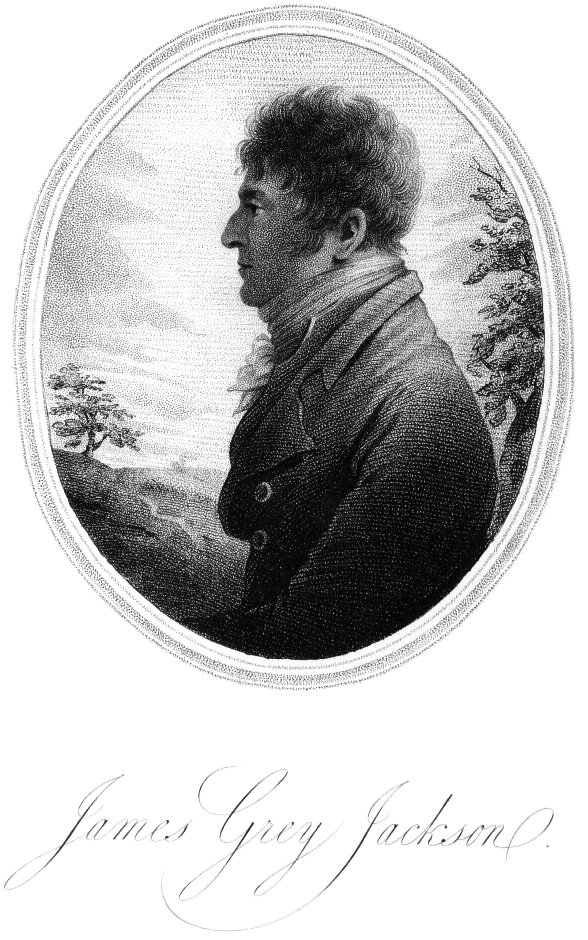
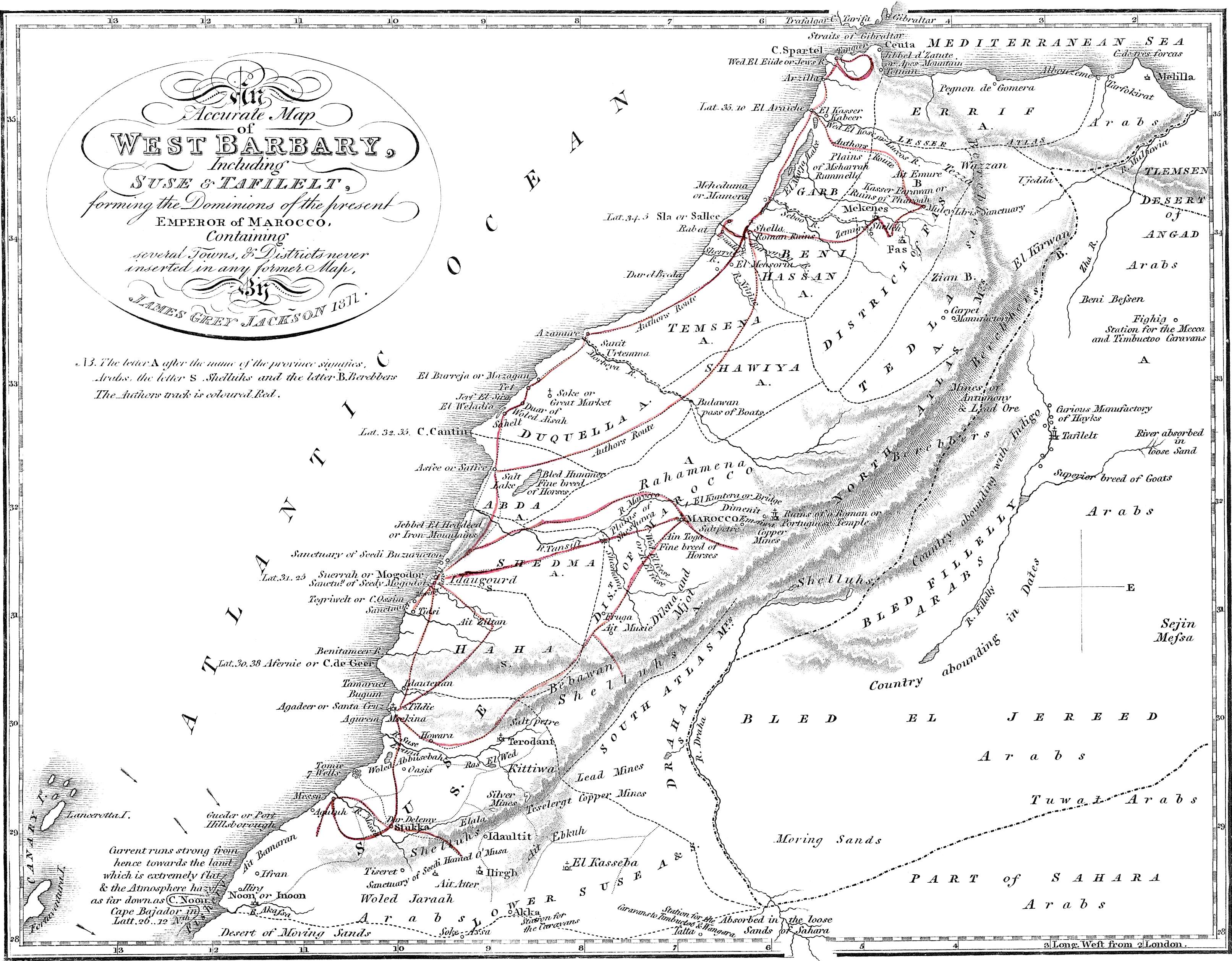
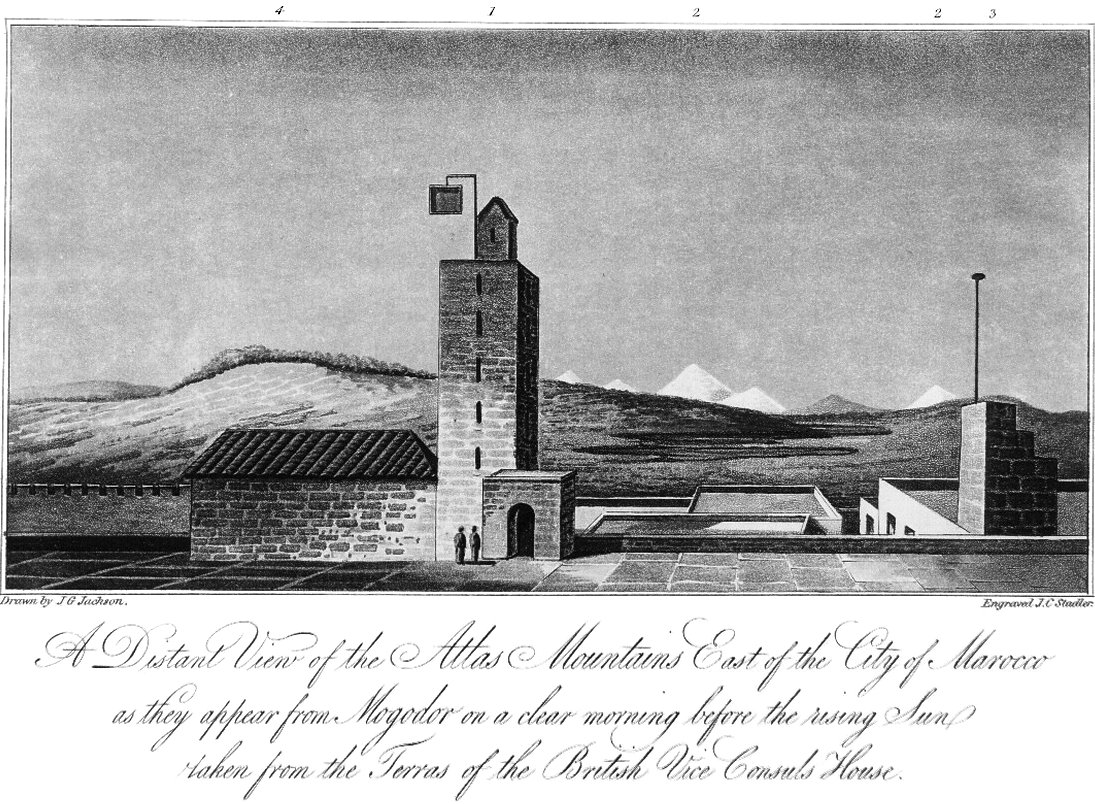
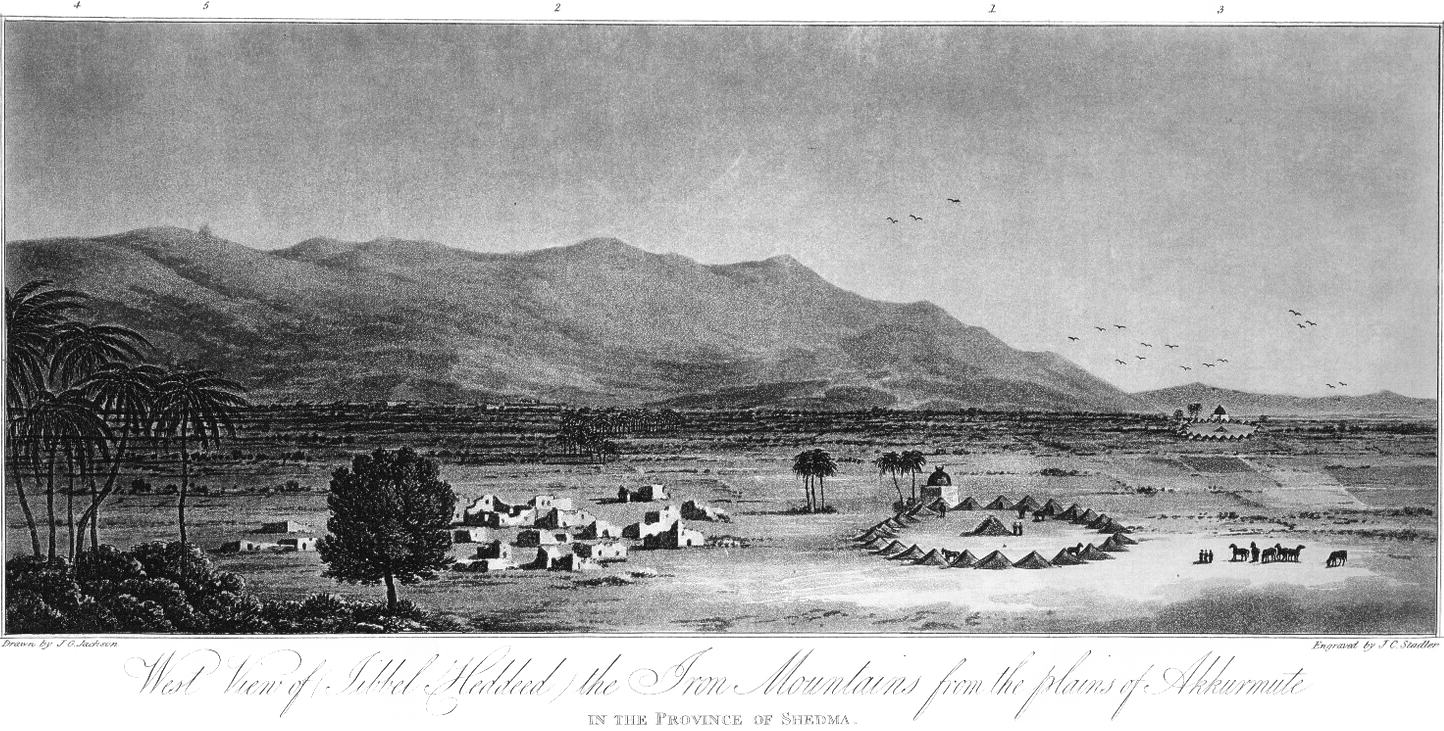
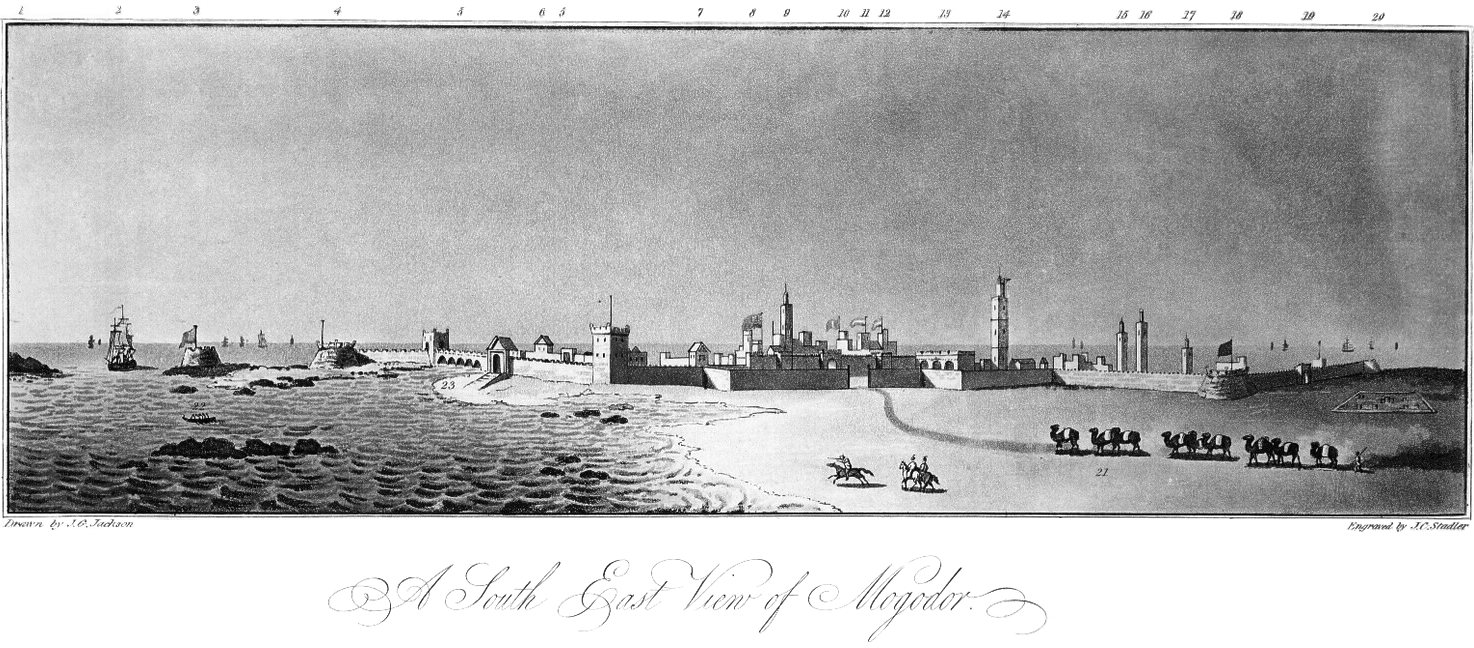
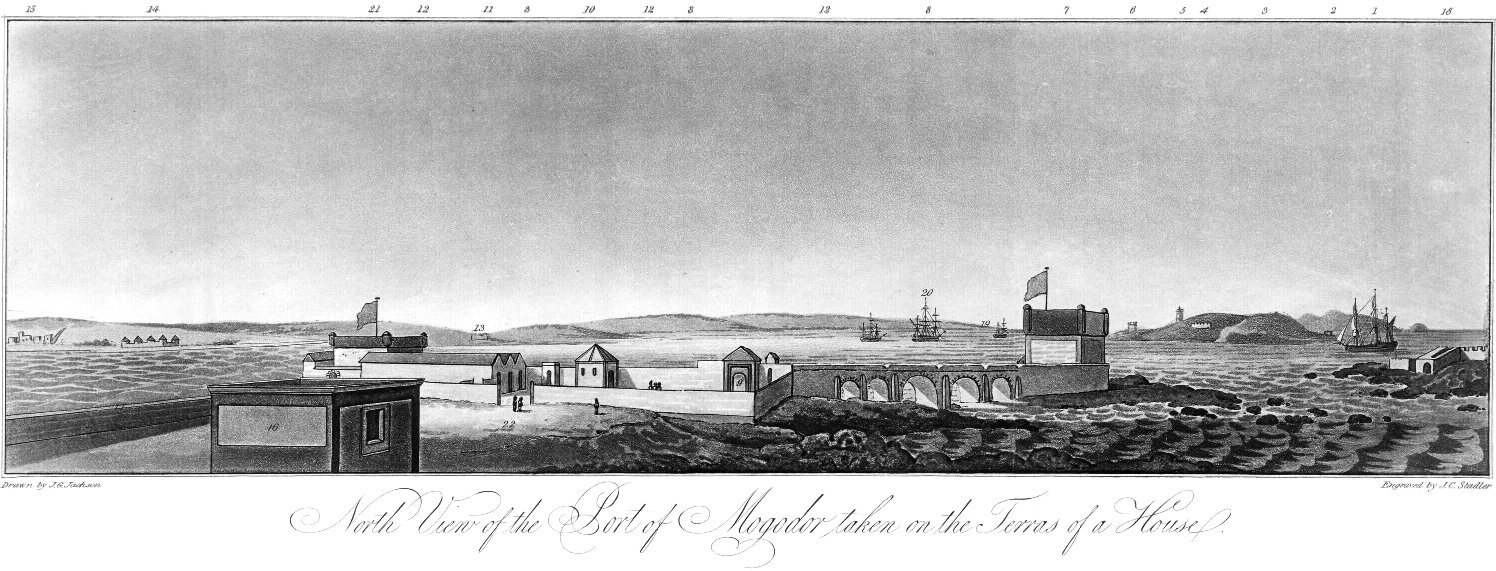
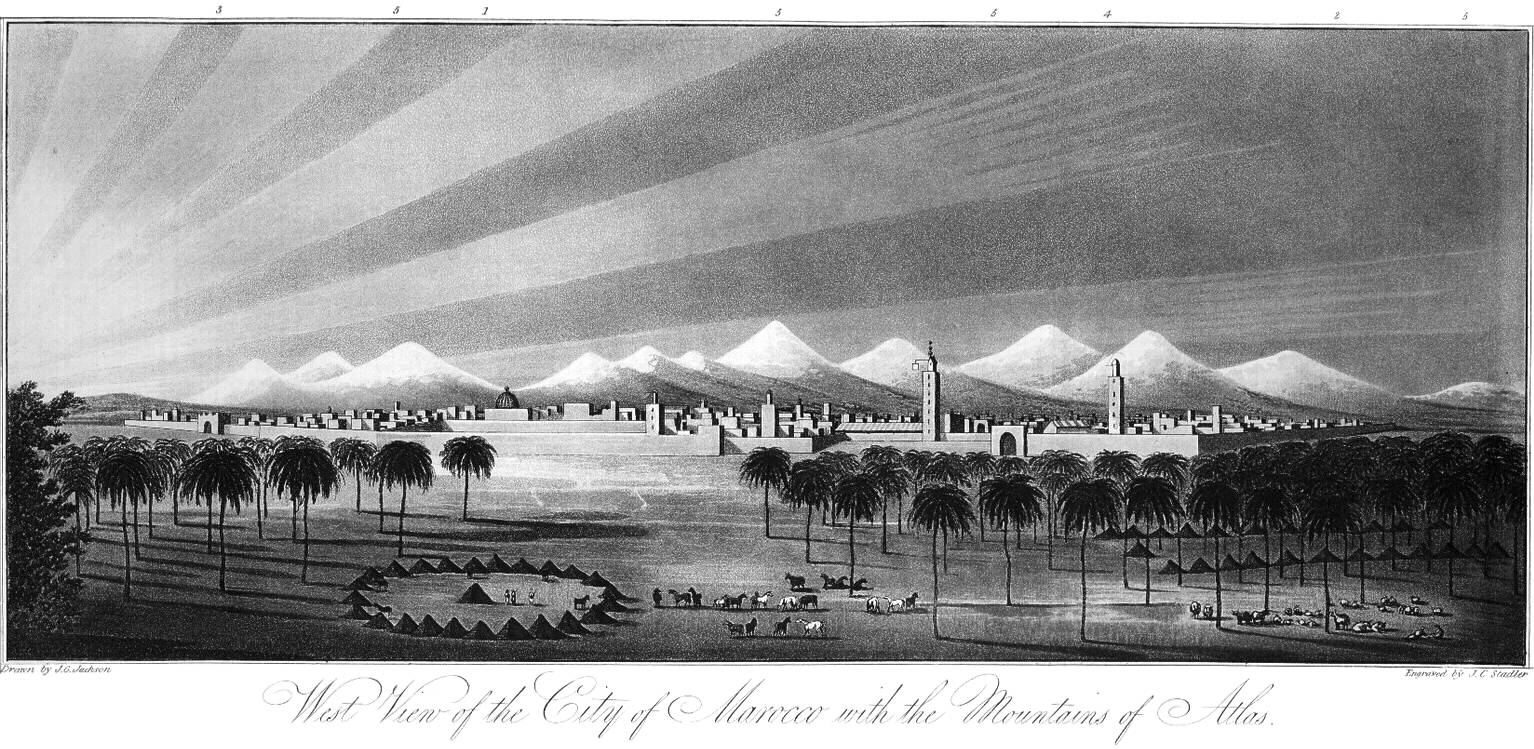
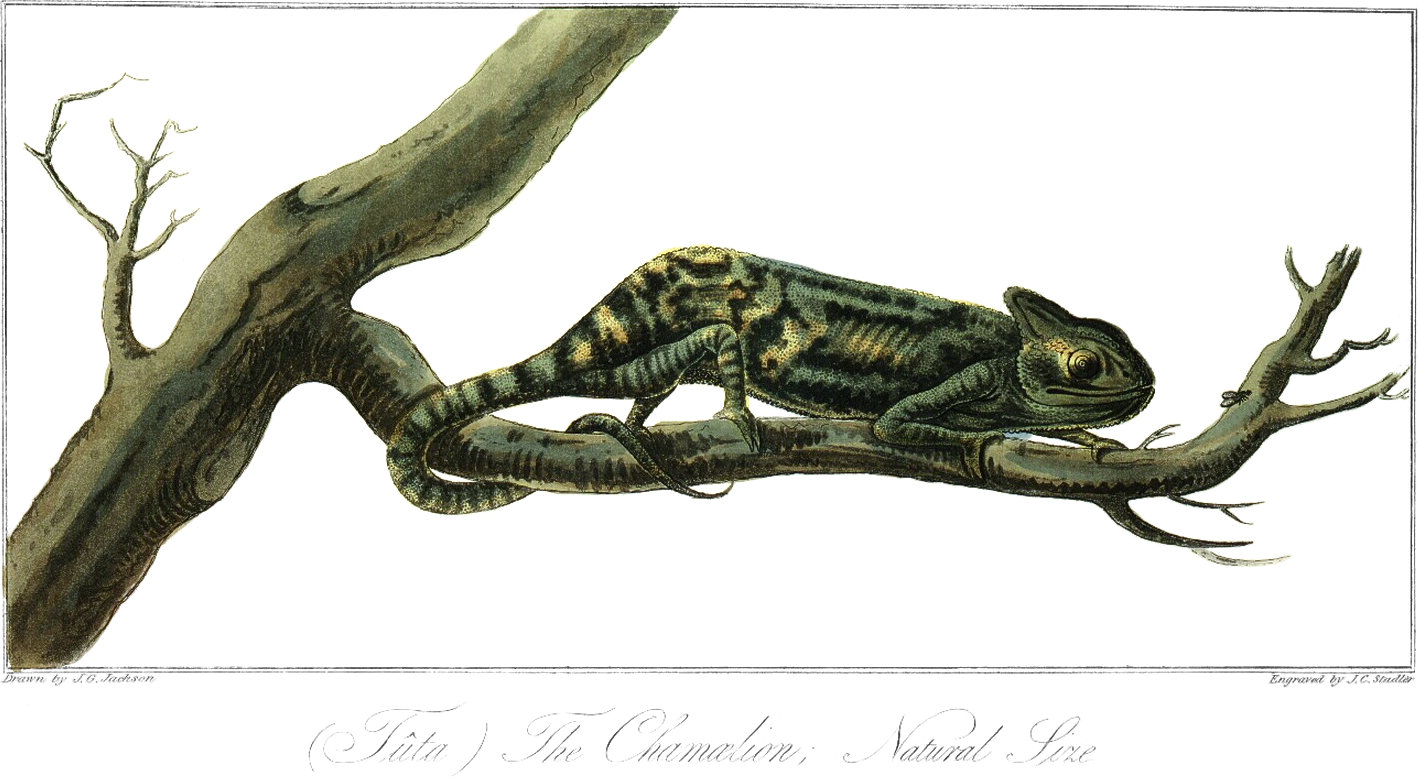
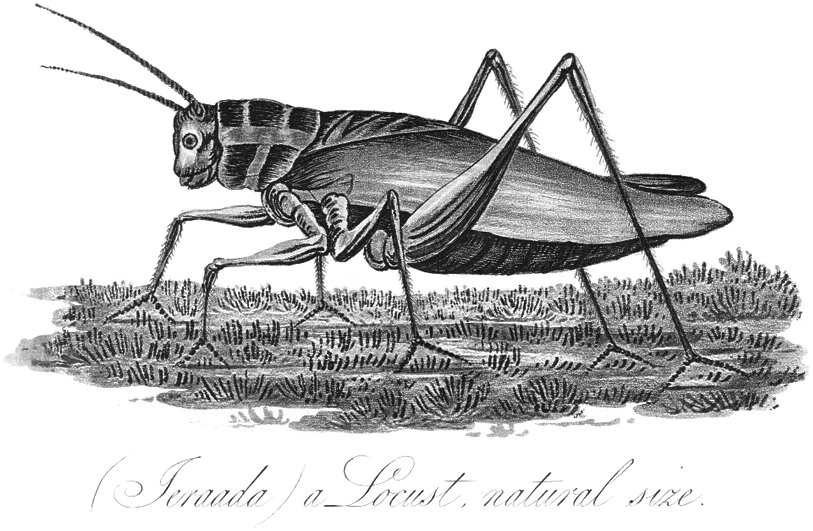
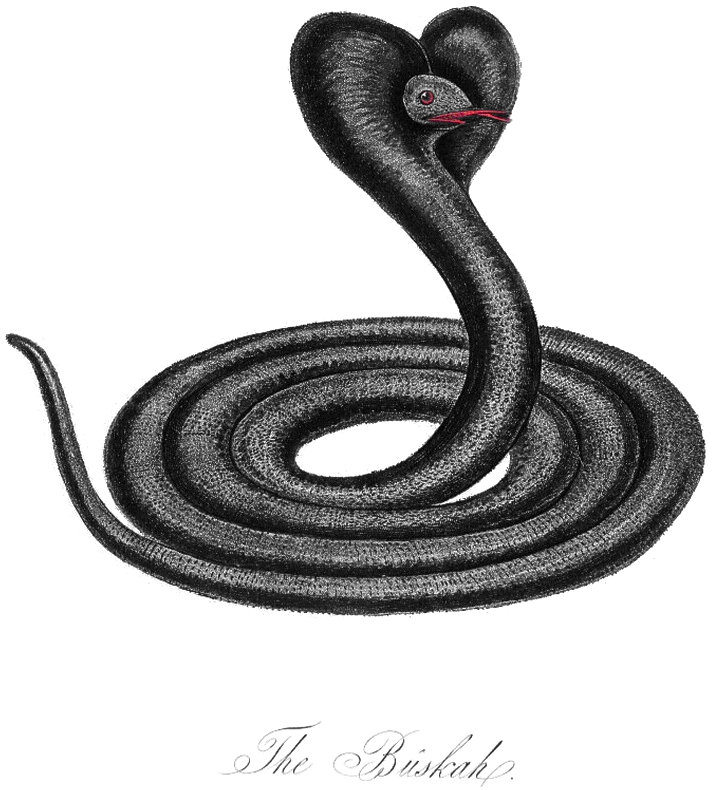
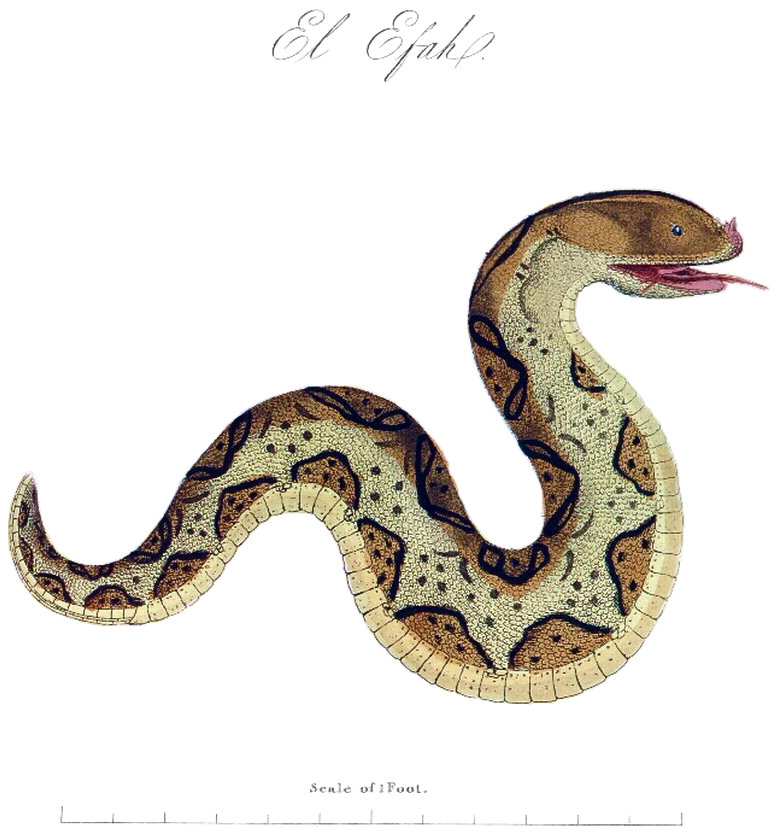
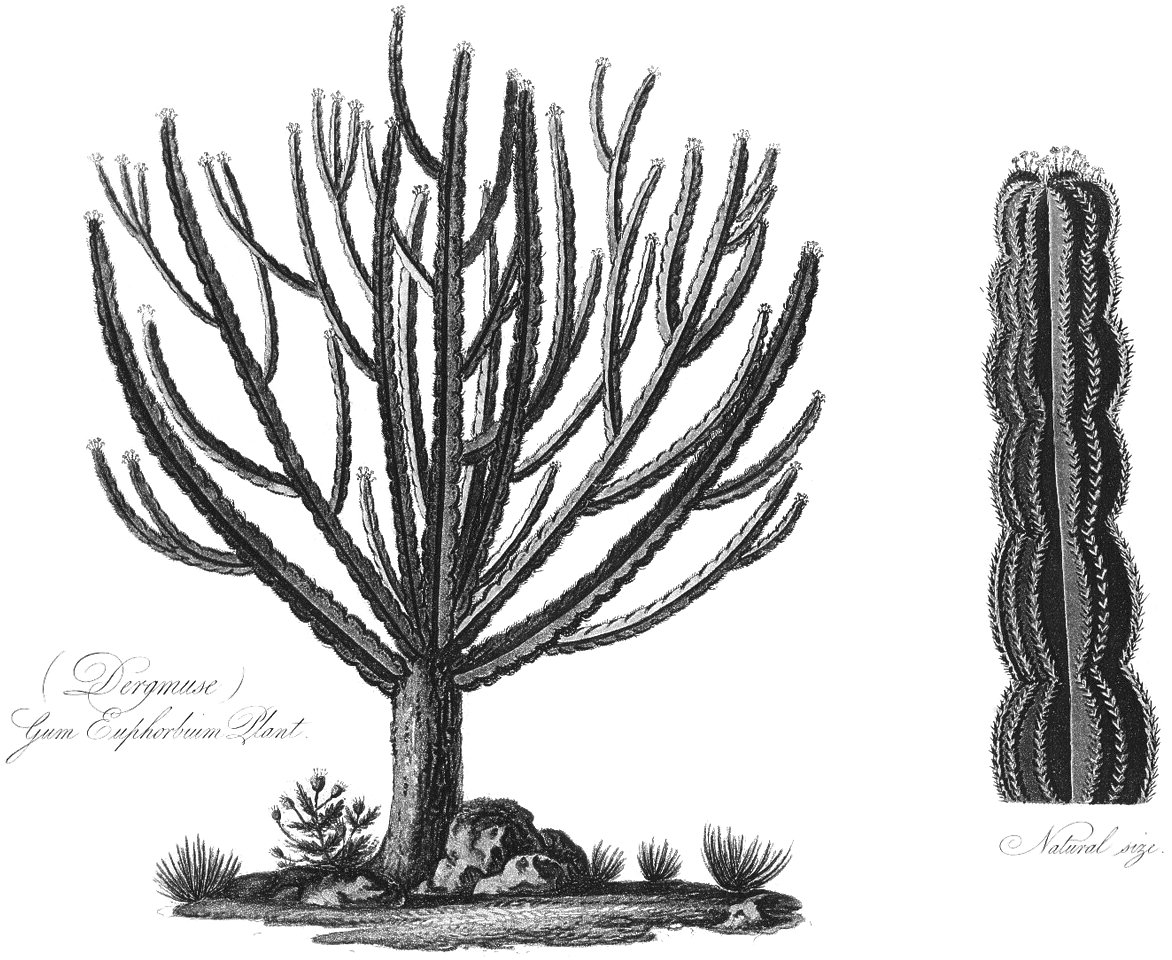
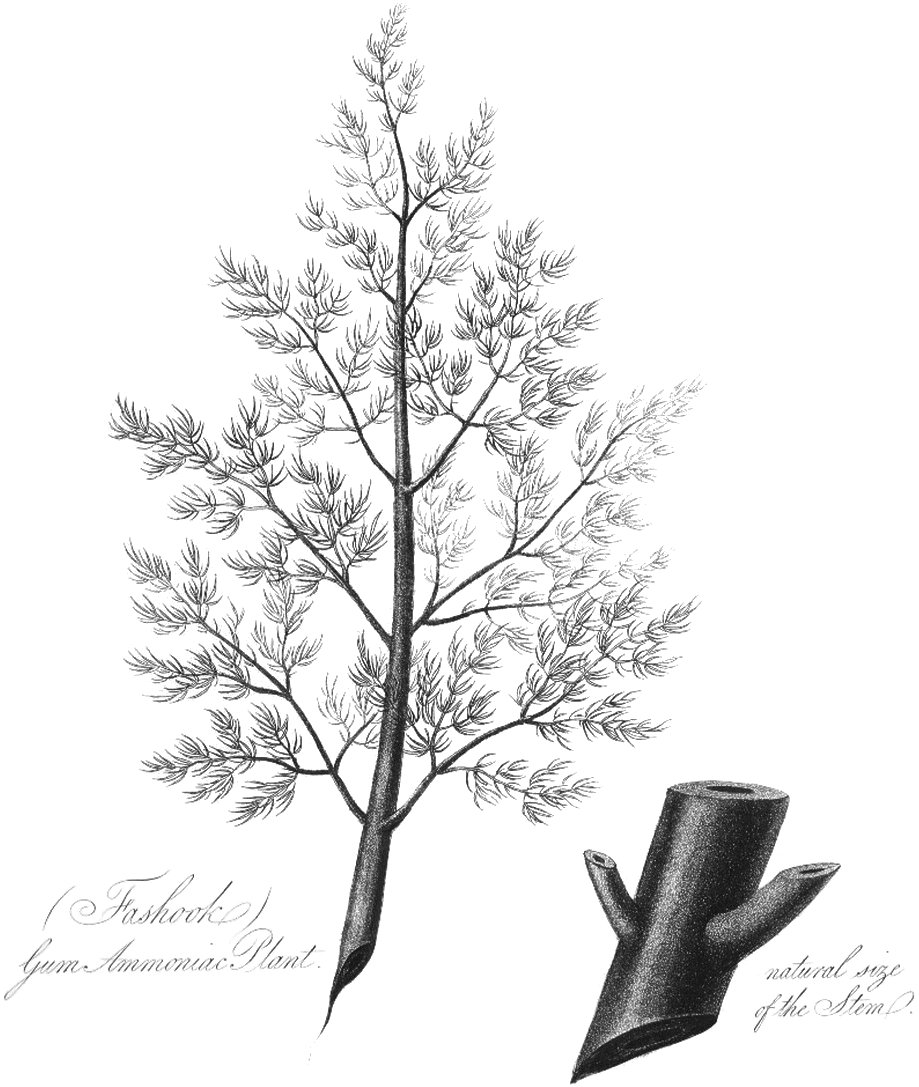
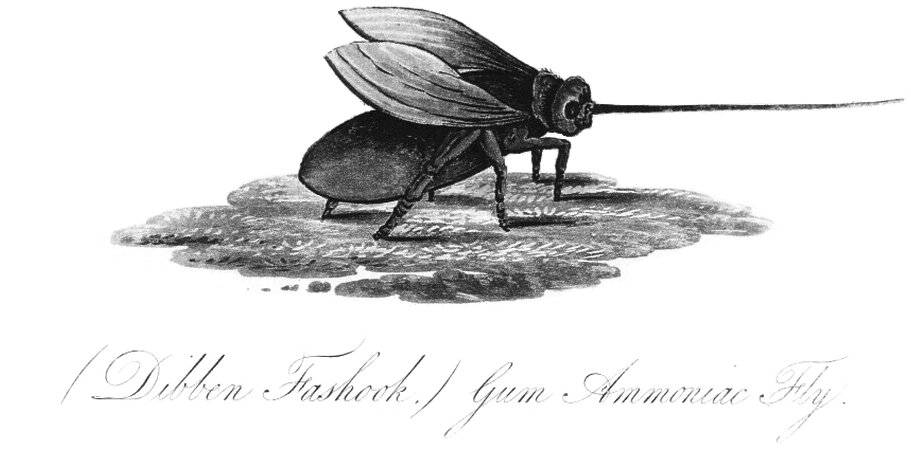
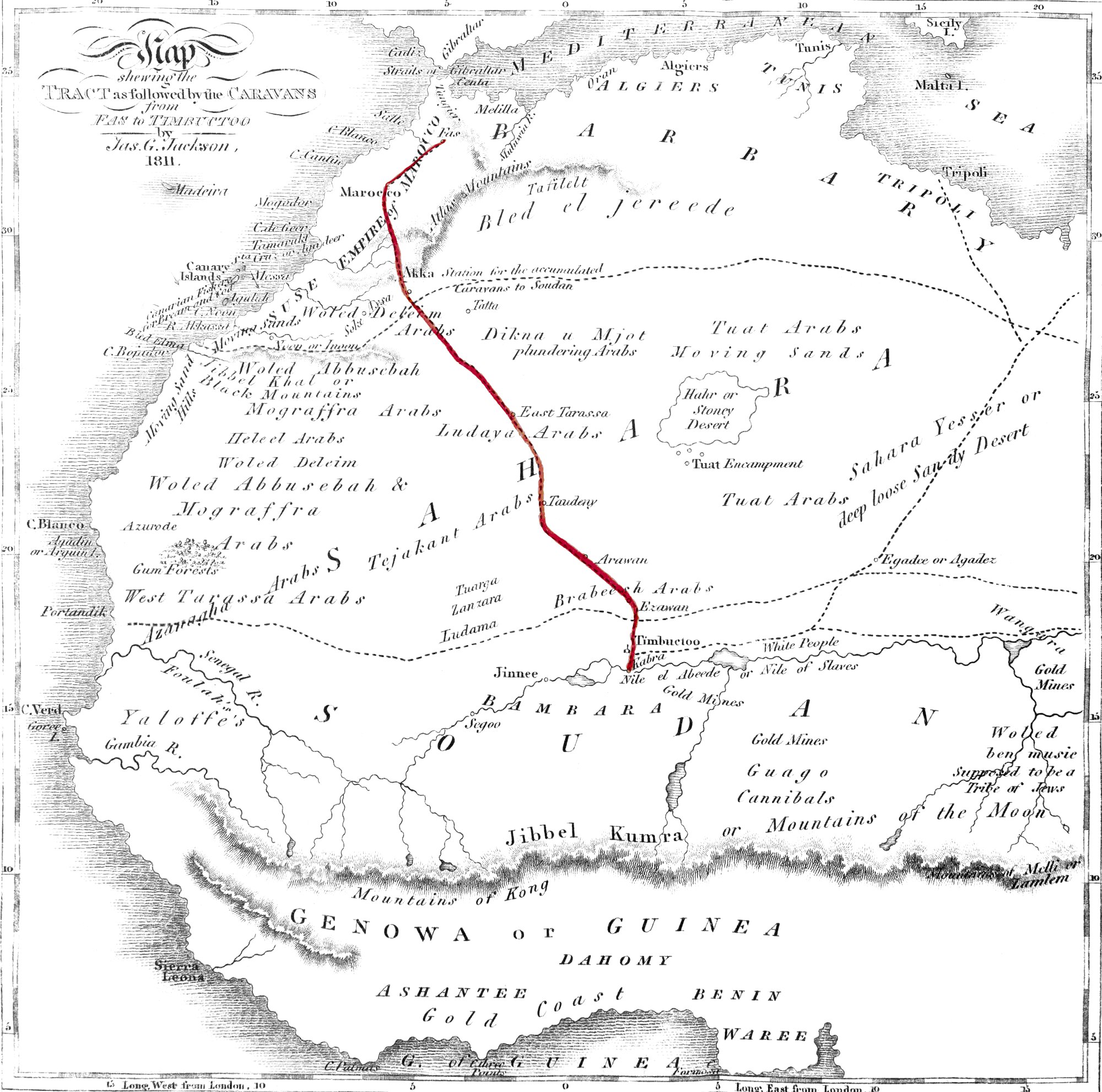

 " under
the "Oriental Order" column and "