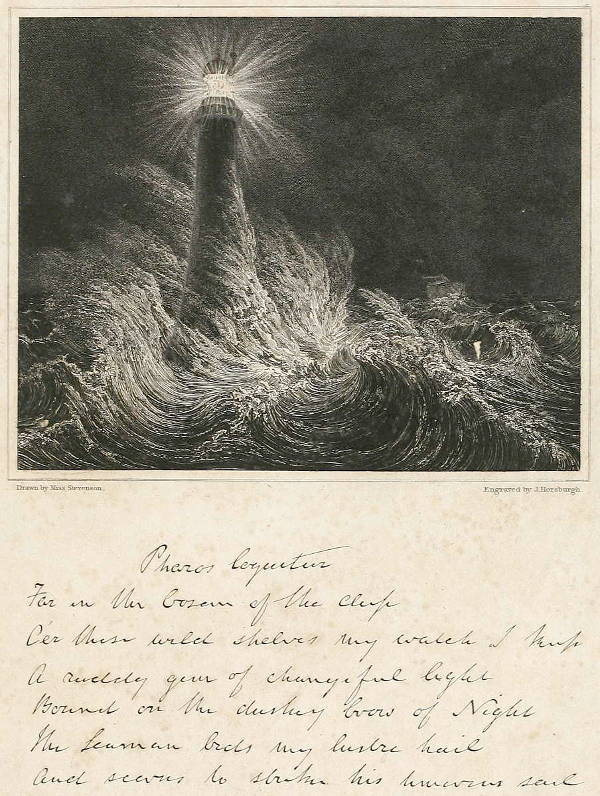
Drawn by Miss Stevenson.
Engraved by J. Horsburgh.
Pharos loquitur
Far in the bosom of the deep
O’er these wild shelves my watch I keep
A ruddy gem of changeful light
Bound on the dusky brow of Night
The Seaman bids my lustre hail
And scorns to strike his timorous sail
See page 530.
BELL ROCK LIGHT-HOUSE.
ACCOUNT
OF THE
BELL ROCK LIGHT-HOUSE.
NAME OF THE ROCK,—SITUATION AND DIMENSIONS,—NATURAL
HISTORY,—DEPTH OF WATER, AND CURRENT OF TIDES.
In the Introduction, I have given an account of the institution of the
Board of Commissioners of the Northern Light-houses; of the progress
made in the erection of Light-houses on the coast of Scotland; the probable
future operations of the Board, and the general economy or management
of its affairs. I now come to treat in detail of the Bell Rock Light-house,
as the chief object of this work; and, in the present chapter, I propose
to give the general history, and a description of this dangerous Rock.
Name.
Origin of the Name.
There is perhaps nothing in history more arbitrary, or difficult to account
for, than the origin of proper names, nor, in general, any research more
unsatisfactory, than a prolix inquiry into their etymology. The charts of
the nautical surveyor are the proper records for the names of places upon
the sea-coast; but such maps are comparatively of late invention. The first
sea-chart which we hear of in England, was that brought from Spain in
1489, by Bartholomew Columbus, to illustrate his brother’s theory of the
discovery of America; and the earliest, applicable to the coast of Scotland,
is the chart of the voyage of James V., from the Firth of Forth, by
the Orkney and Western Islands, to the Firth of Clyde and coast of Galloway,
in the year 1540. This map was published at Paris by Nicolay
D’Arfiville, Seigneur Du d’Aulphinois, &c. chief Cosmographer to the
King of France, in 1583; and afterwards in Edinburgh, in the year 1688,
by John Adair, F. R. S., Geographer for Scotland.
Inch Cape.
The French writer gives a hydrographical description of the coast of
Scotland, in relation to the Royal voyage, from Leith to the Solway Firth ,
noticing the distances of places, the tides, and the rocks and sand-banks, or
“dangers,” as they are more generally termed, which it was necessary to
avoid. In adverting to the course from Leith by the east coast to Duncansby-Head,
in Caithness, he observes, “Entre Finismes [Fifeness] et la
pointe nommé Redde, xii mille à l’est sud-est du costé de la dicte pointe
Redde, gist un danger appelé Inchkope.” This is unquestionably the Bell
Rock, the inch or island of the Cape, and with a reference to the Redhead,
to the north of Aberbrothock, the highest and most remarkable point on
that coast. In Adair’s collection of nautical charts, and descriptive account
of the eastern coast of Scotland, published in 1703, the Bell Rock is indifferently
termed Scape and Cape; and the fishermen on the shores of
Angus uniformly call it the Cape Rock. In some old charts, particularly
by the Dutch, whose name for a headland is kappe, it is also called skape
and scaup. It does not, however, seem that any inference can be drawn
from these various appellations; and, although it were to be conjectured,
that the Inch Cape was, at a very remote period, permanently above water,
and in all respects an island, the most rational hypothesis would still remain,
and be indeed confirmed, that this name was given it on account of
the relation it bore, especially in situation, to the cape of Redhead.
Bell Rock.
It is perhaps more difficult to assign the true origin for the modern term
of Bell Rock, by which this dangerous reef is now universally known.
There is a tradition, that an Abbot of Aberbrothock directed a bell to be
erected on the Rock, so connected with a floating apparatus, that the
winds and sea acted upon it, and tolled the bell, thus giving warning to the
mariner of his approaching danger. Upon similar authority, the bell, it is
said, was afterwards carried off by pirates, and the humane intentions of
the Abbot thus frustrated. This story has, by a modern poet, been made
the subject of the ballad of “Sir Ralf the Rover,” which, for the reader’s
amusement, is inserted in the Appendix, No. II.
Erection of a Bell.
Of the erection of the Bell, and of the machinery by which it was
rung, if such ever existed, it would have been interesting to have had
some authentic evidence. But, though a search has been made in the chartularies
of the Abbey of Aberbrothock, preserved in the Advocates’ Library,
and containing a variety of grants and other deeds, from the middle of
the 13th to the end of the 15th century, no trace is to be found of the Bell
Rock, or any thing connected with it. The erection of the bell is not, however,
an improbable conjecture; and we can more readily suppose that an
attempt of that kind was made, than that it had been intentionally removed,
which in no measure accords with the respect and veneration entertained
by seamen of all classes for land-marks; more especially, as there
seems to be no difficulty in accounting for the disappearance of such an apparatus
unprotected, as it must have been, from the raging element of the
sea. It is not therefore unlikely, that the popular appellation by which
this Rock has more recently been known, may owe its origin to the tradition
of the Abbot’s humanity and public spirit; and when we consider that
the churchmen of those days were well acquainted with the history of the
celebrated Pharos of Alexandria, and may have heard of the fire-towers
and sea-marks, which Mr Bryant, in his Mythology, conjectures existed in
very remote times, it is natural to suppose, that these learned persons had,
at a pretty early period, turned their attention to the subject, and had attempted,
in the mode which has been figured, to point out and guard against
the danger.
Amidst these speculations, it must not, however, be overlooked, that this
Rock may have acquired its present name from its shape or figure; for at
the commencement of the author’s operations, he remarked, that the site of
the light-house, at some distance, had much the appearance of a large bell;
and although this part was not more than four feet above the general level
of the Rock, yet by supposing it to have been the nucleus of a larger mass,
in the central part of the Rock, gradually wasted away by the washing of
the sea, it may at a former period, from that resemblance, have obtained the
appellation it now retains.
Situation.
The Bell Rock may be described as a most dangerous sunken reef, situate
on the northern side of the entrance of the great estuary or arm of
the sea called the Firth of Forth; and as such directly affecting the safety
of all vessels entering the Firth of Tay. Its position, as will be seen from
the Charts, Nos. 3. and 4., which accompany this work, is in west longitude
from Greenwich 2° 22´, and in north latitude 56° 29´. From St Abb’s Head
in Berwickshire, it bears north by east per compass, (variation 27° 20´ west
in the year 1819), and is distant about 30 miles; from the Island of May
north-east 17 miles; and from the promontory or cape called the Redhead,
in Forfarshire, it bears south-west, and is distant 14 miles. But in easterly
directions no land intervenes between the Bell Rock and the coasts of
Norway, Denmark, Germany and Holland.
Dimensions.
The dimensions of the north-eastern or higher compartment of the Rock
where the light-house is built, are about 427 feet in length, and 230 feet
in breadth. Besides these dimensions, the south-western reef extends about
1000 feet from the main rock. The greatest length, therefore, of the Bell
Rock, which may be said to be dangerous to shipping, is about 1427 feet,
and its greatest breadth is about 300 feet; but the outline or margin of
the Rock is quite irregular, as will be seen from the Plates marked Nos. 5.
and 6.
Mineralogy.
The Bell Rock consists of sandstone of a reddish colour, which in some
places contains whitish and greenish spots of circular and oval forms, irregularly
interspersed through the rock. It is of a fine granular texture, containing
minute specks of mica. It is very hard, and, in the language of the
artificer, is tough, and rather difficult to work; and in some parts it is found
to rise in masses having a conchoidal fracture. Its angle of inclination with
the horizon is about 15 degrees, dipping towards the south-east. The strata
are thick and unequal, strongly cemented together, and running in the direction
of north-east and south-west. The surface of the Rock is rugged,
and full of cavities, so that walking upon it becomes rather difficult. A
longitudinal section of the Bell Rock, taken in a north-easterly and south-westerly
direction, may be described as consisting of a higher and a lower
level. The cross section, taken in a south-easterly and north-westerly direction,
exhibits the abrupt and pointed terminations of the strata, though
it appears level when seen from a distance.
Wasting effects of
the Sea.
Natural History.
It would be a speculation highly interesting to the geologist, to inquire
into the probable early history of the Bell Rock, and the changes produced
on it by the wasting effects of the waters of the ocean. When we consider
the similarity of the red sandstone of this rock with the Redhead of Forfarshire,
and opposite shores of Berwick in the neighbourhood of Dunglass,
and take into view that there is a ridge or shallower part of the bottom,
which extends a considerable way from the Bell Rock in the direction of
these shores, we may infer, that the Rock itself had extended at one time
much further. We are also enabled to trace the same formation, penetrating
to the northward through Ross-shire, and quite across the kingdom, in
a southern direction, to Cumberland. At a period indefinitely remote in
the history of the globe, we may therefore imagine that one continuous bed
of red sandstone had stretched across the Firth , forming a barrier by which
the great collection of waters of the Forth and Tay have been pent up.
Proofs of the Sea having
occupied a higher
level.
In support of this opinion, we have the most unequivocal proofs of the
waters of those friths having formerly occupied a much higher level. Of
these we may notice the general appearance of their water-worn shores, and
a bed of oyster-shells near Borrowstounness, which has been traced to the
extent of three miles in length, and about two fathoms in thickness, lying in
their natural state, but now upwards of 35 feet above the present level of the
sea. Under these circumstances, and many others which might be adduced,
it is not improbable that the Bell Rock has at one time been connected with
the opposite coasts; and when we consider the general waste of the land,
which is apparent in all directions from the impulse of the sea, it may at
least be concluded, that at no very remote period, the Rock has been of
much greater superficial extent, and above the level of the highest tides.
Nor need we be surprised that such changes upon this remote and insulated
spot should have been lost sight of, owing to their gradual and almost imperceptible
effects, compared with the short period of the life of man, and
in absence of all testimony excepting that which is oral.
Plants.
With regard to the marine Plants which grow upon the Bell Rock,
we may observe that the lower parts of it are covered with the stronger
or larger sorts, as the great tangle, Fucus digitatus, the roots of which
rarely appear above the water, while it is seen at the depth of several fathoms,
growing with the greatest luxuriance, and has often been observed
by the author from a boat in fine weather, as a means for ascertaining, by
the direction of the leaf, the changes of the currents of the tide at the bottom.
The Badderlock, or Henware, Fucus esculentus, is found only on
the north-eastern and south-eastern extremities of the Rock, growing
at low water-mark of spring-tides, and seems to prefer the most rapid
currents of the sea, and places where the heaviest breach takes place. In
such situations it grows in great abundance at the Bell Rock, where it
has been measured of the length of eighteen feet, and of proportionally increased
breadth. Perhaps some of these plants are of considerable age;
but at the works of the Carr Rock Beacon, off Fifeness, it was found that
the growth of the badderlock was so very rapid, that the plant attained to
the length of seven feet upon the new building, in the course of the winter
and spring months. The higher parts of the Bell Rock abound with
the smaller fuci, as Fucus mamillosus, and F. palmatus, or common dulse.
F. lycopodiodes, alatus, and coccineus, are found on the older stalks of the
great tangle, and F. subfuscus and confervoides occupy the smaller pools.
In some places, the rocks are rendered slippery with Ulva compressa and
umbilicalis; and the higher parts of the Rock, and the basement or lower
courses of the light-house, are so covered with Conferva rupestris, as to
produce the appearance of a sward of grass.
Animals.
Of the feathered tribe of animals at the Bell Rock, we notice the shag,
cormorant, and herring-gull, which sometimes rest upon the Rock when
in search of codlings and other small fishes. It also formed the resting-place
of numerous seals at the commencement of the operations of the Light-house,
but these amphibious animals, as well as the birds, have now almost
entirely left it. The common crab and lobster are sometimes found here
in the crevices of the rock. The Lepas balanoides, or acorn-shell, the
common limpet, mussels of a small size, and the white buckey or Buccinum
lapillus, abound on the rock. The Actinia crassicornis, Asterias
glacialis and oculata, are common. A minute crustaceous insect, called,
by Dr Leach, Limnoria terebrans (Lin. Trans, vol. XI. p. 371.), appeared
in great numbers in the submersed wood work of the temporary erections
on the Rock.
Insect destructive to
Timber.
So destructive to timber is this small insect, that the Norway logs, laid
down to support the temporary railways in 1807, when lifted in 1811,
were found to have been reduced by its ravages from 10 inches square to
7 inches, or at the rate of about an inch in the year. The author having
had occasion afterwards to examine the timber-bridge of Montrose, found
the attacks of this insect upon the wooden piers to be so alarming as to
endanger that fabric; and after many trials for the preservation of timber
in such situations, the Trustees were ultimately induced to cover the
upright beams with sheet-copper. Upon another occasion, when the author
was called to inspect the Crinan Canal, he found the gates of the sea-locks
so destroyed, chiefly by this little animal, that the locks lost seven feet of
their depth of water in the course of the night. It is further remarked,
that the deserted cavities, formed by the perforations of the Limnoria, frequently
become the residence of larger marine insects, belonging to the
Linnæan genus Oniscus.
Experiments with
pieces of timber trenailed
to the Rock.
In the year 1814, with a view to experiment on the effects of these
destructive vermes, I fixed down specimens of teak-wood, oak, black birch,
Memel and Norway fir timber, on the Bell Rock. The only specimen
which remained imperforate till 1820, was the teak-wood. The rest were
almost entirely destroyed in the course of two or three years. This may
be regarded as a matter of some importance, in a national point of view, in
directing the employment of teak-wood for the sea-lock gates of canals and
for ship-timbers. From the excellency of the situation of the Bell Rock
for such experiments, I have caused another set of timbers to be trenailed
to the rock, in a situation where, like the former, they are occasionally uncovered
by the water. These last pieces of timber were laid down in the
month of October 1821. They are eighteen in number, each measuring
5 inches square, and 30 inches in length; and are of the following kinds,
viz. British and American oaks and firs, Memel fir, Scotch elm, beech,
sycamore, larch, teak-wood, mahogany, bullet-tree, locust-wood, and blue
gum-wood from Van Dieman’s Land.
Attempt to plant
Muscles on the
Rock.
When the workmen first landed upon the Bell Rock, limpets of a very
large size were common, but were soon picked up for bait. As the limpets
disappeared, we endeavoured to plant a colony of muscles, from
beds at the mouth of the river Eden, of a larger kind than those which
seem to be natural to the rock. These larger muscles were likely to have
been useful to the workmen, and might have been especially so to
the light-keepers, the future inhabitants of the rock, to whom that delicate
fish would have afforded a fresh meal, as well as a better bait than
the limpet; but the muscles were soon observed to open and die in great
numbers. For some time this was ascribed to the effects of the violent
surge of the sea, but the Buccinum lapillus having greatly increased, it
was ascertained that it had proved a successful enemy to the muscle. The
buccinum being furnished with a proboscis capable of boring, was observed
to perforate a small hole in the shell, and thus to suck out the finer parts
of the body of the muscle; the valves of course opened, and the remainder of
the fish was washed away by the sea. The perforated hole is generally upon
the thinnest part of the shell, and is perfectly circular, of a champhered
form, being wider towards the outward side, and so perfectly
smooth and regular, as to have all the appearance of the most beautiful
work of an expert artist. It became a matter extremely desirable to preserve
the muscle, and it seemed practicable to extirpate the buccinum. But
after we had picked up and destroyed many barrels of them, their extirpation
was at length given up as a hopeless task. The muscles were
thus abandoned as their prey: and in the course of the third year’s operations,
so successful had the ravages of the buccinum been, that not a single
muscle of a large size was to be found upon the rock; and even the small
kind which breed there, are now chiefly confined to the extreme points
of the rock, where it would seem their enemy cannot so easily follow them.
Habits of Fishes.
In speaking of the habits of fishes, it deserves notice that they have
their particular grounds and shores which they frequent; for while the
vessels attending the works at the Bell Rock were stationed there, different
kinds of fish were caught as the depth and bottom varied. About
high-water, and especially during ebb-tide, when the sea is smooth on
the rock, the Podley (chiefly the fry of the coal-fish, but including also
the young of the Gadus virens) is so numerous, as almost entirely to
cover it from view. Near the rock, the small red cod is often found in
abundance: at some distance, as the bottom, which is covered with marine
plants near the rock, alters to coral, gravel, shell sand, fine sand and
mud, all of which occur in a range of depths from 4 to 23 fathoms towards
the north, different kinds of fish are found; first, the codling,
which ceases to be wholly red, but becomes only speckled with reddish spots;
then, upon the finer or mud grounds in the track of the tides of the Firth of
Tay, whiting, haddock, flounder, and occasionally the sole. On the southern
side of the rock, where the water deepens to 35 fathoms, the large white cod,
in company with ling, conger-eel, halibut, skate, thornback, plaise, turbot,
wolf-fish and large coal-fish are found. The dog-fish appears to be very general,
and seems to prey chiefly upon the haddock and cod. The mackerel
and gurnard are found together near the surface, and do not seem to be
confined to particular grounds, but occur wherever the water is of a considerable
depth. Herrings are found in the bays of the opposite shores
in great abundance at the fishing season, when they are understood to be
migrating towards the south. It has often been observed, in the course of
the Bell Rock operations, that, during the cold weather of spring and autumn,
and even at all seasons, in stormy weather, when the sea is much
agitated by wind, the fishes disappear entirely from the vicinity of the
rock, probably retreating into much deeper water, from which they do not
seem to return, until a change of weather has taken place; so much was this
attended to by the seamen employed on this service, that they frequently
prognosticated and judged of the weather from this habit of the fishes, as
well as from the appearances of the sky.
Depth of Water.
Depth of Water upon
the Bell Rock.
At the time of high-water of spring-tides, the south-western reef is about
16 feet, or nearly the whole rise of the tide, under the surface of the water;
while the part of the rock on which the light-house is built, is about 12
feet below high water-mark of spring-tides: At low-water of neap-tides,
hardly any part of the rock is visible: But at low-water of spring-tides, the
general level of the north-eastern end where the light-house is built, is
about four feet perpendicular above the level of the sea, though particular
points measure six or even seven feet in height above the low-water mark
of spring-tides.
Depth at the distance
of 100 yards, and
upwards from it.
At the distance of about 100 yards from the rock in all directions,
excepting on the south-western reef, there is a depth of water varying
from two to three fathoms at low water of spring tides. On the north-west
side, or in the direction of the shores of Forfar and Fife, the
greatest depth is 23 fathoms; but on the south-eastern or seaward side,
in the direction of the dip or inclination of the strata, the water deepens
more suddenly to 35 fathoms; in the same direction from the rock, however,
the soundings again become less, being only 22 fathoms upon Mars
Bank, distant about 33 miles; this bank appears to be a deposition formed by
the joint operation of the waters of the Friths of Forth and Tay, influenced
by the great tidal wave of the German Ocean. It may here be noticed as
a fact connected with the depth of the German Ocean, that at Queensferry
passage, in the Firth of Forth, the depth of the water is about
35 fathoms, while the greatest depth of the sea across to Denmark, does not
exceed 45 fathoms. The depths of the German Ocean will be seen, by inspecting
Chart No. 3., where sectional lines are delineated between various
points of Great Britain and the opposite Continent, on which the
reader will see the relative depths marked by shaded lines, in a new and it is
hoped a perspicuous manner.
Currents of the Tide.
Tides at the Bell
Rock.
The tides at the Bell Rock, are observed to follow the same laws
as on the opposite shores of the Firth of Forth. The currents along
the coast take their direction from the figure of the land, and, in their
course, they are therefore occasionally deflected from, and inclined towards
it. At the Bell Rock the flood-tide sets south-west, and the ebb-tide
north-east, being nearly in the direction of the shores of Forfar and
Kincardine. The velocity of the water in spring-tides, or when the sun and
moon are in conjunction, and in opposition, is about three miles per hour,
but in neap-tides, or at the quadratures of the moon, the current is only at
the rate of about one mile per hour. On the days of new and full moon it is
high-water upon the Bell Rock at half past one o’clock, being about
the same periodic time as at the harbour of Arbroath, or nearest point of the
mainland. In the ordinary state of the weather, the perpendicular rise and
fall of the sea at the Bell Rock, in spring-tides, is 15 feet, and in neap-tides,
8 feet; but so much depends upon the direction of a prevailing tract of winds,
that the tides are often found to vary from 1 to 3 feet above and below these
numbers. This irregularity in the tides of the German Ocean and its subsidiary
friths or inland seas will be easily accounted for, by considering the
effect of westerly winds passing for a length of time over the Atlantic, which
must naturally force an undue quantity of water from thence into the entrance
of the North Sea, between the coasts of Scotland and Norway; while the
Strait of Dover, to the southward, from the same cause, is gorged by the
surplus waters of the British Channel flowing in an opposite direction,
and checking the tide of the German Ocean. When the winds blow
from southerly and easterly directions, the reverse of this happens, and
the waters are then proportionally low.
In and Off shore
Currents.
A curious anomaly connected with the flowing and ebbing of the sea, in
the early part of each tide, is observable in the contrary currents which take
place along the shore, and at a distance from it. For example, the flood-tide
begins to flow in many situations two or even three hours sooner on the shore
than at the distance of from one mile to four miles in the offing. The same
thing also happens with regard to the ebb-tide, which begins to fall and run
in a contrary direction to the flood-tide, two or three hours sooner on the shore
than at a distance. These effects are very different from the state of things
three or four leagues from the land, or in the open sea, where the lateral
motion of the tide-waters is scarcely sensible. That an extensive tract
of coast should produce changes on the current of the tides, is perhaps what
we should expect; but it is somewhat curious to find the same appearances
connected with small islets, and, as in the case of the Bell
Rock, even with an insulated reef, situate at the distance of 12 miles
from the land, and sunk to the depth of from 2 to 3 fathoms under the
surface of high-water. So strikingly observable is this, that the tide begins
to ebb about two hours sooner on the Bell Rock than at the short distance of
one mile from it. In the course of the light-house operations this was rendered
sufficiently obvious, by the swinging round of the several vessels at their
moorings according to the flood and ebb tides. For example, the Floating
Light-ship was moored about three miles in a north-west direction from the
Bell Rock, and the moorings of the Tender and two Stone Lighters, were respectively
laid down at the distance of ¾ and ½ mile from it, as will be seen
from Plate V. Now, these vessels were all found to swing to the tide at
periods proportional to their distance from the rock. Although it may, therefore,
seem strange, that this comparatively small object should affect the
tides in its vicinity in a manner similar to the shores of an extensive coast;
yet, as the rock shelves outwards, with an extensive base, especially on
the northern side, it must impede the under current of the tide, and indeed
forcibly proves the existence of such under currents.
Not accounted for by
Writers on the subject.
To account for these in and off shore tides, or central and marginal
streams, would be interesting. But to what cause shall we ascribe
them? Sir Isaac Newton, and the other eminent philosophers who have
followed that great man in considering the theory of the tides, confine
their attention chiefly to an explanation of the influences of the sun and
moon, and the laws of gravitation, in affecting the waters of the ocean,
leaving it to the result of experience and observation to account for such
anomalies as those to which we now allude. It is noticed by Adair, Mackenzie,
and other nautical surveyors, that the tides run longer upon the shore than in
the offing, and the advantage of working a ship with in and off shore tides,
is familiar to every mariner. The existence of these opposite currents was
also known to the author, prior to the commencement of the Bell Rock works,
but they had not struck him so forcibly till that period. For here, even after
the flood-tide had overflowed the rock, and put a stop to the operations, the
boats in carrying the artificers on board of the Tender, had still to row
against the current of a strong ebb-tide.
Currents along Shore
considered as Eddy-tides.
It would be foreign to this work to enter into the theory of the tides
generally; all, therefore, that is here proposed, is to endeavour to account
for these in and off shore currents. In doing this, however, it
will be necessary to observe, that the great wave or “theoretical tide,”
as it has been termed by the late eminent Professor Robison, is produced
by the united attraction of the sun and moon, which, between the
Tropics, has been calculated by philosophers to raise the water from 8 to 14
feet perpendicularly. It is observable, that the attractions of these heavenly
bodies elevate the parts of the ocean to which they are vertical, without
having any direct tendency to progressive or lateral motion. The
currents along our coasts, may therefore be considered merely as Eddy-tides,
occasioned by the interposition of the land, which obstructs the
undulating motion incident to the rise or fall of a fluid. In this manner
the land may be said to displace a portion of the tidal waters which have
been elevated above the medium level of the sea; and were it not for such
obstruction, the great waves of the tide might be supposed to undulate
indefinitely over the expanse of the ocean. To compare small things
with great, these effects may be conceived as in some degree exemplified, by
the disturbing effect of a vessel passing along a navigable canal, or the
undulations which are observable in the wake of a ship or wheels of a
steam-boat in motion on a smooth sea.
Progress of the
Great Waves of the
Tides.
The great wave which supplies the British tides, appears to be propagated
between the coast of Labrador and Greenland, on the one hand, and the
European shores on the other; and this great wave seems to be divided into
two lesser waves. One of these flows between Ireland and the coast of France,
into the British and St George’s Channels; while the other enters by the
North Sea into the German Ocean; and in its course from north to south,
supplies all the friths, rivers, and bays connected with it, invariably in the
form of In and Off shore tides, which are every where observable along the
margin of this great basin. This northern wave is found to occupy about 12
hours in flowing southward from the 58th to the 52d degree of latitude, or
from the Orkney Islands to the numerous Sand-banks which pervade and
encumber the apex of the German Ocean, where the currents become extremely
desultory and irregular. The coast of the British Isles, accordingly,
may be said to, displace a portion of this northern wave, and thus to produce
the irregularities which we are endeavouring to account for.
Progressive periods
of High-Water in
the Firth of Forth.
At present, we shall confine our attention to the tides of the
Firth of Forth. Here, as on other parts of the coast, the tidal waters
have a tendency to flow towards the shores and higher parts of the
Forth, till the instant of high-water upon the shore, when the tide begins
to ebb, and run in a contrary direction. A central stream, however, continues
to run with unabated force, as flood-tide, during two or even three
hours longer, as before noticed, according to the situation and local circumstances
of the coast. It appears, from a comparison of the several periods
of high-water on the shores of the Firth of Forth, as nearly as some of
them could be ascertained, that the precise time of high-water becomes
later and later in the same tide, as we proceed westward; at the Bell Rock,
for example, it is high-water on the days of new and full moon, as before
noticed, at ½ past 1 o’clock; at the Carr Rock, at ¾ past 1; at Elie, still
further up the Firth , at 2; Kinghornness, at ¼ past 2; Queensferry, at
¾ past 2; and at Alloa, at ¾ past 3 o’clock. The off-shore stream of the
tide continues to flow proportionally longer till it has supplied the higher
parts of this estuary with its portion of tidal waters; and in like manner, the
central stream of ebb-tide continues its course till these waters are again run
off.
Currents at the
Mouth of the Dee
and other Rivers.
In many points, it is found, that the operation of the tidal waters of
extensive arms of the sea, bears a close resemblance to what is observable
upon the small scale in the currents of rivers, especially at their junction
with the ocean. An interesting example of this occurs on the river
Dee, which falls rapidly into the harbour of Aberdeen. Here the
author having occasion to make some observations on the tides in the
summer of 1812, stationed several assistants at low-water mark, between
the entrance of the harbour and the bridge, about two miles up
the river. The waters of the Dee, even at the entrance of the harbour,
have almost a constant current seaward, notwithstanding the opposite
direction of the flood-tide of the Ocean. On the occasion alluded
to, one of his assistants, a very intelligent shipmaster, continued at his post
while the water flowed up to his middle; and, when accosted about his situation,
he significantly observed, “That it was rather extraordinary, as
the stream had never ceased to indicate the continuance of an ebb-tide,
while the water was still rising upon his body.”
Water salt at bottom
and fresh at
top.
In connection with these observations on the tides, some experiments
were also made with an instrument adapted for lifting water from considerable
depths, without the possibility of its intermingling with the surface
water. By means of this instrument, the water at the bottom of
the Dee, at Aberdeen, was found to be salt, while that at the surface
was quite fresh. These streams of fresh and salt water run in distinct
currents, and in contrary directions, the salt water, from its greater specific
gravity, flowing at the bottom of the river, and fluctuating with the
level of the ocean, while the fresh water is actually lifted upwards, and
continues all the while to flow seaward on the surface of the salt water.
Towards the point of high-water, however, the flood-tide gains strength on
the margin of the basin of the harbour, where the water becomes salt, and
forms an eddy-tide in a contrary direction to the central stream, which is
observed still to run toward the sea. Having made similar observations on
the waters of the Thames, the Garonne, and other rivers, with nearly the same
results, after making allowance for the more level state of the country, in the
track of these great streams,—it is concluded, that the currents at the embouchure
of rivers bear a strong resemblance to the operation of the in and
off shore tides of the ocean.
Phenomena of in
and off shore Tides
accounted for.
We further observe, that the great wave of the German Ocean
produces its tides in regular succession, and at stated periods, as it moves
from north to south; but the tides of the more inland seas are subject
to many irregularities, both in their periodic times, and in the direction
of their currents. Let us suppose, then, that we have arrived at
the instant of high-water on the shores at the entrance of the Firth of
Forth, and that the tidal waters are then moving in a body, and with
a certain pressure, towards the higher parts of the Firth , and even affecting
the river above the bridge of Stirling. We find, that at the entrance
of this estuary, on the days of new and full moon, it is high-water at a
quarter past one o’clock; but at Alloa, situate 70 miles above the Bell Rock,
it is not high-water till about two hours and a half later. The in-shore tidal
waters having to encounter the shelving shores, islands, sunken rocks, and
projecting points of land, which lie in their course up the Firth , acquire
lateral as well as perpendicular motion, and being thus checked in their
progress, are brought sooner to a maximum state than the off-shore stream,
which flows in deeper water, and comparatively free of obstruction, till it
reaches its ultimate limits; though it gradually diminishes in breadth, till
the stream of the new tide gaining strength becomes general; and the central
current, formerly running in a contrary direction, at length disappears,
and takes the course of the new tide.
We would, therefore, be understood to ascribe this anomaly in the
flowing and ebbing of the sea, to the obstruction which the current
of its waters meets not only at the surface or margin, but at the bottom,
which, from the variety of the soundings of the depths, appears
to be as various as the face of the land. A striking proof of this is
afforded at the Bell Rock: on the northern side of which there are
11 fathoms, at the distance of about three quarters of a mile; while, on the
southern side, and at a similar distance, the water deepens to 35 fathoms;
so that a perpendicular section of this rock under water forms a precipitous
declivity, such as we are quite accustomed to see on the land.
Now, if we apply this irregular conformation of the bottom of the sea, to
the production of the in and off shore tides, and conceive that the tidal
currents extend their motion to the bottom, it must be evident, that this
obstruction presented to the stream will bring the tides to a maximum
state sooner on the northern side of the rock, where the water is so much
shallower, than on the southern side. This is also agreeable to observation;
for, the tides upon the Bell Rock begin to flow and ebb one hour sooner
than at the distance of about three quarters of a mile from it on the northern
side, and about two hours and a half sooner than at the same distance on
the southern side. The marginal current is thus checked by the shallowness
of the water, and the projecting points of land; while the central
stream, flowing comparatively without obstruction, continues to run till
the most inland creeks are supplied with tidal water; and vice versâ, it continues
its stream outwards, till these waters are again run off.
Progressive times of
high-water.
The progressive times of high-water, at intermediate points between
the Bell Rock and the port of Alloa in the Firth of Forth, appear to follow
the same general law, as the great wave of the German Ocean in its
progress from the Orkneys southward. These observations on the tides of
the Forth apply equally to the Firth and River of Tay, and indeed to all
the tributary streams and arms of the sea which communicate with the
German Ocean, according to their local situations and magnitudes.
Tides of the Mediterranean
and Baltic
Seas.
If due allowance be made for the peculiar situation and circumstances
of the Mediterranean and Baltic seas, it is apprehended, from all that
we have been able to learn of the operation of the currents at the Strait of
Gibraltar, and Sound of the Cattigate, that these seas are supplied and discharged
by in and off shore tides or currents, under certain modifications,
and making due allowance for local circumstances, in the same manner as
on all other parts of the coast.
I have been thus particular relative to the in-shore and off-shore tides,
because they appear in a very puzzling form to the mariner, while writers on
the theory of the tides are almost silent on this subject.
DANGEROUS POSITION OF THE BELL ROCK.—SIR ALEXANDER COCHRANE’s
LETTER TO THE LIGHT-HOUSE BOARD.—DESIGNS FOR THE
BELL ROCK LIGHT-HOUSE.—BILL BY LORD ADVOCATE HOPE IN
1803.—REPORT OF TRADERS OF LEITH.—RESOLUTION OF THE
LIGHT-HOUSE BOARD TO APPLY AGAIN TO PARLIAMENT.—MEMORIAL
TO THE BOARD OF TRADE.—BILL BY LORD ADVOCATE ERSKINE.—REPORT
OF THE COMMITTEE OF THE HOUSE OF COMMONS.—THE
BILL PASSED.
Dangerous Position
of the Bell Rock.
Whatever may have been the early state of the Inch Cape or Bell
Rock, as an Island, its present character is strictly that of a sunken rock;
and, as such, its relative situation on the eastern shores of Great Britain has
long rendered it one of the chief impediments to the free navigation of that
coast. It is almost unnecessary to remark, that there are only three
great inlets or estuaries upon this coast, to which the mariner steers, when
overtaken by easterly storms in the North Sea or German Ocean. These
are the Humber, and the Friths of Forth and Moray; of which the Firth of
Forth is the principal rendezvous. The mouth of the River Thames, excepting
in certain narrow and intricate channels, has not a sufficient depth of
water, and is so much encumbered with sand-banks, that no vessel can enter
it under night, or approach it in bad weather. On the coast and shores in
the neighbourhood of the Humber, the land is flat, and defective in
those bold and characteristic features which are essential to the situation
of an anchorage for ships in bad weather when they cannot keep at
sea. The entrance of the Humber is also considerably obstructed with
sand-banks, of which the mariner is, if possible, more afraid than of rocks,
because more liable to uncertainty, by the shifting of their position, and
thereby changing the direction of the accustomed channels. The great places
of resort for ships, therefore, in the North Sea, are the Roads of Leith
and Cromarty, lying in the Friths of Forth and Moray, as will be seen
from Plate III., in both of which we find the natural advantages of an
ample entrance, and a coast so strongly marked as to be easily recognised
by the mariner. But from the dangerous position of the Bell Rock, his
approach to the shores of this coast, prior to the erection of the Light-house
there, was liable to the greatest peril and uncertainty.
Great storm in December
1799.
A memorable example of this occurred during a storm from the south-east,
in the month of December 1799. This storm having continued
with little intermission for three days; a number of vessels were driven
from their moorings in the Downs and Yarmouth Roads; and these,
together with all vessels navigating the German Ocean at this time,
were drifted upon the coast of Scotland. Many found shelter, both in
Leith and Cromarty Roads, which, from the state of the winds, lay quite
open for their reception. But still, from the dread of the Bell Rock, in
the one case, and the danger of mistaking the entrance to the Firth of
Dornoch for that of Moray, by taking the northern instead of the southern
side of Tarbetness, in the other, a great number of vessels were lost,
or much hardship was sustained by the mariner in seeking safety in
higher latitudes. It has even been reckoned, that seventy sail of ships
were either stranded or lost upon the eastern coast of Scotland during that
gale, when many of their crews perished.
At the Bullers of Buchan, near Peterhead, alone, on the first night of this
storm, the wrecks of seven vessels were found in a small cove, without
one survivor of the crews, to give an account of their disaster. As a
remarkable instance of escape on this occasion, it may be mentioned, that
a coal-ship, in ballast, returning from London to Newcastle, was carried
completely round the coast of Great Britain and Ireland, the first land made
by this vessel, after leaving Flamborough Head in Yorkshire, being the
Land’s End of Cornwall. Having put into Falmouth to refit the ship and
refresh the exhausted crew, she continued her voyage up the British Channel
to the Straits of Dover, and so to Newcastle, thus making a complete
circuit of the British shores. In the summer of 1800, the writer saw the
wrecks of two fine vessels on the Orkney Islands; one of which, on her way
to Gibraltar, had been as far as Ushant on the coast of France, when, by
contrary winds, she had been driven back to the Downs, and, in the month
of December 1799, she was ultimately stranded on the Island of Sanday,
along with the other vessel, which in that gale had been driven from Yarmouth
Roads.
From the situation and circumstances attending the Bell Rock, it
may well be supposed, that this dangerous sunken reef was found to be either
the direct or ultimate cause, in many cases of shipwreck upon the eastern
coast of Great Britain, and as such, every scheme which had for its
object the fixing of some distinguishing mark upon it, was regarded as
a matter of public interest, claiming a degree of attention proportionate
to its apparent practicability and usefulness. The traditionary story of the
Bell said to have been erected by the Abbots of Aberbrothock upon
this rock may, perhaps, have given rise to many plans of this nature.
But, on account of the limited advantages which must have attended any
erection merely in the form of a beacon, without a light, upon a sunken
rock, at so great a distance from land,—none of the many proposals of
this kind which were from time to time suggested, ever met with the
serious attention of the public. It was evident, that nothing but a light-house
could not be essentially useful, and that all temporary erections in a
situation of this kind were to be avoided.
Sir Alex. Cochrane’s
Letter.
The following letter from Sir Alexander Cochrane, while stationed
on the eastern coast in the year 1793, is particularly deserving of a place
in this work, as well from being the first official application made to the
Commissioners on the subject of the Bell Rock, as on account of that officer’s
great experience in nautical affairs, and the clear and decided manner
in which the advantages which would result from the erection of a light-house
there, are pointed out.
“On board his Majesty’s ship Hind, Leith Roads, January 7. 1793.
Gentlemen, I think it a duty I owe to the public, to call your attention,
as Trustees for the Northern Lights, to the great hazard and peril that
the trade of the east of Scotland is subject to, from the want of a light-house
being erected on the Bell or Cape Rock, the only dangerous one
upon this coast, from the Staples to Duncansbay-head, except the Carr,
which lies so close to Fifeness and the Isle of May as to render it comparatively
of less consequence.
“The situation of the Cape being about 12 miles from the nearest
shore, bearing off the Redhead, by compass, S. ¾ W.—Taybar, SE. by E.
¼ E.—Fifeness, NE. by E.—Isle of May Light, NE. 17 miles, (consequently,
too distant to be useful to shipping during the night); this
rock is therefore placed in the most dangerous situation possible, for the
trade of the Friths of Forth and Tay; the more so, from the prevailing
winds on the coast, being from the W.NW. to SW., which occasion vessels
bound inwards, to stretch across from shore to shore, that is, from the
south to the north, or the opposite, according to their situations. This they
can do in the day time; but at night, the danger of falling in with the Cape
Rock, prevents them from standing to the northward of the Firth of Forth,
and they are thereby prevented from taking the advantage of working up
under the land in St Andrew’s Bay, by which they would get into smooth
water, and avoid the heavy swell and gusts of wind that are always met
with in the opening of this Firth .
“Ships from the Baltic, which have not made the land, are often driven
off the coast, from the caution they are obliged to take, in consequence of
their not knowing what their situation is respecting this rock; which, from
being covered early in the tide, and having little or no sea or breakers on it in
moderate weather, the wind being off the shore, the soundings are no guide
whatever; for, within one mile of the south-east side, the depth of water is 32
fathoms, (the general soundings on the coast); from all which circumstances,
a ship standing in for the shore, perhaps without having had an observation
of the sun for some days, runs the utmost danger of being wrecked.
From the experience I have, in consequence of cruizing on this coast, I
give it as my most decided opinion, that the greatest good consequence
would arise to the trade of Scotland, were a light-house erected on it; but,
in the event of its being so, a distinction must be made between it and the
light of May, such as is adopted at Scilly and the Caskets, the light on
which revolves, I believe, once in a minute, so as to be obscured and visible
alternately.”
Expence of a Light-house
on the Bell
Rock, as estimated
by the Public.
Although the subject of this letter had occasionally occupied the attention
of the Commissioners of the Northern Light-houses, yet the Bell
Rock, as the site of a light-house, was then for the first time brought
formally under the notice of the Board; and some erection there, was considered
a primary object, whenever the funds should be in a state to meet
the expence of such a work. But, the estimates for such an undertaking
admitted of an almost unlimited range of amount, both from the nature of the
buildings which were proposed, and on account of works of this kind being
subject to unavoidable risk in all their stages, from the commencement till
the completion. In conversation, it was common to compare the situation of
the Bell Rock with the rocks of the Eddystone off Plymouth Sound, and
Corduan at the mouth of the Garonne.
Designs for the Bell
Rock Light-house.
The expence of erecting a light-house
on the Eddystone, though understood to have been about L. 20,000,
has never been communicated to the public by the lessees of the light-house
duties, from the consideration, perhaps, of their being obliged, by
their agreement with the Trinity Board of London, to erect and uphold
the building, and also from claims which they afterwards made, for having
the value of the light-house reimbursed to them at the end of their
lease; but it was well known that the present building is no less than
the third erection which the lessees had made upon the Eddystone, between
1696 and 1759, or in the space of 63 years. It was therefore
natural to conclude that a building on the Bell Rock, situate under a
greater depth of water, being nearly on a level with low-water mark,
would be a work of greater difficulty and expence, than the Eddystone
light-house, where the top of the rock is on a level with high-water
mark. We are also left in the dark in forming any opinion on the
important point of expence with regard to the French work at Corduan,
but we know that it met with repeated misfortunes while in progress,
and that it occupied from 1584 till 1610, or 26 years in building. The
main rock here is about a mile in length, and half a mile in breadth, and,
in its position as a sunken reef, it resembles the Bell Rock more than the
Eddystone. From the difficulties which attended the erection of these
two celebrated light-houses,—both of which the writer has visited,—the
erection of a light-house upon the Bell Rock, in comparison with these,
was estimated by the public at so wide a range as from L. 20,000 even to
L. 100,000.
Funds for the Light-house
Board inadequate.
In the year 1793, when Admiral Cochrane addressed his letter to the
Light-house Board, its surplus funds amounted only to a few hundred
pounds; a sum so inadequate to meet the necessary expenditure of such
a work, that the Commissioners judged it better for the interests of navigation,
to go forward with the less expensive improvements on other parts of
the coast, aware that nothing essential could be undertaken at the Bell
Rock without the effectual aid of Government.
In this state, matters were allowed to rest till the great storm in December
1799, already noticed, which roused the public mind to fresh speculations
about the necessity of some erection being made upon the Bell
Rock; not merely as a local improvement, but as one essentially calculated
to benefit the ships navigating the German Ocean, by opening the
Firth of Forth more effectually as a place of safety in easterly storms, so
that the Bell Rock, in place of being the dread of mariners, might in future
become a point from which they would take their departure, and for
which they might steer in sailing for the coast. Nautical and commercial
men, especially, were interested, and felt this state of things in its fullest
extent. Remarks were accordingly made in several of the periodical publications
of the day, calling the attention of the public to the erection
of a light-house there, as a subject of national importance.
In order to advance this object, the Corporation of the Trinity-House
of Leith, made public advertisements, calling on persons likely to produce
some practical plan that might lead to the means of making the erection
in question. This, of course, produced various propositions on the
subject.
Designs by Captain
Brodie and Mr Couper.
The late Captain Joseph Brodie of the Royal Navy, prepared and brought
forward a model of a cast-iron light-house, supported upon four pillars, to be
built and connected together in a very strong manner. This model was
made by Mr Joseph Couper, Iron-Founder in Leith, who, in conjunction
with Captain Brodie, proposed to erect a light-house on this plan on
the Bell Rock, on being authorised to draw certain duties from shipping
for their mutual remuneration. With this view, they sent their model,
and made certain propositions to the different commercial towns on the
coast, as Newcastle, Dundee, and Aberdeen. After having been at
considerable trouble and expence with this scheme, as a private adventure,
these gentlemen applied to the Commissioners of the Northern
Light-houses, requesting their inspection of this model. The design,
however, was not altogether approved of by the Light-house Board, in
the form in which it had been modelled; yet such was the confidence
of its projectors, that at different times, in pursuance of their plan, they
erected two temporary beacons, constructed with spars of fir-timber;
these unfortunately were almost immediately washed down. The Merchants
of Leith, applauding the great perseverance of these gentlemen,
aided their exertions by a subscription of about L. 150, when they
erected a third beacon on the Bell Rock on a more extended scale.
It consisted of four spars of fir-timber, each about 40 feet in length,
strengthened by flat bars of iron, laid the lengthway of the spars, which
were kept in their places by rings or hoops of iron, firmly wedged over
them. These spars, when erected upon the rock, formed a common diameter
of about 20 feet at the base, and crossed each other about 6 feet from the
top. They were let into holes made in the rock, of about ten inches in
depth, and were fixed by straps of iron, forming bats of about two inches
square, and about six inches in length, which were also let into the rock,
and run up with melted lead. At the place of junction, near the top, the
spars were bolted together with iron, and above this, they were connected
with small pieces of timber, nailed to the principal spars. After much
labour and difficulty, with the assistance of a number of workmen, this
temporary erection was fixed on the Bell Rock, in the month of July 1803.
In the month of August the writer landed on the rock and examined it;
but when the gales of winter set in, this erection also disappeared, having
never been seen after the 20th of December. Nothing further was attempted
to be done upon the Bell Rock till the author commenced the
Light-house operations in the year 1807, by direction of the Commissioners
of the Northern Light-houses.
Make further proposals
to the Light-house
Board.
Not discouraged, however, by the failure of these trifling works, Captain
Brodie and Mr Couper addressed a letter to the Light-house Board, in
which an offer was made to erect a cast-iron light-house, in the space of two
years, agreeably to the model already alluded to, and on the following
terms, viz. L. 6000 to be paid over to them during the first year of the
work, together with the produce of a certain Duty for the erection, to be
exacted from shipping, as a Northern Light, until the original cost of the
work should be paid off. But this description of building having been
considered objectionable, Captain Brodie proposed to construct a new
model, upon an improved plan, by which the base of the building, instead of
being raised on pillars, was to be continuous, with small interstices or holes
in its circumference, or outer casing, to admit the water into the interior
void, with a view to lessen the weight and expence of metal, and check
the force of the sea. But this also appeared to the Commissioners to be
defective, when compared with an erection of stone, like the Eddystone
and Tour de Corduan Light-houses.
Captain Brodie’s remuneration.
Captain Brodie having, however, shewn a most laudable zeal in this
work, and considering that he must have expended a sum of money beyond
what had been subscribed for the erection of the Spar Beacon, the Commissioners
proposed to make him a liberal allowance for the last model, to the
preparation of which they had given their countenance. He was accordingly
requested to state the expence of this model, with a view to his reimbursement.
But, under an erroneous impression, he brought forward an
account, containing an enumeration of charges connected with the Bell
Rock, from the year 1792; and by applying these items to the imaginary
profits of trade, the sum amounted to several thousand pounds. This
appeared so contrary to the views of the Commissioners, that the account
was returned, with an offer of L. 400 in full of all claims. This sum,
however, was refused, and another proposition made, that the Board should
apply to Government to have his services publicly rewarded. But it was
finally intimated, that L. 400 were at his disposal; and here the matter rested
till after Captain Brodie’s decease, when that sum, with interest, was, in
1816, paid to his widow.
The Author’s early
designs for the Bell
Rock Light-house.
In noticing the progress of the designs of the Bell Rock Light-house,
it will here be necessary to give some detail of the writer’s own exertions
in the preliminary stages of this measure, in his capacity of Engineer for
the Light-house Board. In the summer of 1794, when on a voyage to the
Northern Light-houses, in passing the Bell Rock, he directed the vessel
to be brought near it, when he had an opportunity of observing the sea
breaking heavily upon it. From this period, the difficulties which must
attend the erection of a habitation on this rock, appeared in a stronger
point of view than they had hitherto done. He, nevertheless, was resolved
to embrace every opportunity of forwarding this great object. In
the year 1796, he visited the operations of the Kilwarlin light-house, then
erecting on the South Rock, a sunken reef, situate three miles off the coast
of Downshire in Ireland, as a work resembling that which was in contemplation
for the Bell Rock.
His pillar-formed
Light-house.
The disastrous shipwrecks which occasionally happened at the entrance
of the Friths of Forth and Tay, deeply impressed every one conversant in
nautical affairs, with the most convincing proofs of the necessity for some distinguishing
mark being erected upon the Bell Rock. As yet, the writer
had not landed upon the rock; though he had begun to prepare a model
of a pillar-formed light-house, to be supported upon six columns of cast-iron,
under the impression that this description of building was alone suitable
to its situation. The general features of this model may be understood,
by examining Plate VII., which represents the author’s original designs
for the Bell Rock Light-house.
In the summer of the year 1800, this model was presented to the Light-house
Board, when an official application was made to the Commissioners
of his Majesty’s Customs, for the use of the Osnaburgh cutter, then lying
in the harbour of Elie, on the coast of Fife, to carry the writer to the Bell
Rock, that, by landing there, he might be enabled to judge of the applicability
of his pillar-formed design to the situation of the rock. Upon
reaching Elie, the Osnaburgh was found to be under repair, and could not
possibly go to sea for several days, by which time the spring-tides would be
over. On consulting with the commander, as to the most advisable course
to be followed, in order to avoid losing these tides, it was resolved
to go to St Andrew’s in quest of a boat; but being there also disappointed,
the journey was continued along the coast to West Haven, on the northern
side of the Firth of Tay, where a large boat was procured, and manned
with fishermen who were in the habit of visiting the rock to search for
articles of shipwreck.
His first visit to the
Bell Rock, with Mr
Haldane, architect.
On this first visit to the Bell Rock, the writer was accompanied by his
friend Mr James Haldane, architect, formerly principal assistant to the late
eminent Mr John Baxter. The crew being unwilling to risk their boat into
any of the creeks in the rock, very properly observing that the lives of all
depended upon her safety, and as we could only remain upon the rock for two
or three hours at most, we landed upon a shelving part on the south side of
the rock, at the spot marked “First Landing” on Plate VI. Having been
extremely fortunate both as to the state of the weather and tides, an opportunity
was afforded of making a sketch of the rock at low water: meantime,
the boatmen were busily employed in searching all the holes and
crevices in quest of articles of shipwreck, and by the time that the tide
overflowed the rock, they had collected upwards of 2 cwt. of old metal, consisting
of such things as are used on shipboard. A few of these were kept by
the writer, such as a hinge and lock of a door, a ship’s marking-iron, a piece
of a ship’s coboose (or kambuis, cover of the cooking-place), a soldier’s bayonet,
a canon ball, several pieces of money, a shoe-buckle, &c.; while the heavier
and more bulky articles, as a piece of a kedge-anchor, cabin-stove, crowbars,
&c. were left with the crew, who were, however, disposed to make very
light of their booty, when it was urged in extenuation of an extravagant
demand which they made for the boat’s freight, being at the rate of one
guinea per man, and one guinea for the use of the boat, besides expences,
amounting altogether to about eleven guineas.
He concludes that a
building of stone is
most suitable for the
Bell Rock.
The immediate result of this visit on the mind of the writer and
of Mr Haldane, was a firm conviction of the practicability of erecting
a building of stone upon the Bell Rock; and from that moment the idea
of a pillar-formed light-house was rejected, as unsuitable to the situation.
This opinion was chiefly founded upon the area or extent of the part which
dried, or was exposed to view in the spring-tides, being found to measure
about 280 by 300 feet, and consequently affording a sufficient space for
a foundation, and even a degree of shelter from the force of the waves, for the
lower courses of a building.
Pillar-formed building
compared with
one of stone.
The depth at high-water upon the Bell Rock was much against the
design of a building with pillars, as a vessel drawing 12 feet water, and
loaded with 100 or even 200 tons, may come with full sail against any erection
made there. Were such a circumstance to happen to a pillar-formed
building, and a ship to get thus entangled among the openings of the under
part of the light-house, there is little doubt that the event would prove fatal
to a building of that construction, however strongly framed. On the
contrary, supposing a vessel to strike a building of stone, under these circumstances,
it is not at all likely, that she could have any effect upon a
mass of matter extending to 2000 or 3000 tons, so as to injure such a fabric.
Author’s designs and
models of a stone-building.
Under these impressions, the writer, after his first visit to the Bell Rock,
in the year 1800, made a variety of drawings, and constructed new models
for a building of stone, shewing various methods of connecting the
stones, by dove-tailing them laterally, like those of the Eddystone light-house,
and also course to course into one another perpendicularly. Other
methods were likewise modelled, for connecting the whole building in a
more simple manner, by means of joggles, or square blocks of stone, and
also by dove-tailed bats of iron cased in lead, as delineated in the various
designs of Plate VII. These plans and models were duly submitted
to the Light-house Board, accompanied with estimates of the expence,
amounting to the maximum sum of L. 42,685, 8s.
Mr Telford requested
to visit the Bell
Rock.
Sir William Pulteney having taken an interest in forwarding a bill for
this measure in Parliament in the year 1803, gave Mr Thomas Telford,
engineer, instructions to inquire into the circumstances of the Bell Rock,
in the course of his journey to the Works of the Caledonian Canal. Mr
Telford had accordingly taken some preparatory steps for making a
Design; and, with this view, he had engaged Mr Murdoch Downie,
author of several Marine Surveys, to accompany him to the Bell
Rock. But the weather proved unfavourable at the time for effecting a
landing upon the rock; and, the bill then in progress having been withdrawn
before another opportunity occurred, Mr Telford’s visit was not resumed.
Mr Downie’s pillar-formed
Light-house
of Stone.
Mr Downie, however, who had previously been upon the rock, when making
his Nautical Survey of the Eastern Coast of Scotland, prepared a
drawing and an estimate of the expence of erecting a light-house upon it,
which he stated at about L. 29,000. His light-house was to have consisted
of eight columns of stone, of an elliptical or egg form, as he expressed
it, ranged round a common centre, having the longer axis and
smaller end towards a circular column in the centre of the plan. These
columns were to support a circular building of stone for the habitation of
the light-keepers and the site of the light room. By this plan it was meant
to give less resistance to the waves. But it did not seem to be well adapted
for the situation, as it wanted that solidity and unity of parts which are
so essential to the stability of a building upon a sunken rock. Such a work
would have been of difficult execution. It would have required similar apparatus
with the solid masonry for its construction, and while in progress,
it would have been in greater danger of being destroyed than a solid fabric.
There seemed, therefore, upon the whole, to be but two opinions as
to the proper description of a light-house for this situation, viz. either that
it should be constructed of iron, as was maintained by Captain Brodie, or
of solid masonry, as proposed by the writer.
Bell Rock Light-house
proposed at a
Meeting of the Royal
Burghs.
The erection of a light-house upon the Bell Rock had been occasionally
alluded to at the Convention of the Royal Burghs of Scotland, which meets
annually at Edinburgh; and, in consequence of recent losses on that reef,
the Convention of 1802 was moved, by Provost Duncan of Arbroath, to take
this subject under its serious consideration. It was accordingly resolved,
That the Lord Advocate Hope, one of the Commissioners of the Northern
Light-houses, and Member of Parliament for the City of Edinburgh,
should be requested to use his influence in forwarding this desirable object.
His Lordship being present, readily engaged to undertake the measure,
and declared that he would not allow it to rest until something satisfactory
should be done.
The Commissioners of the Light-houses having afterwards furnished
the particulars, the heads of a bill were arranged, which, in the session of
1803, was brought forward by his Lordship and the late Sir William Pulteney,
who took a great interest in the Scotch business before the House of
Commons. This bill had for its object to empower the Commissioners to
borrow L. 30,000, and to exact the Northern Light-duty of 1½d. per ton
upon British shipping, and 3d. per ton upon Foreigners, from all vessels
bound to or from any port on the eastern coast of Great Britain, that should
cross the latitude of the Bell Rock.
Bill lost in the House
of Lords.
This bill passed the House of Commons in the session of 1803; but
having met with opposition from the corporation of the City of London, as
including too great a range of coast in the collection of the duties, such
amendments and alterations were proposed in the House of Lords, as rendered
it necessary for the Lord Advocate to withdraw the bill.
Works proposed of
less expence than a
stone building.
The expectations of nautical and commercial men were severely disappointed
by the loss of this bill, which occasioned a delay of several years in
the prosecution of the object. It was obvious, that, without considerable
funds at command, it was impossible to undertake a work of such magnitude.
The annual funds of the Light-house Board at this period amounted only
to about L. 4000, and the maintenance of the light-houses already erected
was equal to one-half of this sum, which would leave a surplus fund of about
L. 2000 per annum. But, as the Commissioners found it to be their duty
to go on with their improvements on the other parts of the coast, without
confining their attention to one object, however important, it was
impossible that this great work could be undertaken for a series of years,
without the direct aid of the Government, or an extension of the Light-house
duties, on the security of which money might be borrowed. In consequence
of the loss of this bill, the dangers of the Bell Rock now became
very generally the topic of conversation; and various schemes were again
suggested for constructing economical and temporary buildings to remedy
the evil.
Difficulty of determining
among these
proposals.
In a work of so much apparent difficulty, it was not easy for the
Light-house Board to determine what was the most advisable design.
The pillar-formed building was supported by many arguments. It would
have been executed in a very short period, and would not, perhaps, have
cost one-sixth part of the expence of a building of stone. A light-house,
supported upon wooden pillars, had also stood for many years, and still remains,
upon the Smalls Rocks, off St David’s-Head, in Pembrokeshire, although
the sea, in high tides, and stormy weather, occasionally breaks over
the building. But a fabric of stone, for such a situation as the Bell Rock,
was evidently preferable, and the examples of the Tour de Corduan, the
Eddystone, and the Kilwarlin light-houses, already noticed, were all in
favour of it.
Mr Rennie consulted
and agrees with
the Author in recommending
a building
of stone.
Amidst a diversity of opinion as to the practicability of the undertaking,
and especially as to the description of the building, whether it should be
of cast-iron or stone, and in the form of pillars or solid, the Commissioners
ultimately determined upon submitting the several views of the
subject to Mr John Rennie, engineer. In the year 1804, Mr Rennie
and the writer accompanied Mr Hamilton, Sheriff of Lanarkshire, one
of the Commissioners, and who had turned much of his attention to
the subject, on a visit to the Bell Rock. They made a favourable landing;
and Mr Rennie had only been a short time upon the rock, when
he gave his decided opinion upon the practicability of the proposed erection
of stone. He had examined the author’s designs and models, and afterwards
made a Report, in which he coincided with him in recommending to
the Board the adoption of a building of stone, on the principles of the
Eddystone Light-house. Sanctioned with such authority, the Commissioners
were finally confirmed in the resolution, that the Bell Rock Light-house
should be a tower of masonry similar to that of the Eddystone.
The Light-house
Board takes the sense
of the Mercantile
Interest in this measure.
Hitherto the general opinion throughout the country, and especially at
all the sea-ports, had been anxiously expressed for the erection of a light-house
of some kind on the Bell Rock. But before going a second time to Parliament
with this measure, the Commissioners thought it advisable to take
the sense of the mercantile interest at the ports more immediately
connected with the navigation of the Firth of Forth, such as Leith,
Aberdeen, Dundee, Montrose, Arbroath, and Berwick-upon-Tweed, as
to the utility of the light-house, and the propriety of obtaining an act of
Parliament, to empower them to levy duties for the erection and maintenance
of the proposed building. A number of Reports were accordingly
received, all approving of the measure; but one of these only need be inserted,
from the Corporation of Traders in Leith, as it may be considered
as conveying the sentiments of all the others.
Report of the Traders
of Leith.
Report of the Committee appointed by the Incorporation of the
Traders in Leith, relative to the expediency of erecting a Light-house
on the Cape or Bell Rock.
“The Committee, justly sensible of the great importance of the object
referred to their consideration, have endeavoured to inform themselves, more
especially on those points to which their attention is particularly called by
the letter of the Commissioners.
“The result of these inquiries, as far as regards the number of vessels
known, from the safety of the crews, to have been wrecked upon the Bell
Rock, within these last ten years, amount to four, viz. two smacks trading
between London and Banff, one brig from Holland, and a sloop from Hamburgh.
“These losses, although the vessels were all valuable, may at first view
appear comparatively small, but to your Committee, they serve as a powerful
evidence, in support of the opinion given by all maritime people, of the
fatal position and nature of this rock, where, from the tremendous sea
which even a moderate gale occasions, total destruction is almost the inevitable
consequence of any vessel striking upon it.
“Situate off the openings of the two Friths of Tay and Forth, the
Bell Rock stands a frightful bar, to deter vessels making the land from
attempting it in the night-time, when they require most to seek its shelter;
and, if unhappily overtaken with a gale at SE., when near the latitude
of this rock, the alternative, dangerous as it must appear, of stretching
to the northward, along a scarce less frightful coast, to gain the Murray
Firth , is frequently, in such perilous cases, had recourse to.
“In the beginning of 1800, fifty or sixty vessels were cast away; and,
from the circumstances of most of them being bound south of the Forth,
but driven towards it by the violence of the storm, there can be no reason
to doubt, that, had it been possible for these vessels to have attempted
with safety the shelter of the Firth of Forth, many lives and much property
would by this means have been preserved.
“The dread, however, of the Bell Rock, induced them on that occasion
to prefer hauling to the northward, and encountering a sea and tide surpassed
in few places of the globe. This fatal apprehension was followed by
the disastrous consequences already mentioned.
“The Committee have, indeed, no hesitation in giving it as their opinion,
that the greater part of the losses which occur, even from the Coquet
Island, as far as the Murray Firth , arise from vessels either actually striking
upon, or from an over-solicitude to keep at a distance from, this fatal rock.
To the latter cause, there is great reason to believe, from many concurrent
circumstances attending her loss, and from parts of her wreck being washed
ashore near Buchanness, his Majesty’s ship York, of 64 guns, fell a
sacrifice, with all her crew. Indeed, if the number of vessels is calculated,
which, within these last ten years, have been cast away within the
above-mentioned extent of coast, they will be found to amount to more
than one hundred.
“That the erection of a light-house upon the Bell Rock would obviate
many of these dangers is sufficiently evident, and merchants, as well as
seafaring men, trading to the east coast of Scotland, as well as to the north
of England, are alike interested in the accomplishment of this desirable
object.
“In a national point of view, the advantages that would result from
it are incalculable; but none more forcible need be adduced, than that of
its serving as the direct means of preservation to the invaluable lives of numerous
British seamen.
“All these considerations induce your Committee to give this measure
their full approbation; and that such a necessary object has not
been sooner attained, must rather have proceeded from the supposed difficulty
of the execution, than any hesitation as to the expediency of it.
“Your Committee, in reply to that part of the letter of the Commissioners,
in which the Traffickers of Leith are required to signify, in the
event of their concurrence in the measure, whether they will support the
application of the Commissioners by petition to Parliament, have again to
state, that giving, as they do, their full approbation to the expediency of
erecting a light-house on the Bell Rock, they can have no hesitation in
joining in any petition to Parliament to that effect. But the funds of this
Incorporation being appropriated to specific purposes, no pecuniary aid can
be afforded by them as a Society.
“To so great a national benefit as this will certainly prove, they will
contribute, by willingly submitting to a tax on all shipping passing the
Bell Rock, provided the duty so imposed does not exceed that laid on for
any light in England, whose situation may bear resemblance to that to be
erected upon the Bell Rock.
“The Trinity-House of Leith, to whom, the Committee is informed,
the Commissioners have likewise applied, must be supposed better qualified
to give detailed information upon the whole of this subject than your Committee;
and the more especially, as one among their number has, for a period
exceeding twenty years, made the dangers of the Bell Rock, and the means
to be applied to avoid or lessen them, his peculiar study. Captain Joseph
Brodie has, at great risk, and certainly at no little expence, and without
any expectation of recompence, beyond that of having served his country,
frequently visited the Bell Rock, and at one time succeeded in erecting a
Beacon upon it, which withstood the fury of the sea for several months.
“The Committee, therefore, consider him well qualified to give the
Commissioners information on the subject; and the various models of light-houses
applicable to this rock, which, with much labour and ingenuity, he
has invented, will be found highly valuable, whenever the execution of the
business shall come to be taken into final consideration.—(Signed) James
Searth, Master; Wm. Mowbray, Assist.; Wm. Dougal, Assist.; Arch.
Geddes, James Pillans junior.”
Report of the Merchants
of Berwick.
The dangerous situation of the Bell Rock, and the losses which have
either occurred upon, or in consequence of it, were also strongly expressed
in all the other documents communicated to the Light-house Board;
and we may further form a judgment of the extent of the serious consequences
of this rock to the shipping on the coast, by what was stated in the
communication from Berwick-upon-Tweed. It was therein mentioned, that
two vessels had struck upon this rock in one night; and that other two,
which had been built at Berwick, and sold to a Shipping Company at
Banff, were afterwards lost upon the same reef. It also deserves notice,
that Captain Allardice, who commanded one of those vessels, had the misfortune,
in the course of his profession, to have been twice wrecked upon
the Bell Rock.
Resolution of the
Light-house Board
to apply again to
Parliament.
These statements, furnished upon unquestionable authority, of the
losses occasioned by the Bell Rock, satisfied the Commissioners of the
propriety of persisting in their original plan of obtaining an act of
Parliament and a loan for this special purpose. After various meetings
of the Board, for adjusting the heads of a bill, the measure was finally
resolved upon at a meeting, held on the 19th February 1806, at which
the following members were present: Mr James Clerk, Sheriff-Depute of
Edinburghshire, Mr Robert Hamilton, Sheriff-Depute of Lanarkshire, Mr
William Rae, Sheriff-Depute of Orkney and Shetland, Mr James Trail,
Sheriff-depute of Caithness, Mr John Connell, Sheriff-Depute of Renfrewshire,
Mr Edward M’Cormick, Sheriff-Depute of Ayrshire, and Mr David
Monypenny, Sheriff-Depute of Fife.
This meeting having also taken into consideration a memorial, prepared
by Mr Hamilton, pointing out the importance and urgency of the measure,
ordered it to be printed; and requested him to proceed to London,
to submit the memorial, and the documents on which it was founded, to
the consideration of His Majesty’s Ministers, and other Members of Parliament.
Mr Hamilton and
the Author go to
London.
Mr Hamilton went to London in the month of April 1806, when the
author also attended, with his plans and estimates, to prove the preamble
of the bill. Mr Hamilton having transmitted the memorial to the
heads of the departments of the Treasury, the Admiralty, and the Board
of Trade, requested an audience from them on the subject. He had a
meeting with the Board of Trade, and urged the proposition for a loan, or
advance from Government, of L. 25,000, on the security of the duties which
the proposed light-house would produce. It was, however, recommended
that application should also be made to the other two Boards. Some time
thereafter, a conference on the matter was held with Lord Howick, then at
the head of the Admiralty, and Admiral Markham,—when the plans of
the projected building were shewn to them,—it was stated that all that was
wanting to enable the work to be proceeded with, was the advance from
Government,—and the importance of the proposed light-house was at this
interview pointed out, not only as to trade, but as a guide and protection
for the Navy while cruising in the German Ocean. But their Lordships
still considered the undertaking chiefly as of a local nature, and comparatively
of little benefit to the Navy. Not discouraged, however, by
this unsuccessful application, Mr Hamilton soon after obtained an audience
of Lord Grenville, First Commissioner of the Treasury, who examined
the charts, plans, elevations and sections of the projected building
with much attention,—declared himself fully convinced of the importance
and expediency of the measure,—and promised that the loan by Government,
and every other expedient for the advancement of the design, should
have his support. The patronage of the First Minister of State having
been thus obtained, Mr Hamilton returned to his public duties in Scotland,
leaving the farther proceedings in the application to the charge of
the writer, with the assistance of Mr Longlands, solicitor for the Light-house
Board in London.
The Loan from Government
becomes
doubtful.
The Hon. Henry Erskine, Lord Advocate of Scotland, took charge of
the Bill in Parliament. But, notwithstanding his Lordship’s attention to
the business, so much time was lost in furnishing various statements, relative
to the probable amount of the new duties to be levied, and the security
to be given for repayment of the loan, that little progress was made
with the bill, till the middle of the month of June. By this time, the
prospect of the loan became so doubtful, that it was thought advisable by
some friends to the measure to take the bill without it. But the Commissioners,
after considering the tendency of such a bill, in tying up their
funds for an indefinite period for one object, and thus preventing the extension
of the benefit of additional light-houses to other parts of the coast,
were of opinion, that, unless the loan was granted, they must withdraw their
petition for the bill, and allow the business to lie over till the duties were
in such a condition as to enable the work to be undertaken. The author
was therefore directed to consider himself as at liberty to leave London, if
it should appear that the loan could not be obtained.
Board of Trade favourable
to the Loan.
Lord Auckland, President of the Board of Trade, was favourable to the
proposal of the loan; and Sir Joseph Banks, the Vice-President, having
entered warmly into the measure, and at a meeting of the 7th June,
urged its necessity so strongly, that the Board desired a Memorial to be
presented on the following points:—Of the coast to be subjected to the
Duty of the Northern Lights, by the erection of the Bell Rock light-house;—of
the trade and mercantile interest to pay this additional duty;—of
the security to be given to Government for the repayment of the
loan of L. 25,000;—and of the assurance to be given, that this sum, together
with the surplus funds in the possession of the Commissioners, would
accomplish a building of so much hazard.
The following Memorial was accordingly presented.
“To the Right Hon. the Lords of the Committee of Council, relating to
Trade,—The Humble Memorial of the Commissioners, for erecting
Light-Houses on the Northern parts of Great Britain;
Sheweth,
Memorial to the
Board of Trade.
“That the memorialists have taken the liberty of stating, in a former
Memorial hereunto annexed, the reasons that have induced them to apply
to the Lords Commissioners of his Majesty’s Treasury, for their support to
an application to Parliament, for the loan of so much money as will enable
them to build a light-house upon the Cape or Bell Rock,—an object of
much consequence to the navigation of the North Sea, from the many fatal
shipwrecks it has occasioned. The Memorialists have been much pressed
and solicited by the commercial interest of the country, to get this accomplished;
and by opening the Firth of Forth as a place of safety, by the
erection of this light-house, the navigation of the northern coasts of the
kingdom will be greatly facilitated.
“It now appears, by the accompanying Custom-House returns, on an
average of three years, that the duties which would be received for a light-house
on the Bell Rock would amount to L. 2617:3:9½; and by the accounts
of the Commissioners of Northern Lights, annually laid before Parliament,
it will be seen, that the memorialists have of annual surplus duties
L. 1350, amounting together to L. 3967, which, it is thought, will be
considered a sufficient security for the interest of the sum that may be advanced
by the public.
“On erecting a light-house on the Bell Rock, the Commissioners, by
the existing acts, would be empowered to levy the above duties of L. 2617,
3s. 9½d.; and it appears by the representations from the ports more immediately
interested, that they highly approve of the measure.
“The memorialists have received several estimates of the expence of
erecting a light-house upon the Bell Rock. They have more particularly
had recourse to the professional abilities and advice of Mr Rennie and Mr
Stevenson, Civil Engineers, from whose reports they have reason to believe
that the sum will not exceed L. 48,000. The memorialists have already
in the 3 per cent. consols L. 28,000 of surplus duties, (about L. 16,800).
If the public, therefore, are induced to advance L. 25,000 by instalments
in the course of three years, making together about L. 41,800, the memorialists
presume, that, with the application of the whole surplus duties for a
time, this sum will be perfectly sufficient to enable them to complete a work
so long recommended, and so anxiously desired.” (For the statements above
referred to, see Appendix, No. III.)
Sir Joseph Banks
makes further exertions
for the Loan.
Observations by the several members of the Board of Trade having
been made upon this memorial, it was more especially referred to Sir Joseph
Banks, to give an opinion, as having himself sailed along that coast. Sir
Joseph, knowing from experience the horrors of sunken rocks, supported the
proposition of the loan, not only as one of expediency, but of necessity and
humanity to the seafaring people of a great portion of the kingdom, and gave
his most decided and hearty concurrence to the recommendation to the Treasury.
After describing the extensive advantages to be derived by shipping
from the establishment of a light-house upon the Bell Rock, he pointedly
alluded to the probable loss of the York Man-of-war upon it; and observed,
that the security and facility to be derived to the extensive shipping of this
coast, should not be overlooked for the advance of so small a sum as
L. 25,000. After the matter had been deliberated on for some time at the
Board, Lord Auckland intimated to Mr Longlands, and the author, that a
report would be made to the Treasury.
Bill Read a first time
in the House of Commons.
This was communicated to the Lord Advocate, who, at an early
day, moved for leave to bring in a bill, “To enable the Commissioners of the
Northern Light-houses to levy certain duties upon the shipping, and also
to enable the Lords of His Majesty’s Treasury to grant a loan of L. 25,000
from the 3 per cent. consolidated fund for the erection of a light-house
upon a certain dangerous sunken reef, called the Bell Rock, lying at the
distance of twelve miles from the nearest land, at the entrance of the Friths
of Forth and Tay, upon the eastern coast of Scotland.” His Lordship had no
sooner made the motion, than Lord Henry Petty, then Chancellor of the
Exchequer, stated, that he could not answer for the support which this bill
might ultimately meet with from his Majesty’s Ministers;—that he spoke
not from his own knowledge of the subject, but merely from the views of the
First Lord of the Admiralty, who had expressed his doubts as to the propriety
of the loan in the then low state of his Majesty’s Exchequer, and
the great demands which were made upon the country; but that he did not
mean to oppose the present motion, only, under these circumstances, he
thought it proper to state this much, in absence of the noble Lord alluded
to. Leave having been given to bring in the bill, it was accordingly
read a first time.
Second Reading of
the Bill.
On the second reading of the bill, the Lord Advocate introduced the
business with his usual display of eloquence, pointing out, in forcible language,
the horrors of a sunken rock so situate as the Bell Rock; and concluded,
by observing, that, as there could be but one opinion as to the important
object of this bill, he hoped, through the exertions of the Light-house
Board, to which he had the honour to belong, and of other public
functionaries, appointed for similar purposes, on other parts of the coast,
the day would come, when every sunken rock and dangerous shoal, of similar
importance to navigation, would be distinctly pointed out to the mariner.
The only reply made was by Mr Spencer Perceval, who remarked, that he
had no intention to oppose the present measure, the importance of which he
would not call in question, but he must agree with those who thought that
this was not a favourable time for granting loans of public money. The
bill was then read a second time. In its progress through the House of
Commons, it was detained, from various causes, beyond the regular time.
The Lord Advocate had also unfortunately been taken ill; but in his absence,
Sir John Sinclair attended to the bill in the Committee, of which he
was chairman, and brought up the following Report:
Report of the Committee.
Report brought up
by Sir John Sinclair.
“The Committee, to whom was referred the Petition of the Commissioners
of the Northern Light-houses, and to report the matter to the House,
as it shall appear to them,
“Proceeded to examine Mr Robert Stevenson, Civil Engineer, who,
in his capacity of engineer for the Northern Light-houses, has erected six light-houses
in the northern parts of the kingdom; and has made the erection of
a light-house on the Cape or Bell Rock, more particularly his study,—especially,
since the loss of about 70 sail of vessels, in a storm which happened
upon the coast in the month of December 1799, by which numerous ships
were driven from their course along the shore, and from their moorings in
Yarmouth Roads, and other places of anchorage, southward of the Firth
of Forth, and wrecked upon the eastern coast of Scotland, as referred to in
the report made to this House, in the month of July 1803; the particulars
of which he also confirms: That the Bell Rock is most dangerously situate,
lying in a track which is annually navigated by no less than about
700,000 tons of shipping, besides his Majesty’s ships of war, and revenue
cutters: That its place is not easily ascertained, even by persons well acquainted
with the coast, being covered by the sea about half flood, and the
land-marks, by which its position is ascertained, being from 12 to 20 miles
distant from the site of danger.
“That from the inquiries he made at the time the York Man-of-war
was lost, and pieces of her wreck having drifted ashore upon the opposite
and neighbouring coast; and from an attentive consideration of the circumstances
which attend the wreck of ships of such dimensions, he thinks it
probable that the York must have struck upon the Bell Rock, drifted off,
and afterwards sunk in deep water: That he is well acquainted with the
situation of the Bell Rock, the yacht belonging to the light-house service,
having, on one occasion, been anchored near it for five days, when he had
an opportunity of landing upon it every tide: That he has visited most of
the light-houses on the coast of England, Wales and Ireland, particularly
those of the Eddystone, the Smalls, and the Kilwarlin or South Rock,
which are built in situations somewhat similar to the Bell Rock: That at
high-water, there is a greater depth on the Bell Rock than on any of these,
by several feet: and he is therefore fully of opinion, that a building of stone,
upon the principles of the Eddystone light-house, is alone suitable to the
peculiar circumstances which attend this rock, and has reported his opinion
accordingly to the Commissioners of the Northern Light-houses as far back
as the year 1800; and having given the subject all the attention in his
power, he has estimated the expence of erecting a building of stone upon it
at the sum of L. 42,685, 8s.
“Your Committee likewise examined Mr John Rennie, civil-engineer,
who, since the report made to this House in 1803, has visited the Bell
Rock, who confirms the particulars in said report, and entertains no doubt
of the practicability of erecting a light-house on that rock, is decidedly of
opinion that a stone light-house will be the most durable and effectual, and
indeed the only kind of building that is suited to this situation: That he
has computed the expence of such a building, and, after making every allowance
for contingencies, from his own experience of works in the sea, it appears
to him that the estimate or expence will amount to L. 41,843, 15s.
“It appears further to your Committee, from the accounts presented to
this House by the Commissioners of the Northern Light-houses, in the
years 1803, 1804, and 1805, that, on an average of these years, the surplus
duties arising from the light-houses already erected by that Board, is
L. 512:18:8. But your Committee find, that the average of general expenditure
for these years has been higher than usual, owing to the erection
of additional light-houses, viz. one on the Island of Inchkeith, in the Firth
of Forth, and a revolving light upon the Start-Point of Sanday, one of
the Orkney Islands, on which there was expended, during these years, about
L. 4800, causing an annual extra charge of L. 1600 upon the duties collected
in that period.
“That, agreeably to the act of the 26th of the King, the said Commissioners
of the Northern Light-houses have invested in the public Funds
L. 28,000, affording dividends to the annual amount of L. 840.
“That the duties that would be collected for the Bell Rock light, as
appears by the returns from the customs presented to this House, and the
resolution they have come to, would amount to about L. 2617: 3: 9 annually.
“That if the sum of L. 25,000 was to be advanced, by way of loan,
from the consolidated fund, this, with the L. 28,000 now invested in the
3 per cent. Consolidated Annuities, would enable the Commissioners to
erect the proposed light-house, and that there would remain a sufficient
fund for the payment of interest of the loan from the surplus duties, as well
as for the repayment of the principal, in a reasonable time.”
Bill meets with some
opposition at the
third reading.
The bill passed through the Committee of the Commons without any impediment,
but, on the third reading, it met with some opposition in the
House, upon new and unexpected grounds. One of the members for Liverpool
opposed the loan, on the ground that that Port maintained its own sea-lights,
and that the trade of the Firth of Forth ought also to support its
lights. But this objection was withdrawn, upon explaining the position of
the Bell Rock relatively to the Firth of Forth, and the difficulty and expence
of the proposed building, and shewing that the collection of its Light-duties
were proportionally as much confined to the Firth of Forth, though
extending between Berwick to the south, and Peterhead to the north,
as the more limited sphere of the Liverpool lights were to the ports and
havens in the Mersey. This difficulty was no sooner got over, than the
bill was likely to have met with another check, from a clause which had been
introduced, exempting this work from the duty on stone carried coastwise,
which, it was calculated, would have amounted to between L. 2000 and
L. 3000. This clause was withdrawn, by the advice of Mr Vansittart,
Secretary to the Treasury, as being improper to appear in the shape of an
enactment.
Is Passed, and receives
the Royal Assent.
The bill then went through the third reading, and passed the House
Commons on the 16th of July. It was afterwards brought up to the
House of Lords, where it went through the Committee, and the several
readings; and having received the Royal Assent, became an act of the
Legislature.
The writer immediately returned to Scotland, with feelings of the
greatest satisfaction, on the accomplishment of a measure which, in its
tendency, was so eminently calculated to meet the wishes of the mercantile
interest of the country. But, along with these sensations, there was also
a degree of responsibility, and a crowd of difficulties, which still presented
themselves, in the execution of a work of so peculiar a nature. Hitherto this
undertaking had been viewed only at a distance, clogged with many previous
obstacles, which, by the passing of the bill, were removed; and the
whole measure now pressed fully upon his mind.
PHAROS FLOATING LIGHT-SHIP.—COMMENCEMENT OF THE OPERATIONS
ON THE BELL-ROCK.—ERECTION OF THE BEACON-HOUSE,
AND FURTHER PROGRESS OF THE LIGHT-HOUSE WORKS IN 1807.
Floating-Light.
The Act of Parliament, by which the Commissioners of the Northern
Light-houses were empowered to undertake the works at the Bell Rock,
having only received the Royal Assent late in the month of July 1806,
there was not sufficient time for making the necessary preparations for their
commencement that season. But the writer, on his return from London,
received instructions from the Board to have such preliminary steps in
view, as would enable him to begin the operations early in the summer of
1807. This being arranged, he sailed in the month of August, on his
annual voyage, for the inspection of the Northern Light-houses.
Act provides for a
Floating-Light and
Beacon.
The bill for the Bell Rock Light-house was drawn up, under a strong
impression of the uncertainty which must attend the whole of the works at
the rock, and doubts were accordingly entertained as to the estimated expence
being adequate to the accomplishment of the undertaking. A clause had,
therefore, been introduced, authorising the collection of the light-house duties
of one penny halfpenny per register ton from British vessels, and threepence
per ton from foreigners, “immediately upon mooring or anchoring a
ship or vessel, and exhibiting a floating or other light, at or near the Bell
Rock,” and “half the amount of the said duties respectively,” on the
erection of “a proper beacon or distinguishing mark or object on the said
Bell Rock.” The measures first in order were, consequently, to fit out
and moor a floating-light and to erect a beacon on the Bell Rock, that shipping
might derive immediate advantage from them, while the light-house
was in progress; and also that the funds of the Board might, as early as
possible, have the benefit of the additional duties. We therefore proceed
to give an account of the outfit and mooring of this vessel, and of the erection
of the beacon-house, without attending strictly to the chronological
order of the works.
The writer had frequent communications with the late Captain Huddart,
of the Trinity-House of London, and other nautical men, both as to
the form of a vessel, and the moorings proper for a situation like the
Bell Rock: here the depth of water could not be less than from seventeen
to nineteen fathoms at the lowest tide, whereas, on the English coast,
the depth where floating lights are, in general, moored, does not exceed
seven or eight fathoms, and their moorings, consequently, much more
easily managed. The writer had also visited the floating light of the Nore,
at the entrance of the river Thames; and he was induced, upon the whole,
to conclude, that a vessel built after the manner and construction of the
Dutch fishing-doggers, would be the most suitable for riding at anchor in the
open sea, and that her moorings should consist partly of an iron chain, and
partly of a hempen cable.
Fishing Dogger purchased,
and named
The Pharos.
In the year 1806, a great number of vessels were taken by our cruizers,
upon the coasts of Holland, Denmark, and Norway, many of which were
carried into Leith to be sold. One of these, a Prussian, which happened
to be captured while fishing on the Dogger Bank, was purchased for the
Bell Rock service. This vessel was of a flat construction, rounded off both
at the stem and stern, agreeably to the ordinary make of these doggers.
She was called the Tonge Gerrit, but was afterwards named the Pharos,
in allusion to the celebrated Pharos of Alexandria. She measured 67
feet in length, and 16 feet in breadth, upon deck, 8 feet depth of hold,
and was 82 tons register. It was, however, only the form of her hull
that fitted her for our purpose; her rigging and whole equipment having to
undergo a complete alteration, for the light-house service.
Fitted out under the
direction of the Trinity-House,
Leith.
The establishing of a floating-light being quite new upon the coast
of Scotland, and that every thing connected with this vessel might be
done upon the best principles, the writer procured the assistance of Mr
Joseph Webb, an experienced pilot of Yarmouth, who had attended the
fitting up of one of the floating lights stationed off that coast, and who had
been recommended by the Trinity Board of London as a person of skill,
for instructing the master of the vessel in all the details of the service. Several
of the Captains of the Trinity-House of Leith also obligingly formed
themselves into a committee, and from time to time assisted in giving
directions as to the necessary repairs and outfit of the vessel.
Agreeably to this arrangement, the Prussian dogger was put into one
of the graving docks of Leith, in the month of March 1807, and underwent
a complete examination, when it was found that she required a
few new timbers in her bottom; and that to strengthen her upper works,
several new beams and additional knees were necessary. Her bottom had to
be new trenailed and caulked, and then sheathed with fir plank. Her ceiling,
or interior lining, was also caulked, and made water-tight, in case
of accident to the outer plank, in the event of her breaking adrift, and getting
upon the Bell Rock. Her deck-plank and upper works were also
entirely renewed; and from stem to stern, under deck, her accommodations
were laid out anew. She was furnished with three masts, of a
length calculated to enable her to ride with as little incumbrance as possible
in a storm; the main-mast being only thirty-five feet above the deck, while
the fore and mizen masts were each twenty-five feet. The rigging was also
made of light cordage, and she was provided with storm-sails, to be used in
the event of her breaking adrift in bad weather. By the time, therefore,
that this vessel came from the hands of the carpenters, very little of the
old work remained, as nothing had been omitted, which could, in any manner,
add to her strength and durability. She was fitted up with births for
about thirty artificers, besides her ordinary crew and officers, amounting to
thirteen in number, independently of her hold for oil and stores of various
descriptions. In the distribution of these, the fore-peak of the ship was
allotted for the sailors; the waist for the artificers; and galley appropriated
to the cooking of the victuals. Next to this, a large cabin was set off for
the master, mate, and principal light-keeper, and for the foremen of the
works; while the after or stern part of the ship formed a cabin for the
use of the engineer.
Peculiar construction
of Lanterns.
The Pharos was furnished with a large copper lantern for each mast,
containing ten lamps, with small silver-plated reflectors, ranged upon a
chandelier, moveable at pleasure, in a horizontal direction, for the conveniency
of turning the lamps to trim them and clean the reflectors. To make
the vessel ride as easily as possible, in a situation so exposed, the lanterns
were made of a peculiar construction, so as to screw together upon the
masts, in two pieces, longitudinally, as represented in Plate X., Figs.
1, 2, and 3. By these means, the light could be seen in every direction,
without the necessity of suspending them in the usual manner from yards,
or other weighty apparatus, which tend not only to obscure the light,
but also to make the ship ride heavily in bad weather.
Construction of
Moorings.
The moorings of the floating light consisted of a large mushroom
anchor, of cast-iron, weighing about a ton and a half, and made with a
shank and head, resembling in form, as nearly as may be, the vegetable
from which it takes its name. This anchor was made with a malleable
iron shank, but latterly these mushroom anchors were made wholly
of cast-iron, as represented in Plate X., Fig. 4. A chain of fifty fathoms
in length, was attached to the anchor, made of inch and half bars
of iron, to which a hempen cable, of 14 inches in circumference, and 120
fathoms in length, was connected, to be veered out according to the state
of the weather.
Pharos is towed to
the Roads.
The Pharos being ready for sea, was, on the 9th of July, towed out
of the harbour of Leith to the Roads, by the Light-house Yacht, a cutter-rigged
vessel attached to the general service of the Northern Light-houses.
The Yacht had the Pharos’ moorings on board, and was appointed
to conduct her to the Bell Rock, and lay them down. A
curious enough circumstance took place, when the crew of the floating-light
was mustered, before leaving the harbour: two of the seamen
having taken alarm, at the destination of the ship, and the nature of
the service in which they were about to embark, suddenly turned about,
and, to the great surprise of their comrades, ran with the utmost precipitation
from the ship; to which they never again returned. Their places,
however, were supplied with others, without much inconvenience.
Committee of the
Trinity-House go to
the Bell Rock.
As the gentlemen of the Trinity-house of Leith, had all along taken a
particular interest in the fitting out of the floating-light, the Commissioners
requested their assistance in fixing upon the precise spot in which she
should be moored, for the direction of ships passing the Bell Rock. This
they readily complied with, suggesting, at the same time, that some of the
shipmasters of Arbroath, who were locally acquainted with the coast,
should also be invited to give their opinion and advice upon this point.
A few of the most experienced ship-masters and merchants of Arbroath
were accordingly invited to come off, when the floating light
should make her appearance in their neighbourhood. Matters being thus
arranged, the writer went on board of the Light-house Yacht, on the 10th,
accompanied by Mr Thomas Grindlay, master of the Trinity-house of
Leith, with Mr John Hay, and Mr Thomas Ritchie, Assistant-Masters.
Pharos sails for the
Bell Rock.
At 8 A. M. the Pharos got under way in Leith Roads, and sailed for
her station at the Bell Rock, under the command of Mr George Sinclair,
with a crew of twelve in number. But as she sailed very heavily, the Yacht,
with her party, did not follow till noon, and about 2 P. M. came up with
her, and took her in tow, when it came to blow fresh breezes from SW. At
6, both vessels anchored for the night on the eastern side of the Isle
of May, as, by continuing our course, we should have reached the Bell
Rock under night, which was then an object of terror to every seaman,
and must have been attended with danger, from its then undistinguished
state.
Committee from Arbroath
join the party.
While the Yacht and Pharos lay at anchor at the Isle of May, Mr David
Balfour, Mr Andrew Duncan, Mr David Cargill, Mr John Fleming,
and Mr William Kidd, as a Committee from Arbroath, having hired a vessel,
left that place in the morning, and hailed the Yacht, soon after she
came to an anchor, when some of their party joined us on board. As the
accommodations of the floating light were very ample, having only the
ship’s company on board, it was proposed that the whole party should
meet in her, and pass the night; but she rolled from side to side, in
so extraordinary a manner, that even the most sea-hardy of our number
were content to remain in a state of separation, rather than accept of
the best birth in the floating light. It was humorously observed of this
vessel, “that she was in some danger of making a round turn, and
appearing with her keel uppermost.” Another said, “she would roll out
her masts;” and a third that she would “even turn a halfpenny, if laid
upon deck.” These, and such like remarks, afforded much pleasantry on
board of the Light-house Yacht, and were suggested by the manner in
which the Pharos rolled and yawed about, when compared with the more
easy motion of the other vessels. Being then in light ballast trim to
fit her for riding in bad weather, and very flat in the bottom, the smallest
wave set her in motion, when at anchor; and when under way, she was
little better, for she answered the helm with so much difficulty, that a
large decked Praam-boat, which she had in tow, was upset in the passage
from Leith. The writer is the more particular on this subject, as the rolling
motion of the floating-light became proverbial in the Light-house
service, and continued a source of much trouble and uneasiness to all concerned,
especially while she was used as a tender or store-ship for the
works.
Pharos anchors in a
temporary birth.
Early in the morning of the 11th, the vessels left their anchorage at
the Isle of May, and sailed for the Bell Rock; but on reaching it, in the
course of the forenoon, the wind came to the eastward, accompanied with
thick hazy weather, and drizzling showers of rain, which so completely hid
the distant landmarks from view, that there was a necessity for ordering the
Pharos to come to an anchor with her best bower, on the smoothest
spot of ground that could be found, until a change of weather should admit
of her being moored in a proper manner. The weather afterwards
became so foggy that every object was lost sight of. The vessel which
had brought our friends from Arbroath, put into that harbour in the
course of the evening, but the Light-house Yacht kept at sea till the
morning of the 12th, when it came to blow so fresh, that she also went into
that harbour, to wait a change of weather. On the 14th, it improved, and
the Yacht again sailed for the Bell Rock. On returning to the floating
light, we were happy to find that all was well on board, though Mr Sinclair
and Mr Webb, the pilot, complained that their anchorage was not
very good, as the bottom was hard, and the soundings or particles brought up
with the lead exhibited sharp coral and coarse gravel. After plying about for
some time with the Yacht, and sounding in every direction, a place was
at length fixed upon, about a mile and a half in a north-westerly direction
from the Bell Rock. The Yacht, as before noticed, having on board the
floating-light’s moorings, anchored on the spot most approved of for laying
them down.
In laying down her
Moorings, the whole
chain goes overboard.
Some arrangements having been made among the nautical gentlemen, as
to the precise mode of going about this operation, it was resolved to suspend
the mushroom anchor over the gunwale of the Yacht, and before letting it into
the water, to bring the greater part of the chain upon deck, taking the
precaution to make the further end of it fast to the lower part of the mast,
in the vessel’s hold, with a very strong and perfectly new stopper, or piece
of rope, measuring 7 inches in circumference. It was not doubted but
that this strong rope would have held the chain against any strain that
might have been brought upon it, in the process of letting down the moorings.
But the mushroom-anchor was no sooner let go from the ship’s
tackle, than the part of the chain which had been coiled upon deck went
overboard with such velocity, that it communicated a similar impetus to
the remainder of the chain in the hold, and the strain coming ultimately
upon the stopper, snapped through the several parts which fixed the end of
the chain to the mast, and, consequently, the whole went to the bottom
with the mushroom-anchor.
Moorings recovered
with great difficulty.
This untoward circumstance greatly disconcerted and embarrassed
the operations of mooring the floating-light, as the chain had now
to be fished or hooked at the bottom, and raised from the depth of
seventeen fathoms. After many trials, we at length succeeded in hooking
it with a grappling-iron, but as it happened to lay hold only
a few fathoms from the anchor, it required all the purchase-blocks and
tackle of the Yacht and Pharos to raise it: for the weight, including
the anchor, and so large a portion of the chain, could not be less
than about three tons. This operation was begun at mid-day, and, although
the united force of the crews of both ships was fully mustered,
it was not till two o’clock on the following morning,—being a period
of fourteen hours,—that the moorings were got up, and the Pharos
brought alongside of the Yacht, to receive the hempen cable, which
was made fast to the clinch, or great ring, connected with the chain
moorings. The weather was fortunately the most favourable that could
have been desired for this operation; and it is impossible for the writer
to describe the anxiety and exertions of all on board in getting this matter
adjusted. Were he to judge by his own feelings, he has no doubt
that all on board would join in saying, that it was one of the most painfully
laborious days they had spent in the course of their existence. For
the space of about twenty hours, the crews of both ships had never been off
deck, and during twelve of these the hand-spike, or the tackle, had not
been five minutes together out of their hands, as the refreshments which
they got were served up at the windlass. The same observations are
literally applicable to the gentlemen of the quarter-deck, who divided their
attention severally to the different tackles and purchases employed in raising
the moorings.
The perplexing and tedious business of mooring the floating-light
having been happily got over, it was judged necessary to see how she would
ride at anchor for a time, before advertising the light to the public. The
writer accordingly returned on board in the course of three weeks, and
examined the moorings, which were found in good order. The anchorage
ground was also considered of a very proper description, in so far as observations,
made during a tract of favourable weather, had afforded the
means of judging. The vessel lay in an excellent position for the direction
of shipping; and being at this time only about a mile from the
Bell Rock, her situation as a hulk or store-ship for the light-house operations,
was as favourable as the relative position of the rock would admit.
In this state of things, notice to the following effect was given in
the newspapers, for the direction of mariners, and along with a copy of the
notice, a chart or sketch of the opposite coast was sent to the different
Custom-houses.
Description of the
Floating-Light.
“In virtue of an Act of Parliament of the 46th year of Geo. III. chap.
132. authorising the Commissioners of the Northern Light-houses to erect a
Light-house on the Bell Rock, to place a floating light there, and to
collect duties thereupon,—notice is hereby given, that a vessel, fitted out
for a floating-light, is now moored off the Cape or Bell Rock, situate at
the entrance of the Friths of Forth and Tay, in North Lat. 56° 27´, and
West Long. 2° 27´.
“The moorings of the floating-light consist of a mushroom anchor, and
chain, laid down in 17 fathoms water, the Bell Rock bearing, by compass,
E. S. E. distant one mile; the Red Head, N. by E. ¼ E. distant
thirteen miles; Fifeness, S. W. ¾ W. distant twelve miles; and the island
of May S. W. ¾ S. distant seventeen miles.
“A light from oil, with reflectors, will be exhibited upon the
night of the 15th day of September 1807, and thereafter every night,
from the going away of day-light in the evening, till the return of
day-light in the morning. To distinguish this light from the double
lights at the entrance of the Firth of Tay, and on the Scares off the
coast of Northumberland, and also from the single light on the Island of
May, three distinct lights will be shown from the Bell Rock Floating-light,
by a lantern hoisted to the top of each mast, which will be visible
from every point of the compass, at the distance of from two to three
leagues; the lanterns on the fore and mizen masts being elevated 23
feet, and that on the main mast 31 feet, above the vessel’s deck; the
lights, when seen from either side of the ship, have the appearance of a
triangle, but if seen end-on, they appear as two lights, the one above the
other.
“This vessel is called the Pharos; she was formerly a fishing dogger, and
appears like a ship under jury masts; during the day-time, a blue flag, with
a light-house in the field, will be displayed from the main-mast; and, in
thick and foggy weather, a bell will be tolled, night and day, on board, with
an interval of about one minute.
“Although this vessel has been fitted out in the completest manner,
and every attention paid to mooring her properly, yet, as all floating-lights
are liable to break adrift in tempestuous weather, mariners are requested
not to neglect their landmarks, and to run with caution for the floating-light.
“The Pharos being also intended to answer the purpose of a store-ship,
while the light-house is building on the Bell Rock, it may be found necessary,
in the course of the works, to alter her present station, of which due
notice will be given.”
1807, August.
As the commencement of works of masonry, requiring stones of large
dimensions, is unavoidably tedious, especially in the collecting of materials,
we shall at present only notice, that the Light-house Board having resolved
on the use partly of granite and partly of sandstone, for the erection
at the Bell Rock, measures were duly taken for procuring a supply of the
former from the quarry of Rubeslaw near Aberdeen, and of the latter from
Mylnefield near Dundee. But, instead of following out this part of our
subject in its order, we shall first proceed to a detail of the operations afloat,
as they may be termed, or of the works upon the rock itself, during the
season of 1807,—particularly of the erection of the principal beams of the
beacon-house, or temporary residence for the artificers on the rock, and of
the progress made in the preparation of the foundation or site of the main
building.
Sloop Smeaton.
We therefore observe, that a vessel had been built at Leith, in the
course of the spring, expressly for the Bell Rock service, to be employed as
a tender for the floating-light, and as a stone-lighter for the use of the
work. This vessel was launched in the month of June; she measured 40
tons register, was rigged as a sloop, and fitted in all respects in the strongest
manner, to adapt her as much as possible for the perilous service in which
she was to be employed. She was called The Smeaton,—a name which the
writer had great pleasure in suggesting, as a mark of respect for the memory
of the celebrated engineer of the Eddystone Light-house, whose narrative
was to become a kind of text-book for the Bell Rock operations.
The Smeaton was ready for sea in the beginning of August, and reached
Arbroath upon the 5th day of that month. Arbroath being the most contiguous
harbour to the Bell Rock, naturally pointed out itself as the proper
place for establishing the works, and preparing the materials, before shipping
them for the rock. The writer had, accordingly, been here for some
time, making the necessary preparations; and when the Smeaton arrived,
he found himself in a condition for commencing the operations, in a systematic
manner, upon the rock itself.
The Positions of the
Light-House and
Beacon fixed on.
The floating-light rode in safety at her moorings, and had hitherto been
supplied with necessaries by the Yacht belonging to the general service of
the Light-house Board. In this vessel, occasional trips had also been
made to the rock; but on the arrival of the Smeaton, the Yacht sailed
on a voyage, with stores for the use of the Northern Light-houses. In
these preliminary trips, the writer had fixed, in his own mind, upon the
parts of the rock most favourable for the position of the light-house, and
on the south-west of it, he chose the site of the beacon-house, that it might
be sheltered, in some measure, from the breach of the north-east sea; and
by placing them contiguous, or about twenty-five feet apart, they admitted
of a ready communication with each other in the more advanced stages of
the work.
1807, 7th August.
First trip of the Artificers
to the Bell
Rock.
The Smeaton having got on board necessaries for the floating-light, and
three sets of chain-moorings with mushroom-anchors, and large floating
buoys, the writer sailed on another preliminary visit to the Bell Rock on
the 7th day of August, carrying with him Mr Peter Logan, foreman
builder, and five artificers, selected, on this occasion, from their having been
somewhat accustomed to the sea; the writer being aware of the distressing
trial which the floating-light would necessarily inflict upon landsmen, from
her rolling motion. Here he remained till the 10th, and as the weather
was favourable, a landing was effected daily, when the workmen were employed
in cutting the large sea-weed from the sites of the light-house and
beacon, which were respectively traced with pick-axes upon the rock. In
the mean time, the crew of the Smeaton was employed in laying down
the several sets of moorings within about half a mile of the rock, for the
conveniency of vessels riding at the buoys by a hawser, instead of letting
go an anchor, which, in that situation, could seldom have been purchased
or lifted again, as it would constantly have hooked the rocky bottom, a
disadvantage to which the mushroom anchor, from its figure and construction,
is not liable, as will be understood by examining the diagram
representing it in Plate X. Fig. 4. The artificers having fortunately experienced
moderate weather, returned to the work-yard at Arbroath, with
a good report of their treatment afloat; when their comrades ashore began
to feel some anxiety to see a place of which they had heard so much, and
to change the constant operation with the iron and mallet in the process
of hewing, for an occasional tide’s work on the rock, which they figured
to themselves as a state of comparative ease and comfort.
Rate of Artificers’
wages fixed on.
In answer to some advances which had been made on this subject by
the artificers, the foreman was instructed to select fourteen of the stone-cutters,
who had been accustomed to the use of the pick-axe, and to boring
or drilling holes with a jumper, after the manner of quarriers, to go off to
the rock in the course of a few days. When these men, however, came
to be spoken to more closely, some of them were disposed to hold their
services rather at a high rate, demanding two guineas per week if they
were to find their own provisions, and L. 1, 10s. if provisions were found
to them. But they were informed, that the nominal rate of wages was to
be L. 1 per week, being the same for those employed at the rock, as for those
in the work-yard at Arbroath. The artificers at the rock were, in addition,
to have their provisions, with certain premiums, to be arranged in the further
progress of the work, particularly for each tide’s work on Sunday,
which was to be accounted and paid for as a day’s work. After a
good deal of trouble, two or three of the men acceded to the foreman’s proposals,
others refused to engage themselves, excepting at the highest rate;
while a third party objected only to working on Sunday. In any agreement
to be entered into, it was held as an express condition, “That every man
who embarked for the work at the Bell Rock, should remain for the space of
four weeks, without returning ashore.” Those chiefly wanted at this time
were masons from Aberdeen, who were accustomed to the use of the boring-iron
and pick, in working granite. Being engaged only from week to
week in the work-yard, they were desirous of knowing the reason for remaining
a month at the rock; when they were informed that it was
not unlikely some of them might suffer from sea sickness, and wearying
of confinement on board of ship, might wish to return ashore, which
would be attended with much inconveniency to the work, by too frequent a
change of hands. They were further told, that, by continuing for one month
afloat, they would, in the course of that time, become so sea-hardy as
probably to feel no desire to return till the end of the working-season,
which, at this advanced period, could not last for many weeks. This condition
was considered of importance in the commencement of the work, and
it was the more readily agreed to, as the writer assured them that he should
himself remain with them during that period. As one condition, however,
had been made to the Aberdeen masons, they felt no hesitation in
proposing another on their own part, and they accordingly handed the following
offer of service, addressed to the foreman, dated 12th August 1807,
which, from the tenor of the document, we shall here insert.
Letter from the
Aberdeen Masons.
“In consequence of our communing with one another concerning the
Bell Rock, we hereby agree to stay with you from the above date, till August
1808, being twelve months certain, and to take our turn at whatever
work may start up concerning the Bell Rock business,—only, it is to be
understood, that the rest of the masons must take turn and turn about with
us: the terms of our agreement to be 20s. per week, summer and winter, wet
and dry, with free quarters ashore, and likewise our victuals when we are at
the rock.—As for the Sunday’s work and premiums, we leave that to the
honour of our employers. (Signed) William Bonyman, John Bruce,
John Cruickshanks, Alexander Sherif, John Bonyman, Alexander Davidson,
James Macdonald, Robert Ferres, John Mason, William Chalmers.”
Every thing being arranged for sailing to the rock on Saturday the
15th, the vessel might have proceeded on the Sunday; but understanding
that this would not be so agreeable to the artificers it was deferred until
Monday. Here we cannot help observing, that the men allotted for the
operations at the rock seemed to enter upon the undertaking with a degree
of consideration, which fully marked their opinion as to the hazardous
nature of the undertaking on which they were about to enter. They
went in a body to church on Sunday, and whether it was in the ordinary
course, or designed for the occasion, the writer is not certain, but the service
was, in many respects, suitable to their circumstances. Indeed, the Reverend
Mr Gleg, the minister of the parish, was in the constant habit of enquiring
after the success and safety of the works. Throughout this day
the weather was remarkably serene, and the best hopes were entertained of
a favourable tract of weather, which the inhabitants of Arbroath were disposed
to consider as an omen of good fortune.
Monday, 17th.
Twenty-four Artificers
embark for the
Rock.
The tide happening to fall late in the evening of Monday the 17th, the
party, counting twenty-four in number, embarked on board of the Smeaton
about 10 o’clock P. M., and sailed from Arbroath with a gentle breeze at
west. Our ship’s colours having been flying all day in compliment to the
commencement of the work, the other vessels in the harbour also saluted,
which made a very gay appearance. A number of the friends and acquaintances
of those on board having been thus collected, the piers, though at a
late hour, were perfectly crowded, and just as the Smeaton cleared the harbour,
all on board united in giving three hearty cheers, which were returned
by those on shore in such good earnest, that, in the still of the
evening, the sound must have been heard in all parts of the town, re-echoing
from the walls and lofty turrets of the venerable Abbey of
Aberbrothwick. The writer felt much satisfaction at the manner of
this parting scene; though he must own, that the present rejoicing
was, on his part, mingled with occasional reflections upon the responsibility
of his situation, which extended to the safety of all who should
be engaged in this perilous work. With such sensations he retired to
his cabin; but as the artificers were rather inclined to move about the
deck than to remain in their confined births below, his repose was transient,
and the vessel being small, every motion was necessarily heard.
Some who were musically inclined occasionally sung; but he listened with
peculiar pleasure to the sailor at the helm, who hummed over Dibdin’s
characteristic air,
“They say there’s a Providence sits up aloft,
To keep watch for the life of Poor Jack.”
The weather had been very gentle all night, and, about four in the
morning of the 18th, the Smeaton anchored on the spot where it was intended
to lay down an additional set of chain-moorings which she had on
board. Agreeably to an arranged plan of operations, all hands were called at
5 o’clock, A. M., just as the highest part of the Bell Rock began to shew its
sable head among the light breakers, which occasionally whitened with the
foaming sea. The two boats belonging to the floating-light attended the
Smeaton, to carry the artificers to the rock, as her boat could only accommodate
about six or eight sitters. Every one was more eager than his neighbour
to leap into the boats, and it required a good deal of management on the part
of the coxswains, to get men unaccustomed to a boat, to take their places for
rowing and at the same time trimming her properly. The landing-master
and foreman went into one boat, while the writer took charge of another,
and steered it to and from the rock. This became the more necessary in
the early stages of the work, as places could not be spared for more than
two, or at most three seamen to each boat, who were always stationed,
one at the bow, to use the boat-hook in fending or pushing off, and the
other at the aftermost oar, to give the proper time in rowing, while the
middle oars were double banked, and rowed by the artificers.
Tuesday, 18th.
Commence work at
6 A. M.
As the weather was extremely fine, with light airs of wind from the east,
we landed without difficulty upon the central part of the rock at half-past 5,
but the water had not yet sufficiently left it for commencing the work. This
interval, however, did not pass unoccupied; the first and last of all the
principal operations at the Bell Rock were accompanied by three hearty
cheers from all hands, and, on occasions like the present, the steward of the
ship attended, when each man was regaled with a glass of rum. As the water
left the rock about 6, some began to bore the holes for the great bats or
holdfasts, for fixing the beams of the Beacon-house, while the smith was
fully attended in laying out the site of his forge, upon a somewhat sheltered
spot of the rock, which also recommended itself from the vicinity of a pool of
water for tempering his irons. These preliminary steps occupied about an
hour, and as nothing further could be done during this tide towards fixing
the forge, the workmen gratified their curiosity, by roaming about the rock,
which they investigated with great eagerness till the tide overflowed it.
Those who had been sick picked dulse (Fucus palmatus), which they
ate with much seeming appetite; others were more intent upon collecting
limpets for bait, to enjoy the amusement of fishing when they returned on
board of the vessel. Indeed none came away empty handed, as every thing
found upon the Bell Rock was considered valuable, being connected with
some interesting association. Several coins, and numerous bits of shipwrecked
iron were picked up, of almost every description; and, in particular, a marking-iron
lettered James,—a circumstance of which it was thought proper to
give notice to the public, as it might lead to the knowledge of some unfortunate
shipwreck, perhaps unheard of till this simple occurrence led to the
discovery. When the rock began to be overflowed, the landing-master
arranged the crews of the respective boats, appointing twelve persons to
each. According to a rule, which the writer had laid down to himself, he
was always the last person who left the rock. Another maxim was, to allow
the landing-master’s boat to proceed about twice or three times her own
length a-head of the other boats, that in case of accident he might be ready
to assist; and when he had thus cleared the rock, he waited till the others
got out of the respective creeks; after which they proceeded in company.
Upon the present occasion, the boats reached the tender about half-past
8, after having been two hours upon the rock, and three hours absent
from the ship.
In a short time, the Bell Rock was laid completely under water,
and the weather being extremely fine, the sea was so smooth, that its
place could not be pointed out from the appearance of the surface,—a
circumstance which sufficiently demonstrates the dangerous nature of this
rock, even during the day, and in the smoothest and calmest state of the
sea. During the interval between the morning and the evening tides, the
artificers were variously employed in fishing and reading, others were busy
in drying and adjusting their wet clothes, and one or two amused their
companions with the violin and German-flute.
Method of fixing
iron-bats into the
Rock.
About 7 in the evening the signal bell for landing on the rock was
again rung, when every man was at his quarters. In this service it was
thought more appropriate to use the bell than to pipe to quarters, as the
use of this instrument is less known to the mechanic than the sound of
the bell. The landing, as in the morning, was at the eastern harbour. During
this tide, the sea-weed was pretty well cleared from the site of the operations,
and also from the tracks leading to the different landing-places; for
walking upon the rugged surface of the Bell Rock, when covered with sea-weed,
was found to be extremely difficult, and even dangerous. Every
hand that could possibly be occupied, was now employed in assisting the
smith to fit up the apparatus for his forge. The frame-work of iron, forming
the hearth, was now got into its place; and the four legs which supported
it were let into holes, bored from six to twelve inches into the rock,
according to the inequalities of the site: and then firmly wedged, first
with wood, and then with iron, a method followed in all the operations
of batting at the Bell Rock, and found greatly preferable to running in
melted lead. The block of timber for supporting the anvil was fixed in
the same manner, on which the anvil was simply laid, without any other
fixture than the small stud, fitted as usual into its seat, depending upon
the gravity of the mass for preserving its place against the effects of the
sea. In this state things were left on the rock at 9 P. M., when the boats
returned to the tender, after other two hours work, in the same order as
formerly, perhaps as much gratified with the success that attended the work
of this day, as with any other in the whole course of the operations. Although
it could not be said that the fatigues of this day had been great,
yet all on board retired early to rest. The sea being calm, and no movement
on deck, it was pretty generally remarked in the morning, that the
bell awakened the greater number on board from their first sleep; and,
though this observation was not altogether applicable to the writer himself,
yet he was not a little pleased to find, that thirty people could all at once
become so reconciled to a night’s quarters within a few hundred paces of the
Bell Rock.
Wednesday, 19th.
Landing-master’s
duty.
It was a rule laid down and adhered to by the writer, throughout
the whole of the Bell Rock works, that, as far as possible, the charge
should be arranged into departments. It therefore fell to the officer termed
the Landing-master, who was also master of the Floating-light, to take
the responsibility of the safe and proper landing of the artificers and materials
upon the rock. With him, the writer generally arranged the business
of the following day; his crew watched the ebbing of the water,
and the appearance of the rock, and from the state of the weather, he
judged of the proper time for causing the signal bell to be rung, when the
boats were to leave the ship for the rock. It was also a special injunction
laid upon him to say, from the state of the weather, when it was necessary
for the boats to leave the rock and return to the tender.
Indications of the
weather.
Being extremely anxious at this time to get forward with fixing the
smith’s forge, on which the progress of the work at present depended, the
writer requested that he might be called at day-break to learn the landing-master’s
opinion of the weather, from the appearance of the rising
sun, a criterion by which experienced seamen can generally judge pretty
accurately of the state of the weather for the following day. About 5 o’clock,
on coming upon deck, the sun’s upper limb or disk had just begun to appear,
as if rising from the ocean; and in less than a minute he was seen
in the fullest splendour; but after a short interval he was enveloped in
a soft cloudy sky, which was considered emblematical of fine weather.
His rays had not yet sufficiently dispelled the clouds which hid the land
from view, and the Bell Rock being still overflowed, the whole was one expanse
of water. This scene in itself was highly gratifying; and when the
morning bell was tolled, we were gratified with the happy forebodings of
good weather, and the expectation of having both a morning and an evening
tide’s work on the rock.
Wednesday, 19th.
The boats left the ship at a quarter before 7 this morning, and landed
upon the rock at 7. The water had gone off the rock sooner than
was expected, for, as yet, the seamen were but imperfectly acquainted
with its periodic appearance, and the landing-master being rather late with
his signal this morning, the artificers were enabled to proceed to work without
a moment’s delay. The boat which the writer steered happened to be
the last which approached the rock at this tide; and, in standing up in the
stern, while at some distance, to see how the leading boat entered the creek,
he was astonished to observe something in the form of a human figure, in a
reclining posture, upon one of the ledges of the rock: he immediately steered
the boat through a narrow entrance to the eastern harbour, with a thousand
unpleasant sensations in his mind. He thought a vessel or boat must
have been wrecked upon the rock during the night; and it seemed probable
that the rock might be strewed with dead bodies, a spectacle which could
not fail to deter the artificers from returning so freely to their work. Even
one individual found in this situation, would naturally cast a damp upon their
minds, and, at all events, make them much more timid in their future operations.
In the midst of these reveries, the boat took the ground at an improper
landing place; but, without waiting to push her off, he leapt upon the
rock, and making his way hastily to the spot which had privately given him
alarm, he had the satisfaction to ascertain, that he had only been deceived
by the peculiar situation and aspect of the smith’s anvil and block, which
very completely represented the appearance of a lifeless body upon the rock.
The writer carefully suppressed his feelings, the simple mention of which
might have had a bad effect upon the artificers, and his haste passed for an
anxiety to examine the apparatus of the smith’s forge, left in an unfinished
state at the evening tide.
Dangerous situation
in foggy weather.
After an excellent tide’s work of three hours at the forge, and boring
the bat-holes for fixing the Beacon-house, we again took to our boats,
and left the rock at 10 o’clock, the one boat preceding and waiting for
the other till it cleared the rock, as formerly. In the course of this
morning’s work, two or three apparently distant peals of thunder were heard,
and the atmosphere suddenly became thick and foggy. But as the Smeaton,
our present tender, was moored at no great distance from the rock, the crew
on board continued blowing with a horn, and occasionally fired a musket,
so that the boats got to the ship without difficulty. The occurrence of
thick weather, however, became a serious consideration, in looking forward
to the necessary change of quarters to the Pharos, distant about one
mile from the rock, instead of a few hundred yards, as in the case of the
Smeaton.
Artificers amuse
themselves with fishing.
The continuation of the thick and foggy weather was transient, being
what seamen term an easterly hoar, arising from the heat of the weather,
which disappeared soon after mid-day. The weather being clear in
the evening, the boats landed again at half-past 6 o’clock, when the artificers
were employed for two hours, as in the morning, and returned again
to the ship about a quarter past 8. The remainder of the day-light
was eagerly spent in catching fish, which were got, at this time, in great
abundance, both alongside of the vessel and in the boats at a distance;
and in the course of an hour about five dozen of codlings were caught,
which not only afforded an agreeable relaxation, but afforded a plentiful
dish of fish for the different messes on board.
Thursday, 20th.
Complete the fixing
of the smith’s forge.
The wind this morning inclined from the north-east, and the sky had
a heavy and cloudy appearance, but the sea was smooth, though there was
an undulating motion on the surface, which indicated easterly winds, and
occasioned a slight surf upon the rock. But the boats found no difficulty
in landing at the western creek at half-past 7, and, after a good tide’s
work, left it again about a quarter from 11. In the evening the artificers
landed at half-past 7, and continued till half-past 8, having completed
the fixing of the smith’s forge, his vice, and a wooden board or
bench, which were also batted to a ledge of the rock, to the great joy of
all, under a salute of three hearty cheers. From an oversight on the part
of the smith, who had neglected to bring his tinder-box and matches from
the vessel, the work was prevented from being continued for at least an
hour longer.
Valuable services of
the smith at the Bell
Rock.
It may here be proper to notice, that although a considerable quantity
of jumpers or boring-irons, picks, and other quarry-tools, had been brought,
in good order, for the use of the work; yet, from the extent of work
in preparing the foundations, together with the hard and compact nature
of the sandstone, of which the Bell Rock is composed, the tools soon
became blunt, and the work must have often been completely at a stand,
had it not been for the conveniency of having a smith and his forge so
near at hand. The writer doubts not that his readers may be at a loss
to account for the operation of the bellows and other apparatus upon a
sunken rock, and it may therefore be necessary, in the accompanying description
of the plates of this work, to give some explanation of this
arcanum
of Vulcan, on which the work had so great a dependence. The smith’s
shop, represented in
Plate XI. was of course in
open space: the large
bellows were carried to and from the rock every tide, for the serviceable
condition of which, together with the tinder-box, fuel and embers of the
former fire, the smith was held responsible. Those who have been placed in
situations to feel the inconveniency and want of this useful artizan, will be
able to appreciate his value in a case like the present.
Much wanted at the
Eddystone.
Mr Smeaton often
felt the want of a forge permanently upon the rock, and had the foundation
of the Eddystone Light-house required more extensive preparations,
this useful implement could hardly have been dispensed with; but the
Eddystone rock was so small as hardly to have room for it, in addition to
other no less necessary apparatus. Could the operations of the blacksmith,
at the Bell Rock, have been continued, from the commencement of
the operations, even for half an hour longer every tide than the pickmen or
quarriers, it would have added much to the facilities and progress of the
work. But a stage or platform, in that case, must have been erected, to
which there were a number of intervening obstacles, that more than
counter-balanced the temporary inconveniency felt from the want of this
additional time. It often happened, to our annoyance and disappointment,
in the early state of the work, when the smith was in the middle
of a
favourite heat, in making some useful article, or in sharpening the
tools, after the flood-tide had obliged the pickmen to strike work, a sea
would come rolling over the rocks, dash out the fire, and endanger his
indispensable implement the bellows; or if the sea was smooth, while the
smith often stood at work knee-deep in water, the tide rose by imperceptible
degrees, first cooling the exterior of the fire-place, or hearth, and then
quietly blackening and extinguishing the fire from below. The writer has
frequently been amused at the perplexing anxiety of the blacksmith, when
coaxing his fire, and endeavouring to avert the effects of the rising tide.
In this state of things, the erection of the Beacon was looked forward to
as a happy period, when the smith should be removed above the reach
of the highest tides.
Friday, 21st.
Seals desert the Bell
Rock.
The weather still continued to be very fine; though the winds were
variable, they rather prevailed from the eastward, and were occasionally accompanied
with a hazy atmosphere, inclining to fog. The boats landed to-day
upon the rock at half-past 7 o’clock A. M., and left it at a quarter past
11, the artificers having had an excellent tide’s work of three hours and
three-quarters. Every thing connected with the forge being now completed,
the artificers found no want of sharp tools, and the work went forward
with great alacrity and spirit. It was also alleged that the rock had
a more habitable appearance, from the volumes of smoke which ascended
from the smith’s shop; and the busy noise of his anvil; the operations of
the masons; the movements of the boats, and shipping at a distance, all
contributed to give life and activity to the scene. This noise and traffic
had, however, the effect of almost completely banishing the herd of
seals which had hitherto frequented the rock as a resting place, during the
period of low water. Though these animals were thus prevented from reposing
upon the higher parts of the rock, yet they ventured, for a time, to
lie upon the more detached outlayers which dry partially: here they seemed
to look with that sort of curiosity which is observable in these animals when
following a boat. But after the smith established himself, it was rare to
see more than one or two of these amphibious animals about the rock,
which seemed to be peculiarly adapted to their habits; for, excepting
two or three days at neap tides, a part of it always dries at low water, at
least during the summer season; and as there was good fishing ground in the
neighbourhood, without a human being to disturb or molest them, it had
become a very favourite residence of the seal, if we may judge from their
numbers, the writer having occasionally counted from fifty to sixty of these
animals playing about the rock at a time. But when they came to be
disturbed every tide, and their seclusion was broke in upon by the kindling
of great fires, together, with the beating of hammers and picks during
low water, after hovering about for a time, they changed their place,
and seldom more than one or two were to be seen about the rock. The
writer felt a desire to protect these animals, with a view to observe their
habits, and in hopes of taming them, at least so far as he had observed was
done at the Small’s Light-house, off the coast of Pembrokeshire, another
favourite resort of seals, where, by gentle treatment, they have become so
tame and familiar as to eat bread out of the hands of the light-keepers.
But here, indeed, they constantly find a resting place, as some of the
Small’s rocks are always above water.
Progress of the work.
We had now been six days out from Arbroath, and, in that time, had
the good fortune to have seven successive tides’ work upon the rock, during
which, the smith’s forge had been fixed, and twelve holes of 2 inches in
diameter and 18 inches in depth, had been bored or drilled into the rock,
in the process of excavating the bat or stanchion-holes for fixing the principal
beams of the Beacon-house. Hitherto the artificers had remained on
board of the Smeaton, which was made fast to one of the mooring buoys, at
the distance only of about a quarter of a mile from the rock, and of course
a very great conveniency to the work. Being so near, the seamen could
never be mistaken as to the progress of the tide, or state of the sea upon the
rock, nor could the boats be much at a loss to pull on board of the vessel
during fog, or even in very rough weather; as she could be cast loose
from her moorings at pleasure, and brought to the lee side of the rock.
But the Smeaton being only about forty register tons, her accommodations
were extremely limited.
Hampered state of
the artificers.
It may, therefore, be easily imagined, that an addition
of twenty-four persons to her own crew, must have rendered the
situation of those on board rather uncomfortable. This vessel served as a
tender only in fine weather, with the assistance of the boats of the floating-light,
for she could not stow boats sufficiently large for attending the rock
with such a complement of artificers. The only place for the men’s hammocks
on board being in the hold, they were unavoidably much crowded;
and if the weather had required the hatches to be fastened down, so great
a number of men could not possibly have been accommodated. To add to
this evil, the
co-boose or cooking place being upon deck, it would not
have been possible to have cooked for so large a company in the event of
bad weather.
The stock of water was now getting short, and some necessaries being
also wanted for the floating-light, the Smeaton was dispatched for Arbroath;
and the writer with the artificers, at the same time, shifted their
quarters from her to the floating-light.
Saturday, 22d.
Inconveniencies of
the Pharos as a tender.
The operations still continued to be favoured with pleasant weather;
to-day there were light airs of wind from south-east, and the morning bell
was rung at 6. Although the rock barely made its appearance at this period
of the tides till 8 o’clock, yet, having now a full mile to row from the
floating-light to the rock, instead of about a quarter of a mile from the moorings
of the Smeaton, it was necessary to be earlier astir, and to form different
arrangements; breakfast was accordingly served up at 7 o’clock this morning.
From the excessive motion of the floating-light, the writer had looked
forward rather with anxiety to the removal of the workmen to this ship.
Some among them, who had been congratulating themselves upon having
become sea-hardy while on board of the Smeaton, had a complete relapse on
returning to the floating-light. This was also the case with the writer.
From the spacious and convenient birthage of the floating-light, the exchange
to the artificers was, in this respect, much for the better. The
boats were also commodious, measuring sixteen feet in length on the keel,
so that, in fine weather, their complement of sitters was sixteen persons
for each, with which, however, they were rather crowded, but she could not
stow two boats of larger dimensions. When there was what is called a
breeze of wind, and a swell in the sea, the proper number for each boat
could not, with propriety, be rated at more than twelve persons.
The act of getting into or out of a boat, when alongside of the floating-light,
was at all times attended with more or less difficulty; her rolling
motion was so great, that the gunwale, though about five feet above the
surface of the water, she dipped nearly into it, upon the one side, while her
keel could not be far from the surface on the other. This was her state,
even in moderate weather, in certain directions of the wind, especially for
the period of about an hour, when she was thwarting to the tide, or rode
in what sailors call the trough of the sea. The act of getting on board
was then attended with great difficulty, even to seamen, and was particularly
so to landmen, requiring all the attention which the landing-master
could bestow, in getting the artificers safely transferred from the boats to
the ship, and vice versa.
Difficulty of getting
on board and leaving
the Pharos.
When the tide-bell rung, the boats were hoisted out, and two active
seamen were employed to keep them from receiving damage alongside.
The floating-light being very buoyant, was so quick in her motions, that
when those who were about to step from her gunwale into a boat, placed
themselves upon a cleat or step on the ship’s side, with the man or rail
ropes in their hands, they had often to wait for some time, till a favourable
opportunity occurred for stepping into the boat. While in this situation,
with the vessel rolling from side to side, watching the proper time for letting
go the man-ropes, it required the greatest dexterity and presence of
mind to leap into the boat. One who was rather awkward, would often
wait a considerable period in this position: at one time his side of the ship
would be so depressed, that he would touch the boat to which he belonged,
while the next sea would elevate him so much, that he would see his comrades
in the boat on the opposite side of the ship, his friends in the one boat
calling to him to “Jump,” while those in the boat on the other side, as
he came again and again into their view, would jocosely say, “Are you
there yet? You seem to enjoy a swing.” In this situation it was common
to see a person, upon each side of the ship, for a length of time, waiting
to quit his hold. A stranger to this sort of motion was both alarmed
for the safety, and delighted with the agility of persons leaping into the
boat, under those perilous circumstances. No sooner had one quitted his
station on the gunwale, than another occupied his place, until the whole
were safely shipped.
Difficulty of keeping
boats alongside.
It also formed a critical operation with the sailors to keep the
boats at a convenient distance from the vessel, to guard against being
too far off; as, in that case, the man, in the act of stepping off the
ship’s side, might have been in danger of falling into the sea. If, on the
other hand, the boat was allowed to come in contact with the vessel, she
would have been in danger of being staved or damaged. This state
of things was fortunately not what we had to commence with, as the
weather happened to be, as before noticed, serene, and the Smeaton’s
sides were comparatively low in the water. The excessive rolling of the
Pharos did not therefore come upon the artificers all at once, otherwise
some unpleasant accidents must have happened, for in these rolling operations,
if a stranger had, in a moment of alarm, let go his hold, at an improper
time, he must have been pitched with violence into the sea.
The party being seated in their respective boats, they were pulled
to the Bell Rock in about twenty minutes, from the moorings of the
Pharos, when the water was smooth and the wind moderate. This
morning the boats reached the rock at 8 o’clock; the work commenced
exactly at a quarter past 8, and at half-past 11, the water again began
to overflow the parts on which the artificers were at work. Every tide
now gave the writer more pleasant prospects of the progress of the work
than another, especially since the erection of the smith’s forge.
Artificers become expert
rowers.
On leaving the rock to-day, a trial of seamanship was proposed amongst
the rowers, for by this time the artificers had become tolerably expert in this
exercise. By inadvertency, some of the oars provided had been made
of fir instead of ash, and although a considerable stock had been laid
in, the workmen, being at first awkward in the art, were constantly
breaking their oars; indeed, it was no uncommon thing to see the
broken blades of a pair of oars floating astern, in the course of a passage
from the rock to the vessel. The men, upon the whole, had but little
work to perform in the course of a day; for though they exerted
themselves extremely hard while on the rock, yet, in the early state
of the operations, this could not be continued for more than three or
four hours at a time,
Rations of artificers.
and as their rations were large, consisting of one
pound and a half of beef,—one pound of ship-biscuit,—eight ounces oatmeal,—two
ounces barley,—two ounces butter,—three quarts of beer,—with
vegetables and salt, they got into excellent spirits, when free
of sea-sickness. The rowing of the boats against each other became a
favourite amusement; which was rather a fortunate circumstance, as it
must have been attended with much inconvenience, had it been found
necessary to employ a sufficient number of sailors for this purpose.
The writer, therefore, encouraged this spirit of emulation, and the speed
of their respective boats became a favourite topic. Premiums for boat
races were also instituted, which were contended for with great eagerness,
and the respective crews kept their stations in the boats, with as much precision
as they kept their beds on board of the ship. With these, and other
pastimes, when the weather was favourable, the time passed away, among
the inmates of the fore-castle and waist of the ship. The writer looks
back with interest upon the hours of solitude which he spent in this lonely
ship, with his small library.
“Saturday night at
Sea.”
This being the first Saturday that the artificers were afloat, all hands
were served with a glass of rum and water at night, to drink the sailors
favourite toast of “Wives and Sweethearts.” It was customary, upon these
occasions, for the seamen and artificers to collect in the galley, when the
musical instruments were put in requisition; for, according to invariable practice,
every man must play a tune, sing a song, or tell a story. In this manner
Saturday night, in particular, passed away in a very happy manner, when
much boisterous mirth and loud peals of laughter occasionally broke forth. It
is true, that this could not proceed from a single glass, but every man sat
down with a determination to be pleased. They had, besides, a pretty
liberal allowance of good small beer, which the rations of the sick increased;
and they contrived to make the glass go round, and seemed to feel no
want whatever, while the ship kept from her excessive rolling motion.
Sunday, 23d.
The operations at the Bell Rock were still fortunate with regard to the
weather. The morning of Sunday set in with light airs from the south-west,
which, towards mid-day, came to what sailors term fresh breezes, but towards
evening it fell calm, and the weather became foggy.
Reasons for continuing
the work on
Sunday.
To some, it may require an apology, or, at least, call for an explanation,
why the writer took upon himself to step aside from the established rules of
society, by carrying on the works of this undertaking during Sundays.
Such practices are not uncommon in the dock-yards and arsenals, when it is
conceived that the public service requires extraordinary exertions. Surely,
if, under any circumstances, it is allowable to go about the ordinary labours
of mankind on Sundays, that of the erection of a light-house upon the Bell
Rock, seems to be one of the most pressing calls which could in any case
occur, and carries along with it the imperious language of necessity.
When we take into consideration, that, in its effects, this work was to
operate in a direct manner for the safety of many valuable lives and much
property, the beautiful and simple parables of the Holy Scriptures, inculcating
works of necessity and mercy, must present themselves to every
mind unbiassed by the trammels of form or the influence of a distorted
imagination. In this perilous work, to give up every seventh
day, would just have been to protract the time a seventh part. Now,
as it was generally supposed, after taking all advantages into view, that
the work would probably require seven years for its execution, such an
arrangement must have extended the operation to at least eight years,
and have exposed it to additional risk and danger, in all its stages. The
writer, therefore, felt little scruple in continuing the Bell Rock works in
all favourable states of the weather.
Preparations for
reading prayers on
deck.
Having, on the previous evening, arranged matters with the landing-master
as to the business of the day, the signal was rung for all hands at half
past 7 this morning. In the early state of the spring-tides, the artificers
went to the rock before breakfast, but as the tides fell later in the day,
it became necessary to take this meal before leaving the ship. At 8
o’clock all hands were assembled on the quarter-deck for prayers, a solemnity
which was gone through in as orderly a manner as circumstances would admit.
Round the quarter-deck, when the weather permitted, the flags of the
ship were hung up as an awning or screen, forming the quarter-deck into a
distinct compartment with colours; the pendant was also hoisted at the main-mast,
and a large ensign flag was displayed over the stern; and, lastly,
the ship’s companion, or top of the staircase, was covered with the flag
proper of the Light-house Service, on which the Bible was laid. A particular
toll of the bell called all hands to the quarter-deck, when the writer
read a chapter of the Bible, and, the whole ship’s company being uncovered,
he also read the following impressive prayer, composed by the Reverend
Dr Brunton, one of the ministers of Edinburgh.
“Almighty and ever blessed God! Thou art not confined to temples
made with man’s hands: The temple most acceptable to thee is the heart
of thy worshipper: Thou hast promised, that wherever thy servants are
assembled, thou wilt be with them, to bless them and to do them good.
Unto us, O our Father! may the promise be fulfilled. Even here, where
no temple invites, and where no ordinances cheer us, be with us, we beseech
thee, while we meet in thy presence; and strengthen us to discharge
the duties of thy holy day.
“The Sabbath was appointed to celebrate thy creating power: And here,
where the magnificence of thy works surrounds us,—where we see thy wonders
in the deep,—where we behold every morning thy Sun arise from the
world of waters, to spread, as at the first, light and beauty over Nature,—shall
not our souls pour forth abundantly the tribute of adoration to
thee, whose word alone spake the Universe into being!
“The Sabbath commemorates that Providence which watcheth continually
over the works of thy hand: And shall not we, whom dangers so often
threaten, and whom difficulties so often alarm; shall not we, conscious of
our frailty, and removed far from human aid; shall not we raise the voice
of thanksgiving to God, who alone protecteth us, and who, even in the
midst of danger, causeth us to dwell in safety!
“The Sabbath was appointed to commemorate the triumphs of redeeming
love: And shall not we hail it with delight, whose earliest infancy was
hallowed in the name of Jesus; on whose opening minds the doctrines of
his faith were poured; who, even in this remote abode, are permitted to
call upon thy holy name in prayer,—to read the Oracles of everlasting
truth,—to speak one to another of the God who hath loved and blessed
us!
“Our souls do magnify the Lord, our spirits rejoice in God our Saviour;
for he that is mighty hath done great things for his people, and his mercy
is on them that fear him. We bless thee for the doctrines which our
Master taught,—for the example which he set before us,—for the atonement
by which he relieves us from the load of guilt,—for the hope which
he hath restored of grace and glory. We bless thee for the institutions
which thou hast appointed for enlightening thy people in religious knowledge,
and for training them to lives of usefulness and purity. With
shame we remember how often we have abused our Christian privileges,—how
often we have neglected the exercises of private devotion,—how often
we have failed to study thy holy word,—how often, while yet it was in our
power to go up to the house of God, we have forsaken the assembling of
ourselves together,—how often we have worshipped thee with our lips,
while our hearts were far from thee. Visit us not, O God! in anger, for
our transgression; but do thou enable us to lament and forsake it. Let
not the circumstances in which we now are placed, be permitted to wean
our affections from thy worship. But, while the service of humanity calls
us to labour even on this day of rest, save us,—O thou, who wilt have
mercy and not sacrifice!—save us from the temptation which might lead
us to forget our God, and the duties which we owe to him. Rather, while
we are deprived of thine ordinances for a season, do thou give us grace,
through prayer and holy meditation, to compensate the loss; that we may,
with delight, look forward to the time when the courts of thy sanctuary
shall be opened to us again; when we, and those whom we love and value,
shall again take sweet counsel together, and walk in company to the house
of God. Give to us, even now, O God of our salvation! those pious
and holy dispositions which will prepare us for the nobler worship, offered
to thee by the Angels of Heaven, and by the Spirits of just men made
perfect.
“We pray to our common Father in behalf of all mankind. May the
day-spring from on high arise on those who now sit in darkness; and,
where the light of the Gospel already shines, may its influences be felt reviving
and purifying.
“We pray especially for our native land;—for her peace,—her prosperity,—her
liberties,—and her honour. We pray for our king, and for all
who are in authority over us. We pray particularly for those by whose
command we are engaged in this arduous work. Bless them in their persons,
in their families, and in the discharge of their official duty. Prosper,
we beseech thee, the work itself in which we are engaged. May it
remain long after our eyes have ceased to behold it. Long after our ashes
are cold in the dust, may he that was ready to perish have cause to bless
the memory of those by whom it was reared.
“We pray for the people of our land. Purify them unto thyself a peculiar
people, zealous of good works: Bless them in their commerce, and
in their harvests: Bless them in the pursuits of honest industry: Bless
them in the relations of domestic life: Bless them, above all, with spiritual
blessings in Christ Jesus.
“May the sons and daughters of affliction be enabled to profit by the
bitter lesson with which thou hast seen it meet to visit them. Restore the
sick to usefulness, or prepare the dying for judgment and eternity. May
the living lay it to heart that they must die, and act as it becometh those
who know not how soon they shall be called hence.
“Our friends and families, from whom we are separated for a time, we
commit to thy protection, O God of love! Unspeakably precious is the
thought, that thou carest for them,—that thine eye is upon them continually,—and
thine everlasting arms around them. Grant that, in thy good
time, we may meet them in peace;—Grant that we may be united hereafter
in that land where separation and pain are unknown for ever.
“Our enemies we beseech thee to forgive and bless. Bless us, even us
also, O our Father! Give us thy grace in every season of trial;—give us
thy protection in every hour of danger. Prepare us for the dispensations
of thy Providence;—prepare us for the discharge of duty;—prepare us for
the inheritance of the just.
“And may grace, and mercy, and peace, from the Father, the Son,
and the Holy Ghost, be with us for ever.”
Some of the artificers
decline working on
Sunday.
Upon concluding this service, which was attended with becoming reverence
and attention, all on board retired to their respective births to breakfast,
and, at half-past 9, the bell again rung for the artificers to take
their stations in their respective boats. Some demur having been evinced on
board, about the propriety of working on Sunday, which had hitherto been
touched upon as delicately as possible, all hands being called aft, the writer,
from the quarter deck, stated generally the nature of the service, expressing
his hopes that every man would feel himself called upon to consider the erection
of a light-house on the Bell Rock, in every point of view, as a work of
necessity and mercy. He knew that scruples had existed with some, and
these had, indeed, been fairly and candidly urged before leaving the shore;
but it was expected, that, after having seen the critical nature of the
rock, and the necessity of the measure, every man would now be satisfied
of the propriety of embracing all opportunities of landing on the rock,
when the state of the weather would permit; and, in short, of exerting every
effort in this as a common cause, at least until the Beacon should be erected,
being an undertaking, on which the lives and safety of all connected with
these works had a constant dependence. The writer, farther, took them
to witness, that it did not proceed from want of respect for the appointments
and established forms of religion that he had himself adopted the
resolution of attending the Bell Rock works on the Sunday; but, as he
hoped, from a conviction that it was his bounden duty, on the strictest
principles of morality. At the same time it was intimated, that if any
were of a different opinion, they should be perfectly at liberty to hold
their sentiments, without the imputation of contumacy or disobedience;
the only difference would be in regard to the pay.
Upon stating this much, he stepped into his boat, requesting all
who were so disposed to follow him. The sailors, from their habits, found no
scruple on this subject, and all of the artificers, though a little tardy, also
embarked, excepting four of the masons, who, from the beginning, mentioned
that they would decline working on Sundays. The boats reached
the rock at a quarter past 10 o’clock A. M., and after a very active tide’s
work of two hours and a half, the water again overflowed the rock. It
may here be noticed, that throughout the whole of the operations, it
was observable that the men wrought, if possible, with more keenness
upon the Sundays than at other times, from an impression that they
were engaged in a work of imperious necessity, which required every possible
exertion. On returning to the floating-light, after finishing the
tide’s work, the boats were received by the part of the ship’s crew left on
board, with the usual attention of handing ropes to the boats, and helping
the artificers on board; but the four masons who had absented themselves
from the work did not appear upon deck.
Additional pay on
Sunday.
As the season advanced, the period of low water occurred later, and the
writer did not consider it advisable, in the present state of the works, to
land on the rock under night, there being nothing to mark its place prior to
the erection of the Beacon. Under more favourable circumstances, he
would willingly have landed this evening, to entitle the artificers who
accompanied him in the morning, to additional wages, as every tide’s work
on Sunday counted a day, according to the rate of pay and premiums which
he had laid down.
Monday, 24th.
Neap-tides. Artificers
working knee-deep
in water.
The weather, upon the whole, was very fine to-day, and the winds,
though variable, were gentle; but from the mildness of the season, it
got rather foggy towards the evening. The boats left the floating-light
at a quarter past 9 o’clock this morning, and the work began
at three-quarters past 9; but as the neap tides were approaching, the
working-time at the rock became gradually shorter, and it was now with difficulty
that two and a half hours work could be got. But, so keenly had
the workmen entered into the spirit of the Beacon-house operations, that
they continued to bore the holes in the rock till some of them were knee
deep in water. In this work the sailors were also engaged, taking their
turns at the boring and other works.
Operations entirely
confined to the
Beacon.
The operations at this time, were entirely directed to the erection of the
beacon, in which every man felt an equal interest, as at this critical period
the slightest casualty to any of the boats at the rock might have been fatal
to himself individually, while it was perhaps peculiar to the writer more
immediately to feel for the safety of the whole. Each log or upright
beam of the beacon, was to be fixed to the rock by two strong and massive
bats or stanchions of iron, of a construction which will be better understood
by inspecting the diagrams on
Plate VIII., and the accompanying
description. These bats, for the fixture of the principal and diagonal beams
and bracing-chains, required fifty-four holes, each measuring two inches
in diameter, and eighteen inches in depth.
Description of the
operation of boring
the rock.
The operation of boring or
drilling these deep holes in the rock, was conducted with great dexterity
in the following manner: Three men were attached to each
jumper or chisel; one placed himself in a sitting posture, to guide the instrument
and give it a turn at each blow of the hammer; he also sponged or
cleaned out the hole, and supplied it occasionally with a little water; while
the other two, with hammers of sixteen pounds weight, struck the jumper
alternately, generally bringing the hammer with a swing round the shoulder,
after the manner of blacksmiths’ work. The three men relieved each
other in the operation of guiding the jumper and striking with the
hammers. The forms of the jumper, hammer, and sponging-rod, are represented
in
Plate X., Figs. 7, 8, and 9. After many observations, as to the
time occupied in boring these holes, the writer found that, when the
tools were of a very good temper, they could be sunk at the rate of one
inch per minute, including stoppages. The holes for the stanchions, when
completed, measured seven inches in length, two inches in breadth, and
eighteen inches in depth. After a jumper had been sunk to the necessary
depth at each end of these holes, the most tedious part of the operation
was to cut out the piece of rock which remained between the two jumper-holes,
so as to clear it fully for the reception of the great iron stanchions,
which were of a dove-tail form.
Progress of the work.
There had already been so considerable a progress made in boring and
excavating these holes, that the writer’s hopes of getting the beacon erected
this year, began to be more and more confirmed, although it was now advancing
towards what was considered the latter end of the proper working
season at the Bell Rock. The foreman joiner, Mr Francis Watt,
was accordingly appointed to attend at the rock to-day, when the necessary
levels were taken for the step or seat of each particular beam of the beacon,
that they might be cut to their respective lengths, to suit the inequalities
of the rock; several of the stanchions were also tried into their
places, and other necessary observations made, to prevent mistakes on the
application of the apparatus, and to facilitate the operations, when the
beams came to be set up, which would require to be done in the course of
a single tide.
Tuesday 25th.
We had now experienced an almost unvaried tract of light airs of easterly
wind, with clear weather in the fore-part of the day, and fog in the
evenings. To-day, however, it sensibly changed; when the wind came
to the south-west, and blew a fresh breeze. At 9 A. M. the bell rung,
and the boats were hoisted out, and though the artificers were now pretty
well accustomed to tripping up and down the sides of the floating-light,
yet it required more seamanship this morning than usual. It therefore afforded
some merriment to those who had got fairly seated in their respective
boats, to see the difficulties which attended their companions, from the
hesitating manner in which they quitted hold of the man-ropes in leaving
the ship. As it blew pretty fresh, the passage to the rock was tedious,
and the boats did not reach it till half-past 10. By working upon the
higher parts of the site of the beacon 1¼ hours work was got, though
not without difficulty, and the men left off at a quarter past 12 noon,
completely drenched in water.
Difficult situation of
the Smith.
The masons and pickmen were employed in boring the bat-holes, and
in dressing and preparing the rock between the holes, at the places on which
the beams of the beacon-house were to rest. It being now the period of
neap-tides, the water only partially left the rock, and some of the men,
who were boring on the lower ledges of the site of the beacon, stood
knee-deep in water. The situation of the smith to-day was particularly
disagreeable, but his services were at all times indispensable. As the
tide did not leave the site of the forge, he stood in the water, and as there
was some roughness on the surface, it was with considerable difficulty
that, with the assistance of the sailors, he was enabled to preserve alive
his fire; and, while his feet were immersed in water, his face was not only
scorched, but continually exposed to volumes of smoke, accompanied with
sparks from the fire, which were occasionally set up, owing to the strength
and direction of the wind.
Wednesday, 26th.
Wind-gauge, and nomenclature
for the
winds much wanted.
The wind had shifted this morning to N. NW. with rain, and was blowing
what sailors call a fresh breeze,—for as yet a correct and efficient wind-gauge
remains a desideratum with the mechanical philosopher; and we have unfortunately
no proper or satisfactory nomenclature for expressing the force of the
wind. To speak, perhaps, somewhat intelligibly to the general reader, the
wind was such, that a fishing-boat could just carry full sail. The weather did
not look very favourable in the morning; but as it was of importance, especially
in the outset of the business, to keep up the spirit of enterprise for landing
on all practicable occasions, the writer, after consulting with the landing-master,
ordered the bell to be rung for embarking, and at half-past 11
the boats reached the rock, and left it again at a quarter past 12, without,
however, being able to do much work, as the smith could not be set
to work from the smallness of the ebb and the strong breach of sea, which
lashed with great force among the bars of the forge.
Difficult passage
from the Rock to the
Floating-Light.
Just as we were about to leave the rock, the wind shifted to the SW.,
and, from a fresh gale, it became what seamen term a hard gale, or such
as would have required the fisherman to take in two or three reefs in his sail.
The boats being rather in a crowded state for this sort of weather, they were
pulled with great difficulty towards the floating-light. Though the boats
were handsomely built, and presented little obstruction to the wind, as
those who were not pulling sat low, yet having the ebb-tide to contend
with, the passage was so very tedious, that it required two hours of hard
work before we reached the vessel.
It is a curious fact, before noticed, that the respective tides of ebb and
flood are apparent upon the shore about an hour and a half sooner than at
the distance of three or four miles in the offing. But what seems chiefly
interesting here is, that the tides around this small sunken rock should follow
exactly the same laws as on the extensive shores of the mainland. When
the boats left the Bell Rock to-day, it was overflowed by the flood-tide, but
the floating-light did not swing round to the flood-tide for more than an
hour afterwards. Under this disadvantage the boats had to struggle with
the ebb-tide and a hard gale of wind, so that it was with the greatest difficulty
they reached the floating-light. Had this gale happened in spring-tides
when the current was strong, we must have been driven to sea in a
very helpless condition.
Life-buoy streamed.
The boat which the writer steered, was considerably behind the other,
one of the masons having unluckily broken his oar. Our prospect of getting
on board, of course, became doubtful, and our situation was rather perilous,
as the boat shipped so much sea that it occupied two of the artificers to
bale and clear her of water. When the oar gave way, we were about
half a mile from the ship, but being fortunately to windward, we got into
the wake of the floating-light, at about 250 fathoms astern, just as the
Landing-master’s boat reached the vessel. He immediately streamed or
floated a life-buoy astern, with a line which was always in readiness, and
by means of this useful implement, the boat was towed alongside of the
floating-light, where, from her rolling motion, it required no small management
to get safely on board, as the men were much worn out with their exertions
in pulling from the rock. On the present occasion, the crews of both
boats were completely drenched with spray, and those who sat upon the bottom
of the boats to bale them, were sometimes pretty deep in the water,
before it could be cleared out. After getting on board, all hands were
allowed an extra dram, and having shifted, and got a warm and comfortable
dinner, the affair, it is believed, was little more thought of.
Tender ordered exclusively
for the
service of the Rock.
This was the first difficult or tedious passage which had been experienced
in landing at the Bell Rock; it was also the first time that the writer
had really felt the inconveniency of not having a vessel entirely set apart
for the purposes of a tender. The floating-light, from the construction
of her moorings, and the service for which she was specially employed, could
not be cast loose or brought to the lea side of the rock in any case of emergency.
Neither could she be risked to ride at moorings near enough to the
rock, to place her in a more eligible situation for the purposes of the work.
When these circumstances were brought under the notice of the Commissioners,
it was ordered that a vessel should be provided, exclusively as a
tender for the operations of the rock; and this was accordingly done before
the commencement of the works of another season.
Thursday, 27th.
Depth of water in
the site of the building
in Neap-tides.
The tides were now in that state which sailors term the dead of the
neap, and it was not expected that any part of the rock would be seen
above water to-day; at any rate, it was obvious, from the experience of yesterday,
that no work could be done upon it, and therefore the artificers
were not required to land. The wind was at west, with light breezes, and
fine clear weather; and as it was an object with the writer to know the actual
state of the Bell Rock at neap-tides, he got one of the boats manned, and,
being accompanied by the landing-master, went to it at a quarter past
12. The parts of the rock that appeared above water being very trifling,
were covered by every wave, so that no landing was made. Upon
trying the depth of water with a boat-hook, particularly on the sites of the
Light-house and Beacon, on the former, at low water, the depth was found
to be three feet, and on the central parts of the latter it was ascertained to
be two feet eight inches. Having made these remarks, the boat returned
to the ship at 2 P. M., and the weather being good, the artificers were
found amusing themselves with fishing. The Smeaton came from Arbroath
this afternoon, and made fast to her moorings, having brought
letters and newspapers, with parcels of clean linen, &c. for the workmen;
who were also made happy by the arrival of three of their comrades from
the work-yard, ashore. From these men they not only received all the news
of the work-yard, but seemed themselves to enjoy great pleasure in communicating
whatever they considered to be interesting with regard to the rock.
Some also got letters from their friends at a distance, the postage of which,
for the men afloat, was always free, so that they corresponded the more
readily.
Friday, 28th.
To-day the weather was not quite so agreeable as it had been yesterday,
the wind being south-east, and blowing what sailors term a fresh breeze,
by which we understand a force of wind that would be sufficient to cause
the sails of a fishing-boat to be reefed. At ½ past 1 P. M., the writer again
went to the rock, accompanied by the landing-master, when a depth of
about four feet of water was found upon the site of the Light-house, which
may be considered a medium depth, as nearly as this could be ascertained
in its present unworked state, but there was some surf upon the rock.
Saturday, 29th.
Some of the Artificers
wish to go
ashore.
In the course of the night, the wind had shifted from SE. to SW., and
it blew very hard, being technically termed a stiff gale, or rather too much
wind for a fishing-boat. It was therefore considered unsafe for the Smeaton
to continue at her moorings, and the signal was made for her to sail
for Arbroath; she therefore got under way, but although there was a packet
of letters for the shore, and the artificers had their memorandums in readiness,
yet the floating-light rolled so unmercifully, that it would have been at
the imminent hazard of staving or dashing a boat to pieces, had it been attempted
to put one out. This was a disappointment in one way, though it
answered a good purpose in another, as two of the three men, who had come
last from the work-yard, earnestly entreated that they might be allowed to return,
as they could no longer endure the rolling of the floating-light, a request
in which they were anxiously accompanied by one of the masons,
who had all along been much afflicted with sea-sickness. These applications
were necessarily refused; they then applied to have an interview
with the writer, when they urged the misery they were likely to suffer on
board, without their being able to do any work at the rock. To the two
strangers the difficulty and danger of putting out a boat was stated, as
rendering it impossible for them to leave the ship; while the third person
was reminded of his engagement to remain afloat for one month. In
this manner these two men were put off, with the prospect of better
weather in the course of a day or two. With regard to the other,
he had suffered so severely, that the writer would have been happy to
have had him ashore, and he was informed that if his comrades would
ask leave for him, it would be granted. This being readily complied with,
he was left at full liberty to return to the work-yard. But, for the present,
the Smeaton was obliged to pass at a considerable distance, without
being able to communicate with the floating-light.
Sunday, 30th.
Land upon the Rock
after five days absence.
The wind was N.NE. this morning, in light airs, and the weather
was clear. This being Sunday, the usual ceremony was observed at 12
noon, when the writer read prayers on the quarter-deck. The ensuing
set of spring-tides were now coming to hand, and, at 3 P. M., all the
artificers embarked for the rock, excepting the four men who had declined
it last Sunday. Their places, however, were willingly taken by the
three men who came last from the shore, who were happy to get relief
from the disagreeable motion of the floating-light upon any terms. The
boats reached the rock at half-past 3; but being rather early in the tide,
the men rested on their oars till 4 o’clock, and then landed on the different
spots as they dried, where they remained till the tide ebbed sufficiently
to allow them to commence work. This was the first time the
artificers had landed on the rock for five days, owing to the state of the
weather and tides, and it was not a little flattering, on this occasion, to see
with what eagerness the workmen leaped upon it. Those who were not
troubled with sea-sickness, felt a degree of languor on board from which their
working hours formed rather a relaxation, while the sickly (by far the greater
number) felt immediate relief upon setting their foot upon terra firma, even
in its most circumscribed boundary. While the water was going off the
rock, the workmen were all busily employed in picking dulse, the Fucus
palmatus of botanists, and indeed any other of the marine plants
which happened to lie within their reach. Those who were the greatest
sufferers from sea-sickness always ate the most greedily upon these
occasions. Such incidental circumstances tended greatly to keep up the
desire for landing at the rock, and seemed, in some measure, to compensate
for the labour of rowing to and from it.
Method of fixing the
stanchions in the
rock.
The operation of boring the bat-holes being in great forwardness, the
men were now chiefly employed in chiselling or cutting out the piece of
rock which remained between each pair of jumper-holes, forming a ridge of
about two inches in thickness. When this was cleared away, the bat-hole
was of the proper form, and, as before noticed, it measured about seven
inches in length, two inches in breadth, and eighteen inches in depth, an
excavation which, from its dimensions, must readily appear to have been attended
with much difficulty. The holes, though bored with the same size of
chisels, as nearly as might be, were not precisely of the same size; but this
was not essential, as the stanchion, when wedged in its place, completely
filled the aperture. This operation of chiselling out the middle piece,
and widening the hole in the form of a dove-tail, was a much more intricate
and tedious operation than boring perpendicularly with the jumper.
At that process three men worked with great celerity, whereas two only
could be employed in cutting out the divisions and widening the holes.
The site of the building having already been carefully traced out with
the pick-axe, the artificers, this day, commenced the excavation of the rock,
for the foundation or first course of the light-house. Four men only
were employed at this work, while twelve continued at the site of the
Beacon-house, at which every possible opportunity was embraced, till this
essential part of the operations should be completed. After having been two
hours upon the rock this tide, the water began to rise upon the smith’s
forge and the site of the Beacon-house, and at ¼ past 6 o’clock P. M. the
artificers left the rock.
Monday, 31st.
Longest day’s work
hitherto had on the
Bell Rock.
The winds varied to-day from N.NE. to S. Though it blew pretty
fresh, it was not accompanied with any swell in the sea, and the weather
upon the whole was very pleasant. At half-past 3 in the morning,
the writer was called by the landing-master, to consult about the state
of the weather, and the practicability of landing upon the rock. After some
hesitation, the result was to proceed: the signal bell for getting the
boats ready was rung at 4 A. M., when all hands took to their respective
boats, and at half-past 4 the work commenced at the rock: it continued
till half-past 7, allowing an excellent tide’s work of three hours,
when the artificers again returned to the floating-light, and remained
till the evening tide. At 4 P. M. they landed, but did not begin to
work till a quarter from 5 o’clock, when the water had sufficiently left
the rock. At a quarter past 7 it was overflowed, when the boats returned
to the ship, and the writer was not a little elated, as the morning
and evening tide had afforded no less than five and a half hours work,
being the greatest day’s work hitherto obtained on the Bell Rock.
September,
Tuesday, 1st.
The weather was extremely pleasant throughout these twenty-four
hours, though the wind veered and shifted about from N.W. to W.SW.
At 4 o’clock this morning the bell made rather an unwelcome call, but
all hands readily turned out. As before mentioned, when the work commenced
at these early hours, a dram and a biscuit were served out to the artificers;
and the writer, upon these occasions, found a cup of coffee very salutary.
Having landed at a quarter from 5, the work was continued for three
and a half hours, four men, as before noticed, being employed on the site
of the Light-house, and twelve at the Beacon-house. The water overflowed
the rock at a quarter past 7, when the boats returned to the
floating-light.
Smeaton brings off
the experimental cargo
of stone.
The Smeaton had arrived from Arbroath in the course of the last
night, and made fast to her moorings at the eastern buoy, which was nearest
to the rock, as will be seen from Plate V. Agreeably to appointment,
she had brought off six blocks of granite, for the purpose of making an
experiment regarding the landing of the stones on the rock. She also
had in tow the praam, or decked boat, brought from Leith astern of the
Pharos, of which mention has already been made. This boat, in smooth
water, could carry about six or seven tons upon deck.
Various suggestions
about landing the
stones.
The writer had looked forward to the trial of landing weighty materials
upon the rock, as a matter which was to determine an important
point in the operations of the Bell Rock light-house, and which could hardly
be resolved by any other means than actual trial. This part of the
operation had always been a matter of the greatest uncertainty with
those conversant in such matters, and it became essential to determine
the point at this period, by actual trial, before proceeding to the preparation
of the craft and apparatus requisite for the works of next season,
which it would not have been safe or prudent to rest upon doubtful
hypothesis. In speculating upon this point, some had suggested that
each particular stone should be floated to the rock, with a cork-buoy attached
to it, while others would convert the float into an air-tank for this
purpose; a third proposed to sail over the rock at high water, in a vessel of
a flat construction, and drop the stones one after another, while under
way, or at anchor on the rock. Others took up a still more extraordinary
view of the case, and proposed to build so much of the Light-house
ashore, in a kind of coffer-dam or vessel, as would raise the building to
the level of the highest tide, and having previously prepared the rock for
its reception, they would scuttle the vessel, and settle this ponderous
mass, weighing perhaps 1000 tons, at once upon the rock. But it were
endless to follow the various conceptions, even of men of experience, upon
subjects of this kind. Though some of these propositions were ingeniously
conceived, yet they could not be carried into effect in such a situation
as the Bell Rock. Taking into view the uncertain state of the weather,
the brittle nature of stone, when worked to a delicate edge and formed into
angular points,—and, above all, considering the disadvantages that would
attend the loss, even of a single stone, by the unavoidable delay it would occasion
to the work, which might even in some instances hazard a great part
of the building,—the writer judged it safest to keep the vessels that were to
bring the stones from the workyard at moorings, laid down at a convenient
distance from the rock, so as to enable them to clear it, in case of drifting.
He also determined, as the safest method, that their cargoes should be unloaded
at these moorings, laid on decked praam-boats, and towed to the
rock by the landing-master’s crew, at low water, when the artificers were
at work, and ready to lay and secure the stones in their places on the
building. To put this to the test of actual experiment, the trial praam-boat
had been built, and the six rough blocks of stone were brought to
the rock.
Experiment of landing
six blocks of
Granite.
The middle part of this day was occupied by the writer on board of the
Smeaton, at her moorings, where he carefully attended to the process of
bringing the praam alongside, fixing her head and stern-ropes, and stationing
the seamen at their respective posts, for the purpose of landing this
small, but, in his view, important cargo. The mode by which the stones
were taken out of the Smeaton’s hold, and lowered on the praam’s deck,
will be understood from Plate XI. This was done by means of a gaff-boom,
which traversed upon the Smeaton’s mast, with the necessary tackles
for guying it. An essential part of this tackle was a travelling-crance, or
ring of iron, by which the stone might be lifted either at the extremities or
at the central parts of the boom, as best suited its position in the ship’s hold,
or its intended place on the praam’s deck. The length of this gaff-boom
was thirteen feet, being sufficient for lowering the stone upon the
praam. Another part of this apparatus, for lifting the stone, was a
winch, fixed before the Smeaton’s mast, consisting of a wheel two feet in
diameter, worked by a pinion. The stone being raised from the vessel’s
hold, was laid on her deck, in order to shift the crance tackle to the extremity
of the gaff-boom. The chief charge of the stone was then taken by the
landing-master, till it was laid on the praam’s deck, landed on the rock,
and ultimately delivered over to the foreman builder. In the act of working
this apparatus, one man was placed at each of the guy-tackles, who
also assisted at the purchase-tackle for raising the stone; and one of the
ablest and most active of the crew was appointed to hold on the end of the
tackle-fall or purchase, which often required all his strength, and his utmost
agility in letting go, for the purpose of lowering the stone at the
instant when the word “Lower” was heard. Much depended upon the
promptitude with which this part of the operation was performed, in a
rolling sea, as our nautical readers will readily understand. For this
purpose, the man who held the end of the tackle placed himself before the
mast in a sitting, but more frequently in a lying posture, with his feet
stretched under the winch, and abutting against the mast, as, by this
means, he was enabled to exert his greatest strength. The signal
being given by the men in the hold, that the Lewis-bat was fixed into
the stone, and the tackle hooked, every man took his post. If the
stone was very weighty, the two men who were to receive it on board of
the praam, assisted in working the purchase, till the stone was got out
of the hold, to be laid upon deck, when the word “Lower” was given,
in an audible and stern tone of voice. After the traveller was shifted
upon the gaff boom, the praam-men returned to their post, and the
stone was again lifted to a sufficient height, to clear the vessel’s gunwale,
when great attention became necessary in working the guy-tackles,
till the stone was brought over the praam’s deck, and the watchword
“Lower” given, if possible, with greater force than before. The tackles
were then unhooked, and in this manner the operation proceeded until the
stones were got on board of the praam-boat.
This description may seem particular; but the reason will appear obvious,
when it is recollected, that the landing of the materials has been considered
one of the most nice and difficult parts of seamanship, and on
which the best informed seamen were unable to say how it might answer,
without great risk to the crew, and damage to the stones, and even occasionally
losing them between the ship and the praam-boat. Both vessels
being afloat, and riding in the open sea, at the distance of about a
quarter of a mile from the Bell Rock, their motion was instantly communicated
to the landing-gaff, and so to the stone in the tackle. The six
blocks of granite having been placed upon the praam’s deck, she was towed
to a floating-buoy, where she was made fast, until the proper time of tide,
for taking her into one of the creeks of the rock.
Stones first landed
on the Rock.
At a quarter past 4 P. M., the boats, with the artificers, left the floating-light,
and the work of the evening tide commenced at a quarter before 5.
The sailors having previously decorated the ships and the praam-boat with
flags, she was towed to the rock by two boats. The writer having resolved
personally to attend the whole progress of this experiment went on
board of the praam-boat, when she entered the eastern creek, where the
foreman builder, at the head of the artificers, gave three hearty cheers. As
the praam had not water to float her so far up the creek as the site of the
building, her cargo was delivered upon Smith’s Ledge, on the north side
of this creek, as marked on Plate VI. In the present unprepared state
of the machinery and implements upon the rock, the stones, in the present
case, were raised with pinches, and pushed ashore upon planks.
The whole of this experiment succeeded to the writer’s utmost expectation,
who was thus led to conclude, that the materials might be landed
with much more expedition and certainty than he had previously supposed.
All hands spontaneously collected to witness the landing of the first stone,
which had no sooner touched the rock, than other three cheers were given,
and, on this occasion, a glass of rum was served out by the steward.
Having continued two hours upon the rock this evening, the artificers
left it at 7, and returned to the floating-light, while the landing-master’s
crew towed the praam-boat off to the Smeaton, that she might be taken
to Arbroath, having completed all that was intended with her, this season.
1807, September.
Wednesday, 2d.
First mode of attaching
the vessels to
their moorings.
The floating-light’s bell rung this morning at half-past 4 o’clock, as a
signal for the boats to be got ready, and the landing took place at half-past
5. In passing the Smeaton, at her moorings near the rock, her boat followed
with eight additional artificers who had come from Arbroath with
her at last trip, but there being no room for them in the floating-light’s
boats, they had continued on board. The weather did not look very promising
in the morning, the wind blowing pretty fresh from W.SW.;
and had it not been that the writer calculated upon having a vessel so
much at command, in all probability he would not have ventured to land.
The Smeaton rode at what sailors call a salvagee, with a cross-head made
fast to the floating-buoy. This kind of attachment was found to be more
convenient, than the mode of passing the hawser through the ring of the
buoy, when the vessel was to be made fast. She had then only to be steered
very close to the buoy, when the salvagee was laid hold of with a boat-hook,
and the bite of the hawser thrown over the cross-head, instead of being
obliged to put out the boat, in order to pass the rope through the ring of
the buoy. But the salvagee, by this method, was always left at the buoy,
and was, of course, more liable to chaff and wear than a hawser passed
through the ring, which could be wattled with canvas, and shifted at
pleasure. The salvagee and cross method is, however, much practised;
but the experience of this morning showed it to be very unsuitable for
vessels riding in an exposed situation, for any length of time.
Smeaton breaks adrift
from her moorings.
Soon after the artificers landed, they commenced work; but the wind coming
to blow hard, the Smeaton’s boat and crew, who had brought their complement
of eight men to the rock, went off to examine her riding ropes, and see
that they were in proper order. The boat had no sooner reached the vessel
than she went adrift, carrying the boat along with her, and both had even
got to a considerable distance before this situation of things was observed,
every one being so intent upon his own particular duty, that the boat had
not been seen leaving the rock. As it blew hard, the crew with much difficulty
set the mainsail upon the Smeaton, with a view to work her up to
the buoy, and again lay hold of the moorings. By the time that she
was got round to make a tack towards the rock, she had drifted at least
three miles to leeward, with the praam-boat astern; and having both the
wind and a tide against her, the writer perceived, with no little anxiety,
that she could not possibly return to the rock till long after its being overflowed;
for, owing to the anomaly of the tides formerly noticed, the Bell
Rock is completely under water before the ebb abates to the offing.
Perilous situation of
those left on the
Rock.
In this perilous predicament, indeed, he found himself placed between hope
and despair,—but certainly the latter was by much the most predominant feeling
of his mind,—situate upon a sunken rock in the middle of the ocean,
which, in the progress of the flood-tide, was to be laid under water to the depth
of at least twelve feet in a stormy sea. There were this morning thirty-two
persons in all upon the rock, with only two boats, whose complement,
even in good weather, did not exceed twenty-four sitters; but, to row
to the floating-light with so much wind, and in so heavy a sea, a complement
of eight men for each boat, was as much as could, with propriety, be
attempted, so that, in this way, about one-half of our number was unprovided
for. Under these circumstances, had the writer ventured to dispatch
one of the boats in expectation of either working the Smeaton sooner
up towards the rock, or in hopes of getting her boat brought to
our assistance, this must have given an immediate alarm to the artificers,
each of whom would have insisted upon taking to his own boat, and leaving
the eight artificers belonging to the Smeaton to their chance. Of
course, a scuffle might have ensued, and it is hard to say, in the ardour
of men contending for life, where it might have ended. It has even been
hinted to the writer, that a party of the pickmen were determined to keep
exclusively to their own boat against all hazards.
The unfortunate circumstance of the Smeaton and her boat having
drifted, was, for a considerable time, only known to the writer, and to
the landing-master, who removed to the farther point of the rock,
where he kept his eye steadily upon the progress of the vessel. While
the artificers were at work, chiefly in sitting or kneeling postures, excavating
the rock, or boring with the jumpers, and while their numerous
hammers, and the sound of the smith’s anvil continued, the situation
of things did not appear so awful. In this state of suspense, with
almost certain destruction at hand, the water began to rise upon those
who were at work on the lower parts of the sites of the Beacon and
Light-house. From the run of sea upon the rock, the forge fire was
also sooner extinguished this morning than usual, and the volumes
of smoke having ceased, objects in every direction became visible from all
parts of the rock. After having had about three hours work, the men
began, pretty generally, to make towards their respective boats for their
jackets and stockings, when, to their astonishment, instead of three, they
found only two boats, the third being adrift with the Smeaton. Not a
word was uttered by any one, but all appeared to be silently calculating
their numbers, and looking to each other with evident marks of perplexity
depicted in their countenances. The landing-master, conceiving that
blame might be attached to him for allowing the boat to leave the rock,
still kept at a distance. At this critical moment, the author was standing
upon an elevated part of Smith’s Ledge, where he endeavoured to
mark the progress of the Smeaton, not a little surprised that her crew
did not cut the praam adrift, which greatly retarded her way, and
amazed that some effort was not making to bring at least the boat, and
attempt our relief. The workmen looked steadfastly upon the writer, and
turned occasionally towards the vessel, still far to leeward. All this passed
in the most perfect silence, and the melancholy solemnity of the group made
an impression never to be effaced from his mind.
Pilot boat accidentally
comes to our
relief.
The writer had all along been considering of various schemes,—providing
the men could be kept under command,—which might be put in practice
for the general safety, in hopes that the Smeaton might be able to pick
up the boats to leeward, when they were obliged to leave the rock. He was,
accordingly, about to address the artificers on the perilous nature of their
circumstances, and to propose, That all hands should unstrip their upper
clothing, when the higher parts of the rock were laid under water; that
the seamen should remove every unnecessary weight and encumbrance from
the boats; that a specified number of men should go into each boat, and
that the remainder should hang by the gunwales, while the boats were
to be rowed gently towards the Smeaton, as the course to the Pharos or
floating-light lay rather to windward of the rock. But when he attempted
to speak, his mouth was so parched, that his tongue refused
utterance, and he now learned by experience that the saliva is as necessary
as the tongue itself for speech. He then turned to one of the
pools on the rock and lapped a little water, which produced immediate
relief. But what was his happiness, when, on rising from this unpleasant
beverage, some one called out “A boat, a boat!” and, on looking
around, at no great distance, a large boat was seen through the haze making
towards the rock. This at once enlivened and rejoiced every heart. The
timeous visitor proved to be James Spink, the Bell Rock pilot, who had
come express from Arbroath with letters. Spink had, for some time, seen
the Smeaton, and had even supposed, from the state of the weather, that all
hands were on board of her, till he approached more nearly, and observed
people upon the rock; but not supposing that the assistance of his boat
was necessary to carry the artificers off the rock, he anchored on the
lee-side and began to fish, waiting, as usual, till the letters were sent for,
as the pilot-boat was too large and unwieldy for approaching the rock,
when there was any roughness or run of the sea at the entrance of the landing
creeks.
The boats have a
rough passage from
the rock.
Upon this fortunate change of circumstances, sixteen of the artificers were
sent, at two trips, in one of the boats, with instructions for Spink to proceed
with them to the floating-light. This being accomplished, the remaining sixteen
followed in the two boats belonging to the service of the rock. Every one
felt the most perfect happiness at leaving the Bell Rock this morning, though
a very hard and even dangerous passage to the floating-light still awaited
us, as the wind, by this time, had encreased to a pretty hard gale, accompanied
with a considerable swell of sea. The boats left the rock about
9, but did not reach the vessel till 12 o’clock noon, after a most disagreeable
and fatiguing passage of three hours. Every one was as completely
drenched in water as if he had been dragged astern of the boats. The
writer in particular, being at the helm, found, on getting on board, that his
face and ears were completely coated with a thin film of salt from the sea
spray, which broke constantly over the bows of the boat. After much
baling of water and severe work at the oars, the three boats reached the
floating-light, where some new difficulties occurred in getting on board in
safety, owing partly to the exhausted state of the men, and partly to the
violent rolling of the vessel.
Smeaton bears away
for Arbroath.
As the tide flowed, it was expected that the Smeaton would have got
to windward, but, seeing that all was safe, after tacking for several hours,
and making little progress, she bore away for Arbroath, with the praam
boat. As there was now too much wind for the pilot-boat to return to
Arbroath, she was made fast astern of the floating-light, and the crew remained
on board till next day, when the weather moderated. There can be very
little doubt, that the appearance of James Spink with his boat, on this
critical occasion, was the means of preventing the loss of lives at the
rock this morning. When these circumstances, some years afterwards,
came to the knowledge of the Board, a small pension was ordered to our
faithful pilot, then in his seventieth year; and he still continues to wear
the uniform clothes and badge of the Light-house service.
Indispensable utility
of the Beacon-house.
The experience of this day’s hard passage to the floating-light strongly
impressed the writer with the inconveniency and danger arising from the
want of a proper tender, which could be cast loose at pleasure, and brought
to the lee-side of the rock, and could, at all times, be moored nearer than it
would have been safe or proper to have risked a vessel of the description of
the floating-light. Another circumstance, no less deeply interesting to the
safety of those on the rock, was the erection of the beacon-house, as a place
of refuge in cases like the present. Here the writer could not help congratulating
himself not only upon the near prospect of completing this
work, but also on the perseverance with which he had maintained the
indispensable necessity of the erection of the beacon. He was aware of the
well grounded fears for the safety of all concerned, in the event of its being
washed away by the sea; but, without such an erection on the Bell Rock,
it is impossible to describe the continual hazard which must have attended
the undertaking, or to determine the period when works so peculiarly
situate, and especially so low in the water, might have been brought
to a conclusion.
Thursday, 3d.
Eighteen of the artificers
decline embarking
for the rock.
The bell rung this morning at 5 o’clock, but the writer must acknowledge,
from the circumstances of yesterday, that its sound was extremely unwelcome.
This appears also to have been the feelings of the artificers, for when
they came to be mustered, out of twenty-six, only eight, besides the foreman
and seamen, appeared upon deck, to accompany the writer to the rock. Such
are the baneful effects of any thing like misfortune or accident connected
with a work of this description. The use of argument to persuade the
men to embark, in cases of this kind, would have been out of place, as it
is not only discomfort, or even the risk of the loss of a limb, but life itself,
that becomes the question.
The boats proceed
with eight.
The boats, notwithstanding the thinness of
our ranks, left the vessel at half-past 5. The rough weather of yesterday
having proved but a summer’s gale, the wind came to-day in gentle breezes,
yet the atmosphere being cloudy, it had not a very favourable appearance.
The boats reached the rock at 6
A. M., and the eight artificers who landed,
were employed in clearing out the bat-holes for the beacon-house, and had
a very prosperous tide of four hours work, being the longest yet experienced
by half an hour.
The boats left the rock again at 10 o’clock, and the weather having
cleared up as we drew near the vessel, the eighteen artificers who
had remained on board were observed upon deck; but as the boats approached,
they sought their way below, being quite ashamed of their conduct.
This was the only instance of refusal to go to the rock which occurred
during the whole progress of the work, excepting that of the
four men who declined working upon Sunday, a case which the writer did
not conceive to be at all analogous to the present. It may here be mentioned,
much to the credit of these four men, that they stood foremost in
embarking for the rock this morning. Indeed, it seemed quite evident, that
the backwardness of the artificers to-day arose from certain doubting expressions
about the state of the weather, made through the inadvertency of
some of the nautical people on board, in allusion to the state of the weather
of yesterday.
A second landing was made in the evening tide, at a quarter past 6,
with twenty of the artificers, six having been left on board for want of
sitting-room in the boats; but as the work was not carried on with torch-light,
till after the erection of the beacon-house, the boats left the rock
again at a quarter past 7, the men having been employed chiefly at the
bat-holes of the beacon-house.
Friday, 4th.
All hands, twenty-six in number, landed this morning, having been assisted
by the Smeaton’s boat, as she had again returned from Arbroath to her
moorings at the rock. After three hours’ work, the boats returned to the
Pharos at a quarter past 10, leaving eight hands on board the Smeaton, as
formerly, which preserved a convenient complement of sitters in the other
two boats.
Captain Pool’s account
of the drifting
of the Smeaton.
From the late accident of the Smeaton’s drifting, precautionary measures
were taken to impress upon Captain Pool, and his mate Mr Macurich, that
their ship was not once to be put in competition with the safety of the
people on the rock. Orders were also more strictly enforced upon the
landing-master, that on no occasion whatever should the boats attending the
rock be permitted to leave it, without carrying along with them the complement
of men which they respectively brought to the rock. Upon examining
the master of the Smeaton as to the circumstances of his vessel
breaking adrift, it appeared that the salvagee had been chaffed, and that
it had given way by the excessive motion of the vessel. Being also examined
as to his intentions with regard to the people left on the rock on
the 2d instant, he stated, that, when tacking the ship, he had seen the Pilot-boat
a considerable time before it was likely that she could be seen at the
rock; and that he was just about to cut the praam adrift, when he got sight of
the boat. After setting sail on the Smeaton, his intentions were to try a
tack or two, to see if she gained to windward, but if, on trial, she appeared
to lose way, his intentions were to lash the helm to leeward, and leaving
the boy on board of the vessel, he was to man the boat and make towards
our relief. Captain Pool, in concluding his account of this matter, added,
that “both ship and praam should have gone to the d——l, rather than
that the people upon the rock should have been left to perish.” But he
stated, that he was in much confusion for a time;—indeed, until he got
sight of the pilot boat, that he was almost in a state of distraction, he
and his ship’s company being in a continual wrangle about what was best
to be done in so critical a situation. This accident put an end to the
mode of riding at the Bell Rock floating buoys by a salvagee and cross-head,
the hawser being in future passed through the ring of the buoy,
and the end of it taken on board of the vessel; which was found to be
much more safe, though not quite so expeditious as the other.
Saturday, 5th.
The wind having shifted to N.NW., the weather had a favourable appearance
this morning. But on landing at the rock at 7 A. M., there
was a considerable swell from the eastward, so that the boats had some
difficulty in approaching the eastern creek. The artificers, however, had
a most excellent tide’s work, having continued four hours at work, or till
11 o’clock. The boring and preparations for the Beacon-house being
nearly completed, only twelve of the artificers were employed at this
work, while fourteen were excavating and preparing the site of the Light-house.
Ascertain the comparative
level of the
site of the building.
This being the third day after new moon, it was estimated the lowest
ebb of the present spring-tides. The writer therefore caused a part of
the site of the building to be reduced to what he considered a medium
level of the whole. This he compared with low water-mark, as noted by
the landing-master, at the moment when the tide ceased to ebb and began
to flow. An assistant with a rod having been stationed at low
water-mark previously determined, another was placed at the spot ascertained
to be the medium level of the site of the building; a spirit-level
was then set at a convenient position between these upright rods, when
the writer found that the medium height of the site of the building,
in the present rough and irregular state of its surface, was about three
feet three inches above low water-mark of spring tides. By further observation,
it was also found, that the highest part of the foundation of the
building, in its present unprepared state, was six feet above low water-mark.
This highest part consisted of a large rounded mass, which declined gradually
on all sides, excepting on the north-east, where it was more abrupt.
The writer had originally some thought of taking advantage of this part
of the rock, by connecting it, after Mr Smeaton’s plan, with the lower
courses of the building. But after working for some time, with this object
in view, it was found to contain several large fissures, which rendered
it more advisable to clear away the whole, and reduce the site of the
building to a uniform level.
Full complement of
Floating Buoys
moored.
Finding it impossible, with any degree of safety, to carry to the floating-light,
in the two boats belonging to this ship, more than eighteen
artificers, and four seamen, together with the landing-master, the foreman
and the writer, eight of the present complement of men were lodged on
board of the Smeaton, and when she went to Arbroath for water and
fuel, they necessarily accompanied her. Before sailing, she laid down
a fourth mushroom-anchor, and mooring-chain, with a floating buoy,
for the use of the praam-boat. It was not at all likely that there
would be much use for so many sets of moorings for the operations of this
season; but it was desirable to have the probable number laid down that
might ultimately be required for the works, in order that the fitness of
their respective situations might be ascertained, before they came to be
wanted for the purposes of the building. This last buoy was laid down
in four fathoms water, with twelve fathoms of chain, at the distance of
about ninety fathoms, in a N.E. direction from the rock. The other three
buoys were respectively moored at greater distances from the rock, in
depths varying from seven to eleven fathoms, the mushroom anchors lying
on a hard rocky bottom.
Floating-Light rides
out a heavy gale of
wind.
As before noticed, the work could not be carried on by torch-light with
any degree of safety, till the Beacon was erected, and the tide fell rather
late for landing this evening. Although the weather would have admitted
of this, yet the swell of the sea, observable in the morning, still continued
to increase. It was so far fortunate that a landing was not attempted,
for at 8 o’clock the wind shifted to E. SE. and at 10 it had become a
hard gale, when fifty fathoms of the floating-light’s hempen cable were
veered out. The gale still increasing, the ship rolled and laboured excessively,
and at midnight eighty fathoms of cable were veered out; while
the sea continued to strike the vessel with a degree of force which had not
before been experienced.
Sunday, 6th.
During the last night there was little rest on board of the Pharos,
and day-light, though anxiously wished for, brought no relief, as the gale
continued with unabated violence. The sea struck so hard upon the vessel’s
bows, that it rose in great quantities, or in “green seas,” as the sailors
termed it, which were carried by the wind as far aft as the quarter-deck, and
not unfrequently over the stern of the ship altogether. It fell occasionally
so heavily on the skylight of the writer’s cabin, though so far aft as to be
within five feet of the helm, that the glass was broken to pieces before the
dead-light could be got into its place, so that the water poured down in
great quantities. In shutting out the water, the admission of light was
prevented, and in the morning all continued in the most comfortless state
of darkness. About 10 o’clock A. M., the wind shifted to NE., and blew,
if possible, harder than before, and it was accompanied by a much heavier
swell of sea; when it was judged advisable to give the ship more cable.
In the course of the gale, the part of the cable in the hause-hole had been
so often shifted, that nearly the whole length of one of her hempen cables,
of 120 fathoms, had been veered out, besides the chain-moorings. The
cable for its preservation, was also carefully served or wattled with pieces
of canvass round the windlass, and with leather well greased in the hause-hole.
In this state things remained during the whole day. Every sea
which struck the vessel,—and the seas followed each other in close succession,—causing
her to shake, and all on board occasionally to tremble. At
each of these strokes of the sea, the rolling and pitching of the vessel
ceased for a time, and her motion was felt as if she had either broke
adrift before the wind, or were in the act of sinking; but when another
sea came, she ranged up against it with great force, and this became the
regular intimation of our being still riding at anchor.
State of the vessel
during the gale.
About 11 o’clock, the writer, with some difficulty, got out of bed, but
in attempting to dress, he was thrown twice upon the floor, at the opposite
side of the cabin. In an undressed state, he made shift to get about
half way up the companion-stairs, with an intention to observe the state
of the sea and of the ship upon deck, but he no sooner looked over the
companion, than a heavy sea struck the vessel, which fell on the quarter-deck,
and rushed down stairs into the officers’ cabin, in so considerable a
quantity, that it was found necessary to lift one of the scuttles in the
floor, to let the water into the limbers of the ship, as it dashed from
side to side in such a manner, as to run into the lower tier of beds.
Having been foiled in this attempt, and being completely wetted, he again,
got below and went to bed. In this state of the weather the seamen had
to move about the necessary or indispensable duties of the ship, with the
most cautious use both of hands and feet, while it required all the art of
the landsman to keep within the precincts of his bed. The writer even
found himself so much tossed about, that it became necessary, in some measure,
to shut himself in bed, in order to avoid being thrown into the floor.
Indeed, such was the motion of the ship, that it seemed wholly impracticable
to remain in any other than a lying posture. On deck the most
stormy aspect presented itself; while below all was wet and comfortless.
About 2 o’clock P. M., a great alarm was given throughout the ship,
from the effects of a very heavy sea which struck her, and almost filled the
waist, pouring down into the births below, through every chink and crevice
of the hatches and sky-lights. From the motion of the vessel being thus
suddenly deadened or checked, and from the flowing in of the water above, it
is believed there was not an individual on board who did not think, at the
moment, that the vessel had foundered, and was in the act of sinking.
The writer could withstand this no longer, and as soon as she again began
to range to the sea, he determined to make another effort to get upon deck.
In the first instance, however, he groped his way in darkness from his own
cabin through the births of the officers, where all was quietness. He next
entered the galley and other compartments occupied by the artificers: here
also all was shut up in darkness, the fire having been drowned out in the
early part of the gale: several of the artificers were employed in prayer, repeating
psalms, and other devotional exercises in a full tone of voice:
others protesting, that if they should fortunately get once more on shore,
no one should ever see them afloat again. With the assistance of the
landing-master, the writer made his way holding on step by step, among
the numerous impediments which lay in the way. Such was the creaking
noise of the bulk-heads or partitions, the dashing of the water, and the
whistling noise of the winds, that it was hardly possible to break in upon
such a confusion of sounds. In one or two instances, anxious and repeated
inquiries were made by the artificers, as to the state of things upon deck,
to which the Captain made the usual answer, that it could not blow long
in this way, and that we must soon have better weather. The next birth
in succession, moving forward in the ship, was that allotted for the seamen.
Here the scene was considerably different. Having reached the middle of
this darksome birth, without its inmates being aware of any intrusion, the
writer had the consolation of remarking, that although they talked of bad
weather, and the cross accidents of the sea, yet the conversation was carried
on in that sort of tone and manner which bespoke an ease and composure
of mind, highly creditable to them, and pleasing to him. The writer
immediately accosted the seamen about the state of the ship. To these
inquiries they replied, that the vessel being light, and having but little
hold of the water, no top rigging, with excellent ground-tackle, and
every thing being fresh and new, they felt perfect confidence in their situation.
It being impossible to open any of the hatches in the fore part of the
ship, in communicating with the deck, the watch was changed by passing
through the several births to the companion-stair leading to the
quarter-deck. The writer, therefore, made the best of his way aft, and on a
second attempt to look out, he succeeded, and saw indeed an astonishing sight.
The seas, or waves, appeared to be ten or fifteen feet in height of unbroken
water, and every approaching billow seemed as if it would overwhelm our
vessel, but she continued to rise upon the waves, and to fall between the seas
in a very wonderful manner. It seemed to be only those seas which caught
her in the act of rising, which struck her with so much violence, and threw
such quantities of water aft. On deck there was only one solitary individual
looking out, to give the alarm, in the event of the ship breaking
from her moorings. The seaman on watch continued only two
hours; he who kept watch at this time, was a tall slender man of a
black complexion; he had no great coat nor over-all of any kind, but
was simply dressed in his ordinary jacket and trowsers: his hat was
tied under his chin with a napkin, and he stood aft the foremast,
to which he had lashed himself with a gasket or small rope round
his waist, to prevent his falling upon deck, or being washed overboard.
When the writer looked up, he appeared to smile, which afforded a
farther symptom of the confidence of the crew in their ship. This person
on the watch was as completely wetted as if he had been drawn
through the sea, which was given as a reason for his not putting on
a great coat, that he might wet as few of his clothes as possible, and
have a dry shift when he went below. Upon deck, every thing that
was moveable was out of sight, having either been stowed below, previous
to the gale, or been washed overboard. Some trifling parts of the quarter
boards were damaged by the breach of the sea; and one of the boats upon
deck was about one-third full of water, the oyle-hole or drain having been
accidentally stopped up,—and part of her gunwale had received considerable
injury. These observations were hastily made, and not without
occasionally shutting the companion, or covering up the stair-case, to avoid
being wetted by the successive seas which broke over the bows, and fell
upon different parts of the deck, according to the impetus with which the
waves struck the vessel. By this time it was about 3 o’clock in the afternoon,
and the gale, which had now continued with unabated force for 27
hours, had not the least appearance of going off.
Consultation about
the probable event
of her breaking
adrift.
In the dismal prospect of undergoing another night like the last, and being
in imminent hazard of parting from our cable, the writer thought it necessary
to advise with the master and officers of the ship as to the probable event
of the vessel’s drifting from her moorings. They severally gave it as
their opinion, that we had now every chance of riding out the gale, which,
in all probability, could not continue with the same fury many hours
longer; and that even if she should part from her anchor, the storm-sails
had been laid to hand, and could be bent in a very short time. They further
stated, that from the direction of the wind being NE., she would sail
up the Firth of Forth to Leith Roads. But if this should appear doubtful,
after passing the Island and Light of May, it might be advisable at
once to steer for Tyningham Sands, on the western side of Dunbar, and
there run the vessel ashore. If this should happen at the time of high-water,
or during the ebbing of the tide, they were of opinion, from the
flatness and strength of the floating-light, that no danger would attend
her taking the ground, even with a very heavy sea. The writer seeing
the confidence which these gentlemen possessed with regard to the situation
of things, and their knowledge and ability, should the ship break
adrift, found himself as much relieved with this conversation, as he had
previously been with the seeming indifference of the forecastle-men, and the
smile of the watch upon deck, though literally lashed to the foremast.
From this time he felt himself almost perfectly at ease; at any rate he was
entirely resigned to the ultimate result.
The gale takes off.
About 6 o’clock in the evening, the ship’s company was heard moving
upon deck, which, on the present occasion, was rather the cause of alarm.
The writer accordingly rung his bell to know what was the matter, when
he was informed by the steward, that the weather looked considerably better,
and that the men upon deck were endeavouring to ship the smoke-funnel
of the galley, that the people might get some meat. This was a
more favourable account than had been anticipated. During the last
twenty-one hours he himself had not only had nothing to eat, but he
had almost never passed a thought on the subject. Upon the mention of
a change of weather, he sent the steward to learn how the artificers
felt, and on his return he stated that they now seemed to be all very happy,
since the cook had begun to light the galley-fire, and make preparations
for the suet-pudding of Sunday, which was the only dish to be attempted
for the mess, from the ease with which it could both be cooked and
served up.
The principal change felt upon the ship, as the wind abated, was
her increased rolling motion, but the pitching was much diminished,
and now hardly any sea came farther aft than the foremast; but she
rolled so extremely hard, as frequently to dip and take in water over
the gunwales and rails in the waist, though, as before noticed, she was
in light ballast trim. By 9 o’clock, all hands had been refreshed by the exertions
of the cook and steward, and were happy in the prospect of the
worst of the gale being over. The usual complement of men was also now
set on watch, and more quietness was experienced throughout the ship.
Although the previous night had been a very restless one, it had not the
effect of inducing repose in the writer’s birth on the succeeding night, for
having been so much tossed about in bed, during the last thirty hours, he
found no easy spot to turn to, and his body was all sore to the touch,
which ill accorded with the unyielding materials with which his bed-place
was surrounded.
Monday, 7th.
Appearance of the
sea upon the Bell
Rock.
This morning about 8 o’clock, the writer was agreeably surprised to see
the scuttle of his cabin sky-light removed, and the bright rays of the
sun admitted. Although the ship continued to roll excessively, and the
sea was still running very high, yet the ordinary business on board
seemed to be going forward on deck. It was impossible to steady a telescope,
so as to look minutely at the progress of the waves, and trace their
breach upon the Bell Rock, but the height to which the cross-running
waves rose in sprays, when they met each other, was truly grand, and the
continued roar and noise of the sea was very perceptible to the ear. To
estimate the height of the sprays at forty or fifty feet, would surely be within
the mark. Those of the workmen who were not much afflicted with
sea-sickness, came upon deck, and the wetness below being dried up, the
cabins were again brought into a habitable state. Every one seemed to
meet as if after a long absence, congratulating his neighbour upon the
return of good weather. Little could be said as to the comfort of the vessel,
but after riding out such a gale, no one felt the least doubt or hesitation
as to the safety and good condition of her moorings. The master
and mate were extremely anxious, however, to heave in the hempen cable,
and see the state of the clinch or iron ring of the chain-cable. But the
vessel rolled at such a rate, that the seamen could not possibly keep their
feet at the windlass, nor work the hand-spokes, though it had been several
times attempted since the gale took off.
Floating-Light
breaks adrift.
About 12 noon, however, the vessel’s motion was observed to be considerably
less, and the sailors were enabled to walk upon deck with some degree
of freedom. But, to the astonishment of every one, it was soon discovered
that the floating-light was adrift! The windlass was instantly manned,
and the men soon gave out that there was no strain upon the cable. The mizzen
sail, which was bent for the occasional purpose of making the vessel ride
more easily to the tide, was immediately set, and the other sails were also
hoisted in a short time, when, in no small consternation, we bore away, about
one mile to the south-westward of the former station, and there let go the best
bower anchor and cable in twenty fathoms water, to ride until the swell of
the sea should fall, when it might be practicable to grapple for the moorings,
and find a better anchorage for the ship.
Cable supposed to
have been cut by a
piece of wreck.
As soon as the deck could be cleared, the cable-end was hove up, which
had parted at the distance of about fifty fathoms from the chain-moorings.
On examining the cable, it was found to be considerably chafed, but where
the separation took place, it appeared to be worn through, or cut shortly off.
How to account for this would be difficult, as the ground, though rough and
gravelly, did not, after much sounding, appear to contain any irregular parts.
It was therefore conjectured, that the cable must have hooked some piece
of wreck, as it did not appear, from the state of the wind and tide, that
the vessel could have fouled her anchor, when she veered round with
the wind, which had shifted, in the course of the night, from NE. to
N.NW. Be this as it may, it was a circumstance quite out of the power of
man to prevent, as, until the ship drifted, it was found impossible to heave
up the cable. But what ought to have been the feeling of thankfulness to
that Providence which regulates and appoints the lot of man, when it is
considered, that if this accident had happened during the storm, or in the
night after the wind had shifted, the floating-light must inevitably have
gone ashore upon the Bell Rock. In short, it is hardly possible to conceive
any case more awfully distressing than our situation would have been, or
one more disastrous to the important undertaking in which we were engaged.
In the present untoward state of things, the writer had chiefly to regret
the necessity of making a permanent change in the position of the moorings
of the floating-light, after her station had been publicly advertised,
and within a week of the time of exhibiting the light. It had also become
more evident that this vessel could not be continued as a tender or
store-ship for the work. The object of consideration, therefore, was to
place her in a situation where she would be most useful to shipping. It
was evident that she must now be stationed at about double her former distance
from the rock, or, instead of one mile, that she must be moored upwards
of two miles from it, on ground formerly ascertained to have been
good, but considered too distant from the operations.
Difficulty of manning
the Floating-light.
In the evening the Smeaton came off from Arbroath, with provisions and
necessaries for the work. There being little wind, and a heavy swell in the
sea, it was not safe that the vessels should come in contact with each other.
Mr Macurich, the mate, who came within hail, in the Smeaton’s boat,
informed us, that two seamen had come off to make up the complement of
the crew of the floating-light, and that they would be brought on board
the first opportunity. From the manner in which this address was made,
and the enquiry as to how we rode out the gale, it was evident that the
crew of the Smeaton were not aware that the floating-light had shifted her
place; nor, indeed, was this at all obvious, unless by a particular observation
made by the mariner’s compass, in reference to the position of the rock.
The peculiarity of this service rendered it difficult to procure good seamen
to embark in it, and the original crew dropped off one after another
as the winter season began to advance; for as yet our naval heroes had not
shewn the possibility of remaining for months together, even off an enemy’s
coast. It was therefore found to be an extremely difficult matter to get the
crew of the floating-light recruited from time to time; and, under the
perplexity of our present situation, it was some alleviation to be told that
there were men voluntarily offering their services.
In the course of this day the wind had veered from N.NW. to NE.,
but the weather was mild, and the sea had fallen considerably, so that the
boat came alongside with the two seamen, and a supply of necessaries.
The Smeaton was then dispatched to Arbroath for another set of moorings
for the floating-light, in case of our not finding those from which she had
drifted. Letters were also dispatched to the Light-house Board, intimating
the particulars of the floating-light’s new ground, that additional notice
might be given to shipping.
Wednesday, 9th.
Floating-light anchored
in her new
station.
The weather continued to be extremely agreeable, though the wind
kept shifting about. Having got every thing in readiness for moving to the
new station, which had again been carefully sounded, the floating-light was
got under way,—which the author had fondly hoped never to have seen, till
after her purpose as a temporary light had been supplied by a permanent
building upon the Bell Rock. At 9 o’clock A. M. the best bower anchor
was let go upon the new ground, in twenty fathoms water, on clean sand
mixed with fine silt or mud, appearing to be the deposited matters borne
along by the currents from the river Tay; the Bell Rock bearing SE. ½ S.
distant about 2½ miles.
Monday, 14th.
It is found impracticable
to land to-day.
The Smeaton returned to Arbroath, after landing her dispatches; but
the wind and the swell of the sea having again increased, she was obliged
to remain in port till the 14th. As the floating-light still rode at single
anchor, it was often an anxious wish to have her once more properly fixed
with chain moorings; but, as yet, no opportunity had occurred for recovering
the old chain, and it took some time to prepare a new one. The
Smeaton having returned from Arbroath this morning, the writer went
on board of her, carrying with him all the artificers. At 6 an attempt was
made to land, but the sea ran so heavily, and the breakers rushed with
such fury in every direction, that after rowing all around the rock, the
boats were obliged to return without success. It deserves remark, however,
that this was the first attempt to land this season, in which it had
been found impracticable, after actually embarking in the boats.
Tuesday, 15th.
State of matters at
the rock, after a
lapse of ten days.
This morning at 5 A. M., the bell rung as a signal for landing upon the
rock, a sound which, after a lapse of ten days, it is believed was welcomed
by every one on board. There being a heavy breach of sea at the eastern
creek, we landed, though not without difficulty, on the western side,
every one seeming more eager than another to get upon the rock, and never
did hungry men sit down to a hearty meal with more appetite than the artificers
began to pick the dulse from the rocks. This marine plant had
the effect of reviving the sickly, and seemed to be no less relished by
those who were more hardy.
While the water was ebbing, and the men were roaming in quest of
their favourite morsel, the writer was examining the effects of the storm
upon the forge, and loose apparatus left upon the rock. The six
large blocks of granite which had been landed, by way of experiment,
on the 1st instant, were now removed from their places, and, by the force
of the sea, thrown over a rising ledge into a hole at the distance of twelve
or fifteen paces from the place on which they had been landed. This
was a pretty good evidence, both of the violence of the storm and the agitation
of the sea upon the rock. The safety of the smith’s forge was always
an object of essential regard. The ash-pan of the hearth or fire-place,
with its weighty cast-iron back, had been washed from their places of supposed
security: the chains of attachment had been broken, and these ponderous
articles were found at a very considerable distance, in a hole on the
western side of the rock; while the tools and picks of the Aberdeen masons
were scattered about in every direction. It is, however, remarkable,
that not a single article was ultimately lost. A mushroom-anchor,
weighing about 22 cwt., had been driven from its station at some distance,
and thrown upon the rock, being found in one of the landing creeks. The
floating-buoy being still attached to it, had received no material damage,
though it had been chafed and was water-logged. This buoy, with its
moorings, consisting of 24 fathoms of chain, and the anchor, had been
given up as lost, ever since the gale; but just as the boats were about to
leave the rock, they were fortunately observed between two ledges of
rock, by one of the seamen.
Work, this tide, continues
only for one
hour.
After having been two hours and a half upon the rock this morning,
boats left it at a quarter past 8. At half-past 6 P. M., they again returned;
but the smith having fallen into the water in landing, got the
tinder so wetted, that he could not strike fire, and the work was left off at
7, after one hour’s work, for want of sharp tools.—The site of the beacon
being now prepared, and the stanchion-holes excavated, the mode of employing
the artificers was reversed, only four being occupied at the beacon
works, and twelve in preparing the foundation of the light-house.
Floating-light first
exhibited.
This being the night on which the floating-light was advertised to be
lighted, it was accordingly exhibited, to the great joy of every one. For,
besides the benefit to be derived by shipping in general, from this temporary
light, it was also to be of great service to the operations at the Bell
Rock, as it became a point of reference for the conveniency and safety of
the light-house vessels, either in riding at the buoys, or in cruising about
the rock. The event of lighting up this ship, was, therefore, ushered in
with three hearty cheers, and a dram was served out to all hands.
Wednesday, 16th.
The weather continuing to be moderate, with gentle breezes from NW.
to N.NE., this morning the work commenced at the rock at half-past 6,
and the boats left it again at a quarter from 9, after the artificers had
been at work two hours and a half.
Light-house Yacht
becomes a Tender to
the works.
The writer was made happy to-day, by the return of the Light-house
Yacht, from a voyage to the Northern Light-houses. She had sailed from
the Bell Rock on the 5th of last month for the Orkneys, and had passed
the Western Islands to the Clyde, returning to the eastern coast by the
Forth and Clyde Canal, after having discharged stores at the several
Light-houses in her track. The arrival of this vessel was a great relief, as
she brought a set of moorings with her for the floating-light, which
still rode at single anchor. Having immediately removed on board of this
fine vessel of eighty-one tons register, the artificers gladly followed, for,
though they found themselves more pinched for accommodation on board
of the Yacht, and still more so in the Smeaton; yet they greatly preferred
either of these to the Pharos or floating-light, on account of her rolling
motion, though in all respects fitted up for their conveniency.
Artificers agree to
remain at the rock
after their engagement
had expired.
The writer called them to the quarter-deck, and informed them that
having been one month afloat, in terms of their agreement, they were
now at liberty to return to the work-yard at Arbroath, if they preferred this
to continuing at the Bell Rock. But they replied, that, in the prospect of
soon getting the beacon erected upon the rock, and having made a change
from the floating-light, they were now perfectly reconciled to their situation,
and would remain afloat till the end of the working season. This was
considered a matter of the greatest importance to the success of the work;
for, from the circumstances of the bad weather, and the drifting of the
floating-light, it seemed extremely doubtful but the whole of the workmen
might have been induced to go on shore, which would have deterred
others from embarking in this perilous service, at so advanced a period of
the season. At all events, it must have required no small trouble to have
brought a new set of men to expertness in the minutiæ of the traffic in
boats, and getting in and out of the vessels. Of those who had originally
come off to the work on the 17th of August, only one man, already alluded
to, who was a great martyr to sea-sickness, had returned to the
work-yard.
Thursday, 17th.
Accident happens to
one of the boats.
The wind was at NE. this morning, and though there were only light
airs, yet there was a pretty heavy swell coming ashore upon the rock. The
boats landed at half-past 7 o’clock A. M., at the creek on the southern side
of the rock, marked Port Hamilton in Plate VI., which to-day was found
to be the most accessible landing-place. But as one of the boats was in the
act of entering this creek, the seaman at the bow oar, who had just entered
the service, having inadvertently expressed some fear, from a heavy sea
which came rolling towards the boat, and one of the artificers having at the
same time looked round and missed a stroke with his oar, such a preponderance
was thus given to the rowers upon the opposite side, that when the
wave struck the boat, it threw her upon a ledge of shelving rocks, where the
water left her, and she having kanted to seaward, the next wave completely
filled her with water. After making considerable efforts, the boat was
again got afloat in the proper track of the creek, so that we landed without
any other accident than a complete ducking. This accident caused us to
lose some time; but, as the boats could not conveniently leave the rock till
flood-tide, and there being no possibility of getting a shift of clothes, the
artificers began with all speed to work, so as to bring themselves into
heat, while the writer, and his assistants, kept as much as possible in motion.
Having remained more than an hour upon the rock, the boats left it
at half-past 9; and after getting on board, the writer recommended to the artificers,
as the best mode of getting into a state of comfort, to strip off their
wet clothes, and go to bed for an hour or two. No farther inconveniency
was felt, and no one seemed to complain of the affection called “catching
cold.”
It was a standing order in the landing department, that every man
should use his greatest exertions, in giving the boats sufficient force or velocity
to preserve their steerage-way in entering the respective creeks at the
rock, that the contending seas might not have the command of the boat
at places where the free use of the oars could not be had, on account of
the surrounding rocks. The late accident, accordingly, put all hands more
upon their guard, as such an occurrence might have proved fatal to all on
board, under a very slight change of circumstances.
Friday, 18th.
Floating-light moored
in her new station.
The first object to be accomplished, with the assistance of the Light-house
Yacht, was to get the floating-light secured at her new station, an
operation which required the finest of weather. To-day, the wind was at
NE., and although moderate, it was, of all others, most dreaded at the Bell
Rock, the heavy gale of the 6th instant having been from this direction.
The writer, however, judged it advisable to proceed with the laying down
of the new moorings, and in case of any accident by the slipping of the
chain, as formerly, the artificers, instead of going to the rock this tide, were
kept on board, that the seamen and all hands might be on the spot to render
assistance. These new moorings consisted of 40 fathoms of chain, made
from iron-bars of one inch square, with a cast-iron mushroom-anchor, weighing
1 ton 1 cwt. 2 qrs. 4 lb. This anchor and chain, were let down
in a depth of twenty-one fathoms, the Bell Rock being from the new
station SE. ½ S., distant two and a half miles; Redhead N. by E., distant
ten miles; Arbroath N.NW., distant about ten miles; Fifeness SW.
by W., distant about eleven miles, and Isle of May SW. by S., distant
sixteen miles. The moorings having been laid down on this spot, a
buoy was placed upon them. The Yacht then took the floating-light
in tow to her new station, where she was made fast to the chain, with a new
cable measuring sixteen inches in circumference. This business was successfully
accomplished at about 2 o’clock P. M., after six hours of very hard
work.
The first cables of the floating-light were of patent cordage, made of
the very best materials, and most beautifully laid by machinery. But
the sailors complained that these ropes were so stiff and unpliable, that
they could neither be got stowed in the hold, nor run freely out of the
hause-holes. These difficulties were also more felt with the patent laid
cables, after the weather became somewhat cold. It was, therefore, found
necessary to get a new cable, laid in the ordinary way, for the winter months.
Smeaton arrives with
the beams of the
Beacon in tow.
Another important occurrence, connected with the operations of this season,
was the arrival of the Smeaton at 4 P. M., having in tow the six principal
beams of the Beacon-house, together with all the stanchions and other
work on board for fixing it on the rock. The mooring of the floating-light
was a great point gained, but, in the erection of the beacon at this late period
of the season, new difficulties presented themselves. The success of
such an undertaking, at any season, was precarious; because a single day
of bad weather occurring, before the necessary fixtures could be made,
might sweep the whole apparatus from the rock. Notwithstanding these
difficulties, the writer had determined to make the trial, although he
could almost have wished, upon looking at the state of the clouds, and
the direction of the wind, that the apparatus for the beacon had been still
in the work-yard.
Saturday, 19th.
Preparations for
erecting them.
The weather to-day did not prognosticate any thing very favourable;
the wind, though in light breezes, continued at NE., and it was occasionally
almost calm. The main beams of the Beacon were made up in
two separate rafts, fixed with bars and bolts of iron. One of these rafts,
not being immediately wanted, was left astern of the floating-light, and
the other was kept in tow by the Smeaton, at the buoy nearest to the rock.
The Light-house Yacht rode at another buoy, with all hands on board that
could possibly be spared out of the floating-light; including also ten additional
men, as carpenters, smiths and sailors, brought off for this operation.
The party of artificers and seamen which landed this morning on the Bell
Rock, counted altogether forty in number. At half-past 8 o’clock, a Derrick
or mast of thirty feet in height, was erected and properly supported
with guy-ropes, for suspending the block for raising the first principal
beam of the beacon; and a winch-machine was also bolted down to the
rock for working the purchase-tackle. The necessary blocks and tackle were
likewise laid to hand and properly arranged. The artificers and seamen
were severally allotted in squads to different stations; some were to bring
the principal beams to hand, others were to work the tackles, while a third
set had the charge of the iron-stanchions, bolts, and wedges, so that the
whole operation of raising the beams, and fixing them to the rock, might
go forward in such a manner that some provision might be made, in every
stage of the work, for securing what had been accomplished, in case of a
change of weather.
Upon raising the derrick, all hands on the rock spontaneously gave
three hearty cheers, as a favourable omen of our future exertions in pointing
out more permanently the position of the rock. Even to this single
spar of timber, could it be preserved, a drowning man might lay hold.
When the Smeaton drifted on the 2d of this month, such a spar would
have been sufficient to save us, till she could have come to our relief. These
preparations for the erection of the Beacon having been previously made,
the writer collected the heads of the several departments on board of the
Light-house Yacht, particularly the foremen of the builders and joiners,
and the masters and mates of the vessels. Here the operation of raising
and fixing the first four beams was again talked over and arranged, as, from
the very limited period of working on the rock, every thing required to be
performed in the most prompt and systematic manner, as previously settled.
Sunday, 20th.
Four of the principal
beams erected.
The wind this morning was variable, but the weather continued extremely
favourable for the operations throughout the whole day. At 6
A. M. the boats were in motion, and the raft, consisting of four of the six
principal beams of the Beacon-house, each measuring about sixteen inches
square, and fifty feet in length, was towed to the rock, where it was anchored,
that it might ground upon it as the water ebbed. At 7 A. M. the
boats of the Floating-light, the Yacht, and the Smeaton, arrived at the
rock, when the work immediately commenced. The sailors and artificers,
including all hands to-day, counted no fewer than fifty-two, being perhaps
the greatest number of persons ever collected upon the Bell Rock. It was
early in the tide when the boats reached the rock, and the men worked a
considerable time up to their middle in water, every one being more eager
than his neighbour to be useful. Even the four artificers, who had hitherto
declined working on Sunday, were to-day most zealous in their exertions;
they had indeed become so convinced of the precarious nature and necessity
of the work, that they never afterwards absented themselves from
the rock on Sunday, when a landing was practicable.
Method of raising
the principal beams
of the Beacon-house.
Having made fast a piece of very good new line, at about two thirds
from the lower end of one of the beams, the purchase-tackle of the derrick
was hooked into the turns of the line, and it was speedily raised, by the number
of men on the rock, and the power of the winch tackle. When this
log was lifted to a sufficient height, its foot, or lower end, was stepped into
the spot which had been previously prepared for it. Two of the great iron
stanchions were then set into their respective holes, on each side of the
beam, when a rope was passed round them and the beam, to prevent it
from slipping, till it could be more permanently fixed. The derrick or upright
spar used for carrying the tackle to raise the first beam, was placed
in such a position as to become useful for supporting the upper end of it,
which now became, in its turn, the prop of the tackle for raising the second
beam, which was laid in such a position, that when hoisted up, its foot
slipped into its place, when it was, in like manner, lashed to its great
iron stanchions on each side. The first and second beams being lashed to
one another at the top, served as a pair of sheers, from which the purchase
tackle was now suspended, for raising the other two beams, which were
also speedily got into their places. The whole difficulty of this operation
was in the raising and propping of the first beam, which became a convenient
derrick for raising the second, these again a pair of sheers for lifting
the third, and the sheers a triangle for raising the fourth. Having thus got
four of the six principal beams set on end, it required a considerable degree
of trouble to get their upper ends to fit. Here they formed the apex of
a cone, and were all together mortised into a large piece of beechwood, and
secured, for the present, with ropes, in a temporary manner. During the
short period of one tide, all that could further be done for their security,
was to put a single screw-bolt through the great kneed bats or stanchions
on each side of the beams, and screw the nut home. In this manner each
beam, with its respective pair of bats, was fixed, besides being strongly
bound together with ropes.
Method of fixing the
great iron stanchions
into the rock.
While one set of the artificers were employed in this operation, another
fixed the great iron-stanchions into the rock, into which they were sunk
to the depth of about twenty inches. They were of a dove-tail or wedge
form, at the lower end, where they measured an inch and a half in thickness;
were about four inches in their medium breadth; and were let perpendicularly
into the rock, but kneed or bent to suit the angle which the
beams formed with it. These great bats or stanchions had much the
figure and appearance of a soldier’s musket; they were five feet in length,
and weighed about 140 lb. each. Instead of running the bat-holes full of
melted lead, as is common in operations of this kind, but which, in case
of friction or movement, is apt to be squeezed out of the holes, all the bats
made use of at the Bell Rock, as before noticed, were fixed by means of
wedges. Several of the artificers were therefore employed in wedging these
stanchions first with fir-timber, then with oak, and lastly with iron, driven
into spaces left for this purpose, between the bats and the rock. These
wedges were driven so firmly, that although the stanchions were the only
fixture for this wooden house, it had not been found necessary to drive
any of the wedges a second time.
Have seven hours
work upon the rock.
In this manner these four principal beams were erected, and left in a
pretty secure state. It, however, required the whole tide to get this much
accomplished. Indeed, the men had commenced during ebb-tide, while
there was about two or three feet water upon the site of the Beacon, and as
the sea was smooth, they continued the work equally long during flood-tide.
Two of the boats being left at the rock to take off the joiners, who
were busily employed on the upper parts till 2 o’clock P. M., this tide’s
work may be said to have continued for about seven hours, which was the
longest that had hitherto been got upon the rock by at least three hours.
When the first boats left the rock with the artificers employed on the
lower part of the work during the flood-tide, the Beacon had quite a novel
appearance. The beams erected, formed a common base of about thirty-three
feet, meeting at the top, which, independently of ulterior works, was
about forty-five feet above the rock, and here half a dozen of the artificers
were still at work. After clearing the rock, the boats made a stop, when
three hearty cheers were given, which were returned with equal good will
by those upon the Beacon, from the personal interest which every one felt
in the prosperity of this work, so intimately connected with his safety.
All hands assemble
to prayers.
All hands having returned to their respective ships, they got a shift of
dry clothes, and some refreshment. Being Sunday, they were afterwards
convened by signal on board of the Light-house Yacht, when prayers were
read; for every heart, upon this occasion, felt gladness, and every mind was
disposed to be thankful for the happy and successful termination of the
operations of this day. The crews then returned to their respective ships,
and as nothing further could be done to the Beacon during the night tide,
there was no landing made in the evening.
Monday 21st.
The weather most fortunately continued favourable for the operations,
the wind being westerly, with fresh breezes. The boats landed at half-past 7
A. M., the number of persons on the rock being, as formerly, fifty-two; the
work was carried on till half-past 12, making four hours and a half
upon the rock. The remaining two principal beams were erected in the
course of this tide, which, with the assistance of those set up yesterday, was
found to be a very simple operation. In hoisting up the sixth and last log,
however, and just when it was about to be kanted into its place, the iron-hook
of the principal purchase-block gave way, and this great beam, measuring
fifty feet in length, fell upon the rock with a terrible crash;
but what is not a little wonderful, although there were fifty-two people engaged
round the beacon, yet not one was hurt in the slightest degree by its
fall. The beam itself was only a little shaken near the upper end, but was
not materially damaged. Another block was immediately hooked, in the
place of that which had failed, and the beam was got into its place without
much delay. Every possible exertion was now made to fix the lower ends
of the beams to the rock, by connecting them with their respective stanchions,
while three strong hoops of malleable iron were employed, for securing
the whole in one mass at the top.
The six principal beams of the beacon were thus secured, at least in a
temporary manner, in the course of two tides, or in the short space of about
eleven hours and a half. The only inconveniency attending this operation,
arose from the derrick for raising the first beam being rather too short. It
was only thirty feet in height, whereas it was found that it would have
answered better had it been about forty-five feet. We were also a good
deal troubled and perplexed with the logs afloat, from having the six principal
beams in two rafts: it would have been more convenient had they
been lashed together in pairs, and then rafted in one lot. The writer
concludes, upon the whole, that about eight hours only were actually employed
in raising the beams of the beacon, and fixing them in a temporary
manner. Such is the progress that may be made, when active hands and
willing minds set properly to work in operations of this kind.
Tuesday, 22d.
Four of the supporting
beams set up.
Having now got the weighty part of this work over, and being thereby
relieved of the difficulty both of landing and victualling such a number
of men, the Smeaton could now be spared, and she was accordingly dispatched
to Arbroath, for a supply of water and provisions, and carried with
her six of the artificers who could best be spared. The wind to-day was
due west, and blowing so fresh, that the boats had some difficulty in
landing the remaining thirty-six persons at 8 A. M. who continued on the
rock till half-past 12, having had four and a half hours work. During
this tide four of the struts, or supporting beams, were set up, butting
against the inside of four of the principal beams. These supports were
each about twenty feet in length, varying somewhat according to the inequalities
of the rock. At the foot they were fixed to the rock with stanchions,
similar to those of the principal beams, and at the top they were connected
with pieces of oak, strongly strapped with iron, collapsing around the
principal beams to which they were bolted.
Wednesday, 23d.
The boats have some
difficulty in leaving
the rock to-day.
Landed at half-past 9 this morning, and succeeded in getting up the two
remaining supports, and in fixing several of the bracing chains. But, instead
of entering at present into any farther details about the several parts of the
beacon, it will be better to refer these to the letter-press description of
Plate VIII. After having been four and a half hours at work on the rock
to-day, the boats left it, though not without considerable difficulty, as
the wind had been blowing fresh all the last night, and to-day it was
shifting and veering about from N.W. to N.N.E., which had already set
up a pretty heavy sea. In going out of the eastern harbour, the boat
which the writer steered shipped a sea, that filled her about one-third
with water. She had also been hid for a short time, by the waves breaking
upon the rock, from the sight of the crew of the preceding boat, who
were much alarmed for our safety, imagining for a time that she had gone
down.
Shipping separated
by a gale.
The Smeaton returned from Arbroath this afternoon, but there was
so much sea that she could not be made fast to her moorings; she
therefore let go her small bower anchor, in order to get a supply of provisions
put on board of the Light-house yacht, and receive other six of
the artificers to carry ashore. But the anchor was no sooner let go than
it broke among the rocks, and the vessel was obliged to return to Arbroath,
without being able either to deliver the provisions, or take the artificers
on board. The Light-house yacht was also soon obliged to follow her example,
as the sea was breaking heavily over her bows. After getting two
reefs in the mainsail, and the third or storm-jib set, the wind being SW.,
she beat to windward, though blowing a hard gale, and got into St Andrew’s
Bay, where we passed the night under the lee of Fifeness. In these
circumstances, it was impossible for the writer to divest himself of much
anxiety for the fate of the newly erected beacon, which was still but imperfectly
fixed to the rock.
Thursday, 24th.
At 2 o’clock this morning we were in St Andrew’s Bay, standing
off and on shore, with strong gales of wind at SW.; at 7 we were off
the entrance of the Tay; at 8 stood towards the rock, and at 10 passed
to leeward of it, but could not attempt a landing. The beacon, however,
appeared to remain in good order, and by 6 P. M. the vessel had again
beaten up to St Andrew’s Bay, and got into somewhat smoother water for
the night.
Friday, 25th.
The wind still continues at SW., blowing very hard; at 7 o’clock bore
away for the Bell Rock, but finding a heavy sea running on it, were unable
to land. The writer, however, had the satisfaction to observe, with his telescope,
that every thing about the beacon appeared entire, and although
the sea had a most frightful appearance, yet it was the opinion of every
one, that, since the erection of the beacon, the Bell Rock was divested of
many of its terrors, and, had it been possible to have got the boats hoisted
out and manned, it might have even been found practicable to land: the
vessel was, therefore, kept in the track of the rock, till it could be determined
if a landing might be effected with the afternoon’s tide. The Yacht,
in the mean time, stood towards the Redhead on the opposite shore, and at
5 P. M. returned; but both the wind and sea had rather increased. At 6
it blew so hard, that it was found necessary to strike the topmast and take
in a third reef of the mainsail, and under this low canvas we soon reached
St Andrew’s Bay, and got again under the lee of the land for the night.
The artificers being sea-hardy, were quite reconciled to their quarters on
board of the Light-house Yacht; but it is believed that hardly any consideration
would have induced them again to take up their abode in the
floating-light.
Saturday, 26th.
Land on the rock after
an absence of
four days.
In the course of the last night, the wind had shifted from SW. to
W. NW., with moderate weather. At day-light, the Yacht steered towards
the Bell Rock, and at 8 A. M., made fast to her moorings; at 10, all
hands, to the amount of thirty, landed, when the writer had the happiness
to find that the beacon had withstood the violence of the gale and the
heavy breach of sea, every thing being found in the same state in
which it had been left on the 21st. The artificers were now enabled to
work upon the rock throughout the whole day, both at low and high water,
but it required the strictest attention to the state of the weather, in case of
their being overtaken with a gale, which might prevent the possibility
of getting them off the rock. To-day, one half of the artificers remained
on the beacon till half-past 6 P. M., having been eight hours and a half at
work upon it.
Smith’s forge removed
from the rock to
the Beacon.
Two somewhat memorable circumstances in the annals of the Bell Rock
attended the operations of this day; one was the removal of Mr James
Dove, the foreman smith, with his apparatus, from the rock to the upper
part of the beacon, where the forge was now erected on a temporary
platform, laid on the cross beams or upper framing. The other was,
the artificers having dined for the first time upon the rock, their dinner
being cooked on board of the Yacht, and sent to them by one of the
boats. But what afforded the greatest happiness and relief, was the removal
of the large bellows, which had all along been a source of much
trouble and perplexity, by their hampering and incommoding the boat
which carried the smiths and their apparatus. The men belonging to
that boat were so delighted with this occurrence, that while the bellows
were in the act of being hoisted up to their new station, they gave three
such hearty cheers, from below, as astonished and surprised those who
were working the tackle on the beacon, to such a degree, that, for a moment,
they let the rope slip through their hands, and had they not speedily
caught hold again, this useful implement might have been dashed to pieces,—which
would have been a misfortune of no small import, considering
the state of the works at the present crisis.
Sunday 27th.
It being now the period of neap-tides, other ten of the artificers were sent
ashore to the work-yard at Arbroath, which reduced our complement at the
rock to twenty. The boats landed the people this morning at 11, but the masons
had only about an hour’s work on the highest part of the foundation of
the light-house, which was only partially left by the water, the joiners and two
blacksmiths being busily employed in completing and securing the several
parts of the beacon, particularly in screwing the bolts of the stanchions and
bracing-chains, and in staying the lower part of the beams. They continued
at these operations till 6 o’clock P. M., having been nine hours upon the
rock.
Monday, 28th.
The writer sails for
Arbroath after having
been four weeks
afloat.
The joiners and smiths were landed on the beacon at 7 A. M., where
they continued all day, and were brought off again at 5 P. M. The Smeaton
had just returned from Leith, where she had been sent for sundry materials
connected with the work. The joiners and smiths were ten hours upon
the rock to-day, which was the longest period they had hitherto been upon
it at any one time. They now had their dinner regularly sent to the beacon,
and could continue at work throughout the whole day, while the weather
was sufficiently moderate to admit of the boats plying to and from the rock.
To-day the water did not leave it, and it was now the seventh day since the
lowest part of the foundation or site of the light-house had been seen.
The Beacon being now in a comparative state of security, the Smeaton
was left at the rock as a tender, and the writer sailed in the Light-house
yacht, this afternoon, to inquire into the operations of the work-yard
at Arbroath. After setting sail, and looking back upon the Bell
Rock, it was quite astonishing to observe the change in the appearance of
things, which the erection of these beams had produced. To shipping they
became an excellent beacon; while they induced the greatest confidence of
safety in all who were actively engaged in this work. The vessel anchored
in the bay of Arbroath, at a late hour, when the writer landed, for the
first time since the commencement of the working season, on the 17th of
August; after having been between four and five weeks afloat.
Tuesday, 29th.
This morning was occupied in going over the work-yard with Mr David
Logan, clerk of works, who had charge of the hewing department. The
first entire course of the building was now partly laid upon the platform:
a few stones of the second course, and several of the higher courses, were also
in progress. But from the backward state of the quarries in the production
of stones of large dimensions, it was found necessary to make some additional
exertions for procuring a more regular supply, and a person was therefore
dispatched to the quarries of Aberdeen and Mylnefield for this purpose.
Sails again for the
Bell Rock.
Having made some further arrangements in the work-yard, the writer
again embarked in the Yacht, and sailed for the Bell Rock this forenoon,
carrying with him Mr Peter Logan, the foreman builder, and the
artificers who had formerly been at the rock; but who had expressly stipulated
that they were not to be obliged to continue longer afloat than the
approaching spring-tides, when it was expected the Beacon works would be
completely secured for the winter. In the early part of this day, there was
little or no wind, but in the afternoon it came to blow very hard from south
by west, and in the evening it had increased to a hard gale. Having stood
off to the Bell Rock, and put the vessel under low canvas, we hailed the
floating-light, and found her labouring very hard with sixty fathoms of
cable out. We then stretched to the southern side of the Bell Rock,
when the vessel was laid to; but the Smeaton, which was also in company,
being a small vessel, and much hampered with boats, was not in a condition
to keep at sea, and as soon as the gale got up she stood in for Arbroath,
and landed Mr Francis Watt, the foreman-joiner, and the artificers
under his charge, to wait a favourable change of weather.
Wednesday, 30th.
The vessels again separated
by a gale.
This morning it was calculated, by Mr Gloag, the commander of
the Light-house Yacht, that she had drifted about thirty miles, in a SE. direction
from the Redhead. About mid-day, the wind shifted to NW., and
we steered for St Abb’s Head, which was seen about twilight in the evening,
and our course was directed across the Firth of Forth. When in the act of
putting about the ship, the stem boat was very nearly lost, having been
struck by a heavy sea which unhooked the fore-tackle. At midnight we
got within a few miles of the light of May, and soon afterwards found
smooth water in St Andrew’s Bay, where we tacked, or “stood to and
again,” as the sailors term it, all night.
1807, October.
October,
Thursday 1st.
This morning the wind shifted to NE. with moderate breezes. In
the course of the forenoon we beat towards the Bell Rock, and sailed
round it, when every thing appeared to be in good order about the beacon.
Having no shelter in St Andrew’s Bay with this wind, the Yacht stood
alternately towards Arbroath and the Bell Rock for the night. The
floating-light being a most excellent guide for putting about, before the
vessel got too near to the rock. The older sailors on board of the Yacht, on
this occasion, made frequent observations as to the utility of this temporary
light, expressing their admiration at the change of circumstances which
had led to their cruising with so much confidence, both by day and night,
in the immediate vicinity of this dangerous rock.
Friday 2d.
Effect a landing at
the rock.
The wind having come round to NW. with fresh breezes, it soon run
down the north-easterly swell of the sea, and at half-past 1 P. M., all hands,
to the amount of twenty, landed on the rock, though not without difficulty.
Twelve of the masons were engaged during three hours, or till 4 o’clock, in
excavating the foundation of the light-house, while the eight joiners and
smiths, who also had arrived with the Smeaton, were employed at the works
of the beacon for nine hours and a half; and having continued at work by
torchlight, they left the rock at half-past 10 o’clock P. M.
State of the Beacon
after the late gale.
On carefully examining into the state of things at the Bell Rock,
after the late gale, the writer had the satisfaction to find, that the principal
beams of the beacon, with their diagonal supports, cross-beams and stanchions
connecting them to the rock, had not the smallest appearance of
working or shifting, as mechanics express it. One of the tie chains had
indeed given way, and hung loosely from the beacon, and one of the bracing
screws had wrought off its nut. This was an evidence that the principal
beams from the elasticity of the timber, had been acted upon by the
sea, and that they still required some additional stay in the middle.
Such, however, were the fixtures of the beacon to the rock with the iron
stanchions, and its connection at the top, where it was strongly girt with
circular hoops of iron, that it was perfectly firm at both extremities.
The central support was intended to be effected by means of strong bars
of iron, stretching between the principal beams; but the season was now
too far advanced for such an undertaking, and therefore, the bracing-chains,
represented in Plate VIII., were attached for the present.
It was not a little remarkable, that notwithstanding the impression
which the sea had produced during the late gale, in shaking the beacon,
so as to break one of the tie-chains, unscrew one of the bracing-bolts, and
in shaking several of the smith’s tools from his hearth on the platform at
the top, yet these tools, and other small articles of iron, were all found
lying on the rock. The nut of the bolt, for example, was got immediately
under the chain from which it had dropped. Several other striking examples
of this kind were observable, shewing how little will shelter articles
somewhat ponderous in themselves, when they lie at a considerable depth
in water.
Saturday 3d.
Working hours greatly
extended.
The wind being west to-day, the weather was very favourable for the
operations at the rock, and during the morning and evening tides, with the
aid of torch-light, the masons had seven hours’ work upon the site of
the building. The smiths and joiners, who landed at half-past 6 A. M.,
did not leave the rock till a quarter past 11 P. M., having been at work,
with little intermission, for sixteen hours and three quarters. When the
water left the rock, they were employed at the lower parts of the beacon,
and as the tide rose or fell, they shifted the place of their operations. From
these exertions, the fixing and securing of the beacon made rapid advancement,
as the men were now landed in the morning, and remained throughout
the day. But, as a sudden change of weather might have prevented
their being taken off at the proper time of tide, a quantity of bread and
water was always kept on the Beacon.
Sunday 4th.
The wind was southerly during the fore part of the day, and towards evening
it became quite calm. The boats landed the artificers this morning at
a quarter before 7 o’clock; when the masons had three and a half hours’
work at the foundation of the building, but the spring-tides were now
taking off; the best of them having unfortunately been lost during the
late gale. The smiths and joiners, however, continued their operations
throughout the whole of the day, and did not leave the rock till half-past
12 at night.
During this period of working at the Beacon all the day, and often a great
part of the night, the writer was much on board of the Tender; but, while
the masons could work on the rock, and frequently also while it was covered
by the tide, he remained on the Beacon; especially during the night,
as he made a point of being on the rock to the latest hour, and was generally
the last person who stepped into the boat. He had laid this down as
part of his plan of procedure; and in this way had acquired, in the course of
the first season, a pretty complete knowledge and experience of what could
actually be done at the Bell Rock, under all circumstances of the weather.
By this means also his assistants, and the artificers and mariners, got into
a systematic habit of proceeding at the commencement of the work, which,
it is believed, continued throughout the whole of the operations.
Beacon works
finished for the
season.
The external part of the beacon was now finished, with its supports
and bracing-chains, and whatever else was considered necessary for its stability,
in so far as the season would permit; and although much was
still wanting to complete this fabric, yet it was in such a state that
it could be left without much fear of the consequences of a storm. The
painting of the upper part was nearly finished this afternoon; and the
Smeaton had brought off a quantity of brush-wood and other articles,
for the purpose of heating or charring the lower part of the principal beams,
before being laid over with successive coats of boiling pitch, to the height
of from eight to twelve feet, or as high as the rise of spring-tides. A small
flag-staff having also been erected to-day, a flag was displayed for the first
time from the Beacon, by which its perspective effect was greatly improved.
On this, as on all like occasions at the Bell Rock, three hearty cheers were
given; and the steward served out a dram of rum to all hands, while
the Light-house Yacht, Smeaton, and Floating-light, hoisted their colours
in compliment to the Erection.
Monday 5th.
To-day the wind was westerly, and the weather was very wet; but this
was thought nothing of at the Bell Rock, so long as the wind kept moderate.
At a quarter past 8 A. M. the boats landed the artificers. The
masons had only 2½ hours’ work at the site of the building, owing
to the smallness of the ebb-tide; but the joiners and smiths continued
their operations till half-past 11 P. M., and were consequently 15 hours and
a quarter upon the Rock.
Mr Rennie and one
of his sons visit the
Rock.
In the afternoon, and just as the tide’s work was over, Mr John Rennie,
engineer, accompanied by his son Mr George, on their way to the
harbour-works of Fraserburgh, in Aberdeenshire, paid a visit to the Bell
Rock, in a boat from Arbroath. It being then too late in the tide
for landing, they remained on board of the Light-house Yacht all night,
when the writer, who had now been secluded from society for several weeks,
enjoyed much of Mr Rennie’s interesting conversation; both on general
topics, and professionally upon the progress of the Bell-Rock works, on
which he was consulted as chief engineer. The weather continued very
moderate all night; but although there was little swell in the sea, yet
our quarters on board of the Yacht were not the most agreeable, especially
to strangers. The vessel, being perfectly new, was so completely water-tight,
that it was hardly possible to keep her free of bilge-water, and so
strong was the hydrogenous gas or offensive effluvia arising from it, that it
had affected the colour of the paint of the cabin floor-cloth, and even, to a
certain degree, blackened the silver plate, coins and watch-cases on board,
notwithstanding the frequent pumping of the ship, and other means which
were taken to sweeten her.
Tuesday 6th.
Works given up for
the season.
The artificers landed this morning at 9, after which one of the boats
returned to the ship for the writer and Messrs Rennie, who, upon landing,
were saluted with a display of the colours from the Beacon, and by
three cheers from the workmen. Both the weather and the tide were
pretty favourable for the operations, and the masons continued about three
hours at work. Every thing was now in a prepared state for leaving the
rock, and giving up the works afloat for this season, excepting some small
articles, which would still occupy the smiths and joiners for a few days
longer. They, accordingly, shifted on board of the Smeaton, while the
Yacht left the rock for Arbroath, with Messrs Rennie, the writer, and
the remainder of the artificers. But, before taking leave, the steward
served out a farewell-glass, when three hearty cheers were given, and an
earnest wish expressed, that every thing, in the spring of 1808, might be
found in the same state of good order as it was now about to be left.
In concluding the account of the first season’s work, the writer may
observe, that he had not at any time previously to his engaging in the Bell
Rock works, been more than five or six days at sea on a stretch, even in
the course of his voyages to the Northern Light-houses. But on the present
occasion he had now been afloat upwards of seven weeks, with the
exception of a single day spent in the Work Yard. Upon his return to
the shore, therefore, after having successfully closed these critical operations,
he felt a mixed emotion of happiness and gratitude, for so prosperous
a termination; and, participating in those feelings which are
known to actuate the mariner, after a dangerous voyage, he looked with
thankfulness to that Providence which had preserved those engaged in the
work under so many perilous circumstances.
Number of days the
artificers were actually
at work.
The period during which the works had been continued, appeared of
much longer duration to every one than it really was, for, upon calculating
the actual time spent upon the rock, it amounted to about 180 hours,
of which only 133 or about 13½ days, of 10 hours each, could be said
to have been actively employed. Upon looking back on this result, the
writer is astonished at what had been accomplished in so short a period;
for besides the erection of the principal beams of the Beacon-house, something
considerable had also been done towards the preparation of the
site of the Light-house. He cannot, therefore, help thinking, that the
experience of this season’s work at the Bell Rock, affords a good example
of what may be executed under similar circumstances, when every heart
and every hand is anxiously and zealously engaged; for the artificers
wrought at the erection of the Beacon as for life; or somewhat like men
stopping a breach in a wall to keep out an overwhelming flood.
In stating the progress of the Bell Rock works at the close of the
first season, it is hardly necessary to say, that, for success, and ultimate
utility, they far exceeded the writer’s most sanguine expectations. By
the erection of the frame-work of the Beacon-house, the rock had in a
great measure been robbed of its terrors to those employed in building
the Light-house. At all times when a boat could be put to sea, or approach
this sunken reef, there was not now that actual danger in landing
which formerly presented itself. Should the Tender in future go a-drift,
or a boat happen to be wrecked on the rock, the Beacon could now be
looked to as a place of shelter, till more efficient means could be resorted
to. This work had always been a great desideratum with the writer, who
had now chiefly to consider how the future steps were to be attained,
having much less to occupy his attention in regard to the safety of the
people employed.
The whole of the artificers being collected at the work-yard of Arbroath,
in the latter end of the month of October, their number amounted to
forty-four. It, therefore, became indispensably necessary to get forward
with the quarries, otherwise a number of experienced workmen must have
been paid off, which would have been attended with much disadvantage to
the operations at the rock next year. There was now every prospect
that by mid-summer, the foundation or site of the Light-house would be
completely excavated and ready for commencing the building; while as yet
the hewing of one entire course had not been completed, for want of materials,
although the stones of three or four successive courses were in progress.
For example, 10 blocks of granite were still wanting of the first
course, 30 blocks of the second, which measured 18 inches in thickness,
and 20 blocks of the third, and so of other courses. The procuring of a
sufficient stock of materials, and getting the quarries into a more regular
system of supply, became an object which we shall more particularly notice
under the article Building Materials, in the following chapter.
Work-Yard.
The Work-Yard at Arbroath, where the stones were collected and
hewn, consisted of an inclosed piece of ground, extending to about three
quarters of an acre, conveniently situate on the northern side of the
Lady Lane, or street, leading from the western side of the Harbour, being
only about 200 yards distant from the Light-House shipping birth, as will
be seen from Plate XII. Upon this plot of ground there was built a suite
or range of barrack-rooms for the artificers, and the several apartments
connected with the engineer’s office, mould-makers’ drawing-room, stores,
work-shops for smiths and joiners, stable, &c. extending 150 feet along
the north side of the work-yard, which were now fully occupied. Shades
of timber were also constructed for the workmen in wet weather, and a
kiln for burning lime. In a centrical position of this ground, a circular
platform of masonry was built, on which the stones were laid when dressed,
and each course tried and marked, before being shipped for the rock.
This platform measured 44 feet in diameter; it was founded with large
broad stones, at the depth of about 2 feet 6 inches, and built to within
10 inches of the surface with ruble work; on which a course of neatly
dressed and well jointed masonry was laid, of the red sandstone from the
quarries to the eastward of Arbroath, which brought the platform on a
level with the surface of the ground. Here the dressed part of the first
entire course of the Light-House was now lying, and the platform was
so substantially built as to be capable of supporting any number of courses
which it might be found convenient to lay upon it, in the further progress
of the work.
1807, November.
Mr Gloag, who commanded the Light-house Yacht, had been successful
in grappling and finding the old moorings of the Pharos floating-light,
from which that vessel had drifted after the dreadful gale of the
6th of September. These he had weighed, and removed to within about
400 fathoms of the new ground taken up by that vessel, and had placed a
buoy upon them, that, in case of her again drifting, any vessel carrying the
floating-light could immediately be brought to ride at these spare moorings.
The Yacht had also lifted three of the four floating buoys, with
their chains and mushroom anchors, from the neighbourhood of the Bell
Rock, leaving one set for the use of the vessel occasionally attending for
the purpose of inspecting the Beacon. In the course of the month of November
several very severe gales of wind occurred, and Mr Watt, the
foreman joiner, who had been appointed to examine the rock at spring-tides,
when the weather would permit, with three or four artificers, found
some small repairs necessary, in consequence of damage which the Beacon
had sustained.
Sunday 22d.
The Writer visits the
Rock.
On the morning of the 22d of this month, the writer landed at the Bell
Rock, when the greater part of the bracing-chains of the Beacon were
in a loosened state, and hanging from their eye-bolts, like so much shipwreck.
Two of the chain-bats were also drawn, which had lifted considerable masses
of the rock along with them. But after a most careful and minute examination
of the six principal beams of the beacon, and their respective supports,
it was satisfactory to find that the great iron-stanchions had not the
smallest appearance of working or shifting; the wedges of timber and iron
having exactly the same appearance as when they were at first driven home
by the hammer; the coating of pitch and tar was also as entire upon the
seams and joints as when first applied. Every thing connected with the
fixing of the beams at the top was likewise in good order. Nor was it
less surprising, after so much stormy weather, to find that the ruble building,
with Pozzolano’s mortar, used in filling several holes in the site of the
Beacon, remained in its place, having now become fully as hard as the adjoining
parts of the rock.
Although it was found that the bracing-chains could not withstand the
shaking and tremulous motion of the Beacon, yet they were again set
up and tightened, with the exception of the two that had lifted their bats,
with a mass of the rock; which were knocked off altogether. It is here
worthy of remark, that the bolts of the bracing screws had always a tendency
to unlock, and one of the nuts, as before noticed, had even unscrewed
no less than three inches. To prevent this in future, a piece of small wire
was turned round the threads of each screw, which had a tendency to preserve
them; but still the chains stretched, became loose, and broke their
eye-bolts, or lifted part of the rock with the strain. The bracing-chains
may, however, be conceived to have had some effect in checking the force
of the waves, as was observable in the operation of the sea upon the extensive
beds of marine plants. It often happened, when heavy seas were
rolling along the Bell Rock, which at a distance threatened to overrun
the whole, that, upon reaching these beds of fuci, with which the flat and
level parts of the rock were thickly coated, the velocity and force of the
waves were immediately checked, and in a great measure destroyed.
Professor Playfair’s
observations about
the unlocking of
screws.
The unlocking of screws, where washers had been introduced as a security,
was rather unexpected, and the writer took an opportunity of conversing
with his much respected friend Professor Playfair of Edinburgh,
regarding this circumstance. The Professor observed, that he had experienced
some inconveniency of this kind from the unlocking of almost all the
screws of a telescope, which had been sent to him from London by the
mail-coach. Indeed from the spiral form of the screw, which is, in fact, an
inclined plane, Mr Playfair readily accounted for such an occurrence; and
when reflected upon, it seems to be an effect rather to be looked for, and is
a reason why rivetting the point of a bolt, in preference to screwing it,
should generally be resorted to, where much friction or motion is to be apprehended.
1807, December.
State of the Floating-light.
At this visit to the Bell Rock, the writer went also on board of the
Floating-light, where every thing was found in good order. On some occasions
Mr Sinclair, the commander, stated, that the vessel had rolled excessively
hard; that she had shipped two or three very heavy seas over the
waste-boards, and that he had found it occasionally necessary to veer out
80 fathoms of cable. He also stated, that the floating-light had been run
foul of by a large smack-rigged vessel, with all her canvas set, though the
lights were burning perfectly clear. This vessel had struck upon the larboard
quarter, damaged the taff-rail, and started three of the floating-lights’
trenails. That they immediately hailed the vessel, but she sheered-off, and
her crew made no reply. The smack was beating to the northward, and
was much lumbered on the quarter-deck with packages of earthen-ware,
which were distinctly seen upon her deck from the brilliancy of the lights.
The sailors on board of the floating-light were all in good health, and appeared
to be satisfied with their situation. The master, however, mentioned,
that his crew, particularly the young men, calculated very sharply about
their turns for leave on shore, which came round in the course of about six
weeks. Indeed, the probability is, that had the seamen not been rather compelled
to this duty, as a protection against the Impress-service, it might
have been found extremely difficult to get able seamen to undertake so
dreary a life as the continual round of riding at anchor in the open sea,
without the company of other shipping, or the pleasure of intercourse with
the shore, as is the case in the ordinary road or anchorage for shipping.
The several departments of the Bell Rock works being arranged for the
winter months, the sloop Smeaton was appointed to make several trips to the
quarries for stones, while the Light-house Yacht, being stationed at Arbroath,
was to attend the Floating-light, and carry off the artificers to examine
the state of the Beacon at spring-tides. The writer having adjusted these
matters, returned to Edinburgh on the 4th of December. Here he was
employed in preparing the necessary implements, procuring materials, and
in other objects connected with the work, which will fall more properly to
be noticed in the transactions of the year 1808.
SHIPPING.—IMPLEMENTS.—BUILDING MATERIALS,—AND PROGRESS
OF THE BELL ROCK WORKS IN THE YEAR 1808.
1808, January.
After taking some notice of the preparations made during the winter
months, or early part of the year 1808, it is proposed, in describing the
progress of the works of this season, to adopt the form of a journal or diary,
as in the preceding chapter. The last year’s operations being more of a preliminary
nature, the implements and apparatus employed were few in number,
and simple in their construction. But the facilities to be afforded
by the erection of the Beacon were such, that not only the site of the building
was expected to be prepared, but it was hoped that some of the courses of
masonry would also be laid during the ensuing summer. It therefore became
necessary to be provided with shipping, and every article, both of
implements and building materials, however small the actual progress of
the work might ultimately be.
The New Tender.
It has already been noticed, in the course of last year’s operations, that
much inconveniency, and no small degree of hazard, were experienced in
making the numerous passages between the Bell Rock and the Floating-light,
especially when the boats were crowded with artificers. Not having
previously been so fully aware of these circumstances, and with a view to
save expence, the Floating-light was likewise applied to the purpose of a
tender. She was consequently moored at a more considerable distance from
the rock, as will be understood from Plate V.; but as, from the nature of
her tackling, she could not be cast loose upon any emergency, she was
found to be but ill adapted to the uses of a tender.
Is named The Sir
Joseph Banks.
The writer having represented this to the Light-house Board, was
immediately authorised to provide a vessel, to be exclusively employed for
the service of the rock. He accordingly purchased one upon the stocks at
Arbroath, in such forwardness, that she was launched upon the 18th of
January 1808. This vessel was built by a Mr Thomas Fernie, and was
considered so complete in the mould or figure of her hull, that some of
the best judges of shipping have described her as one of the handsomest
vessels which perhaps had hitherto been built in Scotland. On account
of the exertions of the late Sir Joseph Banks, in his capacity of one
of the Lords of Trade, in procuring the loan from Government, for the
use of the Bell Rock Light-house, already alluded to in the Introduction
to this work, the writer suggested, as a mark of respect, that the new
tender should be named “The Sir Joseph Banks,” to which the Light-house
Board most readily acceded.
Is rigged as a
schooner.
She was no sooner launched, than her rigging and equipment, in the
best manner, were undertaken by professional people; but the inspection of
the interior fitting and accommodations was kindly undertaken by the late
Provost Balfour of Arbroath, a gentleman who took great delight in architectural
pursuits, and who, upon all occasions, felt the most lively interest
in the operations of the Bell Rock. In order that this vessel might
stow two large boats upon deck, and be got as quickly as possible under
sail, in the event of her breaking adrift, she was rigged as a schooner; and
that, by the application of a tackle from each mast, the boats might be
conveniently managed, in getting them in and out of the vessel. The Sir
Joseph Banks being only 81 tons register, it was necessary to lay out the
births, for the several departments of the service, with all possible attention to
the economising of room. The forepeak was accordingly fitted up with a coboose
for cooking; immediately aft of this birth, a compartment was set off
for the ship’s company and the landing-master’s crew, with births for fifteen
sailors. But Jack is by no means ill to satisfy with his sleeping-place, and
it was often found necessary to encroach upon the allotted number for this
birth, according to the exigencies of the service. The waist or middle
of the ship was set apart for the artificers, and was capable of containing
forty men. Still proceeding aft, a small birth was set off for the mate
and steward, which communicated both with the artificers’ birth, and also
with the cabin for the engineer’s assistants, the landing-master, and the captain
of the tender. In the sternmost part of the ship, a cabin was fitted up
for the use of the writer; the whole being found extremely commodious
and suitable. From the great proportion of the ship required for the
birthage of seamen and artificers, the hold of this small vessel was much
curtailed, there being hardly more room left than was sufficient for containing
a stock of provisions, water and fuel, for any length of time, besides
stowing two or three tiers of casks of lime, cement, and other necessaries
for the use of the work.
Praam-boats, or
Stone-lighters.
Continuing the description of the marine part of the establishment, we
next notice three new praam-boats, or stone-lighters, built for conveying
the building materials to the Bell Rock, from the vessels employed in
bringing them from the work-yard at Arbroath. The term Praam-boat is
applied to a certain description of Norwegian boats, having their stem and
stem rounded after a peculiar fashion. The introduction of this phrase, in
the Bell Rock service, was purely accidental, having been applied, by Captain
Grindlay, Master of the Trinity-House of Leith, to the first or experimental
stone-lighter, from its resemblance to the praams of Norway.
Those now alluded to, however, were built of a more rounded form, after
the Dutch manner. They measured over all, on deck, about 28 feet by 8
feet 6 inches, and their depth of hold may be stated at 2 feet, for, being built
by different carpenters, they were not exactly of the same dimensions. They
had a considerable spring or sheer, and were constructed for carrying their
cargoes entirely upon deck, which formed a kind of cockpit in the waist,
having a high gunwale on each side, and a break, both fore and aft,
as will be seen in Plate XI., the first tier of stones seldom reaching above
the level of the gunwale. They had, consequently, little or no hold, having
only what was sufficient for stowing some pig or cast iron ballast, a few empty
casks, with the necessary warps, kedge-anchors, and grappling-irons.
Precautions taken for
rendering them water-tight
and buoyant.
These lighters were built of uncommonly strong materials, both in
their timbers, outward planks, and ceiling or lining, which last was caulked
and secured in a manner similar to that described for the Floating-light, so
that although the outward skin were damaged, by striking or rubbing on the
rock, there would still be an additional defence against sinking. Such, however,
was the presentiment of danger attached to the landing-department,
that besides the precaution of a water-tight lining, each praam was provided
with twelve strong empty casks, which were stowed in the hold,
and were sufficient to float and render her buoyant, in case of accident.
The praams, therefore, became so many life-boats moored in the neighbourhood
of the rock.
Method of mooring
the Praam-boats.
These praams had but one hawse-hole, and that they might ride
more easily at their moorings in the open sea, it was placed amid-ships,
and as low or near the water-line as possible. The chain-hawsers with
which they were connected to their respective floating-buoys and mushroom-anchors,
were made of rod-iron, one-half inch in diameter, turned into as
short links as possible. This piece of chain was about five fathoms in
length, and was attached to the praam by a strong hook, connected with
her bits, the farther end being made permanently fast to the mooring-chain
of the mushroom-anchor. From the lowness of the hawse-hole, and its
central position in the praam, and from having only a short piece of chain
to carry, which connected the boat to the mooring-buoy, may be attributed
the astonishing ease and safety with which these boats rode at anchor. So remarkable
was this, that while the tender, and the other vessels in the service,
were tossed about, and shipping a great deal of sea, and even at times obliged
to slip their moorings, the praams floated with an easy undulating motion,
and were generally as dry upon deck during a gale, though loaded with
ten tons of stone, as if, to use a sailor’s phrase, they had been riding in a
mill-pond. The facility, also, with which the praams were attached and
disengaged from their moorings, was another very great conveniency to the
work. In unmooring them, all that became necessary was to unhook the
hawser-chain from the bits, and throw it overboard, with a small floating-buoy
attached to it, for the purpose of suspending the hawser-chain for the
time. In the same manner, in making the praams fast to their moorings,
this chain was simply to be laid hold of, by taking the small floating-buoy
on board. The chain was then slipped into the hawse-hole, by a corresponding
slit in the stem of the praam, and then attached to the bits, when
the process was complete. By inspecting the diagrams in Plate XI., this
process will be better understood.
Attending Boats.
The two cutters or boats employed last year for transporting the artificers
from the Floating-light to the Bell Rock, were found to be rather too
small in rough weather. They measured 16 feet in length of keel, 5 feet
3 inches in breadth, on the mid-ship thwart or seat, and 2 feet 6 inches in
depth. These boats were of as large dimensions as the floating-light could
stow, after making the necessary allowance for ranging her cables on deck.
They had square sterns, were rowed with four oars, and accommodated
twelve sitters, including sailors. But the Sir Joseph Banks being entirely
fitted as a tender for the works, the stowing of large landing-boats became
a principal object. Her boats were therefore made as large as possible,
due regard being had to their convenient management and fitness
for the small creeks or landing-places at the rock. After a careful consideration
of these circumstances, it was resolved that the two new attending-boats
should measure 20 feet in length of keel, 5 feet 8 inches in breadth,
and 2 feet 10 inches in depth. They were rowed with eight oars, double
banked, or two upon each thwart, and could accommodate eighteen sitters
each. They were round in the stern, fitted with a backboard and a convenient
seat for the cockswain, who steered with a yoke and lines, instead of
a tiller.
Life-Boat.
One of these boats was called The Mason, the other The Seaman. The
latter was fitted up as a Life-boat, somewhat after Greathead’s method, being
lined and girded with cork, to the depth of three streaks below the gunwale.
In case of accident, therefore, by the bilging of either boat upon the rock,
she was rendered more buoyant by the cork lining and sheathing. They
were built in Leith, and before being sent to the rock, the buoyancy of
the Life-boat was tried, when it was found that she would float with thirty
people on board.
Railways.
From the wasting effects of the sea, the Bell Rock is formed into numerous
benches and gullies, and its surface is consequently extremely rough
and irregular. The site of the Light-house being in a central position on
the rock, it became necessary to make some provision for conveying the large
blocks of stone speedily from the respective landing-places to the site of
the building; or at least within the range of the cranes or machinery to
be employed in laying them. In ordinary situations, the most obvious method
would have been to clear away the inequalities of the rock; but here,
from the lowness of its position in the water, such an operation would have
been extremely tedious and difficult. Besides, every portion of the Bell Rock
was held sacred, excepting in so far as it was absolutely necessary to excavate
or remove part of it, in fixing the Beacon-house, and in preparing the
foundation of the Light-house. Instead, therefore, of quarrying the rock,
the writer found that the most advisable process would be, to lay cast-iron
railways round the site of the Light-house, projecting to the several landing-places,
on which waggons could easily be wheeled in all directions, as
will be seen by tracing the dotted lines on Plate VI.
For this purpose, patterns were prepared in the course of the winter,
from which castings of the several compartments of the railways were made
by Mr John Baird, of the Shotts Iron Works. These rails were cast in
lengths of four feet, and supported upon props and frames of cast-iron,
varying in height from six inches to five feet, according to the inequalities
of the rock, that the whole might be laid upon one level. Besides the
tracks for the wheels of the waggons, it was necessary also to provide a
tracking-path of the same metal, which was formed of ribbed work,
rested upon the supports of the rails, as will be understood from the diagrams
in Plate X. The waggon-tracks were of the form technically termed
Plate-rails, which were found convenient for making the necessary fixtures.
The edge-rail is less liable to friction, and is certainly greatly preferable to
the plate-rail, where the track is liable to be impeded with dust, and other
adventitious matters; objections which do not apply at the Bell Rock,
where the rails were every tide considerably under water.
Waggons.
It was necessary that every thing intended to be left on the Bell Rock
during the working season, should have as little buoyancy as possible, and
as it would have been extremely inconvenient to have removed the waggons
from the rock, which were to be employed in conveying the blocks of stone
from the landing-places to the Light-house, they were constructed entirely
of iron, excepting two pieces of oak timber, which were bolted upon the top,
to form a seat for the stones. These waggons, represented in Plate X.,
moved upon four trucks or wheels of cast-iron, measuring one foot two
inches in diameter, placed two feet six inches asunder, being the length
of the axle, and breadth of the railway. Each waggon was provided
with a handle, which shifted at pleasure to either end, for the conveniency
of reversing the motion, without the necessity of turning the vehicle. But
what was more peculiar to these waggons, was a joint in the middle of
the perch or double frame, connecting the wheels, by means of which they
were made applicable to the circular tracks of the railway round the site
of the building.
Triangular Crane.
Connected with the cast-iron railways, preparations were also made at
the eastern landing place, for lifting the stones by means of cranes or
other machinery from the Praam-boats, and laying them upon the waggons
to be conveyed to the building. After a good deal of consideration,
patterns were prepared for an apparatus consisting chiefly of six pieces of
cast-iron, four of which measured 12 feet in length, and of a corresponding
strength. As will be seen in Plate XI., these bars met at the top
in the form of two sets of sheers, but their lower ends were placed
about 9 feet asunder. Connected with these, a pair of sheers were set
up, which were moveable upon a bolt, and worked with a crab or winch
machine, the whole being strongly batted to the rock. When the moveable
pair of sheers, with their attached chain and hook, were suspended outwards
over the stone to be lifted from the praam, the chain was hooked to the
Lewis-bat, previously inserted into the block. The sheers were then raised
till they were brought to a perpendicular position, when the motion of the
winch was reversed, and the sheers were lowered inwards upon the wharf,
and the stone thus laid upon the waggon. The chain was then unhooked,
and the sheers were ready for lifting another stone, as will be better understood
by referring to Plate XI., with its letter-press description.
Crane with moveable
Beam.
Having, in the foregoing article, described the implement employed in
landing the stones on the Bell Rock during the year 1808, we are now to
notice the crane employed in laying or building them. It appears from Mr
Smeaton’s Narrative, that the implements chiefly used for building at
the Edystone, were a pair of moveable sheer-poles and a set of triangles,
most ingeniously applied to their respective purposes. But such implements
must have come far short of the expedition which the writer had
conceived to be necessary at the Bell Rock, both on account of the much
greater extent of the building, and also from its foundation being so
much lower in the water. After considering the subject, and making
minute inquiries into the practice at various public works, he found no
implement of the description, which he considered applicable to his purpose.
The common sheer-poles, still chiefly in use, were recommended
as having upon the whole been successfully employed at the Edystone.
In some instances, the common crane, with the beam fixed at the
top, at right angles to the shaft, was applied for laying heavy materials.
The writer, however, laid it down as a proposition to himself, That a more
effective mode of building must be adopted at the Bell Rock than had
hitherto been in use, by which all the stones at any time likely to be landed
in the course of a tide, might be built and secured before the artificers
left the rock.
The chief difficulties attending the application of the common crane in
such a situation, consisted in the laying the stones perpendicularly into
their respective places, as they were all of a dove-tail or angular form,
as will be seen from Plate XIII. The fixed beam of the common crane was
further objectionable, from its being more liable to interfere with the guy
ropes. It would also have been difficult to have lifted it either laterally or
perpendicularly upon the building, from one course to another. To these may
also be added the great obstruction which the beam would have presented to
the waves of the sea at high water. All these objections, however, were in a
great measure got over, by substituting a moveable beam to work upon a bolt
at the foot or lower end of the upright shaft, instead of a fixed beam
at the top in the usual manner. But as we shall have occasion again
to notice this machine in the operation of building, we shall here refer to
Plate XIV. with its letter-press description. Three of these cranes, with
moveable beams, were prepared for the work, in the course of the winter,
one with an upright shaft of 28 feet in length, for laying the prepared
stones upon the platform in the work-yard at Arbroath, and other two,
with shafts of 21 feet, for building at the rock.
Sling Cart.
Though none of the stones of the Bell Rock Light-house were likely
to exceed two tons in weight, in their finished state; yet, in their
undressed state, they were much more ponderous. From the waste attending
their dove-tailed form, and the working them square on all their
sides, the blocks from the quarry were greatly reduced; in many instances,
to one-half of the cubical contents of their quarry dimensions, before
they were brought to the size of the moulds. The stones had not only
to be conveyed from the harbour of Arbroath to the work-yard, a distance
of from two to three hundred yards, but also required to be frequently
lifted from place to place; as, for example, when in a hewn or dressed
state, they were removed to the circular platform, in the middle of the
work-yard, to be tried and marked;—they were again shifted from this position,
and ultimately carried to the harbour to be shipped for the rock. From
the various movements which each stone had thus to undergo, it became an
object of importance to the facility and economy of the work, to consider
how this could be most conveniently accomplished. Had a cart or carriage,
with four wheels of the ordinary construction for great loads, been employed,
it would have been extremely troublesome, in all the operations of
loading, turning and moving from place to place. To have attempted to avoid
this by the use of waggons with low wheels, and the introduction of railways
along the quays and public streets of Arbroath, would also have been objectionable,
especially as the object could be much more conveniently obtained
by the use of what is called the Woolwich Sling-cart, represented in
Plate X. By this machine, the weight is simply raised off the ground with a
wheel and pinion apparatus fixed upon the frame of the cart, and in this
manner, the stone, instead of being lifted upon the body of the carriage, had
only to be suspended at the necessary height for overcoming the inequalities
of the road. This vehicle had long been used with great advantage by
military engineers, in moving ordnance; but was probably first employed
at Mylnefield Quarry, and the Bell Rock works, in transporting blocks of
stone.
Carpenter’s Jack.
Another implement prepared, in the course of the winter, for the
Bell Rock work-yard, was the Carpenter’s jack, used for raising ships upon
the blocks or props for the purposes of repair. This machine, which is simple
in its construction, and direct in its application, consists of a rack and pinion,
enclosed in a frame of oak timber, strongly bound with iron, as represented
in Plate X. By working the handle of the jack, the stone-cutter is
enabled, without the assistance of his fellow workmen, to turn and lay
the heaviest stone to his hand. This apparatus the writer first saw used
to much advantage, by the quarriers at Portland Island, in the year 1801;
and though it had not perhaps at that time been put into the hands of the
stone-cutter, it was obvious that it might also be applied to his purpose
with equal effect.
It may further be noticed, regarding this useful implement, as strongly
marking the prejudices of habit, that Mr Mylne, the proprietor of Mylnefield
Quarry, who, with enlightened views, furnished his works with machinery
of the very best description, among other articles, provided a number
of these jack-machines for his quarriers, but, for a long time, they could
not be induced to make use of them. One of the men, however, happening,
of his own accord, to apply the jack in turning a heavy block, its utility soon
became apparent; and Mr Allan the manager, who had previously taken
considerable pains to get the jack introduced, was at length not a little
pleased to find it, after having been laid up in store as useless, in much request
throughout that extensive quarry.
Lewis Bat.
A Lewis Bat, of some form, for lifting large stones, is believed to have
been known to the ancients. But that now in common use is generally
understood to have been at least improved by the French engineers, who,
in honour of their Sovereign, gave it the name of Lewis. This useful
implement is so universally known in practice, for its great utility in building
with heavy materials, that it is hardly necessary to do more than simply
allude to it. It consists of five pieces of iron, three of which, forming a
dovetail, like an inverted wedge or the keystone of an arch, are inserted
into a corresponding hole cut in the stone. The fourth is the bolt connecting
the shackle-piece, by which the weight is suspended, as will be
better understood by referring to the sketch or diagram illustrative of it in
Plate XI. Of this implement, it became necessary to furnish several dozens,
as well from the variety in the weight, as from the figure of the stones,
many of them requiring two Lewises to produce a proper balance. But
the number was more particularly encreased, from the different sets required
for the workyard, the stone-lighters, and for the Bell Rock, where
it was necessary to provide against loss, to which this service was so peculiarly
liable.
Moulds.
As the whole of the stones of each course or tier of this building were
connected or let into one another, by a system of dovetails, diverging from
the centre to the circumference, after the manner of the Edystone Light-house,
as will be seen from Plate XIII., each particular stone required
to be cut with accuracy, to fit its precise place in the building; and as even
the form into which the blocks of granite were made, often depended upon
the adventitious produce of the quarries, it became a very considerable operation
to prepare the necessary moulds or patterns for the respective courses.
When, therefore, the thickness was ascertained that a lot of these stones
would admit being dressed, a plan of the particular course was first
drawn upon paper by the Clerk of Works; a certain compartment of the
course was then protracted of the full size, upon a platform of polished
pavement, measuring 70 feet in length, and 25 feet in breadth, and occupying
part of the ground floor of the workmen’s barrack. From this
enlarged draught, Mr James Slight, the principal mould-maker, took his
dimensions in making the moulds of the full size of the ground-plan of
each stone, on which were marked the necessary directions for the stone-cutter,
both as to the thickness of the course, and the position of the
connecting joggle-holes, trenails and wedges.
These moulds being made with great precision, were carefully marked
and numbered with oil paint, according to the positions which the respective
stones were to occupy. They were made of well seasoned fir timber,
and dressed clean in the form of open frame-work, measuring from three
to four inches in breadth, and from one-half to three-fourths of an inch
in thickness. At the angles and joints, thin plates of iron were screwed
upon these frames, to strengthen and preserve them, while the workmen
were making their draught-lines, and in their numerous applications
of them in the process of hewing the stones. Each course of the solid
part of the building required from three to five moulds, of the form
delineated in Plate X., which were carefully laid aside in sets, till the
particular course to which they belonged should be landed upon the
rock, and secured in the building. In a work of this kind, such a precaution
was indispensably necessary; for, in case of loss or accident to any
of the stones, in landing them at the Rock, it would then only have been
necessary to send to the work-yard, referring to the particular number of
the mould, from which another stone could speedily have been prepared.
Cofferdam.
In the first designs for the Bell Rock Light-house, the writer had
modelled a cofferdam, five feet in height, intended to have been erected of
cast-iron, round the site of the building, that the work in its early stages
might be continued for a longer period, both during the ebb and flood
tides. The experience of last season’s work, however, shewed that the
erection of the proposed cofferdam would have been attended with considerable
difficulty; and, to have rendered such an apparatus equally
useful during ebb-tide as flood-tide, would have required the pumping of
water by machinery more complicated and powerful than the situation of
the Bell Rock would have admitted.
Pumps.
This idea was therefore laid aside, and two Pumps, of a simple construction,
were prepared, for clearing the foundation-pit of water. They
measured about twelve feet in length, and were of a square form, both
externally and internally, having each a void of ten inches. They were
made of fir timber, three inches in thickness, strongly jointed, and put
together with white-lead paint, having also a number of cross bars
and bolts of iron, to strengthen them for withstanding the atmospheric
pressure upon so considerable a surface. These pumps were furnished with
a wooden spear or rod, having a cross head or handle at one end, and a leathern
valve attached to the other. This valve was of a very simple construction;
it collapsed when plunged into the water, and was inflated by the return
draught delivering a quantity of water equal to the cubical contents
of the void or chamber of the pump.
Winch-machines.
There were four Crabs or Winch-machines prepared for working the different
purchases required in the various departments of the work, as, for example,
in lifting the stones from the praam-boats, as represented in Plate
XI. Another of these machines was fixed on the temporary wooden bridge
of communication, erected between the Beacon-house and Light-house, as
will be seen in Plate IX. Other two of these machines are likewise represented
for raising the stones from stage to stage upon the building, as
will be more particularly described in the letter-press description of this
Plate. These machines were made wholly of iron, excepting the bushes
for the gudgeons working in, which were of bell-metal. They were calculated
to work with what is called double and single purchases, according to
the weight of the stones to be lifted. They were very powerful in their
operation: the winch or barrel being twelve inches in diameter, gave the
single purchase a power of about fifteen to one, and the double purchase
about sixty to one. These machines were calculated to work with five tons.
The weight of the largest size was altogether about 10 cwt., so that they
were not easily shifted by the impulse of the sea, when batted to the rock,
as represented in Plate XI.
Stone.
The Commissioners of the Northern Light-houses, as before noticed,
having finally resolved that the erection upon the Bell Rock should be of
stone, constructed upon principles similar to the Edystone Light-house, it
became a question of importance in the economy of the work, to fix the
quality and description of stone to be used. Considering this subject in
reference to the Edystone Light-house, it appears that the hearting or interior
of the solid part is of sandstone from Portland Island, and that the
exterior of that building is of Cornish granite, both of which were highly
suitable in quality, and were fortunately procurable from quarries the most
contiguous to Plymouth, where these works were situate.
Mineralogy of the
southern and eastern
shores of Britain.
It may farther be noticed, that granite is perhaps the only stone upon
the coast of England, which possesses durability for withstanding the effects
of the weather in a situation so exposed, or strength sufficient for
undergoing the process of landing the stones when in their prepared state. In
Scotland, however, the case is widely different, for here, the country abounds
with excellent building materials of almost every description; and excepting
in those districts which produce granite, that stone is rarely had recourse
to for buildings of any description. It is curious to observe, and it may
here not be out of place to remark, in looking into the mineralogy of
the British coast, on the great scale, that we find the shores of the whole
southern parts of the kingdom, or from Portland Island in Dorsetshire, to
Flamborough Head in Yorkshire, consist chiefly of chalk, limestone, clay,
and beds of gravel. But if we continue our course from thence northward,
to Stonehaven in Kincardineshire, including the Firth of Forth, the strata,
with little exception, are sandstone, greenstone, limestone and coal. The
Aberdeenshire coast is chiefly of granite, syenite, and gneiss, while a
part of Banffshire consists of serpentine and porphyry: but here the sandstone
again makes its appearance, and stretches along the northern shores
of the Moray Firth , Caithness and Sutherland, nearly as far to the westward
as Cape Wrath. To this great extent of sandstone country, may also
be added the islands of Orkney and Shetland, with some considerable exceptions,
however, in so far as regards Shetland; but, in Orkney, these
are confined to comparatively small portions of gneiss with granite veins,
which occur in Pomona or the Mainland, and in the Island of Græmsay.
From this state of the mineral strata, it naturally follows, that those
who inhabit the sandstone districts employ that beautiful, easily worked,
and, in many instances, highly durable stone, in architecture; and so of the
other districts, according to the predominating species of their stone. For
a building, therefore, in a country situate like that of the Bell Rock,
abounding with sandstone of the first quality, this description of stone obviously
presented itself, both as the most accessible and economical. But
when the importance of this work came to be fully considered in all its relations,
a little additional expence was not to be allowed to regulate a point
so essential, without a due regard to what might ultimately prove the most
durable and permanent fabric.
The use of granite
and sandstone is resolved
upon.
The attention of the Commissioners was consequently directed to the use
of granite, as combining the greatest number of properties for such a building.
Some doubts, however, having existed, as to the certainty of procuring blocks
of that stone of sufficient dimensions, it became a matter of importance to
determine this point, and also to ascertain the quality of the sandstone,
of which it had been proposed to form at least the hearting of the solid
part. The Commissioners, therefore, in the month of November 1806, required
a special opinion from Mr Rennie and the writer upon this subject;
who accordingly visited the sandstone quarry of Mylnefield near
Dundee, and the granite quarries in the neighbourhood of Aberdeen,
and made a report to the Board, which is given in the Appendix,
No. IV.
Report of Mr Rennie
and Mr Stevenson.
This report sets forth, that many granite quarries were found in activity
at Aberdeen, some of which were capable of producing larger
blocks of stone than are usually met with, but that still it was doubtful,
whether any single quarry would be found to produce a sufficient
number of large blocks for this work in any reasonable time. Upon the
quality of the stones respectively; the report states, that “the granite of
Aberdeen is very strong and durable in its nature, and having been used
in works where the sea has acted upon it for time immemorial, no doubt
can possibly be entertained as to its adaptation to a work of this kind.
There is also every reason to believe that the Mylnefield stone resists the
sea and weather equally well, but we have not been able to collect such
positive proof of this as of the other; for, although a great number of
Mylnefield stones have been used in the piers of the harbour of Dundee,
yet, as these works consist of stones from other quarries, having the same
appearance, and nearly the same composition, there is no possibility of
our saying whether some of the stones that appear in a wasting state, may
not have been from that quarry, although we have great reason to believe
they have not. However, where facts cannot be positively ascertained
doubts exist, and we think that a Light-house upon the Bell Rock is too
important a work to permit the leaving of the slightest doubt about the durability
of the materials. We have, therefore, no hesitation in recommending
that the outer part of the building, at least as high as the first apartment,
should be of granite; and as this is the great bulk of the work, it
may be as well to complete the outer course of granite.”
The Reporters then go on to state, from a review of the several quarry
prices, that, for the outer casing, the sum of about L. 2,500 would be saved
by the use of sandstone from Mylnefield, instead of granite from Aberdeen;
and that, for the hearting of the solid part, an additional saving of about
L. 1000 would further be made, if the sandstone of the Redhead quarries, in
the immediate neighbourhood of Arbroath, instead of the Mylnefield stone,
was used. On considering this subject, however, in all its bearings, the
Commissioners resolved that measures should be taken for procuring granite
for the whole outward casing of the Light-house, and that the Mylnefield
sandstone should be used for the interior work. To the other properties
of these stones, one of some consideration for a work of this description
was their ponderosity, there being only about 13½ cubic feet of Rubislaw
granite to the ton, and 15 feet of Mylnefield stone, while the more common
kinds of sandstone contain about 15½ feet to the ton.
These, and other matters of minor importance alluded to in this report,
having been adjusted by the Light-house Board, the writer took
the necessary measures for entering into contracts and agreements for the
supply of stones from these quarries. The difficulties which subsequently
attended the procuring of a regular supply of stones for the work have already
been alluded to; and to this subject we shall again have occasion to
recur, as it was ultimately found necessary to restrict the use of granite to
the outward casing of the first thirty feet or solid part of the building.
Mortar of the ancients.
The best composition for building-mortar appears to have been a problem
from the earliest history of the arts. Vitruvius, who lived about 130 years
before the Christian æra, seems to have been practically, as well as scientifically,
acquainted with the whole subject of architecture. But, although
he, and other eminent authors who followed him, have minutely
treated of the composition of mortar, stating, no doubt, all that was known
of the practice of the ancients; yet, it has always been a favourite maxim to
maintain, that the secret of compounding mortar has at some period of its
history been irrecoverably lost. It is certainly true, that many of the
works of ancient times exhibit wonderful specimens of the excellency of
their building materials. It may, however, be drawn no less conclusively
from the writings of intelligent travellers, that many of their finest edifices
have been subject to premature decay, which affords a proof that at
least no systematic rule was universally observed in the preparation of their
calcareous cements; but that, like the artists of the present day, the quality
of their materials depended much upon those adventitious circumstances
which too often regulate the views of their successors, by an over-anxious
desire for economy, without keeping duly in view the permanency
of their works.
Attention of the moderns
to this subject.
In Great Britain, the composition of mortar does not seem to have occupied
much of the attention of the learned, prior to the beginning of the
18th century, or the time of Sir Christopher Wren. And, indeed, the
subject was not pursued with much intelligence and effect, till after the
great discoveries of Dr Black, about the year 1754, which unfolded the
principles of latent caloric, and the expulsion of fixed air, by which limestone
loses about one-half of its weight in the process of calcination. These
discoveries were succeeded by the excellent treatise of Dr Higgins on
Water Cements, published in 1780; and in 1793, Mr Smeaton’s Narrative
of the Edystone Light-house appeared, containing, not only an account
of the preparation of the mortar for that celebrated building, but
also of his experience for thirty-six years, as an engineer of the most extensive
practice of his day. The composition of mortar has also occupied the
attention of several French authors, as Belidor, Loriot, Viccat and others,
but without perhaps adding much to our stock of practical knowledge.
Experience of the
writer.
Were the writer permitted to state the result of his professional observations
for the last twenty years, he might notice, that no error is
more commonly met with in water buildings, than that of employing
house or common mortar in the erection of sea-walls. It may also be
stated, generally, in compounding mortar, that the cheapest article is
too apt to be made use of in the greatest proportion. We accordingly
find, that lime is not unfrequently made too rich, as it is technically
termed when a small proportion of sand is applied to the mixture; an error,
which is attended even with worse consequences than when the lime is
made poor, or when too great a proportion of sand is used. But, perhaps,
the worst of all mortar is that wherein very fine pit-sand, containing
a portion of earthy matters, is used, and when the whole is mixed up with
impure water. So little attention is often paid to the quality of mortar,
in common buildings, that one would imagine it were applied, as if intended
more to prevent the sifting winds from penetrating the walls, than as
the medium by which they were ultimately to be bound or formed into
a compact fabric.
It is not possible to give any formula for the composition of mortar
which will apply generally; so much depends upon the quality of
the limestone, the mode of its treatment in burning, the use of clean
sharp sand and pure water. When these ingredients are judiciously selected,
duly apportioned, and well beaten together, they will immediately form
a paste of some tenacity, which will ultimately take bond and give a consistency
to the work. From all the experiments that have been made, it seems
to be essential to the composition of the best water-cements, that the
limestone should contain about one-seventh of alumine or clayey matter.
But as this description of limestone admits of a less proportion of sand in
the mortar compounded of it, than that which is more purely calcareous, it
is not so much in request for the common operations of building, as being
less economical. It may, however, be stated, as a pretty general maxim,
that where comparatively pure calcareous matter is met with, at least
three measures of clean sharp sand, free of earthy particles, mixed with
one of burned lime, in the state of powder, and a due portion of pure water,
well beaten together, will form good mortar for common use.
Mortar of the Edystone.
From the similarity of the situations and the buildings upon the Edystone
and Bell Rocks, and from Mr Smeaton’s celebrity as an engineer,
his Narrative of the former work became a text-book to the writer in
the erection of the latter. In considering the importance of this subject,
with a view to the erection of the Bell Rock Light-house, the judicious remarks,
and numerous experiments, of Dr Higgins on water cement,
were carefully examined, and they will always be consulted with interest
by the professional reader. The composition of the Edystone mortar
consisted of equal portions, by measure, of Aberthaw lime and Pozzolano
earth, both in the state of powder, mixed up with sea-water. When
the writer first visited Plymouth in the year 1801, the Edystone Light-house
had been erected about 42 years; and he was informed by Mr
Tolsher, agent for the establishment, that the original pointing of the
joints of that building had never required repair.
Bell Rock Mortar.
Of the ingredients of the Bell Rock mortar, as the pozzolano was not
only the most expensive, but, from the distracted state of Europe, during
the progress of the works, could hardly be procured at any price, it
became an object to be as independent of that article as possible. A
train of experiments was therefore undertaken by the writer, when it was
ultimately found, that pozzolano and lime, in the state of a dry impalpable
powder, and clean sharp sand, in equal proportions by measure,
mixed with sea-water, formed a mortar equally good in all respects as
when no sand was added. Under favourable circumstances, this mixture
did not seem to be more tardy in fixing, than when the sand was excluded,
while nothing could exceed the compact and indurated state of the composition.
The writer accordingly built some small rubble-walls with it
within sea-mark, which were allowed to stand for a few months, and when
pulled down, they appeared like so many pieces of conglomerated rock, the
mortar being as hard and compact as the sandstone of good quality with
which these little walls were built. From the excellency of the Bell Rock
mortar, it may not be amiss to go a little farther into detail, by noticing
each of the ingredients of which it was composed.
Lime.
In the course of investigating this subject, specimens of lime, from the
counties of Edinburgh, Haddington, Fife and Forfar, were subjected to
various trials with mixtures of pozzolano and sand. The results were
not a little curious, as the experimental balls, made with different proportions
of these limes, did not set or harden; but, on the contrary, the particles seemed
to repel each other as the mixture became heated, and ultimately crumbled
into its constituent ingredients. From these experiments, it was found
advisable to bring a cargo of limestone from Aberthaw in Wales, being
the same as that used for the Edystone Light-house. This lime is found
imbedded in a clayey matrix, in the state of water-worn nodules, varying
in size from a cubic inch to that of a cubic foot. This limestone is of a
bluish or beautiful French grey colour, of the specific gravity of 2.70.
It is easily calcined, and in that state is reducible to the finest powder.
It is the mountain or first flœtz limestone of geologists; and, when broken,
it pretty generally displays the Cornua ammonis, and many other
curious animal remains. This limestone is found in great abundance on
the sea-shore at Aberthaw, where the softer matters being washed away
from the lower stratum of certain high cliffs, containing these rounded
masses, the upper parts fall in great quantities, from which the succeeding
tides wash away the earthy matters, leaving the limestone upon the beach
in the state of debris. When a vessel is to load limestone here, she is
grounded on the shore at about half-tide, and loaded when the water recedes.
The price paid to the proprietor for a cargo is at the rate of one
shilling per ton, as a lordship.
Pozzolano.
Pozzolano, the second mentioned ingredient of the Bell Rock mortar, is
a kind of earthy lava, of a brownish red or greyish colour. It contains in
the hundred parts, silica 55, alumina 20, lime 5, and oxide of iron 20.
It was not so easily procured as the limestone from Aberthaw. It is
very abundant on the coast of Italy and shores of Sicily, where it is
found in considerable masses, and is usually imported in a crude earthy
state, requiring to be pounded, or beat in a mill, to fit it for the finer purposes
of mortar. It is generally brought to this country as ballast; and, in
time of peace, when the ports are open, is sold for about L. 5 per ton.
During the progress of the Bell Rock works, however, from the long continued
and almost universal restrictions upon British trade with foreign
ports, as much as L. 15 per ton has been paid for pozzolano for the
use of these works. The writer having had great difficulty in procuring
a supply of it for commencing the works, got a quantity of Tarras
from Holland, the Dutch ports being, at this time, open to British vessels.
Tarras or Trass is found near Andernach, and is brought down the
Rhine to Holland. It is very similar in its nature and properties to pozzolano,
and, like it, is of a reddish or greyish colour. It contains 37 parts
silica, 28 alumina, 6.5 lime and 8.5 iron. Its property of setting in
water is very remarkable, and, when good, it admits even a greater proportion
of lime in the composition of mortar than pozzolano. The Dutch
are very attentive in ascertaining the quality of the trass before using it
in building their dikes. The following simple experiment is always
employed. A small vessel, made of a mixture of lime and trass, is filled
with water, and if at the end of three days the water does not filter through
the vessel, the trass is considered good; if, on the contrary, water passes
through, the trass is rejected as bad.
Sand.
According to Dr Higgins, the sand used for mortar should be
free of earthy particles, and have as many sharp angular points as possible.
The writer having accordingly examined the shores in the neighbourhood
of Arbroath, for sand answerable to this description, he found
it of excellent quality about a mile and a half westward from that
place. Upon examining this sand with a magnifying-glass, its appearance
was like so many small shining crystals shooting into numerous points.—It
is often a difficult question with mineralogists, to account for the production
of sand in many situations upon the coast; but here the question
involves no perplexity, as St Andrew’s Bay, which is generally understood
to extend from Fifeness to the Redhead, a distance of about 25 miles,
is not only bounded by sandstone, but forms the embouchure of the river
Tay, and of several other considerable streams, which fall into the sea
upon its shores.
Water.
It usually forms a condition in the Specification of mortar for house-building,
that it shall be mixed with pure water, free of earthy or saline
particles. In situations where water is scarce, many impurities are apt to
be mixed with it, which injure and even destroy the adhesive quality
of the mortar. The use of sea or salt water is guarded against in these
cases, from its liability to produce an efflorescence on the walls; when
the saline particles deliquesce with the changes of the weather, and produce
the appearance of dampness.
To have attempted to avoid the use of salt-water in the preparation of
the mortar for the Bell Rock Light-house,—which was all prepared on
the spot,—independently of the risk of deteriorating the mortar, would
have been attended with much additional trouble and expence. Besides
the practice at the Edystone, the writer had previously ascertained, that
the use of sea-water produced no bad effect upon the tenacity or adhesive
quality of the mortar into which it was introduced, and the object of
avoiding the appearance of dampness in this building was extremely trifling.
The stones were to be very correctly jointed, and the whole of the
interior walls to consist of polished masonry, so that the fine lines of the
joints exposed to the action of the air were so inconsiderable, as hardly to
be taken into account. Salt-water was, therefore, uniformly used in the
preparation of the Bell Rock mortar.
Cement.
The recent discovery of a very excellent water-cement, for which Mr
Parker of London obtained a patent, under the title of “Roman Cement,”
became another matter of importance to the Bell Rock works. This substance
is produced from calcined nodules of argillaceous limestone, found
upon the southern shores of England. It is of a brownish colour, and from
its excellent property of setting in water, when good and fresh, its application
as a mortar, for the lower courses of the Light-house, demanded attention.
But, for general use as a mortar, it would not only have been
expensive, but often highly inconvenient in building, from the speedy manner
in which it hardens. It is also of too brittle a nature to be suitable
for the general purposes of common mortar; though it forms a paste of
great value for lipping or pointing the outward joints of water buildings,
not only by preserving the mortar till it gets into a fixed state, but also
as forming a durable joint. A considerable supply of this cement was accordingly
used throughout the building, for pointing the exterior joints.
This cement is sold at the rate of five shillings per Winchester bushel,
in the state of powder, packed into casks, lined with paper, to prevent
it, in some measure, from imbibing humidity from the atmosphere, by which
its adhesive properties are destroyed.
Oaken Trenails and
Wedges.
Following out the principle of the Edystone Light-house in most of its
details, the oaken trenail and wedge were used for fixing the stones, till the
mortar took band, and a superincumbent weight was got upon them to prevent
the sea from sweeping them away. These being also introduced into
all the lower courses of the Bell Rock Light-house, a sufficient quantity was
procured for the probable number of courses that might be built during the
ensuing season. The precise lengths of the trenails and wedges could
not be fixed, from the uncertainty of the granite quarries, which regulated
the thickness of the courses of the building; but, for the present, the trenails
were provided of the length of 2 feet, and 1¼th inch in diameter. The wedges
were of the length of 18 inches, measuring 3 inches in breadth, 1 inch
in thickness at the top, and tapering to ¼th of an inch in thickness at the
point, as will be seen in Plate X. Figs. 10. and 11. But when we come
to speak of the process of building, their respective uses will be described.
1808, March.
The writer visits the
Bell Rock.
On the writer’s visit to Arbroath, in the end of March, he was
anxious to land upon the Bell Rock, to ascertain the precise state of
the Beacon, after the storms of the winter, that he might be enabled to
judge of the propriety of converting it into a habitable place for the artificers
during the working season. He accordingly sailed from Arbroath
on the 30th current, at 1 A. M. in the Light-house Yacht. The wind
was from E.NE., but the weather, though cold, was upon the whole favourable
for the trip. At 7 the Floating-light was hailed, and all on board
found to be well. It was now unfortunately too late in the tide for landing
upon the rock this morning; and it became necessary to cruise about
till the following day, there being at this season only one tide with daylight.
In the mean time, in sailing round the rock, just as it was beginning
to be covered with the tide, the base of the Beacon was distinctly
seen between the rolling seas, which broke upon it; while at the top, the
flag-staff proudly continued to surmount the whole.
Floating-Light.
In the course of the day the writer examined the Floating-light,
where every thing connected with the security of the vessel, and her
moorings, was in good order. What seemed chiefly to please Mr Wilson
the commander, was a late improvement in the application of a winch,
with wheel and pinion fixed at the break of the quarter-deck, which was
now employed to great advantage in working the cable with stoppers as on
board of war-ships, the hempen cable, forming part of her moorings, being
too thick and unwieldy for holding-on by hand. The vessel’s manner of
riding during some late gales was described as having been very difficult,
and even alarming at times; but it was nevertheless, added, that nothing
had been felt so severely as the gale of the 6th and 7th of September
last, when the writer was on board.
The crew spend their
time happily.
The crew were observed to have a very healthy-like appearance, and
looked better than at the close of the works upon the rock. They
seemed only to regret one thing, which was the secession of their cook,
Thomas Elliot,—not on account of his professional skill, but for his
facetious and curious manner. Elliot had something peculiar in his history,
and was reported by his comrades to have seen better days. He
was, however, happy with his situation on board of the Floating-light, and,
having a taste for music, dancing, and acting plays, he contributed much
to the amusement of the ship’s company, in their dreary abode during the
winter months. He had also recommended himself to their notice as a
good shipkeeper, for as it did not answer Elliot to go often ashore, he had
always given up his turn of leave to his neighbours. At his own
desire, he was at length paid off, when he had a considerable balance
of wages to receive, which he said would be sufficient to carry him to
the West Indies, and he accordingly took leave of the light-house service.
The Light is comparatively
feeble.
Mr John Reid, the principal light-keeper, stated, that every thing
specially connected with his department on board, answered its purpose
to his entire satisfaction. In stormy weather, however, when the ship
rolled much, great difficulty was experienced in trimming the lights,
which often required the assistance of all hands. In the course of this
night’s cruise, the writer had a good opportunity of observing the lights
at different distances from the vessel. Even at the distance of two or three
leagues, it appeared feeble, compared with a regular reflecting-light. It
was also upon the whole so unsteady, from the rolling motion of the ship,
that, in running for it, mariners could never venture to make very free
with their course.
Landing at the rock
found difficult.
At day-break, on the following morning, the Light-house Yacht, attended
by a boat from the Floating-light, again stood towards the Bell Rock.
On coming within a proper distance of it, the usual tools carried by the
artificers on such occasions were put into this boat, and every thing
was got into a state of readiness for making an attempt to land.
The weather felt extremely cold this morning, the thermometer being
at 34 degrees, with the wind at east, accompanied by occasional showers
of snow, and the marine barometer indicated 29.80. At half-past 7,
the sea ran with such force upon the rock, that it seemed doubtful if a
landing could be effected. At half-past 8, when it was fairly above
water, the writer took his place in the Floating-light’s boat with the
artificers, while the Yacht’s boat followed, according to the general rule
of having two boats afloat in landing expeditions of this kind, that
in case of accident to one boat, the other might assist. After several
unsuccessful attempts, the boats for a time were beat back by the
breach of the sea upon the rock. On the eastern side, it separated
into two distinct waves, which came with a sweep round to the western
side where they met; and at the instant of their confluence, the
water rose in spray to a considerable height. Watching what the sailors
term a smooth, we caught a favourable opportunity, and in a very dexterous
manner the boats were rowed between the two seas, and made
a favourable landing at the western creek.
State of the Beacon.
At the latter end of last season, as was formerly noticed, the Beacon
was painted white, and from the bleaching of the weather and the sprays of
the sea, the upper parts were kept clean; but within the range of the tide,
the principal beams were observed to be thickly coated with a green stuff,
the conferva of botanists. Notwithstanding the intrusion of these works,
which had formerly banished the numerous seals that played about the rock,
they were now seen in great numbers, having been in an almost undisturbed
state for six months. It had now also, for the first time, got some
inhabitants of the feathered tribe: in particular the Scarth or Cormorant,
and the large Herring-gull, had made the Beacon a resting-place, from
its vicinity to their fishing grounds. About a dozen of these birds had
rested upon the cross beams, which, in some places, were coated with
their dung; and their flight, as the boats approached, was a very unlooked
for indication of life and habitation on the Bell Rock, conveying
the momentary idea of the conversion of this fatal rock, from being a
terror to the mariner, into a residence of man, and a safe-guard to
shipping.
Propriety of converting
it into a Barrack.
Upon narrowly examining all the parts of the Beacon, then in the state represented
in Plate VIII., and especially the great iron stanchions with which
the beams were fixed to the rock, the writer had the satisfaction of finding
that there was not the least appearance of working or shifting at any of the
joints or places of connection; and excepting the loosening of the bracing-chains,
every thing was found in the same entire state in which it had
been left in the month of October. This, in the estimation of the
writer, was a matter of no small importance to the future success
of the work. He, from that moment, saw the practicability and propriety
of fitting up the beacon, not only as a place of refuge in case of accident
to the boats in landing, but as a residence for the artificers during the
working months. With a view to this, he determined on the entire removal
of the bracing-chains, which, in general, were either so relaxed or
loosened by the unlocking of the screws, the stretching of the links, or the
drawing of the chain-bats, from the tremulous motion of the beacon, as to
be comparatively of little use. Measures were therefore taken for procuring
great iron-bars to fix in a horizontal position between each pair of the
principal beams, at the height of about 8 feet from the rock, as the best
means of strengthening them.
Bread and water
chest.
Having made these remarks upon the lower parts of the beacon,
and its connection with the rock, the writer ascended to the higher
parts, where he had also the satisfaction to find that the fixtures of
the cross beams were in the same good condition. Upon looking into
the bread and water-chest fixed on the top, in case of accident to the
boats, or in the event of shipwreck upon the Bell Rock, the sea-biscuits
which had been carefully put into a tin cannister, were in good
order; but, in the compartment of the chest allotted for water, the fragments
of several of the quart bottles in which it was contained were
found, which had probably burst with the freezing of the water, for it can
hardly be supposed to have arisen from the shaking or tremulous motion
of the beacon; be this as it may, only twelve of the eighteen bottles remained
entire.
Advantages of the
Beacon in its present
state.
While upon the top of the beacon, the writer was reminded by the Landing-master,
that the sea was running high, and that it would be necessary
to set off while the rock afforded any thing like shelter to the boats,
which, by this time, had been made fast by a long line to the Beacon, and
rode with much agitation, each requiring two men with boat-hooks to keep
them from striking each other, or from ranging up against the beacon. But
even under these circumstances, the greatest confidence was felt by every one,
from the security afforded by this temporary erection. For, supposing
that the wind had suddenly encreased to a gale, and that it had been found
unadvisable to go into the boats; or, supposing they had drifted or
sprung a leak from striking upon the rocks; in any of these possible and
not at all improbable cases, those who might thus have been left upon
the rock had now something to lay hold of, and, though occupying
this dreary habitation of the sea-gull and cormorant, affording only bread
and water, yet life would be preserved, and, under all such circumstances,
the mind would still be supported, by the hope of being ultimately
relieved. After, with some difficulty, getting off the Beacon, a proper
time was again watched, and, by active rowing, the boats soon cleared the
Rock in safety, though not without shipping two or three pretty heavy seas.
About 12 noon the Light-house Yacht bore away, and at 7 in the evening
she reached the Bay of Arbroath, where the writer landed about 8 P. M.,
and on the following day returned to Edinburgh.
Impress Service, how
it affected the Bell
Rock operations.
The Impress Service—that much-to-be-regretted system—being in great
activity, not only at the larger ports, but, owing to the pressure of the war
with France and the Northern Powers, orders having likewise been issued
for the establishment of an Impress at Dundee, Arbroath and Aberdeen,
it became necessary to be doubly careful in obtaining protections for all
our seamen. There being now five vessels employed in the service of the
Commissioners of the Northern Light-houses, including the Bell Rock
craft, a requisition was accordingly made to the Admiralty for a protection
for 35 seamen, which was readily granted. In so far as the liberty of the
subject is infringed by the impress service, its existence is much to be
regretted; but, in regard to the works in question, it had the effect of
rendering them popular, instead of their being shunned by seamen, which
might otherwise have been the case.
Protection Medal.
As the impress officers were extremely rigid in the execution of their
duty, it became necessary to have the seamen carefully identified; and,
therefore, besides being described in the usual manner in the Protection-bills,
which, agreeably to the Admiralty regulations, must always remain
on board of the respective ships for which they are granted, it was found
advisable to give each man a ticket, descriptive of his person, to which
was attached a silver medal emblematical of the Light-house service, as
represented in Plate XII. On the one side of this medal was the figure
of the Bell Rock Light-house, and on the other, the word ‘Medal,’ referring
to the Admiralty Protection, and a description of the person by
the Engineer. The following is a copy of the ticket of one of our best seamen.
1808, April.
Protection Ticket.
“Bell Rock Work-yard, Arbroath, 31st March 1808.
“John Pratt, seaman in the service of the Honourable the Commissioners
of the Northern Light-houses, aged 35 years, 5 feet 8 inches high,
black complexion, and slightly marked with the small-pox.
“Robert Stevenson,
“Engineer for Northern Light-houses.”
Obverse.
“The bearer John Pratt, is serving on board of the Sir Joseph Banks
Tender and Craft, employed at the erection of the Bell Rock Light-house.
The signature of the Master of the Tender, “David Taylor.
The signature of the bearer, “John Pratt.”
These tickets were found to be indispensably necessary in the Light-house
service, as it was impossible that every man, or even each boat’s crew,
could carry the ship’s protection about with them. But the check afforded
by the several signatures as noted above, was generally respected by the
Impress officers.
Light-house Yacht
again visits the
Rock.
Directions having been given in the month of March for tightening
the bracing-chains, and fixing certain ring-bolts, both at the eastern and
western landing places of the rock, for the conveniency of the boats, the
Light-house Yacht again sailed on the 12th of April, carrying off artificers
and all necessaries for the service. After accomplishing this duty she
returned to Arbroath on the 14th, and in this state things remained till
the commencement of the works in the month of May.
Preparatory state of
the Works.
The several implements already alluded to and described, were in a state
of great forwardness about the close of the winter, having been prepared in
Edinburgh, under the immediate directions of the writer. At Aberdeen,
Mr Alexander Gildowie, stone-agent, used every exertion to procure an
additional supply of granite from Rubislaw and other quarries. But the severity
of the winter was such as to prevent much progress from being made.
At Mylnefield Quarry, owing to the liability of that stone to board or
split in frosty weather, from its lying in regular strata, by which moisture
is more readily absorbed and acted upon in the laminæ, the operations had
been entirely suspended for several months.
Use of Granite restricted
to the lower
courses.
In the month of April, the writer visited the works at Arbroath,
which he found still in a much retarded state, for want of a regular supply
of granite. Owing to this, it had not as yet been possible to complete
even one entire course of the building, although the figure and dimensions
of the moulds had been repeatedly altered to accommodate the quarries.
It had already become apparent, that the works would unavoidably
be stopped, if the whole of the outward casing were to consist of granite. In
order, therefore, to avoid a circumstance which might prove hazardous to
the whole operations, the Light-house Board resolved to restrict the use of
this material to the lower courses of the building.
Use of Sandstone extended.
It having thus been found necessary to lessen the quantity of granite
at the Bell Rock, and proportionally to encrease the quantity of sandstone,
a new engagement was entered into with the proprietor of Mylnefield,
for an additional supply, at the rate of one shilling and sixpence per
cubic foot, put free on board. On visiting this quarry in the month of
April, the writer had assurance of being largely supplied with stone, if a
greater range or variety in the thickness of the courses were allowed.
This, however desirable, was altogether impossible, in so far as regarded
the lower courses; the thickness of which could only be regulated piecemeal,
as the dimensions of the granite stones could be determined.
Mr Skene’s contract
to supply Granite.
Every exertion had already been made on the part of Mr Skene of
Rubislaw, who had entered into a contract with the Light-house Board to
supply granite, at the rate of one shilling and threepence per cubic foot, for
the use of the Bell Rock,—having been chiefly induced to enter into this contract,
on account of the celebrity of the work;—but after furnishing a few of
the lower courses, he found that he could not implement his agreement without
incurring considerable loss, and running the risk of retarding the building:
he therefore applied to be relieved of his contract. From the commencement
of the work, Mr Skene had, with much liberality, stated, that
in case the quarries upon his estate should be found defective in producing
the necessary size and quantity of materials, his contract should never be
allowed to form any bar or stoppage to the Commissioners in applying to
others. This had accordingly been acted upon by the Stone-agent; but
after making every exertion for the space of about 12 months, he had been
able to procure only a few additional blocks of the requisite dimensions, even
with the range of all the quarries of Aberdeen, besides those of Rubislaw.
The price of suitable blocks had, in the mean time, advanced to three
shillings and threepence, and even to five shillings per cubic foot. At the
commencement of the Bell Rock works, the quarries of Aberdeen were
chiefly worked for paving-stones, and for common house purposes, and were
consequently unprovided with implements or tools suitable either for working
or transporting stones of large dimensions, for which they had hitherto
had no regular demand.
He is remunerated
for loss.
Mr Skene having sustained considerable pecuniary loss, in opening additional
quarries for the Light-house, he had certain claims upon the
Board, which were remitted to Mr Kennedy, advocate, of Aberdeen, upon
whose opinion and report remuneration was made to the extent of about
L. 370.
The Sir Joseph Banks
takes the station of
the Light-house
Yacht.
The Light-house Yacht being employed in the general service of the
Northern Light-houses, she left the Bell Rock on the 16th of April, to
load stores at Leith. But the Sir Joseph Banks Tender being now completely
equipped, she sailed to supply her station, for the first time, on the
20th of May, having on board several sets of moorings for the use of the
vessels in attendance at the Rock. The mushroom-anchors of these moorings
weighed about one ton each, and had about thirty-two fathoms of
chain attached to them, which was made from iron, measuring seven-eighths
of an inch in thickness. These moorings were laid down in fourteen fathoms
water, at about 200 fathoms apart, on a rocky bottom, and at the distance
of about a quarter of a mile on the north-western side of the Rock,
as will be seen from Plate V. After completing this operation, and supplying
the Floating-light with necessaries, the Tender returned to Arbroath
previously to the commencement of the operations at the Rock for
the season.
1808, May.
Wednesday 25th.
The writer begins
the operations of the
season.
In the month of May, the number of artificers in the work-yard, consisting
of masons, smiths, mill-wrights, joiners and labourers, amounted to sixty.
On the 25th, the writer embarked at Arbroath, on board of the Sir Joseph
Banks, for the Bell Rock, accompanied by Mr Logan senior, foreman-builder,
with twelve masons, and two smiths, together with thirteen seamen,
including the master, mate and steward. The vessel sailed at 3 o’clock
P. M., under a salute of three hearty cheers from a great assemblage of people
on the quays; but before getting to the Rock, it was too late for making
fast to the moorings that night; and she kept cruising about, with the
Floating-light in view, which proved a great comfort to the seamen, in directing
them to tack the ship, before she got too near the Rock.
On this occasion, the prospects of the writer were very different from
the state of things upon his sailing to commence the last year’s operations,
when much doubt and uncertainty attended every step. The experience
of last season, together with the facility and confidence afforded
by the erection of the Beacon, which had withstood the storms of a
winter, together with the use of a new Tender, which could now be
moored so near to the Rock as to be perfectly convenient for the boats, and
was at the same time capable of being cast loose from her moorings, to
take the people on board on any emergency;—these circumstances gave
a degree of security and promptitude to the work, which relieved all concerned
of much anxiety.
Thursday 26th.
The wind to-day was at south-east, and though the weather was not very
pleasant, yet it was moderate. Mr James Wilson, now Commander of
the Pharos Floating-light, and Landing-master, in the room of Mr Sinclair,
who had left the service, came into the writer’s cabin this morning at
6 o’clock, and intimated that there was a good appearance of landing on
the rock. The bell being accordingly rung, the boats were hoisted out,
and at half-past 7 the artificers were seated and arranged by the landing-master
in their respective boats, who, with the foreman-builder, went
into the boat on the off-side, while the writer steered the one on the side
of the ship next to the Rock. Every thing being arranged, both boats
proceeded in company, and at 8 A. M. they reached the Rock. The light-house
colours were immediately hoisted upon the flag-staff of the Beacon,
a compliment which was duly returned by the tender and floating-light,
when three hearty cheers were given, and a glass of rum was served out
to all hands, to drink success to the operations of 1808.
State of the Bell
Rock after the storms
of winter.
When the writer made a landing here, in the month of March, he was
so entirely occupied in examining all the parts of the Beacon, that little attention
was paid to the general appearance of the Rock. Its surface was
now found to be covered with a new crop of Fuci, where it had been destroyed
and rubbed off in the course of the last season. Even the iron
work, and lower parts of the Beacon, and the site of the foundation
of the Light-house, where it had been dressed and worked with the
pick, was now also thickly coated with a species of Conferva, of a
deep green colour, resembling very fine grass where the water had left
it, while in the pools it had the most beautiful arborescent appearance.
The limpets and white bucky were, as formerly, in considerable numbers,
and the barnacle had coated all the higher parts of the rock, giving it
a whitish appearance. On the extreme points, a few detached clusters of
mussels were seen, of a very diminutive size, varying from a quarter to half
an inch in length. The six blocks of granite, which had been landed as an
experiment on the 1st of September 1807, were now scattered about in
different directions, covered with the delicate looking plant above described.
The general aspect of the rock remained otherwise unaltered.
State of the Foundation-pit.
The north-western half of the site of the building being higher than the
other, it had, in the course of last season, been wrought down to a regular
surface; but the other half contained depressions or holes, varying in depth
from six inches to no less than three feet. By 8 o’clock the tide had left the
higher parts of the foundation dry, when it appeared from observation, that
the water ebbed at the rate of one inch in two minutes and thirty seconds,
and that the difference of the perpendicular height, between the lowest and
highest parts of the foundation-pit, at the commencement of the works this
season, was still about four feet. After having been an hour and three
quarters at work, the water began to overflow the site of the building, when
the boats left the rock, the landing-master taking the lead; but after getting
clear, he waited, agreeably to usual practice, till the other boat got
out of the creek, when both proceeded for the Tender.
Landing attended
with considerable
difficulty.
In the evening tide the artificers landed at a quarter past 7, though
the sea ran pretty high, and the boats shipped a good deal of water.
Being rather early in the tide for working at the site of the building, the
time was occupied in getting the smith’s forge put in order upon the
cross-beams of the Beacon, a step of great importance to the future progress
and advancement of the work. At half-past 7, the higher parts
of the foundation being left dry, a few of the artificers set to work, the
others beginning as the water went off. At half-past 9 the tide again
overflowed the rock, when the boats left it, after the artificers had been two
hours at work. In coming out at the eastern creek this evening, the landing-master’s
boat was struck by a heavy sea, and thrown to one side of the
creek; but, by his dextrous management, the boat’s head was fortunately
kept seaward, and she got out in safety, though not without having shipped
a good deal of water.
Friday, 27th.
This morning the wind was at east, blowing a fresh gale, the weather
being hazy, with a considerable breach of sea setting in upon the rock. The
morning-bell was therefore rung, in some doubt as to the practicability of
making a landing. After allowing the Rock to get fully up, or to be sufficiently
left by the tide, that the boats might have some shelter from the
range of the sea, they proceeded at 8 A. M., and upon the whole made
a pretty good landing; and after two hours and three quarters’ work returned
to the ship in safety.
Found necessary
still to excavate to
the depth of fourteen
inches.
In the afternoon the wind considerably increased, and as a pretty
heavy sea was still running, the Tender rode very hard, when Mr Taylor,
the commander, found it necessary to take in the bowsprit, and strike
the fore and main top-masts, that she might ride more easily. After
consulting about the state of the weather, it was resolved to leave the
artificers on board this evening, and carry only the smiths to the Rock,
as the sharpening of the irons was rather behind, from their being so much
broken and blunted, by the hard and tough nature of the rock, which became
much more compact and hard as the depth of excavation was increased.
Besides avoiding the risk of encumbering the boats with a number
of men, who had not yet got the full command of the oar in a breach
of sea, the writer had another motive for leaving them behind. He wanted
to examine the site of the building without interruption, and to take
the comparative levels of the different inequalities of its area; and as it
would have been painful to have seen men standing idle upon the Bell
Rock, where all moved with activity, it was judged better to leave them
on board. The boats landed at half-past 7 P. M., and the landing-master,
with the seamen, was employed during this tide, in cutting the sea-weeds
from the several paths leading to the landing-places, to render walking
more safe, for, from the slippery state of the surface of the rock, many
severe tumbles had taken place. In the mean time the writer took the
necessary levels; and having carefully examined the site of the building,
and considered all its parts, it still appeared to be necessary to excavate to
the average depth of fourteen inches, over the whole area of the foundation.
Having made these remarks, we again left the rock, at half-past 9,
after having been two hours upon it. At the entrance of the eastern creek,
the sea ran high, and all on board got a thorough wetting; but so long
as the boats were kept from striking upon the rock, the sprays which
came on board were but little regarded.
Saturday 28th.
Artificers much afflicted
with sea-sickness.
The wind still continued from the eastward, with a heavy swell; and to-day
it was accompanied with foggy weather, and occasional showers of
rain. Notwithstanding this, such was the confidence which the erection
of the Beacon had inspired, that the boats landed the artificers on the Rock,
under very unpromising circumstances, at half-past 8, and they continued
at work till half-past 11, being a period of three hours, which was considered
a great tide’s work, in the present low state of the foundation. Three
of the masons on board were so afflicted with sea-sickness, that they had
not been able to take any food for almost three days, and they were literally
assisted into the boats this morning by their companions. It was,
however, not a little surprising, to see how speedily these men revived
upon landing on the Rock and eating a little dulse. Two of them afterwards
assisted the sailors in collecting the chips of stone, and carrying
them out of the way of the pickmen; but the third complained of a
pain in his head, and was still unable to do any thing. Instead of returning
to the tender with the boats, these three men remained on the Beacon
all day, and had their victuals sent to them along with the smiths.
From Mr Dove, the foreman-smith, they had much sympathy, for he preferred
remaining on the Beacon at all hazards, to be himself relieved
from the malady of sea-sickness. The wind continuing high, with a heavy
sea, and the tide falling late, it was not judged proper to land the artificers
this evening, but in the twilight the boats were sent to fetch the people
on board who had been left on the Rock.
Sunday 29th.
Misunderstanding
among the Artificers
about their wages.
The wind was from the S. W. to-day, and the signal-bell rung, as
usual, about an hour before the period for landing on the Rock. The writer
was rather surprised, however, to hear the landing-master repeatedly
call, “All hands for the Rock;” and, coming on deck, he was disappointed
to find the seamen only in the boats. Upon inquiry, it appeared, that
some misunderstanding had taken place about the wages of the artificers
for Sundays. They had preferred wages for seven days statedly, to the
former mode of allowing a day for each tide’s work on Sunday; as
they did not like the appearance of working for double or even
treble wages on Sunday, and would rather have it understood that their
work on that day arose more from the urgency of the case, than with a
view to emolument. This having been judged creditable to their religious
feelings, and readily adjusted to their wish, the boats proceeded
to the Rock, and the work commenced at 9 A. M. The artificers were
chiefly employed in removing the iron-stanchions, or frame-work of the
forge, which had last year been fixed on the rock, and which was
now set on a temporary scaffold erected for it on the Beacon. Having
now got two smiths’ hearths above the reach of the tide, the work of this
department made great progress, both in the sharping of the numerous
picks and irons, and in making bats for fixing the different railway tracks
upon the Rock. After getting three and a half hours’ work, the boats returned
to the ship at 12 noon, when the excellent prayer, composed by the
Rev. Dr Brunton, given in a former part of this work, was read upon the
ship’s quarter-deck, in the same manner as had been done last year.
The sloop Smeaton arrived this afternoon with a quantity of cast-iron
rails, to be laid upon the Rock, for transporting the blocks of stone from the
different landing-places to the site of the building. She had also on board
some Norway logs, intended to be batted on the Rock, for supporting the
railways across the gullies, or inequalities of the surface. The boats of the
Sir Joseph Banks and Floating-light, being employed during the evening
tide in delivering the Smeaton, by landing the cast-iron on the Rock, and
bringing the timber on board of the Tender, the artificers could not be landed
this evening.
Monday 30th.
Fish very abundant
at the rock.
The weather to-day was moderate, and there was much less breach in
the sea than there had been since the commencement of the work this season.
The wind kept steadily in the south-west, and the barometer had
changed its range from 29.40 to 29.90, and the thermometer from
about 40° to 45°. The abundance of fish caught near the Rock was another
proof of the more favourable state of the weather; for the fish never
failed to come upon the anchorage-ground during good weather, while they
as regularly disappeared on a change for the worse.
The Tender’s bell rung this morning, as the signal for going to the
Rock, at 9 o’clock; and at half-past 9, the water having partially left the
foundation-pit, the work commenced, and continued two and three-fourth
hours, or till a quarter from 1 o’clock P. M., when the tide again overflowed
the whole site of the building. The masons and seamen returned with the
boats on board the Tender, but the mill-wrights and joiners, who had
come off with the Smeaton to fit up the railways, and such of the masons
as were apt to be sick, remained with the smiths on the Beacon throughout
the day.
General usefulness of
Sailors as men of all
works.
The number of workmen at the Rock was now increased to twenty-eight,
including six sailors from the landing-master’s crew, who were constantly
employed in baling water, and keeping the foundation clear of the chips,
struck off by the pick. They also conveyed the irons to the forge, by hoisting
them up to the Beacon by a whip-tackle. The seamen were of the
greatest service in many of the operations, for Jack is a man of all trades;
but as they had their boats to attend, and were always at the landing-master’s
call, they were not taken into account in the enumeration of
artificers.
Mortar Gallery fitted
up.
Mr Francis Watt commenced, at this tide, with five joiners, to fit up a
temporary platform upon the Beacon, about twenty-five feet above the
highest part of the Rock. This platform was to be used as the site of the
smith’s forge, after the Beacon should be fitted up as a barrack; and here
also the mortar was to be mixed and prepared for the building, and it was
accordingly termed the Mortar Gallery. This platform was supported
with joisting, well framed, and properly fixed to the principal beams; but
the flooring or boarding, though two inches in thickness, was only slightly
nailed to the joisting, so that when the sea rose, and struck it in bad weather,
it might lift, without endangering the general frame of the fabric.
At the end of the working season this floor was lifted, and the joisting only
left during the winter months.
Smeaton is ballasted
at the Bell Rock.
The landing-master’s crew completed the discharging from the Smeaton
of the remainder of her cargo of the cast-iron rails and timber. It must not
here be omitted to notice, that the Smeaton took in ballast from the
Bell Rock, consisting of the shivers or chips of stone, produced by the
workmen in preparing the site of the building, which were now accumulated
in great quantities on the Rock. These the boats loaded, after discharging
the iron. The object in carrying off these chips, besides ballasting
the vessel, was to get them permanently out of the way, as they were
apt to shift about from place to place, with every gale of wind; and it often
required a considerable time to clear the foundation a second time of this
rubbish. The circumstance of ballasting a ship at the Bell Rock afforded
great entertainment, especially to the sailors; and it was perhaps with
truth remarked, that the Smeaton was the first vessel that had ever taken
on board ballast at the Bell Rock.
Tuesday, 31st.
The winds were variable to-day, but chiefly from the north, accompanied
with fine weather. On landing at a quarter from 11 A. M., the higher
parts of the site of the building were dry, and the work continued two and
a quarter hours, when it was again stopped by the return of the flood-tide.
The joiners and smiths, together with those who were apt to be sick on
board of the Tender, remained on the Beacon throughout the day, and
at a quarter past 1 P. M. the boats left the Rock with the masons.
There were eighteen seamen from the Smeaton, Sir Joseph Banks,
and Floating-light, employed to-day under the direction of Mr Wilson,
the landing-master, in laying the cast-iron work of the railways in a compact
manner, into the various crevices and holes in the Rock, to prevent its
being tossed about by the sea, until it should be wanted in the course of
fixing the tracks to the Rock.
Chips of the rock in
great request at
Leith.
The Smeaton being finally discharged, and partly loaded with stone shivers
from the Bell Rock, she sailed for Leith, in order to fetch the remainder of
the cast-iron, and some additional logs of timber. Mr Pool, the commander
of this vessel, afterwards acquainted the writer, that when the ballast was
landed upon the quay at Leith, many persons carried away specimens of it,
as part of a cargo from the Bell Rock; when he added, that such was the
interest excited, from the number of specimens carried away, that some of his
friends suggested, that he should have sent the whole to the Cross of Edinburgh,
where each piece might have sold for a penny.
Fish caught at the
Bell Rock.
In the evening the boats went to the Rock, and brought the joiners and
smiths, and their sickly companions, on board of the Tender. They also
brought with them two baskets full of fish, which they had caught at high
water, from the Beacon, reporting, at the same time, to their comrades,
that the fish were swimming in such numbers over the rock at high water,
that it was completely hid from their sight, and nothing seen but the movement
of thousands of fish. They were almost exclusively of the species
called the Podlie, or young Coal-fish. This discovery, made for the first
time to-day by the workmen, was considered fortunate, as an additional
circumstance likely to produce an inclination among the artificers to take up
their residence in the Beacon, when it came to be fitted up as a barrack.
1808, June.
Wednesday, 1st.
The boats landed to-day at 11 A. M., but the tides being neap, the
water went off very slowly, and it was 12 noon before it left the site of the
building. After continuing at work one hour and three quarters, the
artificers left the rock with all hands, when the tender immediately got under
weigh, or rather cast off from her moorings, by simply letting go one end
of the mooring hawser, and sailed for Arbroath. But the wind being
N.N.W., it was 8 o’clock P. M. before she got into the harbour.
Saturday, 4th.
First course finished
to-day. Its cubical
contents, &c.
This being the birth-day of King George III., who now entered into
the 70th year of his age, and 50th of his reign, a considerable effort was
made to get the first entire course of the building laid upon the platform at
Arbroath, where it was to be marked and numbered, and made ready for
shipping for the Rock. It may seem strange, that after continuing the operations
of the work-yard for about twelve months, there should only have
been but one course ready to ship for the Rock. Such also was the difficulty
of procuring granite of a large size, that this course was obliged to be hewn
of the thickness of only one foot. The chief advantage of thick courses
in water buildings, besides a saving of hewing, is that of getting sooner out
of the reach of the tide, there being nearly as much time necessary for laying
a thin course as a thick one. The stones for the first entire course were
not quarried particularly for it, but were taken from the whole materials in
the yard. The enumeration of the various kinds and quantity of work in
this single course of the Light-house, may perhaps surprise the reader.
Though only one foot in thickness, it contained 508 feet cubic of granite
in outward casing; 876 feet cubic of Mylnefield stone in the hearting;
104 tons of solid contents; 132 feet superficial of hewing in the face work;
4519 feet superficial of hewing in the beds, joints and joggles; 420 feet lineal
boring of trenail holes; 378 feet lineal cutting for wedges; 246 oaken
trenails; 378 oaken wedges in pairs.
Certainty of commencing
building
this season.
In the work-yard, about sixty stone cutters were employed in hewing
and preparing the various courses of the solid part of the building. Stones
were now got pretty readily from Mylnefield quarry; and besides the
quarries at Aberdeen, others had been opened near Peterhead, belonging
to Mr John Hutchison, which produced a great many fine blocks. As
much of the Aberthaw limestone had been broken and prepared for burning
as would charge the kiln. A number of casks of the capacity of about 32
gallons, had also been provided and were ready to be filled, in equal numbers,
of clean sharp sand, lime and pozzolano earth, in the state of fine
powder. After much trouble and correspondence with timber-merchants
in Leith, London, and other parts, a considerable quantity of trenails
and wedges of British oak were procured, which were to be used in connecting
the courses of the solid part of the building, while the works were
low, and in danger of being washed away or injured by the sea. These
oaken trenails and wedges were made up in bundles, containing about 20.
In short, every thing was in a state of readiness in the work-yard, for building
the first three courses of the Light-house. The preparations for its foundation
at the Rock were now also in considerable forwardness, and the works,
upon the whole, put on an appearance which left no doubt as to the commencement
of the building this season.
Artificers sail for the
Rock.
The writer sailed from Arbroath in the evening of the 6th of June
in the Tender, with a fine breeze of northerly wind, having on board
34 artificers, consisting of masons, smiths, mill-wrights and joiners, besides
the landing master’s crew, consisting of twelve seamen, who worked
the ship. There were also on board Mr Peter Logan, foreman builder;
Mr Francis Watt, foreman mill-wright; Mr James Dove, foreman smith;
Mr James Wilson, landing master; Mr David Taylor, master; Mr William
Reid, mate, and Mr John Peters, steward, counting in all fifty-four
persons. The weather was clear, and the vessel had no sooner got out
of the harbour, than the lights of the float were distinctly seen; and before
day-break, the Tender was made fast to her moorings off the Bell
Rock.
Tuesday, 7th.
Arrangements at
landing at an early
hour on the Rock.
At 3 o’clock in the morning, the ship’s bell was rung as the signal for
landing at the Rock. These artificers, to which this had been the first trip,
found their quarters rather confined in the ship, and some of them being
sickly, were glad of an opportunity of landing, and came almost immediately
upon deck, notwithstanding the earliness of the hour at which
the tide happened. But those who were more accustomed to the business,
calculated their time, knowing that sufficient warning was always given,
especially at hours so early. When the landing was to be made before
breakfast, it was customary to give each of the artificers and seamen a
dram and a biscuit, and coffee was prepared by the steward for the cabins.
Exactly at 4 o’clock, the whole party landed from three boats, including
one of those belonging to the Floating-light, with a part of that ship’s
crew, which always attended the works in moderate weather. The landing-master’s
boat called the Seaman, but more commonly the Life-boat, took
the lead. The next boat called the Mason, was generally, steered by the
writer; while the Floating-light’s boat Pharos, was under the management
of the boatswain of that ship.
How the Artificers
are employed.
Having now so considerable a party of workmen and sailors on the
Rock, it may be proper here to notice how their labours were directed.
Preparations having been made last month for the erection of a second
forge upon the beacon, the smiths commenced their operations, both upon
the lower and higher platforms, where forges had been erected. They
were employed in sharpening the picks and irons for the masons, and in making
bats and other apparatus of various descriptions, connected with the
fitting of the railways. The landing-master’s crew were occupied in assisting
the mill-wrights in laying the railways to hand. Sailors, of all other descriptions
of men, are the most accommodating in the use of their hands. They
worked freely with the boring irons, and assisted in all the operations of
the railways, acting by turns as boatmen, seamen, and artificers. We had
no such character on the Bell Rock as the common labourer. All the operations
of this department were cheerfully undertaken by the seamen, who,
both on the rock and on ship-board, were the inseparable companions of every
work connected with the erection of the Bell Rock Light-house. It will
naturally be supposed, that about twenty-five masons, occupied with their
picks in executing and preparing the foundation of the light-house, in the
course of a tide of about three hours, would make a considerable impression
upon an area even of forty-two feet in diameter. But in proportion as the
foundation was deepened, the rock was found to be much more hard and difficult
to work, while the baling and pumping of water became much more
troublesome. A joiner was kept almost constantly employed in fitting the
picks to their handles, which, as well as the points of the irons, were very frequently
broken. At 8 o’clock, the water overflowed the site of the building,
and the boats left the rock with all hands for breakfast. Several of the artificers
would willingly have remained upon the beacon to avoid the rolling motion
and sickness incident to the ship; yet, being all wetted, and those especially
who were employed in excavating the site of the light-house and railways,
being completely bespattered with the chips and particles elicited from
the Rock, the whole party embarked in the boats; but such as chose were
at liberty to return to the beacon with the smiths after breakfast.
Interesting appearance
of the Rock.
Excepting at the erection of the principal beams of the beacon, the
Bell Rock this morning presented by far the most busy and active appearance
it had exhibited since the erection of the Beacon. The surface
of the Rock was crowded with men, the two forges flaming, the one above
the other, upon the Beacon, while the anvils thundered with the rebounding
noise of their wooden supports, and formed a curious contrast with
the occasional clamour of the surges. The wind was westerly to-day, and
the weather being extremely agreeable, as soon after breakfast as the tide
had sufficiently overflowed the rock to float the boats over it, the smiths,
with a number of the artificers, returned to the Beacon, carrying their
fishing-tackle along with them, which had all been put in a state of requisition
before they left the shore. In the course of the forenoon, the Beacon
exhibited a still more extraordinary appearance than the Rock had done
in the morning. The sea being smooth, it seemed to be afloat upon the
water, with a number of men supporting themselves in all the variety of
attitude and position; while, from the upper part of this wooden house,
the volumes of smoke which ascended from the forges, gave the whole a
very curious and fanciful appearance.
Artificers remain on
the rock all day.
The length of the day now afforded two tides with day-light. The boats,
therefore, landed the artificers at 5 o’clock P. M., and after three hours’
work, as in the morning, all hands again left it at 8 o’clock, and returned
on board of the Tender. Those who had been left upon the beacon, complained
of being very tired, with supporting themselves so long in one position
without motion, or even a sufficient space to rest their feet upon.
From the excellence of the weather, and for the greater conveniency of
the work, the Tender had been made fast to one of the Stone-lighter’s floating
buoys, to be nearer to the Rock than her own moorings, which were
placed at such a distance as might enable her, in casting off, to clear the
Rock on any tack. But, in the course of this tide, it was observed that
a heavy swell was setting in from the eastward; and the appearance of
the sky indicated a change of weather, while the wind was shifting about.
The barometer also had fallen from 30 to 29.60. It was therefore judged
prudent to shift the vessel to the SW. or more distant buoy. Her bowsprit
was also soon afterwards taken in, the top-masts struck, and every
thing made snug, as seamen term it, for a gale. During the course of the
night, the wind increased and shifted to the eastward, when the vessel rolled
very hard, and the sea often broke over her bows with great force.
Wednesday, 8th.
Tender bears away
for Leith Roads.
Although the motion of the Tender was much less than that of the
Floating-light, at least in regard to the rolling motion; yet, she sended or
pitched much. Being also of a very handsome build, and what seamen term
very clean aft, the sea often struck her counter with such force, that the
writer, who possessed the aftermost cabin, being unaccustomed to this new
vessel, could not divest himself of uneasiness; for, when her stern fell into
the sea, it struck with so much violence, as to be more like the resistance
of a rock than the sea. The water, at the same time, often rushed
with great force up the rudder-case; and forcing up the valve of the
water-closet, the floor of his cabin was at times laid under water. The
gale continued to increase, and the vessel rolled and pitched in such
a manner, that the hawser by which the Tender was made fast to the
buoy snapped, and she went adrift. In the act of swinging round to the
wind, she shipped a very heavy sea, which greatly alarmed the artificers,
who imagined that we had got upon the Rock. But this, from the direction
of the wind, was impossible. The writer, however, sprung upon deck, where
he found the sailors busily employed in rigging out the bowsprit, and in
setting sail. From the easterly direction of the wind, it was considered
most advisable to steer for the Firth of Forth, and there wait a change of
weather. At 2 P. M. we accordingly passed the Isle of May; at 6 anchored
in Leith Roads, and at 8 the writer landed, when he came in upon
his friends, who were not a little surprised at his unexpected appearance,
which gave an instantaneous alarm for the safety of things at the Bell
Rock.
Wednesday, 9th.
The wind still continued to blow very hard at E. by N., and the Sir
Joseph Banks rode heavily, and even drifted with both anchors ahead, in
Leith Roads. The artificers did not attempt to leave the ship last night;
but there being upwards of fifty-people on board, and the decks greatly lumbered
with the two large boats, they were in a very crowded and impatient
state on board. But to-day they got ashore, and amused themselves by
walking about the streets of Edinburgh, some in very humble apparel, from
having only the worst of their jackets with them, which, though quite suitable
for their work, were hardly fit for public inspection, being not only
tattered, but greatly stained with the red colour of the rock.
Friday, 10th.
To-day the wind was at S. E., with light breezes and foggy weather.
At 6 A. M. the writer again embarked for the Bell Rock, when the vessel
immediately sailed. At 11 P. M., there being no wind, the kedge-anchor
was let go off Anstruther, one of the numerous towns on the coast of
Fife, where we waited the return of the tide.
Saturday, 11th.
Before leaving Leith Roads, the muster-roll was called, to see that
all hands were on board; and we also shipped an additional seaman.
The vessel, therefore, required a great stock of provisions and water, and,
from her very hampered situation, with the stores and apparatus of various
kinds which she had on board, it became necessary to embrace
every opportunity of filling up the stock of water, as landsmen use a much
greater quantity of that indispensable article for every purpose than seamen.
Mr Taylor, who commanded the Tender, and whose attention in
this respect was quite indefatigable, sent the boat ashore at Anstruther, at
a very early hour this morning, for an additional supply.
Work continued on
the Rock till midnight.
Throughout these twenty-four hours, the winds were variable and the
weather was hazy. At 6 A. M. the Sir Joseph got under weigh, and at 11
was again made fast to the southern buoy at the Bell Rock. Though
it was now late in the tide, the writer being anxious to ascertain the state
of things after the gale, landed with the artificers, to the number of forty-four.
Every thing was found in an entire state; but, as the tide was nearly
gone, only half an hour’s work had been got when the site of the building
was overflowed. During the period of high-water, the boats were employed
in bringing stores and provisions from on board the Smeaton, which
had also returned from Arbroath, whither she had run for shelter. In the
evening the boats again landed at 9, and, after a good tide’s-work of three
hours, with torch-light, the work was left off at midnight.
Appearance of the
Rock at night.
To the distant shipping, the appearance of things under night on the
Bell Rock, when the work was going forward, must have been very remarkable,
especially to those who were strangers to the operations. Mr John
Reid, principal light-keeper, who also acted as master of the Floating-light
during the working months at the rock, described the appearance of the
numerous lights situate so low in the water, when seen at the distance of
two or three miles, as putting him in mind of Milton’s description of the
fiends in the lower regions; adding, “for it seems greatly to surpass Will-o’-the-Wisp,
or any of those earthly spectres of which we have so often heard.”
Sunday, 12th.
The weather was somewhat blowy to-day, and the wind veered from
E. to S.W. The boats landed at a quarter past 9 this morning, but
not without considerable difficulty, owing to a heavy swell of sea which accompanied
the change of wind. After continuing at work for three hours
and a half at the site of the building, and the fixtures for the railways,
the water came in upon the artificers, and the boats left the rock with all
hands, after having experienced some difficulty at the entrance of the
eastern landing creek, by the breach of the sea. In this respect, the larger
boats of the new Tender were not found to be so well adapted for pulling
through a swell of sea in these narrow creeks, as the smaller boats of the
Floating-light. The breadth of the former being greater, the oars were
more apt to get entangled with the sea-weed and jutting points of the rock,
so that it was with difficulty they could be equally pulled on each side;
and if they did not exactly stem the sea, but got a preponderance to
one side, the waves were apt to throw them upon the shelving rocks.
Smaller boats, under these particular circumstances, would have been more
handy, but of two evils we are often left to choose the least, and the
larger boats were found to be more generally useful. For the conveniency
of accommodating a greater number of artificers, it was necessary to
have the boats of as large dimensions as the Tender could stow; it being
hardly possible in this service to have more than two upon deck, and one
over the stern.
Sixty persons on the
quarter-deck at
prayers to-day.
About 1 P.M. the boats returned to the Tender in safety; and prayers
were soon afterwards read upon deck, when all hands, including the boats
crews from the Floating-light and Smeaton, being present, they counted
sixty individuals. Owing to the difficulty experienced in getting clear of
the rock this morning, and the swell of the sea still continuing, a landing
was not attempted in the evening.
Monday, 13th.
The wind blew fresh from the S.W. this morning, and the tides were
again getting into the state of neap; yet the ebb was very considerable
yesterday, and some parts of the rock were even dry about half an hour before
the calculated time. The boats landed to-day at 11, and left the
Rock again at half-past 2 o’clock P. M. The artificers were again landed
in the evening, but the tide did not leave the foundation-pit. All
hands, however, were employed on the higher parts of the rock, in
the tracks of the railways, where bat-holes were to bore and seats for
the cast-iron props or supports of the railways to level. After being employed
in this manner for an hour and a half, the boats returned to the
Tender.
Artificers appear
backward in landing
on the Rock to-day.
From the difficulties attending the landing on the rock, owing to the
breach of sea which had for days past been around it, the artificers
showed some backwardness at getting into the boats this morning; but
after a little explanation this was got over. It was always observable,
that for some time after any thing like danger had occurred at the
Rock, the workmen became much more cautious, and on some occasions
their timidity was rather troublesome. It fortunately happened, however,
that, along with the writer’s assistants and the sailors, there were
also some of the artificers themselves who felt no such scruples, and in
this way these difficulties were the more easily surmounted. In matters
where life is in danger, it becomes necessary to treat even unfounded prejudices
with tenderness, as an accident, under certain circumstances, would
not only have been particularly painful to those giving directions, but have
proved highly detrimental to the work, especially in the early stages of its
advancement.
Tuesday, 14th.
Tender sails for Arbroath.
The wind was at south this morning, accompanied with very heavy
showers of rain; and though the boats effected a landing at 12 noon; yet,
during the whole tide, there was not less depth than 15 inches of water on
the highest part of the site of the building, while the sea was continually
ranging into it. The artificers were, therefore, employed on the higher
parts of the eastern railway-track. After an hour and three-quarters
work, the boats returned to the Tender, which had already cast off from
her moorings, and kept plying about till they left the rock with the artificers,
when she immediately sailed for Arbroath, and got into the harbour
at 6 P. M. Here the artificers were employed in the work-yard for six days,
until the return of spring-tides. During this interval ashore, the smiths
were busily employed in giving the picks and other tools a thorough repair.
Every measure was also adopted that could possibly facilitate the
fitting up of the railways, without the aid of which the blocks of stone
could not possibly be conveyed along the rugged surface of the rock after
they were landed.
First entire course
removed from the
platform.
The operations at the rock, both in the preparation of the foundation
of the building, and in the fitting up of the railways for landing the
materials, became more and more urgent as the work advanced ashore.
The first course had now been removed from the platform, and the greater
part of the second was laid in its place; and, in the course of three
weeks, it was also expected to be in readiness to ship for the rock, while a
number of the higher courses were in a considerable state of forwardness.
Some of the Aberthaw limestone having been burnt, and reduced to
a state of powder, it was put into casks, while equal quantities of pozzolano
and clean sharp sand were also made up in the same manner, to be used in
building up the inequalities on the south east or lowest part of the margin
of the foundation-pit, that by this means the water might be more speedily
pumped out, and a longer period of the tide obtained for carrying on the
work.
Trial of the landing
apparatus.
It being apparent, from the present state of things, that we should be
ready for building in the course of the next spring-tides, if the weather
proved favourable, it was necessary to have all the apparatus for landing the
stones at the rock in a working state. While at Arbroath, the writer had
a trial made of one of the new praams or stone-lighters, by towing her into
the bay of Arbroath, with a large stone upon deck, where the sloop Smeaton
had been previously anchored with her gaff-boom and tackle rigged.
This experiment was made in pretty rough weather, when the block of
stone was lifted with the tackle in and out of the Smeaton’s hold, and again
placed on the praam’s deck, as was to be done in the operation of landing at
the rock. The apparatus is represented in Plate XI., and the trial was
highly satisfactory, the tackle requiring only some trifling alterations. The
Smeaton was then brought into the harbour and trimmed with ballast, consisting
of pieces of granite, neatly fitted into her hold, over which a
platform was laid, which completed her for the service of taking the stones
from Arbroath to the Bell Rock.
Monday, 20th.
Tender sails for the
Rock.
Things on shore having been thus arranged, the writer again embarked
on the 20th in the Sir Joseph Banks Tender, and sailed for the Bell Rock
at 1 P. M., accompanied by the sloop Smeaton, and having on board of
both vessels sixty-two artificers and seamen. At 8 the Floating-light was
hailed, and at 9 the Tender and Smeaton were made fast to their respective
buoys.
Tuesday, 21st.
Fifty-eight artificers
land.
At 3 o’clock this morning, the bell was rung, as a signal for landing at
the rock. From the number of artificers, it required considerable management
and exertion on the part of the landing-master to get them properly
seated in the four boats belonging to the Tender, the Smeaton,
and Floating-light, which last attended the rock during the morning
tides, and assisted in all the operations of the landing-master’s department.
At 4 o’clock fifty-eight persons landed; but the tides being extremely
languid, the water only left the higher parts of the rock, and no
work could be done at the site of the building. A third forge was, however,
put in operation, during a short time, for the greater conveniency
of sharpening the picks and irons, and for purposes connected with the preparations
for fixing the railways on the rock.
Advantage of a Bell
as a signal at the
Rock.
The weather towards the evening became thick and foggy, and there
was hardly a breath of wind to ruffle the surface of the water; had it
not therefore been the noise from the anvils of the smiths who had been left
on the Beacon throughout the day, which afforded a guide for the boats, a
landing could not have been attempted this evening, especially with such
a company of artificers. This circumstance confirmed the writer’s opinion
with regard to the propriety of connecting large bells to be rung with
machinery in the light-house, to be tolled day and night during the continuance
of foggy weather, by which the mariner may be forewarned of
too near an approach to the Rock, while every distant object is obscured
in the mist.
The tides went so little back at the Rock to-day, that no work was done
excepting to the railways; it being impossible to pump the water out of
the foundation-pit, as the tide never left the south-eastern margin of it.
After remaining two hours, all hands returned towards the Tender, where
guns were occasionally fired, horns sounded, and the ship’s bell tolled, as
signals for the boats to find their way from the Rock to the vessels; and,
in this manner, the whole party got safely on board about 8 o’clock P. M.
Wednesday, 22d.
At 6 A. M. the artificers landed, but the foundation could only be partially
cleared of water, so as to enable a few hands, standing ankle-deep
in water, to work round the edges where the site of the Light-house was
highest. After two and a half hours’ work, the boats, with the artificers,
returned to their respective ships.
Building materials
landed for the first
time this season.
This morning several casks of pozzolano, lime and sand were landed,
to make mortar, in order to build round the lower edges of the foundation-pit.
This being something like an approximation to the long
wished-for commencement of building the Light-house, the artificers
thought the opportunity too good to pass over in silence, and the casks
were accordingly landed under a salute of three hearty cheers. At half
past 6 P. M. the boats again landed upon the rock, but, even when
the tide was at the lowest, the water stood to the depth of 18 inches upon
the site of the building, and no work was done. This was rather a relief
to the smiths, who having no irons to sharp, got rapidly forward with
the necessary fixtures for the railways.
Thursday, 23d.
Small ruble walls
built instead of cofferdam.
The weather continued to be extremely mild, and the winds were generally
from the eastward and southward, accompanied with thick and
hazy weather, which, in communicating with the rock, was not only irksome
but even dangerous. At 7 o’clock this morning, the tide proving
more favourable, the artificers began to work. At 9 the rock was again
overflowed, and the boats returned to the Tender after two hours’ work.
Part of the operations of this morning’s tide consisted in building up
the crevices and inequalities of the rock round the margin of the foundation,
with pozzolano mortar, and the chips produced from the excavation,
with a view to dam out the water. These little walls varied from
six inches to eighteen inches in height; a small sluice or aperture being
formed in one of them by which the water, during ebb-tide, was allowed
to drain off.
It formed part of the writer’s original design, as formerly noticed, to
erect a cast-iron coffer-dam of about five feet in height, round the site of
the building; but the surface of the rock was so irregular, that the difficulty
of tightening it, and also of emptying the contained water, so as to get
the benefit of it during ebb-tide, would have been so great, that, taking
these circumstances into account, together, with the loss of time which
would attend the erection of such a preparatory work, the idea of a coffer-dam
was laid aside, soon after entering upon the actual execution of the
work.
Inconveniencies of
foggy weather.
The boats landed this evening, when the artificers had again two hours’
work. The weather still continuing very thick and foggy, more difficulty
was experienced in getting on board of the vessels to-night, than had occurred
on any previous occasion, owing to a light breeze of wind which carried
the sound of the bell, and the other signals, made on board of the vessels,
away from the Rock. Having, fortunately, made out the position of
the sloop Smeaton, at the N.E. buoy,—to which we were much assisted by
the barking of the ship’s dog, we parted with the Smeaton’s boat, when the
boats of the Tender took a fresh departure for that vessel, which lay about
half a mile to the south-westward. Yet such is the very deceiving state of
the tides, that although there was a small binnacle and compass in the
landing-master’s boat, we had, nevertheless, passed the Sir Joseph a good
way, when, fortunately, one of the sailors catched the sound of a blowing-horn.
The only fire-arms on board, were a pair of swivels of one inch
caliber; but it is quite surprising how much the sound is lost in foggy
weather, as the report was heard but at a very short distance. The sound,
from the explosion of gunpowder, is so instantaneous, that the effect of the
small guns was not so good as either the blowing of a horn, or the tolling
of a bell, which afforded a more constant and steady direction for the pilot.
It may here be noticed, that larger guns would have answered better, but
these must have induced the keeping of a greater stock of gunpowder,
which, in a service of this kind, might have been attended with risk. A
better signal would have been a bugle-horn, the tremulous sound of which
produces a more powerful effect in fog, than the less sonorous and more sudden
report of ordnance.
Friday, 24th.
The artificers landed to-day, both with the morning and evening tides.
During the first, they had two hours and three-quarters, and in the latter,
two hours and a quarter, making together five hours work; the weather
still continuing thick and foggy, with the wind at south-east.
Saturday, 25th.
The boats landed this morning at a quarter from 8 o’clock, and the artificers
left off work at half-past 10. During the evening’s tide, the operations
were again continued with torch-light, from half-past 7 till 11
o’clock P. M., having to-day had four hours and three-quarters work upon
the rock.
Force of the sea upon
the Rock.
A remarkable fact may here be mentioned as an evidence of the force
of the sea upon the Bell Rock. The reader may remember, that the
mushroom anchor, with its chain and buoy, which had drifted during
the very hard gale of the 6th September 1807, were found upon the Rock
after the gale: at that time the buoy and chain were taken up, but the
anchor having got into a pretty large hole or cavity of the rock, no convenient
opportunity occurred for lifting it last season. No doubt, however,
was entertained that a mass of iron, weighing about a ton, without any
timber or buoyant matter attached to it, would remain in this position undisturbed,
till a convenient time should occur for recovering it. But, at
the commencement of the works this season, to the surprise of every one,
the anchor in question could not be seen. To-day, however, it was discovered
at the opposite side of the Rock, by one of the smiths who was
at work upon the highest platform of the beacon; and the weather being
extremely fine, it was weighed or lifted by the landing-master’s crew.
For this purpose, spars were laid across two boats, between which the
anchor was made fast: as the tide rose the boats floated, and the anchor
thus suspended, was conveyed to one of the vessels in the offing;
when a chain and buoy being attached to it, it was again laid down in a
proper birth, as the moorings of one of the praam-boats.
Sunday, 26th.
The weather kept still very favourable for the operations at the rock,
though, from the prevailing fogs, it was not only inconvenient, but hazardous,
to ply even in the short distance between the rock and the vessels
in the offing. The boats landed this morning at half-past 8, and again returned
to the Tender at 12. In the evening, they landed at half-past 8
and continued with torch-light till half-past 11 P. M., having had five hours
work during the two tides.
Monday, 27th.
The weather was still thick and hazy, but the sea kept smooth, and the
tides were very favourable, so that in the morning, the artificers were at
work from half-past 8 till half-past 11 o’clock; and in the evening, from
a quarter past 9 till midnight; or had altogether five hours and three-quarters
work to-day.
The writer wishing, in such favourable weather, to try the practicability
of bringing the Stone-lighters directly into the landing creeks of the Rock,
with the stones and building materials, by which great facility might occasionally
be given to the work, in landing the stones directly from the vessels,
instead of doing it on all occasions by loading and discharging the
praam-boats; an experiment was accordingly made this evening, and the
sloop Smeaton was towed into the eastern creek, when it was ascertained that
her cargo, in such weather, might have been very speedily landed. But
when the tide left the rock, the vessel heeled to the one side, her sails hung
loose, and she had so much the appearance of a wreck, that the sight cast an
immediate gloom particularly upon the countenances of the seamen, to
whom a vessel, in this state, could not be viewed without some degree of
horror. Whether it was partly from this circumstance, or that the tide
and weather would so seldom answer this nice operation, or that the landing-master’s
crew had become so expert in transporting the praam-boats,
the idea of laying the stone-vessels upon the rock, was, from this night’s
experiment, completely abandoned.
Tuesday 28th.
Land in the morning at 9, and continue at work till 1 P. M., and
again in the evening, when the work is continued by torch-light, from
half-past 10 till half-past 12, having had five hours’ work to-day.
Wednesday, 29th.
The wind was at south-east this morning, with gentle breezes and
clear weather. The boats landed at 11 A. M., and the foundation pit having
been speedily cleared of water, the work was continued till half-past
1. P. M., being three hours. The evening tides now falling late, and
becoming neap, no landing was made this night.
Monday, 30th.
Artificers leave the
Rock. Progress of
the works.
The boats landed the artificers on the rock at half-past 11 this morning,
but the tides being extremely languid, there was only about an hour’s
work got upon the site of the building, and about 2½ hours’ at the Railways.
Finding that little more could be got done during the present set
of spring-tides, on returning to the vessel at 3 P. M., she was got under
way, and sailed for Arbroath, which she reached at 7 P. M.; but, being
too early in the tide for getting into the harbour, the author landed with
the boat, and felt not a little satisfied with the progress and success of the
work. The site of the building had been excavated as low in some parts
as it was necessary or proper to carry it, and there was now a good prospect
of having it completely prepared in the course of the next spring-tides.
About 100 feet of the eastern branch of the Railway had also
been laid, while the best of the season was still to come. The business of
the work-yard was going on with no less vigour ashore. The greater quantity
of the stones wanted from Aberdeen for the courses in hand, had been
brought to Arbroath, and the supply was becoming both more regular
and abundant from the quarry of Mylnefield. The second course, which
contained very weighty stones, being 18 inches in thickness, was now nearly
all laid down upon the platform in the middle of the work-yard, where
each stone was carefully fitted and marked as it was to lie in the building,
in the same manner as had been done with the first course.
The Artificers’ pay
and premiums this
month.
It so happened that the artificers employed afloat, or, at the Bell Rock,
were upon this occasion ashore on the regular pay-day, which took place
on the first of every month. The seamen’s wages were paid once a
quarter, and their premiums at the end of the working season. Such of the
artificers as had been off at the Rock this month, had each a considerable
sum to receive for wages and premiums, say L. 6, the stated wages being
L. 1 for six days; and having no disbursement to make for victuals, the situation
of those afloat became enviable, and the workmen who had not
been at the Rock, now began to make application for what they called
their turn afloat. This change was not a little gratifying, considering
the hesitation and backwardness shewn last season to this part of the service.
1808, July.
Tuesday, 5th.
Artificers embark for
the Rock.
At 11 o’clock P. M., the Sir Joseph Banks Tender set sail from Arbroath
for the Bell Rock, to commence the operations for the ensuing
spring tides, having on board 38 masons, 6 joiners, 3 smiths, and the landing-master’s
crew, consisting of 12 seamen, in all 59. The winds being variable,
the vessel only got a short way off the shore in the course of the
night, and did not reach her moorings till the next day at noon.
Wednesday, 6th.
Commence operations
for the ensuing
Spring-tides.
Landed on the Rock, with the three boats belonging to the Tender, at
5 P. M., and began immediately to bale the water out of the foundation-pit,
with a number of buckets, while the pumps were also kept in action with
relays of artificers and seamen. The work commenced upon the higher
parts of the foundation, as the water left them, but it was now pretty generally
reduced to a level. The pumps were laid in a diagonal position as
represented in Plate XI.; four men wrought at the cross handle and guided
the pump-spear, to which a rope was attached, and in this manner, about
20 men could be conveniently employed at each pump, and it is quite
astonishing in how short a time so great a body of water could be drawn
off. The water in the foundation-pit at this time, measured about two feet
in depth, on an area of 42 feet in diameter; and yet it was drawn off
in the course of about half an hour. After this, the artificers commenced
with their picks, and continued at work for two hours and a half, some
of the sailors being at the same time busily employed in clearing the foundation
of chips, and in conveying the irons to and from the smiths on the
beacon where they were sharped. At 8 o’clock, the sea broke in upon us,
and overflowed the foundation pit, when the boats returned to the Tender.
Thursday, 7th.
How employed.
The landing-master’s bell rung this morning about 4 o’clock, and at 5
the boats landed the artificers, when the pumps and buckets were set to work
to clear the foundation-pit of water. The pumps, as formerly noticed, were
left upon the Rock, being fixed between four bars of iron, batted or wedged
into it, upon which plates were fitted with forelocks, which kept them from
shifting. It was common also to drive a few wedges of iron between the
pumps and these fixtures, for greater security against their being lifted by
the pressure of the water, which, in spring tides, was from 12 to 14 feet in
depth. At half-past 5, the foundation being cleared, the work commenced on
the site of the building. But from the moment of landing, the squad of
joiners and mill-wrights was at work upon the higher parts of the Rock, in
laying the railways, while the anvils of the smiths resounded on the Beacon,
and such columns of smoke ascended from the forges, that they were
often mistaken by strangers at a distance, for a ship on fire. After continuing
three hours at work, the foundation of the building was again
overflowed, and the boats returned to the ship at half-past 8 o’clock.
The masons and pickmen had, at this period, a pretty long day on
board of the Tender, but the smiths and joiners were kept constantly at
work upon the Beacon; the stability and great conveniency of which had
now been so fully shewn, that no doubt remained as to the propriety of fitting
it up as a barrack. The workmen were accordingly employed, during
the period of high-water, in making preparations for this purpose.
Foundation stone
prepared.
The foundation-pit now assumed the appearance of a great platform, and
the late tides had been so favourable, that it became apparent that the first
course, consisting of a few irregular and detached stones for making up certain
inequalities in the interior parts of the site of the building, might be laid
in the course of the present spring-tides. Having been enabled to-day to
get the dimensions of the foundation or first stone accurately taken, a mould
was made of its figure, when the writer left the Rock, after the tide’s work
of this morning, in a fast rowing boat, for Arbroath; and upon landing,
two men were immediately set to work upon one of the blocks from Mylnefield
quarry, which was prepared in the course of the following day, as
the stone-cutters relieved each other, and worked both night and day, so
that it was sent off in one of the Stone-lighters without delay.
On returning to the Rock, the writer found that the artificers had
been able to land regularly, both at the morning and evening tides, and
that they had added eight hours to the working period. He was, however,
extremely sorry to find that he had missed the visit of his excellent friend
Mr Patrick Neill, who, in the zeal of his pursuits in botany and natural
history, had expressed a strong desire to examine the fuci and animals
upon the Bell Rock, and had taken the opportunity of a passage with the
Smeaton from Leith. But his engagements did not admit of his remaining
till the writer’s return; and he had left the rock in a boat going to the
Redhead, about seven miles east from Arbroath, where he expected to overtake
the writer, but instead of which, they unluckily passed each other under
night.
Saturday, 9th.
The weather still continued to be very agreeable, the wind being moderate
and chiefly from the S.W. At 6 A. M. the signal bell was rung for
embarking for the Rock. At 7 the artificers landed, and began to clear
the foundation-pit of water, and the work continued from a quarter past 7
till half-past 11, having had three hours’ and a quarter’s work, when the
Rock was again overflowed, and the boats returned to the Tender.
Foundation stone
landed at high-water.
The site of the foundation-stone was very difficult to work, from its
depth in the Rock, but being now nearly prepared, it formed a very
agreeable kind of pastime, at high-water, for all hands to land it upon the
Rock. The landing-master’s crew and artificers accordingly entered with
great spirit into this operation. The stone was placed upon the deck
of the Hedderwick Praam-boat, which had just been brought from Leith,
and was decorated with colours for the occasion. Flags were also displayed
from the shipping in the offing, and upon the Beacon. Here the writer
took his station with the greater part of the artificers, who supported themselves
in every possible position while the boats towed the praam from her
moorings, and brought her immediately over the site of the building where
her grappling anchors were let go. The stone was then lifted off the deck
by a tackle hooked into a Lewis-bat, inserted into it; when it was gently
lowered into the water, and grounded on the site of the building, amidst
the cheering acclamations of about sixty persons. The landing of this stone
at high-water became necessary, from there being still a want of a sufficient
length of railway for conveying it along the Rock at low-water to the site of
the building. But this method was rarely resorted to, as it was apt to skirt
or break the edges of the stones; and as a continuation of good weather
was not to be calculated upon, it was observed as a rule never to land
more stones in any one tide than could be built, because the force of
the sea was more than sufficient to remove the heaviest stones, as we have
seen in the case of the first six blocks of granite which were landed by
way of experiment, and also of the cast-iron mushroom anchor, which
was drifted about the Rock, although it weighed upwards of a ton.
The boats landed at half-past 7 this evening, and the artificers immediately
began to bale and pump the water from the foundation-pit, and the
work was afterwards continued by torch-light till a quarter-past 11, having
had three hours’ and a quarter’s work this tide.
Sunday, 10th.
Foundation-stone
laid with masonic
ceremony.
The wind to-day was variable, with gentle breezes varying from S.E.
to N.E.; and every thing being in a state of preparation for laying
the foundation-stone, which had yesterday been landed with so much
eclat, the sailors again displayed their flags at all points, and a cheerful
happiness was discernible in every countenance. At half-past 8 the boats
landed the artificers, and the weather being remarkably fine, as many of
the crews of the Floating-light, the Tender and the Smeaton, as could be
spared from their respective ships, landed this morning, to witness the
long-wished-for ceremony of laying the first stone of the Light-house. We
had, besides, an acquisition to our numbers, in a party consisting of about
sixteen persons from Dundee, who came to the Rock, just as preparations
were making for laying the stone.
Whether we consider this building as an erection of great difficulty, or, in
a nautical point of view, as adding much to the comfort and protection of the
mariner, and safety of property, upon a range of coast extending almost to
the whole eastern shores of Great Britain, its importance is evident. If it
be proper, therefore, on any occasion, to attach importance to the act of laying
the first stone of a public building, that of the Bell Rock Light-house cannot
be said to yield to any in point of celebrity, either for the peculiarity
of its situation, or the importance of its object. Under these considerations
it is obvious, that but for the perilous and uncertain nature of
any arrangement which could have been made for this ceremony, instead
of its having been performed only in the presence of those immediately
connected with the work, and of a few accidental spectators from the
neighbouring shore, counting in all about eighty persons, many thousands
would have attended upon an occasion which must have called forth the
first dignitaries of the country, in conferring the highest honours of masonry.
The writer may, however, confidently affirm, that, situate as the work was,
nothing could add to the satisfaction felt by all present, in having now got
matters in so advanced a state, as to be able to commence the building
operations.
At 11 o’clock, the foundation stone was laid to hand. It was of a square
form, containing about 20 cubic feet, and had the figures or date of 1808
simply cut upon it with a chisel, a derrick or spar of timber having been
erected at the edge of the hole and guyed with ropes. The stone was then
hooked to the tackle and lowered into its place, when the writer, attended
by his assistants Mr Peter Logan, Mr Francis Watt, and Mr James Wilson,
applied the square, the level, and the mallet, and pronounced the following
benediction: “May the Great Architect of the Universe complete and
bless this building,” on which three hearty cheers were given, and success
to the future operations was drunk with the greatest enthusiasm.
Prayers read after
the tide’s work.
By 12 o’clock noon, the tide had overflowed the site of the building, and
the boats left the Rock after a tide’s work of three hours and a half. On
returning to the ship, prayers were read, when every heart perhaps felt more
than ordinary thankfulness. The artificers were again landed in the evening
at half-past 8, and continued at work, with torch-light, till a quarter
past 12, having been three hours and three quarters’ at work, or seven
hours in all to-day.
Monday, 11th.
The boats landed at 9 o’clock this morning, and after three hours’ and
a quarter’s work, they left the Rock at a quarter past 1 P. M. The artificers
landed again in the evening, and work with torch-light from 10 to a
quarter past 12, having had two hours’ and a quarter’s work.
Tuesday, 12th.
After clearing the foundation-pit of water, by means of the two pumps
and a number of buckets, the work commenced at a quarter past 10, and
left off at half-past 12 noon, having had two hours’ and a quarter’s work. In
the evening, the artificers again landed at 9, but it was not till a quarter
past 11 that the water was cleared out, and it began to overflow the site of
the building again at midnight, so that only three quarters of an hour’s
work was got upon the Rock with the evening tide.
Wednesday, 13th.
Land at a quarter before 10 A. M., and begin to work at half-past 10,
and left off at a quarter from 1 P. M., having had two hours’ and a half. In
the evening at 12 o’clock, the foundation-pit was cleared of water; but at a
quarter past 12, the sea broke into it again, so that no work was done,
owing to the state of the tide.
Thursday, 14th.
Tender leaves the Rock.
Land to-day at half-past 12 noon, and had one hour’s work. But the
tides being now in the state of neap, the Tender sailed with the artificers
and landing-master’s crew to Arbroath, to wait the return of spring-tides.
The work now put on a very promising appearance. The first stone had
been laid, and the levelling of the site of the building was in such a state,
as to afford every prospect of being able to commence the building of the
first entire course, after a few good tides. The reach of the Railways from
the site of the building, to the eastern landing-place, was also in a state
of great forwardness, and the other parts of the apparatus being now in
readiness, there was every prospect of making rapid progress after the
foundation course was laid, and building operations were fairly begun.
Price of granite
advanced.
In the work-yard, however, things had not so prosperous an appearance,
as a number of blocks of granite were still wanting to complete the first four
courses of the building; and such was the urgency of the demand, lest the
work should be stopped in its progress, that the writer authorised Mr
Gildowie of Aberdeen to advance the price of stone, according to circumstances,
as an additional stimulus to the exertions of the quarriers. From
this state of matters, it was now pretty obvious, that not more than two or
three courses of the light-house could be built this season.
Friday, 22d.
Artificers sail for the
Rock.
To-day, at 1 o’clock P. M., the Tender left Arbroath for the Bell Rock,
having on board 16 masons, 5 mill-wrights and joiners, 2 black-smiths,
and 13 seamen, in all 35 persons, including the officers of the ship. The
wind was at E. N. E., with light breezes and fine weather; but as it fell
calm, the boats left the Tender at 5 P. M. with the artificers, while
yet about 5 or 6 miles from the rock: but owing to the strength of the
ebb-tide, it was found impossible to reach it in time for the tide, and they
returned to the vessel at 9 P. M. without having effected a landing.
Saturday, 23d.
At half-past 5 A. M., the Tender was made fast to the south-west
buoy, when the artificers landed. The two pumps were immediately
set to work, and at half-past 7 the work commenced, and continued till a
quarter past 9, when the site of the building was again overflowed, and the
boats left the Rock after an hour and three-quarters’ work. In the evening
the work commenced at 7, and left off at half-past 9, after two hours’ and a
half’s work.
Sunday, 24th.
A raft of timber goes
adrift.
The wind was at S.S.E., with strong gales, accompanied with a heavy
breach of sea, so that the boats could not land, and there was consequently
no work done to-day. The ship had also such a rolling motion, that
the people could not be collected on deck, as usual, for reading prayers.
The wind was at east, accompanied with a pretty heavy swell of sea
to-day, so that it was not without considerable difficulty that the boats
landed, when two hours’ and a quarter’s work were got, having been on the
Rock from three quarters past 7 till 10 A. M. But in this state of the weather
a landing was not attempted in the evening. In the course of this
night, a raft of six Norway logs, intended for laying the railways over
certain gullies or inequalities of the rock, drifted from one of the floating
buoys to which it had been made fast. It was afterwards picked up by
some fishermen in the Firth of Forth, near Anstruther, who were paid
L. 2 for their trouble, in name of salvage and expences.
Tuesday, 25th.
The weather was more settled to-day, and the sea had become much
smoother. At a quarter past 8 A. M. the work commenced, and left off
again at half-past 11, after an excellent tide’s work of three hours and a
quarter. The masons were chiefly employed at the foundation of the building,—the
millwrights and joiners at the railways,—the blacksmiths were
kept busy at both operations,—while the landing-master’s crew took part
in the whole.
The boats landed again in the evening at 8 P. M., and the foundation having
been cleared, the artificers began to the low-water works at a quarter
past 9, and continued till 11. After an hour and three-quarters’ work
they left the rock, but the joiners and blacksmiths had been employed on
the beacon since morning.
State of things, at
night, upon extinguishing
the torches.
The wind being at S.E. this evening, we had a pretty heavy swell
of sea upon the rock, and some difficulty attended our getting off in safety,
as the boats got a-ground in the creek, and were in danger of being upset.
Upon extinguishing the torch-lights, about twelve in number, the darkness
of the night seemed quite horrible; the water being also much charged
with the phosphorescent appearance which is familiar to every one on ship-board,
the waves, as they dashed upon the rock, were in some degree like
so much liquid flame. The scene, upon the whole, was truly awful.
Wednesday, 26th.
The first, or foundation
course is finished
to-day.
The work on the rock began this morning at 9 o’clock, and left off at
a quarter past 12 noon, when the tide overflowed the site of the building.
The masons then went on board of the Tender, but the smiths and joiners,
as usual, continued their operations on the beacon. The weather being
moderate, the boats landed again in the evening, at a quarter past 10, and
left off at midnight, having had altogether four hours’ and three quarters’ of
low-water work to-day, when the last of the eighteen detached pieces of
stone, forming the Foundation-course, were laid. The several holes or cavities
in it, varying in depth from six to eighteen inches, had now been
built up with stones, exactly cut and fitted to their respective places, as
represented in Plate XV.; and which brought the whole surface to a
uniform level.
The force of habit
exemplified in landing
at night on the
Bell Rock.
In leaving the Rock this evening, every thing, after the torches were extinguished,
had the same dismal appearance as last night, but so perfectly
acquainted were the landing-master and his crew with the position of
things at the Rock, that comparatively little inconveniency was experienced
on these occasions, when the weather was moderate: such is the effect of
habit, even in the most unpleasant situations. If, for example, it had
been proposed to a person accustomed to a city life, at once to take up his
quarters off a sunken reef, and land upon it in boats at all hours of the night,
the proposition must have appeared quite impracticable and extravagant;
but this practice coming progressively upon the artificers, it was ultimately
undertaken with the greatest alacrity. Notwithstanding this, however, it
must be acknowledged, that it was not till after much labour and peril, and
many an anxious hour, that the writer is enabled to state, that the site
of the Bell Rock Light-house is fully prepared for the First entire
course of the building.
Thursday, 28th.
First cargo of an entire
course landed.
The sloop Smeaton had accordingly loaded the first cargo of cut stone
at Arbroath for the Light-house, consisting of twenty blocks of the First
entire course, and had last night come to her moorings; and this morning
the praam-boats were employed in landing her cargo upon the Rock.
From the want of a complete line of Railway from any of the landing-places
to the site of the building, this operation could only be effected at
high-water, when the stones were let down, one after another, upon the
unincumbered area of the foundation of the Light-house, by means of a
slip-rope passed through the Lewis-bat of each stone. This, as before noticed,
was by no means a very desirable mode of landing the materials, and
was indeed, one that could rarely be resorted to, except in the finest weather.
The artificers having landed at 9 A. M., the foundation was cleared
of water by 10, when the masons made preparations for commencing the
building operations. Having had two hours’ and three quarters’ work,
they left the Rock, after laying the blocks of stone which had been landed,
in a compact and regular manner upon the site of the building.
Friday, 29th.
The wind was at east to-day, with a gentle breeze. At 10 A. M. the
workmen landed, but the tides becoming neap, it was two hours and a
half before the foundation could be cleared of water, and at a quarter
from 2 P. M. it was again overflowed, having only had an hour and a quarter’s
work with the morning tide, when the twelve remaining blocks of the
Smeaton’s cargo were laid to hand, and ready for being built with mortar.
In the present state of the tides, it was not judged necessary to land this
evening.
The Smeaton makes
a second trip for a
cargo in 20 hours.
The Smeaton having been unloaded yesterday forenoon, she was again
dispatched to Arbroath for another cargo of the First course, which she got
on board that same night by 12 o’clock, and had returned to her moorings
at the Bell Rock this morning; Captain Pool, with his usual activity,
having only been absent from the Rock about twenty hours.
In the mean time, the writer visited the operations of the work-yard, to
ascertain more fully what prospect there was of having a supply of prepared
stones for continuing the works of this season, to the extent of three
or four courses of the Light-house. Some arrangement also was necessary
for the removal of Cranes and other articles of machinery for the use of
the building operations.
Saturday, 30th.
Tender sails for Arbroath.
The Tender left her moorings at the Rock this morning for Arbroath,
with such of the artificers as could be spared. Those left shifted on board
of the Smeaton, and were to be employed at the Beacon, and in laying
the Railways, now much wanted, for transporting the stones along the
Rock. They also attended to the arrangement of the materials landed
upon the site of the building, where, from the lowness of its situation,
they lay in safety. In the work-yard considerable progress had now been
made with the Second entire course of the building, and after much trouble,
the necessary blocks of granite had at length come to hand, for completing
it, but still many stones were wanting for the higher ones.
1808, August.
August,
Wednesday, 3d.
Returns to the Rock.
The Tender sailed this afternoon from Arbroath, having on board two
of the cranes already alluded to, as in preparation for the work, upon a new
construction, as will be seen in Plate XIV. These were intended to be erected
on the site of the building, for laying the stones in a more perfect and expeditious
manner than had hitherto been followed in operations of this kind.
She carried also forty-seven persons, including artificers and seamen; but as
the winds were light, little progress was made during the afternoon, for, as
yet, the utility of the Steam-boat, in cases of this kind, had not been
developed.
Thursday, 4th.
Four stones laid.
At 4 o’clock this morning the Tender reached her moorings, and was
made fast to the south-west buoy, as laid down upon Plate V. At
5 o’clock, 32 artificers and 11 seamen landed upon the Rock, from three
boats. The landing-master’s crew transported one of the cranes from on
board of the Tender, on one of the praams, and landed it at high-water
upon the Rock. Having again landed in the evening, the foundation-pit
was cleared of water by 6 o’clock, when the Crane was set up and properly
guyed with ropes. The center-stone and three others were then laid with
mortar, and trenailed to the Rock. After two hours’ work, the site of the
building was again overflowed, and at 8 o’clock the artificers returned on
board of the Tender.
Advantages of the
new cranes over
sheer-poles.
As the stones were all dove-tailed into one another, they required
to be laid perpendicularly into their respective places, which was also essential
to preserving a proper bed of mortar under them. This could only be
effected in a speedy and dextrous manner by means of a crane; but it will
further be seen, from the angular figure of the stones, that this could not
be effected by one of these machines of the ordinary construction, as has
formerly been noticed. It had been recommended to the writer to use
the common sheer-poles, with which the Edystone Light-house was built,
which, notwithstanding all the improvements in machinery, were still chiefly
in use for laying heavy stones; but sheer-poles, besides being difficult to
preserve on a sunken rock, could neither have laid the materials so well,
nor with a tenth part of the expedition, as the crane with the moveable
beam delineated in Plate XIV.
Mr Smeaton’s plan
of Trenails and
Wedges followed.
Stones laid at the depth of about 14 feet under high-water mark, required
more than merely laying them on their respective beds, and trusting
to their own gravity. For this purpose nothing seemed to be so well
adapted as the oaken trenails which Mr Smeaton used in the erection of
the Edystone Light-house. Two jumper-holes, of an inch and a half in
diameter, had accordingly been drilled through each stone, which were continued
or perforated to the depth of six inches into the rock or course immediately
below, which became the most tedious part of the building operation.
When the oaken trenail was inserted into the hole, it had a saw-draught
across the lower end, into which a small wedge was inserted: and
when driven home, it became quite firm. The trenail was then cut flush
with the upper bed of the stone, and split with a chisel, when another
wooden wedge was inserted and driven into the upper end of the trenail, as
represented in diagram 10. of Plate X. Nor was this all, for, in following
up Mr Smeaton’s principle, two pairs of oaken wedges, as represented
in Plate X., Fig. 11. were also driven gently into the perpendicular joints,
prior to grouting them with mortar. The whole stones of a course had
thus to be laid with great nicety, corresponding to a number of checks
and marks, previously arranged in the work-yard, that the wedges might fit
without trouble at the Rock, and preserve the respective positions of the
superincumbent courses, and make band throughout the whole fabric.
Friday, 5th.
16 Stones laid.
The boats landed the artificers this morning at half-past 5 o’clock, and
the foundation-pit being cleared of water, seven stones were laid and secured
with trenails by 8 o’clock. The artificers are again landed at 6 P. M.
and in the course of two hours nine additional stones were laid.
Saturday, 6th, till
Wednesday, 10th.
92 Stones laid.
From Saturday the 6th till Wednesday the 10th inclusive, the weather
and tides were favourable, which afforded an opportunity of landing both
with the morning and evening tides, and in the course of these five days
twenty-six hours’ work were obtained, and ninety-two stones were laid.
The landing-master’s crew also continued their operations in delivering the
Smeaton, and laying her cargoes on the Rock.
Thursday, 11th.
11 Stones laid.
The boats landed the artificers to-day at 9 A. M., and in about three quarters
of an hour the site of the building was cleared of water, when eleven
stones were laid in the course of an hour and three quarters. There
being a considerable swell in the sea to-day from south-east, the praams
could not land any materials upon the Rock at high-water, and nothing
could be done in this way at low-water, as the Railways were not yet in a
working condition.
A party of Gentlemen
narrowly
escape being drowned.
During the morning-tide, while the work was in progress, a very serious
accident was like to have happened to a party of gentlemen from
Leith, who came to see the operations at the Rock. They attempted to
land in a very small boat belonging to their yacht; but, as a considerable
swell of sea set round it in all directions, after several attempts, they found
this to be impracticable. The writer then hailed the gentlemen, and advised
them to return, and remain on board of their vessel, until the state of
the tide would enable him to send a proper boat for them. In the mean
time, however, a boat from the Floating-light, pretty deeply laden, with
lime, cement and sand, approached, when the strangers, with a view to
avoid giving trouble, took their passage in her to the Rock. The accession
of three passengers to a boat, already in a lumbered state, put her completely
out of trim, and, as it unluckily happened, the man who steered her
was not in the habit of attending the Rock, and was not sufficiently aware
of the run of the sea at the entrance of the eastern creek. Instead, therefore,
of keeping close to the small rock called “John Gray,” the situation
of which will be seen in Plate VI., he gave it a wide birth, as the
sailors term it; a heavy sea having struck the boat, drove her to leeward,
and the oars getting entangled among the rocks and sea-weed, she became
unmanageable, and was thrown on a ledge by another heavy swell, which instantly
leaving her, she kanted seaward upon her gunwale, when the people,
and part of the cargo, were thrown into the sea. Before she righted,
or any assistance could be rendered by those on the Rock, another sea came
which filled her and scattered the passengers, eight in number, in all directions.
Some clung to the boat, others to the sea-weed, and two or three
having got hold of oars and loose thwarts, which floated about, were carried
out of the creek, to a considerable distance from the spot where the accident
happened. By the very prompt and active assistance of Mr James
Wilson, the landing-master, and his crew, the whole were, however,
speedily got out of the water, excepting a Mr Strachan, one of the strangers,
who had clung to the sea-weed upon a small insulated rock, bearing
his name, in Plate VI., to which it was impossible at this time of tide
to approach, without the assistance of a boat. Mr Wilson, with a dexterity
peculiar to himself, made towards this spot, where Mr Strachan,
with great resolution and perseverance, still kept his hold, although
every returning sea laid him completely under water, and even hid
him from the view of the spectators on the Rock. In this situation
he must have remained for ten or twelve minutes. When the boat
reached the insulated rock, the most difficult part was still to perform, as
it required the greatest nicety of management to guide her in a rolling
sea, so as to prevent her from being carried forcibly against Mr Strachan,
who was in danger of being struck with the stem of the boat, to which he
lay completely exposed. Notwithstanding the breach of the sea, however,
and the narrowness of the passage, the boat was conducted at the proper
moment close to Mr Strachan, without either touching him or the insulated
rock to which he clung, till he was lifted into the boat. Mr Strachan was
of course much exhausted, from having been so completely overrun by the
sea, and having had but a very short space for breathing between the
returning waves.
The gentlemen thus extricated in safety from the most imminent peril,
were immediately removed on board of their own vessel, no doubt very
thankful for the narrow escape they had made, and with grateful recollections
of the exertions made by Captain Wilson and his crew. With
regard to the people belonging to the Light-house service, none of them
were materially injured beyond the disagreeable ducking which they experienced;
but the boat was almost completely wrecked: her cargo was
also injured, and partly lost.
Friday, 12th.
First entire course
completed.
The artificers landed this morning at half-past 10, and after an hour and
a half’s work, eight stones were laid, which completed the First entire course
of the building, consisting of 123 blocks, the last of which was laid with
three hearty cheers. Immediately after this tide the Tender left the Rock
for Arbroath, with all hands on board; and having a fine breeze at south,
she got into the harbour at half-past 6 P. M., to wait the return of the
spring-tides.
Artificers are welcomed
into Arbroath
Harbour.
Those on board felt not a little happy, when the ship, which, on her
passage, had been decorated with colours, intimating that the First entire
course was laid, was received with cheering from the workmen ashore,
and the inhabitants of Arbroath. The service of the Bell Rock now became
every trip more desirable with the artificers, who, having been enabled
to work both during the morning and evening tides, with the exception of
the evening of the 11th, the premiums over and above their stated wages
became more and more an object, while the experience acquired in landing
123 blocks of stone, had fully established the practicability of the whole
operation.
One of the Artificers
disabled. He receives
an annuity.
On the writer’s arrival at the work-yard this evening, he learned, with
much regret, that an unfortunate accident had happened to one of the
masons, of the name of Hugh Rose, while employed in raising a block
of stone, of between two and three tons weight, with the carpenter’s jack,
represented in Plate X. The jack had not been set with sufficient care,
and slipped from under the stone, which instantly fell upon his knees.
For a considerable time Rose was thus kept in a sitting posture, with a
great part of the weight of this large stone resting upon his legs, till relieved
by the other workmen who came to his assistance, and again applied
the jack to raise the stone. His legs were, however, sprained in a
very painful and distressing manner, which kept him from work for upwards
of a twelvemonth. He was one of the best workmen in the Yard,
and a man of great bodily strength; but became so much disabled by this
accident, that the Light-house Board was afterwards pleased to settle an
annuity of L. 20 per annum upon him.
Friday, 19th.
Granite Stones much
wanted.
The work at this moment had much the appearance as if it would be
retarded, as several blocks of stone were still wanted from the quarries at
Aberdeen, to complete the Third entire course, the Second being now
ready to be removed from the work-yard to the Rock. This course was
18 inches in thickness, the granite stones of which measured from 4 to
7 feet in length, varying in breadth from 3 feet to 4 feet 6 inches.
Stones of these dimensions could not be landed with safety at high-water,
but the railways on the Rock were nearly completed from the eastern
landing-place to the site of the building, so that every thing was now in
readiness for commencing the landing of the materials with low-water.
Wednesday, 24th.
10 Stones laid.
Having made all the necessary arrangements for making dispatch with
the Third course, the writer sailed at mid-day on the 24th, with the Tender,
for the Bell Rock, having on board forty-three persons in all, and the wind
being favourable, the vessel was made fast to her buoy at the Rock at
7 P. M. The Smeaton also came to her moorings with a cargo of the Second
course, when the landing-master’s crew brought the praam-boat along-side,
and was loaded with 10 stones, which were landed, and laid this evening
after three hours’ work.
Saturday, 27th.
136 Stones laid in
7 tides.
The weather having been extremely favourable, regular tides’ work were
got both morning and evening, so that the Second entire course, containing
136 stones in number, and 152 tons weight, was laid in the course of seven
tides; the sloop Smeaton having been kept constantly plying between the
Bell Rock and Arbroath, where, on her arrival, she was immediately
loaded, whether by night or day. From the favourable state of the weather,
the complete and effective condition of the landing apparatus, and the dexterity
of the landing-master’s crew, a cargo of stones was discharged from
the vessel, and landed on the Rock in as short a time as the stones could
be built, and the holes bored into the course below, and trenails fixed into
them. To facilitate the lifting of the stones off the waggons, after they
were brought on the railways to the site of the building, and for laying them
at once on every part of its area, though measuring 42 feet in diameter,
a second crane was erected on the First entire course, as represented in
Plate IX., which thus admitted of the Second course being built with
great facility, without once requiring to shift the cranes horizontally; as the
beams, when extended in opposite directions, reached from the centre to
the extremity of the course.
1808, September.
Second course completed.
On completing the laying of the Second entire course, the Light-house
began to assume the appearance and form of a building; for, although still
under a part of the excavated rock, it was, nevertheless, 4 feet above the
level of the lower bed of the foundation-stone,—a consideration which was
highly gratifying to those immediately connected with the work. Having
successfully completed this course, the writer sailed with the Smeaton for
Arbroath, accompanied by such of the artificers as had been employed in
building, and leaving the Tender at the Rock, with the mill-wrights, joiners,
smiths, and masons, who worked at the Railways, and in preparing the
upper part of the Beacon as a barrack. After landing at Arbroath, the
Smeaton was immediately dispatched for Aberdeen, in quest of a few blocks
of granite, still much wanted for the courses in hand.
Friday, 9th.
Artificers go off to
the Rock. 10 Stones
laid.
Having now got the Third entire course nearly ready for shipping,
the Tender returned to Arbroath for the artificers, and a supply of water
and provisions; and sailed again this morning at two o’clock for the Bell
Rock, having forty persons on board. At 9 she was made fast to the
S.W. buoy, when the boats were hoisted out and landed the artificers, who
remained till 12 noon. These two hours were occupied in adjusting the
cranes, and making preparations for commencing the building operations.
A landing is again made in the evening at 9, and at midnight the artificers
returned on board of the Tender, having been three hours on the Rock,
when ten stones of the Third course were laid and trenailed to the course
below.
Saturday, 10th.
Pumping of Water
discontinued.
Land at 9 A. M., and by a quarter past 12 noon, 23 stones had been laid.
The works being now somewhat elevated by the lower courses, we got quit
of the very serious inconvenience of pumping water to clear the foundation-pit.
This gave much facility to the operations, and was noticed with
expressions of as much happiness by the artificers as the seamen had shewn
when relieved of the continual trouble of carrying the smiths’ bellows off
the Rock, prior to the erection of the Beacon.
One of the Artificers
loses a finger.
While the workmen were laying the closing or last stone of the former
course, John Bonnyman, one of the most active and expert of the masons,
met with an unlucky accident in the following manner. The moveable
beam of the building-crane having been lowered to a horizontal position,
for the purpose of laying the stone at the circumference of the course,
Bonnyman, who was directing it into its birth with a small pince in his
right hand, had inadvertently rested his left hand on the beam, near the
sheave or pulley, at its extremity, when one of the links unfortunately
caught his hand, and before the crane could be stopped, the chain had passed
over the middle joint of the fore-finger, and cut it so nearly off, that he applied
to the writer, who was standing by, to relieve him of the almost detached
part. But having no great inclination for the performance of operations
of this kind, the severed parts were set together and bandaged in
as careful a manner as circumstances would admit, when the patient was
sent in a fast-rowing boat to Arbroath for medical aid. It was nevertheless
soon afterwards found necessary to amputate the finger, and Bonnyman
became a successful candidate for a light-keeper’s birth.
Sunday, 11th.
Progress of the
works stopped for
want of granite.
Having landed this morning at 10, the work was continued during four
hours, when 14 stones were laid; but its regular progress had now to be
stopped for a time, owing to the want of stones from the work-yard,
where some blocks of granite were waited for from the quarries. In the
afternoon the Smeaton arrived with a few hearting or interior stones of
the course in hand; but the wind having been for some days past in the
N.E., accompanied with a considerable swell of sea, it was not found practicable
to make a landing, and the praam-boat, after having been loaded, was
made fast to her moorings: consequently no landing was made on the
Rock with the night tide.
Monday, 12th.
Building level with
the higher parts of
the Rock.
The wind being still at N.E., the swell was so great that the boats
landed with much difficulty on the Rock this morning at half-past 11 o’clock,
but could only remain for an hour and a half, owing to the heavy sea
which ran upon it. This tide was employed in completing the boring of
the trenail-holes, and in securing the stones which had been laid. The
cranes were also raised from the second to the third course, which being
18 inches in thickness, the artificers who worked them now stood nearly
on a level with the highest parts of the Rock.
Tuesday, 13th.
Experience great difficulty
in landing.
The wind being still at N.E., accompanied with a heavy breach on the
Rock, no attempt would have been made to land to-day, had not the writer
felt a more than ordinary desire to examine the state of the work, from
the manner in which the sea broke upon the building. In accomplishing
this about noon, the boats were frequently put back, but were at length
successful, when it was found that the force of the sea had raised two of
the stones exposed to its immediate wash, which, in the unfinished state of
the course, formed an abrupt face to the waves. These two stones were
lifted perpendicularly off their beds, the one to the height of 6, the other
of 10 inches; but they were fortunately still held by the trenails, and supported
as if on stilts. Had this not been timeously observed, the probability
is, that the operation of another tide might have swept them
into deep water, which would have been attended with much additional hazard,
by delaying the work in its present state, at so advanced a period of
the season.
Two Stones loosened
but are again secured.
The vessels slip their
moorings.
The trenails of these stones having been drawn or bored out, the stones
were laid a second time, when every precaution was taken to secure the
mortar, by stuffing bagging-cloth round the joints, and loading them
with bars of iron. The guy-ropes of the cranes were also tightened, and
every thing put in as complete a state of security as circumstances would
admit. At 1 P. M. the boats again returned to the Tender, which now
rode so heavily at her moorings that it was found necessary to get her
under way, when she sailed for Arbroath with the artificers. The Smeaton
also slipped her moorings; but instructions were previously given to
Mr Pool, to keep as close as possible to the loaded praam-boat, still riding
at her moorings, that, in the event of her breaking adrift, he might be at
hand to take her in tow. In the evening, however, the weather moderated
considerably, and, after landing the masons at Arbroath, to remain
till the return of spring-tides, the Tender returned to her station
at the Rock, with the workmen employed at the Beacon-house and Railways.
Saturday, 17th.
10 Stones are laid.
The praam-boats
ride out the gale.
The Light-house Yacht having to-day returned from the Northern
Light-houses, she transported the builders from Arbroath to the Rock,
and supplied the Floating-light and Tender with provisions and necessaries.
By this means, the latter vessel was enabled to remain at her moorings
during the present neap-tides, by which the operations on the higher
parts of the Beacon made great progress. The writer also embarked this
morning in the Light-house Yacht, and having hailed the Floating-light
at noon, found that she had rode out the late gales with great ease.
At 3 o’clock P. M. the Yacht was made fast to a set of moorings which had
been laid down for her early in the season; and at 5, thirty artificers landed,
when 10 stones were laid in two hours and a quarter. Notwithstanding
the heavy seas which had run upon the Rock since the completion of
the Second course, every thing was found in good order. The stones of
the course in hand were all in their respective places, and the joints were
full of mortar. The cranes also stood quite firm, with their guys and
tackling. It was no less satisfactory to find that the loaded praam rode at
her moorings in perfect safety, without having apparently shipped any sea
during the gale.
Sunday, 18th.
31 Stones laid in 6¼
hours.
The artificers landed this morning at 5 o’clock, and continued at work
till a quarter past 8. The railways being now in a pretty complete state,
and a further supply of stones having been brought to the Rock, the landing-master
got 21 blocks conveyed from the eastern wharf to the building.
In the same manner, with the evening tide, 10 stones were landed,
and the work continued from half-past 5 to half-past 8, having had six
hours’ and a quarter’s work to-day, during which no fewer than 31 stones
were laid.
Monday, 19th.
12 Stones are laid.
The western track
of Railway much
wanted.
The artificers landed this morning, and continued at work for three
hours, when 7 stones were laid. The wind being at S.E. there was a very
heavy swell of sea in the eastern creek; and not having as yet been able
to lay the Railway-track to the western creek, the stones were obliged
to be landed on the eastern side of the Rock, which was often attended
with great disadvantage to the work. For it was only in the very finest weather
that materials could be dropped or lowered upon the Rock at high-water;
an operation which was further attended with great inconveniency, from the
sparse manner in which it was found necessary to drop them from the
praam, to prevent their being injured. The fear also of a storm overtaking
the work while the stones were in this situation, was none of the least
sources of uneasiness which attended this practice: for, though the sea
might not carry them entirely off the Rock, they might nevertheless be so
damaged, as to render them unfit for the work, and the loss of a single stone
could not be replaced without returning to the work-yard, and having recourse
to the mould from which it was cut.
One of the beams
cannot be got out of
the eastern creek.
As the landing-master’s crew were in the act of towing one of the praam-boats
into the eastern creek this morning, an unlucky sea struck her, and
carried her upon the same ledge of the Rock, which, on the 11th of last
month, had almost proved fatal to the Floating-light’s boat. By the active
exertions of the crew, however, the praam on the present occasion
was got off without sustaining much damage, her bottom being only
slightly rubbed; and the cargo, consisting of 7 blocks of stone, with cement,
&c. was landed in safety. The boats returned to the Rock at 6 P. M.,
and left it again at 9, after having had three hours’ work, and laid 5 stones,
being all the materials that could be got this tide, owing to the rough state
of the weather; for it was not till after three successive attempts had been
made, that Mr Wilson succeeded in getting the praam into the creek this
evening, the wind being at S.E., and still continuing to blow fresh with a
heavy swell of sea, insomuch, that it was found impracticable to get her
out again after unloading; and she, therefore, remained till the tide had
flowed sufficiently to float her over the lower parts of the Rock to the westward.
Tuesday, 20th.
15 Stones are laid.
The weather continues
to be very boisterous.
The artificers landed this morning at 6 o’clock, and left the Rock again
at a quarter past 10, having had four hours’ and a quarter’s work, when seven
stones were laid. In the evening, the artificers landed at 6, and continued
at work till 10, having had a tide of four hours, in which time eight stones
were laid. Owing to the surf of sea upon the Rock to-day, it was with
the utmost difficulty that the heavy blocks could either be got out of the
Smeaton into the praams, or conveyed in safety to the Rock. It was
only by the experience now acquired, and the activity of the landing-master’s
crew, that any thing was done to the building during the whole of
these spring-tides. Indeed the Smeaton was forced to leave her moorings,
and return to Arbroath, before the whole of her last cargo could be delivered.
In this state of the weather, the workmen could not be regularly
employed in building; but there was so much to do with each course, in
boring trenail holes, and laying railways during the time of low-water,
that the artificers were always fully employed, when it was possible to
land. During the period of high-water, the mill-wrights and joiners
were occupied in framing the upper part of the Beacon-house.
Wednesday, 21st.
Engineer’s clerk
most active in dispatching
the shipping.
To-day the wind was at S.W., blowing a fresh gale, and it was not expected
that the Smeaton could have possibly returned from Arbroath, with
the remaining stones of the course in hand, consisting of 17 blocks, with
which, from the advanced period of the season, and the boisterous state
of the weather, it was proposed to terminate the building for this year. The
Smeaton, however, got to Arbroath last night, at a late hour; and Mr
Lachlan Kennedy, Engineer’s clerk,—whose department it was to attend
to the dispatch of the vessels,—with that promptitude and zeal in the
service which uniformly marked all his transactions, called the artificers
in the work-yard barrack at midnight, when they commenced, with torch-light,
to cart the stones to the quay, and had loaded the Smeaton, by half-past
2 A. M., so that she saved tide out of the harbour, and at half-past 6
got to her moorings at the Rock.
The unfortunate loss
of James Scott, one
of the seamen.
Mr Thomas Macurich, mate of the Smeaton, and James Scott, one
of the crew, a young man about 18 years of age, immediately went
into their boat to make fast a hawser to the ring in the top of the floating-buoy
of the moorings, and were forthwith to proceed to land their
cargo, so much wanted at the Rock. The tides at this period were very
strong, and the mooring-chain, when sweeping the ground, had caught
hold of a rock or piece of wreck, by which the chain was so shortened
that when the tide flowed, the buoy got almost under water, and little
more than the ring appeared at the surface. When Macurich and Scott
were in the act of making the hawser fast to the ring, the chain got suddenly
disentangled at the bottom, and this large buoy, measuring about 7
feet in height, and 3 feet in diameter at the middle, tapering to both
ends, being what seamen term a Nun-buoy, vaulted or sprung up with such
force, that it upset the boat, which instantly filled with water. Mr
Macurich, with much exertion, succeeded in getting hold of the boat’s
gunwale, still above the surface of the water, and by this means was saved;
but the young man Scott was unfortunately drowned. He had, in all probability,
been struck about the head by the ring of the buoy, for although
surrounded with the oars and the thwarts of the boat which floated near
him; yet he seemed entirely to want the power of availing himself of such
assistance, and appeared to be quite insensible, while Pool, the master of the
Smeaton, called loudly to him: and, before assistance could be got from the
Tender, he was carried away by the strength of the current, and disappeared!
A signal of distress was immediately hoisted, when one of the boats of the
landing-master’s crew instantly attended to Macurich’s safety, and picked
him up in a very exhausted state, but he happily soon recovered.
His mother gets a small annuity.
The young man Scott was a great favourite in the service, having had
something uncommonly mild and complaisant in his manner; and his loss
was therefore universally regretted. The circumstances of his case were
also peculiarly distressing to his mother, as her husband, who was a seaman,
had, for three years past, been confined to a French prison, and the
deceased was the chief support of the family. In order, in some measure,
to make up the loss to the poor woman for the monthly aliment regularly
allowed her by her late son, it was suggested, that a younger boy, a brother
of the deceased, might be taken into the service. This appeared to
be rather a delicate proposition, but it was left to the landing-master to
arrange according to circumstances: such was the resignation, and at the
same time the spirit of the poor woman, that she readily accepted the proposal,
and in a few days the younger Scott was actually afloat in the place
of his brother. On representing this distressing case to the Board, the
Commissioners were pleased to grant an annuity of L. 5 to Scott’s mother.
17 stones are laid.
The Building operations
completed for
the season.
The Smeaton not having been made fast to the buoy, had, with the
ebb-tide, drifted to leeward, a considerable way eastward of the Rock,
and could not, till the return of the flood-tide, be worked up to her moorings,
so that the present tide was lost, notwithstanding all exertions
which had been made both ashore and afloat with this cargo. The artificers
landed at 6 A. M., but as no materials could be got upon the Rock
this morning, they were employed in boring trenail holes, and in various
other operations, and after four hours’ work they returned on board
the Tender. When the Smeaton got up to her moorings, the landing-master’s
crew immediately began to unload her. There being too much
wind for towing the praams in the usual way, they were warped to the
Rock, in the most laborious manner, by their windlasses, with successive
grapplings and hawsers laid out for this purpose. At 6 P. M., the artificers
landed, and continued at work till half-past 10, when the remaining
seventeen stones were laid, which completed the Third entire course,
or Fourth of the Light-house, with which the building operations were
closed for this season.
Summary of the
Building operations
at the Rock.
The building, being now on a level with the highest part of the margin
of the foundation-pit, or about 5 feet 6 inches above the lower bed of
the foundation-stone, is computed to contain about 388 tons of stone;
consisting of 400 blocks, connected with 738 oaken trenails, and 1215
pairs of oaken wedges. The number of hours of low-water work upon
the Rock this season, amounted to about 265, of which number only 80
were employed in building. It was further highly satisfactory to find,
that the apparatus, both in the work-yard at Arbroath, and also the craft
and building apparatus at the Rock, were found to answer every purpose
much beyond expectation. The operations of this season, therefore, afforded
the most flattering prospects of the practicability of completing
the solid part, or first 30 feet of the building, in the course of another year.
Sunday, 25th.
Shipping obliged to
run for Arbroath.
Owing to very heavy gales of wind from a north-eastern direction, the
Sir Joseph Banks Tender, the Sloop Smeaton, and Light-house Yacht, were,
on the 22d, obliged to slip their moorings, and proceed with all hands
for Arbroath. The Tender and the Smeaton again returned to their stations
at the Bell Rock on the 25th; the former to attend the mill-wrights,
joiners, and smiths, while they completed certain operations connected with
the Railways, and Beacon-house, that everything might be left in as secure a
state as possible for the winter months; the crew of the Smeaton being
at the same time occupied in lifting the several sets of moorings, building-cranes,
and other apparatus connected with the works, which she carried
to Arbroath.
Appearance of things
at the Rock after the
late gale.
Writer sails for the
Northern Light-houses.
The writer having also sailed on the 25th in the Light-house Yacht,
on his annual inspection of the Northern Light-houses, wished, in passing
the Bell Rock, to have landed, but this he found impossible, owing to the
heavy sea which still ran upon it. The vessel, however, sailed as near the
Rock as possible, that he might, in some measure, learn the state of matters
after the late gales of the 22d and 23d. He could discern that the
Beacon was in good order, but found that the strong Triangular-sheers of
cast-iron, represented in Plate XI., at the Eastern wharf, were thrown
down and broken to pieces; and that the North-west buoy had drifted
from its moorings. The circumstance of the breaking of these sheers greatly
surprised the writer, as they consisted of bars of iron, whose cross section
was about 10 inches; having each four longitudinal ribs, of about an inch
and a half in depth, and thus forming a common circumference of 16 inches.
1808, October.
Monday 31st.
Visits the Rock on
his return.
After sailing by the Orkney Islands, and visiting all the Light-houses
on the coast of Scotland, the writer landed at Greenock on the 19th of October,
and soon afterwards returned to the works at Arbroath. At half-past
11 A. M. on the 31st, he landed on the Bell Rock, and remained till half-past
3 P. M., examining every thing minutely, when he had the satisfaction
of finding the stones and joints of the building quite entire. The
Railways and Beacon were also in good order; while the moorings, and
all the moveable apparatus, had been conveyed to Arbroath.
December.
Arrangements for the
Writer.
During the months of November and December, the affairs of the
work-yard went forward in the usual busy manner. A small squad of
artificers went off to the Bell Rock at each period of spring-tides, when
the weather permitted, with tools and implements to repair and refit any
temporary damage which the Beacon or Railways might sustain, and likewise
to examine the state of the several courses of masonry. In the work-yard
the masons were employed in hewing or cutting stones for the next year’s
operations; the joiners, in preparing the upper framing of the accommodation
part of the Beacon-house. The Tender was occupied in carrying
off the workmen who landed at the Rock; in relieving the crew of the
Floating-light in their turns ashore, and supplying that ship with provisions
and necessaries; while the sloop Smeaton made several trips to the granite
quarries of Aberdeen and Peterhead, and the Light-house Yacht was laid
up in ordinary at Leith.
In this state of arrangement, the business of the Bell Rock was left
during the winter months; and the writer is now to continue the narrative,
by giving the account of the operations of the year 1809.
PROGRESS OF THE WORKS IN THE YEAR 1809.
1809, January.
In the month of January 1809, the winds prevailed much from the east
and north-east, which never fail to produce a heavy sea on the eastern
shores of Great Britain, and particularly at the Bell Rock, from its exposed
position to these points. This state of the weather, therefore, rendered
it extremely difficult to communicate with the Floating-light, for the
purpose of relieving the seamen in their turns ashore, and supplying the
ship with provisions and necessaries.
Railways injured,
and Bracing chain-bolts
unlocked.
It was also found impracticable to land upon the Rock itself sooner in
this month than the 20th, when, after several attempts, Mr Francis Watt
and Captain Wilson, two of the engineer’s assistants, landed with four seamen,
and four artificers with their tools, at 12 noon, and remained till a
quarter past 1 P. M. By this time several of the supports of the iron-railways
on the Rock had got loose, and two of the castings forming the waggon-track
and footpath had broken adrift. One of these was found at a considerable
distance from its place, but the other had entirely disappeared, and
must have been washed off the Rock, although it weighed upwards of 100 lb.
In these gales, no fewer than ten of the bracing-chains of the Beacon were
shaken entirely loose, seven of which had unscrewed the tightening-bolts,
and the remaining three lifted the pieces of rock into which the chain-bats
had been fixed. The tightening-bolts were again screwed up, and
pieces of small wire twisted round the points of the screws, to prevent the
nuts from unlocking. The three bolts, with their chains, which had lifted
the parts of the rock, were disengaged from the Beacon altogether, to prevent
injury to the wooden beams, by their motion with the force of the sea;
and things were otherwise left in as serviceable a state as the circumstances
of a limited stay upon the Rock at this season of the year would admit.
It was, upon the whole, highly satisfactory to learn, that the Beacon,
this important auxiliary to the operations, had received no material injury,
after such a continued tract of stormy weather; the great iron
stanchions sunk into the Rock, which kept the main beams in their
places, and all the joints and fixtures of the higher parts of the framed
work, being quite entire, and without the smallest appearance of having
shifted.
Proofs of strong currents
in the Sea.
On this trip to the Rock, the Light-house Yacht picked up a floating-buoy
belonging to the navigation of the river Weser. It was marked
“Bremen 1808, W. R. No. 2.,” and measured six feet in length, and three
feet in diameter over the head, being of the form known to mariners as a
Cann buoy. It appeared to have drifted, in the course of this winter,
from the shores of Germany, which, in a direct line, is a distance of at
least 340 miles. This circumstance, as the buoy presented, while afloat,
but a small surface for the wind to act upon, being heavily bound with
iron, and having about two fathoms of mooring chain appended to it,
affords an extraordinary proof of the effects of the tides and currents in the
ocean. We may likewise here notice, among other instances corroborative
of this curious anomaly of the tides, the drifting, within the same period,
of part of the apparatus belonging to the works of the Bell Rock; particularly
the two buoys, formerly mentioned, that parted from their moorings,
and came ashore, the one, along with a raft of timber, at Fifeness, and
the other at the Island of May, after having been upwards of two months
at sea. But, perhaps, the most remarkable occurrence of this kind, was
that of the Praam-boat, also formerly mentioned, which broke loose from
the Floating-light, and was found at the Redhead about 13 miles distant,
having been at sea for the space of three months and eight days.
Three large drift-stones
found upon
the Rock.
The artificers again landed at the Rock on the morning of the 31st at 7
o’clock, being rather before day-break, and left it again at 10, after having
been on it about three hours. Several of the bracing-chains were found
loosened, notwithstanding the precautions hitherto used for preventing the
bolts from unlocking. But the writer had resolved, when the weather
would admit, to remove these chains altogether, and introduce strong bars
of malleable iron, about eight feet above the Rock, as represented in
Plate VIII., to connect the several beams in a horizontal direction. At
this landing, three large masses of rock were found close to the Beacon,
which had been drifted upon the Rock by the force of the sea. They
were of various dimensions, the largest containing no less than about 20
cubic feet, equal perhaps to a ton and a quarter in weight. After a careful
examination, in every direction, of the low-water surface of the rock, it was
ascertained that these stones had formed no part of it, though of the
same description of rock; and it was therefore concluded, they must have
been thrown up from deep water. The refitting of the chains of the Beacon
and the cast-iron Railways, so occupied the time of the artificers, that
they could not get the stones so broken as to be removed, and thereby
prevent their being perhaps thrown, by the force of the sea, against the
Beacon and Railways, like so many battering rams.
February.
During the month of February, the weather continued to be extremely
boisterous, and it was not without considerable difficulty that the Floating-light
could be visited at the stated periods; while two unsuccessful attempts
were made, on the 1st and 20th, to land at the Bell Rock.
Progress of the Works
at Arbroath, and exertions
made at the
Quarries.
In the work-yard, the preparation of the several courses of the building
was going progressively forward. The Ninth course was now finished,
and part of the Tenth laid upon the platform. At Mylnefield Quarry,
the operations were at a stand; for in winter, as formerly mentioned, no
work is done here, owing to the liability of the stones to split in frosty
weather, especially when newly taken from the quarry, the laminæ of
the strata being then charged with moisture. But, as granite imbibes
water very slowly, and is not liable to those changes, every exertion continued
to be made at the quarries of Aberdeenshire, that, if possible,
the outside casing of granite might be carried to the height of 30 feet,
or to the top of the solid part of the building, instead of 16 feet, or to
high-water mark, as had been latterly intended. The stone-agent at
Aberdeen, accordingly, had a person traversing the numerous quarries in
that neighbourhood, while one of the foremen from the work-yard at
Arbroath, was similarly employed, during the winter months, at Peterhead;
and whenever a stone was found answerable to the Light-house
moulds, it was immediately purchased, and laid aside for the use of the
Bell Rock.
1809, February.
Employment of Shipping.
The sloops Smeaton and Alexander made several trips to the North,
and also to Mylnefield, near Dundee, for stones which had been quarried
in the course of the summer months, and were in no danger from
the frost; but owing to the difficult nature of the navigation of the
Tay in winter, these voyages were frequently attended with considerable
danger. On the last trip which the Smeaton made to this quarry, she
had a very narrow escape, and lost both her boat and an anchor; but the
hazardous state of the vessel and all on board, will be better understood
by the following very distinct and explicit letter or journal from Mr Thomas
Calder, commander of the Light-house Yacht, who, on this occasion, was
acting master on board of the Smeaton.
Captain Calder’s account
of a trip to
the Tay.
“Arbroath, 25th February 1809.
“Mr Stevenson.
“Sir,—At 3 o’clock P. M., on the 21st inst., I got under way from
the South Ferry Roads for Mylnefield quarry, wind at West. At 7 were
about a mile from the quarry pierhead. Light airs of wind. Got beset
amongst ice, and brought up with the small bower-anchor. At midnight,
all hands employed hanging fenders over the bows and sides, to save the
vessel from getting cut with the ice.
“At day-light, on the 22d., being high-water, got under way; ice all
round, and had frequently to let go an anchor, to allow it to drift past
us. Could not get up to the quarry, and at 10 put into Dundee. During
the remainder of this day had light breezes, with hard frost.
“On the 23d, at 7 A. M. got again under way, with a westerly wind, but
still could not make up to the quarry. At 10, had drifted down as far as the
Lights of Tay, having little wind, but a heavy sea from E.SE. At 11, the
boat filled, and was turned bottom up; nothing could be done for her safety;
cut her adrift. At noon, had a very heavy sea on our broadside, breaking
over all, with little or no wind. Got into three fathoms water, the sea
sweeping every thing off the deck that was moveable. All hands in the
rigging for safety, except the man at the helm. Endeavour if possible to
get back, but all in vain. Let go our anchor in two fathoms water, the
sea breaking over all. At 9 o’clock P. M., being then high-water, let go
the best bower-anchor. At midnight calm weather, with heavy breaking
seas.
“At 9 A. M. of the 24th, got under way again, and took our fate,
being in much peril to ride longer. Could not purchase our anchor, and
were therefore obliged to cut the cable. Had light airs of wind, but still
a heavy sea. Went over the bank in going out of the Tay, and, at 9 in
the evening, had the good fortune to get into Arbroath. In the course of
this trip we saw one sloop sink with all hands in the rigging, while close
by us, but we could render them no assistance, and we were still drifting
towards the shore. Another sloop, named the Lady Kinnaird, I believe
bound for Leith, God only knows what her fate was; being thick with
snow I lost sight of her frequently. It was often impossible for a man to
stand on deck; and we took to the rigging for safety. The Smeaton and
these two vessels being a long way a-head of six of the Dundee London
smacks, were certainly the means of saving them. The ship’s company
is now employed in rigging the Light-house Yacht, and fitting her for sea.
I am, Sir, your humble servant,
Thos. Calder.”
1809, March.
Large Stones removed.
Joisting of platform
lifted by the
sea.
The month of March set in with some pretty good weather, and eight
artificers landed upon the Rock on the 5th, at half-past 11 A. M., and remained
till half-past 1, when they got the three large stones, formerly
mentioned as lying near the Beacon, broken, and reduced to such a size
as to admit of their removal. Several of the fixtures of the Railways
had got loose, and were again secured; and two lengths of the waggon-tracks
were broken to pieces by the movement of the above mentioned
stones, which, in their progress across the rock, had made indelible ruts
upon it. The bracing-chains of the Beacon still required to be screwed
up; but the essential parts of this fabric were in the most entire
and perfect state; although all the joisting of the lower platform, excepting
three pieces, had been carried away. The deals of this floor had been
lifted at the end of the working season, being only about 30 feet above the
Rock, but the joisting presented so little resistance to the waves, that it
had been allowed to remain, being only fixed in a slender manner, that
both the floor and the joisting might lift with the force of the sea, without
endangering the safety of the Beacon.
A vessel in danger
of being wrecked on
the Bell Rock.
On this occasion, the people of the Floating-light informed the landing
party, that they had just been spoken to by the crew of a large brig from
Gottenburgh, bound for Liverpool. This vessel having got out of her
reckoning, had been lying-to in the entrance of the Firth for three days,
not knowing the land. But having been directed as to their situation,
the strangers now shaped their course for the Orkneys. Had it not been
for these instructions, this vessel, in all probability, might have been
wrecked on the Bell Rock; and, therefore, looking prospectively to the
completion of this work, we may see its extensive and important advantages
to shipping.
Fourteenth course
laid on the platform,
and further progress
of the Work.
During the remainder of this month, no opportunity occurred for
landing on the Rock, but the other departments of the service went forward
with all possible dispatch. The Thirteenth course was nearly completed,
and a part of the Fourteenth had been laid on the platform. The
last of the moulds for the granite stones, to the height of 30 feet, had
now been sent to the quarries of Aberdeen and Peterhead, where the
Smeaton, and the hired sloop Alexander, were each loading a cargo. Mr
Peter Logan had now left the quarries at Peterhead, where he had been
for some months; and Alexander Davidson, one of the principal granite
masons, appointed to attend the quarries at Aberdeen, was also soon to be
removed from that station, to perform the same duty at the sandstone
quarry of Mylnefield. Measures had likewise been taken for providing the
necessary castings for the extension of the Railways to the western landing
place at the Rock, which altogether were to include a range of about 800 feet.
Cast-iron Mushroom
Anchors. Difficulty
in procuring Trenails.
The uncertainty attending the fixing of the malleable iron shank into
the large cast-iron head of the mushroom anchor, represented in Plate X.
Fig. 4., from its liability to shake loose, had induced the writer to make
trial of a mushroom anchor, made wholly of cast-iron, which was finished
in a very complete manner by the Shotts Iron Company. At the
same works, castings were also made for a set of new sheers for those broken
in the month of September at the eastern landing creek, which answered
all the purposes of a crane, as represented in Plate XI. The two new
praam-boats building at Arbroath, had advanced considerably in the course
of this month, and were now ready for the laying of the decks. Of all the materials
connected with those which may be termed of a trifling nature, none
was more difficult to be procured than the oaken trenails, for fixing the stones
of the lower or solid part of the building while the work was in progress.
After much correspondence with London and other ports, a considerable
quantity was procured from trenail merchants of Wapping. But such was
the demand for oak timber at this period, owing to the great supply wanted
for the Navy, that it was not only at a considerable expence, from about L. 3
to L. 5 per hundred, but with great difficulty, that trenails of the dimensions
wanted could be collected. It was found by a calculation, at this
time, that 2544 trenails, from 20 to 26 inches in length, and 1¼ inches
in diameter, and 3720 pairs of wedges, from 15 to 19 inches in
length, 3 inches in breadth, and 1 inch in thickness at the top, would still
be wanted. Fortunately, however, a great quantity of oak timber, suitable
for trenails, was brought about this time from the Highland districts
to Perth, for making the spokes of carriage-wheels. A supply of
these was accordingly got, at a much cheaper rate than the ordinary trenails
of the carpenter, and which were also considered better for the purposes
of the work.
Purchase of the
Sloop Patriot.
In order that the building operations at the Rock might suffer
as little delay as possible, from the difficulty attending the regular
transportation of the stones from Arbroath, and also to provide against
the numerous accidents to which the vessels in this service were incident,
it was judged proper to have another vessel besides the Smeaton for this
department of the service. The writer consequently corresponded with
various ports, with a view to procure a vessel of about 40 tons burden, or
nearly the size of the Smeaton. Two vessels of this description were offered
for sale, at the same price of L. 470; but one of them, the sloop Patriot
of Kirkaldy, was stated to be a new vessel, which had hardly been at sea,
while the other was several years old; the Kirkaldy vessel was therefore
preferred.
1809, April.
On the 5th and 6th April, the boats of the Floating-light landed
the artificers on the Bell Rock at 11 o’clock A. M., and they remained till 1,
having had two hours’ work each tide in refitting the railways, and setting
up the bracing-chains of the Beacon, which were still found in a loose
state. Notwithstanding all the precautions used, one of them had unscrewed
its nut to the extent of 3 inches, by the friction arising from
the agitation of the sea, but every thing else was found to be in good
order.
Floating-light encounters
some
heavy seas.
From the 6th to the 20th, the weather was particularly boisterous,
the winds being chiefly from the eastward, with occasional showers of snow.
On the 16th it was found necessary to veer out the cable of the Floating-light
from the 30th to the 90th fathom service; and, on the 17th, at
2 o’clock A. M., she had shipped so heavy a sea, that it filled both of the
boats amid-ships, and ran down the companion and hatches in such quantities
as to give great alarm to all on board, who, for a time, concluded
that the vessel was sinking.
Twelfth course completed
by the Stone-cutters.
About the beginning of this month, the stone-cutters in the workyard
had just completed the hewing of the sandstone or hearting of the
Fourteenth course of the building: but those employed at the granite
blocks of the course were at a stand, both with that and the Thirteenth
course, for want of materials: a supply, however, having timeously arrived
from Aberdeen and Peterhead, these courses were proceeded with, though,
as yet, none higher than the Twelfth was in a finished state. As the
sandstone masons were considerably ahead of those who wrought the granite,
the former were chiefly employed in laying the courses on the platform,
and boring the trenail holes. The necessary implements were also
prepared, and in readiness for shipping for the Rock, with 62 barrels of
lime, 78 barrels of pozzolano, and 60 barrels of sand.
Employment of Shipping.
The Light-house Yacht was now fitted out for her voyage with
stores for the Northern Light-houses, and the other general business connected
with her department. The Sir Joseph Banks Tender was ready for
sea by the 17th of April; and the Smeaton and Alexander were still
making trips to the quarries, and occasionally supplying the Floating-light
with provisions.
Sloop Patriot condemned.
Opinion of Mr Solicitor-General
Boyle.
The sloop Patriot, of 45 register tons, formerly mentioned as having
been purchased for the work, had her hatches enlarged, for the conveniency
of loading and delivering stones; and was otherwise fitted up for the
service at the Rock. On the 20th, she took on board five cast-iron mushroom
anchors, with chains and floating-buoys, together with a quantity of
cast-iron work for extending the Railways. With this cargo she sailed
from Leith on the 21st of April, reached the Bell Rock on the morning
of the 22d, and was discharged with the assistance of the boats of the
Tender and Floating-light. In the course of this trip, the Patriot was observed
to make a considerable quantity of water; and instead, therefore,
of proceeding for the quarries for a cargo of stone, it was found necessary
to send her to Arbroath for examination, when James Macdonald, the
master, reported that he could not proceed to sea until the vessel underwent
repair. A warrant was accordingly obtained from the Judge-Admiral
for a survey of carpenters, who declared her “not sea-worthy.” On
farther opening the bottom planks, it appeared, that, upon the starboard-bow,
both planks and trenails were in a state of decay, and the
expence of the necessary repairs was estimated at L. 80. Upon this
report of the carpenters being produced, a correspondence was entered
into with the late owner of the vessel, who resisted the charge; and
the matter being submitted by the Light-house Board to Mr Solicitor-General
Boyle, then ex officio one of the Commissioners, (now Lord Justice-Clerk,)
he was of opinion, from the circumstance of the Patriot’s having
been sold as an almost new vessel, that the late owner was liable for
the estimated repairs. Upon this opinion being made known, the sum
of L. 80 was immediately paid, and the vessel was put under repair.
Two Praams
launched.
Two of the praam-boats built at Arbroath had been launched, by
the names of “Fernie,” and “Dickie,” after the respective builders,
and were fitted out with complete sets of warps and grapplings for landing
the stones at the Bell Rock. Every thing being in readiness for commencing
the operations, it was fully expected that the solid part would be
completed in the course of the ensuing season, and the Light-house thus
carried to the height of 30 feet.
Thursday, 20th.
Tender sails.
Floating light put
under charge of Mr
Reid.
The Sir Joseph Banks Tender, having been fitted out for sea, sailed
on the 20th of April, with the Hedderwick praam-boat in tow, to attend
the works at the Bell Rock. She had also on board 15 artificers, consisting
of mill-wrights, joiners, smiths and masons, to be employed in extending
the Railways, and fitting up the Beacon-house as a place of residence for
the workmen. Having left the harbour of Arbroath at 5 A. M., the Floating-light
was hailed at 8, when her boat came alongside with Captain
Wilson, the landing-master, who was now to leave his charge on board of
the Floating-light for a time, and attend as landing-master at the Bell
Rock, while Mr John Reid, mariner, and principal light-keeper, took
charge as master of the Floating-light, acting in these capacities with
much credit to himself and advantage to the service.
Two sets of Moorings
laid down.
The first attention of the landing-master was to lay down a mushroom-anchor,
weighing 18 cwt. 1 qr. with 32 fathoms of ⅞th inch chain, in 13 fathoms
water, as the future moorings of the Tender; the Beacon on the
Bell Rock bearing E. by S. distant ¼ mile. A set of moorings were also
laid down about 300 fathoms to the eastward of this for the praam-boat,
with a mushroom-anchor, weighing 15 cwt. 24 lb., with 25 fathoms of
chain, in 11 fathoms water. The artificers, having left the Tender in two
boats, landed on the Rock at 9 A.M. and returned on board again at
half-past 12 noon. But, in the afternoon, the weather becoming more
coarse, with the wind from the NE., accompanied with showers of snow,
a landing was not attempted in the evening.
Friday, 21st.
Tender slips her
moorings.
The wind to-day being still from the NE., a heavy sea set upon the
Rock. The artificers, notwithstanding, left the Tender in two boats, at
10 A. M., but, after various attempts to land at the western creek, it was
found impracticable, and the boats returned to the vessel at half past 11;
when the Tender was found to ride so heavily at her moorings, that it
was judged advisable to slip her hawser; when she set sail, and at 5 P. M.
anchored in the bay of Arbroath; but, in the course of the night, she again
returned to her moorings off the Bell Rock.
Saturday, 22d.
Other three sets of
Moorings laid down.
The wind having come round to the south to-day, the weather had
moderated; and at 10 A. M. the artificers landed, their number having been
augmented by nine additional men from Leith, so that they now counted
twenty-five. The latter part of this day was employed in laying down three
sets of moorings with mushroom-anchors, weighing from 15 to 23 cwt., for
the use of the Stone-Lighters, and other craft employed at the work.
The positions of these, as nearly as may be, will be seen in Plate V.
Sunday, 23d.
Artificers cannot
land.
At 6 A. M. the artificers left the vessel, with an intention to land on
the Beacon at high-water, but there being too much sea, they returned
without effecting their purpose. At one P. M., being low-water, fifteen of
them made a landing, and remained till 4 o’clock, making preparations for
commencing the operations at the Railways and Beacon-house. This afternoon
the Smeaton supplied the Floating-light and Tender with necessaries,
and returned to Arbroath, carrying with her twelve of the artificers
for the work-yard.
Monday, 24th.
At 7 A. M. the artificers left the Tender, and landed on the Beacon,
where they remained all the day. The masons, who could only be employed
on the Rock during low-water, in boring holes for the bats, and in
dressing the Rock for the supports of the Railways, landed at 1 P. M., and
left off work at 3, having been two hours at work, when the tide overflowed
the Rock; but the joiners and smiths continued on the Beacon till 7 P. M.
Tuesday, 25th.
During these twenty-four hours the wind was from the westward, with
moderate breezes and showers of rain. At half-past 6 A. M., the smiths
and joiners landed on the Beacon, and continued the whole day. At half-past
3 P. M., the low-water artificers landed, and the whole returned again
on board of the Tender at half-past 8.
Wednesday, 26th.
Sailors account for
the unsettled state
of the weather.
The weather continued to be very unsettled, and there being still great
quantities of snow lying on the hills of Angus, it was an observation
made by the sailors, “That the wind never continued twenty-four hours
in one direction, while there was any whiteness on the Braes of Angus.”
To-day, it was at E.NE., with strong breezes and hazy weather. At half-past
8 the joiners and smiths left the vessel for the Rock, but could not
make a landing, and returned again at half-past 9, when she immediately
slipped her moorings and sailed for Arbroath, to wait the return of the
spring-tides.
Progress of the work.
At Arbroath, the several departments of the work went forward with
alacrity, and the courses of the building, as high as the 19th, were now ready
for shipment. The Patriot having undergone a complete repair, was
equipped for sea. The Smeaton was employed chiefly in attending the
quarries at Mylnefield, and the Alexander those of Aberdeenshire. The
Tender took on board provisions, water, and other necessaries for the supply
of the Floating-light and artificers, and also some of the dressed timber
for fitting up the cabins of the higher parts of the Beacon-house.
Sunday, 30th.
Tender sails for the
Rock.
The Tender accordingly left the harbour of Arbroath this morning,
under the command of Mr David Taylor, and sailed for the Bell Rock
with Mr Francis Watt and eighteen artificers. At 6 A. M. they spoke
the Floating-light, and got Mr James Wilson, the landing-master, on
board. The wind being from the westward with moderate breezes, the
artificers were landed at 7 A. M., and remained on the Rock till 11 P. M.
While the water was low they were employed at refitting and extending
the Railways; and when the Rock was overflowed, they ascended to the
Beacon, and continued their operations. The wind came to blow so fresh
from the N.W., or in the direction of the Tender’s moorings from the
Rock, that it was not judged safe to make her fast; and as soon as the
artificers got on board, she beat to windward and got into St Andrew’s bay
for the night.
1809, May.
Monday, 1st.
In the morning the Tender stood again towards the Bell Rock. In the
course of the day the wind shifted from W.NW. to N.E. The writer
reached the Rock this morning, in the Smeaton, at half-past 7, when he
landed with nineteen artificers, and remained till noon, and then went on
board of the Tender, now at her moorings.
Writer visits the
Rock.
The several tides’ work which had been got upon the Rock this season,
had enabled the artificers to refit the damage which the railways had sustained
during the winter months, and to make further progress with the
great circular track round the building, which measured fifty-five feet in
diameter; but, as yet, the western reach had made but little advancement.
The fitting up of the temporary residence on the higher part of the Beacon,
began to make some more habitable-like appearance; the joistings for the respective
floors were laid, and a few of the upright spars of the framing had
also been set up. This work continued to create much interest with every
one connected with the operations, as its completion was to relieve those
affected with the sea-sickness, and the whole troop from the continual
plague of boating to and from the Rock by day and night. Having
examined the works here, the writer left the Rock at 11 P. M. with the
artificers, who went on board of the Tender, while he embarked in the
Smeaton and sailed for Arbroath.
Tuesday, 2d.
It blew so fresh, from West to N.W., that no landing could be made
to-day, and the Tender was obliged to slip her moorings, and beat up into
St Andrew’s bay, to pass the night in smooth water.
Wednesday, 3d.
Some timber is
landed.
The wind was still blowing fresh from the same quarter, and, of course,
directly upon the Rock from the moorings of the Tender; it was therefore
judged proper, in the present unsettled state of the weather, that she should
keep under sail, instead of making fast. At 9 A. M. the artificers landed,
and returned on board at 1 P. M. In the evening they again landed and
remained till 9. Notwithstanding the state of the weather, several boat-loads
of timber and iron were landed for the use of the Railways and
Beacon.
Thursday, 4th.
From the state of the winds at W.NW., instead of making fast to
her moorings, the Tender kept plying about the Rock all day, and passed
the night reaching about in St Andrew’s Bay, and returned to the Rock
at the proper time of tide in the morning. At 7 A. M., eighteen artificers
landed, and remained at work till 6 P. M., when they again returned on
board.
Friday, 5th.
This morning, Captain Taylor embraced the opportunity of the wind
having veered to the north, to make the Tender fast to her moorings, but
there was too much wind and sea for landing on the Rock. The vessel
was, therefore, made as snug as possible, with her top-masts struck, her
yards lowered, and boltsprit run in, to enable her to ride more easily.
Saturday, 6th.
Tender in danger of
drifting upon the
Rock.
The wind was at North to-day, and the weather being more moderate,
Mr Watt, with eight of the artificers, landed at 6 A. M., on the
Beacon, and at 10, being then low-water, the remaining twelve followed.
At half-past 3 P. M., the whole returned on board, as the wind blew very
hard. The boltsprit was launched out, and the ship was got ready for sea,
in case of the wind shifting to the N.W., which might endanger the vessel’s
drifting upon the Rock.
Sunday, 7th.
The wind remained in the same direction, but the weather was much
more moderate, and at 7 A. M., eight artificers left the vessel for the Beacon,
where they were employed at the upper works. At 10 the remaining twelve
artificers landed and continued at work till 4 P. M., when the whole returned
on board of the vessel. At 5, the joiners and smiths again went to the
Beacon, and remained till half-past 8.
Monday, 8th.
At 6 A. M., the artificers employed at the Beacon landed, and at
noon the low-water workmen followed, and returned on board again at
5 P. M. At 9, the joiners and smiths also returned to the vessel for the
night. The weather was so fine to-day, that the crew of the Tender were
enabled to paint her upper works; for, although this had been intended
all the season, yet the present was the first favourable opportunity.
Tuesday, 9th.
Artificers return to
Arbroath.
The weather still continued moderate, but as the tides became neap, little
could now be done to the Railways. The operations were, therefore,
confined, at this time, chiefly to the upper works of the Beacon. At 6 A. M.,
eight artificers went to the Beacon, and at half-past 10, the other twelve
landed on the Rock, and remained till half-past 1. At 6 P. M., the whole
came on board, when the vessel made sail for Arbroath, to wait the return
of spring-tides.
Saturday, 13th.
Tender sails for the
Rock.
The Sir Joseph Banks having been supplied with necessaries for the
ensuing spring-tides, left Arbroath at 2 A. M., having in tow the Hedderwick
praam-boat; and at 2 P. M., both the ship and praam were made
fast to their respective moorings, when six joiners and two smiths were
landed on the Beacon. At 5, the remaining eighteen artificers landed on
the Rock, and continued till 9, when the whole returned on board of the
Tender, after a good evening’s work at the Railways and cabins of the
Beacon.
Sunday, 14th.
Joiners get high premiums.
One of
them is hurt.
At half-past 6 A. M., twenty-seven artificers landed on the rock, and
returned again at half-past 9. At half-past 10, the joiners and smiths
again went to the Beacon, and at 6 P. M. the remaining eighteen artificers
landed, and the whole returned to the ship at half-past 9; the masons
having been six hours and a half on the rock to-day, while the joiners and
smiths were about fourteen hours at work on the rock and Beacon together,
so that their premiums for extra hours’ work, independently of their stated
pay and allowances, were considerable, averaging about L. 3 per month for
the workmen, and double that sum for the foremen. Unfortunately, one of
the joiners was pretty severely hurt, by the fall of a mason’s pick upon one
of his feet, from the smith’s gallery on the Beacon, which disabled him for
some time from working in the water.
Monday, 15th.
The work makes
rapid progress.
The weather continuing moderate, and the tides being good, the work
went on without interruption during these tides. This morning at half-past
6 o’clock, twenty-seven artificers landed on the rock, and continued
till a quarter past 10. At noon, the joiners and smiths returned to the
Beacon, and commenced their operations, as usual, at the higher parts of it;
and at half-past 6, or at low-water, the remaining eighteen artificers landed,
when the whole were employed at the railways, fixing mooring rings,
and laying down small floating-buoys as guides for the landing-master, in
approaching the rock from the westward with the loaded praams. In
all these operations, the sailors took an active part, and the number of
hands at work to-day, including them, amounted to thirty-eight. In this
manner, the work was continued without any material interruption during
five days. The low-water operations, including the night-tides, generally
continued for six hours, and the joiners and smiths, for twelve or fourteen
hours each day.
Saturday, 20th.
One of the Buoys
gets water-logged.
Tender leaves her
station.
The wind, which had been easterly during these spring-tides, continued
moderate till yesterday, when it blew what sailors term a stiff breeze,
which soon set up a considerable sea upon the Rock, and the tides being
now in the state of neap, no landing was attempted to-day. One of the
mooring buoys having got water-logged, must soon have disappeared
and sunk, had not the Tender been hauled alongside, when it was taken
upon deck. An auger-hole was bored in it and the water let off, being
what the sailors term “bleeding;” when the hole was closed with a plug,
and the buoy was again lowered in the water, and floated as before. The
spring-tides being now considered over, the Tender sailed for the bay of
Arbroath, where she was made fast to a set of moorings laid down for the
conveniency of the work during the summer months, and at 8 P. M. the artificers
came on shore in the boats.
Sunday, 21st.
Tender again sails
for the Rock.
The operations at the Rock, during the last spring-tides, had exhausted
the stock of timber, of which a great quantity could not be kept
either on board of the Tender, or on the Beacon, while much loss and inconveniency
had frequently been experienced by attempting to keep it afloat
in rafts. At 5 o’clock this morning, the boats left Arbroath with seventeen
artificers, and two rafts of timber, which were taken on board of the Tender,
when she immediately sailed for the Bell Rock. But there being little
wind, it was 7 in the evening before she was made fast to her moorings;
and, from the state of the tide, no landing was made this evening.
Monday, 22d.
Great exertions made
in laying the circular
track of Railway.
The weather was moderate to-day, and, at 9 A. M., Mr Watt and the
artificers left the vessel for the Beacon; but the wind having been at S.E.,
it was with great difficulty that a landing was effected. At half-past 11,
the masons and other low-water artificers landed, and proceeded with the
operations of the railways; but the spring-tides being as yet very languid,
little work was done, and the boats returned to the Tender in about an hour
and a half. The joiners and smiths, however, continued their operations
on the higher parts of the Beacon till 9 P. M. Had it not been a matter
of extreme importance to get the circular track of the Railway completed,
so that the waggons might be wheeled round the site of the building, and
the materials brought within reach of the building-cranes in every direction,
as will be understood from Plates VI. and IX., the artificers, at this
period of the tides, would not have remained at the Rock, but have returned
to the work-yard at Arbroath. In this stage of the work, however, the
gaining of a single tide was an object of great moment to its future progress.
Tuesday, 23d.
Attempt made to
erect one of the
cranes.
The artificers employed at the Beacon, landed upon it at 6 o’clock
A.M., being then high-water. At 12 noon, one of the building cranes was
brought to the Rock in a praam, by the landing-master’s crew; but, as
the water did not leave the Rock sufficiently for getting hold of the ring-bats
of the guy-tackles, the crane could not be set up: it was therefore
laid upon the building, and made fast to Lewis-bats fixed in the upper
course, and left in that state for the present. The praam-boat was towed
to her moorings at 2 o’clock P. M., but the joiners and smiths continued
at work till 10 o’clock, when they came on board of the Tender.
Smeaton sails with
the first stones this
season.
Things being now in a state of preparation for commencing the building
operations for the season, the sloop Smeaton was loaded with twenty-six
blocks of stone belonging to the Fifth course. She had also on board a few
casks of pozzolano, cement, lime, and sand, with trenails, wedges, and other
materials connected with the building. At 5 P. M., the writer embarked with
Mr Peter Logan the building-foreman, Captain Wilson the landing-master,
and fifteen masons, and sailed for the Bell Rock with the first cargo of
stones for this season’s operations. The wind was moderate, but being easterly,
it was not till 9 o’clock that the vessel reached the floating-light,
when the writer, accompanied by the landing-master, went on board to examine
her moorings after the gales of winter, while the Smeaton continued
her course to the Bell Rock.
Wednesday, 24th.
Floating light’s
moorings examined.
The last night was the first that the writer had passed in his old quarters
on board of the Floating-light for about twelve months, when the weather was
so fine, and the sea so smooth, that even here he felt but little or no motion,
excepting at the turn of the tide, when the vessel gets into what the seamen
term the trough of the sea. At 5 A. M., all hands were called to man the
windlass for heaving up the moorings, consisting of a cast-iron mushroom anchor,
weighing 17 cwt., and forty fathoms of chain, made from bars of iron
one and a half inch square, and a hempen cable of 120 fathoms, measuring
16 inches in circumference. At 6, the crew began to lay the part of this
cable upon deck that had been in the hold, and afterwards to heave up
that which was in the water: the whole was found in a serviceable condition,
excepting where the operation of worming and rounding had
been used to defend the part which was most liable to be chafed on the
ground. This operation consists in warping a small rope of about two
and a half inches in circumference, round between the strands or hollows
in the cable, so as to give the whole a more uniform surface. This
small rope, however, was found in several places, to cut yarns of the
cable, and appeared to be attended with very bad consequences. The
master and mate therefore concurred in opinion, that the worming should
be discontinued in future, as the small rope stretched more than the cable,
and chafed it. There was also a small rope wound round the cable in a
circular form, which, being laid with parcelling, or strips of canvas, was
a good defence to it.
Wednesday, 24th.
State of the Floating-light’s
Moorings.
At 8 A. M., the best bower-anchor and cable were in readiness to be let
go, to hold the ship while the mushroom-anchor was lifted. The crew then
began to heave up the mooring-chain, which had now been in the water
upwards of two years. The first 10 fathoms of the chain were distinctly
observed to have suffered by the action of the marine acid. The links had
a grooved-like appearance, perhaps, from the softer parts of the iron being
wasted, in the lengthway of the link, and those parts which were more
hard were observed in a raised form like threads; but at the weldings or joinings
of the links, where the iron was more consolidated, from having received
additional beating, it had not suffered oxidation in the slightest degree. The
next 10 fathoms of the chain had also a slight appearance of waste. It may
be remarked, that the half of the chain next to the hempen cable, was generally
suspended between the ship and the ground, in moderate weather, and
was therefore more exposed to waste from the current of the tides than the
half next to the anchor. On heaving up this last part, which lay chiefly on
the ground, it was found to be almost as free of rust, some trifling spots excepted,
as when it was first laid down: in general, the hammer marks,
and even somewhat of the bluish appearance peculiar to the surface of forged
iron, were perceptible. The mushroom-anchor had not sustained the slightest
change, and, although the ground was rather soft, did not appear to have
been imbedded in the mud; so that the ship had rode chiefly by the weight
of the chain. On narrowly examining it, when laid upon deck, two of the
links were observed to be insufficient, the rust having exposed the faulty
parts to view. These defective links were accordingly broken out or removed,
and the sound ones connected by means of shackles, kept on board
for this purpose. At noon, after seven hours of hard labour, the examination
of the moorings was completed, and the writer left the Floating-light,
accompanied by the landing-master, to attend the work on the Rock
at low-water.
State of the works at
the Rock.
At 6 A. M. Mr Watt, who conducted the operations of the Railways
and Beacon-house, had landed with nine artificers. At half-past 1 P. M.,
Mr Peter Logan had also landed with fifteen masons, and immediately proceeded
to set up the crane, which still lay lashed to the building. The
sheer-crane or apparatus for lifting the stones out of the praam-boats at the
eastern creek had been already erected, and the Railways now formed
about two-thirds of an entire circle round the building: some progress
had likewise been made with the Reach towards the western landing-place.
The external framing of the cabins of the Beacon was in the state
described in the second year’s work, and partly represented in Plate IX.
The floors being also laid, the Beacon now assumed the appearance of a habitation.
The Smeaton was at her moorings, with the Fernie Praam-boat
astern, for which she was laying down moorings, and the Tender being also
at her station, the Bell Rock had again put on its former busy aspect.
At 11 A. M., the Hedderwick praam was loaded with 11 stones, which
were safely landed upon the Rock: and at 2 P. M. the Fernie was loaded
with 16 stones, and towed to her moorings, to wait the proper time of tide
for getting to the Rock. The Smeaton being discharged, she sailed for Arbroath
at 5 P. M.
Plants and Animals
on the building.
The wind was from the east, with light airs, and there was hardly any
ruffle or motion on the surface of the water. The masons were chiefly employed
during this tide in clearing the upper course of the building from
sea-weed, of which, since the month of September, it had acquired a thick
coating. The weed consisted chiefly of Fucus digitatus, which, on the
new wall, had attained the length of about 18 inches, with a proportional
thickness of stalk and breadth of frond, during the preceding eight or nine
months. The barnacle was also pretty numerous, and a good many white
buckies and small mussels had attached themselves to several parts of
the building. The masons left the Rock this evening at 6 o’clock, having
had four hours and a half’s work; but the joiners and smiths continued
till 10 P. M., and had therefore been 16 hours on the Rock to-day.
Thursday, 25th.
At half-past 2 this morning, the landing-master’s bell was rung on
board of the Tender; and at a quarter past 3, the writer landed with fifteen
masons, nine mill-wrights and joiners, two blacksmiths, and ten seamen,
in all thirty-six, with their respective foremen. The low-water work
continued two hours and a half, when those employed at the Beacon were
left as usual to continue their operations. In the afternoon, at 3 o’clock,
the builders were again landed, and remained on the Rock till 8, having
been five hours at work, when all hands returned on board of the
Tender.
Friday, 26th.
The wind had shifted to the south, with fresh breezes, which set a considerable
sea upon the Rock. The boats landed the artificers at a quarter
past 3 this morning, who continued on the Rock till a quarter past 6, when
it was overflowed. They landed again at a quarter past 3 P. M., and remained
till a quarter past 6, when all hands returned on board of the Tender
for the night. The masons, for the two last days, were employed in
cutting out the square joggle-holes in the upper course of last season’s work,
represented with deep shaded lines in Plate XIII., which were not, as
usual, cut in the respective stones before they left the work-yard, that
there might be the less resistance to the waves during the storms of winter.
The seamen were employed this tide in landing wedges and trenails,
with cement, lime, sand, and pozzolano, the necessary materials for mortar:
these were stowed on the mortar gallery or the lower floor of the Beacon-house;
which, in a work of this nature, was found to be of inestimable
value for this purpose. The mill-wrights, joiners, and smiths continued
their operations as formerly at the Railways and upper part of the
Beacon.
Saturday, 27th.
Builders commence
and lay 5 stones.
The landing-master’s bell rung this morning at half-past 4, and at a
quarter past 5, the artificers and seamen, thirty-six in number, commenced
work, and continued for 2 hours and a half. The crane having been raised,
and the necessary preparations made for beginning the building for
the season, five stones of the Fifth course were landed and laid. In the
afternoon, the artificers returned to the Rock at a quarter past 4, and remained
till 9, when other five stones were laid. The seamen landed six
stones with the Hedderwick praam, and sixteen stones with the Fernie, being
her first cargo. The mill-wrights, joiners, and smiths, were employed at
the Railways, and fitting up the cabins of the Beacon-house.
Sunday, 28th.
22 stones laid.
Landed this morning at half-past 5, and continued at work till a quarter
to 9; and, in the evening tide, the work commenced at a quarter past
5, and continued till 9, when all hands left the Rock. The landing-master’s
crew brought two cargoes of the praam-boats to the Rock, consisting of
22 stones, which were laid or built. During the first and middle parts of
these twenty-four hours, the wind was from the west, blowing fresh, but towards
the evening it shifted to the N.E., with rain.
Monday, 29th.
Tender rides very
hard.
The wind having blown fresh all night, and a considerable sea set up,
there was no possibility of landing on the Rock to-day. In the course
of the night it blew so fresh, that Captain Taylor struck the top-masts of
the Tender, launched in her boltsprit, hoisted the boats on board, and
had every thing in a state calculated to make her ride at her moorings
as easily as possible. At 2 P. M. the vessel pitched very hard, and one
of the mooring-hawsers having got foul of the cathead or timber, the
ship came with such a jerk, from the run of the sea, as was sufficient to
carry it away. But the Tender still kept her station, in company with
the sloop Smeaton, and the praam-boats Hedderwick and Fernie.
Tuesday 30th.
Apparatus on the
Rock viewed from
a boat.
To-day the wind shifted from N.E. to west, but there was still too
heavy a sea for landing on the Rock. The writer being on board, looked
often and anxiously for the safety of the crane and the unfinished course
of the building. At low-water, he accompanied the landing-master in a
boat, and went round the Rock, when he had the satisfaction to find that
every thing had the appearance of being in good order.
Wednesday, 31st.
13 stones laid.
Landing rendered
difficult from snow
showers.
The landing-master’s bell, often no very favourite sound, rung at
6 this morning; but on this occasion, it is believed, it was gladly received
by all on board, as the welcome signal of the return of better weather.
At a quarter past 7, the artificers landed, and continued at work
four hours and a half. At 7 P. M. they landed again, and at 10 all hands,
36 in number, returned to the Tender. The masons laid 13 stones to-day,
which the seamen had landed, together with other building materials. During
these twenty-four hours the wind was from the south, blowing fresh
breezes, accompanied with showers of snow. In the morning, the snow
showers were so thick, that it was with difficulty the landing-master, who
always steered the leading-boat, could make his way to the Rock through
the drift. But at the Bell Rock, neither snow, nor rain, nor fog, nor wind,
retarded the progress of the work, if unaccompanied by a heavy swell or
breach of the sea.
1809, June.
Thursday, 1st.
State of the weather.
Zeal of the Writer’s
assistants.
The weather, during the months of April and May, had been uncommonly
boisterous, and so cold that the thermometer seldom exceeded
40°, while the barometer was generally about 29.50. We had not only
hail and sleet, but the snow, on the last day of May, lay on the decks and
rigging of the ship to the depth of about three inches; and, although now
entering upon the month of June, the length of the day was the chief indication
of summer. Yet such is the effect of habit, and such was the expertness
of the landing-master’s crew, that, even in this description of weather,
seldom a tide’s work was lost. Such was the ardour and zeal of
the heads of the several departments at the Rock, including Mr Peter
Logan, foreman builder, Mr Francis Watt, foreman mill-wright, and Captain
Wilson, landing-master, that it was on no occasion necessary to address
them, excepting in the way of precaution and restraint. Under these
circumstances, however, the writer not unfrequently felt considerable anxiety,
of which this day’s experience will afford an example.
Eleven of the artificers
left on the Beacon.
This morning, at a quarter past 8, the artificers were landed as usual,
and, after three hours and three quarters’ work, 5 stones were laid, the
greater part of this tide having been taken up in completing the boring
and trenailing of the stones formerly laid. At noon, the writer, with the
seamen and artificers, proceeded to the Tender, leaving on the Beacon the
joiners, and several of these who were troubled with sea-sickness, among
whom was Mr Logan, who remained with Mr Watt, counting altogether
eleven persons. During the first and middle parts of these twenty-four
hours, the wind was from the east, blowing what seamen term
“fresh breezes;” but, in the afternoon it shifted to E.N.E., accompanied
with so heavy a swell of sea, that the Smeaton and Tender struck their
topmasts, launched in their boltsprits, and “made all snug” for a gale.
At 4 P. M. the Smeaton was obliged to slip her moorings, and passed
the Tender, drifting before the wind, with only the foresail set. In passing,
Mr Pool hailed that he must run for the Firth of Forth, to prevent the
vessel from “riding under.”
They encounter a severe
gale.
On board of the Tender the writer’s chief concern was about the eleven
men left upon the Beacon. Directions were accordingly given that every
thing about the vessel should be put in the best possible state, to present
as little resistance to the wind as possible, that she might have the
better chance of riding out the gale. Among these preparations, the best
bower cable was bent, so as to have a second anchor in readiness, in case the
mooring hawser should give way, that every means might be used for keeping
the vessel within sight of the prisoners on the Beacon, and thereby
keep them in as good spirits as possible. From the same motive the boats
were kept afloat, that they might be less in fear of the vessel leaving
her station. The landing-master had, however, repeatedly expressed his
anxiety for the safety of the boats, and wished much to have them hoisted
on board. At 7 P. M., one of the boats, as he feared, was unluckily
filled with sea from a wave breaking into her, and it was with great difficulty
that she could be baled out and got on board, with the loss of her
oars, rudder, and loose thwarts. Such was the motion of the ship, that in
taking this boat on board, her gunwale was stove in, and she otherwise
received considerable damage. Night approached, but it was still found
quite impossible to go near the Rock. Consulting, therefore, the safety
of the second boat, she also was hoisted on board of the Tender.
The Tender is also
very uncomfortable.
At this time, the cabins of the Beacon were only partially covered, and
had neither been provided with bedding nor a proper fire-place, while the
stock of provisions was but slender. In these uncomfortable circumstances,
the people on the Beacon were left for the night, nor was the situation of
those on board of the Tender much better. The rolling and pitching motion
of the ship was excessive; and, excepting to those who had been accustomed
to a residence in the Floating-light, it seemed quite intolerable.
Nothing was heard but the hissing of the winds and the creeking of the
bulk-heads or partitions of the ship: the night was therefore spent in
the most unpleasant reflections upon the condition of the people on the
Beacon, especially in the prospect of the Tender being driven from her
moorings. But even in such a case, it afforded some consolation that the
stability of the fabric was never doubted, and that the boats of the Floating-light
were at no great distance, and ready to render the people on the
Rock the earliest assistance which the weather would admit. The writer’s
cabin being in the sternmost part of the ship, which had what sailors term
a good entry, or was sharp built, the sea, as before noticed, struck her
counter with so much violence, that the water, with a rushing noise, continually
forced its way up the rudder case, lifted the valve of the water-closet,
and overran the cabin floor. In these circumstances, daylight was
eagerly looked for, and hailed with delight, as well by those afloat, as by
the artificers upon the Rock.
Friday, 2d.
The Artificers are
relieved.
In the course of the night, the writer held repeated conversations with
the officer on watch, who reported that the weather continued much in the
same state, and that the barometer still indicated 29.20 inches. At 6 A. M.,
the landing-master considered the weather to have somewhat moderated;
and from certain appearances of the sky, he was of opinion that a change
for the better would soon take place. He accordingly proposed to attempt
a landing at low-water, and either get the people off the Rock, or
at least ascertain what state they were in. At 9 A. M., he left the vessel
with a boat well manned, carrying with him a supply of cooked provisions,
and a tea-kettle full of mulled port wine, for the people on the
Beacon, who had not had any regular diet for about 30 hours, while they
were exposed, during that period, in a great measure, both to the winds
and the sprays of the sea. The boat having succeeded in landing, she returned
at 11 A. M. with the artificers, who had got off with considerable difficulty;
and who were heartily welcomed by all on board.
Mr Logan’s account
of the state of the
Beacon.
Upon enquiry, it appeared that three of the stones last laid upon the
building had been partially lifted from their beds by the force of the sea,
and were now held only by the trenails, and that the cast-iron sheer-crane
represented in Plate XI., had again been thrown down and completely
broken. With regard to the Beacon, the sea, at high-water, had lifted
part of the mortar gallery or lowest floor, and washed away all the lime
casks and other moveable articles from it; but the principal parts of
this fabric had sustained no damage. On pressing Messrs Logan and
Watt, on the situation of things in the course of the night, Mr Logan
emphatically said: “That the Beacon had an ill-fared twist when the sea
broke upon it at high water, but that they were not very apprehensive of
danger.” On enquiring as to how they spent the night, it appeared that
they had made shift to keep a small fire burning, and, by means of some
old sails, defended themselves pretty well from the sea sprays.
James Glen’s exertions.
It was particularly mentioned that, by the exertions of James Glen, one
of the joiners, a number of articles were saved from being washed off the
mortar gallery. Glen was also very useful in keeping up the spirits of the
forlorn party. In the early part of life, he had undergone many curious adventures
at sea, which he now recounted somewhat after the manner of the
Tales of the Arabian Nights. When one observed that the Beacon was a
most comfortless lodging, Glen would presently introduce some of his exploits
and hardships, in comparison with which, the state of things at the
Beacon bore an aspect of comfort and happiness. Looking to their slender
stock of provisions, and their perilous and uncertain chance of speedy relief,
he would launch out into an account of one of his expeditions in the North
Sea, when the vessel being much disabled in a storm, was driven before the
wind with the loss of almost all their provisions; and the ship being much
infested with rats, the crew hunted these vermin, with great eagerness,
to help their scanty allowance. By such means, Glen had the address to
make his companions, in some measure, satisfied, or at least passive, with
regard to their miserable prospects upon this half-tide rock in the middle of
the Ocean. This incident is noticed, more particularly, to shew the effects
of such a happy turn of mind, even under the most distressing and ill-fated
circumstances.
State of matters after
the gale.
The people from the Beacon had no sooner got safely on board of the
Tender, and were provided for, than the writer went to the Rock with the
landing-master, carrying along with them five artificers, and landed, though
not without considerable difficulty; for, although the wind had shifted to
the westward, yet there was still a very heavy swell of sea. The first
object at the Rock was to relay the three stones which had been lifted
about three inches off their beds. On examining the Beacon narrowly, it
appeared to be all in good order, excepting the mortar gallery, which, as
before noticed, had been lifted, and all the lighter articles that could not
be stowed in the upper apartments, carried into the sea; and two of the
four legs of the sheer-crane were broken in pieces. But the crane upon
the building, fortunately still kept its erect position. After fixing the
three stones and making these remarks, the boat after two hours’ absence
returned to the Tender.
Saturday, 3d.
Tender obliged to
leave her station.
The wind was at N.W. to-day, so that the vessel rode with her
stern towards the Rock; and as it came to blow excessively hard, there
was some danger, in the event of any thing giving way, that she might
drift upon the Rock. Accordingly, Mr Taylor, who commanded the Tender,
came into the writer’s cabin between 1 and 2 o’clock this morning,
and, after some consultation, it was thought advisable to slip the hawser,
and to stand with the ship towards the land. It then blew so fresh, that
though the sails were double reefed when the vessel got under way, it was
still found necessary to take in a third reef in the mainsail, and at 6 A. M.
she got into the harbour of Arbroath.
Sunday, 4th.
At this time the sea was in such a state of agitation with the shifting
and violence of the winds, that apprehensions were entertained about the
safety of the sloop Smeaton, as she was deeply laden when she left her
moorings, especially as her cargo was quite invaluable to the progress of the
works of this season. At 5 o’clock this morning, however, Mr Pool made
his appearance with the vessel, and got safely into the harbour of Arbroath.
Thursday 8th.
Progress of the works
at Arbroath.
In the work-yard, the hewing or cutting of the several courses went on
with great alacrity: the freestone masons were now at work as high as the
Twentieth and Twenty-first courses, and the granite masons had completed
the Sixteenth course, which was now lying on the platform, marked
and ready for shipment. A great stock of lime, in a pounded state, had
been prepared, and a quantity of clean sharp sand collected, which were put
up in separate casks. A large supply of oaken trenails and wedges was
also made up in bundles, each containing twenty-four trenails, and a like
number of pairs of wedges. The hewing of the stones, and the preparation
of the building materials, were placed under the charge of Mr David
Logan, as clerk of works; and the writing of the books, disbursement of
cash, and the dispatch of the vessels with the materials, provisions and
necessaries for the Rock, formed the department of Mr Lachlan Kennedy,
engineer’s clerk.
Friday 9th.
4 Stones are laid.
The Tender and Smeaton having remained in port till last evening, both
vessels sailed for the Rock, and reached their moorings at 5 o’clock A. M.
The boats were immediately hoisted out, when the mill-wrights, joiners
and smiths, ten in number, landed on the Beacon, with their foreman,
and proceeded to the fitting up of the cabins. Notwithstanding the
hazardous situation upon the Beacon in which these artificers had lately
been placed, Mr Watt, with his principal assistant James Glen, were not
to be moved with trifles, and the work, as formerly, was continued by the
joiners’ squad of artificers during the whole day, trusting to the eventual
prospect of their being taken off by the boats at night. At low-water,
or about 3 P. M., Mr Peter Logan landed, with the sixteen artificers
who composed the builders’ squad, and the whole left it again at 8 P. M.
The three stones which had been re-laid on the 2d of this month, having
had the pozzolano mortar washed out by the heavy sea, before it had time
to fix, it was found necessary to lift again, and lay them a third time.
In the late gales, the casks of lime and cement left on the Beacon having
been washed off by the sea, an entirely new stock was required.
The praams were accordingly employed in delivering the Smeaton and
landing a supply of these articles, together with four blocks of stone.
The operations of the building-artificers continued only three hours to-day,
and no more than four additional stones were laid.
Saturday, 10th.
Patriot obliged to slip her moorings.
The Patriot having now undergone a complete repair, she was loaded
with stones for the first time, and the writer took a passage in her to the
Bell Rock, when he had the pleasure of finding that she wrought or sailed
extremely well. She was made fast to her moorings at 6 A. M., but only
one praam-load had been discharged from her to-day, when the wind came
suddenly from the N.E., and it was found necessary to let slip her moorings
at 6 P. M., when she made sail for the Firth of Forth.
10 Stones laid.
Artificers divided into
squads.
Notwithstanding the boisterous state of the weather, the artificers were
enabled to continue their visits to the Rock, and landed this morning at 5.
At this time they counted twenty-six, and were, as formerly, divided into
two squads; the mill-wrights, joiners, and smiths, ten in number, wrought
at the fitting up the Railways while the Rock was accessible, and when it
was covered with the tide, they were employed in fitting up the Beacon-house.
The operations of the builders were as yet wholly confined to low-water
work. Both squads were attended, and occasionally assisted, by the
landing-master’s crew of about twelve sailors, who were always ready for
every sort of work. Including the low-water periods of morning and evening
tides the whole had six hours’ and a quarter’s work to-day, when ten
stones were laid. But those employed at the Beacon did not leave off
till half-past 9 P. M., having been sixteen hours upon the Rock, when
all hands returned to the Tender; and, owing to the bad state of the weather,
the boats were immediately hoisted on board.
Sunday, 11th.
No landing on the
Rock to-day.
The wind was still from the N.E., accompanied with so heavy a swell
of sea, that it was found impossible to land this morning. At 12 noon,
all hands, forty-two in number, were assembled on deck, when prayers were
read as usual. At 5 P. M., the weather being somewhat more moderate,
the boats left the vessel with the artificers. But on a more narrow inspection
of the state of the sea upon the Rock, it was found impracticable to
effect a landing, and they returned to the Tender, after having been about
an hour absent. This evening, the Light-house Yacht came to the Bell
Rock from her first voyage to the Northern Light-houses for the season,
but there was too much sea for making her fast to any of the moorings.
Captain Calder, after ascertaining that all was well, laid the Yacht
to for the night, and kept the Floating-light in view.
Monday, 12th.
17 stones laid.
Ships belonging to
the service.
The wind having fortunately shifted to the S.W., in the course of the
night, the weather became more moderate, and at a quarter past 6 the
artificers landed. Including both tides, the builders had seven hours’ work
to-day, and laid seventeen stones, those employed at the Beacon continuing
at work throughout the day. The Smeaton having arrived from
Arbroath with another cargo of stones, and the Patriot from Largo Bay,
in the Firth of Forth, where she had run for shelter, the Rock had now a
very busy appearance, the following vessels belonging to the service being
at their respective moorings, viz. the Light-house Yacht; the Sir Joseph
Banks Tender; the Sloops Smeaton and Patriot, besides the Hedderwick
and Fernie decked Praam-boats; and at the distance of about two
miles and a half, the Floating-light was stationed as represented in Plate V.
Tuesday, 13th.
12 stones laid.
The artificers landed this morning at the Rock, at a quarter past 6, and
had three hours’ and a half’s work; and in the evening, the builders again returned
at 7 o’clock, and remained three hours and a quarter, when the whole
left the Rock. In the course of this day twelve stones were laid, which discharged
the Patriot, and she returned to Arbroath for another cargo.
Wednesday, 14th.
21 stones laid.
At 7 this morning, the whole of the artificers land, and have four hours
and a quarter of low-water work, when 21 stones are laid. In the evening,
they land again at half-past 6, and have three hours’ and three quarter’s
work in completing the boring and trenailing of the stones of the course
which had already been built. The landing-master’s crew discharged the
Smeaton’s cargo to-day, consisting of twenty-six blocks, together with four
casks of pozzolano, four casks of lime, four casks of sand, one cask of cement,
three bundles of oaken trenails, and six bundles of wedges; and at 8
o’clock P. M. she sailed for Arbroath. The cargo of the Smeaton was
partly landed upon the Rock; but, calculating upon the settled appearance
of the weather, the greater part of it kept on board of the praams at their
moorings.
Thursday, 15th.
18 stones laid.
At a quarter from 7 o’clock this morning the artificers landed, and having
had five hours’ and a quarter’s work, eight stones were laid, and the
remainder of the tide was occupied in boring and trenailing. In the evening,
at half-past 6, they again landed and laid eighteen stones, having had
five hours’ and a half’s work. The Patriot arrived from Arbroath with
another cargo, consisting of thirty-nine blocks of stone, four casks of
pozzolano, four casks of lime, four casks of sand, four bundles of wedges,
and four bundles of trenails. There were thirty-six blocks of stone
landed to-day on the Rock, with the above materials. The stones,
when landed, were laid on the south-west side of the building till
those previously built were trenailed; and the lime, &c. were carried up
to the mortar-gallery on the Beacon. The three remaining stones of
this cargo were left on board of one of the praams at her moorings, and
the Patriot thus discharged, again sailed for Arbroath at 9 P. M. to load
another cargo.
Friday, 16th.
24 stones laid.
Great exertions used
in supplying materials.
This morning, at a quarter past 7, the artificers landed on the Rock,
and had an excellent tide’s work, which continued for five hours and a quarter,
when 24 stones of the Patriot’s last cargo were laid. Landing again
at half-past 8 in the evening, they continued at work an hour and a quarter,
when four stones were laid; and at 10 o’clock all hands left the Rock;
the joiners, smiths, and such of the masons as were inclined, having been,
as usual, left all day on the Beacon, had their victuals sent to them from
the Tender. In the present favourable state of the weather, through the
exertions of Mr Lachlan Kennedy, in dispatching the vessels, both by
night and day, and also by the activity of Captains Pool of the Smeaton,
and Macdonald of the Patriot, the work was largely and regularly supplied
with building materials. The Smeaton having returned with a cargo from
Arbroath, was made fast to her moorings at 11 this morning; but, as the
wind blew strongly from the westward, it was found impracticable to land any
stones to-day, without the greatest risk of injuring the materials. About
mid-day, after the landing-master’s crew had taken the artificers on board
of the Tender, they towed the Fernie praam-boat alongside of the Smeaton,
and endeavoured to load her, but it was found impracticable; and, after
three stones had been laid on the praam’s deck, any further attempt was
given up.
Saturday, 17th.
7 stones laid.
Artificers left all
night on the Beacon.
At 8 A. M., the artificers and sailors, forty-five in number, landed on
the Rock, and, after four hours’ work, seven stones were laid. The remainder
of this tide, from the threatening appearance of the weather, was
occupied in trenailing, and making all things as secure as possible. At
12 noon, the Rock and Building were again overflowed, when the masons
and seamen went on board of the Tender, but Mr Watt, with his squad
of ten men, remained on the Beacon throughout the day. As it blew
fresh from the N.W. in the evening, it was found impracticable either
to land the building-artificers, or to take the artificers off the Beacon,
and they were accordingly left there all night, but in circumstances very
different from those of the 1st of this month. The house being now in a
more complete state, was provided with bedding, and they spent the night
pretty well; though they complained of having been much disturbed at
the time of high-water, by the shaking and tremulous motion of their
house, and by the plashing noise of the sea upon the mortar gallery.
Here James Glen’s versatile powers were again at work, in cheering up
those who seemed to be alarmed, and in securing every thing as far as
possible. On this occasion, he had only to recall to the recollections of
some of them the former night which they had spent on the Beacon, the
wind and sea being then much higher, and their habitation in a far less comfortable
state.
Smeaton and Patriot
slip their moorings.
The Patriot came to the Rock this morning from Arbroath, loaded
chiefly with timber and apparatus for the works of the Beacon. At 5 A. M.,
Captain Wilson, the landing-master, and his crew, made a second attempt
to deliver the Smeaton of her cargo, but were only enabled to get out other
five stones, with which the Fernie praam was towed to her moorings,
without being able to land upon the Rock. The wind still continuing to
blow fresh from the N.W., at 5 P. M., the writer caused a signal to be
made from the Tender for the Smeaton and Patriot to let slip their
moorings, when they ran for Lunan Bay, an anchorage on the east side of
the Redhead. Those on board of the Tender spent but a very rough
night, and, perhaps, slept less soundly than their companions on the
Beacon, especially as the wind was at N.W., which caused the vessel to
ride with her stern towards the Bell Rock; so that, in the event of any
thing giving way, she could hardly have escaped being stranded upon it.
Sunday, 18th.
16 stones laid.
The weather having moderated to-day, the wind shifted to the westward.
At a quarter past 9 A. M., the artificers landed from the Tender,
and had the pleasure to find their friends who had been left on
the Rock quite hearty, alleging that the Beacon was the preferable
quarters of the two. The builders laid 16 stones in four hours and a
half, when the whole returned on board of the Tender; and at 3 P. M. all
hands, counting fifty-four, assembled upon deck to prayers. In the evening,
at 9, the artificers again landed, and left off work at a quarter from
12 o’clock at night, having been employed in boring, trenailing, and wedging
the stones which had been built in the morning.
Monday, 19th.
Remarkable breach
of sea upon the
Rock.
The wind was at N.E. to-day, with gentle breezes, but accompanied by
the heaviest swell of sea which had yet been observed at the Bell Rock. It
was what seamen term a Ground Swell, and, although the landing-master’s
crew were employed alongside of the Smeaton, in loading the praams, the
surface of the water being comparatively smooth, yet the breach upon the
Rock was truly surprising. It is when the sea is in this state,—being the
result no doubt of a distant gale of wind,—that the sprays conducted by
a building, rise to such a height as is represented in the Vignette of
Smeaton’s Narrative of the Edystone Light-house. In the forenoon, the
writer, accompanied by the landing-master, in a well manned boat, went off
to observe the effect of the breach of the sea upon the building and apparatus.
The work had now attained the height of about 8 feet, on which
one of the cranes was erected, the top of which was about 30 feet above the
low-water mark. In the course of this tide, the sea, at the meeting of the
waves round the building, was observed to rise in the most beautiful conical
jets, of about 30 or 40 feet in diameter at the base, to the height of 10
or 15 feet above the crane. Between these seas, but more particularly
at low-water, it was observed with a telescope, that some of the last laid
stones had been partially lifted; but others, which had not been trenailed,
it was feared had been washed off the building.
Tuesday, 20th.
3 stones in danger of
being washed away.
At 11 A. M., the boats landed, with much difficulty to-day, in order
to ascertain the state of the building and apparatus. On examination it
was happily found, that none of the stones were lost, and that those
observed yesterday to have been lifted off their beds, were the three
which had not been trenailed, but which being fortunately confined by
two of the jumpers or boring-irons left in the trenail holes of the
lower course, were thus held in their places. After laying these stones,
the remainder of this tide, which lasted for three hours and a quarter,
was occupied in grouting or filling the perpendicular joints, and plastering
them over with Parker’s Roman cement, to preserve the pozzolano
mortar. At this period, it not only happened to be rough weather,
but the building being now at that height, relatively to the tides,
which seamen term “Between wind and water,” the upper part of the
work was exposed to the wash of every wave towards high-water. It
was, therefore, often found necessary to repeat the grouting of the same
joints with mortar several times. As the evening tide fell wholly under
night, the building artificers did not land; but the squad employed at
the Beacon and Railways remained at the Rock throughout the day,
and were, indeed, only restrained from taking up their quarters also for
the night, in consequence of a positive injunction which the writer
thought it prudent to enforce, until the Beacon should be in a more habitable
state.
Wednesday, 21st.
22 stones laid.
The artificers employed at the Beacon landed upon it this morning at
7 o’clock; and, at a quarter past 11, the builders landed, and continued
at work till 4 P. M., having had five hours’ and a quarter’s work, when 22
stones were laid. The landing-master’s crew, at the same time, transported
19 blocks to the Rock with the praam-boats, which completely discharged
the Smeaton of her cargo of 32 stones, four casks of pozzolano,
and a similar quantity of cement, lime, and sand, with four bundles of
trenails, and the like number of wedges, when she immediately left her
moorings.
Thursday, 22d.
Great waste of mortar.
The artificers landed upon the Rock this morning at half-past 11, and,
from the advanced state of the building, they were enabled to continue at
work for six hours and a half, being the longest tide’s work which had yet
been got upon the Rock by the building artificers. During this tide only
four stones were laid, but the time was otherwise occupied in boring, trenailing,
wedging, and grouting the joints of the stones last built. From
the great waste of mortar, owing to the wash of the sea, in the present
stage of the building, the usual proportions of its ingredients were not found
sufficient for the courses in hand; and having no conveniency for keeping
more than a few casks on the Beacon, while it was an object to have the
lime always fresh, it was found necessary to dispatch a boat to-day express
to Arbroath, for additional supplies of pozzolano, lime and sand.
Friday, 23d.
The work commenced at 12 noon, and continued six hours and a quarter;
but, owing to the roughness of the weather, no stones were laid
to-day, as, notwithstanding every precaution in pointing the joints with
cement, the mortar was continually washed away. This tide was, therefore,
occupied in the operation of grouting, and securing the mortar with
tow, loaded with pieces of iron laid horizontally along such of the joints
as were accessible to this, which had the effect of preserving them until
the cement dried sufficiently to defend it against the wash of the sea.
Saturday, 24th.
57 Stones laid.
Cooking commenced
on the Beacon.
Mr Peter Logan, the foreman builder, and his squad, twenty-one in
number, landed this morning at 3 o’clock, and continued at work four hours
and a quarter, and, after laying 17 stones, returned to the Tender. At
6 A. M., Mr Francis Watt, and his squad of twelve men, landed, and
proceeded with their respective operations at the Beacon and Railways, and
were left on the Rock during the whole day, without the necessity of
having any communication with the Tender, the kitchen of the Beacon-house
being now fitted up. It was to-day also, that Peter Fortune,—a most
obliging and well known character in the Light-house service,—was removed
from the Tender to the Beacon, as cook and steward, with a stock of provisions
as ample as his limited store-room would admit. At 2 P. M. the
building-artificers again landed, and continued at work till a quarter
past 8, when 40 of the stones, formerly landed, were now laid, making no
fewer than 57 blocks which had been built to-day in the course of both
tides. The weather being extremely fine, with light airs of wind from the
S.E., the landing-master’s crew discharged the Patriot into the praam-boats,
which were then towed to their moorings, as the stones could not at
this time be received at the Rock.
Situation of the Mortar-makers and
smiths.
When as many stones were built as comprised this day’s work, the demand
for mortar was proportionally encreased, and the task of the mortar-makers
on these occasions was both laborious and severe. This operation
was chiefly performed by John Watt,—a strong active quarrier by profession,—who
was a perfect character in his way, and extremely zealous in his
department. While the operations of the mortar-makers continued, the
forge upon their gallery was not generally in use; but, as the working-hours
of the builders extended with the height of the building, the forge could
not be so long wanted, and then a sad confusion often ensued upon the
circumscribed floor of the mortar-gallery, as the operations of Watt and
his assistants trenched greatly upon those of the smiths. The casks with
the ingredients for the mortar, consisting of pozzolano, lime, and sand, were
laid to hand by the sailors. These materials were lifted in spadefulls,
and thrown into the cast-iron mortar tubs, represented in Plate X. Fig. 12.,
where they were beat with an iron-shod pestle, to a consistency suitable
to the respective purposes of the work. Under these circumstances, the
boundary of the smiths was much circumscribed, and they were personally
annoyed, especially in blowy weather, with the dust of the lime in its
powdered state. The mortar-makers, on the other hand, were often not
a little distressed with the heat of the fire and the sparks elicited on the
anvil, and not unaptly complained that they were placed between the
“Devil and the Deep-sea.”
Sunday, 25th.
27 stones laid.
Rope-ladder distended.
The work being now about 10 feet in height, admitted of a Rope-ladder
being distended between the Beacon and the Building, as represented in
Plate IX. By this “Jacob’s-Ladder,” as the seamen termed it, a communication
was kept up with the Beacon, while the Rock was considerably under
water. One end of it being furnished with tackle-blocks, was fixed to
the beams of the Beacon, at the level of the mortar-gallery, while the
further end was connected with the Upper-course of the building by means
of two Lewis-bats, which were lifted from course to course as the work advanced.
In the same manner, a rope furnished with a travelling-pulley,
was distended, for the purpose of transporting the mortar-buckets, and
other light articles, between the Beacon and the building, which also proved
a great conveniency to the work. At this period the rope-ladder, and
tackle for the mortar, had a descent from the Beacon to the building; by
and by they were on a level; and, towards the end of the season, when the
solid part had attained its full height, the ascent was from the mortar-gallery
to the building; as will be understood by examining the second year’s
work, as shewn in the Plate above alluded to, and when viewed in connection
with the progress of the work. The building-artificers were accordingly
enabled to land this morning at 3 A. M., and to continue
at work five hours and a quarter, when 27 stones were laid of the Seventh
course. The praam-boats were brought from their moorings, where
they lay loaded with 43 stones, besides a supply of pozzolano, lime, sand,
cement, trenails, and wedges. The Smeaton having made a trip ashore
for a supply of the castings for the western Reach of the Railway, she
discharged 15 tons of cast-iron work, and returned to Arbroath for a cargo
of stones. At 12 noon, all hands, fifty-seven in number, being collected
upon the deck of the Tender, prayers were read as usual. At three quarters
past 2 o’clock P. M., the building-artificers again landed, and had five
hours’ and three quarters’ work, at boring, trenailing, wedging, and grouting
the stones laid during the two previous tides, which completed the Seventh
course of the building.
Monday, 26th.
21 stones laid.
Builders stopped by
a simple mistake.
The weather still continuing to be very favourable for the operations,
the building-artificers landed on the Rock at a quarter past 3 A. M., and
continued at work five hours and a half, when 21 stones were laid. In
the course of this tide, it was discovered that the Patriot had by mistake
carried off the trainer or gauge-rule to be used for regulating the position
of the stones in building the Eighth course, which, for a time, stopped
the progress of building. A fast rowing boat was dispatched to
Arbroath for this useful implement, a diagram of which will be seen in
Plate X. In the mean time, the remainder of the landing-master’s crew
were employed in laying the cast-iron work in order upon the Rock, so as
to be at hand in the course of fitting up the Railways. In the evening,
at a quarter past 4 P. M., the artificers landed, and had five hours and a
half at boring, trenailing, wedging, and grouting the last laid course of
the building.
Tuesday, 27th.
33 stones laid, and
66 landed.
The Joiners’ squad of artificers, with Mr Fortune, their cook and
steward, landed this morning at 5 A. M. for the day, and the Builders’
squad continued on the Rock till a quarter past 10. They again landed,
at half-past 4, and returned on board of the Tender with all hands, at
10 P. M. The express-boat came from Arbroath with the trainer this
forenoon: 33 stones were laid to-day, and the weather being extremely
fine the landing-master’s crew delivered no fewer than 66 blocks at the
Rock.
Wednesday, 28th.
32 stones laid.
Artificers now at
work while the Rock
is under water.
As the work was daily getting higher, the artificers landed on the
Beacon, and began this morning at a quarter before 6 o’clock, having passed
along the rope-ladder, distended between it and the Building, while
the Rock was yet under water, when the builders got five hours and a
quarter’s work. In the evening, they landed again at 6 o’clock, and
remained till 11. In the course of this day 32 stones were laid, but,
owing to the wind blowing fresh from N.NE., the praams could not
approach the eastern creek, and the western reach of Railway being yet
unfinished, no materials were landed. The Joiners’ squad, as usual, remained
all day on the Rock, and were enabled to make great progress
with the lodging part of the Beacon or “Hurricane-house,” as the seamen
termed it.
Thursday, 29th.
25 stones laid, and
50 landed.
The wind was still in the N.E., but being more moderate, the work,
in all its departments, proceeded with great spirit; 50 blocks of stone were
accordingly landed to-day, with the necessary proportions of lime and
other materials. At half-past 6, the whole of the artificers landed, and
remained till half-past 11, having been five hours on the Rock. The
builders again landed at 6 P. M.; and at midnight, all hands left the
Rock. The builders having to-day been no less than ten hours and a half
at work, had laid 25 stones. The roughness of the weather yesterday
washed a great part of the mortar out of the joints, and this morning’s
tide was chiefly occupied in grouting and pointing the Eighth course, which
being closed, the work was brought to the height of about 11 feet above
the lower bed of the Foundation-stone.
Friday, 30th.
18 stones are laid.
Michael Wishart
meets with a serious
accident.
The artificers landed on the Rock this morning at a quarter past 6,
and remained at work five hours. The cooking apparatus being now in
full operation, all hands had breakfast on the Beacon at the usual hour,
and remained there throughout the day. The crane upon the building
had to be raised to-day from the Eighth to the Ninth course, an operation
which now required all the strength that could be mustered for working
the guy-tackles; for, as the top of the crane was at this time about 35 feet
above the Rock, it became much more unmanageable. This will be better
understood by examining the apparatus in Plate IX., and comparing
the appearance of the crane-tackle of the second year’s work with that of
the first. In order, to give an additional purchase in tightening the tackle,
one of the blocks of stone was suspended at the end of the moveable-beam
of the crane, which, by adding greatly to the purchase or weight,
tended to slacken the guys in the direction to which the beam with the
stone was pointed, and thereby enabled the artificers more easily to brace
them one after another. While the beam was thus loaded, and in the
act of swinging round from one guy to another, a great strain was suddenly
brought upon the opposite tackle, with the end of which the artificers
had very improperly neglected to take a turn round some stationary
object, which would have given them the complete command of
the tackle. Owing to this simple omission, the crane, with the large
stone at the end of the beam, got a preponderancy to one side, and the
tackle alluded to having rended, the crane fell upon the building with a
terrible crash. The surrounding artificers immediately flew in every direction
to get out of its way; but Michael Wishart, the principal builder,
having unluckily stumbled upon one of the uncut trenails, fell upon
his back. His body fortunately got between the moveable-beam and the
upright shaft of the crane, and was thus saved; but his feet got entangled
with the wheels of the crane, and were severely injured. Wishart being a
robust young man, endured his misfortune with wonderful firmness: he was
laid upon one of the narrow framed beds of the Beacon, and dispatched in a
boat to the Tender; where the writer was when this accident happened,
not a little alarmed, on missing the crane from the top of the building,
and at the same time seeing a boat rowing towards the vessel with great
speed. When the boat came alongside with poor Wishart stretched upon
a bed, covered with blankets, a moment of great anxiety followed, which
was, however, much relieved, when, on stepping into the boat, he was
accosted by Wishart, though in a feeble voice, and with an aspect pale
as death, from excessive bleeding. Directions having been immediately
given to the coxwain to apply to Mr Kennedy at the work-yard, to
procure the best surgical aid, the boat was sent off without delay to
Arbroath. The writer then landed at the Rock, when the crane was
in a very short time got into its place, and again put in a working state.
The builders commenced work with it at 7 o’clock in the evening, and continued
till midnight, and in the course of this day 18 stones were laid.
Robert Selkirk was appointed by Mr Logan to succeed Wishart, as principal
builder.
1809, July.
Saturday, 1st.
Artificers have no
less than ten hours’
work, and lay 59
stones.
The artificers landed this morning at half-past 7, and as the building
was gradually rising out of the reach of the tide, the work was continued
no less than six hours and a half at this time, being the longest tide’s
work which the builders had hitherto had. They again landed at half-past
7 in the evening, and did not leave off till midnight, having, to-day,
had ten hours and a half’s work, when no fewer than 59 blocks of
stone were built; 56 of which were landed on the Rock to-day, being
the entire cargo of the Patriot, including six casks of pozzolano, and a
similar quantity of lime and sand; besides twenty parcels containing 200
trenails and 200 pairs of wedges; together with six sacks of moss (hypnum),
two bales of green woollen-cloth, a bale of red binding tape, with
nails, &c. for lining the cabins of the Beacon-house.
Sunday, 2d.
The Writer visits the
Carr Rock. Some of
the vessels slip their
moorings.
After a trip which he had taken in the Light-house Yacht to examine
the Carr Rock, with a view to the erection of a Beacon, as described in
the Introduction of this work, page 53., the writer landed on the Bell
Rock this evening. He found that the artificers had commenced work
at a quarter from 8 o’clock A. M., and continued for seven hours and a
quarter, when seven blocks of stone were laid, with which the Ninth
course of the building was completed. The remainder of this long
tide’s-work was occupied in boring trenail holes, driving trenails and wedges,
and in filling the perpendicular joints of the course with thin mortar, mixed
up into that consistency which is technically termed Grout. Having
again landed in the evening, the same operation was continued from 8 till
11 o’clock P. M.; but the wind having shifted from south to E.NE., it
blew so fresh that the torches could not be kept burning, being now
more exposed, and without the shelter which the foundation-pit formerly
afforded. The work was, therefore, obliged to be dropt, before the tide
had overflowed the Rock. From the state of the weather, it was also
judged necessary to give directions to the landing-master to employ his
crew in removing the iron-jumpers and other implements to the Beacon;
and to remove every encumbrance from the boats, so as to lighten them as
much as possible, and fit them the better for carrying the artificers, thirty-two
in number. At midnight, all hands left the Rock in four boats, two
of which belonged to the Tender, one to the Light-house Yacht, and one
to the Smeaton; and, after much difficulty, they reached their respective
vessels. The Yacht and Smeaton then slipped their moorings, and proceeded
for Arbroath, as they rode very hard, but the Tender kept her position.
Monday, 3d.
No landing on the
Rock to-day.
The wind still continued to blow so fresh, that no landing could be
made to-day on the Rock. As the Tender’s stock of provisions was getting
low, a considerable effort was made by the Patriot, which had come
from Arbroath with supplies, to prevent the necessity of her leaving her
moorings. After several vain attempts however, the Patriot was obliged to
bear away for the Firth of Forth to wait a change of weather.
Michael Wishart is
recovering.
The writer having come to Arbroath with the Yacht, had an opportunity
of visiting Michael Wishart, the artificer who had met with so severe
an accident at the Rock on the 30th ult., and had the pleasure to find him
in a state of recovery. From Dr Stevenson’s account, under whose charge
he had been placed, hopes were entertained that amputation would not
be necessary, as his patient still kept free of fever or any appearance of
mortification; and Wishart expressed a hope that he might, at least, be
ultimately capable of keeping the light at the Bell Rock, as it was not
now likely that he would assist farther in building the house.
Progress of the
Works at Arbroath.
In the work-yard, the operations were going on as usual, under the
direction of Mr David Logan, and the stone-cutters were now working
at the Twenty-third course. The Twentieth course being nearly finished,
it was partly laid on the platform, and ready to be fitted, marked, and
numbered for shipping to the Bell Rock. Dispatch was also making
in the joiners’ shop where Mr James Slight, was preparing the moulds
for the succeeding courses, diagrams of which will be seen in Plate X.
Tuesday, 4th.
The Tender had kept her station at the Rock. Though the wind was
still at N.E., it had abated a little, and the artificers landed at 11 A. M.,
to the number of twenty-four, and were employed for three hours in completing
the trenailing of the Ninth course. At 3 P. M., the building artificers,
fourteen in number, left the Rock, and went on board of the Tender,
but the joiners and smiths remained upon the Beacon till half-past 9 P. M.,
when they also returned on board of the vessel.
Wednesday, 5th.
19 stones laid.
Joiners left on the
Beacon.
The wind having shifted to the east, and the weather being moderate,
the artificers landed at half-past 11 this forenoon, when 19 stones were
laid after four hours work. At 8 P. M. the boats again left the vessel, and
made an attempt to land on the Rock, but it was found impracticable,
there being then too much sea. The joiners’ squad were therefore left on
the Beacon all night.
Thursday 6th.
16 stones laid.
Joiners resolve to remain
on the Beacon.
The building artificers having landed at a quarter past 12 to-day, 16
stones were laid, when they again left the Rock at a quarter past 4, having
been four hours at work. The weather having a very unfavourable appearance,
the landing-master expressed a wish to bring all hands with him;
but the Joiners’ squad, with Mr Fortune their cook, had now resolved to
continue their quarters on the Beacon-house, instead of having “the
continual plague of boating;” and being now better provided with necessaries,
they felt much more at ease. The boats were now less crowded,
and this arrangement was a great relief to the landing-master’s crew. The
writer was at Arbroath when the Beacon was thus taken possession of;
and though he felt no uneasiness as to its permanency in withstanding
the effects of the sea, yet he was not without scruples about the danger
of accidental fire, from the chips of wood which unavoidably encumbered
the place while the joiners were at work. Considering, therefore,
the awful circumstances to those inhabiting the Beacon under such a
possible calamity, together with its disastrous consequences to the work,
it became a matter of much solicitude to guard against such a misfortune.
Favourable to the
possession of the
Light-house.
This practical expression of the opinion of the mill-wrights, joiners and
smiths, with regard to the safety of the Beacon, was nevertheless highly satisfactory
to the writer, as it shewed a degree of confidence in this temporary
erection, which left no doubt as to its utility in the future operations.
It was also an excellent prelude to the inhabitation of the Light-house
itself when completed, as some were even doubtful if light-keepers
would be found disposed to take up their residence permanently upon a
rock, which, every tide, was sunk under water to the depth of from 10 to
16 feet, of which no instance had hitherto occurred, as the First entire
course of the Edystone Light-house is understood to have been on a level
with high-water mark.
Friday, 7th.
15 stones laid.
The wind having shifted to the S.E. to-day, with easy weather, the
Patriot returned from Largo Bay to her moorings, when the praam-boats
discharged 19 stones of her cargo, and landed them on the Rock. The
artificers landed at 10 A. M. and remained at work no less than nine hours
and a half, when 15 stones of the Tenth course were laid. The builders
then went on board of the Tender, leaving the mill-wrights, joiners and
smiths, in possession of the Beacon-house.
Saturday, 8th.
11 stones laid.
The Tide, for the
first time, does not
overflow the Building.
The builders landed to-day at a quarter past 12 noon, and remained seven
hours and three quarters, when they laid 11 blocks, while the landing-master’s
crew transported 46 stones to the Rock. The tide’s work was
now so much lengthened, that time was afforded for boring the trenail
holes into the course below, fixing the trenails and wedges, and grouting
up the perpendicular joints with pozzolano mortar, in a more deliberate
manner than when the work was lower in the water. It was remarked
to-day, with no small demonstration of joy, that the tide—being neap—did
not, for the first time, overflow the building at high-water. Flags were
accordingly hoisted, on the Beacon-house, and crane on the top of the
Building, which were repeated from the Floating-light, Light-house Yacht,
Tender, Smeaton, Patriot, and the two Praams. A salute of three guns
was also fired from the Yacht at high-water, when all the artificers being
collected on the top of the building, three cheers were given, in testimony
of this important circumstance. A glass of rum was then served
out to all hands on the Rock, and on board of the respective ships.
Number of Joiners
reduced. Balance
Crane begun.
Having thus got the Light-house above the sea-level in ordinary neap-tides,
and the Beacon into a habitable state, while the Railway operations
were confined to the western reach, it was now found expedient to diminish
the number of mill-wrights and joiners at the Rock. At this period,
the writer went to Edinburgh to attend a general meeting of the Commissioners
of the Northern Light-houses, and to report the advanced state
of the works,—news which was received with the greatest satisfaction by
the Board. He also visited the Shotts Iron-works, and took measures for
the immediate construction of a Crane, upon a new principle. This had
occupied his attention, along with the general scheme of the work. But,
since the unfortunate accident which happened to Wishart, by the fall
of the Moveable-beam-crane, it had became more apparently necessary,
as the increasing height of this machine rendered the guy-tackles too
taunt, to use a sailor’s expression for any thing that is high, or when the
ropes, which support a spar or mast, form too small an angle at the top.
Instead of these unmanageable tackles, the upright shaft of the new
crane was to be kept in an erect position by a balance-weight acting upon
the opposite end of the loaded working-beam, which was thus to be
kept in a state of equilibrium. As Mr Watt, foreman of the Beacon
and Railway works, could now be spared from the Rock for a time,
he was sent to Shotts to get the patterns made for this machine, and
other implements connected with the progress of the higher parts of the
building; from whence the castings were sent to Edinburgh to be fitted
up.
Sunday, 9th.
Tenth course completed.
On the writer’s return to the Bell Rock to-day, it appeared from the
notes of the foreman builder, and log-book of the landing-master, that the
work had made very good progress, of which the building itself bore testimony,
being now about 13 feet in height. The wind was at N.E. this
morning, and blowed so fresh that a landing could not be made till a
quarter past 4 o’clock P. M., when the closing-stone of the Tenth course
was laid, after three hours and a quarter’s work; but the landing-master’s
crew could not approach the Rock with the praam-boats.
Monday, 10th.
Twenty of the artificers landed this morning at half-past 5, and continued
at work till half-past 7. Again, in the evening, the work was resumed
at 6, and continued till a quarter from 9. The artificers were employed
to-day in dressing off and completing the last laid course. Still
the wind being from the N.E., accompanied with a heavy sea, the praams
could not approach the Rock, and consequently no materials were landed.
Tuesday, 11th.
31 stones laid, and
numerous articles
landed.
The wind having shifted to the westward, the sea was greatly run
down; and the landing-master’s crew being early at work this morning,
transported no fewer than 65 blocks to the Rock in the course of the day.
At 6 A. M. the artificers landed, when 19 stones of the Eleventh course
were laid. They again landed at 4 P. M. and laid 22, making altogether
nine hours and a quarter upon the Rock to-day, when 31 stones were built.
The Patriot had left Arbroath last night, and got to the Rock this morning
with 43 pieces of stone, twelve bundles containing 396 wedges, five
bundles containing 165 trenails, three casks of cement, six casks of pozzolano,
six casks of lime, six casks of sand, besides provisions for the use
of the Beacon-house and Tender, viz. five hogsheads of water, five bags
of coals, three casks of beef, five bags of biscuit, one cask of oatmeal,
one firkin of butter, one cask of flour, one cask of pot barley, with salt and
vegetables.
Wednesday, 12th.
37 stones laid.
At a quarter past 5 this morning, the artificers, 21 in number, landed,
and remained eight hours on the Rock, when 21 stones were laid. They
landed again in the afternoon at half-past 3, and remained till 9 P. M.,
when 16 stones were laid. The landing-master’s crew transported three
stones to the Rock to-day, which completed the Eleventh course. The
Smeaton arrived from Leith this forenoon, with 53 casks of pozzolano earth,
39 of which were stowed on board of the Tender to be at hand: the
Smeaton then proceeded with the remainder to Arbroath, where she loaded
stones for the Rock.
Thursday, 13th.
29 stones laid.
The weather still continuing favourable, the artificers landed this
morning at half-past 6 and remained till half-past 11, when 15 stones
were laid. They landed again at 5 and remained till 11 P. M., when 14
stones were laid. 29 stones were transported to the Rock to-day in the
praam-boats.
Friday, 14th.
27 stones laid.
The artificers landed this morning at a quarter from 7, and remained
six hours and a quarter on the Rock, when 18 stones were laid. They
landed again in the evening and remained four hours and a quarter, when
9 stones were laid, which completed the Twelfth course; the praam-boats
having landed 27 stones.
Saturday, 15th.
52 Stones landed and
laid.
The wind was southerly, with occasional showers of rain to-day, but
the sea was smooth. The artificers landed at a quarter past 7 this morning,
and as the water did not overflow the building, they continued on the
Rock till midnight, being 16 hours and a half, and laid no fewer than
52 stones, which, in the early part of the day, had also been transported to
the Rock by the landing-master’s crew. This was the most successful
day’s work which had hitherto been made. The Twelfth course was thus
completed, which brought the building to the height of 15 feet above the
lower bed of the foundation-stone.
Sunday, 16th.
32 Stones laid.
Hitherto no order had been given for loading the Bell Rock vessels
with stones on Sundays, but Mr Kennedy, to whose department this
belonged, had, with his usual unwearied attention, commenced on
Sunday night, at 12 o’clock, which enabled the Patriot to sail at 5, and
reach the Rock at 10 A. M., with a cargo of stones. The artificers
landed at half-past 7, and laid 21 stones in the course of seven hours and a
half; and having again landed in the evening at 7, they laid 11 stones in
four hours, all of which had been landed on the Rock to-day from the praams.
Besides laying, boring, trenailing, wedging, and grouting these stones,
several other operations were proceeded with on the Rock, at low-water,
when some of the artificers were employed at the Railways, and at high-water
at the Beacon-house. The seamen having prepared a quantity of
tarpaulin, or cloth laid over with successive coats of hot tar, the joiners had
just completed the covering of the roof with it. This sort of covering was
lighter and more easily managed than sheet-lead in such a situation. As a
farther defence against the weather, the whole exterior of this temporary residence
was painted with three coats of white-lead paint. Between the timber-framing
of the habitable part of the Beacon, the interstices were to be
stuffed with moss, as a light substance that would resist dampness, and
check sifting winds: the whole interior was then to be lined with green
baize-cloth, so that both without and within the cabins were to have a
very comfortable appearance.
Monday, 17th.
9 Stones laid.
The artificers landed this morning at half-past 7, and remained at work
five hours and a half, when 9 stones were laid; but the wind having shifted
to the N.E., which increased to a hard gale, in the course of this afternoon,
both the Smeaton and Patriot were obliged to slip their moorings,
when they proceeded in company to Leith Roads for shelter. The Tender,
however, being in a more light trim, and better adapted for riding,
continued at her station.
One of the Artificers
is accidentally killed
in the work-yard.
While some of the masons were employed to-day in raising a large
stone in the work-yard at Arbroath, the purchase unfortunately slipped,
and the stone fell upon William Walker, one of the labourers, who was
putting a prop under it, to preserve its position till a better purchase
could be taken. By this accident, Walker’s thigh-bone was unfortunately
broken, and, though medical assistance was procured without delay,
the poor man died in the course of a few hours, leaving a wife and two
young children. The Commissioners of the Light-houses, in consideration
of the circumstances of this case, settled an annuity of L. 5 upon
his widow.
Tuesday 18th.
One of the workmen
remains in the Beacon
alone.
The wind still continued to blow fresh from the N.E., but the artificers
were enabled to land on the Rock at a quarter from 11, where they remained
two hours and three quarters, employed in shifting the crane on the
building, and making other preparations for laying the Thirteenth course.
Although the building-artificers generally remained on the Rock throughout
the day, and the mill-wrights, joiners, and smiths, while their number
was considerable, remained also during the night, yet the Tender had hitherto
been considered as their night-quarters. But the wind having, in
the course of the day, shifted to the N.W., and as the passage to the Tender,
in the boats, was likely to be attended with difficulty, the whole of the
artificers, with Mr Logan, the foreman, preferred remaining all night on
the Beacon, which had, of late, become the solitary abode of George Forsyth,
a jobbing-upholsterer, who had been employed in lining the Beacon-house
with cloth, and in fitting up the bedding. Forsyth was a tall, thin,
and rather loose-made man, who had an utter aversion at climbing upon
the trap-ladders of the Beacon, but especially at the process of boating,
and the motion of the ship, which he said, “was death itself.” He,
therefore, pertinaciously insisted with the landing-master in being left upon
the Beacon, with a small black dog as his only companion. The writer,
however, felt some delicacy in leaving a single individual upon the Rock,
who must have been so very helpless, in case of accident. This fabric had,
from the beginning, been rather intended by the writer to guard against
accident from the loss or damage of a boat, and as a place for making mortar,
a smith’s shop, and a store for tools, during the working months, than
as permanent quarters: nor was it at all meant to be possessed until the
joiner-work were completely finished, and his own cabin, and that for the
foremen, in readiness, when it was still to be left to the choice of the artificers
to occupy the Tender or the Beacon. He, however, considered Forsyth’s
partiality and confidence in the latter, as rather a fortunate occurrence.
Wednesday, 19th.
Artificers remove
with Peter Fortune
to the Beacon.
The whole of the artificers, 23 in number, now removed, of their own
accord, from the Tender, to lodge in the Beacon, together with Peter
Fortune, a person singularly adapted for a residence of this kind, both from
the urbanity of his manners, and the versatility of his talents. Fortune,
in his person, was of small stature, and rather corpulent. Besides being a
good Scotch cook, he had acted both as groom and house-servant; he had
been a soldier, a suttler, a writer’s clerk, and an apothecary, from which he
possessed the art of writing and suggesting recipes, and had hence, also,
perhaps acquired a turn for making collections in natural history; but in
his practice in surgery, on the Bell Rock, for which he received an annual
fee of three guineas, he is supposed to have been rather partial to the use
of the lancet. In short, Peter was the fac-totum of the Beacon-house,
where he ostensibly acted in the several capacities of cook, steward, surgeon,
and barber, and kept a statement of the rations or expenditure of the
provisions, with the strictest integrity.
Thursday, 20th.
Praam-boats cannot
approach the Rock.
The wind was at the S.E. to-day, accompanied with a considerable
swell of sea; and, although the Smeaton and Patriot had returned
from Leith Roads, and the praams had been loaded, and were riding
at their moorings, yet they could not approach the Rock. The building artificers,
however, found employment in boring, trenailing, wedging, and
grouting the last laid course. The smiths and mill-wrights worked at the
western Railway, and the joiners at sundry jobs about the Beacon-house.
Friday, 21st.
18 Stones laid and 69
landed.
The weather having improved, the Smeaton was entirely discharged to-day
of her cargo of 69 stones, which were also landed on the Rock, with a
due proportion of other building materials, as pozzolano, lime, and sand,
&c.; and 18 stones of the Thirteenth course were laid to-day.
Saturday, 22d.
An embargo is laid
on Shipping.
In the present important state of the building, when it had just attained
the height of 16 feet, and the upper courses, and especially the imperfect
one, were in the wash of the heaviest seas, an express-boat arrived
at the Rock, with a letter from Mr Kennedy of the work-yard, stating,
that, in consequence of the intended Expedition to Walcheren, an embargo
had been laid on shipping at all the ports of Great Britain;
that both the Smeaton and Patriot were detained at Arbroath, and that, but
for the proper view which Mr Ramsay, the port-officer, had taken of his
orders, neither the express-boat, nor one which had been sent with provisions
and necessaries for the Floating-light, would have been permitted
to leave the harbour. The writer set off without delay for Arbroath, and,
on landing, used every possible means with the official people; but their
orders were deemed so peremptory, that even boats were not permitted to
sail from any port upon the coast. In the mean time, the collector of the
Customs at Montrose applied to the Board at Edinburgh, but could, of
himself, grant no relief to the Bell Rock shipping.
Mr Sheriff Duff corresponds
with the
Board of Customs.
At this critical period, Mr Adam Duff, then Sheriff of Forfarshire,
now of the county of Edinburgh, and ex officio one of the Commissioners
of the Northern Light-houses, happened to be at Arbroath. Mr Duff
took an immediate interest in representing the circumstances of the case
to the Board of Customs at Edinburgh. But such were the doubts
entertained on the subject, that, on having previously received the appeal
from the Collector at Montrose, the case had been submitted to the
consideration of the Lords of the Treasury, whose decision was now waited
for.
Operations at the
Rock while the vessels
were under embargo.
In this state of things, the writer felt particularly desirous to get the
Thirteenth course finished, that the building might be in a more secure
state, in the event of bad weather. An opportunity was therefore embraced
on the 25th, in sailing with provisions for the Floating-light, to
carry the necessary stones to the Rock for this purpose, which were landed
and built on the 26th and 27th. But so closely was the watch kept up,
that a Customhouse-officer was always placed on board of the Smeaton
and Patriot while they were afloat, till the embargo was specially removed
from the Light-house vessels. The artificers at the Bell Rock had been reduced
to fifteen, who were regularly supplied with provisions, along with the
crew of the Floating-light, mainly through the port-officer’s liberal interpretation
of his orders. After completing the Thirteenth course, they were employed
in erecting a kind of stool or prop of masonry on the western
side of the building, for which the stones had fortunately been landed previous
to the embargo. This prop, as will be understood by examining
the second year’s work of Plate IX., consisted of large blocks of stone,
measuring 5 feet in length, 2 feet 6 inches in breadth, and 15 inches in
thickness, and, when completed, it was 6 feet in height, and 6 feet square
at the top, so that the men in working the crane had a sufficient space for
standing. By this means, the foot of the lower crane was elevated 6 feet
above the Rock, which, added to the length of the working-beam, made a
height of about 18 feet, and, in the present state of the building, the stones
were thus raised to the level of the last built course. The crane on
the top of the building, with which the stones were laid, was, therefore,
now only employed to take them from the lower crane, instead of lifting
them at once from the waggons on the Railway. During this period, also,
the Beacon-house and Railways were completely overhauled, and matters
of minor importance attended to, which were obliged to be left behind
when the works were going on briskly.
1809, August.
The embargo is
taken off the Light-house
vessels.
The Lords of the Treasury had no sooner received the appeal from the
Board of Customs at Edinburgh, than an order was issued for all vessels
and boats belonging to the service of the Commissioners of the Northern
Light-houses, to be released and permitted to sail upon their respective
voyages. But before this order could be made effective, ten days of the
finest weather of the season had elapsed. Every one connected with the
work had now become impatient to be again at work, when the writer had the
happiness to receive a letter from Mr Charles Cuningham, Secretary to the
Commissioners of the Northern Light-houses, stating that an order might
be expected to reach the Collector of the Customs at Montrose on the
30th. Mr Kennedy was consequently sent to Montrose to wait the arrival
of the post, which happened at midnight, when Mr Paton the Collector,
with much attention, gave immediate orders for the liberation of the
Bell Rock vessels; and as both the Smeaton and Patriot were loaded and
ready for sea, they sailed from Arbroath on Sunday the 30th, with the wind
at E.S.E., and arrived at their moorings at the Rock early on the 31st.
The necessity of
stopping the Bell
Rock shipping
doubted, under any
circumstances.
On the subject of this embargo, as applicable to the boats and vessels in
the Bell Rock service, it would be difficult, and perhaps improper, to give
any opinion regarding the discretion or prudence exercised by the Officers
of the Customs, especially as the Board itself found it necessary to appeal to
the Treasury for instructions. If, however, the Superior Officers at Montrose,
aware of all the circumstances of this peculiar case, had allowed the
work at the Bell Rock to proceed, till special orders could have been received
on this peculiar point, there is reason to believe it would not have been called
in question by the Board of Customs at Edinburgh. But when the vessels
were peremptorily stopped, and the matter brought formally under its notice,
an appeal to the Treasury was considered indispensable.
Tuesday, 1st.
78 stones landed,
and 40 laid.
24 artificers inhabit
the Beacon.
There being a considerable swell and breach of sea upon the Rock yesterday,
the stones could not be got landed till the day following, when the
wind shifted to the southward, and the weather improved. But to-day no
less than 78 blocks of stone were landed, of which 40 were built, which
completed the Fourteenth, and part of the Fifteenth courses. The number
of workmen now resident in the Beacon-house were augmented to
24; including the landing-master’s crew from the Tender, and the
boat’s crew from the Floating-light, who assisted at landing the stones.
Those daily at work upon the Rock at this period amounted to 46.
A cabin had been laid out for the writer on the Beacon, as will be
seen from Plate VIII. but his apartment had been the last which was
finished, and he had not yet taken possession of it; for though he generally
spent the greater part of the day, at this time, upon the Rock, yet he
always slept on board of the Tender.
Wednesday, 2d.
Mr Sheriff Duff visits
the works at the
Rock.
To-day the wind was from the S.E., accompanied with a pretty heavy
swell of sea, which, in the early part of the season, would perhaps have
been sufficient to deter the attempt of landing building materials; but such
was the dexterity of the landing-master and his crew, that 23 stones were
transported to the western creek, and afterwards, by great exertions, got
along the Rock, though the Railways were still in an incomplete state. With
these, the builders were enabled to finish the Sixteenth course, consisting
of 53 stones. The work was visited to-day by Mr Sheriff Duff, who, with
his accompanying friends, were much gratified in landing on the Bell
Rock, and viewing the advanced state of the works.
Thursday, 3d.
23 stones laid.
The wind being from south-east, a heavy swell of sea ran upon the
Rock, so that no stones were landed to-day. The building being now
about 19 feet in height, it was found to produce a smoothness on the lee-side,
and as the north-east wind produced the heaviest seas, the lower crane,
erected on the prop, being placed on the south-west side, was somewhat
sheltered from that quarter, and admitted of a considerable quantity of materials
being occasionally laid around it; and, therefore, although none
were landed to-day, yet 23 blocks of the Seventeenth course were built.
Friday, 4th.
2 stones laid.
The weather proved very fine, and the seamen were employed on
board of the Floating-light in shifting her winter cable, and inspecting
her chain-moorings, as she had just undergone such repair in her upper-works,
as could be conveniently given her while afloat. The artificers
on the Rock laid two stones to-day, and were otherwise employed in trenailing
and grouting the Seventeenth course.
Saturday, 5th.
8 stones laid.
The weather still continued favourable, and the landing-master’s crew
discharged the Patriot of her cargo, of which 40 stones were landed on the
Rock, and the remaining 12 were kept on board of one of the Praam-boats
at her moorings. The artificers built 8 stones to-day, so that 32 of the
40 which had been landed, were either laid without mortar, upon the
building, or ranged round the stool of the lower crane, in readiness for
next tide.
Sunday, 6th.
In the course of the last night, however, the wind had shifted to the
N.E., accompanied by a heavy swell of sea, and it was impossible for the
landing-master’s boats to approach the Rock. But the artificers being
now stationary upon the Beacon, they could pass from it to the building
at all times of tide, by means of the rope-ladder, formerly noticed, as will
be understood by examining the second year’s work, represented in Plate
IX. They accordingly laid 25 stones to-day, and completed the Seventeenth
course, consisting of 60 blocks. The Praam-boat, with the remaining
12 stones of the Patriot’s cargo on board, rode at her moorings with
great ease, and although the swell was very considerable, yet she had
very little motion; and even when deeply loaded, these decked boats shipped
no water. So easily did they ride at anchor, that the sickly artificers,
while on board of the Tender, though much easier than the Floating-light,
were often heard to express a wish that their births could be shifted
to a Praam-boat.
Narrow escape from
ship-wreck.
At day-break, this morning, a large schooner, the Fly of Bridport,
Green, master, bound from London to Dundee, was observed standing right
upon the Bell Rock, when she was suddenly taken aback on seeing the
Beacon and works on the Rock. The crew of this vessel being entire strangers,
had hoisted a signal, when the landing-master immediately went on
board, and after some consultation, Pool, the master of the Smeaton, was
sent to conduct the Fly into the Firth of Tay.
Monday, 7th.
The wind had shifted to the S.W. to-day, but still a heavy swell of
the sea prevented the landing of materials, and the artificers were accordingly
employed in shifting the crane on the building, and at low-water
they were all engaged in fixing and extending the Railways towards the
western creek.
Tuesday, 8th.
12 stones laid.
Mr Sheriff Hamilton
visits the works.
The sea having fallen considerably, the loaded Praam-boat got
to the Rock, and the artificers laid the 12 stones which had now been on
board of her since the 5th. The works at the Rock were visited to-day by
Mr Robert Hamilton, Sheriff of Lanark, and ex officio one of the Commissioners
of the Northern Light-houses, who expressed much satisfaction
at the progress of the operations.
Wednesday, 9th.
36 stones laid.
Additional supports
for the Beacon landed
to-day.
The number of artificers were augmented from 24 to 26, and measures
were taken for leveling the necessary sites on the Rock for some additional
supports for the legs or principal beams of the Beacon. These supports
had been prepared in the course of the winter, but had not yet been applied,
from the pressing nature of the building operations. They consisted
both of iron and of timber, the former to connect the principal beams horizontally,
and the latter diagonally, in order that, by every possible means,
this essential part of the establishment might be preserved through the
winter, and divested of the twist so expressively felt and complained of by
Mr Logan, on the 30th of May. To-day 36 stones were landed and built,
which finished the Nineteenth course, and brought the building to the
height of about 23 feet.
Thursday, 10th.
To-day 26 stones of the Twentieth course were landed and laid.
Friday, 11th.
Sheer-crane broken
by the force of the
sea.
The wind was at S.E. on the 11th, and there was so very heavy a
swell of sea upon the Rock, that no boat could approach it. Such indeed
was the force of its breach, that one of the legs of the cast-iron Sheer-crane
at the eastern creek, represented in Plate XI., was again broken.
It is not a little remarkable, that these bars, which contained about
16 square inches of section, should nevertheless have been snapped, by
the force of the sea, on three different occasions. It must, however, be remarked,
that these sheers, in their operation, had necessarily a certain action
laterally, in effecting the laying of a stone upon the waggon; in heavy
seas, therefore, the apparatus was subject to a jerking motion, which proved
sufficient to break it; so essential is it, that every thing within the
range of the sea should be Dead-fast, as workmen emphatically express
it, or as firm and steady as possible.
Saturday, 12th.
Some of the Artificers
become alarmed and
leave the Beacon.
The gale still continuing from the S.E., the sea broke with great
violence both upon the Building and the Beacon. The former being 23 feet
in height, the upper part of the crane erected on it having been lifted from
course to course as the building advanced, was now about 36 feet above the
Rock. From observations made on the rise of the sea by this crane, the
artificers were enabled to estimate its height to be about 50 feet above the
Rock, while the sprays fell with a most alarming noise upon their cabins.
At low-water, in the evening, a signal was made from the Beacon, at the
earnest desire of some of the artificers, for the boats to come to the Rock;
and although this could not be effected without considerable hazard, it was
however accomplished, when twelve of their number, being much afraid,
applied to the foreman to be relieved, and went on board of the Tender.
But the remaining fourteen continued on the Rock, with Mr Peter Logan,
the foreman builder. Although this rule of allowing an option to every
man either to remain on the Rock or return to the Tender, was strictly
adhered to; yet, as it would have been extremely inconvenient to have
had the men parcelled out in this manner, it became necessary to embrace
the first opportunity of sending those who had left the Beacon to the workyard,
with as little appearance of intention as possible, lest it should hurt
their feelings, or prevent others from acting according to their wishes,
either in landing on the Rock or remaining on the Beacon.
Sunday, 13th.
Effects of the late
gale.
All hands were employed at low-water to-day, in refitting the sheer-crane
at the eastern landing-place, and in adjusting other things about
the Beacon and Rock, which had been scattered and deranged during
the late gale. In particular, the guy-ropes of the cranes required to be tightened;
for, although they were of patent-cordage, and had often been well
tried, yet, upon this occasion, they were stretched and much relaxed with
the excessive motion of the sea. The whole appurtenances of the mortar-gallery
had been sent adrift; even the blacksmith’s anvil was upset! and
found lying at the foot of the Beacon, while his bellows, and the greater
part of the deals with which the floor was laid, were forced up and carried
away, with all the lime and cement casks.
Monday, 14th.
The wind still continued from the S.E., and though blowing with less
force, yet the sea rolled over the Rock too heavily for approaching it with
building materials. But, in the course of the day, efforts were made for
getting the landing-apparatus again into a working state.
Tuesday, 15th.
5 stones laid.
The Writer takes possession
of his cabin
in the Beacon.
The wind had fortunately shifted to the S.W. this morning, and
though a considerable breach was still upon the Rock, yet the landing-master’s
crew were enabled to get one Praam-boat, lightly loaded with five
stones, brought in safety to the western creek: these stones were immediately
laid by the artificers, who gladly embraced the return of good
weather to proceed with their operations. The writer had this day taken
possession of his cabin in the Beacon-house. It was small, but commodious,
and was found particularly convenient in coarse and blowing weather,
instead of being obliged to make a passage to the Tender in an open
boat, at all times, both during the day and the night, which was often attended
with much difficulty and danger.
Wednesday, 16th.
52 stones landed and
18 built.
The sea was much run down to-day, but the wind from the west, prevented
the landing of stones on the western side of the Rock, and the
repairs of the sheer-crane were still incomplete. Captain Wilson undertook,
however, to land two Praam-boats of stones on the top of the building
at high-water. He accordingly laid the Hedderwick and Fernie
in succession, alongside of the building, and in this manner 30 stones were
landed; the repairs of the sheer-crane were completed, and during the
evening tide, other two praam-loads were landed at low-water at the eastern
creek, making in all 52 stones, of which 18 of the Twentieth course
were built.
Thursday, 17th.
The wind had shifted from W. to N.E. to-day, but the weather being
fine, 29 stones were landed, and 25 built.
Friday, 18th.
The weather is rather boisterous to-day, accompanied with rain, and a
considerable swell of sea. The two praam-boats, however, were got to the
Rock, when 16 stones were landed, which, with those already at hand, finished
the Twentieth and commenced the Twenty-first course.
Saturday, 19th.
Floating-light boat
loses her way.
For some days past, the weather had been occasionally so thick and
foggy, that no small difficulty was experienced in going even between the
Rock and the Tender, though quite at hand. But the Floating-light’s
boat lost her way so far in returning on board that the first land she made,
after rowing all night, was Fifeness, a distance of about 14 miles, as
will be seen from Plate IV. The weather having cleared in the morning,
the crew stood off again for the Floating-light, and got on board in
a half famished and much exhausted state, having been constantly rowing
for about 16 hours.
29 stones built.
The wind shifted this morning from E. to S.W. with much rain.
The sloop Patriot returned from the Firth of Forth this forenoon, to
which she had been driven by the late gales. The weather being more
favourable to-day, 31 stones were landed on the Rock, and 29 stones were
built, with which the Twenty-first course was finished, which brings the
building to the height of 25 feet. The crane was also shifted, and every
preparation made for commencing with the next course.
Sunday, 20th.
An entire course laid
to-day. Prayers read
on the Rock.
The weather being very favourable to-day, 53 stones were landed, and
the builders were not a little gratified in having built the Twenty-second
course, consisting of 51 stones, being the first course which had been completed
in one day. This, as a matter of course, produced three hearty
cheers. At 12 noon, prayers were read for the first time on the Bell Rock:
those present, counting thirty, were crowded into the upper apartment of
the Beacon, where the writer took a central position, while two of the artificers
joining hands supported the Bible.
Monday, 21st.
Smeaton arrives with
the last course of the
solid.
The wind was from the S.W. this morning, blowing fresh, with rain.
The Praam-boats, however, landed thirty-two stones, which were also built.
At 6 P. M. the Smeaton arrived from Arbroath, having on board the
last cargo of the solid part of the building. She was, of course, decorated
with all her colours; and, in compliment to the advanced state of the
work, there was a display of flags from the Floating-light and the other
vessels on the station, and also from the Beacon-house and the Building
itself.
Tuesday, 22d.
Floating-light breaks
adrift.
During last night it blew excessively hard, and the operations to-day
were much interrupted by the breaking loose of the Floating-light. At
5 o’clock this morning an alarm was given throughout the Beacon-house
of this circumstance, when a signal was instantly made for the Tender to
get under way; at the same time one of her boats came to the Rock, and
the writer left the Beacon, and sailed with the Tender to the assistance of
the Floating-light. It was some time before the watch on the deck had
observed, by their greater distance from the buoy upon the spare moorings,
that the vessel had actually got adrift. Mr John Reid, acting master,
was immediately called, when the best bower anchor was let go with a sufficient
scope of cable, about a mile from her original station. Here she
was obliged to be left till the weather should become moderate enough to
admit of her being towed to her former station.
Wednesday, 23d.
From the untoward circumstance of the Floating-light’s breaking
adrift, the landing-master and his crew were fully employed with the Tender
in this service, so that no materials could be got landed on the Bell
Rock, either yesterday or to-day.
Thursday, 24th.
The wind was still from the westward, but had now moderated considerably,
when 28 stones of the Smeaton’s cargo were landed on the Rock,
and 14 blocks were laid, with which the Twenty-third course was completed.
Friday, 25th.
Building operations
concluded for the season.
To-day, the remainder of the Smeaton’s cargo was landed, and the artificers
laid 45 stones, which completed the Twenty-fourth course, reckoning
above the first entire one, and the twenty-sixth above the Rock.
This finished the solid part of the building, and terminated the height of
the outward casing of granite, which is 31 feet 6 inches above the Rock
or site of the foundation-stone, and about 17 feet above high-water of
spring-tides. Being a particular crisis in the progress of the Light-house,
the landing and laying of the last stone for the season was observed with
the usual ceremonies.
Probable height of
waves in free space.
Inducements for stopping
the building
operations.
From observations often made by the writer, in so far as such can be
ascertained, it appears that no wave in the open seas, in an unbroken
state, rises more than from 7 to 9 feet above the general surface of the
ocean. The Bell Rock Light-house may therefore now be considered as
from 8 to 10 feet above the weight of the waves; and, although the
sprays and heavy seas have often been observed, in the present state of the
building, to rise to the height of 50 feet, and fall with a tremendous noise
on the Beacon-house, yet such seas were not likely to make any impression
on a mass of solid masonry, containing about 1400 tons: its form being
at the same time circular, and diminishing in diameter from the base to
the top, as represented in the second year’s work, Plate IX. It had for
some time been a matter of doubt with the writer, whether he might not
attempt to carry the building to the top of the stone stair-case, or 13 feet
above the solid, the wall being here of the medium thickness of 6 feet.
Several considerations, however, induced him to stop for the season with
the completion of the solid, especially as it left the work in a more entire
and defensible condition than if the door and part of the void had been
built. One of the chief objections to continuing the operations, was
the dread of encountering the gales experienced in former years early in
the month of September. Another special obstacle was the difficulty and
danger attending the guying or fixing of the present crane on the top of
the building, which had now got to too great a height for its stability, as
the guy-ropes which supported it were of the unmanageable length of about
80 feet. Even in the month of July, as before noticed, this state of things
had become so obvious, that it was then determined to make the crane
upon a new construction, which was to be kept in equilibrium by means
of a balance-weight, and thus do away with the guy-ropes altogether.
This crane had accordingly been prepared, but, like most machines upon
a new construction, it was not found to operate in so satisfactory a manner
as to warrant its immediate removal to the Bell Rock. It was therefore
resolved rather to perfect the Balance-crane in the course of the winter
months, and begin with a better prospect of success in the spring.
The building operations were therefore brought to a conclusion; and the
writer now took his leave of the Bell Rock till the ensuing season, excepting
in so far as an occasional visit might occur.
Tuesday, 29th.
The Floating-light had been made fast to the spare moorings to-day,
but those which had given way were again fished up, when she was towed
back to her former station for the winter. It appeared that one of the
shackles had got loose when she went adrift.
Wednesday, 30th.
Tender to continue
her station, and Beacon
to be occupied
for a time.
From the 25th till the 30th, the seamen and artificers were busily employed,
at the proper time of tide, in removing every thing from the Rock
that was not farther wanted for the season, and in securing such things as
were to be left. It was still necessary, however, to keep the Tender on
the station, and also to occupy the Beacon-house, and to retain the floor of
the open gallery for the smiths, as an additional strut or support was to
be erected on the inside of each of the six principal beams of the Beacon.
There were also 36 strong tie-bars of malleable-iron to be bolted to these
beams, in a horizontal direction, as represented in Plate VIII., in lieu of
the bracing-chains, which were not found to answer, for connecting the
whole together.
Congratulations on
the Artificers returning
ashore after
several months’ absence.
These operations being arranged with Mr Francis Watt, as foreman,
the whole of the artificers left the Rock at mid-day, when the
Tender made sail for Arbroath, which she reached about 6 P. M. The
vessel being decorated with colours, and having fired a salute of three
guns on approaching the harbour, the work-yard artificers, with a multitude
of people, assembled at the harbour, when mutual cheering and congratulations
took place between those afloat and those on the quays. The
Tender had now, with little exception, been six months on the station at
the Bell Rock, and, during the last four months, few of the squad of
builders had been ashore. In particular, Mr Peter Logan, the foreman,
and Mr Robert Selkirk, principal builder, had never once left the Rock.
The artificers having made good wages during their stay, like seamen upon
a return-voyage, were extremely happy, and spent the evening with
much innocent mirth and jollity.
1809, September.
Reflections on the
very proper conduct
of the Artificers.
In reflecting upon the state of matters at the Bell Rock, during the
working months, when the writer was much with the artificers, nothing
can equal the happy manner in which these excellent workmen spent
their time. They always went from Arbroath to their arduous task
cheering, and they generally returned in the same hearty state. While
at the Rock, between the tides, they amused themselves in reading, fishing,
music, playing cards, drafts, &c. or in sporting with one another. In
the work-yard at Arbroath, the young men were almost, without exception,
employed in the evening at school, in writing and arithmetic, and not
a few were learning architectural drawing, for which they had every convenience
and facility, and were, in a very obliging manner, assisted in their
studies by Mr David Logan, Clerk of Works. It therefore affords the
most pleasing reflections, to look back upon the pursuits of about 60 individuals,
who, for years, conducted themselves, on all occasions, in a sober
and rational manner.
Tuesday, 5th.
Tender again returns
to her station at the
Rock.
The operations at the Bell Rock for the remainder of the season being
confined to the lower parts of the Beacon and Railways, were chiefly low-water
works. The Tender had again been fitted out for her station, with
a supply of provisions and necessaries for ten seamen and nineteen artificers,
carrying with her supplies for the Floating-light and Beacon-house.
At 11 A. M. she left Arbroath on this service; but the wind being S.E.,
it was not till Thursday the 7th, at 8 o’clock P. M. that she was made
fast to her moorings.
Friday, 8th.
Experiences very
bad weather.
At 6 o’clock this morning, Mr Watt, with eighteen artificers, landed
on the Rock, commenced the work, and remained on the Beacon till Thursday,
the 14th, when the vessel returned to Arbroath, having had extremely
boisterous weather, and been twice obliged during that period to slip
and leave her moorings. The prevailing winds were S.E., and the barometer
oscillated between 29.5 and 29.60.
Monday, 17th.
Writer makes a trip
to Flamborough-head
Light-house.
Looking forward with confidence to the completion of the Bell Rock
Light-house in the course of the next year, the writer, with much expectation,
began to prepare every part of the establishment. He had early
anticipated the necessity of fixing upon the description of light which
would be necessary for characterising and distinguishing its range or compartment
of the coast. With this in view, he had already made a train
of experiments with shades of different coloured glass at Inchkeith Light-house,
the result of which tended to shew that light passing through Red-coloured
shades, alternating with periodic intervals of Darkness, and light
of the Natural appearance, were the most effectual and suitable means
for answering this purpose. Notwithstanding that his opinion on this
subject was quite decided, he was still desirous of seeing the effect produced
by the light of Flamborough-head, on the coast of Yorkshire, which
was the first erection of this description on the British coast, and had, indeed,
been only lately exhibited. That his observations might therefore
be the more certain and complete, he embarked in the sloop Smeaton, on
the 16th of this month, reached the Yorkshire coast on the 18th, and
in the course of that night had the light in view, at various distances,
both in clear and foggy weather, which extended the range of his remarks.
Experiences a sudden
gale of wind.
In the course of this night, the wind blew fresh from the S.W., and an
immense number of large vessels, chiefly in the Coal-trade, passed our small
ship, which obliged the crew to keep a sharp look-out, to avoid the imminent
danger of being run down, especially after the weather became thick.
As our course lay close to Flamborough-head, we had several hairbreadth
escapes; for the vessel had no sooner put about to avoid the land, than
she was in danger of being run foul of by the passing vessels. In this situation
things remained from about 1 o’clock on the morning of the 19th
till 5, when, all of a sudden, the wind shifted, in the most surprising
manner, from W.SW. to N.W., when the weather immediately clearing,
was succeeded by a heavy gale, which forced our ship into Burlington-Bay,
where she was safely anchored.
Storm described.
Great want of a Public
Harbour on this
coast.
As this was one of the most extraordinary tornadoes that the writer
ever witnessed, he will endeavour to give some account of it. On
the morning of the 18th, the day preceding the storm, when off Scarborough,
he had requested to be called early, that he might see the
coast, and enjoy the sight of the rising sun. The weather was then extremely
fine, but the sun had a most piercingly brilliant appearance as it
came into view upon the horizon; and he was assured by Captain Pool,
that the general aspect of the heavens indicated a change of weather for
the worse. In the course of the 18th the sky became cloudy, and the
wind shifted from point to point, but prevailed chiefly from the S.W.
At midnight, the weather was foggy, and the wind blew so fresh that the
second reef was taken into the Smeaton’s mainsail, and her topmast was
struck. During the whole of the night, a fleet of vessels passed to the
northward with a fair wind: these were understood to be colliers, in ballast,
on their return voyage from London to Sunderland and Newcastle.
At 5 A. M., however, while the Smeaton was lying-to, and waiting for
day light, the wind shifted so suddenly to N.W., that it appeared to
those below as if she had been upset, or had run upon a rock. In an instant
all was bustle and confusion, till the vessel was got before the wind.
The writer being in bed, immediately sprung up, and, on inquiring into
the matter, the answer was, “It blows mere fire.” The man at the helm,
at the same time, pointed out a vessel in a disabled state, having been dismasted
with the sudden change of the wind. Our small bark was fortunately
in the opening of Burlington Bay, where she got to an anchor about
6 o’clock A. M. In the course of the day, not fewer than 160 vessels took shelter
in the same place, many of them in a mutilated and dismantled state, having,
to use a sea phrase, had their sails “split in ribbons;” and two were towed
into the Bay, one of which, a large brig, already alluded to, was totally
dismasted. Such a scene, arising from what may be termed a “Summer’s
Gale,” had rarely been seen on this coast. Three vessels were also driven
ashore and wrecked in Robin Hood Bay, a few miles north of Flamborough-head,
and several others, as the writer afterwards learned, had
been stranded on various parts of the coast, between Yarmouth Roads
and the Shetland Islands. The want of some place of refuge for the extensive
shipping of this coast in disastrous circumstances like the present,
is very apparent. Had there been a harbour at Bridlington of sufficient
capacity for large ships, perhaps not fewer than 100 sail would have refitted
there, which were obliged to go to sea in a very crippled condition.
Probably a Northern Ramsgate could not be better set down than here or
somewhere upon the Norfolk coast.
Progress of the gale
along the coast.
The writer is the more particular in noticing the anomalous state of the
weather on this occasion, because the progress of this gale seems to have
been comparatively slow. It appeared upon inquiry, from the date of various
shipwrecks, to have visited Shetland on the evening of the 17th, Peterhead
on the 18th, and Yarmouth at noon of that day. Now, as the distance between
Sumburgh-head in Shetland and Yarmouth is about 430 miles, and
if we allow 42 hours, as nearly as could be ascertained, for the progress of
the wind between these points, it thus appears that the N.W. gale had not
made its way against the S.W. wind, at a greater rate than about 10 miles
per hour, though, from a train of experiments made in the neighbourhood
of Leith, by Mr Andrew Waddell, F. R. S. E., and obligingly communicated
to the writer, he has often observed the velocity of the wind to be
about 60 miles per hour. But here we cannot enough regret the want of
an efficient Anemometer, or instrument for measuring the force of the wind.
Indeed, we hardly know any desideratum of more universal interest, for,
notwithstanding the labours of Lind and others on this subject, from the
want of a proper scale, we are still groping in the dark with the use of such
indefinite terms, as “Light airs, inclining to calm,”—“Fresh breezes,”—“Fresh
gales,”—“Hard gales,”—and “Very hard gales;” for it rarely happens
that the sailor will admit the term “Storm” into his nomenclature.
Monday, 25th.
Mr B. Mills suggests
distinguishing-lights
with colours.
Having landed at Bridlington on the 20th, the writer had the pleasure
of meeting with Mr Benjamin Mills, Collector of the Customs there,
and agent for Flamborough-head Light-house. This gentleman accompanied
the writer to the Light-house, about six miles distant. He was also
at pains to explain the mode in which he had originally proposed the erection
of a Distinguishing-light, from oil, with reflectors, for this station; as
a Coal-light, formerly here, had long since been actually extinguished, on
account of its being often mistaken for other lights on the coast. Mr
Mills, observing the consequent disasters to shipping on these shores, proposed
to construct a Revolving-light, distinguishable by means of colours, the
machinery to be kept in motion by the agency of a neighbouring rill of water.
Though the apparatus described to the writer seemed, upon the whole, not
very applicable in practice, yet it is believed that Mr Mills was the first
who suggested the idea of a distinguishing light, by means of coloured shades
of glass. Some useful remarks having been made on the effects of Flamborough-head
light, the writer sailed for the Firth of Forth, and reached
Edinburgh on Monday the 25th.
Voyage to the
Northern Lights.
Soon afterwards, he embarked at Greenock in the Light-house Yacht,
on his annual voyage for the inspection of the Northern Light-houses, proceeding
down the Clyde by the Mull of Kintyre, through the sounds of
the Western Islands to Cape Wrath and the Orkneys, and from thence,
along the eastern coast to the Firth of Forth, which he reached in the
beginning of November; when he found the Bell Rock works about to be
concluded.
1809, November.
State of the works
when concluded for
the season.
The complement of artificers which had been employed at the Rock,
and lodged in the Beacon-house, from the period of completing the building
operations in the month of August, till November, was twenty-four,
who, as before noticed, were chiefly employed in fixing additional supports
to the Beacon, and in extending and completing the Railways leading
to the western creek. The works therefore, were only continued during
the period of spring-tides; and in neap-tides the artificers returned
to the work-yard. The plate-iron-forge, anvil, and other weighty articles,
had been removed from the Beacon, and set up in a centrical position on
the top of the building, where the smiths had been for some time at work:
the rope-ladder of communication, which had been found so useful this season,
was taken down, and every thing arranged in the most compact and
orderly manner for the winter. In the course of these latter operations, the
Tender had been twice obliged to slip her moorings, and leave the artificers
upon the Beacon. At one of these times, she proceeded for Leith Roads,
when Mr Watt stated that very bad weather had been experienced on the
Beacon, and that, on several occasions, considerable alarm was felt, more
particularly when the Tender was driven off her station, the artificers conceiving
themselves in a more forlorn and helpless situation while she was
out of view. Having made the necessary arrangements for the Rock being
visited during the winter months, the writer left the works on the 8th
November.
Wednesday, 22d.
The prop of the crane
is demolished.
The Tender sailed to-day at 2 P. M., and next morning at 8, Mr
Watt and five artificers were landed from two boats, and remained on the
Rock till 11, when they had great difficulty in returning to the vessel, as
the wind blew fresh from the N.E. The boats were no sooner hoisted on
board, than, instead of sailing for Arbroath, the Tender was obliged to
steer for Leith Roads, where she lay till the 29th: she then again made sail
for Arbroath; but, from the severity of the weather, was put past her port,
and went into Montrose. When the artificers landed, at this time, they
found that the prop of the lower building-crane had been demolished during
the late gales, and that the stones were scattered about the Rock in
every direction, having done considerable damage to the contiguous Railways.
1809, December.
Thursday, 14th.
Artificers again visit
the Rock. A large
buoy has drifted.
The Tender sailed early in the morning of the 14th December for the
Rock, having on board six artificers and twelve seamen, with a supply of
provisions for the Floating-light. The artificers landed in the evening, and
though the tide did not leave the Railways, every thing appeared to be in
the same state as at their former visit. Two of the large stones which had
formed the prop of the crane, had been thrown forcibly against the Beacon;
but it was impossible, under the present circumstances, to effect their removal.
The large buoy placed upon the spare moorings of the Floating-light,
had drifted between the night of the 9th and the morning of the
10th December, the wind then blowing hard at S.SW.; and the two
spar-beacons, attached to small mushroom anchors, used as a direction to the
western creek, had also been washed away during the same gale. But, on
the whole, no material damage had been sustained either at the Rock or
on board of the Floating-light.
Saturday, 8th.
Artificers visit the
Rock. Floating-light
has had bad weather.
At 3 o’clock this morning, the Tender sailed for the Rock, and carried
off a mushroom-anchor and chain, which were laid down as spare-moorings
for the Floating-light, to be in readiness in case of her accidentally drifting,
as the season would not admit of the old moorings being grappled for.
On landing the artificers, they found every thing much in the same state as
at their former visit, excepting two additional lengths of the Railways, extending
to about eight feet, which had been broken by the loose stones of
the prop of the crane. The crew of the Floating-light had also experienced
some very bad weather, and on several occasions the ship is represented
as having laboured much. In particular, on the 15th, with the
wind at S.E., when in the act of swinging round to the tide, she was
boarded by a heavy sea which unshipped the boats; and found its way below,
in such quantity, that it extinguished the fires, and created considerable
alarm; but the vessel, being strongly built, and well found in all her
materials, sustained no damage.
Having now gone through the journal of the Bell Rock operations for
the year 1809, we shall proceed with a narrative of the works for the
year 1810, in the course of which the Bell Rock Light-house was completed.
PROGRESS AND COMPLETION OF THE WORKS IN THE YEAR 1810.
1810, January.
The shipping establishment connected with the Bell Rock service during
the winter of 1809 and 1810, consisted only of the Pharos Floating-light
and Sir Joseph Banks Tender; the other vessels being laid up in ordinary.
The latter vessel was appointed to carry artificers to the Rock at
spring-tides, for the inspection of the works, and to repair any small damage
that might occur at the Beacon-house and Railways. She also supplied
the Floating-light with provisions and necessaries, and changed the crew
in their respective turns of leave on shore. The landing-master, Captain
Wilson, was the appointed commander of this vessel; but as he and part
of his crew were occupied constantly at the Rock during the building-season,
they were occasionally relieved from the unpleasant duty of the Pharos,
by such of the officers and seamen belonging to the other ships in the
Light-house service, as were kept in pay during the winter months.
Friday 5th.
The Tender visits
the Floating-light
and Bell Rock.
Five artificers from the work-yard at Arbroath were allotted for visiting
the Bell Rock, with Mr Francis Watt, the foreman mill-wright.
They accordingly sailed on one of their trips on the 5th of January at 12
noon; but the Tender did not reach the Floating-light till next morning
at 1 o’clock. The weather being moderate, a supply of fuel, water, and
provisions, was immediately sent on board, when Captain Taylor, with Mr
William Reid his mate, and four seamen, shifted to the Tender, and Captain
Calder of the Light-house Yacht, with John Blackwood his mate, and
four seamen, took their station in the Floating-light. The Tender then
stood towards the Rock, when the artificers landed with the boats at 9,
and remained till 12 noon, and in the afternoon, the vessel returned and
got into the harbour of Arbroath; Mr Watt reporting that every thing
was in good order.
Saturday 20th.
In the same manner, and with similar success, the Floating-light and
Bell Rock were visited on the 20th of this month.
February.
Sunday, 11th.
Artificers cannot land
on the Rock.
The Tender was in a state of readiness for the spring-tides, on the 5th
of February, but the winds, though westerly, were so stormy, that she
could not go to sea. The weather having moderated on the 11th,
though then the period of neap-tides, she went off to change the crew
of the Floating-light, and supply that ship with necessaries; and afterwards
stood towards the Rock; but as it did not appear above water, a
landing could not be effected, though, from the general aspect of things,
the Beacon and Building were concluded to be in good order, and the vessel
returned to Arbroath on the afternoon of Monday the 12th.
Wednesday, 21st.
Still prevented from
landing.
The Tender sailed this morning at 5 o’clock, with a fine breeze at west,
having on board the usual complement of artificers, a change of crew, and
a supply of provisions for the Floating-light. At 9 she got off to the Rock,
but the wind, by this time, blew so fresh, that it was found impracticable
to land; every thing, however, about the Building and Beacon appeared to
be in good order. At 11, the Tender stood towards the Floating-light,
and, after considerable difficulty, the provisions were got on board, and a
transfer made of the crews; when the Tender sailed for Arbroath, and got
into the harbour at 4 P. M., having been only about eleven hours in
making this trip.
1810, March.
Sunday, 11th.
A landing is effected.
Large stones drifted
upon the Rock.
At 4 o’clock this morning, the Tender sailed for the Rock with the
wind at N. by E., when the artificers made a landing at half-past 10,
and remained till 1 A. M., having found every thing in good order, excepting
some parts of the Railways, which had received damage from
the movement of a large drift-stone or traveller, estimated to contain
upwards of one ton of rock, which was broken and removed, to prevent
its doing more damage. The building, as high as the daily rise of the
tide, was now covered with a strong growth of sea-weed. On the course,
however, immediately above the Rock, the fuci had been prevented from
taking root from the chips of stone which continually washed about the
building. Some holes in the Rock, near the Beacon, which, in the year
1807, had been filled with ruble-building, a species of work rather unexpectedly
found to withstand the force of the sea, had in the late gales been
shaken loose, and laid open.—In the course of the gales of the 25th, 26th,
and 27th of March, as is supposed, two large drift-stones or travellers had
done considerable injury to the Railways. It also appeared, from certain
marks upon the beams of the Beacon, at the height of about five feet above
the Rock, that these stones, containing from seven to ten cubic feet each,
or upwards of half a ton, had actually been lifted by the sea and driven with
force against the Beacon. In the course of these gales, also, the large
cask-buoy, used as the moorings of the Tender, had broken adrift. During
these gales, the Floating-light rolled very heavily, and had shipped several
great seas, but nothing of any consequence happened in the way of damage
to the vessel or her appurtenances.
Beacon now rendered
very secure.
As the finishing of the Light-house, in the course of next season, depended
wholly upon the stability of the Beacon, every possible attention
was paid to its safety; and it was most satisfactory to learn, by Mr Watt’s
report, that every thing about it continued in good order. On almost every
visit during the two former winters, some of the bracing-chains were found
in a broken state; but since the months of September and October last,
when they were removed, and replaced with thirty-six great bars of iron
bolted to the principal beams, as shown in Plate VIII., every thing had
remained in a state of connected firmness.
Progress of the works
at Arbroath.
The hewing or cutting of the several courses, forming the void of the
Light-house, was also in great forwardness in the work-yard at Arbroath;
and by the latter end of the month of April, the Forty-fourth course,
forming part of the store-room, shewn in the section of Plate XVI., was
laid on the platform, and ready for shipping to the Rock. The burning and
pounding of the Aberthaw lime, and the preparation of other materials,
were also going on.
1810, April.
Landing on the Rock
precarious in Winter.
The season, though now advanced to the month of April, was still
boisterous. The day, however, was getting long, and the influence of
the sun began to be felt in checking the frosts, which often stopped both
the quarrying operations and the stone-cutters. The lengthening of the
day, as well as moderate weather, was a great regulating circumstance in
the Bell Rock works; for, during the winter months, only one low-water
tide occurred with day-light; and, indeed, in the depth of winter, there
may be said to be no very favourable opportunity of landing on the Rock,
as low-water at new and full moon happens here about 8 o’clock, which renders
the chance of landing extremely uncertain and precarious.
Retrospective view
of the works. Mylnefield
Quarry.
Previously to entering upon the operations of the season 1810, it may
be proper, in this place, to take a retrospective view of the various departments
of the work. The granite courses of the Bell Rock Light-house having
been completed, for a considerable time, it was only the sandstone quarries
that were to be attended to. As formerly noticed, the stone of Mylnefield,
like that of most quarries which lie in strata or alternate beds, is liable
to split and become useless, from the effects of frost, owing to the natural
sap or moisture which they contain. Water, being unlike other bodies
which follow the general law of contracting in volume with a reduction of
temperature, is found, on the contrary, to encrease in bulk at the moment
of congelation, producing the most surprising effects in rending rocks, even
with an explosive force. In sandstone quarries, therefore, the work is
usually suspended during the months of December, January, February and
March, when the frost happens to be intense, as was the case in the winter
of 1809–1810, when the thermometer occasionally fell so low as the
17th degree of Fahrenheit. Notwithstanding every precaution in the
work-yard at Arbroath, by covering the quarried materials with straw and
brushwood, many excellent and valuable stones were lost by the intenseness
of the frost. Such, however, was the desire of getting early forward with
the work, in order to insure the completion of the building operations in
the favourable part of the season, that the writer took the earliest measures
for getting an additional supply of stones from Mylnefield; and, by the beginning
of the month of April, the Smeaton and Patriot, together with the
hired sloop Alexander, were loaded and sent to Arbroath.
Craigleith Quarry.
From this description of the nature of the stone of Mylnefield, it became
necessary, for the furtherance of the upper parts of the Light-house
during the winter months, that they should be prepared of stone which
would admit of being worked without much risk of injury during frosty weather.
For the cornice of the building, and the parapet of the light-room,
the writer, therefore, made choice of the Liver-rock of the Craigleith Quarry,
well known for its durability and beauty, and for its property of not being
liable to be affected by frost. By this means also, the iron-work or
frame of the Light-room might be fitted to the masonry on the spot where
it was to be prepared, which would thereby lessen the actual work upon the
Rock. Another advantage attending this arrangement, was the opportunity
it afforded of making practical trial of the Balance-crane, with which the
masonry of the ensuing season was to be built, as it had been found necessary
to make several alterations on its construction.
State of the Works
at Edinburgh.
The use of a piece of vacant ground was accordingly got at Greenside,
contiguous to the author’s house, in Edinburgh, where a number of masons
were employed, at the sight of Mr Peter Logan, foreman builder. A very
considerable difficulty was, however, experienced in procuring so many principal
stones of the liver-rock, of the description and dimensions necessary
for the cornice and balcony; the stones of which also formed the Light-room
floor in one length, as will be understood by examining Plates XIII. and
XVI. But, as these works commenced at Edinburgh in the latter end of
October 1809, they were completed early in the month of March 1810,
and the whole of this critical and difficult part of the building was then
ready for shipping to the Bell Rock. The several compartments of the
Light-room were now also in progress. The sheets of silver-plated copper
for the reflectors having been ordered from Messrs Boulton and Watt,—the
glass from the British Plate-Glass Company,—the cast-iron sash-frames
from Mr John Patterson of the Edinburgh Foundery,—while the
construction of the reflectors and reflecting-apparatus, together with the
framing of the whole Light-room and its appurtenances, were executed under
the immediate directions of Mr Thomas Smith, the writer’s predecessor,
who had now retired from the more active duties of engineer to the Light-house
Board.
Practical conclusions
about the period of
completing the
Works, and mode of
distinguishing the
Light.
Having, in the course of the two last seasons, landed and built upwards
of 1400 tons of stone upon the Bell Rock, while the work was low in the
water, and before the Beacon was habitable, and finding that it did not now
require more than about 700 tons to complete the masonry, the writer concluded,
that, barring accidents of a very untoward nature, there was every
prospect of the Light-house being finished in the course of the ensuing season.
A question, of much importance, however, still remained in some measure
undetermined, regarding the characteristic description of the light most
suitable for the Bell Rock, so as to render it easily distinguishable from
all others upon the coast. There being Stationary-lights already in the
Firth of Forth; this mode could not be adopted for the Bell Rock. Revolving-lights
had also lately been erected upon the Fearn Islands, the
most contiguous Light-house-station to the southward, as will be seen from
the General Chart of the coast in Plate III. Considering, therefore, the
liability of the mariner to mistake the appearance of lights in stormy
weather, or from an error in his course in returning from a distant voyage,
it was of the last importance that the Bell Rock Light-house should be
easily distinguishable. The most suitable means for accomplishing this
seemed to be by the exhibition of different colours from the same Light-room.
The only colour which had yet been found to answer, was produced
by interposing shades of red glass before the reflectors. But
this was the colour used for distinguishing the Light of Flamborough-head,
on the Yorkshire coast, and, though about 169 miles to the southward,
it would still have been desirable to have avoided the same colour. A
train of experiments was therefore made from Inchkeith Light-house, with
plates of glass, coloured red, green, orange, yellow, blue, and purple,
procured from Birmingham and London. These were fitted to the reflectors
at Inchkeith, within view of the writer’s windows in Edinburgh. The
Tender was likewise appointed to cruise, that more distant observations
might be made, for ascertaining the effect of these coloured shades. But after
the most full and satisfactory trials, the red colour was found to be
the only one applicable to this purpose. In tolerably clear weather, the
light of one reflector tinged red, alternating with a light of the natural appearance,
with intervals of darkness, was easily distinguishable at the distance
of eight or nine miles; while the other colours rendered the light
opaque, being hardly distinguishable to the naked eye at more than two or
three miles. After various trials and observations made in this manner,
both on land and at sea, the writer at length resolved on recommending the
use of red, as the only colour suitable for this purpose; and, in order to vary
the light as much as possible from that of Flamborough-head, a square
Reflector-frame was adopted at the Bell Rock, with two of its faces or sides
having red coloured shades, and the other two exhibiting lights of the natural
appearance. At Flamborough-head, the Reflector-frame is triangular,
and on one side it is furnished with red coloured shades, while the
other two sides exhibit lights of the natural appearance. The design at the
Bell Rock, on the contrary, was to exhibit a light tinged red, alternating
with one of the natural appearance; and, upon this principle, the apparatus
was put in a state of preparation.
1810, March.
State of the Works
at Arbroath.
In the work-yard at Arbroath things were going forward very prosperously,
at the sight of Mr David Logan, clerk of works. The hewing or
preparation of the stones for the Light-house was now advanced to within
about eight courses of the cornice, which, with the parapet, as already observed,
was all set up at Edinburgh, and ready for being shipped when
wanted at the Rock. A kiln of the Aberthaw limestone having already
been calcined, was partly reduced to the state of powder, and put up into
casks, as formerly. The operation of pounding the lime was very tedious
and unpleasant, being performed by labourers upon a stone-bench in
the lime-house, where it was reduced chiefly by means of friction, between
the bench and stones, managed by hand. Due proportions of pozzolano-earth
and clean sharp sand were made up in casks, and the oaken trenails and
wedges in bundles; but the supply wanted of these materials was, in future,
to be comparatively trifling. The building being now considerably above
the rise of the tide, the use of mortar was less, while the system of trenailing
and wedging was to be discontinued, after the building had reached the
top of the stone staircase, or to the height of 13 feet above the solid. The
several implements connected with the building operations being also laid
to hand, nothing was now required but good weather and favourable tides,
to proceed with the works at the Rock.
Gangway or Bridge
for the Rock.
1810, April.
Among the preparations at Arbroath for the furtherance of the work at
the Bell Rock, was the construction of a gangway or bridge of timber between
the Beacon and the Building, instead of the Rope-ladder employed with so
much effect last season, as will be understood by examining the second and
third years’ work, represented in Plate IX. This more stable and commodious
way of communicating with the works, was also to be useful as a stage
for raising the building materials, instead of the lower crane, the stool or
prop of which had become too low, and, as before noticed, had been washed
away by the sea in the course of last month. This bridge consisted of
two principal beams of Memel timber, measuring 44 feet in length, 6 inches
in thickness, and 13 inches in depth. At one end these beams were to
abut against the principal beams of the Beacon, and to be strongly bolted
to them; at the opposite end, one was to be rested on the sole or instep
of the door, while the other was to be let 6 inches into a hole cut into
the upper granite course of the Light-house. They were placed 7 feet
apart, and formed a roadway of 6 feet in breadth between the rails, which
was strongly bound in a lateral direction with cross framing mortised into
the principal beams, and otherwise fixed with screw-bolts. The bridge was
further to be supported by four diagonal spur-beams, which met in pairs
on each side, at the middle of the roadway, and there formed king-posts,
to steady and support it. A crab or winch-machine was to be placed upon
it, for raising the stones at once from the rock to the level of the top of
the solid part of the building.
Wednesday, 18th.
Operations commence
for the season.
Wooden Bridge is
erected.
After making the experiments relative to the distinguishing of the
light, the Tender sailed from Leith Roads on the morning of Tuesday,
the 3d of April, and got into Arbroath on the 6th, where she lay.
Being fitted out for the Rock, with a sufficient stock of water and
provisions, and having also on board the beams and apparatus for the
wooden bridge, she sailed at 1 o’clock this morning, with eleven masons,
three joiners, and two blacksmiths, together with Mr Francis Watt, foreman,
in all seventeen artificers, who were to be employed during the ensuing
spring-tides, in erecting the bridge between the Beacon and Building.
At 3 P. M. she was made fast to the new moorings, which had
been laid down for her in lieu of those which had drifted on the 26th of
March; but the weather was then so boisterous, that no landing could be
made on the Rock till the following morning, at 6 o’clock, when they commenced
the operations of the season by laying the deals of the mortar-gallery,
or lowest floor of the Beacon. Although the weather continued to be extremely
boisterous till the 23d, the Tender’s marine barometer oscillating between
29.05 and 29.60, yet the wind being westerly, the artificers were enabled
to pursue their operations by landing daily; for, upon this occasion, the Beacon
was not taken possession of, and they returned at night to the Tender.
On the 24th the weather became very fine; the barometer remaining for several
days at about 30.10. The work now proceeded with so much alacrity
and dispatch, that by the 28th the fixing of the bridge was completed, and
the Tender returned with all hands to Arbroath.
Monday, 23d.
Charles Gray gets
one of his fingers
severely bruised.
While the Tender waited the operations of the artificers at the Rock,
the Smeaton made two trips to it, and laid down six sets of moorings
with their floating-buoys, so that every thing was now in a state of readiness
for the commencement of the works. When unloading these moorings,
Charles Gray, a seaman, unfortunately got one of his fingers so bruised between
the hatchway of the ship and a mushroom-anchor, that it was found
necessary to amputate part of it.
1810, May.
Tuesday, 1st.
The Writer proceeds
for the Rock, to begin
building for the
season.
The Smeaton having come to Leith for the Balance-crane, the writer
sailed this afternoon with her for the Bell Rock, to commence the building
operations for the season. The weather, for the last eight days,
had been extremely stormy, and, though still unfavourable, yet, being
moderate, hopes were entertained that she would soon make her way down
the Firth of Forth. After beating to windward for a day and a night,
however, she was obliged to bear away for Burntisland Roads, where
he left the vessel, to pursue his journey by land to Arbroath, accompanied
by Mr James Dove, foreman-smith, to whom particularly the change
in the mode of travelling was a great relief, as, notwithstanding his having
had considerable practice at sea, he was still a great martyr to sickness,
and even felt a dislike for every thing connected with a ship, which was
strongly marked by the following trifling occurrence. On leaving the
Smeaton, Captain Pool, presenting the bread-basket to Mr Dove, observed,
that, although he could not eat on board, he might perhaps be
thankful of a biscuit when he got on shore; on which Mr Dove gravely
replied, that “it would be long to the day before he would be thankful
for a sea-biscuit.” The object of his journey at this time was to fit
up the Balance-crane on the top of the building, and to superintend its
operation for a time on the Rock. This useful implement had been
constructed in the course of last season, but was not then found to be in
a sufficiently serviceable state. It was accordingly new-modelled, and,
though an opportunity had been afforded of making trial of it at Edinburgh,
in raising the weighty stones of the cornice and balcony of the
Light-house, yet the writer wished Mr Dove also to fit it at the Bell
Rock. They reached Arbroath on the evening of the 3d.
Saturday, 5th.
The Tender is ready
for sea.
The Smeaton arrived at Arbroath to-day with the Balance-crane, which
was immediately put on board of the Tender, now ready to proceed for
the Rock with the first good weather. The Smeaton then took on board
the stone ballast, and platform, laid in her hold for the greater conveniency
of stowing and discharging the prepared stones of the building. The wind
had now changed to the S.W., and hopes were entertained of a return of
good weather. But this being the period of neap-tides, and considering
that it might be three or four months before some of the artificers again returned
to the shore, as the Beacon was now habitable, it was intimated to
them on Saturday, that the Tender would not sail till Monday. They
accordingly attended church to-day, with their wonted decency of deportment.
Monday, 7th.
Writer sails with the
Artificers for the
Rock.
The artificers having been warned to take their quarters on board of the
Tender last night, the writer sailed this morning from Arbroath at half-past
2, accompanied by Mr Peter Logan, foreman builder, Mr Francis
Watt, foreman mill-wright, and Mr James Dove, foreman smith, together
with sixteen artificers, and the regular crew of the vessel, in all counting
thirty-two persons; but the Tender having the Hedderwick praam-boat
in tow, went slowly off. At 12 noon the Floating-light was hailed, when
Captain Wilson, the landing-master, came on board, to take his station
for the season, and at 1 P. M. the Tender was made fast to her moorings at
the Bell Rock. The praam-boat was immediately hauled alongside, and
the apparatus of the Balance-crane laid upon her deck, when she was
towed to her moorings, there being too much sea at this time, for attempting
to land upon the Rock. As the barometer stood at 30.04, hopes were
entertained that the weather would soon improve.
Tuesday, 8th.
Landing impracticable.
The wind was at east to-day, and the sea still broke so heavily upon
the Rock, that no landing could be made. At high-water, the spray was
observed to fly considerably above the building, perhaps not less than 20
feet, in all about 50 feet above the Rock, while the seas were raging and
breaking among the beams of the Beacon with much violence.
Wednesday, 9th.
The Praam-boats ride
easily.
The same boisterous state of the weather still continued, and the sea-swell
was nothing abated to-day, so that no landing could yet be made upon the
Rock. The landing-master, however, went in a boat, and examined the
Praam-boat at her moorings, where every thing was found in good order.
It is here worthy of remark, that while the Tender and Floating-light
rolled much, and occasionally shipped pretty heavy seas, the praam,
with a cargo of about three tons on board, was perfectly dry upon deck,
and to use the seamen’s expression, “rode as easily as an old shoe.”
Thursday, 10th.
State of the Building.
The wind had shifted to-day to W.NW., when the writer, with considerable
difficulty, was enabled to land upon the Rock, for the first time
this season, at 10 A. M. Upon examining the state of the Building, and
Apparatus in general, he had the satisfaction to find every thing in good
order. The mortar in all the joints was perfectly entire. The building,
now 30 feet in height, was thickly coated with fuci to the height of about
15 feet, calculating from the Rock: on the eastern side, indeed, the growth
of sea-weed was observable to the full height of 30 feet, and even on the top
or upper bed of the last laid course, especially towards the eastern side,
it had germinated, so as to render walking upon it somewhat difficult.
The smith’s forge, which had been removed from the mortar-gallery to
the top of the Building, in the month of September last, to give more
accommodation to the works of the joiners, was left there for the season,—the
bellows excepted, which were kept under cover in the Beacon
throughout the winter; and, it is not a little remarkable, that, although the
sea had risen to a considerable height, and fallen in great quantities upon
the top of the building; yet such was the centrical position of the forge,
that it remained quite entire: even the spar of timber, and the small
cords which had been stretched for steadying it, and forming an awning of
about 8 feet in diameter, for sheltering the smith, were also still in their
places. This was a proof that no very heavy seas had broken so high as
the top of the solid, otherwise the forge and the apparatus for supporting
the awning, must have long since been swept away by the breach of the
sea.
State of the Beacon.
The Beacon-house was in a perfectly sound state, and apparently just
as it had been left in the month of November. But the tides being
neap, the lower parts, particularly where the beams rested on the Rock,
could not now be seen. The great iron-bars, however, which measure 3
inches square, and from 7 to 9 feet in length, stretching between the
principal beams, in place of the bracing chains, which were found constantly
liable to break and unscrew, were in view, and in good order.
The whole frame of this fabric was now in a firm and secure state.
The floor of the mortar-gallery having been already laid down by Mr
Watt and his men on a former visit, was merely soaked with the sprays;
but the joisting-beams which supported it had, in the course of the
winter, been covered with a fine downy conferva, produced by the
range of the sea. They were also a good deal whitened with the mute
of the cormorant and other sea-fowls, which had roosted upon the Beacon
in winter. Upon ascending to the apartments, it was found that the
motion of the sea had thrown open the door of the cook-house: this
was only shut with a simple latch, that, in case of shipwreck at the
Bell Rock, the mariner might find ready access to the shelter of this
forlorn habitation, where a supply of provisions was kept; and being within
two miles and a half of the Floating-light, a signal could readily be
observed, when a boat might be sent to his relief as soon as the weather
permitted. An arrangement for this purpose formed one of the Instructions
on board of the Floating-light, but happily no instance occurred for
putting it in practice. The hearth or fire-place of the cook-house was
built of brick, in as secure a manner as possible, to prevent accident from
fire; but some of the plaster work had shaken loose, from its damp
state, and the tremulous motion of the Beacon in stormy weather. The
writer next ascended to the floor which was occupied by the cabins of himself,
and his assistants, which were in tolerably good order, having only
a damp and musty smell. The barrack for the artificers over all, was next
visited: it had now a very dreary and deserted appearance, when its former
thronged state was recollected. In some parts, the water had come
through the boarding, and had discoloured the lining of green cloth, but
it was, nevertheless, in a good habitable condition. While the seamen were
employed in landing a stock of provisions, a few of the artificers set to work,
with great eagerness, to sweep and clean the several apartments. The
exterior of the Beacon was, in the mean time, examined, and found in
perfect order. The painting, though it had a somewhat blanched appearance,
adhered firmly both on the sides and roof, and only two or three panes
of glass were broken in the cupola, which had either been blown out by
the force of the wind, or perhaps broken by sea-fowl.
Thursday, 10th.
State of the Timber
Bridge.
Having, on this occasion, continued upon the building and beacon a
considerable time, after the tide had begun to flow, the artificers were occupied
in removing the forge from the top of the building, to which the gangway
or wooden bridge gave great facility; and, although it stretched or had
a span of 42 feet, its construction was extremely simple, while the roadway
was perfectly firm and steady. In returning from this visit to the
Rock, every one was pretty well soused in spray, before reaching the Tender
at 2 o’clock P. M., where things awaited the landing party in as comfortable
a way as such a situation would admit.
Friday, 11th.
Balance-crane landed.
Position of the
Entrance-door.
The wind was still easterly, accompanied with rather a heavy swell
of sea, for the operations in hand. A landing was, however, made
this morning, when the artificers were immediately employed in scraping
the sea-weed off the upper course of the building, in order to apply the
moulds of the first course of the staircase, that the joggle-holes might be
marked off in the upper course of the solid, which, as formerly, had not
been done to the finishing course of the season. This was also necessary
previously to the writer’s fixing the position of the entrance-door, which
was regulated chiefly by the appearance of the growth of the sea-weed
on the building, indicating the direction of the heaviest seas, on the opposite
side of which the door was placed. The landing-master’s crew
succeeded in towing into the creek on the western side of the Rock, the
praam-boat, with the balance-crane, which had now been on board of the
praam for five days. The several pieces of this machine having been conveyed
along the Railways upon the waggons, to a position immediately under
the bridge, were elevated to its level, or thirty feet above the Rock, in the
following manner. A chain-tackle was suspended over a pulley from the
cross-beam, connecting the tops of the king-posts of the bridge, which
was worked by a winch-machine, with wheel, pinion and barrel, round
which last the chain was wound. This apparatus was placed on the Beacon-side
of the bridge, at the distance of about twelve feet from the cross
beam and pulley in the middle of the bridge. Immediately under the cross-beam
a hatch was formed in the roadway of the bridge, measuring 7 feet in
length and 5 feet in breadth, made to shut with folding boards like a
double-door, through which stones and other articles were raised; the folding-doors
were then let down, and the stone or load was gently lowered
upon a waggon which was wheeled on railway tracks towards the Light-house.
In this manner, the several castings of the balance-crane were got
up to the top of the solid of the building.
Artificers take possession
of the Beacon.
The several apartments of the Beacon-house having been cleaned out
and supplied with bedding, a sufficient stock of provisions was put into the
store, when Peter Fortune, formerly noticed, lighted his fire in the Beacon,
for the first time this season. Sixteen artificers, at the same time, mounted
to their barrack-room, and the foremen of the works also took possession of
their cabin, all heartily rejoiced at getting rid of the trouble of boating, and
the sickly motion of the Tender. The boats had landed on the Rock
this morning at 9, and the writer left it again with the landing-master
and his crew at 3 P. M., and went on board of the Tender for the night,
after having seen some progress made in setting up the balance-crane.
Smeaton arrives with
the first cargo.
The Smeaton having been loaded at Arbroath with the first cargo of
stones, consisting of thirty-eight blocks of the Twenty-seventh course, got
to her moorings at the Bell Rock this morning, and was made fast,
though not without considerable difficulty. But, nothing could be done
towards delivering her until the balance-crane was got into a working state.
Saturday, 12th.
No communication
with the Rock.
The wind was at E.NE., blowing so fresh, and accompanied with so
much sea, that no stones could be landed to-day. The people on the
Rock, however, were busily employed in screwing together the balance-crane,
cutting out the joggle-holes in the upper course, and preparing all
things for commencing the building operations.
Sunday, 13th.
Balance-crane ready
for use.
The weather still continues boisterous, although the barometer has all
the while stood at about 30 inches. Towards evening, the wind blew so
fresh at E. by S., that the boats both of the Smeaton and Tender were
obliged to be hoisted in, and it was feared that the Smeaton would have
to slip her moorings. The people on the Rock were seen busily employed,
and had the balance-crane apparently ready for use, but no communication
could be had with them to-day.
Theory of the land
and sea breeze exemplified.
The wind had now prevailed long from the eastward, and it was remarked
on board of the Tender, that, in moderate weather, it generally
inclined from the northward in the mornings, and from the eastward
and southward, as the sun advanced to the meridian; in this respect,
resembling the land and sea breezes, familiar to those acquainted
with tropical climates. This phenomenon is accounted for, by considering
the state of the inland country, where the Grampian-hills lie about 20
miles northward from the coast, thickly covered with snow. The winds,
therefore, in the early part of the day, generally came from these colder
regions, towards the milder and somewhat more rare atmosphere of the sea.
But in the after part of the day, the heat of the sun, acting more powerfully
upon the arable lands and objects in the fore-ground of this mountainous
range, rarified the air more highly upon the shores than on the sea,
which produced a tendency in the winds to blow towards the land. Extending
this view of the subject to the great tracts of snow-covered mountains,
in the north-eastern districts of Europe, it is natural to suppose
that the current of the winds will be from these colder regions towards the
expanse of the Atlantic Ocean. Hence the prevailing winds in the spring
of the year are from the eastward, in their passage across Great Britain
to the Atlantic.
Monday, 14th.
Smeaton slips her
moorings.
The wind continued to blow so fresh, and the Smeaton rode so heavily
with her cargo, that at noon a signal was made for her getting under way,
when she stood towards Arbroath; and, on board of the Tender, we are
still without any communication with the people on the Rock; where the
sea was seen breaking over the top of the building in great sprays, and
ranging with much agitation among the beams of the Beacon.
Tuesday 15th.
Returns to the Rock.
The Smeaton did not go into Arbroath last night, as the appearance of
a northerly or land breeze induced the active spirit of Captain Pool to
stand off again for the Bell Rock; but he had no sooner reached his moorings
at 5 o’clock this morning, than the wind again shifted to the S.E.,
and he could not get hold of the ring of the Floating-buoy of his moorings,
and was, therefore, obliged to return again towards Arbroath. There was
still no communication between the Tender and the Rock, as the sea continued
to run very heavily upon it.
Wednesday, 16th.
Is driven to Leith
Roads.
The wind had shifted to the N.E. this morning, and hopes were entertained
that it might take a more northerly direction, but it continued without
change, and for two or three days past the Barometer had been falling,
and was now at 29.50. It was, therefore, still impossible to land upon
the Rock. The appearance of the weather brought the Smeaton out of
the harbour, Captain Pool having become very impatient to get his first
cargo landed; but, on his arrival, instead of being able to make fast to his
moorings, the writer found it necessary to direct him to proceed for Leith
Roads, as the proper place for the vessel in the present state of the
weather.
Thursday 17th.
Patriot sent to the
quarry for the last
cargo of stones.
People at the Rock
experience boisterous
weather.
The Smeaton had no sooner reached the Firth last night, and anchored
in Leith Roads, than the wind came round to the north, and Pool,
without delay, once more weighed anchor and sailed for the Bell Rock,
which he reached this morning. The Patriot, at the same time, came off
from Arbroath with water, fuel, and provisions for the supply of the Floating-light,
the Tender, and Beacon-house, and after discharging these, she proceeded
for Mylnefield Quarry, for the last cargo of stones wanted for the Bell
Rock Light-house. On this trip the writer had great pleasure in dispatching
her, as this state of things greatly narrowed the operations. The
wind, in the course of the day, had shifted from north to west; the sea
being also considerably less, a boat landed on the Rock at 6 P. M., for the
first time since the 11th, with the provisions and water brought off by the
Patriot. The inhabitants of the Beacon were all well, but tired above measure
for want of employment, as the balance-crane and apparatus was all in
readiness. Under these circumstances, they felt no less desirous of the return of
good weather than those afloat, who were continually tossed with the agitation
of the sea. The writer, in particular, felt himself almost as much fatigued
and worn out as he had been at any period since the commencement of the
work. The very backward state of the weather at so advanced a period of
the season, unavoidably created some alarm, lest he should be overtaken
with bad weather, at a late period of the season, with the building operations
in an unfinished state. These apprehensions were, no doubt, rather
increased by the inconveniences of his situation afloat, as the Tender rolled
and pitched excessively at times. This being also his first off-set for the season,
every bone of his body felt sore, with preserving a sitting posture, while
he endeavoured to pass away the time in reading; as for writing it was
wholly impracticable. He had several times entertained thoughts of leaving
the station for a few days, and going into Arbroath with the Tender
till the weather should improve; but, as the artificers had been landed
on the Rock, he was averse to this at the commencement of the season,
knowing also that he would be equally uneasy in every situation, till the
first cargo was landed; and he, therefore, resolved to continue at his post
until this should be effected.
State of lower parts
of the Beacon. Effects
of marine vermes.
At low-water to-day, an opportunity was afforded of examining the
lower parts of the Beacon-house. The kneed Bats, or great iron stanchions,
employed for fixing the principal beams to the Rock, which will be seen
by examining Plate VIII., were found in good order, without the least
appearance of movement or decay. The same observation is also applicable
to the exterior of the principal beams of the Beacon, wherever the charring
of the timber and successive coats of boiling pitch had been applied; but
at the foot or sole of the respective beams, where they rested upon a site
cut for them upon the rock, where the pitch could not be applied, the òniscus
or vermis so destructive to timber exposed to the wash of the sea, had
made a considerable impression, and the beams were found to be hollowed
out. In several instances, they even stood clear of the Rock, depending
only upon the stanchions and bolts for their support. The circumstance
of these vermes attacking the sole of the beams, had not been anticipated,
otherwise preventive means might have been adopted, by sheathing them
with copper, especially where they rested on the Rock.
Friday, 18th.
23 blocks of stone
landed and raised
with the new tackle.
The company of artificers, lodged on the Beacon, having been increased
from sixteen to twenty-two, their time hang very heavily on their hands, till
the stones were landed on the Rock. The wind being now N.W., the sea
was considerably run down, and this morning at 5 o’clock, the landing-master’s
crew, thirteen in number, left the Tender; and having now no detention
with the landing of artificers, they proceeded to unmoor the Hedderwick
Praam-boat, and towed her alongside of the Smeaton; and in the
course of the day, twenty-three blocks of stone, three casks of pozzolano,
three of sand, three of lime, and one of Roman cement, together with
three bundles of trenails, and three of wedges, were all landed on the
Rock and raised to the top of the building, by means of the tackle suspended
from the cross-beam on the middle of the bridge. The stones were
then moved along the bridge on the waggon to the building, within reach
of the balance-crane, with which they were laid in their respective places
on the building. The masons immediately thereafter proceeded to bore the
trenail holes into the course below, and otherwise to complete the one in
hand. When the first stone was to be suspended by the balance-crane, the
bell on the Beacon was rung, and all the artificers and seamen were collected
on the building. Three hearty cheers were given while it was
lowered into its place, and the steward served round a glass of rum, when
success was drank to the further progress of the building.
One of the stones in
danger from the
breaking of a bolt.
Having thus had the satisfaction of finding that the bridge and its apparatus
answered every purpose for raising the materials; that the balance-crane
was no less suitable for building the stones, which, from their dove-tailed
form, as before noticed, required that they should be slipped or laid
perpendicularly into their sites; and the artificers being now comfortably
lodged in the Beacon-house, there hardly remained a doubt that the Bell
Rock Light-house would be completed in the course of the current year. It
often happens, however, that accidents occur on the first trial of machinery;
and, accordingly, in shifting the wheel and pinion work of the winch-machine
upon the bridge, from the single to the double-purchase, in order
to raise a pretty heavy stone, the bolt of the bush gave way, just as the
stone had attained its full height, and was about to be lowered on the
bridge-waggon, to be moved within the sphere of the balance-crane. The
fall of the stone, though only from a height of 8 or 9 inches, communicated
a sudden shock throughout the Beacon-house, and produced an
alarm among the workmen for the moment. Had this accident occurred
before the waggon was wheeled under the stone, in all probability it would
have killed some of those who were at work below upon the Rock; besides
breaking the stone and the railway, which must have stopped the work for
a considerable time, until another stone could have been prepared and sent
from the work-yard at Arbroath.
Saturday, 19th.
15 stones landed.
The Smeaton having been completely discharged last night, sailed
at 10 P. M. for Arbroath, to load a second cargo for the Bell Rock. The
Patriot had towed off the Dickie Praam-boat to-day, being of a somewhat
smaller size, and more handy than the Fernie, which now lay in ordinary,
at Arbroath, in case of accident to the Hedderwick or Dickie. The wind,
however, being rather unsteady, it was feared that no materials would
have been landed; but Captain Wilson, with his usual dexterity and skill,
succeeded in transporting fifteen stones, which were raised to the top of the
building, by means of the tackle on the bridge, and built by the balance-crane
with wonderful facility.
Smeaton makes rapid
trips.
This morning at 1 o’clock, the Smeaton got into Arbroath, when Mr
Kennedy, engineer’s clerk, had the artificers immediately called, who
loaded her with the Twenty-eighth course of the building, consisting of
thirty-three pieces of stone, besides six casks of pozzolano, six casks of
lime, six casks of sand, four bundles of trenails, four bundles of wedges,
and eight stone joggles, together with four logs of timber, one Railway-waggon,
and a supply of water, beer, fuel and provisions for the Beacon-house.
At 2 P. M. she sailed again for the Bell Rock, and reached
it at 5, to the surprise of every one, Captain Pool being no less active in
his trips than Mr Kennedy was zealous in the dispatch given at the work-yard.
Sunday, 20th.
Prayers first read on
the Light-house.
The wind was southerly to-day, but there was much less sea than yesterday,
and the landing-master’s crew were enabled to discharge and land twenty-three
pieces of stone, and other articles for the work. The artificers had
completed the laying of the Twenty-seventh or First course of the staircase
this morning, and in the evening, they finished the boring, trenailing,
wedging, and grouting with it mortar. At 12 o’clock noon, the Beacon-house
bell was rung, and all hands were collected on the top of the building,
where prayers were read, for the first time, on the Light-house, which forcibly
struck every one, and had, upon the whole, a very impressive effect.
The artificers then went to their barrack to dinner, and the landing-master’s
crew went off to the Tender. In the afternoon, the remainder of the
Smeaton’s cargo was discharged, and she sailed for Arbroath at 11 P. M.
Monday, 21st.
Active exertions of
the landing-master’s
crew.
The Patriot had arrived at Arbroath with the last cargo of stones from
Mylnefield Quarry for the Light-house, on the 19th, and was fully discharged
to-day, and was now fitting with her ballast and platform for carrying
off the worked materials to the Rock. The wind being at south,
caused a considerable swell on the Rock, and it was with great difficulty
that the landing-master got the remaining ten stones of the Smeaton’s last
cargo landed from the Hedderwick. His crew were not only completely
drenched, but were much exhausted with the fatigue of pulling the loaded
praam-boat against the swell of the sea; and on reaching the Rock, it required
their utmost exertions to prevent her from driving to leeward upon
the rugged ledges which encumbered the eastern creek.
Tuesday, 22d.
Thirty-first course
completed.
The dispatch made by the Smeaton in performing her trips between Arbroath
and the Bell Rock, was quite surprising, being seldom more than one
day absent. On the last trip, for example, she had only left the Rock on Sunday
night at 11, and this morning at 8 o’clock, she returned to her moorings
with thirty-five pieces of stone. Of these, seventeen were landed to-day,
with which the Thirty-first course of the building was completed, and the
remainder of the day was occupied in boring the trenail holes in the lower
course, fixing the trenails and wedges, and grouting the whole carefully with
mortar.
Wednesday, 23d.
The Patriot arrived at the Rock this morning, with her first cargo of
building materials for the season, consisting of 42 stones, together with a
supply of pozzolano, lime, sand, wedges, trenails, and 8 stone joggles. The
Smeaton was completely discharged of her cargo, and sailed again at 2 P. M.,
when the writer took his passage with her to Arbroath.
Thursday, 24th.
Arrangements for
conduct of the work,
and safety of the
Beacon.
The weather continued moderate at the Rock, with the wind at west,
and 18 stones of the Patriot’s cargo were landed and built to-day. The
Accounts connected with the Light-house service were collected at this period,
being paid at the terms of Whitsunday and Martinmas. The writer
at the same time arranged some matters more fully in the work-yard, connected
with the loading of the materials at Arbroath. In particular, Mr
David Logan, clerk of works, was held responsible for providing every
thing contained in the Requisition of the foreman-builder; while Mr Kennedy,
engineer’s clerk, was answerable for the other parts of the respective
Requisitions from the Tender and Beacon, and for the dispatch given in
the loading and sailing of the vessels. The masters of the stone-vessels
were accordingly directed, on their arrival by night or day, to deliver all
letters at the office. In the same manner, before leaving the Rock,
Regulations for the proper conduct of the works there, were also instituted;
where his assistants were also held responsible for the duties of
their several departments; Mr Peter Logan, for the execution of the
masonry; Mr Francis Watt, for the good condition of the Beacon-house,
Railways, and Machinery; Captain Wilson, for the state of the
Praams and other boats employed in the landing of materials, and for the
safety of the stones and building-materials in transporting them from the
ship’s hold till they were placed upon the waggons on the Rock. The
steward, Mr John Peters, was answerable for making the necessary Requisitions
for a sufficient stock of provisions, water and fuel; while Captain
Taylor, master of the Tender, was to see a proper stock of these articles
landed and kept in store upon the Rock. From the hazardous situation
of the Beacon-house with regard to fire, being composed wholly of timber,
there was no small risk from accident; and on this account, one of the
most steady of the artificers was appointed to see that the fire of the cooking-house,
and the lights in general, were carefully extinguished at stated
hours.
Friday, 25th.
The weather continued to be extremely fine, with the wind at west,
and the barometer standing about 30 inches. The landing operations
proceeded briskly, so that the building was to-day ready for the Door-lintel.
Saturday, 26th.
Balance-crane shaft
is broken.
The door-lintel being of large dimensions, equal to about a ton and a
half in weight, and considerably heavier than any of the other stones of this
course, in raising it with the balance-crane, sufficient attention had not been
paid to increase the balance-weight proportionally, and an unequal
strain being then brought upon the opposite arms of the crane, the upright
shaft yielded, and broke at one of the joints; fortunately no
person was hurt, though a stop was put to the work for the present.
This unlucky accident happened about 4 in the afternoon, when the Patriot,
then at her moorings, discharging a cargo of stones, was immediately
dispatched to Arbroath with the broken shaft, where she arrived
about 2 o’clock on Sunday morning. The writer was at this early hour rather
alarmed, by Captain Macdonald knocking at his bed-room door, and
calling out in a hollow tone, “that the Balance-crane had given way.” An
express was immediately sent for Mr James Dove, who, only two days
prior to the accident, had left the Bell Rock, and was in the neighbourhood
of Arbroath, and when the messenger reached him, he was preparing
to go with his friends to the church of his native parish.
The Writer is welcomed
in at the door
of the Light-house.
The shaft of this crane consisted of four hollow pipes of cast iron, in
lengths, the lower one of 8 feet, and the three upper ones of 6 feet, fitted
to each other with a flush or square joint, so that the body of the crane
might traverse upon them without interruption, as will be understood by
examining Plate XVII. There was, unavoidably, a degree of weakness at
these joints, which required considerable precaution in shifting or adjusting
the balance-weight, according to the strain occasioned by a heavy stone.
This accident, though speedily repaired, produced a delay of no less than
three days to the building operations, which, together with the time occupied
in making provision for a new method of inserting the door-hinges into
the building, made this part of the masonry, upon the whole, appear extremely
tedious. Having got the door-lintel laid, the writer was not a
little gratified on being welcomed, with acclamation, in at the Door of the
Bell Rock Light-house. Limited as the height of the building still was,
the formation of the door stamped a new character upon it, and the lintel
gave it an additional appearance of strength.
Fixtures of the hinges
of the door and
window-shutters.
The fixtures of the hinges of the door and shutters of the windows are
of a peculiar construction, as will be seen in the different diagrams of
Plate XIX. They consisted of boxes or cases made of brass, of a dovetailed
form, measuring 16 inches in length, and 1 inch in depth in the
void; one of these cases was inserted into a cavity cut in the upper bed of
one of the rybat-stones on each side of the door or window, and run up
with melted lead. Into this case the dovetail-end of the hinge was afterwards
introduced, and fixed in its place by driving a middle-piece, after
the manner of a Lewis-bat. The advantage of this method is, that, in the
event of its being found necessary, at any future period, to renew or repair
a hinge, all that becomes necessary is to draw the middle-piece and extract
the Lewis from the box, without requiring to cut or mangle the building,
as would be found necessary by the usual method of inserting hinges
into walls. The hinges and cases were made of fine brass; those for the
door weighing 50 lb., and those for the window-shutters being smaller,
weighed about half as much.
1810, June.
Friday, 1st.
The weather, during the last week of the month of May, was very favourable
for the operations; and the barometer stood to-day at no less than
30 inches and 42 hundred parts. The wind was S.E., and the atmosphere
somewhat foggy, but not such as to prevent the landing operations from going
forward. The Patriot was now at her moorings discharging; and
the landing-master’s crew transported one of the praam-boats to the Rock
with 14 stones, which enabled the builders to complete the Thirty-third
course, being the one immediately above the door-lintel, consisting of 32
stones.
Saturday, 2d.
Shipping makes
great dispatch.
The weather still continuing to be extremely fine, the landing-master and
his crew left the Tender at 4 A. M., and proceeded to deliver the remainder
of the Patriot’s cargo, consisting of 14 stones, with a proportion of pozzolano,
lime, sand, and Roman cement, together with six bundles of trenails and
wedges. She then made sail for Arbroath, and the Smeaton at the
same time arrived with the Thirty-fourth course, consisting also of 32
stones. She had previously put a new cable on board of the Floating-light,
this being the period at which her winter-tackle was annually shifted.
The Smeaton got to her moorings at 11 A. M., when Captain Wilson and
his crew immediately proceeded to deliver her, and by 4 in the afternoon she
was cleared, and had sailed again for Arbroath to load, having thus been
discharged in five hours, being the shortest period in which any cargo had
hitherto been delivered at the Bell Rock. This formed a striking contrast
with the delivery of the first cargo of the season, which had been on board
from the 18th till the 29th of May, or eleven days, in the course of which
the Smeaton was put thrice into Arbroath, and once up to Leith Roads,
shewing how very dependent these works are upon the state of the weather.
To-day there were no fewer than 56 pieces of stones transported to the
Rock, being the greatest number hitherto landed in one day.
Sunday, 3d.
Patriot makes a
trip in 33 hours.
The dispatch given in the loading department at Arbroath was nothing
short of that of the landing at the Rock. The Patriot only got to the
Light-house loading-birth last night at 11 P. M., when Mr Kennedy commenced
loading her at midnight, with 34 pieces of stone, 9 stone
joggles, two casks of pozzolano, two casks of lime, two casks of sand,
and three bundles of trenails and wedges: she sailed again at 4 A. M.,
and got fast to her moorings at 5 in the afternoon, having been absent
from the Rock only 33 hours. The landing-master’s crew towed the
Hedderwick praam-boat alongside, and loaded her with 18 pieces of stone,
which were safely landed on the Rock. At 11 P. M. the boats returned
to the Tender, having been at work since 4 o’clock this morning.
The weather was so inviting at this time, that, contrary to usual practice,
a quantity of the stones was laid upon the Rock round the western side
of the building, which were afterwards raised by the purchase-tackle on the
bridge: the building was thus continued for a longer period than the
tide permitted the landing-master’s crew to proceed with their operations.
Some risk, however, attended this arrangement, as part of the stones were
necessarily left on the Rock, exposed to the wash of the sea, from one tide
to another. But the workmen being now permanently on the Rock, this could
scarcely happen to a great extent, as the sea generally takes a tide or two
to get into so rough a state as to be dangerous in cases of this kind. The
Thirty-fifth course was laid to-day, consisting of 32 pieces of stone; but it
required the work to be continued from 5 in the morning till 8 in the evening,
before the trenailing, wedging, and grouting with mortar, were completed;
the artificers having of course pay for their extra hours.
Monday, 4th.
Thirty-sixth course
laid.
To-day there was a strong breeze of wind from the east, with hazy weather,
but, as the mercury still maintained the high state of 30.32, every
confidence was felt in the landing operations. The Patriot was accordingly
discharged of the remainder of her cargo, and 16 stones, with other
building materials, were landed on the Rock, though not without considerable
difficulty, from the heavy swell of sea which was running upon
it. The artificers also succeeded in building all the stones which were
on the Rock, and finished the Thirty-sixth course, consisting of 24
blocks.
The King’s birth-day
observed.
This being the Birth-day of our much revered Sovereign King
George III., now in the Fiftieth year of his reign, the shipping of
the Light-house service were this morning decorated with colours according
to the taste of their respective captains. Flags were also hoisted
upon the Beacon-house and Balance-crane on the top of the Building. At
12 noon, a salute was fired from the Tender, when the King’s health was
drunk, with all the honours, both on the Rock, and on board of the shipping.
Tuesday, 5th.
Stair-case completed.
Rate of Wages.
The weather still continuing very favourable for the operations, the work
proceeded with much regularity and dispatch. Twenty stones were landed
to-day from the Smeaton, and the artificers completed the Thirty-eighth
or finishing course of the staircase, which brought the building to the height
of 45 feet. As the walls were here reduced from 5 feet 9 inches to 3 feet
2 inches in thickness, the scarsement at the level of this course formed
a kind of floor or bench 2 feet 7 inches in breadth, at the top of the
staircase, intended for keeping the water-cisterns, fuel, and provisions.
The laying of this course being attended with a good deal of additional
trouble, the artificers were occupied with it from 5 o’clock in the morning
till 8 in the evening, when all hands being collected on the building,
three hearty cheers were given, and a dram served out, at the completion
of the first floor. During this season, nine hours were counted a
day’s work at the Bell Rock, instead of three hours of tide-work, as in the
early stages of the business. The artificers having, therefore, had six extra
hours to-day, at the rate of 6d. per hour, each had 3s. per day to receive, in
addition to his stated wages of 3s. 4d.; and, as the work was continued on
Sundays, they were now making upwards of two guineas per week, free of
incumbrance, while the foremen were in the receipt of about double that
sum. The inhabitants of the Beacon were consequently in great spirits,
both at the satisfactory progress of the work, and at the amount of their
extra wages.
Progress of the
Works at Edinburgh.
While the work thus proceeded at the Bell Rock, it was making also
good progress at Arbroath, as the whole of the courses, excepting three, were
now ready for shipping to the Rock. Advice was also received from Edinburgh,
that the Light-room Reflecting-apparatus and Revolving-machinery
were getting regularly forward, so that every prospect was afforded
of the work being brought to a conclusion in the course of the season.
Artificers liable to
accident. Small
Boat and Life-buoy
provided.
As the Light-house advanced in height, the cubical contents of the
stones were less, but they had to be raised to a greater height; and the walls
being thinner were less commodious for the necessary machinery, and
the artificers employed, which considerably retarded the work. Inconvenience
was also occasionally experienced from the men dropping their
coats, hats, mallets, and other tools, at high-water, which were carried
away by the tide; and the danger to the people themselves was now
greatly increased. Had any of them fallen from the Beacon or Building
at high-water, while the landing-master’s crew were generally engaged with
the craft at a distance, it must have rendered the accident doubly painful
to those on the Rock, who at this time had no boat, and consequently no
means of rendering immediate and prompt assistance. In such cases, it
would have been too late to have got a boat by signal from the Tender. A
small boat, which could be lowered at pleasure, was therefore suspended
by a pair of davits projected from the cook-house, the keel being
about 30 feet from the Rock, as will be seen from Plate VIII. This
boat, with its tackle, was put under the charge of James Glen, of whose
exertions on the Beacon mention has already been made, and who having
in early life been a seaman, was also very expert in the management of a
boat. A life-buoy was likewise suspended from the bridge, to which a
coil of line 200 fathoms in length was attached, which could be let out
to a person falling into the water, or to the people in the boat, should
they not be able to work her with the oars.
Wednesday, 6th.
Trenailing the
Stones discontinued.
The landing-master succeeded to-day in transporting 44 stones to the
Rock, and the artificers laid the Thirty-eighth course, which consisted of
16 blocks. The trenailing and wedging of the stones being now discontinued,
as the building was above the ordinary range of the sea, a great relief
was instantly felt, as will be understood from examining the several
courses in Plate XIII.; and as the work was thereby much simplified, it
was now expected that two courses might be laid per day.
Thursday, 7th.
Number of people
on the Beacon. Fitting
of window-hinges
troublesome.
To-day 12 stones were landed on the Rock, being the remainder of the
Patriot’s cargo; and the artificers built the Thirty-ninth course, consisting
of 14 stones. The Bell Rock works had now a very busy appearance, as
the Light-house was daily getting more into form. Besides the artificers
and their cook, the writer and his servant were also lodged on the Beacon,
counting in all twenty-nine; and at low-water the landing-master’s crew,
consisting of from twelve to fifteen seamen, were employed in transporting
the building materials, working the landing apparatus on the Rock, and
dragging the stone-waggons along the railways, of which an idea will be
formed by examining Plate XVIII. There were 27 stones discharged
to-day from the Smeaton; and the artificers laid the Fortieth course of
the building, in which the windows of the water, fuel, and provision store-room
occur. The fitting of the hinge-boxes for the window storm-shutters,
occupied a considerable portion of time, as has already been described
in allusion to the entrance-door.
Friday, 8th.
The comfort of good
weather on the Rock.
In the course of this day the weather varied much. In the morning it
was calm; in the middle part of the day there were light airs of wind
from the south, and in the evening fresh breezes from the east. The barometer
in the writer’s cabin in the Beacon-house oscillated from 30 inches
to 30.42, and the weather was extremely pleasant. This, in any situation,
forms one of the chief comforts of life, but, as may easily be conceived, it
was doubly so to people stuck as it were upon a pinnacle in the middle of
the ocean.
Saturday, 9th.
Balance-crane shifted
to-day.
The weather continued to be very agreeable, and ships every where
seen upon the sea. At the Bell Rock we had only the Tender and the
Floating-light, the Smeaton and Patriot being at Arbroath. The Dickie
praam-boat was brought from her moorings this morning, when 9 stones
were landed. The artificers were chiefly occupied to-day, in shifting the
balance-crane from the top of the solid, to the top of the staircase, across
which it was supported on strong beams, while struts were projected under
the body of the crane, and butting against the interior of the walls of the
building, as will be understood by examining the third year’s work of Plate
IX. The balance-crane was, however, so constructed, that its foot might
have been allowed to rest upon the solid of the building throughout the
whole operation, and the shaft lengthened as the building rose, by adding
additional pieces, till the whole of the masonry was completed, which would
have formed a length of shaft extending to 50 feet. It was, however,
found, upon the whole, to be more convenient and economical to lift the
crane from floor to floor as the work advanced.
Sunday, 10th.
Crane erected at
western Wharf.
Although stones had hitherto been occasionally landed on the western,
as well as the eastern side of the Bell Rock, according to the state of the
weather; yet, as the railways and apparatus of the eastern creek were much
sooner in a working condition than those of the other, and being only 90
feet from the Light-house, while the western Railway extended to 290 feet in
length, as will be seen from Plates VI. and XVIII., the eastern creek was
generally used in all directions of the wind, when the weather was moderate.
To-day, however, the wharf at the western creek had been completed
to its full extent, and one of the moveable-beam cranes was erected
at it, upon a piece of frame-work constructed of Norway logs, forming also
a platform employed in landing the stones.
Two stones upset
by the Sea.
In the course of last night, the wind had blown pretty strongly from
the S.E., and towards morning it shifted to the S.W., which created a
considerable swell of sea. Owing to the time unavoidably occupied in the
shifting the balance-crane, and fitting the brass cases for the Lewis-bat
hinges of the window-shutters of the provision-store, together with the eagerness,
and even impatience of Captain Wilson, the landing-master, on all occasions,
to get his part of the business accomplished by the speedy delivery
of the stone-vessels, he had landed both the Thirty-first and Thirty-second
courses, which were thus piled in rather too great a number at the western
side of the building. During the night, though the range of the sea was
considered trifling, yet it had upset two of the stones, which, when the
tide left the Rock, were found lying at some distance with the Lewis-bats
turned downwards. These two courses, being too much at the mercy of
the waves, were raised to their places on the building, and, though not
laid with mortar for the present, were, nevertheless, out of the reach of
heavy seas, and more at the command of the artificers.
A Praam boat is
sent from the Rock
with her cargo.
Although the praam-boats, from their built, and the construction of
their moorings, rode easily with a cargo on deck, as formerly noticed, yet
a certain risk also attended this state of things, and the writer rather
wished the Smeaton and Patriot to remain at their station, with the
stones on board, until an opportunity was afforded of landing and getting
them at once laid in their places upon the building. One of the
praam-boats had, however, been brought to the Rock with 11 stones, notwithstanding
the perplexity which attended the getting of those formerly
landed taken up to the building. Mr Peter Logan, the foreman builder,
interposed, and prevented this cargo from being delivered, but the landing-master’s
crew were exceedingly averse to this arrangement, from an
idea that “ill luck” would in future attend the Praam, her cargo, and
those who navigated her, from thus reversing her voyage. It may be noticed,
that this was the first instance of a Praam-boat having been sent from
the Bell Rock with any part of her cargo on board, and was considered
so uncommon an occurrence, that it became a topic of conversation among
the seamen and artificers.
At 1 P. M. the bell rung for prayers, which were read by the writer in
the Beacon; after which the artificers went to dinner, and the work again
commenced and was continued till 9.
Monday, 11th.
The first operation of the building-artificers this morning, was to lift
the two courses laid on the top of the walls last night, and build them with
mortar; some of the stones of the upper course, in the mean time, being
stowed round the foot of the balance-crane. These two courses consisted
each of 16 stones, besides the dove-tail joggles for connecting the perpendicular
joints, as shewn in diagrams of Plate XIII. The landing-master’s
crew proceeded this morning to discharge the Patriot, and having
loaded the Hedderwick Praam-boat, she was towed to her moorings to
remain until the stones could be received at the Rock. In the afternoon
the Patriot sailed; and in the evening the Smeaton arrived from Arbroath
with another cargo, bringing also letters, papers, provisions, water,
and fuel for the Beacon.
Tuesday, 12th.
Stones sent from the
Rock are safely
landed.
To-day the stones formerly sent from the Rock were safely landed,
notwithstanding the augury of the seamen, in consequence of their being
sent away two days before. These, together with 14 dove-tail joggles,
were immediately taken up to the top of the building, and laid, for the
present, without mortar, on the top of the Thirty-fourth course.
Wednesday, 13th.
Floor of the Light-room
flat laid.
The artificers were employed with the Forty-sixth course to-day, and
in making preparations for laying the Forty-seventh, being the floor for the
Light-room stores. In the afternoon and evening, the joiners were employed
in fitting up a piece of frame-work, as a centre for supporting the
interior ends of the stones composing the Floor course, which projected from
the outward face of the building towards the centre of the apartment, as
will be understood from Plates XIII. and XVI.
Mr John Reid has
got leave ashore,
after being three
months afloat.
The Floating-light having got her winter cable on board, and being
otherwise in good order, Mr John Reid, principal Light-keeper, and acting
master, while Captain Wilson was employed at the Bell Rock, having
been upwards of three months afloat, it was thought proper that he should
now have liberty for a time on shore, that, in his turn, he might relieve Mr
Wilson. Mr Taylor, commander of the Tender, accordingly went on
board of the Floating-light, leaving the landing-master in charge of the
Tender, along with his other duties at the Rock.
Thursday, 14th.
To-day 27 stones and 11 joggle-pieces were landed, part of which consisted
of the Forty-seventh course, forming the store-room floor. The
builders were at work this morning by 4 o’clock, in the hopes of being
able to accomplish the laying of the 18 stones of this course. But at 8
o’clock in the evening they had still two to lay, and as the stones of
this course were very unwieldy, being 6 feet in length, they required
much precaution and care both in lifting and laying them. It was, however,
only on the writer’s suggestion to Mr Logan, that the artificers
were induced to leave off, as they had intended to complete this floor before
going to bed. The two remaining stones were, however, laid in their
places without mortar, when the bell on the Beacon was rung, and all
hands being collected on the top of the building, three hearty cheers
were given on covering the first apartment. The steward then served out
a dram to each, when the whole retired to their barrack much fatigued,
but with the anticipation of the most perfect repose even in the “hurricane-house,”
amidst the dashing seas on the Bell Rock.
First letter written
from the Light-house.
While the workmen were at breakfast and dinner, it was the writer’s
usual practice to spend his time on the walls of the building, which, notwithstanding
the narrowness of the track, nevertheless formed his principal
walk, when the Rock was under water. But this afternoon he had his
writing-desk set upon the store-room floor, when he wrote to Mrs Stevenson,
certainly the first letter dated from the Bell Rock Light-house, giving
a detail of the fortunate progress of the work, with an assurance that
the Light-house would soon be completed at the rate at which it now
proceeded; and the Patriot having sailed for Arbroath in the evening, he
felt no small degree of pleasure in dispatching this communication to his
family.
Friday, 15th.
Floors of the Bell
Rock and Edystone
Light-houses.
The floor-courses of the Bell Rock Light-house lay horizontally upon the
walls, as will be seen from the sections in Plates VII. and XVI. They
consisted in all of 18 blocks, but only 16 were laid in the first instance, as
the centre-stone were necessarily left out, to allow the shaft of the balance-crane
to pass through the several apartments of the building. In the same
manner also, the stone which formed the interior side of the man-hole,
was not laid till after the centre stone was in its place, and the masonry
of the walls completed. The number of stones above alluded to are independently
of the sixteen joggle pieces with which the principal blocks of
the floors were connected, as shewn in the diagrams of Plates VII. and
XIII. The floors of the Edystone Light-house, on the contrary, were
constructed of an arch-form, and the haunches of the arches bound with
chains, to prevent their pressing outward, to the injury of the walls. In
this, Mr Smeaton followed the construction of the Dome of St Paul’s; and
this mode might also be found necessary at the Edystone, from the want of
stones in one length, to form the outward wall and floor, in the then state of
the granite quarries of Cornwall. At Mylnefield Quarry, however, there
was no difficulty in procuring stones of the requisite dimensions; and
the writer foresaw many advantages that would arise, from having the
stones of the floors to form part of the outward walls without introducing
the system of arching: in particular, the pressure of the floors upon the
walls would thus be perpendicular; for, as the stones were prepared in the
sides, with groove-and-feather, after the manner of the common house-floor,
they would, by this means, form so many girths, binding the exterior
walls together, as will be understood by examining the diagrams and section
of Plate VII., with its letter-press description; agreeably to which he
had modelled the floors in his original designs for the Bell Rock, which
were laid before the Light-house Board in the year 1800.
31 Persons lodged in
the Beacon-house.
Pay and Premiums
at the Rock.
The weather still continuing favourable for the operations at the Rock,
the work proceeded with much energy, through the exertions both of the
seamen and artificers. For the more speedy and effectual working of the
several tackles, in raising the materials as the building advanced in height,
and there being a great extent of Railway to attend to, which, required
constant repairs, two additional mill-wrights were added to the complement
on the Rock, which, including the writer, now counted thirty-one in all.
So crowded was the men’s barrack, that the beds were ranged five tier in
height, allowing only about 1 foot 8 inches for each bed, while the greatest
extent of floor-room measured only about 8 feet 6 inches across, between
the beds on opposite sides, as will be seen in the sections and diagrams of
Plate VIII. The artificers commenced this morning at 5 o’clock, and, in
the course of the day, they laid the Forty-eighth and Forty-ninth courses,
consisting each of 16 blocks. From the favourable state of the weather, and
the regular manner in which the work now proceeded, the artificers had generally
from four to seven extra hours’ work, which, including their stated
wages of 3s. 4d., yielded them from 5s. 4d. to about 6s. 10d. per day,
besides their board; even the postage of their letters was paid while they
were at the Bell Rock. In these advantages, the foremen also shared,
having about double the pay and amount of premiums of the artificers.
The seamen being less out of their element in the Bell Rock operations
than the landsmen, their premiums consisted in a slump sum, payable at the
end of the season, which extended from three to ten guineas.
Seamen find one of
the lost sets of moorings.
As the laying of the floors was somewhat tedious, the landing-master
and his crew had got considerably beforehand with the building
artificers in bringing materials faster to the Rock than they could be built.
The seamen having, therefore, some spare time, were occasionally employed,
during fine weather, in dredging or grappling for the several mushroom-anchors
and mooring-chains, which had been lost in the vicinity of the Bell
Rock, during the progress of the work, by the breaking loose and drifting
of the floating-buoys. To encourage their exertions in this search, Five
Guineas were offered as a premium for each set they should find; and after
much patient application, they succeeded to-day in hooking one of these
lost anchors with its chain.
Experiment of collecting
Gas from
Fishes.
It was a general remark at the Bell Rock, as before noticed, that fish
were never plenty in its neighbourhood, excepting in good weather. Indeed,
the seamen used to speculate about the state of the weather from
their success in fishing. When the fish disappeared at the Rock, it was
considered a sure indication that a gale was not far off, as the fish seemed
to seek shelter in deeper water, from the roughness of the sea, during
these changes of the weather. At this time, the Rock, at high-water,
was completely covered with podlies, or the fry of the coalfish, about six
or eight inches in length. The artificers sometimes occupied half an
hour after breakfast and dinner in catching these little fishes, but were
more frequently supplied from the boats of the Tender. This evening the
landing-master’s crew brought to the Rock a quantity of newly caught codfish,
measuring from 15 to 24 inches in length. The membrane called
the sound, which is attached to the back-bone of fishes, being understood
to contain, at different times, greater portions of azote and of oxygen
than common air, the present favourable opportunity was embraced
for collecting a quantity of this gas in a drinking-glass, inverted into a
pail of salt-water. The fish being held under this glass as a receiver, their
bladders were punctured, and a considerable quantity of gas was thus collected.
A lighted match was afterwards carefully introduced into the glass,
when the gas exhibited in a considerable degree the bright and luminous
flame which an excess of oxygen is known to produce.
Saturday, 16th.
Cause of ground
swells.
The weather was hazy, and the wind had shifted to-day from west to east,
accompanied with a heavy ground-swell in the sea. At the Bell Rock,
this was sometimes observed to be the precursor of a gale, while, on other
occasions, the swell did not make its appearance till the force of the
wind had ceased. Many speculations have been made by naturalists upon
the probable cause of ground-swells, so often observed by seamen, and which
sometimes appear even without the accompaniment of wind, either before or
after. To account for this, it may be noticed, that the waters of the German
Ocean or North Sea, from their connection with the Atlantic Ocean, are
often affected by gales of westerly winds, which never reach our shores,
though they have the effect of forcing an undue portion of the waters
of the Atlantic into the British seas, which tend to overfill all the friths
and bays, producing the phenomenon of a ground-swell;—a condition of
things which may also be supposed to follow from the account given of
the gale experienced by the writer off Flamborough-head, on the 19th
September 1809, described at page 320.; which might as readily have been
checked in its progress, by the contrary wind, before it reached the northern
shores, as off the coast of England. This subject is further illustrated
by the writer in a paper read before the Wernerian Society, on the
bed of the German Ocean, and given in the Appendix, No. V.
Landing-master’s
dress, and activity of
his crew.
The landing-master having this day discharged the Smeaton, and loaded
the Hedderwick and Dickie praam-boats with 19 stones, they were
towed to their respective moorings; when Captain Wilson, in consequence
of the heavy swell of sea, came in his boat to the Beacon-house, to consult
with the writer as to the propriety of venturing the loaded praam-boats
with their cargoes to the Rock, while so much sea was running. After
some dubiety expressed on the subject, in which the ardent mind of the
landing-master suggested many arguments in favour of his being able to
convey the praams in perfect safety, it was acceded to. In bad weather,
and especially on occasions of difficulty like the present, Mr Wilson,
who was an extremely active seaman, measuring about 5 feet 3 inches in
height, of a robust habit, generally dressed himself in what he called a Monkey
Jacket, made of thick duffle-cloth, with a pair of Dutchman’s petticoat-trowsers,
reaching only to his knees, where they were met with a pair of long
water-tight boots; with this dress, his glazed hat, and his small brass speaking-trumpet
in his hand, he bade defiance to the weather. When he made
his appearance in this most suitable attire for the service, his crew seemed to
possess additional life, never failing to use their utmost exertions when the
captain put on his “storm-rigging.” They had this morning commenced
loading the praam-boats at 4 o’clock, and proceeded to tow them into the
eastern landing-place, which was accomplished with much dexterity, though
not without the risk of being thrown, by the force of the sea, on certain
projecting ledges of the rock. In such a case, the loss even of a single stone
would have greatly retarded the work. For the greater safety in entering
this creek, it was necessary to put out several warps and guy-ropes, to guide
the boats into its narrow and intricate entrance; and it frequently happened
that the sea made a clean breach over the praams, which not only
washed their decks, but completely drenched the crew in water.
Want of the western
wharf.
On this, as on many other occasions, the want of the western wharf was
particularly felt; for, although it had long been used with great advantage
in the ordinary traffic of the Rock, and was now carried to its full extent,
it was still not fit for all the purposes of landing weighty materials, otherwise
the landing operations would have been accomplished with much
more ease and facility to-day. So much, however, had been to do in boring
the rock, inserting iron-bats and other operations, accessible only at the
lowest tides, that, although Mr Watt and his squad of artificers had embraced
every opportunity, by day and night,—for this work to the last was
carried on by torch light,—yet the wharf of the western railway was not
entirely completed.
Operation of shifting
the Balance-crane.
Its properties.
The building-artificers were employed to-day in raising the Balance-crane
to the light-room-store, where it was supported upon two beams
of oaken timber, which were made to rest upon the outward extremity
of the floor, or close to the wall of the house. The removal of the
crane from one storey to another was attended with considerable trouble.
The body of the crane, as will be understood by examining Plates IX.
and XVII., was raised upon the shaft at every two or three courses
which were added to the height of the building. This mode might
have been continued throughout, without once raising the foot of the
crane, by simply adding to the length of the shaft. But, all things taken
into view, it was considered preferable to lift the whole machine from
floor to floor. This was accomplished in the following manner: Two
beams of fir-timber were laid across the walls of the house, on which the
body of the crane was rested. This new position did not prevent the
purchase-tackle of the crane from being worked, and it was therefore
applied to lift the foot and the four lengths of the shaft, which were
laid aside till successively wanted in the course of building. The foot,
with two lengths of the shaft, being placed upon the oaken beams above
alluded to; a cutter or spear-bolt was passed through one of the numerous
holes in the shaft; when the beams on which the body of the crane rested
on the walls being removed, the crane was again in a complete working
condition. The Balance-crane had therefore the property of being
applicable to raising itself, from stage to stage, as well as of laying the
stones, and preserving its equilibrium when loaded. In case, through inattention
or accident, an undue proportion of weight had been brought
upon one end of the beam of the crane, as was the case when the door-lintel
was laid, four spurs or diagonal supports of oak, were attached to the
shaft, the lower ends of which rested upon the floor and butted against the
wall, while the upper ends fitted into a collar or circular piece of cast-iron,
which embraced the shaft immediately under the body of the crane. These
preparatory operations occupied a great part of this day, after which there
was no further delay occasioned by the Balance-crane, till it was again to
be raised to the next floor, except the occasional lifting of the body, and
applying additional lengths to the shaft, as the building rose, things which
were accomplished without retarding the work.
Sunday, 17th.
Western wharf
finished to-day.
It was fortunate, in the present state of the weather, that the Fiftieth
course was in a sheltered spot, within the reach of the tackle of the winch-machine
upon the bridge; a few stones were stowed upon the bridge itself,
and the remainder upon the building, which kept the artificers at work.
The stowing of the materials upon the Rock, was the department of
Alexander Brebner, mason, who spared no pains in attending to the safety
of the stones, and who, in the present state of the work, when the stones
were landed faster than could be built, generally worked till the water rose
to his middle. At 1 o’clock to-day the bell rung for prayers, and all hands
were collected into the upper barrack-room of the Beacon-house, when the
usual service was performed.
At low-water this afternoon all hands were employed in completing
the western wharf,—a work which had now been in progress for a twelvemonth.
One of the moveable-beam cranes was elevated on it, under a
salute of three hearty cheers. This wharf was formed of timber, consisting
of successive layers of Norway logs, like the Eastern Wharf, as represented
in Plate XI., which were raised to the level of the Railways, or
about 6 feet in height, and fixed down with bat-bars of iron, measuring
7 feet in length, having been sunk about 12 inches into the Rock.
Remarkable state of
the sea at the Bell
Rock to-day.
The wind blew very hard in the course of last night from N.E., and
to-day the sea ran so high that no boat could approach the Rock. During
the dinner-hour, when the writer was going to the top of the building as
usual, but just as he had entered the door, and was about to ascend the
ladder, a great noise was heard over-head, and in an instant he was soused
in water, from a sea which had most unexpectedly come over the walls,
though now about 58 feet in height. On making his retreat, he found
himself completely whitened by the lime which had mixed with the water,
while dashing down through the different floors; and, as nearly as he could
guess, a quantity equal to about a hogshead had come over the walls, and
now streamed out at the door. After having shifted himself, he again sat
down in his cabin, the sea continuing to run so high that the builders
did not resume their operations on the walls this afternoon. The incident
just noticed, did not create more surprise in the mind of the writer, than
the sublime appearance of the waves, as they rolled majestically over the
Rock. This scene he greatly enjoyed while sitting at his cabin window:
each wave approached the Beacon like a vast scroll unfolding; and, in
passing, discharged a quantity of air, which he not only distinctly felt, but
was even sufficient to lift the leaves of a book which lay before him.
These waves might be 10 or 12 feet in height, and about 250 feet in length.
Their smaller end being towards the north, where the water was deep, and
they were opened or cut through by the interposition of the Building and
Beacon. The gradual manner in which the sea, upon these occasions, is observed
to become calm or to subside, is a very remarkable feature of this
phenomenon. For example, when a gale is succeeded by a calm, every
third or fourth wave forms one of these great seas, which occur in spaces, of
from 3 to 5 minutes, as noted by the writer’s watch; but, in the course of
the next tide, they become less frequent, and take off, so as to occur only in
10 or 15 minutes; and, singular enough, at the third tide after such gales,
the writer has remarked, that only one or two of these great waves appear
in the course of the whole tide.
Thursday, 21st.
Landing-master’s
crew have now more
leisure.
From Monday 18th till this date, the work went forward in the
usual routine, and the building was now in readiness for the floor of the
kitchen or third apartment. In the present state of things, the two
stone-vessels Smeaton and Patriot, could not be fully employed, as, owing
to the greater height of the building, every operation required much
more time, in proportion to the tonnage which the vessels brought off
to the Rock. Indeed, the original intention of providing two vessels for this
department was chiefly to guard against accident, as, in this service, they
were much exposed to danger, in the event of which, without a second
vessel, the work must have been arrested in its progress. Having now
also the full use of the western creek, the process of landing was seldom
delayed, excepting from want of demand on the part of the builders; it
was still, nevertheless, necessary to keep up the establishment of shipping,
for the reason above stated.
Disagreeable state of
the weather.
The 19th was a very unpleasant and disagreeable day, both for the
seamen and artificers, as it rained throughout with little intermission from
4 A. M. till 11 P. M., accompanied with thunder and lightning, during which
period the work nevertheless continued unremittingly; and the builders laid
the Fifty-first and Fifty-second courses. This state of weather was no less
severe upon the mortar-makers, who required to temper or prepare the mortar
of a thicker or thinner consistency, in some measure, according to the
state of the weather. From the elevated position of the building, the mortar-gallery
on the Beacon was now much lower, and the lime buckets were made
to traverse upon a rope distended between it and the building, as will be
seen from Plate IX. On occasions like the present, however, there was
often a difference of opinion between the builders and the mortar-makers.
John Watt, who had the principal charge of the mortar, was a most
active worker, but being somewhat of an irascible temper, the builders
occasionally amused themselves at his expence. For, while he was
eagerly at work with his large iron-shod pestle in the mortar-tub, they
often sent down contradictory orders, some crying, “Make it a little
stiffer, or thicker, John,” while others called out to make it “thinner;” to
which he generally returned very speedy and sharp replies; so that these conversations
at times were rather amusing. The brass cases of the upper-hinges
of the window of this apartment, occurring in the Fifty-second course,
occasioned a good deal of detention, on the 20th, in laying it, when the
artificers were employed from 4 in the morning till 9 in the evening.
Extra pay.
Responsible situation
of the principal
workmen.
During wet weather, the situation of the artificers on the top of the building
was extremely disagreeable; for, although their work did not require
great exertion, yet, as each man had his particular part to perform, either in
working the crane, or in laying the stones, it required the closest application
and attention, not only on the part of Mr Peter Logan, the foreman,
who was constantly on the walls, but also of the chief workmen.
Robert Selkirk, the principal builder, for example, had every stone to lay
in its place. David Cumming, a mason, had the charge of working the
tackle of the balance-weight, and James Scott, also a mason, took charge
of the purchase with which the stones were laid; while the pointing the
joints of the walls with cement, was entrusted to William Reid and
William Kennedy, who stood upon a scaffold suspended over the walls in
rather a frightful manner. The least act of carelessness or inattention on
the part of any of these men might have been fatal, not only to themselves,
but also to the surrounding workmen, especially if any accident
had happened to the crane itself, while the material damage or loss of a
single stone would have put an entire stop to the operations, until
another could have been brought from Arbroath. The artificers having
wrought seven and a half hours of extra time to-day, had 3s. 9d. of extra
pay, while the foremen had 7s. 6d. over and above their stated pay and
board. Although, therefore, the work was both hazardous and fatiguing,
yet the encouragement being considerable, they were alwise very cheerful,
and perfectly reconciled to the confinement, and other disadvantages of
the place.
Carpenter of the
Floating-light leaves
the service.
During fine weather, and while the nights were short, the duty on
board of the Floating-light was literally nothing but a waiting on, and
therefore one of her boats, with a crew of five men, daily attended the
Rock, but always returned to the vessel at night. The carpenter, however,
was one of those who was left on board of the ship, as he also acted in
the capacity of assistant light-keeper; being, besides, a person who was apt
to feel discontent, and to be averse to changing his quarters, especially to work
with the mill-wrights and joiners at the Rock, who often, for hours together,
wrought knee-deep, and not unfrequently up to the middle in water. Mr
Watt having, about this time, made a requisition for another hand, the
carpenter was ordered to attend the Rock in the Floating-light’s boat.
This he did with great reluctance, and found so much fault, that he soon
got into discredit with his messmates. On this occasion, he left the
Light-house service, and went as a sailor in a vessel bound for America,—a
step which, it is believed, he soon regretted, as, in the course of things,
he would, in all probability, have accompanied Mr John Reid, the
principal Light-keeper of the Floating-light, to the Bell Rock Light-house,
as his principal Assistant. The writer had a wish to be of service
to this man, as he was one of those who came off to the Floating-light
in the month of September 1807, while she was riding at single anchor,
after the severe gale of the 7th, at a time when it was hardly possible
to make up this vessel’s crew; but the crossness of his manner prevented
his reaping the benefit of such intentions.
Patriot makes a trip
to Arbroath and
back to the Rock, in
24 hours.
The trips of the stone-vessels became more and more remarkable
for dispatch. The Patriot having only sailed for Arbroath yesterday morning
at 8 o’clock, returned this evening at the same hour with a cargo;
when the landing-master immediately got his praam-boats alongside,
and came to the Rock with 16 stones, 8 joggles, 8 casks of pozzolano,
and the same quantity of lime and sand, with seven logs of timber for
the Railways, which were immediately taken up to the Beacon, till they
were wanted on the Rock. Such, therefore, was the dispatch given to
the loading of the materials at Arbroath, together with the persevering
activity of Mr Spink,—who had succeeded Mr Macdonald in the command
of the Patriot,—and his mate Mr Peter Soutar, that, although
she did not reach Arbroath till the morning of the 21st, at 1 o’clock, yet
being instantly loaded, she was made fast to her moorings again at the
Rock, after an absence of only 24 hours.
An attempt made to
land stones at high-water,
with the
bridge-apparatus.
The weather was extremely fine to-day, and the artificers laid the Fifty-sixth
course, or kitchen-floor, forming, like the other floors of the building, a
part also of the outward wall. For supporting the inward extremity of these
long stones, until a sufficient weight was built upon the exterior wall, the
joiners had erected a piece of frame-work on the floor below on which they
rested. This morning at 4 o’clock, the landing-master’s crew had commenced
their operations, and by 12 noon 34 stones were landed, together
with the several articles mentioned above, which discharged the Patriot,
and she again sailed for Arbroath. An attempt was made to-day to land
materials at high-water with the bridge-apparatus; but, although the water
was smooth, yet there was a certain lift in the sea, which occasionally
brought a sudden strain on the frame of the bridge, and made the
whole shake and jerk in such a manner as to communicate a considerable
degree of tremor to the whole fabric of the Beacon-house, shewing that
this mode of landing weighty stones could hardly be ventured upon, even
in the very finest weather.
Progress of landing
the stones. The Seamen
become discontented.
The building operations had for some time proceeded more slowly, from
the higher parts of the Light-house requiring much longer time than an
equal tonnage of the lower courses. The duty of the landing-master’s crew
had, upon the whole, been easy of late; for, though the work was occasionally
irregular, yet the stones being lighter, they were more speedily lifted
from the hold of the stone-vessel to the deck of the praam-boat, and again
to the waggons on the railway, after which they came properly under the
charge of the foreman-builder; the artificers working the several purchase-tackles
in raising the stones through the successive stages, from the railways
to the bridge, and from thence to the top of the building, as represented in
Plates IX. and XVIII. It is, however, a strange, though not an uncommon
feature in the human character, that when people have least to complain of,
they are most apt to become dissatisfied, as was now the case with the seamen
employed in the Bell Rock service, about their rations of beer. Indeed, ever
since the carpenter of the Floating-light, formerly noticed, had been brought
to the Rock, expressions of discontent had been manifested upon various occasions.
This being represented to the writer, he sent for Captain Wilson,
the landing-master, and Mr Taylor, commander of the Tender, with
whom he talked over the subject. They stated, that they considered the
daily allowance of the seamen in every respect ample, and that the work
being now much lighter than formerly, they had no just ground for complaint;
Mr Taylor adding, that if those who now complained “were
even to be fed upon soft bread and turkeys, they would not think themselves
right.” At 12 noon, as before noticed, the work of the landing-master’s
crew was completed for the day. But at 4 o’clock, while the Rock
was under water, those on the Beacon were surprised by the arrival of a
boat from the Tender, without any signal having been made from the
Beacon. It, however, brought the following note to the writer from the
landing-master’s crew.
Sir Joseph Banks, Tender.
“Sir,
“We are informed by our masters, that our allowance is to be as
before, and it is not sufficient to serve us, for we have been at work since
4 o’clock this morning, and we have come on board to dinner, and there is
no beer for us before to-morrow morning, to which a sufficient answer is required
before we go from the Beacon; and we are, Sir, your most obedient
servants.”
On reading this, the writer returned a verbal message, intimating, that
an answer would be sent on board of the Tender, at the same time ordering
the boat instantly to quit the Beacon. He then addressed the following
note to the landing-master.
Correspondence with
the Landing-master.
“Beacon-house, 22d June 1810,
5 o’clock, P. M.
“Sir,
“I have just now received a letter purporting to be from the landing-master’s
crew and seamen on board of the Sir Joseph Banks, though without
either date or signature; in answer to which, I inclose a statement of
the daily allowance of provisions for the seamen in this service, which you
will post up in the ship’s-galley, and at 7 o’clock this evening I will come
on board to enquire into this unexpected and most unnecessary demand for
an additional allowance of beer. In the inclosed, you will not find any
alteration from the original statement, fixed in the galley at the beginning
of the season. I have, however, judged this mode of giving your people
an answer, preferable to that of conversing with them on the Beacon. I
am, Sir, your most obedient servant,
“To Captain Wilson.
Robert Stevenson.”
“Beacon-house, 22d June 1810.—Schedule of the daily Allowance
of Provisions to be served out on board of the Sir Joseph Banks Tender.”—“1½
lb. beef; 1 lb. bread; 8 oz. oatmeal; 2 oz. barley; 2 oz. butter;
3 quarts beer; vegetables and salt no stated allowance. When the seamen
are employed in unloading the Smeaton and Patriot, a draught of
beer is, as formerly, to be allowed from the stock of these vessels. Further,
in wet and stormy weather, or when the work commences very early
in the morning, or continues till a late hour at night, a glass of spirits will
also be served out to the crew as heretofore, on the requisition of the Landing-master.”
“Robert Stevenson.”
Writer goes on board
of the Tender.
On writing this letter and schedule, a signal was made on the Beacon
for the landing-master’s boat, which immediately came to the Rock, and
the schedule was afterwards stuck up in the Tender’s galley. When sufficient
time had been allowed to the crew to consider of their conduct, a
second signal was made for a boat, and at 7 o’clock the writer left the Bell
Rock, after a residence of four successive weeks in the Beacon-house. The
first thing which occupied his attention on board of the Tender, was to
look round upon the Light-house, which he saw with some degree of
emotion and surprise, now vieing in height with the Beacon-house; for, although
he had often viewed it from the extremity of the western Railway
on the Rock, yet the scene, upon the whole, seemed far more interesting
from the Tender’s moorings, at the distance of about half a mile.
Two of the Seamen
are dismissed the
service.
The Smeaton having just arrived at her moorings with a cargo, a signal
was made for Captain Pool to come on board of the Tender, that he
might be at hand to remove from the service any of those who might persist
in their discontented conduct. One of the two principal leaders in
this affair, being the master of one of the praam-boats, and who had also
steered the boat which brought the letter to the Beacon, was first called
upon deck, and asked if he had read the statement fixed up in the galley
this afternoon, and whether he was satisfied with it. He replied that he
had read the paper, but was not satisfied, as it held out no alteration on
the allowance; on which he was immediately ordered into the Smeaton’s
boat. The next man called had but lately entered the service, and being
also interrogated as to his resolution, he declared himself to be of the
same mind with the Praam-master, and was also forthwith ordered into the
boat. The writer, without calling any more of the seamen, went forward
to the gangway, where they were collected, and listening to what was
passing upon deck: he addressed them at the hatchway, and stated that
two of their companions had just been dismissed the service, and sent on
board of the Smeaton, to be conveyed to Arbroath. He therefore wished
each man to consider for himself, how far it would be proper, by any unreasonableness
of conduct, to place themselves in a similar situation, especially
as they were aware that it was optional in him either to dismiss them,
or send them on board a Man-of-war. It might appear that much inconveniency
would be felt at the Rock by a change of hands at this critical
period, by checking for a time the progress of a building so intimately
connected with the best interests of navigation; yet this would be but
of a temporary nature, while the injury to themselves might be irreparable.
It was now, therefore, required of any man who, in this disgraceful
manner, chose to leave the service, that he should instantly make
his appearance upon deck, while the Smeaton’s boat was alongside. But
those below having expressed themselves satisfied with their situation,
viz. William Brown, George Gibb, Alexander Scott, John Dick, Robert
Couper, Alexander Shephard, James Grieve, David Carey, William Pearson,
Stuart Eaton, Alexander Lawrence, and John Spink, were accordingly
considered as having returned to their duty. This disposition to mutiny,
which had so strongly manifested itself, being now happily suppressed,
Captain Pool got orders to proceed for Arbroath Bay, and land the
two men he had on board, and to deliver the following letter at the office
of the work-yard.
“On Board of the Tender off the Bell Rock,
22d June 1810. 8 o’clock P. M.
“Dear Sir,
“A discontented and mutinous spirit having manifested
itself of late, among the Landing-master’s crew, they struck work to-day,
and demanded an additional allowance of beer, and I have found it necessary
to dismiss D——d and M——e, who are now sent on shore with the Smeaton.
You will, therefore, be so good as to pay them their wages, including
this day only. Nothing can be more unreasonable than the conduct of
the seamen on this occasion, as the landing-master’s crew not only had
their own allowance on board of the Tender, but, in the course of this day,
they had drawn no fewer than 24 quart pots of beer from the stock of the
Patriot, while unloading her.
“I remain, yours truly,
“Robert Stevenson.”
“To Mr Lachlan Kennedy, Bell-Rock Office, Arbroath.”
On dispatching this letter to Mr Kennedy, the writer returned to
the Beacon about 9 o’clock, where this afternoon’s business had produced
many conjectures, especially when the Smeaton got under way, instead of
proceeding to land her cargo. The bell on the Beacon being rung, the
artificers were assembled on the bridge, when the affair was explained to
them. He, at the same time, congratulated them upon the first appearance
of mutiny being happily set at rest by the dismissal of its two principal
abettors.
Saturday, 23d.
Progress of the
Works at Arbroath.
The Smeaton having landed the disaffected men and delivered the letter,
returned to the Bell Rock last evening at 8 o’clock, when the landing-master
and his crew immediately proceeded to discharge her, leaving the
loaded praams at their moorings for the night. By letters from the work-yard
from Mr David Logan, clerk of works, the writer learned, that, when
the two courses which the stone-cutters had now in hand were completed,
there would only be one more to prepare, and that already several of the
masons were about to be paid off.
Sunday, 24th.
The Works are visited
by Mr Murdoch
of Soho.
At the Rock, the landing of the materials, and the building operations
of the light-room-store, went on successfully, and in a way similar to those
of the provision-store. To-day it blew fresh breezes; but the seamen nevertheless
landed 28 stones, and the artificers built the Fifty-eighth and
Fifty-ninth courses. The works were visited by Mr Murdoch junior,
from Messrs Boulton and Watt’s works of Soho. He landed just as the
bell rung for prayers; after which the writer enjoyed much pleasure from
his very intelligent conversation: and having been almost the only stranger
he had seen for some weeks, he parted with him, after a short interview,
with much regret.
Wednesday, 27th.
Sixty-second course
laid.
There were 46 pieces of stone landed to-day, 16 of which were built,
being the Sixty-second course, in which the upper brass cases for the hinges
of the storm-shutters occurred, each of which weighed about 25 lb., or 100 lb.
for the four cases with their hinges. The sole or foot of the balance-crane
was also shifted, an operation which became necessary at the height of about
every 16 feet of the Light-house; and it was now raised from the store-room
to the kitchen-floor. The shaft of the crane consisted of one piece
of 8 feet, and three of 6 feet, making its whole length 26 feet, of which,
about 7 feet were occupied with the body and foot of the crane. The operations
of laying the courses in which the hinge-cases of the storm-shutters
of the different windows occurred, like those of the entrance-door, being
very tedious, the Beacon-bell was rung this morning at the very early
hour of 3 o’clock, and as the work continued till half-past 9 at night,
the artificers had 8 hours and a half’s extra work, which yielded them 4s.
3d. of extra pay.
Thursday, 28th.
Workmen wetted by
the sea on the top
of the walls.
The Sixty-third and Sixty-fourth courses were laid to-day, consisting
of 16 stones each. Last night the wind had shifted to north-east, and
blowing fresh, was accompanied with a heavy surf upon the Rock. Towards
high water it had a very grand and wonderful appearance. Waves
of considerable magnitude rose as high as the solid or level of the entrance-door,
which, being open to the south-west, was fortunately to the
leeward; but on the windward side, the sprays flew like lightning up the
sloping sides of the building; and although the walls were now elevated
64 feet above the Rock, and about 52 feet from high-water mark, yet the
artificers were nevertheless wetted, and occasionally interrupted in their
operations on the top of the walls. These appearances were in a great measure
new at the Bell Rock, there having till of late been no building to
conduct the seas, or object to compare them with. Although, from the
description of the Edystone Light-house, the mind was prepared for such
effects, yet they were not expected to the present extent, in the summer
season; the sea being most awful to-day, whether observed from the Beacon
or the Building. To windward, the sprays fell from the height above
noticed, in the most wonderful cascades, and streamed down the walls of
the building in froth as white as snow. To leeward of the Light-house,
the collision or meeting of the waves produced a pure white kind of drift,
which is attempted to be represented in the Frontispiece to this work:
it rose about 30 feet in height, like a fine downy mist, which, in its fall,
felt upon the face and hands more like a dry powder than a liquid substance.
The effects of these seas, as they ranged among the beams, and
dashed upon the higher parts of the Beacon, produced a temporary tremulous
motion throughout the whole fabric, which to a stranger must have
been frightful.
Saturday, 30th.
Mr John Reid’s Report
on the Floating-light.
The artificers laid the Sixty-fifth course to-day, forming the fourth or
bed-room floor. They had, however, no extra hours’ work, a circumstance
which had not occurred for several weeks before. Although, from the rapid
progress which was now making with the Building, there was every
prospect that it would be finished in the course of this year; yet, as the
Light-room and its apparatus were very critical parts of the operation,
which would necessarily fall to be transported to the Rock at a late period
of the season, and were, consequently, liable to many casualties, it was
proper to make provision for continuing the Floating-light for another
winter, in case the light should not be exhibited from the Light-house.
This vessel had now been on her station for three years; and as she lay
at anchor in 19 fathoms water, it had, consequently, been impossible
thoroughly to examine her bottom. What rendered her state more uncertain,
was the condition of the logs of timber employed for supporting
the temporary Railways on the Rock for nearly a similar period.
These logs were of the common Norway-fir, and when laid down measured
about ten inches upon each side; but after lying about three years
on the Rock, they were so much wasted by the small insect formerly
mentioned, that they would not now square to more than 7 inches, without
leaving traces of the ravages of this animal, having thereby lost at
the rate of about one-half inch on each side of sound timber per annum.
Directions had been given to Mr John Reid, who, during the summer
months, had the command of the Floating-light, and who was also professionally
a ship-carpenter, to take a convenient opportunity of trimming
the vessel, in such a manner as to give her a list first to one side and
then to the other, so as to get her bottom as fully examined as possible.
This having been done, Mr Reid intimated that he considered her in a
sound state. The writer accordingly left the Beacon-house to-day, accompanied
by the landing-master, to see some of the side-planks which had
been dubbed or dressed with a carpenter’s adze, and, on examination, he
had the satisfaction to find that they appeared perfectly fresh. This was a
matter of some consequence to the work, as it must have been attended
with great inconvenience, to have removed such a vessel as the Floating-light,
and put another in her place, even for a short period. After this
inspection, the writer returned to the Rock, having previously requested
of Mr Reid to make a report in writing, which he did in the following
terms:
“Pharos Floating-Light, off the Bell Rock,
30th June 1810.
“Sir,
“According to your orders, I have, on several occasions, during
this month, careened the Float, and inspected her bottom as much as
possible while the vessel is at anchor; but I can see no appearance of
the wood-worm in any part of it. There is indeed plenty of sea-weed,
mussels, and red-worms (creatures with many feet), but it is not this kind
of worm that perforates the planks of shipping; and as this destructive animal
generally makes its appearance between wind and water, I am apt to
believe that the Pharos’ bottom is perfectly sound and healthy. With regard
to the beam and knee observed to be working a little, I will send a
note of the scantling of the timber that will be necessary for securing it, to
Mr Dickie, the carpenter, at Arbroath. I, for one, have no objections to
another winter on board, without further repairs; for though she rolls heavily
in the trough of the sea, yet she has, upon the whole, been a very
kindly ship to me.—I am, Sir, your most obedient servant,
“To Mr Stevenson.
John Reid, Carpenter.”
1810, July.
Narrow escape of
one of the Masons.
While William Kennedy, one of the masons, was stepping off the
bridge into the entrance-door of the Light-house, one of the cast-iron slips
of the balance-weight of the crane, weighing about 70 lb., fell from the top
of the building and grazed his left shoulder, but, fortunately, in so gentle
a manner, that it hardly ruffled the skin; a few inches nearer, it would
have carried away his arm or killed him on the spot.
Sunday, 1st.
Writer describes his
Cabin.
The artificers laid 12 stones to-day, and the seamen landed no fewer
than 34 blocks.—The writer had now been at the Bell Rock since the
latter end of May, or about six weeks, during four of which he had
been a constant inhabitant of the Beacon, without having been once off
the Rock. After witnessing the laying of the Sixty-seventh or second
Course of the bed-room apartment, he left the Rock with the Tender,
and went ashore, as some arrangements were to make for the future conduct
of the works at Arbroath, which were soon to be brought to a close;
the landing-master’s crew having, in the mean time, shifted on board
of the Patriot. In leaving the Rock, the writer kept his eyes fixed
upon the Light-house, which had recently got into the form of a house,
having several tiers or storeys of windows. Nor was he unmindful of his
habitation in the Beacon, now far overtoped by the masonry; where he
had spent several weeks in a kind of active retirement, making practical
experiment of the fewness of the positive wants of man. His cabin
measured not more than 4 feet 3 inches in breadth on the floor; and
though, from the oblique direction of the beams of the Beacon, it widened
towards the top, yet it did not admit of the full extension of his arms
when he stood on the floor; while its length was little more than sufficient
for suspending a cot-bed during the night, calculated for being triced up
to the roof through the day, which left free room for the admission of
occasional visitants. His folding-table was attached with hinges, immediately
under the small window of the apartment, and his books, barometer,
thermometer, portmanteau, and two or three camp-stools, formed the bulk
of his moveables. His diet being plain, the paraphernalia of the table
were proportionally simple; though every thing had the appearance of
comfort, and even of neatness, the walls being covered with green cloth,
formed into pannels with red tape, and his bed festooned with curtains of
yellow cotton-stuff. If, in speculating upon the abstract wants of man in such
a state of exclusion, one were reduced to a single book, the Sacred Volume,
whether considered for the striking diversity of its story,—the morality
of its doctrine,—or the important truths of its Gospel, would have
proved by far the greatest treasure.
Monday, 2d.
Case of George Dall,
an impressed seaman.
In walking over the work-yard at Arbroath this morning, the writer
found that the stones of the course immediately under the cornice were
all in hand, and that a week’s work would now finish the whole; while the
intermediate courses lay ready numbered and marked for shipping to the
Rock. Among other subjects which had occupied his attention to-day, was a
visit from some of the relations of George Dall, a young man who had
been impressed near Dundee in the month of February last: A dispute
had arisen between the Magistrates of that borough and the Regulating
Officer as to his right of impressing Dall, who was bona fide one of the protected
seamen in the Bell Rock service. In the mean time, the poor lad
was detained, and ultimately committed to the prison of Dundee, to remain
until the question should be tried before the Court of Session. His
friends were naturally very desirous to have him relieved upon bail.
But as this was only to be done by the judgment of the Court, all that
could be said was, that his pay and allowances should be continued
in the same manner as if he had been upon the sick-list. The circumstances
of Dall’s case, were briefly these. He had gone to see some of his
friends in the neighbourhood of Dundee, in winter, while the works
were suspended, having got leave of absence from Mr Taylor, who
commanded the Bell Rock Tender, and had in his possession one of
the Protection Medals, represented in Plate XII., and alluded to at
page 209. Unfortunately, however, for Dall, the Regulating-Officer
thought proper to disregard these documents, as, according to the strict
and literal interpretation of the Admiralty regulations, a seaman does
not stand protected unless he is actually on board of his ship, or in a boat
belonging to her, or has the Admiralty-protection in his possession. This order
of the Board, however, cannot be rigidly followed in practice; and therefore,
when the matter is satisfactorily stated to the Regulating-Officer, the
impressed man is generally liberated. But in Dall’s case this was peremptorily
refused, and he was retained at the instance of the Magistrates.
The writer having brought the matter under the consideration of the Commissioners
of the Northern Light-houses, they authorised it to be tried on
the part of the Light-house Board, as one of extreme hardship. The
Court, upon the first hearing, ordered Dall to be liberated from prison; and
the proceedings never went further.
Tuesday, 3rd.
Magistrates of Arbroath
visit the Bell
Rock.
During the three years in which the operations of the Bell Rock Light-house
had been in progress, the Magistrates of the Royal Burgh of Arbroath,
where the work-yard was established, had shewn the utmost attention
in forwarding the works, by every means in their power. In particular,
a free or peculiar birth had been given to the vessels of the
Light-house service, where a crane was permitted to be erected; and the
building materials were allowed to be reshipped for the Light-house, without
any additional charge for shore-dues. Indeed, the whole community of
this town seemed to view the work, and those concerned with the operations,
in a very favourable manner. The writer was therefore happy,
at this time, in having an opportunity of giving effect to an arrangement
long talked of, with the Magistrates and some of their friends,
of taking a sail to the Bell Rock, to see the progress of the works.
This having been accordingly intimated to Provost Airth, he gladly
embarked in the Tender, along with two of the former Chief-Magistrates,
Balfour and Milne, and Bailies Duncan, Fleming, Anson, Wightman,
and Kid, together with Mr John Colville, Town-Clerk, Messrs
Bruce, Bell, Balfour, Johnston, Christie and Lindsay, &c. in all sixteen.
The vessel sailed from Arbroath at an early hour, but the weather
became thick and foggy, with the wind at S.E., and it was 2 o’clock
P. M., before she reached her moorings at the Rock, which being then covered
with water, the party had to wait till about 6 before a landing
could be made. During these four hours, the vessel had a very unpleasant
rolling motion: the party cast many a weary look towards the Rock
for its appearance; and, on landing, much satisfaction was expressed
at getting a firm footing upon the railways. The party soon began to
clamber up to the Beacon, and, after examining all its parts, crossed
the bridge, but only a few ventured to the top of Light-house, from
the narrowness of the passages, and difficult position of the ladders. After
spending fully three hours upon the Rock, the water began to rise upon
the Railways, when the gentlemen again embarked, and were greeted with
cheers from the workmen. The wind being fair, and the weather pleasant,
the Tender soon reached Arbroath, when the party landed, much delighted
with their trip, while the writer was not a little pleased at having
thus had an opportunity of gratifying so many of his friends.
Wednesday, 3d.
Number of Artificers
on the Rock reduced
to 22.
The artificers had yesterday laid the Sixty-eighth course of the building,
consisting of 16 stones, of which 10 had also been landed. The
Tender having returned from Arbroath this afternoon, the landing-master’s
crew left the Patriot, and took up their quarters again on board of the
Tender. The artificers lodged in the Beacon had of late varied from
twenty-six to thirty-one in number; but the Railways being finished, the
work now admitted of their being reduced to twenty-two. During the
time that the Rock was covered with water, and materials could not be
landed, the masons were employed in dressing off and repolishing any inequalities
which appeared on the interior walls of the different apartments.
The raising of stones from the waggons on the Rock to the top of the
building, now about 80 feet in height, had become rather a tedious operation.
The lift with the balance-crane in particular being upwards of 45
feet, it required some precaution and trouble in coiling such a length of
chain upon the barrel. It therefore became necessary to lessen this operation,
by placing a winch-machine on the store-room floor, and projecting a beam
from the western window, to form a stage in taking up the stones, as
will be understood by examining the third year’s work of Plate IX., and
the general view of the operations at the Rock represented in Plate
XVIII.
Narrow escape of
the Smeaton at the
Bell Rock. Advantage
of Alarm-bells.
Being now within twelve courses of being ready for building the cornice,
measures were taken for getting the stones of it and the parapet-wall of the
Light-room brought from Edinburgh, where, as before noticed, they had
been prepared, and were in readiness for shipping. The honour of conveying
the upper part of the Light-house, and of landing the last stone of the
building on the Rock, was considered to belong to Captain Pool of
the Smeaton, who had been longer in the service than the master of
the Patriot. The Smeaton was therefore now partly loaded with old
iron, consisting of broken railways and other lumber, which had been
lying about the Rock. After landing these at Arbroath, she took on
board James Craw, with his horse and cart, which could now be spared at
the work-yard, to be employed in carting the stones from Edinburgh to
Leith. Alexander Davidson and William Kennedy, two careful masons,
were also sent to take charge of the loading of the stones at Greenside, and
stowing them on board of the vessel at Leith. The writer also went on
board, with a view to call at the Bell Rock, and to take his passage up
the Firth of Forth. The wind, however, coming to blow very fresh from
the eastward, with thick and foggy weather, it became necessary to
reef the mainsail, and set the second-jib. When in the act of making
a tack towards the Tender, the sailors who worked the head sheets
were all of a sudden alarmed with the sound of the smith’s hammer
and anvil on the Beacon, and had just time to put the ship about to save
her from running ashore on the north western point of the Rock, marked
“James Craw’s horse,” in Plate VI. On looking towards the direction
from whence the sound came, the Building and Beacon-house were
seen, with consternation, while the ship was hailed by those on the Rock,
who were no less confounded at seeing the near approach of the Smeaton,
and, just as the vessel cleared the danger, the smith and those
in the mortar-galley made signs in token of their happiness at our
fortunate escape. From this occurrence the writer had an experimental
proof of the utility of the large Bells which were in preparation to be
rung by the machinery of the Revolving-light; for, had it not been the
sound of the smith’s anvil, the Smeaton, in all probability, would have
been wrecked upon the Rock. In case the vessel had struck, those on board
might have been safe, having now the Beacon-house as a place of refuge;
but the vessel, which was going at a great velocity, must have suffered severely,
and it was more than probable that the horse would have been
drowned, there being no means of getting him out of the vessel. Of this
valuable animal and his master, both delineated in Plate X., we shall
take an opportunity of saying more in another part of the work.
The Artificers on the
Beacon greatly
alarmed.
The weather cleared up in the course of the night, but the wind shifted
to the N.E., and blew very fresh: and it was with difficulty that a
communication could be made with the Tender, after which the Smeaton
bore away for Leith about 7 A. M. At 9 she was abreast of Fifeness,
and at half-past 1 P. M. got safely into Leith harbour, after a
passage of about six hours, which was fully the quickest which the writer
had made from the Bell Rock to Leith, a distance of about 88 miles.
From the force of the wind, being now the period of spring-tides, a very
heavy swell was experienced at the Rock: at 2 o’clock on the following
morning, the people on the Beacon were in a state of great alarm
about their safety, as the sea had broke up part of the floor of the mortar-gallery,
which was thus cleared of the lime-casks, and other buoyant articles;
and the alarm-bell being rung, all hands were called to render what
assistance was in their power for the safety of themselves and the materials.
At this time, some would willingly have left the Beacon and gone
into the Building: the sea, however, ran so high, that there was no passage
along the bridge of communication; and when the interior of the
Light-house came to be examined in the morning, it appeared that great
quantities of water had come over the walls, now 80 feet in height, and had
run down through the several apartments, and out at the entrance-door.
From this state of things the work was stopped for two days, in the course
of which the joiners got the mortar-gallery refitted, and the landing-master’s
crew supplied it with a fresh stock of materials for making mortar.
Notwithstanding this state of the sea upon the Rock, the Tender and
Patriot still kept at their moorings. Such, indeed, was the practice of
the seamen, in this kind of life, that, unless when the wind blew from
N.W., or in such a direction as made the vessels ride with their sterns
towards the Rock, they never thought of moving from their moorings,
unless the vessels were deeply loaded.
Progress of the
Light-room works.
On reaching Edinburgh, the writer found the Light-room and Reflecting-apparatus
in considerable forwardness at the Greenside Company’s
works. He had also received advice from Prescot, that the plate-glass for
the windows would soon be in a state of readiness; and Messrs Meirs and
Son of London intimated, that they would cast the Bells at any time, on
receiving a week or ten days notice. The only article connected with the
light-room, regarding which there was a doubt, was the coloured glass for
distinguishing the light, which had long since been commissioned from Mr
Okey of London, who, though a very ingenious artist, was rather an irregular
correspondent.
Works at Arbroath
completed.
The upper course of the Light-house at the work-yard of Arbroath,
was completed on the 6th, and the whole of the stones were therefore now
ready for being shipped to the Rock. The operations of the hewers or
stone-cutters were thus brought very nearly to a close: only the 23
steps of the stone staircase of the Light-house remained to be dressed;
and this piece of work was reserved for some of the principal masons,
on their return from the Rock, as the steps could not be conveniently
built until the balance-crane and other bulky apparatus were removed
from the building. From the present state of the works, it was impossible
that the two squads of artificers at Arbroath and the Bell
Rock could meet together at this period; and as, in public works of this
kind, which had continued for a series of years, it is not customary to
allow the men to separate without what is termed a “Finishing-pint,”
five guineas were for this purpose placed at the disposal of Mr David
Logan, clerk of works. With this sum the stone-cutters at Arbroath
had a merry-meeting in their barrack, collected their sweethearts and
friends, and concluded their labours with a dance. It was remarked, however,
that their happiness on this occasion was not without alloy. The consideration
of parting, and leaving a steady and regular employment, to go
in quest of work, and mix with other society, after having been harmoniously
lodged for years together in one large “Guildhall or Barrack,”
was rather painful. The completion of this part of the work at Arbroath
was felt as an era in the Light-house affairs, by admitting of the discharge
of so considerable a number of the artificers. Mr David Logan,
by this means also, got off to the Bell Rock, having been hitherto chiefly
confined to the operations ashore.
Mr Smeaton’s
daughter visits the
Light-house works
at Edinburgh.
While the writer was at Edinburgh, he was fortunate enough to meet
with Mrs Dickson, only daughter of the late celebrated Mr Smeaton,
whose works at the Edystone Light-house had been of such essential consequence
to the operations at the Bell Rock. Even her own elegant accomplishments
are identified with her father’s work, she having herself made
the drawing of the vignette on the title-page of the Narrative of the Edystone
Light-house. Every admirer of the works of that singularly eminent
man, must also feel an obligation to her for the very comprehensive and distinct
account given of his life, which is attached to his Reports, published
in three volumes quarto, by the Society of Civil Engineers. Mrs Dickson
being, at this time, returning from a tour to the Hebrides and Western
Highlands of Scotland, had heard of the Bell Rock works, and
from their similarity to those of the Edystone, was strongly impressed
with the desire of visiting the spot. But, on inquiring for the writer at
Edinburgh, and finding from him that the upper part of the Light-house,
consisting of nine courses, might be seen in the immediate vicinity, and also,
that one of the vessels which, in compliment to her father’s memory, had
been named “The Smeaton,” might also now be seen in Leith,—she considered
herself extremely fortunate; and having first visited the works at
Greenside, she afterwards went to Leith to see “The Smeaton,” then loading
for the Bell Rock. On stepping on board, Mrs Dickson seemed to be
quite overcome with so many concurrent circumstances, tending in a peculiar
manner to revive and enliven the memory of her departed father;
and, on leaving the vessel, she would not be restrained from presenting the
crew with a piece of money. “The Smeaton” had been named spontaneously,
from a sense of the obligation which a public work of the description
of the Bell Rock owed to the labours and the abilities of Mr
Smeaton. The writer certainly never could have anticipated the satisfaction
which he this day felt, in witnessing the pleasure it afforded to the
only representative of this great man’s family. Mrs Dickson’s stay in
Edinburgh was short, as, in seeing so much of the Bell Rock works,
she had accomplished the chief object which brought her to this side of
the country. On her return to the neighbourhood of Kendal, the place
of her residence, she had the kindness to send the writer a portrait of her
father, together with the vignette of the Edystone Light-house.
Mr David Logan
joins the Works at
the Rock.
At the Bell Rock, Mr Peter Logan, foreman builder, was reinforced
by the able and active exertions of his son Mr David Logan, who
was now relieved from attendance at the work-yard of Arbroath, where
the stone-cutters had just completed their operations. In the mean
time, the walls of the Light-house were progressively rising, and, on Friday
the 6th, the artificers laid the Seventy-first course, consisting of 16
stones, and shifted the foot of the Balance-crane from the kitchen to
the bed-room, about 42 feet above the bridge. A considerable time was,
therefore, occupied in raising a stone from thence to the top of the
building. To remedy this, as formerly alluded to, a beam was projected
from the western window of the light-room store, where a winch-machine and
apparatus were placed, with which the stones were raised from the bridge
to the level of the window-sill. The chain of the balance-crane was
then lowered, and hooked into the Lewis-bat of the stone, which was
thus hoisted up, and laid in its place on the building, as will be
fully understood by examining the progress of the work in Plate IX.
This additional tackle from the store-room window gave a wonderful
facility to the operation of raising the stones; for, though the time
of working upon the walls of the building was now extended to the
whole day, yet the period of landing the materials upon the Rock was still
unavoidably confined to the few hours during which it was left by the tide
at low-water.
Saturday, 7th.
The Patriot is seven
days in being cleared
of a cargo.
The landing-master’s crew commenced at 4 o’clock this morning, and
transported 24 blocks of stone and 8 dove-tailed joggles to the Rock in
the course of the day, which cleared the Patriot of her cargo, when she
sailed for Arbroath, having now been no less than 7 days on the birth.
This was, therefore, the most tedious trip since the first cargo of this season,
which, as before noticed, had been on board of the Smeaton for 11 days.
The stones landed to-day could not be raised to the top of the building,
as the joiners had possession of the upper apartment, where they were fixing
the framing used for supporting the floor-stones, while building. The stones
were, in the mean time, left chiefly on the Rock, though a few were laid
upon the bridge.
Saturday, 8th.
Progress of raising
the Stones.
To-day the Seventy-second course was laid. The mill-wrights, in the
mean time, made preparations for fitting up another winch-apparatus on
the bed-room floor, similar to that already described for the store-room,
by projecting a beam from its western window, which was to form another
stage for lifting the materials. When, therefore, a stone was landed
on the Rock, and conveyed along the Railways, within reach of the
winch-apparatus upon the bridge, and raised to its level, it was next
hooked by the chain of the winch on the store-room floor: having attained
that height, it was laid hold of by the chain of the machinery
on the bed-room floor; and last of all, it was hooked to the chain of
the balance-crane, by which it was raised to the top of the walls and laid
in its place. The series of machinery now in motion on the Bell Rock,
was very complete, and gave great facility to the landing of the materials.
A set of tackle was at work at the landing-cranes on the eastern and
western side of the Rock, for lifting the stones from on board of the
Praam-boats, and laying them on the waggons: from thence they were
wheeled along the Railways to the bridge; from which they were successively
lifted, as has been described, by the machinery upon it; then
by that in the store-room; next by that in the bed-room, and last of
all by the balance-crane,—as will be more particularly seen in the
third year’s work of Plate IX., and in the General View of the Works,
Plate XVIII.
Monday, 9th.
Last cargo of stone
shipped at Arbroath.
At Arbroath, the Patriot had now loaded the last cargo of building
materials from that port, consisting of 65 pieces of stone, 4 dove-tailed joggles,
18 casks of pozzolano, lime, sand, and cement, with three cart-loads
of timber, and the necessary supplies of provisions for the Tender and Beacon-house.
From the interest which the inhabitants of Arbroath took in
all that concerned the Bell Rock Light-house, it soon became generally
known that the last cargo from the work-yard was loading. Upon this
occasion, the ships in the harbour hoisted their colours, in compliment
to the approaching termination of the works; and, at 7 P. M., a great concourse
of people collected on the quays, who united in giving three hearty
cheers, as the Patriot sailed from the harbour. At the Bell Rock, the
building-artificers were at a stand to-day for want of materials, and were
employed in dressing off and polishing the interior of the building, while
the landing-master’s crew were removing lumber from the Rock, which, for
the present, was put on board of the Tender. The joiners and mill-wrights
were occupied in framing a centre for building the dome-roof of the library.
Tuesday, 10th.
The Patriot reached her moorings this morning, but it was then blowing
a fresh gale from W.S.W., and the Tender’s boat had much difficulty
in getting her hawser reeved through the eye-bolt of the floating-buoy. No
materials could be landed on the Rock to-day.
Wednesday, 11th.
The weather being moderate, with the wind at S.E., the landing-master’s
crew proceeded this morning to discharge the Patriot at the early
hour of 3 o’clock; and in the course of the day, 30 blocks and 2 dove-tailed
joggles of stone, and 7 casks of pozzolano, lime, and sand, were landed, besides
some timber, which occupied them till 8 o’clock P. M., with little intermission.
During this time also, the artificers laid the Seventy-third course,
consisting of 16 stones.
Thursday, 12th.
Library Floor laid.
The building-artificers laid the Seventy-fourth course to-day, being the
floor of the library or strangers’ room, which, like the others, consisted
altogether of 18 stones; but of the floor courses, as before noticed, only
sixteen stones were laid in the first instance, the centre and the stone
connected with the man-hole being left for the conveniency of moving
the machinery as the building advanced in height. The seamen landed
25 blocks of stone, and the remaining 2 dove-tailed joggles which
discharged the Patriot; and at 2 P. M. she sailed for Leith, to load a
cargo of the upper courses of the Light-house, which had been worked
at Edinburgh. The artificers on the Rock were now reduced to 22, there
having been 6 of their number sent ashore at this time. The Smeaton
having loaded 48 stones at Leith, with sundry other materials, arrived to-day
at the Bell Rock; but the praams were still at their moorings, loaded
with part of the former cargo, which the builders could not yet receive.
Friday, 13th.
To-day the building-artificers laid the Seventy-fifth and Seventy-sixth
courses, consisting each of 12 stones, and the seamen landed 11 stones, being
the remainder of the Patriot’s cargo.
Saturday, 14th.
The Seventy-seventh and Seventy-eighth courses were laid to-day:
the landing-master’s crew discharged 26 blocks of stone, and 20 dove-tailed
joggles from the Smeaton, and landed them on the Rock. As
it blew very fresh from the S.W., it was a hard day’s work for the seamen,
who commenced this morning as early as 2 o’clock to load the praam-boats,
and it was between 7 and 8 in the evening before the boats returned
on board of the Tender for the night.
Sunday, 15th.
The artificers laid the Seventy-ninth and Eightieth courses to-day,
consisting of 12 stones each, and had no less than seven and a half hours
of extra time, having been at work from 4 o’clock this morning till 9 in
the evening, owing to some difficulty which occurred in laying the course,
in which the upper storm-hinge cases occurred.
Monday, 16th.
Ring-bar course laid.
Floors described.
The artificers laid the Eighty-first course, consisting of 12 stones from
Craigleith Quarry, being one of these worked at Edinburgh, in which a
groove, for an iron-ring, was cut, as an additional security for the superincumbent
weight of the cornice. In the First course of the Dome of St
Paul’s of London, a continuous chain had been sunk into a groove, in order
to bind the haunches of the arch more firmly together. Mr Smeaton, alluding
to this in his Narrative, also inserted a chain into each of his floor-courses
at the Edystone Light-house. Being of an arched form, these
chains inserted into grooves, cut in the haunch-courses of arches, have a
tendency to counteract their pressure outwards. At the Bell Rock, the
writer, however, designed the floors in such a manner that each projected
from the outward wall of the building towards the centre, and the
whole being grooved in a lateral direction, in the joints, like the deals of
a common floor, became as one stone, having a perpendicular pressure upon
the walls. Even in the dome-roof of the library, though it has a spherical
appearance within, yet the stones are all laid upon horizontal beds,
the dome being formed by hollowing the under beds, and making them
overlap or project inward beyond each other, the pressure being still perpendicular
upon the walls, instead of thrusting outwards, as in the case of
an arch.
Description of the
Ring-bar.
Instead of a continuous chain, as at the Edystone arches, the writer
here introduced a flat-bar of the best Swedish iron into the Eighty-first
course, having been previously connected in three pieces with scarf-joints
and screwed bolts, with nuts. This bar was set on edge in the building:
it measured 3 inches in depth, 1 inch in thickness, and was in
weight about 400 lb. avoirdupois. This bar was fitted into a groove 3
inches in width, and 4 inches in depth, cut in the upper bed of the
course. The bar having been heated as nearly as might be to the temperature
of about 150 or 160 degrees of Fahrenheit, it was floated or run
up flush with lead, in a very careful and complete manner by Mr John
Gibson, plumber of Leith, who entered so much into the spirit of this
work, that he attended the operation himself: no pains was, therefore,
spared in having this body of melted lead properly connected with the circular
bar of iron. By this means the iron was preserved from the accession
of moisture, and, being much stronger than copper, it was preferred to
that more ductile metal. The stones of this course were soon laid, but
the artificers were occupied so long with the application of the ring-bar,
that they had been at work from 4 in the morning till 8 in the evening.
The Smeaton being discharged, sailed again for Leith, to take on board
the last cargo of stones for the Light-house. The artificers could only
receive 7 blocks of stone and 7 joggles to-day: the Hedderwick Praam-boat
was accordingly left at her moorings with the remainder of the Smeaton’s
cargo still on board.
Tuesday, 17th.
The Dome course
occupies much time
in laying.
The seamen landed 2 casks of pozzolano and lime, 4 joggles and 6
blocks of stone, which discharged the praam-boats. The artificers laid
8 stones of the Eighty-second course, forming part of the dome-roof of the library.
This course consisted of 16 stones, which were attended with much
more difficulty than those of the ordinary courses: from their projecting
into the apartment, and being also more easily injured, they required more
precaution in laying and in the fitting of the joggles. The artificers were
therefore at work to-day from 4 in the morning till half-past 8 in the evening,
in laying one-half of this course. From the prevalence of S. W. winds,
the Patriot only reached Leith at one P. M. yesterday, and commenced loading
this morning, when she took on board 32 pieces of stone. The Smeaton
having also arrived at Leith this afternoon, both vessels were now off the
station, and it was found necessary to dispatch one of the Floating-light’s
boats to Arbroath, for a supply of pozzolano, lime, and sand, and also for
provisions for the people at the Rock.
Wednesday, 18th.
Landing-master’s
crew reduced in
number.
The building-artificers laid the remaining 8 stones of the Eighty-second
course to-day, and had three and a half hours of extra time. The landing-master’s
crew having no materials to land upon the Rock, were employed to-day
in collecting a variety of articles, and clearing the Building and Beacon
of implements not now wanted, which were carried on board of the Tender.
The Floating-light’s boat returned this afternoon from Arbroath, and immediately
landed her cargo. The landing-master’s crew had for some time
past been reduced to nine men, being little more than was necessary for
working the Tender when she got under way; but at the Rock they had the
daily assistance of a boat and five men from the Floating-light.
Thursday, 19th.
Patriot driven from
the Rock.
The Patriot arrived at the Bell Rock this evening at 9 o’clock, with a
cargo of the cornice-stones; but, as it blew a fresh gale from the N.E., the
Tender’s boat could not make fast her hawser to the moorings, and she
was obliged to stand in for the Bay of Arbroath. There being, of
course, no building materials on the Rock, the artificers were employed
in dressing off and polishing some of the joints in the interior of the
Light-house. At high-water to-day, it being now the time of spring-tides,
there was a great deal of sea upon the Rock: considerable sprays rushed
up to the smith’s gallery on the Beacon, and the water occasionally
rose in jets to the height of 40 feet upon the building.
Friday, 20th.
Ceremony observed
at loading the last
stone at Leith.
The gale from the N.E. still continued so strong, accompanied with a
heavy sea, that the Patriot could not approach her moorings; and, although
the Tender still kept her station, no landing was made to-day at
the Rock. At high-water, it was remarked, that the spray rose to the
height of about 60 feet upon the building. The Smeaton now lay in Leith
loaded; but the wind and weather being so unfavourable for her getting
down the Firth , she did not sail till this afternoon. It may here be proper
to notice, that the loading of the centre of the Light-room floor, or last
principal stone of the building, did not fail, when put on board, to excite
an interest among those connected with the work. When the stone was laid
upon the cart, to be conveyed to Leith, the seamen fixed an ensign-staff and
flag into the circular hole in the centre of the stone, and decorated their
own hats, and that of James Craw’s, the Bell Rock carter, with ribbons;
even his faithful and trusty horse Bassey, was ornamented with beaus and
streamers of various colours. The masons also provided themselves with
new aprons; and, in this manner the cart was attended in its progress to
the ship. When the cart came opposite the Trinity-House of Leith,
the officer of that Corporation made his appearance, dressed in his uniforms,
with his staff of office; and when it reached the harbour, the shipping
in the different tiers where the Smeaton lay, hoisted their colours,
manifesting, by these trifling ceremonies, the interest with which the progress
of this work was regarded by the public, as ultimately tending to
afford safety and protection to the mariner. The wind had fortunately
shifted to the S.W.; and about 5 o’clock this afternoon the Smeaton
reached the Bell Rock. The writer had also the satisfaction soon afterwards
to see the Patriot made fast to her moorings; but there was still
too much sea to admit of landing upon the Rock.
Monday, 23d.
Many Strangers visit
the present interesting
state of the
Works.
The present interesting state of the Light-house, which had now attained
the height of 90 feet, induced a great many strangers to visit the
Bell Rock, while the machinery was in operation, and the Light-house and
Beacon were connected with the wooden-bridge; and beams were projected
from the windows of the store-room and bed-room, for the suspension
of the tackle with which the stones were raised. The Stone-lighters and
Tender also lay in the offing at this time, while the Praam-boats were
occasionally at the landing creeks on the eastern and western sides of the
Rock, delivering the stones, which were afterwards wheeled along the railways.
The whole, as shewn in Plate XVIII., afforded great pleasure, and
excited the surprise of many visitants, who often endured much hardship
in open boats, on a passage of from 12 to 20 miles, from the shore. Two
parties, under these circumstances, landed to-day, among whom were
Messrs Gellatly and Macpherson, accountants, from the Greenside works
at Edinburgh. This being the fifth day of the gale, much relief was felt
at the Rock on the arrival of the boats.
Tuesday, 24th.
Difficulty of landing
and raising the
stones of the Cornice.
At 6 o’clock this morning, Captain Wilson and his people left the Tender
to load the praam-boats with stones from the Patriot, so as to be ready
at tide time for landing them on the Rock. In the course of this day,
the whole of the Eighty-third, and 2 stones of the Eighty-fourth courses
were landed in safety, which greatly relieved the writer’s mind as to the
practicability of landing the stones of the Eighty-fifth course, forming
the balcony-walk and light-room floor, as shewn in Plates XIII. and XVI.
The stones of this course measured 7½ feet in length, and weighed upwards
of one ton each. For the safety of these unwieldy and more delicately
formed stones, Captain Wilson had made some very judicious
arrangements. In particular, he had procured pieces of matting, and
the seamen of the Tender and Floating-light had been at work for some
time, preparing additional defenders, made of old ropes. By a proper
application of these, the stones went safely through the progressive stages
of being taken from the hold of the Smeaton, and laid on the decks
of the praam-boats, after which they were delivered by the landing-apparatus
on the Bell Rock, laid on the stone-waggons, conveyed along the
railway to a centrical position under the bridge, and raised by four different
sets of tackles to the top of the building, as will be understood by examining
Plates IX. and XVIII. These several movements were fortunately
accomplished with all the stones, without even a trifling injury
being done to any of them. The writer, in the course of this day’s work,
remarked, that, from the time that one of these large blocks was laid
upon the waggon at the landing-apparatus, till it reached the top of the
building, then about 95 feet in height, it required, on an average of
eight observations, at the rate of 14 minutes for each. Though the number
of stones landed to-day was only 18, yet there being still some remains
of sea from the former gale, much care and attention became necessary
in the management of these unhandy materials. The landing-master’s
crew, who were frequently working up to the middle in water, were occupied
till 10 o’clock at night before they returned to the Tender. The
building-artificers were no less constantly employed, though they only
laid 8 stones of the Eighty-fourth course to-day, after continuing their
operations till 9 o’clock P. M.
Wednesday, 25th.
Eighty-fourth course
completed.
The landing-master’s crew commenced their operations again this morning
at 6, and, in the course of the day, they landed 10 stones of the Eighty-fifth,
being the course immediately under that of the balcony; together with
14 dove-tailed joggles for the joints, as will be understood by examining the
diagrams of Plate XIII. The building-artificers laid the remaining 8
stones of the Eighty-fourth course. The Patriot having been cleared this
evening of her cargo, sailed to Arbroath for a supply of water and provisions
for the people on the Rock, as the stock at this time was getting
low, from the vessels having of late been much off the station, while employed
in bringing the stones from the work-yard at Edinburgh.
Eight stones of the
Balcony course laid.
The building-artificers having now 8 blocks of the Eighty-fifth or Balcony
course at hand, which, in one length, formed the balcony-path and
Light-room-floor, excepting the centre-stone, as will be seen from the diagrams
in Plate XIII., above alluded to, they commenced work at 4
o’clock this morning; but such was the difficulty attending the laying
and fitting the joggled joints of these long stones, that it was 10 P. M.
before they were laid: they had, therefore, no fewer than eight extra
hours to-day, which yielded the high rate of 7s. 6d. to the workmen,
and 15s. to the foremen, besides their stated wages and provisions. The
landing-master’s crew transported the remaining 8 blocks of the balcony
to the Rock; and, when the last stone was raised in safety through its
various stages to the top of the building, three cheers were given by all
hands.
Thursday, 26th.
Balcony course completed.
The winds were still moderate, but it rained very heavily at times, and
the artificers were very uncomfortably situate on the top of the walls.
They, however, persevered in completing the laying of the balcony-course
under every disadvantage. The Patriot returned to the Rock this afternoon,
with a supply of provisions and necessaries; when she was dispatched
to Mylnefield Quarry, for the first cargo of stones for the establishment
of houses at Arbroath, about to be erected for the use of the families
of the Bell Rock Light-keepers, it being only intended to lodge
the keepers themselves at the Rock.
Friday, 27th.
Eighty-sixth course
built.
The artificers had finished the laying of the Balcony-course, excepting
the centre stone of the light-room floor, which, like the centres of the
other floors, could not be laid in its place till after the removal of the foot
and shaft of the balance-crane. This stone was accordingly left on board
of the Smeaton, to be landed with the last cargo. The Eighty-sixth course,
consisting of 8 stones, being the first of the Parapet-wall of the light-room,
was landed and built. During the dinner hour, when the men were off
work, the writer generally took some exercise by walking round the walls,
when the Rock was under water. But to-day his boundary was greatly enlarged,
for, instead of the narrow wall as a path, he felt no small degree of
pleasure in walking round the balcony, and passing out and in at the space
allotted for the light-room door. In the labours of this day, both the artificers
and seamen felt their work to be extremely easy, compared with
what it had been for some days past.
Sunday, 29th.
The building-artificers laid the Eighty-seventh and Eighty-eighth
courses, consisting each of 8 stones; and having made another long
day’s work, they had eight extra hours pay. The landing-master’s crew
transported 2 casks of pozzolano, 2 of lime, and 2 of sand, with 23 blocks
of stone, to the Rock, which completed the landing of the masonry of the
exterior walls of the Light-house. Immediately before dinner the bell was
rung, and all hands being assembled, prayers were read as usual in the artificers’
barrack-room.
Ceremony observed
at landing the last
stone.
Captain Wilson and his crew had made preparations for landing the
last stone, and, as may well be supposed, this was a day of great interest at
the Bell Rock. “That it might lose none of its honours,” as he expressed
himself, the Hedderwick praam-boat, with which the first stone
of the building had been landed, was appointed also to carry the last. At
7 o’clock this evening, the seamen hoisted three flags upon the Hedderwick,
when the colours of the Dickie Praam-boat, Tender, Smeaton,
Floating-light, Beacon-house, and Light-house, were also displayed, and
the weather being remarkably fine, the whole presented a very gay appearance,
and, in connection with the associations excited, the effect was very
pleasing. The praam which carried the stone was towed by the seamen in
gallant style to the Rock, and, on its arrival, cheers were given as a finale
to the landing department.
Monday, 30th.
Ceremony at laying
the last stone of the
walls.
The Ninetieth or last course of the building having been laid to-day,
which brought the masonry to the height of 102 feet 6 inches, the
Lintel of the light-room door, being the finishing-stone of the exterior
walls, was laid with due formality by the writer, who, at the same time,
pronounced the following benediction: “May the Great Architect of the
Universe, under whose blessing this perilous work has prospered, preserve
it as a guide to the Mariner.”
Tuesday, 31st.
Machinery partly
dismantled.
The artificers were employed to-day in taking down the tackle and
machinery from the store-room and kitchen-floors, which were put on
board one of the praam-boats, and conveyed to the Tender. The joiners
were assisted at low-water by some of the seamen, in preparing the
lower parts of the beams of the Beacon-house, for receiving a coat of hot
pitch and tar, as usual, before winter, to defend them against the ravages
of the insect which, as before noticed, had made a considerable impression
on the soles of the beams, where they rested upon the Rock. The
Patriot had sailed for Mylnefield Quarry; and the Smeaton, being now discharged,
left the Rock for Lord Elgin’s works at Charlestown, to load
limestone for the light-keepers’ houses, to be built at Arbroath. The
Tender continued at her moorings, and took on board from time to time
such implements and apparatus as were no longer wanted at the Rock.
The Floating-light, from the uncertainty attending the period of finishing
the light-room and its apparatus, and consequent exhibition of the light
from the building, had, perhaps, a long time yet to remain at her station;
but one of her boats was to be regularly sent with five seamen, to
assist at the operations on the Rock as formerly.
1810, August.
Wednesday, 1st.
Foot and shaft of
Balance-crane taken
down.
The artificers and seamen were employed to-day, as yesterday, in clearing
the building of lumber, and in coating the beams of the Beacon with
a mixture of tar and pitch. The body of the Balance-crane was also supported
with beams on the walls of the light-room, in such a manner that its
machinery could be applied to lowering its foot and shaft down through
the apertures left for this purpose in the floors of the several apartments.
The machinery of this useful implement thus supported, was yet to be
used in laying centre-stones in the floors of the store-room, kitchen, bed-room,
library and light-room; and also in taking up the cast-iron sash-frames
and other weighty apparatus of the light-room.
Thursday, 2d.
The several apartments of the building being now entirely cleared of
the tackle and apparatus connected with raising the materials, the artificers
were in readiness for laying the centre-stones of the several floors.
Friday, 3d.
Lord Kellie with a
party visits the Bell
Rock.
This morning, between 7 and 8 o’clock, the works of the Bell Rock
were visited by the Earl of Kellie, the Honourable Mr Methven Erskine,
Mr David Monypenny, Sheriff of Fifeshire and one of the Commissioners
of the Northern Light-houses (now Lord Pitmilly), and his Lordship’s brother,
Mr Alexander Monypenny. The party had left Cambo-house, upon
the coast of Fife, at an early hour; but the wind being from the south-west,
and blowing fresh, had rendered their passage very uncomfortable.
When the boat reached the Tender, the party came on board, as it was
too early in the tide for landing on the Rock, which was still under water;
but when the railways made their appearance, the party proceeded to
the western-wharf, and Lord Pitmilly having been the first of the Light-house
Commissioners who had landed here, it was named Pitmilly Wharf.
After viewing the Rock, which was now partially dry, they ascended to the
Beacon-house, and passed along the bridge, with all its difficult steps, to
the Light-house, where the servants had contrived to cover a table, made
up with detached planks, on which the first breakfast was laid out in the
Bell Rock Light-house. After having gone over the whole of the works,
they left the Rock about mid-day.
Centre-stone of the
Light-room floor laid
by the writer.
At 3 P. M., the necessary preparations having been made, the artificers
commenced the completing of the floors of the several apartments,
and at 7 o’clock the centre-stone of the light-room floor was laid, which
may be held as finishing the masonry of this important National Edifice.
After going through the usual ceremonies observed by the Brotherhood
on occasions of this kind, the writer, addressing himself to the artificers
and seamen who were present, briefly alluded to the utility of the undertaking,
as a monument of the wealth of British Commerce, erected through
the spirited measures of the Commissioners of the Northern Light-houses,
by means of the able assistance of those who now surrounded him. He
then took an opportunity of stating, that toward those connected with
this arduous work, he would ever retain the most heartfelt regard in all
their interests.
Saturday, 4th.
Artificers leave the
Rock.
When the bell was rung, as usual, on the Beacon this morning,
every one seemed as if he were at a loss what to make of himself.
There was, however, upon the whole, still much to do to the Light-house,
which is only yet to be considered in the state of a house with
its outward wall built; but, before being useful or habitable, it must be
roofed over, internally finished, and provided with the necessary furniture
and utensils. At this period, the artificers at the Rock consisted
of 18 masons, 2 joiners, 1 mill-wright, 1 smith, and 1 mortar-maker,
besides Messrs Peter Logan and Francis Watt, foremen, counting in all
25; and matters were arranged for proceeding to Arbroath this afternoon
with all hands, as it now became necessary to new-model the works
there. The Sir Joseph Banks Tender had by this time been afloat, with
little intermission, for six months, during the greater part of which the
artificers had been almost constantly off at the Rock, and were now much
in want of necessaries of almost every description. Not a few had lost
different articles of their clothing, which had dropped into the sea from
the Beacon and Building; some wanted jackets, others, from want of
hats, wore night-caps; each was, in fact, more or less curtailed in his
wardrobe, and, it must be confessed, that at best, the party were but in a
very tattered condition. This morning was occupied in removing the artificers
and their bedding on board of the Tender; and although their personal
luggage was easily shifted, the boats had, nevertheless, many articles
to remove from the Beacon-house, and were consequently employed in this
service till 11 A. M. All hands being collected and just ready to embark,
as the water had nearly overflowed the Rock, the writer, in taking
leave, after alluding to the harmony which had ever marked the conduct
of those employed on the Bell Rock, took occasion to compliment
the great zeal, attention and abilities of Mr Peter Logan and Mr
Francis Watt, foremen, Captain James Wilson, landing-master, and
Captain David Taylor, commander of the Tender, who, in their several
departments, had so faithfully discharged the duties assigned to them,
often under circumstances the most difficult and trying. The health
of these gentlemen was drunk with much warmth of feeling by the artificers
and seamen, who severally expressed the satisfaction they had
experienced in acting under them; after which, the whole party left
the Rock.
The writer meets
with his assistants
ashore.
In sailing past the Floating-light, mutual compliments were made by a
display of flags between that vessel and the Tender; and at 5 P. M. the
latter vessel entered the harbour of Arbroath, where the party were heartily
welcomed by a numerous company of spectators, who had collected to see
the artificers arrive, after so long an absence from the port. In the
evening, the writer invited the foremen and captains of the service,
together with Mr David Logan, clerk of works at Arbroath, and Mr
Lachlan Kennedy, engineer’s clerk and book-keeper, and some of their
friends, to the principal Inn, where the evening was spent very happily;
and after “His Majesty’s health,” and “The Commissioners of the
Northern Light-houses,” had been given, “Stability to the Bell Rock
Light-house” was hailed as a standing toast in the Light-house service.
Sunday, 5th.
The author has formerly noticed the uniformly decent and orderly deportment
of the artificers who were employed at the Bell Rock Light-house,
and to-day, it is believed, they very generally attended church, no doubt,
with grateful hearts for the many narrow escapes from personal danger
which all of them had more or less experienced during their residence at
the Rock.
Monday, 6th.
Plans arranged for
building Light-keepers’
houses at Arbroath.
Hitherto the account of these works has been given in the form of a
Diary; but now that the chief difficulties of the undertaking are over,
it is proposed to quote only particular dates in reference to their progress.
At the meeting of the Commissioners of the Northern Light-houses,
held at Edinburgh in the month of July 1810, it had been resolved
to purchase a piece of ground contiguous to the harbour of Arbroath,
which presented an unobstructed view of the Bell Rock Light-house,
on which a suite of buildings was to be erected, for the accommodation
of the families of the light-keepers and seamen of the Tender,
and also for the necessary store-houses. Mr Charles Cunningham, Secretary
to the Light-house Board, accordingly corresponded with Mr
John Nicol, writer in Arbroath, who purchased the ground for the site of
these buildings, together with a small court-yard and bleaching-green, as
arranged and laid out in Plate XII. In constructing these buildings, and
enclosing an extensive piece of garden-ground for the use of this establishment,
the artificers, who had just returned from the Rock, were now to be
employed.
Duty on stone charged
for these buildings.
The Patriot had returned from Mylnefield Quarry to Arbroath with the
first cargo of stones, for the use of these operations, which were about
to be landed duty-free, when the Custom-house officers interposed, demanding
the duty of 33 per cent. on stone carried coast-ways, as the
buildings at Arbroath were not considered as coming within the exemption
granted for the Bell Rock Light-house. After representing the circumstances
of the case to the Board of Customs at Edinburgh, it was found that
another petition would have been required to the Lords of the Treasury,
before the present exemption could be granted; but the extent of the duty
in question being trifling, the Light-house Board declined making any further
application, and the duty was therefore regularly paid for the stones of
this compartment of the work.
Three years of the
lease of the Work-yard
given up.
The writer finding that the Bell Rock work-yard at Arbroath, which had
been taken upon a lease of seven years, could be dispensed with after the term
of Martinmas, thereby leaving three unexpired years of the tack still to run,
the lease was cancelled by the landlord, on his being paid one year’s rent
in name of damages. This afforded a satisfactory proof of the termination
of the works, at least three years sooner than the period calculated upon
at its commencement. The great circular platform in the work-yard,
shown in Plate XII., which measured 42 feet in diameter, and was sunk
2 feet 6 inches under the level of the surrounding ground, used for
laying and marking the courses of the Light-house, before they were
shipped for the Rock, contained a great quantity of stones suitable for
the interior walls of the light-keepers’ houses. The first operation of
the builders, therefore, was to remove the stones of this platform to the
site of the new buildings.
Friday, 9th.
Base-line measured
on the Sands of
Barry.
The writer, with a view to making a survey of the coast contiguous to
the Bell Rock, or from Fifeness to the Redhead, embraced the present as a
convenient time for measuring a base-line. For this purpose, the Sands of
Barry, about 9 miles westward from Arbroath, were selected; and he provided
himself with the following apparatus: a strong iron-chain of the
length of 100 feet, carefully graduated; 5 wooden coffers, each 20 feet
in length, 5 inches in width, and 3 inches in depth, on which the chain
was to be stretched; 10 oaken stakes, 4 feet in length, and 4 inches
square at the top, for marking off distances of 1000 feet; 10 picket-rods
of fir timber, measuring 8 feet in length, with cross boards at the
top; 2 spars of 20 feet in length, with small red flags for marking the
termination at each end of the Line; and one of Messrs Miller and Adie’s
best Theodolites. With these, he left the harbour of Arbroath at 5 on
the morning of the 9th of August, in one of the Bell Rock boats, manned
with six seamen, and accompanied by one of his assistants. At 8 o’clock
they reached the small village called the Feus; and after walking about
two miles and a half along the Sands of Barry, flag-staffs were erected
at the extremities of the line intended to be measured, which, in
relation to each other, were situate by compass S.W. ½ S., and N.E.
½ N. The next operation was to mark off the first 1000 feet of the
line in a general way, with the picket-rods, into spaces of 100 feet.
The wooden coffers, or troughs, for levelling and directing the chain,
were then laid on the sands, which being naturally very flat, required
only that certain places of the track should be partially cleared with
the spade. The chain was then stretched by two of the seamen, to a
degree of tension which they were directed to give it, by as regular
and uniform a strain as possible; and the links being all previously
examined, the distances were carefully marked with an iron pricker. In
this manner, the whole length of a line, extending to 10,866 feet and
9½ inches was measured. This was altogether a most laborious operation,
occupying 14 hours, including the short time the party were
at their meals, which were taken on the field. The line having been
thus gone over from North-east to South-west, the operation was reversed
as a check, from South-west to North-east; the result of which was not a
little satisfactory, as the second measurement only varied one inch from
the first, though the line extended upwards of two miles. The weather
was very favourable; the wind being westerly, and blowing gentle
breezes, while the barometer remained steadily at about 29.78.; the temperature
was marked three times a day, and averaged 54°. The angles
and bearings of the Bell Rock and other objects having been taken
from this base-line, were ultimately referred to in constructing the map of
the coast delineated on Plate IV.
Trigonometrical
Survey of Great
Britain.
For a more complete and perfect mode of making such measurements,
the reader may consult Colonel Mudge’s Account of the Trigonometrical
Survey of England and Wales, in two volumes quarto; a work which
shows the astonishing accuracy with which that great National Survey is
conducted; and also, the correctness to which mathematical instruments
have been brought; and strongly illustrates the difficulties which assail
man, when he aims at absolute precision, even in the most simple of the arts.
Tuesday, 14th.
Artificers return to
the Bell Rock.
The Smeaton having, in the course of the last ten days, lifted such of
the moorings as could now be dispensed with, took the Dickie praam-boat
in tow, and sailed for Leith, to load the cast-iron sash-frames of
the Light-room. On her return to Arbroath, she took on board the stone-steps
for the Light-house, 23 in number, to be erected between the passage
of the entrance-door and the provision store, as will be seen from the section
of Plate XVI. With these she sailed to-day at 1 P. M., having on
board 16 artificers, with Mr Peter Logan, together with a supply of
provisions and necessaries; who left the harbour, pleased and happy to
find themselves once more afloat in the Bell Rock service. At 7 o’clock,
the Tender was made fast to her moorings, when the artificers landed on the
Rock, and took possession of their old quarters in the Beacon-house, with
feelings very different from those of 1807, when the works commenced.
The Smeaton is in
danger, and obliged
to leave her Station.
The barometer, for some days past, had been falling from 29.90, and
to-day it was 29.50, with the wind at N.E., which, in the course of this day,
encreased to a strong gale, accompanied with a sea which broke with great
violence upon the Rock. At 12 noon, the Tender rode very heavily at her
moorings, when her chain broke at about 10 fathoms from the ship’s bows.
The kedge-anchor was immediately let go, to hold her till the floating-buoy
and broken chain should be got on board; but while this was in operation,
the hawser of the kedge was chaffed through on the rocky bottom, and
parted, when the vessel was again adrift. Most fortunately, however, she
cast off with her head from the Rock, and narrowly cleared it; when she
sailed up the Firth of Forth, to wait the return of better weather. The artificers
were thus left upon the Rock with so heavy a sea running, that
it was ascertained to have risen to the height of 80 feet on the building.
Under such perilous circumstances, it would be difficult to describe the
feelings of those who, at this time, were cooped up in the Beacon, in so
forlorn a situation, with the sea not only raging under them, but occasionally
falling from a great height upon the roof of their temporary
lodging, without even the attending vessel in view, to afford the least
gleam of hope in the event of any accident. It is true that they had
now the masonry of the Light-house to resort to, which, no doubt,
lessened the actual danger of their situation. But the building was still
without a roof, and the dead-lights, or storm shutters, not being yet fitted,
the windows of the lower storey were stove in and broken, and, at high-water,
the sea ran in considerable quantities out at the entrance-door. In
the course of this afternoon, the spring-tides being now at the highest, the
bridge or gangway was also for a time rendered completely impassable,
from the quantity of sea that constantly washed over it. The smith’s gallery,
at the same time, was also partially broken up, and several bags
of coal, a barrel of small beer, and a few casks, containing pozzolano,
lime and sand, were all swept off the Beacon. When the sea left the
Rock, it was likewise found that two of the cast-iron legs of the sheer-crane
were broken, and that some pieces of the Railways had been torn up.
Thursday, 16th.
Mortar-gallery completely
broken up.
The gale continues with unabated violence to-day, and the sprays rise
to a still greater height, having been carried over the masonry of the
building, or about 90 feet above the level of the sea. At 4 o’clock
this morning, it was breaking into the cook’s birth, when he rung the
alarm-bell, and all hands turned out to attend to their personal safety.
The floor of the smith’s or mortar-gallery was now completely burst up by
the force of the sea, when the whole of the deals and the remaining articles
upon the floor were swept away, such as the cast-iron mortar-tubs, the iron
hearth of the forge, the smith’s bellows, and even his anvil, were thrown
down upon the Rock. The boarding of the cook-house, or storey above
the smith’s gallery, was also partly carried away, and the brick and plaster-work
of the fire-place shaken and loosened. At low-water, it was found
that the chain of the moveable beam-crane, at the western wharf, had
been broken, which set the beam at liberty, and greatly endangered the
guy-ropes by its motion. It was observed, during this gale, that the
Beacon-house had a good deal of tremor; but none of that “twisting
motion” occasionally felt and complained of before the additional
wooden struts were set up for the security of the principal beams;
but this effect had more especially disappeared ever since the attachment
of the great horizontal iron-bars in connection with these supports,
instead of the chain-braces, shewn in Plate VIII. Before the tide rose
to its full height to-day, some of the artificers passed along the bridge
into the Light-house, to observe the effects of the sea upon it, and they
reported that they had felt a slight tremulous motion in the building,
when great seas struck it in a certain direction, about high-water mark.
On this occasion, the sprays were again observed to wet the balcony, and
even to come over the parapet-wall into the interior of the light-room. In
this state of the weather, Captain Wilson and the crew of the Floating-light
were much alarmed for the safety of the artificers upon the Rock,
especially when they observed, with a telescope, that the floor of the smith’s
gallery had been carried away, and that the triangular cast-iron sheer-crane
was broken down. It was quite impossible, however, to do any thing for
their relief, until the gale should take off.
Friday, 17th.
Tender returns to the
Rock.
The weather moderated in the course of the last night, and the wind
shifted to S.W., when the Tender, which had been for the last two
days in the Firth of Forth, stood towards the Rock, and reached it
at 7 P. M., but could not come within speech of the inhabitants of the
Beacon, though, from signals mutually exchanged, it appeared that all
was pretty well. Captain Taylor next spoke the Floating-light, and found
no complaint on board. They had, indeed, shipped several heavy seas, yet
no damage had been sustained; and during the gale they rode with 60 fathoms
of cable veered out. After making these enquiries, he stood towards
Arbroath to get the Tender’s rigging refitted, and her moorings
repaired, which had suffered in the gale. Knowing also that a new
floor, and other articles, were wanting at the Beacon, he meant also to
supply some of these; but on approaching Arbroath, there was still
too much sea upon the bar of the harbour, and he was obliged to stand off
again to sea.
Saturday, 18th.
Smith’s Anvil, Bellows,
&c. washed off
the Beacon.
The wind shifted to the westward to-day, and the Tender got into Arbroath.
In the mean time, Captain Wilson visited the Bell Rock with
a well manned boat from the Floating-light, when he had the happiness
to find Mr Peter Logan and his people in perfect health, though,
in the course of the gale, they had at times been considerably alarmed,
while the sea was making inroads upon their habitation. In searching
about the Rock in quest of some of the articles which had been washed
from the smith’s gallery, it is not a little remarkable, that so ponderous
an article as the anvil, weighing 170 lb., should have been found
in a hole at the distance of 60 feet from the Beacon, and that the iron
pan or hearth of the forge, weighing about 100 lb., was found at the distance
of 200 feet from it. Near to this lay one of the cast-iron mortar-tubs;
but the smith’s bellows, and many other articles amissing, were never
found. Captain Wilson foreseeing that there might be a want of fuel
on the Rock from the late disaster, had very properly carried two bags of
coal from the Floating-light; and, after landing these, he returned to his
ship at 2 P. M.
Thursday, 23d.
Light-room sashes
landed. Captain
Wilson is hurt by
one of them.
Both the Tender and the Smeaton having been forced into Arbroath,
were detained there with strong gales of westerly wind, till Monday the
20th, when they sailed for the Rock; the Smeaton, with the sash-frames
of the Light-room on board, and the Tender, with a supply of provisions
and necessaries for the Floating-light and Beacon-house. The wind
being at W.S.W. and the weather more moderate, both vessels got to
their moorings on the 23d, when all hands were employed in transporting
the sash-frames from on board of the Smeaton to the Rock. In the
act of setting up one of these frames upon the bridge, it was unguardedly
suffered to lose its balance, and, in saving it from damage, Captain
Wilson met with a severe bruise in the groin, on the seat of a gunshot
wound received in the early part of his life. This accident laid
him aside for several days.
Friday, 24th.
The Smeaton being now discharged, sailed again for other articles
still wanted from Edinburgh, belonging to the Light-room frame. The
masons at the Rock were busily employed in setting up the stair, and in
dressing off and polishing the joints of the interior walls of the Light-house:
For, although the stones had all been polished to a smooth surface
in the work-yard, in order to give the apartments a cleanly and comfortable
appearance, as plastering would have been quite unsuitable for
such a situation, yet the walls in many parts required to be retouched,
when they came to be examined in a more finished state. James Glen,
of whom mention has already been frequently made, was assisted by the
smith in refitting the gallery, and the other injured parts of the Beacon-house.
Monday, 27th.
Balance-crane removed
from the top of
the Building.
The sash-frames of the Light-room, 8 in number, and weighing each
254 lb., having been got safely up to the top of the building, were ranged
on the balcony, in the order in which they were numbered, for their places
on the top of the parapet-wall; and the balance-crane, that useful machine,
having now lifted all the heavier articles, was unscrewed and lowered,
to use the landing-master’s phrase, “in mournful silence.”
Wednesday, 29th.
Sir William Rae and
Party visit the Rock.
The works were visited at this time by Mr Rae, Sheriff of Edinburgh,
now Sir William Rae, Bart., Lord Advocate of Scotland, and Mr Adam
Duff, Sheriff of Forfar, now of Edinburgh, ex officio Commissioners of the
Northern Light-houses, who, as Members of the Bell Rock Committee,
had individually taken much interest in the Light-house affairs. The
party further consisted of General Brown, Captain Harry Stuart of
the Royal Navy, Mr James Dickson of Leith, and Mr Charles Cuningham,
Secretary and Cashier to the Light-house Board. The writer had
the pleasure of embarking with these gentlemen at Leith on the 28th, in
the Bell Rock Tender, and, after calling at the Light-houses of Inchkeith
and Isle of May, the vessel, in the course of the night, got towards
the Rock, and next morning the party landed, and minutely examined
every thing connected with the operations of the Light-house and Beacon.
On this occasion, one of the principal landing-places was named Rae’s
Wharf, and another Duff’s Wharf, as marked on Plate VI. After
breakfasting in the Light-house, Sir William proposed, that the foremen,
landing-master, artificers and seamen, should be collected on the Beacon,
when he expressed the satisfaction which he and his brother Commissioner
felt at seeing the present advanced state of the Light-house; and,
after alluding to the utility which might result from the publication of
the whole proceedings of this work, concluded an address of much tenderness
of feeling, by wishing all of us every prosperity and happiness. The
party having been highly amused and gratified upon the Rock, again
embarked; and at 10 A. M. the Tender sailed for Leith Roads, where she
arrived, at 6 o’clock P. M., having made the trip from thence in the short
space of about 28 hours.
1810, September.
Sunday, 2d.
Wooden-bridge removed
from the
Rock.
The writer having accompanied the party to Leith, immediately returned
to the Bell Rock, where he was to make arrangements for bringing
the operations to a conclusion. The steps of the stair being landed,
and all the weightier articles of the Light-room got up to the balcony, the
wooden-bridge was now to be removed, as it had a very powerful effect upon
the Beacon, when a heavy sea struck it; and could not possibly have
withstood the storms of a winter. Every thing having been cleared from
the bridge, and nothing left but the two principal beams, with their horizontal
braces, James Glen, at high-water, proceeded with a saw to cut
through the beams at the end next the Beacon, which likewise disengaged
their opposite extremity, inserted a few inches into the building. The
frame was then gently lowered into the water, and floated off to the
Smeaton, to be towed to Arbroath, to be applied as part of the materials
in the erection of the light-keepers’ houses. After the removal of the
bridge, the aspect of things at the Rock was much altered. The Beacon-house
and Building had both a naked look, to those accustomed to
their former appearance; a curious optical deception was also remarked,
by which the Light-house seemed to incline from the perpendicular towards
the Beacon. The horizontal rope-ladder before noticed was again
stretched, to preserve the communication; and the artificers were once
more obliged to practise the awkward and stradling manner of their passage
between them during 1809, as will be understood by examining the
second year’s work of Plate IX.
Last Stone of the
Light-house laid.
At 12 noon, the bell rung for prayers, after which the artificers went
to dinner, when the writer passed along the rope-ladder to the Light-house,
and went through the several apartments, which were now cleared
of lumber. In the afternoon, all hands were summoned to the interior of
the house, when he had the satisfaction of laying the upper step of the
stair, or last stone of the Building. This ceremony concluded with three
cheers, the sound of which had a very loud and strange effect within the
walls of the Light-house. At 6 o’clock Mr Peter Logan, and eleven of
the artificers, embarked with the writer for Arbroath, leaving Mr James
Glen with the special charge of the Beacon and Railways, Mr Robert
Selkirk with the Building, with a few artificers to fit the temporary windows,
to render the house habitable.
1810, October.
Tuesday, 4th.
Tender sails for
Leith, to be sold.
At Arbroath, the building operations for the keepers’ houses were left
under charge of Mr Peter Logan and Mr Lachlan Kennedy, when the
writer proceeded for Greenock, to sail on his annual voyage to the Northern
Light-houses. In passing the Floating-light this morning, he went
on board, and examined that ship with Captain Wilson, and had the satisfaction
to find every thing in the most orderly and cleanly condition.
The sailors, with those feelings which usually accompany taking permanent
leave of a vessel, hoisted an ensign flag on board of the Floating-light,
as the Tender was now on her way to Leith to be dismantled and
sold. The writer must also confess, that, on finally leaving the Sir Joseph
Banks Tender, it was not without feelings of regret, as he had spent
a considerable portion of the two last summers in this beautifully moulded
ship.
A Praam-boat drifts
from the Rock.
On the afternoon of the 5th, a signal was observed flying from the
main-mast-head of the Floating-light, which created considerable alarm
at Arbroath, when the Smeaton sailed to inquire into the cause. Upon
hailing the Floating-light, Captain Wilson informed Mr Pool that the
Hedderwick praam-boat had broke adrift from her moorings, and gave
his opinion as to the course to be steered, in order to fall in with her.
At 8 o’clock next morning she was observed a few leagues to the eastward,
and taken in tow by the Smeaton, to be carried to Leith; but the
wind being westerly, after getting above the Isle of May, she was obliged
to anchor in Canty Bay, to the eastward of Tantallan Castle; and at
noon on the 12th, she got safely into the harbour of Leith, after a very
cross passage of six days.
Artificers for the
erection of the Light-room
landed.
The arrival of the Smeaton had for some days been anxiously watched,
as the remaining parts of the Light-room were ready to ship for the Bell
Rock. No time was therefore lost in getting her loaded; and, on Thursday
the 13th, she again sailed with Mr Dove, and the artificers, who
were to fit up the light-room; and on the following day the whole were
landed at the Rock. The first operation was to put up a temporary
rail round the balcony, with a few iron stanchions, and some ropes, for the
safety of the workmen. Captain Wilson and his crew also erected a pair of
sheers and a suitable tackle for lifting the cast-iron sash-frames from the
balcony to the top of the parapet-wall.
Saturday, 15th.
Dr Barclay and party
sail with the writer
to the Light-houses.
This being the train in which the Bell Rock matters were left, the writer
embarked to-day at Greenock, in the Light-house Yacht, along with his
friends, Dr John Barclay, Mr Charles Oliphant, and Mr Patrick Neill, who
were to accompany him on a tour to the Northern Light-houses. Notwithstanding
the boisterous state of the weather during the early part of the
month of September, it now became uncommonly fine; the barometer being
found to oscillate within a few parts of 30 inches, and the range of the thermometer,
taken daily at 9 A. M., indicated from 43 to 50 degrees. The
winds were also chiefly from the west, which being favourable for the ship’s
course, the trip was not only remarkable for its quickness, but was, upon the
whole, the most pleasant which the writer had ever experienced; as will
readily be imagined by those who have the happiness to know the excellent
qualities of his fellow-travellers, whether considered on account of
their manner, intelligence, or scientific acquirements. This opportunity
is therefore gladly embraced by the writer of recording their mutual friendships.
Progress of the
Light-room works.
On returning from this voyage, the writer landed at the Bell Rock on
Sunday the 14th of October, and had the pleasure to find, from the very favourable
state of the weather, that the artificers had been enabled to make
great progress with the fitting up of the Light-room. From the 14th of
September till the 22d, they were occupied in fitting the sole-plate and
trimming-path, forming the basement of the window-sash-frames. From
the 22d till the 23d, the work executed got two successive coats of oil-paint;
and, as it had also been carefully laid over with linseed-oil at the
foundry, while in a hot state, it was nearly impervious to the effects of
the atmosphere, and was likely to be kept free from oxidation. Between
the 28th September and 2d October, the sash-frames were raised to their
places and screwed together, along with the top-plate or cornice. From the
2d till the 15th, the copper-smiths were employed in erecting the cupola or
roof of the Light-room, the several parts of which will be more readily understood
by examining Plate XX., with its letter-press description. Besides
finding the works in this forward state, the writer had the happiness
of seeing the plate-glass for the Light-room safely landed on the
Rock. Each of these plates, measuring 32½ inches by 26¼ inches, and
one quarter of an inch in thickness, could not have been soon or easily
replaced; and their safe arrival was therefore considered a very fortunate
circumstance; which having witnessed, the writer set sail for Leith,
where he landed on the following morning.
Friday, 10th.
Loss of Charles Henderson.
The light-room work had proceeded, as usual, to-day, under the direction
of Mr Dove, assisted in the plumber-work by Mr John Gibson,
and in the brazier-work by Mr Joseph Fraser; while Mr James Slight,
with the joiners, were fitting up the storm-shutters of the windows.
In these several departments, the artificers were at work till 7 o’clock
P. M., and it being then dark, Mr Dove gave orders to drop work in the
light-room; and all hands proceeded from thence to the Beacon-house,
when Charles Henderson, smith, and Henry Dickson brazier, left the
work together. Being both young men, who had been for several weeks
upon the Rock, they had become familiar, and even playful on the most
difficult parts about the Beacon and Building. This evening they were
trying to outrun each other, in descending from the light-room, when
Henderson led the way; but they were in conversation with each other, till
they came to the rope-ladder, distended between the entrance-door of the
Light-house and the Beacon. Dickson, on reaching the cook-room, was
surprised at not seeing his companion, and inquired hastily for Henderson.
Upon which the cook replied, “Was he before you upon the rope-ladder?”
Dickson answered “Yes; and I thought I heard something fall.”
Upon this the alarm was given, and links were immediately lighted, with
which the artificers descended on the legs of the Beacon, as near the
surface of the water as possible, it being then about full tide, and the
sea breaking to a considerable height upon the building, with the wind
at S.S.E. But after watching till low-water, and searching in every
direction upon the Rock, it appeared that poor Henderson must have
unfortunately fallen through the rope-ladder, and been washed into the
deep water.
The deceased had passed along this rope-ladder many hundred times,
both by day and night, and the operations in which he was employed being
nearly finished, he was about to leave the Rock when this melancholy
catastrophe took place. The unfortunate loss of Henderson cast a deep
gloom upon the minds of all who were at the Rock, and it required some
management on the part of those who had charge, to induce the people
to remain patiently at their work: as the weather now became more boisterous,
and the nights long, they found their habitation extremely cheerless,
while the winds were howling about their ears, and the waves lashing
with fury against the beams of their insulated habitation.
Difficulty attending
the procuring of Red-coloured-Glass.
It has already been noticed, that the plate-glass for the sash-frames of
the light-room was safely landed on the Rock, and the writer had also
the satisfaction of learning to-day that the red-coloured glass for distinguishing
the light was in readiness to ship at London. After having corresponded
with all parts of the kingdom, in endeavouring to procure red
glass of the finest quality, by having it coloured in the furnace, it was
mortifying to find that its manufacture was wholly impracticable, excepting
in the production of small pieces, containing not more than three
or four square inches, similar to those in the compartments of cathedral-windows:
which, in the process of shading a reflector, must have induced
a number of minute divisions, and necessarily obstructed much of the
light. The writer at length resolved on confining his attention to plates
of Crown-glass, stained by repeated applications of the litharge of gold,
laid on after the manner of gum or paint, which was afterwards subjected
to a strong heat in a muffle or furnace, of a peculiar construction, forming
altogether a very nice and difficult process. In looking through this
stained glass, the eye is not sensible of any effect but that of a fine rich
red colour, when the pigment is properly applied; but, on examining a
cross section of the glass, the green colour of the Crown-glass is distinctly
seen in the centre, while a thin film of red is perceptible on the
edges. Although the effect produced in this way cannot be so perfect as
if the glass were uniformly coloured in the pot; yet, when applied to the
purposes of a distinguishing light, its effects are highly characteristic and
beautiful. As the works were now drawing near a completion, and all
the essential parts of the light-room apparatus must soon be upon the
spot, the writer, after repeated disappointments from Mr James Okey,
glass-stainer of London, found it necessary to send Mr John Forrest,
superintendant of light-keepers’ duty, with instructions to remain there
until he got the plates into his possession. He accordingly arrived in
London on the 15th of September, and immediately waited upon Okey;
but, notwithstanding the numerous letters and pressing calls which had
been made upon that artist, explanatory of the necessity of the case; yet,
as the plates wanted were to be 25 inches in diameter, and, consequently,
about 5 inches more than any he had hitherto been required to make,
his furnace was still to rebuild, and his apparatus otherwise to conform
to these enlarged dimensions, before he could begin to the Bell Rock
plates. In order to insure attention and dispatch, Mr Forrest took
lodgings at Clerkenwell, in Mr Okey’s immediate neighbourhood, and
paid frequent visits to his workshop. Numerous glass-workers in various
parts of the country had previously been applied to for this article, but
none of them ever produced a single plate.
Monday, 22d.
Mr Robert Hamilton
visits the Bell Rock.
The whole apparatus and workmen necessary for completing the exterior
of the Light-house being now on the Rock, the writer was desirous
of seeing the ball placed upon the top of the cupola, and accordingly embarked
at Leith in the Yacht for that purpose. Mr Hamilton, who,
as one of the Commissioners, had always taken a most lively interest in
the affairs of the Bell Rock, took this opportunity to pay it another visit.
The wind was at W.S.W., blowing pretty fresh with the barometer at
29.50; but, in the course of the night, the Yacht got down to the Floating-light,
and was kept plying about, within view of it, till morning.
Tuesday, 23d.
The ventilator-ball
is set upon the cupola.
The wind had shifted, in the night, to N.W., and blew a fresh gale,
while the sea broke with violence upon the Rock. It was found impossible
to land, but the writer, from the boat, hailed Mr Dove, and directed the
ball to be immediately fixed. The necessary preparations were accordingly
made, while the vessel made short tacks on the southern side of the Rock,
in comparatively smooth water. At noon, Mr Dove, assisted by Mr James
Slight, Mr Robert Selkirk, Mr James Glen, and Mr John Gibson,
plumber, with considerable difficulty, from the boisterous state of the weather,
got the gilded-ball screwed on, measuring 2 feet in diameter, and
forming the principal ventilator at the upper extremity of the cupola of
the Light-room, as will be seen from the section in Plate XX. At Mr
Hamilton’s desire, a salute of 7 guns was fired on this occasion, and all
hands being called to the quarter-deck, “Stability to the Bell Rock Light-house”
was not forgotten.
Thursday, 25th.
The Light-room
is glazed.
The glazing of the sash-frames of the light-room having been completed
on Wednesday the 24th, the boats of the Smeaton and Floating-light landed
on the morning of the 25th, when the plumbers and glaziers left the
Rock; from whom the writer learned the progress which had been made
with the work. Among other preparations for the glazing, it was stated,
that besides the sheeting provided as a screen, all hands had engaged to give
part of their bedding for the better defence of the glass, in case it should
come to blow so hard as to endanger the stopping of the work; but although
the weather had rather a threatening aspect at the commencement of this
critical operation, yet it was got through in a manner much beyond expectation,
and in one day and a half the light-room was completely closed;
though not without being under the necessity of lighting torches at night,
which were, however, screened from the view of shipping.
Saturday, 27th.
The Yacht returns to
the Rock, but loses
one of her boats.
After the house was glazed, and in a manner externally finished, the
writer sailed from Leith for the Rock, on the 27th of October; but, as
it came to blow very fresh from W.S.W., a landing could not be effected,
and the Yacht was put into Arbroath till the 29th, when the wind became
more moderate, and she again stood off. While in the act of putting
about, with the sea still running high, one of the two boats astern got entangled
and filled with water, when the stem of one of them unfortunately
parted, and she immediately sunk. It was indeed with great difficulty
that the other was saved, by two of the crew jumping into her, at the risk
of their lives; and having baled out the water with buckets, she was got
safely on board.
Tuesday, 30th.
Great dexterity of
the Landing-master
and his crew.
This accident obliged the vessel to be anchored all night in the Bay of
Arbroath, and having got another boat she sailed this morning at
5 o’clock. On reaching the Rock, it was found that a very heavy sea
still ran upon it; but the writer having been disappointed on the two
former occasions, and, as the erection of the house might now be considered
complete, there being nothing wanted externally, excepting some of
the storm-shutters for the defence of the windows, he was the more anxious
at this time to inspect it. Two well manned boats were therefore ordered to
be in attendance; and, after some difficulty, the wind being at N.N.E.,
they got safely into the western creek, though not without encountering plentiful
sprays. It would have been impossible to have attempted a landing to-day,
under any other circumstances than with boats perfectly adapted
to the purpose, and with seamen who knew every ledge of the Rock,
and even the length of the sea-weeds at each particular spot, so as
to dip their oars into the water accordingly, and thereby prevent them
from getting entangled. But what was of no less consequence to the
safety of the party, Captain Wilson, who always steered the leading
boat, had a perfect knowledge of the set of the different waves, while
the crew never shifted their eyes from observing his motions, and the
strictest silence was preserved by every individual except himself. Under
such regulations, which were observed on all occasions of difficulty, the
landings at the Rock proceeded with the greatest regularity, and by this
means, safety, and even comfort, were enjoyed, where, under different circumstances,
there would have been much peril. The second or attending
boat was steered by James Shepherd the experienced coxwain of the Floating-light,
whose directions were to keep about two oars’ length astern.
This boat was generally kept light, and as free of incumbrance as possible,
that she might be ready to assist in any case of emergency. The writer
is the more particular upon this subject, as he conceives that much of the
success of the Bell Rock operations depended on the safety which attended
the many thousands of landings made in all sorts of weather.
State of the Railways.
On landing at the Rock this morning, the writer found the Railways
much broken up on the eastern-reach and the circular track round
the building; while the western-reach, extending to upwards of 290 feet,
had also materially suffered. In several places it had got an inclination
to one side, by the force of the N.E. seas, which came sweeping round the
Rock, and it was evident it could not withstand the gales of winter. The
Norway logs, on which these railways were supported, had not only been
much reduced in strength, by the ravages of the insect formerly noticed, but,
from this cause also, the rails had got a tremulous motion in heavy seas,
which had shaken loose several of the bolts. It was, however, so far well
that they had already answered the immediate purpose intended by them.
State of the beams of
the Beacon.
The Beacon-house was found, upon examination, to be in general in a
good state of repair, though the lower parts, where the beams rested upon
the Rock, had suffered from the insect. Several of them, as before
noticed, had been so much hollowed, where they at first rested on the
Rock, that the hand could be introduced into the heart of the log,
while the exterior of the timber, for an inch or two in thickness, remained
quite entire; the charring of the surface, and the hot-pitch, wherever it
could be applied, having completely preserved it. Several of the beams,
however, now rested chiefly upon the bolts, which passed through the great
iron-stanchions sunk into the Rock, as represented in Plate VIII. But
this fabric had nearly served its purpose, and there was a prospect of its
being taken down next summer. It has before been noticed that these effects,
at the parts where the beams rested, or were in contact with the
Rock, had not been anticipated. But, in the event of a similar erection on
any part of the British coast, it would be proper to provide against this by
sinking the foot of the principal beams 8 inches into the Rock, and shoeing
them with sheet lead or copper; though the action of the latter metal with
the iron-work might be somewhat objectionable, and might render a coating
with tin advisable.
State of the Light-house.
Having examined the Beacon-house, he next passed to the Light-house,
by the horizontal rope-ladder represented in Plate IX. The lower
part of the building, as high as the perpendicular range of the tide,
was coated all over with marine plants; toward the north-east, this appearance
had indeed reached about 50 feet in height. On entering the house,
he had the pleasure to find it in a somewhat habitable condition, the
lower apartments being closed in with temporary windows, and fitted
with proper storm-shutters. It may here be remarked as a strong instance
of the very fortunate position of the Entrance-door, that although the sea
had risen to the height of upwards of 80 feet, on the eastern side of the
Light-house, it had not, as yet, been found necessary to have it hung, although
Mr Slight was now setting about this operation, by the insertion
of the Lewis-bats or tails of the hinges, into their respective brass-boxes,
previously built into the walls. There being, as yet, no inner-door for the
passage, temporary-hatches were also still wanting for the man-holes of the
several floors, to check the sifting air, which, in westerly winds, made the
house very cold, and carried along with it particles of dust, which might
have become injurious to the reflecting-apparatus.
Condition of the several
apartments.
The lowest apartment at the head of the stair-case was occupied with
water, fuel, and provisions, put up in a temporary way, until the house could
be furnished with proper utensils. The second or light-room store was, at
present, much encumbered with various tools and apparatus for the use of
the workmen. The kitchen immediately over this had, as yet, been supplied
only with a common ship’s coboose, and plate-iron funnel, while the necessary
cooking utensils had been taken from the Beacon. The bed-room
was, for the present, used as the joiners’ workshop, and the strangers’
room, immediately under the light-room, was occupied by the artificers,
the beds being ranged in tiers, as was done in the barrack of the Beacon.
The light-room, though unprovided with its machinery, being now covered
over with the cupola, glazed and painted, had a very complete and
cleanly appearance. The balcony was only as yet fitted with a temporary
rail, consisting of a few iron stanchions, connected with ropes; and
in this state it was necessary to leave it during the winter.
Light-house put under
charge of Mr
John Reid.
Having gone over the whole of the low-water works on the Rock, the
Beacon and Light-house, and being satisfied that only the most untoward
accident in the landing of the machinery could prevent the exhibition of
the light, in the course of the winter; Mr John Reid, formerly of the
Floating-light, was now put in charge of the light-house as principal keeper;
Mr James Slight had charge of the operations of the artificers; while
Mr James Dove and the smiths having finished the frame of the light-room,
left the Rock for the present. With these arrangements the writer
bade adieu to the works for the season. At 11 A. M. the tide was far
advanced; and there being now little or no shelter for the boats at the
Rock, they had to be pulled through the breach of sea, which came on
board in great quantities, and it was with extreme difficulty that they
could be kept in the proper direction of the landing-creek.—On this occasion,
he may be permitted to look back with gratitude on the many escapes
made in the course of this arduous undertaking, now brought so near to a
successful conclusion.
November.
Saturday, 3d.
The Boat is washed
off the Beacon.
The wind having, on Saturday the 3d of November, shifted to the N. E.,
with showers of snow, accompanied by a very heavy swell of sea, it was
stated, in the monthly return from the Rock, that the water had come in
considerable quantities into the threshold of the entrance-door, which, on this
occasion, had to be shut. During this gale, it was thought that the Beacon
would certainly have been carried away by the force of the tremendous
seas which fell upon it, and often washed over it at high-water. The small
boat suspended from projected davits at the height of 30 feet above the
Rock, as shown in Plate VIII., got full of water by the accidental stopping
of the eyelet-hole, while the friction occasioned by the tremulous motion
of the Beacon, and beating of the waves, chaffed one of the bow-tackle
ropes: she then hung suspended from the stem-tackle, and every sea
which came rolling along gave her a new impulse: this soon wore out
the remaining tackle, and she was at length swept away, after having kept
her position since mid-summer.
Sprays rise 104 feet
on the Light-house.
On one occasion, while the inmates of the Light-house were standing
on the balcony, looking with attention at the wonderful state of the
sea, the sprays conducted by the walls, came full in their faces, and, passing
partly over their heads, struck upon the second tier of the glass-panes
of the light-room, which is 104 feet from the Rock! During this
gale, a thrilling motion was sensibly felt throughout the building, upon
leaning against the walls at particular periods, when the seas struck the
base of the house. The rise of the spray to the height above mentioned
rather surprised the writer, as he had not himself at any time seen it
higher than about 70 feet. He had, however, felt the tremulous effect alluded
to; and it has already been remarked, that it is not while the gale continues
that the sea strikes so hard, or rises to so great a height; but after
the abatement of the storm, when the waves begin to break in the manner
represented in the frontispiece.
Sprays fly over the
Floating-light.
This gale was also much felt on board of the Floating-light. Captain
Wilson states, in his account of the weather, that he had to veer out the
long-service, or about 90 fathoms of cable, and often to freshen hawse,
or to shift that part of the cable which was immediately in the hawsehole of
the ship. The seas also which struck the bows of the vessel were generally
carried as far aft as the quarter-deck, and were not unfrequently thrown
over the stern. This gale was, therefore, considered to have been as severe
as that of September 1807, already described. The Light-house Yacht,
now acting as Tender at the Rock, having been driven from her station, had
taken shelter in Burntisland Roads, ready on the first change of weather
to return to the Rock. The Smeaton and Patriot were fortunately in
Arbroath, discharging their cargoes of stones from Milnfield, for the establishment
on shore.
Mr Reid and Mr
Fortune left in the
Light-house.
On Monday the 5th, the Yacht again visited the Rock; when Mr
Slight and the artificers returned with her to the work-yard, where a
number of things were still to prepare connected with the temporary fitting
up of the accommodation for the light-keepers. Mr John Reid and Peter
Fortune were now the only inmates of the house. This was the smallest
number of persons hitherto left in the Light-house. As four light-keepers
were to be the complement, it was intended that three should always be
at the Rock. Its present inmates, however, could hardly have been better
selected for such a situation; Mr Reid being a person possessed of the
strictest notions of duty, and habits of regularity, from long service on
board of a man-of-war, while Mr Fortune had one of the most happy and
contented dispositions imaginable.
Tuesday, 13th.
Experience a heavy
gale.
From Saturday the 10th till Tuesday the 13th, the wind had been
from N.E., blowing a heavy gale; but to-day, the weather having greatly
moderated, Captain Taylor, who now commanded the Smeaton, sailed
at 2 o’clock A. M. for the Bell Rock. At 5 the Floating-light was
hailed, and found to be all well. Being a fine moon-light morning, the
seamen were changed from the one ship to the other. At 8, the Smeaton being
off the Rock, the boats were manned, and taking a supply of water, fuel,
and other necessaries, landed at the western side, when Mr Reid and
Mr Fortune were found in good health and spirits. They reported, that
the sea had run very heavily, and rose at times nearly to the balcony of
the Light-house, when it fell with great weight and violence on the Beacon-house;
that, on Sunday the 11th, the wooden-frame of the western
wharf was carried away; and that the railways to the eastward were also
much shattered and broken by large detached masses of rock, brought from
deep water by the impulse of the sea, some of which left on the Rock were
apparently of the cubical contents of several tons. Though none of these
stones have yet been traced as belonging to any particular part of the
Rock, yet they are all of the same red sandstone. It was intended at
this time, that a large stock of coals and water should have been got into
the Light-house, before the Smeaton went to Leith, to load the remainder
of the apparatus; but this, from the state of the weather, was found
impracticable, and she therefore returned to Arbroath, to wait a change
of weather.
1810, November.
Saturday, 1st.
Their description of
the effects of the Sea
upon the Light-House.
It having been intimated at the work-yard, that a log of timber
had come ashore at West-Haven, about six miles from Arbroath, James
Glen, who knew every piece of timber upon the Bell Rock, was dispatched,
to ascertain if it had drifted from thence; and, on his return,
reported that the log had belonged to the Western Wharf. Mr
Slight having got his apparatus prepared, went again off to the Rock with
the workmen, when a large additional supply of water, fuel, and provisions,
was also landed. It was now ascertained, that the whole of the western
wharf, and part of its connecting railway, had been carried away, and that
the circular-track and eastern-reach of the railways were much damaged.
Mr Reid farther stated, that, during the late gales, particularly on Friday
the 30th, the wind veering from S.E. to N.E., both he and Mr
Fortune sensibly felt the house tremble, when particular seas struck, about
the time of high-water; the former observing that it was a tremor of
that sort which rather tended to convince him that every thing about the
building was sound, and reminded him of the effect produced, when a
good log of timber is struck sharply with a mallet; but, with every confidence
in the stability of the building, he nevertheless confessed, that, in
so forlorn a situation, they were not insensible to those emotions which, he
emphatically observed, “made a man look back upon his former life.”
1810, December.
Thursday, 6th.
The Red-coloured
glass arrives at
Leith.
The Smeaton was now much wanted at Leith, where Mr Forrest had
arrived from London on the 1st, with the plates of red-coloured glass;
but the weather continued boisterous, and she was detained in the
harbour of Arbroath with a gale at S.W. To-day the writer got notice
from Mr Andrew Roger, merchant in St Monance, that some fishermen
belonging to that village had picked up a raft of timber, strongly bolted
together. This turned out to be part of the timber of the Western Wharf,
which had drifted from the Rock on the 11th, and had been ever since
floating about the Firth of Forth. It was picked up on the coast of
Fife, about nine miles to the westward of the Isle of May.
Saturday, 8th.
The Reflecting
apparatus sent
from Leith.
The wind having shifted last night, the Smeaton sailed from Arbroath
at 10 P. M., for Leith, to take on board the whole of the remaining
appurtenances necessary for the exhibition of the Light. She got into
Leith harbour on the 9th, about mid-day, when the apparatus was immediately
put on board; but the weather was unfavourable for going down the
Firth of Forth. To-day, however, the wind being west, with a better
appearance, the following persons sailed for the Rock, viz. Mr James Dove,
smith, who was to screw together the frame for the Reflecting-apparatus;
Mr James Clark, clock-maker, who had constructed, and was now to regulate,
the Revolving-machinery for the lights; and Mr John Forrest, who
had the general superintendance of the keepers’ duty of the Northern
Light-houses, and being also foreman for Light-room repairs in the service,
was to adjust the reflectors and lamps, and remain at the Bell Rock until
every thing was found to proceed in a satisfactory manner.
Friday, 14th.
An attempt is made
to land at the Rock.
At day-light this morning, however, the Smeaton was still eight or
nine miles from the Light-house, with hardly any wind. In the prospect
of effecting a landing, Captain Taylor manned the boat when about two
miles distant from the Rock, intending to leave the above persons, and afterwards
to take the earliest opportunity of landing the apparatus, the tide being
now too far spent for attempting the latter operation. The only articles
taken in the boat, besides their personal luggage, were the two boxes of
red-glass, which having already cost so much trouble, and requiring so much
care, Mr Forrest, with his usual caution, had determined not to lose sight
of. The party thus proceeded, but, on reaching the Rock, they had the
mortification to find it nearly under water, with such a breach of sea that
no boat could approach it. They were, therefore, obliged to return to the
ship, perishing with cold, and chagrined with disappointment.
Saturday, 15th.
Reflecting-apparatus
safely landed.
The wind still continued from N.W., but, most fortunately for the
business of the day, the weather was moderate. Having last night called
at the Floating-light, it was arranged with Captain Wilson, that he should
attend by day-light at the Rock, with one of his boats, to assist in landing
the Smeaton’s cargo. The passengers went off first, carrying in their
boat the two cases of coloured-glass, and a few other articles, while the Floating-light’s
boat followed with the machinery; and by noon the whole of the
Reflecting-apparatus was got safely into the Light-house. Mr Forrest having
thus been enabled to give advice, which reached the writer on the
17th, that all the articles had been safely landed; and foreseeing that every
thing would be in readiness in the course of about four weeks, a specification
of the appearance of the light was prepared, to the following effect,
for public advertisement.
Monday, 17th.
The Light is advertised
to the Public.
“Navigation of the North Seas.—A Light-house having been
erected upon the Inch Cape, or Bell Rock, situate at the entrance of
the Friths of Forth and Tay, in north Lat. 56° 29´, and west Long. 2° 22´,—The
Commissioners of the Northern Light-houses hereby give notice,
That the Light will be from oil, with reflectors, placed at the height
of about 108 feet above the medium level of the sea. The light will be exhibited
on the night of Friday, the 1st day of February 1811, and each
night thereafter, from the going away of day-light in the evening until
the return of day-light in the morning. To distinguish this light from
others on the coast, it is made to revolve horizontally, and to exhibit a
bright light of the natural appearance, and a red-coloured light, alternately,
both respectively attaining their greatest strength or most luminous
effect in the space of every four minutes; during that period, the bright
light will, to a distant observer, appear like a star of the first magnitude,
which, after attaining its full strength, is gradually eclipsed to total
darkness; and is succeeded by the red-coloured light, which in like manner
increases to full strength, and again diminishes and disappears. The
coloured-light, however, being less powerful, may not be seen for a time
after the bright light is first observed. During the continuance of foggy
weather, and showers of snow, a Bell will be tolled, by machinery, night
and day, at intervals of half a minute. Notice is hereby also given,
That the Floating-light, moored two and a half miles N.W. ½ N. from
the Bell Rock, will, from and after the 1st day of February 1811, be discontinued,
and, as soon thereafter as the weather permits, the vessel will be
removed from her station.”
List of Newspapers.
To give this Notice publicity, it was advertised in the following Newspapers:
Scotch.
- Edinburgh Weekly Chronicle.
- ---- Courant.
- ---- Correspondent.
- ---- Mercury.
- ---- Advertiser.
- ---- Star.
- ---- Journal.
- Leith Telegraph.
- Dundee Advertiser.
- ---- Mercury.
- Perth Courier.
- Montrose Review.
- Aberdeen Journal.
- ---- Chronicle.
- Inverness Journal.
- Glasgow Journal.
- ---- Courier.
- ---- Western Star.
- ---- Sentinel.
- ---- Packet.
- ---- Herald.
- Greenock Advertiser.
English.
- London Gazette.
- ---- Globe.
- ---- Morning Post.
- London Courier.
- ---- Chronicle.
- Plymouth Telegraph.
- ---- Chronicle.
- Bristol Gazette.
- ---- Journal.
- ---- Mirror.
- ---- Mercury.
- Liverpool Courier.
- ---- Advertiser.
- ---- General Advertiser.
- ---- Saturday Advertiser.
- Cumberland Packet.
- Newcastle Courant.
- ---- Chronicle.
- ---- Advertiser.
- ---- Tyne Mercury.
- Hull and Rockingham Packet.
- Hull and Rockingham Advertiser.
- York Courant.
- ---- Herald.
- ---- Chronicle.
- Norwich Mercury.
- Hampshire Telegraph.
Irish.
- Dublin Evening Post.
- ---- Patriot.
Thursday, 27th.
The Light-keepers
are left in possession
of the House.
The Tender having got a landing made on the 27th December, every
thing at the Light-house was found in a prosperous state. Mr Dove and
Mr Clark had finished their work about two hours before the Smeaton came
in sight; and Mr Slight had also completed all that was proposed to be
done to the interior finishing of the apartments this winter; so that Mr
Forrest, with Messrs Reid, Bonyman, Leask, and Fortune, the keepers,
were now left in possession of the Light-house.
ACCOUNT OF THE BELL ROCK LIGHT-HOUSE, FROM ITS COMPLETION
IN 1810 TILL THE YEAR 1823, INCLUDING A STATEMENT OF THE
EXPENCE OF THE WORK.
1811, January.
When the artificers left the Bell Rock, on the 27th of December 1810,
Mr Forrest’s first object was to take down the rope-ladder, distended in a
horizontal position between the entrance-door of the Light-house and the
mortar-gallery of the Beacon, as it prevented the door from being conveniently
shut, and thereby occasioned a draught of air through the several
apartments, rendering the house uncomfortable, and proving injurious to
the lustre of the reflectors. In lieu of this, another rope-ladder, fitted with
wooden steps, was suspended from a Lewis-bat, inserted into the sill of
the door. This ladder, when hauled up, was stowed in the passage, and
thus admitted of the door being shut.
Fresh Provisions
fall short at the
Light-house.
During the last fortnight of the month of January 1811, the weather
had been very unsteady, with gales of wind chiefly from the eastward;
which prevented the Light-house Yacht, now acting as Tender, from sailing
for the Rock till Thursday the 17th. Mr Forrest and the light-keepers
were found in good health, and busily employed in their respective
operations, now nearly brought to a close. No communication having
been had with the shore for the last three weeks, their stock of
fresh meat and vegetables was expended; and, looking forward to the
possibility of a continuation of similar weather, they had begun to economise
the fuel and water before this day’s supply came to hand.
A supply is received.
The next trip which the Yacht made to the Rock was on Tuesday the
29th. A letter from Mr Forrest stated, that he had received a very full
supply of every thing, both for the light-room and provision-store, and
added, “Let the weather be how it will, we shall not be in want even of
the most trifling article, for a month to come.”
February.
Friday, 1st.
The Light is exhibited.
The day long wished for, on which the mariner was to see a light exhibited
on the Bell Rock, at length arrived. Captain Wilson, as usual,
hoisted the Float’s lanterns to the topmast on the evening of the 1st of
February; but the moment that the light appeared on the Rock, the
crew, giving three cheers, lowered them, and finally extinguished the
lights. The Yacht had sailed on the 31st of January, for the purpose
of taking this ship in tow for Leith, as being no longer necessary here;
but in the course of that night, it came to blow so excessively hard from
E.SE., that she was obliged to bear away for the Firth of Forth, leaving
the Floating-light at her moorings.
Friday, 8th.
A Storm occurs
when the House is
lighted.
On the 9th, the Yacht returned, and, although a very heavy sea
then ran upon the Rock, a landing was effected with a boat-load of
coals, water, and fresh provisions. Mr Forrest states in his letter at this
time, that every thing on the 1st of February, had been found to answer
to his entire satisfaction. He, however, mentions, that the wind
blew excessively hard during the three first days after the house was
lighted, and that the sprays had risen to the height of 80 feet upon the
building. He adds, that, in the course of this gale, all hands had kept watch
without intermission for twenty-four hours, with the storm-window-frames
at hand, in case of accident, as the plates of glass on the windward side
of the light-room had shaken loose, and, by the continued violence of the
wind, the putty had been “wrought quite thin, and was softened like
mortar.” These plates of glass, measuring each 32½ inches by 26¼ inches,
were so fitted with brass-guards that they could not possibly be blown out,
in an entire state, but were in some danger of being broken, by pressing
upon the window-sashes while the putty was thus softened. Mr Taylor,
who upon this occasion commanded the Yacht, had considerable difficulty
in approaching the Light-house, and observes, “There being now no attending-boat
to accompany our landings at the Rock, I find we must
not run such risks as formerly, as, in the event of an accident happening
to us singly, no assistance can be got. To-day, one of those heavy rolling
seas struck the boat, and pitched her upon one of the ledges, but she
was got afloat again before the next breach of the sea reached her, and
was afterwards carried like a shot out of the creek.”
Tuesday, 12th.
Floating-light puts
into Anstruther.
The wind having shifted to the west, with moderate weather, the
Yacht sailed from Arbroath to-day, to take charge of the Floating-light.
Having accordingly received a hawser on board, she cast off the chain-cable
moorings, on which a buoy was placed, it being impossible, at this
time, to lift the mushroom-anchor. The wind was then at N.NE.,
and the crew were all extremely happy in the prospect of soon finishing
their task, declaring that they had been more tired of the Floating-light
during the last twelve days, than all the time they had been on board of
her. At 10 P. M., the wind suddenly shifted to W.NW., and when
abreast of the Island of May they wore-ship, for the Floating-light was
so unmanageable that she could not be stayed or tacked in the usual manner.
They then stood to the north shore, and anchored off Crail during
the night, in seven fathoms water. On the 14th, the wind being still down
the Firth , it occupied the whole period of the flood-tide to get about
six miles to windward, and night coming on, Captains Wilson and Taylor
concluded that it would be most prudent for them to put into Anstruther
harbour, and there wait for a fair wind. While the Floating-light lay
here, the Yacht made a trip to the Bell Rock, and relieved the Light-keepers,
when all was found well.
Some of her Crew
get married.
At Anstruther a great deal of interest was felt, and people even flocked
from a considerable distance, to see a vessel which had been moored, for
nearly four years, off the Bell Rock. The singularity and simplicity
of her rigging attracted the attention particularly of nautical men, while
the thick bed of sea-weed and shell-fish on her bottom, was matter of surprise
to every one. The crew had also become so well acquainted in this
port, and the neighbouring fishing-towns, that some of them had got
married, and if the vessel had remained another week or two in port, the
probability is that she would not have had an unmarried man on board.
State of the Floating-light’s
bottom.
1811, March.
The Floating-light at length arrived at Leith, on the 8th of
March, after a passage of no less than three weeks from her station.
The account given of the marine productions on the ship’s bottom, had
excited the curiosity of several of the writer’s friends; and, on her arrival,
he was accompanied by the Reverend Dr Fleming of Flisk, Dr Leach of
the British Museum, and Mr Patrick Neill, Secretary to the Wernerian
Society, who examined, with great attention, the numerous crustaceous,
testaceous and molluscous animals, and zoophytes, which still adhered in
great numbers to her bottom. Mussels of the species called Mytilus
pellucidus, were abundant: they were of a large size, the striæ on the
shells measuring 3½ inches in length, by 1¼ inch in breadth. Some of
the common acorn-shell, Balanus communis, were so large as 1½ inch in
diameter. The sea-weeds were chiefly Fucus digitatus and esculentus,
and were in general 4 or 5 feet in length. During the time the Floating-light
had rode off the Bell Rock, the crew had made a regular practice
of picking off considerable quantities of the mussels for fishing-bait
for the several vessels in the Light-house service, and also for
the artificers at the Rock. It was therefore chiefly in the runs and
lower parts of the bottom, where they had never been disturbed, that
the animals were in the greatest numbers; and here also the fuci were
longest. Next to the keel, the writer measured a compact bed of these
mussels and vermes, of the depth of from six to eight inches; and Captain
Wilson, upon first seeing her bottom at Anstruther, described it in
his letter to be a “complete mussel-scalp.” The timber of the ship,
however, was quite sound.
Sunday, 24th.
The Light-keepers
get their turns of liberty
ashore.
The Light-house Yacht had no sooner got her troublesome charge
safely into port, to be dismantled and sold, than she returned to the
Rock, to supply the Light-house and shift the keepers; but such was
the boisterous state of the weather, that no landing could be made till
the 22d, when Mr John Reid relieved Mr John Bonyman, who went
ashore in his turn. The Yacht then steered for Leith, when the command
of that vessel was given to Captain Wilson, while Captain Taylor
took charge of the Bell Rock Tender,—situations for which their services
had respectively qualified them.
Letter from the Superintendant
Light-keeper.
The Yacht, when last at the Rock, brought a letter from Mr Forrest,
in answer to a number of queries, on points to which his attention had
been directed, during his residence in the Light-house. He replied with
so much intelligence and correctness of observation, that it may be proper
here to give his letter verbatim.
Bell Rock Light-house, 14th March 1811.
“SIR,
“I received your letter of the 7th of January, desiring me to give
you an account of every particular occurrence at the Bell Rock during
the winter, including the effects of the sea on the building, the comfortableness
of the Light-house as a dwelling, and the ability of the
light-keepers for their duty. In answer, I will now endeavour to give you
the information wanted, which I shall do in the order of the particulars
which you sent me, having, in consequence of your instructions, noticed
every thing about the place.
Effects of the sea
on the building.
“Nothing extraordinary happened from the time I came here, on the
15th day of December, till the 1st day of February, when the house
was lighted to the public. On that night, it appeared as if nature, on the
first lighting of the house, were making trial of the sufficiency of the building.
During all that night and the following day, there was nothing to
be seen but the sea covered with foam as far as the eye could reach. The
only damage we sustained, was the loosening of a number of the panes of
glass, which I noticed to you in a former letter. During the gale, the
sprays did not rise higher than the bed-room windows, or about 70 feet
above the level of the sea. I paid particular attention to your directions,
as to whether I could feel the house shake; but I was not then very
sensible of this effect, the tides being neap, though, at the time of high-water,
there was a kind of vibration felt when the sea did not break
till it reached the building. The most sensible feeling, however, of this
kind which we have, is when there is a very heavy ground-swell after a
gale at N.E. On these occasions, the sea rises at intervals on the building,
till the sprays are stopped in their course upwards by the cornice; but this
only happens when the heavy swell occurs with spring-tides. On the 15th
of February, we felt the vibration very sensibly, which had not so much
the effect of shaking, as that of the tremor produced by the striking of the
alarm bells, on the balcony of the Light-house, in foggy weather, when the
storm-shutters, windows, and hatches are shut. During some gales from
the S.E., especially when the wind continues two or three days from that
quarter, the seas rise to a great height. At high-water, on these occasions,
I have observed the Beacon-house, for perhaps a second or two,
completely covered with waves and sprays. But every thing about
that fabric remains quite entire, without the least damage that I can discover.
State of the Wagon-ways.
“I have done all in my power, with the assistance of the light-keepers,
to preserve the waggon-ways, and we have frequently forgot ourselves in
working at them, till the tide was too far advanced; and, in stormy weather,
have been obliged to make a precipitate retreat up the rope-ladder, after
a complete wetting. Some of the reaches are notwithstanding much
broken up, and it will be a great pity if the remainder do not stand till
the summer months, when they can be properly secured; for, at times, in
the course of this winter, the Tender’s boat has brought us supplies,
when, but for the waggon-ways, it would have been just the same as going
to destruction, to have attempted a landing.
Remarkable effects
of the sea in lifting
a piece of lead.
“I often take pleasure in looking at the seas breaking upon the
Light-house, and it is awfully grand, at the time of high-water, to observe
the sprays rising to such a height on the building, and even
to be on the Rock at low-water, when the waves are about to break.
Being in a manner only a few yards distant, they approach as if they
were about to overwhelm us altogether. But now that we are accustomed
to such scenes, we think little of it. You will perhaps form a
better idea of the force of the sea, during these gales, when I relate to you,
that, on the 15th of February, the large piece of lead that was used as the
back weight of the balance-crane, weighing 4 cwt. 3 qrs. 17 lb., or nearly a
quarter of a ton, was fairly lifted by the sea, and carried to the distance of
six feet from the hole, in which it had lain since the month of August. It
was now found turned with the ring-bolt downwards, and it was with great
difficulty that four of us could muster strength enough to return it to its
former shelf in the Rock.
Direction of the
seas which have
most effect upon
the Light-house.
“All the observations which I have made regarding the effects of
the seas and weather on the Light-house, while I have been here, lead
me to conclude, that when the wind is from the S., S.W., W., N.W., and
even N., the sea has little effect on the building; but, from south to north-easterly,
the force of the waves is considerable, especially when it comes to
blow hard. During the gale of the 22d February, I remarked, that even the
heaviest seas, if they broke before they came to the foot of the building,
slipped past without giving the least shock to the house; and it is only a
very few of the waves that reach the building, in the course of a tide, which
cause the vibration alluded to; but we fear those seas only which come
from the NE., as they break close upon the house. I may say, in general,
that the higher or stronger the wind is, the less power the sea has
on the Light-house; the heaviest seas being accompanied with little wind,
or occurring after the gale has abated.
Comfortable state of
the building.
“With regard to the comfort of this building as a dwelling, I had no
other expectation but that, on account of the sea-air, and newness of the
walls, the house would have, in the first instance, been damp. It is,
however, the very reverse of this, and I may confidently say, that it is as
dry round the inside walls, and on the floors, as any house in Edinburgh.
This may be chiefly occasioned by the smoke-tube which passes from the
kitchen through the upper floors to the cupola of the Light-room, which
contributes greatly to the dry state of the building; but we even find the
store-rooms and stair-case, which, as yet, have not the benefit of a fire,
also comparatively free of dampness. As a proof of this, it may be noticed,
that the lower parts of the house dry pretty readily when the floors
are washed, excepting, indeed, when a heavy sea runs, and some water
comes in at the checks of the windows, and partially wets the lower apartments.
It is, however, impossible entirely to keep out wetness at windows,
which, for conveniency, must be made to open, especially when so great a
body of water occasionally presses upon them. As to the warmth of the
house, ever since we got The Jacob’s ladder taken down, and the Entrance-door
shut, we have been very comfortable. I never heard the least complaint
on this head from any of the Light-keepers, and it is a general remark
that we are warmer here than ashore.
Qualifications of the
Light-keepers.
“With regard to your inquiries about the Light-keepers, I may remark,
that Mr John Reid, the principal keeper, appears to like his situation
very well, though, at first, when the sea struck hard upon the building,
he seemed rather sad, and was perhaps not so confident about it.
When he was in that mood, I used to cheer him by telling him it was
only a fancy; and as he is a very sensible man, and originally bred a seaman
and carpenter, his mind readily complies with a belief in our safety.
Mr John Bonyman, the principal assistant, appears to take well with his
situation; and having been personally employed as a mason from first to
last in the erection, and more fully understanding its nature, he always
keeps himself very easy upon this point. Mr Henry Leask, though
formerly a shipmaster, yet having for several years been a light-keeper,
has been much at home with his family, and his attention is naturally
drawn more towards them; however, he appears quite satisfied,
though he does not speak very confidently about our habitation, but shrugs
up his shoulders, and looks strange when he feels the tremor of the house.
As to their qualifications as light-keepers, I have not the least hesitation
in stating, that Mr Reid and his assistants are now fully competent for
their duty. We proceed agreeably to our written instructions, though there
are some parts of them which I shall take the liberty of submitting to you
for alteration.
1811, April.
Manner in which
they spend their
time.
“I will now let you know how we come on with what I may call our
domestic life. When the duty of the house is over for the day, we generally
take a walk on the waggon-ways, and search about the crevices of the
rock for small fishes, when the state of the tides and weather permit; but
when that is not the case, we content ourselves without it, and find amusement
in reading a small library, consisting of about a dozen of volumes
of one kind or other, collected among us; and you know we have the progressive
numbers of the Scots Magazine and the Weekly Chronicle, which
we receive as regularly as the situation of the place will admit. I may further
notice, that it gives the Light-keepers much pleasure to learn that
Mr Slight has received orders, in fitting up the strangers’ room, to provide
it with a book-case, which we understand the Commissioners are to supply
with books. On Sunday, we attend to the general rule of the service, doing
no more work in the Light-room than is necessary, cleaning only the reflectors,
lamp-glasses and windows, operations which are usually over at this
season about 12 o’clock, after which we meet for prayers, and read two or
three chapters of the Bible.
“I have perhaps tired you with this long letter, but I could not give
you the description you wanted in fewer words. I shall only further add,
that we all remain in good health, and that every thing connected with the
Light-room apparatus is in good order.—I am, &c. &c.
“John Forrest”
“To Mr Robert Stevenson,
“Engineer for Northern Light-houses.”
Friday, 2d.
They are left in full
possession of the
house.
From this very satisfactory communication, it was evident that the
Light-house might now be left under the charge of Mr Reid and his assistants.
The Tender accordingly sailed this morning, carrying off Mr
Bonyman, who had been at Arbroath on leave; when Mr Forrest, who
had been upwards of three months at the Rock, came on shore, leaving
Mr Reid to instruct his third assistant, Michael Wishart, the mason
who had been so severely hurt on the 30th June 1809, by the fall of the
moveable beam-crane.
Progress of the ulterior
works.
1811, May.
The houses erecting at Arbroath for the families of the Light-keepers,
were roofed over in the month of May; at which period, the signal-tower
for communicating with the Light-house, represented in Plate XII., had
attained to half its height, or about 30 feet. The shipping at this station
consisted only of the Smeaton as Bell Rock Tender, the other vessels
which had been employed in carrying on the work, having been disposed
of by public sale. As soon as the weather permitted, the artificers went
off to the Rock to put the Railways in a state of repair after the gales of
winter; for this purpose, the Beacon-house was still extremely useful as a
smith’s shop, while it also served as a store for the implements and bulky
articles connected with the fitting up of the interior of the Light-house.
The Lord Justice-Clerk
Hope, and a
party embark for the
Bell Rock.
On the 24th of July, Lord Justice-Clerk Hope, Lord Boyle, Dr
Hope, Mr Hamilton, and Mr James Spreull, besides Lady Charlotte
Hope and Mrs Hamilton, embarked at Leith in the Light-house Yacht,
to visit the Bell Rock. The wind being at SW., and blowing hard, the
vessel had to put into Arbroath till the 26th, which prevented the Lord
Justice-Clerk and his Lady from visiting the Light-house; but the rest
of the party having remained, they had a most convenient landing on the
Rock; were highly gratified with their visit, and returned in the Yacht
to Leith on the 28th.
1811, September.
State of things at
the Rock.
In the course of his annual voyage to the Northern Light-houses, the
writer, on the 27th September, touched at Arbroath, and had the satisfaction
to find that the Light-keepers’ houses were nearly in a habitable state,
while the Signal-tower was ready for the plaster-work. Having landed on
the following day at the Bell Rock, with Mr James Haldane, who had accompanied
him thither on his first visit in the year 1800, they did not fail
to express their mutual congratulations on the successful result of those operations
which, on the former occasion, had been contemplated at a very distant
view. On examining the Light-house, every thing was found to be in
good order, and Mr Reid, and his assistants, quite satisfied with their
habitation. Mr Dove had completed the copper flag-staff, and also the iron-grating
on the outside of the Light-room, for the greater conveniency of
cleaning the windows: Mr Slight had made great progress in fitting up the
oak partitions, beds, and interior finishing of the house; and had dismantled
the upper parts of the Beacon-house, which was now reduced to
its state in 1809, as represented in Plate VIII. At low-water, all hands
were engaged at the Railways to fortify them also for withstanding the storms
of winter; and it was chiefly for this purpose that the principal beams of
the Beacon-house were preserved on the Rock. It had been originally
intended to erect a stone-slip for the conveniency of landing, till, from
experience, it was found that the iron Railways were more suitable
to the circumstances of the place than solid masonry; the waves acting
with much more force on the solid wall, than on the open railways.
Tender goes adrift.
On the 12th of this month, the Smeaton having been, for several days,
at the Rock, landing stores and articles for the artificers, unluckily broke
adrift by the failure of the mooring-chain. As it came to blow fresh
from W. NW., she narrowly escaped shipwreck; and having been driven
eastward as far as Dunnottar Castle, it was not till Tuesday the 15th that
she returned. This shewed the uncertainty of making the Tender fast to
moorings at the Rock, excepting in fine weather, and pointed out the
propriety of keeping her under-way, during her future casual attendance
for the supply of the Light-house. This arrangement, however, required
that the mate and one seaman should be left on board, while the master
and other two were at work in the boat.
Boats suitable for
the Bell Rock.
“Bruce’s boat.”
It may here be noticed, that a boat, in order to be at once safe and convenient
for landing at the Bell Rock, should measure not more than from 14
to 16 feet in length of keel. A boat, therefore, of a proper size for parties
visiting the Light-house from the shore, will be found too large for landing
at the Rock; because, when she has still a depth of water to float
her into the several creeks, the tide has not sufficiently ebbed to afford
shelter from the breach of the sea, even when there is but a slight swell
on the Rock. In like manner, she requires to lie too long in floating off
again, and is consequently more apt to be damaged than a smaller boat.
A decked vessel, with a float-boat of the dimensions mentioned above,
is the safest; or, if a large open boat is used to go from the shore, it
should not be less than 20 feet in length of keel, carrying a small boat,
upon the plan of “Bruce’s Two-half boat.” This description of craft
may be conveniently stowed into the fore-peak of a large boat, and, when
put to use, the two-halves are screwed together with great facility, and
used with perfect safety as one boat. For this ingenious contrivance, the
public are indebted to the late Mr James Bruce, of the Naval Yard establishment,
Leith.
Light-house Stove
takes fire.
Owing to inattention on the part of the Light-keepers, the chimney of
the temporary stove, which, for the present, was fitted up in the kitchen,
had been allowed, on the 20th of this month, to take fire; and though the
surrounding apparatus was proof against burning, yet the heat of the tube,
which passes through the Light-room, so cracked and damaged six of the
squares of plate-glass, that it was judged proper to replace them with others
from the stock on hand.
1811, November.
Sprays rise to the
height of the Light-room.
The month of November set in with S.E. winds, and the tides and sea
upon the shores of the Firth of Forth, rose higher than had been observed
for the last thirty years. During this gale, while Mr Leask, one of
the keepers, was standing upon the balcony, a considerable quantity of sprays
broke over the cornice, so as to wet all his clothes, and to strike against
the glass of the Light-room so forcibly, as to alarm those who were
within. This was the first instance observed of the sea rising to the height
of about 108 feet above the surface of the Rock. The Light-keepers also
stated, that when the tide was at the highest, they expected every minute
that the Beacon would have been swept away, as it was frequently
wholly under water when the sea broke around the Light-house; nor
were they altogether at ease as to their own situation. Several large
masses of stone were, upon this occasion, thrown upon the Rock; a
mass of about two tons, completely blocked up one of the landing-places
until it was broken and removed. The Railways also suffered severely,
having been dislocated in several places.
Advantage of double
windows.
In the course of the month of December, the Light-house had been
visited with very severe gales, but the keepers were now gaining more
confidence in the stability of their habitation. Captain Taylor, who commanded
the Tender, on questioning them when he landed on the Rock, how
they had stood out the bad weather, they, to his surprise, replied, “There
has been nothing remarkable in the weather.” They further stated, “that,
when the doors and storm-shutters were made fast, and the double windows
shut, all was quiet in the several apartments: it was only when they
went to the Balcony that they heard the wind: and that the house had
little or no motion by the sea striking it, excepting in storms from the north-east,
east, or south-east, but especially from the north-east.”
1812.
The Light-house excites
much interest.
The light had now been exhibited for twelve months; and it was highly
gratifying to the Board to find, from almost every quarter of the coast, by
the testimony of those who had seen it at sea, that this important edifice
gave universal satisfaction, appearing in all respects to answer the fullest
expectations of the mariner. It appeared also from the Album, or book
kept at the Light-house, for inserting names, that nearly 500 strangers
had landed to see it, in the course of the summer season.
1812, August.
Sir William Rae and
Mr Duff visit the
Rock with parties.
On the 21st of August, Sir William Rae, Baronet, the Lord Chief-Baron
Dundas, General Francis Dundas, Mr Jardine of the Exchequer,
and Mr Russell, accountant to the Board, visited the Light-house, when
the Chief-Baron expressed his entire approbation of the work and establishment
in general. About the same period, Mr Duff landed, accompanied
by Mr Foulerton, one of the Elder Brethren of the Trinity-House,
Mr Menzies of Pitfoddels, and the late Mr Taylor of Kirktonhill, who were
in like manner much pleased. It was, upon this occasion, gratifying to
hear Captain Foulerton’s remarks of approbation, as his official connection
with the English Light-house Board, more especially qualified him for
judging of the Bell Rock works.
The Beacon is removed
from the
Rock.
On Friday the 4th September, at 5 A. M., the writer landed at the
Rock with Mr James Slight, clerk of works, who, with eight artificers,
was to commence taking down the frame or principal beams of the Beacon-house.
This useful fabric might have remained for an indefinite period,
but for the ravages of the insect already described, which had now affected
the beams so much where they rested upon the Rock, as to render its removal
advisable. In this operation the artificers were only employed for
about three weeks, although it had occupied nearly the whole of two working
seasons to erect it. The Tender made occasional trips ashore with the
timber, the great iron stanchions, bracing-bars, and numerous bolts, which
were to be employed in the erection of the buildings at Arbroath, and in
the works of the Carr Rock Beacon.
Mode of securing
timber against the
insect.
The only remark which the writer has to make, regarding the erection
of such a building as the Beacon-house is, that due precaution should be
used in protecting the soles or feet of the beams, where they rest upon the
Rock, and are inaccessible to the application of pitch or other preventives.
Sheathing with copper might, perhaps, be found the best protection;
but, in such situations, the copper should be coated with tin, to prevent
any action between it and the iron-work.
Light-house assailed
by a gale.
On the 1st of October, Mr Slight, accompanied by several artificers,
went again off to the Light-house with the remaining apparatus for
finishing the interior of the house, having still the bed-room to fit up,
the brass-plates for the safety of the sill and lintel of the entrance-door,
and a variety of other small works to complete. The railways
were also in want of some additional stays, to fit them for withstanding
the storms of winter. These operations, however, were conducted much
more slowly since the removal of the Beacon; and it now became necessary
to erect the smith’s forge upon the balcony of the Light-house, for
sharpening tools, and other little operations.
1812, November.
Remarkable shock of
the sea.
On Saturday the 14th of November, a very severe storm took place,
accompanied with a heavy sea from the S.E. A letter from the Light-house
stated, that, “at high-water in the evening, a tremendous sea
struck the house, the effect of which was the most alarming that had
been experienced perhaps since it was erected. The locks upon the
doors were heard to rattle; and what makes this the more singular is,
that not another sea of consequence struck the house during the whole
tide.” Upon further inquiry into this matter, the writer found that the
artificers, and two of the light-keepers were then in the kitchen; upon
the shock taking place, the whole sprung up to the balcony, imagining for
the moment that some vessel must have got upon the Rock, and that the
report heard was the discharge of a gun, so sudden and sharp was the
sensation which it occasioned. But they soon found that their alarm was
occasioned by the sea alone.
Professor Robison’s
opinion on this subject.
The writer has often thought of this surprising effect of the force of
the sea; and he finds it difficult to assign a cause for the motion of the
doors in so low a position of the building as the kitchen; otherwise than
by supposing a disturbance in the equilibrium of the air, by the sudden
displacement of the column of water, which, upon these occasions, rises
upon the building. The tremor felt in leaning against the walls in the
upper apartments, when it blows fresh, or when the house is struck by a sea,
or by a boat coming suddenly against it, may be compared to that which is
perceptible in a common house, upon the slamming of particular doors, or
when a carriage makes a rattling noise in passing along the streets; but it
is attended with no real danger. In confirmation of this, it may be mentioned,
that when the late Professor Robison of Edinburgh visited the
Edystone Light-house, something having forcibly struck the building, he
was sensible of a vibratory motion in one of the rooms in which he was then
sitting. But, instead of producing any alarm in the mind of the Professor,
he assured his friends, that it was to him the strongest proof of the unity
and connection of the fabric in all its parts. This anecdote the writer is desirous
of preserving, as it was communicated to him by this eminent person.
View of the Sea,
from which the
Frontispiece is delineated.
1812, December.
The writer being in Forfarshire at this time, was desirous of seeing
the effects of the sea upon the Light-house, after the Beacon had been removed.
He accordingly embraced the opportunity of sailing from Arbroath
with the Tender, in a pretty hard gale from north-east, at 4 o’clock
in the morning of the 9th of December, and, at 7, got close to the
Rock. The Light-house now appeared in one of its most interesting
aspects, standing proudly among the waves, while the sea around it
was in the wildest state of agitation. The Light-keepers did not
seem to be in motion; but the scene was by no means still, as the
noise and dashing of the waves were unceasing. The seas rose in the
most surprising manner to the height of the kitchen windows, or about
70 feet above the Rock; and after expending their force in a perpendicular
direction, successively fell in great quantities round the base of the
Light-house, while considerable portions of the spray were seen adhering
as it were to the building, and guttering down its sides in the state of froth as
white as snow. Some of the great waves burst, and were expended upon
the Rock before they reached the building; while others struck the
base, and, embracing the walls, met on the western side of the house,
where they dashed together, and produced a most surprising quantity of
foam. Upon this view of the breaking of the seas at the Light-house, the
frontispiece for this work has been delineated.
The Sea overruns the
Rock at low-water.
Though there was no possibility of effecting a landing to-day, yet the
vessel lay off-and-on till low-water, that the writer might also then see the
state of the waves upon the Railways. He found that they still continued
to make a constant run over them; and that no one could have stood upon
any part of the rock, even for the space of one minute, without having
been thrown down and carried away by their force. After lying-to till 10
o’clock, the Tender bore away for the Firth of Forth, leaving the inhabitants
of the Rock surrounded, and even enveloped by the sea in its utmost
fury, yet in a state of comparative comfort, and enjoying feelings of the
most perfect security.
Mode in which the
Light-house is attended.
The regulations observed in attending the Bell Rock are these. The
vessel stationed at Arbroath goes off every fortnight, or in the course of
each set of spring-tides, to relieve the Light-keepers, and to supply the
house with necessaries; but when the weather does not admit of this, the
master’s instructions direct him to embrace the first favourable opportunity
thereafter. Of the four keepers belonging to this establishment, three are
always at the Light-house, while one is ashore on liberty. The regular
term ashore is a fortnight, and the duty at the Rock is six weeks. During
the rotations, however, in the course of the winter and spring, some
of the keepers were detained upwards of three months upon the Rock,
while others were four or five weeks ashore. The Tender had made several
unsuccessful attempts to effect a landing during this period, and had
been twice forced to Leith Roads, and once to the northward as far as
Aberdeen. The light-keepers, however, seemed, upon the whole, pleased
with their situation; and talked in a feeling manner of the hardships of
mariners, whom they often saw tossed about during the storms of winter.
1813.
Establishment for
the Light-keepers at
Arbroath completed.
In the course of the year 1813, the Light-keepers’ houses, at Arbroath,
signal-tower, and sea-wall connected with them, were completed; and a garden
of upwards of an acre was enclosed, and laid out for the use of the families
of the light-keepers, and for supplying the Light-house and Tender with
vegetables. These buildings formed no part of the original design; but
the Commissioners were resolved that this establishment should be complete.
Had houses been hired in the town of Arbroath, for the light-keepers,
much inconvenience would have arisen to the service, especially
when the attending vessel was going off to the Rock under night. Besides
the principal building occupied by the light-keepers, there are store-houses,
and accommodation for the master and crew of the attending
vessels, in an adjoining building, where each family has two or three
rooms. The top of the signal-tower is formed into a small observatory, furnished
with a 5 feet achromatic telescope, a flag-staff, and copper signal-ball
measuring 18 inches in diameter.
Signals observed at
the Rock.
By means of this, and a corresponding ball at the Light-house, certain
signals are daily kept up between Arbroath and the Rock. The
chief of which consists in hoisting the ball at the latter place to the top of
the flag-staff, where it is kept, when all is well, every morning, between
the hours of 9 and 10. But in case the weather should prove so foggy or
cloudy at this hour, that the signals cannot be seen, the watch is again set
at 1 P. M., and should it then become clear, the ball is again elevated, and
allowed to remain till 2 o’clock. This signal is watched by the light-keeper
who, in his turn, happens to be ashore on liberty, and who immediately
answers it by hoisting the ball at Arbroath. Should the ball at the
Rock, however, be allowed to remain down, as is the case when any thing
is particularly wanted, or in the event of sickness, the Tender immediately
puts to sea.
1814.
Thunder-rod.
The mechanical operations at the Bell Rock, during the year 1814,
consisted principally in fitting up a thunder-rod or electrical conductor,
on the exterior and western side of the building, as may be observed on
the elevation of the Light-house in Plate XVI. This rod is continuous
from the top to the foundation of the building, being connected with the
sash-frames of the light-room, and the Railways upon the Rock. The
best construction and application of rods for conducting the electric fluid,
is a problem upon which scientific men are not altogether agreed; some
being of opinion, that the conducting-surface should be large; while
the slender bell-wires in dwelling-houses are found capable of conveying
it in a body sufficient to destroy the premises. The fixing of a plate
of any considerable breadth upon the exterior of the Light-house would
have been attended with much difficulty; and the writer having consulted
Professors Playfair and Leslie, and Dr Brewster, a rod was prepared
by Mr Adie, optician, 2¼ inches in breadth, and, where thickest, 1
inch, the external side being slightly rounded, to suit the circle of the
wall, and thus presenting the least possible resistance to the sea. The
composition of this rod was one ounce and a half of tin to a pound of pure
copper; and with its bats, screws, and connecting pieces, it weighed 556
pounds, or about one-quarter of a ton.
Method of fixing it.
In order to fix it to the building, a groove was cut in the exterior wall,
as high as the solid part, about half an inch in depth, which was sufficient
to receive the edge or thinnest part of the rod. On the higher parts of the
building the wall was not cut, the flat side of the rod being simply applied
to it; and in its track, brass-bats, previously perforated and screwed, were
sunk in the wall to the depth of three inches, and run up with melted
lead, at about two feet apart. The rod being cast in lengths of seven feet,
the pieces were successively applied to the building, when the precise positions
of the holes in the brass-bats were ascertained, marked on the rod,
and bored on the spot for screw-nails of ⅝ths of an inch in diameter; the
several lengths of the rod being half checked at each end, and the nail-heads
counter-sunk, as shewn in Plate XIX. Fig. 10. The cutting of
this groove and the bat-holes in the masonry, was done in a very masterly
manner by the late Thomas Selkirk, of whom notice is here more particularly
taken, as this was the last piece of work which he executed, as well
as from his having been acknowledged by his companions to have been one
of the best stone-cutters in Scotland.
1814.
A party of the
Commissioners and
Sir Walter Scott visit
the Light-house.
On the 30th of July this year, Mr Hamilton, Mr Erskine, and Mr
Duff, Commissioners, along with Mr (now Sir) Walter Scott, and the
writer, visited the Light-house; the Commissioners being then on one of
their voyages of Inspection, noticed in the Introduction. They breakfasted
in the library, when Sir Walter, at the entreaty of the party, upon
inscribing his name in the album, added the interesting lines, of which
the reader will find a fac-simile on the second title-page.
1815.
Permanent Railways
began to be fitted.
Lord President
Hope lands at the
Rock.
Though the temporary railways originally fitted up for the building operations
had been thoroughly repaired, they were often found much in disorder,
and required a still stronger mode of construction. In the course of
this summer, therefore, part of the western-reach of the new or permanent
Railway was fitted up, which was named Hope’s Wharf; Lord President
Hope having landed upon it in the month of August, from the Latona
Frigate.
1816.
Pharos Tender built.
The sloop Smeaton having been originally constructed as a stone-lighter,
was not well adapted for sailing, or doing the duty of a Tender. A vessel,
of 51 tons register, properly fitted for this service, was therefore built
at Leith by Mr Morton, and launched in the summer of 1816, under the
appropriate name of The Pharos. Besides her stern-boat, this vessel carries
another upon deck, measuring 15 feet in length of keel; she is also
sheathed with copper, and laid out with a fore and after cabin.
The Light-house is
Painted.
Owing to the sprays of the sea, the colour of the upper part of the
Light-house had become much changed, and had acquired a dark olive
hue, while, on the western side, the granite courses below were of a whitish-grey;
so that the building had now a party-coloured appearance. To
remedy this, and especially to prevent the sandstone from imbibing moisture,
it was, in the summer of 1816, painted in oil colour, of a greyish tint.
The whole of the interior of the house being of polished masonry, was
at the same time painted white; while the walls and roof of the library
were decorated with pannelled work, in a very tasteful manner. Mr Macdonald
of Arbroath the painter, having remained a considerable period in
the Light-house, had several opportunities of observing the effects of the
sea upon the Rock, and made some striking sketches of its appearance
upon the building in storms, which have afforded useful hints to the artist
who furnished the draught from which the frontispiece to this work is taken.
1818.
Fuci disappear from
the Rock.
On visiting the Light-house in the summer of 1818, the writer was
struck with the naked appearance of the Rock, the fuci having in a great
measure disappeared. On examination he found that they had been cut
off by vast numbers of a species of limpet, curiously striated with blue lines,
(the Patella pellucida of naturalists). Among various other changes incidental
to the plants and animals on the Rock, the barnacle was found to
be fully more prevalent than formerly, and covered all the higher parts, like
a greyish coloured scurf. One good effect connected with the disappearance
of the sea-weed, was a more complete exposure of several large holes
or inequalities in the Rock. Some of those, on the north-eastern side
of the Light-house, being of a large size, varying from two to four feet in
depth, the writer considered necessary to have filled with ruble-building,
which, in an imbedded state, when executed with pozzolano-mortar, had
been found to withstand the utmost force of the sea.
1819.
Permanent Railways
completed.
In the course of the summer of 1819, Mr James Slight, and his brother
Alexander (who had assisted throughout the works in making moulds for
the stone-cutters, and in other operations requiring neat and ingenious
workmanship), together with Messrs George Dove, Robert Selkirk, James
Glen, James Scott, Alexander Brebner, and John Mitchell, completed the
remaining parts of the western and southern-reaches of the railways, by
the addition of a number of large cast-iron stays or braces, as represented
in Figs. 13, 14, and 15, of Plate X. The bats of these new railways
were wedged with timber and iron in the usual manner, and the feet of
the supports, with their bats and spear-bolts, were plastered over with Roman-cement,
with a view to secure them against the effects of oxidation.
Improvement on the
entrance to the
Light-house by a ladder
of brass.
By taking the stores from the railways to the entrance of the Light-house
up the sloping exterior wall, the joints of the courses at that part
had been somewhat injured. The access also to the door had hitherto been
only by a rope-ladder, or, to strangers, by a suspended chair, which was
hoisted up by the crane fixed to the building. Both of these were liable
to accidents and decay, from the wearing of the ropes by frequent use. In
order, therefore, to prevent injury to the building, and to remove these defects,
two strong bars of brass, of the same composition as the thunder-rod,
were fixed on the building, from the door down to the rock, to answer
the purpose of skids; and steps of the same metal, being attached to these
bars by screw-bolts, a substantial and convenient ladder, or rather flight of
steps, was thus constructed; and, as this apparatus became a fixture, ready
entrance to the Light-house was provided for, and could on all occasions of
emergency be safely obtained. A connection being also formed between
this metallic-stair and the kitchen-chimney, a thunder-rod was thus obtained
for the interior as well as the exterior of the house; the whole including
the stair, weighing about 3133 pounds, or about 1 ton 8 cwt. of brass.
Sprays rise 105 feet.
In the course of the three last winters, the weather had been so uncommonly
mild, that the sea, as appears from the Light-house Returns,
had rarely risen upon the building higher than from 30 to 50 feet. But, in
October 1819, there were some very severe gales, accompanied with heavy
seas, the sprays of which, on the 24th, rose to the height of 105 feet
above the Rock. The water had struck the light-room with such force
at this time, that one of the assistants, then on watch, started from his
seat, imagining that some serious accident had occurred. The writer having
landed on the 20th November following, examined into the precise
state of matters upon that occasion, when it was stated, that it appeared
as if a bucket or two of water had been thrown with violence against the
Light-room windows. Mr Reid, principal Light-keeper, and Mr Taylor,
commander of the Tender, also confidently observed, that this was the
most severe gale which they had experienced since they were connected
with the service. It may, perhaps, therefore, be concluded, that the maximum
force of the sea at the Bell Rock is to raise the sprays to the height
of about 105 feet above the surface of the Rock.
A piece of the highest
part of the Rock
carried away.
These storms had proved so severe, that the Rock actually lost about
18 inches of its height, a fragment of that thickness having been carried
away from the highest part. This spot the workmen had significantly
termed “The Last-hope,” as marked on Plate VI., in allusion to the imminent
hazard which the party on the Rock had incurred in the year 1807.
The removal of this highest stratum is the more particularly noticed, as
forming a link in the chain of probabilities, leading to the conclusion of
the Bell Rock having once been of much greater extent.
1820.
Improvements on the
Light-house, Brass-door,
&c.
Though the Light-house might be considered as long since finished,
various improvements have still at different times been made on it. In the course
of the year 1820, an inner entrance-door was hung in the passage,
chiefly to prevent the necessity of shutting the outer-door so frequently during
the continuance of westerly winds. To save room, and cutting the walls,
this door was constructed of brass-pannelled work, and the upper part glazed
with plate-glass, to preserve the light. In the original fitting up of the interior
of the house, the machinery-weight had been carried through the centre
of the several apartments; but this having been found incommodious, the
rope was now conducted close to the wall, in a small case; and, by introducing
a double-pulley, the weight does not require to be brought higher than
the floor of the Light-room-store, from which it descends into the drop-hole
formed in the solid part of the building, as shewn in Plate XVI. The
store-room for water, fuel, and provisions, was also fitted up this year in a
more commodious manner, with cast-iron cisterns, an enlarged magazine
for fuel, and a complete set of lockers. The water, which hitherto had
been carried from the store to the kitchen in buckets, was now raised by
a pump, fitted up after the manner of the beer-pumps in general use in
London.
1821.
A new machine for
taking up the stores.
The weather during 1821 was comparatively mild, and no storm of any
consequence occurred at the Rock. The only work deserving notice that
year, was the removal of the small crane from the entrance-door, to the
provision-store; where a machine, upon a new principle, was constructed,
the barrel or drum of which moves vertically upon its axis, instead
of horizontally, while it winds up the chain. By means of this machine,
the stores are now taken up to the entrance-door more conveniently; while
both the door and passage are entirely relieved of the encumbrance of the
crane-apparatus; as will be understood by examining Plate XIV. Fig. 7.
and Plate XVI.
Mr Reid retires from
the Light-house service.
In the course of this year, Mr John Reid, the principal light-keeper,
on account of the state of his health, resigned his situation, and was succeeded
by Mr Thomson Milne, reflector-maker. In consideration of Mr
Reid’s faithful services, the Board put him on the half-pay list, at the rate
of 30 guineas per annum.
1822.
Light-house works
and model completed.
Design for
Wolf Rock.
In the year 1822, the several large holes in the Rock, formerly alluded
to, were filled up, and that important work completed. The writer may
here mention, that he is possessed of a complete model of the Bell Rock
Light-house as executed, and of the chief implements mentioned in this
work, which he will take measures for preserving to the Public; from
a recollection of the interest he should have felt in examining any model
of the Edystone Light-house, before he had an opportunity of seeing
that work itself. He also, for similar reasons, gives a design, in
Plate XXIII., founded on experience, as applicable to the erection of
Light-houses on sunken rocks, which more particularly occurred to him
after his first visit to the Wolf Rock situate between the Land’s End
and the Scilly Islands, in the year 1813, under the auspices of the Admiralty,
in the Orestes sloop of war, commanded by Captain Smith.
1823.
Severe storm. Carrier-pigeon
sent
from the Rock.
The year 1823 set in with perhaps as severe a storm as has occurred on
this coast since the Light-house was erected. The Pharos, in the course of
her attendance on the Rock, was driven first into the Firth of Tay, and
thereafter into the Forth, where she was forced to anchor above Queensferry,
about 70 miles from her station; and in the course of the winter,
it was fully two months before she could effect a landing at the Light-house.
The only accident, however, which happened during that period,
was the breaking of the ratchet-wheel spring, which keeps the reflector-frame
in motion, while the machinery is winding up. Though
only of a trivial nature, and unconnected with the stormy effects of the
sea, it nevertheless created considerable alarm among the families of the
Light-keepers ashore, as the signal-ball was very properly kept down upon
this occasion. Their anxiety, however, was relieved in the course of the
day, by the arrival of a carrier-pigeon, with a billet from the principal light-keeper,
intimating what had happened. A pair of these curious birds
had originally been presented to the establishment by Captain Samuel
Brown of the Royal Navy. They have now multiplied considerably; and
two or more are generally conveyed to the Rock at every trip of the Tender,
and let off occasionally for amusement. Their flight between the
Light-house and the Signal-tower at Arbroath, upwards of 11 miles, has
been ascertained to have been at the rate of about one mile per minute.
Expence and cubic
contents of the
Work.
In concluding these details, it may be proper to state, from the Abstract
Accounts of the expence, quantity of materials, and description of
workmanship, given in Appendix, No. VI., that the expence of this important
national work amounted to L. 61,331:9:2; and that the cubical
contents of the materials used in its erection were about 28,530 feet, and
would weigh about 2078 tons.
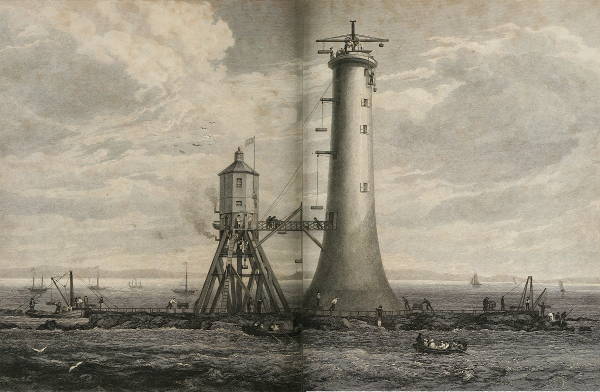
General View of the Bell Rock Works.
Drawn by G. C. Scott from a Painting by A. Carse.
Engraved by Willm. Miller.
PLATE XVIII.


