An account of a useful discovery to distill double the usual quantity of sea-water, by blowing showers of air up through the distilling liquor
Whole book · 3 sections
AN ACCOUNT OF A Useful DISCOVERY TO Distill double the usual Quantity of Sea - Water , by blowing Showers of Air up through the Distilling Liquor :
AND
An Account of the great Benefit of Ventilators
in many Instances, in preserving the Health and
Lives of People, in Slave and other Transport
Ships, which were read before the Royal Society.
ALSO
An Account of the good Effect of blowing Showers of
Air up through Milk, thereby to cure the ill Taste
which is occasioned by some Kinds of Food of Cows.
By STEPHEN HALES, D.D.F.R.S.
Member of the Royal Academy of Sciences at Paris, AND
Clerk of the Closet to Her Royal Highness the Princess of Wales.
TheSecond Edition.
With an APPENDIX;
In which is an Account of some farther considerable Improvements
made in the Method of procuring Plenty of Fresh-Water
at Sea, viz. three Parts in four more than in the
common Methods of Distilling: Also a farther Account of
more Instances and Proofs of the good Effect of Ventilators
in Ships: As also of the curing, in a few Minutes,
the ill Taste of Turnip Milk, and of musty Liquors. Also,
with great Ease, presently to make Cream or Milk Sillabubs,
viz. by blowing Showers of Air up through them.
LONDON:
Printed for Richard Manby, in the Old-Bailey,
near Ludgate-Hill. M.DCC.LVI.
AN ACCOUNT OF THE Great Benefit of blowing Showers of Fresh Air up thro’ Distilling Liquors .
1. The great Importance of having
a sufficient Supply of fresh
Water in Ships, has been the
Occasion of many laudable Attempts to
make Sea-water fresh and wholsome; but
all the Attempts and Discoveries hitherto
made, have laboured under this great and
material Objection, viz. the great Quantity
of Fuel that was necessary to distill,
with a slow Progress, a small Quantity of
Water, by any Methods of Distillation hitherto
known. But I have lately happily,
most unexpectedly, discovered an easy and
effectual Method to distill great Quantities
of Water with little Fuel; which I was
led to by the following Incidents, viz.
Mr. Shipley, Secretary of our Society, for
the Encouragement of Arts, Manufactures
and Commerce, brought me acquainted
with Mr. William Baily of Salisbury-Court,
the Author of many ingenious Contrivances;
who shewed me, in a small Model
of a Tin Vessel, a Method, by which
he has happily increased the Force of the
Engine to raise Water by Fire, viz. by
lifting up some of the boiling Water, at
every Stroke, by means of a conical Vessel,
with small Holes in it, full of Tow;
whereby the Quantity of the ascending
Steam or Wreak was considerably increased.
This led me to think, that a greater
Quantity of Liquor might also by this
Means be distilled; but on Trial I found
the Increase to be only one twelfth Part,
tho’ considerable in the expanded Form of
a Steam. Hence I was led to try what
would be the Effect of causing an incessant
Shower of Air to ascend thro’ the
boiling Liquor in a Still; and this, to my
Surprise, I found on Trial to be very considerable.
There was another Circumstance
also, which probably conduced to
lead my Mind to this Thought, viz. About
six Months before, Mr. Littlewood,
a Shipwright at Chatham, came thence
purposely to communicate to me an ingenious
Contrivance of his, soon to sweeten
stinking Water, by blowing a Shower of
fresh Air thro’ a Tin Pipe full of small
Holes, layed at the Bottom of the Water.
By this means, he told me, he had sweetened
the stinking Bilge Water in the Well
of some Ships; and also a But of stinking
Water in an Hour, in the same manner as
I blew Air up thro’ Corn and Gunpowder,
as mentioned in the Book on Ventilators.
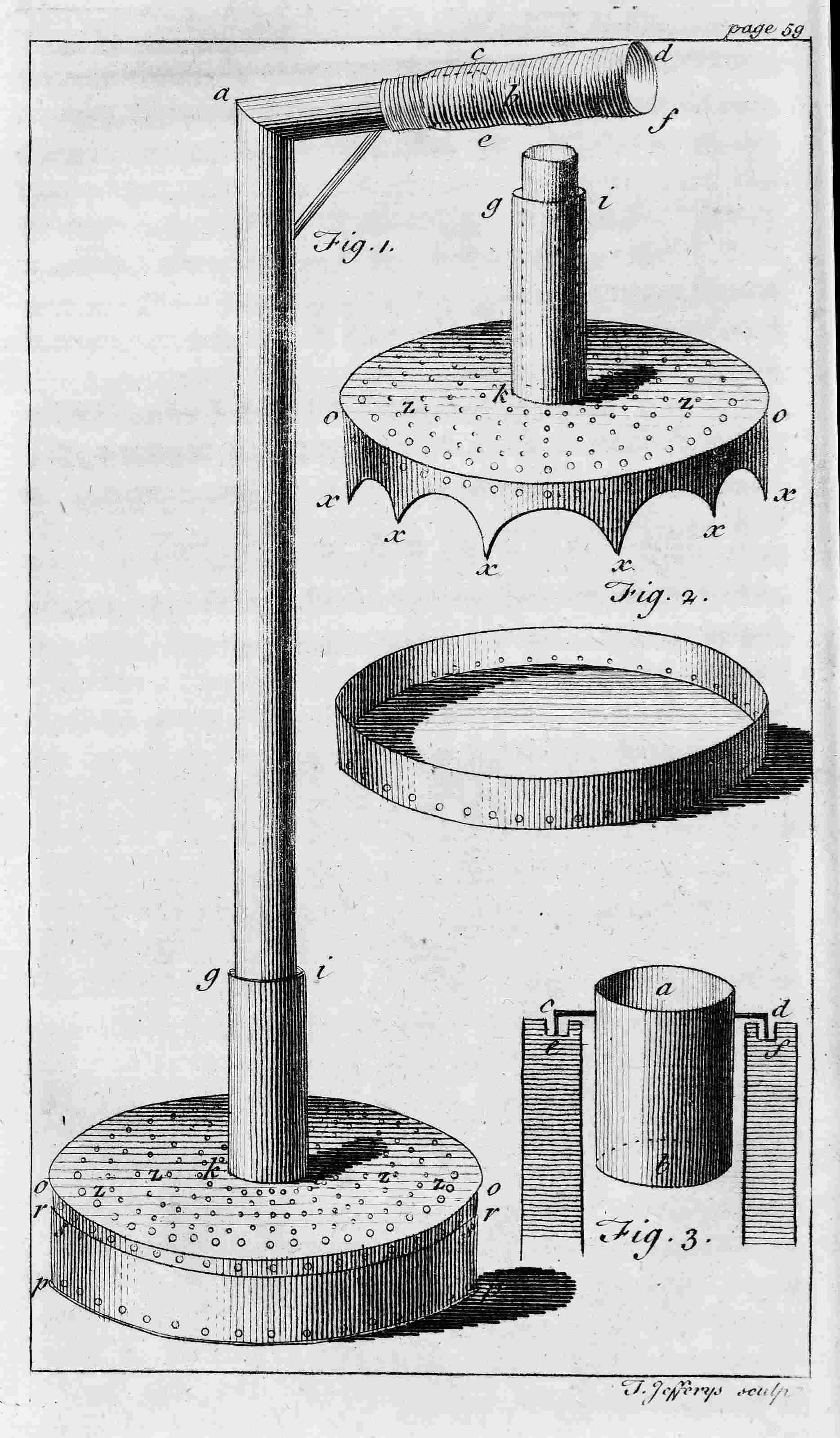
2. The Method, which I used to blow
Showers of Air up thro’ the distilling Water,
was by means of a flat round Tin
Box, six Inches Diameter, and an Inch and
half deep; which is placed at the Bottom
of the Still, on four Knobs or Feet half
Inch high, to make room for the Liquor
to spread over the whole Bottom of the
Still, that the Heat of the Fire may come
at it. In larger Stills this Box must be
proportionably larger, and have higher
Feet. And whereas the Mouth of the
Still is too narrow, for the Tin Box to
enter, which Box ought to be within two
Inches as wide as the Bottom of the Still;
therefore the Box may be divided into
two Parts, with a Hinge at one Edge or
Side, and a Clasp at the other, to fix it
together, when in the Still. This Box
must be of Copper for distilling Sea-water;
mine was made of Tin for other
Liquors also. The Air-pipe, which passes
thro’ the Head of the Still, will help to
keep the Air-box from moving to and fro
by the Motion of the Ship; or, if that
should not be found sufficient, 3 or 4
small Struts may be fixed to the Sides of
the Air-box. They must reach to the Sides
of the Still. The Cover and Sides of the
Air-box were punched full of very small
Holes, one-fourth Inch distant from each
other, and about the twentieth part of an
Inch in Diameter. On the Middle of the
Cover or Lid of this Air-box, was fixed a
Nosil more than half Inch wide, which
was fitted to receive, to put on, and take
off the lower End of a Tin Pipe, which
was twenty Inches long, and passed thro’
a Hole in the Head of the Still: four Inches
of the upper end of this Pipe were bent to
a Crook, almost at a right Angle to the
upright Stem, in order thereby to unite
the Crook to the widened Nose of a Pair
of Kitchen double Bellows, by means of
a short Leathern Pipe of Calves-skin. See
Fig. 1st. This Tin Air-box, and many
more of them for other Persons, were
made by Mr. Tedway, Tinman, over-against
the Meuse-Gate, Charing-Cross.
3. The double Bellows were bound fast
to a Frame, at the upper Part of the Iron
Nose, and at the lower Handle, in order the
more commodiously to work them. And
that the upper Half of the double Bellows
may duly rise and fall, in order to cause a
constant Stream of Air; (besides the usual
contracting spiral Springs within side) several
flat Weights of Lead must be layed on
the upper Part of the Bellows, near the
Handle, with a Hole in their Middle, to fix
them on an upright Iron Pin fastened on the
Bellows: That by this Means the Weights
may the more commodiously be put on or
taken off. For, according to the different
Depths of the Liquor in the Still, so will
the Force of the included Air, against the
upper Board of the Bellows, be more or
less. Thus, supposing the Depth of the
Water in the Still to be twelve Inches;
from the Surface of the depressed Water
in the Air-Box; then the Pressure of the
included Air against the upper Part of the
Bellows, will be equal to that of a Body
of Water a Foot deep, and as broad as the
inner Surface of that Board. It will,
therefore, be requisite, to add or take off
Weights, according to the different Depths
of the Water in the Still, at different Periods
of the same Distillation. The Bellows
must be proportionable to the Size
of the Still, but need not be very large.
Wherever the Stills are fixed in Ships,
the Air may be conveyed to them from
the Bellows, either thro’ a small leathern
Pipe, distended with Spiral Coiles of
Wyre, or thro’ Bamboo Canes, or broad
small wooden Pipes, like hollow fishing
Rods.
4. When I first distilled in this ventilating
Way, in order to estimate, what the
Difference might be in the Quantity distilled,
by that or the common Method, I
tried both Ways, by receiving the distilled
Liquor into a Quarter of a Pint Glass,
estimating the Times, by a Pendulum
beating Seconds. Where I found, to my
Surprise, that sometimes three times more
was distilled by Ventilation than by the
usual Way: But finding Inequalities in
the small Quantities thus distilled, in order
the more fully and assuredly to ascertain
the true Proportion there was in
the two Methods of distilling, I put three
Gallons of Water into the Still; and, when
it boiled, put on the Still-head, and fixed
its Nose to the Worm-tub Pipe; which
Tub was full of cold Water. When it
had distilled for an Hour, the Receiver was
instantly taken away. And on measuring
the distilled Water, found it to be two
Quarts and 45 cubick Inches by a Glass divided
into cubick Inches. And a Gallon
containing 282 cubick or solid Inches,
this Quantity of distilled Water, which
was 186 cubick Inches, is 1/1.5 th Part of
a Gallon.
5. Then, filling the Still as full of Water
as before, and when it began to boil,
fixing the Head to the Still and Worm-tub,
which was full of cold Water; there
was distilled in an Hour, with constantly
blowing Showers of fresh Air up thro’ the
stilling Liquors, five Quarts, less by seven
cubick Inches, which is 345.5ths cubick
Inches; that is, little less than the double
of the Quantity that is distilled in the usual
Way. In several other Distillations of a
Quart at a Time, I found the Quantity
distilled by Ventilation, to be more than
the double of that in the usual Way. So
that the Quantity by Ventilation, may at
a Medium be estimated the double of the
usual Distillation. It is the well known
Property of moving Air, to carry along
with it a considerable Quantity of adjoining
Vapour, as also of falling Water to
carry much Air down along with it.
6. It is to be hoped therefore, that so
considerable an Increase in the Quantity
distilled, will be of great Benefit to Navigation,
as it may be done in less Time
and with less Fire.
7. In the Account of Mr. Appleby’s
Process, for making Sea-water fresh, which
is published by Order of the Lords of the
Admiralty in the Gazette of Jan. 22,
1754, it is said that a Still which contains
20 Gallons of Water will distill 60 Gallons
in ten Hours with little more than
one Bushel of Coals; and therefore 120
Gallons in 20 Hours, with little more than
two Bushels of Coals. And by Ventilation
240 Gallons, or a Tun; and 24 Gallons
may be distilled in twenty Hours,
making an Allowance for the times of
heating those Stills full of cold Water;
and a Still something larger and wider,
will distill a Tun in 24 Hours; which will
more than suffice for a sixty Gun Ship
with 400 Men, whose Provision of Water
for four Months is about 110 Tuns. And
larger Ships may either have proportionably
larger Stills, or else two of them.
As for Merchant-Ships with few Men, a
small Still will be sufficient.
8. The second sized Stills contain 10
Gallons, and will produce 60 Gallons in
20 Hours, with half the above-mentioned
Fuel; and by Ventilation 120 Gallons.
9. The least Stills contain five Gallons,
and will produce 32 Gallons in 20 Hours;
and by Ventilation 64 Gallons in 20
Hours.
10. I have seen some of these Stills at
Messrs. Steel and Stephens, over-against
Mercers-Chapel, in Cheapside, which
have been made for this Purpose. There
are Holes in the Feet of the Iron Frame
or Stove to skrew them down to the
Deck. They were fixed at the Fore-castle
before the Mast in King Charles the Second’s
time, when they thought they had
discovered the Way to distill Sea-water,
free from the noxious Spirit of Salt, and
from the nauseous bittern Taste. Or, if
it be thought proper, one Part of the
Ship’s Boiler may be made use of, by
adapting a Still-head to it.
11. Now supposing a Still to contain
25 Gallons, and that four Parts in five
of it, viz. 20 Gallons are distilled off:
then, in order to distill a Tun, or 210
Gallons, the Still must be emptied, cleansed
and refilled eleven times; and if the whole
be done in 24 Hours, full 16 of those
Hours will be taken up in distilling at the
rate of a Gallon in about four Minutes
and half; and the remaining eight Hours
of the 24, being divided into 11 equal
Parts, they will be each near 44 Minutes to
empty and cleanse the Still, to refill it,
and give the Sea-water a proper boiling
distilling Heat: whether this can be done
in so short a Time, must be known by
Experience, and ought therefore first to
be tried at Land.
12. Doctor Butler, in his lately published
Method of procuring Fresh Water
at Sea, proposes the pouring in more Sea-water
into the Still, thro’ a Funnel fixed in
a small Hole in the Head or Upper-part of
the Still, when more than half the former
Water is distilled off; by which means the
Water in the Still will soon acquire a distilling
Heat; and this to be repeated several
times; but then it will be requisite to add
each time more Chalk, in such Proportion
as shall be found requisite. It will
be well to try this Method in hopes thereby
to increase the Quantity of Water that
is distilled. The Hole in the Head, or
Upper-part of the Still, is to be stopped
with a small Plate of Copper, so fixed as
to turn to and fro over the Hole.
13. Doctor Butler used capital Soap
Lees, in the Proportion of a Wine Quart
to 15 Gallons of Sea-water, which sufficed
for four or five times repeated Pourings
in of more Sea-water into the Still.
But as I have found that a small Quantity
of Chalk has the same good Effect, and is
cheaper, and more easily to be had, it is
therefore preferable to Soap Lees.
14. When there is a Fire in the Cook-room,
the Sea-water might be ready heated
to put into the Still, without any additional
Expence of Fuel, in the following
Manner, which I shall here describe; tho’
I think it probable that it will not be put
in practice; yet, as farther Improvements
may possibly hereafter be made in it, and
as it may be of use in some Cases, at Land
at least, I shall here give an Account of it,
viz.
15. About the Year 1718, Mr. Schmetou
a German Gentleman, got a Patent
here for heating great Quantities of Water,
with little Expence of Fuel, which he
then shewed me. Having fixed a spiral
Iron Worm-pipe, in such a Brick Stove or
Chimney as Women heat their Irons in,
thereby causing the Water to run from a
Vessel, thro’ the Worm-pipe, several Feet
Length round, in the Fire. About 30 Years
after I acquainted Mr. Cramond of Twickenham
with this, as hoping it might be of
Benefit in distilling Sea-water. Upon which
he procured such a spiral Iron Worm-pipe,
which was about twenty Feet long, and
six-tenths Inch Diameter; the Diameter
of the spiral Coile was about fourteen
Inches.
16. This I fixed in a Brick Stove in my
Garden, with its upper End fixed to a
Vessel, which contained 45 Gallons of Water.
I found the Event of this first Trial
to be as follows, viz. When the Water
run full Bore, at the rate of a Gallon in
17 Seconds, the Heat of the Water was
found, by a mercurial Thermometer held
in the Stream, at the lower End of the Pipe,
to be 80 Degrees above the freezing Point,
180 Degrees being the Heat of boiling
Water. When by means of a Turn-cock,
a Gallon of Water was two Minutes in
running, then the Heat was 140. At
which Rate the 45 Gallons would be an
Hour and half in running thro’ the Iron-pipe;
at which Rate 25 Gallons will run
thro’ in 50 Minutes, with so considerable
a Degree of Heat; and if it was an Hour
running, the Heat would approach still
nearer to a boiling Heat, when first put
into the Still, which would forward the
Distillation if wanted.
17. I pumped the heated Water up again
into the upper Vessel; and thus continued
to circulate the heating Water, till
its Heat was 160 Degrees in the upper
Vessel, viz. within 20 Degrees, or one-ninth
of boiling, the Heat requisite for
plentiful Distillation. I was in hopes that
if the Water in the upper Vessel could
have been brought to a due Degree of Heat,
and a Still-head were fixed on it, with its
cooling Worm-tub, then Water might
have been distilled in Ships, by having the
Iron Worm-pipe fixed in the Chimney of
the Cook-room: But I found, that when
the Heat of the Water in the upper Vessel
was 160 Degrees, viz. within one-ninth
of boiling; then in running through the
Iron Worm-pipe again, it was so over-heated,
as to expand in the Pipe, into an
explosive Vapour, which hindered the running
of the Water. However I thought
it not improper to give an Account of this
Attempt, notwithstanding it failed. Not
knowing whether this Method of heating
Water, may not in some Cases, at Land
at least, be of use, thereby to save, in some
degree, both Fuel and Time: Perhaps an
Iron Worm-pipe of a larger Bore might
do better.
18. The Waste of Fuel will be less in
proportion to the Quantity distilled in
large, than in small Stills; and the wider
the Still-head is, so much the more Liquor
will be distilled, and more with a
Worm-tub than without it. The Worm-tub
may be so covered, as to prevent the
flowing over of the Water by the Motion
of the Ship.
19. It is of great Importance to take
care to keep all Parts of the Still clean,
that there may be no Rust or Verdigrease
in the Copper, which will occasion Vomiting.
20. If it be necessary, the better to
close the Joining of the Still-head, it
may be done with a Lute or Paste made of
a Mixture of powdered Chalk and Meal,
wetted with Salt-water.
21. Now that several effectual Means
are discovered, to make distilled Sea-water
wholsome, and also to distill it in much
greater Quantity in the same Still, in the
same Time, and with nearly the same
Quantity of Fuel; it is reasonable to believe,
that it will be of great Benefit to
Navigation, not only in saving much stowage
room, for other important Purposes;
but also in procuring fresh sweet wholsome
Water, instead of stinking putrid Water,
hitherto used; which must needs have a
Tendency to promote that putrid Distemper,
the Scurvy. And if withal due Care
be taken, to exchange for fresh Air the
putrid close confined Air of Ships, which
has occasioned the Death of Millions of
Mankind; then Navigation will become
remarkably more healthy, and with little
more Danger to Health and Life, than at
Land, except from Storms.
22. Now supposing, that in a sixty Gun
Ship, the 110 Tuns of Water, for four
Months use, were distilled at the Expence
of three Bushels of Coals to a Tun, this
would consume nine Chaldrons of Coals:
And as a Chaldron of Coals weighs about
a Tun and half; hence it appears that Coals
will distill about eight times their Quantity
of Water. And the 110 Tuns of Water
weighing (at the Rate of 2240 Pounds to
the Tun) 138 Tuns; and the nine Chaldrons
of Coals weighing thirteen Tuns and
half, that is 94 Tuns and half less than the
110 Tuns of Store-water; and allowing
twenty-four Tuns and half for the Still,
Water-casks, and Coals, there will be 70
Tuns Weight of Stowage saved thereby
for other Uses. Or if some Tuns of Store-water
are carried by way of Precaution,
which it will be advisable to do, especially
at first, till they can be assured, by repeated
Experience, what Quantity can be depended
upon by Distillation; even then
about half the Tunnage will be saved,
which will be a very material Advantage.
23. Tho’ when the distilling Liquor
runs from the Bottom of the Worm-pipe,
thro’ a long Pipe fixed to it, the Waste by
the ventilating rushing Air, is not great
when the Water in the Worm-tub is not
hot; yet the following Precaution, if
needful, may be used, in distilling by
Ventilation, viz. to fix at the lower End
of the Worm-pipe, by means of a wooden
Fawcet, a small Cask for a Receiver; the
Fawcet to enter the upper side of the head
of the Cask, and in order to give a free
Passage for the great Quantity of ventilaing
Air to pass off, and withal at the same
time to prevent the escaping of much
moist Vapour with it, it will be proper to
fix at the Bung-hole a long upright Pipe
of Wood, or of any Metal. I used a Gun-barrel
four Feet and a half long; through
which some small Degree of moist Vapour
escaped; as appeared by the Dampness of a
Piece of Paper, fixed at a little Distance
above the Mouth of the Gun barrel. This
Vapour became visible, and much increased,
when the Water in the Worm-tub was
very hot; at which Time, less is distilled
into the Cask-receiver; then also there is
more Danger of the Spirit of Salt arising.
And it was observable, that the Water in
the Worm-pipe Vessel heated much sooner
by Ventilation, than in the common Way
of distilling. For which Reason that Water
ought to be changed so much the oftener,
which can easily be done at Sea.
The Cocks also at the Side of the Worm-tub
ought to be large, in order to let the
hot Water off the faster.
24. But tho’ the Water in the Worm-tub
was sooner heated by Ventilation, because
a double Quantity of hot Steam passed
thro’ it, more than passed thro’ it in
equal Times in the common Way of distilling;
yet in the usual Way of Distillation
the Liquor in the Still is hotter, with
equal Fire, as is evident by its aptness to
boil over thro’ the Worm-pipe; whereas
in the ventilating Way it did not boil over,
notwithstanding a very hot Fire was purposely
made for a Trial. The continual
Streams of ascending fresh Air, not only
in some Degree abating the Heat of the
Water; but also incessantly carrying off
the more rarefied Particles of the Water,
which, when expanded into a repelling
State, do thereby cause the overflowing
Ebullition of the Water. On which Account
it is probable, that less Spirit of Salt
is formed and raised by Ventilation than
without it. As also on account of the
fresh Air ascending, not from the Bottom
of the Still, where is the greatest
Plenty of Salt, especially towards the latter
End of each Distillation; but about
three Inches from the Bottom, viz. principally
from the many Holes at the Surface
of the Air-box.
25. And whereas the Quantity raised
from the Still, and distilled into the Cask-receiver,
cannot be seen; the proper Quantity
to be distilled in each Distillation,
may with great Accuracy be known, by
having a well closed Pewter Bottle of the
Size of about half a Pint, with a Brass
Wyre as big as a Goose Quill fixed to it,
the Wyre to pass thro’ the Receiver-cask,
near the Bung-hole, which the floating
Pewter Bottle will raise up, till the Marks
on the Wyre appear just above the Cask.
I made use of a Glass Viol for this Purpose.
This Wyre will rise and fall freely,
notwithstanding the Motion of the Ship,
if it passes not only thro’ the Wood of the
Cask, but also thro’ a metaline Pipe two
or three Inches long, fixed in that Hole.
And it will be known by the simmering
or boiling Noise of the Water in the Still,
whether it is hot enough to distill; for the
running of the Water into the Receiver-cask
cannot be seen.
26. As it might be suspected, that more
Spirit of Salt would be raised, and distilled
over in the ventilating Way, than without
it; having procured 18 Gallons of Sea-water
by the Margate Hoy, which was
taken up at some Distance from the Shore,
I put three Gallons of this Sea-water, as
soon as I had received it, into the Still;
and when it began to distill, Air was blown
up thro’ it. For some Time, as is usual,
in the Distillation of Sea-water; no Spirit
of Salt arose; but after distilling some
Time longer, there were very weak whitish
Clouds, with Drops of Solution of Silver
in Aqua-fortis, as in the common Way of
distilling. Hence we see, that Ventilation
does not increase the Quantity of Salt,
but rather probably somewhat decreases it,
for the Reasons above given, No 24.
27. I distilled three Gallons of Sea-water,
which had stunk and became sweet
again; when about ten Quarts of it had
been distilled off, then there began to be
very weak whitish Clouds with Solution of
Silver, but none with Solution of Mercury;
which shows the Water to be hitherto
good, agreeably to what I formerly had
found to be the good Effect of distilling
Sea-water, which had putrified, and become
sweet again; of which I published
an Account in the Year 1739. But when
I continued the Distillation on, a quarter
of an Hour longer, viz. till there was but
a Pint of Water remaining in the Still,
and the Salts were incrusted on its Sides,
up near three Inches from the Bottom,
and lay in Heaps at the Bottom of the Still,
then the distilled Liquor had whitish Clouds
in it, with the Solution of Mercury in
Aqua-fortis. From this Distillation we
see, that Putrefaction, by dissolving the
bittern Salt and Bitumen, into very minute
Parts, qualified them to combine with the
more fixed common Salt, so as to detain
them from rising in Distillation.
28. I distilled three Gallons of Sea-water,
with the Proportion of six Ounces
of Mr. Appleby’s Lapis Infernalis, and six
Ounces of calcined Bones to 20 Gallons of
Sea-water, as he directs. This Water lathered
well with Soap, and boiled Peas well.
29. I distilled also some Sea-water
With half an Ounce of Stone Lime to a
Gallon, from the Clee Hills in Herefordshire,
which having been preserved ten
Months in a Firkin, had slacked to dry
Powder. This distilled Water did also
lather well with Soap, and boiled Peas
well; which proves that the Lime, which
is a fixed Body, does not distill over with
the Water. Since I made this Distillation,
General Oglethorpe informed me,
that his Father, Sir Theophilus, told him,
that Lime was one of the Ingredients, of
what he and the rest of the Patentees, in
Charles the Second’s time, called the Cement,
with which they made distilled Sea-water
wholsome.
30. I distilled also some Sea-water
with the like Proportion of powdered
Chalk, which boiled Peas well, and was
better tasted than the Waters distilled with
Lapis Infernalis or Lime. I distilled also
some Sea-water with an Ounce of Chalk
to a Gallon, but found no Difference in
the Taste of this, and that which had but
half an Ounce of Chalk to a Gallon: So
that half an Ounce of Chalk to a Gallon
of Water will be sufficient; but where
the Sea-water is salter, or more bituminous,
more Chalk may be added if needful.
31. Dr. Alston of Edinburgh, in the
Preface to the Second Edition of his Dissertation
on Quick-lime and Lime-water,
says, that “the like Effect was found in
distilling Sea-water with Lime, that it
neither precipitated a Solution of Silver
in Aqua-fortis, nor a Solution of corrosive
Sublimate in Water, nor did it
form a Pellicle of various Colours on
its Surface, as did the Water distilled
by Mr. Appleby’s Process.” And I find,
Page 35 of my Book on this Subject, that
Lime of Oyster-shells had the same good
Effect, but required two Distillations; I
might then use too small a Quantity of
that Lime. Hence it is probable, that the
Chalk, the Lime, the Lime in the Lapis
Infernalis, and the Lime in Dr. Butler’s
Soap-lees, seize on and fix not only the
bittern Salt, but also the Bitumen of the
Sea-water, as we learn from the like Effect
in the Purification of the Salt of Hartshorn.
That the saline Spirit arises chiefly
from the bittern Salt, and not from the
more perfect Sea-salt, is probable from
hence, viz. when I distilled three Gallons
of common Water, made as salt as Sea-water
with common Salt; no Spirit of
Salt arose, even tho’ the Distillation was
carried so far as to leave the Salt, tho’
very damp, to lie in Heaps, and it was incrusted
on the Sides of the Still, for about
three Inches from the Bottom.
32. It is a considerable further Advantage,
that Water thus distilled by Ventilation,
being thereby repleat and freshened
with Air, has for present Use a more agreeable
Taste, than Water distilled without
Ventilation, which requires the standing
a longer Time to have its more disagreeable
adust Taste go off. And as the
volatile Oil of Pepper-mint does rise on
the Wings of the ventilating Air during
the Distillation; so also may that Part of
the Bitumen, which is volatilized by Heat;
as also the volatile urinous Salts of the
Sea-water, which arises from animal Substances,
be sublimed in the same Manner.
33. It was observable, that the Water
distilled fast, even tho’ the Water in the
Still was below the Surface of the Tin
Air-box, thro’ which the greatest Part of
the ascending Shower of Air rushed. Hence
the ventilating Air, in ascending among
the Vapours, carries them off fast. Hence
it is to be suspected, that this Method of
Ventilation will not do well for simple
Waters, or fermented vinous Spirits; because
they being very volatile, much of
them may be carried off in Waste.
34. It was observable, that in these Distillations
of Sea-water, no whitish Clouds
appeared on dropping in Solution of corrosive
Mercury, not even when considerably
more than four Parts in five of the
Water had been distilled over. And it was
the same with the Mixture of Lapis Infernalis,
Lime, and Chalk; whence it is probable,
that the Lime and Chalk seize on
and fix the more volatile bittern Salt, as
does also the Lime in the Lapis Infernalis.
And it is well known, that Sugar, that
sweet Salt, cannot be made without Lime,
on which, as its Centre of Union, it fixes
and granulates.
35. And whereas with a Solution of
Silver in Aqua-fortis, which was much
weakened and diluted with Water, there
appeared a faint Degree of whitish Cloud,
in all the above-mentioned Distillations,
tho’ not with the stronger Solution of
Mercury till the Distillation was carried
on, much beyond four Parts in five of
the Water in the Still; when both Solutions
caused remarkably white Clouds,
especially the Solution of Mercury; which
indicates the Quantity of the Spirit of Salt
which was raised during the former part
of the Distillation to be exceeding small,
since it could not seize on, nor disengage
the Aqua-fortis from the stronger Solution
of Mercury, tho’ it did in a very small
Degree in the weak Solution of Silver,
so as to let loose a very little of the Silver,
which thereby caused the faint Clouds.
When a Drop of the Solution of Mercury
was dropped into the distilled Water, after
a Drop of the Solution of Silver, it
resorbed the Silver Cloud, and made the
Water clear, by means of the great Proportion
of acid Aqua-fortis that was in it.
36. Now in order to make some Estimate
of the very small Quantity of Spirit
of Salt in these several distilled Waters, I
dropped a Drop of the Solution of Silver
into an Ounce, or 480 Grains of pure
Rain Water, which gave no Clouds; but
on dropping in a Drop of Sea-water,
which weighed a Grain, the white Clouds
were strong. And since Sea-water can
dissolve nine times more Salt than it has
in it; therefore, supposing the Drop to be
so fully impregnated with Salt, then the
Salt would be the 480th Part of the
Ounce of Water. But as there is nine
times less Salt, therefore the Proportion
of the Quantity of Spirit of Salt will be
but the 4320th Part. And how much less
must be the Proportion of Salt in these distilled
Waters, which is not sufficient to
make a sensible Impression on Solution of
Mercury, and but a faint one on much diluted
Solution of Silver. Such distilled
Sea-water will not therefore, probably be
unwholsome; almost all Spring-waters
have some Degree of Salt in them: But if
there were more of the Spirit of Salt, a
very small Quantity of Pot-ash, or Pearl-ashes,
or Salt of Tartar, combined with it,
will turn it into common Salt, the Quantity
of which would be extremely little.
37. It may be well to be provided in
Ships with some Silver dissolved in Aqua-fortis,
mixed with pure Rain-water, or distilled
fresh Water, in the Proportion of
sixty Drops to an Ounce of the Water;
tho’ it is probable, it may seldom be wanted,
unless in some doubtful Cases, when
the Taste may not be accurate enough to
perceive, whether there be any Spirit of
Salt in the distilled Water.
38. Since double the usual Quantity of
Vapour may by Way of Ventilation be
carried off, common Salt may thus be
made much sooner, cheaper, and better;
because as there is much less Fire used;
so proportionably, less of the fine acid
Spirit of the Salt, in which its Virtue consists,
will be evaporated away: For it is
well known, that the Salt is best which
has undergone the least Action of Fire in
making.
39. This more speedy Method of evaporating
will also be useful, in making
many other Evaporations; as in making
Pot-ash, &c.
40. But some are apprehensive, that this
great Improvement in Distilling, may be
of ill Consequence in making those destructive
Spirits cheaper, which are already
but too cheap. Had not the Improvement
been of great Benefit to Mankind in many
other Respects, I should have been far, very
far, from endeavouring after it, or discovering
it. But should the Event be to
make those Spirits cheaper, and consequently,
by spreading farther, more destructive,
the consequence of that will be,
that the increased raging Devastation will
the sooner necessarily rouse the Nations to
put a Stop to what must be done hereafter;
for if the Ravages continue increasing,
as they have done for sixty Years
past, the human Species must needs not
only be greatly debased, but even in great
measure diminished and destroyed. And
yet none of the Nations, whose very Vitals
are thereby consuming and destroying,
endeavour to put any Stop to it, except
the Heads of the native Indians in North-America,
who have long repeatedly intreated
the English to sell them no Rum;
which is as effectually extirpating of them,
as the Hornet did the unsubdued remainder
of the Canaanites.
41. If Mankind, instead of receiving
and entertaining this Pest with almost universal
Applause and Approbation, could
prevail with themselves to be in earnest
to use Means to deliver themselves from
it; then much might be done towards it,
by lowering and weakening all kind of
fermented distilled Spirits with Water, to
a salutary Degree, as is now practised in
our Plantations in America, in making
Punch so weak, as not to be hurtful;
which, when it was much stronger, was
well known to destroy Multitudes. And
where the like humane, wise, and laudable
Practice has been used in Ships, it has
had the same happy salutary Effect.
42. What Necessity or even Temptation
can there be to be averse to the making
them wholsome, instead of being venomous
and destructive? and that not
only of the Lives, but even of the Morals
of Mankind. How much therefore does
it behove all, who have any Concern for
the Honour and Dignity of their own
kindred Species, any Indignation at its
being thus debased and disgraced, any Bowels
of Pity for the vast Multitudes, not less
than a Million, that are yearly destroyed
all over the World, by this moral as well
as natural, and therefore worst of all Evils
that ever befel unhappy Man; to use their
utmost Endeavours to deliver Mankind
from this Pest? But notwithstanding this
astonishing Ravage and Destruction of the
human Species, yet the unhappy unrelenting
Nations of the World, seem as unconcerned
about it, as if only so many Thousands,
nay, Millions of Caterpillers or Locusts
were destroyed thereby. Was there
ever a more important Occasion to rouse
the Indignation of Mankind? Can we be
calm and undisturbed, when this mighty
Destroyer rears up its invenomed Head
every where? The most zealous Advocates
for Drams, even the unhappy besotted
Dramists themselves, the prolonging of
whose Lives, and whose real Welfare both
here and hereafter, is hereby sincerely intended,
cannot find fault with this well-meant
Remonstrance, in Defence of them,
and of all Mankind, against this mighty
Destroyer, from one who has long been
labouring, and that not without Success,
in finding Means to preserve Multitudes
of Lives, by various Ways.
An Account of the great Benefit ofVentilatorsin many Instances,
in preserving theHealthandLivesof People, in Slave and
other Transport Ships.
43. It is to be hoped that the several
Means here proposed for having
fresh and sweet Water at Sea, will be of
great Benefit in preserving the Health and
Lives of Multitudes of that valuable and
useful Part of Mankind, those who occupy
their Business in great Waters; whose
Welfare I have long had at heart, and endeavoured
to promote by various Ways;
especially by finding Means to procure
them fresh salutary Air, instead of the
noxious, putrid, close confined pestilential
Air, which has destroyed Millions of Mankind
in Ships. And it is to be hoped that
by diligent Researches, farther and farther
useful Discoveries will hereafter be made
for the Benefit of Navigation.
44. The following, as they are strong
Proofs of the great Benefit and Usefulness
of Ventilators in Ships, so they also fully
prove that they can most commodiously
be fixed and worked in them, in contradiction
to the vulgar, false, and groundless
Notion, that they take up too much
room, and are incommodious, and in a
manner impracticable to be worked, whereas
the Men are eager to work them; and
many more Persons can be with Safety to
their Health and Lives in a ventilated,
than in an unventilated Ship; which fully
obviates the Objection as to the Room
they take up. In new and important Researches,
the likeliest Way to succeed, is
to pursue a Thought not only by imperfect
and fallacious Reasonings, but when
the Nature of the Thing requires it, with
a proper Series of Trials and Experiments.
Thus in the present Case, the principal
Cause of the Sickness in Ships, is the
noxious putrid Air; the obvious Remedy
is the exchanging that foul Air for fresh,
by effectual Means, which are seldom discovered
by dwelling only on Objections,
but are usually the Reward of repeated
diligent, experimental Researches. Neither
are we to be discouraged in these
our Pursuits by some Disappointments, for
I have frequently found that they lead
to the Thing sought for: And by the like
Clue of Reasoning and Experimenting,
there is the greatest Probability that we
shall succeed in another very important
Research, viz. the preserving much longer
from Decay the Timbers of Ships laid up
in ordinary in Harbour: For as we are
assured by daily Experience, that the Decay
is wholly owing to damp, close confined
putrid corroding Air; so the only
Remedy for this Evil, is the frequently
changing the Air among the Timbers, by
plentiful Ventilations; which we find by
happy Experience, can be effected to such a
Degree, as give reasonable Hopes, enough to
encourage our farther Trials and Researches.
45. Captain Thomson of the Success
Frigate, in his Letter to me dated London,
Sept. 25, 1749, says, “That during
the Ventilation, the Lower-deck Hatches
were commonly kept close shut; by
which means the Air was drawn down
into the Hold, from between Decks,
thro’ the Seams of the Ceiling, along the
Timbers of the Ship; by which means
we found the foul Air soon drawn
off from between Decks. Our Rule
for ventilating was for half an Hour
every four Hours; but when the Ventilating
was sometimes neglected for
eight Hours together, then we could
perceive, especially in hot Weather, a
very sensible Difference by that short
Neglect of it; for it would then take a
longer Time to draw off the foul Air.
Our general Rule was, to work the
Ventilators till we found the Air from
them sweet. We all agreed that they
were of great Service; the Men being
so sensible of the Benefit of them, that
they required no driving to work that
which they received so much Benefit by.
We found this good Effect from Ventilation,
that tho’ there were near 200
Men on board, for almost a Year, yet I
landed them all well in Georgia, notwithstanding
they were pressed Men,
and delivered me out of Goals, with
Distempers upon them. This is what
I believe but few Transports, or any
other Ships, can brag of; nor did I
ever meet the like Good-luck before;
which, next to Providence, I impute to
the Benefit received by the Ventilators.
It is to be remarked, that we who lay
wind-bound, for four Months, with
our Expedition Fleet, which soon after
invaded France, were very healthy all
the time, when they were very sickly in
all the Ships of that Expedition.
46. “This certainly occasioned all kind
of Grain Provisions to keep better and
longer from Weevels, than otherwise
they would have done; and other Kinds
of Provisions received Benefit from the
Coolness and Freshness in the Air of
the Ship, which was caused by Ventilation.”
47. Mr. Cramond also informs me,
that he found the good Effect of Ventilators
on board a Slave-Ship of his with
392 Slaves, twelve of which were taken
on board, just before they sailed from Guinea,
ill of a Flux, which twelve all died;
but the rest, with all the Europeans in the
Ship, arrived well at Buenos Ayres.
The following is a Letter to me from
Captain ELLIS, viz.
“Sir,
48. “Could any thing increase the
Pleasure I have in a literary Intercourse
with you, it would be to find that
it answered your End in promoting the
public Good. The Vis-inertiæ of Mankind
is not the only Difficulty you have
had to encounter, but their Ignorance
and Prejudices, which are almost insuperable.
It is to your Perseverance and
Resolution, that the little Progress you
have made is due: Indeed I ought not
to say little; for it is a great Step to
have found the few that have Hearts
good enough to relish your Plan, and
Heads sufficiently clear to discern the
most effectual Method of advancing it.
It does Honour to those noble and other
worthy Personages that join you in Acts
of such extensive Humanity, as the Introduction
of Ventilators to Hospitals,
Prisons, Ships of War and Transport,
&c. as they must necessarily render the
Miseries of the first more supportable,
and the close and constant Confinement
of the others less prejudicial and fatal to
their Health and Life. It is to be lamented
that they are not more generally
made use of; for, notwithstanding their
Advantage is apparent and incontestable,
it is scarce credible how few are to be
found among the vast Number of Ships
daily employed in carrying Passengers,
Slaves, Cattle, and other perishable Commodities.
Those of your Invention,
which I had, were of singular Service to
us; they kept the Inside of the Ship cool,
sweet, dry, and healthy: The Number
of Slaves I buried was only six, and not
one white Man of our Crew, (which
was thirty-four) during a Voyage of 15
Months; an Instance very uncommon.
The 340 Negroes were very sensible of
the Benefits of a constant Ventilation,
and were always displeased when it was
omitted: Even the Exercise had Advantages
not to be despised among People
so much confined. I must not, however,
forget that Ventilation alone is insufficient
to keep Disorders out of Ships;
for often Infections are brought aboard
by the Slaves, or others; and frequently
Diseases are produced by feeding on bad
or decayed Food, but oftener still by
Insobriety; for I have ever remarked
that the immoderate Use of spirituous
Liquors in warm Climates, is more pernicious
and fatal even than the Malignancy
of the Air itself. In cold Countries
too, where I have had Experience,
those Sailors, or others, who accustomed
themselves to hard drinking, especially
of Drams, had the Scurvy in a terrible
Degree; whereas those who were
temperate or sober, either escaped it entirely,
or had it but moderately. The
Effects of Drunkenness was still more
discernable among the Indians adjoining
our Settlements in Hudson’s-Bay, who
are a feeble, diminutive, chilly, indolent
Set of People. On the contrary,
those who come from the inland Parts
(who are unused to drink Brandy) are
brave, active, robust, and industrious.
The same Difference is observable in the
Africans, and perhaps among the Inhabitants
of most other Nations, did we attend
to it. It was to the unusual Sobriety
of my Crew, that I ascribed, in some
measure, their uncommon Healthiness;
for Sailors breathe a purer Air, and enjoy
more Exercise and Liberty, than
Passengers or Slaves; wherefore their
Ailments are owing to bad or disorderly
Living, as well as to unwholsome
Air.
“Could I but see the immoderate Use
of spirituous Liquors less general, and
the Benefits of Ventilators more known
and experienced, I might then hope to
see Mankind better and happier. I am,
“SIR,
“Your most obediens Servant, HENRY ELLIS.”
Bristol, Dec.
26, 1753.
49. And, by the like good Conduct,
in his next Voyage in the Year 1755, not
one of 312 Slaves died; and all his 36
Sailors arrived alive and well at Bristol.
50. And the Earl of Halifax has often
informed me of the great Benefit they
found by the Use of Ventilators, in several
Nova Scotia Transport-Ships, twelve
to one more have been found to die in
unventilated than in ventilated Ships. It
is indeed a self-evident Thing, that the
changing the foul Air frequently in Ships,
in which there are many Persons, will be a
means of keeping them in better Health
than not doing it; which makes it the
more astonishing that effectual Proposals
to remedy so great an Evil, should be received
with so much Coldness and Indifference
by Mankind. They little consider
that it is the high Degree of Putrefaction
(that most subtile Dissolvent in Nature)
which a foul Air acquires in long stagnating,
which gives it that pestilential Quality,
which causes what is called the Goal-Distemper.
And a very small Quantity,
or even Vapour of this highly attenuated
Venom, like the Infection or Inoculation
for the Small-pox, soon spreads its deadly
Infection. Ought not Men therefore,
from the common natural Principle of
Self-Preservation, to use their utmost Endeavours
to shun this pestilent Destroyer,
by which Millions of Mankind have perished
in Ships?
An Account of some Tryals to cure
the ill Taste ofMilk, which is occasioned
by the Food ofCows, either
from Turnips, Cabbages, or
autumnal Leaves, &c. Also to
sweetenStinking-water, &c.
51. This Method of blowing Showers
of Air up thro’ Liquors,
will be of considerable Use in several other
Respects, as well as in Distillation, as appears
by the following Trials, viz.
52. I have been informed that it is a
common Practice, to cure the ill Taste of
Cream from the Food of Cows, by setting
it in broad Pans over hot Embers or Charcoal,
and continually stirring it, till scalding
hot, and till cool again: But when I
attempted to do this much sooner, and
more effectually, by blowing Showers of
Air up thro’ it; I soon found it to be impracticable,
by reason of its very great Degree
of frothing up. The ill Taste must
therefore be got out of the Milk, before it
is set for Cream; which I have been told,
has been practiced, and that with some benefit,
by giving the Milk a scalding Heat,
without stirring it.
53. May 22. I ventilated some ill tasted,
new unheated Milk of a Cow which was
purposely fed with Crow-Garlick mixed
with cut Grass. After 15 Minutes Ventilation
the Taste was a little mended; in
half an Hour’s blowing it was something
better. At the Hour’s end it had the same
Taste, but was sensibly better than the unventilated
Milk. I was disappointed of an
Opportunity to repeat the Experiment with
Crow Garlick Milk, with a scalding Heat;
it would then probably have been soon
perfectly cured; as it is reasonable to believe
from the Event of the following Experiments,
viz.
54. August 23, four Quarts of ill tasted
new Milk, from a Cow which had fed
eighty-four Hours on Cabbage Leaves only,
and drank during that Time very little
Water; were put into a leaden Vessel,
eight Inches in Diameter, and thirty Inches
ches deep. The leaden Vessel was heated
in a large Boiler, and set into a Vessel of
hot Water; thereby to give the Milk a
scalding Heat, and also keep it hot. In
ten Minutes Ventilation it was perfectly
cured of its ill Taste; and after standing
twenty-four Hours in a broad Pan, there
was a thick Scum which was half Cream
and half Butter, free from any ill Taste;
the skimmed Milk was not sheer or thin:
So here is a Method to make good Butter
from ill tasted Milk.
55. The Froth of the Milk was so great,
by reason of a too brisk Ventilation, as
to make it froth over the Vessel, which
was thirty Inches deep; if it had not been
kept down, by constantly lading and breaking
the very large Bubbles of Froth. But
when the Ventilation is more gentle, the
Froth has risen but three Inches from six
Quarts of Milk, which was nine Inches
deep. The Cabbage Milk was but six
Inches deep. I repeated the like Operation
the same Day, with the Evening Milk of
the same Cow; but giving it only a Heat,
that I could bear my Fingers in, for a little
Time; with this Degree of Heat, after
forty-five Minutes Ventilation, the Milk
(tho’ much better tasted) yet was not so
compleatly cured, as the former Milk.
Hence we see, how necessary Heat is, to
volatilize the rancid Oyl (which gives the
ill Taste) to such a Degree as to cause it
to fly off by Ventilation.
56. It was observed that what was
milked from this Cow a Week after she
had done eating the Cabbage, had an ill
Taste.
57. I have not as yet had an Opportunity,
to try to cure, in the same Manner,
the ill Taste of Milk, which is occasioned
by Cows feeding on autumnal Leaves, or
Turnips, they having probably eaten this
Autumn, the fewer Leaves, on account
of the Plenty of Grass, occasioned by
much Rain; which has also hitherto prevented
Turnips from being rancid, which
are observed to be most so, when they
shoot out in the Spring. As Opportunities
offer I purpose to make Trials, which
I conclude others will also do, which will
probably be attended with the same good
Effects as that on the Cabbage Milk.
58. But tho’ the ill Taste of Milk from
feeding on Cabbage Leaves, was thus effectually
cured by volatilizing with Heat,
and dissipating by Ventilation the rancid
Oil; yet the bitter Taste of a strong Infusion
of Chamomel Flowers in six Quarts
of Water, was not sensibly abated by an
Hour’s Ventilation of it, while scalding
hot.
59. I am informed that, in Devonshire,
they set the Pans of Milk on Trivets,
making Fires under them, to give the
Milk, gently and gradually a scalding, but
not a boiling Heat, which would disturb
the rising Cream; and then set it on the
Floor in the Milk-house to cool, where
in twelve Hours it has a thick Scum, partly
Butter and partly Cream: The skimmed
Milk is very thin and sheer; and the Cream
in great Plenty and delicious, except it
gets a smoky Taste, which it is apt to do;
and which might probably be prevented,
by having a Range of as many Stoves, as
there are Pans of Milk to be used at one
Time; all to be warmed by one Fire, either
at one end, or the middle of the Flue
or Funnel in the Brick-work, which conveys
the Smoke and Heat under the Stoves.
And as the Pans nearest to the Fire will
soonest have their due Heat, on their Removal
to bring the farthest and coolest
Pans nearest the Fire; and instantly covering
the uncovered Stoves with proper Covers
to prevent the Heat and Smoke from
coming out; by this Means the Milk
would all be soon heated, with any kind
of Fuel, and that with much less in Quantity
than in the common Way.
60. And the more effectually to prevent
the Smoke from coming at the Milk,
it may be well to have the broad outer
Rim of the Pans turned perpendicularly
downwards, three or four Inches, that it
may enter deep into a circular Groove of
Sand; and if it shall be needful the Sand
may be wetted in order the more effectually
to prevent the Passage of the Smoke:
I thought of this Method about fifty Years
since on tasting the smoky Butter in Somersetshire.
By the same Means the Poor
might save much Fuel in boiling the Pot,
especially in Summer, when a Fire is wanted
only for boiling the Pot.
61. When any Pans are to be removed
from the Stoves, the Ascent of the Smoke
thro’ the uncovered Stove, may be prevented
by first closing the Flue near the
Fire, by an Iron Sliding-shutter or Register.
62. Milk might thus most commodiously
be heated to a scalding Heat with
little Fuel, fit for Ventilation, in a Vessel
of a proper Depth, set in the same Manner
as the Pans in a Stove, to secure it
from Smoke, with Bellows fixed properly
near it: (see Fig. 3.) By this Means there
would be little Trouble or Expence in
curing ill tasted Milk by Ventilation.
63. May 14th, meerly to see what the
Event would be, a Gallon of new Milk,
just from the Cow was ventilated, for an
Hour and half, which produced six Ounces
of Butter; and tho’ it was ventilated half
an Hour longer, yet no more Butter was
made; it was whitish, wanting both the
Colour and Taste of good fresh Butter.
64. I am credibly informed, that in the
Places famous for making the best fresh
Winter Butter, they set the Pot of Cream
in warm Water, so long as till it has acquired
that small Degree of Sourness,
which it very soon has in warm Summer
Weather, which gives it its agreeable
Flavour. And in order to give it Colour,
they grate a well coloured Carrot into a
little Milk, which as soon as stained, is
strained from the Carrot thro’ a Sive, and
then mixed with the Cream.
65. It is found by Experience, that the
Quantity of Cream is increased, by putting
into the Milk a little warm Water in Winter,
and cold in Summer; which being
thereby, in some Degree thinned, the
Cream is thereby more easily disintangled,
so as more freely to ascend to the Surface
of the Milk.
66. I ventilated three Gallons of
stinking Jessops-well purging Water. On
first blowing, the Smell of the ascending
Vapour was very offensive, which Offensiveness
abated much in five Minutes: In
eleven Minutes the Smell was much better:
In twenty Minutes the Water seemed
sweet both in Smell and Taste; and not
sweeter at the End of forty-five Minutes,
fifteen or twenty Minutes will probably
suffice.
67. July 20th three Gallons of stinking
Sea-water were ventilated; in five Minutes
it was much sweetened, and no ill Smell
in the ascending Air, tho’ at first it was
very offensive: At the End of ten Minutes
it had a small Degree of ill Taste; after
twenty Minutes no ill Taste or Smell. It
frothed near a Foot high during Part
of the Ventilation; this from the Bitumen,
&c.
68. Some Sea-water which was made
to stink with Flesh and Isinglass being put
into it, was not made perfectly sweet, not
even by a ventilated Distillation, and an
Hour’s more Ventilation after it was distilled;
so that Putrefaction with animal
Substances, is not easily compleatly cured
by Ventilation.
69. When the Water was 27 Inches
deep in the leaden Vessel, no Air could
be blown up thro’ it by the Force of the
Bellows. But at 18 Inches Depth, the
Air could freely be blown up in Showers
thro’ the Water; when therefore it is
requisite to blow up thro’ great Depths
of Water, the Bellows may be worked
with a Lever, as Smiths Bellows are
worked.
70. As it is found by Experience, that
the Milk and Butter of Cows, which
drink stinking Water, has a very bad
Taste, this plainly shows that the Water
retains its putrid Quality when mixed
with the Blood; whence it is much to
be suspected, that the stinking Water
which is drank in Ships, by retaining its
putrid Quality, even when mixed with
the Blood, may thereby promote that putrid
Distemper the Scurvy, as well as some
other Distempers. And much more does
the putrid close Air in Ships, which is
mixed with the Blood from the Lungs,
promote putrid and other Disorders: By
the same Means also, pestilential Infections
are taken in: For as the salutary
Properties of good Air, are conveyed to
the Blood by the Lungs, so are also the
malignant Qualities of bad Air.
71. Thus also the putrid Water in
marshy aguish Countries, may be a Cause
of Agues, as well as the putrid Air which
they breathe; which, as well as the putrid
Water, may probably carry some of
its putrid Quality into the Blood thro’ the
Lungs. This Method therefore of sweetening
stinking Water, by blowing Showers
of Air up thro’ the stinking Water
of some aguish Places, may be beneficial.
72. Live Fish may well be carried
several Miles, by blowing now and then
fresh Air up thro’ the Water, without the
Trouble of changing the Water; for this
Ventilation will not only keep the Water
sweet, but also enrich it with Air, which
is necessary for the Life of Fishes; with
which Air they supply their Blood, by
breathing the Water, thin spread, between
their Gills: But stinking Water will kill
Fish.
73. I have found that much of the
heating Oil may be got out of Tar-water,
by blowing Showers of Air up thro’ it
when scalding-hot, for 15 or 30 Minutes,
the longer the better; the less volatile,
and more salutary Acid remaining.
T. Jefferys sculp
AN APPENDIX TO THE — FINIS. — Transcriber’s Notes
Treatiseon distillingSea-Water, sweetningMilk, &c. which gives a farther Account
how to procure still greater Plenty ofFresh-waterat Sea, and to sweeten ill-tasted
Milk, Stinking-water, and musty Liquors,
&c. by blowing Showers of Air up
thro’ them.
74. Several considerable Improvements having
been made on the Subjects of this little
Book, since the Publication of it, I shall here give
a short Account of them, hoping they may in several
Respects be of Benefit to the World; especially
the great Improvement in distilling Plenty of
Fresh-water at Sea.
75. In order to bring the Method of procuring
Plenty of good Fresh-water at Sea, into practice, several
previous Trials were made, at the laudable
Motion and Desire of Peter Wyche, Esq; in a Still
containing 24 Gallons of Water, at Messrs. Steel
and Stephens’s Copper Workhouse, near the Falkon-Stairs,
Southwark. The first thing to be done, was
to find out the proper Size of the Diameter of the
Copper Air-box. The Diameter of the Still, near
its Bottom, being 19 Inches, the Diameter of the
first Air-box was 18 + ½ Inches. On three several
Trials, a Winchester Quart of Water was distilled in
five Minutes by the common way of Distillation;
and by Ventilation a Quart was, in 3 or 4 Trials,
distilled in 2 Minutes; but at the Distillation of the
ninth Quart, the Water was so much cooled by the
ventilating Showers of ascending Air, as to require
5 Minutes and 44 Seconds. Now this great Decrease
of the Quantities distilled, was plainly owing to the
too great Breadth of the Air-box, which hindered
the Fire from heating and keeping hot the Water
which was above it, to such a Degree, as to have no
Distillation in the common way, for 8 or 10 Minutes
after the Ventilations; for the half Inch Circle of
Water which was not covered by the Air-box, was
but one nineteenth Part of the whole. The next
Trial, in the same Still, was made with an Air-box,
whose Diameter was 13 Inches, its Area therefore
127 square Inches; which deducted from 271 square
Inches, the whole Area or Breadth of that part of
the Still, there remains 144 square Inches, for the
Area of the three Inch broad annular Circle round
the Air-box, viz. 17 square Inches more than the
Area of the Air-box. The Event was, that in seven
Distillations in the common way, a Quart was
distilled in 5 Minutes, sometimes in a little less, and
sometimes in a longer Time. And by Ventilation
14 different Quarts were distilled in different Lengths
of Time, from a Quart in 2 Minutes and 6 Seconds,
to 3 or 4 Minutes.
76. I then repeated the like Trials with my small
three Gallon Still, distilling in the common way a
Pint in 10 + ½ and 9 Minutes; and seven separate
Pints were distilled by Ventilation in 3 + ½ to 4
+ ½ Minutes. Hence we see that Ventilation has
a more steddy and constant good Effect where the
Air-box is less in Proportion to the Still, than it
was in the other two Distillations: For in this lesser
Still, only 27 out of 99 square Inches were ventilated,
72 square Inches being unventilated. It will
therefore probably be advisable to have the Air-boxes
of other Stills to be nearly in the like Proportion
to the respective Stills, the Diameter of this
Still being 11 + ½ Inches, of its Air-box 6 Inches.
77. As by repeated Trials a Quart of Water was
distilled in the common way in five Minutes, in
the above-mentioned twenty Gallon Still, so an 120,
or two Tuns and 14 Gallons, may be distilled by
Ventilation in twenty Hours.
78. Mr. Wyche, who was present at the Trials
near the Falcon-Stairs, observing the Water in the
upper Part of the Worm-tub to be reeking hot,
tho’ the Water below it was cool, very rightly proposed
to have the hot Water run from the upper
part of the Worm-tub, thro’ a small Copper Pipe,
into the upper Part of the Still, as fast as it was
distilled off, the running Quantity of Water to be
adjusted by a Turn-cock in the Pipe. This I tried
in my little Still, by conveying the upper warm
Water of the Worm-tub into the Still thro’ a small
Pipe Which passed thro’ a Hole in the Head of the
Still, almost down to the Bottom of the Water in
the Still: My Reasons for doing of which were,
viz. lest the less hot Water, by running on the
Surface of the boiling Water, might considerably
check the Ascent of the rising Vapours; whereas,
being mixed and blended with the lower Water, it
will soon acquire a due Heat. Another Reason
why I chose to lead the entering Rill of Water so
slow, was, that it might be intimately mixed with
the Chalk, which is there in an agitated State by
reason of the Action of the Fire. The Event was
as follows, viz. that six separate Pints of Water
were distilled by Ventilation during the running in
of the warm Water, some in 3½ Minutes, others
in 4 Minutes, 4 + ½, and 4 Minutes, 50 Seconds,
which was the case of the second Pint.
79. Hence we see the great Benefit of this ingenious
Improvement of Mr. Wyche’s in distilling
Sea-water, where the Still will be filled with the
same Liquor as the Worm-tub; but this Method
cannot so well be put in Practice in other Distillations.
The Benefit of thus gently and incessantly
keeping the Still full, will save about one-fourth of
the Time and Fuel, which it would otherwise require
to refill with cold Liquor, and bring to a distilling
Heat. This great Advantage, added to that
of distilling about double the Quantity by Ventilation,
must needs both together be of so great Improvement
in distilling three Parts in four more
than usual, as will be of the greatest Benefit to Navigation
in several respects. By this means the
Still need be emptied and cleansed from the Chalk,
and very salt Water, only at the end of each daily
Distillation.
80. And whereas if all the Chalk requisite for a
whole Day’s Distillation were put into the Still at
once, it might be suspected that such a Quantity
laying at the Bottom of the Still, might hinder the
boiling of the Water: I put into a broadly flat-bottomed
sauce-pan, half an Inch Depth of powdered
Chalk, and two Quarts of Water boiled in ten
Minutes: The Water mingling freely, especially in
the time of boiling, among the thin pappy Chalk,
was freely acted on by the Fire. But as in boiling
it frothed much, it may be proper to put at first
into the Still only as many half Ounces of Chalk as
there are Gallons of Water; and afterwards from
time to time in proportion to what additional Water
shall have run into the Still, at a Hole purposely
made in the Head of the Still, taking care to ventilate
while the Chalk is putting in, which will cause
it to mix intimately with the Water, and thereby
have the better Effect on it. And perhaps a less
Proportion of Chalk than half an Ounce to a Gallon
of Sea-water may suffice.
81. The Degree of Fulness or Emptiness of the
Still, may be known by putting a small floating
metalline Vessel, in at the Chalk Hole, with a long
slender Wire to it.
82. Mr. Wyche thought of other Means the better
to promote Distillation, viz. by conveying the
Air from the Bellows through a Pipe with several
spiral Coiles, thereby in passing thro’ boiling Water
in the Still, to make the ascending Showers of
the Air the hotter, and so the less refrigerating.
Also to have the warm Water pass from the Worm-tub,
in a Pipe, with several the like spiral Coiles,
in the Head of the Still; thereby the more to heat
the entering Water. But we find, by the above-mentioned
Experiments, that there is no occasion
for either of them; but if wanted may be used.
83. As to the Benefit of Ventilators in preserving
the Health and Lives of People in Slave and other
Transport Ships, I have received farther Confirmation
of their great Benefit, in a Letter from Dr.
Demainbray, who has shewn Courses of Experimental
Philosophy to his Royal Highness the Prince of
Wales and Prince Edward, viz. “That in the Year
1753 Ventilators were put into the Vessels in the
Slave Trade at Bordeaux, and in other Ports of
France; the happy Effect of which was, that instead
of the Loss of one-fourth of those valuable
Cargoes, in long Passages from Africa to the
French Plantations, the Loss seldom exceeded a
twentieth. And since my Return to England, I
have been informed of a French Vessel, which
by this self-evidently reasonable Precaution, saved
308 out of 312 Slaves, spite of most tedious
Calms and a long Passage.” And Dr. Garden, in
his Letter to me, dated Charles-Town, South-Carolina,
March 24th, 1756, says, viz. “It is indeed
very wonderful, that the Slave Merchants do not
come into the Use of Ventilators. There are
few Ships come here from Africa, (even though
they call for fresh Provisions and Water at the
Islands) but have had many of their Cargoe
thrown overboard; some one-fourth, some one-third,
some lose half; and I have seen some that
have lost two-thirds of their Slaves. I have often
gone to visit these Vessels on their first Arrival,
in order to make a Report of their State of
Health to the Governor and Council; but I never
yet was on board one, that did not smell
most offensive and noisome. What from Filth,
putrid Air, putrid Dysenteries (which is their
common Disorder) it is a wonder any escape
with Life.”
84. A probable Means lately occurred to my
Thoughts, tho’ not perfectly to cure, yet much to
abate the great Degrees of stinking of the Bilge-water
in the Well of Ships, viz. by laying at the
Bottom of the Bilge-water, round the Main-mast,
Copper Pipes full of very small Holes, not one
twentieth of an Inch in Diameter; and blowing
Showers of Air up thro’ them from small Black-smith’s
Bellows, fixed out of the way, within the
Well. Such Bellows may be worked with great
Ease, for one, two, or three quarters of an Hour,
in every 24 Hours, more or less, as shall be found
requisite by Experience: But with this Precaution,
that whenever the Water stinks much, first to pump
it out of the Ship, and after letting in sweet Water,
then to ventilate it a little now and then, as shall be
found needful; but care must be taken not to ventilate
very stinking Water, because it may increase
the Unwholsomeness of the foul Air in Ships. By
this means Ships will probably be made something
less unhealthy; for the putrid Vapours which arise
from stinking Water, must needs greatly contribute
to increase the Putridness, and consequently the
Noxiousness of the foul Air in Ships. This Precaution
therefore, with Ventilators frequently to convey
off the close foul Air, will be effectual Means
to make Ships much more healthy; as will the
changing the foul Air in Goals, Hospitals, and
sick Rooms, with proper Precautions, make them
more wholsome: And it is with pleasure that I observe,
that these salutary Means are coming more
in use in Hospitals, &c. either by means of Ventilators,
or by admitting fresh Air in small Quantities,
and those spread in thin Sheets, so as not to
have the entering Air blow directly on, and incommode
the Patients. Where it can be had, a thorough
Air entering on one side, and passing out on
the other side of Wards or Rooms, will be best;
because the Change will be almost constant, and
may be as gradual and gentle as we please. I shall
give a more particular Account of this in my second
Volume of Ventilators.
85. As to the curing the ill Taste of Milk from
the Food of Cows; and also curing musty Liquors,
I made the following Trials, viz. When in the Beginning
of March the Turnips had made large
Shoots, and were thereby become very rancid, two
Cows being fed with Turnips only for seven Days,
their Milk had a very disagreeable Smell and Taste.
On ventilating it scalding hot, with ascending Showers
of Air, at first the ill Smell increased, but in
two Minutes that Smell was much abated; and
with five Minutes Ventilation, there was only the
common Smell of good Milk; which shows that
the rancid Oil of Turnips, which gives the ill Taste,
is very volatile: After ten Minutes Ventilation,
there was no ill Taste or Smell; and it was the
same after 15 and 30 Minutes Ventilation. By this
means therefore the ill Taste of Milk from some
Food of Cows, may easily be cured. Experience
will show what Degrees of Ventilation will be requisite
for larger Quantities of Milk; as also for
curing the ill Tastes from different Kinds of Food;
as also from the shorter and longer Times of feeding
on such Foods. It is observable that the
Breath of these Cows was disagreeable; whence we
see how freely contagious Infections may be conveyed
through the Lungs, from tainted putrescent
Blood.
86. A Cow having been fed for sixty Hours
with a good Quantity of Crow Garlick, mixed
with cut Grass, towards the end of June, the Milk
had a very disagreeable Smell and Taste; which
was not cured, though something better, after 30
Minutes Ventilation, while scalding hot. I repeated
the same Ventilations for 15 Minutes, with
the two following Evening and Morning Milks of
the same Cow, viz. 12 and 24 Hours after the
Cow had left off eating Crow-Garlick; at which
times the ill Taste and Smell was sensibly abated
before Ventilation, and something more after it,
yet was far from being cured. Hence we see that
the ill Taste and Smell of the Crow-Garlick Milk,
cannot thus be cured, tho’ somewhat amended.
The ill Taste of this Cow’s Milk continued for
about five Days after she had left off eating of the
Crow-Garlick. And perhaps where Cows have eaten
but a small Quantity of it, the Abatement of
the ill Taste may be so considerable, as to recompence
the Trouble of ventilating it. As Opportunities
offer, I will make the like Trials, with
other ill-tasted Milks, such as that from autumnal
Leaves, &c. and hope that others will do the like.
87. Cream or Milk Sillabubs may most commodiously
and easily be made in Plenty, in a few Minutes,
by means of a small Tin Air-box, three Inches
in diameter, and three quarters of an Inch deep;
the flat Bottom of the Pot, which contains the Cream
or Milk, to be but little wider than the Air-box,
that the Air from the Box may the better come at
it: But the wider and deeper the upper Part of the
Pot is, so much the better, for the Froth expands
much.
88. Scalding-hot musty Vinegar was cured by
repeated Trials, of near three Gallons in each Trial,
by ten Minutes Ventilation. And giving Vinegar
a scalding Heat, does not weaken or damage it, as
it does Wine, whose vinous Spirit is carried off
both by Heat and Ventilation; for when some
strong musty Raisin Wine was ventilated hot, it
was cured in five Minutes: But the vinous Spirit,
which strongly affected the Nose in flying off during
Ventilation, being gone off, the vapid Wine
would not kindle into a Blaze, when thrown into
the Fire, as it did to a great Degree before it was
heated and ventilated. Neither musty Wine nor
Vinegar were cured, tho’ something bettered by 30
Minutes Ventilation, when cold.
89. Mr. Jones, a Chemist in Cranbourn-Ally,
Leicester-Square, ventilated a Gallon of Proof Malt
Spirits 15 Minutes cold, in which time it wasted
two Ounces and half; whereas a like Quantity of
common cold Water wasted but half an Ounce in
15 Minutes Ventilation, viz. but one-fifth part of
what the Spirits did; and the same Spirits ventilated
hot, wasted no less than 5 Ounces in 5 Minutes;
which Ventilation made them sensibly better tasted
than the unventilated. But the great Waste shows
that these volatile vinous Spirits, ought not to be
ventilated, neither hot nor cold. Besides that, the
15 Minutes cold Ventilation had but little Effect in
bettering the Spirit.
90. In order to know whether Fish in a Vessel
of Water would live the longer for having Showers
of Air blown up thro’ the Water, May 25, 1756,
at seven in the Morning, the Wind N. E. the Mercury
in Farenheit’s Thermometer, 50 Degrees, and
it continued so cold, that at one o’clock it rose but
to 60 Degrees; I put twelve Dace into a Pail A
in two Gallons of fresh Pond-Water, thro’ which a
Stream ran, and twelve more into a Pail B, with
the like Quantity of Water; one of which Fishes
in B was sick, as appeared by turning its Belly
upwards; as were also two Fishes in the Pail A,
which was occasioned by being all brought in a Pail
above half a Mile from the Thames.
91. At 45 Minutes past 8, most of the Fish in
the Pail B, were turned Belly upwards, and lay as
dead; at 30 Minutes past 9 seven of them were
dead; at 30 Minutes past 11 all but three were
dead; at two o’clock but two Fish remain alive in
B; which remained alive, tho’ sick, at ten that
Night, viz. at the end of 14 Hours.
92. The good Effect of blowing every quarter
of an Hour, with 25 Strokes each time with double
Bellows, Showers of fresh Air up thro’ the
Water, was, viz. they all continued well, and the
larger of the two sick Fish recovered; but the lesser
died at 4 o’clock, viz. at the end of nine Hours;
upon each Ventilation it turned its Back upwards;
but soon after the Ventilations, it constantly fell
precipitate with its Head foremost, to the Bottom,
and there turned Belly upwards. After 4 o’clock
the ventilated Water frothed with larger Bubbles,
this owing to the Slime of the Fish. The last Ventilation
was at 10 at Night, when the Fish in the
ventilated Water were well, and would probably
have long continued so by the Salutariness of Ventilation;
but that being discontinued, they were all
found dead the next Morning, except one which
had some small Degree of Life.
93. June 7, the Wind S. W. cloudy, the Thermometer
at 58 Degrees, 13 live Gudgeons were
put into two Gallons of fresh Pond-water in a Pail
A; and a like Number into a Pail B, at 10 Minutes
before 7 in the Morning. At 50 Minutes
past 7, two in B began to be sick; at 8, half of
them came up for Air, and showed Uneasiness; at
15 Minutes past 8 two are dead; at 30 Minutes past
8, eight more turned Belly upwards; at 8 Minutes
past 9, five are dead in B, and five more sick; at
30 Minutes past 9, seven are dead, and four sick,
two well; and 30 Minutes past 10, eight are dead;
at 11 two only alive, and also well, though they
showed some Uneasiness by their raising their Mouth
to the Surface, which they continued to do till nine,
when they were taken out of the Water. Hence
we see, by this, and the preceding Experiment on
Dace, that one or two Fish may be kept alive many
Hours longer than a greater Number can be, by
means of the small Portion of fresh Air, that is
continually mixing with the Water, on which it
presses.
94. The Water in the Pail A was ventilated from
10 Minutes before 7, to 6 in the Evening, by
blowing every quarter of an Hour Showers of fresh
Air up thro’ it, with 25 Strokes of the Bellows;
by which means the Fish continued all well, laying
quiet at the Bottom: At six we ceased to ventilate;
for an Hour and half after which, there was no
Signs of Sickness, after two Hours two of them
showed Signs of Uneasiness; and at nine most of
the Fishes turned Belly upwards, and lay at the
Bottom dead or dying. By comparing this Event
with that at eight in the Morning, we see there is
more Air in this ventilated Water than in the Pond-water,
as is probable by the Gudgeons living longer
in it without Ventilation, than in the Pond-water.
And accordingly the specific Gravity of unventilated
Pump Well-water, was a very small Matter
greater, than that of the same, after being ventilated
with 100 Strokes of the Bellows, as I found
by the Hydrometer; and there was nearly the same
Difference between the specific Gravity of unventilated
and ventilated Table Beer.
95. Tho’ from these Experiments it is manifest,
that Fish die for want of constant Supplies of fresh
Air in the Water, yet when taken out of the Water
very lively, they soon die, notwithstanding the
Surfaces of their Gills are then exposed to the immediate
Contact of the Air; which shows that either
the Air does not enter from the Gills to the
Blood, from the open Air, as it does from the Water;
or that the Circulation of the Blood is stopped
by exchanging their proper Element, Water, for
Air; as the Circulation of the Blood of Land Animals
is soon stopped by immersing from Air into
Water.
96. Hence we see the Benefit of frequently replenishing
the Water with fresh Air, which we
find is necessary not only to preserve the Life of
Land Animals, but also of Fish; as also the Use of
their Gills, to spread in thin Sheets fresh Supplies
of Water, that they may the better come at the
Air in the Water; for which Purpose both Sides of
their Gills are furrowed with many fine Furrows,
not only thereby to enlarge their Surfaces, but also
more minutely to divide the Water, whereby to
come at the Air in it.
97. Whence we may reasonably infer, how requisite
it is, in order to keep the Blood in a salutary
State, to have almost constant Supplies of the
Breath of Life, fresh Air, to mix with it: For if
the principal Use of the Gills were only to cool,
and churn, and comminute the Blood, Water devoid
of Air could as well perform that Office, as
Water repleat with fresh Air. It must therefore be
of Importance for all Animals to have so necessary
a vital Fluid fresh and pure, and not foul and putrid.
98. A Fisherman informing me that the Fish
were apt to die in the Well-boats, it occurred to
me that it might, in a good measure, be remedied,
by fixing upright a Board of a proper Breadth at
the Outside of the Boat, as long as the Well is
deep, on that side of the Well which is next to the
Stern, and opening at an Angle of about 45 Degrees
towards the Head; which, by checking the
Course of the Stream of the River near the Boat,
will raise the Water a little, and thereby cause it
to run into the Well on that Side, and out on the
other Side of the Boat; and the Run of the Water
thro’ the Well, will be more accelerated, if a like
Board is fixed in the same manner on the other side
of the Boat at the Side of the Well next to the
Head of the Boat, but opening towards the Stern
at an Angle of 45 Degrees, by which means the
Water will be lowered on this, as much as it is
raised on the other Side of the Boat.——Another
Means to have a brisker Current of Water thro’ the
Well, would be to moor the Boat in a fixed Position
across the Stream when it can conveniently be
done. I am informed that there are Passages from
Head to Stern, for the Water to pass freely thro’
the Fish-Well of some Vessels. We see, from the
Event of the above Experiments, the Importance
of frequently changing the Water in the Fish-Well
of Ships, especially when there are many
Fishes in it. Hence also we see how salutary it is
to Fish, to have the Surface of the Water agitated
into Waves by Winds, whereby Plenty of fresh
Air enters, and is blended with the Water.
A number of typographical errors were corrected silently.
New original cover art included with this eBook is granted to the public domain.