Reliable history of Burma dates back only to the early part of the
eighteenth century. Burmese chronicles claim to cover a period from
seven to eight hundred years before the Christian era. The Burmese
language certainly was not reduced to writing earlier than the fifth
century of the Christian era.
Early history is founded upon legend. Doubtless many of the events
recorded actually happened, but their dates are hopelessly mixed, and
events themselves distorted by exaggeration. Measured by their records
of the Burmese-English wars of the nineteenth century, in which every
reverse was written down as a great victory,—all of the history
prior to the eighteenth century is utterly untrustworthy. Much may be
learned from other sources, but the information is at best fragmentary
and conflicting. In 1795, the time of the first "Embassy to Ava,"
historical facts dating back to the early part of the century were
gathered and verified. From that time the history of Burma, compiled
by Europeans, is fairly continuous and accurate. In giving a brief
sketch of the chief races of Burma, the main facts of history will
appear. The chief races, in order of numbers, are the Burmans, Shans,
Karens, Talaings, Chins, and Kachins. Taken in the order of priority,
the Talaings, according to the theory which seems to me to have
most in its favour,—come first in order. This theory is that they
were the first of all the many races of Burma to migrate southward
from Tibet, or neighbouring parts of Asia. They seem to have been
of the same race as the Burmans. They still retain the same general
characteristics and customs, and cannot be distinguished from the
Burmans where the two races mingle. The time of this migration is not
known, but it may safely be placed many centuries before the Christian
era. It is probable that they gradually drifted southward until they
reached Burma. The Burmans, coming from the same general source long
afterwards, failed to recognize the Talaings as having any kinship
to themselves. The fact that the Talaing language is utterly unlike
the Burmese, both in root words, and in construction of sentences
indicates that the two races, or two sections of the same race, as
the case may be,—were kept quite distinct prior to the migration of
the Talaings. The Burmans, who held the Talaings in contempt, finally
became indebted to them in a threefold manner,—by the adoption of
the Talaing system of writing, the Buddhist religion, and the sacred
books in which it was recorded.
The sacred books were brought to Thatone from Ceylon, by Buddhist
missionaries not earlier than 386 a. d. These books were
written in Pali, which is still the religious language of Buddhism.
The Talaings soon reduced their own language to writing, not adopting
the Pali characters, but drawing chiefly from the Tamil, with a change
from the square to the round shaped letters.
It is well known that there was a colony of Tamils near Thatone at
that early date. The old theory that the Talaings descended from
the Telugus, and that their original home was in Talingana, is now
generally discredited. Little is known of them prior to the Christian
era, scant mention of them being found in Burmese chronicles, and
having none of their own, covering their early history. Whatever
chronicles they may have had were destroyed by the Burmese conquerors.
The Talaings seem to have been in control in the first century, a.
d., from the Gulf of Martaban to the upper Irawadi. They founded
Pegu in the sixth century, but lost it, as well as Thatone to the
Burmans in the eleventh century. The present city of Pegu was founded
by the Talaings in the sixteenth century, and they have since been
known as Peguans. The term Talaing is said to have been applied
to them by the Burmese as a term of reproach, the word meaning "the
down-trodden." They call themselves Mons,—but "Talaings" they will
be, so long as they maintain a distinct existence. In 1385 they were
again in power at Pegu, and two years later at Martaban. In 1410
they had extended their sway to Arracan, which they held until 1423.
The Talaings of Pegu and Martaban were conquered by the Burmans in
1551. But in 1740 we find them again to the front. Taking advantage
of the recklessness of the Burman king the Talaings, in alliance
with a colony of Shans living near Pegu, seized that town, and soon
afterwards were in possession of Prome and Toungoo. In 1752, aided, it
is said, by renegade Dutch and Portuguese, and with firearms procured
from European traders, they invaded the upper country, capturing and
burning Ava, the capital of the Burman kingdom. Three years later
Alaungpra recaptured Ava, driving the Talaings southward, and in 1755
followed with his army to Rangoon, destroying the Talaing power. The
Burmans having regained possession of the whole country, retained
control until they had to yield to the greater power of the English.
Descendants of the Talaings who remained in the Pegu district, have
practically lost their identity, readily and willingly passing as
Burmans. The main body retired to the country east of the Gulf of
Martaban. In consequence of an exodus, probably more than one,—of
Talaings into Siam after unsuccessful wars with the Burmans, joining
the many already in that country, there are now more Talaings in Siam
than in Burma. It is even claimed that Siam got her code of laws from
the Talaings. The census of 1901 gives the number of Talaings in
Burma as 321,898. The number will increase year by year, as many are
returning to Burma from Siam. Thousands of Talaings scattered through
the country doubtless returned themselves as Burmans, without so much
as recalling that their ancestors were Talaings. Many prophesy that
the Talaing language will in time, die out. This may be true, for the
Burmanizing process is slowly, steadily, irresistibly going on. Nearly
half of the Talaings in Burma speak Burmese, many of them speaking
Burmese only. But this still leaves a large body beyond the reach of
Burmanizing influences, waiting for the gospel in their own tongue. If
the Talaings—as a race, are to be evangelized in this generation or
the next, the gospel must be given to them in their own language.
The original home of all so-called indigenous races is still in
doubt. The bulk of evidence seems to be in favour of the borders of
Tibet as the original home of the race known as Burmese. To one who
knows the characteristics of these people it is difficult to conceive
of such a migration, except under compulsion. In the census report
of 1901 we find them described as follows: "The Burman as we know
him, is essentially a non-migrating, unbusinesslike, irresponsible
creature, perfectly incapable of sustained effort, content with what
can be gained by a minimum of toil." That the race ever voluntarily
left its original home, whatever the attraction, seems incredible.
The Burman himself solves the mystery by claiming celestial origin.
Brahmas dwelling in the celestial regions came down to dwell on earth.
At first they existed as semi-supernatural beings, living above the
ordinary appetites and passions of men. By extending their diet to
kinds of food not allowed to such beings they gradually lost their
supernatural attributes, and finally became like ordinary mortals.
The Burmans proudly claim lineal descent from these Brahmas. Their
argument, quite conclusive to themselves, is based on the similarity
between Brahma and Bam-ma, as they call themselves. Philologists, with
cruel disregard for the feelings of these people, have utterly spoiled
their pretty theory. Brahma is a Hindoo term, introduced long after
the Burmese migration. So now there is nothing left to substantiate
their cherished belief,—except the national habit of wanting to
eat everything they see. In both history and religion legend is
inextricably mixed with facts and fancies imported with Buddhism.
Burman tradition, backed by ancient ruins on the upper Irrawadi,
assert that Sakya tribes from central northern India, migrating by
way of Manipur, settled in Upper Burma a few centuries before the
Christian era. It is difficult to account for such ruins as are to
be seen at Tagaung, on any other theory. These ruins can hardly be
the remains of work accomplished by any of the indigenous races of
Burma, in their barbarous condition. The claim that the first Burmese
monarchy received its stimulus from these Indian princes can neither
be proved nor disproved. In any event whatever remained of the foreign
tribes was assimilated by the Mongoloid peoples who were first in the
land.
An incursion of Shans before the opening of the Christian era,
themselves forced out of western China, seems to have caused the
downfall of the kingdom of the Indian tribes, if they really had one.
Shans, rather than Burmans, then became supreme in the upper Irrawadi
valley. Not until as late as the eleventh century did the Burmans
regain their supremacy, and even then the Shans continued to hold the
country north of Bhamo. In the Burman war of conquest in the south
at this time, the main object was to secure the Buddhist Scriptures,
known to be in possession of the Talaings at Thatone. These sacred
books, obtainable in no other way, were essential to the king's
purpose to reform the imperfect Buddhism of the north. There is some
evidence that Buddhism was introduced into Upper Burma from India, by
way of Manipur, several centuries before it was brought to Lower Burma
from Ceylon.
It is evident that Upper Burma did not have the Buddhist sacred books
prior to the eleventh century. Northern Buddhism was only super-added
to the existing rites of Naga, and spirit worship.
In the south the sacred books had already been translated from Pali
into Talaing, but not into Burmese. With the importation of the sacred
books into Upper Burma, and their translation from Talaing into
Burmese, the real history of Buddhism among the Burmese began.
It is not known when this translation was begun, nor when the Burmans,
by adopting the Talaing system, reduced their language to writing.
Some of the later translations of Pali writings into Burmese direct,
were made about the beginning of the nineteenth century.
The Burmese "Pagan Monarchy," weakened by bad government and luxurious
living, came to an untimely end in the thirteenth century, through an
invasion of the Chinese. The Shans in the north held the balance of
power, and may have agreed to the subordination of Burma to China, as
the Chinese have always claimed.
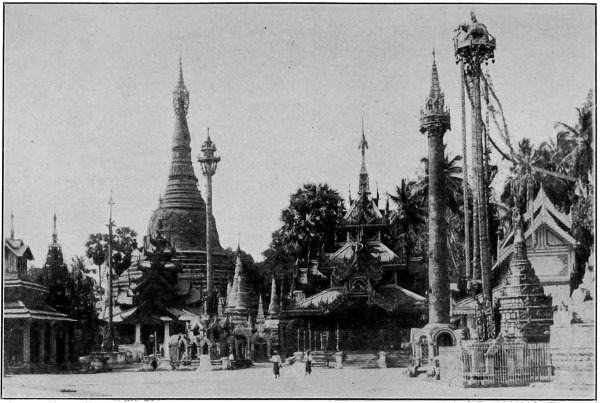
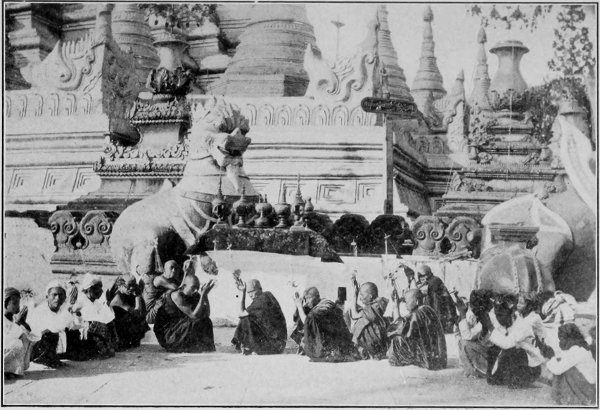
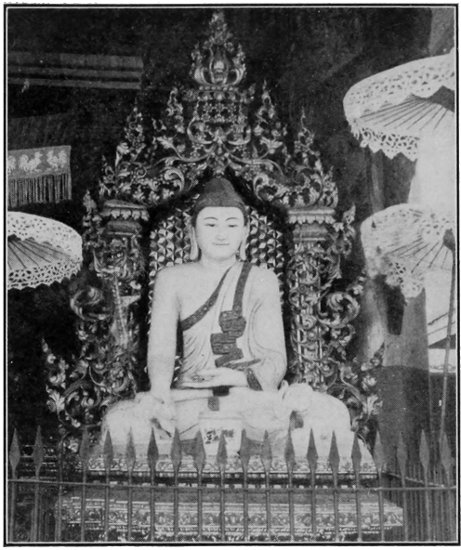
Buddhist Shrines
In the fourteenth century a new king, nominally Burmese, but connected
with the Shans,—came into full power, and founded Ava. But early in
the fifteenth century (1426) the Burmans lost their capital and all
the territory north of Toungoo and Prome, to the Shans. The new city
of Toungoo, built about this time, was the seat of an independent
prince. Pegu had been ruled by kings of Shan race since 1281. In
1538-9 the Toungoo Burman prince, Tabin Shwe' Htee, conquered Pegu,
in the following year Martaban, and after being proclaimed king in
Pegu, extended his sway in 1542, as far north as Pagan. Two years
later, with an allied army of Burmans, Shans and Talaings, he invaded
and conquered Arracan, but not Chittagong. But his success as king
at Pegu was short-lived. Expensive but fruitless wars, and excessive
dissipation turned the people against him. He soon became the victim
of a conspiracy and was treacherously murdered. In 1551 the Burmans
were again victorious at Pegu, pursuing and destroying the Talaing
king. Three years later they regained Ava from the Shans, but retained
the capital at Pegu. Pressing his successes, the Burman king, in
1557, conquered the Shans in the extreme north of Burma, and a little
later at Thibaw, Mone and "Zimme"; northern Siam becoming tributary
to Burma. Steps were taken to make the then non-Buddhist Shans (many
were doubtless already Buddhists), conform to the Buddhist customs of
the Burmese. The Burman ruler, Nawartha, was now what his ambition
craved,—the "King of Kings."
But before the end of the century Pegu and all the territory south to
Tavoy had been lost. Between 1600 and 1613 a Portuguese adventurer
named Philip de Brito reigned as king of Pegu, with residence at his
own fortified city of Syriam. By the marriage of his son with the
daughter of the king of Martaban, the cooperation of that section was
secured. In 1612 De Brito and the king of Martaban marched against
the prince of Toungoo, who had broken faith with De Brito by forming
an alliance with Ava. "They plundered the city, burned the palace and
retired." This high-handed aggression soon reacted on his own head.
The Burman king advanced from Ava with an immense army, laid seige to
Syriam, and starved the garrison to surrender. De Brito, who had been
guilty of many sacrilegious acts, destroying pagodas and other sacred
objects in search of plunder, could hope for no mercy at the hands of
his captors. The leading Portuguese were slaughtered. The remainder,
including the women, were carried away captive to Ava as slaves. Their
descendants may now be found throughout Burma, many of them being
Roman Catholic priests. In 1634 Ava was made the permanent capital.
An immense pagoda was built, and a costly image of Gautama cast to add
to the sacredness of the place, and to the merit of the king.
But Burman fortunes were uncertain. Ava the Great was taken and burned
by the Talaings in 1752. Not long were the Talaings allowed to hold
the Burman capital. A Burman who took the name of Alaungpra, with
wonderful vigour and ability rallied his people. Little more than a
year had passed when Alaungpra recaptured Ava. In 1755 he took his
armies southward, conquering as he went, not content until he reached
Dagon. There he founded a new city, which he designed should be the
chief port of Burma, and named it Rangon (or Yangon), the word meaning
the war ended.
A legend says that Dagon village was founded and the Shwe Dagon pagoda
built in 586 b. c., which is probably within a few centuries
of the true date. The village was rebuilt by the Talaing king of Pegu
about 744 a. d. The great pagoda, upon which an expensive
htee or umbrella had been placed in 1540, was still further
improved, "to rival the one at Pegu." (The present htee was placed
on the Shwe Dagon pagoda in 1871, by Mindon Min.) But the Talaing
capital of Lower Burma, Pegu, had not yet been taken. We have seen
that in 1613 Syriam was destroyed by the Burmans because of De Brito's
aggressions.
Now, in 1755, both British and French traders were established there.
During the struggles between the Burmans and Talaings, the Europeans
hardly knew which should have their favour and help. Everything
depended on being on the side which should prove victorious.
Alaungpra, after securing Rangoon, returned to Ava. This was
interpreted as a sign of weakness, and thereafter the Europeans openly
showed their sympathy with the Talaings. When the Talaings attacked
the Burmese, they were assisted by the ships of both British and
French.
But alas, Alaungpra returned early in the following year. After a
blockade of several months Syriam was taken and destroyed, including
the European factories. The principal Europeans, after being held a
short time as prisoners, were put to death. The downfall of Pegu soon
followed, marking the end of Talaing supremacy.
Six years later, 1762, Sagaing became the capital of the Burmese
Empire. Passing over the wars with Siam, Manipur, and China, we find
the capital changed, in 1783, to Amarapura, a new city built for the
purpose. The following year Arracan was invaded and conquered. The
most valued booty was an immense brass image of Gautama, cast in the
second century, said to possess miraculous powers. This image, taken
over the mountains, a wonderful feat, was placed in a building erected
for the purpose, on the north side of Amarapura, the new capital,
where it may now be seen by visitors to the "Arracan Pagoda."
In 1795 the first envoy to the king of Burma was sent by the
government of India. The envoy was not well received, and secured no
permanent advantage. The following year another was deputed to be
resident at Rangoon, instead of Ava. He met with the same discourteous
treatment, and accomplished nothing. Up to 1812 five successive
attempts were made to arrive at an understanding with the Burman king,
with reference to political and commercial relations, but without
success. Envoys were either ignored or made the bearers of insolent
replies. At this time war between England and the United States was
about to begin. Adoniram Judson was getting ready to sail as a foreign
missionary.
In 1823 the capital was restored to Ava. A great fire at Amarapura
destroying some of the royal buildings, together with certain "bad
signs," induced the king to abandon the city which had been in
existence only forty years. During the previous year the Burmans had
overrun Manipur and parts of Assam, and claimed the territory as a
part of the Burman Empire. The first battle ever fought between the
Burmese and English was at Cachar—in January, 1824. The Burmans were
defeated. In 1824-5 the British and native troops succeeded in driving
the Burmans back into their own country. The bulk of the Burmese army
had already been recalled to repel the British who were advancing from
the south, war having been formerly declared in March, 1824. In the
meantime the American missionaries, Judson and Price, together with
all Europeans at Ava were imprisoned as suspected spies, or in league
with the enemy.
After eleven months they were transferred to Aungbinle, with the
intention to put them to death. The first Burmese war lasted two years.
Arracan, and all the country east of the Gulf of Martaban was ceded to
the British. Rangoon reverted to the Burmese. But the most interesting
result to American readers, was the release of the missionaries,
Judson and Price, who were utilized as messengers to negotiate the
terms of surrender. After the second installment of indemnity had
been paid, and the British troops withdrawn to territory ceded by
the humiliated king the following record of the affair was added to
the royal chronicles. "In the years 1186, 1187 (Burmese) the white
strangers of the west fastened a quarrel upon the Lord of the Golden
Palace.
"They landed at Rangoon, took that place and Prome, and were permitted
to advance as far as Yandabu, for the king, from motives of piety
and regard to life, made no preparation whatever to oppose them. The
strangers had spent vast sums of money in their enterprise, so that
by the time they reached Yandabu their resources were exhausted, and
they were in great distress. They then petitioned the king, who, in
his clemency and generosity, sent them large sums of money to pay
their expenses back, and ordered them out of the country." The record
modestly omitted to mention the fact that the strangers had permission
to take with them the Arracan, Ye, Tavoy, Mergui, and Tenasserim
provinces!
The whole period from 1826 to the second Burmese-English war, in 1852,
was marked by heartless cruelties inflicted by successive Burman kings
upon all real or suspected offenders; by persistent repudiation of
the terms agreed upon at the close of the first war; and by gross
insults to British representatives. The second Burmese-English war
lasted a year and a half, and resulted in the annexation of the
Province of Pegu, which included Rangoon and extended to a point
about thirty miles north of Toungoo. In about 1837 the capital was
again transferred to Amarapura, where it remained until Mandalay was
founded, in 1860, by Mindon Min. A new king, Mindon Min, was soon
proclaimed at Amarapura. Throughout his reign, from 1853 to 1878,
relations between the British and Burmese were greatly improved.
Mindon Min was the best king Burma ever had. Moreover, the loss of
Arracan, Tenasserim, and Pegu had inspired some degree of respect
for representatives of the British Indian Government. With the death
of Mindon, and the ascension of Thibaw, trouble began. The great
massacre, in which about seventy of royal blood, including women
and children, were ruthlessly butchered, called forth a vigorous
remonstrance from the British Government. An insolent reply was
returned, rejecting outside interference.
In August 1879 the resident at Mandalay was withdrawn. Massacres
soon followed, rivalling the horrors of the past. At this time many
thousands of Burmese migrated to Lower Burma to escape oppression.
Thibaw then began a flirtation with France. The Bombay Burma
Trading Company was accused of defrauding the king in the matter of
royalty on teak logs. An enormous fine was inflicted. Arbitration
was rejected. The French were conspiring with the king to gain
commercial advantages, giving them practically full control of Upper
Burma, including the only route to western China. In June, 1885, the
government of India obtained conclusive evidence as to the nature
of these negotiations. A demand was made that a British resident be
received at Mandalay, and that Thibaw reveal his foreign policy.
This ultimatum was refused. The British immediately advanced on the
capital. On the 28th of November, 1885, Mandalay was taken, and King
Thibaw made a prisoner. The great, self-sufficient Burman kingdom had
fallen to rise no more.
French diplomatists had outreached themselves, and precipitated the
annexation of Upper Burma.
On the first of January, 1886, the following proclamation was issued:
"By command of the Queen-Empress it is hereby notified that the
territories formerly governed by King Thibaw will no longer be under
his rule, but have become a part of Her Majesty's dominions, and will
during Her Majesty's pleasure, be administered by such officers as the
viceroy and government of India may from time to time appoint."
It will be seen that the Burmese throughout their history have been a
warlike people. The adoption of Buddhism, as the national religion,
with its strict rules concerning the taking of life, does not seem to
have wrought any change in this respect. The grossest cruelties were
practiced, suspected conspirators slaughtered by hundreds, generals
who had failed in battle, as well as others of high rank or noble
blood were executed, sewed up in red sacks, and sunk in the Irrawadi
River. Sometimes the preliminary execution was dispensed with.
Victorious kings built great pagodas, at the expense of the people, to
expiate their sins of bloodshed,—and then renewed the carnage.
The cruelties inflicted upon Judson and his companions at Ava and
Aungbinle; the history of Burman dacoity since the English occupation;
together with many other evidences,—stamp the Burman as far from
being the tolerant, peace-loving, life-reverencing character that
many of his admirers, on the interest of Buddhism, or Theosophy,
have pictured. It is said that a professor in a certain theological
seminary, seeking to cast discredit on the historical authenticity
of the Book of Daniel, called the attention of his class to the
unlikelihood that any Oriental monarch would have issued such decrees
as are attributed to Nebuchadnezzar, in the third chapter. To say
nothing of Mohammedan fanaticism, familiarity with Oriental character
as exhibited by Burman kings would have dispelled the professor's
doubts.
When Naungdawgyi had completed the great Shwe Dagon pagoda, in
comparison with which Nebuchadnezzar's image was Liliputian, he made
a decree that all peoples must fall down and worship it, on penalty
of death. The majority of the people being spirit-worshippers, the
decree could not be enforced. To let himself down easily, the king
commanded that a nat-sin, or spirit-house be erected near the
pagoda. The people coming to make offerings to the nats—would
also be coming to the pagoda, and so the decree would be obeyed,
and, in time, its purpose effected. The character of the Burman king
Bodaw-para, who was on the throne when Judson came to Burma, is thus
described by Father San-Germano, who lived in Burma twenty years
during this king's reign. "His very countenance is the index of a
mind ferocious and inhuman in the highest degree,—and it would not
be an exaggeration to assert that during his reign more victims have
fallen by the hand of the executioner than by the sword of the common
enemy....
"The good fortune that has attended him ... has inspired him with the
idea that he is something more than mortal, and that this privilege
has been granted him on account of his numerous good works....
"A few years since he thought to make himself a god." He did in fact,
proclaim himself as the fulfillment of the national expectation of
a fifth Buddha. Priests who refused to recognize his claims, were
punished. Who can doubt that the late King Thibaw would have been
quite capable of repeating Nebuchadnezzar's decree, had he thought of
it, and seen any advantage in it, to himself.
The census of 1901 gives the total population of the province as
10,490,624. Of this total the Burmese number 6,508,682, while the
number returning the Burmese language as their ordinary tongue was
7,006,495. The total number of Buddhists, including the Shans and
Talaings, is 9,184,121. The area of the province is 286,738 square
miles. To the casual visitor the country seems to be peopled almost
exclusively by Burmese, and Buddhism the only form of worship, the
other races inhabiting isolated parts of the country, far removed from
the main lines of travel. The population of Rangoon is about 235,000.
Buddhists and Hindus number about the same, with more than half as
many Musalmans as of either. Fifty per cent. of the population are
immigrants. Rangoon is no longer a Burman city.
In Mandalay, their last capital, and second city of Burma, the
situation is quite different. In a total of 178,000 over 152,000
are Buddhists. This city has been in existence only sixty-three
years. Its outward appearance is much the same as it was when taken
by the British in 1885. The same brick wall, twenty-six feet high,
with its crenelated top, a mile and a quarter on each side of the
square, forming an impregnable (!) barrier against all comers,—still
surrounds what was the royal town. On each side are three gates,
reached by bridges across the wide moat, which is kept filled with
water by a connection with a natural lake a few miles to the northeast.
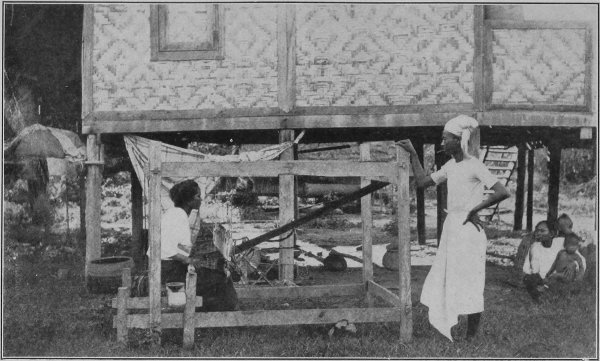
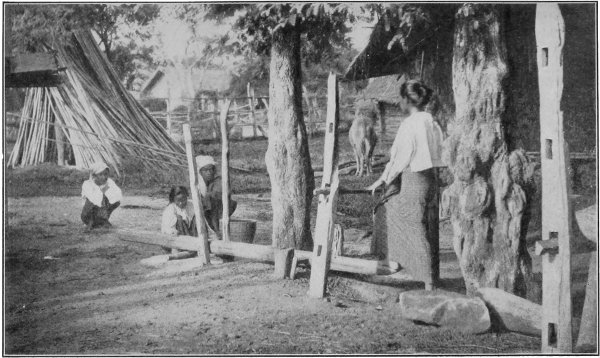
Burmese Woman Weaving
Inside of the walled town comparatively little now remains as it was
when captured. The natives occupying thatched houses, were compelled
to move outside the wall, taking their shanties with them. For this
they were amply compensated by the British Indian Government. A large
city, regularly laid out with straight wide streets, was already
flourishing outside of the walled section. Within the walls the palace
and monasteries still remain, the former now being restored by the
provincial government, at great expense. Services of the Church of
England are held in one of the large halls. In one of the buildings
near the palace the Mandalay Club is comfortably established. Several
old cannon, used by the Burmese in their wars, more for the noise they
could make than for any death-dealing powers they possessed, now adorn
the grounds. The king's monastery, and the queen's monastery, are
objects of interest. Near the former is the site of the "Incomparable"
temple, destroyed by fire in 1892. This immense structure, with its
gilded columns and lofty ceiling, was the grandest building in the
city. Near by is a huge pagoda within a high rectangular wall. The
space enclosed is subdivided into three compartments by low walls
extending around the pagoda, to represent the threefold division
of the Buddhist scriptures. These spaces contain seven hundred and
twenty shrines about fifteen feet high, their tops supported by four
columns. In the centre of each shrine, set like a gravestone in the
cement floor, is a stone tablet about three feet wide by five and a
half feet high, covered on both sides with portions of the sacred
writings. The floor around each tablet is polished by the bare feet of
many devotees,—for the "Law" is one of the "three precious things"
of Buddhism—commanding their worship. For all this immense outlay
of time and money devoted to sacred objects Mindon Min is supposed
to have secured the royal merit, freeing him from the countless
existences through which the ordinary mortal must pass. The prevailing
impression that as a result of the monastic school system all of
the Burmese males can read and write, is not corroborated by the
recent census. A little less than half (490 in each 1,000) are able
to both read and write. Doubtless a large majority spent enough of
their childhood in the monastery to acquire these accomplishments,
but, to many, they have become lost arts, through disuse. Only
fifty-five in each thousand of Burmese women can read and write. Girls
are not admitted to monastic schools. This small gain is chiefly
due to mission schools. The demand for female education is rapidly
increasing. All Burmans, except the relatively small number of
converts to Christianity, are Buddhists. Nearly all are worshippers of
idols.
A sect called Paramats was founded at the beginning of last century.
The Paramats will have nothing to do with pagodas and idols. They
respect the ordinary Buddhist priests, as representatives of Gautama,
who was the incarnation of eternal wisdom. They do not hold that
eternal wisdom is reincarnated in the priests, and therefore do not
worship them as orthodox Buddhists do. This eternal wisdom, which
existed before the world was made, and will exist throughout eternity,
fills all space, but exercises no influence over this world. Eternal
wisdom is not, except in a very vague sense, personified—as an
equivalent of the Christian conception of an eternal God. But the
Paramats have the germ of a true belief, and, as a rule, are thinking
men, which is more than can be said of the ordinary Buddhist. Numerous
in the district midway between Mandalay, and Rangoon, they furnish a
hopeful field for missionary effort.
The Shans rank second in point of numbers. Max Muller held that the
Shans were the first to leave their original home in western China.
Contact with the Chinese has left its mark upon them, sufficient,
apart from other evidence, to prove their origin. Having been forced
out of western China they drifted southward, and founded some of the
large towns in the territory now known as "Shan-land" as early as 400,
or 500 b. c.—if their own chronicles can be believed. But
at this point different conclusions have been reached from the same
sources of information, some accepting these dates as approximately
correct, others rejecting them as too remote by several centuries.
Indeed, it is difficult to determine whether the first migration was
southward, or to the southwest, or whether there were two migrations
simultaneously. As we have seen in our study of the Burmese, the Shans
were supreme on the Upper Irrawadi early in the Christian era, having
expelled the Burmese and taken possession of that part of the country.
It may have been as early as 400 or 500 b. c., when they
overthrew the Tagaung monarchy. My own view is that the Shans first
migrated to the southwest across the Namkham valley, founding the "Maw
Kingdom," which finally extended to the Irrawadi and Chindwin rivers
in northern Burma. And that not until several centuries later did they
extend their sway to the southeast, founding Thibaw, Mone, and other
towns.
That there is a discrepancy of ten centuries or more between this
view and the Shan Chronicles, in which the most striking feature is
exaggeration, need not disturb any one. In fact, a sound "principle
of interpretation" of legendary history, whether Burmese or Shan, is
to cut down its figures by about one half.
Near the end of the tenth century the Shans occupied Arracan about
eighteen years. The Shan kingdom continued until overcome by the
Burmese, in the middle of the eleventh century. They still remained
in power in the far north. In 1281 Shans from Siam joining with Shans
of Martaban, conquered Martaban, then with assistance of Shans from
the north they captured Pegu from the Burmans. At the beginning of
the fourteenth century the Shans were again in the ascendant in Upper
Burma, the Burmans having been weakened by Chinese invasions. The
Shans now ruled the country from the upper reaches of the Irrawadi
as far south as Prome, but not including Toungoo. All Burma was
threatened with Shan supremacy. This might have been realized but
for the Shan emperor's own recklessness and tyranny, working his own
downfall.
Kings of Shan race controlled Pegu from 1281 until conquered by the
Toungoo Burman prince, Tabin Shwe' Htee, in 1539. The Shan power in
the north having become weakened, the Burmese in 1554, captured Ava,
and in 1557 conquered the Shans throughout the Upper Irrawadi region.
Thibaw, Mone, and "Zimme" in northern Siam, fell to the Burmans a
year later. The Shans seem to have remained subject to the Burman
kings until the annexation of Upper Burma; and sometimes assisted the
Burmans in their wars with the Talaings and Siamese.
The census of 1901 gives a total of 751,759 Shan-speaking people.
Besides the northern and southern Shan States, a large number of Shans
are still found in Upper Burma, and many Shan villages throughout
Lower Burma. It is not definitely known when the Shans adopted
Buddhism. There are evidences that the Shans, who were supreme on the
Upper Irrawadi at the opening of the Christian era, and for several
centuries after, were influenced by Buddhism introduced from India
by way of Manipur, and that many accepted it. After the introduction
of Buddhism from the south it spread rapidly among the Burmese, and
through them to the Shans, becoming the national religion of both
races.
It is said that many Shan Buddhist priests sought reordination
according to the rules of the southern type of Buddhism.
The Shans established monasteries throughout their country. Under the
later Burman kings, Burman priests were sent to propagate Buddhism
in the Shan country. In some places the sacred books were destroyed,
and other books written in the Burmese language substituted, Burmese
becoming the language of the Monastic schools for Shan boys.
Burman kings adopted the same tactics in dealing with the Talaings.
The customs of the Shans and the Burmese are much the same, but
their costume is more like that of the Chinese. The same is true of
the Karen costume. Though differing from the costume of the Shan,
both seem to have been derived from their contact with the Chinese
before their migration to Burma. The broad lopped-rim Shan hat and
flowing trousers with the seat between the knees differentiate the
Shan from other races. They have a written language, adopted from the
Burmese,—some four or five hundred years ago,—as the Burmese had
adopted theirs from the Talaing.
The Karens found their way in Burma from western China; forced
southward by the Chinese. Then when the Shans were in like manner
driven into Burma, the Karens were pushed on still further south, like
driftwood before the tide. Their original home is uncertain. It seems
evident that at a much earlier period they had migrated into western
China from some place still further north. One of their own traditions
is that their ancestors, in their wanderings, crossed a "river of
sand."
The desert of Gobi best answers to their tradition. Other traditions
point to western China as their early home. It is not unlikely that
the tradition of the "river of sand" is much the older, and these
traditions taken together mark the progress of the Karens in at
least two widely separated migrations southward. The Karens strongly
resemble certain hill-tribes now living in western China; in fact
some of the Karens have identically the same customs, as these China
hill-tribes, who are also said to have the tradition of a "river of
sand."
There are three main divisions of the Karens, known as Pwo, Sgaw, and
Karennee or "Red Karens." This threefold division antedates their
migration to Burma. The Pwos, sometimes called "the mother race," are
supposed to have been the first arrivals, working their way south
by the way of the valleys of the Salwen and Mekong Rivers; followed
by the Sgaws, and finally by the Karennees, though it is doubtful
whether there was any interval between these main divisions in the
general migration. But in some way they have—to this day—maintained
the distinction. It is probable that for a time the Karens held the
territory now known as the eastern Shan states, and all the upper
Salwen region. The coming of the Shans, whether from the north or
west, drove them southward, each of these tribal divisions advancing
under compulsion in the same order in which they first entered the
country.
The Pwos are now found in the delta and still farther south in the
Maulmain district; the Karennees farther north, bordering on the Shan
country, and east to the Siam border; the Sgaws keeping to the central
territory, in the Toungoo district and diagonally across to Bassein,
sharing parts of the delta with the Pwos. A large body of Sgaw Karens,
as well as many Pwos, are found in the Tavoy district, farthest south
of all. The Tavoy Karens drifted in from Siam, not extending to the
seacoast until early in the last century.
There is now a continuous chain of Karens from Tavoy far into the
north of Siam. In general, the Karens live in the highlands, the
Burmans occupying the plains. Formerly this was partly from choice,
but unavoidable whether from choice or not, on account of the cruel
oppression suffered at the hands of the more powerful Burmans. But
under British rule many Karens have come down to the plains, and
forming villages of their own, have engaged in cultivation. They still
like to be within easy reach of the mountains, to which they resort
for game and other food.
In the shady ravines they have profitable gardens of betel (areca)
palms, the nut being essential to any native's happiness, and
commanding a ready sale. Some writers have advanced the theory
that the religious traditions of the Karens were derived from their
supposed contact with Nestorian Jews in western China. This can hardly
be true—as it places the migration of the Karens to Burma at much too
late a date.
The Nestorians did not begin their work in western China until 505
a. d., closing it in 1368, when they were expelled by the
Mongols.
It seems certain that the Karens were already in Burma long before the
Nestorian missionaries went to China. (Marco Polo's Roman Catholic
mission-work in western China did not begin until 1271.)
If it is true that the large towns in Shan-land were founded by
the Shans four or five hundred years before the Christian era, the
migration of the Karens must be placed at an even earlier period,—but
that early date is doubtful. The non-Christian Karens are, and always
have been spirit-worshippers. This so-called worship is limited to
propitiatory sacrifice. In this respect they are at one with all the
races of Burma, not excepting the Burman Buddhists, though the latter
have abandoned bloody sacrifice. Before the adoption of Buddhism the
Burmans, Shans and Talaings were spirit-worshippers pure and simple.
Spirit-worshippers they still are, with the forms of Buddhism for a
veneering.
But the Karens have many religious traditions, so closely following
the Bible accounts of the creation, fall, flood, and other events
as to furnish strong evidence that in bygone ages their ancestors
somewhere were in touch with the people of God. In spite of their
spirit-worship they have retained a belief in a Supreme Being, and
long looked forward to the time when God's Word, which they had lost,
should be restored to them. God was believed to be a benevolent Being,
but so far away that he had nothing to do with men. All spirits
were believed to be evil, vengeful and near at hand. Therefore the
Supreme Being was left out of their worship, and sacrifices offered
to propitiate evil spirits who might work harm to them, by causing
sickness, destruction of crops, and many other possible misfortunes.
The Karens contend that in making offerings to the evil spirits they
were not showing disloyalty to the Supreme Being. They illustrate
their position by the following story: "Some children left in a
place of supposed safety by their parents, were so frightened by the
approach of a tiger that they threw down the cliff some pigs that had
taken refuge with them. Their eyes, however, were not fixed on the
tiger, but on the path by which they expected their father to come.
Their hands fed the tiger from fear, but their ears were eagerly
listening for the twang of their father's bowstring, which should send
the arrow quivering into the tiger's heart." "And so, although we
have to make sacrifices to demons, our hearts are still true to God.
We must throw sops to the demons who afflict us, but our hearts were
looking for God."
The history of the Karens in Burma has been a sad one. For centuries
they had been grievously oppressed by the Burmans, who robbed them,
carried away captives into slavery, and kept the Karens pent up in the
most inaccessible parts of the mountain ranges.
Under British rule the Karens are safe from serious molestation, but
the old feeling still remains, and they hold aloof from the Burman as
much as possible. The coming of the Christian missionary, restoring
to them the knowledge of the true God so vaguely known through their
traditions, was the great event to which the whole Karen nation had
so long looked forward. Multitudes readily accepted Christianity. By
its power they were emancipated from the domination of evil spirits;
the swords and spears of tribal feuds were forged into pruning hooks;
and the whole Christian world rejoiced in the glorious spectacle
of "A nation in a day." The census of 1901 gives a total of nearly
714,000 Karens, of all tribes. Many more are found in Siam. It has
been asserted that "more languages are spoken in Assam than in any
other country in the world." The same may be said of Burma. The recent
census recognized fifty-seven indigenous races or tribes, and as many
more non-indigenous. In the Toungoo district the missionaries meet
with several Karen dialects not mentioned in the census enumeration,
but so distinct that one tribe does not understand the dialect of
another.
In some localities one meets with a new dialect in each village
through which he passes in a day's journey. Ye shades of Shinar!
confusion of tongues,—twice confounded. It seems incredible that so
many families of one race, occupying the same territory, and with
practically the same habits, customs, and superstitions,—should
each perpetuate for centuries its own peculiar dialect and clannish
exclusiveness. The missionary or official, to do effective work among
such a people, needs a small army of interpreters at his heels.
The Kachins inhabit the extreme northern part of Burma, extending
as far south as the Bhamo and Namkham districts, and east into
China. The Kachins are own cousins to the Nagas of the adjacent hill
tract of Assam, who call themselves "Singpho." "Kachin" is a name
applied to these people by the Burmans. The Kachins of Burma call
themselves "Chingpaw." This quite suits their kinsmen of Assam, who
look down upon the Chingpaws as unworthy the grand name of Singpho.
Both terms seem to mean "men,"—but men in distinction from the
inferior races around them. The census of 1901 gives a total of 65,510
Kachins in Burma alone. The early missionaries held that the Kachins
and Karens were of the same origin; that the Kachins were really
Karens, from whom the southern Karens had become separated. This
view seemed substantiated by the people themselves; by some of their
customs,—such as the manner in which their houses are constructed
and partitioned off; by a certain similarity of language—many
common nouns said to be common to both languages, and by their
spirit-worship. It is now generally admitted that the Kachins and
Karens are not of the same origin. In bygone ages they may have
been neighbours, if not more closely related,—in the borders of
Tartary,—but at a very remote period. Certainly they did not migrate
to Burma at the same time, nor by the same route. The Kachins have
traditions that they migrated to Burma by way of the headwaters of
the Irrawadi,—that their primal ancestor lived at "Majoi Shingra
Pum." In his "Handbook of the Kachin Language," H. F. Hertz says: "I
have succeeded in obtaining the views of several old men, Tumsas
and Faiwas, who might be described as Kachin priests. It would seem
from these that 'Majoi Shingra Pum' is a high table-land with very few
trees, frequently covered with snow, and very cold.
"Now, the name 'Majoi Shingra Pum,' literally translated is a
naturally flat mountain, or in other words, a plateau, and it does
not need any stretch of the imagination to identify it with some part
of eastern Tibet. Colonel Hannay, writing in 1847, describes tribes
residing in the inaccessible regions bordering on Tartary as closely
allied to the Kachins." This identifies the Kachins more closely
with the Burmans and Chins than with the Karens. Moreover it is said
that the Kachin language has more points in common with the Burmese
than with the Karen. This is especially true of the Marus,—a tribe
to the eastward, allied to the Kachins of Burma. It is not difficult
to believe that all these races, in the very remote past, were
neighbours in the borders of Tibet, and that while the Kachins and
Burmese migrated south direct, the Karens migrating by way of western
China,—the meeting of these races on Burmese soil reveals a few of
the many things they once had in common.
After the Burmans and Chins had migrated to Burma, the Shans, pressing
westward by way of the Namkham valley, blocked the way of further
migrations from the north. The Shans are known to have been supreme in
northern Burma at the beginning of the Christian era. It is probable
that they peopled the Upper Irrawadi several centuries earlier. In
the thirteenth century the Shans overran Assam. Not until the middle
of the sixteenth century were they finally overcome by the Burmans.
Nothing is known of the Kachins in Burma earlier than the sixteenth
century. They seem to be comparatively recent arrivals, working their
way into Burma after the Shans had been weakened by their struggles
with the Burmans. The Singphos of Assam are said to have drifted into
that country but a little more than a century ago.
The Kachins have gradually forced the Palaungs and Shans before them,
or isolating some of their villages from the main body. Their sudden
development of power is remarkable. Political changes consequent on
the annexation of Upper Burma checked Kachin aggressions. They are
still spreading, but by fairly peaceable means. The Namkham district,
supposedly Shan, is found to contain fully as many Kachins as Shans.
Slowly but surely the Shans will be pressed southward. Before passing
under control of the British the various tribes of Kachins were ever
at war among themselves. Captives were sold into slavery. Retaliatory
raids were constantly expected. Feuds are still kept up, though they
do not have the free hand to execute vengeance enjoyed in former years.
The Kachin, from habit, is watchful and suspicious of
strangers,—until his confidence is gained. Their villages are usually
high up in the hills, as secluded and inaccessible as possible. But
the isolated situation of the village probably is due to the fear of
nats, spirits,—quite as much as from fear of human enemies. One
writer describes an avenue leading to the village, with bamboo posts
at regular intervals, with rattan ropes, à la clothes-line, from which
various emblems are suspended. Near the village "wooden knives, axes,
spears, and swords are fastened to the tree-trunks. All this display
is for the benefit of the nats. Like the Chinese, they do not give
their demons credit for much acuteness. For one thing they believe
that they can only move in a straight line. Therefore the nats
avoid going about in the jungle, and keep to the open paths. A few
judicious turns are made in the avenue, so as to turn the prowling
devils off, if possible, but if he should happen to be cannoned off
the tree stems in the right direction, there are the emblems to show
him where the thing he is in search of may be found. If he is hungry
there is the bullock's skull nailed to a tree, to indicate where food
may be found; if he is thirsty a joint of bamboo points out where
a libation of rice spirit has been made." These spirit-worshippers
are more easily gained than the Buddhist Burmans and Shans, but they
have not the traditions of the Karens to prejudice them in favour of
Christianity. Morally, they rank very low,—and yet their morality
must be viewed in the light of Kachin, rather than English custom.
As with the non-Christian Karens, there are certain unwritten tribal
laws governing family life. Should a Kachin presume to poach on his
neighbour's preserves, there would be one less Kachin the next day.
Courtship, when once the parties have come to an understanding, is
conducted as a "probationary marriage." They may separate before the
marriage ceremony takes place, if they weary of each other. But if
they have already started a colony, marriage must follow, or the man
"has to kill a bullock and pigs—to appease the nats of the damsel's
house. In addition he has to pay a fine to the parents, of a spear,
a gong, a da, and some pieces of cloth, and sometimes a bullock
or buffalo." The old man is more exacting than the nats. Such
separations do not effect the social standing of either party. It is
claimed that separations or disloyalty after marriage "are practically
unknown."
It certainly would not be healthy to have it known. The Kachins
have their own distinctive costume, varying according to tribe and
locality. But Kachin men in touch with Chinese, Shans, or Burmans,
usually adopt the costume of their neighbours. The women hold to their
own costume.
The religion of the Kachins, though gross spirit-worship, contains
an element of truth not found in the Buddhism of the more civilized
Burmans. Rev. Mr. Geis, missionary at Myitkyina says—"Above and
beyond all nats to whom Kachins offer sacrifices at one time or
another, they recognize the existence of one great spirit called
Karai Kasang. Altars in his honour are not found in Kachin villages
or houses. No priest has been able to divine what offerings are to be
made to it, but in time of great danger nats and their offerings
are forgotten, and their cry goes out to Karai Kasang for help and
succour."
The Chins, who number about 180,000, are thought to be of the same
origin as the Burmese,—from the neighbourhood of Tibet. It is evident
that they became separated from kindred tribes at a very remote period.
The Lushais of Assam, and Bengal, and the Kukis of Manipur have the
same race-characteristics, and probably formed part of the original
migration southward. At present the Chins, occupying the hill country
in the northwest corner of Burma, are slowly pressing northward,
affecting Manipur. The Chins of the hill-country are quite isolated
from other races. For this reason Buddhism has never reached them.
Like their kinsmen, the Kachins, they are spirit-worshippers, as were
their other kinsmen, the Burmese, before the introduction of Buddhism.
The Chins are divided into several tribes. The northern Chins call
themselves "Yo," the Tashons call themselves "KaKa"; the middle
tribes give their names as "Lai"; the southern Chins call themselves
"Shu." Since the annexation of Upper Burma, securing immunity from
oppression by the Burmans many Chins have drifted down from their own
hill-country and formed agricultural villages in the plains. The Chin
country is about 250 miles long by from 100 to 150 miles wide. It is
wholly mountainous, the highest peaks being from 5,000 to 9,000 feet.
Liklang peak, the highest of all, is nearly 10,000 feet. Like all
spirit-worshippers, the Chins dread the power of demons, and offer to
them the same left-handed sort of worship. But their worst enemy is
of their own manufacture, made by fermenting rice, millet, or corn,
and called "Zu." The great and wide-spread vice among the Chins is
drunkenness. Men, women, children, even babes in arms—all drink and
glory in intoxication as an accomplishment of which to be proud. No
act is considered a crime if committed when drunk. Many people I have
seen in European and American cities must have been Chins. No function
is complete without liquor. Hospitality is gauged by the number of
cups of spirit dealt out, and appreciation of it—by the number of
cups consumed. Again, how like many of their white cousins. "A man
should drink, fight, and hunt, and the portion for women and slaves
is work"—is both creed and practice. They have a peculiar custom,
now dying out, of tattooing the faces of the women, until the whole
face, from chin to hair—is dyed a purplish black. The reason for this
custom is in dispute. Some have asserted that it was to make them
unattractive to their enemies, especially the Burmans, who frequently
raided their villages in the foot-hills. Others claim that the
tattooing was in order to increase their attractiveness to the young
men of their own kind. Fortunate indeed were they if this queer custom
served the double purpose of repelling enemies and attracting friends.
To unaccustomed eyes the tattooed face is hideous in the extreme.
The first attempt by the British to control any part of the Chin Hills
was made in 1859, but was neither continuous nor effective. In 1871
an expedition was sent into the hills to recover captives, and punish
offenders. The Chins remained quiet for ten years, then broke out
again in repeated raids, from 1882 to 1888. The English were obliged
to undertake a systematic subjugation of the whole Chin country. This
was effected in 1889-90. The expedition met with stubborn resistance,
by guerilla methods. Many villages were burned by the English, as
the only means of subduing the wily enemy. Many villages were burned
by the Chins themselves. Near one village "a dog had been killed
and disemboweled, and tied by its four legs and thus stretched on
a rope suspended between two sticks across the path to the village,
its entrails being likewise suspended between two other sticks, thus
barring the road. Asking the Chins what this might mean, they said
it was an offering to the war nat to protect their village, and to
ward off our bullets from injuring them." The work of subjugation had
to be continued for some years, before the Chins were made to realize
that the English government must be respected. The Hakas and others
were disarmed in 1895. The Chin Hills are administered by a political
officer at Falam, with a European assistant at other important points,
as Tiddim and Haka. The morals of these benighted Chins, still further
degraded by their drink habit, are what might be expected. Marriages
are governed by the working-value of the bride, parents expecting
compensation for the loss of her services, according to her capacity
for work, and "expectation of life." This seems to have been the
custom among all races of Burma. It is said that when a Chin wife is
asked "Where is your husband?" she will give the required information
in case he is living,—but if dead she will reply, "He is not here,"
and expects the subject to be dropped at that. This reminds me of
a Shan girl's answer when I asked her the whereabouts of a former
resident—"I don't know,—he is dead." The Chins of the foot-hills
and plains present an encouraging field for missionary work, but
missionary work must be pushed with all possible vigour—to forestall
the influences of Buddhism. To win them from spirit-worship is hard
enough, to win them from Buddhism will be very much harder.
The dialect of the southern Chins has been reduced to writing, and
is found to be strikingly similar to the Burmese, perhaps half of
the words being more or less allied to the Burmese. As the southern
Chins have great difficulty in understanding the speech of the wild
tribes in the northern hills, it is quite probable that their own
dialect has been corrupted by contact with the Burmans since their
migration to Burma. The Chin dialect of the south is also said to
contain many words of Shan origin. This must have come about in the
same way, either by contact with Shans on the Upper Chindwin at a
very early period, or when the Shans occupied Arracan about eighteen
years, towards the end of the tenth century. This later contact seems
much too short to have left a permanent mark on the southern Chin
dialect. The total number of Animists—demon-worshippers—in Burma,
Chin, Kachin, Karen, and other, is about four hundred thousand. But as
we have seen, the Buddhist Burmans, Shans and Talaings, are at core,
demon-worshippers, all races having in common practically the same
superstitions.