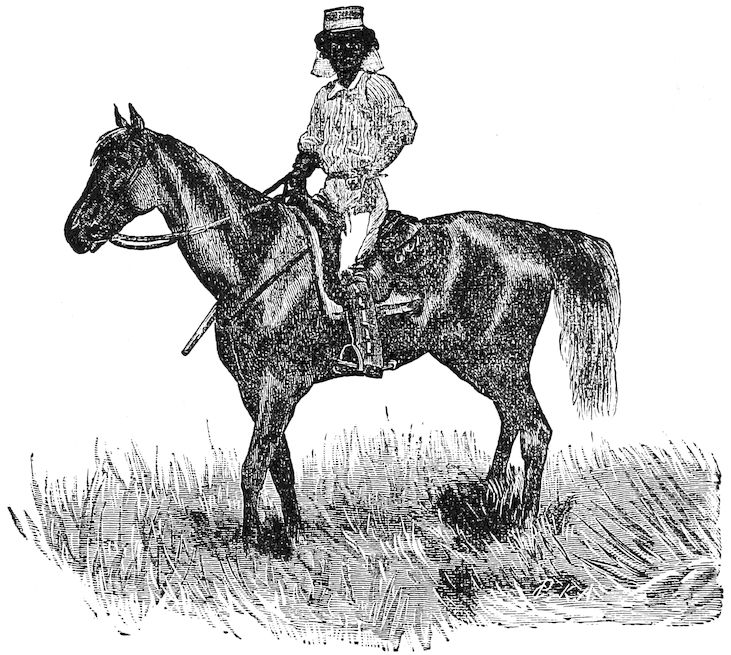
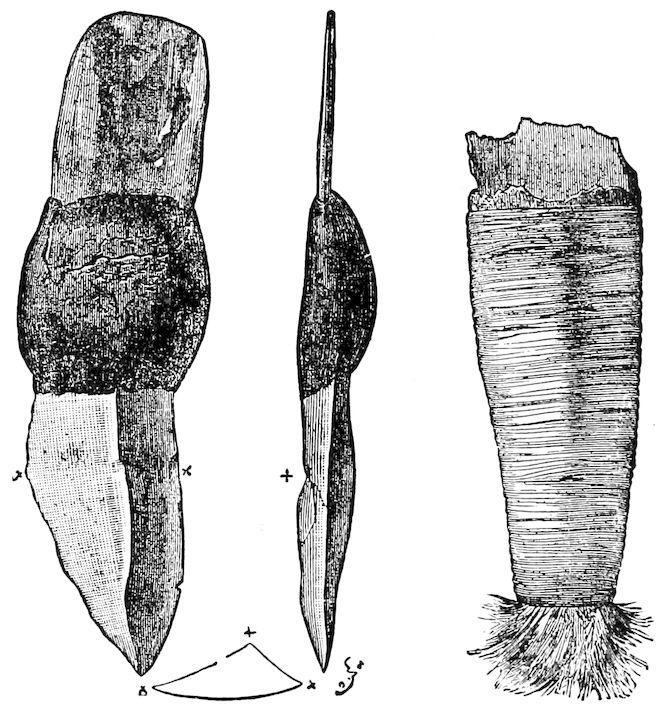
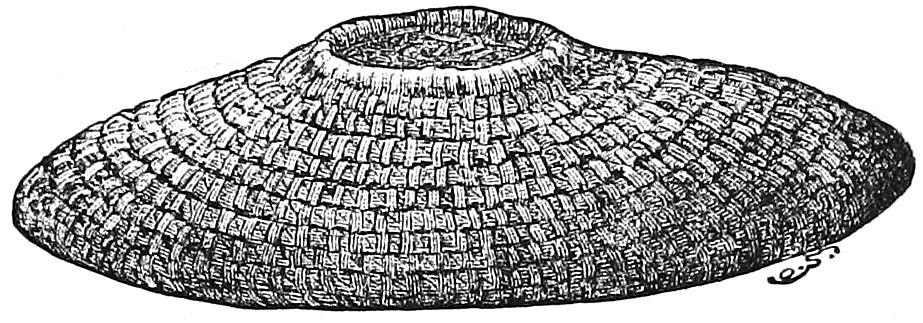
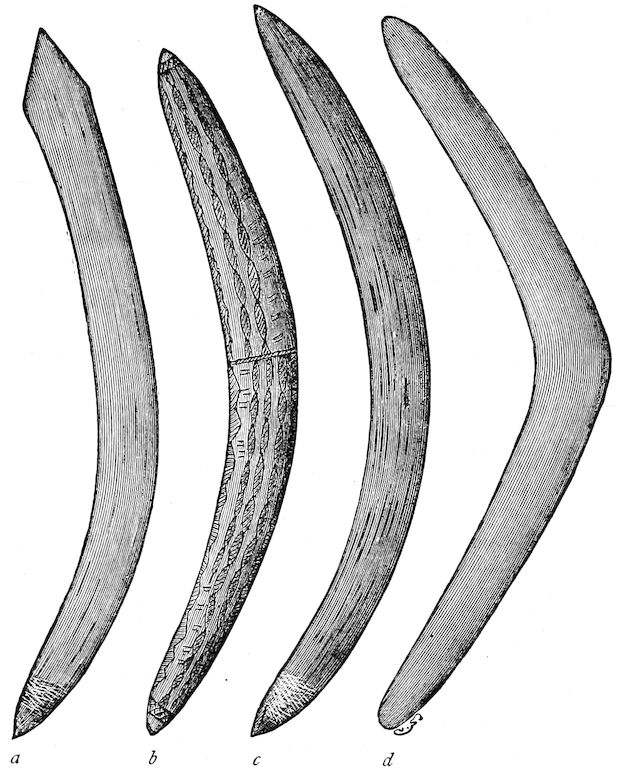
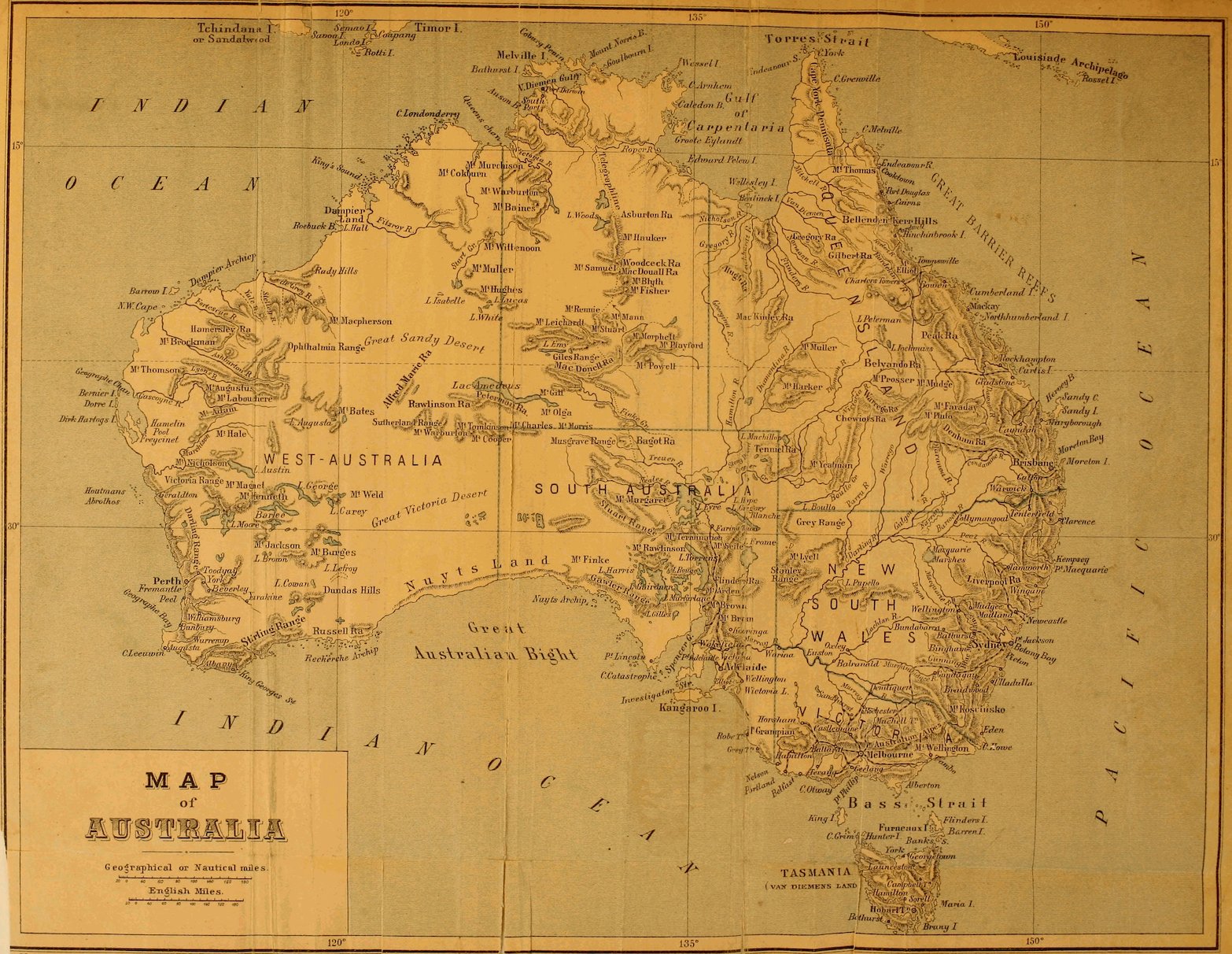
AMONG CANNIBALS AN ACCOUNT OF FOUR YEARS’ TRAVELS IN AUSTRALIA AND OF CAMP LIFE WITH THE ABORIGINES OF QUEENSLAND
Transcriber’s Note:
The cover image was created by the transcriber and is placed in the public domain.
AMONG CANNIBALS
BY
CARL LUMHOLTZ, M.A.
MEMBER OF THE ROYAL SOCIETY OF SCIENCES OF NORWAY
TRANSLATED BY
RASMUS B. ANDERSON
EX-UNITED STATES MINISTER TO DENMARK
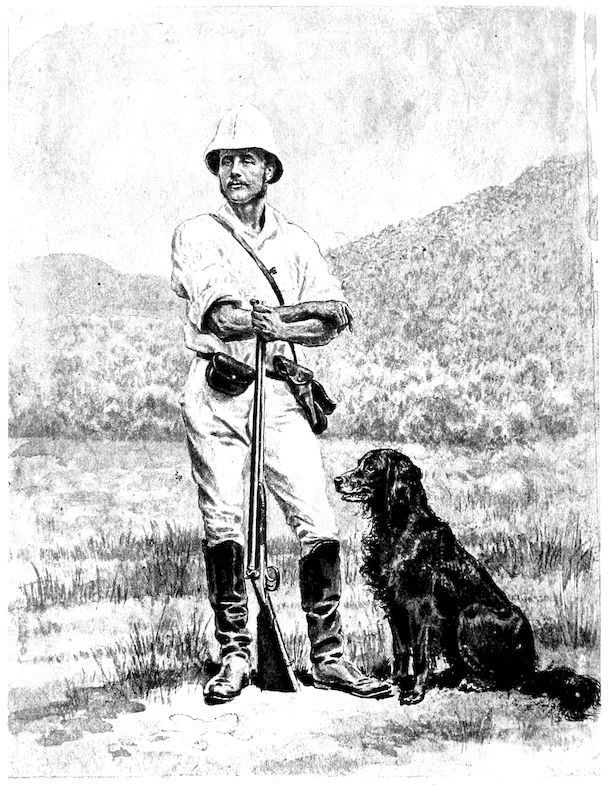
WITH PORTRAIT, MAPS, 4 CHROMO-LITHOGRAPHS, AND WOODCUTS
NEW YORK
CHARLES SCRIBNER’S SONS
1889
Copyright, 1889, by
CHARLES SCRIBNER’S SONS
TROW’S
PRINTING AND BOOKBINDING COMPANY,
NEW YORK.
TO
Paul B. Du Chaillu,
THE CELEBRATED EXPLORER OF AFRICA
AND
THE GREAT FRIEND OF SCANDINAVIA’S PAST AND PRESENT
AS EVINCED BY
‘THE LAND OF THE MIDNIGHT SUN’ AND ‘THE VIKING AGE’
THIS ENGLISH EDITION IS MOST RESPECTFULLY
DEDICATED
BY
THE AUTHOR
AUTHOR’S PREFACE
vii
In the year 1880 I undertook an expedition to Australia,
partly at the expense of the University of Christiania, with
the object of making collections for the zoological and
zootomical museums of the University, and of instituting
researches into the customs and anthropology of the little-known
native tribes which inhabit that continent.
At the commencement of my travels, which occupied
four years, I spent some time in the south-eastern colonies,
South Australia, Victoria, and New South Wales; and succeeded
in establishing connections with the museums in the
cities of Adelaide, Melbourne, and Sydney, and I may add
that everywhere I met with the most cordial reception. I
am particularly indebted to the distinguished botanist Baron
Ferd. von Mueller, of Melbourne; to Fred. M‘Coy, Professor
of Zoology and Mineralogy in Melbourne University;
and to Dr. E. P. Ramsay, Director of the Museum in
Sydney.
More than ten months from November 1880 to August
1881 were spent by me at the fine station of Gracemere in
Central Queensland, belonging to Messrs. Archer and Co.
Both here and elsewhere I was indebted to various members
of the Archer family for kindnesses, which in many ways
aided me in my work. I was placed under similar obligations
viiito Walter J. Scott, Esq., the proprietor of the Valley
of Lagoons station in Northern Queensland. To all these
gentlemen I desire to express my sincere gratitude.
In August 1881 I entered upon my first journey of
discovery, in the course of which I penetrated about 800
miles into Western Queensland, but the results in nowise
corresponded to the hardships I had to endure.
I thereupon selected Northern Queensland as the field
of my chief exploration, and here I spent fourteen months
in constant travel and study. From August 1882 to July
1883 I made my headquarters in the valley of the short
but comparatively broad and deep Herbert river, which
empties itself into the Pacific Ocean at about 18° S. lat., and
there I lived alone among a race of people whose culture—if
indeed they can be said to have any culture whatever—must
be characterised as the lowest to be found among
the whole genus homo sapiens. Not only are many of the
Australian aborigines cannibals, but most of the tribes have
not yet emerged from the Stone Age in the history of their
development. Others have studied the ethnographic peculiarities
of this race; but my predecessors have mainly
directed their attention to the tribes of the southern part
of Australia, which in many respects have attained a higher
intellectual development than their northern kinsmen.
From my base on the Herbert river I made expeditions
in various directions, extending in some instances to nearly
100 miles. The greater part of the volume now offered to
the public is devoted to descriptions of my life in the camps
of the northern savages in different districts. It has been
my purpose to present a faithful picture, based on my own
observations, of the life, manners, and customs of the
Australian aborigines from their birth and infancy to their
ixold age and death; and thus to rescue, for the science of
ethnography, facts concerning tribes that have never before
come into contact with white men, and that within a generation
or two will have disappeared from the face of the earth.
While making these anthropological studies I also succeeded
in securing a collection of zoological specimens, some
of which are new to science, and all of which may be
seen in the museums of the Christiania University. The
collection consists mainly of vertebrates, including a considerable
number of mammals, which have been described
by Professor R. Collett in Zoologischer Jahrbücher, Jena,
1887. I brought home about 700 specimens of birds, a
large number of reptiles and batrachians, numerous fishes,
also some insects and lower animals. Among other things
I discovered four new mammals, which have been described
and named by Professor R. Collett in the Proceedings of
the Zoological Society of London, 1884. The four new
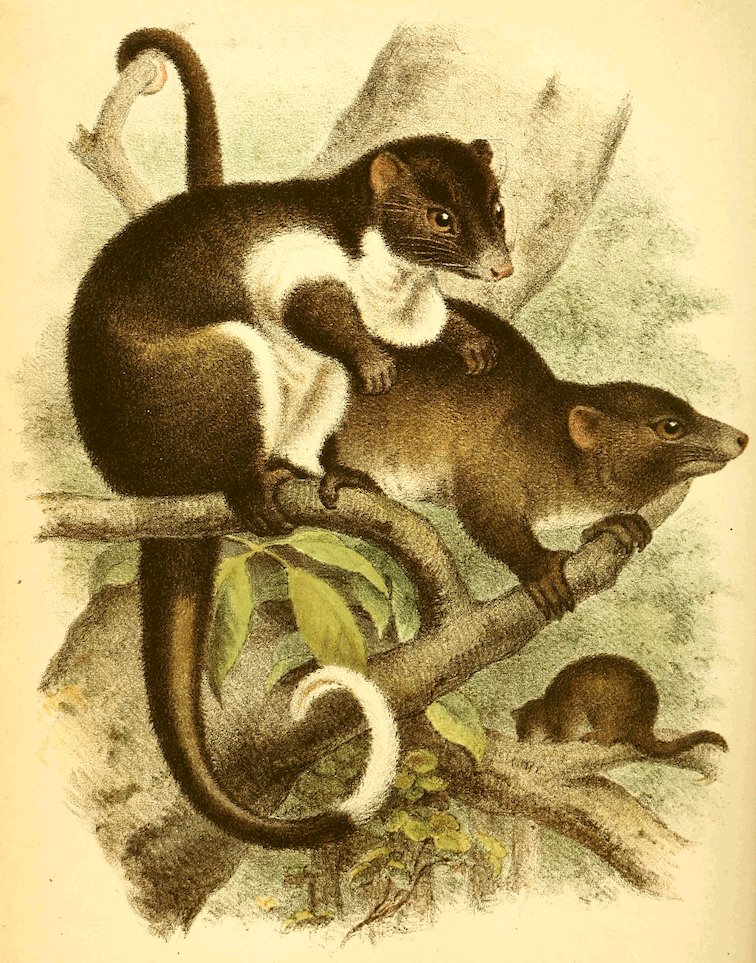
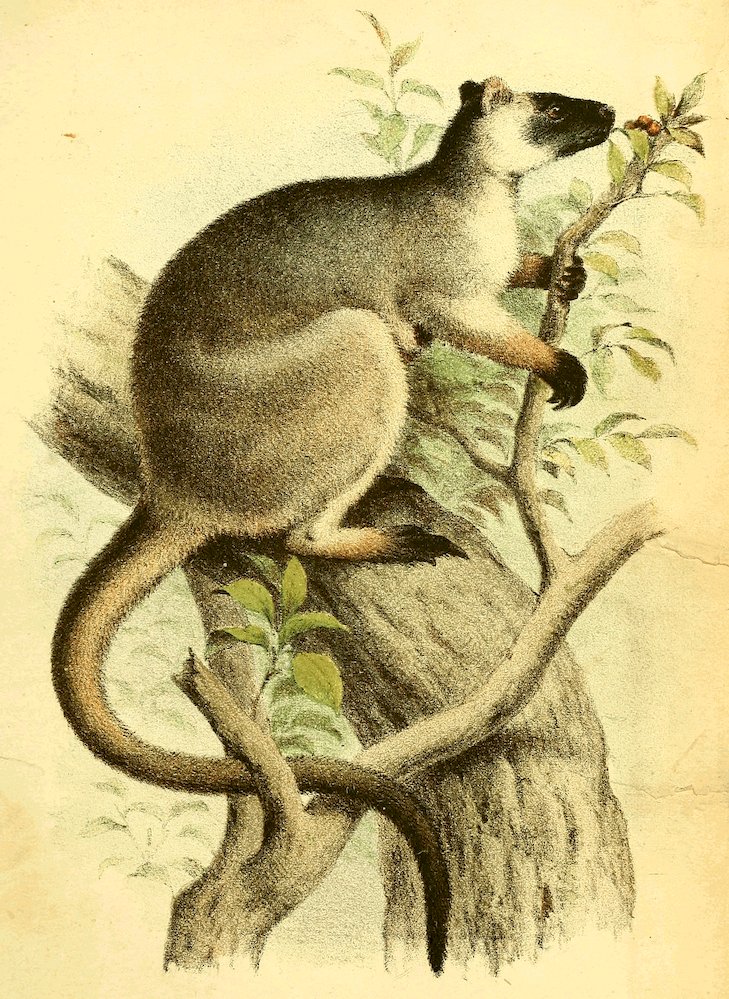
mammals are: Dendrolagus lumholtzii (the tree-kangaroo);
and three opossums, Pseudochirus archeri, Pseudochirus
herbertensis, and Pseudochirus lemuroides.
In conclusion, I desire to express my obligations to the
friends who have helped me in carrying on my work, and in
writing this record of it—to Professor Robert Collett and
Professor Ossian Sars, of Christiania University, who first
encouraged me to undertake the journey, and who never have
failed to render me valuable aid and advice; to Dr. H.
Reusch and Mr. A. M. Hansen, for their co-operation in
drawing up a portion of the appendix to this volume; to
Professor R. B. Anderson (late United States Minister to
Denmark), for his aid in the preparation of the English
edition; to Mr. M. R. Oldfield Thomas, for having revised
the scientific names in the proofs for me during my absence
xin America; and to Mr. John Murray jun., for his assistance
in the correction and supervision of the whole work while
passing through the press.
Most of the illustrations are by Norwegian and French
artists from original photographs, sketches, and specimens
brought back by me from Australia.
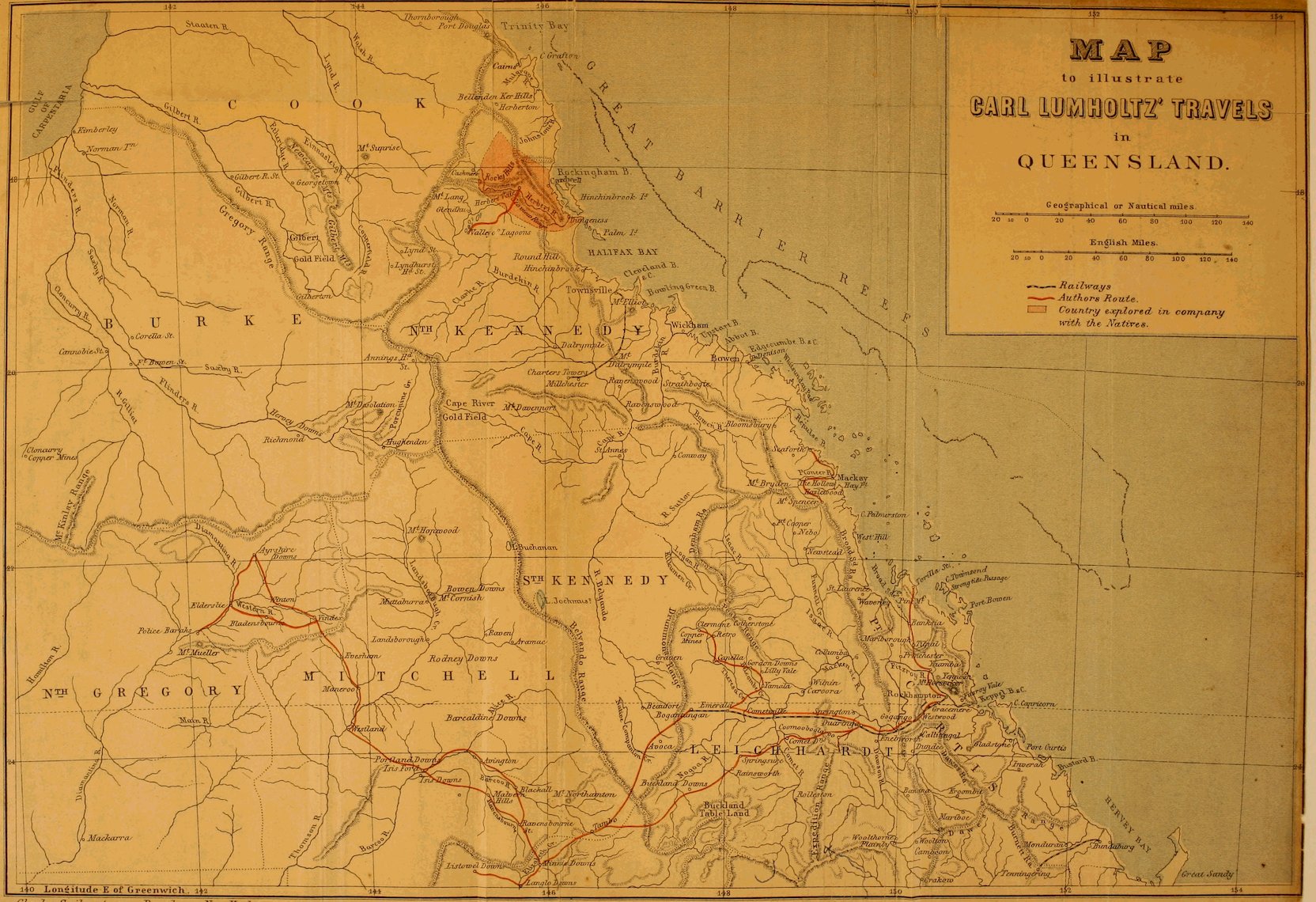
It should be observed that the area marked red on
the map as indicating the district explored by me should
be extended so as to include Cashmere, Glendhu, the Valley
of Lagoons, and all the intervening country.
As a foreigner, I would ask for the kind indulgence of
my readers and critics towards any literary shortcomings
in this English edition of my work.
CARL LUMHOLTZ.
London, August 1889.
CONTENTS
xi
CHAPTER I
Introductory—Voyage to Australia—Arrival at Adelaide—Description of the city—Melbourne, the Queen of the South—Working men—The highest trees in the world—Two of the most common mammals in Australia
Sydney harbour—Jealousy between Sydney and Melbourne—The Blue Mountains—Brisbane and Rockhampton—First evening in tropical Australia—Gracemere station—Animal and plant life—Vine-scrubs—Excursion into the neighbouring districts—A Norseman who feels cold in Australia
Journey to Western Queensland—Camping out—Damper (Australian bread)—The song of the magpie—Australian scrubs—Hunting the kangaroo—Devotion of parrots—Station life—Lonely shepherds—Migration of rats—Native justice—Australian fleas—Native mounted police—A remarkable flint instrument—The boomerang
Struggle between blacks and whites—116° Fahrenheit—Cool nights—Troubles—Bush-life—How the bushman spends his money—Inundations—Back again to Gracemere—A greedy snake—Courtship in the bush
xiiJourney to Northern Queensland—Mackay-sugar—Employment of South Sea Islanders—Townsville—A rough northern man—Sugar district on Lower Herbert—Visit to a successful Scandinavian—Blacks near Gardiner’s farm—Nolla-nolla—Spring—Arrival at Herbert Vale
Headquarters at Herbert Vale—Civilised blacks—Domestic life—Nelly the cook—Cats—Swimming in fat—My bill of fare—Killing the bullock—Strong stomachs and bad fare
Kāmin (implement for climbing)—On the top of the gum-trees—Hunting the wallaby—The spear of the natives—Bird life in the open country—Jungle-hens—Cassowary
Pleasant companions—Two new mammals—Large scrubs in the Coast Mountains—The lawyer-palm—“Never have a black-fellow behind you”—I decide to live with the blacks—Great expectations—My outfit—Tobacco is money—The baby of the gun
My first expedition with the blacks—A night in the forest—Fear of evil spirits—Morning toilet—Maja yarri—Borboby—The “lists” of blacks—Warriors in full dress—Swords and shields—Fights—The rights of black women—Abduction of women
The appearance of the aborigines in the different parts of the continent—My pack-horse in danger—Tracks of the boongary (tree-kangaroo)—Bower-birds—The blacks in rainy weather—Making fire in the scrubs—A messenger from the civilised world—The relations of the various tribes—Tattooing
Respect for right of property—New country—My camp—Mountain ascent—Tree-ferns—A dangerous nettle—A night in a cavern—Art among the blacks—Edible larvæ—Omelette aux coléoptères—Music of the blacks—Impudent begging
xiiiThe position of women among the blacks—The husband the hunter, and the woman the provider of the family—Black female slaves—“Marking” the wives—A twelve-year-old wife—Considerate husbands—Wives an inheritance—Deserted by my followers—Reasoning power of the blacks—Darkness and rain
Mongan, a new mammal—For my collection or to feed the blacks?—Natives do not eat raw meat—A young yarri—A meteorite—Fear of attacks—Cannibals on the war-path—The relations between the tribes
Dingo a member of the family—A black who does not smoke—Hunting the flying-squirrel—Diseases among the natives—Their remedies—A splendid offer—Unpleasant companions—Trouble in getting dogs
Blacks on the track—A foreign tribe—Native baskets—Two black boys—Bringing up of the children—Pseudochirus lemuroides with its young—The effect of a shot—A native swell—Relationship among the blacks—Their old women
Wild landscape on the Upper Herbert—Kvingan, the devil of the blacks—A fatal eel—Mourning dress—Flight of the blacks—A compromise—Christmas Eve—Lonely—Christmas fare—A “faithful” relative—A welcome wallaby
A wedding—Love among the Australian natives—My first meeting with Yokkai—Big eaters—An accident—Left alone with Yokkai—A difficult descent—Return to Herbert Vale—A new beetle—Friends of the animals
Native politeness—How a native uses a newspaper—“Fat” living—Painful joy—Boongary, boongary—Veracity of the natives—A short joy—A perfect cure—An offer of marriage—Refusal
xivA festival dance of the blacks—Their orchestra—A plain table—Yokkai wants to become “a white man”—Yokkai’s confession—A dangerous situation—A family drama
Arrival of the native police—The murderer caught—Examination—Jimmy is taken to Cardwell—Flight of the prisoner—The officer of the law—Expedition to the Valley of Lagoons—A mother eats her own child—My authority receives a shock
The rainy season—How the evenings are spent—Hardy children—Mangola-Maggi’s revenge—The crania of the Australians—The expedition to Cardwell—Dalrymple Gap—A scandalous murder—Entry into Cardwell—Yokkai as cook—“Balnglan’s” death—Tobacco cures sorrow
Unpleasantnesses at Herbert Vale—New expeditions—Hunting human flesh—Cannibalism—Human flesh is the greatest delicacy of the Australian blacks—Superstitions in connection with the eating of human flesh—The taste of the cannibals—Cannibalism in Burma
The burial of the blacks—Black mummies—Sorcerers or wizards—Myths and legends—The doctrine of the Trinity in New South Wales—The belief in a future life among the blacks
Winter in Northern Queensland—Snakes as food—Hunting snakes—An unexpected guest at night—Yokkai’s first dress—Norway’s “mountains of food”—Departure from Herbert Vale—Farewell to the world of the blacks
Frozen meat—Again in Gracemere—Australian scenery—In a carriole—Hunting the dugong—Cosmopolitan quarters for the night—Cure for nervous diseases—Poisonous rabbits—Marry only a person with good teeth—Bush girls—Mount Morgan
Religion—Blacks in the service of the white men—Fickle minds—Settlers and natives on the borders of civilisation—Morality—A life and death struggle—The cruelty of the whites—Future prospects of the Australian natives
Map to illustrate the Author’s Travels in Queensland
„
1
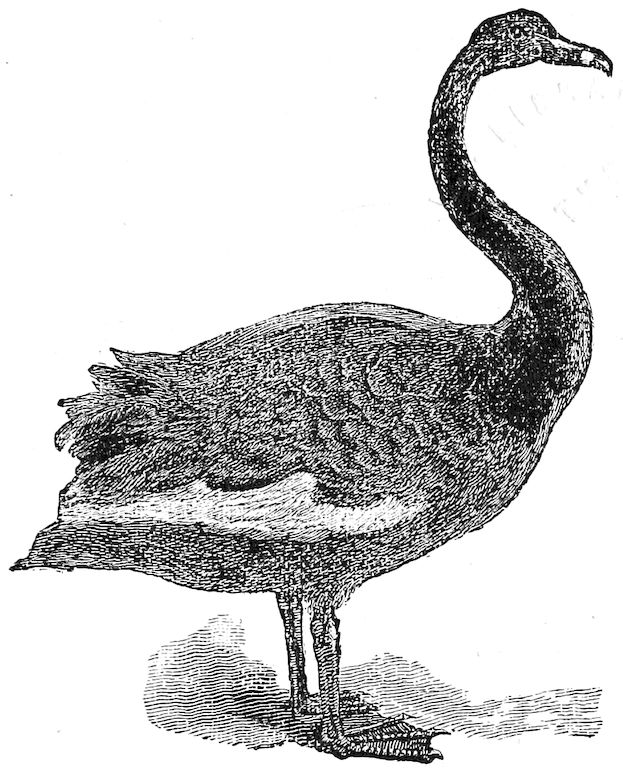
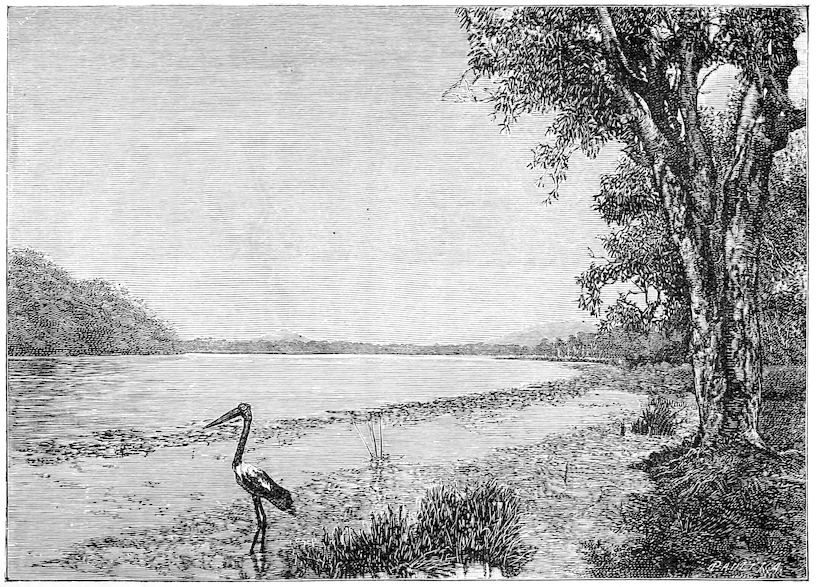
BLACK SWAN.
CHAPTER I
Introductory—Voyage to Australia—Arrival at Adelaide—Description of the
city—Melbourne, the Queen of the South—Working men—The highest
trees in the world—Two of the most common mammals in Australia.
On May 24, 1880, I went on board the barque Einar
Tambarskjelver bound from Snar Island near Christiania to
Port Adelaide with a cargo of planed lumber. I carried
with me a hunter’s outfit, guns, ammunition, and other articles
necessary for the chase, furnished me by the University of
Norway, as well as some northern bird skins in order to
inaugurate exchange with Australian museums. Sailing in
the north-east trade-winds, a sunset in the tropics, or a mild
starlit night on the ocean with a blazing phosphorescent sea,
do not fail to make a strong impression. Then passing the
pacific belt of the ocean, where a dead calm is suddenly
interrupted by the most violent storm, you soon reach,
by the aid of the south-east trades, the region of the
westerly winds. The Southern Cross and the cloud of
2Magellan, the gigantic sperm-whale, whose huge head now
and then appeared above the surface of the water, and the
albatross, whose glorious flight we never ceased to admire,
heralded our arrival within the limits of the Southern
Ocean. Cape-doves, albatrosses, and gulls accompanied us
for weeks together. The passage had, however, at times
its dark sides. On August 17, at six o’clock in the
morning, we were overtaken by a most violent gale. All
the sails, except the close-reefed topsails and foresail, were
taken in. We shipped many seas. The stairs to the
quarter-deck were crushed; one wave broke through two
doors in the companion-way to the steerage, another set all
the water-casks afloat in the maddest confusion, a third
filled the galley, so that the cook found himself waist-deep
in water. The fire was extinguished, and the food was
mixed with the salt water. Several times the seas broke
through our main cabin door, filling my cabin with water,
making boots, socks, books, and other articles swim about
in all directions.
On a long journey one gets tired of the sea, this “desert
of water,” as the Arab calls it—and we long to set foot
again on terra firma. According to the calculations of the
captain we were fifty geographical miles from the coast of
Australia, when one morning we perceived for the first time
the smell of land, in this instance a peculiarly bitter but
mildly aromatic odour, as of fragrant resin. This fragrance,
doubtless, came from the acacias, which at this time were
in full bloom. For by the aid of the wind these trees,
particularly Acacia fragrans, diffuse the fragrance of
their flowers to a great distance, and this morning
there was blowing a fresh, damp breeze directly from the
land.
On the afternoon of August 29 we got sight of land.
In the evening we saw the lighthouse on Kangaroo Island;
followed by dolphins we navigated through Investigator
Straits, and on the afternoon of the next day we anchored
outside Port Adelaide. As it was raining, we contented
ourselves with viewing the town from the distance. Our
eyes involuntarily rested on a number of chimneys, an
evidence of extensive manufactories.
3
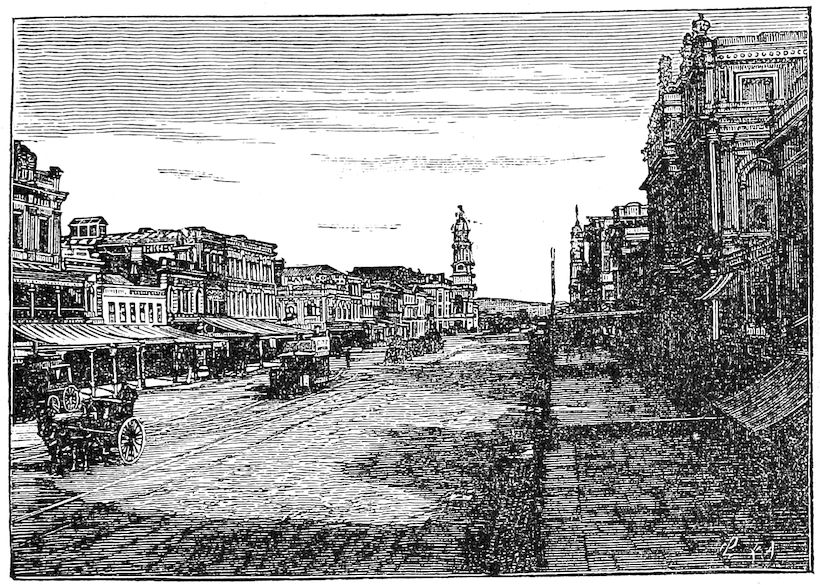
FLINDERS STREET, ADELAIDE.
What most interested me here was the Botanical Garden,
which I visited the same day. The weather was splendid,
the rays of the sun were reflected in large ponds, where the
water-fowl were swimming among papyrus and Babylonian
weeping-willows. The parrots chattered in their cages, and
displayed their brilliant plumage; the birds sang in the
cultivated bushes of the garden, and the frogs croaked with
that harsh, strong note, which seems especially developed in
tropical lands. There was a life, a throng, an assemblage of
dazzling colours, which could not but make a deep impression
on a person whose eyes for a hundred days had seen nothing
but sky and water.
This fine garden contains forty-five acres, and is excellently
managed by Dr. R. Schomburgk, celebrated for his
travels in British Guiana. In the “palm-house,” built of glass
and iron, are found tropical plants. The most beautiful and
most imposing part of the park is the so-called garden of
roses, a large square enclosure surrounded by garlands of
tastefully-arranged climbing roses. Here is an abundance
of varieties, beginning with the tallest rose-bushes and ending
with the smallest dwarf-roses, and the colours vary from the
most dazzling white to the darkest red or almost black.
4
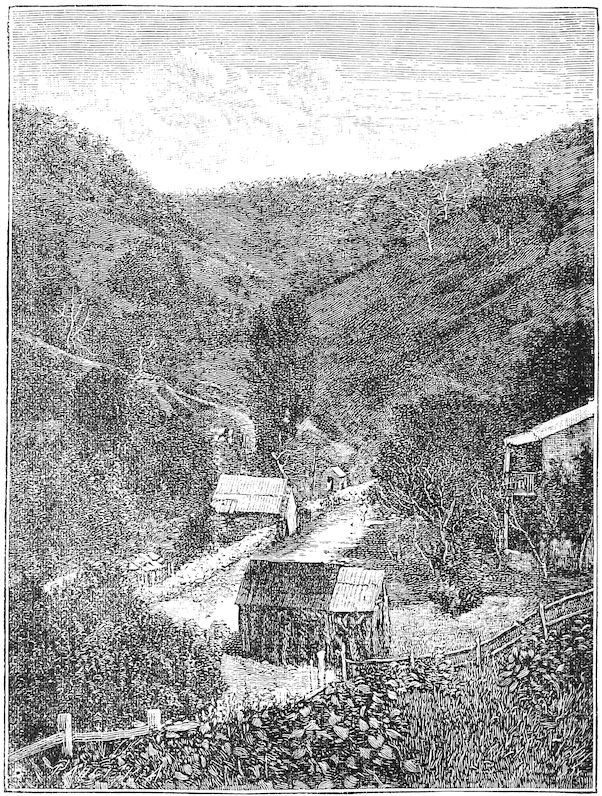
VIEW NEAR ADELAIDE.
Among the trees familiar to me in this park were an
alder and a birch. They stood very modestly, just putting
forth their leaves in company with grand magnolias in
blossom, elegant araucarias, and magnificent weeping-willows.
The hot-houses near the superintendent’s dwelling were
admirable, and presented a wealth of the greatest variety of
flowers from all parts of the world, but mainly from Australia.
5Some groups of fine bamboo particularly attracted my
attention. The park is visited by several thousand people
every Sunday afternoon.
Adelaide, containing about 60,000 inhabitants, is a very
regularly laid out city. All the streets cross one another at
right angles, and are very broad. Along the gutters railings
are placed, to which people may hitch their horses. Even
servants go to market on horseback with baskets on their
arms.
The residences are constructed in a very practical manner,
suited to the demands of the climate, with verandahs and
beautiful gardens. In many parts of the city there are
public reading-rooms, where the latest newspapers may be
found. In the forenoon these reading-rooms are always full
of people, particularly of the working classes.
The city cannot fail to make a favourable impression
upon the traveller. It is cleanly and elegant, corresponding
to its feminine name Adelaide. The inhabitants are unusually
amiable, and they are renowned for their hospitality,
and this is saying a great deal in so hospitable a land as
Australia.
From Adelaide to Melbourne is a three days’ journey,
and early one morning I went on board a steamer bound
for this port. Once there we immediately perceive that we
have come to a metropolis, for the flags of all nations are
unfurled to the breeze in its harbour.
The International Exhibition was to be opened in a few
weeks, and in the distance we could already see the great
cupola of the building looming up above the rest of the city.
Great clouds of dust appeared in the streets, giving us an
idea of Melbourne’s dry climate. After a slow voyage up
the shallow Yarra river, during which we actually stuck in
the mud once or twice, we finally landed at the wharf.
Melbourne with its suburbs has only 300,000 inhabitants,
but has the appearance of being much larger on
account of its broad and straight streets and its numerous
parks and magnificent public buildings.
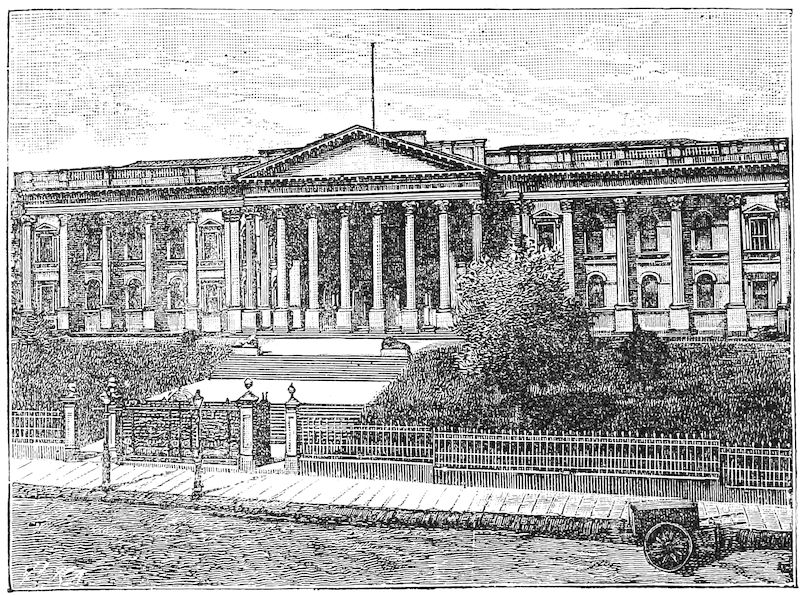
The first building attracting our attention is the Library,
a noble structure in classical style, but the first thing the
inhabitants want the stranger to notice is the Post Office and
6Town Hall. The question is being perpetually asked:
“Have you seen the Town Hall and the Post Office?”
The Assembly Room in the Town Hall contains one of the
largest organs in the world; it has 4373 pipes.
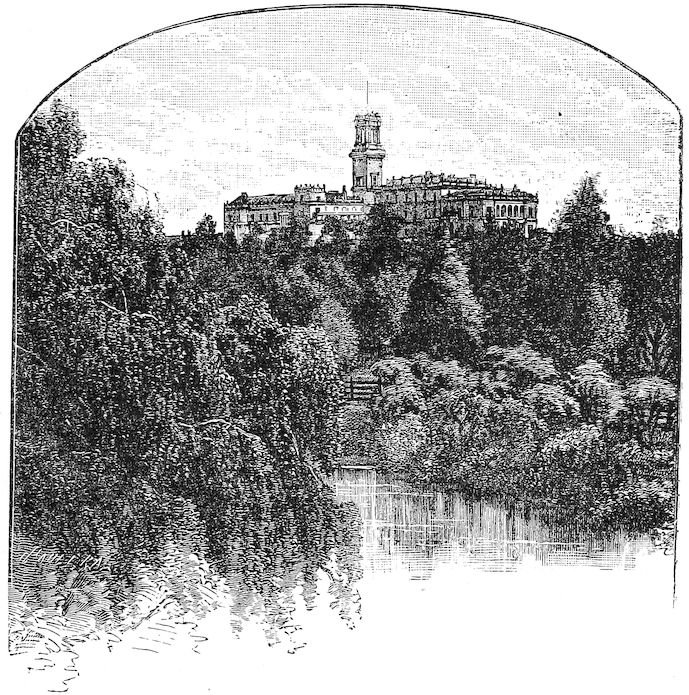
The residence of the Governor occupies a commanding
height, and is surrounded by a large park, which is directly
connected with the Botanical Garden.
THE LIBRARY, MELBOURNE.
The University, which is attended by about 400 students,
has, since 1880, been open to women, who are now admitted
to all the courses except medicine! It possesses a large
museum, where the animals are in part set up in groups
representing scenes from their daily life, a most instructive
arrangement. Here can also be seen a fossilised egg of
the extinct gigantic bird from Madagascar, the Æpyornis
maximus.
The city contains a number of magnificent churches,
hospitals, and benevolent institutions. The streets are large,
wide, and have immense gutters. It has been well said by
an author that Melbourne is London seen through the small
end of the telescope.
7People seem to be very busy, and move through the
streets with great rapidity. Melbourne is a city of enjoyments
and luxuries, equipped with great elegance and
comfort; everything suggests money and the power of
wealth. There is no article of luxury which is not to be
found here, from Norwegian herring to champagne in every
degree of dryness.
THE GOVERNOR’S HOUSE, MELBOURNE.
Among sports, horse-racing ranks first, and not a
week passes without one or more races on the celebrated
Flemmington racecourse, near the city, taking place. Every
year, in the beginning of November, about 120,000 people
come together to witness the great Melbourne Cup race,
where fortunes are lost and won.
The whites born in Australia are gradually becoming a
distinct race, differing from other Englishmen. They have a
more lively temperament, and are slighter in frame, but tall,
8erect, and muscular. I also observed in Queensland that
some of the children had a tendency to the American twang.
The Australians pay great attention to travellers visiting
their country, and they are very proud of showing its
attractions. Thus a stranger may, as a rule, count on
getting a free pass on all the railroads. The ladies are free
and easy in their manners. They are frank and confiding,
and their acquaintance is quickly made. Their friendship,
once gained, may be relied on, and they are untiring in their
acts of kindness.
In no other place in the world do the labouring classes
have as much influence as in Victoria; for the working men
in fact govern the colony. As a rule, they are well educated,
and keep abreast of the times, but still their administration
of affairs has not always been successful. The economical
condition of the labouring classes in Melbourne is excellent,
but they are rather fond of intoxicating drinks. I am able
to give an example, showing how the people of Australia
keep themselves informed on public questions. I once spoke
to a labourer whom I met on the street in Melbourne, and
as he noticed that I was a stranger, he asked me where my
home was. When he learned that I came from Norway, he
exclaimed: “Oh, we know Norway very well, and the
Norwegian scheme!” He then explained this to me as
best he could. I afterwards learned that Victoria, in 1874,
was on the point of adopting a parliament like the Norwegian,
with one chamber which divides itself into two
bodies (the odelsthing and lagthing), a proposition which was
on the point of being carried.
The climate of Melbourne is not particularly warm,
though during the summer excessively hot winds from the
interior of the continent may blow for a few days, and
not infrequently children die from the heat at this time.
The sudden changes of temperature, peculiar to the southern
part of Australia, also annually demand their victims, though
upon the whole the climate must be regarded as very
healthy.
Before leaving Melbourne I made several excursions far
into the colony. On one of these I visited the celebrated
mining town Ballarat, the place which marks the first epoch
9in the history of Victoria, and of all Australia for that matter,
for it was the gold which especially drew the attention of the
world to the new continent.
Since 1851 the annual production of gold in Australia
has averaged ten million pounds sterling.
No traveller should neglect to view “the highest trees
in the world,” for it is easy to see them near Melbourne.
Eucalyptus amygdalina grows, according to the famous botanist
Baron F. v. Mueller, to a greater height than the Wellingtonia
sequoia of California. Trees have been measured more
than 450 feet high. Though these gum-trees are without
comparison the highest in the world, they must yield the
place of honour in regard to beauty and wealth of foliage.
They send forth but a couple of solitary branches from
their lofty tops. Thus the Wellingtonia retains the crown
as the king of the vegetable kingdom. F. v. Mueller says
of Eucalyptus amygdalina: “It is a grand picture to see
a mass of enormously tall trees of this kind, with stems of
mast-like straightness and clear whiteness, so close together
in the forest as to allow them space only toward their
summit to send their scanty branches and sparse foliage to
the free light.”
At a sheep station about 100 miles from Melbourne I
made the acquaintance of two of the most common mammals
of Australia. One day I went out hunting with a son of
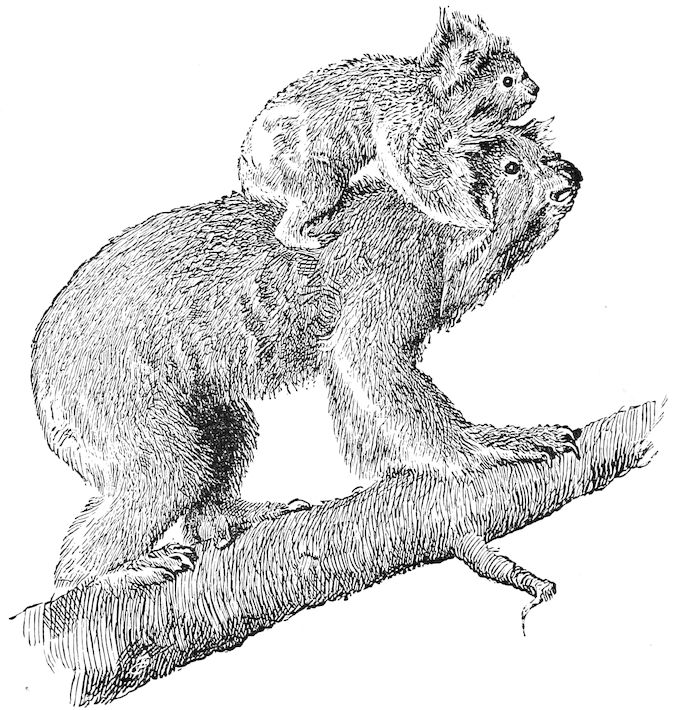
the friend that I was visiting. We learned that a koala
or native bear (Phascolarctus cinereus) was sitting on a tree
near the hut of a shepherd. Our way led us through a
large but not dense wood of leafless gum-trees. My companion
told me that the forest was dead, as a result of
“ring-barking.” To get the grass to grow better, the
settler removes a band of bark near the root of the
tree. In a country where cattle-raising is carried on to so
great an extent this may be very practical, but it certainly
does not beautify the landscape. The trees die at once
after this treatment, and it is a sad and repulsive sight to
see these withered giants as if in despair stretching their
white barkless branches towards the sky. When we came
to the spot, we found the bear asleep and perfectly calm
on a branch of a tree opposite the shepherd’s hut. One
10must not suppose that the Australian bear is a dangerous
animal. It is called “native bear,” but is in nowise
related to the bear family. It is an innocent and peaceful
marsupial, which is active only at night, and sluggishly
climbs the trees, eating leaves and sleeping during the whole
day. As soon as the young has left the pouch, the mother
carries it with her on her back.
NATIVE BEAR WITH ITS YOUNG.
We did not think it worth while to shoot the sleeping
animal, but sent a little boy up in the tree to bring it down.
He hit the bear on the head with a club and pushed it so
that it fell, taking care not to be scratched by its claws,
which are long and powerful.
The Australian bear is found in considerable numbers
throughout the eastern part of the continent, even within
the tropical circle. I discovered a new kind of tape-worm
which, strange to say, is found in this leaf-feeding animal.
HUNTING THE OPOSSUM.
11
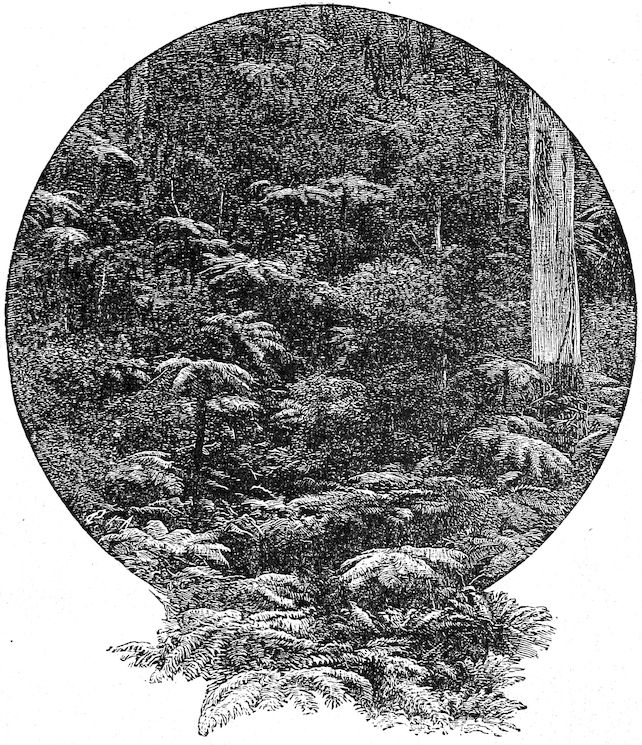
TREE-FERNS IN VICTORIA.
One day our dog put up a kangaroo-rat, which fled
to a hollow tree lying on the ground. When we examined
the tree it was found to contain another animal also, namely
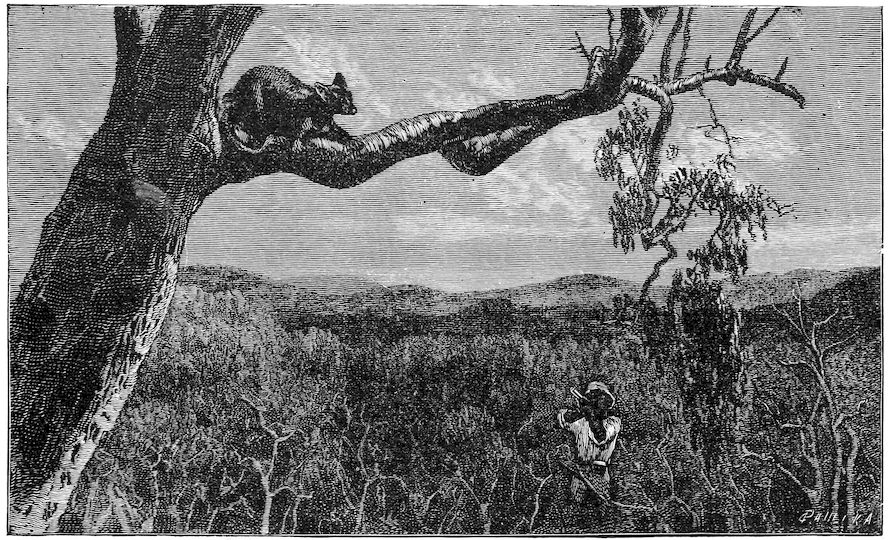
an opossum (Irichosurus vulpecula). It is one of the most
common mammals in Australia, and is of great service to
the natives, its flesh being eaten and its skin used for
clothes. The civilised world, too, has begun to appreciate
the value of this kind of fur, which is now exported in large
quantities to London. The natives kill the animal in the
daytime by dragging it out from the hollow trees where
it usually resides. Among the colonists the younger generation
are very zealous opossum hunters. They hunt them for
sport, going out by moonlight and watching the animal as it
goes among the trees to seek its food.
12I was now about to leave the capital of Victoria, a city
which cannot fail to be admired by the stranger. It is
indeed a remarkable fact that in the same place where fifty
years ago the shriek of the parrot blended with the noise of
the camp of the native Australian, an international exhibition
should be held in a metropolis. The first house was built
in Melbourne in 1835—the “World’s Fair” took place in
1880. It is not merely in jest that Melbourne is called “the
Queen of the South.”
CHAPTER II
13
Sydney harbour—Jealousy between Sydney and Melbourne—The Blue Mountains—Brisbane
and Rockhampton—First evening in tropical Australia—Gracemere
station—Animal and plant life—Vine-scrubs—Excursion into the
neighbouring districts—A Norseman who feels cold in Australia.
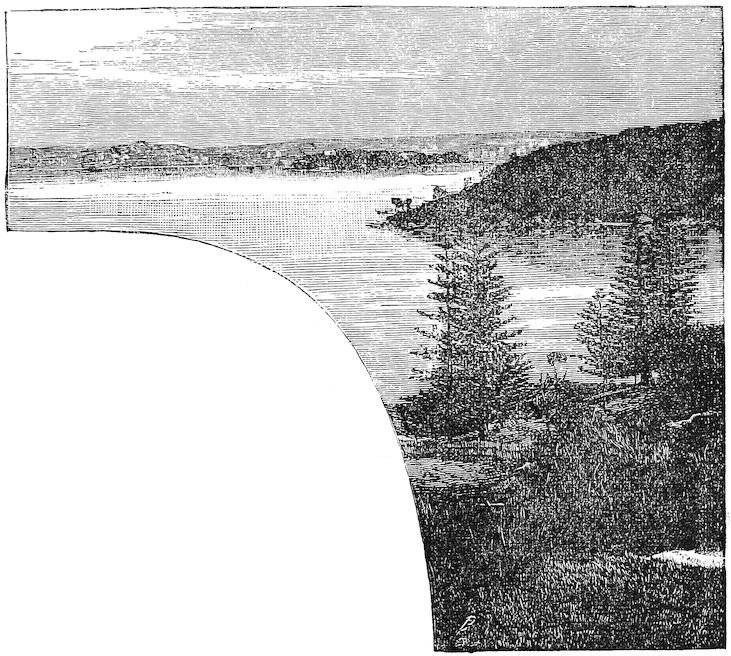
SYDNEY HARBOUR.
My next visit was to
Melbourne’s mother city,
Sydney, the oldest city of
Australia.
As is known, it was originally
a colony of criminals, but
when the wealth of Australia, its
gold and its rich pastures, were
discovered, the colony got a large
accession of all classes of society,
and before long transportation
ceased. The city is now very
aristocratic and has a more antique
appearance than Melbourne; the
streets are crooked and uneven; but there are several fine
buildings, which do not, however, attract the attention they
deserve on account of the unevenness of the ground. The
Museum is admirably situated, and its magnificent treasures
are well worth visiting. To our surprise we found it open on
14Sundays, while in the other towns in Australia, even the
smallest, the Sabbath is observed as strictly as in England.
Scientific investigation flourishes in Sydney, and several natural
history collections are owned by private individuals. The
museum of Mr. W. M‘Leay deserves special mention. It is
really wonderful. The city has reason to be proud of its
Botanical Garden, which extends down to the harbour, and
is for a great part washed by the sea. The climate is subtropical,
so that plants from the various zones grow side
by side. Thus I noticed Digitalis purpurea and the elm-tree
growing by the side of Ficus elastica and other tropical plants.
On the yellow water-lilies (Nuphar luteum) the sparrows
were singing as merrily as if this were their native land.
In Adelaide I was advised to say, when I came to
Melbourne, that Adelaide was a hole, and that no city in the
southern hemisphere could be compared with Melbourne, the
Queen of the South; but if I desired to keep on good terms
with the people of Sydney, I must take care not to praise
Melbourne. On the other hand, I was advised to praise
Sydney harbour as the finest in the world.
And it is truly a wonderful harbour. It is large enough
to hold all the fleets of the world, and its beauty reminds
one of the celebrated entrances to Rio and to Naples.
As the hotels of the city are not clean, and are supplied
with most impertinent servants, the visitor should try to secure
an introduction to one of the clubs, for there he is always
sure of being perfectly comfortable.
If a person comes from the busy and lively Melbourne, he
may find Sydney sleepy and lazy, but it must not be considered
a city of loafers. It is celebrated for its colossal wealth.
The lower class of the inhabitants seemed to me to be
inquisitive and greedy; the cultivated classes, on the other
hand, are engaging and hospitable, and make a most favourable
impression.
Between Melbourne and Sydney there is great rivalry.
“It is no exaggeration to say that New South Wales and
Victoria are no less rivals than Germany and France,” said
an Australian literary gentleman. How far he was right I
cannot say. Meanwhile the following circumstance shows
that the jealousy is very great. Immediately after Sydney, in
15the seventies, had had an international
exhibition, Melbourne
arranged a similar one, and
though the two colonies were
to be united by a railroad, the
two cities could not agree on
the width of the gauge, so
that we have to change trains
on the boundary.
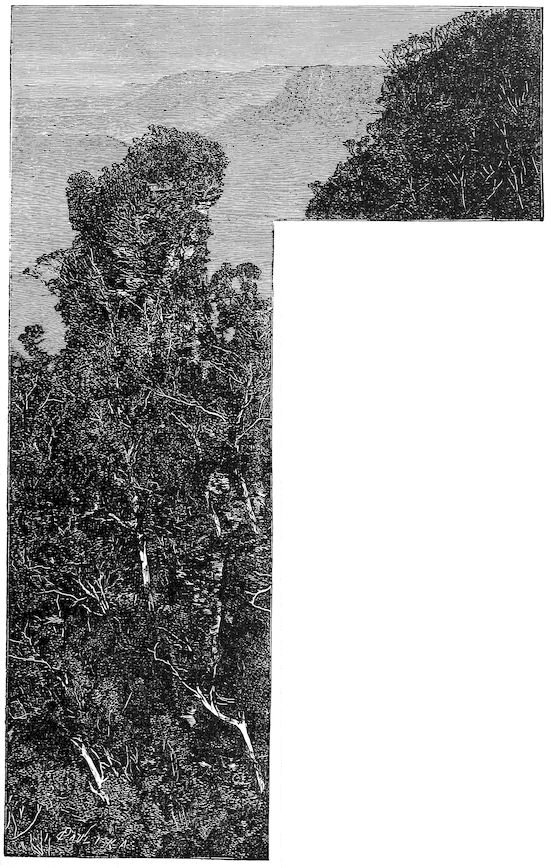
THE BLUE MOUNTAINS.
By railroad we can make
a very interesting excursion
to the Blue Mountains, where
the aristocracy have their
villas. The railway runs zigzag
up the mountains, and is
regarded as a masterpiece of
engineering, sometimes mounting
a gradient of 1 in 30. On
the way we get a splendid
view of the landscape. The
Parramatta river winds picturesquely
through the plain, and
is bordered on both sides by
thriving dark orange-groves.
The mountains, which are
covered with trees but are not
cultivated, consist of a series
of parallel ridges of the same
height, which are rent by deep ravines. One ridge rises beyond
the other until the last is lost in the blue distance.
16It is a journey of but little more than two days to
Brisbane, the capital of Queensland. Not long after passing
the boundaries of New South Wales, the southern entrance
of Moreton Bay is reached, a large and shallow body of
water not far from the city. When we neared the shore,
the sea broke over the long sand bars, which it was very
difficult to cross, but we soon afterwards found ourselves
in the calm water of the bay. The sun set as a blood-red
disc in tropical splendour. Immediately afterwards
the full moon rose and shone on the beautiful banks of
the Brisbane river, while we steamed slowly up between
the forests of mangroves.
We now approached the land in whose solitary regions I
was about to spend several years. I stood alone on deck in
the sultry night, and my thoughts naturally turned to this
strange country. What was I to find in Queensland? Was
I perhaps to leave my bones in this land, slain by the blacks,
bitten by a snake, or poisoned by malaria?
In Brisbane I met Mr. Archer, the Secretary of the
Treasury of Queensland. I had a letter of introduction
to him from the zoological professors of the University of
Christiania, and was invited by him to make my headquarters
on his estate near Rockhampton.
After a journey of two days we arrived at the mouth
of Fitzroy river. Like all the rivers of Queensland, it is
very shallow and not navigable for large vessels. This is
at present a great drawback to the maritime commerce of the
colony; but there are some good harbours, and efforts are
continually being made to remove obstacles by dredging.
Passengers and baggage were now transferred to a
smaller steamboat, which carried us up the stream. The
left bank is flat and uninteresting; while a range of mountains
about 1400 feet high rises on the right bank. After
a few hours’ journey we pass a large establishment for
canning meat, in which solder alone for the tin cans amounts
to about £300 annually,—and then almost immediately
arrive at Rockhampton, the second city in the young colony,
containing about 9000 inhabitants. The first thing which
attracts attention on arrival is a remarkably fine suspension
bridge across the river.
17The town itself contains nothing remarkable; still a fine
hospital and a large school-building, both built on a hill just
behind the city, may be worthy of mention. Rockhampton
consists mainly of one-storied houses with verandahs. The
streets, as is the case in almost all Australian towns, have
awnings over the side-walks, a very wise provision against
the burning heat of the sun. Business is lively in the city,
which is of importance as the metropolis of a large extent
of territory whose products are marketed and exported here.
This is also the distributing point from which stations in the
western part of Queensland are supplied with all sorts of
articles of necessity and luxury. A railway extends nearly
300 miles to the west.
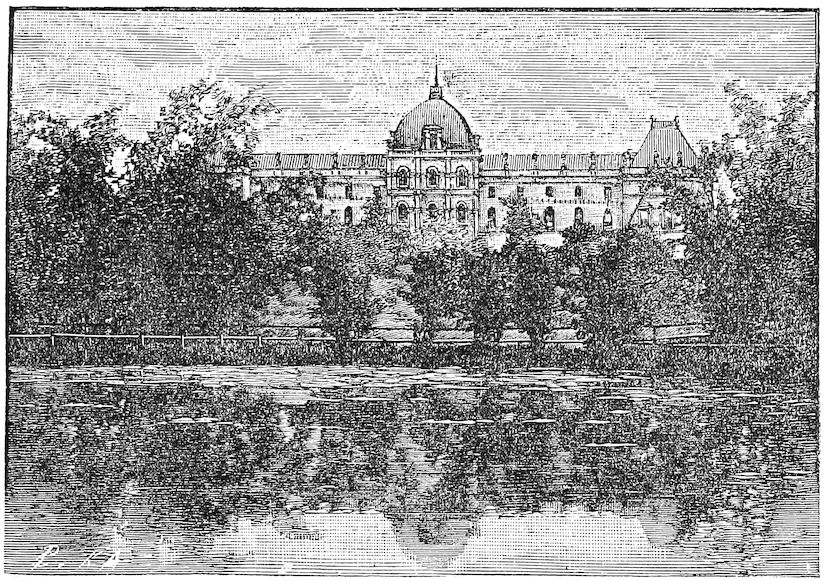
THE PARLIAMENT HOUSE, BRISBANE.
Like other Australian cities, Rockhampton of course has
its botanical gardens, which in time will be very fine.
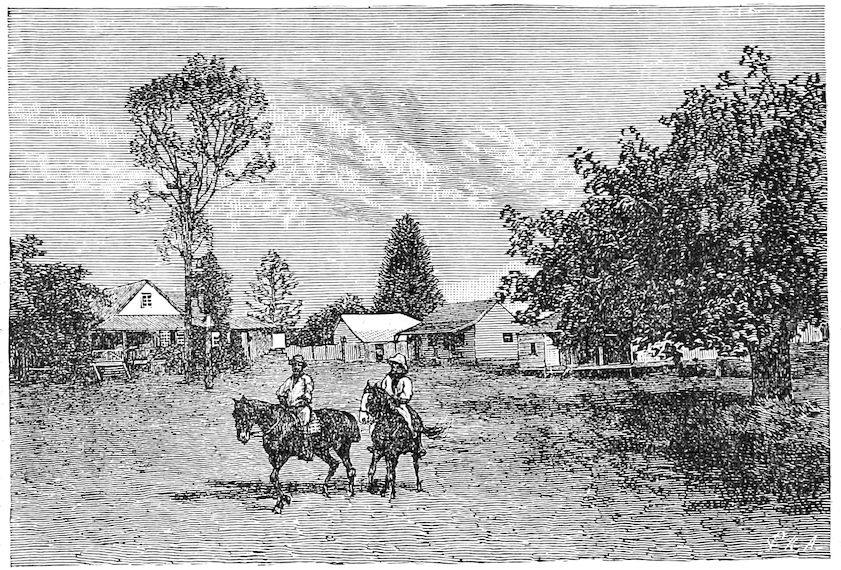
We at once drove to Gracemere, Messrs. Archer’s
cattle station, situated seven miles from the city. The
country was flat, monotonous, and swampy, but on approaching
the station the ground began to rise. On
reaching the highest point a wide view suddenly burst upon
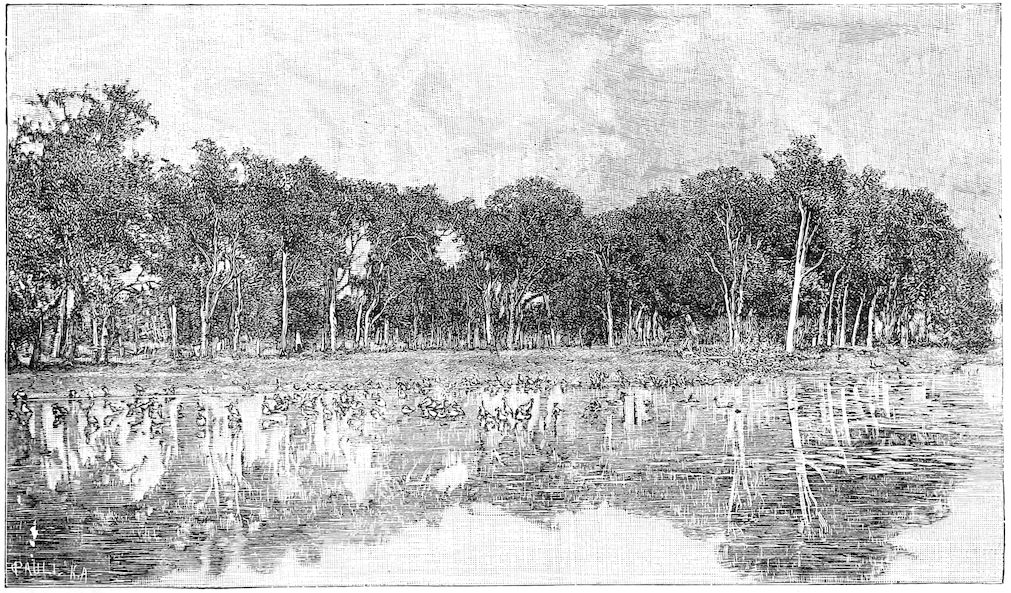
us. Before us lay a large lake sparkling in the last rays
18of the setting sun, hundreds of birds swam on its glassy
surface, and on the green shores was feeding a large flock of
geese, which hissed and took flight as we passed. On a
promontory extending far out into the lake was the station,
which was to be my home for some time to come; with its
many houses it had the appearance from the distance of a
small village.
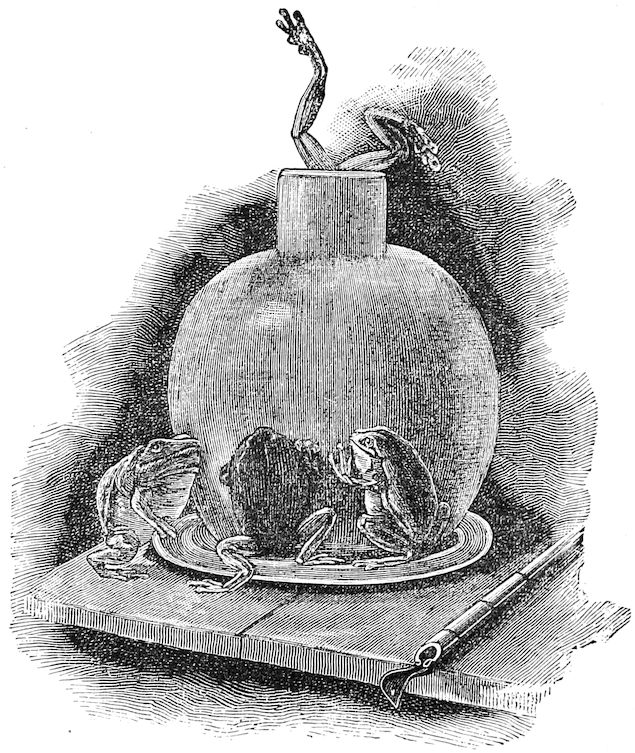
FROGS (Hyla cærulea) ENTERING A WATER-JAR.
We drove along a mighty hedge of cactus to the main
building, which lay on the extreme point of the land. The
bare timber walls did not impress me very favourably,
coming as I did from the luxury of Melbourne and Sydney,
but the spacious apartments and cool verandahs gave me a
hospitable greeting and looked cheerful and inviting.
When we had taken tea, Mr. Archer brought out his
microscope in order to let me examine some insects, thousands
19of which were swarming about the lamp. But white
ants had taken possession of the case, so that the microscope
was unfit for use. These insects are a great nuisance
throughout Queensland, and precautions must always be
taken against them when a house is built. It was a strange
life which I now experienced for the first time in the
Australian “bush.” The summer heat was oppressive in
the pitchy darkness of a November evening, though now
and then lighted up by flashes of lightning. The insects
gathered in great numbers on the ceiling, and blinded by the
lamplight they fell in such thick layers on the table that it
was not possible to read. Bats fluttered in and out through the
open windows and doors. Not only on the floor, but, incredible
as it may seem, even in the water-jar, the frogs croaked
merrily and often so loudly as to interfere with conversation.
I, however, soon felt perfectly comfortable at the station,
where I spent seven pleasant months of summer and winter,
busily engaged in my new and rich field of activity. A
small house was given me as my working-room, and it was
so arranged as to serve as a safe repository for my collections.
My European summer clothes soon became too warm
for me, and the first thing I did was to secure the usual
Australian dress, which everybody wears who lives in the
bush. A light merino-wool shirt, having over this a coloured
cotton shirt open in the neck, with sleeves rolled up to the
elbows, trousers of heavy white cotton cloth called moleskin,
white cotton socks, shoes, a broad-brimmed felt hat
with the brim turned down, constitute the dress of the
bushmen. This suit of clothes, which can be bought ready-made
at a low price anywhere in Australia, is neat and
cleanly and very convenient.
The region about Rockhampton is well known for its
warm and dry climate, 100° F. being quite frequent
during the summer months. Gracemere lies just far
enough within the tropical circle to permit us to speak
of tropical Australia; the heat is even greater here than
farther north in the more damp sea-climate, where the tradewind
blows. In the winter, hoar-frost is occasionally seen
on the ground, and now and then ice may form on a pool
of water. Thus it will be seen that the thermometer does
20not really go very low, but at such times the cold is felt so
intensely that it is a comfort to get near a fire.
The sky is almost always clear and cloudless; the air
is pure and transparent, especially in winter, when the
mountains have a very beautiful deep blue colour. In the
clear winter evenings after sunset the heavens often assume
a remarkable greenish hue.
GRACEMERE STATION.
It cannot be denied that there is something wearisome
and monotonous in a continuous summer—for there is
nothing but summer in the greater part of the land—yet
every one who rejoices in sunshine and warmth will be
contented in the climate of Queensland; it is doubtless
more salubrious than any other in the tropical world.
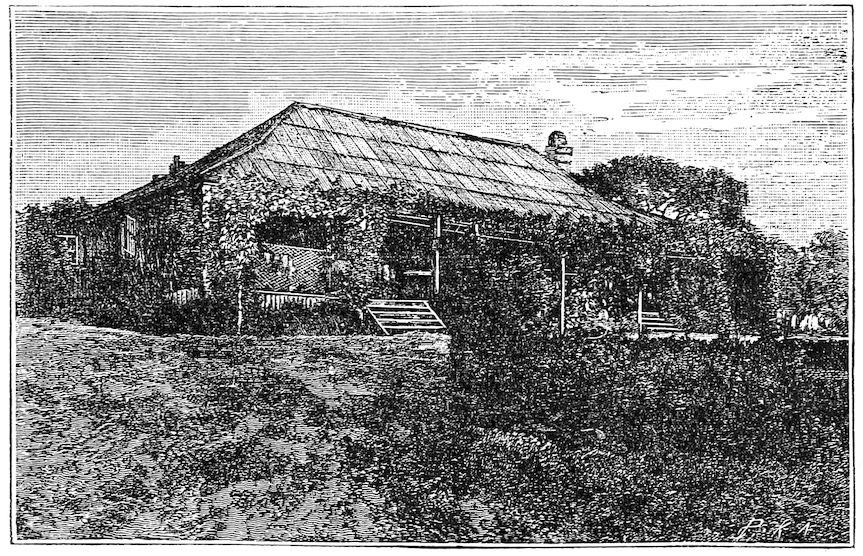
The principal building at the station, like all the other
houses, is almost entirely surrounded by a verandah, which is
enclosed in a remarkable manner by creeping fig-trees clinging
firmly to the posts. The roof is covered after the Australian
fashion with sheets of zinc, and large iron tanks are placed
at the corners of the house to catch the rain-water, for this is
almost universally used for drinking throughout Australia; it
is usually suspended on the verandah in canvas bags, which
exposes it to a rapid evaporation and makes it as cold as ice.
21Down towards the lake there is a very fine garden, where
orange-trees, vines, and the European fig-tree grow side by
side with the pine-apple and the mango of the tropical zone.
In the winter, stocks, recedas, and asters flourish very well,
but the summer is too warm for them. Pelargonium and
calladium glow in brilliant colours.
THE MAIN BUILDING, GRACEMERE STATION.
The other most conspicuous trees in the garden are
the magnificent Madagascar Poinciana regia, tamarind, the
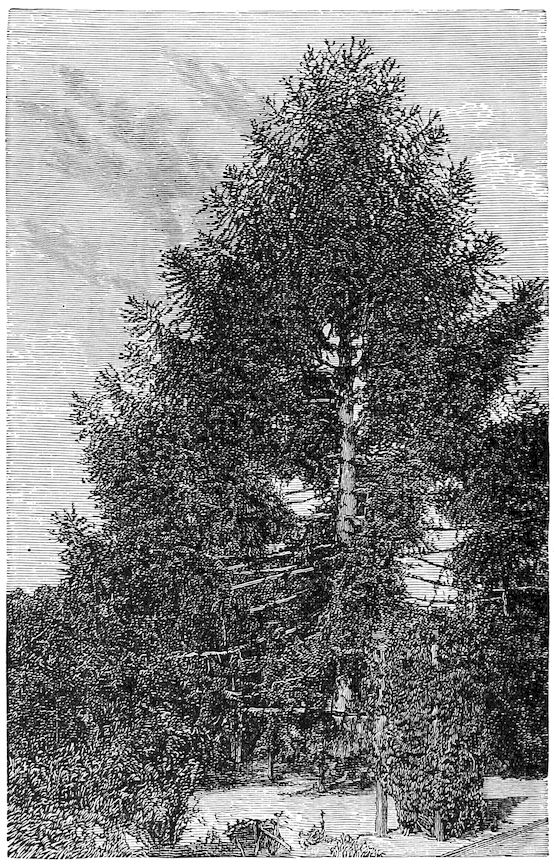
Brazilian jacaranda, and several sorts of Australian spruce,
especially a beautiful specimen of bunya-bunya (Araucaria
bidwillii). This grand tree grows only in a limited territory
from Darling Downs north to Burnett river, and is protected
by the Government for the sake of the aborigines, who
collect the huge cones and use the seeds for food.
Cocoa-nut and date-palms delight the eye, but do not
bear good fruit, although the reason is not apparent.
Near the lake the celebrated Egyptian papyrus has been
planted in large quantities, and forms a perfect grove. A
little singer, the Acrocephalus australis, has made his home
in this papyrus grove, where several pairs are nesting. It
sings in the evening and in the night, and is considered to
22be Australia’s best song-bird. The lake, or lagoon as it is
called here, is a little more than a mile long and half a mile
wide, and is the resort of a great number of water-fowls.
In the winter more than 400 pelicans are seen here, but in
the middle of the summer most of them depart.
The pelicans do the most of their fishing in the night,
and together. The noise they make with the splashing of
their wings while thus occupied sounds something like that
of a paddle-wheel steamer in motion. Occasionally I could
see them rise, apparently without moving their wings, in a
spiral direction, higher and higher, until they disappeared
from sight. It seemed as if they did it only for amusement
or for the purpose of enjoying the sunshine. When
they return, they come down so swiftly that a sough is heard
in the air.
A few black swans (Cygnus atratus) are seen now and
then. In November I frequently heard them sing on the
water in the evening. Ducks and geese abound, and so do
gray and blue cranes, cormorants, and snake-birds (Plotus).
Not many years ago Mr. A. Archer counted thirty-seven
kinds of birds on the lagoon. And still the birds are few
now, both as to numbers and species, as compared with what
they were twenty years ago. The cattle have eaten the tall
grass and the weeds growing in the shallow water near the
shores of the lake, where thousands of birds found their
homes. Even black swans made their nests here. Mr.
Archer believes that a few years ago there were more than
10,000 birds on this lake. If a gun was fired, the birds
rose with a noise like distant thunder.
The most striking bird on the lagoon is doubtless the
beautiful Parra gallinacea, which in Australia is called the
lotus-bird. It sits on leaves that float on the water,
particularly those of the water-lily. Blue water-lilies are
found in great numbers along the edge of the lagoon,
and hence the lotus-bird is very common here. It is somewhat
larger than a thrush, and has very long legs, and
particularly highly developed toes, which enable it to walk
about on the floating leaves. Its food consists chiefly of
snails and insects, which it usually finds by turning the
lily leaf. Its simple nest is also built on the leaves.
23The eggs, which are a beautiful brown with lines and
spots, are considered very rare, and are remarkable both on
account of their form and colour. They look, says Gould,
as though they were drawn by a man who had amused himself
by covering the surface with fantastic lines. The young
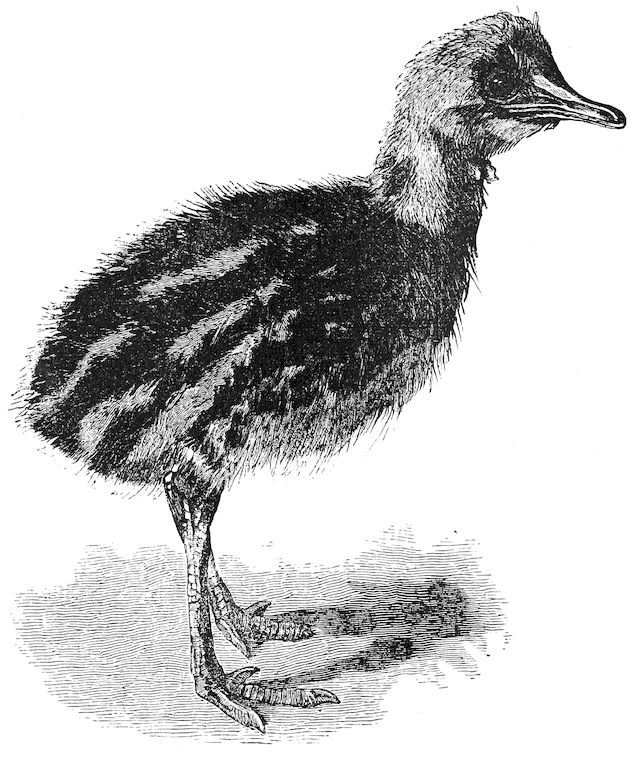
look very funny on account of their long legs and big toes
as compared with their small bodies.
The grown bird is not shy, but the young are extremely
timid. I had once or twice seen the old birds with young,
but as soon as I approached them, the young always disappeared,
while the old birds walked about fearlessly, as if there
was no danger. It long remained a mystery to me, how
they could conceal themselves so well and so long, but one
day the problem was solved. An old bird came walking
with two young ones near shore. I hid behind a tree and
let them come close to me. As I suddenly made my appearance,
the small ones dived under the water and held themselves
fast to the bottom, while I watched them for a quarter
of an hour, before taking them up.
There are large quantities of fish in the lagoon, several
varieties of perch, eel, and a kind of pike with a very long snout
(the gar-fish). But the fresh-water mullet (Mugil) is particularly
abundant: it has a remarkable power of leaping out of
the water, and in so doing it frequently comes unawares up
into the boat and is caught. When the lagoon, on account
of long-continued drought, is very low, you can always be
sure while bathing of coming in contact with some kind of
fish, which sometimes flies over your head.
Gracemere was originally a sheep station, but latterly the
sheep have entirely given place to cattle on the whole coast.
This change is partly due to the climate, which is too moist,
and partly to a nocuous kind of grass, namely the dreaded
spear-grass (Andropogon contortus), which grows on the coast,
and which rendered sheep-raising impossible. It stuck fast
in the wool of the sheep, or worked itself into their very
bodies and killed them. For this reason Gracemere is now
exclusively a cattle station. The sheep were about 350 miles
farther west.
As a curiosity it may be mentioned that in the vicinity
of Gracemere I saw the Phragmites communis, so well known
24in Norway, probably the only plant which the Norwegian
and Queensland floras have in common.
As Messrs. Archer are naturalised Norwegians from
Scotland, it may perhaps be interesting to learn that they
were the first white men who occupied the spot where
Rockhampton now is situated. They have also given Norse
names to several localities in the vicinity, as for instance
Mount Berserker and Mount Sleipner. The run of their
station was at first fifty miles long and twenty miles wide.
But gradually, as the country became settled, the “squatters”
were not permitted to retain these larger pastures, which
they do not themselves own, but occupy by paying rent
to the Government. Hence the area of the station very
soon became reduced, when the land, owing to the increase
of population, was offered for sale. This is usually
the case with all new land in Australia. First comes
the large sheep and cattle-owner—the squatter—who
often lays claim to immense territory. Later he must
give place to the smaller selectors, who as a rule cultivate
the soil. The squatter is, however, allowed to purchase a
certain part of the land for his own possession and use.
This the Archers had done. On the run there were at this
time only 4000 head of cattle, but they were all of pure
pedigree. They had recently brought from Melbourne a
bull nine months old for which they had paid £315. It is
for the sake of the beef and not for milk that so much stress
is laid upon the blood of cattle in Australia.
IN THE NEIGHBOURHOOD OF ROCKHAMPTON.
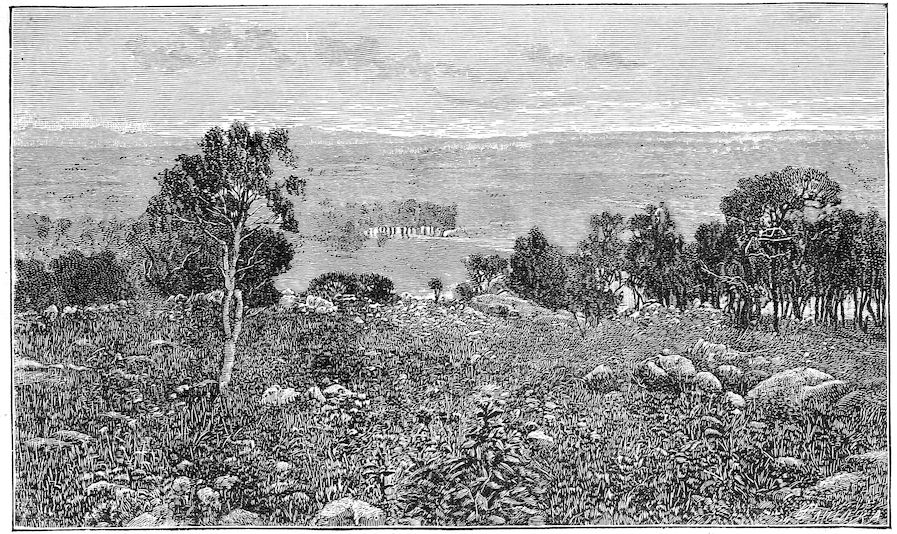
25The vicinity around Rockhampton and Gracemere
furnishes considerable variety both of flora and of fauna.
The country is hilly, and well watered with small lakes and
streams. Along the streams vine-scrubs often abound. The
gum-tree (Eucalyptus), so characteristic of Australia, also
marks the woodlands here, and appears in greater variety
than is generally seen in so limited a territory. The gum-trees
fit for lumber, Eucalyptus tereticornis and Eucalyptus
brachypoda, are very abundant in swampy places, along with
isolated groups of the well-known Melaleuca leucadendron,
called by the colonists tea-tree, from which is extracted what
is known in medicine as cajeput oil. The heights nearest
the station are particularly well covered with the tree
familiar to the colonists as blood-wood (Eucalyptus terminalis),
besides a great many other trees of the same family. A few
varieties of acacia, e.g., A. bidwillii and A. salicina, are found
where the hills are drier. On the plains box-tree (Eucalyptus
polyanthemos) predominates. In a circle of fifteen miles about
Rockhampton there are found so many useful trees that
the number of species is about one-third of all the useful
trees in the colony. Although many of these have great
value as strong and solid timber, still they fall far short of
being utilised as they deserve. The colonists use the most
valuable wood for ordinary purposes, as for building houses
and fences. In a tree like Tristiana suaveolens may be
found a remarkably fine material for work under water,
while the Eucalyptus robusta furnishes the best mahogany
that can be desired.
Various parasites and epiphytes are found in great
numbers in the woodlands, as for instance the Ficus platypoda
and Ficus cunninghamii, which grow on the large gum-trees.
They send their roots down from giddy heights, enclose the
tree, and at last destroy it.
Though the gum-trees usually give the Australian landscape
a monotonous appearance, the region about Rockhampton
is very beautiful and picturesque. The many
little lakes and the changing forms of the hills contribute
much to this result. On the lagoons float the beautiful blue
water-lilies; the rare and splendid Nelumbium speciosum is
also occasionally found.
But the greatest interest centres in the scrubs along the
little streams. In contrast with the woodland, where a
single kind of tree may prevail, we here find a multitude
of families, genera, and species, of which none predominates.
All are mixed together, but form more or less a harmonious
whole. The average colour of this scrub is usually dark
green, but in the edges we find a pleasing change into a
lighter green. Here we find the Bauhinia hookerii, with
its fine light-coloured leaves, and Capparis nobilis shines with
its large white flowers.
There are only a few ground-flowers, but a number of
creeping plants. The trees are festooned with climbing
plants such as Vitis climatidea and others. Vitis in great
26abundance and of many varieties are found especially in the
scrubs, hence the colonists call this kind of brush vine-scrub.
The charming Callistemon lanceolatum, which is common
in the scrubs along the Queensland streams, attracts
our attention on account of its rich scarlet flowers, the
more so since the total effect of a scrub is green and very
monotonous.
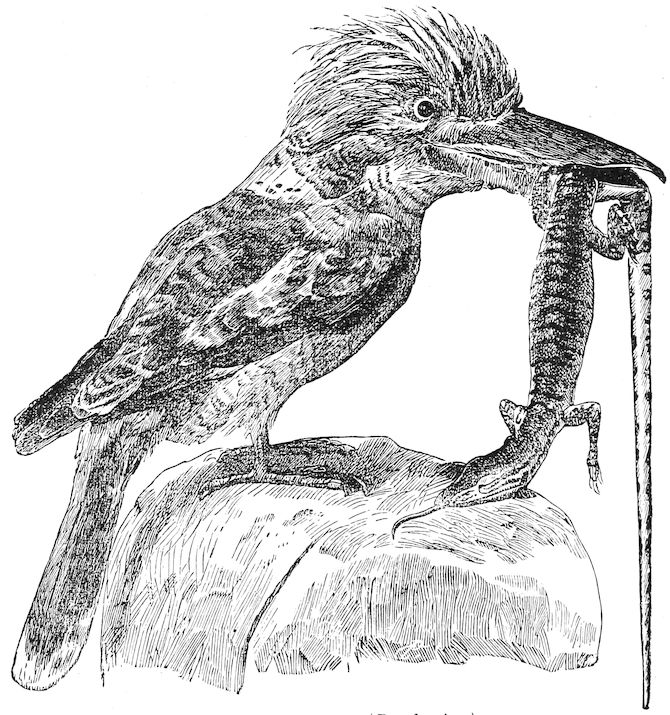
LAUGHING JACKASS (Dacelo gigas).
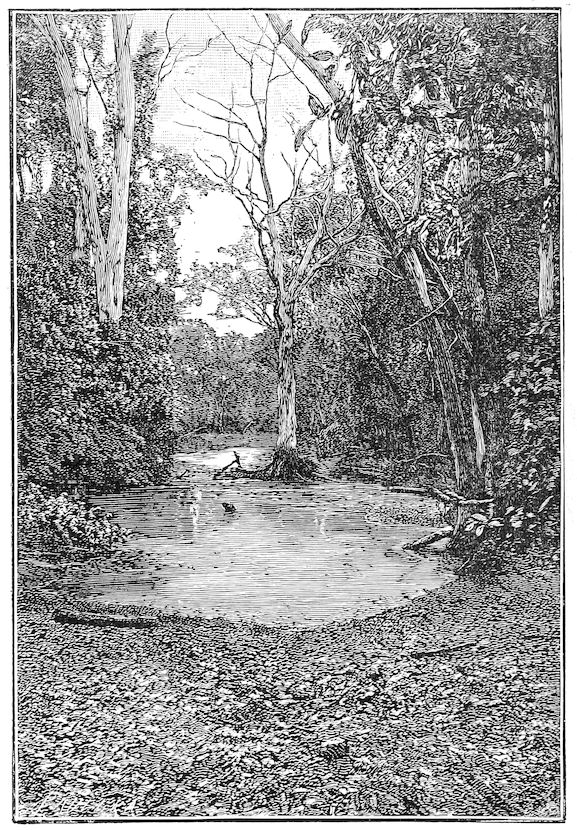
This does not however hinder us from finding beautiful
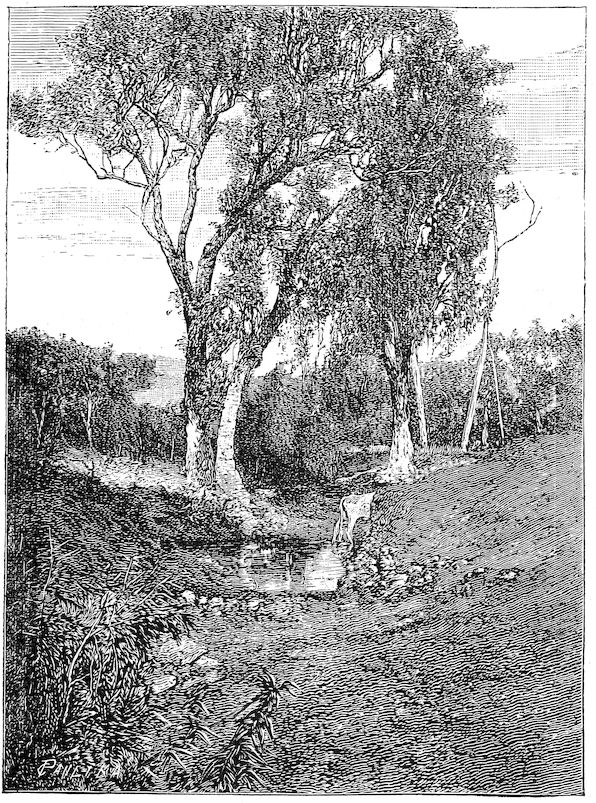
woody scenes along the streams, often indeed so charming
that we fancy ourselves transported to an ideal landscape.
It is not necessary to be a special lover of nature in order
to be captivated by the picturesque arches of the trees over
the winding stream, where the silence is broken only by the
shrill cry of the cockatoo or the tittering ha! ha! ha! ha!
of the laughing jackass. Suddenly, as we walk through the
vine-scrub, a lizard will throw itself down into the water with
a great splash to disturb a poor water-hen that has become
absorbed in its own meditations on the strand.
VINE-SCRUB NEAR GRACEMERE.
27Few of the birds of Australia have pleased me as much
as this curious laughing jackass, though it is both clumsy
and unattractive in colour. Far from deserving its name
jackass, it is on the contrary very wise and also very
courageous. It boldly attacks venomous snakes and large
lizards, and is consequently the friend of the colonist.
The animal life in these woods was of the greatest
interest to me, and every day I added to my collection
during the excursions I made in the vicinity of Gracemere.
In the scrub I shot a Pitta strepitans, which is very rare
in these parts, but common in Northern Queensland.
As the region around Rockhampton is comparatively
civilised, I could not look for any large number of mammals,
for they are the first to yield to civilisation. Those that live
in trees were still frequently to be found. The common
opossum abounded, and the hollow trunks of the gum-trees
generally served as abodes of the bandicoot, of the native
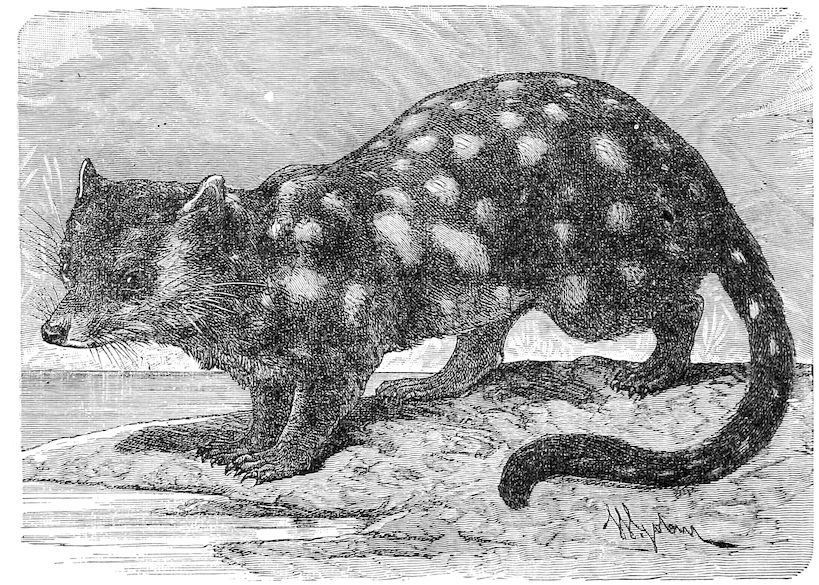
cat (Dasyurus), and of the kangaroo-rat.
It is very interesting to observe how a kind of “white
ant” make their nests. They build them high up in trees,
constructing tunnels along the stem of the tree to the ground.
If the tree leans, they always build the tunnels on the under
side, to avoid the opossum, which climbs on the upper
side.
My collections consisted chiefly of birds, fishes, and lower
animals, especially Coleoptera. I was fortunate enough to
discover a new fresh-water cod, the fish called black-fish by
the colonists. It is so little shy that it would even bite my
leg when I bathed. I at one time had an opportunity of
observing that it can live for nine hours out of water.
One of the largest land-snails of Australia, the Helix
cunninghamii, is found on the hills near the station.
My excursions extended not only to the immediate
vicinity of Gracemere, but I made journeys of investigation
to regions 200 miles away. Near Westwood, a little town
28about thirty miles from Rockhampton, I found for the first
time the so-called bower-birds (Chlamydodera maculata), a
family that has become celebrated on account of the bowers
which they build for their amusement.
These bowers, which must not be confounded with nests,
are used, as is well known, exclusively for amusement. They
are always found in small brushwood, never in the open field,
and in their immediate vicinity the bird collects a mass of
different kinds of objects, especially snail-shells, which are
laid in two heaps, one at each entrance, the one being much
larger than the other. There are frequently hundreds of
shells, about three hundred in one heap and fifty in the other.
There is also usually a handful of green berries partly inside
and partly outside of the bower; but like the empty shells
and the other things collected, they are simply for amusement.
Besides, these birds doubtless have the sense of beauty, as
is indicated by the variegated and glittering objects gathered.
This bower-bird has another remarkable quality, in its
wonderful power of imitating sounds. When it visits the
farms, where it commits great depredations in the gardens, it
soon learns to mew like a cat or to crow like a cock.
In the woods here I shot a young cuckoo (Eudynamis
flindersii), which was fed by four wood-swallows (Artamus
sordidus). One of the swallows fell to the same shot. The
three survivors swooped down toward the young cuckoo
several times, but they took no notice whatever of their dead
companion. I tried to approach the place, but the bold
birds kept flying against me, as if to prevent me from
proceeding, or to exhibit their wrath at what had happened.
I shot one more, and waited to see what would happen.
Both disappeared, but in the course of half an hour they
returned accompanied by two others.
On a farm outside the village I saw a large nocuous
insect, a moth which sucked the juice out of the oranges in
the garden. Every evening a war of extermination had to
be made against these animals, which are all the same very
beautiful. Farmers have many other foes in tropical
Australia. The large fruit-eating bat (Pteropus) does great
damage to the orchards, and it is no pleasant sight for the
industrious farmer to see the devouring swarms of these so-called flying-foxes advancing on his crops of an evening.
Were it not for these enemies, fruit-growing in Queensland
would be still more profitable than it is. An orange is no
cheaper in Australia than in Norway, and all kinds of fruit
are paid for in proportion.
TRUE AUSTRALIAN SCENERY.
29Nor is the European bee, introduced by the colonists,
permitted to live in peace in its new home. A kind of
moth attacks the larvæ and destroys them.
From Westwood I proceeded to Peak Downs. Outside
the village the landscape was enlivened by the rare sight of
flowers on the ground, the red blossoms of the Pimelea
hæmatostachya affording an agreeable change to the eye.
At Peak Downs, situated about 200 miles west of
Rockhampton, I received the first impression of genuine
native Australian scenery. Large plains, with here and there
an isolated gum-tree; extensive scrubs, and now and then
low mountain-ridges in the background; sometimes an
emu would appear, or a little flock of kangaroos that are
suddenly startled—all of which is so characteristic of the
country.
I was surprised at the great number of marsupials that
had their abode there. They had proved to be so troublesome
that several of the squatters had found it necessary to
surround their large pastures with fences so high that the
animals could not jump over them and consume the grass.
One of the sheep-owners told me that in the course of
eighteen months he had killed 64,000 of these animals,
especially wallabies (Macropus dorsalis) and kangaroo-rats
(Lagorchestes conspicillatus), and also many thousands of the
larger kangaroo (Macropus giganteus). The bodies of these
animals are left to lie and rot, for none but the natives will
eat the flesh; and although the skin of the large kangaroo
can be tanned into an excellent leather, still it does not pay
to skin the animal so far away from the coast. The only
part that is used occasionally is the tail, from which a fine
soup is produced.
The squatters at Peak Downs took great interest in my
work, and my first experience of Australian “bush-life” was
particularly agreeable. They placed their men at my disposal,
so that I had a splendid opportunity of adding to my
30collections. At the station where I was a guest, even one
of the ladies of the house offered me her assistance, and
once or twice she accompanied me when I went after emus
and kangaroos, which are easily approached when you
are driving in a buggy. My fair companion held the reins
while I did the shooting.
Emus are very inquisitive, and can therefore easily be
enticed within shooting range. Thus a man at Peak Downs
told me that he frequently had attracted their attention by
lying on his back and kicking his feet in the air. When
the animals came near enough he shot them.
In the winter I made an excursion to Calliungal, where
the inhabitants were surprised that I suffered so much from
the cold. As a joke they invited their nearest neighbours
to come and look at “a Norseman who felt cold in Australia.”
It was so cold in the nights that the pools were frozen
over, while the day was comparatively hot. On account
of the cold nights I, who was unaccustomed to this
climate, found it difficult to get woollen blankets enough
for my bed.
In the Dee river, which flows by Calliungal, I observed
several times the remarkable Platypus (Ornithorhynchus
anatinus) swimming rapidly about after the small water
insects and vegetable particles which constitute its food.
It shows only a part of its back above water, and is so quick
in its movements that it frequently dives under water before
the shot can reach it.
CHAPTER III
31
Journey to Western Queensland—Camping out—Damper (Australian bread)—The
song of the magpie—Australian scrubs—Hunting the kangaroo—Devotion
of parrots—Station life—Lonely shepherds—Migration of rats—Native
justice—Australian fleas—Native mounted police—A remarkable
flint instrument—The boomerang.
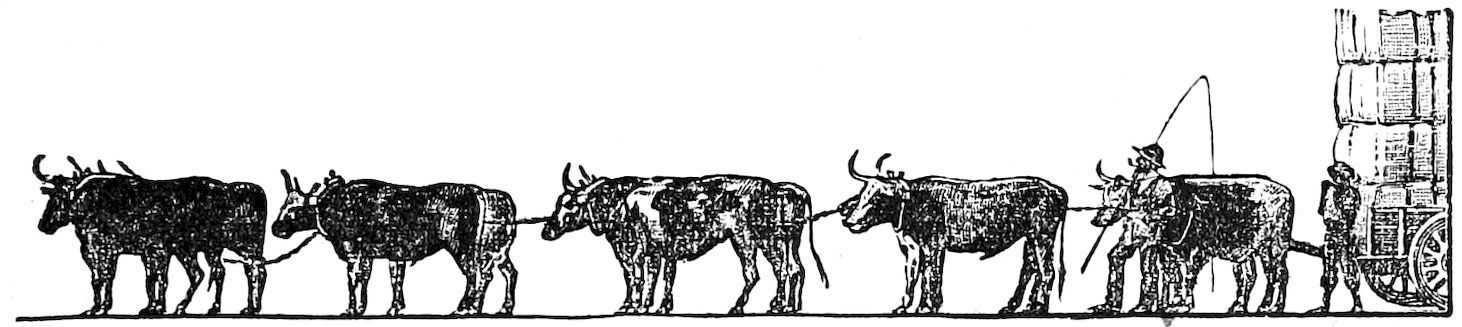
A WOOL-WAGGON.
In the beginning of July I prepared myself for a long journey
to the west. I first despatched several cases of things
collected to Christiania, and then proceeded on my journey
in company with a man who was to bring provisions to
Minnie Downs, Messrs. Archer’s sheep station, about 350
miles west from Rockhampton.
I had long contemplated this journey, as Western Queensland
was in my imagination a veritable Eldorado for the
naturalist. So far as I knew, no zoologist had yet studied
the fauna of the far west. With my limited acquaintance
with Australian bush-life I was happy to get a companion;
he had a waggon drawn by three horses, so that
our day’s journey was comparatively short, which was a
great advantage to me. I thus had the opportunity of
making many digressions on the way, and of procuring many
animals, while my companion preceded me. The greater
part of the day I was occupied on my own account in
hunting and in preparing my game. In the course of the
afternoon I overtook the waggon, the track of which I was
always able to follow.
32At sunset we encamped for the night, and the horses
were let loose with their forefeet hobbled. We made a
large fire and prepared our supper, which, as is common in
the bush, consisted of salt beef and damper. The latter is the
name of a kind of bread made of wheat flour and water.
The dough is shaped into a flat, round cake, which is baked
in red-hot ashes. This bread looks very inviting, and
tastes very good, as long as it is fresh, but it soon becomes
hard and dry.
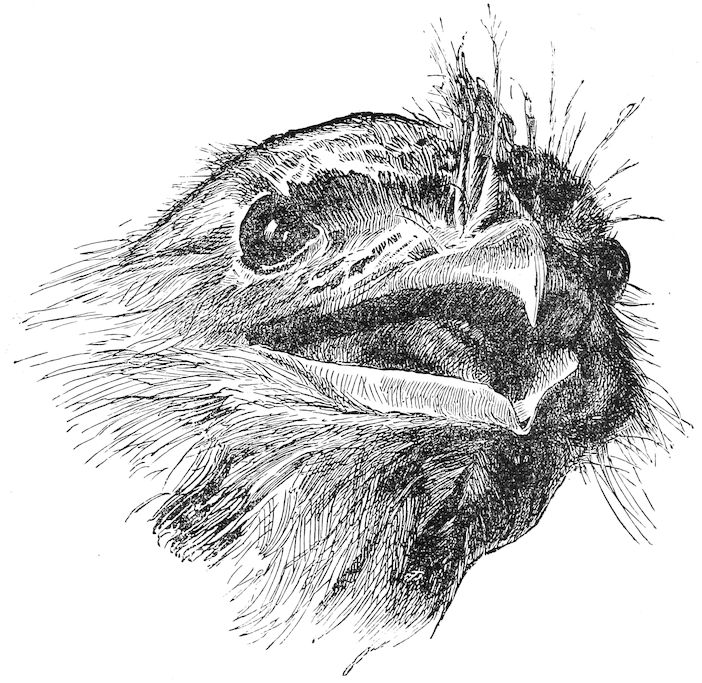
HEAD OF “MORE PORK” (Podargus cuvierii).
After supper we immediately made up our beds, which
consisted simply of a waterproof laid on the ground and
some woollen blankets. For the sake of convenience we
usually slept under the waggon with the fire before us.
Generally there is no other roof for the Australian traveller
than the sky, and this is, as a rule, quite sufficient in Western
33Queensland, where no dew falls except immediately after
the rainy season. On the coast it is, however, necessary to
be more prudent; if you do not sleep in a tent, you should
at least take care to have something over your head, so
as not to inhale the dew. A couple of boughs will often
answer—a precaution never taken by the careless bushmen.
How well one feels in this out-of-door life! When we
lie down to rest we are lulled to sleep by the melancholy,
sleep-inspiring, and not disagreeable voices of the night bird
Podargus—“more pork! more pork!”—and we are awakened
in the bracing morning air, before the sun is up, by the
wondrous melodious organ-tones of the Australian magpie
(Gymnorhina tibicen).
At Expedition Range we came to dense scrubs, the so-called
Brigalow-scrubs. The motley blending of plants which
characterises the scrubs of the sea-board is not found here.
The Brigalow (Acacia harpophylla) frequently occupies the
whole ground for miles around; the air is heavy and oppressive;
occasionally the gray monotony is broken by an
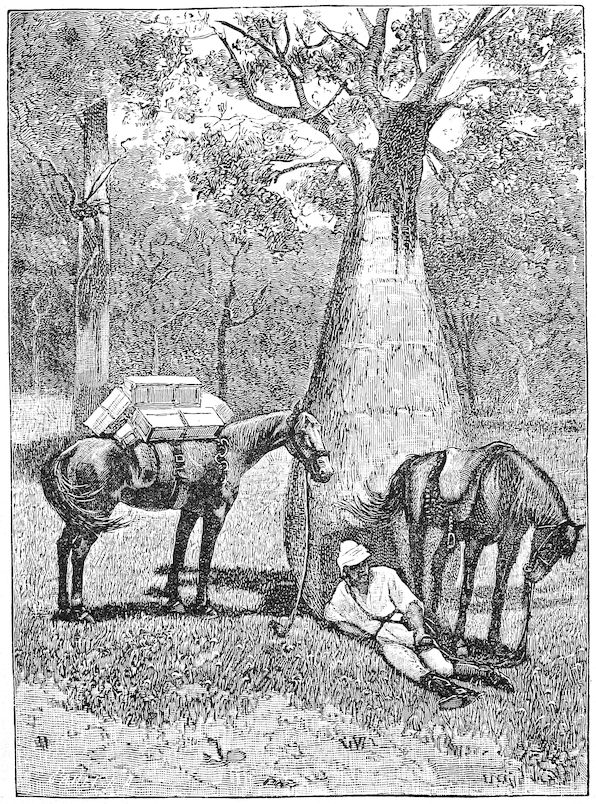
isolated bottle-tree (p. 55) (Sterculia rupestris), which derives
its name from the wonderful resemblance of the stem
to a bottle. The inner part of this tree is porous and
spongy, and therefore absorbs a great deal of moisture, a
fact of which the cattle-owner sometimes avails himself during
a prolonged drought. In a few places this damp wood,
which contains a great deal of starch, is used for fodder.
After journeying two or three days through this gray
wilderness, we crossed Comet river. Along its banks my
attention was drawn to a number of Casuarinas—those leafless,
dark trees which always make a sad impression on the
traveller; even a casual observer will notice the dull, depressing
sigh which comes from a grove of these trees when
there is the least breeze. Near Springsure I stopped a
day at a station, where I was invited to take part in a
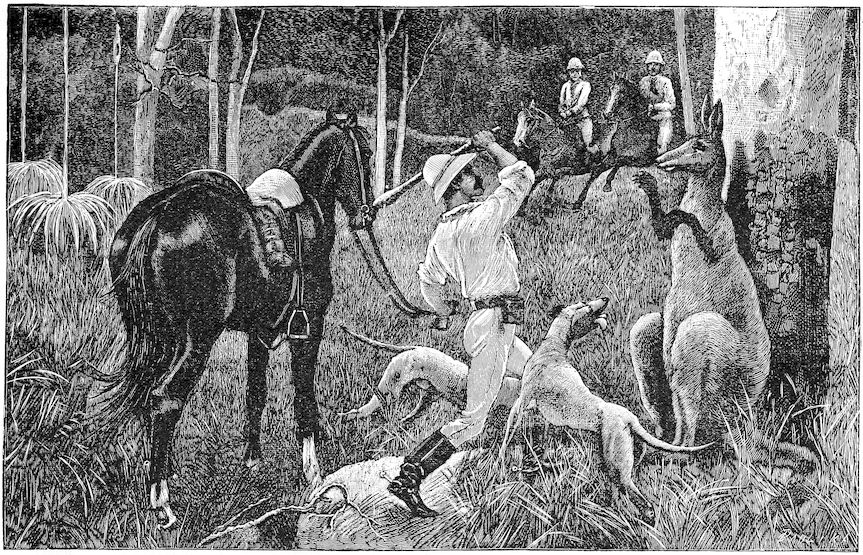
kangaroo hunt. There were several of us in the company,
all on horseback. Toward sunset we set out, for the animals
at that time go out to feed, and it was not long before we
caught sight of one of them. Our dogs, which were all
fine kangaroo hounds, were now let loose, and we galloped
after them as fast as our horses could carry us.
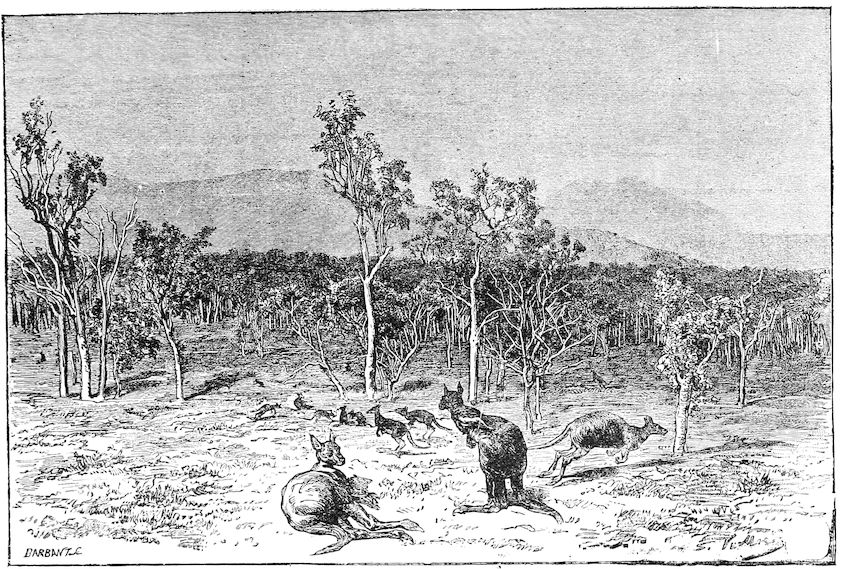
34The kangaroo jumps as quickly as a galloping horse, but
usually it gets tired soon, especially if it is an “old man,”
as the colonists say. He then places himself with his back
against the trunk of a tree and seeks to protect himself
from the dogs to the last. Woe be to the dog who comes
within reach of his paws! He seizes it with his arms,
and rips its belly open with his strong big toe. The dog
therefore takes good care not to come too near. Sometimes
the kangaroo takes refuge in a pool of water, and if the dog
is too intrusive, the kangaroo ducks it instinctively under
water, and holds it there till it is dead. The hunt proceeded
as rapidly as our fast horses could gallop, but it did
not take long before the kangaroo turned on the dogs in the
manner I have described. One of the hunters came up, dismounted,
and one or two powerful blows from his club put an
end to the animal. We killed six of them in this manner.
Not far from Nogoa river I overtook my travelling
companion. In this region I shot two specimens of the
beautiful parrot Platycercus pulcherrimus under the following
remarkable circumstances. An hour before sunset I left the
camp with my gun, and soon caught sight of a pair of
these parrots, a male and a female, that were walking
near an ant-hill eating grass-seed. After I had shot the
male, the female flew up into a neighbouring tree. I did not
at once go to pick up the dead bird—the fine scarlet feathers
of the lower part of its belly, which shone in the rays of the
setting sun, could easily be seen in the distance. Soon after
the female came flying down to her dead mate. With her beak
she repeatedly lifted the dead head up from the ground,
walked to and fro over the body, as if she would bring it
to life again; then she flew away, but immediately returned
with some dry straws of grass in her beak, and laid them
before the dead bird, evidently for the purpose of getting him
to eat the seed. As this too was in vain, she began again to
raise her mate’s head and to trample on his body, and finally
flew away to a tree just as darkness was coming on. I
approached the tree, and a shot put an end to the faithful
animal’s sorrow.
A KANGAROO HUNT.
35About 250 miles from the coast we passed the part of
the Great Dividing Range, which here forms the watershed
between Eastern and Western Queensland. In this part the
watershed consists of a low range. Nevertheless no one can
fail to observe the great difference in animal life on the two
sides as well as the immediate change in the character and
aspect of the country. No sooner is the range passed than
we meet with the red-breasted cockatoo (Cacatua roseicapilla),
which is never found on the eastern side.
From this time we were in Western Queensland, as it is
called, the great rich pasturage, where millions of sheep
wander about, and we were soon aware that we had come
within the confines of the squatters. One can scarcely
imagine a more characteristic picture of Australian bush-life
than the sight of a wool-waggon approaching from the
distance. Eighteen or twenty strong oxen in the scorching
heat, their tongues far out of their mouths, laboriously drag
a heavy waggon loaded with bales of wool. By the side of
the caravan walks the driver, sunburnt and dusty, with his
long whip in his hand. Under an awning on the top of
the load, which is as high as a house, the driver’s family
have their quarters, and a few sheep and goats follow behind.
Such a carrier makes his living by transporting wool
from stations in the far west to the coast, and also by bringing
back supplies. Thus he spends his life on the road from
one year’s end to another. He is himself the owner of both
oxen and waggon. If he has several of such teams and
also a wife, she usually drives one, plying her whip as
dexterously as any man.
Finally we meet the great flocks of sheep from Minnie
Downs, proof that we are now near this station, our goal.
The month I spent here gave me an excellent knowledge
of station life. The raising of cattle and sheep, the most
important industry of Australia, has more or less influence
on all kinds of business in that country. In the older
colonies the cattle and sheep farmers are also the owners
of the land where their herds and flocks graze, but in the
larger part of Queensland the pastures are rented from the
Government. These great cattle and sheep farmers are
called squatters, and they are the aristocracy of Australia.
If the squatter is a sheep-farmer, he not unfrequently has
200,000 sheep upon his station, while the cattle-farmer often
36owns 15,000 head. He does not hesitate to pay as high
as £2000 for a fine bull, or as high as £600 for a ram of
choice pedigree.
A station resembles a little village. Besides the main
building, which is the residence of the squatter or his superintendent,
there are a number of shanties for the workmen,
a butcher’s shop, a storehouse for wool, and a shop where
most of the necessaries of life may be bought. A garden of
vegetables may usually be found down by the water, for
there is always a creek or a water-hole near every station.
The garden is generally managed by skilful Chinamen, who
are, it is true, hated by all colonists (every Chinaman must
pay £30 for permission to settle in Queensland), but at the
same time are recognised as the most able gardeners. The
secret of their art is chiefly the untiring attention they give
to the plants, watering them early and late in sunshine and
even in rain.
The stock-yard is an enclosure indispensable to every
station. The cattle are driven into it when they are to be
captured, but it is usually occupied by the horses, which
are lodged there every morning so that the stock-man may
select his own animal. Most of the work on a station is
done on horseback, and one can hardly conceive of an
Australian unable to ride.
There is of course much work to be done on a station
having such extensive pasturage. The sheep cause the most
trouble. The transportation of the wool to the coast is very
expensive, and often costs more than the freight from the
coast to England. And yet sheep-raising may often give
a profit of as much as thirty per cent. The cattle are sent
alive to the cities to be slaughtered. Milk is scarcely used
at all in the bush. On a station containing about 10,000
head not more than three or four cows may be milked, as
the cattle are half wild and have to be tamed for milking
purposes. The chief stress is laid on the beef. What, then,
becomes of this immense quantity of beef? The greater
part is eaten in Australia, where the consumption is
enormous. More recently establishments have been built,
in which the beef is either canned or frozen for export.
Besides, considerable quantities are used for the production
37of tallow. In the neighbourhood of Rockhampton
there is an establishment where the carcasses of about
100,000 cattle and sheep are annually boiled down and
converted into tallow.
In Australia, wherever there are good pastures to be
found, the land is quickly taken up for the feeding of large
droves of cattle and flocks of sheep. First, the cattle consume
the coarse grass, then the sheep are turned into the pastures.
Distance is a matter of no consequence. It may require
months to bring the stock up to the new station, but no
place is so far away that there is any hesitation about forming
a station there, provided the pasturage is good. The
greatest difficulty with which the squatter has to contend is
the climate, for prolonged drought may completely ruin him.
I was now in one of the best grazing districts of Australia,
covered for hundreds of miles with the well-known Mitchell-grass
(Astrebla elymoides), which has a remarkable power of
withstanding the drought without losing its nourishing qualities.
In the vicinity of Minnie Downs there still were scrubs,
but farther west they became less abundant. These were
mainly Brigalow-scrubs, and near the station they occupy
large tracts of land. Here we also become acquainted
with a new kind of scrub, called by the colonists gidyascrub,
which manifests itself even at a distance by a very
characteristic but not agreeable odour, being especially
pungent after rain. The Australian inland scrubs give a
vivid impression of solitude and desolation, with their gray
or brown masses of stiff, often shadeless trees, which like a
sea undulate over barren plains and low hills. To ramble
in these woods, where all is dry and hot, and silent as
the grave, is no pleasure as it would be elsewhere. It is
very difficult to discover life in this woody wilderness, and
the monotony is rarely broken by the sight of a bird or
any other living thing. These scrubs, which sometimes
are of immense extent (for instance in South Australia
9000 square miles), are peculiar to Australia, and, as Mr.
Wood well says, are just as characteristic of the country as
the steppes of Tartary, the prairies of America, and the
deserts of Africa are of these respective countries.
In the great gidya and Brigalow-scrubs in the vicinity of
38the station I could not therefore expect to find any great
variety of animal life. Nor does it exist to any extent
in the open country generally. The Australian dog (dingo)
was formerly very numerous here and in all Western Queensland.
But as it is the sworn enemy of the squatters they
have begun to kill it, so that it is now in course of extermination.
On the large stations a man is kept whose sole
work it is to lay out poison for the dingo. The black variety
with white breast generally appears in Western Queensland
along with the red.
SPIDER PARALYSED BY A HORNET (natural size).
I frequently had occasion to observe the spiders, and
among them the large woolly Phrictis crassipes was found
in great numbers. It makes a hole 18 inches deep, and in
a slanting position, but the entrance is not supplied with
a trap-door, as is the case with the burrows of many other
spiders out here. I once saw a hornet (Mygnimia australasiæ)
proceed boldly into one of these holes, which I then immediately
closed. I dug to the bottom of the hole from
the side. There I saw the spider paralysed by the plucky
hornet, which was sitting on its back. I was anxious
to test the effect of the poison of this colossal spider,
and once let it bite the snout of a kitten, which thereupon
became very sick and vomited violently, but soon recovered.
39Another spider (Lathrodectus scelio), which is very common
here and everywhere in Queensland, is very dangerous even
to men. It is a small black animal, of the size of our
house-spider, with a brilliant scarlet mark on its back. A
friend of mine was bitten in the leg by one of these dangerous
spiders, which is feared like a snake. The pain was violent,
and was followed by paralysis which lasted for three days.
He was able to feel the venom work its way up the leg, pass
through the bowels, and descend down the other leg, whereupon
it ascended to the breast. But on the third day he
had a cold perspiration, and recovered.
This spider is found especially in old wood and rubbish,
but is also fond of staying in houses, keeping itself concealed
during the day and coming out at night. On my verandah
at Gracemere I could collect as many as I pleased, for they
are not at all timid.
I soon began to long for regions farther west, where the
fauna is more abundant, and continued my journey alone
with only two horses. As a rule there was a path which I
could follow. When no path was to be found, I proceeded
as best I could, and made my camp wherever night overtook
me. Every day I expected new scenes, but I was always
disappointed. It was the same over and over again; large,
gray plains covered with dry Mitchell-grass undulated
before me; here and there stood a solitary gum-tree,
especially on the banks of the rivers. Dwarf scrubs
were the only things that occasionally varied the landscape.
When I arrived at Barcoo river, I discovered to my surprise
only a dry river-bed with pools of water here and there,
instead of a veritable stream. Yet this is naturally explained
by the fact that the river owes its existence exclusively
to the rains, which is the case with the majority of the
Australian streams.
It seldom rains in Western Queensland; but during the
rainy season the rivers rapidly fill their beds, overflow their
banks, and in some places become several miles wide.
The water, however, soon disappears again, and the high temperature
reduces the mighty stream to isolated water-holes.
Water is therefore a precious article in the Australian
40bush. To furnish drink for the cattle the squatter must
build large dams, especially across the rivers, and thus
gather a supply which may protect him against irreparable
losses. In recent years water has been obtained by
boring very deep wells. I may here mention the fact that,
at the end of 1887, water was found in Barcaldine at a
depth of 691 feet by an artesian boring. It was clear
as crystal and perfectly fresh, but very warm, the temperature
being 101°F. Through a pipe 10 inches in diameter
it rose with such force that it formed a fountain above
the ground, and carried to the surface stones of the size
of emu eggs. The amount of water from this artesian
well is about 176,000 gallons per day.[1]
1. The artesian well at Blackall last year struck water at the depth of 1666
feet and gives 300,000 gallons per day, at a temperature of 119°. In other
places several borings have been successful at a slight depth.
The soil consists, as a rule, of a fertile, deep, and
chocolate-coloured deposit. Water is all that is wanted to
make a great deal of Western Queensland a large wheat-growing
country, and I feel sure, owing to the great success
artesian borings of late have had, that such a future is really
in store for this country. In the present circumstances it is
difficult to keep garden flowers alive.
In Western Queensland nobody is surprised if a drop
of rain does not fall for eight or ten months together.
Nevertheless, cattle and sheep keep fat all the year, for the
grass retains its nutriment even though it looks dry and
gray, and a shower will make these dry stalks green.
On the way to Thompson river I spent a night with
an Irish shepherd, who lived far away from any neighbour,
occupied wholly with his sheep. As a peculiar and
pedantic hermit, he preferred this solitary life, to which
he had accustomed himself for many years. He could not
bear any interruption in his habits, and with Australian
straightforwardness he did not hesitate to make it apparent
that all things in his neat little cottage must be kept in
their places. But if one adapted oneself to his habits, it
was not difficult to get on with him. He was, in fact, a
type of those old Australian shepherds who are rapidly
being relegated to the domain of history. Though his
41hair had turned gray in the bush, he had not forgotten his
Irish descent. “England is too powerful,” said he; “her
fate will be like that of Rome in ancient times.”
After supper he spread some sacks on the floor, and these
were to be my bed. But I was not yet ready to retire,
so I went out in the starry night, where the moon and the
Southern Cross shone cold on the lonely landscape. The
pure, clear winter air was chill on the gray plains and dark
green trees, while in the cottage the fire blazed high on the
hearth and shed a ray of light out through the small
windows.
I opened the door and was deeply touched to find the
hermit kneeling before his bed. Here the old man lived
alone with his God in the desolate Australian bush.
On the banks of the Thompson river I observed the
well-known nardu (Marsilea). The seed of this plant is
crushed and ground by the natives, and used for food.
Nardu has become painfully celebrated, for it was on this
seed that the famous travellers Burke and Wills subsisted
until they finally perished from starvation.
At Westlands station I had the good fortune to witness
a korroboree, that is, a festive dance by the natives in the
neighbourhood. The melody sung to this dance was genuine
Australian, but the text was mixed with English words.
The air was as follows:—
Click to play song.
42The water we are obliged to drink in the interior of
Queensland is wellnigh intolerable. Frequently it is so
thick with mud that it has to be boiled, after which
the dirt is allowed to sink to the bottom. Very often
it is white, mixed with chalk, or it may be coloured black
from decayed leaves. When the bushman wants a drink of
water he does not hesitate to drink it as it is, and I have
even seen these careless people drink from a dam in which
there lay a couple of putrid sheep. That people do not
oftener fall ill is doubtless due to the circumstance that the
water is almost universally drunk boiled with tea. Though
the water is not always as unhealthy as its appearance would
indicate, I seldom omitted to boil it; but as I often found it
inconvenient to dismount and make a fire, I accustomed myself
to do without it all day long. I made up for the want,
43however, in the evening, when I was lucky enough to encamp
near good water. At one station I emptied two large
pitchers in the course of an hour.
Though one perspires freely in this climate, still the
moisture evaporates so rapidly that one keeps perfectly dry
while riding beneath the perpendicular rays of the sun.
About a month after my departure from Minnie Downs
I reached Windex station, 650 miles from Rockhampton,
where I found the same hospitable reception always accorded
a stranger in the Australian bush. I was invited to remain
for a while to explore the vicinity. The owner was himself
interested in zoology, and he believed it would pay me to
stop; he was right, for the animal life was interesting even
if it were not rich in species. I here added to my collection
Australia’s smallest marsupial animal, the beautiful Phascologale
minutissima. A cat playing with something that
looked like a mouse led to the capture of this specimen, for
on closer examination it appeared that it was not an animal
of the mouse family, but this little marsupial. It had no
less than nine young in the pouch. From Windex I made
an excursion for a few days to a mountain region about
thirty miles distant. Here I shot the beautiful white species
of kite (Elanus axillaris), and a couple of specimens of the
charming Diamantina-pigeon. These beautiful little birds
are very numerous here, and so tame that the stock-men
can easily kill them with their whips.
On the broad sandy heights in the vicinity the so-called
spinifex is found in great abundance. This grass (Triodia
irritans) is the traveller’s torment, and makes the plains,
which it sometimes covers for hundreds of miles, almost
impassable. Its blades, which have points as sharp as
needles, often prick the horses’ legs till they bleed, and it is
generally regarded simply as a nocuous grass; still, the horses
will eat the tender blades of the young plant.
The district in which I now found myself had a year
before been visited by a plague of rats. They came from
the north-west and proceeded, viâ Winton, on their wanderings
towards the east. A man in Ayrshire Downs told me
that they appeared in countless numbers—during the day
they kept concealed, but in the evening the ground seemed
44to be alive with them, so numerous were they. One night
for amusement he laid a piece of meat on his threshold, and
killed with a stick 400 of these animals which came up to
eat the meat. An occasional straggler was left behind, but
the main body disappeared in a short time. Afterwards I
learned that an army of rats had also passed Westwood,
doubtless the same clan, but greatly reduced in number, and
probably but few of them reached the coast. I have been
informed that the small marsupials (Phascologale minutissima)
before mentioned make similar periodical migrations.
From Ayrshire Downs I proceeded south to Elderslie,
a station in process of construction. It was so difficult
to get building timber in the vicinity that it had been
found expedient to use stone for building. The station
lies near the confluence of the Diamantina and Western
rivers. I here met two men who were looking for opals in
the mountains east of the Diamantina river. Not far north
of Elderslie lies a very rich copper-bearing district called
Cloncurry, which is said to surpass even the celebrated Lake
Superior mines in North America. Moreover, gold and
actual mountains of pure iron ore abound here, but on account
of the difficulty of transportation this enormous wealth is not
yet available. Queensland will, it is said, become a centre
for the production of precious metals. Besides great wealth
of gold, silver, tin, and other metals, the land, according to
recent investigations, has so vast an amount of coal that its
coast is destined in time to become the most important
emporium of coal on the southern hemisphere.
The natives near Diamantina river astonished me by
their bodily structure; neither before nor since have I seen
them so tall and upon the whole so well nourished as in
the tribe near Elderslie. Some of the women were even
monstrously large; their hair was generally straight. Their
food consisted chiefly of fish, snakes, rats, and clams.
A conspicuous trait in the character of the Australian
native is treachery, and the colonists are wont to give the
stranger the warning, “Never have a black-fellow behind
you.” Nor should one, as a rule, rely on them. How
difficult it is for them to lay aside their uncivilised habits
may be seen from the following incident, which happened at
45Dawson river. A squatter was walking in the bush in
company with his black boy, hunting brush-turkey (Talegalla).
As they sauntered forth, the black boy touched him on the
shoulder from behind and said, “Let me go ahead.” When
the squatter asked why he wished to go before him, the boy
answered, “I feel such an inclination to kill you.” The
black boy had been on the station for several years, where
he had served as shepherd and had proved himself very
capable.
I observed an interesting fact among the natives of this
locality. In cases of murder they administer justice in a
peculiar manner, as the following instance will illustrate. A
black boy at Connemara station was sent on an errand to
Diamantina gates. On his way home he fell in with an old
man and his two wives, all of whom belonged to the same
tribe as the boy. In the course of the journey the boy
killed the old man and took possession of the two young
wives. Meanwhile, one of them escaped and reported what
had happened to the tribe, which caused universal indignation.
Fourteen men with spears and other weapons then proceeded
to Connemara to punish the murderer. The boy
concealed himself, and the white people on the station would
not surrender him, for he was a good servant. They even
fired one or two shots at the blacks in order to frighten
them away. Three or four days passed, and the boy believed
that all danger was over. As he went out one morning to
take in a horse, he was killed by his tribal kinsmen only
half a mile from the station.
From Peak Downs I have heard similar stories. A
black man who was to be punished, probably for murder,
was pursued to the very station. When the white folk got
sight of him he was so covered with spears that he looked
like a porcupine.
In the new main building at Elderslie station the fleas
had already made their appearance. They usually live in
the ground, and as soon as you step on the soil they creep
by the dozen up your legs. In Europe I have never felt a
bite of these insects, but the Australian representatives were
genuine blood-suckers. As I could not abstain from
scratching, I broke my skin, and thus produced a series of bad
46and irritable sores which would not heal. At last I felt
so uncomfortable when I moved, that to my great annoyance
I was obliged to keep still for a week. When the week was
over, this sitting still became unbearable. Besides, I had
received an invitation to take part in an expedition down
the Diamantina river.
QUEENSLAND NATIVE MOUNTED POLICE.
An inspector of the native police, whose barracks were
down by the river, was going to make a tour of inspection
southward, and I was to go with him. In spite of my
wounds I started for the barracks, which were situated about
thirty miles south; but when I got there I was so ill that I
was obliged to give up my intention of joining the expedition.
As soon as I stirred, and especially when I rode,
swellings arose on various parts of my body, which, however,
disappeared whenever I lay down. There was accordingly
nothing else to do but to remain idle, lying on the
verandah of the policemen’s bark hut. The native police,
in whose quarters I now was, is a body organised by the
47Government of Queensland for the protection of the settlers.
They are stationed in those parts of the colony where the
natives appear to be dangerous. Such a corps of police
consists of natives from other parts of Australia, and consequently
they are the natural enemies of the blacks against
whom they are employed. They are commanded by a
white officer, the so-called sub-inspector, and by a sergeant.
The force is in uniform, armed with rifles, and consists of
splendid horsemen. From the barracks, which are generally
some low bark huts, the police several times a year make
tours of inspection through the large districts under their
charge. When the natives kill a white man, the police
punish them, and if they prey upon the cattle of the squatter,
the latter sends word to the police barracks and demands
that the blacks be “dispersed.” As Queensland becomes
colonised, the native police force is being gradually reduced
in numbers, and at the present time there are but few
barracks in the northern and western part of the colony.
During my sojourn here I had the good luck to obtain
a valuable flint knife (p. 48) which the natives of Georgina
river use for the peculiar mika-operation[2] to prevent the
48increase of population. It has a very sharp point and three
sides, two of which are very sharp, so that the blade is in
fact two-edged. The handle is made of a lump of resin
(probably from a eucalyptus), and is in reality black, but
is painted with reddish-brown ochre. The knife is stuck
into this handle, the resin having been softened over the
fire. On the other end of the handle a flat piece of wood
is fastened, painted with chalk figures. To the knife belongs
a sheath of the bark of the tea-tree. The pieces of bark
are placed side by side and bound together by a kind of
string, which is probably spun from the hair of the opossum.
2. This remarkable custom, by which the natives produce hypospadi artificially,
belongs especially to the tribes west of the Diamantina river, and west and north
of the Gulf of Carpentaria, and does not, as might be supposed, originate in lack
of means of sustenance, since the districts in question are full of rats, fish, and
such vegetables as nardu, pigweed, and the like. In a few tribes the children are
operated on, only about five per cent being spared. In other tribes it is the
husband who, after becoming the father of one or two children, must submit to
the requirements of the law, as it is said, amid certain festivities (as for example
trees are cut down and stuck into the ground in a circle around the place of
operation). A man about twenty years old from Georgina river, whom I
examined, explained to me that the reason for the operation was, that the blacks
“did not like to hear children cry in the camp,” and that they do not care to
have many children. This person had not been operated on himself, as he
had not yet been the father of a child. According to the information I gathered, the
cut, which is about an inch long, extends almost to the scrotum. The surface
of the wound is first burnt with hot stones, whereupon the wound is kept apart
by little sticks which are inserted, and in this manner an opening is formed,
through which the sperma is emitted. The natives of these tribes are fat and in
good physical condition. Mr. White, a squatter from Rocklands in North-western
Queensland, and an excellent observer of the blacks, noticed for the first
time in 1876 near Boulya that some of them had been injured in some way, and
found that they had been operated on in the manner described. Later he saw
a number of cases, and they all explained to him that the reason was that they
did not care to be burdened with too many children. (See in regard to this
custom also two articles by Baron N. von Miklucho-Maclay in Zeitschrift für
Ethnologie. Berlin, 1880 and 1882.)
FLINT KNIFE FROM GEORGINA RIVER WITH ITS SHEATH (½ size).
The outer side of the sheath is whitened with chalk, and at
the small end of it is a tuft of red cockatoo down. The
natives procure the knife by making a fire on the flint rock
and then pouring water on it. Thus it splits, and very nice
pieces can easily be selected. This flint knife is the finest
Australian implement I have seen. One would hardly think
that it was made by an Australian native, so much labour
has been bestowed upon it.
49
POUCH FOR THE CARRYING OF PITURI (¼ size).
I obtained the little pouch represented below on the
same occasion. It is a torpedo-shaped network made of
plant fibre, and is used exclusively for carrying the leaves
of a tree called pituri
(Duboisia hopwoodii).
The leaves contain a
stimulant which possesses
qualities similar
to those of tobacco and
opium, and are chewed
by several tribes in the
interior of Australia. Pituri is highly valued as a stimulant,
and is taken for barter far and wide; the habitat of the
tree is, however, probably not so limited as has been supposed.
The pituri pouch obtained by me was secured from natives
about 200 miles west of Diamantina river, and was knitted
with great skill in about two hours.
When the native police are at home at their barracks
they have not much to do. The troopers are fond of
roaming about in the woods, and they devote themselves
to the athletics peculiar to their race, usually undressing
themselves so as to be more free in their movements. In
cool evenings they often amuse themselves with throwing the
boomerang, and their matchless skill invariably commanded
my admiration. It is strange that so primitive a people as
the Australian natives should have invented this weapon,
which, as we know, has the peculiarity of returning to the
thrower, provided it does not meet with any obstacle on
the way. The boomerang is a curved, somewhat flat and
slender weapon made from a hard and heavy wood, Brigalow
(Acacia excelsa) or myall (A. pendula), but the best one
I found was made of a lighter kind of wood. The curving
of the boomerang, which often approaches a right angle, must
be natural and lie in the wood itself. One side is perfectly
flat and the other slightly rounded. The ends are pointed.
The peculiarity of the boomerang, viz. that it returns of
itself to the thrower, depends on the fact that it is twisted
so that the ends are bent in opposite directions; the twisting
is accomplished by putting it in water, then heating it in
ashes, and finally bending it, but this warp must occasionally
50be renewed, for it sometimes disappears, especially if the
weapon is made of light wood. Upon the whole, there is
no striking irregularity in the plan of the boomerang; this
warped boomerang is, as a rule, used only as a toy.
In Western Queensland, as elsewhere in Australia,
numerous boomerangs which are not twisted are used, but
these, which are only for war and hunting, do not return
when thrown. They are thrown with killing effect into
flocks of pigeons and ducks.
When an Australian is throwing a boomerang, he seizes
one end, which is usually made rough in order to afford a
better grip, and holds it backward in such a manner that
the concave side of the weapon turns forward. Grasping it
firmly, he runs a couple of paces forward, and then throws
his boomerang in a straight line before him. The moment
it leaves his hand it turns into a horizontal position, and
starts off, buzzing like a spinning-wheel. While going with
great speed, it revolves round its own axis, and in this
manner takes a slanting direction upward through the air.
It does not return the same way as it went, but curves
toward the left, and thus describes an ellipse. Gradually it
loses its momentum and so falls slowly, sometimes only a
couple of paces from its starting-point.
Dexterity rather than strength is needed to throw the
boomerang with success. Above all, it is important to hold
it firmly until it is suddenly let loose. It cannot fail to
astonish everybody to see how far and at the same time how
gracefully this weapon can whirl through the air. I was never
tired of witnessing this amusement, which is so highly prized
by the blacks, and also learned to throw the boomerang
myself, but did not acquire the skill of the natives. It is
very difficult to throw this weapon well, and it requires considerable
practice. All the blacks are by no means perfect
in its use, and very few white people acquire the art.
The natives frequently make the boomerang touch the
ground ten or twelve paces from where it is thrown; but
this, far from diminishing the speed, gives it on the contrary
increased velocity. It may even touch the ground a second
time, and then whirl off in the above-described circle from
the right to the left. It is impossible to aim accurately with
51the returning boomerang: with the plain one, which does not
return, it is much easier to do so, and the mark is not missed.
A man is rarely killed by a boomerang. An acquaintance
of mine told me that he once in a skirmish was hit in the
thigh; the wound was only about an inch and a half deep,
and was soon cured. His horse was hit in several places,
without receiving any harm worth mentioning.
BOOMERANGS FROM QUEENSLAND (⅐ size).
a, b, c, plain ones from Central Queensland (Coomooboolaroo). d, a returning one from Herbert river.[3]
3. On the Herbert river I never saw boomerangs ornamented with engraved
lines like those farther south and west in Queensland.
It has been asserted that the Egyptians and Assyrians
used the boomerang, and from this the conclusion has been
drawn that the Australian natives are descended from a
race that have had a higher degree of development than
52they now possess. But, according to Mr. B. Smyth, it
is extremely doubtful whether the Dravidic or Egyptian
boomerang is identical with the Australian, since the former
could not have had the quality of returning. Moreover, we
find in Australia intermediate forms of this remarkable
weapon, which show a development towards, rather than a
retrogression from, the present boomerang.
It is a remarkable fact, which is asserted by several
persons, that the boomerang is also used in South-eastern
India; detailed accounts are, however, lacking. This weapon
reminds us of the myth about Thor’s hammer, Mjolner, which
also returned to the hands of the thrower.
To explain the origin of the boomerang, which is found
as far north as Herbert river, would be difficult. But we
can conceive it to have been invented by accident. A twig
or a piece of wood which was on the ground may have become
warped by rain and sunshine, and thereby assumed a
form which revealed the striking quality of returning when it
was thrown. In the forests the natives generally lay hold of
any piece of wood for the purpose of killing a small animal.
It is more probable, however, that the idea was discovered
in their games. The native Australian seems to amuse
himself with everything that comes in his way. Thus
I have frequently seen them fold the leaf of a common
palm into a square, give the two corners a little twist,
one to each side, and throw it into the air, making it skim
round and return. A white man told me that his black
boys, while round the camp fire, used frequently to amuse
themselves with the leaves of the Brigalow-acacia, which
have a striking resemblance to the boomerang. They gave
them a flick with the finger, causing the leaves to start off,
but to return in the same manner as the boomerang. This
seems to me to be the most reasonable explanation of the
matter. The blacks may also have received a suggestion
from the whirling movements described by the winged fruit
of the gum-trees as it falls to the ground.
CHAPTER IV
53
Struggle between blacks and whites—116° F. heat—Cool nights—Troubles—Bush-life—How
the bushman spends his money—Inundations—Back again
to Gracemere—A greedy snake—Courtship in the bush.
STOCK-MAN’S WHIP.
After staying eight days
at the barracks, I felt so
well that I was able to ride
back to Elderslie. But on
the way I became ill again,
and repeatedly had to dismount
from my horse and lie down on the ground
to rest.
It was my original intention to go farther west
and nearer the Gulf of Carpentaria, but my miserable
condition made it impossible for me to proceed.
I did not see how I was to get back to
the coast, for I grew worse and worse every day.
After being ill for about a month, I was at length
able to start on my way back. I now laid my
route viâ Bledensbourne, chiefly for the purpose
of getting possession of a large, white, fruit-eating
bat, but I did not succeed, although I searched
several caves which these animals were said to
frequent. The large lizards, commonly called
iguana, here attain so great a size that they possibly may
be a new species.
In the vicinity of Bledensbourne I was shown a large
number of skulls of natives who had been shot by the
black police in the following circumstances:—A couple of
teams with provisions for the far west, conducted by two white
men, had encamped near the blacks. The latter were lying
54in ambush, and meant to make an assault, as two black women
had been ravished by the white men. Instead of defending
themselves with their weapons, the white men were cowardly
enough to take flight, leaving all their provisions, oxen, tent,
and all their other things in the hands of the blacks. The
fugitives reported to the police that they had been attacked,
and so the “criminals” a few weeks afterwards were pursued
far into a narrow valley and shot. I visited the spot in
company with the manager of Bledensbourne station, and
saw seven or eight of the skulls. According to the statement
made by several persons, nearly the whole tribe was
killed, as there was no opportunity of flight.
This is one of the many cruelties perpetrated by the
native police against the natives, and the most thrilling stories
could be told of their conduct. Their cruelties constitute
the black page in the annals of Australian colonisation.
This police force has become more and more unpopular, and
voices have been raised for its entire abolition. The police
inspector often left it to his men to do the murdering, “to disperse
the blacks,” as it is called, at their own risk. He thus
shirked the responsibility and retained his post; for he does
not dare kill the blacks openly, at least not at the present time.
It is not strange that such an institution is hated by
the blacks, or that they take every opportunity of revenge.
During my sojourn here an inspector was killed by a spear
hurled by the blacks, while he was treating with the savages,
and a year later they killed another inspector in his own
camp at night.
55
REST UNDER A BOTTLE-TREE (Sterculia).
The summer heat had now set in, as it was already late
in November. The sun was at its zenith, and poured down
its scorching rays day by day, unrelieved by a cooling breath
of air or by any refreshing lake or prattling brook—only
mocking fata morgana. There was no animal life to be
seen; all living things sought refuge from the burning heat
of the sun. 104° to 105° F. in the shade was the average
heat. The highest temperature I observed was 116° F., and
the heat was then so great that it seemed oppressive even to
sit still. The wind that blew was as hot as if it came from
an oven, and the thermometer rose and fell with the wind.
Still, the climate was more tolerable here than on the banks
of the Diamantina river, where the thermometer rose to 126°
F. in three consecutive days, a perfectly exceptional heat,
even in tropical Australia. The trees which are to be found
furnish but little protection against the beams of the sun, for
their foliage generally hangs vertically from the branches, and
consequently gives but little shade. When I rested at noon,
I could find shade nowhere except under the horse. As a
56rule I do not suffer from heat, and am able to ride all day
long beneath the perpendicular rays of the sun; but at this
time I was weak from my illness, and the hot weather was
too much for me. Many times in a day I had to lie down
in the burning rays of the sun and rest my weary limbs.
The coolness of the night, however, makes the people in
general feel comfortable. As soon as the sun sets the air
is cooled, as it is not moist enough to retain much of the
heat. The thermometer would sink 40° F., so that I needed
a woollen blanket to keep myself warm during the night.
To my other troubles was added the annoyance of the flies,
which at some stations were so bad that it was necessary to
eat under mosquito-nets. These nuisances are especially
troublesome to the eyes, which when bitten by the flies first
smart and then swell up, so that they sometimes cannot be
opened for several hours. To keep the flies away from the
eyes, we wore nets over our faces, and even the horses were
protected in this manner.
“Life in Western Queensland during the summer is simply
a struggle with the flies”; “When I am about to sign a
draft, I must have a man to fan the flies away and watch the
inkstand,” are expressions which I still remember to have
heard in that country.
The specimens I had collected were kept in a number
of pasteboard boxes, which had to be loaded and unloaded
every morning and evening. I had to dismount many
times a day to straighten them, for they soon became disordered,
and galled the back of the horse by not being
evenly balanced. Once I nearly lost all, as my active pack-horse
got loose and galloped away, kicking up all sorts of
pranks and nearly getting the whole load under his belly.
Gradually my horses became so lean and poor from the
long journey that I scarcely believed they would live till I
reached my destination. In spite of every care taken, the
back of my pack-horse became galled, and this was another
reason why I had to travel slowly.
Both at Winton and at Thompson I found an old
acquaintance from Europe, the greenshank (Totanus glottis),
but both times I saw but one bird, and it was exceedingly
shy. Animal life awakes and makes its appearance only
57about sunset, and is observed chiefly near the water-holes.
There are many varieties of birds, but as a rule there are but
few of each kind; generally they are scattered over a large
territory, though some of them are strangely confined to a
very limited territory. The cockatoos and hawks are comparatively
numerous, and the kites and the beautiful black
falcons (Falco subniger) are particularly noticeable.
After many difficulties I finally came to a hut, in which
there lived a boundary-rider. I now began to approach
more densely-populated regions, and the next day I arrived
tired, with my exhausted horses, at Isis Downs station,
where I for several days enjoyed much-needed rest and
obtained milk, which is a great rarity in Western Queensland.
Christmas Eve I returned to Minnie Downs in terribly
hot weather. It was so hot that even under cover at the
station we had to seek relief in wet towels wound about the
head. In such weather, when the air seems to vibrate, we
shrink from going out, just as much as we do at home in
Norway when it is bitterly cold. As a rule people in Australia
pay no attention to the heat. The work goes on
regularly at the station, and singularly enough, the heat is
felt much less out of doors when one is hard at work than
when sitting still doing nothing in the house. Those
who drink to excess are most troubled by it. In Rockhampton,
for instance, nine drunkards died in one week. But,
with all this, the climate of Queensland is healthier than
that of any other country in the same degree of latitude.
It is not necessary here, as in many other tropical lands, to
send the children to colder climes to be reared. They grow
strong, and are the pictures of health. Of course there is
fever, but almost exclusively in new-settled districts, where
the soil is yet uncultivated. Though sometimes fatal,
it is generally of a far milder type here than in other
tropical lands. A man who had lived for two years in a
fever locality without perceiving any symptoms of the
disease, had his first attack after taking cold. As the soil
gradually becomes cultivated, the fever disappears.
Another illness which troubles the colonists is sandy
blight, a very severe disease of the eye, which sometimes
58ends in blindness. In Western Queensland people are also
subject to bad sores on the hand, called Barcoo-rot; a
traveller will be struck by the fact that nearly everybody
wears a bandage about his hands, because the most insignificant
scratch develops into a large sore which may
last for months. Beliander is also a common disease in
Queensland; without the slightest apparent cause, a person
is suddenly seized with vomiting, but is relieved just as
suddenly. These diseases doubtless have their origin in the
climatic conditions, and the colonists have therefore acquired
the habit of blaming the climate whenever they are ill.
BUSHMEN.
It cannot but surprise us how people keep in tolerably
good health who take as little care of themselves as the
bushman does. He gets up before sunrise, eats, saddles his
horse and rides to his work. As a rule, he is out all day
until sunset. He sleeps in rainy weather under the open
sky; he eats whenever it happens to be convenient, if he has
the time—if not he waits until he finds time; he lives on salt
beef and damper every day; he drinks muddy water or
alcohol: such is the bushman’s mode of life.
Externally there is no difference between the squatter
59and his workmen. All are dressed alike, and do the same
work; no kind of work is dishonourable. I have seen
young gentlemen beneath a scorching sun do work that the
common labourer in Norway would regard as below his
dignity. The long, short-handled whip, which the bushman
uses for horses and cattle, is his chief implement, and this
he handles with great dexterity.
A SQUATTER’S HOMESTEAD.
When the day’s work is done, the squatter retires in the
evening to the main building, where he usually takes a bath
previous to his dinner, which is of a solid kind, frequently
with vegetables, but without much variety. At the same
time the working man goes to his more modest hut, where
he drinks his tea with damper and salt beef. Jams are not
uncommon as articles of luxury, and are eaten with the
bread.
Women are but seldom seen at the stations. The
squatter is usually a married man, at least in the most
civilised districts, but the hands rarely have wives. Hence
the women who venture into this far west country soon find
their fortunes, for in Queensland there are 142 men to every
100 women.
During my stay at Winton I had an opportunity of
60observing how quickly the chains of matrimony are forged
in Western Queensland. An Irish girl who had recently
arrived was standing over the wash-tub, and soon attracted
the attention of a bushman. He entered into conversation
with her, and after half an hour they agreed to get married;
she wiped the soap off her arms, and so both proceeded
without making any further toilet to the magistrate to have
the ceremony performed.
In the long run the station life becomes very monotonous.
The squatter therefore makes a trip to Melbourne, to Sydney,
or even to Europe, while the labourer amuses himself as best
he can where he is. Twice a year races are got up. The
men are very fond of horses, and they take a deep interest
in the races in the cities, betting heavily on the different
events. Newspapers, which are extensively read everywhere
in Australia, also find their way to the bush, as the Government
provides for the carrying of mails to nearly every
station.
The bushman has but few wants, and consequently saves
nearly all his wages; but after a year or two he naturally
feels the need of change, and so goes to the squatter to ask
for a cheque—for ready money is not used in the bush. It
frequently amounts to £100, and then he makes up his mind
to have some sport. He takes his horses, rides off, dismounts
in the first little village and “has a good time”—that is to
say, he drinks every kind of liquor that is to be had. He
hands his cheque or draft to his host, and from this time
forward he lives in a perpetual state of intoxication as long
as he has a penny left, and all who approach him drink his
health at his expense—live and let live! Nervous and
prostrated, he finally comes back to the bush, works a year
or two more, and again returns to the village as a man of
means to repeat the old story. The liquors he consumes
are of course manufactured according to the receipt of the
keeper of the dram-shop; they are poor and adulterated—simple
poison. This shameful business is chiefly carried on
on the borders of civilisation, and there are many stories
about dram-shop keepers who have accumulated fortunes by
vending this awful stuff. A few years ago there was a
terrible report about such a liquor-dealer in Isisford. He
61had a special burial-place for all those who were not strong
enough to survive his treatment.
Towards the end of January 1882 I bade farewell to
Western Queensland, and left Minnie Downs. From Tambo
I travelled for a time in the coach of the well-known
stage company, Cobb and Co., but as there was no place for
my dog, I had to walk the last twenty-seven miles before I
reached the railroad station, and from there I had a long
day’s journey by rail to Rockhampton. During the last
fourteen days the heat was very oppressive; black clouds
gathered in the rainy season; and I reached Gracemere just
in the right time, for the following day the rain began to
pour down in the greater part of Central Queensland, and
it rained so violently that large districts were flooded. A
mail-carrier from Aramac had to stay for three days in a
tree to escape the flood. These terrible inundations are
thought to be periodical. Mr. C. Russel tries to show that
they occur every nineteenth year in the Darling river
district.
It seemed refreshing to be once more in a moist coast
climate. The results of my journey did not correspond to
my exertions, although I had found some very interesting
objects. Amid many privations I had traversed 1700 miles,
and was now merely gathering strength for a journey to
Northern Queensland.
Before I leave Gracemere I must relate a snake story
connected with it. One forenoon I was asked to come
down to the garden to kill a snake. As I approached the
place I was greatly astonished to find the reptile hanging
dead down a stone wall. At the same time I noticed
the head of another snake concealed farther up the wall,
which had seized the dead serpent by the middle, so that
the head and tail of the latter touched the ground. As it
was difficult for the victor to swallow his prey in the above-described
position, he dropped it to the ground and crept
down after it. Meanwhile I had stepped back, and from my
place of concealment I could now watch and see what it
was going to do. They were both of about the same size.
The serpent laid itself conveniently opposite its victim, and
began to swallow it. Its jaws were opened wide, wild with
62desire; the head of the dead serpent disappeared past its
greedy teeth, and the rest of it soon slipped down.
I allowed it to swallow about one-third of the dead
serpent; then I stepped forward and gave it a blow across
the back. It now tried with all its might to get rid of its
prey, but the head stuck fast in its throat, and it soon had
to succumb to my blows. In this condition they were put
in spirits, as they could not be separated except by force.
The greedy animal was a brown snake (Hoplocephalus), one
of the most venomous in Australia. Its prey was a harmless
kind, the so-called brown tree-snake (Dipsas fusca). The
venomous one measured 4 feet 2 inches, and the other 4
feet 7 inches.
Snakes were numerous in this vicinity, as everywhere in
Australia. At Waverley station, not far from Gracemere,
one man in two days killed 203. The country was flat, and
stood under water in the rainy season. The snakes found
their way up to his hut, which was situated on high ground,
so that he could do nothing for two days but defend himself,
as they literally besieged his house.
CHAPTER V
63
Journey to Northern Queensland—Mackay-sugar—Employment of South Sea
Islanders—Townsville—A rough northern man—Sugar district in Lower
Herbert—Visit to a successful Scandinavian—Blacks near Gardiner’s farm—Nolla-nolla—Spring—Arrival
at Herbert Vale.
In May 1882 I was at length able to set out on my
journey to Northern Queensland. Early one morning at four
o’clock I arrived by the steamer at Mackay, where I put up
at the city hotel. Everything was open; there was nobody
to receive you, nor would anybody get up for the purpose.
I had to look for my room myself, and at last I succeeded
in finding one.
ELEPHANT SUGAR-CANE, MACKAY.
64Mackay is a small town, owing its existence to the
production of sugar, and the vicinity, celebrated for its
fertility, is at the present time the most important sugar-producing
district of the colony. Queensland has been
found to be upon the whole especially adapted to the
cultivation of the sugar-cane, and the colonists have learned
how to overcome all the disadvantages of the climate, so
that the sugar-cane is raised not only in the tropical regions
in the north, but also as far south as the vicinity of Brisbane.
The work on these plantations has in a great measure been
done by the natives of the South Sea Islands, who in
Australia are called Kanakas—a capable and intelligent
race, especially suited to this kind of work, for they are
strong, and endure the tropical heat far better than the
whites. They contract to stay three years, and are paid
£18, and get a free passage both ways. As a rule they are
well treated on the plantations, and it frequently happens
that they settle in the land. They are well liked, because
they are willing to work; but they are hated by the white
workmen, who look upon them as competitors. Many
abuses have crept in through the introduction of the
Kanakas, and the Government, earnestly supported by the
white working men, has to a great extent prohibited their
importation. The result is that it has become necessary to
limit the cultivation of sugar in many places, which is very
unfortunate, for the Queensland sugar is strong and of an
excellent quality. There is an abundance of fertile lands,
so that the production of sugar must in time become one of
the most important industries of the colony.
During my sojourn in Mackay my dog, a fine Gordon
setter, was exposed to great danger at a station near the
town. She suddenly stopped in the high grass, and as I
cautiously drew near I discovered in front of her a splendid
specimen of the black snake (Pseudechis), whose head had
assumed the flat form which is peculiar to venomous snakes
when they become excited. The hot weather had made it
still more angry. With the head slightly raised from the
ground, it lay just ready to give my dog a fatal bite if the
latter made the slightest motion. I hastily called the dog
back, broke off a branch from a tree, and killed the treacherous
enemy, the most venomous snake of Australia. It was
glistening black with a reddish belly, and longer than myself
when I held it up.
MY GORDON SETTER POINTING A BLACK SNAKE.
65In July I embarked in a coasting steamer which was to
take me farther north, and after a journey of two days we
reached Townsville. The steam-launch met us out in the bay
in order to bring us ashore, for the harbour is so shallow
that large ships cannot lie alongside the wharf. Townsville
is situated on Cleveland Bay, partly along a little river and
partly on the slope of a mountain which rises to the elevation
of 900 feet above the town. The latter accordingly has
a very fine situation. The locality now occupied by Townsville
was first discovered in 1864. The town is growing so
rapidly that it is already regarded as the chief metropolis
of Northern Queensland, and there is no doubt that it will
take the first rank when this part of Queensland is divided
from the south as a separate colony.
The value of land in this city, which now contains
about 7000 inhabitants, has risen so enormously that
it borders on the phenomenal, even in a newly settled
land like this. Thus it has not unfrequently happened that
a lot in the course of two or three years has doubled in value
several times.
Townsville is the terminal station of the northern railway,
and were it not for the shallow harbour it might safely be
predicted that it would become one of the principal cities of
Australia, both on account of its extensive shipping and of
the rich soil of the interior. The chief industry in the
vicinity is cattle and sheep-raising, and wool is the principal
article of export. Nor is the town without importance in relation
to the rich gold beds at Charters Towers. As Townsville
has an agreeable climate, the squatters in the arid west are
accustomed to come to the comfortable Queen’s Hotel, which
is situated by the seaside, in order to seek recreation after all
their hard work and privations. I also put up at the Queen’s,
which in spite of its northern situation is undoubtedly the
best hotel in Queensland; but this is, after all, not saying
very much in its favour.
My destination was Herbert Vale, a deserted cattle
66station on Herbert river. My first intention was to get
there by way of Cardwell, a little coast town north of the
mouth of Herbert river, from which the distance to Herbert
Vale would be only twenty miles, while from Dungeness,
which is situated at the mouth, it was at least forty miles
up the river.
Meanwhile I learned that there were many obstacles in
the way of reaching Herbert Vale from Cardwell. On the
other hand, I was strongly advised to go to Dungeness and
thence up the river by boat to some sugar plantations, where
I should have more chance of obtaining the necessary horses
than at Cardwell. Besides, I had a letter of introduction to
one of the largest plantation-owners there, and knowing
from experience how valuable such an introduction might be
in uncivilised districts, I decided to go by way of Dungeness.
In the afternoon, one or two hours before the departure
of the little coast steamer, I went down to the captain to
buy a ticket for Dungeness. All my baggage had already
been sent on board marked “Cardwell.” I requested the
captain to look after it and have it sent ashore, and showed
him where it stood. But no sooner did he see that it was
marked “Cardwell” than he began to insist that I was
obliged to go to Cardwell. In vain did I strive to maintain
my right to go where I pleased. The captain insisted that
I must go to Cardwell, and not to Dungeness. He was one
of those rough fellows whom we occasionally meet on the
borders of civilisation, and it was the first time that I made
the acquaintance of a specimen of that amiable race of
Northern Queensland—the rough northern men, as they are
called.
I of course realised that every argument was superfluous;
and therefore made no objections, thinking matters would
right themselves in due time. The captain went down into
his cabin, and I was on the point of going ashore, wondering
how so small and modest a boat really could contain so
mighty a man, when my eyes fell upon one of the crew, who
looked more accommodating than the others. I told him
who I was, and that I was bound for Herbert Vale, where I
was to collect specimens of natural history for the Christiania
University. In proof of my statement I pointed to my red-painted
67spirit cans which were marked, “University of Christiania,
Norway.”
“Why, are you Norwegian?” asked he with the usual
coolness of a sailor; “I am also from Christiania, and the
captain yonder is from Horten,” he added, in a genuine,
broad Christiania dialect, pointing to a little steam-ferry
which lay moored by our side.
I expressed my surprise at meeting Norwegians so far up
in the tropical north, and in the name of our common country
I asked him to help me. He had heard my loud conversation
with the captain, and exclaiming in a very disrespectful
tone that what the captain had said was a matter of no
moment, he at once began to have my baggage properly
placed for my destination, Dungeness. In the evening
we weighed anchor and started for the north. The captain
came on deck intoxicated, as we were about to start, and so
the crew took command. The next day we arrived safely at
Dungeness at the mouth of Herbert river.
Hinchinbrook Island, a rocky isle rising to an elevation
of about 2500 feet above the level of the sea and nearly always
enveloped in fog, attracts the attention of the traveller. The
few white people who heretofore have visited it were cedar-cutters.
The valuable red cedar (Cedrela) grows in the dense
scrubs along the rivers in Northern Queensland, and the timber
is floated down the streams in the rainy season. Unlike the
Australian spruce, which soon decays, the cedar log may lie a
whole year in the woods before it is floated. The wood is as
beautiful as mahogany, but not quite so firm and solid. It
has been in such great demand that whole forests have been
entirely exterminated in the most accessible places; it is the
only wood exported from Queensland.
I at once proceeded in a boat up the river, whose banks
for several miles are covered with mangrove forests. The
landscape gradually widens into a broad and flat valley,
with excellent sugar land, which is now thoroughly cultivated;
a steam-plough even having recently been brought here. I
was well received, but wholly failed to obtain horses, as I
had expected. There was none to be hired, nor could any
be purchased; hardly a saddle could be procured in this
comparatively uncivilised district.
68
A NATIVE MAN FROM CENTRAL QUEENSLAND, NEAR ROCKHAMPTON.
One day I went down to the mangrove swamps to shoot
a small gray heron, which I had seen on my arrival. On
my way back I passed a farm, which belonged to a countryman
of mine. Fastening my boat to the river bank, I
went ashore to pay him a visit. The place gave me the
impression of wealth and comfort. A corn-field extended
up to the house, and on the verandah was a large heap of
corn-husks. The farmer was married to a Norwegian woman,
but both had nearly forgotten their mother tongue. They
69had several children, and the whole family, having been
afflicted with the malarial fever, looked pale; yet they were
well and happy. The husband had begun life in Australia
as a carpenter on the first sugar plantation in the district.
Mechanics are usually the most successful among Australian
immigrants. Here, where the climate was unhealthy, they
were especially well paid. He therefore accumulated a considerable
sum of money in a short time, and bought land.
Fortunately for him his property soon rose in value, for the
land along the whole river proved to be excellent for sugar-growing.
A large plantation was established farther up the
stream, and there being a good harbour on his property, he
sold a piece of land for a large price, and was now worth
about £10,000. Ten years ago he came here penniless.
A NATIVE WOMAN FROM CENTRAL QUEENSLAND, NEAR ROCKHAMPTON.
70The banks of the river consist of rich soil, and on the
higher ground are extensive plains covered with mighty gum-trees,
which were continually being felled, while the ground
was being ploughed for sugar-cane. Down by the river
there are scrubs, the favourite of all farmers on account
of the fertility of the soil, and they are more dense and
thrive better than those in Mackay. The country is, upon
the whole, decidedly tropical. A great part of these woods
had been cleared, and large waving fields of sugar-cane with
some patches of corn had taken their place. The cultivated
fields were being extended with great industry, neither
capital nor labour being spared, and it made me almost sad
to see the field of the naturalist daily disappearing. The
large flocks of pigeons had difficulty in finding the high
quandang-trees, in which they are wont to light. The
magnificent “weaver-birds” flew about homeless in large
flocks, for the great trees in which the colony had their
numerous nests were felled. The cassowary became more
and more rare; still I could see its footprints in the sand.
The only animal which was not disturbed by the restless
work of man was the crocodile, which was not even affected
by the traffic on the river. It frequently happens that both
blacks and whites disappear, for the crocodile is no less bold
in its own element than it is timid on land. Thus a Kanaka
was one day standing near the plantation washing his clothes
in the river. His companions suddenly shouted to him to
warn him, but he thought they were making fun, for he
was standing scarcely up to his knees in the water, and
consequently gave no heed to the warning. The crocodile
approached noiselessly, pulled the unhappy man out into the
river, and the waves closed over them. Only a stream of
blood indicated where he had disappeared.
Having learned that a man who took an interest in
natural history lived in the neighbourhood, I one day paid
him a visit. His name was Gardiner, and he kindly invited
71me to stop at his house. Here I made my first acquaintance
with the blacks of Northern Queensland. A large number
of them, both men and women, all entirely naked, had their
camp on his land.
The first thing which attracted my attention was Mr.
Gardiner’s treatment of these people. In the uncivilised
districts the relations between the whites and the blacks are
as bad as possible. In the remote districts the natives are
treated almost like brutes. Still there are persons who take
an interest in them (the “protectors of the blacks”), and Mr.
Gardiner was one of them. He always had work for them
on his farm, he furnished them with tools, and frequently
went with them, cutting down trees, building fences, and the
like. He had a remarkable faculty for getting the slow and
lazy people to work, but he was certainly a great worker
himself. By way of salary he gave them large quantities
of flour, sugar, and tea, and especially tobacco; when
he killed cattle, he also gave them meat.
He not only abundantly supplied the men who worked,
but also furnished the women with every necessity; in short,
the whole camp lived at his expense. No wonder then that
the blacks were fond of him; they, however, did not forget
their nomadic nature. Now and then they had to return to
their native woods, but others would come in their places, so
that Mr. Gardiner always had a camp of blacks on his farm.
They had gradually learned to make damper from their
flour, and they made it as well as any white person. They
prepared their own food in the camp, where they had cooking
utensils which Mr. Gardiner had provided them with. They
could be seen everywhere, even in the kitchen, where they
always tried to keep on good terms with the cook, but they
were not allowed to enter the sitting-room.
Mr. Gardiner liked to have these savages about him, still
it was no easy matter to manage them. When he was with
them, one would not think that he had much heart, for he
addressed them in a harsh tone, and scolded them terribly
when they had done anything wrong. If the camp became
too unruly, he sometimes had to go out in the night and
frighten them with a rifle shot. This was quite necessary in
order to maintain discipline, though he was in reality goodness
72itself; he even protected their women against the white
working men on the neighbouring plantation.
It cannot be denied that he was too liberal toward the
blacks. They were quite spoiled, and did not appreciate his
disinterestedness; the result was that they became bold and
aggressive. He told me himself that they would steal from
him whenever they got a chance, and everything had to be
kept under lock and key; he could never let the axes and
knives which they used lie out of doors, and once a black
man even broke in and stole. That, however, was an uncommon
occurrence.
Upon the whole their civilisation was of a rather low
order. Eleven days before my arrival they had killed and
eaten a man of another tribe on some hills near the farm.
They returned triumphant, and boasted of their inhuman
act. When they were abused for having eaten a man,
they gradually became silent, and understood that it was
something which the whites did not do and which accordingly
was not right. This is always the habit of the Australian
natives: as long as they remain in their native condition
they make no secret of their cannibalism, but continued
intercourse with the whites teaches them to regard it as
something which is not comme il faut. Yet they keep up
this infamous custom in secret before abandoning it altogether.
I was continually with the natives, both during the day
and in the evening, hunting animals, and I was very much
amused by the companionship of these children of nature.
The blacks of Herbert river gave me from the very beginning
an increased interest in the Australian race.
The boomerang was rare in these regions, for in the
large scrubs there is no use for it. On the other hand I
frequently saw another weapon, the “nolla-nolla” or club, the
warlike weapon of the Australian native most commonly in
use. It is a piece of hard and heavy wood sharpened to a
point at both ends. One end is thick, and tapers gradually
to the other end, which is made rough in order to give the
hand a more secure hold; in using the weapon the heavy
end is thrown back before it is hurled.
No great pains are taken in the making of these clubs.
73The majority of them are about two feet long. At a distance
of ten to twelve yards the native will hit an object
with a tolerable degree of certainty, but only small animals
can be killed with this weapon.
“NOLLA-NOLLAS,” CLUBS (⅐ size).
a, c, from Central Queensland, near Rockhampton; b, from Northern Queensland, Herbert Vale. The thickest end of that marked c is usually stained dark brown.
As a weapon for hunting, the club is also of great service
in another way. The small
end is used for digging up
the ground and loosening it
when the native wants to
bring out bandicoots, rats,
roots, and similar things.
With it he searches for eggs
in the remarkable mounds
of the talegalla. With his
nolla-nolla he pounds at the
trees to learn whether they
are sound, and picks out
the larvæ from the decayed
trunks.
One day an egg of a
cassowary was brought to
me; this bird, although it
is nearly akin to the ostrich
and emu, does not, like the
latter, frequent the open
plains, but the thick brushwood.
The Australian cassowary
is found in Northern
Queensland, from Herbert
river northwards, in all the
large vine-scrubs on the
banks of the rivers and on
the high mountains of the
coasts.
For some time I made daily visits to the river bank and
caught the beautiful green and blue Orthoptera, which from
ten to eleven o’clock in the morning were found flitting among
the trees and bushes.
In the vicinity of Mr. Gardiner’s farm there were both
coffee and tobacco plantations, where the plants throve very
74well. According to the owner’s idea, however, the proper
varieties had not yet been found. He had a tobacco factory
near the plantation, but the tobacco produced here was so
inferior in quality that the more fastidious even of the blacks
disdained it. Tobacco thrives very well everywhere in
Northern Queensland, and like cinchona, quinine, arrowroot,
rice, and cotton, which wherever planted have thriven
well, its cultivation is doubtless destined to become an important
industry. It is only necessary to find the variety adapted
to the climate. It requires great care, and the owner told
me that he was obliged to look after every plant daily.
Although my visit to Mr. Gardiner’s farm was both
interesting and agreeable, I longed to get to my destination.
Originally I intended to go there on foot and get some of
the blacks to carry my baggage, but Mr. Gardiner surprised
me one day by offering me an old horse (Kassik) which he
had kept in pasture for a year and a half on the other side
of the river. I was permitted to keep him as a pack-horse
as long as I pleased. He likewise placed a saddle-horse at
my disposal for a limited time. I felt very grateful for this
liberal offer, which I accepted with pleasure, as it would
relieve me from many difficulties.
Cheerful and happy, I started on my journey in beautiful,
sunny spring weather, following the river upwards. All about
me was fresh and green. Light green patches of grass and
thriving vine-scrubs, by the side of brooks and streams, which
crossed my path on their course down to the river, passed,
in pleasing succession. The dark green vine-scrubs which
extended along the banks on both sides of the river gave the
landscape its most conspicuous character, and contrasted well
with the light green spots. The bottom of the valley was
flat and fertile. Before me I saw continually the scrub-clad
hills, the foot of which I knew to be my destination. It
was on these mountains that I based so many hopes. It is
true that Mr. Scott, the owner of this deserted cattle station,
which he had kindly invited me to use as my headquarters,
had warned me that I was coming to a poor place, where
I must renounce every comfort. I was well aware of
this, but was prepared to submit to various kinds of
privation if I could but get the opportunity of living amid
75this instructive Nature, where I anticipated such great results.
It was impossible to be melancholy in the midst of such
wonderful surroundings! All was bright and inspiring.
On the evening of the second day, as I was approaching
Herbert Vale, I constantly heard a peculiar whistling sound
in the grass, which I could not comprehend. On dismounting,
I found that it came from an infinite number of small grasshoppers
which were not yet fully developed. They retreated
before my horses, and were so numerous that the blades of
grass literally bent under their weight. Herbert river is
sometimes visited by vast swarms of grasshoppers, which do
considerable damage to the young sugar-cane.
Darkness set in, but I continued to ride three-quarters of
an hour after sunset. Several times I was obliged to dismount
in order to look for the direction of the path. When at
length I could no longer find my way in the darkness of
the night, I suddenly scented smoke, and after going a few
steps in that direction I discovered that the grass had been
recently burnt. Far away, the stumps of trees still shone
with fresh embers. Fortunately I came across a camp
of blacks near the river’s bank. To the great terror of the
natives I entered their camp, but quieted them immediately
by showing them tobacco, for two pieces of which currency
I induced one of them to be my guide to Herbert Vale.
CHAPTER VI
76
Headquarters at Herbert Vale—Civilised blacks—Domestic life—Nelly the
cook—Cats—Swimming in fat—My bill of fare—Killing the bullock—Strong
stomachs and bad fare.
Arriving at the entrance to the yard, I met a white object,
which proved to be a Kanaka in his Sunday clothes. He
took my horses under his care and called the superintendent
of the station, who was an old white man. A bureau, a
couple of wooden chairs, and a camp-bed constituted the entire
furniture of my room. The bed, in which I slept exceedingly
well, possessed the unexampled luxury of two thick
canvas sheets, and I had been prudent enough to bring with
me a heavy double woollen blanket. At breakfast I asked
the old man to introduce me to some of the blacks, whose
assistance I needed, for I could accomplish nothing without
them. I therefore also inquired whether there were any
“civilised” ones among them. The answer was, that for the
last two years he had permitted them to come to the station,
and consequently some of them might have the right to this
title. To know that they will be killed if they murder a
white man, to be fond of wearing the garments and ornaments
of white people, and to smoke tobacco, is all that is required
in order to be styled “civilised” among the Australian
blacks, though sometimes they do learn a little more than
that. These so-called “civilised” blacks look upon their
savage brethren with more or less contempt, and call them
myall.[4]
4. A tree (Acacia pendula) which grows extensively in the less civilised districts
is called by the Europeans myall. This word was soon applied by the whites as
a term for the wild blacks who frequented these large remote myall woods.
Strange to say, the blacks soon adopted this term themselves and used it as an
epithet of abuse, and hence it soon came to mean a person of no culture.
77
PECULIAR POSITION OF NATIVES WHEN RESTING.
We had not finished our breakfast when we saw their
heads peeping through the gate;—all were men armed with
spears, as they were just going out to hunt the wallaby.
Most of them were slender
and tolerably well built,
though on the average small.
Their height varied greatly.
One of them, a lean and
slender fellow, called by the
old man Tommy, who I
afterwards learned had five
wives, was distinguished for
his stature; but he was
scarcely over 5 feet 8 inches
in height. Their faces varied
conspicuously, some having
longer noses than I had observed
before among the
Australian natives, but very
flat; all were entirely naked.
Some of them wore about
their necks a sort of yellow
band made of hollow straws
cut into small pieces. This
band was wound several
times round the neck.
The old superintendent pointed out one of these blacks,
called Jacky, who knew a few English words. He was
a square-built, well-proportioned man, in good physical
condition, with a cunning but good-natured face. As
he was considered the most civilised person of the lot,
I tried to make him explain to the others that I desired
to obtain all things creeping on the ground or flying in
the air, and that I would give them tobacco for what
they brought me. I also wanted one of them to go
with me and find tshukki-tshukki. This word is used
to the civilised blacks to indicate birds. Jacky said he
would “belong to me” to-morrow, but now they were all
going out hunting; he added that they would bring me
something when they returned in the evening. Jacky was
78the only one with whom I could talk; the others were
silent.
I observed that some rested in a most peculiar position,
a habit which I have often noticed since then. They stood
on one foot, and placed the sole of the other on the inside
of the thigh a little above the knee. The whole person was
easily supported by a spear (p. 77).[5]
5. This custom also prevails among the inhabitants of the Soudan and the
White Nile district. See James’s Soudan.
The blacks left us, and I took this opportunity of
studying my surroundings. Herbert Vale, which belongs to
the Scott Brothers, had been abandoned as a cattle station,
because the soil along the lower part of the river proved to
be so excellent for sugar-growing that it rose in value
and became too expensive for cattle-raising. The Englishman
always knows how to make himself comfortable, so the
station had comparatively good houses, and for this reason
the owners had left an old white man in charge of the
property. His chief duty was to keep the blacks from
setting fire to the houses when they burned the grass while
hunting.
Around the whole property there was a natural hedge
of sharp thorns. Passing through a little gate we came to
a two-storied wooden house painted red, the first floor
of which was used for kitchen and dining-room. The
kitchen was quite primitive, having neither floor nor door.
The main building, a low one-storied house, stood a few steps
farther to the west nearer the river.
On the side facing Herbert river I had access from my
room to a spacious verandah, from which there was a fine
view far up the river. Besides these two buildings, a large
storehouse, in which the superintendent kept a supply of
flour, sugar, tea, and tobacco, gave the impression of wealth.
Mr. Scott had made a large garden, which now unfortunately
was in an entirely dilapidated condition, as the old
superintendent made no use of it; the only thing he cultivated
being some sweet-potatoes (Batatas edulis). The only
care which the garden received was that the grass was mown
now and then when it became too high, in order to keep
it from smothering the trees. In spite of the miserable
79condition of the garden it was a pleasure to see that even
in these uncivilised regions there existed a taste for the
beauties and comforts of life, and not simply a love of money.
The cheerful houses among the thriving trees could not fail
to gladden the traveller, whose eyes in this part of the
country rarely witness other than primitive cabins of bark.
In Northern Queensland it is even more rare to find things
done simply for comfort than it is farther south; farther
west and north the country becomes still more wild and
uncivilised. The desire to earn money seems to monopolise
everything, and there is no time to think of such a luxury as
a garden. Of course occasionally a bed of cabbage, carrots,
sweet-potatoes, and the like, might be found, but fruit or
shady trees are looked for in vain.
In the middle of the garden stood a bread-tree, but it
did not thrive; this was also the case with a few cocoanut-palms.
Conquat, loquat, and guava-trees, on the other hand,
bear excellent fruit. A granadilla, which twined itself gracefully
round an old fig-tree, furnished us for Christmas with
a small amount of palatable fruit. A part of the garden
might be called an orange-orchard, which bore oranges in
abundance, but, alas, they were, chiefly from want of care,
too sour to be eaten. The mango-tree yielded the best fruit
to be found in the whole garden.
Herbert Vale lies about forty miles above the mouth
of Herbert river, 18° S. lat.; its rainfall is about ninety
inches annually. The locality is exceedingly beautiful,
occupying a high plain on the eastern bank of the river where
the latter makes a bend. The bottom of the river valley
is very flat, and dotted with grass and brushwood. In the
distance in almost every direction appear mountainous
uplands covered to the very horizon with dense scrubs,
now and then broken by an opening, through which picturesque
waterfalls may be seen dashing down the hillside,
greatly enlivening the sombre groves. The streams which
form these waterfalls often unite and empty into Herbert
river, and along their whole course they are bordered with
scrub on both sides. The mountains are the same as those
extending hundreds of miles northward to Cape York.
In the afternoon the natives returned, but, alas, it was a
80disagreeable surprise to find what they had brought for
me—the thigh and tail of a kangaroo—in their estimation
the most valuable thing they could procure. It was always
difficult to make them understand what I wanted. I succeeded
better after I had coaxed them to tell me what
animals they knew and what they called them. Notwithstanding
the fact that they knew they would be well paid
for what they might bring, they rarely found anything of
interest; they were too lazy and too stupid to care for anything
beyond the present moment. If my efforts were to produce
any result, I would have to go with them myself, and stay
with them early and late, well supplied with tobacco, a small
amount of which will induce them to do anything in their
power. For some time I succeeded in keeping one man,
who accompanied me on all my tours. Thus I made
excursions in the neighbourhood of Herbert Vale until
towards the close of October, always attended by the blacks.
I was deeply interested in the study of the Australian
natives, who are supposed to be the lowest order of the
human race. I went with them on their excursions through
the dense scrubs; I admired their skill in climbing the tall
gum-trees; and wondered at their keen and trained senses,
by which they discovered animals in the most surprising
manner. We hunted the cassowary or dug out from the
earth bandicoots and Dasyuridæ—not a day passed on
which we did not go out on some hunting expedition; in
short, I was constantly with them, and frequently spent the
evenings in their camp, which, as a rule, was pitched near
the station. As I gradually became able to make myself
understood, my interest in this remarkable and most primitive
race of people increased.
NELLY IN THE KITCHEN.
81Mr. Scott’s keeper at the station was a peevish, conceited
old man, who spent most of his time sleeping on a sort of
cot which he had placed on the verandah. He had left the
care of the house entirely to a Kanaka. This latter had
purchased from the tribe in the neighbourhood of Herbert
Vale a girl, Nelly, for his wife, and the main burden of
housekeeping was put upon her. The only thing that the
Kanaka did himself was to milk the cow in the morning,
bake the damper, and chop the fuel for the kitchen. There
was not much variety in our bill of fare: salt beef and
damper, damper and salt beef, were the standing dishes at
all three meals. On two occasions a chicken was killed,
which was prepared in the plainest manner; the head being
chopped off, it was stripped of its feathers, and at once
put into the kettle to boil. For a time we also had sweet-potatoes,
which Nelly placed on the table for breakfast,
dinner, and supper as long as they lasted. No care was
bestowed on our hens, however; they laid many eggs, which
Nelly, our skilful cook, invariably did her best to serve in an
almost petrified condition.
The old man delighted in a numerous family of cats;
for, in his opinion, after a woman, a cat was the chief source
of domestic comfort. As soon as they heard the sound of
kettle and plates, they gathered in large numbers from all
quarters. As a rule a couple of them could be seen in the
forenoon sleeping among the washed plates on the kitchen
table, while the fowls wandered about everywhere. The cock
crowed on the dining-room table, and the hens laid their
eggs on the hearthstone. It was indeed strange to see how
little pains the old man took to make himself comfortable.
How nice he could have made it here if he only had taken
some interest in the affairs of the household! Besides the
chickens, he had, as we have seen, a cow, and at times fresh
meat, for there were several cattle for slaughter left on the
deserted station.
In the long run salt beef and damper make rather unwholesome
food, and though I therefore repeatedly tried to
give Nelly lessons in cooking, my efforts were fruitless. I
wanted her to fry the beef, but she used such a quantity of
fat that it took away all my appetite. Too old to make any
progress in the art of cooking, Nelly clung to her former
habits, and preferred to boil salt beef and sweet-potatoes, if
she had any. However, I must confess that she had great
talent for making the fire burn. Sometimes the fat caught
fire, and in this manner I got rid of the detestable fluid; but
then the meat was burnt to a cinder.
The fact that the old man evidently did not like me
to meddle with the kitchen affairs made it all the more
difficult to bring about any reformation in the culinary
82department; he preferred to keep matters in the old groove
and could not bear any interference on the part of an
epicure. Nelly had a high opinion of her own ability. When
with a pipe in her mouth, she was washing plates and
knives, satisfaction beamed from her dark brown face. Her
appetite was marvellous; she not only devoured incredible
quantities in the kitchen, but also constantly secured food
by bartering with her black friends, for she appeared not
to have lost her appetite for their plain messes even after
her elevation as the white man’s cook. She always had a
supply of baskets filled with various kinds of vegetable provisions
of the plainest sort hanging in the kitchen.
The highest ideal of these natives’ existence is to have
plenty to eat, and Nelly ate most of the time. When she
was not engaged in this her favourite occupation, she
smoked tobacco, and when she neither ate nor smoked she
slept. Thus her existence was a happy one, marred only by
an occasional flogging from her husband. In her domestic
troubles she was as a rule the wronged party, but being the
weaker of the two she of course could never claim the victory,
which was determined by fisticuffs.
Old Walters, the keeper, had forbidden the black men
to come within the enclosure, but the women had free
admittance. In course of time the most courageous ones
ventured not only to pass through the gate but even to steal
into the kitchen. They tried to keep on good terms with
Nelly, who now and then would save a bite of food for
them, especially if they aided her with the work, which of
course served them as a convenient pretext. They took
every opportunity of helping themselves to tallow and meat,
the women doing the stealing by day and the men by night.
I cannot deny that it annoyed me to know that the food
was prepared by the blacks; for the women who washed the
dishes were naked, and filthy in the extreme, and moreover
the natives were troubled with skin diseases, so that both the
old man and myself were liable to catch the infection. Such
diseases, the faithful attendants of civilisation, have also
found their way to the natives of the Herbert river region.
Fortunately but few were sufficiently advanced in civilisation.
Nor were there very many who ventured into the kitchen,
83at least at first; but as they gradually became acquainted with
the place their number increased in the same proportion
as their respect for the keeper diminished.
JACKY, A “CIVILISED” BLACK-FELLOW.
84The external mark of civilisation among the Australian
natives is usually a European shirt which has been white,
but which, on account of age and want of washing, has
assumed a colour thoroughly in harmony with the complexion
of its owner. Nor is a common English clay pipe ever
wanting to complete the impression of being a “gentleman”
among his colleagues, to say nothing of a felt hat, which in
the eyes of the Australian native is the chief mark of distinction
between a white and a black man. They usually ask
the white man for a civilised name, and if this request is
granted they are constantly called by it among their comrades.
The natives on Herbert river near my headquarters had
just begun to enter this state of civilisation, but very few of
them had succeeded in obtaining a shirt or an old hat. The
fact of their incipient civilisation was at least of one advantage
to me—they were less afraid of the white man.
Whenever a bullock was killed they regularly congregated
in large numbers at the station, for at such times there was
always something to get. The meat was salted in the usual
manner, and the head, the hide, the bones, and all the entrails
were given to the blacks. A slaughter day was a real
festival at Herbert Vale. It was usually found out several
days in advance, was reported from one tribe to another,
and was a topic of conversation far away in the mountains
among those who did not dare to approach the station.
It amused me very much to watch the blacks in the
slaughter-yard, an enclosure about 150 yards from the main
building. When the time approached for the old keeper to
appear with his rifle to shoot the bullock—tomóbero, as the
blacks call both the animal and the beef—they came up
from their camp, but were not allowed to stand near the
enclosure. As the Australian cattle are used to see men
only on horseback, they become very frightened at the sight
of people on foot, and especially of the blacks, not only
because they are on foot, but because the poor beasts
occasionally have made the acquaintance of their spears.
First, the blacks had to keep themselves concealed from
the sight of the bullock, for fear it should get frightened and
run to and fro in the yard, and thus make it impossible for
85the old man to shoot it. The keeper would then get so
angry that he would hurl empty threats at their heads. They
however gradually became so accustomed to this that they
did not mind it. Upon the whole his authority was not
much respected by them, and the fact that he often missed
his mark when he shot at the bullock materially increased
their contempt for him, for the blacks expect a man to hit
the object at which he aims.
As soon as the animal falls, which is easy for them to
observe from their ambush, they rush forth from all parts
of the wood and stand around the enclosure—men, women,
and children—all alike eager to get their share of the
slaughtered animal.
First, the throat of the bullock is pierced with a long
knife that the blood may run out. Some old women are
then permitted to come within the yard, and with both
hands they scoop up from the ground the coagulated blood
into their baskets. Next the flaying begins, and several
men are allowed to come in and help. None of them seems
much inclined to assist in the work, but they all like to get
inside the yard, for then they are sure of securing some of the
spoils. Some of them hold the beast by the feet or tail
while others remove the hide with the old keeper’s knives.
As soon as the animal is cut open it is important to be at
hand ready to lay hold of the largest pieces of the entrails,
all of which fall to the lot of the blacks. At this point men,
women, and children all rush into the yard.
Amid deafening noise and clamour a regular fight for
the intestines commences; they pull them into pieces in their
tussle for them, each one trying to secure the longest piece.
The worthiest among them, that is to say the strongest and
those who have the most wives, have agreed beforehand
who is to have such delicate parts as the liver, the lungs,
and the heart. There is also a great struggle for the tail, to
say nothing of the hide, which is always an object of lively
competition.
A number of blacks gather round it and hold it up
between them, but it is no easy matter to divide an ox hide,
for it cannot be torn into pieces. Iron implements are
needed, and so the axe and large knives are borrowed. One
86begins to cut out a large piece with the axe, while others
who have succeeded in getting knives pay no respect to an
equitable division of the booty, but cut out as large pieces
as possible. Those who have failed to secure any knife stand
crestfallen, impatiently watching the proceedings, and expecting
every moment that the piece will be cut out; but to their
despair the sharp weapon continually plunges farther into
the hide. At length the cutting is finished, and only miserable
portions of the large hide remain. All that is now
left to be done is to divide the head between the two who
have taken possession of it, and who have agreed in advance
to share it equally.
When the blacks have taken all they can, the whole
crowd return to the camp, where they gorge themselves
not only with the entrails but also with the hide. The
intestines and the stomach have already been emptied and
are ready to be prepared for eating, the stomach having been
turned and the intestines emptied by drawing them between
the fingers; washing them is out of the question. They are
torn into smaller pieces and laid on the coals, and after being
turned once or twice with a wooden stick, are fished out
of the fire and eaten. The hide is treated in the same way.
The old man now has the carcass left and the butchering
is done. For dinner, which is to be eaten in about half an
hour, he lays aside the most tender parts—the diaphragm,
the kidneys, and the pancreas. This is all prepared by
Nelly, who on such solemn occasions is particularly proud
of her skill as cook. The meat floats on an ocean of fat,
while she now and then licks the point of the knife with
delight. At such times she can brook no joking, having a
sublime sense of her own importance, and being thoroughly
convinced that she is indispensable. This important task
finished, the delicate viands are placed on a plate in a
pyramidal heap.
One gets accustomed to everything in Australia, and as
when people are hungry they will eat almost anything, so
the inhabitants of Northern Queensland are willing to live
like pigs if they can only make money. The man who can
“work well” is most respected, and to this there can be no
objection; but the idea of a “good worker” implies that he
87is rough, and does not care what he eats. They do not
understand that it is possible to work and eat in a decent
manner at the same time. I remember a proprietor in
Northern Queensland speaking of this matter in a very
characteristic manner. His workmen had requested him to
buy for them a little butter and some pickles to eat with
their plain food, a luxury they could well afford, as they
earned two pounds a week each. But the fact that they could
think of such a thing offended him to such a degree that he
said to me: “I really think it would be better for people to
spend all their money on liquor than to eat it up in this
fashion.”
The only extra trouble Nelly had from a butchering,
which occurred once every three weeks, was that she had to
make tallow for lighting, and for greasing the boots. The
tallow was placed in a tin cup in which a rag torn from an
old pair of corduroy breeches served as wick; that was our
lamp. Usually the tallow soon gave out; for it stood in a
kettle on the hearth, and here the fowls, in competition
with the blacks, consumed it. As we shall see later on, the
blacks have a great predilection for fat.
We had now finished our dinner, which, in addition to
the fresh beef, consisted, as usual, of damper and sweet-potatoes.
Making beef-tea or soup from any part of the
beef was utterly out of the question.
In the afternoon all the beef is to be salted, and this is
old Walters’s task. When he has eaten his dinner, he and
Nelly and the Kanaka proceed to the slaughter-house.
Meanwhile the natives have returned from their camp, and
are sitting patiently waiting for the bones which fall to their
lot after the meat has been cut off. The large joints are
roasted and then gnawed most thoroughly, the cartilage,
hoofs, and the softer parts of the bone disappearing into their
strong stomachs.
Nelly is wholly occupied with the great event of the day.
Her movements indicate unusual solemnity and earnestness.
Conscious that something important is going on to-day, she
feels her own superiority as compared with the other natives.
The idea of belonging to the old man who has such mountains
of food! How grand she must appear to the other blacks!
88To-night they expect bits of meat, which she steals from the
kitchen and divides among them. Nor does she neglect herself,
but is continually chewing something or other.
Soon after sunset all is over, and the blacks have retired
to their camp satiated and happy. They have to-day eaten
komorbory, i.e. very much, and consequently from their point
of view have experienced the greatest enjoyment that life
can afford.
Such was a slaughter day at Herbert Vale. Now and
then a sick animal was shot and given to the blacks. I
remember that an old cow which was so lean and miserable
from pleuro-pneumonia that it could scarcely walk, was driven
into the yard to be killed for the natives. Pleuro-pneumonia
causes great destruction of cattle in some parts of Australia.
Many cattle are saved by inoculating the virus near the
upper end of the tail, but the disease is contagious, and when
an animal cannot be cured it is best to kill it. The old cow
fell at the first shot, and the natives were permitted to do as
they pleased with it. They borrowed an axe with which
they chopped it in two along the back to get at the kidneys
and the fat around them, for these parts they like best.
There was a little fat about the kidneys, but none elsewhere;
scarcely any meat could be found on the bones, and the
lungs were consumed and had a horrible smell. The natives
do not like anything which smells bad, but to reject other
than the damaged parts was out of the question. The rest
was eaten, and no one was taken ill after this disgusting meal.
It must be admitted that my headquarters could hardly
be called comfortable; but if we understand the art of
adapting ourselves to circumstances, we may at all times
make things more bearable than they seem to be. In a new
country like Northern Queensland, where people live so far
apart, and where each one thinks only of himself, it is easy
to see what a great advantage it must be to have a place
where one can find shelter. Besides, it was a real comfort
to know that I was not likely to die of starvation, thanks
to Nelly’s damper and salt beef. During a short period there
was also fruit in the garden, but, after all, my greatest treat
when I came down from the mountains was milk. Every one
who has travelled in the tropics knows what a luxury this is.
CLIMBING WITH THE AID OF KĀMIN.
CHAPTER VII
89
Kāmin (implement for climbing)—On top of the gum-trees—Hunting the wallaby—The
spear of the natives—Bird life in the open country—Jungle-hens—Cassowary.
A few days after my arrival at Herbert Vale, the natives
were to undertake a hunt of the wallaby, and with two black
companions I presented myself at the place where the hunt
was to begin. We left home in the morning. The forenoon
was devoted to hunting for small mammals, which during
the daytime keep themselves concealed in the high trees.
With kind words and tobacco I induced my blacks to climb
up one immense gum-tree after the other.
The Australian black on the Herbert river was more skilful
in climbing than any of the other natives I had seen up to this
time. If he has to climb a high tree, he first goes into the
scrub to fetch a piece of the Australian calamus (Calamus
australis), which he partly bites, partly breaks off; he first
bites on one side and breaks it down, then on the other side
and breaks it upwards—one, two, three, and this tough whip
is severed. At one end of it he makes a knot, the other he
leaves as it is. This implement, which is usually sixteen to
eighteen feet long, is called a kāmin.
After wiping his hands in the grass so as to remove
all moisture from perspiration, he takes the knot in his left
hand, throws the kāmin around the big tree-trunk, and tries
to catch the other end with his right hand. When, after a
couple of abortive efforts, he has succeeded in this, he winds
this end a few times around the right arm and thus gets
a secure hold. The right foot is planted against the tree,
the arms are extended directly in front of him, the body is
90bent back, so that it is kept as far as possible away from the
tree, and then the ascent begins. He keeps throwing the
kāmin up the tree, and at the same time he himself ascends
about as easily as a sailor uses an accommodation ladder, but
as climbing by means of the kāmin is of course much harder
work, he is compelled to stop every few moments to take
breath. When he has reached the branches of the tree he
hangs the kāmin on one of them, while he examines the
holes in the trunk.
It seemed to me that he placed his kāmin so carelessly
that it might easily fall down while he was engaged in the
hunt for animals in the tree. If this should happen, I
hardly know how he could get down those high and smooth
trees. But with the aid of the kāmin it is easy enough.
He walks down backwards very rapidly. If it is a very
large tree, and the bark very smooth, he chops niches in it
for his big toe. He takes his tomahawk in his mouth, and
when he wants to use it removes the kāmin from his right
arm and winds it around his right thigh, whereupon with
his free hand he cuts the next niche or two in the bark of
the tree.
Thus we see the importance of having a knot in one end
of the kāmin and none in the other. This arrangement has
also another advantage, that the kāmin can be used in a tree
of unequal thickness, and in different trees; for the native
usually carries this implement with him and uses it in a
number of trees. Instead of rolling it together, or winding—it
into a coil, he draws it behind him, simply holding on to
the knotted end. Strange to say, this is the most practical
way of carrying it, for the kāmin is hard and smooth, so
that it never sticks fast in the brushwood. Rolled into a
ring it would doubtless be a great source of trouble in the
dense scrub. No tree is too high or too smooth for the
Australian native to climb, provided its circumference is not
too great.
But my blacks climbed the high gum-trees in vain.
They did not succeed in discovering a single opossum, flying-squirrel,[6]
or any other nocturnal animal that hides in tree-trunks.
The reason for this, in the opinion of the blacks, was
91a circumstance unknown to me, viz. that both the opossum
and the flying-squirrel disappear in the summer time and
do not return before the rainy season, at which time they
are abundant. At first I had grave doubts in regard to
this explanation, and made my natives climb a number of
trees, but as I did not find a single specimen, I came to the
conclusion that they were right. The opossum (Irichosurus
vulpecula) and the flying-squirrel leave the bottom of the
valley in the summer. I do not know what becomes of the
former, but I found Petauroides volans and several species
of Petaurus in the middle of the summer on the open grass
plains in the mountain regions near Herbert Vale. In the
rainy season the opossum and the flying-squirrels were very
numerous about the station.
6. The marsupial flying-phalanger is so called by the Australians.
Late in the afternoon I arrived with my companions at
the spot where the wallaby hunt was to take place. It
was a large plain, surrounded on all sides by scrub and
overgrown with high dense grass. The wallabies (Macropus
agilis) are very numerous in the Herbert river bottoms, but
keep themselves concealed during the day. The usual way
of hunting these animals is by setting fire to the grass;
this starts them up and they try to escape. The natives
stand on guard ready to attack the flying animals, and try to
kill them with spears while they, fleet as the wind, run by.
As a rule the hunt is postponed until the afternoon, for
there is so much dew in the morning that the grass looks
as if there had been a shower of rain; but after noon it is
quite dry again.
I looked in vain for my black hunting companions, but
soon discovered that they were just crossing the river, which
flowed among the scrubs below the plain. I rode to the
bank and discovered one group after the other coming into
view behind the trees on the other side, the women peeping
curiously from behind the bushes to catch a glimpse of the
white man. They looked timid, and deemed it safest to
cross the river higher up, where they came over each with her
children on her shoulders and a basket on her back. Some
of them had fire with them, carrying burning sticks in their
hands. The men waded across at the place where I stood.
It interested me to watch them in their natural nakedness
92as they gradually gathered around me on the bank of the
river, but as usual it was necessary to be watchful of the
long spears which they bore.
They soon separated, some of them stationing themselves
on the outside of the field, while the rest remained to set
fire to the grass. Jacky, one of my blacks, indicated to me
that for the sake of the horse I had better remain where I
was. He himself went with the other men, and took his
station on the side of the field. Soon those who had remained
behind spread themselves out, set fire to the grass
simultaneously at different points, and then quickly joined
the rest. The dry grass rapidly blazed up, tongues of fire
licked the air, dense clouds of smoke rose, and the whole
landscape was soon enveloped as in a fog.
I fastened up my horse and went into this semi-darkness,
watching the blacks, who ran about like shadows, casting
their spears after the animals that fled from the flames.
But though many spears whizzed through the air, and though
a large field was burned, not a single wallaby was slain.
The Australians have the reputation of being able
to hurl the spear skilfully; they do much damage to the
white man’s cattle, and many a white man is killed by this
weapon; but, strange to say, I have never observed any remarkable
skill in its use among the blacks of Herbert river.
This may be explained by the fact that in a great measure
they find their food in the scrubs, where spears cannot be
used. Of course it is difficult to hit an animal running at
full speed, but I have often seen them miss sitting shots.
On the other hand, it sometimes happens that they kill three
or four during a hunt.
This time all the booty consisted of a few bandicoots
(Peramelidæ), which were dug out of the ground between the
roots of a large gum-tree. While the men were busy doing
this the women stood ready to receive the game and take it
home. The bandicoots are good eating even for Europeans,
and in my opinion are the only Australian mammals fit to
eat. They resemble pigs, and the flesh tastes somewhat like
pork.
WALLABY HUNT.
93During the whole chase the women took the greatest
delight in watching the sport of the men. At the same time
they were busily occupied in pulling up the roots of acacias,
inside which a larva (Eurynassa australis) is concealed, which
is eagerly sought after, and is regarded by the natives as a
most delicate morsel. The larva when found was immediately
roasted in the red-hot ashes lying everywhere on the ground,
and was at once devoured.
On grassy plains the hunt of the wallaby, which is the sport
most dear to the men, is always carried on in the manner
above described, that is, by burning the grass or simply
by wandering about hunting for the sleeping animals. The
wallabies have excellent ears, and start at the least noise.
They may sit for a few moments moving their large ears to
catch any suspicious sound; but, as a rule, even the catlike
steps of the blacks are too noisy to enable them to approach
sufficiently near the wallaby. When it rains they do not
hear so well, and it is then easier to kill them.
These wallabies, the large kangaroos, and the white man’s
cattle are the only animals which the blacks near Herbert
Vale kill with their spears, though the latter are their most
important weapons. The spear, usually eight to ten feet
long, consists of two parts—the front, which is sharp-pointed,
made of a heavy hard kind of wood, and the butt end,
which is usually the longer of the two, of Xanthorrhœa or a
similar light material. These two parts are joined and bound
together with wood fibres, or with sinews of the kangaroo’s
tail, and beeswax heated over the fire. The point is never
envenomed, as they know little or nothing about poison.
Nor is there any flint point attached, as is often the case
in Australia. In Northern Queensland I have occasionally
seen the point of the spear furnished with a barb of fish
bones for a length of one or two feet up the spear. Such
javelins were thicker and shorter than the common ones and
were used only for fishing.
The spear is thrown with the help of a throwing-stick,
which is equal to a quarter or a fifth part of the whole length
of the weapon, and has a hook at one end made of wood,
likewise fastened with beeswax and fibres of wood or the
sinews of the kangaroo’s tail. This hook is attached to the
butt end of the spear, which has a socket fitting the hook.
Thus the stick lies along the under side of the spear. When
94the latter is to be thrown, the stick and the weapon itself are
seized with the first three fingers. Both are carried back as
far as possible, and the spear is thrown with the force of a
sling.
WALLABY NET FROM HERBERT RIVER (⅛ size).
In the wallaby chase the blacks on Herbert river
also use nets with large meshes, placing them in a line
between posts to which they
are fastened. Such a net
is fifteen to twenty feet long,
and the meshes are about four
inches each way.
The chase took place in
the so-called open country on
Herbert river, which, to the
superficial observer, does not
differ in any striking manner
from that of Southern Queensland.
The high gum-trees
are found here, but the country
is more fertile, and the grass
is so high that it is difficult
to get through it. On this
moist soil grow whole forests
of the screw-palm (Pandanus,
p. 95). The country altogether
does not look so dry as
farther south; small swamps
exist here and there, and brooks often cross one’s path.
I found fewer birds in this open country than I used
to see elsewhere in Australia. Nor did I ever meet in the
bottoms of Herbert river valley with those birds which seem
to belong inseparably to an Australian forest landscape, such
as the piping crow (Gymnorhina tibicen), the butcher-bird
(Cracticus nigrogularis), or the Australian wagtail (Grallina
picata). Parrots were also scarce, but in the scrubs up the
mountains I saw plenty of them. The bird Centropus, which
is common in all Queensland, is found here in great numbers.
Although it really is a cuckoo, the colonists call it the “swamp-pheasant,”
because it has a tail like a pheasant. It is a very
remarkable bird, with stiff feathers, and flies with difficulty
95on account of its small wings. The “swamp-pheasant”
has not the family weakness of the cuckoo, for it does
not lay its eggs in the nests of other birds. It has
a peculiar clucking voice, which reminds one of the sound
produced when water is poured from a bottle—a sound
familiar to all who have camped beneath the gum-trees of
Australia.
THE SCREW-PALM (Pandanus).
The open country was therefore not the best territory for
me, for there was but little game. On the other hand I
reaped a more abundant harvest in the scrubs, where there is
a greater variety of animal life; and to wander with the blacks
in these almost impenetrable jungles in the wide river valley
was very interesting. Nothing escapes their notice. On one
occasion, in the middle of September, when I made an
excursion with one of them, he made me understand that he
wished to go away for a moment to look for something.
Time passed, and I became impatient, but when I began
to shout for him I was not a little surprised to hear his
response coming from the far distance above. Approaching,
I discovered him in the top of an immensely high tree.
He threw down to me two large young of the gigantic wader
96Jabiru (Mycteria australis). Quickly, and with the dexterity
of an acrobat, he descended, laying hold with his hands of
the twining plants which hung like natural ropes down the
trunk of the tree.
It is not easy to penetrate this scrub, which is so dense
that one has scarcely elbow-room; but along the rivers there
is more breathing space. Here beautiful landscapes are often
disclosed to view; the most varied trees vie with each other
for a place along the quiet stream; while creeping and
twining plants hang in beautiful festoons over the water.
On first entering the scrub, the solemn quiet and solitude
which reign there are striking. You work your way through
it by the sweat of your brow; you startle a bird, which at
once disappears, and your prevailing impression is that there
is no life. But if you come there in the early morning or
towards evening, and sit down quietly, it is surprising to see
the birds approaching gently, as if they had been called, and
disappearing as noiselessly as they came. Silence as a rule
reigns in the scrubs, and the song of birds is rarely heard;
though the doves coo in the evening, and sometimes the
melancholy note of the jungle-hen is to be heard, or even,
if you are lucky, the thundering voice of the cassowary.
One of the first birds you notice is the cat-bird
(Ælurœdus maculosus), which makes its appearance towards
evening, and has a voice strikingly like the mewing of a
cat. The elegant metallic-looking “glossy starlings” (Callornis
metallica) greedily swoop with a horrible shriek upon
the fruit of the Australian cardamom[7] tree. The ingenious
nests of this bird were found in the scrubs near Herbert
Vale—a great many in the same tree. Although this bird
is a starling, the colonists call it “weaver-bird.”
7. This is a fictitious name, as are the names of many Australian plants and
animals. The tree belongs to the nutmeg family, and its real name is Myristica
insipida. The name owes its existence to the similarity of the fruit to the real
cardamom. But the fruit of the myristica has not so strong and pleasant an
odour as the real cardamom, and hence the tree is called insipida.
There are few birds that look better in the green tree-tops
than the Torres Strait pigeons (Carpophaga spilorrhoa),
which is white, like a ptarmigan in winter dress, with the
exception of its wings and tail, which are black. In November
a pair of them built their nest in a high tree near
97the, scrub, and like several other varieties of birds, had just
arrived from the northernmost part of Queensland and New
Guinea; for it was now spring, and all the birds that
migrate northward in the winter had returned, such as the
celebrated Australian giant cuckoos (Scythrops novæ-hollandiæ),
whose terrible shrieks are heard at a great distance
when in scores they gorge themselves in the large fig-trees.
On the banks of a stream I shot a specimen of the very
small kingfisher (Ceyx pusilla), which belongs to New Guinea
and Northern Australia. It was the only specimen I saw on
Herbert river. The racket-tail kingfisher (Tanysiptera) has
also been shot in the scrubs here.
But what especially gives life and character to these
woods are the jungle-hens (mound-builders), which I have
already mentioned. The weird, melancholy cry of these
birds once heard is not easily forgotten; at sunset and in
the twilight of the evening it is in perfect harmony with the
stillness and repose of nature. The bird is of a brownish
hue, with yellow legs and immensely large feet; hence its
name Megapodius. It is very shy, and therefore it is not easy
to get a glimpse of it, but its remarkable nests, which are
formed of large heaps of earth and decayed leaves, like those
of the talegalla, are frequently to be found in the scrubs.
From my own experience I venture to assert that the mounds
of the jungle-hen are larger than those of the talegalla. For
many years they were thought to be the burying-grounds
of the natives, says Mr. Eden, who mentions one which was
sixteen feet high and sixty-two feet in circumference at the
base. One would hardly think that birds could build so
large a mound.
In these scrubs the proud cassowary, the stateliest bird
of Australia, is also to be found. I had already made
several vain attempts to secure a specimen of this beautiful
and comparatively rare creature. We had frequently seen
traces of it under the large fig-trees, the fruit of which it
eats. The excrement of the cassowary looks more like
that of a horse than of a bird, and I saw large heaps
under the fig-trees. We often approached without seeing it,
for it is exceedingly shy and departs on the slightest noise,
consequently it is very difficult to get a shot.
98
YOUNG CASSOWARY.
On October 6 the natives brought me two eggs
and a young bird just hatched. I at once requested
one of them to guide me to the nest, whither I took
it, hoping thereby to attract the old bird. Near the nest,
which was formed of a not very soft bed of loose leaves
massed together, we placed the young one and then stepped
aside to see what would happen. It first began to run after
us, but as it soon lost sight of us, commenced to cry violently.
After a lapse of about ten minutes we suddenly heard the
voice of the cassowary, which usually sounds like thunder
in the distance, but now, when calling its young, it reminded
99us of the lowing of a cow to its calf. The sound came
nearer and nearer, and soon the beautiful blue and red neck
of the bird appeared among the trees, and its black body
became visible. It stopped and scanned its surroundings
carefully in the dense scrub, but a charge of No. 3 shot,
fired from a distance of fifteen paces, laid it low.
My black companion gave a shout of victory, and ran
back to the camp to get some men to carry the precious
burden home. Six natives took turns in carrying it to the
station, where I at once set to work skinning it. The
blacks made a feast of its flesh, and the skin formed a
valuable addition to my collection. It was an unusually fine
specimen of a male, who thus appears to care for the young,
at least in the early stage. The eggs, three[8] in number, are
frequently laid at long intervals. In this instance there
was a bird just hatched, an egg almost hatched, and another
egg the contents of which could easily be blown out. Thus
we see that the young are not hatched at the same time, and
that the male must therefore care for them while the female
is busy brooding. After the third egg is hatched, the male
and female probably share the burden of supporting the family.
8. The colour, which is a light green, varies in shade in the three eggs.
The first specimen of this variety of cassowary (Casuarius
australis) was shot in these same scrubs near the close of
the sixties.
Its eyes, which cannot fail to be admired, form the most
beautiful feature of the cassowary. Their expression is
defiant and proud, as that of the eagle’s eyes. The natives
hunt the bird with the aid of their dingoes, which are able
to kill the half-grown and sometimes even the old birds.
The flesh tastes very much like beef, and is very fat. In the
rainy season the cassowary is sometimes compelled to take
to the water, and proves itself to be a good swimmer.
The blacks claim that their hands become white if
washed in the contents of its stomach at the season of the
year when it mainly feeds on a fruit which they call tobola. I
give this for what it is worth; but I have seen natives having
on their hands white spots which they insisted were produced
in this manner; no doubt these spots were nothing more than
vitiligo or leucopathia acquisita, found among all races of men.
CHAPTER VIII
100
Pleasant companions—Two new mammals—Large scrubs in the Coast Mountains—The
lawyer-palm—“Never have a black-fellow behind you”—I decide
to live with the blacks—Great expectations—My outfit—Tobacco is money—The
baby of the gun.
No person can spend many days with the Australian natives
before finding out that one of their chief traits is their never-ceasing
begging. If you give one thing to a black man,
he finds ten other things to ask for, and he is not ashamed
to ask for all that you have, and more too. He is never
satisfied. Gratitude does not exist in his breast, and friendship
he is unable to appreciate. An Australian native can
betray anybody, and confidence can rarely be placed in him.
You should never let him walk behind you, but always in
front. There is not one among them who will not lie if it is
to his advantage. Though it is their nature to be lazy, and
though they have no inclination whatever for work, yet they
can on a hunt develop remarkable energy and endurance.
The women are the humble servants or rather slaves of
the native. He does only what pleases himself, and leaves
all work to his wives; therefore the more wives he has the
richer he is.
The Australian aborigines do not cultivate the soil, and
their only domestic animal is the dingo (dog). Living from
hand to mouth on vegetables or animal flesh, they are constantly
flitting from place to place to find their subsistence,
and have no permanent abodes. Their character is like their
mode of life; they are the children of the moment—capricious;
a resolution is quickly formed and as quickly abandoned.
They are humorous by nature, have a keen sense of what
is comical, and a cheerful disposition; though free from care,
101they are never without a secret fear of being attacked by
other tribes, for the tribes are each other’s mortal foes.
What they lack in personal courage they make up by
craft and cunning. If they can kill their enemies by a
treacherous attack, they do so without hesitation. The
attacked party takes to flight, each one thinking of his own
safety alone, for self-preservation is their only law.
The Australians are cannibals. A fallen foe, be it man,
woman, or child, is eaten as the choicest delicacy; they know
no greater luxury than the flesh of a black man. There are
superstitious notions connected with cannibalism, and though
they have no idols and no form of divine worship, they
seem to fear an evil being who seeks to haunt them, but
of whom their notions are very vague. Of a supreme good
being they have no conception whatever, nor do they believe
in any existence after death. Such are in brief the main
characteristics of the Australian native as I came to know
him on the Herbert river.
During my association with these savages I learned that
on the summit of the Coast Mountains, before mentioned,
there lived two varieties of mammals which seemed to me
to be unknown to science; but I had much difficulty in
acquiring this knowledge. One of the animals they called
yarri. From their description I conceived it to be a
marsupial tiger. It was said to be about the size of a
dingo, though its legs were shorter and its tail long,
and it was described by the blacks as being very savage.
If pursued it climbed up the trees, where the natives
did not dare follow it, and by gestures they explained
to me how at such times it would growl and bite their
hands. Rocky retreats were its most favourite habitat,
and its principal food was said to be a little brown variety
of wallaby common in Northern Queensland scrubs. Its
flesh was not particularly appreciated by the blacks, and
if they accidentally killed a yarri they gave it to their old
women. In Western Queensland I heard much about an
animal which seemed to me to be identical with the yarri
here described, and a specimen was once nearly shot by an
officer of the black police in the regions I was now visiting.
The other animal also lived in the trees, but fed exclusively
102on leaves. According to the statement of the
blacks, it was a kangaroo which lived in the highest trees on
the summit of the Coast Mountains. It had a very long
tail, and was as large as a medium-sized dog, climbed the
trees in the same manner as the natives themselves, and was
called boongăry. I was sure that it could be none other
than a tree-kangaroo (Dendrolagus). Tree-kangaroos were
known to exist in New Guinea, but none had yet been found
on the Australian continent.
As is well known, the Great Dividing Range stretches
along the coast of Australia at a distance of from fifty to some
three hundred miles inland. This range forms in general the
watershed between the eastern and western waters, but there
are chains of mountains visible from the coast that are often
of greater elevation than this range, such as the Blue Mountains,
where the streams break through the mountain masses
in picturesque chasms on their way to the Pacific. The
Dividing Range is sometimes not easily traced, and the spurs
coming from it, as well as detached mountains near the coast,
are often much higher and are frequently taken for the main
range. The whole body of mountains from south to north
is spoken of as the Great Dividing Range, and forms, as it
were, the Australian Cordilleras. On the extreme south-east
the mountains attain an elevation of 5000 to 6000
feet; going north, they diminish rapidly and considerably.
In the south part of Queensland they are low, but in
Northern Queensland they again rise to a height of 2000 to
4000 feet (the Bellenden Kerr Hills are even 5400 feet high),
then they once more diminish, and gradually disappear into
the low-lying country of Cape York. The moist monsoons
blow over these mountains and are converted into rain,
which, together with the warm climate, produces a luxuriant
tropical vegetation. Hence these mountains from base to
top are extensively covered with scrubs.
On Herbert river and northward the Coast Mountains
are difficult of access. Perpendicular chasms and tracts
covered with loose stone abound; but wherever a root
could take hold large trees and bushes have grown, while
creeping and twining plants form a carpet on the ground.
There are hilly but less stony parts, where the vegetation is
103so dense that a person can
hardly penetrate it without
being so torn and pricked
that blood flows from the
wounds.
PALM FOREST IN NORTHERN QUEENSLAND.
In the mountain scrubs
there grows a very luxuriant
kind of palm (Calamus
australis), whose stem, of
a finger’s thickness, like the
East Indian Rotang-palm,
creeps through the woods
for hundreds of feet, twining
round trees in its path,
and at times forming so
dense a wattle that it is
impossible to get through
it. The stem and leaves
are studded with the sharpest
thorns, which continually
cling to you and draw
blood, hence its not very
polite name of lawyer-palm.
In the lower regions the
common Australian palm
and the fan-palm (Livistonia)
are found. There is
also the beautiful banana-palm,
with its bright green,
and towards the summit
magnificent tree-ferns spread
their splendid leaves over
the rivers in the humid
vales, blending with the
endless mass of other trees
and bushes. Rivers and
streams everywhere tumble
down the mountain sides,
and frequently form beautiful
waterfalls surrounded
104by luxuriant scrubs. Here, in the shadow of dense trees
hiding the sun from sight, the water is cool and clear as
crystal.
The real scrubs once left behind, and the summit
reached, you come to a more open country, Leichhardt’s
basaltic table-land. At first there are hills and dales with
the same kind of scrubs as below, but not so dense, for the
lawyer-palm is here more rare.
In these picturesque but very inaccessible scrubs the
natives live in large numbers undisturbed by the white man,
for there is no gold or other treasure to tempt him to subject
himself to all the inconveniences connected with the
effort to penetrate into these regions.
After having studied the neighbourhood of the station
for some time, I soon discovered that I must abandon
Herbert Vale as my night quarters and go farther up into
the wild woods of the Coast Mountains, where there was
much to entice me. Here I was to find the natives in their
original condition, uninfluenced by intercourse with the white
man. I had long desired to study these savages—the
Australian aborigines, the lowest of the human race—in their
actual conditions of existence; for the ethnological student no
phase of human life is so interesting as the most primitive
one. It also seemed clear at the outset that new species of
animal life must be found there, and that I might secure
them with the aid of the blacks. Having heard them speak
of the two remarkable mammals, I resolved to do all in my
power to get into these regions. But I could not think
of going by myself; I needed help to carry my baggage,
and not having any white servant, I was obliged to select
black attendants, the only ones of course who could be of
any real service to me in the scrubs. It would, moreover,
be very difficult to find a capable white man willing to
accompany me. In all probability he would not understand
how to treat the savages, and this might soon result
in death for both of us. It is difficult for a white man to
find his way in these pathless regions; besides, it is not
likely he would be able to trace the wild animals without
the aid of the natives who have their hunting-grounds here.
My only choice was to secure natives, and make them my
105friends and comrades, if I wished to attain my purpose; and
so I resolved to live surrounded by them alone.
My first object was to find persons willing to go with me;
no easy task, for the “civilised” natives on Herbert river
were very lazy, and did not care to go up into these mountain
regions; besides, they were but poorly acquainted with them.
I therefore had to address myself to more remote tribes
living nearer the regions which were my goal. From the
civilised blacks I had become tolerably well acquainted with
the natives. I knew a little of their language, and having
had some experience of the manner in which to treat them in
order to make them useful to me, I felt comparatively safe;
but I must confess to considerable curiosity as to what the
result would be.
It was a new experience to a white man this camping
with Australian natives, who dwell in miserable huts made of
leaves, who have no domestic animals, and are ignorant of
agriculture, as well as savage and treacherous. A human
life has so little value for them that they think no more of
killing a man than we of breaking a glass; provided they
feel sufficiently safe, they will kill a white man for a piece
of tobacco or a shirt. But on picturing to myself the
very interesting life in store for me, my doubts and hesitations
were overcome. I was now to have a splendid
opportunity of studying these natives. I was to be with
them in sunshine and in rain in their own forests; to
see them uninfluenced by any form of civilisation, and in
their company to make many interesting discoveries and
observations.
In the course of this and the following year I made
many expeditions in company with the blacks. I began
with the nearest tribes and worked my way up through these
to the more remote ones, until at last I lived in huts with
natives of Australia who never come into contact with the
white man.
My supplies on these expeditions usually consisted of
from ten to twelve pieces of salt beef in a bag, about thirty
pounds of wheat flour for baking damper, and a small sack of
sugar. Instead of tea I drank simply sugar-water. It is a
106cooling pleasant drink, especially when the water is as clear
and good as in Northern Queensland.
When my provisions were consumed—and they never
lasted very long, for the natives liked them too well—I lived
on their fare, which was anything but savoury. If I had been
obliged to depend on their vegetable food I should soon have
starved to death, but fortunately the large lizards, snakes,
larvæ, eggs, etc., and what I shot for myself, to some extent
took the place of civilised food. The worst was when the sugar
gave out, for the plain dishes on which I had to depend
went down much more easily with sweet water. I had no
canned food, and of stimulants, which as a rule I consider
superfluous in the tropics, I had only a bottle of whisky. I
never carried salt, and, like the natives, I experienced no
inconvenience from the want of it when eating eggs, lizards,
fish, game, etc.
As money I used tobacco; my provisions served the
same purpose, and these were swallowed by the natives,
no matter how satiated they might be with other food.
When I ran short of tobacco I was always obliged to go
back to the station. Even such things as a shirt or a handkerchief
so fell in value when tobacco was wanting as to be
almost worthless.
The natives along Herbert river, who do not come in
contact with white people, have but few wants. They never
wear clothes either winter or summer, and consequently money
has no value. Their only drink is water or water mixed with
honey. The blacks of Herbert river have no stimulants, and
this is the secret of the influence of tobacco, which they
value so highly that they sometimes wrap a small piece of
about three to four inches long in grass, in order to enjoy it later
with allied tribes with whom they are on a friendly footing,
or they may send it in exchange for other advantages to
another tribe. In this manner the use of tobacco may be
known among tribes who have never seen a white man.
The tobacco is not chewed, but only smoked, and they
believe that it is good for everybody; I have even seen a
mother put a pipe into the mouth of her babe, which was
sitting on her shoulder, and the little one apparently enjoyed
a whiff.
107Besides tobacco, which I continually dealt out in small
quantities to maintain its value, I had to take with me
clay pipes, for the blacks cannot even make such things as
these. Still, it was more easy to satisfy them with pipes, for
the whole camp was usually content with one or two, which
were passed from mouth to mouth.
A WOMAN FROM NORTHERN QUEENSLAND, NEAR TOWNSVILLE.
Of kitchen utensils I took with me only a tin pail to
fetch and keep water in, and a knife, for I soon learned from
the natives how to prepare my food in a less elaborate
108manner than that adopted in a civilised kitchen, so that
I easily got on without kettle or frying-pan, hunger and
fatigue making sauce and spices superfluous. In addition
to the necessary chemicals for preserving specimens, I
carried with me a small flask of quinine, two bottles containing
medicine for the stomach, and one containing
ammonia as an antidote to serpent bites; this and a small
amount of lunar caustic constituted my whole drug store.
A light merino shirt, a coloured shirt, a pair of corduroy
trousers, two pairs of cotton socks, and a pair of shoes, constituted
my whole wardrobe. For the night I had a large,
double, white woollen blanket in which to wrap myself, and a
piece of mackintosh about two yards square, which I spread
out on the ground to lie upon. I also always took with me
an overcoat, which I put on when it rained. For my toilet
I had a tooth-brush, a piece of soap, and a towel. I let my
hair grow until I came to the station, where the keeper, who
had been a sheep-shearer, plied the shears as a haircutter
with all his accustomed skill.
My watch and compass were left at Herbert Vale, for it
was important to be as unencumbered as possible. With the
natives I learned to determine time by the sun, and what
was lacking in my ability to find my bearings was supplied
by the remarkable instinct of the blacks for finding
their way everywhere. A double-barrelled gun and an
excellent American revolver were of course the most important
parts of my whole equipment, which, as has been
shown, was plain, but I was obliged to limit my necessities
as much as possible. The natives, who dislike to carry
anything, looked upon everything save provisions and
tobacco as luxuries.
The gun and revolver had even more power over them
than the tobacco. The Australian aborigines are in great
fear of firearms, for they themselves do not even use bows
and arrows, except in the outlying parts of Cape York,
where they have some clumsy weapons of this kind. But
you must be careful not to miss your mark in their presence.
You must hit all you aim at, or they will lose their respect
for you. It makes no difference whether the object you
shoot at is in motion or not; they are as much surprised
109when an opossum is brought down from his tree as when
the swiftest bird is shot on the wing. When I was not
quite sure of my shot, I took good care not to use the
revolver, for it is difficult, as everybody knows, to hit the
mark with this weapon. They had great respect for the
baby of the gun, as they called the revolver, believing that
it never ceased shooting, and I need not add that I allowed
them to retain this belief. As a rule they were so afraid
of the baby that they did not care to touch it. It was in
my belt day and night.
It was exceedingly difficult to secure men among the
lazy natives for these expeditions; at first my friend Jacky
assisted me. On account of his strength and cunning he
was highly respected, and looked upon as the first man
in his tribe, and he supported me with his influence. First,
it was necessary to get him to tell me who were the best
hunters, and then, by promising him tobacco, I either got
him to go with me to the tribe in question or to find another
person willing to do so.
It sometimes took several days to find these people and
treat with them. Frequently they changed their minds, and
as they were continually moving from place to place I had to
give Jacky more tobacco and take a fresh start to find them.
At last I would get my people together. As a rule I was
attended by five or six young men, sometimes by more, sometimes
by less; occasionally women and children, even the
whole tribe, went with me. The natives led the way, the
one immediately before me leading the pack-horse, while I
followed on horseback.
On the first expeditions it only took us a day or two to
get to the base of the mountain range. Here we selected a
convenient spot for a camp; a place where there was plenty
of grass and water for the two horses, which could not go with
us into the large dense scrubs. Their forefeet were hobbled,
and they were left to themselves during our absence.
The next morning we were ready to proceed on our
journey, the saddles and bridles were hung up in the trees in
order that they might not be consumed by wild dogs, my
baggage was divided among the natives, and the ascent of
the scrub-clad mountain began.
110As it is easier to get through the scrubs along a river-bed,
over stones and crevasses, than it is to crawl through
the dense brushwood and be pricked by thorns and sharp
branches, we as a rule followed a mountain stream to reach
the summit, where were my real hunting-grounds. We
frequently made long journeys across the table-land, but
every expedition was of course not precisely like the one
above described. As a rule we went as far as possible on
horseback, then we would penetrate the scrubs and gain the
table-lands, where the scrubs, as above indicated, appear in
patches of various sizes, partly as isolated groves and partly
as a continuation of the forests which cover the ridges next
to the ocean.
Every evening I pitched my camp and slept in a hut of
leaves built exactly like those of the natives, except that
it was a little more tightly put together, so that it usually
afforded me protection from the rain. It was put up very
hastily just before sundown. A few branches were stuck
in the ground and their tops united, and this framework was
covered with large leaves of the banana or other palms, or
with long grass. A door was out of the question; there
was simply an opening large enough for me to crawl through,
for the whole hut was not higher than my shoulders.
Such is also the mitta, the abode of the natives, which is
intended only for a short stay, and adapted to the nomadic
life of these people. I took care to have my hut made long
enough to enable me to lie straight, and to see that my bed
was perfectly horizontal, a matter of no importance to the
blacks. It makes no difference to them whether the feet lie
higher or lower than the head. My people were on either
side of the entrance to my hut, where they built flimsy roofs
of trees and grass; if there was promise of fine weather for
the night, they simply cut down a tree and laid themselves
by the side of it. In the centre a fire was kept burning.
MY CAMP.
111Every evening, before going to sleep, I went outside
my hut and fired my revolver to remind my companions
of the existence of this terrible weapon, and in case we were
on the territory of strange tribes, to keep them from attacking
us. This precaution was my way of saying good-night
to my men. I may add that I never had exactly the
same companions on these various expeditions, because it is
necessary that the blacks should not become too well acquainted
with you: as long as they respect the white man
it is less dangerous to camp with them; but as soon as they
become familiar with his customs and find out that there is
no danger in associating with him, he is liable at any moment
to a treacherous assault.
That I was not killed by my men (a circumstance which
white people whom I have met have wondered at), I owed
to the fact that they never wholly lost their respect for my
firearms. At first, at least, I was regarded by them as something
inexplicable—as a sort of mysterious being who could
travel from land to land without being eaten, and whose
chief interest lay in things which, in their eyes, were utterly
useless, such as the skins and bones of slain animals.
There was a peculiar protection to me in the fortunate
circumstance that they imagined that I did not sleep, and
I think this was the chief reason why they did not attack me
in the night. During the winter, when there was a great
difference between the temperature of the night and that of
the day, the cold was very trying to me, and I awoke regularly
once or twice in the night when our large camp fire had
gone out. All my men lay entirely naked around the extinguished
fire; some sleeping, others cold and half awake, who,
however, thought it too much of an effort to go after fuel.
I then usually called one of them, and by promising tobacco—and
I had made them accustomed to have entire confidence
in my words—induced him to go out in the dark
night and procure more fuel.
By being thus perpetually disturbed they acquired the
idea that the “white man” was always on the alert and had
the “baby of the gun” ready.
CHAPTER IX
112
My first expedition with the blacks—A night in the forest—Fear of evil spirits—Morning
toilet—Maja yarri—Borboby—The “lists” of the natives—Warriors
in full dress—Swords and shields—Fights—The rights of black
women—Abduction of women.
The first black man recommended to me by Jacky was
named Morbŏra. He belonged to a remote tribe on friendly
terms with the blacks of Herbert river, and was regarded
as an excellent hunter. Both he and his brother Mangōran
declared themselves willing to accompany me. Morbora
was a strong, muscular, square-built man hardly twenty years
old, with a remarkably low forehead. He was unable to
speak a word of English, and trembled with fear when Jacky
introduced him to me. I did all in my power to quiet this
young black, and took more than usual interest in him,
though I soon noticed that he, like all his black brethren,
sought to take advantage of my friendliness; still he was
very useful to me.
Mangoran was lean and slender in comparison with his
brother, and he looked more like a brute than a human
being. His mouth was large, extending almost from one
ear to the other. When he talked he rubbed his belly with
complacency, as if the sight of me made his mouth water,
and he gave me an impression that he would like to devour
me on the spot. He always wore a smiling face, a mask
behind which all the natives conceal their treacherous
nature. Besides these two I secured a young lad, whom we
called Pickle-bottle. He was to some extent “civilised,” and
had learned a few English words; the other two were myall.
When we set out we were joined by Mangoran’s wife,
a tolerably good-looking woman. The first night we encamped
113near a brook under a newly-fallen tree; we cut
down some small trees, laid them sloping on both sides of
the tree-trunk, and made a roof of grass.
Outside this cabin, of which I took possession, my blacks
encamped in the shelter of some bushes which they had
procured for the night, for the weather was very fine. I let
the horses loose, tied bells on to their necks, and fetched
some water in a big tin pail which I had brought with me on
this trip to boil the meat in. A large fire was built, as we
had to bake bread and needed plenty of ashes. After these
preparations, and when I had been to the brook and taken
my usual bath, I had to prepare supper. I sent one of the
blacks to the nearest large gum-tree to chop off a piece of
bark, on which, with the skill of a bushman, I kneaded the
dough of wheat flour and water into the regular round cake.
This damper was then baked in the ashes, while the beef was
slowly boiling in the tin pail.
My companions were impatient for their supper, for the
white man’s food is a delicacy wellnigh equal to human flesh.
I distributed beef and damper equally among them, but I
noticed to my surprise that they all gave Mangoran a
part of their share, Morbora being particularly generous.
The cause of this generosity was not then clear to me; for
Mangoran was a very poor hunter and not very strong,
neither did he possess more than one wife, so that his
authority could not rest on those qualifications, which usually
carry influence among allied tribes. I afterwards learned
that he was a cunning fellow, and was successful in procuring
human flesh, and there is nothing else that ensures
respect among the Australian aborigines in so high a degree.
In regard to the relation between the two brothers, I
afterwards discovered that Mangoran was simply a black
Alphonse. Without much physical strength, and very lazy,
he preferred to live in idleness, and he left it to his brother
to furnish the ménage à trois with the necessities of the
day.
The food quickly disappeared into the greedy stomachs,
and then they all called for tobacco (suttungo) and pipes
(pipo). I gave them a piece each. They minced up
the tobacco with their nails, rolled it between their hands,
114put it into their pipes, and gave themselves up to the highest
enjoyment.
The night was dark, but radiant with stars. The blacks
were lying on their backs round the fire smoking their
pipes, which now and then went out, for the tobacco was
fresh and damp. The smoker rises a little, supports himself
on his elbow, and tries to suck fire into his pipe again;
then he lays himself down once more and revels in existence.
But tobacco makes a man thirsty, especially if he
spits a great deal, and now they want water, and their
gestures and a few words indicate to me that they want to
borrow my tin pail. One gets up and takes the pail, another
plucks a handful of grass and twists it around a piece of
dry wood or bark. This torch is lit, and a similar one is
taken to light the way back. This is done, not so much to
find the way, as for the reason that they are afraid to leave
the camp in the dark. They are partly afraid of their devil,
who is supposed to be prowling about at night, and partly
they fear attacks from other tribes. All day long the
native is cheerful and happy, but when the sun begins to
set he becomes restless from the thoughts of the evil spirits
of the night, and especially from remembering his strange
neighbours, who may kill and eat him.
The blacks now kept quiet round the fire. All was
still; not a sound was heard except the solitary melancholy
bell which indicated where the horses were grazing. The
natives usually lie on their backs when they sleep, and sometimes
on their sides, but they never have anything under
their heads, nor do they use any covering in the night.
They therefore frequently waken from the cold, and then
turn the other side to the fire. As a rule, they lie two or
three huddled together in order to keep each other warm.
Early the next morning Morbora and I went out into the
scrubs which covered a rocky hill close by. He thoroughly
examined the trees, and looked carefully among the orchids
and ferns, which grew as parasites far up the tree-stems, for
rats and pouched mice (Phascologale), and among the fallen
leaves he searched for the rare yopolo (Hypsiprymnodon
moschatus). According to the uniform custom of the natives
when they ramble through the woods, he frequently took a
115handful of dirt or rubbish out of a crevice in the rock, or
from a cleft in a tree, and smelt it to see if any animal
had passed over it. The Australian has, upon the whole, a
highly developed sense of smell. Of him the Scandinavian
phrase is literally true, that he “sticks his finger in the ground
and smells what land he is in.” When he, for instance, digs
a pouched mouse out of its hole, he now and then smells a
handful of the earth to see whether the animal is at home or
not. In this way he perceives whether he is approaching it.
Although I know the smell peculiar to this animal, I was
never able to discover it in the ground.
Morbora’s skill in climbing trees was truly wonderful.
He ascended them with about the same ease as we climb a
flight of stairs, and everywhere all his senses were on the
alert.
As there was no lawyer-palm near from which he could
get a kāmin to assist him in climbing, he had to manage in
some other way. He broke a few branches from a little
tree, made them all the same size, and laid them side by
side, leaving the leaves on them. But as the branches were
not so long as a kāmin, he could not climb in the same
manner as with the latter. The leaves furnished a hold
and prevented his hands from slipping, thus compensating
for the knot and greater length of the kāmin; but in order
to climb the tree he had to draw his heels right up to his
body, which gave him a striking resemblance to a frog
jumping up. If the tree was not too large in circumference,
he simply embraced it with his arms without using the
improvised kāmin; he folded his hands and leaped up in
the same curious attitude. If the tree leaned, it never
occurred to him to climb with his knees as a white man
would do, but he crawled up in the same manner as
an ape would, on all fours, perfectly secure and well
balanced.
Although the Australian natives are exceptionally skilful
in climbing, still it would be an exaggeration to compare
them in this respect to the apes. I also know white people
in Australia who from childhood have practised climbing
trees, and who have attained the same skill as the blacks.
After a day’s march we came to a valley which extended
116to the summit of the Coast Mountains. We were to encamp
near the foot of the mountain range, but the air in the
bottom of the valley being surcharged with the fragrance
of flowers, very hot, damp, and malarial, I determined to
pitch our camp higher up, where the air was more pure, a
thing utterly incomprehensible to the blacks. I followed
my old rule and made my camp on high ground, to escape
the miasma which produces fever and is found only in the
bottoms. We had hard work to make our way up the
slope in order to find a suitable place for encampment.
It was dark before I released the horses, which disappeared
in the tall grass.
As usual we awoke a little before sunrise; but it took the
natives some time to rub the sleep out of their eyes. When
a black is roused he does not at once recover his senses,
and he needs more time than the uneducated whites to
pull himself together. It was always difficult for my men
to find their bearings in the morning, and they always
had much to do before they were ready to begin the day.
They lazily stretch and rub their limbs, and then sit down
by the fire and light their pipes. When they at length
are entirely awake they go to work and make a sort of
toilet. They clean out their noses in a manner more
peculiar than graceful. This morning I took particular
notice of Morbora, who took a little round stick and put
it up his nose horizontally, at the same time twirling it
between his fingers, whereupon the contents disappeared in
the same manner as among the apes in zoological gardens.
The natives hardly ever wash themselves. In the heat of
the summer, it is true, they throw themselves into every pool
of water they come to, just like a dog; but this is done only
in order to cool themselves, and not for the sake of cleanliness.
In the winter, when it is cold, they never bathe. If
they have soiled their hands with honey or blood they usually
wipe them on the grass, or even sometimes wash them in
their own water.
In the morning, or when they sit round the fire, they are
usually occupied in pulling their beards and the hair from
their bodies. It is also a common thing to see even the
women take a fire-brand and scorch the hairs off. The hair
117on the head is never pulled out, but at rare intervals, when
it grows too long, is burned off with a fire-brand or
cut away with a sharp clam-shell or a stone. When they
come in contact with civilisation they generally use pieces
of glass for this purpose, and I have even seen a black
cut his hair off with a blunt axe which he had borrowed
from a white man. This is all the care which their hair
and beard receive, except that it is now and then freed
from vermin, a feature of the toilet which must be regarded
as a gastronomic enjoyment. The blacks are not troubled
with fleas, but they are full of lice, which are rather large,
of a dark colour, and quite different from the common
Pediculus capitis; they frequently went astray and came
into my quarters, but fortunately they did not there find
the necessaries of life. Some of the natives are free from
them, but the majority constantly betray their disagreeable
presence by scratching their heads with both hands. These
animals are also found upon the body, and their possessor
may be constantly seen hunting them, an occupation which
is at the same time a veritable enjoyment to him, for to
speak plainly—he eats them. The blacks also practise this
sport on each other for mutual gratification, and the operation
is evidence of friendship and politeness.
Morbora and I again went out to look for yarri, and we
followed the valley to the summit of the mountain range.
It was a difficult march, over large heaps of debris covered
with carpets of creeping plants. Every now and then he
would exclaim: “Now we will soon come to yarri!” for
during the daytime the yarri sleeps in this sort of stony
place, and Morbora examined with the greatest care every
rocky cave in our path. He stated positively that we would
find many yarri (Komórbory yarri) when we had ascended
farther. But when we finally, with the greatest difficulty,
had toiled our way to the summit, he proposed that we
should go down again, saying, Maja yarri—that is, No yarri.
The fact was that Morbora did not know the district. I
became angry, and expressed my dissatisfaction in pretty
strong terms, which made such an impression upon him that
he showed a disposition to run away. The expression of his
countenance and his whole manner were suddenly changed,
118and I was obliged to alter the tone of my voice at once.
Had I spoken more angrily than I did, he doubtless would
have disappeared and abandoned me to my fate.
Several times we saw some small black ants which lay
their eggs in trees. Morbora struck the trunk of the tree with
my tomahawk while I held my hands out below to receive
them. Several handfuls came down, and I winnowed them in
the same manner as my companion did—that is, by throwing
them up in the air and at the same time blowing at them.
In this manner the fragments of bark were separated from
the eggs, which remained in my hands, and were refreshing
and tasted like nuts.
When we returned to the camp we found the others
lying round the fire waiting for something to eat. They
had brought me nothing useful, as they were simply interested
in filling their stomachs. The only things they had for me
were some miserable remnants of honey and some white
larvæ, delicacies with which they had been gorging themselves
all day. We removed our camp to another part
of the valley, and made excursions in this region for a
couple of days. But it soon appeared that Morbora, who
was known as a skilful huntsman, could find nothing
and was a stranger in this land, while the others cared only
for my provisions and for eating honey and larvæ, so I
concluded that it would be a waste of time to stay here.
Mangoran, who was a great glutton, always smelt of honey,
of which the natives are so fond that they can live on it
exclusively for several days at a time. He was lazy and
most unreliable, and simply a parasite whom I had to
tolerate for the sake of his brother; he only did me harm
by demoralising my other people. On one occasion Pickle-bottle
stated that there were no boongary to be found here,
but that in another “land” he had seen the marks of their
claws on the tree-trunks as distinct as if they had been cut
with a knife. This was another reason for my leaving as
soon as possible. The main result of this, my first expedition,
was therefore some valuable experience. I returned to the
station and remained there a couple of days, preparing myself
for a new expedition to another “land,” where the natives
said that yarri and boongary were found in abundance.
119A great borboby was to take place three miles from
Herbert Vale. A borboby is a meeting for contest, where
the blacks assemble from many “lands” in order to decide
their disputes by combat. As I felt a desire to witness this
assembly, I asked Jacky if I could accompany him and those
who were going with him, and no objection was made.
In the afternoon we all started from Herbert Vale, I on
horseback and taking my gun with me. We crossed Herbert
river three times, and as we gradually approached the
fighting-ground we met more and more small tribes who had
been lying the whole day in the cool scrubs along the river to
gather strength for the impending conflict. All of them,
even the women and the children, joined us, except a small
company of the former who remained near the river. I
learned that these women were not permitted to be present
because they had menses. As far as I know, the Australians
everywhere regard their women as unclean in such circumstances.
In some parts of the continent they are isolated
in huts by themselves, and no one will touch a dish which
they use; among other tribes a woman in this condition is
not permitted to walk over the net which the men are
making.
All were in their best toilet, for when the blacks are to
go to dance or to borboby they decorate themselves as best
they can. The preparations take several days, spent in
seeking earth colours and wax, which are kept by the most
prominent members of the tribe until the day of the contest.
On the forenoon of the borboby day they remain in camp
and do not go out hunting, for they are then occupied in
decorating themselves. They rub themselves partially or
wholly with the red or yellow earth paint; sometimes they
besmear their whole body with a mixture of crushed charcoal
and fat—as if they were not already black enough! As a
rule, they do not mind whether the whole body is painted
or not, if only the face has been thoroughly coloured.
Not only do the men but the women also, though in a
less degree, paint grotesque figures of red earth and charcoal
across their faces. But one of the most important considerations
on these solemn occasions is the dressing of the hair. It
is filled with beeswax, so that it stands out in large tufts, or at
120times it has the appearance of a single large cake. They
also frequently stick feathers into it. The wax remains there
for weeks, until it finally disappears from wear or bathing.
This waxed headgear shines and glistens in the sun, and gives
them a sort of “polished” exterior. Some of the most
“civilised” natives may wear a shirt or a hat. On this
occasion two of them
were fortunate enough
to own old shirts, two
others had hats on
their heads, while the
variegated colour of
the body was a substitute
for the rest of
their attire.
WOODEN SHIELDS FROM NORTHERN QUEENSLAND.
Jacky was the
best dressed fellow
of the lot. His suit
consisted of a white
and, strange to say,
clean body of a dress
that had previously
belonged to a woman.
How he had obtained it in this part of the country was a
mystery to me. As he was stoutly built, this product of
civilisation looked like a strait-waistcoat, and threatened
every moment to burst in the back. He strutted about
among his comrades majestically, with a sense of being far
removed above the “myall” (the mob). Two of the natives
distinguished themselves by being painted yellow over the
whole body except the hair. This was thought to be a
very imposing attire, especially calculated to inspire fear.
All the natives were armed. They had quantities of
spears, whole bundles of nolla-nollas and boomerangs, besides
their large wooden shields and wooden swords. The shield,
which reaches to a man’s hip and is about half as wide as it
is long, is made of a kind of light fig-tree wood. It is oval,
massive, and slightly convex. In the centre, on the front side,
there is a sort of shield-boss, the inner side being nearly flat.
When the native holds this shield in his left hand before him,
121the greater part of his body is protected. The front is
painted in a grotesque and effective manner with red, white,
and yellow earth colours, and is divided into fields which,
wonderfully enough, differ in each man’s shield, and thus
constitute his coat of arms.
The wooden sword, the necessary companion of the
shield, is about five inches wide up to the point, which is
slightly rounded, and usually reaches from the foot to the
shoulder. It is made of hard wood, with a short handle for
only one hand, and is so heavy that any one not used to it
can scarcely balance it perpendicularly with half-extended
arm—the position always adopted before the battle begins.
FILLET OR BROW-BAND FROM NORTHERN QUEENSLAND (⅓ size).
A couple of hours before sunset we crossed Herbert river
for the third time, and landed near a high bank, which it was
very difficult for the horse to climb. Here I was surprised
to find a very large grassy plain, made, as it were, expressly
for a tournament. Immediately in front of me was a tolerably
open forest of large gum-trees with white trunks, then a large
open space, and beyond it another grove of gum-trees. On
the west side of the plain was Herbert river, and farther to
the west, on the other side of the river, was Sea-View Range,
behind the summits of which the sun was soon to set. The
battlefield was bounded on the east by a high hill clad from
base to top with dark green scrubs, which, in the twilight,
looked almost black by the side of the fresh bright green of
the grass and the white gum-trees. Near the edge of the
woods Jacky’s men and the savages who had joined us on
the road made a brief pause. One of those who had last
arrived began to run round in a challenging manner like a
man in a rage. He was very tall (about 6 feet 4 inches),
122and like some of the natives in this neighbourhood, his hair
bore a strong resemblance to that of the Papuans, being
about a foot and a half long, closely matted together, and
standing out in all directions. Shaking this heavy head
of hair like a madman, with head and shoulders thrown
back, he made long jumps and wild leaps, holding his large
wooden sword perpendicularly in front of him in his right
hand, and the shield in his left.
When he had run enough to cool his savage warlike
ardour he stopped near me. He was so hot that perspiration
streamed from him, and the red paint ran in long streaks
down his face. Around his head he wore a very beautiful
brow-band, for which I offered him a stick of tobacco, and he
immediately untied it and gave it to me. It was an extraordinarily
neat piece of work, like the finest net, four inches
wide, and made of plant fibre forming a delicate and regular
texture. The whole was painted red. I saw two others
who sold me their brow-bands for tobacco, so that I secured
three of these valuable pieces of handiwork (p. 121).
Meanwhile the enthusiastic warrior from whom I had
purchased the first brow-band was again busy taking great
leaps; gradually the conversation became more lively, the
warlike ardour increased, and all held their weapons in
readiness.
Suddenly an old man uttered a terrible war-cry, and
swung his bundle of spears over his head. This acted, as
it were, like an electric shock on all of them; they at once
gathered together, shouted with all their might, and raised
their shields with their left hands, swinging swords, spears,
boomerangs, and nolla-nollas in the air. Then they all
rushed with a savage war-cry through the grove of gum-trees
and marched by a zigzag route against their enemies, who
were standing far away on the other side of the plain. At
every new turn they stopped and were silent for a moment,
then with a terrific howl started afresh, until at the third
turn they stood in the middle of the plain directly opposite
their opponents, where they remained.
I fastened up my horse at some distance and followed
them as quickly as I could; the women and children also
hastened to the scene of conflict.
A WARRIOR IN GREAT EXCITEMENT JUST BEFORE BORBOBY COMMENCES.
123The strange tribes on the other side stood in a group in
front of their huts, which were picturesquely situated near
the edge of the forest, at the foot of the scrub-clad hill. As
soon as our men had halted, three men from the hostile ranks
came forward in a threatening manner with shields in their
left hands and swords held perpendicularly in their right.
Their heads were covered with the elegant yellow and white
topknots of the white cockatoos. Each man wore at
least forty of these, which were fastened in his hair with
beeswax, and gave the head the appearance of a large
aster. The three men approached ours very rapidly, running
forward with long elastic leaps. Now and then they jumped
high in the air like cats, and fell down behind their shields,
so well concealed that we saw but little of them above the
high grass. This manœuvre was repeated until they came
within about twenty yards from our men; then they halted
in an erect position, the large shields before them and the
points of their swords resting on the ground, ready for the fight.
The large crowd of strange tribes followed them slowly.
Now the duels were to begin; three men came forward
from our side and accepted the challenge, the rest remaining
quiet for the present.
The common position for challenging is as follows: the
shield is held in the left hand, and the sword perpendicularly
in the right. But, owing to the weight of the
sword, it must be used almost like a blacksmith’s sledgehammer
in order to hit the shield of the opponent with
full force; the combatant is therefore obliged to let the
weapon rest in front on the ground a few moments before
the duel begins, when he swings it back and past his
head against his opponent. When one of them has
made his blow, it is his opponent’s turn, and thus they
exchange blows until one of them gets tired and gives up,
or his shield is cloven, in which case he is regarded as unfit
for the fight.
While the first three pairs were fighting, others began to
exchange blows. There was no regularity in the fight. The
duel usually began with spears, then they came nearer to
each other and took to their swords. Sometimes the matter
was decided at a distance, boomerangs, nolla-nollas, and
124spears being thrown against the shields. The natives are
exceedingly skilful in parrying, so that they are seldom
wounded by the first two kinds of weapons. On the other
hand, the spears easily penetrate the shields, and sometimes
injure the bearer, who is then regarded as disqualified and
must declare himself beaten. There were always some combatants
in the field, frequently seven or eight pairs at a time;
but the duellists were continually changing.
The women gather up the weapons, and when a warrior
has to engage in several duels, his wives continually supply
him with weapons. The other women stand and look on,
watching the conflict with the greatest attention, for they
have much at stake. Many a one changes husbands on that
night. As the natives frequently rob each other of their
wives, the conflicts arising from this cause are settled by
borboby, the victor retaining the woman.
The old women also take part in the fray. They stand
behind the combatants with the same kind of sticks as those
used for digging up roots. They hold the stick with both
hands, beat the ground hard with it, and jump up and down
in a state of wild excitement. They cry to the men, egging
and urging them on, four or five frequently surrounding one
man, and acting as if perfectly mad. The men become more
and more excited, perspiration pours from them, and they
exert themselves to the utmost.
If one of the men is conquered, the old women gather
around him and protect him with their sticks, parrying the
sword blows of his opponent, constantly shouting, “Do not
kill him, do not kill him!”
In order that the natives might not suspect me of hostile
purposes I had, in the presence of all, put my gun against the
trunk of a gum-tree hard by, thus at the same time showing
them that I was not unarmed. I went to the fighting-ground
and took my place among the spectators, consisting chiefly
of women. The Kanaka, being a foreigner, felt insecure, and
thought it wisest to stay near me. He had borrowed one
of Mr. Walters’ revolvers at the station, hoping thereby to
inspire the blacks with respect; but as it was so rusty and
worn that it usually missed fire, he had finally lost all faith
in its virtue as a weapon of terror.
A BORBOBY.
125
OLD WOMEN PROTECTING A FALLEN WARRIOR.
With the greatest attention I watched the interesting duels,
which lasted only about three-quarters of an hour, but which
entertained me more than any performance I ever witnessed.
Where the conflict was hottest my friend Jacky stood cool
and dignified, and was more than ever conscious of his
civilised superiority. The old white body evidently inspired
the multitude with awe. Boomerangs and nolla-nollas whizzed
about our ears, without however hindering me from watching
with interest the passion of these wild children of nature—the
desperate exertions of the men, the zeal of the young women,
and the foolish rage of the old women, whose discordant
voices blended with the din of the weapons, with the dull
blows of the swords, with the clang of the nolla-nollas, and
with the flight of the boomerangs whizzing through the air.
Here all disputes and legal conflicts were settled, not only
between tribes but also between individuals. That the
lowest races of men do not try to settle their disputes in a
126more parliamentary manner need not cause any surprise, but
it may appear strange to us that aged women take so active
a part in the issue of these conflicts.
With the exception of the murder of a member of the
same tribe, the aboriginal Australian knows only one crime,
and that is theft, and the punishment for violating the
right of possession is not inflicted by the community, but by
the individual wronged. The thief is challenged by his
victim to a duel with wooden swords and shields; and the
matter is settled sometimes privately the relatives of both
parties serving as witnesses, sometimes publicly at the
borboby, where two hundred to three hundred meet from
various tribes to decide all their disputes. The victor in
the duel wins in the dispute.
The robbery of women, who also among these savages
are regarded as a man’s most valuable property, is both the
grossest and the most common theft; for it is the usual way
of getting a wife. Hence woman is the chief cause of
disputes. Inchastity, which is called gramma, i.e. to steal,
also falls under the head of theft.
The theft of weapons, implements, and food is rarely the
cause of a duel. I do not remember a single instance of
weapons being stolen. If an inconsiderable amount of food
or some other trifle has been stolen, it frequently happens
that the victim, instead of challenging the thief, simply plays
the part of an offended person, especially if he considers
himself inferior in strength and in the use of weapons. In
cases where the food has not been eaten but is returned, then
the victim is satisfied with compensation, in the form of
tobacco, food, or weapons, and thus friendship is at once reestablished.
Even when the thief regards himself as superior in strength,
he does not care to have a duel in prospect, for these savages
shrink from every inconvenience. The idea of having to
fight with his victim is a greater punishment for the thief
than one would think, even though bloodshed is rare.
In these duels the issue does not depend wholly on
physical strength, as the relatives play a conspicuous part in
the matter. The possession of many strong men on his
side is a great moral support to the combatant. He knows
127that his opponent, through fear of his relatives, will not
carry the conflict to the extreme; he is also certain that,
if necessary, they will interfere and prevent his getting
wounded. The relatives and friends are of great importance
in the decision of conflicts among the natives, though physical
strength, of course, is the first consideration.
After such a conflict the reader possibly expects a
description of fallen warriors swimming in blood; but relatives
and friends take care that none of the combatants are
injured. Mortal wounds are extremely rare. Mangoran had
received a slight wound in the arm above the elbow from a
boomerang, and was therefore pitied by everybody. In the
next borboby one person happened to be pierced by a spear,
which, being barbed, could not be removed. His tribe carried
him about with them for three days before he died.
As soon as the sun had set the conflict ceased. The
people separated, each one going to his own camp, all deeply
interested in the events of the day. There was not much
sleep that night, and conversation was lively round the
small camp fires. As a result of the borboby several family
revolutions had already taken place, men had lost their
wives and women had acquired new husbands. In the cool
morning of the next day the duels were continued for an
hour; then the crowds scattered, each tribe returning to its
own “land.” While I remained at Herbert river four
borbobies occurred with three to four weeks intervening
between each, in the months of November, December,
January, and February—that is, in the hottest season of the
year. During the winter no borboby is held.
CHAPTER X
128
The appearance of the aborigines in the different parts of the continent—My
pack-horse in danger—Tracks of the boongary (tree-kangaroo)—Bower-birds—The
blacks in rainy weather—Making fire in the scrubs—A messenger
from the civilised world—The relations of the various tribes—Tattooing.
The natural conditions varying in different parts of Australia,
a fact not to be wondered at in so large a continent, the
natives also vary in physical and mental development. Mr.
B. Smyth is of opinion that the natives in the different
parts of the country are as unlike each other in physical
structure and colour of skin as the inhabitants of England,
Germany, France, and Italy. The following description
applies mainly to the natives on the Herbert river.
The southern part of Australia is, both as regards natural
condition and climate, so unlike the tropical north that the
mode of life of the natives is materially modified. Thus in
the south-eastern part the natives live mainly on animal
food, while in the tropical north they subsist chiefly on vegetables.
This has no slight influence on their physical
development. Those that live near bodies of water, and
have an opportunity of securing fish in addition to game and
other animal food, are more vigorous physically than those
who have to be satisfied with snakes, lizards, and indigestible
vegetables—the latter affording but little nourishment. I
found the strongest and healthiest blacks in the interior
of Queensland, on Diamantina river, where even the women
are tall and muscular. According to trustworthy reports
the same is true of the natives on Boulya and Georgina
rivers, farther west. In the coast districts of Queensland they
seem to me to be smaller of stature and to have more
slender limbs. It is, however, asserted by other writers
that the most powerful natives are to be found on the
coast.
ͨPauli.K.A.
A WOMAN FROM MARYBOROUGH, CENTRAL QUEENSLAND.
129Farther south in Australia the climate is cool, and hence
the natives have to protect themselves with blankets made
of opossum skin, things not needed in the northern part of
the continent, where they roam about naked both winter and
summer. Upon the whole the struggle for existence is more
severe in the south, but as a compensation the natives there
attain a higher intellectual development.
The natives in one part of Australia have words for
numbers up to four or five, while in other parts they have
no terms beyond three. The natives along Herbert river
have very crude and confused religious notions, but it is
claimed that even an idea of the Trinity, strikingly like that
of the Christian religion, has been discovered among tribes
in the south-eastern part of the continent; idolatry exists
nowhere in Australia. The blacks in the north-western
part of the continent are praised for their honesty and
industry, and are employed by the colonists in all kinds
of work at the stations. In the rest of Australia the natives
are treacherous and indolent.
According to the investigations of Dr. Topinard there
are two different types of men among the natives of Australia.
Those of the lower type are small and black, have
curly hair, weak muscles, and prominent cheek-bones. The
higher type, on the other hand, are taller, have smooth
hair, and a less dolichocephalous form of head. This also
agrees with the reports of travellers; at all events, there is
no doubt that the tribes of Northern Queensland are inferior
to those found in the southern part of the continent, and a
theory has been presented that the higher race living mainly
in the southern part of Australia has been a race of conquerors
who have subjugated the weaker and driven them to the north.
In New South Wales the average size of the tribes is
tolerably high, and equals that of Europeans (5 ft. 2 in.
to 5 ft. 6 in.) At Murrumbidgee the natives are of medium
height. Round Lake Torrens they attain, according to Stuart,
a height of only 3 ft. 8 in., while the average height in the
interior is 5 ft. 11 in. During my sojourn on the Diamantina
river I heard of a black at Mullagan (twenty-five miles
130west of Georgina) who was about 7 ft. high. He was well
known at the stations out there, and died just before my
arrival. In the coast districts along the eastern side of
Queensland they are small, while along Herbert river their
size was surprisingly irregular; few of them could be called
corpulent, a large number were in good condition and well
formed though their necks were somewhat short, while
others were lean and slender.
The most characteristic feature of an Australian’s face is
the low receding forehead and the prominence of the part
immediately above the eyes. The latter might indicate keen
perception, and in this they are not lacking. Their eyes are
expressive, dark brown, frequently with a tinge of deep blue.
The white of the eye is of a dirty yellow colour and very
much bloodshot, which gives them a savage look. The nose
is flat and triangular, and narrow at the top, thus bringing
the eyes near together. The partition between the two
nostrils is very large and conspicuous. Many of the natives
pierce it and put a yellow stick into it as an ornament.
My men, who of course had neither pockets nor pipe-cases,
frequently put their pipes into these holes in their
noses as a convenient place to keep them, and fancied
that their noses looked all the better for it. Now and
then I met men whose noses were almost Roman, and
there were all the transitional forms between these and the
flat triangular noses. I have also heard of high aquiline
noses among the natives of New South Wales. I think it
probable that the large noses sometimes found in Northern
Queensland may be attributed to a mixture with Papuans,
whose noses are known to be their pride. The irregular size
of their bodies is evidence in the same direction.
The Australian aborigines have high cheek-bones and
large, open, ugly-looking mouths. But the blacks on Herbert
river usually keep their mouths shut, which improves their
looks, and they are, upon the whole, a better looking race
than the natives in the south. Their lips are a reddish-blue,
and they have small receding chins. Their muscular development
is usually slight and their legs and arms are particularly
slender; still I have seen many exceptions to this
rule. The women are always knock-kneed, and this is often
the case with the men, although with them it is not nearly
so marked, their legs being almost straight. They are
seldom bow-legged to any great extent. The feet, which as
a rule are large, leave footprints that are either straight or
show the toes slightly turned outward. They have great
skill in seizing spears and similar objects with their toes, and
in this way they avoid stooping to pick up things.
ͨPauli.K.A.
A YOUNG GIRL FROM MARYBOROUGH, CENTRAL QUEENSLAND.
131Though the natives are slender, they have a remarkable
control over their bodies. They bear themselves as if
conscious that they are the lords of creation, and one
might envy them the dignity and ease of their movements.
The women carry themselves in a dignified manner, and do
not look so savage as the men.
The hair and beard, which are as black as pitch, are
slightly curly, but not woolly, like those of the African negro.
I seldom saw straight hair on the blacks near Herbert river
(I should say not over five per cent had straight hair), but it
is quite common in the rest of Australia, especially in the
interior. Men and women wear hair of the same length.
I only once saw a man with his hair standing out in all
directions, like that of the Papuans. There is generally
little hair on the rest of the body. Some of the old men
near Herbert river had a heavy growth of hair on their
breasts and partly on their backs and arms, a fact I have
never observed among the women. The natives along Herbert
river had but little beard, and they constantly pulled
out what little they had. In the rest of Australia men are
frequently met with who have fine beards, but they do not
themselves regard the beard as an ornament. In New South
Wales even women are found with a heavy growth of beard.
The hair and beard of the Australian are not coarse,
and would be bright and beautiful if he were more cleanly.
On Balonne river in Queensland there is a family (not
a tribe) of persons who are perfectly hairless. Old individuals
sometimes have snow-white hair, but, so far as I
know, albinos have never been discovered in Australia.
The natives of Australia are called blacks, but as a rule
they are chocolate brown; this colour is particularly conspicuous
when they are under water while bathing. Their
complexion manifestly changes with their emotions; they turn
132pale from fear—that is to say, the skin assumes a grayish
colour. I have even seen young persons, whose skin is thin
and transparent, blush. Infants are a light yellow or brown,
but at the age of two years they have already assumed the
hue of their parents.
AN OLD MAN FROM HERBERT RIVER.
The race must be characterised as ugly-looking, though
the expression of the countenance is not, as a rule, disagreeable,
especially when
their attention is awakened.
Occasionally
handsome individuals
may be found, particularly
among the men,
who as a rule are better
shaped than the women.
The latter have more
slender limbs; the abdomen
is prominent,
and they have hanging breasts,
mainly the
result of hard work, unhealthy
vegetable food,
and early marriage. I
have on two occasions seen what might be called beauties
among the women of Western Queensland. Their hands
were small, their feet neat and well shaped, with so high an
instep that one asked oneself involuntarily where in the world
they had acquired this aristocratic mark of beauty. Their
figure was above criticism, and their skin, as is usually the
case among the young women, was as soft as velvet. When
these black daughters of Eve smiled and showed their
beautiful white teeth, and when their eyes peeped coquettishly
from beneath the curly hair which hung in quite
the modern fashion down over their foreheads, it is not
difficult to understand that even here women are not quite
deprived of that influence ascribed by Goethe to the fair sex
generally. On the Herbert river I never saw a beautiful girl,
but about seventy miles west from there, on the table-land, I
met a young woman who had a good figure and a remarkably
symmetrical face, beautiful eyes, and a well-shaped nose,
133the lower part of which was narrower than is usual, and
consequently the triangular form was less conspicuous. I
must confess, however, that I have never seen uglier specimens
of human beings than the old women are as they
sit crouching round the fire scratching their lean limbs.
They have hardly any muscles left. Their abdomen is
large, the skin wrinkled, the hair gray and thin, and the
face most repulsive, especially as the eyes are hardly visible.
The women fade early, and on account of the hard
life they live do not attain the age of the men, the latter
living a little more than fifty years. It has been thought
that the men in some parts of the interior of Queensland
attain an age of even seventy to eighty years, but in the
northernmost part of the country few are said to live more
than forty years. On Herbert river the women are more
numerous than the men; this is also the case among the
tribes south-west of the Carpentarian Gulf and elsewhere.
But according to accurate observations the opposite is the
case in a large part of Australia. The women bear their first
children at the age of eighteen to twenty years, sometimes
later, and seldom have more than three or four. Twins are
very rare.
A GROUP OF NATIVES FROM HERBERT RIVER.
134The birth of a child does not seem to give the mother
much trouble. She goes a short distance from the camp,
together with an old woman, and when the interesting event
has taken place and the child has been washed in the brook,
she returns as if nothing had happened, and no one takes
the slightest notice of the occurrence. For a long time
afterwards she must keep away from her husband. A woman
is proud of being with child, and I am able to state as a
curiosity that the tribes around the Carpentarian Gulf think
they are able to predict the sex of the babe a few months
before birth by counting the number of rings on the papillæ
mammæ of the mother.
On account of the unhealthy food of the blacks the
children are weaned late, and it even happens that a child
is nursed at its mother’s breast with the next older brother or
sister.
Instances of death from childbearing are very rare.
The advent of a baby is not always regarded with favour,
and infanticide is therefore common in Australia, especially
when there is a scarcity of food, as under such circumstances
they even eat the child. In their nomadic life
children are a burden to them, and the men particularly
do not like to see the women, who work hard and procure
135much food, troubled with many children. In some parts of
Australia the papillæ mammæ are cut off to hinder the women
from nursing children.
A YOUNG BOY FROM HERBERT RIVER, SHOWING ORNAMENTAL SCARS.
The strong smell of the blacks is quite different from
that of an unclean white man. Nor can it be doubted that
the blacks have a peculiar smell which disturbs
cattle, dogs, and horses when they
approach the natives, even if the latter are
not seen; this, no doubt, has frequently
saved the lives of travellers.
This strong odour, moreover, is
mixed with the smell of dirt,
smoke, paint, and other things
with which they
constantly smear
themselves.
The voice of
the Australian is
melodious, though
sometimes hoarse,
and gives evidence
of musical propensity.
Both men and
women have a high
tone of voice; bass
and falsetto voices
are rare.
The natives are
as fond of decorating
their bodies as
a sailor is, but they
do it clumsily with a sharp stone or a clam-shell, with
which primitive instruments they cut parallel lines across
the breast and stomach. To keep the wounds from
healing they put charcoal or ashes in them for a month or
two until they swell up into rough ridges. Sometimes they
gain the same result by letting ants walk about in the
wounds. The shoulders are cut in the same manner, with
lines running down three or four inches, making them look as
if they had epaulets. In course of time these peculiar lines,
136which in young men are conspicuous and as thick as one’s
little finger, become indistinct, so that on old men they
are scarcely visible. They always indicate a certain rank,
determined by age. Young boys below a certain age are
not decorated, but in course of time they get a few lines
across the breast and stomach. Gradually the number of
lines is increased, and at last when the
lad is full grown, crescents are cut
round the papillæ of the breast, the
horns of the crescent turning outward,
thus: ·) (·. This external evidence
that the boy is of age is given to him
with certain ceremonies, and the strips
of skin, which gradually fall off from
the wounds as they heal, are gathered
in a little basket, which he subsequently
carries for some time about
his neck until he finally throws its contents
out in the woods—gives it to the “devil” as it is
called. This is the only trace of a cult that I observed
among the blacks of Herbert river, and they doubtless regard
it as a sort of sacrifice to avert the wrath of evil spirits.
From this time the young man is permitted to eat whatever
he pleases, but previously he has been obliged to abstain from
certain things, such as eels, large lizards, etc. The transition
from boyhood to manhood is not here, as it is in many
other parts of Australia, marked by the extraction of one of
the front teeth.[9]
9. A gentleman well known to me told me the following about the Rockhampton
blacks: I one day made two or three of those buzzing things, formed
by cutting notches in a thin piece of wood with a hole at one end, through which
a piece of string is tied; this instrument is whirled quickly round and round
one’s head, producing a great noise. I gave these to some black children near my
station to play with; directly the noise began the women covered their heads at
the command of their men; some of the blacks bolted into the scrub, while two
ran up and seized the things from the boys, whom they sent off to the camp.
They then told me that in old times these boys would have been killed for seeing
those things, which were used only at their “Bora” (transition from boyhood to
manhood) ceremonies. I told them that such pieces of wood were common playthings
in my country, nevertheless they burnt them in the scrub shortly after.
SMALL BASKET CARRIED ABOUT THE NECK, HERBERT RIVER.
In addition to these marks of dignity, a man also gets
other lines, which are intended as an ornament and are found
chiefly on the arms. They are straight, short, parallel lines
137made in groups across the arm, and the wounds are permitted
to heal, so that the lines do not become too
prominent. A deep cut here and there is also made on the
back or on the shoulder-blade. I never saw the face ornamented
by incisions.
The men alone receive the above-described marks of
dignity on their chests, stomachs, and shoulders. It is
their privilege to be decorated with lines and marks cut in
the flesh, and it is not considered proper for women to pay
much attention to ornaments. The greatest ornament that
a woman ever has is a few clumsy marks across the chest
(frequently across the breasts), arms, and back. She is very
fond of the ornaments granted her, and the sensitiveness
which usually characterises the natives is entirely wanting
when they are about to be adorned in this way. I once
saw two women engaged in cutting marks on each other’s
arms with a piece of glass. These marks consisted of
short parallel lines down the arms like those worn by
the men, but the operation did not seem to give them
the least pain, for they smoked their pipes the whole
time.
Tattooing in the strictest sense of the word—that is,
pricking the skin with a sharp instrument—does not exist
among the Australians, but only the above-described custom
of cutting wounds in the flesh.
On the same morning that the borboby ended I started
on my new expedition, taking this opportunity of securing
companions, there being so many blacks assembled. In
addition to those who accompanied me on my first expedition
I secured three new men. We were to go to another
“land,” where yarri and boongary were abundant. Tired
from the exertions of the previous day, and consequently
more lazy than usual, the blacks repeatedly urged me to
encamp, although we had travelled only a few miles. We
ascended along a mountain stream and passed on our way
one of the deserted camps of the blacks, where Pickle-bottle
was determined to stop. I called his attention to the
fact that the “sun was yet large” (still early in the day), and
that neither yarri nor boongary were to be found here; but
138he replied that there were plenty of them in this locality,
and that this was a good place to eat.
He, of course, sulked when I did not yield to his lazy
desires, still he continued the march, leading my pack-horse,
as he was the most civilised and was best acquainted
with the country. Instead of proceeding up the eastern
mountain slope, which seemed to be most accessible, he
guided us along the foaming stream, of which the bed became
more contracted and the banks more steep as we advanced.
Still I depended upon Pickle-bottle as our guide, until the
path at length became so narrow that progress was impossible.
I now understood that he wanted to force me to submit to
his will and get me to encamp in the place which he had
proposed. I had no other choice but to return by the same
way as we had come, until we could find a convenient place
for the ascent. With great difficulty the horses were turned,
but being angry on account of the delay, I now led the way
myself and gave the blacks orders to follow me.
Now and then I looked back to assure myself that I had
them all near me. But to my great surprise I discovered
at a turn of the way Pickle-bottle and the pack-horse high
up the slope, not far from the place where our progress had
been blocked. When he saw that I was determined to
advance, he wanted to save part of the road, and had resolved
to climb with the horse straight over the high and steep
precipice. He believed, like most of the blacks, that a horse
can go wherever a man can pass. He was just at the point
of bringing the horse over the summit—its forefeet were
already planted on the top—when it lost its foothold and its
balance among the loose stones, and came rolling slowly
down the steep slope like a heavy sack of flour. Greatly
excited, I expected every moment that it would stop. But
it rolled on and on until it came to the edge of the river,
where it fortunately stopped.
Pickle-bottle and the other blacks vanished. When
they saw that I was becoming angry they were afraid that
I would shoot them, so they hid in the scrubs. Calling
to them in a friendly tone of voice, I at once began to
loosen the pack from the fallen horse. They cautiously
peeped at me from behind the trees to see in what mood I
139was, then they took courage and came out. I now found
to my great satisfaction and surprise that the horse, barring
a few unimportant scratches, was not injured and had not
broken a bone. When we had raised him on to his feet again
and washed him in the river, he shook himself, snorted, and
seemed to feel as well as ever after his unsuccessful effort to
climb the mountain.
We continued the journey, and Pickle-bottle was henceforth
less obstinate. “No tobacco to-day, Pickle-bottle,” I
said to him, a threat which made him very thoughtful. He
now easily found the right ascent, and for an hour or two we
followed the paths of the blacks up the ridges. The scrubs
were very dense on all sides, and the mountains came
closer and closer together, until suddenly the landscape
expanded into a broad, high valley with grassy plains in the
bottom surrounded by scrub-clad hills. Here we encamped
on the bank of the river. There was plenty of grass for
the horses, for the soil was fertile and the ground had never
been used for pasture.
This camp was made the starting-point of many excursions
into the surrounding scrubs. One day the blacks
showed me traces of boongary on the trunk of a tree. I was
now certain of the existence of the animal, and resolved not
to give up till I had a specimen in my possession. I did
not realise how many annoyances were in store for me, and
that I was to wander about for three months before I should
succeed in securing it. The traces were old, but still so
distinct as to be unmistakable.
On one of these excursions on the top of the mountain
I heard in the dense scrubs the loud and unceasing voice of a
bird. I carefully approached it as it sat on the ground,
and shot it. It was one of the bower-birds already
mentioned (Scenopæus dentirostris), with a gray and very
modest plumage, and of the size of a thrush.
As I picked up the bird my attention was drawn to a
fresh covering of green leaves on the black soil. This was
the bird’s place of amusement, which beneath the dense scrubs
formed a square about one yard each way, the ground having
been cleared of leaves and rubbish. On this neatly cleared
spot the bird had laid large fresh leaves, one by the
140side of the other, with considerable regularity, and close
by he sat singing, apparently extremely happy over his work.
As soon as the leaves decay they are replaced by new ones.
On this excursion I saw three such places of amusement, all
near one another, and all had fresh leaves from the same kind
of trees, while a large heap of dry withered leaves was lying
close by. It seems that the bird scrapes away the mould
every time it changes the leaves, so as to have a dark
background, against which the green leaves make a better
appearance. Can any one doubt that this bird has the
sense of beauty?
The bird was quite common. Later on I frequently
found it on the summit of the Coast Mountains in the large
scrubs, which it never abandons. The natives call gramma—that
is, the thief—because it steals the leaves which it uses to
play with.
During the summer there is much rain in the mountains.
You are never sure of dry weather, and nearly every night
it pours. One day we were overtaken by a heavy shower.
The mountain brook grew fast into a torrent, down which
we waded to get home, preferring this road to the scrubs,
which in rain are impassable and dripping wet and dark.
The natives, who under such circumstances are much
more susceptible than Europeans, do not like this sort of
weather. When it rained I could never persuade them to
accompany me, and they have such a dread of rain that in
the wet season they prefer to starve for several days rather
than leave their huts in quest of food. They shrugged
their shoulders, and shivering with cold, hastened down the
brook so fast that I could scarcely keep up with them. On
the way we found a place where the mountain formed a
shelter, and here the blacks soon discovered with their keen
sight that a fire could be built, and so they halted. I could
not understand where they would find dry faggots, as
everything was dripping wet. It did not take long, however,
before the shivering fellows found handfuls of dry rubbish
from hollow trees and bundles of leaves from the lawyer-palm.
A little fire was soon blazing, and the natives crept
round it like kittens, wafting the smoke on to themselves
with their hands in order to get warm more quickly.
141
MAKING FIRE.
When my men had to make a fire, I usually gave them
matches, which they were so delighted to use that they
always asked for them to light their pipes with, even when
a large fire was burning. They called them mardshe, after
the English “matches,” a word which I gradually taught them.
As a rule, they produce fire with two pieces of light wood
from eight to fifteen inches long, either cork-tree (Erythrina
vespertilio) or black fig. One
piece, which is half of a split
branch, is laid on the ground
with the flat side up, the other,
a round straight stick, is placed
perpendicularly on the former,
and is twirled rapidly between
the hands, so that it is bored
into the lower piece, the wood
of which is usually of a softer
kind. After a few seconds they
begin to smoke, and soon there fall out of the bore-hole
red-hot sparks which kindle the dry leaves laid around.
The man assists by blowing at the sparks. Twigs and
branches, which are now quickly collected, are not broken
in the manner usual with us—across the knees—but always
across their hard skull, the bone of which is so thick that
they can easily break branches one and a half to two inches in
diameter. The natives usually carry with them the two pieces
of wood for kindling fire as long as they are serviceable. I
tried to use them, but succeeded only in producing smoke.
Whenever the Australians rest they build a fire, though
it be ever so warm, and at all times of the day, partly
for comfort, partly in order to roast the provisions which
they may have found. On short expeditions they usually
make the women carry a fire-brand with them, finding this
more convenient than to use the apparatus above described.
They always have fire in front of their huts, but usually a
small one, no doubt to avoid attracting the attention of
hostile tribes.
As we were encamped round the fire I, feeling icy cold
in my wet clothes, could not help envying the naked blacks
who, independent of garments, became warm and goodhumoured
142in a few minutes. But in a short time they were
as cold as ever, for we had to proceed on our journey in the
ceaseless rain. Now and then they exclaimed with a sigh,
Takolgŏro ngipa!—that is, Poor me!—and we had to halt,
so that they might warm themselves again, and soon they
were once more merry and happy.
The rain had ceased when, late in the evening, we returned
to our camp. The natives were hungry, and were determined
to hinder me from taking my usual bath, striking their
stomachs impatiently, and crying, Ammeri! ammeri!—that is,
Hungry! hungry! I threatened them with my revolver, as
I did not wish to be cheated out of my only pleasure for
the day, so they became quiet, and I took a refreshing
bath in the clear water of a mountain brook.
I always began the day before sunrise, and after making
the necessary preparations for the excursion, I rambled
about with the blacks all day long, frequently without eating.
Marching through the dense scrubs is very exhausting, the
hot climate makes one weak, and it requires much effort to
maintain one’s good humour and courage and at the same
time to stimulate the indolent natives to do their work.
Add to this that it is constantly necessary to be on one’s
guard against attacks, and it will be evident that I needed a
few moments’ respite; and in order to preserve my health
and vigour I availed myself of the opportunity of taking a
bath in the nearest pond or brook.
After refreshing myself in this manner I had to be cook
both for myself and my greedy companions. Fortunately
I did not that evening have to prepare the animals I had
shot, for the weather was so cool after the rain that they
would keep overnight.
On the way home to Herbert Vale we passed the forests
of gum-trees which clothe the base of the mountain range.
Here is the favourite resort of the bees, and my blacks at
once began to look for their hives, for honey is a highly
valued food of the natives, and is eaten in great quantities.
Strange to say, they refuse the larvæ, however hungry they
may be. The wax is used as a glue in the making of various
implements, and also serves as a pomade for dressing the
hair for their dances and festivals. The Australian bee is
143not so large as our house-fly, and deposits its honey in
hollow trees, the hives sometimes being high up. While
passing through the woods the blacks, whose eyes are very
keen, can discover the little bees in the clear air as the latter
are flying thirty yards high to and from the little hole which
leads into their storehouse. When the natives ramble about
in the woods they continually pay attention to the bees,
and when I met blacks in the forests they were as a rule
gazing up in the trees. Although my eyesight, according to
the statement of an oculist, is twice as keen as that of a
normal eye, it was usually impossible for me to discover the
bees, even after the blacks had indicated to me where they
were. The blacks also have a great advantage over the
white man, owing to the fact that the sun does not dazzle
their eyes to so great an extent. One day I discovered
a small swarm about four yards up from the ground, and
thereby greatly astonished my men. One expressed his joy
by rolling in the grass, the others shouted aloud their surprise
that a white man could find honey.
It is an amusing sight to observe the natives gathering
honey. One of them will climb the tree and cut a hole
large enough to put his arm through, whereupon he takes
out one piece after another of the honeycombs, and as a
rule does not neglect to put a morsel or two of the sweet
food into his mouth. He drops the pieces down to his
comrades, who stand below and catch them in their hands.
At the same time the bees swarm round him like a black
cloud, but without annoying him to any great extent, for
these bees do not sting, they only bite a little.
Most of the honey is consumed on the spot, but
part of it is taken to the camp, being transported in
baskets specially made for this purpose. These baskets are
of the same form as the other baskets made by the natives, but
more solid and smaller in size; they are made of bark, so
closely joined with wax that they will hold water. Sometimes
the honey is carried a short distance on a piece of
bark, a border of fine chewed grass being laid round the
edges in order to keep it from running off. Sometimes
also a palm leaf is used, which is folded and tied at both
ends, so that it looks like a trough. It is the same kind of
144trough as the natives use for carrying water, and can be
made in a few minutes.
In almost every hive some old honey is to be found
which has fermented and become sour, because these bees,
which have only rudimentary stings, are not in possession
of any poison to preserve it with. It must also be noted
as a remarkable fact that this honey yielded by the poisonless
bees never quite agreed with me; it used to give me,
nay even the natives, diarrhœa, while on the other hand I
can enjoy any quantity of European honey with perfect
comfort. The old honey, which the bees do not eat themselves,
looks like soft yellow cheese, and the civilised blacks
call it old-man-sugar-bag. The blacks do not reject it,
but mix it with fresh honey and water in the troughs
just described. Fresh honey is also sometimes mixed with
water.
This mixture of honey and water is not drunk, as one
would suppose, but is consumed in a peculiar manner. The
blacks take a little fine grass and chew it, thus making a
tuft which they dip in the trough and from which they suck
the honey as from a sponge. While they eat they sit
crouching round the trough, and as each one tries to get as
much as possible, the contents quickly disappear. Where
spoons are wanting this would seem a natural and practical
invention, and is surely calculated to secure an equitable
division of the honey, as in this way it is difficult for any
one person to get more than his share. After the meal the
tufts are placed in the basket, where they are carried as long
as they are fit for use.
The Australian wild honey, which is of a dark brown
colour, is hardly equal to the best European. Its aroma is
too pungent, and its flavour is not so delicate. In the
trunks of the trees it keeps cool even when the weather is
very hot, and supplies a healthy, pleasant food; but I could
not, like the natives, make a meal of it. I soon grew tired of
it, although it now and then formed an agreeable change in
my simple bill of fare, and was to some extent a substitute
for sugar. In the large scrubs we never found honey.
When I reached Herbert Vale the mail had just arrived.
It was a real festival when the postman, twice a month,
145passed the station and brought us news from the outside
world. He was in the habit of spending the night here on
his way up to the table-land, where there were some stations.
Armed with a revolver or a rifle, a postman must often ride
300 miles to deliver the mail.
Sometimes in an evening the Kanaka and I would sit
together at the hearth and listen to the postman’s stories and
news from the civilised world. He was a man of varied
experience, and a fine specimen of the so-called rough men,
who are not, however, always so repulsive as the name
would imply. The horse was not to be found that he could
not ride; or, as he expressed himself, “I can ride any beast
that has got hair on.” He was a reckless fellow, utterly
indifferent, always cool and self-possessed, and he shrank
from nothing. He cared not what he ate so that he got
food, and whether it rained or shone was a matter of supreme
indifference to him.
Born in Victoria, he had been obliged to leave that
colony on account of some of his youthful exploits, and had
come to these uncivilised regions of the north, but ere long
his admiration for the fair sex was transferred to the sable
beauties of the forest, and for this very reason he had accepted
employment in these wilds of the blacks. Upon the whole
he was a good-natured fellow, and a type of the working
class among the white men of Australia. They are reliable,
correct in their habits, and attentive to their duties, open-handed,
but reckless and unrestrained in their associations.
“I care for nobody, and nobody cares for me” is their motto.
At the station I met another “rough man,” less chivalrous
than the postman, and his revolver rested less firmly in
his belt. He had encamped close by, and expected to make
money by catching living cassowary young for the zoological
gardens. He also looked for a kind of palm, which he
claimed would make splendid billiard cues. Supplied with
tobacco and coloured handkerchiefs as a means of paying
the blacks, he made a number of fruitless excursions.
I happened to tell him that I had been present at a
borboby, and this aroused his desire to witness the next one,
which was to take place in a few days. He did not want
me to be the only white man who had seen such a contest,
146and got the Kanaka to show him the way up there. But
both were obliged to save their lives by flight, the blacks
having surrounded them, shouting, Talgȏro, talgȏro!—that is,
Human flesh, human flesh!
Willy, one of the blacks who sometimes came to the
station, had noticed that I had both meat and tobacco, and
one day expressed a desire to accompany me. He said,
“Go with me to my land, and you shall get both yarri and
boongary.” Willy’s land is not far from Herbert Vale, and
his mountain tribe was on friendly terms with many of
the blacks of Herbert river; but still, being a border tribe,
it was on an unfriendly footing with others. As I was fairly
well acquainted with Willy, and had some confidence in him,
I resolved to visit this region which he praised in such high
terms.
CHAPTER XI
147
Respect for right of property—New country—My camp—Mountain ascent—Tree-ferns—A
dangerous nettle—A night in a cavern—Art among the blacks—Eatable
larvæ—Omelette aux coléoptères—Music of the blacks—Impudent
begging.
I was now to make an expedition to Willy’s much-lauded
country, taking both him and his friend Chinaman into my
service, and retaining some of my previous companions. On
account of the recent borboby, several of my men were supplied
with swords and spears. As they would have no use
for them, they hid them in the course of the day under a bush
for some other occasion. I never heard of such things being
stolen from them. They always left them in the fullest
confidence that they would find them again. The contrary
is the case with provisions, which they sometimes conceal in
this manner; every man will take what food he can lay
his hands on. There is, however, considerable respect for the
right of property, and they do not steal from one another
to any great extent.
If, for instance, a native finds a hive of honey in a tree,
but has not an immediate opportunity of chopping it out,
he can safely leave it till some other day; the discoverer
owns it, and nobody else will touch it if he has either given
an account of it or marked the tree, as is the custom in
some parts of Western Queensland. If they hunt they will
not take another person’s game, all the members of the same
tribe having apparently full confidence in each other. Thus
the right of property is to a certain extent respected; but
least of all, as has before been pointed out, when it concerns
their dearest possession—the women. But it is, of course,
solely among members of the same tribe that there is so
148great a difference between mine and thine; strange tribes
look upon each other as wild beasts.
The road was very difficult. We climbed hills and
marched through deep valleys, and sometimes had to fell the
trees in order to get through. I was surprised to see how
quickly the blacks cut down the trees with their tomahawks.
Though I was stronger than they, still they brought a tree
down more rapidly, because they understood how to give the
axe more force. After riding for some time up a grassy
slope, which at length became perfectly level, we suddenly
caught sight of a broad and long scrub-grown mountain
valley, through which there flowed a river, which now foamed
in rapid currents and now fell over high precipices, forming
magnificent waterfalls. The roar of the waters and the dark
green vegetation clothing the hills on both sides of the valley
from base to top made me cheerful, and awakened in me
hopes of interesting finds. Against the dark green background
the palms stood out in strong contrast among the
lower parts of the scrub. There were great numbers of these
stately trees, with their bright, glittering crowns towering far
above the rest of the forest.
An air of indescribable freshness seemed to breathe
upon us as we entered the last grassy plateau. Willy
proposed that we should build our huts in a different manner
from what we had done before. His motive was, of course,
laziness, for he wanted to avoid fetching palm leaves from
the scrub, but his proposition was a fortunate one, for I
thereby obtained a more solid hut than I should otherwise
have had. He hewed the stems of some slender trees, and
made four short fork-shaped stakes, the lower ends of which
were sharpened so as to be easily driven into the ground.
The stakes were put in a square, and were scarcely a yard
high. In the forks long branches were laid, and over these
the roof was made with more branches and long dry grass.
I made myself a very comfortable bed of leaves and grass,
spreading a mackintosh over the latter, and using some of
the things I carried with me for a pillow; among these was
my dearest treasure—the tobacco. By my side was my
gun, which was always my faithful bedfellow.
While we were occupied in making the huts, Chinaman
149had disappeared. He soon returned with a large number of
jungle-hens or grauan (Megapodius tumulus), a name applied
by the natives both to the bird and to its eggs. This was
Chinaman’s own “land,” and so he knew every spot in the
forest, and particularly all the mounds in which jungle-hens’
eggs were to be found. November was just the time for the
grauan, which is found in great abundance in the lower part
of the scrubs, but not higher up, where the cootjari (Talegalla)
takes its place.
JUNGLE-HEN (Megapodius tumulus).
The eggs are about four times the size of hens’ eggs, and
are prepared and eaten in the following original manner:
The blacks, having first made a hole on one side of the egg,
place it on the hot ashes, and after a minute or two the
contents begin to boil. Two objects are gained by making
a hole in the egg—in the first place it does not break
easily, and in the second place it can be eaten while lying
boiling in the ashes. They dip into the egg the end of a
150cane that has been chewed so as to form a brush, and use
this as a spoon.
As is well known, the jungle-hen, like the brush-turkey
(Talegalla), hatches her eggs in a large mound, which she constructs
herself from earth and all sorts of vegetable debris; and the
heat generated in the mound by the fermenting of the
decaying vegetable matter is sufficient for hatching the eggs.
Several females use the same mound, and the eggs being laid
at long intervals, they are, of course, in different stages of
development. As a rule there are chickens in them, but far
from being rejected these eggs are preferred to the fresh
ones. If the chicken is about half developed and lies, so to
speak, in its own sauce, the natives first eat with their
“spoons” the white and what remains of the yolk, and then
the egg is crushed and the chicken taken out. The down
having been removed, the chicken is laid on the coals, and
then eaten—head, claws, and all.
The next day we made our ascent along the river. We
had to wade most of the time. The natives made the most
remarkable progress, stepping lightly on the stones, while
I with my shoes on could scarcely keep pace with them.
It was a long and difficult road to travel. Weary and
thirsty, I often stooped to drink the cool water, and to bathe
my head in it. But I was cheered by the sight of the
luxuriant and beautiful surroundings. Trees and bushes
formed a wall along the mountain stream, overhanging the
babbling water. In the woods all was dark and damp, but
on gazing upward I saw the tree-tops flooded with the most
brilliant sunlight, which occasionally penetrated through the
branches, and above us was spread the sky in an infinite
expanse of azure blue. Occasionally among the trees I
caught a glimpse of the hills, rising on both sides in a mass
of green of the most varied shades and tints. Here and
there could be seen the tall slender stem of the common
Australian palm, or of the fan-palm with its large glistening
leaves.
Now and then we startle from its branch the beautiful
little indigo blue and red kingfisher (Alcyone azurea), which
with quick wing-strokes flies before us up the stream. Among
151the tree-tops the large brilliant blue or green butterflies
(Ornithoptera) flutter. In the water pools were seen numerous
crawfish, which the natives are fond of spearing with a stiff
palm branch sharpened at one end, which they thrust down
to the creature, at the same time uttering a low babbling
sound to attract its attention. The crawfish takes hold of
the stake; a quick thrust with the nimble hand of the black
man, and it is pierced by the point.
As we ascend, the landscape gradually grows wilder
and more picturesque. The river gorge becomes narrower,
the amount of water diminishes, and no more kingfishers are
seen. The palms are replaced by gigantic tree-ferns, which
here, in the damp rocky clefts, spread their mighty leaves in
all their splendour over trickling brooks, which frequently
disappear in little waterfalls down steep precipices. To form
an idea of the size of these ferns I broke off one of the
secondary leaves, and found that it reached up to my chin,
but I saw several that were much larger. The effects of
light and shade are magnificent here, the scenery is simply
overwhelming in its splendour, and yet there is no one to
admire all this beauty save the blacks, who do not comprehend
it!
Thus approaching the end of our day’s march, and making
our way up among the rocks, Willy, who led the way, suddenly
stopped, and gave me to understand that I must come to him
quickly with my gun. But before I got half way the animal had
disappeared. It was a young yarri, which he had frightened
up from its lair only a few steps away. Willy might have
killed it with his tomahawk, but neglected to do so, as he
had contracted the habit of thinking that everything must
be shot with the gun, in whose fatal and unerring influence
my blacks had acquired great confidence, and for this reason
they usually left it to me to kill the game we happened to
find. On account of Willy’s stupidity we this time failed to
secure this rare animal. Then we had a difficult march over
debris of round stones or in thorny scrubs. Among these
thick masses of stony debris there grew tall, slender, foliferous
trees, and here it was that my blacks expected to find boongary;
for the leaves of these trees are their principal food.
Where no trees grew, creeping plants covered the debris like
152a carpet, which made walking dangerous, for the stones
would roll away, while our feet stuck fast in this net of
climbing plants.
On the summit we also meet with scenes of a wholly
different character. Here is the real home of the lawyer-palm,
which grows on small hills, where the soil consists of a
deep black mould, and consequently is so fertile that it produces
everything in the greatest abundance. Progress is
difficult here, because this palm grows into immense heaps
twenty to twenty-eight feet high, one by the side of the
other, and often firmly woven together. In this way large
connected masses are formed, appearing like an impenetrable
wall. But the native usually finds a narrow passage, through
which he can crawl, but not without getting badly scratched.
In this dense and pathless forest the boongary has his
home, and we found many traces of the animal, some of them
quite recent, both on the high slender stems and on the
smaller trees of the scrub.
Working our way up the side of the mountain near the
summit, the natives called my attention to an animal the
size of a cat, which ran about in the branches of a tree.
They called it toollah. It was late in the afternoon when I
killed this animal, which proved to be a kind of opossum
now known in zoology by the name of Pseudochirus archeri;
it has a peculiar greenish-yellow colour with a few indistinct
stripes of black or white, and thus looks very much like a
moss-grown tree-trunk. Though it is a night animal, it also
comes out about three or four o’clock in the afternoon, and is
the only one of the family which appears in the daytime.
One of the greatest annoyances in this almost inaccessible
region is the poisonous nettle, the stinging-tree (Laportea
moroides). It is so poisonous that if its beautiful heart-shaped
leaves are only put in motion they cause you to sneeze.
The fruit resembles raspberries in appearance, the leaves are
covered with nettles on both sides, and a sting from them
gives great pain. It will make a dog howl with all his
might; but it has an especially violent effect on horses.
They roll themselves as if mad from pain, and if they do
not at once receive attention they will in this way kill themselves,
as frequently happens in Northern Queensland. The
natives greatly dread being stung by this nettle, and
always avoid it. If you are stung in the hand you soon
feel a pricking pain up the whole arm, and finally in the
lymphatic glands of the armpit. You sleep restlessly the
first night. The pain gradually leaves the arm, but for two
to three weeks you have a sense of having burned your hand
if the latter comes in contact with water, for then the pain at
once returns where you were stung by the nettle.
Harald Jensen lith.Hoffensberg & Trapṣ Etabl.
PSEUDOCHIRUS ARCHERI. N.SP.
153Still, I found the fear of this nettle to be exaggerated.
If you at once put on some of the juice of the plant called
Colocasia macrorhiza, which resembles an arum, and which is
always found growing near the nettle, the pain is soothed
and the effect of the poison neutralised. This sharp white
juice, which is itself poisonous, produces a violent smarting
pain where the skin is thin, as for instance on the lips.
It is a remarkable fact that the antidote to this poisonous
nettle always grows in its immediate vicinity, and I cannot
help thinking of a parallel case, viz. kusso and kamala, the
best remedies for tape-worm, which are found in Abyssinia,
the home of the tape-worm.
One night we spent in a cave near the brook. I had
some hesitation at first in spending the night in these scrubs,
where the air is unhealthy and apt to produce fever. Four
white men died in one week in the scrubs along Johnston
river. But I assumed that I, being by this time used to the
climate, could sleep there as well as the blacks, who did so
without injury. Besides, the lower scrubs are surely much
more unhealthy than those farther up the mountains, and I
had never suffered any harm from stopping in them overnight.
The cave was not large, and was low, cold, and damp, and
thus not very inviting. We had but its naked stones for a
couch, for there was of course no grass to be found in the
scrub. A big fire was kindled; outside it was pitch dark.
My blacks had found in a large fallen tree some larvæ of
beetles (Coleoptera), on which we feasted. There are several
varieties of these edible larvæ, and all have a different
taste. The best one is glittering white, of the thickness of
a finger, and is found in the acacia-trees. The others live
in the scrubs, and are smaller, and not equal to the former in
flavour. The blacks are so fond of them that they even eat
154them alive while they pick them out of the decayed trunk of
a tree—a not very attractive spectacle. The larvæ were
usually collected in baskets and so taken to the camp. The
Australian does not as a rule eat raw animal food; the only
exception I know of being these coleoptera larvæ.
The large fire crackled lustily in the cave while we sat
round it preparing the larvæ. We simply placed them in
the red-hot ashes, where they at once became brown and crisp,
and the fat fairly bubbled in them while they were being thus
prepared. After being turned once or twice they were thrown
out from the ashes with a stick, and were ready to be eaten.
Strange to say, these larvæ were the best food the natives
were able to offer me, and the only kind which I really enjoyed.
If such a larva is broken in two, it will be found to
consist of a yellow and tolerably compact mass rather like an
omelette. In taste it resembles an egg, but it seemed to me
that the best kind, namely the acacia larva, which has the
flavour of nuts, tasted even better than a European omelette.
The natives always consumed the entire larva, while I usually
bit off the head and threw aside the skin, but my men always
consumed my leavings with great gusto. They also ate the
155beetles as greedily as the larvæ, simply removing the hard
wings before roasting them. The natives are also fond of
eating the larger species of wood-beetles. Some crawfish,
moreover, were roasted, and had as fine a flavour as
those in Europe; unfortunately there were not many of
them.
In the strong light from the fire my eyes discovered on
the roof of the cave some figures made by the blacks who
frequented these regions: these figures represented a man and
a woman with a baby. The drawing consisted merely of a
few lines scratched with charcoal and red paint, and the figures
had large spreading fingers and toes. They were upon the
whole very imperfect, still not without symmetry; the left
side was precisely like the right, but apart from this the
figures were very irregular. The natives can draw pictures
only of the crudest kind. I once showed them my photograph,
but they had no idea of what it was meant to represent,
or of how it was to be held; they turned it upside down and
every other way, but the Kanaka, who was present, at once
knew what it was. The civilised blacks, on the other hand,
have a clearer notion of pictures, and easily recognise a person
from a photograph.
In the morning we were roused by the lively singing of
birds. Most prominent was the monotonous and persistent
sound of a bird which the blacks call towdala, on account of
its unceasing chattering. Its breast is reddish-brown; it is
about as large as a quail, is very shy, and usually stays on
the ground, moving very rapidly. This morning one was
sitting on the other side of the river singing so persistently
and so loudly that it irritated one of the natives, who tried
to drive it away, throwing stones at it. The bird (Orthonyx
spaldingii) is inseparably connected with the scrubs, and
keeps up a lively song morning and evening. Though its
song is monotonous, I always liked to hear its jubilant and
happy voice.
In the sand along the stream the common “water-iguana”
had laid its eggs, which are so well concealed that it is
almost impossible to find them, but nothing escapes the keen
eyes of the natives. Every now and then they dig out the
eggs, which are not, however, very numerous in any one place.
156They also occasionally succeed in capturing the lizard itself,
or in killing it by throwing sticks at it. It usually lies
resting near the stream, but is very shy, and on being
disturbed disappears into the water with a great splash.
Both the lizard, which tastes like a chicken, and its eggs
are eagerly eaten by the natives.
We spent several nights at our headquarters in this
beautiful and invigorating mountain region. When we had
eaten our supper and put all things to rights we laid ourselves
round the fire, feeling very comfortable after the
fatiguing journeys of the day. One of the natives then
usually sang a song while lying on his back, accompanying
himself with two wooden sticks. The song was, as usual,
a ceaseless repetition of a couple of strophes, each one of
which ended in a long monotonous series of deep tones by
which the strophe was repeated. To be able to hold the last
tone very long is a sign of ability to sing well. If a song
has been known a long time in a tribe, it gradually loses its
popularity, and gives place to a new composition, which is
either original or borrowed from a neighbouring tribe. But
they do not often have the opportunity of learning new
songs, and consequently their repertoire is very limited.
The song in vogue at this time, and which was sung repeatedly,
was as follows:—
Click to play song.
157It is a remarkable fact that they themselves sometimes
do not understand the words which they sing, the song having
been learned from a tribe which speaks another dialect. Thus
a good song will travel from tribe to tribe. I heard the above-quoted
song sung by “civilised” blacks near Rockhampton,
500 miles due south of Herbert Vale. Doubtless it originated
in the vicinity of Rockhampton, and accordingly it must have
travelled through “many lands” before it came to the savages
in the mountains on Herbert river, where it was sung without
being understood.
They rarely sing without accompaniment. The singer
produces this by beating a boomerang against a nolla-nolla,
the former hitting the latter with both ends, but not quite
simultaneously. When weapons are wanting, pieces of wood
are used. Sometimes they also have their own musical
instrument. It is a somewhat thick piece of hard wood in
the form of a club. But this, their only musical instrument,
is rare, and I only saw it once on Herbert river.
158The natives have a better ear for rhythm than for melody.
Still I learned from them a few tolerably melodious songs, as
for instance the one above quoted. They took no interest
whatever in my songs. There was but one of them that
they could appreciate at all, and this only when strongly
accentuated, namely, Erik Bögh’s: “I have sailed around the
world, and I have walked many a mile.” But I did not often
attempt to entertain so unappreciative an audience.
Their voices are hoarse, but never seem to give out. The
singer in the camp usually sits with his legs crossed before
the fire. As a rule only one, but sometimes two, sing at a
time, accompanying themselves, but they never sing in chorus.
A black man rambling among the trees alone may at times
be heard making the woods echo with his joyful song. He
feels free and happy in his native hunting-grounds. The
following war-song, which celebrates the knob on the throwing-stick,
I used to hear in the woods on Herbert river:—
Click to play song.
The women are also sometimes heard singing in the
woods, but hardly ever in the camp.
The Australian natives are gay and happy, but their
song is rather melancholy, and in excellent harmony with the
sombre nature of Australia. It awakened feelings of sadness
in me when I heard it from the solemn gum-tree forest,
accompanied by the monotonous clatter of the two wooden
weapons.
My men were in good spirits on this expedition, and
they sang nearly every night of their own accord. The sole
cause of their happiness was that they received plenty of the
white man’s food. I had taken with me an abundance of
provisions, and I distributed them liberally, on the false
159assumption that the more I gave them the better they would
work. Though I had long been careful to give them nothing
gratis, and always to demand work for what I bestowed,
I had not yet learned to give them only fair compensation,
for the more they get the more they want. To be liberal is
simply dangerous, for they assume that the gift is bestowed
out of fear, and they look upon the giver as a person easy
to kill. Too great liberality demoralises them. They become
exacting and disobedient, and finally treacherously
assault the giver.
As long as they understand that they can have advantages
from a white man, they let him live. The one thing which
keeps them from killing him is fear.
After having received all the food they wanted they
became lazy, and demanded a fuller compensation for their
work. Their demands increased day by day, and were no
longer limited to food, but gradually included the most unreasonable
things, such as the clothes I wore, not to mention
my weapons and the whole supply of tobacco.
One morning when Willy and I went out to get the horses,
he boldly demanded the trousers I was wearing. When I
positively refused to give them to him, he wanted to borrow
them to protect himself from the dew on the grass, which he
said annoyed him.
No matter how much they had eaten, they never said no
when I, in excessive liberality, offered them more food. They
laid by what they did not eat, but I did not scold them, for
I was anxious to keep them in my service. It soon became
plain to me, however, that I must take a different course if I
wished to save my life.
CHAPTER XII
160
The position of woman among the blacks—The husband the hunter, and the
woman the provider of the family—Black female slaves—“Marking” the
wives—A twelve-year-old wife—Considerate husbands—Wives an inheritance—Deserted
by my followers—Reasoning power of the blacks—Darkness
and rain.
The wives of Willy and Chinaman had kept far in the
rear of the expedition all the time, as they, in company with
other women of the tribe, were in search of fruits and larvæ.
Among the blacks it is the women who daily provide food,
and they frequently make long excursions to collect things
to eat. The position of woman here, as elsewhere among
savages, is a very subordinate one.
She must do all the hard work, go out with her basket
and her stick to gather fruits, dig roots, or chop larvæ
out of the tree-stems. She finds the fruits partly within
her reach, partly in the trees, which she climbs, though less
skilfully than the men. The stick in question, the woman’s
only implement, is indispensable to her on her expeditions
after food. It is made of hard tough wood four or five feet
long, and has a sharp point at one end made by alternately
burning it in the fire and rubbing it with a stone. Even at
dances and festivals the married women carry this stick as
an emblem of dignity, as the provider of the family.
The woman is often obliged to carry her little child on
her shoulders during the whole day, only setting it down
when she has to dig in the ground or climb trees.
When she comes home again, she usually has to make
great preparations for beating, roasting, and soaking the fruits,
which are very often poisonous. It is also the woman’s
duty to make a hut and gather the materials for the purpose.
161Her husband assists her in cutting down the four or five
slender trees for the frame, but the woman herself has to
carry the large armfuls of palm leaves or grass to the camp,
and level the ground for the hut, removing with her stick
and her fingers all inequalities. She also provides water
and fuel.
When they travel from place to place the woman has
to carry all the baggage. The husband is therefore always
seen in advance with no burden save a few light weapons,
such as spears, clubs, or boomerangs, while his wives follow
laden like pack-horses with even as many as five baskets
containing provisions. There is frequently a little child in
one of the baskets, and a larger child may also be carried
on the shoulders.
The husband’s contribution to the household is chiefly
honey, but occasionally he provides eggs, game, lizards, and
the like. He very often, however, keeps the animal food for
himself, while the woman has to depend principally upon
vegetables for herself and her child. The husband hunts
more for sport than to supply the family with necessaries, a
matter that does not really concern him. Upon the whole
he feels no responsibility as the father of a family, but lives
a thoroughly selfish life, waiting in the morning until the
grass is dry before he goes out, and often returning to the
camp with empty hands, having consumed his game where
he caught it.
He treats his wife with but little consideration, and is
often very cruel; he may take her life if he desires. In cold
rainy nights she is obliged to go out to fetch water and fuel.
If in the evening I requested one of my blacks to do this,
he usually transferred the order to one of his wives, who went
at once; as a rule he had no regard for her age. During
one night which I passed on a farm not far from Mackay, I
heard a terrible cry in a camp of civilised blacks near by.
On going down there the next morning we found one of the
young women in a pitiful condition, bathed in blood and
weeping; two of her fingers were broken. She said that
her husband had flogged her during the night. I asked
him why he had done so, and he answered that it had been
very cold in the night, and that this wretch of a woman
162had not been willing to go at once and fetch fuel for the
camp fire. He was an unusually capable black, who, on one
occasion, had accompanied a Catholic missionary across the
continent to the Gulf of Carpentaria. But with all his good
qualities he had not yet learned to treat his wife otherwise
than his black brethren, who do not regard her as a human
being like themselves.
The worst crime a woman can commit is, of course, to
run away from her husband, whose slave she in reality is.
She is oppressed, but is as a rule contented with slavery,
having no knowledge of a freer condition. She has no will
of her own, and she knows that her husband will not brook
opposition. But, however subject to the will of her husband
she may appear to be, and however oppressed she has been
for generations, many instances are still to be found where
she has refused to submit to her fate and has taken flight.
She may also have some one whom she adores, and a woman
frequently runs away to a person she loves, although she
risks punishment; she may even be maimed by her husband
if he ever gets hold of her again. In such cases he usually
gives her one or two blows on the back with his tomahawk,
which the blacks call “marking” the woman. Frequently
the woman is killed, particularly if she tries to run away a
second time.
When a wife is punished for other errors, the husband
usually gives her a rap on the head with the first object he
can lay his hands on. As a result of this treatment the
women are often marked or scarred from blows received from
their cruel husbands. The punishments are quite informal,
and are inflicted in the excitement of the moment, no matter
whether others are present or not.
As the women perform all the labour, they are the most
important part of the property of an Australian native, who
is rich in proportion to the number of wives he possesses.
NATIVES FROM HERBERT RIVER.
163They usually have two, frequently three, sometimes four
wives, and I saw one man who had six. All the wives live
in the same hut with their husband. He who has many is
envied by the others. “No one should have more than two
wives,” said my men to me, who had only one wife apiece, and
whose highest ambition it was to double the number. The
black man usually has a favourite wife, whom he prefers to the
others and treats better. Still, polygamy does not give rise
to as many family troubles as one would think, though there
may be discord enough among the men on account of the
women. As a rule, man and wife apparently get on very
well, and the women are not constantly being flogged. I
have even seen instances where the husband was governed
by his wife, and was scolded and corrected by her, and I
have also seen husbands ask their wives for advice; but such
cases as these are, of course, very rare.
It must be admitted that sometimes the Australian
treats his wives well, even in cases where the husband
is the boss, and two of the men who were with me on this
expedition were exceptions of this kind.
It was an unusually fine trait in the characters of Willy
and Chinaman that they saved part of the provisions which
they received from me for their wives. One afternoon, when
they wanted to go and see their wives, they asked me to lend
them a bag, and soon afterwards I saw them starting off
with a large amount of provisions which they had saved.
This consideration did not imply any self-denial on their
part, for I had given them more than they could eat, but
I have since learned that they sometimes did make sacrifices
for their wives, and in this instance it may be said to their
credit that they gave them what they themselves might have
consumed at a later time.
Willy and Chinaman’s wives were very young, one of
them being a little girl of about twelve years. As long as
the wives are so young I think they receive better treatment
than they do later on.
Thus even Australian women may have their honeymoon.
These two men were proud of their young wives, because
it is, as a rule, difficult for young men to marry before
they are thirty years old. The old men have the youngest
and best looking wives, while a young man must consider
himself fortunate if he can get an old woman.
A woman is delivered over to her husband when she is
about nine or ten years old. It is simply ridiculous to see a
man with a wife whom one would take to be his young
daughter. She lives with her husband, who may be said to
164rear her, the two being at the same time really married. In
this respect the custom existing among the more southern tribes,
as, for instance, near Rockhampton, where the woman is not
married before she has reached maturity, differs from that on
Herbert river; even here, however, some respect is paid to
her age, for a twelve-year-old wife is not expected to provide as
much as a grown woman. “She runs about too much when she
is so little,” said Willy and Chinaman, meaning that she was
not as capable as the older ones of finding food. I invariably
observed that the grown woman performed her work in
an earnest and careful manner, and did not permit herself to
be disturbed. It is not uncommon for an Australian to inherit
a wife; the custom being that a widow falls to the lot
of the brother of the deceased husband. But the commonest
way of getting a wife is by giving a sister or a daughter in
exchange. Marriage may be either exogamous or endogamous.
I have previously stated that it is usual to steal one
another’s wives; but it should be added that this, as a rule,
occurs among the smaller families or sub-tribes, and but rarely
among the larger tribes. A beautiful girl from another tribe
was maltreated and killed not far from my headquarters.
When I asked why they did not keep her rather than take
her life in this manner, they said that they feared the strange
tribe, to whose attacks they would continually be exposed
if they kept the woman alive. Killing her would give less
cause for resentment.
Willy and Chinaman always took into consideration the
youth of their wives, and did not make them carry the large
burdens usually laid upon women. Of course they had
to fetch leaves and grass for the hut, run after water, and
find larvæ and fruits, and go on errands in general, but upon
the whole they had an easy time of it, and their husbands
gave them a considerable amount of food. Surely when
they received the bag of food I mentioned before, their
husbands must have been prompted by higher motives than
simply the idea that the food would make them stronger,
and therefore capable of doing more work.
In the evening, when Willy and Chinaman came back
from their wives, they brought a basket of fruit from the
poisonous palm Cycas media, which is called by the natives
165kadjĕra. When the nut is cracked, the kernel is subjected
to an elaborate process of pounding, roasting, and soaking,
until all is changed into a white porridge. Although my
men were very fond of my fare, which I shared with them
plentifully, still they felt a need of their own food. Kadjera
constitutes during this season of the year, from October to
December, the principal food of the blacks, tobŏla and
koraddan, other fruits, being what they live chiefly upon from
January to March. When the time comes for harvesting
these fruits, the women set out together to gather and prepare
them, and they are frequently absent from the camp
for several days.
We had now exerted ourselves a long time, and suffered
much fatigue from trying to secure a specimen of boongary,
when all the men one day suddenly declared that nothing
would induce them to hunt the boongary without a dog, and
that there was no use in continuing the expedition. Though
this was a great disappointment to me, there was nothing
else to do but to return to my headquarters to get a dingo
and more provisions.
On my arrival at Herbert Vale I also secured some new
men. Among them Jimmy was especially noteworthy. He
was a square-built, athletic fellow with a short neck and
broad shoulders. There was a sinister expression in his face,
and he was a man of few words. I also enlisted in my
service another native, Mangola-Maggi, a smooth-haired
young man who, in spite of his youth, was highly respected
among the blacks on account of his ability to procure talgoro—that
is, human flesh. This was certainly not the particular
qualification that I sought. What I wanted was good hunters,
and in choosing my men I had to pay special attention to
this point without regard to other less desirable qualities.
I suggested that they should take their wives with them,
and they were the more easily persuaded to do so as the
women were going in the same direction to gather fruits, and
the latter received orders to keep a sharp look-out for
boongary, which during the day sleep in the high trees.
On our journey across the open country Willy and I
led the way. In the afternoon some of my people remained
behind to dig out a bandicoot, among them Lucy, Willy’s
166wife. She had stayed without her husband’s consent, and
for this she must be punished. When, after about an hour,
she overtook us, Willy, greatly enraged, asked her why she
had remained behind, and at the same time picked up a
large piece of wood and hurled it past her face. She did
not dare to stir or hardly to blink with her eyes, and made
no effort to ward off the projectile, knowing that her husband
would become only more angry and try the more to hit her.
As it was, he only threw the piece of wood several times to
frighten her.
The bandicoot, which had given rise to this domestic
scene between Willy and Lucy, I wanted for my collection;
but Chinaman would not give it up. He was, on the whole,
very selfish, passionate, and greedy. He twice told me that
he liked the flesh of little children better than that of grownup
people, because the former were “so fat.” When we had
slain an animal the thought of eating was uppermost in his
mind, and I often failed to secure rare specimens which he
and his comrades had killed and eaten before I could claim
them. It was therefore necessary not only to find and kill
the animals, but also to save them from disappearing into
the hungry stomachs of the blacks. Even though they
knew that they would get tobacco for the animal, momentary
enjoyment so predominated in their minds that they
had no time to think of the tobacco.
We rose at sunrise the next morning, and continued the
ascent. I had so distributed my baggage among the natives
that the women carried the provisions and the men the gun
and ammunition and the thighs of a wallaby, which I had
taken as a lure for yarri. Saturated with strychnine, the flesh
of the wallaby was exposed in various places along the river,
particularly where brooks emptied into the latter, for here,
according to the statements of the natives, the yarri were apt
to be found during the night.
We worked our way up over large stones and among
creeping vines, and toward noon approached the goal of
our day’s march, about 600 ft. below the level of the
mountain summit. Before us we still had a very steep and
difficult country to traverse, and we now halted near the
confluence of two mountain brooks to get something to eat.
167I had so planned that the women were to go for several
days by themselves in another direction in order to search
the scrubs, and at the same time gather fruits, while we were
to follow the brook and make our camp on the summit of the
mountain. The woods are so dense that a man cannot make
a long journey in a day, and as it was of importance to
investigate as large a region as possible, I hoped that the
women would in this way be of great use to us. The men
were, however, unwilling to agree to this plan, and they
suggested instead not to send the women out until the next
day, but to send them on now with the provisions and baggage
to the proposed camping-place, while they and I were to
make a digression to the south in order to look for boongary.
We were to meet again on the top of the mountain. Their
proposition seemed to me excellent, for in this way we might
make a better use of our time, and so we set out, without
any suspicion on my part of their treacherous intentions. As
usual, it was not long before I was some distance behind my
people, who during such ascents were wont to proceed much
more rapidly than I did; my boots making it difficult for
me to keep pace with them. Certainly I thought they
were in a greater hurry than usual, but I paid no particular
attention to this fact. Finally, I had only Chinaman and
his dog before me. Our course along a little brook was
very steep, and so narrow that we frequently had to creep
on our hands and knees under the enormous fern-trees, in
order to get through.
Presently Chinaman also disappeared in the scrub, and
I suddenly found myself all alone with my dog “Donna.” I
shouted, but heard no answer, and it now dawned upon my
mind that I was the victim of a plot. In order to get
possession of my provisions, they had, of course, agreed on a
place where they were to join the women, or perhaps they
intended to meet at the place fixed upon for a camp, in order
to feast on my food. I knew that they would not rob and eat
everything, for like children who help themselves to sweets,
they imagine that nothing will be discovered if only something
is left, be it ever so little. There was danger, however,
that my provisions would be consumed to such a degree as
to make it impossible to continue the expedition. I had
168been careless enough to leave the food in two open bags, but
had looked better after the tobacco, the latter being well
packed in the centre of my baggage.
After a short time I heard them in the distance giving
signals to the women. The only thing for me to do was to
make an effort to proceed alone. I knew pretty nearly
where we were to encamp, but it was not so easy to find the
way through the scrub, where nothing is to be seen to guide
the traveller.
I was several hours in reaching the summit. Meanwhile
it had begun to rain, sunset was drawing on, and it was
high time that I found the camp. At length I heard the
blacks talking on the top of a little hill near by, and I soon
found the place, a little opening in the dense scrub scarcely
eight yards square, where they had already built their huts. It
was a very convenient place for a camp, and I could see that
it had frequently been used for this purpose, for on all sides
there were large heaps of fruit husks.
I at once commanded them to produce the provision bags,
and discovered to my satisfaction that they had consumed
less of the contents than I feared. When I asked them why
they had abandoned me in order to steal the provisions, they
answered that they had been very much afraid that the white
man would get lost, but added, in an ingratiating manner, that
they were now going to make him a good hut. The only
way to punish them which was left me was to shoot one of
them, and I therefore let the matter drop, but gave them
to understand that if the offence was repeated I should use
the revolver. I then ordered them to build a hut, as it
was already night and the rain was increasing. From this
incident it is clear that it is not true, as many maintain,
that the Australian native is guided wholly by his instincts.
I am willing to admit that his reasoning powers are but
slightly developed, as he is unable to concentrate his thoughts
for any length of time on one subject, but he can come to
a logical conclusion, a fact which has been denied.[10]
10. See, for example, Transactions of Royal Society of New South Wales for
January 1883.
In a few minutes my hut was ready. It made me feel
depressed to be alone with the savages in such a stormy
169night. The fog was dense, and it was so dark that we could
not see our hands before our eyes. As my hut stood in the
centre of those of the natives, I had built a fire on either side,
and in order to keep close watch of them I made two
entrances. I was tired, and soon fell asleep.
Later in the night a most violent shower of rain suddenly
fell upon us; the water poured through the roofs of our huts
and put out the fires. I awoke in inky darkness and
heard the natives groaning in their disgust at this unexpected
shower-bath on their naked bodies. I got up and
drew my woollen blanket close around me and waited for
the dawn of day.
Long before daybreak the natives began making fresh
fires, and with their remarkable skill in this respect they soon
had a fire kindled in front of each hut. By constructing a
sort of shed of palm leaves they succeeded in keeping
them alive through the night. Every now and then they
had to go out into the scrubs and gather pieces of bark or
dry rubbish from hollow trees. Our huts became united, as
it were, by these little sheds under one roof, and the result
was that we were considerably troubled by smoke.
It is most delightful to be able to stretch one’s wet and
tired limbs by the fire even in the hut of a savage, and to be
warm and cosy while the rain pours down outside. To the
Australian the fire is, of course, of great importance, for
with him it takes the place of clothes in cold weather. On
Herbert river the natives, as before stated, go naked all the
year round. The women, and particularly the older ones, may
occasionally be seen covered with a mat made from the
inner bark of the tea-tree, and this mat was also sometimes
used on the floor of the hut. They wear it over their
shoulders, but it scarcely does more than cover their shoulderblades,
like a lady’s cape. The skins of animals are never
used as mats or clothes.
During the two or three days that we stayed here the blacks
spent most of the time in sleeping and eating. The women
mended the fires and repaired the roofs where they leaked. I
was busy much of the time drying my clothes. I hung them
in front of the fire, and in the course of a day they were sufficiently
dry to put on. As exercise in the open air was out of
170the question, I had to spend these days in my hut either in a
reclining or a sitting position, and, like the blacks, tried to
pass the time by sleeping. The unceasing rain soon destroyed
the roofs of our huts, so that both the men and the women
had to repair to the scrub and get more palm leaves. They
also made a little trench round each hut to carry the water
away, but they were usually idle. When they did not sleep
they continually demanded food and tobacco; the men had
some right to do so, but the women had no claim on me, for
it was originally agreed that they were to accompany me at
their own expense. They had also brought with them their
own food, consisting of the usual unpalatable plants and
fruits.
My people had noticed that I took my meals—breakfast,
dinner, and supper—regularly, and this had given rise to their
habit of asking for food at the same time and of applying
civilised names to the meals. Savages live irregularly, and
eat when they are hungry. It was curious to hear them demand
“breakfast,” “dinner,” and “supper,” even if they had
just been gorging themselves with their own food. During
these days I scarcely heard any other words from their
lips.
I was astonished to see the men on this occasion give the
women a part of their rations, and what particularly surprised
me was that they gave them more than they kept themselves.
The native likes to assume a liberal air, sometimes
even towards his wife; for a person bestowing gifts
right and left is looked upon as a great man. Thus it is
the custom for a man who has slain a wild animal to eat but
little of it himself, and to distribute it freely among his comrades,
whom he watches with satisfaction while they prepare
and consume his game. This chivalry towards the fair sex
was an annoyance to me, for my provisions were not over
abundant.
As the rain continued some days longer, I was obliged
to call the attention of the blacks to the fact that my provisions
were nearly consumed, so that they must look for
their own food. Two of them did go out, and soon returned
with a few larvæ and some young shoots of the palm-tree.
This was all the effort considered necessary to supply themselves
171with food for a whole day. These shoots consisted of
the fresh buddings of the Ptychosperma cunninghamii. It
was roasted in the ashes, but is usually eaten raw. I could
not eat it, for it has an insipid and revolting taste even
when boiled in water.
RIFLE-BIRD (Ptiloris victoriæ).
One day, as I went outside the hut to stretch my cramped
legs, I discovered in the fog a bird which acted in a singular
manner. While sitting on a branch it raised its wings, twisting
its body to either side, in which position it looked like
a cormorant drying its wings. I shot it, and the blacks
fetched it to me out of the scrub. It was an Australian
bird of paradise, the celebrated Rifle-bird (Ptiloris victoriæ),
which, according to Gould, has the most brilliant plumage of
all Australian birds. It is difficult to determine its colour,
as its velvet-like plumage assumes the most varied tints
according as the light falls upon it.
CHAPTER XIII
172
Mongan, a new mammal—For my collection or to feed the blacks?—Natives do
not eat raw meat—A young yarri—A meteorite—Fear of attacks—Cannibals
on the war-path—The relations between the tribes.
The following day the rain had entirely ceased, but the
natives refused to continue the journey because the scrub
was so wet. Still I had determined to raise the disagreeable
quarantine, even though I should expose myself to still
greater discomfiture. After an hour or two I actually succeeded
in getting them to start, in spite of Willy’s assurances
that it was impossible to get into the other valley for which
I was making. Jimmy went alone upon some hills to find
mongan, a mammal which the natives had mentioned to me,
but which I had not yet seen. The women were excused
from gathering fruits in the scrub, which was now scarcely
accessible, and instead they were to go down to the grassy
plain and examine the poisoned meat which we had laid
there as lures for the yarri. The men accompanied me to
a neighbouring valley, where the women declared they had
seen boongary on one of their expeditions to gather fruit.
The long incessant rain had formed countless brooks,
which, with their clear and sparkling water, frequently crossed
our path to vanish in the dense scrub. The sky was now
clear and cloudless, and the wet, dense forest lay bathed in
the bright glittering sunshine, which produced an intense
heat, while warm vapours rising from the ground and from
the trees made the air so damp and oppressive that we
became very much exhausted.
We often found large coils of the lawyer-palm obstructing
our passage. Willy repeatedly called my attention to
the fact that he had been right in urging that the scrub
was impassable, but still we managed to get on, partly by
going round, partly by creeping under the obstructions.
Harald Jensen lith.Hoffensberg & Trapṣ Etabl.
PSEUDOCHIRUS HERBERTENSIS. N.SP.
173When we got out of the scrub we went along the side
of a steep heap of debris overgrown with creeping plants, a
difficult road, for the stones were continually loosened under
our feet and rolled down with a tremendous crash. We saw
nothing but old traces of boongary; on the other hand, I
shot a specimen of the toollah (Pseudochirus archeri) described
above. The dogs proved useless, my Gordon setter
was, of course, too heavy to work in the scrub, to which she
was not accustomed, and Chinaman’s dog also disappointed
my expectations, for it refused to range at all, thereby
making its master so angry that he pelted it with sticks.
We had agreed to meet the women and Jimmy at the foot
of the mountains, and when we reached the camp at dusk
we found them already there; they had inspected all the
poisoned meat lures, but none of them had been touched.
Jimmy, however, had, to my great delight, found mongan
(Pseudochirus herbertensis), a new and very pretty mammal,
whose habitat is exclusively the highest tops of the scrubs
in the Coast Mountains (see coloured plate).
Willy and Chinaman persisted in having the toollah which
I had shot, and as our provisions were giving out, I was
obliged to surrender it, much to my chagrin. I tried to keep
the skin, but they eagerly objected that the animal would
lose its flavour if roasted without it. In order to satisfy
their hunger, I was therefore obliged to give them both the
skin and the body.
They now threw the animal on the fire, in order to singe
the hair off. Then they cut its belly open with a sharp piece
of wood, placed it on the coals, and as soon as it was half
roasted it was torn into several pieces and distributed, whereupon
each one roasted his share. In this way the Australian
prepares and roasts all small mammals. He does not like
to eat the meat raw, but has not the patience to wait
until it is thoroughly done. As soon as a crust is formed
on the meat, he takes it from the coals and gnaws off the
roasted part; he then puts it back to roast the rest.
The women returned from their expedition with a lot of
fruit rather like red peas, called by the natives koraddan.
174It grows on a climbing plant found in abundance in the
scrub, but as a rule cannot be reached from the ground,
hence the women must climb the trees to gather it. The
koraddan is roasted between grass and hot stones, and has a
comparatively good flavour, smelling and tasting like boiled
peas.
YARRI (Dasyurus maculatus).
I had much trouble in getting the natives to look after
the strychnine lures, in the effect of which they had no
faith, as they are not in possession of any kind of poison.
I promised them tobacco if they could bring me the animal
I wanted. At last they started, and one day, to my
great surprise, they brought me a yarri. The natives having
a superstition that “a great water will rise” if a young man
picks up a dead yarri, Jimmy, who was the oldest, had to
carry the animal, and at the head of the others he brought it
in triumph to the camp, holding it carefully by the tail high
in the air. Had he not been present, I doubt whether I
should have obtained the animal.
175I concealed my joy, and in order to test them insisted
that it was not a yarri that they had caught, but they
shouted wildly Yarri, yarri, yarri! declaring, however, that
it was a young one. The skin was hardly three feet long
from the snout to the end of the tail. It was of a yellowish-gray
colour, with whitish round spots. It proved to be a
Dasyurus maculatus, yarri being a name applied to the whole
family of Dasyuridæ. I am, however, convinced that there
exists a large animal of this kind that has not yet been
discovered. The one which the natives particularly call
yarri I shall have occasion to mention farther on.
I was sorry to find that the specimen now brought to
me had been lying so long that it had already become
greenish on the under side, and had a bad smell. As my
knives were rather blunt, it was no pleasant task to flay the
animal, whose skin is very tough. Unfortunately my knife
slipped and cut a deep gash in my thumb. To prevent
blood-poisoning I applied caustic and carbolic acid, and continued
my work with a bandage on my thumb.
One day I secured a specimen of the wonderful Hypsiprymnodon
moschatus, which forms the connecting link
between the kangaroos and the phalangers. This animal,
called by the natives yopŏlo, is not very rare in the lower
part of the scrubs, but is difficult to kill, as it haunts the
banks of the rivers and is never seen on the grassy plain.
When we walked along a river in the scrubs my blacks
would often make a smacking sound that causes the animal,
which is very curious, to come forth and thus be discovered.
The yopolo is brown, and about the size of a stoat. Its lair
is formed like a globular nest from fallen leaves near the
root of a tree, but it is only to be discovered among the
leaves and grass by the keen eyes of the blacks. The natives
frequently succeed in catching the animal by placing their
feet quickly on the lair, but as a rule the yopolo is hunted
with a dingo.
The last evening but one of this expedition a very
curious event happened. While we were eating supper we
suddenly heard a terrible cry from the women, who had a
camp by themselves farther down the river. After a
moment’s reflection the men ran down and soon brought
176the women up to our camp. A stone been thrown
against a rock close by, nearly hitting one of them, and
this made them afraid of camping down there alone. They
assumed that the stone had been thrown by strange natives,
and they requested me to “shoot the land” to frighten
them. When I had fired four or five times they thought
they would be able to “sleep first-rate.”
The next morning I went down to the deserted camp,
and they at once pointed out to me where the stone had hit
the rock with great force. Close by we also found all the
pieces, which together formed a heavy stone about the size of
a potato, and was, no doubt, a meteorite. The women had
made a false alarm, and there was no danger on this occasion.
But as a rule they have every reason for being on their
guard, for the neighbouring tribes are continually on a war-footing,
and they are always in danger of attacks.
Individuals belonging to the same tribe are usually on
the best of terms, but the different tribes are each other’s
mortal enemies. Woe therefore to the stranger who dares
trespass on the land of another tribe! He is pursued like a
wild beast and slain and eaten. In connection with this it
should, however, be stated that the small subdivisions of the
tribes that live nearest the border are on amicable terms
with their neighbours, and that accordingly the borders
between the tribes are frequently very indistinct. The
family tribes have well-defined limits, and as a rule they
are on friendly terms with each other. I am hardly able
to state the extent of a tribe. The one living around Herbert
Vale owned an area of land which I should estimate
to be about forty miles long and thirty miles wide. It was
divided into many sub-tribes or family tribes, which lived
within their own well-defined limits, the country within
which was well known to them. Outside their borders they
had no acquaintance with the country. This was one of
the difficulties I had to contend with, as I soon found that
a native outside his own “land” was of little or no service
to me, for he there felt very insecure. The case was still
worse when he entered the domain of another tribe; there
he was utterly restless and timid.
In a family tribe there may be about twenty to
177twenty-five individuals, often less. How many such small
divisions it takes to make a tribe it is impossible to say, as
there exists no sort of organisation. They do not even have
chiefs, and in this respect they differ from the natives in
other parts of Australia, where there are sometimes even two
chiefs in one tribe, usually an old man and a young man.
It is probably not far from the truth to estimate a tribe at
two hundred to two hundred and fifty individuals. On important
occasions the old men’s advice is sought, and their
counsel is mostly taken by the whole tribe, but there is no
restraint put on the liberty of the individual. When a camp
is broken up, those who wish to follow, do so; those who
prefer to go somewhere else or to remain, take their choice.
In most cases, however, there is a wonderful consonance
between them. The natives on Herbert river have not
much use for a chief, as the tribes do not, as in Western
Queensland, carry on open warfare with each other, but
simply seek to diminish the number of their enemies by
treacherous attacks.
The Australian rambles about in his woods all day
long, free from care, though he always feels a secret
fear of strange blacks. But when “the sun is near the
mountains” (vi molle mongan), he is filled with anxiety and
restlessness at the thought of the dangers which threaten
him after darkness falls upon the earth. The least sound
makes him suspicious; he shudders and listens, and whispers
timidly to his comrades, Kolle! mal!—that is, Hush! man!
When he has assured himself that the fear is unfounded, he
soon recovers his balance, to be again frightened by the next
suspicious sound. During the daytime a torn-off leaf or a
footprint which he does not understand at once awakens his
mistrust.
CHAPTER XIV
178
Dingo a member of the family—A black who does not smoke—Hunting the
flying-squirrel—Diseases among the natives—Their remedies—A splendid
offer—Unpleasant companions—Trouble in getting dogs.
It was a pleasure to return to Herbert Vale and meet
once more Nelly’s smiling face at the gate. She asked with
deep interest what kind of animals I had secured, and seemed
delighted when I showed her the skins I had brought. My
first visit was to the kitchen cupboard, where I took possession
of a bowl of fresh milk. Into it I broke a piece of
fresh-made damper and sprinkled on it a lot of sugar, making
a dish which, under the circumstances, tasted better to me
than a dinner at Bignon’s.
In the middle of the night both the superintendent and
myself were roused by a terrible howl from Nelly, who was
being flogged by her husband, the Kanaka, up in the loft of
the storehouse. Old Walters had to go up there with his
cane, which he always kept near the door, but he did not
succeed in getting the Kanaka to respect his authority.
The next morning I at once set out to find a dingo
suitable for my next expedition; this was a very difficult
matter, for the dingoes are much more rare here than farther
south in Australia, where natives can be seen followed by
ten or twelve dogs, which are of different breeds, for the
dingoes of the natives quickly mix with the shepherd-dogs,
greyhounds, and terriers of the colonists. On Herbert river
there are rarely more than one or two dingoes in each tribe,
and as a rule they are of pure blood. The natives find them
as puppies in the hollow trunks of trees, and rear them with
greater care than they bestow on their own children. The
dingo is an important member of the family; it sleeps in
179the huts and gets plenty to eat, not only of meat, but also of
fruit. Its master never strikes, but merely threatens it.
He caresses it like a child, eats the fleas off it, and then
kisses it on the snout.
DINGO.
Though the dingo is treated so well it often runs away,
especially in the pairing season, and at such times it never
returns. Thus it never becomes perfectly domesticated,
still is very useful to the natives, for it has a keen scent
and traces every kind of game; it never barks, and hunts less
wildly than our dogs, but very rapidly, frequently capturing
the game on the run. Sometimes it refuses to go any
farther, and its owner has then to carry it on his shoulders,
a luxury of which it is very fond. The dingo will follow
nobody else but its owner; this materially increased my
difficulties in finding a dog, for it was useless unless the
owner could be persuaded to go with me; besides, but few
of the dingoes understand hunting the boongary, for which
they have to be specially trained from the beginning.
180In company with four men I rode across Sea-View Range.
On its summit a tribe was said to be encamped owning a
very good dog, which I had heard much talked of. I sent
two of my men to the camp with a supply of tobacco, in
order to borrow the dog, but they returned in the evening
minus both dog and tobacco, for the dog had followed its
owner to another camp, and still they had, with their usual
liberality, distributed the tobacco right and left.
On the way I shot a kangaroo, which I wanted to use as
a lure. Kangaroos are very hard to kill, and once one
of these animals hopped ninety paces after it had been shot
by an express rifle, the exploding ball of which had torn its
heart into pieces. According to my experience they die
most speedily when they are hit in the breast with a charge
of large shot, which, if the distance is not too great, generally
makes them fall on the spot. In such a case the quick
death of the kangaroo made so deep an impression upon my
natives that the event was the topic of their conversation for
several days, accustomed, as they are, to see kangaroos run
away pierced with several spears.
In the evening, as we approached the tribe said to have
the dog, I sent two of my men in advance to inform the
natives of my coming, otherwise they would be afraid of the
white man and take to their heels. We encamped close by
on a plat of grass extending into the scrubs. Gongola, the
owner of the dog, and two other men came to me when they
had learned the object of our visit. Gongola was a large
stout fellow, and very friendly. In order to get on the right
side of him I at once gave him a piece of tobacco, which he
appropriated and then went away.
Before long he returned with two mound-builder’s eggs,
which he presented to me. This liberality surprised me, for
it is rare among the blacks, except among themselves. I
suppose he wanted to show me that I was welcome. My
experience is, on the whole, that uncivilised blacks are much
more friendly and unpretentious than those who have been
in contact with the white men. Gongola’s friendliness was
all the more praiseworthy, since my gift was of no value to
him; for he did not like tobacco. It is rare to meet natives
who are not fond of tobacco; I only saw one other besides
181Gongola. I invited him to have supper with us, and he
took his meals with us as long as we remained here.
Late in the evening my men heard the flying-squirrel
(Petauroides) climbing the tall gum-trees above our heads, and
the next day the blacks hunted these animals. Some of the
men climbed the trees with the aid of their kāmins, in order
to frighten them out from their abodes. Like chimney-sweeps
they pulled the kāmins up and down in the hollow tree-trunks,
at the same time shouting Po-pò! po-pò! in imitation
of a night bird, and this po-pò was repeated by all those who
stood below. The natives think that in this manner they
can give the flying-squirrels the impression that it is night,
and thus more easily coax them out. As a rule, they
come forth quite suddenly, stretch their fliers, and fly
slowly and elegantly into another tree, and while climbing
the stem of this tree they are killed with sticks thrown at
them.
They soon succeeded in frightening one of these animals
out of a tree, and although the sun was shining in all its
splendour, the squirrel landed with remarkable accuracy at
the foot of a gum-tree eighty paces distant. While ascending
the trunk I shot it.
The natives here, particularly the women, looked wretched,
being both poor and filthy. Some of them had a sickly,
pale complexion and dry skin, and many of the children were
covered with eruptions. My impression is that there was
too little variety in their food, as they lived chiefly on
vegetables. The Australian is usually sound and healthy,
and not much troubled with illness. But for the skin
diseases, which he gets from the white men, he is usually a
healthy individual. It is very rare to see any one with a
bodily defect, though an old warrior with one hand was well
known near Rockhampton.
In Central Queensland, about 300 miles west of
Rockhampton, an epidemic of erysipelas is said to have
raged about fifty years ago. The manager of a station in
that district told me that there were caves on the property
in which there were hundreds of skeletons, indicating that
there must have been an epidemic among the natives. The
blacks had informed him that a great many had died at the
182same time, being “sick in their mouths and noses.” Smallpox
has also been known among the Australian natives,
for example, near Murrumbidgee in New South Wales, as
reported by Beveridge.
I did not think lung diseases possible among the savages
of Australia before I saw these pale faces on Sea-View Range.
They certainly looked as if they had consumption. But as
I had no other symptoms to go by than their exterior, my
assumption is not of course of much value.
Strange to say, the natives on Herbert river never complained
of rheumatism. They were to some extent troubled
with venereal diseases, against which they know no remedy;
but these diseases do not appear in their most violent forms
in Australia. The blacks who came in to Herbert Vale used
to rub their wounds with tar, which they procured at the
station. Apart from this, they let the disease run its
course.
When the Australian becomes “civilised” and begins to
wear clothes he becomes more subject to disease. He regards
clothes simply as ornaments that he may wear or not as he
pleases. He will perspire during the whole day in a woollen
jacket, but in the evening, when he really might need it
on account of the cool temperature, he is sure to take it
off and sleep in his old-fashioned way. On a hunt he
lays aside all clothes for the sake of convenience, no matter
how “civilised” he may be, for he wants to be naked when
he climbs trees and pursues animals. But this thoughtless
way of wearing clothes brings on colds, and as a result
rheumatic fevers and lung diseases. I never found fever and
ague among the Australian savages, except in the solitary
case of a well-dressed civilised black on Herbert river.
As the hard and tough vegetables eaten by the blacks
are a severe tax on their teeth, which they also constantly
use for making their implements, the older members of the
tribe have their fore-teeth worn down to the gums, which
therefore become very tender. I have also seen blacks
troubled with toothache. In such cases they make one of
their comrades suck the cheek until the blood flows, very
much as we use leeches. Toothache in one of the front
teeth is sometimes radically cured by placing a stick against
183the tooth, whereupon the “dentist” with a violent blow
knocks the tooth into the mouth.
The Herbert river blacks have no medicines. The only
remedies used are to suck out the blood over the spot where
the pain is felt, or to rub the sore place with saliva. The sick
are treated by the “doctor,” who as a rule is the most
cunning man in the tribe and a great humbug. When he
has sucked blood from a spot where the patient feels pain, he
usually shows to the latter a piece of bone or a little stone,
which he pretends he has sucked out, and which he declares
to be the cause of the illness. In other parts of Australia,
where diseases must be more common, the blacks are said to
know healing herbs, and in many places they have peculiar
ways of treating diseases.
On Herbert river no remedy is known against snake
bites. The victim simply lays himself down to die. In
New South Wales, on the other hand, snake bites are cured
in a very interesting manner. The wound is squeezed
between the thumb nails until the blood flows; then a piece
of warm opossum skin is laid on the wound, which is sucked
as soon as the skin becomes cold. The opossum is warmed
a second time, and the process is repeated until the patient
is out of danger. The operation usually lasts about forty-five
minutes. It is a remarkable fact that the Herbert river
natives attribute a healing virtue to the sweat of the armpits,
to which they attach supernatural qualities, putting it
under the nose of the patient to make him well.
Wounds and scratches on the blacks heal with remarkable
rapidity. Two natives near a station, having borrowed
knives from white men, fought. One cut numerous gashes
in his opponent’s back, while the other continually inflicted
wounds right down to the hip-bone of the former. The
combatants were separated and brought into the camp in
a miserable condition. All their comrades did was to strew
ashes in the wounds, and after three weeks’ time the victims
were perfectly restored.
The natives are very kind and sympathetic towards
those who are ill, and they carry them from camp to camp.
This is the only noble trait that I discovered in the Australian
natives.
184After having borrowed Gongola’s dog in return for a
large piece of damper, I rambled about for a few days before
I returned to Herbert Vale. The chief result of the hunt
was a kind of bandicoot (Perameles nasuta), which utters
a peculiar sound which the natives imitate in order to coax
it out.
The next evening I was requested by the young men of
the tribe to lead an attack on a neighbouring tribe. The
purpose was to steal women. They represented to me what
beautiful women there were in the other tribe, and how easy
it would be to make an assault with a gun. To tempt me
still further they held out a promise of the first choice in
the division of the spoils. They also called my attention
to the fact that we would find a number of yarri. I declined
all their tempting offers, but they continued to urge on me
their plans for this “Rape of the Sabines”; as they were
unable to persuade me, and consequently failed to get the
valuable support of the gun, they finally desisted from their
purpose.
The majority of the young men wait a long time before
they get wives, partly for the reason that they have not the
courage to fight the requisite duel for one with an older
man. They therefore prefer to wait until they can get
a wife in exchange or by inheritance. It is rare, however,
for a man to die unmarried, and as the majority of men have
at least two wives, the women are more numerous on Herbert
river than the men. The same observation is made by the
excellent observer Mr. White of Western Queensland, but
so far as I know the opposite is true of a large portion
of Australia.
After spending the night at Herbert Vale, where I
secured more men, I started on a new expedition. I was
supplied with provisions for a long time, had an excellent
dog and several capable hunters, one of whom was well
acquainted with the regions I intended to visit. I started
early the next morning in the finest of summer weather. A
heavy dew had fallen in the night, running like rain from the
roofs of the station houses, and the wet grass glistened in
the bright sunshine. There was every promise of a successful
expedition. At noon the natives were determined to
185turn northward, as they wanted to go to the “land” that I
had visited on my last expedition, urging that we would
there find many boongary. Their real reason was no doubt
that, as they knew the country, they would have an easy time
of it consuming my provisions, and thus escape the long
difficult journey to the strange “land.” I became angry, and
called their attention to the fact that they had agreed to
accompany me to this more distant region, and I gave them
distinct orders to proceed.
Slowly and lazily they started on the journey, and continually
presented new difficulties. They frequently stopped
in order to prove to me that it was impossible to progress.
We came to a river with steep banks, which it was necessary
to cross, but I could not possibly get the blacks to show me
the fording-place, and so was obliged to search up and down
the river in order to find a place myself where it was possible
to get to the other side.
Chinaman, who was our guide and the only person acquainted
with the country, proved himself to be a perfect
rascal, and was the leading spirit in all these intrigues. He
preferred my food and his own comfort to the fatigues of the
journey, but as I firmly opposed all his pretexts, he finally
declared that he was unwilling to toil any longer among
these rocks and scrubs! It was impossible to attempt to
cross that night, for the sun was already setting behind the
mountains.
We experienced some difficulty in finding materials for our
huts on this grassy plain. A few trees were cut down and
made into a shed, open on one side. This was all the shelter
we had, and I made a pillar of brushwood, which at the
same time formed a partition wall between me and the
blacks. Two of my companions, who had a fancy to imitate
the white man, laid claim to the opposite side of my pillow.
Although I was not particularly pleased at having them so
close, I was too tired to make any objections.
I felt Ganindali’s waxed hair against my head, and knew
that it was inhabited by those small black animals which give
so much trouble to the natives; but as they thrive only on
the blacks, I felt no uneasiness about going to sleep. Now
and then my bedfellows roused me by scratching their heads
186to get at the uninvited guests, of which process my head
not unfrequently had to pay the penalty. When, under these
disagreeable circumstances, I was aroused from my sleep, I
noticed a horrible smell, which I could not understand.
Finally the odour became so strong that I could not
sleep, and not until I had ordered the blacks away did I
get peace for the rest of the night. In the morning I
discovered that the terrible smell came from a large sore on
Ganindali. His comrades told me that he had had it from
childhood, and that he had got it from the devil. It cannot
be denied that it was very disagreeable to have such a fellow
in our company, but the dog would follow no one else, and
so he was indispensable.
To my great annoyance Chinaman had disappeared,
having deserted during the night; I hoped he would come
back, and waited for him until noon, but he did not put
in an appearance. We then proceeded without him, and
succeeded in finding a good place to cross the river. In the
evening we encamped at the foot of the mountains. My
people were very willing to do all in their power, but it
proved to be utterly impossible to accomplish anything in
this unknown country without a guide.
There was therefore nothing else to be done except to
accommodate myself to the circumstances and to return to
Herbert Vale to make preparations for an expedition in some
other direction. I started on my way back in low spirits,
my thoughts dwelling on the folly of mankind. As a warning
to the others, I threatened to shoot Chinaman if he ever came
near me.
The heat was intense; the ground was gray, the grass
withered and scorched by the sun; everything had a wintry
look. The appearance of Herbert Vale at this time therefore
was not inviting. Large swarms of grasshoppers filled
the air, greedily attacking the few green shoots to be
found at the bottom of the dry grass. They produced
a peculiar buzzing sound when in dense swarms they flew up
from the ground, and as I stood among them I could not
help thinking of a snowstorm. Black lads amused themselves
by running round and frightening the grasshoppers.
The women gathered large quantities of them in their
187baskets. In one place a number of natives sat round a fire
eating them. First, the contents of the baskets are
thrown into the fire in order to burn off the wings and legs,
whereupon each grasshopper is roasted separately; they
taste like nuts, but there is of course very little to eat on
them.
I ordered my blacks to encamp near the station, and at
once began to get ready for a new expedition, but as it
was difficult to secure more men in a hurry, they became
impatient and disappeared with the dog, and thus all my
plans were frustrated for the present.
Finally, having secured the aid of a few men, I rode off
as soon as possible to capture the fugitives, and after a couple
of days succeeded in finding Ganindali and some other
blacks out hunting, but they had already delivered the dog
to its owner, Gongola. They came to me rejoicing, and told
me that it had recently captured a large yarri. It had chased
the animal up into a tree, and the natives had themselves
killed it with clubs. I asked very eagerly where the animal
was, but alas! the old women had already eaten it, they
said. The poor comfort I received was that next time they
would give the yarri to me.
From Gongola’s tribe I had frequently heard that there
were many boongaries in a “land” very far away.
They pointed up Herbert river valley to some mountains
in the far distance, and thither I now resolved to make my
next expedition.
CHAPTER XV
188
Blacks on the track—A foreign tribe—Native baskets—Two black boys—Bringing
up of the children—Pseudochirus lemuroides with its young—The effect
of a shot—A native swell—Relationship among the blacks—Their old
women.
It was more difficult than ever to secure men. The
country we were to visit was situated so far away that
the blacks I approached made all sorts of objections. They
did not care to run the risk of being eaten. My friends also
advised me most positively not to undertake the expedition.
Both Willy and Jacky shook their heads, saying, Komórbŏry
talgoro—that is, Much human flesh. The people there were
all myall, they said, and would eat both us and our horses,
but I comforted myself with the fact that I had in my
company a man who belonged to a family tribe living near
the boundary of the land we were to visit. Ganindali was
also acquainted with one of the neighbouring tribes. Besides,
I had with me a “civilised” black, on whom I could place
considerable reliance.
On leaving Herbert Vale in the morning the old women
took leave of us in a horrible manner, crying and groaning
because their friends were going to a dangerous land; there
is, however, an old saying that you must not take evil omens
from old women.
We followed Herbert river in a north-western direction,
and at noon rested on the river bank. Just as we were ready
to continue our journey, we were overtaken by a violent
thunderstorm. Before the rainy season begins thunder-showers
are frequent, and come on very suddenly, sometimes
attended by terrific winds. Flashes of lightning and peals
of thunder came almost simultaneously. My men at once
sought shelter under the trees, and they could not comprehend
why I stood in the open field and got wet. Strange to say, the
natives have no fear of thunder and lightning, which they
say are very angry with the trees but do not kill the blacks.
Though many trees are seen splintered by lightning, they
do not understand that it is dangerous for them to seek
shelter under them in a thunderstorm.
START FOR AN EXPEDITION.
189We went up along the river as far as it was possible
to ride, and crossed it three times. In some places it
was a raging torrent, while in others it flowed quietly,
but the large stones on the bottom always made the crossing
difficult, and twice I had to unload the baggage and let the
natives carry it. For the sake of convenience I was lightly
clad, wearing simply a shirt, shoes, and round my waist
a belt in which I carried my revolver. I also tried to go
barefooted like the natives, but I had to give it up, for the
stones, heated by the sun, burned my feet. Sometimes
the river formed large basins, in which the water was deep,
dark, and still, as in a pond. These the crocodiles like
to frequent.
The farther we ascended the narrower the valley became,
and at last it was impassable for horses. So we made a
camp, where we left the horses, distributing the baggage
among the natives. Our aim now was to find a little tribe
with which Ganindali was acquainted, and which I hoped
would be of service to us in hunting the boongary.
I observed with interest how my men acted in order to
discover these people. They sought out every trace to be
found, took notice of broken branches and bark, or of stones
that were turned, or of a little moss that had been rubbed
off; in short, of everything that would escape a white man’s
attention, and which he hardly would understand if his
attention were drawn to it.
The keen ability of the Australian to find and follow
traces seems to be unique, and doubtless surpasses even that
of the North American Indians. The white population has
been greatly benefited by this sleuth-hound talent of theirs,
which has rendered valuable service in the discovery of
murderers. A black tracker of the native police can pursue
a trace at full gallop.
190The first day we did not succeed in finding the above
tribe, but we saw several of their deserted camps. The
natives do not destroy their primitive huts when they change
their abode, but outside the camp they leave a palm leaf to
indicate to their friends in what direction they have gone.
By the aid of these signals we finally got on the sure track
of the strange tribe. At one of these camps we also found
a dingo that had run away from its owner. As it might
prove useful to us, we fed it, and thus persuaded it to go
with us.
BASKET FROM NORTH QUEENSLAND.
Not until the afternoon of the third day did we approach
the little tribe. The natives showed me smoke not far away.
As usual, I sent a couple of men in advance to announce our
arrival. The strangers were reserved and silent, as they
usually are the first time they come in contact with the white
man. Some tribes are less cautious on such occasions, and
they are in the habit of feeling him all over his body to
assure themselves that he is a human being.
On entering the camp I noticed a few women, who sat
beating fruits, while two or three of the older men were busy
191plaiting baskets. The young men were lying down doing
nothing.
As soon as the natives became acquainted with my
purpose, they were so polite that they sent a message to an
old man who lived in the neighbourhood, and had the reputation
of being a most skilful boongary hunter. We had to wait
for the old man about a day, and this time I spent in the camp
with these children of nature. Here they lived uninfluenced
by any form of civilisation, uncontaminated by the corruption
which always manifests itself when the natives have had
intercourse with white men. It was nature in her pristine
state, and it is this kind of savage which it is most profitable
to study. Nor are these blacks as dangerous as those who
have become familiar with the white man’s customs and
character.
The men sleep late in the morning, for they do not care to
go out before ten or eleven o’clock, when the dew has left
the grass. The first task of the women in the morning is to
kindle a fire, which is always built at the entrance to the hut,
where the family gradually assemble. They seat themselves
in the ashes, stretch themselves a long time, and spend half
an hour in scraping and scratching their bodies, a favourite
occupation when they sit round the fire. When the men
are thoroughly awake they reach out for the baskets, which
are filled with tobola, kadjera, or perchance with the remnants
of a roasted wallaby. What the blacks are unable to eat on
the spot is put away, and may be kept for one or two days.
Meat is slightly roasted for this purpose, or it may be preserved
in water. Then the women and the children go out
to gather fruits, while the men proceed on some hunting
expedition or to look for honey. Every day, when it
does not rain, the Australian must have his hunt; even
the natives who are sufficiently civilised to be employed in
the native police force feel this necessity so strongly that
they occasionally take off their clothes and make an expedition
with the tomahawk. When they return in the afternoon
the inevitable fires are at once built; some of them lie down
to sleep, while others chat a little and wait for the women to
come back with fruits. Some one of the old men may go to
work at a basket on which he is engaged.
192The women come home late in the afternoon, and then
have their hands full preparing the poisonous plants, but
they never work late in the evening. If they have brought
much they leave it until the next day. All now enjoy a
dolce far niente after the more or less fatiguing work of the
day. There is nothing to tax their brains, and they have
no cares. They have no concern about the morrow or for
the future in general. But few words are spoken. They
feel somewhat anxious for their lives when night drops her
curtain upon the camp, but gradually the whole family falls
asleep, and nothing is heard save the melancholy buzzing of
insects in the profound silence of the scrubs.
A little before sundown the next day the old man arrived,
accompanied by his two good-looking, well-fed wives. He was
one of the oldest men in the tribe and was highly respected.
As soon as they entered the camp they seated themselves with
crossed legs, but said nothing. When they had rested a while
the old man ordered out his wives to find palm leaves for a
hut, which was built in a few minutes. To show us that
we were welcome, they sent a present, consisting of two
large baskets, to our camp, which we had made close by. It
was an act of politeness which my blacks expected, and
had mentioned to me in advance. The baskets were
very nice, in fact admirable specimens of native handiwork
(see p. 190).
In this strange tribe there were two little boys who pleased
me particularly. They took a deep interest in me and my
camp, and they were not afraid to approach me. They were
also very accommodating. I was astonished to find them so
obliging and kind, but I have since seen other instances of a
similar kind. The black children are not, upon the whole,
as bad as one might suppose, considering their education, in
which their wills are never resisted. The mother is always
fond of her child, and I have often admired her patience with
it. She constantly carries it with her at first in a basket, but
later on, when it is big enough, on her shoulders, where either
she supports it with her hand or else the child holds itself fast
by its mother’s head. Thus she carries it with her till it is
several years old. If the child cries she may perhaps get
angry, but she will never allow herself to strike it. The
193children are never chastised either by the father or the
mother.
An acquaintance of mine, who had associated extensively
with the blacks, once gave a naughty child a box on the ear,
at which the mother became very much excited, and said,
“There was no use in striking the child. He was only a little
fellow, not big enough.”
Before the children are big enough to hold a pipe in
their mouth they are permitted to smoke, and the mother
will share her pipe with the nursing babe.
The children always belong to the tribe of their father,
but are fonder of their mother than of their father. When
grown up they rarely mention him, in fact oftentimes do not
know who he is; for the women frequently change husbands.
The father may also be good to the child, and he
frequently carries it, takes it in his lap, pats it, searches
its hair, plays with it, and makes little boomerangs which
he teaches it to throw. He however, prefers boys to girls,
and does not pay much attention to the latter. The children
play all day long, build mounds, draw figures in the sand,
throw boomerangs, etc.
Thus they grow up in perfect freedom, and are never
punished. As soon as they can walk they acquire the
manners and habits of their elders, but the boys are not
permitted to go hunting with their fathers before they are
nine years old. Little boys are treated like grown men, or
to speak more correctly, the Australian never becomes a
man, the father being in thought and deed as much a child
as the son.
When the men are in camp their chief occupation, providing
they do not sleep, is to make weapons, and particularly
to plait baskets. It was interesting to observe their marvellous
skill in this work. Only the men plait baskets—the
women never—and they are proud of exhibiting the most
beautiful specimens of their handiwork.
The basket varies in size, but the shape is usually the
same, more or less oval, narrow at the top and broad
at the bottom. The material consists almost exclusively
of the branches of the lawyer-palm, which are split with
the aid of the teeth into thin slender strings, and these
194are scraped smooth and even with clam-shells and stones.
The baskets are made wonderfully fine and strong, and
are often painted with red, yellow, or white ochre, and
sometimes with stripes or dots of human blood, which the
maker takes from his own arm. The basket is carried
by a handle made of the same material, and hangs down
the back. The handle is placed against the forehead, so
that the weight of the basket rests on the head of the
person carrying it, as the blacks do
not like to carry anything in their
hands.
A BASKET MADE OF SOFT MATERIALS (GRASS) FROM HERBERT RIVER (⅙ size).
We arose early in the morning to
hunt the boongary; for we had a long
day’s march before us to the place
where this animal was said to be found
in great numbers. I did not expect
anybody but the old man and one or
two of the blacks to accompany me,
but we were joined by the whole tribe,
so that we were a large party as we
proceeded across the table-land. At
noon we discovered in the distance a
series of scrub-clad hills rising one
above the other, and these we were
to reach in the evening. The men and I then took a
circuitous route through a scrub, while the women, carrying
the provisions and the men’s weapons, went directly to the
place where we were to pitch our camp for the night. On
their journeys the natives seldom carry their provisions with
them, but depend for their subsistence on what they can
find on the way. They therefore take different routes, not
very wide apart, and assemble in the evening in the place
agreed upon for a camp, bringing with them the opossums,
lizards, eggs, honey, and whatever else they may have collected
during the day.
The only result of our march was a considerable amount
of honey, which we found near the top of a high tree, which
from its character the natives believed to be hollow all the
way down to the root. The honey would in that case
have fallen to the bottom and been wasted if they had
195attempted to gather it in the usual way—by cutting a hole
in the trunk. They therefore borrowed my axe to fell the
large tree, which was more than three feet in diameter, and
of very hard wood. They worked very industriously for an
hour and a half, taking turns at chopping down the gigantic
tree, and they did not rest till it fell. This may serve as
an illustration of the perseverance and energy of the otherwise
indolent and lazy Australian native while pursuing any
game that he has discovered.
BASKET FROM HERBERT RIVER, PAINTED WITH STRIPES AND DOTS OF HUMAN BLOOD (¼ size).
They were well rewarded for their trouble. The great
amount of honey found in this tree astonished me, and
it had a fine flavour and in spite of the excessive heat
was solid and cool. The natives brought the greater part
of the honey to a brook close by, and not having any trough
at hand, they mixed the old and the new honey with water
in the most primitive manner. They laid the honey in a
hollow rock near the stream, and scooped water into it with
both hands, afterwards stirring it. Then they all sat down
round the “flowing bowl,” and with tufts of fine grass
growing near, they soon emptied the hollow rock.
196Upon our arrival at the camp the women were sitting on
the green grass round a little fire. A strange tribe had
come to the camp, who were friendly to my companions.
All were as lazy as possible; some lying on their backs,
others sitting still and gazing vacantly into space, while a
few were engaged in conversation. The women had told
the strange tribe about the arrival of the white man, and had
of course made great boasts of the tobacco and provisions
which he carried with him. They were very proud of having
him with their own tribe, but had not made the slightest
preparations for building huts nor even gathered palm
leaves. As soon as we came the women began to bestir
themselves, for the sun was already setting. The strange
tribe, and many of those who had come with me, encamped
on the one side of the valley, while my men and I pitched
our camp on the other side.
It was an excellent locality for hunting the boongary, and
not so difficult to penetrate as the scrubs in the mountains.
Our semi-wild dingo was utterly useless, and I had no
person with me whom it would follow; but I was now
accompanied by so large a number of natives that I still
looked for good results.
In the scrubs here I shot a very remarkable specimen of
a phalanger, which has since been described by the name of
Pseudochirus lemuroides, because it bears a certain resemblance
to the lemurs of Madagascar; its tail is not smooth on
the under side, as in the other members of this family, but is
nearly entirely covered with hair. In some respects it unites
the characteristics of the phalanger proper with the pseudochirus,
and thus possibly forms a new sub-genus, Hemibelideus.
The natives call it yabby. They first attempted to kill it in
the usual way—by climbing the trees and throwing sticks at
it. The animal is not very shy, but when disturbed it runs
rapidly out upon the branches, so that it is difficult for a
native to kill it unless he has one or two of his companions
to hinder it escaping on to the neighbouring trees. The
natives kill all phalangers in this manner. In order to
end the chase the natives shouted to me and asked
me to shoot it. It fell from the branch, but remained for
a moment suspended by the tail before it dropped down
dead. When they saw the animal fall from so great
a height they broke out in shouts of wonderment, and this
event was for a long time the leading subject of conversation
among them. It proved to be a female with a remarkably
large young one, entirely covered with hair, in her pouch. The
young one, which had also received a fatal shot, was nearly
half the size of its mother. Although it was midsummer, the
animal had a full coat of hair on its beautiful skin. I have
found no marsupials of this kind since, and the two above
described are the only specimens that have hitherto been
shot. The Pseudochirus lemuroides is not found in the part
of the Coast Mountains lying east of Gowri Creek. We
first meet with it in the mountains between Gowri Creek
and Herbert river, and it increases in number as we proceed
toward the north; these two specimens were shot in a
table-land scrub.
Bolboceras rhinoceros.
Stigmodera alternata. N.sp.
Harald Jensen lith.Hoffensberg & Trapṣ Etabl.
PSEUDOCHIRUS LEMUROIDES. N. SP.
197Late one evening, after we, as usual, had encamped on
both sides of the little valley which extended down toward
the river, a shout came from the other camp that hostile
natives were heard in the grass on the other side of the river
from where our camp was situated. My companions arose at
once and cried Kolle! mal!—that is, Hush! man!
I was so accustomed to the imaginary fears of the natives
in the evening that I did not pay much attention to their
alarm, but a few moments later I too thought I heard voices
in the distance. No sooner had my men discovered my
suspicion than they called over to the other camp, “Mami[11]
also hears.” There was now a stillness so profound that a
leaf falling to the ground might have been heard. For my
part I attributed the suspicious sound to the trees rubbing
against each other in the evening breeze. My opinion was
at once reported to the other camp; but the natives there
were not to be quieted; they still heard voices, and after a
short time a number of young men, followed by children
crying with all their might, came to me: all were very
much frightened. I was obliged to rise and fire two shots
in the pitchy darkness of the night; this quieted my men,
198and they even expressed their sympathy for their comrades
in the other camp, where there reigned the stillness of
death, and where an old man stood guard during the whole
night. From what I afterwards learned I am persuaded
that we had actually heard the voices of a hostile tribe, which
in all probability would have attacked us had I not frightened
them away with my shooting. How little it takes to demonstrate
the superiority of a civilised man over the savage!
11. Mami, which means a great man, is the same name as the natives give to
the officers of the native police. Thus they gave me the highest title of which
they had any knowledge.
I found it useless to remain here any longer. There
were but few traces of boongary to be seen, and the natives
had, during the whole time, evinced little disposition to
hunt them, partly because the animals were so scarce, and
partly because we did not have dogs. My men, however,
had much to say of a more distant “land,” where they claimed
there were komórbory (many) boongary. They were, however,
afraid to accompany me thither, on account of strange tribes.
Nevertheless I determined to visit this “land,” but as not
one of my people would admit that he was acquainted with
it, I had to try to find a guide among natives who had
friends there. This proved to be a far more difficult task than
I had supposed. I offered provisions, I offered tobacco—but
all in vain. All thought it was sheer madness to
attempt to go there, for they were afraid of the strangers
whom they had heard that night.
I tried to make a friend of the old boongary hunter, and
gave him something to eat. Before meeting me he had
tasted neither salt beef nor damper, and he had become
exceedingly fond of both. He ate with a ravenous appetite,
but stubbornly refused to accede to my wishes. After much
parleying I at length succeeded in inducing one of them to
go with me by giving him a shirt and the promise of much
tobacco and much food if he procured a boongary. To make
sure of him I gave the old hunter, who had considerable influence
over him, a large piece of meat, and requested him
to encourage my new guide to stand by his purpose and go
with me.
The old man kept but a very small piece for himself,
and with the liberality peculiar to the Australian native,
generously distributed the rest in all directions for the purpose
of enhancing his influence in the tribe. The Australian
199native is by nature lavish, and when he bestows gifts he does
it liberally. Thus when a civilised black man returns with
his master to the station after a prolonged journey he shows
great liberality to his comrades, who then gather round him.
His new clothes are freely distributed, and after a few hours
one black may be seen wearing his trousers, another his
spurs, a third his hat, etc., while he himself frequently retains
nothing but the shirt.
The black man whom I had persuaded to go with
me was related to one of my men, Yanki. He was Yanki’s
Otero. In the tribes the words otĕro, gorgĕro, gorilla, and
gorgorilla are found, which designate various kinds of
relations. Sometimes a man would be called otero or gorgero
without the addition of any other name, and still everybody
knew who was meant. There are similar words to designate
female relatives, in which case the termination ingan is substituted
for the final o or a, thus oteringan, gorgeringan, etc.
Doubtless these appellations are in some way connected
with the matrimonial system of the natives, but I have never
been able to get to the bottom of this subject. The natives
were either unwilling or unable to give me a satisfactory explanation,
while the men, contrary to what has been experienced
in other places, made no objections to telling me
their own or the women’s names, or who was their otero, etc.
As a rule the members of Australian communities are divided
into four classes, and according to the Australian author Mr.
E. M. Curr, the object of this division is to prevent the intermarriage
of relatives, a thing for which the Australian natives
appear to have the greatest abhorrence.
Yanki was exceedingly amiable to his otero, and was very
happy that he was to be one of my party. Yanki was to
share his bed and his tobacco with him, and they were to
have a very nice time together. And now the rest of my
men were willing to accompany me. Happy at the result,
I gave small pieces of meat to those who were not going
with me, and we parted the best of friends.
It did not escape my observation that during all these
negotiations the blacks kept consulting an old woman. She
took a very serious part in the discussion, and gave the most
positive advice not to accompany me because mal had been
200so near to us that night. The reason why the natives consulted
her I do not know. It may be that she was skilful in
procuring human flesh and other food. The Australian native
has a certain respect for old women, provided the latter are
not too old to be useful. The instinct of the blacks for
finding food seems to increase with their years, the fact being,
I suppose, that they have the advantage of experience. Old
women usually take part in the hunting of human game, and
they even find means of supporting those of their sex who
are too old to leave the camp and seek food for themselves.
Were this not the case the men would certainly soon get
these old women out of the way; for the Australian does
not hesitate to remove anything which is an obstacle to him.
But these old women are far from being superfluous. I have
often seen strong young men appeal to them for food, and
their requests have been granted.
As we were proceeding across the grassy plain my men
suddenly shouted, Boongary! boongary! and started off after
an animal which disappeared behind a grassy hill. They
soon returned with empty hands, but they were convinced
that they had seen a boongary. I expressed my surprise at
its being found on the grassy plain; but the natives assured
me that it moved about a great deal, and made long journeys
across the table-land from one scrub to the other.
CHAPTER XVI
201
Wild landscape on the Upper Herbert—Kvingan, the devil of the blacks—A fatal
eel—Mourning dress—Flight of the blacks—A compromise—Christmas Eve—Lonely—Christmas
fare—A “faithful” relative—A welcome wallaby.
The season was already so far advanced that it was out
of the question to get back to my headquarters before
Christmas. The new “land,” which we reached after a
short time, presented a grand, wild, and romantic aspect.
We descended from the table-land and suddenly got sight
of Herbert river, flowing dark and restless far down in the
depths below.
We followed the bend of the river to the east, walking
on a ledge of the steep mountain nearly a thousand feet
above the level of the water. Below us the mountain presented
a wild, broken mass, while above it was overgrown
with dense scrubs. Near the chief bend of the river we made
our camp by the side of a mountain brook which plunged
down over the precipice. It was no easy matter to find a
place for a camp here, for it was a spot on which a person
could scarcely lie in a horizontal position.
The natives had some strange superstitions in regard to
this place. In the depths below dwelt a monster, Yamina,
which ate men, and of which the natives stood in mortal
fear. No one dared to sleep down there. Blacks who had
attempted to do so had been eaten, and once, when a dance
had been held there, some persons had been lost. I proposed
to take a walk thither, but they simply shrugged their
shoulders and did not answer. A gun would be of no use
they said, for the monster was invulnerable.
It was Kvingan, their evil spirit, who chiefly haunted
this spot. His voice was often heard of an evening or at
202night from the abyss or from the scrubs. I made the
discovery that the strange melancholy voice which they
attributed to the spirit belonged to a bird which could be
heard at a very great distance. But I must admit that
it is the most mysterious bird’s voice that I have ever
heard, and it is not strange that a people so savage as the
Australian natives should have formed superstitious notions
in regard to it. Kvingan is found in the most inaccessible
mountain regions, and I have heard it not only here but
also in the adjoining districts. During these moonlight
nights I tried several times to induce the natives to go
with me to shoot the bird, but it was, of course, blasphemous
to propose such a thing, and their consent was out of the
question.
At other times, when they spoke of their evil spirit, I
found that it manifested itself in a cicada. Their notions in
regard to their evil spirit appeared to be very much confused.
This insect, the cicada, produces in the summer a very shrill
sound in the tree-tops, but it is impossible to discover it by the
sound. It is this loud shrill sound, which comes from every
direction, and which is not to be traced to any particular
place, that has evidently given rise to superstitious ideas
concerning it.
In the south-eastern part of Australia the evil spirit of
the natives is called Bunjup, a monster which is believed to
dwell in the lakes. It has of late been supposed that this
is a mammal of considerable size that has not yet been
discovered. It may be added that the devil in various parts
of Australia is described as a monster with countless eyes
and ears, so that he is able to see and hear in all directions.
He has sharp claws, and can run so fast that it is difficult to
escape him. He is cruel, and spares no one either young or
old. The reason that the natives so frequently move their
camp is, no doubt, owing to the fact that they are anxious
to avoid the devil, who constantly discovers where they are.
At times he is supposed to reveal himself to the older
and more experienced men in the tribe, who accordingly
are highly esteemed. The natives on the Gulf of Carpentaria
say that the devil’s lips are fastened by a string to his
forehead.
203With the exception of the instance already described,[12]
I never heard of any effort being made by the natives to
propitiate the wrath of this evil being. They simply have
a superstitious fear of it and of the unknown generally.
YELLOW NECKLACE WORN BY THE BLACKS AS AN EMBLEM OF MOURNING.
We searched the scrubs in the vicinity thoroughly, and
found many traces of boongary in the trees, but they were all
old. The animal had been exterminated
by the natives. It
could be hunted more easily
here, for the reason that the
lawyer-palm is rare, and consequently
the woods are less dense.
The natives told me that their
“old men” in former times
had killed many boongary in these woods on the table-land.
Two of my men brought to the camp a very large eel,
about as thick as a man’s arm and very long. They had
found it dead, for the sun had dried up the puddle in which
it had lived. This was enough to keep me from tasting it;
but the blacks were very much excited about it. It was
prepared in the same refined manner as the chief delicacies
of the natives.
Several of my companions were not old enough to be
permitted to enjoy the privilege of tasting it. Others
wearing yellow necklaces as an emblem of sorrow were
also forbidden to eat of this aristocratic food. These
necklaces consist, as above stated, of short-cut pieces of
yellow grass strung on a string long enough to go round
the neck ten to twelve times. Sometimes they are worn
as ornaments by both men and women. While in mourning
the Australian natives carefully abstain from certain
kinds of food, and it was a surprise to me that they
could maintain this fast so well as they did; but at last
I found out that the reason for this was a superstitious
notion that the forbidden food, if eaten, would burn up
their bowels. They are very happy when the season of
mourning is ended, and although they have but vague
notions of time, they know precisely when they may lay
204aside their mourning dress—that is, the yellow necklace.
I have also seen the women paint their bodies with chalk
while they are in mourning. Near Rockhampton the blacks
used to cut themselves with stones or tomahawks; the
women besides paint round their eyes with white chalk.
On the Barcoo I once met two women who had their whole
head plastered over with the same kind of stuff, which they
wear for weeks.
Their sorrow for the dead is not very deep; they chant
their funeral dirge for several evenings, but this is simply
a formal respect paid the deceased. I have many times
heard these melancholy mourning tunes in the silent night.
The same strophe—for example, Wainta, bēmo, bémo, yongool
naiko? (Where is my brother’s son, the only one I had?)—was
continually repeated. As a rule, the old women
furnished the lamentations.
In the vicinity of Coomooboolaroo in Central Queensland
an old woman exhibited her sorrow at the deathbed of her
husband in a very singular manner. Having made a series
of breakneck somersaults along the ground, she took two
pieces of wood and beat them together in despair. Her
husband died soon afterwards, and in a quarter of an hour
he was buried.
During the days of mourning the deceased is rarely
mentioned, and when the yellow necklace has been laid
aside his name is never heard again. This is doubtless
the reason why the Australian natives have no traditions.
Many of them do not even know their father, and any knowledge
of earlier generations is out of the question. Strange
thoughts came to my mind as I walked the scrub paths
which the blacks had trodden with their naked feet for centuries.
Here generation had succeeded generation without a
thought in regard to the past, and with no care in reference
to the future, living only for the present moment.
In the evening, after the eel had been consumed, the
natives laid themselves round the fire and enjoyed rest
after the toils of the day. It was late, and I thought my
men were sleeping. The beaming rays of the full moon
illuminated the romantic landscape. Now and then the
silence was broken by the mysterious notes of that singular
205night bird, the evil spirit of the natives. Suddenly two of
the natives arose, came to my hut, and said: “We must
depart, a great water will rise here; this is not a good place
to remain in!”
I remained perfectly calm and quiet in my hut, and expressed
my contempt for their silly notions. I answered that
they might go if they pleased, but that I would stay where I
was. My opinion was that they would remain with me.
But presently they all got up, and pointing with their open
hands to the two persons who had eaten the eel, they said
that these men best understood the dangers connected with
this place.
The fact was, of course, that they had become ill from
eating the eel, which had died a natural death. They now
cursed the place by spitting in all directions. The others
followed their example, and immediately thereupon they all
proceeded up the mountain slope, spitting all the time. I
hoped they would return, but in this I was disappointed.
At length I came to the conclusion that it would be
best for me to follow them, lest they should leave me
altogether. In that case my situation would be a most
deplorable one; for, although I had abundance of tobacco,
my supply of provisions was very low, and without the aid
of the natives I would be unable to get the necessaries of
life. Game is scarce in this part of the world, and the
vegetables are either uneatable or of very poor quality. All
I had in my possession was a small piece of meat and a
handful or two of flour, scarcely enough for a small damper.
I arose and climbed after them up a grassy and stony
slope extending to the top of the mountain along the scrub.
The moon shone bright and clear, so that it was not difficult
to find the path. I called to them, but they did not answer.
Finally I reached the summit, and there I caught sight of
them. They sat crouched together under a casuarina-tree,
and were utterly speechless. They had actually intended to
run away. But when they heard me calling they decided
to wait, in order that I might join them and go to the
“land” we had left. This place was evidently too full of
Kvingan.
I refused, however, to go, and threatened to return to
206Herbert Vale and get the black police to deal with the
matter, and they, I said, would hunt them for months and
shoot them. On the other hand, I used kind words and promised
them much tobacco, the only thing I had left worth
mentioning. Without guides I could not, of course, continue
my journey. We finally compromised the matter. I agreed
that we should all sleep on the summit of the mountain, but,
on the other hand, they were to go with me down to the
camp to fetch our baggage. Strange to say, they made no
objections to this proposition. Their main object was to
avoid sleeping down in the valley.
On our return to the camp we found that the dingo had
availed himself of the opportunity of stealing the small piece
of meat I had left. All agreed that he should suffer for this
mischief, but unfortunately he was nowhere to be found.
The next day we came into a wild region abounding in
scrubs and declivities. Progress was most difficult, and it
was almost impossible to find a place suitable for a camp.
Otero, who knew the country, conducted us at last to a small
flat spot near the upper edge of the scrub. Here there was a
little brook, though, upon the whole, water was very scarce in
this region. We remained here several days. I had never
before seen so many fresh traces of boongary, and the natives
did their best to secure specimens of the animal in this
terrible locality; but we had no dog, for the tribes we had
visited had none, and the want of dogs was a great misfortune.
Still we were not discouraged. It must, however,
be admitted that the blacks did not feel perfectly safe in this
region: mal was not very far away. We could see smoke
on the mountains very distinctly, when they burned the grass
to hunt the wallaby.
One day, as we were rambling through the scrubs, we
heard somebody chopping with an axe in the distance.
Otero climbed a tree in order to give a signal to the persons
chopping, for he was acquainted with the tribe that owned
this “land.” He shouted at the top of his voice, the chopping
ceased, and a shout was heard from the distance.
Otero shouted: Ngipa ngipa Ka-au-ri!—that is, I—I
[am] Ka-au-ri!
My blacks had already comprehended the situation.
207The man whom we had heard chopping was out in search of
honey, and from this they at once made up their minds as
to where his camp was, for the natives usually have regular
places for camping. They also discovered his name, for they
knew whose land it was. Where the women of the tribe
were, and what they were doing, my men also seemed to
know; for it was the season for harvesting a certain kind of
fruit, and they knew where this fruit grew most abundantly.
In other parts of Australia I have seen the people make
signals with fires, indicating by the number of columns of
smoke in what direction they intended to go, etc. It is said
that they can also make themselves understood by the inflection
of the words shouted.
It was Christmas Eve, and in honour of the day I had
requested my men to do their best to procure me something
good to eat. I had promised them twice the usual amount
of tobacco if they were successful.
I was sitting all alone by my hut. A strange feeling
came over me as I pondered on the fact that it was Christmas
Eve, and that I was in the midst of an Australian forest
and far away from the borders of civilisation. The summer
sun had clad the neighbouring hills with a heavy carpet of
green, the gloomy scrubs below had the appearance of a
boundless sea, and the sun shone in all its effulgence on
the fresh colours. On the summit of the mountain where I
was sitting it was somewhat cooler than in the bottom of
the valley, where the heat was oppressive. There was not a
breath of air stirring, and the entire landscape presented a
scene of refreshing repose. In the tree-tops the cicadas
vociferously chanted the praises of the midsummer. All
was light and cheerful,—if we had only had something
to eat!
All I had was a piece of bread; rather slender fare for
Christmas. In the afternoon the natives returned, bringing
a few pieces of a rare root called vondo, some honey, and a
few white larvæ. But the nicest present they brought me
was an animal, which I had not seen before. The natives
called it borrogo. It is a marsupial of a brownish-yellow
colour, and about the size of a small cat. My menu therefore
was: broiled borrogo, a small piece of bread, broiled vondo,
208and honey mixed with water. The food was not to be complained
of, the only trouble being that there was not enough
for so many people as we were. I could not help thinking
of all the kettles in which delicious rice porridge was now
boiling in far-off Norway. What would I not have given
for a plate of it!
Thus it will be seen that it is no easy matter to sustain
life in the wilds of North Australia, when one has to depend
upon what he can find in the woods and on the plains.
The fare of the Australian native is not well adapted to the
wants of the constitution of a European. The flesh of the
marsupials has a sickly taste, while talegallas and pigeons,
the best game to be had, are rare. Lizards are not bad,
but snakes are dry and tasteless. There are only one or
two kinds of fruits or roots that can be eaten with appetite.
One of them is the above-mentioned vondo, which grows in
sandy soil on the summit of the scrub-clad mountains, has
a stem as slender as a thread, and climbs the trees; hence
is difficult for any one but a native to find it. A fig called
yanki, which is yellowish in colour and semi-transparent, has
an excellent flavour, but it is so rare that I did not see
it more than a single time during my whole sojourn in
Northern Queensland. Another variety of fig, veera, grows
on the grassy plains and is more common.
One evening a dingo came stealing into the camp, and
we soon discovered that it was our old runaway rogue who
had abused our hospitality in so shameful a manner. The
natives eagerly besought me to shoot it, and although I had
a faint hope that it might be of some use to me, I finally
yielded to their entreaties, and to their great satisfaction
made the dingo suffer the penalty of death.
On our march through the scrub I heard Otero tell one
of his comrades, that in that very place he had once seen
a boongary jump from a tree down on the ground and then
disappear. He pointed out the tree. This report made me
still more eager, but all our exertions were in vain. Meanwhile
we secured a few other specimens of Australian fauna,
and among them four little flying-squirrels (Petaurus breviceps),
which we found lying together in a hollow tree.
It was still very difficult to secure a sufficient amount
209of food; and when Otero one day suddenly absconded,
remaining longer was out of the question, for the others were
all strangers in this “land,” and hence they felt unsafe and
were anxious to get home.
The one who, next after me, had the most cause to be
vexed at Otero’s flight was Yanki, his faithful relative. Yanki
had on all occasions devoted himself to his Otero—had
shared with him his food, his tobacco, and all other good
things he had. Despite his innocent looks, Otero had now run
away, and he had also taken Yanki’s shirt with him. His
conduct was most disgraceful, and it illustrates how little the
Australian blacks are to be depended on.
I persuaded the others to remain here one day longer,
and promised them to shoot a wallaby when we reached the
grassy plain. But they were of but little service to me after
we had lost our guide, and we were obliged to leave, to get
something to eat, if for no other reason.
We had to take a zigzag course to reach the bottom of
Herbert river valley, so steep was the descent. A rock-wallaby
ran across our path and disappeared at once. At
noon we passed the great falls of the river, and made a
short halt in their vicinity. The surroundings were exceedingly
wild and romantic, but I confess I was too hungry
to enjoy the imposing scenery. Then we followed the course
of the river, and walked as fast as we were able in the high
grass. All nature seemed to be fast asleep. We did not
see a sign of life as we walked along the bank of the river in
the scorching heat of the sun and in the tall grass. The
only sound I heard was the roar of the waterfall thundering
among the mountains in the distance. It has been said that
an Australian landscape breathes melancholy, and the truth
of this statement is fully appreciated by a person who, on a
day like this, wanders amid these sober, awe-inspiring gum-trees
and acacias. One’s mind cannot help being overcome
by a sense of solitude and desertion.
One or two hours before sunset and early in the morning
the wallabies are in the habit of coming out to feed on the
grass, and at such times it is not very difficult to get within
shooting range of them; but on this particular evening they
were very shy. The few that we got sight of disappeared
210again, thus frustrating all hopes of getting a good supper
that night.
It was late and perfectly dark when we arrived at our
old camp, where we had left our horses. I had been prudent
enough to save a small piece of bread for myself, and I would
have preferred as usual to share it with my men, but it was
not enough to divide, and besides, I knew that the natives
were able to endure hunger far better than I was.
As they had nothing to eat, I gave them a little tobacco,
in order that they might have some comfort; but they put
it away without smoking it, and soon laid themselves down
by the fire to sleep the time away—a common habit of the
blacks when it, for instance in the wet season, is difficult
to secure food to allay their hunger.
We had left the horses in a place enclosed by nature in
such a manner that they could not get away. It would,
therefore, be an easy matter to find them, provided they had
not been killed by the natives during our long absence.
There was reason to suspect this, and we were agreeably
surprised when, in the darkness of the night, we heard the
tinkling of the bell, and the next morning found them all
safe and sound.
Before sunrise the next morning Ganindali and I set out
to hunt the wallaby, and near the camp we discovered a
large number feeding on the grass, and shot two of them.
Ganindali brought one to the camp, and asked one of his
comrades to fetch the other, while he and the rest
began to cook the first. This produced life in the camp!
Within two minutes a splendid fire was burning. One
of the animals was thrown upon the burning embers,
and was turned by its long tail. Ganindali acted as chief
cook. When the hair was scorched off the skin, the animal
was dragged out of the fire. The belly was opened with a
sharp stone, and the entrails were drawn out. Four red-hot
stones replaced the bowels, and the animal was placed on
the cinders. As soon as it was tolerably well roasted, the
blacks attacked it most greedily and tore it into pieces.
Before long they had eaten their fill of the juicy meat;
then they ran down to the river, waded a little way into the
stream, and drank from the hollow of their hands. Having
211quenched their thirst, they returned in a leisurely way to the
camp and resumed their eating. Then they sat down round
the fire and began lighting their pipes. But they did not want
to light their pipes with embers from the fire; they demanded
matches. I did not as a rule give them matches when we
sat round a blazing fire, but now, as our journey was nearly
at an end, I did not begrudge them the pleasure of lighting
their pipes in the same manner as the white man does, and
of hearing the crack of a match. Meanwhile I, too, had
finished my supper, and the unsavoury kangaroo flesh had a
most excellent flavour on this occasion.
CHAPTER XVII
212
A wedding—Love among the Australian natives—My first meeting with Yokkai—Big
eaters—An accident—Left alone with Yokkai—A difficult descent—Return
to Herbert Vale—A new beetle—Friends of the animals.
On our return to Herbert Vale after a month’s absence the
old keeper gave me an unusually friendly reception. He
said he had repeatedly been on the point of sending some
blacks to look for me, as he feared I might have been
attacked by the natives.
I experienced great satisfaction in being able to sleep
comfortably and safely once more.
The next day two natives came down from the mountains
and reported that the blacks with two dogs “were
killing and eating a lot of boongary up there.” The result
was that I had to be off again, and I made haste to gather
men and provisions; but the next day, just as we were
ready to start, it began to rain. I feared that the rainy
season had set in, and in that case it would be impossible to
undertake an expedition. The rainy season usually lasts
from three to four months, with slight interruptions, in
Northern Queensland, generally commencing in January,
and we were now at the beginning of this month. After
a day or two, however, the rain ceased, and we started on
our journey.
Near Herbert Vale I had the good fortune to be able to
witness a marriage among the blacks. A camp of natives
was just at the point of breaking up, when an old man
suddenly approached a woman, seized her by the wrist of
her left hand and shouted, Yongul ngipa!—that is, This
one belongs to me (literally “one I”). She resisted with
feet and hands, and cried, but he dragged her off, though
213she made resistance during the whole time and cried at the
top of her voice. For a mile away we could hear her shrieks.
I jokingly asked some of my men if they did not want to
help her, but they simply laughed at me. There had long
been gossip about this match. What was now happening
was simply the public declaration of the marriage, and there
are no other wedding ceremonies. In this instance the
match was a very appropriate one. He was a widower, she
a widow. But the women always make resistance, for they
do not like to leave their tribe, and in many instances they
have the best of reasons for kicking their lovers. If a man
thinks he is strong enough, he will take hold of any woman’s
hand and utter his yongul ngipa. If a woman is good-looking,
all the men want her, and the one who is most
influential, or who is the strongest, is accordingly generally
the victor. Thus she may happen to change husbands
many times in her life, but sometimes, despite the fact
that her consent is not asked, she gets the one she loves—for
a black woman can love too,—and then she is very
happy. It not infrequently happens that women elope with
men whom they love. The black women are also capable
of being jealous, and they often have bitter quarrels about
men whom they love and are anxious to marry. If the
husband is unfaithful, the wife frequently becomes greatly
enraged. However fond a man and his wife may be of
each other, they are never known to kiss each other.
The women are more fond of a handsome face than of a
good figure, though they do not despise the latter. They
take particular notice of the part of the face about the eyes,
and they like to see a frank and open, or perhaps more
correctly a wild, expression of the countenance. They pay
but little attention to a man’s size.
That these blacks also may be greatly overcome by the
sentiment of love is illustrated by the following incident. A
“civilised” black man entered a station on Georgina river
and carried off a woman who belonged to a young black
man at the station. She loved her paramour and was glad
to get away from the station; but the whites desired to keep
her for their black servant, as he could not be made to stay
without her, and they brought her back, threatening to shoot
214the stranger if he came again. Heedless of the threat, he
afterwards made a second attempt to elope with his beloved,
but the white men pursued the couple and shot the poor fellow.
Our first camp was in a valley far up in the mountains,
where we fell in with some blacks, who had just killed a very
young ornithorhynchus in a brook which falls into Herbert
river, and here we left our horses.
The next day as we proceeded up the valley we met
two natives, who had taken part in the boongary hunt which
had been reported to me. My men informed me that these
two men owned one of the dogs that had been used in the
chase and it was therefore of importance to secure the attendance
of both the men and the dog. The one remained
half concealed behind a gum-tree, but kept peeping out
and laughing the whole time, while the other man stood
perfectly quiet by his side. Apparently they had never
before seen a white man in this part of the country, and
could not comprehend what business I had there. I offered
them food and tobacco, and asked if they would not take
their dog and come with me. They seemed to be very
anxious to do so, this being particularly the case with the
one who stood behind the tree. His name was Yokkai.
Although the dog was with a tribe far away, they offered to
go and fetch it and join me as soon as possible, so we agreed
to meet on the top of the mountain.
After a few hours’ march we came to a little tribe camping
near the foot of the mountain where we hoped to find
the other dog. But after the hunt the tribe had scattered in
various directions, and I was consequently unable to secure
many men. We encamped in the evening far up in the
mountain, in order to wait for the two men with the dogs. As
the weather was clear, the natives put up a hut for me alone.
The strangers, who were perfectly savage, looked at my
baggage with the greatest curiosity, and watched every motion
of mine with intense interest.
Up here I saw several nests of the beautiful king-pigeon
(Megaloprepia magnifica). The nest is built near the outer
end of a branch, and according to the habit of the pigeons, it is
constructed very carelessly, consisting simply of a few sticks.
I never found more than one egg in these nests. How the
215young keep from falling down when the wind blows is a
mystery to me. The natives, who are fond of eating them,
generally shake them down.
On the summit of the mountain there were also talegallas
in great numbers. My men found several of their nests, and
dug out a considerable number of eggs from the large mounds.
While the result of my hunt was of but little consequence,
the natives were perfectly happy, and burst out in shouts of
joy every time they found talegalla eggs. Once or twice we
stopped to rest, and then they fairly gorged themselves with
these large eggs. One man consumed fourteen of them in
two hours, and yet he felt no inconvenience therefrom. It
was a feast day for my men.
In the course of the day Willy procured me an unusually
large specimen of mongan (Pseudochirus herbertensis), full
grown, black as coal, with a bright white breast and white
shoulders. He was proud of his conquest, and expected
a fine lot of tobacco. Though I was very anxious to
secure the specimen, still I told him to keep it, for I
wanted to make it plain that it was boongary I was in
search of.
I soon made up my mind that these big eaters were of
no use to me, and I therefore resolved to go to another tribe to
find men who could be of service to me. On my way I met
the two natives with the dog. They had put on their best
clothes. One of them strutted about in a shirt, the other
wore a woman’s hat. Articles of clothing are precious
ornaments in the eyes of the blacks, and they pass from one
tribe to another, from the more “civilised,” who dwell near
the settlers, to the savages who have never come in contact
with the white man. Ere long the hat was borrowed
by my men, and several of them sported this emblem of
civilisation. One of them presented a most comical figure
as he strutted before me and perspired in puris naturalibus,
with my gun on his shoulders and the woman’s hat aslant on
his head. I could not help thinking of all the experiences
of this hat on its long and eventful journey from its original
white owner to these savages in the mountains.
When we came down to the camp of the strange tribe,
Willy’s game was to be prepared. It vexed me to see the
216beautiful skin scorched over the fire, for it deserved a better
fate, but this could not be helped.
I still had difficulties in securing people to assist me.
In addition to the two who owned the dog, I secured only
four for the continuation of the journey. Willy, who was
well acquainted with the “land” we were to visit, could not
be persuaded to go with us. Another person whom I had
positively counted on also failed me. He and I had gone
out in the morning in order to find the horses and ride them
home, but when we dismounted he declared that he was
unable either to walk or ride any farther, and so refused to
continue the journey. I became vexed at this ridiculous
excuse, but his comrades took his side and assured me that
he was wholly unable to take part in the expedition. The
blacks doubtless suffer less pain from wounds or scratches
than we do, but they are utterly lacking in endurance and
in patience, and if one of them has a crack in the skin of his
toe, he is the object of everybody’s sympathy and remains at
home in the camp.
By an insignificant circumstance like this I lost another
man, so that there were only five of us when we started. After
a journey of two days we reached the summit of our hunting
district, where we made our camp. The natives were not
able to find their bearings. The only exception was Mangola-Maggi,
who had twice before been with me on similar expeditions.
He was not, however, an ideal man, but a lazy
cunning fellow, whose highest ambition was to consume my
provisions. Not only, therefore, was his acquaintance with
the country of no advantage to me, but on the contrary
he demoralised the others, who were lazy and silent, and
utterly indifferent to the things that interested me. It may
be, too, that they stood in more or less fear of the white man.
Nor could they understand why a man should travel so far
and have so much trouble for the sake of a boongary. The
dog kept faithfully in the footsteps of its master and did not
care to chase the game.
It was also a source of great annoyance to me that I
did not have suitable shoes. My shoes were worn out, and
the soles fell off, so that I was obliged to stop several times
and tie them on with bark strips of the lawyer-palm.
217The next day I sent two of the blacks away to look after
the poisoned pieces of meat, which I had laid in various
places for the yarri. I showed them a lot of tobacco, which
I said I would give them if they came back with any game.
Having been assured again and again that the other dog,
“Balnglan,” which had been mentioned to me, was the only
one fit to be used, I resolved to send two other blacks to
fetch it. I gave them a lot of meat and damper, and
promised them more if they brought the dog. I showed
them my whole store of provisions, in order to make sure of
their return.
Thus I was now left alone with only one of the blacks
in the midst of the dense scrubs. It was Yokkai, the above-named
owner of our dog. We spent the day in rambling
about waiting for the return of the others. Yokkai gathered
fruits and I shot a talegalla, but on our return in the evening
the camp was still deserted, not even those who went to look
after the poisoned meat having returned.
In the evening Yokkai prepared tobola, and ate with all
his might. I also ate half a dozen roasted kernels, but
I neglected to beat them before doing so. An hour afterwards
I was sick and chilly, and felt very ill. I feared
I had taken malarial fever, but Yokkai at once understood
that the cause of my indisposition was the fact that I had
eaten the tobola without beating it. He was right, and the
next morning I was well again.
The four men did not return the next day, and so I was
forced to the conclusion that they had deserted me. The
atmosphere was clear and hot, but heavy and oppressive.
Not a leaf was seen to stir, and the only sound that came to
my ears was the monotonous, melancholy humming of the
cicadas in the tree-tops, a sound that only served to increase
the sense of desolation. The only rational being near me
was Yokkai, but it was very difficult to make ourselves
understood to each other; besides, he was still more or less
timid. It surprised me that he, too, did not find an opportunity
of stealing away. Evidently he was not sufficiently
well acquainted with these regions.
He was a well-built man, but not strong, with something
almost feminine in his looks. His forehead was
218very low and receding, still less so than the average
foreheads of the blacks. For a black man, he had uncommonly
beautiful eyes; hazel-brown and clear, with long
eyelashes, but at times when the light fell on them in
a certain way they had a bluish tinge. His nose had an
upward tendency, and bore the marks of having once been
broken. There were distinct scars on the rest of his body.
He spoke a different dialect from that of the other blacks of
Herbert Vale.
We waited and waited. Alone we could do nothing. I
did not even dare use my gun, for Yokkai might get frightened
and run away.
When it became dark I had given up all hopes of my
men returning. I was left to my fate on the summit of a
steep mountain difficult of access, surrounded on all sides
by dense scrubs, and thus shut out from the world. The
damp air, like that of a cellar, streamed in upon me in
the inky darkness. The only light I had came from my
camp fire, and this illuminated Yokkai’s despairing face. If
he, too, deserted me, I should have to climb down the rocks
alone with my gun.
I went into my hut and tried to sleep. I then observed
that my tomahawk was not in its place, and I asked Yokkai,
who had borrowed it during the day, where he had put it.
He did not know, and began to look for it. After he had
searched for it everywhere, both in-doors and out-of-doors,
and after I had given up all hopes of getting it back, he
suddenly, to my great surprise, found it in his own hut.
This was rather suspicious, and I scarcely knew what to
make of it. Perhaps I misjudged Yokkai, but I feared that
my provisions—a large bag of meat—were a greater temptation
than he could bear, and I was well aware that the
Australian natives do not hesitate to sacrifice the life of a
man to satisfy their desires. Meanwhile I concealed the
tomahawk, and decided to rise early the next morning and
watch him so that he might not run away.
I slept quietly that night, and rose early the next
morning, and then waked my companion, whereupon we at
once got ready for the descent. I promised him plenty of
food and tobacco if he would assist me in carrying my
219baggage. Strange to say, he agreed to this, and he helped
me faithfully during the whole day.
During this difficult descent I discovered that Yokkai
was no common black man, and before I reached my headquarters
I had formed a very high opinion of him. From
that time he was my constant companion until I left Herbert
river, and during these many months he was of great help
and service to me; nay, he even saved my life several times,
and he was at all times faithful and devoted to me. Still I
could not place full confidence even in him, and I was
always obliged to be cautious in regard to him; for he had
a flighty temperament, and I was not sure but that his
black companions might at any time persuade him to betray
me, and find some opportunity of taking my life.
Yokkai was not so lazy as the other blacks with whom
I had had to deal. Upon the whole, though active and
lively, and far more frank and emotional than the other
natives, he was cunning and had a perception quick as lightning
and a good understanding. When I asked him to
do anything, he never grumbled, but was attentive and
helpful, and frequently did things without being asked to do
them.
He thought the descent proceeded rather slowly, and
repeatedly urged me to quicken my steps or we would not
reach the foot of the mountain before night. But the march
was a severe one. I frequently had to crawl on my hands
and feet and drag the baggage after me. Add to this, that
my boots were in the worst possible condition. Yokkai was
now and then obliged to find strips of bark with which to fasten
the soles on. If we waded across a river I had at least
this advantage, that the water ran out of my boots as fast
as it came into them. Sometimes leeches would creep in
through the holes in my socks and fasten themselves between
my toes.
A short time before sunset we reached the foot of the
mountain, and having rested there, we finally arrived at the
station in safety.
The rainy season had set in, but much rain had not
yet fallen. Meanwhile wet weather might be looked for
any day. It was, therefore, impossible to think of undertaking
220long expeditions. We might run the risk of finding
our return cut off, for the heavy rains make the rivers
utterly impassable. During this season the blacks stay on
the grassy plains, and are unwilling to visit the scrubs. The
animals, and all nature for that matter, were now one scene
of restlessness. It was evident that we were in the transition
between two seasons. The birds of passage had nested, or
hatched their young, and were only waiting for cooler
weather to start for the north. The Torres-Strait pigeons
(Carpophaga spilorrhoa) were now very numerous, and had
nests everywhere in the trees.
During the expeditions I made in the neighbourhood of
the station I succeeded in securing a number of interesting
specimens for my collection. I also shot a snipe and a
white kite of the same kind as that which I secured in
Western Queensland (Elanus axillaris). The blacks brought
me a fine specimen of the beautiful black and white ngalloa
(Dactylopsila trivirgata), which is as fond of honey as the
natives themselves. This rare animal, which also occurs in
New Guinea, is not found south of Herbert river.
I gathered several beautiful beetles both in the trees and
in the grass. Thus I found in the grass near Herbert river,
near the end of December 1882, a beautiful beetle, a
Stigmodera (see coloured plate), which is new to science.
The head and the under side of the body are of a metallic
green; the thorax is nearly a purple-blue. The wing-cases
are yellow a little more than one-third from the base; the
rest is dark blue with a red band about a third of the
distance from the point, the band being narrowest at the
centre. Underneath, the body has five yellow spots on
each side. The length of the beetle is one inch. I would
suggest that it be denominated Stigmodera alternata.
One day I observed a peculiarity of conduct, which
shows what respect the natives may have for the relations
of their wives. I was walking with one of my men in
the scrub, when we discovered thousands of flying-foxes
(Pteropus) hanging down in long strings from the branches.
My companion urged me to shoot some of these animals for
him, though I had no use for them and did not care to
frighten the game I was pursuing; but he persisted in his
221request, and explained to me what a delicate morsel these
animals would be for him, especially now, as he was so
hungry. At length I yielded to his requests and shot three
of the flying-foxes. On our way home we met an old
man who was returning from the chase, and my companion
surprised me by immediately throwing the three animals
to the old man, who was exceedingly glad to get them. To
my question why he did not himself keep what I had shot
for him, he replied that the stranger was his wife’s uncle.
Though himself hungry, he wanted to show magnanimity to
his uncle, from whom he had received his wife, and he was
anxious to give some proof of the gratitude he owed him.
This young man had not stolen his wife, nor did he have
any sister or daughter to give in exchange. He must,
therefore, have obtained her in some other way. I have
reasons for believing that certain peculiar laws exist, known
only to the blacks, according to which women even from
their birth are intended for certain men. The man who
has obtained a wife in this manner shows his gratitude to
her relatives by gifts of food, tobacco, and other things.
The weather continued to grow more variable, and in
the evenings we frequently had heavy thunderstorms. At
Herbert Vale everything was quiet as usual. The only
change I observed was that the natives about the station
had become much more bold than they were before. They
entered everywhere, stole potatoes from the garden and meat
from the kitchen. They usually stole into the kitchen in the
twilight of the evening, and there took what they could
find.
One evening we caught in the kitchen a half-tame
opossum (Ir. vulpecula). It made the most violent resistance,
and wanted to get away from us. One of the blacks
then offered to quiet it. He seized it with one hand and
held it close to him, while with the other hand he gathered
perspiration from his armpits and rubbed it on the nose of
the opossum. This did not, however, seem to do any good,
for the animal was as wild as ever. I take this opportunity
of remarking that the civilised blacks have a remarkable
talent for gaining the goodwill of the domestic animals of
Europe, especially of horses. No matter how wild and
222unmanageable a horse may be, they make it so gentle that
a white man will scarcely care to ride so dull a beast.
More than once did I get vexed at Nelly for spoiling my
dog; for she used to take it into her lap to hunt fleas, and
would keep it on her knees by the hour and eat the fleas
she found.
During my sojourn at Herbert Vale a woman offered to
sell me a bird, which she had deprived of the power of flight
by plucking out the feathers of the wings and tail. She
laughed at and was merry over the poor bird, which was
unable to fly away. The natives may often appear cruel
toward animals and birds, though it is not their intention to
give pain to the game they capture. It amuses them to see
maimed animals making desperate efforts to get away. As
a rule they kill the animal at once, not for the purpose of
relieving it from pain, but simply to make sure of their game.
On many occasions I observed how the blacks amused themselves
by watching kangaroos whose hind legs had been
maimed struggling in vain to get away.
Any studied cruelty toward the white men is out of the
question. They do not, like the Indians, use torture, for
they are anxious to take the life of their enemies as quickly
as possible.
Cicada aurora.
CHAPTER XVIII
223
Native politeness—How a native uses a newspaper—“Fat” living—Painful
joy—Boongary, boongary—Veracity of the natives—A short joy—A perfect
cure—An offer of marriage—Refusal.
The blacks had for several days been talking about a dance
to be held in a remote valley.
A tribe had learned a new song and new dances, and
was going to make an exhibition of what it had learned to a
number of people. The Herbert Vale tribe had received a
special invitation to be present, and the natives assured me
that there would be great fun. My action was determined
by the fact that Nilgŏra, who owned the splendid dog
“Balnglan,” already mentioned, would be there. But I had
my misgivings on account of the horses, for as we were in the
midst of the rainy season, I ran some risk of not being able to
bring them back again.
Early one morning we set out, a large party of men,
women, and children. A short time before reaching our
destination we were met by a number of natives, for they
expected us that night. Some of the strangers were old
acquaintances of my people, but this fact was not noticeable,
for they exchanged no greetings. In fact an Australian
native does not know what it is to extend a greeting. When
two acquaintances meet, they act like total strangers, and
do not even say “good-day” to each other. Nor do they
shake hands. After they have been together for some time
they show the first signs of joy over their meeting.
If a black man desires to show how glad he is to meet
his old friend, he sits down, takes his friend’s head into his
lap, and begins to look for the countless little animals that
annoy the natives, and which they are fond of eating. When
224the one has had his head cleaned in this manner, the two
change places, and the other is treated with the same politeness.
I accustomed myself to many of the habits of the natives
during my sojourn among these children of nature, but this
revolting operation, I confess, was a great annoyance to me.
A more emphatic sign of joy at meeting again is given by
uttering shrieks of lamentation on account of the arrival of
strangers to the camp. I was frequently surprised at hearing
shrieks of this sort in the evenings, and found upon examination
that they were uttered in honour of some stranger who
had arrived in the course of the day. This peculiar salutation
did not last more than a few moments, but was repeated
several evenings in succession during the visit of the stranger.
The highest token of joy on such occasions is shown by
cutting their bodies in some way or other.
Later in the afternoon we arrived in the valley where the
dance was to be. Those who were to take part in the dance
had already been encamped there for several days. We had
also taken time by the forelock, for the festivities were not
to begin before the next evening. Several new arrivals were
expected in the course of the next day, among them Nilgora.
A proposition was made that two men should be sent to meet
him on the mountain and request him to look for boongary
on the way down, and early the next morning before sunrise
they actually started after being supplied with a little
tobacco.
My men and I had encamped about 200 paces from the
others. I made a larger and more substantial hut than was
my usual custom. It did not reach higher than my chest,
but the roof was made very thick and tight on account of the
rain. At first the blacks were very timid, but gradually the
bravest ones among them began to approach my hut. As
was their wont, they examined everything with the greatest
curiosity. Yokkai walked about in the most conscious
manner possible, and assumed an air of knowing everything.
He brought water from the brook, put the tin pail over the
fire, and accompanied by one or two admirers, went down to
the brook to wash the salt out of some salt beef which
was to be boiled. The matches, the great amount of tobacco,
my pocket handkerchief, my clothes, and my boots,—all
225made the deepest impression upon the savages. After
unpacking, a newspaper was left on the ground. One of the
natives sat down and put it over his shoulders like a shawl,
examining himself to see how he looked in it; but when he
noticed the flimsy nature of the material, he carelessly let
it slip down upon the ground again.
My white woollen blanket provoked their greatest admiration,
which they expressed by smacking with their tongues,
and exclaiming in ecstasy: Tamin, tamin!—that is, Fat,
fat! The idea of “excellent” is expressed by the natives, as
in certain European languages, by the word “fat.”
It is an interesting fact that, much as the civilised
Australian blacks like fat, they can never be persuaded to
eat pork. “There is too much devil in it,” they say.
At noon I heard continuous lamentations, but as I supposed
they were for some one deceased, I paid but little
attention to them at first. Lamentations for the dead, however,
usually take place in the evening, and so I decided to
go and find out what was going on. Outside of a hut I
found an old woman in the most miserable plight. She
had torn and scratched her body with a sharp stone, so
that the blood was running and became blended with the
tears, which were flowing down her cheeks as she sobbed
aloud.
Uncertain as to the cause of all this lamentation, I
entered the hut, and there I found a strong young woman,
lying half on her back and half on her side, playing with a
child. I approached her. She turned her handsome face
toward me, and showed me a pair of roguish eyes and
teeth as white as snow, a very pleasing but utterly incomprehensible
contrast to the pitiful scene outside. I learned
that the young woman inside was a daughter of the old woman,
who had not seen her child for a long time, and now gave
expression to her joy in this singular manner. I expressed
my surprise that the old woman’s face did not beam with
joy, but this seemed to be strange language to them. These
children of nature must howl when they desire to express
deep feeling.
Night was approaching, the sun was already setting
behind the horizon, the air was very hot and oppressive, and
226it was evident that there would soon be a thunderstorm.
The blacks sat at home in their huts or sauntered lazily from
place to place, waiting until it became cool enough for
the dance to begin. I had just eaten my dinner, and was
enjoying the shade in my hut, while my men were lying
round about smoking their pipes, when there was suddenly
heard a shout from the camp of the natives. My companions
rose, turned their faces toward the mountain, and
shouted, Boongary, boongary! A few black men were seen
coming out of the woods and down the green slope as fast
as their legs could carry them. One of them had a large
dark animal on his back.
Was it truly a boongary? I soon caught sight of the
dog “Balnglan” running in advance and followed by Nilgora,
a tall powerful man.
The dark animal was thrown on the ground at my feet,
but none of the blacks spoke a word. They simply stood
waiting for presents from me.
At last, then, I had a boongary, which I had been seeking
so long. It is not necessary to describe my joy at having
this animal, hitherto a stranger to science, at my feet. Of
course I did not forget the natives who had brought me so
great a prize. To Nilgora I gave a shirt, to the man who
had carried the boongary, a handkerchief, and to all, food.
Nor did I omit to distribute tobacco.
I at once began to skin the animal, but first I had to
loosen the withies with which its legs had been tied for the
men to carry it. The ends of these withies or bands rested
against the man’s forehead, while the animal hung down his
back, so that, as is customary among the Australians, the
whole weight rested on his head.
I at once saw that it was a tree-kangaroo (Dendrolagus).
It was very large, but still I had expected to find a larger
animal, for according to the statements of the natives, a full-grown
specimen was larger than a wallaby—that is to say,
about the size of a sheep. This one proved to be a young
male.
Harald Jensen lith.Hoffensberg & Trapṣ Etabl.
DENDROLAGUS LUMHOLTZII. N.SP.
227The tree-kangaroo is without comparison a better proportioned
animal than the common kangaroo. The forefeet,
which are nearly as perfectly developed as the hind-feet,
have large crooked claws, while the hind-feet are somewhat
like those of a kangaroo, though not so powerful. The
sole of the foot is somewhat broader and more elastic, on
account of a thick layer of fat under the skin. In soft ground
its footprints are very similar to those of a child. The ears
are small and erect, and the tail is as long as the body of
the animal. The skin is tough, and the fur is very strong
and beautiful. The colour of the male is a yellowish-brown,
that of the female and of the young is grayish, but the head,
the feet, and the under side of the tail are black. Thus it
will be seen that this tree-kangaroo is more variegated
in colour than those species which are found in New
Guinea.
Upon the whole, the boongary is the most beautiful
mammal I have seen in Australia. It is a marsupial, and
goes out only in the night. During the day it sleeps in the
trees, and feeds on the leaves. It is able to jump down
from a great height and can run fast on the ground. So
far as my observation goes, it seems to live exclusively in
one very lofty kind of tree, which is very common on the
Coast Mountains, but of which I do not know the name.
During rainy weather the boongary prefers the young low
trees, and always frequents the most rocky and inaccessible
localities. It always stays near the summit of the mountains,
and frequently far from water, and hence the natives
assured me that it never went down to drink.
During the hot season it is much bothered with flies,
and then, in accordance with statements made to me by the
savages, it is discovered by the sound of the blow by which
it kills the fly. In the night, they say, the boongary can be
heard walking in the trees.
I had finished skinning the animal, and so I put a lot of
arsenic on the skin and laid it away to dry in the roof of
my hut, where I thought it would be safe, and placed the
skin there in such a way that it was protected on all sides.
Meanwhile my men had gone down to witness the dance.
Happy over my day’s success I too decided to go thither
and amuse myself, but before I had prepared the skin with
arsenic and could get away, darkness had already set in, and
the dancing was postponed until the moon was up. The
228natives had in the meantime retired to their camps until the
dance was to begin again.
The tribe that was to give the dance had its camp
farthest away, while the other tribes, who were simply
spectators, had made their camps near mine. There was
lively conversation among the huts. All were seated round
the camp fires and had nothing to do, the women with their
children in their laps, and those who had pipes smoking
tobacco. I went from one group to the other and chatted with
them; they liked to talk with me, for they invariably expected
me to give them tobacco. Occasions like this are
valuable for obtaining information from the natives. Still, it
is difficult to get any trustworthy facts, for they are great
liars, not to mention their tendency to exaggerate greatly
when they attempt to describe anything. Besides, they
have no patience to be examined, and they do not like to
be asked the same thing twice. It takes time to learn to
understand whether they are telling the truth or not, and
how to coax information out of them. The best way is to
mention the thing you want to know in the most indifferent
manner possible. The best information is secured by paying
attention to their own conversations. If you ask them
questions, they simply try to guess what answers you would
like, and then they give such responses as they think will
please you. This is the reason why so many have been
deceived by the savages, and this is the source of all the
absurd stories about the Australian blacks.
Among the huts the camp fires were burning, and outside
of the camp it was dark as pitch, so that the figures of the
natives were drawn like silhouette pictures in fantastic groups
against the dark background.
It amused me to make these visits, but my thoughts were
chiefly occupied with the great event of the day. In the
camp there were several dingoes, and although the boongary
skin was carefully put away, I did not feel perfectly safe in
regard to it. I therefore returned at once to look after my
treasure; I stepped quickly into my hut, and thrust my hand
in among the leaves to see whether the skin was safe; but
imagine my dismay when I found that it was gone.
ALL THE DOGS WERE PRODUCED.
229I was perfectly shocked. Who could have taken the
skin? I at once called the blacks, among whom the news
spread like wild-fire, and after looking for a short time one
of them came running with a torn skin, which he had found
outside the camp. The whole head, a part of the tail and
legs, were eaten. It was my poor boongary skin that one of
the dingoes had stolen and abused in this manner. I had no
better place to put it, so I laid it back again in the same
part of the roof, and then, sad and dejected in spirits, I
sauntered down to the natives again.
Here every one tried to convince me that it was not his
dog that was the culprit. All the dogs were produced,
and each owner kept striking his dog’s belly to show that
it was empty, in his eagerness to prove its innocence.
Finally a half-grown cur was produced. The owner laid it
on its back, seized it by the belly once or twice, and
exclaimed, Ammery, ammery!—that is, Hungry, hungry!
But his abuse of the dog soon acted as an emetic, and
presently a mass of skin-rags was strewed on the ground in
front of it.
My first impulse was to gather them up, but they were
chewed so fine that they were useless. As the skin had been
thoroughly prepared with arsenic, it was of importance to me
to save the life of the dog, otherwise I would never again be
able to borrow another.
Besides, I had a rare opportunity of increasing the respect
of the natives for me. I told them that the dog had eaten
kóla—that is, wrath—as they called poison, and as my men
had gradually learned to look at it with great awe, it would
elevate me in their eyes if I could save the life of the dog.
I made haste to mix tobacco and water. This I poured
into the dog, and thus caused it to vomit up the remainder
of the poisoned skin. The life of the dog was saved, and all
joined in the loudest praises of what I had done. They
promised me the loan of “Balnglan” again, and thus I had
hopes of securing another boongary; of course they added
as a condition that I must give them a lot of tobacco.
The next morning early I persuaded them to get ready
for the chase, but they did not want me to go with them,
as the dog was afraid of the white man.
Most of the blacks remained to witness the dance, for
230the camp was in a festive mood, and in the morning before
daylight I was awakened by the noise. As soon as the
weather became hot, they again gathered in groups under
the shady trees, where they chatted in idleness until it
became cool enough to dance again in the evening. I
went from one group to the other. They asked me to give
them European names, a request often made to me on my
journeys among the tribes. The reason appeared to be that
the savage blacks, who had not been in contact with the
white man, were anxious to acquire this first mark of
civilisation, which they found among my men, and which
they imagined brought tobacco and other gifts. Among
themselves these savage natives kept their own names, which,
as a rule, are taken for both men and women from animals,
birds, etc. The father will under no circumstances give his
son his own name.
I gave them various Norwegian names. It was difficult
for them to pronounce some of them, but such names as
Ragna, Inga, Harald, Ola, Eivind, etc., became very popular.
One of the natives came to me and asked for some salt
beef, giving as an excuse that he had a pain in his
stomach, because he had for a long time eaten nothing but
tobola, the main food of the natives during about two months
of the year. This fruit, which grows in the scrubs on the
mountain tops, is of a bluish colour, and of the size of a plum.
The tree is very large and has long spreading branches, so
that the natives prefer waiting until the fruit falls on the
ground to climbing the trees for it. It is gathered by the
women and brought to the camp, where it is roasted over
the fire until the flesh is entirely burnt off and the kernel is
thoroughly done. The shell round the kernel then becomes
so brittle that it is easily peeled off. Then the kernels are
beaten between two flat stones until they form a mass like
paste. When they have been beaten thoroughly in this
manner, they are placed in baskets and set in the brook to
be washed out, and the day after they are fit to be eaten.
The paste, which is white as chalk and contains much water,
looks inviting, but is wellnigh tasteless. The blacks eat this
porridge with their hands, which they half close into the form
of a spoon. This food is certainly very unwholesome, for the
231natives, who, by the way, are very fond of it, often complained
that they did not feel well after eating it for some time.
The amount of nourishment in tobola is very small, and the
natives eat a very large amount before they satisfy their
hunger, a fact which, in connection with its indigestible
character, cannot fail to produce harm. I have often wondered
how they can preserve their health so well as they do,
considering all the unwholesome and indigestible vegetable
food they consume, and the great lack of variety. It is even
more surprising that they have found out that there is any
nourishment at all in the poisonous plants, which they know
how to prepare, and which at the very outset would appear
to be unfit for human food. It is also an interesting fact
that different poisonous plants, or plants not fit to be eaten
raw, are used in different parts of Australia and prepared by
one tribe in a manner of which another tribe has no knowledge.
On my visits to the huts I met Chinaman, who had
deserted me in so disgraceful a manner and ruined my whole
expedition. He now imagined that all was forgotten. After
a month the blacks think no insult is remembered, not even
a murder. Chinaman tried to be polite, but I kept him at
a respectable distance in order to show the blacks that I did
not tolerate such conduct as that of which he was guilty.
Late in the afternoon we were overtaken as usual by a
heavy thunderstorm. One flash of lightning followed the
other in rapid succession. The thunder-claps were echoed
back from the steep mountain walls, and I expected the trees
around us would be struck by lightning every moment.
The natives, however, were not afraid. At every flash of
lightning they shouted with all their might and laughed
heartily. It was a great amusement to them.
At sunset, just as the dance was to begin, Nilgora and
his companions returned from their hunt, and to my great
satisfaction they brought with them another boongary. This
was also a male, but somewhat smaller than the one I had
lost. On its back it had distinct marks of “Balnglan’s”
teeth. As I have since learned, this animal is hunted in the
following manner:
The chase begins early in the morning, while the scent
232of the boongary’s footprints is still fresh on the ground.
The dog takes his time, stops now and then, and examines
the ground carefully with his nose. Its master keeps continually
urging it on, and addresses it in the following
manner: Tshe’—tshe’—gangary pul—pulka—tshe’, pul—tshinscherri
dundun—mormango—tshe’, pul—pulka! etc.—that
is, Tshe’—tshe’—tshe’, smell boongary—smell him—tshe’,
smell—seize him by the legs—smart fellow—tshe’,
smell—smell him, etc. If the dog finds the scent, it will
pursue it to the tree which the animal has climbed. Then
some of the natives climb the surrounding trees to keep it
from escaping, while another person, armed with a stick,
ascends the tree where the animal is. He either seizes the
animal by the tail and crushes its head with the stick, or
he compels it to jump down, where the dingo stands ready
to kill it.
In the evening, when I came down to the blacks, who
were waiting for the moon to give light to the dancers, my
men expressed a fear that strange tribes would attack the
camp in the course of the night. I ridiculed this fear, now
that they were assembled in such numbers, but they replied
that the strangers also were numerous, and they would not be
at rest until I had fired a shot.
Thereupon a few persons came in great haste to the
blacks with whom I was talking, from the camp of the
dancers, who had evidently been frightened by the shot,
and explained that they would like to talk with me,
and asked me to go with them, so we all went to the
dancers, where all was excitement; everybody was talking at
the same time, but when I came nearer I could catch in the
midst of the confusion such words as kóla (anger), nili
(young girl), Kélanmi Mamigo[13] (Kélanmi shall belong to
Mami). One of my men explained to me: The blacks wish
to give you a nili. They are afraid of the baby of the gun!
“Very well,” I answered, “bring her to my hut.”
13. Go is a suffix, which means with reference to; thus literally, Kélanmi with
reference to Mami—that is, me.
The blacks had become afraid of me, having interpreted
the shot I fired as a sign that I was angry, and to propitiate
me they wished to give me Kélanmi, a young girl, who was
233looked upon as the prettiest woman in the whole tribe.
When I agreed to accept her they became quiet and their
fears were allayed.
KÉLANMI.
234Evidently Kélanmi was afraid of the white man, and
was reluctant to leave her tribe; when I went away I heard
them scold her and try to force her to go to the white man.
I learned that she was, in fact, promised to one of the blacks,
by name Kāl-Dúbbaroh, and so I asked him to go with her
to my hut. I kindled a fire in my hut, and waited for them
to come with Kélanmi. The moon was just rising, so that I
was able to discern the dark figures approaching me, but at
first I saw no nili, as she was walking behind one of the men,
who held her by the wrist. She made no resistance, and
came willingly. When the party reached my hut the men let
go of the girl, but said nothing, and I asked her to sit down.
She was a young and tolerably handsome girl about twelve
years old, with a good figure, and was clad in her finest attire
in honour of the dance, both her face and her whole body
being pretty well covered with red ochre. She was very much
opposed to getting married, particularly to a white man, and
sat trembling by the fire, awaiting the orders of her new
master. To quiet her, I at once got some bread and beef,
but she concealed it, out of fear of the bystanders, for such
delicacies are too good for a woman. Then I gave her a
little tobacco, which she also put away. No doubt she
intended to give it to her old adorer Kal-Dubbaroh, who
I suppose expected some compensation for his loss. I
pitied the little embarrassed girl, and told her, to the great
surprise of the spectators, that she might go, whereupon she
immediately ran out. This puzzled the blacks, who could
not conceive any other reason for my refusal than that I was
displeased with her, and so they offered me another girl.
But I tried to explain to them that all was well between us,
and I proposed that we should go down and dance.
They were just beginning to dance when we came down
to the camp, where I sat down among the spectators and
amused myself by witnessing the manner in which the natives
enjoyed themselves on such occasions. To give them a proof
of my goodwill, I took a whole stick of tobacco and threw it
down among the dancers. This liberality was a surprise to
the natives, who, of course, vied with each other in trying to
secure the tobacco. Quick as lightning, one of the men
caught hold of the stick and ran with it to his hut.
235On the way home Yokkai urged me to shoot Kal-Dubbaroh,
saying: “Kal-Dubbaroh not good man.” I could not
quite comprehend the meaning of this. The fact was, however,
as I afterwards learned, owing to his so frequently
troubling me with this request, that Yokkai himself was
anxious to marry Kélanmi, and consequently would like to
have his rival out of the way.
The next day Nilgora again consented to go out hunting,
and returned with a young boongary, still smaller than the
others. The day was so hot that when I undertook to prepare
the new specimen, the feet had already begun to decay,
and I was afraid the animal would spoil before I got the
skin off it. I therefore took it to the coolest place I
could find, and prepared the skin. I sat in the shade of a
gum-tree, and had to keep continually moving out of the
sun’s scorching rays. The flesh, which we roasted on the
coals, had a fine gamey flavour, and did not taste at
all like kangaroo meat. One circumstance, however, detracted
from the enjoyment. The boongary, like most
of the Australian mammals living in the trees, is infested by
a slender, round, hard worm, which lies between the muscles
and the skin. There these little worms, rolled together in
coils, are found in great numbers. They did not trouble the
natives, who did not even take the pains to pick them out.
They grumbled, on the other hand, because they were not
permitted to gnaw the bones, especially the feet, which they
looked upon as the best part of the animal.
CHAPTER XIX
236
A festival dance of the blacks—Their orchestra—A plain table—Yokkai wants to
become a “white man”—Yokkai’s confession—A dangerous situation—A
family drama.
The next day, before sunset, the dance began again. At
one end of the little place for dancing, where the grass had
already been well trampled down, sat the orchestra, consisting,
as usual, of only one, or sometimes of two men.
The musician was sitting on the ground with his legs
crossed, and was singing the new song, accompanying
himself by beating together a boomerang and a nolla-nolla.
In front of him on the little plat of level ground fourteen
to sixteen men were dancing in ranks of four or five each.
Near the orchestra, on the right, a woman kept dancing
up and down, keeping time with the men and with the
music.
On Herbert river more than one woman never takes
part in the dance. This is a great honour to her, and she
is envied by all the other women, who sit in rows on
both sides of her and the musician. They assume their
favourite position and do not, like the men, cross their
legs before them or sit on one of their hams, but they
rest on their legs and heels, the legs being very close
together. In this position they usually play an accompaniment
to the music by beating both their open
hands against their laps, thus producing a loud hollow
sound.
The spectators sit on both sides of the dancers all the
way up to the corners occupied by the women. The arrangement
is as follows:—
237
m. the music. f.d. the female dancer. ww. the women. dddd. the dancers. ss. the spectators.
A TUFT OF TALEGALLA FEATHERS.
A SHELL USED AS AN ORNAMENT.
As a rule the spectators do not decorate themselves much
for the occasion; one may be seen here and there who has
painted himself with a little ochre borrowed from a comrade.
The dancers, on the other hand, have done all in their power
to beautify themselves. Their bodies shine with red, yellow,
or white paint. Their hair is well filled with beeswax, and
decorated with feathers, with the crests of cockatoos, and
similar ornaments. For the purpose of giving themselves a
savage look, some of them hold in their mouths tufts either
238of talegalla feathers or of yarn made from opossum hair.
The latter kind of tufts or tassels the natives call itaka.
Some of the natives have mussel-shells glued fast to their
beards with wax. The Australian blacks and the Malayans
are the only savages who employ this ornament in this manner.
Several of the women had painted themselves, some of
them with alternating black and red bands across the face.
Strange to say, the dombi-dombi (dancing-woman) wore
no ornaments. She was middle-aged, with a pair of beautiful
eyes, but her limbs were slender, and she had a large
protruding stomach. The very uniform hopping movements
of her lean body were not graceful. She kept her
arms extended and spread the long slender fingers of her
hands as far apart as possible. The sight of this woman
jumping up and down in the same place, in the attitude
above described, and with her large breasts dangling, was
truly disgusting. But the woman seemed to enjoy herself
wonderfully, and she was not relieved by any of the other
women.
The chief attention centres on the male dancers, who are
the heroes of the day. They start on the open side of the
ground opposite the orchestra, and gradually approach the
latter. Their twists and turns keep time with the music,
and they continually give forth a grunting sound with accents
in harmony with the music and their own movements.
Near the orchestra they suddenly pause, scatter for a moment,
and then begin again as before.
The music was quick and not very melancholy; the
monotonous clattering, the hollow accompaniment of the
women, the grunting and the heavy footfall of the men,
reminded me, especially when I was some distance away from
the scene, of a steam-engine at work.
While both the music and the song are an endless repetition
of the same strophes, the dance has a few variations. Now
and then a different figure is presented. One of those figures
looked very well. Six men marched to the music in closed
ranks, accompanying the rhythmical tramping of their feet
with blows to the right and left with tomahawks and
boomerangs. In other figures they presented a variety of
comical movements. With arms akimbo, they spread their
knees as far apart as possible, and jumped and grunted in
time with the music.
DANCE OF THE NATIVES.
239The dance was utterly childish, but it interested me to
observe that they had a somewhat different programme for each
evening. They several times produced what might be called
a pantomime, but, as I did not quite comprehend it, I cannot
fully describe it. On the open side of the square, opposite
the music, a sort of chamber was constructed, where the chief
performers made their toilets and kept themselves concealed
until the performance commenced. When it was time to
begin the pantomime, they rushed forth, all more ornamented
than usual with ochre spots of different colours over their
whole bodies, and with false beards and hair made of fibres
of wood. They took their places in line with the other
dancers, and with the usual twists and turns and keeping
time with the music, marched up to the orchestra, where they
paused for a moment. Then they formed in two long lines,
opposite each other, and two of the most gaudily decorated
men stepped forth from the ranks. While the others
remained standing in their places, these two kept running up
and down along the ranks, acting like clowns, and making
all sorts of ridiculous gestures. The most important part of
their acting consisted in kneeling down opposite one another
and putting a stick into the ground with the right hand, at
the same time bending to one another with various kinds of
gestures and grimaces. Thus they kept entertaining the
spectators for a long time, and it must be admitted that these
two natives gave evidence by their performances of no small
amount of comic talent. The closing scene was vociferously
applauded, and the charmed natives asked me if I, too, did
not think the acting splendid. I could not induce them to
explain to me the significance of the performance, but still
I managed to find out that it had some connection with the
devil.
The spectators now and then indicate their approbation
by laughing aloud. The women sit with smiles on their lips,
and take great pleasure in witnessing the performance. The
female dancer also keeps her eyes constantly on the male
dancers, but the musician at her side apparently takes no
interest in what is going on. He sits there beating his
240wooden weapons together and singing with his hoarse but
powerful tenor voice. He rarely looks up, as he has already
been watching the exercises for weeks, and knows them all
by heart; but even he sometimes seems to be amused.
Now and then he raises his eyes and looks happy as a lark at
the naked figures moving backwards and forwards in the
strangest contortions. He never tires of singing, and whenever
he begins the strophe anew he raises his voice with a
sort of enthusiasm.
These festivals, called by the civilised blacks korroboree, are
of course evidence of friendly relations between the tribes.
On this occasion the dance was given by several neighbouring
tribes that were on friendly terms with each other. As a
rule, however, the korroborees in Australia are given upon the
settlement of wars and feuds among the tribes, and are a
sort of ratification of the treaty of peace. Doubtless these
festivals have, in the history of Australia, been of considerable
importance in regard to the social development of the natives.
The korroborees have facilitated bartering among them, and
have also contributed toward promoting social intercourse
among the tribes. It is a curious fact that these “ratifications
of treaties of peace” frequently give rise to new feuds,
on account of insults to women that are apt to occur at such
festivals.
The dance always begins with the full moon and about
half an hour before sunset. When the sun’s last rays
disappear from the horizon there is a pause until the moon
rises, when the dancing begins in earnest and may last
all night; but, not satisfied with the pale light of the
moon, they kindle a large camp fire, the red flames of
which, mingling with the white light of the moon, produce a
strange fantastic effect. Toward morning they took a little
rest, but before dawn I was again awakened by their
monotonous song and clattering. When the sun rises it
becomes too hot to dance.
The natives are wonderfully frugal in their eating at their
festivals. I have never seen them eat together for pleasure
or to celebrate any event. Anything like a banquet is entirely
out of the question, nay, on the occasion I have described
they might be said to be fasting. Those invited had taken
241no provisions with them, as they expected to be fed by their
hosts. The latter supposed that the guests would bring
food with them, and the result was that they had to subsist
on almost nothing during the three days devoted to the dance.
Some of them got a little tobacco. There were no other
stimulants, for the blacks of Herbert river produce no intoxicating
drink. They contented themselves with pleasure and
water, but when the three days were gone they had to take
to the scrubs and look for tobola. After gathering tobola for
a few days, they renewed the dance in another place, where
the same songs and the same performances were repeated,
after which they again took to the woods to find means of
subsistence.
In this manner the scene of the dance gradually approached
Herbert Vale, and as the dancers were on a friendly
footing with the blacks of that district, they gave entertainments
on two evenings for their benefit. These festivities
continued for nearly six weeks. On the other hand, it
may take years before the blacks give another dance, for they
must have new dances and new songs every time they dance,
and their song-makers and dancing-masters, do not care to
bother their brains with too much exertion.
While the blacks went up into the mountains to gather
tobola, I persuaded Nilgora and one or two others to remain
with Yokkai and me. I did not like to leave a place where
boongary were to be found without securing a full-grown
specimen, but they preferred to go up the mountains with the
others, and were tired of hunting for me day after day. The
natives are fond of change, and cannot endure monotony.
They repeatedly tried to convince me that there were no
more boongary, but I knew this to be mere pretext. I explained
to them what I would pay them, and though I offered
them all I had, even the shirt I wore, if they could procure
me a boongary, they still answered Wainta boongary, wainta?
maja, maja! nongarshly yongul! (Where is boongary, where?
no, no! there is but one in the woods).
Finally Nilgora and his men started early one morning
to go hunting with “Balnglan.” As he returned in the evening
without any game, I had the next morning to renew
my persuasions, and I showed him my tobacco. My provisions
242were no temptation to Nilgora, for I had none, and as I had
already given him a shirt, the one I wore was no inducement
to him. My last hope was my hat, an ornament highly
prized by the blacks. He finally yielded, but to no purpose,
as he returned in the evening as empty-handed as the day
before.
Nilgora started for the mountains to attend the dance,
while Yokkai and I betook ourselves back to Herbert Vale.
Nilgora was a typical savage, and as he had never before
been in contact with white men, he was more easy to
manage than the others, but was reticent and reserved. I
was surprised to find him always armed with a sword-bayonet,
the history of which it was impossible for me to get at. He
was very much afraid of the white men, and for this reason
he never came down from the mountains, and hence I infer
that this weapon must long have travelled from tribe to tribe
before it came into his possession. The native police do
not use bayonets.
What particularly attracted my attention in Nilgora’s
looks were his tall powerful figure and his almost Roman
nose, another proof to me that the natives here are mixed
with the Papuans.
On the descent to Herbert Vale, Yokkai had the important
task of carrying the skins in a bag. They had to be
handled with great care, a fact that my black friend did not
understand. Fortunately, he was afraid of the poison with
which the skins were prepared, and this made him very
circumspect.
In a cheerful frame of mind I proceeded down to the
grassy plain. The dark claws of the boongary protruding
out of the bag reminded me of what had been accomplished
during the past few days, and besides it was a source of
gratification to me that Yokkai did not, on a nearer acquaintance,
disappoint the good hopes I had formed in regard
to him on our first meeting. I felt that I could look the
future cheerfully in the face, and I had reason to hope for
good results so long as he was my companion. Yokkai was
well acquainted with several of the most savage tribes in the
neighbourhood, and with his help it would be more easy for
me to secure companions on my expeditions. By reason of
243his naïveté and good humour, I might count on having in him
a lively and entertaining companion. Nor was he so savage
and greedy as the other blacks. A circumstance which
made him particularly devoted to me was his decided
eagerness to become a “white man.” His ambition was to
eat the food of a white man, to smoke tobacco, to make
damper, to shoot, to take care of horses, to wear clothes, and
to talk English.
He told me a number of stories in regard to himself,
and gave me much interesting information about the life
and customs of the natives. Among other things, he said
that he once had stolen from a white man, but it seems that
in connection with that he acquired a great dread of the white
men and their dangerous weapons. The whites were too
angry, he said, and he assured me that he never more would
gramma—that is, steal. Together with his comrades, he had
ventured to go down to a farm near the coast, where he had
been tempted by the sight of a wash-tub containing some
clothes. On one of his shoulders he still bore the mark of
a rifle ball, by which he had been greeted on his visit to the
white man.
My plan now was to go to the table-land seventy miles to
the west, where Mr. Scott, the owner of Herbert Vale, had
his head station, the Valley of Lagoons. Up there it rains
less in the rainy season than it does at Herbert Vale, and
for this reason I decided to change my headquarters.
When I came to the station, I met a white man who was
going the same way as I, and we decided to travel together.
Yokkai remained at Herbert Vale. The next day, January
30, we proceeded toward Sea-View Range, where we
arrived the first afternoon. Here my companion wanted to
encamp for the night.
I looked back upon the scrub-clad mountains on the
other side of the valley. The air was clear, and the setting
sun caused long shadows to fall in the mountain declivities.
Far away, on the summit of a mountain, smoke was ascending.
The blacks were burning the grass and were hunting the
wallaby, free from every care and anxiety. The palms, the
ferns, the rays of the sun glistening in the waterfalls, all this
charming scenery I was now to abandon, and I was to live
244at a station with the white men on the prosy plains. No,
this was not possible; I longed to get back to my black
friends! When I saw the sun setting amid an effulgence of
crimson, and thus indicating fine weather for the morrow,
my mind was made up. I decided to wait for the rain as
long as possible, and this year the rainy season set in unusually
late.
I bade farewell to my travelling companion, and started
back for Herbert Vale.
Early the next morning I went in search of Yokkai, whom
I soon found. He and I started up the mountains to procure,
if possible, more people to assist us.
In a small tribe which we came to, some of the natives
were found willing to go with us, and soon afterwards we had
the good fortune to meet Nilgora and “Balnglan.” We made
our camp in the same place as before—on the old dancing-ground.
Nilgora was now very accommodating. He had
employed his time since we parted in eating tobola, and was
now longing for the white man’s food, which he had learned
to like when he was with me before. During the four days we
spent here we succeeded in securing a small female boongary
and a young one. Thus I now had in all five males and one
female, though none of them were full grown. The female
(represented on the coloured plate) had a little young one in
her pouch, but the black had already given it to “Balnglan,”
thinking it was worthless.
One day, when Yokkai and I were left alone in the camp,
he suddenly broke out, “Poor fellow,—white-fellow!”
Thinking that he referred to me, I, half angry, asked him
what was the matter. “Poor fellow, white-fellow—Jimmy,”
said he, beating the back of his head, “Jimmy, white-fellow
ngallogo”—that is, “in the water.” I now understood that
something was the matter, and on inquiry at last found out
that the same Jimmy who had been with me before had killed
a white man and thrown him into the water. The white man
had been camping near a river in the middle of the day, “while
the sun was big,” not far from Herbert Vale. Jimmy had
gone to him and offered to find fuel and build a fire, services
which were accepted. The white man made his tea and sat
down to eat, but Jimmy did not get any of the food, and at
245once became angry, and struck the white man on the back
of the head with his tomahawk as he brought his tin cup to
his lips to drink, so that he fell down dead. Then Jimmy
robbed all that the white man had and threw his body into
the water.
The report of the murder made a deep impression on
me. Perhaps I ought to be satisfied with the results I had
already gained. If I remained longer I might meet with a
similar fate. I did not dare show Yokkai that the information
affected me, though the words did escape my lips, that the
black police would be angry with Jimmy and kill him.
When Nilgora came home in the evening, I heard
Yokkai at once informing him “that the police would kill
Jimmy.” That whole evening the blacks were very reticent
and unapproachable. Doubtless my ill-advised statement
had frightened them, for they were aware that the police
paid no respect to persons, but would shoot the first native
they found, and they were also afraid that Yokkai would
have to suffer for his thoughtlessness in telling tales out of
school.
It was necessary to be equal to every emergency, for it
was in their power to hinder the news of the murder from
spreading. To avoid every danger, I resolved to be on the
alert that night—the only night I ever kept awake during
my life with the blacks. As was my custom, I fired a shot to
remind my companions that my weapon was still in existence.
The natives were lying down round the fire in front of
the opening of my hut, and from time to time they cast sly
glances at me lying with half-closed eyes in my hut. The
camp fire made it easy for us to watch each other. To
convince them that I was wide awake, I now and then
ordered them to fetch wood for the fire. I did not feel at
all safe, and not until morning did I fall asleep, exhausted
with fatigue.
When I opened my eyes the first rays of the morning
sun were shining into my hut, and it was a source of the
keenest gratification to know that I was unscathed. Never
before had the dewy tropical morning seemed so beautiful
as it did after this night.
I decided to go back to Herbert Vale for the present, and
246the same day Yokkai and I started on our return. I was determined
to do all in my power to secure the punishment of
Jimmy. Something ought to be done to show the blacks that
they could not with impunity take the life of a white man.
Jimmy had accompanied me on several expeditions, so
that I knew him well. He was a brutal, despotic fellow,
and very reserved. Not long before this he had also killed
one of his wives. He had robbed a man of his pretty
young wife, Mólle-Mólle. But she loved her first husband
and could not get on well with Jimmy, the less so as he
had another wife, who was very jealous and always inflamed
him against Mólle-Mólle. She tried to escape to her former
husband, but was recaptured by Jimmy, who cut her on the
shoulder with his axe to “mark” her. Still, she soon again
found an opportunity to escape, and came to Herbert Vale,
where I then happened to be staying. On her shoulder
was a large open wound, which did not, however, appear
to give her much pain. She requested me to shoot Jimmy,
for he was “not good.” In spite of her beautiful, beseeching
eyes and her coquettish smiles, I could make her no promise,
but I urged her to make haste and go to her former husband,
whom she was seeking. The same night she disappeared.
I afterwards learned that she had found the man
she loved, but her joy was of short duration. Jimmy
was the stronger of the two men; he recaptured her,
and punishment was again inflicted. According to the
statements of the natives, he had almost killed her. He had
struck her with a stone on the head, so that she fell as if
dead on the hot sand. There he left her, in the middle of
the day, after covering her with stones. The next time I
saw Mólle-Mólle she had grown very thin and pale, and had
great scars on her head. She was on the point of going
with Jimmy down the river to another “land.” On this
journey he killed her with his tomahawk, and an old man
buried her. This happened only three weeks after Jimmy
had slain the white man.
Yokkai was afraid that he would be killed by the blacks
at Herbert Vale, because he had revealed the murder of the
white man, but I quieted him with the assurance that his
name should not be mentioned.
CHAPTER XX
247
Arrival of the native police—The murderer caught—Examination—Jimmy is
taken to Cardwell—Flight of the prisoner—The officer of the law—Expedition
to the Valley of Lagoons—A mother eats her own child—My authority
receives a shock.
When I arrived at the station I talked with the natives
about the event. They seemed to be surprised, but observing
that I knew all about the matter, they found there was no
use of assuming ignorance, and they began to converse with
me about the murder as a matter well known to them. Thus
I secured all the details in regard to this horrible affair.
But they held it perfectly proper for Jimmy to kill the white
man who was unwilling to share his food with him. I made
them understand that this was not my view, and threatened
to send for the police. This threat I would also have
carried out, had not, three days later, a sergeant of the
native police, with a few troopers, accidentally come and
encamped at Herbert Vale. He had been in Cardwell to
fetch provisions and liquor for his chief, who lived on the
table-land.
When the blacks saw the police their memory again
failed them. It was no longer Jimmy who had murdered
the white man, but two other blacks, Kamera and Boko. In
a certain sense this was true, for a year and a half previously
they had actually murdered a white man. It was thought
that he had been eaten by a crocodile, and now for the first
time it was discovered that a murder had been committed,
but this man was not Jimmy’s victim. By confusing the two
events, they tried to draw attention away from Jimmy. For
Kamera and Boko they cared less, they being strangers,
but Jimmy belonged to their own tribe and must be saved.
248The boldest and most experienced of these “civilised”
natives therefore sought to make friends with the police.
They brought them their best women, carried wood and
water for them, and tried to serve them in every way. I
told the police sergeant what had happened, and requested
him to arrest Jimmy, who could be found at a great borboby
which was to be celebrated just at this time two or three
miles from Herbert Vale.
The next day the sergeant went to the borboby to arrest
him, taking with him three of the blacks at the station, and
also the Kanaka, in order that they might identify Jimmy.
While he was absent, the postman came from Cardwell.
When he learned what had happened, he remembered that
he several times had felt a bad smell where the murder was
supposed to have taken place—that is, near Dalrymple Creek.
We now hoped that the sergeant would bring the
murderer in the evening, but he returned without the prisoner.
Three persons called Jimmy had been shown to him, and
they all denied having perpetrated the murder. The natives
who had gone with the sergeant to the borboby had declared
that the right Jimmy was not there. I knew this to be not
true, and so I requested the sergeant to make another effort.
The Kanaka told me that the right Jimmy really was there,
and that it had vexed him to see that the sergeant would not
arrest him. The sergeant had given all his attention to the
fair sex, and had taken no interest in finding Jimmy.
As I insisted that the murderer should be arrested, the
sergeant started off early the next morning, again in company
with the Kanaka. He now took with him two of his own
men and handcuffs for the culprit. In a few hours they
returned with the prisoner, and I was sent for. It was
Jimmy. He was handcuffed; his suspicious face was restless,
the blood rose to his face, and if a black man can be
said to blush, then Jimmy did so now.
Under the storehouse, which stood on high posts, there
was a large room surrounded by a lattice. Here the court
was held. The prisoner was brought in by two of the
troopers, and the examination began. The persons present
were the sergeant, the old keeper of the station, the postman,
the Kanaka, and I. The blacks stood outside the
249gate and watched the whole proceeding with the greatest
interest.
The sergeant, a tall powerful man, who was the representative
of the law there, began the trial by snatching a
throwing-stick from one of those standing outside and
striking Jimmy on the head with it, in order to force him
in this brutal manner to tell the truth.
“You have killed the white man,” he kept repeating, and
added new weight to his words by inflicting fresh blows;
but the criminal denied everything, while he tried to protect
himself with his fettered hands.
“You have killed your wife,” shrieked the sergeant; but
Jimmy made no answer to this charge, he simply tried to
ward off the hard blows he was getting. Suddenly the
sergeant broke the stick over Jimmy’s head, which fortunately
ended this inquisitorial part of the trial. The sergeant, who
in the meantime had become heated by his exertions, then
turned and said in a faint voice: “There is no doubt that
he is the culprit, but let us now hear what the blacks have
to say.”
One or two of them were called in, and made the
same statements as Jimmy, insisting that he had not killed
the white man, but they all testified unanimously that he
had murdered his wife, Mólle-Mólle. As she was a woman,
they saw no peril in making this admission. Jimmy, too,
confessed this crime.
“That is quite sufficient,” muttered old Walters.
“Take him down to the river and wipe him out,” said
the sergeant to his men.
“And throw him into the water, then there will be no
smell,” added the postman.
In a hesitating manner the troopers began to execute
the order of their stern master. One of them, David, suggested
that the prisoner ought first to show the body of the
dead man, a pretext for getting the matter postponed and
thus saving Jimmy’s life, for the police were anxious to
do him and his friends a service in return for the women
they had sent as a bribe.
Meanwhile the sergeant gave orders that they should
bring the culprit to the camp and make short work of it.
250When Jimmy discovered that the sergeant was in earnest he
became literally pale, and went with them as one having no
will of his own. The natives, who at first were utterly perplexed,
followed slowly and silently.
The keeper of the station had during the trial suggested
that the matter ought not to be reported to any
white man. The fact is, the police had no authority to
carry out the sergeant’s severe orders. I found upon investigation
that, no matter how clearly the murder is established,
the English law does not permit the shooting of a criminal
in this manner without a regular procedure. The prisoner
had not confessed the murder, nor, as was remarked by
David, had the corpse been produced. I was anxious that
the proceedings should be in all respects regular and legal.
I therefore at once went down to the camp and explained
my doubts in the matter to the sergeant.
Here all was quiet. The police were taking things easy,
and the prisoner, who had received something to eat, seemed
very comfortable.
The sergeant informed me that the prisoner had now
made a full confession. When he got sight of the guns he became
very communicative, and had given a number of details.
He had attacked the white man at Dalrymple Creek, had
given him a blow with his axe on the back of the head, and
had thrown his body into the water. He was also willing
to show the place where he had committed the murder.
I suggested to the sergeant that Jimmy should be taken
to the Cardwell police court, which was the proper court to
decide this matter. On the way thither the prisoner might
show the body of the dead man. The sergeant considered
my suggestion to be very proper, and not thinking himself
particularly qualified to make a written statement to the
authorities, he left it to me to prepare the written report.
Jimmy rode a horse between David and another policeman.
The handcuffs were taken off, put on his ankles,
and fastened to the stirrups. All this surprised me, but
I said nothing, as I supposed they knew best what was
necessary. In my letter to the police magistrate in Cardwell
I informed him that the prisoner had confessed the
murder and was willing to go and point out the body of his
251victim. The police were to travel the whole night, and
might be expected back in the evening of the next day.
The sergeant now relapsed into a most astonishing dolce
far niente. He went into his tent and began to drink the
rum that belonged to his chief, and for the sake of convenience
he had set the jug by the side of his bed.
Early the next morning I was greatly surprised at meeting
David, who handed me back the letter I had written, and told
me they had had the misfortune to lose the prisoner. On
their arrival at Dalrymple Creek, Jimmy had shown them
the dead body in the creek, then he suddenly severed the
stirrup straps and fled with the irons on his feet. The night
was dark, and it was raining, so that it was easy for him to
escape, although the police fired some shots after him.
This information was a great disappointment to me, but
it had an opposite effect on the natives, who assured me that
Jimmy would break the irons with stones and thus free himself
from them. I could not help suspecting that David had been
in collusion with the natives and given aid to the prisoner,
and I did not conceal the fact that I was greatly displeased.
Meanwhile it was impossible to discuss the matter with the
sergeant. He was dead drunk in his tent, and continued in
this condition for four days and nights. Now and then
he became conscious, but then he would take another drink,
and perhaps request some one to fan him with the tent door.
Once or twice a day he would take a little walk round the
tent, supporting himself on two of the troopers, who almost
had to carry him. The condition of affairs kept growing
worse. The troopers availed themselves of this opportunity
to help themselves from the jug, and they even gave the
natives grog, or “gorrogo,” as they called it.
In this manner the sergeant maintained the law in the
eyes of the natives, and in this manner he preserved discipline
among his subordinates. What an impression this would
leave among the blacks in regard to right and wrong! When
sober, he was in the habit of saying that “the only way of
civilising a black-fellow is to give him a bullet.”
I sent a letter to Mr. Stafford, the sergeant’s superior
officer, who lived in the police barracks on the table-land. I
gave him an account of what had happened, and demanded
252the punishment of Jimmy for the two murders he had committed.
I added that, if nothing was done in the matter, I
would make a full report to the Government.
After putting my collections away in good order at my
headquarters, I got myself ready to depart for the Valley of
Lagoons, where I intended to pass the worst part of the
rainy season. During the last days my collection was augmented
by the addition of two most interesting specimens of
the Australian fauna. The one was a pouched mouse
(Sminthopsis virginiæ) which is tolerably abundant in the
Herbert, river valley. It burrows in the earth and is dug
up by the natives, who are fond of its flesh. The specimen
I secured is the only one to be found in museums.
From a complete description by De Tarragon in 1847 it is
evident that he found the same animal, but his specimen
has been lost.
Under very peculiar circumstances I also secured a young
talegalla, which the Kanaka had obtained from the blacks.
It was in fact intended for the sergeant, but he had requested
the Kanaka to keep it for him. The animal was placed
under a kettle on the bare ground in the kitchen, where it
spent six days without food. The Kanaka informed me that
253the talegalla was in his keeping, and offered it to me, since
its rightful owner was in no condition to take care of it. The
poor creature had tried to maintain life by scratching the
hard ground, where no food was to be found, and still it was
in perfectly good condition. The blacks had taken it out of
the nest while they were digging for eggs, and when found
it was not more than one or two days old.
Near the end of February I said good-bye to Herbert
Vale for a time, and was glad to get away from the annoyances
I had had during the latter part of my sojourn there.
My relations with the blacks had become more complicated,
for they had noticed that I was the only one who insisted on
the punishment of Jimmy, and they saw that my efforts were
frustrated. They had for the time being lost their respect
for me, but I had hopes of re-establishing my authority when
Mr. Stafford came down and made them fear the agents of
the law. My safety demanded that severe measures should
be taken, and I therefore made up my mind to try to meet
him personally. He lived not far from Mr. Scott’s station,
the Valley of Lagoons.
The scenery is quite different on the table-land from that
in the Herbert river valley, and consists of large green grassy
fields extending far and wide, sometimes covered with tall
forests of gum-trees. The heat and rainfall are considerably
less, but still water is abundant, especially around the
Valley of Lagoons, which has its beautiful name from the
numerous fresh-water lakes found in that locality. At the
station, situated on a high hill, there was always a cool
refreshing breeze.
There are several indications that this region is gold-bearing,
and some day we may hear of the discovery of large
quantities of the precious metal. Near the station is a large
district covered with lava, in which are many caverns serving
as hiding-places for the savages, who are constantly at war
with the white population. Rock-wallabies are fond of this
lava district. I there shot the beautiful little bird Dicæum
hirundinaceum.
In Burdekin river, which is full of fish, I one day discovered
an Ornithorhynchus anatinus swimming in the clear
water.
254A few days after my arrival I received a visit from Mr.
Stafford, who expressed his regret that his men had acted
so foolishly. As soon as he could get his horses shod, he
would himself go down to Herbert Vale and “investigate the
matter.” He said nothing about calling the sergeant to
account for his conduct, but seemed to be chiefly interested
in a journey which he was about to make to Townsville.
The blacks in this vicinity were not to be trifled with.
They had repeatedly surrounded the police barracks in the
night, and there was constant danger of an attack. They
were also dangerous enemies to Mr. Scott’s cattle, and
according to the statement of the overseer, they had killed
thousands of them. Three blacks were servants at the
station, and were therefore “civilised,” but their life here had
not had any visible influence on their morals. One of them,
a woman, told me that her fellow-servant had given birth
to three children, all of which had been killed. The mother
had put an end to two of them herself, while the third
had been permitted to live until it was big enough to
be eaten. The one who told me the story had herself put
her foot on the child’s breast and crushed it to death; then
both had eaten the child. This was told me as an everyday
occurrence, and not at all as anything remarkable.
I remained only fourteen days at this station, and in the
middle of March I was back at Herbert Vale. The keeper
told me that Mr. Stafford had spent a night at the station
and had proceeded to Cardwell without taking any step
in regard to Jimmy. He might possibly give his attention
to the matter on his return. Meanwhile the postman
and a sergeant sent by the police court at Cardwell had
found the body of the white man and buried it. Jimmy had
grown very bold, and had made his camp only a mile and a
half from Herbert Vale. Still, it would be difficult to capture
him. I tried to induce the blacks to kill him, representing
to them that in that event no one else would be shot, while,
if they did not kill him, they might all have to suffer.
They did, in fact, seem to get frightened, and told me
they would have him shot. Under all circumstances, they
promised to deliver him up as soon as Mr. Stafford returned.
Had the latter taken up the matter on his return, Jimmy
255would not have escaped his deserts. But Mr. Stafford was
wholly indifferent. He spent the night at the station, and
in the morning, as he was mounting his horse, he addressed
a few words to one or two natives who happened to be
present, and said, “You had better kill Jimmy yourselves.”
That was all he did in the matter.
My position was a perilous one, and my authority among
the blacks had now received a new shock. The natives saw
that they could take the life of a white man with impunity, and
that Mr. Stafford was unwilling to pay any attention to my
representations. From this they concluded that he was on
their side, and that it would be safe to kill me. Even
Jimmy felt secure. The next day he moved his camp nearer
to Herbert Vale, and before long he visited the station itself.
Still I never saw him. A few weeks later he broke into
Mr. Gardiner’s farm on the Lower Herbert and killed his dog.
JIMMY.
CHAPTER XXI
256
The rainy season—How the evenings are spent—Hardy children—Mangola-Maggi’s
revenge—The crania of the Australians—The expedition to Cardwell—Dalrymple
Gap—A scandalous murder—Entry into Cardwell—Yokkai
as cook—“Balnglan’s” death—Tobacco cures sorrow.
It grew more and more difficult to secure serviceable men.
Yokkai I could usually depend on, but all the others I
suspected more or less. Several times I was nearly ready
for an expedition, when it began to rain. The weather was,
of course, very unreliable during the rainy season. Old
Walters had gone down to Cardwell for provisions, and I was
left alone at the station with the Kanaka, where time hung
heavily on my hands, for I had but few books. I kept
writing as long as I was able, and the rest of the day I sat
in the kitchen chatting with the Kanaka and the blacks,
who usually came in late in the afternoon to warm their
naked bodies by the fire. Their bodies were washed clean
by the rain, and the wet steamed off them in the warm
kitchen. They had a hard time of it during this season.
The weather was cold and wet, and the women did not find
much food in the woods, so that they suffered from hunger.
We generally sat round the fire, and the blacks told
stories from their everyday life. One of them, who was the
most frequent visitor, was Jacky, whom I mentioned before,
a cunning black man, but upon the whole a good-natured,
sociable fellow, who was highly respected by his
companions. We therefore looked upon him as a sort of chief.
One evening he remained long, and entertained us with his
stories. The conversation turned upon our flour which was
nearly finished, and it was stated that we soon would have
to live on the potatoes in the garden until the overseer
257returned. It might take weeks before he came back, as the
rivers had overflowed their banks and the rain still continued.
Jacky, the rogue! pitied us. The next morning the Kanaka
told me that most of the potatoes were gone. Either Jacky’s
women had stolen them, while he kept us talking to prevent
any suspicion on our part, or he must have taken them
immediately after he left us.
After a week’s continuous rain we again got clear
weather. The only pleasure I had had during this time
was bathing. Whenever the weather permitted, I would
go down to the river in the misty cold air, but it was
necessary to keep a sharp look-out for crocodiles and not
venture too far out in the stream. In the same stream where
I was in the habit of bathing, a dog had recently been caught
by a crocodile, while swimming by the side of his master.
Thus the dog saved the man’s life, for the crocodile is particularly
fond of dog’s flesh. Strange to say, the natives
are not afraid of swimming across a river, but I would not
advise a white man to attempt it.
Whenever it was possible I made excursions with the
blacks, even during this time. One day while we were out
I met a black woman, who I knew had a child two weeks
old. She carried a basket on her back, and I, assuming
that the child was in the basket, asked her to show it to
me. She at once placed the basket on the ground, thrust
her hand into it, seized the child by the feet, and held it
with the head down for me to look at. The child awoke
and began to cry a little, but did not seem to suffer much
by this treatment. The children are, upon the whole, hardy.
At a station near the tropics the white people several times
saw a child only a few days old lying out in the cold on a
piece of bark with hoar-frost round about it; and apparently
it was not injured thereby.
At another time the conversation turned on a child that
had died about a month ago. One of the natives, who was
aware that I collected various things, asked me whether I
would like to get this child, and added: “Why have they been
so stupid as to lay it in the ground? You and I will dig it up
and hang it in a tree to dry.” He was very eager to undertake
this work for me, hoping thereby to earn some tobacco.
258The child’s mother, who had not thought of the possibility
of getting any profit out of her dead child, became from this
moment very eager to sell it.
It is not often that it is so easy to get the natives to
part with their dead. They dislike to disturb their own, and
are afraid to meddle with those of other tribes. At this
very time I was trying to secure a cranium of a full-grown
individual, and in connection with this I had some very
interesting experiences. I offered a reward of tobacco for
the head of a man of a distant tribe, who some time ago
had been killed at a borboby. From fear of the strange tribe
they could not be persuaded to procure it, so I made up
my mind to try to get it myself. I took Yokkai with me to
show me the grave, but I did not find it.
Finally I succeeded in inducing Mangola-Maggi to fetch
the head; but the skull he brought me belonged to a young
person and not to a full-grown man. Besides, there was
a large hole in the top of it, which made it much less
desirable as a cranium. I asked him what had produced
the hole. “Dingo has eaten it,” he said. Though I insisted
that this could not be true, he kept asserting that it was the
right head. As, however, he got no tobacco and as I
promised him a large amount if he would bring the right
one, he set out again in company with another native. After
he had gone, the blacks explained to me the facts concerning
this skull. Mangola-Maggi as a young man had experienced
great difficulty in getting a wife, and had therefore requested
an old man to give him one of his. But, as was natural, the
old man refused to do this. Mangola-Maggi, who was a
person of high authority on account of his ability to secure
human flesh, became angry, and decided to take revenge.
On meeting the young son of the man, he struck him on
the head with a stone and killed him, and it was the skull of
this young man that they had now brought to me and were
trying to get a reward for. The body he had eaten immediately
after the murder.
The next day Mangola-Maggi and his companion brought
the right cranium and got their reward. When I reproached
Mangola-Maggi for his conduct toward the old man’s son,
he simply shrugged his shoulders and smiled. I afterwards
259learned that he was challenged by the father to a duel with
wooden swords and shields, and that in this manner the whole
affair was settled.
A MALE CRANIUM FROM ROCKHAMPTON, CENTRAL QUEENSLAND, SEEN FROM FIVE SIDES.
260It is a well-known fact that the Australian natives,
according to Gustaf Retzius, belong to the prognathous
dolichocephalous class. Their projecting jaws make them
resemble the apes more than any other race, and their foreheads
are as a rule very low and receding. The bone is
thick and strong. Few crania are to be found without
marks of injuries, whether they be male or female. The
muscles of the face, particularly the masticatory muscles, are
very fully developed; the superciliary arches are very prominent;
the cheek-bones are high, and the temporal fossæ
very deep. The skull-bones form a high arch. The orbital
margin is very thick, the nasal bones are flat and broad,
and the teeth large and strong, the inner molars having
as many as six cusps. The hollow of the neck takes an
upward and receding direction.
In the eight crania brought by me from Central and
Northern Queensland the length-breadth index is 71, the
length averages 180.5, and the breadth 128. The dolichocephalous
character of the skull is mainly owing to the great
narrowness of the cranium.
The facial angle averages 68°. Index orbitalis is
microseme (81.5), index nasalis is platyrhine (53), and
Daubenton’s angle averages 5°.
The male crania have the savage type even to a greater
degree than the female.
The above measurements, particularly the small capacity
of the cranium, and the low receding forehead, which is
unfavourable to a development of the frontal lobes, indicate
the low plane of intellectual development of the Australian
natives. The smaller the skull is the lower the race ranks in
culture, but the organs of the face are all the more developed
in comparison with the rest of the head.
The features distinguishing the cranium of the Australian
from that of the European are, in the first place, the projecting
jaws (the prognathous character), which are very rare
and never marked among Europeans; in the second place,
the low forehead and the small capacity, which among Europeans
would be called microcephalous, and would indicate
a weak mind; in the third place, the flat nose, which is also
very rare in Europe; and finally, the large Daubenton angle.
DALRYMPLE CREEK.
261In course of time we got better weather, so that I was
able to start on a long expedition to Cardwell to buy provisions,
and thereupon to examine the country north-west of
this village. Yokkai and I succeeded after much trouble in
gathering a few people for this journey. We also had the
dog “Balnglan.” All looked fresh and green after the rain;
but it is wonderful how quickly everything dries up again,
and how soon the rivers fall to their usual level. After all
the rainfall the air was cool and very pleasant.
One evening I got a tangible proof, showing how important
it is to clear with fire the ground on which one is
going to camp for the night. Yokkai called my attention to
the remains of a venomous serpent that had been in the
grass. The above precaution is also important in sanitary
respects, for the old grass is full of miasma, which makes the
ground unhealthy.
On our way we passed the place on Dalrymple Creek
where Jimmy had murdered the white man. A heap of
stones marked the spot where the postman had buried him.
In the pool of water hard by I found a few bones. Soon
after this we crossed the ridge at a place called Dalrymple
Gap. To a person looking down from the summit there is a
most beautiful view on either side. The spectator is greeted
by a luxuriant tropical vegetation; palms and bananas,
and a multitude of other trees of greater or lesser size,
cover the ground, while across the gap hangs the telegraph
wire which connects civilised Australia with Europe. It
made a strange impression on me to find this emblem of
civilisation after spending so long a time among the savages.
A wide swath for the telegraph wire is cut through the
dense forest, and continues its way northward all the way to
Cape York. This opening must constantly be cleared,
otherwise the rank vegetation would soon disturb the
telegraph.
In these very regions a horrible murder was committed
a few years ago by the blacks. The fact is well known
in Northern Queensland, but except the natives, very few
people are familiar with the details of the murder. The
natives often talked with me concerning this event, which
has not been forgotten by the white population either. The
262blacks did not hesitate to talk about it now, as so long a
time has elapsed since it happened.
A settler named Mr. O’Connor, who had come to reside
on the Lower Herbert, cultivated a farm, and employed a
great many blacks to help him to clear the scrubs and to
work in the fields. He paid them well, was very kind to
them, and did not shoot them, as so many of the other
colonists did, but was what is called “a blacks’ protector.”
He paid them in meat, flour, and tobacco, but was too
kind to them, and so the natives felt perfectly safe and had
an irresistible desire to possess all his property.
They resolved to make an attack on his farm, and
marched against the house armed with wooden swords and
shields. O’Connor became alarmed, took his revolver, and
finally had to shoot at them. But at every shot the
natives ran behind the trees and shouted: “Shoot away, it
will soon be our turn!” At last he had fired his six shots
without hitting one of them. They had ceased to fear
him to such a degree that they did not even respect his
revolver, and rushing upon him, they slew him with their
heavy swords, mangled his body, and plundered his house.
They took the bananas in his garden and stole his chickens.
His wife was dragged in an unconscious condition into the
woods, where she was killed.
A police officer happened at the time to be on a tour
of inspection in the neighbourhood. As O’Connor was the
only settler in this district, the inspector wanted to visit
him, and thus he discovered the crime that had been committed.
He ordered a battue of the blacks in all directions.
The troopers, who had on several occasions enjoyed the
hospitality of the settler, were furiously enraged, and
pursued the criminals like bloodhounds. The blacks report,
however, that they did not succeed in shooting more than
two of the men—an old man and a youth—but nearly all the
women fell into their hands. The women, who generally
are spared by the native police, were on this occasion obliged
to suffer for the crimes of the men, and even the children
were murdered and thrown into the flames.
This account, given me by several natives whose statements
agreed, I consider perfectly reliable.
263We encamped near Cardwell, a little settlement of about
a hundred inhabitants on the seashore. I had great trouble
in getting any of my men to go with me into the village, but
finally succeeded in persuading one man to accompany me,
while the others remained in the camp awaiting our return.
AN OLD MAN FROM TOWNSVILLE, NORTHERN QUEENSLAND.
Our entrance into the village attracted considerable
attention. I was on horseback, and my attendant, Morbora,
marched at my side in his “garments of paradise.” With one
hand he shouldered my gun, and with the other hand he led
the pack-horse. We must have looked like travelling gypsies.
264The people of the village gathered round us, and asked
with the greatest curiosity how I could live among the
natives without being killed. They all knew me from the
postman, whose route began at Cardwell. I at once went to
the “hotel”—for there is no town with twenty inhabitants
without its hotel—to get my dinner, and procured for
Morbora, who was sitting on the verandah and taking care
of the horse, a large amount of leavings—“a black-fellow’s
meal,” as it is called. He seemed to enjoy the food
immensely, as he had never before had such a feast. He
was in perfect ecstasy over all that he saw, and every trace
of fear had left him. The white men entered into conversation
with him, and it surprised me to see how well he used
the few English words I had taught him. He felt like a
lord as he sat there eating the food of the white man.
I paid a visit to the police magistrate, and talked with
him about Jimmy. Then I bought provisions and returned
to the camp, bringing with me woollen blankets for all
my men. The Government of Queensland annually distributes
blankets to the natives on the Queen’s birthday, if they
will but come and get them. This is the only thing the
Government does for the black inhabitants. The day for
distribution had not yet arrived, but I succeeded in getting
blankets for my men in advance. Here, on the borders
of civilisation, there are but few natives who avail themselves
of this privilege, as they are too timid to approach
the whites.
On our return to the camp these blankets were a source
of joy and admiration. My blacks now made their first
acquaintance with this sort of luxury, and they seemed to
be perfectly delighted. The flour and sugar I had brought
made, however, the deepest impression on them. The amount
was not large, but my blacks had never before seen such a
lot of dainties. In their simplicity they thought all was to be
eaten at once, though I tried to make them understand that
it was to last a long time. I did not give them much of
the sugar, as they were able to procure honey for themselves.
Sugar had become an absolute necessity to me, and I was
unable to swallow my food without sweetening the water.
It frequently happened that I lay down in the evening
265munching dry food without being able to swallow it. This
made the natives envious, for, having devoured their own
share at once, they wanted to get what I was trying to eat.
We proceeded up the Coast Mountains north-west from
Cardwell, and encamped near the summit on a grassy lawn
in the scrub, constructing our huts with more care than
usual, and digging ditches round them so that we could
keep dry. The vegetation here was remarkably luxuriant.
We had a fine view of the ocean and of the coast below us,
including a long series of scrub-clad hills toward the north.
Yokkai, whom I had educated as well as I could to
prepare the food, was very proud of being permitted to
handle the white man’s things. I had taught him to wash
himself and to keep himself clean, but only insisted on
his doing this when he acted as cook, and at such times I
was always present, as he was especially fond of baking
damper. It was never necessary to ask him twice to do
this. He made no delay in procuring the bark, on which
he carefully laid the necessary amount of flour, adding
the proper amount of water, and kneaded the dough with a
skill that a baker might envy. When the dough was
kneaded, and he had shaped it, he threw it a few times
into the air, and caught it like a ball, to show us that
he understood the art perfectly. After placing the cake in
the ashes, he carefully collected all the small pieces of dough
remaining and made a little cake of them, which he baked
for his own special benefit. Besides, I gave him, as his
perquisite, a small piece of the damper when it was done.
As he gradually grew more accustomed to the baking,
I noticed that the remnants of dough on the bark kept
increasing in quantity, but as he was, upon the whole, a rather
scrupulous man, I said nothing about it. I also gave him
permission to prepare the meat. I had abandoned the tin
pail and now prepared my meat in the same manner as the
natives.
We made daily excursions into the woods, which were
unusually dense and abounded with lawyer-palms. As
usual, the leeches[14] were very numerous in these mountains,
and were very annoying. As you walk through the woods,
266exhausted and dripping with perspiration, you scarcely notice
their bites before they have satisfied their thirst for blood,
but then the blood flows freely from the wound. The ticks,
however, are a far greater annoyance. All the scrubs up
here are so full of these insects that a white man dreads to
enter them, though the natives are not at all annoyed by them.
A splendid remedy for the itching caused by these insects is
lemon juice, and hence I always took lemons with me on
my expeditions from Herbert Vale. I put this juice over
my whole body, and thus the insects were doubtless killed,
for I immediately felt relief. A larger species of tick is also
found here which kills the dogs of Europeans, but, strange
to say, has no effect on the dingo. They are, however,
a great inconvenience to the white man, and should at once
be killed by applying petroleum to them. It is useless
to try to jerk them out, for a part of them will remain in the
flesh and may cause bad sores. I know a man who became
blind for a few minutes on account of a tick which he
could not get entirely rid of, a part of it remaining in the
flesh of his back.
On my wanderings here, my blacks found in a pool
formed by a mountain brook a toollah (Pseudochirus archeri).
The natives all shouted at once, yarri. They told me
that the large yarri, which I never succeeded in securing, but
of whose existence I have no doubt, subsists for a great part
on this animal, which, in this instance, it had left in the cool
water for future consumption. One is tempted to believe
that the yarri understands the preserving quality of the
water. The natives, too, preserve their meat in the water
during the hot summer months, as the temperature of the
water is, of course, lower than that of the air. The fact
probably is, that the yarri has found the water to be a
safer place for storing the meat. The toollah was put between
some stones near the edge of the river. I was much
pleased with what the natives told me, for it awakened in
me hopes of securing a specimen of this large marsupial.
Fortunately, I had strychnine with me. I poisoned the
toollah and laid it on the bank. Farther up the stream I
left several pieces of meat, likewise prepared with poison, a
source of great aggravation to the blacks, who would have
267liked to eat the meat. As we went to examine the snares
every day, I was very much afraid that our dog might eat
the poison, and I kept constantly warning the blacks.
One day, as we were returning to the camp, the natives
were to take a beat by themselves through the scrub. I
urged them particularly not to return along the river, but to
come through the woods, so as to avoid the poisoned meat.
Later in the day, as they were coming home, I heard them
talking about poison and about “Balnglan.” I at once became
suspicious, and asked if the dog had eaten any of
the poison. They denied it, but when I pressed them with
questions they admitted that they had returned by the way
of the river, probably because they were too lazy to go
the other way, and they also confessed that “Balnglan” had
taken the poisoned toollah in his mouth. Yokkai had at once
taken the toollah out of “Balnglan’s” mouth, so that he had
not eaten any of it. No sooner had they made this statement
than the dog fell into spasms. I rushed into my hut,
mixed as quickly as I could some tobacco and water to pour
down the dog’s throat, while Yokkai and another man held
it, but it died at once.
Yokkai gazed at it for a moment, then turned away
and wept bitterly. He sat down and wrung his hands in
despair, while large tears rolled down his cheeks. The other
man also began to sob and cry aloud.
Though I felt the deepest sympathy for them, I could
not endure these endless lamentations. I got two large
pieces of tobacco, and offered it as a reward to them if they
would cease their sobbing. Yokkai became silent at once and
straightened himself up, while he looked at the tobacco with
his eyes full of tears. He accepted it with contentment, but
there was not a smile on his face. The other continued
sobbing until it came to be his turn to get tobacco, then his
sorrow was cured instantly.
I myself was touched by this event, for the good beast,
which lay there dead and rigid, had been of great service
to me. It was the best dog for miles round, and was
the most intelligent dingo I have ever seen. I not only
placed a high value on it, but I was also very fond of it,
though it had several times attacked my leather traps,
268such as strings, shoes, and even my revolver case. I
was anxious to preserve at least its fine black skin with
white breast and yellow legs, and I suggested to Yokkai that
he should let me have it. Knowing that such a request
would be opposed, I at the same time offered tobacco as a
compensation. He at first objected, but when he saw two
whole sticks of tobacco, every scruple vanished and his eyes
beamed with satisfaction. He even assisted me in skinning
the dingo, and from this time he regained his usual good
humour. He had some suspicions that Nilgora, the owner of
the dog, would become angry when he learned of this sad
event, but he felt certain that he could satisfy him by giving
him his woollen blanket and some tobacco.
CHAPTER XXII
269
Unpleasantnesses at Herbert Vale—New expeditions—Hunting human flesh—Cannibalism—Human
flesh is the greatest delicacy of the Australian
blacks—Superstitions in connection with the eating of human flesh—The
taste of the cannibals—Cannibalism in Burma.
NATIVES ON HERBERT RIVER.
From this time
forward I seldom
visited Herbert
Vale. It was
easy to understand
that the
old overseer was
anxious to get rid of
me, though I had not
troubled him much with my
presence. He was one of those
Australian hermits who had lived
so long by himself that he
could not brook others near him.
I did all in my power to avoid
any change in his old habits.
But he got tired of my skins and was annoyed by my
skeletons, the smell of which he could not bear, though
I kept them in another building. At last I hardly knew
what to do with them. He was peevish and unsociable.
We never conversed unless it was absolutely necessary.
My relations with Nelly and the Kanaka had hitherto
been pleasant; but things came to pass which made a change
in their conduct. Nelly had an old one-eyed cur that it
was dangerous to approach. When I returned from the
expedition to Cardwell it was determined to hinder me from
270entering my room, barking the whole time and showing
its angry teeth. I took a stick and gave it a severe blow,
but as I was too angry to calculate the weight of the blow,
the dog fell to the ground unconscious. Nelly, who meanwhile
had come to the rescue, at once uttered a shriek so
terrible that I could hardly conceive it as coming from a
human being. It was impossible to get her to stop. She
threw herself upon the dog and did not cease shrieking until
it became conscious again. She thought I had killed it, but
it became perfectly well again, though the pleasant relations
between Nelly and myself were gone for ever.
The Kanaka did not take much interest in this matter,
for he was used to hearing Nelly cry, but another incident
disturbed our intercourse. I reproached him for his conduct
towards a girl eleven years old, and for this he could never
forgive me.
On account of these strained relations, Herbert Vale was
even less attractive than before. I spent most of my time
with the blacks, simply paying an occasional short visit to
the station. Yokkai was still my faithful companion, and
assisted me in gathering men.
One day we crossed a valley, where he told me many
blacks had at one time lived of whom not a trace was now
to be seen. They had gradually been killed and eaten by
other tribes.
As has repeatedly been stated, the Australian tribes are
constantly at war with each other. They try to exterminate
one another whenever there is an opportunity. They constantly
plan attacks, and in their warfare exhibit a cunning
worthy of a better cause. This enmity between the tribes is
attributable to the superstition that any black man can by
witchcraft cause death among the members of his tribe.
Hence it is of importance to kill as many strangers as
possible, but as cowardice is no vice or fault among the
Australians, they content themselves with hating and fearing
one another, except when the opportunity of taking life
is, so to speak, forced upon them. There is much talking
and loud boasting, but the words seldom ripen into action.
Still, it sometimes happens that they attack each other for
the purpose of revenging direct insults, as for instance the
271stealing of women, hunting on another tribe’s territory, or on
account of some death, for which the strangers are of course
blamed. Then they are enticed by the hope of getting
more wives; but the greatest incentive to taking life is their
appetite for human flesh. The blacks never wage war to
conquer new territory.
On Herbert river expeditions are sometimes undertaken
for the special purpose of securing talgoro—that is,
human flesh. On such occasions a small company of the
boldest and most depraved gather together, and they are,
of course, persons of high standing in the tribe. They are
not many in number, as a rule only three or four; for the
attacks are made on small family tribes that live scattered
through the district, sometimes consisting of not more than
five or six individuals. The expedition travels slowly, as
they have no provisions with them and must find their subsistence
from day to day. It is of course necessary to
proceed with the greatest caution, lest they be themselves
discovered and attacked.
When they have found a small family tribe to be attacked,
they try to stay near their camp in the evening. Nothing
having happened to cause apprehension during the day,
the family sits comparatively secure round the camp fire.
Early in the morning, before sunrise, a noise is suddenly
heard and the family wakes up in a fright. The black
man’s highly-wrought fancy always makes him imagine that
his enemies are far more numerous than they are in reality.
Each one tries to save his life as best he can; resistance
being out of the question, there is no gallant defence of
women and children. Each one has to look after himself;
and it is generally worst for the old individuals, who are
killed and eaten. A woman is as a rule splendid booty; if
she be young her life is generally spared, but if she be old
she is first ravished and then killed and eaten.
The natives of Northern Queensland and of many other
parts of Australia are cannibals. My people never made
any secret of this, and in the evenings it was the leading topic
of their conversation, which finally both disgusted and irritated
me. The greatest delicacy known to the Australian
native is human flesh. The very thought of talgoro makes
272his eye sparkle. When I asked my men what part of the
human body they liked best, they always struck their thighs.
They never eat the head or the entrails. The most delicate
morsel of all is the fat about the kidneys. By eating this
they believe that they acquire a part of the slain person’s
strength, and so far as I could understand, this was even
more true of the kidneys themselves. For according to
a widespread Australian belief, the kidneys are the centre
of life.
It happened years ago in Victoria that a white policeman
was attacked by the blacks. They struck him with
their clubs until they believed him dead, and then they took
out his kidneys and ran away. The man came to his senses
again for a moment and was able to relate what had happened,
but a few hours afterwards he died. The natives on
Herbert river are particularly fond of the fat of a dead foe,
which is not only eaten as a delicacy and as a strengthening
food, but is also carried as an amulet. A small piece
is done up in grass and kept in a basket worn round the
neck, and the effect of this is, in their opinion, success in
the chase, so that they can easily approach the game. A
man told me that immediately after beginning to wear a
small piece of human fat, he waded across the river, and
came at once to a tree where he found a large edible snake.
As a rule the Australian natives do not eat persons
belonging to their own tribe. Still, I know instances to the
contrary, and I have even heard of examples of mothers
eating their own children. Besides the circumstance already
related, it happened in 1883, about a hundred miles from
Townsville, that a child which had died a natural death was
eaten, and that the mother herself took part in the feast. A
day or two later she too died and was eaten. In connection
with this I must call attention to the fact that the killing of
children rarely happens on Herbert river, for the mothers are
invariably fond of their children. I know of examples of
their killing their children because they were a burden to
them, but such things also happen in civilised countries.
Moreover, the father is the one who determines whether
the child is to live or not, so that when the mother kills the
child she usually obeys the orders of her husband.
273Mr. White has informed me that the natives south of
the Carpentarian Gulf also are cannibals to some extent.
They never kill anybody for the purpose of eating him, but
the women eat those who die a natural death; near Moreton
Bay the dead are also eaten, and by their own relatives.
In Western Queensland, at Westlands station on Thompson
river, a woman belonging to a tribe of civilised blacks gave
birth to a so-called half-caste child—that is, the offspring of a
black mother and a white father. Such half-breeds are not
as a rule much liked, and are therefore usually killed by the
blacks who are in the first stages of civilisation. In this
instance the blacks had indeed been in long intercourse
with white people, and still the child was killed. It was
permitted to live about three weeks, but one day one of the
men put his hand round its neck and held it up till it was
choked to death. Thereupon it was roasted on the fire and
distributed among those present, and eaten most greedily.
Many of the white people at the station were witnesses of
this event. It is not known whether the mother in this
instance ate any of the flesh of her child or not.
The blacks do not like to eat white people. When
Jimmy had killed the white man near my headquarters, my
question as to whether the dead man had been eaten caused
great surprise. The answer was: Kólle mah! komorbory
kawan!—that is, By no means! terrible nausea! At the
same time the person pointed at his throat to indicate his
disgust for the flesh of a white man. The other persons
present agreed with him. I have often since heard them say
that the white man’s flesh is not good; this may be owing
to his constant diet of salt beef, tea, and bread, which
possibly gives his flesh a different taste from that of the blacks.
The black man lives on vegetables nearly all his life. I
have heard it stated by “civilised” blacks that the white
man’s flesh has a salt taste, which the natives do not like.
This also seems to harmonise with their fondness for
the flesh of the Chinese, whose food consists largely of rice
and other vegetables. Farther north in Queensland it twice
happened during my sojourn in Australia that the blacks
killed the Chinese in great numbers. It was said that ten
Chinamen were eaten at one dinner. All strangers who
274travel through the land of a tribe are of course their enemies.
This is true both of the Chinese and the white men, both of
which races are looked upon as another kind of black who
come from distant lands, and are killed when the opportunity
presents itself.
Human flesh, however, is not the daily food of the
Australian. On the contrary, he seldom gets a mouthful
of this delicacy. During all the time I spent on Herbert
river only two blacks were killed and eaten. One of them
was a young man who had ventured to go into the territory
of a strange tribe, where he was surprised and killed. The
other was an old man who was not able to run fast enough
when his tribe was attacked, and he was stoned to death.
His flesh was brought in baskets to Herbert Vale.
It is a mistake to suppose that the cannibals have an
uglier look than other savages. Those who go in search of
human flesh are certainly the boldest and the most cunning,
but a cannibal may look very quiet and approachable. Both
men and women take part in the feast of human flesh.
Doubtless cannibals can be found even at the present
time in other lands than Australia. There are said to be
cannibals in the interior of Africa and in Borneo, but I doubt
whether it is generally known that there is a peculiar kind
of cannibalism in certain hill districts of Burma, in regard
to which I have recently obtained interesting and reliable
information from the distinguished Burmese barrister Mr.
Chan-Toon, and I take this opportunity of relating some of
the facts gathered from him. He says that in the north-east
part of Burma there are mountain tribes who live a
savage life resembling that of the Australian blacks, and
who eat the congealed blood of their enemies. The blood
is poured into bamboo reeds, corked up, and in course of
time hardens. The filled reeds are hung under the roofs
of the huts, and when the chief of the tribe wants to treat
his friends to this kind of food the reed is broken and the
contents devoured with the greatest relish. The origin of
this custom is, according to Mr. Chan-Toon, a superstition
that the natives will thereby acquire the courage and strength
of their enemies. He thinks that at first the blood of
captives must have been drunk as soon as they were slain.
CHAPTER XXIII
275
The burial of the blacks—Black mummies—Sorcerers or wizards—Myths and
legends—The doctrine of the Trinity in New South Wales—The belief in a
future life among the blacks.
BURIAL IN NORTHERN QUEENSLAND.
On our way home from an expedition
we discovered
a grave in
a “white ants’” hill.
The entrance was
about a yard high.
It was
built on
the side of
the ant-hill,
extending
about half
way up, and had a sloping front.
In front of the opening large
pieces of the bark of the tea-tree
were placed, on which heavy stones
were rolled in order to keep wild dogs
from getting to the corpse. In a tree
near the grave hung a capacious basket.
This led me to think that the Australian natives probably
believe in a future life, and I examined this basket to see
whether provisions had been left in it, but I found it empty.
I asked the natives whether there had been food in the
basket, so that the deceased might have something to eat,
but this was an idea which they could not comprehend.
276They informed me that a child was buried here. The
parents were so much grieved at the loss of their child that
they did not care to keep the basket in which they had
carried it, and had accordingly left it beside the grave.
A LARGE BASKET FROM NORTHERN QUEENSLAND FOR CARRYING CHILDREN (¼ size).
The Australian natives usually bury their dead, but they
invariably strive to avoid letting the corpse come into direct
contact with the earth, and the dead body is therefore
wrapped in bark or other materials. The graves are not
very deep, and sometimes have a direction from east to
west, and the foot of the grave is toward the rising sun. In
some parts of Queensland two sticks, painted red and about
a yard high, are erected near the grave, and on the tops of
the sticks feathers of the white cockatoo are fastened. If the
deceased was a prominent man, a hut is sometimes built
over his grave. The entrance, which faces the east, has an
opening through which a grown person may creep. In some
277parts of Australia the dead body is placed in a sitting
posture, and a mound is built over it. There are also tribes
which bury their dead in a standing position. Near Rockhampton
I saw several graves not more than a foot deep, in
which the feet were directed toward the rising sun. Hills
are usually selected as burial-places. At Coomooboolaroo
the dead bodies both of women and men are laid into
graves as long as the corpses, about a yard under the sod,
and wrapped in pieces of cloth or bark. The graves are
filled with small tree-trunks up to the level of the ground,
and then a thin layer of soil is laid on the top.
East of Fitzroy river women are laid in an open trench,
the earth having been dug out with a “yam-stick” and
neatly piled up all round; the body is in this way left
quite exposed, and the legs are bent upwards. The grass
all round for a couple of yards or more is removed, leaving
the ground quite bare; this is probably done to protect the
grave in case of bush-fire. After a time their relations come
and gather the bones, cut a hole in a hollow tree, and put
the bones into it. The hole is then filled up with grass, and
twigs or sticks are laid on the top to keep the grass in.
The tree-trunk above and below the hole (around which the
bark is cut away) they paint with red or red and white
colours.
An old warrior who has been a strong man and therefore
much respected by his tribe, is after his death put on a platform
made with forked sticks, cross-pieces, and a sheet or two
of bark; he is hoisted up amidst a pandemonium of noise,
howling, and wailing, besides much cutting with tomahawks
and banging of heads with nolla-nollas. He is laid on his
back with his knees up, like the females, and the grass is
cleared away from under and all round. The place is now
for a long time carefully avoided, till he is quite shrivelled,
whereupon his bones are taken away and put in a tree. The
common man is buried like a woman, only that logs are
put over him and his bones are not removed. Young
children are put bodily into the trees.
The fact that the natives bestow any care on the bodies
of the dead is doubtless owing to their fear of the spirits of
the departed. In some places I have seen the legs drawn
278up and tied fast to the bodies, in order to hinder the spirits
of the dead, as it were, from getting out to frighten the
living. Women and children, whose spirits are not feared,
receive less attention and care after death.
In several tribes it is customary to bury the body where
the person was born. I know of a case where a dying man
was transported fifty miles in order to be buried in the place
of his nativity. It has even happened that the natives have
begun digging outside a white man’s kitchen door, because
they wanted to bury an old man born there. In Central
Queensland I saw many burial-places on hills. Such are
also said to be found in New South Wales and in Victoria.
These burial-grounds have been in use for centuries, and are
considered sacred.
In South Australia and in Victoria the head is not buried
with the body, for the skull is preserved and used as a
drinking-cup. It is a common custom to place the dead
between pieces of bark and grass on a scaffold, where they
remain until they are decayed, and then the bones are buried
in the ground. In the northern part of Queensland I have
heard people say that the natives have a custom of placing
themselves under these scaffolds to let the fat drop on them,
and that they believe that this puts them in possession of the
strength of the dead man.
A kind of mummy, dried by the aid of fire and
smoke, is also found in Australia. Male children are
most frequently prepared in this manner. The corpse is
then packed into a bundle, which is carried for some time by
the mother. She has it with her constantly, and at night
sleeps with it at her side. After about six months, when
nothing but the bones remain, she buries it in the earth.
Full-grown men are also sometimes carried in this manner,
particularly the bodies of great warriors. This is done, for
instance, in the southern part of Queensland, and a mummy
of this kind may be seen in the Brisbane Museum. Mr.
Finch-Hatton relates in Advance Australia that when an old
warrior dies he is skinned with the greatest care, and after
the survivors have eaten as much of him as they like, the bones
are cleaned and packed into the skin, and thus the remains
are carried for years.
279The natives in the neighbourhood of Portland Bay, in the
south-western part of South Australia, cremate their dead
by placing the corpse in a hollow tree and setting fire to it.
This is also done by the tribes west of Townsville.
In connection with this, I am reminded of Lucian’s
words: “Various people have various modes of burial. The
Greeks cremated their dead; the Persians buried them; the
Hindoos anoint them with a kind of gum; the Scythians eat
them; and the Egyptians embalm them.” Here we are
given nearly all the modes of burial which have existed both
among civilised people and among barbarians, and strange to
say, we find all these modes represented among the savages
of Australia.
The natives of Australia have this peculiarity, in common
with the savages of other countries, that they never utter
the names of the dead, lest their spirits should hear the
voices of the living and thus discover their whereabouts.
There seems to be a widespread belief in the soul’s existence
independently of matter. On this point Fraser relates
that the Kūlin tribe (Victoria) believes that every man
and animal has a mūrŭp (ghost or spirit), which can pass
into other bodies. A person’s mūrŭp may in his lifetime
leave his body and visit other people in their dreams. After
death the mūrŭp is supposed to appear again, to visit
the grave of its former possessor, to communicate with
living persons in their dreams, to eat remnants of food lying
near the camp, and to warm itself by their night fires.[15] A
similar belief has been observed among the blacks of Lower
Guinea. On my travels I, too, found a widespread fear of
the spirits of the dead, to which the imagination of the natives
attributed all sorts of remarkable qualities. The greater the
man was on earth the more his departed spirit is feared.
Of the spirits of those long since departed there is no dread.
Upon the whole, it may be said that these children of nature
are unable to conceive a human soul independent of the body,
and the future life of the individual lasts no longer than his
physical remains.
15. Transactions of Royal Society of New South Wales, 1882.
In the various tribes are so-called wizards, who pretend
to communicate with the spirits of the dead and get information
280from them. They are able to produce sickness or death
whenever they please, and they can produce or stop rain and
many other things. Hence these wizards are greatly feared.
Mr. Curr has very properly called attention to the influence
of this fear of witchcraft upon the character and customs of
the natives. It makes them bloodthirsty, and at the same
time darkens and embitters their existence. An Australian
native is unable to conceive death as natural, except as
the result of an accident or of old age, while diseases and
plagues are always ascribed to witchcraft and to hostile
blacks.
This superstitious fear causes and maintains hatred between
the tribes, and is the chief reason why the Australian
blacks continue to live in small communities and are unable
to rise to a higher plane of social development.
In order to be able to practise his arts against any
black man, the wizard must be in possession of some article
that has belonged to him—say, some of his hair or of the
food left in his camp, or some similar thing. On Herbert
river the natives need only to know the name of the person
in question, and for this reason they rarely use their
proper names in addressing or speaking of each other, but
simply their class-names. The wizard is, as a rule, a
man far advanced in years, but I knew a youth of only
twenty who enjoyed a great reputation for his sorcery. The
wizard is also the physician of the tribe, and imagines that
he can cure all diseases and that he has great power over
the “devil-devil.”
I once met a black man who told me that he personally
had been the victim of strange wizards, and that ever since
that time he had been a sufferer from headache. One
afternoon, many years ago, two wizards had captured him
and bound him; they had taken out his entrails and put
in grass instead, and had let him lie in this condition until
sunrise. Then he suddenly recovered his senses and became
tolerably well, a result for which he was indebted to a wizard
of his own tribe, who thus proved himself more powerful
than the two strangers. The blacks call an operation of this
kind kóbi, and a man who is able to perform it, and who, as
a matter of course, is very much respected and feared, is
281said to be “much kóbi,” a fact of which I, too, used to boast,
for the purpose of maintaining my importance in the eyes
of the blacks, and in this I was successful, at least in the
beginning. “Kóbi” was the most dreadful thing imaginable.
It usually ended in death, and although the life of the victim
might be saved, he would for ever after have a reminder in
the form of constant headache.
An old warrior in a tribe not far from Rockhampton
was taken very ill. The tribe being at the time near a
station, asked the manager, who was a friend of mine, to
give the sick man some medicine. “Holloway’s pills,” the
usual medicine in the bush, was accordingly supplied to him,
but without making him any better. The doctor of the
tribe had then to bring his powers into action. All the
blacks attributed his illness to some strange black-fellows
who had put some pieces of broken glass into him, and these
the doctor was now willing to take out, in order to effect
a cure. The old man was laid in front of a big fire; all
the members of the tribe had placed themselves solemnly
round him, some of his five “gins” crying. Suddenly out of
the darkness appeared a huge black-fellow dressed up to his
eyes in paint and feathers and carrying a long spear in his
one hand, while in the other he held a small pouch made
out of a kangaroo’s scrotum. Then began the most awful row
one can imagine—crocodile tears flowing in streams. The
doctor placed himself within reach of the patient, stretched
out his spear and touched him with the point, and all the
noise at once ceased; the eager look on all the dark faces
round was something to see. Every time the doctor
raised his spear he produced a piece of broken glass from his
hair and put it into the bag, this performance being followed
by a great yell from all those assembled. He produced
altogether seven pieces of glass, and the crowd uttered a yell
for each piece. When all was over, the doctor disappeared
into the darkness, and the sick man recovered. All the
blacks believed that he had drawn these pieces up the spear
into his hair, and to try to convince them of the absurdity
of such an opinion only made them sulkily say, “White-fellow
stupid fellow.”
Strange to say, many of the civilised blacks believe that
282they will be changed hereafter into white men—that they
will “jump up white-fellow,” and it is also an interesting
fact that many tribes use the same word for “spirit” and
for “white man.” It has frequently happened that the
savages have taken white men to be their own deceased
fellows, which confirms the theory prevalent in many parts
of Australia that the natives believe in a future life. Near
a station in Central Queensland the white population observed
that a black woman repeatedly brought food to the
grave of her deceased husband.
The Australian blacks do not, like many other savage
tribes, attach any ideas of divinity to the sun or moon. On
one of our expeditions the full moon rose large and red over
the palm forest. Struck by the splendour of the scene, I
pointed at the moon and asked my companions: “Who
made it?” They answered: “Other blacks.” Thereupon
I asked: “Who made the sun?” and I got the same answer.
The natives also believe that they themselves can produce
rain, particularly with the help of their wizards. To
produce rain they call milka. When on our expeditions
we were overtaken by violent tropical storms my blacks
always became enraged at the strangers who had caused the
rain. Even my naïve friend Yokkai once boasted that he and
the young Mangola-Maggi, who was a wizard, had produced
rain to worry other blacks.
I never succeeded in discovering myths and legends
among the blacks of Herbert river; but they are close
observers of the starry heavens, and I was surprised to find
that they had different names for the planets, distinguishing
them by their size. In other parts of Australia the fancy
of the natives makes the stars inhabited, and in this way
several beautiful myths have been developed.
The southern tribes of Australia not only occupy their
minds with myths and legends, but they also have definite
religious notions. Some very interesting information in
regard to the idea of a God cherished by these southern
natives has been furnished by Mr. Manning, who in 1845
discovered among some tribes of New South Wales a doctrine
of the Trinity, which bears so striking a resemblance to
that of the Christian religion that we are tempted to take it
283to be the result of the influence of missionaries.[16] But
according to the author, the missionaries did not visit these
tribes until many years later. They recognise a supreme,
benevolent, omnipotent Being, Boyma, seated far away in
the north-east on an immense throne made of transparent
crystal and standing in a great lake. He has an omniscient
son, Grogoragally, who brings men to his father’s throne, to
be judged by the latter, and the son is the mediator. There
is also a third person, half human, half divine, Moogeegally,
who is the great lawgiver to men, and who makes Boyma’s
will known to them. They also believe in a hell with
everlasting fire, and a heaven, where the blessed dance
and amuse themselves. Several other authors agree that
the southern tribes of Australia believe in a supreme good
Being, though they have nowhere found a religious system
so perfectly developed as the one above described. Mr.
Ridley’s statements concerning the Kamilaroy tribe are
particularly remarkable. These natives believe in a creator,
Bhaiamé, who is to judge mankind. The word is derived
from baio, to cut or make—thus creator,—and is distinctly
identical with Manning’s Boyma.
16. Transactions of Royal Society of New South Wales, 1882.
Others again, as for instance Mr. Mann (in New South
Wales), who has made a thirty years’ study of the blacks,
deny that the natives have any religion whatever except
fear of the “devil-devil.”
It is not easy to understand this want of agreement among
the authorities. If, however, the above-mentioned theory,
that the south part of Australia is inhabited by a higher
and more developed race than that in the north, is correct,
then this supplies the solution of the problem.
As to the natives on Herbert river, it is my opinion that
they do not believe in any supreme good Being, but only
in a demon, and it was even difficult for them to give
any definite account of this devil. On the other hand, it
must be admitted that the natives are very reluctant to give
any information in regard to their religious beliefs. They
look upon them as secrets not to be divulged to persons not
of their own race. Hence there is a possibility that they
believed in a God and had more developed notions than I
284suspected, but I do not regard this as probable. Besides,
I have evidence from various sources that the same is the
case with other tribes.
Mr. George Angas[17] says of the tribes on Murray river
in South Australia: “They appear to have no religious
observances whatever. They acknowledge no Supreme
Being, worship no idols, and believe only in the existence
of a spirit, whom they consider as the author of ill, and
regard with superstitious dread. They are in perpetual fear
of malignant spirits, or bad men, who, they say, go abroad
at night; and they seldom venture from the encampment
after dusk, even to fetch water, without carrying a fire-stick
in their hands, which they consider has the property of
repelling these evil spirits.”
17. Savage Life and Scenes in Australia and New Zealand. London, 1850,
vol. i. p. 88.
In The Fifth Continent, p. 69, Mr. Charles Eden appears
to me to use rather strong language when he says: “I verily
believe that we have arrived at the sum total of their religion,
if a superstitious dread of the unknown can be so designated.
Their mental capacity does not admit of their grasping the
higher truths of pure religion.”
Mr. Curr is of the opinion that the religious ideas
which people claim to have found among the Australian
natives are simply the result of the influence of the white man,
the ideas being modified to suit the fancy of the natives.
At all events, it is certain that neither idolatry nor sacrifices
are to be found in Australia. Nor have the natives, so
far as I know, ever been seen to pray.
In conclusion, I will give a brief account of a conversation
which I had one evening with the Kanaka at Herbert
Vale, for in my estimation it throws some light on this
question. In his native home, in the far-off South Sea
Islands, he had received instruction from missionaries, but
had not been converted to Christianity. He said he did
not like the missionaries. On this occasion—it was a mild,
starlit night, such a one as can be seen only in the tropics—he
asked me if it was true that we would some day go to
the stars up there. I explained to him what Christianity
teaches in regard to a life hereafter. “There is a much
285better place up there after death,” he remarked. Some of
the natives were standing round us with their mouths wide
open. Suddenly he burst into laughter, and pointing with
one hand to the glittering stars, said: “The blacks do not
believe that there is anybody above us up there.”
The objection might be made to this statement, that the
natives, particularly the older ones, had secrets which they
were unwilling to divulge to the younger members of the
tribe, with whom the Kanaka mostly associated, and that he
consequently was not acquainted with the religious ideas of
the tribe, but it appears to me that so important a matter
as the belief in a God could scarcely have escaped his
observation, for he was constantly with them both by day
and by night. He spoke their language fluently, was
married to a woman of their tribe, and had become wholly
identified with them in customs and habits of thought.
CHAPTER XXIV
286
My life in danger—Morbora’s ingratitude—Another danger—My position grows
more precarious—The black man’s fondness for imitating.
During the last part of my sojourn in Australia my
situation grew more and more perilous. In an unguarded
moment Yokkai even happened to tell me how the blacks
were constantly laying plots against me.
We were at this time about to set poison for some
animals, which I was trying to secure in Morbora’s “land.”
Morbora was himself one of our party, and I promised him
not only tobacco, but also a handkerchief of many colours, if
he would tell me honestly where I had better lay the poison.
There were two valleys to choose between, and I had a
strong suspicion that he from sheer laziness chose the
nearest one. I therefore assured him most positively that
if he deceived me he would get nothing, but he insisted
that the animals were usually found in the nearest valley,
which accordingly was to be preferred.
As the others declared themselves willing to go farther,
but still maintained that he was right, I was forced to believe
him. We had much work and trouble in placing poisoned
pieces of meat in various places along the river.
Here we remained for two days without catching anything,
and I therefore grew impatient, and declared that he
had deceived me. To my surprise the others admitted this
with smiles in their faces: Oito Morbora—that is, Morbora’s
jest. He accordingly received no pay from me, although he
demanded it. Still, later in the evening, I gave him a little
tobacco so that he might be able to join the others in smoking,
but he was not satisfied with this. He had made up
287his mind to get possession of all the tobacco I had left by
taking my life. He got Mangola-Maggi—who, by the way,
had admitted that Morbora had lied to me—to join him in
this foul plot. As the reader will remember, he was an
experienced cannibal. Together with two others he had
recently been out in search of human flesh, and had been
successful. He had no objection to give his assistance on
this occasion, the more so as the reward would be abundant
according to the standard of the blacks. Only the opportunity
was wanting.
The opportunity presented itself the next morning.
They, were all ready to attack me, and a part was
assigned to each one of them. Mangola-Maggi was to seize
me from behind my back, while Morbora, who was the
strongest, was to strike me on the head. I was sitting on
the ground a short distance from the hut, and had carelessly
left my revolver and my belt in my hut. They also tried to
get Yokkai into the plot, but at this time he had, fortunately
for me, been inspired to do all in his power to save my life,
and so he detained them for some time with his objections,
advising them not to attack me just at that time. Before
they had come to any definite conclusion I had got up and
gone into my hut, and so I this time escaped Morbora’s
murderous plot. It was not until some time afterwards
that I learned from Yokkai the details of this intended
attack.
Later in the day, while we were resting on the bank of
a river which we were about to cross, we met a dozen natives,
with whom Morbora at once entered into a spirited conversation.
I had seated myself on the soft sand, and intended to
eat my dinner there, but I began to suspect that mischief was
brewing, for I observed that Morbora grew more and more
excited in his conversation with the strangers, and at last
became perfectly pale with rage. I therefore decided to cross
the river and eat my dinner on the other side, where I would
feel more secure. I afterwards learned from Yokkai that
he had heard Morbora propose to the strange blacks that
they should join him in killing me now that the opportunity
was so favourable. It was not, therefore, strange that
Morbora did not cross the river with me. He remained
288with the natives he had met, and with whom he soon
disappeared in the scrubs. After that time I never saw
him again.
I had taken more interest in the education of this man
than in that of any other; I had treated him well and
taught him, timid as he was in the beginning, to have confidence
in the white man. And now my reward was that
he tried to take my life no less than twice on the same day.
It was to me a new and striking evidence of the bad character
of the Australian native.
At another time the danger was even more imminent.
I had my camp near a little tribe, where there was an old
acquaintance of mine, viz. Mangoran. As will be remembered,
he had accompanied me on my first expedition with
the blacks.
We had just made our camp when he put in his appearance,
and my people, who were afraid of him, gave him the
greater part of the food and tobacco which they had received
from me. This was more than I could stand, and as his
laziness, moreover, had a bad influence on my people, I
requested him to remain in his own camp. On this account
Mangoran became mortally offended, and from that day I
was the object of his deadly hate. My request that he
should leave my premises was not complied with at once,
but threats to use my revolver had the desired effect. Still,
I did not care to lose sight of him, for my provisions were
never safe in his greedy propinquity.
Yokkai, too, comprehended the situation, for soon afterwards,
when we were to start on an expedition, he proposed
that for safety’s sake we should take Mangoran, otherwise he
would steal our provisions during our absence. Mangoran
appeared willing at once, and seemed to be pleased with
the usual reward of meat and tobacco which he would get
on our return.
The same evening I went down to the mountain stream
near the camp to take my bath. My daily intercourse with
the natives had made me less observant than caution demanded.
I had left my revolver in the hut. While I was
absent a council of war was held in the camp. Mangoran,
who for several days had been looking for an opportunity,
289was now eagerly urging the others to murder me, and was
explaining how easy it would be to do this.
The grass all the way to the bank of the river was tall,
so that they could steal down upon me unobserved. He
explained to them what their reward would be—flour, meat,
tobacco, and a large woollen blanket. They could take all,
even my gun. The other blacks, however, hesitated. An old
man who once had been shot in the leg by the native police
considered the undertaking risky. Yokkai and another boy
who was with me also argued against killing the white man.
The end of the deliberations was that Mangoran and his
wife should commit the murder. They were to steal down
through the grass and attack me in the water—he armed
with an axe, she with her “yam-stick.” It is not difficult to
see how this matter would have ended had I remained in the
water as long as usual; but as good luck would have it, the
weather happened to be so cool that I could only take a
short bath, and I made haste to dress myself again. Thus
they did not get to the river in time to attack me in my
defenceless condition, and when they saw that I was already
dressed and on my way to my hut, they abandoned the
project for the time.
When Yokkai, a long time afterwards, reported these facts
to me, I asked him if they were not afraid of the police, to
which he made the very appropriate response, “That the
scrub is very large.” They had been so sure that the
murder would be a success that they had already in advance
divided my property among themselves, and decided that
my body was to be thrown into the water and not eaten.
One of the horses was to be eaten, but the other, the old
pack-horse, which was very lean, was to be set at liberty.
Yokkai added that he had made up his mind not to allow
this, but would have taken both the horses to the station,
and would there have told the keeper what had happened.
All this came from Yokkai’s lips as naïvely and confidently
as if he were talking about a person already dead and gone.
It seemed to me like reading in a newspaper about my
own death and all its details, for I fully comprehended how
near I had in fact been to death’s door. I was surrounded
by dangers on all sides, and I had no reason to look for any
290bettering of the circumstances, for the natives respect only
those whites who shoot them, and as I did not use my gun
against them, I at length came to be looked upon as “a
small white man.” Yokkai frequently blamed me for not
being sufficiently kóla—that is, angry. “You do not shoot
anybody,” he added.
My clothes were so tattered and torn that they scarcely
hung together, and this fact did not tend to raise me in
the eyes of the natives, who, like children, have a keen eye
for such exterior matters, and regarded my rags as evidence
that I was no longer the great man they had supposed.
Add to this the defeat I had suffered on account of the
conduct of the police, and it is evident that my life hung
by a thread.
The blacks near Herbert Vale having proved themselves
lazy and useless, I never took them with me, so they
got no tobacco, which made them angry. Every time
I started out on an expedition they urged my people to
murder me and throw my body into the water. This advice
came, not only from my former friends Willy and Jacky, but
even from Nelly and the Kanaka.
The greatest danger, however, threatened me from my
own people, though I felt convinced that Yokkai, despite his
emotional disposition, would defend me to the extent of his
ability. He had himself on one occasion told me that “he
did like the white man.”
Despite these many difficulties, I was determined not to
give up, feeling sure that I would yet be able to make new
discoveries in these interesting and strange regions.
Yokkai was my only faithful friend. Once in a while
he had to go to his mother to get some tobola, but he soon
returned, and he stayed with me, for “he wanted to become
white man.”
He had also made considerable progress. He could
smoke tobacco as well as anybody, was himself the owner
of a clay pipe, and was able to use a few English words with
more or less ease. Still, there were some gaps in his education.
He was continually pestering me to teach him how to
ride and shoot. His eagerness to ride was soon cured. To
mount the horse he would climb up one of the forelegs, just
291as if he were about to climb a tree. Not entirely pleased
with this new style of being mounted, my pack-horse, old
Kassik, put forth the remnant of his strength and made a
buck, so that Yokkai came down much quicker than he had
climbed up; and from that time I heard no more about his
desire to ride.
As my cook he was very useful, and saved me much
trouble, but I always had to watch him. On one occasion,
when he was to bake damper (he first had to wash
his hands, a trouble he did not care to take), instead of
going down to the brook he filled his mouth with water from
the pail and squirted it upon his fingers, which, he thereupon
dried on the grass. He showed his hands to me to convince
me that he had washed them, but I insisted on his doing it
once more and in the proper way.
Whatever fault might be found with Yokkai, he had
become utterly indispensable to me, and besides I gained
much pleasure and entertainment from his company.
I also made him laugh many a time, and after I had
become a tolerable master of his language, and was able
to tell him things for his amusement, he laughed so
heartily that I have sometimes seen the tears stream down
his cheeks. What is comic to the blacks strikes them at
once, and makes them laugh immediately. They are very
humorous, have a decided talent for drollery, and are skilful
mimics. I once saw a young Australian receive an order
from his master, whereupon he immediately went to his
companions and imitated his master’s manner of speaking
and acting, to the great amusement of the whole camp. In
their dances they imitate in a striking manner the hopping
of the kangaroo and the solemn movements of the emu,
and never fail to make the spectators laugh.
The natives like to imitate the white man’s manners.
My people had observed that I rinsed my mouth every
evening; when they had observed this for some time I
was surprised to find some of them doing the same thing.
They were also very fond of soap, not for the purpose of
washing themselves clean, but to wash some shirt or other
article of clothing which I had given them. They had
frequently seen me use soap in washing my clothes.
292In spite of their respect for the gun, the clothes, and
the many good things of the white man, they still look upon
him as their inferior when they are on their own territory,
and it must be admitted that there he actually is their
inferior in many respects.
CHAPTER XXV
293
Winter in Northern Queensland—Snakes as food—Hunting
snakes—An unexpected guest
at night—Yokkai’s first dress—Norway’s
“mountains of food”—Departure from
Herbert Vale—Farewell to the world of
the blacks.
HUNTING THE PYTHON.
Winter had now set in in earnest
The fields were gray, and the sun
had lost much of its power. During
the daytime it was still quite warm,
though the heat was not oppressive.
A more agreeable temperature than
Northern Queensland during this
season of the year can scarcely be
conceived, especially toward sunset.
I felt perfectly comfortable in my
shirt sleeves without any vest.
During the night so much dew falls that the woollen blanket
becomes saturated if one sleeps beneath the open sky.
Walking in the grass in the morning is almost like wading
294in a river. One becomes drenched to the hips. But what
glorious mornings! They stimulate a person to work, and
their freshness awakens all the joys of life.
The scrubs are very still in winter, and it is this stillness
that gives the season its peculiar character. While the
mammals and birds have donned their most beautiful and
warmest furs and plumage, the natives go about as naked
as in the summer. Not even in the night do they wear
clothes, but warm themselves by the camp fires. Yet it is
easy to procure subsistence during this season of the year.
Fruits are not so abundant, but, on the other hand, animal
food is easily obtained. During this season the natives
are much occupied in hunting snakes, which during the
winter are very sluggish, and can be slain in great numbers.
The blacks are particularly fond of eating snakes, but they
do not, like many of the southern tribes, eat poisonous
serpents.
One of the snakes most commonly eaten is the Australian
python (Morelia variegata), the largest snake found in
Australia, which here in Northern Queensland may even attain
a length of more than twenty feet. During winter it seems
to prefer staying in the large clusters of ferns found on
the trunks of trees. At night it seeks shelter from the
cold among the leaves, but during the daytime it likes to
bask in the sunshine, which enables the natives to discover
and kill it with their clubs. If attacked it may bite with its
many and sharp teeth, but the wound produced is not
dangerous. These ferns grow in wreaths round the large
trunks of trees, and look like the topsails of a ship, but
they are far more numerous, and like the orchids, which
grow pretty much in the same manner, are constant objects
of interest to the natives, for in them they find not only
snakes, but also rats and other small mammals, Uromys,
Sminthopsis, Phascologale, etc. They therefore, as a rule,
take the trouble to climb the trees to make the necessary
search. They discover the snakes at a great distance, though
the wreath may be fifty to sixty yards above the ground.
We were at one time travelling along one of the
mountain streams, while the blacks as usual kept a sharp
look-out and examined the numerous clusters of fern in the
295scrub. Suddenly they discovered something lying on the
edge of one of these fern clusters, but very high in the air.
Notwithstanding their keen eyesight, they were unable to
make out whether it was a serpent or a broken branch,
so a young boy, whom I usually called Willy, climbed
up in a neighbouring tree to investigate the matter. Ere
long he called down to us, Vindcheh! vindcheh!—that is,
Snake! snake! I was very much surprised, for the object
looked to me like an old leafless limb of a tree. Willy
came down at once, and lost no time in ascending the tree
where the serpent was lying.
When he had obtained a foothold near the fern wreath,
he broke off a large branch and began striking the serpent,
which now showed signs of life. The lazy snake soon
received so many blows on the head that it fell down, and
proved to be more than ten feet long. While we were
taking a look at it we heard Willy, whom it was almost
impossible to discover so high up in the tree, call down
that he had found another snake, and this made the blacks
jubilant.
It seemed, however, to be more difficult for Willy to get
this snake down, for it was protected among the leaves, and
he was obliged to use his stick with all his might in order to
drive it out. At last it tried to make its escape, and crept
out over the edge of the wreath of ferns in order to lay
hold of the tree-trunk, but the distance was too great,
and it slipped. It could not get back, for Willy stood
there striking it, and so this serpent, which was more than
sixteen feet long, fell off; in coming down it struck the
crown of a palm-tree, which broke its fall, and quick as
lightning, it coiled itself round the trunk of the tree like a
corkscrew. Willy did not give up. He came down, and
immediately climbed up in the palm-tree to his victim, which
was, however, so tenacious of life that it did not let go its
hold until its head was crushed.
When we came to look for the former serpent we were
astonished to find it gone. We all searched carefully everywhere among the stones on the bank of the river, but it was
not to be found, and we had given up the search when Willy,
to our surprise, came dragging it behind him. He had
296found it at the bottom of a hole in the river, and had dived
after it.
These serpents are wonderfully tenacious of life. The one
in question was apparently dead and motionless when we
left it, still it had been able to crawl twenty paces, and
keep itself hidden at the bottom of a hole in the river-bed.
The natives, being anxious to secure themselves against
other mishaps of this sort, decided to roast the serpents at
once. But, as we had not time for this, they procured a
withy band from a lawyer-palm, tied the two together until
we returned in the evening, and made them fast to a tree,
round the trunk of which the serpents coiled themselves.
When we passed the place in the afternoon there was still
life in them, but they were soon despatched, put together
in bundles, and carried to the camp to be roasted for
supper.
As quickly as possible the camp fire was made and stones
were heated; for snakes are one of those delicacies which are
prepared in the most recherché manner. The snakes were first
laid carefully in circular form, in order that they might occupy
as small a space as possible; each forming a disc fastened
together with a reed, they looked like the rope-coils made
by sailors on the deck of a ship. Large serpents, and the
flesh of fish, cattle, and men, are all prepared in the following
interesting manner. First a hole is made in the ground
about a foot deep, and in it a great fire is built. Over
the fire a few stones about twice the size of a man’s fist are
placed. When the stones have become red-hot, they are
laid aside and the rest of the fire is cleared away. Then a
number of the stones are put down into the hole, and over
them are laid fresh green leaves, especially of the so-called
native ginger (Alpinia cærulea). Upon these the meat is
placed, and is covered with leaves and with the rest of the
hot stones; the dug-out earth is then spread over the whole,
which has the appearance of an ant-hill. If an opening is
discovered letting out steam, it is immediately covered so as
to keep the heat within the hill.
Now the baking is permitted to go on undisturbed. The
natives know precisely when the meat is done, and they
never make a mistake. The hot stones have developed an
297intense heat, which gradually bakes or roasts the food
thoroughly and preserves all its flavour.
On opening the mound the outer leaves are found to be
scorched, while the inner ones are fresh and green, and give
the dish a very inviting appearance. Beef prepared in this
manner has a very fine flavour. If leaves of the ginger-plant
are used, they give the food a peculiar, piquant taste.
While I lived among the savages I adopted this manner of
preparing my salt beef, after leaving it in a brook over night
to get rid of the saltness.
No one who has never tasted meat prepared in this
manner has any conception of what an excellent flavour it
has. The principle is much the same as that applied in
France, of roasting birds in clay; and in America, of baking
clams. In my opinion, fishermen and hunters should adopt
this method of preparing their meat. Large leaves are not
necessary—common grass may be used, but it must be fresh
and green, and must be put on in thick layers.
The Australian native does not take so great pains with
common meat, but simply roasts it on the fuel or in the
hot ashes. In this manner he also prepares his larvæ,
beetles, birds, lizards, and eggs. His fish he wraps up in
leaves, and then roasts it in the ashes. The natives never
use boiling water in preparing their food, hence they have
no kettles. Food is not kept in a raw state, but is always
roasted before it is put away. There is, however, rarely
anything to save.
When the serpents were done and were taken out of
the hot leaves, they were perfectly whole as before. The
bands were loosened, and the snakes stretched out to their
full length and cut open along one side with one of their
own jaw-bones. First the fat is taken and handed in long
strings to the greedy mouths; then the heart, liver, and lungs;
finally the body itself is to be divided. As the jaw-bone
is not a sufficiently sharp tool for this purpose, they bite the
serpent into pieces with their teeth. Nothing is wasted, for
even the back-bone is crushed between the stones and
eaten, and the blacks lick and suck the small amount of
juice which drops from the meat, and enjoy themselves
hugely. But the greatest delicacy is the fat. What cannot
298be eaten on the spot is put away in the hut, and in this
instance they ate the leavings for four whole days, until the
meat finally became putrid. When we left the camp I
observed that they, strange to say, did not burn these remains
of the serpents, which is their usual custom with uneaten
food, in order to prevent the witchcraft of strangers.
Snake-flesh has a white colour, and does not look unappetising,
but it is dry and almost tasteless. The liver,
which I found excellent, tastes remarkably like game, and
reminds one of the best parts of the ptarmigan. While
they were being carved the serpents diffused an agreeable
fragrance like that of fresh beef, and the large liver, which
I obtained in exchange for tobacco, supplied me for several
days with a welcome change of my monotonous fare.
The natives stand in great fear of poisonous serpents, a
fact no doubt due to their helplessness against them. If
they discover such a one they usually get out of its way,
and if they attempt to kill it they do so by throwing at it
from a distance. Accordingly the blacks were frequently
surprised to see me go close to a poisonous snake and kill
it with a stick. On such occasions they certainly realised
the superiority of the white man. For my part, I had gradually
become so accustomed to snakes that it simply amused
me to see them, if they did not come into too dangerous
proximity. The beauty of their forms and motions awakened
my admiration, though on the other hand it must be admitted
that their life and habits are not particularly interesting.
About two-thirds of the Australian serpents are poisonous,
but only five varieties are said to be absolutely dangerous to man.
People who visit the tropics for the first time always
fear these reptiles at first, and no doubt justly so, but in
course of time they discover that their fear has been too
great and that it should be overcome. When a person is
bitten it is especially important to keep cool, for fear and
excitement make the matter worse and may end in disaster.
It is no rare thing for a bushman when bitten to be foolish
enough to chop off the bitten limb.
SNAKE FEAST IN MY CAMP.
299As the serpents are so numerous in Australia, it is of
course necessary to keep a sharp look-out and not get too
close to them. They may be met with everywhere—on the
ground, in the trees, in the water, nay, even in the houses.
Though most of the snakes seek their food at night, one’s
watchfulness should not be relaxed in the daytime. The
bushman’s precaution of always examining his bed before retiring
to rest I deem worthy of imitation. A boy near Rockhampton
was bitten by a brown snake in his bed and died.
Deaths from serpent bites are rare in Australia. In a
case known to me a man died from the bite of the brown
serpent (Diemenia) without feeling any pain to the very last,
while I also know of instances where serpent bites have
caused the most violent pain.
The serpents are in fact timid, and are inclined to run
away from danger, and so far as I have been able to observe,
they never attack men unless during the pairing season.
But if we come suddenly upon them, their irritable and
ugly temper makes them bite with a movement as quick as
lightning.
Poisonous serpents were not so numerous here as farther
south in Queensland, still they could not be called rare.
One day, as we were sitting together round the fire, I was
startled by the cry of the blacks, Vindcheh! vindcheh!—that
is, Snake! snake! A serpent had appeared in my hut, but
hid when it heard the shouting of the blacks. Being utterly
unable to get it out of the foliage of which the wall of my
hut was constructed, I assumed that it had crept back into
the grass which grew outside. The same night I was
awakened by some inexplicable cause; there was no
sound, and in the clear light of the camp fire no suspicious
object could be discerned. At the same moment I discovered
a serpent, which was slowly and noiselessly creeping
up my left side toward my head. I quietly allowed the
snake to proceed until I saw its tail pass my cheek. After
a few moments I arose, quickly changed my bed, and slept
the rest of the night on the other side of the camp fire.
Had I made the slightest motion the snake would doubtless
have bitten me.
It was near the end of June. The expeditions I had
made during the last weeks were in a certain sense interesting,
300but they were less profitable than heretofore. I had
discovered that there was not much more for me to do here.
And even though I might have had a rich field to explore,
I was hardly able to stand any longer the many privations
and difficulties with which I had to contend.
I did not find my occupation tedious, but still I could
not help longing to get away. There was here absolutely
nothing of that to which I had been accustomed; for months
I had lived with people who were not even able to pronounce
my name. A feeling akin to home-sickness kept getting
possession of me. I longed for civilisation. No matter
how zealous a naturalist a man may be, he is first of all a
human being, and when this feeling comes upon us we cannot
conquer it, but must perforce give in.
I accordingly went back to Herbert Vale, and prepared to
leave these regions and return to Central Queensland.
It was necessary to get some of the natives to go with
me to assist in carrying the baggage, but it was important to
be careful in the choice of men. I was unwilling to trust
myself to the blacks about the station, and the others were
afraid of the strange land which we had to traverse. Their
speech would betray them, they said, and so they would in a
short time be killed and eaten. Yokkai alone expressed a
desire to accompany “Mami,” still he would not dare unless
he was joined by another black man, viz. Chinaman—the
person I disliked most of them all. As the reader may
remember, he was a great rascal who had caused me much
annoyance, but as there was no other way, I had to
swallow this bitter pill, for I could not go alone.
With the greatest care all my specimens were packed into
large cloths which the postman had brought me from Cardwell,
and which I had sewed into a kind of bag. Then
all was put on the backs of the horses, and it made them
look like camels. Yokkai and Chinaman carried some of the
smaller bundles and led the horses, and I followed on foot.
To Yokkai I had given a whole suit of clothes as a reward
for his services. I am sorry to say it was about all I was
able to do for him. He was, however, exceedingly happy in
his first dress and felt more secure against strange blacks,
who would judge by his clothes that he was in the service of
301a white man. The natives hesitate to attack a black man
who is dressed, for they are afraid they may be shot by his
master. Yokkai had of late talked much about going to Norway—across
the great water in the great canoe. There he
was sure of getting all he wanted of flour and tobacco. In
Norway he would get him a wife, he said. She must be a
white woman, but one was enough; it would not be good to
have two, he thought. I had also taught him to say Norway,
and he believed that we were now bound for that country,
with its mountains of “food and tobacco.”
On the way my old pack-horse tumbled backwards down
a steep river bank, and lay on his side with my valuable
baggage under him. I got him up again, and was happy to
find that no damage had been done. With the exception of
this mishap, I arrived unscathed at Mr. Gardiner’s farm at
Lower Herbert, where I met with the most friendly reception.
Great changes had been made here since I left. I could
scarcely recognise the place. Near the farm a whole sugar
plantation had grown up. Where the dense scrubs flourished
when I was there before, the fields were now covered with
sugar-cane, and there was life and bustle everywhere. On
the plantation I got some boxes, in which I packed my collection,
and soon was ready to go on board a barge which
was to carry me down the river to Dungeness.
Yokkai took a deep interest in all that he saw and heard.
He lived high, stuffed himself with sugar-cane, and pretended
to be a man of great importance; in this case it certainly was
“the clothes that made the man.” But everything was so
new and strange to him that he did not feel perfectly at home.
He had already given up the journey across the great water,
and he was longing to get back to his own mountains.
I had taken precautions that he should in no way suffer
in “the strange land,” and I also made arrangements for
his safe return to his own tribe.
Before I went on board the boat I asked him if he would
like to go with me to Norway. He shrugged his shoulders
and answered a positive No. I shook his hand and bade him
good-bye; but I did not discover the faintest sign of emotion.
He gazed at me steadfastly with his large brown eyes beneath
his broad-brimmed hat, but did not understand the significance
302of shaking hands. Thus I parted from my only
friend among the savages, and many emotions crowded upon
me as the vessel glided away, memories of the stirring days
I had passed with him, and a sense of deep gratitude for the
many services he had done me.
Upon the whole, I took leave of the country of the blacks
and my interesting life in the mountains with strange feelings
in my breast. Some of the impressions derived from this grand
phase of nature I shall never forget. When the tropical sun
with its bright dazzling rays rises in the early morning above
the dewy trees of the scrub, when the Australian bird of paradise
arranges its magnificent plumage in the first sunbeams,
and when all nature awakens to a new life which can be conceived
but cannot be described, it makes one sorry to be
alone to admire all this beauty. Or when the full moon
throws her pale light over the scrub-clad tops of the mountains
and over the vast plains below, while the breezes play
gently with the leaves of the palm-tree, and when the
mystic voices of the night birds ring out on the still quiet
night, there is indeed melancholy, but also untold beauty,
in such a situation.
I was, however, not sorry to leave the people. I had
come to Herbert Vale full of sympathy for this race, which
the settler drives before him with the rifle, but after the
long months I had spent with them my sympathy was gone
and only my interest in them remained. Experience had
taught me that it is not only among civilised people that
men are not so good as they ought to be.
CHAPTER XXVI — Comparative View of some Australian Dialects. — Collection of Words from Herbert River
303
Message sticks—The common origin of the dialects—Remarkably complicated
grammar—The language on Herbert river—Comparison of a few dialects.
A race so uncivilised as the Australian natives has of
course no written language. Still they are able to make
themselves understood by a kind of sign language. Now
and then the natives send information to other tribes, and
this is done by the aid of figures scratched on a “message
stick” made of wood, about four to seven inches long, and
one inch wide. Some of them are flat, while others are
round and about as thick as a man’s finger; they often
are painted in different colours. I myself saw one of
these sticks which came to a native among my acquaintances
on Herbert river. The man told me that he
understood the inscription perfectly well, and he even prepared
a similar stick, on which he wrote an answer. The
message stick shown on page 304 is from Central
Queensland. One side is meant to represent an enclosed
piece of ground. There is a gate in the fence, and the dots
mean grass and sheep. I am also fortunate in being
able to give an illustration of another message stick (p.
304), with the interpretation of its inscription, which conveys
a message from a black woman named Nowwanjung to her
husband Carralinga of the Woongo tribe. Other message
sticks are engraved with straight or circular lines in regular
patterns as in embroidery; this has caused an entirely
different view of their significance, which supposes them to
be merely cards to identify the messenger. This view may
be correct, but it is not corroborated by my experience
on Herbert river.
304Nearly every tribe has its own language, or at least its own
dialect, so that the members of different tribes are unable to
understand each other. The reason for this is to a great
extent the hostility existing between the tribes. Of course
every tribe is familiar with the language of its nearest neighbours,
and makes use of nearly the same dialect when they
talk with a friendly tribe, but they treat a hostile tribe with
scorn, and ridicule their language. The language, not being
written, is constantly undergoing change, and there is even
a difference between the speech of the old people and the
children. If you put the same question to a black man
three or four times, his last answer will be expressed differently,
though he uses the same words.
A MESSAGE STICK FROM CENTRAL QUEENSLAND.
REVERSE SIDE OF THE SAME.
MESSAGE STICK, WITH INTERPRETATION OF INSCRIPTION.
In spite of difference between the languages spoken in
the various parts of the continent, an intimate relation is
believed to exist between them, and it is the prevailing
opinion that they spring from a common root language.
At all events it is a fact that many words are the same in
very large districts, even in places so far apart that they
cannot possibly have influenced each other by communication.
I know a case where a black man from Clermont
305understood the language spoken in Aramac and on Georgina
river, and yet he had never been there.
This similarity of vocabulary must not be confounded
with those words which are used everywhere, and which
have been spread by Europeans. Many of these are not
Australian in their origin. The colonist, who moves from
one part of the country to another, generally takes with
him some of the words of the language of the blacks, and
thus these are transplanted into new soil. In this manner
many words have emigrated from Victoria and New South
Wales, and have taken root with the new civilisation. There
are now a number of such words which are in vogue throughout
the civilised part of the continent—for example, yariman,
horse; dillibag, basket; kabra,[18] head; bingee, belly; gin,
woman; gramma, to steal; bael, not; boodgary, excellent;
korroboree, festive dance; dingo, dog, etc. We can even
trace words which the Europeans have imported from the
natives of other countries—for example, picaninny, a child.
This word is said to have come originally from the negroes of
Africa through white immigrants. In America the children
of negroes are called picaninny. When the white men came
to Australia, they applied this word to the children of the
natives of this continent.
18. According to a word-list from the beginning of the century this word was
used in Port Macquarie (cahbrah), and Port Jackson (cabbra).
Such “civilised” words, however, seldom take root in the
language of the blacks. They simply use them in conversation
with the white man. Though a few words are
carried in this manner from one district to another, this
method of transplanting is not of any great importance.
A natural affinity between the languages can with
certainty be pointed out. Some words are almost identical
throughout the continent. An excellent illustration of this
is found in the word for eye.
In Caledon Bay, on the Gulf of Carpentaria, it is mail;
Endeavour river, on the north-west coast (16° S. lat.), meul;
Moreton Bay (29° S. lat.), mill; Port Macquarie (33° S. lat.),
68 miles south from Sydney, me; Port Jackson (Sydney),
mi or me; Limestone Creek (140 miles west of Sydney),
milla; Yarra tribe, Victoria, mii; King George Sound
306(south-west coast, 35° S. lat.), mil; Herbert river (18° S.
lat.), mill.
An equally interesting example is found in the numeral
2, which is tolerably constant throughout the continent—bular,
bulara, buloara, budelar, burla, bulla, buled, boolray,
pulette, pular, pollai, bolita, bulicht, bollowin, etc. Even in
Tasmania the word is found, pualih. The words for 1 and
3 are, on the other hand, always different. For comparison
I give the following table—
Numerals.
1
2
3
4
5
Near Adelaide, South Australia
kumande
purlaitye
marnkutye
purlaitye-purlaitye
Moreton Bay, Southern Queensland
ganar
burla
burla ganar
burla burla
korumba (much)
Boraipar, West Australia
keiarpe
pulette
pulekvia
pulette-pulette
Burapper, S. E. Australia, near Murray river
kiarp
bullait
bullait-kiarp
bullait bullait
Mount Elliot, Northern Queensland, 19° S. lat.
woggin
boolray
goodjoo
munwool
murgai
Tasmania, south coast
marrava
pûalih
wullyava
A common root can also be shown in the personal pronoun.
I is called ngaia, nganya, ngatoa, ngaii, ngai, ngie,
ngan, ngu, ngipa, ngâpe, etc. Thou—inta, nginta, nginte,
nginda, ngin, ninna, nindu, nginne, etc.
Upon the whole, though the various languages have
but little in common, there are certain peculiarities which
may be regarded as characteristic of them all. They are
polysyllabic, the accent is usually on the penultimate or
antepenultimate, and the words are, therefore, not unpleasant
to the ear. Indeed, many of them are full of euphony
and harmony. The large number of vowels contributes
307much to this result. Guttural sounds are particularly prominent.
The s sound appears to be very rare. On Herbert
river I heard only two words which contained the letter s—suttungo,
tobacco, and sinchen, syphilis, and so far as I know,
s is found only in the beginning of words.
In grammar the languages also differ widely. At all
events, the authors who have sought to discuss these matters
thoroughly have arrived at very different results.
Mr. Beveridge, who has studied the languages of
Victoria, claims that the syntax is very simple, saying that
the various grammatical relations are expressed solely by
prolongations, accentuations, and changes of position of the
words. Mr. Lang, on the contrary, holds an entirely different
opinion. He supports the popular theory that the Australian
natives have in the past occupied a much higher plane of
civilisation than at present, and thinks he is able to find
traces of a decayed civilisation in the languages of the tribes,
which in his opinion are very perfect.
As a striking example he mentions the inflections of the
verbs. At Moreton Bay the verbs have far more inflections
than the verbs in the Hebrew language. They can be conjugated
reflexively, reciprocally, frequentatively, causatively,
and permissively. They have not only indicative, imperative,
and subjunctive, past, present, and future, expressed by definite
inflectional endings, but each one of these endings may
assume distinct shades of meaning expressed by different
inflections. The imperfect of the verb to speak (goal) has
not only a form which means “spoke,” but forms which
mean “spoke to-day,” “spoke yesterday,” “spoke some days
ago,” etc. The same is the case with the future. There are
three imperatives: (1) speak; (2) thou shalt speak (emphatic);
(3) speak if you can, or if you dare (ironical). The
nouns are regularly inflected by suffixes; ngu means of, go
to, da in, di from, kunda with, etc. The pronouns have both
dual and plural form: ngaia I, ngulle we two, you and I;
ngullina (comp. Herbert river, allingpa) we two, he and I, etc.
This complicated syntax is found in many tribes, though
they may have widely different languages.
Mr. E. M. Curr, of Melbourne, has recently in a great
and very meritorious work, The Australian Race, pointed out
308a most striking resemblance between the languages of the
Australian blacks and those of the African negroes. His
opinion is that the Australian natives are descended from
the African negroes by a cross with some other race.
He admits that the Australian blacks look quite different
from the natives of Africa, but he shows that the customs,
the superstitions, and above all the languages, agree in many
respects in a most remarkable manner. He points out the
striking fact that while the Papuan and the Australian
languages are almost totally different, still many of the words
used by the Australian blacks are almost identical with those
employed by the negroes of Africa.
The language of the natives on Herbert river is imperative
and brief. A single word frequently expresses a
whole sentence. “Will you go with me?” is expressed
simply by the interrogation nginta? (thou?), and the answer,
“I will stay where I am,” by karri ngipa (I remain). “I
will go home,” ngipa míttago (literally, I in respect to the hut).
The suffix go literally means “with regard to,” and is
usually added to nouns to give them a verbal meaning, but
it is also sometimes added to verbs. The question Wainta
Morbora?—that is, “Where is Morbora?”—can be answered
by saying only títyengo (he has gone hunting títyen)
(wallaby), (literally, with respect to wallaby); or, for example,
mittago he is at home (literally, with regard to the hut).
Mottaigo means “he is eating” (literally, with regard to eating).
“Throw him into the water,” is expressed simply by ngallogo.
As is evident, this is a very convenient suffix, as it saves
a number of moods and tenses. It may also be used to
express the genitive—for example, toolgil tomoberogo, the
bones of the ox.
There frequently is no difference between nouns, verbs,
and adjectives. Kola means wrath, angry, and to get angry.
Poka means smell, to smell, and rotten; oito means a jest,
and to jest.
“It is noon,” is vi ōrupi (sun big). “It is early in the
morning,” is vi naklam (sun little). “It is near sunset,” is
vi molle mongan. Kolle is a very common word. It is, in
fact, used to call attention to a strange or remarkable sound,
and means “hush!” Kolle mal! “Hush, there is a strange
309man!” Kólle is also used to express indignation or a protest,
“far from it.” A superlative of an adjective is expressed
by repetition—for example, krally-krally, “very old.”
The vocabulary is small. The language is rich in words
describing phenomena that attract the attention of the
savage, but it lacks words for abstract notions. The natives,
being utterly unable to generalise, have no words for kinds
or classes of things, as tree, bird, fish, etc. But each
variety of these things has its own name. Strange to say,
there are words not only for the animals and plants which
the natives themselves use, but also for such as they have
no use for or interest in whatever. On Georgina river the
natives have a special word for sweetheart.
On Herbert river I found, to my surprise, various names
for flame and coals. Vákkun meant camp fire, coals, or the
burning stick of wood, while the flame was called koyílla.
Of numerals the Australian natives have no comprehension.
Many tribes have only two numerals, viz. 1 and 2, and
by combining these they can count to five, thus—1 keiarpe,
2 pulette, 3 pulette-keiarpe, 4 pulette-pulette, 5 pulette-pulette-keiarpe.
Several tribes have three numerals, as, for instance,
Herbert Vale tribe—1 yóngul, 2 yákkan, 3 kárbo, 4, etc.,
is usually expressed by taggin (many). Occasionally a tribe
may be found which has a word for 10. The word literally
means two hands (bolita murrung), a remarkable parallel
existing in many other languages (from the Sandwich
Island to Madagascar) in which the word lima means both
hand and five.
The dialects of the natives abound in proper nouns.
Every locality has its name, every mountain, every brook,
every opening in the woods. Many of these names are
remarkable for their euphony. As a curiosity I quote the
following stanza—
“I like the native names as Paramatta
And Illawarra and Woolloomoollo.
Toongabbe, Mittagong, and Coolingatta,
And Yurumbon, and Coodgiegang, Meroo,
Euranarina, Jackwa, Bulkomatta,
Nandowra, Tumbarumba, Woogaroo;
The Wollondilly and the Wingycarribbee,
The Warragumby, Daby, Bungarribee.”
310It is a strange fact that the dialects in a great part of
the country are named after their respective negatives.
Wiraiaroi is a dialect in which wirai means “no,” and
Wailiwun is one in which wail means “no.” Thus Kamilaroi,
Wolaroi, etc. Pikumbul is an exception. In this
dialect piku means “yes.” One cannot help thinking of the
French Langue d’Oc and Langue d’Oyl.
19. See the Gospel of St. John i. 42, “Thou art Simon the son of Jona: thou shalt be called Cephas, which is by interpretation, A stone.”
Arabic: ka-aba or giber (Gibraltar).
Frozen meat—Again at Gracemere—Australian scenery—In a carriole—Hunting
the dugong—Cosmopolitan quarters for the night—Cure for nervous
diseases—Poisonous rabbits—Marry only a person with good teeth—Bush
girls—Mount Morgan.
THE FREEZING ESTABLISHMENT, LAKES CREEK, NEAR ROCKHAMPTON.
After a voyage of a few days I arrived in safety at Gracemere.
On the journey from Herbert river down the coast you
pass two establishments for freezing meat for export, viz.
Bowen and Rockhampton. This comparatively new industry
in Australia has recently been largely developed, and is no
doubt destined to become of great importance to the country,
which will in this manner be able to dispose of its great
315surplus of meat. The largest amount is exported from New
Zealand.
Gracemere was now in its winter dress. How poor Central
Queensland looks to a person coming from the charming
tropics of Northern Queensland! But here in the south the
genuine Australian landscape is found, the characteristic
feature of which is the fantastical and the gloomy; solemn
gum-trees, which lose their white bark in winter just as
European trees shed their leaves, stiff grass-trees, solemn-looking
acacias, can hardly give any charm to a landscape.
And yet I have seen beautiful landscapes outside Northern
Queensland, as for instance the fern-tree gully in Victoria,
where the most splendid tree-ferns grow at the feet of the
highest trees in the world. The views from the heights in
the rear of the capital of South Australia across the wide
Adelaide plains are very imposing, as are also those obtained
on a journey across the Blue Mountains in New South
Wales, especially where the windings of the Paramatta river
are seen in the distance.
Though I enjoyed in a high degree the pleasure attendant
upon a return to the comforts of civilisation, I soon
began to make expeditions northward along the coast.
On one occasion I was invited to take part in hunting
the dugong (Halicore dugong). I set out in the latter part of
August in a carriole (karjol) which the Archers many years
ago had imported from Norway, and which probably is the
only one of the kind in all Australia. A carriole requires a
good road, for it easily upsets, on account of the short distance
between the two wheels, but in the open woodlands of
Australia it is possible to drive almost anywhere, if there are
no fences, brooks, or other obstacles.
After a journey of four days I arrived at Torilla, where
preparations were at once made for the hunt. The first need
was a boat. My host had only a small sailing boat given to
him by some French Communists who had escaped from their
confinement in New Caledonia and landed on his premises.
One of these fugitives had been employed on the farm, and
was an excellent carpenter. He undertook to repair the old
rotten hulk, which had been lying on the bank of the river
for a long time exposed to the sun and rain. It was a well-built
316boat with new sails and good masts, but in other
respects it had seen its best days. The Frenchman went to
work industriously, encouraged by the lady of the house, who
promised him that he should be permitted to take part in
the hunt, which in her mind was a guarantee that he would
repair the boat properly. And after he had spent eight
days in calking, rigging, and pitching the craft, he declared
her seaworthy, and we at length put to sea. The crew
consisted of my host, my English friend the squatter, the
Frenchman, and myself. We were to take turns in baling.
After a pleasant sail we reached an island late in the
evening, and there we made our camp on the shore. We had
taken drinking water with us. The old mangrove stems
made an excellent fire, and the soft sand a pleasant bed.
We also set fire to some tall grass, in order to give the
signal to some blacks who had agreed to join us here.
Early the next morning two natives, who were to assist
us in hunting, came rowing in a canoe from the mainland.
One of them paddled the canoe, while the other one kept
baling out water with a large shell.
The canoe of the natives here is made of three pieces of
bark, one forming the bottom and two the sides. The pieces
are sewed together with wood fibres, and there is nothing,
by way of ribs, to keep the pieces of bark together; simply
a small cross-piece to support the sides, nor are there rowlocks
or rudder. There is only room for two, and as the
water continually pours in, one man is occupied in baling,
while the other paddles on the two sides alternately with a
stick about two yards long.
We took both the blacks and their canoe on board and
started with full sail for Saltwater Bay. The difference
between ebb and flood was here about twenty-eight feet.
In Broad Sound, which lies a little farther to the north, the
difference is said to be greater than anywhere else in the
world—that is, about thirty-three feet.
Saltwater Bay is very shallow, and the large fields of
mud that become visible at ebb-tide are covered with submarine
Algæ. Here the dugong, the strange Australian seacow,
seeks its food when the tide rises. In the innermost
part of the bay we found a place for a camp; we rose early
317the next morning, and as soon as the water was deep enough
rowed out. The blacks brought the implements to be used.
The harpoon consists of two parts, the handle and spear, of
which I give an illustration below. The point or spear
is a piece of wire about eleven inches long, sharpened at one
end, the other being enclosed in grass and wood fibre, forming
a sort of knot which fits exactly into a hole in the handle so
as to be held firmly in its place. To this knot a line is
fastened. When the harpoon is thrown the point enters the
animal, and at the same time the handle is set free and floats
about on the water. This handle is a heavy wooden rod
about three yards long.
A WIRE HARPOON POINT.
A WOODEN PLUG.
A WOODEN HARPOON POINT.
Although the point is without barbs, still it sticks fast
in the dugong’s thick skin, as if the latter were made of
gutta-percha. The point of the harpoon is bent into a
hook the moment the animal starts away, and when, from
318tugging at the canoe, it has become sufficiently exhausted, it
is finally towed up to the boat and its nostrils adroitly
closed with wooden plugs, and thus it is choked. Before
the natives in this part of Australia had come in contact
with Europeans and had learned the value of iron, they
used barbed harpoon points made of wood. The manner
in which the natives catch the dugong shows more thought
and reflection than we would expect from savages so
low in the scale of development as the Australian aborigines.
The fact that the black man, lazy as he is by nature,
will submit to all the toil necessary to capture the animal is
proof of the great value he puts upon its flesh and fat.
As we sailed across the bay before a light breeze our
natives did not fail to discover a large amount of loose grass
floating on the water, positive evidence that the dugong was
not far away. Nor did many moments pass before the man
keeping watch in the stern of the boat called out: Parábela,
parábela!—that is, Dugong, dugong! We sent the blacks out
in their own canoe. One of them seized the baling-shell, while
the other put his long spear and his lines in order, and so
they rowed softly out among the animals, which kept coming
nearer and nearer. We remained as quiet as possible in
the distance and witnessed the scene before us with the
deepest interest.
More than fifty dugongs were approaching, and one or
two came within a few yards of our boat. They frequently
raised their heads above the water to get breath; making
a heavy loud expiration, and then, with a quick inspiration,
they again disappeared in the deep.
The blacks kept rowing among them in order to select
a suitable victim. At length the spear leaves the unerring
hand of the black hunter. A great splash in the water shows
that the harpoon has not missed its aim. The animal is pierced
by a second harpoon and starts off with two lines. After
half an hour it is so exhausted that it can be brought up to
the canoe, where its nostrils are plugged.
By uniting our efforts we at length succeeded in bringing
the animal into our boat. Although it was a mere calf, it
was no easy matter to get it on board.
We took the blacks into our boat and set sail so as to reach
319our camp at the head of the bay before the water became too
shallow. It was a touching sight to see the mother of the
slain animal following us for a long time, swimming to and
fro near the boat for half an hour and then going away.
We brought our game safe ashore, and at once began to
skin it. In the meantime the blacks were cooking a gray
mullet (Mugil), which has an excellent flavour. They fried
it in fat from the dugong, and this, accompanied by a glass
of whisky, formed an excellent meal. The successful hunt
put us in the best of spirits. The squatter jokingly proposed
that we, like the blacks, should anoint our bodies with dugong
oil and dance a korroboree all night through. The Frenchman,
our cook, was as happy as a lark, and was quite in his
element when some of the most tender parts of the dugong
were placed over the coals to roast.
THE DUGONG, OR AUSTRALIAN SEA-COW (Halicore dugong).
The meat had an exceedingly delicate flavour, and tasted
like something midway between veal and pork, but far better
than either. The squatter imagined himself in Paris, and was
reminded of the Hôtel du Louvre, where he had spent many
a day of his earlier life.
My host and myself were busy preparing the skin. The
blacks were in the best of spirits. They fried and ate as
much of the meat as they pleased, and thereupon an unlimited
320supply of tobacco was placed at their disposal. When night
set in, our camp presented a most picturesque appearance.
Three large camp fires blazed among the gum-trees, the
columns of smoke ascended in the calm evening, and the
stars glittered over a company as wide apart in tastes and
interests as in nationality, but all gay and happy: one
Englishman, a white Australian, a Frenchman, a Norseman,
and two Australian blacks.
The dugong has become widely known on account of its
fat, which even several years ago was found to be an excellent
remedy for consumption and nervous prostration. A physician
in Brisbane found it difficult to procure cod-liver oil from
Europe for his patients, and so he determined to try the fat
of the dugong. He boiled it into an oil, of which the medicinal
qualities were found to be most remarkable. Near
Brisbane a dugong-fishing establishment was started and a
number of black harpoonists were employed. Dugong oil
fetched a high price, but unfortunately it soon became adulterated
with shark-liver oil and similar fats. Its reputation
fell, and the market was destroyed. There was also a large
demand for skeletons to supply all the museums of the
world.
The fat used for medicinal purposes is taken from the
sides, and the oil, which is almost as clear as water, is
absolutely tasteless. As the animals have become very scarce,
and as they, moreover, are very shy, the oil is naturally
very expensive. This fact is greatly to be deplored, for its
nourishing and nerve-invigorating qualities can scarcely be
over-estimated. There are most remarkable instances on
record of its having cured nervousness, and according to the
report of Dr. Hobbs it must be credited with being in all
respects superior to cod-liver oil. I am familiar by experience
with the excellent effect of both on the nervous system,
and although I greatly prefer the dugong oil, still, as we
have in cod-liver oil so good a substitute for it, I cannot but
regret that the value of this kind of food is not appreciated
more than it is. Is it not possible that we here have a cure
for the overworked nerves of our time? Unfortunately most
people have a dislike to cod-liver oil, which is in part
attributable to the poor preparation of former times and in
321part to the fact that it is rarely obtained fresh. Nowadays
conscientious manufacturers produce an article having, when
in good condition, the flavour of fresh cod-liver oil, which
by the majority of people is looked upon as a delicacy. It
now only remains to find some way of preserving that
flavour of the oil.
At present there are two dugong-fishing establishments in
Queensland, both on the east coast, but they are not managed
with sufficient energy, and the result is that cod-liver oil is
used more extensively than dugong oil. The fact that
the animals move from one place to another, and have to be
followed by the fishermen, makes the capture of the dugong
very difficult. The fishing is carried on mainly by very
strong nets, in which the animals are caught when they
return, with the ebb-tide, from their pasture grounds on the
shoals to deep water. The dugong is not found south of
Moreton Bay, but is plentiful everywhere north of it,
particularly in the Gulf of Carpentaria. It is also found in
the Mozambique Channel and in the Indian Ocean, and the
Malayans are said to be skilful in harpooning it. Besides
the oil, the skin of the dugong, which is an inch thick, is
also very valuable, as it is made into a gelatine or into
strong leather. The bones, which are very heavy, may be
used as a substitute for ivory.
It is said that the dugong mother constantly holds fast to
her young with her pectorals, and in ancient times this gave
rise to the traditions about sirens or mermaids. The Dutchman
called the dugong baardmannetje, i.e. the little bearded
man.
The next morning, while I was putting the finishing
touches to the preparation of my skin, I heard the squatter
cry out, “Here! the boat is sinking!” We all ran to see
what was the matter, and we discovered our boat on the
point of being swallowed by the waves, and my two bottles
of alcohol floating in the water. There was no actual danger
of the boat being lost, for the water was shallow, but the
tide was now rising with the force of a river, so that it was
not long before only the masts of our boat were visible. As
there were traces of crocodiles to be seen everywhere on the
strand, one of us took a rifle in order to keep guard, while
322the rest tried to save the boat, which after wading in mud
up to our waists, we finally succeeded in doing.
It was impossible to secure a full-grown dugong, for our
lines were not strong enough, and we therefore started on
our journey home again. The next night we made our
camp on an island, and the squatter at once went out to shoot
rabbits with his rifle. The rabbits had been placed on this
island a few years previously, and although there was no
fresh water excepting when it rained, still they throve very
well, and had greatly increased in numbers. Strange to say,
these rabbits are said to be poisonous, doubtless on account
of the food on which they are obliged to subsist. The
squatter informed me that a year ago he had visited this
island and shot some of these animals, which were roasted
and eaten, but had made both him and his companions ill.
A large number of Australian plum-trees were found on
this island. We shot a mound-builder and several pigeons.
The next morning the blacks left us, and we continued our
sail home. On the coast we saw large numbers of rock-oysters.
It happened to be ebb-tide and there were three
large peninsulas, like a yellow-brown mass, entirely covered
with these fine-flavoured shell-fish.
I remained a few days longer with my most amiable
hosts at Torilla. The lady of the house was a very
intelligent woman. Her parents had taught her Greek and
Hebrew in order to enable her to read both the Old and
the New Testament in the original tongue. Though she
was well versed in both languages, she was no blue-stocking,
but a very practical woman. She gave her daughter the
very prudent advice, “Never you marry a bad breakfast-man.”
The first thing she noticed in a man was his teeth. If
these were sound, the rest of the body was sure to be right—a
sound mind in a healthy body. Like the majority of
Australian ladies, the daughter was natural and free from
affectation. She took a deep interest in zoology, and was
an industrious collector of specimens. On her solitary excursions
she did not hesitate to climb trees after birds’ eggs,
and she complained bitterly that the men were too lazy to
help her. The ladies who are brought up in the Australian
bush have, upon the whole, a peculiar frankness and independence, for from their very childhood they have to
rely on themselves. Another “bush girl” of my acquaintance
rode thirty miles to try on a dress.
NEAR THE COAST OF CENTRAL QUEENSLAND. JABIRU IN THE FOREGROUND.
323The whole family at Torilla were excellent riders, and
had the reputation of being the best in Queensland. An
unmanageable horse at the station had thrown both his
master and mistress, nearly killing them, but they nevertheless
continued to care for the animal with the greatest
tenderness, a proof of the great sympathy an Australian
feels for his horse.
On my way back to Gracemere I saw a large number of
wading birds in the lagoons. I took special notice of the
splendid Australian jabiru (Mycteria australis), and I had
the good fortune to shoot on the wing a specimen of this
beautiful variety of the stork family with swan shot at a
distance of no less than 127 paces.
I passed the oldest gold mine in Queensland, called
Canoona Diggings, but the place was now almost entirely
abandoned. Here I met a Dane, who was very kind to
me. He had been in the gold mines since their discovery,
about thirty years ago, and in spite of the fact that both
he and his family had to work hard for a living, they looked
healthy and contented.
It is a great mistake to suppose that digging gold is
easy work. As everybody knows, “nuggets of gold” are
scarce. Most of the gold is found as fine grains, and requires
great labour to separate it from the gravel, which in this case
had to be hauled a great distance to the only place where
water was to be found in the whole region. Here the water
was pumped up from a deep well by horse power. This is
the so-called alluvial gold. Gold in quartz has to be worked
by mining and by costly crushing machines, in the construction
of which a fortune must be spent before any pure
ore can be secured. Most of the gold is now produced in
the latter manner in Australia.
I watered my horse at the pump of the gold digger, said
good-bye to the kind people, and continued my journey down
along Fitzroy river.
The country along the lower part of this river is very
rich in gold. Farther east, near Rockhampton, a whole
324gold-bearing mountain was discovered in 1884—Mount
Morgan, which at present is the richest gold bed in the whole
world, and has made Queensland the first gold-producing
colony of Australia. It is also a remarkable fact that the
gold here appears in an entirely new form. Mount Morgan,
which is about 300 feet high, has been produced in the
tertiary period by a hot spring, which may have resembled
the geysers of Iceland or the hot springs of Yellowstone Park.
It is formed of siliceous sinter, with some limonite and clayey
substances, and the gold is distributed throughout the rocky
mass. This discovery has made the owners immensely rich;
the value of some of the original shares exceeding one and
a half million pounds. One of my friends who bought a
share for £1000 has now made out of this an income of
more than £2000 a year. By boring it has been demonstrated
that the gold increases in quantity with the
depth, so that there seems to be no end of this fabulous
wealth. No wonder that it has attracted the attention of
speculators in every part of the world.
At the present time the weekly output of ore is 1500
tons. The average yield is 6 ounces per ton, and accordingly
£36,000 of pure gold is produced per week.
This great find of gold is interesting, both from a theoretical
and from a practical point of view. It shows that
gold-bearing siliceous sinter can be the result of volcanic
agencies, and that there is a hope that gold may yet be
found in formations that have hitherto been regarded as
worthless.
MOUNT MORGAN GOLD MINE.
CHAPTER XXVIII
325
A family of zoologists—Flesh-eating
kangaroos—How
the ant-eater propagates—Civilised
natives—Weapons
and implements—Civilisation
and demoralisation.
Nephrurus asper.
Some time afterwards
I made a journey to
the west to a station owned by Mr. Barnard, and bearing the
strange name Coomooboolaroo. The family of the squatter
was particularly interested in natural history, an interest I
had observed in several places, but rarely so marked as here.
Mr. Barnard himself was a very able entomologist, and
possessed a fine collection of insects, which he was constantly
increasing. His wife was a great help to him, and made
excellent drawings of the specimens. Their four sons had
a similar taste, and they added to the family museum many
valuable specimens. Upon the whole, these boys were the
most skilful collectors I have ever met. They accompanied
me on many excursions into the woods, when we camped
together, and on such occasions I had the best opportunity
of witnessing their matchless skill.
They climbed the trees as easily as any black man.
When they had their tomahawks in their hands no tree was
too high for them. Like the blacks, they cut niches in the
bark for the support of their toes, and in this way they were
able to secure insects found only in the highest tree-tops.
326They were always barefooted, in order to get about more
easily, and the stones and uneven ground gave them no
trouble on our excursions, as they planted their supple and
sure feet in the most difficult places. Ever on the alert,
nothing escaped their attention. Even when they stood ready
to fire their guns, they would suddenly start off to catch an
insect flying by; and in the woods they were able to seize
with their hands, while running, one beetle after the other
that came flying past.
Their keen faculty of observation astonished me again
and again. They studied the life and habits of animals,
and gave me much valuable information, for they knew the
fauna of the locality perfectly. They did not confine themselves
to the neighbourhood of the station. Their father
sometimes sent them on long expeditions, and they invariably
returned with large collections.
There were many brush-turkeys (Talegalla lathami) in
this region. So far as I am aware, it has not hitherto been
known how the young of this bird work their way out of
the peculiar mound in which the eggs are laid to be hatched
by artificial heat, after the custom of the megapodidæ. Mr.
Barnard thinks he has found this out. His sons had at
one time brought home some eggs from such a mound
made of earth and decayed plants. Two of them were
laid under a hen, but rotted away. One egg he placed in a
heap of goats’ manure near his house. When a few days
later he went to look after the egg, and carefully removed
the covering, he at once discovered the fact that a little
bird was lying on its back and trying to work its way out
of the heap of manure. It had already reached to within
two inches of the surface.
His sons had also, in digging for talegalla eggs, observed
young birds lying on their backs and trying to work their
way out with their feet. The material of the mound seems
to be more loosely put together at the bottom than at the
top, where it is made of coarser stuff.
At a station in the neighbourhood there was a tame
male talegalla which lived with the hens. It was in the habit
of chasing them together into a little grove near the house,
and the proprietor of the station was convinced that the
327bird in this manner was trying to compel the hens to build
a mound. When the hens, not understanding what was
expected of them, ran away, the talegalla would chase them
back into the grove, and at last he became so troublesome
that it was found necessary to shoot him.
Near Fairfield, close to the station, my young assistants
found, in the month of September, nests belonging to the
beautiful Australian parrot Platycercus pulcherrimus. Usually
the nests were several miles apart. The eggs were partly
hatched. The strange fact about these nests is that they
are built in the hills of “the white ants.” There is an
irregular entrance about two inches in diameter and about a
foot above the ground. In the interior the parrot makes an
opening about a foot high and two or three feet in diameter.
None of the building material is carried away, but all the
cells and canals are trampled down, so that there remains
simply a wall one or two inches thick around the whole nest.
Here the female lays five white eggs.
In this locality there were countless kangaroos. Though
these animals are really harmless, still the colonists keep
at a respectful distance from an old kangaroo which has
been driven to a tree by the dogs. This is not surprising,
when we learn that in a sitting posture it may attain a
height of six to seven feet. A specimen measuring eight
feet has been shot. It is said that the male marsupials,
particularly kangaroos, continue to grow as long as they
live. The kangaroos never make an attack, but I know
of instances when this animal has given proof not only of
its strength but also of its fearlessness.
Mr. Barnard informed me that his dogs were one day
chasing an old kangaroo when an ox-driver happened to be
passing with his waggon. At the sight of the animal the
man ran behind his waggon to avoid the kangaroo, which
was advancing toward him, but when it came near the ox-driver
it made a jump sideways, seized him, and carried him
about twelve paces, until the dogs compelled the powerful
animal to let go of its victim.
A stalwart Highland shepherd was on his way home one
evening with his dog, when suddenly he discovered a large
object in front of him. Having lately come to Australia
328he had scarcely seen one of these animals before, and being
very superstitious, he thought it was the devil himself.
Meanwhile his dog attacked the monster, but instead of
taking flight it assumed the form of a great kangaroo, came
up to the shepherd, put its large arms around him, and
hopped away with him. The dog pursued the bold robber
until the latter let go of its victim, after having carried him
ten to twelve paces.
On another occasion, when Mr. Barnard was out riding
with some of his friends, he met an “old man kangaroo.”
One of the company galloped after it and struck it several
times with his whip, so as to compel it to sit down and thus
be more easily subdued; but suddenly the kangaroo turned,
clasped its arms round the neck of the horse, so that it was
hanging with its breast against the head of the horse. In
this position the kangaroo made desperate efforts to rip
the horse’s belly open with its large claw, while the horse,
on the other hand, leapt about frantically to get rid of its
unwelcome embraces. That it was difficult for the rider to
keep his place in the saddle it is not necessary to state.
The scene was so comical that his companions were hardly
able to give him the necessary assistance as soon as they
ought to have done.
When a kangaroo with a big young one in its pouch is
pursued, it will throw it out of the pouch in order to make
its escape easier. This done, the mother runs in a zigzag
direction, probably to draw the attention of the pursuer away
from the young, which lies perfectly still where it is dropped.
A kangaroo never carries different broods in its pouch; but a
well-grown one may often be seen following its mother while
she is carrying a little one in her pouch.
I am able to relate, as a most remarkable fact, that a
wallaroo, a peculiar kind of kangaroo (Macropus robustus),
which was kept tame at a station, showed a marked fondness
for animal food, particularly for boiled salt beef. A dove
had been its companion, and these two animals were the best
of friends for half a year, when the wallaroo one day killed
its companion and partly ate it. This wallaroo had been
captured while young, and had been brought up on milk,
bread, and fresh grass. As an analogous circumstance I may
329mention that rabbits which have been brought up together with
chickens have killed the latter and eaten some of their flesh.
I brought many interesting things from my sojourn at
Coomooboolaroo, among others a fine collection of Buprestidæ.
The strange-looking lizard at the beginning of this chapter,
Nephrurus asper, and the Bolboceras rhinoceros, given on a
separate plate, are also from this locality. In the evenings
a number of insects usually came flying into the house,
attracted by the light, and in this manner I caught this
rare beetle and many other specimens. On the ground
near the station there were large flocks of cockatoos. With
their powerful beaks they dug up roots of a grass (Panicum
semialatum) of which they are very fond. It interested me
to observe that among the many kinds of grass, so similar
in appearance that a superficial observer would take them
to be identical, the cockatoos never failed to find at once the
one they wanted. One day the rare hawk variety Astur
radiatus was shot near the station while it was consuming
a white cockatoo it had caught. The nest, found close by
in the top of a high Moreton Bay ash, resembled the nests
of other hawks, and contained two eggs, of a dirty white
colour, with a few irregular light brown marks (length 2⁵⁄₁₆
inches, breadth 1¹⁵⁄₁₆ inch).
One of my chief occupations during these days was the
study of the spiny ant-eaters’ mode of propagation. One of
my young friends at the station and a black man had found
a spiny ant-eater (Echidna), from whose pouch they took an
egg which, according to their description, was not quite half
the size of a hen’s egg, and the shell of which was like
leather and resembled that of an “iguana” egg. This egg,
however, had been destroyed, and so I resolved to do all
in my power to investigate the matter, and had a large
number of ant-eaters examined. My investigations extended
from the beginning of February to the middle of March, and
I made the observation that the ovaries were constantly
growing in size during this time. As I had to leave
Australia at the end of March, I unfortunately was unable to
continue my observations to the end of the development, but
still I came to the conclusion that the reports I had received
from the blacks corresponded with the facts, as has since
330been demonstrated in other quarters. According to the
statements of the blacks, the ant-eaters were to have young
in April or May. The nearly mature eggs, lying in the
ovaries and taken from a full-grown specimen, in the beginning
of March measured about ⅑ of an inch[21] in diameter. The
mammæ of the same individual were large and swollen, and
contained much milk. The ovaries are very much like those
of birds in appearance, but are distinguished from the latter
by the fact that the right and left ovary are of the same
size, while in birds only one ovary is usually developed.
21. Prof. G. A. Guldberg: Beiträge zur Kenntniss der Eierstockeier bei Echidna.
Jena, 1885.
NATIVES FROM THE VICINITY OF ROCKHAMPTON.
In August of the same year the English naturalist Mr.
Caldwell established the fact that the spiny ant-eater actually
lays eggs, and he has shown that the same is the case with
the ornithorhynchus. The egg, which was found at the same
time by Mr. Haacke in Adelaide, was ¾ of an inch in diameter,
331and had a shell like parchment, which was broken by a slight
pressure of the finger. As is well known, turtles and other
reptiles have eggs of this kind. By this important discovery
it is therefore established that the ant-eater and the
ornithorhynchus nurse their young with milk as do other
mammals, but that they lay eggs like birds and reptiles.
The natives occasionally came to Gracemere either to fish
in the lagoon or to gather the roots of the blue water-lily,
which they use as food. It is claimed that the blacks of this
part of Australia are familiar with the use of stimulants. If
the leaves of Erythroxylon australis, which is common in the
scrubs near Rockhampton, possess stimulating qualities similar
to those of South America’s Erythroxylon coca (“cocaine”), then
we may presume that the blacks are aware of it.
At the lower part of Fitzroy river the natives used
to catch mullets with their hand-nets in the winter season;
they knew by the appearance of a certain star, which they
called “Nia,” that the mullet was coming down the river to
spawn, and they always caught a great number of this fish
that were full of roe.
BROW-BAND FROM CENTRAL QUEENSLAND (⅓ size).
The Australian natives are very skilful in various kinds
of handiwork, but their talent manifests itself in different
ways. One may excel in making baskets, another in producing
the best fishing-nets, a third the best weapons, etc. I
purchased a number of articles from the natives of Central
Queensland. Near the coast I secured several bands for the
forehead, remarkable for their solidity and beauty. The
little bags, which they plait with great skill, are also very
strong and pretty. Some of these things are made from
332cotton thread, but the most common material is the so-called
opossum yarn—that is, hairs pulled out of the opossum
skin (Irichosurus vulpecula) and twisted into threads
between the flat hand and the thigh. From this
yarn the blacks make a little apron, worn about the
waist in this part of Australia. Opossum yarn is
also worn in bunches on various parts of the body,
for instance round the loins or over one shoulder.
Sometimes a “band” of this sort is thrown over each
shoulder, in such a way that they form a cross on
the breast and on the back. I have even seen civilised
blacks wearing these bands under their clothes, but their
purpose I do not know. The natives are very willing
to part with them. Frequently five or six threads of
opossum yarn are twisted together to form a plain
ornament about the wrist or neck. Opossum skins
are also sewed together and used partly as articles
of clothing, partly as mats.
OPOSSUM THREAD (¹⁄₁ size).
Their shields are small, and as a rule are made
of the light cork-tree (Erythrina vespertilio). The
front side is rather curved, while the reverse is flat
and furnished with a little handle cut out of the shield
itself. Like most of the weapons of the natives, the shield
is carved and then usually painted with white and red.
APRON MADE FROM OPOSSUM YARN, CENTRAL QUEENSLAND (¼ size).
Wooden swords are rare, and differ from those of
Northern Queensland, being more curved, not so broad, and
usually coloured with cross-bars of chalk. A weapon even
more rare is the so-called bendi. It resembles a small
pickaxe, and is made of the Eucalyptus exserata, called by
333the natives bendo. The bend or curve forms a right angle,
and ends in a point, the wood itself giving the weapon
this form. Bendi is not a javelin, but a weapon to strike
with, and with it the natives try to hit the kidneys of their
opponents; for these they regard as the seat of life.
SHIELDS FROM CENTRAL QUEENSLAND (⅐ size).
Showing a part of the inner side with the handle.
The spears of these natives are thrown by the hand
alone, without the aid of any other implement. Near the
point the spear has two to four enlargements resembling
rings, and as the latter are rifled, they form a sort of barb.
334
WOODEN SWORD (⅒ size).
BENDI FROM COOMOOBOOLAROO, CENTRAL QUEENSLAND (⅐ size).
The most important weapon of the Australian native is
the tomahawk, which is made of basalt, greenstone, or some
other hard stone, sometimes even of phonolite. The natives
have been known to travel great distances in order to secure,
by barter from foreign tribes, the best material, and thus
trading centres sprang up in some districts. The stone is
either cut into the proper shape, or one is used which is
naturally of the correct form, and the edge is generally made
sharp by whetting. The handle is invariably made by bending
a piece of vine stalk round the stone, and then tying
the ends of the stalk together with withies as close under
the stone as possible; gum is also put on to make the
joint more firm. Axes with holes through them have not
been found. The Australian makes most of his weapons
with the tomahawk, which also serves as his most important
weapon for the chase, and which he is never without. All
kinds of fine work are performed with the aid of pieces of
hard stone, which he usually fastens to a handle and uses as
a chisel. For carving he uses implements of stone or of bone.
335
A SPEAR FROM THE COAST OF CENTRAL QUEENSLAND (¼ size).
CRYSTALLINE AXE FROM PEAK DOWNS IN CENTRAL QUEENSLAND (½ size).
An idea of the culture of the Australian is easily
gained by examining his weapons and implements. They
are made mostly of wood, and bows and arrows are unknown.
On Herbert
river the natives employ
javelins almost
exclusively for hunting,
but when in the dense
scrubs they are as a
rule unarmed. If they
discover an animal
they break branches
off the trees, and try to
kill it with these. They
are generally successful,
for most of the animals
frequent the trees, and
escape is therefore difficult when the natives make an
attack from all sides and surround them. When an
animal has been slain and is to be prepared for food,
the belly is opened by the first stone or piece of wood
found suitable for the purpose. The game is divided
for distribution either with a stone or with the teeth,
which are also largely used for breaking off limbs of
trees and for making implements. The knives used by
the natives of Australia are either pieces of hard stone
accidentally found ready for use, or are secured by breaking
pieces off the rock, but not much additional labour
is bestowed on them, though they are sometimes shaped
or fastened with glue to a kind of wooden handle. On
the other hand, the natives understand how to polish
their tomahawks; and when tribes have been found who
had only roughly worked ones, the reason is not ignorance
in polishing, but that the hardness of the material
made the tomahawks quite sharp enough without it.
Still, it will be seen that the aboriginal Australian has
not advanced very far in the stone age.
When the natives become “civilized” they at once
exchange their stone weapons for the white man’s
weapons of iron. They are particularly fond of his
336tomahawk. Even on Herbert river the stone axe had given
place to the latter tool, which however was so rare in some
parts that a whole tribe sometimes had to be satisfied with one
or two implements of this kind. Blacks who have never seen a
white man occasionally get iron implements by bartering with
other tribes. After becoming civilised the Australian native
begins to make tomahawks from broken horse-shoes or from
some other piece of iron, and to stud his club with nails.
There are instances on record where the natives have cut
down the telegraph poles and used the wire for spear points
and fish-hooks. After becoming acquainted with the use of
iron, the black man makes but little use of his wooden
weapons and implements, and strange to say, does not make
them so nicely as formerly, when his tools were inferior.
He also takes less pains with all kinds of carving.
The natives of Central Queensland have, as a matter of
course, obtained that kind of civilisation which necessarily
results from a prolonged intercourse with the white population.
They have long since recognised the superiority of
Europeans, and the new condition of things is leading them
to give up their former occupations. The most capable ones
become servants at the stations, partly as cooks, partly as
stock-men and shepherds, and they are of considerable use to
the white population; but the great mass of them prefer to
enjoy their liberty, while at the same time contact with the
white man gives their life and habits a new character. The
settlers are on account of their flocks obliged to encroach
on the hunting-grounds of the black, and the natives, who
have no thought of the future or of posterity, are satisfied
with the advantages obtained in exchange for the loss of
their hunting-grounds—that is, they get the leavings from the
kitchen and the slaughter-house, milk, old clothes, tobacco, etc.
Sometimes the squatter appoints the best native near his
station a “king,” and as a mark of this dignity he gives him
a piece of brass containing his civilised name to wear on
his breast. In return for food, tobacco, woollen blankets,
and similar things, the “king” promises to watch his tribe,
and keep them from doing damage to the white man’s
property. Every native is anxious to become “king,” for
the brass plate, which is considered a great ornament,
337also secures the bearer many a meal. At first, while the
natives are more or less dangerous, a chief of this kind may
be very valuable to a squatter, who may in this way be
warned of attacks from hostile tribes, but after the natives
have become quiet and peaceable the institution is of value
only to the bearer of the brass plate, who continues to
demand his pay.
“KING BILLY OF GRACEMERE” WITH HIS “GIN” (WIFE).
The degeneration and demoralisation of the natives, which
338are an inevitable result of the march of civilisation, are
already far advanced even in this part of Australia. The
natives become more indolent, and they lose their former self-reliance
and independence after they acquire the habit of
relying on what they can get from the white man. They
spend most of their time near the stations and villages, where
they are able to obtain liquor and opium, for which the Chinese
immigrants soon give them a taste. I cannot conceive a
more disgusting sight than a camp of such ragged, impudent
blacks marked by all the vices of civilisation. To me, coming
from Northern Queensland, where the natives still were in
their pristine vigour, the picture was an exceedingly sad one,
when I considered the future awaiting the friends I had left
there.
Shortly before my return to Europe I visited a camp of
“civilised” blacks near Rockhampton. Even before reaching
the camp I felt the smell of opium, and on coming
nearer I was the witness of a most disgusting scene. Around
the camp fires sat natives pale as death itself. The opium-pipe
was constantly in their mouths and their eyes stared out
bewildered from their deep hollow sockets. I approached the
man whom I wanted to see. He had lost his flesh, and his
skin had become yellow and sickly. It was all he could do
to stammer forth a request for money to buy more opium.
A month ago I had seen him strong and well, now he was a
mere skeleton and presumably on the brink of the grave.
I turned my face away from this horrible scene and
mounted my horse, sad to think that this was to be my last
impression of the world of the blacks.
CHAPTER XXIX
339
Religion—Blacks in the service of the white men—Fickle minds—Settlers
and natives on the borders of civilization—Morality—A life and death
struggle—The cruelty of the whites—Future prospects of the Australian
natives.
A native who had been brought up by the white men
was visiting the tribes near Peak Downs, where I stopped for
a time. He was able to read and write, and on Sundays he
sometimes sent word to the station and asked to borrow a
Prayer-book, from which he would read passages aloud to the
other blacks in the tribe, who looked with wonderment upon
his superiority over them. He also frequently read chapters
from the Bible to them, but apparently he did not himself
understand much of what he read. Once, when an old
woman of the tribe died, he asked to borrow the Prayer-book,
in order “to read” over the dead as he had seen the whites
do. Finally a Prayer-book was presented to him. He read
its title, Book of Common Prayer, whereupon he handed it
back, saying he did not want anything that was “common.”
It is a well-known fact that the Australian natives are
almost wholly devoid of religious susceptibilities, and that
missionaries seldom succeed in imparting to them more than
the outward appearance of Christianity. Upon the whole,
there are but few missionaries in Australia, and the natives
come but little in contact with Christianity. Missionary
efforts have been made, especially in the southern part of the
continent, but with poor success. The lack of the receptive
faculty on the part of the blacks and the ill-will of a
portion of the white population are great hindrances in the
way of missionary work; rough colonists will not abandon
the practice of prostitution, from which the blacks derive
340some pecuniary advantage. The fact that the missionaries
see but little fruit from their labours does not therefore allow
us to draw the conclusion that the Australian race is quite
unsusceptible to religious influence.
In my opinion, an Australian native cannot be christianised
unless he is brought up outside his own tribe from infancy.
In such circumstances he has been found to be
capable of considerable mental development. Many of the
natives have learned reading, writing, arithmetic, singing, etc.
It is even claimed that they acquire these accomplishments
more rapidly than white children, but that they also more
quickly forget them again. They are also able to play cards,
even “euchre,” a game requiring considerable thought. A
squatter in the far west informed me that when he forgot
what day in the week it was he only needed to ask his
black boy, who never failed to know.
The highest degree of civilisation attainable by the
blacks is skill in the work to be done at a station. Women
are usually employed in the house, and at each station two
or three find work. They make good waiters, but poor cooks.
As stock-men and shepherds the blacks are excellent, in
this work sometimes even surpassing the whites. They are
superb riders, and have a wonderful talent for mastering an
unruly horse. On the other hand, they are unable to break
a horse properly, and as a rule have very heavy hands.
Among the sheep and cattle the blacks are wellnigh
indispensable at every station. They know every animal,
and give it much better care than it can get from a white
man. A black boy whom I knew was able to distinguish
the footprints of the various horses belonging to the station.
Some of them have great skill in making whips and bridles,
in carving whip handles, and in doing other handiwork.
These civilised blacks soon try to acquire the white
man’s manners; they like to wear clothes, and they like to
have their clothes fit nicely. Some even shave and wash
themselves, use towels, and are perfect bush dandies. They
soon acquire a very high opinion of themselves, of their
ability, and of their importance. They look upon themselves
not only as equally good, but as better than the white men.
No man on earth is more proud than a black man on horseback,
341with good clothes on, his clay pipe lit, and his
pocket full of tobacco and matches.
CIVILISED GIRLS FROM THE VICINITY OF TOWNSVILLE.
This “civilisation,” which is quickly assumed through
intercourse with the white man, does not, however, strike
deep root, and the good nature which often accompanies
their brutal qualities rarely wholly overcomes the latter.
However comfortable they may be with the white man,
342they still long to get back to their forests. As a rule
they must have an annual vacation, when they visit their
tribe and take part in the hunting and in other amusements.
There is no use in refusing this, for then they would become
sulky and unwilling to work. Their love of change makes
them constantly give up one situation for another, though
they may have no reason to be dissatisfied with the one
they abandon. In some few cases a black man will become
very much devoted to his master, and will occasionally serve
the same one a long time if he only gets his annual vacation.
I may mention that a black boy who had been with his
master for many years nursed him during a severe illness,
nay, even prevented him from committing suicide in a
moment of desperation.
A black man twenty-three years old, who from childhood
had been educated at a station in Victoria, where he had lived
nearly all his life and had been treated almost as a member
of the family, one day suddenly disappeared. He was found
in the camp of the blacks as naked as he was born, but
later on he returned to the station, where he resumed his
former work. Sometimes this kind of civilised native becomes
so fond of savage life that he never returns to the
stations.
It frequently happens that a black-fellow makes a journey
abroad when the squatter goes to visit his native country.
It would be reasonable to suppose that the great cities of the
old world would make some, if not a very deep, impression,
on this child of nature, but such is not the case. The
Australian native is not surprised, because he lacks the faculty
of appreciating. A locomotive flying past him for the first
time does not astonish him very much. When, after a long
journey, he returns to his tribe he sees the difference, but he
has no words with which to explain himself, although his
fellows get the general impression that their comrade has had
wonderful experiences. He is naturally very proud of his
achievements, and wears an air of superiority over both white
and black men. A colonist who was trying to give a black
man a grand impression of Sydney, received the startling
answer: “I like London better.”
Though the language used by the colonists in conversation
343with the blacks, which the latter gradually learn, is
a disconnected jargon, still some of the natives learn to speak
English very well. These more talented blacks, mostly from
Victoria and New South Wales, become literally angry when
addressed in the common jabber-jabber English. A white
man who was out hunting emus asked a black of the
above kind: You been see ’im tshukki-tshukki big fellow?
The latter indignantly replied: “I suppose you mean an
emu.”
Though the Australian native is thus able to acquire
some of the fruits of civilisation, it still remains a characteristic
fact that he never gets so far as to occupy an
independent position. As a subordinate he may serve to the
complete satisfaction of his master, but he never saves
anything, and does not comprehend the value of money.
He never learns enough to become a tradesman, and all
that he gets he at once spends. In his natural condition he
has a decided distaste for agriculture, and this aversion
clings to him when he becomes civilised. Cattle-raising is
an easy way of making money, but not even this can teach
him to make money on his own account.
“A living sheep is an impossibility in the camp of the
blacks,” most truly writes Mr. Finch-Hatton, and the gold
of Australia is nothing but a common stone to him, even
when he sees the greedy digger getting rich by seeking the
precious metal. A strong tendency to communism hinders
social development among the tribes. Natives employed on
a farm invariably share their earnings with their relatives
and friends, who live in their camp near the station. When
a black man has regular employment at a station he frequently
gets five shillings a week besides board and tobacco,
but all this he divides with his comrades in the camp. The
latter do not care to hunt, but live on what he or their
women earn from the squatter. No sooner has one of them
saved a pound than he and his friends go to town and buy
brandy and opium with the money.
As a rule the relation between the whites and the blacks
is not at first a friendly one. It has occasionally happened
that the natives have received the whites kindly the first
time they met them; they have even given assistance to
344people who have been shipwrecked, but in most instances a
war soon breaks out between the two races. Sheep and
cattle begin to feed on the grounds that have belonged to
the blacks, and the latter are prohibited from going where
they please; because the herds are disturbed by the black
men’s hunting, nay even by the smell of the savages. As a
matter of course, the natives therefore try to resist the
strangers who interfere with their inherited rights.
“THE LONELY OLD PEOPLE,” NATIVES FROM THE NEIGHBOURHOOD OF TOWNSVILLE.
The rough settler, who never sees a woman of his own
345race, soon begins to associate with the black women. A
friendly relation between the two races is made impossible;
the white men shoot the black men, and the black men kill
the white men when they can, and spear their sheep and
cattle.
Both parties, however, gradually learn to take advantage
of each other. The colonist avails himself of the cheap
labour furnished by the blacks, and the natives acquire a
taste for what the white man has to offer, though it is of
course mainly limited to tobacco, food, and clothes. Of
this change of condition the colonist reaps the whole advantage,
for the invariable result to the black man is both
mental and physical degradation and retrogression. Unfortunately
the first white men with whom the blacks on
the frontiers of civilisation come in contact are frequently
rough and brutal, and hence we cannot expect any marked
improvement on the part of the natives from their new
acquaintances. Their keen sense of observation enables
them to discover quickly the bad qualities in the white
man’s character, and these they are not slow to imitate; but
they have no eye for the good qualities. There is not much
to be said of the morals of the blacks, for I am sorry to say
they have none. Still, their moral condition has a somewhat
better aspect before they come in contact with the white
man. It cannot be denied that the young black women
originally had a certain amount of modesty. In some parts
of the country they assume the position of a Venus of Milo,
or they hide behind the older women to take a peep at the
white man, whom they see for the first time. It has been
observed that the savages who wear an apron are more
modest than those who are naked. I have also heard that
the women in some tribes take their baths by themselves.
It should also be remarked that the natives never represent
obscene ideas in their rude drawings, and though it cannot
be denied that the husband, in return for certain advantages,
will part with his wife, yet he jealously protects her as his
most valuable and dearest possession. On the other hand,
as soon as the white man comes, immorality knows no
bounds, and the black race hasten on to the inevitable ruin
awaiting them. Sometimes the most brutal settlers even
346make use of the revolver to compel the natives to surrender
their women; sometimes they actually kill the
black man if he makes resistance. At length threats become
unnecessary, for the blacks do not need to remain long
under the influence of “civilisation” before they offer their
wares for a little tobacco, or when the “civilisation” has
struck deeper roots, for a shilling. The murder of infants
increases, syphilitic diseases become common, and the women
having become prostitutes, cease to bear children.
The settlers also reduce the numbers of the natives
in a more direct way, and the latter have often been
slaughtered in the most unmerciful manner. At times
there may possibly be some excuse for this. The white
man’s friendship may be rewarded with ingratitude. The
blacks frequently punish the innocent for the guilty, and
they spare no white man. I know of instances where the
blacks have persisted in killing cattle, in spite of the fact
that the owner has been extravagant enough in his friendship
to give them cattle for slaughter. In such circumstances
the blacks do not care if some of their comrades are
shot; but at last their ranks become so reduced that they
have to yield. They may dog a white man secretly for
days, with no less energy than they exhibit in pursuing
their game for food, and on the first favourable opportunity
take his life. In North Australia no traveller is safe,
and many a lonely wanderer who has disappeared in these
remote regions has been slain by the spear of the black
man. They rarely attack a man on horseback.[22] Still, they
watch him and lie in ambush for him, in case he should
dismount to look for water to drink, or to rest for the night.
In some instances the blacks have attacked a station and
killed all the inhabitants. Thus it is necessary for the white
man to defend himself, but there is no doubt that in this
respect he has gone further than necessity demanded. The
settling of Australia is stained with more than one shocking
story of this sort. There are instances where the young
men of the station have employed the Sunday in hunting the
blacks, not only for some definite purpose, but also for the
sake of the sport; the blacks have even been killed with
347poison. A squatter at Long Lagoon, in the interior of
Queensland, achieved notoriety by laying strychnine in the
way of the blacks, and thus taking the life of a large number
of them in a single day.
22. A white man on foot is always regarded as a “little” white man.
Similar acts of brutality occur even at the present time.
A farmer whom I met at Lower Herbert boasted that
he had cremated some blacks whom he had shot. He
looked upon this as a most excellent precautionary measure,
for it made proof against him impossible. The life of a
native has but little value, particularly in the northern part
of Australia, and once or twice colonists offered to shoot
blacks for me so that I might get their skulls. On the
borders of civilisation men would think as little of shooting
a black man as a dog. The law imposes death by hanging
as the penalty for murdering a black man, but people live
so far apart in these uncivilised regions that a white man
may in fact do what he pleases with the blacks.
In Northern Queensland I often heard this remark: “The
only treatment proper for the blacks is to shoot them all.”
A squatter in that part of the country acted on this principle.
He found it severe, but necessary. He shot all the men he
discovered on his run, because they were cattle killers; the
women, because they gave birth to cattle killers; and the
children, because they would in time become cattle killers.
“They are unwilling to work,” I have heard colonists say,
“and hence they are not fit to live.”
The result of this is that in the frontier districts there is
still being waged a war of extermination between the two
races. Any savage discovered by the white men runs the
risk of being shot. Poison was laid in the way of the
blacks once while I was in Queensland. I also take the
liberty of reporting the following shocking event, though
without giving the names of any of the parties concerned.
A cedar-cutter in Northern Queensland had one day left
one of his white workmen in charge of the camp, while he
and his other labourers went to the woods to work. In
districts where the blacks are dangerous it is always necessary
to leave a man on guard in the camp. In the course of the
day two blacks came to the guard, and as the latter had no
ill-will to the natives, he treated them in a friendly manner
348and gave them tobacco. When the master returned in the
evening he became very angry on account of what had
happened, and the next day he set a Kanaka to watch the
camp. The natives of course thought the white man was
friendly, as he had given them tobacco, and so they did not
hesitate to visit the camp again the next day; but they
soon found out their mistake. One of the blacks who tried
to make his escape was wounded in the leg, while the other
one was captured and tied to a tree. This done, the
wounded man was seized and killed with a butcher’s knife.
When the Kanaka came back to the camp the master had
returned, and the latter at once ordered, in cold blood, that
the prisoner who was tied to the tree should also be killed.
They did not even waste a bullet on the poor fellow, who
was pierced with a knife.
That inhuman institution, the native police, has also
been an important factor in the destruction of the natives.
They have not only slain a large number of this unhappy
people, but also contributed largely to their demoralisation.
In the courts the blacks are defenceless, for their
testimony is not accepted. The jury is not likely to declare
a white man guilty of murdering a black man. On the
other hand, if a white man happens to be killed by the
blacks, a cry is heard throughout the whole colony.
There are, however, persons who look upon the blacks
as human beings with a right to live in the land which is in
fact their own. “Were I a black man, I would kill all the
whites,” an Australian gentleman once said to me. One
of these protectors of the blacks writes to me—
“If I thought that anything I might say on the treatment
of the aborigines would in any way tend to ameliorate
their present wretched condition, I would not for a moment
grudge my lost health, and would plead their cause to my
last breath. But alas! it were vain to hope for any improvement
in their condition; for it is an immutable law of nature
that the strong will prey upon the weak. I always look
upon the condition of the lower order of ‘whites’ as a fearful
satire on Christianity. The English nation is continually
casting stones at other nations for the treatment of conquered races, but nothing could be more barbarous than
their own treatment of the aborigines of Australia.”
NATIVE POLICE DISPERSING THE BLACKS.
Sketch after a description given to me on the spot.
349It must be admitted that the colonists in several places
have tried to protect the blacks by giving them reservations
and means of existence. In Victoria there are six stations,
where the natives raise crops and cattle, and receive instruction.
All this, however, is of no avail. It only gives the doomed
race a short respite. It is supposed that there were 9000
blacks in Victoria when the colony was founded. There
now remain scarcely 800, and many of these are half-castes,
who are but little superior to the pure blacks in intelligence,
while they have an even less favourable appearance.
“When civilised nations come into contact with barbarians,
the struggle is but short, excepting where a dangerous
climate helps the native race,” says Darwin, and history
corroborates his statement. In 1872 the last Tasmanian
died. His ancestors succumbed, not only because they were
weaker than the invading race, but also because they were
abused by the invaders. The same fate as that which overtook
their brothers in Tasmania is in store for the natives of
Australia. They have proved themselves almost incapable
of receiving either culture or Christianity, and they have
not the power to resist the onward march of civilisation.
They are therefore without a future, without a home, without a
hope,—a doomed race. The two races cannot exist together.
If the Australian attacks the whites or their herds, he is
shot; if he tries to secure the friendship of the white men,
his ruin is no less certain. He is unwilling to abandon his
habits of life, and for this reason the settlement of the
country robs him of his means of existence, while European
culture at the same time causes his moral and physical
degradation.
The philanthropist is filled with sadness when he sees
the original inhabitants of this strange land succumbing
according to the inexorable law of degeneration. Invading
civilisation has not brought development and progress to
the Australian native; after a few generations his race will
have disappeared from the face of the earth.
APPENDIX — I AN OUTLINE OF AUSTRALIAN HISTORY — The Condition before the European Discovery — History of the Discovery — History of the Colonies — II GEOLOGY — III FLORA — IV FAUNA
351
353
The history of Australia illustrates in broad outlines how a continent
inhabited by a most primitive race of men becomes known to
the Europeans, how the latter colonise the country and drive the
natives before them, and how the new community is organised and
developed. Thus the subject may be divided into three chapters—(1)
The condition before the discovery; (2) the story of the discovery;
and (3) the story of the colonisation.
The degree of culture attained by the Australian aborigines when
they first came in contact with the Europeans was not a high one.
We find a race living in small tribes, without any social organisation,
always moving from one place to another, living in huts hurriedly
made of leaves or bark; almost naked; destitute of implements of
metal, destitute of perforated stone implements, destitute of bows
and arrows; having miserable boats, or none at all; having no other
domestic animals than the semi-wild dingo, and having no knowledge
of agriculture. The development which preceded this stage of
civilisation must be looked for in the very infancy of human culture,
where we have but little light to show the way. Nor is any special
value to be attached to peculiar customs which this people may
have in common with other races similarly situated. Circumcision,
tattooing, exogamy, and sorcery are found in every part of the globe,
but for none of these have we been able to show a common origin.
Nor has the science of philology hitherto been able to connect the
prehistoric ages of Australia with the culture of the rest of the
world, though efforts have been made to show linguistic resemblances
both with the Dekkan races and more recently with the negroes of
Africa. The archæological investigations are confined to enormous
“middens” or refuse heaps. One science remains, viz. comparative
anthropology; but even this is not able to give a satisfactory answer,
354for the Australian aborigines form a group by themselves without
any marked similarity to any other races. A few anthropological
correspondences have led to comparisons with the Papuans, who
geographically are their nearest neighbours.
There are in like manner faint traces pointing to the north and
north-east, when we seek the source of the earliest culture of Australia.
A later current from north-east to south-west has been suggested,
but cannot be made to serve as the basis of any reliable hypothesis.
It has been shown that weapons (the bow), and boats, and houses,
and physical development reveal progress as the York peninsula is
approached, and the influence of Malays and Papuans can be
definitely pointed out. But all this bears the stamp of modern
times, and must be the result of communications in a very recent
period. The one thing certain is that the Australian race must have
originated ages ago.
Investigation, which shows how completely Australia has been
cut off from external influence, gives the best answer to the question
why the development of the blacks has made so little progress,
for the development of the world is found to be dependent on the
intercourse between different races, on the conflicts between them,
and on the struggle for existence thus caused.
The very nature of the country has helped to keep the people
from making progress. In the first place there are but few inlets of
the sea, and in the next place there are two other circumstances
which only need to be pointed out to be appreciated. There are no
ruminating animals, and grain is very rare. The transition from the
most primitive life to that of the herdsman was therefore impossible,
and this common door to a higher culture was closed. On the other
hand, there was but little inducement to become agricultural, though
the wild rice found in the northern part of South Australia has been
used as food. Besides the climatic conditions, the long droughts—sometimes
lasting for years in the interior of the country—were a
decided obstacle to agriculture, even if there had been grain that
could bear them better than rice. Finally, it should be added that
the natural products are usually so abundant that it is comparatively
easy to subsist without labour.
The fact is, at all events, that the great discovery on which all
higher civilisation is based, viz. agriculture, had not been made in
Australia at the time when it was colonised by Europeans.
There could be no doubt about the result when the aborigines
and the Europeans met. The difference was so great that assimilation
was impossible. The only vocations open to the aborigines in
the new Australian community were those of the herdsman and
policeman. The latter of these was of no advantage to the natives.
The first English colonists were mainly banished criminals, reckless
people a fact that gave the conflict between the two races the
355character of a war of extermination from the very outset, and in
this warfare the native police has contributed much toward the
destruction of the aborigines.
It is difficult to estimate the number of aborigines in Australia
at the time when the European colonisation began. Natives, or
traces of them, were met everywhere. Sturt relates that he met about
4000 in the course of a few days. We probably are not wide of the
mark when we assume that fifty years ago there were about 200,000
natives in Australia; their number is now estimated at about 60,000.
The world is familiar with the systematic cruelty with which the
Tasmanians were exterminated. In 1872 occurred the death of the
last representative of a people which numbered about 5000 souls at
the time of the founding of the colony in 1803. Many were killed
in wars, many were even hunted out of the woods and destroyed. A
large number of them were transported to the islands in Bass Strait,
where death and ruin soon overtook them. The regular hunting
and shooting of the natives in the early days of Queensland suggests
the question, whether the coming of the new settlers deserved the
name of the “advent of civilisation.”
Australia was the last continent discovered by the European, a
fact easily explained by its situation. In the age of the great
discoveries, navigators were seeking a way to India, and whether
they chose to go by the way of the Cape of Good Hope or by the
Straits of Magellan, in either case the route was far to the north of
Australia. The navigators also seem to have kept as far to the
north as possible. Still, a very long time cannot have passed ere
sailors came in sight of the Australian coast. Strange to say, it is
not known with certainty who was the first discoverer of this great
continent. Some old maps seem to show that the Portuguese were
aware of the existence of a large country south of Java before the
year 1545, viz. “Great Java.” On these maps are found coral
reefs, rivers, promontories, etc., and a number of names. It is,
however, difficult to determine how far these maps may be based on
the old purely theoretical assumption that there was a large terra
australis incognita, to give equilibrium to the earth and balance the
northern hemisphere.
Ere long the Spanish, the chief rivals of the Portuguese, also
presented their claims. By the decision of Pope Alexander II, who
acted as arbitrator, the Spanish were permitted to develop their
sway only westward of Europe, while all to the east was left to
the Portuguese. The conflict which then arose in regard to the
Moluccas may explain why both parties were silent in regard to the
great country they may have discovered south of the boundary.
356
COOK’S MONUMENT IN SYDNEY.
At all events, the first Australian discoveries of which we have
perfectly reliable accounts were not made before the beginning of
the seventeenth century. We first come across the Dutch, who
during their war of independence attempted to conquer the rich
colonies of their enemies—the Spanish and the Portuguese. In
connection with this we obtain the following reliable dates: in 1601
the Portuguese De Eridia landed on the north-west coast from the
357west; in 1606 the Spaniard Torres passed from the east through the
straits named after him; and subsequently a Dutch ship called
Duyfhen sailed along the coast toward Cape York. From this time
the Dutch carry on nearly all the explorations. It would take us
beyond our present limits to present the details of this gradual discovery,
from the Dutch headquarters in Java, or on their route to
East India, a route which they had to lay south of that of the Portuguese.
In 1627 Peter Nuyts entered the great Australian bay
from the west. In 1642 Tasman gained the south point of that
country, which he called Van Diemen’s Land. It is not easy now
to decide whether his reasons for regarding the latter as the southern
point of a large continent were based on old theories or on more
recent observations.
The English, the nation which was destined to control the
development of Australia, did not make their appearance before
1688, when the freebooter Dampier explored the west coast. This
happened one hundred years before the first colonies—the centenary
of which has been recently celebrated—were planted, in 1788.
It was a long time before anybody made any decided effort to
take possession of the country, and for this delay there were many
reasons. The power of the Spanish was exhausted, and so was that
of Portugal, while the victorious Dutch were fully occupied with
their new rich provinces. To this must be added that all descriptions
of Australia represented the continent as barren and without
water to drink, and its natives as poor and savage. Nor did the
coasts that had been seen present any very inviting aspect. There
are but few harbours on the west and south coasts, and on the north-east
side are dangerous coral reefs. The wrong side of Australia
had been seen, and it was absurd to prefer this country to the
Spice Island or America.
It is interesting to note that it was a scientific expedition which
first led to the colonisation of the country. In 1768 Captain Cook
carried an astronomer and one or two other scientists to Tahiti to
observe the transit of Venus, and to make some other researches
on their home voyage. This was the beginning of the present
phase of scientific expeditions. In 1770 he touched Australia
at Botany Bay, and made a chart of the coast to the north as
far as Torres Straits, the importance of which he was the first to
point out.
At this time England was greatly puzzled as to what it should do
with all such criminals as it had heretofore sent to America. The
declaration of independence on the part of the United States had
put an end to the transportation of criminals to that country, and
the favourable report made by Cook in regard to Botany Bay led
Sydney to make up his mind to try Australia. The first transportation
was made in 1788, but the colony was soon moved to the
358magnificent harbour of Port Jackson, where the city of Sydney was
gradually built up.
The opening up of the continent was continued with this
solitary colony as the base of exploration. Flinders and Bass commenced
their expeditions in the year 1795 in a small open boat to
both sides of the coast. In 1797 Bass called attention to the strait
between Tasmania and the continent, and the next year he circumnavigated
the island with Flinders. At the expense of the
Government Flinders made charts of a large part of the coast of
Australia, and this coast survey was continued from time to time
almost to the present day.
During the most recent years attention has been chiefly given to
the exploration of the interior.
How difficult it must have been to penetrate the Blue Mountains
separating Sydney from the plains in the interior is evident from the
fact that men like Bass attempted it in vain. It took twenty-five
years to advance the first fifty miles, and thus to find a way between
the steep rocks to the open country beyond. The first passage was
effected in 1813, and from that time the explorations have progressed
rapidly. Oxley, Cunningham, Mitchell, Sturt, and others explored
the whole country along the rivers toward Victoria. The German
naturalist Dr. L. Leichhardt began his explorations along the Gulf
of Carpentaria in 1835, and made most valuable reports. In 1847
he undertook his last expedition, a bold attempt to penetrate to the
west coast. Not a word was heard of him after April 3, 1848.
From Adelaide, settled about the same time, a series of attempts
were begun in 1839 to penetrate the country from the south to the
north. Heroic efforts were made in this direction by Eyre, who
afterwards suffered untold hardships in travelling 1200 miles along
the coast to King George’s Sound. O’Hara Burke and Wills
were the first to reach the north coast in 1861, but both perished
from hunger on their way back. The following year M‘Donald
Stuart, after having made two abortive attempts, succeeded in getting
through, and from that time onwards the route was open. In 1872
a telegraph line was laid, amid great difficulties, across the whole
continent. It followed Stuart’s route, and this enterprise became
the basis of a series of explorations all the way to the west coast,
and thus the main features of the geography of Australia have become
established. Prominent names in connection with this are Giles,
Forrest, Warburton, and Gregory.
Most of these expeditions into the interior have been undertaken
amid the greatest privations, such as a constant lack of water and
terrible heat, even up to 127° F., so that it has at times been
necessary to bury one’s self in the ground in order to endure it.
Add to this the almost impassable spinifex-scrubs, the salt lakes, the
sand-storms, etc., and we can form some idea of what the explorer
359had to suffer. The bright sunlight destroyed Sturt’s eyes, and
many a life has been lost in the conflict with these similar
impediments. But a large territory has been opened to civilisation
by these martyrs.
On January 26, 1788, Captain Arthur Phillip landed at
Sydney with his first company of prisoners, and in a solemn
manner took possession of a whole continent in the name of the
inhabitants of a small island on the opposite side of the globe.
Had the French expedition under La Perouse come earlier than it
did to this place, the whole development of Australia might have
taken a different direction. As it was, the ruling power of the
British nation got an opportunity of expanding, and a new world was
added to the dominion of the Anglo-Saxon race.
The beginning was made by about 1000 deported criminals, about
one-fourth part of these being women. Now, one hundred years
later, the population of the Australian colonies, leaving New Zealand
out of consideration, is nearly 3,000,000. The first means of subsistence
had to be produced by agriculture, but as few of the new
settlers had any knowledge of this art, there was much suffering in
the beginning, and in order to escape death from starvation, the
domestic animals which had been brought had to be slaughtered.
One hundred years later Australia contains 80,000,000 sheep and
almost 8,000,000 head of cattle, and it sends annually to the mother
country beef, mutton, wool, tallow, wheat, and metals to the value
of about £40,000,000 sterling. A most remarkable progress!
The story of the early days of the colonies is chiefly a history of
the deportation of criminals. The first colony received, from 1788
until the importation was stopped in 1839 by the energetic protest
of the “free immigrants,” in all 60,000 criminals. The next
colony of criminals was Tasmania, or as the island was then called,
Van Diemen’s Land (1803). The deportation of criminals to the
latter place ceased in 1853, when 68,000 prisoners had been sent
there. What the condition was during the early days of these
colonies, guarded by rough soldiers, we can judge from the fact
that there occurred in 1835 in New South Wales, among 28,000
prisoners, 22,000 disciplinary punishments (3000 floggings) and 100
executions. In Tasmania, with a population of 37,000, about
15,000 were punished in 1834, including one-seventh part of the
free citizens arrested for intemperance.
The last colony to which convicts were regularly deported was
West Australia, founded in 1829. In 1849 this colony sent a
petition to the Government asking for criminals to be sent thither,
in order to promote the development of the colony. Under
pressure from the other colonies, which finally on their own account
360resisted by force the landing of such immigrants, West Australia
had to abandon this traffic in 1868, having then received about
10,000.
Thus it will be seen that this transportation introduced great
numbers of people to Australia, and at the same time the voluntary
immigration kept increasing. Two of the present colonies were not
started as convict settlements. There was an attempt to send convicts
to Melbourne in 1803, but the plan was soon abandoned, and
the colony of Port Phillip, as Victoria was then called, was founded
in 1834 by free citizens from Tasmania. South Australia was
colonised directly by an English company, who received the land for
nothing on condition that they should encourage immigration. In
1841 this settlement contained 23,000 inhabitants, chiefly freemen.
The growth of the colonies depended on the development of
trade and industries. In the beginning all labour was confined to
agriculture, and but little progress was made, till during the first
decades of this century MacArthur advocated the raising of sheep
with great energy, and after a passage through the Blue Mountains
had been found by Macquarie, a new impetus was given to the
development of Australia. The manner in which the country
became settled may be described as follows—
In the first place, an explorer makes his way into unknown
regions. Close on his heels follows the squatter or shepherd, and
slowly in his track comes the selector, the permanent agricultural
settler. The original huntsman, the shepherd, and the farmer
follow each other in rapid succession—it is the history of civilisation
in a nutshell.
The economical politics of Australia have long been wrestling
with the question of the proper modus vivendi between the squatter
and the selector, whose interests are conflicting. Many experiments
have been made in the various colonies, but this troublesome
question has not yet been solved.
In the midst of the development of sheep-raising and agriculture
a third factor, gold, was added, which gave Australia an immense
advantage, even though it at the same time interfered with the
above-mentioned industries.
The year 1851 marks an epoch in the history of Australia.
It was literally the beginning of a golden age for the continent, for
in that year the great gold mines of Victoria were discovered.
It had long been believed that gold must be found in Australia;
among the deported criminals there were all sorts of reports about
finds said to have been made in the Blue Mountains; but the
Government paid no attention to these strange rumours and the
result was that the matter was not properly investigated.
But in 1851 the greatest excitement was created when the
361Government purchased from a Californian gold digger, for a large
sum of money, some rich gold fields which he had discovered
in the Blue Mountains. When the Government by this step had
given its public sanction to the question, the colony became wild
with excitement. The most extravagant reports concerning the
immense wealth of the gold fields were circulated, and were accepted
as gospel truth. From all quarters people assembled to the new
fountains of wealth, where they expected to find the pure gold in
such quantities that it was only necessary to stoop down and fill
their pockets with the precious ore. The disappointment when
they arrived in the promised land and learned from experience that
there was need of months—nay, of years—of hard and persistent
labour to attain the wealth they were seeking, was as great as the
expectation which had previously been formed. The larger part of
the army of adventurers who had flocked together to the gold mines
to secure all of a sudden a wealth which they had neither the
strength nor the endurance to acquire under ordinary circumstances,
returned discouraged to Sydney, after having spent a month in
idleness in the gold fields. In their wrath on account of the
deception, as they called it, they nearly took the life of the Californian
who had discovered the fields.
A number of gold diggers, however, gradually congregated in the
Blue Mountains from the various colonies. When the work proved
to be very profitable the rush was so great that one of the earlier
colonies, the little Victoria, which had recently been founded, was
on the point of being entirely deserted. To prevent the colony
from perishing altogether, the leading men in Melbourne offered a
large reward to any person who succeeded in discovering gold in
Victoria. Before long, specimens of gold were found on the Yarra
river, a few miles from Melbourne; in the course of a short time
the famous gold mines of Ballarat and Bendigo were discovered.
At first gold was found in Ballarat in the usual manner—that is,
in the bed of a river; but this was soon exhausted. A thick layer
of clay was struck below the sand, and the work was abandoned in
order to search for new fields. Fortunately one of the gold diggers,
who had made up his mind to stay some time longer, got the idea of
working through the clay, and by so doing he reached enormous
quantities of gold in the old bed of the river. For centuries the
streams had carried gold down from the mountains and deposited it
here in “pockets” in the bed of the river. A single “pocket” of
this kind would sometimes contain thousands of pounds’ worth of
gold. Within a month Ballarat became the richest gold field in the
whole world.
The gold fever grew into a perfect rage. Melbourne was almost
deserted. People of every class and from every part of the world
left their work, their situations, and their homes to seek their fortunes.
362In Melbourne policemen left their posts of duty, officials threw up
their offices, and sailors deserted their ships.
In spite of the fact that everybody rushed to the gold mines, thus
preventing a normal development of the country, Australia got full
compensation in the new impetus given to immigration. The year
after the discovery of gold more than 100,000 immigrants arrived
in Victoria. Thus the population was doubled in a single year,
and during the following five years it increased fivefold. While in
1830 there were less than 4000 inhabitants, in 1860 their number
had increased to 1,300,000. The quantity of gold found was also
sufficiently large to explain this increase of population. During the
next ten years £100,000,000 were produced in Victoria alone.
As a matter of course, money had but little value in such circumstances.
During he first years after the discovery of the gold
fields sovereigns passed as freely as copper pennies. A barber would
get £1 for cutting a gold digger’s hair; the idea of giving change
back was never thought of.
Many characteristic stories are told of this golden age of the
fortune-seekers. A gold digger took a holiday, and went into a
restaurant where he demanded a breakfast for £10. The hostess
looked at him, smiled, and answered that she was not able to
furnish so expensive a breakfast at present. Her highest price
was five shillings. “Well,” said the customer, “give me the best
you have.” The hostess did her best, and served every hot and
cold dish she could devise. The gold digger seated himself at the
table, looked at the various dishes with the air of an epicure, but at
length turned up his nose and declared that there was nothing fit
for him to eat. Then he took a large roll of bank-notes out of his
pocket, selected a £10 note, laid it between two pieces of bread
and butter, ate it, and washed it down with champagne. “That’s
what I call a ten-pound breakfast,” he added, and paid his bill and
walked out.
Two Irishmen came into an inn to rest while the coachman was
changing horses. The Irishmen were gold diggers who had reaped
an abundant harvest, and they were now on their way home to the
Emerald Isle with their pockets full of gold.
They learned that the innkeeper also was an Irishman, and this
fact aroused their patriotism; so they resolved to drink a toast to
old Ireland in champagne. Fifty bottles of this choice beverage
were demanded for the honour of Ireland. But no sooner had they
paid the £50 and opened the first two bottles than the coachman
shouts, “All ready!” The Irishmen climb into their places
in the coach and proceed on their journey, leaving the host to
finish the remaining forty-eight bottles.
The average individual gains were, however, not so large, and
the digging for gold was gradually reduced to systematic methods.
363The work by degrees became a link in that mining industry which
embraced copper, coal, and tin. Copper and coal were discovered
in Australia long before gold—as was also tin, which in its importance
to the colonies may in time equal the others. New discoveries of
gold have attracted adventurers to the north of Australia, and
opened new avenues for immigration; but the continent is, upon
the whole, pastoral and agricultural.
The Chinese have forced their way into all the islands of the
Indian Ocean, and this new current of immigration has given the
development of Australia, particularly of tropical Queensland, a
peculiar character.
Efforts have been made to check in an effective manner this
influx of Chinese labourers, who supplant the white workmen.
Here, as in America, an “import duty” and similar obstacles have
been tried in order to stop the stream, but still the Chinese kept
coming. A treaty with China, making immigration therefrom almost
impossible, last year failed to be ratified by the Chinese Government.
It is still an open question whether there is any way of stopping
this influx, or whether the Chinese stream of immigration will continue
to form an undercurrent to that from Europe. It does not
seem possible that the Chinese will ever become the predominating
element.
The Kanakas being better able to endure the heat than the white
population, it is probable that here, as in America, a class of Anglo-Saxon
plantation-owners dependent on coloured labour may be
developed.
The nature of the country has given its industries their peculiar
character. The raising of sheep requires immense pastures, and
agriculture assumes wide dimensions on the new and fertile soil.
The result is that local centres are created with great difficulty in
the midst of this industry spread over so large a domain. The
points of colonisation first chosen thus obtain a great advantage and
monopolise the trade. They become centres of knowledge and of
pleasure, and they absorb all that stream of immigrants who are
not suited to agriculture and do not acquire land but settle wherever
they can earn a bare living. The fact that a population of
less than 3,000,000 scattered over an immense territory has two
cities, Melbourne and Sydney, of nearly 400,000 inhabitants each,
and that one-third of the population of Australia lives in five of the
largest cities, is unique and is explained by what has been stated
above.
The political separation of the different colonies is intimately
connected with the uneven distribution of the population. The
independent development of the two chief centres, Melbourne
and Sydney, could not fail to break the old New South Wales into
two colonies (1851). Tasmania obtained its own seat of government
364in 1825 in Hobart Town. With Brisbane’s development came
Queensland’s separation in 1859 as an independent colony, which
doubled its population in the subsequent six years. There is a
constantly growing desire for emancipation, and at the present time
strenuous efforts are being made to make the north part of Queensland
into a separate colony.
At the same time as this work of separation is progressing there
are also centralising elements at work, and the latter will no doubt
lead to favourable results in the near future. Efforts are being made
to unite the various colonies into a confederation. There also
prevails a strong common sentiment in regard to the efforts of all
other nations to establish colonies in the neighbouring countries (the
Germans in New Guinea and the French in New Caledonia), and an
arrangement for a common defence of their interests against these
rivals has already been begun. National pride is very marked in
Australia.
The bond of union between Australia and the mother country
has not been loosened in the midst of this development toward
independence. On the contrary, the Australians cling to it with
increasing tenacity, and with even more enthusiasm than Englishmen
themselves. The best proof of this is the fact that Australia sent a
special contingent to take part in England’s last war at Suakim.
The form of the proposed imperial federation has, however, not
yet been worked out.
A similar effort for political emancipation from British control
has been going on within the separate colonies. In the first convict
settlements of course martial law was administered by their governors,
but in the political conflict—carried on chiefly in the mother colony,
New South Wales—home rule became fully established. At first
the governor chose his own ministers; but in course of time (1824)
the ministry became dependent on the general elections, as in
England. At length in 1851, the critical year in the annals of
Australia, the colonies secured a perfectly independent constitution
providing for two legislative houses. In the various colonies members
of the upper house were chosen either by the Government or
by the wealthy classes of the community. A certain property qualification
was also originally necessary for members of the lower house,
though this is now merely nominal.
The English system of jurisprudence and of municipal rule prevails
everywhere. The schools are free and unsectarian, and attendance
is compulsory. The colonies which originally consisted of criminals
have developed a remarkable interest in the cause of education. As
in the United States, universities and academics are largely the
product of private munificence.
Relying on their rapid development and on their large natural
resources, the colonies have been induced to incur an enormous
365public debt, amounting to about £20,000,000, and we must bear
in mind that the population is only about 3,000,000. The above
debt includes, however, local expenditures, and much of it has been
created for building railroads, which were very much needed in this
large country. But the Government owns 1,400,000,000 acres of
unsold land, and though a part of this is almost worthless, still the
revenue which will come in from its sale may justify the incurring
of such a debt.
The history of the colonisation reveals a community which still
possesses the vigour of youth, and whose culture is wholly European,
and these results, wonderful as they are, have been achieved in
two generations. If we could visit Australia two generations
hence we would probably find a country where not only European
flora—grain, grass, etc.—and European fauna—the sheep, horse,
cow, rabbit, sparrow, etc.—will have invaded and conquered the
large districts which have been cut off from the rest of the world
since the tertiary period, but where every trace of the original
population will have disappeared. Instead of a stagnation of
thousands of years in the first stages of the stone age, we shall have
a vigorous development parallel with the culture of Europe and
America.
In the whole history of man’s development a more sudden
revolution is not known than that which has happened in Australia
during this century.
At the centennial festival celebrated last year in Australia it was
prophesied that one hundred years hence Australia will be a federal
republic with 50,000,000 English-speaking inhabitants, who, sprung
from the same race as that which gave birth to the Americans, will
have developed into a new but easily recognisable type, resembling
but yet differing from their Yankee cousins. The motto of the
Australians is “Advance Australia!” They have proved that they
have been able to carry out this maxim in the past and they will
not fail to do so in the future.
366
Australia may be compared to a gigantic plate. The interior part
is flat, moderately high (300 to 2150 feet), and the elevation increases
toward the edges. The raised edge of this plate is in the south-east,
where we find the highest summit in Australia, Mount Townsend,
in Kosciuszko Range, which is 7059 feet high. The edge of
the plate has a very marked character on the east coast, where a
continuous though not very high chain of mountains stretches from
Victoria through the eastern part of New South Wales and Queensland
to the York peninsula, which bounds on the east the great Gulf
of Carpentaria. This whole mountain chain is embraced by the
Australian geographers (e.g. G. Sutherland) in the term “The Great
Dividing Range,” the separate parts of which have separate names.
In the boundary between Victoria and New South Wales it is called
the Australian Alps, and west of Sydney the Blue Mountains.
Round the lower part of the Gulf of Carpentaria and in a part
of the south coast of Australia the “plate” has no edge, and low and
flat country stretches here from the sea far into the interior. On
the other hand an elevation is found in the “bottom of the plate”
in Central Australia, but this elevation nowhere reaches 3000 feet.
Australia has no streams to be compared with the great rivers
of other countries, a fact due to the scarcity of rain. The largest
stream is Murray river, which empties itself into the sea on the south
coast. With its tributaries it drains a country as large as the triangle
formed by North Cape, Christiania, and St. Petersburg. During the
rainy season the lower part of Murray river is navigable.
Australia consists of primitive rock, granite, gneiss, and silurian
rock—that is to say, very old formations, and nearly identical with
those of the Scandinavian peninsula.
There are many coal-bearing strata in Queensland and in the
north-eastern part of New South Wales; thus Australia, in addition to
its other mineral wealth, also possesses “black diamonds.” In many
367places strata from the mesozoic period of the earth’s history have
been found.
The shell given below, of which I found a large number
lying in sandstone near Minnie Downs 400 miles west from
Rockhampton, is a gigantic Inoceramus from the cretaceous period.
I gave this fossil to the mineralogical cabinet in Christiania
University, and it has been described by the Swedish Professor
Bernh. Lundgren, who is an authority in this field of science.
A LARGE FOSSIL SEA-SHELL FROM WESTERN QUEENSLAND (Inoceramus maximus)
(length 12¾ inches, breadth 7¼ inches).
The remains of animal and vegetable life found in the older
strata agree, as a whole, with those found in other parts of the globe
of the same periods. At some time in the mesozoic age the
Australian continent must have been separated and have become
368a continent by itself. This plainly appears in the tertiary period,
during which the greater part of Australia seems to have remained
an independent dry country. This was also the case during the
quaternary period.
Australia has had no ice period. At least but uncertain traces
of glacial actions are to be found.
In the tertiary period we must look for the oldest ancestors of
the present fauna, in the quaternary for the immediate progenitors,
which resemble the present animals, and many of them are remarkable
for their size. There has been a kangaroo one-third larger than
the present species, there has also been a gigantic animal related to
the kangaroo and living on vegetables, the Diprotodon, which was
about as large as an elephant. The remains of this animal are so
widespread and so numerous as to make it evident that it must have
existed wellnigh throughout Australia.
At the time when the country became inhabited by man there
still lived one of the great animals of the palæozoic times, namely
a bird resembling the ostrich and much larger than the emu. Its
bones have been found in the middens of the savages, and the
joints show marks of their flint knives.
Among the more recent geological formations is the so-called
“desert sandstone,” which is found scattered through a great part
of the interior. It contains no sea-shells, and but few remains of
plants and of fresh-water shells. There are various opinions in
regard to its origin. Some think it was deposited in large lakes,
which are supposed to have been very numerous in a remote age.
A more probable theory is, however, that the substratum has been
disintegrated into sand and stone dust and blown about by the
wind.
Australia has no active volcanoes, but extinct ones are numerous.
Some of those found in Victoria are believed to have been active in
a late prehistoric age.
Among the mineral products of Australia gold is the most important.
It had its seat originally in veins of quartz in the
oldest rocks. By the disintegration of the rocks during the long
geological ages much alluvial gold has been deposited among the
sand and the gravel. The running water carries stony substances
with it more rapidly than gold, which lags behind on account of its
weight. The result is that the deposits increase in quantity as we
approach the original seat of the gold, and when circumstances are
favourable the gold digger may be handsomely rewarded for his
labours.
369
Scarcely a flora is to be found with so many peculiarities as the
Australian. Still this does not imply that the things which appear
so remarkable to the traveller are of equal interest to the botanist,
though often they are more so. It is often stated as a curiosity
that the Australian “cherry-trees” have the stone outside of the
berry, and not inside, as with us in Europe. As a matter of fact
this is nothing remarkable, the explanation being simply that what
we call the fruit is merely an enlarged berry-like stalk, while the
fruit proper is an unsavoury nut, hard as stone, growing at the
extreme end of this stalk. Hence the tree is called Exocarpus
(“outside fruit”). Similar phenomena are found in other parts of
the world.[23] The Australian “pear” grows with the large end
nearest the stalk; but it is not a pear, just an inedible fruit, hard
as wood, of a Proteacea called Xylomelum pyriforme.
23. In the West Indies there is a similar fruit, Anacardium, growing at the extremity
of the enlarged stalk.
This is not uncommon near Port Jackson. Another species
of the same genus inhabits Queensland, and two others Western
Australia; all bearing similar woody fruits or seed-vessels.
The arboreous and shrubby vegetation of Australia is almost
exclusively evergreen, or rather one might say the leaves are persistent,
for the beautiful shades of green characterising the forests and
fields of the northern hemisphere are wanting, and are replaced by
a monotony of olive-green or bluish-green. On the other hand,
brilliantly coloured flowers abound, the natural orders Leguminosæ,
Myrtaceæ, and Proteaceæ being especially numerous, diversified, and
generally dispersed over the whole country.
Although large areas in the interior have not been botanically
explored, the flora of the country is almost as well known as that of
Europe, not in its minutest details, but in general character and
composition. Robert Brown the eminent English botanist, facile
princeps among botanists of his time, was the first real investigator
370of the exceedingly rich Australian flora. He accompanied Flinders
on his voyage of discovery in Australian seas during the first years
of the present century, and made very extensive collections of dried
plants, which he elaborated after his return home. Noteworthy
among subsequent botanists who have turned their attention to the
vegetation of that part of the world are Sir Joseph Hooker, Sir
Ferdinand von Mueller, and the late
Mr. George Bentham. Assisted by
the extensive collections and notes
accumulated by Mueller, combined
with the numerous earlier collections
preserved in England, Bentham wrote
a descriptive account of all the plants
known to inhabit Australia. This
work is in English, and it is a monument
of industry and learning, consisting
of seven octavo volumes with
an aggregate of 4000 pages.
LEAVES, FLOWERS, AND FRUIT OF Eucalyptus amygdalina.
Sir Ferdinand von Mueller has
since largely supplemented this work,
besides publishing a number of highly
important, fully illustrated monographs
of the more important genera,
such as Eucalyptus and Acacia. According
to Mueller’s latest census of
the flora, the number of species of
flowering plants and ferns known to
inhabit the country at the end of
1888 was 8909, belonging to 1394
genera and 149 natural orders.
These are large numbers, but,
what is more remarkable, something
like 7700 of these species are endemic,
or peculiar to Australia. The endemic
element in a flora is nowhere in the
world higher, if even so high, in so
large an area, as in Western Australia, where eighty-five per cent of
the species are peculiar, and of the remaining fifteen per cent few
species extend beyond Australia.
Several genera are very numerous in species, notably Acacia, of
which there are upwards of 300, and Eucalyptus, of which there are
150; and Grevillea (Proteaceæ) is represented by 150, and Melaleuca
(Myrtaceæ) by 100 species.
Foremost in utility and most prominent in the scenery all over
Australia are the species of Eucalyptus, locally named blue gum,
green gum, iron-bark, stringy-bark, etc. etc. They vary in stature
371from dwarf bushes to the tallest tree in the world, one species,
E. amygdalina (p. 370), considerably overtopping the “big trees”
(Wellingtonia) of California. In some parts of Victoria there are
groves of this tree averaging upwards of 300 feet in height, and
several, as recorded in Mueller’s useful Eucalyptographia, have been
found to measure more than 400 feet, and the tallest of all 471 feet.
In addition to being the largest and most durable timber of the
country, the gum-trees yield a variety of useful products. Most of
them exude a valuable gum resin; the bark of others is employed in
tanning, and the oil of Eucalyptus is now extracted to the extent of
2000 gallons annually in one factory. Several of them periodically
shed their barks in large sheets, after the manner of our planes
and birches, but more thoroughly. The leaves, like those of many
other Australian trees, are vertical instead of horizontal, so that they
afford comparatively little shade. Unlike our forest trees, too, they
have more or less conspicuous flowers—some of the western species
especially large and highly coloured flowers, followed by woody seed-vessels
varying in different species from less than a quarter of an
inch to three inches in diameter, and containing numerous very
small seeds.
The genus Eucalyptus belongs to a tribe of the Myrtaceæ
characterised by having a dry instead of a fleshy fruit. To the
same group belongs the large genus Melaleuca, which is likewise
almost peculiar to Australia and spread all over it. Conspicuous
among the species of Melaleuca is M. Leucadendron, which inhabits
all except the south-eastern region. It is called tea-tree, paper-bark
tree, and milkwood in the different colonies. The wood of this
tree is very beautiful and durable, and valuable for shipbuilding
and other purposes; and the papery bark is said to be impervious to
water and remains sound after the wood has decayed. The accompanying
woodcut (p. 373) will give an idea of the aspect of the tree.
Next to the Eucalypti, the Proteaceæ and Acaciæ are almost
everywhere prominent features in the landscape. The numerous
species of Banksia, honeysuckles of the colonists, are generally
dispersed, and easily recognised by their large dense heads of
showy flowers, succeeded by large, gaping, woody seed-vessels.
With few exceptions, the species of Acacia differ from those of
other parts of the world (except two or three in the Mascarene and
Sandwich Islands) in the feathery pinnate leaves being reduced to
vertically flattened, rounded, and variously shaped organs corresponding
to the leaf-stalk, and termed phyllodes. Occasionally, and
especially in young seedling-plants, the ordinary pinnate blade is
born at the end of the phyllode, thus giving a clue to its true
nature.
372
AN AUSTRALIAN SPRUCE (Araucaria Bidwillii).
True cone-bearing trees are rare in Australia, but the allied
slender-branched weeping species of Frenela (Callitris) and the
very similar Casuarineæ (the she-oak, river oak, forest oak, etc.) are
almost inseparable from Australian scenery. In Queensland and
northern New South Wales there are, however, two remarkable true
cone-bearing trees: namely, the bunya-bunya (Araucaria Bidwillii)
and the Moreton Bay pine (A. Cunninghamii). There are other
species of Araucaria in Norfolk Island, New Caledonia, and South
America. The Australian species both afford a valuable timber, but
373it is not permitted to fell the bunya-bunya on the Crown lands, owing
to its seeds being a valuable article of food to the aborigines.
THE TEA-TREE (Melaleuca Leucadenron).
Even so slight a sketch as this of the vegetation of Australia
would be singularly imperfect without some reference to the highly
peculiar grass-trees (Xanthorrhœa), which form so striking a feature
in the scenery, especially in West Australia. The larger species
have stout trunks surmounted by a tuft of long narrow recurved
374leaves, from the centre of which rise the tall, slender, shaft-like
inflorescences.
Few persons knowing anything of botany have not heard of the
gigantic African baobab; yet fewer probably have heard of the
Australian baobab, found on the sandy plains and stony ridges
from the Glenelg river to Arnhem’s Land. It is equally remarkable
for the great size of its trunk, which is sometimes as much as
eighty feet in circumference.
Tree-ferns are abundant and exceedingly fine in some parts
of the eastern side of Australia, and there are some handsome
palms in Queensland and New South Wales; but neither of these
groups is represented in West Australia, unless it be quite in the
north.
One more prominent feature in Australian vegetation are the
large expanses of the so-called “scrub” of the colonists. This is a
dense covering of low bushes, varying in composition in different
districts, and named according to the predominating element.
The nearest botanical affinities of the Australian flora are with
that of South Africa, though the characteristic genera, as well as the
species, are invariably different in the two countries.
I am indebted to Dr. F. Kïær for the following brief note on
the Australian mosses:—
The moss flora of Queensland has hitherto been comparatively but
little studied. The number of varieties of foliaceous mosses known
does not reach 200, while there doubtless are three or four times as
many. Among those who have collected mosses in Queensland
may be mentioned Miss Hellen Scott and Mrs. Amalie Dietrich, and
more recently Mr. F. M. Bailey. Some of the mosses found belong
to genera scattered throughout the world, e.g., Sphagnum, Dicranum,
Barbula, Bryum, Neckera, Thuidium, Hypnum, etc. On the other
hand genera are found that are peculiar to Australia, and finally
there are forms which are characteristic of the tropical and subtropical
zone.
As peculiar to Australia, we must first mention among the
mosses bearing top-fruit the genus Dawsonia, which has not hitherto
been found outside of this continent. This genus, of which there
are three known species in Queensland, is one of the most beautiful
and the largest of all mosses. It resembles a Polytrichum in
appearance, and, like the latter, has a hairy cap, but around the
opening its fruit is studded with a bunch of threadlike hairs, the
latter attaining a number of five hundred and over.
Among other genera hitherto found only in Australia we
may mention among mosses having side-fruit the Euptychium,
remarkable for its leaves, which are folded very compactly, and the
short-leaved Bescherellea, which abounds in Queensland. The
375latter genus is known in New Caledonia, and resembles a Cyrtopus,
but has only a single row of teeth around the mouth.
The genus Spiridens, found in many species on the Australian
islands, and also on the Sunda Isles, on the Moluccas, and on the
Philippine Islands, is not represented at all in Queensland.
Among Australian forms we should also mention one or two
species of Endotrichella, Orthorrhynchium, the beautiful Braithwaitea,
three species of the handsome Thamniella, and a few species of
the tree like branched Hypnodendron. The Ptychomnium aciculare
(Brid.), common in the southern hemisphere, is also found in
Queensland.
In addition to Octoblepharum albidum and Rhizogonium spiniforme,
found everywhere in the tropics, there are in Queensland
several species of the last-named genus.
The genus Macromitrium has many representatives in Queensland
(more than ten species). Furthermore, we may here mention
several species of the genera Papillaria, Hypopterygium, and Rhacopilum.
The moss flora of Queensland, little as it is known, already
presents a type widely differing from the European, and the future
will doubtless bring forth many interesting discoveries in this
extensive colony.
Of liverworts but few (eighteen) have yet been found in Queensland,
but there is a prospect that our knowledge of this interesting
group in this country will be supplemented before many years.
376
Chlamydosaurus kingii.
It is evident that Australia is the country which has been least
changed in the later geological time, being now in the main as it
was in the early part of the tertiary period. It has also been called
a land forgotten in the cretaceous period by the development of the
earth. This “land of the dawning” reveals to us a corresponding
primitive and peculiar animal life, as well as flora with its proteaceæ,
leafless casuarinas, and acacias, which remind us of the vanished
vegetation of the elder tertiary period. The major part of Australia’s
mammals consists of the remarkable marsupials, which belong to
377the very oldest and lowest organisation of all known mammals, and
which have, without doubt, survived from an earlier geological period,
during which they were also found in Europe. Among birds the
country has some remarkable species (Megapodidæ), the only ones in
the world that do not hatch their eggs themselves but, like reptiles,
bury them in earth-mounds, whose elements of fermentation produce
heat and thus hatch the eggs. The two coursers, the emu and the
cassowary, when we except the kiwi-kiwi of New Zealand, have more
rudimentary wings than any now existing ostrich.
In the tertiary period Australia is supposed to have been much
larger than it now is. It is thought to have included New Guinea
and Tasmania, and possibly to have extended eastward to the Fiji
Islands. According to the celebrated naturalist Mr. A. R. Wallace,
this hypothesis is absolutely necessary in order to explain certain
facts connected with the Australian fauna. As already stated,
remains of remarkable gigantic marsupials have been found. They
lived chiefly on grass, and are not supposed to have had a higher
organisation than those now existing. Placental[24] beasts of prey
that could disturb the existence of these giants not having been
found among the fossils, Wallace is of opinion that the latter
became extinct on account of physico-geographical, and particularly
climatic, changes taking place at the same time as the ice period
appeared in the rest of the world. As a remarkable fact it may
be mentioned that remains have recently been found of the gigantic
moa (Dinornis), a genus hitherto supposed to have been found only
in New Zealand.
24. Placental mammals are those having a placenta to nourish the fœtus, as is the
case with all mammals except the marsupials and monotremes.
Among the six zoological regions into which Wallace and
Sclater divide the terra firma of the globe, one of the best marked
and certainly the most peculiar one is the Australian. Australia and
New Guinea are the largest countries in this region, which, in addition
to New Zealand and the islands of the Pacific, includes the
Indian Archipelago east of Borneo, Java, and Bali. The latter
islands, all of which belong to the Indian-Malay region, are separated
from the Australian by a belt of very deep water, where Wallace’s
well-known line is found on the map. The water is shallow between
all the islands south-east of this belt—Celebes, Timor, Amboina,
Banda, and New Guinea—which evidently all lie on a submarine
bank, and have at one time been united with Australia. There are
the most striking differences between the fauna on each side of the
belt. Apes, rhinoceroses, tapirs, tigers, leopards, and similar Indian
and Malay animals disappear, and we enter an entirely new region,
the Australian, the chief characteristic of which is that it lacks nearly
all the groups of mammals found elsewhere in the world. Instead
we either find the peculiar marsupials, or the mammals are entirely
378wanting, as is the case on most of the South Sea Islands. In
ornithology the honey-eaters are especially remarkable, then we have
the birds of paradise, the cassowary, and finally the kiwi-kiwi of
New Zealand.
The zoological character of the region is most marked in
Australia, which is rich in peculiar animal forms. As an island-continent
extending from 39° to 11° S. lat., and which consequently
is several times as large as the islands of the other regions
added together, the country naturally has very various climates.
In the southern part there is a climate like that of the countries
along the Mediterranean; in the northern there is a regular season
of rain; while the centre is more hot and more arid than any other
part of the earth. Still, strange to say, the climatic differences are
not attended by corresponding variations of the fauna, which is
strikingly uniform throughout the country. Many important species
are found everywhere in the continent. Generally speaking, Australia
is a hot and dry country, and its flora and fauna have been
developed in harmony with its physico-geographical conditions.
This explains, for instance, why the tropical North Australia has not
so luxurious and varied vegetations as the adjacent New Guinea, with
its more humid climate. Many of the Australian mammals can
subsist without water for a long time. Gould is even of opinion
that the large kingfishers, whose food consists mainly of lizards and
insects, never drink.
The fauna of Australia has many special forms, and occupies
a peculiar, isolated position. This is most apparent among the
mammals, which give to the Australian fauna its most marked
feature. Imagine a continent about the size of Europe with no
other mammals than marsupials, a few bats, rats, and mice. There
are no apes, no beasts of prey, no hoofed animals. None of those
groups are found from which our domestic animals have been
developed. The only exception is the dingo, the Australian dog,
but although fossil specimens have been found, it is generally
supposed that the dingo was introduced by man; it does not differ
much from the wild dogs of other lands. The fact that Australia at
present has so many large land animals, which at one time were
represented by kindred forms in Europe, shows that the country in
some way or other has been united with Asia, just as Great Britain
must at some time have been connected with the European
continent. But the present remarkable isolation of the Australian
mammals from the land fauna of the rest of the world is, as Wallace
remarks, the best evidence that Australia and Asia were not united
throughout the tertiary period, and it is a most characteristic fact
that the only mammals which Australia has in common with the rest
of the world are the flying-bats and such small mammals as could
most easily be carried on floating logs, roots, and similar objects
379to foreign coasts. Marsupials are also found in America; but,
with this exception, they now exist only in Australia and in the
adjacent islands New Guinea and Tasmania, which is evidence that
the latter islands were at one time united with Australia.
The marsupials are so called from their having a pouch (marsupium)
for carrying the immature young. The young are born
without much development, and they are at once transferred to the
pouch, where they continue to grow until they are able to take care
of themselves. The pouch is supported by the marsupial bones,
which are equally developed in both sexes. There are also many
other peculiarities in the structure of these animals, distinguishing
them from the higher mammals, e.g. their teeth being quite different
from those of other animals.
The large kangaroo bears a young “no larger than the little finger
of a human baby, and not unlike it in form.” This helpless, naked,
blind, and deaf being the mother puts in an almost inexplicable
manner into the pouch with her mouth, and places it on one of the
long, slender, milk-giving strings found in the pouch. Here the
young remains hanging for weeks, and grows very rapidly. The
mother possesses a peculiar muscle with which it is able to press
milk into the mouth of the helpless little one, and the larynx of
the young has a peculiar structure, so that it can breathe while it
sucks, and consequently is not choked. Gradually it assumes
the form of its parents, and when big enough it begins to make
excursions from the pouch, which continues to enlarge with the
growth of the young. These excursions become longer as the young
grows larger, and thus this pouch serves both as a second womb and
as a nest and home. All marsupials are propagated in this manner,
but the number of young may vary from one to fourteen.
The brain of the marsupial is small and has but few convolutions,
indicative of small mental development. They are the most stupid of
all mammals, and indifferent in regard to all things save the wants of
their stomachs. Brehm calls attention to the fact that no marsupial
mother plays with her young or makes any effort to teach them.
The marsupials may differ widely in appearance, structure, and
habits; they may be as large as a stag and as small as a mouse.
Some move on the hind-feet alone, others on all fours; some live
on the ground, others in trees, others again are able to fly. Most
of them feed on grass, but some of them live on fruits, roots, and
leaves; others again on meat and insects; while there are also
marsupials that eat honey.
Ever since Captain Cook’s sailors in 1770 came and told him
that they had seen the very devil hopping away on his hind legs in
the form of an animal, the kangaroo has been inseparably associated
with our ideas of Australia, the land of the kangaroo. The kangaroo
(Macropus) is also the largest and most remarkable of all marsupials,
380and is represented by many species throughout Australia.
The largest one is reddish (Macropus rufus) and is found in the
interior. Of the smaller kinds we may mention the wallabies,
kangaroo-rats, which are about the size of a rabbit, and the
pademelon, which is easily recognised by the fact that when it runs
it lets one arm drop as if it were broken. During recent years
kangaroos have greatly increased in number, one of the causes being
the systematic extermination of the dingoes and the decrease of the
number of natives. Thus kangaroos, like their smaller relatives the
wallabies and the kangaroo-rats, have become noxious animals that
destroy the pastures, and the colonists are making great efforts to
exterminate them. In Queensland the Government pays a premium
for every such animal killed, and in this way the number of marsupials
was reduced in the years 1880–1885 by six millions.
The tree-kangaroos (Dendrolagus), living in the dense scrubs of
Northern Queensland, are very remarkable and very different from the
other members of the family.
The phalangers (Phalangeridæ) are a large family found everywhere
in Australia. They inhabit the trees, and like most of the
marsupials, seek their food at night. They are usually called
opossums, but are very different from the genuine opossum of
America. Just as the latter are the most perfect and most intelligent
of all marsupials, so the Australian opossums are the most
perfectly organised of all Australian marsupials. They are, so to
speak, the apes of the marsupials, in that they feed on fruit, but are
able to live on insects and birds’ eggs; have a prehensile tail and a
movable thumb, which almost converts their feet into hands.
Closely related to the latter are the flying-squirrels (Petaurus)
which are strikingly like those in India. The smallest one of this
family, the beautiful Acrobates pygmæus, is a perfect wonder of
elegance and graceful movement. Though not larger than a little
mouse, still it flies through the air as skilfully as the larger species.
It frequently becomes the prey of domestic cats.
A transition between the kangaroos and the phalangers is found
in the marsupial bear (Phascolarctus), while the rodents are represented
by the large, plump wombat (Phascolomys).
The family Dasyuridæ are carnivorous. The colonist usually
names them after animals of the old world, “marsupial cat,”
“marsupial tiger,” “marsupial wolf,” etc. All these marsupial beasts
of prey are very rapacious, and one or two of them are quite equal
to the martens and weasels in this respect. The marsupial wolf
(Thylacinus) and the marsupial devil (Sarcophilus) in Tasmania are
the most ferocious and most powerful of all the Australian animals,
and do great damage among the sheep. The former is, however, wellnigh
exterminated. Native cats (Dasyurus geoffroyi) are numerous
everywhere, and are hated by the colonists, because they attack the
381poultry. Near Mount Elephant, in Victoria, five hundred of them
were killed in one night by two poisoned sheep carcasses. There
had long been a drought, so that the animals had congregated in
the only place where water was to be found.
We now come to the Monotremata, the lowest group of all
mammals. They have the marsupial bones, but no pouch, and they
are destitute of teeth. Of this remarkable family there are only two
genera, the duck-billed platypus and the spiny ant-eater.
The duck-billed platypus (Ornithorhynchus anatinus) is easily
recognised by its horny jaws, which have a striking resemblance to
the bill of a duck. The animal is about fifteen inches long, and
the body, which is covered with close brown hair, is broad, flat, and
somewhat like that of a reptile. The feet are short and the toes
are webbed. During the daytime the ornithorhynchus sleeps in deep
burrows dug in the banks of rivers. It is common in the southern
and eastern part of Australia, and is also found in Tasmania.
The spiny ant-eater (Echidna) resembles our porcupine in
appearance and size, has quills like it, and can roll itself into
a ball. The toes are not webbed, but the animal is a very good
swimmer. It feeds on ants and insects, and, like other ant-eaters,
has a long, slender tongue, which has a secretion of a sticky
substance. It is a most powerful animal, and can disappear so
rapidly in loose earth or sand that it seems to sink into the ground.
Its flesh is very fat, and is considered a great delicacy by the blacks.
On Herbert river, where the ant-eater is called gombian, the natives
hunt it with the help of tamed dingoes.
These mammals, the two most remarkable ones on the globe,
reveal a wonderful relationship to the lower vertebrates, reptiles and
birds. Thus we find that the front extremities are fastened to the
breast-bone by a highly developed coracoid and an epicoracoid,
as in the case of lizards. This does not occur in any other mammal.
Their skulls, like those of birds, have no visible sutures whatever.
The most remarkable fact, however, is that these animals do not
bear living young, but lay eggs. The latter contain a large yolk,
and when hatched the young are suckled by the mother.
The stages of development of the eggs are different from those of
all other mammals, and resemble to a great extent those of reptiles
and birds. As the eggs are meroblastic,[25] these animals seem to be
even more closely related to birds and reptiles than to the mammals.
25. Where only a small part of the yolk goes to form the fœtus, while the greater
part is used to nourish it, as is the case with birds, the egg is called meroblastic.
With mammals, all the yolk is used to form the fœtus (holoblastic eggs).
The eggs lying in the ovaries are ⅛ of an inch in diameter, possibly
even more, and they certainly are the largest eggs produced by
mammals. In a human being and in the higher mammals the egg
averages ¹⁄₁₂₅ of an inch in diameter.
382The young seem to require a long time to arrive at maturity.
They are hatched small, blind, and naked, and their mouths have
not at first the form of a beak, but are thick, round, soft, and well
adapted to receive the milk, which is strained through the lacteal
glands, for there are no nipples. As these animals have no pouch
(the ant-eater has a rudimentary one in the form of a crease in the
skin while it nurses its young), the young remain in the nest, where
the mother suckles them.
Though the ornithology of Australia is not so isolated in its
character as the mammals are, still its birds are very remarkable,
and have almost as many points of interest. We here find eagles,
hawks, thrushes, swallows, fly-catchers, sea-gulls, ducks, etc., though
of other species than those to which we are accustomed; but we are
astonished that vultures and woodpeckers, which exist in all other
parts of the world, are wholly wanting.
The honey-eaters (Meliphagidæ), so well adapted to the circumstances
of the country, are very remarkable. As the trees and
bushes of Australia have a great wealth of flowers, but are wanting
in juicy fruits, many of its birds find their food in the flowers, inhabiting
the trees and bushes, particularly gum-trees and banksias,
and rarely coming down on the ground to seek food. These
characteristic birds, of which there are no less than 200 species,
remind us by their mode of life of the American humming-birds;
still they are very different from the latter. The largest are of the
size of a small dove, but much more slender. They are strong
lively birds, which with their powerful feet cling fast to the branches,
almost like titmice, while they suck the flowers, and their tongue
ends in a brush, so that they can easily lick up the honey and the
honey-eating insects. Even some of the parrots, the so-called
brush-tongued (Trichoglossidæ), live on honey and pollen, and are
peculiar to Australia.
The strange habits of many of the Australian birds have already
been described, e.g. the play-houses built by the æsthetic bower-birds,
and the three species which do not themselves hatch their
eggs, like the reptiles, but leave the hatching to be done by
artificial heat. The latter belong to the family of Megapodidæ, a
group which receives its name from the fact that their feet and claws
are very large and powerful, and consequently well adapted to
building the large mounds in which the eggs are laid.
WILD GEESE FROM NORTH QUEENSLAND (Anseranas melanoleuca). Photograph from nature.
383It is a strange fact that the kingfishers found everywhere in the
world, and the equally cosmopolitan pigeons, should be so numerous
in Australia. Among the former are the wonderful laughing
jackasses (Dacelo) whose voice is unlike that of any other bird. In
Australia the pigeons attain the highest development both as to
wealth of species and brilliancy of plumage. Some of them even
have a crest on the top of the head, a very rare ornament for this
family. The extraordinary development of these defenceless birds
indicates that they have but few enemies in Australia. Wallace gives
as the reason for their great numbers the total absence of apes, cats,
weasels, and other animals that live in trees and that eat the eggs
and the young of birds, while the very green colour of these
birds conceals them from birds of prey, their only foes. On the
plains in the interior of Queensland countless numbers of pigeons
are seen, but of modest-coloured plumage, to protect them in this
open country.
Many of the Australian birds are distinguished for their brilliant
plumage, and in this respect they easily rank with the humming-birds
of America and with the trogons and parrots of India. Thus
we have the elegant little wrens whose leading colours are azure blue
and scarlet-red; the yellow and velvety black regent-bird (Sericulus
melinus); and the metallic glittering rifle-bird (Ptilorhis victoriæ); and
finally, the finches, that have a combination of colours the like of
which is to be found only in butterflies. Among the many parrots,
which include such strange forms as the white and the black cockatoos,
there are some which are unique in the beauty of their colours. So
remarkable a decoration as the tail of the lyre-bird (Menura) is found
nowhere else in the world of birds.
The stately emu, which together with the cassowary represents
the ostrich family in Australia, is still numerous in the open country.
The cassowary, on the other hand, which is found only in the north-eastern
tropical part, is rare, and will doubtless soon become extinct
as civilisation gradually advances and clears the scrubs.
Ducks, geese, and other swimming birds are numerous, and afford
excellent sport, but as they are much sought by sportsmen, the
colonies have passed laws to protect them during a certain season
of the year. Among the geese which have only half-webbed toes,
the most common is the “black and white” (Anseranas melanoleuca).
These beautiful birds gather in large flocks, but as civilisation
advances they are gradually decreasing in number. At present
they are numerous only in Northern Queensland, where the flocks
are so large and dense that the natives can easily kill them with
their spears. They were of great value to Leichhardt on his overland
expedition to the Gulf of Carpentaria.
It is a remarkable fact that some species of Australian birds
without any apparent reason suddenly leave the district where they
have had their habitat for years, and settle somewhere else, to
disappear again after a few years. Gould gives several examples of
this. A squatter whom I knew told me that the pelicans several
years ago quite unexpectedly made their appearance on Darling
river in New South Wales, 400 miles from the coast. Neither the
whites nor the blacks had ever seen them there before. They settled
down near a lake called Dry Lagoon and bred there. Meanwhile
384the lagoon dried up as usual, and the pelicans were obliged to bring
fish for their young from a lake two miles away. As soon as the
young became large enough they were transferred to the latter lake,
the whole colony requiring three weeks for the journey. As a rule
the pelicans build their nests on islands near the coast.
Australia has no less than 700 species of birds; of these probably
600 are found in Queensland alone, and this must be said to
be a great wealth of species. Europe, which is somewhat larger and
has been incomparably much more thoroughly explored, has only
about 500 species.
Reptiles, amphibious animals, and fishes are well represented in
Australia, and among them are some of great interest.
Lizards are found everywhere, but it is a strange fact that, as in
the case of plants, some species are found in West Australia that are
peculiar to this district and have never been observed outside of
it. That characteristic forms are not wanting is shown by the
frilled-lizard (Chlamydosaurus kingii) represented at the beginning
of this chapter. Around its neck it has a large, loose skin which it
is able to raise into a Queen Elizabeth ruff. Unlike all other lizards,
this animal assumes in sitting the same posture as a kangaroo, and
when startled it makes, like them, long jumps five to six feet high
before it begins to run.
Although Viperidæ and Crotalidæ, which elsewhere are the most
venomous families of snakes, are not found in Australia, still scarcely
any other part of the globe has so many venomous serpents in comparison
with the number of those that are harmless. Here, as elsewhere,
the number of snakes increase with the heat of the climate,
so that Tasmania has only three species, while Queensland can show
fifty, and among the latter several large harmless pythons, which the
natives are fond of eating. Water-snakes abound along the coasts
of tropical Australia, and are all venomous.
Amphibious animals with tails (salamanders) are not found. On
the other hand, frogs are plentiful. They have a remarkable faculty
for accommodating themselves to all the dry climatic conditions of
the country. In South Australia a drought once lasted for twenty-six
months. The country was transformed into a desert, and life
was not to be seen. Sheep and cattle had perished, and so had the
marsupials. Suddenly rain poured down. The long drought was
at an end; and six hours after the storm had begun the rain was
welcomed by the powerful voices of the frogs. Flies afterward
came in great numbers, and then bats appeared in countless swarms.
On my travels in Western Queensland I heard the people on
Diamantina river speak of a species of large frog which after rain
buried themselves about six inches down in the ground, and
remained there during the dry season. These frogs contain much
water, a fact known to the natives, who dig them up in the dry
385season and quench their thirst by squeezing the water out of them.
The white population also sometimes resort to these frogs for water.
They know the little mounds, which resemble mole-hills, under which
the frogs lie hid, and dig them out. According to report, such a frog
contains about a wine-glassful of “clear, sweet water.”
The colonists of Australia have a fondness for giving familiar
names to Australian animals. Thus they have called a large fish
found in some of the rivers of Central Queensland burnett salmon.
This fish, which the natives call barramunda, is, however, no
salmon, for both salmon and carp are entirely wanting in Australia.
But its size and its fat and delicate-tasting flesh reminded the people
of the salmon, and it had long been eagerly sought as food both
by whites and blacks, when in 1870 the scientific world became
acquainted with it, and discovered in it a remarkable survival of the
prehistoric past. Fossil teeth of this fish, now known as Ceratodus
forsteri, had long ago been found in the Trias and Jura formations
in Europe, India, and America, but the animal was of course
thought to be extinct, like the Iguanodon or Dinotherium. Like the
Protopterus from Africa and the Lepidosiren from the Amazon river, it
belongs to the very ancient and remarkable lung-fish (Dipnoi), which,
as the name indicates, has both gills and lungs. Ceratodus forsteri
has only one lung, and can breathe with it alone, or with the gills
alone, or with both at the same time, and therefore it leaves the water
in the night and goes ashore, where it eats grass and leaves, while in
the daytime it may be seen sunning itself on logs lying out of the
water. This “living fossil,” which attains a length of six feet, thus
forms a remarkable connecting link between fishes and reptiles.
While Australia is poor in regard to butterflies, it has many
beautiful beetles, e.g. the family Buprestidæ. The lower animal life
is peculiar, but still comparatively little known.
Professor G. O. Sars, of Christiania, has made some exceedingly
interesting experiments, whereby he has succeeded in hatching
artificially and domesticating in his aquarium various Australian
fresh-water Entomostraca. The materials for these experiments
consisted of small quantities of mud taken from the bottom of lakes
and small fresh-water ponds near Rockhampton. After being
thoroughly dried, I forwarded this mud to Christiania. The specimens
sent looked on their arrival like small masses of rock, and
were so hard that they could scarcely be broken with a hammer.
Nevertheless they contained living germs in the form of eggs, which
had been deposited by entomostraca living in the waters in question.
In most cases these eggs proved to be encased in peculiar
capsules, which frequently bore a startling resemblance to bean-pods,
and in some of the specimens they were found in great numbers.
By softening the mud and by a suitable preparation in aquaria,
386Professor Sars succeeded not only in producing perfectly developed
individuals, but also in getting them to propagate in the aquaria,
and thus it became possible to make very exhaustive investigations
in regard to a portion of Australia’s fauna hitherto almost entirely
unknown. One of the most striking forms hatched in this manner
is the little Daphnia called D. lumholtzii.
EGG OF Daphnia lumholtzii.
Daphnia lumholtzii.
In addition to this, nine others have been described by
Professor Sars in two treatises: “On some Australian Cladocera
raised from dried mud,” Christiania Videnskabs-selskabs Forhandlinger,
1885; and “Additional Notes on Australian Cladocera,”
Christiania Videnskabs-selskabs Forhandlinger, 1888. On the same
subject he has recently published a treatise: “On Cyclestheria hislopi
(Baird), a new generic type of bivalve Phyllopoda, Christiania
Videnskabs-selskabs Forhandlinger, 1887,” in which he has described
a most interesting animal form, which the author hatched in the
same manner, and observed through several generations. This
387animal has been noted heretofore in specimens from India and
Ceylon, but very imperfectly, and hence mistakes have been made
in regard to its systematic position, and no knowledge was
obtained as to its interesting habits and life. It belongs to
the so-called shell-covered phyllopoda, of which only a limited
number of species have hitherto been known. One of its chief
characteristics is the fact that it is enclosed in a transparent
double shell, which has a deceptive likeness to a clam-shell. The
anatomical examination of the animal has demonstrated that it
cannot be classified with any of the known genera, but forms the
type for a new one, to which the name cyclestheria has been affixed.
In regard to propagation and development, this form differs widely
from all the phyllopoda heretofore known. Contrary to the general
rule, the eggs are developed within the shell of the mother animal,
and this development is direct, not through any metamorphosis, as
is the case with the other known Phyllopoda. In his treatise Professor
Sars has given the whole history of the development of this
animal, which abounds in interesting facts.
Cyclestheria hislopi.
388
SHELL OF A Cyclestheria hislopi.
Finally, I may add that the results obtained by these hatchings
are already so important that they supply materials for many future
treatises, and that many lower fresh-water animals, not only entomostraca,
but also forms belonging to totally different departments of
zoology, e.g.Bryozoæ, have in this way been thoroughly examined and
studied in a living condition.
C. Lumholtz’ travels.
MAP of AUSTRALIA
Charles Scribner’s sons, Broadway, New York.
MAP to illustrate CARL LUMHOLTZ’ TRAVELS in QUEENSLAND.