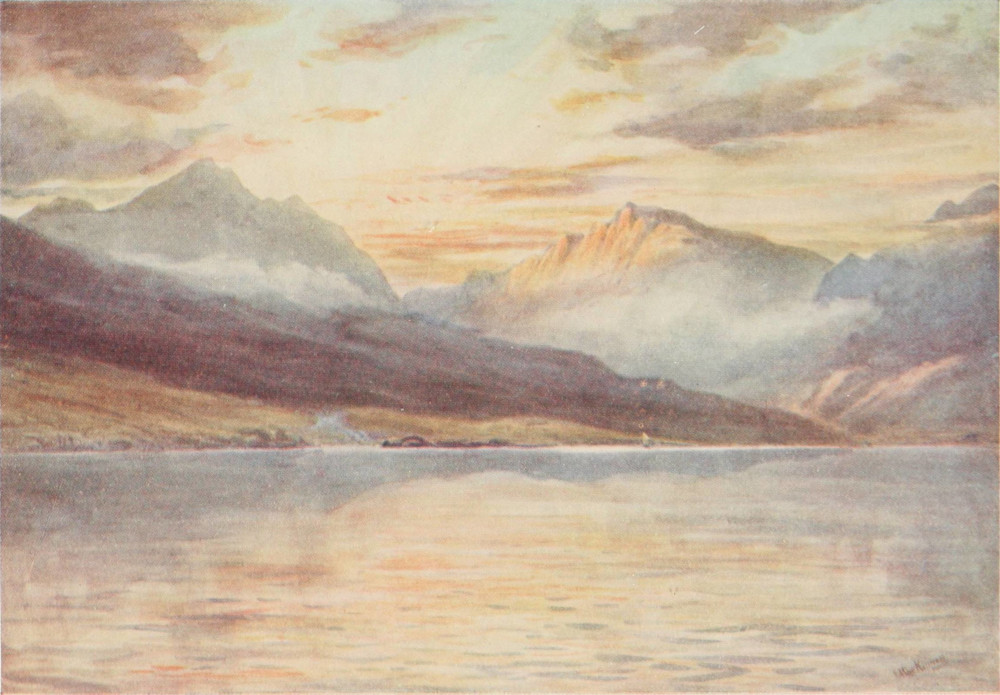
“But on and up, where Nature’s heart
Beats strong amid the hills.” Richard Monckton Milnes.
A. & C. BLACK, LTD.
4, 5, & 6 SOHO SQUARE, LONDON, W.1
1923
Printed in Great Britain byR. & R. Clark, Limited, Edinburgh.
TO ALL WHO LOVE THE HIGH HILLS, AND
PARTICULARLY TO THOSE—MY DEAR KINSMEN
AND FRIENDS (SOME OF WHOM HAVE
PASSED TO THE GREAT BEYOND)—TO WHOM
I AM INDEBTED FOR MANY HAPPY DAYS
ON HILL, LOCH, AND RIVER.
PREFACE
For many years past from time to time I have
contributed articles on sport and natural history
to various journals.
It was recently suggested to me that I should
publish these articles in book form, and I was
fortunate enough to have friends who kindly
offered to illustrate them. I have accordingly
selected some of these articles, and have included
others which have never been published before.
Amongst the former are some which in the same
or a slightly altered form have appeared in The
Field, Country Life, The Scottish Field, The
Salmon and Trout Magazine, and The Saturday
Westminster Gazette. To the editors of these
journals I tender my warmest thanks for their
courtesy and kindness in allowing me to republish
the articles in question. To my friends, Mr.
Finlay Mackinnon, Mr. Vincent Balfour-Browne,
and Mr. Frank Wallace, I am greatly indebted
for the pictures in colour and black and white,
and the pencil sketches which they have contributed.
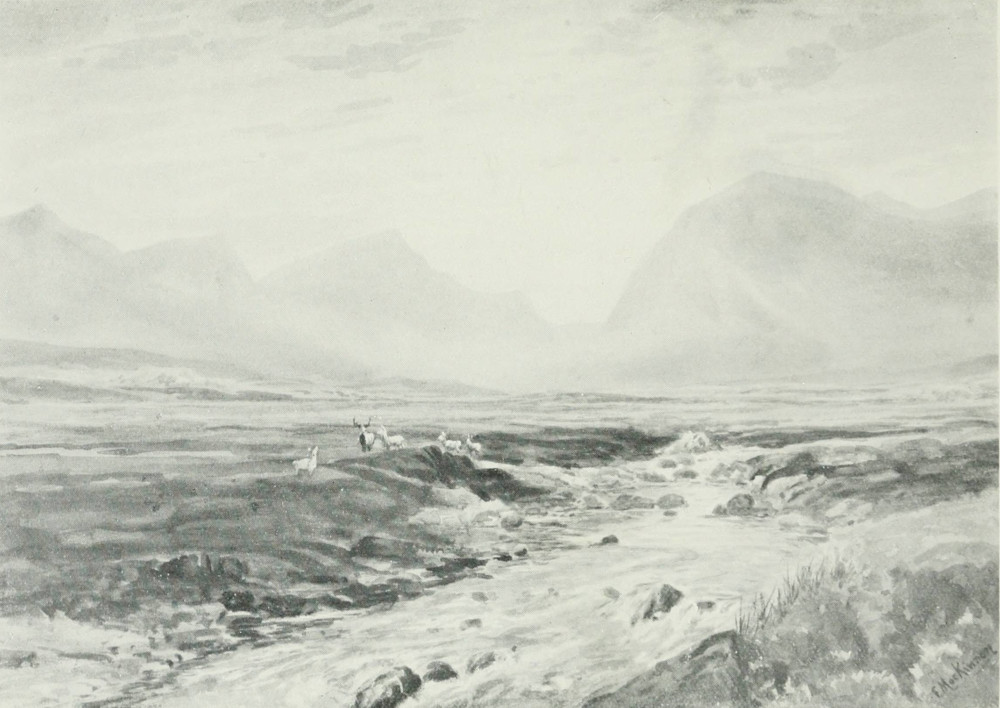
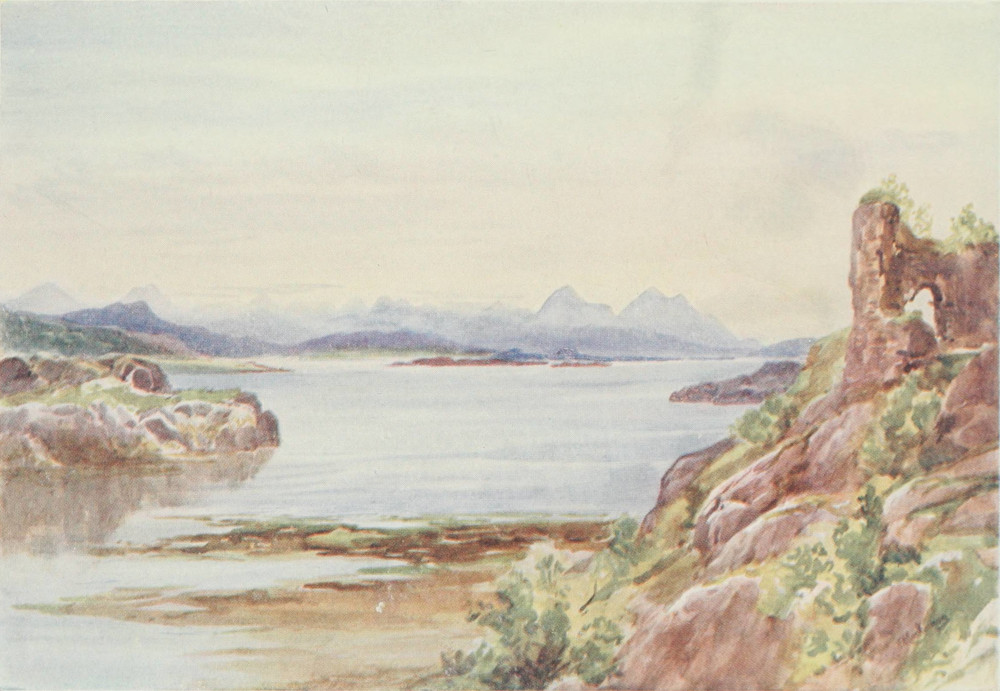
To my friends and neighbours, Lady Anne
Murray of Loch Carron and Mrs. Schroder of
Attadale, my grateful thanks are due—to the
former for the photograph, “Winter Sunshine—Wild
Geese at the foot of Applecross Hills,” and
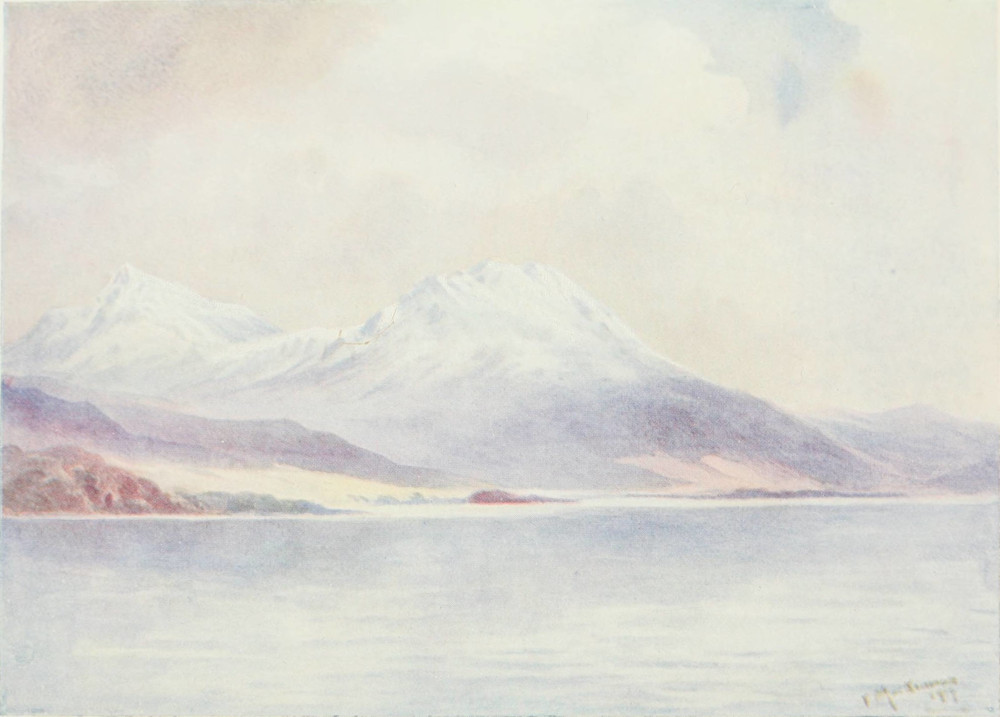
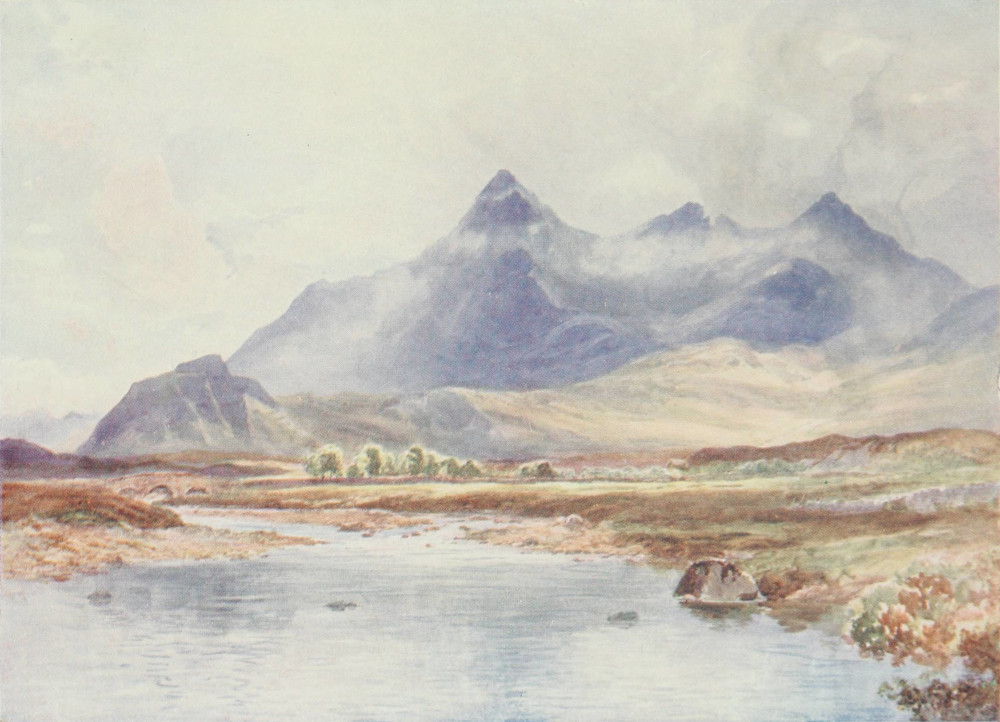
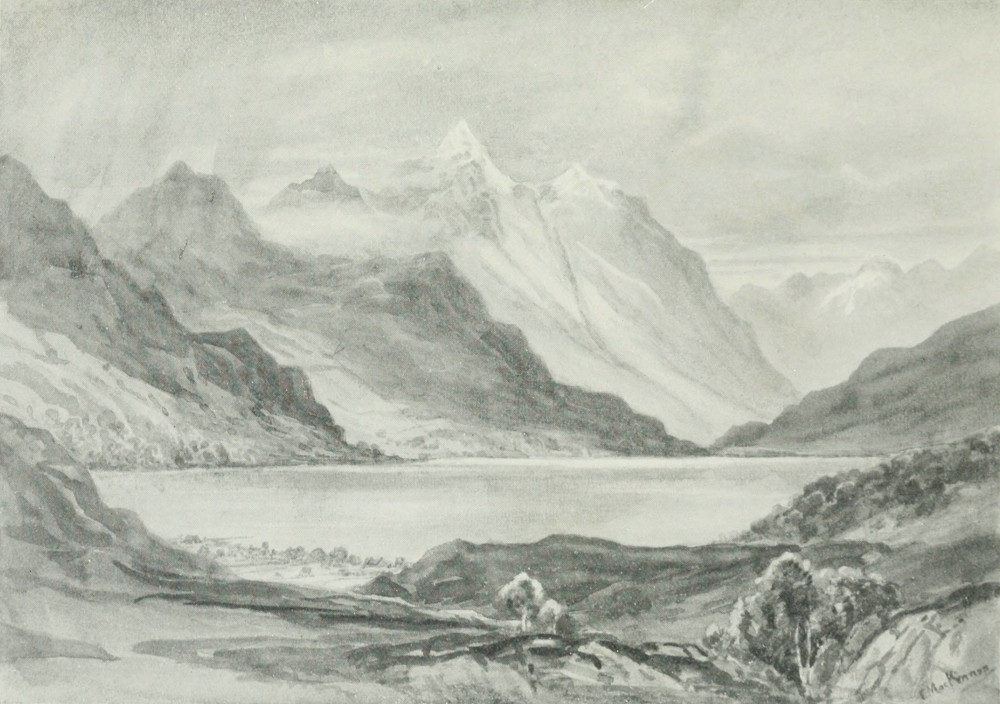
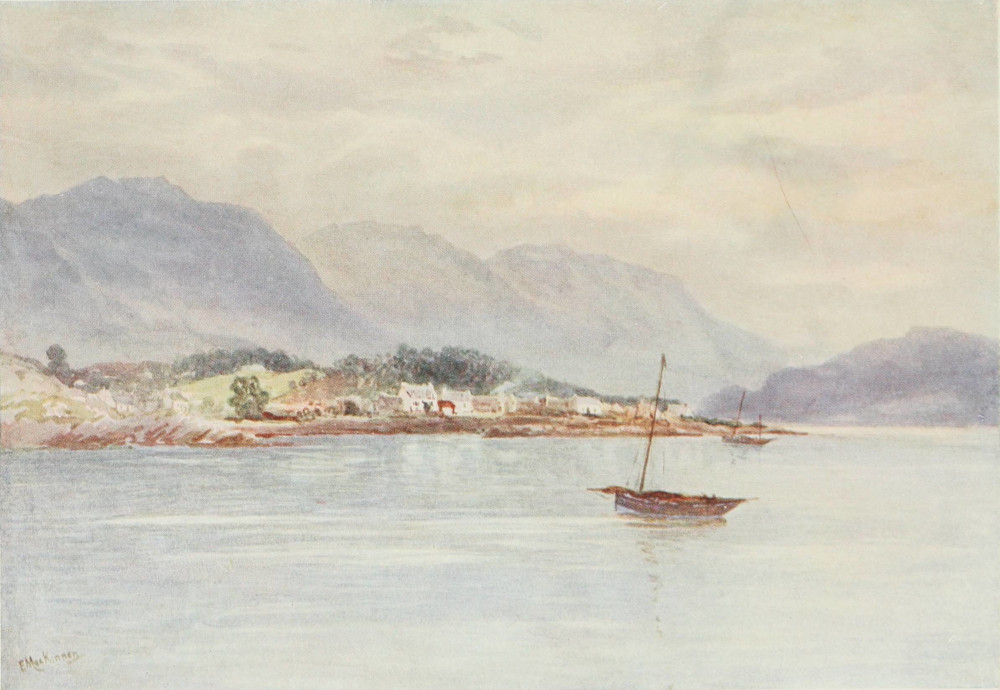
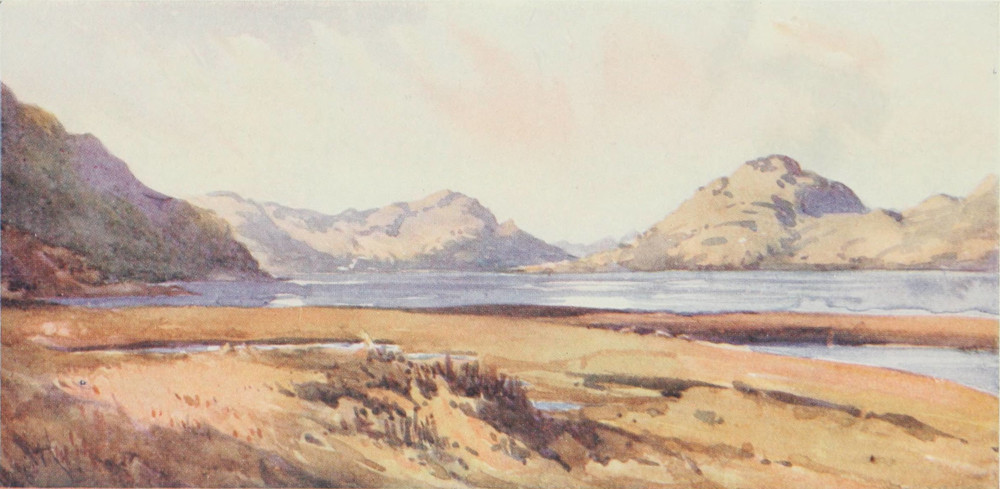
to the latter for the water-colour drawing, “An
Autumn Day—Loch Carron, looking West.”
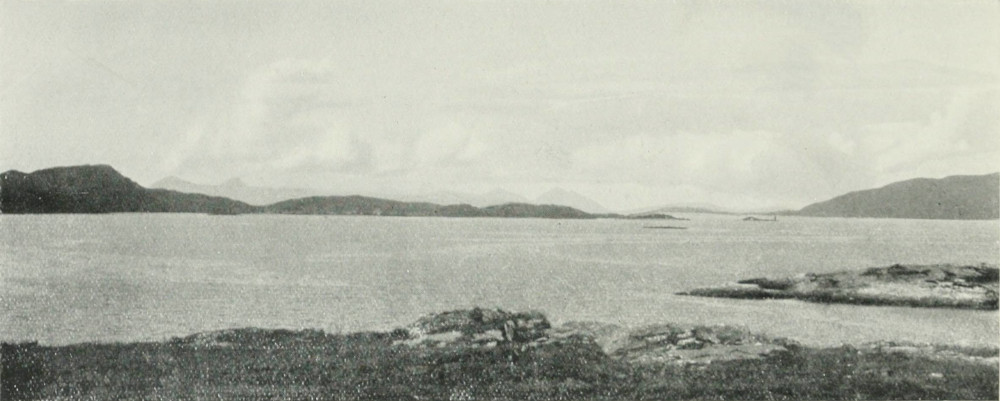
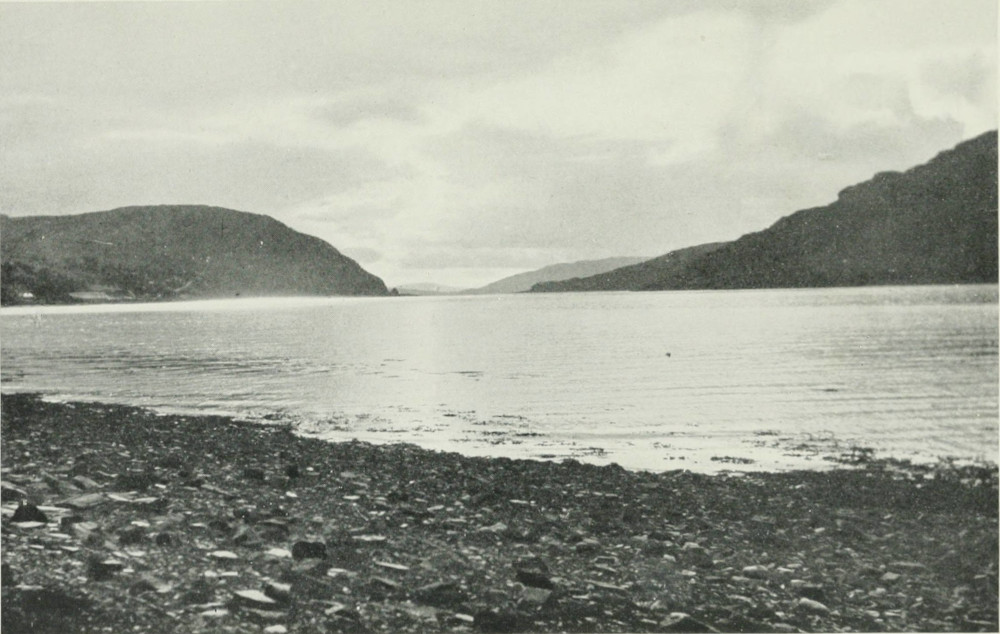
To my friend, Miss Diana Darling, I am
indebted for the photograph, “Among the
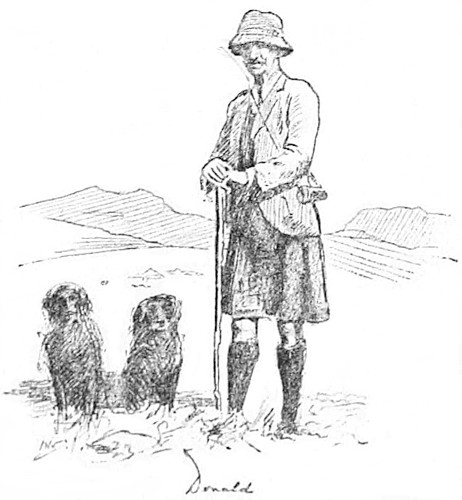
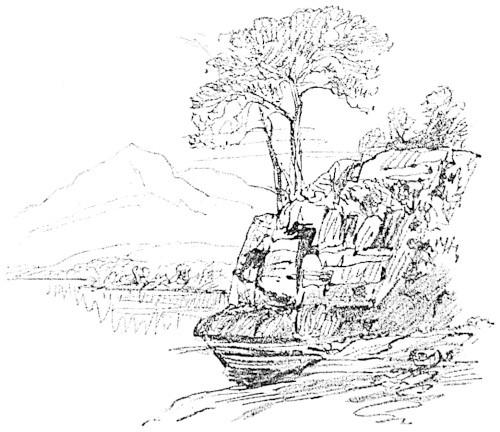
Western Islands,” and to my son-in-law, Mr.
Noel Wills, for the pencil sketch of Donald
McIver,
my gamekeeper and constant companion on the hill for many years.
I wish to thank Mr. W. R. Bousfield, K.C.,
F.R.S., for helpful criticism from the scientific
point of view on my article “Birds of Fastest
Flight in the British Isles,” and Mr. A. D.
Bateson, K.C., for his kindness in reading the
book in manuscript.
In conclusion, I should like to say that, having
derived so much pleasure from reading the experiences
of others who love sport and natural history,
I venture to hope that these pages may bring
back to some of my readers recollections of their
own delightful days amid the High Hills.
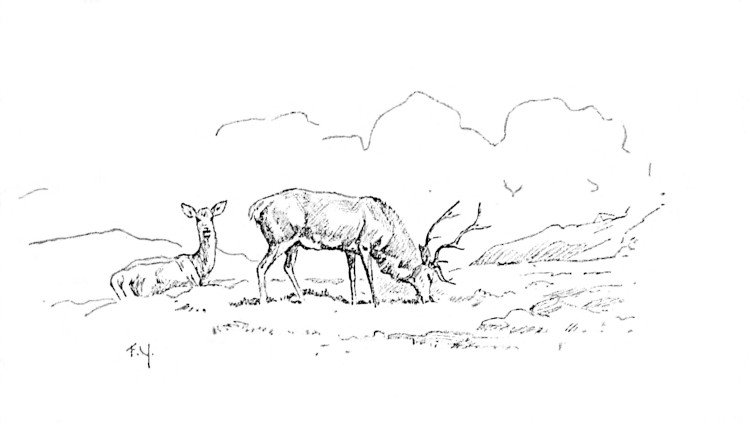
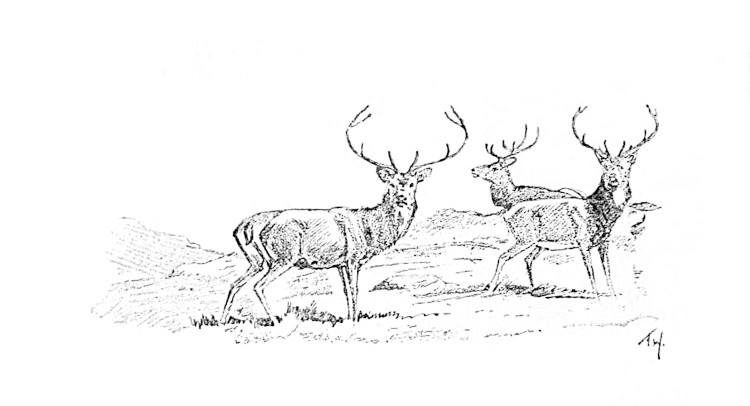
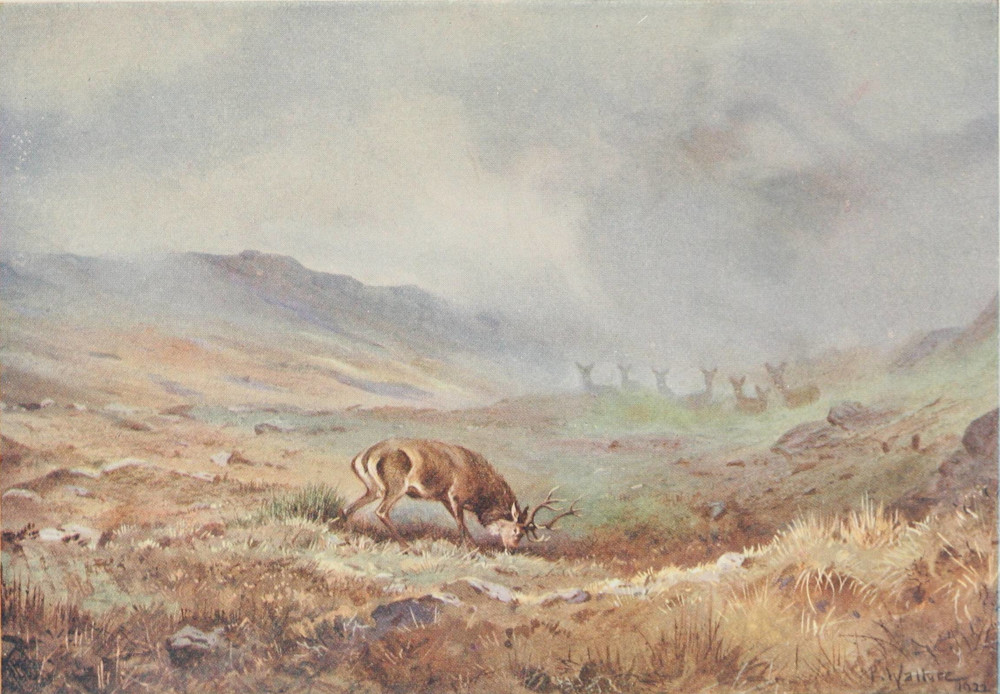
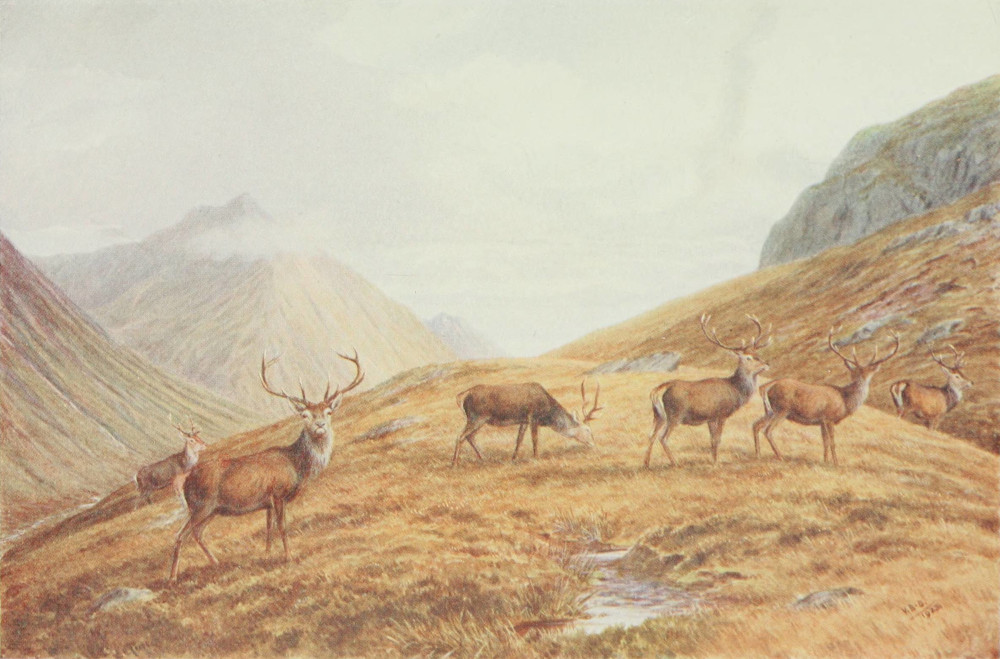
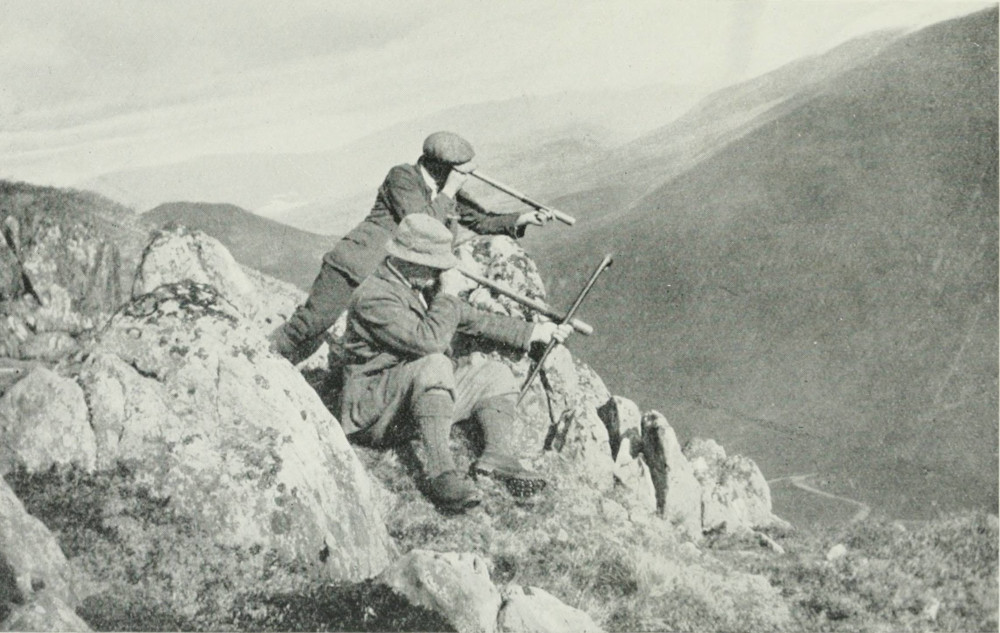
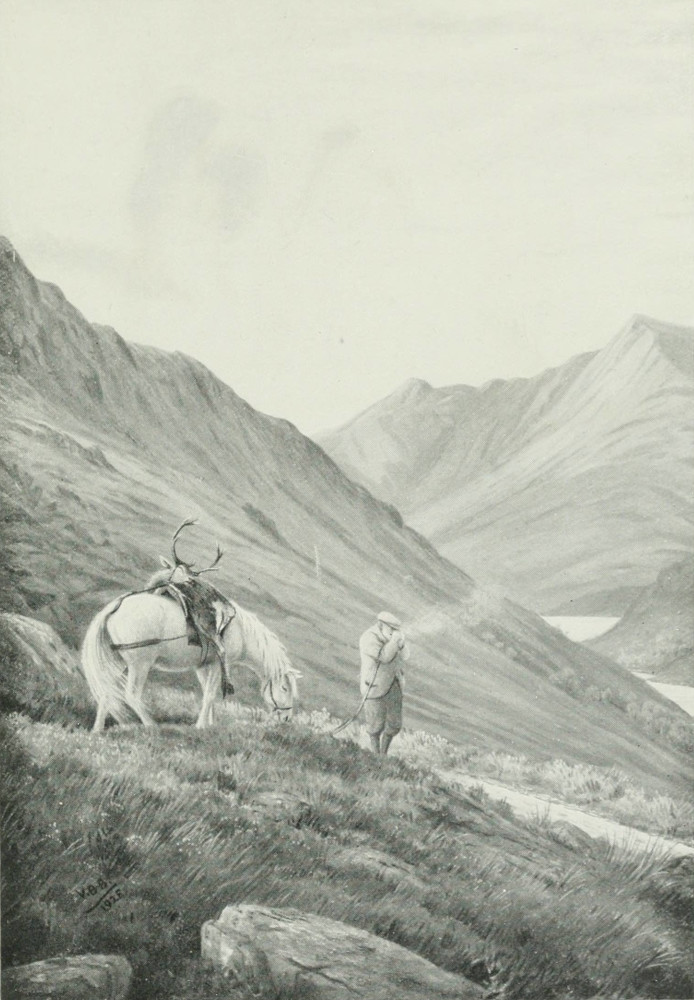
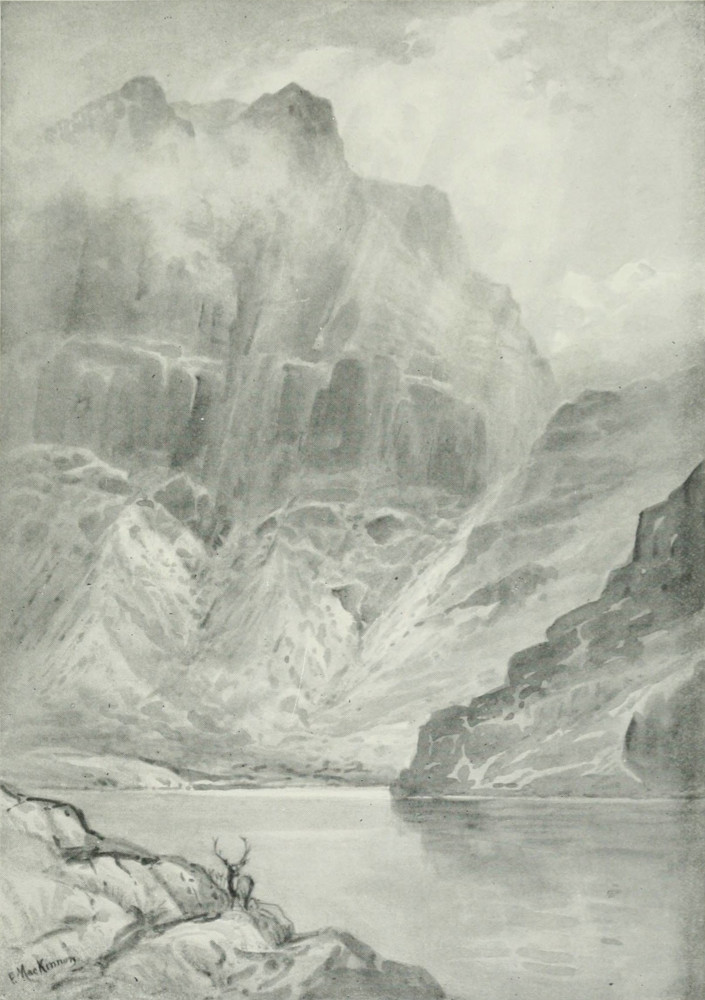
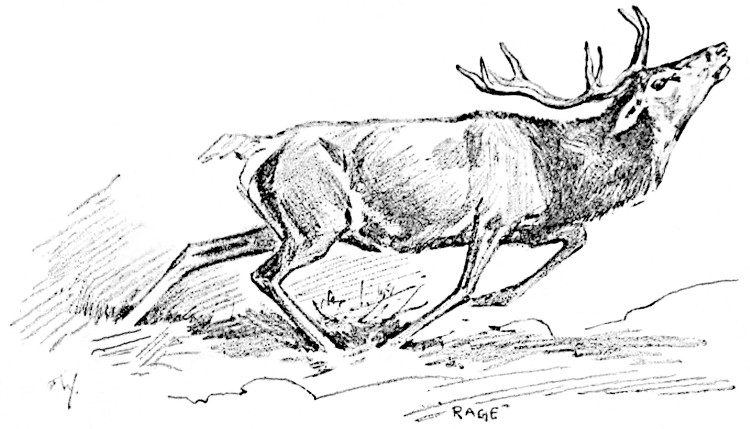
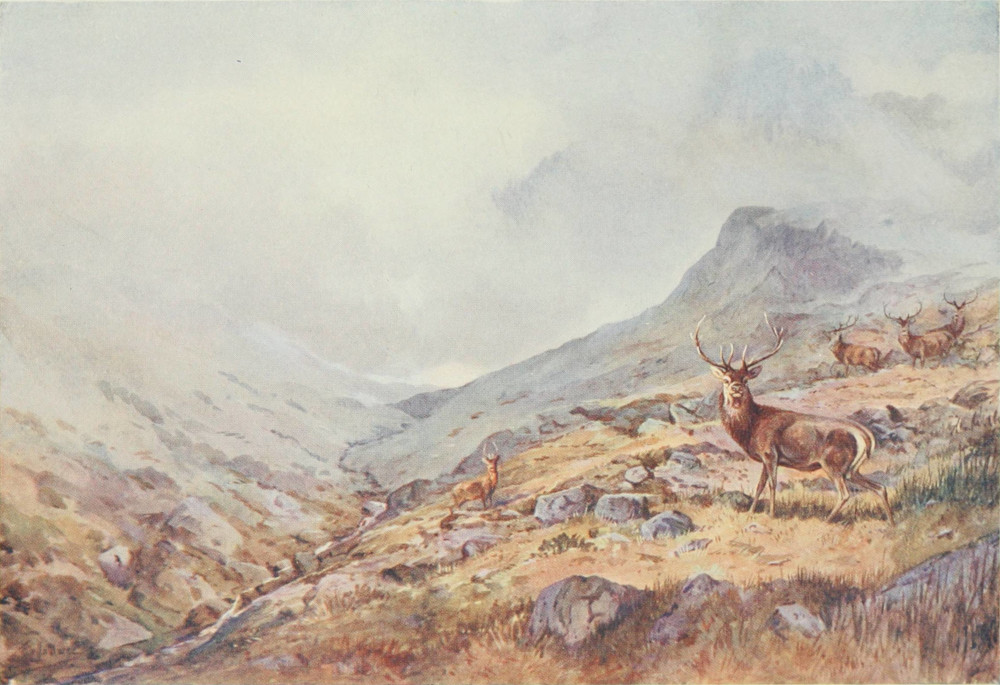
“THE JOY OF WATCHING DEER WHEN THEY HAVE NO SUSPICION THAT THEY ARE BEING WATCHED.”
By V. R. Balfour-Browne.
I THE CHARM OF SPORT AMID THE HIGH HILLS
The fascination of deer-stalking is largely due to
the romance of the hill—the hill as it is known
only to those who love it and understand something
of its hidden mysteries. The long day,
all too quickly ended, with the silent but
sympathetic stalker—alone with Nature in its
most inspiring and elevating form—the ever-changing
beauty of sky and hill—the joy of
watching deer when they have no suspicion that
they are being watched—the opportunities of
seeing rare birds and finding rare plants—all
these things apart from the difficulty and interest—and
the greater the difficulty the greater the
interest—of trying to outwit—in other words
trying to get within shot of the particular stag
one is after—go to make up the attractions of
what some of us think is the very best of true
sport.
I well remember a famous statesman, who
had himself owned one of the best deer forests in
the Highlands, saying to me that the greatest
attraction of stalking is that it takes one to places
where otherwise one would never go, and enables
one to see the most wonderful things which
otherwise one would never see. Further, there
is probably no form of sport where less pain and
suffering are inflicted, assuming that any one
who stalks will take the trouble to know his rifle
well, and will not take a long or risky shot. The
shot itself after all plays only a small part in the
pleasure of a day’s stalking. I have friends,
first-class rifle shots, who delight in stalking,
and who, when they have arrived within shot of
the stag they have stalked, will sometimes not
shoot at him at all. This would not always be
easily accomplished by those who have strongly
implanted within them the instincts of the hunter,
or perhaps I should say the primitive man.
Again, to pass from stalking, what is the real
explanation of the intense enjoyment of ptarmigan
shooting on the high tops after the close of the
stalking season? I have more than once heard
this described as the most enjoyable of all kinds
of shooting. As is well known, on a still clear
day the ptarmigan is the easiest of birds to shoot,
but on a wild windy day one of the most difficult—twisting
and turning with extraordinary
rapidity. Neither this latter fact, however, nor
the exhilarating and bracing air at the altitude
where these birds are to be found wholly explains
the enthusiasm of those who have had this
sport. I have no doubt that the environment of
the high hills and all that this means are largely
the cause of this enthusiasm. The delights of
grouse shooting, whether in the case of driven
birds, or over dogs, are greatly increased by the
same cause. Without entering upon the well-worn
controversy as to the respective advantages
and disadvantages of these two forms of sport,
is there any one who has enjoyed both of them
amid the hills who has not ineffaceable memories
of the vistas of marvellous beauty which he has
revelled in again and again while waiting in his
butt for the first birds of the drive, and—to change
the scene—of the pleasures of many a glorious
twelfth in the company of an old friend with whom
he was in perfect sympathy, watching the dogs at
work amidst the purple heather on the side of the
hill or along the heather-clad banks of a burn?
It is true also of salmon and trout fishing
in the Highlands that the angler’s sense of peace
and contentment is largely due to the influence
of the hills. This is especially so in the golden
days at the beginning of August, those glorious
days before the serious fun begins, when the
trout in the loch are more of an excuse than a
serious ploy, when one discusses the growing
antlers of the big hart on the Home beat, when
one basks in the sunshine of the High Hills.
GOLDEN DAYS.
By V. R. Balfour-Browne.
Whilst writing what I have already said about
stalking I recollected the following verses, which
I intend to keep and read for my encouragement
in days to come—days which are, I hope, still very
far off:
NORTHWARD BOUND
(Once More)
Does your heart still beat with the old excitement
As you wait where the Scotch expresses are?
Does it answer still to the old indictment
Of a fond delight in the sleeping-car,
As it did when the rush through the autumn night meant
The Gate of Desire ajar?
Or has the enchanting task grown tougher,
And has that arrow beyond you flown?
For the hill that was rough enough is rougher,
The steepest climb that was ever known,
And the forest appals a veteran duffer
Sorely beaten and blown?
Oh! the years, the years, they be rusty and mothy;
Oh! the flesh it is weak that once was strong;
But the brown burn under the stone falls frothy
And the music it makes is a siren song;
Then the pony’ll take you as far as the bothy,
And that’ll help you along.
See! from the tops the mist is stealing,
Out with the stalking-glass for a spy;
Round Craig an Eran an eagle’s wheeling
Black in the blue September sky.
A fig for the years! Why, youth and healing
At the end of your journey lie.
(Reprinted from Punch, Sept. 14, 1921, by kind permission of the
Proprietors.)
II STALKING IN ITS MOST ENJOYABLE FORM
By far the most enjoyable form of stalking is to
be one’s own stalker, but this can only be done
satisfactorily in a forest with which one is
thoroughly familiar. It is astonishing what tricks
the wind will play in certain corries, and as a
result what mistakes even a good stalker will
make in a forest which is new to him. Moreover,
any one stalking by himself, unless he has
experience, may easily make another kind of
mistake. He may think that he has missed a
stag when he has in fact killed him. Any one
who has had experience in shooting deer knows
that a stag when shot through the heart will
sometimes gallop for forty or fifty yards or even
further and then fall down dead.
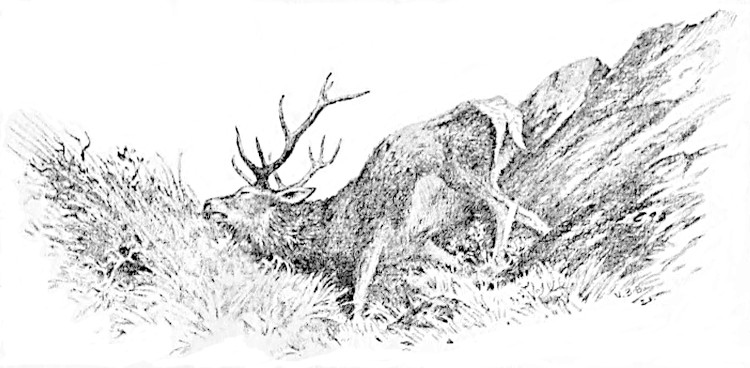
“SEE! FROM THE TOPS THE MIST IS STEALING.”
By Finlay Mackinnon.
Some years ago, preparatory to a few days’
stalking in a deer forest in Inverness-shire, I
arrived one evening at the Lodge; and later on
about half-past ten there returned from the hill
a guest in a state of great dejection who had never
stalked until he went out in this forest a few days
before. I felt very sorry for him, for he had been
keen to secure a good head and said that he
had had a splendid chance of a fine stag standing
broadside at about eighty yards and had missed
him. This was his last chance as he was leaving
early next morning. Two days later I was out
on the same beat when the stalker suddenly
grasped me by the arm and said, “There is a
stag lying down there to the left of that hill below
us. Are you seeing his horns above the ridge?”
We went cautiously down in the direction of the
stag, but had not gone far before we discovered
that the stag was dead. “That,” said the
stalker, “must be the stag Mr. X. shot at two
days ago.” We examined the stag and found that
he had been shot apparently through the heart
from the knoll from which X. had taken his shot;
it was obviously the same stag. The stalker then
told me that X. wished to stalk the last hundred
yards alone and had asked him to stay behind,
that X. had the shot and came back saying that
he had missed the stag. Neither the stalker nor
X. had thought it worth while to look for the
stag. In the case of X., who was a novice at
stalking, I was not surprised, but I was amazed
that the stalker had not done so, although he was
young and not very experienced. So X. secured
a good head after all, and no doubt both he and
the stalker learnt a lesson which neither is likely
to forget, but at the cost to X. of much unnecessary
misery and humiliation and incidentally to
his host of much good venison.
It is sometimes difficult to be sure what is the
result of one’s shot, and it is a great assistance
to have the opinion of an experienced stalker
whether he has his glass on the beast at the
moment the shot is fired or not.
I was coming back one evening after a delightful
day’s stalking in Glen Carron, when the
stalker Macdonell said, “One moment, sir, there
is a stag down there just gone out of sight. If
you can shoot off your knee downhill you will
have a chance directly.” I sat down and waited,
and in a few minutes the stag appeared. I
believed I was steady and on him in the right
place. Directly I fired he galloped off. “I’m
thinking you’d better shoot again,” said Macdonell.
“What’s the use,” I replied, thinking I
had shot the stag through the heart. However,
as I spoke, I did shoot again out of respect to
Macdonell, whom I knew to be a very experienced
stalker, and the stag rolled over like a rabbit
which has been shot in the right place. “Now
we will see,” I said, “where the two bullets went.”
“I’m thinking,” said Macdonell, “you missed
him the first time.” “You may be right,” I
replied, “but I don’t think so; one thing I know,
and that is that if I did and had known it, I should
probably have missed him with my second shot
also.” On examining the stag we could only
find one bullet mark, and on skinning him we
found that one bullet only had struck him, and
that was through the heart. Macdonell no doubt
thinks to this day that I missed the stag with my
first shot, and killed him with my second when he
was galloping; but I still have my doubts. The
moral is that though one sometimes hears the
unmistakable thud of the bullet striking the
stag, there are other occasions when it is difficult
to be certain as to what has happened, and therefore
it is always wise to satisfy one’s self in the
matter as far as possible. Still more is this
essential when stalking alone. In stalking alone,
there is this advantage, that one can always
secure the best position in which to shoot, whereas
if one is accompanied by a stalker, he sometimes
takes that position himself and it is not easy to
get him to move on, or, as is more often the case,
there is no time for him to do so.
Charles J. Murray of Loch Carron, to
whose kindness I am indebted for many delightful
days’ stalking, is particularly devoted to this form
of sport. A few seasons ago I was obliged to
come south before the end of the stalking season,
and received from him a letter which describes,
far better than I can, the pleasure of being out
alone on the hill.
“You are missing the West Coast,” he wrote,
“at its (weather) best! for we have a spell of
gloriously fine weather when the stag can hear a
footstep half a mile off, and the wind is so gentle
that it cannot make up its mind which way to go,
but strays gently to and fro and round in little
circles, stimulating evil words among the stalkers.
“Yesterday I was out alone and worked up
to a Pasha and his Harem—the ladies between
him and me—he just out of shot on a hillock
behind them—approach from the front impossible,
but just a chance—almost a certainty with a fair
breeze—from a rock to one side, if he should
come down to his ladies before they got a puff.
I risked it and got a comfy corner in the sun and
waited to see which would win—the affectionate
impulses of the stag or the more wavering evolutions
of the scarcely perceptible puffs of wind,
the old lady sixty yards away looking serenely at
the top of my head. Needless to say that after
two hours, just when the stag stretched one fore
foot and began to hum a love ditty, I felt a well-known
cool feeling at the back of my neck, and
the party adjourned the meeting. Luckily I am
not bloodthirsty, but enjoy being among deer,
and on these occasions driving snow and rain, or
sunshine and a dry tussock to curl up on, make
all the difference.”
Towards the end of March 1921 I received an
invitation to fish the river Wye, which, as every
one knows, is famous for its heavy salmon. My
own rods and tackle were in the North of Scotland,
and there was not sufficient time to send
for them. I knew that in the spring the fishing
in this particular river was almost entirely by
spinning with the minnow. I arrived at my
destination on Monday, March 28, and had five
days fishing before me. There had been
a good deal of rain before I arrived, and the river
was both too high and too much color. The
fishing on my host’s beat had so far been very
disappointing. During the preceding six weeks
the river had been fished almost every day by
my host and one or other of his friends; but
although hardly any fish had been lost, only
five had been killed, all with the minnow, the
largest being 29 lb. My kindly host, who is a
past master of all things connected with salmon
and trout fishing, fitted me up with first-class
equipment. I had never used a Nottingham or
Silex reel before, and it took me the greater part
of my first day to acquire the art of throwing the
minnow effectively. For the next two days I
fished with the minnow from morning till night
without getting a pull or seeing anything. I have
been a keen fly-fisher all my life and have killed a
good many salmon and many trout, and on Friday
morning, as the river had fallen considerably, I
told my host that if I might do so I should like
to try the fly. He readily assented, and said that
I should have one of his own fly rods, and before
we started he kindly gave me several salmon flies,
and said that his butler, C., who was an experienced
hand at gaffing salmon, should come with
me. Among the flies which my host had given
me was a “Mar Lodge” (size 4/0), and with this
I fished all the morning and up to about three
o’clock in the afternoon without, however, seeing
or touching anything. C. said that he was afraid
the day was going to be a blank again. I said that
I would like to try once more a particular spot
below a rock in the upper part of a pool higher up
the river, which I had fished in the morning and
which I thought looked a very likely place for
a salmon to lie. In order to fish this pool it
was necessary to use a boat. It was a beautiful
afternoon and the sun was still shining. We
crossed over the river at the bottom of the pool
and rowed up on the other side, keeping close to
the bank so as not to disturb that part of the pool
which I was going to fish. C. worked the boat
with great skill, and at my first cast I managed
to place my fly exactly where I wished it to go
below the rock. As the fly swung round with
the current I suddenly saw for a second a huge
silvery fish in the clear, transparent water upon
which the sun was shining. At the same moment
the line tightened. “I have him,” I said, as the
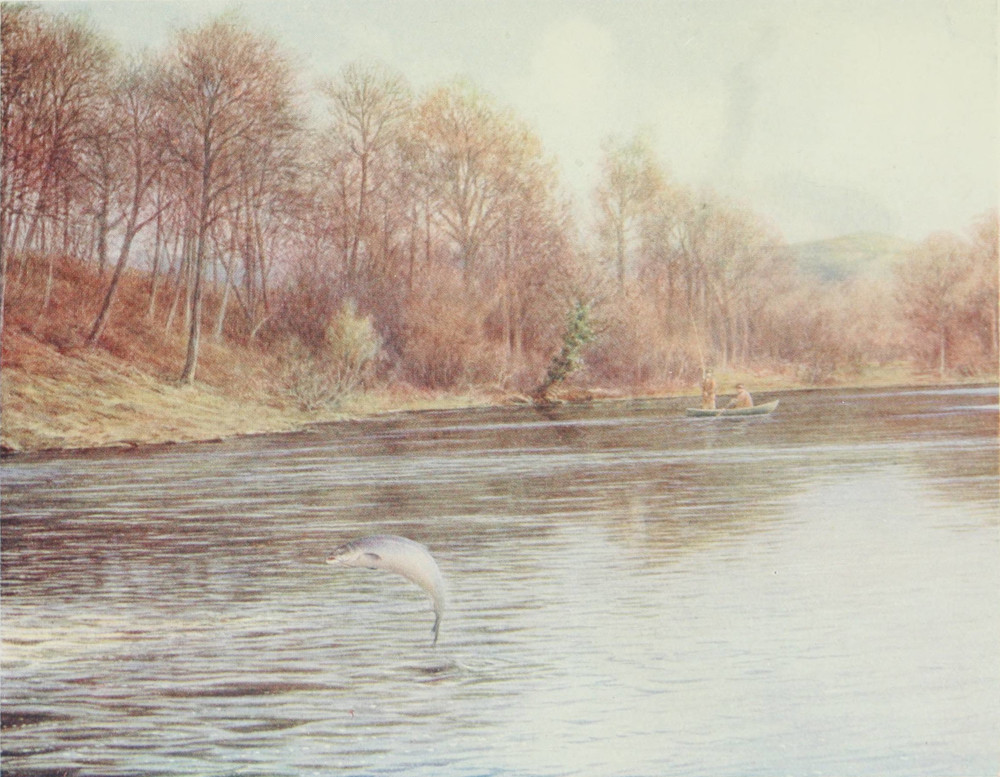
line went screeching off the reel. The fish ran
straight up-stream for about ninety yards, and
then leaped twice, high into the air. It was by
far the largest salmon I had ever seen, clean-run
and glittering like a silver coin fresh from the
Mint. This first danger safely passed, I gradually
persuaded him to come back again. C. said,
“He must be well hooked, and he’s a very big
fish. That fish of 29 lb. which the Major got
would look quite small beside him.” For some
time after this the fish moved about the pool, but
made no attempt to run. He then made a violent
rush of about sixty yards, and lashed about on the
top of the water, once more showing himself and
giving us a fair idea of his size. Again I got
him well under control, and for a considerable
time he adopted the same tactics as before,
moving slowly and steadily backwards and forwards
at varying depths. I had been thinking
for some time that perhaps I had been rather too
easy with him, and that I had not acted on the
maxim with which, I suppose, almost every salmon
fisher will agree, that one ought never to let a
fish rest, and that a big fish may take hours to
land if he is not worried enough. The line and
cast had been thoroughly tested before we started,
and I felt that I might depend upon them. C.
told me that as soon as I had hooked my fish he
had looked at his watch, and that I had now had
him on for an hour and twenty minutes. This
greatly astonished me, as I had not realised how
the time had gone. But it was nevertheless the
fact, and I felt that we must do something to
stir the fish. We accordingly decided to move a
little way up-stream. C. had hardly begun to
move the boat with this object in view when the
salmon suddenly moved, and moved to some
purpose. Neither I nor C. had ever seen anything
in the movements of any fish to compare
with the strength and rapidity of that rush. The
salmon went at a terrific pace, straight up the
river as hard as he could go for about 110 yards,
and then leaped twice, straight up into the air,
about a couple of feet above the surface of the
water, broadside on, showing that he was a
tremendously thick fish. At the very moment
he was in the air the reel fell off the rod, and at
that moment I became conscious, although, of
course, I had lowered the point of the rod when
he leaped, that the great fish had parted company
with me for ever. “He has gone,” I said, as
with a sickening sense of disappointment I reeled
in the slack line in the faint hope that he might
still be on, having turned and come down the
river again—but no, it was not to be, and the line
soon came back to me, the cast having been
broken about a foot from the end. C. said not
a word, nor did I for a time. No mere words
are appropriate on such an occasion and cannot
diminish the loss of a fresh-run spring salmon,
so marvellously brilliant and beautiful, and in
this particular instance probably half as large
again, perhaps twice as large, as the biggest fish
I have ever landed during the time, now more
than forty years, that I have been a salmon fisher.
Within a short time I started fishing again, but
the day was done and we saw nothing more.
After the catastrophe I found that the reel had
been loose, and that the wedges used to make it
fit closely to the rod had shifted and finally fallen
out in consequence of the rushes made by the
fish. I also learnt later on that the rod did not
belong to my host, and that by a misunderstanding
this rod, which happened not to have been taken
down, but was among the other rods ready for use,
was given to me. Probably, had I been warned
about the reel, I could have prevented it from
falling off, though whether this would have made
any difference it is impossible to say, as many a
good fish has broken the cast by falling back on it
after jumping at the end of a long rush, and the
more line there is out the more danger of losing
the fish when he jumps.
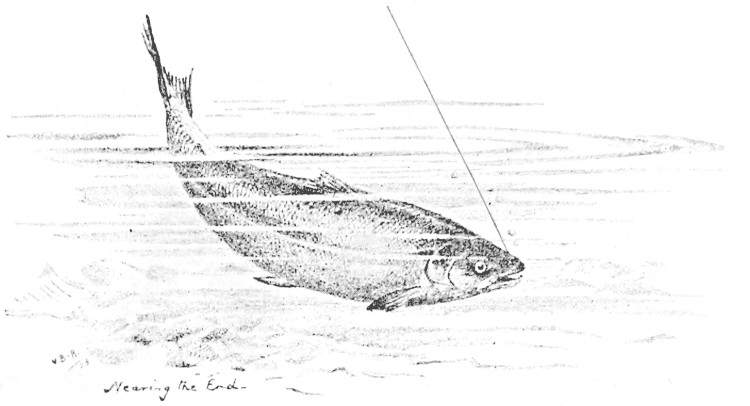
“THE SALMON LEAPED TWICE STRAIGHT UP INTO THE AIR.”
By V. R. Balfour-Browne.
In the words of one of the most experienced
of fishermen, Mr. Horace G. Hutchinson: “There
is one antic that a fish may perform which may,
if you are unlucky, defeat you, however quick and
skilful you are—that is, if he jumps and falls back
on the cast. If you do not drop the point of the
rod so as to let the gut go slack when he jumps,
you are nearly sure to be broken if he falls back
on it. If you drop quickly enough, it is bad luck
if you are broken, but it is bad luck which sometimes
does befall. If much of the reel line is in
water, the drop of the rod top does not communicate
slackness to the cast quickly enough; the
fish may come on to it when it is tolerably taut—result
disaster!”
Being a Highlander and therefore of a superstitious
race, need I emphasise the fact that the
day of this, the greatest, tragedy of my life as a
fisherman was a Friday, and that Friday the 1st
of April. In this connection it is worth recalling
that no references to April Fools’ Day have been
found in our earlier literature, and it seems that
this country has derived the fashion from France,
where April Fools’ Day is a very ancient institution,
and where the dupe is known as “poisson
d’avril.” The April fool in this story was the
fisherman, not the fish. The following day,
Saturday, I tried to make the most of my last
chance and fished all day long, but without a sign
of anything. Of course, there was a great discussion
as to the probable weight of the fish,
which had given both C. and myself several
opportunities of forming some estimate on the
subject. We both agreed that it could not have
been less than 35 lb., and was more probably
round about 40 lb. But my story has an interesting
sequel. On the following Monday I returned
to London; and on the Tuesday, when fishing the
pool which was the scene of the catastrophe, my
host made a discovery which I can best relate by
quoting from a letter which he wrote to me on
the following day.
“Yesterday afternoon,” he wrote, “when
fishing your famous pool I found what I feel
pretty sure were the mortal remains of your big
fish. He had fallen a prey to an otter, which after
your long fight with him is easy to understand.
He lay on a rock just above the place where you
hooked him, and considerably below where you
parted company. A large ‘steak’ from the
middle had been removed by his ultimate captor,
but the head and tail portions were there. From
examination of his head he had certainly been
recently hooked firmly on the right side of the
upper jaw. He was extremely thick, and must
have been a most handsome fish of at least 35 lb.
I took home two or three scales, and his age
appears to have been between four and five years.”
I subsequently learnt that from its condition
this fish had no doubt been killed some days before
it was found, and as it seems highly likely it was
the fish that had defeated me, it must somehow
or other have got rid of the fly by rubbing it
against the rocks, a feat which is generally believed
to be by no means unusual and which in this
instance would, no doubt, be rendered easier by
the fact that the hook was a good-sized one, being
about 2 in. long.
C., who was with my host at the time, said that
he also felt sure that it was the same fish. So it
would appear that the victory of the great fish
was after all shortlived, and that he was probably
captured by a far greater fisherman than any mere
mortal man—let alone my humble self.
It is a very interesting fact that in the week
before that in which I was fishing, among the
salmon which were killed on the neighbouring
beats were three, each of which weighed slightly
over 41 lb. It seems not unlikely, therefore,
that my fish may have run up from the sea in
the company of these splendid fish, and have
been much the same weight as they were.
Notwithstanding my great disappointment I
heartily agree with the words of Arthur Hugh
Clough in Peschiera:[2]
’T is better to have fought and lost,
Than never to have fought at all.
On describing my battle to an old friend, who
is himself no fisherman, but a great sportsman,
he replied by quoting from a writer, whose name
he did not know, the following lines, which I had
never heard before and the authorship of which
was at that time unknown to my friend also:
IV THE BIRDS OF FASTEST FLIGHT IN THE BRITISH ISLES
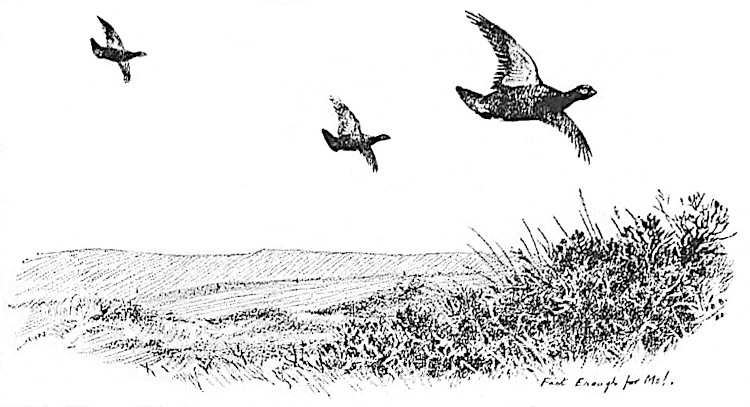
Fast Enough for Me!
Some little time ago, a correspondence appeared
in the Observer[4] and the Field[5] as to which is
the quickest bird in flight. Various correspondents,
some of them well-known naturalists,
writers of repute, and sportsmen of experience,
expressed their views, by no means unanimous,
on the question. I have always been greatly
interested in the subject, and for many years past
in the North of Scotland have been in the habit
of watching bird life in some of the wildest and
most inaccessible parts of the country.
I have examined the evidence contained in the
valuable and interesting correspondence mentioned
above, and have also obtained all the information
I could get elsewhere from books of authority and
persons who have had special opportunities of
observation. At the present day a valuable and
novel class of evidence is available—that of
observers in aeroplanes. Upon all the material
thus obtained I have tried to form an impartial
opinion.
There appear to me to be four points to be
borne in mind before arriving at any conclusion
as to which bird is the quickest in flight, and the
maximum speed of which each bird is capable.
Emphasis is laid on the first three of the following
points in some of the letters in the correspondence
above referred to, but I think that the
fourth point is of at least equal importance.
1. Ground speed must be distinguished from air speed.
2.The path of flight must be horizontal.
3.There must be something to show that the bird is flying at its
maximum speed.
4.There must be a standard length of flight to which the test is
to be applied.
1. Ground speed must be distinguished from air
speed.
It is not generally realised that a bird has
two speeds: its speed relative to the ground and
its speed relative to the air.
“Ground speed” is “air speed” as influenced
by the wind. In a perfectly still atmosphere
“ground speed” and “air speed” are the same.
To quote one of the writers in the Field of
February 11, 1922: “The wind has no effect on
the speed at which a bird is capable of driving
itself through the air. Take a parallel case,
substitute for the bird a caterpillar, and for the
atmosphere in which the bird is flying a sheet of
paper. The caterpillar can always crawl at a
constant speed across the paper, although it is
possible to increase the relative speed of a caterpillar
to the ground by moving the sheet of paper.”
Or to put the same distinction in the words of
another writer in the same number of the Field:
“It is the speed of the object over the ground or
still water that matters; and if the medium (i.e.
air or water) in which the object under discussion
is either flying or floating is also in movement,
then the pace over the ground will naturally be
correspondingly increased or decreased.”
Wind, of course, varies in two ways (1) direction
and (2) velocity, and is uniform only at a given
height.
The direction of the wind must necessarily be
either along the line of flight of the bird, against
it, or at an angle with it. In the first of these
instances the speed of the bird over the ground is
determined merely by adding the velocity of the
wind to, and in the second by subtracting it from
the air speed of the bird, in the same way as a
swimmer’s speed is increased or reduced by the
speed of the current. The third case is more
complicated, as in this calculation allowance must
be made for “drift,” i.e. the tendency of a bird
under such circumstances to deviate from its
desired course. It is, however, unnecessary to
say anything further as to this third case, as the
comparison of speeds of various birds can only
be made satisfactorily by ascertaining their
speeds under identical conditions in horizontal
flight.
2. The path of flight must be horizontal.
In the words[6] of Captain C. F. A. Portal,
D.S.O.: “If any one has seen a peregrine stooping
from 1000 feet at between 150 and 200 miles per
hour at a partridge, and has later seen the same
peregrine chase the same partridge from a standing
start, he will appreciate the importance of considering
only level flight. In the first instance,
the hawk is nearly 100 miles per hour faster than
the quarry, in the second, he can only just overtake
it at all. There is no conceivable way of measuring
the speed of these downward flights accurately,
but no one who has done any hawking will deny
that 120 miles per hour is within the power of a
great many species. When we come to consider
level flight, there is a very different story.”
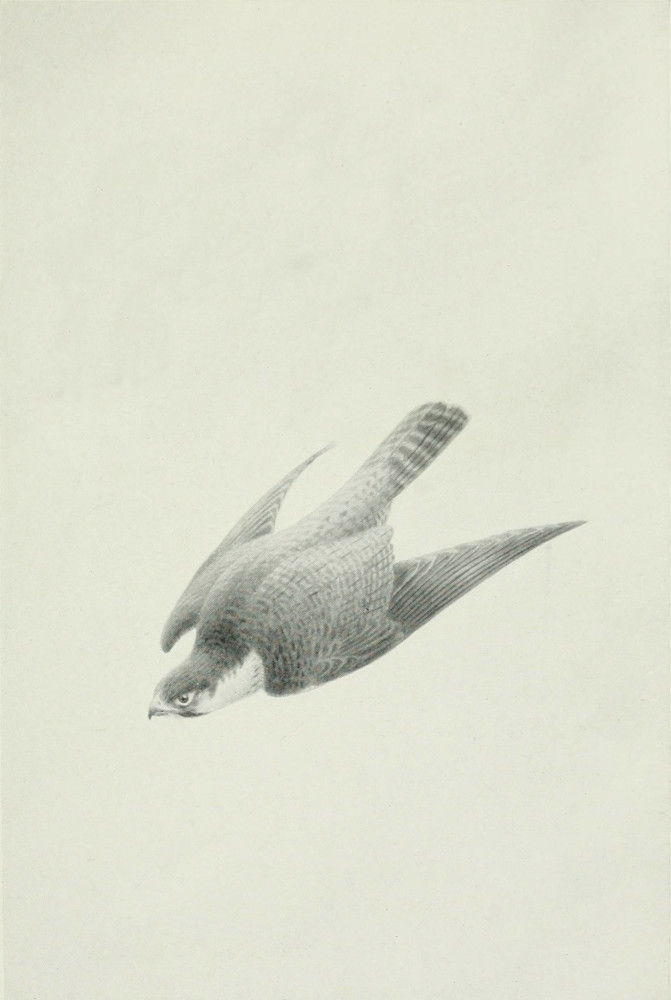
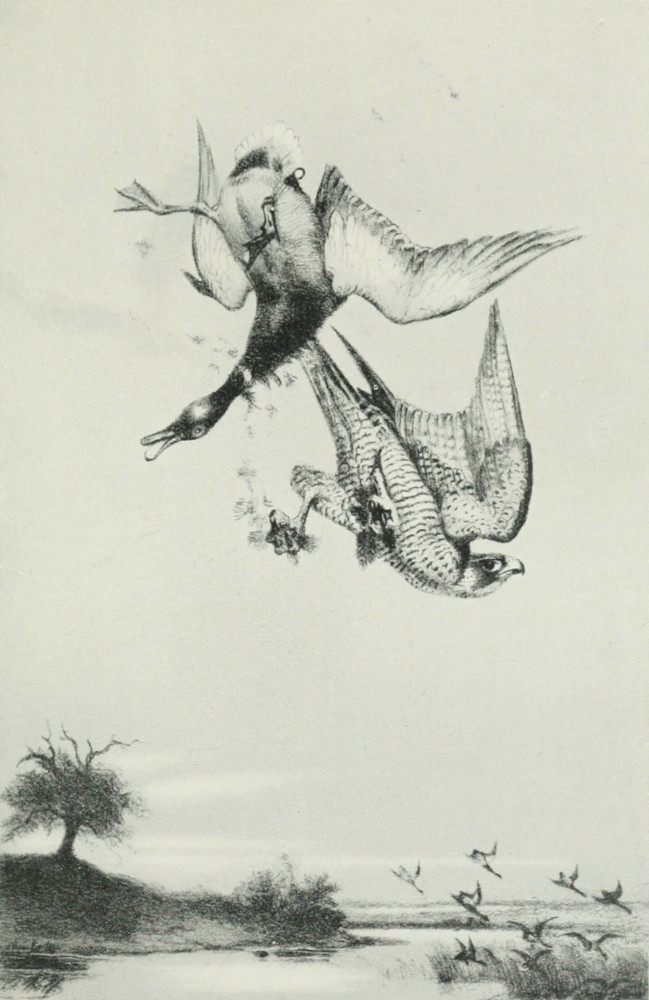
THE PEREGRINE FALCON.
By V. R. Balfour-Browne.
3. There must be some evidence to show whether
the bird is flying at its maximum speed or not.
As was recently pointed out in an interesting
article[7] by Colonel R. Meinertzhagen, D.S.O.:
“Birds have two speeds: a normal rate, which is
used for everyday purposes and also for migration,
and an accelerated speed, which is used for protection,
or pursuit, and which in some cases nearly
doubles the rate of their normal speed; some of
the heavier birds can probably only accelerate to
a slight extent. In this conclusion I am naturally
excepting courtship flight, which is usually of an
accelerated nature.”
To quote the words of Major C. R. E. Radclyffe:[8]
“The only possible test we can accept
is where two birds are matched one against the
other, and we are certain they are both trying
their hardest. No better test than this is the case
of a hawk pursuing its quarry, when it means to
one of them its food and to the other its life.”
The same writer draws attention to a common
fallacy: “It is,” he says,[8] “purely a matter of
optical illusion to imagine that a smaller-sized bird
is flying faster than a larger bird of similar shape
and make; for example, a snipe on rising ground
seems to go much faster than a woodcock, similarly
a teal than a duck, and possibly this may be
so for a short distance, but put up the first two
together, and also the last two, and let there be a
peregrine after them—as I have seen many times—and
the scene is amazing to a man who is not a
falconer, as the smaller bird is overhauled first
every time by the falcon, and presumably they
are all trying their hardest.... I have dozens of
times put up a peregrine over ponds and marshes
where teal and ducks were sitting together, and
then flushed the wild fowl all simultaneously. In
every case without any exception the first bird
overhauled and brought to the ground has been a
teal and in the case of a long flight, when every
bird has been flying for its life, the further they
go the further the teal lag behind the wild ducks.
The same remarks apply to woodcock and snipe,
to black game and grouse, to pheasants and partridges—all
of which I have flushed simultaneously
in front of hawks.”
In dealing with the same point in a letter
written to me, Major Radclyffe makes the following
interesting observations:
“... Few people realize that a pheasant flies
much faster than a partridge when they have both
been going a short distance. If you flush an old
cock pheasant and a covey of partridges together
in a big field of turnips, you will see the partridges
are quickest ‘off the mark’ and away with a bit
of a lead, but the pheasant will catch them, and
be first over the fence if they have 200 or 300 yards
to go.
“Again take as an example a woodcock and a
snipe. I have several times flushed these two
birds together, and in no time the woodcock has
left the snipe far behind him, and yet I believe
that ninety-nine sportsmen out of a hundred would
say the snipe flies faster than the woodcock.
“I have seen woodcocks give my hawks some
great long-distance flights before they are overtaken
and turned; but a snipe has no show at all
when trying to keep ahead of a peregrine or
merlin in straight flight.”
In his letter to the Field already referred to,
Major Radclyffe further says: “There is no doubt
whatever that the heavier bird of similar type is far
the faster on the wing when once it gets going.”
It was suggested in one of the letters to the
Field that whilst this is no doubt the general
rule there is at least one exception to it. “If
asked,” said the writer, “to quote any instance
when the smaller bird is faster than a larger one
of similar type, I should say that the pochard
(Fuligula ferina) is faster on the wing than the
common mallard, as I have seen the former pass
mallards on the wing when both have been flying
before a falcon. But from my experience of over
thirty years as a falconer, a naturalist, and a
shooter, I should say that the above case is one of
the rare exceptions where the heaviest bird is not
the fastest on the wing if each bird is trying its
hardest and best.”
Colonel Meinertzhagen, whilst agreeing that
the heavier bird of similar type is the faster flier
once it gets going, has kindly sent me the following
observations on the foregoing statements as
to the pochard and mallard. “The common
pochard is not a bird of ‘similar type’ to a
mallard, the one being a diving duck and the
other surface-feeding. They differ in the proportion
of wing area to body weight, also in bone
structure. The pochard and all diving duck,
probably fly faster than surface-feeding duck
under similar conditions, having heavier bodies in
proportion to the wing area than is ever found
among surface-feeding duck. The eider duck,
which is even heavier than the ordinary diving
duck (Nyroca), probably flies faster than them all
when once started.”
4. There must be a standard length of flight to
which the test is to be applied.
If the question were asked, “Who is the
faster runner, A or B?” the reply would surely
be “To what distance are you referring?” A
short or a long distance? Applying the analogy,
it is obvious that a bird might be much faster
than another for a short distance, but if the
flight has to be prolonged, may not have the
lasting powers of another bird, and therefore
would be beaten on the longer course.
It seems likely that the fact of not considering
one or other of these points may account for the
difference in regard to some of the views held by
observers of experience. For instance, may it
not account for the fact that there is such a
marked difference of opinion as to whether the
peregrine is faster than the golden plover? May
it not be true that for a short distance the latter
bird may be the faster flier, but that in consequence
of its lack of staying power it is overtaken before
it goes half a mile unless it can elude its pursuer
by twists and turns. In this connection it is
worth recalling the experiences of that acute
and accurate observer Charles St. John[9]: “The
golden plover,” he writes, “is a favourite prey,
and affords the hawk a severe chace before he is
caught. I have seen a pursuit of this kind last
for nearly ten minutes—the plover turning and
doubling like a hare before greyhounds, at one
moment darting like an arrow into the air, high
above the falcon’s head; at the next sweeping
round some bush or headland—but in vain. The
hawk with steady relentless flight, without seeming
to hurry himself, never gives up the chace
till the poor plover, seemingly quite exhausted,
slackens her pace, and is caught by the hawk’s
talons in mid-air and carried off to a convenient
hillock or stone to be quietly devoured.”
Colonel Meinertzhagen has been so kind as to
consider the observations I have made above, and
writes:
“I should doubt whether the golden plover
has less staying power than the peregrine. The
former migrates long distances (thousands of miles,
in the case of the American golden plover, a bird
almost identical with ours, which goes from
Labrador to Brazil by sea), whereas the peregrine
is nowhere believed to be a regular or persistent
migrant over long distances. It is more probable
that the peregrine is a faster bird than the golden
plover and that the latter becomes exhausted by
continued acceleration and fear, whereas the peregrine
is accustomed to long periods of accelerated
flight and is stimulated by hunger.”
Again in reference to the difference of opinion
as to whether the teal is faster than the mallard,
may it not be possible that both views may be
correct? in other words, that it depends upon the
length of flight which the writer is considering.
It may be noticed that Major Radclyffe in the
passage which I have quoted above (p. 28) seems
to consider it may be possible that for a short
distance the teal may be faster than the mallard,
though he has no doubt that the latter bird will
very soon overtake the former.
The falconer has certainly more and better
opportunities of seeing birds flying at their
maximum rate of speed than any one else. “He
also has,” to use Captain Portal’s words, “the
advantage of possessing in his trained hawk a
known quantity with which to compare the
performances of other birds.”
Captain Portal has flown hawks at many different
kinds of birds during the last fifteen years,
and has made certain estimates which have been
arrived at after a great deal of comparison and
analysis of data obtained while hawking, shooting,
flying in aeroplanes, travelling in cars and trains,
and walking in the country. He says:[10] “My
figures cannot be correct for every member of
each species, as I have seen one partridge in an
October covey fly quite 15 per cent faster than any
of its companions when all were at full speed. All
I have tried to do is to strike an average for the
species, the speed given being the maximum pace
at which the bird can cover the ground in level
flight through still air.”
The speeds given for the peregrine and merlin
are those of good trained birds; the wild ones are
faster. Here are the figures:
Golden Plover
70
miles
per hour.
Teal and Blackcock
68
”
”
Peregrine
62
”
”
Pheasant and Grouse
60
”
”
Mallard
58
”
”
Merlin and Blue Rock
55
”
”
Partridge
53
”
”
Green Plover }
Jackdaw}
48
”
”
Wood Pigeon
45
”
”
Starling
44
”
”
Kestrel
43
”
”
Rook
40
”
”
Landrail
35
”
”
The speed attained by golden plover when
pressed has been estimated by airmen at over
60 miles per hour.[11]
Colonel R. Meinertzhagen, from whom I have
also quoted above, states that he finds, “after
eliminating abnormal conditions and observations
based on meagre evidence, that the normal and
migratory flight in miles per hour (ground speed)
is as follows:
Ducks
44-59
Geese
42-55
Waders
34-51
(but mostly from 40 to 51)
Starlings
38-49
Falcons
40-48
Corvidae
31-45
Tame Pigeons
30-36
The smaller Passeres
20-37”
Amongst the birds which are claimed by
different high authorities to be the fastest British
birds are the swift, the peregrine, the golden
plover, the teal, the wild duck, and the curlew.
It is curious that in the various controversies
on the subject no one appears to have contended
that the golden eagle may possibly be the fastest
flier amongst British birds. This may be because,
except in certain parts of the country, the eagle
is never seen, and there is necessarily very little
opportunity of comparing his speed with that of
other birds. In particular the falconer, whose
opportunities of comparing the speed of birds are,
as I have already stated, greater than those of any
other class of men, has no opportunities in the
case of the eagle. Moreover, the flight of the
eagle, like that of some of the fastest flying birds,
for instance, the blackcock, is very deceptive.
He is in fact flying much faster than he appears
to be—“The eagle’s flight, when passing from
one point to another, is peculiarly expressive of
strength and vigour. He wends his way with
deliberate strong strokes of his powerful wing,
every stroke apparently drawing him on a considerable
distance, and in this manner advancing through
the air as rapidly as the pigeon or any other bird
which may appear to fly much more quickly.”[12]
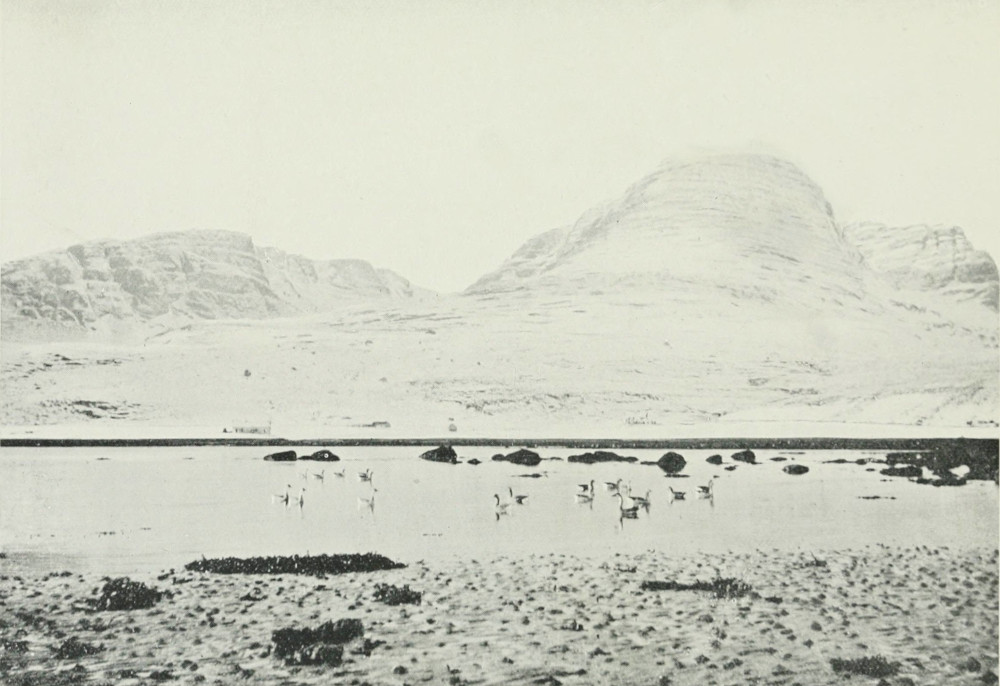
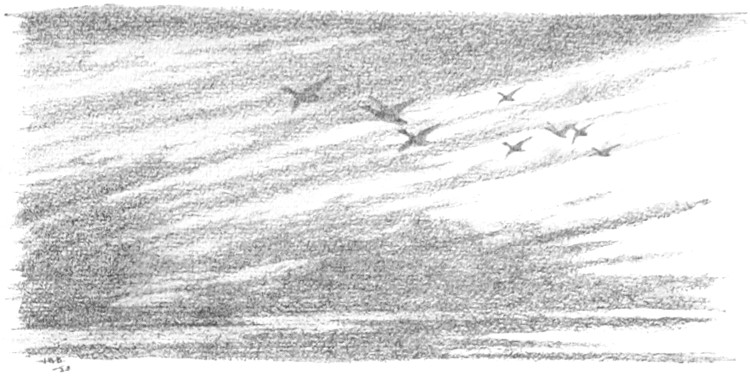
WINTER SUNSHINE—WILD GEESE AT THE FOOT OF THE APPLECROSS HILLS.
From a Photograph by The Lady Anne Murray of Loch Carron.
The answer to the question, Which of the two
birds, the eagle or the peregrine, is the faster flier,
must even on a horizontal flight be a matter of
pure conjecture. On the one hand, the peregrine
has the advantage of pointed wings which make
for increased wing power and speed, whilst the
eagle’s wings are rounded. On the other hand,
there is a great similarity between the general
build and structure of the two birds, and there
is the fact emphasised by Major Radclyffe in the
letters from which I have quoted above, that, as
between two birds of different size but of similar
shape and make, the larger and heavier bird will
almost invariably fly faster than the smaller and
lighter one once the former really gets going.
It is, of course, true that the peregrine is much
quicker in its movements and more agile than the
eagle. It is constantly under the necessity of
flying at its fastest (which the eagle is not) in
order to secure its food; in other words, to use
the language of a stalker in discussing this
question with me: “The peregrine requires a
warm diet, and lives on its prey. The eagle, on
the other hand, will eat carrion.” The peregrine
is probably quicker off the mark than the eagle,
but this does not necessarily mean that he flies
more quickly than the eagle once the latter gets
going. Stalkers have unusual opportunities of
seeing these two birds in flight, and almost all
those with whom I have discussed this question
believe that on a horizontal flight the peregrine
is faster than the eagle. This in my opinion is
probably the correct view.
It must not be forgotten that the Northern
falcons, or, as they are generally called, the
gyrfalcons, are entitled to rank as British birds,
although they are rare visitors to these Isles.
They are (1) the gyrfalcon or Norwegian variety
(Falco gyrfalco), (2) the Iceland falcon (Falco
islandus), (3) the Greenland falcon (Falco candicans).
The gyrfalcon is a very rare visitor here,
two recorded specimens only having been obtained
here and one of these is doubtful. The
Iceland falcon is a rare visitor also, although
identified examples have been obtained here from
time to time. The Greenland falcon is an irregular
winter and spring visitor, but there are more
recorded instances of this species than in the case
of the Iceland falcon. The former bird, the
prevailing ground colour of which is white, is the
most beautiful of all birds of prey. By some
authorities it is considered merely a race of the
Iceland falcon, which it resembles in size and
habits. The eggs of the two birds resemble one
another. All these Northern falcons are about
the same size and larger than, though very
similar in structure to, the peregrine falcon.
Speaking generally, the difference in length is
about 5 inches, in wing 2 inches. They have
been very highly valued in Europe for hawking,
and, as would be expected from their superior
size and similar structure, are undoubtedly faster
than peregrines.
Writing in the Field for March 15, 1923,
Major Radclyffe says:[13]
“All the gyrfalcons are much faster on the
wing than peregrines, and having trained and
flown both species of these falcons for many years
I have been enabled to prove this beyond doubt.”
The swift has still to be considered. There
are three species of swifts which rank as British
birds: the common swift (Cypselus apus), the
Alpine swift (Cypselus melba), and the spine-tailed
or needle-tailed swift (Acanthyllis caudacuta
or Chaetura caudacuta caudacuta). The Alpine
swift is a rare visitor here, only about thirty
having been satisfactorily identified at different
times from April to October in different parts
of these islands, but chiefly in the southern part
of England. It breeds in mountains throughout
Central Europe, and eastwards to India. The spine-tailed
swift is even a rarer visitor here, only two recorded
instances of specimens having been obtained—one
in Essex in 1846 and one (said to have been
in company with another) in Hampshire in 1879.
It breeds in the mountains of North-eastern Asia,
and in winter goes as far south as Australia.
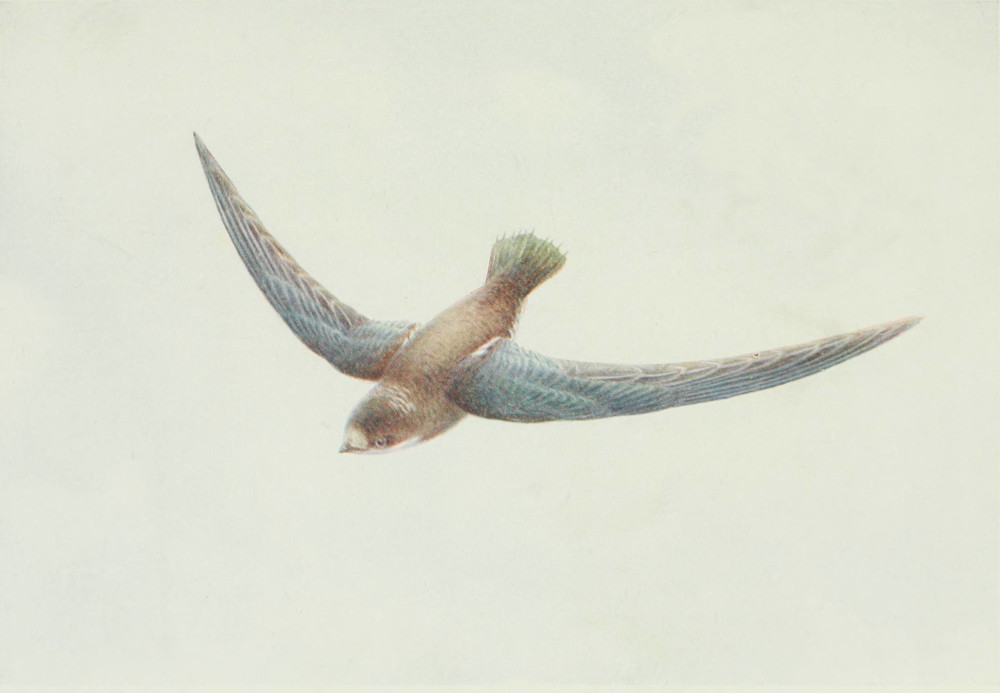
THE SPINE-TAILED SWIFT.
By V. R. Balfour-Browne.
Swifts are perhaps the most powerfully winged,
in proportion to their weight, of all British birds.
Their form is that which has been found to
make the fastest sailing vessel—full forwards and
lengthened, and tapering backwards. The difficulty
in regard to these birds, and particularly in
regard to the Alpine swift and the spine-tailed
swift, is to obtain the necessary opportunities and
conditions for comparing their maximum speed
with that of other very fast birds. It is difficult
to realise merely from a consideration of the
description and measurements of these three
swifts in the authoritative works of ornithologists
how much larger the Alpine swift and spine-tailed
swift are than the common swift. I have
had opportunities of handling and examining the
stuffed specimens of these birds in the British
Museum (Natural History) at South Kensington,
and should like to acknowledge here the courtesy
and assistance given to me at the Museum by
Mr. W. P. Pycraft, Dr. P. R. Lowe, and
Mr. N. B. Kinnear.
The actual measurements of the three birds are
as follows:
Length.
Wing.
Common Swift
6·75
inches
6·8
inches
Alpine Swift
8
”
8·45
”
Needle-tailed Swift
8
”
8·1
”
It is not generally realised that the common
swift, so well known in this country, which looks
so imposing in flight as it glides overhead with
wings extended, is hardly so large, when plucked,
as a man’s thumb-joint and weighs slightly over
half an ounce.
Bearing in mind that as between two birds of
the same build and structure the larger will, when
it gets going, fly faster than the smaller one, it
would naturally be expected, as is the undoubted
fact, that the Alpine swift and spine-tailed swift
are faster fliers than the common swift.
The falconer has in the case of the swift very
little opportunity of comparing its speed with that
of the peregrine. This is partly because the
peregrine, whether it be the falcon (the female
bird) or the tiercel (the male bird), will probably
not attempt to kill the swift, it being too small
a prey. There is the further difficulty that the
swift rarely continues on a level flight.
I have been so fortunate as to obtain the views
of several well-known authorities on this difficult
question—the comparative maximum speed of the
swift and the peregrine.
Colonel Meinertzhagen says:
“I should certainly say that the swift is the
fastest British bird, both in its normal speed and
accelerated. But any of the falcons could catch
it, if caught unawares, by stooping, or perhaps two
hunting together. If the swift had, say, ten
seconds’ warning,[14] I do not believe any falcon
could touch it. As regards endurance, those
birds with the greatest endurance are the swifts,
swallows, petrels, and gulls. Swifts are probably
endowed with the greatest powers, being denied
by nature the advantages of perching, alighting
on water, or resting on the ground. I have
recently been studying the power of flight of
various groups of birds, and find that the wings
of the swift and petrel groups have wing outlines
best suited for both endurance and speed. The
falcon has a wing intended for short rapid flights
and not for endurance.
“You have doubtless seen falcons hunting.
When they set out on a regular hunt they are not
usually much faster than their quarry, unless it is
some unfortunate non-game bird, and they only
gradually overtake it. But I think a falcon usually
makes full use of surprise and force of gravity.
If these fail, he often abandons the chase, recognising
that wearing a bird like a golden plover or
teal down by sheer endurance and honest straightforward
flying is a troublesome and not always
successful task.”
Major C. R. E. Radclyffe writes:
“The point you raise re the relative speed of
swifts and other birds is a difficult one to
decide.
“I have, however, a strong recollection of a
brother falconer (I cannot remember who it was)
telling me that his trained merlins could easily
overhaul a swift, and he told me that once or
twice they had killed them. But this was many
years ago, and I am not able to remember all the
facts.
“I have often stood on the bridges here and
watched swifts passing in hundreds close past me.
They appear to be moving very fast when hawking
after flies near the surface of a river.
“There is a long stretch of broad water in the
river in front of my house here, and often there
are hundreds of swifts flying up and down it.
They go about half a mile dead straight and then
turn back over this stretch of the river.
“I have flown fast carrier pigeons along this
same bit of water, and they seem to do it in less
time than the swifts. Only last summer, at my
place in Scotland, I was sitting on the banks of
the river watching some swifts, when a pair of
blue rock pigeons came from their nest in the
cliff, going out to feed, and they went clean past
the swifts going in the same direction.
“Of course presumably the pigeons were in a
hurry and the swifts were not, and unless we are
certain that both birds are trying their hardest,
you cannot accept these things as a test of speed.
“If I were asked to guess roughly at the six
fastest flying birds in the British Isles, I should
place them as follows:
1. The Peregrine,
2. The Hobby,
3. The Merlin,
4. The Golden Plover,
5. The Pochard,
6. The Blue Rock Pigeon,
and the fastest game bird is undoubtedly the
blackcock. I do not know, however, if a capercailzie
would not beat him if you could get them
both to take a long flight across the open, because,
generally speaking, in the case of birds of similar
shape and species, the heaviest bird is the fastest
flying one.”
Captain G. S. Blaine, another falconer of long
and varied experience, has also been so kind as to
give me his opinion on this question. He writes:
“I cannot say whether a peregrine falcon could
overtake and kill a swift, but I do not think it
would ever attempt the feat. Falcons do not,
as a rule, attack small birds. The male or tiercel
will sometimes stoop at them, but more in play
than in earnest. The female, I should think,
would never attempt to catch anything smaller
than a thrush or starling.
“It is very difficult to estimate the relative
speed of different birds. To do so, one would
have to judge correctly of the time taken in passing
a measured distance on a straight course. Very
few birds, especially swifts, fly absolutely straight
ahead.
“A hobby has been known to catch swifts and
swallows, and possibly a merlin would do the
same.
“A peregrine can fly faster than a merlin, but
it would not be so quick in turning and following
a bird.
“I think a peregrine can fly faster than a teal
or golden plover, though, as you observe, the
latter are quicker off the mark.”
There are very few recorded instances, as far
as I have been able to ascertain, in which a hawk
has killed the common swift. In two of these
there was no evidence as to whether the hawk had
not taken the swift by surprise. But there is at
least one recorded instance in which a swift has
been killed by a hobby in fair flight. This is to
be found in that delightful book, Field Studies
of some Rarer British Birds,[15] by Mr. William
Walpole Bond. The description of the race is so
vivid that, with the author’s kind permission, I
reproduce it here.
“On June 14, 1907, as I lay in a spacious
clearing of a big Sussex woodland, a sudden
swirl of wings gave me instant pause in my
meditations. Looking up, my eyes were held
by a swift coasting earthwards in frantic haste,
hotly pursued by a hobby not many yards in his
wake. I literally held my breath with excitement,
for here was an occurrence of dreamland only.
Speeding on about a level with the tree-tops
both birds measure the length of the long glade
in fractional time, and the hawk gains almost
imperceptibly.
“Then the pursued makes a mighty effort;
he rises gamely, even slightly increasing his lead.
Indeed it seemed he might shake off his deadly
courser. Alas, my friend, it is to no purpose;
the hobby has responded to your challenge, and
now exhibits speed for which—glorious flier
though he be—I should never have given him
credit. Mounting with ease above his prospective
prey, the lithe hawk compels him to describe an
arc and once again to start a life—or death—struggle
in a headlong slant across the clearing.
That flight is his last—the swift has shot his bolt.
Now inches only separate the birds, you could
cover both with a very large handkerchief. Next
instant the hawk rises straight and stoops strongly,
pursuer and pursued become one. Binding to
his quarry the hawk is away over the trees at my
back without so much as the most momentary
pause in the continuation of his eminently successful
‘shikar.’ Indeed, this continuity of action
was possibly the most pleasing part of a praiseworthy
performance, since you might reasonably
have expected a break—however trivial—after
what must have been a long and arduous chase.
As a fact, the death-stroke was so featly and
rapidly administered that, except that where a
moment before there had been two birds there
was now only one, and that a muffled clap and a
few small dusky feathers twirling aimlessly in the
summer breeze suggested some sort of untoward
happening, it was difficult to realise that anything
unusual had taken place.
“I have seen the irresistible death-stoop of the
peregrine, the lightning rush of the tiny merlin,
I have watched the earthward plunge after prey of
buzzard, eagle, kite, and harrier; I have revelled
in the agile snatch of the sparrow-hawk, in the
silent hovering of the kestrel; and all have I
enjoyed. Here was something quite different
and even far better. Never have I seen skill so
superb as was displayed by that hobby.”
It would therefore seem that the hobby,
which is a peregrine in miniature, flies faster
than the common swift even on a horizontal
flight, but it is worthy of note that in both stoops
referred to in this delightful description, the
hobby gained by reason of gravity. True, he
also gained altitude, but this may have been better
manœuvring for position and not necessarily a
greater speed. As the peregrine flies faster than
the hobby, being a bird of the same structure but
larger, the peregrine could no doubt overtake and
kill the common swift if it would take the trouble
to pursue so small a bird.
Next, as to the Alpine swift. This bird is
much larger than the common swift—in length
8 inches as compared with 6·75 inches—whilst
their wings are 8·45 inches and 6·8 inches respectively,
and as the two birds are of the same
structure, one would naturally expect that the
Alpine swift would be much the faster flier. The
flight of the Alpine swift, like that of the blackcock,
which is probably the fastest flier amongst
game birds with the possible exception of the
capercailzie, is very deceptive.
Colonel Meinertzhagen, in the article already
mentioned, describes some observations from an
aeroplane in regard to the flight of a large flock of
common swifts feeding at an altitude of 6000 feet
over Mosul in Mesopotamia. He describes how
they circled round the aeroplane, which was flying
at 68 miles an hour, and easily overtook it. In
commenting on this case he says: “The case of
the Mosul swifts is interesting. The birds were
probably not on passage but simply feeding. It
is known that swifts travel great distances in
search of food and ascend great altitudes.
“In the Middle Atlas of Morocco, in the Himalayas,
in Crete, and Palestine, 4000 or 5000 feet
and 50 miles or so in distance seems nothing to
these incomparable fliers. I have had splendid
opportunities of observing the Alpine, common,
and spine-tailed swifts (Chaetura), and it has been
a great disappointment to me that I have never
been able to get a satisfactory estimate of their
rate of flight, as they never continue on a level
course. On a small island on the coast of Crete
I was recently given a good exhibition of what an
Alpine swift can do. I was watching some of
these birds feeding round cliffs in which several
pairs of Eleonora’s falcons were about to breed.
Now, this delightful falcon is no mean flier, and
as these swifts passed their cliff, the falcons
would come out against them like rockets. The
swifts would accelerate and would seem to be out
of sight before the falcons were well on their way.
So confident were the swifts in their superior
speed, that every time they circled round the
island they never failed to ‘draw’ the falcons,
and seemed to be playing with them. I may add
that these same falcons have little difficulty in
overhauling and striking a rock-pigeon—itself
no mean performer. I have also seen on record
the case of falcons and swifts somewhere in India,
where the former failed time after time to come
up with his quarry. I, unfortunately, cannot
trace the reference.
“I hesitate even to guess at the speed to which a
swift can attain when the necessity arises, but the
main point is that this, the fastest of birds, can increase
his feeding speed of, say, 70 miles per hour, to
a velocity which must exceed 100 miles per hour.”
In the tables given above[16] Colonel Meinertzhagen
estimates the speed of the normal and
migratory rate of flight of falcons at 40 to 48
miles an hour, whilst Captain Portal estimates
the maximum speed of the peregrine falcon in
level flight through still air at 62 miles an hour.
Captain Portal adds that the speed given is for
a good trained bird, and that a wild bird is faster.
In view of Colonel Meinertzhagen’s observations
from his aeroplane and the figures given
above, it would appear to be certain that the
Alpine swift is faster than the peregrine falcon in
horizontal flight.
We have now to consider the speed of the
spine-tailed or needle-tailed swift. There seems to
be no doubt that this bird is a much faster flier
than the Alpine swift, though at first sight and
without a careful examination of the skeletons, it is
difficult to state why this should be so. I have compared
various specimens of the two birds, and there
appears to be little difference in their size. Colonel
Meinertzhagen, who has been so kind as to discuss
the subject with me, agrees that the spine-tailed
swift is the faster flier, and tells me that he thinks
it is probably the heavier bird of the two, and that
this may account for its greater rapidity of flight.
The wing of the Alpine swift is 8·45 inches,
that of the spine-tailed swift is 8·1 inches. The
length of both birds is 8 inches,[17] although Dresser[18]
gives the total length as 8·5 and that of the
spine-tailed swift as 8·1 inches.
The genus Chaetura, to which the needle-tailed
swift belongs, is easily distinguishable from
the genus Apus (to which the common swift and
Alpine swift belong) by the wedge-shaped tail in
which the shafts of the feathers are longer than
the webs and protrude like spines. The tail in
the only species (Chaetura caudacuta caudacuta)
occurring in the British Isles, compared with that
of the Alpine swift, is very short. It is almost
square, and has ten feathers, which are very stiff
and the shafts of which project 4-6 mm. (·156-·234
inch) beyond the web in a stiff point like that
of a needle or spine.[19]
The shafts of the primaries are very strong
and the wings very long. Gould[20] says, in reference
to the spine-tailed swift, in a passage which
is quoted in Seebohm:[21] “The keel or breast bone
of this species is more than ordinarily deep and
the pectoral muscles more developed than in any
of its weight with which I am acquainted.”
Probably the last-mentioned facts largely account
for its superiority in speed over the Alpine swift.
In an article entitled “The Twelve Swiftest
Birds of Australia,”[22] in which Mr. E. S. Sovenson
gives the views of himself and various friends of
his as to the relative speed of Australian birds, he
says that after long observation he and they have
no hesitation in stating that the spine-tailed
swift is the swiftest Australian bird, and states
that its speed has been computed at 180 miles
an hour.
“Besides its swiftness,” he writes, “it is
almost tireless of wing, being second only in that
respect to the frigate bird, the bird of eternal
flight. Both have very long wings in relation
to the body—an indication of rapid flight. The
swift, a bird of passage which crossed the wide sea
after breeding in Japan, is not known to alight
in Australia, where it spends a considerable time
hunting its insect prey in the upper air.”
In A History of the Birds of Europe,[23]
Dresser writes: “The present species (Acanthyllis
caudacuta or Chaetura caudacuta caudacuta) and
Acanthyllis gigantea are said to be the swiftest
birds in existence. Tickell says that he never
witnessed anything equal to the prodigious swiftness
of its movements.”
Chaetura caudacuta cochinchinensis (which is
to be found in Malacca, Sumatra, and Cochin
China) is a form of the spine-tailed swift allied to
that species (Chaetura caudacuta caudacuta) which
is so rare a visitor here. I have examined and compared
numerous specimens of these three species
of spine-tailed swifts, and it would seem practically
certain, in view of their similarity in size and
structure, that their speed must be similar.
Mr. E. Stuart Baker, who has made experiments
as to the speed of the Chaetura nudipes and
the Chaetura cochinchinensis, writes:[24] “Both
these species have a normal flighting speed of
something very nearly approaching 200 miles an
hour, enormously in excess of the powers of any
other bird with which I am acquainted. In
North Cachar, Assam, these birds used to fly
directly over my bungalow in Haflang, flying
thence in a straight line to a ridge of hills exactly
two miles away, and when over the ridge at once
dipping out of sight. We constantly timed these
swifts and found that stop-watches made them
cover this distance in from 36 seconds to 42
seconds, i.e. at a rate of exactly 200 miles an hour
to 171·4.”
Writing of the Chaetura nudipes Mr. W. T.
Blanford, F.R.S., says:[25] “This and the other
large spine-tails are, I believe, absolutely the
swiftest of living birds. Their flight far exceeds
that of the Alpine swift, and I doubt if any falcon
can approach them in speed. They are generally
seen in scattered flocks that play about for a time
and disappear at a pace that must be seen to be
appreciated.”
The same ornithologist refers[26] to the Chaetura
indica or brown-necked spine-tailed swift, which
is a larger species (length about 9 inches, tail 2·6—wing
8—tarsus 6·8), as being “equal or possibly
even superior in speed to Chaetura nudipes—so
wonderful is their flight that Mr. H. R. P.
Carter remarked that a flock of Alpine swifts,
passing over immediately after some of the
present species, ‘seemed to fly like owls after
the arrow-like speed of the spine-tails.’”
I think, therefore, that if the speed in horizontal
flight is alone to be considered, the spine-tailed
swift is the fastest bird which flies in the British
Isles, that the Alpine swift comes next; then come
the northern falcons (or as they are usually
called, gyr-falcons) and the peregrine falcon, in
the order named, except in the case of a very
short flight, in which case the Golden Plover and
teal, being faster off the mark and better sprinters,
will fly more quickly than the falcons, though
they will, when the latter really get going, be
gradually overtaken.
There remains for consideration the speed of
the golden eagle and falcon in their downward
flight, when stooping at their prey. There is no
certain method of comparing their respective
speeds in this unique kind of flight either with
one another or with the speed of other birds which
never fly in this way. In considering the question
of the relative speed of the two birds in this particular
kind of flight, I will first deal with the matter
on principle and then consider such evidence of
eye-witnesses as I have been able to obtain. The
falcon has of course one great advantage over the
eagle as regards equipment for swift flight. He
has the long pointed wings typical of the true
falcon, whereas the eagle has rounded wings. As
between birds of similar size and spread of wings,
the bird with pointed wings is faster than the one
with rounded wings. Thus a blackcock is undoubtedly
faster than a pheasant although their
bodies are about the same size, or to be more
accurate the blackcock is rather smaller than the
pheasant. A striking instance of this was recently
given in the Field[27] by Mr. G. Denholm Armour,
who wrote: “Some years ago a friend asked me
to come to Argyllshire late in the autumn to shoot
some black-game which lived in the birch and fir
woods hanging along the lower parts of the hills.
“Our method was to place ourselves in a break
in the line of woods at the bottom of the hill,
sending two or three men to drive the wood
towards us. The result was usually very high
birds flying downhill and very fast. On several
occasions at the same time came a blackcock and
a cock pheasant, of which there were a few in
almost every drive. Incidentally, most of the
pheasants we shot were old birds with long spurs,
so were very strong on the wing. In each case—and
I noticed several—the blackcock outflew the
pheasant by what seemed to be about 50 per cent
in pace, leaving him as a racing car would a
‘runabout.’
“The chance of comparison was very interesting,
being between birds of much the same
weight and size, both started under the same
conditions, and I think ‘doing their best.’ Had
the blackcock come alone, I think his much
slower wing beat would have made one think him
the slower flier of the two.”
The blackcock and grouse have wings exactly
alike—but the blackcock is heavier than the
grouse and much faster.
With the exception of the difference in the
wings mentioned above, the structure of the eagle
and falcon is very similar, and as has been pointed
out, the larger of two birds of similar structure
once it gets going is almost invariably faster,
owing no doubt to its superior muscular power
and driving force.
In comparing the downward flight of the eagle
and falcon it is also necessary to recollect the
advantage which the former has by reason of its
much greater weight.
It is difficult to obtain thoroughly reliable
records of the weights of the golden eagle and
the different falcons; but so far as I can ascertain,
the weight of the eagle varies from 8½ to 12½ lb.,
that of the gyr-falcon from 3 to 3¾ lb., and that
of the peregrine from 2 to 3 ounces under 2 lb.
to 2¾ lb., in each case of course the female bird
being heavier than the male.
But for the resistance of the air, all bodies,
light or heavy, small or large, would fall at the
same rate. In fact, however, as velocity increases
a notable air resistance is set up which increases
rapidly. The velocity of a body falling freely in
vacuo is over forty miles per hour at the end of
two seconds, over sixty at the end of three
seconds, and so on.
We all know by experience the great force
exerted by a wind of a velocity even as low as
thirty miles an hour, which most people would
call a hurricane. But it is not perhaps so generally
known that in proportion to its weight, other
things such as shape and specific gravity being
similar, a small body experiences much greater
resistance than a large body. The resistance of
the air to the fine particles of vapour which constitute
a cloud is such that they only fall at the
same rate of a few feet per hour. And in the case
of two birds of similar shape and specific gravity,
but one eight times the weight of the other, the
larger bird would ultimately attain a velocity
roughly twice as great as the other, if both fell
for a sufficient distance to attain their limiting
velocities, i.e. the velocity at which the resistance
offered by the air is equal to the attraction of
gravity. Similarly if the one bird were four times
the weight of the other, the velocity ultimately
attained under the conditions mentioned would
be roughly one and a half times as great as the
other.
In “Notes by an Old Stalker” in the Field
for September 9, 1922 (p. 370) there appears the
following interesting account of a duel between a
golden eagle and a peregrine which the writer
himself witnessed:
“Although by a long way our most powerful
bird, the eagle is by no means a match for some
much smaller combatants. Once I saw an eagle
soaring placidly along when from a range of
precipices immediately below him a falcon shot
up into the air. Without a moment’s hesitation he
attacked the giant bird. The eagle at once joined
combat, and through the telescope I could see
his efforts to hit his adversary with beak and wing.
One blow from either and it would be all over with
the falcon; but the latter evidently realised this
and regulated his tactics accordingly. The movements
of the eagle were slow and cumbrous compared
to the rapid action and lithe activity of his
adversary. Every time he dodged the eagle’s
stroke and, wheeling rapidly, got in his blow
before the huge bird could recover himself. That
the eagle was in a great rage was evident, for I
could hear him emitting sounds that resembled
nothing so much as the bark of a terrier. Finally,
realising the hopelessness of the contest, he took
to flight. I previously knew that the eagle was
fast on wing, but the speed he now exhibited was
a revelation to me. With half-extended, half-curved
wings, showing never a tremor, he cleft
the air straight as a bullet. The falcon pursued,
but, being left hopelessly behind, soon gave up
the chase.”
The flight of the eagle here described was
obviously a glide or downward flight, when, as I
have pointed out, gravity would assist his speed to
a greater extent than it would in a bird of less
weight—the peregrine.
In the case of a bird of prey descending from
a height on its quarry, the nearer its downward
flight is to the vertical the faster will it descend.
In coming down on its prey, neither the eagle nor
the falcon completely closes its wings, probably
because if it did so, it would lose control. This
is also true of the gannet or solan goose, which has
been described as the largest and noblest-looking
of our sea fowl. The great speed which a bird of
large size can attain in downward flight can to
some extent be realised by watching the gannet
when he drops head first as he descends perpendicularly
on to the fish in the water. I have
carefully examined and compared the skeletons
of the eagle and peregrine and have tried to form
some idea as to the relative muscular power and
driving force of the two birds, and bearing in
mind the facts stated above, and the greatly
superior size and weight of the eagle, it seems
reasonable to conclude on principle that the eagle
is probably faster than the gyr-falcon or peregrine
in a downward flight, assuming that both birds
are putting forth all their powers.
As regards the evidence of eye-witnesses, I have
discussed this question with many stalkers. The
majority of them have never seen the eagle stoop
at its quarry and strike it a blow which sends it
to the ground as the peregrine so often does—though
they have seen the eagle seize its quarry
in the air or pounce on it on the ground and
carry it off. Only a few of these, however,
have any doubt as a result of what they have
heard from other stalkers and keepers that
the eagle on occasion does adopt the former
method.
It is, however, an undoubted fact that although
the eagle generally captures birds which he is
pursuing by seizing them in his talons or, to use
the falconer’s term, binding on them, he occasionally
stoops on and strikes them in the air, sending
them hurtling to the ground in the same way as the
peregrine does.
The reason why the eagle so rarely adopts this
method is probably because it can secure its prey
without doing so, and further if it were to exert all
its powers when descending from a considerable
height at an angle near the vertical on a grouse,
blackcock, or ptarmigan (which do not usually
fly very high above the ground), it would incur a
serious risk of injury in consequence of being
carried on by its impetus and dashing against
the rocks or ground after striking down its
prey.
THE GOLDEN EAGLE.
By V. R. Balfour-Browne.
The interesting, and I think significant, fact is
that although some of these stalkers with whom
I have discussed the question think that the
peregrine probably flies faster than the eagle,
every one of them who has seen the eagle kill its
quarry in this way (and I know several) has told
me that in his opinion the eagle in its final rush
is faster than the peregrine. It is also important
in this connection to bear in mind the fact on
which Major Radclyffe lays such stress—that it
is an optical illusion to imagine that a smaller-sized
bird is flying faster than a larger bird of
similar shape and make, and that, as he says, ninety-nine
sportsmen out of a hundred would probably
tell you that a snipe flies faster than a woodcock—whereas
the converse is true. An old keeper in
the North, whom I have known for many years,
told me that he had seen the eagle stoop at and
strike his quarry in this way on two occasions,
and that it moved in its final downward flight
with the same lightning-like rapidity as the
peregrine.
John Finlayson, the head stalker at Killilan,
wrote to me last February as follows: “I have
once plainly seen the eagle driving after grouse
and striking it down very similar like what the
peregrine falcon does. It happened at the north
end of Corrie-ach. I was going up to Patt from
Mulbuie way. A covey of grouse came tearing
down from the low end of Aonachbuie in front
of me, about 300 yards away, and an eagle in hot
pursuit, wings gathered up, and making a swishing
noise; going through the air it struck one down,
with a cloud of feathers knocked out when it did
so. The eagle glided up a little, then balanced
and dropped down where the bird fell; it was a
little over a ridge out of my view; when I got up
to the place I saw the eagle well up the glen going
fast with the bird in its talons.”
My gamekeeper, Donald McIver, who has
lived all his life in Ross-shire, on one occasion saw
an eagle strike and kill a blackcock. This is his
account of it. “In the forest of Strathconan,
where I was for a number of years, I once saw a
very fine sight of an eagle pursuing a blackcock.
The blackcock got up at the head of a very deep
corrie and came over at a very great height. The
eagle was about and soon after it. I could see
him overtake the bird, and I would say that he
struck him the same way as the peregrine does
with his claw. I saw something drop, but could
not make out what it was at the time; then the
eagle doubled in the air and caught the bird before
it reached the ground. None of the other eagles
I have seen after their prey have struck it like this
in the air. They have always clutched at their
prey, but this time the eagle struck the bird and
went right past him. I was not far off, and could
hear a tremendous noise of the wings. When the
eagle doubled back and caught the bird in the
air I would judge that the bird would be as high
up as three hundred feet, and when he doubled
back I should think he was not fifty.
“Perhaps the narrowness of the corrie might be
the reason for him taking the bird in the way he
did—I went to the place and found the head of
the blackcock; there was about three inches of
skin hanging to the head, a tear like what would
be done with the claw. This is the only time I
ever saw an eagle kill a bird in the air, but it was
a grand sight. This happened in January 1895,
in Corrie Vullin, Strathconan.”
This amazing feat in aerial gymnastics is no
doubt also performed on rare occasions by the
peregrine. One of the most experienced of
living falconers wrote to me as follows: “I have
seen a very celebrated falcon which I owned for
years bring off a remarkable trick several times.
She used to strike at the back of the grouse’s
head, and I have seen her just scalp the grouse,
taking a piece out of its skull not as large as a pea,
and thus killing the bird in mid-air just as if it
was shot; often, when the grouse was high above
the ground, I have seen the falcon then take a
sharp turn in the air as the grouse was falling, like
a spinning leaf, and pick it up in her feet before it
could touch the ground—a very wonderful sight.”
An old friend of mine, who is head stalker in
one of our best-known deer forests and whose
veracity I have every reason to accept, told me an
interesting story which further illustrates what
fine feats in the air the peregrine falcon can perform.
He said that on one occasion he saw a
falcon strike and carry off a crow. As the falcon
was circling higher and higher up, carrying off this
crow, it was mobbed by a considerable number of
other crows. For some time it ignored them,
continuing its steady upward circling flight until
one crow, becoming rather bolder than the rest,
provoked the falcon into retaliation. Dropping
the crow it was carrying, the falcon stooped on the
troublesome crow, struck and killed it and, turning
with extraordinary rapidity, caught in the
air the dead crow which it had been carrying, and
then recommenced its upward flight without
further trouble from the crows.
WHERE THE GOLDEN EAGLE REIGNS.
From a Photograph by Frank Wallace.
The marvellous speed of the golden eagle and
peregrine in their final rush, when stooping from
a height at their quarry, must be seen to be
believed. Few persons have been so fortunate as
to have this opportunity in the case of the golden
eagle, although this grand bird is often to be seen
in some forests and has no doubt increased in
numbers in recent years. On the other hand,
there are of course many persons who have seen
both the wild peregrine and the trained gyrfalcon
and peregrine strike down their quarry.
The well-known ornithologist and wild-fowler,
Mr. W. H. Robinson of Lancaster, in a letter in
the Field of January 28, 1922, after stating from
his own experience that the peregrine can overtake
the golden plover and the curlew with the
greatest ease, says:
“To my mind one of the fastest things I have
ever witnessed is the last effort of a peregrine in
chase of a wild duck when, fast as is the accelerated
speed of a mallard, it seems almost to be standing
still in the air when the peregrine stoops over it.”
Any one who has seen this, as I am glad to say
I have, will assuredly echo these words.
It is of course pure speculation whether, in the
comparatively short flight of an eagle or falcon
stooping in its final downward rush at its prey, its
speed exceeds the maximum speed of the spine-tailed
swift. Those, however, who have seen the
last effort of the eagle or falcon in a flight of that
unique kind will never believe, without scientific
demonstration to the contrary, that any other
bird in the British Isles can fly faster.
Donald
V A GOOD DAY IN THE FOREST OF COIGNAFEARN
Towards the end of a September several years
ago I was so fortunate as to be invited to stalk
at Coignafearn, which has always been famous
for the size and weight of its deer. On reaching
the lodge on a Saturday night, I heard that
the head stalker had met with an accident,
fortunately not a bad one, but possibly serious
enough to prevent his going out with me on the
following Monday. He had been out in the
forest the day before I arrived, and on going up
to a stag to bleed him, the stag had given a sudden
unexpected plunge, which had caused the stalker
to inflict on himself a nasty wound in his right
leg with his knife, which was open in his hand;
another instance that no one, not even the oldest
and most experienced of stalkers, can be too
careful on these occasions. On Monday morning
he was much better but not fit to go with me.
The season was well advanced, and my host was
very anxious to kill the usual number of stags as
soon as possible. It was therefore arranged that I
should act as my own stalker, and take with me
a watcher named Maclennan. I had also two
gillies with me and a couple of ponies, and my
host told me that he would be only too glad, if
I could manage it, if I would kill as many stags
as could be brought in. Maclennan had never
acted as stalker, but as there is nothing I like
better than to do the stalking myself, I was very
pleased with this arrangement, for Maclennan
knew the ground thoroughly, and I felt sure that
his assistance would be invaluable; indeed, without
him I could of course have done practically
nothing, as the ground was strange to me. We
were in the forest and spying by 10 A.M., and very
soon we saw a good stag with some hinds. The
stalk was unsuccessful, but it was not long before
we spied another good stag, and without much
difficulty I managed to get into a good position
within about 150 yards, and shot him through
the heart. He proved to be a good eight-pointer,
and weighed 15 stone clean. Shortly after this
we spied a large herd of deer which were very
restless, continually on the move. There were
several good stags in the herd, and these were
roaring and fighting and driving the hinds about.
Two of them in particular, which looked like the
heaviest, engaged in a battle which lasted for some
time; but gradually one of them showed signs of
being worsted and, watching his opportunity,
suddenly turned tail and bolted. It is rarely
that battles of this kind end fatally—only once
have I met an eye-witness of such an occurrence.
The battle was between a switch and a ten-pointer.
The combatants were fighting on the
side of a hill and were very evenly matched. My
informant, the stalker at Attadale, said that after
some time the switch, taking advantage of being
on slightly higher ground, charged his adversary
and, getting past his guard, pierced his side with
his antlers. The ten-pointer immediately fell to
the ground dead. The stalker ran up and found
that the dead stag had been pierced through the
heart by his conqueror.
The stag with the best horns is generally not
the best fighter and is frequently driven out by
a switch-horn or “caberslach,” whose long skewer-like
antlers are the most effective horns for
fighting. The best fighter of all is, however,
the hummel—a stag which has no horns at all,
and which is in consequence a very heavy beast.
It is astonishing how a stag will sometimes
acknowledge himself beaten without any fight at
all. I remember when stalking at Fealar that I
had been trying without success for nearly two
hours to get a shot at a big black stag which was
in pursuit of a large number of hinds and was
constantly on the move, skirmishing with smaller
stags and driving them away. Suddenly we
heard the sound of great roaring and saw coming
from the direction of Mar Forest a huge red stag
which evidently had for its objective the hinds who
were in charge of the black stag. The newcomer
kept running for a short distance and then stopped
to roar and grunt. We thought that by running
hard we might reach a point near enough to get
a shot at him. We accordingly ran as fast as we
could in order to try to cut him off, but in vain.
Before we could get within shot of him he
had passed this point we were making for. As
soon as he got within sixty to seventy yards
of the black stag, who was waiting and every
now and then roaring defiantly in answer to his
challenge, the latter seemed suddenly to realize
that the contest would be hopeless and turned
tail and bolted ignominiously, being pursued only
for a short distance by his adversary, who then
rounded up the hinds and drove them off.
But to return to my story. We tried to stalk
the victorious stag, which seemed to be the best
beast in the herd, but found it extraordinarily
difficult to get within shot of him. There always
seemed to be several hinds in the way, and, as it
was now getting towards two o’clock, we decided
to have luncheon, in the hope that in the meantime
the deer would settle down, and that we should
then have a chance at the stag we were after. We
did not waste any time over lunch and very soon
again had the deer in view. They were still on
the move and we followed them for some time.
The stag which we were after, which we made out
to be a nine-pointer, was evidently much troubled
by two other stags only a little smaller than himself,
and presently, after chasing away first one
and then the other, these three stags were between
us and the herd. Now at last it seemed there
was some chance of getting a shot at the nine-pointer,
but before we could get up to him he
began again to chase off the other stags, and then
turned, and at a good pace followed the herd
which was moving away from us. The other
stags then also turned and followed in the same
direction, though at a respectful distance from
the nine-pointer. Maclennan and I, by running
and crawling quickly, gradually diminished the
distance between ourselves and the deer, and at
last, after a quick run when out of their sight,
crawled up a small hill and saw the three stags,
the nine-pointer watching the other two. The
nine-pointer was nearly 200 yards from us when
he suddenly stopped and turned, standing for a
moment about three-quarters on. I saw that
this was my only chance, as the stags were just
on the brow of the hill, and in a few moments
would almost certainly be out of sight. I therefore
decided to take the chance and fired.
“You have him, sir,” said Maclennan, as the
stag, evidently hard hit, disappeared over the
brow of the hill. We made our way as fast as we
could over the hill, but saw no sign of the stag.
PREPARING FOR BATTLE.
By Frank Wallace.
The ground was rocky and very broken, and I
felt sure that he could not have gone far, and was
lying down hiding himself. We began to search,
when suddenly the stag jumped up from under a
rock about some eighty yards from us, and after
running for about 500 yards farther lay down
behind a rock, showing only the point of his
horns. I had not shot at him again, as he was end
on, and was evidently in such a condition that he
could not go very far. We followed up, keeping
well out of sight, but found it impossible to get a
chance of shooting, so cleverly had he concealed
himself. Whilst hesitating as to what would be
the best course to take, the stag suddenly got up
again and bolted, but this time he gave me a fair
chance of a shot, and I killed him before he had
gone more than a few yards. On getting up to
him, we found that my first shot was not sufficiently
forward, but was a raking shot through
the body, and the stag could not in any case have
gone very far. He was a good beast with a strong
horn, and later turned the scale at 16 stone 9 lb.
clean. After gralloching the stag, one of the
gillies went off to signal to the ponyman; and
Maclennan, the other gillie, and I proceeded to
work our way back to the lodge, hoping to get
another shot on the way home. We soon spied a
good stag with a number of hinds, and, after a long
stalk, I got a good chance of taking a quick shot at
a little over 100 yards and fired. The stag disappeared.
Maclennan thought I had hit him,
but I was very uncertain, and think I must have
shot over him. A long and careful search on the
ground, which was very broken, showed nothing.
There was no sign of the stag, nor were there any
marks of blood to be seen, and I felt satisfied that
I must have missed him, though Maclennan and
the gillie had thought otherwise.
We again started to work our way back, and
had not gone very far before Maclennan suddenly
stopped and brought his glass to bear on the face
of a hill about half a mile away. He then said
there was a stag with a fine wide head lying down,
and that we ought to be able to get close to him
without difficulty, as the ground was very broken.
I proceeded to stalk this stag, and got without
great difficulty within about 180 yards of him,
when I saw that he was up and looking very
suspicious, and that I should have to take my
shot as soon as I could. We quickly got the rifle
out of the cover, and crawled to another hillock
about 100 yards from where the stag was. Arrived
there, I pushed the barrels of my rifle over the
top of the hillock and slowly raised my head. The
stag was standing nearly broadside on, looking
straight at me. I fired. There was a thud as the
bullet struck him, and he turned and galloped off,
disappearing round a corner of the hill. I felt
confident that the bullet had gone home; and we
found the stag, who had been, as I thought, shot
through the heart, lying dead about sixty yards
from the place where he had been standing when
I fired at him. He was a ten-pointer, and had a
fine wide head with a good horn, and when we
got him home we found, curiously enough, that
his weight was exactly the same as that of the
first stag that I had shot—15 stone clean.
Leaving the gillie to gralloch the stag,
Maclennan and I now proceeded homewards,
keeping a sharp look-out, and presently we saw
a considerable number of stags, which were moving
across the valley from one hill to another. We
saw that if they were not disturbed they would
probably cross a little hill not far from us, at a
point from which we could, if we moved quickly,
get to within shooting distance. So, running
and walking quickly, we reached a spot about 140
to 150 yards from the point at which we expected
the stags to pass, and arrived just in time. The
stags were moving slowly almost broadside to us
in single file, and were passing over a little knoll,
at which point I had a fine chance of a shot.
“Take the second one, sir,” said Maclennan, who
had his glass on them. I was just about to fire when
he said: “No, not that one, but the third; he’s
better.” Again I was on the point of shooting when
Maclennan said: “Wait, sir, wait; take the fifth,
he’s the best.” Directly the stag topped the knoll
I fired, and he ran a few yards and fell down. On
coming up to him I found it necessary to give him
another bullet through the neck. We found that
this stag was by far the best we had seen that day.
He was a royal, in splendid condition, and weighed
17 stone 6 lb. clean. He had a magnificent head,
with very thick black horns, and long points with
white tips. After gralloching him, and tying a handkerchief
to his horns to scare the eagles and foxes,
we made our way back to the lodge. I had
several good days in the forest subsequently, with
one or other of the regular stalkers, but none
more enjoyable than this one, in which, without
the assistance of a regular stalker, I had the good
fortune to kill four stags averaging over 16 stone
clean, without heart or liver.
“TAKE THE FIFTH, HE’S THE BEST.”
By V. R. Balfour-Browne.
VI A STALKER’S PERIL
ON THE TOPS
The accident to the head stalker which I mentioned
in the preceding article shows that stalking,
like almost every other sport, has its dangers, and
every one acquainted with the pursuit of deer
knows the necessity of exercising great care in
approaching them after they have been shot.
A serious accident is, however, very rare, but
sometimes even the most experienced stalkers, as
in the instance referred to above, incur risks
which they ought not to take.
Far more serious than the accident which I
have described was one which occurred several
years ago, recorded by a former neighbour of
mine in the north, the owner of a well-known
deer forest. I give the story in his own words,
as well as I can remember. “It was late one day
in the forest of Fannich, where I was stalking as
the guest of one of my relatives who was at that
time a tenant of the forest. After a long and
difficult stalk, I had succeeded in getting up to
the stag and shot it. The stalker, Duncan, an
excellent man of long experience, approached the
animal to give it the coup de grâce, and, with his
open knife in his right hand, seized one of the
stag’s forelegs with his left. Instantly the stag
gave a tremendous plunge and threw Duncan
back. The knife went into Duncan’s thigh, and
he bled profusely. Both of us made frantic
efforts to stop the bleeding, but without avail.
The gillie, who was behind, came up, and we did
all we could, but having no medical training, or
even a knowledge of first aid, were unable to
render useful assistance. Duncan got weaker
and fainter, and was apparently bleeding to death.
He was, however, perfectly cool and collected,
said there was no one to blame but himself,
that he was awfully careless, and ought never to
have taken hold of the stag in the way he did.
IN THE FOREST OF FANNICH.
By Finlay Mackinnon.
“He appeared to be rapidly getting weaker,
and said quite quietly that he thought he was
dying, and asked me to take some messages for
him to his wife and children, and then seemed
to be losing consciousness. It was getting dusk,
and the gillie urged me not to wait any longer, as
I could do no good, and unless I started for the
lodge at once I should not be able to find my way.
So with a heavy heart I said good-bye to poor
Duncan and started homewards. From time to
time I turned to look back at the two men, and
at last, when I reached the top of the last hill I
had to cross before losing sight of them, I turned
to take one final glance. When I looked round,
however, I was startled to see, close to the place
where Duncan had been lying, the figures of
two men walking slowly. There was no mistake
about it—they were Duncan and the gillie. I
ran back again, and found that soon after I left
them the bleeding had stopped quite unaccountably,
and Duncan, though still very weak, had
gradually revived and finally insisted on trying
to walk. We persuaded him to rest, and, leaving
the gillie beside him, I went back to the lodge as
quickly as I could and sent up a pony. Duncan
got safely home, and when the doctor saw him
he said it was a marvellous escape, for if the knife
had gone into Duncan’s thigh two inches from
the spot where it entered, nothing could have
saved his life.”
VII THE LUCK OF SALMON FISHING
Nearing the End.
I have always sympathised with the author of the
lines known as “The Angler’s Prayer,” lines
which are not so well known as they deserve to
be:
Lord, suffer me to catch a fish—
So large that even I
When talking of it afterwards
May have no need to lie.
In the spring of 1921 came the tragedy of my
life as a fisherman. I had five days’ fishing in the
famous river Wye. The river was dead low and
my chances of success very small, but I kept
steadily at work during the time at my disposal,
and on the fourth day had the good fortune, by
means of the attractions of a Mar Lodge (size
4/0), to hook a salmon which was not only the
largest salmon I had ever seen, but also the
largest seen in that year on the beat I was fishing—a
most exciting struggle of over an hour terminating
in a wild rush of over 100 yards, the wildest
rush I, or the keen fisherman I had with me, have
ever seen, a grand leap high up into the air of this
splendid clean-run fish, and the line came slowly
back, the cast having broken a foot from the end.
Elsewhere (pp. 12-22, supra) I have told of how this
splendid fish, no doubt exhausted by the struggle,
was shortly afterwards killed by a far greater
fisherman than any mere mortal man—an otter.
Its estimated weight, as far as could be judged
from its remains, was about 40 lb. The day was
Friday, April 1, an appropriate day and date for
such a catastrophe. In the early part of the
following year I received an invitation from the
same kindly host to try my luck again in April on
the same river, but on another and more famous
beat. I gratefully accepted the invitation, and
set forth in high hopes and, curiously enough,
with a strong sense of expectation, I might almost
say the assurance, of great events.
For several days after my arrival the river was
so high that fishing was hopeless, but on the
morning of April 18, though still high and
coloured, it had run down to such an extent as
to be in fair condition.
My host was most kind in wishing to give me
every possible chance of getting a good fish, and
had arranged that I should take with me his
butler, C., a first-rate hand at gaffing salmon,
who had been with me in the preceding year when
I was so unfortunate, and was very keen to help
me to kill a big fish. My host sent me to try,
first of all, a pool which had a great reputation.
This pool is about a mile long, and has to be fished
from a boat, trees and bushes running throughout
its entire length along both sides of the bank.
My host had the fishing on one side of the river
only, and on reaching the head of the pool we
found some one fishing from the other side.
After waiting until this rod had fished some way
down the pool, we began operations. I fished
the whole morning with the fly, but with no
success, and about half-past one, as the river was
still so high, we decided to try the minnow, a much
more favourite lure than the fly on this particular
river in the spring. At my third cast I got a pull,
and was fast in what was obviously a heavy salmon.
I never had a more lively fish to deal with. It
jumped fourteen times clean out of the water,
and, making a constant series of wild rushes, took
me at a great pace down the river. Some ladies
of our party arrived at the head of the pool about
half an hour after I had hooked the fish, and
inquired of the fisherman on the other bank
whether he had seen anything of me. The reply
was, “I saw him fast in a big fish about half an
hour ago going round the bend of the river on
his way to Hereford.” Though I did not get to
Hereford, which was nearly thirty miles distant,
the fish took me about three-quarters of a mile
down the river before I succeeded in killing it,
after over an hour’s battle. It was a beautiful
clean-run hen-fish of 21½ lb. By this time it
was nearly three o’clock, and after a hasty luncheon
we decided to fish down the lower part of the pool.
On our way we had to pass a point where C. had
seen a fish rising as we came up in the morning.
I fished this place with great care, and about my
second cast as the minnow swung round I got a
pull and hooked the fish. I had a good deal more
of my own way with this fish than with the one I
had previously killed, and in about twenty minutes
it was in the boat. It proved to be another
clean-run hen-fish, and weighed 18½ lb. The
question now was whether we should fish another
pool lower down the river or try the head of the
same pool again. I decided in favour of the latter
course, and we accordingly rowed up to the top of
the pool. It was by this time half-past six. My
third cast I was into another fish, which did not
show itself for a long time. It took me down the
river like the fish I had hooked in the morning,
but was not nearly so lively in its movements. It
kept low down in the water and adopted boring
tactics. After rounding the corner, as my fellow-angler
would have said, bound once more for
Hereford, the fish made a violent rush and plunge,
showing itself to be a very big fish and looking not
unlike the fish I had parted company with a year
ago. We continued to go steadily down the river,
the fish making strong rushes, but keeping down
and moving about in a stately, heavy fashion. We
gradually reached the spot where we had gaffed
the 21½-pounder in the morning, our movements
being watched by the ladies of our party from the
opposite bank. The fish showed little sign of
giving in, and about 8 P.M. the spectators on the
bank, seeing no likelihood of the battle being
ended at present, went home. About ten minutes
later the fish began to show unmistakable signs
of exhaustion. After it had turned on its side
two or three times, I managed to bring it near
the boat, which C. had moored near the bank.
Just before the fish came within reach of the gaff
it made another short rush, and once more turned
on its side. Again I coaxed the great fish towards
the boat. Nearer and nearer he came, and then
in a moment C. had the gaff in him, and with a
mighty effort lifted him into the boat. The fish
was a cock-fish, and weighed 38½ lb. After
examining him we came to the conclusion that he
was about the same size as the one I had lost in
the preceding year, but probably longer. He had
evidently been wounded in his side by a seal a
fortnight previously, and though this wound had
healed, it must have caused the fish to lose several
pounds’ weight. When hung up beside the other
fish of 21½ lb. and 18½ lb. he looked huge, and
had the advantage of some inches over my little
grandson, who was nearly five years old. His
length was 50½ inches and girth 24 inches, and had
it not been for the wound inflicted by the seal he
would, no doubt, have turned the scale well over
40 lb. So ended what was for me a day never to
be forgotten. I had six more days’ fishing, and
killed five more fish, two of them with the fly.
The other five fish weighed 22½ lb., 17½ lb.,
17½ lb., 16½ lb., and 15½ lb. respectively.
“HE HAD THE ADVANTAGE OF SOME INCHES OVER MY LITTLE GRANDSON,
WHO WAS NEARLY FIVE YEARS OLD.”
From a Photograph by Mrs. Noel Wills.
Strange that I should have had such good luck.
Strange, surely, that though others far more
skilful and experienced than I am should have
fished the same beats in that river and fished many
more days than I did in each year, such a great
fish should have come my way in two successive
Aprils, on each occasion by far the largest seen
or heard of in the season on the beat in question.
An old friend of mine, who has fished the same
river for many years, and is an angler of great
experience and success, told me that he has never
killed any fish in that river or anywhere else larger
than 25 lb. Surely, indeed, I was the spoilt child
of the fishing deities.
At the close of this red-letter day two thoughts
crossed my mind—first, whether the fact that so
many of my kind friends had earnestly wished that
I might on this occasion kill a fish as large as the
one I had lost a year ago had really been a factor
in my good luck. Who can tell? The other
thought which crossed my mind last year also
when the great fish parted company with me was
that every fisherman must surely be “a man that
fortune’s buffets and rewards has ta’en with equal
thanks.” Yet, as one of the keenest fishermen
and gillies I have ever known, and who has now
gone to his long home, used to say, “It’s easy
talking and no easy doing.”
A few days later my host added still more to
my indebtedness to him by giving one of my
daughters, who had never killed a salmon, though
a very successful angler for big trout, the chance
of trying the river.
On her first and second days she drew a blank,
but on the third day killed three fish weighing
20 lb., 19 lb., and 15 lb., all on the same fly,
a silver doctor. Who says there is nothing in
luck? The day I killed my big fish was the third
day in the third week of the third month of the
fishing season; he was the third fish killed on
that day, and I hooked him at my third cast. My
daughter killed her three fish on the third day she
was fishing. Well might Falstaff (Merry Wives
of Windsor, Act V., Sc. 1) say: “This is the third
time—I hope luck lies in odd numbers.” My
daughter’s performance was far more satisfactory
in every way than mine, for fishing with the fly is,
of course, incomparably superior to fishing with
the minnow—at least, nearly every angler I have
met says so. I venture to think, however, that my
friend, Arthur Chaytor, K.C., one of the most
accomplished and skilful of salmon fishers, in his
delightful book, Letters to a Salmon-Fisher’s
Sons, is altogether too severe in his castigation
of minnow-fishing. “Avoid minnow-fishing for
salmon,” he says (page 89), “as a canker that will
eat into some of the very best days of your fly-fishing.”
But need it do so? “It is a dangerous
thing for you to begin its use.”
Then in a most entertaining passage he
describes how “the river has cleared and has
become perfect for the fly. It ought to be a tip-top
day, but you are tempted of the devil to try
just for an hour the phantom minnow ... and then
you go on with the minnow all the day long ...
dragging out the fish ... and at the end of the
day feeling that you have been rather a butcher
than a fisherman and that you might almost as
well have used a net.” This means, of course,
that success in minnow-fishing is simply a matter
of luck, and does not depend on the fisherman’s
skill. In a later passage he describes in most
forcible and amusing language “the relapse to
minnow, when after a good day minnowing you
find next morning that the water is right for
the fly and you resolve to make it a day of fly only.
You put on your best fly and you begin, full of
hope. For an hour or two you cover much water
without a single rise, and you begin to doubt
whether the fish mean to take at all to-day. Soon,
just to see whether they will move at all, you put
up the spinning-rod just merely to have one try
down the pool. A fish takes the accursed thing
and you are lost. Abandoning all sense of
decency, you pursue the horrible craft, and at
dusk you stagger back to the fishing-hut with
half a dozen great fish upon your back and with
your conscience hanging about the neck of your
heart, which keeps on protesting in vain that this
was really no day for the fly.”
Even Chaytor, however, admits that “in a
cold, wet season, when the river is in flood
for weeks together, with only odd days when
fishing is possible, the minnow can be really and
legitimately useful.” On the other hand, in
contrast to the above warnings and diatribes,
Mr. J. Arthur Hutton, who is so well known,
particularly in connection with the Wye, and is,
of course, a most experienced and successful
salmon fisher, as well as one of the most learned
in the life-history of the salmon, describes spinning
for salmon as “a form of fishing requiring
a very large amount of skill and experience
which may provide one with sport on those
many occasions when the fly is useless ...
a fine art which requires much practice and
long experience, far more so than fly-fishing.”
“For every good hand with the spinning-rod,”
he says, “you may find twenty who are excellent
fly-fishermen.”
I remember a friend of mine in the north,
whose old keeper had been with the family for
many years and known him since his boyhood,
telling me that he knew so well the old man’s
contempt for and abhorrence of minnow-fishing
that he did not dare to use the minnow when the
old man was out with him, and never allowed him
to know that he did use it. This old keeper
would have applied Chaytor’s epithets to minnow-fishing
on every occasion, but would never have
agreed with him for a moment that even on rare
occasions it can be legitimately used.
Those like the old keeper—and I doubt if in
these days there are many such—might, to use
Mr. Hutton’s words, “seriously consider whether
they might not add largely to their sport and also
to their opportunities of fishing by learning to
spin for salmon. The river is not always in fly
order; there are many occasions on which the
water is too high or too much coloured for the
fly when salmon might be caught with a minnow
or other bait. In the same way, in deep sluggish
pools, when it is almost impossible to work a
fly effectively, a bait properly used may effect
wonders.”
What, then, is the conclusion of the whole
matter? It is this, paraphrasing the words of the
famous authority on all things piscatorial, Mr.
H. T. Sheringham: “It is certain that good
luck is the most vital part of the equipment of
him who would seek to slay the big (salmon).
For some men I admit the usefulness of skill and
pertinacity; for myself I take my stand entirely
on luck.”
SLIGACHAN, ISLE OF SKYE.
By Finlay Mackinnon.
VIII A STORMY WEEK IN THE FOREST
Amongst my stalking experiences I shall always
remember a week which I once had early one
season in a famous forest on the west coast,
through the kindness of my friend the proprietor,
to whom I have been indebted for many excellent
days’ sport. I have had long experience in
stalking, but have never known worse weather
than we had in this particular week. The rifles
consisted of my host, Stuart a fellow-guest, and
myself. I was out stalking six days. On Thursday,
our first day, we killed five stags between us.
My host and Stuart each got two, while I got one.
So far as my experiences on that day were concerned,
I had no opportunity of a shot until near
the end of the day, when we came upon two stags,
one of which I shot. As it was late in the day
and I had only one pony, I did not shoot at the
second stag. The following Friday, Saturday,
and Monday were terrible days of mist and storm.
The mist never left the tops of the mountains all
day long, although there was a strong wind
blowing—it appeared to come up from the sea in
great banks; and although we waited on each day
for it to clear off, we did so in vain. On Friday
and Saturday I never had a shot.
“LYING ON A RIDGE WE SPIED SOME DEER.”
From a Photograph by the Author.
On Monday, until late in the day, it looked as
though I was to have the same experience. About
four o’clock, however, having been lying on a
ridge overlooking a wide, deep corrie, the mist
suddenly lifted for a very few minutes and we spied
some deer moving downwards on the far side of
the corrie, and amongst them what appeared to
be two or three good stags. There were also a
number of hinds rather nearer to us than this lot
of deer. We decided that the only way in which
we should be likely to get a shot at the stags
would be to go right round the upper edge of the
corrie and try to get in between the hinds and
the other lot of deer amongst which were the stags.
This entailed a most uncomfortable walk; the
wind was so strong that one could hardly stand,
it was quite impossible to keep a cap on one’s
head, and it rained or hailed incessantly. At last
we got round, and went down to the lower ground;
we then managed, with a good deal of difficulty,
to crawl safely past the hinds, and found that the
other lot of deer were moving slowly, feeding
downwards. After a time the deer lay down on
a small hill in a sheltered place, and we crawled up
to the top of an adjoining hill about 140 yards
distant. We there made out that there was one
good stag, an eight-pointer, who was lying down,
and whose horns only could be seen from the
place where we were lying. I got into position
to shoot in case the stag should rise and give
me a chance. It was now about half-past five,
and we thought, considering how late it was
getting and the conditions of the weather, that
we should not be kept waiting very long. The
stag, however, did not move for about half an
hour, when he got up and turned round, and
immediately lay down again. Time went on, and
what with the cold and wet I began to shiver, and
felt that I must do something to alter the condition
of things. It was close on 6.30, and we
were five miles from the point where it had been
arranged that Stuart and I were to meet the car,
if possible, at six o’clock, and in any case not later
than seven. I told the stalker that he must get
the deer up somehow or other, and that he had
better whistle them up; he strongly advised me
not to do this, but to wait a little longer, as, if we
did so, they would probably bolt and not give me
a chance to shoot. I, however, persisted, and said
we could not keep Mr. Stuart waiting any longer;
besides, I was getting colder and colder. I therefore
whistled; the deer took no notice. “A little
louder,” said the stalker. I whistled louder. Two
of the smaller stags got up, and then the eight-pointer
on the far side of the hill slowly got up,
looking in our direction, and exposing his body
over the edge of the hill, a fair broadside shot,
at about 140 yards. I fired. “Just over his
shoulder,” said the stalker, and the stag still stood,
as stags often will do when the bullet passes
over them. I fired again and the stag instantly
fell. “Good shot,” said the stalker. I unloaded
the rifle and handed it to the stalker, who began
to put it into its cover, when suddenly the stag
jumped up and galloped off. The bullet had no
doubt grazed the spine, causing temporary unconsciousness.
When a stag drops instantaneously,
as this one did, he is often only stunned, and
it is well to be on the alert and get up to him
at once, ready if necessary to shoot again. This
was no new experience to either of us. The old
stalker had been over fifty years in the forest and
had seen the same thing happen many a time;
nor was it new to me. We watched the stag as he
galloped away apparently none the worse for his
narrow escape, and I certainly felt very foolish.
The old stalker kindly began to make excuses
for me. “The line was right, but you were
just a little high,” he said. “Your pozeesyon
was not good. You had been lying long, cold
and shivering, in the wet. Yon cartridges are
lighter than yer regular ones, and that is why
you shot over him.” “No, no,” I replied, “I
missed because I could not shoot straight; it is
a bad business; anyhow, it is better than having
wounded him badly and then lost him; it is a
comfort to think he is really very little the worse—now
we have got to get back as quickly as ever
we can.” And then in the gloom and mist,
running and walking and tumbling, away we
went. The last mile was down a hill path filled
with loose stones. At last we reached the end of
the road, and saw the car coming up from a point
about a mile lower down the road where Stuart
had arranged to meet us. “Well,” I said, “I
hope at any rate that Mr. Stuart has got a stag,
if not two.” The stalker had been looking carefully
at the road. “No,” he said, “Mr. Stuart
has no stag the day.” I said, “How do you know
that?” “Oh,” he said, pointing to the marks
on the road, “his ponies have gone home trotting—look
at the marks of their hoofs—and if Mr.
Stuart had got a stag the pony would be walking.”
As soon as the car arrived we found that the
stalker was right, and that Stuart, who had only
arrived at our meeting-place a few minutes before,
had got no stag, never having had a shot. On
reaching the lodge about 8.30 P.M. we found that
our host had not yet returned from the river,
where he had gone to try to get a salmon, and it
was not until an hour later that he returned. He
too had had bad luck, having hooked a large fish
which it was impossible to follow, and which had
taken out in its first rush at a terrific pace some
fifty yards of line, and then, a strain being put on,
broke the casting line, which, it subsequently
turned out, had been used in the spring fishing
and had not been properly tested before being
used again. Thus closed the third chapter in a
day which illustrated the truth of the proverb
that “misfortunes never come singly.”
The following day, Tuesday, showed no signs
of improvement in the weather. Thick mist on
the tops, steady rain, and a wind, as usual, in the
wrong direction. Stuart was obliged to drive
some miles off to see a friend, but I determined
once more to try the hill. This time I was sent
out on the home beat. I started off with the
stalker and an old gillie named Angus, who had
had so much experience that he would have made
an admirable stalker, and who is always very keen.
I also had two ponies and a pony boy. The pony
path goes straight up the mountain-side for two
and a half miles. By the time we reached the
point where the path stopped we were close to the
edge of the mist, and the outlook seemed hopeless.
We decided to cross over the opposite hill and
go down on the other side, hoping that by that
time the mist might have lifted. We left instructions
with the pony boy to wait for two hours,
and then if he heard nothing from us to go back
right round to a point on the other side of the hill
and wait there. On our way up the hill I found
some beautiful little bastard pimpernel in flower,
not very common in this part of the country. As
we worked our way up the mountain-side the
wind became stronger and the rain heavier. It
was intensely cold, and very difficult to see what
was in front of us. Having arrived at the ridge,
nearly 3000 feet up, we tried to spy the corrie
below. What with the tremendous wind and
driving rain this was a matter of the greatest
difficulty, and in conditions of this kind I always
think there is a better chance of picking up deer
with first-rate field-glasses than with a telescope.
I managed, with my field-glasses, to discover two
stags feeding in a sheltered part of the opposite
side of the corrie, and, after shifting our position
in order to get a better view of them, we found
that there were some hinds feeding below them.
We came to the conclusion that the only chance
of obtaining a shot at the stags was by getting
in between them and the hinds. After some
trouble we succeeded in doing this, but old
Angus, who knew the corrie well, said that the
wind at this place was very uncertain, and that
it was a question whether the stags would not
get our wind. He had hardly uttered this warning
before there was a fatal puff in the wrong
direction, and away went the stags long before
we were near them. We decided to go on and
try the next corrie. It is difficult to imagine
a greater contrast than the comparative warmth
and peace which we were now enjoying as compared
with the strife of the elements outside the
corrie. The rain, too, had stopped, and I said
to the stalker, “No wonder the deer came here;
what a haven of rest!”
THE FIVE SISTERS OF KINTAIL.
By Finlay Mackinnon.
We now worked our way across the ridge, and
then spied the big corrie below. We discovered
two lots of stags. Those in the first lot were
moving on. The others were lying down in a
place where they could be stalked without much
difficulty; we therefore crawled some 400 or
500 yards, and, creeping cautiously up to the top
of a little hill, saw the stags had got up and begun
to feed. There was one quite clean about 90
yards below us, and another also clean about
130 yards from where we were lying. I fired at
the near stag, who fell dead at once; I then
covered the other stag and pulled the second
trigger—result a missfire. I hastily reloaded
and fired, killing the stag. We then went down
to the stags which I had shot. The first was a
six-pointer, whose horns and teeth showed him
to be an old warrior. The second, a nine-pointer,
was a younger beast, rather heavier. Both stags
were in good condition, and weighed 13 st. 9 lb.
and 14 st. 3 lb. clean. After gralloching the stags,
we dragged them down the hill to a point from
which we could signal to the pony boy. The
ponies had long been used for carrying stags, and
stood quietly whilst the stags were put on them.
We soon reached the pony path, and after a walk
of five miles reached the lodge.
The following day, Wednesday, it rained and
blew all day, and the mists hung low on the
mountains, so that it was quite useless to attempt
any stalking.
The next day, Thursday, was the last day of my
visit and that of Stuart. Stuart was particularly
anxious to kill one more stag in the company of
the second stalker, because he had killed his first
stag in his company sixteen years ago in this
forest, and had since then killed forty-eight stags
in various forests. The day looked anything but
propitious; there was mist and rain, and the
wind was again in the wrong quarter. My host
said he would go fishing up the glen; Stuart was
sent to try one of the far beats in the company of
his old friend the second stalker, whilst I was left
to try the home beat again. As we went up the
hill the mist gradually lifted, and we saw two huge
golden eagles circling round and round. We saw
no deer up to two o’clock; but whilst taking
lunch we suddenly saw several stags coming round
the side of a distant hill. We hastily finished our
lunch and set out on what proved to be a long and
exciting stalk. From time to time we had to
remain lying perfectly flat, not daring to move a
muscle. Once we thought every chance of success
was gone, for an old cock-grouse rose with his
“Go-back,” “Go-back,” as we were nearing the
rock from which we hoped to get a shot. The
sun, of which we had seen nothing for so long,
kept coming out and going in again. On a long
stalk of this kind it is extraordinary what one
sees and how ineffaceable is the memory of these
sights—the eagle circling over the high tops not
far distant; the blue hare leisurely making off,
then stopping, sitting up and looking back; the
ptarmigan, so beautiful in its mottled plumage,
running in front of us, stopping now and again
and peering around; the old cock-grouse rising
with his warning described above, which too
often brings the stalk to an untimely end; the
many insects, some of them so strange and weird,
that we see as we lie flat gazing into a clump of
grass and moss; the granite boulders sparkling
in the sunlight as if studded with many diamonds—most,
if not all, of these things I saw in this
particular stalk. Everything, however, comes to
an end, and so at last I succeeded in getting a shot
at the heaviest of the stags, who was standing on
the side of a very rocky and precipitous hill. He
ran a few yards and fell down dead. It was,
indeed, fortunate that he fell where he did,
caught between two rocks, for immediately below
these rocks nothing could have stopped him from
rolling down a precipice of several hundred feet,
and, as old Angus said, the venison would not
have been worth taking home and the horns
would have been smashed to atoms. The stag,
an old one in good condition, was dragged down
to a place where the pony could come up, and,
leaving Angus to find and help the pony boy, the
stalker and I started to work our way homewards
across the hill. We had been moving slowly
onwards, spying from time to time, when we
discovered a large number of stags feeding below
us. A circuitous stalk brought us up to them,
but in a very awkward position. It was impossible
to get a shot, except by coming up to a point at
the top of the hill below which they were feeding,
and we should then be much too close to them.
There was, however, no choice, and after a
cautious crawl we reached a point from which
we could see the horns of stags moving away from
us, at a distance of not more than 30 yards.
Crawling as flat as possible to the top of the little
hill, the stalker slowly raised his head, and as
slowly lowered it. He then whispered to me,
“There’s a fine stag there, but he won’t wait
long, and you’d better shoot over my back.” I
cautiously raised the rifle over the stalker’s back
in the direction indicated, and, slowly raising my
head, saw a fine stag, with a good head, standing
broadside on, about 70 yards away, looking
straight at me. As quickly as possible I covered
the stag’s heart and pulled the trigger; there
was the unmistakable thud as the bullet struck
the stag, who instantly turned and disappeared.
“He’ll be all right,” said the stalker; “you
don’t often hear a bullet strike more distinctly
than that one did,” and on reaching the point
where the stag had been standing we saw him
about 80 yards below, lying dead. He turned
out to be a royal, with very regular points and a
good head, although he was going back and had
evidently been better. Like two of the four stags
I had previously shot, he was an ancient warrior.
The mist, which had temporarily lifted, now came
down again thicker than ever, and the stalker said
that we should have an awful job to get the stag
down, as it was a heavy one, and the ground was
very awkward. We gralloched the stag, and took
out the heart and liver in order to make him as
light as possible, and then set to work to get the
stag down. This was a very heavy job, and I
could not help thinking, as I had often thought
before, what an excellent thing it would be if
every one who is going to stalk, whether proprietor,
tenant, or guest, were obliged some time
or other to take part in dragging a stag to the
place where he is to be put on the pony, and
help in putting him on the pony. We succeeded
at last in getting the stag down, and the stalker
then arranged to wait on the pony path lower
down, in order to meet old Angus and the pony
boy, who would be bringing the first stag I had
shot and the ponies. I took my rifle, the luncheon
bag, and the sticks and glasses, and struck across
the hill for the lodge. On my way down I began
to speculate as to the age of the two old stags I
had shot that day, and came to the conclusion that
they were probably not less than fourteen or
fifteen years old. The old Gaelic saying, which
shows how little was formerly known as to the
age of a stag, came into my mind:
Tri aois coin, aois eich;
Tri aois eich, aois duine;
Tri aois duine, aois feidh;
Tri aois feidh, aois firein;
Tri aois firein, aois dbaraich,
which may be translated:
Thrice dog’s age, age of horse;
Thrice horse’s age, age of man;
Thrice man’s age, age of deer;
Thrice deer’s age, age of eagle;
Thrice eagle’s age, age of oak.
It is probably true to say that a stag in its wild
state rarely lives beyond sixteen or seventeen
years of age. In those forests which are on
islands, for example Jura, stalkers have unusual
opportunities of observing and learning the history
of particular stags, and I recollect when stalking
in North Jura two years ago discussing this
subject with John Mackay, the head stalker. He
told me that he had several times been familiar
with a stag all through its life, and in more than
one instance had seen a stag with a fine head
gradually lose its points, until at last it had only
comparatively short upright narrow horns with
two, short brow points, the stag itself losing
steadily both in size and weight and becoming
very light in colour.
OLD ANGUS NEARING HOME.
By V. R. Balfour-Browne.
I reached the lodge about 6.30. The stags
weighed very nearly the same weight—16 st. 2 lb.
and 16 st. 5 lb. clean—the royal being slightly
heavier than the other. Our host returned about
eight o’clock, having waited an hour past the
time at which he had arranged to meet Stuart.
The car was sent back for Stuart, who, however,
did not reach the lodge until half-past ten, after
a very long and strenuous day. He had, however,
secured his fiftieth stag after a most troublesome
stalk. He was not able to get his shot till past
seven o’clock, at which time he was about seven
miles from the lodge. So ended a most delightful
week’s sport, notwithstanding the awful weather
which we had had.
IX A SALMON LOCH IN SUTHERLAND
Fishermen’s stories are said to be proverbially
untrustworthy, and the great majority of people—at
any rate of those who are not themselves
fishermen—never seem to suppose that in the
case of a fisherman, as in the case of every one
else, truth may sometimes be stranger than
fiction.
I have been a fly-fisher since my earliest days,
and have had many good days both with the
salmon and the trout, but I have never had a day
full of such surprising contrasts as the day which
I had with a brother of mine many years ago in
the early part of September, on a loch through
which flows one of the best of the smaller salmon
rivers in the North of Scotland. Strange as
were the events of that day, I can vouch for the
absolute veracity of the following story.
The loch in question is not very large, and
is not deep in any part. It contains a good many
trout about three to the pound, and at certain
periods of the year many salmon. We had a
long drive from X., where we were staying, and
reached the loch about 10 A.M. We had with
us a gillie, a salmon-fisher of long experience and
a typical Highlander, in height about 6 ft. 3 in.,
whose name, like his hair, was Sandy. We had
not expected to have any salmon-fishing while
we were at X., but fortunately I happened to
have with me my salmon rod as well as a trout rod,
and we arranged on this day that we would fish
with the two rods alternately, and that as soon
as one of us caught a salmon the other would
take the salmon rod.
When we arrived at the loch there was a good
breeze blowing from the west, with no sun. We
put a medium-sized “Jock Scott” on the salmon
cast, while on the trout cast we put, as a tail fly,
a queer, nondescript fly, which Sandy fancied,
and, as a bob fly, a “March Brown.” These two
latter flies were the ordinary medium-sized loch-trout
flies, and we thought it wiser, as we knew
that there were a lot of salmon in the loch, to
put only two flies on the trout cast. My brother
began fishing with the salmon rod in the stern of
the boat, while I tried in the bow for trout. I
very soon rose three or four trout, and managed
to secure two, but my brother had no luck with
the salmon. We had not been fishing for more
than half an hour when the wind went down
and the sun came out. The surface of the loch
became absolutely calm, just like a sheet of glass,
and fishing appeared to be hopeless. The salmon
now began to jump in different parts of the loch,
and, although Sandy said it was perfectly useless,
we kept trying to cast over them. At length,
however, we gave it up, and sat waiting for the
breeze. Suddenly a salmon rose about twenty
yards from the boat. I said, “Come on, Sandy,
put me over that,” and, taking up the salmon
rod, proceeded to cast over the place where the
salmon had risen. With great difficulty I got
the line out, as it was dead calm. I cast once,
twice, and for a third time, and just as I was
getting to the end of my cast on the third attempt,
up came the salmon, rising apparently not with
the intention of taking the fly, but with the
intention of drowning it. I struck at him and
hooked him, as we discovered later, by the tail,
and a very lively time he gave me. He played
for about twenty-five minutes, during which time
he never showed himself, and we all thought he
was much larger than he turned out to be. He
was a nice clean fish about 9¼ lb. By the time
we got him in the wind had risen, and we began
to fish again, my brother taking the salmon rod,
whilst I fished with the trout rod from the bow.
I had not been fishing for more than a few minutes
before I rose something which did not show
itself. I struck, and exclaimed, “I’ve hooked
him!” Away went the line off my reel for about
thirty yards, and at the end of this run the fish, a
salmon which looked considerably larger than the
one we had already caught, jumped right out of
the water, high into the air. Then began the
longest and most exciting struggle I have ever
had with any fish. The rod with which I was
fishing was a light 11-feet trout rod; the cast was
a medium-sized trout cast, and I had on my reel
about forty to fifty yards of medium-sized trout-line.
There is no doubt that I should have
several times lost the fish had it not been for the
extraordinary skill and speed with which Sandy
followed him and managed the boat. Three
times nearly all my line was taken out, and once
I had only a few inches left on my reel. After his
first rush the fish plunged deep down, and for a
time adopted boring tactics. I was able to recover
most of the line he had taken out, and then he
made another run and a jump, and for some time
after that we followed him over the loch. On
two occasions he made the most determined
efforts to get into some weeds, and it was only by
keeping a very severe strain upon him that I
managed to keep clear of them. I never played a
fish which jumped so many times or sulked less.
On one occasion, after taking a large amount of
my line, he suddenly turned and headed straight
back again for the boat, and although Sandy did
all he could to keep out of his way, the fish
startled us at the end of his mad run by jumping
suddenly clean out of the water within three
or four yards of the boat, and falling with a
tremendous splash.
Do what I could I did not seem to have
any real effect on the fish, who seemed to do
almost exactly as he liked with me, except on
the two occasions when he tried to get into the
weeds, when, expecting every minute that we
might part company, I was determined, whatever
happened, that he should come where I wished
him to come.
We saw that the fish had taken the bob fly,
and this added to my apprehensions, as I was
afraid, particularly as I knew the loch was not
deep, that the tail fly would catch in something
at the bottom of the loch, and there would then
be a catastrophe. Time wore on, and my back
and arms began to ache most prodigiously.
Still the fish seemed as strong as ever. My
brother said he must have some lunch, and whenever
Sandy and I got the chance we managed to
eat some sandwiches. I began to wonder how
much longer the fly would hold, and whether
this fish would prove to be one more of the many
good fish lost through the fly working out at the
end of a long fight.
I could do nothing except hold on for all I
was worth, keeping as tight a line as I could, and,
of course, lowering the point of the rod whenever
the fish jumped, as he frequently did. As time
went on, however, the rushes made by the fish
were not so long, and he seemed, at last, to have
abandoned his leaping tactics, which had given
me so much anxiety in the earlier stages of the
struggle. The fish was gradually becoming exhausted,
and the strain on the rod and line
seemed to be much greater. “He’ll be turning
soon, I’m thinking,” said Sandy. The end,
one way or the other, could surely not be far off
now, and we discussed the question whether or
not we should try to land, but, on the whole, we
thought we had better not run the risk of getting
into very shallow water. At last the fish turned
on his side, though he quickly righted himself
and made another short run. Sandy had got
the boat in about three feet of water, a few yards
from the bank; he handed the oars to my brother,
seized the gaff, and got out of the boat. I
slowly reeled in my line; there was another
short rush from the fish, and again I reeled him
up. Nearer and nearer he came to the boat, and
again turned on his side. Suddenly, in less time
than it takes to tell, Sandy had the gaff into him,
and was struggling to the shore. Safely landed,
the fish was speedily given his coup de grâce.
He was a very red male fish, weighing rather over
10¼ lb., and I had hooked him in the hard part
of his upper jaw, which accounted partly for the
fact that I had so little power over him, and also
for the fact that the hook had kept its hold so
well. “Now then, Sandy,” I said, as I got out
my flask, “if any man ever deserved a drop of
good whisky, you do.” “Shlàinte” (Gaelic
for “Your good health”), said Sandy. “It was
a grand fight, sir; I’ve never seen a better.”
“How long do you think you were playing
him?” said my brother. “Somewhere about an
hour, I should think,” I replied. “Four hours
and six minutes,” he said. “I looked at my
watch when you hooked him, and it was then
just a minute or two before half-past one; and I
looked at my watch when Sandy gaffed him—it
was then twenty-five minutes to six. I counted
the number of times the fish jumped, and it
was seventeen. I don’t suppose you noticed it,”
he added, “but there was a cart going off with
peats, near the loch, soon after you began to play
the fish, and it came back again not long ago.”
We heard afterwards that the men in the cart
thought I was playing another fish when they
passed us on their return journey.
The light was going as we pushed the boat out
again. I handed the salmon rod to my brother,
and he began to fish from the stern of the boat,
while I fished again from the bow with the trout
rod. Sandy allowed the boat to drift slowly
along the edge of some weeds. I do not think
that I had more than three or four casts when,
just as I was nearing the end of my cast, a salmon,
which looked as bright as silver, and about the
same size as the one we had just killed, rose at
my tail fly, with a head and tail rise as if it meant
business; and, as it turned to go down, I felt
the hook go home. The fish did not run, but
worked about near the surface of the water, close
to the weeds, as if it did not realise that it was
hooked at all. “Back the boat quickly, sir,”
said Sandy, handing the oars to my brother, and
seizing the gaff. My brother took the oars and
backed the boat quickly in the direction of the
fish. I reeled up my line; there was a momentary
vision of about three-quarters of Sandy leaning
out of the boat, a tremendously quick lightning-like
movement of the gaff, and the salmon, gaffed
with extraordinary skill behind the shoulder, was
in the boat.
I do not think that more than four minutes
could possibly have elapsed from the time that
I hooked the fish to the time it was in the boat.
It was a beautiful, clean-run female fish, with
a small head, and in perfect condition. It was
very lightly hooked, and if it had run or jumped
at all it would almost certainly have got off. It
weighed within a few ounces of the weight of
the fish which had given me such a tremendous
battle, and yet, owing to the extraordinary skill
of Sandy with the gaff, and the speed with which
my brother had acted, this fish occupied us only
as many minutes as the other one had hours!
We continued to fish for a short time, but it
became dark so rapidly that very soon we had
to stop, and without a further rise of any kind.
X THE HOMING INSTINCTS OF WOUNDED DEER
In these days one hears so much of the homing
instincts of animals and birds that the two
following authentic instances of deer, whose
habits are not so generally known as those of
some other animals, may be of interest.
Stalkers, and those who know the habits of the
red-deer, know well that a stag when wounded
will seek what he knows from experience to be
a haven of safety. Thus, if he has come in the
rutting season from his native forest and is
wounded on other ground, he will assuredly make
for the sanctuary in that forest. So, too, if he
has been born and reared in a particular part of
the forest and has come to regard that place as
his home, he will struggle to reach it if wounded.
One interesting illustration of this has come
within my own experience, and another was
related to me by the stalker who was with me
on the occasion referred to.
I was stalking in a forest upon part of which
unusual conditions prevailed. That part which
was nearest to the lodge was enclosed by a deer
fence, but, owing to careful management, and the
introduction from time to time of fresh stock,
there are some very good heads in this part of the
forest. I always prefer, however, when I have
the chance, to stalk on the open ground outside
the fence, although it means harder work, as it is
the far beat and part of it is on very high and
precipitous ground. It has, however, this great
fascination—that one never knows what sort of
stag one may find there. The forest itself is an
exceptionally good one, and marches with several
of the finest forests in the Highlands.
THE SANCTUARY, KINLOCHEWE FOREST.
By Finlay Mackinnon.
On the day in question I was on the far beat
and secured a good stag after an exciting stalk.
After seeing the stag safely put on the pony in
charge of the gillie, the stalker and I set off
towards the farther end of the beat in the hope of
getting a second stag. Not far from the march,
on precipitous ground covered with rough
boulders of rock, we spied a good stag with a
large number of hinds. The deer were in an
awkward position, and we found that it was
impossible to get nearer to them than about
200 yards. The day was getting late, therefore
this was probably our only chance. The stag was
moving about and might very soon be over the
march, so that there was no time to be lost.
Getting quickly into the best position I could,
I fired, and evidently hit the stag very hard.
Directly I fired the deer disappeared as if by
magic. The stalker said he was quite certain
the stag could not go far. On reaching the spot
on which the stag had been standing when I
fired we found marks of blood, and had no difficulty
in following these for some 50 yards, by
which time we were close to the march, and in
full view of a large corrie and other ground, all
of which was in the neighbouring forest. We
saw what were evidently some of the hinds making
off across the march, but the stag and the rest
of the hinds were nowhere to be seen. We moved
a little farther on where we could get a view of
other ground, when suddenly there was a tremendous
clatter of loose stones, and we saw the
stag and some twenty hinds about 120 yards
from us. The deer stopped for a few seconds,
the stag looking straight at us, and then away they
went. We ran quickly to the point where they
had disappeared, and saw the hinds we had last
seen with the stag going in the direction which
the other hinds had previously taken, but the stag
was not with them. “He cannot go far,” said
the stalker. The ground was very much broken
up by large stones and boulders, and we both
thought that the stag must be lying hidden not
far from us. We were quite certain from the
position we were in that we could not have failed
to see him unless he had turned back below the
hill and gone into the forest from which we had
come. We noticed the hinds stopping every now
and then and looking back, as they so often do
when one of their number has been wounded and
is behind them. By following the marks of blood
on the stones we traced the course the stag had
taken for about 200 yards, but after that we lost
the tracks. We made the most careful search, and
the stalker went some distance into the adjoining
forest, but all in vain. The light was beginning
to go, and at last we decided to give up the
search, for that day at any rate. The stalker, who
had had his glass on the stag when I had fired at
him, said he was quite sure from what he saw then
and from the way that the stag was bleeding that
he had been mortally wounded and could not live
long. I felt very much depressed, for if there
is one thing that distresses me more than another
it is to leave a wounded stag on the ground;
and though I thought that the stalker with his
experience was right in thinking that the stag
could not live long, particularly as I knew my
rifle and felt sure that I must have hit the stag
somewhere not far from the heart, the fact
remained that one could not be quite sure what
had really happened. This was the last day of
the season, and I was leaving on the following
morning. The stalker promised me that he
would search the ground on the following day,
and that he would also tell the stalkers in the
neighbouring forest, and that if he heard anything
of the stag he would let me know. “I shall
certainly know the head if it is ever found,” he
said, “for when the stag looked straight at me I
could see the space between his forks at the top.
It was a ten-pointer, I think; the points were
very regular, but as far as the head goes it is not
much to grieve over, for it was on the narrow
side.” “Still, it is a bad business,” I replied.
“If we only had had a tracker we should certainly
have got him without any trouble.” A really
reliable tracker is indeed invaluable on an occasion
of this kind, but it is only in a few forests that
dogs are now used in following wounded stags.
The noble deer-hounds which were the trusty
allies of our fathers on the hill have during the
last forty or fifty years been replaced in those
forests where dogs are still used by the golden
retriever, or more often by the collie, the two
dogs last mentioned having been found more
suitable for pursuing wounded deer. The deer-hound
was so high-couraged that he would not
bay the stag, but would pull him down or be
killed by him. A further objection was that he
would hunt by sight rather than by scent, it
not being in his nature to put his nose to the
ground, and it was therefore practically impossible
to train him as a tracker.
“THE TRUSTY ALLIES OF OUR FATHERS ON THE HILL.”
From the Picture “After a Hard Day” by Philip Stretton.
By permission of Messrs. Landeker & Brown, Ltd. London, E.C.2, Publishers of the large engraving.
I heard no more of the wounded stag until
the following season, when I once more found
myself in the same forest. I asked the stalker
whether he had any news of the stag. He said:
“That is a question. The stalkers in the other
forest never found any stag, but a very curious
thing has happened. About 20 yards inside the
fence, at the nearest point in that part of the
forest which is fenced in from where you shot
the stag, that would be about a distance of three
miles, the skeleton of a stag was found last April.
The head stalker on that part of the forest tells
me he is quite sure it was not a stag that was shot
inside the fence. I have got the head here, and
will show it to you.” I examined it carefully.
It was a good regular head of ten points, with
remarkably long forks at the top, and I thought
it looked a better head than that of the stag I
had shot, and said so to the stalker. He replied:
“It is the same shape, and I well remember noticing
the space between the forks at the top. Not
only that, but in April when we found him there
were no stags on that part of the ground and had
not been for some time; also by the bleached
condition of the horns, I am quite sure he must
have died in October or early in November, and
he could not have died a natural death after the
winter was over. And as to his getting through
the fence, at that season of the year stags have a
wonderful way of getting through a fence if they
want to do so. If he was mortally wounded after
he got outside he would be sure to go back to the
place where he was born and knew he was safe, and
depend upon it he would find his way back through
the fence where he got out. One can never be
sure, but on the whole I think he is the stag you
shot. You see the only way he could have gone
that day without our seeing him was out of sight
round that hill in the direction of the fenced-in
part of the forest. I am sure he was mortally
wounded, he had seen us; and after seeing us,
being wounded, he would go straight on, as you
know, so long as his strength would carry him and
he would go straight to his old home. They’re
wonderful in that way, deer are: I shall never
forget how I was taught that years ago when I
was out with the young chief at X.”
I asked the stalker to tell me the story, which
I give in his own words: “About twelve years
ago, when I was a gillie at X, I was out one day
with the chief’s son late on in the season, about
the end of the first week in October. About
2 o’clock in the afternoon we saw a Royal stag
and some hinds above the black shed, between
the lodge and the second stalker’s house, and
after a successful stalk, he fired but wounded the
stag, just grazing him in the lower part of the
body. The stag did not give the rifle another
chance, but turned his head fair south, towards the
top of the C——. We watched him crossing the
top, then we made for where we saw him crossing,
and we saw him about 300 yards away as he was
going down the opposite side, and he was still
going south, then getting out of view, into a hollow.
The stalker did not lose his chance, but made a
sprint to get up to him, which he managed to do,
but the wily fellow was always keeping his back
to his enemy, and making fast for some private
corner, where he hoped he would be safe. The
trigger was not pulled for him. Being in plain
ground there, and the Royal stag fast on the move,
we could do nothing but wait and watch where
he would cross the next ridge, which was fully
a mile away. Once the stalker saw him cross,
we made at once for the spot he went out of our
view, getting there as soon as our legs could
carry us, and after spying that part of the ground
very carefully, we failed to pick him up. That
was in the centre of the Glashan, a piece of
ground about 1½ miles square, very level, with
shallow peat bags, and guarded on three sides
with slightly rising ridges. The distance between
where the stag was wounded and where we lost
him was about seven miles. By this time
the light was failing, so we had to make tracks
for home. One evening, a few days later, when
it was beginning to get dark, the head stalker
was out about the larder, and noticing a stag with
some hinds above the lodge, and putting his
glass on him, at once knew the stag he had the
run after a few days before. I was just after
getting home from the hill, and he ordered me
to go and shoot him. The rifle I never fired
before, and the sight although marked for 100
yards I afterwards found to be a 70 yards
sight. I got to about 100 yards from the stag,
but having the evening light, and being among
juniper bushes, I had to shoot off my hand,
and missed him. There was no other chance
that evening, as the light was getting bad. Two
or three days after, about 10 o’clock in the morning,
I was going along to the E—— Bothy, about
a mile from the lodge, when I saw about twenty
hinds and a stag amongst them, and after putting
the glass on him, I knew it was the same stag. I
at once went back to tell the head stalker, but
finding him not at home, I took the rifle. I got
to about 120 yards of the stag, but shooting
too low, I grazed his foreleg below the heart;
he did not give me another chance then, but
left the hinds and turned to the south across
the top. When I got to the top I noticed him
about half a mile from me; keeping him in view
he went for about two miles south, then turning
south-west I kept him in view for three miles,
then lost sight of him, but I could understand by
the movements of some hinds the line he was
taking. I made for the place where I lost sight of
him, but having got there I could see nothing. I
followed up the burn that rises at Cairn-an-S——,
and after getting half-way up the burn, I came out
to the open to spy. I was spying for some time,
and was putting my glass in its case when I
noticed a black object about half a mile away,
about the size of a blackcock. I used my glass,
and who was this but the Royal lying in the
centre of the Glashan, on quite level ground.
He was lying down licking the scratch where I
wounded him earlier in the day. With great
difficulty and after a long crawl I got to about
70 yards of him, and shot him through the
neck. That was a lucky range, as the rifle was
sighted for 70 yards. I was in an awful mess
through crawling in burns and gutters after him,
but I was very keen on getting him, and as
an old chap once said to me, ‘When you have a
difficult thing to do you must not be minding
your clothes.’ Well, I was pleased I got him as
I was sure he could not live very long. I considered
what to do; my first idea was to put him
in some safe place, and come for him next day, so
I took him to a burnside into a hollow and hid
him, but before doing so I put a small chack with
my knife above his brow antler, to know him if
ever I saw him again, as I did not know who
might be looking at me. I was in doubt whether
I would take his head off or leave it there all
night. I at once changed my mind, as it was so
good a head I did not like leaving him out there
all night. I cut his head off, giving him a
long neck for being stuffed. That finished, I
shouldered the Royal head, took him back five
miles to the E—— Bothy, left him there that
night, and took it two miles further to the lodge
the next day, and to-day it hangs in the chief’s
mansion. The young chief was very glad to get
it. The head was a very good Royal, thick
horns, points equal and well-shaped. The distance
between the place where I shot him through the
neck and the place we lost him the day the young
chief wounded him is hardly half a mile apart.
That day the stag was first wounded, he went
whatever a distance of six or seven miles to that
quiet spot in the centre of the Glashan. The
day I shot him through the neck I followed him
for about eight miles from the place where I
grazed his foreleg below the heart. He never
saw me, he never stopped, always making for
that private spot, the place in the centre of the
Glashan. So this stag went two times to that
same place, as he hoped he would be safe there,
and possibly that stag might have been lying in
the same bed both nights.” This shows the
distance a stag will go for safety, and that he goes
back to his old home, the spot where he thinks
he is safe. And so I believe that my friend the
stalker must have been right in thinking that the
stag he had found in April was the stag I had shot
in the early days of the preceding October.
“I WAS SPYING FOR SOME TIME.”
From a Photograph by the Author.
XI THE METHOD BY WHICH EAGLES AND HAWKS SECURE THEIR PREY
As is well known, the eagle lives largely on
carrion such as dead deer and carcases of sheep,
differing in this respect from the peregrine
falcon, which lives exclusively on what it kills.
Generally speaking, the eagle secures its prey by
pouncing on it on the ground and carrying it
away in its talons. He swoops down at a great
pace in a slanting direction, and in this way not
only captures hares and rabbits, but also grouse
and ptarmigan on the ground and young ducks
on the loch. It is very interesting to watch the
great bird searching slowly along the side of a hill,
about 50, 100, or 150 yards above the ground;
then he suddenly pounces, and in a moment is
up again and away with his prey in his talons.
So regularly does the eagle adopt this method of
capturing his prey on the ground, that I have
met stalkers who have told me that they do not
believe that an eagle can overtake any swift-winged
bird such as grouse or black game. This
is certainly wrong, for the eagle does sometimes,
though comparatively rarely, adopt the other
method of securing his prey—the method which
I have already described (see p. 64, supra)—that
of pursuing and catching his prey in the air, and
in this way without doubt captures blackcock,
grouse, and ptarmigan. I have already stated
(see pp. 57-70, supra) that in my opinion the
eagle in his downward flight is faster than the
peregrine. Even in his horizontal flight, once he
gets going he can fly very fast if he chooses, but
of course is not nearly so agile and cannot turn
and twist with the rapidity of the peregrine, and
the result is that when he overtakes his quarry he
frequently misses him.
Nearly a hundred years ago one of the most
acute observers amongst ornithologists wrote as
follows: “In another part of the Western
Highlands of Scotland we had an opportunity
of witnessing the powers of flight of this bird
in pursuit of its quarry. An old blackcock was
sprung and was instantly pursued by the eagle
(who must have been on a neighbouring rock
unperceived) across the glen, the breadth of
which was at least 2 miles.
“The eagle made several unsuccessful pounces,
but as there was no cover and the bird large, it
probably fell a victim in the end.”[28]
Lastly, as I have already said in the pages
just mentioned where I have fully discussed the
matter, the eagle on rare occasions swoops down
at a terrific pace on his prey in the air, striking
it to the ground but not clutching it or, to use
the falconer’s phrase, binding on it.
The eagle has a great partiality for hares, cats,
young fox cubs, and young lambs. I remember
James Macintosh, head stalker at Loch Rosque,
telling me that on two occasions whilst waiting at
a fox den he had shot an eagle. He added that,
whilst the old foxes are away, the cubs, when they
get hungry, sometimes make such a noise that they
can be heard at a considerable distance, and that
he believed this attracts the eagles, particularly
if their eyrie in which they are rearing their young
happens to be in the vicinity. He went on to
say that he thought this accounted for his sometimes
finding fox dens containing only one or
two cubs instead of the usual number of three to
seven. There is no doubt that eagles sometimes
attack deer calves, fixing their talons in their
victim’s neck or back and striking the calf with
their wings. They frequently hunt in pairs, and
have been seen to drive the calf over a precipice.
On rare occasions eagles have been known to
attack a full-grown stag. In certain parts of the
Highlands they have lately increased in numbers,
and perhaps as a consequence, their ordinary food
not being so plentiful, have become bolder.
Only last year I was stalking in a forest where
a few days earlier a stalker had witnessed a most
unusual incident. The following is his account
of what he saw:
“A gentleman and I were out stalking on the
25th of September, and while the gentleman was
having lunch, I went off about 200 yards to have
a spy. I got a stag lying at the foot of a rock.
While I had the glass on him, an eagle suddenly
swooped down and attacked him. The stag went
headlong into a bog, but managed to get up. I
then ran back for the gentleman thinking we
would have a shot, but by the time we got back
the stag and eagle were over the sky-line and the
eagle still following while going over the sky-line,
but after that we don’t know what happened, as
both eagle and stag went out of sight.”
Donald Matheson, who has had a lifelong
experience in the forest and has only recently
retired after having been for many years stalker
at Glen Shieldaig to Mr. C. J. Murray of Loch
Carron, told me that on one occasion, but on one
occasion only, he saw an eagle attack an adult
stag.
“It would be, as far as I remember,” he said,
“between the 6th and 10th of October in the
year 1888 when I was spying one morning at the
forest stables. I picked up a stag on the top of
Glen Shieldaig, quietly feeding on the Glaschnoc
side, and while having my glass still on the stag
an eagle swooped down on his head. The stag
fell on his hind-quarters, but was soon on his
feet again and ran for his life while the eagle was
fixed on him. The stag made for a thick clump
of birch-trees, and immediately the stag got under
cover the eagle could not keep its hold, owing to
the thick branches of the trees, and left the stag.
The eagle kept hovering for some time above the
wood where the stag was concealed, but at last
flew away.”
Whilst stalking in the neighbouring forest of
Applecross two years ago, Colonel the Hon.
Claude Willoughby had a most interesting experience,
a description of which he has kindly given
me permission to reproduce here:
“On 30th September, 1921,” he writes, “I
was stalking with Alick Mackenzie on Applecross.
We had come through Corrie Chaorachan into
Corrie Na Na and spied a stag with hinds on
the west face above the loch. The wind was
west, and after a difficult and exceedingly good
stalk across the Corrie and above these deer,
avoiding hinds, also another stag with hinds,
we arrived at a point within 150 yards of the
stag we were after and found him lying down.
Owing to the light and the distance, I determined
to wait for him to rise before shooting.
After waiting half an hour, hinds which we
had seen beyond the place where he was lying
came galloping past him. He rose and I shot
him; he fell dead. We at once saw that the
reason of these hinds galloping was that an eagle
was after a calf which had separated from the herd.
We saw the eagle land on the calf’s back twice,
but the calf escaped.
“The eagle then attacked a hind in the herd.
A kestrel hawk now joined in, and mobbed
the eagle. This attack lasted only a short time.
The eagle then circled round my dead stag,
the kestrel soon after disappearing. The eagle
settled on a rock about five yards from the dead
stag, and remained there until we showed ourselves.
All this took place within 200 yards
of us.
“On the Tuesday following Lord Derwent was
also stalking on Applecross, near Corrie Attadale.
He and the head stalker Finlayson saw an eagle
attack a calf, which it knocked down twice, but
the calf escaped.”
THE APPLECROSS HILLS, AND A HIGHLAND FISHING VILLAGE.
By Finlay Mackinnon.
There has been much difference of opinion,
and from time to time considerable controversy
as to how the peregrine kills its prey. Some
stalkers and ornithologists believe that it is done
with the edge of the wing, a smaller number with
the beak, whilst others think it is done with the
talons. The last-mentioned view is that which
is, I believe, universally held by falconers, who
after all have many more opportunities of seeing
how it is done than any other class of men. I
have frequently discussed this question with
naturalists and stalkers, keepers and others
interested in this subject, and have listened to
all they could tell me. I have also had the great
advantage of hearing at first hand from falconers
of experience their views and their reasons for
them. Further, I have myself been so fortunate
as to see the wild peregrine pursue and stoop at
its quarry. I have seen it strike and kill it and
on occasion miss it. In addition to this, I have
read everything I could find on this subject, both
in the older and more modern books of authority.
I am satisfied myself that the view held by the
falconers is the true one, and I cannot state their
conclusions better than, or indeed so well as,
by quoting from three letters that I have received.
The writers of these three letters have kindly
given me permission to quote their Views.
Major C. E. Radclyffe, who has had almost
unrivalled experience as a falconer, writes as
follows:
“All forms of falcons and short-winged
hawks, such as sparrow-hawks and goshawks,
always strike their quarry with their feet, and
never with anything else. The killers are those
which ‘bind to’ their quarry in the air, that is,
pick up a bird in their feet, and never let go
of it until they come to the ground. A really
experienced old trained falcon does this nine
times out of ten.
“Sometimes, however, when stooping from a
great height, the impetus of the falcon is so
terrific that she seems to know if she ‘binds to’
her quarry, the impact will be so great as nearly
to tear her legs from her body. Thus, when
stooping at a heavy bird like a grouse, or a pheasant,
at great speed, the falcon slightly throws upwards
on her impact with the quarry, and delivers a
raking blow with her single long back talon.
By this means (her back talon being sharp as a
razor) I have seen a grouse ripped open from its
tail to its neck. I have seen its wing broken and
I have seen its head cut off.
“All falcons are very careful not to risk
touching anything with their wings, hence a
falcon will never really stoop at a bird on the
ground with an idea of catching it, but they will
keep stooping just over a bird they can see on the
ground in the hope of flushing it, and then they
will catch it in a minute.
“I have seen falcons and hawks break their
wings by striking the smallest twig on the
branch of a tree when misjudging a stoop at a
bird.
“Therefore, you can imagine how easily a
hawk would smash its wing if it attempted this,
to hit a heavy bird like a grouse or pheasant
going at terrific speed.
“If you threw a lawn-tennis ball against a
falcon’s wing coming at you at the rate of over
a hundred miles per hour, and hit its wing-bone,
that hawk would never fly again.
“I have many times in my life, when casting
lightly with a very small trout rod, just touched
the wing of a swift or swallow with the tip of the
rod. I never broke a rod thus, but nearly always
broke the bird’s wing. I think, when you come
to consider these things, you will see that a hawk
dare not strike the smallest bird with its wing.
“It uses its beak only to finish off a bird on the
ground, and this she does by breaking the bird’s
neck with its beak.
“I have lived amongst wild and trained hawks
all my life, and I can assure you the above facts
are true.”
The reference in the above letter to the
peregrine killing a grouse by striking it with its
talon reminds me of the following interesting
note in Birds of Great Britain (5 volumes),
published by the author, John Gould, F.R.S.,
in 1873.
“Evidence forwarded to Mr. James Burdett,
keeper to the Earl of Craven.... On dissecting
a coot I saw taken and dropped by a peregrine
falcon, I found the neck dislocated at the third
joint from the head and an appearance as if the
sharp point of the hind claw had penetrated the
brain at the occiput.”
Captain C. F. A. Portal, D.S.O., writes as
follows:
“I have seen many dozens of game-birds
struck down by trained peregrines within 50
yards of me, and I can definitely state that the
hawk invariably aims a blow with the talons at
his quarry....
“So true is a peregrine’s aim that he generally
gets home with both his hind talons somewhere
near the middle of the quarry’s back, but often
he hits a wing and breaks it, and occasionally he
breaks the neck in the same way. I have examined
hundreds of birds (partridges) killed by hawks,
and I have always found the mark of two hind
talons or one of them. The decapitation is
generally performed within a few seconds of the
hawk’s alighting on the dazed or crippled victim.
It is performed by one powerful wrench of the
beak. No peregrine will eat or even pluck a
living bird.... In my experience it is a rare
thing for a peregrine to strike a bird dead in the
air. It does occasionally happen that the blow
falls on the head or neck, but what generally
happens is that the bird is thrown violently to the
ground with a wing broken or the back dislocated.
The concussion with the ground dazes it, and
the hawk quickly drops down upon it and kills
it with its beak.
“The merlin often kills comparatively large
birds (e.g. the thrush, fieldfare, golden plover,
etc.) by strangling them, as its beak is not strong
enough to break their necks. It kills larks, etc.,
in the same way as the peregrine kills his quarry,
that is, by sudden dislocation of the neck.
“The sparrow-hawk kills its prey by gripping
it with its feet and driving the claws into its
body; this is a slow death sometimes, and the
sparrow-hawk has none of the true falcon’s scruples
about plucking (and even, I fear, beginning to
devour) a living bird.
“I do not like the sparrow-hawk for this
reason, though, of course, the falconer can generally
prevent cruelty by killing the quarry himself.”
Captain G. S. Blaine, another falconer of great
experience, also has no doubt on the matter. In
a letter to me on this question he writes:
“A peregrine strikes with its talons only. Of
this I am certain, having seen the blow given to
countless quarries at close quarters. How the
other idea (that of striking with the wing) could
possibly have originated I do not know. It is
quite obviously impracticable.... If a peregrine
administered the terrific blow which she
delivers when striking a quarry with her wing,
breast, or beak, she would be knocked out at
once, and permanently injured. A peregrine
can easily, after recovering from her stoop, turn
over again and catch the quarry in the air. I
have seen this often done, when the bird had been
struck high up in the air. If near the ground,
it would fall before the hawk could get hold of it.
Many also often catch and hold a quarry without
knocking it down. This is the way most successful
game hawks catch grouse or partridges. When
struck, the blow is delivered on any part of the
body—it may be the head and it may be the back
or the wing which may be broken.”
DEATH OF THE MALLARD.
By J. Wolf.
Reproduced by kind permission of Messrs. Oliver & Boyd,
Edinburgh, from Game-Birds and Wild Fowl, by A. E. Knox.
In Reminiscences of a Falconer (John Nimmo,
London, 1901) Major C. H. Fisher writes:
“The blow is given by the falcon’s strong and
sharp hind talon of each foot—usually sharp as a
needle and driven at great speed by a bird weighing
over 2 lb.”
As illustrating the falcon’s stoop Major Fisher
describes how he saw a wild falcon strike a greyhen
twice. He says (p. 97):
“As illustrating the force of a falcon’s stoop,
I may mention an incident which occurred to me
on the banks of the river Orrin when fishing.
From some bracken I put up three greyhens.
Down came a wild falcon from the sky at the
middle bird. I saw and heard the blow. The
greyhen staggered on, leaving the usual tribute of
feathers behind her. Up rose the falcon in the
grand and stately style so few trained hawks can
ever adopt or regain (so much do they lose by
captivity); over and down she came, and down
fell the quarry, as dead as though shot by a bullet....
Down too went my long rod and off went I....
On this occasion I took possession ... of
the wild hawk’s prey. On examining the effect
of her two blows, I found that three ribs on one
side were clean cut through and separated from
the backbone as by a chop with a heavy knife
and strong hand, and one talon had entered and
split the base of the skull, from which the brains
were protruding.”
One of the foremost advocates of the contention
that the fatal blow is inflicted by a stroke of the
wing is Mr. Tom Speedy, who deals with this
subject in his Natural History of Sport in Scotland
with Rod and Gun (pp. 102, 103). He
bases his argument first on the supposition that
when the fatal blow is struck on the back of the
quarry, the skin is only bruised and not torn. He
writes:
“A keeper friend of mine near Kingussie
witnessed a grouse struck down by a peregrine,
and as there was not a mark on it he sent it to me.
Carefully plucking it, I noted that with the
exception of a bruise along the spine there was
no other mark on it; yet the blow had been
sufficient to cause instant death. This comports
with my own observations, and it is difficult to
understand how this blow could be struck by
these terrible talons without the skin being torn.
As the heads of grouse are frequently cut off
when struck by a peregrine, it is the opinion of
foresters who have watched them with their
glasses that it is done by the wing. Falconers
deny this and maintain that it is done by the
hind talon. How, then, it may be asked, can this
be done when there is not a scratch on the victim,
but only a bruise indicating where the blow was
struck?”
The answer to this argument is that there is
absolutely reliable evidence to the contrary—in
other words, that sometimes the skin is torn.
Major Radclyffe in his letter referred to above
writes: “I have seen a grouse ripped open from
its tail to its neck.”
Captain Portal says: “I have examined hundreds
of game-birds killed by hawks, and have
always found the marks of the two hind talons
or one of them.”
Sometimes, no doubt, as in the instance referred
to by Mr. Speedy, there is a bruise along the
spine and the skin is not torn, but this is no doubt
to be explained, as is pointed out by a writer cited
below, by the way in which a falcon shuts its feet
when stooping, the hind talon on each foot
closing over the fore talons, thus forming a kind
of keel—and the bone on the back of the grouse
is strong enough to prevent more than a severe
bruise.
Mr. Speedy continues:
“It is argued that it is impossible the bird
could be killed by a blow from a hawk’s wing, as
the wing would certainly be injured. I have seen
a retriever stunned by a blow from the wing of
a swan, and but for my being in close proximity
in a boat it would certainly have been drowned.
Those who have put their hand into the nest of
a wood-pigeon are familiar with the blow even a
half-fledged bird can give with its wing. I have
been struck with the fight a wounded wild goose
can put up, and the blows it can inflict on a
retriever with its powerful wings.”
But, with all respect, surely the blow of a
large powerful bird like a swan or a goose delivered
in this way is a very different thing to the blow
which is delivered by a peregrine when stooping
at its quarry at the terrific speed with which it
then flies, and, in my opinion, the view taken by
experienced falconers, such as those quoted above,
that the wing would most certainly be broken or
badly injured, is the correct one.
Finally, Mr. Speedy says:
“When a falcon strikes a bird in the air there
is a loud ‘clap’ which I have heard several
hundred yards away. This would not be the
case if struck by the talons.”
I venture to think, however, that the argument
based on the sound caused by the impact
carries Mr. Speedy’s contention no further.
Would not this loud “clap” naturally be expected
if the peregrine struck its quarry in the manner
described?
In conclusion, then, what is the correct view of
the matter? In the words of a recent writer:[29]
“The truth ... seems to be that the falcon
shuts its feet when stooping, the hind talon on
each foot closing over the fore talons, thus
forming a kind of keel. When the falcon strikes
a grouse, the latter may be partially or wholly
decapitated, or it may be severely bruised on the
back. The neck of a grouse is soft, and the
‘keel’ of a peregrine’s hind talon is sufficiently
sharp to cut it, whereas on the back of a grouse
the bone is strong enough to prevent more than
a severe bruise. The shock of impact must,
however, be tremendous, for a bird so struck
hurtles to the ground at once. When the peregrine
strikes, one hears a loud ‘clap’ audible at
a considerable distance, and it is this noise that
has given rise to the theory that the falcon strikes
with its wing. If the peregrine used the latter,
however, in all probability the wing would be
seriously damaged or broken, because the pace
at which a falcon stoops must be seen to be
believed.”
There is another interesting fact in regard to
this fine bird which is not generally known.
There seems little doubt that he deserves the
description which has more than once been
applied to him—that of a wanton murderer.
Thus Charles St. John in his classic work, Wild
Sports and Natural History of the Highlands,
says (chap. x.): “The peregrine seems often to
strike down birds for his amusement, and I have
seen one knock down and kill two rooks, who were
unlucky enough to cross his flight, without taking
the trouble to look at them after they fell.”
XII INSTANCES OF WOUNDED STAGS ATTACKING STALKERS
Rage
It must often have occurred to every one who has
had experience in stalking what a very different
sport stalking would be if stags realised their
power and had no fear of man. It is, of course,
well known to every one who is interested in
the habits of deer that a tame stag in the rutting
season is one of the most dangerous animals, and
some years ago a tragedy occurred in Ross-shire,
when a stalker was attacked and killed by a stag
which he had himself brought down from the
forest as a calf and which knew him well. I
have often asked experienced stalkers whether
they have ever known an unwounded stag attack
a man, but with one exception I have never heard
of any such case.
The one instance to the contrary is that given
by Mr. Frank Wallace in his delightful book,
Stalks Abroad. In describing his stalking in
New Zealand, Mr. Wallace gives what he describes
as the only really well-authenticated instance
which he can vouch for of a wild stag attacking
a man, and adds that most likely the darkness and
time of year had something to do with the stag’s
boldness. He thus describes the incident: “It
was dark by the time B. and his guide reached
the river-bed, which at the point they struck it
is very wide. They had scrambled along over the
boulders and rocks with which their course was
strewn for some distance, when they saw a dark
object lying on the stones in front of them.
This presently resolved itself into a sleeping stag,
who, hearing them approach, jumped up and disappeared.
They had not seen the last of him,
however, for a little later they encountered him
again, apparently very annoyed at having been
aroused from his beauty sleep and determined
to wreak vengeance on some one. Seeing them,
he seemed to think they would be suitable
objects on which to make a start, and advanced
with lowered head. B. threw a stone and hit
it in the flank; but this had no effect, and the
animal advanced a few paces nearer and stood
swaying its head from side to side a few inches
off the ground. As some one had to go and the
stag seemed disposed to give no quarter, B. fired
a shot, but without effect. The stag still advanced,
until a second shot took him in the chest and
finished him off. I saw him the next day where
he had fallen. He had a small head of six points,
and was obviously a young beast.”
There are no doubt rare instances of a wounded
stag attempting to attack a man.[30] I myself have
never known such an instance, and, although I have
often asked old stalkers whether they have ever
known of anything of the kind, I have only once
met with any one who has had such a personal
experience. The head stalker of a well-known
forest recently told me that on two occasions he
had known of wounded stags attacking a man.
The story of his experiences interested me so
much that I asked him to write it down in his
own words. This he did, and the account he
sent me was as follows:
“I enclose here a long detail about the only
time I happened to see wounded stags attacking.
You will find it a long story, but it so impressed
itself on my mind I could not help giving the
movements of each day in full. Twice in my
experience of twenty-four years I have seen
a wounded stag attacking a man. The first
happened on September 25, 1902, when I was
stalking with Mr. A. In our start in the morning
to the first spying place we usually on the way
moved some hinds, but did not trouble about this,
as seldom stags were seen so low down till October
and stormy weather came. But this morning,
when near the spying place, what was my surprise
to see to our right lying on a flat, mossy bank a
fine big stag with ten points. He did not see
us, and we were preparing to stalk him when
some of the hinds we moved passed a little beyond
and carried him away, so we sat down and kept
our glasses on them for a long distance till they
settled and began to feed, but the stag kept on
walking slowly and climbing till he went out of
sight over the ridge beyond. We had to make a
long detour to get past the hinds, and when we
got to the top and spied we found our stag
some two miles away lying with a few small stags
close to the march in a position fairly easy to stalk
if he waited for about half an hour. We at once
dipped down into the corrie at his right and moved
along till opposite him. We then climbed till
within 80 yards; he was still lying, so Mr. A.
came to the conclusion to take him before getting
up in case he would lose him on the march.
Mr. A. fired, and hit high near the spine. The
stag got up, but fell without making a step. I
ran up to bleed him, and, crossing below, I
noticed his head up again, and hurried up, when
he made a straight bolt at me. With a quick
jump to one side, I got clear of his head by a few
inches. He toppled down the face and fell in a
hollow. I think it was then he broke his back,
as he could only raise his forepart. I called on
Mr. A. to come up and finish him, as he was a
dangerous beast. When he came in sight to
one side and raised the rifle the stag half turned
towards him and gave a loud, defiant roar, which
was cut short by a bullet through the neck. He
weighed 18 st. 2 lb.; the head had a wide span and
long, but the horn was rather thin and smooth,
which showed he was past his prime. Whether
he roared because he could not manage to get
at the man or with fright when he saw the rifle
it is hard to guess, but I remember thinking how
like his roar was to the roar of two stags at each
other on opposite sides of a corrie.
“The second time was in 1907, about October
1st. This season we got some heavy stags on my
beat. The heaviest was 20 st. 5 lb., and Mr. B.,
with whom I was then stalking, was keen to make
a record average weight. One day we were
spying near the far end of the beat, and saw a
stag travelling on to our ground. At first we
could not make out what he was, until he joined
a bunch of hinds and showed us his broadside,
when at once we saw he was a fine big beast, and,
although neither of us said so, I believe we both
thought at the time it was bigger than our 20-stoner.
The day was getting late, and it was
hard to stalk him where he was, and so near the
march, if a failure, so we left him in peace, hoping
for favourable wind and weather next day. Next
morning we were early on the move and over the
tops at best pace till we came to the spying point.
We saw the same stag and hinds on the same
face, but lower down, and, if anything, harder to
get at. We went round the top of the corrie to
get straight above them. The place was a green
steep face without a particle of cover, but fine
and smooth to slide down at a steady, flat crawl.
When within 300 yards I raised my head up to spy
out the best way. What did I see right in our
path and under a small bank, and not over five
yards away, but a small knobber! To pass to
either side without him seeing us was impossible.
I turned to Mr. B. and asked him what he proposed
we should do, but got no answer, and I
then said I would pitch a small stone to make
him move somewhere. I saw Mr. B. nodded
assent. Then, after having a look to study the
little stag’s position, I lowered down and pitched
a stone on a guess, when I heard a sharp click like
as if I hit him on the horn. He got sharply up
and ran down at a terrific pace towards the near
hinds, and they ran for a short distance down,
when they suddenly all stopped and began to
look sharply up towards us. I may admit I got
palpitation, and from what I heard at my back I
was getting no praise for my aim. Then we
noticed the big stag, which was lying below and
on the far side, rise, and, giving a loud roar, he
made straight for the knobber, and drove him out
and up towards us. But the little fellow got
round him, and ran again into the hinds with the
big stag in hot pursuit. The big stag drove him
down and across the river, which was the march.
He stood on the bank and gave a parting grunt,
and then began to drive his hinds up towards us.
We at once began to crawl slowly down so as to
get the cover of a small hump that was between
us, which we managed to do in good time and
get the rifle ready, for shortly we saw the first of
the hinds appearing about fifteen yards to our
left. They at once noticed us, but as we were
then turned into two stones they only shied off
a little and moved slowly uphill, except one,
which began to circle round to get into our wind.
I kept my eye on her to see when she would give
the alarm, when we were to move over the hump
and chance the stag being within shot. But
before anything happened I felt a touch from
Mr. B., and, looking round, saw the top of the
big stag’s horns appearing quite close. When he
noticed us he stood with a ferocious look towards
us. Mr. B. quickly took aim and fired. I saw
the blood gushing from the stag’s throat, low, and
near his foreleg. He staggered and fell. Mr. B.
getting up suddenly threw his rifle down and ran
over to bleed him. I went to pick up the rifle,
and then, turning to have a look at our trophy,
lo! there was the stag up and Mr. B. holding
on firmly to both horns, his arms well out and
rigged and kept well back close to his shoulders,
the stag giving nasty digs and always trying to
get into him. I saw at once that things were not
looking well, so I loaded the rifle so as to disable
the stag by shooting him through the haunches.
When I stepped near for fear of accident they
began of a sudden a merry go round and round,
so fast that I dare not shoot. They went round
and round six or seven times. I saw something
would have to be done quickly, so, putting the
rifle away, I stepped close and plunged in on the
opposite side, taking hold of his horns, so with the
weight of 30 st. between us we pulled the noble
brute down, when Mr. B. managed to put the
knife into his throat.
“Now this stag was losing a lot of blood all
the time, and must have been losing his strength,
which I consider saved us, and in my opinion the
stag was keener to get into the man than to get
away, for I noticed he always circled towards him.
Mr. B., as a rule, always bled his own stags, and
this time, after taking hold of the horn to bleed
him, the stag got up suddenly, and Mr. B. stuck
to him, and then Mr. B. found he could not
safely let him go, as he saw at once the stag would
turn on him if he got the least chance. He said
to me after it was all over, ‘That was a very near
thing,’ and so it certainly was.”
My friend Vincent Balfour-Browne has reminded
me that the latter instance of a wounded
stag attacking a man is similar in some respects
to Charles St. John’s thrilling story of the Muckle
Hart of Ben More in his Wild Sports and Natural
History of the Highlands, in which case, to use
Balfour-Browne’s words, the stag was certainly
keener to get into the man than to get away.
XIII TRAPPED
I never hear any one mention Spring-Tide
without thinking of an experience which I had
whilst duck-shooting on the north-west coast of
Scotland.
On the afternoon of a certain autumn day I
went out to try to shoot wild duck, the plan being
that I should be landed with my gun and spaniel
on a rocky islet in a certain sea loch, and that I
should wait, taking what cover I could amongst
the rocks, whilst the boat from which I was landed
should be rowed up to the head of the loch in
order to flush the wild duck of which there were
always numbers there at that time of the year.
It was known that on being disturbed the duck
would fly down the loch towards the open sea,
and some of them would probably cross the
rocks on which I was waiting.
It was a fairly quiet though misty day when we
set out, but there were clouds gathering in the
east, and it looked as if there would be a storm
before long. In due course I was landed on the
little island, which was quite small and consisted
of low-lying rocks. I said to my old fisherman,
who with another man was rowing the boat,
“Are you sure that these rocks are never covered
by the sea?” and he replied, “Ach, no, it is arl
richt.”
Away went the boat, and in it besides the two
men rowing were an old friend of mine, who was
a cautious Scot, and two ladies.
AMONG THE WESTERN ISLANDS.
From a Photograph by Miss Diana Darling.
Not long after it was out of sight the wind
rose and rain began to fall. After a time some
duck passed out of shot, then a single bird which
I killed, then after another interval a big lot well
out of shot, and then at intervals two single birds,
one of which I brought down. The spaniel had
enough to do to retrieve the birds with the strong
tide and high wind. Just after this a storm of
wind and rain swept down the loch, and the sea
became very wild. I was still thinking about the
duck, but felt no anxiety after what the old
fisherman had said. After a time, however, I
began to feel some apprehension, as the tide was
rising very rapidly and there was only a comparatively
small part of the island uncovered. I
thought I had better make up my mind as to
which was the highest point on the island, and
particularly where I should have the best chance
of retaining my footing if the sea rose much
higher. I selected what seemed to be the best
place for this purpose, with some short rocks in
front of me, and took up my stand peering into
the mist from time to time for a sight of the boat
and hoping every moment to see it. There was
now so small a part of the island uncovered that I
was getting very wet from the waves, which were
breaking with some force, and my dog was very
excited, barking and whining and making a great
fuss.
Things were becoming very serious, and I
could see that unless the tide turned within a
few minutes the rocks would be covered. The
water rose so high and so rapidly that I was now
standing in water and the ducks I had shot were
washed away. Still no sign of the boat, and the
tide still rising.
The waves by this time were breaking over the
rocks, and for a few moments I was thoroughly
alarmed, as I realised that if the tide rose a little
higher I should probably be washed off, and
though I could swim I had no reasonable hope of
being able in that sea to swim the considerable
distance which separated me from the mainland.
However, the feeling of fear was very short, and
was followed by a grim determination to hold on
for all I was worth, and, strange as it seemed to
me afterwards, a pleasurable excitement in what
I realised was going to be a desperate effort to
keep my footing. There were very few points of
the rock left uncovered now, and the tide was
still rising, when suddenly out of the mist I saw
the boat coming, rising and falling in the angry
sea.
To cut a long story short, it was a most
dangerous and difficult job to take me off the
rocks without upsetting the boat, but it was
managed all right by the two men, the older of
whom was a very experienced seaman. In less
than three minutes after they got me off, the
point of rock that I had been on was covered and
there was nothing of the island to be seen.
My friend, to whom I shall be ever grateful,
declares that he saved my life, and this I think
was the fact, for when the wind got up he insisted
on the men going back to the island at once,
feeling very nervous on my account, and they had
a tremendous pull to get back in time as the sea
was very rough and the tide was running strongly
against them.
WHERE STROME CASTLE LOOKS OVER THE SEA TO SKYE.
By Finlay Mackinnon.
The cause of the rocks being covered by the
sea—a very rare occurrence—was an unusually
high spring tide coupled with a strong gale from
the opposite direction, which made the waves
much higher than they would otherwise have
been in a loch which has the reputation of being
one of the most dangerous lochs on the west
coast for squalls.
XIV THE LAST STALK OF THE SEASON
OCTOBER
It was the last day of the stalking season in the
forest of Fealar, where it had been my good
fortune to spend the first ten days of October.
I had been out stalking for eight days, during
two of which I did not get a shot, but, with the
exception of the preceding day, which had been
a black Friday for me, I had been very lucky,
having shot eight stags, and three of these I had
stalked without the aid of a stalker, which had
added greatly to my pleasure. But it was a
melancholy fact that the last day had arrived, and
what had it in store for us? On the preceding
day I had had a series of misfortunes, and when
I got up and looked out of my bedroom window
the prospect was not a cheery one. A thick
mist enveloped everything all round the lodge,
which is one of the highest, if not the highest, of
all the shooting lodges in the Highlands, 1764 ft.
above the level of the sea. On coming down to
breakfast my host said to me, “Well, I don’t
think it is any use going out to-day. What do
you say?” But I knew quite well that my host,
one of the keenest and best of sportsmen, was
only poking fun at me on this the last day of
the season. By ten o’clock the mist had slightly
lifted. There was a steady drizzle; the high
tops were still covered; the wind was east to
south-east—the wrong wind for this forest—and
the prospect was certainly not inviting. However,
we determined to make a start, and I
was sent out on the beat of the head stalker,
Macdougall. We had not gone more than a mile
from the lodge when we saw a shootable stag with
some hinds, and after a stalk up a burn and a
considerable crawl over a peaty bog, we got to a
point within shot of them. Macdougall was just
getting the rifle out of its cover when something
disturbed the deer, and away they went.
Macdougall said he thought I must have shown
myself, though I was not conscious of having
done so. At any rate, I had succeeded in getting
wet through in my efforts to keep flat and out
of sight.
The weather continued thoroughly unsatisfactory.
It was impossible to spy, and for the
following hour we saw nothing. About the end
of that time it cleared up a little, and we spied
about a mile off a large herd of deer, between
200 and 300, and amongst them what appeared
to be some very fine stags. We had to make a
long détour, and then, by walking and crawling
along the side of a burn, we succeeded in getting
within what we thought must be a very short
distance of some of the stags, judging from the
sound of their roaring. We crawled up the bank
of the burn, and found ourselves within about 200
yards of one end of the herd, where there was a
fine 10-pointer continually on the move, rounding
up the hinds. Macdougall said he thought we
could get in much nearer by going back into the
burn and crawling further up it. This we did,
and then, after crawling a little way up the side
of the hill, we got to within 100 yards of the
10-pointer. Almost immediately after I had got
the rifle into my hands the stag, which had been
perpetually on the move, stood for a moment
broadside on, giving me a splendid chance. I
fired, and the stag bounded forward a few paces,
and then fell dead. He had a fine, regular head
of ten points, certainly the best head I had
obtained this season, although I had been fortunate
in shooting a good many stags. It was by this
time just twelve o’clock. Macdougall said we
had better have lunch in order to allow the deer
to settle down, and added that he did not think
they would go very far. He said he was quite
sure that there were at least other two very fine
stags amongst the deer that had gone forward.
The stag was soon gralloched, and the gillie
was sent back for the pony. We did not take
long over lunch, and then set off in the direction
in which the deer had gone, being guided by
the perpetual roaring of the stags. After going
some little distance we located the deer on the
face of a hill rather less than two miles from us.
Though there was still a drizzle and the light was
bad, the wind had risen, and the mist had to some
extent cleared from the lower ground.
After walking and crawling along the bed of
a burn for about half a mile we got into a position
from which we were able to spy the deer, as it
had ceased raining and the light was better. We
made out that there were two lots of hinds on
the face of the hill with stags in both lots, and
between them five stags. The largest of these
stags had a very fine head, and, as often happens
in the case of a big stag, had in attendance on him
a smaller or sentinel stag. The stalker said he
thought the big stag was a Royal, but was not
quite sure. This stag and the others which were
with him had evidently been driven away from
the hinds by a heavy 10-pointer, who was the
master stag, and who was making a great disturbance,
chasing the smaller stags away, and rounding
up the larger lot of hinds.
After a very laborious crawl, sometimes on
all-fours, sometimes flat, sometimes in the burn,
sometimes out of it, for about three-quarters of
a mile further, we reached a point in the burn
about 600 or 700 yards below the five stags which
I have before referred to. In the meantime the
wind had risen, and the weather was now very
rough and stormy. Macdougall whispered to me
that we should have to crawl up the hill in full
sight of the deer, and this we proceeded to do
for some 500 yards, watching the deer with the
greatest care, and whenever one of their heads
went up instantly becoming as motionless as
statues, and so gradually getting up the hill
until at last we got behind a little tussock. The
little stag was in front of the four stags, close to
him was the big stag, and some little distance
behind the latter were the other three stags.
Macdougall pulled the rifle out of its cover and
beckoned to me to crawl up. He then whispered,
“You’ll have to take him now, sir; it’s the only
chance you’ll get. We can’t possibly get a yard
nearer.” “Take him now,” I said; “why, how
far off do you say he is?” “Oh, maybe 330
yards,” said Macdougall. “He’s too far,” I said.
“I shall probably wound him, or more likely
miss him.” Macdougall’s reply was, “I think
you can manage him, sir, and, anyhow, it’s your
only chance; we cannot get nearer.” “Why not
try to get to that next knobby,” I asked, “about
100 yards further on, behind which the big stag
is just going?” Macdougall said that if we
tried to do that the other three stags behind the
big stag would be certain to see us and would
bolt and put the whole lot off. “Well,” I replied,
“if they do, we shan’t be worse off than
if I fire now and miss. Come on, let’s do the
bold thing, it sometimes pays.” Macdougall
shook his head and said, “It’s no wise, I’m
thinking.” “Come on,” I said. “Well, sir,” said
Macdougall, “if you will have it, we’ll try, but I
don’t think it will be any good; we shall have to
crawl as hard and fast as ever we can up the hill,
quite flat the whole way.” Away we went as
hard as we could, and it took me all my time to
keep up behind Macdougall, who propelled himself
along at a prodigious rate. Arrived behind
the knobby, we very carefully raised our heads,
and found that Macdougall’s prophecy had fortunately
proved only partly correct. The three
stags behind the big stag and his fag, the little
stag, had seen us and had bolted, but instead of
going forward, as Macdougall had expected, they
had turned tail and made off in the other direction,
with the result that they had only put off the
deer behind them and none of the deer in front
of them. Macdougall hurriedly whispered, pulling
the rifle out of the cover: “The big stag is
still there, sir, but he and the wee staggie are
getting varra suspeecious, and you’ll have to
take him varra quick. He’ll be about 220 yards.”
“Well,” I said, “I must get my breath; I’m
absolutely blown,” the fact being that at the
moment I felt absolutely done to the world and
was quite incapable of shooting straight. The
big stag had slightly moved and was now standing
about three-quarters end on, a very difficult shot.
I raised the rifle, sighted the stag, and pressed
the trigger. There was a sound of a little click,
and that was all. “A misfire!” I muttered
below my breath. “Are you sure you loaded
the rifle after lunch?” “Yes, sir, I am,” said
Macdougall. “Very well, then,” I replied, “I’ll
try him with the second barrel,” and raised the
rifle. “Don’t fire,” said Macdougall; “we’d
better make sure.” With some difficulty, owing
to the position I was in and the necessity of keeping
as flat as possible, I opened the rifle, and lo
and behold it was empty! I loaded it as quickly
as I could. Meantime, the stag had moved on a
few yards, and was now standing broadside on.
I put up the rifle, took a steady aim, and fired.
There was a thud; the stag gave a start and
then moved slowly forward. “You have him,”
said Macdougall. I said, “I don’t know that.”
“He’s varra sick,” said Macdougall, “and will
never get over the hill.” The stag had evidently
been shot in the stomach. He was looking very
sick, poor beast, and was walking slowly forward,
stopping every now and then. All the other deer
had disappeared as if by magic except the little
stag, who kept some distance in front of the big
stag, constantly looking round at him, evidently
loth to leave his lord and master. I said, “I’d
better fire again,” and put up the 250 yards sight,
as I estimated that the stag was now nearly 300
yards from us, and fired. “Over him, sir,”
whispered Macdougall. “We must get a bit
nearer,” I said. “I’m afraid if we move he’ll
see us and begin to run,” Macdougall replied.
“Well,” I said, “we’d better try and get round
him.” So we crawled right round behind the
stag, who kept on moving slowly and then
stopping, and got to within about 220 yards of
him. “Tak’ your time, sir,” said Macdougall.
The stag gave me a good chance, broadside on;
and I fired, believing that I was quite steady.
“Missed him, sir,” said Macdougall; “I saw
something fly up behind him.” “I’m not so
sure,” said I, and as I spoke, the stag, who when
I fired had bounded forward three or four paces,
staggered and then fell and rolled over and over
down the hill, shot through the heart, as we
subsequently found. Macdougall seized my hand
and shook it vigorously, saying, “I hope, sir,
he’s a Royal. I believe he is.” As we were
getting up to the stag I said, “I see three on one
top, but not on the other.” “Ach, yes,” said
Macdougall, “he has three on both tops. Yes,
sir, he’s a Royal, and we shall have to fine you
a bottle of whisky according to the custom of
this forest.” “You may be quite sure I shall not
mind that,” I replied. On getting up to the
stag we found that his head was a fine wild one,
with exceptionally long horns. My first bullet
had passed through the second compartment of
the stomach, or, as it is called in Gaelic, currachd
an righ, close to but a little below the heart.
“THE BIG STAG IS STILL THERE.”
By Frank Wallace.
Currachd an righ means in English “the
King’s cap,” though it is sometimes called
“the King’s night-cap.” Turned inside out it resembles
in shape and dice pattern the old-fashioned
night-cap. It is said that certain internal parts
of the stag and other ingredients cooked in this
“bag” or “currachd” was a favourite dish in
the olden days, “fit for a king,” or such as only
a king could afford. That may be why it is
called “currachd an righ.” The corresponding
small bag in the stomach of the sheep is also
called “currachd an righ,” and in English “the
King’s hood.” The same word is used in Gaelic
to signify Hood and Cap. Night-cap translated
literally is “currachd oidhche,” but in Gaelic
the word “oidhche” or “night” is omitted;
presumably because there was only one kind
of cap.
“Poca buidhè,” which means yellow bag, is
the Gaelic name of the first compartment or
large bag of the stag’s stomach, and is a name
used only in the case of the stag.
Macdougall signalled for the pony, and then
gralloched the stag. It proved to be a very
troublesome job to get the stag on to the pony,
although the latter was usually very quiet under
such circumstances. Macdougall said the reason
for his being so restive was that he could see the
very long horns. After helping the gillie and
the pony-man to put the stag on the pony,
Macdougall and I tried to find some other stag,
but in the time still at our disposal we saw nothing
more except a few hinds. Curiously enough, the
weights of the 10-pointer and the Royal were
exactly the same to an ounce—namely, 15 st.
7 oz. clean, without heart and liver—and were the
two best heads of the season in the forest of
Fealar. Macdougall, who was a stalker of long
experience, told my host that he had never had
so strenuous a stalk as the stalk after the Royal,
and he said to me on the way home, “I shall
never believe in thirteen being an unlucky number
again, sir, for I found just after we had started
that we had only thirteen cartridges, and very
nearly went back to leave one of them at home.”
On our way down from the hill there kept
ringing in my ears the familiar lines of Ruskin in
A Joy for Ever, lines so true in the experience of
those of us who are no longer on the threshold of
life:
“It is wisely appointed for us that few of the
things we desire can be had without considerable
intervals of time.”
My host had also shot two stags, though he
had not met with the wonderful luck I had had.
No one could have been more genuinely pleased
at my good fortune than he was. So ended for
me the last day of the stalking season of 1913,
which was one of the most enjoyable and lucky
days I have ever spent in the Highlands, and will
always be to me a red-letter day.
XV THE LOCH PROBLEM
A Real Nice One.
For some twelve years I have been trying experiments
on lochs on my ground in the North of
Scotland, and have written what follows mainly
because I hope and believe that the result of these
experiments may prove useful to some of those
who love trout-fishing as I do, and have the means
at hand, possibly without fully realising their
opportunities, of increasing their sport and that
of their friends. I have spent much labour and a
good deal of money in attempting to improve the
fishing in various lochs. In some cases these
efforts have proved useless; in others the labour
and money expended in stocking the lochs and
increasing the food supply have been altogether
out of proportion to the results obtained, but in
one case, and one case only, the results have been
phenomenal, not only in my own experience, but
also in that of my keeper, who, like myself, has
all his life been keenly interested in and familiar
with trout-fishing in the North. In the case of
those lochs where no good result has been achieved,
I have at least learnt something from my failure.
The loch upon which I experimented with such
wonderful results must have been a veritable
larder of food for the trout when I put them into
it, for there was a large quantity of water lizards,
leeches, frogs, and above all, fresh-water shrimps;
there were also various kinds of insect life, water
beetles, notably the coch-y-bundhu, and a smaller
beetle with a silver body which moves with a
swift darting movement. It is impossible for
the trout to spawn effectively, as there is no burn
coming into or going out of the loch and no water
continually moving over a shingly bottom. The
loch is not more than six acres in extent, and is
about 500 feet above the level of the sea. At
the time, just thirteen years ago, when I began to
put fish into it, there were no fish in it, and so
far as I know there never had been any, except
some years ago when a few trout were put in,
but these had no doubt been caught or died long
before I began my experiments. I am also quite
certain, for the reasons already mentioned, that
they had left no descendants. Every year, in
May or June, about 2½ acres of the loch are
covered with a common kind of rush, the “Horse-tail,”
Equisetum maximum, and about one-quarter
of an acre with grass, which, I believe, is a species
of Scirpus. In the rushes and round them are
patches of a kind of surface weed which is common
in Highland lochs, and which, as every fly-fisher
in the Highlands knows, is a great danger to
him. This weed, the scientific name of which
is, I am told, Potamogeton polygonifolius, covers
an area of some 20 square yards. Lastly, and
most important of all, there is in the loch a considerable
quantity of the well-known Water Milfoil
or shrimp-weed, Myriophyllum verticillatum, which
in this water produced quantities of fresh-water
shrimp.
AN AUTUMN DAY, LOCH CARRON—LOOKING WEST.
By Mrs. Schroder of Attadale.
By August and September the rushes have, of
course, largely increased, and extend to nearly
four acres, leaving a comparatively small part of
the loch which can be fished. The depth of the
loch is about 3½ feet all over with the exception
of two places, a very small part of it, where it is
about 5 feet. Its bottom is for the most part
fairly hard ground, but on one side there is soft
mud, and on another side, for about an acre and
a half, the bottom is rocky. I began stocking
the loch in 1910, and during the first three years
put into it small trout from burns and other
lochs on my ground, but in 1913 and 1914 put
into it 150 and 200 Loch Leven yearlings respectively.
These yearlings were supplied from one
of the well-known hatcheries. In 1915 I put no
trout into the loch, but since, and including 1916,
I have put in every year on an average about
eighty small trout taken entirely from burns—one
of which runs into the sea and contains the
young of sea-trout as well as small brown trout.
The following table shows the exact numbers of
fish put into the loch, showing a total of 1062.
1910.
Aug., Sept., Oct
62 (20 fair size)
1911.
July, Aug., Sept
61 (16 fair size)
1912.
July, Sept., Oct
20
1913.
April
150
1914.
April
200
1916.
June, July
104
1917.
June, July
105
1918.
June, July
96
1919.
August
74
1920.
July
96
1921.
July, August
44
1922.
July
50
I have taken care that the loch should not be
fished too much, and nothing has been used but
the wet fly. It has only been fished in May and
June and in August and September. In May and
June, which are, of course, the best months of the
year, it has only been fished for two or three weeks,
and in August and September it is very difficult to
persuade the trout to rise, and a rare experience
to catch one. It has been suggested to me that
I should introduce rainbow trout into the loch,
as they would rise freely in August and September,
when the large brown trout will not do so.
In May and June there is a hatch out of flies
from the weeds on the loch and from the heather
on the adjoining moorland. In particular there is
a hatch out of a large fly, of which I have caught
specimens. These I have sent south for examination,
and am told that they are all sedges, the
largest being the large red sedge, Phryganea
grandis, those next in size being cinnamon sedges.
I have had flies dressed in imitation of these, and
if one is fortunate enough to be on the loch when
the sedges are hatching out, there is grand sport
to be had, and sport which is greatly increased
by the presence of so many troublesome weeds.
The loch was not fished until 1913, three years
after trout were first put into it. Every fish
caught under a pound, with very few exceptions,
has been returned to the loch, but it is a curious
fact that the fish rise very little until they reach
about a pound in weight, and so we have not been
troubled much by catching the smaller fish which
would have to be returned to the loch.
The following is the record of fish caught,
showing a total of 216, weighing 482 lb. 1 oz.,
and averaging nearly 2¼ lb.
1913.
6 trout, weighing 8 lb.; average 1⅓ lb.; largest 2 lb.; smallest ½ lb.
1914.
19, weighing 29 lb.; average slightly over 1½ lb.; largest 2½ lb.; smallest ¾ lb.
1915.
14, weighing 29 lb. 11 oz.; average just over 2 lb.; largest 3½ lb.; smallest 1 lb. 1 oz.
1916.
20, weighing 58 lb. 9 oz.; average nearly 3 lb.; largest 4 lb. 7 oz.; smallest 2 lb.
1917.
18, weighing 58 lb. 11 oz.; average about 3¼ lb.; largest 4 lb. 10 oz.; smallest 2 lb.
1918.
44, weighing 98 lb. 5 oz.; average nearly 2¼ lb.; largest 6 lb.; smallest ¾ lb.
1919.
13, weighing 28 lb. 4. oz.; average over 2 lb.; largest 4¼ lb.; smallest 1 lb.
1920.
20, weighing 59 lb. 6 oz.; average very nearly 3 lb.; largest 7½ lb.; smallest 1 lb. 2 oz.
1921.
30, weighing 48 lb. 13 oz.; average about 1⅝ lb.; largest 4¾ lb.; smallest ¾ lb.
1922.
32, weighing 73 lb. 6 oz.; average slightly over 2¼ lb.; largest 5 lb. 2 oz.; smallest 1 lb.
The exact weights of the 20, 18, 20, and 32
fish caught respectively in 1916, 1917, 1920, and
1922 (in which years the highest average was
reached) were as follows:
1916.
1917.
1920.
1922.
lb.
oz.
lb.
oz.
lb.
oz.
lb.
oz.
4
7
4
10
7
8
5
2
4
1
4
1
4
10
5
1
3
13
4
0
4
8
4
8
3
10
3
14
4
7
4
4
3
9
3
14
4
4
3
4
3
6
3
10
3
10
3
4
3
1
3
9
3
10
3
4
3
0
3
8
3
0
3
0
3
0
3
8
2
9
2
12
3
0
3
5
2
8
2
8
2
12
3
1
1
12
2
4
2
12
3
½
1
10
2
2
2
9
2
13
1
10
2
1
2
8
2
8
1
10
2
0
2
8
2
8
1
8
2
0
2
4
2
4
1
8
2
0
2
3
2
4
1
8
3 of 1
12
2
2
2
0
1
4
7 of 1
8
2
0
∙
∙
1
4
5 of 1
4
2
0
∙
∙
1
2
1
0
The fish caught have been remarkable not only
for their weight but also for their extraordinary
beauty and condition. Those of us who have
seen them have seen many trout in our time, but
have never seen trout to compare with those
caught during the first four or five years after
we began fishing the loch. Several of these,
which we measured, were as much in girth as in
length from the gills to the point of the tail
where the flesh ends. They had small heads and
were most beautifully coloured. Their flesh was
in colour a deep red—no doubt due to the pigment
in the fresh-water shrimps which, as I have
said, abound in the loch.
It is an interesting fact that, although the
loch was very little fished by ladies, they secured
the two largest fish, one of 7½ lb., which took over
three-quarters of an hour to land and gave
splendid sport, the other 6 lb. The former was
a most extraordinary fish. It was 22 inches in
length, 16 inches in length from the gills to the
point where the flesh ends at the tail, and 16 inches
in girth. There is, however, no doubt that, with
the exception of this particular fish, the fish caught
during the last four or five years, whilst in excellent
condition and comparing very favourably with
the ordinary large brown trout caught elsewhere,
have not been so extraordinary in their girth as
in the first few years after the loch was stocked.
These experiments show the correctness of the
opinion expressed by one of the most experienced
of writers on the subject of trout culture, Mr.
P. D. Malloch, who says in his well-known work
on the Life History and Habits of the Salmon,
Sea-trout, Trout and other Fresh-water Fish[31]
(p. 186): “When a farmer rents a piece of land
for grazing he knows how many sheep or cattle it
will pasture, and that if he puts on more than the
proper number they will not grow. He also
knows that if he introduce too few they will
become fat and too lazy to eat up all the pasture,
and he will thus lose part of the money paid for
the pasture land. If the proprietor or the tenant
of a loch would consider the matter in the same
way as the farmer, he would obtain full value out
of his lochs, be saved a deal of grumbling, and
find life more pleasant.” The same writer also
says (p. 157): “Many naturalists maintain that
there are different species of trout in the British
Islands—Loch Leven trout, Gillaroo trout, tidal
trout, and many others—but from a close study of
all these trout for the last forty years, I have come
to the conclusion that there is only one species
of trout in Great Britain, and that in the different
varieties the differences are caused by the nature
of the water in which they are found and by the
food they eat.” Thus, as would be expected,
there is no apparent difference between the so-called
Loch Leven trout which were put into
the loch from the hatcheries and the little trout
from my own burns. Numbers of these splendid
trout running up to 5, 6, and 7 lb. must be the
brothers and sisters of the little fingerlings of the
same age in the burns. The best authorities are
apparently agreed[32] that the average life of trout
is about ten years (although there are authenticated
instances in which they have lived for a much
longer period), that they reach their prime in six
or seven years, that they remain in their prime
for a few years longer, and then begin to lose
condition and weight as old age creeps on. Those
of the trout put into the loch in 1910 and 1911
which I have described as of fair size were about
three to the lb., some rather larger and could not
then have had many years to live. Those from
the burns were probably of different ages, but
it is highly likely that in 1913 and 1914, when the
yearlings from the hatcheries were put into the
loch, there were very few of such other trout
as were still there that could live more than three
or four years longer.
So far there has been little indication that any
of the trout caught have been cannibals—probably
because they can obtain plenty of other food, and
since their transfer to the loch have not been
in the hungry condition in which they certainly
were when they lived in the burns. On one occasion
we found when carrying some of the little
brown trout from one of the burns to the loch
that one of the captives on the journey in the
small can in which they were being carried had
caught and succeeded in half swallowing another
little trout half its own size.
Both Mr. Malloch (see pp. 130-132 of his work
mentioned above) and Mr. Hamish Stuart (The
Book of the Sea-Trout,[33] p. 240) agree that the
young of the sea-trout, if confined in a loch, grow
rapidly if the feeding be good, and are as silvery
as sea-trout that are fresh run.
My experience in regard to the young of the
sea-trout put into this loch confirms this view, as
I have caught sea-trout up to nearly 2 lb. in the
loch, which are in no way distinguishable from
the ordinary fresh-run sea-trout. It is curious,
however, that so far no sea-trout larger than 2 lb.
have been caught in this loch.
SUNSET ON THE SHORES OF LOCH CARRON.
From a Photograph by Miss Alexandra Fraser.
To summarise the results of these experiments,
it seems clear that in order to obtain the
best results the following conditions should be
fulfilled:
1. There must be a sufficient supply of the right
kind of food for the fish in the loch in order that
they may grow to a large size.
In order to attain this object, it is desirable
that the loch should not be too high above the
level of the sea. As Mr. Malloch says in the work
to which I have already referred (p. 179): “Lochs
over 1000 feet above sea-level, fed from snow from
surrounding hills, produce little feeding until May,
and owing to the cold fall off in September, thus
giving the trout only four months of good feeding.
On the other hand, lochs at or near sea-level
produce good feeding in March, and continue to
do so for three months more than their Highland
brethren. It will be seen, then, that this extra
time for feeding, when extended over the seven
or eight years which constitute the life of a trout,
easily accounts for the difference of size.” Moreover,
as the same writer points out, in a loch
which is very high above the sea-level, not only
is the feeding-time shorter, but the food is much
scarcer.
On the question of food supply it is worth
while to recall the words of Mr. F. H. Halford:[34]
“Food supply generally is ... chiefly dependent
on the presence of the weeds in which the best
forms of food for the fish are to be found.... It
must not, however, be forgotten that, in Marryat’s
terse words, ‘while floating food is caviare, sunk
or mid-water food is beef to the fish.’ Hence,
when engaged in his examination of the weeds
and the animal life contained therein, the fisherman
should remember that he can only expect well-fed,
good-conditioned, healthy, and consequently
game trout in a (loch) which contains a bountiful
supply of crustaceans, such as fresh-water shrimps
and mollusks such as snails of the genera Limnaea,
Planorbis,” etc., etc.
Further, it is of the utmost importance that
the number of fish in the loch should be regulated
in such a way that the food supply may be sufficient
to enable the fish to grow to a large size.
Where the fish cannot spawn effectively, and
it is therefore necessary to renew the stock,
experience alone can decide the number of fish
which should be put into the loch every year.
Spring is the best time to do this. The number of
fish which should be put in will obviously depend
chiefly upon the amount of food in the loch and
the number of fish caught, and destroyed by their
enemies, during the preceding year. In many lochs
there are stones under which the small trout can
find protection from the large ones, but where
there is no protection it is worth while to put
stones or small drain tiles round the edge of the
loch.
In lochs where, as is usually the case, the fish
can spawn effectively the fish increase so rapidly
that there is not a sufficient supply of food, and
the result is that the loch is filled with hungry
small trout. When it is remembered that it is
reckoned that every spawning trout produces
800 to 1000 eggs for every pound of its weight,
some idea is obtained of the rapidity with which
fish increase. In many lochs Nature intervenes
and the enemies of trout—divers, herons, ducks,
otters, etc.—keep the numbers down, sometimes
to the point of extinction; in other lochs, owing
to the severe frosts and other causes, it is only
occasionally that the eggs are hatched out.
2. The lock must not be too deep or the trout
will not rise or will not rise well.
This, I believe, is the cause of my failure in
several of the lochs upon which I have been
making experiments. As Mr. Malloch truly
says:
“When a loch is more than 12 feet deep the
supply of food soon becomes scarce and the trout
small, while shallow lochs produce plenty of food,
therefore large trout.... In constructing new
lochs, one should endeavour to have as much
shallow water as possible.... The best depth is
from five to nine feet; beyond twelve feet food
becomes scarce and trout do not rise well in deep
water.”
XVI THE SURGEON OF THE DEER FOREST
“In the Forest and on the moor there is a mighty
Doctor before whom the greatest physicians and
surgeons in the world must bow down. Nature
acting in a pure air on an absolutely healthy
subject will work wonderful cures.... It seems
marvellous that the broken leg of an animal so
restless as a stag should heal, but it is the case....
Such a wound will heal and the animal
ultimately be little the worse for it.”
Such are the words, in his book Wild Sport
with Gun, Rifle, and Salmon Rod, of Mr. Gilfrid
W. Hartley, a stalker of great experience, and the
author of some most fascinating reminiscences
on stalking.
Every good sportsman is, of course, greatly
distressed if he has the misfortune to wound a
stag without being able to kill him. No matter
what care may be exercised, it is impossible, even
for the best of shots who has been accustomed to
stalk for many years, not to experience some time
or other a catastrophe of this kind. It is at any
rate some slight consolation to know that Nature
can effect the marvellous cures of which there is
authentic record.
Much can, no doubt, be done to improve one’s
shooting by regular practice. Some years ago
I was discussing the subject with one of the old
Highland proprietors who is a first-class rifle shot,
and he told me that for many years he had been
in the habit of practising shooting at a small
wooden stag, which he had placed in all kinds of
different positions and at different distances on
the hill. He added that he was sure that this
had greatly improved his shooting. This interested
me greatly, for I had for a long time
been doing the same thing and am a great believer
in its advantages. Amongst other things
which it teaches one, is to judge distances more
accurately.
In the course of my wanderings through many
forests, I have often discussed with experienced
stalkers the subject of Nature’s wonderful cures,
and as recently as the year before last, whilst I
was stalking in a forest in the Western Highlands,
the head stalker related to me a remarkable
experience of his own. I thought the story
worth recording in some permanent form, but
felt that I myself could not do justice to it. I
therefore asked my friend the stalker if he could
find time, after the stalking season was over, to
write out for me the account of this particular
experience.
Some five months later I received the account
from him, accompanied by a letter which contained
the following words: “You will find the enclosed
story about the wounded stag. And indeed, I
would prefer stalking through wet and bogs for
six hours than one hour trying to put my experience
on paper.” Here is the story in question:
“As I promised, I am writing about one of my
experiences which fixed it greatly on my mind as
to the power of a stag to recover from a serious
wound.
“The year 1905 was a very wet season in this
district, and while stags were not good in condition,
there were some good heads to be seen. I
had that season one of the best of sportsmen who
knew a great deal about deer and their ways, and
had an experience of thirty years behind him.
ON THE EDGE OF THE DEER FOREST.
By Finlay Mackinnon.
“My beat is a narrow long piece of high
ground and stretching well in between three
adjoining forests coming to a narrow point, and
on this narrow part there is a small corrie. This
corrie is the best for keeping stags I know of,
but rather difficult to stalk except with north-west
wind. With other winds, although successful
in a stalk, one is sure to drive the rest of the
deer into one of the adjoining forests, the stalkers
in which were very much on the alert at that time
to make the best use of any move in their favour
on the marches. There was a long spell of south
and south-west wind, and although there were
quite a lot of stags in this corrie we had to wait long
for favourable wind so as to move them further
into our own ground. About September 25 we
were having a spy at the corrie, and noticed a
newcomer with quite a big, strong head of ten
points, and on each horn very peculiarly shaped
tops with cups, the three points on the top in
each horn curving towards one another until the
tips almost touched. We at once came to stalk
him, while keeping so far as safe with wind
between them and the boundary. We came to a
point we considered likely if they kept on their
way feeding, as in so doing they would pass us
within a reasonable distance. This they did,
but the ten-pointer keeping well at the end.
When he was within 150 yards head on, all of a
sudden he turned right round and began feeding
quietly away tail on, with haunches towards us.
We were in a high fever discussing whether he
would still turn and follow the rest of the deer
or had made up his mind to part with them
altogether. We concluded the last was his
decision, and so prepared to have a long shot
if he would give us the best chance. When well
over 200 yards, he turned half-broadside, and
immediately the gentleman had a go at him.
His first shot went high, and the stag bolted
down the corrie, and with his second got him high
in the offside hind leg and broke completely his
thigh-bone, as I could see his leg swinging out to
his side at every jump. We sat down, watching
him going down the lower corrie until he came
to a shoulder, and began to climb up the ridge
towards the highest part of the mountain. When
almost on the top he stood looking towards us,
and after a long time lay down. When we saw
him settling we moved quietly to where we left
the gillie, and gave him instructions to watch and
let us know which way the stag went if he got
up and went away, for we had to make a long
detour out of his view to get round and, if possible,
to get above him. When we arrived he was not
to be seen anywhere, so we began to spy and get
directions from the gillie, who signed that he went
round the shoulder before us. It was getting
late and dark, so we hurried after the stag. When
we got round the shoulder we could dimly see him
limping away a good deal below us, and towards
the boundary, so we considered it was best not
to follow further in case we forced him over the
march and then lost him in the dark, for we were
in hopes to find him next morning near this
place, and possibly dead. As he did not catch us
following him, he slowed down to a stand, so we
left him there.
“Next morning, we were on the move early
and got up to where we left him, searched every
hollow and corner on our side and as far into the
other side as I dared, but could not find or see him
anywhere. So, when home, we wrote to the surrounding
tenants with a description of the head,
and to have a look-out, when we would expect
the head to be sent to us if the stag were found
dead. But none ever came across him, so we gave
up hopes and expected he was dead in some hole.
“The following year the forest was taken by
a new tenant, and there was no more thought
about the lost wounded stag till, about the
beginning of October, what was my surprise to
see, and very near the same place and corrie, a
stag with the same kind of head and peculiarly
formed tops. I mentioned to the gentleman our
experience last season with one very like this stag
in the same corrie, but I remember our remark
was that it was more likely one of the same breed,
so lost no time in spying, as everything was
favourable for a successful stalk. We got to a
nice distance, and shot him dead. When I went
down to examine him I was surprised to find that
he had no brow-points, and instead of being a
ten-pointer he was only an eight-pointer. I
could not see anything like last year’s wound at
the time, but next morning, when I went to the
larder where he was hanging skinned, I noticed at
once his right leg showing exactly where our last
year’s bullet had broken it, but now nicely healed
up, and it looked as though both legs were
exactly the same length. I could not say if he
had a limp, as he was standing all the time till
we had our shot. I got this haunch for my
own use and had it boiled and stripped of
flesh, when I could see plainly how well it joined.
The bone was jagged at both ends, and the
longest points exactly touching, and the missing
parts were filled up with tough hard flesh. I
noticed a splinter on the outside which lay so
neatly in place, and even to both ends. The stag
weighed 15 st. 11 lb. He was in fair condition,
but not up to the average; he looked to me to be
much heavier the year before, although that year
we had much better average weights.”
Lieut.-General Crealock, in Deer Stalking in
the Highlands of Scotland, relates a case of the
same kind:
“I remember,” he says, “wounding a Royal
Stag some years ago at Loch Luichart—I broke
his fore leg at the shoulder. Having no dog with
me I never succeeded in getting up to him to
finish him before dark, and so lost him. The
wound was not mortal—it had shattered the
bone; he recovered and lived for several years
after, but he always had a stiff joint. The first
year he never shed his velvet and dropped a point
from his royal head; the second year he cleaned,
but never regained his royal head or even a good
one again.”
IN ACHNASHELLACH FOREST.
By Finlay Mackinnon.
In Speedy’s Natural History of Sport in
Scotland with Rod and Gun there is an interesting
account of a thirteen-pointer whose hind leg was
broken above the hock. In the forest in Inverness-shire
where this stag was, the deer were regularly
fed during the winter. “When feeding commenced
he came regularly as before; but in
consequence of his wound he was reduced to a
skeleton, and, being very weak, was kept off by the
other stags. He used to hide, however, not far
off, and when the others took their departure he
returned to the feeding-place, when the keeper
attended to him and had opportunities, with the
aid of his glass, of noting the injured limb at a
comparatively short distance. Within a month
after feeding commenced, he was able to use it, and
in three months was master of the herd.... As
the new antlers grew it was found that the one on
the opposite side from the broken limb was minus
the brow-point.” He was shot in that season, and
scaled 17 st. 12 lb. clean, being then nine years old.
I myself had a personal experience which is
perhaps worth recording in this connection. I
was stalking late in the season—indeed it was the
last day that I was out—and we had been unable
to get a shot until late in the evening, when I
killed a good stag. We had some miles to go
before we reached the end of the road in the forest
where the motor-car from the lodge was to meet
us, and the light was beginning to fail. We were
high up on the side of a corrie, and were preparing
to start on our homeward journey, when Sandy,
the stalker, suddenly turned to me and said, pulling
out his glass, “I see some deer down there
on the flat.”
In a moment he had his glass on them, and
said: “Would you be liking another stag?
There’s a fine stag with hinds, and we shall not
be long getting down to them. It’s been poor
sport to-day.”
I hesitated for a moment, and then, I am
afraid, considering how late it was, weakly yielded
to the temptation. I said: “All right! We
shall have to be quick, otherwise we shall not be
able to see what we are doing.” We soon decided
our method of approach, and lost no time in
getting down the hill. The deer were feeding
on a small flat piece of ground near the ruins of
what had been a watcher’s cottage many years
ago, and we hoped, by getting into a broad and
fairly deep burn, to reach a point about 200 yards
further down, from which I could get a shot. The
water was sometimes up to our waists and bitterly
cold, and our movements were necessarily slow,
but we arrived at last at a point which was about
140 yards from the stag. Peering over the top
of the bank of the burn, we saw that the stag was
on the far side of the hinds from us, and was lying
down in a dip of the ground, so that only the tops
of his horns were visible. After we had been
waiting in the burn for some time, the stag got
up, and, without giving me a chance for a shot,
walked on to lower ground, where he began to
feed in such a position that it was impossible to see
him until he put his head up, and then we could
only see the upper part of his horns. After a few
minutes I whispered: “I really can’t wait here
any longer, it is so frightfully cold, and the light
will soon be gone. Let us get out of the burn and
chance our being seen: at any rate, we shall be
higher up there, and be more likely to see the
stag.”
We cautiously hoisted ourselves out of the
burn on to the flat ground on the top of the bank,
but even there could only see the stag’s horns
and a very small part of his head.
Sandy whispered to me: “You will have to
shoot off my back, sir; it is the only chance.” He
carefully raised his back, and I put the rifle over
it. I said: “I am too low now; I can’t see the
stag’s body.”
“Ye’ll just have to put the coat on my back,”
said Sandy, pushing towards me my rolled-up
shooting-cape, which was fastened up with a strap.
I hoisted the rolled-up cape on to Sandy’s back,
and then prepared for a shot by putting the rifle
on the top of the cape—an extraordinarily foolish
proceeding. What I certainly ought to have
done was to have stood straight up and fired at
the stag from my shoulder. However, I took my
shot in the position described, and something, I
don’t know what exactly, caused me to pull off.
“His hind leg is broken,” said Sandy, as away
went the stag and the rest of the deer. I instantly
handed him the rifle, as I knew he was a first-class
shot at running deer, and told him, if he
could get the chance, to finish the stag off.
After a short interval I heard a shot, and then a
second shot. Soon afterwards Sandy returned,
and said, “You’ll never see him again, sir. I
never touched him.”
It was almost dark, and we started on our
homeward journey along the narrow foot-track
through the forest. Sandy asked me to walk
first so that I could go at my own pace. He
followed me, and behind him came the gillie, there
being only room to walk in single file. It is not
easy to carry on a conversation with any one who
is walking behind, nor did the fact that I felt
very depressed at having left the wounded stag in
suffering, perhaps to die a painful, lingering death,
make it any easier. At first I made an occasional
observation and then lapsed into silence. As I
was walking along engrossed in my melancholy
thoughts I noticed that the path was becoming
more and more difficult to see, and indeed hardly
visible in the growing darkness.
I said, “It’s getting awfully dark, and I can
hardly see the path.” No answer. I turned
round: neither of the men was to be seen. I
stopped and shouted loudly, “Sandy!” Still
no answer. This I repeated several times with
the same result. I then began to think what I
had better do. It was almost dark by this time.
I was in the heart of one of the largest forests in
the North of Scotland, miles from any human
habitation, without a scrap of food, with an empty
flask, and soaked to the skin up to my waist
through wading and standing in the burn, which
was in flood.
I decided to retrace my steps to the old ruins of
the watcher’s cottage from which we had started.
Taking great care not to lose the path, I began
to do this, shouting now and then but hearing
no reply. I tried to think out why the men
should not have been following me on this path
on which I was now returning, and which ran
beside a broad burn which was in spate. I then
remembered that the path which I had been
following across the forest before I came to the
burn was almost at right angles both to the burn
and the path I was now on, and it occurred to me
that possibly the path which I ought to have
taken lay straight across the burn, and that the
men might have crossed the burn and gone in
that direction. I had, I knew, been walking, as I
always do on these occasions, very fast, and this
made me think it not unlikely, especially as it was
so dark, that the men had assumed that I had
crossed the burn in front of them. Being careful
not to lose the narrow track I was on in the
darkness, I discovered the point at which I had
turned up the burn-side, and found that the other
path leading up to the burn was a little wider,
which encouraged me to hope that my supposed
explanation might prove to be the true one. I
then waded across the burn and found there was
a path at right angles to it on the other side
which looked more used than the track which I
had just left. I therefore made up my mind to
follow this path for a time, shouting every now
and then in the hope that the men might hear me,
and if I did not hear any reply I would then
consider whether I would go on or retrace my
steps to the old ruins and there spend the night—a
cheerful prospect indeed.
After going some distance along the path I
suddenly heard what I thought was the sound of
shouting a long way off. I stopped and shouted
more loudly than ever, and then heard the shouts
coming nearer, and very soon after Sandy and
the gillie appeared. It turned out that what
I had supposed had happened, and that they had
crossed the burn thinking that I was still in
front of them.
I have never since then, on my return from
stalking, walked in front of the stalker along a
path which I do not know. This unpleasant
incident made us later than ever, and I did not
get back to the lodge until nearly 10 P.M.
The following season I was again stalking in
the same forest, and on my first day was on the
same beat where I had had the misfortune to
wound the stag, as described above, and the same
stalker was once more with me. I asked him
whether he had heard anything of the wounded
stag, and he replied, “Nothing whatever,” adding
that although he was sure that the near
hind leg was broken, he could not be sure in the
darkness at what part exactly, but he thought it
was low down.
We began by spying a corrie, which was about
three miles from the place where I had wounded
the stag in the previous season, and presently
found five shootable stags which were together.
After watching them for a time, Sandy said,
“There are two much bigger than the others—one
a dark beast; he’s a good stag, with only one
horn.”
“All right!” I said. “Let’s shoot him;
he’ll be interesting anyhow.”
We then stalked the stags and managed to get
within about 120 yards of them. As soon as I
got a good view of the beasts I noticed that
the stag with one horn was limping slightly, and
it flashed through my mind that he was almost
certainly the stag which I had wounded in the
previous season, particularly as he was the same
colour and the horn seemed to me to be very
similar to what I recollected of the horns of
the wounded stag. Whilst these thoughts
were rapidly passing through my mind, Sandy
whispered, “Don’t take the stag with one horn,
sir, but the yellow stag on the right which is a
much better beast.”
EVENING GLOW, POOLEWE, ROSS-SHIRE.
By Finlay Mackinnon.
I replied by shooting the dark-coloured stag—this
time in the right place.
“You’ve shot the wrong beast!” said Sandy.
I said, “Oh, no I haven’t. You were with me
last time I fired my rifle, and I then fired it at
that very stag; let us have a look at him and see
if I’m not right.”
On examining the stag we found that low
down on his near hind leg the bone had evidently
been fractured just above the fetlock, but had
healed completely and set in the most wonderful
way. This, of course, was what had caused the
limp which I had noticed, and also the absence
of the horn on the other side of the head. After
examining the stag, Sandy quite agreed that
there was no doubt it must be the same stag, and
we both thought, although it was in very good
condition, that it was at least a stone lighter than
it had been in the previous season.
It is interesting to note that in the case of
stags, as in that of human beings, the muscular
movements are controlled by nerve centres which
are situated on the opposite side of the brain.
XVII THE SECRET OF THE HIGH HILLS
“I shall never forget that day, or the self-sacrifice
and bravery of those men in that
Brigade.” The speaker was a chaplain attached
to one of the Highland Brigades which had been
fighting in France. “We were told that a
particular position had to be taken, and the work
was allotted to certain of the Highland regiments.
My work was to attend the dying after the attack
was over and the position carried at the point of
the bayonet. Amongst them was a piper who
had shown extraordinary bravery in the assault,
and who, though wounded three times, had
persisted in carrying on and playing his pipes
until he fell mortally wounded just as the assault,
after very heavy fighting, was proving successful.
He knew he was dying, and gave me messages for
his wife and family. He was evidently a man of
strong faith, and had no fear of death. Just
before his valiant spirit passed away, he whispered,
‘Oh, if I could only see the high hills again before
I die.’ His words deeply impressed me, and I
have often thought of them since.”
This story of the dying piper, told to me in
such simple and touching language, set me
thinking and wondering. I could not help feeling
that those last words of the gallant Highlander
would strike a sympathetic chord in the hearts
not only of those whose most cherished and
sacred memories are bound up with the Highlands
of Scotland, but of countless numbers of
others who also love that country. In the days
of peace I had often pondered over the irresistible
fascination of this call from the North.
The Highlands of Scotland! Is there any one
who has ever seen them, or who knows even
slightly something of their romantic and enchanting
history, who can fail to understand the
passionate devotion of any one with Highland
blood in his veins to that wonderful land?
“All the world over the sons of the heather
and the mist, in however distant or alien lands
they may be, feel always, as they steer their way
through life, that there is a pole-star by which
they set their compass; and that some day,
perhaps, they or their children may steer the
boat to a haven on some rocky shore, where the
whaup calls shrilly on the moors above the loch,
and the heather grows strong and tough on the
hill-side, and the peat reek rises almost like the
incense of an evening prayer against a grey, soft
sky in the land of the north.”[35]
From the lone shieling on the misty island
Mountains divide us, and a waste of seas.
Yet still the blood is strong, the heart is highland,
How many a man at the end of July or the
beginning of August, worn out with his work
in Parliament, or the Law Courts, or elsewhere,
turns his face and his thoughts to the North, and
finds even in his anticipations and dreams of the
days to come refreshment and solace! In most
things in this life the anticipation is far greater
than the reality, but not so in this case. In the
hearts of how many men and women do the
words of Aytoun find a responsive echo:
Give me but one hour of Scotland,
Southern gales are not for me;
Though the glens are white with winter,
Place me there and set me free.
Why is it that so many persons, young and
old, and of such different character, habits, and
classes, are fascinated and held by the spell of
this country? What is the motive which is
common to them all, if there is one? No doubt
with some it is the longing for rest and change
of scene, or the opportunity of meeting old friends
or relatives in the far North, with others the
desire for sport or the gratification of artistic
tastes, and with others the ardent yearning to
hear again the old familiar sounds, familiar since
their early childhood—the sound of the rushing
burn, the breaking of the sea on the rock-bound
shore, the call of the sea-birds—and to see once
more the high hills and silvery lochs and scent
again the fragrant heather. But underlying all
these, and perhaps more often than not quite
unconsciously, there is one dominant governing
motive which is surely spiritual rather than
material—the desire for the environment which
will uplift and ennoble, and with it bring a sense
of being nearer to the pure—nearer to the things
that are unseen and eternal—removed from all
that is coarse and material.
“THE MORNING COMETH.”
By Finlay Mackinnon.
I well remember on one occasion discussing
the question of the future world with a Highland
keeper, and the emphatic way in which he said,
“One thing is certain, and that is, that no one
could be an atheist if he spent his life on the
mountains.” I also remember that, curiously
enough, the same observation was made by one
Cambridge undergraduate to another, the speaker
having been in the habit of spending days and
nights camping out on the mountains in his
father’s Highland property.
It is not inappropriate that in the Gaelic
language the words used to signify “death” and
“died” are not the same when used in reference
to a human being as the words which are used in
reference to an animal, the former words, caochladh
(substantive), chaochail (verb), signifying a
change or passing from one state of life into
another, the latter bas (substantive), bhasaich
(verb), extinction or annihilation.
On the sea coast, at the mouth of one of the
sea lochs on the west coast of Ross-shire, I have
often waited for the dawn, looking up the loch
towards the high hills in the distance, and, whilst
I waited, there would come into my mind those
impressive words of the prophet Isaiah, “Watchman,
what of the night?” The watchman said,
“The morning cometh.” No one who has had
this experience and seen the sun rise in its
splendour over the high hills, flooding the surface
of the sea with brilliant crimson light, will ever
forget the scene, or the uplifting of spirit and
sense of abiding peace which it imparted.
Printed in Great Britain byR. & R. Clark, Limited, Edinburgh.
FOOTNOTES.
[1] “The Death of the Wye,” Images and Meditations, a Book of Poems,
by Mary Duclaux. T. Fisher Unwin, Ltd., London.
[2] It is singular that this poem was written and published in 1849,
and that Tennyson’s In Memoriam, which contained the famous lines:
“’T is better to have loved and lost,
Than never to have loved at all,”
was written in 1834 but not published until 1850, and then anonymously.
This is surely very remarkable, for it is impossible to believe that a man
of the high and noble character of Clough would have consciously
plagiarised any other poet.
[3] After the publication of these verses in the above article, as it
originally appeared in the issue of Country Life for August 6, 1921,
their authorship was discovered through the kindness of some of the
readers of that journal and the enterprise of its editor. In a letter in
Country Life for August 27, 1921, Bishop G. F. Browne, late Lord
Bishop of Bristol, thus describes their origin. “The first three stanzas
were composed at Lowick Rectory, Northants, by the rector, J. S. Watson,
his daughter Betty, and Dean Ingram of Peterborough. The authors
felt that there ought to be a concluding stanza, ambiguously stating a
final result. I told the story to Father Waggett on our way from Bournemouth
to Clouds, and he suggested ‘booked it’ as the point of a last
stanza. On that hint I wrote the stanza. In my book I remark that
its tendency would be unjust to any real fisherman’s imaginative powers.”
[24] British Birds Magazine, vol. xvi. No. 1 (June 1, 1922), p. 31.
[25] The Fauna of British India including Ceylon and Burma Birds,
vol. iii. p. 173. Published under the authority of the Secretary of State
for India in Council. Taylor & Francis, London, 1895.
[28] Ornithological Dictionary of Birds, by Col. G. Montagu: 2nd
edition by James Rennie, London, 1831.
[29] Rough Shooting, by Richard Clapham, ch. vii. pp. 125-126. Heath
Cranton, Ltd., London, 1922.
[30] In One Hundred Years in the Highlands, p. 132 (Edward Arnold,
London, 1921), Mr. Osgood Mackenzie quotes an extract from a diary of
his uncle, Dr. John Mackenzie of Eileanach, in which an incident of this
kind is described as having occurred in Kinlochewe Forest.
[32] See, for instance, the opinions of Mr. F. M. Halford in The Dry-Fly
Man’s Handbook, p. 395 (George Routledge & Sons, Ltd., London);
Mr. P. D. Malloch at p. 179 in the work previously cited; Mr. J. J.
Armistead in An Angler’s Paradise, and how to obtain it; and Mr. Tom
Speedy in The Natural History of Sport in Scotland with Rod and Gun
(William Blackwood & Sons, Edinburgh and London, 1920).
[34] The Dry-Fly Man’s Handbook, p. 319 (George Routledge & Sons,
Ltd., London).
[35] A Lame Dog’s Diary, by S. Macnaughtan, pp. 239, 240 (John Murray,
London, 1915).
[36] “Canadian Boat Song,” St. Andrew’s Treasury of Scottish Verse,
by Mrs. Alexander Lawson and Alexander Lawson, pp. 133, 134 (A. & C.
Black, Ltd., London, 1920).
Transcriber’s Note
Inconsistent use of hyphens, such as burn-side/burnside and
gyr-falcon/gyrfalcon, has been retained.
Page viii: McIver
(superscript c) changed to McIver to match other instances in the
book.
Index: “Cats, killed by eagles, 38” changed
to “Cats, killed by eagles, 138”.