Commissioner Campbell, in his annual report for the
fiscal year ending June 30, 1914, described in some
detail the operations of the field service of his Bureau
in the handling of the applicant for citizenship:
The headquarters of the various districts are located in
the large cities, where the greatest number of aliens apply
for naturalization, and in the public buildings or in close
proximity to the courts.[64] In many of the cities where the
examiners are in the same building with the court, it is the
practice of the alien to appear with his witnesses first in
the office of the chief examiner. Here an examination is
made in advance of any work in the office of the clerk of
court. The examiners, specially trained in the work, first
ascertain whether the alien arrived in the United States
prior to the passage of the Act of 1906. If he arrived prior
to the passage of the Act, the examiner then ascertains,
before assisting him in taking the second step in the process
of naturalization, whether the alien has a declaration of
intention that has matured.[65] If he has arrived subsequent
to the passage of the Act, he ascertains whether the alien
has been notified by the Bureau that the certificate of arrival
required by law to be filed with the clerk of the court at the time
of filing the petition for naturalization has been placed there
by the Bureau. It may be stated here that when an alien
applies for a certificate of arrival, the Bureau notifies him
when it has been obtained and forwarded to the clerk of
the court selected by the alien in which to file his petition for
naturalization, and he is directed to proceed with the filing
of his petition at the earliest practicable moment.
Upon learning that the certificate of arrival has been obtained,
the examiner interrogates the candidate to learn his
qualifications for citizenship and records the results of his
examination. He then examines the witnesses to be reasonably
certain that they are American citizens, that they are
credible and of good character, that they have personally
known the applicant for the statutory period, and can intelligently
testify both as to his residence and good behavior
during the period required by the statute to be ascertained
and shown to the satisfaction of the court.
The examiner also sees that the blank form furnished by
the Bureau for setting forth the statements required to be
embodied in the petition for naturalization is correctly prepared.
When the examiner finds affirmatively in all of these
respects, he marks the filled-out blank with his initials and
sends it with the petitioner and his witnesses to the office
of the clerk of the court, where nothing further is to be done
than the simple clerical work of filling in the petition, original
and duplicate, from the blank, securing the signatures and
affidavits of the petitioner and his witnesses, filing the triplicate
copy of the declaration of intention and the certificate
of arrival with the petition, and notifying them as nearly
as may be of the date of the hearing.
This method prevails in large cities where the examiners
are located in the buildings with the courts. The advantage
to the residents of these large cities, in the saving of time and
money to the petitioners and their witnesses, is readily discerned
when it is considered that probably fifty thousand
applicants for citizenship annually might follow this course
if the conditions in each large center admitted of its being
done. The advantage to be derived from having the candidate
and his witnesses appear before the naturalization
examiner in advance of his appearance before the clerk of
the court were early recognized by one of the United States
district courts, where a large number of petitions for naturalization
are filed annually, and an order of court was entered
accordingly. In other courts, while the practice has not
received this formal recognition, the consistency with which
it is observed is none the less definite. This practice prevails
in at least one city where the office of the chief examiner is
not located in the building with the court.
Further emphasizing the advantages of this practice,
the Commissioner remarks that it enables the examiner
to dispose of a large number of cases, and tends to
obviate denials on such grounds as “that the petitioner
is already a citizen”; “incompetent witnesses,” “insufficient
residence,” “no certificate of arrival,” “declaration
invalid,” “premature petition,” etc.—“unless,
as is sometimes the case, a petitioner is obstinate and
insists on taking his chance of admission by the court
against the advice of the examiner.” The Commissioner
goes on to say:
In some cities, by reason of the lack of proximity of the
office of the examiner to that of the clerk of the court, the
system does not prevail of having the candidate appear first
before the examiner, ... but efforts have constantly been
made to augment the prevalence of the practice, and since
the great bulk of the naturalization work is in the large
centers ... the plan described, with the restricted means provided
therefor, admirably accomplishes the effective disposal
of the mass of work arising under the operation of the
law wherever it has been adopted.
Referring to the work in regions apart from the great
cities, the Commissioner said, in his report for 1912–13:
In a few of the districts there are what may be called
sub-stations, where an examiner is located by his chief to
attend to work in the vicinity of such sub-station, ... to reduce
the travel expense and to bring the service in actual
personal contact with the public and the courts as intimately
as possible.
For the rest, and the far-outlying, sparsely-settled
regions, where a person desiring citizenship must
travel with his witnesses perhaps even hundreds of
miles not once, but twice in any event, and in some
cases several times, to and from the court having jurisdiction
over the territory in which he lives, the situation
is not so simple. To persons completing by
the essential of American Citizenship their title to a
homestead on the public lands—necessarily and characteristically
in such sparsely settled regions—this
item of travel, expense in both money and time for
three persons, to say nothing of other hardships and
exasperations involved in the meticulous technicalities
of the law and practice, not infrequently is a raw
tragedy. Neither provision by Congress nor administrative
arrangement or concession in enforcement by
the Naturalization Bureau or the courts has materially
mitigated the hardships involved in such cases.
Not every alien, whatever his character or good disposition
toward the “good order and happiness” of the
United States, or his willingness to “support and
defend the Constitution and bear true faith and
allegiance to the same,” can become a citizen of the
United States. He, or she, must be either white, or
black—or, in the case of the American Indian, red.
And if black, he, or she, must be of African descent.
A long series of decisions has been necessary to define
exactly what races are excluded; with the result that
it is now, for practical purposes, well established that
naturalization cannot, under existing laws, be granted
to Chinese, Japanese, Hawaiians, Burmese, or the
black or brown natives of India.
It is not our province here to discuss the merits
either of the racial limitation or of the somewhat
vague definition that has been arrived at; it must suffice
to outline the situation. The Naturalization Law of
1870 limited naturalization to “aliens being free white
persons; and to aliens of African nativity and to persons
of African descent.” This was enacted in the
tense days of Reconstruction after the Civil War, and
was a natural but wholly unnecessary fling at the
South. All American negroes are citizens of the United
States by virtue of their birth in this country, and
those who come here from Africa are likely to be incapable
of passing the naturalization tests. Congress
never has enacted a clear definition of the term,
“white person,” and endless confusion has existed.
Hawaiians, Afghans, Chinese, Syrians, Turks, and
Fiji Islanders, all have been admitted by some courts
and excluded by others. The Commissioner of Naturalization
at one time directed the field force to oppose
vigorously the admission of any Asiatic. A non-Mongolian
Turk, married to a white woman literally
Caucasian, would be surprised to have his son excluded
as not a white person; but such folk, and many others
white by any common-sense definition, were excluded,
the courts usually accepting as the judgment of experts
the contention of the naturalization examiners; until
finally the ruling was rescinded, and the matter has
since then been left largely to the discretion of the
courts, which have substantially settled the question
so far as it may be settled in absence of a clear constitutional
or legislative definition, such as exists
specifically in the Act of 1882 excluding the Chinese
by name. As the law and decisions stand now, the
same definition which will admit an African deckhand
or cook excludes a Japanese prince or a Hindu
university graduate.[66]
As for the Filipinos, it was held, in 1915, by the
Supreme Court of the District of Columbia, that a
Filipino is neither an alien nor an African, and that,
therefore, he did not come within the provisions of the
law limiting naturalization to white aliens, or black
ones of African descent; that the Filipino then before
the court could and would be naturalized under the
section providing:
That all the applicable provisions of the naturalization
laws of the United States shall apply to and be held to authorize
the admission to citizenship of all persons not citizens
who owe permanent allegiance to the United States, and who
may become residents of any State or organized Territory
of the United States.
In another case (not, however, involving clearly the
question of racial color) a native of the Philippine
Islands, of full Spanish paternity, but of half-breed
blood on his mother’s side, was admitted by the same
court.[67]
There was a dubious situation regarding Porto
Ricans; for it was held at first that, when the United
States acquired Porto Rico and the Philippines by
the Spanish War, these peoples came under the “protection”
of the United States, but did not thereby
acquire status as citizens. The Act of Congress, March
2, 1917, cleared up this situation, however, declaring
permanently resident Porto Ricans to be citizens,
unless they owed allegiance to a foreign country, or
within six months after the passage of the Act specifically
refused American citizenship. This Act created
the judicial “district of Porto Rico,” and definitely
vested naturalization jurisdiction in the United States
District Court for that district, declaring residence in
Porto Rico to be tantamount, for naturalization purposes,
to residence anywhere else in the United States.
The Act of May 9, 1918, which swept into eligibility
for immediate citizenship upward of two hundred
thousand aliens serving in the army, navy, marine
corps, and merchant marine, definitely extended the
privilege to several classes, including Filipinos and
Porto Ricans, regardless of every consideration other
than military service, and it has been interpreted in
favor of even Chinese and Japanese in those branches
of the national war employ.[68]
The present law says clearly that an alien may not
make a declaration of intention until he is eighteen
years old. The old law contained a provision to the
effect that anyone who arrived in the United States
before the age of eighteen could, after he had been
here the required five years, become naturalized by
virtue of one proceeding, which was held to constitute
both declaration and final petition. Otherwise, nothing
was said in the old law regarding the age required
for declaration; an alien must be twenty-one, however,
in order to be naturalized. There was a good deal of
uncertainty and confusion on this point, both the
Naturalization Service and the courts taking varying
and inconsistent positions from time to time and in
various jurisdictions. This is of only academic interest
now; but the situation is still somewhat dubious,
because an alien can file his declaration at the age of
eighteen, and in a strict construction of the law he
can file his petition two years later at the age of twenty.
Some courts have so construed it. It is generally customary,
however, for the courts to insist upon the age
of twenty-one before granting citizenship; although one
should bear in mind that citizenship does not necessarily
involve the suffrage, and all states of the United
States require attainment of twenty-one years before
the citizen can vote.
So far as anything in the law goes to prevent, the
immigrant can make his way immediately from the
vessel that brings him, after the immigration authorities
have admitted him to these shores, or across the
Canadian or the Mexican border, to the clerk’s office
in “any court having a clerk, a seal, and jurisdiction
over actions at law or equity, or law and equity, without
limit as to amount,” and within an hour of arrival file
his declaration of intention to become an American
citizen. Of course, he doesn’t do that—unless in very
rare instances. The available statistics go to show
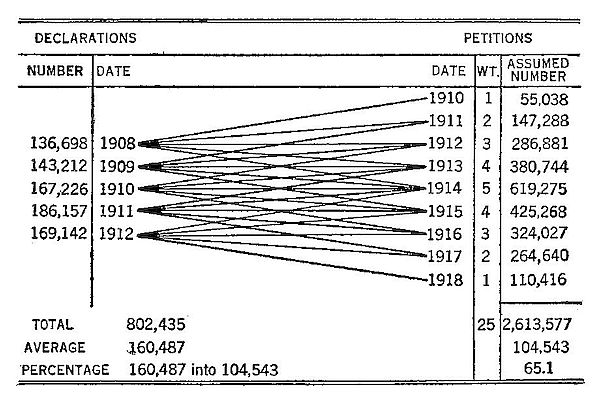
that, in the average case, he waits nearly seven (6.8)
years.[69] But whenever he files it, it will be good (unless
some blunder of the clerk, or some technical defect
which the clerk overlooks, makes it invalid from the
outset) for seven years. It cannot be made the basis
of a petition for citizenship until two years after its
date, and there must have been, before or after its
date, at least three years’ additional residence in the
United States to make up the required five years, and
the last year of the five must have been passed “continuously”
within the state or territory in which the
final petition is filed.
Mr. Alien would better be very careful that his
declaration is properly made out, on the identical
printed form furnished by the Bureau of Naturalization;
he must file it in the office of the clerk, and not
deliver it to him at his house or on the street corner.
He may not hear anything about this at the time;
but seven years afterward he may be brought up
standing by the fact that it is invalid because of just
such a defect. In the case in re Brefo (217 Fed.,
131–134) it was held, in 1914, that a declaration otherwise
correct, but in typewriting, not on “the form furnished
for that purpose by the government,” was a
“legal nullity.” Were such an enormity permitted,
the court said, there would be “an end to uniformity”;
government control and supervision could not exist!
And in the case in re Langtry (31 Fed., 879), as
long ago as 1887 the court declared that the clerk had
no authority to take acknowledgment of declaration
of intention at the home of an alien. Numerous other
cases in Pennsylvania, Illinois, Kentucky, North Carolina,
Florida, have settled the fact that the clerk’s
office, or open court, is the only place where a valid
declaration can be filed.
If the clerk is without the proper blank forms,
because he neglects to keep himself supplied, or because
the Naturalization Bureau at Washington fails
to heed his request for them, there is nothing for the
would-be declarant to do but go home—perhaps many,
or in some cases as much as two hundred and fifty
miles—and subsequently try again.
As has been said, he must be very particular about
the words that he or anyone else writes on the blank
when he does get it. If he files his declaration in a
court which has much naturalization business, it is likely
that the clerk or his deputy will see that it is letter-perfect;
but if it is his fortune to reside in a district
where naturalizations are few, or where the clerk
regards the whole transaction as a nuisance, he may
be permitted to make a fatal mistake or omission and
remain in blissful ignorance of that fact for anywhere
from two to seven years—until he goes before the
court with his final petition and finds that because his
declaration was from the beginning technically defective
he must file a new one and wait at least two years
more.
This, in fact, has been a very common occurrence.
During the period 1908–18, 8.5 per cent of all denials
of naturalization petitions in the United States were
on the ground of “declaration invalid”; that this
percentage is made up of figures[70] tragically high in
some districts may be recognized in the fact that in
Nebraska it was 23.8, in Indiana 21.3, in Oregon 18.7,
in Kansas 18.6, in Massachusetts 14.4, in Montana
13.2, in Iowa 12.5, in Arkansas and Idaho 11.3, in
Washington 10.9, in Oklahoma 10.4. The petition
of an Englishman applying for citizenship in Colorado
was denied upon motion of the government’s representative,
because in his declaration seven years before he
had renounced “King Albert,” when, in fact, the name
of the then potentate of Great Britain was “Albert
Edward”![71] As the court in that case truly said:
The act of renouncing the allegiance which one owes to a
government or sovereign, and taking upon himself a new
allegiance, is too solemn and important an act to be loosely
performed, or to be surrounded by any uncertainty or doubt.
No presumptions are indulged with respect to it.... The
declaration of intention must in all material matters comply
with the strict letter of the Act.
The court may not rectify nunc pro tunc, as in most
other kinds of litigation, technical blunders made in
good faith or inadvertently by the declarant, or even
by the clerk of the court in which the declaration was
filed. All the responsibility lies upon the alien.
In the unreported case of John Pollock, in the Philadelphia
Court of Quarter Sessions, in 1915, the petitioner
had honestly believed himself to have acquired
German nationality from the flag of the German ship
on which he was born, en route to the United States,
of Russian parents coming here with intent to abandon
their Russian nationality, and in his declaration had
forsworn the German sovereignty; but the court held
that the honesty of his mistake could not avail him—“Unfortunately
it is impossible to amend his declaration; ... the
application must be denied.” Through
a misunderstanding of the intricacies of political geography
in the then Austria-Hungary, a petitioner who
actually was born under that sovereignty erroneously
renounced the German Emperor. In that case, when,
three years later, upon his final petition for naturalization,
the court undertook to amend the declaration,
its power to do this was denied upon the government’s
appeal.[72]
Five Austrians went in a body to the office of the
clerk of the Court of Common Pleas in Hudson County,
New Jersey, to file declarations of intention. Doubtless
they were very glad, and very grateful, to have
the clerk on duty fill out the required blanks for them!
Two years or more later, when they marched proudly
and anxiously into court to complete their citizenship,
their petitions were denied—“declaration invalid,”
because, forsooth, as the court in its decision explained:
... The clerk who filled out their papers assumed them all to
be German, and noted this in the declaration accordingly.
The applicants contend that the error was a clerical error on
the part of the clerk, and that their renunciation also included
other sovereigns, rulers, or potentates. This, however,
is not sufficient under the statute.
There are many other cases, in widely separated
jurisdictions, to similar effect, showing, in general, that
the courts sustain the contention of the Naturalization
Service that the law does not permit the rectification
of even innocent blunders in the declaration, no matter
by whom or in what circumstances they are made.
Who, then, is to see that the technicalities thus
insisted upon in the enforcement of the law as it reads
are duly and truly observed? Surely not the alien!
His care of his own interests is, in the nature of the
case, ill-informed, and under the existing conditions,
improved as they are in comparison with those prevailing
in former times, he is at the mercy not only
of the sometimes careless, begrudging, or perhaps
well-intending, but better-informed clerk of the court,
but of many kinds of extra-legal assistants who,
whether with good or with sordid motives, undertake
to give, or maybe to sell, advice or instruction—to
say nothing of pretended “influence” which, anywhere
up to seven years later, when the mischief cannot
be remedied, may turn out to have been worse
than worthless.
Of vital importance and significance, far beyond what
would be gleaned from a superficial reading of the
words, becomes in this connection what the Commissioner
of Naturalization said in his annual report
of July 1, 1912:
The great bulk of the work of the Division [now the Bureau
of Naturalization] consists of the examination of the naturalization
papers filed in or issued out of the courts. It has
never been possible, with the clerical aid supplied, to keep
abreast of this work. Concluding the first year with a large
number of papers not examined, that condition has grown
more and more serious.... At the present time it must be
stated that no examination of declarations of intention has
been made since October, 1910, and not more than 30,000
certificates have even been examined. Correction of errors
in the latter papers, [final] certificates of naturalization, are
perhaps less necessary, but the declarations are used as the
basis of petitions for naturalization, and defects in them may
result in the denial of such petitions and a further delay of
two years to the applicants for citizenship. Beginning with
October, 1912, declarations which have not been examined
will mature, and these aggregate 298,000 in number.[73]
That the Bureau of Naturalization is aware of the
desperate importance of this matter to the aliens
appears not only in so many words in the Commissioner’s
own utterances, but in legislation proposed by
the Bureau which would tend to remedy it. In the
same report (1912), after describing the strenuous
efforts of the clerical force to catch up in particular
cases with the dates of final hearings, Commissioner
Campbell said:
To any easy assumption that errors in a declaration may
be corrected at the hearing of the petition, the answer is
plain—that no change can be made if the declaration was
filed, as it frequently is, in a court other than that in which
such hearing is held. It has also been decided judicially
that a declaration, complete in every respect, cannot be
changed because of even conceded error in its averments.
It is therefore important that the discovery by prompt
administrative examination, of a defect, either in the way
of omission or error, be brought to the attention of a declarant
and the clerk of the court in which his declaration is
filed, so that either the paper may be corrected or the declarant
may file a new declaration, and thus save time, expense,
and ultimate disappointment.
All of which has the color of mockery in the light of
the fact that at the date of that report there lay in the
files of the Bureau nearly three hundred thousand unexamined
declarations, all of which would mature within
the ensuing three months!
The legislative proposals to remedy conditions so
far as inadvertent errors in the declaration are concerned,
include, for instance, a proposed amendment[74]
to Section 4 of the Naturalization Law, providing that
... any averment required to be made in the declaration of intention
that may be shown to have been made erroneously, but
with no intention to violate or evade the requirements of the
naturalization law, may be corrected by order of the court
in which the declaration was filed, or by the court in which
it is presented as a basis for a petition for naturalization.
Some belated survival of Commissioner Campbell’s
earlier belief, as a member of the Naturalization Commission
of 1905, that the declaration of intention should
be abolished as superfluous and as a prolific source of
errors, appears in his concluding paragraph under this
head, wherein, after alluding to the increasingly urgent
appeals for more clerical assistance, which had characterized
virtually every one of his reports since the
establishment of the Naturalization Service, he adds:
If the object to be obtained does not justify the additional
expenditure that it involves, then the declaration, as a matter
of common justice to applicants for citizenship, if not
for the practical reasons stated ... in the Report of the Commission
of Naturalization to the President, dated November
8, 1905, should be stricken from the law. It may be suggested
that the effect of such action upon the exercise by alien declarants
of the elective franchise in certain states would be
merely to cut off future supplies of such voters.
It is indeed true that many careful, experienced,
and judicious students of the naturalization problem
have on many grounds favored the abandonment of the
declaration of intention. The arguments in this behalf
are plausible while there are states in which aliens
holding “first papers” (declarations of intention) are
entitled to vote. As for the others, the reasons to
the contrary seem to the present writer to outweigh
them. Regardless of the suffrage, in many states
the declaration entitles the holder to certain property
rights; many employers, and even municipalities, require
at least the declaration before they will permit
employment. The best reason of all, regarded by a
majority of the naturalizing judges as of vital importance,
is that the declaration, and the interval of at
least two years which must elapse before the declarant
can file his final appeal for admission to citizenship,
afford a period of probation, not only of substantial
psychological value as affecting the alien himself, but
giving the government opportunity to observe the
conduct of the individual and to investigate his antecedents,
and the person’s neighbors and the public
generally due notice that he is an aspirant for active
membership in the community.
On more than one occasion Mr. Campbell, who
more than perhaps anyone else might be regarded
as an expert on the subject of naturalization, favored
the abolition of the declaration of intention. As late
as 1910, testifying before the Committee on Immigration
and Naturalization of the House of Representatives,
he said:
I think I am on record as advocating the abolition of the
declaration of intention, anyhow.
That this is no longer his view, or that of the Bureau,
appears somewhat emphatically in the following excerpt
of the annual report bearing his signature, for
the fiscal year ending June 30, 1917:[75]
Many theorists in the United States, when there was no
Federal supervision of the naturalization law, conceived the
idea that the declaration of intention was a purely superfluous
act; that the certificate of the declaration of intention
was a superfluous document. Many of them still retain that
idea, having made no advance in their studies, or being
unacquainted with the experience of the Federal administrative
force. There is nothing that has arisen in the experience
of the Bureau of Naturalization, in the ten years of
Federal supervision, that justifies this idea that the declaration
of intention should be abolished.
The Americanization work of the Bureau, based as it is
upon the declaration of intention, is the only point of contact
the Federal Government has with the individual alien
from the time he lands upon our soil. The use of the declaration
of intention by the Bureau in sending the names to
the public schools and bringing the aliens of every community
into close relationship with them has forever settled
the question of the value of the declaration of intention.
This is only a new use to which this “first paper” (an
instrument which is peculiarly an American institution)[76] has
been put. If this were the only use to be made of it, it would
justify its continued existence. As it is, it is used and interwoven
into the administrative fabric of the Government in
its contact with aliens throughout the United States. It
is a means of identification by which the alien makes known
his right to take up Government land; by which he may
secure employment in municipalities and in State improvement
work; by which membership in many organizations
may alone be secured. It is the indication of the announced
purpose of the alien to forswear his allegiance to his sovereign
and to choose the Constitution of the United States
as his new allegiance. It is woven throughout the warp and
woof of our national laws and our social and economic
organizations.
Of 323 judges of naturalizing courts all over the United
States who answered definitely on this point the questionnaire
of the Americanization Study, 241 opposed,
more or less emphatically, the abolition of the declaration
of intention, only 82 favoring its abolition on
one ground or another, but principally because they
were aware of no good purpose served by it.
One United States district judge rather picturesquely
described its function:
This country cannot afford to have it said that we are
urging citizens of other countries to renounce their allegiance
and take up citizenship with us. That would be wrong from
every standpoint. On the other hand, if they do want to
become American citizens, it is our duty ... to help them fit
themselves. If you take away the declaration of intention
you will destroy our opportunity in that regard. The
young lady who meets a young man and likes him, would be
very much out of place if, without any other tie between
them, she began to tell him what she wanted him to do,
what she wanted him to study, and how she wanted him to
study, what she wanted him to drink, and how she wanted
him to dress. It would be very immodest and impolite,
to say the least. If that young man had made her a proposal
of marriage, and she were considering it, these suggestions
from her would be entirely proper, and she would be performing
her duty to the young man and to herself. This illustrates,
I believe, the proper limits within which our country can
guide, advise, and direct aliens who through the declaration
of intention have made, as it were, a proposal of marriage,
with reference to preparation for citizenship.
Sound objections to abolition of the declaration
appear also in connection with the property rights as
regards homestead entry and other matters under both
Federal and state laws—a complicated matter in addition
to the great confusion existing by reason of the
laws of those states which conferred the right to vote
upon holders of so-called “first papers.” With the removal
of this right, much of the objection to the
declaration of intention disappears. As it was, under
such laws, an alien might file a declaration of intention
every seven years as they expired seriatim, and, without
any proper inquiry, judicial approval, or supervision
whatever, retain his right to vote—citizenship for all
practical purposes.
Many of the judges would permit no renewal of a
declaration after the expiration of the first; some would
substitute registration upon entry, annual, or even more
frequent reports by the alien regarding his whereabouts
and behavior, and constant governmental espionage.
The declaration of intention, particularly if it be
properly guarded and solemnized, puts everybody, at
least constructively, upon notice that a new member is
applying, and requires the declarant himself to keep
that application in mind for two years. He cannot
suddenly decide, by reason of some special condition
or inconvenience, to apply for citizenship and consummate
the process in three months, as he could do
if the declaration were abolished without extending
the interval between petition and certificate. The
defects in the present system are found in the fact
that he can file his declaration anywhere at will, in a
form so defective that two years or more later it nullifies
his petition; he can be grafted upon and bled ad
libitum by all manner of exploiters claiming to be able
to assist him. However valuable in theory, in practice
it is far too hit-or-miss.
The declaration should be surrounded by a very
much greater degree of care and solemnity than at
present. Not only should it be made under oath
and on properly guarded printed forms; when it is
filed it should be scrutinized and accepted as to substance,
and by no means be subject long afterward to
rejection because of clerical or other technical errors
which ought to have been detected at the outset.
The St. Louis office of the Naturalization Service
has taken a long step in this direction, by securing
the co-operation of many of the courts in that district
in the establishment of a custom by which the declaration
is accepted for filing only after it has been viséd
by the naturalization officers. This has no authority
in law, but it nevertheless is a wholesome practice,
chiefly in the interest of the alien declarant; incidentally
it goes far to put out of business the various kinds of
parasites who exploit the ignorance and helplessness
of the aspirant for citizenship.
The law of 1906 limited the life of a declaration of
intention to seven years. Prior to that there was no
limit, and even after the passage of that Act it was
held in practice that it did not apply to declarations
made previously. But in 1913 the question was
raised, in the United States Court in New York City,
whether it was not the intent of Congress to apply the
seven-year limitation to all declarations. In 1914 the
court ruled that it was. The effect of that decision
was to invalidate all declarations made prior to September
27, 1906, notwithstanding the express provision
in the law that “no alien who, in conformity with the
law in force at the date of his declaration, has declared
his intention to become a citizen of the United States,
shall be required to renew such declaration.”
This decision was soon affirmed by the United
States Circuit Court of Appeals; but even then it was
not uniformly observed, until January, 1919, when the
United States Supreme Court put an abrupt stop to
the practice of accepting “old-law declarations” by
affirming the decision of the District Court at New
York.
The effect of this final ruling by the highest court
in the land was tragic. Hundreds, if not thousands,
of pending petitions, of aliens altogether fit from every
other point of view, forthwith became invalid simply
because based upon “old-law declarations” blighted
by the newly applied seven-year restriction. In one
session of the State Supreme Court in New York
County a batch of more than seventy otherwise acceptable
petitions was denied for this reason alone. The
question of the effect of the decision upon certificates
of naturalization granted theretofore between its date
and September 27, 1913, was met by Congress in the
Act of May 9, 1918, by the following provision:
Section 3. That all certificates of naturalization granted
by courts of competent jurisdiction prior to December 31,
1918, upon petitions for naturalization filed prior to January
31, 1918, upon declaration of intention filed prior to September,
27, 1906, are hereby declared to be valid in so far as the
declaration of intention is concerned, but shall not be by
this Act further validated or legalized.
Assuming, now, that our alien is of the proper racial
descent, the accepted age, and that his declaration of
intention will pass muster; that he has lived in the
United States for at least two years since the declaration
was filed, and at least three years besides that—a total
of not less than five years in all, including the final
fifth year in the state—what must he do, and what
may be done to him, when he comes up at last with
his request for admission to Active Membership?
If he arrived in this country since June 29, 1906,
he must produce a Certificate of Arrival. In theory,
at least, all arriving aliens are registered at the port
of entry by the Immigration Service of the Department
of Labor. Under existing law they cannot get in at
all if they are of certain excluded races and classes;
if they are under contract to get a particular job; if
they are insane or afflicted with certain diseases; if
they are recognizable as anarchists, polygamists (or
believers in either anarchy or polygamy), criminals, or,
in the opinion of the immigration authorities, likely
to become a public charge—a burden upon the community.
They must, with certain exceptions for age
and family relationship, be able to read and write in
some language.
Aliens may properly enter the United States only
through some officially designated port of entry,
designated by the Commissioner of Immigration, if
an alien enters elsewhere along our enormous border
line he is deemed to be “unlawfully present,” is subject
to deportation, and when he tries to become a citizen
he must give a very good excuse for having “climbed
up some other way.” A good many Canadians and
Mexicans have found very embarrassing, eventually,
the fact of their ignorance or evasion of this requirement.
The Act of Congress, approved June 29, 1906, went
into effect in most respects on the 27th of September
following, but this provision was to take effect
immediately:
That it shall be the duty of the Bureau of Immigration
to provide, for use at the various immigration stations
throughout the United States, books of record, wherein
the Commissioner of Immigration shall cause an entry to be
made in the case of each alien arriving in the United States
from and after the passage of this Act of the name, age,
occupation, ... and the date of arrival of said alien, etc.
Unfortunately for the aliens subsequently embarrassed
by the fact, the books for record of entries were
not promptly installed, and in some instances since
they were installed the immigration officials at the ports
of entry have not always been scrupulous in the making
of the required entries.
No certificate is given to the alien at the time of
his arrival, even if he is properly registered; nothing
of the sort is required of him anywhere; he does not
have to show it when he makes his declaration of intention
to become a citizen, nor at any other time or for
any other purpose—until after he has been here at
least five years and comes to the point of filing his
petition for final naturalization. Then he must have
it—unless he arrived before June 29th, 1906; in that
event it is not required of him.
He is not to go for it to the Immigration Service.
He must get it in the most roundabout fashion. He
must address a written application, through the clerk
of the court in which his petition for naturalization is
to be filed, to the Commissioner of Naturalization,
who in turn requests it of the Immigration Service.
The Immigration Service, if it can find the original
entry (and sometimes—quite frequently in fact—it
cannot), sends the certificate to the Commissioner of
Naturalization, who sends it to the clerk of the court,
at the same time notifying the alien that now he may
proceed to file his petition.
But what if the arrival entry cannot be found?
What if the alien cannot remember the name of the
vessel, or other important facts relating to his entry,
and thus give the necessary clews for the search?
What if it was his misfortune to arrive at a port after
the law took effect and before the registry system was
in operation? Both the Immigration and the Naturalization
Service take a good deal of pains to care
for such situations; but frequently without success.
All this involves delay, not only vexatious and discouraging,
but likely to prove fatal in the case of an
alien whose declaration is at the edge of expiration.
Not infrequently an application for certificate of
arrival is bandied back and forth between the two
Bureaus for months.
There was a case in 1919 in which the alien described
himself as having arrived on a certain date and vessel
at New York; the immigration records showed no
such arrival, and, what was worse, no such vessel entering
New York at that time. After long delay it turned
out that the alien did arrive on that date and vessel,
but at Boston, whence, upon admission, he came by a
domestic coastwise vessel from Boston to New York.
Many other cases are by no means so simple.
A petition accepted for filing without the requisite
certificate of arrival is regarded as incomplete, and
may not be completed subsequently by attachment of
the certificate, but must be marked “spoiled”; the
four dollars paid as fee may be returned to the petitioner
by the clerk, or can be applied to the filing of a
new and sufficient petition. It has been the practice
of the Bureau of Naturalization, after it appears impossible
to find record of the applicant’s admission to
the country, to refer him to the nearest immigration
inspector for what is known as a nunc pro tunc inspection,
for the purpose of satisfying the inspector
that the alien should not be deported as “unlawfully
present.” If the inspector is satisfied, he issues what
is known as a “provisional certificate of arrival,”
whose acceptance as sufficient for purposes of naturalization
is subject to the discretion of the court.
This would appear a reasonable way out; but in the
case of petitioners living a very long distance from the
office of an immigration inspector, it involves an extra,
and perhaps prohibitively expensive, journey to the
distant city for that purpose alone, and this difficulty
has in fact been to some extent relieved by permission
to handle such cases by correspondence and affidavits.
Another obstruction goes to the question of our treatment
of the foreign-born laborer in industry—especially
if he bear what we choose to regard as a “queer”
name, difficult for us to spell or pronounce. The courts
have, properly, no doubt, no patience with assumed
names—particularly in a case where the alien cannot
remember the name under which he entered the country.
But it is a very common practice, in concerns employing
a large number of immigrants, for the minor
officials of the company, superintendents and foremen,
to attach a name to a job, and insist upon calling the
man who occupies it, “Mike Murphy,” or what not
else, because that was the name of the first incumbent,
and it is easier to pronounce than “Bahaoud,” “Behrensmayer,”
or “Przybylski.” This, and the even
more common practice of calling a man by a number,
rather than a name, results in a vast deal of confusion,
in a substantial discouragement of self-respect, and
in the ultimate establishment of the neighborhood
identity of a polysyllabic Greek or Armenian, perhaps,
with a fine old Irish name. This will not do in the
naturalization court. The petitioner must come in
under at least the same name that he bore when he
entered the country, and there must be no suspicion
as to its not being his own.
But he does not have to keep that name. It is prescribed
as lawful for the court in its discretion, “at
the time and as a part of the naturalization of any
aliens, ... upon the petition of such alien, to make a
decree changing the name of said alien.” The fact
of which the court must be convinced is that the petitioner
is not attempting to conceal his real identity
for the purpose of escaping payment of just debts or
punishment for crime. Many aliens do thus change
their names, and there have been cases in which the
judge virtually compelled them to do so.
A naturalization judge said to the writer:
I have heard of a high-handed old judge, somewhere in
the Northwest, who was in the habit of “suggesting” to
every alien who came before him with a complicated mouthful
of name that he change it to “Abraham Lincoln,” “Benjamin
Franklin,” “George Washington,” or “Grover Cleveland.”
No doubt you could find many a Pole or Swede
naturalized as “Thomas Jefferson” or “Alexander Hamilton,”
whose father, living in the same town, was known as “Konrad
Kowalewski,” or “Ole Johanssen.”
Each nationality has in this country name-complications
of this character peculiarly its own. The
Swedes, for an example, have a habit of taking for
their own surname the Christian name of a favorite
aunt, uncle, or other relative, upon reaching the age of
twenty-one years. Sven Svensen—which means “Sven,
the son of Sven”—may undertake to compliment his
uncle Olaf by calling himself Sven Olafsen. Suppose
he came to this country under the name of Sven
Svensen, before he was eighteen; but for several years
before filing his declaration came to be known to everybody—including
himself—as Sven Olafsen, and regarded
his old name as a “childish thing” of no consequence
to anybody. He applies as Sven Olafsen
for his certificate of arrival, the immigration and
naturalization bureaus have great difficulty in finding
it, and when it does come along it is in the name of
Sven Svensen. Often names are adopted in affectionate
memory of the town from which the alien
comes. Many Italians, for convenience, drop off a
couple of syllables of awkwardly long names. Among
the Greeks a typical case would be that of one, “Harris,”
whose old-country name was Harralabopoulos.
Another kind of complication appears in the case
of an alien whose true name was Isaac Brody; but he
came on a steamship ticket issued to, and in the name of,
his uncle, Isaac Boovris, and was recorded under that
name by the immigration authorities. When he filed
his declaration of intention he was advised to file under
the name Boovris, to facilitate his certificate of arrival
when that should be required. When he filed his final
petition, after living and doing business for several
years in this country under his true name of Brody,
he asked to be naturalized under that name. The court
refused, requiring him to file a new declaration as
Isaac Brody and wait two years longer, calling attention
to the penal statute which makes it an offense to
apply for naturalization under an assumed or fictitious
name; remarking that the court might have changed
the name or amended the petition “if the error in the
original declaration had been clerical, or had been
innocent.”[77]
A Pennsylvania court said in the case of one Wicenty
Pilipos, who after arrival informally changed his name
to William Phillips:
We may concede that any person may change his name,
and be naturalized under his new name; yet, if he does so,
he must petition the court for that purpose, so that the
record will show the whole transaction, and identify him
as the person who has discarded his original name, under
which he landed in this country. This is especially necessary
to prevent any other person from perpetrating a fraud, by
being naturalized under the discarded name.[78]
There are other technicalities with which the alien
occasionally collides—such, for example, as the question
of jurisdiction where there is a difference of definition
in the term “judicial district,” or where boundaries may
conflict between states, counties, or other distinct
municipalities, with reference to the alien’s place of
residence; or where the court to which he could naturally
and conveniently repair by the shortest line of
travel is in another jurisdiction, and he and his witnesses
must journey perhaps even hundreds of miles to the
court to which the letter of the law compels him to go.
Such cases are numerous, but comparatively uncommon.
Let us assume that he has reached the right
court, has successfully unearthed, through the clerk,
the Naturalization Bureau and the Immigration Service,
his proper certificate of arrival, and has a valid
declaration of intention. What next?
In large cities or other places reasonably convenient
in respect of distance, the clerk is likely, as the Commissioner
of Naturalization says in his report already
quoted, to send the alien to the office of the Naturalization
Service; there is filled out the “Facts Form,” as it
is called, on which the final petition for naturalization
is to be based. The petitioner is closely interrogated
as to his general eligibility, and the principal business is
under way. If the naturalization office is far distant,
the petition is filled out by or in the presence of the
clerk.
As required by the law quoted at the beginning of
this chapter, the petition must set forth the full name,
residence, occupation; date and place of birth; port of
emigration; name of vessel, if any; port of arrival; date
and court of declaration of intention; whether married,
single, or widowed; wife’s name, nativity, and present
residence; number, names, birthplaces, and residences of
minor children; assurances that the applicant is not a
practicing or believing anarchist or polygamist; intention
to renounce former national allegiance and make
permanent residence in the United States; attachment
to the principles of the Constitution; ability to speak
the English language; dates upon which began residence
in the United States and in this state or territory;
assertion that this is his first petition for citizenship, or,
if a former petition was denied, the reasons for denial
and the fact that these reasons have since been cured or
removed.
In addition there must be the affidavit of two witnesses
(each of whom must swear that he is himself a
citizen of the United States), who must declare on his
oath that he knows the petitioner to have been a resident
of the United States at least since a certain specified
date five years ago, and of the particular state at
least since a certain specified date not less than a year
ago; and that he personally knows the petitioner to be
a person of good moral character, attached to the principles
of the Constitution, well disposed toward the
good order and happiness of the same, and generally
qualified in every way to be admitted as a citizen of the
United States.
To the petition at the time of filing (that is rigidly required
by the law and the decisions of many courts)
must be physically attached the declaration of intention
made at least two years before, and the certificate of
arrival.
For filing the declaration of intention the alien will
have paid to the clerk a fee of one dollar; upon filing
his final petition he has to pay another fee of four
dollars. There are strict penal provisions in the law
for the punishment of clerks who charge or collect any
more. Under the law, one-half of each fee is retained by
the clerk, ostensibly for the purpose of reimbursing him
for such additional clerical assistance as the naturalization
business may necessitate, but not always used for
that purpose. This subject is discussed elsewhere.
The petitioner, with certain exceptions noted below,
must sign his petition in his own handwriting. It is,
however, usually permitted him to sign it by “his
mark,” properly witnessed, and even this was not
required of those who filed their declarations of intention
before the passage of the Act; but lapse of time has
made that no longer a practical exception. It has
usually been held that a signature, even in another
language, such as Arabic, is sufficient. There has often
been controversy as to whether the extraordinary
arrangement of marks constructed by the petitioner
is in fact a signature, the author insisting that he has
achieved one when it is utterly illegible to both judge
and naturalization examiner. In this, as in a host of
other details, the fate of the petitioner hangs upon the
intelligence and humanity of the judge, who has to
choose between a strict insistence upon the technicality
and a more generous adjudication—in a case, for example,
in which a poor old deaf woman homesteader
might lose all she has in the world, simply because he
cannot see an intelligible “signature” in the conglomeration
of hieroglyphics which she intends to
represent her name.
The law requires the petitioner to state the name,
nativity, and residence of his wife, if any, and each of
his minor children. The wife, if she herself can lawfully
be naturalized, becomes ipso facto a citizen of this
country by virtue of the naturalization of her husband.
It is the practice of many naturalizing courts to decline
to admit to citizenship men whose wives are still in the
old country, seeing danger in conferring the status
upon women who may never come to the United States,
or who, coming, may turn out to be undesirable.
The petition must disavow belief in the so-called principles
of anarchism; under the law no one can be naturalized
who himself believes in or teaches or belongs
to any organization or groups believing in or teaching
“the duty, necessity, or propriety” of abolishing organized
government, or “the lawful assaulting or killing of
any officers, either of individuals or officers generally,
of the government of the United States, or of any other
organized government, because of his or their official
character.” Some judges of naturalizing courts recognize
little distinction between “anarchy” and “Socialism.”
The United States Circuit Court of Appeals,
however, was more discriminating, reversing the naturalizing
court in the somewhat famous case of Leonard
Olsen at Seattle, who was rejected, ostensibly, on the
ground that he was not “attached to the principles of
the Constitution,” but really because he avowed himself
a Socialist. There had been a somewhat similar
case in Texas, in 1891, but the Olsen decision settled the
question of the lawfulness of Socialist views as affecting
naturalization.[79]
Both the declaration of intention and the petition for
naturalization are made out in duplicate; the original
becomes a part of the record of the court in the clerk’s
office; the duplicate is sent to the Naturalization
Bureau at Washington.
Notice of each petition must be posted in a public and
conspicuous place in the office of the clerk for at least
ninety days before the hearing is had in open court.
The Naturalization Bureau will have been informed
directly by the clerk; the purpose of the posting is, of
course, to give the public notice, so that anyone who
desires to do so may appear with objections. In actual
effect, the posting is without much value, because the
public does not visit the clerk’s office except upon business
of its own, and there is no other publication of the
petition, save in such rare cases as local newspapers
make it a matter of news. It may be injurious to the
petitioner, because a good many hearings have been
postponed simply because the clerk forgot to post the
notice at all!
Petitions may be heard only upon stated days, fixed by
rule of the court, so that the government and the public
may attend the open hearings which are required by
the law. This works smoothly and well enough in the
great cities, where most naturalizations take place; but
there are districts, in sparsely settled regions, where
there is but one term of the court in a year; which, in
practice, means that the judge cannot be sure of being
at any given point on any days determinable in advance,
except the opening day. In such cases a great many
courts will have but one hearing period in a year—usually
on the first, and perhaps the second, day of the
term. Two hardships may arise from such a situation;
the alien and his witnesses may be uncertain as to the
length of time they must wait after a long journey to
the county seat, and if the clerk is careless and fails to
notify the petitioners that their cases are to be heard
(a thing which happens all too often) the judge and
examiner are on hand, but no one appears to be naturalized,
and another year is lost before the cases can be
disposed of. That this can be a matter of very serious
import to the alien may be illustrated by the fact that
a group of Poles were classed as “nonresident aliens,”
and subjected to the very heavy income tax collected
of such, simply because the clerk of the court in which
their petitions for naturalization were pending failed
to notify them of the hearing day.
The applicant must be able to “speak the English
language”—this is required by the law. It is enforced
with a great variety of degrees of strictness. Many an
alien can understand what is said to him in English long
before he has gained facility in speech. Also, in the
majority of cases, especially where he is confronted by
a stern and perhaps hostile judge, or one disposed to
treat immigrants with contempt or ridicule, and a
fiercely zealous naturalization examiner bent upon
having the petition denied if possible, he is promptly
tongue-tied by stage fright. It is common for the petitioner
to tell the court, through his witnesses or the interpreter,
that he knows what a certain question means
and the answer to it, but cannot express it in English.
Many of the questions call for a simple “Yes” or
“No,” but a frightened or unintelligent applicant, who
has learned certain things by rote, may glibly answer
“Yes” to the questions which ought to be answered by
“No,” and vice versa. There was a fellow in Leadville,
Colorado, who for a long time occupied the status
of witness for nearly all the Austrians who applied in
that place for naturalization, and who to a large degree
superintended their training for the examinations. After
a while it was discovered that he had a system by which
he dictated the answers to the questions, kicking the
petitioner in the ankle when the answer should be
“Yes,” and nudging him with his elbow when it should
be “No.”
Both judges and examiners vary greatly in their interpretation
of what constitutes ability to “speak
English.” Some give the petitioner the benefit of doubt
and make large allowance for natural embarrassment
and fright. Others, as one judge frankly says, “construe
everything against the applicant,” on the ground
that citizenship is a precious privilege which should be
accorded to as few as possible, and only to those about
whom there can be no question. The court may accept
a grunt, a shrug, a gesture, a shake of the head, as indicating
a sufficient understanding of the question.
Generally the judge is humane. There was a case in
Arizona in which a mild-looking Mexican insisted that
he was both an anarchist and a polygamist—plainly
showing that he imagined the terms, about which he was
sharply asked, to represent qualities which he must
possess. The judge knew the man; that he was of good
conduct, conventional ideas, and married to one wife.
“How many women are you married to?” he asked.
“Oh, only one!” cried the man, adding for good
measure, “maybe one is too many!”
“Would you kill a man you didn’t like? Would you
blow up a house, or shoot a sheriff?”
“No, no, no! Me never kill nobody! Me never blow
up nobody’s house! Me never hurt nobody!”
Between the morning and afternoon sessions of the
court the Mexican was quietly interrogated and readjusted,
and the court admitted him. In thousands of
cases, not so picturesque, the applicant called upon for
relatively elaborate views about theories of government,
and even more abstruse matters, is either bewildered or
on general principles deems it safer to remain silent; in
which case the impression of the court, and his action
upon it, depend very much on the personal equation,
the humanity, and common sense of the judge.
A deaf-mute is exempt from the requirement of
ability to “speak” English; so is an alien who has made
entry for a homestead on the public lands. The latter
can make his entry immediately upon filing his declaration
of intention; but he cannot complete his title until
he is fully naturalized. A few courts virtually ignore
this exemption, and require the homesteader to speak
English and pass the other educational tests. Generally
the judges are lenient with such people.
The law does not require the applicant to be able to
read English; but there is an increasing tendency in the
courts to require it regardless of the law. After all, the
judge is the final arbiter; he must be satisfied that the
applicant is “in all respects qualified to be a citizen,”
and, if he chooses to regard a person who cannot make
sense out of a current newspaper as not thus qualified,
he can deny the application on general principles. The
whole matter of educational qualifications varies widely
in different jurisdictions, largely because of the absence
of a definite standard of knowledge, intelligence, and
general ability established either by Act of Congress or
by the Naturalization Service.
The applicant must be “attached to the principles of
the Constitution,” and “well disposed toward the good
order and happiness of the United States.” Can a man
be “attached to the principles of the Constitution”
without having read it? If not, then the vast majority
of the native-born citizens of the United States are not
so “attached,” for it is a matter of the most notorious
fact that very few Americans, not professional lawyers,
ever have read it or could pass the most rudimentary
examination upon its substance. There is, however, a
widely prevalent tendency on the part of the courts to
require petitioners not only to swear that they have
read the document, but to pass a pretty stiff examination,
either before the naturalization examiner who may
certify the fact, or even in open court. And it is upon
the phrase “attached to the principles of the Constitution”
that the Naturalization Bureau has erected its
whole elaborate and ambitious campaign of education
for citizenship. But its interpretation is so vague and
unsettled, so subject to the whims, theories, prejudices,
and intellectual limitations of the individuals upon
whom its enforcement devolves, that it seems highly
desirable for Congress to establish by law definite and
simple requirements embodying the minimum qualification
to be demanded of applicants for citizenship
to demonstrate both their understanding of our form
of government and their “attachment to the principles
of the Constitution.”
One of the classic anecdotes of the Naturalization
Service has to do with this matter of attachment to and
understanding of the Constitution. In the court of a
judge who insisted upon every petitioner having at
least read it, an Irish petitioner at the morning session
of court was ordered to read the Constitution, or have
it read to him, and to come back in the afternoon for
further hearing.
“Well, did you read the Constitution to him?” demanded
the judge of the citizen who was acting as mentor of the
petitioner.
“I did, your Honor; I read it to him—all of it.”
“Is he ready to swear that he is attached to the principles
of it?”
“He is, your Honor; when I got through readin’ it to him
he said he thought it was a blame fine Constitution.”
What more could be asked—even of a native?
An Italian petitioner in one of the Southern courts
exhibited a good knowledge of current political history,
and at the same time a realization of his own limitations.
“Who is the President of the United States?” asked the
judge.
“Mist’ Wilson.”
“Who is the Vice-President?”
“Mist’ Marsh’.”
“If the President should die, who would take his place?”
“Mist’ Marsh’—he’s ready for that job.”
“Very good, Tony, and quite correct. Now, let me ask
you something else. Could you be President of the United
States?”
“Oh, no! no! Judge, please!” cried the dismayed petitioner,
“you have to excuse me! I’m too busy!”
The fact of continuous residence within the United
States for five years, and within the particular state for
one year next preceding the filing of the petition, must
be established to the satisfaction of the court. To the
layman this would seem simple enough; but there is
hardly anything connected with the process of naturalization
about which there has been so much variety of
interpretation. What constitutes “continuous residence”?
It is said that a court in Utah disqualified an
applicant because once during the five years he stepped
across the Canadian border far enough and long enough
to buy a sandwich! Shall a man lose his “residence”
because of a walk across the International Bridge at
Niagara Falls? Suppose he is a carpenter, or a farm
hand, and goes over into Canada, or Mexico, for the
summer months, or long enough to build a house? Suppose
there is an estate to be settled up in the old
country, or that the alien’s aged mother is dying in
Copenhagen or Buda-Pesth, and yearns to see her son
once before she goes. Shall that invalidate his residence?
There are many judges who will not tolerate any
absence whatever from the country, on any pretext.
In the great bulk of practice, however, it has simmered
down to the question of “intention.” Reasonably
carried out, as in other matters, it meets the average
case. If the petitioner always, and everywhere,
during the five years maintained his intention in good
faith to become a citizen, and especially if he preserved a
specific residence, both the courts and the Naturalization
Service on the whole have waived the literal words
of the requirement. But within that general situation
there are degrees. There are judges who will permit an
absence as long as two years, if “intention” is clear;
some set a limit of one year, others of six months.
Generally speaking, any absence in excess of six months
is viewed with suspicion.
There are two reasons, as the law stands, for insistence
upon residence virtually continuous. In the first place
there is the wording and evident intention of the law,
which must be obeyed in spirit, anyway. In the second
place, in case of any protracted absence, the witnesses
hardly can know what he has been about, and certainly
cannot swear, as they must under the statute, to the
fact of continuous residence. If the petitioner has been
out of the ken of his witnesses in some other part of the
United States, he can prove good conduct and American
residence by depositions; but the law does not contemplate
depositions regarding his conduct on any
foreign soil, however legitimate his reason for being
there. And if he has been in other parts of the same
state, he cannot prove anything about it, by witnesses,
depositions, or otherwise.
This brings us to one of the most extraordinary provisions
of the law—that regarding the proof of eligibility
by witnesses and depositions—a provision responsible
for the exclusion of thousands of perfectly fit
persons, and for a vast deal of wholly unnecessary
hardship and injustice.
During the eleven years 1908–1918 inclusive, according
to the statistics given in the annual reports of the
Commissioner of Naturalization, of 107,484 petitions
for naturalization denied, more than one in four—28,262,
or 26.3 per cent—were denied on the ground of
“incompetent witnesses.” The percentage in many
states is very much larger than that: Illinois, 38.3;
New Jersey, 37.2; Michigan, 36.5; Iowa, 36.4; Nebraska,
36.0; Kansas, 35.9; Colorado, 32.8; Arkansas,
32.4; Oregon, 32.2; North Carolina, 31.9; Indiana,
31.1; Wisconsin, 31.0; Missouri, 29.5; New Mexico,
29.3; Kentucky, 28.8; Montana, 28.4; Utah, 27.0.
The low states in this respect are few—Rhode Island,
5.9; New Hampshire, 8.0; Connecticut, 9.0; Vermont,
9.1; Massachusetts, 9.2; South Carolina, 11.4;
Florida, 11.5.
Now, what does this mean in human terms? To
begin with, a petitioner for naturalization may not prove
his eligibility, as he would prove any other set of facts
in court, by such an exhibit of evidence of various
kinds as would satisfy a reasonable judge or jury. He
cannot bring a group of neighbors who have known him;
his employer, his priest or pastor; the village school-teacher
who teaches his children; a sheaf of affidavits
from people who have known him in various places
where he has lived in the state. His exhibit of evidence
is rigidly and most absurdly restricted, and the restriction
is of no benefit to anybody—except, perhaps, the
Naturalization Service in somewhat simplifying their
work of investigation.
His petition must be accompanied by the affidavits
of precisely two witnesses, who must accompany him
personally when he files his petition, and must accompany
him again, ninety days or more later, when his
case comes before the court for hearing. Two, only two,
and the same two. Only in case one of them dies, or
moves out of the jurisdiction of the court, is he allowed to
substitute. Each witness must be a native or naturalized
citizen of the United States, and must swear to
that fact. And each must swear that he has known the
petitioner during the whole period of five years of
residence within the state, or of one year in the state if
he lived previously in other states, and satisfy the
court that he has seen the petitioner frequently enough
to know that his residence has been continuous and his
conduct such as to warrant his admission to citizenship.
Some judges require the witnesses to have seen the
petitioner virtually every day, “constantly, as a
neighbor”; “at least once a week,” for five years. The
examination of the witnesses is frequently more severe,
if possible, than that of the petitioner himself; for the
law requires them to be “credible.” If a witness can
be shown by the naturalization examiner to be of
dubious moral character, the court probably will deny
the petition verified by him, and leave the petitioner
with only one witness. He must have two, and he cannot
substitute a better one!
In a state which has allowed aliens to vote upon their
declaration of intention, innumerable foreign-born persons
have in good faith believed themselves to be citizens.
If such a person appears as a witness for a petitioner,
the petition is denied—properly enough, except
that the petitioner might easily produce a substitute
who could not be objected to; but no, he must have
not only exactly two, but the same two, throughout the
proceeding. Or, if one or both of these particular
witnesses turn out to be honestly mistaken in thinking
they have known the petitioner for the whole five years;
if, for example, it turns out that they could not have
known him more than four years and nine months—the
petition is denied; “incompetent witnesses.” In
the fiscal year ending June 30, 1918, more than 2,300
petitions were denied for this cause, and it is safe to say
that, in a very large majority of the cases, the witnesses
were acting in perfect good faith.
The practice cuts very close. In re Welch (159 Fed.,
1014), decided in 1908, reports a case in which it was
shown that a witness had not known the petitioner
for five years at the time of the filing of the petition,
but had known him for five years by the time the hearing
was had. In that case the court permitted amendment
of the date of the petition, but required a fresh
posting.
Congress took note of the difficulty an alien might
labor under if he were obliged to move about from
state to state during the five years’ period, and provided
that four years of the time, in the event of inability to
bring witnesses who could swear to knowledge of the
whole period, the applicant might prove residence, etc.,
in other states by deposition. This helps a good deal,
as far as it goes; but in any event the last year, the
year of residence required to be within the state
where the petition is filed, must be covered by “two
witnesses”—two, only two, and the same two. Suppose
the case (and there have been many such) of a Methodist
minister, an Englishman if you please, who, during
the five years preceding his petition, has been assigned
to two or more pastorates within the same state at
points more or less distant from each other. He could
produce almost any desired array of witnesses to cover
his residence in each of the several places, and affidavits
galore; but he must not. There is virtually no
chance at all of his being able to find two, only two,
and the same two, who can testify to personal, neighborly
knowledge of his residence in all places. What,
then, of an average immigrant who has been obliged
to shift about in search of employment, resident all
through the year in the state, but never staying long
enough in one place to establish intimate relations with
possible witnesses under such restrictions?
The judges are all but unanimous in their denunciation
of this system. The comment of a United States district
judge in the Middle West represents the sentiments
of most:
I do not think it tends to raise the standard of citizenship
or to do anyone any good to have the requirements such
that, if a petitioner has lived in the state for the full five-year
period, he must prove that entire residence and his good
character and reputation during that entire period by the
two petitioning witnesses. The two petitioning witnesses
should have known him for at least a year, and be able to
make a showing for at least the last year of the period. I
know of nothing so sacred about a state line that this great
difference should be made between the petitioner who moves
here from another state and the petitioner who moves here
from a distant part of the same state.
A Michigan judge gives a striking example of the injustice
of the discrimination:
The greatest copper mines in the world are in the Upper
Peninsula of Michigan. The greatest automobile factories
in the world are in the city of Detroit in the same state.
These sturdy miners of Houghton and Keweenaw counties
in the Upper Peninsula hear of the automobile industry in
the city of Detroit, and after three or four years’ residence
up there, move to Detroit and take up residence there. Under
the present law, they must find two witnesses who have
known them for the entire five years. You will recognize
how difficult it will be for them to find two witnesses who
knew them in the Upper Peninsula, moved to Detroit when
they did, and have known them ever since. The copper
mines of the Upper Peninsula are five or six hundred miles
from Detroit. Can anyone suggest any good reasons why these
petitioners in Detroit should not be permitted to prove their
Detroit residence by two witnesses who sign their petitions,
and their Upper Peninsula residence by depositions or other
witnesses? Why punish so unnecessarily the man who continues
to reside for the full five years in the same state,
while we justly permit another man, who moves here from
another state, perhaps a distance of fifty or a hundred miles,
to make his proof as to that state by deposition?
Mind you, I would make them prove their residence in the
particular city or county ... for the full period of their residence
there, by the two witnesses who signed the petition;
and, of course, I would require them to have resided in such
municipality for at least a year.
Says one judge:
In the far West, where the distances are so great and the
expense of travel such a hardship, the matter might readily
be handled on a mileage basis, so that the petitioner would
prove a year’s residence by the witnesses who attest his
petition, and a previous residence within the same state more
than, say fifty miles, from the place of holding court, by
depositions.
Of 334 judges of naturalizing courts in all parts of
the country who specifically addressed themselves to
this question in reply to a questionnaire of the Americanization
Study in the summer of 1919, only 34 were
content with the present system; 289 specifically favored
amendment of the law for the reasons, and to the
effect, substantially as suggested above.
A clerk of the court in Arizona who handles the naturalization
business, and in his letter displays a keen and
intelligent interest in the human aspects of the question,
says:
I have had numerous petitioners who, for ordinary purposes,
could prove every day of their residence in this state;
but for naturalization purposes were unable to prove their
residence, even though the entire five years may have been—and
in some instances has been—in this one county!
I consider it inequitable for the reason that the man who
travels from mining camp to mining camp may reside four
or more years in any number of states, and at any number of
camps in each state; but, if he then removes to another state
and resides in that state one year, he may obtain citizenship.
Yet the rancher who resides five years in one state, or even
in one county, but during the five years resides in two different
localities of the state, or even on two different ranches
in one county, may be (and under the present law frequently
is) deprived of citizenship for the reason that two witnesses,
only two, and each of these two, must prove the continuous
five years’ residence.
I some time ago became convinced that this provision of
the law was not equitable, and in January, 1919, wrote to
our Congressman in the hope of convincing him and getting
a bill introduced to remedy it. He thought it too late in
the session to attempt it, and that it would be useless to
attempt it without the approval of the Department of Labor,
which approval was withheld.
Nevertheless, it is to be presumed that the Bureau of
Naturalization did approve (since the proposal was
embodied in the same bill containing one of its attempts
to secure a notable extension of its powers)[80] a measure
of concession in the matter of witnesses.[81] A proposed
amendment to Section 10 of the Naturalization Law
would provide:
That in case the petitioner has resided in two or more
parts of the county in which he resides at the time he files
his petition, and for this cause is unable to procure two witnesses,
who are citizens of the United States, who are qualified
and competent to establish the entire period of his residence
in such county, he may establish his residence at each of
the places in such county by the affidavits and testimony
of at least two witnesses, citizens of the United States, to
each place of residence, both in his petition and at the hearing.
The same bill would have mitigated and, so far as it
went, humanized the restriction upon substitution of
witnesses by adding to Section 4 a subdivision providing
that
Where either or both of the original subscribing witnesses
to a petition for naturalization, or those giving evidence by
deposition in support thereof, shall be found to be incompetent
or not qualified to establish the proof of residence, good moral
character, or other evidence required by law, the petitioner
may substitute other qualified and competent witnesses at,
or prior to, the final hearing. The hearing of the petition
may be continued for this purpose and the names of the
substituted witnesses may be ordered publicly posted, in the
discretion of the court, if such posting shall be deemed
necessary. Any petition for naturalization may be amended
to correct manifest errors appearing therein and made in
good faith.
Mr. Raymond F. Crist, then Deputy Commissioner of
Naturalization, in testimony before the House Committee
on Immigration and Naturalization, prior to
the enactment of the Act of May 9, 1918, stated that
the Naturalization Service was habitually represented
at the taking of the depositions by which a petitioner
is permitted to prove his residence in states other than
that in which the petition is filed. This must have been
a slip of the tongue, for it is very far from being in
accordance with the facts. Such a course would be a
physical impossibility, especially in the present and
past short-handed condition of the field service. As a
rule the notaries public who attest these depositions are
designated by the several chief examiners; but many
of them are in small places, to which examiners never
go. In point of fact, in most cases, the depositions are
not viséd in any way whatever, so far as the naturalization
machinery is concerned, or examined at all until
the judge reaches the particular case. They go direct
from the notary to the court in which the petition is to
be heard, in a sealed envelope which is not expected to
be opened until the day of the hearing—unless the
court has, by specific order, authorized the naturalization
officer to open and examine them. A very considerable
number of them—one person familiar with the
practice estimated the percentage as high as 75 per
cent—are defective in some particular; the same authority
thought at least 40 per cent of them would be so
defective as to render them, under strict construction,
inadmissible as evidence. For example, they will fail
to assert that the deposing person has known the petitioner
during the required period of time; or will not
say, categorically, that the affiant is himself a citizen
of the United States. As a rule, it is not until the affidavits
are examined in open court by the judge or examiner
that their insufficiency is disclosed, for the first
time, to the petitioner. He may not be admitted until
the papers have gone back for correction, or a new set
prepared. That sometimes means a delay of six
months, a year, or even longer—a very serious matter
to a petitioner upon whose naturalization may depend
his title to a homestead. There is nothing in the law
prescribing the method of handling this matter; it is
subject to regulation by the Bureau of Naturalization
in its discretion; and inasmuch as the Naturalization
Service declares itself, and ought indeed to be, the
friend of the petitioner, guarding him against errors
which may invalidate his whole effort and lead to the
cancellation of his certificate even after he gets it, it
ought to devise some procedure for examining every
deposition. No petitioner should be allowed to come
into court until his papers have been scrutinized, at
least for technical defects. In certain districts of the
Naturalization Service this has indeed been the practice
in an informal way and to a limited extent. It would
seem that it ought to be invariable. The Service has
done excellent work in shutting out all manner of
runners, professional witnesses, and other kinds of
pseudo-assistants to the alien; this has left him in the
matter of depositions, as a general rule, without well-informed,
disinterested, or intelligent guidance, with
the result that he has no adequate warning against
defects, either important or trivial, which may vitiate
his application. When he comes into court, all of his
papers should be perfect, and all the facts cleared of
technicalities, so that the judge may pass exclusively
upon the merits of the case.
An applicant for naturalization must state in his
petition whether or not he ever has filed a previous
petition, and if so, what became of it. There have been
instances in which a former petition was granted, but
for some reason the record of it cannot now be found.
In such a case the petitioner would have the greatest
difficulty in getting proofs of his citizenship. His new
petition may be denied on the ground that he is “already
a citizen,” but it leaves the record in an unsatisfactory
condition; although his copy of the order of
denial, stating that he is a citizen, serves fairly well for
most purposes to certify his citizenship.
It is customary for naturalizing courts, in denying
petitions, to add some phrase governing a later renewal;
such as “without prejudice to renewal”; or “with
prejudice to renewal before the expiration of five years
from the date of this order of denial.” In absence of
such a phrase the court passing upon the second petition—especially
if the former denial was on the ground
of “immoral character”—requires the lapse of at least
five years and exceedingly good proof of reform. The
law requires that the petitioner must show affirmatively
not only that during the whole period of five years
immediately preceding the date of his petition he has
behaved as a person of good moral character, attached
to the principles of the Constitution, etc., but that he
is at the time of the petition such a person. Courts
have been known to deny petitions for acts committed
before the beginning of the five-year period, on the
ground that they involved ineradicable moral turpitude.
Judges have shown much liberality on this point, however;
there was a case of an old homesteader who had
spent several years in the penitentiary; but the judge
inquired far enough into the history of the matter to
learn that the man was convicted as the result of a conspiracy
on the part of certain neighbors who wished to
get his homestead.
The latitude of the courts in this respect is very wide,
and interesting slants are to be found in the decisions.
There was a saloonkeeper in Chicago who participated
in the then general custom of keeping liquor saloons
open on Sunday in violation of the law, the policy of
the city administration at that time being that of non-enforcement.
There came a time when public sentiment
required enforcement of the Sunday-closing law,
and thereupon this man promptly obeyed the orders of
the police to that effect. When his petition for naturalization
came up, it was held that the consent of the
authorities to his disobedience of the law was no excuse;
a person who would accept the benefit of an evasion of
the law could not be of “good moral character.”
Said the court:
If a rule were laid down that it is immoral to knowingly
and willfully violate the law in a community where public
sentiment approves the law, but not immoral in a community
where public sentiment does not approve the law, it would
be most disastrous to the good order and well-being of society....
That public officers charged with enforcement of the law
do not do so cannot change the effect upon the moral character
of a man who willfully and habitually violates it.[82]
This was a case in which the government succeeded
in canceling a certificate already granted, and it shows,
as do many others, what a severe gantlet the petitioner
must run, and how his past is combed over before he
can show that he is altogether qualified. Gerstein was
required to wait before filing a second petition; the
court said:
The order and decree of naturalization of the Superior
Court [of Cook County, Illinois] is reversed and the application
of appellee for citizenship denied, without prejudice
to his right to file another application when time has removed
the disqualification.
The law requires that the Oath of Allegiance shall
be taken in open court as the final act of the petitioner
before being formally admitted to citizenship; thereupon
the decree is entered and certificate issued; but the
Naturalization Service is forbidden by its regulations
to issue the certificate until the judge’s signature is
upon the order. Sometimes the clerk rattles off or
mumbles the oath very indistinctly, and the petitioners,
often a large number of them, hardly understand a
word of the solemn ritual. It is becoming more common
for the judge to require everyone in court to stand
while he delivers the text of the oath loudly and clearly.
In some courts where there are many applicants, and all
concerned are pressed for time, the persons to be naturalized
are kept in one part of the room until the
docket is cleared, whereupon the oath is administered
to them in groups of nationality; each nationality
group standing with upraised right hands while the
clerk or judge reads the words, and names the particular
“prince, potentate, state, or sovereignty,” allegiance
to whom, or to which, is to be abjured. Sometimes
this ceremony is a very hurried, perfunctory, and
undignified performance; sometimes a very solemn
and impressive one. During the high-pressure process
of naturalizing great numbers of soldiers in the army
encampments during the war, it was sometimes the
custom to have all nationalities stand at once, the
clerk naming all the sovereignties concerned in one
series, with the presumption that each individual
would mentally isolate the one which he was supposed
to have in mind. There were occasions when this
helter-skelter method was pursued for the benefit of
as many as 1,200 petitioners together.
There is a growing movement in favor of having
public ceremonies of “initiation,” in which the whole
community is represented, to welcome the new citizens;
to impress upon both the newcomers and the people to
whose fellowship they are being welcomed, the importance
and solemnity of the occasion. An increasing
number of judges are carrying out this idea in their
naturalization proceedings; adding to the formalities
required by the law a speech either by the judge himself
or by some representative citizen, or both, in which
the momentous significance of the act in which the
alien and the court have joined is emphasized. Some
judges make a practice of giving to each new citizen a
small flag, a special certificate, a leaflet or brochure
setting forth the sentiments appropriate to the occasion.
Much more common is it becoming for public-spirited
citizens to organize a meeting of the same import.
Here, for example, is the program of such a meeting,
held in the Music Hall at Fall River, Massachusetts,
on May 7, 1919, following a naturalization
session of the local court, designated as “Reception
and Welcome to Fall River’s Newly Naturalized
Citizens”:
PROGRAM
Hon. Henry F. Nickerson, Presiding
| Music | Orchestra |
| Singing—“America” | Audience |
| Address of Welcome | Hon. Henry F. Nickerson |
| Response by a naturalized citizen | James B. Kerr |
| Selection | Orchestra |
| Address | Rev. Everett C. Herrick |
| Pledge of Allegiance—Led by Boy Scouts: |
|
“I pledge allegiance to my flag and to the
country for which it stands; one nation,
indivisible, with liberty and justice for all.”
|
| Presentation of Certificates of Naturalization |
| M. B. Irish, Sec. Fall River Immigrant Committee |
| Prayer | Rev. Vincent Marchildon |
| Singing—“Star-spangled Banner” | Audience |
| Informal Reception |
Here is another program—of the “Americanization
Meeting in honor of those who were admitted to citizenship
April 19, 21, 22, 1920,” held in the Union High
School at Grand Rapids, Michigan, April 30, 1920,
under the auspices of the Grand Rapids Board of Education
and the Americanization Society:
PROGRAM
Henry E. Crow, President of the Board of Education,
Presiding
John W. Beattie, Supervisor of Music,
Song Leader
| Song—“America” | Audience |
| Address Christian Gallmeyer, Mayor of Grand Rapids |
| Folk Games | Pupils Sibley School |
| Directed by Miss Ila Krumheuer |
| Address | Fred J. Schlotfeldt, |
| Chief Naturalization Examiner, Chicago, Ill. |
| Songs | Audience |
| Presentation of Citizenship Certificates |
| Judge Willis B. Perkins, Circuit Court |
| Pledge of Allegiance to Flag—Audience, led by Boy Scouts: |
|
“I pledge allegiance to my flag and to
the country for which it stands; one nation,
indivisible, with liberty and justice for all.”
|
| Address to New Citizens | A. P. Johnson, |
| Publisher Grand Rapids “News” |
| Songs | Audience |
| Address | Raymond F. Crist, |
Director of Citizenship, Bureau of Naturalization,
Washington, D. C. |
| “Star-Spangled Banner” | Audience |
Mrs. Henrietta Briggs-Wall of Washington, D. C.,
has presented admirably the spirit of this movement
in a pamphlet proposing a general “New Patriot Plan,”
to utilize the Fourth of July throughout the country for
the celebration of the “civic birthday,” alike of the
native born who, during the past year, have attained
the voting age of 21 years, and the newly naturalized
foreign born. “In other countries,” says Mrs. Briggs-Wall,
“much ado is made over the crowning of kings
and queens who attempt to rule over others; there is
much more occasion for general rejoicing when newly
enfranchised citizens attain their share in the honors
and duties of self-government.” The plan proposes in
general a Fourth-of-July celebration in every community
in America to which the newly enfranchised
shall be invited as guests of honor. The author says,
among other things:
The natural birthday is remembered by the family; the
“civic birthday” should be honored by the community.
Inauguration ceremonies should accompany this newly
acquired power. These exercises may consist of addresses
to them [the newly enfranchised], music, a variety of activities
for their entertainment and instruction; all of which, as
an object lesson, will promote the patriotism of all the people.
Prizes may be offered to those who bring the greatest
number to register in the “Record Book of New Patriots”;
also to those who may try, if they choose, to write the best
essays on “true patriotism.” ... The customs and convenience
of different localities will suggest varying methods.
It is appropriate that the birthday of freedom, the civic
birthday of our country, should be chosen to celebrate the
civic birthday of the citizen. It is the best possible holiday
for patriotic purposes; the audience is already furnished,
and the minds of the people are in a receptive mood. It
occurs at the time of year when picnics, excursions, and
out-of-door celebrations of all sorts can be easily arranged
in honor, and for the pleasure, of the new patriots.
Criticism, commendation and reform alike, to be
either fair or judicious, must bear in mind that the
naturalization system which has been built up—and
such parts, absurdities, inhumanities, and bureaucratic
excrescences as have grown up—under the Naturalization
Act of 1906 represents when all is said an honest,
diligent, and wholly patriotic effort to make impossible
the now almost incredible scandals of former times; to
establish and vigilantly maintain proper standards of
character and intelligence by which to test those of
other nativity who desire to join our fellowship and
participate in our sovereignty; and to fit and educate
those who are admitted for the better appreciation and
performance of the unique privileges and responsibilities
of American citizenship. The remediable evils,
some of the more conspicuous of which have been indicated,
seem to be due in part to survival among us of
general race and anti-foreign prejudices, despite our
historic professions and democratic traditions; in part
to the mere inertia of custom and habit characterizing
all governmental institutions; in part to the “personal
equation” of those upon whom, in various parts of the
country, falls the duty of administering the law.
The experience of these fifteen years has demonstrated
that the law, as it stands, is on the whole just and
effective for its purposes. Its defects can be remedied;
its sound features strengthened and clarified. It is
time to modify it in some respects; to standardize the
tests and conditions enforced under its provisions, to
the end of removing, or anyway diminishing, the
opportunity for the erratic operation of “personal
equation” and the theories, whims, negligences, together
with the illegal and extra-legal practices, in both the
executive departments and the courts, of which the
aspirant for citizenship is the hapless victim.