AMERICAN WAR BALLADS AND LYRICS
Knickerbocker Nuggets
Nugget—“A diminutive mass of precious metal.”
26 VOLS. NOW READY
For full list see end of this volume
A COLLECTION OF THE SONGS AND BALLADS OF THE
COLONIAL WARS, THE REVOLUTION, THE WAR
OF 1812-15, THE WAR WITH MEXICO
AND THE CIVIL WAR
EDITED BY
GEORGE CARY EGGLESTON
VOLUME II.

NEW YORK AND LONDON
G. P. PUTNAM’S SONS
The Knickerbocker Press
Copyright
G. P. Putnam’s Sons
1889
The Knickerbocker Press, New York
Electrotyped and Printed by
G. P. Putnam’s Sons

| PAGE. | |
| The Civil War—Continued | 1 |
| Lyon | 3 |
| My Maryland | 6 |
| Battle Hymn of the Republic | 10 |
| The Picket Guard | 12 |
| The Countersign | 14 |
| Jonathan to John | 19 |
| There’s Life in the Old Land Yet | 26 |
| Never or Now | 28 |
| Boy Brittan | 30 |
| The “Cumberland” | 35 |
| On Board the “Cumberland” | 38 |
| The Sword-Bearer | 45 |
| The Old Sergeant | 48 |
| The “Varuna” | 56 |
| The River Fight | 58 |
| Sheridan’s Ride | 72 |
| Kearney at Seven Pines | 75 |
| Stonewall Jackson’s Way | 77 |
| Marching Along | 80 |
| The Burial of Latané | 82 |
| Tardy George | 85 |
| Wanted—A Man | 88 |
| Overtures from Richmond | 91 |
| Barbara Frietchie | 95 |
| Music in Camp | 99 |
| Fredericksburg | 103 |
| Treason’s Last Device | 106 |
| In Louisiana | 109 |
| John Pelham | 113 |
| The Battle of Charleston Harbor | 116 |
| Running the Batteries | 120 |
| Keenan’s Charge | 124 |
| Death of Stonewall Jackson | 127 |
| Under the Shade of the Trees | 129 |
| Stonewall Jackson | 131 |
| The Black Regiment | 132 |
| Little Giffen of Tennessee | 136 |
| Gettysburg | 138 |
| At Gettysburg | 147 |
| John Burns of Gettysburg | 150 |
| Woman’s War Mission | 156 |
| Three Hundred Thousand More | 160 |
| Lee to the Rear | 162 |
| “Kearsarge” and “Alabama” | 167 |
| The Bay Fight | 170 |
| The Loyal Fisher | 193 |
| Sherman’s March to the Sea | 195 |
| Sherman’s March | 198 |
| The Year of Jubilee | 200 |
| The Conquered Banner | 203 |
| Somebody’s Darling | 207 |
| Left on the Battle-Field | 209 |
| Driving Home the Cows | 211 |
| After All | 214 |
| “He’ll See It when He Wakes” | 216 |
| The Réveille | 218 |
| Réveille | 220 |
| The White Rose | 222 |
| The Blue and the Gray | 230 |
| Ready | 233 |
| A Georgia Volunteer | 235 |
| “How are You, Sanitary?” | 239 |
| The Men | 243 |
| The Guerillas | 245 |
| When This Cruel War is Over | 249 |
| Cavalry Song (Stedman) | 252 |
| Cavalry Song (Raymond) | 254 |
| The Cavalry Charge (Taylor) | 256 |
| The Cavalry Charge (Durivage) | 258 |
| Roll-Call | 261 |
| Reading the List | 263 |
| A Woman of the War | 265 |
| Glory Hallelujah! or, John Brown’s Body | 270 |
| Marching through Georgia | 273 |
| The Battle-Cry of Freedom | 275 |
| Tramp, Tramp, Tramp | 277 |
| PAGE. | |
| Running the Batteries | Frontispiece |
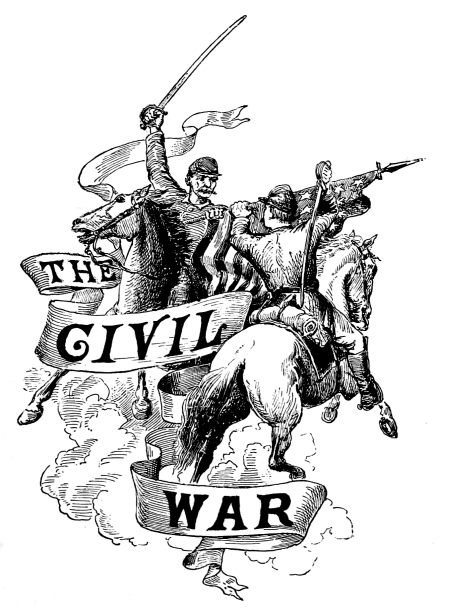
| The Civil War | 1 |
| The Countersign | 15 |
| The “Cumberland” | 35 |
| Sheridan’s Ride | 72 |
| Barbara Frietchie | 95 |
| Fredericksburg | 103 |
| In Louisiana | 109 |
| John Pelham | 113 |
| Running the Batteries | 120 |
| Keenan’s Charge | 124 |
| The Black Regiment | 132 |
| Gettysburg | 138 |
| John Burns of Gettysburg | 150 |
| Three Hundred Thousand More | 160 |
| “Kearsarge” and “Alabama” | 167 |
| The Bay Fight | 170 |
| The Conquered Banner | 204 |
| Driving Home the Cows | 211 |
| After All | 214 |
| Cavalry Song | 252 |

Typogravures by W. Kurtz.
PART II.
THE CIVIL WAR

LYON.
By HENRY PETERSON.


MY MARYLAND.
By JAMES R. RANDALL.


BATTLE-HYMN OF THE REPUBLIC
By JULIA WARD HOWE.



THE PICKET GUARD.
By ETHEL LYNN BEERS.

THE COUNTERSIGN.
[In his admirably edited collection of poems of the civil war, entitled “Bugle Echoes,” Mr. Francis F. Browne introduces this poem with the following note:
“There has been no little dispute as to the authorship of this poem. The Philadelphia Press, in 1861, said it was ‘written by a private in Company G, Stuart’s engineer regiment, at Camp Lesley, near Washington.’ But it may now be stated positively that it was written by a Confederate soldier, still living. The poem is usually printed in a very imperfect form, with the fourth, fifth, and sixth stanzas omitted. The third line of the fifth stanza affords internal evidence of Southern origin.”—Editor.]
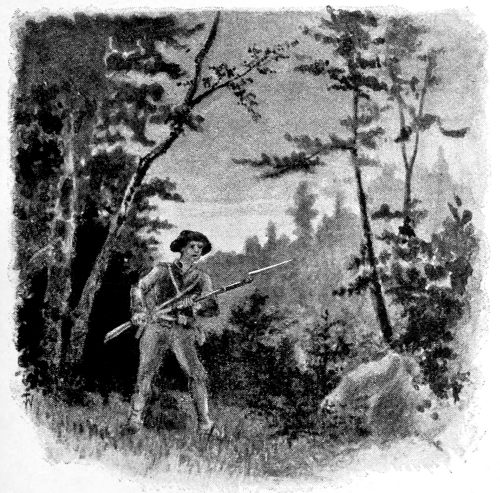
THE COUNTERSIGN.



JONATHAN TO JOHN.
By JAMES RUSSELL LOWELL.
[This poem is a part of the second series of “The Bigelow Papers,” a work wholly unmatched in the literature of humor, that has an earnest purpose and well matured thought for its sources of inspiration. The poem was called forth by what is known as “the Trent affair.” Captain Wilkes, commanding the United States man-of-war, San Jacinto, boarded the British mail steamer Trent on the 8th of November, 1861, and took from her the Confederate commissioners Mason and Slidell. Great Britain resented the act, and for a time there was serious apprehension of war between that country and the United States; but as the seizure of the commissioners on board a neutral vessel was deemed to be an act in violation of international law, the Government at Washington, after inquiry into the facts, surrendered the prisoners. The version of the poem here given is a correct one, taken from the collected edition of Mr. Lowell’s poems. An abridged and otherwise imperfect version is given in many collections.—Editor.]

JONATHAN TO JOHN.


THERE’S LIFE IN THE OLD LAND YET.
By JAMES R. RANDALL.
[First printed in the Richmond Examiner. Written while the author was in prison.]


NEVER OR NOW.
By OLIVER WENDELL HOLMES.


BOY BRITTAN.
(Battle of Fort Henry, Tenn., Feb. 6, 1862.)
By FORCEYTHE WILLSON.
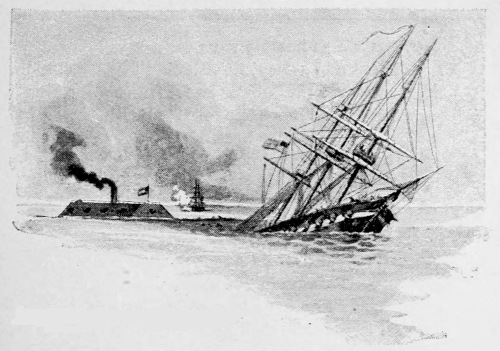
THE “CUMBERLAND.”
By H. W. LONGFELLOW.


ON BOARD THE “CUMBERLAND.”
(March 8, 1862.)
By GEORGE H. BOKER.


THE SWORD-BEARER.
By GEORGE H. BOKER.

THE OLD SERGEANT.
By FORCEYTHE WILLSON.


[1] The troops during the war were accustomed to express their incredulity, when news could not be traced to a trustworthy source, by saying that the tidings had been received by “grapevine telegraph.” Hence a canard was called a “grapevine.”—Editor.

THE “VARUNA.”
(Sunk April 24, 1862.)
By GEORGE H. BOKER.



THE RIVER FIGHT.
By HENRY HOWARD BROWNELL.
[Admiral Farragut was so impressed with this irregular but spirited description of the river battle below New Orleans that he sought out the author and their acquaintance ended in a warm friendship. Brownell having expressed a desire to witness a naval conflict, Farragut took him on board the Flagship Hartford at the time of the storming of the Mobile forts, and the poet repaid the courtesy with the poem which appears elsewhere in this collection, called “The Bay Fight.”—Editor.]


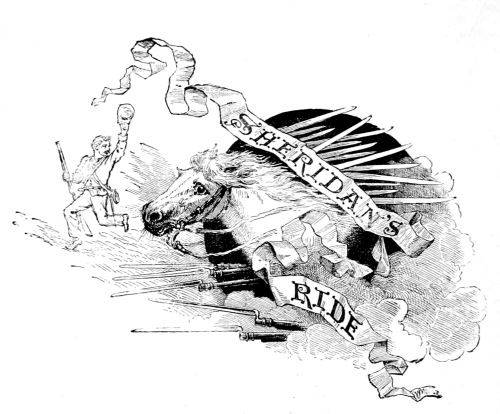
SHERIDAN’S RIDE.
By THOMAS BUCHANAN READ.

KEARNEY AT SEVEN PINES.
By EDMUND CLARENCE STEDMAN.
STONEWALL JACKSON’S WAY.
By J. W. PALMER.
[Mr. William Gilmore Simms tells us that this poem, stained with blood, was found on the person of a dead soldier of the Stonewall brigade after one of Jackson’s battles in the Shenandoah Valley. Its authorship, long unknown, has been discovered by Mr. Francis F. Browne.—Editor.]


MARCHING ALONG.
By WILLIAM B. BRADBURY.
[During the Civil War this song was frequently sung upon the march by the soldiers of the Army of the Potomac. Except “When this Cruel War is Over” and the doggerel about “John Brown’s Body,” there was scarcely any song so often heard. The name of the leader was changed, from time to time, to accord with the facts.—Editor.]
THE BURIAL OF LATANÉ.
By JOHN R. THOMPSON.
[Captain Latané, of Stuart’s Confederate cavalry was killed during the Pamunkey expedition in 1862. He was buried by a company of women, one of whom read the service for the dead, while a little girl strewed flowers on the grave.—Editor.]

TARDY GEORGE.
[This poem was written at a time when the impatience of the Northern people with the delay of McClellan to make use of the means so lavishly provided for him, was scarcely to be restrained. For many months McClellan had been in command of a vast army, perfectly equipped and thoroughly disciplined, yet month after month went by with nothing done and nothing attempted. The discontent of the people found much angrier expression than was given to it in these stanzas, but this is one of the best metrical protests that appeared.—Editor.]
WANTED—A MAN.
By Edmund Clarence Stedman.
[This virile cry for a fit leader for the Army of the Potomac was inspired by an editorial article of Henry J. Raymond in the New York Times. It was written in 1862, when the popular feeling of chagrin and humiliation over McClellan’s failure and Pope’s disaster at Manassas was most intense. Mr. Lincoln was so strongly impressed by the poem that he read it to his Cabinet.—Editor.]
OVERTURES FROM RICHMOND.
A NEW LILLIBULERO.
By F. J. Child.

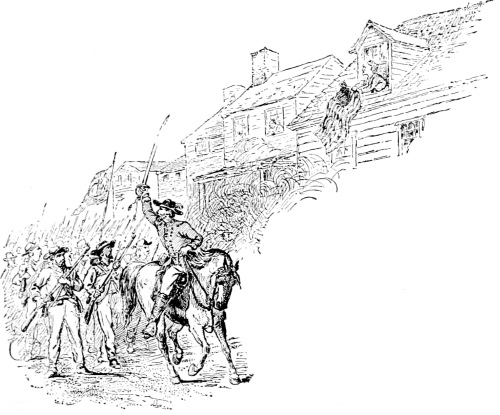
BARBARA FRIETCHIE.
By JOHN GREENLEAF WHITTIER.

MUSIC IN CAMP.
By John R. Thompson.
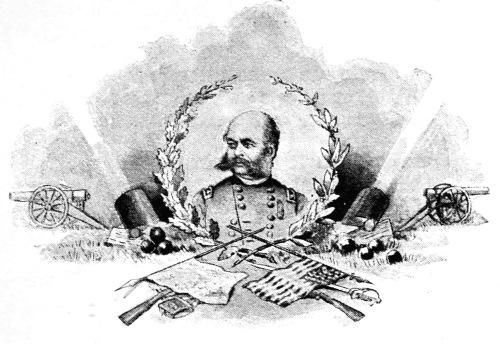
FREDERICKSBURG.
(December, 1862.)
By W. F. W.

TREASON’S LAST DEVICE.
By EDMUND CLARENCE STEDMAN.
[Certain politicians proposed, as a means of ending the war, that a new confederacy or union should be formed, from which the New England States should be excluded because of their implacable hostility to slavery and their consequent obnoxiousness to the South. There were many spirited replies to this proposal, the best of which is this poem.—Editor.]
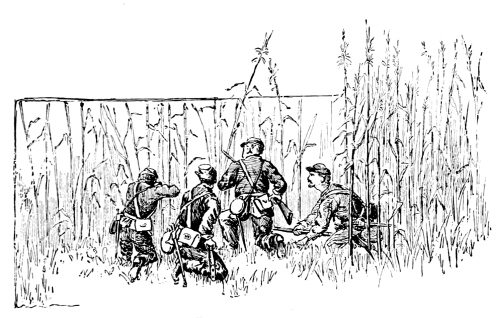
IN LOUISIANA.
By J. W. De FOREST.
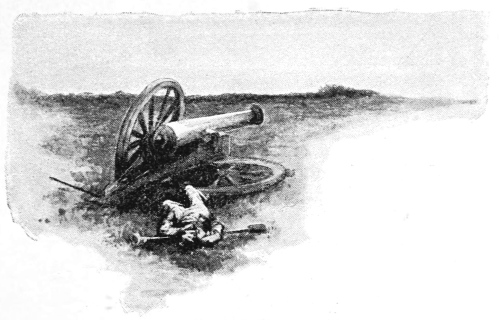
JOHN PELHAM.
By James R. Randall.
[In most of the collections this poem is printed under the title of “The Dead Cannoneer,” but the author assures the present editor that the only title he ever gave it is the name of the boy general, “John Pelham,” who was killed at Kelly’s Ford, Virginia, 17th March, 1863.—Editor.]


THE BATTLE OF CHARLESTON HARBOR.
(Bombardment of Fort Sumter by the fleet, 7th April, 1863.)
By PAUL H. HAYNE.
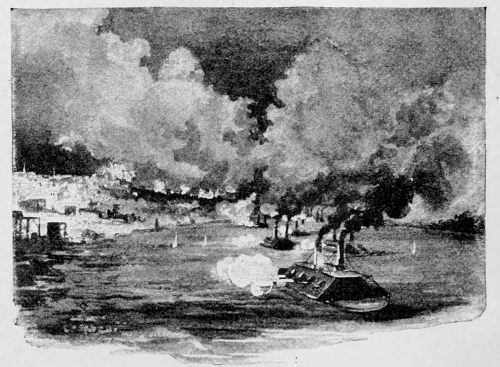
RUNNING THE BATTERIES.
(As observed from the anchorage above Vicksburg, April, 1863.)
By HERMAN MELVILLE.
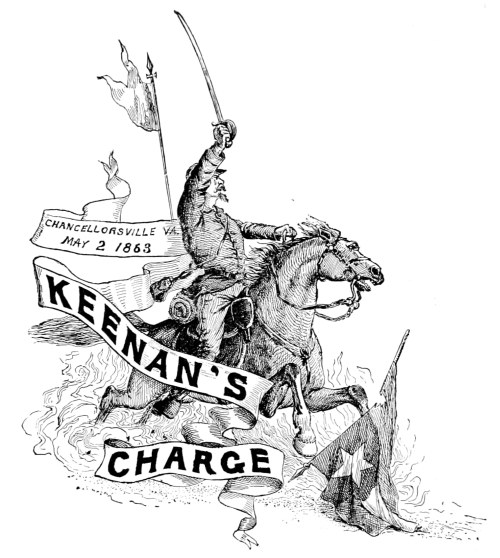
KEENAN’S CHARGE
By GEORGE PARSONS LATHROP.

DEATH OF STONEWALL JACKSON.
By HARRY L. FLASH.


UNDER THE SHADE OF THE TREES.
By MARGARET J. PRESTON.
[The last words of Stonewall Jackson were: “Let us cross the river and rest under the shade of the trees.”—Editor.]

STONEWALL JACKSON.
(Mortally wounded at Chancellorsville, May, 1863.)
By HERMAN MELVILLE.
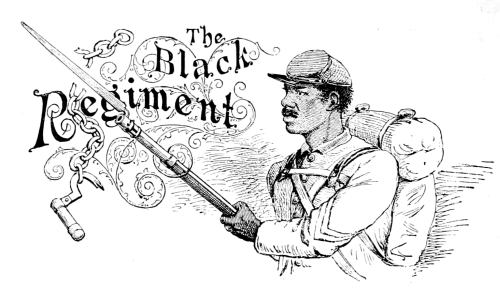
The Black Regiment
By GEORGE H. BOKER.
LITTLE GIFFEN OF TENNESSEE.
By FRANCIS O. TICKNOR.

GETTYSBURG
(July 1, 2, 3, 1863.)
By EDMUND CLARENCE STEDMAN.
AT GETTYSBURG.
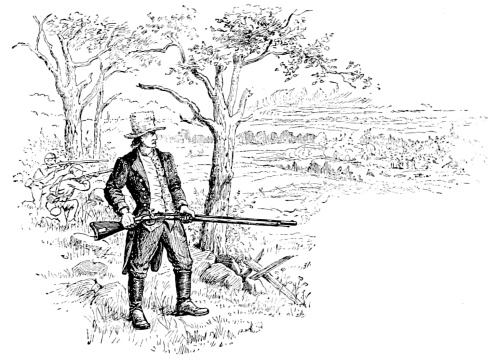
JOHN BURNS OF GETTYSBURG.
By BRET HARTE.
[A Union officer who was with the Eleventh Corps in the battle of Gettysburg says: “During the first day’s fight, an old man, in a swallow-tailed coat and battered cylinder hat, came stalking across the fields from the town, and made his appearance at Colonel Stone’s position. With a musket in his hand and ammunition in his pocket, this venerable citizen asked Colonel Wister’s permission to fight. Wister directed him to go over to the Iron Brigade, where he would be sheltered by the woods; but the old man insisted on going forward to the skirmish line. He was allowed to do so, and continued firing until the skirmishers retired, when he was the last man to leave. He afterwards fought with the Iron Brigade, where he was three times wounded. This patriotic and heroic citizen was Constable John Burns of Gettysburg.”—Author’s note.]

WOMAN’S WAR MISSION.

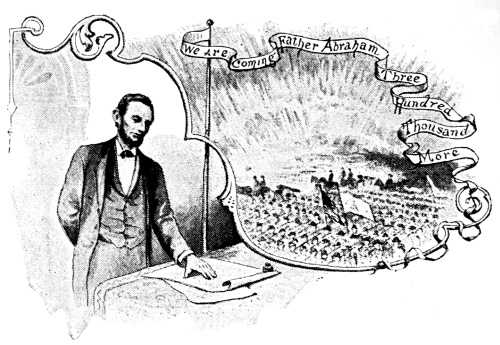
THREE HUNDRED THOUSAND MORE.
LEE TO THE REAR.
By JOHN R. THOMPSON.
[During the battles in the Wilderness at the beginning of the campaign of 1864, General Robert E. Lee, impressed with the desperate necessity of carrying a certain peculiarly difficult position, seized the colors of a Texas regiment and undertook to lead the perilous assault in person. The troops and their colonel remonstrated with vehemence, the colonel, in his men’s behalf, pledging the regiment to carry the position if General Lee would retire. The troops advanced to the charge shouting “Lee to the Rear!” as a sort of battle cry.—Editor.]
(Action of 19 June, 1864.)
Kearsarge and Alabama
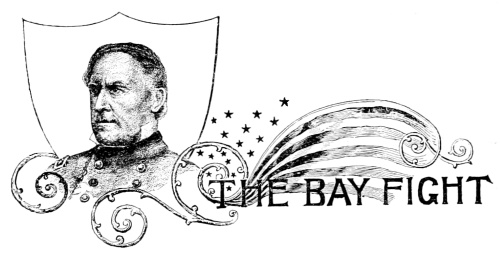
THE BAY FIGHT
(Mobile Harbor, August 8, 1864.)
By HENRY HOWARD BROWNELL.
THE LOYAL FISHER.
SHERMAN’S MARCH TO THE SEA.
By SAMUEL H. M. BYERS.
[General Sherman, in a recent conversation with the editor of this collection, declared that it was this poem with its phrase, “march to the sea,” that threw a glamour of romance over the campaign which it celebrates. Said General Sherman: “The thing was nothing more or less than a change of base, an operation perfectly familiar to every military man, but a poet got hold of it, gave it the captivating label, ‘The March to the Sea,’ and the unmilitary public made a romance out of it.” It may be remarked that the General’s modesty overlooks the important fact that the romance lay really in his own deed of derring-do; the poet merely recorded it, or at most interpreted it to the popular intelligence. The glory of the great campaign was Sherman’s and his army’s; the joy of celebrating it was the poet’s; the admiring memory of it is the people’s.—Editor.]
SHERMAN’S MARCH TO THE SEA.
SHERMAN’S MARCH
By A Soldier.
THE YEAR OF JUBILEE.
[A body of negro troops entered Richmond singing this song when the Union forces took possession of the Confederate capital. It is an interesting fact, illustrative of the elasticity of spirit shown by the losers in the great contest, that the song, which might have been supposed to be peculiarly offensive to their wounded pride and completely out of harmony with their deep depression and chagrin, became at once a favorite among them, and was sung, with applause, by young men and maidens in wellnigh every house in Virginia.—Editor.]
THE CONQUERED BANNER.
By Abram J. Ryan.
[This poem appeared very soon after the surrender of the Confederate armies, and was probably the first, as it is the finest, poetical expression of reverent regret for the Lost Cause, without any touch of bitterness in its loss. The author was a Catholic priest, who wrote a number of poems of merit, though none that appealed so strongly as this one does to the generous sympathy of the victor with the sorrow of the vanquished. The author was born in Norfolk, Va., August 15, 1839, and died in Louisville, Ky., April 22, 1886.—Editor.]
THE CONQUERED BANNER.
SOMEBODY’S DARLING.
By MARIA LA CONTE.
LEFT ON THE BATTLE-FIELD.
By SARAH T. BOLTON.
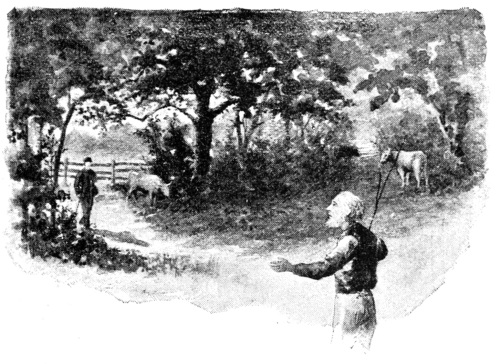
DRIVING HOME THE COWS.
By KATE PUTNAM OSGOOD.
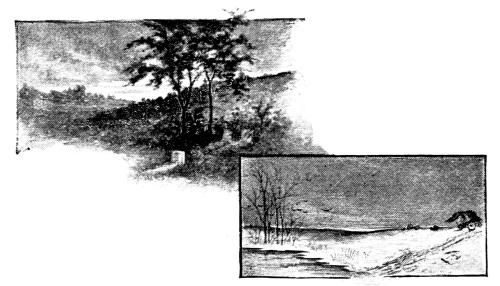
AFTER ALL.
By WILLIAM WINTER
“HE’LL SEE IT WHEN HE WAKES.”
By FRANK LEE.
[In “Bugle Echoes” Mr. Francis F. Browne introduces this poem with the following note: “In one of the battles in Virginia, a gallant young Mississippian had fallen, and at night, just before burying him, there came a letter from his betrothed. One of the burial group took the letter and laid it upon the breast of the dead soldier, with the words: ‘Bury it with him. He’ll see it when he wakes.’”—Editor.]
THE RÉVEILLE.
By BRET HARTE.
RÉVEILLE.
By MICHAEL O’CONNOR.
[The author of this poem was a sergeant in the 140th regiment of New York volunteers, who died at the age of 25 years, at Potomac Station, Va., December 28, 1862.—Editor.]
THE WHITE ROSE.
By JOSEPH O’CONNOR.
THE BLUE AND THE GRAY.
By FRANCIS MILES FINCH.
[Suggested by the fact that the women of Columbus, Miss., on their decoration day strewed flowers, with impartial hands, upon the graves of northern and southern soldiers.—Editor.]
READY.
By PHOEBE CARY.
A GEORGIA VOLUNTEER.
By MARY ASHLEY TOWNSEND.
“HOW ARE YOU, SANITARY?”
By BRET HARTE.
[There is nothing in the history of the Civil War worthier of celebration in verse, or more to be honored in the remembrance, than the organization and work of the United States Sanitary Commission. When the conditions created by the stress of the war became apparent, the compassion of kindly men and women in the North was deeply stirred by the thought that there was suffering among the soldiers which the government could not relieve, and that there were wants which could not be supplied by military agencies. The generous desire to minister to these wants and to relieve this suffering was quickly organized into action with that business-like sagacity which distinguishes the American character. The Sanitary Commission was formed as the agent and almoner of the popular generosity. It was supported entirely by voluntary contributions. It was as thoroughly organized as the army commissariat itself, and wherever there was a comfort needed, or a wounded or sick man to be cared for, its supply wagons, its appliances, and its trained nurses were found. The affectionate gratitude of the troops toward the beneficent association is reflected in this poem.—Editor.]
“HOW ARE YOU, SANITARY?”
THE MEN.
By MAURICE BELL.
THE GUERILLAS.
By S. TEACKLE WALLIS.

WHEN THIS CRUEL WAR IS OVER.
[There is nothing in this sentimental song that enables one to read the riddle of its remarkable popularity during the Civil War. It has no poetic merit; its rhythm is commonplace, and the tune to which it was sung was of the flimsiest musical structure, without even a trick of melody to commend it. Yet the song was more frequently sung, on both sides, than any other, the Southern soldiers inserting “gray” for “blue” in the sixth line of the first stanza, with cheerful recklessness of the effect upon the rhyme. The thing was heard in every camp every day and many times every day. Men chanted it on the march, and women sang it to piano accompaniment in all houses. A song which so strongly appealed to two great armies and to an entire people is worthy of a place in all collections of war poetry, even though criticism is baffled in the attempt to discover the reason of its popularity.—Editor.]
WHEN THIS CRUEL WAR IS OVER.
CAVALRY Song
By EDMUND CLARENCE STEDMAN.
CAVALRY SONG.
By ROSSITER W. RAYMOND.
THE CAVALRY CHARGE.
By BENJAMIN F. TAYLOR.
THE CAVALRY CHARGE.
By FRANCIS A. DURIVAGE.

ROLL-CALL.
By N. G. SHEPHERD.
READING THE LIST.

A WOMAN OF THE WAR.
By ROSSITER JOHNSON.
[The tenderly pathetic story told in this poem is true. Its heroine was Margaret Augusta Peterson, a volunteer nurse in St. Mary’s Hospital at Rochester, New York. She died in the manner related, on the first of September, 1864, and lies buried in Mount Hope Cemetery, Rochester, as does also the young surgeon, her lover.—Editor.]
GLORY HALLELUJAH! OR, JOHN BROWN’S BODY.
[The strong hold which this song and the three which follow it (“Marching thro’ Georgia,” “The Battle-Cry of Freedom” and “Tramp, Tramp, Tramp”) had upon the favor of the Union soldiers during the war entitles them to insertion here in spite of their lack of poetic merit. The critics, from the time of Mr. Richard Grant White’s collection until now, have condemned them as doggerel, but songs that were sung with enthusiasm by all the soldiers of the republic during the dark years of the Civil War cannot be denied the possession of merit, whether criticism is able to recognize it or not.—Editor.]
GLORY HALLELUJAH! OR
JOHN BROWN’S BODY.
MARCHING THROUGH GEORGIA.
THE BATTLE-CRY OF FREEDOM.

TRAMP, TRAMP, TRAMP.
END OF VOL. II.
Knickerbocker Nuggets.
Nugget—“A diminutive mass of precious metal.”
“Little gems of bookmaking.”—Commercial Gazette, Cincinnati.
“For many a long day nothing has been thought out or worked out so sure to prove entirely pleasing to cultured book-lovers.”—The Bookmaker.
I—Gesta Romanorum. Tales of the old monks. Edited by C. Swan. $1 00
“This little gem is a collection of stories composed by the monks of old, who were in the custom of relating them to each other after meals for their mutual amusement and information.”—Williams’ Literary Monthly.
“Nuggets indeed, and charming ones, are these rescued from the mine of old Latin, which would certainly have been lost to many busy readers who can only take what comes to them without delving for hidden treasures.”
II—Headlong Hall and Nightmare Abbey. By Thomas Love Peacock. $1 00
“It must have been the court librarian of King Oberon who originally ordered the series of quaintly artistic little volumes that Messrs. Putnam are publishing under the name of Knickerbocker Nuggets. There is an elfin dignity in the aspect of these books in their bindings of dark and light blue with golden arabesques.”—Portland Press.
III—Gulliver’s Travels. By Jonathan Swift.
A reprint of the early complete edition.
Very fully illustrated.
Two vols. $2 50
“Messrs. Putnam have done a substantial service to all readers of English classics by reprinting in two dainty and artistically bound volumes those biting satires of Jonathan Swift, ‘Gulliver’s Travels.’”
IV—Tales from Irving. With illustrations. Two vols. Selected from “The Sketch Book,” “Traveller,” “Wolfert’s Roost,” “Bracebridge Hall.” $2 00
“The tales, pathetic and thrilling as they are in themselves, are rendered winsome and realistic by the lifelike portraitures which profusely illustrate the volumes.... We confess our high appreciation of the superb manner in which the publishers have got up and sent forth the present volumes—which are real treasures, to be prized for their unique character.”—Christian Union.
“Such books as these will find their popularity confined to no one country, but they must be received with enthusiasm wherever art and literature are recognized.”—Albany Argus.
V—Book of British Ballads. Edited by
S. C. Hall. A fac-simile of
the original edition.
With illustrations by Creswick, Gilbert, and
others. $1 50
“This is a diminutive fac-simile of the original very valuable edition.... The collection is not only the most complete and reliable that has been published, but the volume is beautifully illustrated by skilful artists.”—Pittsburg Chronicle.
“Probably the best general collection of our ballad literature, in moderate compass, that has yet been made.”—Chicago Dial.
VI—The Travels of Baron Münchausen.
Reprinted from the early, complete edition.
Very fully
illustrated. $1 25
“The venerable Baron Münchausen in his long life has never appeared as well-dressed, so far as we know, as now in this goodly company.”
“The Baron’s stories are as fascinating as the Arabian Nights.”—Church Union.
VII—Letters, Sentences, and Maxims. By Lord Chesterfield.
With a critical essay by C. A. Sainte-Beuve. $1 00
“Full of wise things, quaint things, witty and shrewd things, and the maker of this book has put the pick of them all together.”—London World.
“Each of the little volumes in this series is a literary gem.”—Christian at Work.
VIII—The Vicar of Wakefield. By Goldsmith.
With 32 illustrations by William Mulready. $1 00
“Goldsmith’s charming tale seems more charming than ever in the dainty dress of the ‘Knickerbocker Nuggets’ series. These little books are a delight to the eye, and their convenient form and size make them most attractive to all book-lovers.”—The Writer, Boston.
“A gem of an edition, well made, printed in clear, readable type, illustrated with spirit, and just such a booklet as, when one has it in his pocket, makes all the difference between solitude and loneliness.”—Independent.
IX—Lays of Ancient Rome. By Thomas Babington Macaulay.
Illustrated by George Scharf. $1 00
“The poems included in this collection are too well known to require that attention should be drawn to them, but the beautiful setting which they receive in the dainty cover and fine workmanship of this series makes it a pleasure even to handle the volume.”—Yale Literary Magazine.
X—The Rose and the Ring. By William M. Thackeray.
With the author’s illustrations. $1 25
“‘The Rose and the Ring,’ by Thackeray, is reproduced with quaint illustrations, evidently taken from the author’s own handiwork.”—Rochester Post-Express.
XI—Irish Melodies and Songs. By Thomas Moore. Illustrated by Maclise. $1 50
“The latest issue is a collection of Thomas Moore’s ‘Irish Melodies and Songs,’ fully and excellently illustrated, with each page of the text printed within an outline border of appropriate green tint, embellished with emblems and figures fitting the text.”—Boston Times.
XII—Undine and Sintram. By De La Motte Fouqué. Illustrated. $1 00
“‘Undine and Sintram’ are the latest issue, bound in one volume. They are of the size classics should be—pocket volumes,—and nothing more desirable is to be found among the new editions of old treasures.”—San José Mercury.
XIII—The Essays of Elia. By Charles Lamb. Two vols. $2 00
“The genial essayist himself could have dreamed of no more beautiful setting than the Putnams have given the Essays of Elia by printing them among their Knickerbocker Nuggets.”—Chicago Advance.
XIV—Tales from the Italian Poets. By Leigh Hunt. Two vols. $2 00
“The perfection of artistic bookmaking.”—San Francisco Chronicle.
“This work is most delightful literature, which finds a fitting place in this collection, bound in volumes of striking beauty.” —Troy Times.
“Hunt had just that delightful knowledge of the Italian poets that one would most desire for oneself, together with an exquisite style of his own wherein to make his presentation of them to English readers perfect.”—New York Critic.
The first series, comprising the foregoing eighteen volumes, in handsome case, $19.00
XV.—Thoughts of the Emperor Marcus Aurelius Antoninus. Translated by George Long. $1 00
“The thoughts of the famous Roman are worthy of a new introduction to the army of readers through a volume so dainty and pleasing.” —Intelligencer.
“As a book for hard study, as a book to inspire reverie, as a book for five minutes or an hour, it is both delightful and profitable.”—Journal of Education.
“It is an interesting little book, and we feel indebted to the translator for this presentation of his work.”—Presbyterian.
XVI.—Æsop’s Fables. Rendered chiefly from original sources. By
Rev. Thomas James, M.A.
With 100 illustrations of John
Tenniell. $1 25
“It is wonderful the hold these parables have had upon the human attention; told to children, and yet of no less interest to men and women.”—Chautauqua Herald.
“For many a long day nothing has been thought out or worked out so sure to prove entirely pleasing to cultured book-lovers.”—The Bookmaker.
“These classic studies adorned with morals were never more neatly prepared for the public eye.”—The Milwaukee Wisconsin.
XVII.—Ancient Spanish Ballads. Historic and Romantic. Translated, with notes, by J. G. Lockhart. Reprinted from the revised edition of 1841, with 60 illustrations by Allan, Roberts, Simson, Warren, Aubrey, and Harvey. $1 50
“A mass of popular poetry which has never yet received the attention to which it is entitled.”—Boston Journal of Education.
“The historical and artistic settings of these mediæval poetic gems enhance the value and attractiveness of the book.” —Buffalo Chronicle Advocate.
XVIII.—The Wit and Wisdom of Sydney Smith. A selection of the most memorable passages in his Writings and Conversations. $1 00
XIX.—The Ideals of the Republic; or Great Words from Great Americans. Comprising:—The “Declaration of Independence, 1776.” “The Constitution of the United States, 1779.” “Washington’s Circular Letter, 1783.” “Washington’s First Inaugural, 1789.” “Washington’s Second Inaugural, 1793.” “Washington’s Farewell Address.” “Lincoln’s First Inaugural, 1861.” “Lincoln’s Second Inaugural, 1865.” “Lincoln’s Gettysburg Address, 1863.” $1 00
XX.—Selections from Thomas De Quincey. Comprising:—“On Murder Considered as One of the Fine Arts.” “Three Memorable Murders.” “The Spanish Nun.” $1 00
XXI.—Tales by Heinrich Zschökke. Comprising:—“A New Year’s Eve,” “The Broken Pitcher,” “Jonathan Frock,” “A Walpurgis Night.” Translated by Parke Godwin and William P. Prentice.
In Preparation.
American War Ballads. A selection of the more noteworthy of the Ballads and Lyrics which were produced during the Revolution, the War of 1812, and the Civil War. Edited, with notes, by Geo. Cary Eggleston. With original illustrations.
French Ballads. Printed in the original text, selected and edited, with notes, by Prof. T. F. Crane.
German Ballads. Printed in the original text.
G. P. PUTNAM’S SONS, Publishers
New York and London
Transcriber Notes:
Uncertain or antiquated spellings or ancient words were not corrected.
Typographical errors have been silently corrected but other variations in spelling and punctuation remain unaltered.