Art for Art’s Sake. University Lectures on the Technical
Beauties of Painting. With 24 Illustrations. 12mo.
The Meaning of Pictures. University Lectures at the
Metropolitan Museum, New York. With 31 Illustrations.
12mo
Studies in Pictures. An Introduction to the Famous
Galleries. With 40 Illustrations. 12mo
What is Art? Studies in the Technique and Criticism of
Painting. 12mo
Text Book of the History of Painting. With 110
Illustrations. New Edition. 12mo
Old Dutch and Flemish Masters. With Timothy
Cole’s Wood-Engravings. Superroyal 8vo
Old English Masters. With Timothy Cole’s Wood-Engravings.
Superroyal 8vo
Modern French Masters. Written by American Artists
and Edited by Prof. Van Dyke. With 66 Full-page Illustrations.
Superroyal 8vo
New Guides to Old Masters. Critical Notes on the
European Galleries, Arranged in Catalogue Order. Frontispieces.
12 volumes. Sold separately
Nature for Its Own Sake. First Studies in Natural
Appearances. With Portrait. 12mo
The Desert. Further Studies in Natural Appearances.
With Frontispiece. 12mo
The Opal Sea. Continued Studies in Impressions and Appearances.
With Frontispiece. 12mo
The Mountain. Renewed Studies in Impressions and Appearances.
With Frontispiece. 12mo
The Money God. Chapters of Heresy and Dissent concerning
Business Methods and Mercenary Ideals in American
Life. 12mo
The New New York. A Commentary on the Place and
the People. With 125 Illustrations by Joseph Pennell.
AMERICAN PAINTING AND ITS TRADITION
AMERICAN PAINTING
AND ITS TRADITION
AS REPRESENTED BY INNESS, WYANT, MARTIN, HOMER,
LA FARGE, WHISTLER, CHASE, ALEXANDER,
SARGENT
BY
JOHN C. VAN DYKE
Author of “Art for Art’s Sake,” “The Meaning of Pictures,”
“What is Art?” etc.
With Twenty-four Illustrations
NEW YORK
CHARLES SCRIBNER’S SONS
1919
Copyright, 1919, by Charles Scribner’s Sons Published October, 1919
PREFACE
THE painters about whom these chapters are written helped to
make up the period in American painting dating, generally, from
about 1878 to, say, 1915. That period has practically closed in the
sense that a newer generation with different aims and aspirations
has come forward, and the men who broke ground years ago in the
Society of American Artists have turned their furrow and had their
day. Indeed, those I have chosen to write about herein, with the
exception of Sargent, have passed on and passed out. Not only their
period but their work has ended. We are now beginning to see them
in something like historic perspective. Perhaps, then, the time is
opportune for speaking of them as a group and of their influence
upon American art.
Not all of the one-time “new movement” originated and died
with these nine men. Dozens of painters became identified with
American art just after the Centennial, and many of those who came
back from Munich and Paris in the late seventies and the early
eighties are still living and producing. But while the nine were by
no means the whole count they were certainly representative of
the movement, and their works speak for almost every phase of it.
The value of the movement to American art can be rightly enough
judged from them.
During their lives these nine did not lack for praise—some of it
wise and some of it otherwise. They were much exploited in print. I
myself joined in the chorus. I had more or less acquaintance with all
of them, lived through the period with them, and from 1880 on wrote
much about them. My opportunities for seeing and hearing were
abundant, and perhaps such value as this book may possess comes
from my having been a looker-on in Vienna during those years. To
personal impressions I am now adding certain conclusions as to
what the men on my list, taken as a body, have established. They
wrought during a period of great material development—wrought
in a common spirit, making an epoch in art history and leaving a
tradition. The pathfinders in any period deserve well of their countrymen.
And their trail is worth following, for eventually it may become
a broad national highway.
During the Revolutionary Period, and immediately
thereafter, art in America was something
of sporadic growth, something not quite
indigenous but rather transplanted from England.
Painting was little more than portraiture,
and the work was done after the English formula.
America had no formula of its own. There was
no native school of art, no tradition of the craft,
no body of art knowledge handed down from one
generation to another. West and Copley started
out practically without predecessors. They were
the beginners.
With Cole, Durand, and, later on, Kensett,
that is about 1825, another kind of painting
sprang up on American soil. It was the painting
of landscape—landscape of the Hudson River
variety—and, whatever its technical shortcomings,
at least it had the merit of being original.
Apparently nothing of artistic faith or of
accumulated knowledge or art usage was handed
down to the Hudson River men by the portrait-painters
who had preceded them. The leaders
worked from nature with little or no instruction.
They were self-taught, and if any inkling of how
work was carried on in the painting-rooms of
Copley, Stuart, or Vanderlyn was given them,
they turned a deaf ear to it or found it inapplicable
to their landscape-work. If they knew of a
tradition they ignored it.
This matter of tradition—the accumulated
point of view and teaching of the craft—is of
some importance in our inquiry. It has gone to
the making of all the great art of the past. There
were several hundred years of sculptors in
Greece, with a continuous story, before Scopas
and Praxiteles brought their art to final maturity;
for centuries painters, with their craftsman-making
guilds, had preceded Raphael,
Leonardo, and Titian; countless “primitives”
and “early men” went to the shades unsung before
Velasquez, Rubens, Rembrandt, Holbein
came to power. In America the Copley-Stuart
contingent caught at, and in large measure
grasped, the foreign teaching handed down by
Reynolds and his school. Perhaps that accounts
in some measure for their success. A generation
later Cole and Durand started out to paint
landscape without any teaching whatever. Does
that account in any degree for their failure? They
failed to produce any fine quality of art, but they
had pupils and followers in whom the Hudson
River school finally culminated. It became a
school because Cole and Durand established
with themselves a teaching, such as it was, and
handed down to their pupils a point of view
and a body of tradition. Perhaps again that explains,
to some extent, the varied successes of
such followers of the school as Inness, Wyant,
Martin, Swain Gifford, Whittredge, McEntee.
But not entirely. Some of these last-named
were influenced by European art, outgrew the
teaching of their forerunners, and in middle life
rather forsook their early love and faith. Yet
it would be idle to contend that they had not received
an inclination, even an inspiration, from
contact with the older men. Short-lived though
it was, and shallow as were its teachings, the
Hudson River school, nevertheless, had weight
with its followers. Even error is often helpful in
establishing truth, and a feeble precedent is perhaps
better than none at all. Some of the pupils—F.
E. Church and Sandford Gifford, for examples—never
outgrew their basic teaching. To the end
they carried on the Cole-Durand tradition, improving
and bettering it. They bettered it because
they could add to their own view-point the
observation and teaching of their masters. Three
generations at least are supposed to be necessary
to the making of the thorough gentleman.
Is it possible to make the thorough artist in one?
But the Hudson River school was too frail inherently
to carry great weight. Men like Inness,
Wyant, and Martin soon began to see its weaknesses.
Even before they went to Europe they
had doubted and after their return to America
they were openly heretical. They held allegiance
only in the matter of the Catskill-Adirondack
subject, and even that became modified to a virtual
disappearance toward the end of their careers.
Both aim and method changed with them.
They saw deeper and painted freer, until finally
they were wholly out of sympathy not only with
the thin technique of the school but with its
panoramic conception of nature.
So it was that in 1876 when the United States
held its first national art exhibition—the Centennial,
at Philadelphia—the painting of the
country was in something of an anomalous condition.
The Hudson River school was practically
at the end of its rope. The older portrait-painters
had been succeeded by Harding, Alexander,
Neagle, Elliott, Inman, Page, Healy—each
of them more or less going his own way.
The German Leutze had been here and had
blazed a brimstone trail of Düsseldorf method,
along which some painters followed. Hicks and
Hunt at Boston had introduced the French art
of Couture and Millet, and they also had a following.
Quite apart from all of them stood some
independent personalities like La Farge and
Winslow Homer, who seemed to say, “a plague on
all your houses.” And they, too, went their own
ways. There was no school unity.
No wonder then with these conflicting individualities,
and with all traditions obsolete or unknown,
there was no such thing as an American
school of painting at the Centennial Exhibition.
The visitor in Memorial Hall wandered hither
and yon among the pictures and vainly strove to
grasp a consensus of art opinion or even an
art tendency. The exhibition was more or less of
a hodgepodge. As a result both painter and public
went away in a somewhat bemuddled condition.
Perhaps the only thing about the exhibition
that impressed one strongly was the general
incompetence and inconsequence of it.
Just at this time there entered upon the scene
another generation, a younger group of American
painters. Many of them had seen the exhibition
at the Centennial and had, perhaps, been
unwarrantably influenced by it. They brought
away from it a longing to paint; but they realized
that such art as that at Philadelphia was not
what they wished to produce, and if American
teaching was responsible for it, so much the
worse for the teaching. They would have none
of it. Once more there was a sharp break with
everything that might resemble a school view
or a school method. The younger group left the
country and sought instruction in European
studios believing that nothing of good could
come out of the Nazareth of America.
Some of this later generation had gone abroad
for study just before 1876. Shirlaw, Chase, and
Duveneck were at Munich; Maynard, Minor, and
Millet at Antwerp; Blashfield, Bridgman, Beckwith,
Thayer, Alden Weir, Low, Wyatt Eaton at
Paris. After 1876 the exodus was greater and
Paris was the goal. A few years later some of
these students were homeward bound, having
finished a more or less advanced course of instruction
under competent masters. They immediately
set up studios in New York, and, with
the enthusiasm and assurance of youth, began
to impart information to the effect that the only
painting of importance was that of Europe. As
for the native American art, it was not worth
reckoning with. The Academy of Design was
merely the abiding-place of the ossified, and, of
course, it would be surrendered on the demand
of the younger men. But the Academy, after a
battle of words, declined to give up the fort, and
a little later declined even to hang some of
the pictures of the gifted. This was regarded as
unspeakably outrageous, and swift action followed.
In 1877 there was a call for the establishment
of a new art body, and out of it
came the Society of American Artists, with
twenty-two initial members.
The younger men had not invited the academicians
as a body to join them, but they had recognized
the talent of certain men, who, though
members of the Academy, were not in full sympathy
with it. In other words, the aloof element
of the Academy was elected to membership in
the Society. These men—La Farge, Inness, Martin,
Moran, Tiffany, Colman, Swain Gifford—joined
the new without abandoning the old,
and the Society quickly got under way, with its
declaration of independence nailed to the masthead.
In ten years the Society had grown in
membership to over a hundred, had held yearly
exhibitions from 1878 on, and had achieved a
substantial success—a success of technique, if
nothing more.
It is worth noting just here that this departure
was a third violent break in the American art
tradition. The young men in the Society practically
proclaimed that they would start all over
again and build a more worthy mansion than
their predecessors. Had they not gone to Europe
and received the best of technical training?
Did they not know how to draw and paint?
For the first time in its history America might
congratulate itself upon possessing a body of
painters that understood the technique of their
craft. American art would now begin.
Lest progressive craftsmanship should die out
new students continued to go abroad, and the
Art Students League was started for those stopping
at home. This new institution was not
bound by any conventionalities; its existence
was a protest against them. It had no century-old
precedents to live up to; it was free to stickle
for good workmanship alone. It was the training-school
for no peculiar kind of art; it stood ready
and eager to adopt any new method or medium
or material that was offered. It was progressive
to the last degree—progressive to the extent of
burning every bridge behind it and starting out
de novo to produce technicians (and consequent
art) worthy of the name.
Well, the men, and the institutions, and the
movement have been under way for forty years.
Much paint has been spread on canvas in that
time and hundreds of hands have been busy producing
pictures. The “young men” have become
old men and many of them have dropped out.
The movement itself no longer moves, though
some of its best men are still painting. But what
is the net result of these forty years? Have the
European-trained, after all, succeeded in producing
in their one generation, sans tradition, an
American art? No one will question for a moment
that they have produced many exceptionally
good works, even masterpieces; that they
are a competent, even learned, body of artists;
but has what they have said proclaimed American
ideals and reflected American life, or has it repeated
the conventions and atelier methods of
Europe? Has not the manner of saying with
them been more in evidence than the thing
said? Is their foreign-based art entirely satisfactory
or representative of America?
From a Whistlerian point of view this matter
of tradition is, of course, great nonsense. Art just
“happens” in Ten O’Clock, and the artist is that
one in the multitude whom the gods see fit to
strike with divine fire. He is called to service
by inspiration as were the prophets of old. All
of which no doubt explains the anointing of
Whistler but does not account for the high-priesthood
of Velasquez, of Rembrandt, of
Raphael, or of Rubens. To say that three centuries
of guild-teaching in the best way to grind
color, or lay a gesso ground, or draw a figure,
or fill a given space, is not better than the intuition
of any one man of a period is equivalent
to saying that the accumulated knowledge of
the world is worthless, and each new generation
should discard it and begin all over again. That
is substantially what Mr. Whistler advocated.
And, further, that the artist should stand aloof
and create independently of time, place, or
people.
But out of nothing nothing comes, and psychology
assures us that there is no such thing as originality
save by a combination of things already
known. The old is added to and makes the new.
The old is the tradition of the craft; the new is
the revised point of view and method plus the
old. It was so with Whistler notwithstanding his
pretty argument around the clock. He was beholden
to Gleyre, Ingres, Boucher, Velasquez,
Courbet, Albert Moore, Hokusai, and helped
himself to them when, where, and how he could.
He would have been the last one to deny it. Had
there been more continuity and stability in his
training, had he followed the teaching of the
craft more intently, he would not have been worried
all his life as to whether his people stood
well upon their feet, and he might have produced
art with the calmness and poise of his
great Velasquez. His misfortune was that he had
no thorough schooling, inherited no body of
taste, and practically stood alone in art. That he
succeeded was owing to exceptional genius. That
he was never in the class with Velasquez or Titian
or Rembrandt was perhaps due to the fact
that they had the training and the tradition
and he had not.
The Whistler type is not infrequently met in
American life—the type that seeks to scale
Olympus without the preliminary of antecedent
preparation. In art he usually has half a dozen
strings to his bow, and paints, lectures, writes,
speaks, carries on a business in Wall Street or
elsewhere. He is glib in many things, has great
facility, is astonishingly clever; but somehow he
never gets beyond the superficial. He has not
depth or poise or great seriousness. There is no
hard training or long tradition or intellectual
heritage behind him. He is not to the manner
born.
Every writer in America knows that present-day
American literature, with some precious exceptions,
does not reach up to contemporary
English literature; that poetry or romance or
criticism with us has not the form, the substance,
or the technical accomplishment of the same
work in France. Every architect in America
must realize that with all the get-learned-quick
of his foreign study, with all his appropriations
from the Gothic or the Renaissance or the
Georgian, with all his cleverness in solving
business needs and doing building stunts under
peculiar circumstances, there is something lacking
in his productions; that they are not so
monumental as he could wish for; that they are
not firm set in the ground and do not belong
to the soil and remain a part of the land and
the people in the sense of contemporary French
or even English architecture. Every musician
with us must have a similar feeling about our
music. As with architecture and painting, there
have been some remarkable compositions put
forth by our composers. Europe compliments us
by playing them and nods approval at the endeavor,
but again they do not reach up to
corresponding work in Paris or Berlin or
Munich. Why not? Have we not as good brains
and fiddles in New York as in Vienna? What is
it we lack?
Surely we are not wanting in energy, in resource,
in materials. Is it perhaps the restraint
of these that we need? Time and patience are
very necessary factors in all of the arts. Attitude
of mind, a sense of proportion—a style, in short—cannot
be attained in a few years of schooling.
To the training of a lifetime must be added
a something that has been more or less inherited.
That something handed down from father to
son, from master to pupil, from generation to
generation, is what I have called tradition. It
is not technique alone, but a mental outlook,
added to the body of belief and experience of
those who have gone before. The skilled hand of a
Kreisler, a Sargent, a MacMonnies is perhaps
possible of attainment in a decade, but the
mental attitude—its poise and its restraint—is
that something which is inherited as taste, and
many decades may go to its formation. In this
latter respect, perhaps, Kreisler has had the
advantage of both Sargent and MacMonnies.
Coming back, therefore, to the men of the
Society of American Artists, we cannot say that
they failed in skill or were wanting in endeavor,
or had no intelligence. They had all of these, but,
unfortunately, they were not of artistic descent,
and inherited no patrimony of style. Instead
they tried to adopt in a few years the long story
of French style, and attained only that part of
it relating to technique. They were of the third
generation in American art, but each one of
these generations had denied and forsworn its
predecessor, had flung its mess of pottage, such
as it was, out of the window, and had left the
ancestral roof never to return. The third generation
then had nothing by descent, not even a
pictorial or a plastic mind that could see the
world in images. It went forth empty-handed
into the highways and byways of Europe, became
proficient in craftsmanship, and relied
upon that for success.
This is not merely figure of speech, but statement
of fact. None of the American painters
spoken of in these pages, with the exception
of La Farge, came from what might be called
an artistic family, or had æsthetic antecedents.
They were boys on a farm or grew up in the
atmosphere of trade or profession, and came
to art at twenty or thereabouts. They then
learned the technique of painting quickly, and
with much facility, but their mental attitude
toward art was untrained and remained undetermined.
Long after they knew how to paint
they knew not what to paint or how to think.
Their point of view was superficial or commonplace,
or otherwise negligible. I have excepted
La Farge, for, as we shall see hereafter, he did
have an æsthetic legend behind him. Is that
why he is now placed as the one Olympian of
the period? I would also partly except Inness,
Wyant, and Martin, who did know and follow
at one time the rather feeble Hudson River
school tradition. I ask again is that why they
remain, even to this day, the best of our rather
long line of landscape-painters?
Is tradition then synonymous with the academic?
Not entirely; though the academies are
usually the custodians and conservers of it.
Unfortunately, their practice tends to perpetuate
a manner that soon becomes a mannerism, and
finally the mannerism usurps the place of style.
The academic in France or Germany or Italy
has of recent years become a term of reproach.
All the rebels in art have been opposed to it.
When they rebelled, their rebellion was called
by them, or their biographers, “the break with
tradition.” Rather was it a break with an indurated
method or the tyranny of a hanging
committee. For tradition has to do more with
the spirit and style of art, while the academic is
recognized in a method or a formula which, endlessly
repeated, finally becomes trite and even
banal.
The art of old Japan ran on for centuries and
was excellent art notwithstanding it was academic
and based in tradition. It did not run into
formalism and never became trite until recent
years. Its ruin lies straight ahead of it if it shall
abandon its traditions and continue to coquette
with Occidental art. But the bulk of painting
by the young men of the Society of American
Artists became commonplace within a dozen
years after their return because they had
learned abroad only a manner and reproduced
it here in America with the persistence of a
mannerism. They never knew the academic in
its larger significance; they never felt the spirit
and style of the traditional.
That is not to proclaim their work worthless
or their movement inconsequent. On the contrary,
almost everything that one generation
in art could do was done. And well done. They
established a foundation in sound technique. It
remains to be seen if those who come after will
build upon it or cast it down. Moreover, as an
expression of the individual quite apart from the
time, place, or people, as a representation of
cosmopolitan belief about art, it must be accorded
a very high place. Whistler and Sargent
happen just now to be the most talked about
exponents of the cosmopolitan, but dozens of
painters here in America since 1876 belong in the
same class and have the same belief. It is all
along of a new departure in art, and how it shall
work out no one can say, but that it does not
entirely satisfy contemporary needs is already
manifest. In spite of present practice, and quite
apart from Ten O’Clock and other painter
extravagances, art is still believed to be in some
way an expression of a time, a place, and a people.
The world has not yet grown so small that
it does not continue to exhibit race characteristics
in its art manifestations. That the all-the-world-as-one
idea may be farther-reaching, more
universal in its scope, and therefore loftier in its
art expression than any national or race expression
is very possible; nay, probable. Still, even
then, with cosmopolitanism in the saddle, there
will be the need and the use of tradition—the
consensus of opinion and body of belief as to
what constitutes style in art.
GEORGE INNESS
II
1825-1894
A plain man of the business world, knowing
nothing of the peculiar manifestations of the
artistic mind, would be very apt to wonder over
the mental make-up of a George Inness. An
artist’s way of looking at things is never quite
sensible to the man in the street. It is too temperamental,
too impulsive; and Inness was
supertemperamental even for an artist. When
he expressed himself in paint he was very sane;
but when he argued, his auditors thought him
erratic. And not without reason. He was easily
stirred by controversy, and in the heat of discussion
he often discoursed like a mad rhapsodist.
His thin hands and cheeks, his black eyes, ragged
beard, and long dark hair, the dramatic action
of his slight figure as he walked and talked,
seemed to complete the picture of the perfervid
visionary.
He was always somewhat hectic. As a boy he
was delicate, suffered from epilepsy, and was
mentally overwrought. His physician had nothing
to recommend but fresh air. As a man, one
of his hearers over the dinner-table, after listening
to his exposition of the feminine element
in landscape, or some allied theme, said: “Mr.
Inness, what you need is fresh air.” Inness used
to tell this story about himself with a little smile,
as though conscious of having appeared extravagant.
As for fresh air in the sense of out-of-doors,
he knew more about it than all his business
acquaintances put together; but in the sense of
its clearing the vision so that he could see things
in a matter-of-fact light, it was wholly unavailing.
He was born with the nervous organization of
the enthusiast. That is not the best temperament
imaginable for a practical business man.
And yet Inness certainly thought that his views
about life, faith, government, and ethics were
sound and applicable to all humanity. Art was
only a part of the universal plan. In his theory
of the unities everything in the scheme entire
dropped into its appointed place. He could show
this, to his own satisfaction at least, by the symbolism
of numbers, just as he could prove immortality
by the argument for continuity. All
his life he was devoted to mystical speculations.
He had his faith in divination, astrology, spiritualism,
Swedenborgianism. And he was greatly
stirred by social questions. During the Rebellion
he volunteered to fight for the freedom of the
slave but was rejected as physically unfit; and
later he became interested in labor problems,
believed in Henry George and the Single Tax,
and had views about a socialistic republic. He
never changed. In his seventieth year he was
still discoursing on Swedenborg, on love, on
truth, on the unities, with unabated enthusiasm.
To expect such a man to be “practical” would
be little less than an absurdity, and to expect
a practical man to understand him would be
almost as futile.
But the fever of intensity that burned in
Inness and his visionary way of looking at things
were the very features that made possible his
greatness as an artist. There is something in the
abnormal view—one hardly knows what—that
makes for art. Certainly the “practical” work of
the camera gives only a statement of fact where
the less accurate drawing of a Millet gives
something that we call “artistic.” The lens of
the camera records mechanically and coldly,
which may account for the prosaic quality of
photography; but the retina of the artist’s eye
records an impression enhanced by the imagination,
which may account for the poetry of art.
Whichever way we put it, it is the human element
that makes the art. The painter does not
record the facts like a machine; he gives his impression
of the facts. Inness, with his exalted
way of seeing, was full of impressions and was
always insisting upon their vital importance.
“The true purpose of the painter,” Mr. Sheldon
reports him as saying, “is simply to reproduce
in other minds the impression which a scene has
made upon him. A work of art is not to instruct,
not to edify, but to awaken an emotion. Its real
greatness consists in the quality and force of
this emotion.”
And he practised this preaching. Such nervous
manifestations as enthusiasm, emotion, and
imagination working together and producing an
impression were the means wherewith he constructed
pictures in his mind. They made up
his point of view, and without them we should
perhaps have heard little of George Inness as a
painter.
It was no mean or stinted equipment. In fact,
Inness had too many impressions, had too much
imagination. His diversity of view opposed
singleness of aim. While he was trying to record
one impression upon the canvas, half a dozen
others would rush in. Cleveland Cox, who knew
him well, said that he changed his mood and
point of view with the weather, and if he started
a canvas with a storm piece in the morning, it
was likely to end in the evening with a glorious
sunset, if the weather corresponded. He was
never satisfied with his work; he was always altering
it and amending it, painting pictures one
on top of another, until a single canvas sometimes
held a dozen superimposed landscapes.
The late William H. Fuller used to tell the
story of buying a landscape in Inness’s studio
one afternoon and going to get the picture the
next day, only to find an entirely different
picture on the canvas. To his protests Inness
replied:
“It is a good deal better picture than the
other.”
“Yes, but I liked the other better.”
“Well, you needn’t take it—needn’t pay for
it.”
“It isn’t a question of losing money. I have lost
my picture. It is buried under that new one.”
Even when not bothered by many impressions,
Inness had great difficulty in contenting himself
with his work. It was never quite right. There
was a certain fine feeling or sentiment that he
had about nature and he wished to express it
in his picture; but he found when the sentiment
was strong, the picture looked weak in the drawing,
had little solidity or substance; and when the
solidity was put in with exact lines and precise
textures, then the sentiment fared badly. He
knew very well where the trouble lay.
“Details in the picture must be elaborated
only enough fully to reproduce the impression.
When more is done the impression is weakened
and lost, and we see simply an array of external
things which may be very cleverly painted and
may look very real, but which do not make an
artistic painting. The effort and the difficulty
of an artist is to combine the two; namely, to
make the thought clear and to preserve the
unity of impression. Meissonier always makes his
thought clear; he is most painstaking with details,
but he sometimes loses in sentiment. Corot,
on the contrary, is to some minds lacking
in objective force. He tried for years to get
more objective force, but he found that what
he gained in that respect he lost in sentiment.”
This is Inness’s own statement of the case and
it enables us to understand why many of his
later canvases were vague, indefinite, often
vapory. He was seeking to give a sentiment or
feeling rather than topographical facts. When
the facts looked too weak, he tried to strengthen
them here and there by bringing out notes and
tones a little sharper with the result of making
them look hard or too protruding. After several
passings back and forth from strength to weakness,
from sentiment to fact, the canvas began
to show a kneaded and thumbed appearance.
Its freshness was gone and its surface looked tortured
and “bready.” He was hardly ever free
from this attempt to balance between two stools.
It is a plague that bothers all painters, and no
doubt many of them would agree with Inness
in saying:
“If a painter could unite Meissonier’s careful
reproduction of details with Corot’s inspirational
power, he would be the very god of art.”
But Inness was much nearer to Corot than to
Meissonier. He loved sentiment more than
clever technique, and perhaps as a result left
many “swampy” canvases behind him. His
studio was filled with them. He used to take
them from the floor and work upon them,
sometimes half a dozen in a day. He never
was “the perfect master of the brush” that we
have heard him called, though he was an acceptable,
and often a very powerful, technician.
He usually began by basing a canvas in a warm
gray or a raw umber tint, afterward sketching
in with charcoal or pencil the general outline
of forms and objects. His pigments at first were
thin, and his canvas in its general distribution
of masses was little more than stained. Upon
that foundation he kept adding stronger notes,
glazing his shadows to keep them transparent
and push them back, and placing his opaque
lights on top of the glaze. In this way he gradually
developed the picture, keying up first one
part and then another, until finally he drew the
whole picture into unity and harmony.
It was most interesting to see Inness at work
in this keying-up process. He always painted
standing, and would walk backward and forward,
putting on dabs here and rubs there with
great expertness. He was a painter in oils,
seldom employing any other medium, and yet
he would use on his canvas almost anything that
the impulse of the moment told him might
prove effective. One day I watched him for
fifteen minutes trying to deepen the shadows in
a tree with a lead-pencil. The canvas was dry
at the time and he did not want to put any more
wet paint upon it. As he painted he talked,
argued, declaimed, glared at you over the top
of his glasses with apparently little embarrassment
to himself or detriment to his canvas.
Painting he believed he had reduced to a
scientific formula, but he kept changing the
formula. Rules of procedure, too, he had in
abundance, but they also kept shifting. At one
time he insisted that a picture should have three
planes—the middle plane to contain the centre
of interest, the foreground to be a prologue, and
the background an epilogue to this central
plane. At another time he would spread a half-tone
throughout the whole picture, keeping his
sky low in key, and upon this neutral ground he
would place lights and darks, making them brilliant
and sparkling by contrast. Others before
him—notably the Fontainebleau-Barbizon men—had
worked with similar rules in mind, but
Inness was quite original in his application. And
he was always moving on to something new and
better. Ripley Hitchcock quotes from one of
his letters:
“I have changed from the time I commenced
because I had never completed my art; and as
I do not care about being a cake, I shall remain
dough, subject to any impression which I am
satisfied comes from the region of truth.”
What Inness was at the time he commenced
may be gathered from another quotation from
the same authority:
“My early and much of my later life was borne
under the distress of a fearful nervous disease
which very much impaired my ability to bear
the painstaking in my studies which I could have
wished. I began, of course, as most boys do, but
without any art surroundings whatever. A boy
now would be able to commence almost anywhere
under better auspices than I could have
had then, even in a city. I was in the barefoot
stage, and, although my father was a well-to-do
farmer, the boys dressed very much in
Joseph’s coat style as to color, the different
garments being equally variegated, while schooling
consisted of the three R’s, and a ruler, with
a rattan by way of change.”
At fourteen Inness received some instruction
in drawing from a man named Barker, and at
nineteen he was working as a map-engraver with
Sherman and Smith in New York. It is said
that he engraved several plates, but Inness himself
evidently counted this apprenticeship of little
value, for he later said:
“When almost twenty I had a month with
Regis Gignoux, my health not permitting me to
take advantage of study at the Academy in the
evening, and this is all the instruction I ever
had from any artist.”
He was virtually self-taught as a youth, but
his later work was developed and somewhat
influenced by the study of other painters at
home and abroad. At first he studied Cole and
Durand, and his pictures were rather panoramic
in theme and hard in drawing. He worked much
over detail, and at this early time must have
been acquired a knowledge of form and a store
of visual memories which were to serve him
thereafter. The brittle landscapes of Inness’s
youth are seldom seen to-day. What became
of them no one knows. He sold them for any
sum that would temporarily keep the wolf from
the door, and, passing into the hands of unappreciative
people, they have perhaps perished.
I never heard him so much as mention his very
early work, though in his letter to Ripley Hitchcock
he speaks of some of his studies under
Gignoux as being “very elaborate.”
In 1850 he was married, and through the
assistance of one of his patrons, Mr. Ogden
Haggerty, he went to Italy and spent fifteen
months there, returning through Paris, seeing
the Salon, and the work of Rousseau for the
first time.
“Rousseau was just beginning to make a
noise. A great many people were grouped about
a little picture of his which seemed to me metallic.
Our traditions were English; and French
art, particularly in landscape, had made but
little impression upon us.”
Just when he made this statement is not apparent,
but certainly it was not his final estimate
of Rousseau and French landscape. He was later
on much influenced by Corot, Rousseau, and
Daubigny; but with his first long stay in Europe,
chiefly near Rome, it was to be expected that
the romance and glamour of the place with such
classical painters as Salvator, Claude, and
Poussin would sway him.
The second period of his development, dating
from about 1853 to 1875, is full of diverse influences.
Succeeding trips to Europe and repeated
studies of European art rather disturbed his preconceived
opinions, and made him doubtful.
At one time he would work in one vein; at another
time he would reverse himself and go
back to his early affinities. It was a period of
struggle not only with his art but with the more
purely material affair of gaining a livelihood.
He lived during this time for four years at
Medfield, Massachusetts, then at Eagleswood,
New Jersey; and in both places painted some
notable canvases, though they were not popular
with the buying public.
The “Peace and Plenty,” now at the Metropolitan
Museum, painted in 1865, is a huge
affair, and the wonder is that it was not a huge
failure. It is a little too diversified in the lights,
and a bit spotty, perhaps, but it is rather
broadly handled with a flat brush, and, all told,
a remarkable canvas for the time. It represents
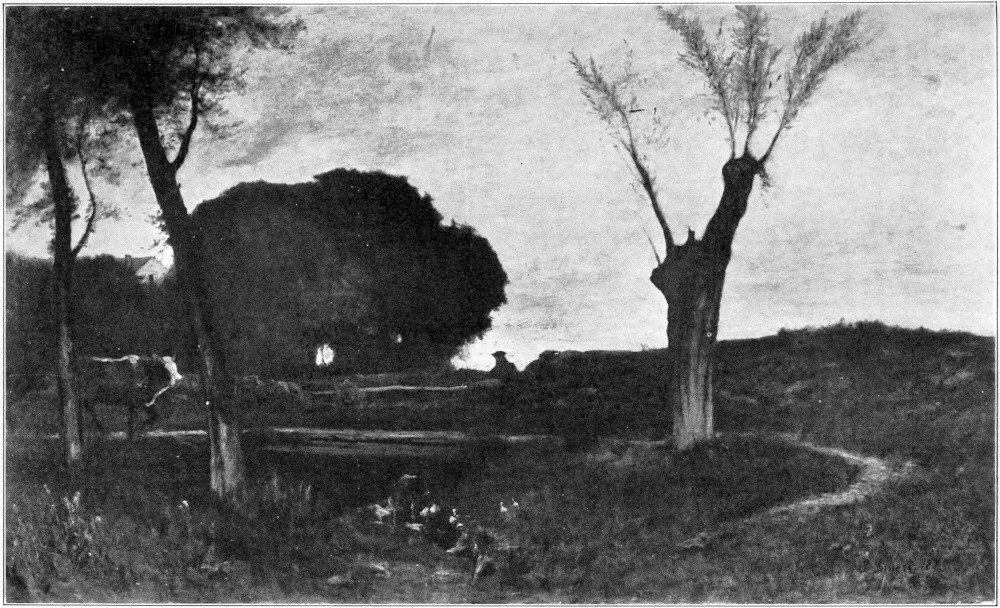
him under Italian inspiration. The “Evening
at Medfield,” also in the Metropolitan, painted
in 1875, suggests French influence, perhaps
Daubigny. It is broader, freer, thinner in handling,
simpler in masses, and has more unity.
None of the pictures at this period are counted
his best output, but they are not the less works
of decided merit.
It was after four continuous years in Europe
(1871-1875) that Inness came into a third
style of work (the “Evening at Medfield” indicates
it), quite his own, quite American, and
quite splendid. It was during this stay abroad
that he seemed finally to find himself. His brush
broadened, his light grew more subtle, his color
became richer and fuller. Corot had taught him
how to sacrifice detail to the mass, Rousseau had
improved his use of the tree, Daubigny gave him
many hints about atmosphere; from Decamps
he learned how to drive a light with darks, and
Delacroix opened to him a gamut of deep, rich
color. He was now in position to graft the French
tradition of landscape upon the American stock.
And this he did, but in his own manner and
with many lapses, even failures, by the way.
All through this third period, and for that
matter up to his death, Inness was experimenting
with landscape. Every canvas was a new
adventure in color, light, and air. In his last
period he seemed to see landscape in related
masses of color rather than in linear extensions;
and so he painted it holding the color patches
together with air and illuminating the whole
mass by a half-mysterious light. It was not
attenuated color—mauves, pinks, and sad grays—but
strong reds, blues, greens, and yellows
keyed up oftentimes to a high pitch and fire-hued
by sunlight. Nor were they put on the canvas
in little dots and dabs, but rather shown in
large masses brought together for massed effect
and made resonant by contrast.
“Evening at Medfield,” by George Inness.
In the Metropolitan Museum of Art. (click image to enlarge)
Almost all of his later pictures will be found
to hinge upon color, light, and atmosphere.
He was very fond of moisture-laden air, rain
effects, clouds, rainbows, mists, vapors, fogs,
smokes, hazes—all phases of the atmosphere.
In the same way he fancied dawns, dusks, twilights,
moonlights, sunbursts, flying shadows,
clouded lights—all phases of illumination. And
again, he loved sunset colors, cloud colors,
sky colors, autumn tints, winter blues, spring
grays, summer greens—all phases of color. And
these not for themselves alone, but rather for
the impression or effect that they produced.
If he painted a moonlight, it was with a great
spread of silvery radiance, a hushed effect in
the trees, a still air, and the mystery of things
half seen; when he painted an early spring
morning, he gave the vapor rising from the
ground, with dampness in the air, voyaging
clouds, and a warming blue in the sky; with an
Indian summer afternoon there was the drowsy
hum of nature lost in dreamland and the indefinable
regret of things passing away. His
“Rainy Day—Montclair” has the bend and
droop of foliage heavy with rain, the sense of
saturation in earth and air, the suggestion of the
very smell of rain. The “Delaware Water Gap”
shows the drive of a storm down the valley,
with the sweep of the wind felt in the clouds,
the trees, and the water. The “Summer Silence”
is well named, for again it gives that feeling of
the hushed woods in July, the deep shadows,
the dense foliage that seems to sleep and softly
breathe.
Always the impression—the feeling which he
himself felt in the presence of nature and tried
to give back in form and color upon canvas.
I remember very well standing beside him before
his “Niagara” and hearing him say what
interested him in that scene. It was not so
much the thundering mass of the waters, the
volume and power, the sublimity of the cataract,
as the impression of clouds of mist and vapor
boiling up from the great caldron and being
struck into color-splendor by the sunlight.
Only an Inness in the presence of Niagara could
have thrown emphasis upon so ethereal a phase
as its mists and color. They made the impression
and he responded to it.
Every feature of landscape had its peculiar
sentiment to him. He said so many times and
with no uncertain voice:
“Rivers, streams, the rippling brook, the hillside,
the sky, clouds—all things that we see—can
convey sentiment if we are in the love of
God and the desire of truth. Some persons suppose
that landscape has no power of conveying
human sentiment. But this is a great mistake.
The civilized landscape peculiarly can; and
therefore I love it more and think it more
worthy of reproduction than that which is
savage and untamed. It is more significant.”
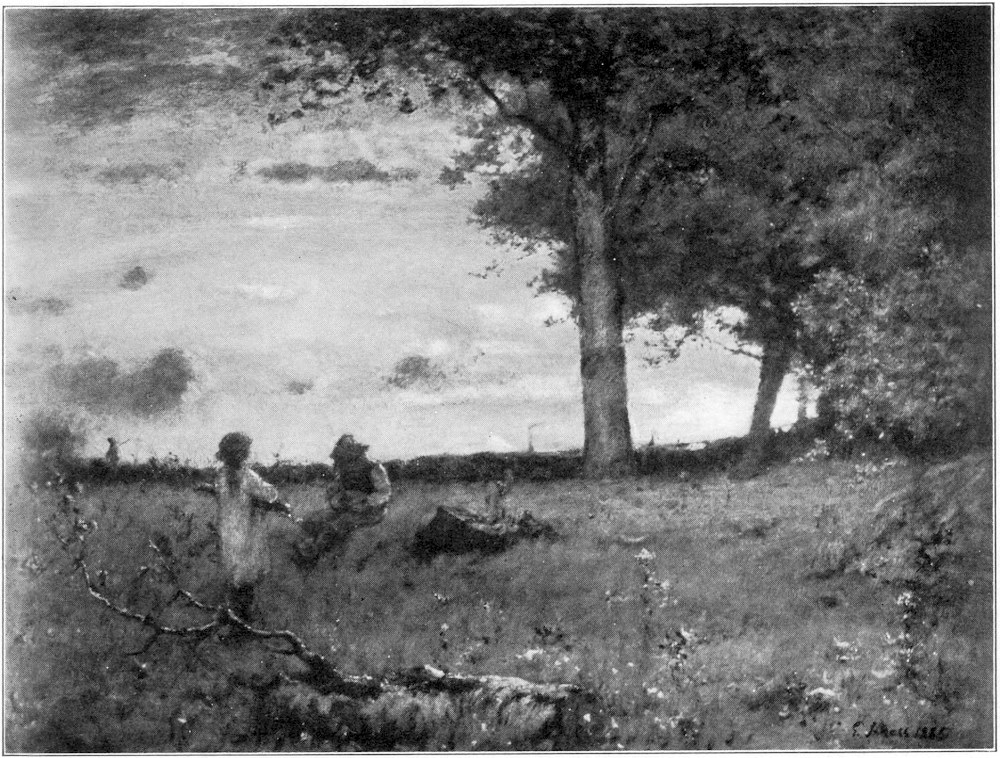
“Sunset at Montclair,” by George Inness. (click image to enlarge)
That last statement of his about the civilized
landscape is well worth noting, because that
was the landscape he painted. His subjects
are related to human life, and some of our
interest in his pictures is due to the fact that
he gives us thoughts, emotions, and sensations
that are comprehensible by all. He tells things
that every one may have thought but no one
before him so well expressed. In other words,
he brings our own familiar landscape home to
us with new truth and beauty. This, it may be
presumed, is the function of the poet and the
painter in any land. It was the quality that
made Burns and Wordsworth great and may
account in measure for the fame of Rembrandt,
Hobbema, Constable—yes, and Inness.
When he was young there were traditions of
the Hudson River school in the air. The
“mappy” landscape with its crude color and
theatrical composition held the place of honor.
Inness was probably captivated by it at first
sight, but he soon discovered its emptiness. It
had no basis in nature; it was not the landscape
we see and know. The “Course of Empire” and
the “Voyage of Youth” were only names for
studio fabrications. The truly poetic landscape
lay nearer home. This was what Inness called
the “civilized landscape,” the familiar landscape,
the paysage intime, the one we all see and
know because it has always been before us—its
very nearness perhaps blinding us to its beauty.
How hard it is to believe that the true poetry
of the world lies close about us! We keep fancying
that romance is not in our native village,
but in Rome or Constantinople or Cairo; and
that the poetic landscape is not that of the wood-lot
behind the house, but that of Arden Forest
or some Hesperidian garden far removed from
us. Emerson has noted that at sea every ship
looks romantic but the one we sail in. Yet there
is plenty of romance in our ship if we have the
eyes to see it; and there is abundance of beauty
in the wood-lot if we have the intentness of purpose
to study it out and understand it. Any one
can admire the “view” from a mountain-top,
but it takes some imagination to see beauty in
the quiet meadow. And after you have seen it
it requires a great deal of labor and skill to tell
what you have seen. Wordsworth and Constable
made more failures with it than successes. Just
so with Inness. He shot wide of the mark innumerable
times, but when he hit, it was with
very decided effect.
A love of the familiar landscape would seem
to have always been with Inness. After a period
of following the Hudson River panorama of
nature undefiled by man, he gave it up. While
in Rome he produced some semiclassic landscapes,
but he gave them up, too. Not so with
the Fontainebleau-Barbizon landscape. Rousseau
and his band had broken with the classic
and were producing the paysage intime to which
Hobbema (not Constable, of whom they knew
nothing) had called their attention through his
pictures in the Louvre. They had done in France
just what Inness had sought to do in America:
they had abandoned the grandiloquent and put
in its place the familiar. Inness was in sympathy
with them almost from the moment he first saw
their work. Had he been born in France, no
doubt he would have been a member of the
Rousseau-Dupré group.
Again it is worth noticing in passing that all of
the so-called “men of 1830” were really provincial
in what they produced. Corot painted Ville
d’Avray, Rousseau, Dupré, and Diaz the Fontainebleau
forest, Daubigny the Seine and the
Marne. None of their work represents the south
or the east of France, and none of it carries beyond
France. It is localized about Paris. Just so
with the work of Inness. It is emphatically
American, but limited to the North Atlantic
States. The appearances which he portrayed are
peculiar to the region lying east of the Alleghanies.
In his pictures the light and coloring,
the forms and drift of clouds, the mists and
hazes, the trees and hills, the swamps and meadows
may be recognized as belonging to New
Jersey or New York or New England, but none
of them belongs to Minnesota or Louisiana or
California. He pictured the American landscape
perhaps more completely than any other
painter before or since his time; but his “civilized
landscape” was nevertheless limited as
regards its geographical range.
Nor would we have it otherwise. All the masters
of art have been provincial so far as subject
goes. Titian, Velasquez, and Rembrandt never
cared to go beyond their own bailiwicks for
material. And Inness—though he may not rank
with those just mentioned—found all the material
he needed within fifty miles of New York.
It was the discovery of this material, his point
of view regarding it, what he did with it, and
what he made us see in it, that perhaps gives
him his high rank in American art.
The man and his impulsive nature never
changed, though he kept shifting his methods
and his point of view from year to year. He went
his own pace and was always something of a recluse.
The art movements about him interested
him in only a slight way. The Academy of Design
honored him with membership, but he cared
little about it. The Society of American Artists
elected him a member also, but he cared even
less for the brilliant painting of the young men
than for the weak performances of the academicians.
He kept very much to himself and
painted on in his own absorbed, impulsive fashion.
His studio was only a bare barn of a room
with a few crazy chairs in it. Wall-hangings, stuffs,
screens, brass pots, shields, spears—the artistic
plunder which one usually finds in a painter’s
apartment—he regarded as so much trumpery.
In his later days he came and went to his studio
from Montclair, seeing landscapes out of the
car-window, and in his mind’s eye seeing them
upon his canvases. His art swayed him completely.
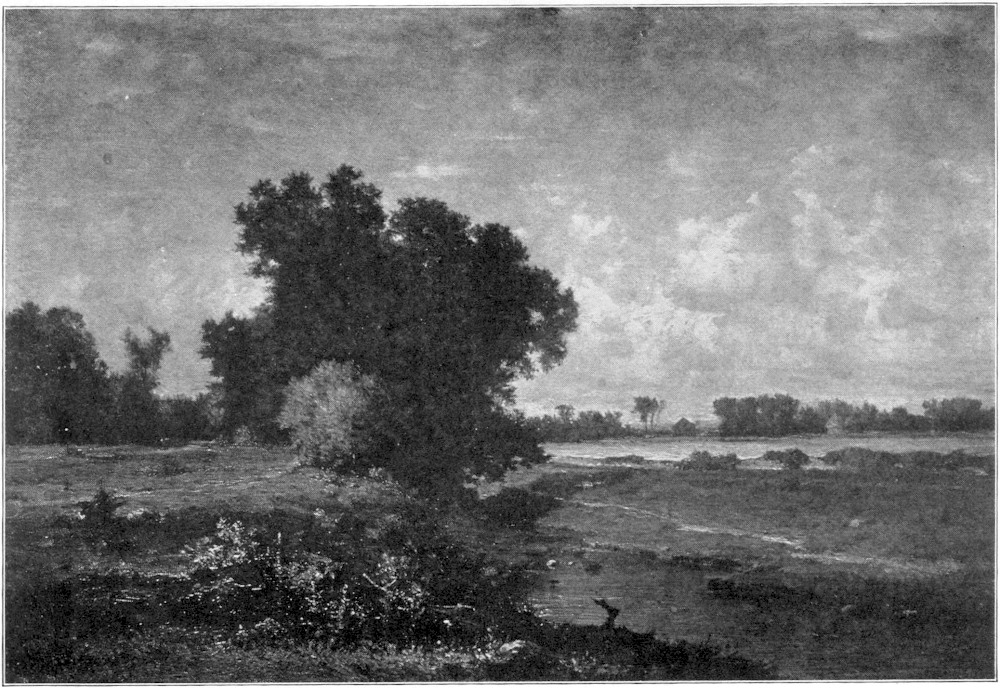
“Hackensack Meadows,” by George Inness. (click image to enlarge)
He had no pupils, though he corrected, advised,
and instructed many young painters after his
own method. It was a decidedly arbitrary teaching.
Elliott Daingerfield tells a story of one of
his own landscapes in which a rail fence was
running down into the foreground. When Inness
was asked in to criticise the canvas, he objected
to the fence and said it should be taken out.
“Why can’t I have the fence there if I want
it?” Daingerfield protested. To which Inness
replied:
“You can if you want to be an idiot.”
His criticism of older painters and pictures
was just as unqualified. And in matters outside
of art, where he spoke with no peculiar authority,
his vehemence was no less. Crossing on the
Arizona in 1887, he talked every one out of the
smoking-room on the Single Tax question, so
a friend informs me. In 1894, when I happened
to be crossing with him, he was as positive
as ever about his religious, socialistic, and political
convictions. His interest and enthusiasm
were in no degree abated. In the mornings he
sat on deck wrapped up in rugs under the lee
of a life-boat, and amused himself doing examples
in vulgar fractions out of an ordinary
school arithmetic; but in the afternoon he liked
to talk, and I was a willing listener, though I
had heard him discourse many times.
Every one remembers his caustic criticism of
Turner’s “Slave Ship.” He always had a kick
for Turner, though at heart he admired him,
and in many respects his own methods were
very like that master. They both worked from
visual memory, Turner putting in what pleased
him in architecture, people, and boats; and
Inness putting in cows or bridges or wagons, as
pleased him. Neither painter resorted to the
model or to a sketch for these accessories. They
painted them out of their heads, and sometimes
they were vague in drawing or false in lighting.
The only difference was that Turner
took more liberties with his text than Inness,
and often lost truth of tone. This gave Inness
his chance to say that Turner was a painter of
claptrap—his detail was spotty, he could paint
figures in a boat, but he couldn’t paint a boat
with figures.
For Gainsborough he had some admiration,
and in his early days rather followed him, but
he outgrew the brown-fiddle tone of Gainsborough’s
foliage and came to think his work lacking
in color. Constable, too, he admired, perhaps because
he painted the greens of foliage very
frankly; but his light and color were cold.
Turner’s heat and Constable’s cold he did not
believe could both come out of England, except
through subjective distortion. The pictures of
Watts, he insisted, looked as though dipped in
a sewer, so unhealthy and morbid were they
in color. This referred to the later pictures of
Watts which Inness had seen in a loan collection
exhibited at the Metropolitan Museum. He
was fond of brilliant color himself, and evidently
he had never studied the earlier and middle-period
pictures of Watts. Wilson he liked, though
recognizing that he was merely a reviser of the
old classic formula of landscape. But Wilson
knew how to handle his sky and could tie things
together with atmosphere.
Corot was a very pretty painter—and by
“pretty,” Inness meant clever. He wagged his
head in saying it and smiled as though the
statement were incontestable. The sentiment of
light and air with Corot was something that
Inness thoroughly understood. And he greatly
fancied Corot’s composition. At one time he
painted pictures that have a Corotesque arrangement—notably
the “Wood Gatherers,” formerly
in the Clarke Collection. What he did not understand
was Corot’s monotony of color, or, as other
painters expressed it, Corot’s refinement of color.
Millet was wonderful, especially in his landscape-work,
which had attracted so little attention.
Delacroix was one of the great gods for his
wonderful gamut of color, if nothing else.
And so on.
The steamer trip in 1894 was the last one that
Inness made. He died that summer at the
Bridge of Allan in Scotland. His funeral was
held in the National Academy of Design in
New York, and the Swedenborgian minister
who officiated, in the course of his eulogy, said:
“Those of you who knew George Inness knew
how intense a man he was.” “Intense” is exactly
descriptive of the man. He was keyed up
all his life and worked with feverish intensity.
But the word does not describe his art, for that
has no feeling of stress or strain about it.
Sometimes one is conscious of its vagueness, as
though the painter were groping a way out
toward the light—a vagueness that holds the
mystery of things half seen, a beautiful glimpse
of half-revealed impressions. But usually his
pictures are serene, hushed, and yet radiant with
the glow of eternal sun-fires from sky or cloud.
They were lofty and poetic impressions, and
the loftier they were the more intense the
painter’s effort to reveal them. The heights of
Parnassus are very calm, but they are not
reached without a struggle. The great ones—those
who scale the upper peaks—are perhaps
the most intensive strugglers of all. Inness was
one of them.
ALEXANDER H. WYANT
III
It was Corot who declared that in art Rousseau
was an eagle and he himself was merely a lark
singing a song from the meadow-grasses. The
contrast and the comparison are not inapplicable
to two of our own painters. Wyant never possessed
the wide range or the far-seeing eye of
Inness, but he had something about him of
Corot’s mood and charm. He, too, was a lark,
or should we say a wood-thrush singing along
the edge of an American forest? He had only a
few mellow notes, yet we would not be without
them. They still charm us. And it is not certain
that in the long account of time the direct
and simple utterances of Corot and Wyant may
not outlive the wide truth of Rousseau and the
vision splendid of Inness. More than once in
æsthetic story the songs of a Burns have been
held more precious than the tumults of a Milton.
The wonder of Wyant’s success is greater than
that of Inness, for his boyhood surroundings, if
anything, were less stimulating and his pictorial
education far more restricted. Besides, Inness
lived on to seventy years, but Wyant died at
fifty-six, having endured ill-health, and for
the last ten years of his life—his best working
years—been paralyzed in his right arm and
hand. Living much to himself, something of a
hermit in his mountain home, weighed down by
misfortunes and disappointments, the wonder
grows that he not only kept up and improved
his technique to the end, but that he preserved
his serenity of mood and purity of outlook
through it all. He must have been a man with
fortitude of soul beyond the average. It is not
every painter that can turn stumbling-blocks
into stepping-stones.
Wyant was the typical barefoot boy of the
near West in the days before the Civil War. He
was born in 1836 at Evans Creek, Tuscarawas
County, Ohio, and his boyhood and early youth
were far removed from anything like the madding
crowd. His parents were Americans of the
soil, his father being a farmer and carpenter
of Pennsylvania extraction, and his mother of
Dutch-Irish descent. They were nomadic, after
the manner of border people, and soon left Evans
Creek to live in or near Defiance, where Wyant
learned his three R’s in the village school. There
were less than one thousand people in the town
at that time, and what Wyant got out of it by
way of enlightenment or encouragement must
have been meagre. As a boy he, no doubt,
roamed the woods, fished the streams, and
trailed along the Ohio hilltops; and at this
time, unconsciously perhaps, he was storing up
visual memories of appearances that were to
be of service to him later on.
That he had an eye and was an observer from
the start comes to us in the tales told of his
boyish sketches on the floor made with charcoal
from the wood-fire. At least they showed
an inclination that was afterward to develop into
a passion. But the inclination found no immediate
outlet. After leaving school the youth
served as an apprentice in a harness-shop, but
he did not care for harness-making. He preferred
to paint photographs, cards, signs—almost
anything that could be done with a brush.
At twenty-one he went to Cincinnati and for
the first time saw some paintings in oil. Before
that his ideas of art had been bounded by book
illustration and the omnipresent chromo. It
is said that among the pictures he saw at Cincinnati
was something by Inness. The young
man was impressed by it, or by the reports
about Inness, for he took the train to New
York to consult that master about art as a vocation.
He found Inness at Eagleswood, near Perth
Amboy. How long he stopped there and what
was said we do not know, but the master was
encouraging, and the young man went back to
Cincinnati determined to be a painter. He had
a right instinct about art at that early time or
he never would have chosen Inness for a counsellor.
The famous landscape-painters then were
Kensett and Church. Inness was the most progressive,
the most ultra-modern of the time,
and had not yet won universal applause. He
did not paint enough in detail for the man in
the street, and evidently he must have given
Wyant his argument for breadth of view over
detail, for, as we shall presently see, Wyant had
it almost from the start. But perhaps the most
and the best that he got from Inness was
inspiration.
Back in Cincinnati and painting pictures after
his own formula, Wyant found a purchaser and
a patron in Nicholas Longworth. It became possible
for him shortly thereafter to move to
New York. There, in 1863, he saw a large exhibition
of Düsseldorf pictures that probably stirred
his imagination. Pictures in America at that
time were rather scarce, and any exhibition of
foreign work would be more impressive then
than now. The next year he exhibited at the
National Academy of Design for the first time,
and in 1865 he went to Europe on a Düsseldorf
pilgrimage, impelled thereto by a mountain-and-waterfall
landscape of Gude which he had seen
in New York.
He went straight to Gude at Carlsruhe and
put himself under his tutelage. Gude was a
Norwegian painter, influenced by Dahl, and imbued
with the Düsseldorf method and point of
view. The grand landscape—panoramic in extent
and mountainous in height, with a hot sun
in the heavens—was then in vogue, and Achenbach
was its prophet. From Wyant’s short stay
with Gude it seems that his enthusiasm was
soon chilled down to zero. In after-life he often
referred to the great kindness of Gude and his
wife, but he seemed to think that his instruction
in art had been fundamentally wrong. His
pupil, Bruce Crane, says that he spoke of his
art environment there as being “a miserable
one,” and Wyant believed that “environment
played the greater part in the making of a
painter for good or bad.”
He left Gude and started back to America,
but stopped on the way in England and Ireland,
where he studied pictures and painted some of
his own. The old masters in the National Gallery
apparently did not make a strong appeal to
him. His work shows no sign of Claude, Salvator,
Poussin, Ruysdael, Hobbema, or Cuyp. Even
Gainsborough and the ascendant Turner seem
to have left him cold. But Constable he liked
very much. Here at last was a man seeing things
in a large way and doing them with breadth of
brush. Moreover, he was doing simple transcripts
of nature, not the panorama of blazing
perspective. In America Wyant had inherited
something of the spectacular from his Hudson
River predecessors; Düsseldorf had aided the
conception, and Turner had abetted it; but
Constable seemed to be against it. Wyant was
inclined to renounce it. Constable produced
the broad realistic look, and at that time Wyant
had probably not arrived at any other conception
of art than as a large transcript of nature.
Ruskin’s doctrine of fidelity to fact was in the
air, and the landscape as emotional expression,
or as a symphony, or even as a decorative pattern,
was little known either in the studios or the
critic’s den. There was, however, plenty of controversy
going on. And yet fresh from varying
theories and impressions, Wyant went over
to Ireland and painted pictures that bore no earmark
of any painter or any school.
In the Metropolitan Museum there is an Irish
landscape by him done in 1866—“View in
County Kerry, Ireland.” There are gray mountains
at the back, a green foreground with a pool
of water, a gray-blue and whitish sky, a gray
atmosphere. At the right middle distance is a
white cottage. The rest is treeless upland
running into mountain heights that are lost in
haze and cloud. The picture is not only remarkable
for its simplicity of composition but its
absence of small objects or distracting details.
Though a mountain landscape, it is broadly
seen, largely and simply massed, and painted
with a broad flat brush. It may have been repainted
in later years, but I am willing to believe
from the breadth of its composition that
it was painted broadly to correspond, and is
to-day substantially as when originally done.
This picture is in somewhat violent contrast
with another Wyant landscape hanging in the
same gallery and dated in the same year—1866.
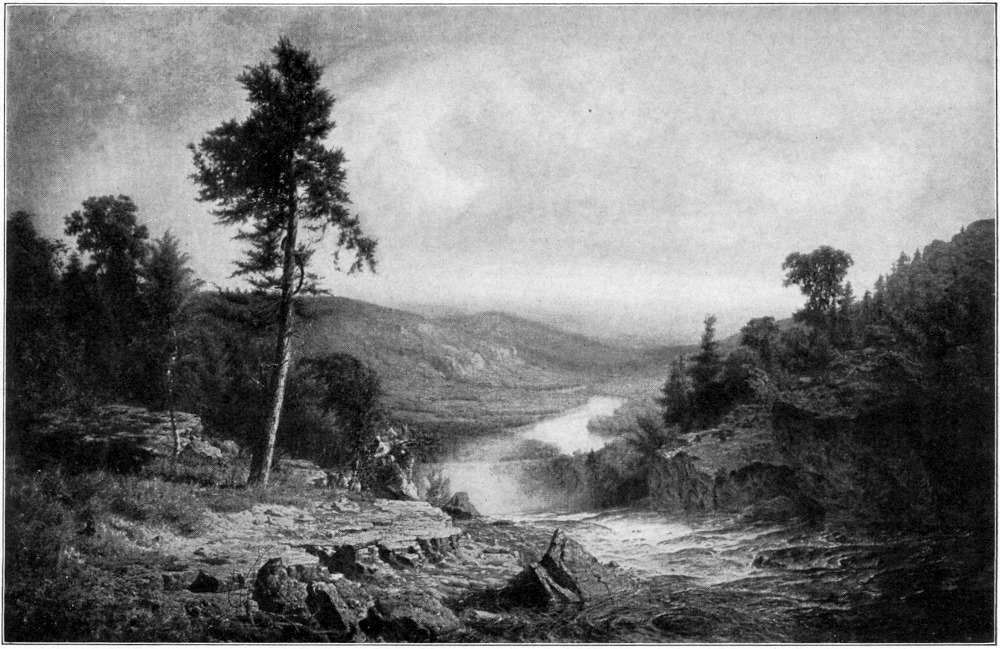
I refer to the large “Mohawk Valley” landscape—an
excellent picture, though evidencing limitations
perhaps peculiar to America. It is a
huge valley view with a gorge and stream in
the foreground running down to a fall from which
mist is rising. The stream as a pool is seen
again emerging in the middle distance. A half-lighted
sky with falling rain at the left and warm
grays of clouds and blues of distance make up
the background, while in the foreground a tall
tree at the left is balanced by a group of lesser
trees at the right. The whole color-tone is warm
(probably from underbasing), especially in the
foreground, which shows in grays and browns.
It is a symmetrical composition with a central
point of sight, and in its detailed elaboration
gives no hint of selection or sacrifice. The trees,
the ledges of rock in the foreground, the water,
the clouds are all exactly drawn and realized to
the last item, each one having quite as much
importance as its fellow. As for the painting, it is
thin, kept thin to allow the underbasing to show
through; but it is flatly painted, not stippled.
In the latter respect it is an advance on, say,
Church’s panorama, “Heart of the Andes,” in
the same gallery, where the stippling with white
paint produces a glittering, bedizened surface,
and the minute drawing of leaves in the foreground
runs into petty niggling.
Now, the “Mohawk Valley” was probably
completed just before Wyant went to Europe;
at least in method it antedates the “County
Kerry, Ireland,” landscape of the same year.[1]
It is a very important picture and represents
the culmination of Wyant’s early style—a beautiful
picture for any place or period or painter
to have produced. It shows Wyant’s original
point of view, with some of the influences that
must have come to him from the Hudson River
school, from Inness, from various unknown
American sources. But the “County Kerry, Ireland,”
landscape shows a departure, a widening,
and a broadening of both brush and vision
which were to increase and expand thereafter
into a second style—the style of Wyant’s later
and nobler canvases. To this style Wyant was
undoubtedly helped at first by what he saw
abroad, especially by the pictures of Constable.
[1] “In regard to the two pictures in the Metropolitan Museum, ‘View in
County Kerry, Ireland,’ and the ‘Mohawk Valley,’ I never could reconcile
myself to the idea that they were both painted in 1866. There is no
doubt about the ‘Mohawk Valley’ because its manner is so much like
the many canvases of that period which Wyant often showed me and
which Mrs. Wyant destroyed after his death. The ‘View in County
Kerry, Ireland,’ marks a new period in his art and the widely different
handling as well as view-point are too much to have been acquired in
one year. There is certainly some mistake in the date—I should say a
difference of ten years. At some time that picture has been cleaned and
the restorer accidentally destroying the date restored it incorrectly.”—(Bruce
Crane in a letter to the writer, December 13, 1917.)
“Mohawk Valley,” by Alexander H. Wyant.
In the Metropolitan Museum of Art. (click image to enlarge)
This was a time of rapid production with Wyant
and he was always afire with his theme. The
recognition of artists was coming to him if not
the large patronage of the public. His picture
of a “View on the Susquehanna” resulted in his
being elected an associate of the National Academy
in 1868, and he was named a full academician
in 1869. But ill-health was with him,
and in the hope of improving his physical condition
and at the same time gathering material
for his art, he joined in 1873 a government
expedition to New Mexico and Arizona. There
were many hardships on the trip, and Wyant’s
never very robust constitution broke down under
the strain. He was put on the train and sent back
East. It is said that on the way East he passed
his home town of Defiance, but would not get
off. Ill as he was, with few friends and less
money, he determined to go on to New York and
fight it out. The fine courage of all that becomes
more marked when we understand that the
illness was so severe that it had resulted at
Fort Wingate in paralysis of his right hand and
arm. He was never to paint with his right hand
again. It was a crippled painter coming back to
New York—crippled in a vital spot—but he had
determined that his left hand should be trained
to service. And it was.
The West not only maimed him physically
but apparently taught him nothing artistically.
The deserts that he crossed with their red
porphyry mountains, dull-yellow sands, and
gas-blue air—the most wonderful landscapes
in the world in their definition of form and their
quality of color—seem to have made no impression
whatever upon him. This is understandable
only by considering the inheritance of tradition
and environment. In Wyant’s time a handsome
landscape meant a mountain-valley with forests,
rocks, waterfalls, and the variegated foliage of
summer or autumn. The desert was unknown
and remained for a later generation of painters
to discover; the plains were unpainted and
thought unpaintable; even the marsh and the
meadow, which Corot loved, were considered too
slight for art. The grand-view conception in
landscape-painting died hard. In Wyant’s time
it was very much alive. Naturally enough, he
was impressed by it, and though in later life he
did many small intimate bits of nature, he never
got away entirely from the wide mountain-valley
theme.
He was, in fact, always a mountain lover. After
his return to New York he spent much of his
summer-time in the Adirondacks. He was then
deeply interested in the pictures of the Barbizon-Fontainebleau
painters which were coming
into the United States. So outspoken was his
admiration for Rousseau that he sent a picture
to the Academy with the title “In the Spirit of
Rousseau.” His own style was growing broader
and simpler each year, and, strange enough, the
public was buying his pictures. He became
measurably prosperous, had a studio in the
Y.M.C.A. Building in Twenty-third Street, and
received a number of pupils. One of his pupils,
a Miss Locke, he married in 1880.
After his marriage much time was spent in
the Keene Valley, and in 1889 he moved to
Arkville in the Catskills, where with a fine
sweeping outlook from his porch upon woods,
valleys, and hills he found enough material to
last him the rest of his life. He saw little of the
town thereafter. He had never mingled freely
with his fellow man. The Society of American
Artists had honored him with membership in
1878, he was a founder of the American Water-Color
Society, and a member of the Century
Association, but he always held somewhat aloof
from them. Friendly enough with painters and
people who sought him, he was, nevertheless,
a little shy, which perhaps gave him the reputation
of being gruff. He seemed less fitted to the
city street than the aisle of the forest. It was in
his mountain home on the forest edge that he
died in 1892, having suffered much physical pain
before his going.[2]
[2] “I met Wyant in 1876; his right arm was then practically useless.
Later on his right side was affected, and the last six years he was compelled
to walk sideways. Yet through all these years of suffering he
worked day and night, and during the last six years, when his suffering
was the worst, he recorded on canvas some of the beautiful things that
survive him.”—(Bruce Crane, ibid.)
Like many another painter, Wyant doubtless
knew infinite regrets that he could not live to
complete his art. For he never believed in his
having reached a final goal, and was always
changing, experimenting, trying to better his
work. My first meeting with him must have been
in 1882. I seem to remember him seated before
a picture with his palette fastened to the easel,
his right arm hanging rather limp, and his left
hand holding a brush. There was nothing noteworthy
about the meeting except that his first
words were a request that I should tell him what
was wrong with the picture on the easel. He was
so anxious to get a new view-point that he was
quite willing to listen to a stranger, whether he
spoke with authority or not. Of course I did not
venture to say anything other than in praise of
the canvas, though as I now remember it the
picture was bothering him and looked a little
tortured in its surface.
He worried a good deal over many of his pictures.
When Inness came in to see him he relieved
the strain in his impetuous way by taking
up Wyant’s palette and brushes to add a touch
here and there. The result usually was that the
canvas grew into an Inness before the acquiescent
Wyant’s eyes. There was so much of this
that Mrs. Wyant finally forbade Inness her
husband’s studio—at least that is the story told
by the Inness family. But Wyant would do anything,
submit to anything, for the love of painting.
Bruce Crane writes me:
“How that man did love to paint! I often
thought he worked too hard, sometimes failing to
get his breath between canvases. He wished
always to be alone so that he could paint, paint,
not for praise nor emolument; never with the
thought of reward. I recall Z. visiting the studio
one day and remarking that he, Z, would like
to be considered the best landscape-painter in
America. After he left, Wyant said: “What a
h—— of an ambition!”
Loving the mountains and the forests as he did,
it was to be expected that he would use them in
art. It was his earliest inheritance and his latest
love. Any one at all familiar with the Adirondacks
or the Catskills will recognize in Wyant’s
landscapes not their topography, perhaps, but
their characteristics. The valleys, the side-hills
with outcropping rock, the pines, beeches, and
birches, the little streams and pools, the clearings
with their brush-edgings, are all there.
Wyant arranged them in his pictures with the
skill of a Japanese placing flowers in a pot. He
made not so much of a bouquet as an arabesque
of trees and foliage, illuminated by sunlight
filtered through thin clouds at the back and
warmed with golden-gray colors. Atmosphere—the
silvery-blue air of the mountains—held the
pattern together, lent it sentiment, sometimes
(with shadow masses) gave it mystery.
Perhaps the best illustration of this in any
public gallery is the “Broad Silent Valley” in the
Metropolitan Museum. It is doubtful if Wyant
ever expressed himself better or more completely
than in this picture. It is a large upright
canvas, the very shape of which adds to
the dignity and loftiness of the composition
placed upon it. At the left are half a dozen large
trees, at the right a rocky hillside, in the central
plane a reflecting pool of water, at the back a
high, clouded sky, radiant with the light beyond
it. Simple in materials, not brilliant in color but
rather sombre in tones of golden gray, devoid
of any classic or romantic interest, it is nevertheless
profoundly impressive in its fine sentiment
of light, air, and color. It is as strong almost
as a Rousseau in its foreground and trees,
and as charming as a Corot in its light and air.
But you cannot detect either Corot or Rousseau
in it. When it was painted, Wyant was greatly
taken with those painters, but he did not imitate
or follow them. His pictures were always his own—the
“Broad Silent Valley” not excepted.
The beauty and charm of its sentiment with the
wonder of its strong mental grasp are paralleled
by the workmanship displayed. Looking closely
at the canvas, one finds it not heavily loaded,
but dragged broadly and laid flatly with pigment.
The ground has been underbased in warm
browns, the shadows kept transparent and distant
by glazes, the lights put in with opaque
pigments. The handling is very broad if thin,
and there has been little or no kneading or emendation
or fumbling. It is straightforward flat
painting of a masterful kind. And this was done
with that late-trained left hand!
“Broad, Silent Valley,” by Alexander H. Wyant.
In the Metropolitan Museum of Art.
As for the drawing, it does not bother with the
edges of objects, but concentrates force on the
body and bulk—the color mass. Wyant had
learned linear drawing with the exactness of a
Durand and used it in his early pictures, but
he soon outgrew the fancy for photographic
detail. It was not effective. And he could give
the solidity of a ledge of rock or the lightness
of a floating cloud much better with a broader
brush. As he grew in art his brush continued to
broaden. His work became more sketchy, his
brush freer and fuller, and possibly before he
died he may have heard his work referred to as
“impressionistic”—heaven save the word!
The general public usually regards any breadth
of brush-work whatever as a sign of impressionism.
The term in its present meaning, or lack
of meaning, covers a multitude of stupidities.
Every one who paints gives an impression because
he cannot give anything else. Realism is a
misnomer. The real is nature itself, and art is
the report about the real made by the painter.
If it is a minute report of surface detail that can
be seen through a magnifying-glass the public
immediately dubs it realistic; if it is a broad
report that ignores the surface detail for bulk,
mass, and body, it is called impressionistic. But
the difference is merely between the smallness
and the largeness of the view-point. The great
landscapists have usually regarded a tree as
more important in its shadow masses and volume
than in its leaves, a rock as more impressive
in its weight than its veins or stains, a bar of sunlight
more striking in its luminosity than in its
sharp-cut edges. Seeing and painting that way
it is easy to comprehend how they should be
set down as impressionists when in a large sense
they are making more faithful record than the
men who see only the surface glitter. Such men
were Corot, Constable, Inness, Wyant, not to
mention Manet or Monet.
Wyant probably came to that point of view
at first through Inness and then, later on,
through Constable, Corot, and Rousseau. It was
the right point of view, though he never gave it
with quite the breadth of Corot or with the
solid painting of Rousseau. His canvases were
always sufficiently covered with pigment, but
no more. Some of his late pictures show a
freer use of pigment, but he seldom if ever did
any fat or unctuous painting, and never painted
for mere display of dexterity. He had certain
formulas of composition, methods of getting certain
effects that he employed continuously.
For instance, he liked a dark foreground, a
lighted middle distance, and a veiled sunlight
effect at the back. To avoid the obviousness of
this composition he often introduced light spots
from a pool in the dark foreground and dark
stumps or tree trunks in the light middle distance,
or otherwise varied the contrast of light
with dark. But these with glazed shadows and
opaque high lights were not exactly painter’s
tricks but rather the conventional practices of
the studio at that time.
Wyant up to the last ten years of his life
painted much out of doors and directly from
the model. From that he got exact knowledge
of forms, lights, and colors, so that in after-years
he was able to draw and paint largely
from visual memory. Working directly from the
model led him into much detail, and some of his
earlier pictures are burdened with a multitude
of facts, but when he worked from memory in
the studio all that was changed. He simplified
his composition to a few large masses, threw
out detail, and depended for effect largely upon
light, air, and diffused color. A little valley view
with half a dozen beeches at the left, a clump of
bushes with a ledge of rock at the right, a veiled
distance—that was enough for him.
Occasionally in his pictures one sees a white
cottage in the background, a road or a bridge;
but these do not occur frequently, and I cannot
remember any picture by him that shows man,
woman, or child. The human interest was not his.
He believed that nature was sufficient unto itself
and needed no association with mankind to
make it beautiful or interesting. So long had he
looked at nature and studied her appearances, so
long had he marvelled and brooded over her
grandeur and beauty, so long had he loved the
veiled mountain light, the blue air, and the forest
shadow, that finally he came to have a way
of seeing things, a point of view about nature
that by its intensity and depth was perhaps abnormal.
He saw not as we see but as an absorbed
nature-lover sees. The disturbing prose of facts
was no longer there. The poetry of light, air, and
color alone remained.
In his first endeavors when he painted from the
model he recited the beauty of the facts and
perhaps thought they would be sufficient to
carry the picture. Nature was beautiful in itself;
if faithfully transcribed on canvas why would
not the beauty carry on into the transcription?
He found later on that it would not and could
not, that the counterfeit presentment remained
only a counterfeit presentment. Then he began
to simplify his matter and broaden his
method, seeking not to reproduce the original
but to give merely the feeling or impression that
the original had made upon him. The result was
that peculiarly poetic quality of light, air, and
color that we associate with such pictures as the
“Broad Silent Valley.”
Of its kind no finer quality of pictorial poetry
was ever produced than is shown in Wyant’s
later landscapes. It is not exactly epic, though
it has wonderful descriptive passages, sustained
effect, and often very positive strength of utterance.
Lyric is the term that describes it better.
For it is a song rather than a recitation—a wood
theme worthy of a Pan’s piping, though it gives
no hint of the Old World, and belongs emphatically
in this new Western land with its unbroken
soil and virgin forests. In aim and effect it is not
unlike the pæan in praise of light by Corot.
They were both painter-poets—the one painting
on the outskirts of Paris, the other gathering
his material on the outskirts of civilization here
in America.
Inness, Wyant, Homer Martin, Winslow Homer—no
one ever questioned the Americanism of
their art. They are our very own—the product of
this new soil. Even their limitations recite our
history. As for their aspirations, with their passionate
love for the beauty of our own American
landscape, may it not be fairly claimed that
in these they are representative of the American
people? In a large sense have they not been our
pictorial spokesmen, saying in art what many of
us have always felt but could not well express?
And Wyant—Wyant with the wood-thrush note—well,
we shall not look upon his like again!
For he and Martin were perhaps rarer spirits,
finer souls, than either Inness or Homer. Their
charm of mood, the serenity of their outlook, the
loveliness of their vision will hardly be repeated
in our art. They marked an epoch and belonged
to a past that unfortunately is leaving no decided
teaching or sequence in its wake. The
trend in art to-day is not toward serenity but
turbulence.
HOMER MARTIN
IV
The little aloofness of manner that prevented
Wyant from being a pronounced social light was
not a characteristic of Homer Martin. From his
youth upward Martin was companionable, had
in fact something of a genius for making friends.
All through his life he maintained social relations
with the wise and the witty of his time, moved
in intellectual club circles, and both at home and
abroad was accounted a man of mind, a rare
raconteur and conversationalist, a most attractive
personality. His droll comments and quick
retorts are still told at his club, and form perhaps
something of a contrast to his pictures
hanging upon the walls near by.
For there was never anything amusing about
Martin’s art. He indulged in no drollery of the
brush, and no intelligent person ever got a smile
out of his canvases. They are serious, almost
solemn, affairs. Mrs. Martin, in her delightful
reminiscences of her husband, quotes John R.
Dennett as saying that “Martin’s landscapes
look as if no one but God and himself had ever
seen the places.” There is, indeed, nothing of
human interest about them. A distant figure
or a house is occasionally introduced as a light
spot in a dark plane, or otherwise to help out the
composition; but the figure always suggests a
wraith or a spook, and the house is deserted or
haunted. Says Mrs. Martin:
“There is an austerity, a remoteness, a certain
savagery in even the sunniest and most peaceful
of his landscapes, which were also in him, and
an instinctive perception of which had made
me say to him in the very earliest days of our
acquaintance that he reminded me of Ishmael.”
There is no contradiction of character in these
two phases of Martin’s mentality. They argue
merely versatility. He was exceedingly fond of
the silent, even melancholy, beauty of nature,
as he was of the solemn seriousness of fine poetry;
but these were not themes for talk at the club.
Mrs. Martin says she never heard him “talk
shop” and that, with several notable exceptions
such as La Farge and Winslow Homer, most of
his close friends were people in other professions
than painting. He never tabooed art as a topic
of conversation, but he could talk on other
themes quite as well. The mental facet that
reflected him as a man of the world gave out a
different light from that which proclaimed him a
poet in landscape. His was not a one-facet mind.
What part heredity played in his equipment
may only be guessed at. His father was a mild-mannered
carpenter of New England descent,
his mother a strong-willed, quick-witted woman
belonging to an old Albany family. It is usually
assumed that Martin derived from his mother
and got his artistic instincts from her. These
latter, it seems, developed early—the mother
testifying that before he was two years old she
was accustomed to quiet him by giving him
pencil and paper. At five he did what has been
called a “spirited” drawing of a horse. Doubtless
every one can remember something of the
same sort told about his own infancy. The
drawing habit is common to almost all children
and usually means little.
But Martin was to demonstrate shortly that he
could do nothing else but draw and make pictures.
At school in Albany (where he had been
born in 1836) he was not a shining success. He
said himself that his school-days had been spent
in looking through the windows at the Greenbush
Hills and longing for the time when he
could get over there and draw them. At thirteen
his schooling ended, much to his after regret.
He then went into his father’s carpenter-shop,
but that proved as little attractive as the schoolroom.
A clerkship in a store ended disastrously
owing to his non-recognition of the amenities of
business life. Then he entered an architect’s
office and failed there because of defective eyesight.
He could not see or draw a vertical line
properly. Later on he was eliminated from the
Civil War draft because of this same defective
vision. His special fitness for the painter’s craft
was not very obvious at this time, and yet he
was headed strongly that way.
It was E. D. Palmer, the sculptor, who persuaded
the father to allow Martin to go on with
art. Palmer was then the art oracle of Albany,
with a little coterie of painters about him consisting
of such men as James and William Hart,
George H. Boughton, Edward Gay, Launt
Thompson. Martin knew them as a boy; and,
after sixteen, doing pretty much as he pleased,
he frequented their studios, and for two weeks
was a pupil of James Hart. That is the only
direct instruction he ever received. Before he was
twenty he had opened a studio of his own in
Albany, was quite well known as a youthful
prodigy, and was generally thought to have in
him the making of an artist.
It was in Albany that he met and married in
1861 Elizabeth Gilbert Davis, a clever woman
who afterward developed much literary ability
and became well known not only as a reviewer
in The Nation and other periodicals but as a
novelist and magazine writer. The marriage
was altogether fortunate and happy, though at
times pecuniary difficulties incident to the artistic
and literary life weighed heavily upon them.
She was a rod and a staff to comfort him, and
there is no record that she ever flinched or
failed or regretted her choice. In their early married
life there were few trials, she recording that
they were fairly prosperous, that he received
numerous commissions for pictures, and that
they had made many friends. They had stayed
on in Albany until the winter of 1862-1863, and
then had moved to New York. In 1864 he had
a studio in the Tenth Street Building, and his
near neighbors were Sandford Gifford, Hubbard,
Griswold, J. G. Brown, McEntee, Eastman
Johnson, and, later, John La Farge.
This was a time of comparatively rapid production
with Martin and also a time when many
influences might be supposed at work upon him;
but in reality none of the influences seems to
have made much of an impression. His early
work is now infrequently seen, but what there is
of it, though small, bright, and a little crude,
is nevertheless quite distinctly Martinesque.
He had, of course, inherited from the Hudson
River school (a name that Professor Mather
declares Martin originated) the “view” in landscape.
With the panorama had come down the
studio method of small detailed treatment, and
Martin at first paid it allegiance but he very
soon saw its defects. As a boy he could speak of
a picture by his master, James Hart, as “a
scene of niggled magnitude,” and Mr. Brownell
tells me that he had always talked much of
“generalization” in landscape.
His early pictures show this generalization not
so much perhaps in breadth of handling as in
breadth of view. He was even then seeing the
large elements of earth, air, water, and sky.
Naturally enough, his brush was a little fussy
with foliage, dead-tree trunks, rock strata, and
foreground properties in general; but he could
see the unity of mountain ranges, the continuity
of air, the omnipresent radiance of
light, the great heave of the sky. He already had
the vision but not, as yet, the full means of revealing
it. It was practically the same nature
that Cole and Church had seen, but they saw
it in its surface aspect, where Martin saw it in
its depth. The difference between them was
the wide difference that divides the superficial
from the profound.
With his early pictures Martin had made considerable
success. As far back as 1857 he had
exhibited at the National Academy of Design;
in 1868 he was elected an associate of the Academy,
and in 1874 he was made a full academician.
His landscape material at first had been
gathered in the Berkshires, then he seems to
have tramped and sketched with Edward Gay
in the Catskills. In the early sixties he went to
the White Mountains, and from 1864 to 1869
he was every summer in the Adirondacks. In
1871 he went to Duluth, Minnesota, at the invitation
of Jay Cooke, but the next year found
him in the Smoky Mountains of North Carolina.
He was a mountain lover, almost exclusively so,
at this time, and apparently not quite happy
away from them.
Professor Mather, who has closely traced Martin’s
career in a notable monograph,[3] says that
his sketches in this early period were made with
a hard pencil on sheets of gray paper. They were
minutely done, drawn in outline, without color,
and with no dash or smudge or mere suggestion
about them. The pictures painted from
them in his studio were perhaps less detailed
than the sketches, and as for their color, he no
doubt relied upon his visual memory or his
instinct for tone and harmony. After 1876 he
began to use charcoal in sketching, and later on
he took up water-colors and made drawings with
them along the Saguenay and elsewhere. Doubtless
these later sketch mediums had come to
him on his first trip abroad in 1876.
[3]Homer Martin: Poet in Landscape, by Frank Jewett Mather, New
York, 1912.
The climax of his early work—that is, before
1876—seems to have been reached in such pictures
as the “Lake Sandford.” It was shown at
the Centennial Exhibition at Philadelphia in
1876, but painted probably as far back as 1870.
The scene is in the Adirondacks, and Martin
has pictured the lake looking down from a
distant height. There is a dark foreground of
outcropping rock, then the light-reflecting surface
of the long lake, then a ridge of dark mountains,
and back of that the light sky—four
planes in alternations of dark and light. It is
woods, rock, water, and sky—no more. The
largeness of Martin’s view, with its grasp of such
essential elements as light, air, and space, is quite
apparent notwithstanding a handling that seems
too small for it. There is no petty puttering over
leaves and stones, but the small catches of
light-and-dark in the foliage, the tree trunks,
the rocks, the sharp, clean-drawn outlines conceal
rather than reveal the conception. Moreover,
the smooth, enamel-like surface seems to
act as a binder and a restraint. An excellent picture,
as many another that he painted during
this period; but Martin had not yet entirely
emerged from his early manner, was not yet
expressing himself fully and freely.
At this time, no doubt, he had seen in America
some works by Corot and the Barbizon men and
had been impressed by them, but a new period
was to begin for him with his first trip to Europe.
This was in 1876. He went to England,
where he met and became intimate with Whistler
and Albert Moore, then to France, where he visited
Barbizon, though Millet and Rousseau were
dead. He also went to St. Cloud to see Corot’s
sketching-ground, and sketched there a bit
himself. He did not do much painting. All of
his sojourns abroad were times of study and
observation. Mrs. Martin says that his working
periods were very irregular, that he absorbed
things by a slow means rather than painted by
wilful effort; and he himself insisted that he
could not paint without the impulse. Of course
all this was set down to him as indolence by the
hypercritical, but at the present time it is well
understood that mental preparedness is necessary
for the production of any great work, and
that periods of long reflection are not periods of
idleness.
He returned to New York in December of the
same year and took up his painting, but he was
now making some decided changes in both his
matter and his manner. The generous expanse
of the panoramic view was cut down to more
modest landscape proportions. No doubt that
had come to him from seeing the paysage intime
of Corot, Rousseau, and Daubigny. Possibly,
too, he had been persuaded by the broad, simple
landscapes of Georges Michel, whose pictures
were then well known not only in Paris but in
New York. At any rate it is quite apparent in
Martin’s work after 1876 that he was gradually
discarding the “view” for something smaller
and more intimate. It was still a mountain landscape
known only to God and himself and had
no human appeal, but it expressed Martin’s
thought and feeling much better than the earlier
affair.
His brush, too, was broadening. It was beginning
to sweep over details, spots, and
sparkles, and to emphasize masses of light or
dark or color. Exactness of statement, sharpness
of line, emphasis of drawing were hindrances
rather than helps to expression. Later on, no
doubt, he would have agreed in toto with a remark
attributed by Charles Ricketts to Puvis
de Chavannes: “La perfection bête qui n’a rien
à faire avec le vrai dessin, le dessin expressif!” It
was not until near the end of his career, when
his eyesight had nearly gone, that Martin felt
himself free from the restraint of method and
materials. He then said to his wife in reply to
some praise of a picture on the easel: “I have
learned to paint at last. If I were quite blind
now and knew just where the colors were on my
palette I could express my self.”
But long before he thought himself able to
paint he had arrived with painters and paint-lovers.
In 1877 he was asked in at the birth of
the Society of American Artists, and was an initial
member of that organization. The next
year he went to Concord for Scribners Monthly[4]
to do some illustrations for an article on that
place, and in 1881 he was sent to England by
the Century Magazine[5] to prepare some illustrations
of George Eliot’s country. Martin did not
altogether like making the illustrations and
considered it as only hack-work. And it seems
that the Century people did not particularly
care for his work, though just why would be
hard to discover. To the casual critic of to-day
looking at these drawings in the magazine they
seem excellent, and, moreover, they are decidedly
Martinesque though worked over by an engraver.
In London once more, the Martins saw much of
Whistler and something of such literary people
as Henley and the Gosses. After the illustrations
were made they crossed over to France. It was
planned to return soon to New York, but some
unexpected money arrived and they stayed on at
Villerville in Normandy. There and at Honfleur
they remained until late in 1886. It was perhaps
the most enjoyable period of their lives, for
though they were poor in purse they were well-off
in friends, and W. J. Henessey, Duez, Reinhart,
the Forbes-Robertsons, the Brownells, and
others came to see them. Life in Normandy was
very attractive—perhaps too attractive for Martin’s
work, for he seems to have completed few
pictures while there. It was another period of
absorption during which he sketched and laid
in many pictures which were afterward finished
in America—such pictures as “Low Tide,
Villerville,” “Honfleur Light,” “Criquebœuf
Church,” “Normandy Trees,” “Normandy
Farm,” “Sun-Worshippers,” and the “View on
the Seine.” He was not a painter to do a picture
at one sitting. He required time and much musing
before production.
Back once more in New York, Martin took a
studio in Fifty-fifth Street, where he completed
many of his Normandy canvases. After 1890
he had a painting-room in Fifty-ninth Street,
where he did the “Haunted House” and the
“Normandy Trees.” In 1892 he made a last
trip to England, and spent some time at Bournemouth
with George Chalmers. Returned again to
America, he went to St. Paul to join Mrs. Martin,
stopping on the way at the Chicago Fair,
where a number of his pictures were shown. At
St. Paul his eyesight began failing to an alarming
degree. A famous oculist declared the optic
nerve of one eye dead and the other eye clouded
with cataract. But Martin now painted on with
redoubled energy, as though conscious that his
time was short. He finished a number of pictures
and sent them on to New York, where he
had a selling arrangement with a dealer. But
alas! the pictures did not sell, and shortly afterward
the painter laid aside his brushes. He was
fatally ill with a malignant growth in the throat,
and death came to him as something of a relief
in 1897.
“View on the Seine,” by Homer D. Martin.
In the Metropolitan Museum of Art. (click image to enlarge)
It was in these latter years only that Martin
said that at last he had learned how to
paint. Mrs. Martin had been lauding a picture
called “The Adirondacks,” saying that if he
never did another stroke he would go out in a
blaze of glory, and it was his answer to her. He
probably meant by the remark that he had
arrived at a method of handling that fully expressed
his thought. In reality it was the same old
method, only it had been broadened and simplified.
Except in his very early works, Martin had
never been given to excessive surface detail.
He painted with a comparatively broad brush almost
from the start—painted with a flat stroke
rather than with a stippling point. The “White
Mountain” picture in the Metropolitan Museum,
painted in 1868, shows substantially the
same brush-work as the “Lake Ontario Sand
Dunes” of nearly twenty years later. The sand-dunes
picture seems to have been done largely
with a palette-knife. Apparently it is trowelled
across the canvas, with one tone or color laid over
another, flattened down, compressed, blended.
This applies especially to the sky; only the dead
trees in the foreground are painted with a brush.
In the “View on the Seine,” also in the Metropolitan
Museum, the foliage and rocks are
painted with the brush, but, again, the sky and
water seem laid down in layers of paint, put on
in long bands, and flattened to a lacquered surface.
These bands of color in the sky, superimposed
one upon another like platings of glass in
a La Farge window, appear again in the “Honfleur
Light.” All the hues seem blended by superimposition
to produce a golden opalescent glow
in the sky. Mrs. Martin said he used colors as
a poet does words, and here, no doubt, he was
getting orchestration in his sky by fusing many
colors together.
But back of the method was the point of view
which perhaps unconsciously begat the method.
Martin always had a fancy for the great,
the essential, elements of nature. And he saw
things in their large relations, but at first was
bothered by their protrusive and petty facts.
When finally he came to paint only what he
loved and let the rest go, he arrived at full expression.
To paint space, air, pervasive light,
color—to paint these alone—was to emphasize
them, to characterize them by isolation, as
though the painter should say: “I mean you to
look only at the things I love and you shall see
that they are lovable. Never mind the bright
autumn leaf, the woodchuck on the rock, or the
open cottage door. Look at the glory of light
coming through thin clouds, the great lift of
the sky, the splendid reflection of the water, the
abiding beauty of color in the forests and hills.”
It is doubtful that Martin had any positive
theory of art which he was trying to work out in
practice. He probably painted instinctively or
unconsciously toward a given goal, as most
painters do. That he knew emphasis could be
given certain features of landscape by suppressing
other features is to say that he knew the
old law of dramatic effect. But there is a shade
of difference perhaps between negative suppression
and positive assertion. To emphasize
a certain quality or element by putting forward
its most commanding feature was to characterize
it and make it dominant. And that, I think, was
Martin’s aim. He knew mountain fight, air, and
color as few painters have known them; he knew
the glamour of their poetry quite as well as the
prose of their facts. From much knowledge and
long contemplation he had come to know the
abiding character of mountain landscape. And
when at last he had simplified his composition
and his handling, it seemed an easy matter for
him to put the characterization upon canvas.
His remark to Mrs. Martin, “If I were quite
blind now and knew just where the colors were
on my palette I could express myself,” was not
an empty boast.
This is perhaps reducing theories of painting
to a very elementary basis. The formula prescribes
merely an omission of what you do not
care for and a strong characterization of the
things you do care for. But as a matter of fact
is that not the process common to most painters?
The Meissoniers and Gérômes who paint
the shoe-button and the eyelash do so because
they love shoe-buttons and eyelashes just as
Durand and Church loved birch bark and
trailing ivy. Almost all of our early landscapists
made no discrimination whatever in what they
liked or disliked. A red sun in the background
was of no more artistic importance than a red
September maple in the foreground. They took
nature in its entirety, omitting nothing, adding
nothing. In result they produced something
only a grade above the colored photograph.
But Corot, Inness, Wyant, Martin had a more
intelligent view-point. To them there were certain
features of nature that were characteristic
in their universality and permanence, and
other features that were merely casual or accidental.
The introduction of the merely casual
they found did not lend to the characterization
of the permanent, so they discarded it and threw
their strength into that which signified the most.
What are the significant and permanent features
in landscape? Well, above all is light—the
first of created things, and to this latest day the
most beautiful of nature’s manifestations. Corot
spent his life painting it and even on his deathbed
was raving about it in delirium. No wonder
Martin was a great admirer of Corot, for he, too,
was devoted to the splendor of light. In all of
his later pictures it is a leading feature, and the
eye is inevitably drawn at once to this beauty
of the sky. He greatly disliked anything like a
story in his landscapes or any literary climax
dependent upon figures or houses or animals.
They would detract from the tale of light and
were discarded. Nature was beautiful enough
by itself considered. No wonder he chose the
uninhabited mountains for his subjects. They
were not only devoid of humanity, but up there
beyond the peaks was the most splendid manifestation
of the light he loved—the pure mountain
light.
What are the other abiding features of landscape?
Well, shadow or half-light—light partially
obscured by opaque bodies. It could be
used as a contrast and by cunning application
could be made to enhance the luminosity of
full light. Moreover, interior depth and penetration
could be obtained with it. Best of all,
its uncertainty lent itself to suggestiveness
and the mystery of things half seen. Inness
was greatly in love with it. Many of his late
canvases are called “vague” or sometimes
“swampy,” because they are saturated with
shadow masses out of which loom or glow mysteriously
half-seen forms and colors. Martin
made no such use of it as Inness, though many
of his foregrounds are in shadow through which
one looks to a lightened middle distance or sky.
He was very fond of a light broken by being
filtered through thin clouds, and he carried this
out by employing a diffused thin shadow such
as obtains under broken light. It is not often
that one meets with dark shadows in his later
pictures. He seemed to shy at anything like
blackness, and in one of his pictures now in the
Metropolitan Museum—the “View on the
Seine”—the luminosity is so marked that the
picture has the look of a water-color drawing.
It was not the black and the “woolly” in Corot
that he loved but the luminous and the radiant.
Another omnipresent and universal feature of
landscape is color. It is an emanation of light,
is, in fact, no more than its dispersed beams.
If the light is direct and unclouded, the color
will leap to very high pitches, such as we see in
the landscapes of Inness or the Algerian scenes
of Delacroix or Regnault or Fromentin; if the
light comes from below the horizon and is reflected
down to earth from the upper sky, the
color will be subdued in mellow tones of saffron,
rose, and grays such as we see in the dawns
of Corot; if the light comes from above the
horizon at sunset and is filtered through filmy
forms of cumulo-stratus clouds, the color will be
delicate broken tones of gold, azure, sad grays
such as we see in the “Honfleur Light” or the
“Criquebœuf Church” of Martin. He revelled
in these subdued tones of broken light. They
were not only the eternal coloring of nature
but they were the means wherewith he expressed
his own sentiment or feeling about
nature.
Still other and not less universal features of
landscape to Martin were enveloping atmosphere
which bound all things together and made harmony;
space which lifted above the reach of the
earth and was limitless; heave and bulge in the
mountain ranges with continuity in their interblended
lines and massive strength in their
rock strata; a limitless expanse to the mountain
forests; a splendid broken reflection from the
surface of river, pond, and pool. These features
appear in such different pictures as the “Lake
Champlain,” the “Lake Sandford,” the “Adirondacks,”
the “Normandy Farm,” the “Mussel
Gatherers,” the “Haunted House,” the “Westchester
Hills”—this last, perhaps, the simplest
and the best of all.
“Westchester Hills,” by Homer D. Martin.
In the Daniel Guggenheim Collection. (click image to enlarge)
A final characteristic of nature may be noted
because Martin seems to have known it well. It
appears in almost all of his pictures, and is perhaps
more pronounced with him than with any other
landscape-painter. I mean nature’s great
serenity. The word has been so carelessly used in
criticism that one has difficulty in enforcing more
than a careless meaning for it, and yet whatever
of serenity there may be in fretful civilization
or its art is merely a poor imitation of the eternal
repose of nature itself. By that I imply nothing
very profound. The mad plunges of Niagara, the
explosions of Colima and Krakatoa, the inundation
of tidal waves, or the shakings of earthquakes
are mere accidents from which nature
straightway recovers. The winds, the storms, the
great sea-waves again are only momentary incidents.
After they have passed, nature once more
returns to herself. She is ruffled merely for a
moment and then only in a small localized area.
Her normal condition is repose—that immobility
which we associate with the realms of space.
In the arts some attempt has been made to give
this quality of supreme restfulness. The early
Egyptians in their colossal Pharaonic statues
attained a formal repose by the bulk and weight
and hardness of the granite and the calm attitude
of the figure seated in its great stone chair.
The Parthenon as a building and the Phidian
sculptures of the pediment, now in the British
Museum, again have a poise and style not
inaptly called restful. Once more in painting
serenity has often been attributed to the landscapes
of Claude and Corot and not without
good reason. Martin liked that feature in both
these landscape-painters. Standing before the
paralleled and contrasted Claude and Turner
in the National Gallery, he called George
Chalmers’s attention to the serene dignity of the
Claude and the fussiness and labored work of the
Turner. But before ever he saw Turner or
Claude or Corot, he was picturing this attribute
of nature with marked effect. His critics and admirers
called attention to the absence of anything
dramatic in his art; they noticed that his
landscapes were deserted of man, that they
were silent, forsaken places with a solemn stillness
about them. Nothing stirred in them; God
and Martin only had seen them. But was not all
this merely another way of describing nature’s
eternal repose which Martin had grasped and
pictured?
There is no stillness like that of a deserted
church or a haunted house, and are not all Martin’s
churches deserted and all his houses
haunted? There is no hush like that of a mountain
forest, and are not all his forests motionless?
There is no rest like that of a mountain lake
caught in a cup in the hills, and are not all
Martin’s lakes still waters that throw back the
reflection of serene skies? We speak of his
poetry, of his sentiment and his feeling about
nature, and these he had in abundance, but do
we always credit him with a knowledge of nature’s
profundities? Had he not an intellectual
grasp of the great elemental truths of nature,
and was his art not largely a calm, supreme,
and splendid exposition of those truths to
mankind? A seer and a poet he was; but also a
thinker. His long fallow periods when he did not,
could not, paint were periods of intellectual
reflection that brought forth after their kind
an art which was at least unique.
Martin’s pictures never were very popular.
During his life the great public passed them by
and the picture-collector bought them only with
caution and at very modest prices. It was to be
supposed that after bravely living and dying
in poverty his pictures would finally come into
the market and sell at factitious prices. Such indeed
has been the case. Some of them shortly
after his death fetched over five thousand dollars
apiece, and to meet an increased demand
for them the genial forger came to the rescue.
Spurious Martins were made and sold to picture-collectors
until finally the scandal of it had an
airing in open court.
What a commentary on an age and a people
that would appreciate and patronize art! The
real jewel lying unnoticed in the dust for years
and then a quarrel in court over its paste imitation!
Verily the annals of art furnish forth
strange reading, and not the least remarkable
page is the story of Homer Martin and his
pictures.
WINSLOW HOMER
V
I never had more than a nodding acquaintance
with Winslow Homer. Several times at opening
nights of the National Academy of Design
or elsewhere, there was a word of greeting or
comment but no more. He sent me, in 1893 or
thereabouts, a signed copy of a reproduction
of his “Undertow,” and letters were exchanged
about it; but nothing noteworthy was in the
letters. My impression about him, if I had one,
was perhaps not different from that of his
contemporaries. He was always thought a diffident,
a taciturn, even at times a brusque, person—one
who preferred his own silence to any
one else’s loquacity. Chase once remarked that
he would thank no one for entertainment because
he liked his own art better than any one’s
society, but that was mere scorn he was just
then flinging out at a Philistine millionaire.
The remark would fit Homer much better. For
Homer lived it and Chase did not.
Much of Homer’s brusqueness of manner found
its way into his art. There is no grace or charm or
polish about it. The manner of it repels rather
than wins one. The cunning, the adroit, the insinuating
are hardly ever apparent, but in their
place we have again and again the direct, the
abrupt, the vehement. He states things without
prelude or apology in a harsh, almost savage,
manner, and the chief reason why we listen to
him is that he has something to say. He has
seen things in nature at first hand and his statement
about them brings home fundamental
truths to us with startling force. There is no
sentiment or feeling in or about the report.
The man never falls into a revery as Martin,
or a mood as Wyant, or a passion as Inness.
He is merely a reporter and is concerned only
with the truth. But it is a very compelling
truth that he shows us.
He came out of Boston, where in 1836 he was
born of New England parents. His father was a
hardware merchant and his mother a Maine
woman who is said to have had a talent for
painting flowers. The inference has been that
the son got his first fancy for painting from his
mother, though one can hardly imagine anything
farther removed from Homer’s liking than
the anæmic flower-painting of New England ladies
in the 1840’s. On the other hand, his grandfathers
had been seafaring men and it is quite
possible that he inherited from them that love
for the sea that developed in his later life. But
then it is difficult to make out that Homer derived
anything from any one. He seems to have
just grown rather than developed from a stalk
or stock.
When he was six his family moved to Cambridge;
and thereabouts, in the woods and
streams, he hunted, fished, and developed a
love for out-of-door life that never left him.
There, too, he went to school and put forth his
first drawings. There is a drawing extant, done
when he was eleven years old, called the “Beetle
and the Wedge”[6]—a drawing of boys at
play—that Kenyon Cox praises highly, saying
that “the essential Winslow Homer, the
master of weight and movement, is already here
by implication.” It is certainly a remarkable
drawing, for it shows not only observation but
skill of hand beyond a boy of eleven. Moreover,
one is rather surprised at the economy of means
employed. It is done easily, with a few strokes,
as though the boy-artist had unusual knowledge
of form.
[6] Published in Downes, Life and Works of Winslow Homer, Boston, 1911.
The father was evidently pleased with the
son’s after-efforts, for at nineteen the youth
was apprenticed to a Boston lithographer by
the name of Bufford. He started at work without
any lessons in drawing and was soon making
designs for title-pages of sheet-music and
working somewhat upon figures. A wood-engraver
named Damereau gave him some hints
about drawing on the block, and in the two
years that he remained with Bufford he must
have picked up much information about drawing
for illustration, for at twenty-one he had
set up a shop of his own and was making illustrations
for Ballou’s Pictorial, Harper’s Weekly,
and other periodicals.
The experience as an illustrator no doubt
taught him exact observation, precision in outline
drawing, conciseness in statement, and the
value of the essential feature. So impressive was
this early education that it remained with him
and influenced him to the end. He was always
an observer and an illustrator. One of his canvases
left unfinished at his death, “Shooting
the Rapids,” now in the Metropolitan Museum,
is primarily an illustration of Adirondack life.
It is something more, to be sure, but the point
to be noted just here is that the early inclination
was never wholly changed. He never became
subjective, never intentionally put himself
into any of his works. He merely reported what
he saw from the point of view of an illustrator.
He came to New York to live in 1859 and
attended the night classes at the Academy of
Design. There he no doubt improved his drawing.
It is said that he also received instruction from
Rondel, a Frenchman, and in the Paris Exposition
of 1890 he was catalogued as a “pupil of
Rondel”; but there must have been some jest
behind it, for Homer received only four lessons
from Rondel. He was not the man to take lessons
from any one. From the beginning he was
too self-reliant, too self-centred, to be led very
far afield by another’s method or opinion.
In 1860, while still a very young man, he
exhibited at the Academy of Design his picture
called “Skating in Central Park.” The next
year he went to Washington to prepare drawings
for Lincoln’s inauguration; and the year following
he was the special war-artist of Harper’s
Weekly with McClellan in the Peninsular Campaign.
His first war-picture done in oils is said
to be a “Sharp-Shooter on Picket Duty.” It
was soon followed by “Rations,” “Home,
Sweet Home,” and “The Lost Goose”—two
of them shown at the Academy of Design in
1863. The next year he sent “The Briarwood
Pipe” and “In Front of the Guard House.”
In 1865 he was made an academician for his
picture called “The Bright Side,” and shortly
afterward his very popular painting “Prisoners
from the Front” was shown.
There is nothing remarkable about any of
these works. “The Bright Side,” which won
Homer the title of N.A., shows some negro
soldiers sprawling on the sunny side of an army
tent. Like “Rations” and “Prisoners from the
Front,” it is just a passable illustration that if
made to-day would run small risk of applause.
We wonder over the achievement of Homer’s
later years, but one is not sure that the lack of
achievement in his earlier years is not the more
surprising. How could he do such commonplace
little pictures! Occasionally something like
“Snap the Whip,” which has large drawing
comes in to break the monotony; but the dull
trend is soon resumed. His audiences and editors
must have been decidedly uncritical or else
extremely good-natured.
And at this time Homer had practically finished
with his apprenticeship to art. He was thirty
years old and had already developed aloofness,
not to say taciturnity. He kept much by himself,
would not look at other people’s pictures
or discuss them, would not take advice from
any one. This was not because his head had
been turned by his popularity; but possibly
because he thought he could work out better
results alone than with the aid of others. In spite
of a little noisy success, he must have known that
his paintings up to this time were of small importance.
They were hard in drawing, brick-like
in color, cramped in handling. Their illustrative
quality and the fact that Homer did them are
the only interesting things about them to-day.
In 1867 he went to France and spent ten
months in Paris, but what he did there can only
be guessed at. He evidently attended no schools,
haunted no galleries, made no friends among
painters. He did some drawings of people copying
in the Louvre and dancing in the Students
Quarter—that is about all. The inclination of the
illustrator was with him rather than the prying
instincts of an art student. What cared he about
Titian’s nobles or Watteau’s gallants or Chardin’s
cooks! They were not themes for him to
conjure with. What to him was the Ecole des
Beaux Arts or the atelier of Couture! He was well
past the student age. He might have thought
highly of the works of Millet or Courbet had he
studied them, but there is no hint in his work
that he had even seen them, though John La
Farge said that Homer was largely made by
studying the lithographs of the men of 1830.
He came back to America and continued
painting American subjects in his own hard,
dry, and hot manner. He did some shore themes
at Gloucester showing a first interest in the
sea, some pictures of girls picking berries or
grouped in a country store, some sketches of
boys swimming, and men in the hay-fields—all
of them showing an interest in country life.
But none of them was in any way remarkable.
His “Sand Swallow Colony,” with boys robbing
the nests under the bank’s edge, is the best
type of his illustrations done at this time. It
appeared in Harper’s Weekly, served its purpose,
and went its way without making any perceptible
impression upon American art.
In 1874 Homer made a first trip to the Adirondacks,
as though searching new magazine material.
He found it in the Adirondack guides and
in hunting-scenes. In 1876 he went to Virginia,
once more looking for painter’s “copy,” and finding
it in the American negro. Such pictures
as “The Carnival” and a “Visit from the Old
Mistress” were the result. It was a genre interesting
only in theme, for Homer’s workmanship
was still without any great merit or impressiveness.
He flung back to the American farmer for
a subject, and then once more went to Gloucester
to do schooners and ships. In 1873, while staying
on Ten Point Island, in Gloucester Harbor,
he had drawn some water-colors notable for
their high light and their absence of shadow.
They seemed to have some purely pictorial
quality about them, but the illustrative motive
was still behind them. He did not give up
work for Harper’s Weekly until 1875, and it
was 1880 before he finally abandoned all work
for reproduction.
Up to this time Homer had not painted a single
epoch-making picture. As Kenyon Cox quite
truly says, had he died at forty he would have
been unknown to fame. One might draw out the
number of years and make them fifty without
extravagance of statement. Indeed, it was not
until he was sixty that he began to paint his
pictures of barren coast and sea upon which his
enduring fame must rest, though before that he
had given indication in many pictures of fisherfolk,
whither he was trending. The blood of his
sailor ancestors was coming to the fore at last,
and the sea was to be his main theme thereafter.
If we believe in genius that is born rather than
made, then that, too, began to crop out in his
later life.
He went to Tynemouth, England, in 1881, and
stayed there for two years in close contact with
the fisher people of the coast. This produced a
decided change in his art. The large, robust type
of English fisher lass, the strongly built sailor
in oilskins, appealed to him and remained with
him. They were rugged, forceful people that
well met his hard drawing and severe brush.
There, too, he began picturing the gray sky
and mist and sea of England. The heavy atmosphere
that hangs like a pall upon the North
Sea in stormy weather caught his fancy, and the
gray-blue, gray-green waters gave him a new
idea of color. The old airless, brick-colored picture
of his early days was never taken up again.
He dropped readily into cool grays, which in
themselves were perhaps no nearer a fine color-harmony
than his earlier hot colors, but at the
least they were neutral and they were emphatically
true of the sea in its stormy phases.
Even Homer’s rigid method of painting began
to break a little at Tynemouth. He was working
then in water-colors, and perhaps the lighter
medium lent itself more readily to a freer
handling. His brush loosened, his drawing seemed
less angular, less emphasized in outline, and his
composition became more a matter of selection
and adjustment than of mere accidental appearance.
Mr. Cox, whose excellent monograph on Homer
I am glad to quote,[7] thinks that Homer quite
found himself at Tynemouth, and points out
in the “Voice from the Cliff” his “rhythm of
line” whereby he holds the three figures together;
but I am not sure that Homer did not get a
suggestion of that rhythm of line up in London
town on his perhaps occasional visits there. A
hint of the types of the fisher girls, the repeated
lines of the arms and dresses, with the strength
gotten from the repetition, I seem to remember
in Leighton’s picture called the “Summer
Moon.” Albert Moore, too, was turning out
rhythmical repetitions at that time and using
models that remind us somewhat of those used
by Homer, though, of course, slighter and more
fanciful. The fisher girls in the “Voice from the
Cliff” and the “Three Girls” are a little too
pretty to be wholly original with Homer, and yet
it must be acknowledged that such water-colors
as “Mending the Nets” and “Watching the
Tempest” give warning of the coming man. The
two women seated on a bench in the “Mending
the Nets” are young-faced, large-boned, big-bodied
types that have a sculpturesque quality
about them; and the “Watching the Tempest”
throws out a suggestion of the Homeric sea that
is to be.
[7]Winslow Homer: An Appreciation, by Kenyon Cox, New York, 1914.
It was in 1884 that Homer finally went to
Prout’s Neck, near Scarborough, where he
built a cottage on the shore and lived for the
rest of his life, quite alone, practically shut out
from art and artists, a recluse and a hermit yet
within gunshot of a crowd. He lived there
much as Thoreau at Walden Pond, cooking his
own meals, doing his own gardening, raising his
own tobacco, and rolling his own cigars. The city
had never been attractive to him, and from first
to last he preferred picturing the open spaces
rather than streets and houses.
It was from the isolation of Prout’s Neck that
he began sending forth the pictures that made
him famous. One of the earliest was the “Life
Line” of 1884. It is a most dramatic illustration
of a rescue at sea—a girl being brought ashore
by a life-saving-station man. The two are swung
in a buoy from the taut life-line and are being
windlassed through the great waves. The girl is
unconscious, and, lying helpless, catches the eye
and the sympathy at once. That our interest in
her might be all-absorbing, the painter has hidden
the man’s face by a woollen muffler blown
out by the wind.
Now the “Life Line” is very forceful story-telling
with the brush, but let it not be overlooked
that it is story-telling—illustration. The
illustrator, with an eye for the critical moment
and the appealing interest, is just as apparent
here as in “Snap the Whip” or “Prisoners from
the Front.” Winslow Homer, the pictorial reporter,
is still present. All along he has been
answering the question: “What does it mean?”
He is still interested in that, but he is now beginning
to think about the artist’s question:
“How does it look?” He is just a little concerned
about his form and his color, his composition,
and his general pictorial effect. They are not
what they should be. The wet, clinging garments
of the girl reveal a large and very hard
figure. It is rigid in its outlines and stony in its
texture, as though reinforced for purposes of
mechanical reproduction. The man is little more
than so much tackle and line, so ropelike is his
treatment, and the enormous hollow of the sea
is merely a perilous background. As for color,
the picture is gray and would lose none of its
fetching quality if done in black-and-white.
There is no love for color as color nor for painting
as painting here. The handling was evidently
as little pleasure to the painter as it is to us.
It is as flat, as monotonous, and as negative as
the plaster on a kitchen wall. There is no
suspicion of subtlety, facility, or suavity in it.
But when all that is said, there is a large something
left behind unaccounted for—a grip and
knowledge and point of view—that we respect
and admire.
“Undertow,” by Winslow Homer.
In the Edward D. Adams Collection. (click image to enlarge)
A second dramatic and harrowing picture
finished at Prout’s Neck was “Undertow.”
It is a rescue of two girl bathers by life-savers,
something that the painter had seen in the
surf at Atlantic City. It appealed to him.
Why? Because it was beautiful in itself? Hardly
that; but because it had great illustrative possibilities.
There once more was the critical
moment and the appealing interest. He could
not resist such “copy” as that. But now in putting
the picture together he is something more
than a reporter of the fact. He embellishes the
fact to make it not only more effective but more
attractive. He places the figures on the canvas
in a diagonal line that echoes the diagonal of
the incoming wave at the back. The lines give
a swing and surge forward not only to the sea
but to the figures. The four figures are locked in
a long chain—almost a death-grip—with clutching
hands and arms and much use of angle
lines. The angle lines repeat one another, interlock,
and run on until the whole group is of a
piece—moves as a piece. All this, of course,
helps on the literary but it also indicates a
growing sense of the pictorial. The four figures
begin to have the monumental quality of a
Greek pedimental group. The very sharpness of
their drawing and the hardness of their texture
seem to help out the plastic feeling. Homer
seems rising to the difference between the merely
illustrative and the picturesque in design; but
his color sense stirs only sluggishly. The “Undertow”
is pitched in neutral grays and greens,
and one cannot rave over it.
At this time the painter was spending his
winter months not on the Maine coast but down
in the Bahamas or Cuba or Bermuda. While in
those places he did a great many water-colors—glimpses
of palm and sand and sea with white
houses glaring in the sun. They were done with
much freedom, with a sense of blinding light,
and some realization of color. The quality of
mere “copy” drops out of them, or perhaps was
never in them. They seem scraps of pictures,
delightful glimpses of such pictorial features as
sun and shade and bright hues. It looks from
them as though Homer would finally emerge as
a great painter and forget his early point of
view. And at times he does. But he has lapses,
and the bias of his early days returns to him.
From his Southern trips came the material for
“The Gulf Stream” done about 1886. Once
more the painter has grasped the psychological
moment. A shipwrecked, starving negro is
lying on the deck of a dismasted schooner drifting
in the Gulf Stream. In the shadowed water
of the foreground sharks are playing, beyond
the boat are whitecaps and running seas, in
the distance is the suggestion of a waterspout
under a blue-gray sky. There is quite a display
of color. It is in the sea and sky, but its breadth
is somewhat disturbed by being flecked with
white in patches. The picture is spotty in the
foam and the clouds, and does not sum up as a
complete harmony. It seems as though color
were not an integral part of it but something
brought in as an afterthought—color added to
design rather than design in color.
“Marine,” by Winslow Homer.
In the Emerson McMillin Collection. (click image to enlarge)
This is not the case, however, with the very
beautiful “Herring Net,” done at about the
same time. It is another open-sea piece with
fishermen drawing into a boat a net full of
wriggling fish caught in the meshes. Herring, as
they come out of the water, are brilliant in iridescent
hues, and no doubt that in itself appealed
to Homer and was the reason for the
picture’s existence. The color at once became
the illustrative motive—became the picture.
There is no feeling now of color as an afterthought
or as playing second part to the men
or the sea. The eye goes to the glittering herring
at once. You comprehend at a glance that this
is a color scheme per se, and that the gray men
and the gray sea are only a ground upon which
the iridescent hues appear. Whether Homer
realized how beautiful the color was, whether
he had any emotional feeling about it, or saw any
fine pictorial poetry in it, who shall say? In life
he was disposed to deny such things. He said
to John W. Beatty: “When I have selected a
thing carefully, I paint it exactly as it appears.”
Was that his procedure with the “Herring Net”?
Was it merely a color report of what he had
seen? If so, he never saw anything so beautiful
again. It is his high-water mark as a colorist.
Homer was now producing his best-known
pictures of fishermen, sailors, and sea, such as
the “Fog Warning” and “Eight Bells.” A literary
half-illustrative quality marks them, but
perhaps we should not feel this did we not know
the painter had served time at that side of art.
They can stand as great pictures all by themselves,
simply because they are powerful characterizations
of the sea. They have a driving
truth about them that sweeps away any demurrer
on account of their method. And in
them all there is indication and suggestion of
an expanding pictorial sense. It came late, for
Homer was fifty. It was never to become a complete
expansion, it was always more of a suggestion
than a realization; but it was a welcome
addition and showed the painter’s active and
receptive mind.
While in Cuba Homer got the material for his
“Searchlight, Santiago Harbor,” which he put
in picture form about 1899. There is a great
dark gun in the foreground—the dramatic
catch-point, again—with a suggestion of a
mason-work fort around it. A search-light flares
up the sky; the sky itself is a gray-blue night
effect. The arrangement is large, big in simplicity
of masses. The color is the usual gray-blue,
but there is a fine note about it, with a light
and an air that would count for little in reproduction
but are very effective in the picture
itself. The canvas comes precious near being a
great affair of form, light, and air. It is as sharp
in drawing and as flat and dull in its surface
painting as his other works. The naïve simplicity
of the brush-work is astonishing. Homer knows
no tricks of handling, and will resort to no
glazes, scumbles, or stipples. He makes his statement
so unadorned that it seems almost crude or
immature. And yet with these shortcomings we
still have an unusual quality of light, a rare
night sky, and a suggestion, at least, of fine
color.
If the artistic sense seemed to be growing
with Homer in his late years, the early illustrative
sense was not exactly dead or dying. From
first to last he knew how to characterize things—to
catch and give the salient features with
force. Nothing he ever did shows this better
than his “Fox and Crows,” now in the Pennsylvania
Academy. A red fox is trailing through
soft, deep snow and some crows are hawking
and dipping at him, as is their wont. Off in the
distance is a glimpse of the sea under a gray
sky. It is composition, characterization, and
illustration all in one. Nothing could be more
original or more truthful. From this picture
alone one might think Homer an experienced
animal painter, but it happens to be his one and
only animal picture. It is practically an arrangement
in black-and-white, well massed and effectively
placed on the canvas. The blacks of
the near crows are repeated in the far crows and
in the ears and forepaws of the fox; the white
of the snow is repeated in the sea and sky; the
gray half-tones are echoed in the fox and rocks
and clouds. It is not only an excellent design
fully wrought but the effect of the skill is apparent
in the convincing truth of fox and snow
and winter shore.
Finally came a series of pictures in which
bird and beast and man are left out and only
the great sea and its fearsome fret on the shore
remain. “Cannon Rock,” done about 1895,
shows a section of rocky coast with blue-green
waves pushing in and curling in white crests.
In the “Northeaster” a green-and-white wave
is breaking over a rock and the spray and foam
are flung high in air. The “Maine Coast” is a
wild day along shore with rain and mist and
spindrift and flying scud in the air; there is
blue-gray sky and sea, and far out the huge
waves are lifting and rolling shoreward with
irresistible force. On the rocky coast the foaming
crests are falling amid split and shattered
rock strata. “High Cliff” and the “Great Gale”
are variations of the same theme.
“Fox and Crows,” by Winslow Homer.
From a copyrighted photograph of the painting, reproduced by courtesy of the Pennsylvania Academy of the Fine Arts. (click image to enlarge)
Of course these pictures are illustrative in a
way of the Maine coast, but one does not
think of them as such but rather as descriptive
or creative. They are reports of the power of the
sea, wonderful view-points of a great element.
In that sense they are epic, tremendous characterizations,
all-powerful statements that startle
and command. You cannot get away from them.
They fascinate, and yet are not attractive in
the sense that you would like to have one of
them in your drawing-room. They are elemental
rather than ornamental. As Kenyon Cox well
puts it, you might as well let the sea itself into
your house as one of Homer’s sea-pictures.
The picture would sweep everything before it,
put everything else out of key, make a black
spot on the wall, and continually irritate you
with its harshness of method. From his youth
upward Homer seems to have had a scorn for
the decorative. Charm either in his personality
or his art seems to have been a gift withheld
by the fairy godmother. He had the giant’s
strength and with it he had to accept the limitations
of that endowment. The gentler side of
the sea—the flat summer plains of glorious
color and light—he did not care for, and even
such features of the stormy sea as the flashing,
foaming crests he could not do except in hard,
immovable form. The crests in the “Woods
Island Light” look like inlays of white marble
on lapis lazuli. The bubbling surge full of color
and evanescent as champagne was too charming,
too lovely for him.
There were returns to the illustrative during
his later years in such pictures as “The Wreck,”
“Kissing the Moon,” and in Adirondack scenes,
but by 1900 he had reached his apogee and thereafter
changed little. He was not to break out any
new sails. Nor was there need of it. His great
ability and originality had been abundantly
displayed and universally recognized by both
painter and public. Honors, enough and to
spare, were his. In 1893, at Chicago, he had been
awarded the gold medal, and everything that
art societies could do or artists and critics could
say had been done and said. Up at Prout’s
Neck, where he had shut the door after him
and kept it closed for so many years, these
echoes of the world’s recognition were received
with indifference. Miss Mechlin quotes from a
letter of his in 1907:
“Perhaps you think I am still painting and
interested in art. That is a mistake. I care
nothing for art. I no longer paint. I do not wish
to see my name in print again.”
He wrote that perhaps on one of his bad days,
for he did take up the brush again, but with no
great spirit or effectiveness. In 1908 he was
seriously ill and quite helpless, but he insisted
upon living on in his lonely house with entrance
forbidden to all but his brother’s family. And
there quite by himself he died in September,
1910. He had lived a strange life, produced a
strong art, and then died, like a wolf, in silence.
One often wonders regarding such a character
as Winslow Homer what would have been the
result if the strange in both his life and his art
had been eliminated. Would it have helped matters
or would his strength have been dissipated
thereby? And wherein lay the strangeness of
Homer if not that he never inherited a single
social or artistic tradition nor would adopt one
in later life? He made his own manners and his
own methods, in life as in art, with the result
that in both he was always a rough diamond.
He never received anything of importance by
teaching or training. Culture of mind and hand,
emotional feeling or romance, were practically
unknown to him. He was as far removed from
romanticism as classicism, and cared nothing
about any of the isms of art. We keep flinging
back to an early conclusion that he was a wonderful
reporter rather than an interpreter, a
reporter who saw unusual things in the first
place and reported them with unusual characterization
in the second place. The result was
about the largest nature truths of our day.
Truth was his avowed aim—the plain unvarnished
truth. He never intentionally departed
from it.
Homer is an excellent illustration of what a
man cannot do entirely by himself. With his
initial force and his keen vision he could make a
very powerful report. Had he been educated,
taught restraint and method, given a sense of
style, schooled in decorative value, he might
have risen to the great gods of art. But perhaps
not. Even pedagogues, in their late years,
begin to doubt the worth of training. It might
have ruined Winslow Homer. Yet, nevertheless,
it is the thing that his admirers always feel the
lack of in his pictures. He has no comeliness of
style, no charm of statement, no grace of
presentation. To the last he is a barbarian for all
that we may feel beneath his brush
“the surge and thunder of the ‘Odyssey.’”
Unfortunately, much of Homer’s barbarism of
the brush lives after him while his splendid vision
and stubborn character are in danger of being
interred with his bones. He himself has become
a tradition, a master to be imitated, for
though he founded no school and had no pupils,
a great many young painters in America have
been influenced by his pictures. The majority of
these young men have concluded that Homer’s
strength lay in the rawness and savagery of his
method; they have not gripped the fact that his
compelling force was a matter of mind rather
than of hand. An imitator can always be counted
upon to clutch at a mannerism and neglect a
mentality. So it is that many a young art student
of to-day, with just enough imagination to conjure
up an apple-blossom landscape is painting
with the crude color and gritty brush of Homer,
thinking thereby to get something “strong.”
What a dreadful mistake! A surly surface of
heaped-up paint minus the drawing that is
Homer! And the juvenile error of supposing
that the knowledge of a lifetime can be picked
up and handed out by a glib imitator in the few
hours of a summer afternoon! The attempt presupposes
art to be merely a conjurer’s trick—a
supposition that history does not sustain.
Homer cannot be counted fortunate in his followers.
Accepting a surface appearance of
strength as the all-in-all of art, they have abandoned
grace of form with charm of color—flung
the decorative to the winds. We are now asked
to admire this or that because it is “real” or
“just as I saw it,” or “absolutely true”—as
though such apologies in themselves were sufficient
reasons for fine art. But Homer long before
he died withdrew to Prout’s Neck and abandoned
his fellows of the brush. He no doubt
thought them quite hopeless. Perhaps there was
reason behind his thinking.
Of course he cannot be held responsible for
their paint pretenses. His rank as a painter will
be made up from his own works. By them
he will be judged and they will surely stand
critical estimate. For nothing more virile, more
positive, more wholesome has ever been turned
out in American art. He had something to
say worth listening to. And he said it about
our things and in our way. No one will question
for an instant the Americanism of his art. The
very rudeness of it proclaims its place of origin.
Reflecting a civilization as yet quite new to art,
a people as yet very close to the soil, what truer
tale has been told! The fortitude of the pioneer,
with the tang of the unbroken forest and the
unbeaten sea are in it.
Homer was not the Leonardo but the Mantegna
of American art. He came too early for perfect
expression, but, like many of the rude forefathers,
he had the fine virtue of sincerity. You
cannot help but admire his frankness, his
honesty, even his brutality. There is no pretense
about him; he makes no apology, offers no preface
or explanation. He presents a point of view,
and in the very brusqueness of his presentation
seems to say: “Take it or let it alone.” He must
have known his expression was incomplete. Did
he realize that art was too long and life too
short to round the whole circle? The majority
of painters move over only a small segment of
the span. At sixty, Homer had no more than
found his theme. It would have taken another
lifetime to have given him style and method.
And even then, grace of accomplishment might
have weakened force of conception. He had his
errors, but perhaps they emphasized his fundamental
truths. So perhaps we should be thankful
that he was just what he was—a great American
painter who was sufficient unto himself in
both thought and expression.
JOHN LA FARGE
VI
La Farge is an exceptional man in American
painting—the exception that will perhaps prove
the value of tradition and education in the craft.
More than any other in our history he was born
to art. He did not live through a barefoot stage
on a farm and then by chance come to a speaking
acquaintance with painting at twenty or thereabouts;
he could not boast of a struggle against
adverse circumstances in an uncongenial environment.
On the contrary, he was rather luxuriously
raised in a city, and as a child found art
in the family circle and a part of the family life.
He had begun to see, hear, and think about it at
six years of age. At thirty, when he definitely decided
to accept painting as a vocation, he knew
the tale quite well, was highly endowed intellectually,
and had the insight and the imagination
to see things in significant aspects. What
wonder that he made an impression and left a
body of work that voiced authority! He himself
became a master, caught up the torch and carried
on the light, spreading it and diffusing it in
this new world. He was an inheritor and transmitter
of art as well as a creator of it.
By that I do not mean that La Farge was
raised in a studio and trained in hand and eye
like a Florentine apprentice, but rather that his
family, with its collateral branches, was made up
of highly educated dilettanti, and art as a theme
was ever up with them for discussion and appreciation.
He grasped it historically and æsthetically
long before he took it up professionally.
The practical processes were taught him, to
some extent, even as a child; but the philosophy
came first and remained with him to the last.
It was the French philosophy of taste—the best
of the time—and La Farge himself was French
save for the accident of his birth here in New
York. It was the tradition of Delacroix that he
finally accepted and transplanted here in American
soil, adding to it, of course, his own profound
thought and fine feeling. “He prided himself
on faithfulness to tradition and convention,”
according to his long-time friend Henry Adams.
The story of his birth and education reads
somewhat romantically to-day, though it was
only yesterday that he was here. His father as a
young man was an officer in the French navy
and had been sent to Santo Domingo, during an
uprising there, to seize Toussaint the revolutionist.
The enterprise went against him, but he
escaped the general massacre that followed and
eventually found himself a refugee in the
United States. He did not return to France,
but instead went into sugar-growing in Louisiana,
acquired property in New York, and
married there a daughter of M. Binsse de St.
Victor, a Santo Domingo sugar-planter, who,
like himself, had been driven from the island
by the uprising under Toussaint. These French
refugees were La Farge’s parents and he, himself,
was born in Beach Street, near St. John’s
Church, in 1835. The house was in what has
latterly been called old New York and La Farge
never entirely got out of that quarter. During
his life he did not live above Tenth Street.
His parents were very cultivated people and
as a boy La Farge’s education was precisely
guided. His father was a rather severe type and
instilled rugged principles. He was a good
teacher, and the pupil was brought up to do
exact thinking. In his reading he was not permitted
to roam at large. He tells us in his letters
and communications to Mr. Cortissoz, whose
admirable account I am paraphrasing,[8] that
as a child he read French and English, read
St. Pierre, Rousseau, Bossuet, Homer, De Foe,
Voltaire—certainly an odd lot of authors for
childish consumption. The house was full of
books—Molière, Racine, Corneille, Cervantes,
Byron—some of them illustrated with handsome
Turneresque engravings, which no doubt had
quite as much influence on the boy as the
printed texts. The outlook of his parents was
large and La Farge grew up in an atmosphere
of liberal ideas.
[8]John La Farge: A Memoir and a Study, by Royal Cortissoz, Boston,
1911.
As for the house, he speaks of it as being “really
very elegant” and regarding the pictures on the
walls, he says:
“The influences which I felt as a little boy
were those of the paintings and the works of art
that surrounded me at home.” There were examples
in the house of Vernet, Le Moyne, Salvator
Rosa, Sebastiano del Piombo, many Dutch
pictures, particularly “a beautiful Salomon
Rysdael.” “It so happened that my very first
teachings were those of the eighteenth century
and my training has covered almost a century
and a half.”
At six he had wished to draw and paint, and
was handed over to his maternal grandfather
to be taught. The grandfather had been ruined
by his Santo Domingo losses, and in his age had
no other resource than to fall back upon the
polite learning he had acquired in his youth.
He took up miniature painting and gave drawing
lessons because, as La Farge explained it,
“it was in the family.”
“On a small scale he was an exquisite painter.
He was also a good teacher and started me at
six years old in the traditions of the eighteenth
century.... The teaching was as mechanical
as it could be and was rightly based upon the
notion that a boy ought to be taught so as to
know his trade. There was not the slightest alleviation
and no suggestion of this being ‘art.’”
He was taught to sharpen crayons, to fasten
paper, to draw parallel lines, and produce a tint.
Gradually he came to copy such things as engravings.
The work became more interesting,
and at eight he could do something that had
resemblance to an original. Later he copied
everything that came to hand and was free to
do as he pleased.
In the meantime his general education was not
neglected. His grandmother Binsse de St. Victor
had opened a school for young ladies which
was very successful. La Farge as a boy took lessons
under her, and in his reminiscences recalls
the severity of his drilling in eighteenth-century
French. He got English from an English governess,
and some German from an Alsatian nurse.
Then came books and school and the dreariness
of lessons on dry themes. He was sent to Columbia
Grammar School, passed into Columbia
College, changed over to Fordham, and finally,
in 1853, graduated at Mount St. Mary’s in
Maryland.
He recalls that during his school-days there
was much reading of history, literature, and
archæology. In English his professor led him to
read Newman and Ruskin—the two great masters
of style, though the one was classic and
the other romantic. In French there was De
Musset, Balzac, Heine. He was familiar with
Greek and Latin—he could not have graduated
from a Catholic college without knowing Latin—and
had early gone over the classical writers
in the original languages. As for art, he studied
engravings of Dürer and lithographs of the old
masters. “An English water-color painter had
been found who gave me thoroughly English
lessons.” After college days he got lessons from a
French artist. In later life, looking at his drawings
made in the early fifties, he thought them
“respectable.” “They were largely based on
line and construction, which of course gives a
basis of seriousness.”
After graduation he entered a lawyer’s office
and began studying law, though he still held
his interest in art. Some pictures of the men
of 1830 were beginning to come into the country
and he recalls buying for a few dollars a Diaz, a
Troyon, and a Bargue, and his delight in them.
He met artists like Inness, talked art and
thought much about it, but he was not yet prepared
to embrace it for better or worse. In
1856, when he was twenty-one, he went to Europe,
not minded even then to study art professionally,
but merely wishing travel for travel’s
sake and to be for a time a looker-on.
He went directly to Paris and joined his cousin,
Paul Binsse (or Bins), Comte de St. Victor, who
was just then holding prominent place in literary
and journalistic Paris. The cousin was writing
in a brilliant style dramatic, literary, and
art criticism for Le Pays, La Presse, and La
Liberté, and publishing books such as Hommes et
Dieux, Barbares et Bandits, Les Dieux et lesDemi-Dieux de la peinture. He was in association
with the Goncourts, Sainte-Beuve, Théophile
Gautier, Victor Hugo, Flaubert—all the
great gods of little Paris. The father, Jacques
Benjamin Maximilien Binsse, Comte de St.
Victor, had had a literary and artistic vogue
before the son. He had been the editor of La
France and the Journal des Débats, had written
for the stage and the opera, and was the author
of numerous books of poetry, archæology, and
history. He was still alive and flourishing when
La Farge reached Paris, and his house was open
to the young man from America. It was the
house of a collector of paintings; the most famous
artists and literary men met there; there was
much comment and criticism in the air—much
roaring of the lions. La Farge was in the midst
of it. As he expressed it: “Art and literature
were there at my hand, in rather an ancient
form, but with the charm of the past, the
eighteenth century, and the wonderful beginning
of the nineteenth.”
The great uncle was in sympathy with the
classic and the academic, stood up for David
and Guérin, and looked askance at everything
new; but the cousin, Paul de St. Victor, was the
champion of the younger men. La Farge was between
two fires in the home and listened to
both sides when he went abroad. He met
Gérôme, then a young man, frequented the
house of Chasseriau, heard much of the controversy
between Ingres and Delacroix. He
never met Delacroix, but was profoundly impressed
by his works. He was also much impressed
at this early time by the glass in the
Paris churches, and during a trip to Brussels
met Henry Le Strange, who had decorated Ely
Cathedral, and through him became interested
in methods of mural painting.
The father in America thought that his son
was wasting his time and wrote him urging that
he take up art seriously. The result was that
La Farge went to Couture’s studio and had a
talk with the master. He did not even then
think of art as a profession, and wanted from
Couture not so much technical education as
general education in art. He spent only two
weeks in the studio and then set about copying
the drawings of the old masters in the Louvre.
Presently he went to Munich and afterward to
Dresden, copying in each place more of the drawings
of the old masters. He thought this a logical
and very serious way of learning art. And so it
was. In copying the drawings he got at the
understructure whereas in the paintings he
got only the surface. La Farge from first to last
was always seeking the logical, philosophical,
and scientific bases of things. And meanwhile
thereby
“I kept in touch with that greatest of all
characters of art, style—not the style of the
academy or any one man, but the style of all
the schools, the manner of looking at art which
is common to all important personalities, however
fluctuating its form may be.”
In Copenhagen he made a copy of a Rembrandt.
“I was enabled to learn a great deal of the
methods of Rembrandt and to connect them
with my studies.... Rubens I followed in
Belgium, trying to see every painting of his
throughout the whole kingdom and as many
of his pupils’ as I could gather in.”
He had an admiration for the severe training
of Rubens and for his later prodigal expenditure
of energy and paint on canvas. In the autumn of
1857-1858 he was studying Titian, Velasquez,
and many others of the famous masters at the
Manchester Exhibition in England. There also
he saw and studied the Preraphaelite painters
and became acquainted with several of them.
“They made a very great and important impression
upon me, which later influenced me
in my first work when I began to paint.”
When La Farge returned to New York (his
father’s illness had hastened his return) nothing
as to art had been decided upon and no method
of painting had been definitely learned. He had
had a unique and very wonderful experience for
a young man, had gathered up much information,
and perhaps unconsciously had developed
an inquiring attitude of mind. This latter became
his habitual attitude; he was always contemplative,
meditative, disposed to question.
Perhaps that is the reason why he still hesitated
about embracing art as a profession. At
any rate, he went back to the study of law,
though not forsaking his interest in painting and
architecture. The following year he took a room
in the Tenth Street Studio Building, where he
was accustomed to go to make little drawings
and paint “in an amateurish way.” He recognized
that he needed technical training and
once more thought of returning to Europe to
get it.
In 1859 he went to Newport to study painting
under William M. Hunt, whose methods he did
not altogether like, though he was fond of the
man. Hunt was then devoted to Jean François
Millet, and, through Hunt, La Farge came to
know that painter’s work. He copied two or
three of Millet’s pictures but could not accept
him wholly any more than he could Hunt.
The truth was that even then La Farge was an
original and would follow no one. He could not
abide recipes for doing or making things, though
eventually he invented a recipe of his own and
followed that.
At Newport he did some landscapes looking
through a window to show the difference in
light between the inside and the outside. It
was for educative purposes, not for picture-making.
In the same way he painted flowers in
a vase at haphazard, or did the corner of a table,
with no idea of composition but merely to get
acquainted with all phases of light, texture, and
surface. The next year he was back in New
York, painting was temporarily abandoned, and
presently he departed for Louisiana. He could
not, however, keep away from painting wherever
he went, and he soon returned to New
York to start a picture of St. Paul Preaching
for the Church of the Paulists. With John Bancroft
he next took up the question of light and
color, then being investigated by scientific men.
That, he declares, had an important influence
on his later work. But probably the event that
definitely decided him for an art career was his
marriage in 1860 to Miss Margaret Brown
Perry, a great-granddaughter of Benjamin
Franklin.
I have helped myself largely to Mr. Cortissoz’s
book (for which I am sure he will not
quarrel with me) regarding these educational
happenings of La Farge’s early days, because
they point to an unusual acquaintance with
philosophic, literary, and artistic traditions. La
Farge was saturated with them at twenty-two.
His education was extraordinary when compared
with his American contemporaries—Inness,
Wyant, Martin, Homer. He had found
himself before he was thirty and knew what he
wanted to say and do, whereas Homer at sixty
was still uncertain and groping. Art had come
to La Farge almost as a child learns to talk,
that is, unconsciously, without great effort.
The formulas had been largely thought out for
him and he had merely to accept them. With
Inness, Wyant, and Martin it was necessary to
make their own formulas, work out their own
philosophy, establish their own premises. And
that, too, after they had come to man’s estate.
La Farge had a great advantage over them.
He was not only born to art but had it thrust
upon him. With his fine natural endowments
of mind and eye it is not, perhaps, remarkable
that he afterward was able to achieve art in a
large way and in more than one department.
But he did not rest content with his early
experiences. He took up new problems and
remained a student to his latest day. His
mental curiosity was remarkable. He was
always trying to get at the cause or sequence
of things. I remember very well arguing at
him one day, with undue vehemence perhaps,
about some question of the hour, and hearing his
quiet answer that it made no difference which of
us was right, but that we should go along together
and try to get at the truth. That was his
Gallic cast of mind. He had no wish or care to
put the other fellow in the wrong, and as for disputatious
argument, it was not intellectually
good form. In this respect Ruskin had amused
and vexed him during his early years. The
great critic was not only wrong in matter but
in the method of presenting it. Fromentin, on
the contrary, pleased him much. The French
critic’s mind was of the same order as his own.
La Farge had evidently heard of Japanese art
in Paris, for in 1863 he began collecting Japanese
prints, sending directly to Japan for them.
He records that he imported at that time many
for himself and his friend Bancroft. He was interested
not only in their linear patterns but
in their color relations, particularly as shown in
landscape. He was painting landscapes at this
time and working out-of-doors.
“My programme was to paint from nature a
portrait and yet to make distinctly a work of
art which should remain as a type of the sort
of subject I undertook.”
Almost the whole of his theory of art lies in that
sentence. It will apply to his painting of water-lilies
as well as to his figures or landscapes.
He was after a type of the species—something
typical and universal rather than something odd
or singular. Perhaps the most notable result of
his theory and practice at this time was the
landscape called “Paradise Valley,” painted between
1866 and 1868.
The material for the “Paradise Valley” was
found along the Rhode Island coast near Newport.
It is a bare, almost treeless, scene, looking
down toward the sea, and is cut up somewhat
in the middle distance by the angle lines of stone
fences. There is nothing about it of “the view,”
nothing that a Hudson River painter would
have looked at the second time; yet La Farge
added beauty to its bare truth in such degree
that it became a masterpiece. All of the painter’s
studies in light and line were put into it and
yet kept from attracting too much attention in
the exposition. And all of the infinite variety of
tone and color common to the Atlantic shore
landscape were added and blended together as
one. The type as a whole emerged—the universal
came out of the commonplace. A more
perfect piece of work, a more beautiful picture
of landscape, had not then, and has not since,
been produced in American art. Of its kind it is
unequalled.
Copyright by John La Farge.
“Paradise Valley,” by John La Farge.
In the Collection of General Thornton K. Lothrop. (click image to enlarge)
The last time I saw this landscape was many
years ago at an exhibition in the gallery of the
Century Club. It held the place of honor on the
wall, and I was looking at it, praising it unstintedly
to a friend standing beside me. After I
had exhausted my adjectives, I became aware
of some one in the room behind me. I turned
and saw La Farge standing there. Whether or not
he had overheard me I did not know, but there
being nothing to conceal, I told him just what
I had been saying to my companion. He smiled
and bowed and seemed greatly pleased. He
was always too polite to question the compliments
of his admirers, and much too broadminded
to scoff at praise, however unintelligent
he might think it. But the point of my story is
further along.
After his telling me how he came to paint the
landscape and what he had sought to make out
of it, I asked him why he had not continued
with work of that kind—why he had not
painted more Paradise Valleys. His answer was
that he had done a number of landscapes similar
in character but that no one seemed to care
for them. There was no audience, no demand
for them, and, worst of all, no one would buy
them. He was forced to do something that would
produce a revenue. That seemed to me at the
time deplorable, but perhaps it was not all
sheer loss to art, for his lack of pecuniary success
with easel pictures probably had much to
do with his taking up mural decoration and
glass-work.
With a select public, however, La Farge had
already won recognition. His landscapes and
flower pictures—especially the latter with their
lovely color, texture, and surface, and that indefinable
feeling that is La Farge—met with
appreciation from artists and amateurs. The
Academy of Design elected him to its membership,
and, a little later, a firm of Boston publishers
began publishing some of his illustrations
made for Browning’s poems. He had planned
some three hundred drawings for Browning,
and for an edition of the Gospels many more.
These were La Farge’s romantic days, and the
influences of French romanticism intellectually
and his Japanese prints technically were rather
strong with him. In fancy he was harking back
to Greek and mediæval myths, Bible legends,
and Arabian Nights tales. But only a few
drawings from each field finally found their
way into print. They appeared in the old Riverside
Magazine and were accounted very effective,
even after the engraver had translated them.
Every one who has written about La Farge has
devoted a page or so to an analysis of his “Wolf
Charmer” and “Piper of Hamelin.” Criticised
they were for what has been declared faulty
construction and drawing but never for their
lack of life. They were excellent examples of
naturalistic drawing wherein accuracy is often
sacrificed to vitality. But the telling quality
of the illustrations was not so much their technique
as their imagination. La Farge had inner
as well as outer vision, and the conception of
the wolf charmer, for example, as half-wolf
himself, gnawing rather than playing his pipe,
was perhaps the better part of its excellence.
But illustration was to engage his attention
for only a short period. He was interested in
things of larger decorative significance. Describing
one day some work of art that I cannot
now recall he used the word “decorative” and
I remember his pausing and saying rather emphatically
in parenthesis: “And when I say
decorative, I am saying about the best thing I
can about a picture.” Imagination he had in
abundance, but perhaps it was manifested
stronger in the light and color of his decorations
than in such literary readings as the
“Wolf Charmer.” His glass was the finest flight
in color of modern times. It remains so to this
day. The same creative sense of hue on a large
scale was shown in his mural work. His panels
and lunettes have their individual meaning and
their imaginative presentation of the type, but
these are only parts of a whole which carries
again by its decorative color sweep.
His first wall decorations were those for Trinity
Church, Boston, in 1876. They were done
under time pressure in less than six months—done
in winter with open windows and everybody
clad in overcoats and gloves. Ten or a
dozen painters worked under him and with
him, among them Frank Millet, Francis Lothrop,
and George Maynard. It was the first attempt
in America to do church decoration on a large
scale with a group of painters directed by one
head. The unusual conditions and requirements
limited its success, and yet it was quickly recognized
as being an initial step of much importance
and La Farge was acclaimed as the
leader of the new order. Thereafter commissions
for churches, public buildings, and private houses
came to him and did not cease to come up to his
death. He at first did panels for the Church
of the Incarnation, decorations for St. Thomas’s
Church, afterward destroyed by fire, and for the
Reid house in New York; in his late years he
painted great lunettes for the capitol at St.
Paul. Perhaps the climax of these wall-paintings
is the picture of the “Ascension” set up on the
chancel wall of the Church of the Ascension,
in New York. It is his chief work, and is picture-making,
wall-painting, and church decoration
all in one.
The “Ascension” had its origin in one of La
Farge’s drawings for a western chapel. It was
enlarged to meet the new need by putting in at
the back a high and wide mountain landscape.
The architectural place for it was simplified by
placing on the chancel wall of the church a
heavily gilded moulding, deep-niched, and with
an arched top which acted at once both as a
frame and a limit to the picture. The space was
practically that of a huge window with a square
base and a half-circle top requiring for its filling
two groups of figures one above the other.
La Farge placed his standing figures of the
apostles and the holy women in the lower space
and their perpendicular lines paralleled the
uprights of the frame; at the top he placed an
oval of angels hovering about the risen Christ,
and, again, the rounded lines of the angel group
repeated the curves of the gilded arch.
“The Muse,” by John La Farge.
In the Metropolitan Museum of Art.
There was no great novelty in this arrangement.
It was frankly adopted from Italian
Renaissance painting and had been used for high
altar-pieces by all the later painters—Andrea
del Sarto, Raphael, Titian, Palma. They had
worked out the best way of filling that upright-and-arched
space, and La Farge followed
the tradition because he recognized its sufficiency.
But when all that is said it should be
added that his “Ascension” is no close following
of Italian example. The grouping is different
and the setting is quite the opposite of the
Italian. This is an open-air Ascension, not a
studio-lighted gathering of academic figures
posed merely to repeat each other’s linear contours.
The apostles stand in a great valley
plain with mountains at the sides and back.
They stand in, not out, of the landscape. The
angels are in a huge floating oval about the risen
Christ. What beautiful moving circling figures
they are! With what superb recognition of light,
air, and space they are given! And how they
hold their exact place in relation to the background
and to the figures below them! All of
La Farge’s knowledge and skill came into play
in painting these two groups that contrast with
and yet complete each other. They are his
highest achievement in figure-painting. It may
be merely provincial pride that makes one
think they do not suffer by comparison with
the groups of the great Italians, yet there are
intelligent people who believe that.
But after one has studied and wondered over
these figures, he begins to look further, and
finally comes to question if the enveloping landscape
is not the more beautiful part of the picture.
No such landscape was ever painted by
any old master, not even by Titian in his “Presentation”
picture in the Venice Academy. And
thereby hangs a tale. La Farge could not at first
get the right landscape for it, and in the middle
of the work, that is in 1886, he and his friend
Henry Adams went on a long trip to Japan. It
was in the mountains of Japan (or was it, perhaps,
later in the South Sea islands?) that he saw
and sketched the superb landscape that now does
service in the background of the “Ascension.”
It fitted the figures exactly and is their natural
and proper environment. Figures and groups
from Italy that are not Italian and landscapes
from Japan that are not Japanese blend together
perfectly because translated, transmuted, by
the genius of La Farge into something that is
peculiarly his own type of the Ascension. In
such fashion, and of such materials, is great art
brought into being.
La Farge’s glass-work carried over the greater
part of his artistic life. Mr. Cortissoz tells us that
he did several thousand windows of various patterns
and designs. For many years, and up to
his death, he had a shop in South Washington
Square where, with assistants and workmen,
the more mechanical part of window construction
was carried on. But he looked after
every part of it from start to finish. He never
let go of his workman, never allowed himself
as a designer to be eliminated by turning his
design over wholly to the shop. He followed
up everything and exacted results while inspiring
enthusiasm and intelligence in his men. The
result was that the work, in spite of the touch of
others, remained peculiarly that of La Farge and
bore his individual stamp.
In window-making he tried dozens of different
experiments to get depth, variation, and complement
of tone by repeated platings of pot-metal
glass. As a result he produced brilliant
jewel-like glass theretofore never dreamed of.
With iridescent and opalescent sheets at hand
in countless tones and shades he began the
construction of his window, not in patches of
color, but with a crayon cartoon, just as he had
designed pictures. He made a pattern, filled the
spaces rightly, and thought of the colors afterward.
The lead lines helped out the design and
did not break or block it by haphazard crossings
at stated intervals. In other words, his radiant
color schemes were every one of them
based in design and had a foundation of drawing
under them.
“This, then, is a study of line and is different
from the notion of some intellectual friends that
the line is to be put on afterward.”[9]
And yet there was no attempt to do in glass
what could be better done on canvas. The
brilliant transparent tones were peculiarly fitted
for glass because they could not be squeezed
out of a tube or laid down with a brush. I recall
seeing in his shop years ago a tall narrow window,
done, if I remember rightly, for the
Whitney house, showing a robed female figure
scattering autumn leaves upon a pool. The brilliant
autumn tints, the light from the reflecting
water, would have been impossible to render
fully with pigments, and the blending of light
and air seemed attainable only with La Farge’s
delicate opaline glass. It seemed to me at the
time a quite wonderful window, and yet he did
many of them pitched in the same key of splendor.
In the midst of wall and window decorations
La Farge found little time for easel-painting—something
he regretted but could not help.
Twice, however, he broke away from the shop
and went upon long trips. The first was to
Japan with Henry Adams in 1886. Out of that
came many water-color sketches and drawings,
besides a charming book, An Artist’s Letters from
Japan. To some the book is of more interest
than the drawings. The temple-doors and interiors
and Buddhas of his sketches are, no
doubt, truthfully illustrative, and that is perhaps
their failing as pictures. The model was too
apparent and the artist not so much in evidence
as could be wished for. His own negative definition
of art applies just here: “It is never the
mere representation of what we see.” Some of
the mountain landscapes, however, are very fine,
and his garden bits recall the early La Farge
of the pond-lilies and the “Paradise Valley.”
“The Three Kings,” by John La Farge.
In the Boston Museum of Fine Arts. (click image to enlarge)
His second long trip was again with Henry
Adams and this time to the South Seas. He was
gone for a year or more, from 1890 and on,
and out of this trip came another engaging
book, Reminiscences of the South Seas, besides
many water-color drawings. The water-colors
were again illustrative, but perhaps they were
more animated than the Japanese series, had to
do more intimately with the island life, and
were often strikingly picturesque in theme and
movement. With them came also a number of
small sea-pieces showing bays, harbors, and
islands done with the greatest simplicity and
yet having a satin-and-silk quality about them
quite indescribable in its beauty. These silvery
sea-pieces are in the same class with La Farge’s
early violets and roses—things that are exquisite
in their surface texture and their color beauty.
His mountain landscapes of the South Seas are
again superb in their greens and blues. A love
and a gift for landscape always remained with
him, and one often wonders, had he devoted
himself to this alone, what new revelations of
the world about us he might have handed down
in art.
The groups of natives in dances or games or
ceremonies naturally attract the most attention
in the South Seas water-colors. Technically
they are interesting because of their hark back
to Delacroix. Not only the reds, blues, greens,
and flesh notes are like Delacroix, but the drawing
of the hands and feet, the movement of arms
and legs are much like that master. All his
life La Farge had carried that impress about
with him. A few years before he died one of his
pictures, at an exhibition or sale, was so like a
Delacroix that at first, from across the room,
I thought it by the great romanticist. Some
time later in mentioning the fact to La Farge
he nodded his head and said that he had been
very much influenced by Delacroix and no
doubt unconsciously did things in his style or
manner.
To say that one prefers La Farge’s travel books
to his travel sketches is not to disparage the
sketches, for the books were extraordinarily
good. He had a great admiration for Fromentin’s
Une Année dans le Sahel, and perhaps that volume
had not a little to do in suggesting the
form of the volumes on Japan and the South
Seas. They are impressionistic in that they record
moods, thoughts, and talks that make up a
quite perfect text for his sketches. They are
both grave and gay, profound and volatile, forceful
and yet charming. La Farge had the literary
sense quite as much as the pictorial, and had he
chosen to make a profession of letters he would
perhaps have risen to as great a height as he did
in painting.
While a student under Hunt at Newport he
became well acquainted with Henry James,
whom he later on advised to take up literature.
In the light of subsequent achievement that must
be regarded as good advice, and yet James had
the pictorial cast of mind and might have made
a fine painter. At any rate, some of his best
work in writing was his criticism of painting.
La Farge, too, with a mind pictorially inclined,
put out some of his best thoughts in a book of
art criticism entitled Considerations on Painting.
It was delivered originally as lectures to art
students, but it must have shot far over their
little heads. It is too profound to be grasped at
once and often requires a second reading to
apprehend the meaning, but it is the best piece
of art criticism put forth in America. In kind and
excellence it ranks with Fromentin’s Les Maîtres
d’autrefois—the classic of the craft.
Fromentin was about the only writer on art
that La Farge cared for. He was kind enough
to send me a copy of his Considerations on Painting
when it was published, and later, in talking
over the book with him, he took occasion to remark
(as afterward in print) that he had read
thousands of pages of art criticism “without
finding anything that a person seriously devoted
to his profession of art could find of the slightest
use.” At the time I ventured to suggest to him
that aid to artists was not the object of art
criticism, that an attempt to instruct professionals
would argue greater knowledge in the
critic than in the artist and be presumptuous,
that the critic wrote for the public and thought
to be of service by calling attention to and explaining
certain things that might otherwise be
overlooked or misjudged. Moreover, it was suggested
that the writer, too, had his design and
pattern in words which he was trying to work
out artistically and decoratively, and that the
subject, whether criticism, history, poetry, or
fiction, was of as little importance with him as
with the painter. Ruskin in art criticism, Newman
in sermons and lectures, and Carlyle in history
and essay were possibly greater artists than
Dickens and Thackeray in fiction.
There was nothing new about that to La Farge,
but he acquiesced in it by bowing and smiling a
little, especially over Ruskin, for whom he came
as near having contempt as for any one. Not
only Ruskin’s ideas but his vehemence of style
were not to La Farge’s fancy. He wrote in no
such hectic vein in his Considerations on Painting.
The whole treatise is an inquiry, not an
argument, and through it all you feel the evenly
poised, well-balanced mind that is weighing the
question and is not to be stampeded by rhetoric
or eloquence of any kind. He was too intelligent
for enthusiasm or emotion. He thought out
everything very calmly, and in the midst of
conviction often doubted or questioned his own
conclusions. It was his normal attitude of mind—a
mind that indulged in subtleties, that saw
as many meanings in a problem as a rug-weaver’s
eye sees colors in a pattern of tapestry. It was
the attempt to put these subtleties in parenthesis
that sometimes makes his Considerations on
Painting hard reading, and yet no one would
wish them deleted. They are side-lights that
illumine the quest. The book is an epitome of
La Farge’s method of thinking and is a type of its
kind in literature as truly as his “Paradise Valley”
is a type in painting.
As for the philosophic mind, he practically describes
himself in one passage in an article in
Scribner’s Magazine[10] on the “Teaching of Art.”
It is worth quoting:
“The noblest of all the gifts of the great institutions
of learning is a certain fostering of elevation
of mind. It is not so much by what he
knows that the man brought under the trainings
of the great academies is marked; it is by his
acquaintance with the size of knowledge; with,
if I may say so, the impossibility of completing
its full circle; with the acquaintance of the manners
of enlarging his boundaries; with the respect
of other knowledge than his own; with a certain
relative humility as compared with the narrower
pride of him who knows not the size of the spaces
of the world of knowledge. And such an attitude
of mind, such an elevation above petty prides,
such a belief in something larger than one’s
self, such an openness to the world, is the privilege
of a full artistic development.”
La Farge as a painter, as an inventor of precious
glass, as an illustrator of Oriental life, as
a writer of books, was a great success; as a student,
a man of learning, a philosopher and a
talker he was not less so. He had been born of
cultivated parents and all his life had been
saturated with the intellectual. He knew how
to think, weigh, and judge matters, and he knew
how to express himself in paint, in letters, and
in words. His mental poise was remarkable for
its stability, though he was not stubborn and
was always open to new light. His conversation
was serious, and his manner grave, courteous,
calm as that of a French academician. Certain
eccentricities—mental habits that indicated the
questioner—were peculiar to him, and Henry
Adams, his travelling companion, was led to
speak of him as a wonderful mind and a wonderful
contradiction. By that, perhaps he meant
that La Farge always stopped short of the positive
conclusion. He guarded himself with qualifying
clauses, as though conscious of another
side to the question.
His talk was quite as delightful as his books.
He had read almost everything, knew almost
every one in the modern art world, and his
fund of information seemed as exhaustless as his
charm of manner. And yet withal he was rather
a shy man and had to be sought out. For many
years he dined regularly at the Century Club,
and more often alone than with company. If
any one sat opposite to him at his little table,
the chances were two to one that the visitor
was self-invited. He held as intimates for many
years Clarence King, John Hay, and Henry
Adams. They must have proved a rare quartet
of wits around a dinner-table, for all of them
were exceptionally brilliant talkers. But I never
heard of a fifth at the table.
Honors had come to La Farge from the beginning.
He had received medals and prizes and
degrees, he wore the Legion of Honor in his
buttonhole, was president of the Society of
American Artists, and an initial member of the
American Academy of Arts and Sciences. He
took them all very calmly. They were recognitions
that he did not despise; neither did he
count them as crowns of glory. His well-poised
mind, with its Oriental sympathies, could rise
above praise, and yet he was human enough to
like it. When the gold medal of the Architectural
League was presented to him he startled the
honor-bearers by suggesting that it was late in
coming. That was not so much egotism as the
bald truth, and he could not refrain from
pointing it out.
La Farge had never been physically robust,
and during his latter years he had known much
illness. There were periods when he was totally
incapacitated and could do no more than lie still.
He took that calmly, too. He was a philosopher
always and made the best of things. Perhaps
that is the reason why with his frail body he
lived on to seventy-four, not dying until November,
1910. He lived his character to the last,
and when he died the painter-world, if no other,
knew that a master mind as well as a master
craftsman had passed out.
In the arts he was our first great scholar and
spoke as one having authority. With his learning,
his imagination, and his skill he gave rank to
American art more than any other of the craft.
For that reason he is to-day hailed as master and
written down in our annals as belonging with the
Olympians. He deserves the title and the
separate niche.
JAMES ABBOTT McNEILL WHISTLER
VII
After considering La Farge, it is difficult to
think of Whistler other than in terms of contrast.
They were of the same time, their tastes
were not dissimilar, and many features of their
theory and practice were in agreement; but
Whistler’s impetuosity and contentiousness seem
magnified when set over against the gravity
and reticence of La Farge. He had not the
latter’s mental poise, nor philosophy, nor tenacity,
nor patience. The seriousness of his art
always suffered from the acrimony of his talk or
the cleverness of his writing or the flare of his
conduct. He was a wit, to be sure, but not a
wise one; a brilliant writer but not a profound
one; an æsthetic bravo but not a discreet one.
His social activities gave his art a wide notoriety,
but that rather harmed than helped its permanent
fame. The mob enjoyed his caustic utterances
but continued to look askance at his
symphonies and nocturnes. What else could
have been expected? Art explains itself or it
falls. Talk may make it talked about but does
not establish its final worth.
And so one, at times, wishes that Whistler had
said nothing, written nothing, explained nothing.
His art standing alone would eventually have
vindicated itself as did that of Hals and Rembrandt
and Velasquez. There is not the least
bit of flippancy or irritability or waspishness
about it. If we knew naught of his life and had
never read The Gentle Art of Making Enemies
and the Ten O’Clock, we could not have derived
the militant Whistler from his pictures. They
are cast in a vein of decorative beauty and done
not only with the greatest seriousness but with
the greatest tranquillity. With their simplicity
and largeness of vision, their fastidiousness of
arrangement, their charm of mood and loveliness
of color they would point to an Ariel-like
creator who was in love with color refinements,
a devotee of nature’s minor chords, her shadowy
manifestations, her evanescent harmonies. And
that would have been the true Whistler—the
Whistler that fame will not allow to die. But his
clarification is still some distance away. Appreciation
is clouded by the presence of the egotist,
the dandy, the bitter-tongued wit, the maker
of paradoxes—passing phases of temperament
quite aside from his reckoning as an artist,
mental poses forced upon him by circumstances
which he doubtless felt he had to meet and
overcome.
That is not to say that the capacity for verbal
fisticuffs was not born in him, though he did not
show it in his early days, nor while a student
in Paris. It was only after he took up life in
London and was reviled by British criticism that
he stepped outside of his art to defend himself.
Perhaps he took to words as readily as Cellini
to throat-cutting or Goya to bull-fighting, but
it was not the less unfortunate. That Cellini
was a bravo and Goya a roysterer and
Whistler a maker of enemies merely suggests
that artists may have dual natures like other
people and not be the better for them. Their
art is not improved thereby.
But it is perhaps useless to argue against the
admission of the irrelevant. The world likes it
and will have it. That Bacon, Titian, Goethe
were mean in spirit is inconsequent backstairs
gossip, but it is taken as a relish along
with their vision and their wisdom. Just so with
Whistler. The present generation of painters
thinks his Ten O’Clock the law and gospel of
art, and a dozen biographies of him record his
epigrams and corrosive remarks along with his
epoch-making pictures. We shall have to take the
chaff with the wheat.
Perhaps the chief infirmity of Whistler’s make-up
was his lack of patience. Nature had endowed
him with a bright, alert mind that flashed
and scintillated but wavered perhaps in continuity
of purpose. It was a true-enough American
mind in that at first it balked at effort and
sought to vault over obstacles by bursts of speed
or sudden inspiration. The average American
believes more in inspiration than in work, though
as applied directly to Whistler we must not
push that point too far. There were periods
when he labored hard but there was no prolonged
patience, no calm philosophy of enduring and
biding his time. As a boy he would never submit
entirely to education, and as a young man
the rigor of studio-training fretted him. He took
as much of each as pleased him and let the
rest go. He resented guidance and resisted
discipline as more or less of a restraint on
individuality.
The story of his birth, family, and early education
is told minutely in the excellent biography
by the Pennells.[11] From their account it appears
that Whistler was born in Lowell, Massachusetts,
in 1834. He was reported to have been
born in Baltimore, and he did not deny the report.
“If any one likes to think I was born in
Baltimore, why should I deny it? It is of no
consequence to me.” His parents were refined,
educated people, the best that the United States
at that time was capable of producing. His father
was a West Point graduate, a major in the
United States army, and, at the time of Whistler’s
birth, an engineer, building locks and canals
at Lowell. In 1843 the whole Whistler family
went to Russia, where the father had been
called by the Czar to build the St. Petersburg-Moscow
Railway. In St. Petersburg the children
were carefully tutored, especially in such polite
learning as the languages and the arts. Whistler
was already drawing in a boyish way, and was
no doubt receiving impressions of art from various
sources. In 1847 he was in England for the
summer with his mother, and again in 1849 he
went there for the winter because his health
could not stand the Russian climate. In the latter
year his father died, and shortly thereafter
Mrs. Whistler, with the children, returned to
America. Whistler the boy was sent to school at
Pomfret, and his mother records that he was still
“an excitable spirit with littler perseverance,”
and had “habits of indolence.”
[11]The Life of James McNeill Whistler, by E. R. and J. Pennell, Philadelphia,
1911.
Two years of Pomfret and he was entered as
a cadet at the West Point Military Academy.
He remained there three years, and was dropped
in 1854 because deficient in chemistry. Besides,
he could not remember dates, and at cavalry
drill he had difficulty in keeping on his horse.
These seem slight reasons for dropping his
name from the rolls, but the West Point requirements
in those days, as now, were rather
rigorous. He appealed to Washington for reinstatement
but was denied. In its place a job
was offered him in the Coast Survey. He accepted
and drew on government maps for some
months, resigning in 1855. The same year he
went to Paris to study art and entered the
studio of Gleyre, one of the leading semiclassic
painters of the time.
Whistler’s boyhood and youth suggest little
out of the ordinary except that he was better
born, better educated, and had better advantages
than the average aspiring youth. In art he
had left only the usual record of desultory drawings.
Professor Weir at West Point had given
him lessons, but nothing remarkable resulted
therefrom. Some of the sketches of his West
Point days are preserved, and while they are
not astonishing, they are nevertheless moderately
indicative of the coming master. Two drawings
called “The Valentine” and “Sam Weller and
Mary” have the same small delicate line and
an attempt at tone by shadings and hatchings
that characterize his etchings and lithographs
of later date. But Whistler’s career does not begin
for us until he reached Paris in 1855—the
year before La Farge’s arrival.
There are conflicting stories about what he
did or did not do under Gleyre. He must have
learned something of drawing and construction
besides such small studio devices as arranging
colors on the palette, preparing the canvas,
using ivory-black as a base of tone—a method
which he retained all his life. In actual handling
of the brush he seems to have gotten something
from his associates, Fantin-Latour and Degas,
who were then following Courbet. Evidently
he did not care for the routine of the atelier.
Drouet, the sculptor, who was one of his intimates,
did not think that he worked much
but was well disposed toward jokes, pranks, and
a good time. By way of interlude during his two
years with Gleyre he went with a companion on
a trip through Alsace and did some etchings,
known as the French set. In 1857 he made a
trip to England and studied pictures at the
Manchester Exhibition. Returned to Paris, he
remained there until 1859, living in the Latin
Quarter, copying pictures at the Louvre, and
doing original work of his own. His first notable
picture, “At the Piano,” was sent to the Salon
of 1859 and rejected, though two of his etchings
were accepted. Sent to the Royal Academy the
same year, the picture and the etchings were
well received and praised.
There were many journeyings backward and
forward from London during this year. Whistler’s
sister had married Seymour Haden and was living
there; his student friends of Paris days—Poynter,
Armstrong, Ionides, Du Maurier—were
there and he had not as yet quarrelled with
them; above all, the Thames was there. So finally
he took up his residence in London and began
work along the river. He did eleven etchings of
the Thames set, and the next year painted the
“Wapping,” the “Thames in Ice,” and later
in the year “The Music Room,” besides a
number of portraits. In 1861 he was in Brittany
doing the “Coast of Brittany” in the style of
Courbet, then in Paris at work on “The White
Girl,” and later at Biarritz painting “The Blue
Wave,” again in the style of Courbet.
Up to this time everything had gone fairly well
with him. He had had an artistic success at
the English exhibitions, though his “White
Girl” had been rejected; many friends—Rossetti,
Burne-Jones, Swinburne, and others—recognized
his ability; there was as yet no
marked denunciation from press or public. It
was not called for, even from a Philistine point of
view. Nothing very ultra or bizarre showed in
his painting. It was modern, but it was the
modernity of Gleyre, Courbet, Fantin—the advanced
painting of the times. The pattern of his
pictures was perhaps something of an innovation,
because already he had begun flattening it.
That may have been the reason for the rejection
of “At the Piano” and “The White Girl.” But
there could have been nothing very forced about
the flattening then, for to-day the pictures look
just a little old-fashioned. For the realistic requirements
of 1860 they were extremely well
planned and executed, and the wonder now is
that every one did not give them positive recognition
at once. Perhaps the handling was a little
too free and the modelling of the figures too low
in relief for the man in the street, but on the
whole there was small cause for complaint on the
part of the young painter.
If there was little question at this time about
Whistler’s pictures, there was none at all about
his etchings. Every one, even the stodgiest of
Britons, liked them. Perhaps that was due
again to their conformity to custom. There was
little about the early work very different from
that of other etchers except that it was freer,
surer, and better. The long swinging line, as in
the dry point of “Jo,” or the sharply contrasted
blacks, as in the “Drouet,” were given with
emphasis. Contrast rather than uniformity was
the aim and there was little attempt at pronounced
tone effect, or flattening of the figure,
or disturbance of perspective—the thing most
dear to the viewing public. In fact, Whistler’s
etchings have always been exempt from the denunciation
of his paintings. People could see in
them things realistic and representative; the
decorative pattern did not bother them.
There was no hue and cry raised in England
over Whistler’s early work because it was
not vehemently radical or audaciously assertive.
He had accepted and followed the classic tradition
of Gleyre, had modified it by studies of
Rembrandt, Courbet, Fantin, Manet, had bettered
it by observations and methods entirely
his own; but he was going with the tide, not
against it or across it. Had he died at, say,
twenty-seven, and the world had only his early
etchings, “The White Girl,” “At the Piano,”
and “The Music Room,” to go by, it is doubtful
if his dozen biographies would have been written,
or that he would have held more than a modest
niche in the hall of fame. It was when he became
a great innovator that he met with vituperation,
and, by the same token, it was only then
that he became a really great artist.
The innovation came with his modification of
the realistic tradition of the Western world and
his introduction of the decorative tradition of
the Eastern world. The latter was a better-based,
a fairer, a more alluring tradition than the one
he had been reared in; but he did not, could not,
go over to it in its entirety and turn himself
into an Occidental painter on silk. That would
have been mere forceless imitation. Instead of
doing so, he strove to graft the Eastern shoot
upon the Western stock, to take what was best
of Japanese art and blend it with French art,
thus harmonizing the two traditions. Representative
figures from the Western world were
put into an Eastern pattern and made to do
decorative service. The Thames was turned into
nocturnes, portraits were changed to arrangements
in grays or browns or blacks, and London
genre became so many symphonies or harmonies
in gold, blue, or old rose. The result was a rare
bouquet of orchids which the English public,
reared on primroses and daisies, did not find
in its botany book and could not understand.
No wonder there was confusion, misunderstanding,
and denunciation. With his Oriental gospel
Whistler in London was scoffed at and reviled.
He had brought a new faith to English art, but
no one believed in it or would receive it. There
was nothing to do but stone the evangelist.
The stoning roused his ire.
“though young he was a Tartar
And not at all disposed to prove a martyr.”
And so the quarrel began and ran on for forty
years, until the painter died, and the British
public bought his pictures and hung them in its
national galleries, and the incident was declared
closed. The story is old in art but this one possesses
distinctly modern variations.
“Nocturne. Gray and Silver. Chelsea Embankment,”
by James A. McNeill Whistler.
In the Freer Collection, Smithsonian Institution.
Whistler had probably begun the study of
Japanese art before 1860, and there is equal
probability that in Paris he saw not the best
examples of it, but only its latter-day manifestations
in the color prints of Hokusai, Utamaro,
and Hiroshige. However that may have been,
he saw enough to change his ideas about pattern
and to turn him half-way round, at least, from
the representative to the decorative. That was
the beginning of the misunderstanding. Time out
of mind artist and public had been conscious
that painting possessed the dimensions of height
and breadth, and, by illusion, was capable of a
third dimension in depth or thickness. The illusion
was produced by variations of light, shade,
or color which gave modelling. From long custom
a preference grew up for figures modelled out—a
depth by protrusion rather than by recession.
When, therefore, Whistler came to the fore
and insisted that the third dimension was something
of a vulgarity and that figures should not
be round and stand out but be flat and stand in,
there was instant disagreement.
He went further. Linear perspective was a
cheap accomplishment and the delight in it was
unintelligent. There was infinitely more distinction
in aerial perspective whereby recession and
depth were produced by a degradation of values.
Aerial perspective was, in fact, the only perspective
worth while. There should not be too
much depth. The pattern should be kept flat and
the picture should not “break through the wall”
but be a part of it. Moreover, contrast of color
was less decorative, less charming, than accord.
A picture should be pitched in a certain tonal
key and maintain the tone throughout. The
minor chords were more refined than those of
higher pitch and greater resonance; a twilight
or a midnight was more lovely than “a foolish
sunset.” Finally the picture was finished when its
decorative pattern was complete. The whole
meaning of the picture was in its look. It should
make no other appeal. Piety, patriotism, sentiment,
emotion, story were all barred out as
beside the mark—foreign to the medium.
All this Whistler said in his pictures and it
irritated him that the public would not recognize
his point of view, but chose instead to judge
his work by the standards of a Leighton and a
Millais. By way of supplement he sought to
explain with tongue and pen, but he used too
many metaphors, paradoxes, and sophisms, with
the result that the audience was more mystified
than ever. He achieved a reputation for insincerity;
was derided as a coxcomb, a mountebank,
an impostor, a charlatan. Finally it was
discovered that some of the things he said were
sharp-pointed, that he was a wit, a dandy, a
gay fellow. And they laughed. They would not
take either his word or his art seriously. It
was admitted, with some complacency, that he
was a good etcher, but as a painter he had not
fulfilled expectations. The prophet had arrived
ahead of his time.
The Japanese influence—the most potent of all
in Whistler’s art—began to show itself gradually
and did not come out entirely in the open until
such pictures as the “Lange Leizen,” “The
Gold Screen,” “The Balcony,” and the “Princesse
du Pays de la Porcelaine” appeared. With
them not only the flat pattern but Tokio porcelains,
fans, screens, robes were shown. There
was some incongruity in the appearances, which
Whistler did not seek to conceal. The figure in
the “Lange Leizen” is English, sits on a chair
like an English model, and is in an English
interior; but Japanese costume and blue-and-white
pots and jars are introduced. Whistler
regarded it as a color scheme and called it “An
Arrangement in Purple and Rose,” but his
audience saw only the incongruity. “The Balcony”
again was mystifying. There were four
figures in Japanese robes on an iron-railed platform
with an outlook on the Thames. There
were bamboo screens and potted azaleas and
blue-and-white tea things. Again there was
the impossible—Japan set down in London.
The subtitle, “A Harmony in Flesh Color and
Green,” explained nothing. The picture was
judged by its meaning, not by its appearance,
and, of course, it meant nothing in an English
sense.
The “Princesse du Pays de la Porcelaine”
was even more startling. Every one knew it
was a young Greek girl who posed as the Princesse,
and the masquerade of Japanese robe and
rug and screen and fan was only a pretense.
The subtitle of “Rose and Silver” again did
not enlighten. What was wanted was the common
sense of it and not the harmony or the arrangement.
But it had no common sense; it
was merely a fantasy in color. Persistently they
looked for the wrong thing and would not see
what the painter wished them to see. It was just
so with “The Little White Girl”—a beautiful
symphony in white showing a young girl in
muslin leaning against a white mantel with her
face reflected in a mirror. It was Japanese only
in the fan, the flowers, and the vase, but the
arrangement was too flat for public appreciation,
and the girl was declared the “most bizarre of
bipeds.”
“The Princesse du Pays de la Porcelaine,” by James A.
McNeill Whistler.
In the Freer Collection, Smithsonian Institution.
All through the sixties this misapprehension of
purpose and aim persisted, and toward 1870
another riddle was presented with the appearance
of the nocturnes. They were things done
along the Thames at dusk and were revelations
of that blue-air envelope which forms when the
shadow of the world begins to creep up the
Eastern sky. The idea had perhaps been suggested
to Whistler in the color prints of Hiroshige
and he had afterward found its reality in
English twilights. Such a motive was quite the
opposite of Turner’s blazing sunset upon which
the generations had been reared. Everything was
muffled, vague in outline, half seen as to place.
Much was left to the imagination, and as for
the composition, it was arranged with the greatest
simplicity. Indeed, it was so simple that people
thought it must be foolish and said so without
hesitation.
Again the subtitles of “Blue and Gold” and
“Black and Gold” carried no meaning. Even the
experienced Ruskin could see nothing in the
later “Falling Rocket” but “a coxcomb flinging
a pot of paint in the public’s face.” It was “cockney
impudence” and “wilful imposture.” That
was more than Whistler could stand, and he began
a libel suit against Ruskin in the course of
which the Attorney-General of England said he
“did not know when so much amusement had
been afforded the British public as by Mr. Whistler’s
pictures.” The trial was a farce and the
laugh went against Whistler. But he laughs best
who laughs last, and it has not been the British
public that has done the latest laughing.
There had been merriment before that, and—incredible
as it may seem—over Whistler’s now
celebrated portrait of his mother. It was admitted
to the Royal Academy Exhibition of
1872 only after a well-known academician had
threatened to resign if it were rejected. It was
not wanted, but having been received, it was
treated as a joke. London revised its opinion
about the portrait later on. After the French
Government bought it for the Luxembourg it was
thought, even by the hosts of Philistia, to be
Whistler’s best effort, and there was much talk
of its refined motherly spirit and decent air—praises
that the painter resented, telling the
public that the sitter was no affair of theirs and
that their only interest should be in “the arrangement
in gray and black.”
The portrait of Carlyle followed, and was not
unlike the mother portrait in its color scheme
and pattern. Nothing was round in modelling,
or projected, or stood out in the canvas. The
wall, the chair, the figure, even the head, were
flattened, and to that extent rendered incomprehensible
to the general. The ponderous Times
proclaimed that “before such pictures ... critic
and spectator are alike puzzled. Criticism and
admiration seem alike impossible, and the mind
vacillates between a feeling that the artist is
playing a practical joke upon the spectator or
that the painter is suffering from some peculiar
optical illusion.” Eventually the Carlyle won its
way, and is now one of the treasures of the Glasgow
Corporation Art Gallery. But for years no
one would touch it with a pair of tongs.
Both the Carlyle and the mother portraits had
their prototypes in the groups of Frans Hals at
Haarlem. Whistler much admired Hals’s late
portraits of Women Regents there, and found in
them his “arrangement in gray and black.” But
about the same time with the Carlyle he painted
a portrait of Miss Alexander, the like of which
had never before been seen. It was the portrait of
a little girl, hat in hand, standing at full length in
a room, with daisies at the side and butterflies
at the back. The title of it was a “Harmony in
Gray and Green.” The pattern was beautiful,
the color delightful, the pose childlike, and even
realistic. But London would not have it. It was
“gruesomeness in gray,” “a rhapsody in raw
child and cobwebs,” “a disagreeable presentment,”
and “uncompromisingly vulgar.” Not
even in the turbulent times of Delacroix and
“the drunken broom” had criticism so cheapened
its array and shot so wide of the mark.
In spite of abuse Whistler continued producing
portraits—one of Leyland in evening dress
standing at full length, an “arrangement in
black”; one of Mrs. Leyland, never entirely
completed, a very beautiful “symphony in flesh
color and pink”; one of Mrs. Huth in black
velvet, another “arrangement in black.” They
were all realistic enough as regards the likeness
but decoratively arranged as regards pattern
and color. They were, once more, the blended
view of the West and the East, and Whistler
never tried to disguise the fact. He sought to
place the figure in the canvas as far as he stood
from the sitter when painting the picture, but
otherwise he adhered to the flattening of the
pattern, the simplicity of the arrangement, and
the predominance of a tone of color.
In 1876 Whistler was given carte blanche to produce
one of his tone effects in a room at the Leyland
house. This afterward became known as the
Peacock Room. It held the picture of the “Princesse
du Pays de la Porcelaine” at one end, was
decorated elsewhere with peacocks, furnished
with cabinets of blue-and-white china, and set
off with blue and gold in the walls and ceiling.
The idea of the peacocks had probably come to
Whistler from some Japanese master, perhaps
Okio, and the rest of it was his own arrangement
of color. The next year was that of the suit
against Ruskin. London laughed and Whistler
shortly thereafter went into bankruptcy. Everything
was seized and sold, bringing little or nothing.
The tide was at its lowest ebb, and the
painter was left stranded, but by no means dead
or even moribund.
When he had sufficiently recuperated he went
off to Venice, where he gathered a little coterie
of admirers about him who referred to him as
“the master,” and where he talked much, and
did some etchings and some pastels on colored
paper. The first series of Venetian etchings,
twelve in number, were done in the summer of
1880, and possibly he never went beyond
such plates as “The Rialto,” “The Bridge”, and
“The Traghetto.” They seem the most flawless
of his etched work. As for the pastels, they were
largely notes of color, line, or movement, and
while charming as notes, they were not impeccable
in drawing. They were never intended to be
realistic in any modern sense; they were, in fact,
mere flying autumn leaves that meant nothing
aside from form and color and their airy lightness.
In November Whistler returned to London,
and the sniping and sharpshooting began again.
It was temporarily interrupted by the death of
his mother in January, but soon broke out anew.
Portraits were being painted—that of Duret in
evening clothes with a domino on his arm, and
one of Lady Archibald Campbell, called “The
Yellow Buskin,” an “arrangement in black,”
being the most notable. “The Yellow Buskin,”
now in the Fairmount Park Gallery, Philadelphia,
appeals to many people as perhaps Whistler’s
most spirited and effective portrait, but
London criticism viewed it lightly. The Morning
Advertiser said “its obvious affectations
render the work displeasing,” and another critic
stated that “he has placed one of his portraits
on an asphalt floor and against a coal-black
background, the whole apparently representing
a dressy woman in an inferno of the worldly.”
The public was equally unconvinced. So in 1884
Whistler mounted the platform at Princes Hall
and in his Ten O’Clock set forth not only his
philosophy of art but his scorn and contempt for
almost everybody and everything excepting art
and artists. The lecture created a stir, was repeated
at Oxford and Cambridge, and Whistler
became famous as one who could write even if
he could not paint. Oddly enough, his lecture
seemed to command more respect than his pictures,
though it had not a tithe of their sincerity.
At any rate, the painter’s fortunes now began
to mend. He joined the Society of British Artists,
and two years later became its president.
In 1888 he was married to Beatrix Godwin,
widow of E. B. Godwin, the architect, afterward
moving to No. 21 Cheyne Walk, where many
orders for portraits came to him. Success and
honors came also. France gave him the Legion
of Honor, Bavaria made him an academician,
he had the Cross of St. Michael, and later on
Glasgow University gave him an LL.D. His
pictures at auction increased in price five and
ten fold; his commission prices were in proportion.
He grew so affluent that he could even decline
to paint a ceiling for the Boston Public
Library. At last the light was beginning to
dawn—a trifle late, to be sure, but nevertheless
it was welcomed by the painter.
“The Yellow Buskin,” by James A. McNeill
Whistler.
In the W. P. Wilstach Collection, Fairmount Park Gallery.
The rest is soon told. In 1892 he moved to Paris
and lived in the rue du Bac. A studio was opened
for pupils in Paris at which he agreed to give
lessons. It was popular at first, but did not last
long. He travelled back and forth to London a
good deal, and finally returned to England to
live. Quarrels had followed him to Paris and the
Eden trial had taken place there. It was unfortunate.
Trilby had been written and Whistler
was parodied in it, which caused another tempest
in a teapot. Then Mrs. Whistler died, and that
was not only a great shock but a lasting grief.
He never quite got over it. He wandered to
Paris and Rome, but he cared little for them;
he kept at work with feverish energy, but he
accomplished little. He was evidently broken,
not only in spirit but in body; and his death
in July, 1903, was hardly a surprise to his more
intimate friends. The overstrung bow at last
had snapped.
For many years Whistler had been wrongly
estimated alike by friend and foe. That one admired
and the other condemned did not change
the measure of extravagance. There was exaggeration
on both sides. Since his death his critics
have held their tongues, but many of his admirers
have burst into print with impressions
and reminiscences that are quite out of proportion
and give a misleading idea of the man
and the painter. The best account of him is
that of the Pennells. They were devoted to him
and wrote enthusiastically about him, as they
should; but they did not fail to give the pros and
cons in parallel columns. Moreover, they did not
make him out a jester with cap and bells, a poseur,
a wit, and a fop, but a very sincere and serious
artist stung to resentment by the stupidity
and studied insults of a perverse generation. That
is precisely the right point of view, but unfortunately
the Pennells are about the only ones who
have consistently held it. The other accounts,
for the most part, deal with his personal appearance,
his witticisms, his eccentricities, his quarrels,
and let his art go with a few rhapsodic
generalities.
As for the descriptions of Whistler’s personality,
they give a false impression by undue emphasis
on certain appearances. My acquaintance
with him was after 1890, though I had met him
some years before. At no time was I impressed
with his “flashing” eye, or his “claw-like”
hands, or his “white lock,” or his “dandified”
costume. They were not marked features unless
one were looking for them. He was slightly
built, refined-looking, and carried himself well,
even gracefully. The Chase portrait of him is
so foolish that even Chase could not show it
without apologies and explanations; and as for
the Boldini portrait, it is thoroughly Mephistophelian.
About the latter, Whistler said: “They
say that looks like me; but I hope I don’t look
like that.” The portrait is a typical Boldini,
with all that that implies of vulgarity and insinuation.
But Whistler looked like a gentleman,
not like a boulevardier.
His manner was courteous and his disposition
usually good-natured. I never saw anything of
his waspishness, nor heard any of his vitriolic
retorts. He talked soberly and very sensibly unless
aroused or driven into a corner by argument.
Then he would fight back viciously enough and
with excellent wit. From some quick answers
to foolish people he finally became known for
repartee and his name was used as a peg upon
which many sharp sayings were hung, and he
quite innocent of them. The only bright retort
from him that I ever heard was made at my
own expense. I recount it as illustrative of his
brightness.
One night at the Pennells’, Whistler had been
grumbling in an amusing way over art criticism
and art critics. No one answered him. He had the
floor entirely to himself and the rest of us were
content to smile. Near eleven o’clock, as I rose
to go, and Whistler and Pennell went with me to
the door, I ventured to say that art critics were
not very different from other people, that they
did the best they could, but were human and
often erred. It was good-natured deprecation of
his point of view, which he met by putting his
hand on my shoulder and saying with equal
good nature:
“Oh, my dear Van Dyke, don’t misunderstand.
We none of us think of you as an art
critic.” Everybody laughed, myself included.
There was not a particle of venom in it. I had
written about him in praise in the early eighties
when others were abusing him and he had
thanked me for it; I was in his good books. To
be sure, the retort was hardly new. John Brougham
had launched it at Lester Wallack many
years before. But the cleverness of it lay in its
application.
Whistler liked to talk, especially if there was an
audience of half a dozen. He was then very
willing to fill space in the spot-light and conduct
the session, especially if art was up for discussion.
Another night, at a Pennell dinner, a very clever
man—one of the editors of the Daily Telegraph—was
present. He had recently returned from
the far North—beyond Spitzbergen—and had
been telling us about the brilliancy of the Northern
color. Whistler, beside whom I sat, was not
interested and kept tugging at my arm, telling
me that it was mere raw color and not art.
To that I finally had to make reply that I cared
not a rap whether the color was artistic or not,
that I was interested in the mere fact of its brilliancy.
With that he flung around in his chair,
turning his back on me, much as a child might do,
and remained silent until the subject changed.
But it is an error to infer that because he was
often witty and occasionally petty, wit and
pettishness were his outstanding characteristics.
By setting forth unrelieved chapters of his
stories and sayings the impression has been
produced that he started a new quarrel each
morning before breakfast and shot envenomed
shafts until sunset. That his witticisms were
scattered over a period of forty years is neither
stated nor implied. As a matter of fact, he was
almost always in a serious mood, and, with his
knowledge and gift of language, talked most
sensibly and persuasively. I remember many
interesting and informing talks with him when
there was no jesting and not even smiling. In
his own studio, with his own pictures on the easel
and he explaining his intention and its development
on the canvas, he was at his best. He was
then a reasonable, sensible painter, with none
of the pose of the Ten O’Clock and none of
the vanity of The Gentle Art of Making Enemies.
I have never met a more striking contradiction
in an individual, and it always seemed to me that
the Whistler of the sharp tongue and pen was
not the true Whistler but merely a character
assumed for the occasion.
His published writings, as one reads them to-day,
are extravagantly brilliant, but hardly
sincere, even from a Whistlerian point of view.
Take from the Ten O’Clock, for instance, the oft-quoted
sentence: “There never was an artistic
period, there never was an art-loving nation.”
A measure of truth lies under that, but Whistler
knew that he exaggerated it, overstated it. Again
the statement that “Art happens—no hovel is
safe from it, no prince may depend upon it,
the vastest intelligence cannot bring it about, and
puny efforts to make it universal end in quaint
comedy and coarse farce.” Here is another half-truth,
but so arbitrarily insisted upon that one
infers that art is really an isolated and unrelated
phenomenon on the earth. Whistler knew
better than that. Nothing “happens” in this
world. There is a cause for every effect. Once
more the remark about “the unlimited admiration
daily produced by a very foolish sunset.”
But he himself never was so foolish as to
believe such nonsense. It was merely a rococo
way of saying that art could not handle a sunset
in a satisfactory manner, and that his art,
in particular, preferred a twilight or a midnight.
The Ten O’Clock indeed explains Whistler’s art
better than any other, and, of course, that was
why it was written. His own limitations and
necessities could not have been better set forth
than by the sentence: “Nature is very rarely
right; to such an extent even, that it might almost
be said that nature is usually wrong.”
He wanted to put a conventionalized nature
into a decorative pattern, and he justified it
by saying that a realistic nature is “usually
wrong.” It is somewhat of a piece with his remark
that “there are too many trees in the
country.” There were—for Whistler’s art.
But it is useless to point out the superficial in
the Whistler arguments—the falseness of analogy,
for instance, in comparing national art
with national mathematics. That statement was
made to produce a laugh, and it succeeded. It
is even stupid to point out the want of logic or
historical truth in the Ten O’Clock. One might
as well try to break Whistler’s own butterfly
on a wheel. The lecture was written and delivered
to astonish the natives. And it did.
It was a charming bit of extravagance, beautifully
written for platform delivery, and a delightful
piece of literature for fireside reading.
Had it been logical, temperate, well-guarded in
its utterances, it would have fallen flat. It fitted
the occasion, was a work of art in itself, and no
more “happened” than Whistler’s pictures and
etchings.
That he wrote extremely well makes it all the
more unfortunate that he wrote at all. The letters
of The Gentle Art of Making Enemies are
amusing, but leave an impression of flippancy
and mere cleverness. These were qualities rightly
enough used in a rough-and-tumble newspaper
quarrel, but the reader does not leave them
there. Unwittingly he looks for the same qualities
in Whistler’s portraits and pastels, perhaps
reads them into the art itself. Worse yet, he
possibly arrives at the conclusion that the art
is of less interest than the quarrels, of less moment
than the passing gibe of the “foolish sunset,”
or the casual irrelevance of “dragging in
Velasquez.” Once more, it is a pity that Whistler
the painter has to be confused with Whistler
the critic-baiter. However well one comes out
of a fight, it is generally with rumpled plumage
and a lack of dignity. Whistler could well have
afforded to go his way in silence. Why did he
have to kick at every cur that barked at his
heels? Degas said he acted as though he had no
talent, and Degas was right.
After these books of bickerings one comes back
to Whistler’s pictures with relief, for they at least
are serious. That is not, however, to say that
they are the greatest this, or the most wonderful
that, in all painting. They are far from being
impeccable, but they are not the wherewithal
to suckle fools and chronicle small beer. No competent
person nowadays thinks them other
than very sincere art. His brothers of the craft
have, indeed, so elevated them and him, so
pedestalled and niched them both, that it is very
doubtful if they can long hold out in their rarefied
atmosphere. Again and again has the world
been told that he was a faultless draftsman,
that his brush was equal to that of Velasquez,
and that his needle outdid Rembrandt. He did
not believe so himself, nor, soberly considered,
does his art affirm it.
The Pennell book contains photographs of a
number of pictures labelled “destroyed,” and
there were scores of canvases that never got so
far as even to be photographed. Many of the
pictures that escaped destruction are faulty in
drawing, lacking in construction, out of proportion,
or smitten with stiffness in the joints.
Connie Gilchrist on the stage skipped the rope
delightfully, but in Whistler’s portrait called
“The Gold Girl” she is petrified. The “Sarasate”
seems pinched in scale, the “Irving as
Philip” is unbelievable in construction, the
“Leyland” legs had to be redrawn from a
model. Whistler glorified the people of Velasquez
because “they stand upon their legs.”
In his studio, showing his own portraits, his
first question about each figure was: “How
does it stand?” And then: “Does it stand easily,
stand firm, stand in? Is it placed right on the
canvas, has it enough body, enough atmospheric
setting?” These were questions that had to
do with realistic or representative appearance.
Again and again he rubbed out the whole day’s
work or destroyed the picture entirely. And he
could write of himself to his printer in the severest
terms, thus: “No, my drawing or sketch or
whatever you choose, is damnable and no more
like the superb original than if it had been done
by the worst and most incompetent enemy....
There must be no record of this abomination.”
This, in measure, is the experience of every
artist. He produces with difficulty and has
scores of failures. It was not to Whistler’s discredit
that he was so severe a judge of himself,
but perhaps it dispels the delusion of his being an
impeccable craftsman. Besides, there was an
unusual reason for his lack of success with many
pictures. It has been already suggested that he
strove to harmonize the conflicting traditions
of the West and the East. He was born and bred
to the realism of the third dimension—to the
protrusion or recession in space of planes,
figures, lights, and colors. Midway in his career
he took up with the decorative in Eastern art
and strove to show the representative figure of
the French with the flattened formula of the
Japanese.
Whistler was thus on a seesaw the greater
part of his artistic life, trying to maintain a balance
between these two formulas. With almost
every picture it was too much realism or too
much decoration. To make the union more perfect
he began the remorseless cutting down of the
subject, reaching a limit in his nocturnes which
were finally reduced to little more than night-sky
effects. He cut out modelling and outline
until the portrait of “Mrs. Leyland” became a
mere tonal scheme, as flat almost as the wall at
the back. Light, too, was dimmed and color
lost its brilliancy in a prevailing harmony of
low tones. Finally, the brush which had been
heavily loaded in his Courbet days and ran
freely (as witness the dress patterns even in the
later “Lange Leizen”) became thin, watery,
absorbent, almost diaphanous in its feathery
imperceptible touch. On top of all this, and to
further blend the representative into the decorative
and draw the picture together, there
occasionally came a thin wash of transparent
gray or brown, covering the whole canvas and
binding the drawing, the light, the color into one
tonal envelope. In the final analysis, the canvas
was rightly enough called an arrangement, a
harmony, a symphony, a nocturne—what you
will. Anything else was merely suggestion.
The etchings were not so amenable to Japanese
pattern as the paintings, water-colors,
and pastels, yet even in them there was the disposition,
not so much toward flattening the
planes as eliminating details, making suggestion
answer for realization, and, later on, the further
attempt to produce a tone effect by small
scratchings and hatchings on the plate. The
inclination is perhaps better shown in his lithotints,
such as that of “The Thames” (Lithotint
W. 125), than in the etchings.
The decorative arrangement was his view
of what art should be and was more or less manifested
in everything he did. Even the Ten
O’Clock is more decorative than realistic. The
arrangement of the sentences and paragraphs is
charming, and whether they mean anything or
not is of small importance. Of course Whistler
would have objected to being thus hung by his
own rope, but he deliberately subordinated the
sense of his sentences to their rhythm and tone.
People who write (even art critics) are aware of
what constitutes pattern and color in words and
they are well pleased that the Ten O’Clock was
not representative but just as it is—that is,
decorative and delightful. The painter people,
however, seem to regard it as the inspired gospel
of art and every word of it true. From which
one may infer that the artist, when outside of
his métier, can look at the wrong thing with that
persistence sometimes thought peculiar to the
unattached writer.
In the final analysis Whistler’s fame must rest
upon his pictures, though a certain amount of
notoriety will probably always be given his sayings
and a proper admiration accompany his
writings. As a painter and an etcher he has a
now-unquestioned place and he will hold it.
Nothing in nineteenth-century art is quite
of a kind with his. It stands alone in its aim and
purpose, belongs to no art movement of the
time, proclaims the ideals of no race or people.
As for the usual motives of painting,
Whistler scorned them or denied them. He
cared nothing about classicism or romanticism,
nothing about sentiment, feeling, passion, or
action. The dramatic, the tragic, the domestic,
the illustrative were foreign to him. Even nature
put him out. The country bored him, and
the sea was only so much blue paint in a pattern.
He was a maker of beautiful schemes of color
and line, with just enough of human interest
about them to lend a meaning and occasionally
a touch of intimacy.
That seems like reducing his art to a very simple
affair, but, on the contrary, within the self-imposed
limitations there was room for the
greatest variety. He did portraits, figures, genre
pieces, sea-pieces, river-views; he worked in oils,
water-colors, pastels; he etched many plates
that are to-day the joy of connoisseurs, and he
vastly improved the almost forgotten art of lithography.
The breadth of his accomplishment
was wide and the excellence of it high. Nothing
that he ever did but has some note of color, some
wave of line, some fastidious arrangement or
grouping that serves as a mark of distinction.
He did hundreds of pastels and water-colors no
larger than one’s hand, that contain lovely
figures and draperies, as, for example, the
“Annabel Lee”; or gave suggestions of the
sea or shore akin to “The Blue Wave,” or
spread sky patterns comparable to the “Battersea
Bridge.” These pictures are now widely scattered,
and one does not realize how truly decorative
their planning until he meets them
to-day, hanging singly or in pairs, in some
drawing-room. There they put other modern
work out of countenance by the way they do not
“break through the wall” but enhance and beautify
it. It is household art of a most distinguished
character in that it goes in the household and
takes its place without quarrelling with everything
about it. I have already quoted La
Farge to the effect that in using the word
“decorative” he was saying the best thing he
could about a picture. There he and Whistler
were in perfect agreement.
The deriding of Whistler was not indulged in
by press and public alone. The painter people—the
inspired ones, who by reason of their calling
are the only ones competent to judge of art—stoned
him, too. Royal academicians dealt him
harder knocks than plebeian critics. But he always
had a following of his own, and before he
died the following had grown into a procession.
Since his death his influence has been more far-reaching
than that of any modern. His pictures
were not only adopted, assimilated, imitated
in England and France but all over Europe.
Here in America the exhibitions still show his
color schemes and arrangements as comprehended
by his admiring young converts. Without
taking on pupils, as Couture and Gleyre had
done, he nevertheless became far more of a chef
d’Ecole than either of them. That is what he
would have called perhaps handing on the
tradition. He believed that he himself was an
inheritor and a transmitter—one of the links in
the great art chain.
But it was not the American tradition that
Whistler handed on. We claim him as one of us
because he was born here, but his art does not
represent us in any way. His Thames nocturnes
are not those of the Hudson, his portraits are
not of our people, and his decorative patterns
never were seen in American life or art. He
handed on the blended traditions of Gleyre and
Hiroshige, not the legend of Copley and Stuart
and Durand. That may be matter for regret in
history but it surely is not to be regretted in art.
For Whistler gave us a new and a beautiful
point of view in painting. Realist, idealist, impressionist,
cubist, futurist—none of the terms
describe him or even suggest his work. As an
artist he was unique, and his art, instead of
reproducing a species, stemmed out into a new
variety of surpassing loveliness and beauty.
We would not be without it. We are not sure
that its “name and fame will live forever,” as
the Pennells put it, but it will live.
WILLIAM MERRITT CHASE
VIII
A distribution and pigeonholing of our nine
American painters as regards aim and tendency
would perhaps place Inness, Wyant, and Martin
among the most intelligent and sympathetic of
the earlier men; Homer, La Farge, and Whistler
the most detached and self-sufficient of the middle
men, and Chase, Alexander, and Sargent the
most facile and best trained of the younger
men. The last three may, indeed, stand as epitomizing
the art movement which took form
and gave tongue in the Society of American
Artists.
That movement was epoch-making. There was
awakening to the fact that painting in America
as a craft was not technically understood, that
it was not properly taught—could not be taught
in America. With that came the departure for
Europe of many young students and their training
in the studios of Munich and Paris. When the
Society of American Artists finally got under
way in the early eighties its initial reason for
existence was that its members at least knew
how to paint. They had been abroad and learned
the grammar of their art and were now returned
to show their countrymen the finished craftsman.
Sargent’s influence was largely through the
example of his portraits and Alexander’s vogue
was to come a little later; but Chase was the
one that arrived early in the day, carried the
banner, and announced that art had come to
town.
All three of these men grounded themselves in
technical method which seemed the necessity of
the hour, and all three of them have remained so
bedded in method that their art has rarely risen
above it or beyond it. Chase, more radical than
the others, proclaimed his belief that method was
art itself and that a brilliant, dashing manner
took precedence over matter. He would not
admit that art was more than a surface expression.
His belief was, of course, properly adjusted
to his own mental equipment. He and Whistler,
with many another artist, could cleverly compound
for qualities
“they were inclined to
By damning those they had no mind to.”
Unconsciously, no doubt, every one’s tendency
is to regard his own limitations as self-imposed
and his work right in kind if not in degree.
Perhaps that is what Chase meant in a talk at
the National Arts Club some years ago when he
said: “They say I am conceited. I don’t deny
it. I believe in myself. I do and I must.” As philosophy
that may not be very profound but as a
working faith, paint-brush in hand, it is superb.
With such faith and purpose Chase produced
scores of pictures that showed his declared
point of view, and trained hundreds of pupils
not only in his enthusiasm but in his own crisp,
clean handling. He was a painter from beginning
to end, and exemplified the aim and carry of the
Society of American Artists better than any one
artist of his time.
He came out of the near West, having been
born in Williamsburg, Indiana, in 1849. The village
was a small one, less than two hundred inhabitants
when Chase was a boy, and what
elementary schooling he received there may be
imagined. His parents were Indiana people, and
the home influence probably did not incline him
to art. He saw illustrations in magazines and
books and that put the childish wish in his head
to “make pictures for books.” He drew with
colored pencils, had the little water-color cubes
known to all children, and soon made a local
reputation among schoolmates and family
friends for drawing portraits. At twelve his
parents moved to Indianapolis, and at sixteen he
entered his father’s shoe-store as a clerk. The
biographies of painters[12] almost always afford
such incidents as these. They are supposed to
indicate genius trying to orient itself, but perhaps
they are no more than vacillations of the
youthful mind. At that time Chase had not
definitely decided upon art as a career. At nineteen
he thought to be some day a naval officer.
As a preliminary step he enlisted as a sailor at
Annapolis, and was assigned to the training-ship
Portsmouth. He probably did not know what
else to do and it was an adventure at least;
but he soon discovered that it was also a mistake.
His father got him out of it and together they
went back to the family shoe-shop in Indianapolis.
[12] There is an excellent biography of Chase—The Life and Art of William
Merritt Chase, by Katharine Metcalf Roof, New York, 1917.
There was some more experimental portraiture,
with members of the household and the family
calf as models, and then Chase was sent to
a local painter by the name of Benjamin Hayes,
who accepted him as a pupil. Art definitely
began for him then and there. He was with Hayes
several months—long enough to take a studio
and set up as a painter on his own account. At
twenty he went to New York with a letter to
J. O. Eaton, whose pupil he became and with
whom he remained for two years. He seems to
have had an early liking for independent quarters,
for while a student in New York he set up
another studio in Twenty-third Street. After his
two years with Eaton he once more went back to
the paternal roof, then in St. Louis. Here he
occupied a studio with J. W. Pattison, and for a
year painted pictures, principally pictures of
still-life. Then he happened to see a picture by
John Mulvaney, and that gave him the idea of
going abroad for study.
Some St. Louis patrons advanced money to
him and he went to Munich—a city at that time
perhaps more frequented by art students than
Paris. Duveneck, Dielman, Currier, Shirlaw
were there, and Chase at once entered into the
student life of the city. He was enrolled in the
school of the Munich Royal Academy, with
Kaulbach at its head, and he was also a student
under Piloty; but the outside influence of Leibl
was potent upon all the Munich students at that
time, Chase included. In addition he studied to
his profit the old masters in the Alte Pinacothek,
especially Van Dyck, and was susceptible to
impressions from Duveneck and perhaps Habermann,
a German student friend. Some years
ago in a European retrospective exhibition I
was struck by a Habermann portrait that was
practically a duplicate of Chase’s “Ready for
the Ride,” but whether it was Chase following
Habermann or Habermann following Chase, I
could not determine.
With his various activities Chase cut quite a
figure in the student world of Munich and was
regarded as a coming man. He won competitions,
painted Piloty’s children, painted “The
Turkish Page,” the Duveneck portrait called
“The Smoker,” “The Jester,” “The Dowager,”
“The Apprentice Boy,” “The Broken Jug,”
and other works. A chance to review some of
these pictures was recently afforded at the
Panama-Pacific Exposition at San Francisco,
where Chase was represented by a roomful of
pictures, and many people were astonished to
find how very solidly and beautifully painted
were these early examples. They were, of course,
dark in illumination with some bitumen in the
shadows. It was studio light, not plein air that
Munich taught. It took Chase a number of years
to arrive at a higher key of light, but in other
matters of technique he had become something
of a master before leaving Munich—so much so
that he was asked to remain as an instructor in
the Bavarian Academy. He declined, however,
and in 1877 went to Venice, where he joined
Duveneck and Twachtman and remained for
nearly a year.
Venice meant not a great deal to Chase. He
painted it, but in the formal Munich manner,
and with little of the local light or color of the
place. While there he fell upon hard times, was in
financial straits, and became ill, possibly as the
result of privations. But he continued painting,
and, what is more astonishing, while in dire
poverty he began collecting all sorts of artistic
plunder. This was the beginning of a taste that
he indulged in all his life. He bought pictures,
rugs, brocades, silks, brass, guns, swords, jewels,
rings—anything that was beautiful or artistic in
design or color. At different times he had large
collections of antiquities, and was ever hunting
for more. At Venice he added two monkeys to
his possessions, and when a few months later he
returned to New York and took his Tenth Street
studio he had several strange parrots and odd
dogs as adjuncts to the place. The high walls of
the big studio were hung with bits of tapestries,
old velvets, pictures; the floor was covered with
Oriental rugs; the tables were littered with
clocks, pistols, old books, brass bowls; and the
screens were draped with silks and brocades.
It was the first “artistic” studio in New York.
This was in 1877 and Chase had returned to
New York to become a teacher in the newly
established Art Students League. That was the
beginning of his long and very useful career
as a teacher. The Art Students League and the
Society of American Artists were started about
the same time, the Metropolitan Museum having
preceded them by a few years. The movement
for art was under way and Chase had
arrived at the psychological moment. Associated
with Beckwith, Blum, Shirlaw, and others
he immediately took a positive interest in
current art matters. The big studio became
the gathering-place of the young men, where
resolutions were passed and committees were set
in motion. Society also found its way there, for
Chase gave Saturday receptions when the door
with the vibrating lyre on the back of it was
swung open by a colored servant in fez and
gown, and pictures and antiquities were displayed
and talked about by the painter himself.
At other times dinners and dances were
given there, to which came many notables. People
from the opera sang, Carmencita danced,
and society people posed in picture-frames for
the characters of Titian and Van Dyck. Chase
had a decided vogue, social as well as artistic,
almost from the very start.
As a painter he was taken seriously and received
his meed of praise with few dissenting
voices. Almost every one in the press and magazines
hailed him as the much-needed person—the
man who technically knew how to paint.
His pictures at no time ever sold very well, but
that was for the reason perhaps that they never
possessed an intimate human interest, not because
they were indifferently painted. On the
whole, though some of the elders looked askance
at his broad brushing, or thought his themes
somewhat material and superficial, he had no
grievance of a Whistler kind against either
critic or public. The art clubs elected him to
membership, he spent his first summer after his
return in a trip through the Erie Canal with
the Tile Club, in 1880 he became a member of
the Society of American Artists, and in 1883
its president. The same year he had organized
and sent to Munich the first group of American
pictures for exhibition there.
A curiosity as to how art had been produced
by other people, in other times and countries as
well as our own, was always with Chase. He was
a great traveller, a great student of art, a great
haunter of galleries and museums. In the thirty
or more years that I knew him I had met him
at different times in almost every gallery of
Europe. Only a year or so before the Great War
I was working in the Uffizi one hot July afternoon
after every one had left the place. I had
been alone for several hours when I heard steps
approaching me down the long corridor. It was
late and one of the attendants was probably
coming to tell me it was time to close. But no;
instead of that I heard in very good English:
“At it again, I see! At it again!”
I turned around to find Chase standing there.
He, too, had stayed on in the heat after the
crowd had gone, and had no doubt been prying
into some Titian or questioning some Rembrandt
or Rubens!
For many years he kept voyaging to Europe
summer after summer. I never chanced to cross
with him, but one spring, while bidding farewell
to some friends who were sailing, I saw Chase
jump out of a cab and scramble up the landing-stage—the
last man to arrive—and still giving
some directions over his shoulder to his colored
man, who remained on the dock. On every
steamer he sailed in he organized art, painted
the cabin or smoke-room panels, sketched the
captain, and made a portrait of the ship’s beauty.
Arrived in Europe, he went to see not only exhibitions
and museums but brothers of the
craft in their studios. He spoke no French,
Spanish, or Italian, and had only a limited
vocabulary in German, but that made no difference.
He got on better with Boldini and
Alfred Stevens in Paris using the sign language
than with Whistler in London exchanging biting
English. Everywhere he was welcomed and
treated as a man of distinction in his profession,
and everywhere he saw something new and was
perhaps influenced thereby.
He was eager to learn and susceptible to impression—so
much so that he was said to have
followed at different times Leibl, Stevens, Rico,
Fortuny, Whistler; but the things which Chase
followed were minor matters of handling or
arrangement and did not affect his personal
point of view. They were superficial fancies
and were soon merged, fused, or abandoned.
Some of the old masters, Velasquez, Titian,
Hals, Rembrandt, had a stronger influence
upon him, but these men he never tried to
follow. It was their high artistic plane that
gave him inspiration. Standing before Titian’s
“Young Englishman” in the Pitti, his admiration
for its superb poise and lofty dignity was
unbounded. It was faultless and flawless intellectually
and technically. The left eye was
out of drawing, but Titian intended it so. It
gave the face more character. He never even
wanted to suspect that the restorer in the cleaning-room
was perhaps responsible for the bad
drawing of the eye. Titian was above criticism.
Chase was never mean in his enthusiasms. He
loved whole-heartedly. Before Velasquez at Madrid
everything was just as it should be. He was
the greatest of them all—the master craftsman
of the craft; in the Louvre he protested that
no one had ever equalled or approached such
still-life painting as that of Chardin; at Haarlem
he was just as unstinted in praise of Frans Hals.
And he was right about them all. He was a very
good judge of pictures and picked out no questionable
masters for admiration. Where he found
a great masterpiece in a gallery, there he unslung
his kit, sat down, and made a copy. He at different
times produced very remarkable copies of
Velasquez, Hals, Rembrandt, Rubens, Van
Dyck, Ribera, Watteau. Whatever past art had
to teach, Chase was eager to learn. He kept a receptive
mind and a live interest in all phases of
painting, and had more inherent knowledge of
craftsmanship than any of his contemporaries.
The literary history of art he knew nothing
about, and probably could not have told within
a hundred years when Velasquez or Hals was
born. That side of art has small interest for
artists, and for Chase it was more or less of a
blank space.
His summer trips to Europe began in 1881,
when he went to Paris and Madrid, making in
the latter city a copy of the “Tapestry Weavers.”
The next year he was again in Spain with Blum
and Vinton. At that time Madrid was a great
place for brass, pictures, stuffs, curios, and Chase
bought without stint. He needed materials for
still-life pictures and, besides, the big Tenth
Street studio absorbed no end of furnishings.
The summer of 1883 found him in Holland, living
at Zandvoort with Blum, and painting Blum in
a large garden-picture called “The Tiff.” In
1885 he went to see Whistler in London. They
started out on terms of mutual admiration,
painted each other’s portraits, travelled in Holland
together, but finally ended up by quarrelling.
The Whistler portrait of Chase has disappeared,
or at least its whereabouts, if it still
exists, is unknown; but the Chase portrait of
Whistler is extant and now in the Metropolitan
Museum. Whistler declared it “a monstrous
lampoon,” and he was about right in saying so.
It is Whistler the poseur, not the real man.
Certain eccentricities or personal peculiarities
were so extravagantly presented that the characterization
became little less than caricature.
In 1886 Chase was married to Miss Gerson and
for a few years the European trips were abandoned.
He was still teaching in the League,
was president of the Society of American Artists,
and was holding exhibitions of his work at the
Boston Art Club and elsewhere. He began doing
some open-air pastels in Prospect Park, Brooklyn.
A small club called the “Painters in Pastel”
had been organized in New York with Blum
as president, and Chase, Beckwith, La Farge,
Twachtman, Weir, Wiles as members. Chase
became interested in the gay color-possibilities
of the medium and proceeded to apply it to
park scenes with children, flowers, water, and
trees. Years before, Alfred Stevens had told him
that his Munich scheme of light was too dark
and Chase immediately began to lighten it.
Perhaps the medium of pastel finally drove out
the last vestige of Munich, for certainly his
open-air pictures, without suggesting pointillisme
or impressionism or optical mixture of
any kind, took on very light and brilliant colorings.
They were charming expositions of color
and sunlight, and were regarded at the time as
something of a departure.
His works in oil measurably responded to the
newly discovered brightness of his pastels, but
they were always somewhat lower in key. Something
of Munich method clung to his portraits
even into the nineties. The “Lady in Black” (a
portrait of Mrs. Leslie Cotton) in the Metropolitan
Museum is an illustration to the point.
It is excellent if somewhat sombre portraiture.
Both Chase and Sargent painted Carmencita, the
dancer, in 1890, Sargent’s picture being now in
the Luxembourg and Chase’s in the Metropolitan
Museum. The Chase shows very well his illumination,
his color scheme, his drawing, and
his brush-work at that time. Without radically
changing them, he varied them from year to
year to an extent that might almost be called
a new manner or style. He was always changing,
as became a painter who counted his education
as never complete while he lived.
He was widely known at this time through
many pictures in annual exhibitions and by
separate exhibitions of his works, as, for instance,
that at Buffalo in 1891. The Academy of
Design had overcome what prejudices against
him it may have had and elected him to membership,
he had started teaching in Brooklyn, and
the same year his idea of a summer art school at
Shinnecock, Long Island, came to realization. A
house and studio, a class and a cottage colony
were all started and completed out there in the
sand-dunes by the sea, and one of the most picturesque
art schools in America was soon under
way. It was then and there that Chase did
perhaps his best teaching and painted his best
work not only in landscape, shore piece, and
marine, but in portraiture, genre, and still-life.
The portrait of his mother, done at Shinnecock,
was almost certainly inspired by the fine
early Rembrandt of an aged woman in the
National Gallery, and yet there is hardly a line
of resemblance that can be traced. The Chase
portrait is very sober, serious, almost severe in its
white cap and black silk dress. It has no flourish
of brush nor flare of color, and, like the Whistler
portrait of his mother, seems to have more fine
feeling about it than any other portrait of his
that comes to mind. This, one can imagine,
came about in both cases because the subjects
were intimately known to the painters, and
their appearances had been under long reflection
before either painter put brush to canvas.
It was perhaps a shortcoming of Chase’s art
that he insisted upon merely seeing his subject
and not thinking about it. The appearance to
him was everything, the reflection or thought
about it nothing. Yet the pictures of his that
people like best are the ones where some thinking
was done. The mother portrait is the instance
just given, and better still than that perhaps
is the “Woman with a White Shawl,” now in
the Pennsylvania Academy of Fine Arts. The
latter is beautifully drawn and painted, rightly
placed on the canvas, true in values, technically
as nearly right as anything Chase ever did,
but, oddly enough, one does not think of it
technically nor regard it at first decoratively.
It is the fine humanity of it—the eternal womanly—that
catches the fancy. It is the portrait
of a sensitive, refined American woman—in
a way the ideal of a type that every American
has seen or at some time has known about.
Chase, with all his talk about dealing with surfaces
only, sometimes talked the other way and
expanded on character. He knew the paint-brush
could go beneath the surface, for his own
brush occasionally brought up astonishing results.
The “Woman with a White Shawl” in its
fine sympathy and inherent refinement of character
may be regarded as Chase’s high-water
mark in portraiture. His portraits of men
like those of Louis Windmuller, Dean Grosvenor,
Robert Underwood Johnson, hardly reach
up to it. They lack interest.
At the same time with the “Woman with a
White Shawl” he did the “Alice,” now in the
Chicago Art Institute—a young girl with a
ribbon thrown back of her shoulders almost like
a skipping-rope. But this is just the ordinary
Chase—that is, an excellent and well-drawn
and rightly painted girl of twelve moving across
the room with a smiling, somewhat unintelligent,
face. The only thinking that Chase put
in this picture was in regard to the action or
movement of the figure. The rest was merely so
much still-life painted for its surface texture as
one might paint a brass bucket or the scales of a
fish. And yet the “Alice” is an excellent picture
and exhibits Chase’s theory of art quite perfectly.
But it also demonstrates the truth that
the sum of art does not lie on the surface, that
the model alone is possibly not sufficient in itself
to make up the highest kind of pictorial
beauty, and that the intellectual and emotional
nature of the painter is a potent factor in all
great art. Chase at heart knew that. Titian’s
portraits had convinced him of it years before.
“The Woman with the White Shawl,” by William Merritt
Chase.
In the Pennsylvania Academy of the Fine Arts.
Honors, prizes, and medals were coming to
him, his teaching was very successful, he had a
large following, and was thought the most
considerable of our art leaders; but beneath the
surface all was not so placid or so pleasant.
In 1895 he was no longer president of the
Society, he gave up his Brooklyn class, and also
his Tenth Street studio. Artistic extravagance
or want of revenue or some other financial disability
had placed him in straitened circumstances.
All of his pictures and collections had
to be sold to pay his debts. With characteristic
indifference he gave a farewell dinner in the
big studio before leaving it, gathered together
what possessions remained to him in a house in
Stuyvesant Square, and shortly thereafter, with
his family and a number of pupils, went to Spain.
In June he returned to Shinnecock, and in the
autumn took a studio at Fifth Avenue and
Thirtieth Street, and opened at Fifty-seventh
Street the Chase School. This school soon became
the New York School of Art, and Chase
was at its head for eleven years. He also went on
teaching at the Pennsylvania Academy of Fine
Arts, going over to Philadelphia every week for
the purpose. Then for half a dozen years he
taught and painted at Shinnecock with little
travel interspersed. It was during these years
that he did the “Grey Kimono” and the “Red
Box,” portraits arranged with Japanese accessories
that showed brilliant coloring, swift handling,
and rather superficial characterization.
There was none of the Japanese spirit or even
method about them. Then, too, he did many
shore pieces and views of the sea with the Shinnecock
dunes in the foreground. In these pictures
he often placed in the first plane small
children in white, with a note of color in hats
or ribbons, or a reading woman with a bright
parasol. The bright spots of color lent brilliancy
of effect and the white dresses gave a high pitch
of light. They were very attractive pictures,
and some of the seas put in the backgrounds
had notes of power about them; but usually
the product was merely a handsome decorative
pattern—just what the painter intended it
should be.
Occasionally, too, while at Shinnecock, Chase
painted views of the sea, unadorned or unalloyed
by beach or shore or people, that were
very effective in wave movement and color. He
had a finer feeling for color and texture than
Winslow Homer but he never had Homer’s
grasp of power. In his studio at Shinnecock he
painted portraits, genre, and still-life—some of
the last being fish. Here, in still-life, with his
cunning handling and with color and texture
as the chief motive, he appeared to great advantage.
By many people his fish-painting is
regarded as his highest achievement. In no less
than half a dozen museums in the United States
he is represented by still-life pictures in which
the bulk, the weight, the limpness of dead fish
are convincingly shown, but where perhaps
greater emphasis is thrown on the slippery wet
surfaces with their iridescent colorings. A few
years before he died, in showing a new fish-picture
in his studio he remarked to me with
some deprecation in his manner that he supposed
after he was gone he would be known as
a fish-painter! He had made the same protest
to others.
“Afternoon at Peconic,” by William Merritt Chase.
(click image to enlarge)
A short trip to London was taken in 1902.
His pupils had asked him to sit to Sargent for
his portrait and he did so. The portrait was
afterward given to the Metropolitan Museum,
where it now hangs. Chase greatly admired Sargent’s
sureness and facility and often referred
his students to Sargent’s portraits for their
study. He was always generous in recognition
of good work, even where perhaps he did not like
the worker’s point of view, as with Boldini, for
example. Sargent and Boldini could outfoot him
on his own ground, but that did not matter.
He could still cheer for them.
It was during 1902 that Chase conceived the remarkable
idea of not only going to Europe himself
for the summer months but taking with
him his entire class of students. The first contingent
went with him to Holland, and at Haarlem
one night at dinner he gave me an account
of the venture and its success. His pupils had
not only profited by foreign scene and museum
but he had taken them to see certain well-known
painters in their studios and shown them
the modern methods of painting. The next year
he took the class to England, located it on Hampstead
Heath, and introduced it at the studios
of Sargent, Abbey, Lavery, Alma-Tadema, Shannon.
The year of 1905 the class was in Madrid
and after that for a number of years in Florence.
Chase bought a villa in Florence, but apparently
it was little more than a storehouse for objects
of art which he was still collecting. He spent
much time at Venice, and both there and at
Florence would take his pupils to the great galleries
and point out to them what was excellent
in the old masters. It was a new method of art
teaching and satisfactory results came from it.
Chase’s winters had been spent in New York
and he kept moving in both his habitations and
his occupations. He left the Fifth Avenue studio
for a large rambling place on Fourth Avenue,
where rooms opened into rooms, and where
he continued painting people and fish. He again
took up teaching at the Art Students League,
sent pictures to the International Exhibition at
Berlin, held an exhibition of his own at Cincinnati,
went to California where he had a summer
school at Carmel-by-the-Sea, served as a
member of the Panama-Pacific Exposition jury.
His energy and his interest were unflagging. He
painted and taught and talked, he came and went
and came again, as no other painter in American
art-history. His industry alone would command
respect. Even when he fell into his final illness
and was taken to Atlantic City for change of
air he had canvases and brushes packed and
sent with him. He might be able to paint down
there. At the last, when too weak to read, it
pleased him to go over, with his wife, all the
beautiful pictures they had seen together and
compare their likings. His enthusiasm was always
something to be remembered; and when
in October, 1916, he died, there was a pronounced
feeling in art circles that not only a
torch-bearer, but a devoted lover of art had
gone on.
There was nothing complicated or hidden or
mysterious about either Chase or his art. He
frankly stated his aim, faith, and practice more
than once and adhered to his beliefs for more
than forty years. He cared nothing about
theories or philosophies or ideals and was not
led off by realism, impressionism, or cubism.
He talked much on art, not only to his classes
but to miscellaneous audiences; but he indulged
in no metaphysical flights and spoke a language
that all could understand. As a practical painter
his primary concern was with the ability to paint.
The picture should be technically and mechanically
a good piece of workmanship. The grammar
of art first, and what you may have to say with
it afterward. At times he intimated that things,
by no means technical, could be said with the
paint-brush, as, for example, this utterance:
“The value of a work of art depends simply and
solely on the height of inspiration, on the greatness
of soul, of the man who produced it.” But,
generally speaking, Chase cared not too much
for “soul” in art and produced little of it in
his own pictures. His creed of painting was
better stated in another sentence. “The essential
phases of a great picture are three in number,
namely: truth, interesting treatment, and quality.”
By truth he meant that the picture should
give the impression of a thing well seen. By interesting
treatment he meant verve, spirit, enthusiasm,
the interest of the artist—an interest
which should express itself in his manner of
treatment. Regarding this he continued:
“To my mind, one of the simplest explanations
of this matter of technique is to say that it is
the eloquence of art. When a speaker has the
gift of fine oratory we hang upon his words and
gestures, we are spellbound by his intensity and
his style, no matter on what subject he chooses
to address us. I fear some people confuse technique
with the use of a slashing brush and big
rough strokes of paint. Let me refer them to
the works of the Primitives or to Holbein, whose
calm surfaces show us one of the world’s greatest
masters of the technical side of art.”[13]
[13] “Notes from Talks by William M. Chase” in The American Magazine
of Art, September, 1917.
It will be noted that Chase in his pertinent
likeness of painting to oratory eliminates the
content or thing said and puts the art and the
oratory all in the manner of saying. And therein
he is perhaps right so far as the matter can
be separated from the manner. He puts the subject
aside as one might say there is no poetry
in Darwin, nothing æsthetic or artistic, though
he says much of great value, whereas there is
poetry in Swinburne though it is often difficult
to find out whether he is saying anything at all
or merely putting out a pretty run or rhythm of
language. It was a pretty run of the brush that
Chase fancied above everything else.
“Subject is not important. Anything can be
made attractive. Not long ago I painted a pipe,
a loaf, and a bowl of milk.... I would not
be unwilling to rest my reputation on it....
Let your brush sweep freely. Better to lose it
than to give way to timidity which soon becomes
a habit.... Better be dashingly bad and interesting.”[14]
It was thus he talked to his pupils trying to convince
them that art lay in an enthusiastic individual
manner. He believed that—believed
that the art of painting lay in clever manipulation,
in gusto, in manual dexterity. But that did
not mean a slashing about at haphazard with a
heavily loaded brush.
“Too many are hurrying on to give what is
called ‘finish’ before they have grounded their
work in the truth which must inform and uphold
the entire structure.... Digest the subject
fully before beginning. See it fully done and
well done—perhaps as some special painter
whose work you admire would do it. To begin to
paint without deciding fully what your sketch
is to be, would be like a lecturer beginning to
talk before knowing what he was going to say.”[15]
Now that is excellent doctrine and Chase himself
followed it in his own practice. In 1890
I sat to him for a portrait and I recall his
saying then before he put brush to the canvas:
“I try to see you on the canvas all
finished and then I start in to paint you as I see
you in my mind.” Later on in the painting he
was fussed by the collar being askew; he damned
it, said it was not rightly seen or drawn, scraped
it out and did it over again. He was concerned
about getting a certain amount of realistic truth
as well as easy brush-work, and talked much
about the right seeing of the model. But there
was a contradiction in temperament just here
that came in to invalidate his aim only too often.
Enthusiasm is usually impatient of delay or
restraint; it is always eager for action. Yet one
cannot fully understand even so obvious an object
as the model on the stand without reflection.
It must be seen and thought over and contemplated
before one takes up the brush. Nothing
very great comes from dashing down on canvas
something seen for an instant only. But Chase,
in spite of his talk, was not one who reflected
long or had the contemplative mind. He seldom
fell into a revery or lost himself in a labyrinth
of thought. He had virtuosity and was an
improvisateur. The lilt and fling of his work were
brilliant in the extreme; and it is perhaps foolish
to criticise it because lacking in thought or
reflection, and yet that is the comment oftenest
heard regarding it. His pictures are declared to
have neither depth of feeling nor depth of
thought, and the works that are accounted his
best are the exceptions that prove the rule.
It has been noted also that Chase’s paintings
were never very elaborate in composition.
He did nothing of a historical or academic
nature—nothing even in figure-painting beyond
two or three figures. Putting figures together
with line and light, in plane and pattern, perhaps
called for too much reflection. It was easier
to place a model in a kimono against a screen or
to arrange a fish in a plate or on a table, or to
put together a pipe, a loaf, and a bowl. He was
in a hurry to get at the canvas, and wanted none
of the enthusiasm to evaporate. Just so with
his color scheme. He would not think over it
until he could feel it swell like a symphony,
but instead put in unconsidered colors that
were perhaps agreeable enough in themselves,
and then added a dash of sharp red to catch
the eye and make the picture “sing.” But
it was usually a common enough song that
it sang. Distinction of color is not obtained by
merely arranging studio properties on canvas.
Some instinct and a good deal of feeling go to
the making of the finest color projects. So, again,
we find that perhaps the common objection to
Chase’s color that it has no quality is more or
less well-founded.
He knew how to draw, for he had a severe
enough schooling at Munich, but in later life he
oftentimes ran over drawing, hid it under that
easy brush-stroke which he liked so much and
which he usually handled so effectively. Sometimes
it went astray. It was not the premeditated
sweep of Rubens or the infallible touch
of Velasquez. It was more like Goya or Stevens
or Vollon—painters whose brushes were not always
impeccable. However, the brush of Chase
was sure enough, and with its spirit and swift
movement it certainly gave that oratorical effect
to which he compared painting. It is vivacious
and with its facility creates the feeling
of knowledge and mastery. That was something
achieved at least. A surface by Chase usually
shows that a skilled workman has left his
mark upon it.
His idea about quality in art was that it came:
“As a result of perfect balance of all the parts
and may be manifested in a color or tone or
composition. In the greatest pictures it is found
in all three, and then you may be sure you are
before the most consummate of human works.”[16]
The definition is not a good one, and he apologized
for his inability to define quality by saying
that it is like trying to “tell the difference between
music and mere sound.” But quality is
not precisely either melody or harmony, though
it is the difference between music and mere
sound. It is the difference also between silk and
gingham, between an air blue and a baby-blue,
between a luminous shadow and gray paint, between
a forceful, telling line and a halting, rambling
one. Quality is the badge of distinction—that
something which puts a cachet of authority
upon a work of art and places it among the
masterpieces of all time. Did Chase have it? Yes,
occasionally. Such works as the “Woman with
a White Shawl” possess it. From which it may
be inferred that quality is more or less dependent
upon thinking, reflection, mood—things which
were not always apparent in Chase’s art.
Yet he did much thinking along certain paths
and had something very important to say to his
age and generation about sound technique, good
workmanship. In a literary or illustrative sense
he recorded no more romance, history, passion,
power, or pathos than Whistler. He told no story
in paint, indulged in no dramatic climaxes, was
guiltless of emotion, and perhaps incapable of
poetry. He was a workman, a consummate
craftsman in a goldsmith sense, and he did his
thinking about his work, put his storm and stress
and soul into his palette and brush. As a workman
he was distinguished by a manner of his own
which is sometimes referred to as his style—his
individual style. His method, rather than his
style, he passed on to his pupils, and his influence
upon them was perhaps greater than upon
the community at large. He taught more young
people how to handle a brush than any painter
of any time, not excepting Rubens. Several thousand
pupils came under his influence, were stimulated
by his enthusiasm, and encouraged by his
words. He was an excellent teacher, and American
art is perhaps more beholden to him for
what he taught than for the things he painted.
For the pupils now carry on the teaching, and
perhaps from them may come a greater and a
loftier art than Chase himself was able to produce.
The force of good teaching is cumulative
and eventually it develops into that body of
belief and practice which I have called tradition.
Chase, like Whistler, was not an inheritor
of any American tradition, but he established
one of his own and passed it on to his
followers. He based his pupils in good technical
workmanship and taught the fundamental value
of craftsmanship. It was a teaching badly needed
in his America; he gave it importance and place
in the schools and became, perhaps without his
knowing it, a master leader in the craft.
Chase’s painting is the concrete embodiment of
his teaching—the illustration of it. It has the
obvious limitations of his method and belief.
To pass it by because it has not the romance of
a Ryder or the poetry of a Martin or the significance
of a La Farge is to miss its meaning
entirely. He is just as frankly dealing with the
surface as Whistler, with the mere difference
that Whistler asks us to regard him decoratively
and Chase desires to be looked at technically,
as one might consider a Stevens, a Vollon, a
Fortuny, or a Boldini. We surely are not so
narrow in outlook as to deny admiration and
high rank to such masters of the brush as these.
They are artists in the narrow sense that they
deal with art alone and consider painting only
from the æsthetic point of view, but who shall
say they are not precisely and exactly right?
Each turn of the screw, each new generation in
art, pins us down more narrowly and positively
to the material. Perhaps Whistler and Chase
were wrong only in being ahead of their time.
At any rate, the belief in material and method
as art per se, however it may jar preconceived
notions, will have to be reckoned with. And here
in America its most considerable advocate will
have to be taken seriously. By certain standards
we may judge his art as merely clever, but he
conceived it and wrought it in all seriousness.
Does a sword-hilt by Sansovino, or a salt dish
by Cellini, or a screen by Utamaro lack in either
seriousness or art? Why not then a canvas, in the
same spirit of the skilled workman, by Whistler
or Chase? Why not?
JOHN W. ALEXANDER
IX
Chase and Alexander were of the same faith in
art though they varied in ritual. They both believed
in the finality of good workmanship decoratively
displayed. They had differing views
of what constituted design and color, their atmosphere
and light were not the same, and each
had his peculiar handling; but with all this latitude
for variation in method there was no essential
difference in æsthetic aim or purpose. The
portrait of a lady was to both of them not primarily
a revelation of the lady but a presentation
of a decorative pattern in which the sitter
and her garmenting held large place because
conforming happily to an “arrangement.” This,
of course, was the Whistlerian point of view with
which Chase and Alexander were in sympathy.
All three of them frequently rose above their
creed and told tales of the lady’s charm, or womanly
instincts, or perhaps gave suggestion that
she was a lady and not merely a studio model
dressed for the part; but usually they were content
with arranging her in a pattern as an entomologist
might spread and pin to advantage
a golden butterfly on a blue-green ground.
To question their practice is to take sides in a
very old quarrel in art. For they were the David
and Ingres of the new dispensation. Their works
were based in method, though the method was
brush-work rather than drawing, and they were
pronounced in arrangement though the arrangement
was a pattern of light and color instead of
line and group composition. Set over against
them are the Delacroixs and Millets of to-day
who are no longer romantic and dramatic, but
lay stress on sentiment, feeling, significance,
character, strength rather than mere pattern.
It is not necessary to name them, for every one
will recognize the species and call to mind the
types. There are always two sides to a quarrel,
and there are several sides to art. It may be a
symphony of color as Whistler insisted, an arrangement
of line or a matter of facile workmanship
as Alexander and Chase contended. No one
will deny that. In fact there is a modern disposition
to locate the art of a picture strictly within
the limits of craftsmanship. But a picture may
express something more than the skill of the
painter. Many of the craft have shown that it is
a means of expressing moods, passions, feelings,
sentiments, emotions; they insist that line and
color, and all the what-not of technique, are
merely the means to an end and not the end itself.
Both arguments have merit and are abundantly
exemplified in practice. And why not
something worth while, something acceptable, in
both?
There was good reason why Chase and Alexander
should be accepted, because they came
at a time when method in America was in sad
need of reconstruction. Modern craftsmanship
was practically unknown. They brought it into
vogue, established it as the grammar of art,
gave it the prominence it deserved. It was then,
as now, the sine qua non of art. One must know
how before he can say very much of moment.
There have been painters and poets with very
limited skill who have said things the world is
glad to remember, but they are the exceptions
rather than the rule. The Shakespeares, Goethes,
Titians, and Rembrandts were all highly trained
craftsmen. They had great things to say, surely;
but should we have heard them had they belonged
to the unskilled? How many in all the
arts have had
“The vision and the faculty divine
Yet wanting the accomplishment of verse!”
We need not, then, think lightly of the craftsman
in American art. He has proved a much-needed
person in the school. And his work has
also turned out to be a very agreeable factor
in the home. Art of a decided quality does lie
in the eye and the hand. It can be greatly enhanced
in significance by the addition of a mind
and a soul, but these latter must be approached
through the former to attain their full expression.
For, to repeat, technique or craftsmanship
is at the bottom of all artistic expression.
Alexander learned to paint in practically the
same roundabout way as Chase. He was born
in Alleghany City in 1856, and as a child was
reared by his grandparents, his father and
mother having died early. At twelve he was a
telegraph messenger, and shortly afterward,
with the death of his grandparents, he came
under the guardianship of Colonel Edward J.
Allen. He was persuaded to give up the telegraph
work and go to school, but at eighteen he broke
away and went to New York. He had given signs
as a boy of artistic tendencies, his drawings had
attracted some attention, and he went to New
York to make illustrations for the Harpers.
There was some disappointment at first. The
Harpers had not heard of him and did not want
his artistic services, not even as an apprentice.
But they needed an office boy. He accepted the
place, and through it got into the art department,
where he finally came to work upon blocks
and plates. Charles Parsons was then in charge
of the department, and E. A. Abbey, Stanley
Reinhart, and A. B. Frost were there. Alexander
learned much from their counsel and example.
From 1875 to 1877 there appeared in Harper’s
Weekly an occasional political cartoon signed
“Alexander,” and in 1877 during the great strike
in Pittsburgh there were a number of large
sketches and illustrations signed “J. W. Alexander.”
Later on he did for the Harper publications
and also for the Century Magazine various
illustrations signed “J. W. A.”; but this was
after he had been to Munich and had had
some exact training.
He remained with the Harpers three years, and
then with Albert G. Reinhart he went to Europe.
The pair had intended to study art in Paris at
the Ecole des Beaux Arts, but on arrival there
they found the school closed for the summer.
With no French to their name, Paris was a little
dreary, and they drifted on to Munich—because
Reinhart understood a little German, it
is said. The Munich Academy was open, and
Alexander entered the classes of Professor Benzcur
and remained there for some three months.
The teaching proved too academic and the living
in Munich too high for him, and he went to
Polling, a small town in Bavaria, where there
was an American art colony under the shepherding
of Frank Duveneck. Shirlaw, Currier,
Joseph De Camp, Ross Turner were of the
group. Alexander fell into good company and
began at once to profit by the association. While
at Polling he sent sketches to the student’s exhibition
at Munich and won for them a bronze
medals—his first honor. Two years were passed
in Bavaria and then he joined Duveneck’s class
to study art in Italy. There were twenty-three
in the class, and Alexander with Duveneck went
ahead to Florence to engage studios for them.
Two winters were spent at Florence—the summer
months being more agreeably put in at
Venice. It was at Venice in the summer of 1880
that Alexander met Whistler and received counsel
and direction from him. The advice was
very potent in helping him out of the dark
Munich rut and suggesting that the decorative
was perhaps more important than the merely
realistic or representative. Indeed the Whistler
influence was the most compelling the young
student had yet encountered. It made a decided
impression upon him and changed perhaps the
whole trend of his art. For while Alexander
never imitated Whistler’s schemes or patterns,
he accepted the decorative point of view, giving
it out in his own way with many changes
and modifications brought about by later observation
in Paris. He was always impressionable
and quick to adopt new ideas, and yet it is
almost impossible in his work to trace home any
feature to a given source. In that respect he was
perhaps more original than Chase or even
Whistler himself.
While in Florence he supported himself by sending
drawings to the Harper publications and
teaching a class of students; but he soon realized
that he was holding back his own progress by
such work, and in 1881 he decided to return to
America. Arrived at Pittsburgh, he made a
trip down the Ohio and the Mississippi with
Fred Muller to illustrate an article on “King
Coal’s Highway.” The article appeared in Harper’s
Monthly for January, 1882. The illustrations
were realistic enough, but not remarkable in
any way. They created no furor. Alexander
came on shortly thereafter to New York, took
a studio in the German Bank Building, at Fourth
Avenue and Fourteenth Street, and soon was
doing a portrait of a little daughter of Henry
Harper. He moved to the Chelsea Studios in
Twenty-third Street, continued with portraiture,
and became interested in the art movements
of the time. People looked upon him as a young
man of ability. He had not Chase’s vogue but
he, nevertheless, had his group of admirers.
In 1881 he was in Spain and Morocco, and in
1886 he went to England for the Century Magazine,
having been commissioned to do certain
portraits of literary men—George Bancroft,
Thomas Hardy, Robert Louis Stevenson. He
did Stevenson at Bournemouth, stopping with
him while sketching him. He also did Austin
Dobson, and went to Ireland to draw some illustrations
for articles by Charles de Kay. The
portraits were apparently sketches in charcoal
and gave only a summary of the heads. They
were well done and rightly emphasized for
reproduction. The illustrations for the Ireland
articles were decidedly good in the landscapes—something
for which Alexander had a talent,
but which he never cared to follow up
until late in life and then apparently for his own
pleasure. This work and, in fact, that of the
next half-dozen years did not bring Alexander
into any great prominence in America. He had
not found himself—he had not “arrived” in a
large sense.
Up to 1890 his work had hardly so much as
suggested his later bent or method. The “Head
of a Boy” and “Sketch of a Boy,” shown in a
recent memorial exhibition at the Century Club,
are both of them early efforts done at Polling.
They are in the dark Munich style of Duveneck
and not unlike things that Shirlaw and Chase
were doing a few years earlier. “Old Cole” in
the same exhibition, done in 1881, again indicates
Munich teaching. The lights are surrounded
by darks and the darks are darkened by
bitumen. There is no attempt at fine color or
decorative pattern, but rather a desire for the
realistic largeness of the model with a resultant
brusque modelling and some dragging of a
heavily loaded brush. The portrait of “Thurlow
Weed” gives a big strong head relieved by
being in high light and again surrounded by
darks. One might think from a casual glance
that it had been inspired by Lenbach. The portrait
of “Jefferson as Bob Acres,” while it still
shows Munich methods, is something of a departure.
It is a costume and footlight portrait
with the lights very high, the shadows pronounced,
the color very gay. It was well set,
well drawn, easily painted upon ordinary canvas,
and in the usual oil medium. The portrait
had spirit and life about it and yet gave small
indication of what Alexander’s style would ultimately
become. Just so with the rather fine
portrait of “Walt Whitman,” now in the Metropolitan
Museum. The hark back to Lenbach in
the insistent relief of the head and hands as spots
of white surrounded by dark is quite apparent.
Perhaps here there is a pose of the figure and
a sweep of the beard that suggest Alexander’s
later swing and swirl of lines, but it is not very
marked.
This work, done for the most part before he was
thirty, was talked about and praised in New
York art circles, but it was really Paris that
gave Alexander rank. He had been married in
1887 to Miss Elizabeth Alexander, and in 1890
they went abroad for a few months that he might
recuperate from an attack of the grippe. They
remained away eleven years. The time was spent
chiefly in Paris, and it was to the Société Nationale
des Beaux Arts that he sent, in 1893,
three portraits that made a decided hit. They
were entitled “Portrait Gris,” “Portrait Noir,”
and “Portrait Jaune.” The titles suggest color
schemes, qualities of tone, garments arranged
gracefully to fill space and make a decorative
pattern—in short, the things that thereafter
gave individuality to Alexander’s art. Paris immediately
took notice of them; the Société elected
him an associate member, and the next year,
when he sent a panel of five portraits, he was
elected a full member. His reputation and his
commissions from that time increased rapidly.
He was a success.
Alexander has been called “the most Parisian
of the Americans,” and yet just why one hardly
knows. His refined taste, his sensitiveness, his
animation are less French than American, and
it must be his method that suggests Paris. But
whom in Paris? What painter can you point to as
the original or even the inspiration of his style?
Carrière, Besnard, La Touche—you think of
them only to dismiss them from mind. Whistler,
Albert Moore, Burne-Jones, the Japanese, afford
little clew. Perhaps the obvious explanation
is that Alexander merely followed his own
inclination and developed a method and a style
quite his own. Others have done so before him
and why not he? Very likely some one suggested
a coarse absorbent canvas with thin petroleum
or turpentine as a medium, or he may have seen
the results obtained by such materials in pictures
at the Salon or elsewhere. Paris has always been
replete with new mediums and methods and has
had its generations of painters who could do
no more with the new than with the old. But
Alexander’s painting was something more than
an absorbent canvas. He had an original point
of view and the new materials merely helped
him to reveal it.
Perhaps his originality grew out of many observations
and developed from many sources.
Duveneck in the realistic and Whistler with the
decorative each had their day and sway with
him. Something of the Japanese becomes apparent
in a flattening of the canvas, in elimination
of non-essential features, in gaining a
sketchy effect by filling in large spaces with flat
tones and throwing emphasis upon salient points
of high light and color. Finally comes an unusual
employment of dress in making a pattern of
swirling lines which not only contrast with the
angles of the canvas but lend movement and
life to the figure. The use of drapery for line effect
is, of course, apparent all through art. Alexander
may have taken suggestions regarding this from
Greek marbles or Italian pictures or Pre-Raphaelite
glass. But so vague and shadowy are
all these sources of influence that one cannot
trace them home. Such pictures as “The Green
Gown,” “A Rose,” “The Gossip,” “The Ring,”
have no counterpart in any painting, ancient or
modern. One comes back again to a former conclusion
that they are Alexander’s own creations—his
distinct contribution to art.
How far does the contribution carry? Well,
little farther than the decorative face of the
canvas. The handsome, well-gowned, and well-bred
young woman who holds the rose or ring
or bowl is only part of a color pattern on the
canvas. She does not symbolize or signify much
of anything beyond that. You could not guess if
she has a brain or a heart or a soul. She is not a
document or a problem or even a character.
Alexander did not believe that painting was a
means of epitomizing abstract ideas but merely
a way of revealing graceful color patterns that
please the eye and hang harmoniously upon the
wall. There is nothing intensive or dramatic or
even narrative about his work. It is not sentimental
or emotional or passion-strung. A late
canvas like that entitled “Husband, Wife, and
Child” may suggest sentiment, but only as a
superfluity. The painter meant to stop with
the completed pattern.
Almost always the pattern is agreeable and
sufficient in itself as art. The space is happily
filled with one figure, sometimes two, but seldom
more. The linear design meets the upright
of the frame with flowing lines in which repetition
plays more of a part than contrast. “The Blue
Bowl” is a good illustration. The figure is placed
diagonally upon the canvas, the bowl lines are
repeated in the head and shoulders, the dress
is spread in fan-like lines toward the far corner
of the canvas. The whole design is unusual and
extraordinary but very graceful. So, too, with
“The Ring,” in the Metropolitan Museum,
where a young woman seated on a lounge with
a large straw hat in her lap is holding up a ring
for admiration. The round hat somehow suggests
a repetition of the round head, and the dress
lines repeat its curves. Great care is taken with
the linear arrangements of all these single figures.
The composition is carefully thought out,
wrought out, brought out.
“The Ring,” by John W. Alexander.
In the Metropolitan Museum of Art.
Just as important as the design is the color
scheme. It is, in fact, so prominent that the title
of the picture is often derived from it. “The
Green Gown” or “The Blue Bowl” are hints
that green or blue is the key in which the picture
is pitched. The continuance or repetition or
perhaps slight variance of the green or blue
runs through the whole picture and produces
what is called a tone or harmony or symphony
in green or blue. The aim with Alexander is
precisely as with Whistler. Neither of them
harps on the one note to the exclusion of every
other, but the one note nevertheless prevails
throughout. The picture by Alexander called
“The Rose” shows a young girl in dull green
which would be monotonous if insisted upon
everywhere. It is relieved by the pink of the
flesh, the dark hair, the white linen, but above
all by the rose which the girl holds in her hand.
The rose hue is in the same tone of light as the
green and emphasizes the latter because red is
the complementary color of green.
The appearance of complementary or slightly
varying colors in the central high lights argues
the prevalence of a large half-tone in the background
and intermediate spaces. This half-tone
when prepared in a thin medium like petroleum
and used upon a soft or absorbent canvas sinks
into the canvas, becomes an atmospheric depth,
becomes vague, indefinite, mysterious. To avoid
too much monotony of half-tone Alexander
very often introduced a burst of light upon the
figure. This sounds like the old Rembrandt-Lenbach
formula which he followed in his early
student days at Munich, but his later practice
diffused the illumination, made it less hard on
the edges, and more atmospheric. Even in certain
pictures where a ray of sunshine is shot into
a dark room through an unlatched door the ray
is not hard and the half-tone gives it an atmospheric
setting quite extraordinary.
Under these peculiar conditions of canvas, of
tone, of illumination, the drawing is often flattened,
even abbreviated. The heads and costumes
are brushed in broadly, the hands are
sometimes passed over with a mere suggestion
of form or value, the accessories are still more
vague in line, in bulk, in texture. Nothing but
things of vital importance are given. By suppression
of the parts the painter gets concentration
on certain salient features of surface, or
light or color. With thin painting in the ground
and shadows and fat painting in the high lights
the picture takes on the look of a large and
easily done sketch. A feeling of freedom, of
spontaneity, is apparent, and with it life, spirit,
gusto in the recital.
There was more or less variation of this sketch-appearance
in all Alexander’s late canvases.
Sometimes he drew with sharper edges and more
protrusive modelling and produced a more realistic
effect; but far oftener he gave merely a
suggestion of form or created an atmospheric
nimbus with his tone that surrounded and enveloped
the figure. It has been frequently noted
in these pages that almost every painter oscillates
between too much drawing and not enough.
When Alexander dismissed his form rather summarily
for a tone or a texture, his critics declared
him vague, shadowy, merely decorative; when
he insisted upon the drawing and perhaps minimized
his tone, he was declared prosaic. He did
not have to be told that he was between the devil
and the deep sea. Every painter knows it, or
comes to know it, before he has struggled through
many canvases.
A more frequent comment on Alexander was
that he was a painter of attitudes and draperies—nature
plus a pose. To avoid the conventional
he chose the accidental and the momentary
rather than the characteristic or permanent.
He was seeking the decorative, and his girl in
green or gray or yellow was just a little more
elegantly disposed than in nature. It was frankly
an “arrangement”—a placing of the figure and
a disposition of the accessories to the best advantage.
The robes were swung in gracefully
with no sharp angle lines or crabbed pothooks
to break the flow. The photographer of to-day
seeks to produce the same graceful exaggeration
but with less success. And the realist who depicts
the charwoman bending over the ash-barrel
usually exaggerates more positively the other
way. If the beauty of the ugly in an awkward
pose may be accounted art, why not the beauty
of the charming in a graceful pose? Alexander
got what he could out of his handsome model,
making her a little more graceful than reality,
to be sure, but did not Van Dyck, Reynolds,
Gainsborough, Lawrence, do the same thing
with marked success?
His portrait sitters differed from his abstract
types holding a ring or a blue bowl or a rose
chiefly in the matter of a facial likeness. The
“arrangement” was carried out with the one as
with the other, though it was usually not so conspicuous
in the portrait as in the type. Perhaps
because the costume and coloring of women
were more adaptable to the “arrangement” than
the costume and coloring of men, the painter
achieved the reputation of being more successful
with the former as sitters than with the latter.
Certainly in his most attractive portraits of
women he has not failed to use graceful composition,
and has gotten much pictorial effect
out of his color, tone, and light. The “Mrs.
Hastings,” for instance, is both portrait and
picture. It is expectant in look and lively in
spirit. The pose in profile, which is repeated
vaguely in the Winged Victory back of the figure,
is complemented by a color and a tone quite
in keeping. It is one of the painter’s best efforts.
The “Mrs. Duryea” is perhaps a little more conscious
in its formality. The space is not so well
filled and the dress spreads too obviously. With
the “Mrs. Ledyard Blair” the dress again
spreads for decorative effect and becomes pronounced
in importance. A similar result is apparent
in the portrait known as the “Woman in
Gray” now in the Luxembourg. All of these last-mentioned
portraits have excellences quite aside
from their decorative planning, and the “Woman
in Gray” had much to do in creating Alexander’s
vogue in Paris; but one turns from them to the
refined simplicity of the “Miss Dorothy Roosevelt”
with some relief. Sometimes nature is not
the better for being “arranged.”
When it was necessary to insist upon characterization
Alexander could do it, and do it well.
The “Mrs. Wheaton,” an old lady with gray
hair and lace cap, done in 1904, is excellent in its
gentle (not brutal) realization of the model. It
is quite in the class with the Whistler and Chase
mother portraits, and in refinement is perhaps
superior to either of the others. The children
canvases of “Eleanor Alexander” with the doll
in the chair or “Geraldine Russell” standing
at full length are equally good.
It is true enough that the grace and charm
belonging to women and children seemed to
appeal to Alexander more than the sturdier
qualities of men. He painted many men but
they were not always as forceful as the “Fritz
Thaulow.” That figure has bulk and body to it
but again no brutality. It is more forceful than
the “Walt Whitman,” which is just a little too
much ironed out and smoothed down for the
vociferous original. The beard and hair and soi-disant
look are those of a poet rather than
Whitman—a distinction with a difference to
some people. The “Dr. Patton” in academic
robes as president of Princeton is probably as
satisfactory as any of Alexander’s portraits
of men. It is a simple, well-drawn, convincing
presentation, not surprising in any way nor again
falling short in any way.
All of this work is simple, large in design, not
confused with detail or small objects, and always
with ample breathing room. Alexander attempted
no elaborate grouping or historical
composition except in his designs for mural
decoration. The earlier pictures such as “Pandora”
and “The Pot of Basil” are merely single
figures. “The Piano” is a single figure with a
piano, the “Memories” is two figures, as is also
the “Music Panel.” They are all spacious and
do not crowd the canvas or the frame. Occasionally
he did landscapes—some of them up in the
hills about Cornish, New Hampshire—in which
there is the same simplicity of design and feeling
of space in hillside, valley, and sky. His
landscapes have a decorative swing of line similar
in kind to his figure pictures, and there is something
of the same tonal effect, though less pronounced.
In other words, the painter saw or
read the decorative into landscape as into figures,
which may be considered a mistake if one is
looking for a realistic presentation, but is just
as certainly a success if one is looking for something
to hang upon the wall that shall not
clash with every other object in the room.
“Walt Whitman” by John W. Alexander.
In the Metropolitan Museum of Art.
Therein lies a marked feature of Alexander’s
work. It is art that can be lived with. It takes its
place in the household and accommodates itself
to almost any color scheme because of its neutral
tone and lack of glittering notes. How many
modern easel pictures are keyed up to the shrieking
point, and are planned to outshriek their
neighbors in an exhibition! They are Salon pictures—“machines”
that make a clatter and
having served their purpose go back to the
studio and are faced against the wainscoting.
But Alexander’s pictures could be taken home
without danger of a family quarrel. They are
delicate enough in pattern to go in the drawing-room
and refined enough in manner to be seen
and not heard.
Perhaps this very quality of refinement, so
acceptable in his easel pictures, was something
of a defect in his mural decorations. The greatly
enlarged wall space of a public building
called for more intensity of color, more sharp
contrast of angle lines, more loftiness and elaborateness
of composition than the painter
dreamt of in his art philosophy. His attempts at
mural painting were somewhat sporadic. It was
not exactly his métier, and though he took it up
with energy when asked to do so, he succeeded in
producing little more than an enlargement of
his easel pictures. The same tone, light, and color
of his portraits and single figures went into the
groupings in the Congressional Library, the
Harrisburg Capitol, and the Carnegie Institute
at Pittsburgh. The Library decorations gave the
“Evolution of the Book” in six lunettes that
illustrated the stages of book-making rather
than symbolized or epitomized them. At Harrisburg
the theme was the “Evolution of the
State,” another set of fourteen lunettes. The
decoration at Pittsburgh was the most ambitious
performance of the three and sought to tell the
story of Pittsburgh—the story of steel and labor.
It is called the “Apotheosis of Pittsburgh,”
with the city personified by a knight in armor
with a flaming sword in his hand instead of the
large female figure of conventional decoration.
The panels carry over three stories of the entrance-hall
of the Carnegie Institute and some
five hundred figures are used. The first floor
shows the half-naked furnacemen at work amid
smoke, steam, and fire glare. The smoke and
steam rise up and envelop, make an atmospheric
setting for, the allegorical figures of the second
floor that from all sides are bringing tributes to
the mailed figure of Pittsburgh. The allegorical
figures are winged, robed in long trailing garments,
and drift lightly through the air or upon
clouds. The third floor contains lunettes typifying
the arts and sciences.
The whole decoration is well thought out,
and is put together, within its framings of
yellowish marble, with a distinctly decorative
effect. The tone of it is quiet, subdued, restful—perhaps
too much so. The figures are graceful,
even the men—again, perhaps too much so.
One is not sorry that Labor is shown with cheerful
face and normal body rather than sad-browed,
nerve-racked, and body-wrecked, after
the Zola-Meunier formula. That exaggeration
has become just as conventional and wearisome
as the prettiness of Bouguereau, or the pettiness
of Meissonier. But Alexander’s workers are
perhaps too elegant for reality as his floating
figures are too graceful for allegory. There is
a feeling that there is not enough mental grip
about them. It is paradoxical to say that
the decoration is too decorative, but that states
the case quite rightly. The pattern and the color
that set off an easel picture appropriately fail to
carry when employed on so vast a scale of wall
decoration—fail to carry from sheer attenuation
of motive and design. The Pittsburgh decoration
has not enough strength behind it to spread
over five thousand feet of painted surface.
Strength was never a quality of Alexander’s
art. He had skill, grace, refinement, charm,
style, but he never attempted to win by force
or power.
After his return from Paris in 1901 he took up
his permanent residence in New York and immediately
entered into the art life of the city
and the country. He had received gold medals
at Paris and St. Louis and the Legion of Honor
from France, had placed his pictures in public
galleries all the way from St. Petersburg and
Odessa to Chicago, and had become a member
of some twenty art societies. In addition to the
McDowell Club and the School Art League he
was the head of the Federation of Fine Arts, the
Society of Mural Painters, and from 1909 the
president of the National Academy of Design.
His interest in art movements was great and the
energy he gave to them was at the expense not
only of his painting but his health. As president
of the Academy of Design his devotion was
unflagging even though it met with almost everything
but encouragement and success. During
his presidency he took up anew the problem
of a building site which had been dragging
along for years. There had been failure in
Fifty-seventh Street in 1896, and over the
Lenox Library plot in 1904, but Alexander
failed four further times with the sites of
the Arsenal, the Central Park, Bryant Park,
and the Railroad Yard.
This with many other burdens he was carrying
helped to wear him out. He had never been robust.
On the contrary, he was of delicate, refined
physique and possessed of a mental energy that
far outran his bodily strength. Moreover, he
never knew how to spare himself. In his last
years with many overhead burdens to carry he
could still take on new enterprises. At Onteora,
where he had a summer home, he became much
interested in costuming and decorative settings
for the theatre, and later, with Mrs. Alexander,
made many designs for Miss Maude Adams’s
productions of “Jeanne d’Arc,” “Peter Pan,”
“Chantecler,” and “The Little Minister.” In
New York he presided over the National Institute
of Arts and Letters, spoke at every gathering
of art people, and was at the beck and call
of society whenever anything of an artistic nature
was desired. At the last—that is, in 1915—death
came to him quite suddenly.
Both socially and artistically Alexander had
become a man of distinction. Every one liked
his refined, gentlemanly personality, admired
his art, and listened to his counsel. For these
reasons and because of his commanding position
he came to have a strong influence in all
art matters. He had set a pattern that many of
the younger painters followed, and, like Chase,
had helped to establish the latter-day tradition
of craftsmanship here in America. It was not the
exact craftsmanship of Chase or Alexander or
Sargent that was established, though each of
them has had his imitators. The movement for
sound technical education in American art was
of no one painter’s devising. The three were
typical of the movement, but there were others—Weir,
Twachtman, Beckwith, Blum, Brush,
Thayer, Dewing, Cox, Blashfield—who were of
the same faith and who added their quota of
strength. All of them working together, with a
common energy and enthusiasm, have created
a body of belief as to what constitutes style and
skill in art. They have established a tradition
based in sound craftsmanship than which nothing
could be safer or better for the future of
American art. It was Alexander’s part to help
lay the foundation-stones. War or national madness
or economic change may prevent any
splendid palace of art arising therefrom, but at
least Alexander and his contemporaries builded
the firm foundation—builded perhaps better
than they knew.
JOHN S. SARGENT
X
The major events in Mr. Sargent’s life as we
read them or hear them told to-day seem in
no way striking or startling. He has moved
along well-trodden paths, in a well-ordered career,
responsive always to the teaching of his
youth, and reflective of his social and intellectual
surroundings. He did not wholly achieve art, for
some of it was born to him and some of it, perhaps,
was thrust upon him. He came to it early,
grew up in its atmosphere, and was under its
spell at an impressionable age. Which is to say
that he is not a self-made painter in the Inness-Wyant
sense, but something of a traditional
painter in the La Farge sense. Training started
him aright, but his great success is, of course,
not wholly due to that. Genius alone can account
for the remarkable content of his work.
He was born in Florence in 1856. His parents
were Americans residing in Italy at the time of
his birth. The father was from Gloucester,
Massachusetts, and had studied medicine in
Philadelphia, afterward remaining in the latter
city to practise his profession. He had met and
married a Miss Singer of an old Philadelphia
family, and later they had gone to Florence to
live. Legally, therefore, the painter is an American,
but the legal tie is about all that binds him
to us. We like to claim him because he is
a celebrity, but in reality he is an American
only in a nominal way. He was not reared
or educated here, he has not lived here, he has
not fought in our quarrels or failed in our
failures or succeeded in our successes. The
greater part of his life has been passed abroad
amid other scenes and other peoples. As a boy he
travelled about Europe with his parents, speaking
German as his first acquired language, if
I report him aright, and gaining the bulk of his
schooling in Italy and Germany. At eighteen he
went to Paris and entered the atelier of Carolus
Duran—at that time perhaps the most famous
of the French portrait-painters. It was not until
1876, when Sargent was twenty years old, that
he saw the shores of the United States. That
was his first visit. He did not stay for any length
of time, and what were his impressions of the
land and the people we do not know. Several
times since then he has been here for short periods,
but one or another of the large European
capitals has been his residence. Since 1884
his permanent abiding-place has been London,
though he lived for a time in Paris, and just now
(1918) he is again here in America.
It would seem then that however much pride
we may take in Sargent’s achievements we can
hardly be proud because he is peculiarly our
own. He is not American in the sense of knowing
the land and the people and reflecting our life
and civilization. Just as little has his birth in
Italy made him Italian or his residence in France
and England made him French or English. No
country can claim him, no people can appropriate
him, for in reality he is a citizen of the world at
large—the manner of man we sometimes call
a cosmopolite. If there is one place above another
that he can be traced to and said to
emanate from it is Paris; and Paris is no longer
merely the first city of France. It, too, has become
cosmopolitan—the centre of modern life
and the gathering-place of the world’s knowledge,
intelligence, and fashion. Sargent reflects
its taste and its skill, but not anything else that
is peculiarly French, not anything that smacks
of the French soil. The accomplishments of
Paris are his, but without the sentiment or the
feeling that is French.
It is questionable if a man who is equally at
home in London, Paris, Florence, and New York
will or can have a very strong sentiment about
any one of those places. He can hardly spend a
winter in the United States and become vitally
interested in democracy, and the next winter
go to England and fall deeply in love with aristocracy.
Nor can he live for a few months in
Spain or Germany and penetrate to the quick
the life and character of its people. The cosmopolite
who moves hither and yon about the
globe hardly ever takes to heart the affairs and
interests of those with whom he is temporarily
sojourning. On the contrary, it is rather his
attitude of mind that nothing is to be taken too
seriously. To ruffle one’s composure with an
emotion or to worry one’s self about a sentiment
is the very thing he seeks to avoid. He accepts
the facts as facts, concerns himself with the
appearance of things, is a stickler for the refinements,
and a great student of manners, methods,
and styles. He quickly absorbs whatsoever is
artistic or intelligent or learned, his perceptions
are very acute, his knowledge and manner are
polished to the last degree; but the strong feeling
that, after all, lies at the bottom of great
endeavor finds no utterance in his work, and the
national beliefs that are really the insistent and
persistent things in both literature and art are
not the mainspring of his action.
So much may be said in a general way about the
painter we are considering; and so much without
a thought of either praise or blame. Mr.
Sargent’s life has been the result of peculiar
circumstances—fortunate circumstances some
may think, or perhaps unfortunate, as others
may hold. At least they have been instrumental
in bringing forth an accomplished painter whose
art no one can fail to admire. That his work
may be admired understandingly it is quite
necessary to comprehend the personality of the
artist—to understand his education, his associations,
his artistic and social environments.
For if the man himself is cosmopolitan his art
is not less so. It is the perfection of world-style,
the finality of method. It is learned to an extraordinary
degree, accurate, scientific, almost
faultless; but it belongs to no country, reflects
no people, discloses no sentiment, and causes no
emotion. It is calmly intellectual and begets
enthusiasm only for its absolute truthfulness to
appearance and the brilliant facility of its
achievement.
To behold and to accomplish—that is to see
and to paint—seem to have been Sargent’s ambition
from the start. What gave his original
impetus toward art is not disclosed, but his
mother was a clever person with water-colors,
and she may have prompted his interest in painting.
At any rate, he early became proficient in
drawing. As a boy, sketching in the Tyrol,
Leighton saw his work and remarked its skill.
Later on he was entered as a pupil in the schools
of the Florence Academy. Travelling at vacation
times with his parents he saw many pictures
and doubtless studied the old masters from many
angles. Everywhere among the Renaissance
painters he must have remarked the skilled
craftsman, and perhaps his early aspirations were
to excel as they had excelled. Certainly it was
with no little knowledge of drawing that he presented
himself at the Paris atelier of Carolus
Duran in 1874, aged eighteen.
Carroll Beckwith, one of the earliest and
best-loved of the pupils in the atelier and a life-long
friend of Sargent, has often told me the
story of Sargent’s arrival. He came with his
father, and when Beckwith opened the door he
found a refined-looking gentleman and a tall,
thin son standing there. Beckwith, as the
massier of the class, presented the pair to the
master. The portfolio of sketches, which Sargent
had under his arm, was presently examined,
with the class forming an admiring half-circle
at the back. It is reported that Carolus observed
that the nouveau had much to unlearn, but
Beckwith says the class was astonished at the
pencil-drawings and the facility of the water-colors.
The nouveau was accepted by the master
and was a marked success from the start.
Carolus was a good teacher after his kind and
impressed his method upon Sargent, who accepted
and bettered it. The method in brief did
not start with the carefully prepared sketch of
Ingres or even a charcoal-drawing upon the
canvas, but a full brush of color laid on in mass.
Pupils were to draw, model, paint at one and the
same time. In blocking in a figure the paint
might be thick and the edges at first sharp, but
the values, the tone, the properly constructed
body were to be absolute. Underlying structure
was a necessity. Sargent learned that early in
his career and never forgot it. His brush-work
has been thought his greatest technical feature,
but that of itself would be for nothing holden did
it not by its certainty produce absolute drawing.
He has always been a consummate draftsman.
Yet it was Carolus who taught facility and ease
with the brush and preached Velasquez to his
pupils. No doubt the master saw great qualities
in the Spaniard where his pupils saw only great
dexterity, but at any rate their attention was
called to the fact that a picture may be made
interesting in its surface and be the better
therefor. Sargent was a quick convert to this
idea, and he very soon developed a breadth and
truth of brush-work that astonished his master
and set Paris talking. All his life it has been one
of the pronounced features of his technique, and
yet not a feature by which his art stands or falls.
One of his latest portraits—that of Henry
James—does not noticeably show it. The surface
is almost smooth so inconspicuous is the
brushing, and yet there are few who will not
count the James as one of the best considered,
cleanest cut, and most profound of Sargent’s
portraits.
He remained under Carolus for several years,
assisted the master in some of his decorations,
and soon began to produce noteworthy work of
his own. One of his earliest portraits was that of
Carolus himself, which at once became talked
about, not only as a likeness of the famous
master but as the work of a remarkable pupil.
In 1878 he painted En route pour la pêche, a
figure composition which attracted much attention
in the Salon. The next year he went to Spain,
and from that journey came “El Jaleo,” now in
the Boston Museum, and a number of other
Spanish pictures. These theme pictures, much as
they were praised, did not, could not, determine
the painter’s bent. Like other young men, he
probably had determined nothing, and eventually
let circumstances settle the matter of subject.
He did not have to wait long. In 1881 he
put out a full-length portrait called a “Lady with
Rose” that had so much vitality about it, as
well as charm, that it far outran all his earlier
performances. The success of it, followed by
the “Hall of the Four Children,” in which
four of the Beit children were shown, and then
the portrait of “Madame G——,” seemed automatically
to place him among the portraitists.
The last-named picture, a full-length in profile,
now in the Metropolitan Museum, set all Paris
by the ears. The wonderful if somewhat sharp
drawing of the face and head, the equally fine
portraiture of the hands, arms, figure, and dress,
commanded instant attention. The subject was a
great beauty, and the painter, painting precisely
what he saw, had dealt with her remorselessly.
Even then they began to discuss Sargent as a
character reader, an anatomist, a psychologist,
a physiognomist—great nonsense to be sure,
but nevertheless suggestive of his remarkable
truth of observation. It was perhaps this very
quality that soon brought him more commissions
for portraits than he could fill and possibly led
to the virtual abandonment for the time being
of other themes.
In taking up portraiture as the field of his endeavor
Sargent was perhaps wise as well as
fortunate, for it requires the keen, cool observer,
the man who can record the fact without romance,
to make a good portrait-painter; and
Sargent has proved himself an observer above
all. He is not a poet in paint, nor does he indulge
in sentiment, feeling, or emotion. He records
the fact. If I apprehend him rightly, such
theory of art as he possesses is founded in observation.
One night in Gibraltar some fifteen
years ago I was dining with him at the old Cecil
Hotel. We had been on ship for a dozen days and
were glad to get ashore. That night, as a very
unusual thing, Sargent talked about painting—talked
of his own volition. He suggested his
theory of art in a single sentence: “You see
things that way” (pointing slightly to the left)
“and I see them this way” (pointing slightly to
the right). He seemed to think that would account
for the variation or peculiarity of eye
and mind, and, with a manner of doing—a
personal method—there was little more to art.
Such a theory would place him in measured
agreement with Henry James, whose definition
of art has been quoted many times: “Art is a
point of view and genius a way of looking at
things.” But whether Sargent has followed
James, or James followed Sargent, in that definition,
I am not able to record.
James, however, did not stop on that precise
line. In 1887 in writing about Sargent he said:
“The highest result is attained when to the
element of quick perception a certain faculty
of lingering reflection is added,” and he continued,
“I mean the quality in the light of which
the artist sees deep into his subject, undergoes
it, absorbs it, discovers in it new things
that were not on the surface, becomes patient
with it, and almost reverent, and, in short, elevates
and humanizes the technical problems.”
James certainly meant by that sympathy, deep
human interest, if not sentiment, feeling, and
emotion; but Sargent never showed these qualities
in his work and has more than once repudiated
them by word of mouth. It is a popular
contention that he does see “new things that
were not on the surface,” that he is a character
reader; and that he is a bitter satirist in paint.
Again the painter has denied these alleged accomplishments,
and with some warmth into
the bargain.
Frank Millet told me years ago that Sargent,
painting at Broadway, England, needed a white
marble column in a picture he was then working
upon. There was none at hand, but, at Millet’s
suggestion, he got a carpenter to make a wooden
column and had it painted a clean white. This was
set up and Sargent tried to paint it in the picture
as a marble column, but with the unexpected
result that on the canvas it looked not like marble
but like a wooden column painted white.
He could not get below “the surface,” though he
tried to do so. And Kenyon Cox in a strikingly
just estimate of Sargent[17] tells this story: “He
had painted a portrait in which he was thought
to have brought out the inner nature of his
sitter, and to have ‘seen through the veil’ of the
external man. When asked about it he is said
to have expressed some amazement at the idea,
and to have remarked: ‘If there were a veil I
should paint the veil; I can paint only what I
see.’” And Cox adds: “Whether he said it or
not, I am inclined to think that this sentence
expresses the truth.” It does; and also Sargent’s
self-imposed limitation. He does not want to see
below the surface; he thinks the surface in itself,
if rightly handled, is sufficient. But there
is an explanation that may reconcile these
different contentions.
[17]Old Masters and New, by Kenyon Cox, New York, 1905.
A painter who has been looking at human heads
for many years sees more than the man who
casually looks up to recognize an acquaintance
on the street. I do not mean that he sees more
“character”—that is more scholarship or conceit
or pride of purse or firmness of will or
shrewdness of thought; but merely that he sees
the physical conformation more completely
than we do. Well, every one sooner or later
moulds his own face. It becomes marked or set
or shaped in response to continued methods of
thinking and acting. When that face comes
under the portrait-painter’s eye he does not see
the scholar, the banker, the senator, the captain
of industry; but he does see, perhaps, certain
depressions of the cheek or lines about the
eyes or mouth or contractions of the lips or
protrusions of the brow or jaw that appeal to
him strongly because they are cast in shadow
or thrown up sharply in relief of light. These
surface features he paints perhaps with more emphasis
than they possess in the original because
they appeal to him emphatically, and presently
the peculiar look that indicates the character of
the man appears. What the look may indicate,
or what kind or phase of character may be read
in or out of the look, the portrait-painter does
not usually know or care. It is not his business to
know. He paints what he sees and has as little
discernment of a character as of a mind. He
gives, perhaps without knowing their meaning,
certain protrusions and recessions of the surface
before him and lets the result tell what
tale it may.
“Mrs. Pulitzer,” by John S. Sargent.
In the production of the portrait accurate
observation is more than half the battle. If a
painter sees and knows his subject thoroughly,
he will have little trouble in telling what he
sees and knows; and to say of Sargent that he
observes rightly and records truly is to state
the case in a sentence. Nothing in the physical
presence escapes him. The slight inclination of a
head, the shyness of a glance, the mobility of a
mouth, the uneasiness of a hand, the nervous
strain of a gesture are all turned to account in
the ultimate result. Every tone of color in itself
and in its relation to the other tones, every light
in its relation to its shadow and to the other
lights, every melting contour in contrast with
every accented contour, and every texture in
relation to every other texture—all are caught
within the angle of the painter’s focus.
His portraits are the complete demonstration
of his observation. They may not be all that
could be wished for in soul, but they are not
lacking in physical life—in that which can be
seen. You will not be able to look into the eyes
and seem to know the inner consciousness of
the sitter, as in a portrait by Rembrandt (the
“soul” is Rembrandt’s, not the sitter’s); but you
will feel the bodily presence, the physical fact,
as you do in a portrait by Frans Hals. There is
the Marquand portrait at the Metropolitan
Museum to which reference may be made.
How well he has emphasized the facts of the
spare figure, the refined if somewhat weary face!
How very effective the placing of the figure in
the chair, the turn of the head, and that thin
hand against which the head rests. Every
physical feature is just as it should be. Look at
the bone structure of the forehead, the setting
of the eyes, the protrusion of the lower lip,
the modelling of the mouth and chin. Could
anything be more positive! The painter has
given you only what he has seen, but can you
not get out of these physical features—even
from the thin, patrician hand—some indication
of the man’s character? The painter does give
the character of the sitter but not in the way
the populace supposes. The effort is not conscious.
The character is merely the result of
accurately seeing and drawing the surface appearance.
All Sargent’s portraits of men are revelations
of things seen and they are all based on the
physical presence. The “Speaker Reed” and
the “Mr. Chamberlain” are likenesses of men
in the flesh, done apparently without a thought
of their being statesmen. There is nothing of the
official about them and you would not be able
to say that they were political leaders. They did
not look the politician in life and the painter
would not go behind the facial report. Sometimes
a knowledge of what the man really was
may have proved bothersome to him. He told
me in 1903 that he had done very little satisfactory
work that year with portraits of officials
at Washington. He liked his head of “General
Leonard Wood” and was much interested in the
type, but the standing portrait of “President
Roosevelt” he did not think any too successful.
The “President Wilson” done in 1917 is of a
piece with the Roosevelt portrait and probably
both were handicapped by shortness of time—insufficient
time for complete observation. But
aside from being hurried, the thought that he
was painting people high in office and much was
expected of him, must have had a deterrent
effect upon his brush. For he could no more
paint the office than he could paint behind the
“veil” or get at the “soul.” John Hay, Edwin
Booth, Richard M. Hunt were very distinguished
characters, but Sargent had no recipe
for painting distinction and had to paint what
was before him. The result was that the Hay
and the Hunt were in no way remarkable portraits,
whereas the Booth was exceptionally fine.
It was not the characters that Booth had played
but his own gentle, refined nature that had left
its mark upon his face. Sargent saw it readily
enough and had no need to plough beneath the
surface for it.
His method of procedure with women’s portraits
is not different from that of men. He seeks
the personal presence, sees keenly every physical
peculiarity, and gives as truthfully as is consistent
with pigments the facts as he sees them.
There is no romance of mood, no reflective musing,
no idealizing or prettifying of the likeness.
All phases of fashionable life have come to his
studio and he has painted a host of social celebrities,
some of them more worthy of his brush
than others. Many times he has painted the
grand lady in flashing jewels and gorgeous robes
and been accused of vulgarity in the doing of it.
But the accusation will not hold. The vulgarity
has been in the sitter and has been shown by the
painter without feeling or perhaps quite unconsciously.
Many times the lady, the robes, and
the jewels have been given without a suspicion
of vulgarity because there was none in the model.
That wondrous creation that appeared in the.
Salon so many years ago—the tall lady in the
magenta gown—was something bordering on the
bizarre; it was flashing, glittering, noisy, but
not unrefined in any sense. The portrait of
“Miss Terry as Lady Macbeth” is “stagey,”
as perhaps it should be, for again the staginess
was before the painter; but surely it is not wanting
in taste. And for refinement, distinction,
sensitiveness, what could be better than the
beautiful portrait of “Lady Agnew”? Whatever
may be the qualities or defects of the sitter,
Sargent may be trusted to record the facts before
him exactly as they are, and let the burden
of their explanation fall on the friends or the
family, if it must.
“Carnation Lily, Lily Rose,” by John S. Sargent.
In the National Gallery of British Art, London.
His successes in other fields of painting than
portraiture are due to the same keenness of
observation and are perhaps merely manifestations
of the portrait instinct. The lovely
“Carnation Lily Lily Rose” is little more than
the portrait of two little girls lighting Chinese
lanterns in a flower-garden. It is of course carefully
arranged, and told with great beauty of
color and light; but the painting of the lilies
shows the same exactness of observation that
characterizes the faces. They are portraits of
lilies. “Carmencita” is again a portrait of a
dancing-girl in costume, with powder on her
face and rouge on her lips. She has paused a
moment from dancing and is breathing quickly
and Sargent chose that moment to paint her.
His Venetian scenes, including the later water-colors,
are again portraits of places just as his
alligators lying in the mud, or his “St. Jerome”
lying in the wood, or his marble quarries lying
in the sun are striking likenesses of the objects
themselves. They are all treated in the portrait
spirit—that is, from the point of view of an
observer and a recorder rather than a rhapsodist
or a lover. Sargent does not rhapsodize, at
least not in his works. The decoration in the
Boston Public Library is possibly an exception.
It evidently cost the painter much time and
thought, but the symbolism of it bewilders and
its excellence lies less in meaning or appropriateness
than in masterful execution. It does not
enthrall or sway or charm; it astonishes by the
brilliancy of its coloring and the supreme excellence
of its workmanship. It is something that
one marvels over but cannot fall in love with.
And the most satisfactory part of it is perhaps
the panel of the prophets, which is essentially
portraiture again—that is, something painted
from the model.
If I have not misstated the case it would seem
as though Sargent’s painting could be epitomized
as nature plus an eye and a hand, external
nature at that. He has never pretended or suggested
that he delves beneath the surface, that
he dreams or poetizes or evokes loveliness out
of his inner consciousness and infuses it into his
canvases. It is doubtful if he has even indulged to
any great extent in that elevation of the technical
problem by long reflection which Henry
James refers to. From sheer truth of observation
his children, as in the “Carnation Lily
Lily Rose” or the “Beatrice,” are childlike,
and perhaps shy, his young women graceful and
possibly nervous or affected, his men forceful,
mentally alert, occasionally posing for posterity.
He tells the truth and knows not how to do
otherwise. How radically different in result are
the portraits of Lady Ian Hamilton, Mrs.
Pulitzer, Mrs. Marquand, of Colonel Bruce,
Mr. Chase, and Mr. Rockefeller! Yet who that
has known the originals will say that they are
not true to the originals!
“Carmencita,” by John S. Sargent.
In the Luxembourg, Paris.
A limitation! Yes, but what artist has not
limited his endeavors! It is by not trying to do
everything that occasionally one succeeds in
doing something. And if in painting one chooses
to be a recorder of facts rather than a concocter
of fiction, why should we grieve! How very little
Sargent can concoct anything, even composition,
is apparent in his group-portraits of two or
three people—the Misses Hunter, for an example.
The pattern bothered him, he could not “arrange”
the sitters satisfactorily, and, finally
having crowded them into the canvas, he
painted them as he saw them, with the result
that they look crowded. The fresco at Boston
is decorative, to be sure, by virtue of its coloring
and gilding, but as a composition it will
hardly pass muster. It is a curious gathering of
jewel-like hues, but it can make small pretense
to a satisfactory mural composition. Sargent
has never demonstrated great ability in arrangement,
and so far as the public knows has never
tried for historical composition.
The portrait of the single figure is his greatest
success. Placing it upon the canvas calls for no
great imagination or change in the model;
and the opportunity for good drawing—his
strongest technical accomplishment perhaps—is
present. How well he draws! His light is in no
way remarkable; it lacks subtlety, mystery,
and all that cookery of the brush whereby light
and shade are distorted and made to suggest the
existence of things unseen; but his drawing is
so profound that at times it is almost uncanny.
It is impossible to separate it from the swift
handling of the surface, for he gets the underlying
structure and the overlying texture with one
and the same stroke. By a twist of the brush he
may give drawing, texture, value, hue, all at
once. In this respect—his wonderful facility
with the brush—he is in the class with Rubens.
It is this latter feature of his work that excites
the greatest admiration of his fellow artists.
The final result of his handling is to give one
the impression of work done easily, in fact,
rather improvised than premeditated. But the
impression is somewhat misleading. Every stroke
is calmly calculated, every touch is coolly designed.
If the effect looks labored, the palette-knife
is used to clean the canvas and the work
is done over again. Infinite pains are taken that
infinite pains shall not appear. There is no excitement
or feverish haste, however swift the
brush may seem to travel. The nimble hand
obeys a well-trained mind, and if the work is
easily and accurately done, it is not through
any burst of inspiration or preternatural facility
of the moment, but through long and careful
training.
Least of all is there any trickery about it. The
painting is just plain painting with ordinary
canvases, brushes, and pigments squeezed out
of lead tubes. It is the simplest and most direct
kind of brushing. Sargent has never been
led astray by any of the technical phases or
crazes. His method of handling is perhaps
Parisian though it harks back to Hals, Velasquez,
Goya, Tiepolo, without exactly resembling
any one of them. In its fluid quality perhaps it
has more affinity with the work of Rubens,
though again there is no positive resemblance.
It is Sargent’s own way of expressing himself.
That there are defects attending this quality
of expressiveness will not be denied, but they
are comparatively unimportant. In the simple
spreading of wet liquid paint certain results of
depth or hue or texture are likely to be sacrificed.
Often a profound shadow depth is produced
by repeated glazings; thumbing and
kneading of pigments on the canvas frequently
result in a quality of color that cannot be directly
spread with a brush; and, again, there are peculiar
effects produced by underbasing that are
not obtainable by surface manipulation. Kenyon
Cox thinks that Sargent perhaps loses
somewhat in textures by his direct method and
cites as illustration his flesh painting.
“The sweeps of opaque color laid on with a
full brush are apt to give a texture as of drapery,
no matter how accurate the particular tints may
be; and if we are to have the pleasure of instantaneous
execution, we must generally accept
it with some diminution of the pleasure derivable
from beautiful flesh painting.... Indeed,
it may be said that the highest beauty
of coloring is always more or less incompatible
with too great frankness of procedure and
demands a certain reticence and mystery.”[18]
There may be, probably is, considerable truth
in that statement though I cannot for the moment
get away from Rubens—one of the most
direct painters in all art and yet a great colorist
and a splendid painter of textures, especially
the texture of flesh. Sargent is no such colorist
as Rubens, but the lack is perhaps inherent in
the man rather than in the method. At the same
time Mr. Cox is right in degree. Perhaps the
most engaging quality of flesh coloring, to return
to the illustration, can be obtained only
by additions and overlayings of paint which
give the feeling of the coloring coming up from
below to the surface. The direct method will
not answer save in the hands of a Rubens.
But the end justifies the means with Sargent.
Precision in drawing immediately begins to
evaporate when one starts to knead or overlay
the surface; and to weaken Sargent’s accuracy
in drawing would be to imperil his
authority and dispel such a thing as conviction.
One cannot imagine it. If he should now deliberately
try for subtlety or depth of color or
seek to obtain a mysterious or illusory or enamelled
surface, his friends in art would immediately
declare him in decline and roll their
eyes heavenward in despair. But fortunately
there is no immediate prospect of such a thing.
The painter’s inclination seems well settled, and
neither his eye nor his hand has lost its cunning.
On the contrary, since he practically abandoned
portrait-painting more than a dozen years ago
and turned his attention to landscape and effects
of direct sunlight, he has been producing the
most astonishing pictures of his career. The
things that he sees and draws would have been
thought as wild as cubist fancies thirty years ago.
And yet they are the most positive pronouncements
of elemental truths that he has yet put
forth.
That does not mean that there is anything
weird or queer about these later doings. They
are merely appearances of form, color, and light
presented with astonishing breadth, force, and
simplicity. Sargent has never evidenced any liking
for things queer. He is too intelligent for
fads and fancies, too sane for mad movements
in art. There is not the slightest indication of
impressionism, futurism, or cubism in his work.
The fashions have never interested him; but
style—the best way of presenting a thought
or theme—has no doubt been in his thought
since boyhood. Perhaps it was his early acquaintance
with the works of painters like Titian, Tintoretto,
and Paolo Veronese that led him to base
his own style in largeness, simplicity, and directness.
He could not have built on a better foundation.
Whatever gimcrack or scrollwork bad
taste may add at the top, there never yet has
been any great art that did not have a plain
and firm foundation at the bottom.
And in these days, when all painting seems
going to the dogs with new and incomprehensible
conventions put forth by first one group of
painters and then another, it is a pleasure and
a relief to know that there is a large body of the
younger men who subscribe to Sargent’s formulas
and methods. So far as I know he has never
done any teaching nor had any pupils, and yet
the influence of his works has been great not
only in England but in France and America.
For many years his method of handling has been
held up for admiration in the schools and every
new work of his shown in an exhibition has had
its chorus of students to pay it homage. They
could not follow a better master.
Sargent, Alexander, Chase, with many other
painters who came to the front with the founding
of the Society of American Artists, have helped
form the new American tradition of the craft.
As I have indicated many times in the course
of these pages, that tradition is not based in
any mere theory or fancy of art but primarily
in the calm, cold practice of good workmanship.
In other words, the craftsman first; the great
artist afterward—if such thing may be. There
could be no wiser teaching, no more enduring
tradition. With it the painter can rise to what
eerie heights he will; without it he forever
moves on leaden wings.
It remains to be seen what the present generation
will do in art. So many strange idols are
set up in art places from day to day that one
wonders if faith and purpose shall last. But
whatever path the new group may follow or
movement it may pursue, it cannot complain
that its hands and eyes have not been trained;
it cannot say that it inherited no artistic patrimony,
was given no schooling, was taught no
craftsmanship. The men of 1878 were perhaps
handicapped by starting late and having to
get their technical education in foreign lands,
but the men of to-day have no such excuse.
They can be technically well educated on their
own native heath; they are practically not handicapped
at all.
Will their success be the greater for that?
Who can tell? There is always a tearing-down
process going on in art almost exactly commensurate
with the building-up process, and our
country and its art may be on the threshold of
such an epoch. Again, who knows? Many a
generation has prepared and builded for its
succeeding generation—prepared and builded
apparently in vain. But whether the period is one
of progress or recession it will not be the worse
for the presence of competent builders. The
tradition of art is now deep-rooted. It will continue
to grow and assert itself even though there
be no historic sequence in its results. And so the
thought is perhaps worth reiterating that the
men of 1878 really have builded and prepared,
with a will and in a way that will not soon be
forgotten.
Transcriber’s Notes:
Variations in spelling and hyphenation are retained.