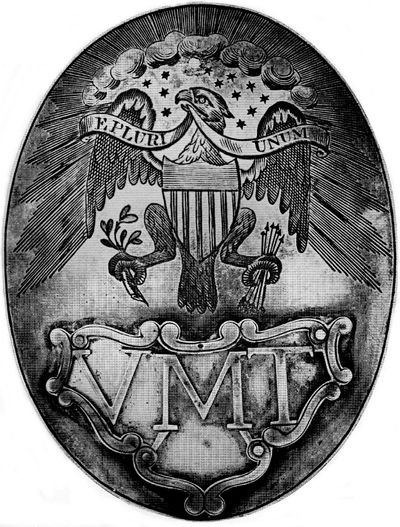
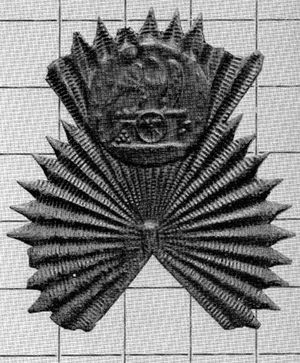
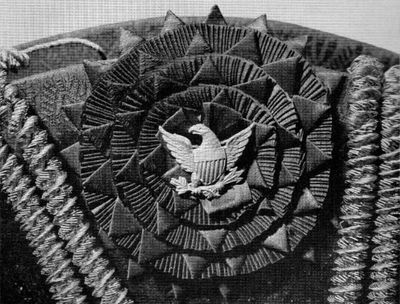
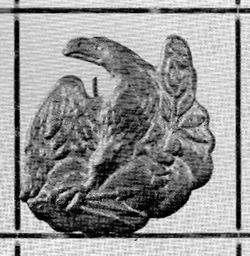
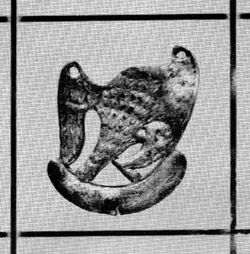
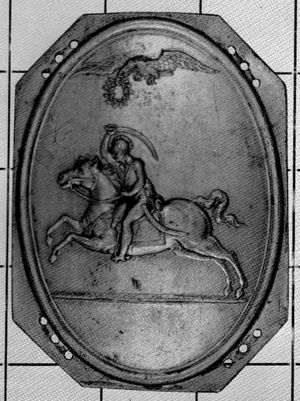
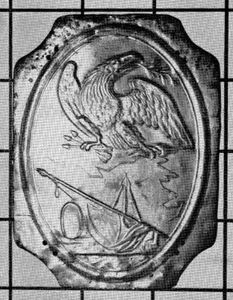
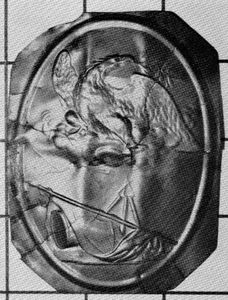
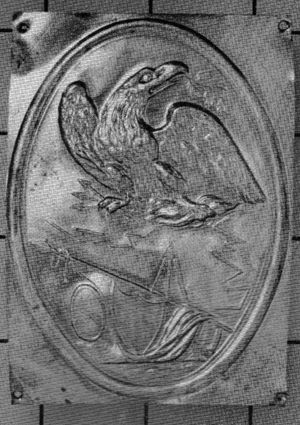
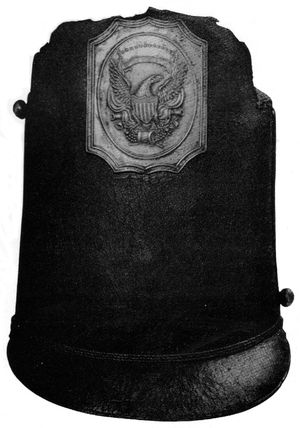
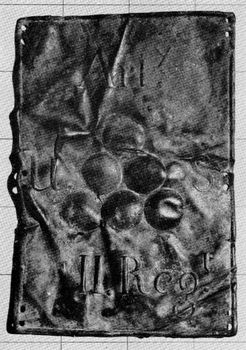
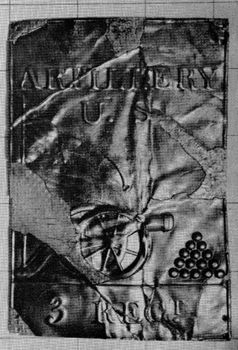
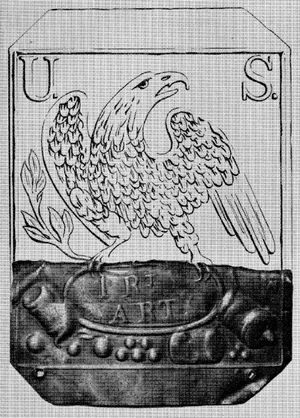
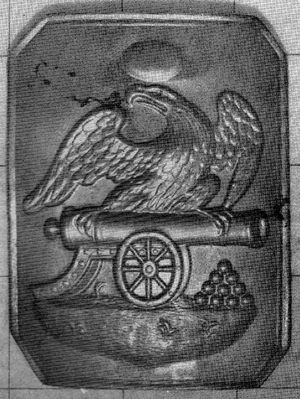
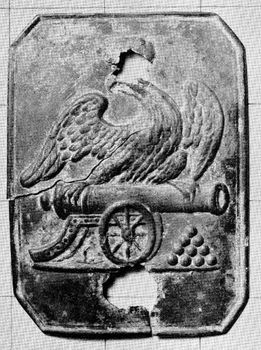
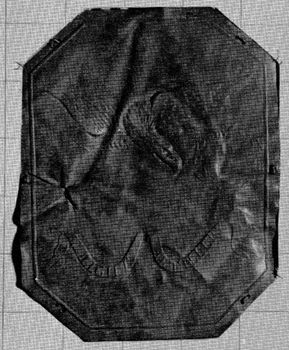
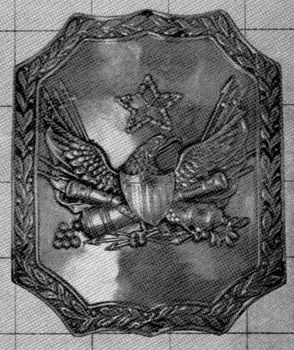
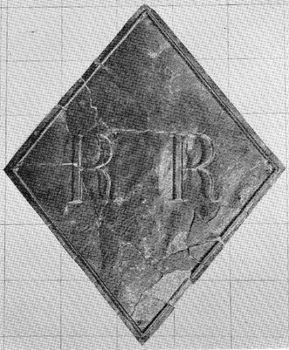
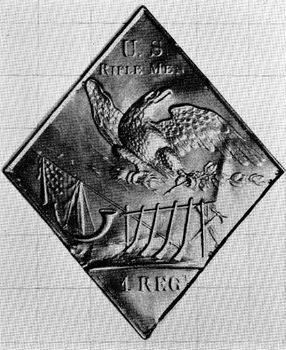
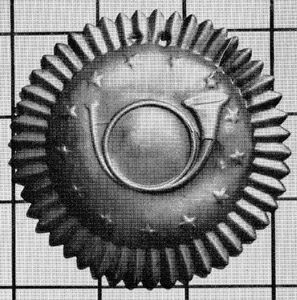
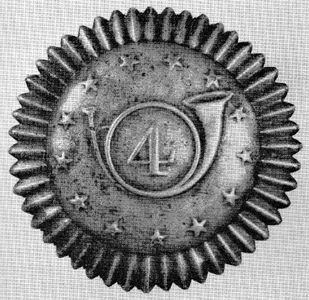
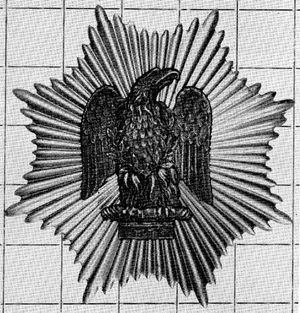
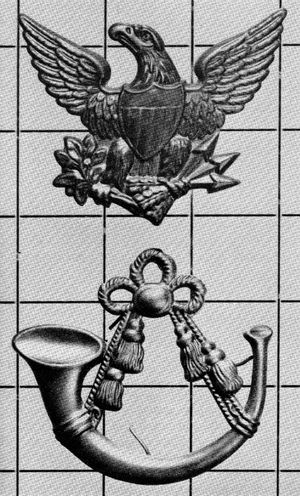
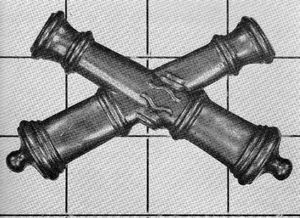
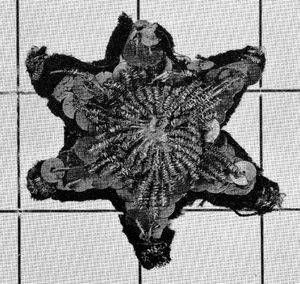
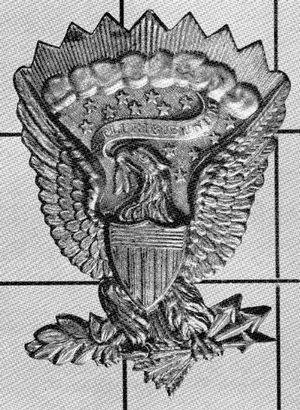
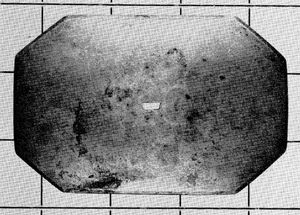
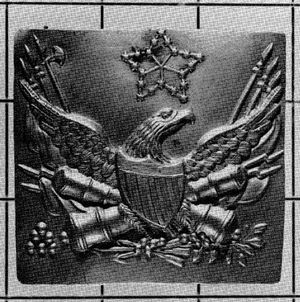
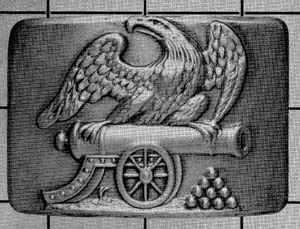
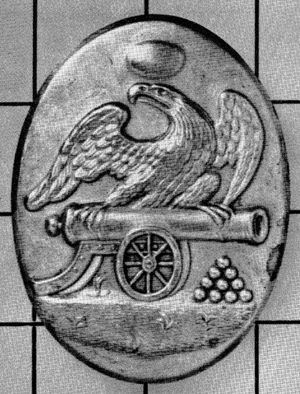
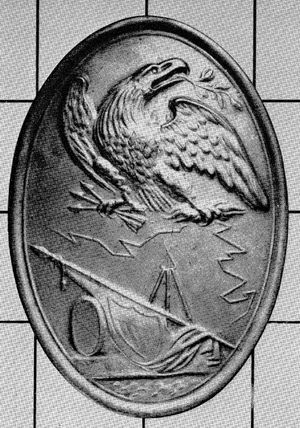
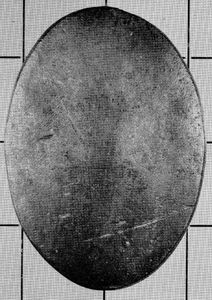
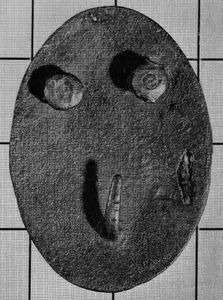
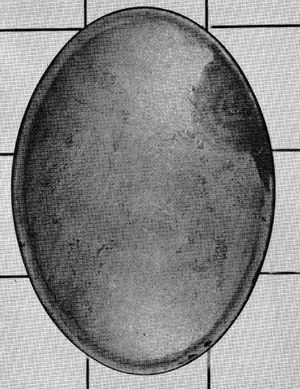
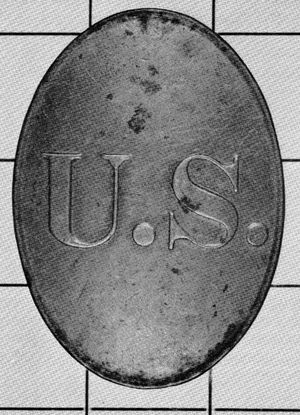
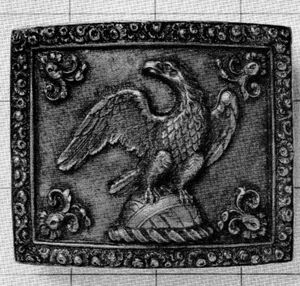
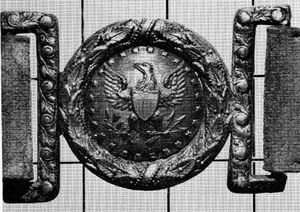
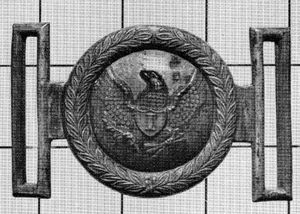
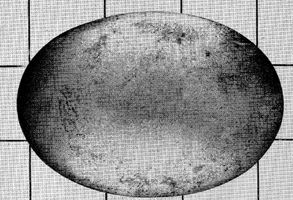
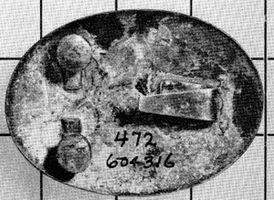
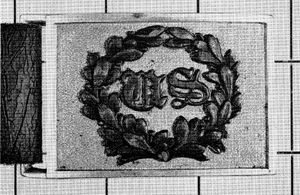
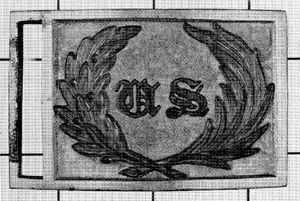
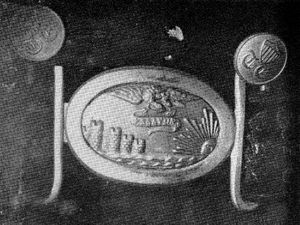
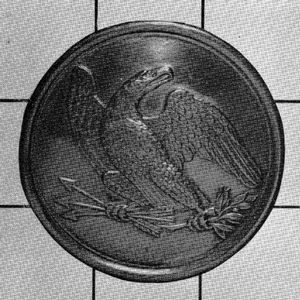
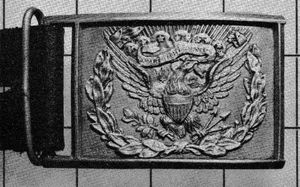
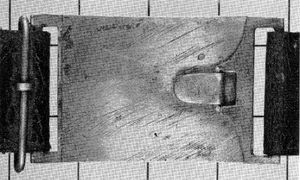
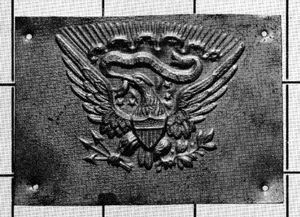
USNM 14978. Figure 97.
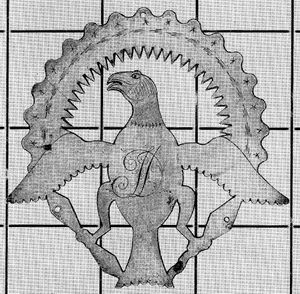
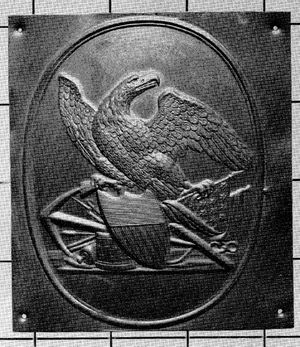
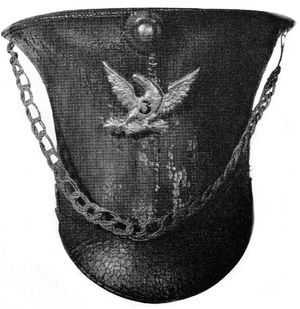
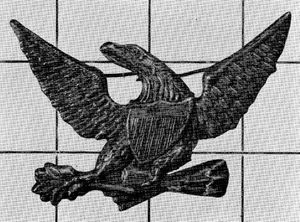
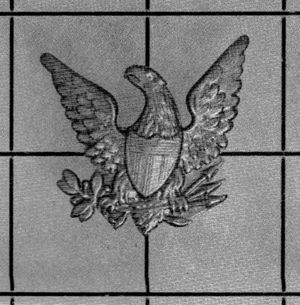
Figure 97
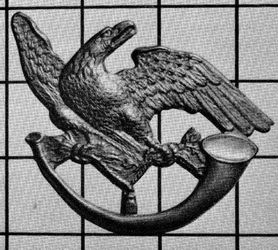
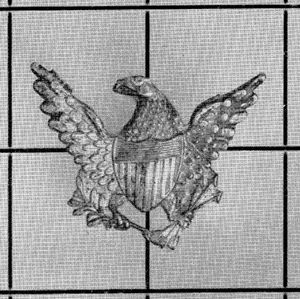
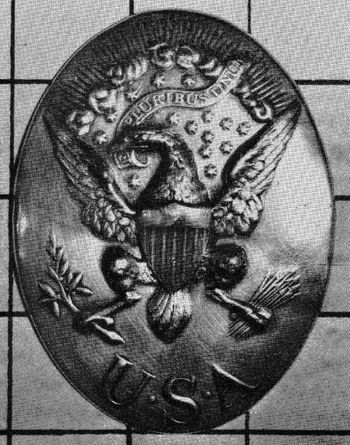
This silver ornament is one of the most unusual pieces of military
insignia in the national collections. Obviously military, it is just as
obviously of Militia origin. Although hardly artistic in design, it has
a rather attractive simplicity and has been made with considerable care.
The eagle is of the "frogleg" design that first appeared on buttons of
the post-Revolutionary Army and, later on, of the Legion. In its right
talon the eagle is grasping what appear to be rather stylized
thunderbolts, and in its left, arrows. The arc above the eagle's head is
comprised of sunrays, an edge of clouds, and 16 6-pointed stars. If the
number of stars is of significance, the piece would date prior to
November 1802 when the 17th state, Ohio, was admitted to the union. The
"frog-legged" aspect of the design would tend to confirm such dating,
and the thunderbolts in the right talon, symbolic of a belligerent
attitude, could be attributed to the national temper during the "quasi
war" with France, 1798-1800. The "ID," in delicate floriated script on
the eagle's breast, quite out of consonance with the design and
execution of the piece proper and obviously the work of a talented
engraver, is interpreted as "Independent Dragoons." Too small for a hat
frontpiece, it was probably worn as a side ornament on a dragoon helmet.
USNM 60257-M (S-K 15). Figure 98.
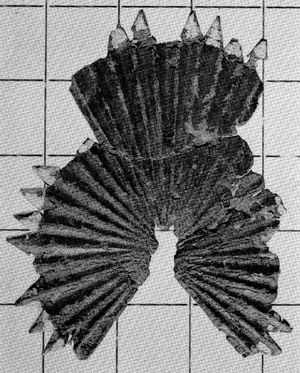
Figure 98
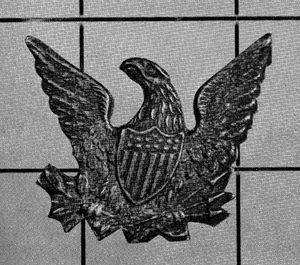
The leather fan cockade became a part of the uniform in the late 18th
century, having evolved from the cloth cockade adopted early in the
Revolution.[100] Enlisted men's cockades of the early 19th century were
of leather, as were those of line officers.[101] This cockade, of black
tooled leather with painted gold fan tips, was a common form of
the period and was worn with an eagle in the center or possibly on the
upper fan. It is assigned to the Militia because of the gold
ornamentation.
USNM 60275-M (S-K 33). Figure 99.
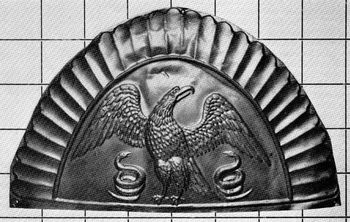
Figure 99
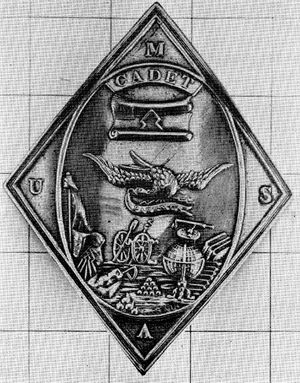
This grenadier-type plate, which is untrimmed and thus may be a die
sample, is a rare example of the use of coiled snakes as a military
device after 1800. A familiar motif of the Revolution, coiled snakes
were not revived as a popular military symbol during the War of 1812.
This specimen is struck in brass and is believed to have been made for a
specific independent Militia organization, designation unknown, for wear
prior to 1812.
USNM 60361-M (S-K 117). Figure 100.
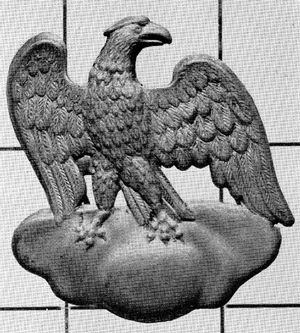
Figure 100
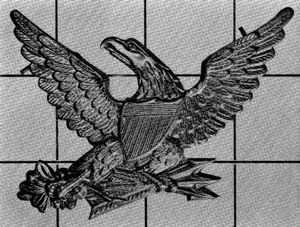
The eagle-on-clouds design, which first appeared on coins on the 1795
silver dollar, was popular on insignia during the period 1812-1821. The
heraldic significance of the clouds, if any, is unknown. Somewhat larger
than most cockade devices, this eagle is struck in brass and
silvered and has two simple wire fasteners soldered to the reverse. A
very similar badge is shown by Rembrandt Peale in an oil portrait of
Col. Joseph O. Bogart of the 3d Flying Artillery.[102]
USNM 60379-M (S-K 135). Figure 101.
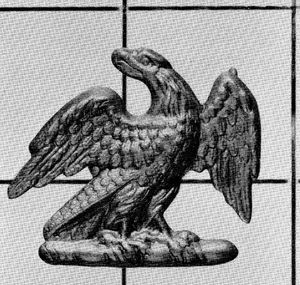
Figure 101
This eagle, of the general design first seen on the 1807 half-dollar, is
very similar to the one on buttons ascribed to staff officers,
1814-1821.[103] The eagle, struck in brass, has wings upraised and the
familiar hooked beak; it stands on a wreath of the colors. The wire
fasteners on the reverse are of a somewhat unusual type and may not be
contemporary.
¶ Die work for cap, shoulder-belt, and waist-belt plates was expensive,
and many Militia organizations found it expedient to purchase devices
"ready made" from existing dies. By varying the trimming and adding
borders of various designs, the same dies could be used to strike all
three types of plates. Such badges are called "common" plates.
The common plates that follow were very popular during the period
1812-1835 and, although relatively rare today, were made in considerable
quantity and in many die variations for the Militia in every part of the
country. They are known in brass, copper, and silver-on-copper. It is
possible that specimens such as these may have been worn by some
officers of the Regular Establishment between 1814 and 1821.
USNM 60263-M (S-K 21). Figure 102.
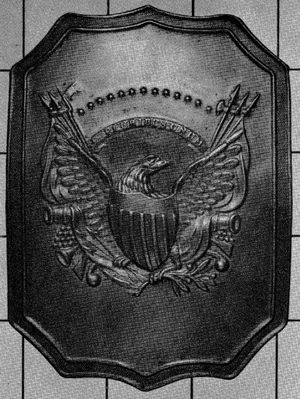
Figure 102
This is a typical example of the common plates of the 1814-1835 period.
The piece is struck in brass and has an edged and stippled border. The
design is dominated by an eagle with wings outspread, head to left,
arrows in right talon, olive branch in left talon, and with the national
motto on a ribbon overhead. The whole is superimposed on a trophy of
arms and colors with an arc of 13 6-pointed stars above. A plume socket,
apparently original, is soldered to the reverse, as are two looped-wire
fasteners. The fasteners are of a later period.
USNM 60264-M (S-K 22). Figure 103.
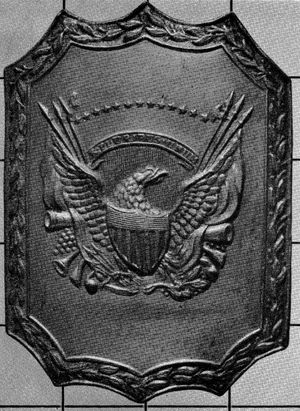
Figure 103
Struck in copper and silvered, this piece is a die variant of the
preceding plate. A floral border replaces the plain border, and the
overhead arc has 5-pointed rather than 6-pointed stars. The floral
border marks it as probably an officer's device.
USNM 60313-M (S-K 69). Figure 104.
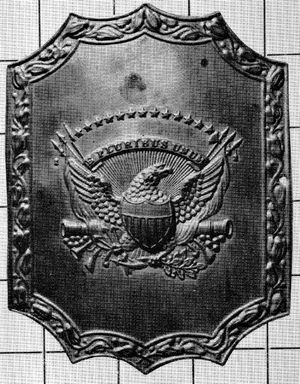
Figure 104
A die variant of the preceding plate, this device has an unusually wide
floral border. As in so many of the common pieces of this period, the
center device was purposely designed small so that the die could be used
to strike matching waist-belt plates. Examples of waist-belt plates
struck from dies of this particular design are known. Struck in copper,
there is a plume socket soldered to the reverse along with two
looped-wire fasteners. The fasteners are not contemporary.
USNM 60314-M (S-K 70). Figure 105.
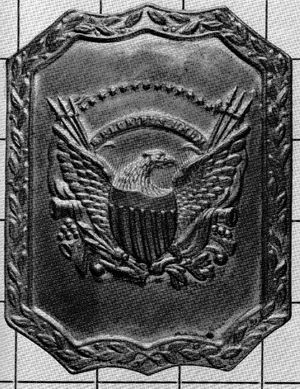
Figure 105
This is a die variant of the three plates immediately preceding.
However, the center device lacks the fineness of detail of the others, a
fact that suggests that several makers working with different die
sinkers produced this basic pattern. The plate is struck in copper, and
originally it had a plume socket attached to the reverse. The present
looped-wire fasteners are not original.
USNM 60299-M (S-K 57). Figure 106.
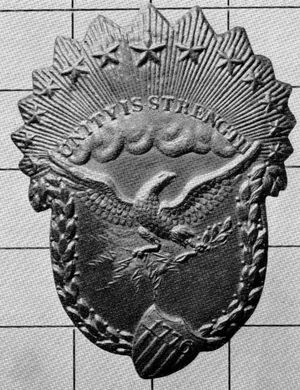
Figure 106
This plate, which is of brass, is of a less common design than its
predecessors. However, since there is another such plate, but of
silver-on-copper, in the national collections, it can be surmised that
pieces of this same pattern were made for use by several different
units.
A floral-bordered shield is topped by an out-sized sunburst with 13
stars, clouds, and the motto "Unity is Strength." In the center
of the shield is the eagle, with wings widely outspread and with
lightning bolts in the right talon and an olive branch in the left
talon. The lightning bolt device, obvious sign of belligerency, first
appeared about 1800 and is not seen in plates designed after 1821. The
motto and the date 1776 are far more typical of Militia than Regular
Army usage.
¶ In 1821 the Regular Army discarded all its large cap plates and
adopted the bell-crown leather cap. Militia organizations lost no time
in adopting a similar cap and, conversely, placing on it—and on the
tall beaver which followed in the 1830's—the largest plates it could
accommodate, using variations of discarded Regular Army patterns as well
as original designs.
From 1821 until well into the 1840's large cap plates were mass-produced
by manufacturers in Boston, New York, Philadelphia, and perhaps other
cities of the New England metal manufacturing area. The few early
platemakers, such as Crumpton and Armitage of Philadelphia and Peasley
of Boston, were joined by a number of others. Prominent among
these were Charles John Joullain, who made plates in New York during the
1820's, and William Pinchin of Philadelphia. Joullain is first listed in
New York directories, in 1817, as a "gilder," and so continues through
1828. Sometimes his given name is listed as Charles, sometimes as James,
and finally as Charles James. From 1820 to 1828 his address is the same,
32 Spring Street. There is a William Pinchin (Pinchon) listed in the
Philadelphia directories as a silverplater or silversmith almost
continuously from 1785 through 1863, indicating the possibility of a
family occupation.
It is believed that some of the New England makers of uniform buttons
also manufactured plates. Among such buttonmakers of the 1820's and
1830's were R. and W. Robinson, D. Evans and Co., Leavenworth and Co.,
Benedict and Coe, and others in Connecticut and Massachusetts.
Buttonmakers often stamped their names or easily recognizable hallmarks
on the back of their products.
In most cases it is virtually impossible to ascertain the precise units
for which these different plates were first designed, and the problem is
further complicated because the maker would sell a specific plate design
to several different units. Those designs that incorporate all or part
of a state's seal were originally made for Militia organizations of the
particular state, but in several instances these plates were
sold—altered or not—to units in other parts of the country. Militia
organizations that were widely separated geographically purchased cap
plates from distant manufacturers who had perhaps a dozen or more stock
patterns to offer at a cost much lower than that involved in making a
new die from which to strike custom-made ornaments. It made no
difference to the Savannah Greys, in Georgia, that their new cap plates
were the same as those worn by organizations in Pennsylvania and
Massachusetts. Toward the end of this period of large cap plates,
manufacturers came out with two-piece ornaments. After 1833, when the
Regiment of United States Dragoons was authorized its large sunburst
plate with separate eagle ornament in the center, insignia makers
introduced a veritable rash of full sunburst, three-quarter sunburst,
and half-sunburst cap plates with interchangeable centers. And for the
first time small Militia units could afford their own distinctive
devices at little extra cost. Shoulder-belt and waist-belt plates
underwent the same evolution, and by the late 1830's such plates had
become a mixture of either single die stampings or composite plates made
of several parts soldered or otherwise held onto a rectangular or oval
background.
Study of cap plates and other insignia in the Huddy and Duval prints in
U.S. Military Magazine points to the years between 1833 and perhaps
1837 or 1838 as the transition period from single to composite
ornaments, years during which there was also tremendous growth in the
popularity and number of independent Militia units. In contrast to the
1820's when the Militia often waited until the Regulars discarded a
device before adopting it, in 1840 there were no less than five
organizations, mounted and dismounted, wearing the 1833 dragoon plate in
full form while it was still in use by the Regulars. U.S. Military
Magazine illustrates such plates for the Richmond Light Infantry Blues,
the Georgia Hussars, the Macon Volunteers, the Jackson Rifle Corps of
Lancaster, Pa., the Montgomery Light Guard, and the Harrison Guards of
Allentown, Pa. The plate of the Harrison Guards is an example of the
license sometimes practiced by Huddy and Duval in the preparation of
their military prints. The color bearer in this print is depicted
wearing a full sunburst plate, while the description of the uniform
called for "a semi-circular plate or gloria."[104]
In the following descriptions of plates, the term "stock pattern" is
used because the insignia are known to have been worn by more than one
organization, because their basic designs are so elementary that it
appears obvious that they were made for wide distribution, or because
they are known to have been made both in silver and in gilt metals.
USNM 60307-M (S-K 64). Figure 107.
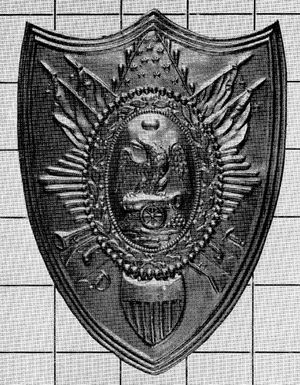
Figure 107
On the raised center of this shield-shaped plate is the eagle-on-cannon
device within an oval floral border; the Federal shield is below. The
whole is superimposed on a trophy of arms and colors with portions of a
modified sunburst appearing on the sides. The plate is struck in brass.
The eagle-on-cannon first appeared on Regular artillery buttons in 1802.
About 1808 it was used as an embossed device on the leather fan cockade,
and in 1814 it became the principal design element of the cap plate for
Regulars. This plate is thought to be one of the earliest of
the post-1821 series of Militia cap plates incorporating the discarded
design of the Regular artillery.
USNM 60331-M (S-K 87). Figure 108.
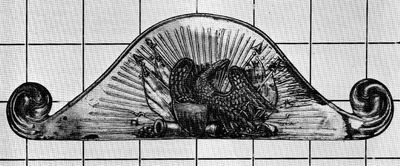
Figure 108
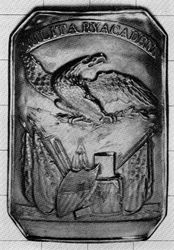
This silver-on-copper plate is unique in size, shape, and over-all
design. It is one of the most unusual Militia insignia in the national
collections. The standing eagle of the 1807 mint design with Federal
shield, the panoply of arms and colors, and the rayed background all
suggest that this plate was made not later than the early 1820's. Quite
possibly it is a cap plate of the War of 1812 period, but positive
dating is impossible. Three simple wire fasteners are affixed to the
reverse.
USNM 60255-M (S-K 13). Figure 109.
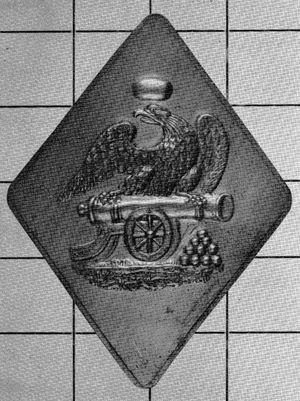
Figure 109
Although the Regular riflemen wore a diamond-shaped plate from 1812 to
1814, this shape does not appear on Militia caps until the mid-1820's.
It was a common form through the 1830's, but since it was always made as
a one-piece die-struck plate it became out-dated in the late 1830's when
the composite plates came into vogue.
This plate, struck in brass and bearing the eagle-on-cannon device, must
be considered a stock pattern available to many organizations. Insignia
struck from the same die could have been easily made into shoulder-belt
plates as well.
USNM 604748 (S-K 893). Figure 110.
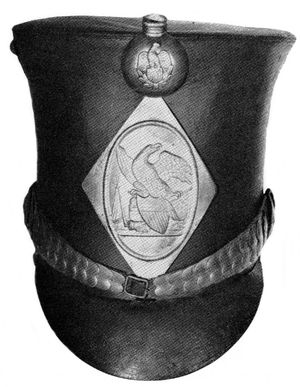
Figure 110
This brass plate is similar in many respects to the regular infantry cap
plate, type I, 1814-1821. It is attached to a bell-crowned shako of
distinctly Militia origin and is cut in the diamond shape popular with
the Militia in the 1820's and 1830's. The design lies within a raised
oval dominated by an eagle similar to ones used on War of 1812 insignia.
Below the eagle is a Federal shield and a trophy of stacked muskets, a
drum surmounted by a dragoon helmet, a gun on a truck carriage, and
colors—one the National Colors with 16 stars in the canton.
The plume holder attached to the cap above the plate is an unusually
interesting and distinctive device. It is a hemisphere of thin brass
with a round plume socket at the top. The hemisphere has an eagle on a
shield and a superimposed wreath device in silver. The blazonry of the
shield cannot be identified with any particular state or locality.
USNM 60262 (S-K 20). Figure 111.
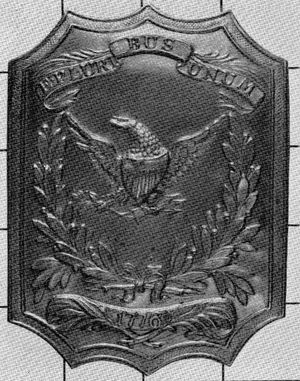
Figure 111
The familiar hooked-beak eagle dominates the center of this brass,
scalloped-edge plate. The arrows of belligerency, however, are held in
the left talon. Surrounding the eagle is a three-quarter wreath of olive
with the national motto above and the date 1776 below. While there is a
possibility that this plate may fall into the period 1814-1821 because
of its outline shape, it lacks the panoply of arms associated with that
era. It is much more probable that this is one of the earliest plates
made for Militia during the years 1821-1830. Since this plate is also
known in silver-on-copper, it is considered a stock pattern.
USNM 60306-M (S-K 63). Figure 112.
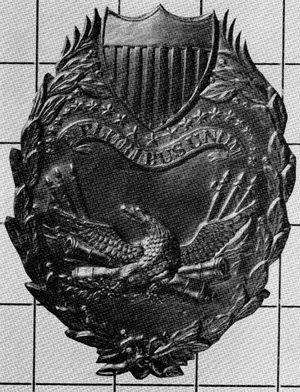
Figure 112
This oval, brass-struck plate framed within a large wreath of laurel is
one of the finest in the national collections, comprising as it does a
number of devices of excellent design and considerable detail standing
in high relief. The curving line of 21 stars above the motto, decreasing
in size laterally, is an interesting detail, and the eagle and panoply
of arms is reminiscent of those on the plate ascribed to the Regiment of
Light Artillery, 1814-1821, and on several of the common Militia plates
of the same period. It is assigned to the artillery because of
its "yellow metal" composition. It has simple wire fasteners, applied to
the reverse, and carries no plume socket.
USNM 60273-M (S-K 31). Figure 113.
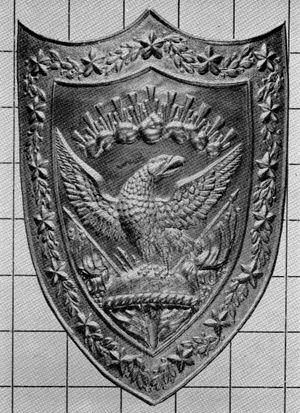
Figure 113
This unusually large, shield-shaped plate, struck in brass, is dominated
by an eagle—within a smaller shield with raised edge—standing on a
half globe and wreath of the colors, both of which are superimposed on a
trophy of arms and flags; clouds and sun rays are above. The specimen
represents one of the large cap plate patterns adopted by the Militia
for wear on the bell-crown cap soon after it came into general use in
the early 1820's. While a stock pattern in a sense, its use was most
likely confined to New York State Militia because its principal device,
the eagle-on-half-globe, is taken directly from that state's seal. These
large plates were widely worn until the middle or late 1830's when newer
styles began to replace them. The plume socket affixed to the reverse
appears to be contemporary, but has been resoldered.
USNM 60356-M (S-K 112). Figure 114.
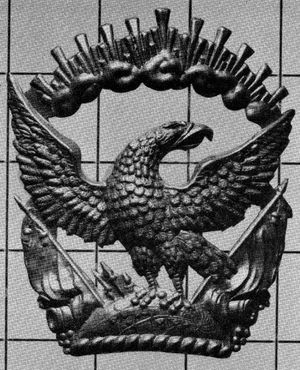
Figure 114
This is a variant of the preceding plate and well illustrates how an
insignia-maker could adapt a single die for several products. The
eagle-on-half-globe, with a portion of the trophy of arms and colors,
and the clouds and sunburst above have merely been cut out from the
plate proper for use alone. The plate is struck in brass.
Another specimen, of silver-on-copper, is known, indicating that this
insignia was made for wear by infantry as well as by other branches of
the service; consequently, it may be termed a stock pattern.
USNM 60266-M (S-K 24). Figure 115.
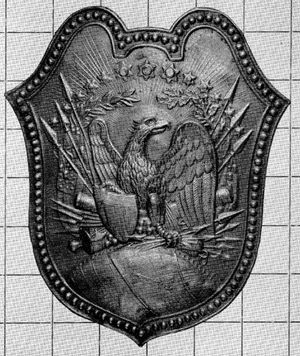
Figure 115
Illustrating fine craftsmanship, this elaborate brass cap plate
comprises perhaps the most ornate and intricately detailed design ever
attempted by a military ornament die sinker. The strike itself has been
so well executed that the most minute details are even today
readily discernible, even after very apparent use. Made for New York
Militia, its central theme is the eagle-on-half-globe superimposed on a
trophy of arms and flags.
Many of the facets of detail are of particular interest. Almost every
ray of the aura of sunlight can still be clearly seen; the North Pole is
well marked with a vertical arrow; the Arctic Circle, Tropic of
Capricorn, and the Equator are included on the half-globe, as are the
meridians of longitude and the parallels of latitude; both North America
and South America are shown, and that portion of North America east of
the Mississippi basin is clearly denominated "United States." An unusual
feature of the design is the way the arrows are held in the eagle's left
talon—some of the arrow heads point inward, some outward. What appears
to have been a contemporary plume socket has been resoldered to the
reverse.
Although this plate is unmarked as to maker, another plate of a similar
design but of silver-on-copper has the maker's mark "J. JOULLAIN, MAKER,
N. YORK." Since two distinct but similar designs are known, and the
finished product is found in both brass and silver-on-copper, it seems
probable that this plate was produced by more than one maker, and for
all arms of the service. It is therefore deemed a stock pattern.
USNM 60267-M (S-K 25). Figure 116.
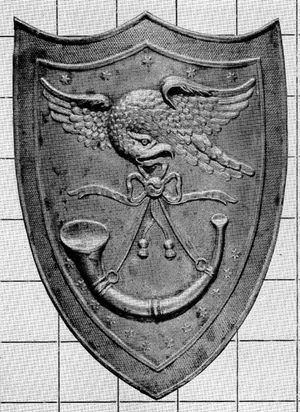
Figure 116
Almost immediately after the last Regular rifle regiment was disbanded
in 1821, Militia riflemen adopted the large open horn with loops and
tassels that the Regulars had worn from 1817 to 1821. The basic device
was altered slightly by showing an eagle in flight and the horn
suspended much lower on its cords. The illustrated brass plate is one of
four die variants, and more than a dozen similar to it have been
examined. It is significant that all are of brass, for these were made
and worn during the period when the trimmings for infantry were silver
or "white metal."
This plate differs from the others examined in that it has 17 6-pointed
stars along the upper and lower parts of the shield inside the border.
The number of stars cannot be significant in dating for the plate was
obviously made long after 1812 when the 18th state, Louisiana,
was admitted to the Union. A plume socket affixed to the reverse appears
to be original.
Undoubtedly made as a stock pattern by several manufacturers, these
plates continued in use for at least 15 years after they first appeared
about 1825. Although U.S. Military Magazine illustrates many large cap
plates for the period 1839-1841, none has a shield outline. This may
indicate a decline in the popularity of the design, but it must be
remembered that Huddy and Duval presented the uniforms of only a small
cross-section of the Militia of the period.
USNM 60267-M (S-K 26). Figure 117.
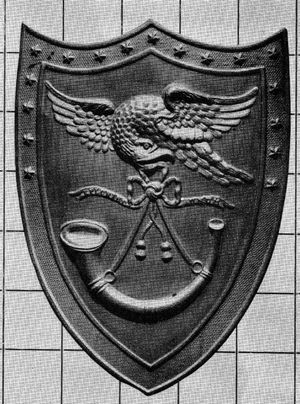
Figure 117
This is a second form of Militia riflemen's plates. Struck in brass, it
differs from the preceding primarily in the placement of 17 5-pointed
stars along the upper half of the shield, between the borders. Other
small differences show that the basic die was not that used for the
preceding specimen. The most obvious difference is the legend
"E PLURIBUS UNUM" carried on the ribbon behind the knotted cord of the
horn, an element not present in the other.
A third form, not illustrated, substitutes a floral border for the plain
border around the edge of the shield and contains no stars as part of
the design. Still a fourth form, also not illustrated, has the same
center device of eagle and open horn placed in a longer and narrower
shield, with 23 6-pointed stars between the borders.
¶ These various combinations of devices give a good clue as to the
method of manufacture of stock patterns, and indicate the use of several
different dies and hand punches. The blank metal was first struck by a
die that formed the plain or floral border and cut the outline of the
plate. Next, a smaller die containing the center device of eagle and
horn was used. Then the stars, and sometimes elements of the floral
border, were added by individual striking with a hand punch. This latter
method is clearly revealed by the comparison of several "identical"
plates in which the stars or elements of the border are irregularly and
differently spaced.
USNM 60398-M (S-K 154). Figure 118.
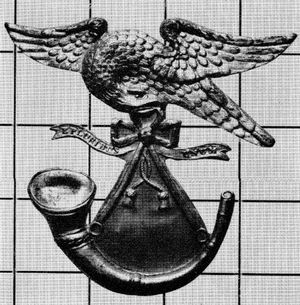
Figure 118
This plate is called "rifleman pattern" because it is silver-on-copper
and is the only known example of this type of insignia made for wear by
infantry, or possibly for Militia riflemen whose trimmings were,
incorrectly, silver.
There are several conjectures about this cut-out device made from a die
of the preceding series of shield plates. It may have been made after
1834, when the open horn with cord and tassels was adopted by the
Regular infantry as a branch device. It is equally possible that it was
submitted to a Militia infantry organization by some maker as a sample
during the 1820's and when selected was silvered to conform with other
trimmings. In either case, it illustrates how a single die could serve
to make many different variations from a basic design.
USNM 60304-M (S-K 61B). Figure 119.
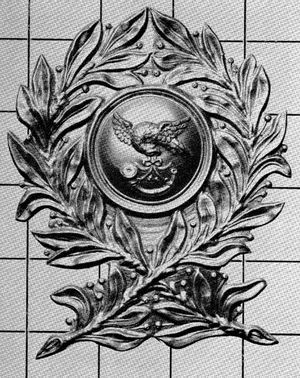
Figure 119
The very unusual construction of this brass plate for riflemen indicates
that it is possibly one of the earliest of the composite plates. Within
a wreath of crossed laurel boughs is a small center circle with raised
edge to which has been soldered the eagle and horn device struck in
convex form.
USNM 60252-M (S-K 10). Figure 120.
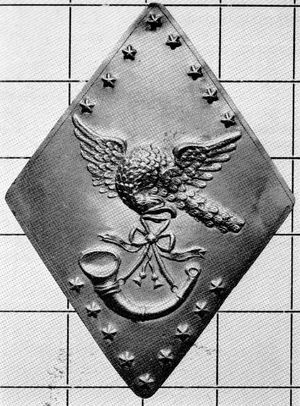
Figure 120
The diamond-shaped plate was in vogue with Militia units during the late
1820's and the 1830's. Examples of such plates for the Washington Grays
(Philadelphia) and the Philadelphia Grays are recorded in U.S. Military
Magazine.[105] This brass plate, possibly made for a particular unit
from stock dies, is a typical example of the endless variety possible
with the use of a few dies. The blank was struck with a die for the
center device of eagle and horn, but the irregularity of the spacing of
the stars shows that they were added later by hand. Similar plates may
be found with essentially this same device, but placed on small shields
or backgrounds of other shapes.
USNM 604851-M (S-K 996). Figure 121.
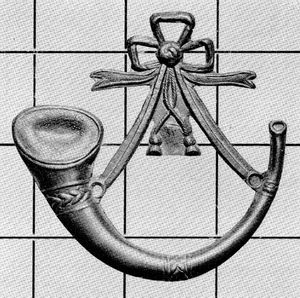
Figure 121
The eagle and horn devices were sometimes separated by the manufacturer
to produce this type ornament open with cord and tassels. Struck in
brass, it differs in form and detail from the silver horn adopted by the
Regular infantry in 1834 as a cap plate.
Several Militia units of the late 1830's and 1840's used a horn as an
additional ornament on the rear of the cap, notably the State Fencibles
(Philadelphia) and the National Guard (Philadelphia). On the rear of the
leather cap of the State Fencibles were "two broad rich stripes of
silver lace, starting from the same point at the top and running down,
forming an angle, in the center of which is a bugle ornament...."[106]
The cap of the National Guard has been described as being "of blue cloth
... and in the rear a plated bugle ornament."[107]
¶ In the following series of rather similar plates, four different dies
are used for the center ornament, perhaps made by as many different die
sinkers. The relatively large number of these plates still in existence
suggests that they were worn very extensively. Those with silver finish
were used by infantry; the gilt or copper ones by artillery and perhaps
by staff officers. All specimens are currently fitted with plain wire
fasteners and plume sockets, both of which may or may not be
original.
USNM 60271-M (S-K 29). Figure 122.
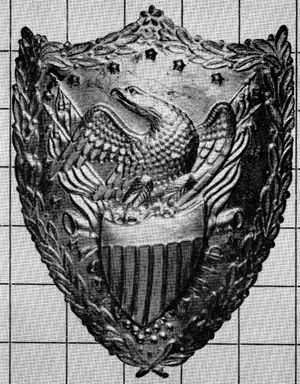
Figure 122
The floral-bordered shield outline of this silver-on-copper infantry
plate is known to have been used also with the rifleman's eagle-horn
device in the center. The panoply of arms and flags used as a background
for the center device, which is characterized by the long neck of the
eagle swung far to the right, links it closely to the plate of similar
type worn during the period 1814-1821. Because of its large size, it is
assigned to the post-1821 era of the bell-crown cap, contemporary with
the riflemen's large plates. The 13 5-pointed stars were added with a
hand punch.
USNM 60298-M (S-K 56). Figure 123.
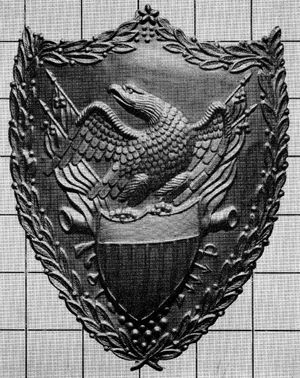
Figure 123
This brass plate is a duplicate of the preceding, lacking only the
hand-applied stars. The crispness of detail indicates that it was one of
the very early products of the die.
USNM 60269-M (S-K 27). Figure 124.
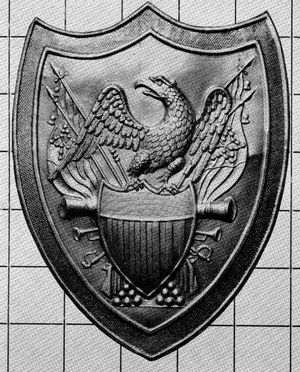
Figure 124
The second variation of the series is a product of perhaps the best
executed die of the group, with unusually fine detail in the eagle's
wings and with neatly stacked cannon balls at the bottom of the center
device. It includes other excellent detail not found in other dies: an
eagle-head pommel on one sword, a star pattern made of smaller stars in
the cantons of the flags, and crossed cannon, rammer, and worm behind
the Federal shield. It is struck in brass.
USNM 60297-M (S-K 55). Figure 125.
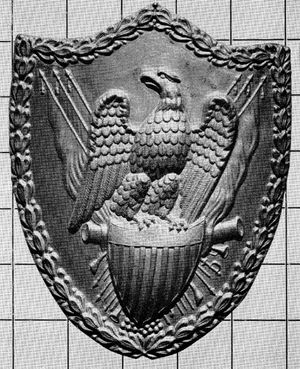
Figure 125
A tall, slender, rather graceless eagle with broad wings and erect head
reminiscent of the Napoleonic eagle is the outstanding difference in
this third example of the series. The floral border lacks a finished
look because the plate, which is of brass, was apparently hand
trimmed.
USNM 60270-M (S-K 28). Figure 126.
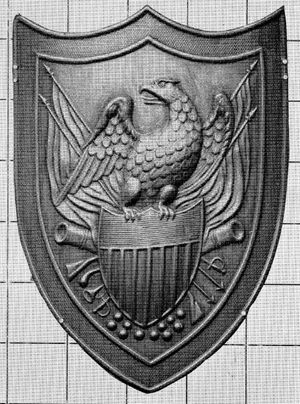
Figure 126
This fourth variation, of silver-on-copper, bears an eagle with very
small legs (somewhat out of proportion), an erect head, a fierce mien,
and a heavy round breast. The design is struck on a shield-plate with
the exact measurements as on one of the riflemen series.
USNM 60302-M (S-K 60). Figure 127.
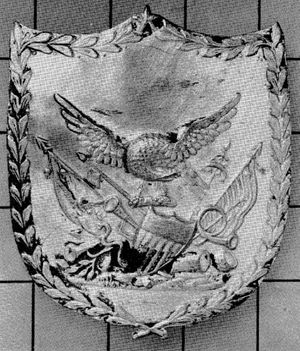
Figure 127
The oldest known plate made expressly for musicians, this
silver-on-copper, floral-bordered shield bears an eagle similar to one
for riflemen of the same period (see fig. 116). Among the early musical
instruments easily identifiable in the design are the tambor, the
serpent, the French horn, and the rack of bells. Such a plate was
undoubtedly a stock pattern, available in either gilt or silver finish,
and was probably sold well into the 1840's. The reverse is fitted with
what appears to be a contemporary plume socket, although resoldered, and
two simple wire fasteners.
USNM 6030-M (S-K 61A). Figure 128.
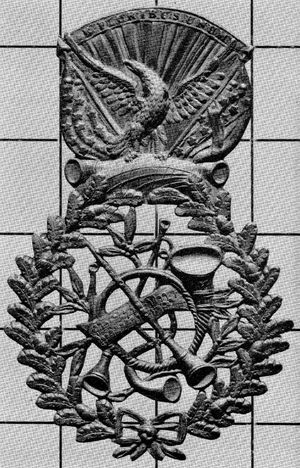
Figure 128
This gilded brass plate, while not as old as the preceding one, is of an
unusual pattern. Made for New York State Militia, it carries the
eagle-on-half-globe device at the top. The central design includes a
French horn, a serpent, and a straight horn, all intertwined about an
open roll of sheet music. It is probably a stock pattern. The reverse is
fitted with three simple bent-wire fasteners.
USNM 60250-M (S-K 8). Figure 129.
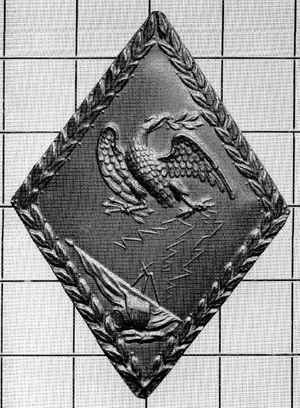
Figure 129
The design on this brass plate, reminiscent of that on the regular
infantry cap plate, 1814-1821, was adopted for wear by the Militia after
being discarded by the Regular Establishment. The ornate floral border
and diamond shape place it in the late 1820's and the 1830's,
although the lightning in the eagle's left talon and the arrows in its
right talon are usually associated with plates designed prior to 1821.
It has been suggested that this is the plate worn by the West Point
cadets after 1821, but such seems doubtful.
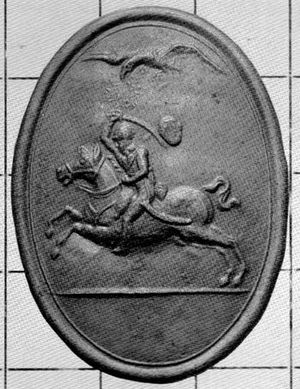
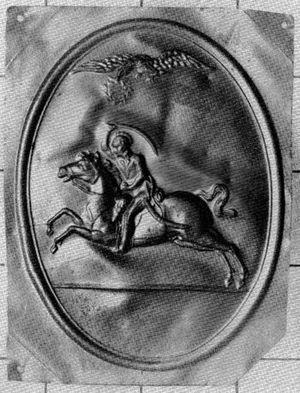
¶ No Militia plates enjoyed wider use or longer life than those
patterned after the plate that disappeared from the Regular
Establishment with the disbanding of the dragoons in 1815. More than a
dozen die variants are known, several worn by more than one Militia
unit. Although size and shape may vary, any plate exhibiting a mounted
trooper with upraised saber can safely be assigned to mounted Militia.
However, the dating of such plates is a real problem because they are
known to have been in use as late as 1861.
A Huddy and Duval print of the Washington Cavalry of Philadelphia County
shows that unit wearing a plate similar to the one used by the
Regulars, differing only in its brass composition, as opposed to the
original pewter of the 1812 regulations.[108] A cap in the collections
of the Valley Forge Museum that was worn by a member of this unit in the
period 1835-1845 is very similar to the one shown in the Huddy and Duval
print. The cap is a copy of the 1812 Regular Army pattern, with somewhat
more ornate brass bindings in place of the iron strips. A similar cap,
carrying the label "Canfield and Bro., Baltimore," is owned by
Lexington, Virginia, descendants of a member of the Rockbridge
[Virginia] Dragoons. That unit is said to have worn such a cap upon
first entering Confederate service in 1861.
In the national collections there is a dragoon cap (USNM 604767, S-K
912) carrying a plate of this design struck on a massive diamond-shaped
piece with concave sides. There are additional variations in several
private collections and at the Fort Ticonderoga Museum. The mounted
horseman device was also struck on heart-shaped martingale ornaments.
USNM 60254-M (S-K 12). Figure 130.
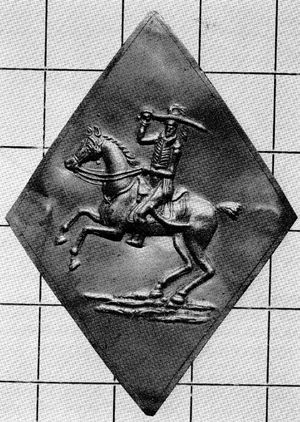
Figure 130
The horseman on this brass plate, designed with a rather crude,
childlike simplicity, is garbed quite differently than the Regular
dragoon on the 1812 pewter specimen. The plate is assigned to the
general 1830 period to fit the era of the diamond-shaped plates, but its
use doubtless continued on into the 1840's. By nature of its design it
would have been a manufacturer's stock pattern.
USNM 60301-M (S-K 59). Figure 131.
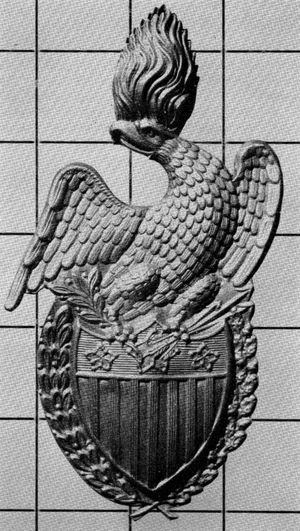
Figure 131
The eagle on this brass plate is similar to the ones on the preceding
shield plates, but the Federal shield on which he stands is ornamented
with three star devices composed of smaller stars. An unusual feature of
this plate is the addition of the flaming portion of a grenade rising
from the eagle's head, a device not a part of any other known cap plate.
This symbol suggests artillery, and the plate is of the proper
color. Although an unusual over-all design, the lack of any components
of state arms or crests indicate that it may have been a stock pattern.
The reverse is fitted with two simple bent-wire fasteners.
USNM 60355-M (S-K 111). Figure 132.
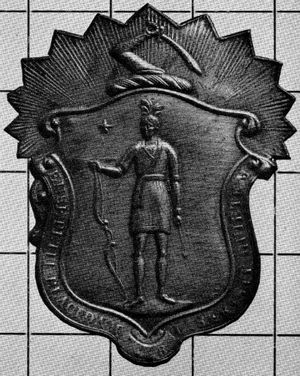
Figure 132
This silver-on-copper plate bears the familiar elements of the
Massachusetts seal: Indian, in hunting shirt, with bow in right hand,
arrow with point downward in left hand, and star above right shoulder.
The crest—an arm grasping a broad sword on a wreath of the colors—is
superimposed on a burst of sun rays above. The State's motto is written
around the shield. The earlier plates containing elements of state arms
were for the most part confined to the States of Massachusetts,
Connecticut, and New York. No large plates bearing Pennsylvania State
symbols that can be dated prior to 1835 are known.
This seal was not authorized by law until 1885. However, the devices and
the motto were elements of the seal of the Commonwealth of Massachusetts
ordered prepared by the state legislature in 1780 and, although
apparently never formally approved, used as such for many years. It
differs considerably in detail from the seal in use from 1629 to
1684.[109]
USNM 60316-M (S-K 72). Figure 133.
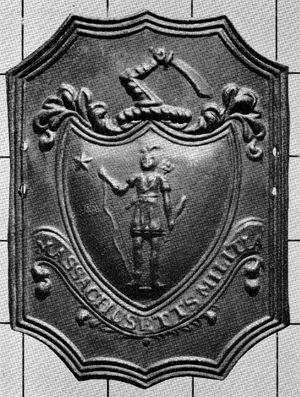
Figure 133
This scalloped plate, which is struck in thin iron metal and silvered,
bears elements of the Massachusetts seal, minus the motto, and the
legend "Massachusetts Militia." Its silver color assigns it to
the infantry. The form of the specimen indicates that it was probably
designed prior to 1839. In consideration of its over-all design and the
use of the word "Militia," it was probably made as a stock pattern and
sold to several different organizations. A plume holder, which has been
resoldered to the reverse, appears to be of the same metal as the plate
proper. It is pierced at the sides for attachment.
¶ Painted cap fronts were worn during the War of the Revolution by
several units of the Continental Army—including the Light Infantry
Company of the Canadian Regiment, Haslet's Delaware Regiment, and the
Rhode Island Train of Artillery[110]—and it is probable that the
practice continued among some volunteer corps up to the War of 1812.
Their use in the uniformed Militia units generally declined after the
introduction of die-struck metal cap plates. Two notable exceptions are
a cap plate of the Morris Rangers that is attached to a civilian-type
round hat of the 1812-1814 period[111] and the cap front described below
(fig. 137).
Although discarded by the more elite volunteer corps, painted metal hat
fronts in the "tombstone" shape similar to that of the Morris Rangers
continued to be used, to some extent, by the common Militia. Easily
attached to the ordinary civilian hat of the period, they provided the
common Militia a quick and inexpensive transformation from civilian to
military dress at their infrequent musters perhaps as late as 1840.
There are several contemporary sketches of these musters and in one,
dated 1829 (fig. 134), these "tombstone" plates can be identified.
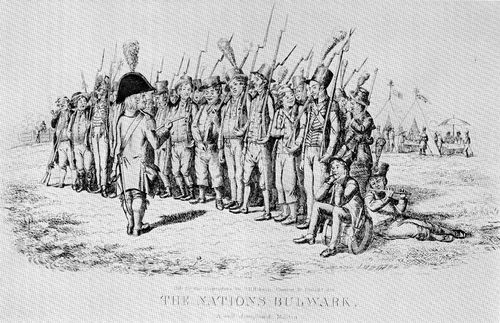
Figure 134.—From Library of Congress print.
A total of perhaps a dozen of these hat fronts are known. Most are of
Connecticut origin, although at least two containing New York State
devices are extant. The most elaborate of these devices bears, oddly
enough, elements of the Connecticut State seal, the motto Qui Trans.
Sust., and the crest of the Massachusetts coat of arms—an arm grasping
a broad-sword (fig. 135). The elaborate detail of this plate indicates
that it was probably an officer's. The fact that unit designations on
other such known hat fronts run as high as the "23d Regt." is definite
proof that these were devices of the common Militia as opposed to the
volunteer corps.
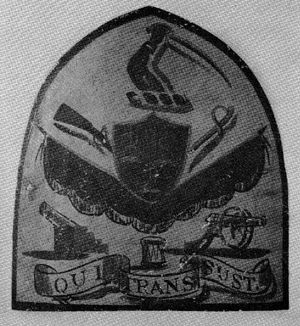
Figure 135.—Specimen in Campbell collection.
USNM 604764-M (S-K 909). Figure 136.
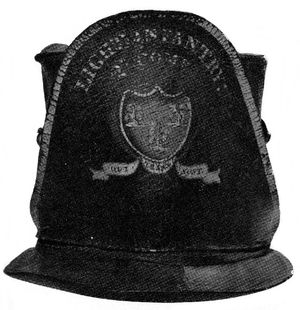
Figure 136
This painted front, of leather rather than metal, forms an integral part
of the cap itself. Edged in gold, it has the unit designation "LIGHT
INFANTRY: 2d COMP." in gold at the top; a shield in the center contains
elements of the Connecticut State seal, and below it is the state motto
"QUI TRANS SUST" ("He who brought us over here will sustains us").
USNM 60243-M (S-K 1). Figure 137.
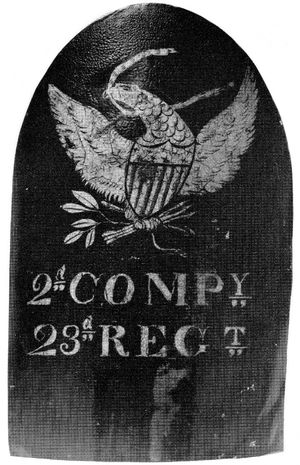
Figure 137
A majority of these hat fronts are very similar in design, size, and
shape, and are painted over a black background on thin precut sheets of
tinned iron. This specimen carries a gold eagle with the Federal shield
on its breast and a ribbon in its beak. The unit designation,
"2d COMPY. 23d REGT.", also in gold, is below. The artwork, although
somewhat unartistically executed, has an attractive simplicity. Other
such hat fronts in the national collections are of the 2d Company, 6th
Regiment; 3d Company, 6th Regiment; and 1st Company, 8th Regiment. The
plate shown here has metal loops soldered to the reverse close to the
edge midway between top and bottom for attachment to a civilian type hat
by means of a ribbon or strip of cloth. Other such plates have hole for
attachment with string.
USNM 60318-M (S-K 74). Figure 138.
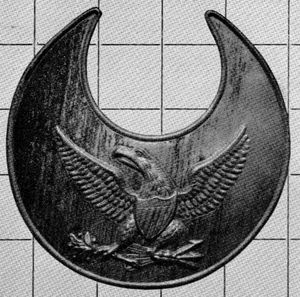
Figure 138
This crescent-shaped, silver-on-copper plate bears an eagle that is very
similar in design to the one adopted by the Regular Army in 1821.
Sometimes mistakenly identified as a gorget because of its shape, the
crescent form of the specimen is an old South Carolina State heraldic
device. A cap worn by the Charleston Light Dragoons after the Civil War,
and probably before, carries a similar crescent-shaped plate,
with the familiar palmetto tree device substituted for the eagle.[112]
The design of the eagle, however, places this piece in the 1835-1850
period. A silvered ornament, it may have been made originally for either
infantry or dragoons, and must be considered a manufacturer's stock
pattern.
USNM 60251-M (S-K 9). Figure 139.
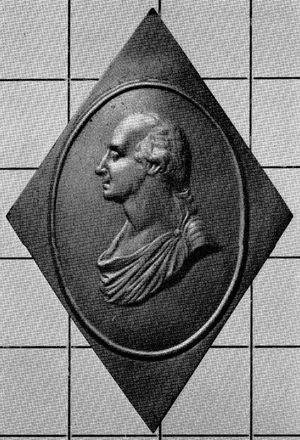
Figure 139
This brass, diamond-shaped plate was worn by the Washington Grays, a
light artillery outfit of Philadelphia. Within a raised oval are a
profile of Washington—with his shoulders draped in a toga, a typically
neoclassic touch—and, below, the unit designation "GRAYS" in raised
letters. A matching oval shoulder-belt plate struck from the same die is
known.[113]
Many Militia units named themselves after prominent military
personalities. There were Washington Guards, Washington Rifles, Jackson
Artillerists, and so forth.
USNM 60291-M (S-K 49). Figure 140.
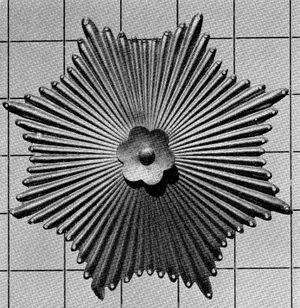
Figure 140
An illustration in U.S. Military Magazine[114] shows this plate being
worn by the National Greys; however, with such a nondistinctive center
ornament as the rosette of six petals, it must surely have been a stock
pattern sold to many different organizations. The sunburst proper is
struck in brass, as is the rosette, and each of the rays is pierced at
the end for attachment. The rosette is affixed with a brass bolt, also
for attachment, which must have extended through the front of the cap.
USNM 60333-M (S-K 89). Figure 141.
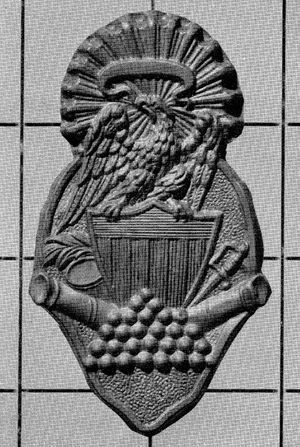
Figure 141
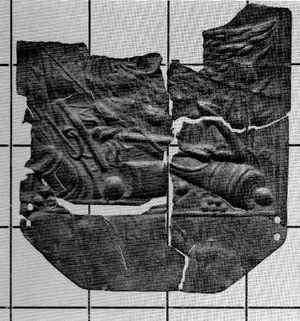
This plate is struck in very thin brass. The combination of devices in
the design, especially of the cannon and cannon balls,
indicates that it was probably made for Militia artillery. Its shape
suggests that it may have been worn high on the cap front, with the
sunburst serving an added function as a cockade of sorts. It was very
probably a stock pattern.
USNM 60319-M (S-K 75). Figure 142.
Figure 142
From the size of this brass plate it can be assumed that it was worn
without other ornament on the front of the round leather cap associated
with mounted troops. The upper portion of the shield bears 8-pointed
stars, an unusual feature. The arrows in the eagle's left talon point
inward, a characteristic of eagle representation between 1832 and 1836.
The plate is known both in brass and with silver finish. It was probably
a stock pattern issued to both cavalry and mounted artillery.
USNM 60391-M (S-K 147). Figure 143.
Figure 143
This brass eagle was worn in combination with backgrounds of full-,
half-, and three-quarter sunbursts and as a single ornament on the cap
front. The inward-pointed arrows in the left talon place it in the
1832-1836 period. Known in both brass and silver-on-copper, it was a
popular stock pattern sold to many units.
USNM 60381-M (S-K 137). Figure 144.
Figure 144
Struck in copper, and silvered, this eagle, which is very similar in
design to that prescribed for the Regular Establishment in both 1821 and
1832, was made for Militia infantry from about 1836 to perhaps as late
as 1851. Specimens struck in brass are also known, and the same eagle is
found on half-sunburst backgrounds. It is quite possible that this is
the eagle illustrated in the Huddy and Duval prints as being worn by
both the Washington Blues of Philadelphia and the U.S. Marine
Corps.[115]
USNM 60287-M (S-K 45). Figure 145.
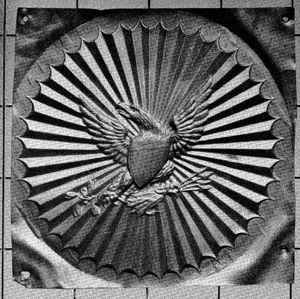
Figure 145
This brass ornament is a die sample or unfinished badge. After the
circular device was trimmed from the brass square, it would
have been worn as an officer's chapeau ornament or as a side ornament on
the round leather dragoon cap of the period. The four arrows in the
eagle's left talon are unusual.
USNM 604962-M (S-K 1156). Figure 146.
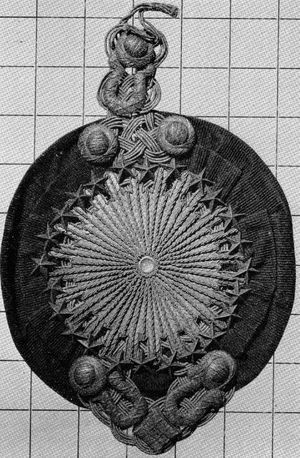
Figure 146
This large, round chapeau cockade with its gold embroidery and sequins
on black-ribbed silk and its ring of 24 silver-metal stars appears to be
identical to cockades that have been shown as being worn around 1839 by
Gen. Edmund P. Gaines and Gen. Winfield Scott[116] but without the added
center eagle. Close examination of this cockade shows it to be complete,
with no traces of a center eagle ever having been added. The 24 stars
would have been appropriate at any time between 1821 and 1836.
USNM 604780 (S-K 925). Figure 147.
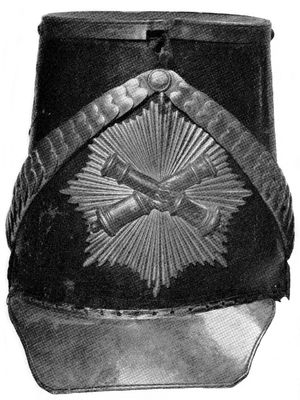
Figure 147
The Jackson Artillerists of Philadelphia, after the appearance of the
regular dragoon cap plate in 1833 and the large crossed cannon of the
regular artillery one year later, lost no time in combining these two
devices to make their distinctive cap device.[117] It seems probable,
however, that the plate was adopted by other artillery units and
eventually became more or less of a stock pattern.
USNM 604608-M (S-K 755). Figure 148.
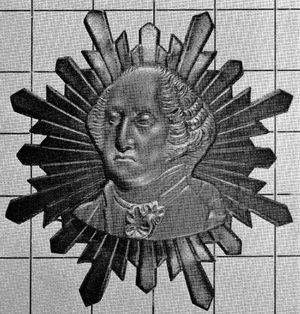
Figure 148
The Washington Grays of Philadelphia wore a diamond-shaped plate with a
likeness of George Washington in the center (see fig. 139), but
this plate, for some other "Washington" unit, bears his likeness in
silver metal on a brass sunburst background. This silver outline of the
head of Washington is also known on cartridge-box flaps of the period.
USNM 60288-M (S-K 46). Figure 149.
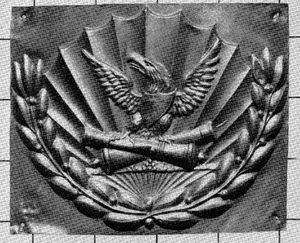
Figure 149
This uncut, brass cap plate may have been a manufacturer's die strike
sent out as a sample, with others, so that a distant Militia
organization could select a pattern. The finished plate is known on a
bell-crown cap of the pattern of the 1820's, but its design indicates
that it probably should be dated after 1834 when the Regular artillery
first adopted the crossed-cannon device. The eagle is distinctly similar
to the one adopted by the Regulars in lieu of cap plates in 1821, and
the modified sunburst background probably was taken from the 1833
dragoon device.
USNM 60292-M (S-K 50) Figure 150.
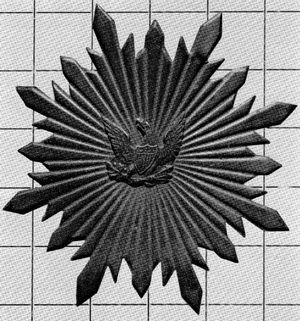
Figure 150
This cap plate is a somewhat wider variation of the 1833 dragoon device
than most of the Militia plates of that type popular in the late 1830's
and the 1840's. While the brass sunburst has the usual 8-pointed form,
the eagle, applied to the center, is unusually small (1-3/8 by 1 in.)
and gives every indication of having been originally designed as a
cockade eagle at a somewhat earlier period.
USNM 60274-M (S-K 32). Figure 151.
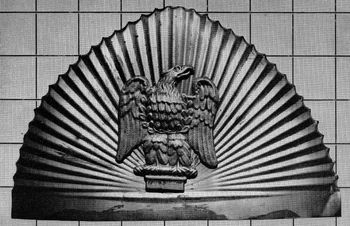
Figure 151
This pattern of the 1833 dragoon eagle on a half-sunburst, struck in
brass and silvered, was worn by the Washington [D.C.] Light Infantry
[118] and possibly by other units of the period. Both the eagle and the
half-sunburst were obviously stock items.
USNM 604606 (S-K 753). Figure 152.
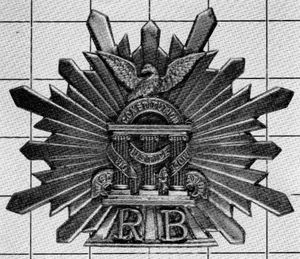
Figure 152
This silver-metal plate can be accurately identified by reading its
devices. The center device is from the seal of the State of Georgia.
During the period that the plate was worn, one of the best known of the
State's Militia organizations was the Republican Blues—the "RB" on the
plate—of Savannah.[119] The silver color of the plate also agrees with
the other trimmings of the uniform of that unit.
USNM 604605 (S-K 752). Figure 153.
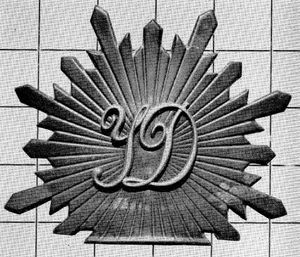
Figure 153
This three-quarter-sunburst plate with the monogram "I D" applied in
silver is identical to one on a brass-bound dragoon cap in the national
collections carrying in its crown the label "Irish Dragoons, Brooklyn,
N.Y." (USNM 604691, S-K 837). It is typical of the two-piece
sunburst-type plates and was probably worn until the 1850's. The plate
was attached by means of two looped-wire fasteners that were run through
holes in the helmet and secured by leather thongs.
USNM 604688-M (S-K 834). Figure 154.
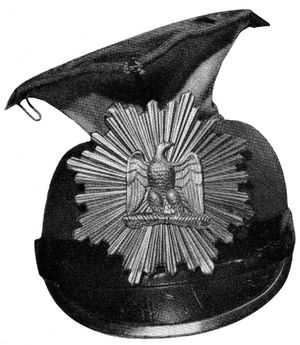
Figure 154
With no regulations but their own to restrain them, Militia
organizations designed their uniforms to suit their fancies, although
generally following the regulations for the Regulars. This
often led to odd and unusual cap shapes and trimmings and bindings on
clothing, and to somewhat garish horse furniture in in some mounted
units.
The illustrated cap and plate is very similar to the ones worn by the
Boston Light Infantry[120] about 1839-1840 except that the upper or
"mortar board" portion is beige instead of red and the plate is a full
instead of a three-quarter sunburst. The mortar board form is that
introduced by the Polish lancers in Europe in the early years of the
19th century and worn by most European lancer regiments of the same
period. Lancer units in the British Army adopted this type cap in 1816
when they were first converted from light dragoons.[121] The large,
brass, eagle-on-sunburst plate was obviously patterned after the one
prescribed for the Regular dragoons in 1833.
USNM 60377-M (S-K 133). Figure 155.
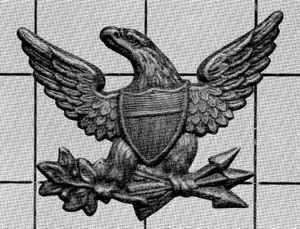
Figure 155
As an example of more than a dozen known variants of the eagle, this
silver-on-copper specimen is illustrated to show the general form and
size of Militia cockade eagles that became distinct types in the 1830's
and continued until about 1851. All such eagles were obviously stock
patterns.
USNM 604960-M (S-K 1104). Figure 156.
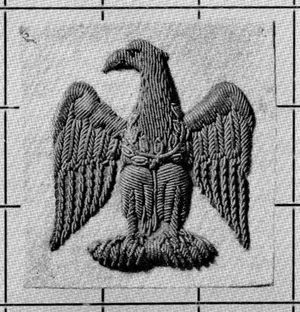
Figure 156
This gold-embroidered cockade eagle with a wreath of silver lamé about
its breast appears to have been patterned directly after the eagle on
the 1833 Regular dragoon cap plate (see fig. 38). It possibly is one of
a type worn by general officers of Militia. On this specimen, both the
eye and mouth of the eagle are indicated with red thread.
USNM 604959-M (S-K 1103). Figure 157.
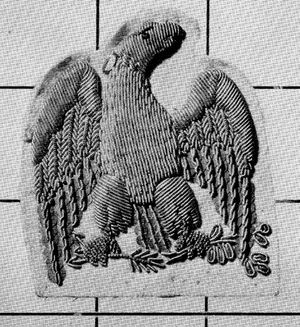
Figure 157
This gold-embroidered eagle, with wings and tail of gold embroidery and
gold sequins, was worn by staff and field officers, and possibly general
officers, of Militia. A duplicate on an original chapeau is in the
collections of the Maryland Historical Society in Baltimore, Maryland.
Eagle ornaments such as this were generally centered on a round cloth
cockade about 6 inches in diameter. The eagle's mouth is indicated by
embroidery with red thread. Similar eagles of a smaller size are known
on epaulets of the same period.
USNM 60451l-M (S-K 658). Figure 158.
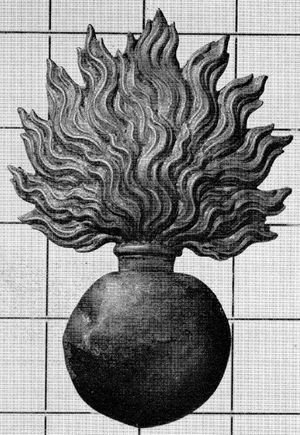
Figure 158
The flaming grenade, adopted by the Regulars in 1832 after long usage by
the British and other foreign armies, was quickly adopted by the
Militia. This specimen, of silver-on-copper, was worn as a cap plate
either in conjunction with another device below it on the cap front or
as a lone distinctive ornament. It cannot precisely be identified as an
artillery plate, but since some Militia artillery units are definitely
known to have worn silver buttons of the artillery pattern, such is
highly probable. Also known in brass and in smaller sizes, it is a stock
pattern.
USNM 604526 (S-K 673). Figure 159.
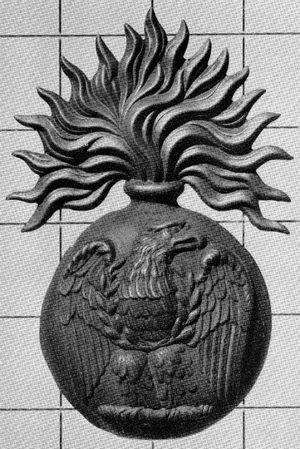
Figure 159
Although this plate appears to be of possible French or British origin,
close examination indicates that it is probably an American Militia
device of the 1840's. Its looped-wire fasteners indicate that it is a
cap plate. The design of the modified Napoleonic-type eagle is almost
exactly that used in the 1833 Regular dragoon cap plate and other
Militia plates; and the period of apparent manufacture coincides with
the early use of the flaming grenade as an American device.
Incorporating two devices common to the period, it would have been a
stock pattern.
USNM 60432-M (S-K 188). Figure 160.
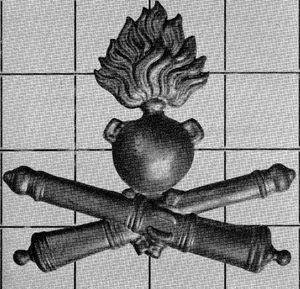
Figure 160
The 1840 button for the Ordnance Corps bears a flaming grenade over
crossed cannon, devices that date from 1832 and 1834 respectively.
Consequently, it seems likely that this combination emerged as a stock
pattern for Militia artillery early in the 1840's. This specimen, struck
from a single piece of brass, is a copy of the French artillery device
of the same period, and, while it is believed to be American, it may be
a foreign insignia. Confusion arises in the case of foreign designs, for
die sinkers often used as a model either an actual imported badge or a
scale drawing of one.
USNM 604548-M (S-K 695). Figure 161.
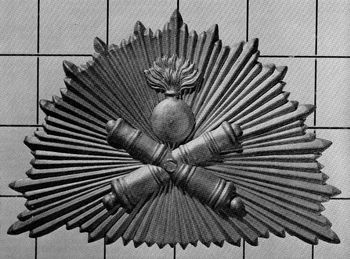
Figure 161
This is a variation of the pattern of the preceding specimen in which
silver-metal devices have been placed on a small, gilt, half-sunburst
plate. This was probably a stock pattern available to any Militia
organization beginning about 1840 and worn for the next 20 or 30 years.
USNM 604533-M (S-K 680). Figure 162.
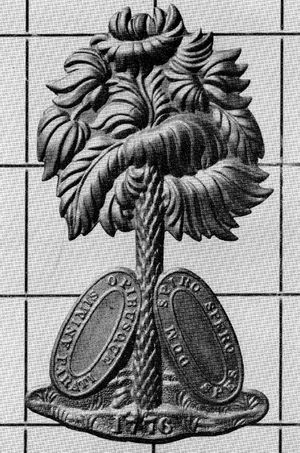
Figure 162
The palmetto of South Carolina in outline form first appeared as a large
cap ornament about 1840, after having been worn in smaller size as a
cockade ornament and on the side of dragoon caps. A Huddy and Duval
print shows it on the caps of the DeKalb Rifle Guards of Camden, South
Carolina.[122] The illustrated specimen was worn into the 1850's, and it
is highly probable that some South Carolina troops wore plates such as
this in the early days of the Civil War.
The palmetto was adopted as the principal heraldic device of South
Carolina in commemoration of the defeat of Admiral Sir Peter Parker's
fleet by the garrison of Sullivan's Island under Col. William Moultrie
in June 1776. The defenses of the island were constructed primarily of
palmetto logs. The devices comprising this brass plate are all taken
from the state seal, including the mottos Animis Opibusque Parati and
Dum Spiro Spero Spes. The date "1776" alludes to the year of
Moultrie's victory and not to the organization date of any particular
unit.
USNM 604532-M (S-K 679). Figure 163.
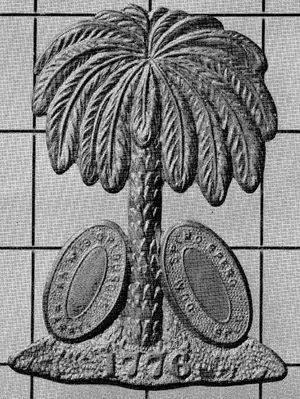
Figure 163
Struck from a different die, with broader fronds and a wider base, this
brass plate is of the same period as the preceding one.
USNM 60295-M (S-K 53). Figure 164.
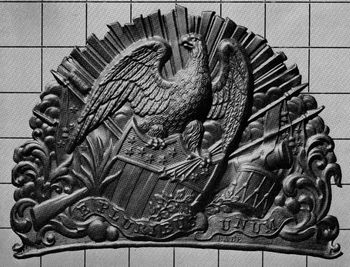
Figure 164
This grenadier-type plate, struck in brass, is one of the most beautiful
examples of the die maker's art in the national collections. On a
sunburst-over-clouds background is an eagle grasping the top of
the Federal shield superimposed on panoply of arms and colors. The
national motto is on a ribbon below. Certainly not from a stock pattern,
this plate obviously was made for a specific Militia unit of
considerable affluence. Three simple wire fasteners soldered to the
reverse provide means of attachment.
This specimen is one of the scarce examples of military plates bearing
the maker's name "BALE," which may be seen just above the raised lower
edge and below the "UNUM." This was probably Thomas Bale of New York who
is first listed in New York directories, in 1832, as an engraver at 68
Nassau Street. The 1842 directory lists him as a die sinker at the same
address in partnership with a Frederick B. Smith. He is last listed in
1851.
USNM 604672 (S-K 819). Figure 165.
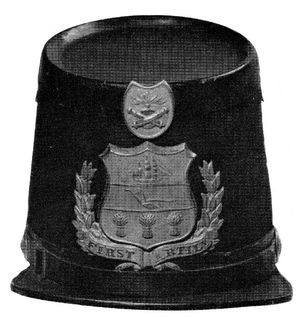
Figure 165
The plate on this cap uses only the shield of the Pennsylvania seal
without crest or supporters. It is surrounded at the sides and bottom
with a wreath carrying a ribbon with the unit designation "first
artily." Equally interesting and unusual is the small separate insignia
at the pompon socket. It is based on the 1840 flaming grenade ordnance
device with crossed cannon superimposed.
USNM 60394-M (S-K 150). Figure 166.
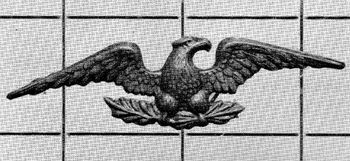
Figure 166
This eagle is of a rather odd design, and the five arrows in its left
talon is an even more unusual variation. It is believed to be a
cockade eagle because of its form and size, but it may well have been
used elsewhere on the person as a piece of uniform insignia.
USNM 60259-M (S-K 17). Figure 167.
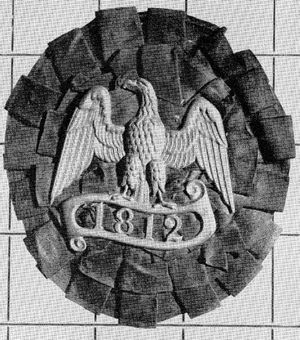
Figure 167
The State Fencibles of Philadelphia were originally organized as "Sea
Fencibles" in 1812 for duty at the port of Philadelphia. This cockade,
with brass eagle, was first worn about 1840 and it continued in use for
many years thereafter. Dates incorporated as parts of devices are
generally the original organizational dates of the units concerned—as
is the case in this instance—and bear no necessary relation to the age
of the badges. Some Militia cap plates bear the date "1776," and there
are waist-belt plates bearing organization dates of 100 years earlier
than the dates at which the plates were made.
¶ The transition to composite plates in the late 1830's was a tremendous
step forward in the field of military ornament. Handsome insignia could
be manufactured less expensively and individual units were able to have
plates distinctive to themselves at relatively low cost; however, only
gold and silver colors could be used. In the mid-1840's there was
introduced a new manufacturing technique which opened this field even
wider. In this innovation, various stock patterns were struck with a
round center as a part of the design. In either the initial strike, or a
second, this round center was punched out, leaving a hole. Then pieces
of colored leather or painted tin, carrying distinctive numerals,
letters, monograms, or other devices were affixed to the reverse of the
plate, in effect filling the hole. Although this added a step in
manufacture, it permitted the incorporation of bright colors, which
added zest and sparkle to the finished product. Such plates remained
popular until the 1890's, and a few are still worn on the full-dress
caps of some units. This type of insignia came into use at the time when
many of the independent companies of the larger states, such as
New York and Pennsylvania, were starting to become elements of regiments
and brigades within the over-all Militia structure of the state, thus
the use of distinctive numbers and/or letters on the badges. Many of
these units, however, retained their original designation[123] and
continued to wear insignia distinctive to themselves on full-dress
uniforms.
USNM 604559-M (S-K 706). Figure 168.
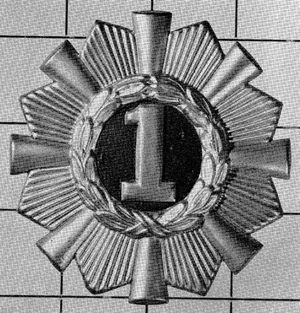
Figure 168
The first of the stock patterns, with basic wreath and 8-pointed
starlike sunburst, has the numeral "1" on black leather as a center
device. Other specimens in the national collections have single
numerals, single letters, branch of service devices, and state coats of
arms. This plate, and those following, were worn through the 1850's on
the dress cap copied after the pattern adopted for the Regular
Establishment in 1851. It is struck in brass.
USNM 604617-M (S-K 764). Figure 169.
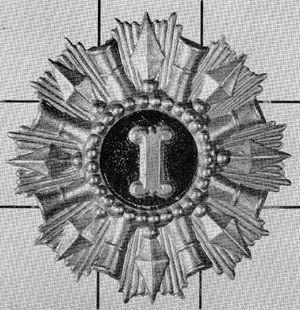
Figure 169
This stock pattern, in brass, is very definitely military in
composition, employing cannon and flag-staff spearheads radiating from a
beaded center and superimposed on a sunburst background. The metal
letter "1" is backed with black leather.
USNM 604681-M (S-K 827). Figure 170.
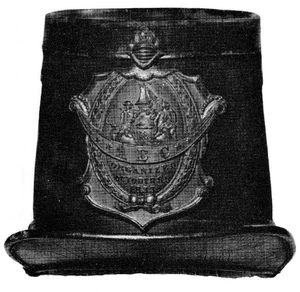
Figure 170
This unusually ornate and distinctive plate is that of the Albany [New
York] Burgesses Corps that was founded, as stated on the plate itself,
October 8, 1833. The arms and the motto "ASSIDUITY", appearing above the
ribbon with the letters "A B C," are those of the city of Albany.
USNM 604666-M (S-K 813). Figure 171.
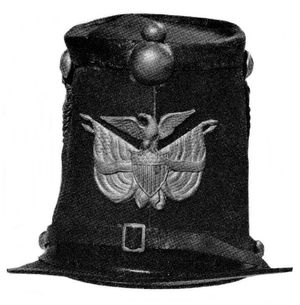
Figure 171
The original buttons on the sides of this cap have the eagle with the
letter "R" (used by both Regulars and Militia) on the shield. The brass
plate proper, however, includes no device indicative of any particular
branch of service; combining flags and a Federal shield
surmounted by an eagle, it may well have been a stock pattern.
USNM 604551 (S-K 698). Figure 172.
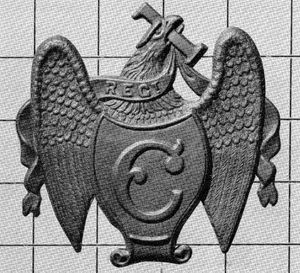
Figure 172
The type and form of this eagle plate give no clue to its age, or to the
identity of the unit that wore it other than the numeral "1" in the
eagle's beak and the letter "E" in the shield. It is a type more apt to
have been made about 1850 than later. The eagle is struck in brass, and
the stippled inner portion of the shield, product of a separate strike,
is soldered in place; thus, the plate proper must be considered a stock
pattern.
USNM 604552-M (S-K 699). Figure 173.
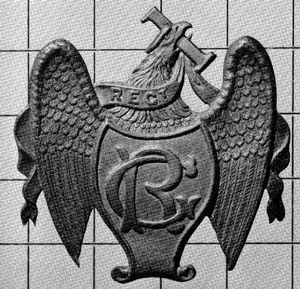
Figure 173
A companion piece to the preceding plate, this specimen differs in that
the letters "R G" and their stippled background are struck integrally
with the plate proper—indicating that two dies were combined for a
single strike—and in that the shield, ribbon, and numeral "1" have been
silvered.
USNM 60358-M (S-K 114). Figure 174.
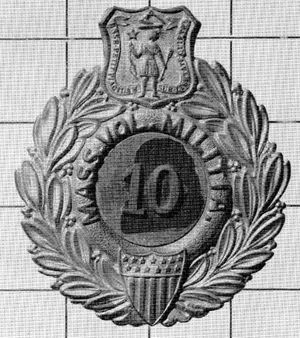
Figure 174
This plate is of a type form worn on Militia dress caps prior to the
Civil War. There is little doubt that plates such as this continued in
use for several decades after their initial appearance. This brass
specimen, surmounted by elements of the Massachusetts seal, is struck as
a stock pattern for Massachusetts troops with the center left blank. The
numeral "10" is applied to a black-painted metal disk affixed with
simple wire fasteners.
USNM 604545-M (S-K 692). Figure 175.
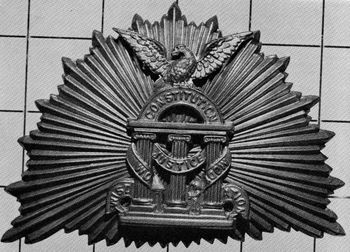
Figure 175
This plate and the one following are of Militia types worn on caps in
the 1850's and perhaps earlier. Such plates are known to have been in
use with little or no change almost to the present day on military
school dress shakos and dress caps worn by some National Guard units.
The plate proper, which is of brass, is the well-known half-sunburst
device so popular in the 1830's and 1840's. The Georgia state seal, also
in brass, is applied with wire fasteners. The plate is dated later than
a similar one of the Republican Blues (fig. 152) because of the "feel"
of the piece and the fact that it cannot be ascribed to a particular
unit whose existence can be dated.
USNM 604547-M (S-K 694). Figure 176.
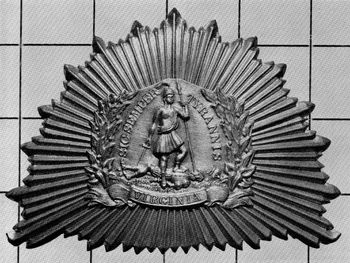
Figure 176
This plate differs from the preceding one only in that it substitutes
the coat of arms of Virginia for that of Georgia. The backgrounds,
although very similar, are products of different dies.
USNM 60323-M (S-K 79). Figure 177.
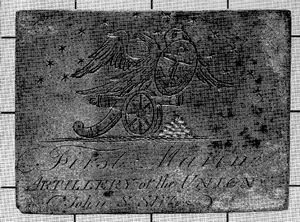
Figure 177
Undoubtedly one of the most interesting of all the Militia plates of the
War of 1812 period is this rectangular one worn by John S. Stiles of (as
indicated by the engraving) the "First Marine Artillery of the Union."
Engraved in brass, it bears an unusual combination of military and naval
devices—the familiar eagle-on-cannon of the Regular artillery and the
eagle with oval shield that appears on naval officers' buttons of the
period.[124] Actually, the devices befit the character of the
organization. The following quotation from Niles Weekly Register of
Baltimore, June 26, 1813, tells something of the unit:
The First Marine Artillery of the Union, an association of the
masters and mates of vessels in Baltimore, about 170 strong all
told, assembled on Sunday last and proceeded to the Rev. Mr.
Glendy's church in full uniform, where they received an address
suited to the occasion; which, as usual, done honor to the head
and heart to the reverend orator. We cannot pass over this
pleasant incident without observing that the members of this
invaluable corps are they who, of all other classes of society,
feel the burthens and privations of the war.
Obviously, this organization was one of the state fencible units
enlisted for defense only, but little else is known about it. In 1814
there was in Baltimore, a Corps of Marine Artillery commanded by a Capt.
George Stiles. The roster of this unit, however, does not
include the name John S. Stiles. Other records do indicate that a Lt.
John S. Stiles commanded a section of the Baltimore Union Artillery at
the Battle of North Point in 1814.[125] It is probable that John Stiles,
originally a member of the 1st Marine Artillery of the Union had
transferred his commission to the Baltimore Union Artillery.
¶ An example of Militia officers' shoulder-belt plates of the period
1812-1816 is a solid silver oval plate (fig. 178) engraved with an eagle
and elements of the arms of Massachusetts within a shield suspended from
the eagle's neck. Being silver, the plate probably was worn by infantry
or possibly dragoons. Many such plates were locally made, as
was this one, and examination of a number of specimens gives reason to
believe that many were made by rolling out large silver coins into thin
ovals, which were then engraved and fitted with fasteners on the
reverse. The fasteners on all pieces studied indicate that the plates
were intended to be ornamental rather than functional.
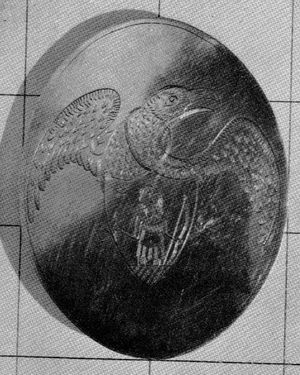
Figure 178.—Specimen in Campbell collection.
In the Pennsylvania State Museum there is a similar oval plate that was
worn by Col. Philip Spengler of that State's Militia in 1812-1816.
Ornamented with an eagle, with the initials "PS" within an oval below,
it generally follows the construction of the illustrated plate,
differing only slightly in size. Since plates of this general type were
made locally by hand, each is unique in itself. Identification must
depend upon an interpretation of the devices engraved on the face. The
initials of the officer for whom the plate was made are often included.
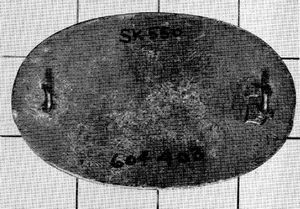
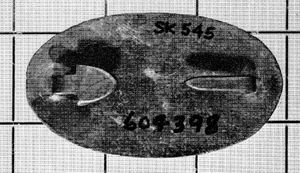
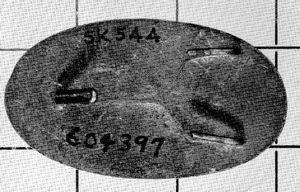
USNM 604310-M (S-K 466). Figure 179.
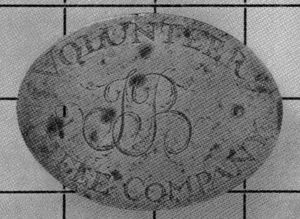
Figure 179
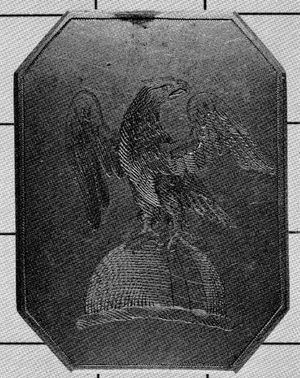
A second example of a Militia officer's plate is this engraved brass
specimen with the design placed along the longer axis of the oval. Since
there probably were many "Volunteer Rifle Companies," it is impossible
to determine precisely which one wore this plate. The initials of the
officer may be read either "I. B." or "J. B.," for many of the
early-19th-century engravers used the forms of the letters "I" and "J"
interchangeably. The two small hooks on the reverse indicate that the
plate was for a shoulder belt rather than for a waist belt, and that it
was ornamental rather than functional.
USNM 60325-M (S-K 81). Figure 180.
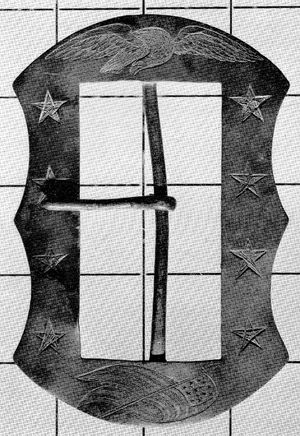
Figure 180
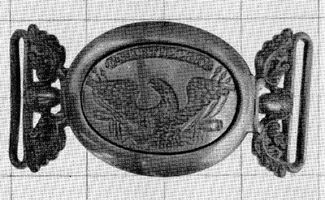
This brass buckle, obviously made for a sword hanger, has an eagle in
flight above, a 13-star flag below, and four 5-pointed stars on either
side. The spearhead on the pike of the flag is definitely of military
design, and, in the absence of nautical devices in the engraving, the
buckle must be considered an army item.
USNM 604121-M (S-K 278). Figure 181.
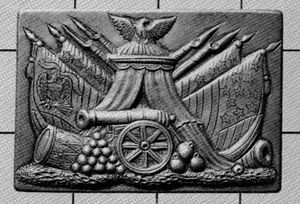
Figure 181
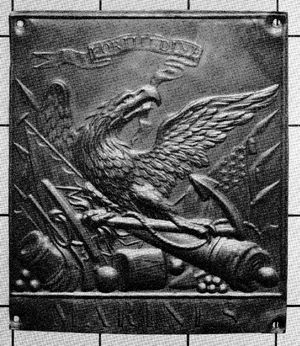
Cast in silver and then carefully finished, this rectangular plate with
beveled edge is one of the most ornate and beautiful known. In the
center is an officer's marquee with an eagle, wings spread, perched on
top. In front of the marquee are a field piece with bombs, cannon balls,
and drum; the whole on grassy ground and superimposed on a trophy of
colors and bayonetted muskets. The canton of one color has, instead of
stars, an eagle with a shield on its breast and a ribbon in its
beak. It has been suggested that the eagle-in-canton flag would tend to
date the piece after 1820 when many Militia units had the design in its
colors;[126] however, flags of such design are known to have been used
as early as the last year of the Revolution.[127] In addition, the
"feel" of the specimen is early, and it is included here as a possible
Militia dragoon officer's plate since the dragoons of the War of 1812
period generally wore their swords attached to a waist belt rather than
to a shoulder belt.
USNM 60449-M (S-K 205). Figure 182.
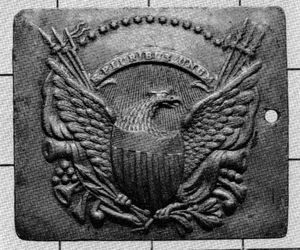
Figure 182
This plate is typical of the early waist-belt plates, which generally
were more square than rectangular. It bears the over-all design of the
1814-1821 series of "common" cap plates. Struck in copper and silvered,
it would have been appropriate for either infantry or dragoons, as both
wore "white metal" trimmings during this period. There are as many die
variations known for this type belt plate as for the matching cap
plates.
The wide latitude allowed officers in selecting their own insignia makes
it quite possible that this design was worn by some officers of the
Regular Establishment, particularly those in the high-numbered
regiments, which were organized during the course of the War of 1812. A
third use of this basic design is indicated by a museum specimen at Fort
Ticonderoga, N.Y.: cut into its outline form, it was worn on the side of
Militia dragoon caps.
USNM 60451-M (S-K 207). Figure 183.
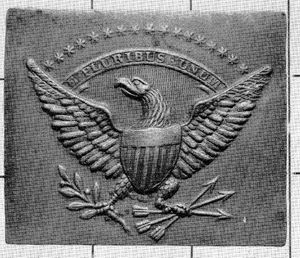
Figure 183
This brass plate is one of several similar examples made of both brass
and silvered copper that differ only in small die variations and the use
of either 5-pointed or 6-pointed stars. The arc of 17 stars in this
specimen may or may not be significant, because there were 17 states in
the Union from 1802 until 1812 when Louisiana was admitted. Not until
1816 did the 19th state, Indiana, come into the Union. After thinking in
terms of and working with 17 stars for a 10-year period, die sinkers may
well have overlooked the inclusion of a star for Louisiana. Buttons for
the Regular rifles made after 1812 but before 1821 show an arc of 17
stars.[128] As in the case of the preceding plate, there is a good
possibility that this one was worn by Regular officers in 1814-1821. It
is also probable that the pattern was made and sold to Militia for many
years after 1821.
USNM 60453-M (S-K 209). Figure 184.
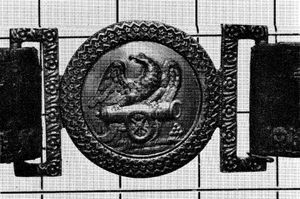
Figure 184
While this plate could have been worn by an officer of the Regular
artillery in the period 1814-1821 when uniform regulations were vague
and seldom enforced, it is more probable that it was a Militia item of
about 1821-1835. The reason for this is that the eagle-on-cannon device
was adopted quickly by Militia units when it was discarded by the
Regulars in 1821, and the over-all design of the plate itself follows
the pattern adopted by the Regulars in 1821 (see fig. 68). Several
artillery organizations of the Massachusetts Militia wore the discarded
button pattern (eagle-on-cannon with the word "Corps" below) until the
1840's,[129] and this plate would have been an ideal match.
The whole is cast in brass, the inner ring rather crudely so. The outer
ring is embossed with zig-zag fretwork enclosing a circle of 5-pointed
stars; the rectangular belt attachments have a floral design.
USNM 604123 (S-K 279). Figure 185.
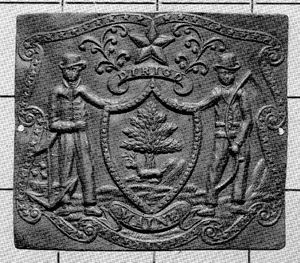
Figure 185
This plate, struck in copper, contains the basic devices of the State of
Maine seal enclosed by a curled ribbon border embellished with 5-pointed
stars. The specimen is more square than rectangular, a characteristic of
waist-belt plates of the early 1800's. It was probably worn by Maine
Militia no later than the 1820's, possibly a few years earlier. The
method of attachment also is indicative of this early period: the heavy
vertical wire is brazed to one end of the reverse, and the L-shaped
tongue to the other. This plate obviously was a stock pattern.
USNM 60329-M (S-K 85). Figure 186.
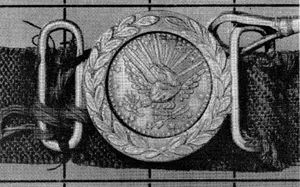
Figure 186
This plate, cast in brass, is typical of the small plates, both round
and rectangular, that were worn with light-weight, full-dress staff
swords. It is an example of the early, hand-made, bench-assembled types.
The outer ring carries the wreath typical of the period, while the inner
ring carries the eagle with its head to the right, shield on breast,
arrows in left talon, and olive branch in right talon. The whole lies
within a ring of 13 5-pointed stars; the uppermost five stars are mixed
with a sunburst rising from the eagle's wings.
USNM 60466-M (S-K 222). Figure 187.
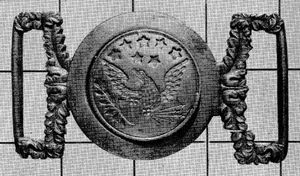
Figure 187
This brass, bench-assembled plate is similar to the Regular artillery
belt plate of 1816 (fig. 56) in that the design on the inner ring is
struck with a series of separate hand-held dies on a piece of blank
round stock. The floral design on the belt attachments is cast. In many
of the early bench-made plates, the final assemblyman marked the
matching pairs so that they could readily be re-paired after buffing and
plating. In this specimen, each ring bears the numeral XXVIII.
USNM 60467-M (S-K 223). Figure 188.
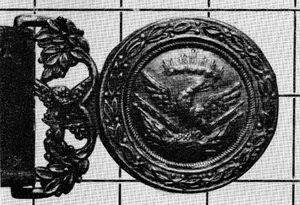
Figure 188
This plate, with the center ring struck in medium brass and the belt
attachment cast, was worn by Militia of New York State, as indicated by
the eagle-on-half-globe device taken from that state's seal. Of brass,
it is assigned to the artillery. The quality of the belt to which it is
attached and the ornateness of the plate itself indicate that it was
made for an officer. The left-hand belt attachment is missing.
USNM 60470-M (S-K 226). Figure 189.
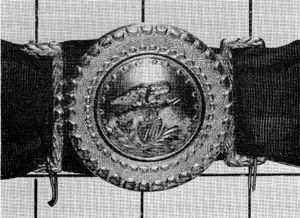
Figure 189
This small, cast-brass plate is another example of the plates made for
social or full-dress wear with the light-weight staff sword. The design
on the inner ring is unusual in that the eagle, with upraised wings, is
standing on the Federal shield. The plate is a bench-made product, with
the inner and outer rings bearing the numeral VII. It was very
probably a stock pattern for officers.
USNM 60414-M (S-K 300). Figure 190.
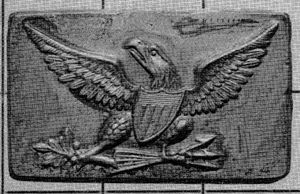
Figure 190
Rather unusual in construction, this small silver-on-copper rectangular
plate was struck in thin metal. Two broad tongues, for attachment to a
belt, are inserted in the rear; and the reverse is filled with lead to
imbed the fasteners. The eagle design is very similar to the one
prescribed for the caps of the Regular Establishment in 1821, although
somewhat reduced in size. The general lack of finish and polish in
construction indicates that the specimen was probably the product of an
inexperienced and small-scale manufacturer.
USNM 60326-M (S-K 82). Figure 191.
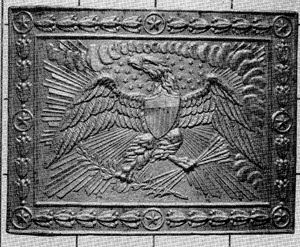
Figure 191
This unusually large plate, which is struck in medium brass and with the
edges crimped over a heavier piece of brass backing, is believed to be
an officer's plate because of its size, gilt finish, and over-all ornate
design. Within a floral and star pattern border, the specimen is
dominated by an eagle, on a sunburst background, that holds in its left
talon five arrows with points inward; above are 25 stars and an edge of
clouds above. Arrows held with points inward are usually considered
indicative of the general period 1832-1836. If the number of
stars is of any significance, such dating would be correct, as the
canton of the National Colors contained 25 stars from 1836 to 1837. The
central design used without the border is also known in smaller, more
standard sized plates. The design is a stock pattern. This type plate is
also known in both brass and silver.
USNM 604348-M (S-K 504). Figure 192.
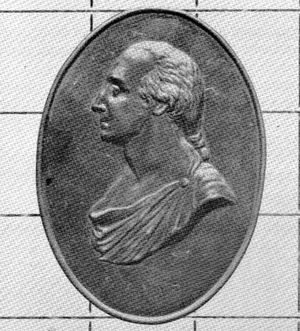
Figure 192
This may well be a companion piece to the diamond-shaped cap plate
ascribed to the Washington Greys[130] of Philadelphia (see fig. 139). In
any case, the two appear to have been struck from the same die. It may
also have been worn by the Washington Greys of Reading, Pennsylvania, or
by another company of the same designation. The specimen is struck in
thin brass with a tin backing applied before the strike and the edges
crimped over the reverse. Three soldered copper-wire staples provide
means of attachment.
¶ Militia organizations generally modeled their uniforms rather closely
on those of the Regular Establishment; of course, there were certain
exceptions, notably the flamboyant Zouave units. However, the Militia
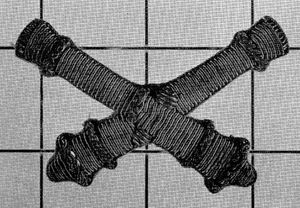
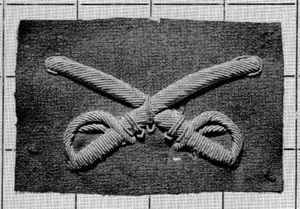
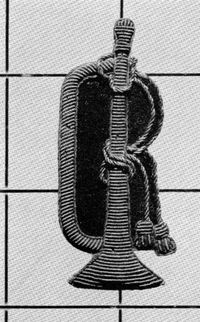
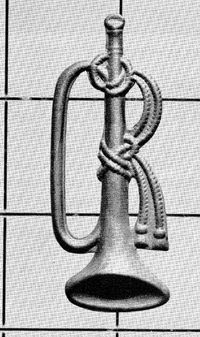
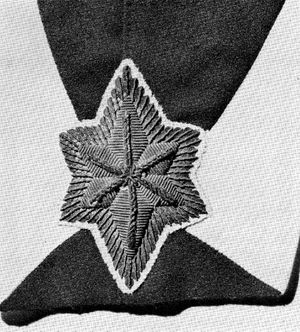
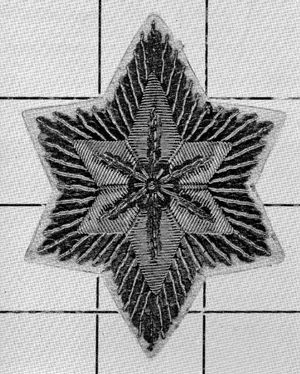
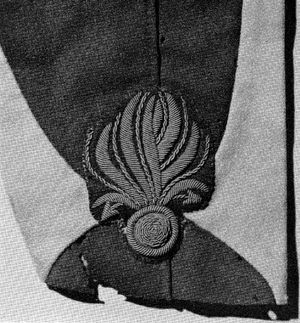
often added additional trimmings that gave the "gay and gaudy" touch for
which they were noted. Following the example of the Regulars, the
Militia adopted coat-skirt ornaments almost immediately after their
appearance in 1832. They used the regulation flaming grenades, open and
looped horns, and 5-and 6-pointed stars, but in both gold and silver on
varicolored backgrounds and in a wide variety of sizes. They also used a
number of peculiarly Militia forms, such as crossed-cannon, elements of
state seals, and devices peculiar to specific units.
USNM 604961-M (S-K 1105). Figure 193.
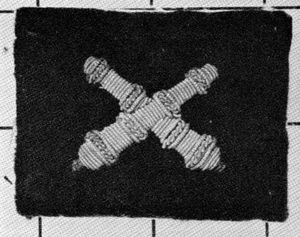
Figure 193
Typical of Militia coat-skirt ornaments is this pair of crossed cannon
devices for Militia artillery. They are of gold embroidery on a
background of black velvet. Similar pairs in the national collections
are embroidered in silver. The Regular artillery never wore the crossed
cannon device on the skirt of the coat; so used, it was exclusively a
Militia ornament.
USNM 604963 (S-K 1107). Figure 194.
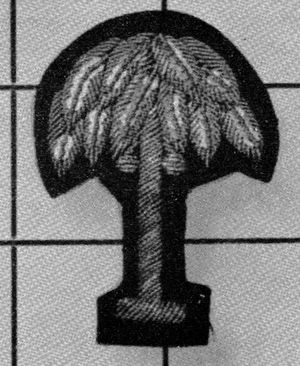
Figure 194
Another coat-skirt ornament with an even more distinctly Militia touch
is this small palmetto tree of gold embroidery, with sequins,
on black wool cloth. As the palmetto tree is the basic device of the
South Carolina seal (see pp. 81 and 83), this specimen must be
attributed to the Militia of that state.
¶ Most Militia cartridge-box plates made in the decade after 1841 were
oval, following the pattern of the Regulars. While a few of these varied
from the prescribed sizes, most were almost identical in both size and
shape to those of the Regular Establishment, but with strictly Militia
ornamentation. The exact years in which these plates were produced
cannot be determined, but it is reasonably sure that they were supplied
to Militia for some years prior to the opening of the Civil War. Not
included here are similar types known to have been made for units born
of the war as the Pennsylvania Fire Zouaves, Pennsylvania Home Guard,
Pennsylvania Reserve Brigade, and the Ohio Volunteer Militia.
Cartridge-box and waist-belt plates often are identical except for the
methods of attachment. The plates for cartridge boxes have two wire
loops imbedded in the backing (see fig. 90), while those for waist belts
have one or two round, or sometimes arrowheaded, prongs on one side of
the reverse, and with a narrow tongue on the opposite side bent parallel
to the plane of the plate (see fig. 91).
USNM 60400-M (S-K 156). Figure 195.
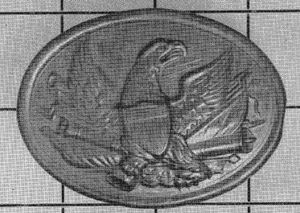
Figure 195
This brass, oval cartridge-box plate, with its eagle on a panoply of
arms and colors, closely matches in size the 1841 Regular cavalry's
plates for carbine cartridge boxes and the infantry's waist belts.
Although plates of this design were worn as waist-belt plates, the two
looped-wire fasteners on the reverse of this specimen clearly indicate
its use on a cartridge box. This was undoubtedly a stock pattern. An oil
painting of Capt. George Bumm, Pennsylvania State Artillery, c. 1840,
shows the subject wearing a waist-belt plate of this same design.[131]
USNM 60401-M (S-K 157). Figure 196.
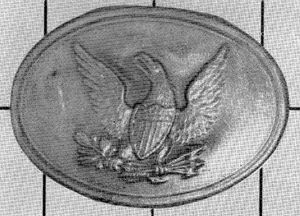
Figure 196
Slightly smaller than the preceding specimen, this brass plate bears the
eagle design popular from 1821 to 1851. Fitted with looped-wire
fasteners, it would have been a stock pattern for cartridge boxes.
USNM 60354-M (S-K 606). Figure 197.
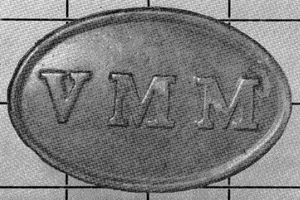
Figure 197
A frequently misidentified plate is this brass-struck, lead-filled oval
with the raised letters "VMM" for Volunteer Maine Militia. It is also
known in a smaller size. The reverse is fitted with the two looped-wire
fasteners normal to such plates.
Other prewar oval plates bearing raised letters are known for the
Alabama Volunteer Corps (AVC), North Carolina (NC), South Carolina (SC),
State of New York (SNY), and New Hampshire State Militia (NHSM). Many
such plates recently have been reproduced for sale, and more probably
will be made if a market is created. Thus, all plates of this
general type should be cautiously considered.
USNM 60354-M (S-K 110). Figure 198.
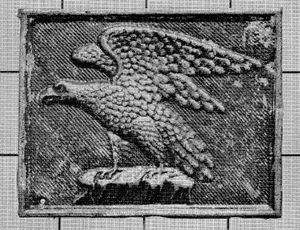
Figure 198
One of the more unusual forms of the militant eagle used on ornaments is
shown on this brass die sample for a waist-belt plate. The eagle, with
fierce mien and wings outspread, stands high on a craggy ledge. An
example of an untold number of odd and unusual pieces of insignia, this
specimen is unidentified as to unit or area of intended use. It may well
have been designed for use as a stock pattern.
USNM 604103-M (S-K 259). Figure 199.
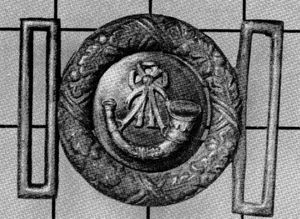
Figure 199
A stock pattern, this plate is struck in brass with the open-horn device
of riflemen, which has been previously discussed. Wire fasteners are on
the reverse. Although the outer ring of the plate is missing, it was
probably decorated with a wreath, a common form in the 1830's and
1840's.
USNM 604385-M (S-K 532). Figure 200.
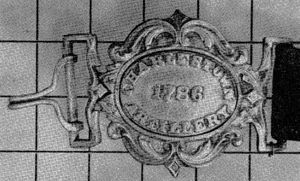
Figure 200
This 2-piece, brass-cast plate was worn by members of a Charlestown,
Massachusetts, unit. The date "1786," as on nearly all dated
pieces of insignia, refers to the date of original organization of the
unit. The design of the plate is typical of early- to mid-Victorian
taste.
USNM 60497-M (S-K 253). Figure 201.
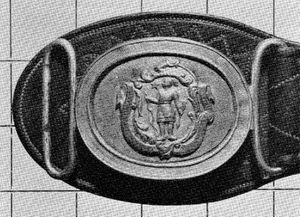
Figure 201
Bearing elements of the seal of the State of Massachusetts, this plate
likely was a stock pattern sold to many officers. In construction, it is
a composite piece similar to the plate for officers of the Corps of
Topographical Engineers (see fig. 87 and p. 45) with the device applied
to the inner oval. Because of its unusually striking appearance, it
would have been a most appropriate type for staff and field officers,
and possibly general officers.
USNM 604126-M (S-K 282). Figure 202.
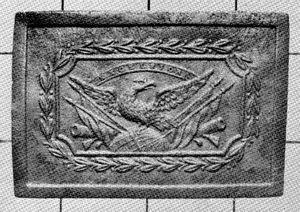
Figure 202
This plate, struck in poor-quality, medium-weight brass, is of a stock
pattern bearing the eagle-on-half-globe device and the motto "Excelsior"
from the New York State seal superimposed on a panoply of arms and
colors. This type of belt plate, with the device on the inner panel and
a wreath between the inner and outer borders, is most characteristic of
the 1840's. More than ten different plates are known that vary only as
to the design of the inner panel; some contain New York State heraldic
devices, and others contain variants of the usual eagle design of the
period.
USNM 604390 (S-K 537). Figure 203.
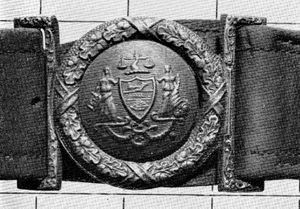
Figure 203
The devices on this cast-brass plate comprise the arms of the City of
Philadelphia, and its form and pattern, especially the floral design of
the outer ring, place it in the 1840's. The piece is bench-made and
carries on the reverse many marks of the file used in its final
assembly. It must be considered a stock pattern.
USNM 604241-M (S-K 397). Figure 204.
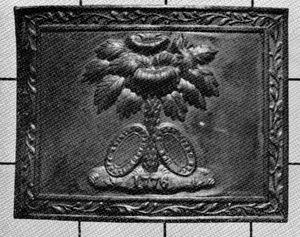
Figure 204
Somewhat larger than many plates of the period, this brass specimen
carries the South Carolina palmetto device. Such plates also were struck
in copper and silver plated. It obviously was a stock pattern
sold to several different units. The rectangular plate with the
vine-patterned border was a stock pattern in itself, with many different
devices being added in the center as ordered. This is one of the many
pieces of insignia too often called Confederate but which ante-date the
Civil War by almost two decades.
USNM 604388-M (S-K 535). Figure 205.
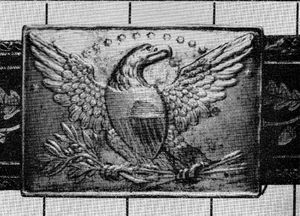
Figure 205
The eagle device on this silver-on-copper specimen closely resembles
that on the cap plate of the First Troop Philadelphia City Cavalry (USNM
604964-M) and may possibly be the matching belt-plate worn by that
organization. Such an eagle, however, would have been a stock pattern of
the manufacturer, and sold to many different units. A very unusual
aspect of this particular eagle are the three arrows held in the left
talon: two of them point inward, the third outward.
USNM 604106-M (S-K 262). Figure 206.
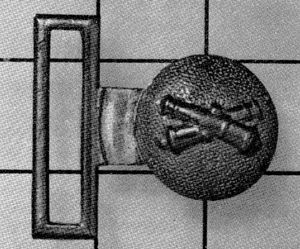
Figure 206
Although members of the artillery of the Regular Establishment wore the
crossed-cannon device on their shakos, they never wore it on waist- or
shoulder-belt plates. Thus, this cast-brass plate must have been
a stock pattern sold to many Militia units. The outer ring is
missing.
USNM 604107-M (S-K 263). Figure 207.
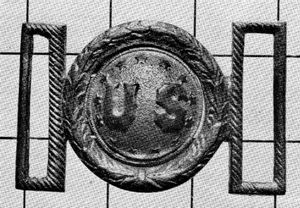
Figure 207
This specimen, roughly cast in brass and gilded, is unusual because the
Militia rarely used the letters "U S" on any of its equipment. The
pattern does not conform to anything prescribed for Regulars and the
quality does not come up to standards required by the Regular
Establishment; hence it must have been worn by Militia. It would have
been a stock pattern. There is the possibility that it might have been
worn by diplomatic personnel, but its poor quality makes this unlikely.
USNM 604387-M (S-K 534). Figure 208.
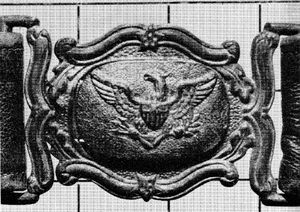
Figure 208
The over-all design of this plate, which is cast roughly in brass and
gilded, reflects the growing ornateness of the Victorian era. Obviously
a stock pattern, it would have suited the fancy of several units and
cannot be identified further than "for Militia." The design of the eagle
is unusual in that three arrows are carried in the right talon—although
it is possible that this is intended to reflect the belligerency
inherent in the period of the War with Mexico—and there is a single
large star in the canton of the Federal shield.
USNM 604458-M (S-K 605). Figure 209.
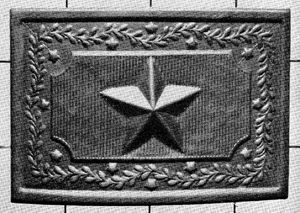
Figure 209
The generalities that apply to all "stock pattern" insignia are equally
valid in referring to this brass-struck plate with a 5-pointed star as
its sole ornament. Dating its period of design poses no difficulty, for
it contains the panel with wreath inside an edging border characteristic
of the 1840's. The star device would have been appropriate for Militia
units of Maine ("North Star"), Texas ("Lone Star"), or for dragoon units
that took the star as a distinctive insignia. Although it may have been
worn by Texans, it is doubtful that it was made originally for them.
The design enjoyed a long life, and plates of this general
pattern were struck well into the 1880's. The major difference between
earlier and later specimens is that the early ones were struck on rather
heavy sheets of copper-colored brass, with fasteners consisting of a
tongue and heavy wire loops brazed to the reverse. The later plates have
a bright brassy color, are struck on thin brass, and have the loop and
tongue soldered rather than brazed.
USNM 604108-M (S-K 264). Figure 210.
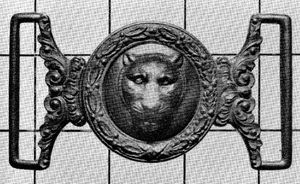
Figure 210
The lack of a mane on the beast on this plate marks it as a tiger. The
best known and most affluent Militia organization with the nickname
"Tigers" was the Boston Light Infantry, although a number of others also
were so-called. The craftsmanship and general elegance of this
gold-plated brass specimen suggests that it was worn by an officer,
though an occasional volunteer company was so richly endowed that all
its members, officers and enlisted men alike, wore expensive devices.
The bench-assembled manufacturing technique, gaudy embellishment, and
lack of a distinct Victorian touch date the piece about 1840. The
tiger's head is applied.
USNM 604104-M (S-K 260). Figure 211.
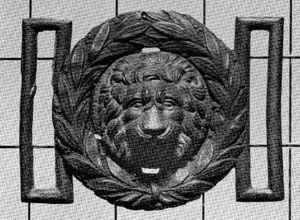
Figure 211
The full-flowing mane on the beast on this plate identifies it as a
lion. The device would have been appropriate for wear by the Albany
Burgesses Corps, which, when founded in 1833, almost immediately adopted
the lion's head as its distinctive insignia. The unit continued to wear
this plate for about half a century. While that unit's cap plate (fig.
170) is much more formal and is without a lion's head, its buttons
contain the lion—with head turned to half-right—as a principal
ornament. While it is probable that the original die for this cast-brass
plate was sunk for the Albany organization, the manufacturer would not
have hesitated to offer it for sale to any interested Militia unit.
USNM 60479-M (S-K 235). Figure 212.
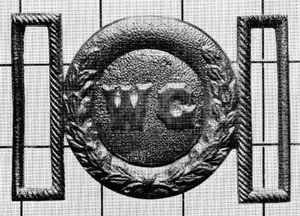
Figure 212
The raised letters "W G" on this cast-brass and gilded plate would have
been suitable for many Militia units of the period. We can
only suggest that it may have been worn by members of a "Washington
Greys" or "Washington Guard" from Pennsylvania or New York. A round
plate with an outer wreath would have been more appropriate for officers
than for enlisted personnel.
USNM 604137-M (S-K 293). Figure 213.
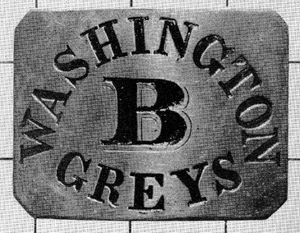
Figure 213
The waist-belt plates shown in the U.S. Military Magazine[132] for the
Washington Greys of Philadelphia and Reading, Pennsylvania, while
indistinct, are definitely not of this pattern. Thus, this brass plate
with its sunken letters filled with black enamel must have been worn by
yet a third unit with such a name. Additional specimens in the national
collections have the company letters "G" and "K."
USNM 604294-M (S-K 450). Figure 214.
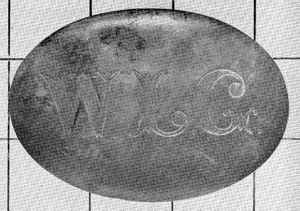
Figure 214
This oval, convex, brass plate, with two studs and a hook soldered to
the reverse for attachment, very probably was originally a shoulder-belt
plate. The letters "W L G" incised on the obverse are very patently the
added work of an engraver of no great talent. The letters doubtless
stand for Washington Light Guard, and, since there were several Militia
units of that designation, it seems possible that one of the less
affluent units bought the plates and had them engraved locally.
USNM 604386-M (S-K 533). Figure 215.
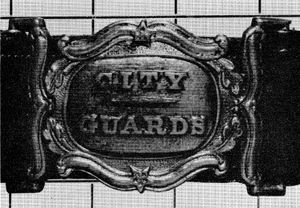
Figure 215
There were City Guards in Charleston, South Carolina, New York City,
Philadelphia, and possibly in other places. Thus it is impossible to
determine just which of these units wore this cast-brass plate. The
ornamented outer oval is typical of the 1840's.
USNM 60206-M. Figure 216.
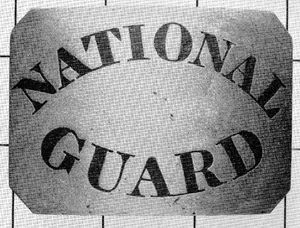
Figure 216
A number of Militia units carried the designation "National Guard." The
unit that used this particular plate was from New Jersey, for scratched
on the reverse is "Sergeant O. Clinton, October 9th, 1851, 1st Reg
Hudson Brigade, NJSM"; However, the adjutant general, State of New
Jersey, was unable to give any information on such an organization. The
specimen is cut from rolled brass with sunken letters filled with black
enamel.
¶ Shoulder-belt plates underwent the same transition as cap plates did
beginning about 1837-1838, with the single die strike plate yielding to
the composite plate, and applied devices being attached to oval,
rectangular, or rectangular "clipped corner" plates. While some single
die plates were made and worn after 1840, no composite types
that predate 1835 are known. The following group of shoulder-belt plates
are typical of those that first appeared about 1840. Of these, several
continued unchanged through the Civil War and into the 1870's and
1880's.
USNM 604341-M (S-K 497). Figure 217.
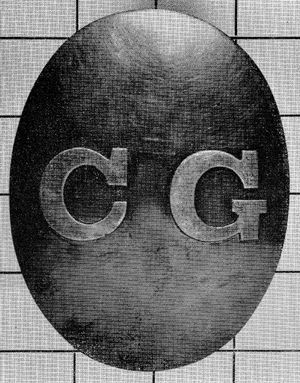
Figure 217
This unusually large, oval, brass plate with the letters "C G" in silver
applied with wire fasteners is another of that sizable group of lettered
insignia that cannot be attributed definitely to a particular
organization. The "C G" may stand variously for City Guard, Cleveland
Greys, Charleston Guard, or some other organization. With a stock of
oval and rectangular blanks and a set of lettering and number-cutting
dies, an almost limitless combination of plates could be turned out by a
single manufacturer.
USNM 604470-M (S-K 617). Figure 218.
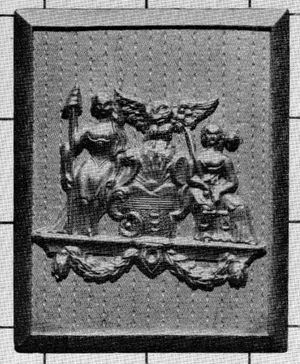
Figure 218
The basic form of this brass plate—with one of the many variations of
the seal of the State of New York[133] applied with wire fasteners—is a
copy, with minor changes, of the bevelled plate prescribed for the
Regular Establishment in 1839. Distinctly an officer's plate, it would
have been appropriate for artillery or staff.
USNM 604331-M (S-K 487). Figure 219.
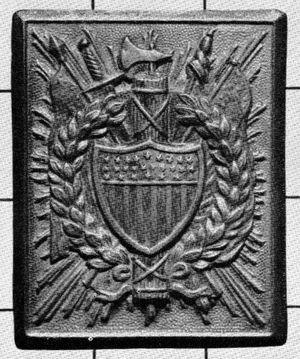
Figure 219
This composite plate, struck in brass, has a bevelled, rectangular base
almost identical to the base of the 1839 regulation plate (see fig. 86).
The design consists of a silvered center ornament comprising a trophy of
flags, a sword, and a liberty pole surmounted by a wreath of laurel
inclosing fasces and a Federal shield with 26 stars in its canton. This
silver ornament is applied with four simple wire fasteners rather than
soldered. Since the sun rays in the background radiate outward
not from the center but from the edge of a circle about 1-1/2 inches in
diameter, almost any desired center ornament could have been added to
the basic strike, or the plate could be struck a second time to add a
device integral to it. Thus the background portion of the specimen must
be considered a stock pattern. A print of the National Guards of
Philadelphia in U.S. Military Magazine for October 1841 shows an
officer wearing a similar plate. If the stars are significant, the plate
can be dated between 1837 and 1845.
USNM 604471-M (S-K 618). Figure 220.
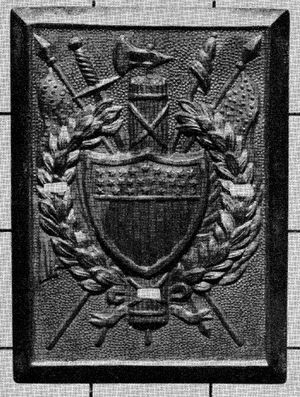
Figure 220
In this plate, the center ornament used in the preceding specimen has
been struck directly in a rectangular, bevelled background. However, the
background of this plate has a stippled surface rather than a sunburst.
An interesting feature is that there are four slots punched through the
plate for the attachment of an additional device over the wreath and
shield. This is another of the many examples of how a unit might have an
insignia distinctive to itself at little extra cost. This plate is
obviously of a stock pattern. The national collections also contain a
die sample of this particular plate.
USNM 604472-M (S-K 619). Figure 221.
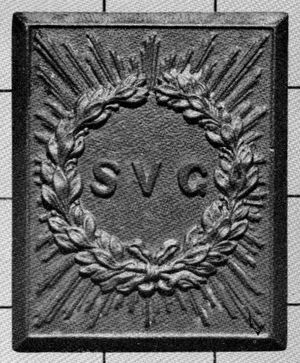
Figure 221
Another example of the rectangular, bevelled-edged, shoulder-belt plate
for officers is this brass-cast copy of the 1839 Regular Army
pattern with the wire-fastened letters "S V G" substituted for "U. S."
The specimen bears a touchmark "W. Pinchin Philad" on the reverse (see
p. 33). The unit for which this plate was made is unidentified.
USNM 604394-M (S-K 541). Figure 222.
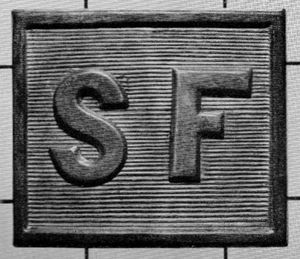
Figure 222
The silver letters "S F" applied with wire fasteners to the small brass
plate are most appropriate for the State Fencibles of Philadelphia, and
it is believed to have possibly been worn by that unit in the 1840's. A
print in the U.S. Military Magazine[134] portraying this unit shows an
officer wearing a plate of an entirely different design, but since a
plate in this simple form would most probably have been worn by enlisted
personnel, and the soldier in the print is to be seen only from the
rear, such identification as to unit may be correct.
USNM 604339-M (S-K 495). Figure 223.
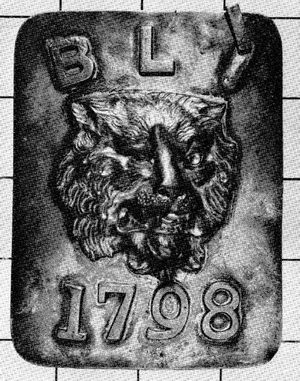
Figure 223
This unusually large silver-on-copper plate with its brass letters "B L
I", "1798", and brass tiger's head is attributed to the Boston Light
Infantry. The applied devices are attached with simple wire fasteners.
The date 1798 is believed to be the year of the original organization of
the unit, but the adjutant general of the Commonwealth of Massachusetts
was unable to verify this.
USNM. 604351-M (S-K 507). Figure 224.
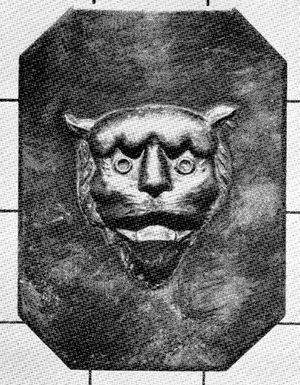
Figure 224
The New York Military Magazine provides us with a strong clue in
identifying this clipped-corner, bevelled-edged brass plate with a
silver-on-copper tiger's head applied. In a sketch of the Light Guard of
New York it is related that, following a visit in 1836 to the Boston
Light Infantry, members of the company "adopted, as part of their
uniform, a silver tiger's head, to be placed on the breast plate, as a
further memento of the spirited and elegant corps whose guests they had
been."[135] This specimen is in agreement with that description.
USNM 604352-M (S-K 508). Figure 225.
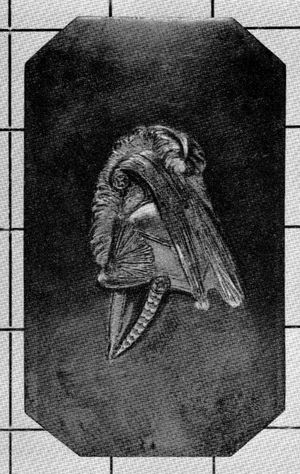
Figure 225
An unusual manufacturing technique was used in making this plate. It was
struck in very heavy brass about 1/16 inch thick and the whole tinned;
then, all the tin on the obverse, except that on the crested helmet
device, was buffed away, giving the center ornament the appearance of
having been silvered. The specimen obviously was made for a particular
mounted unit, designation unknown. An interesting detail is the letter
"A" on the half-sunburst plate of the dragoon helmet device.
USNM 604350-M (S-K 506). Figure 226.
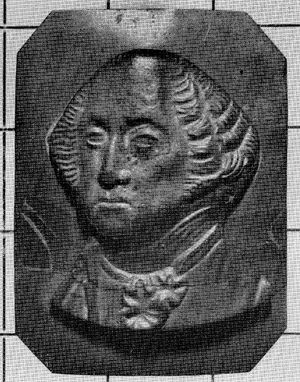
Figure 226
This plate, which is of brass with a cast, white-metal likeness of
Washington applied with wire fasteners, may well have belonged to either
the Washington Greys of Philadelphia or the unit of the same designation
of Reading, Pennsylvania. Prints of these two organizations in U.S.
Military Magazine[136] show profiles on the shoulder-belts plates,
although the plate of the Reading unit is depicted as being oval.
USNM 604337-M (S-K 493). Figure 227.
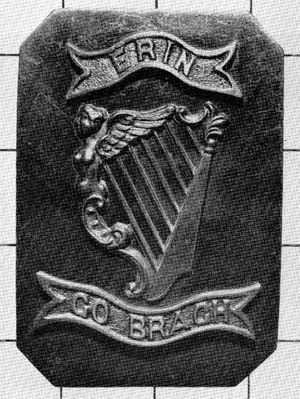
Figure 227
This brass plate with its wire-applied devices obviously belonged to an
Irish-group Militia unit. The Huddy and Duval print of the Hibernia
Greens of Philadelphia[137] definitely depicts an Irish harp on both the
shoulder-belt plate and the cap plate, but the motto "ERIN GO BRAGH" is
not included. The specimen would have been suitable for several Militia
organizations, such as the Irish Jasper Greens of Savannah, Georgia, and
the Montgomery Hibernia Greens. Its devices are wire-applied, and it
possibly was a stock pattern.
USNM 604340 (S-K 496). Figure 228.
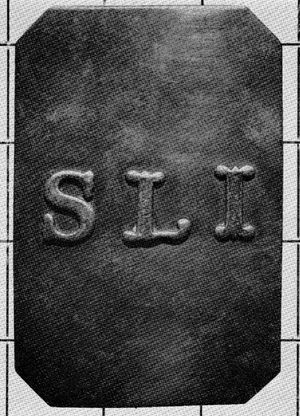
Figure 228
This plain brass plate, having wire-applied pewter letters "S L I" is
believed to have been worn by the Salem Light Infantry of Massachusetts.
USNM 604343-M (S-K 499). Figure 229.
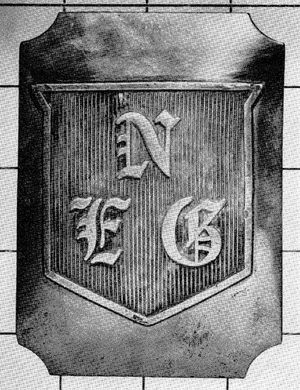
Figure 229
Letters signifying the New England Guards are embossed on a shield of
white metal that is attached to this brass plate, which has scalloped
corners. Although the officer depicted in the Huddy and Duval print of
the New England Guards[138] wears a waist belt rather than a shoulder
belt for his sword, the soldier standing in the background is shown with
crossed shoulder belts. Thus, this plate may have been an item of
equipment for enlisted personnel rather than for officers.
USNM 604342-M (S-K 498). Figure 230.
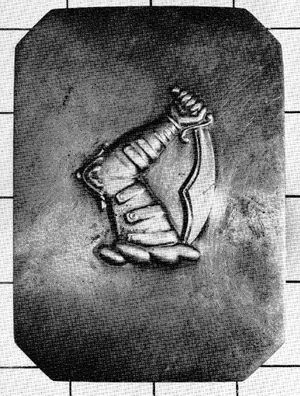
Figure 230
Although the white-metal arm and sword on wreath device wired to this
large brass plate immediately identifies the origin of the specimen as
Massachusetts, the considerable heraldic license taken by this
insignia-maker is only too evident. When the Massachusetts State seal
was first adopted in 1780, the blazonry of the crest was given as
follows: "On a Wreath a dexter Arm cloathed and ruffled proper,
grasping a Broad Sword...."[139] The designer has placed the
arm in armor and replaced the "broad sword" with a scimiter-like, edged
weapon. The use of the crest of a state seal or coat of arms to indicate
the state was common usage, with the eagle-on-half-globe of New York
providing an excellent example. This plate would have been appropriate
for wear by any Massachusetts unit, and is thus considered to have been
a stock pattern.
USNM 604454-M (S-K 601). Figure 231.
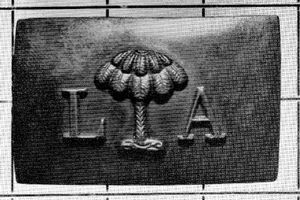
Figure 231
The silver palmetto tree identifies this as a South Carolina plate. The
letters "L" and "A" are subject to several interpretations, the more
probable being "Light Artillery." The devices are attached with simple
wire fasteners, and the basic brass plate can be considered to have been
a stock item adaptable to any number of units.
USNM 60357-M (S-K 113). Figure 232.
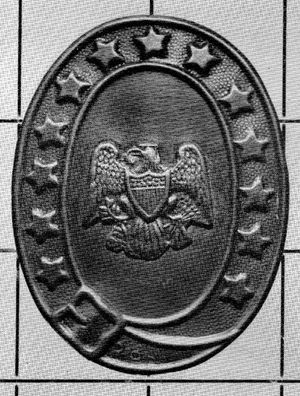
Figure 232
This brass, lead-backed badge bears no devices that would assist in
identifying it as to unit, and its general composition would have made
it appealing to more than one Militia organization. It is considered a
stock pattern. The stars-on-belt motif, forming the border of the oval,
is very unusual, as are the 14 arrows in the eagle's left talon and the
star beneath its beak. The center eagle device is applied with simple
wire fasteners.
¶ Following the War with Mexico, many State Militia, especially those in
the south, began using their state coats of arms as the principal
devices on their waist-belt plates. The plates for officers followed the
earlier pattern for Regulars, a round device clasped within an outer
ring. Plates of enlisted personnel more often were rectangular, but
there were many exceptions. The following series includes examples of
both types.
USNM 604221-M (S-K 377). Figure 233.
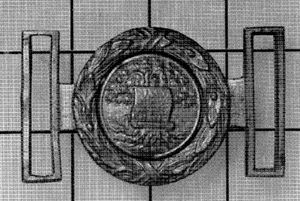
Figure 233
The old Alabama State seal with a representation of a map of the State
hung from a tree trunk, as depicted on the inner ring of this cast-brass
waist-belt plate, became obsolete after the Civil War when the
"reconstruction" government changed the device to that of an eagle
resting on a Federal shield. Some years later, however, the original
seal, in somewhat modified form, was readopted. Although made in the
early 1850's, plates of this type were worn by personnel of the
Confederate States Army throughout the Civil War. Many plates of this
same basic pattern were made in England and run through the blockade.
USNM 604389-M (S-K 536). Figure 234.
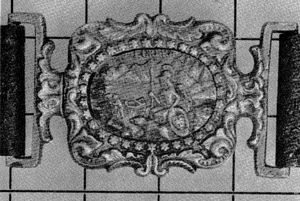
Figure 234
The 31 six-pointed stars in the outer ring of this cast-brass plate
bearing the central elements of the California State seal
indicate that it was made after statehood was granted in 1850 but before
1858 when Minnesota became the 32d State. Actually, this design for the
arms of the State was adopted in anticipation of admission to the Union,
on October 2, 1849.[140] The ornate design of this plate is more
characteristic of the 1840's than later, indicating that it was made
very early in the 1850's.
USNM 604224-M (S-K 380). Figure 235.
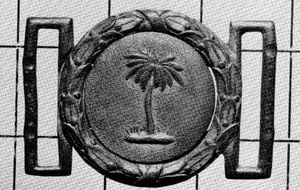
Figure 235
The palm tree, standing alone, although sometimes mistaken for the
palmetto of South Carolina, is representative of the State of Florida.
Thus, this plate is ascribed to Florida Militia, about 1850. The late
Richard D. Steuart, of Baltimore, Maryland, an outstanding authority on
Confederate equipment and accoutrements, was firm in asserting that this
pattern should be ascribed to Florida.
USNM 604124-M (S-K 280). Figure 236.
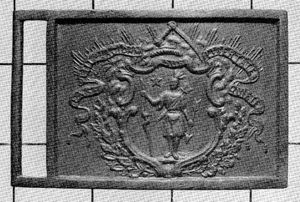
Figure 236
While cast-brass plates of this type were first made in the early
1850's, their use continued for 20 years or more after that decade. The
principal device on this specimen is taken from the arms of the
Commonwealth of Massachusetts. The form of the plate is identical to the
pattern of the eagle-wreath plate adopted by the Regulars in 1851.
USNM 604244-M (S-K 400). Figure 237.
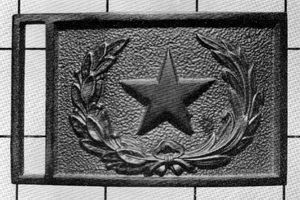
Figure 237
The star device was used by the Militia of both Texas and Maine, as well
as by volunteer units located in other states; thus, this plate cannot
be ascribed to any particular geographical area. Plates such as this,
with the silver wreath of laurel and palm, are patterned directly after
the basic plate prescribed for officers of the Corps of Engineers in
1841. They would have been stock items for general sale.
USNM 604242-M (S-K 398). Figure 238.
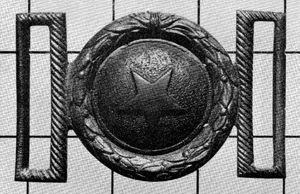
Figure 238
This cast-brass officer's plate, a pre-Civil War product of American
manufacture, would have been appropriate for wear by Texas
Militia. Obviously a stock pattern, it would also have been sold to
Militia organizations in other parts of the country. As in the case of
most round plates, the outer ring is of a standard design; variation in
pattern would occur on the inner ring.
USNM 604125-M (S-K 281). Figure 239.
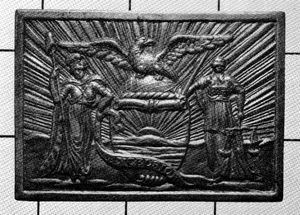
Figure 239
This brass-struck rectangular plate carries the arms of the State of New
York[141] with its familiar eagle-on-half-globe device. The whole is
superimposed on a sunburst background. The plate originally was made for
Militia, but it is conceivable that such a plate may have been worn by
early uniformed police.
USNM 60487-M (S-K 243). Figure 240.
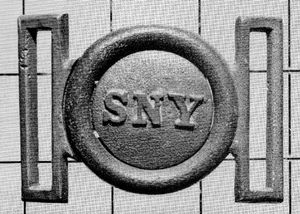
Figure 240
This brass-cast plate with its letters "S N Y" for State of New York is
copied directly from the 1836 plate for noncommissioned officers of the
Regular Establishment. The example is the oldest known use of the
letters "S N Y" for New York Militia. In later patterns, the letters "S
N Y" and "N Y" were placed on rectangular plates and on oval plates worn
on the waist belt and on cartridge boxes just prior to and during the
Civil War. Small square plates with silver, Old English letters "NY" are
included in the 1900 catalog of the Warnock Uniform Co. of New
York as regulation pattern that year for National Guard officers.
USNM. 604141-M (S-K 297). Figure 241.
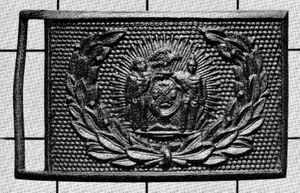
Figure 241
This cast-brass plate bears the arms of the city of New York
superimposed on an almost full sunburst. The surrounding wreath of
laurel is taken directly from the plate authorized for general and staff
officers of the Regular Establishment in 1832. While this is thought to
be the plate for the New York City Guards, for whom a matching
shoulder-belt plate is known, there is the possibility that it was also
worn by uniformed police of the 1850's.
USNM 604393-M (S-K 340). Figure 242.
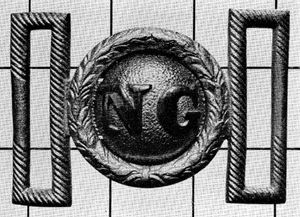
Figure 242
A stock pattern, this cast-brass and gilded plate would have been
appropriate for any of the several organizations called "National
Guards" or "National Greys" that existed in a number of states. The
letters "N G" do not connote the National Guard as we know it today.
USNM 604136-M (S-K 292). Figure 243.
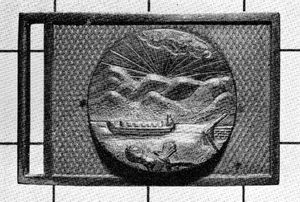
Figure 243
The center piece applied to this cast-brass plate with wire fasteners
bears an early form of the arms of the State of Ohio.[142] The plate
proper has holes in it other than those needed to apply the present
device, which indicates that it was a stock part, or possibly that the
present center device is not original to the plate.
USNM 604130-M (S-K 286). Figure 244.
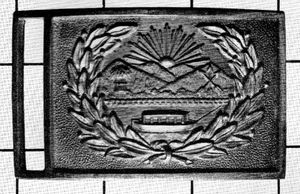
Figure 244
This plate bears another variation of the Ohio State arms. Here, the
arms lie within a wreath as prescribed for Regular general and staff
officers in 1832. The entire specimen is cast in brass; the wreath, sun,
arrows, canal wall, and hull of keelboat are silvered.
USNM 60474-M (S-K 230). Figure 245.
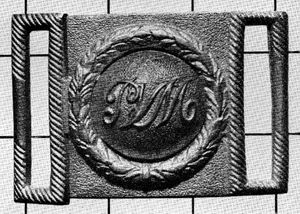
Figure 245
Officers of the Pennsylvania Volunteer Militia wore plates of this type
in the 1850's, although most were discarded in 1861 when
Pennsylvania troops went into active Federal service. The outer ring,
with floral wreath design, has been modified to give the appearance of a
solid rectangle. Another plate in the national collections bears the
letters "P V M" with the conventional outer ring.
USNM 60480-M (S-K 236). Figure 246.
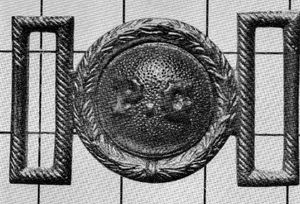
Figure 246
Just prior to 1850 there were two Militia units in Philadelphia using
the letters "P G" to indicate organizational designation—the
Philadelphia Guards and the Philadelphia City Greys. This brass-cast
plate is believed to have been worn by the Philadelphia Guards, whose
buttons were marked "P G." The buttons worn by the Philadelphia City
Greys carried the three letters "P C G."[143]
USNM 604147-M (S-K 303). Figure 247.
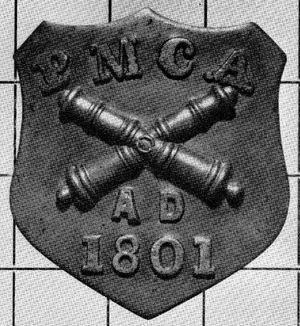
Figure 247
The letters and device on this rather unusual brass plate make its
identification easy. The letters stand for the Providence [R.I.] Marine
Corps Artillery; the date 1801 is the unit's original organization date.
The crossed cannon indicate Militia artillery. The letters and numerals
are of white metal and brazed to the plate. The brass crossed cannon are
affixed with wire fasteners. The reverse is fitted with a broad tongue
and two wire hooks for attachment.
USNM 604455-M (S-K 602). Figure 248.
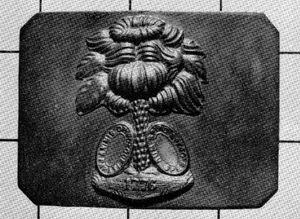
Figure 248
Although this specimen is not so old as the similar South Carolina plate
described previously (fig. 162), it is believed to date about 1850. The
plate proper is of rolled brass, and the applied device, which comprises
well-known elements of the arms of South Carolina, is struck in brass
and attached by means of two wire staples and leather thongs.
USNM 604253-M (S-K 409). Figure 249.
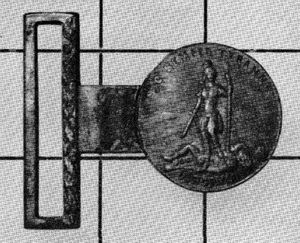
Figure 249
This plate, carrying the Virginia seal, was made about 1850 for wear by
officers. Similar plates made by British manufacturers during the Civil
War to be run through the blockade are generally
distinguishable by their unusually sharp, clean die work. The center
device of this specimen is struck in brass and brazed in place; the
remainder of the plate is brass-cast.
USNM 60489-M (S-K 245). Figure 250.
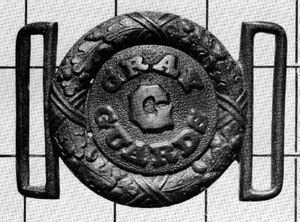
Figure 250
The unit for which this plate was made cannot be precisely identified.
It is reasonable to assume that there were several Militia organizations
called "Gray Guards." The central "G" probably indicates "Company G."
The whole is cast brass.
USNM 60490-M (S-K 246). Figure 251.
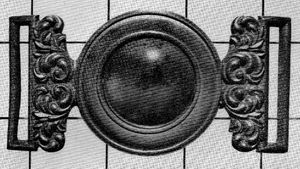
Figure 251
This plain brass plate of unusually fine manufacture is very definitely
a stock pattern which could have been sold without ornament or, as was
more likely, with a center device added by soldering or brazing. The
plate was cast in three pieces, with the round center brazed to the belt
attachment. It was bench-fitted, as indicated by the numbers on the
reverse of the inner and outer rings.
USNM 60498-M (S-K 254). Figure 252.
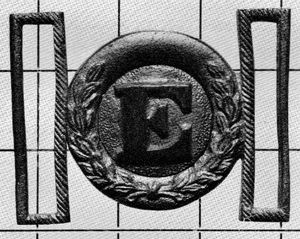
Figure 252
This is a typical stock pattern with the company designation "E." Other
specimens in the national collections have the letters "D," "F," "K,"
and "R." Although rather crudely cast in brass, this piece has been
bench-fitted and then gilded.
USNM 60492-M (S-K 248). Figure 253.
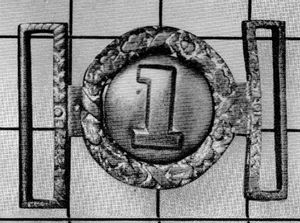
Figure 253
This is another stock pattern with company designation. In this case,
the numeral "1" has been applied with wire fasteners rather than cast
integrally with the two portions of the plate. The national collections
also contain similar plates with the numerals "2," "26," and "36."
USNM 60468-M (S-K 224). Figure 254.
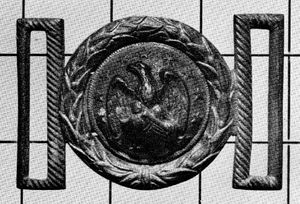
Figure 254
This is another typical stock pattern with the eagle-on-shield device
surrounded by 13 5-pointed stars as the center ornament. It is cast in
brass in two pieces. An example of this plate, on a belt, formed part of
a cased Sharps rifle outfit displayed at the 1960 National Rifle
Association meeting in Washington, D.C.
USNM 60499-M (S-K 255). Figure 255.
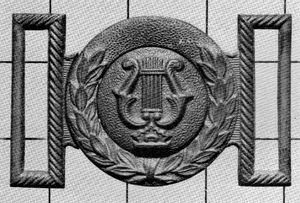
Figure 255
The musician's lyre has never been strictly a military ornament, being
widely worn by civilian bands; thus, this plate cannot precisely be
identified as military or nonmilitary. Unlike most plates of this type
and period, the entire piece is struck in brass rather than cast.
USNM 60485-M (S-K 241). Figure 256.
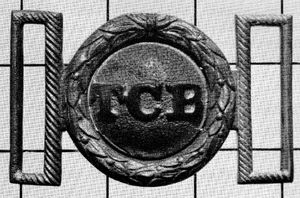
Figure 256
The letters "T C B" on this brass-cast plate open wide the doors of
conjecture as to interpretation. Possible combinations range from
Trenton City Blues (if such a Militia organization ever existed) to Troy
Cornet Band, a nonmilitary unit. Plates such as this can seldom be
positively identified.
USNM 60478-M (S-K 234). Figure 257.
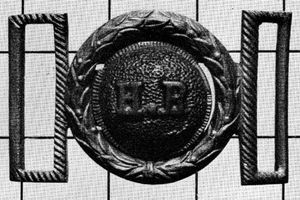
Figure 257
As in the case of the preceding plate, the letters "H R" on this
specimen cannot be specifically identified. Similar unidentified plates
in the national collections have the letters "S O I" and "P B."
USNM 604167-M (S-K 323). Figure 258.
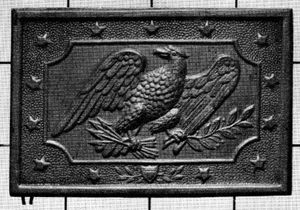
Figure 258
This plate is known both in heavy metal stamping and in thin, cheap
brass. Examples of the latter type appear to have been struck in the
period of the 1890's from a die then 50 years old. A plate similar to
this one has been excavated from a Civil War battlefield site. A stock
pattern, the design was obsolete for issue to Militia before
the Civil War, but it is known to have been continued almost to the end
of the century for use by groups such as secondary school cadet corps.
¶ The shoulder-belt plates worn in the 1850's were little changed from
those of the preceding decade. In the Regular Establishment the shoulder
belt and plate for officers had been discarded in favor of the waist
belt for carrying the sword, but Militia officers—bound by no
regulations—continued to wear the shoulder belt. Enlisted personnel
wore at least one shoulder belt, and in many cases used two belts, which
crossed, one belt carrying the cartridge box and the other the bayonet
and scabbard. Mounted Militia sometimes wore the saber on a waist belt
and the carbine cartridge box on a shoulder belt. It is interesting to
note that the custom of using elements of state seals on waist-belt
plates was not followed to any great extent in the embellishment of
shoulder-belt plates except in the Southern States.
USNM 604451-M (S-K 598). Figure 259.
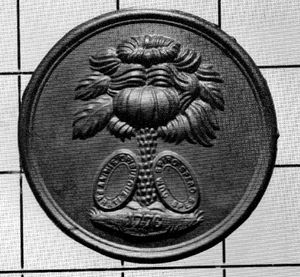
Figure 259
In size and pattern this plate is exactly like that prescribed for the
Regular Establishment in 1841, substituting the arms of South Carolina
for the eagle. It possibly may date as early as 1845. Made for South
Carolina Militia, plates similar to this were worn during the Civil War
and several have been recovered from battlefield sites. The specimen is
struck in brass and the reverse filled with lead. It has three bent-wire
fasteners imbedded in the reverse, which indicates that it was
decorative rather than functional. A similar plate with elements of the
Virginia State seal is known. Modern reproductions of both are being
sold.
USNM 604446-M (S-K 593). Figure 260.
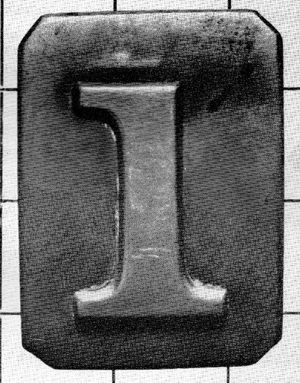
Figure 260
A popular stock pattern of the 1850's, this design with the silver
numeral "1" on a rectangle of rolled brass was worn for at least half a
century after it first appeared. Similar plates are known with all
numerals through 9 and a few higher numbers. Other plates of the same
general type are known with company letters "A" through "M." The plate
proper is fitted with two brass wire hooks and a medium width tongue,
indicating a functional use. The numeral is attached by means of two
staples with leather thongs reeved through on the reverse of the plate.
USNM 654360-M (S-K 516). Figure 261.
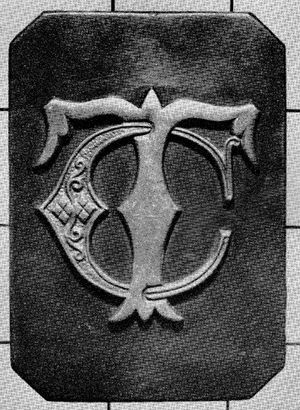
Figure 261
This rolled-brass plate with its silver "TC" monogram is presently
unidentified. In the national collections there is a Militia
helmet with the same device used as part of the cap plate; also known is
another insignia, comprising the monogram alone, that was used as a
cartridge-box device. New York Military Magazine for July 17, 1841,
refers to the elegant armory of the Troy [N.Y.] Corps where the Light
Guard of New York had been visitors. This plate may have been an
insignia of that organization. The monogram is affixed with staples and
leather thongs, and the plate proper carries a large safety pin soldered
to the reverse for purely decorative attachment. It is unknown whether
the safety pin fasteners are contemporary with the plates to which they
are attached. Rudimentary safety pins were known in Egypt before Christ,
but they apparently did not appear in America until the 1830's and
1840's. Walter Hunt patented the first American safety pin in 1849.[144]
USNM 604361-M (S-K 517). Figure 262.
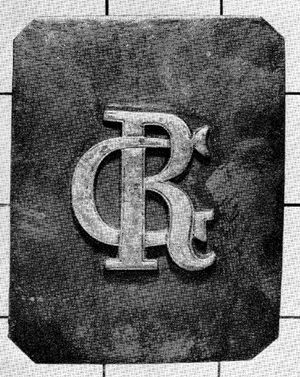
Figure 262
Several Militia organizations of the 1840's and 1850's were called
"Republican Guards," and this silver "RG" monogram on a rolled-brass
rectangle would have been appropriate on shoulder belts of so-named
units. The monogram is affixed with wire fasteners, but the means of
attachment for the plate proper are missing.
USNM 604362 (S-K 518). Figure 263.
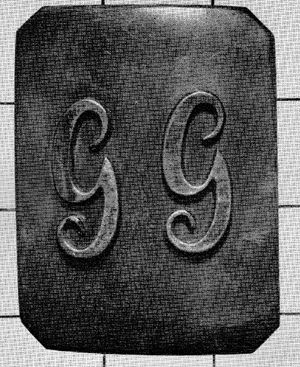
Figure 263
The silver letters "GG" on this rolled-brass plate present several
possibilities for identification. Among the uniformed Militia
units of the 1840's and 1850's were Garibaldi Guards, German Guards, and
Gray Guards. This piece could have been the device of any of the three.
The letters are affixed with wire fasteners, and a safety pin is
soldered to the rear of the plate proper for decorative attachment.
USNM 604363-M (S-K 519). Figure 264.
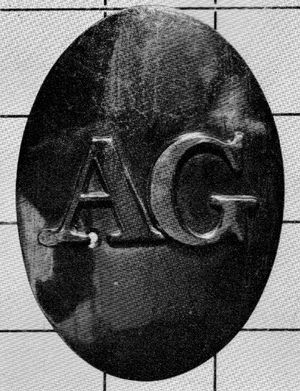
Figure 264
This oval brass plate with the wire-affixed silver-on-copper letters
"AG" is unidentified, but it might well have been worn by the American
Guards, or by a uniformed company from some city as Atlanta or Albany,
with the letter "G" representing "Grays," "Guards," "Grenadiers," or the
like. It was attached to the belt with three simple wire fasteners.
USNM 604335-M (S-K 491). Figure 265.
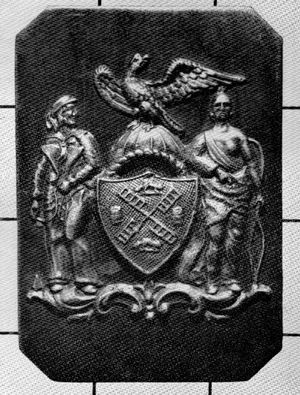
Figure 265
The white-metal device on this brass plate comprises elements of the
arms of "New Amsterdam" topped by the crest of the arms of New York
State with supporting figures representing the original Indian owner of
Manhattan Island and the mariner who became the first white settler. The
specimen is believed to have been worn by the New York City Guard. The
device is affixed with three staples originally intended to be reeved
through with leather thongs, although now bent over. The means of
attachment of the plate proper are missing.
USNM 604364-M (S-K 520). Figure 266.
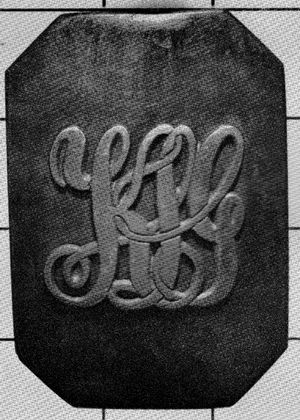
Figure 266
The letters "K L G" forming the white-metal monogram on this brass plate
indicate that it could well have been worn by the Kentish Light Guard of
Rhode Island. The monogram is attached by means of two staples with
thongs reeved through, and the plate proper is fitted with four similar
staples. The reverse bears the hallmark of William H. Horstmann and
Sons, well-known military outfitters of Philadelphia.
USNM 604336-M (S-K 492). Figure 267.
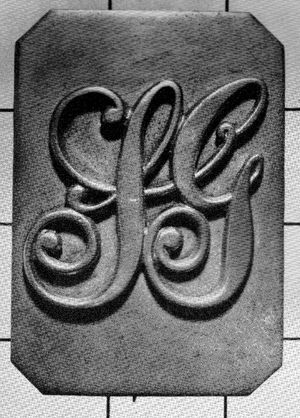
Figure 267
The white-metal letters "SG" on this brass plate lend themselves to so
many interpretations that no identification is attempted. The applied
device has two staples for attachment, and the plate proper is fitted
with a safety pin on the reverse.
USNM 604338-M (S-K 494). Figure 268.
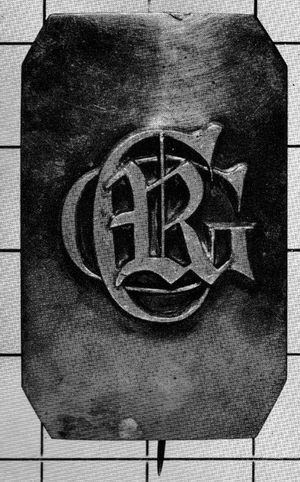
Figure 268
Many volunteer companies used the designation "Rifle Guards," and this
plate with the initials "C R G" probably falls into such a category. The
"C," of course, cannot be identified. The monogram is of
pewter and has three round lugs fitted through holes in the plate proper
for attachment with pins. The plate itself has a safety pin soldered to
the reverse for attachment.
USNM 604347-M (S-K 503). Figure 269.
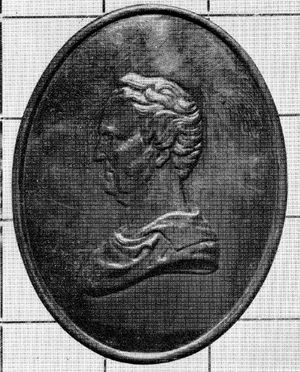
Figure 269
Although this plate bearing the profile of Gen. Winfield Scott is very
similar in design and construction to several bearing the head of
Washington and dated much earlier, it is believed to postdate the War
with Mexico when Scott's popularity was at its zenith. There were
several volunteer units called "Scott Legion" during this period. The
piece was struck, with a tin backing applied, and the edges of the
obverse were then crimped over. It is fitted with three wire staples for
attachment.
USNM 604327-M (S-K 483). Figure 270.
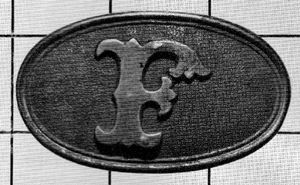
Figure 270
This is a stock pattern in cast brass. It is oval with raised edges and
has a white-metal "F" applied with simple wire fasteners. Although the
piece has the appearance of a waist-belt plate or cartridge-box plate,
the wire fasteners on the reverse indicate that it was intended for
shoulder-belt wear. In the national collections is a similar plate with
the letter "I," indicating that the letters designate companies of
larger units rather than a unit itself.
USNM 604356-M (S-K 512). Figure 271.
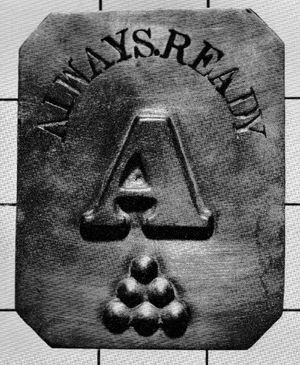
Figure 271
This rolled-brass plate with a wire-applied silvered "A" and pile of
cannon balls topped by the hand die-struck motto "ALWAYS READY" is
unidentified beyond the fact that it was worn by a member of Company A
of a Militia unit using a popular motto. Similar specimens in the
national collections have center letters "B," "D," and "E." The plate
was attached to the shoulder belt by means of two flat brass fasteners
soldered to the reverse. The fasteners are almost as wide as the plate
itself.
USNM 60409-M (S-K 165). Figure 272.
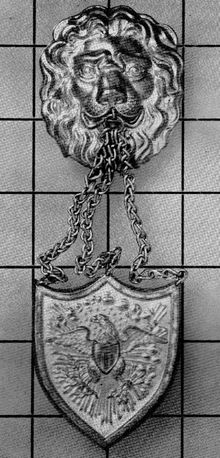
Figure 272
The baldric is a highly ornamented wide sash normally worn by drum
majors and sometimes by band leaders. During at least part of the Civil
War, baldrics were worn by some aides-de-camp, and the 1902 uniform
regulations specified them for Signal Corps officers. This specimen and
the one that follows are the earlier of several examples in the national
collections; they fall in the early 1850's. The shield, suspended from a
lion's mouth by small chains, carries an eagle with a shield on its
breast. The stars and edge of clouds, above, are somewhat similar to
those on the 1851 regulation waist-belt plate. The whole is
superimposed on a three-quarter sunburst. Both the lion's head and the
shield are fitted with simple wire fasteners for attachment.
USNM 66622-M. Figure 273.
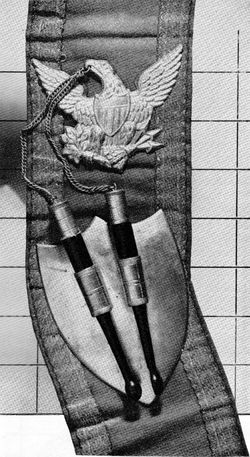
Figure 273
The device is attached to a red, gold-edged-embroidered baldric worn by
the drum major of the 72d New York Militia during the Civil War but
believed to ante-date 1861. The brass shield, with ebony drum sticks, is
suspended from an eagle of the 1834 Regular Army pattern for wear as a
cap device. The shield, convex with beveled edges, is very similar to
waist-belt and shoulder-belt plates of about 1850.
¶ Few Militia gorgets are known, and this scarcity leads us to believe
that few were made and worn, despite the Militia's love for the "gay and
gaudy." Still, some units did adopt them, and officers of the Portland
[Maine] Rifle Corps were still wearing them in the late
1850's.[145] As a military symbol for officers, the gorget passed its
zenith in the late 18th century. Gorgets were worn during the War of the
Revolution by both American and British officers, and the British also
gave them to Indian chiefs as marks of authority. Officers in at least
one regiment of the Regular Establishment wore them as part of their
regulation dress about the turn of the 19th century, but they were not a
part of the prescribed uniform during or after the War of 1812.
USNM 60311-M (S-K 67B). Figure 274.
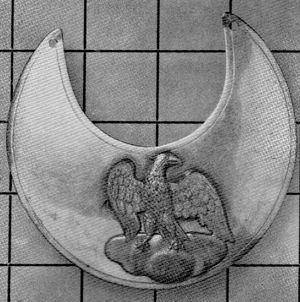
Figure 274
This gorget, of gilded brass, is of 2-piece construction. The
eagle-on-clouds, very similar to cockade eagles worn in 1808-1821, is
attached by four wire fasteners rather than brazed. The engraved edging
on the gorget proper is rather crudely done. Although composite insignia
did not come into general use until the mid-1830's, it seems reasonable
to assume that this particular design of the eagle device applied to the
chapeau might equally have been applied to a gorget. A similar specimen
in the national collections has a silver-on-copper eagle instead of a
brass one.
USNM 60310-M (S-K 67A). Figure 275.
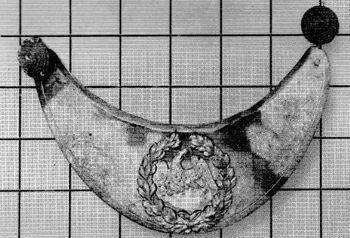
Figure 275
This gorget is of 3-piece construction, the specimen proper being of
brass and the wreath and eagle of gilded brass applied with wire
fasteners. Although the eagle is of the early "on-clouds" design, the
feel of the piece is later, and this, together with the rather wide
crescent indicate that it belongs to the period of the 1830's and
1840's.
USNM 60309-M (S-K 66). Figure 276.
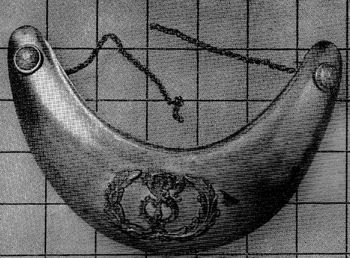
Figure 276
This brass gorget, with wreath and letters in applied silver, is an
example of one of the later types worn by Militia. The letters
"S F" are interpreted as "State Fencibles," and the "Excelsior" buttons
on the ends of the crescent identify the origin of the unit as New York
State. Fencibles were basically troop units organized for home defense
only. There was a volunteer Militia company called the "State Fencibles"
in New York City as early as 1800. It apparently lost its identity as
such in 1847 or 1848 when the organization split, half entering the 8th
Regiment and half entering the 9th Regiment of New York State
Militia.[146]
U.S. Government Printing Office: 1963