IN all ages sculpture has been intimately allied with architecture,
somewhat as the blossom with the tree, reaching often its noblest
expression as an efflorescence of decoration upon the surface of a
building or as separate forms within it; springing up in statue, tomb or
pulpit like bursts of flowery growth in the forest. Nature in a
marvellous way adapts the colour and forms of the blossoms to the
character and structure of the tree and shapes of the woodland flowers;
for example, the foxglove spiring up amid the tree trunks to the
character of its environment. In the spirit of this example the sculptor
fashions his designs in conformity with that of the architecture,
whether it be for decoration of the building’s surface or for a separate
contributing feature.
Such coöperation with the architect demands at once fertility of
imagination and considerable self-restraint; an appreciation of the
larger qualities of design as displayed in the architecture, mingled
with a natural feeling for the charm of minute and exquisite
workmanship; a personal feeling, subordinated to the main design, yet in
this subordination finding an increase of force. For the modelled
ornament is itself enriched by its enrichment of the wall-surface; and
the statue which has fine architecture for its setting receives
therefrom additional dignity, provided always that the sculptor has
adapted the lines of his figure to those of the architecture. If he miss
the spirit of the latter and design his subject independently his statue
loses the benefit of the alliance and its importance is overpowered by
the necessary predominance of the architectural effect. Nor is the
failure to secure harmonious relation between the sculpture and the
architecture always to be laid to the sculptor. The architect’s design
may be lacking in taste and dignity; or, if good in itself, yet without
adequate or any provision for sculptural embellishment; the latter being
resorted to as an afterthought. Examples of this kind are not
infrequent.
The best opportunity that we have in this country of studying sculpture
in its relation to architecture is in the Library of Congress, for here
the design was deliberately planned to include sculpture and painted
decoration, and on a scale of unusual magnitude. Some critics are
disposed to complain of an overelaboration in the decorative scheme, but
at least every item of the sculpture was organic and structural in
intention. We may differ, that is to say, as to the propriety of
introducing so much embellishment, but the latter everywhere grows
naturally out of its position and has its closely planned function in
the general design.
The sculptural decoration of the staircase hall was entrusted to Philip
Martiny, except the figures in the spandrils over the main arch which
fronts you as you enter. These were executed by Olin L. Warner—whose
work has been reviewed in another chapter—and in their Greek-like
monumental simplicity and repose, their freedom from all accessory aids
to decoration and their avowal of the decorative value of pure form they
are in marked contrast to the French spirit of Martiny’s work. For the
latter, a naturalised Frenchman, represents the French training,
comparatively unaffected by the American environment. As a boy he was
employed with his father in modelling and carving ornamental designs;
thus gaining a familiarity with ornament before he proceeded to study it
systematically as a designer, from which stage he passed on to the
further studies of a sculptor of the figure. The feeling for decoration
is with him an instinct, cultivated in the best of all schools, that of
practical experience; his knowledge of historic forms a habit of memory,
and his versatility in adapting, skill in device and manipulative
facility, the product of habitual practice.
For the newel posts of the staircase he executed the female figures
holding a torch aloft; but these reveal mainly the results of good
teaching. They are not a personal expression of himself. In a seated
figure, however, designed as a Soldiers’ and Sailors’ Memorial for
Jersey City, he reached a very considerable degree of monumental
dignity; yet it still appears to be true that his real bent is toward
decoration. In this he displays creative fancy and a most charming
faculty in the use of form. Witness this marble balustrade, divided into
compartments by a series of plain posts, between which are suspended
festoons of fruit and flowers, with baby forms astride them. Each in a
vein of playful fancy personifies some occupation, art or science, and
the emblems typifying them are introduced as accents of surprise in the
composition. The whole is alive with graceful animation and yet
preserves a rhythmical dignity, a variety in uniformity, like the play
of notes in succeeding bars of music.
Its freedom of fancy and rich effect recall the qualities shown in
Lorado Taft’s decoration of the Horticultural Building at the World’s
Fair; a decoration of rare distinction. Indeed the prime feature of this
artist’s work at its best is the decorative character of the
composition; as in “The Solitude of the Soul,” which involves an ideal
motive, but is perhaps happiest in the grouping of the nude figures
around the mass of unhewn rock.
The relief ornament in the ceiling of the dome and in the frieze of the
entablature was modelled by Albert Weinert. He was limited by the
architect to the well-known Roman forms revived by the sculptors and
painters of the Italian Renaissance, but has treated them with so much
individual feeling that one may regret he was denied the opportunity of
creating the designs. For one cause of the dearth of decorative
sculptors in America may very reasonably be attributed to the hesitation
of architects to permit the use of any forms except such as they can
find authority for in historic ornament. Martiny, we have seen, was
allowed to invent the design for the staircase; a quite unusual
privilege, which has resulted in a memorable work of art, almost unique
in the country. Usually the architect from books and photographs
indicates what forms shall be adopted, and these are reproduced by the
draftsmen in working drawings, which are handed over to a contractor to
be executed by journeymen modellers. Their business is to copy the
drawing exactly. If they have any individuality of feeling it is
suppressed; the divorce between design and craftsmanship is perpetuated,
and dry conventionalism results. In the degradation of design which
ensues from this slavish adherence to historic precedents, producing, be
it noted, not a revival of the precedent but, for the most part, a dead,
inert copy, a thing not to be taken seriously as decoration, the
sculptor is discouraged from associating himself with design. He may
have the gift of decoration, but it lies uncultivated, since he will not
work except with reasonable liberty. And he is right, for the only
decoration that is of any vital worth is such as grows under the hand of
a man whose brain has conceived it and is controlling continually its
growth. He may be influenced by historic precedent or be working in the
freedom of his fancy; in either case, his work has personal, vital
significance. Significantly bad it may be, and this I suspect is the
architect’s apprehension; yet, provided it have significance, there is
some prospect of improvement: just as we reach what measure of virtue we
have through our faults. For of all men the most exasperating is he who,
without character enough for fault or virtue, methodically maintains a
level of innocuous mediocrity. Equally exasperating is decoration of
this kind, and it is a kind that is prevalent everywhere.
The dome of the Library is supported on eight piers, each formed of a
cluster of columns, one of which projects more prominently than the rest
and is surmounted by a figure personifying some department of civilised
life or thought. Its function seems to be to prolong the upright line of
the pier to the bottom of the triangular pendentive which connects the
spread of the arches; at any rate, those figures which most simply
suggest the vertical direction, with as little play of contour lines as
possible, appear most conformable to their position. The one that most
thoroughly fulfils this condition is the figure of “Philosophy,” by Bela
L. Pratt. One arm hangs down, the other is drawn up at the elbow
supporting a book; the line of the drapery on one side comes squarely
down to the feet and on the other is slightly varied by the drawing back
of the leg from the knee. The figure is of ample proportion, with a
sweet gravity of mien; the head, being slightly bowed, which, as it is
viewed from below, brings the face agreeably within the line of vision;
a point that has been overlooked in some of the other statues. Without
having any particular force, the figure nevertheless impresses by the
sobriety of its lines and mass and by its reserve of feeling. The value
of these qualities can best be appreciated when one is actually
standing in the dome and able to compare the figure with the other
corresponding ones, all of which by reason of more varied contours seem
inferior to it in decorative appropriateness.
This same sculptor was entrusted with the designs of the six spandrils
over the entrance doors. The forms are graceful and repeat with pleasant
variation the curve of the arch, but they do not adequately fill the
space, and are wanting in architectonic character. Just what I mean can
better be understood by comparing them with Warner’s spandrils,
mentioned above. Then one can scarcely fail to notice how much more
structural in feeling are the latter, organically related to the arches
and to the space, truly architectural in their character. Pratt’s
strongest point seems to be expression of sentiment, exemplified in his
busts of Colonel Henry Lee and of Phillips Brooks; in some low-relief
portraits of children and in the heroic figure of a soldier for St.
Paul’s School, Concord, New Hampshire. In all of these it is not so much
the characteristics preëminently sculptural that we are conscious of, as
the quality of the sentiment; and this same quality, portrayed with
graceful inventiveness, represents the measure of his architectural
decoration. It is, therefore, in such examples as the medallions in the
pavilions of the Library, personifying the four seasons, that he appears
at his best; for in these the sentiment is expressed not only by suavity
of line, but by a sensitive treatment of the various planes. Like his
low-relief portraits they have very strongly the pictorial quality. That
he has, however, a feeling as well for the sculptural quality of form is
evident from two nude female figures which he has executed in marble,
“Study of a Young Girl” and “Study for a Fountain,” in which the charm
of sentiment and form are very happily united.
It is not within the scope of this essay, which is considering the
principles of architectural sculpture, to note each of the remaining
seven statues in detail, especially since most of them are by sculptors
whose work has been reviewed elsewhere. And the same applies to the
sixteen bronze statues that stand below upon the marble balustrade of
the gallery. These represent real or imaginary portraits of men
illustrious in the departments of civilised life and thought,
personified above, and their function is to relieve by a series of
spiring forms the level lines of the balustrade. And here again, if I am
not mistaken, those which with least disturbance of contour conform to
the character of a simple shaft are the most effective. Thus we may be
disposed to feel that, viewed in relation to its position and function,
the “Solon” by F. Wellington Ruckstuhl protests too much its own
individuality, and that the greater reserve of C. E. Dallin’s “Newton,”
of John J. Boyle’s “Bacon” and “Plato,” of Paul W. Bartlett’s
“Michelangelo,” of Edward C. Potter’s “Fulton,” of Charles H. Niehaus’s
“Gibbon,” of George E. Bissell’s “Kent” and the “Henry” by Herbert
Adams, makes them more valuable as sculptural adornments to the
architecture. And, after all, this qualification is the most important
one in the interest both of the architecture and of the statue itself.
If it were possible to study the statues independently of their
surroundings we might find that some I have mentioned are intrinsically
inferior to some of those omitted; and I well remember that some which
now fill their present position with quiet effectiveness seemed less
interesting before they were put in place. For the ultimate test of the
statue, as a part of the architectural scheme, depends less upon its
intrinsic than its extrinsic value; not so much upon what it is as upon
how it coöperates with the architecture, lending it some accent of
piquancy or elaboration and drawing from it dignity and enforcement. Nor
is the truth of this weakened by the fact that you visit many a church
in Italy solely to study some piece of sculpture without one thought of
the architecture, unless it be a regret that the shrine is not worthy of
its treasure. In such a case the intention of the sculpture was not
architectonic; whereas in the Library of Congress, as in all other
buildings in which the coöperation of the sculptor has been deliberately
included, the ideal is to make the two arts mutually reënforcing. The
architecture being necessarily predominant, the sculpture which does not
conform to the limitations imposed upon it will suffer by comparison,
while, on the other hand, through conformity it will secure additional
measure of impressiveness.
Of the elaborate decoration of the rotunda clock by John Flanagan I
cannot speak from knowledge; and, without having seen it in place, it is
unfair to judge of the effect of the mingling of precise elegance in the
lower part with the florid arrangement above of Father Time and two
female figures. But before leaving the Library we may find in the
corridors of the entrance hall four relief-panels, by R. Hinton Perry,
personifying Greek, Roman, Persian and Scandinavian “Inspiration.” They
seem to me to represent this sculptor at his best, displaying a gift of
imagination and very charming treatment of form, regulated by reserve
and taste; for these last qualities are not so conspicuous in some of
his work. The fountain group, for example, which embellishes the terrace
in front of the Library, is a clever exhibition of technical skill in
the representation of form and movement, but pretentious. Its lack of
cohesion as a group may have been less the affair of the sculptor than
of the architect, since the latter had provided for the figures three
equal-sized niches; but on the other hand the sculptor seems to have
regarded them as features to be ignored. His central figure of Neptune
is entirely outside the arch, while the sea-nymphs on their restive
steeds seem to be trying to get clear of the architectural restraint.
Restiveness, indeed, is the chief suggestion of the whole; an uneasy
collocation of aggressive forms, out of keeping with the somewhat severe
character of the Library façades.
Yet one should not overlook the indubitable power and vigour of these
figures, especially of the Neptune; only regretting that imagination has
entered so little into its composition. In this respect the “Primitive
Man and Serpent,” a later statue, is much more acceptable. It also has
power, the more effective that its energy has been controlled, and the
sculptor, in thinking out this conflict between creatures of such
different forms, has produced a composition which is full of
imagination and very statuesque. Again he exhibits his mastery of form
in a statue of “Circe”; a finely poised, supple figure, with a superb
action of voluptuous invitation. Moreover, the conception is
satisfactorily idealised, a quality which does not always characterise
his treatment of the female form. The one, for instance, in the group of
“The Lion in Love” is a very ordinary reproduction of the model; nor can
I find in his Langdon doors for the Buffalo Historical Society’s
Building, the same imaginative control of form as in the Library
reliefs. Perry, in fact, seems to be an impetuous, forceful person,
drawing largely upon his temperament and with the unevenness of result
very usual in such cases. Yet he has a mastery of technique so much
above the average that, when he regulates it with reserve and kindles it
from his imagination, he produces work which is full of interest.
In this brief survey of the decorative sculpture of the Library of
Congress it has been possible to touch only upon some of the most
conspicuous features, but much else that is worthy of study upon the
spot will be found scattered over the big building, especially in the
private reading-rooms of the Senate and of the House of
Representatives. The scheming and supervision of this vast amount of
beautiful detail was the work of Edward Pearce Casey, an architect with
considerable knowledge of decoration and feeling for it. In some cases
he was coöperating with sculptors who had had no previous experience in
decorative work, and he was himself without practical experience, having
but recently returned from his studies at the École des Beaux Arts, and
the bias of his taste, if I mistake not, was toward the exuberance and
profuseness of Roman ornament. When, therefore, we take into
consideration the vastness and varied features of the undertaking, we
can scarcely avoid the conclusion that it has been upon the whole very
well carried out; probably quite as well as was possible under the
conditions of having to complete so huge a work by a given date. For one
of the difficulties with which our artists, architects, sculptors and
painters alike have to contend is the inexorable public demand that the
building with all its embellishments shall be “turned over” on contract
time. Very few men are sufficiently sure of their position, and likewise
possessed of sufficient conscience in the matter, to insist upon
adequate time for the development of their decorative scheme.
This insistence upon securing as far as possible an ultimate perfection
of detail, guided by a judgment and taste of unusual refinement, is a
notable characteristic of the architect, Charles F. McKim, as it is also
of the sculptor, Augustus Saint-Gaudens. Hence to this day the pedestals
in front of the Boston Public Library are without the groups of statuary
that the latter is to execute. Again, as an example of choiceness and
reserve in the sculptural decoration of a building, one may cite McKim’s
treatment of the façades of the University Club, New York. Indeed, they
are quite too choice and reserved to satisfy the popular taste, and it
is the latter which unfortunately regulates in the majority of instances
the character of our public buildings, with an inevitable tendency
toward pretentiousness of mass and floridness of detail. On the other
hand, from the point of view of the sculptor, McKim’s influence has been
too personal, too exclusively along the line of reproducing the style
and feeling of antique art, to have been of much direct benefit to the
development of decorative sculpture in this country. He is, perhaps, too
intolerant of failure to venture upon experiments.
For certainly the development has been attended with some results to
which it is impossible to point with appreciation. Do we find an
example of this in the Appellate Court in New York? Its exterior is
profusely covered with sculpture; but can one truly feel that it is
decorative? On the contrary, it may occur to some that the building
would have had more dignity unadorned; that it is overloaded; its quiet
lines disturbed by the flutter of forms against the sky; that the
figures themselves lack the decorative quality, dryly formal in some
instances and in others without sufficient reserve of line and mass;
overpowering, in fact, the structure, while individually, at the
distance from which they are seen, of not much moment.
Civic pride, doubtless not uninfluenced by the discovery that there is a
commercial value in esthetics, has led to the embellishing of office
buildings and hotels with sculpture. With the former continually
increasing their vertical direction, it has been no easy matter to
devise for them a suitable kind of plastic decoration. Perhaps the most
appropriate has been the flat ornamentation, occasionally burgeoning
into rounded forms, which Louis H. Sullivan, a Chicago architect, has
used. He has the advantage of being his own designer for decoration as
well as for structure; and having a very logical mind he designs both
with a strict regard for organic propriety, while his fecund
imagination enables him to create freely forms of inexhaustible variety
and full of the charm of vital freshness.
In the case of many office buildings, especially those erected some
years ago, the sculpture has the appearance of being added as an
afterthought, so inadequate is the provision made for it. There is a
conspicuous instance of this on lower Broadway, New York, four colossal
figures in bronze by J. Massey Rhind being placed upon a projecting
cornice some twenty feet above the level of the street. They have no
structural relation to the building and thereby lose much of their
effectiveness.
This sculptor, a native of Edinburgh, where his family, as architects
and otherwise, have long been identified with the civic improvements
that have gradually made the modern city so conspicuously handsome, is
one of the most skilful of our architectural sculptors. He has not the
play of fancy nor the graceful facility in decorative forms displayed by
Martiny; but, instead, a strong instinct for big simplicity of design,
and for the constructional value of the figure as an adjunct to the
architecture. When, as in the spandrils for the Smith Memorial Arch at
Philadelphia, he is elaborating a part of the structure, he works with
as much of the feeling of an architect as of a sculptor, showing an
unmistakable appreciation of the material. In the case of these
spandrils it is granite, and the treatment of the drapery and wings has
been admirably adapted to the quality and character of the material and
to the exigencies of cutting. A similar recognition of the claims of the
material is displayed in some granite lions, designed for the Ehret
mausoleum in Woodlawn Cemetery, and again in the caryatides, executed in
pink Tennessee marble for the Macy Building in New York. The latter,
moreover, are particularly successful in suggesting their architectural
function of carrying a superincumbent weight, rigidity of form and grace
of line being fortunately mingled. Among the varied subjects which have
occupied this sculptor is an elaborate fountain for “Georgian Court” at
Lakewood, New Jersey. The design comprises a male figure, almost nude,
standing in a chariot formed of a huge shell, these parts being in
bronze, while the sea-horses that he drives and the attendant Nereids
are of marble. The composition, enclosed within a circular basin and
rising pyramidally toward the centre, is full of spirit, with especial
force and freedom of movement in the marble portions. Yet it is probably
true that J. Massey Rhind discovers his best qualities as a sculptor
RECUMBENT FIGURE
By J. Massey Rhind
From the Tomb of Father Brown in the Church of Saint Mary-the-Virgin,
New York

PUMA
By A. Phimister Proctor
Prospect Park, Brooklyn
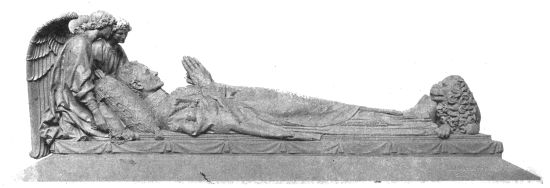
in less exuberant designs. Indeed, his most impressive work, within my
knowledge, I should take to be the recumbent portrait-statue of Father
Brown in the Church of Saint Mary-the-Virgin in New York. It is very
truly monumental, with an exquisite placidity and tender gravity of
feeling; the lines of the figure severely simple, the vestments,
notwithstanding some elaboration of delicate detail, subordinated so
completely to the form, and the latter in its supple fixity expressive
of the eternal calm of the head. It is a figure from which emanates a
very unusual atmosphere of spirituality.
I wonder if there is not more incentive to revere the memory of a man in
a memorial like this, representing him folded in the sleep of death,
than in one which figures him as he lived! Yet the latter is the more
usual method in this country, possibly because of the lack of space in
city churches. Saint-Gaudens has done some memorable work in this
direction, notably in the portrait-panels of James McCosh at Princeton,
and of Doctor Bellows in the Church of All Souls, New York; so too have
French and Herbert Adams. Again in mural tablets, bearing instead of a
portrait some ideal figure, work of technical merit and of very
beautiful spirit has been done by Clement J. Barnhorn of Cincinnati.
Especially would I mention an angel design of his for the Poland
Memorial and a “Madonna of the Lilies.” In both these low reliefs he
displays a quite exquisite appreciation of the beauty of simplicity of
design, of the expression of tender differences of plane, and of the
mingling of firm and vanishing lines. Nor in the refinement of treatment
is the structural character of the figure and drapery lost.
DOMESTIC DESIGN
Among the various decorative designs by Barnhorn is one for a cottage
piano, carved in wood. Conventionalised tree-forms compose the legs,
extend a bough from each side along the lower part of the keyboard and
then mount up the sides and spread their foliage in a canopy along the
top, a draped figure occupying the centre of the front. The design has
one good feature, that it grows out of and expresses the character of
the material. Yet it deviates from what experience suggests to be worth
regarding as an axiom: that in such objects as are actually a part of
the structure of a room, for instance a mantelpiece, or in those which
by their size and importance emphasise their structural character, the
contours should conform to the straight and curved lines, which
experience has found necessary in architecture. In a word, that the
structure of the object should be first attained and the decoration then
subordinated to it, instead of the latter being allowed to encroach upon
the structural lines. An ivy-mantled tower takes its place suitably in
an open-air setting; and, on the other hand, a small object indoors,
such as a clock on a shelf, may assume any variety of outline; but with
the larger, formal ones, whether built into, or detached within, the
room, you cannot indulge in irregular contours without making them
amorphous, more or less clumsy or else trivial. And this piano seems
open to the charge of cumbersomeness, which again offends the instinct
of the musician, who would feel in the instrument a suggestion of
yielding to the vibrations of the music—a feeling so prominent in the
delicate simplicity of the violin and to be desired in the form of all
instruments. Yet one welcomes in this piano the inventiveness of fancy
displayed, and the skill and individuality of the craftsmanship,
delighted to find an American sculptor applying his art to the
intimacies of domestic design.
Among the few sculptors who have used the figure decoratively in the
arts of minor design none has displayed a livelier imagination or a more
charming facility than Henry Linder. His little conceptions for
candlesticks, inkwells, electric-light stands and other objects of
domestic use are full of grace and spirit. Another decorative sculptor
of rare feeling and unusual technical resources is M. M. Schwarzott. I
remember well a panel of his representing fishes sporting in the waves,
which, as Mr. Hartmann fitly observes, is worthy of a Japanese
coppersmith.
That very few sculptors have devoted themselves to domestic design is
due as well to the dearth of really decorative genius among them as to
the claims of other commissions upon the time of those few who possess
it. Partly, perhaps, to a prevalence of “high-art” notions, which regard
a statue as, of itself, more worthy than a decorated object,
irrespective of the skill and craftsmanship or the beauty of the design
involved. Yet, I doubt if a prejudice of this sort would deter a man
really possessed of the decorative instinct. It is the lack of this and
of appreciation on the part of the public for personal work which forms
a bar to our advancement in the arts of design; this and the preference
of the architects for reproducing commercially the time-honoured forms.
Encouraged by them our rich people prefer a room in which every detail
is dryly imitated from a dead period to one animated by the art and
spirit of to-day. So they take their morning coffee à la Louis Quinze;
their luncheon in a Dutch kitchen; drop into an affectation of Japan
for a cup of afternoon tea; dine in the splendour of the Grand
Monarque; sip their liqueurs in Pompeii, and rest at length from this
jumble of inert impressions in a chamber à l’Empire. Small wonder if
their appreciation of art should be a pose and their actual
encouragement of it nearly null!
OPEN-AIR DECORATION
The first great opportunity in this country for sculptors to prove their
capacity in the larger field of outdoor decoration was presented by the
World’s Fair at Chicago, and it brought into prominence three animal
sculptors, E. C. Potter, Edward Kemeys and A. Phimister Proctor. The
first named collaborated with French in the quadriga above the
water-gate and in the groups of the “Bull” and “Farm Horse” in front of
the Agricultural Building, displaying in the one case a fine command of
spirited movement and in the other a feeling for large simplicity. These
qualities he combined most effectively in the equestrian statue of
Washington for the Place de Jéna in Paris, in which again his
collaborator was French. The “Wild Cats” by Kemeys, which stood upon the
ends of two of the bridges, were quite extraordinary examples of animal
sculpture. Their stealthy, supple movement, as, bellies low to the
ground, they advanced with that slow, clinging step which precedes the
spring, represented the closest study of the naturalist, while the
treatment of the lines and masses was altogether a sculptor’s,
monumental in a high degree.
Proctor also is a naturalist and ardent sportsman, camping alone for
weeks together in the forests and studying the big game at close
quarters. Perhaps his instinct is naturalistic rather than sculptural.
At any rate, the strongest feature of his work is its realism; yet his
“Pumas,” at one entrance of Prospect Park, Brooklyn, shows a fair
measure of monumental feeling. The quadriga which he modelled for the
United States pavilion at the Paris Exposition was dwarfed by the
structure, but when reproduced for the Ethnological building at the
Pan-American Exposition proved extremely effective. On this occasion,
however, it was only a part of the structure’s embellishment and not a
single emphatic note, for which purpose it was too slight in
composition, unduly stringy and deficient in cohesion. Proctor himself
had felt it to be so, and the lesson was not lost upon him, for in his
next opportunity of essaying an important composition he produced
something of much more sculptural import. This was a group executed for
the Pan-American Exposition, which embodied the idea of “Agriculture,”
representing a man at the plow-tail, while a boy urged on the team, a
horse and an ox. It was a very remarkable example of the force of
realism, when governed by the sculptural intention. The mass was most
imposing and full of variety of movement, through the contrast afforded
by the figures: the horse vigorously straining at the traces, the ox
exerting his slow, lumbering weight; the boy in free action, while the
man’s was concentrated and checked. Moreover, it told its story so
simply and directly, with such complete recognition of the essential
points. As a piece of artistic realism, it was alive with the spirit of
Millet—altogether a most memorable work.
At this exposition was also seen a quadriga by Frederick G. R. Roth. His
previous work had consisted of statuettes executed in bronze, revealing
a close study of unusual kinds of action, such as that of an elephant
balancing himself upon a tub. He modelled a pair of these in which the
mass is poised, respectively, upon the forelegs and the hind ones.
Although they are very small in size they are large in feeling, with
breadth of modelling and enforcement of the suggestion of bulk and
weightiness. The expression of movement is admirable: felt continuously
throughout the mass and varying so characteristically, according as each
part contributes to the action. Nor does he neglect to secure the
surface-charm of colour and texture in his bronzes; and these little
objects of art make very choice appeal to sight and touch. This charm of
surface is accompanied by a more vigorous display of movement in a
group, which represents “The Combat” between an elephant and a
rhinoceros. The latter, with hind legs planted as firmly as trees, is
ramming his horn into the belly of the other beast, who has rolled over
on his side and is lifting head and trunk in a spasm of pain. Again our
interest is divided between the extraordinary realism of the
representation and the beauty of the surfaces, shown especially in the
slabs and corrugations of the rhinoceros. The stress of movement is
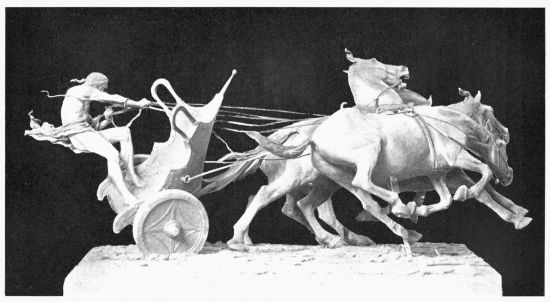
carried still further in the quadriga. It is an incident of a “Chariot
Race”; the vehicle has been whirled on to one wheel, and the driver is
throwing his weight upon the opposite side to restore the balance, at
the same time holding back with all his force against the strength of
the four galloping horses. This group, of full size, executed in
plaster, cannot fail to impress one both by its daring and by the
knowledge and power displayed. Whether it completely convinces one’s
imagination is less certain. The figure of the man does, so also that of
the horse which is plunging in midair; but the hind legs of the others
and the chariot wheel seem rooted to the ground, thereby clogging the
impetus of movement. The group, in fact, raises an interesting point as
to the limitation of the sculptor. A painter could give the wheel an
appearance of revolving, could raise a cloud of dust around the heels of
the horses and by the introduction of atmosphere resolve the rigidity of
lines. Correspondingly, if this group were raised to an elevation so
that the juncture of the wheels and legs with the ground were not
observable, and the whole by distance were enveloped in atmosphere, the
effect upon the imagination would be vastly increased, probably
complete. But when it was seen at Buffalo, on a low pedestal close to
the eye, the deficiencies of illusion were as apparent as they are in
the accompanying illustration. However, granted that the illusion would
be complete, we may question the propriety of expressing in sculpture
such violent movement of progression. If stationary, an equal vehemence
might still be monumental; but can one imagine any structure upon which,
without detriment to its stability and impressiveness, this restless
mass, hurling itself forward from its position, could be placed?
Therefore, the sculptor seems to have landed himself in the predicament
of needing something which he has made it impossible for himself to
procure; due, if I mistake not, to his having forced the medium beyond
its characteristic limits.
Eli Harvey’s observation of wild animals in confinement has resulted in
some excellent statues of lions, jaguars and leopards, all of which
would be eminently suitable for the embellishment of public parks. In
two cases he has used lions as the motive for decorating pediments
intended for the lion house of the New York Zoölogical Society. His work
is at once very true to life and thoroughly sculpturesque.
In all probability, however, the finest animal group which has yet been
produced in this country is the “Buffaloes” by H. K. Bush-Brown. It has
been reproduced as a statuette in bronze, and in this form is a powerful
and impressive work, but to appreciate to the full its conspicuously
monumental character, the dignity of its bulk and of its massed and
rooted energy, one must have seen it in the original colossal size. Well
placed in the natural surroundings of a park, it would present a
spectacle of remarkable grandeur. This sculptor, like his uncle,
CHARIOT RACE
By F. G. R. Roth
Henry Kirke Brown, the sculptor of the equestrian statues of Washington
and General Scott, is a horseman, and his own equestrian statues display
a thorough knowledge, but scarcely that imposing dignity of mass, which
the build of the buffalo made possible for this group.
Whereas at the Chicago Exposition the gaiety of the sculptural
embellishment, with the exception of the Macmonnies’s fountain, was
concentrated on the buildings, and the arrangement of statues and groups
about the grounds had been regulated with reserve, one motive of the
Pan-American was to demonstrate conspicuously how sculpture could be
used in the decoration of open spaces. There must have been many who
felt that this feature was overdone; that the dignity of the vistas was
disturbed by the multiplicity and variety of forms, and that what had
set out to be gay finished by being fidgety. The more so that there was
little relief of greenery, the whole scheme being too exclusively
architectural without the assuaging influence of landscape gardening. If
in lieu of so much sculpture trees had been imported into the scene, its
beauty would have been increased, and the discomfort of the visitor,
unsheltered from the sun, correspondingly diminished. The value of
greenery in displays of this sort is at once an esthetic and a practical
consideration.
The sculpture at this exposition was under the supervision of Karl
Bitter, and his equestrian “Standard Bearers,” surmounting the pylons of
the Triumphal Bridge, were the most arresting features of the scheme.
Ten years earlier he had modelled the colossal groups that stood at the
base of the dome on the four corners of the Administration Building.
They presented a fanfare of form against the sky; and these rearing
horses at Buffalo, with their riders holding aloft a draped flag, had
the same fling of action, only more controlled by experience. Instead of
an explosion of limbs and movement, there was a sustained and
concentrated energy, infinitely more impressive. It is in decorative
subjects of this sort, which permit a certain heroic exaggeration, that
Bitter seems at his best. An Austrian by birth and training, he has the
Teutonic exuberance, touched with the gaiety of the French influence,
and it is when the occasion warrants the exercise of both qualities that
he finds his best chance. When he is deprived of an excuse for festivity
he is liable to abandon himself to an excess of force, as in the
“Atlantes” of the St. Paul Building in New York, which are uniting their
titanic strength with contortion of limbs and muscles to support—one
little balcony! Or if, as in a memorial to the dead, he is constrained
to moderation and set toward the expression of sentiment, his work is
apt to be characterised by sentimentality and ineffectualness. Yet, in
the sitting statue of Doctor Pepper, he has made a sincere attempt to
render in straightforward fashion the personality of the subject. The
figure is realistically treated, even to the adoption of an awkward
pose, which, however, fairly corresponds with the meditative suggestion,
while the expression of the head unquestionably enlists our interest.
Nevertheless, it is in such a group as Bitter furnished for the Naval
Arch at the Dewey celebration, full of stirring action and heroic
suggestion, that he is to be seen most characteristically.
Isidore Konti’s groups at the Buffalo Exposition proved him to be a
decorative artist of unusual versatility. He does not show the same
varied familiarity with ornamental forms as Martiny, but his technique
is scarcely less facile and sure than the Parisian’s, while touched with
much of the Italian naïveté. Gay or serious, according to the subject,
his inventiveness of fancy inclines toward that slightly idealised
realism which characterises the work of many sculptors of the modern
Neapolitan school; a realism that is less the product of any theory of
art, than of the natural adaptability to impressions—a quick perception
coloured by temperament. Thus Konti seems to me at his best when his
fancy moves most simply. A first impression of his group, “The Age of
Despotism,” was very satisfactory. Bold and simple in design, it
represented a man seated in a chariot, erect and cold, with eyes fixed
sternly ahead, and at his side a woman (a courtesan, I took her to be)
lashing on the team of human cattle, while women were dragged in chains
behind. Amid so much trite symbolism here seemed to be a touch of very
naïve and forcible realism. But closer inspection discovered that the
realism was impaired by artifice and artfulness; the woman in the
chariot had wings, and one of the captives carried a pair of scales, a
lapse into abstractions that for myself, at any rate, lessened the value
of the group. On the other hand, in the group upon the Temple of Music,
while abstractions were introduced, they had no other meaning than a
decorative one. The youth with a lyre might represent Apollo, but there
was no need to recognise the fact; he was simply one of a joyous band of
figures, animated with the grace of gaiety, of music and the dance.
These groups were as refined in composition as they were exuberant,
exhibiting the genuine creativeness of an artist who has an instinct for
decoration and a lively delight in the pure expression of line and form,
regulated by an instinct also of artistic propriety. It is eminently a
Latin trait, in which the American is as deficient as the Anglo-Saxon or
Teuton.
Our tendency is to desire a motive in decoration beyond the decorative
one. So we make our statuary expressive of patriotism or what not. Well
and good; but we do so without that instinct of propriety which should
be as careful of the setting of the statue as of the statue itself. Thus
in city squares and public parks we multiply our memorials without
adding, as effectively as might be, to the beauty of their environment.
It was this fact which, by a display of the opposite, the Buffalo
Exposition was designed to enforce. In another chapter I have alluded to
our preference for portrait-statues with their prosaic accompaniment of
tailor-made trimmings to statues which, while commemorating the
individual, would be more essentially decorative. But it is equally to
be desired that better use should be made of such statues as we decide
to encourage; for a statue set down promiscuously in a public square or
thoroughfare, facing in no particular direction, forming the termination
of no vista of sight, supported and isolated by no architectonic
arrangement, loses the greater part of its impressiveness. Indeed it is
very generally forgotten that there is an element of formality in a
statue, which necessitates some formality in its placing, and that the
accompaniment of wriggling paths and of the haphazard sprinkling of
trees, such as we find in our New York smaller parks, is directly
opposed to the spirit of the statue. It is equally a violation of
propriety and a waste of good material to set a fine statue on the line
of a thoroughfare, where it is seldom seen from the front, but
continually passed by unnoticed. Yet these and similar incongruities are
only too frequent.