JOHN LA FARGE has given us two avenues of approach to his personality as
an artist: one through his pictures, drawings, and decorations, the
other through his writings. In the drama of his artistic doings the
writings serve as the chorus, which from its platform in front of the
actual stage interpolates a commentary on the main action, in language
always illuminative, though sometimes of rather complex meaning. For it
reflects, in fact, the complexity of its author’s personality, his
life-long habit of contemplation and the wide horizon over which his
study has roamed, embracing many objects of desire inside and outside
his art, to none of which he can tolerate a short cut, but the
interdependence of which and the relative interest of the paths thereto,
even the inevitable oppositions and compromises, he has always realized
and valued. As Paul Bourget happily says, La Farge’s “least words betray
the seeker of a kind like Fromentin, who thinks out his sensations—a
rare, a very rare power.”
He was a student of art long before he entered upon it as a profession.
It attracted him first as a form of culture, the practice coming later;
quite an inversion of the usual progress of the art student, who gets
manual facility and then culture—sometimes. Nor did art in his early
days present the only form of culture. He received a classical training
of the thorough sort that promotes an intimacy with classic thought and
expression. His father’s house in Washington Square, well stocked with
books and pictures, was the rendezvous of cultivated people, many of
them émigrés of the French Revolution or refugees from St. Domingo.
When he visited Europe in 1856 he stayed in Paris at the home of his
relatives, the St. Victors, where lived his bedridden great-uncle,
author of many works, historical, critical, and artistic, who had known
friends and foes of the French Revolution, had been an émigré in
Russia and still retained his interest in all things, even to the
theatres. Paul de St. Victor, writer and critic, was La Farge’s cousin,
and many remarkable and gifted people came to the house,—Russians,
members of the Institute, priests, art critics, and literary men, among
them Charles Blanc and Théophile Gautier.
La Farge had been taught to draw in a precise, old-fashioned way by his
grandfather, Binsse de St. Victor, a miniature painter of some talent,
and during his visit to Europe he was advised by his father to study
painting under some master, partly as an accomplishment, partly as an
escape from a desultory interest in many things. He, therefore, entered
the studio of Couture, who, however, recommended him to postpone
painting and to study and copy the drawings of the old masters in the
Louvre. “With quite a comprehension of my inevitable failure,” he says,
“I made drawings from Correggio, Leonardo, and others; but my greatest
fascination was Rembrandt in his etchings.” Later he followed the
drawings of the old masters in Munich and Dresden, giving up an
invitation to accompany Paul de St. Victor and Charles Blanc in a tour
of northern Italy. “I have never known,” he writes, “whether I did well
or ill, for I cannot tell what the effect upon me might have been of the
inevitable impression of the great Italian paintings, seen in their own
light and their native place.” He means at that period of his
development, for he saw them later. Next he made a short stay in England
and became acquainted with the works of the pre-Raphaelites, who did not
seem disconnected from the charm of Sir Joshua and Gainsborough, or from
the glories of Turner, “which yet offended by its contradiction of the
urbanity and sincerity of the great masters whom I cared for most.” But
the willingness of the pre-Raphaelites to meet many great problems of
colour attracted him and confirmed him in the direction of his own study
of colour. However, the most important European developments of that
time seemed to him to be represented by Rousseau, Corot, Millet, and
Delacroix. On his return to New York he entered a lawyer’s office, for,
as he says, “no one has struggled more against his destiny than I; nor
did I for many years acquiesce in being a painter, though I learned the
methods and studied the problems of my art. I had hoped to find some
other mode of life, some other way of satisfying the desire for a
contemplation of truth, unbiassed, free, and detached.” His friendship
with William Hunt may have decided him in his career, or his marriage in
1860, which established him in Newport, R.I.
This brief summary represents quite a remarkable method of evolution for
an artist; one that could not be adopted with impunity by many young
men, its very leisureliness offering temptations, of which the least
evil result might be dilettanteism. But La Farge was freed from the
danger by the possession of moral and mental stamina, the breadth of his
sympathies even demanding this gradual development. Nor was it
unaccompanied with strenuousness of interest in
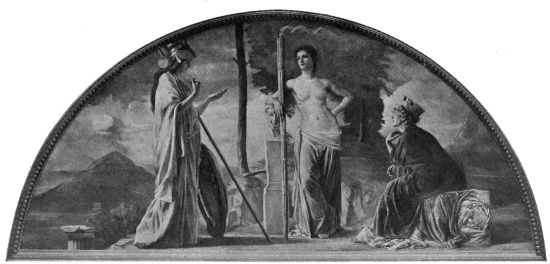
Copyright, 1898, by John La Farge.
ATHENS.
Decorative painting in the Walker Art Gallery, Bowdoin College.
By John La Farge.
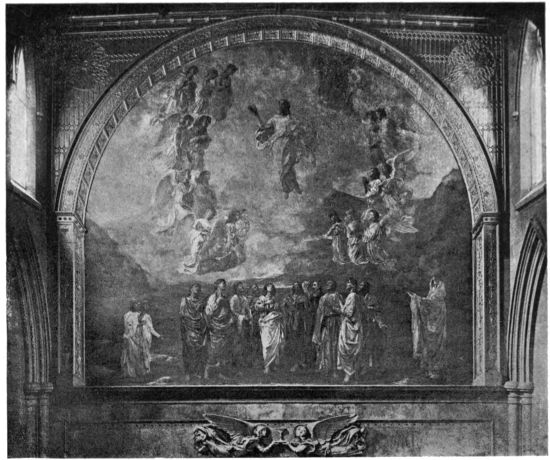
ALTAR PIECE—Church of the Ascension, New York.
By John La Farge.
the various phases of culture, of which art began by being one and grew
to be the most absorbing.
It was significant that this dreamer should be attracted especially by
the nature students among the living painters. That was indicative of
the depth and sincerity of his contemplations. But it is still more
significant that from the start he should have commenced a critical
study of the problems of colour; this proved the independence of his
sincerity. Another point of great significance, as affecting his
subsequent career, is that, although he afterward made a close study of
anatomy, in his apprentice days he seems to have drawn from drawings
rather than from the living model, studying, in fact, the abstract made
by others instead of the concrete directly studied by himself. Thus the
habit of his mind was directed toward the generalization and
significance of the figure rather than to its anatomical facts. This
made him very early an enthusiastic admirer of Japanese art, and has
proved at once the strength and weakness of his subsequent treatment of
the figure.
It is frequently asserted that his drawing is not always correct, and
from the point of view of the schools he would probably himself plead
guilty to the charge. But those who insist upon the point do not perhaps
quite comprehend his motive, which is less the actual structure of the
form than the inherent significance of the figure. Let us grant at once
that the two motives are not antagonistic, that Millet’s “Sower,” for
example, is as structurally correct as it is full of significance. But
that is to put La Farge to the test of one of the greatest masters of
drawing, by comparison with whom very few can stand. By far the greatest
number of draughtsmen, while approaching him in correctness, will be far
behind him in expression. On the other hand, in the case of La Farge,
the significance of a pose or gesture, the vital expression of a figure,
is generally admirable. I have in mind, for example, his drawing of
Bishop Hatto, pursued by rats. The distance from the thigh to the toes
would appear to be exaggerated; but how wonderfully the long drawn out,
tense arc of the figure stimulates the imagination to a realization of
the agony of the crisis. There is another point. The figure, as it is,
so exactly contributes to the decorative balance of the picture. It may
be that the instinct of the decorator determined the length of limb, and
perhaps also, not at all improbably, the influence of the Japanese. It
would not be difficult, for instance, to find in Outamaro’s lovely
prints of women just such an elongation to accentuate the svelte grace
with which he wishes to invest them.
I make this suggestion with more confidence, because one can trace in
the composition of this picture more than a little of the Japanese
arrangement of full and empty spaces; that irregular form of composition
which secures a balance by oppositions rather than by repetition of
similarities. It is, indeed, the method of the nature student, as true
of Velasquez and Rembrandt as of the Japanese. Not that La Farge with
his choice appreciation of the old masters could be insensible to the
influence of the Italians. His great altarpiece of the Ascension in the
Church of the Ascension in New York is reminiscent in its structure of
Raphael’s “Disputá.” The space is very similar in shape, and filled with
a broad band of figures across the base, a central figure in the upper
space, and flanking arcs of angels. Again the mural paintings of “Music”
and the “Drama” in the music room of Mr. Whitelaw Reid’s New York house
were evidently suggested by the pastoral scenes of the Venetian
painters. The latter, however, were themselves, no doubt, suggested by
the desire to emancipate painting from the rigidity of preconceived
formulas of composition, and it is just this attempt to discover a
compromise between the natural and the conventional which is so marked a
characteristic of La Farge’s treatment of mural painting.
It may have been an early feeling after this that at least helped to
draw him toward Rembrandt, especially toward his religious subjects. I
find more than a little of the latter’s influence in the mural paintings
in the churches of St. Thomas and of the Incarnation in New York,
particularly in the solemn, serious naturalism of the grouping; in the
humble devotion with which the spirit of the occasion has been
comprehended, and in the significance of gesture and expression, but
especially of gesture, through which this spirit has been embodied. A
boy’s freshness of faith, dignified by a man’s realization of its
import—a quality very rare at any period, and quite likely to be
overlooked in this one. It is the outcome of a religious temperament—a
thing very different from the religious habit—born of a capacity to
feel deeply the significance of things, and by instinct and culture
fitted to see the beauty inherent in the significance, whether it be the
significance of the spiritual or of the material life or of the subtle
analogy between the two. When the painter can comprehend this and set it
down on the threshold of every-day experience, in such a way as to make
it intimate without being commonplace, its human meaning neither
lessening, nor lost in, the splendour of its expression, we may
reasonably call him great.
And no one denies to La Farge a splendour of expression. He is that
rara avis among artists, who not only sees the world as a pageant of
coloured light, but has found means to express his visions. His
inherited instinct for colour has been assiduously cultivated by
observation and scientific study, the researches of Professor Root of
Columbia University having been enthusiastically followed and adapted by
him to his practical requirements. When circumstances brought to him the
opportunity of executing windows, immediately came into play his
extensive memories, his dreams of possibilities, and, equally, his
independence of conventionalized methods. Finding that he could not
reach adequate results in the material available, and realizing the
weakness of existing methods, he experimented until he discovered the
adaptabilities of opaline glass, which has a suggestion of complementary
colours, “a mysterious quality of showing a golden yellow, associated
with violet, a pink flush on a ground of green.” Moreover, by the
infinite variety of modulations, which its making admits, it allows a
degree of light and shade in each piece of glass, which not only gives
modelling, but increases the depth of tone, sufficient at places to make
the darker parts melt softly into the harsh lead-line. This invention
by John La Farge of the applicability of opaline glass to the making of
coloured windows has put a wide range of means in the hands of the
artist, not only in the general richness and equally possible delicacy
of effect, but in the increased subtlety attainable through
complementary effects and effects of opposition; the material including
all kinds of variety in the texture, quality, thickness, and even
pattern of the glass, and also almost every variation of density and
transparence. It is a palette of extraordinary range, perilously
serviceable in the hands of an ambitious person of meagre knowledge and
feeling, quite susceptive of commonplace exploitation in those of the
ordinary designer. But in the hands of a true artist, who thinks in
colour, and has a store of gathered observations backed with scientific
assurance, it permits the fullest scope to his imagination, and the
opportunity of realizing the most diverse and complex schemes of colour,
allowing him to reproduce much of the mystery that time has wrought into
the mediæval stained glass, and to add to the latter’s chantlike
simplicity of colour and structure the complicated harmonies of modern
music. It is an art, indeed, that brings the decorator within measurable
distance of the musical composer.
The new intent of this glass and the subsequent developments which have
made of it a new fabric were so much the outcome of La Farge’s personal
need of expression that it is not surprising he has reached results
superior to those of others who employ the same medium. A reason which
also contributes to his superiority is that his conception from the
start formulates itself in colour, whereas the genesis of most windows
would appear to be in the lineal design, clothed in colour afterward. In
other words, like every true craftsman, La Farge thinks in his material.
The effect of this has been, at least, twofold. In the first place,
there has always been a reciprocity of influence between his imagination
and his material; while he has been big enough to anticipate the
possibilities, he has been big enough also to accept the limitations of
the medium. In the second place,—and this really follows from the
former,—he has preserved an independence in the character of the
design, neither attempting to reproduce that of the old cathedral
windows, nor dipping, except occasionally, into that universal cook-book
of the average designer, the ornament of the Renaissance. With a larger
sense of fitness he found, if anywhere, a prototype for his motives in
Eastern art, not only in the mosaics of Byzantium, but in the jewelled
inlays, lacquers, textiles, and cloisonné of Japan. Particularly is
this true of the windows of pure decoration which he has executed for
private houses and again of those superb windows in the west end of
Trinity Church in Boston. In these a cultivated taste will be disposed
to feel that the splendour and mystery of the fabric are most abundantly
manifested. It is pure decoration of the most subtle and resplendent
kind.
On the other hand, as soon as the figure is introduced, particularly
when the figure must subserve a religious sentiment, a compromise has to
be effected between the abstract decoration and the concrete form,
between the conventional and the naturalistic. And the inevitable
antagonism between the two has become more difficult to reconcile in
these days, both for the artist and for ourselves who enjoy his work,
because we are no longer satisfied with the simple abstractions of the
human form, which sufficed for the childlike faith and narrower
experience of ancient peoples. In all his figure windows, therefore, it
is most interesting to study how he has eschewed the pictorial motive,
which unfortunately the immature taste of the public so persistently
demands, and to which, either on compulsion or because he knows no
better, the average designer inclines. La Farge, on the contrary, while
frankly admitting the claims or the necessity of naturalistic treatment,
endeavours, as far as possible, to find some modern form of abstraction
for the figure, and to offset it with a freer abstraction or
conventionalization in the rest of his composition; so that while the
significance of the figure, its form and sentiment, is not swamped,
there yet survives the impression that the window is not a picture in
glass, but an elevated decoration of transparent and translucent mosaic,
inlaid in a cloisonné of ornamental lead-lines.
In a brief appreciation of this artist’s work it is natural to dwell
upon him in his capacity of a master decorator, for the whole trend of
his activities, at first, perhaps, unconsciously, later with a purpose
continually strengthened and expanded, has been in this direction. And
he has proved himself a master not only within the restricted field of
American art, but in comparison with the master decorators of Europe.
I have spoken of La Farge’s writings being a commentary upon his
artistic acts. Often it is in a man’s lighter moments that he makes
clear to us the workings of his mind, and La Farge has done so in the
journal which he wrote during a vacation in the South Sea Islands. It is
the spontaneous utterance of a scholar, at once a dreamer and an
analyst; of an artist, also, who sees pictures everywhere; and its
word-painting and many-faceted allusiveness to all kinds of memories,
derived from art and life and literature, render these impressions of
new scenes, which still retain some flavour of the antique world, unique
in their exquisite beauty and suggestiveness. Let me quote one passage:
“From the intricate tangle of green we saw the amethyst sea and the
white line of sounding surf, cutting through the sloping pillars of the
cocoanuts that made a mall along the shore; and over on the other side
of the narrow harbour the great high green wall of the mountain, warm in
the sun, its fringe of cocoanut groves and the few huts hidden within it
softened below by the haze blown up from the breakers. All made a
picture not too large to be taken in at a glance.” Nor yet too distant.
The harbour, observe, is narrow and bounded by a high green wall of
mountain. The picture was not shaping itself to him as it might have
done to the eyes of a pure landscapist, but in a comparatively flat
pattern, as of a wall or window decoration. He sees it with the instinct
of a decorator and with his own personal predilections; for he dwells
upon the combination of green and blue, which any student of his work
may feel to have particular fascination for him. He notes in one part
the tangle of green, its suggestive subtlety of pattern and tone; in
another, where the huts are half hidden, the welcome spot of density;
again,
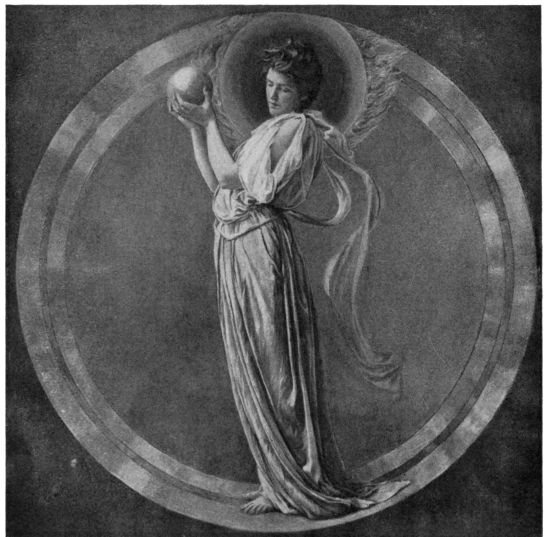
Copyright by John La Farge.
THE ANGEL OF THE SUN.
Decoration in the Church of the Paulist Fathers, New York.
By John La Farge.
the value of mystery in the haze; and finally he correlates the beauties
of contrasted forms and spaces and the varying brilliance and softness
of the coloured light. As I said, it is a decorator’s vision, and the
same in their different degrees of sketchiness is revealed in the
water-colour drawings made at the same time. They are so many notes and
records of a mind perpetually intent on decorative problems.
Recently he wrote a short but exceedingly suggestive appreciation of
Puvis de Chavannes, suggestive most of all because of its conscious and
unconscious implication of his own experience and desires with those of
a brother master in decoration. In their moral and mental elevation
there is much affinity between the two men: Puvis, a Burgundian by
birth, by education a Lyonnais, simultaneously, therefore, romantic and
logical; La Farge, of French descent with romantic and adventurous
associations, yet influenced by the vital practicalness of American
environment. Both have sought to reconcile their respect for tradition
with their interest in the living present; and to recognize the
limitations imposed both by their medium and by their own individual
personality, disciplining themselves to accept the inevitable and to
carry their personal development to its farthest possibility. Its
manifestations in each case are widely different: the robust Puvis
detaching himself more and more from the material and tending to an
extreme of spiritual refinement; the frailer physique of La Farge
reaching out farther and farther toward the interpretation of spirit by
means of material splendour. The differences were personal and local;
but in the quality of their minds and their attitude toward art there is
an unquestionable affinity between these two preëminent master
decorators.
If I read La Farge’s art aright, it is the product of a wide and
penetrating vision, simplified by selection; the theme is then
comprehended in its vital significance, and all the force of his
imagination is assembled to embroider it with a web of elaborate
orchestration.