UNDER the impression that the British army would very soon take possession
of Philadelphia, one of its highly respectable citizens removed his family
to North Wales, in the county of Montgomery, Pennsylvania, and the
following lively, amusing, and natural journal was written by his
daughter, then in her fifteenth year. It was addressed to her friend and
schoolmate, Deborah Norris, subsequently married to Doctor George Logan,
the grandson of James Logan, and has been kindly loaned by the family of
the writer.
To the youth of the writer must be ascribed any inaccuracies of expression
which may be discovered. It has been carefully copied from the much-faded
original, and the punctuation only corrected. The Journal gives a peep at
the manners of the day, and introduces us to the American army in a most
characteristic manner.
To DEBORAH NORRIS.
1776-7
Though I have not the least shadow of an opportunity to send a letter if I
do write, I will keep a sort of journal of the time that may expire before
I see thee: the perusal of it may some time hence give pleasure in a
solitary hour to thee and our S. J.
Yesterday, which was the 24th of September, two Virginia officers called
at our house, and informed us that the British army had crossed the
Schuylkill. Presently after, another person stopped and confirmed what
they had said, and that General Washington and army were near Pottsgrove.
Well, thee may be sure we were sufficiently scared; however, the road was
very still till evening. About seven o'clock we heard a great noise; to
the door we all went; a large number of waggons, with about three hundred
of the Philadelphia militia: they begged for drink, and several pushed
into the house; one of those that entered was a little tipsy, and had a
mind to be saucy. I then thought it time for me to retreat; so figure me
(mightily scared as not having presence of mind enough to face so many of
the military) running in at one door and out another, all in a shake with
fear; but after a little, seeing the officers appear gentlemanly and the
soldiers civil, I called reason to my aid; my fears were in some measure
dispelled, tho' my teeth rattled, and my hand shook like an aspin leaf.
They did not offer to take their quarters with us; so, with many blessings
and as many adieus, they marched off. I have given the most material
occurrences of yesterday faithfully.
Fourth day, Sept. 25th.—This day, till 12 o'clock, the road was
mighty quiet, when Hobson Jones came riding along. About that time he made
a stop at our door, and said the British were at Skippac road; that we
should soon see their light horse, and a party of Hessians had actually
turned into our lane. My Dadda and Mamma gave it the credit it deserved,
for he does not keep strictly to the truth in all respects; but the
delicate, chicken-hearted Liddy and me were wretchedly scared. We could
say nothing but "Oh! what shall we do? What will become of us?" These
questions only augmented the terror we were in. Well, the fright went off;
we seen no light horse or Hessians. O. Foulke came here in the evening,
and told us that General Washington had come down as far as the Trap, and
that General McDougle's brigade was stationed at Montgomery, consisting of
about 16 hundred men. This he had from Dr. Edwards, Lord Stirling's
aid-de-camp; so we expected to be in the midst of one army or t'other.
5th day, Sept. 26th.—We were unusually silent all the morning; no
passengers came by the house, except to the Mill, and we don't place much
dependance on Mill news. About 12 o'clock, cousin Jesse heard that General
Howe's army had moved down towards Philadelphia. Then, my dear, our hopes
and fears were engaged for you. However, my advice is, summon up all your
resolution, call Fortitude to your aid, don't suffer your spirits, to
sink, my dear; there's nothing like courage; 'tis what I stand in need of
myself, but unfortunately have but little of it in my composition. I was
standing in the kitchen about 12, when somebody came to me in a hurry,
screaming, "Sally, Sally, here are the light horse." This was by far the
greatest fright which I had endured; fear tack'd wings to my feet; I was
at the house in a moment; at the porch I stopt, and it really was the
light horse. I run immediately to the Western door, where the family were
assembled anxiously waiting for the event. They rode up to the door and
halted, and enquired if we had horses to sell; he was answer'd negatively.
"Have not you, sir," to my father, "two black horses?" "Yes, but have no
mind to dispose of them." My terror had by this time nearly subsided. The
officer and men behaved perfectly civil; the first drank two glasses of
wine, rode away, bidding his men follow, which, after adieus in number,
they did. The officer was Lieutenant Lindsay, of Bland's regiment, Lee's
troop. The men, to our great joy, were Americans, and but 4 in all! What
made us imagine them British, they wore blue and red, which with us is not
common. It has rained all this afternoon, and, to present appearances,
will all night. In all probability the English will take possession of the
city to-morrow or next day. What a change will it be! May the Almighty
take you under his protection, for without his Divine aid all human
assistance is vain.
May Heaven's guardian arm protect my absent friends,
"From danger guard them,
and from want defend."
Forgive, my dear, the repetition of those lines, but they just darted into
my mind.
Nothing worth relating has occurred this afternoon. Now for trifles. I
have set a stocking on the needles, and intend to be mighty industrious!
This evening some of our folks heard a very heavy cannon. We suppose it to
be fired by the English. The report seem'd to come from Philadelphia. We
hear the American army will be within five miles of us to-night. The
uncertainty of our position engrosses me quite; perhaps to be in the midst
of war and ruin and the clang of arms! But we must hope the best.
Here, my dear, passes an interval of several weeks, in which nothing
happen'd worth the time and paper it would take to write it. The English,
however, in the interim had taken possession of the city.
Oct the 19th, second day.—Now for new and uncommon scenes! As I was
laying in bed and ruminating on past and present events, and thinking how
happy I should be if I could see you, Liddy came running into the room,
and said there was the greatest drumming, fifing, and rattling of waggons
that ever she had heard. What to make of this we were at a loss. We
dress'd, and down stairs in a hurry. Our wonder ceased: the British had
left Germantown, and our army were marching to take possession. It was the
general opinion they would evacuate the capital. Sister B. and myself and
G. E. went about half a mile from home, where we could see the army pass.
Thee will stare at my going, but no impropriety in my opine, or I should
not have gone. We made no great stay, but return'd with excellent
appetites for our breakfast. Several officers call'd to get some
refreshments, but none of consequence till the afternoon. Cousin P. and
myself were sitting at the door; I in a green skirt, dark short-gown,
&c. Two genteel men of the military order rode up to the door: "Your
servant, ladies," &c.; ask'd if they could have quarters for General
Smallwood. Aunt F. thought she could accommodate them as well as most of
her neighbors; said they could. One of the officers dismounted, and wrote
"SMALLWOOD'S QUARTERS" over the door, which secured us from straggling
soldiers. After this he mounted his steed and rode away. When we were
alone, our dress and lips were put in order for conquest, and the hopes of
adventures gave brightness to each before passive countenance. Thee must
be told of a Dr. Gould, who, by accident, had made acquaintance with my
father,—a sensible, conversible man, a Carolinian,—and had
come to bid us adieu. Daddy had prevailed on him to stay a day or two with
us. In the evening his Generalship came, with six attendants, which
compos'd his family; a large guard of soldiers, a number of horses and
baggage-waggons, the yard and house in confusion, and glitter'd with
military equipments. Gould was intimate with Smallwood, and had gone into
Jesse's to see him: while he was there, there was great running up and
down stairs, so I had an opportunity of seeing and being seen: the former
the most agreeable, to be sure. One person, in particular, attracted my
notice: he appear'd cross and reserv'd; but thee shall see how agreeably
disappointed I was. Dr. Gould usher'd the gentlemen into our parlour, and
introduc'd them—"Gen. Smallwood, Capt. Furnival, Major Stodard, Mr.
Prig, Capt. Finley, and Mr. Clagan, Col. Wood, and Col. Line." These last
two did not come with the Gen'l; they are Virginians, and both indispos'd.
The Gen'l and suite are Marylanders. Be assur'd I did not stay long with
so many men, but secur'd a good retreat, heart-safe so far. Some sup'd
with us, others at Jesse's; they retir'd about in in good order. How new
is our situation! I feel in good spirits, though surrounded by an army,
the house full of officers, the yard alive with soldiers,—very
peaceable sort of people, tho'; they eat like other folks, talk like them,
and behave themselves with elegance; so I will not be afraid of them, that
I won't! Adieu. I am going to my chamber, to dream, I suppose, of bayonets
and swords, sashes, guns, and epaulets.
3d day morn, Oct 20th.—I dare say thee is impatient to know my
sentiments of the officers; so, while Somnus embraces them, and the house
is still, take their characters according to their rank. The Gen'l is
tall, portly, well made: a truly martial air, the behaviour and manners of
a gentleman, a good understanding, and great humanity of disposition,
constitute the character of Smallwood. Col. Wood, from what we hear of
him, and what we see, is one of the most amiable of men; tall and genteel,
an agreeable countenance and deportment. The following lines will more
fully characterize him:—
"How skill'd he is in each obliging art,
The mildest manners and
the bravest heart."
The cause he is fighting for alone tears him from the society of an
amiable wife and engaging daughter; with tears in his eyes he often
mentions the sweets of domestic life. Col. Line is not married; so let me
not be too warm in his praise, least you suspect. He is monstrous tall and
brown, but has a certain something in his face and conversation very
agreeable; he entertains the highest notions of honour, is sensible and
humane, and a brave officer; he is only seven and twenty years old, but,
by a long indisposition and constant fatigue, looks vastly older, and
almost worn to a skeleton, but very lively and talkative. Capt. Furnival—I
need not say more of him, than that he has, excepting one or two, the
handsomest face I ever seen, a very fine person, fine light hair, and a
great deal of it adds to the beauty of his face. Well, here comes the
glory, the Major, so bashful, so famous, &c., he should come before
the Captain, but never mind. I at first thought the Major cross and proud,
but I was mistaken; he is about nineteen, nephew to the Gen'l, and acts as
Major of brigade to him; he cannot be extoll'd for the graces of person,
but for those of the mind he may justly be celebrated; he is large in his
person, manly, and an engaging countenance and address. Finley is wretched
ugly, but he went away last night, so I shall not particularize him.
Nothing of any moment to-day; no acquaintance with the officers. Col's
Wood and Line, and Gould, dined with us. I was dress'd in my chintz, and
looked smarter than night before.
Fourth day, Oct. 21st.—I just now met the Major, very reserv'd:
nothing but "Good morning," or "Your servant, Madam;" but Furnival is most
agreeable; he chats every opportunity, but luckily has a wife! I have
heard strange things of the Major. With a fortune of thirty thousand
pounds, independent of any body; the Major moreover is vastly bashful; so
much so he can hardly look at the ladies. (Excuse me, good sir;—I
really thought you were not clever; if 'tis bashfulness only, will drive
that away.)
Fifth day, sixth day, and seventh day pass'd. The Gen' still here; the
Major still bashful.
First day evening.—Prepare to hear amazing things. The Gen'l was
invited to dine, was engag'd; but Col. Wood, Major Stodard, and Dr.
Edwards din'd with us. In the afternoon, Stodard addressing himself to
mamma, "Pray, ma'am, do you know Miss Nancy Bond?" I told him of the
amiable girl's death. This Major had been at Philada College. In the
evening, I was diverting Johnny at the table, when he drew his chair to
it, and began to play with the child. I ask'd him if he knew N. Bond. "No,
ma'am, but I have seen her very often." One word brought on another one.
We chatted a great part of the evening. He said he knew me directly as he
seen me; told me exactly where we liv'd. It rains, so adieu.
Second day, 26th Oct.—A rainy morning—so like to prove: the
officers in the house all day.
Second day afternoon.—The Gen'l and officers drank tea with us, and
stay'd part of the evening. After supper, I went with aunt where sat the
Gen'l, Col. Line, and Major Stodard; so Liddy and me seated ourselves at
the table, in order to read a verse-book. The Major was holding a candle
for the Gen'l, who was reading a newspaper; he look'd at us, turn'd away
his eyes, look'd again, put the candlestick down, up he jumps, out of the
door he went! "Well," said I to Liddy, "he will join us when he comes in."
Presently he return'd, and seated himself on the table. "Pray, ladies, is
there any songs in that book?" "Yes, many." "Can't you favor me with a
sight of it?" "No, Major: 'tis a borrow'd book." "Miss Sally, can't you
sing?" "No." Thee may be sure I told the truth there. Liddy, saucy girl,
told him I could. He beg'd, and I deny'd; for my voice is not much better
than the voice of a raven! We talk'd and laugh'd for an hour; he is
clever, amiable, and polite; he has the softest voice—never
pronounces the r at all.
I must tell thee, to-day arriv'd Col, Guest and Major Leatherberry, the
former a smart widower, the latter a lawyer, a sensible young fellow, and
will never swing for want of tongue! Dr. Diggs came second day, a mighty
disagreeable man. We were oblig'd to ask him to tea. He must needs pop
himself between the Major and me! for which I did not thank him. After I
had drank tea, I jump'd from the table, and seated myself at the fire. The
M follow'd my example, drew his chair close to mine, and entertain'd me
very agreeably. Oh! Debby, I have a thousand things to tell thee! I shall
give thee so droll an account of my adventures, that thee will smile. No
occasion of that, Sally, methinks I hear thee, say, for thee tells me
every trifle. But, child, thee is mistaken; for I have not told thee half
the civil things that are said of us SWEET creatures at "General
Smallwood's Quarters!" I think I might have sent the gentlemen to their
chambers. I made my adieus, and home I went.
Third day morn.—A polite "Good morning" from the M; more sociable
than ever. No wonder a stoic cou'd not resist such affable damsels as we
are.
Third day eve, Oct. 27.—We had again the pleasure of the Gen'l and
suite at afternoon tea. He (the Gen'l, I mean) is most agreeable; so
lively, so free, and chats so gaily, that I had quite an esteem for him. I
must steel my heart! Capt. Furnival is gone to Baltimore, the residence of
his belov'd wife. The Major and I had a little chat to ourselves this eve.
No harm, I assure thee: he and I are friends.
This eve came a parson belonging to the army. He is (how shall I describe
him?) near seven foot high, thin and meagre, not a single personal charm,
and very few mental ones. He fell violently in love with Liddy at first
sight; the first discover'd conquest that has been made since the arrival
of the Gen'l. Come, shall we chat about Col. Guest? He's very pretty; a
charming person; his eyes are exceptionable; very stern; and he so rolls
them about that mine always fall under them. He bears the character of a
brave officer: another admirer of Liddy's, and she is of him. When will
Sally's admirers appear? Ah! that indeed. Why, Sally has not charms
sufficient to pierce the heart of a soldier! But still I won't despair.
Who knows what mischief I yet may do?
Well, Debby, here's Doctor Edwards come again. Now we shall not want
clack; for he has a perpetual motion in his head; and if he were not so
clever as he is, we should get tired.
Fourth day, Oct. 28.—Nothing material engaged us to-day.
Fifth day, Oct. 29th.—I walked into aunt's this evening. I met the
Major. Well, thee will think I am writing his history; but not so. Pleased
with the rencounter. Betsy, Stodard, and myself, seated by the fire,
chatted away an hour in lively, agreeable conversation. I can't pretend to
write all he said; but he shone in every subject that was talk'd of.
Nothing of consequence on the 30th.
Seventh day, Oct. 31st.—A most charming day. I walked to the door
and received the salutation of the morn from Stodard and other officers.
As often as I go to the door, so often have I seen the Major. We chat
passingly, as, "A fine day, Miss Sally." "Yes, very fine, Major."
Seventh day night.—Another very charming conversation with the young
Marylander. He seems possess'd of very amiable manners; sensible and
agreeable. He has by his unexceptionable deportment engag'd my esteem.
First day morn.—Liddy, Betsy, and a T—y prisoner of state went
to the Mill. We made very free with some Continental flour. We powder'd
mighty white, to be sure. Home we came. Col. Wood was standing at a window
with a young officer. He gave him a push forward, as much as to say,
Observe what fine girls we have here! For all I do not mention Wood as
often as he deserves, it is not because we are not sociable: we are very
much so, and he is often at our house. Liddy and I had a kind of adventure
with him this morn. We were in his chamber, chatting about our little
affairs, and no idea of being interrupted; we were standing up, each an
arm on a chest of drawers; the door bang'd open! Col. Wood was in the
room; we started! the colour flew into our faces and crimson'd us over;
the tears flew into my eyes. It was very silly; but his coming was so
abrupt!! He was between us and the door. "Ladies, do not be scar'd; I only
want something from my portmanteau; I beg you not to be disturb'd." We ran
by him, like two partridges, into mamma's room, threw ourselves into
chairs, and reproach'd each other for being so foolish as to blush and
look so silly! I was very much vex'd at myself; so was Liddy. The Colonel
laugh'd at us, and it blew over.
The army had orders to march to-day; the regulars accordingly did. Gen'l
Smallwood had the command of militia at that time, and they, being in the
rear, were not to leave their encampment until second day. Observe how
militaryish I talk. No wonder, when I am surrounded by people of that
order. The Gen'l, Colonels Wood, Guest, Crawford, and Line, Majors Stodard
and Leatherberry, din'd with us to-day. After dinner, Liddy, Betsy, and
thy smart journaliser put on their bonnets to take a walk. We left the
house. I naturally look'd back, when, behold! the two Majors seem'd
debating whether to follow us or not. Liddy said, "We shall have their
attendance;" but I did not think so. They open'd the gate and came fast
after us. They overtook us about ten pole from home, and beg'd leave to
attend us. No fear of a refusal. They inquir'd when we were going to
neighbour Roberts's. "We will introduce you to his daughters: you us to
Genl Stevens." The affair was concluded, and we shorten'd the way with
lively conversation. Our intention of going to Roberts's was frustrated;
the rain that had fallen lately had raised Wissahickon too high to attempt
crossing it on foot. We alter'd the plan of our ramble, left the road, and
walk'd near two miles thro' the woods. Mr. Leatherberry, observing my
locket, repeated the lines,
"On her white breast a sparkling cross she wore,
That Jews might
kiss, and infidels adore."
I reply'd my trinket bore no resemblance to a cross. "Tis something
better, madam." 'Tis nonsense to repeat all that was said; my memory is
not so obliging; but it is sufficient that nothing happen'd during our
little excursion but what was very agreeable and entirely consistent with
the strictest rules of politeness and decorum. I was vex'd a little at
tearing my muslin petticoat. I had on my white dress, quite as nice as a
first-day in town. We return'd home safe. Smallwood, Wood, and Stodard
drank tea with us, and spent the greater part of the evening. I declare
this gentleman is very, very entertaining; so good natur'd, so good
humor'd,—yes, so sensible; I wonder he is not married. Are there no
ladies form'd to his taste? Some people, my dear, think that there's no
difference between good nature and good humour; but, according to my
opinion, they differ widely. Good nature consists in a naturally amiable
and even disposition, free from all peevishness and fretting. It is
accompanied by a natural gracefulness,—a manner of saying every
thing agreeably: in short, it steals the senses, and captivates the heart.
Good humour is a very agreeable companion for an afternoon; but give me
good nature for life. Adieu.
Second day morn, Nov. 1st.—To-day the militia marches, and the Gen'l
and officers leave us; heigh ho' I am very sorry; for when you have been
with agreeable people, 'tis impossible not to feel regret when they bid
you adieu, perhaps for ever. When they leave us we shall be immur'd in
solitude. The Major looks dull.
Second day noon.—About two o'clock, the Gen'l and Major came to bid
us adieu; with daddy and mammy they shook hands very friendly; to us they
bow'd politely: our hearts were full. I thought the Major was affected;
"Good-by, Miss Sa—ly," spoken very low. We stood at the door to take
a last look, all of us very sober. The Major turn'd his horse's head, and
rode back; dismounted; "I have forgot my pistols;" pass'd us, and run up
stairs. He came swiftly back to us, as if wishing, through inclination, to
stay,—by duty compell'd to go. He remounted his horse: "Farewell,
ladies, till I see you again," and canter'd away! We look'd at him till
the turn in the road hid him from our sight. "Amiable Major! clever
fellow! good young man!" was echoed from one to the other. I wonder if we
shall ever see him again! He has our wishes for his safety.
Well, here's uncle Miles; heartily glad of that am I. His family are well,
and at Reading.
Second day even.—Jesse, who went with the Gen'l, return'd. We had a
compliment from the Gen'l and Major. They are very well disposed of at
Evan Meredith's, six miles from here. I wrote to P. F. by uncle Miles, who
waited on Gen'l Washington next morn.—[General Washington and army
at Valley Forge.—Ed.]
Third day morn.—It seems strange not to see our house as it used to
be. We are very still. No rattling of waggons, glittering of musquets! The
beating of the distant drum is all we hear. Col's Wood, Line, Guest, and
M. Leatherberry, are still here: the two last leave to-day. Wood and Line
will soon bid us adieu. Amiable Wood! he is esteem'd by all that know him;
everybody has a good word for him.
Here I skip a week or two, nothing of consequence occurring. (Wood and
Line are gone.) Some time since arriv'd two officers, Lieutenants Lee and
Warring, Virginians. I had only the salutations of the morn from them. Lee
is not remarkable one way or the other; Warring, an insignificant piece
enough. Lee sings prettyly, and talks a great deal; how good Turkey hash
and fried hominy is, (a pretty discourse to entertain the ladies!)—extols
Virginia, and execrates Maryland, which, by-the-by, I provok'd them to;
for, though I admire both Virginia and Maryland, I laugh'd at the former
and prais'd the latter; ridicul'd their manner of speaking. I took a great
delight in teazing them. I believe I did it sometimes ill-natur'dly; but I
don't care. They were not, I am certain almost, first-rate gentlemen; (how
different from our other officers!) but they are gone to Virginia, where
they may sing, dance, and eat fry'd hominy and Turkey hash all day long,
if they choose. Nothing scarcely lowers a man in my opinion more than
talking of eating, what they love and what they hate. Lee and Warring were
proficients in this science. Enough of them.
December 5th, sixth day.—Oh, gracious! Debby, I am all alive with
fear. The English have come out to attack (as we imagine) our army, three
miles this side. What will become of us? Only six miles distant. We are in
hourly expectation of an engagement! I fear we shall be in the midst of
it. Heaven defend us from so dreadful a sight! The battle of Germantown
and the horrors of that day are recent in my mind. It will be sufficiently
dreadful, if we are only in hearing of the firing, to think how many of
our fellow-creatures are plung'd into the boundless ocean of eternity, few
of them prepar'd to meet their fate. But they are summon'd before an
all-merciful judge, from whom they have a great deal to hope.
Seventh day, December 6th.—No firing this morn. I hope for one more
quiet day.
Seventh day noon, 4 o'clock.—I was much alarm'd just now, sitting in
the parlour, indulging melancholy reflections, when somebody burst open
the door. "Sally, here's Major Stodard!" I jump'd. Our conjectures were
various concerning his coming. The poor fellow, from great fatigue and
want of rest, together with being expos'd to the night air,—had
caught cold, which brought on a fever. He cou'd scarcely walk, and I went
into aunt's to see him. I was surpris'd; instead of the lively, alert,
blooming Stodard, who was on his feet the instant we enter'd, he look'd
pale, thin, and dejected, too weak to rise, and "How are you, Miss Sally?"
"How does thee do, Major?" I seated myself near him, inquir'd the cause of
his indisposition, ask'd for the Gen'l, receiv'd his compliments; not
willing to fatigue him with too much chat, I bid him adieu. To-night Aunt
H—— F——-, sent, administer'd something. Jesse
assisted him to his chamber. He had not lain down five minutes before he
was fast asleep. Adieu. I hope we shall enjoy a good night's rest.
First day morn, December 7th.—I trip'd into aunt's. There sat the
Major, rather more like himself. How natural it was to see him! "Good
morning, Miss Sally." "Good morrow, Major; how does thee do to-day?" "I
feel quite recover'd, Sally." "Well, I fancy this indisposition has sav'd
thy head this time." Major: "No, ma'am; for, if I hear a firing, I shall
soon be with them." That was heroic. About eleven, I dress'd myself; silk
and cotton gown: it is made without an apron. I feel quite awkwardish, and
prefer the girlish dress.
First day afternoon.—A Mr. Seaton and Stodard drank tea with us. He
and me had a little private chat after tea. In the evn, Seaton went into
aunt's; mamma went to see Prissa, who is poorly; papa withdrew to talk to
some strangers. Liddy just then came in; so we engag'd in an agreeable
conversation. I beg'd him to come and give us a circumstantial account of
the battle, if there should be one. "I certainly will, ma'am, if I am
favor'd with my life." Liddy, unluckily, took it into her head to blunder
out something about a person being in the kitchen who had come from the
army. Stodard, ever anxious to hear, jump'd up; "Good night to you,
ladies," was the word, and he disappear'd, but not forever. "Liddy, thee
hussy! what business had thee to mention a word of the army? Thee sees it
sent him off! Thy evil genius prevail'd, and we all feel the effects of
it." "Lord bless me!" said Liddy, "I had not a thought of his going, or
for ten thousand worlds I would not have spoke." But we cannot recall the
past! Well, we laugh'd and chatted at a noisy rate, till a summons for
Liddy parted us. I sat negligently on my chair, and thought brought
thought, and I got so low-spirited that I cou'd hardly speak. The dread of
an engagement,—the dreadful situation (if a battle should ensue) we
should be in, join'd to my anxiety for P. F. and family, who would be in
the midst of the scene,—was the occasion; and yet I did not feel
half so frighten'd as I expected to be. 'Tis amazing how we get reconciled
to such things! Six months ago the bare idea of being within ten, aye!
twenty miles of a battle wou'd almost have distracted me; and now, tho'
two such large army's are within six miles of us, we can converse calmly
of it. It verifies the old proverb, "Use is second nature."
I forgot one little piece of intelligence, in which the girls say I
discover'd a particular partiality for our Marylander; but I disclaim any
thing of the kind. These saucy creatures are forever finding out wonders,
and forever metamorphosing molehills into mountains.
"Friendship I offer, pure and free;
And who, with such a friend
as me,
Cou'd ask or wish for more?"
If they charg'd thee with vanity, Sally, it wou'd not be very unjust.
Debby Norris! be quiet; no reflections, or I have done. But the piece of
intelligence: Sally, is just coming, Debby.
In the afternoon we heard platoon-firing. Everybody was at the door; I in
the horrors. The armies, as we judg'd, were engag'd. Very compos'dly says
the Major to our servant, "Will you be kind enough to saddle my horse? I
shall go!" Accordingly the horse was taken from the quiet, hospitable barn
to plunge into the thickest ranks of war. Cruel change! Seaton insisted to
the Major that the armies were still; nothing but skirmishing with the
flanking parties; do not go. We happen'd (us girls, I mean) to be standing
in the kitchen, the Major passing thro' in a hurry, and I, forsooth,
discover'd a strong partiality by saying, "Oh! Major, thee is not going!"
He turn'd round, "Yes I am, Miss Sally," bow'd, and went into the road; we
all pitied him; the firing rather decreas'd; and, after persuasions
innumerable from my father and Seaton, and the firing over, he reluctantly
agreed to stay. Ill as he was, he would have gone. It show'd his bravery,
of which we all believe him possess'd of a large share.
Second day, December 8th.—Rejoice with us, my dear. The British have
return'd to the city. Charming, this. May we ever be thankful to the
Almighty Disposer of events for his care and protection of us while
surrounded with dangers. Major went to the army. Nothing for him to do; so
return'd.
3d or 4th day, I forget which, he was very ill; kept his chamber most of
the dav. In the evening I seen him. I pity him mightily, but pity is a
poor remedy!
Fifth day, December 11th.—Our army mov'd, as we thought, to go into
winter quarters; but we hear there is a party of the enemy gone over
Schuylkill; so our army went to look at them! I observ'd to Stodard, "So
you are going to leave us to the English!" "Yes! ha! ha! hah! leave you
for the E——-!" He has a certain indifference about him that,
to strangers, is not very pleasing. He sometimes is silent for minutes.
One of these silent fits was interrupted the other day by his clasping his
hands, and exclaiming aloud, "Oh, my God, I wish this war was at an end!"
Noon.—The Major gone to camp. I don't think we shall see him again.
Well, strange creature that I am! here have I been going on without giving
thee an account of two officers,—one who will be a principal
character; their names are Capt. Lipscomb and a Mr. Tilly; the former a
tall, genteel man, very delicate from indisposition, and has a softness in
his countenance that is very pleasing, and has the finest head of hair
that I ever saw; 'tis a light shining auburn. The fashion of his hair was
this,—negligently ty'd and waving down his back. Well may it be
said,
"Loose flow'd the soft redundance of his hair."
He has not hitherto shown himself a lady's man, tho' he is perfectly
polite.
Now let me attempt a character of Tilly. He seems a wild, noisy mortal,
tho' I am not much acquainted with him. He appears bashful when with
girls. We dissipated the Major's bashfulness; but I doubt we have not so
good a subject now. He is above the common size, rather genteel, an
extreme pretty, ruddy face, hair brown and a sufficiency of it, a very
great laugher, and talks so excessively fast that he often begins a
sentence without finishing the last, which confuses him very much, and
then he blushes and laughs; and, in short, he keeps me in perpetual good
humour; but the creature has not address'd one civil thing to me since he
came! But I have not done with his accomplishments yet, for he is a
musician,—that is, he plays on the German flute, and has it here.
Fifth day night.—The family retir'd; take the adventures of the
afternoon as they occur'd. Seaton and Capt. Lipscomb drank tea with us.
While we sat at tea the parlour door was open'd; in came Tilly; his
appearance was elegant; he had been riding; the wind had given the most
beautiful glow to his cheeks, and blow'd his hair carelessly round his
cheeks. Oh, my heart, thought I, be secure! The caution was needless; I
found it without a wish to stray.
When the tea equipage was remov'd, the conversation turn'd on politicks,—a
subject I avoid. I gave Betsy a hint; I rose, she followed, and we went to
seek Lyddy. We chatted a few moments at the door; the moon shone with
uncommon splendour; our spirits were high. I proposed a walk; the girls
agreed. When we reach'd the Poplar-tree we stopp'd. Our ears were assailed
by a number of voices. "A party of light horse," said one; "the English,
perhaps; let's run home." "No, no," said I; "be heroines." At last two or
three men on horseback came in sight. We walked on. The well-known voice
of the Major saluted our hearing with, "How do you do, ladies!" We turn'd
ourselves about with one accord. He, not relishing the idea of sleeping on
the banks of the Schuylkill, had return'd to the Mill. We chatted along
the road till we reach'd our hospitable mansion. Stodard dismounted and
went into Jesse's parlour. I sat there a half-hour. He is very amiable.
Lipscomb, Seaton, Tilly, and my father, hearing of his return, and
impatient for the news, came in at one door, while I made my exit at the
other.
I am vex'd at Tilly, who has his flute, and does nothing but play the
fool. He begins a tune, plays a note or so, then stops. Well, after a
while he begins again; stops again: "Will that do, Seaton? Hah! hah! hah!"
He has given us but two regular tunes since he arriv'd. I am passionately
fond of music. How boyish he behaves!
Sixth day, December 12th, 1777.—I run into aunt's this morning to
chat with the girls. Major Stodard join'd us in a few minutes. I verily
believe the man is fond of the ladies, and, what to me is astonishing, he
has not display'd the smallest degree of pride. Whether he is artful
enough to conceal it under the veil of humility, or whether he has none,
is a question; but I am inclined to think it the latter. I really am of
opinion that there is few of the young fellows of the modern age exempt
from vanity, more especially those who are bless'd with exterior graces.
If they have a fine pair of eyes, they are forever rolling them about; a
fine set of teeth, mind, they are great laughers; a genteel person,
forever changing their attitudes to show them to advantage. Oh, vanity!
vanity! how boundless is thy sway!
But to resume. This interview with Major Stodard we were very witty and
sprightly. I was darning an apron, upon which he was pleas'd to compliment
me. "Well, Miss Sally, what would you do if the British were to come
here?" "Do?" exclaim'd I: "be frighten'd just to death!" He laugh'd, and
said he would escape their rage by getting behind the representation of a
British grenadier that you have up stairs. "Of all things I should like to
frighten Tilly with it. Pray, ladies, let's fix it in his chamber
to-night." "If thee will take all the blame, we will assist thee." "That I
will," he replied; and this was the plan: We had brought some weeks ago a
British grenadier from uncle Miles's on purpose to divert us: it is
remarkably well executed, six foot high, and makes a martial appearance.
This we agreed to stand at the door that opens into the road, (the house
has four rooms on a floor, with a wide entry running through,) with
another figure that would add to the deceit. One of our servants was to
stand behind them; others were to serve as occasion offer'd. After half an
hour's converse, in which we rais'd our expectations to the highest pitch,
we parted. If our scheme answers, I shall communicate it in the eve. Till
then, adieu.
Sixth day night.—Never did I more sincerely wish to possess a
descriptive genius than I do now. All that I can write will fall
infinitely short of the truly diverting scene that I have been witness of
to-night! But, as I mean to attempt an account, I had as well shorten the
preface and begin the story.
In the beginning of the evening I went to Liddy and beg'd her to secure
the swords and pistols which were in their parlour. The Marylander,
hearing our voices, joined us. I told him of our proposal. Whether he
thought it a good one or not I can't say, but he approv'd of it, and Liddy
went in and brought her apron full of swords and pistols. When this was
done, Stodard join'd the officers. We girls went and stood at the first
landing of the stairs. The gentlemen were very merry, and chatting on
public affairs, when Seaton's negro (observe that Seaton being indisposed
was appriz'd of the scheme) open'd the door, a candle in his hand, and
said, "There's somebody at the door that wishes to see you." "Who? All of
us?" said Tilly. "Yes, sir," said the boy. They all rose, (the Major, as
he said afterwards, almost dying with laughter,) and walked into the
entry, Tilly first in full expectation of news. The first object that
struck his view was a British soldier!
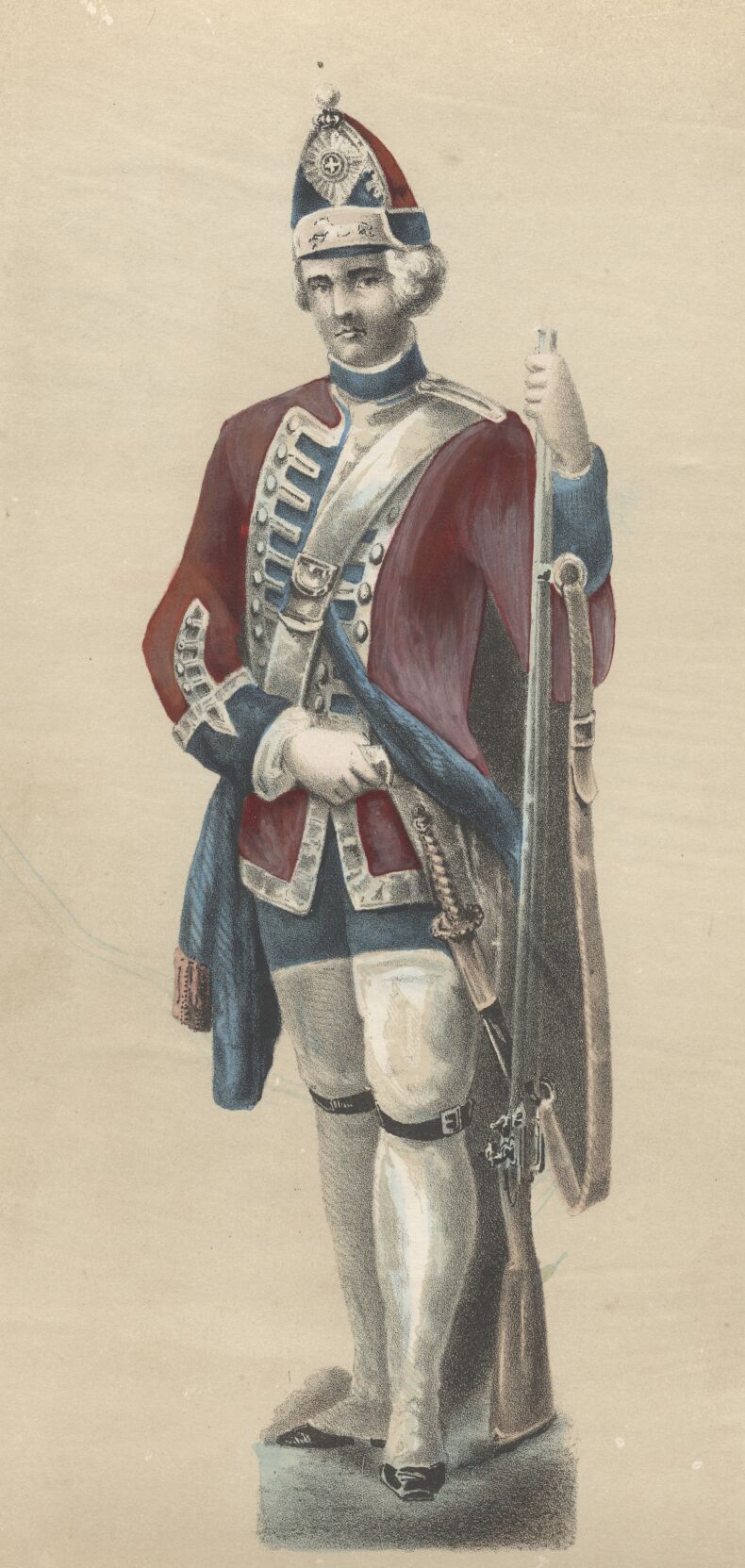
[Singularly enough, this identical effigy of a grenadier has been
preserved by the owner of the manuscript, and, by permission, we are
enabled to present a drawing of it, colour and all. It is admirably
painted on half-inch board, carved out at the edges, and may have been
from the brush of Major Andre.—ED.]
In a moment his ears were saluted with, a "Is there any rebel officers
here?" in a thundering voice. Not waiting for a second word, he darted
like lightning out of the front door, through the yard, bolted o'er the
fence. Swamp, fences, thorn-hedges, and plough'd fields no way impeded his
retreat! He was soon out of hearing. The woods echoed with, "Which way did
he go? Stop him! Surround the house!" The amiable Lipscomb had his hand on
the latch of the door, intending to make his escape; Stodard, considering
his indisposition, acquainted him with the deceit. We females ran down
stairs to join the general laugh. I walked into Jesse's parlour. There sat
poor Stodard, (whose sore lips must have receiv'd no advantage from this)
almost convuls'd with laughing, rolling in an arm-chair. He said nothing;
I believe he could not have spoke. "Major Stodard," said I, "go to call
Tilly back. He will lose himself,—indeed he will;" every word
interrupted with a "Ha! ha!" At last he rose, and went to the door; and
what a loud voice could avail in bringing him back he tried. Figure to
thyself this Tilly, of a snowy evening,—no hat,—shoes down at
heel,—hair unty'd,—flying across meadows, creeks, and
mud-holes. Flying from what? Why, a bit of painted wood! But he was
ignorant of what it was. The idea of being made a prisoner wholly
engross'd his mind, and his last resource was to run!
After a while, we being in more composure, and our bursts of laughter less
frequent, yet by no means subsided,—in full assembly of girls and
officers,—Tilly enter'd! The greatest part of my risibility turn'd
to pity. Inexpressible confusion had taken entire possession of his
countenance,—his fine hair hanging dishevell'd down his shoulders,
all splashed with mud; yet his bright confusion and race had not divested
him of his beauty. He smil'd as he trip'd up the steps; but 'twas vexation
plac'd it on his features. Joy at that moment was banish'd from his heart!
He briskly walk'd five or six steps, then stop'd, and took a general
survey of us all. "Where have you been, Mr. Tilly?" ask'd one officer. (We
girls were silent.) "I really imagin'd," said Major Stodard, "that you
were gone for your pistols. I follow'd you to prevent danger!"—an
excessive laugh at each question, which it was impossible to restrain.
"Pray, where were your pistols, Tilly?" He broke his silence by the
following expression: "You may all go to the D—-l!" I never heard
him utter an indecent expression before.
At last his good nature gain'd a compleat ascendence over his anger, and,
he join'd heartily in the laugh. I will do him the justice to say that he
bore it charmingly. No cowardly threats, no vengeance denounced. Stodard
caught hold of his coat,—"Come, look at what you ran away from,"—and
drag'd him to the door. He gave it a look, said it was very natural, and,
by the singularity of his expressions, gave fresh cause for diversion. We
all retir'd to our different parlours, for the rest of our faces, if I may
say so.
Well, certainly these military folks will laugh all night. Such screaming
I never did hear!! Adieu to-night.
December 13th.—I am fearful they will yet carry the joke too far.
Tilly certainly possesses an uncommon share of good nature, or he could
not tolerate these frequent teazings. Ah! Deborah, the Major is going to
leave us entirely,—just going. I will see him first.
Seventh day noon.—He has gone! I seen him pass the bridge. The woods
which you enter immediately after crossing it hinder'd us from following
him further. I seem to fancy he will return in the evening.
Seventh day night.—Stodard not come back! We shall not, I fancy, see
him again for months, perhaps for years! unless he should visit Philadl.
We shall miss his agreeable company. But what shall we make of Tilly? No
civil things yet from him. Adieu to-night, my dear.
December 14th.—The officers yet here. No talk of their departure.
They are very lively; Tilly's retreat the occasion,—the principal
one at least.
First day night.—Capt. Lipscomb, Seaton, and Tilly, with cousin H.
M., dined with us to-day. Such an everlasting bore as Tilly I never knew.
He caused us a good deal of diversion while we sat at table. Has not said
a syllable to one of us young ladies since sixth day eve. He tells
Lipscomb that the Major had the assistance of the ladies in the execution
of the scheme. He tells a truth!
About four o'clock, I was standing at the door, leaning my head on my
hand, when a genteel officer rode up to the gate and dismounted; "Your
servant, ma'am," and gave me the compliment of his hat; went into aunt's.
I went into our parlour. Soon Seaton was call'd. Many minutes had not
elapsed before he enter'd with the young fellow whom I had just seen. He
introduced him by the name of Capt. Smallwood. We seated ourselves. I then
had an opportunity of seeing him. He is a brother to Gen'l Smallwood,—a
very genteel, pretty little fellow, very modest, and seems agreeable, but
no personal resemblance between him and the Major. After tea, turning to
Tilly, he said, "So, sir, I have heard you had like to have been taken
prisoner last Friday night!" "Pray, sir, who informed you?" "Major Stodard
was my author." "I fancy he made a fine tale of it. How far did he say I
ran?" "Two miles, and that you fell into the mill-dam!" He rais'd his eyes
and hands, and exclaimed, "What a confounded falsehood!" The whole affair
was again reviv'd. Our Tillian here gave a mighty droll account of his
"retreat," as they call it. He told us that, after he had got behind our
kitchen, he stop'd for company, as he expected the others would
immediately follow; "but I heard them scream, 'Which way did he go? Where
is he?' Aye, said I to myself, he is gone where you shan't catch him, and
off I set again." "Pray," ask'd mamma, "did thee keep that lane between
the meadows?" "Oh, no, ma'am! That was a large road, and I might happen to
meet some of them. When I got to your thorn-hedge, I again stop'd. As it
was a cold night, I thought I would pull up my shoe-heels, and tie my
handkerchief round my head. I began to have a suspicion of a trick, and,
hearing the Major hollow, I came back."
I think I did not laugh more at the very time than to-night at the
rehearsal of it. He is so good-natur'd, and takes all their jokes with so
good a grace, that I am quite charm'd with him. He laughingly denounces
vengeance against Stodard. He will be even with him. He is in the Major's
debt, but he will pay him, &c.
December 15th.—Smallwood has taken up his quarters with us. Nothing
worth relating occur'd to-day.
3d, 4th, and 5th day.—We chatted a little with the officers.
Smallwood not so chatty as his brother or nephew. Lipscomb is very
agreeable; a delightful musical voice.
Sixth day noon, Dec. 19th.—The officers, after the politest adieus,
have left us. Smallwood and Tilly are going to Maryland, where they live;
Seaton to Virginia, and Lipscomb to camp, to join his regiment. I feel
sorry at this departure, yet 'tis a different kind from what I felt some
time since! We had not contracted so great an intimacy with those last.
Seventh day, December 20th.—General Washington's army have gone into
winter-quarters at the Valley Forge. We shall not see many of the military
now. We shall be very intimate with solitude. I am afraid stupidity will
be a frequent guest. After so much company, I can't relish the idea of
sequestration!
First day night.—A dull round of the same thing over again! I shall
hang up my pen until something offers worth relating.
February third and fourth.—I thought I never should have any thing
to say again. Nothing happen'd all January that was uncommon. Capt.
Lipscomb and Mas stay'd one night at Jesse's, and sup'd with us. How
elegant the former was dres'd! And indeed I have forgot to keep an exact
account of the day of the month in which I went down to G. E.'s, with P.
F.; but it was the 23d or 24th of February. After enjoying a week of her
agreeable company at the Mill, I return'd with her to Whitemarsh. We went
on horseback,—the roads bad. We however surmounted this difficulty,
and arrived there safe.
Second day eve.—G. E. brought us a charming collection of books,—Joe
Andrews, Juliet Grenville, and some Lady's Magazines. P. T. sent us
Caroline Melmoth.
4th day, 26th.—I thought our scheme of going to Fr'd F.'s was
entirely frustrated, as S. E. was much indispos'd. About 12 she got
better. We made some alteration in our dress, step'd into the carriage,
and rode off. Spent a most delightful day. As we approach'd the house, on
our return, we perceiv'd several strangers in the parlour. Polly's face
and mine brighten'd up at the discovery. We alighted. Polly swung open the
door, and introduc'd us to Major Jameson and Capt. Howard, both of the
dragoons,—the former from Virginia, the latter a Marylander. We all
seem'd in penseroso style till after supper. We then began to be rather
more sociable. About ten they bid us adieu. I dare say thee is impatient
to know my sentiments of the swains! Howard has very few external charms;
indeed, I cannot name one. As to his internal ones, I am not a judge.
Jameson is tall and manly,—a comely face, dark eyes and hair,—seems
to be much of a gentleman,—no ways deficient in point of sense, or,
at least, in the course of the evening I discover'd none.
5th and 6th day, and 7th day, pass'd away very agreeably. No strangers.
First day eve.—This day my charming friend and self ascended the
barren hills of Whitemarsh, from the tops of which we had an extensive
prospect of the country round. The traces of the army which encamp'd on
these hills are very visible. Rugged huts, imitations of chimneys, and
many other ruinous objects which plainly show'd they had been there. D. J.
S. dined with us.
Second day.—Very cold and windy. I wonder I am not sent for. Read
and work'd by turns.
Third day.—A raw, snowy day. I am sent for, nevertheless. Adieu.
North Wales,—at my old habitation at the Mill.
March 1st, 1778, Third day eve.—Such a ride as I have had, O dear
Debby! About 2 o'clock the sleigh came for me. Snowing excessively fast,
though not sufficiently deep to make it tolerable sleighing; but go I
must. I bid adieu to my agreeable friends; and with a heavy heart and
flowing eyes, I seated myself in the unsociable vehicle. There might as
well have been no snow on the ground. I was jolted just to pieces; but,
notwithstanding these vexations, I got safe to my home, when I had the
great pleasure of finding my dear parents, sisters, and brothers well,—a
blessing which I hope ever to remember with thankfulness.
Well, will our nunnery be more bearable now than before I left it? No
beaus since I left here; so I have the advantage of the girls. They are
wild to see Major Jameson.
May 11th, 1778.—The scarcity of paper, which is very great in this
part of the country, and the three last months not producing any thing
material, has prevented me from keeping a regular account of things; but
to-day the scene begins to brighten, and I will continue my nonsense. In
the afternoon, we were just seated at tea,—Dr. Moore with us. Nelly
(our girl) brought us the wonderful intelligence that there were light
horse in the road. The tea-table was almost deserted. About fifteen light
horse were the vanguard of 16 hundred men under the command of Gen'l
Maxwell. I imagin'd that they would pass immediately by, but was agreeably
disappointed. My father came in with the Gen'l, Col. Brodhead, Major
Ogden, and Capt. Jones.
The Gen'l is a Scotsman,—nothing prepossessing in his appearance;
the Col. very martial and fierce; Ogden, a genteel young fellow, with an
aquiline nose. Capt. Cadwallader Jones! If I was not invincible, I must
have fallen a victim to this man's elegancies; (but, thank my good
fortune, I am not made of susceptibilities!) tall, elegant, and handsome,—white
fac'd with blue regimentals, and a mighty airish cap and white crest: his
behaviour is refin'd,—a Virginian. They sat a few minutes after tea,
then bid us adieu.
This brigade is encamp'd about three miles from us.
First day evening.—This afternoon has been productive of adventures
in the true sense of the word. Jenny R., Betsy, Liddy, and I, very
genteely dress'd, determin'd to take a stroll. Neighbour Morgan's was
proposed. Away we rambled, heedless girls; pass'd two picket-guards.
Meeting with no interruptions encourag'd us. After paying our visit, we
walk'd towards home, when, to my utter astonishment, the sentry desir'd us
to stop!—that he had orders not to suffer any persons to pass but
those who had leave from the officer, who was at the guard-house
surrounded by a number of men. To go to him would be inconsistent with
propriety; to stay there, and night advancing, was not clever. I was much
terrified. I tried to persuade the soldier to let us pass. "No; he dared
not." Betsy attempted to go. He presented his gun with the bayonet fix'd.
This was an additional fright. Back we turn'd; and, very fortunately, the
officer, (Capt. Emeson,) seeing our distress, came to us. I ask'd him if
he had any objection to our passing the sentry? "None at all, ma'am." He
waited upon us, and reprimanded the man, and we, without any farther
difficulty, came home.
Third day, June 2d, 1778.—I was standing at the back window; an
officer and private of dragoons rode by; I tore to the door to have a
better view of them; they stop'd; the officer rode up, and ask'd for
Jesse, who was call'd.
Afternoon, 4 o'clock.—Oh, Deborah! what capital adventures! Jesse
came. The idea of having Light horse quarter'd at the farm was
disagreeable,—the meadows just fit to mow; and we had heard what
destruction had awaited their footsteps. This was the dialogue between
Jesse and the officer:—"Pray, sir, can I have quarters for a few
horsemen?" "How many?" "Five and twenty, sir. I do not mean to turn them
into your meadows. If you have any place you can spare, any thing will
do." And he dismounted and walk'd into aunt's parlour. I—determin'd
to find out his character—follow'd. "I have," reply'd Jesse, "a
tolerable field that may perhaps suit." "That will do, sir; but if you
have any objection to putting them in a field, my men shall cut the grass
and bring it in the road. I am under the necessity of quartering them
here, but I was order'd; I am only an inferior officer." Some elegant
corporal, thought I, and went to the door. He soon join'd me: speaking to
his man, "Ride off, and tell Mr. Watts we rendez-vous here."
He inquir'd the name of the farmer, and went into aunt's; I into the back
room. The troop rode up. New scenes, said I, and mov'd up-stairs, where I
saw them perform their different manoeuvres. This Mr. Watts is remarkably
tall, and a good countenance. I adjourn'd to our parlor. The first officer
march'd up and down the entry. Prissa came in. "Good, now, Prissa. What's
the name of this man?" "Dyer, I believe." "Capt. Dyer. Oh, the name! What
does he say?" "Why, that he will kiss me when he has din'd." "Singular," I
observ'd, "on so short an acquaintance." "But," resum'd Prissa, "he came
and fix'd his arm on the chair I sat in: I Pray, ma'am, is there not a
family from town with you?" "Yes." "What's their name?" "Wister." "There's
two fine girls there. I will go chat with them. Pray, did they leave their
effects in Philadelphia?" "Yes, every thing, almost." "They shall have
them again, that they shall." There ended the conversation. But this ugly
name teaz'd me! "Oh, Sally, he is a Virginian that's in his favour
greatly." "I'm not sure that's his name, but I understood so." Prissa left
us. I step'd into aunt's for Johnny, and desir'd him to come home. Up
started the Captain: "Pray, let me introduce you, ma'am." "I am perfectly
acquainted with him," said I, and turn'd to the door. "Tell your sister I
believe she is not fond of strangers!" I smil'd, and return'd to our
parlour.
Third day night, nine o'clock, aye, ten, I fancy.—Take a
circumstantial account of this afternoon, and the person of this
extraordinary man. His exterior first. His name is not Dyer, but Alexander
Spotswood Dandridge, which certainly gives a genteel idea of the man. I
will be particular. His person is more elegantly form'd than any I ever
seen; tall and commanding; his forehead is very white, though the lower
part of his face is much sunburn'd; his features are extremely pleasing;
an even, white set of teeth; dark hair and eyes. I can't better describe
him than by saying he is the handsomest man I ever beheld! Betsy and Liddy
coincide in this opinion.
After I had set a while at home, in came Dandridge. He enter'd into chat
immediately. Ask'd if we knew Tacy Vanderen; said he courted her, and that
they were to be married soon. Observ'd my sampler, which was in full view;
wish'd I would teach the Virginians some of my needle wisdom; they were
the laziest girls in the world; told his name; laugh'd and talk'd
incessantly. At last, "May I" (to mamma) "introduce my brother officer?"
We assented; so he call'd him. "Mr. Watts, Mrs. Wister, young Miss Wister;
Mr. Watts, ladies, is one of our Virginia children." He sat down. Tea was
order'd. Dandridge never drank tea; Watts had done; so we set to the table
alone. "Let's walk in the garden," said the Captain; so we call'd Liddy,
and went, (not Watts.) We sat down in a sort of a summer-house. "Miss
Sally, are you a Quaker?" "Yes." "Now, are you a Quaker?" "Yes, I am."
"Then you are a Tory." "I am not, indeed." "Oh, dear!" replied he, "I am a
poor creature! I can hardly live!" Then, flying away from that subject,
"Will you marry me, Miss Sally?" "No, really! A gentleman, after he has
said he has not sufficient to maintain himself, to ask me to marry him!"
"Never mind what I say. I have enough to make the pot boil!"
Had we been acquainted seven years, we could not have been more sociable.
The moon gave a sadly pleasing light. We sat at the door till nine.
Dandridge is sensible, and (divested of some freedoms which might be
call'd gallant in the fashionable world) he is polite and agreeable. His
greatest fault is a propensity to swearing, which throws a shade over his
accomplishments. I ask'd him why he did so. "It is a favorite vice, Miss
Sally." At nine, he went to his chamber. Sets off at sunrise.
Fourth day morn, 12 o'clock.—I was awaken'd this morn with a great
racket of the Captain's servant calling him; but the lazy fellow never
rose till about half an hour eight! This his daylight ride! I imagin'd
they would be gone before now, so I dress'd in a green skirt and dark
short-gown. Provoking! So down I came, this Captain (wild wretch!)
standing at the back door. He bow'd and call'd me. I only look'd, and went
to breakfast. About nine I took my work and seated myself in the parlour.
Not long had I sat when in came Dandridge,—the handsomest man in
existence, at least that I had ever seen. But stop here, while I just say,
the night before, chatting upon dress, he said he had no patience with
those officers who, every morn, before they went on detachments, would
wait to be dress'd and powder'd. "I am," said I, "excessively fond of
powder, and think it very becoming." "Are you?" he reply' d. "I am very
careless, as often wearing my cap thus" (turning the back part before) "as
any way." I left off at where he came in. He was powder'd very white, a
(pretty coloured) brown coat, lapell'd with green, and white waistcoat,
&c., and his
"sword beside him negligently hung."
He made a truly elegant figure. "Good morning, Miss Sally. You are very
well, I hope." "Very well. Pray sit down;"—which he did, close by
me. "Oh, dear!" said I, "I see thee is powder'd." "Yes, ma'am. I have
dress'd myself off for you." Will I be excused, Debby, if I look upon his
being powder'd in the light of a compliment to me? Yes, Sally, as thee is
a country maid, and don't often meet with compliments. Saucy Debby Norris!
'Tis impossible to write a regular account of our conversation. Be it
sufficient to say that we had a multiplicity of chat.
About an hour since, sister H. came to me and said Captain Dandridge was
in the parlour and had ask'd for me. I went in. He met me, caught my
hands: "Oh, Miss Sally, I have a beautiful sweetheart for you!" "Poh!
ridiculous! Loose my hands." "Well, but don't be so cross!" "Who is he?"
"Major Clough! I have seen him. Ain't he pretty, to be sure? I am going to
head-quarters. Have you any commands there?" "None at all; but,"
(recollecting,) "yes, I have. Pray, who is your commanding officer?" "Col.
Bland, ma'am." "Please give my compliments to him, and I shou'd be glad if
he would send thee back with a little more manners!" He reply'd wickedly,
and told me I had a little spiteful heart. But he was intolerably saucy;
said he never met with such ladies. "Not to let me kiss you! You're very
ill-natur'd, Sally!" and,—putting on the sauciest face,—"Sally,
if Tacy V*nd*u*n won't have me, will you?" "No, really,—none of her
discarded lovers!" "But, provided I prefer you to her, will you consent?"
"No, I won't!" "Very well, madam!" And, after saying he would return
to-morrow, among a hundred other things, he elegantly walk'd out of the
room. Soon he came back, took up a volume of Homer's Illiad, and read to
us. He reads very well, and with judgment. One remark he made, that I will
relate, on these lines,
"While Greece a heavy, thick retreat maintains,
Wedg'd in one
body, like a flight of cranes."
"G-d knows our army don't do so. I wish they did." He laugh'd, and went
away.
Four o'clock, afternoon.—Major Clough, Captain Swan, and Mr. Moore,
a Lieutenant of horse, din'd with Dandridge. The latter, after dinner,
came in to bid us adieu. He sat down, and was rather saucy. I look'd very
grave. "Miss Betsy, you have a very ill-natur'd sister. Observe how cross
she looks!" He pray'd we might part friends, and offer'd his hand. I gave
him mine, which he kiss'd in a very gallant manner; and so, with a truly
affectionate leave, he walk'd to the parlour door; "God Almighty bless
you, ladies;" bow'd, went into the road, mounted a very fine horse, and
rode away: leaving Watts and the troop here, to take care of us, as he
said. "Mr. Watts, Miss Sally, is a very worthy man; but, poor soul, he is
so captivated with you,—the pain in his breast all owing to you,—he
was caught by this beauty-spot,"—tapping my cheek. He could not have
thought it was meant for an addition, as the size of it shew'd the
contrary. But he is gone; and I think, as I have escap'd thus far safe, I
am quite a heroine, and need not be fearful of any of the lords of the
creation for the future.
Six o'clock, evening.—Watts drank tea with us. A conversible man.
Says that the Dandridges are one of the genteelest families in Virginia,—relations
of General Washington's wife. He appear'd very fond of the Captain, who
has had a liberal education. Very sensible and brave. I sat in the entry
all last evening, as did Betsy. But first let me say, fifth-day morn we
chatted on a variety of subjects; and, amongst others, he mention'd the
cruelty of the Britons, which, I agreed, were very great. He said he would
retaliate whenever he had an opportunity. I strenuously opposed such a
procedure, observing that it would be erring in the same way, and, tho'
they might deserve it, yet it would be much nobler to treat them with
lenity. Remember the lines of Pope,
"That mercy I to others show,
That mercy show to me."
"I perfectly remember them. Your sentiments are noble; but we must
retaliate sometimes."
A horseman deliver'd this message:—"Let the troop lie on their arms,
and be ready to march at a moment's warning." He immediately gave these
orders to the sargeant. Every soldier was in motion. I was a good deal
frighten'd, and ask'd Watts the reason. He fancy'd the British were in
motion, tho' he had not receiv'd such intelligence. "What will thee do if
they come here?" "Defend the house as long as I can, ma'am." I was
shock'd. "Bless my heart! What will become of us?" "You may be very safe.
The house is an excellent house to defend: only do you be still. If the
British vanquish us, down on your knees, and cry, 'Bless the King!' If we
conquer them, why, you know you are safe." This added to my fright. I
called my dear mamma, who was much indispos'd. Dadda was gone to
Lancaster. Mamma ask'd him the same questions, and he gave her the same
answers. I was in a fearful taking, and said if I thought such a thing
would happen I would set off, though 9 o'clock, and walk to uncle
Foulke's. "No! don't go to-night, Miss Sally! I will take you there
to-morrow. Don't be uneasy. This is nothing. I often go to bed with my
boots on upon some alarms." "But will thee take off thy boots to-night?"
"Yes, I will, indeed." "Is thee really in earnest about defending the
house?" "No, madam; for, believe me, if I hear the enemy is in motion, I
will immediately depart, bag and baggage."
This dispell'd my fears, and, after wishing me a good night, he retir'd to
his chamber. Imagine my consternation, when our girl came running in and
said the lane was fill'd with light horse! I flew to the side-door. It was
true! My joy was great when I heard Major Clough ask if this was Capt.
Dandridge's quarters. I answer'd in the affirmative. He rode round to the
other door. Watts, though gone to bed, was call'd. He chatted apart to the
Major a while, then went off towards Skippac road, follow'd by a large
party of horse and waggons. My fears were all renew'd; and, as if we were
to be in perpetual alarms, by came another party, much larger, in dark
clothes. These we all thought were British. They halted. All as still as
death. The officer rode up to the door. "Does Mr. Foulke live here?"
"Yes," said somebody. "Is there not a family from town here,—Mr.
Wister's?" I recollected the voice, and said,
"Captain Stodard, I presume?" "Yes, madam. Are you Mr. Wister's wife?"
"No: his daughter."
"Is your papa at home?" "No," I reply'd, but invited him in to see mamma.
He agreed; dismounted, as did many other officers; but he alone came into
our parlour. Watts follow'd to bid us adieu. They sat a few minutes; told
us that two of their men had deserted, and when that was the case they
generally moved their quarters. Watts told him how I was frighten'd. He
said I paid but a poor compliment to their cavalry! I only smil'd. The
alarm had partly deprived me of the power of speech!
They sat about fifteen minutes, then rose, and, after the politest adieus,
departed. All the horse follow'd, about one hundred and fifty. I never
seen more regularity observ'd, or so undisturb'd a silence kept up when so
large a number of people were together. Not a voice was heard, except that
of the officer who gave the word of command. The moon at intervals broke
thro' the heavy black clouds. No noise was perceiv'd, save that which the
horses made as they trotted o'er the wooden bridge across the race. Echo a
while gave us back the sound. At last, nothing was left but the
remembrance of them. The family all retir'd to their respective chambers
and enjoy'd a calm repose.
This Captain Stodard is from New England, and belongs to Col. Sheldon's
regiment of dragoons. He made an acquaintance with my father at
Germantown, whilst our army was at that place, and had been here once
before. He is clever and gentlemanly.
Fifth day, June 4th, 2 o'clock.—Oh, gracious! how warm is this day!
But, warm as it is, I must make a small alteration in my dress. I do not
make an elegant figure, tho': I do not expect to see the face of a
stranger to-day.
Sixth day, June 5th, morn, 11 o'clock.—Last night we were a little
alarm'd. I was awaken'd about 12 with somebody's opening the chamber door.
I observ'd cousin Prissa talking to mamma. I ask'd what was the matter.
"Only a party of light-horse." "Are they Americans?" I quickly said. She
answer'd in the affirmative, (which dispell'd my fears,) and told me that
Major Jameson commanded, and that Capts. Call and Nixon were with him.
With that intelligence she left us. I resolv'd in my mind whether or not
Jameson would renew his acquaintance; but Morpheus buried all my ideas,
and this morn I rose by, or near, seven, dress'd in my light chintz, which
is made gown-fashion, kenting handkerchief, and linen apron. Sufficiently
smart for a country girl, Sally! Don't call me a country girl, Debby
Norris! Please to observe that I pride myself on being a Philadelphian,
and that a residence of 20 months has not at all diminished the love I
have for that place; and as soon as one capital alteration takes place,
(which is very much talk'd of at present,) I expect to return to it with a
double pleasure.
Dress'd as above, down I came, and went down to our kitchen, which is a
small distance from the house. As I came back, I seen Jameson at the
window. He met me in the entry, bow'd:—"How do you do, Miss Sally?"
After the compliments usual on such occasions had pass'd, I invited him
into our parlour. He follow'd me in. We chatted very sociably. I inquir'd
for P. F. He said he had seen her last first-day; that she was well. Her
mamma had gone to Lancaster to visit her daughter Wharton, who, as I
suppose, you have heard, has lost her husband.
I ask'd him whether Dandridge was on this side the Delaware. He said,
"Yes." I wanted sadly to hear his opinion, but he said not a word. The
conversation turn'd upon the British leaving Philadelphia. He firmly
believ'd they were going. I sincerely wish'd it might be true, but was
afraid to flatter myself. I had heard it so often that I was quite
faithless, and express'd my approbation of Pope's 12th beatitude, "Blessed
are they that expect nothing; for they shall not be disappointed." He
smil'd, and assur'd me they were going away.
He was summon'd to breakfast. I ask'd him to stay with us. He declin'd the
invitation with politeness, adding that he was in a hurry,-oblig'd to go
to camp as soon as he could. He bow'd, "Your servant, ladies," and
withdrew immediately. After breakfast they set off for Valley Forge, where
Gen'l Washington's army still are.
I am more pleas'd with Major Jameson than I was at first. He is sensible
and agreeable,—a manly person, and a very good countenance. We girls
differ about him. Prissa and I admire him, whilst Liddy and Betsy will not
allow him a spark of beauty. Aunt's family are charm'd with his behaviour,—so
polite, so unassuming. When he disturb'd them last night, he made a
hundred apologies,—was so sorry to call them up,—'twas real
necessity oblig'd him. I can't help remarking the contrast between him and
Dandridge. The former appears to be rather grave than gay,—no vain,
assuming airs. The latter calls for the genius of a Hogarth to
characterize him. He is possess'd of a good understanding, a very liberal
education, gay and volatile to excess: he is an Indian, a gentleman, grave
and sad, in the same hour. But what signifies? I can't give thee a true
idea of him; but he assumes at pleasure a behaviour the most courtly, the
most elegant of any thing I ever seen. He is very entertaining company,
and very vain of his personal beauties; yet nevertheless his character is
exceptionable.
Sixth day, noon and evening.—Nothing material occurr'd.
Seventh day night.—A dull morn. In the afternoon, Liddy, Betsy, R.
H., and self went to one of our neighbours to eat strawberries. Got a few;
return'd home; drank tea; no beaus. Adieu.
First day evening. Heigh-ho! Debby, there's a little meaning in that
exclamation, ain't there? To me it conveys much. I have been looking what
the Dictionary says. It denotes uneasiness of mind. I don't know that my
mind is particularly uneasy just now.
The occurrences of the day come now. I left my chamber between eight and
nine, breakfasted, went up to dress, put on a new purple and white striped
Persian, white petticoat, muslin apron, gauze cap and handkerchief. Thus
array'd, Miss Norris, I ask your opinion. Thy partiality for thy friend
will bid thee say I made a tolerable appearance! Not so, my dear. I was
this identical Sally Wister, with all her whims and follies; and they have
gain'd so great an ascendancy over my prudence, that I fear it will be a
hard matter to divest myself of them. But I will hope for a reformation.
Cousin H. M. came about nine, and spent the day with us. After we had
din'd, two dragoons rode up to the door,—one a waiting-man of
Dandridge's, the faithful Jonathan. They are quarter'd a few miles from
us. The junior sisters, Liddy and Betsy, join'd by me, ventur'd to send
our compliments to the Captain and Watts. Prissa insists that it is vastly
indelicate, and that she has done with us. Hey-day! What prudish notions
are those, Priscilla? I banish prudery. Suppose we had sent our love to
him,—where had been the impropriety? for really he had a person that
was love-inspiring,—tho' I escap'd, and may say, Io triumphe. I
answer not for the other girls, but am apt to conclude that Cupid shot his
arrows, and that may-be they had effect. A fine evening this. If wishes
could avail, I would be in your garden with S. J., R. F., and thyself.
Thee has no objection to some of our North Wales swains,—not the
beau inhabitants, but some of the transitory ones. But, cruel reverse!
instead of having my wishes accomplish'd, I must confine myself to the
narrow limits of this farm.
Liddy calls: "Sally, will thee walk?" "Yes." Perhaps a walk will give a
new turn to my ideas, and present something new to my vacant imagination.
Second day, third day, fourth day.—No new occurrences to relate.
Almost adventureless, except Gen'l Lacy's riding by, and his fierce horse
disdaining to go without showing his airs, in expectation of drawing the
attention of the Mill girls, in order to glad his master's eyes. Ha! ha!
ha! One would have imagin'd that vanity had been buried within the shades
of N. Wales. Lacy is tolerable; but, as ill luck would order it, I had
been busy, and my auburn ringlets were much dishevell'd: therefore I did
not glad his eyes, and cannot set down on the list of honours receiv'd
that of a bow from Brigadier-General Lacy!
Fifth day night, June 18th.—Rose at half-past four this morning.
Iron'd industriously till one o'clock, din'd, went up-stairs, threw myself
on the bed, and fell asleep. About four, sister H. wak'd me, and said
uncle and J. F. were down-stairs; so I decorated myself, and went down.
Felt quite lackadasical. However, I jump'd about a little, and the stupid
fit went off. We have had strange reports about the British being about
leaving Philadelphia. I can't believe it. Adieu.
Sixth day morn, June 19th.—We have heard an astonishing piece of
news! The English have entirely left the city! It is almost impossible!
Stay. I shall hear further.
Sixth day eve.—A light horseman has just confirm'd the above
intelligence! This is charmante! They encamp'd yesterday. He (the
horseman) was in Philadl. It is true! They have gone!! Past a doubt. I
can't forbear exclaiming to the girls, "Now are you sure the news is true?
Now are you sure they have gone?" "Yes, yes, yes!" they all cry; "and may
they never, never return!"
Dr. Gould came here to-night. Our army are about six miles off, on their
march to the jerseys.
Seventh day morn.—O. F. arriv'd just now, and related as followeth:—The
army began their march at six this morning by their house. Our worthy
Gen'l Smallwood breakfasted at uncle Caleb's. He ask'd how Mr. and Mrs.
Wister and the young ladies were, and sent his respects to us. Our brave,
our heroic GENERAL WASHINGTON was escorted by fifty of the Life-Guard,
with drawn swords. Each day he acquires an addition to his goodness. We
have been very anxious to know how the inhabitants have far'd. I
understand that General Arnold, who bears a good character, has the
command of the city, and that the soldiers conducted with great decorum.
[Since my writing the above, Gen'l Arnold has forfeited all right to a
good character, by the shameful desertion of his country's cause,
joining the British, accepting a command, and plundering and distressing
the Americans.]
Smallwood says they had the strictest orders to behave well; and I dare
say they obey'd the order. I now think of nothing but returning to
Philadelphia.
So I shall now conclude this journal, with humbly hoping that the Great
Disposer of events, who has graciously vouchsaf'd to protect us to this
day through many dangers, will still be pleas'd to continue his
protection.
SALLY WISTER.
NORTH WALES, June 20th, 1778.