| | Page |
| Adlum, quoted, | 10 |
| Arbor Kniffin, | 72 |
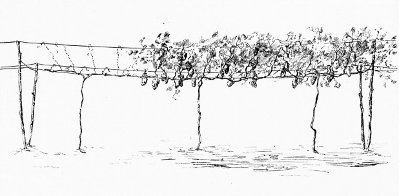
| Arbors, | 88 |
| Arm, defined, | 13 |
| |
| Barns, W. D., quoted, | 63 |
| Bass bark, | 33 |
| Bleeding, | 22 |
| Breaking-out, | 23 |
| Brocton, Training at, | 37 |
| Bull cane, | 50, 66 |
| |
| Cane, defined, | 13 |
| Chautauqua County, Training in, | 37 |
| Contraction of wires, | 30 |
| Cornell, William T., | 56 |
| Cornhusks, for tying, | 33 |
| Crittenden training, | 74 |
| Cross-wire training, | 74 |
| Crotch Kniffin, | 66 |
| |
| Double Kniffin, | 66 |
| Drooping systems, | 56 |
| |
| Eight-cane Kniffin, | 70 |
| |
| Fan training, | 54 |
| Forestville, Training at, | 37 |
| Four-cane Kniffin, | 58 |
| Fuller, quoted, | 10, 34 |
| |
| Girdling, | 69 |
| Grafting, | 90 |
| |
| Haviland, Sands, | 72 |
| Heading-in, | 23 |
| High Renewal training, | 39 |
| Hofer, A. F., | 88 |
| Horizontal Arm training, | 34 |
| Horizontal training, | 83 |
| Husks, for tying, | 33 |
| |
| Improved[Pg 94]
Kniffin, | 66 |
| |
| Kniffin systems, | 58 |
| Kniffin training, Comparison of, | 26 |
| Kniffin, William, | 56 |
| |
| Low Kniffin, | 69 |
| |
| Marlboro', Training at, | 72, 74 |
| Modified Kniffin, | 63 |
| Munson training, | 78 |
| Munson, T. V., | 78 |
| |
| Objects of pruning, | 24 |
| Old vines, Remodeling of, | 89 |
| One-wire Kniffin, | 69 |
| Overhead Kniffin, | 72 |
| |
| Planting, | 20 |
| Posts, | 28 |
| Post training, | 85 |
| Pruning, | 11 |
| Pruning, Objects of, | 24 |
| " of young vines, | 20 |
| " Summer, | 23 |
| " Time for, | 22 |
| |
| Raffia, | 32 |
| Raphia Ruffia, | 32 |
| Reasons for pruning, | 24 |
| Remodeling old vines, | 89 |
| Renewal, defined, | 18 |
| Renewal Kniffin, | 77 |
| Rubbing off, | 14, 23 |
| Rye straw for tying, | 33 |
| |
| Sagging of wires, | 30 |
| Setting, | 20 |
| Shoot, defined, | 13 |
| Six-cane Kniffin, | 70 |
| Spur, defined, | 17 |
| Spur training, | 34 |
| Staples, | 29 |
| Stopping, | 23 |
| Stripping, | 22 |
| Summer pruning, | 23 |
| Superfluous shoots, | 23 |
| Systems[Pg 95]
compared, | 25 |
| |
| T-head, | 41 |
| Thomas' Fruit Culturist, quoted, | 10 |
| Tightening wires, | 31 |
| Trellis, Making, | 27 |
| True Kniffin, | 58 |
| Twine for tying, | 32 |
| Two-cane Kniffin, | 66 |
| Tying, | 31 |
| |
| Umbrella training, | 66 |
| Upright training, | 34 |
| |
| Walls, Training on, | 89 |
| Weeping, | 22 |
| Willows, for tying, | 32 |
| Wire, for trellis, | 28 |
| " for tying, | 33 |
| " weights and sizes, | 29 |
| Wool-twine, | 32 |
| |
| Y-trunk Kniffin, | 66 |
| Yeoman's patent trellis, | 30 |
| Yields of grapes, | 14, 63, 69, 70 |
| Young vines, Pruning of, | 20 |
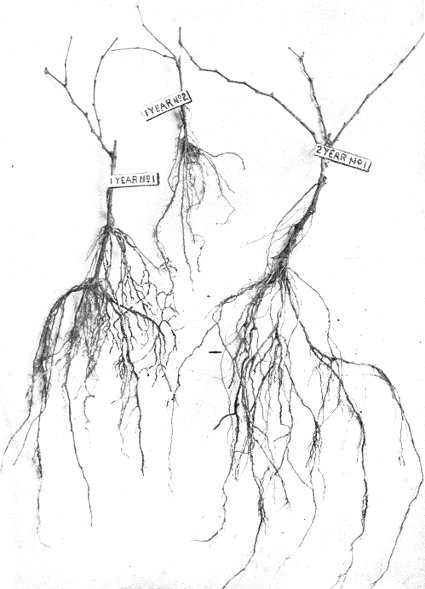
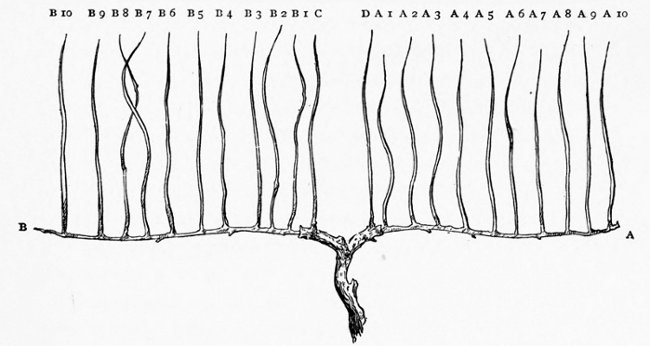
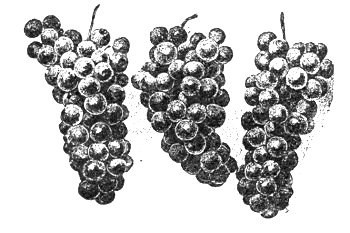
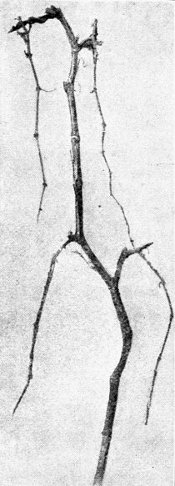
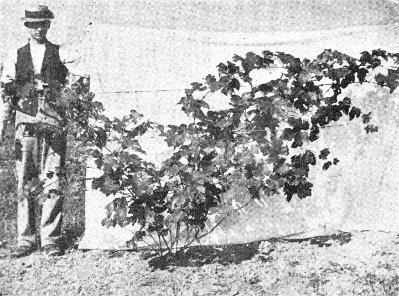
THIS ILLUSTRATION was made from a photograph of fair samples of the different grades
of our grape vines, reduced to one-tenth their natural size.
We take great pride and comfort in our ability to furnish strong, fibrous-rooted stock, so
well appreciated by intelligent and experienced fruit growers.
WHOLESALE TRADE ESPECIALLY SOLICITED. CATALOGUE FREE.
LEWIS ROESCH, FREDONIA, N. Y.,
Grape Vine Specialist And General Nurseryman.
When writing name this book.
| Hardy |
| Native |

|
| Grapes. |
We desire to call the attention of planters to our
large and complete stock of Grape Vines.
We propagate and offer for sale upwards of sixty
varieties, embracing the popular old sorts as well as the
new ones which seem to have merit. Our catalogue
contains accurate descriptions, and classifies the different
varieties according to color.
Besides the above we offer an immense collection
of all kinds of Fruit and Ornamental Trees, Shrubs,
Roses, Hardy Plants, etc. Our General Catalogue
(160 pages), embellished with numerous engravings
of the most popular Trees, Shrubs, etc., and enclosed in
an illuminated cover, will be mailed free to all who
have not received it.
Our Supplementary Catalogue (28 pages) of Rare
and Choice Trees, Shrubs, etc., including several
valuable novelties and many specialties of superior
merit, will also be mailed free.
ELLWANGER & BARRY,
Mount Hope Nurseries,
Rochester, N. Y.
53rd Year.
Pleasant Valley Nurseries
PEAR TREES.—Lincoln, Coreless, Bessemianka,
Japan Golden Russet, Kieffer, LeConte, etc.,
Nut Trees in variety. Fruit Trees of
all sorts. Ornamentals, Eleagnus
Longipes, Japanese Wineberry
Juneberry, Trifoliate Orange
and other valued novelties.
STRAWBERRIES,
Van Deman, E. P.
Roe, and other new varieties;
all the old standard
sorts, Gooseberries, Raspberries,
Blackberries, Currants, Asparagus
Roots and Grape Vines.
J. S. COLLINS & SON, Moorestown, N. J.
Send for Catalogue.
MISCELLANEOUS BOOKS.
For the Farm and Household.
Any one of these valuable books will be sent, postpaid, direct, on receipt of price.
Be careful to write name and post office plain, so that there may be no mistake in mailing.
Address
The Rural Publishing Co., New York.
POPULAR ERRORS ABOUT PLANTS.—By A. A. Crozier. A collection
of errors and superstitions entertained by farmers, gardeners
and others, together with brief scientific refutations. Highly interesting
to students and intelligent readers of the new and attractive in rural literature,
and of real value to practical cultivators who want to know the
truth about their work.
Price, cloth, $1.
THE NURSERY BOOK.—By L. H. Bailey. A complete handbook of
Propagation and Pollination of Plants. Profusely illustrated. This
valuable little manual has been compiled with great pains. The author
has had unusual facilities for its preparation, having been aided by many
experts. The book is absolutely devoid of theory and speculation. It has
nothing to do with plant physiology or abstruse reasoning about plant
growth. It simply tells, plainly and briefly, what every one who sows a
seed, makes a cutting, sets a graft, or crosses a flower wants to know. It
is entirely new and original in method and matter. The cuts number 107,
and are made expressly for it, direct from nature. The book treats all
kinds of cultivated plants, fruits, vegetables, greenhouse plants, hardy
herbs, ornamental trees, shrubs and forest trees.
Contents:
I.—Seedage. On Propagation by Seed.
II.—Separation.
III.—Layerage. Propagation by Layering.
IV.—Cuttage. Propagation by Cuttings.
V.—Graftage.—Including Grafting, Budding, Inarching, etc.
VI.—Nursery List.—This is the great feature of the book. It is an
alphabetical list of all kinds of plants, with a short statement telling which
of the operations described in the first five chapters are employed in propagating
them. Over 2,000 entries are made in the list. The following entries
will give an idea of the method:
Acer (Maple). Sapindaceæ. Stocks are grown from stratified seeds,
which should be sown an inch or two deep; or some species, as A. dasycarpum,
come readily if seeds are sown as soon as ripe. Some cultural
varieties are layered, but better plants are obtained by grafting. Varieties
of native species are worked upon common or native stocks. The Japanese
sorts are winter-worked upon imported A. polymorphum stocks, either
by whip or veneer grafting. Maples can also be budded in summer, and
they grow readily from cuttings of both ripe and soft wood.
Phyllocactus, Phyllocereus, Disocactus (Leaf Cactus). Cacteæ.
Fresh seeds grow readily. Sow in rather sandy soil which is well drained,
and apply water as for common seeds. When the seedlings appear, remove
to a light position. Cuttings from mature shoots, three to six
inches in length, root readily in sharp sand. Give a temperature of about
60°, and apply only sufficient water to keep from flagging. If the cuttings
are very juicy they may be laid on dry sand for several days before
planting.
VII.—Pollination.
Price, in Library Style, cloth, wide margins, $1 Pocket Style, paper,
narrow margins, 50 cents.
THE MODIFICATION OF PLANTS BY CLIMATE.—By A. A. Crozier.
An essay on the influence of climate upon size, form, color,
fruitfulness, etc., with a discussion on the question of acclimation. 35 pp.
Price, paper, 25 cents.
FRUIT CULTURE, and the Laying Out and Management of a Country
Home.—By W. C. Strong, Ex-President of the Massachusetts Horticultural
Society, and Vice-President of the American Pomological Society.
Illustrated. New revised edition, with many additions, making it
the latest and freshest book on the subject.
CONTENTS:
Rural Homes—Choice of Locality—Treatment—A Good Lawn—The
Approach. Fruits—Location of the Fruit Garden—Success in Fruit-Culture—Profit
in Fruit-Culture. How to Procure Trees—Quality—How to
Plant—Time to Plant—Preparing the Land—Fertilizers—Cutting Back—Distances
for Planting. Care of the Fruit-Garden—Irrigation—Application
of Fertilizers—Thinning the Fruit—Labels. The Apple—Insects Injurious
to the Apple. The Pear—Dwarf Pears—Situation and Soil—Pruning—Ripening
the Fruit—Insects Injurious to the Pear—Diseases. The
Peach—Injurious Insects and Diseases of the Peach—Nectarines. The
Plum—Insects and Diseases of the Plum—Apricots. The Cherry—Insects
Injurious to the Cherry. The Quince—Insects Injurious to the
Quince. The Grape—Grape-Houses—Varieties—Insects Injurious to the
Grape—Mildew. The Currant—Insects Attacking the Currant—The Gooseberry.
The Raspberry—The Blackberry. The Strawberry. The Mulberry—The
Fig—Rhubarb—Asparagus. Propagating Fruit-Trees—From the
Seed—By Division—By Cuttings—By Layers—By Budding—By Grafting.
Insecticides—Fungicides—Recipes. Price, in one volume, 16mo., cloth, $1.
CHRYSANTHEMUM CULTURE FOR AMERICA.—By James Morton.
An excellent and thorough book; especially adapted to the
culture of Chrysanthemums in America. The contents include Propagation
by Grafting. Inarching and Seed. American History. Propagation by
Cuttings. Exhibition Plants. Classification. Exhibition Blooms. Soil for
Potting. Watering and Liquid Manure. Selection of Plants. Top-Dressing.
Hints on Exhibitions. List of Synonyms. Staking and Tying.
General Culture. Insects and Diseases. Standard Chrysanthemums.
Sports and Variations. Disbudding and Thinning. Oriental and European
History. Calendar of Monthly Operations. Chrysanthemum Shows
and Organizations. National Chrysanthemum Society. Early and Late-Flowering
Varieties. Chrysanthemums as House-Plants—Varieties for
Various Purposes. Price, cloth, $1; paper, 60 cents.
IMPROVING THE FARM, or Methods of Culture that shall afford a
profit, and at the same time increase the fertility of the soil.—By Lucius
D. Davis, of Conanicut Park Farm. The contents treat exhaustively
on renewing run-down farms, and comprise the following chapters: Book-Farming.
The Run-Down Farm. Will It Pay to Improve the Farm?
How Farms Become Exhausted. Thorough Tillage. Rotation of Crops.
Green Manuring. More About Clover. Barn-Yard Manure—How Made,
Its Cost and Value. How Prepared and Applied. The Use of Wood-Ashes.
Commercial Fertilizers. Special Fertilizers. Complete Manures. Experiments
with Fertilizers. Stock on the Farm. Providing Food for Stock.
Specialties in Farming. Price, cloth, $1.
LANDSCAPE-GARDENING.—By Elias A. Long. A practical treatise
comprising 32 diagrams of actual grounds and parts of grounds, with
copious explanations. Of the diagrams, all but nine have appeared in the
serial, "Taste and Tact in Arranging Ornamental Grounds," which
has been so attractive a feature of Popular Gardening and American
Gardening during the past year. But in the new form the matter has
been entirely rewritten. Printed on heavy plate paper, it is unsurpassed
for beauty by any other work on Landscape Gardening.
Price, 50 cents.
THE BUSINESS HEN.—Breeding and Feeding Poultry for Profit. The
pat title of a unique book is The Business Hen. A condensed and,
practical little encyclopedia of profitable poultry-keeping. P. H. Jacobs,
Henry Hale, James Rankin, J. H. Drevenstedt and others equally well
known have written chapters on their specialties, the whole being skillfully
arranged and carefully edited by H. W. Collingwood, managing editor of
The Rural New-Yorker. Starting with the question, "What is an Egg?"
the book goes on step by step to indicate the most favorable conditions for
developing the egg into a "Business Hen." Incubation, care of chicks,
treatment of diseases, selection and breeding, feeding and housing, are
all discussed in a clear and simple manner. Two successful egg-farms are
described in detail. On one of these farms the owner has succeeded in
developing a flock of 600 hens that average over 200 eggs each per year.
Price, cloth, 75 cents; paper, 40 cents.
FIRST LESSONS IN AGRICULTURE. (2nd Edition, Revised and Enlarged.)—By
F. A. Gulley, M. S., Professor of Agriculture in the Agricultural
College of Mississippi. This book discusses the more important
principles which underlie agriculture in a plain, simple way, within the
comprehension of students and readers who have not studied chemistry,
botany, and other branches of science related to agriculture. It supplies
a much-needed text-book for common schools, and is useful for the practical
farmer. Includes all the latest developments in agricultural science as
applied to the subject.
Price, cloth, $1. Special prices for Schools and Colleges.
THE NEW POTATO CULTURE.—By Elbert S. Carman. This book
gives the result of 15 years' experiment work on The Rural ground.
It treats particularly of: How to increase the crop without corresponding
cost of production. Manures and fertilizers: kinds and methods of application.
The soil, and how to put it in right condition. Depth of
planting. How much seed to plant. Methods of culture. The Rural
trench system. Varieties, etc., etc.
Nothing old or worn-out about this book. It treats of new and profitable
methods; in fact, of The NEW Potato Culture. It is respectfully submitted
that these experiments at The Rural grounds have, directly and
indirectly, thrown more light upon the various problems involved in successful
potato-culture than any other experiments that have been carried
on in America.
Price, cloth, 75 cents; paper, 40 cents.
HORTICULTURIST'S RULE-BOOK.—By Professor L. H. Bailey,
Editor of American Gardening, Horticulturist of the Cornell Experiment
Station, and Professor of Horticulture in Cornell University. It
contains in handy and concise form, a great number of Rules and Recipes
required by gardeners, fruit-growers, truckers, florists, farmers, etc.
Synopsis of Contents: Injurious insects, with preventives and remedies.
Fungicides for plant diseases. Plant diseases, with preventives and
remedies. Injuries from mice, rabbits, birds, etc., with preventives and
remedies. Waxes and washes for grafting and for wounds. Cements,
paints, etc. Seed Tables: Quantities required for sowing given areas.
Weight and size of seeds. Longevity of seeds. Time required for seeds
to germinate. Planting Tables: Dates for sowing seeds in different latitudes.
Tender and hardy vegetables. Distances apart for planting. Maturity
and Yields: Time required for maturity of vegetables; for bearing of
fruit plants. Average yields of crops. Keeping and storing fruits and vegetables.
Propagation of Plants: Ways of grafting and budding. Methods
by which fruits are propagated. Stocks used for fruits. Standard
Measures and Sizes: Standard flower-pots. Standard and legal measures.
English measures for sale of fruits and vegetables. Quantities of
water held in pipes and tanks. Effect of wind in cooling off glass roofs.
Per cent. of light reflected from glass at various angles of inclination.
Weights of various varieties of apples per bushel. Amount of various products
yielded by given quantities of fruit. Labels. Loudon's rules of
horticulture. Rules of nomenclature. Rules for exhibition. Weather signs
and protection from frost. Collecting and Preserving: How to make
an herbarium. Preserving and printing of flowers and other parts of
plants. Keeping cut-flowers. How to collect and preserve insects. Chemical
composition of fruits and vegetables, and seeds, fertilizers, soils and
vegetables. Names and Histories: Vegetables which have different names
in England and America. Derivation of names of various fruits and vegetables.
Names of fruits and vegetables in various languages. Glossary.
Calendar.
Price, cloth, $1; paper, 60 cents.
CROSS-BREEDING AND HYBRIDIZING:—The Philosophy of the
Crossing of Plants considered with reference to their Cultivation—How
to Improve plants by Hybridizing.—By L. H. Bailey. It is the only
book accessible to American horticulture which gives the reasons, discouragements,
possibilities and limitations of Cross-Breeding. Every man
who owns a plant should have it, if for no other reason than to post himself
upon one of the leading practices of the day. The pamphlet contains
also a bibliography of the subject, including over 400 entries.
Price, paper, 40 cents.
CHEMICALS AND CLOVER.—By H. W. Collingwood, Managing Editor
of The Rural New-Yorker. A concise and practical discussion of
the all-important topic of commercial fertilizers in connection with green
manuring in bringing up worn-out soils, and in general farm practice.
Price, paper, 20 cents.
ANNALS OF HORTICULTURE, Vol. IV.—Bright, New, Clean and
Fresh. These Annals are entirely rewritten every year. They are
the only records of the progress in horticulture. Exhaustive lists of all
the plants introduced in 1892, with descriptions, directories, full accounts
of all new discoveries, new tools, and a wealth of practical matter for Gardeners,
Fruit-Growers, Florists, Vegetable-Gardeners and Landscape-Gardeners,
comprise its contents.
Ready soon. Illustrated. Vol. IV., cloth $1. Vols. I., II. and III. at
the same price.
INSECTS AND INSECTICIDES.—A practical Manual concerning Noxious
Insects and the Methods of Preventing their Injuries. By Clarence
M. Weed, Professor of Entomology and Zoölogy, New Hampshire
State College.
I think that you have gotten together a very useful and valuable little
book.—Dr. C. V. Riley, U.S. Entomologist.
It is excellent. I must congratulate you on the skill you have displayed
in putting in the most important insects, and the complete manner
in which you have done the work.—James Fletcher, Dominion Entomologist.
I am well pleased with it. There is certainly a demand for just such a
work.—Dr. F. M. Hexamer, Editor American Agriculturist.
Price, cloth, $1.25.
THE CAULIFLOWER.—By A. A. Crozier. Teacher and Practical
Origin and History of this increasingly important and always delicious
vegetable.
The Cauliflower Industry.—In Europe. In the United States. Importation
of Cauliflowers.
Management of the Crop.—Soil. Fertilizers. Planting. Cultivating.
Harvesting. Keeping. Marketing.
The Early Crop.—Caution against planting it largely. Special directions.
Buttoning.
Cauliflower Regions of the United States.—Upper Atlantic Coast. Lake
Region. Prairie Region. Cauliflowers in the South. The Pacific Coast.
Insect and Fungous Enemies.—Flea-beetle. Cut-worms. Cabbage-maggot.
Cabbage-worm. Stem-rot. Damping-off. Black-leg.
Cauliflower Seed.—Importance of careful selection. Where the seed
is grown. Influence of climate. American-grown seed.
Varieties.—Descriptive catalogue. Order of earliness. Variety tests.
Best varieties.
Broccoli.—Difference between Broccoli and Cauliflower. Cultivation,
use and varieties of Broccoli.
Cooking Cauliflower.—Digestibility. Nutritive value. Chemical
composition. Recipes.
Price, cloth, $1.
PRACTICAL FARM CHEMISTRY.—A Practical Handbook of Profitable
Crop-Feeding, written for Practical Men. By T. Greiner.
Part I. The Raw Materials of Plant-Food.
Part II. The Available Sources of Supply.
Part III. Principles of Economic Application, or Manuring for Money.
This work, written in plainest language, is intended to assist the farmer
in the selection, purchase and application of plant-foods. If you wish to
learn ways how to save money in procuring manurial substances, and how
to make money by their proper use, read this book. If you want your
boy to learn the principle of crop-feeding, and become a successful farmer,
give him a copy of this book. The cost of the book will be returned a hundred-fold
to every reader who peruses its pages with care and applies its
teachings to practice.
Price, cloth, $1.
SPRAYING CROPS.—Why, When and How to Do It.—By Prof. Clarence
M. Weed. A handy volume of about 100 pages; illustrated.
Covers the whole field of the insect and fungous enemies of crops for which
the spray is used. The following topics are discussed in a concise, practical
manner:
Spraying Against Insects. Feeding Habits of Insects. Spraying Against
Fungous Diseases. The Philosophy of Spraying. Spraying Apparatus.
Spraying Trees in Blossom. Precautions in Spraying. Insecticides used
in Spraying. Fungicides used in Spraying. Combining Insecticides
and Fungicides. Cost of Spraying Materials. Prejudice Against Spraying.
Spraying the Larger Fruits. Spraying Small Fruits and Nursery
Stock. Spraying Shade Trees, Ornamental Plants and Flowers. Spraying
Vegetables, Field Crops and Domestic Animals.
Price in stiff paper cover, 50 cents; flexible cloth, 75 cents.
TRANSCRIBER'S NOTE:
Illustrations have been moved to the nearest appropriate paragraph break.
Some page numbers are missing as a result of moving full-page illustrations.
Inconsistencies in the author's spelling and use of punctuation are
unchanged in this e-text.
Obvious typographical and printer errors have been corrected without
comment.
In addition to obvious errors, the following changes have been made:
1. On page 87: "arguments" was changed to "augments" in the phrase,
"... this only augments the size and depth...."
2. On page 90: "side" was changed to "size" in the phrase,
"... wood the size of a lead-pencil...."