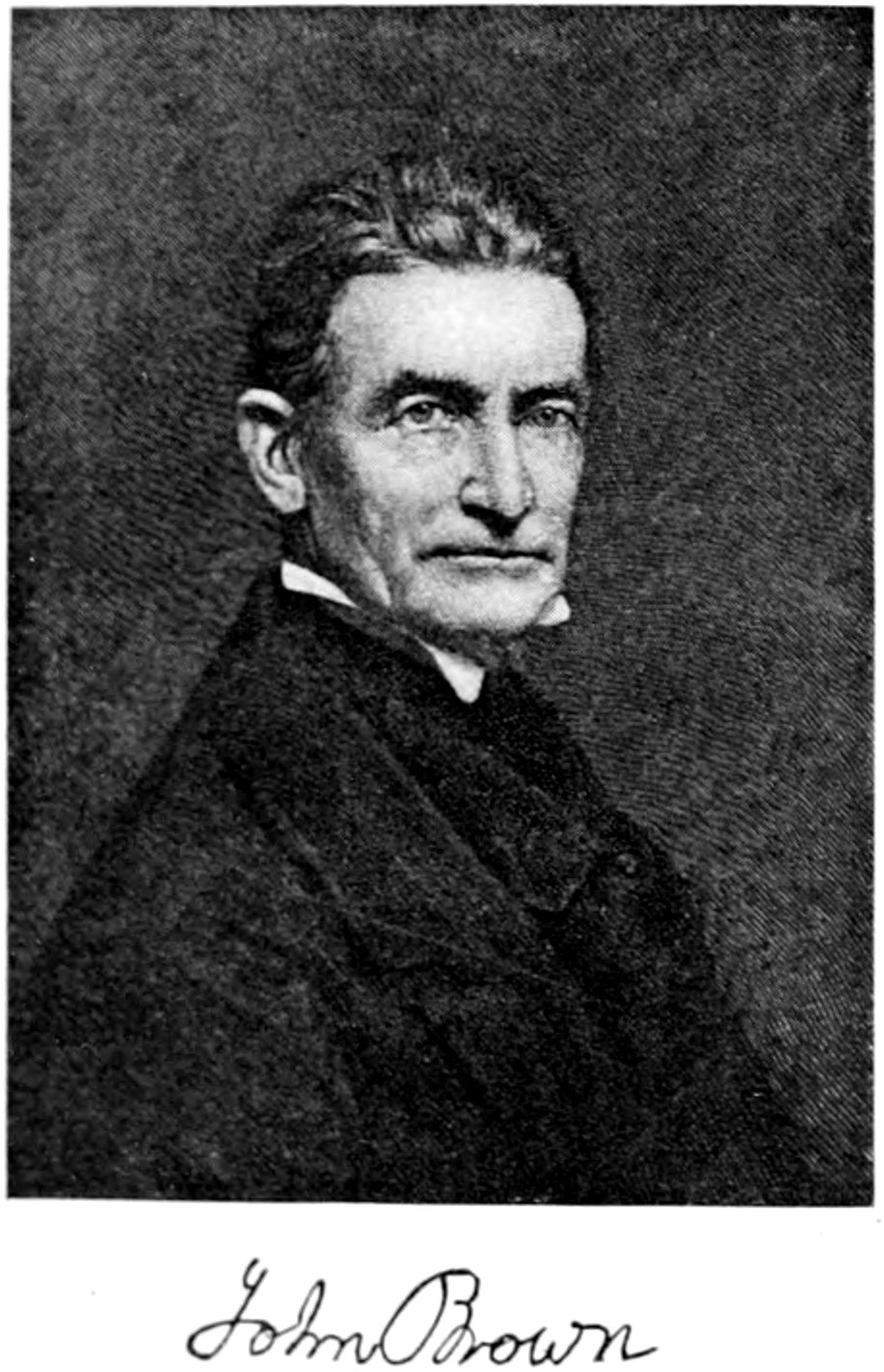
CHRONOLOGY — Boyhood and Youth — The Tanner — The Shepherd — In Kansas — The Abolitionist — The Harper’s Ferry Raid — CHAPTER I AFRICA AND AMERICA
11
- 1800—
- John Brown is born in Torrington, Conn., May 9th. Attempted insurrection of slaves under
Gabriel in Virginia, in September.
- 1805—
- The family migrates to Ohio.
- 1812—
- John Brown meets a slave boy.
- 1816—
- He joins the church.
- 1819—
- He attends school at Plainfield, Mass.
- 1819–1825—
- John Brown works as a tanner at Hudson, O.
- 1821—
- He marries Dianthe Lusk, June 21st.
- 1822—
- Attempted slave insurrection in South Carolina in June.
- 1825–1835—
- He works as a tanner at Randolph, Pa., and is postmaster.
- 1831—
- Nat Turner’s insurrection, in Virginia, August 21st.
- 1832—
- His first wife dies, August 10th.
- 1833—
- He marries Mary Ann Day, July 11th.
- 1834—
- He outlines his plan for Negro education, November 21st.
- 1835–1840—
- He lives in and near Hudson, O., and speculates in land.
- 1837—
- He loses heavily in the panic.
- 1839—
- He and his family swear blood-feud with slavery.
- 1840—
- He surveys Virginia lands for Oberlin College, and proposes buying 1,000 acres.
- 1841—
- John Brown begins sheep-farming.
12
- 1842—
- He goes into bankruptcy.
- 1843—
- He loses four children in September.
- 1844—
- He forms the firm of “Perkins and Brown, wool-merchants.”
- 1845–51—
- He is in charge of the Perkins and Brown warehouse, Springfield, O.
- 1846—
- Gerrit Smith offers Adirondack farms to Negroes, August 1st.
- 1847—
- Frederick Douglass visits Brown and hears his plan for a slave raid.
- 1849—
- He goes to Europe to sell wool, and visits France and Germany, August and September.
- 1849—
- First removal of his family to North Elba, N. Y.
- 1850—
- The new Fugitive Slave Law is passed.
- 1851–1854—
- Winding up of the wool business.
- 1851—
- He founds the League of Gileadites, January 15th.
- 1854—
- Kansas and Nebraska Bill becomes a law, May 30th. Five sons start for Kansas in October.
- 1855—
- John Brown at the Syracuse convention of Abolitionists in June. He starts for Kansas with
a sixth son and his son-in-law in September. Two sons take part in Big Springs convention
in September. John Brown arrives in Kansas, October 6th. He helps to defend Lawrence in
December.
- 1856—
- He attends a mass meeting at Osawatomie in April. He visits Buford’s camp in May. The
sacking of Lawrence, May 21st. The Pottawatomie murders, May 23–26th. Arrest of two sons,
May 28th. Battle of Black Jack, June 2d. Goes to Iowa with his wounded son-in-law and
joins Lane’s army, July and August. Joins in attacks to rid Lawrence of surrounding
forts, August. Battle of Osawatomie, August 30th. Missouri’s last invasion of Kansas,
September 15th. Geary arrives and induces Brown to leave Kansas, September. Brown starts
for the East with his sons, September 20th.
13
- 1857—
- John Brown is in Boston in January. He attends the New York meeting of the National
Kansas Committee, in January. Before the Massachusetts legislature in February. Tours New
England to raise money, March and April. Contracts for 1,000 pikes in Connecticut.
- 1857—
- He starts West, May. He is at Tabor, I., August and September. He founds a military
school in Iowa, December.
- 1858—
- John Brown returns to the East, January. He is at Frederick Douglass’s house, February.
He reveals his plan to Sanborn in February. He is in Canada, April. Forbes’ disclosures,
May. Chatham convention, May 8–10th. Hamilton’s massacre in Kansas, May 19th. Plans
postponed, May 20th. John Brown starts West, June 3d. He arrives in Kansas, June 25th. He
is in South Kansas, coöperating with Montgomery, July-December. The raid into Missouri
for slaves, December 20th.
- 1859—
- John Brown starts with fugitives for Canada, January 20th. He arrives in Canada, March
12th. He speaks in Cleveland, March 23d. Last visit of John Brown to the East, April and
May. He starts for Harper’s Ferry, June. He and three companions arrive at Harper’s
Ferry, July 3d. He gathers twenty-two men and munitions, June-October. He starts on the
foray, Sunday, October 16th at 8 P. M. The town and arsenal
are captured, Monday, October 17th at 4 A. M. Gathering of
the militia, Monday, October 17th at 7 A. M. to 12 M. Brown’s party is hemmed in, Monday, October 17th at 12 M. He withdraws to the engine-house, Monday, October 17th at 12 M. Kagi’s party is killed and captured, Monday, October 17th at 3
P. M. Lee and 100 marines arrive, Monday, October 17th at
12 P. M. Brown is captured, Tuesday, October 18th at 8
A. M.
- 1859—
- Preliminary examination, October 25th. Trial at Charleston (then Virginia, now West
Virginia), October 27th-November 4th. Forty days in prison, October 16th-December 2d.
Execution of John Brown at Charleston, December 2d. Burial of John Brown at North Elba,
N. Y., December 8th.
15
“That it might be fulfilled which was spoken of the Lord by
the prophet saying, ‘Out of Egypt have I called My son.’”
The mystic spell of Africa is and ever was over
all America. It has guided her hardest work, inspired
her finest literature, and sung her sweetest
songs. Her greatest destiny—unsensed and despised
though it be,—is to give back to the first of continents
the gifts which Africa of old gave to America’s
fathers’ fathers.
Of all inspiration which America owes to Africa,
however, the greatest by far is the score of heroic,
men whom the sorrows of these dark children
called to unselfish devotion and heroic self-realization:
Benezet, Garrison and Harriet Stowe;
Sumner, Douglass and Lincoln—these and others,
but above all, John Brown.
John Brown was a stalwart, rough-hewn man,
mightily yet tenderly carven. To his making went
the stern justice of a Cromwellian “Ironside,” the
freedom-loving fire of a Welsh Celt, and the thrift
16of a Dutch housewife. And these very things it
was—thrift, freedom, and justice—that early crossed
the unknown seas to find asylum in America. Yet
they came late, for before they came greed, and
greed brought black slaves from Africa.
The Negroes came on the heels, if not on the very
ships of Columbus. They followed De Soto to the
Mississippi; saw Virginia with D’Ayllon, Mexico
with Cortez, Peru with Pizarro; and led the western
wanderings of Coronado in his search for the
Seven Cities of Cibola. Something more than a
a decade after the Cavaliers, and a year before the
Pilgrims, they set lasting foot on the North American
continent.
These black men came not of their willing,
but because of the hasty greed of new America selfishly
and half thoughtlessly sought to revive in the
New World the dying but unforgotten custom of
enslaving the world’s workers. So with the birth
of wealth and liberty west of the seas, came slavery,
and slavery all the more cruel and hideous because
it gradually built itself on a caste of race
and color, thus breaking the common bonds of
human fellowship and weaving artificial barriers
of birth and appearance.
The result was evil, as all injustice must be. At
first, the black men writhed and struggled and died
in their bonds, and their blood reddened the paths
across the Atlantic and around the beautiful isles of
the Western Indies. Then as the bonds gripped
them closer and closer, they succumbed to sullen
17indifference or happy ignorance, with only here and
there flashes of wild red vengeance.
For, after all, these black men were but men,
neither more nor less wonderful than other men.
In build and stature, they were for the most part
among the taller nations and sturdily made. In
their mental equipment and moral poise, they
showed themselves full brothers to all men—“intensely
human”; and this too in their very modifications
and peculiarities—their warm brown and
bronzed color and crisp curled hair under the heat
and wet of Africa; their sensuous enjoyment of the
music and color of life; their instinct for barter and
trade; their strong family life and government.
Yet these characteristics were bruised and spoiled
and misinterpreted in the rude uprooting of the
slave trade and the sudden transplantation of this
race to other climes, among other peoples. Their
color became a badge of servitude, their tropical
habit was deemed laziness, their worship was
thought heathenish, their family customs and
the government were ruthlessly overturned and debauched;
many of their virtues became vices, and
much of their vice, virtue.
The price of repression is greater than the cost of
liberty. The degradation of men costs something
both to the degraded and those who degrade. While
the Negro slaves sank to listless docility and vacant
ignorance, their masters found themselves whirled
in the eddies of mighty movements: their system
of slavery was twisting them backward toward
18darker ages of force and caste and cruelty, while
forward swirled swift currents of liberty and uplift.
They still felt the impulse of the wonderful
awakening of culture from its barbaric sleep of
centuries which men call the Renaissance; they
were own children of the mighty stirring of Europe’s
conscience which we call the Reformation; and
they and their children were to be prime actors in
laying the foundations of human liberty in a new
a century and new land. Already the birth pains
of the new freedom were felt in that land. Old
Europe was begetting in the new continent a vast
longing for spiritual space. So it was builded
into America the thrift of the searchers of wealth,
the freedom of the Renaissance and the stern morality
of the Reformation.
Three lands typified these three things which
time planted in the New World: England sent
Puritanism, the last white flower of the Lutheran
revolt; Holland sent the new vigor and thrift of
the Renaissance; while Celtic lands and bits of lands
like France and Ireland and Wales, sent the passionate
desire for personal freedom. These three
elements came, and came more often than not in
the guise of humble men—an English carpenter on
the Mayflower, an Amsterdam tailor seeking a new
ancestral city, and a Welsh wanderer. From three
such men sprang in the marriage of years, John
Brown.
To the unraveling of human tangles, we would
gladly believe that God sends especial men—chosen
19vessels that come to the world’s deliverance. And
what could be more fitting than that the human embodiments
of freedom, Puritanism and trade—the
great new currents sweeping across the back eddies
of slavery, should give birth to the man who in
years to come pointed the way to liberty and realized
that the cost of liberty was less than the price of
repression? So it was. In bleak December 1620,
a carpenter and a weaver landed at Plymouth—Peter
and John Brown. This carpenter Peter came from
goodly stock, possibly, though not sure, from
that very John Brown of the early sixteenth century
whom bluff King Henry VIII of England burned
for his Puritanism, and whose son was all too near
the same fate. Thirty years after Peter Brown had
landed, came the Welshman, John Owen, to
Windsor, Conn., to help in the building of that
commonwealth, and near him settled Peter Mills,
the tailor of Holland. The great-grandson of Peter
Brown, born in Connecticut in 1700, had for a son
a Revolutionary soldier, who married one of the
Welshman’s grandchildren and had in turn a son,
Owen Brown, the father of John Brown, in February
of 1771. This Owen Brown a neighbor remembers
“very distinctly, and that he was very much respected
and esteemed by my father. He was
an earnestly devout and religious man, of the old Connecticut
fashion; and one peculiarity of his impressed
his name and person indelibly upon my
memory: he was inveterate and most painful
stammerer—the first specimen of that infirmity that
20I had ever seen, and, according to my recollection,
the worst that I had ever known to this day. Consequently,
though we removed from Hudson to another
settlement early in the summer of 1807, and returned
to Connecticut in 1812, so that I rarely saw any of
that family afterward, I have never to this day
seen a man struggling and half strangled with a
word stuck to his throat, without remembering good
Mr. Owen Brown, who could not speak without
stammering, except in prayer.”[1]
In 1800, May 9th, wrote this Owen Brown:
“John was born, one hundred years after his great-grandfather.
Nothing else very uncommon.”[2]
CHAPTER II THE MAKING OF THE MAN
21
“There was a man called of God and his name was John.”
A tall big boy of twelve or fifteen, “barefoot
and bareheaded, with buckskin breeches, suspended
often with one leather strap over his shoulder”[3]
roamed in the forests of northern Ohio. He remembered
the days of his coming to the strange
wild land—the lowing oxen, the great white wagon
that wandered from Connecticut to Pennsylvania
and over the swelling hills and mountains, where
the wide-eyed urchin of five sat staring at the new
world of a wild beast and the wilder brown men.
Then came life itself in its realness—the driving of
cows and the killing of rattlesnakes, and swift free
rides on great mornings alone with earth and tree
and the sky. He became “a rambler in the wild new
country, finding birds and squirrels and sometimes
a wild turkey’s nest.” At first, the Indians filled
him with a strange fear. But his kindly old father
thought of Indians as neither vermin nor property
and this fear “soon wore off and he used to hang
about them quite as much as was consistent with
good manners.”
22The tragedy and comedy of this broad silent life
turned on things strangely simple and primitive—the
stealing of “three large brass pins”; the disappearance
of the wonderful yellow marble which
an Indian boy had given him; the love and losing
of a little bob-tailed squirrel for which he wept and
hunted the world in vain; finally the shadow
of death which is ever here—the death of a ewe-lamb
and the death of the boy’s mother.
All these things happened before he was eight
and they were his main education. He could dress
leather and make whip-lashes; he could herd cattle
and talk Indian; but of books and formal schooling
he had little.
“John was never quarrelsome, but was excessively
fond of the hardest and roughest kind of plays,
and could never get enough of them. Indeed when
for a short time, he was sometimes sent to school,
the opportunity it afforded to wrestle and snowball
and run and jump and knock off old seedy wool
hats, offered to him almost the only compensation
for the confinements and restraints of school.
“With such a feeling and but little chance of going
to school at all, he did not become much of a
scholar. He would always choose to stay at home
and work hard rather than be sent to school.”
Consequently, “he learned nothing of grammar,
nor did he get at school so much knowledge of
common arithmetic as the four ground rules.”
Almost his only reading at the age of ten was a
little history to which the open bookcase of an old
23friend tempted him. He knew nothing of games or
sports; he had few or no companions, but, “to be
sent off through the wilderness alone to very considerable
distances was particularly his delight....
By the time he was twelve years
old he was sent off more than a hundred miles with
companies of cattle.” So his soul grew apart and
alone and yet untrammeled and unconfined, knowing
all the depths of secret self-abasement, and the
heights of confident self-will. With others he was
painfully diffident and bashful, and little sins that
smaller souls would laugh at and forget loomed
large and awful to his heart-searching vision.
John had “a very bad foolish habit.... I
mean telling lies, generally to screen himself from
blame or from punishment,” because “he could
not well endure to be reproached and I now think
had he been oftener encouraged to be entirely
frank ... he would not have been so often
guilty of this fault, nor have been (in after life)
obliged to struggle so long with so mean a habit.”
Such a nature was in its very essence religious, even
mystical, but never superstitious nor blindly trustful
in half-known creeds and formulas. His family
was not rigidly Puritan in its thought and discipline
but had rather fallen into the mild heathenism
of the hard-working frontier until just before
John’s birth. Then, his father relates in quaint
Calvinistic patois: “I lived at home in 1782; this
was a memorable year, as there was a great revival
of religion in the town of Canton. My mother and
24my older sisters and brother John dated their hopes
of salvation from that summer’s revival under the
ministry of the Rev. Edward Mills. I cannot say
as I was a subject of the work; but this I can say
that I then began to hear preaching. I can now
recollect most if not all of those I heard preach,
and what their texts were. The change in our
family was great; family worship set up by
brother John was ever afterward continued. There
was a revival of singing in Canton and our family
became singers. Conference meetings were kept up
constantly and singing meetings—all of which
brought our family into a very good association—a
very great aid of restraining grace.”
Thus this young freeman of the woods was born
into a religious atmosphere; not that of stern, intellectual
Puritanism, but of a milder and a more
sensitive type. Even this, however, the naturally
skeptical bent of his mind did not receive unquestioningly.
The doctrines of his day and church
did not wholly satisfy him and he became only “to
some extent a convert to Christianity.” One
answer to his questionings did come, however,
bearing its own wonderful credentials—and credentials
all the more wonderful to the man of few
books and narrow knowledge of the world of
thought—the English Bible. He grew to be “a
firm believer in the divine authenticity of the Bible.
With this book he became very familiar.” He
read and reread it; he committed long passages to
memory; he copied the simple vigor of its English,
25and wove into the very essence of his being, its
history, poetry, philosophy and truth. To him the
cruel grandeur of the Old Testament was as true as
the love and sacrifice of the New, and both mingled
to mold his soul. “This will give you some general
idea of the first fifteen years of his life, during
which time he became very strong and large of his
age, and ambitious to perform the full labor of a
man at almost any kind of hard work.”
Young John Brown’s first broad contact with
life and affairs came with the War of 1812, during
which Hull’s disastrous campaign brought the scene
of fighting near his western home. His father, a
simple wandering old soul, thrifty without foresight,
became a beef contractor, and the boy drove
his herds of cattle and hung about the camp. He
met men of position, was praised for his prowess
and let listen to talk that seemed far beyond his
years. Yet he was not deceived. The war he felt
was real war and not the war of fame and fairy tale.
He saw shameful defeat, heard treason broached, and
knew of cheating and chicanery. Disease and death
left its slimy trail as it crept homeward through the
town of Hudson from Detroit: “The effect of
what he saw during the war went so far to disgust
him with military affairs that he would neither
train nor drill.”
But in all these early years of the making of
this man, one incident stands out as foretaste and
prophecy—an incident of which we know only the
indefinite outline, and yet one which unconsciously
26foretold to the boy the life deed of the man. It was
during the war that a certain landlord welcomed
John to his home whither the boy had ridden with
cattle, a hundred miles through the wilderness. He
praised the big, grave and bashful lad to his guests
and made much of him. John, however, discovered
something far more interesting than praise and good
food in the landlord’s parlor, and that was another
boy in the landlord’s yard. Fellow souls were scarce
with this backwoodsman and his diffidence warmed
to the kindly welcome of the stranger, especially
because he was black, half-naked, and wretched.
In John’s very ears the kind voices of the master
and his folk turned to harsh abuse with this black
boy. At night the slave lay in the bitter cold and
once they beat the wretched thing before John’s
very eyes with an iron shovel, and again and again
struck him with any weapon that chanced. In
wide-eyed silence John looked on and questioned,
Was the boy bad or stupid? No, he was active, intelligent
and with the great warm sympathy of his
race did the stranger “numerous little acts of kindness,”
so that John readily, in his straightforward
candor, acknowledged him “fully if not more than
his equal.” That the black worked and worked
hard and steadily was in John’s eyes no hardship—rather
a pleasure. Was not the world work? But
that this boy was fatherless and motherless, and that
all slaves must of necessity be fatherless and motherless
with none to protect them or provide for them,
save at the will or caprice of the master—this was
27to the half-grown man a thing of fearful portent and
he asked, “Is God their Father?” And what he
asked, a million and a half black bondmen were
asking through the land.
CHAPTER III THE WANDERJAHRE
28
“Where is the promise of His coming? For since the fathers
fell asleep, all things continue as they were from the beginning
of the creation.”
In 1819 a tall, sedate, dignified young man named
John Brown was entered among the students of the
Rev. Moses Hallock at Plainfield, Mass., where men
were prepared for Amherst College. He was beginning
his years of wandering—spiritual searching
for the way of life, physical wandering in the wilderness
where he must earn his living. In after
years he wrote to a boy:
“I wish you to have some definite plan. Many
seem to have none; others never stick to any that
they do form. This was not the case with John.
He followed up with great tenacity whatever he set
about as long as it answered his general purpose;
hence he rarely failed in some degree to effect the
things he undertook. This was so much the case
that he habitually expected to succeed in his undertakings.”[4]
In this case he expected to get an education
and he came to his task equipped with that
rare mixture of homely thrift and idealism which
characterized his whole life. His father could do
29little to help him, for the war was followed by the
“hard times” which are the necessary fruit of fighting.
As the father wrote: “Money became scarce,
property fell and that which I thought well bought
would not bring its cost. I had made three or four
large purchases, in which I was a heavy loser.”
It was therefore as a poor boy ready to work his
way that John started out at Plainfield. The son
of the principal tells how “he brought with him a
piece of sole leather about a foot square, which he
had himself tanned for seven years, to resole his
boots. He had also a piece of sheepskin which he
had tanned, and of which he cut some strips about
an eighth of an inch wide, for other students to pull
upon. Father took one string, and winding it around
his finger said with a triumphant turn of the eye
and mouth, ‘I shall snap it.’ The very marked, yet
kind immovableness of the young man’s face on seeing
father’s defeat, father’s own look, and the position
of the people and the things in the old kitchen
somehow gave me a fixed recollection of this little
incident.”[5]
But all his thrift and planning here were doomed
to disappointment. He was, one may well believe,
no brilliant student, and his only chance of success
lay in long and steady application. This he was
prepared to make when inflammation of the eyes
set in, of so grave a type that all hopes of long study
30must be given up. Several times before he had attempted
regular study, but for the most part these
excursions to New England schools had been but
tentative flashes on a background of hard work in
his father’s Hudson tannery: “From fifteen to
twenty years of age he spent most of his time working
at the tanner’s and currier’s trade;” and yet,
naturally, ever looking here and there in the world
to find his place. And that place, he came gradually
to decide in his quiet firm way, was to be an
important one. He felt he could do things; he
grew used to guiding and commanding men. He
kept his own lonely home and was both foreman
and cook in the tannery. His “close attention to
business and success in its management, together
with the way he got along with a company of men
and boys, made him quite a favorite with the serious
and more intelligent portion of older persons. This
was so much the case and secured for him so many
little notices from those he esteemed, that his vanity
was very much fed by it, and he came forward to
manhood quite full of self-conceit and self-confidence,
notwithstanding his extreme bashfulness.
The habit so early formed of being obeyed rendered
him in after life too much disposed to speak in an
imperious or dictating way.”[6] Thus he spoke of
himself, but others saw only that peculiar consciousness
of strength and quiet self-confidence, which
characterized him later on.
Just how far his failure to get a college training
31was a disappointment to John Brown one is not
able to say with certainty. It looks, however, as
if his attempts at higher training were rather the
obedient following of the conventional path, by a
spirit which would never have found in those fields
congenial pasture. One suspects that the final decision
that college was impossible came to this
strong free spirit with a certain sense of relief—a relief
marred only by the perplexity of knowing what
ought to be the path for his feet, if the traditional
way to accomplishment and distinction was closed.
That he meant to be not simply a tanner was
disclosed in all his doing and thinking. He undertook
to study by himself, mastering common arithmetic
and becoming in time an expert surveyor. He
“early in life began to discover a great liking to
fine cattle, horses, sheep, and swine.” Meantime,
however, the practical economic sense of his day
and occupation pointed first of all to marriage, as
his father, who had had three wives and sixteen or
more children, was at pains to impress upon him.
Nor was John Brown himself disinclined. He was
as he quaintly says, “naturally fond of
females, and withal extremely diffident.” One
can easily imagine the deep disappointment of this
grave young man in his first unfortunate love affair,
when he felt With many another unloved heart,
this old world through, “a steady, strong desire to
die.”
But youth is stronger even than first love,
and the widow who came to keep house for him had
32a grown daughter, a homely, good-hearted and
simple-minded country lass; the natural result was
that John Brown was married at the age of twenty
to Dianthe Lusk, whom he describes as “a remarkably
plain, but neat, industrious and economical
girl, of excellent character, earnest piety and practical
common sense.”[7]
Then ensued a period of life which puzzles the
casual onlooker with its seemingly aimless changing
character, its wandering restlessness, its planless
wavering. He was now a land surveyor, now a
tanner and now a lumber dealer; a postmaster, a
wool-grower, a stock-raiser, a shepherd, and a
farmer. He lived at Hudson, at Franklin and at
Richfield in Ohio; in Pennsylvania, New York, and
Massachusetts. And yet in all this wavering and
wandering, there were certain great currents of
growth, purpose and action. First of all he became
the father of a family: in the eleven years from
1821 to 1832, seven children were born—six sons
and one girl. The patriarchal ideal of family life
handed down by his fathers, strengthened by his
own saturation in Hebrew poetry, and by his own
bent, grew up in his home.
His eldest son and daughter tell many little incidents
illustrating his family government: “Our
house, on a lane which connects two main roads,
was built under father’s direction in 1824, and still
stands much as he built it with the garden and
orchard around it which he laid out. In the rear
33of the house was then a wood, now gone, on a knoll
leading down to the brook which supplied the tan-pits.”[8]
“Father used to hold all his children while they
were little at night and sing his favorite songs,”
says the eldest daughter. “The first recollection I
have of father was being carried through a piece of
woods on Sunday to attend a meeting held at a
neighbor’s house. After we had been at the house
a little while, father and mother stood up and held
us, while the minister put water on our faces. After
we sat down father wiped my face with a brown
silk handkerchief with yellow spots on it in diamond
shape. It seemed beautiful to me and I
thought how good he was to wipe my face with that
pretty handkerchief. He showed a great deal of
tenderness in that and other ways. He sometimes
seemed very stern and strict with me, yet his tenderness
made me forget he was stern....
“When he would come home at night tired out
with labor, he would before going to bed, ask some
of the family to read chapters (as was his usual
course night and morning); and would almost
always say: ‘Read one of David’s Psalms.’...
“Whenever he and I were alone, he never failed
to give me the best of advice, just such as a true and
anxious mother would give a daughter. He always
seemed interested in my work, and would come
around and look at it when I was sewing or knitting;
and when I was learning to spin he always
34praised me if he saw that I was improving. He
used to say: ‘Try to do whatever you do in the
very best possible manner.’”[9]
“Father had a rule not to threaten one of his
children. He commanded and there was obedience,”
writes his eldest son. “My first apprenticeship
to the tanning business consisted of a three
years’ course at grinding bark with a blind horse.
This, after months and years, became slightly monotonous.
While the other children were out at play
in the sunshine, where the birds were singing, I
used to be tempted to let the old horse have a rather
long rest, especially when father was absent from
home; and I would then join the others at their
play. This subjected me to frequent admonitions
and to some corrections for eye-service as father
termed it.... He finally grew tired of these
frequent slight admonitions for my laziness and
other shortcomings, and concluded to adopt with me
a sort of book-account something like this:
“For disobeying mother—8 lashes.
“For unfaithfulness at work—3 lashes.
“For telling a lie—8 lashes.
“This account he showed to me from time to time.
On a certain Sunday morning he invited me to accompany
him from the house to the tannery, saying
that he had concluded it was time for a settlement.
35We went into the upper or finishing room,
and after a long and tearful talk over my faults, he
again showed me my account, which exhibited a
fearful footing up of debits. I had no credits or offsets
and was of course bankrupt. I then paid about
one-third of the debt, reckoned in strokes from a
nicely prepared blue-beach switch, laid on ‘masterly.’
Then to my utter astonishment, father
stripped off his shirt and seating himself on a block
gave me the whip and bade me lay it on to his bare
back. I dared not refuse to obey, but at first I did
not strike hard. ‘Harder,’ he said, ‘harder,
harder!’ until he received the balance of the account.
Small drops of blood showed on his back
where the tip end of the tingling beach cut through.
Thus ended the account and settlement, which was
also my first practical illustration of the doctrine of
the atonement.”[10]
Even the girls did not escape whipping. “He
used to whip me often for telling lies,” says a
daughter, “but I can’t remember his ever punishing
me but once when I thought I didn’t deserve, and
then he looked at me so stern that I didn’t dare to
tell the truth. He had such a way of saying, ‘Tut,
tut!’ if he saw the first sign of a lie in us, that he
often frightened us children.
“When I first began to go to school,” she continues,
“I found a piece of calico one day behind
one of the benches—it was not large, but seemed
quite a treasure to me, and I did not show it to any
36one until I got home. Father heard me then telling
about it and said, ‘Don’t you know what girl lost
it?’ I told him I did not. ‘Well, when you go to
school to-morrow take it with you and find out if you
can who lost it. It is a trifling thing but always remember
that if you should lose anything you valued,
no matter how small, you would want the person
who found it to give it back to you.’” He
“showed a great deal of tenderness to me,” continues
the daughter, “and one thing I always noticed
was my father’s peculiar tenderness and devotion to
his father. In cold weather he always tucked the
bedclothes around grandfather when he went to
bed, and would get up in the night to ask him if he
slept warm—always seeming so kind and loving to
him that his example was beautiful to see.”
Especially were his sympathy and devotion evident
in sickness: “When his children were ill
with scarlet fever, he took care of us himself and
if he saw persons coming to the house, would go
to the gate and meet them, not wishing them to
come in, for fear of spreading the disease.[11]...
When any of the family were sick he did not often
trust watchers to care for the sick one, but sat up
himself and was like a tender mother. At one time
he sat up every night for two weeks while mother
was sick, for fear he would oversleep if he went
to bed, and then the fire would go out and she take
cold.”[12]
The death of one little girl shows how deeply he
37could be moved: “He spared no pains in doing
all that medical skill could do for her together with
the tenderest care and nursing. The time that he
could be at home was mostly spent in caring for her.
He sat up nights to keep an even temperature in
the room, and to relieve mother from the constant
care which she had through the day. He used to
walk with the child and sing to her so much that
she soon learned his step. When she heard him
coming up the steps to the door, she would reach
out her hands and cry for him to take her. When
his business at the wool store crowded him so much
that he did not have time to take her, he would
steal around through the wood-shed into the kitchen
to eat his dinner, and not go into the dining-room
where she could see or hear him. I used to be
charmed myself with his singing to her. He noticed
a change in her one morning and told us he
thought she would not live through the day, and
came home several times to see her. A little before
noon he came home and looked at her and said,
‘She is almost gone.’ She heard him speak, opened
her eyes and put up her little wasted hands with
such a pleading look for him to take her that he
lifted her up from the cradle with the pillows she
was lying on, and carried her until she died. He
was very calm, closed her eyes, folded her hands
and laid her in her cradle. When she was buried
father broke down completely and sobbed like a
child.”[13]
38Dianthe Lusk, John Brown’s first wife, died in
childbirth, August 10, 1832, having borne him
seven children, two of whom died very young. On
July 11, 1833, now thirty-three years of age, he
married Mary Ann Day, a girl of seventeen, only
five years older than his oldest child. She bore
him thirteen children, seven of whom died young.
Thus seven sons and four daughters grew to maturity
and his wife, Mary, survived him twenty-five years.
It was, all told, a marvelous family—large and
well-disciplined, yet simple almost to poverty, and
hard-working. No sooner were the children grown
than the wise father ceased to command and simply
asked or advised. He wrote to his eldest son when
first he started in life in characteristic style:
“I think the situation in which you have been
placed by Providence at this early period of your
life will afford to yourself and others some little test
of the sway you may be expected to exert over
minds in after life and I am glad on the whole to
have you brought in some measure to the test in
your youth. If you cannot now go into a disorderly
country school and gain its confidence and esteem,
and reduce it to good order and waken up the energies
and the very soul of every rational being in it—yes,
of every mean, ill-behaved, ill-governed boy
and girl that compose it, and secure the good-will
of the parents,—then how are you to stimulate asses
to attempt a passage of the Alps? If you run with
footmen and they should weary you, how should
you contend with horses? If in the land of peace
39they have wearied you, then how will you do in the
swelling of Jordan? Shall I answer the question
myself? ‘If any man lack wisdom, let him ask of
God, who giveth liberally and upbraideth not.’”[14]
Not that Brown was altogether satisfied with his
method of dealing with his children; he said to his
wife: “If the large boys do wrong, call them
alone into your room and expostulate with them
kindly, and see if you cannot reach them by a kind
but powerful appeal to their honor. I do not claim
that such a theory accords very well with my practice;
I frankly confess it does not; but I want your
face to shine even if my own should be dark and
cloudy.”[15]
The impression which he made on his own family
was marvelous. A granddaughter writes me of
him, saying: “The attitude of John Brown’s
family and descendants has always been one of exceeding
reverence toward him. This speaks for
something. Stern, unyielding, Puritanic, requiring
his wife and daughters to dress in sober brown, disliking
show and requesting that mourning colors be
not worn for him—a custom which still obtains with
us—laying the rod heavily upon his boys for their
boyish pranks, he still was wonderfully tender—would
invariably walk up hill rather than burden
his horse, loved his family devotedly, and when
sickness occurred, always installed himself as
nurse.”
40In his personal habits he was austere: severely
clean, sparing in his food so far as to count butter
an unnecessary luxury; once a moderate user of
cider and wine—then a strong teetotaler; a lover
of horses with harassing scruples as to breeding
race-horses. All this gave an air of sedateness and
maturity to John Brown’s earlier manhood which
belied his years. Having married at twenty, he
was but twenty-one years older than his eldest son;
and while his many children and his varied occupations
made him seem prematurely aged, he
was, in fact, during this period, during the years
from twenty to forty, experiencing the great
formative development of his spiritual life.
This development was most interesting and fruitful.
He was not a man of books: he had Rollins’
Ancient History, Josephus and Plutarch and lives of
Napoleon and Cromwell. With these went Baxter’s
Saints’ Rest, Henry On Meekness and Pilgrim’s Progress.
“But above all others the Bible was his
favorite volume and he had such perfect knowledge
of it that when any person was reading he would
correct the least mistake.”[16]
Into John Brown’s religious life entered two
strong elements; the sense of overruling inexorable
fate, and the mystery and promise of death. He
pored over the Old Testament until the freer
religious skepticism of his earlier youth became
more formal and straight. The brother of his first
41wife says, “Brown was an austere fellow,” and
when the young man called on the sister and
mother Sundays, as his only holiday, Brown said
to him: “Milton, I wish you would not make
your visits here on the Sabbath.”
When the panic of 1837 nearly swept Brown from
his feet, he saw behind it the image of the old
Hebrew God and wrote his wife: “We all must
try to trust in Him who is very gracious and full of
compassion and of almighty power; for those that
do will not be made ashamed. Ezra the prophet
prayed and afflicted himself before God, when himself
and the Captivity were in a strait and I have
no doubt you will join with me under similar circumstances.
Don’t get discouraged, any of you, but
hope in God, and try all to serve Him with a perfect
heart.”[17]
When Napoleon III seized France and Kossuth
came to America, Brown looked with lofty contempt
on the “great excitement” which “seems to have
taken all by surprise.” “I have only to say in regard
to those things, I rejoice in them from the full
belief that God is carrying out His eternal purpose
in them all.”[18]
The gloom and horror of life settled early on
John Brown. His childhood had had little formal
pleasure, his young manhood had been serious and
filled with responsibility, and almost before he
himself knew the full meaning of life, he was trying
42to teach it to his children. The iron of bitterness
entered his soul with the coming of death,
and a deep religious fear and foreboding bore him
down as it took away member after member of his
family. In 1831 he lost a boy of four and in 1832
his first wife died insane, and her infant son was
buried with her. In 1843 four children varying in
ages from one to nine years were swept away. Two
baby girls went in 1846 and 1859 and an infant boy
in 1852. The struggle of a strong man to hold his
faith is found in his words, “God has seen fit to
visit us with the pestilence and four of our number
sleep in the dust; four of us that are still living
have been more or less unwell.... This has
been to us all a bitter cup indeed and we have
drunk deeply; but still the Lord reigneth and
blessed be His holy name forever.” Again three
years later he writes his wife from the edge of a new-made
grave: “I feel assured that notwithstanding
that God has chastised us often and sore, yet He
has not entirely withdrawn Himself from us nor
forsaken us utterly. The sudden and dreadful
manner in which He has seen fit to call our dear
little Kitty to take her leave of us, is, I need not
tell you how much, in my mind. But before Him
I will bow my head in submission and hold my
peace.... I have sailed over a somewhat
stormy sea for nearly half a century, and have experienced
enough to teach me thoroughly that I
may most reasonably buckle up and be prepared
for the tempest. Mary, let us try to maintain a
43cheerful self-command while we are tossing up and
down, and let our motto still be action, action,—as
we have but one life to live.”[19]
His soul gropes for light in the great darkness:
“Sometimes my imagination follows those of my
family who have passed behind the scenes; and I
would almost rejoice to be permitted to make them
a personal visit. I have outlived nearly half of all
my numerous family, and I ought to realize that in
any event a large proportion of my life is traveled
over.”[20]
Then there rose grimly, as life went on in its
humdrum round of failure and trouble, the thought
that in some way his own sin and shortcomings
were bringing upon him the vengeful punishment
of God. He laments the fact that he has done little
to help others and the world: “I feel considerable
regret by turns that I have lived so many
years and have in reality done so little to increase
the amount of human happiness. I often regret
that my manner is not more kind and affectionate
to those I really love and esteem. But I trust my
friends will overlook my harsh rough ways, when
I cease to be in their way as an occasion of pain and
unhappiness.”[21]
The death of a friend fills him with self-reproach:
“You say he expected to die, but do not say how he
felt in regard to the change as it drew near. I
44have to confess my unfaithfulness to my friend in
regard to his most important interest....
When I think how very little influence I have even
tried to use with my numerous acquaintances and
friends in turning their minds toward God and
heaven, I feel justly condemned as a most wicked
and slothful servant; and the more so as I have
very seldom had any one refuse to listen when I
earnestly called him to hear. I sometimes have
dreadful reflections about having fled to go down to
Tarshish.”[22]
Especially did the religious skepticism of his
children, so like his own earlier wanderings, worry
and dismay the growing man until it loomed before
his vision as his great sin, calling for mighty
atonement. He pleads with his older children continually:
“My attachments to this world have been very
strong and divine Providence has been cutting me
loose, one cord after another. Up to the present
time notwithstanding I have so much to remind me
that all ties must soon be severed, I am still clinging
like those who have hardly taken a single lesson. I
really hope some of my family may understand that
this world is not the home of man, and act in accordance.
Why may I not hope this for you? When I
look forward as regards the religious prospects of my
numerous family—the most of them,—I am forced
to say, and feel too, that I have little—very little
to cheer. That this should be so is, I perfectly well
45understand, the legitimate fruit of my own planting;
and that only increases my punishment. Some
ten or twelve years ago I was cheered with the belief
that my elder children had chosen the Lord to
be their God and I relied much on their influence
and example in atoning for my deficiency and bad
example with the younger children. But where
are we now? Several have gone where neither a
good nor a bad example from me will better their
condition or prospects or make them worse. I will
not dwell longer on this distressing subject but only
say that so far as I have gone it is from no disposition
to reflect on any one but myself. I think
I can clearly discover where I wandered from the
road. How now to get on it with my family is
beyond my ability to see or my courage to hope.
God grant you thorough conversion from sin, and
full purpose of heart to continue steadfast in His
way through the very short season you will have to
pass.”[23]
And again he writes: “One word in regard to
the religious belief of yourself and the ideas of
several of my children. My affections are too deep-rooted
to be alienated from them; but ‘my gray hairs
must go down in sorrow to the grave’ unless the
true God forgive their denial and rejection of Him
and open their eyes.”
And again: “I would fain hope that the spirit of
God has not done striving in our hard hearts. I
sometimes feel encouraged to hope that my sons
46will give up their miserable delusions and believe
in God and in His Son, our Saviour.”[24]
All this is evidence of a striving soul, of a man to
whom the world was a terribly earnest thing.
Here was neither the smug content of the man
beyond religious doubt, nor the carelessness of the
unharassed conscience. To him the world was a
mighty drama. God was an actor in the play and
so was John Brown. But just what his part was to
be his soul in the long agony of years tried to know,
and ever and again the chilling doubt assailed him
lest he be unworthy of his place or had missed the
call. Often the brooding masculine mind which
demanded “Action! Action!” sought to pierce the
mystic veil. His brother-in-law became a spiritualist,
and he himself hearkened for voices from the
Other Land. Once or twice he thought he heard
them. Did not the spirit of Dianthe Lusk guide
him again and again in his perplexity? He once
said it did.
And so this saturation in Hebrew prophecy, the
chastisement of death, the sense of personal sin
and shortcoming and the voices from nowhere,
deepened, darkened and broadened his religious
life. Yet with all this there went a peculiar
common sense, a spirit of thrift and stickling for
detail, a homely shrewd attention to all the little
facts of daily existence. Sometimes this prosaic
tinkering with things burdened, buried and submerged
47the spiritual life and striving. There was
nothing left except the commonplace, unstable
tanner, but ever as one is tempted thus to fix his
place in the world, there wells up surging spiritual
life out of great unfathomed depths—the intellectual
longing to see, the moral wistfulness of the
hesitating groping doer. This was the deeper,
truer man, although it was not the whole man.
“Certainly I never felt myself in the presence of a
stronger religious influence than while in this man’s
house,” said Frederick Douglass in 1847.
CHAPTER IV THE SHEPHERD OF THE SHEEP
48
“And there were in the same country shepherds abiding in
the field, keeping watch over their flock by night.
“And, lo, the angel of the Lord came upon them, and
the glory of the Lord shone round about them; and they were sore
afraid.”
The vastest physical fact in the life of John
Brown was the Alleghany Mountains—that beautiful
mass of hill and crag which guards the sombre
majesty of the Maine coast, crumples the rivers on
the rocky soil of New England, and rolls and leaps
down through busy Pennsylvania to the misty
peaks of Carolina and the red foothills of Georgia.
In the Alleghanies John Brown was all but born;
their forests were his boyhood wonderland; in their
villages he married his wives and begot his clan.
On the sides of the Alleghanies, he tended his sheep
and dreamed of his terrible dream. It was the mystic,
awful voice of the mountains that lured him to liberty,
death and martyrdom within their wildest
fastness, and in their bosom he sleeps his last sleep.
So, too, in the development of the United States
from the War of 1812 to the Civil War, it was the
Alleghanies that formed the industrial centre of the
land and lured young men to their waters and mines,
valleys and factories, as they lured John Brown.
49His life from 1805 to 1854 was almost wholly spent
on the western slope of the Alleghanies in a small
area of Ohio and Pennsylvania, beginning eighty
miles north of Pittsburg and ending twenty-five
miles southeast of Cleveland. Here in a half-dozen
small towns, but chiefly in Hudson, O., he worked
in his young manhood to support his growing family.
From 1819 to 1825, he was a tanner at Hudson.
Then he moved seventy miles westward toward the
crests of the Alleghanies in Pennsylvania, where he
set up his tannery again and became a man of importance
in the town. John Quincy Adams made
him postmaster, the village school was held at his
log house and the new feverish prosperity of the
post-bellum period began to stir him as it stirred
this whole western world. Indeed, the economic
history of the land from the War of 1812 to the
Civil War covers a period of extraordinary developments—so
much so that no man’s life which fell
in these years may be written without knowledge
of and allowance for the battling of gigantic social
forces and welding of material, out of which the
present United States was designed.
Three phases roughly mark these days: First,
the slough of despond following the war, when England
forced her goods upon us at nominal prices
to kill the new-sprung infant industries; secondly,
the new protection from the competition of foreign
goods from 1816 to 1857, rising high in the
prohibitory schedules of 1828, and falling to the
lower duties of the forties and the free trade of the
50fifties, and stimulating irregularly and spasmodically
but tremendously the cotton, woolen and
iron manufactories; and finally, the three whirlwinds
of 1819, 1837–1839, and 1857, marking frightful
maladjustments in the mushroom growth of our
industrial life.
John Brown, coming to full industrial manhood
in the buoyant prosperity of 1825, soon began to
sense the new spirit. After ten years’ work in
Pennsylvania, he again removed westward, nearer
the projected transportation lines between East and
West. He began to invest his surplus in land along
the new canal routes, became a director in one of
the rapidly multiplying banks and was currently
rated to be worth $20,000 in 1835. But his prosperity,
like that of his neighbors, and indeed, of the
whole country, was partly fictitious, and built on a
fast expanding credit which was far outstretching
the rapid industrial development. Jackson’s blind
tinkering with banking precipitated the crisis. The
storm broke in 1837. Over six hundred banks
failed, ten thousand employees were thrown out of
work, money disappeared and prices went down to
a specie level. John Brown, his tannery and his
land speculations, were sucked into the maelstrom.
The overthrow was no ordinary blow to a man of
thirty-seven with eight children, who had already
trod the ways of spiritual doubt and unrest. For
three or four years he seemed to flounder almost
hopelessly, certainly with no settled plan or outlook.
He bred race-horses till his conscience troubled
51him; he farmed and did some surveying; he inquired
into the commission business in various
lines, and still did some tanning. Then gradually
he began to find himself. He was a lover of animals.
In 1839 he took a drove of cattle to Connecticut
and wrote to his wife: “I have felt distressed
to get my business done and return ever
since I left home, but know of no way consistent
with duty but to make thorough work of it while
there is any hope. Things now look more favorable
than they have but I may still be disappointed.”[25]
His diary shows that he priced certain farms for sale,
but especially did he inquire carefully into sheep-raising
and its details, and eventually bought a
flock of sheep, which he drove home to Ohio.
This marked the beginning of a new occupation,
that of shepherd, “being a calling for which in
early life he had a kind of enthusiastic longing.”
He began sheep-farming near Hudson, keeping his
own and a rich merchant’s sheep and also buying
wool on commission.
This industry in the United States had at that
time passed through many vicissitudes. The change
from household to factory economy and the introduction
of effective machinery had been slow, and
one of the chief drawbacks was ever the small quantity
of good wool. Consequently our chief supply
came from England until the embargo and war cut
off that supply and stimulated domestic manufacture.
Between 1810 and 1815 the value of the
52manufacture increased five-fold, but after the war,
when England sent goods over here below the price,
Americans rightly clamored for tariff protection.
This they got, but their advantage was nearly upset
by the wool farmers who also got protection on
the commodity, although less on low than on better
qualities; and it was the low grades that America
produced. From 1816 to 1832 the tariff wall against
wool and woolens rose steadily until it reached almost
prohibitive figures, save on the cheapest kind.
In this way the wool manufacture had by 1828 recovered
its war-time prosperity; by 1840 the mills
were sending out twenty and a half million dollars’
worth of goods yearly, and nearly fifty millions by
1860 even though meanwhile the tariff wall
was weakening. Thus by 1841 when John Brown
turned his attention to sheep-farming, there was a
large and growing demand for wool, especially of
the better grades, and by the abolition of the English
tariff in 1824, there was even a chance of invading
England.
Because, then, of his natural liking for the work,
and the growing prosperity of the wool trade, John
Brown chose this line of employment. But not for
this alone. His spirit was longing for air and space.
He wanted to think and read; time was flying and
his life as yet had been little but a mean struggle
for bread and that, too, only partially successful.
Already he had had a vision of vast service. Already
he had broached the matter to friends and
family, and at the age of thirty-nine he entered his
53new life distinctly and clearly with “the idea
that as a business it bid fair to afford him the
means of carrying out his greatest or principal
object.”[26]
His first idea was to save enough from the wreck of
his fortune to buy and stock a large sheep farm, and
in accordance with his already forming plans as to
Negro emancipation, he wanted this farm in or near
the South. A chance seemed opening when through
his father, a trustee of Oberlin College, he learned
of the Virginia lands lately given that institution
by Gerrit Smith, whom Brown came to know better.
Oberlin College was dear to John Brown’s heart,
for it had almost from the beginning taken a strong
anti-slavery stand. The titles to the Virginia land,
however, were clouded by the fact of many squatters
being in possession, which gave ample prospects
of costly lawsuits. Brown wrote the trustees early
in 1840, proposing to survey the lands for a nominal
price, provided he could be allowed to buy on
reasonable terms and establish his family there.
He also spoke of school facilities which he proposed
for Negroes as well as whites, according to a long
cherished plan. The college records in April, 1840,
say: “Communication from Brother John Brown
of Hudson was presented and read by the secretary,
containing a proposition to visit, survey and make
the necessary investigation respecting boundaries,
etc., of those lands, for one dollar per day and a
moderate allowance for necessary expenses; said
54paper frankly expressing also his design of viewing
the lands as a preliminary step to locating his family
upon them, should the opening prove a favorable
one; whereupon, voted that said proposition be acceded
to, and that a commission and needful outfit
be furnished by the secretary and treasurer.”[27]
The treasurer sent John Brown fifty dollars and
wrote his father, as a trustee of Oberlin, commending
the son’s purpose and hoping “for a favorable
issue both for him and the institution.” He
added, “Should he succeed in clearing up titles
without difficulty or lawsuits, it would be easy, as
it appears to me, to make provision for religious
and school privileges and by proper efforts with the
blessing of God, soon see that wilderness bud and
blossom as the rose.”[28]
Thus John Brown first saw Virginia and looked
upon the rich and heavy land which rolls westward
to the misty Blue Ridge. That he visited Harper’s
Ferry on this trip is doubtful but possible. The
lands of Oberlin, however, lay two hundred miles
westward in the foothills and along the valley of the
Ohio. He wrote home from Ripley, Va., in April
(for he had gone immediately): “I like the country
as well as I expected, and its inhabitants rather
better; and I have seen the spot where if it be the
will of Providence, I hope one day to live with my
family.... Were the inhabitants as resolute
and industrious as the Northern people and did
55they understand how to manage as well, they would
become rich.”[29]
By the summer of 1840 his work was accomplished
with apparent success. He had about selected his
dwelling-place, having “found on the right branch
of Big Battle a valuable spring, good stone-coal, and
excellent bottoms, good timber, sugar orchard, good
hill land and beautiful situation for dwelling—all
right. Course of this branch at the forks is south
twenty-one degrees west from a beautiful white oak
on which I marked my initials, 23d April.”[30]
The Oberlin trustees in August, “voted, that the
Prudential Committee be authorized to perfect negotiations
and convey by deed to Brother John
Brown of Hudson, one thousand acres of our Virginia
land on the conditions suggested in the correspondence
which has already transpired between
him and the committee.”[31]
Here, however, negotiations stopped, for the renewal
of the panic in 1839 overthrew all business
calculations until 1842 and later, and forced John
Brown to take refuge in formal bankruptcy in 1842.
This step, his son says, was wholly “owing to his
purchase of land on credit—including the Haymaker
farm at Franklin, which he bought in connection
with Seth Thompson, of Hartford, Trumbull
County, Ohio, and his individual purchase of three
56rather large adjoining farms in Hudson. When he
bought those farms, the rise in value of his place in
Franklin was such that good judges estimated his
property worth fully twenty thousand dollars. He
was then thought to be a man of excellent business
judgment and was chosen one of the directors of a
bank at Cayahoga Falls.”[32] Probably after the
crash of 1837, Brown hoped to extricate enough to
buy land in Virginia and move there, but things
went from bad to worse. Through endorsing a note
for a friend, one of his best pieces of farm property
was attached, put up at auction and bought
by a neighbor. Brown, on legal advice, sought
to retain possession, but was arrested and placed
in the Akron jail. The property was lost. Legal
bankruptcy followed in October, 1842, but Brown
would not take the full advantage of it. He gave
the New England Woolen Company of Rockville,
Conn., a note declaring that “whereas I, John
Brown, on or about the 15th day of June, A. D.
1839, received of the New England Company (through
their agent, George Kellogg, Esq.) the sum of twenty-eight
hundred dollars for the purchase of wool for
said company, and imprudently pledged the same
for my own benefit and could not redeem it; and
whereas I have been legally discharged from my
obligations by the laws of the United States—I
hereby agree (in consideration of the great kindness
and tenderness of said company toward me in
my calamity, and more particularly of the moral
57obligation I am under to render to all their due) to
pay the same and the interest thereon from time to
time as divine Providence shall enable me to
do.”[33]
He wrote Mr. Kellogg at the same time: “I am
sorry to say that in consequence of the unforeseen
expense of getting the discharge, the loss of an ox,
and the destitute condition in which a new surrender
of my effects has placed me, with my numerous
family, I fear this year must pass without my
effecting in the way of payment what I have encouraged
you to expect.”[34] He was still paying this
debt when he died and left fifty dollars toward it in
his will.
It was a labyrinth of disaster in which the soul
of John Brown was well-nigh choked and lost.
We hear him now and then gasping for breath:
“I have been careful and troubled with so much
serving that I have in a great measure neglected
the one thing needful, and pretty much stopped all
correspondence with heaven.”[35] He goes on to tell
his son: “My worldly business has borne heavily
and still does; but we progress some, have our
sheep sheared, and have done something at our
haying. Have our tanning business going on in
about the same proportion—that is, we are pretty
fairly behind in business and feel that I must nearly
or quite give up one or the other of the branches
58for want of regular troops on whom to depend.”[36]
He again tells his son: “I would send you some
money, but I have not yet received a dollar from any
source since you left. I should not be so dry of funds,
could I but overtake my work;”[37] and then follows
the teeth-gritting word of a man whose grip is slipping:
“But all is well; all is well.”[38]
Gradually matters began to mend. His tannery,
perhaps never wholly abandoned, was started again
and his wool interests increased. Early in 1844 “we
seem to be overtaking our business in the tannery,”
he says, and “I have lately entered into a co-partnership
with Simon Perkins, Jr., of Akron, with a
view of carrying on the sheep business extensively.
He is to furnish all the feed and shelter for wintering,
as a set-off against our taking all the care of
the flock. All other expenses we are to share
equally, and to divide the property equally.”
John Brown and his family were to move to Akron
and he says: “I think that is the most comfortable
and the most favorable arrangement of my
worldly concerns that I ever had and calculated to
afford us more leisure for improvement by day and
by night than any other. I do hope that God has
enabled us to make it in mercy to us, and not that
He should send leanness into our souls. Our time
will all be at our own command, except the care of
the flock. We have nothing to do with providing
for them in the winter, excepting harvesting
59rutabagas and potatoes. This I think will be considered
no mean alliance for our family and I most
earnestly hope they will have wisdom given to make
the most of it. It is certainly endorsing the poor
bankrupt and his family, three of whom were but
recently in Akron jail in a manner quite unexpected,
and proves that notwithstanding we have
been a company of ‘belted knights,’ our industrious
and steady endeavors to maintain our integrity and
our character have not been wholly overlooked.”[39]
Indeed, the offer seemed to John Brown a flood
of light: a beloved occupation with space and time
to think, to study and to dream, to get acquainted
with himself and the world after the long struggle
for bread and butter and the deep disappointment
of failure almost in sight of success. By July,
1844, Brown was reporting 560 lambs raised and
2,700 pounds of wool, for which he had been offered
fifty-six cents a pound, showing it to be of high
grade. He began closing up his tanning business.
“The general aspect of our worldly affairs is favorable.
Hope we do not entirely forget God,”[40] he
writes.
His daughter says: “As a shepherd, he showed
the same watchful care over his sheep. I remember
one spring a great many of his sheep had a disease
called ‘grub in the head,’ and when the lambs
came, the ewes would not own them. For two
weeks he did not go to bed, but sat up or slept an
60hour or two at a time in his chair, and then would
take a lantern, go out and catch the ewes, and hold
them while the lambs sucked. He would very often
bring in a little dead-looking lamb, and put it in
warm water and rub it until it showed signs of life,
and then wrap it in a warm blanket, feed it warm
milk with a teaspoon, and work over it with such
tenderness that in a few hours it would be capering
around the room. One Monday morning I had just
got my white clothes in a nice warm suds in the
wash-tub, when he came in bringing a little dead-looking
lamb. There seemed to be no sign of life
about it. Said he, ‘Take out your clothes quick,
and let me put this lamb in the water.’ I felt a
little vexed to be hindered with my washing, and
told him I didn’t believe he could make it live; but
in an hour or two he had it running around the
room, and calling loudly for its mother. The next
year he came from the barn and said to me, ‘Ruth,
that lamb I hindered you with when you were
washing, I have just sold for one hundred dollars.’
It was a pure-blooded Saxony lamb.”[41]
By 1845 wealth again seemed all but within the
grasp of John Brown. The country was entering
fully upon one of the most remarkable of many note-worthy
periods of industrial expansion and the
situation in the wool business was particularly
favorable. The flock of Saxony sheep owned by
Perkins and Brown was “said to be the finest and
most perfect flock in the United States and worth
61about $20,000.” The only apparent danger to the
prosperity of the western wool-growers was the
increasing power of the manufacturers and their
desire for cheap wool. The tariff on woolen goods
was lower than formerly, but until war-time, remained
at about twenty to thirty per cent. ad
valorem, which afforded sufficient protection. The
tariff on cheap wool decreased until, in 1857, all
wool costing less than twenty cents a pound came
in free and in 1854 Canadian wool of all grades
was admitted without duty. This meant practically
free trade in wool. The manufacturers of
hosiery and carpets increased and the demand for
domestic wool was continually growing. There
were, however, many difficulties in realizing just
prices for domestic wool: it was bought up by the
manufacturer’s agents, dealing with isolated, untrained
farmers and offering the lowest prices; it
was bought in bulk ungraded and as wool differs
enormously in quality and price, the lowest grade
often set the price for all. No sooner did John
Brown grasp the details of the wool business than
he began to work out plans of amelioration. And
he conceived of this amelioration not as measured
simply in personal wealth. To him business
was a philanthropy. We have not even to-day
reached this idea, but, urged on by the Socialists,
we are faintly perceiving it. Brown proposed
nothing Quixotic or unpractical, but he did propose
a more equitable distribution of the returns
of the whole wool business between the producers of
62the raw material and the manufacturers. He proceeded
first to arouse and organize the wool-growers.
He traveled extensively among the farmers of
Pennsylvania and Ohio. “I am out among the
wool-growers, with a view to next summer’s operations,”
he writes March 24, 1846; “our plan seems
to meet with general favor.” And then thinking
of greater plans he adds: “Our unexampled success
in minor affairs might be a lesson to us of what
unity and perseverance might do in things of some
importance.”[42] For what indeed were sheep as
compared with men, and money weighed with
liberty?
The plan outlined by Brown before a convention
of wool-growers involved the placing of a permanent
selling agent in the East, the grading and
warehousing of the wool, and a pooling of profits
according to the quality of the fleece. The final
result was that in 1846 Perkins and Brown sent
out a circular, saying: “The undersigned, commission
wool-merchants, wool-graders, and exporters,
have completed arrangements for receiving wool of
growers and holders, and for grading and selling
the same for cash at its real value, when quality and
condition are considered.”[43]
John Brown was put in special charge of this
business while his son ran the sheep farm in Ohio.
The idea underlying this movement was excellent
and it was soon started successfully. John Brown
63went to live in Springfield with his family. In
December, 1846, he writes: “We are getting
along with our business slowly, but prudently, I
trust, and as well as we could reasonably expect under
all the circumstances; and so far as we can discover,
we are in favor with this people, and also with the
many we have had to do business with.”[44]
In two weeks during 1847 he has “turned about
four thousand dollars’ worth of wool into cash since
I returned; shall probably make it up to seven
thousand by the 16th.”[45]
Yet great as was this initial prosperity, the business
eventually failed and was practically given up
in 1851. Why? It was because of one of those
strange economic paradoxes which bring great
moral questions into the economic realm;—questions
which we evaded yesterday and are trying to
evade to-day, but which we must answer to-morrow.
Here was a man doing what every one knew
was for the best interests of a great industry,—grading
and improving the quality of its raw material
and systematizing its sale. His methods
were absolutely honest, his technical knowledge was
unsurpassed and his organization efficient. Yet a
combination of manufacturers forced him out of
business in a few months. Why? The ordinary
answer of current business ethics would be that
John Brown was unable to “corner” the wool
market against the manufacturers. But this he
64never tried to do. Such a policy of financial free-booting
never occurred to him, and he would have
repelled it indignantly if it had. He wished to
force neither buyer nor seller. He was offering
worthy goods at a fair price and making a just return
for them. That this system was best for the
whole trade every one knew, yet it was weak. It
was weak in the same sense that the merchants of
the Middle Ages were weak against the lawless onslaughts
of robber barons. Any compact organization
of manufacturers could force John Brown to
take lower prices for his wool—that is, to allow the
farmer a smaller proportion of the profit of the
business of clothing human beings. In other
words, well-organized industrial highwaymen could
hold up the wool farmer and make him hand over
some of his earnings. But John Brown knew, as
did, indeed, the manufacturing gentlemen of the
road that the farmers were getting only moderate
returns. It was the millmen who made fortunes.
Now it was possible to oppose the highwaymen’s
demand by counter organization like the Middle-Age
Hanse. The difficulty here would be to bring
all the threatened parties into an organization.
They could be forced in by killing off or starving
out the ignorant or recalcitrant. This is the modern
business method. Its result is arraying two industrial
armies in a battle whose victims are paupers
and prostitutes, and whose victory comes by compromising,
whereby a half-dozen millionaires are
born to the philanthropic world.
65On the other hand, to offer no opposition to organized
economic aggression is to depend on the
simple justice of your cause in an industrial world
that recognizes no justice. It means industrial
death and that was what it meant to John Brown.
The Tariff of 1846 had cut the manufacturers’
profits. The growing woolen trade would more
than recoup them in a few years, but they “were
not in business for their health”; that is, they recognized
no higher moral law than money-making
and therefore determined to keep present profits
where they were, and add possible future profits to
them. They continued their past efforts to force
down the price of wool and got practical free trade
in wool by 1854. Meantime local New England
manufacturers began to boycott John Brown. They
expected him to see his danger and lower his prices
on the really fine grades he carried. He was obdurate.
His prices were right and he thought justice
counted in the wool business. The manufacturers
objected. He was not playing according
to the rules of the game. He was, as a fellow
merchant complained, “no trader: he waited until
his wools were graded and then fixed a price; if this
suited the manufacturers they took the fleeces; if
not, they bought elsewhere.... Yet he was a
scrupulously honest and upright man—hard and inflexible,
but everybody had just what belonged to
him. Brown was in a position to make a fortune
and a regular bred merchant would have done so.”[46]
66Thereupon the combination turned the screws a
little closer. Brown’s clerks were bribed, and other
“competitive” methods resorted to. But Brown
was inflexible and serene. The prospect of great
wealth did not tempt but rather repelled him. Indeed
this whole warehouse business, successful and
important as it had hitherto been, was drawing him
away from his plans of larger usefulness. It took
his time and thought, and his surroundings more
and more made it mere money-getting. The manufacturers
were after dollars, of course; his clients
were waiting simply for returns, and his partner
was ever anxiously scanning the balance-sheet.
This whole aspect of things more and more disquieted
Brown. He therefore writes soberly in
December, 1847:
“Our business seems to be going on middling well
and will not probably be any the worse for the
pinch in the money concerns. I trust that getting
or losing money does not entirely engross our attention;
but I am sensible that it quite occupies too
large a share in it. To get a little property together
to leave, as the world would have done, is really a
low mark to be firing at through life.
“‘A nobler toil may I sustain,
A nobler satisfaction gain.’”
[47]
The next year, however, came a severe money
pressure, “one of the severest known for many
67years. The consequence to us has been, that some
of those who have contracted for wool of us are as
yet unable to pay for and take the wool as they
agreed, and we are on that account unable to close
our business.”[48] This brought a fall in the price
and complaint on all sides: on the part of the wool-growers,
because their profits were not continuing
to rise; and from manufacturers who demurred
more and more clamorously at the prices demanded
by Brown.
He writes early in 1849: “We have been selling
wool middling fast of late, on contract, at 1847
prices;” but he adds, scenting the coming storm:
“We have in this part of the country the strongest
proofs that the great majority have made gold their
hope, their only hope.”[49]
Evidently a crisis was approaching. The boycott
against the firm was more evident and the impatience
of wool farmers growing. The latter kept
calling for advances on their stored wool. If they
had been willing to wait quietly, there was still a
chance, for Perkins and Brown had undoubtedly
the best in the American market and as good as the
better English grades. But the growers were
restive and in some cases poor. The result was
shown in the balance-sheet of 1849. Brown had
bought 130,000 pounds of wool and paid for it, including
freight and commissions, $57,884.48. His
sales had amounted to $49,902.67, leaving him
68$7,981.81 short, and 200,000 pounds of wool in the
warehouse.[50] Perkins afterward thought Brown was
stubborn. It would have been easily possible for
them to have betrayed the growers and accepted a
lower price. Their commissions would have been
larger, the manufacturers were friendly, and the
sheepmen too scattered and poor to protest. Indeed,
low prices and cash pleased them better than
waiting. But John Brown conceived that a principle
was at stake. He knew that his wool was
worth even more than he asked. He knew that
English wool of the same grade sold at good prices.
Why not, then, he argued, take the wool to England
and sell it, thus opening up a new market for a
great American product? Then, too, he had other
and, to him, better reasons for wishing to see
Europe. He decided quickly and in August, 1849,
he took his 200,000 pounds of wool to England.
He had graded every bit himself, and packed it in
new sacks: “The bales were firm, round, hard and
true, almost as if they had been turned out in a
lathe.”[51]
In this English venture John Brown showed one
weakness of his character: he did not know or recognize
the subtler twistings of human nature. He
judged it ever from his own simple, clear standpoint
and so had a sort of prophetic vision of the vaster
and the eternal aspects of the human soul. But of
69its kinks and prejudices, its little selfishnesses and
jealousies and dishonesties, he knew nothing. They
always came to him as a sort of surprise, uncalculated
for and but partially comprehended. He
could fight the devil and his angels, and he did, but
he could not cope with the million misbirths that
hover between heaven and hell.
Thus to his surprise he found his calculations all
at fault in England. His wool was good, his knowledge
of the technique of sorting and grading unsurpassed
and yet because Englishmen believed it
was not possible to raise good wool in America,
they obstinately refused to take the evidence of
their own senses. They “seemed highly pleased”;
they said that they “had never seen superior
wools” and that they “would see me again” but
they did not offer decent prices. Then, too, American
woolen men had long arms and they were tipped
with gold. They fingered busily across the seas
about this prying Yankee, and English wool-growers
responded very willingly, so that John
Brown acknowledged mournfully late in September,
“I have a great deal of stupid obstinate prejudice
to contend with, as well as conflicting interests
both in this country and from the United
States.”[52] In the end the wool was sacrificed at
prices fifty per cent. below its American value and
some of it actually resold in America. The American
woolen men chuckled audibly:
“A little incident occurred in 1850. Perkins
70and Brown’s clip had come forward, and it was
beautiful; the little compact Saxony fleeces were as
nice as possible. Mr. Musgrave of the Northampton
Woolen Mill, who was making shawls and broadcloths,
wanted it, and offered Uncle John [Brown]
sixty cents a pound for it. ‘No, I am going to send
it to London.’ Musgrave, who was a Yorkshire
man, advised Brown not to do it, for American wool
would not sell in London,—not being thought good.
He tried hard to buy it, but without avail....
Some little time after, long enough for the purpose,
news came that it was sold in London, but the price
was not stated. Musgrave came into my counting-room
one forenoon all aglow, and said he wanted
me to go with him,—he was going to have some
fun. Then he went to the stairs and called Uncle
John, and told him he wanted him to go over to the
Hartford depot and see a lot of wool he had bought.
So Uncle John put on his coat, and we started.
When we arrived at the depot, and just as we were
going into the freight-house, Musgrave says: ‘Mr.
Brune, I want you to tell me what you think of this
lot of wull that stands me in just fifty-two cents a
pund.’ One glance at the bags was enough. Uncle
John wheeled, and I can see him now as he ‘put
back’ to the lofts, his brown coat-tails floating behind
him, and the nervous strides fairly devouring
the way. It was his own clip, for which Musgrave,
some three months before, had offered him
sixty cents a pound as it lay in the loft. It had
been graded, new bagged, shipped by steamer to
71London, sold, and reshipped, and was in Springfield
at eight cents in the pound less than Musgrave
offered.”[53]
It was a great joke and it made American woolen
men smile.
This English venture was a death-blow to the
Perkins and Brown wool business. It was not entirely
wound up until four years later, but in 1849
Brown removed his family from Springfield up to
the silent forests of the farthest Adirondacks, where
the great vision of his life unfolded itself. It was,
however, not easy for him to extricate himself from
the web wound about him. Two currents set for
his complete undoing: the wool-growers whom he
had over-advanced and who did not deliver the
promised wool; and certain manufacturers to whom
the firm had contracted to deliver this wool which
they could not get. Claims and damages to the
amount of $40,000 appeared and some of these got
into court; while, on the other hand, the scattered
and defaulting wool-growers were scarcely worth
suing by the firm. Long drawn-out legal battles
ensued, intensely distasteful to Brown’s straightforward
nature and seemingly endless. Collections and
sales continued hard and slow and Perkins began to
get restless. John Brown sighed for the older and
simpler life of his young manhood with its love and
dreams: “I can look back to our log cabin at the
centre of Richfield with a supper of porridge and
johnny cake as a place of far more interest to me
72than the Massasoit of Springfield.”[54] He says to his
children on the Ohio sheep farm: “I am much
pleased with the reflection that you are all three
once more together, and all engaged in the same
calling that the old patriarchs followed. I will say
but one word more on that score, and that is taken
from their history: ‘See that ye fall not out by the
way; and all will be exactly right in the end.’ I
should think matters were brightening a little in
this direction in regard to our claims, but I have
not yet been able to get any of them to a final issue.
I think, too, that the prospect for the fine wool
business rather improves. What burdens me most
of all is the apprehension that Mr. Perkins expects
of me in the way of bringing matters to a close, what
no living man can possibly bring about in a short
time and that he is getting out of patience and becoming
distrustful.”[55]
Meantime Brown was racing from court to court
in Boston, New York, Troy and elsewhere, seeking
to settle up the business and know where he stood
financially, and, above all, to keep peace with and
do justice to his partner. Cases were now settled
and now appealed and the progress was “miserably
slow. My journeys back and forth this winter have
been very tedious.” Then, too, his mind was elsewhere.
The nation was in turmoil and so was he. At
the time Anthony Burns was arrested in Boston he
was advising with his lawyers at Troy. Redpath says:
73“The morning after the news of the Burns affair
reached here, Brown went at his work immediately
after breakfast; but in a few minutes started up
from his chair, walked rapidly across the room several
times, then suddenly turned to his counsel, and said,
‘I am going to Boston.’ ‘Going to Boston!’ said the
astonished lawyer. ‘Why do you want to go to
Boston?’ Old Brown continued walking vigorously,
and replied, ‘Anthony Burns must be released, or I
will die in the attempt.’ The counsel dropped his
pen in consternation. Then he began to remonstrate;
told him the suit had been in progress a long time,
and a verdict just gained. It was appealed from,
and that appeal must be answered in so many days,
or the whole labor would be lost; and no one was
sufficiently familiar with the whole case except himself.
It took a long earnest talk with old Brown to
persuade him to remain. His memory and acuteness
in that long and tedious lawsuit—not yet ended,
I am told—often astonished his counsel. While
here he wore an entire suit of snuff-colored cloth,
the coat of a decidedly Quakerish cut in collar and
skirt. He wore no beard, and was a clean-shaven,
scrupulously neat, well-dressed, quiet old gentleman.
He was, however, notably resolute in all that he
did.”[56]
He spent the time not taken up by his lawsuits at
Akron, and in the manner of a patriarch of old,
temporarily brought his family back to Ohio. “I
wrote you last week that the family is on the road:
74the boys are driving on the cattle, and my wife and
little girls are at Oneida depot waiting for me to go
on with them.”[57] He returned to farming again with
interest, taking prizes for his stock at state fairs
and raising many sheep. He had 550 lambs in 1853
and Perkins is urging him to continue with him, but
things changed and on January 25, 1854, he writes:
“This world is not yet freed from real malice and
envy. It appears to be well settled now that we go
back to North Elba in the spring. I have had a
good-natured talk with Mr. Perkins about going
away and both families are now preparing to carry
out that plan.”[58] His departure was delayed a year,
but he was finally able to remove with a little surplus
on hand.
Back then to the crests and forests of the Alleghanies
came John Brown at the age of fifty-four. “A tall,
gaunt, dark-complexioned man ... a grave,
serious man ... with a marked countenance
and a natural dignity of manner,—that dignity which
is unconscious, and comes from a superior habit of
mind.”[59]
CHAPTER V THE VISION OF THE DAMNED
75
“Remember them that are in bonds as bound with them.”
There was hell in Hayti in the red waning of the
eighteenth century, in the days when John Brown
was born. The dark wave of the French Revolution
had raised the brilliant sinister Napoleon to its crest.
Already he had stretched greedy arms toward
American empire in the rich vale of the Mississippi,
when in a flash, out of the dirt and sloth and slavery
of the West Indies, the black inert and heavy cloud
of African degradation writhed to sudden life and
lifted up the dark figure of Toussaint. Ten thousand
Frenchmen gasped and died in the fever-haunted
hills, while the black men in sudden frenzy
fought like devils for their freedom and won it.
Napoleon saw his gateway to the Mississippi closed;
armed Europe was at his back. What was this wild
and empty America to him, anyway? So he sold
Louisiana for a song and turned to the shame of
Trafalgar and the glory of Austerlitz.
John Brown was born just as the shudder of Hayti
was running through all the Americas, and from his
earliest boyhood he saw and felt the price of repression—the
fearful cost that the western world was
paying for slavery. From his earliest boyhood he
76had dimly conceived, and the conception grew with
his growing, that the cost of liberty was less than
the price of repression. Perhaps he was so near the
humanistic enthusiasm of the French Revolution
that he undervalued the cost of liberty. But yet he
was right, for it was scarce possible to overrate the
price of repression. True, in these latter days men
and women of the South, and honest ones, too, have
striven feverishly to paint Negro slavery in bright
alluring colors. They have told of childlike devotion,
faithful service and light-hearted irresponsibility,
in the fine old aristocracy of the plantation.
Much they have said is true. But when all is said
and granted, the awful fact remains congealed in law
and indisputable record that American slavery was
the foulest and filthiest blot on nineteenth century
civilization. As a school of brutality and human
suffering, of female prostitution and male debauchery;
as a mockery of marriage and defilement of
family life; as a darkening of reason, and spiritual
death, it had no parallel in its day. It took millions
upon millions of men—human men and lovable,
light and liberty-loving children of the sun, and
threw them with no sparing of brutality into one
rigid mold: humble, servile, dog-like devotion, surrender
of body, mind and soul, and unaspiring animal
content—toward this ideal the slave might
strive, and did. Wonderful, even beautiful examples
of humble service he brought forth and made
the eternal heritage of men. But beyond this there
was nothing. All were crushed to this mold and of
77them that did not fit, the sullen were cowed, the
careless brutalized and the rebellious killed. Four
things make life worthy to most men: to move, to
know, to love, to aspire. None of these was for
Negro slaves. A white child could halt a black man
on the highway and send him slinking to his kennel.
No black slave could legally learn to read. And
love? If a black slave loved a lass, there was not a
white man from the Potomac to the Rio Grande that
could not prostitute her to his lust. Did the proud
sons of Virginia and Carolina stoop to such bestial
tyranny? Ask the grandmothers of the two million
mulattoes that dot the states to-day. Ask the suffering
and humiliated wives of the master caste. If
a Negro married a wife, there was not a master in
the land that could not take her from him.
John Brown’s father, Owen Brown, saw such a
power stretched all the way from Virginia to Connecticut.
A Southern slaveholding minister, Thomson
by name, had brought his slaves North and
preached in the local church. Then he attempted
to take the unwilling chattels back South. Of what
followed, Owen Brown says: “There was some excitement
amongst the people, some in favor and
some against Mr. Thomson; there was quite a debate,
and large numbers to hear. Mr. Thomson
said he should carry the woman and children,
whether he could get the man or not. An old
man asked him if he would part man and wife,
contrary to their minds. He said: ‘I married
them myself, and did not enjoin obedience on the
78woman.’” Owen Brown added, “Ever since I have
been an Abolitionist.”[60]
If a slave begat children, there was not a law
south of the Ohio that could stop their eventual
sale to any brute with the money. Aspiration in
a slave was suspicious, dangerous, fatal. For him
there was no inviting future, no high incentive, no
decent reward. The highest ambition to which a
black woman could aspire was momentarily to supplant
the white man’s wife as a concubine; and
the ambition of black men ended with the carelessly
tossed largess of a kinglet. To reduce the slave to
this groveling, what was the price which the
master paid? Tyranny, brutality, and lawlessness
reigned and to some extent still reign in the South.
The sweeter, kindlier feelings were blunted: brothers
sold sisters to serfdom and fathers debauched
even their own dark daughters. The arrogant,
strutting bully, who shot his enemy and thrashed
his dogs and his darkies, became a living, moving
ideal from the cotton-patch to the United States
Senate from 1808 onward. No worthy art nor
literature, nor even the commerce of daily life could
thrive in this atmosphere.
Society there was of a certain type—courtly and
lavish, but quarrelsome; seductive and lazy; with a
half Oriental sheen and languor spread above
peculiar poverty of resource; a fineness and
delicacy in certain details, coupled with coarseness
and self-indulgence in others; a mingling of the
79sexes only in play and seldom in work, with its
concomitant tendency toward seclusion and helplessness
among its whiter women. Withal a society
strong indeed, but wholly without vigor or invention.
It was not all as dark as it might have been.
Human life, thank God, is never as bad as it may
be, but it is too often desperately bad. Nor do
men easily realize how bad life about them is. The
full have scant sympathy with the empty,—the rich
know all the faults of the poor, and the master sees
the horrors of slavery with unseeing eyes. True,
there were flashes of light and longing here and
there—noble sacrifice, eager help, determined
emancipation. But all this was local, spasmodic
and exceptional. The unrelenting dead brutality
of human bondage to a thousand tyrants, petty
wills and caprice was the rule from Florida to
Missouri and from the Mississippi to the sea. Under
it the wretched writhed like some great black
and stricken beast. The flaming fury of their mad
attempts at vengeance echoes all down the blood-swept
path of slavery. In Jamaica they upturned
the government and harried the land until England
crept and sued for peace. In the Danish Isles they
started a whirlwind of slaughter; in Hayti they
drove their masters into the sea; and in South
Carolina they rose twice like a threatening wave
against the terror-stricken whites, but were betrayed.
Such outbreaks here and there foretold
the possibility of coördinate action and organic development.
80To be sure, the successful outbreaks
were few and spasmodic; but the flare of Hayti
lighted the night and made the world remember
that these, too, were men.
Among these black men, changes significant
and momentous, were coming. The native born
Africans were passing away, with their native
tongues and their wild customs. Such were the
slaves of John Brown’s father’s time. “When I
was a child four or five years old,” writes Owen
Brown, “one of the nearest neighbors had a slave
that was brought from Guinea. In the year 1776
my father was called into the army at New York,
and left his work undone. In August, our good
neighbor, Captain John Fast, of West Simsbury, let
my mother have the labor of his slave to plough a
few days. I used to go out into the field with this
slave,—called Sam,—and he used to carry me on
his back, and I fell in love with him. He worked
but a few days, and went home sick with the pleurisy,
and died very suddenly. When told that he
would die, he said he should go to Guinea, and
wanted victuals put up for the journey. As I
recollect, this was the first funeral I ever attended
in the days of my youth.”
Such slaves and others went into the Revolutionary
army and three thousand of them fought for
their masters’ freedom. After the war, their
bravery, the upheaval in Hayti, and the new enthusiasm
for human rights, led to a wave of emancipation
which started in Vermont during the
81Revolution and swept through New England and
Pennsylvania, ending finally in New York and
New Jersey early in the nineteenth century. This
freeing of the Northern slaves led to new complications,
for in the South, after a hesitating pause, the
opposite course was pursued and the thumbscrews
were applied; the plantations were isolated, the
roads were guarded, the refractory were whipped
till they screamed and crawled, and the ringleaders
were lynched. A long awful process of selection
chose out the listless, ignorant, sly, and humble
and sent to heaven the proud, the vengeful and the
daring. The old African warrior spirit died away
of violence and a broken heart.
Thus the great black mass of Southern slaves
were cowed, but they were not conquered.
Stretched as they were over wide miles of land, and
isolated; guarded in speech and religion; peaceful
and light-hearted as was their nature, still the fire of
liberty burned in them. In Louisiana and Tennessee
and twice in Virginia they raised the night cry
of revolt, and once slew fifty Virginians, holding
the state for weeks at bay there in those same
Alleghanies which John Brown loved and listened
to. On the ships of the sea they rebelled and
murdered; to Florida they fled and turned like
beasts on their pursuers till whole armies dislodged
them and did them to death in the everglades; and
again and again over them and through them
surged and quivered a vast unrest which only the
eternal vigilance of the masters kept down. Yet
82the fear of that great bound beast was ever there—a
nameless, haunting dread that never left the
South and never ceased, but ever nerved the remorseless
cruelty of the master’s arm.
One thing saved the South from the blood-sacrifice
of Hayti—not, to be sure, from so successful a
revolt, for the disproportion of races was less, but
from a desperate and bloody effort—and that was
the escape of the fugitive.
Along the Great Black Way stretched swamps and
rivers, and the forests and crests of the Alleghanies.
A widening, hurrying stream of fugitives swept to
the havens of refuge, taking the restless, the
criminal and the unconquered—the natural leaders
of the more timid mass. These men saved slavery
and killed it. They saved it by leaving it to a false
seductive dream of peace and the eternal subjugation
of the laboring class. They destroyed it by presenting
themselves before the eyes of the North and the
world as living specimens of the real meaning of
slavery. What was the system that could enslave a
Frederick Douglass? They saved it too by joining
the free Negroes of the North, and with them organizing
themselves into a great black phalanx that
worked and schemed and paid and finally fought
for the freedom of black men in America.
Thus it was that John Brown, even as a child,
saw the puzzling anomalies and contradictions in
human right and liberty all about him. Ever and
again he saw this in the North, leading to concerted
action among the free Negroes, especially in cities
83where they were brought in contact with one another,
and had some chance of asserting their
nominal freedom. Just at the close of the eighteenth
century, first in Philadelphia and then in New
York, small groups of them withdrew from the
white churches to escape disgraceful discrimination
and established churches of their own, which still
live with millions of adherents. In the year of
John Brown’s birth, 1800, Gabriel planned his
formidable uprising in Virginia, and the year after
his marriage, 1821, Denmark Vesey of South Carolina
went grimly to the scaffold, after one of the
shrewdest Negro plots that ever frightened the South
into hysterics. Of all this John Brown, the boy and
young man, knew little. In after years he learned
of Gabriel and Vesey and Turner, and told of their
exploits and studied their plans; but at the time he
was far off from the world, carrying on his tannery
and marrying a wife. Perhaps as a lad he heard
some of the oratory that celebrated the act of 1808,
stopping the slave trade, as the beginning of the end
of slavery. Perhaps not, for the act did little good
until it was reënforced in 1820. All the time, however,
John Brown’s keen eyes were searching for the
way of life and his tender heart was sensitive to injustice
and wrong everywhere. Indeed, it is not unlikely
that the first black folk to gain his aid and
sympathies and direct his thoughts to what afterward
became his life-work, were the fugitive slaves from
the South.
Three paths were opened to the slaves: to submit,
84to fight or to run away. Most of them submitted as
do most people everywhere to force and fate. To
fight singly meant death and to fight together meant
plot and insurrection—a difficult thing but one
often tried. Easiest of all was to run away, for the
land was wide and bare and the slaves were many.
At first, they ran to the swamps and mountains, and
starved and died. Then they ran to the Indians and
in Florida founded a nation to overthrow which
cost the United States $20,000,000 and more in slave
raids known as Seminole “wars.” Then gradually,
after the War of 1812 had used so many black
sailors to fight for free trade that the Negroes
learned of the North and Canada as cities of refuge,
they fled northward. While John Brown was a tanner
at Hudson, he began helping these dark panting
refugees who flitted by in the night. His eldest son
says:
“When I was four or five years old, and probably
no later than 1825, there came one night a
fugitive slave and his wife to father’s door—sent,
perhaps, by some townsman who knew John Brown’s
compassion for such wayfarers, then but few. They
were the first colored people I had seen; and when
the woman took me upon her knee and kissed me, I
ran away as quick as I could, and rubbed my face
‘to get the black off’; for I thought she would
‘crock’ me, like mother’s kettle. Mother gave the
poor creatures some supper; but they thought themselves
pursued and were uneasy. Presently father
heard the trampling of horses crossing a bridge on
85one of the main roads, half a mile off; so he took
his guests out the back door and down into the
swamp near the brook to hide, giving them arms
to defend themselves, but returning to the house to
await the event. It proved a false alarm; the horsemen
were people of the neighborhood going to
Hudson village. Father then went out into the dark
wood,—for it was night,—and had some difficulty
in finding his fugitives; finally he was guided to
the spot by the sound of the man’s heart throbbing
for fear of capture. He brought them into the house
again, sheltered them a while, and sent them on their
way.”[61]
The atmosphere in these days was becoming
more and more charged with the slavery problem.
That same Louisiana which Toussaint had given
America, was gradually filling with settlers until
the question of admitting parts of it as states faced
the nation, and led to the Missouri Compromise.
The discussion of the measure was fierce in John
Brown’s neighborhood, and it must have strengthened
his dislike of slavery and turned his earnest
mind more and more toward the Negroes.
In the very year that death first entered his
family and took a boy of four, and just before the
sombre days when his earnest young wife died
demented in childbirth and was buried with her
babe, occurred the Nat Turner insurrection in Virginia,
the most successful and bloody of slave uprisings
since Hayti.
86Squire Hudson, the father of the town where
John Brown lived and one of the founders of Western
Reserve University, heard the news in stern
joy; a neighbor met him “one day in September,
1831, coming from his post-office, and reading a
newspaper he had just received, which seemed to
excite him very much as he read. As Mr. Wright
came within hearing, the old Calvinist was exclaiming,
‘Thank God for that! I am glad of it! Thank
God they have risen at last!’ Inquiring what the
news was, Squire Hudson replied, ‘Why, the slaves
have risen down in Virginia, and are fighting for
their freedom as we did for ours. I pray God that
they may get it.’”[62]
They did not get freedom but death. And yet
there on the edge of Dismal Swamp they slaughtered
fifty whites, held the land in terror for more than
a month, and set going a tremendous wave of reaction.
In the South, Negro churches and free Negro
schools were sternly restricted, just at the time
Great Britain was freeing her West Indian slaves.
In the North, came two movements: a determined
anti-slavery campaign, and an opposing movement
which disfranchised Negroes, burned their churches
and schools, and robbed them of their friends. The
Negroes rushed together for counsel and defense,
and held their first national meeting in Philadelphia,
where they deliberated earnestly on migration to
Canada and on schools. But schools for Negroes
were especially feared North as well as South, and
87in John Brown’s native state of Connecticut a white
woman was shamefully persecuted for attempting to
teach Negroes. All this aroused John Brown’s antipathy
to slavery and made it more definite and
purposeful. In November of the year which witnessed
the burning of Prudence Crandall’s school,
and a year after his second marriage, he wrote to
his brother:
“Since you have left me, I have been trying to
devise some means whereby I might do something
in a practical way for my poor fellow men who are
in bondage; and having fully consulted the feelings
of my wife and my three boys, we have agreed to
get at least one Negro boy or youth, and bring him
up as we do our own,—viz., give him a good English
education, learn him what we can about the history
of the world, about business, about general subjects,
and, above all, try to teach him the fear of God.
We think of three ways to obtain one: First, to try
to get some Christian slaveholder to release one to
us. Second, to get a free one, if no one will let us
have one that is a slave. Third, if that does not
succeed, we have all agreed to submit to considerable
privation in order to buy one. This we are now
using means in order to effect, in the confident expectation
that God is about to bring them all out of
the house of bondage.
“I will just mention that when this subject was
first introduced, Jason had gone to bed; but no
sooner did he hear the thing hinted, than his warm
heart kindled, and he turned out to have a part in
88the discussion of a subject of such exceeding interest.
I have for years been trying to devise some way to
get a school a-going here for blacks, and I think that
on many accounts it would be a most favorable location.
Children here would have no intercourse
with vicious people of their own kind, nor with
openly vicious persons of any kind. There would
be no powerful opposition influence against such a
thing; and should there be any, I believe the settlement
might be so effected in future as to have almost
the whole influence of the place in favor of such a
school. Write me how you would like to join me,
and try to get on from Hudson and thereabouts some
first-rate Abolitionist families with you. I do honestly
believe that our united exertions alone might
soon, with the good hand of our God upon us, effect
it all.”[63]
Nothing came of this project, except that John
Brown grew more deeply interested. He was now
worth $20,000, a man of influence and he felt
more and more moved toward definite action to
help the Negroes. They were keeping up their conventions
and the stream of fugitives was augmenting.
The problem, however, was not simply one of
slavery. The plight of the free Negro was particularly
pitiable. He was liable to be seized and sold
South whether an actual slave or not; he was discriminated
against and despised in all walks. This
was bad enough in every-day life, but to a straightforward
religious soul like John Brown it was simply
89intolerable in the church of God. His eldest
daughter says:
“One evening after he had been singing to
me, he asked me how I would like to have
some poor little black children that were slaves (explaining
to me the meaning of slaves) come and live
with us; and asked me if I would be willing to
divide my food and clothes with them. He made
such an impression on my sympathies, that the first
colored person that I ever saw (it was a man I met
on the street in Meadville, Pa.) I felt such pity
for, that I wanted to ask him if he did not want to
come and live at our house. When I was six or
seven years old, a little incident took place in the
church at Franklin, O. (of which all the older part
of our family were members), which caused quite an
excitement.”[64]
His son tells the details of this incident:
“About 1837, mother, Jason, Owen and I, joined
the Congregational Church at Franklin, the Rev.
Mr. Burritt, pastor. Shortly after, the other societies,
including Methodists and Episcopalians, joined ours
in an undertaking to hold a protracted meeting under
the special management of an evangelist preacher
from Cleveland, named Avery. The house of the
Congregationalists being the largest, it was chosen
as the place for this meeting. Invitations were sent
out to church folks in adjoining towns to ‘come up
to the help of the Lord against the mighty;’ and
soon the house was crowded, the assembly occupying
90by invitation the pews of the church generally.
Preacher Avery gave us in succession four sermons
from one text,—‘Cast ye up, cast ye up! Prepare
ye the way of the Lord; make His paths straight!’
Soon lukewarm Christians were heated up to a melting
condition, and there was a bright prospect of a
good shower of grace. There were at that time in
Franklin a number of free colored persons and some
fugitive slaves. These became interested and came
to the meetings, but were given seats by themselves,
where the stove had stood, near the door,—not a good
place for seeing ministers or singers. Father noticed
this, and when the next meeting (which was at
evening) had fairly opened, he arose and called attention
to the fact that, in seating the colored portion
of the audience, a discrimination had been
made, and said that he did not believe God ‘is a
respecter of persons.’ He then invited the colored
people to occupy his slip. The blacks accepted,
and all of our family took their vacated seats. This
was a bombshell, and the Holy Spirit in the hearts
of Pastor Burritt and Deacon Beach at once gave up
His place to another tenant. The next day father
received a call from the deacons to admonish him
and ‘labor’ with him; but they returned with new
views of Christian duty. The blacks during the remainder
of that protracted meeting continued to occupy
our slip, and our family the seats around the
stove. We soon after moved to Hudson, and though
living three miles away, became regular attendants
at the Congregational Church in the centre of the
91town. In about a year we received a letter from
good Deacon Williams, informing us that our relations
with the church in Franklin were ended in accordance
with a rule made by the church since we
left, that ‘any member being absent a year without
reporting him or herself to that church should be
cut off.’ This was the first intimation we had of the
existence of the rule. Father, on reading the letter,
became white with anger. This was my first taste
of the pro-slavery diabolism that had intrenched itself
in the church, and I shed a few uncalled for
tears over the matter, for instead I should have rejoiced
in my emancipation. From that day my theological
shackles were a good deal broken, and I
have not worn them since (to speak of),—not even
for ornament.”[65]
The years of 1837 and 1838 were the years of persecution
for the Abolition cause. Lovejoy was
murdered in Illinois and mobs raged in Massachusetts
and Pennsylvania. Pennsylvania Hall, in
Philadelphia, was burned, and Marlborough Chapel
in Boston, where John Brown himself seems to have
been present fighting back the people, was sacked.
Indeed, as he afterward said, he had seen some of
the “principal Abolition mobs.”
Whatever John Brown may have wished to do
at this time was frustrated by the panic, which
swept away his fortune, and left him bankrupt.
Yet something he must do—he must at least promise
God that he and his family would eternally oppose
92slavery. How, he did not know—he was not sure—but
somehow he was determined, and his old idea
of educating youth was still uppermost.
It was in 1839, when a Negro preacher named
Fayette was visiting Brown, and bringing his story
of persecution and injustice, that this great promise
was made. Solemnly John Brown arose; he was
then a man of nearly forty years, tall, dark and
clean-shaven; by him sat his young wife of twenty-two
and his oldest boys of eighteen, sixteen and
fifteen. Six other children slept in the room back
of the dark preacher. John Brown told them of his
purpose to make active war on slavery, and bound
his family in solemn and secret compact to labor
for emancipation. And then, instead of standing
to pray, as was his wont, he fell upon his knees and
implored God’s blessing on his enterprise.
This marks a turning-point in John Brown’s life:
in his boyhood he had disliked slavery and his
antipathy toward it grew with his years; yet of necessity
it occupied but little of a life busy with
breadwinning. Gradually, however, he saw the
gathering of the mighty struggle about him; the
news of the skirmish battles of the greatest moral
war of the century aroused and quickened him,
and all the more when they struck the tender chords
of his acquaintanceships and sympathies. He saw
his friends hurt and imposed on until at last, gradually,
then suddenly, it dawned upon him that he
must fight this monster slavery. He did not now
plan physical warfare—he was yet a non-resistant,
93hating war, and did not dream of Harper’s Ferry;
but he set his face toward the goal and whithersoever
the Lord led, he was ready to follow. He still,
too, had his living to earn—his family to care for.
Slavery was not yet the sole object of his life, but
as he passed on in his daily duties he was determined
to seize every opportunity to strike it a blow.
This, at least it seems to me, is a fair interpretation
of John Brown’s thought and action from the
evidence at hand. Some have believed that John
Brown planned Harper’s Ferry or something similar
in 1839; others have doubted whether he had
any plans against slavery before 1850. The truth
probably lies between these extreme views. Human
purposes grow slowly and in curious ways; thought
by thought they build themselves until in their full
panoplied vigor and definite outline not even the
thinker can tell the exact process of the growing,
or say that here was the beginning or there the ending.
Nor does this slow growth and gathering
make the end less wonderful or the motive less
praiseworthy. Few Americans recognized in 1839
that the great central problem of America was
slavery; and of that few, fewer still were willing to
fight it as they knew it should be fought. Of this
lesser number, two men stood almost alone, ready to
back their faith by action—William Lloyd Garrison
and John Brown.
These men did not then know each other—they
had in these early days scarcely heard each other’s
names. They never came to be friends or sympathizers.
94When John Brown was in Boston he never
went to The Liberator office, and in after years, now
and then, he dropped words very like contempt for
“non-resistants”; while Garrison flayed the leader
of the Harper’s Ferry raid. They were alike only
in their intense hatred of slavery, and spiritually
they crossed each other’s paths in curious fashion,
Garrison drifting from a willingness to fight slavery
in all ways or in any way to a fateful attitude of
non-resistance and withdrawal from the contamination
of slaveholders; John Brown drifting from
non-resistance to the red path of active warfare.
Nowhere did the imminence of a great struggle
show itself more clearly than among the Negroes
themselves. Organized insurrection ceased in the
South, not because of the increased rigors of the
slave system, but because the great safety-valve of
escape northward was opened wider and wider, and
the methods were gradually coördinated into that
mysterious system known as the Underground Railroad.
The slaves and freedmen started the work
and to the end bore the brunt of danger and hardship;
but gradually they more and more secured the
coöperation of men like John Brown, and of others
less radical but just as sympathetic. Here and
there the free Negroes in the North began to gain
economic footing as servants in cities, as farmers in
Ohio and even as entrepreneurs in the great catering
business of Philadelphia and New York.
The schools were still for the most part closed to
them. They made strenuous efforts to counteract
95this and established dozens of schools of their own
all over the land. At last in 1839 Oberlin was
founded and certain earnest students of Cincinnati,
disgusted with the color line at Lane College,
seceded to Oberlin and brought the color question
there. It was fairly met and Negroes were admitted.
It was the establishment of Oberlin College in
1839 and the appointment of his father as trustee
that gave John Brown a new vision of life and usefulness—of
a life which would at once combine the
pursuit of a great moral ideal and the honest earning
of a good living for a family. Brown proposed
to survey the Virginia lands of Oberlin, as we have
shown, locate a large farm for himself and settle
there with his family. Here he undoubtedly expected
to carry out the plan previously laid before
his brother Frederick. He consulted the Oberlin
authorities concerning “provision for religious and
school privileges” and they thought it possible to
have these, although nothing was said specifically
of Negroes. The position was strategic and John
Brown knew it: in the non-slaveholding portion of a
slave state, near the river and not far from the foothills
of mountains, beyond which lay the Great
Black Way, was formed a highway for the Underground
Railroad and a place for experiment in the
uplift of black men. That he would meet opposition,
and strong opposition, John Brown must have
known, but probably at this time he counted on
the prevalence of law and justice and the stern
principles of his religion rather than on the sword
96of Gideon, which was his later reliance. But it
was not the “will of Providence” as we have seen,
that Brown should then settle in Virginia, since
his increasing financial straits and final bankruptcy
overthrew all plans of purchasing the one thousand
acres for which he had already bargained.
The slough of despond through which John
Brown passed in the succeeding years, from 1842 to
1846, was never fully betrayed by this stern, self-repressing
Puritan. Yet the loss of a fortune and the
shattering of a dream, the bankruptcy and imprisonment,
and the death of five children, while
around him whirled the struggle of the churches
with slavery and Abolition mobs, all dropped a
sombre brooding veil of stern inexorable fate over
his spirit—a veil which never lifted. The dark
mysterious tragedy of life gripped him with awful
intensity—the iron entered his soul. He became
sterner and more silent. He brooded and listened
for the voice of the avenging God, and girded up
his loins in readiness.
“My husband always believed,” said his wife in
after years, “that he was to be an instrument
in the hands of Providence, and I believed it
too.... Many a night he had lain awake and
prayed concerning it.”[66]
It began to dawn upon him that he had sinned in
the selfish pursuit of petty ends: that he must be
about his Father’s business of giving the death-blow
to that “sum of all villanies—slavery.” He
97had erred in making his great work a side object—a
secondary thing; it must be his first and only
duty, and let God attend to the nurture of his
family. As his conception of his own relation to
slavery thus broadened and deepened, so too did
his plan of attacking the system become clearer and
more definite and he spent hours discussing the
matter. In Springfield, “he used to talk much on
the subject, and had the reputation of being quite
ultra. His bookkeeper tells me that he and his eldest
son used to discuss slavery by the hour in his
counting-room, and he used to say that it was right
for slaves to kill their masters and escape, and
thought slaveholders were guilty of a very great
wickedness.”[67]
He studied the census returns and the distribution
of the Negroes and made maps of fugitive
slave routes with roads, plantations, and supplies.
He learned of Isaac, Denmark Vesey, Nat Turner
and the Cumberland region insurrections in South
Carolina, Virginia, and Tennessee; he knew of the
organized resistance to slave-catchers in Pennsylvania,
and the history of Hayti and Jamaica.
It needed, as he soon saw, something more radical
than schools and moral suasion; so deep-seated
and radical a disease demanded “Action!
Action!” He welcomed his new and long-loved
calling of shepherd because of the leisure it gave
him to study out his great moral problem. He
sought and gained the acquaintance of Negro leaders
98like Garnet, Loguen, Gloucester and McCune Smith.
As his sheep business broadened, he traveled about
and probably at this time first saw Harper’s Ferry—the
mighty pass where Potomac and Shenandoah,
hurling aside the mountain masses, rush to their
singular wedding.
Thus the distraction of the Springfield wool business
came to John Brown almost in the guise of a
temptation to be shunned. For a moment about 1845
he looked again on the lure of wealth and dreamed
how useful it would be to what was now his great
life object. But only for a moment, for when he realized
the price he must pay—the time, the chicanery,
the petty detail—he turned from it in disgust.
It was at this time that he studied the history
of insurrection and became familiar with the Abolition
movement; as early as 1846 his Harper’s
Ferry project began to form itself more or less
clearly in his mind.
One thing alone reconciled him to his Springfield
sojourn and that was the Negroes whom he met
there. He had met black men singly here and there
all his life, but now he met a group. It was not
one of the principal Negro groups of the day—they
were in Philadelphia and New York, Cincinnati
and Boston, and in Canada, working largely
alone with only imperfect intercommunication, but
working manfully and effectively for emancipation
and full freedom. The Springfield group was a
smaller body without conspicuous leadership, and
on that account more nearly approximated the
99great mass of their enslaved race. He sought them
in home and church and out on the street, and he
hired them in his business. He came to them on a
plane of perfect equality—they sat at his table and
he at theirs. He neither descended upon them from
above nor wallowed with their lowest, and the result
was that as Redpath says, “Captain Brown had a
higher notion of the capacity of the Negro race than
most white men. I have often heard him dwell on
this subject, and mention instances of their fitness
to take care of themselves, saying, in his quaint
way, that ‘they behaved so much like “folks” that
he almost thought they were so.’ He thought that
perhaps a forcible separation of the connection between
master and slave was necessary to educate
the blacks for self-government; but this he threw
out as a suggestion merely.”[68]
Nor did this appreciation of the finer qualities
and capacity of the Negroes blind him to their imperfections.
He found them “intensely human,”
but with their human frailties weakened by slavery
and caste; and with perfect faith in their ability to
rise above their faults, he criticized and inspired
them. In his quaint essay on “Sambo’s Mistakes,”
putting himself in the black man’s place, he enumerates
his errors: His failure to improve his time
in good reading; his waste of money in indulgent
luxuries and societies and consequent lack of capital;
his servile occupations; his talkativeness and
inaptitude for organization; his sectarian bias. In
100part of his arraignment, which will bear thoughtful
reading to-day by black men as well as white, he
makes his Sambo say:
“Another trifling error of my life has been, that
I have always expected to secure the favor of the
whites by tamely submitting to every species of indignity,
contempt, and wrong, instead of nobly resisting
their brutal aggressions from principle, and
taking my place as a man, and assuming the responsibilities
of a man, a citizen, a husband, a father, a
brother, a neighbor, a friend,—as God requires of
every one (if his neighbor will allow him to do it);
but I find that I get, for all my submission, about
the same reward that the Southern slaveocrats render
to the dough-faced statesmen of the North, for being
bribed and browbeat and fooled and cheated, as
Whigs and Democrats love to be, and think themselves
highly honored if they may be allowed to
lick up the spittle of a Southerner. I say to get the
reward. But I am uncommon quick-sighted; I can
see in a minute where I missed it.”[69]
No one knew better than John Brown how slavery
had contributed to these faults: for how many slaves
could read anything, or when had they been taught
the use of money or the A. B. C. of organization?
Not in condemnation but in faith was this excellent
paper written and delicately worded as from one
who has learned his own faults and will not repeat
those of others.
101Not only did John Brown thus criticize, but he
led these black folk. As early as 1846 he revealed
something of his final plans to Thomas Thomas, his
black porter and friend, with whom he once was
photographed in mutual friendly embrace, holding
the sign “S. P. W.”—“Subterranean Pass Way”
of slaves to freedom.
“How early shall I come to-morrow?” asked
Thomas one morning.
“We begin work at seven,” answered John
Brown. “But I wish you would come around
earlier so that I can talk with you.” Then Brown
disclosed a plan of increasing and systematizing the
work of the Underground Railroad by running off
larger bodies of slaves. This was the first form of
his Harper’s Ferry plan and it rapidly grew in
detail, so that its disclosure to Douglass in 1847
showed thought and advance.
The first national Negro leader, Frederick Douglass,
had delivered his wonderful salutatory in New
Bedford in 1844. After publishing his biography,
he went to England for safety, but returned in 1847,
ransomed from slavery and ready to launch his
paper, The North Star. No sooner had he landed
than the black Wise Men of New York told him of
the new Star in the East, whispering of the strange
determined man of Springfield who flitted silently
here and there among the groups of black folk and
whose life was devoted to eternal war upon slavery.
Both were eager to meet each other—John Brown to
become acquainted with the greatest leader of the
102race which he aimed to free; Frederick Douglass to
know an intense foe of slavery. The historic meeting
took place in Springfield and is best told in
Douglass’ own words:
“About the time I began my enterprise [i. e., his
newspaper] in Rochester, I chanced to spend a night
and a day under the roof of a man whose character
and conversation, and whose objects and aims in
life, made a very deep impression upon my mind
and heart. His name had been mentioned to me by
several prominent colored men; among whom were
the Rev. Henry Highland Garnet and J. W. Loguen.
In speaking of him their voices would drop to a
whisper, and what they said of him made me very
eager to see and to know him. Fortunately, I was
invited to see him at his own house. At the time
to which I now refer this man was a respectable
merchant in a populous and thriving city, and our
first place of meeting was at his store. This was a
substantial brick building on a prominent, busy
street. A glance at the interior, as well as at the
massive walls without, gave me the impression that
the owner must be a man of considerable wealth.
My welcome was all that I could have asked.
Every member of the family, young and old, seemed
glad to see me, and I was made much at home in a
very little while. I was, however, a little disappointed
with the appearance of the house and its
location. After seeing the fine store I was prepared
to see a fine residence in an eligible locality, but this
conclusion was completely dispelled by actual observation.
103In fact, the house was neither commodious
nor elegant, nor its situation desirable. It was
a small wooden building on a back street, in a
neighborhood chiefly occupied by laboring men and
mechanics; respectable enough, to be sure, but not
quite the place, I thought, where one would look
for the residence of a flourishing and successful
merchant.
“Plain as was the outside of this man’s house, the
inside was plainer. Its furniture would have
satisfied a Spartan. It would take longer to tell
what was not in this house than what was in it.
There was an air of plainness about it which almost
suggested destitution. My first meal passed under
the misnomer of tea, though there was nothing
about it resembling the usual significance of that
term. It consisted of beef-soup, cabbage, and potatoes—a
meal such as a man might relish after following
the plow all day or performing a forced
march of a dozen miles over a rough road in frosty
weather. Innocent of paint, veneering, varnish, or
table-cloth, the table announced itself unmistakably
of pine and of the plainest workmanship. There
was no hired help visible. The mother, daughters,
and sons did the serving, and did it well. They
were evidently used to it, and had no thought of
any impropriety or degradation in being their own
servants. It is said that a house in some measure
reflects the character of its occupants; this one certainly
did. In it there were no disguises, no illusions,
no make-believes. Everything implied stern
104truth, solid purpose, and rigid economy. I was not
long in company with the master of this house before
I discovered that he was indeed the master of
it, and was likely to become mine too if I stayed
long enough with him. His wife believed in him,
and his children observed him with reverence.
Whenever he spoke his words commanded earnest attention.
His arguments, which I ventured at some
points to oppose, seemed to convince all; his appeals
touched all, and his will impressed all. Certainly
I never felt myself in the presence of a
stronger religious influence than while in this man’s
house.
“In person he was lean, strong, and sinewy, of
the best New England mold, built for times of
trouble and fitted to grapple with the flintiest hardships.
Clad in plain American woolen, shod in
boots of cowhide leather, and wearing a cravat of
the same substantial material, under six feet high,
less than 150 pounds in weight, aged about fifty, he
presented a figure straight and symmetrical as a
mountain pine. His bearing was singularly impressive.
His head was not large, but compact and
high. His hair was coarse, strong, slightly gray
and closely trimmed, and grew low on his forehead.
His face was smoothly shaved, and revealed a
strong, square mouth, supported by a broad and
prominent chin. His eyes were bluish gray, and in
conversation they were full of light and fire. When
on the street, he moved with a long, springing, racehorse
step, absorbed by his own reflections, neither
105seeking nor shunning observation. Such was the
man whose name I had heard in whispers; such was
the spirit of his house and family; such was the
house in which he lived; and such was Captain
John Brown, whose name has now passed into
history, as that of one of the most marked
characters and greatest heroes known to American
fame.
“After the strong meal already described, Captain
Brown cautiously approached the subject which
he wished to bring to my attention; for he seemed
to apprehend opposition to his views. He denounced
slavery in look and language fierce and
bitter; thought that slaveholders had forfeited their
right to live; that the slaves had the right to gain
their liberty in any way they could; did not believe
that moral suasion would ever liberate the slave, or
that political action would abolish the system. He
said that he had long had a plan which could accomplish
this end, and he had invited me to his
house to lay that plan before me. He said he had
been for some time looking for colored men to whom
he could safely reveal his secret, and at times he had
almost despaired of finding such men; but that now
he was encouraged, for he saw heads of such rising
up in all directions. He had observed my course at
home and abroad, and he wanted my coöperation.
His plan as it then lay in his mind had much to
commend it. It did not, as some suppose, contemplate
a general rising among the slaves, and a general
slaughter of the slave-masters. An insurrection,
106he thought, would only defeat the object; but
his plan did contemplate the creating of an armed
force which should act the very heart of the
South. He was not averse to the shedding of
blood, and thought the practice of carrying arms
would be a good one for the colored people to adopt,
as it would give them a sense of their manhood.
No people, he said, could have self-respect, or be
respected, who would not fight for their freedom.
He called my attention to a map of the United
States, and pointed out to me the far-reaching Alleghanies,
which stretch away from the borders of
New York into the Southern states.
“‘These mountains,’ he said, ‘are the basis of
my plan. God has given the strength of the hills to
freedom; they were placed here for the emancipation
of the Negro race; they are full of natural
forts, where one man for defense will be equal to a
hundred for attack; they are full also of good hiding-places,
where large numbers of brave men could
be concealed, and baffle and elude pursuit for a long
time. I know these mountains well, and could take
a body of men into them and keep them there despite
of all efforts of Virginia to dislodge them.
The true object to be sought is first of all to destroy
the money value of slavery property; and that can
only be done by rendering such property insecure.
My plan, then, is to take at first about twenty-five
picked men, and begin on a small scale; supply
them with arms and ammunition and post them in
squads of fives on a line of twenty-five miles. The
107most persuasive and judicious of these shall go
down to the fields from time to time, as opportunity
offers, and induce the slaves to join them, seeking
and selecting the most restless and daring.’
“He saw that in this part of the work the utmost
care must be used to avoid treachery and disclosure.
Only the most conscientious and skilful should be sent
on this perilous duty. With care and enterprise
he thought he could soon gather a force of one hundred
hardy men, men who would be content to lead
the free and adventurous life to which he proposed
to train them; when these were properly drilled,
and each man had found the place for which he was
best suited, they would begin work in earnest; they
would run off the slaves in large numbers, retain
the brave and strong ones in the mountains, and
send the weak and timid to the North by the Underground
Railroad. His operations would be enlarged
with increasing numbers and would not be
confined to one locality.
“When I asked him how he would support these
men, he said emphatically that he would subsist
them upon the enemy. Slavery was a state of war,
and the slave had a right to anything necessary to
his freedom. ‘But,’ said I, ‘suppose you succeed
in running off a few slaves, and thus impress the
Virginia slaveholders with a sense of insecurity in
their slaves further south.’ ‘That,’ he said, ‘will
be what I want first to do; then I would follow
them up. If we could drive slavery out of one
county, it would be a great gain; it would weaken
108the system throughout the state.’ ‘But they would
employ bloodhounds to hunt you out of the mountains.’
‘That they might attempt,’ said he, ‘but the
chances are, we should whip them, and when we
should have whipped one squad, they would be
careful how they pursued.’ ‘But you might be
surrounded and cut off from your provisions or
means of subsistence.’ He thought that this could
not be done so that they could not cut their way
out; but even if the worst came he could but be
killed, and he had no better use for his life than to
lay it down in the cause of the slave. When I suggested
that we might convert the slaveholders, he
became much excited, and said that could never be.
He knew their proud hearts and they would never
be induced to give up their slaves, until they felt a
big stick about their heads.
“He observed that I might have noticed the
simple manner in which he lived, adding that he
had adopted this method in order to save money to
carry out his purposes. This was said in no boastful
tone, for he felt that he had delayed already too
long, and had no room to boast either his zeal or his
self-denial. Had some men made such display of
rigid virtue, I should have rejected it as affected,
false, and hypocritical, but in John Brown, I felt
it to be real as iron or granite. From this night
spent with John Brown in Springfield, Mass., 1847,
while I continued to write and speak against
slavery, I became all the same less hopeful of its
peaceful abolition. My utterances became more
109and more tinged by the color of this man’s strong
impressions.”[70]
Tremendously impressed as was Douglass in mind
and heart with John Brown and his plan, his reason
was never convinced even up to the last; and naturally
because here two radically opposite characters
saw slavery from opposite sides of the shield.
Both hated it with all their strength, but one knew
its physical degradation, its tremendous power
and the strong sympathies and interests that buttressed
it the world over; the other felt its moral
evil and knowing simply that it was wrong, concluded
that John Brown and God could overthrow
it. That was all—a plain straightforward path;
but to the subtler darker man, more worldly-wise
and less religious, the arm of the Lord was not revealed,
while the evil of this world had seared his
vitals. He uncovered himself if not reverently, certainly
respectfully before the Seer; he gave him
much help and information; he turned almost imperceptibly
but surely toward Brown’s darker view
of the blood-sacrifice of slavery, but he could never
quite believe that John Brown’s tremendous plan
was humanly possible. And this attitude of Douglass
was in various degrees and strides the attitude
of the leading Negroes of his day. They believed
in John Brown but not in his plan. They knew he
was right, but they knew that for any failure in his
project they, the black men, would probably pay
110the cost. And the horror of that cost none knew
as they.
If John Brown was to carry out his idea as he
had now definitely conceived it, he must first find
the men who could help him. On this point there
seems to have been deliberation and development
of plan, particularly as he consulted Douglass and
the Negro leaders. His earlier scheme probably
looked toward the use of Negro allies almost exclusively
outside his own family. This was eminently
fitting but impractical, as Douglass and his
fellows must have urged. White men could move
where they would in the United States, but to introduce
an armed band exclusively or mainly of
Negroes from the North into the South was difficult,
if not impossible. Nevertheless, some Negroes of
the right type were needed and to John Brown’s
mind the Underground Railroad was bringing North
the very material he required. It could not, however,
be properly trained in cities whither it drifted
both for economic reasons and for self-protection.
Brown therefore heard of Gerrit Smith’s offer of
August 1, 1846, with great interest. This wealthy
leader of the New York Abolition group took occasion
at the celebration of the twelfth anniversary
of British emancipation to offer free Negroes 100,000
acres of his lands in the Adirondack region on easy
terms. It was not a well thought-out scheme: the
climate was bleak for Negroes, the methods of culture
then suitable, were unknown to them; while
the surveyor who laid out these farms cheated them
111as cheerily as though philanthropy had no concern
with the project. The Gerrit Smith offer was not
wholly a failure. It turned out some good Negro
farmers, gave some of its best Negro citizens of to-day
to northern New York, and trained a bishop
of the British African Church. But it did far less
than it might have done if better planned, and much
if not all of its success was due to John Brown. He
saw possibilities here both to shelter his family when
he turned definitely to what was now his single object
in life, and to train men to help him. He went
to Gerrit Smith at Peterboro, N. Y., in April, 1848,
and said: “I am something of a pioneer; I grew
up among the woods and wild Indians of Ohio and
am used to the climate and the way of life that your
colony find so trying. I will take one of your farms
myself, clear it up and plant it, and show my colored
neighbors how such work should be done;
will give them work as I have occasion, look after
them in all needful ways and be a kind of father to
them.”[71]
His offer was gladly accepted and he moved his
family there the following year. It was a wild,
lonely place. Thomas Wentworth Higginson wrote
once: “The Notch seems beyond the world, North
Elba and its half-dozen houses are beyond the Notch,
and there is a wilder little mountain road which
rises beyond North Elba. But the house we seek
is not even on that road, but behind it and beyond
it; you ride a mile or two, then take down a pair
112of bars; beyond the bars faith takes you across
a half-cleared field, through the most difficult of
wood-paths, and after half a mile of forest you come
out upon a clearing. There is a little frame house,
unpainted, set in a girdle of black stumps, and with
all heaven about it for a wider girdle; on a high
hillside, forests on north and west,—the glorious
line of the Adirondacks on the east, and on the
south one slender road leading off to Westport, a
road so straight that you could sight a United States
marshal for five miles.”[72]
To his family John Brown’s word was usually not
merely law but wish. They went to North Elba
cheerfully and with full knowledge of the import of
the change, for the father was frank. The daughter
Ruth writes: “While we were living in Springfield,
our house was plainly furnished, but very
comfortably, all excepting the parlor. Mother and
I had often expressed a wish that the parlor might
be furnished too, and father encouraged us that it
should be; but after he made up his mind to go to
North Elba he began to economize in many ways.
One day he called us older ones to him and said:
‘I want to plan with you a little; and I want you
all to express your minds. I have a little money to
spare; and now shall we use it to furnish the parlor,
or spend it to buy clothing for the colored people
who may need help in North Elba another year?’
We all said, ‘Save the money.’”[73]
It was no paradise, even for the enthusiast. Redpath
113says: “It is too cold to raise corn there; they
can scarcely, in the most favorable seasons, obtain
a few ears for roasting. Stock must be wintered
there nearly six months in every year. I was there
on the first of November, the ground was snowy,
and winter had apparently begun—and it would
last till the middle of May. They never raise anything
to sell off that farm, except sometimes a few
fleeces. It was well, they said, if they raised their
own provisions, and could spin their own wool for
clothing.”[74]
Meantime the scattered isolated eddies of the anti-slavery
battles were swirling to one great current,
and more and more John Brown was becoming the
man of one idea. Impatiently he neglected his
pressing wool business. Instead of keeping his eye
on his critical London venture, he hastened across
Europe perfecting military observations. He returned
to America in time to hear all the feverish
discussion of the Fugitive Slave Law and see its
final passage. In November, 1850, he writes his
wife from Springfield: “It now seems that the
Fugitive Slave Law was to be the means of making
more Abolitionists than all the lectures we have had
for years. It really looks as if God had His hand on
this wickedness also. I of course keep encouraging
my colored friends to ‘trust in God and keep their
powder dry.’ I did so to-day at Thanksgiving
meeting publicly.”[75]
114His Springfield meetings led to the formation of
his “League of Gileadites,” the first of his steps
toward the armed organization of Negroes. Forty-four
Negroes signed the following agreement:
“As citizens of the United States of America,
trusting in a just and merciful God, whose spirit and
all-powerful aid we humbly implore, we will ever be
true to the flag of our beloved country, always acting
under it. We, whose names are hereunto affixed,
do constitute ourselves a branch of the United
States League of Gileadites. That we will provide
ourselves at once with suitable implements, and will
aid those who do not possess the means, if any such
are disposed to join us. We invite every colored
person whose heart is engaged in the performance
of our business, whether male or female, old or
young. The duty of the aged, infirm, and young
members of the League shall be to give instant notice
to all members in case of an attack upon any of
our people. We agree to have no officers except a
treasurer and secretary pro tem., until after some
trial of courage and talent of able-bodied members
shall enable us to elect officers from those who shall
have rendered the most important services. Nothing
but wisdom and undaunted courage, efficiency,
and general good conduct shall in any way influence
us in electing officers.”[76]
To this was added exhortation and advice by John
Brown.
115“Nothing so charms the American people as personal
bravery,” he wrote. “Witness the case of
Cinques, of everlasting memory, on board the
Amistad. The trial for life of one bold and to some
extent successful man, for defending his rights in
good earnest, would arouse more sympathy throughout
the nation than the accumulated wrongs and
sufferings of more than three millions of our submissive
colored population. We need not mention
the Greeks struggling against the oppressive Turks,
the Poles against Russia, nor the Hungarians against
Austria and Russia combined, to prove this. No
jury can be found in the Northern states that would
convict a man for defending his rights to the last
extremity. This is well understood by Southern
congressmen, who insisted that the right of trial by
jury should not be granted to the fugitive. Colored
people have ten times the number of fast friends
among the whites than they suppose, and would
have ten times the number they have now were they
but half as much in earnest to secure their dearest
rights as they are to ape the follies and extravagances
of their white neighbors, and to indulge in
idle show, in ease and luxury. Just think of the
money expended by individuals in your behalf for
the last twenty years! Think of the number who
have been mobbed and imprisoned on your account!
Have any of you seen the branded hand? Do you
remember the names of Lovejoy and Torrey?”[77]
116He then gives definite advice as to procedure
in case the arrest and the deportation of a fugitive
slave were attempted:
“Should one of your number be arrested, you
must collect together as quickly as possible, so as to
outnumber your adversaries, who are taking an
active part against you. Let no able-bodied man
appear on the ground unequipped, or with his
weapons exposed to view: let that be understood
beforehand. Your plans must be known only to
yourself, and with the understanding that all traitors
must die, wherever caught and proven to be
guilty. ‘Whosoever is fearful or afraid, let him
return and depart early from Mount Gilead’ (Judges
7:3; Deut. 20:8). Give all cowards an opportunity
to show it on condition of holding their peace.
Do not delay one moment after you are ready; you
will lose all your resolution if you do. Let the first
blow be the signal for all to engage; and when engaged
do not do your work in halves, but make
clean work with your enemies,—and be sure you
meddle not with any others. By going about your
business quietly, you will get the job disposed of
before the number that an uproar would bring together
can collect; and you will have the advantage
of those who come out against you, for they will be
wholly unprepared with either equipments or matured
plans; all with them will be confusion and
terror. Your enemies will be slow to attack you
after you have done up the work nicely; and if they
should, they will have to encounter your white
117friends as well as you; for you may safely calculate
on a division of the whites, and may by that means
get to an honorable parley.
“Be firm, determined, and cool; but let it be
understood that you are not to be driven to desperation
without making it an awful dear job to others
as well as to you. Give them to know distinctly
that those who live in wooden houses should not
throw fire, and that you are just as able to suffer as
your white neighbors. After effecting a rescue, if
you are assailed, go into the houses of your most
prominent and influential white friends with your
wives; and that will effectually fasten upon them
the suspicion of being connected with you, and will
compel them to make a common cause with you,
whether they would otherwise live up to their profession
or not. This would leave them no choice in
the matter.
“Some would doubtless prove themselves true of
their own choice; others would flinch. That would
be taking them at their own words. You may make
a tumult in the court room where a trial is going on
by burning gunpowder freely in paper packages, if
you cannot think of any better way to create a
momentary alarm, and might possibly give one or
more of your enemies a hoist. But in such case the
prisoner will need to take the hint at once, and bestir
himself; and so should his friends improve the opportunity
for a general rush. A lasso might possibly
be applied to a slave-catcher for once with
good effect. Hold on to your weapons, and never
118be persuaded to leave them, part with them, or have
them far away from you. Stand by one another
and by your friends, while a drop of blood remains;
and be hanged if you must, but tell no tales out of
school. Make no confession. Union is strength.
Without some well digested arrangements, nothing
to any good purpose is likely to be done, let the demand
be never so great. Witness the case of Hamlet
and Long in New York, when there was no well defined
plan of operations or suitable preparation beforehand.
The desired end may be effectually
secured by the means proposed; namely, the enjoyment
of our inalienable rights.”[78]
There is evidence that this league did effective
rescue work, as did other groups of Negroes in
Boston, Philadelphia, Albany, New York and elsewhere.
In this service the Negroes could not act
alone—it would have meant mob violence on purely
racial lines;—but given a few determined white men
to join in, they could and did bear the brunt of the
fighting.
John Brown himself was active in such rescue
work. He helped in the release of “Jerry” in
Syracuse, and writes in 1851 from Springfield:
“Since the sending off to slavery of Long from New
York, I have improved my leisure hours quite
busily with colored people here, in advising them
how to act, and in giving them all the encouragement
in my power. They very much need encouragement
119and advice; and some of them are so
alarmed that they tell me they cannot sleep on account
of either themselves or their wives and children.
I can only say I think I have been able to do
something to revive their broken spirits. I want
all my family to imagine themselves in the same
dreadful condition. My only spare time being
taken up (often till late hours at night) in the
way I speak of, has prevented me from the
gloomy homesick feelings which had before so
much oppressed me: not that I forget my family
at all.”[79]
His hateful lawsuits hung like a weight about John
Brown’s neck, and a feverish impatience was seizing
him: “Father did not close up his wool business in
Springfield when he went to North Elba, and had to
make several journeys back and forth in 1819–50.
He was at Springfield in January, 1851, soon after
the passage of the Fugitive Slave Law, and went
around among his colored friends there, who had
been fugitives, urging them to resist the law, no
matter by what authority it should be enforced. He
told them to arm themselves with revolvers, men
and women, and not to be taken alive. When he
got to North Elba, he told us about the Fugitive
Slave Law, and bade us resist any attempt that
might be made to take any fugitive from our town,
regardless of fine or imprisonment. Our faithful
boy Cyrus was one of that class; and our feelings
were so aroused that we would all have defended
120him, though the women folks had resorted to hot
water. Father at this time said, ‘Their cup of
iniquity is almost full.’ One evening as I was singing,
‘The Slave Father Mourning for his Children,’
containing these words,—
“‘Ye’re gone from me, my gentle ones,
With all your shouts of mirth;
A silence is within my walls,
A darkness round my hearth,’—
father got up and walked the floor, and before I
could finish the song, he said, ‘O Ruth! Don’t
sing any more; it is too sad!’”[80]
At the same time his thrifty careful attention to
minutiæ did not desert him. He keeps his eye on
North Elba even after his wife and part of the
family returned to Akron and writes: “The
colored families appear to be doing well, and to feel
encouraged. They all send much love to you.
They have constant preaching on the Sabbath; and
intelligence, morality and religion appear to be all
on the advance.”[81]
His daughter says: “He did not lose interest in
the colored people of North Elba, and grieved over
the sad fate of one of them, Mr. Henderson, who
was lost in the woods in the winter of 1852 and
perished with the cold. Mr. Henderson was an intelligent
121and good man, and was very industrious
and father thought much of him.”[82]
Once we find him saying: “If you find it difficult
for you to pay for Douglass’ paper, I wish you would
let me know, as I know I took liberty in ordering
it continued. You have been very kind in helping
me and I do not mean to make myself a burden.”
And again he writes: “I am much rejoiced at the
news of a religious kind in Ruth’s letter and would
be still more rejoiced to learn that all the sects who
hear the Christian name would have no more to do with
that mother of all abominations—man-stealing.”[83]
And the sects were thinking. All men were
thinking. A great unrest was on the land. It was
not merely moral leadership from above—it was the
push of physical and mental pain from beneath;—not
simply the cry of the Abolitionist but the up-stretching
of the slave. The vision of the damned
was stirring the western world and stirring black
men as well as white. Something was forcing the
issue—call it what you will, the Spirit of God or the
spell of Africa. It came like some great grinding
ground swell,—vast, indefinite, immeasurable but
mighty, like the dark low whispering of some infinite
disembodied voice—a riddle of the Sphinx. It
tore men’s souls and wrecked their faith. Women
cried out as cried once that tall black sibyl,
Sojourner Truth:
122“Frederick, is God dead?”
“No,” thundered the Douglass, towering above
his Salem audience. “No, and because God is not
dead, slavery can only end in blood.”
CHAPTER VI THE CALL OF KANSAS
123
“Cry aloud, spare not, lift up thy voice like a trumpet, and
shew my people their transgression, and the house of Jacob
their sins.”
Just three hundred years before John Brown
pledged his family to warfare against slavery, a
black man stood on the plains of the Southwest looking
toward Kansas. It was the Negro Steven, once
slave of Dorantes, now leader and interpreter of the
Fray Marcos explorers, and the first man of the Old
World to look upon the great Southwest, if not upon
Kansas itself. Whiter men have since ignored and
ridiculed his work, sensualists have charged him
with sensuality, lords of greed have called him
greedy, and yet withal the plain truth remains: he
led the expedition that foreran Coronado, reported
back the truth of what he saw and then returned to
lay down his life among the savages.[84]
The land he looked upon in those young years of
the sixteenth century was big with the tragic fate of
his people. Planted far to the eastward a century
later, their dark faces traveled fast westward until
slavery was secure in the valley of the Mississippi
124and in the lower Southwest. Then the slave
barons looked behind them, and saw to their own
dismay that there could be no backward step. The
slavery of the new Cotton Kingdom in the nineteenth
century must either die or conquer a nation—it
could not hesitate or pause. It was an industrial
system built on ignorance, force and the cotton
plant. The slaves must be curbed with an iron
hand. A moment of relaxation and lo! they would
be rising either in revenge or ambition. And
slavery had made revenge and ambition one. Such
a system could not compete with intelligence, nor
with individual freedom, nor with miscellaneous
and care-demanding crops. It could not divide
territory with these things;—to do so meant
economic death and the sudden, perhaps revolutionary
upheaval of a whole social system. This
the South saw as it looked backward in the years
from 1820 to 1840. Then its bolder vision pressed
the gloom ahead, and dreamed a dazzling dream of
empire. It saw the slave system triumphant in
the great Southwest—in Mexico, in Central America
and the islands of the sea. Its softer souls, timid
with a fear prophetic of failure, still held halfheartedly
back, but bolder leaders like Davis,
Toombs and Floyd went relentlessly, ruthlessly on.
Three steps they and their forerunners took in that
great western wilderness, and other steps were
planned. Three steps—that cost uncounted treasure
in gold and blood: the first in 1820, when they
set foot beyond the Mississippi into Missouri; the
125second and bolder when they set their seal on the
spoils of raped Mexico and made it possible slave
soil; and the third and boldest, when on the soil of
Kansas they fought to enslave all territory of the
Union.
That these steps would cost much the leaders
knew, but they did not rightly reckon how much.
They risked the upheaval of parties, the enmity of
sections and the angry agitation of visionaries. If
worse came to worst, they held the trump-card of
disrupting the nation and founding a mighty slave
aristocracy to stretch from the Ohio to Venezuela
and from Cuba to Texas. One thing alone they did
not count upon and that was armed force.
The three steps did raise tremendous opposition.
The enslaving of Missouri gave birth to the early
Abolitionists—the conscience of the nation awakened
to find slavery not dead or dying but growing
and aggressive; and in these days John Brown,
typifying one phase of that terrible conscience,
swore blood-feud with this “sum of all villanies.”
Thus the first step cost.
The second step went some ways awry since California
was lost to slavery, but a new law to catch
runaways brought compensation and brought too
redoubled cost, for it raised in opposition to the
whole slave system not only Abolitionists, but Free
Soilers—those who hated not slavery but slaves.
This was a costlier move, for the sneers that checked
philanthropy were powerless against democracy,
and when the echoes of this step reached the ears of
126John Brown, he laid aside all and became the man
of one idea, and that idea the extinction of slavery
in the United States.
But it was the third step that was costliest—the
step that sought to impose slavery by law and blood
on free labor lands despite the lands’ wish. Of all
the steps it was the wildest and most foolish, for it
arrayed against slavery not only philanthropy and
democracy, but all the world-old forces of plain
justice. It compelled those who loved the right to
meet law and force by force and lawlessness, and
one man that led that lawless fight on the plains of
Kansas and struck its bloodiest blow, was John
Brown.
John Brown’s decision to go to Kansas was sudden.
Unexpectedly the centre of the slavery battle
had swung westward. A shrewd bidder for the
presidency offered the South the unawaited bribe of
Kansas territory for their votes and they eagerly
sprang at the offer. Stephen Douglas drove the
bill through Congress, and Kansas stood ready for
its slave population. But not only for slaves—also
for freemen as Eli Thayer quickly saw, and the representations
of him and his associates aroused the
sons of John Brown.
John Brown himself looked on with interest, but
he had other plans. He wrote to his son John:
“If you or any of my family are disposed to go
to Kansas or Nebraska with a view to help defeat
Satan and his legions in that direction, I have not
a word to say; but I feel committed to operate in
127another part of the field. If I were not so committed,
I would be on my way this fall.”[85]
John Brown’s plans were in the Alleghanies. At
North Elba lay his northern stronghold, and at
Harper’s Ferry lay the gates to the Great Black
Way. Here he was convinced was the keystone of
the slavery arch and here he must strike. So in
former years Gabriel and Turner believed; so in
after years others believed; but it was not till
Grant floated down this path in a sea of blood that
slavery finally fell.
The sons of John Brown were, however, greatly
attracted by the new western lands. His eldest son
writes:
“During the years of 1853 and 1854, most of the
leading Northern newspapers were not only full of
glowing accounts of the extraordinary fertility,
healthfulness, and beauty of the territory of Kansas,
then newly opened for settlement, but of urgent
appeals to all lovers of freedom who desired homes
in a new region to go there as settlers, and by their
votes save Kansas from the curse of slavery. Influenced
by these considerations, in the month of
October, 1854, five of the sons of John Brown,—John,
Jr., Jason, Owen, Frederick, and Salmon,—then
residents of the state of Ohio, made their arrangements
to emigrate to Kansas. Their combined
property consisted chiefly of eleven head of cattle,
mostly young, and three horses. Ten of this number
were valuable on account of the breed. Thinking
128these especially desirable in a new country, Owen,
Frederick, and Salmon took them by way of the
lakes to Chicago, thence to Meridosia, Ill., where
they were wintered; and in the following spring
drove them into Kansas to a place selected by these
brothers for settlement, about eight miles west of the
town of Osawatomie. My brother Jason and his
family, and I with my family followed at the opening
of navigation in the spring of 1855, going by
way of Ohio and Mississippi Rivers to St. Louis.
There we purchased two small tents, a plough, and
some smaller farming tools, and a hand-mill for
grinding corn. At this period there were no railroads
west of St. Louis; our journey must be continued
by boat on the Missouri at a time of extremely
low water, or by stage at great expense. We chose
the river route, taking passage on the steamer New
Lucy which too late we found crowded with passengers,
mostly men from the South bound for
Kansas. That they were from the South was plainly
indicated by their language and dress; while their
drinking, profanity, and display of revolvers and
bowie-knives—openly worn as an essential part of
their make-up—clearly showed the class to which
they belonged, and that their mission was to aid in
establishing slavery in Kansas.
“A box of fruit trees and grape-vines which my
brother Jason had brought from Ohio, our plough,
and the few agricultural implements we had on the
deck of that steamer looked lonesome; for these
were all we could see which were adapted to the occupation
129of peace. Then for the first time arose in
our minds the query: Must the fertile prairies of
Kansas, through a struggle at arms, be first secured
to freedom before freemen can sow and reap? If so,
how poorly we were prepared for such work will be
seen when I say that for arms five of us brothers
had only two small squirrel rifles and one revolver.
But before we reached our destination, other matters
claimed our attention. Cholera, which then prevailed
to some extent at St. Louis, broke out among
our passengers, a number of whom died. Among
these brother Jason’s son, Austin, aged four years,
the elder of his two children, fell a victim to this
scourge; and while our boat lay by for repair of a
broken rudder at Waverly, Mo., we buried him at
night near the panic-stricken town, our lonely way
illumined only by the lightning of a furious thunderstorm.
True to his spirit of hatred of Northern
people, our captain, without warning to us on shore,
cast off his lines and left us to make our way by
stage to Kansas City to which place we had already
paid our fare by boat. Before we reached there,
however, we became very hungry, and endeavored
to buy food at various farmhouses on the way; but
the occupants, judging from our speech that we were
not from the South, always denied us, saying, ‘We
have nothing for you.’ The only exception to this
answer was at the stage house at Independence, Mo.
“Arrived in Kansas, her lovely prairies and
wooded streams seemed to us indeed like a haven
of rest. Here in prospect we saw our cattle increased
130to hundreds and possibly to thousands, fields of
corn, orchards and vineyards. At once we set about
the work through which only our visions of prosperity
could be realized. Our tents would suffice to
shelter until we could plough our land, plant corn
and other crops, fruit trees, and vines, cut and secure
as hay enough of the waving grass to supply our
stock the coming winter. These cheering prospects
beguiled our labors through the late spring until
midsummer, by which time nearly all of our number
were prostrated by fever and ague that would not
stay cured; the grass cut for hay mouldered in the
wet for the want of the care we could not bestow,
and our crop of corn wasted by cattle we could not
restrain. If these minor ills and misfortunes were
all, they could be easily borne; but now began to
gather the dark clouds of war.
“An election for a first territorial legislature had
been held on the 30th of March of this year. On
that day the residents of Missouri along the borders
came into Kansas by thousands, and took forcible
possession of the polls. In the words of Horace
Greeley, ‘There was no disguise, no pretense of legality,
no regard for decency. On the evening before
and the day of the election, nearly a thousand Missourians
arrived at Lawrence in wagons and on
horseback, well armed with rifles, pistols and bowie-knives,
and two pieces of cannon loaded with musket
balls. Although but 831 legal electors in the
Territory voted, there were no less than 6,320 votes
polled. They elected all the members of the legislature,
131with a single exception in either house,—the
two Free Soilers being chosen from a remote district
which the Missourians overlooked or did not care
to reach.’
“Early in the spring and summer of this year the
actual settlers at their convention repudiated this
fraudulently chosen legislature, and refused to obey
its enactments. Upon this, the border papers of
Missouri in flaming appeals urged the ruffian horde
that had previously invaded Kansas to arm, and
otherwise prepare to march again into the territory
when called upon, as they soon would be, to ‘aid in
enforcing laws.’ War of some magnitude, at least,
now appeared to us brothers to be inevitable; and I
wrote to our father, whose home was in North Elba,
N. Y., asking him to procure and send us, if he
could, arms and ammunition, so that we could be
better prepared to defend ourselves and our neighbors.”[86]
John Brown hesitated. His fighting blood was
stirred and yet there was the plan of years yet unrealized.
Then a new vision dawned in his mind.
Perhaps this was the call of the Lord and the path
to Virginia might lie through Kansas. He hurriedly
consulted his friends—Douglass, McCune
Smith, the cultured Negro physician of New York,
and Gerrit Smith, and in November, 1854, wrote
home: “I feel still pretty much determined to go
back to North Elba; but expect Owen and Frederick
will set out for Kansas on Monday next, with cattle
132belonging to John, Jason and themselves, intending
to winter somewhere in Illinois.... Gerrit
Smith wishes me to go back to North Elba; from
Douglass and Dr. McCune Smith I have not yet
heard.”[87]
His business delayed him in Ohio and he still
wrote of his going to North Elba. Then followed
the Syracuse convention of Abolitionists and a new
revelation to John Brown. For the first time he
came into contact with the great Abolition movement.
He found that money was forthcoming.
Here were men willing to pay if others would work.
It was the call of God and he answered: “Here
am I.”
Redpath says: “When in session John Brown
appeared in that convention and made a very fiery
speech, during which he said he had four sons in
Kansas, and had three others who were desirous of
going there, to aid in fighting the battles of freedom.
He could not consent to go unless he could
go armed, and he would like to arm all his sons;
but his poverty prevented him from doing so.
Funds were contributed on the spot; principally by
Gerrit Smith.”[88]
He writes joyfully home:
“Dear wife and children,—I reached here on the
first day of the convention, and I have reason to
bless God that I came; for I have met with a most
warm reception from all, so far as I know, and except
133by a few sincere, honest, peace friends, a most
hearty approval of my intention of arming my sons
and other friends in Kansas. I received to-day
donations amounting to a little over sixty dollars,—twenty
from Gerrit Smith, five from an old British
officer; others giving smaller sums with such earnest
and affectionate expression of their good wishes as
did me more good than money even. John’s two
letters were introduced, and read with such effect
by Gerrit Smith as to draw tears from numerous
eyes in the great collection of people present. The
convention has been one of the most interesting
meetings I ever attended in my life; and I made a
great addition to the number of warm-hearted and
honest friends.”[89]
The die was cast and John Brown left for Kansas.
Instead of sending the money and arms, says his
son John, “he came on with them himself, accompanied
by his brother-in-law, Henry Thompson, and
my brother Oliver. In Iowa he bought a horse and
covered wagon; concealing the arms in this and conspicuously
displaying his surveying implements, he
crossed into Missouri near Waverly, and at that
place disinterred the body of his grandson, and
brought all safely through to our settlement, arriving
there about the 6th of October, 1855.”[90]
His daughter says: “On leaving us finally to
go to Kansas that summer, he said, ‘If it is so painful
for us to part with the hope of meeting again,
134how dreadful must be the feelings of hundreds of
poor slaves who are separated for life.’”[91]
So John Brown reached Kansas to strike the blow
for freedom. Not that he was the central figure of
Kansas territorial history so far as casual eyes could
see, or the acknowledged leader of men and measures;
rather he seemed and was but a humble coworker,
appearing and disappearing here and there,—now
startling men with the grim decision of his
actions, now lost and hidden from public view. But
it is not always the apparent leaders who do the
world’s work. More often those who sit in high
places, whom men see and hear, do but represent
or mask public opinion and the social conscience,
while down in the blood and dust of battle stoop
those who delivered the master-stroke—the makers
of the thoughts of men. So in Kansas Robinson,
Lane, Atchison and Geary were the conspicuous
public leaders: Robinson, the canny Yankee,
whose astute reading of the signs of the times
proved in the end wise and correct but left him always
the opportunist and politician; Lane, whose
impetuous daring and rough devotion led thousands
of immigrants out of the North and drove hundreds
of slaveholders back to Missouri; Atchison, who
led the determination and ruffianism of the South;
and Geary, who voiced the saner nation. And yet
one cannot read Kansas history without feeling that
the man who in all this bewildering broil was least
the puppet of circumstances—the man who most
135clearly saw the real crux of the conflict, most definitely
knew his own convictions and was readiest
at the crisis for decisive action, was a man whose
leadership lay not in his office, wealth or influence, but
in the white flame of his utter devotion to an ideal.
To comprehend this, one must pick from the confused
tangle of Kansas territorial history the main
thread of its unraveling and then show how Brown’s
life twined with it. And this is no easy task. Some
time before or after 1850 Southern leaders had tacitly
fixed the westward extension of the Compromise line
of 1820 at the northern line of Missouri. When,
then, the bill for organizing this western territory
appeared innocently in Congress, it was hustled
back to committee, and appeared finally as the celebrated
Kansas-Nebraska Bill which formed two territories,
Kansas and Nebraska. It was the secret
understanding of the promoters of the bill that
Kansas would become slave territory and Nebraska
free, and this tacit compact was expressed in the
formula that the people of each territory should
have the right “to form and regulate their domestic
institutions in their own way, subject only to the
Constitution of the United States.” But the game
was so easy, and the price so cheap that the Southern
leaders and their office-hunting Northern tools
were not satisfied, even with the gain of territory,
and so juggled the bill as virtually to leave all territory
open to slavery even against the will of its
people, while eventually they fortified their daring
by a Supreme Court decision.
136The North, on the other hand, angry enough at
even the necessity of disputing slavery north of the
long established line, nevertheless began in good
faith to prepare to vote slavery out of Kansas by
pouring in free settlers.
Thereupon ensued one of the strangest duels of
modern times—a political battle between two economic
systems: On the one side were all the machinery
of government, close proximity to the
battle-field and a deep-seated social ideal which did
not propose to abide by the rules of the game; on
the other hand were strong moral conviction, pressing
economic necessity and capacity for organization.
It took four years to fight the battle—from
the middle of 1854, when the Kansas-Nebraska Bill
was passed and the Indians were hustled out of their
rights, until 1858, when the pro-slavery constitution
was definitely buried under free state votes.
In the beginning, the fall of 1854, the fatal misunderstanding
of the two sections was clear: The
New England Emigrant Aid Society assumed that
the contest was simply a matter of votes, and that if
they hurried settlers to Kansas from the North a
majority for freedom was reasonably certain. Missouri
and the South, on the other hand, assumed
that Kansas was already of right a slave state and resented
as an impertinence the attempt to make it free
by any means. Thus at Lawrence, on August 1st,
the bewildered and unarmed Northern settlers and
their immediate successors, such as John Brown’s
sons, were literally pounced upon by the furious
137Missourians, who crossed the border like an invading
army. “To those who have qualms of conscience
as to violating laws, state or national, the
time has come when such impositions must be
disregarded, as your rights and property are in
danger,” cried Stringfellow of Missouri. Thereupon
5,000 Missourians proceeded to elect a pro-slavery
legislature and Congressional delegate; and led by
what Sumner called “hirelings, picked from the
drunken spew and vomit of an uneasy civilization,”
flourished their pistols and bowie-knives, driving
some of the free state immigrants back home and
the rest into apprehensive inaction and silence.
Snatching thus the whip-hand, with pro-slavery
governor, judges, marshal and legislature, they then
proceeded in 1855 to deliver blow upon blow to the
free state cause until it seemed inevitable that
Kansas should become a slave state, with a code of
laws which made even an assertion against the right
of slaveholding a felony punishable with imprisonment.
The free state settlers hesitatingly began to take
serious counsel. They found themselves in three
parties: a few who hated slavery, more who hated
Negroes, and many who hated slaves. Easily the
political finesse, afterward unsuccessfully attempted,
might now have pitted the parties against one another
in such irreconcilable difference as would slip
even slavery through. But unblushing force and
fraud united them to an appeal for justice at Big
Springs in the fall of 1855—where John Brown’s
138sons were present and active—and a declaration of
passive, with a threat of active, resistance to the
“bogus” legislature. A peace program was laid
down: they would ignore the patent fraud, organize
a state and appeal to Congress and the nation.
This they did in October and November, 1855,
making Topeka their nominal and Lawrence their
real capital.
The pro-slavery party, however, was quick to see
the weakness of this program and they took the
first opportunity to force the free state men into
collision with the authorities. A characteristic occasion
soon arose: a peaceful free state settler was
brutally killed and instead of arresting the murderer,
the pro-slavery sheriff arrested the chief witness
against him. A few of the bolder free state neighbors
released the prisoner and took him to Lawrence.
Immediately the sheriff gathered an army of 1,500
deputies from Missouri, and surrounded 500 free
state men in Lawrence just after John Brown arrived
in Kansas. Things looked serious enough even to
the drunken governor, and with the aid of some
artifice, liquor and stormy weather, the threatened
clash was temporarily averted. The wild and ice-bound
winter that fell on Kansas gave a moment’s
pause, but with the opening spring the pro-slavery
forces gathered themselves for a last crushing blow.
Armed bands came out of the South with flying banners,
the Missouri River was blockaded to Northern
immigrants, and the border ruffians rode unhindered
over the Missouri line. The free state men, alarmed,
139appealed to the East and immigrants were hurried
forward; but slavery “with the chief justice, the
tamed and domesticated chief justice who waited on
him like a familiar spirit,” declared the passive resistance
movement “constructive treason” and the
pro-slavery marshal arrested the free state leaders
from the governor down, and clapped them into
prison. Two thousand Missourians then surrounded
Lawrence and while the hesitating free state men
were striving to keep the peace, sacked and half
burned the town on the day before Brooks broke
Sumner’s head in the Senate chamber, for telling
the truth about Kansas.
The deed was done. Kansas was a slave territory.
The free state program had been repudiated
by the United States government and had broken
like a reed before the assaults of the pro-slavery
party. There were mutterings in the East but the
cause of freedom was at its lowest ebb. Then suddenly
there came the flash of an awful stroke—a deed
of retaliation from the free state side so bloody,
relentless and cruel that it sent a shudder through
all Kansas and Missouri, and aroused the nation.
In one black night, John Brown, four of his sons, a
son-in-law and two others, the chosen executors of
the boldest free state leaders, seized and killed five
of the worst of the border ruffians who were harrying
the free state settlers, and practically swept out
of existence the “Dutch Henry” pro-slavery settlement
in the Swamp of the Swan. The rank and
file of the free state men themselves recoiled at
140first in consternation and loudly, then faintly, disclaimed
the deed. Suddenly they saw and laid the
lie aside, and seized their Sharps rifles. There
was war in Kansas—a quick sweeping change from
the passive appeal to law and justice which did not
respond, to the appeal to force and blood. The
deed did not make Kansas free—no one, least of all
John Brown, dreamed that it would. But it brought
to the fore in free state councils the men who were
determined to fight for freedom, and it meant the
end of passive resistance. The carnival of crime
and rapine that ensued was a disgrace to civilization
but it was the cost of freedom, and it was less than
the price of repression. There were pitched battles,
the building and besieging of forts, the burning of
homes, stealing of property, raping of women and
murder of men, until the scared governor signed a
truce, exchanged prisoners and fled for his life. The
wildest pro-slavery elements, now loosed from all restraint,
planned a last desperate blow. Nearly
3,000 men were mustered in Missouri. The new
governor, whose cortège barely escaped highway
robbery, found “desolation and ruin” on every
hand; “homes and firesides were deserted; the
smoke of burning dwellings darkened the atmosphere;
women and children, driven from their habitations,
wandered over the prairies and among the
woodlands, or sought refuge and protection even
among the Indian tribes; the highways were infested
with numerous predatory bands, and the
towns were fortified and garrisoned by armies of
141conflicting partisans, each excited almost to frenzy,
and determined upon mutual extermination.” Not
only that, but the territorial “treasury was bankrupt,
there were no pecuniary resources within herself
to meet the exigencies of the time; the Congressional
appropriations intended to defray the expenses
of a year, were insufficient to meet the demands
of a fortnight; the laws were null, the courts
virtually suspended and the civil arm of the government
almost entirely powerless.”[92]
Governor Geary came in the nick of time and he
came with peremptory orders from the frightened
government at Washington, who saw that they
must either check the whirlwind they had raised,
or lose the presidential election of 1856. For not
only was there “hell in Kansas” but the North
was aflame—the very thing which John Brown and
Lane and their fellows designed. A great convention
met at Buffalo and mass-meetings were held
everywhere. Clothes, money, arms, and men began
to pour out of the North. It was no longer a program
of peaceful voting; it was fight. The Southern
party was certain to be swamped by an army of men,
who, though most of them had few convictions as to
slavery, did not propose to settle among slaves.
The wilder pro-slavery men did not heed. When
Shannon ran away and before Geary came, they
planned to strike their blow at the free state forces.
An army of nearly three thousand was collected;
142one wing sacked Osawatomie and the main body
was to capture and destroy Lawrence. No sooner
was this done than the force of the United States
army was to be called in to keep the conquered
down. The success of the plan at this juncture
might have precipitated Civil War in 1856 instead
of 1861, and Geary hurried breathlessly to ward off
the mad blow. He succeeded, and by strenuous exertions
he was able with some truth to report in
Washington before election time: “Peace now
reigns in Kansas.”
The news, though it helped to elect Buchanan,
was received but coldly in Washington, for the
Southerners knew how high a price Geary had paid.
So evidently was the governor out of favor that before
the spring of 1857, the third governor fled in
mad haste from his post because of the enmity of
his own supporters. It was clear to Washington
that Geary’s recognition of the free state cause, with
the heavy immigration, had already destroyed the
possibility of making Kansas a slave state. There
were still, however, certain possibilities for finesse
and political maneuvering. Slaves were already in
Kansas and the Dred Scott Decision on March 6,
1857, legalized them there. Moreover, southeast
Kansas, thanks to one of the most brutal raids in
its history, in the fall of 1856, was still strongly
pro-slavery. The constitutional convention was
also in that party’s hands. By gracefully yielding
the legislature therefore to the patent free state
majority, it seemed possible that political manipulation
143might legalize the slaves already in the
state. Once this was conceded, there was still a
chance to make Kansas a slave state. The pro-slavery
men, however, trained in the upheaval of
1856, were poor material to follow and support the
astute Governor Walker. They itched for the law
of the club, and made but bungling work of the
Lecompton constitution. Then too the more determined
spirits in the Territory, together with
many naturally lawless elements, saw the pro-slavery
danger in southeast Kansas, and proceeded
to wage guerrilla warfare against the squatters on
claims whence free state men had been driven. It
was a cruel relentless battle on both sides with
murder and rapine—the last expiring flame of the
four years’ war dying down to sullen peace in the
fall of 1858, after the English bill with its bribe of
land for slaves had been killed in the spring.
So Kansas was free. In vain did the sullen Senate
in Washington fume and threaten and keep the
young state knocking for admission; the game
had been played and lost and Kansas was free.
Free because the slave barons played for an imperial
stake in defiance of modern humanity and
economic development. Free because strong men
had suffered and fought not against slavery but
against slaves in Kansas. Above all, free because
one man hated slavery and on a terrible night rode
down with his sons among the shadows of the
Swamp of the Swan—that long, low-winding and
sombre stream “fringed everywhere with woods”
144and dark with bloody memory. Forty-eight hours
they lingered there, and then of a pale May morning
rode up to the world again. Behind them lay
five twisted, red and mangled corpses. Behind them
rose the stifled wailing of widows and little children.
Behind them the fearful driver gazed and
shuddered. But before them rode a man, tall, dark,
grim-faced and awful. His hands were red and
his name was John Brown. Such was the cost of
freedom.
CHAPTER VII THE SWAMP OF THE SWAN
145
“And his fellow answered and said, This is nothing else save
the sword of Gideon the son of Joash, a man of Israel: for into
his hands hath God delivered Midian, and all the host.”
“Did you go out under the auspices of the Emigrant
Aid Society?” asked the Inquisition of John
Brown in after years. He answered grimly: “No,
sir, I went out under the auspices of John Brown.”
In broad outline the story of his coming to Kansas
has been told in the last chapter, but the picture
needs now to be filled in with the details of his personal
fortunes, and a more careful study of the development
of his personal character in this critical
period of his career. The place of his coming was
storied and romantic. French-fathered Indians
wheeling onward in their swift canoes saw stately
birds in the reedy lowlands of eastern Kansas and
called the marsh the Swamp of the Swan. Up from
the dark sluggish rivers rose rolling goodly lands
over which John Brown’s brother Edward had
passed to California in 1849, and on which his
brother-in-law had settled as early as 1854. Here,
too, naturally had followed the five pioneering sons
in April, 1855. They came hating slavery and yet
peacefully, unarmed, and in all good faith, with
cattle and horses and trees and vines to settle in a
146free land. In Missouri they met hatred and inhospitality,
and in Kansas sickness and freezing
weather. Nevertheless they were stout-hearted and
hopeful, and went bravely to work until the political
storm broke, when they wrote home hastily for
arms to defend themselves. John Brown, as we
have seen, brought the arms himself, taking his son
Oliver and his son-in-law Henry with him. “We
reached the place where the boys are located one
week ago, late at night,” he wrote October 13, 1855.
“We had between us all, sixty cents in cash when
we arrived. We found our folks in a most uncomfortable
situation, with no houses to shelter one of
them, no hay or corn fodder of any account secured,
shivering over their little fires, all exposed
to the dreadful cutting winds, morning, evening
and stormy days.” All went to work to build cabins
and secure fodder, keeping at the same time a careful
eye on the political developments. On free state
election day, October 9th, “hearing that there was a
prospect of difficulty, we all turned out most thoroughly
armed,” but “no enemy appeared” and
Brown was encouraged to think that the prospect
of Kansas becoming free “is brightening every
day.”
By November the settlers, he wrote, “have made
but little progress, but we have made a little. We
have got a shanty three logs high, chinked and
mudded, and roofed with our tent, and a chimney
so far advanced that we can keep a fire in it for
Jason. John has his shanty a little better fixed
147than it was, but miserable enough now; and we
have got their little crop of beans secured, which
together with johnny cake, mush and milk, pumpkins
and squashes, constitute our fare.” And he
adds, “After all God’s tender mercies are not taken
from us.... I feel more and more confident
that slavery will soon die out here—and to God be
the praise!”
On November 23d he writes: “We have got
both families so sheltered that they need not suffer
hereafter; have got part of the hay (which had been
in cocks) secured; made some progress in preparation
to build a house for John and Owen; and Salmon
has caught a prairie wolf in a steel trap. We
continue to have a good deal of stormy weather—rains
with severe winds, and forming into ice as
they fall, together with cold nights that freeze
the ground considerably. Still God has not forsaken
us!”[93]
It was thus that John Brown came to Kansas and
stood ready to fight for freedom. No sooner had he
stepped on Kansas soil, however, than it was plain
to him and to others that the cause for which he
was fighting was far different from that for which
most of the settlers were willing to risk life and
property. The difference came out at the first
meeting of settlers in the little Osawatomie township.
Redpath says: “The politicians of the neighborhood
were carefully pruning resolutions so as to
suit every variety of anti-slavery extensionists; and
148more especially that class of persons whose opposition
to slavery was founded on expediency—the
selfishness of race, and caste, and interest: men who
were desirous that Kansas should be consecrated to
free white labor only, not to freedom for all and above
all.” The resolution which aroused the old man’s
anger declared that Kansas should be a free white
state, thereby favoring the exclusion of Negroes and
mulattoes, whether slave or free. He rose to speak,
and soon alarmed and disgusted the politicians by
asserting the manhood of the Negro race, and expressing
his earnest, anti-slavery convictions with a
force and vehemence little likely to suit the hybrids.[94]
Nothing daunted by the cold reception of his
radical ideas here, Brown strove to extend them
when a larger opportunity came at the first beleaguering
of Lawrence. It was in December, 1855,
when rumors of the surrounding of Lawrence by the
governor and his pro-slavery followers came to the
Browns. The old man wrote home: “These reports
appeared to be well authenticated, but we
could get no further accounts of the matters; and I
left this for the place where the boys are settled, at
evening, intending to go to Lawrence to learn the
facts the next day. John was, however, started on
horseback; but before he had gone many rods, word
came that our help was immediately wanted. On
getting this last news, it was at once agreed to break
up at John’s camp, and take Wealthy and Johnnie
149to Jason’s camp (some two miles off), and that all
the men but Henry, Jason, and Oliver should at
once set off for Lawrence under arms; those three
being wholly unfit for duty. We then set about
providing a little corn bread and meat, blankets,
and cooking utensils, running bullets and loading
all our guns, pistols, etc. The five set off in the
afternoon, and after a short rest in the night (which
was quite dark), continued our march until after
daylight; next morning, when we got our breakfast,
started again, and reached Lawrence in the forenoon,
all of us more or less lamed by our tramp.”[95]
The band approached the town at sunset, looming
strangely on the horizon: an old horse, a homely
wagon and seven stalwart men armed with pikes,
swords, pistols and guns. John Brown was immediately
put in command of a company. He
found that already “negotiations had commenced
between Governor Shannon (having a force of some
fifteen or sixteen hundred men) and the principal
leaders of the free state men, they having a force
of some five hundred men at that time. These
were busy, night and day, fortifying the town with
embankments and circular earthworks, up to the
time of the treaty with the governor, as an attack
was constantly looked for, notwithstanding the
negotiations then pending. This state of things
continued from Friday until Sunday evening,”[96]
when Governor Shannon was induced to enter the
150town and after some parley a treaty was announced.
Immediately Brown’s suspicions were aroused. He
surmised that the governor’s party had not thus
lightly given up the fight for slavery, and he feared
that the leading free state politicians had sacrificed
the principles for which he was fighting for the
sake of the temporary truce. Already the drunken
governor was making conciliatory remarks to the
crowd in front of the free state hotel, the free state
Governor Robinson replying, when John Brown,
mounting a piece of timber at the corner of the house,
began a fiery speech. “He said that the people of
Missouri had come to Kansas to destroy Lawrence;
that they had beleaguered the town for two weeks,
threatening its destruction; that they came for
blood; that he believed, ‘without the shedding of
blood there is no remission’; and asked for volunteers
to go under his command, and attack the pro-slavery
camp stationed near Franklin, some four
miles from Lawrence.... He demanded to
know what the terms were. If he understood
Governor Shannon’s speech, something had been
conceded, and he conveyed the idea that the territorial
laws were to be observed. Those laws he denounced
and spit upon, and would never obey—no!
The crowd was fired by his earnestness and
a great echoing shout arose: ‘No! No! Down
with the bogus laws. Lead us out to fight first!’
For a moment matters looked serious to the free
state leaders who had so ingeniously engineered the
compromise, and they hastened to assure Brown
151that he was mistaken; that there had been no surrendering
of principles on their side.”[97] The real
terms of the treaty were kept secret, but Brown
with his usual loyalty accepted their word as true
and wrote exultingly home: “So ended this last
Kansas invasion,—the Missourians returning with
flying colors, after incurring heavy expenses, suffering
great exposure, hardships, and privations,
not having fought any battles, burned or destroyed
any infant towns or Abolition presses; leaving the
free state men organized and armed, and in full
possession of the Territory; not having fulfilled any
of all their dreadful threatenings, except to murder
one unarmed man, and to commit some robberies
and waste of property upon the defenseless families,
unfortunately within their power. We learn by
their papers that they boast of a great victory
over the Abolitionists; and well they may. Free
state men have only hereafter to retain the footing
they have gained, and Kansas is free.”[98]
The Wakarusa “treaty,” however, was but a
winter’s truce as John Brown soon saw; his distrust
of the compromisers and politicians grew, and
he tried to get his own channels of news from the
seat of government at Washington. “We are very
anxious to know what Congress is doing. We hear
that Frank Pierce means to crush the men of
Kansas. I do not know how well he may succeed,
152but I think he may find his hands full before it is
all over.”[99] And Joshua R. Giddings assures him
that the President “never will dare to employ the
troops of the United States to shoot the citizens of
Kansas.”[100] Yet the President did dare. Not only
were regular troops put into the hands of the Kansas
slave power, but armed bands from the South appeared,
and one in particular from Georgia encamped
on the Swamp of the Swan near the Brown settlement.
John Brown’s procedure was characteristic.
With his surveying instruments in hand one May
morning, he sauntered into their camp. He was
immediately taken for a government surveyor and
consequently “sound on the goose,” for “every
governor sent here, every secretary, every judge,
every Indian agent, every land surveyor, every
clerk in every office, believed in making Kansas a
slave state. All the money sent here by the
national government was disbursed by pro-slavery
officials to pro-slavery menials.”[101] Brown took
with him, his son says, “four of my brothers,—Owen,
Frederick, Salmon, and Oliver,—as chain
carriers, axman, and marker, and found a section
line which, on following, led through the camp of
these men. The Georgians indulged in the utmost
freedom of expression. One of them, who appeared
to be the leader of the company, said: ‘We’ve
153come here to stay. We won’t make no war on
them as minds their own business; but all the
Abolitionists, such as them damned Browns over
there, we’re going to whip, drive out, or kill,—any
way to get shut of them, by God!’”[102]
Many of the intended victims were openly
mentioned, and every word said was calmly written
down in John Brown’s surveyor’s book. Soon this
information was corroborated by the Southern
camp being moved nearer the Brown settlement.
Secret marauding and stealing began. Brown
warned the intended victims, and, at a night meeting,
it seems to have been decided that at the first
sign of a move on the part of the “border ruffians”
the ringleaders should be seized and lynched. Not
only was this the opinion at Osawatomie, but
secret councils throughout the state were beginning
to lose faith in conciliation and compromise, and
to listen to more radical advice. From Lawrence,
too, there came encouragement to John Brown to
take the lead in this darker forward movement.
There was little open talk or explicit declaration,
but it was generally understood that the next
aggressive move in the Swamp of the Swan meant
retaliation and that John Brown would strike the
blow.
While, however, the free state leaders were willing
to let this radical hater of slavery thus defend
the frontiers of their cause, they themselves deemed
it wise still to stick to the policy of passive resistance,
154and their wisdom cost them dear. On the
21st of May the pro-slavery forces swooped on
Lawrence, and burned and sacked it, while its
citizens stood trembling by and raised no hand in
its defense. John Brown knew nothing of this until
it was too late to help. Notwithstanding, he
hurried to the scene, and sat down by the smoldering
ashes in grim anger. He was “indignant that
there had been no resistance; that Lawrence was
not defended; and denounced the members of the
committee and leading free state men as cowards,
or worse.” It seemed to Brown nothing less than a
crime for men thus to lie down and be kicked by
ruffians. “Caution, caution, sir!” he burst out at a
discreet old gentleman, “I am eternally tired of
hearing that word caution—it is nothing but the
word of cowardice.”[103] Yet there seemed nothing to
do then, and he was about to break camp when a
boy came up riding swiftly. The ruffians at Dutch
Henry’s crossing, he said, had been warning the
defenseless women in the Brown settlement that the
free state families must leave by Saturday or Sunday,
else they would be driven out. The Brown
women, hastily gathering up their children and
valuables, had fled by ox-cart to the house of a
kinsman farther away. Two houses and a store in
the German settlement had been burned.
John Brown arose. “I will attend to those fellows,”
he said grimly. “Something must be done to
155show these barbarians that we too have rights!”[104]
He called four of his sons, Watson, Frederick, Owen
and Oliver, his son-in-law, Henry Thompson, and a
German, whose home lay in ashes. A neighbor
with wagon and horses offered to carry the band,
and the cutlasses were carefully sharpened. An
uneasy feeling crept through the onlookers. They
knew that John Brown was going to strike a blow
for freedom in Kansas, but they did not understand
just what that blow would be. There were hesitation
and whispering, and one at least ventured a
mild remonstrance, but Brown shook him off in disgust.
As the wagon moved off, a cheer arose from
the company left behind.
It was two o’clock on Friday afternoon that the
eight men started toward the Swamp of the Swan.
Arriving in the neighborhood they spent Saturday
in quietly and secretly investigating the situation,
and in gathering evidence of the intentions of the
“border ruffians.” Although the exact facts have
never all been told, it seems clear that a meeting of
the intended victims was secured at which John
Brown himself presided. Probably it was then decided
that the seven ringleaders of the projected
deviltry must be killed, and John Brown was appointed
to see that the deed was done. The men
condemned were among the worst of their kind.
One was a liquor dealer in whose disreputable dive
the United States court was held. His brother, a
156giant of six feet four, was a thief and a bully whose
pastime was insulting free state women. The third
was the postmaster, who managed to avoid direct
complicity in the crime, but shared the spoils.
Next came the probate judge, who harried the free
state men with warrants of all sorts; and lastly,
three miserable drunken tools, formerly slave-chasers
who had come to Kansas with their bloodhounds
and were ready for any kind of evil.
These were not the leaders of the pro-slavery
party in Kansas, but rather the dogs which were to
worry the free state men to death. The ringleaders
sat securely hedged back of United States bayonets
and the Missouri militia, but their tools depended
for their safety on terrorizing the localities wherein
they lived. Here then, said John Brown, was the
spot to strike and, once sentence of death had been
formally passed, the band hurried to its task. The
saloon lay on the creek where the great highway
from Leavenworth in the northeastern part of the
state crossed on its way to Fort Scott. Around it
within an hour’s walk were the cabins of the others.
In all cases the proceeding was similar: a silent approach
and a quick sharp knocking in the night.
The inmates leapt startled from their beds, for midnight
rappings were ominous there. They hesitated
to open the door, but the demand was peremptory
and the door was frail. Then the dark room was
filled with shadowy figures, the man dressed quickly,
the woman whimpered and listened, but the footsteps
died away and all was still. Three homes
157were visited thus; two of the number could not be
found, but five men went out into the darkness with
their captors and never returned. They were led
quickly into the woods and surrounded. John
Brown raised his hand and at the signal the victims
were hacked to death with broadswords.
The deed inflamed Kansas. The timid rushed to
disavow the deed. The free state people were silent
and the pro-slavery party was roused to fury.
Even the silent co-conspirators of Pottawatomie
rushed to pledge themselves “individually and collectively,
to prevent a recurrence of a similar
tragedy, and to ferret out and hand over to the
criminal authorities the perpetrators for punishment.”
But they took no steps to lay hands on
John Brown and as he said, their cowardice did
not protect them. Four times in four years the
wrath of the avengers flamed in the Swamp of the
Swan, and swept the land in fire and blood, and the
last red breath of the expiring war in Kansas glowed
in these dark ravines.
To this day men differ as to the effect of John
Brown’s blow. Some say it freed Kansas, while
others say it plunged the land back into civil war.
Truth lies in both statements. The blow freed
Kansas by plunging it into civil war, and compelling men
to fight for freedom which they had vainly
hoped to gain by political diplomacy. At first it
was hard to see this, and even those sons of John
Brown whom he had not taken with him, recoiled
at the news. One son says: “On the afternoon of
158Monday, May 26th, a man came to us at Liberty
Hill, ... his horse reeking with sweat, and
said, ‘five men have been killed on the Pottawatomie,
horribly cut and mangled; and they say old
John Brown did it.’ Hearing this, I was afraid it
was true, and it was the most terrible shock that
ever happened to my feelings in my life; but
brother John took a different view. The next day
as we were on the east side of Middle Creek, I asked
father, ‘Did you have any hand in the killing?’
He said, ‘I did not, but I stood by and saw it.’ I
did not ask further for fear I should hear something
I did not wish to hear. Frederick said, ‘I could
not feel as if it was right;’ but another of the party
said it was justifiable as a means of self-defense and
the defense of others. What I said against it
seemed to hurt father very much; but all he said
was, ‘God is my judge,—we were justified under
the circumstances.’”[105]
This was as much as John Brown usually said of
the matter, although in later years a friend relates:
“I finally said, ‘Captain Brown, I want to ask you
one question, and you can answer it or not as you
please, and I shall not be offended.’ He stopped
his pacing, looked me square in the face, and
said, ‘What is it?’ Said I, ‘Captain Brown, did
you kill those five men on the Pottawatomie, or did
you not?’ He replied, ‘I did not; but I do not
pretend to say that they were not killed by my
order; and in doing so I believe I was doing God’s
159service.’ My wife spoke and said, ‘Then, captain,
you think that God uses you as an instrument in
His hands to kill men?’ Brown replied, ‘I think
He has used me as an instrument to kill men; and
if I live, I think He will use me as an instrument to
kill a good many more!’”[106]
No sooner was the deed known than John Brown
became a hunted outlaw. Two of his sons who had
not been with him at the murders were arrested on
Lecompte’s “constructive treason” warrants because
they had affiliated with the free state movement.
Horror at his father’s deed and the cruelty
of his captors drove the eldest son temporarily insane,
while the life of the other was saved only by
a scrap of paper which said, “I am aware that you
hold my two sons, John and Jason, prisoners—John
Brown.”[107] The old man never wavered. He wrote
home: “Jason started to go and place himself under
the protection of the government troops; but on
his way he was taken prisoner by the bogus men,
and is yet a prisoner, I suppose. John tried to
hide for several days; but from feelings of the ungrateful
conduct of those who ought to have stood
by him, excessive fatigue, anxiety, and constant loss
of sleep, he became quite insane, and in that situation
gave up, or, as we are told, was betrayed at
Osawatomie into the hands of the bogus men. We
do not know all the truth about this affair. He has
since, we are told, been kept in irons, and brought
160to a trial before bogus court, the result of which we
have not yet learned. We have great anxiety both
for him and Jason, and numerous other prisoners
with the enemy (who have all the while had the
government troops to sustain them). We can only
commend them to God.”[108]
Withdrawing to the forests, John Brown now began
to organize his followers. Thirty-five of them
adopted this covenant in the summer of 1856:
“We whose names are found on these and the
next following pages, do hereby enlist ourselves to
serve in the free state cause under John Brown as
commander, during the full period of time affixed to
our names respectively and we severally pledge our
word and our sacred honor to said commander, and
to each other, that during the time for which we
have enlisted, we will faithfully and punctually perform
our duty (in such capacity or place as may be
assigned to us by a majority of all the votes of those
associated with us, or of the companies to which we
may belong as the case may be) as a regular volunteer
force for the maintenance of the rights and liberties
of the free state citizens of Kansas: and we
further agree; that as individuals we will conform to
the by-laws of this organization and that we will insist
on their regular and punctual enforcement as a first
and a last duty: and, in short, that we will observe
and maintain a strict and thorough military discipline
at all times until our term of service expires.”[109]
161A score of by-laws were added, providing for
electing officers, trial by jury, disposal of captured
property, etc. Then follow these articles:
“Art. XIV. All uncivil, ungentlemanly, profane,
vulgar talk or conversation shall be discountenanced.
“Art. XV. All acts of petty theft, needless waste
of property of the members or of citizens are hereby
declared disorderly; together with all uncivil, or unkind
treatment of citizens or of prisoners.
“Art. XX. No person after having first surrendered
himself a prisoner shall be put to death,
or subjected to corporeal punishment, without first
having had the benefit of an impartial trial.
“Art. XXI. The ordinary use or introduction
into the camp of any intoxicating liquor, as a beverage,
is hereby declared disorderly.”[110]
Nor was this ideal of discipline merely on paper.
The reporter of the New York Tribune stumbled on
the camp which the authorities did not dare to
find:
“I shall not soon forget the scene that here opened
to my view. Near the edge of the creek a dozen
horses were tied, all ready saddled for a ride for life,
or a hunt after Southern invaders. A dozen rifles
and sabres were stacked against the trees. In an
open space, amid the shady and lofty woods, there
was a great blazing fire with a pot on it; a woman,
bareheaded, with an honest sunburnt face, was picking
blackberries from the bushes; three or four
armed men were lying on red and blue blankets on
162the grass; and two fine-looking youths were standing,
leaning on their arms, on guard near by. One
of them was the youngest son of old Brown, and the
other was ‘Charley,’ the brave Hungarian, who
was subsequently murdered at Osawatomie. Old
Brown himself stood near the fire, with his shirt
sleeves rolled up, and a large piece of pork in his
hand. He was cooking a pig. He was poorly clad,
and his toes protruded from his boots. The old
man received me with great cordiality, and the little
band gathered about me. But it was a moment
only; for the captain ordered them to renew their
work. He respectfully but firmly forbade conversation
on the Pottawatomie affair; and said that, if
I desired any information from the company in relation
to their conduct or intentions, he, as their
captain, would answer for them whatever it was
proper to communicate.
“In this camp no manner of profane language
was permitted; no man of immoral character was
allowed to stay, excepting as a prisoner of war. He
made prayers in which all the company united, every
morning and evening; and no food was ever tasted
by his men until the divine blessing had been asked
on it. After every meal, thanks were returned to
the Bountiful Giver. Often, I was told, the old man
would retire to the densest solitudes, to wrestle with
his God in secret prayer. One of his company subsequently
informed me that, after these retirings, he
would say that the Lord had directed him in visions
what to do; that for himself he did not love warfare,
163but peace,—only acting in obedience to the will of
the Lord, and fighting God’s battles for His children’s
sake.
“It was at this time that the old man said to me:
‘I would rather have the smallpox, yellow fever,
and cholera all together in my camp, than a man
without principles. It’s a mistake, sir,’ he continued,
‘that our people make, when they think that
bullies are the best fighters, or that they are the men
fit to oppose those Southerners. Give me men of
good principles; God-fearing men; men who respect
themselves; and, with a dozen of them, I will oppose
any hundred such men as these Buford ruffians.’
“I remained in the camp about an hour. Never
before had I met such a band of men. They were
not earnest but earnestness incarnate.”[111]
A member of the band says:
“We stayed here up to the morning of Sunday,
the first of June, and during these few days I fully
succeeded in understanding the exalted character of
my old friend. He exhibited at all times the most
affectionate care for each of us. He also attended
to cooking. We had two meals daily, consisting of
bread made of flour, baked in skillets; this was
washed down with creek water, mixed with a little
ginger and a spoon of molasses to each pint. Nevertheless
we kept in excellent spirits; we considered
ourselves as one family, allied to one another by the
consciousness that it was our duty to undergo all
these privations to further the good cause; had determined
164to share any danger with one another, that
victory or death might find us together. We were
united as a band of brothers by the love and affection
toward the man who with tender words and
wise counsel, in the depth of the wilderness of
Ottawa Creek, prepared a handful of young men
for the work of laying the foundation of a free commonwealth.
His words have ever remained firmly
engraved in my mind. Many and various were the
instructions he gave during the days of our compulsory
leisure in this camp. He expressed himself
to us that we should never allow ourselves to be
tempted by any consideration to acknowledge laws
and institutions to exist as of right, if our conscience
and reason condemned them. He admonished us
not to care whether a majority, no matter how
large, opposed our principles and opinions. The
largest majorities were sometimes only organized
mobs, whose howlings never changed black into
white, or night into day. A minority conscious of
its rights, based on moral principles, would, under
a republican government, sooner or later become
the majority. Regarding the curse and crimes of
the institution of slavery, he declared that the outrages
committed in Kansas to further its extension
had directed the attention of all intelligent citizens
of the United States and of the world to the necessity
of its abolishment, as a stumbling-block in the
path of nineteenth century civilization; that while
it was true that the pro-slavery people and their
aiders and abettors had the upper hand at present,
165and the free state organization dwindled to a handful
hid in the brush, nevertheless, we ought to be
of good cheer, and start the ball to rolling at the
first opportunity, no matter whether its starting
motion would even crush us to death. We were
under a protection of a wise Providence, which
might use our feeble efforts.
“Occasionally Captain Brown also gave us directions
for our conduct during a fight, for attack and
retreat. Time and again he entreated us never
to follow the example of the border ruffians, who
took a delight in destruction; never to burn houses
or fences, so often done by the enemy. Free state
people could use them to advantage. Repeatedly
he admonished us not to take human life except
when absolutely necessary. Plunder taken from
the enemy should be common property, to be used
for continuance of the struggle; horses to go to
recruits, cattle and provision to poor free state
people.”[112]
To this band of men the surrounding country,
which was already feeling the first retaliatory
blows of the pro-slavery party, now looked for aid,
and Brown stood ever ready. His men, however,
could form but the nucleus of a spirited defense and
for a time the settlers hesitated to join the band
until Brown threatened to withdraw. “Why did
you send Carpenter after us? I am not willing to
sacrifice my men without having some hope of accomplishing
166something,”[113] he demanded of a hesitating
emissary, and turning to his men he said:
“If the cowardice and indifference of the free state
people compel us to leave Kansas, what do you say,
men, if we start south, for instance to Louisiana,
and get up a Negro insurrection, and thereby compel
them to let go their grip on Kansas, and so bring
relief to our friends here?” Frederick Brown
jumped up and said: “I am ready.”[114]
The petty outrages of the Georgia guerrillas now
so increased in boldness and in frequency that a
company was hastily formed which called Brown’s
men to the defense of a neighboring village. “We
will be with you,” cried Brown, and thus he told
the story of what followed to the folks at home:
“The cowardly mean conduct of Osawatomie
and vicinity did not save them; for the ruffians
came on them, made numerous prisoners, fired their
buildings, and robbed them. After this a picked
party of the bogus men went to Brown’s Station,
burned John’s and Jason’s houses, and their contents
to ashes; in which burning we have all suffered
more or less. Orson and boy have been prisoners,
but we soon set them at liberty. They are
well, and have not been seriously injured. Owen
and I have just come here for the first time to look
at the ruins. All looks desolate and forsaken,—the
grass and weeds fast covering up the signs that
167these places were lately the abodes of quiet families.
After burning the houses, this self-same party of
picked men, some forty in number, set out as they
supposed, and as was the fact, on the track of my
little company, boasting with awful profanity, that
they would have our scalps. They, however, passed
the place where we hid, and robbed a little town
some four or five miles beyond our camp in the
timber. I had omitted to say that some murders had
been committed at the time Lawrence was sacked.
“On learning that this party was in pursuit of
us, my little company, now increased to ten in all,
started after them in company of a Captain Shore,
with eighteen men, he included (June 1st). We were
all mounted as we traveled. We did not meet them
on that day, but took five prisoners, four of whom
were of their scouts, and well armed. We were out
all night, but could find nothing of them until
about six o’clock next morning, when we prepared
to attack them at once, on foot, leaving Frederick
and one of Captain Shore’s men to guard the horses.
As I was much older than Captain Shore, the principal
direction of the fight devolved on me. We
got to within about a mile of their camp before
being discovered by their scouts, and then moved
at a brisk pace, Captain Shore and men forming
our left, and my company the right. When within
about sixty rods of the enemy, Captain Shore’s
men halted by mistake in a very exposed situation,
and continued the fire, both his men and the
enemy being armed with Sharps rifles. My company
168had no long shooters. We (my company)
did not fire a gun until we gained the rear of a
bank, about fifteen or twenty rods to the right of
the enemy, where we commenced, and soon compelled
them to hide in a ravine. Captain Shore,
after getting one man wounded, and exhausting his
ammunition, came with part of his men to the
right of my position, much discouraged. The
balance of his men, including the one wounded,
had left the ground. Five of Captain Shore’s men
came boldly down and joined my company, and all
but one man, wounded, helped to maintain the
fight until it was over. I was obliged to give my
consent that he should go after more help, when
all his men left but eight, four of whom I persuaded
to remain in a secure position, and there busied
them in the horses and mules of the enemy, which
served for a show of fight. After the firing had
continued for some two to three hours, Captain
Pate with twenty-three men, two badly wounded,
laid down their arms to nine men, myself included,—four
of Captain Shore’s men and four of my own.
One of my men (Henry Thompson) was badly
wounded, and after continuing his fire for an hour
longer, was obliged to quit the ground. Three
others of my company (but not of my family) had
gone off. Salmon was dreadfully wounded by accident,
soon after the fight; but both he and Henry
are fast recovering.
“A day or two after the fight, Colonel Sumner
of the United States army came suddenly upon us,
169while fortifying our camp and guarding our prisoners
(which, by the way, it had been agreed mutually
should be exchanged for as many free state men,
John and Jason included), and compelled us to let
go our prisoners without being exchanged, and to
give up their horses and arms. They did not go
more than two or three miles before they began to
rob and injure free state people. We consider this
in good keeping with the cruel and unjust course
of the administration and its tools throughout this
whole Kansas difficulty. Colonel Sumner also
compelled us to disband; and we, being only a
handful, were obliged to submit.
“Since then we have, like David of old, had our
dwellings with the serpents of the rocks and wild
beasts of the wilderness, being obliged to hide
away from our enemies. We are not disheartened,
though nearly destitute of food, clothing, and
money. God, who has not given us over to the
will of our enemies, but has moreover delivered
them into our hand, will, we humbly trust, still
keep and deliver us. We feel assured that He who
sees not as men see, does not lay the guilt of innocent
blood to our charge.”[115]
It was John Brown’s hope that the courage engendered
by the striking success of the fight at
Black Jack, would spread the spirit of resistance
to the whole free state party. Lawrence, then the
170capital, was still surrounded by a chain of forts
held by bands of pro-slavery marauders: one at
Franklin just east of the city; another just south
and known as Fort Saunders; and a third between
Lawrence and the pro-slavery capital, Lecompton,
known as Fort Titus. When it was rumored that
the United States troops would disperse the free
state legislature about to meet at Topeka, John
Brown hurried thither, hoping that resistance would
begin here and sweep the Territory. One of the
free state leaders met him at Lawrence and journeyed
with him toward Topeka. Brown and he
took the main road as far as Big Springs, he says,
and continues:
“There we left the road, going in a southwesterly
direction for a mile, when we halted on a hill, and
the horses were stripped of their saddles, and picketed
out to graze. The grass was wet with dew.
The men ate of what provision they had with them,
and I received a portion from the captain,—dry
beef (which was not so bad), and bread made from
corn bruised between stones, then rolled in balls
and cooked in the ashes of the camp-fire. Captain
Brown observed that I nibbled it very gingerly,
and said, ‘I am afraid you will be hardly able to
eat a soldier’s harsh fare.’
“We next placed our two saddles together, so
that our heads lay only a few feet apart. Brown
spread his blanket on the wet grass, and when we
lay together upon it, mine was spread over us. It
was past eleven o’clock, and we lay there until two
171in the morning, but we slept none. He seemed to
be as little disposed to sleep as I was, and we
talked; or rather he did, for I said little. I found
that he was a thorough astronomer; he pointed out
the different constellations and their movements.
‘Now,’ he said, ‘it is midnight,’ as he pointed to
the finger-marks of his great clock in the sky. The
whispering of the wind on the prairie was full of
voices to him, and the stars as they shone in the
firmament of God seemed to inspire him. ‘How
admirable is the symmetry of the heaven; how
grand and beautiful! Everything moves in sublime
harmony in the government of God. Not so with
us poor creatures. If one star is more brilliant
than others, it is continually shooting in some
erratic way into space.’
“He criticized both parties in Kansas. Of the
pro-slavery men he said that slavery besotted everything,
and made men more brutal and coarse—nor
did the free state men escape his sharp censure.
He said that we had many noble and true men, but
too many broken-down politicians from the older
states, who would rather pass resolutions than act,
and who criticized all who did real work. A professional
politician, he went on, you never could
trust; for even if he had convictions, he was always
ready to sacrifice his principles for his advantage.
One of the most interesting things in his conversation
that night, and one that marked him as
a theorist, was his treatment of our forms of social
and political life. He thought that society ought
172to be organized on a less selfish basis; for while
material interests gained something by the deification
of pure selfishness, men and women lost much
by it. He said that all great reforms, like the
Christian religion, were based on broad, generous,
self-sacrificing principles. He condemned the sale
of land as a chattel, and thought that there was
an indefinite number of wrongs to right before
society would be what it should be, but that in our
country slavery was the ‘sum of all villanies,’ and
its abolition the first essential work. If the American
people did not take courage and end it speedily,
human freedom and republican liberty would soon
be empty names in these United States.”
Early next morning the party pressed on until
they came in sight of the town. Brown would not
enter but sent a messenger ahead, and the narrator
continues:
“As he wrung my hand at parting, he urged that
we should have the legislature meet, resist all who
should interfere with it, and fight, if necessary,
even the United States troops. He had told me the
night before of his visit to many of the fortifications
in Europe, and criticized them sharply, holding
that modern warfare did away with them, and that
a well-armed brave soldier was the best fortification.
He criticized all the arms then in use, and showed
me a fine repeating-rifle which he said would carry
eight hundred yards; but he added, ‘The way to
fight is to press to close quarters.’”[116]
173The Topeka journey was in vain. The legislature
quietly dispersed at the command of Colonel
Sumner, and John Brown saw that his only hope
of stirring up effective resistance lay in Lane’s
“army” of immigrants, then approaching the
northern boundaries of Kansas, with whom was
his son-in-law’s brother. Taking, therefore, his
wounded son-in-law and leaving his band, he pressed
forward alone on a dangerous and wearisome way
of one hundred and fifty miles through the enemy’s
country. Hinton saw him as he rode into one of the
camps and says:
“‘Have you a man in your camp named William
Thompson? You are from Massachusetts, young
man, I believe, and Mr. Thompson joined you at
Buffalo.’ These words were addressed to me by
an elderly man, riding a worn-looking, gaunt gray
horse. It was on a late July day, and in its hottest
hours. I had been idly watching a wagon and one
horse, toiling slowly northward across the prairie,
along the emigrant trail that had been marked out
by free state men under command of ‘Sam’ Walker
and Aaron D. Stevens, who was then known as
‘Colonel Whipple.’ John Brown, whose name the
young and ardent had begun to conjure with and
swear by, had been described to me. So, as I
heard the question, I looked up and met the full,
strong gaze of a pair of luminous, questioning eyes.
Somehow I instinctively knew this was John Brown,
and with that name I replied, saying that Thompson
was in our company. It was a long, rugged-featured
174face I saw. A tall, sinewy figure, too
(he had dismounted), five feet eleven, I estimated,
with square shoulders, narrow flank, sinewy and
deep-chested. A frame full of nervous power, but
not impressing one especially with muscular vigor.
The impression left by the pose and the figure was
that of reserve, endurance, and quiet strength.
The questioning voice-tones were mellow, magnetic,
and grave. On the weather-worn face was a stubby,
short, gray beard, evidently of recent growth....
This figure,—unarmed, poorly clad, with coarse
linen trousers tucked into high, heavy cowhide
boots, with heavy spurs on their heels, a cotton
shirt opened at the throat, a long torn linen duster,
and a bewrayed chip straw hat he held in his hand
as he waited for Thompson to reach us, made up
the outward garb and appearance of John Brown
when I first met him. In ten minutes his mounted
figure disappeared over the north horizon.”[117]
Pushing on northward, Brown found asylum for
his wounded follower at Tabor, Ia. Returning, he
joined the main body of Lane’s men at Nebraska
City. Here again arose divided counsels. Radical
leaders like Lane and Brown were proscribed men,
and United States troops stood on the borders of
Iowa to prevent the entrance of armed bodies. It
was decided, therefore, that Lane must not enter
with the immigrants, and a letter to this effect was
brought to him by Samuel Walker, a free state
leader. Walker says:
175“After reading it he sat for a long time with his
head bowed and the tears running down his cheeks.
Finally he looked up and said: ‘Walker, if you
say the people of Kansas don’t want me, it’s all
right, and I’ll blow my brains out. I can never go
back to the states, and look the people in the face,
and tell them that as soon as I got these Kansas
friends of mine fairly into danger I had to abandon
them. I can’t do it. No matter what I say in
my own defense, no one will believe it. I’ll blow
my brains out and end the thing right here.’
‘General,’ said I, ‘the people of Kansas would
rather have you than all the party at Nebraska
City. I have got fifteen good boys that are my
own. If you will put yourself under my orders
I’ll take you through all right.’”[118]
Thus Walker, Lane, and John Brown with a
party of thirty stole into Kansas and started anew
the flame of civil war.
Brown’s old company, organized early in 1858,
was mounted and brought to the front, and a systematic
effort was made by Lane to free Lawrence
from its beleaguering forts. The first attack was
directed against Franklin on the night of August
12th, and as ex-Senator Atchison of Missouri indignantly
reported: “Three hundred Abolitionists,
under this same Brown, attacked the town of
Franklin, robbed, plundered and burned, took all
the arms in town, broke open and destroyed the
176post-office, captured the old cannon ‘Sacramento,’
which our gallant Missourians captured in Mexico,
and are now turning its mouth against our friends.”[119]
Two days later the little army turned southward to
Fort Saunders. Lane deployed his forces before it
with John Brown’s cavalry on his right wing. A
charge was ordered and the garrison fled to the
woods, leaving an untasted dinner and large stores
of goods. On August 16th, Fort Titus on the road
to Lecompton was besieged with cannon, and finally
fired by a load of hay; Colonel Titus, a Georgian,
was captured and John Brown and other leaders
wanted to hang him, for he was one of the most
brutal of the border-ruffian commanders. Sam
Walker, however, saved his neck.
So furious had been this short campaign that the
pro-slavery party sued for a truce. Walker tells
how “on the following day Governor Shannon and
Major Sedgwick came to Lawrence to negotiate
an exchange of prisoners. They held about thirty
of our men and we forty of theirs. It was agreed
to ‘swap even,’ we surrendering all their men, including
Titus; they to hand over all our men and
cannon they had captured at the sacking of
Lawrence. I insisted very strongly on this last
point of the contract, for when the gun was
taken I swore I would have it back within six
months. I had the pleasure of escorting our prisoners
to Sedgwick’s camp, and receiving the cannon
177and the prisoners held by the enemy there, in
exchange.”[120]
The whirlwind of guerrilla warfare now swept
back to the dark ravines of the Swamp of the Swan.
After the murders of May came the first counter
attack of early June, culminating in the battle of
Black Jack. This check quelled the pro-slavery
party a while and they began manning the forts
around Lawrence. On August 5th the free state
men struck a retaliating blow while John Brown
was absent in Nebraska, although he was credited
with being present by the Missouri newspapers.
Similar skirmishes followed, and the advantage was
now so completely with the free state forces, that a
final crushing blow was planned by the slave party
of Missouri. Manifestoes swept the state, and
“No quarter” was the motto. The Missourians
responded with alacrity and a great mass crossed
the border divided into two wings. The lesser attacked
Osawatomie and a newspaper in Missouri
said:
“The attack on Osawatomie was by part of an
army of eleven hundred and fifty men, of whom
Atchison was major-general. General Reid with
two hundred and fifty men and one piece of artillery,
moved on to attack Osawatomie; he arrived
near that place and was attacked by two hundred
Abolitionists under the command of the notorious
John Brown, who commenced firing upon Reid from
178a thick chaparral four hundred yards off. General
Reid made a successful charge, killing thirty-one,
and taking seven prisoners. Among the killed was
Frederick Brown. The notorious John Brown was
also killed, by a pro-slavery man named White, in
attempting to cross the Marais des Cygnes. The
pro-slavery party have five wounded. On the same
day Captain Hays, with forty men, attacked the
house of the notorious Ottawa Jones, burned it, and
killed two Abolitionists. Jones fled to the cornfield,
was shot by Hays, and is believed to be dead.”[121]
But John Brown was not dead and was ever after
known as “Osawatomie” Brown. He wrote
home September 7th saying:
“I have one moment to write to you, to say that I
am yet alive, that Jason and family were well yesterday;
John and family, I hear, are well (he being
yet a prisoner). On the morning of the 30th of
August an attack was made by the ruffians on
Osawatomie, numbering some four hundred, by
whose scouts our dear Frederick was shot dead
without warning,—he supposing them to be free
state men, as near as we can learn. One other
man, a cousin of Mr. Adair, was murdered by them
about the same time that Frederick was killed,
and one badly wounded at the same time. At this
time I was about three miles off, where I had some
fourteen or fifteen men over night that I had just
enlisted to serve under me as regulars. These I
collected as well as I could, with some twelve or
179fifteen more; and in about three-quarters of an
hour I attacked them from a wood with thick undergrowth.
With this force we threw them into
confusion for about fifteen or twenty minutes, during
which time we killed or wounded from seventy
to eighty of the enemy,—as they say,—and then we
escaped as well as we could, with one killed while
escaping, two or three wounded, and as many more
missing. Four or five free state men were butchered
during the day in all. Jason fought bravely by
my side during the fight, and escaped with me, he
being unhurt. I was struck by a partly-spent
grape, canister, or rifle shot, which bruised me
some, but did not injure me seriously. Hitherto
the Lord has helped me.”[122]
A cheer went up from all free Kansas over this
vigorous defense, and for once there was unanimity
among the leaders of the free state cause. Robinson,
the wariest of them, wrote: “I cheerfully accord
to you my heartfelt thanks for your prompt, efficient,
and timely action against the invaders of our
rights and the murderers of our citizens. History
will give your name a proud place on her pages, and
posterity will pay homage to your heroism in the
cause of God and humanity.”[123]
Meantime the Missourians, after their hard-won
victory, hastened back to join the larger wing of
the invaders, and so disconcerting was their report,
180that when Lane made a feint against them, they
started to retreat. Governor Woodson’s call for
the “territorial militia,” however, heartened them
and gave them legal standing. By September 15th
they were threatening Kansas again with nearly
3,000 men. The nation, however, was now aroused
and the new governor, Geary, with orders to make
peace at all costs, was hurrying forward. Among
the first whom he summoned to secret conference
was John Brown. Brown came to Lawrence and
was leaving, satisfied with Geary’s promises, when
the invading army of Missourians suddenly appeared
before the city. He immediately returned
to the town, where there were only 200 fighting
men. He was asked to take command of the defense
but declined, preferring to act with his usual
independence. About five o’clock Monday, the
15th, he mounted a dry-goods box on Main Street
opposite the post-office and spoke to the people:
“Gentlemen,—it is said that there are twenty-five
hundred Missourians down at Franklin, and
that they will be here in two hours. You can
see for yourselves the smoke they are making
by setting fire to the houses in that town. Now is
probably the last opportunity you will have of seeing
a fight, so that you had better do your best. If
they should come up and attack us, don’t yell and
make a great noise, but remain perfectly silent and
still. Wait until they get within twenty-five yards
of you; get a good object; be sure you see the
hind sight of your gun,—then fire. A great deal of
181powder and lead and very precious time is wasted
by shooting too high. You had better aim at their
legs than at their heads. In either case, be sure of
the hind sights of your guns. It is from this reason
that I myself have so many times escaped; for if all
the bullets which have ever been aimed at me had hit
me, I would have been as full of holes as a riddle.”[124]
It was a desperate situation. The free state
forces were scattered, leaving but a handful to face
an army. But in that handful was John Brown,
and the invaders knew it, and advanced cautiously.
Redpath who was with Brown says: “About five
o’clock in the afternoon, their advance-guard, consisting
of four hundred horsemen, crossed the
Wakarusa, and presented themselves in sight of the
town, about two miles off, when they halted, and
arrayed themselves for battle, fearing, perhaps, to
come within too close range of Sharps rifle balls.
Brown’s movement now was a little on the offensive
order; for he ordered out all the Sharps
riflemen from every part of the town,—in all not
more than forty or fifty,—marched them a half
mile into the prairie, and arranged them three
paces apart, in a line parallel with that of the
enemy; and then they lay down upon their faces in
the grass, awaiting the order to fire.”[125]
The invaders hesitated, halted and then retired.
John Brown says:
“I know of no possible reason why they did not
182attack and burn that place except that about one
hundred free state men volunteered to go out on the
open plain before the town and there give them the
offer of a fight, which they declined after getting
some few scattering shots from our men, and then
retreated back toward Franklin. I saw that whole
thing. The government troops at this time were
with Governor Geary at Lecompton, a distance of
twelve miles only from Lawrence, and, notwithstanding
several runners had been to advise him in
good time of the approach or of the setting out of the
enemy, who had to march some forty miles to reach
Lawrence, he did not on that memorable occasion
get a single soldier on the ground until after the
enemy had retreated back to Franklin, and had
been gone for about five hours. He did get the
troops there about midnight afterward; and that
is the way he saved Lawrence, as he boasts of doing
in his message to the bogus legislature!
“This was just the kind of protection the administration
and its tools have afforded the free state
settlers of Kansas from the first. It has cost the
United States more than a half million, for a year
past, to harass poor free state settlers in Kansas,
and to violate all law, and all right, moral and constitutional,
for the sole and only purpose of forcing
slavery upon that territory. I challenge this whole
nation to prove before God or mankind the contrary.
Who paid this money to enslave the settlers
of Kansas and worry them out? I say nothing in
this estimate of the money wasted by Congress in
183the management of this horrible, tyrannical, and
damnable affair.”[126]
The withdrawal, however, was but temporary and
it seems hardly possible that Lawrence could have
escaped a second capture and burning had not Geary
thrown himself into the breach with great earnestness.
As he reported: “Fully appreciating the
awful calamities that were impending, I hastened
with all possible dispatch to the encampment, assembled
the officers of the militia, and in the name
of the President of the United States demanded a
suspension of hostilities. I had sent, in advance,
the secretary and adjutant-general of the Territory,
with orders to carry out the letter and spirit of my
proclamations; but up to the time of my arrival,
these orders had been unheeded, and I discovered
but little disposition to obey them. I addressed the
officers in command at considerable length, setting
forth the disastrous consequences of such a demonstration
as was contemplated, and the absolute necessity
of more lawful and conciliatory measures to
restore peace, tranquillity, and prosperity to the
country. I read my instructions from the President,
and convinced them that my whole course of
procedure was in accordance therewith, and called
upon them to aid me in my efforts, not only to carry
out these instructions, but to support and enforce
the laws and the Constitution of the United States.”[127]
184Without doubt Geary especially emphasized the
fact that another sacking of Lawrence would possibly
defeat Buchanan and elect Frémont. What
chance would there be then for the pro-slavery
party?
The Missourians were thus induced to retreat,
partly by Geary’s logic, partly perhaps by John
Brown’s resolute handling of his patently inadequate
but nevertheless efficient force. They marched
back home, leaving a trail of flame and ashes—the
last and largest Missouri invasion of Kansas, the
culmination and failure of the pro-slavery policy of
force.
Geary now began successfully to cope with the
Kansas situation. His most puzzling problem was
John Brown and his ilk. His experience soon led
him to see the righteousness of the free state cause,
but he had to insist on law and order even under
the “bogus” laws, promising equitable treatment
in the future. Immediately the free state party
split into its old divisions: the small body of irreconcilables
like John Brown, who were fighting
slavery in Kansas and everywhere; and the far
larger mass of compromisers like Robinson, whose
only object was to make a free state of Kansas, and
who were willing to concede all else. Under such
circumstances the best move was to get rid of John
Brown. To have sought to arrest him would have
precipitated civil war again. Could he not be induced
quietly to leave on promise of immunity?
Accordingly, Geary issued a warrant against Brown,
185but gave it into the hands of the friendly Samuel
Walker whom he had previously asked to warn the
old man. Brown was not loath. His work in
Kansas, so far as he could then see, was done. The
state was bound to be free and further than that
few Kansans cared. They had no enmity toward
slavery as such which called them to a crusade; far
from regarding Negroes as brothers, they disliked
them and were willing to disfranchise them and
crowd them from the state.
Among such folk there was no place for John
Brown. His greater mission called him. Kansas
had been an interlude only, although for a time he
hoped to make it the chief battle-ground. Now he
knew better and again the Alleghanies beckoned.
To be sure, he owed Kansas much. Here he had
passed through his baptism of fire, and had offered
the sacrifice of blood to his God. He was sterner
stuff now, ready to go whithersoever the Master
called; and he heard Him calling. Not only had
he learned a method of warfare in Kansas—he had
learned to know a band of simple honest young fellows,
hot with the wine of youth, hero-worshipers
ready to do and dare in a great cause. Thus the
worst difficulties of the past disappeared and the
way lay clear. Only one thing oppressed him—he
was old and sick, a tired, toil-racked man. Could
he live and do the Lord’s will?
His company of regulators was formally disbanded
but left spiritually intact, and he started north late
in September, 1856, taking with him his four sons,
186John, Jr., who had at last been released, Jason,
Salmon, and Oliver, and also, true to his cause, a
fugitive slave whom he had chanced upon. As he
moved northward the United States troops, unaware
of Geary’s diplomacy, shadowed and all but captured
him. Yet he passed safely through their very
midst with his old wagon and cow and the hidden
slave, displaying his surveyor’s instruments. Thus
silently John Brown disappeared from Kansas, and
for a year nothing was heard of him in his former
haunts. Only his near friends knew that he had
gone eastward, and a few of them hinted at his great
mission. Matters moved swiftly in Kansas. There
was more and more evident a free state majority.
But would the pro-slavery administration let it be
counted? The new governor was trying to save
something for his masters, but the irreconcilables
of the Lane and John Brown type doubted it.
“I bless God,” wrote Brown in April, “that He
has not left the free state men of Kansas to pollute
themselves by the foul and loathsome embrace....
I have been trembling all along lest they
might ‘back down’ from the high and holy ground
they had taken. I say in view of the wisdom, firmness
and patience of my friends and fellow sufferers
in the cause of humanity, let the Lord’s name be
eternally praised!”[128] Notwithstanding this attitude
of many of the free state party, they were prevailed
upon to vote in the state election of October,
1857. As a concession, however, Lane was appointed
187to guard the ballot-boxes and, hearing that
John Brown was back again in Iowa, he sent for
him in hot haste. His messengers found the old
man sick and disappointed among his staunch
Quaker friends at Tabor. Brown offered to come
if supplied with “three good teams, with well-covered
wagons, and ten really ingenious, industrious
(not gassy) men, with about one hundred and fifty
dollars in cash.”[129] These demands were not met
until too late, so that Brown returned the money
and did not appear in Kansas until the election was
over, and the free state forces had triumphed. This
had now but passing interest for him. He had
other objects in Kansas and flitted noiselessly about
among the picked men who had promised their aid.
Then he disappeared again. Eight months passed
away, when suddenly another Kansas outrage
startled the nation. It was the last vengeful echo
of that first night of murder in the Swamp of the
Swan. In 1856 Linn and Bourbon counties, some
miles below the original Brown settlement, had been
cleared of free state settlers. In 1857 these settlers
ventured to return and found the pro-slavery forces
centred at Fort Scott, waiting for Congress to pass
the Lecompton constitution. Thus in 1857 and 1858
the expiring horror of Kansas guerrilla warfare centred
in southeast Kansas. The pro-slavery forces
saw the state slipping from them, but they determined
by desperate blows to plant slavery so deeply
in the counties next to Missouri that no free state majority
188could possibly uproot it. To accomplish this
it was necessary again to drive off the free state
settlers. The settlers objected and led by James
Montgomery, there ensued a series of bloody reprisals
culminating in May, 1858, two years after
the first May massacre. A Georgian with a remnant
of Buford’s band again rode down amid the
calm silent beauty of the Swamp of the Swan. They
gathered eleven unarmed farmers from their fields
and homes and marched them to a gloomy ravine
near Snyder’s blacksmith shop; there the party
killed four and badly wounded six others, leaving
them all for dead.
The echoes of this last desperate blow had scarcely
died before John Brown appeared on the scene and
attempted to buy and fortify the very blacksmith
shop where the murders were done. He writes to
Eastern friends:
“I am here with about ten of my men, located on
the same quarter-section where the terrible murders
of the 19th of May were committed, called the Hamilton
or trading-post murders. Deserted farms and
dwellings lie in all directions for some miles along
the line, and the remaining inhabitants watch every
appearance of persons moving about, with anxious
jealousy and vigilance. Four of the persons
wounded or attacked on that occasion are staying
with me. The blacksmith Snyder, who fought the
murderers, with his brother and son are of the number.
Old Mr. Hairgrove, who was terribly wounded
at the same time, is another. The blacksmith returned
189here with me and intends to bring back his
family on to his claim within two or three days. A
constant fear of new trouble seems to prevail on both
sides of the line, and on both sides are companies
of armed men. Any little affair may open the
quarrel afresh. Two murders and cases of robbery
are reported of late. I have also a man with me
who fled from his family and farm in Missouri but
a day or two since, his life being threatened on account
of being accused of informing Kansas men of
the whereabouts of one of the murderers, who was
lately taken and brought to this side. I have concealed
the fact of my presence pretty much, lest it
should tend to create excitement; but it is getting
leaked out, and will soon be known to all. As I
am not here to seek or secure revenge, I do not
mean to be the first to reopen the quarrel. How
soon it may be raised against me, I cannot say; nor
am I over-anxious.”[130]
He quickly had fifteen of his former companions in
arms organized as “Shubel Morgan’s Company”
under the old regulations, and he eagerly sought
out and coöperated with Captain Montgomery.
The vigil was long and wearisome. “I had lain
every night without shelter,” he writes, “suffering
from cold rains and heavy dews, together with the
oppressive heat of the days.”[131] Hinton met Brown
at this time and found him not only unwell but
190“somewhat more impatient and nervous in his
manner than I had ever before observed. Soon
after my arrival, he remarked again in conversation
as to the various public men in the Territory. Captain
Montgomery’s name was introduced, and I inquired
how Mr. Brown liked him. The captain
was quite enthusiastic in praise of him, avowing a
most perfect confidence in his integrity and purposes.
‘Captain Montgomery,’ he said, ‘is the
only soldier I have met among the prominent
Kansas men. He understands my system of warfare
exactly. He is a natural chieftain, and knows
how to lead.’
“Of his own early treatment at the hands of ambitious
‘leaders,’ to which I alluded in bitter terms,
he said:
“‘They acted up to their instincts, as politicians.
They thought every man wanted to lead, and therefore
supposed I might be in the way of their schemes.
While they had this feeling, of course they opposed
me. Many men did not like the manner in
which I conducted warfare, and they too opposed
me. Committees and councils could not control my
movements; therefore they did not like me. But
politicians and leaders soon found that I had different
purposes and forgot their jealousy. They have
all been kind to me since.’
“Further conversation ensued relative to the free
state struggle, in which I, criticizing the management
of it from an anti-slavery point of view, pronounced
it, ‘an abortion.’ Captain Brown looked
191at me with a peculiar expression in the eyes, as if
struck by the word and in a musing manner remarked,
‘Abortion!—yes, that’s the word!’
“‘For twenty years,’ he said, ‘I have never
made any business arrangement which would prevent
me at any time answering the call of the Lord.
I have kept my business in such a condition, that
in two weeks I could always wind up my affairs,
and be ready to obey the call. I have permitted
nothing to be in the way of my duty, neither my
wife, children, nor worldly goods. Whenever the
occasion offered, I was ready. The hour is very
near at hand, and all who are willing to act should
be ready.’”[132]
During the fall John Brown coöperated with
Montgomery in his guerrilla warfare, and laid out
miniature fortifications with his men. While he
himself was not personally present in Montgomery’s
fights, he usually helped plan them and sent his
men along. Meantime winter set in and John
Brown knew that hostilities would cease. Once
again he turned to his long and exasperatingly interrupted
life-work. Just after the famous raid on
Fort Scott, he had a chance not only to begin his
greater work but to strike a blow at slavery right
in Kansas. Hinton says: “On the Sunday following
the expedition of Fort Scott, as I was scouting
down the line, I ran across a colored man,
whose ostensible purpose was the selling of brooms.
He soon solved the problem as to the propriety of
192making a confidant of me, and I found that his
name was Jim Daniels; that his wife, self, and
babies belonged to an estate, and were to be sold at
administrator’s sale in the immediate future. His
present business was not selling of brooms particularly,
but to find help to get himself, family,
and a few friends in the vicinity away from these
threatened conditions. Daniels was a fine-looking
mulatto. I immediately hunted up Brown, and it
was soon arranged to go the following night and
give what assistance we could. I am sure that
Brown, in his mind, was just waiting for something
to turn up; or, in his way of thinking, was expecting
or hoping that God would provide him a basis
of action. When this came, he hailed it as heaven-sent.”[133]
John Brown himself told the story in the New
York Tribune:
“Not one year ago eleven quiet citizens of this
neighborhood,—William Robertson, William Colpetzer,
Amos Hall, Austin Hall, John Campbell,
Asa Snyder, Thomas Stillwell, William Hairgrove,
Asa Hairgrove, Patrick Ross, and B. L. Reed,—were
gathered up from their work and their homes
by an armed force under one Hamilton, and without
trial or opportunity to speak in their own defense
were formed into line, and all but one shot,—five
killed and five wounded. One fell unharmed,
pretending to be dead. All were left for dead. The
only crime charged against them was that of being
193free state men. Now, I inquire what action has
ever, since the occurrence in May last, been taken
by either the President of the United States, the
governor of Missouri, the governor of Kansas, or
any of their tools, or by any pro-slavery or administration
man, to ferret out and punish the perpetrators
of this crime.
“Now for the other parallel. On Sunday, December
19th, a Negro man called Jim came over to
Osage settlement, from Missouri, and stated that
he, together with his wife, two children, and
another Negro man, was to be sold within a day or
two, and begged for help to get away. On Monday
(the following) night, two small companies were
made up to go to Missouri and forcibly liberate the
five slaves, together with other slaves. One of these
companies I assumed to direct. We proceeded to
the place, surrounding the buildings, liberated the
slaves, and also took certain property supposed to
belong to the estate. We, however, learned before
leaving that a portion of the articles we had belonged
to a man living on the plantation as a
tenant, and who was supposed to have no interest
in the estate. We promptly returned to him all we
had taken. We then went to another plantation,
where we found five more slaves, took some
property and two white men. We all moved
slowly away into the Territory for some distance,
and then sent the white men back, telling them to
follow us as soon as they chose to do so. The other
company freed one female slave, took some
194property, and, as I am informed, killed one white
man (the master), who fought against the liberation.
“Now for comparison. Eleven persons are forcibly
restored to their natural and inalienable
rights, with but one man killed, and all ‘hell is
stirred from beneath.’ It is currently reported that
the governor of Missouri has made a requisition
upon the governor of Kansas for the delivery of all
such as were concerned in the last named ‘dreadful
outrage.’ The marshal of Kansas is said to be collecting
a posse of Missouri (not Kansas) men at
West Point, in Missouri, a little town about ten
miles distant, to ‘enforce the laws.’ All pro-slavery,
conservative, free state, and dough-face men and
administration tools are filled with holy horror.”[134]
One of the slaves, Samuel Harper, afterward told
of this wonderful katabasis of a thousand miles in
the teeth of the elements and in defiance of the law:
“It was mighty slow traveling. You see there
were several different parties amongst our band,
and our masters had people looking all over for us.
We would ride all night, and then maybe, we would
have to stay several days in one house to keep from
getting caught. In a month we had only got to a
place near Topeka, which was about forty miles
from where we started. There was twelve of us at
the one house of a man named Doyle, besides the
captain and his men, when there came along a gang
of slave-hunters. One of Captain Brown’s men,
Stevens, he went down to them and said:—‘Gentlemen,
195you look as if you were looking for somebody
or something.’ ‘Aye, yes!’ says the leader, ‘we
think as how you have some of our slaves up yonder
in that there house.’ ‘Is that so?’ says
Stevens. ‘Well, come on right along with me, and
you can look them over and see.’
“We were watching this here conversation all the
time, and when we see Stevens coming up to the
house with that there man, we just didn’t know what
to make of it. We began to get scared that Stevens
was going to give us to them slave-hunters. But
the looks of things changed when Stevens got up to
the house. He just opened the door long enough
for to grab a double-barreled gun. He pointed
it at the slave-hunter, and says: ‘You want to
see your slaves, does you? Well, just look up
them barrels and see if you can find them.’ That
man just went all to pieces. He dropped his gun,
his legs went trembling, and the tears most started
from his eyes. Stevens took and locked him up in
the house. When the rest of his crowd seen him
captured, they ran away as fast as they could go.
“Captain Brown went to see the prisoner, and
says to him, ‘I’ll show you what it is to look after
slaves, my man.’ That frightened the prisoner
awful. He was a kind of old fellow and when he
heard what the captain said, I suppose he thought
he was going to be killed. He began to cry and
beg to be let go. The captain he only smiled a
little bit, and talked some more to him, and the
next day he was let go.
196“A few days afterward, the United States
marshal came up with another gang to capture us.
There was about seventy-five of them, and they surrounded
the house, and we was all afraid we was going
to be took for sure. But the captain he just said,
‘Get ready, boys, and we’ll whip them all.’ There
was only fourteen of us altogether, but the captain
was a terror to them, and when he stepped out of the
house and went for them the whole seventy-five of
them started running. Captain Brown and Kagi
and some others chased them, and captured five
prisoners. There was a doctor and lawyer amongst
them. They all had nice horses. The captain
made them get down. Then he told five of us
slaves to mount the beasts and we rode them while
the white men had to walk. It was early in the
spring, and the mud on the roads was away over
their ankles. I just tell you it was mighty tough
walking, and you can believe those fellows had
enough of slave-hunting. The next day the captain
let them all go.
“Our masters kept spies watching till we crossed
the border. When we got to Springdale, Ia., a
man came to see Captain Brown, and told him there
was a lot of friends down in a town in Kansas that
wanted to see him. The captain said he did not
care to go down, but as soon as the man started
back, Captain Brown followed him. When he
came back, he said there was a whole crowd coming
up to capture us. We all went up to the schoolhouse
and got ourselves ready to fight.
197“The crowd came and hung around the schoolhouse
a few days, but they didn’t try to capture us.
The governor of Kansas, he telegraphed to the
United States marshal at Springdale: ‘Capture
John Brown, dead or alive.’ The marshal he
answered: ‘If I try to capture John Brown it’ll
be dead, and I’ll be the one that’ll be dead.’ Finally
those Kansas people went home, and then that
same marshal put us in a car and sent us to
Chicago. It took us over three months to get to
Canada.... What kind of a man was Captain
Brown? He was a great big man, over six
feet tall, with great big shoulders, and long hair,
white as snow. He was a very quiet man, awful
quiet. He never even laughed. After we was free
we was wild of course, and we used to cut up all
kinds of foolishness. But the captain would always
look as solemn as a graveyard. Sometimes he just
let out the tiniest bit of a smile, and says: ‘You’d
better quit your fooling and take up your book.’”[135]
On the 12th of March, 1859, nearly three months
after the starting, John Brown landed his fugitives
safely in Canada “under the lion’s paw.” The old
man lifted his hands and said: “Lord, permit Thy
servant to die in peace; for mine eyes have seen
Thy salvation! I could not brook the thought that
any ill should befall you,—least of all, that you
should be taken back to slavery. The arm of
Jehovah protected us.”[136]
CHAPTER VIII THE GREAT PLAN
198
“Is not this the fast that I have chosen? To loose the
bands of wickedness, to undo the heavy burdens, and to let the
oppressed go free, and that ye break every yoke?”
“Sir, the angel of the Lord will camp round
about me,” said John Brown with stern eyes when
the timid foretold his doom.[137] With a steadfast
almost superstitious faith in his divine mission, the
old man had walked unscathed out of Kansas in the
fall of 1856, two years and a half before the slave
raid into Missouri related in the last chapter. In
his mind lay a definitely matured plan for attacking
slavery in the United States in such a way as
would shake its very foundations. The plan had
been long forming, and changing in shape from
1828, when he proposed a Negro school in Hudson,
until 1859 when he finally fixed on Harper’s Ferry.
At first he thought to educate Negroes in the North
and let them leaven the lump of slaves. Then,
moving forward a step, he determined to settle in
a border state and educate slaves openly or clandestinely
and send them out as emissaries. As gradually
he became acquainted with the great work and
wide ramifications of the Underground Railroad, he
199conceived the idea of central depots for running off
slaves in the inaccessible portions of the South, and
he began studying Southern geography with this
in view. He noted the rivers, swamps and mountains,
and more especially, the great struggling
heights of the Alleghanies, which swept from his
Pennsylvania home down to the swamps of Virginia,
Carolina and Georgia. His Kansas experiences
suggested for a time the southwest pathway to
Louisiana by the swamps of the Red and Arkansas
Rivers, but this was but a passing thought;
he soon reverted to the great spur of the Alleghanies.
“I never shall forget,” writes Thomas Wentworth
Higginson, “the quiet way in which he once told
me that ‘God had established the Alleghany Mountains
from the foundation of the world that they
might one day be a refuge for fugitive slaves.’ I
did not know then that his own home was among
the Adirondacks.”[138]
More and more, as he thought and worked, did his
great plan present itself to him clearly and definitely
until finally it stood in 1858 as Kagi told it to
Hinton:
“The mountains of Virginia were named as
the place of refuge, and as a country admirably
adapted in which to carry on guerrilla warfare. In
the course of the conversation, Harper’s Ferry was
mentioned as a point to be seized, but not held,—on
account of the arsenal. The white members of
200the company were to act as officers of different
guerrilla bands, which, under the general command
of John Brown, were to be composed of Canadian
refugees, and the Virginia slaves who would join
them. A different time of the year was mentioned
for the commencement of the warfare from that
which had lately been chosen. It was not anticipated
that the first movement would have any other appearance
to the masters than a slave stampede, or
local insurrection, at most. The planters would
pursue their chattels and be defeated. The militia
would then be called out, and would also be defeated.
It was not intended that the movement
should appear to be of large dimension, but that,
gradually increasing in magnitude, it should, as it
opened, strike terror into the heart of the slave
states by the amount of the organization it would
exhibit, and the strength it gathered. They anticipated,
after the first blow had been struck, that, by
the aid of the free and Canadian Negroes who would
join them, they could inspire confidence in the
slaves, and induce them to rally. No intention was
expressed of gathering a large body of slaves, and
removing them to Canada. On the contrary, Kagi
clearly stated, in answer to my inquiries, that the
design was to make the fight in the mountains of
Virginia, extending it to North Carolina, and
Tennessee, and also to the swamps of South
Carolina if possible. Their purpose was not the
extradition of one or a thousand slaves, but their
liberation in the states wherein they were born, and
201were now held in bondage. ‘The mountains and
swamps of the South were intended by the Almighty,’
said John Brown to me afterward, ‘for a
refuge for the slave, and a defense against the oppressor.’
Kagi spoke of having marked out a chain
of counties extending continuously through South
Carolina, Georgia, Alabama, and Mississippi. He
had traveled over a large portion of the region indicated,
and from his own personal knowledge, and
with the assistance of Canadian Negroes who had
escaped from those states, they had arranged a general
plan of attack.
“The counties he named were those which contained
the largest proportion of slaves, and would,
therefore, be the best in which to strike. The blow
struck at Harper’s Ferry was to be in the spring,
when the planters were busy, and the slaves most
needed. The arms in the arsenal were to be taken
to the mountains, with such slaves that joined.
The telegraph wires were to be cut, and the railroad
tracks torn up in all directions. As fast as possible
other bands besides the original ones were to be
formed, and a continuous chain of posts established
in the mountains. They were to be supported by
provisions taken from the farms of the oppressors.
They expected to be speedily and constantly reënforced;
first, by the arrival of those men, who,
in Canada, were anxiously looking and praying for
the time of deliverance, and then by the slaves
themselves. The intention was to hold the egress
to the free states as long as possible, in order
202to retreat when that was advisable. Kagi, however,
expected to retreat southward, not in the
contrary direction. The slaves were to be armed
with pikes, scythes, muskets, shotguns, and other
simple instruments of defense; the officers, white
or black, and such of the men as were skilled and
trustworthy, to have the use of the Sharps rifles
and revolvers. They anticipated procuring provisions
enough for subsistence by forage, as also
arms, horses, and ammunition. Kagi said one of
the reasons that induced him to go into the enterprise
was a full conviction that at no very distant
day forcible efforts for freedom would break out
among the slaves, and that slavery might be more
speedily abolished by such efforts, than by any
other means. He knew by observation in the
South, that in no point was the system so vulnerable
as in its fear of slave-rising. Believing that such a
blow would soon be struck, he wanted to organize
it so as to make it more effectual, and also, by
directing and controlling the Negroes, to prevent
some of the atrocities that would necessarily arise
from the sudden upheaval of such a mass as the
Southern slaves.”[139]
The knowledge of the country was obtained by
personal inspection. Kagi and others of Brown’s
lieutenants went out on trips; the old man himself
had been in western, northern and southern
Virginia, and his Negro friends especially knew
these places and routes. One of Brown’s men writes:
203“My object in wishing to see Mr. Reynolds, who
was a colored man (very little colored, however),
was in regard to a military organization which, I had
understood, was in existence among the colored people.
He assured me that such was the fact, and that
its ramifications extended through most, or nearly
all, of the slave states. He, himself, I think, had
been through many of the slave states visiting and
organizing. He referred me to many references in
the Southern papers, telling of this and that favorite
slave being killed or found dead. These, he asserted,
must be taken care of, being the most dangerous
element they had to contend with. He also
asserted that they were only waiting for Brown, or
some one else to make a successful initiative move
when their forces would be put in motion. None
but colored persons could be admitted to membership,
and, in part to corroborate his assertions, he
took me to the room in which they held their meetings
and used as their arsenal. He showed me a
fine collection of arms. He gave me this under the
pledge of secrecy which we gave to each other at
the Chatham Convention.
“On my return to Cleveland he passed me through
the organization, first to J. J. Pierce, colored, at
Milan, who paid my bill over night at the Eagle
Hotel, and gave me some money, and a note to E.
Moore, at Norwalk, who in turn paid my hotel bill
and purchased a railroad ticket through to Cleveland
for me.”[140]
204Speaking of this league, Hinton also says:
“As one may naturally understand, looking at
conditions then existing, there existed something of
an organization to assist fugitives and for resistance
to their masters. It was found all along the borders
from Syracuse, New York, to Detroit, Michigan.
As none but colored men were admitted into
direct and active membership with this ‘League of
Freedom,’ it is quite difficult to trace its workings
or know how far its ramifications extended. One
of the most interesting phases of slave life, so far as
the whites were enabled to see or impinge upon it,
was the extent and rapidity of communication
among them. Four geographical lines seem to
have been chiefly followed. One was that of the
coast south of the Potomac, whose almost continuous
line of swamps from the vicinity of Norfolk,
Va., to the northern border of Florida afforded
a refuge for many who could not escape and
became ‘marooned’ in their depths, while giving
facility to the more enduring to work their
way out to the North Star Land. The great
Appalachian range and its abutting mountains were
long a rugged, lonely, but comparatively safe route
to freedom. It was used, too, for many years.
Doubtless a knowledge of that fact, for John Brown
was always an active Underground Railroad man,
had very much to do, apart from its immediate use
strategically considered, with the captain’s decision
to begin operations therein. Harriet Tubman, whom
John Brown met for the first time at St. Catherines
205in March or April, 1858, was a constant user of the
Appalachian route.”[141]
The trained leadership John Brown found in his
Kansas experience, and his wide acquaintance with
colored men; the organization of the Negroes culminated
in a convention at Chatham, Canada. The
raising of money for this work, as time went on,
was more and more the object of his various occupations
and commercial ventures. These visions of
personal wealth to be expended for great deeds failed
because the pressure of work for the ideal overcame
the pressure of work for funds to finance it. When
once he discovered at Syracuse men of means, ready
to pay the expenses of men of deeds, he dropped all
further thought of his physical necessities, gave
himself to the cause and called on them for money.
In his earlier calls he regards this not as charity but
as wages. He said once: “From about the 20th of
May of last year hundreds of men like ourselves lost
their whole time, and entirely failed of securing any
kind of crop whatever. I believe it safe to say that
five hundred free state men lost each one hundred
and twenty-five days, at $1.50 per day, which would
be, to say nothing of attendant losses, $90,000. I
saw the ruins of many free state men’s houses at different
places in the Territory, together with stacks of
grain wasted and burning, to the amount of, say
$50,000; making, in lost time and destruction of
property, more than $150,000.”[142]
206And again: “John Brown has devoted the service
of himself and two minor sons to the free state
cause for more than a year; suffered by the fire
before named and by robbery; has gone at his own
cost for that period, except that he and his company
together have received forty dollars in cash, two
sacks of flour, thirty-five pounds bacon, thirty-five
pounds sugar, and twenty pounds rice.
“I propose to serve hereafter in the free state
cause (provided my needful expenses can be met),
should that be desired; and to raise a small regular
force to serve on the same condition. My own
means are so far exhausted that I can no longer continue
in the service at present without the means
of defraying my expenses are furnished me.”[143]
Finally, however, he had to appeal more directly
to philanthropy. He was especially encouraged by
the Kansas committees. These committees had
sprung up in various ways and places in 1854, but
had nearly all united in Thayer’s New England
Emigrant Aid Company in 1855. This company
proposed to aid free state emigration as an investment,
but it failed in this respect because of the
political troubles, and the panic of 1857. It did,
however, arouse great interest throughout the nation.
The National Kansas Committee, formed after the
sacking of Lawrence, was more belligerent than philanthropic
in its projects, while the Boston Relief
Committee was distinctly radical. John Brown had
some connection with Thayer’s company, but his
207hopes were especially built on the National Kansas
Committee, which Lane had done so much to bring
into being, and to which Gerrit Smith contributed
many thousands of dollars.
Leaving Kansas secretly in October, 1856, John
Brown hastened to the Chicago headquarters of this
National Kansas Committee with a proposal that
they equip a company for him. The Chicago committee
referred this proposal to a full meeting of the
members to be held in New York in January.
John Brown immediately started East, clad in new
clothes which the committee furnished and armed
with letters from the governors of Kansas and Ohio.
Gerrit Smith welcomed him and said: “Captain
John Brown,—you did not need to show me letters
from Governor Chase and Governor Robinson to let
me know who and what you are. I have known
you for many years, and have highly esteemed you
as long as I have known you. I know your unshrinking
bravery, your self-sacrificing benevolence,
your devotion to the cause of freedom, and
have long known them. May Heaven preserve
your life and health, and prosper your noble purpose!”[144]
But his half-brother in Ohio wrote:
“Since the trouble growing out of the settlement
of the Kansas Territory, I have observed a marked
change in brother John. Previous to this, he devoted
himself entirely to business; but since these
troubles he has abandoned all business, and has become
208wholly absorbed by the subject of slavery.
He had property left him by his father, and of
which I had the agency. He has never taken a
dollar of it for the benefit of his family, but has
called for a portion of it to be expended in what
he called the Service. After his return to Kansas
he called on me, and I urged him to go home to his
family and attend to his private affairs; that I
feared his course would prove his destruction and
that of his boys.... He replied that he was
sorry that I did not sympathize with him; that he
knew that he was in the line of his duty, and he
must pursue it, though it should destroy him and
his family. He stated to me that he was satisfied
that he was a chosen instrument in the hands of
God to war against slavery. From his manner and
from his conversation at this time, I had no doubt
he had become insane upon the subject of slavery,
and gave him to understand that this was my opinion
of him!”[145]
Mrs. George L. Stearns, the wife of the Massachusetts
anti-slavery leader, writes:
“At this juncture, Mr. Stearns wrote to John
Brown, that if he would come to Boston and consult
with the friends of freedom, he would pay his
expenses. They had never met, but ‘Osawatomie
Brown’ had become a cherished household name
during the anxious summer of 1856. Arriving in
Boston they were introduced to each other in the
street by a Kansas man, who chanced to be with
209Mr. Stearns on his way to the committee rooms in
Nilis’s Block, School Street. Captain Brown made
a profound impression on all who came within the
sphere of his moral magnetism. Emerson called
him ‘the most ideal of men, for he wanted to put
all his ideas into action.’ His absolute superiority
to all selfish aims and narrowing pride of opinion
touched an answering chord in the self-devotion
of Mr. Stearns. A little anecdote illustrates the
modest estimate of the work he had in hand. After
several efforts to bring together certain friends to
meet Captain Brown at his home, in Medford, he
found that Sunday was the only day that would
serve their several conveniences, and being a little
uncertain how it might strike his ideas of religious
propriety, he prefaced his invitation with something
like an apology. With characteristic promptness
came the reply: ‘Mr. Stearns, I have a little
ewe-lamb that I want to pull out of the ditch,
and the Sabbath will be as good a day as any to do
it.’
“It may not be out of place to describe the impression
he made upon the writer on this first visit.
When I entered the parlor, he was sitting near the
hearth, where glowed a bright, open fire. He rose
to greet me, stepping forward with such an erect,
military bearing, such fine courtesy of demeanor
and grave earnestness, that he seemed to my instant
thought some old Cromwellian hero suddenly
dropped down before me; a suggestion which was
presently strengthened by his saying (proceeding
210with the conversation my entrance had interrupted),
‘Gentlemen, I consider the Golden Rule and the Declaration
of Independence one and inseparable; and
it is better that a whole generation of men, women,
children should be swept away than that this crime
of slavery should exist one day longer.’ These
words were uttered like rifle balls; in such emphatic
tones and manner that our little Carl, not
three years old, remembered it in manhood as one
of his earliest recollections. The child stood perfectly
still, in the middle of the room, gazing with
his beautiful eyes on this new sort of a man, until
his absorption arrested the attention of Captain
Brown, who soon coaxed him to his knee, though
the look and childlike wonder remained. His
dress was of some dark brown stuff, quite coarse,
but its exactness and neatness produced a singular
air of refinement. At dinner, he declined all
dainties, saying that he was unaccustomed to luxuries,
even to partaking of butter.
“The ‘friends of freedom,’ with whom Mr.
Stearns had invited John Brown to consult, were
profoundly impressed with his sagacity, integrity,
and devotion; notably among these were R. W. Emerson,
Theodore Parker, H. D. Thoreau, A. Bronson
Alcott, F. B. Sanborn, Dr. S. G. Howe, Col.
T. W. Higginson, Governor Andrew, and others.”[146]
Sanborn says:
“He came to me with a note of introduction from
211George Walker of Springfield—both of us being
Kansas committee men, working to maintain the
freedom of that Territory, and Brown had been one
of the fighting men there in the summer of 1856,
just before. His theory required fighting in
Kansas; it was the only sure way, he thought, to
keep that region free from the curse of slavery.
His mission now was to levy war on it, and for
that to raise and equip a company of a hundred
well-armed men who should resist aggression in
Kansas, or occasionally carry the war into Missouri.
Behind that purpose, but not yet disclosed, was his
intention to use the men thus put into the field for
incursions into Virginia or other slave states. Our
State Kansas Committee, of which I was secretary,
had a stock of arms that Brown wished to use for
this company, and these we voted to him. They
had been put in the custody of the National Committee
at Chicago, and it was needful to follow up
our vote by similar action in the National Committee.
For this purpose I was sent to a meeting
of that committee at the Astor House, in New York,
as the proxy of Dr. Howe and Dr. Samuel Cabot—both
members of the National Committee. I met
Brown there, and aided him in obtaining from the
meeting an appropriation of $5,000 for his work in
Kansas, of which, however, he received only $500.
The committee also voted to restore the custody of
two hundred rifles to the Massachusetts committee
which bought them, well knowing that we should
turn them over to John Brown, as we did. He
212found them at Tabor, Ia., in the following September,
and took possession; it was with part of
these rifles that he entered Virginia two years
later.
“At this Astor House meeting Brown was
closely questioned by some of the National Committee,
particularly by Mr. Hurd of Chicago, as to
what he would do with money and arms. He refused
to pledge himself to use them solely in Kansas,
and declared that his past record ought to be a
sufficient guarantee that he should employ them
judiciously. If we chose to trust him, well and
good, but he would neither make pledges nor disclose
his plans. Mr. Hurd had some inkling that
Brown would not confine his warfare to Kansas,
but the rest of us were willing to trust Brown, and
the money was voted.”[147]
John Brown immediately made a careful estimate
of the cost of the necessary equipment which with
“two weeks of provisions for men and horses”
amounted to $1,774. The funds of the committee,
however, were low and the officers suspicious;
in April they informed Brown: “The committee
are at present out of money, and compelled to decline
sending you the five hundred dollars you
speak of. They are sorry this has become the
case, but it was unavoidable. I need not state to
you all the reasons why. The country has stopped
sending us contributions, and we have no means of
replenishing our treasury. We shall need to have
213aid from some quarter to enable us to meet our
present engagements.”[148]
Immediately Brown set out to raise his own funds
and for three months worked fervently. Just before
the Dred Scott Decision he spoke to the Massachusetts
legislature from which his friends hoped to
secure an appropriation for Kansas. This failed,
and Brown started on a tour in New England. He
spoke at his old home and made a contract for
securing one thousand pikes near there. He showed
a Kansas bowie-knife and said: “Such a blade as
this, mounted upon a strong shaft, or handle, would
make a cheap and effective weapon. Our friends
in Kansas are without arms or money to get them;
and if I could put such weapons into their hands,
they could make them very useful. A resolute
woman, with such a pike, could defend her cabin
door against man or beast.”[149]
In Hartford he spoke and said:
“I am trying to raise from twenty to twenty-five
thousand dollars in the free states to enable me to
continue my efforts in the cause of freedom. Will
the people of Connecticut, my native state, afford
me some aid in this undertaking? Will the gentlemen
and ladies of Hartford, where I make my appeal
in this state, set the example of an earnest
effort? Will some gentleman or lady take hold and
try what can be done by small contributions from
214counties, cities, towns, societies, or churches, or in
some other way? I think the little beggar children
in the street are sufficiently interested to warrant
their contributing, if there was any need of it, to
secure the object.
“I was told that the newspapers in a certain city
were dressed in mourning on hearing that I was
killed and scalped in Kansas, but I did not know
of it until I reached the place. Much good it did
me. In the same place I met a more cool reception
than in any other place where I have stopped. If
my friends will hold up my hands while I live, I
will freely absolve them from any expense over me
when I am dead. I do not ask for pay, but shall
be most grateful for all the assistance I can get.”[150]
On the day that Buchanan was inaugurated and
two days before the Dred Scott Decision, he published
a similar appeal in the New York Tribune
“with no little sacrifice of personal feeling.” Once
he writes: “I am advised that one of Uncle Sam’s
hounds is on my track, and I have kept myself hid
for a few days to let my track get cold. I have no
idea of being taken, and intend (if God will) to go
back with irons in, rather than upon, my hands.”[151]
Dr. Wayland met him in Worcester where a
Frederick Douglass meeting was being arranged
just after Taney’s decision and says: “I called at
the house of Eli Thayer, afterward member of Congress
from that district, to ask him to sit on the
215platform. Here I found a stranger, a man of tall,
gaunt form, with a face smooth-shaven, destitute of
full beard, that later became a part of history. The
children were climbing over his knees; he said,
‘The children always come to me.’ I was then introduced
to John Brown of Osawatomie. How little
one imagined then that in less than three years
the name of this plain homespun man would fill
America and Europe! Mr. Brown consented to
occupy a place on the platform, and at the urgent
request of the audience, spoke briefly. It is one of
the curious facts, that many men who do it are
utterly unable to tell about it. John Brown, a
flame of fire in action, was dull in speech.”[152]
Later in the same month Brown accompanied
Sanborn and Conway to ex-Governor Reeder’s home
in Pennsylvania to induce him to return to Kansas,
but he declined. April 1st found Brown back
in Massachusetts, where for a week or more he was
again in hiding from United States officers, probably
among his Negro friends in Springfield. It was in
April, too, that he took another step in his plan,
namely, toward securing military training for his
band. He stated according to Realf that, “for
twenty or thirty years the idea had possessed him
like a passion of giving liberty to the slaves; that
he made a journey to England, during which he
made a tour upon the European continent, inspecting
all fortifications, and especially all earthwork
forts which he could find, with a view of applying
216the knowledge thus gained, with modifications and
inventions of his own, to a mountain warfare in the
United States. He stated that he had read all the
books upon insurrectionary warfare, that he could
lay his hands on: the Roman warfare, the successful
opposition of the Spanish chieftains during the
period when Spain was a Roman province,—how,
with ten thousand men, divided and subdivided
into small companies, acting simultaneously, yet
separately, they withstood the whole consolidated
power of the Roman Empire through a number of
years. In addition to this he had become very
familiar with the successful warfare waged by
Schamyl, the Circassian chief, against the Russians;
he had posted himself in relation to the wars of
Toussaint L’Ouverture; he had become thoroughly
acquainted with the wars in Hayti and the islands
round about.”[153]
Despite his own knowledge, however, he felt the
need of expert advice, and meeting a former lieutenant
of Garibaldi, one Hugh Forbes, he was captivated
by him, and forthwith hired him to drill
his men. Forbes was an excitable, ill-balanced
Englishman, who had fought in Italy and at last
landed penniless in New York. He thought Brown
simply an agent of wealthy and powerful interests
and that the whole North was ready to attack
slavery. He proposed translating and publishing
a manual of guerrilla warfare and John Brown gave
217him $600 for this work. He was then to join the
leader and they would together go to the West
and gather and drill a company. This large outlay
left John Brown but little in his purse, for, after
all, his efforts had been disappointing, and he departed
from New England with a quaint half-sarcastic
“Farewell to the Plymouth Rocks, Bunker
Hill monuments, Charter Oaks and Uncle Tom’s
Cabins.” He wrote:
“He has left for Kansas; has been trying since
he came out of the Territory to secure an outfit, or,
in other words, the means of arming and thoroughly
equipping his regular minutemen, who are mixed
up with the people of Kansas. And he leaves the
states with the deepest sadness, that after exhausting
his own small means, and with his family and
with his brave men suffering hunger, cold, nakedness,
and some of them sickness, wounds, imprisonment
in irons with extreme cruel treatment, and
others death; that, lying on the ground for months
in the most sickly, unwholesome, and uncomfortable
places, some of the time with the sick and
wounded, destitute of shelter, hunted like wolves,
and sustained in part by Indians; that after all this,
in order to sustain a cause which every citizen of this
‘glorious Republic’ is under equal moral obligation
to do, and for the neglect of which he will be
held accountable by God,—a cause in which every
man, woman, and child of the entire human family
has a deep and awful interest,—that when no wages
are asked or expected, he cannot secure, amid all
218wealth, luxury, and extravagance of this ‘heaven-exalted’
people, even the necessary supplies of the
common soldier. ‘How are the mighty fallen!’
“I am destitute of horses, baggage wagons, tents,
harness, saddles, bridles, holsters, spurs, and belts;
camp equipage, such as cooking and eating utensils,
blankets, knapsacks, intrenching tools, axes,
shovels, spades, mattocks, crowbars; have not a
supply of ammunition; have not money sufficient
to pay freight and traveling expenses; and left my
family poorly supplied with common necessaries.”[154]
Forbes also disappointed him by his delay,
lingering in New York and not appearing in Iowa
until August. Brown, who had been sick again,
was nevertheless pushing matters among his Kansas
friends. He wrote in June: “There are some
half-dozen men I want a visit from at Tabor, Ia., to
come off in the most quiet way; ... I have
some very important matters to confer with some of
you about. Let there be no words about it.”[155]
Arriving at Tabor early in August, Brown’s first
business was to secure the arms voted him. Because
of a previous failure to equip emigrants at
points further east, the Massachusetts Kansas State
Committee had sent 200 Sharps rifles to Tabor, Ia.
Here they were stored in a minister’s barn until
John Brown called for and removed them. Hugh
Forbes finally arrived August 9th, bringing with
him copies of his “Manual for the Patriotic Volunteer.”
219Brown wrote home that he and his son
Owen were “beginning to take lessons and have,
we think, a capable teacher.”
Differences, however, soon arose. Forbes wanted
$100 per month in addition to the $600 previously
paid, while Brown apparently considered that he
had already advanced a half year’s wage. Then
too matters were on a meaner scale than Forbes had
dreamed; there was no money, few followers and
little glory in sight. He felt himself duped; he
despised Brown’s ability and proposed taking full
command himself, projecting slave raids into
Missouri and other states. Brown was obdurate,
and early in November, the foreign tactician suddenly
left for the East. This disturbed Brown’s
plans. He had intended to establish two or three
military schools, one in Iowa, one in northern
Ohio and one in Canada. Forbes’s desertion made
him determine to give up the Iowa school and
hasten to Ohio. He therefore passed quickly to
Kansas, arriving in the vicinity of Lawrence,
November 5, 1857.
Cook says:
“I met him at the house of E. B. Whitman,
about four miles from Lawrence, K. T., which, I
think, was about the first of November following. I
was told that he intended to organize a company
for the purpose of putting a stop to the aggressions
of the pro-slavery men. I agreed to join him and
was asked if I knew of any other young men who
were perfectly reliable whom I thought would join
220also. I recommended Richard Realf, L. F. Parsons,
and R. J. Hinton. I received a note on the
next Sunday morning, while at breakfast in the
Whitney House, from Captain Brown, requesting
me to come up that day, and to bring Realf, Parsons,
and Hinton with me. Realf and Hinton
were not in town, and therefore I could not extend
to them the invitation. Parsons and myself went
and had a long talk with Captain Brown. A few
days afterward I received another note from Captain
Brown, which read, as near as I can recollect,
as follows:
“‘Captain Cook:—Dear Sir—You will please
get everything ready to join me at Topeka by
Monday night next. Come to Mrs. Sheridan’s, two
miles south of Topeka, and bring your arms, ammunition,
clothing and other articles you may require.
Bring Parsons with you if he can get ready
in time. Please keep very quiet about this matter.
Yours, etc.,
“I made all my arrangements for starting at the
time appointed. Parsons, Realf, and Hinton could
not get ready. I left them at Lawrence, and
started in a carriage for Topeka. Stopped at a
hotel over night, and left early next morning for
Mrs. Sheridan’s to meet Captain Brown. Staid a
day and a half at Mrs. S.’s—then left for Topeka,
at which place we were joined by Whipple, Moffett,
and Kagi. Left Topeka for Nebraska City,
and camped at night on the prairie northeast of
Topeka. Here, for the first, I learned that we were
221to leave Kansas to attend a military school during
the winter. It was the intention of the party to go
to Ashtabula County, Ohio.”[156]
In this way Brown enlisted John E. Cook,
whom he had met about the time of the turn of the
battle of Black Jack; Luke F. Parsons, who was a
member of his old Kansas company; and Richard
Realf, a newspaper man. At Topeka Aaron D.
Stevens, a veteran free state fighter, joined, with
Charles W. Moffett, an Iowa man, and John Henry
Kagi, who became his right hand. With these six
he returned to Tabor, where he found William H.
Seeman and Charles Plummer Tidd, two of his
former followers; Richard Richardson, an intelligent
Negro fugitive; and his son Owen. This
party of eleven started hurriedly for Ashtabula, O.,
late in November. “Good-bye,” said John Brown,
“you will hear from me. We’ve had enough talk
about ‘bleeding Kansas.’ I will make a bloody spot
at another point to be talked about.”[157]
So the band started and pressed on their lonely
way over two hundred and fifty miles across the wild
wastes of Iowa until they came to the village of
Springdale, about fifty miles from the Missouri.
This was a little settlement intensely anti-slavery in
sentiment. Here Brown had planned to stop long
enough to sell his teams and then proceed by railroad,
eastward. The panic of this year, beginning
late in August, was by December in full swing, and
222he found himself without funds, and with no remittances
from the East. He therefore decided to have
his men spend the winter at Springdale while he
went East alone. The Quakers received them gladly
and they were quartered at a farmhouse three miles
from the village, where they paid only a dollar a
week for board. The winter passed pleasantly but
busily.
Stevens was made drill-master; all arose at five,
breakfasted, studied until ten and drilled from ten
to twelve. In the afternoon they practiced gymnastics
and shooting at targets. Five nights in the
week a mock legislature was held either at the home
or in the schoolhouse near by. Sometimes Realf and
others listened to the townspeople, and there was
much visiting. Before John Brown left for the East,
he revealed his plans in part to his landlord and two
other citizens of Springdale.
“Some time toward spring, John Brown came to
my house one Sunday afternoon,” said this man.
“He informed me that he wished to have some private
talk with me; we went into the parlor. He
then told me his plans for the future. He had not
then decided to attack the armory at Harper’s
Ferry, but intended to take some fifty to one hundred
men into the hills near the Ferry and remain
there until he could get together quite a number of
slaves, and then take what conveyances were needed
to transport the Negroes and their families to Canada.
And in a short time after the excitement had abated,
to make a strike in some other Southern state; and
223to continue on making raids, as opportunity offered,
until slavery ceased to exist. I did my best to convince
him that the probabilities were that all would
be killed. He said that, as for himself, he was willing
to give his life for the slaves. He told me repeatedly,
while talking, that he believed he was an
instrument in the hands of God through which slavery
would be abolished. I said to him: ‘You and
your handful of men cannot cope with the whole
South.’ His reply was: ‘I tell you, Doctor, it will
be the beginning of the end of slavery.’ He also
told me that but two of his men, Kagi and Stevens,
knew what his intentions were.”[158]
The landlord several times sat late into the night
arguing with Brown about his plans. Some of the
neighbors were persuaded to join the band, among
them the two Coppocs, and George B. Gill, a Canadian.
Stewart Taylor also enlisted there. Hinton,
however, still supposed the battle-ground would be
Kansas. He says:
“There was no attempt to make a secret of their
drilling, and as Gill shows and Cook stated in his
‘confession,’ the neighborhood folks all understood
that this band of earnest young men were preparing
for something far out of the ordinary. Of course
Kansas was presumed to be the objective point. But
generally the impression prevailed that when the
party moved again, it would be somewhere in the
direction of the slave states. The atmosphere of
those days was charged with disturbance. It is difficult
224to determine how many of the party actually
knew that John Brown designed to invade Virginia.
All the testimony goes to show that it is most probable
that not until after the assembling at the Maryland
farm in 1859 was there a full, definite announcement
of Harper’s Ferry as the objective point. That
he fully explained his purpose to make reprisals on
slavery wherever the opportunity offered is without
question, but except to Owen, who was vowed
to work in his early youth, and Kagi, who informed
me at Osawatomie in July, 1858, that Brown gave
him his fullest confidence upon their second interview
at Topeka in 1857, there is every reason to believe
that among the men the details of the intended
movement were matters of after confidence. My
own experience illustrates this. I was absent from
Lawrence when John Brown recruited his little company.
He had left already for Iowa before I returned.
I met Realf just as he was leaving, and we
talked without reserve, he assuring me that the purpose
was just to prepare a fighting nucleus for resisting
the enforcement of the Lecompton Constitution,
which it was then expected Congress might try
to impose upon us. Through this, advantage was to
be taken of the agitation to prepare for a movement
against slavery in Missouri, Arkansas, the Indian
Territory and possibly Louisiana. At Kagi’s
request (with whom I maintained for nearly two
years an important, if irregular, correspondence), I
began a systematic investigation of the conditions,
roads and topography of the Southwest, visiting a
225good deal of the Indian Territory, with portions of
southwest Missouri, western Arkansas, and northern
Texas, also, under the guise of examining railroad
routes, etc.”[159]
Forbes in the meantime hurried East, nursing his
wrath. He had all of a foreigner’s difficulty in following
the confused threads of another nation’s
politics at a critical time. He classed Seward,
Wilson, Sumner, Phillips and John Brown together
as anti-slavery men who were ready to attack the
institution vi et armis. This movement which he
proposed to lead had been started, and then, as he
supposed, shamelessly neglected by its sponsors while
he had been thrust upon the tender mercies of John
Brown. He was angry and penniless and he intended
to have reparation. He first sought out
Frederick Douglass, but was received coldly. He
appears to have been more successful with McCune
Smith and the New York group of Negro leaders.
He immediately, too, began to address letters to
prominent Republicans.
John Brown was annoyed at Forbes’s behavior
but seems at first not to have taken it seriously.
He left his men at Springdale, and started East in
January, arriving at Douglass’s Rochester home in
February. Douglass says:
“He desired to stop with me several weeks, but
added, ‘I will not stay unless you will allow me to
pay board.’ Knowing that he was no trifler, but
meant all he said, and desirous of retaining him
226under my roof, I charged him three dollars a week.
While here he spent most of his time in correspondence.
He wrote often to George L. Stearns,
of Boston, Gerrit Smith, of Peterboro, and many
others, and received many letters in return. When
he was not writing letters, he was writing and revising
a constitution, which he meant to put in
operation by means of the men who should go with
him in the mountains. He said that to avoid
anarchy and confusion there should be a regularly
constituted government, which each man who came
with him should be sworn to honor and support....
His whole time and thought were
given to this subject. It was the first thing in the
morning and the last thing at night till, I confess,
it began to be something of a bore to me. Once in
a while he would say he could, with a few resolute
men, capture Harper’s Ferry and supply himself
with arms belonging to the government at that
place; but he never announced his intention to
do so.
“It was, however, very evidently passing in his
mind as a thing that he might do. I paid but little
attention to such remarks, although I never doubted
that he thought just what he said. Soon after his
coming to me he asked me to get for him two
smoothly planed boards, upon which he could
illustrate, with a pair of dividers, by a drawing,
the plan of fortification which he meant to adopt in
the mountains. These forts were to be so arranged
as to connect one with the other by secret passages,
227so that if one was carried, another could easily be
fallen back upon, and be the means of dealing death
to the enemy at the very moment when he might
think himself victorious. I was less interested in
these drawings than my children were; but they
showed that the old man had an eye to the means as
well as to the end, and was giving his best thought
to the work he was about to take in hand.”[160]
From Rochester went letters sounding his friends,
as he was uncertain of the real devotion of the many
types of Abolitionists. He wrote Theodore Parker:
“I am again out of Kansas and at this time concealing
my whereabouts; but for very different
reasons, however, from those I had for doing so at
Boston last spring. I have nearly perfected arrangements
for carrying out an important measure
in which the world has a deep interest, as well as
Kansas; and only lack from five to eight hundred
dollars to do so,—the same object for which I asked
for the secret-service money last fall. It is my only
errand here; and I have written to some of my
mutual friends in regard to it, but they none of
them understand my views so well as you do, and I
cannot explain without their first committing themselves
more than I know of their doing. I have
heard that Parker Pillsbury, and some others in
your quarters hold out ideas similar to those on
which I act; but I have no personal acquaintance
with them, and know nothing of their influence or
228means. Cannot you either by direct or indirect
action do something to further me? Do you know
of some parties whom you could induce to give their
Abolition theories a thoroughly practical shape? I
hope that this will prove to be the last time I shall
be driven to harass a friend in such a way. Do you
think any of my Garrisonian friends, either at Boston,
Worcester, or any other place, can be induced to
supply a little ‘straw,’ if I will absolutely make
‘brick’? I have written George L. Stearns, of
Medford, and Mr. F. B. Sanborn, of Concord; but
I am not informed as to how deeply-dyed Abolitionists
those friends are, and must beg you to consider
this communication strictly confidential, unless
you know of parties who will feel and act, and
hold their peace. I want to bring the thing about
during the next sixty days.”[161]
To Higginson he wrote: “Railroad business on
a somewhat extended scale is the identical object
for which I am trying to get means. I have been
connected with that business, as commonly conducted,
from my childhood, and never let an opportunity
slip. I have been operating to some
purpose the past season; but I know I have a
measure on foot that I feel sure would awaken in
you something more than a common interest if you
could understand it. I have just written to my
friends G. L. Stearns, and F. B. Sanborn, asking
them to meet me for consultation at Peterboro, N. Y.
I am very anxious to have you come along, as I feel
229certain that you will never regret having been one
of the council.”[162]
The Boston folk hesitated and suggested that
Brown come there. He demurred on account of
his being too well known. Finally Sanborn alone
went to meet Brown and thus relates his experience:
“After dinner, and after a few minutes spent with
our guests in the parlor, I went with Mr. Smith,
John Brown, and my classmate Morton, to the
room of Mr. Morton in the third story. Here, in
the long winter evening which followed, the whole
outline of Brown’s campaign in Virginia was laid
before our little council, to the astonishment and
almost the dismay of those present. The constitution
which he had drawn for the government of his
men, and of such territory as they might occupy,
was exhibited by Brown, its provisions recited and
explained, the proposed movements of his men indicated,
and the middle of May was named as the
time of the attack. To begin his hazardous adventure
he asked for but eight hundred dollars,
and would think himself rich with a thousand.
Being questioned and opposed by his friends, he
laid before them in detail his methods of organization
and fortification; of settlement in the South,
if that were possible, and of retreat through the
North, if necessary; and his theory of the way in
which such an invasion would be received in the
country at large. He desired from his friends a
230patient hearing of his statements, a candid opinion
concerning his plan, and, if that were favorable,
then such aid in money and support as we could
give him. We listened until after midnight, proposing
objections and raising difficulties; but nothing
could shake the purpose of the old Puritan.
Every difficulty had been foreseen and provided
against in some manner; the grand difficulty of
all,—the manifest hopelessness of undertaking anything
so vast with such slender means,—was met
with the text of Scripture: ‘If God be for us, who
can be against us?’ He had made nearly all his
arrangements: he had so many men enlisted, so
many hundred weapons; all he now wanted was
the small sum of money. With that he would
open his campaign in the spring, and he had no
doubt that the enterprise ‘would pay’ as he said.
“On the 23d of February the discussion was
renewed, and, as usually happened when he had
time enough, Captain Brown began to prevail over
the objections of his friends. At any rate, they
saw that they must either stand by him, or leave
him to dash himself alone against the fortress he
was determined to assault. To withhold aid would
only delay, not prevent him; nothing short of betraying
him to the enemy would do that. As the
sun was setting over the snowy hills of the region
where we met, I walked for an hour with Gerrit
Smith among those woods and fields (then included
in his broad manor) which his father had purchased
of the Indians and bequeathed to him. Brown was
231left at home by the fire, discussing the points of
theology with Charles Stewart, an old captain under
Wellington, who also happened to be visiting at the
house. Mr. Smith restated in his eloquent way the
daring propositions of Brown, whose import he
understood fully; and then said in substance:
‘You see how it is; our dear old friend has made
up his mind to this course, and cannot be turned
from it. We cannot give him up to die alone; we
must support him. I will raise so many hundred
dollars for him; you must lay the case before your
friends in Massachusetts and perhaps they will do
the same. I see no other way.’ For myself, I had
reached the same conclusion, and engaged to bring
the scheme at once to the attention of the three
Massachusetts men to whom Brown had written,
and also of Dr. S. G. Howe, who had sometimes
favored action almost as extreme as this proposed
by Brown. I returned to Boston on the 25th of
February, and on the same day communicated the
enterprise to Theodore Parker and Wentworth
Higginson. At the suggestion of Parker, Brown,
who had gone to Brooklyn, N. Y., was invited to
visit Boston secretly, and did so on the 4th of
March, taking a room at the American House, in
Hanover Street, and remaining for the most part
in his room during the four days of his stay. Mr.
Parker was deeply interested in the project, but
not very sanguine of its success. He wished to see
it tried, believing that it must do good even if it
failed. Brown remained at the American House
232until Monday, March 8th, when he departed for
Philadelphia.”
On the 6th of March he wrote to his son John
from Boston: “My call here has met with a
hearty response, so that I feel assured of at least
tolerable success. I ought to be thankful for this.
All has been effected by quiet meeting of a few
choice friends, it being scarcely known that I have
been in the city.”[163]
Leaving the money-raising to Sanborn and Smith,
Brown turned to his Negro friends, saying to his
eldest son, meantime: “I have been thinking that
I would like to have you make a trip to Bedford,
Chambersburg, Gettysburg, and Uniontown in
Pennsylvania, traveling slowly along, and inquiring
of every man on the way, or every family
of the right stripe, and getting acquainted with
them as much as you could. When you look at
the location of those places, you will readily perceive
the advantage of getting some acquaintance
in those parts.”[164]
And then he wrote two touching letters; one to
his eldest daughter and one to his staunch friend,
Sanborn.
To Ruth Brown he wrote: “The anxiety I feel
to see my wife and children once more I am unable
to describe. I want exceedingly to see my big baby
Ruth’s baby, and to see how that little company of
sheep look about this time. The cries of my poor
233sorrow-strieken, despairing children, whose ‘tears
on their cheeks’ are ever in my eyes, and whose
sighs are ever in my ears, may however prevent my
enjoying the happiness I so much desire. But,
courage, courage, courage!—the great work of my
life (the unseen hand that ‘guided me, and who had
indeed holden my right hand, may hold it still,’
though I have not known Him at all as I ought) I
may yet see accomplished (God helping), and be
permitted to return, and ‘rest at evening.’
“Oh, my daughter Ruth! Could any plan be
devised whereby you could let Henry go ‘to school’
(as you expressed it in your letter to him while in
Kansas), I would rather now have him ‘for another
term’ than to have a hundred average scholars. I
have a particular and very important, but not dangerous,
place for him to fill in the ‘school,’ and I
know of no man living so well adapted to fill it. I
am quite confident some way can be devised so that
you and your children could be with him, and be
quite happy even, and safe; but God forbid me to
flatter you in trouble!”[165]
To his friend Sanborn he said: “I believe when
you come to look at the ample field I labor in, and
the rich harvest which not only this entire country
but the whole world during the present and future
generations may reap from its successful cultivation,
you will feel that you are in it, an entire unit.
What an inconceivable amount of good you might
so effect by your counsel, your example, your encouragement,
234your natural and acquired ability for
active service! And then, how very little we can
possibly lose! Certainly the cause is enough to
live for, if not to—for. I have only had this
one opportunity, in a life of nearly sixty years; and
could I be continued ten times as long again, I
might not again have another equal opportunity.
God has honored but comparatively a very small
part of mankind with any possible chance for such
mighty and soul-satisfying rewards. But, my dear
friend, if you should make up your mind to do so,
I trust it will be wholly from the promptings of
your own spirit, after having thoroughly counted
the cost. I would flatter no man into such a measure,
if I could do it ever so easily.
“I expect nothing but to endure hardness; but I
expect to effect a mighty conquest, even though it
be like the last victory of Samson. I felt for a
number of years, in earlier life, a steady, strong
desire to die; but since I saw any prospect of becoming
a ‘reaper’ in the great harvest, I have not
only felt quite willing to live, but have enjoyed life
much; and am now rather anxious to live for a few
years more.”[166]
CHAPTER IX THE BLACK PHALANX
235
“Awake, awake, put on thy strength, O Zion.”
The decade 1830 to 1840 was one of the severest
seasons of trial through which the black American
ever passed. The great economic change which
made slavery the corner-stone of the cotton kingdom
was definitely finished and all the subtle moral
adjustments which follow were in full action. New
immigrants took advantage of the growing prejudice
which found a profitable place for the Negro in
slavery, and was determined to keep him in it.
They began to crowd the free Northern Negro in a
fierce economic battle. With a precarious social
foothold, little economic organization, and no support
in public opinion, the Northern free Negro was
forced to yield. In Philadelphia from 1829 to 1849
six mobs of hoodlums and foreigners cowed and
murdered the Negroes. In the Middle West and,
especially in Ohio, severe Black Laws had been enacted
in 1804 to 1807 providing that (a) No Negro
should be allowed to settle in Ohio unless he could
within twenty days give bond to the amount of $500
signed by two bondsmen, who should guarantee his
good behavior and support; (b) The fine for harboring
236or concealing a fugitive was at first $50, then
$100, one-half to go to the informer and one-half to
the overseer of the poor in the district; (c) No
Negro was allowed to give evidence in any case
where a white man was a party.[167]
These laws, however, were dead letters until 1829,
when increased Negro immigration induced the Cincinnati
authorities to enforce them. The Negroes
obtained a respite of thirty days and sent a deputation
to Canada. They were absent for sixty days,
and when the whites saw no effort to enforce the
law further, they organized a riot. For three days
Negroes were killed in the streets until they barricaded
their homes and shot back. Meantime the
governor of upper Canada sent word that he
“would extend to them a cordial welcome.” He
said: “Tell the republicans on your side of the
line that we royalists do not know men of their
color. Should you come to us you will be entitled
to all the privileges of the rest of His Majesty’s subjects.”[168]
On receipt of this, fully two thousand Negroes
went to Canada and founded Wilberforce; while a
national convention of Negroes was called in Philadelphia
in 1830—the first of its kind. This convention
at an adjourned session in 1831 addressed the
public as follows:
“The cause of general emancipation is gaining
powerful and able friends abroad. Britain and
Denmark have performed such deeds as will immortalize
237them for their humanity, in the breasts of
the philanthropists of the present day; whilst as a
just tribute to their virtues, after-ages will yet erect
imperishable monuments to their memory. (Would
to God we could say thus of our own native soil.)
“And it is only when we look to our own native
land, to the birthplace of our fathers, to the land
for whose prosperity their blood and our sweat
have been shed and cruelty extorted, that the convention
has had cause to hang its head and blush.
Laws as cruel in themselves as they were unconstitutional
and unjust, have in many places been enacted
against our poor unfriended and unoffending brethren;
laws (without a shadow of provocation on our
part) at whose bare recital the very savage draws him
up for fear of the contagion, looks noble, and prides
himself because he bears not the name of a Christian.
But the convention would not wish to
dwell long on this subject, as it is one that is too
sensibly felt to need description....
“This spirit of persecution was the cause of our
convention. It was this that induced us to seek an
asylum in the Canadas; and the convention feels
happy to report to its brethren, that our efforts to
establish a settlement in that province have not
been made in vain. Our prospects are cheering;
our friends and funds are daily increasing; wonders
have been performed far exceeding our most sanguine
expectations; already have our brethren
purchased eight hundred acres of land—and two
thousand of them have left the soil of their birth,
238crossed the lines, and laid the foundation for a
structure which promises to prove an asylum for
the colored population of these United States.
They have erected two hundred log-houses, and
have five hundred acres under cultivation.”
A college “on the manual labor system” was
planned: “For the present ignorant and degraded
condition of many of our brethren in these United
States (which has been a subject of much concern to
the convention) can excite no astonishment (although
used by our enemies to show our inferiority
in the scale of human beings); for, what opportunities
have they possessed for mental cultivation or
improvement? Mere ignorance, however, in a
people divested of the means of acquiring information
by books, or an extensive connection with the
world, is no just criterion of their intellectual incapacity;
and it has been actually seen, in various
remarkable instances, that the degradation of the
mind and character, which has been too hastily
imputed to a people kept, as we are, at a distance
from those sources of knowledge which abound in
civilized and enlightened communities, has resulted
from no other causes than our unhappy situation
and circumstances.”[169]
The convention met again in 1833 and resolved
on further plans for settling in Canada. These
conventions continued to assemble annually for five
years, when they were succeeded by the convention
of the American Moral Reform Society which met
239two years longer. Meantime Nat Turner had terrorized
Virginia and the South and sent a wave of
repression over the North that led to the disfranchisement
of Pennsylvania Negroes in 1837.
Notwithstanding all this the Negroes were struggling
on. Beside the general conventions arose the
Phœnix Societies, which “planned an organization
of the colored people in their municipal subdivisions
with the special object of the promotion of
their improvement in morals, literature and the
mechanic arts.” Lewis Tappan refers to them in
his biography. The “Mental Feast,” which was a
social feature, survived thirty years later in some of
the interior towns of Pennsylvania and the West.[170]
The first Negro paper, Freedom’s Journal, had
been established in 1827 and organizations like the
Massachusetts General Colored Association were
coöperating with the Abolitionists. The news of
emancipation in the British West Indies cheered
the Negroes, and indeed without the long effective
and self-sacrificing efforts of the Northern
freed Negroes, the Abolition movement in the
United States could not have been successful.
Garrison’s first subscriber to The Liberator was a
black man of Philadelphia, and before and after the
Negroes were admitted to membership in the anti-slavery
societies, their aid was invaluable. In the
West, despite proscription, a fight for schools was
carried on from 1830 to 1840, which finally resulted
240in a wide system of Negro schools partially supported
by public funds. Toward 1840 signs of promise
began gradually to appear. A West Indian endowed
a Negro school in Philadelphia in 1837.
The Negro population increased from two and
one-third to two and nine-tenths millions in the decade,
and evidences of economic success were seen
among the free Negroes. Philadelphia had in 1838
one hundred small beneficial societies; Ohio
Negroes owned ten thousand acres of land in 1840,
while the Canada refugees were beginning to prosper.
The mutiny on the Creole, the establishment
of the Negro Odd Fellows, and the doubling, in
ten years, of the membership of the African Methodist
Episcopal Church, all pointed to an awakening
after the long period of distress.
The decade of 1840 to 1850 was a new era—an era
of self-assertion and rapid advance for the free
Northern Negro. For the first time conscious leadership
of undoubted ability appeared. In Boston there
was De Grasse, a physician, trained in this country
and in France and a member of the Massachusetts
Medical Society. Robert Morris was a member of the
bar, as was E. R. Walker, whose “Appeal” in 1829
startled the country. William Wells Brown and
William Nell were writing, while Charles Lennox
Remond was one of the first of the Abolition orators.
In New York were the gifted preacher, Henry Highland
Garnet; the teachers, Reason and Peterson who
made the Negro schools effective; and the physician,
McCune Smith, one of the best trained men of
241his day. In Philadelphia were Robert Purvis, the
Abolitionist; William Still, of the Underground
Railroad; the three men who made the catering
business—Dorsey, Jones and Minton; and the rich
Negro lumber merchant, Stephen Smith, whose magnificent
endowment for aged Negroes stands to-day
at the corner of Girard and Belmont Avenues and is
valued at $400,000. In western Pennsylvania were
Vashon and Woodson, and in the West were Day, librarian
of the Cleveland library; the three Langstons
of Oberlin, and the merchants Boyd and Wilcox
of Cincinnati. Elsewhere appeared the unlettered,
but brave and shrewd leaders of the fugitive
slaves. It is said that 500 black messengers of this
sort were passing backward and forward between the
slave and the free states in this decade, and noticeable
among them were Harriet Tubman and Josiah
Henson, who brought thousands to the North and to
Canada. Foremost of all came Frederick Douglass,
born in 1817 and reborn to freedom in 1838. He made
his first speech in 1841 and took a prominent part in
the anti-slavery campaign of the next decade. In
1845–6, he was in England and, returning in 1847, he
established his paper and met John Brown. From
that time on he was Brown’s chief Negro confidant,
and in his house Brown’s Eastern campaign was
started and largely carried on. The churches also
were training men in social leadership in the persons
of their bishops, like John Brown’s friend Loguen
and the noble Daniel Payne.
About 1847 new life appeared in the free Negro
242group. The Odd Fellows, under Peter Ogden, maintained
their independence against aggressions of the
whites, and the first of a new series of national colored
conventions assembled at Troy, N. Y. “The
first article in the first number of Frederick Douglass’s
North Star, published January, 1848, was
an extended notice of this convention held at the
Liberty Street Church, Troy, N. Y., 1847.”
The next year, 1848, Cleveland welcomed a similar
national convention. Nearly seventy delegates
assembled there on September 6th, “the sessions
alternating between the Court-House and the Tabernacle.
Frederick Douglass was chosen president.
As in previous conventions education was encouraged,
the importance of statistical information stated
and temperance societies urged.”[171]
The representative character of the delegates was
shown by the fact that printers, carpenters, blacksmiths,
shoemakers, engineers, dentists, gunsmiths,
farmers, physicians, plasterers, masons, college students,
clergymen, barbers, hair-dressers, laborers,
coopers, livery-stable keepers, bath-house keepers
and grocers were among the members who were
present.[172]
The same year Frederick Douglass attended a Free
Soil convention at Buffalo, N. Y., and writes: “I was
not the only colored man well known to the country
who was present at this convention. Samuel Ringgold
243Ward, Henry Highland Garnet, Charles L.
Remond, and Henry Bibb were there and made
speeches which were received with surprise and
gratification by the thousands there assembled. As
a colored man I felt greatly encouraged and strengthened
for my cause while listening to these men, in
the presence of the ablest men of the Caucasian race.
Mr. Ward especially attracted attention at that convention.
As an orator and thinker he was vastly
superior, I thought, to any of us, and being perfectly
black and of unmixed African descent, the
splendors of his intellect went directly to the glory
of race. In depth of thought, fluency of speech,
readiness of wit, logical exactness, and general intelligence,
Samuel R. Ward has left no successor
among the colored men amongst us, and it was a sad
day for our cause when he was laid low in the soil
of a foreign country.”[173]
The next decade opened with over three and one-half millions
of Negroes in the United States—an
enormous increase since 1840—and a remarkable indication
of virility and prosperity despite the new
Fugitive Slave Law. The Canadian Negroes were
being organized in the Elgin and other settlements,
the colored Baptists reported 150,000 members, and
the Negroes of New York, replying to the Black
Law recommendations of Governor Ward Hunt,
proved unincumbered ownership of $1,160,000 worth
of property. The escape of fugitive slaves was now
systematized in the Underground Railroad and in the
244secret organization known to outsiders variously as
the “League of Freedom,” “Liberty League,” or
“American Mysteries.” To these were added the
fourteen Canadian “True Bands” with several hundred
members each.
State conventions were called in many instances,
and the most representative and intelligent national
convention held up to that time met in Rochester,
N. Y., Douglass’s home, in 1853. This convention
developed definite opposition to any hope of permanent
relief for the colored freeman through
schemes of emigration. On the contrary, it directed
its energies to affirmative constructive action and
planned three measures:
(1) An industrial college “on the manual labor
plan.” Harriet Beecher Stowe, who was to make a
visit to England at the instance of friends in that
country, was authorized to receive funds in the
name of the colored people of the country for that
purpose. “The successful establishment and conduct
of such an institution of learning would train
youth to be self-reliant and skilled workmen, fitted
to hold their own in the struggle of life on the conditions
prevailing here.”
(2) A registry of colored mechanics, artisans,
and business men throughout the Union, and also,
“of all the persons willing to employ colored men
in business, to teach colored boys mechanic trades,
liberal and scientific professions and farming; also
a registry of colored men and youth seeking employment
or instruction.”
245(3) A committee on publication “to collect all
facts, statistics and statements; all laws and historical
records and biographies of the colored people
and all books by colored authors.” This committee
was further authorized “to publish replies
of any assaults worthy of note, made upon the character
or condition of the colored people.”[174]
The radical stand of this assembly against
emigration caused a call for a distinct emigration
Negro convention in 1854. This convention was
held under the presidency of the same man who
afterward presided at the Chatham conclave of John
Brown, and with some of the same Negroes present.
The account of it continues:
“There were three parties in the emigration convention,
ranged according to the foreign fields they
preferred to emigrate to. Dr. Delaney headed the
party that desired to go to the Niger Valley in
Africa, Whitfield the party which preferred to go
to Central America, and Holly the party which preferred
to go to Haiti.
“All these parties were recognized and embraced
by the convention. Dr. Delaney was given a commission
to go to Africa, in the Niger Valley, Whitfield
to go to Central America, and Holly to Haiti, to
enter into negotiations with the authorities of these
various countries for Negro emigrants and to report
to future conventions. Holly was the first to execute
his mission, going down to Haiti in 1855,
246when he entered into relations with the Minister of
the Interior, the father of the late President Hyppolite,
and by him was presented to Emperor Faustin I.
The next emigration convention was held at Chatham,
Canada West, in 1856, when the report on
Haiti was made. Dr. Delaney went off on his mission
to the Niger Valley, Africa, via England, in
1858. There he concluded a treaty signed by himself
and eight kings, offering inducements to Negro
emigrants to their territories. Whitfield went to
California, intending later to go thence to Central
America, but died in San Francisco before he
could do so. Meanwhile [James] Redpath went
to Haiti as a John Brownist after the Harper’s
Ferry raid, and reaped the first fruits of Holly’s
mission by being appointed Haitian Commissioner
of Emigration in the United States by the Haitian
government, but with the express injunction that
Rev. Holly should be called to coöperate with him.
On Redpath’s arrival in the United States, he
tendered Rev. Holly a commission from the Haitian
government at $1,000 per annum and traveling expenses
to engage emigrants to go to Haiti. The
first load of emigrants were from Philadelphia
in 1861.”[175]
In 1853 when the American Anti-Slavery Society
was formed, Negroes like Purvis and Barbadoes,
trained in the Negro convention movement, were
among its founders. By 1856 the African Methodist
247Church had 20,000 members and $425,000 worth of
property.
Of all this development John Brown knew far
more than most white men and it was on this great
knowledge that his great faith was based. To most
Americans the inner striving of the Negro was a
veiled and an unknown tale: they had heard of
Douglass, they knew of fugitive slaves, but of the
living, organized, struggling group that made both
these phenomena possible they had no conception.
From his earliest interest in Negroes, John
Brown sought to know individuals among them
intimately and personally. He invited them to his
home and he went to theirs. He talked to them,
and listened to the history of their trials, advised
them and took advice from them. His dream was
to enlist the boldest and most daring spirits among
them in his great plan.
When, therefore, John Brown came East in January,
1858, his object was not simply to further his
campaign for funds, but more especially definitely
to organize the Negroes for his work. Already he
had disclosed his intentions to Thomas Thomas of
Springfield and to Frederick Douglass. He now determined
to enlist a larger number and he particularly
had in mind the Negroes of New York and
Philadelphia, and those in Canada. At no time,
however, did John Brown plan to begin his foray
with many Negroes. He knew that he must gain
the confidence of black men first by a successful
stroke, and that after initial success he could count
248on large numbers. His object then was to interest
a few leaders like Douglass, organize societies with
wide ramifications, and after the first raid to depend
on these societies for aid and recruits.
During his stay with Douglass in February, 1858,
he wrote to many colored leaders: Henry Highland
Garnet and James N. Gloucester in New York;
John Jones in Chicago, and J. W. Loguen of the
Zion Church. The addresses of Downing of Rhode
Island, and Martin R. Delaney were also noted.
On February 23d, after he had been in Boston and
Peterboro he notes writing to Loguen, one of the
closest of his Negro friends: “Think I shall be
ready to go with him [to Canada] by the first of
March or about that time.”[176]
On March 10th, John Brown and his eldest son,
Henry Highland Garnet, William Still and others
met at the house of Stephen Smith, the rich Negro
lumber merchant, of 921 Lombard Street, Philadelphia.
Brown seems to have stayed nearly a week
in that city, and probably had long conferences
with all the chief Philadelphia Negro leaders. On
March 18th, he was in New Haven where he wrote
Frederick Douglass and J. W. Loguen, saying:
“I expect to be on the way by the 28th or 30th
inst.” After a flying visit home, involving a long
walk to save expense, he appeared again at Douglass’s
in April. Gloucester collected a little money
for him in New York and he probably received
249some in Philadelphia; at last he turned his face toward
Canada.
He had long wished to see Canada, and had
planned a visit as far back as 1846. Hither he had
sent one of the earliest of his North Elba refugees,
Walter Hawkins, who became Bishop of the British
African Church. On April 8th, John Brown writes
his son: “I came on here direct with J. W. Loguen
the day after you left Rochester. I am succeeding,
to all appearance, beyond my expectations. Harriet
Tubman hooked on his whole team at once. He
(Harriet) is the most of a man, naturally, that I
ever met with. There is the most abundant material,
and of the right quality, in this quarter, beyond
all doubt. Do not forget to write Mr. Case
(near Rochester) at once about hunting up every
person and family of the reliable kind about, at, or
near Bedford, Chambersburg, Gettysburg, and Carlisle,
in Pennsylvania, and also Hagerstown and
vicinity, Maryland, and Harper’s Ferry, Va.”[177]
He stayed at St. Catherines until the 14th or 15th,
chiefly in consultation with that wonderful woman,
Harriet Tubman, and sheltered in her home. Harriet
Tubman was a full-blooded African, born a
slave on the eastern shore of Maryland in 1820.
When a girl she was injured by having an iron
weight thrown on her head by an overseer, an injury
that gave her wild, half-mystic ways with
dreams, rhapsodies and trances. In her early
womanhood she did the rudest and hardest man’s
250work, driving, carting and plowing. Finally the
slave family was broken up in 1849, when she ran
away. Then began her wonderful career as a rescuer
of fugitive slaves. Back and forth she traveled
like some dark ghost until she had personally led
over three hundred blacks to freedom, no one of
whom was ever lost while in her charge. A reward
of $10,000 for her, alive or dead, was offered, but
she was never taken. A dreamer of dreams as she
was, she ever “laid great stress on a dream which
she had had just before she met Captain Brown in
Canada. She thought she was in ‘a wilderness sort
of place, all full of rocks, and bushes,’ when she
saw a serpent raise its head among the rocks, and
as it did so, it became the head of an old man with
a long white beard, gazing at her, ‘wishful like,
jes as ef he war gwine to speak to me,’ and then two
other heads rose up beside him, younger than he,—and
as she stood looking at them, and wondering
what they could want with her, a great crowd of
men rushed in and struck down the younger heads,
and then the head of the old man, still looking at
her so ‘wishful!’ This dream she had again and
again, and could not interpret it; but when she met
Captain Brown, shortly after, behold he was the
very image of the head she had seen. But still she
could not make out what her dream signified, till
the news came to her of the tragedy of Harper’s
Ferry, and then she knew the two other heads were
his two sons.”[178]
251In this woman John Brown placed the utmost
confidence. Wendell Phillips says: “The last
time I ever saw John Brown was under my own
roof, as he brought Harriet Tubman to me, saying:
‘Mr. Phillips, I bring you one of the best and
bravest persons on this continent—General Tubman,
as we call her.’ He then went on to recount
her labors and sacrifices in behalf of her race.”[179]
Only sickness, brought on by her toil and exposure,
prevented Harriet Tubman from being
present at Harper’s Ferry.
From St. Catherines John Brown went to Ingersoll,
Hamilton and Chatham. He also visited
Toronto, holding meetings with Negroes in Temperance
Hall, and at the house of the “late Mr. Holland,
a colored man, on Queen Street West.
On one occasion Captain Brown remained as a guest
with his friend, Dr. A. M. Ross, who is distinguished
as a naturalist, as well as an intrepid Abolitionist,
who risked his life on several occasions in
excursions into the South to enable slaves to flee to
Canada!”[180]
Having finally perfected plans for a convention,
Brown hurried back to Iowa for his men. During
his three months’ absence they had been working
and drilling in the Quaker settlement of Springdale, Ia.,
as most persons supposed, for future
troubles in “bleeding Kansas.” On John Brown’s
252arrival they all hurriedly packed up—Owen Brown,
Realf, Kagi, Cook, Stevens, Tidd, Leeman, Moffett,
Parsons, and the colored man Richardson,
together with their recruits, Gill and Taylor. The
Coppocs were to come later. “The leave-taking
between them and the people of Springdale was
one of tears. Ties which had been knitting through
many weeks were sundered, and not only so, but
the natural sorrow at parting was intensified by
the consciousness of all that the future was full of
hazard for Brown and his followers. Before quitting
the house and home of Mr. Maxon, where
they had spent so long a time, each of Brown’s
band wrote his name in pencil on the wall of the
parlor, where the writing still can be seen by the
interested traveler.” They all immediately started
for Canada by way of Chicago and Detroit. At
Chicago they had to wait twelve hours, and the
first hotel refused to accommodate Richardson at the
breakfast table. John Brown immediately sought
another place. The company arrived shortly in
Chatham and stopped at a hotel kept by Mr. Barber,
a colored man. While at Chatham, John Brown,
as Anderson relates, “made a profound impression
upon those who saw or became acquainted with
him. Some supposed him to be a staid but modernized
‘Quaker’; others a solid business man, from
‘somewhere,’ and without question a philanthropist.
His long white beard, thoughtful and reverent brow
and physiognomy, his sturdy, measured tread, as
he circulated about with hands, portrayed in the
253best lithograph, under the pendant coat-skirt of
plain brown tweed, with other garments to match,
revived to those honored with his acquaintance and
knowing his history the memory of a Puritan of
the most exalted type.”[181]
John Brown’s choice of Canada as a centre of
Negro culture, was wise. There were nearly 50,000
Negroes there, and the number included many
energetic, intelligent and brave men, with some
wealth. Settlements had grown up, farms had
been bought, schools established and an intricate
social organization begun. Negroes like Henson
had been loyally assisted by white men like King,
and fugitives were welcomed and succored. Near
Buxton, where King and the Elgin Association
were working, was Chatham, the chief town of the
county of Kent, with a large Negro population of
farmers, merchants and mechanics; they had a
graded school, Wilberforce Institute, several
churches, a newspaper, a fire-engine company and
several organizations for social intercourse and uplift.
One of the inhabitants said:
“Mr. Brown did not overestimate the state of
education of the colored people. He knew that
they would need leaders, and require training. His
great hope was that the struggle would be supported
by volunteers from Canada, educated and accustomed
to self-government. He looked on our
fugitives as picked men of sufficient intelligence,
which, combined with a hatred for the South, would
254make them willing abettors of any enterprise destined
to free their race.”
There were many white Abolitionists near by,
but they distrusted Brown and in this way he gained
less influence among the Negroes than he otherwise
might have had. Martin R. Delaney, who was a
fervid African emigrationist, was just about to start
to Africa, bearing the mandate of the last Negro convention,
when John Brown appeared. “On returning
home from a professional visit in the country,
Mrs. Delaney informed him that an old gentleman
had called to see him during his absence. She described
him as having a long, white beard, very
gray hair, a sad but placid countenance. In speech
he was peculiarly solemn. She added, ‘He looked
like one of the old prophets. He would neither
come in nor leave his name, but promised to be
back in two weeks’ time.’”
Finally Delaney met John Brown who said:
“‘I come to Chatham expressly to see you, this
being my third visit on the errand. I must see
you at once, sir,’ he continued, with emphasis,
‘and that, too, in private, as I have much to do and
but little time before me. If I am to do nothing
here, I want to know it at once.’”
Delaney continues:
“Going directly to the private parlor of a hotel
near by, he at once revealed to me that he desired
to carry out a great project in his scheme of Kansas
emigration, which, to be successful, must be aided
and countenanced by the influence of a general convention
255or council. That he was unable to effect
in the United States, but had been advised by distinguished
friends of his and mine, that, if he
could but see me, his object could be attained at
once. On my expressing astonishment at the conclusion
to which my friends and himself had arrived,
with a nervous impatience, he exclaimed,
‘Why should you be surprised? Sir, the people
of the Northern states are cowards; slavery has
made cowards of them all. The whites are afraid
of each other, and the blacks are afraid of the
whites. You can effect nothing among such
people,’ he added, with decided emphasis. On
assuring him if a council was all that was desired,
he could readily obtain it, he replied, ‘That is all;
but that is a great deal to me. It is men I want,
and not money; money I can get plentiful enough,
but no men. Money can come without being seen,
but men are afraid of identification with me,
though they favor my measures. They are cowards,
sir! Cowards!’ he reiterated. He then fully revealed
his designs. With these I found no fault,
but fully favored and aided in getting up the
convention.”[182]
Meantime John Brown proceeded carefully to
sound public opinion, got the views of others, and,
while revealing few of his own plans, set about getting
together a body who were willing to ratify his
general aims. He consulted the leading Negroes in
256private, and called a series of small conferences to
thresh out preliminary difficulties. In these meetings
and in the personal visits, many points arose
and were settled. A member of the convention
says:
“One evening the question came up as to what
flag should be used; our English colored subjects,
who had been naturalized, said they would never
think of fighting under the hated ‘Stars and
Stripes.’ Too many of them thought they carried
their emblem on their backs. But Brown said the
old flag was good enough for him; under it freedom
had been won from the tyrants of the Old
World, for white men; now he intended to make it
do duty for the black men. He declared emphatically
that he would not give up the Stars and
Stripes. That settled the question.
“Some one proposed admitting women as members,
but Brown strenuously opposed this, and
warned the members not to intimate, even to their
wives, what was done.
“One day in my shop I told him how utterly
hopeless his plans would be if he persisted in making
an attack with the few at his command, and
that we could not afford to spare white men of his
stamp, ready to sacrifice their lives for the salvation
of black men. While I was speaking, Mr.
Brown walked to and fro, with his hands behind
his back, as was his custom when thinking on his
favorite subject. He stopped suddenly and bringing
down his right hand with great force, exclaimed:
257‘Did not my Master Jesus Christ come down
from Heaven and sacrifice Himself upon the altar
for the salvation of the race, and should I, a worm,
not worthy to crawl under His feet, refuse to sacrifice
myself?’ With a look of determination, he resumed
his walk. In all the conversations I had
with him during his stay in Chatham of nearly a
month, I never once saw a smile light upon his
countenance. He seemed to be always in deep
and earnest thought.”[183]
The preliminary meeting was held in a frame
cottage on Princess Street, south of King Street,
then known as the “King Street High School.”
Some meetings were also held in the First Baptist
Church on King Street. In order to mislead the
inquisitive, it was pretended that the persons assembling
were organizing a Masonic Lodge of
colored people. The important proceedings took
place in “No. 3 Engine House,” a wooden building
near McGregor’s Creek, erected by Mr. Holden
and other colored men.
The regular invitations were issued on the fifth:
“Chatham, Canada, May 5, 1858.
“I have called a quiet convention in this place
of true friends of freedom. Your attendance is
earnestly requested....
“Your friend,
“John Brown.”
258The convention was called together at 10 A. M.,
Saturday, May 8th, and opened without ceremony.
There were present the following Negroes: William
Charles Monroe, a Baptist clergyman, formerly
president of the emigration convention and elected
president of this assembly; Martin R. Delaney,
afterward major in the United States Army in the
Civil War; Alfred Whipper, of Pennsylvania;
William Lambert and I. D. Shadd, of Detroit,
Mich.; James H. Harris, of Cleveland, O., after the
war a representative in Congress for two terms
from North Carolina; G. J. Reynolds, an active
Underground Railroad leader of Sandusky City;
J. C. Grant, A. J. Smith, James M. Jones, a gunsmith
and engraver, graduate of Oberlin College,
1849; M. F. Bailey, S. Hunton, John J. Jackson,
Jeremiah Anderson, James M. Bell, Alfred Ellisworth,
James W. Purnell, George Aiken, Stephen
Dettin, Thomas Hickerson, John Cannel, Robinson
Alexander, Thomas F. Cary, Thomas M. Kinnard,
Robert Van Vauken, Thomas Stringer, John A.
Thomas, believed by some to be John Brown’s earlier
confidant and employee at Springfield, Mass., afterward
employed by Abraham Lincoln in his Illinois
home and at the White House also; Robert Newman,
Charles Smith, Simon Fislin, Isaac Holden, a
merchant and surveyor and John Brown’s host;
James Smith, and Richard Richardson.
Hinton says: “There is no evidence to show
that Douglass, Loguen, Garnet, Stephen Smith,
Gloucester, Langston, or others of the prominent
259men of color in the states who knew John Brown,
were invited to the Chatham meeting. It is doubtful
if their appearance would have been wise, as it
would assuredly have been commented on and
aroused suspicion.”[184]
The white men present were: John and Owen
Brown, father and son; John Henri Kagi, Aaron
Dwight Stevens, still known as Charles Whipple;
John Edwin Cook, Richard Realf, George B. Gill,
Charles Plummer Tidd, William Henry Leeman,
Charles W. Moffett, Luke F. Parsons, all of Kansas;
and Steward Taylor of Canada, twelve in all. It
has been usually assumed that Jeremiah Anderson
was white but the evidence makes it possible that
he was a mulatto. John J. Jackson called the
meeting to order and Monroe was chosen president.
Delaney then asked for John Brown, and
Brown spoke at length, followed by Delaney and
others.
The constitution was brought forward and, after
a solemn parole of honor, was read. It proved to
be a frame of government based on the national
Constitution, but much simplified and adapted
to a moving band of guerrillas. The first forty-five
articles were accepted without debate. The
next article was: “The foregoing articles shall
not be so as in any way to encourage the overthrow
of any state government, or the general government
of the United States, and look to no dissolution
of the Union, but simply to amendment
260and repeal, and our flag shall be the same that
our fathers fought for under the Revolution.”
To this Reynolds, the “coppersmith,” one of the
strongest men in the convention, objected. He felt
no allegiance to the nation that had robbed and
humiliated him. Brown, Delaney, Kagi and others,
however, earnestly advocated the article and it
passed. Saturday afternoon the constitution was
finally adopted and signed. Brown induced James
M. Jones, who had not attended all the sittings,
to come to this one, as the constitution must be
signed, and he wished his name to be on the roll
of honor. As the paper was presented for signature,
Brown said, “Now, friend Jones, give us John
Hancock bold and strong.”
The account continues:
“During one of the sittings, Mr. Jones had the
floor, and discussed the chances of the success or
failure of the slaves rising to support the plan proposed.
Mr. Brown’s scheme was to fortify some
place in the mountains, and call the slaves to rally
under his colors. Jones expressed fear that he
would be disappointed, because the slaves did not
know enough to rally to his support. The American
slaves, Jones argued, were different from those
of the West India Island of San Domingo, whose
successful uprising is a matter of history, as they
had there imbibed some of the impetuous character
of their French masters, and were not so overawed
by white men. ‘Mr. Brown, no doubt thought,’
says Mr. Jones, ‘that I was making an impression on
261some of the members, if not on him, for he arose
suddenly and remarked, “Friend Jones, you will
please say no more on that side. There will be a
plenty to defend that side of the question.” A general
laugh took place.’
“A question as to the time for making the attack
came up in the convention. Some advocated that
we should wait until the United States became involved
in war with some first-class power; that it
would be next to madness to plunge into a strife for
the abolition of slavery while the government was
at peace with other nations. Mr. Brown listened to
the argument for some time, then slowly arose to
his full height, and said: ‘I would be the last one
to take the advantage of my country in the face of a
foreign foe.’ He seemed to regard it as a great insult.
That settled the matter in my mind that
John Brown was not insane.”[185]
At 6 P. M. the election of officers under the constitution
took place, and was finished Monday, the
tenth. John Brown was elected commander-in-chief;
Kagi, secretary of war; Realf, secretary of
state; Owen Brown, treasurer; and George B.
Gill, secretary of the treasury. Members of congress
chosen were Alfred Ellisworth and Osborne
P. Anderson, colored.
After appointing a committee to fill other offices,
the convention adjourned. Another and a larger
body was also organized, as Delaney says: “This
262organization was an extensive body, holding the
same relation to his movements as a state or national
executive committee holds to its party principles, directing
their adherence to fundamental principles.”[186]
This committee still existed at the time of the
Harper’s Ferry raid. With characteristic reticence
Brown revealed his whole plan to no one, and
many of those close to him received quite different
impressions, or rather read their own ideas into
Brown’s careful speech. One of his Kansas band
says: “I am sure that Brown did not communicate
the details of his plans to the members of the convention,
more than in a very general way. Indeed,
I do not now remember that he gave them any more
than the impressions which they could gather from
the methods of organization. From those who were
directly connected with his movements he solicited
plans and methods—including localities—of operations
in writing. Of course, we had almost precise
knowledge of his methods, but all of us perhaps did
not know just the locality selected by him, or, if
knowing, did not comprehend the resources and
surroundings.”[187]
“John Brown, never, I think,” said Mr. Jones,
“communicated his whole plan, even to his immediate
followers. In his conversations with me
he led me to think that he intended to sacrifice
himself and a few of his followers for the purpose
263of arousing the people of the North from the stupor
they were in on this subject. He seemed to think
such sacrifice necessary to awaken the people from
the deep sleep that had settled upon the minds of
the whites of the North. He well knew that the
sacrifice of any number of Negroes would have no
effect. What he intended to do, so far as I could
gather from his conversation, from time to time,
was to emulate Arnold Winkelried, the Swiss
chieftain, when he threw himself upon the Austrian
spearmen, crying, ‘Make way for Liberty.’”[188] Delaney
in his own bold, original way assumed that
Brown intended another Underground Railway
terminating in Kansas. Delaney himself was on
his way to Africa and could take no active part in
the movement.
The constitution adopted by the convention was an
instrument designed for the government of a band of
isolated people fighting for liberty. The preamble
said:
“Whereas slavery, throughout its entire existence
in the United States, is none other than a most
barbarous, unprovoked and unjustifiable war of one
portion of its citizens upon another portion—the only
conditions of which are perpetual imprisonment and
hopeless servitude or absolute extermination—in utter
disregard and violation of those eternal and
self-evident truths set forth in our Declaration of
Independence:
264“Therefore, we, citizens of the United States, and
the oppressed people who, by a recent decision of
the Supreme Court, are declared to have no rights
which the white man is bound to respect, together
with all other people degraded by the laws thereof,
do, for the time being, ordain and establish ourselves
the following provisional constitution and
ordinances, the better to protect our persons, property,
lives, and liberties, and to govern our
actions.”[189]
The Declaration of Independence referred to was
probably designed to be adopted July 4, 1858, when,
as originally planned, the blow was to be actually
struck. It was a paraphrase of the original declaration
and ended by saying:
“Declaring that we will serve them no longer as
slaves, knowing that the ‘Laborer is worthy of his
hire,’ We therefore, the Representatives of the circumscribed
citizens of the United States of America,
in General Congress assembled, appealing to the
supreme Judge of the World, for the rectitude of
our intentions, Do in the name, & by authority of
the oppressed Citizens of the Slave States, Solemnly
publish and Declare: that the Slaves are, & of right
ought to be as free & as independent as the unchangeable
Law of God requires that All Men Shall
be. That they are absolved from all allegiance to
those Tyrants, who still persist in forcibly subjecting
them to perpetual ‘Bondage,’ and that all friendly
connection between them and such Tyrants, is &
265ought to be totally dissolved, And that as free and
independent citizens of these states, they have a
perfect right, a sufficient and just cause, to defend
themselves against the Tyrrany of their oppressors.
To solicit aid from & ask the protection of all true
friends of humanity and reform, of whatever nation,
& wherever found; A right to contract all Alliances,
& to do all other acts and things which free independent
Citizens may of right do. And for the support
of the Declaration, with a firm reliance on the
protection of divine Providence: We mutually
pledge to each other, Our Lives, and Our sacred
Honor.”[190]
The constitution consisted of forty-eight articles.
All persons of mature age were admitted to membership
and there was established a congress with
one house of five to ten members, a president and
vice-president and a court of five members, each one
of whom held circuit courts. All these officials
were to unite in selecting a commander-in-chief,
treasurer, secretaries, and other officials. All property
was to be in common and no salaries were to be
paid. All persons were to labor. All indecent behavior
was forbidden: “The marriage relation shall
be at all times respected, and families kept together,
as far as possible; and broken families encouraged
to reunite, and intelligence offices established for
that purpose. Schools and churches established, as
soon as may be, for the purpose of religious and
other instructions; and the first day of the week regarded
266as a day of rest, and appropriated to moral
and religions instruction and improvement, relief of
the suffering, instruction of the young and ignorant,
and the encouragement of personal cleanliness; nor
shall any person be required on that day to perform
ordinary manual labor, unless in extremely urgent
cases.”[191] All persons were to carry arms but not concealed.
There were special provisions for the capture
of prisoners, and protection of their persons
and property.
John Brown was well pleased with his work and
wrote home: “Had a good Abolition convention
here, from different parts, on the 8th and 10th inst.
Constitution slightly amended and adopted, and society
organized.”[192]
Just now as everything seemed well started, came
disquieting news from the East. Forbes had been
there since November, growing more and more
poverty-stricken and angry, and his threats, hints
and visits were becoming frequent and annoying.
He complained to Senator Wilson, to Charles Sumner,
to Hale, Seward and Horace Greeley, and to
the Boston coterie. He could not understand why
these leaders of the movement against slavery, as he
supposed, should leave the real power in the hands
of John Brown, and neglect an experienced soldier
like himself after raising false expectations. John
Brown had dealt with Forbes gently but firmly, and
had sought to conciliate him, but in vain. Brown
267was apparently determined to outwit him by haste;
he had written his Massachusetts friends to join him
at the Chatham Convention, but Sanborn and Howe
had already received threatening letters from Forbes
which alarmed them. He evidently had careful information
of Brown’s movements and was bent on
making trouble. He probably was at this time in
the confidence of McCune Smith and the able Negro
group of New York who had developed a not unnatural
distrust of whites, and a desire to foster
race pride. Using information thus obtained,
Forbes sought to put pressure on Republican leaders
to organize more effective warfare on slavery,
and to discredit John Brown. Sanborn wrote
hastily: “It looks as if the project must, for the
present, be deferred, for I find by reading Forbes’s
epistles to the doctor that he knows the details of
the plan, and even knows (what very few do) that
the doctor, Mr. Stearns, and myself are informed of
it. How he got this knowledge is a mystery. He
demands that Hawkins [John Brown] be dismissed
as agent, and himself or some other be put in his
place, threatening otherwise to make the business
public.”[193] Gerrit Smith concluded, “Brown must
go no further.” But Higginson wisely demurred.
“I regard any postponement,” he said, “as simply
abandoning the project; for if we give it up now,
at the command or threat of H. F., it will be the
same next year. The only way is to circumvent
the man somehow (if he cannot be restrained in his
268malice). When the thing is well started, who cares
what he says?”[194]
Further efforts were made to conciliate Forbes
but he wrote wildly: “I have been grossly defrauded
in the name of humanity and anti-slavery....
I have for years labored in the anti-slavery
cause, without wanting or thinking of a recompense.
Though I have made the least possible parade of my
work, it has nevertheless not been entirely without
fruit.... Patience and mild measures having
failed, I reluctantly have recourse to harshness.
Let them not flatter themselves that I shall eventually
become weary and shall drop the subject; it
is as yet quite at its beginning.”[195]
“To go on in face of this is madness,” wrote Sanborn,
and John Brown was urged to come to New
York to meet Stearns and Howe. Brown had already
been delayed nearly a month at Chatham by
this trouble, but he obeyed the summons. Sanborn
says: “When, about May 20th, Mr. Stearns met
Brown in New York, it was arranged that hereafter
the custody of the Kansas rifles should be in
Brown’s hands as the agent, not of this committee,
but of Mr. Stearns alone. It so happened that Gerrit
Smith, who seldom visited Boston, was coming
there late in May.... He arrived and took
rooms at the Revere House, where, on the 24th of
May, 1858, the secret committee (organized in
269March, and consisting of Smith, Parker, Howe,
Higginson, Stearns, and Sanborn) held a meeting
to consider the situation. It had already been decided
to postpone the attack, and the arms had been
placed under a temporary interdict, so that they
could only be used, for the present, in Kansas.
The questions remaining were whether Brown
should be required to go to Kansas at once, and
what amount of money should be raised for him in
the future. Of the six members of the committee
only one (Higginson) was absent.... It was
unanimously resolved that Brown ought to go to
Kansas at once.”
As soon as possible after this, on May 21st, Brown
visited Boston, and while there held a conversation
with Higginson, who made a record of it at the
time. He states that Brown was full of regret at
the decision of the Revere House council to postpone
the attack till the winter or spring of 1859, when
the secret committee would raise for Brown two
or three thousand dollars; he meantime was to blind
Forbes by going to Kansas, and to transfer the
property so as to relieve the Kansas committee of
responsibility, they in future not to know his plans.
“On probing Brown,” Higginson goes on, “I
found that he ... considered delay very discouraging
to his thirteen men, and to those in Canada.
Impossible to begin in autumn; and he would not
lose a day (he finally said) if he had three hundred
dollars; it would not cost twenty-five dollars apiece
to get his men from Ohio, and that was all he needed.
270The knowledge that Forbes could give of his plan
would be injurious, for he wished his opponents to
underrate him; but still ... the increased
terror produced would perhaps counterbalance this,
and it would not make much difference. If he had
the means he would not lose a day. He complained
that some of his Eastern friends were not men of action;
that they were intimidated by Wilson’s letter,
and magnified the obstacles. Still, it was essential
that they should not think him reckless, he said;
and as they held the purse, he was powerless without
them, having spent nearly everything received this
campaign, on account of delay,—a month at Chatham,
etc.”[196]
There was nothing now for Brown but to conceal
his arms, scatter his men and hide a year in Kansas.
It was a bitter necessity and it undoubtedly helped
ruin the success of the foray. The Negroes in Canada
fell away from the plan when it did not materialize
and doubted Brown’s determination and wisdom.
His son hid the arms in northern Ohio in a
haymow.
Meantime, a part of the company—Stevens, Cook,
Tidd, Gill, Taylor and Owen Brown—immediately
after the adjournment of the convention, had gone to
Cleveland, O., and had found work in the surrounding country.
Brown wrote from Canada at the time:
“It seems that all but three have managed to stop
their board bills, and I do hope the balance will follow
the manlike and noble example of patience and
271perseverance set them by the others, instead of being
either discouraged or out of humor. The
weather is so wet here that no work can be obtained.
I have only received $15 from the East, and such has
been the effect of the course taken by F. [Col. Forbes],
on our Eastern friends, that I have some fears that
we shall be compelled to delay further action for the
present. They [his Eastern friends] urge us to do so,
promising us liberal assistance after a while. I am
in hourly expectation of help sufficient to pay off
our bills here, and to take us on to Cleveland, to
see and advise with you, which we shall do at once
when we shall get the means. Suppose we do have
to defer our direct efforts; shall great and noble
minds either indulge in useless complaint, or fold
their arms in discouragement, or sit in idleness,
when we may at least avoid losing ground? It is in
times of difficulty that men show what they are; it
is in such times that men mark themselves. Are
our difficulties such as to make us give up one of the
noblest enterprises in which men ever were engaged?”[197]
Two weeks later the rest of the party, except Kagi,
followed to Cleveland, John Brown going East to
meet Stearns. Kagi, who was an expert printer,
went to Hamilton, Canada, where he set up and
printed the constitution, arriving in Cleveland about
the middle of June when Brown returned from the
East. Realf says that Brown did not have much
272money, but sent him to New York and Washington
to watch Forbes and possibly regain his confidence.
Realf, however, had become timid and
lukewarm in the cause and sailed away to England.
The rest of the men scattered. Owen Brown went
to Akron, O. Cook left Cleveland for the neighborhood
of Harper’s Ferry; Gill secured work in a
Shaker settlement, probably Lebanon, O., where
Tidd was already employed; Steward Taylor went
to Illinois; Stevens awaited Brown at Cleveland;
while Leeman got some work in Ashtabula
County. John Brown left Boston, on the 3rd of
June, proceeding to the North Elba home for a short
visit. Then he, Kagi, Stevens, Leeman, Gill, Parsons,
Moffett, and Owen were gathered together and
the party went to Kansas, arriving late in June.
Thus suddenly ended John Brown’s attempt to
organize the Black Phalanx. His intimate friends
understood that the great plan was only postponed,
but the postponement had, as Higginson predicted,
a dampening effect, and Brown’s chances of enlisting
a large Canadian contingent were materially lessened.
Nevertheless, seed had been sown. And
there were millions of human beings to whom the
last word of the Chatham Declaration of Independence
was more than mere rhetoric: “Nature is
mourning for its murdered and afflicted children.
Hung be the Heavens in scarlet!”
CHAPTER X THE GREAT BLACK WAY
273
“The Spirit of the Lord God is upon me; because of the Lord
hath anointed me to preach good tidings unto the meek; He
hath sent me to bind up the broken-hearted, to proclaim liberty
to the captives, and the opening of the prison to them that are
bound.”
Half-way between Maine and Florida, in the
Heart of the Alleghanies, a mighty gateway lifts its
head and discloses a scene which, a century and a
a quarter ago, Thomas Jefferson said was “worth
a voyage across the Atlantic.” He continues:
“You stand on a very high point of land; on your
right comes up the Shenandoah, having ranged along
the foot of the mountain a hundred miles to find a
vent; on your left approaches the Potomac, in quest
of a passage also. In the moment of their junction
they rush together against the mountain, rend it
asunder, and pass off to the sea.”[198]
This is Harper’s Ferry and this was the point
which John Brown chose for his attack on American
slavery. He chose it for many reasons. He
loved beauty: “When I met Brown at Peterboro
in 1858,” writes Sanborn, “Morton played some
fine music to us in the parlor,—among other things
274Schubert’s Serenade, then a favorite piece,—and the
old Puritan, who loved music and sang a good part
himself, sat weeping at the air.”[199] He chose
Harper’s Ferry because a United States arsenal was
there and the capture of this would give that dramatic
climax to the inception of his plan which was so
necessary to its success. But both these were
minor reasons. The foremost and decisive reason
was that Harper’s Ferry was the safest natural entrance
to the Great Black Way. Look at the map
(page 274). The shaded portion is “the black
belt” of slavery where there were massed in 1859
at least three of the four million slaves. Two paths
led southward toward it in the East:—the way by
Washington, physically broad and easy, but legally
and socially barred to bondsmen; the other way,
known to Harriet Tubman and all fugitives, which
led to the left toward the crests of the Alleghanies
and the gateway of Harper’s Ferry. One has but to
glance at the mountains and swamps of the South
to see the Great Black Way. Here, amid the mighty
protection of overwhelming numbers, lay a path from
slavery to freedom, and along that path were fastnesses
and hiding-places easily capable of becoming
permanent fortified refuges for organized bands of
determined armed men.
The exact details of Brown’s plan will never be
fully known. As Realf said: “John Brown was
a man who would never state more than it was
absolutely necessary for him to do. No one of his
most intimate associates and I was one of the
most intimate was possessed of more than barely
sufficient information to enable Brown to attach
such companion to him.”[200]
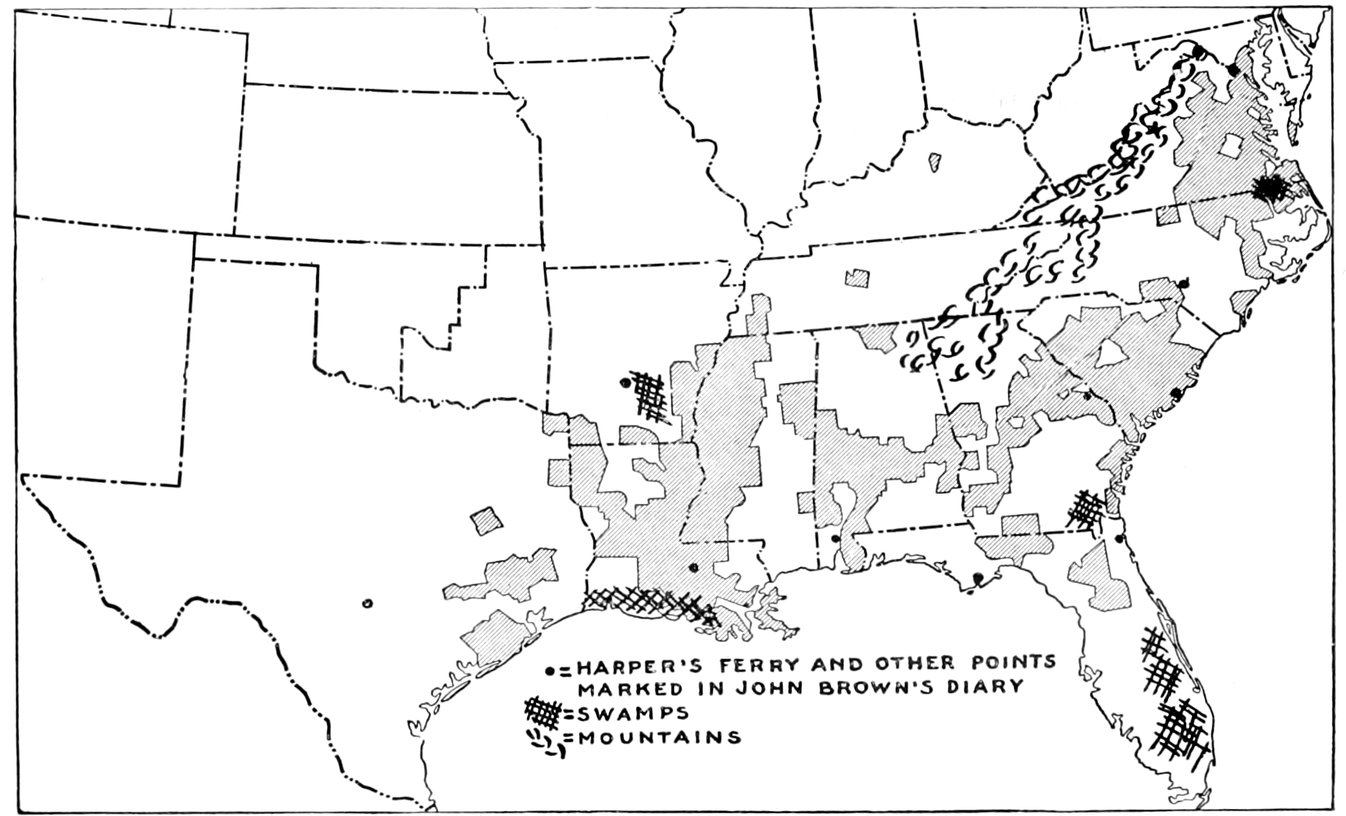
Map Showing the Great Black Way
275A glance at the map shows clearly that John
Brown intended to operate in the Blue Ridge
mountains rising east of the Shenandoah and known
at Harper’s Ferry as Loudoun Heights. The
Loudoun Heights rise boldly 500 to 700 feet above
the village of Harper’s Ferry and 1,000 feet above
the sea. They run due south and then southwest,
dipping down a little the first three miles, then rising
to 1,500 feet, which level is practically maintained
until twenty-five miles below Harper’s Ferry where
the mountains broaden to a dense and labyrinthical
wilderness, and rise to a height of 2,000 or more
feet. Right at this high point and insight of High
Knob (a peak of 2,400 feet) began, in Fauquier
County, the Great Black Way. In this county in
1850 were over 10,000 slaves, and 650 free Negroes,
as compared with 9,875 whites. From this county
to the southern boundary of Virginia was a series
of black counties with a majority of slaves, containing
in 1850 at least 260,000 Negroes. From here the
Great Black Way went south as John Brown indicated
in his diary and undoubtedly in the marked
maps, which Virginia afterward hastily destroyed.
The easiest way to get to these heights was from
Harper’s Ferry. An hour’s climb from the arsenal
276grounds would easily have hidden a hundred men
in inaccessible fastnesses, provided they were not
overburdened; and even with arms, ammunition
and supplies, they could have repelled, without difficulty,
attacks on the retreat. Forts and defenses
could be prepared in these mountains, and before
the raid they had been pretty thoroughly explored
and paths marked. In Harper’s Ferry just at
the crossing of the main road from Maryland lay the
arsenal. The plan without a doubt was first, to collect
men and arms on the Maryland side of the
Potomac; second, to attack the arsenal suddenly
and capture it; third, to bring up the arms and ammunition
and, together with those captured, to cross
the Shenandoah to Loudoun Heights and hide in
the mountain wilderness; fourth, thence to descend
at intervals to release slaves and get food, and retreat
southward. Most writers have apparently
supposed that Brown intended to retreat from the
arsenal across the Potomac. A moment’s thought
will show the utter absurdity of this plan. Brown
knew guerrilla warfare, and the failure of Harper’s
Ferry raid does not prove it a blunder from the
start. The raid was not a foray from the mountains,
which failed because its retreat was cut off, but it
was a foray to the mountains with the village and
arsenal on the way, which was defeated apparently
because the arms and ammunition train failed to
join the advance-guard.
This then was the great plan which John Brown
had been slowly elaborating and formulating for
277twenty years—since the day when kneeling beside
a Negro minister he had sworn his sons to blood-feud with slavery.
The money resources with which John Brown
undertook his project are not exactly known.
Sanborn says: “Brown’s first request in 1858 was
for a fund of a thousand dollars only; with this in
the hand he promised to take the field either in April
or May. Mr. Stearns acted as treasurer of this
fund, and before the 1st of May nearly the whole
the amount had been paid in or subscribed,—Stearns
contributing three hundred dollars, and the rest
of our committee smaller sums. It soon appeared,
however, that the amount named would be too
small, and Brown’s movements were embarrassed
from the lack of money before the disclosures of
Forbes came to his knowledge.”[201] From first to
last George L. Stearns gave in cash and arms about
$7,500, and Gerrit Smith contributed more than
$1,000. Merriam brought with him $600 in gold in
October. Between March 10th and October 16th,
Brown expended at least $2,500. In all Sanborn
raised $4,000 for Brown. Hinton says: “As
near as can be estimated, the money received
by Brown could not have exceeded $12,000, while
the supplies, arms, etc., furnished may have cost
$10,000 more. Of course, there were smaller contributions
and support coming in, but if the total
estimate be placed at $25,000, for the period between
the 15th of September, 1856, when he left
278Lawrence, Kan., and the 16th of October, 1859,
when he moved on Harper’s Ferry, Va., with
twenty-one men, it will certainly cover all of the
outlay except that of time, labor, and lives.”[202]
This total, however, does not include a fund of
$1,000 raised for his family.
The civic organization under which Brown intended
to work has been spoken of. The military
organization was based on his Kansas experience
and his reading. In his diary is this entry:
“Circassia has about 550,000
Switzerland 2,037,030
Guerrilla warfare See Life of Lord Wellington
Page 71 to Page 75 (Mina)
See also Page 102 some valuable hints
in the Same Book. See also Page 196 some
most important instructions to officers.
See also same Book Page 235 these words
deep, and
narrow defiles where 300 men would suffice
to check an army.
See also Page 236 on top of Page ”
This life of Wellington, W. P. Garrison states,[203]
was Stocqueler’s and the pages referred to tell of
the Spanish guerrillas under Mina in 1810, and
of methods of cooking and discipline. In one place
the author says: “Here we have a chaos of mountains,
where we meet at every step huge fallen
279masses of rock and earth, yawning fissures, deep
and narrow defiles, where 300 men would suffice to
check an army.” The Alleghanies in Virginia
and Carolina was similar in topography and, for
the operation here, Brown proposed a skeleton army
which could work together or in small units of any
size:
“A company will consist of fifty-six privates,
twelve non-commissioned officers, eight corporals,
four sergeants and three commissioned officers (two
lieutenants, a captain), and a surgeon.
“The privates shall be divided into bands or
messes of seven each, numbering from one to eight,
with a corporal to each, numbered like his band.
“Two bands will comprise a section. Sections
will be numbered from one to four.
“A sergeant will be attached to each section, and
numbered like it.
“Two sections will comprise a platoon. Platoons
will be numbered one and two, and each commanded
by a lieutenant designed by like number.”[204]
Four companies composed a battalion, four battalions
a regiment, and four regiments a brigade.
So much for his resources and plans. Now for
the men whom he chose as co-workers. The
number of those who took part in the Harper’s
Ferry raid is not known. Perhaps, including
active slave helpers, there were about fifty. Seventeen
Negroes, reported as probably killed, are
wholly unknown, and those slaves who helped and
280escaped are also unknown. This leaves the twenty-two
men usually regarded as making the raid.
They fall, of course, into two main groups, the
Negroes and the whites. Six or seven of the twenty-two
were Negroes.
First in importance came Osborne Perry Anderson,
a free-born Pennsylvania mulatto, twenty-four
years of age. He was a printer by trade, “well
educated, a man of natural dignity, modest, simple
in character and manners.” He met John Brown
in Canada. He wrote the most interesting and reliable
account of the raid, and afterward fought in
the Civil War.
Next came Shields Green, a full-blooded Negro
from South Carolina, whence he had escaped from
slavery, after his wife had died, leaving a living boy
still in bondage. He was about twenty-four years
old, small and active, uneducated but with natural
ability and absolutely fearless. He met Brown at
the home of Frederick Douglass, who says: “While
at my house, John Brown made the acquaintance
of a colored man who called himself by different
names—sometimes ‘Emperor,’ at other times,
‘Shields Green’.... He was a fugitive slave,
who had made his escape from Charleston, S. C.; a
state from which a slave found it no easy matter to
run away. But Shields Green was not one to shrink
from hardships or dangers. He was a man of few
words and his speech was singularly broken; but his
courage and self-respect made him quite a dignified
character. John Brown saw at once what ‘stuff’
281Green ‘was made of,’ and confided to him his plans
and purposes. Green easily believed in Brown, and
promised to go with him whenever he should be
ready to move.”[205]
Dangerfield Newby was a free mulatto from the
neighborhood of Harper’s Ferry. He was thirty
years of age, tall and well built, with a pleasant face
and manner; he had a wife and seven children in
slavery about thirty miles south of Harper’s Ferry.
The wife was about to be sold south at this time,
and was sold immediately after the raid. Newby
was the spy who gave general information to the
party, and lived out in the community until the
night of the attack.
John A. Copeland was born of free Negro parents
in North Carolina, reared in Oberlin and educated
at Oberlin College. He was a straight-haired mulatto,
twenty-two years old, of medium size, and a
carpenter by trade. Hunter, the prosecuting attorney
of Virginia, says: “From my intercourse with
him I regarded him as one of the most respectable
prisoners that we had.... He was a copper-colored
Negro, behaved himself with as much firmness
as any of them, and with far more dignity. If
it had been possible to recommend a pardon for any
of them, it would have been for this man Copeland,
as I regretted as much, if not more, at seeing him
executed than any other one of the party!”[206]
282Lewis Sherrard Leary was born in slavery in
North Carolina and also reared in Oberlin, where
he worked as a harness-maker. An Oberlin friend
testified: “He called again afterward, and told
me he would like to keep to the amount I had given
him, and would like a certain amount more for a
certain purpose, and was very chary in his communications
to me as to how he was to use it, except
that he did inform me that he wished to use it
in aiding slaves to escape. Circumstances just then
transpired which had interested me contrary to any
thought I ever had in my mind before. I had
had exhibited to me a daguerreotype of a young
lady, a beautiful appearing girl, who I was informed
was about eighteen years of age....”[207]
But here Senator Mason of the Inquisition scented
danger, and we can only guess the reasons that sent
Leary to his death. He was said to be Brown’s
first recruit outside the Kansas band.
John Anderson, a free Negro from Boston, was
sent by Lewis Hayden and started for the front.
Whether he arrived and was killed, or was too late
has never been settled.
The seventh man of possible Negro blood was
Jeremiah Anderson. He is listed with the Negroes
in all the original reports of the Chatham Convention
and was, as a white Virginian who saw him
says, “of middle stature, very black hair and
swarthy complexion. He was supposed by some
283to be a Canadian mulatto.”[208] He was descended
from Virginia slaveholders who had moved north
and was born in Indiana. He was twenty-six years
old.
Of the white men there were, first of all, John
Brown and his family, consisting of three sons, and
two brothers of his eldest daughter’s husband,
William and Dauphin Thompson.
Oliver Brown was a boy not yet twenty-one,
though tall and muscular, and had just been married.
Watson was a man of twenty-five, tall and athletic;
while Owen was a large, red-haired prematurely
aged man of thirty-five, partially crippled, good-tempered
and cynical. The Thompsons were neighbors
of John Brown and part of a brood of twenty
children. The Brown family and their intermarried
Anne Brown says that William, who was
twenty-six years of age, was “kind, generous-hearted,
and helpful to others.” Dauphin, a boy
of twenty-two, was, she writes, “very quiet, with a
fair, thoughtful face, curly blonde hair, and baby-blue
eyes. He always seemed like a very good
girl.”[209]
The three notable characters of the band were
Kagi, Stevens and Cook, the reformer, the soldier,
and the poet. Kagi’s family came from the Shenandoah
Valley. He was twenty-four, had a good
English education and was a newspaper reporter in
Kansas, where he earnestly helped the free state
284cause. He had strong convictions on the subject of
slavery and was willing to risk all for them. “You
will all be killed,” cried a friend who heard his
plan. “Yes, I know it, Hinton, but the result will
be worth the sacrifice.” Hinton adds: “I recall
my friend as a man of personal beauty, with a fine,
well-shaped head, a voice of quiet, sweet tones, that
could be penetrating and cutting, too, almost to
sharpness.”[210] Anderson writes that Kagi “left
home when a youth, an enemy to slavery, and
brought as his gift offering to freedom three slaves,
whom he piloted to the North. His innate hatred
of the institution made him a willing exile from the
state of his birth, and his great abilities, natural
and acquired, entitled him to the position he held
in Captain Brown’s confidence. Kagi was indifferent
to personal appearance; he often went about
with slouched hat, one leg of his pantaloons properly
adjusted, and the other partly tucked into his
high boot-top; unbrushed, unshaven, and in utter
disregard of ‘the latest style.’”[211]
Stevens was a handsome six-foot Connecticut soldier
of twenty-eight years of age, who had thrashed
his major for mistreating a fellow soldier and deserted
from the United States army. He was active
in Kansas and soon came under John Brown’s discipline.
“Why did you come to Harper’s Ferry?” asked
a Virginian.
285He replied: “It was to help my fellow men out
of bondage. You know nothing of slavery—I know,
a great deal. It is the crime of crimes. I hate it
more and more the longer I live. Even since I have
been lying in this cell, I have heard the crying of
3 slave-children torn from their parents.”[212]
Cook was also a Connecticut man of twenty-nine
years, tall, blue-eyed, golden-haired and handsome,
but a far different type from Stevens. He was
talkative, impulsive and restless, eager for adventure
but hardly steadfast. He followed John
Brown as he would have followed anyone else
whom he liked, dreaming his dreams, rushing
ahead in the face of danger and shrinking back
appalled and pitiful before the grim face of death.
He was the most thoroughly human figure in the
band.
One other deserves mention because it was probably
his slowness or obstinacy that ruined the success
of John Brown’s raid. This was Charles P.
Tidd. He was from Maine, twenty-seven years old,
trained in Kansas warfare—a nervous, overbearing
and quarrelsome man. He bitterly opposed the
plan of capturing Harper’s Ferry when it was
finally revealed, and as Anne Brown said, “got so
warm that he left the farm and went down to Cook’s
dwelling near Harper’s Ferry to let his wrath cool off.”
A week passed before he sullenly gave in.
Besides these, there were six other men of more
or less indistinct personalities. Five were young
286Kansas settlers from Maine, the Middle West and
Canada, trained in guerrilla warfare under Brown
and Montgomery and thoroughly disliking the slave
system which they had seen. They were personal
admirers of Brown and lovers of adventure. The
last recruit, Merriam, was a New England aristocrat
turned crusader, fighting the world’s ills blindly
but devotedly. The Negro Lewis Hayden met him
in Boston, “and, after a few words, said, ‘I want
five hundred dollars and must have it.’ Merriam,
startled at the manner of the request, replied, ‘If
you have a good cause, you shall have it.’ Hayden
then told Merriam briefly what he had learned from
John Brown, Jr.: that Captain Brown was at Chambersburg,
or could be heard of there; that he was
preparing to lead a party of liberators into Virginia,
and that he needed money; to which Merriam
replied: ‘If you tell me John Brown is there, you
can have my money and me along with it.’”[213]
These were the men—idealists, dreamers, soldiers
and avengers, varying from the silent and thoughtful
to the quick and impulsive; from the cold and
bitter to the ignorant and faithful. They believed
in God, in spirits, in fate, in liberty. To them,
the world was a wild, young unregulated thing,
and they were born to set it right. It was a
veritable band of crusaders, and while it had much
of weakness and extravagance, it had nothing nasty
or unclean. On the whole, they were an unusual
set of men. Anne Brown who lived with them
287said: “Taking them all together, I think they
would compare well [she is speaking of manners,
etc.] with the same number of men in any station
of life I have ever met.”[214]
They were not men of culture or great education,
although Kagi had had a fair schooling. They
were intellectually bold and inquiring—several had
been attracted by the then rampant Spiritualism;
nearly all were skeptical of the world’s social conventions.
They had been trained mostly in the
rough school of frontier life, had faced death many
times, and were eager, curious, and restless. Some
of them were musical, others dabbled in verse.
Their broadest common ground of sympathy lay
in the personality of John Brown—him they revered
and loved. Through him, they had come to hate
slavery, and for him and for what he believed,
they were willing to risk their lives. They themselves,
had convictions on slavery and other matters,
but John Brown narrowed down their dreaming
to one intense deed.
Finally, there was John Brown himself. His
appearance has been often described—several
times in these pages. In 1859 he was the
same striking figure with whitening hair, burning
eyes, and the great white beard which hardly hid
the pendulous side lips of Olympian Jove. One
thing, however, must not be forgotten. John
Brown was at this time a sick man. From 1856 to
1859, scarce a mouth passed without telling of
288illness. His health was “some improved” in
May 1857, but soon he lost a week “with ague and
fever and left home feeble.” In August he wrote
of “ill health” and “repeated returns of fever and
ague.” In September and October, his health was
“poor.” The spring and summer of 1858 found
him “not very stout,” and in July and August,
he was “down with ague” and “too sick” to write.
In September he was “still weak,” and, although
“some improved” in December, the following
spring found him “not very strong.” In April,
amid the feverish activity of his fatal year, he was
“quite prostrated,” with “the difficulty in my
head and ear and with the ague in consequence.”
Late in July, he was “delayed with sickness” and
there can be little doubt that it was an illness and pain-racked
body which his indomitable will forced
into the raid of Harper’s Ferry.
Having collected a part of the funds and organized
the band, John Brown was about to strike his
blow in the early summer of 1858, as we have seen,
when the Forbes disclosures compelled him to hide
in Kansas, where the last massacre on the Swamp
of the Swan invited him. He left Canada for
Kansas in June, 1858. Cook, somewhat against
the wishes of Brown who feared his garrulity, went
to Harper’s Ferry, worked as a booking agent and canal
keeper, made love to a maid and married her and
then acted as advance agent awaiting the main
band. Ten months after leaving Canada, and in
mid-March, 1859, John Brown appeared again in
289Canada (as has been told in Chapter VII) with
twelve rescued slaves as an earnest of the feasibility
of his plan. He stayed long enough to spread the
news and then went to northern Ohio where he
spoke in public of Kansas and slavery. “He said
that he had never lifted a finger toward any one
whom he did not know was a violent persecutor of
the free state men. He had never killed anybody;
although, on some occasions, he had shown the
young men with him how some things might be
done as well as others, and they had done the
business. He had never destroyed the value
of an ear of corn, and had never set fire to
any pro-slavery man’s house or property. He
had never by his action driven out pro-slavery
men from the Territory; but if the occasion demanded
it, he would drive them into the ground, like fence
stakes, where they would remain permanent settlers.
“Brown remarked that he was an outlaw, the
governor of Missouri has offered a reward of
$3,000, and James Buchanan $250 more, for him.
He quietly remarked, parenthetically, that John
Brown would give two dollars and fifty cents for
the safe delivery of the body of James Buchanan in
any jail of the free states. He would never submit
to an arrest, as he had nothing to gain from submission;
but he should settle all questions on the
spot if any attempt was made to take him. The
liberation of those slaves was meant as a direct
blow to slavery, and he laid down his platform that
290he had considered it his duty to break the fetters
from any slave when he had an opportunity. He
was a thorough Abolitionist.”[215]
Then, he went East to see his family and visit
Douglass (where he met and persuaded Shields
Green), and to consult with Gerrit Smith and Sanborn.
Alcott at Concord wrote:
“This evening I heard Captain Brown speak at
the town hall on Kansas affairs and the part took
by them in the late troubles there. He tells his
story with surpassing simplicity and sense, impressing
us all deeply by his courage and religious
earnestness. Our best people listen to his words,—Emerson,
Thoreau, Judge Hoar, my wife; and
some of them contribute something in aid of his
plans without asking particulars, such confidence
does he inspire in his integrity and abilities. I
have a few words with him after his speech, and
find him superior to legal traditions, and a disciple
of the Right in ideality and the affairs of the state.
He is Sanborn’s guest and stays for a day only. A
young man named Anderson accompanies him.
They go armed, I am told, and will defend themselves,
if necessary. I believe they are now on
their way to Connecticut and farther south, but
the captain leaves us much in the dark concerning
his destination and designs for the coming months.
Yet he does not conceal his hatred of slavery, nor
his readiness to strike a blow for freedom at the
291proper moment. I infer he intends to run
off as many slaves as he can, and so render that
property insecure to the master. I think him equal
to anything he dares,—the man to do the deed, if it
must be done, and with the martyr’s temper and
purpose. Nature was deeply intent in
the making of him. He is of imposing appearance,
personally—tall, with square shoulders and
standing; eyes of deep gray, and couchant, as if
ready to spring at the least rustling, dauntless yet
kindly; his hair shooting backward from low down
on his forehead; nose trenchant and Romanesque;
set lips, his voice suppressed yet metallic, suggesting
deep reserves; decided mouth; the countenance
and frame charged with power throughout. Since
here last he has added a flowing beard, which gives
the soldierly air and the port of an apostle. Though
sixty years old he is agile and alert and ready for
any audacity, in any crisis. I think him about the
manliest man I have ever seen,—the type and
synonym of the Just.”[216]
The month of May, John Brown spent in Boston
collecting funds, and in New York consulting his
Negro friends, with a trip to Connecticut to hurry
the making of his thousand pikes. Sickness intervened,
but at last on June 20th, the advance-guard
of five—Brown and two of his sons, Jerry
Anderson and Kagi—started southward. They
stayed several days at Chambersburg, where Kagi,
coöperating with a faithful Negro barber, Watson,
292was established as a general agent to forward men,
mail, and freight. Then passing through Hagerstown,
they appeared at Harper’s Ferry on July 4th.
Here they met Cook, who had been selling maps,
keeping the canal-lock near the arsenal, and sending
regular information to Brown. Brown and his
sons wandered about at first, and a local farmer
greeted them cheerily: “Good-morning, gentlemen,
how do you do?” They returned the greeting
pleasantly. The conversation is recounted as
follows:
“I said, ‘Well, gentlemen,’ after saluting them
in that form, ‘I suppose you are out hunting minerals,
gold, and silver?’ His answer was, ‘No, we
are not, we are out looking for land; we want to
buy land; we have a little money, but we want to
make it go as far as we can.’ He asked me about the
price of the land. I told him that it ranged from
fifteen dollars to thirty dollars in the neighborhood.
He remarked, ‘That is high; I thought I could buy
land here for about a dollar or two dollars per acre.’
I remarked to him, ‘No, sir; if you expect to get
land for that price, you will have to go further
west, to Kansas, or some of those Territories where
there is government land.’ ... I then asked
him where they came from. His answer was,
‘From the northern part of the state of New
York.’ I asked him what he followed there.
He said farming and the frost had been so heavy
lately, that it cut off their crops there; that he
could not make anything, and sold out, and
293thought he would come further south and try it
awhile.”[217]
Through this easy-going, inquisitive farmer,
Brown learned of a farm for rent, which he hired
for nine months for thirty-five dollars. It was on
the main road between Harper’s Ferry, Chambersburg,
and the North, about five miles from the Ferry
and in a quiet secluded place. The house stood
about 300 yards back from the Boonesborough
pike, in plain sight. About 600 yards away on
the other side of the road was another cabin of one
room and a garret, which was largely hidden from
view by the shrubbery. Here Brown settled and
gradually collected his men and material. The
arms were especially slow in coming. Most of the
guns arrived at Chambersburg from Connecticut
about August, but the pikes did not come until a
month later. Then to the men were gathered
slowly. They were at the four ends of the country,
in all sorts of employment and different financial
conditions, and they were not certain just when the
raid would take place. All this delayed Brown
from July until October and greatly increased the
cost of maintenance. A daughter, Anne, and Oliver’s
girl wife came and kept the house from July 16th
to October 1st.
At this critical juncture, Harriet Tubman fell sick—a
grave loss to the cause—and there were other
delays. By August 1st, there were at Harper’s
294Ferry the two Brown daughters and three sons, and
the two brothers of a son-in-law, besides the two
Coppocs, Tidd, Jerry Anderson, and Stevens.
Hazlett, Leeman, and Taylor came soon after.
Kagi was still at Chambersburg and John Brown
himself “labored and traveled night and day,
sometimes on old Dolly, his brown mule, and sometimes
in the wagon. He would start directly after
night, and travel the fifty miles between the farm
and Chambersburg by daylight the next morning; and
he otherwise kept open communication between
headquarters and the latter place, in order that
matters might be arranged in due season.”[218]
In the North John Brown, Jr., was shipping the
arms and gathering men and money. He was in
Boston August 10th, at Douglass’s home, soon after,
and later in Canada with Loguen. All the chief
branches of the League were visited and then northern
Ohio. The result was meagre; not because
of a lack of men but lack of the kind of men wanted
at this time. There were thousands of Negroes
ready to fight for liberty in the ranks. But most
of these John Brown could not use at present.
No considerable band of armed black men could
have been introduced into the South without immediate
discovery and civil war. It was therefore
picked leaders like Douglass, Reynolds, Holden and
Delaney that Brown wanted at first—discreet and
careful men of influence, who, as he said to Douglass,
could hive the swarming bees both North and South.
295To get these picked men interested was, however,
difficult. Each had his work and his theory of
racial salvation; they were widely scattered. A
number of them had been convinced in 1858, but
the postponement had given time for reflection and
doubt. In many ways, the original enthusiasm had
waned, but it was not dead. The cause was just as
great and all that was needed was to convince men
that this was a real chance to strike an effective
blow. They required the magic of Brown’s own presence
to impress this fact upon them. They were not
sure of his agents. Men continued to come, however,
others began to prepare and still, others were almost
persuaded. An urgent summons went to Kansas to
white fellow workers, and the response there was
similarly small. Brown knew that his ability to
command the services of a large number of Northern
Negroes depended to some degree on Frederick
Douglass’s attitude. He was the first great national
Negro leader—a man of ability, finesse, and courage.
If he followed John Brown, who could hesitate? If
he refused, was it not for the best of reasons? Thus
John Brown continually urged Douglass and as a
last appeal arranged for a final conference on August
19th at Chambersburg in an abandoned stone
quarry. Douglass says:
“As I came near, he regarded me rather suspiciously,
but soon recognized me, and received me
cordially. He had in his hand when I met him a
fishing-tackle, with which he had been
fishing in a stream hard by, but I saw no fish
296and did not suppose he cared much for his ‘fisherman’s
luck.’ The fishing was simply a disguise
and was certainly a good one. He looked every
way like a man of the neighborhood, and as much
at home as any of the farmers around there. His
hat was old and storm-beaten, and his clothing was
about the color of the stone quarry itself—his then
present dwelling-place.
“His face wore an anxious expression, and he was
much worn by thought and exposure. I felt that I
was on a dangerous mission, and was as little desirous
of discovery as himself, though no reward
had been offered for me. We—Mr. Kagi, Captain
Brown, Shields Green, and myself—sat down among
the rocks and talked over the enterprise which was
about to be undertaken. The taking of Harper’s
Ferry, of which Captain Brown had merely hinted
before, was now declared as his settled purpose, and
he wanted to know what I thought of it. I at once
opposed the measure with all the arguments at my
command. To me, such a measure would be fatal to
running off slaves (as was the original plan), and
fatal to all engaged in doing so. It would be an attack
upon The federal government and would array
the whole country against us. Captain Brown did
most of the talking on the other side of the question.
He did not at all object to rousing the nation; it
seemed to him that something startling was just what
the nation needed.... Our talk was long
and earnest; we spent the most of Saturday and a
part of Sunday in this debate—Brown for Harper’s
297Ferry, and I against it; he for striking a blow
which should instantly rouse the country, and I for
the policy of gradually and unaccountably drawing
off the slaves to the mountains, as at first suggested
and proposed by him. When I found that he had
fully made up his mind and could not be dissuaded,
I turned to Shields Green and told him he heard
what Captain Brown had said; his old plan was
changed, and that I should return home, and if he
wished to go with me he could do so. Captain Brown
urged us both to go with him, but I could not do so,
and could but feel that he was about to rivet the fetters
more firmly than ever on the limbs of the enslaved.
In parting, he put his arms around me in a
manner more than friendly and said: ‘Come with
me, Douglass; I will defend you with my life. I
want you for a special purpose. When I strike, the
bees will begin to swarm, and I shall want you to help
hive them.’ But my discretion or my cowardice made
me proof against the dear old man’s eloquence—perhaps
it was something of both that determined
my course. When about to leave, I asked Green
what he had decided to do, and was surprised by his
coolly saying, in his broken way, ‘I b’lieve I’ll go
wid de ole man.’ Here we separated; they to go
to Harper’s Ferry, I to Rochester.”[219]
Douglass’s decision undoubtedly kept many
Negroes from joining Brown. Shields Green, however,
started south. The slave-catchers followed
him and made him and Owen Brown swim a river.
298Only their journeying southward instead of northward
saved them from capture.
Life at the farm during this time was curious.
Anderson says:
“There was no milk and water sentimentality—no
offensive contempt for the Negro, while working
in his cause; the pulsations of every heart
beat in harmony for the suffering and pleading
slave. I thank God that I have been permitted to
realize to its furthest, fullest extent, the moral,
mental, physical, social harmony of an anti-slavery
family, carrying out to the letter the principles of its
antitype, the anti-slavery cause. In John Brown’s
house, and in John Brown’s presence, men from
widely different parts of the continent met and
united into one company, wherein no hateful prejudice
dared intrude its ugly self—no ghost of distinction
found space to enter....
“To a passer-by, the house and its surroundings
presented but indifferent attractions. Any log
tenement of equal dimensions would be as likely to
arrest a stray glance. Rough, unsightly, and aged,
it was only for those privileged to enter and tarry
for a long time, and to penetrate the mysteries of
the two rooms it contained—kitchen, parlor, dining-room
below, and the spacious chamber, attic, storeroom,
prison, drilling-room, comprised in the loft
above—who could tell how we lived at Kennedy
Farm.
“Every morning, when the noble old man was at
home, he called the family around, read from his
299Bible, and offered to God most fervent and touching
supplications for all flesh; and especially
pathetic were his petitions in behalf of the oppressed.
I never heard John Brown pray, that he
did not make strong appeals to God for the deliverance
of the slave. This duty over, the men went to
the loft, there to remain all day long; few only
could be seen about, as the neighbors were watchful
and suspicious. It was also important to talk but
little among ourselves, as visitors to the house
might be curious. Besides the daughter and
daughter-in-law, who superintended the work,
some one or other of the men was regularly detailed
to assist in the cooking, washing, and other
domestic work. After the ladies left, we did all
the work, no one being exempt, because of age or
official grade in the organization.
“The principal employment of the prisoners, as
we severally were when compelled to stay in the
loft, was to study Forbes’s Manual, and to go
through a quiet, though rigid drill, under the
training of Captain Stevens, at some times. At
other times we applied a preparation for bronzing
our gun-barrels-discussed subjects of reform—related
our personal history; but when our resources
became pretty well exhausted, the ennui from confinement,
imposed silence, etc., would make the
men almost desperate. At such times, neither
slavery nor slaveholders were discussed mincingly.
We were, while the ladies remained, often relieved
of much of the dullness growing out of restraint by
300their kindness. As we could not circulate freely,
they would bring in wild fruit and flowers from the
woods and fields.”[220]
Anne, the young daughter, says: “One day,
a short time after I went down there, father was sitting
at the table writing. I was nearby sewing (he
and I being alone in the room), when two little
wrens that had a nest under the porch came flying
in at the door, fluttering and twittering; then they
flew back to their nest and again to us several
times, seemingly trying to attract our attention.
They appeared to be in great distress. I asked
father what he thought was the matter with
the little birds. He asked if I had ever seen them
act so before; I told him no. ‘Then let us go and
see,’ he said. We went out and found that a snake
had crawled up the post and was just ready to devour
the little ones in the nest. Father killed the
snake; and then the old birds sat on the railing
and sang as if they would burst. It seemed as if
they were trying to express their joy and gratitude
to him for saving their little ones. After we went
back into the room, he said he thought it very
strange the way the birds asked him to help them,
and asked if I thought it an omen of his success.
He seemed very much impressed with that idea. I
do not think he was superstitious, but you know
he always thought and felt that God called him to
that work; and seemed to place himself, or rather
to imagine himself, in the position of the figure in
301the old seal of Virginia, with the tyrant under her
foot.”[221]
The men discussed religion and slavery freely,
read Paine’s Age of Reason and the Baltimore Sun.
John Brown himself was careful to cultivate the
good-will of his neighbors, attending with skill
the sick among animals and men, so much so that
he and his sons became prime favorites. Owen
had long conversations with the people, while Cook
was also moving about the country selling maps.
A little Dunker chapel was near with non-resistant,
anti-slavery principles; here John Brown
often worshiped and preached. Yet with all this
caution and care, suspicion lurked about them, and
discovery was always imminent.
Brown’s daughter relates that “there was a family
of poor people who lived nearby and who had
rented the garden on the Kennedy place, directly
back of the house. The little barefooted woman
and four small children (she carried the youngest
in her arms) would all come trooping over to the
garden at all hours of the day, and, at times, several
times during the day. Nearly always they
would come up the steps and into the house and
stay a short time. This made it very troublesome
for us, compelling the men, when she came insight
at meal-times, to gather up the victuals and table-cloth
and quietly disappear up-stairs.
“One Saturday father and I went to a religious
(Dunker) meeting that was held in a grove near the
302schoolhouse and the folks left at home forgot to keep
a sharp lookout for Mrs. Heiffmaster, and she stole
into the house before they saw her, and saw Shields
Green (that must have been in September), Barclay
Coppoc, and Will Lemnian. And another time after
that she saw C. P. Tidd standing on the porch. She
thought these strangers were running off negroes to
the North. I used to give her everything she wanted
or asked for to keep her on good terms, but we were
in constant fear that she was either a spy or would
betray us. It was like standing on a powder magazine
after a slow match had been lighted.”[222]
Despite all precautions, a rumor began to get in the
air. A Prussian Pole was among the Kansas cooperators
invited. He had been in Kansas in 1856
and was known to Brown and Kagi. After hearing
from Brown in August 1859, the Pole disclosed
their plans to Edmund Babb, a correspondent of the
Cincinnati Gazette. It was probably Babb who
thereupon wrote to the United States Secretary of
War: “I have discovered the existence of a secret
association, having for its object the liberation of
the slaves at the South and by a general insurrection.
The leader of the movement is one ‘old John
Brown,’ late of Kansas.” Approximately correct
details of the plot followed, but Secretary Floyd
was lolling at a summer resort and had some little
conspiracies of his own in hand not unconnected
with United States arsenals. Being, therefore, as he
said magniloquently, “satisfied in my mind
303that a scheme of such wickedness and outrage could
not be entertained by any citizens of the United
States, I put the letter away, and thought no more
of it until the raid broke out.”[223]
Gerrit Smith, too, with little discretion, addressed
to Negro audience words which plainly showed he
shortly expected a slave insurrection. Even among
Harper’s Ferry party forced inaction led to disputes
and disaffection. John Brown sharply rebuked
the letter-writing and gossiping about his men.
“Any person is a stupid fool,” he told Kagi, “who
expects his friends to keep for him that which he cannot
keep himself. All our friends have each got
their special friends; and they again have theirs,
and it would not be right to lay the burden of keeping
a secret on any one at the end of a long string.
I could tell you of reasons I have for feeling rather
keenly on this point.”[224]
The men, on the other hand, were dissatisfied with
Brown’s plans as they were finally disclosed. Anne
Brown writes that they generally “did not know
that the raid on the government works was a part of
the ‘plan’ until after they arrived at the farm in the
beginning of August.”[225] They wanted simply to
repeat the Missouri raid on a larger scale and not
try to capture the arsenal. Tidd was especially
stubborn and irreconcilable. The discussion became
304so warm that John Brown at one time resigned, but
he was immediately reëlected and this formal letter
was sent to him:
“Dear Sir—We have all agreed to sustain your
decisions, until you have proved incompetent, and
many of us will adhere to your decisions so long as
you will.”[226]
In these ways Brown was compelled to hurry and
accordingly he urged his eldest son, who replied:
“Through those associations which I formed in Canada,
I am able to reach each individual member at
the shortest notice by letter. I am devoting my
whole time to our company business. I shall immediately
go out organizing and raising funds. From
what I even had understood, I had supposed you
would not think it best to commence opening the
coal banks before spring unless circumstances should
make it imperative. However, I suppose the reasons
are satisfactory to you, and if so, those who own
smaller shares ought not to object. I hope we shall
be able to get on in season some of those old miners
of whom I wrote you. I shall strain every nerve to
accomplish this. You may be assured that what
you say to me will reach those who may be benefited
thereby, and those who would take stock, in
the shortest possible time; so don’t fail to keep me
posted.”[227]
As late as October 6th Brown expected to “move
about the end of the month” and made a hurried
305trip to Philadelphia. There he met a large group
of Negroes, and Dorsey the caterer with whom he
stayed, at 1221 Locust Street, is said to have given
him $300. In some way, he was disappointed with the
visit. Anderson says he went “on the business of great
importance. How important, men there and elsewhere now know.
How affected by, and affecting
the main features of the enterprise, we at the farm
knew full after their return, as the old captain, in
the fullness of his overflowing, saddened heart, detailed
point after point of interest”[228] Perhaps he
was still trying to persuade Douglass and the leaders
of the Philadelphia and New York groups.
The women left the farm late in September and
O. P. Anderson, Copeland, and Leary arrived.
Merriam joined Brown while he was on the Philadelphia trip
and was sent to Baltimore to buy caps
for the guns. Others were coming when suddenly
Brown fixed on October 17th as the date of the
raid. This hurried change was probably because
officials and neighbors were getting inquisitive, and
arms were being removed from the arsenal to man
Southern stations. Yet it was unfortunate, as
Anderson says: “Could other parties, waiting
for the word, have reached the headquarters in
time for the outbreak when it took place, the taking
of the armory, engine-house, and rifle factory,
would have been quite different. But the men at
the farm had been so closely confined, that they
went out about the house and farm in the daytime
306during that week, and so indiscreetly exposed their
numbers to the prying neighbors, who thereupon
took steps to have a search instituted in the early
part of the coming week. Captain Brown was not
seconded in another quarter, as he expected, at the
time of the action, but could the fears of the neighbors
have been allayed for a few days, the disappointment
in the former respect would not have been
of much weight.”[229]
Only the nearest of the slaves round about who
awaited the word could be communicated with and
several recruits like Hinton were left stranded on
the way, unable to get through in time. So
the great day dawned: “On Sunday morning, October
16th, Captain Brown arose earlier than usual, and
called his men down to worship. He read a
chapter from the Bible, applicable to the condition
of the slaves, and our duty as their brethren, and
then offered up a fervent prayer to God to assist in
the liberation of the bondmen in that slaveholding
land. The services were impressive.”[230]
A council was held, over which O. P. Anderson,
the colored man, presided. In the afternoon the
final orders were given and at night just before
setting out, John Brown said: “And now,
gentlemen, let me impress this one thing upon
your minds. You all know how dear life is to you,
and how dear life is to your friends. And in remembering
that, consider that the lives of others
307areas dear to them as yours are to you. Do not,
therefore, take the life of anyone, if you can
possibly avoid it, but if it is necessary to take
life to save your own, then make sure
work of it.”[231]
CHAPTER XI THE BLOW
308
“Woe unto them that call evil, good; and good, evil.”
“At eight o’clock on Sunday evening, Captain
Brown said: ‘Men, get on your arms; we will proceed
to the Ferry.’ His horse and wagon were
brought out before the door, and some pikes, a
sledge-hammer and a crowbar were placed in it.
The captain then put on his old Kansas cap, and
said: ‘Come, boys!’ when we marched out of
the camp behind him, into the lane leading down
the hill to the main road.”[232]
The orders given commanded Owen Brown,
Merriam and Barclay Coppoc to watch the house
and arms until ordered to bring them toward the
Ferry. Tidd and Cook were to cut the telegraph
lines and Kagi and Stephens to detain the bridge
guard. Watson Brown and Taylor were to hold
the bridge over the Potomac, and Oliver Brown
and William Thompson the bridge over the Shenandoah.
Jerry Anderson and Dauphin Thompson
were to occupy the engine-house in the arsenal
yard, while Hazlett and Edwin Coppoc were to hold
the armory.
309During the night Kagi and Copeland were to
seize and guard the rifle factory, and others were
to go out in the country and bring in certain masters
and their slaves.
It was a cold dark night when the band started.
Ahead was John Brown in his one-horse farm-wagon,
with pikes, a sledge-hammer and a crowbar.
Behind him marched the men silently and at intervals,
Cook and Tidd leading. They had five miles
to go, over rolling hills and through woods and
then down to a narrow road between the cliffs and
the Cincinnati and Ohio canal. As they approached
the railroad, Cook and Tidd cut the telegraph
wires which led to Baltimore and Washington.
At the bridge they halted and made ready
their arms. At ten o’clock William Williams, one
of the watchmen there, was surprised to find himself
a prisoner in the hands of Kagi and Stevens,
who took him through the covered structure to the
town, leaving Watson Brown and Steward Taylor to
guard the bridge. The rest of the company entered
Harper’s Ferry.
The land between the rivers is itself high, though
dwarfed by the mountains and running down to a
low point where the rivers join. At this place the
bridge leads to Maryland. After crossing the bridge
to Virginia, about sixty yards up the street, running
parallel to the Potomac, was the gate of the
armory where the arms were made. On the
Shenandoah side about sixty yards from the armory
gate is the arsenal, where the arms were stored.
310The company proceeded to the armory gate. The
watchman tells how the place was captured:
“‘Open the gate,’ said they; I said, ‘I could not
if I was stuck,’ and one of them jumped up on
the pier of the gate over my head, and another
fellow ran and put his hand on me and caught me
by the coat and held me; I was inside and they
were outside, and the fellow standing over my head
upon the pier, and then when I would not open the
gate for them, five or six ran in from the wagon,
clapped their guns against my breast, and told me
I should deliver up the key; I told them I could
not; and another fellow made an answer and said
they had not time now to be waiting for the key, but
to go to the wagon and bring out the crowbar and
large hammer, and they would soon get in; they
went to the little wagon and brought a large crowbar
out of it; there is a large chain around the
two sides of the wagon-gate going in; they twisted
the crowbar in the chain and they opened it, and in
they ran and got in the wagon; one fellow took me;
they all gathered about me and looked in my face;
I was nearly scared to death with so many guns
about me.”[233]
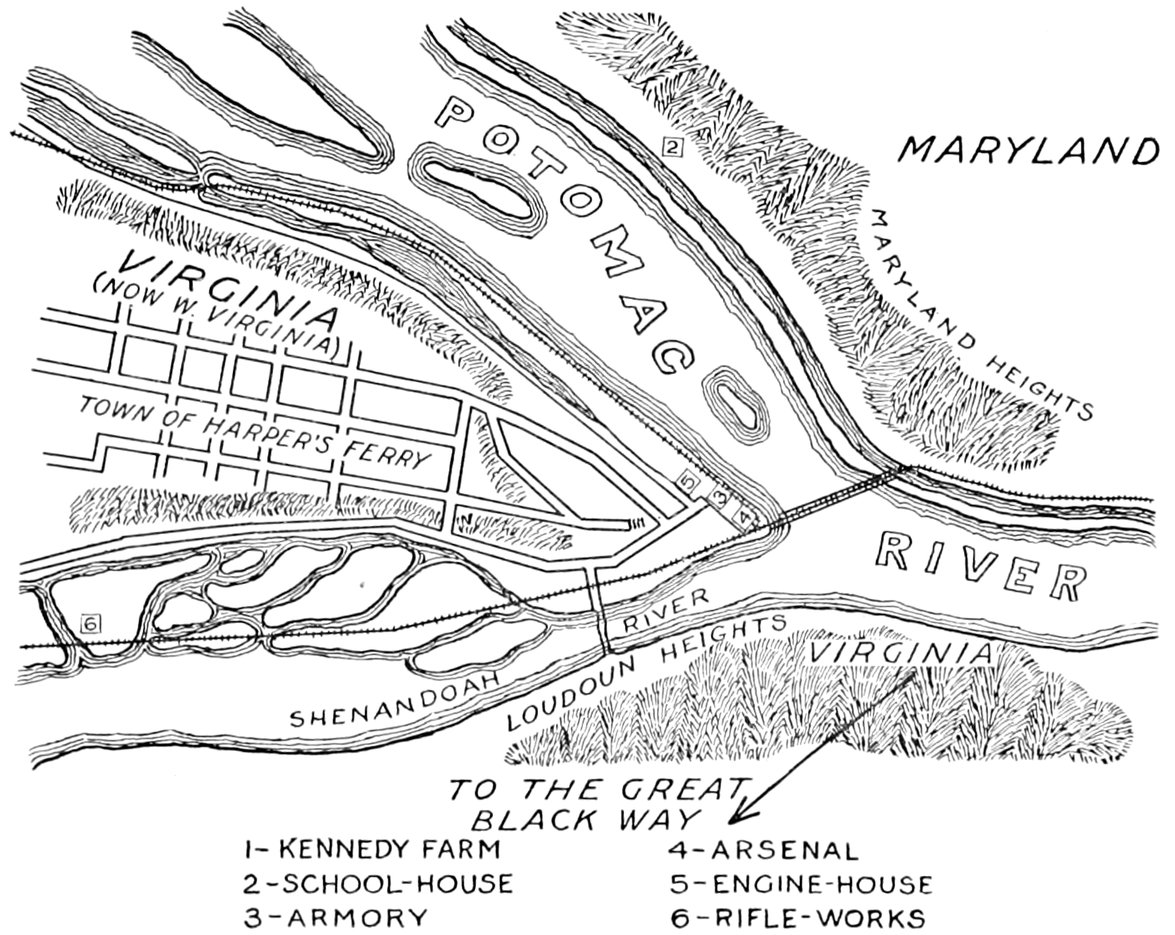
Map of Harper’s Ferry, Showing Points Figuring in the Raid
311The two captured watchmen, Anderson says,
“were left in the custody of Jerry Anderson and
Dauphin Thompson, and A. D. Stevens arranged
the men to take possession of the armory and rifle
factory. About this time, there was apparently
much excitement. People were passing back and
forth in the town, and before we could do much, we
had to take several prisoners. After the prisoners
were secured, we passed to the opposite side of the
street and took the armory, and Albert Hazlett and
Edwin Coppoc were ordered to hold it for the time
being.”[234]
The other fourteen men quickly dispersed through
the village. Oliver Brown and William Thompson
seized and guarded the bridge across the Shenandoah.
This bridge was sixty rods from the railway bridge
up the river and was the direct route to Loudoun
Heights, the slave-filled lower valley, and the Great
Black Way. It was, however, not the only way
across the Shenandoah: a little more than half a
mile farther up were the rifle works, where the
stream could be easily forded. Kagi and Copeland
went there, captured the watchman and took possession.
“These places were all taken, and the prisoners
secured, without the snap of a gun, or any violence
whatever,” says Anderson, and he continues: “The
town being taken, Brown, Stevens, and the men
who had no post in charge, returned to the engine-house,
where council was held, after which Captain
Stevens, Tidd, Cook, Shields Green, Leary and myself
went to the country. On the road we met
some colored men, to whom we made known our
purpose, when they immediately agreed to join us.
They said they had been long waiting for an opportunity
312of the kind. Stevens then asked them to
go around among the colored people and circulate
the news, when each started off in a different direction.
The result was that many colored men
gathered to the scene of action. The first prisoner
taken by us was Colonel Lewis Washington [a relative
of George Washington]. When we neared his
house, Captain Stevens placed Leary and Shields
Green to guard the approaches to the house, the
one at the side, and the other in front. We then
knocked, but no one answering, although females
were looking from upper windows, we entered the
building and commenced a search for the proprietor.
Colonel Washington opened his room door, and
begged us not to kill him. Captain Stevens replied,
‘You are our prisoner,’ when he stood as if speechless
or petrified. Stevens further told him to get
ready to go to the Ferry; that he had come to
abolish slavery, not to take life but in self-defense,
but that he must go along. The colonel replied:
‘You can have my slaves, if you will let me remain.’
‘No,’ said the captain, ‘you must go along
too; so get ready.’”[235]
He and his male slaves were thus taken, together
with a large four-horse wagon and some arms, including
the Lafayette sword. Away the party went
and after capturing another planter and his slaves,
arrived at the Ferry before daybreak.
Meantime the citizens of the Ferry, returning late
from protracted Methodist meeting, were being
313taken prisoners and about one o’clock in the morning
the east-bound Baltimore and Ohio train arrived.
This was detained and the local colored
porter shot dead by Brown’s guards on the bridge.
The passengers were greatly excited, but at first
thought it was a strike of some kind. After sunrise
the train was allowed to proceed, John Brown
himself walking ahead across the bridge to reassure
the conductor. So Monday, October 17th, began
and Anderson says it “was a time of stirring and exciting
events. In consequence of the movements of
the night before, we were prepared for commotion
and tumult, but certainly not for more than we beheld
around us. Gray dawn and yet brighter daylight
revealed great confusion, and as the sun arose,
the panic spread like wild-fire. Men, women and
children could be seen leaving their homes in every
direction; some seeking refuge among residents,
and in quarters further away; others climbing up
the hillsides, and hurrying off in various directions,
evidently impelled by a sudden fear, which was
plainly visible in their countenances or in their
movements.
“Captain Brown was all activity, though I could
not help thinking that at times he appeared somewhat
puzzled. He ordered Lewis Sherrard Leary and
four slaves, and a free man belonging in the neighborhood,
to join John Henry Kagi and John Copeland
at the rifle factory, which they immediately
did.... After the departure of the train,
quietness prevailed for a short time; a number of
314prisoners were already in the engine-house, and of
the many colored men living in the neighborhood,
who had assembled in the town, a number were
armed.”[236]
Up to this point everything in John Brown’s
plan had worked like clockwork, and there had
been but one death. The armory was captured,
from twenty-five to fifty slaves had been armed,
several masters were in custody and the next move
was to get the arms and ammunition from the farm.
Cook says that when the party returned from the
country at dawn, “I stayed a short while in the
engine-house to get warm, as I was chilled through.
After I got warm, Captain Brown ordered me to go
with C. P. Tidd, who was to take William H. Leeman,
and, I think, four slaves [Anderson says fourteen
slaves] with him, in Colonel Washington’s
large wagon, across the river, and to take Terrence
Burns and his brother and their slaves prisoners.
My orders were to hold Burns and brother as
prisoners at their own house, while Tidd and the
slaves who accompanied him were to go to Captain
Brown’s house and to load in arms and bring them
down to the schoolhouse, stopping for the Burnses
and their guard. William H. Leeman remained
with me to guard the prisoners. On return of the
wagon, in compliance with orders, we all started
for the schoolhouse. When we got there, I was to
remain, by Captain Brown’s orders, with one of the
slaves to guard the arms, while C. P. Tidd, with the
315other Negroes, was to go back for the rest of the
arms, and Burns was to be sent with William H.
Leeman to Captain Brown at the armory. It was
at this time that William Thompson came up from
the Ferry and reported that everything was all right,
and then hurried on to overtake William H. Leeman.
A short time after the departure of Tidd, I
heard a good deal of firing and became anxious to
know the cause, but my orders were strict to
remain in the schoolhouse and guard the arms,
and I obeyed the orders to the letter. About four
o’clock in the evening C. P. Tidd came with the
second load.”[237]
Here, in all probability, was the fatal hitch.
The farm was not over three miles from the
schoolhouse, and there was a heavy farm-wagon
with four large strong horses and a dozen men
or more to help. The fact that it took these men
eleven hours to move two wagon-loads of material
less than three miles is the secret of the extraordinary
failure of Brown’s foray at a time when victory
was in his grasp. That Cook was needlessly
dilatory in the moving is certain. He sat down
in Byrnes’s house and made a speech on human
equality. Then Tidd went on to the farm with the
wagon and brought a load of arms, which he deposited
at the point where the Kennedy farm road meets
the Potomac almost at right angles, about three
miles or less from the Ferry. The schoolhouse
stood here and the children were frightened half to
316death. Cook stopped at this place and unloaded the
wagon, and then Leeman went with Byrnes to the
guard-house, lingering and actually sitting beside
the road. Even then they arrived before ten o’clock.
With haste it is certain that, despite the muddy road,
the first load of arms could have been at the schoolhouse
before eight o’clock in the morning, and the
whole of the stores by ten o’clock. That Brown expected
this is shown by his sending William Thompson
to reassure the men at the farm of his safety and
probably to urge haste; yet when the second load of
arms appeared, it was four o’clock in the afternoon,
at least three hours after Brown had been completely
surrounded. Judging from Cook’s narrative, it is
likely that Thompson did not see Tidd at all. It
was this inexcusable delay on the part of Tidd and
Cook and, possibly, William Thompson that undoubtedly
made the raid a failure. To be sure,
John Brown never said so—never hinted that any one
was to blame but himself. But that was John
Brown’s way.
Events in the town had moved quickly. After
Cook had departed, Brown ordered O. P. Anderson
“to take the pikes out of the wagon in which he
rode to the Ferry, and to place them in the hands of
the colored men who had come with us from the
plantations, and others who had come forward without
having had communication with any of our
party.”[238]
The citizens were “wild with fright and excitement....
317The prisoners were also terror-stricken.
Some wanted to go home to see their families,
as if for the last time. The privilege was
granted them, under escort, and they were brought
back again. Edwin Coppoc, one of the sentinels at
the armory gate, was fired at by one of the citizens,
but the ball did not reach him, when one of the insurgents
close by put up his rifle, and made the
enemy bite the dust. Among the arms taken from
Colonel Washington was one double-barreled gun.
This weapon was loaded by Leeman with buckshot,
and placed in the hands of an elderly slave man,
early in the morning. After the cowardly charge
upon Coppoc, this old man was ordered by Captain
Stevens to arrest a citizen. The old man ordered
him to halt, which he refused to do, when instantly
the terrible load was discharged into him, and he
fell, and expired without a struggle.”[239]
The next step which John Brown had in mind is
unknown, but there were two safe movements at
9 A. M. Monday morning:
(a) The arms could have been brought across the
Potomac bridge and then across the Shenandoah,
and so up Londoun Heights. The men from the
Maryland side could have joined, and Brown and
his men covered their retreat by compelling the
hostages to march with them. Kagi and his men,
by wading the Shenandoah, could have supported
them.
(b) The arms could have been taken down to the
318Potomac from the schoolhouse, ferried across and
moved over to Kagi. Brown and his men could
have joined the party there and all retreated up Loudoun
Heights. From the fact that Brown had the
arms stopped at the schoolhouse, this seems probably
to have been the thought in his mind.
On the other hand, the plan usually attributed to
Brown is unthinkable; viz., that he intended retreating
across the Potomac into the Maryland
mountains. First, he had just come out of the
Maryland mountains and had moved down his arms
and ammunition; and second, this manœuvre
would have cut his band off from the Great Black
Way to the South unless he captured the Ferry a
second time. Manifestly this, then, was not
Brown’s idea. It has, however, been suggested
that the arms had been moved down to the schoolhouse
to be placed in the hands of slaves there.
But why were they left on the Maryland side? In
the whole Maryland country west of the mountains
were less than a thousand able-bodied Negroes, of
whom not a tenth could have been cognizant of the
uprising, while Brown had arms for 1,200 men or
more. No, Brown intended to move the arms in
bulk. He had perhaps a ton, or a ton and a half of
baggage. He wished it moved first to the schoolhouse,
and then if all was well to the Ferry, or
straight across to the mountains. Cook started before
five o’clock in the morning, and Brown no
doubt expected to hear that the arms were at the
schoolhouse by ten. At eleven o’clock he dispatched
319William Thompson to Kennedy farm.
Anderson thinks that Thompson’s message made
the farm party even more leisurely because it told
of success so far. This is surely impossible. The
veriest tyro must have known that minutes were
golden despite the tremendous fortune of the expedition.
Did Thompson misapprehend his message?
Was the delay Tidd’s and what was Owen
Brown thinking and doing? It is a curious puzzle,
but it is the puzzle of the foray. If the party with
the arms had arrived at the bridge any time
before noon, the raid would have been successful.
Even as it was, Brown still had three courses
open to him, all of which promised a measure of
success:
(a) He could have gotten his band and crossed
back to Maryland,—although this meant the
abandonment of the main features of his whole
plan. As time waned Stevens and Kagi urged this
but Brown refused.
(b) He could have gone to Loudoun Heights,
but this would have involved abandoning his arms
and stores and above all, one of his sons, Cook,
Tidd, Merriam, Coppoc and the slaves. This was
unthinkable.
(c) He could have used his hostages to force
terms. For not doing this he afterward repeatedly
blamed himself, but characteristically blamed no
one else for anything.
Meantime every minute of delay aroused the
country and brought the citizens to their senses.
320“The train that left Harper’s Ferry carried a
panic to Virginia, Maryland and Washington
with it. The passengers, taking all the paper
they could find, wrote accounts of the insurrection,
which they threw from the windows as the train
rushed onward.”[240]
A local physician says: “I went back to the
hillside then, and tried to get the citizens together,
to see what we could do to get rid of these fellows.
They seemed to be very troublesome. When I got
on the hill I learned that they had shot Boerly.
That was probably about seven o’clock.... I
had ordered the Lutheran church bell to be rung to
get the citizens together to see what sort of arms
they had. I found one or two squirrel rifles and a
few shotguns. I had sent a messenger to Charlestown
in the meantime for Captain Rowan, commander
of a volunteer company there. I also sent
messengers to the Baltimore and Ohio Railroad to
stop the trains coming east, and not let them approach
the Ferry, and also a messenger to Shepherdstown.”[241]
Another eye-witness adds: “There was unavoidable
delay in the preparations for a fight,
because of the scarcity of weapons; for only a few
squirrel guns and fowling-pieces could be found.
There were then at Harper’s Ferry thousands and
tens of thousands of muskets and rifles of the most
321approved patterns, but they were all boxed up in
the arsenal, and the arsenal was in the hands of
the enemy. And such, too, was the scarcity of the
ammunition that, after using up the limited supply
of lead found in the village stores, pewter plates
and spoons had to be melted and molded into bullets
for the occasion.
“By nine o’clock a number of indifferently armed
citizens assembled on Camp Hill and decided that
the party, consisting of half a dozen men, should
cross the Potomac a short distance above the Ferry,
and, going down the tow-path of the Chesapeake
and Ohio Canal as far as the railway bridge, should
attack the two sentinels stationed there, who, by the
way, had been reënforced by four more of Brown’s
party. Another small party under Captain Medler
was to cross the Shenandoah and take position opposite
the rifle works, while Captain Avis, with a sufficient
force, should take possession of the Shenandoah
bridge, and Captain Roderick, with some of the
armorers, should post themselves on the Baltimore
and Ohio Railway west of the Ferry just above the
armories.”[242]
At last the militia commenced to arrive and the
movements to cut off Brown’s men began. The Jefferson
Guards crossed the Potomac, came down to the
Maryland side and seized the Potomac bridge. The
local company was sent to take the Shenandoah
bridge, leave a guard and march to the rear of the
322arsenal, while another local company was to seize
the houses in front of the arsenal.
“As strangers poured in,” says Anderson, “the
enemy took positions round about, so as to prevent
any escape, within shooting distance of the engine-house
and arsenal. Captain Brown, seeing their
manœuvres, said, ‘We will hold on to our three positions,
if they are unwilling to come to terms, and
die like men.’”[243]
The attack came at noon from the Jefferson Guards,
who started across the Potomac bridge from Maryland.
This is Anderson’s story:
“It was about twelve o’clock in the day when we
were first attacked by the troops. Prior to that,
Captain Brown, in anticipation of further trouble,
had girded to his side the famous sword taken from
Colonel Lewis Washington the night before, and with
that memorable weapon, he commanded his men
against General Washington’s own state. When the
captain received the news that the troops had entered
the bridge from the Maryland side, he, with
some of his men, went into the street, and sent a message
to the arsenal for us to come forth also. We
hastened to the street as ordered, when he said—‘The
troops are on the bridge, coming into town; we
will give them a warm reception.’ He then walked
around amongst us, giving us words of encouragement,
in this wise:—‘Men! be cool! Don’t waste
your powder and shot! Take aim, and make every
shot count!’ ‘The troops will look for us to retreat
323on their first appearance; be careful to shoot
first.’ Our men were well supplied with firearms,
but Captain Brown had no rifle at that time; his
only weapon was the sword before mentioned.
“The troops soon came out of the bridge, and
up the street facing us, we occupying an irregular
position. When they got within sixty or seventy
yards, Captain Brown said, ‘Let go upon them!’
which we did, when several of them fell. Again
and again the dose was repeated. There was now
consternation among the troops. From marching
in solid martial columns, they became scattered.
Some hastened to seize upon and bear up the
wounded and dying,—several lay dead upon the
ground. They seemed not to realize, at first, that
we would fire upon them, but evidently expected
that we would be driven out by them without firing.
Captain Brown seemed fully to understand the matter,
and hence, very properly and in our defense,
undertook to forestall their movements. The consequence
of their unexpected reception was, after
leaving several of their dead on the field, they beat
a confused retreat into the bridge, and there stayed
under cover until reinforcements came to the Ferry.
On the retreat of the troops, we were ordered back
to our former posts.”[244]
At this time the Negro, Newby, was killed and
his assailant shot in turn by Green. Two slaves also
died fighting. Now “there was comparative quiet
for a time, except that the citizens seemed to be wild
324with terror. Men, women and children forsook the
place in great haste, climbing up hillsides, and scaling
the mountains. The latter seemed to be alive
with white fugitives, fleeing from their doomed city.
During this time, William Thompson, who was returning
from his errand to the Kennedy farm, was
surrounded on the bridge by railroad men, who
next came up, and taken a prisoner to the Wager
house.”[245]
It was now one o’clock in the day and while things
were going against Brown, his cause was not desperate.
His Maryland men might yet attack the disorganized
Jefferson Guards in the rear and the
arsenal was full of hostages. But militia and citizens
kept pouring into the town and by three o’clock
“could be seen coming from every direction.”
Kagi sent word to Brown, urging retreat; but Brown
faced a difficult dilemma: Should he go to Loudoun
Heights and lose half his men and all his munitions?
or should he retreat to Maryland? This latter path
lay open, he was sure, by means of his hostages.
Meantime the Maryland party might appear at any
moment. Indeed, the Jefferson Guards had once
been mistaken for them. On this account the message
was sent back to Kagi “to hold out for a few
minutes, when we would all evacuate the place.”
Still the Maryland party lingered with the stubborn
Tidd somewhere up the road, and Cook idly kicking
his heels at the schoolhouse.
The messenger, Jerry Anderson, was fired on and
325mortally wounded before he reached Kagi, and
the latter’s party was attacked by a large force and
driven into the river.
“The river at that point runs rippling over a
rocky bed,” writes a Virginian, “and at ordinary
stages of the water is easily forded. The raiders,
finding their retreat to the opposite shore intercepted
by Medler’s men, made for a large flat rock near the
middle of the stream. Before reaching it, however,
Kagi fell and died in the water, apparently
without a struggle. Four others reached the rock,
where, for a while, they made an ineffectual stand,
returning the fire of the citizens. But it was not
long before two of them were killed outright and
another prostrated by a mortal wound, leaving
Copeland, a mulatto, standing alone unharmed upon
their rock of refuge.
“Thereupon, a Harper’s Ferry man, James H.
Holt, dashed into the river, gun in hand, to capture
Copeland, who, as he approached him, made a show
of fight by pointing his gun at Holt, who halted
and leveled his; but, to the surprise of the lookers-on,
neither of their weapons were discharged, both
having been rendered temporarily useless, as I afterward
learned, from being wet. Holt, however, as
he again advanced, continued to snap his gun, while
Copeland did the same.”[246]
Copeland was taken alive and Leeman, with a
second message from Kagi to Brown, was killed.
326Matters were now getting desperate, but the armory
was full of prisoners and therein lay John Brown’s
final hope. Easily as a last resort he could use
these citizens as a screen and so escape to the
mountains. In attempting this, however, some of
the prisoners were bound to be killed and Brown
hesitated at sacrificing innocent blood to save himself.
He thought that the same end might be accomplished
by negotiation. His first move, therefore,
was to withdraw all his force and the important
prisoners to a small brick building near the
armory gate called the “engine-house.” Captain
Daingerfield, one of the prisoners, says: “He
entered the engine-house, carrying his prisoners
along, or rather part of them, for he made selections.
After getting into the engine-house he made
this speech: ‘Gentlemen, perhaps you wonder
why I have selected you from the others. It is because
I believe you to be the most influential; and I
have only to say now, that you will have to share
precisely the same fate that your friends extend to
my men.’ He began at once to bar the doors and
windows, and to cut port-holes through the brick
wall.”[247]
This evident weakening of the raiders let pandemonium
loose. The citizens realized how small a
force Brown had and were filled with fury at his
presumption. His men began to fight desperately
for their lives.
“About the time when Brown immured himself,”
327a narrator reports, “a company of Berkeley
County militia arrived from Martinsburg who,
with some citizens of Harper’s Ferry and the
surrounding country, made a rush on the armory
and released the great mass of the prisoners outside
of the engine-house, not, however, without suffering
some loss from a galling fire kept up by the enemy
from ‘the fort.’”[248]
This released the arms and one of the Virginia
watchmen says: “The people, who came pouring
into town, broke into liquor saloons, filled up, and
then got into the arsenal, arming themselves with
United States guns and ammunition. They kept
shooting at random and howling.”[249]
The prisoners within the engine-house heard “a
terrible firing from without, at every point from
which the windows could be seen, and in a few
minutes every window was shattered, and hundreds
of balls came through the doors. These shots were
answered from within whenever the attacking party
could be seen. This was kept up most of the day,
and, strange to say, not a prisoner was hurt,
though thousands of balls were imbedded in the
walls, and holes shot in the doors almost large
enough for a man to creep through.”[250]
The doomed raiders saw “volley upon volley”
discharged, while “the echoes from the hills, the
shrieks of the townspeople, and the groans of their
328wounded and dying, all of which filled the air, were
truly frightful.” Yet “no powder and ball were
wasted. We shot from under cover, and took
deadly aim. For an hour before the flag of truce
was sent out, the firing was uninterrupted, and one
and another of the enemy were constantly dropping
to the earth.”[251]
Oliver Brown was shot and died without a word
and Taylor was mortally wounded. The mayor of
the city ventured out, unarmed, to reconnoitre and
was killed. Immediately the son of Andrew Hunter,
who afterward was state’s attorney against Brown,
rushed into the hotel after the prisoner William
Thompson:
“We burst into the room where he was, and
found several around him, but they offered only a
feeble resistance; we brought our guns down to his
head repeatedly,—myself and another person,—for
the purpose of shooting him in the room.
“There was a young lady there, the sister of Mr.
Fouke, the hotel-keeper, who sat in this man’s lap,
covered his face with her arms, and shielded him
with her person whenever we brought our guns to
bear. She said to us, ‘For God’s sake, wait and
let the law take its course.’ My associate shouted to
kill him. ‘Let us shed his blood,’ were his words.
All round were shouting, ‘Mr. Beckham’s life was
worth ten thousand of these vile Abolitionists.’ I
was cool about it, and deliberate. My gun was
pushed by some one who seized the barrel, and I
329then moved to the back part of the room, still with
purpose unchanged, but with a view to divert attention
from me, in order to get an opportunity, at
some moment when the crowd would be less dense,
to shoot him. After a moment’s thought it occurred
to me that that was not the proper place to
kill him. We then proposed to take him out and
hang him. Some portion of our band then opened a
way to him, and first pushing Miss Fouke aside, we
slung him out-of-doors. I gave him a push, and
many others did the same. We then shoved him
along the platform and down to the trestle work of
the bridge; he begged for his life all the time, very
piteously at first.”[252]
Thus he was shot to death as he crawled in the
trestle work. The prisoners in the engine-house
now urged Brown to make terms with the citizens,
representing that this was possible and that he and
his men could escape. Brown sent out his son
Watson with a white flag, but the maddened
citizens paid no attention to it and shot him down.
A lull in the fighting came a little later, and
Stevens took a second flag of truce, but was
captured and held prisoner. Daingerfield says:
“At night the firing ceased, for we were in total
darkness, and nothing could be seen in the
engine-house. During the day and night I talked
much with Brown. I found him as brave as a man
could be, and sensible upon all subjects except
slavery. He believed it was his duty to free the
330slaves, even if in doing so he lost his own life.
During a sharp fight one of Brown’s sons was
killed. He fell; then trying to raise himself, he
said, ‘It is all over with me,’ and died instantly.
Brown did not leave his post at the port-hole; but
when the fighting was over he walked to his son’s
body, straightened out his limbs, took off his
trappings, and then, turning to me, said, ‘This is
the third son I have lost in this cause.’ Another son
had been shot in the morning, and was then dying,
having been brought in from the street. Often
during the affair at the engine-house, when his men
would want to fire upon some one who might be
seen passing, Brown would stop them, saying,
‘Don’t shoot; that man is unarmed.’ The firing
was kept up by our men all day and until late at
night, and during this time several of his men were
killed, but none of the prisoners were hurt, though
in great danger. During the day and night many
propositions, pro and con, were made, looking to
Brown’s surrender and the release of the prisoners,
but without result.”[253]
Another eye-witness says:
“A little before night Brown asked if any of his
captives would volunteer to go out among the
citizens and induce them to cease firing on the fort,
as they were endangering the lives of their friends—the
prisoners. He promised on his part that, if
there was no more firing on his men, there should
be none by them on the besiegers. Mr. Israel
331Russel undertook the dangerous duty; the risk
arose from the excited state of the people who would
be likely to fire on anything seen stirring around
the prison-house, and the citizens were persuaded
to stop firing in consideration of the danger incurred
of injuring the prisoners....
“It was now dark and the wildest excitement
existed in the town, especially among the friends
of the killed, wounded and prisoners of the citizens’
party. It had rained some little all day and the
atmosphere was raw and cold. Now, a cloudy and
moonless sky hung like a pall over the scene of
war, and, on the whole, a more dismal night cannot
be imagined. Guards were stationed round the
engine-house to prevent Brown’s escape and, as
forces were constantly arriving from Winchester,
Frederick City, Baltimore and other places to help
the Harper’s Ferry people, the town soon assumed
quite a military appearance. The United States
authorities in Washington had been notified in the
meantime, and, in the course of the night, Colonel
Robert E. Lee, afterward the famous General Lee
of the Southern Confederacy, arrived with a force of
United States marines, to protect the interests of the
government, and kill or capture the invaders.”[254]
Meantime Cook had awakened to the fact that
something was wrong. He left Tidd at the schoolhouse
and started toward the Ferry; finding it
surrounded, he fired one volley from a tree and
fled. He found no one at the schoolhouse, but
332met Tidd, and the whole farm guard, and one
Negro on the road beyond. They all turned and
fled north, Tidd and Cook quarreling. They
wandered fourteen days in rain and snow, and
finally all escaped except Cook who went into a
town for food and was arrested.
Robert E. Lee, with 100 marines, arrived just
before midnight on Monday and one of the prisoners
tells the story of the last stand:
“When Colonel Lee came with the government
troops in the night, he at once sent a flag of truce
by his aid, J. E. B. Stuart, to notify Brown of his
arrival, and in the name of the United States to
demand his surrender, advising him to throw himself
on the clemency of the government. Brown
declined to accept Colonel Lee’s terms, and determined
to await the attack. When Stuart was
admitted and a light brought, he exclaimed, ‘Why,
aren’t you old Osawatomie Brown of Kansas,
whom I once had there as my prisoner?’ ‘Yes,’
was the answer, ‘but you did not keep me.’ This
was the first intimation we had of Brown’s real
name. When Colonel Lee advised Brown to trust
to the clemency of the government, Brown responded
that he knew what that meant,—a rope
for his men and himself; adding, ‘I prefer to die
just here.’ Stuart told him he would return at
early morning for his final reply, and left him.
When he had gone, Brown at once proceeded to
barricade the doors, windows, etc., endeavoring to
make the place as strong as possible. All this time
333no one of Brown’s men showed the slightest fear,
but calmly awaited the attack, selecting the best
situations to fire from, and arranging their guns
and pistols so that a fresh one could be taken up as
soon as one was discharged....
“When Lieutenant Stuart came in the morning for
the final reply to the demand to surrender, I got up
and went to Brown’s side to hear his answer. Stuart
asked, ‘Are you ready to surrender, and trust to
the mercy of the government?’ Brown answered,
‘No, I prefer to die here.’ His manner did not
betray the least alarm. Stuart stepped aside and
made a signal for the attack, which was instantly
begun with sledge-hammers to break down the
door. Finding it would not yield, the soldiers
seized a long ladder for a battering-ram, and commenced
beating the door with that, the party within
firing incessantly. I had assisted in the barricading,
fixing the fastenings so that I could remove
them on the first effort to get in. But I was not at
the door when the battering began, and could not
get to the fastenings till the ladder was used. I
then quickly removed the fastenings; and, after
two or three strokes of the ladder, the engine rolled
partially back, making a small aperture, through
which Lieutenant Green of the marines forced his
way, jumped on top of the engine, and stood a
second, amidst a shower of balls, looking for John
Brown. When he saw Brown, he sprang about
twelve feet at him, giving an under-thrust of his
sword, striking Brown about midway the body,
334and raising him completely from the ground.
Brown fell forward, with his head between his
knees, while Green struck him several times over
the head, and, as I then supposed, split his skull
at every stroke. I was not two feet from Brown at
that time. Of course, I got out of the building
as soon as possible, and did not know till some time
later that Brown was not killed. It seems that
Green’s sword, in making the thrust, struck Brown’s
belt and did not penetrate the body. The sword
was bent double. The reason that Brown was not
killed when struck on the head was, that Green was
holding his sword in the middle, striking with the
hilt, and making only scalp wounds.”[255]
After the attack on the troops at the bridge,
Brown had ordered O. P. Anderson, Hazlett and
Green back to the arsenal. But Green saw the
desperate strait of Brown and chose voluntarily to
go into the engine-house and fight until the last.
Anderson and Hazlett, when they saw the door battered
in, went to the back of the arsenal, climbed
the wall and fled along the railway that goes up
the Shenandoah. Here in the cliffs they had a
skirmish with the troops but finally escaped in the
night, crossed the town and the Potomac and so
got into Maryland and went to the farm. It was
deserted and pillaged. Then they came back to
the schoolhouse and found that empty. In the
morning they heard firing and Anderson’s narrative
continues:
335“Hazlett thought it must be Owen Brown and
his men trying to force their way into the town, as
they had been informed that a number of us had
been taken prisoners, and we started down along
the ridge to join them. When we got in sight of
the Ferry, we saw the troops firing across the river
to the Maryland side with considerable spirit.
Looking closely, we saw, to our surprise, that they
were firing upon a few of the colored men, who had
been armed the day before by our men, at the
Kennedy farm, and stationed down at the schoolhouse
by C. P. Tidd. They were in the bushes on
the edge of the mountains, dodging about, occasionally
exposing themselves to the enemy. The troops
crossed the bridge in pursuit of them, but they
retreated in different directions. Being further in
the mountains, and more secure, we could see without
personal harm befalling us. One of the colored
men came toward where we were, when we hailed
him, and inquired the particulars. He said that
one of his comrades had been shot, and was lying
on the side of the mountains; that they thought the
men who had armed them the day before must be
in the Ferry. That opinion, we told him, was not
correct. We asked him to join with us in hunting
up the rest of the party, but he declined, and went
his way.
“While we were in this part of the mountains,
some of the troops went to the schoolhouse, and
took possession of it. On our return along up the
ridge, from our position, screened by the bushes,
336we could see them as they invested it. Our last
hope of shelter, or of meeting our companions, now
being destroyed, we concluded to make our escape
north.”[256]
Anderson managed to get away, but Hazlett was
captured in Pennsylvania and was returned to Virginia.
Thus John Brown’s raid ended. Seven of
the men—John Brown himself, Shields Green, Edwin
Coppoc, Stevens and Copeland and eventually
Cook and Hazlett—were captured and hanged.
Watson and Oliver Brown, the two Thompsons,
Kagi, Jerry Anderson, Taylor, Newby, Leary, and
John Anderson, ten in all, were killed in the fight,
and six others—Owen Brown, Tidd, Leeman, Barclay
Coppoc, Merriam and O. Anderson escaped.
At high noon on Tuesday, October 18th, the raid
was over. John Brown lay wounded and bloodstained
on the floor and the governor of Virginia
bent over him.
“Who are you?” he asked.
“My name is John Brown; I have been well
known as old John Brown of Kansas. Two of my
sons were killed here to-day, and I’m dying too. I
came here to liberate slaves, and was to receive no
reward. I have acted from a sense of duty, and am
content to await my fate; but I think the crowd
have treated me badly. I am an old man. Yesterday
I could have killed whom I chose; but I had
no desire to kill any person, and would not have
killed a man had they not tried to kill me and my
337men. I could have sacked and burned the town,
but did not; I have treated the persons whom I took
as hostages kindly, and I appeal to them for the
truth of what I say. If I had succeeded in running
off slaves this time, I could have raised twenty
times as many men as I have now, for a similar expedition.
But I have failed.”[257]
CHAPTER XII THE RIDDLE OF THE SPHINX
338
“Surely He hath borne our griefs, and carried our sorrows;
yet we did esteem Him stricken, smitten of God, and afflicted.
“But He was wounded for our transgressions, He was bruised
for our iniquities: the chastisement of our peace was upon Him;
and with His stripes we are healed.”
The deed was done. The next day the world
knew and the world sat in puzzled amazement. It
was ever so and ever will be. When a prophet like
John Brown appears, how must we of the world receive
him? Must we follow out the drear, dread
logic of surrounding facts, as did the South, even if
they crucify a clean and pure soul, simply because
consistent allegiance to our cherished, chosen ideal
demands it? If we do, the shame will brand our
latest history. Shall we hesitate and waver before
his clear white logic, now helping, now fearing to
help, now believing, now doubting? Yes, this we
must do so long as the doubt and hesitation are
genuine; but we must not lie. If we are human, we
must thus hesitate until we know the right. How
shall we know it? That is the Riddle of the Sphinx.
We are but darkened groping souls, that know not
light often because of its very blinding radiance.
Only in time is truth revealed. To-day at last we
know: John Brown was right.
339Yet there are some great principles to guide us.
That there are in this world matters of vast human
import which are eternally right or eternally wrong,
all men believe. Whether that great right comes,
as the simpler, clearer minded think, from the
spoken word of God, or whether it is simply another
way of saying: this deed makes for the good
of mankind, or that, for the ill—however it may be,
all men know that there are in this world here and
there and again and again great partings of the
ways—the one way wrong, the other right, in some
vast and eternal sense. This certainly is true at
times—in the mighty crises of lives and nations.
On the other hand, it is also true, as human experience
again and again shows, that the usual matters
of human debate and difference of opinion are not
so vitally important, or so easily classified; that in
most cases there is much of right and wrong on both
sides and, so usual is it to find this true, that men
tend to argue it always so. Their life morality becomes
always a wavering path of expediency, not
necessarily the best or the worst path, as they freely
even smilingly admit, but a good path, a safe path,
a path of little resistance and one that leads to the
good if not to the theoretical (but usually impracticable)
best. Such philosophy of the world’s ways
is common, and probably it is well that thus it is.
And yet we all feel its temporary, tentative character;
we instinctively distrust its comfortable tone,
and listen almost fearfully for the greater voice; its
better is often so far below that which we feel is a
340possible best, that its present temporizing seems
evil to us, and ever and again after the world has
complacently dodged and compromised with, and
skilfully evaded a great evil, there shines, suddenly,
a great white light—an unwavering, unflickering
brightness, blinding by its all-seeing brilliance,
making the whole world simply a light and a darkness—a
right and a wrong. Then men tremble and
writhe and waver. They whisper, “But—but—of
course;” “the thing is plain, but it is too plain to
be true—it is true but truth is not the only thing in
the world.” Thus they hide from the light, they
burrow and grovel, and yet ever in, and through,
and on them blazes that mighty light with its horror
of darkness and behind it peals the voice—the Riddle
of the Sphinx, that must be answered.
Such a light was the soul of John Brown. He
was simple, exasperatingly simple; unlettered, plain,
and homely. No casuistry of culture or of learning,
of well-being or tradition moved him in the slightest
degree: “Slavery is wrong,” he said,—“kill it.”
Destroy it—uproot it, stem, blossom, and branch;
give it no quarter, exterminate it and do it now.
Was he wrong? No. The forcible staying of
human uplift by barriers of law, and might, and
tradition is the most wicked thing on earth. It is
wrong, eternally wrong. It is wrong, by whatever
name it is called, or in whatever guise it lurks, and
whenever it appears. But it is especially heinous,
black, and cruel when it masquerades in the robes
of law and justice and patriotism. So was American
341slavery clothed in 1859, and it had to die by revolution,
not by milder means. And this men knew.
They had known it a hundred years. Yet they
shrank and trembled. From round about the white
and blinding path of this soul flew equivocations,
lies, thievings and red murders. And yet all men instinctively
felt that these things were not of the light
but of the surrounding darkness. It is at once surprising,
baffling and pitiable to see the way in which
men—honest American citizens—faced this light.
Many types met and answered the argument, John
Brown (for he did not use argument, he was himself
an argument). First there was the Western American—the
typical American, like Charles Robinson—one
to whose imagination the empire of the vale of the
Mississippi appealed with tremendous force. Then
there was the Abolitionist—shading away from him
who held slavery an incubus to him who saw its sin,
of whom Gerrit Smith was a fair type. Then there
was the lover of men, like Dr. Howe, and the merchant-errant
like Stearns. Finally, there were the
two great fateful types—the master and the slave.
To Robinson, Brown was simply a means to an
end—beyond that he was whatever prevailing public
opinion indicated. When the gratitude of Osawatomie
swelled high, Brown was fit to be named
with Jesus Christ; when the wave of Southern reaction
subjugated the nation, he was something less
than a fanatic. But whatever he was, he was the
sword on which struggling Kansas and its leaders
could depend, the untarnished doer of its darker
342deeds, when they that knew them necessary cowered
and held their hands. Brown’s was not the only
hand that freed Kansas, but his hand was indispensable,
and not the first time, nor the last, has a cool
and skilful politician, like Robinson, climbed to
power on the heads of those helpers of his, whose
half-realized ideals he bartered for present possibilities—human
freedom for statehood. For the Abolitionist
of the Garrison type Brown had a contempt,
as undeserved as it was natural to his genius. To
recognize an evil and not strike it was to John Brown
sinful. “Talk, talk, talk,” he said derisively.
Nor did he rightly gauge the value of spiritual as
contrasted with physical blows, until the day when
he himself struck the greatest on the Charleston
scaffold.
But if John Brown failed rightly to gauge the
movement of the Abolitionists, few of them failed to
appreciate him when they met him. Instinctively
they knew him as one who grasped the very pith and
kernel of the evil which they fought. They asked
no proofs or credentials; they asked John Brown.
So it was with Gerrit Smith. He saw Brown and
believed in him. He entertained him at his house.
He heard his detailed plans for striking slavery a
heart blow. He gave him in all over a thousand
dollars, and bade him Godspeed! Yet when the
blow was struck, he was filled with immeasurable
consternation. He equivocated and even denied
knowledge of Brown’s plans. To be sure, he, his
family, his fortune were in the shadow of danger—but
343where was John Brown? So with Dr. Howe,
whose memory was painfully poor on the witness
stand and who fluttered from enthusiastic support of
Brown to a weak wavering when once he had tasted
the famous Southern hospitality. He found slavery,
to his own intense surprise, human: not ideally and
horribly devilish, but only humanly bad. Was a
bad human institution to be attacked vi et armis?
Or was it not rather to be met with persuasive argument
in the soft shade of a Carolina veranda? Dr.
Howe inclined to the latter thought, after his
Cuban visit, and he was exceedingly annoyed and
scared after the raid. He fled precipitately to Canada.
Of the Boston committee only Stearns stood up
and out in the public glare and said unequivocally,
then and there: “I believe John Brown to be the
representative man of this century, as Washington
was of the last—the Harper’s Ferry affair, and the
capacity shown by the Italians for self-government,
the great events of this age. One will free Europe
and the other America.”[258]
The attitude of the black man toward John Brown
is typified by Frederick Douglass and Shields Green.
Said Douglass: “On the evening when the news
came that John Brown had taken and was then holding
the town of Harper’s Ferry, it so happened that
I was speaking to a large audience in National
Hall, Philadelphia. The announcement came upon
us with the startling effect of an earthquake.
344It was something to make the boldest hold his
breath.”[259]
Wise and Buchanan started immediately on
Douglass’s track and he fled to Canada and eventually
to England. Why did not Douglass join John
Brown? Because, first, he was of an entirely different
cast of temperament and mind; and because,
secondly, he knew, as only a Negro slave can know,
the tremendous might and organization of the slave
power. Brown’s plan never in the slightest degree
appealed to Douglass’s reason. That the Underground
Railroad methods could be enlarged and
systematized, Douglass believed, but any further
plan he did not think possible. Only national force
could dislodge national slavery. As it was with
Douglass, so it was practically with the Negro race.
They believed in John Brown but not in his plan.
He touched their warm loving hearts but not their
hard heads. The Canadian Negroes, for instance,
were men who knew what slavery meant. They
had suffered its degradation, its repression and its
still more fatal license. They knew the slave system.
They had been slaves. They had risked life
to help loved ones to escape its far-reaching tentacles.
They had reached a land of freedom and
had begun to taste the joy of being human. Their
little homes were clustering about—they had their
churches, lodges, social gatherings, and newspaper.
Then came the call. They loved the old
man and cherished him, helped and forwarded his
345work in a thousand little ways. But the call?
Were they asked to sacrifice themselves to free their
fellow-slaves? Were they not quite ready? No—to
do that they stood ever ready. But here they
were asked to sacrifice themselves for the sake of
possibly freeing a few slaves and certainly arousing
the nation. They saw what John Brown did not
fully realize until the last: the tremendous meaning
of sacrifice even though his enterprise failed
and they were sure it would fail. Yet in truth it
need not have failed. History and military science
prove its essential soundness. But the Negro knew
little of history and military science. He did know
slavery and the slave power, and they loomed large
and invincible in his fertile imagination. He could
not conceive their overthrow by anything short of
the direct voice of God. That a supreme sacrifice
of human beings on the altar of Moloch might hasten
the day of emancipation was possible, but were they
called to give their lives to this forlorn hope?
Most of them said no, as most of their fellows,
black and white, ever answer to the “voice, without
reply.” They said it reluctantly, slowly, even
hesitatingly, but they said it even as their leader
Douglass said it. And why not, they argued?
Was not their whole life already a sacrifice? Were
they called by any right of God or man to give
more than they already had given? What more
did they owe the world? Did not the world owe
them an unpayable amount?
Then, too, the sacrifice demanded of black men
346in this raid was far more than that demanded of
whites. In 1859 it was a crime for a free black man
even to set foot on Virginia soil, and it was slavery
or death for a fugitive to return. If worse came to
worst, the Negro stood the least chance of escape
and the least consideration on capture. Yet despite
all this and despite the terrible training of slavery
in cowardice, submission and fatality; the systematic
elimination, by death and cruelty, of
strength and self-respect and bravery, there were in
Canada and in the United States scores of Negroes
ready for the sacrifice. But the necessary secrecy,
vagueness and intangibility of the summons, the
repeated changes of date, the difficulty of communication
and the poverty of black men, all made effective
coöperation exceedingly difficult.
Even as it was, fifteen or twenty Negroes had enlisted
and would probably have been present had they
had the time. Five, probably six, actually came
in time, and thirty or forty slaves actively helped.
Considering the mass of Negroes in the land and
the character of the leader, this was an insignificant
number. But what it lacked in number it made up
in characters like Shields Green. He was a poor,
unlettered fugitive, ignorant by the law of the land,
stricken in life and homely in body. He sat and
listened as Douglass and Brown argued amid the
boulders of that old Chambersburg quarry. Some
things he understood, some he did not. But one
thing he did understand and that was the soul of
John Brown, so he said, “I guess I’ll go with the
347old man.” Again in the sickening fury of that fatal
Monday, a white man and a black man found themselves
standing with freedom before them. The
white man was John Brown’s truest companion and
the black man was Shields Green. “I told him to
come,” said the white man afterward, “that we
could do nothing more,” but he simply said, “I
must go down to the old man.” And he went down
to John Brown and to death.
If this was the attitude of the slave, what was
that of the master? It was when John Brown faced
the indignant, self-satisfied and arrogant slave
power of the South, flanked by its Northern Vallandighams,
that the mighty paradox and burning farce
of the situation revealed itself. Picture the situation:
An old and blood-bespattered man, half-dead
from the wounds inflicted but a few hours before; a
man lying in the cold and dirt, without sleep for
fifty-five nerve-wrecking hours, without food for
nearly as long, with the dead bodies of two sons almost
before his eyes, the piled corpses of his seven
slain comrades near and afar, a wife and a bereaved
family listening in vain, and a Lost Cause,
the dream of a lifetime, lying dead in his heart.
Around him was a group of bitter, inquisitive
Southern aristocrats and their satellites, headed by
one of the foremost leaders of subsequent secession.
“Who sent you—who sent you?” these inquisitors
insisted.
“No man sent me—I acknowledge no master in
human form!”
348“What was your object in coming?”
“We came to free the slaves.”
“How do you justify your acts?”
“You are guilty of a great wrong against God and
humanity and it would be perfectly right for any
one to interfere with you so far as to free those you
wilfully and wickedly hold in bondage. I think I
did right; and that others will do right who interfere
with you at any time and at all times. I hold
that the Golden Rule, ‘Do unto others as ye would
that others should do unto you,’ applies to all who
would help others to gain their liberty.”
“But don’t you believe in the Bible?”
“Certainly, I do.”
“Do you consider this a religious movement?”
“It is in my opinion the greatest service man can
render to God.”
“Do you consider yourself an instrument in the
hands of Providence?”
“I do.”
“Upon what principles do you justify your acts?”
“Upon the Golden Rule. I pity the poor in
bondage that have none to help them. That is why
I am here; not to gratify any personal animosity,
revenge, or vindictive spirit. It is my sympathy
with the oppressed and the wronged, that are as
good as you and as precious in the sight of God.”
“Certainly. But why take the slaves against
their will?”
“I never did.”...
“Who are your advisers in this movement?”
349“I have numerous sympathizers throughout the
entire North.... I want you to understand
that I respect the rights of the poorest and the
weakest of colored people, oppressed by the slave
system, just as much as I do those of the most
wealthy and powerful. That is the idea that
has moved me, and that alone. We expected no
reward except satisfaction of endeavoring to do for
those in distress and greatly oppressed as we would
be done by. The cry of distress of the oppressed
is my reason, and the only thing that prompted me
to come here.”
“Why did you do it secretly?”
“Because I thought that necessary to success; no
other reason.... I agree with Mr. Smith that
moral suasion is hopeless. I don’t think the people
of the slave states will ever consider the subject of
slavery in its true light till some other argument is
resorted to than moral suasion.”
“Did you expect a general rising of the slaves in
case of your success?”
“No, sir; nor did I wish it. I expected to
gather them up from time to time, and set them
free.”
“Did you expect to hold possession here till then?”
“You overrate your strength in supposing I could
have been taken if I had not allowed it. I was too
tardy after commencing the open attack—in delaying
my movements through Monday night, and up
to the time I was attacked by the government
troops.”
350“Where did you get arms?”
“I bought them.”
“In what state?”
“That I will not state. I have nothing to say, only
that I claim to be here in carrying out a measure I
believe perfectly justifiable, and not to act the part of
an incendiary or ruffian, but to aid those suffering
great wrong. I wish to say, furthermore, that you
had better—all you people at the South—prepare
yourselves for a settlement of this question, that
must come up for settlement sooner than you are
prepared for it. The sooner you are prepared the
better. You may dispose of me very easily,—I am
nearly disposed of now, but this question is still to
be settled,—this Negro question, I mean; the end of
that is not yet.”
“Brown, suppose you had every nigger in the
United States, what would you do with them?”
“Set them free.”
“Your intention was to carry them off and free
them?”
“Not at all.”
“To set them free would sacrifice the life of every
man in this community.”
“I do not think so.”
“I know it; I think you are fanatical.”
“And I think you are fanatical. Whom the
gods would destroy they first make mad, and you
are mad.”
“Was it your only object to free the Negroes?”
“Absolutely our only object.”...
351“You are a robber,” cried some voice in the
crowd.
“You slaveholders are robbers,” retorted Brown.
But Governor Wise interrupted: “Mr. Brown,
the silver of your hair is reddened by the blood of
crime, and you should eschew these hard words and
think upon eternity. You are suffering from
wounds, perhaps fatal; and should you escape
death from these causes, you must submit to a trial
which may involve death. Your confessions justify
the presumption that you will be found guilty; and
even now you are committing a felony under the
laws of Virginia, by uttering sentiments like these.
It is better you should turn your attention to your
eternal future than be dealing in denunciations
which can only injure you.”
John Brown replied: “Governor, I have from all
appearances not more than fifteen or twenty years
the start of you in the journey to that eternity of
which you kindly warn me; and whether my time
here shall be fifteen months, or fifteen days, or fifteen
hours, I am equally prepared to go. There is an
eternity behind and an eternity before; and this
little speck in the centre, however long, is but comparatively
a minute. The difference between your
tenure and mine is trifling, and I therefore tell you
to be prepared. I am prepared. You have a
heavy responsibility, and it behooves you to prepare
more than it does me.”[260]
352Thus from the day John Brown was captured to
the day he died, and after, it was the South and
slavery that was on trial—not John Brown. Indeed,
the dilemma into which John Brown’s raid
threw the state of Virginia was perfect. If his
foray was the work of a handful of fanatics, led by
a lunatic and repudiated by the slaves to a man,
then the proper procedure would have been to
ignore the incident, quietly punish the worst
offenders and either pardon the misguided leader,
or send him to an asylum. If, on the other hand,
Virginia faced a conspiracy that threatened her
social existence, aroused dangerous unrest in her
slave population, and was full of portent for the
future, then extraordinary precaution, swift and
extreme punishment, and bitter complaint were only
natural. But both these situations could not be
true—both horns of the dilemma could not be
logically seized. Yet this was precisely what the
South and Virginia sought. While insisting that
the raid was too hopelessly and ridiculously small to
accomplish anything, and saying, with Andrew
Hunter, that “not a single one of the slaves”
joined John Brown “except by coercion,” the state
nevertheless spent $250,000 to punish the invaders,
stationed from one to three thousand soldiers in the
vicinity and threw the nation into turmoil. When
the inconsistency of this action struck various
minds, the attempt was made to exaggerate the
danger of the invading white men. The presiding
judge at the trial wrote, as late as 1889, that the
353number in Brown’s party was proven by witnesses
to have been seventy-five to one hundred and he
“expected large reinforcements”; while Andrew
Hunter, the state’s attorney, saw nation-wide conspiracies.
What, then, was the truth about the matter? It
was as Frederick Douglass said twenty-two years
later on the very spot: “If John Brown did not
end the war that ended slavery, he did, at least,
begin the war that ended slavery. If we look over
the dates, places, and men for which this honor is
claimed, we shall find that not Carolina, but Virginia,
not Fort Sumter, but Harper’s Ferry and
the arsenal, not Major Anderson, but John Brown
began the war that ended American slavery, and
made this a free republic. Until this blow was
struck, the prospect for freedom was dim, shadowy,
and uncertain. The irrepressible conflict was one
of words, votes, and compromises. When John
Brown stretched forth his arm the sky was cleared,—the
armed hosts of freedom stood face to face over
the chasm of a broken Union, and the clash of arms
was at hand.”[261]
The paths by which John Brown’s raid precipitated
civil war were these: In the first place,
he aroused the Negroes of Virginia. How far
the knowledge of his plan had penetrated is of
course only to be conjectured. Evidently few knew
that the foray would take place on October 17th.
354But when the movement had once made a successful
start, there is no doubt that Osborne Anderson
knew whereof he spoke, when he said that slaves
were ready to coöperate. His words were proven
by the 200,000 black soldiers in the Civil War.
That something was wrong was shown, too, by five
incendiary fires in a single week after the raid.
Hunter sought to attribute these to “Northern
emissaries,” but this charge was unproven and extremely
improbable. The only other possible perpetrators
were slaves and free Negroes. That
Virginians believed this is shown by Hinton’s
declaration that the loss in 1859 by the sale of
Virginia slaves alone was $10,000,000.[262] A lady
who visited John Brown said, “It was hard for me
to forget the presence of the jailer (I had that
morning seen his advertisement of ‘fifty Negroes for
sale’).”[263] It is impossible to prove the extent of this
clearing-out of suspected slaves but the census reports
indicate something of it. The Negro population
of Maryland and Virginia increased a little
over four per cent. between 1850 and 1860. But in
the three counties bordering on Harper’s Ferry—Loudoun
and Jefferson in Virginia and Washington
in Maryland, the 17,647 slaves of 1850 had shrunk
to 15,996 in 1860, a decrease of nearly ten per cent.
This means a disappearance of 2,400 slaves and is
very significant.
Secondly, long before John Brown appeared at
355Harper’s Ferry, Southern leaders like Mason, the
author of the Fugitive Slave Bill, and chairman of
the Harper’s Ferry investigating committee; Jefferson
Davis, who was a member of this committee;
Wise, Hunter and other Virginians, had set their
faces toward secession as the only method of protecting
slavery. Into the mouths of these men
John Brown put a tremendous argument and a
fearful warning. The argument they used, the
warning they suppressed and hushed. The argument
was: This is Abolitionism; this is the North.
This is the kind of treatment which the South and
its cherished institution can expect unless it resorts
to extreme measures. Proceeding along these lines,
they emphasized and enlarged the raid so far as its
white participants and Northern sympathizers were
concerned. Governor Wise, on November 25th,
issued a burning manifesto for the ears of the South
and the eyes of President Buchanan, and the
majority report of the Senate Committee closed
with ominous words. On the other hand, the
warning of John Brown’s raid—the danger of
Negro insurrection, was but whispered.
Third, and this was the path that led to Civil
War and far beyond: The raid aroused and
directed the conscience of the nation. Strange it
was to watch its work. Some, impulsive, eager to
justify themselves, rushed into print. To Garrison,
the non-resistant, the sword of Gideon was abhorrent;
Beecher thundered against John Brown
and Seward bitterly traduced him. Then came
356an ominous silence in the land while his voice, in
his own defense, was heard over the whole country.
A great surging throb of sympathy arose and swept
the world. That John Brown was legally a lawbreaker
and a murderer all men knew. But wider
and wider circles were beginning dimly and more
clearly to recognize that his lawlessness was in
obedience to the highest call of self-sacrifice for
the welfare of his fellow men. They began to ask
themselves, What is this cause that can inspire such
devotion? The reiteration of the simple statement
of “the brother in bonds” could not help but
attract attention. The beauty of the conception
despite its possible unearthliness and impracticability
attracted poet and philosopher and common
man.
To be sure, the nation had long been thinking
over the problem of the black man, but never before
had its attention been held by such deep dramatic
and personal interest as in the forty days from mid-October
to December, 1859. This arresting of
national attention was due to Virginia and to John
Brown:—to Virginia by reason of its exaggerated
plaint; to John Brown whose strength, simplicity
and acumen made his trial, incarceration and execution
the most powerful Abolition argument yet
offered. The very processes by which Virginia
used John Brown to “fire the Southern heart”
were used by John Brown to fire the Northern conscience.
Andrew Hunter, the prosecuting state’s
attorney, of right demanded that the trial should
357be short and the punishment swift and in this John
Brown fully agreed. He had no desire to escape
the consequences of his act or to clog the wheels
of Virginia justice. After a certain moral bewilderment
there in the old engine-house at his failure on
the brink of success, the true significance of his
mission of sacrifice slowly rose before him. In the
face of proposals to rescue him he said at first
thoughtfully: “I do not know that I ought to
encourage any attempt to save my life. I am not
sure that it would not be better for me to die at
this time. I am not incapable of error, and I may
be wrong; but I think that perhaps my object
would be nearer fulfilment if I should die. I must
give it some thought.”[264] And more and more this
conviction seized and thrilled him, and he began
to say decisively: “I think I cannot now better
serve the cause I love so much than to die for it;
and in my death I may do more than in my life.”[265]
And again: “I can trust God with both the time
and the manner of my death, believing, as I now do,
that for me at this time to seal my testimony for
God and humanity with my blood will do vastly
more toward advancing the cause I have earnestly
endeavored to promote, than all I have done in
my life before.” And then finally came that last
great hymn of utter sacrifice: “I feel astonished
that one so vile and unworthy as I am would even
be suffered to have a place anyhow or anywhere
358amongst the very least of all who when they came
to die (as all must) were permitted to pay the debt
of nature in defense of the right and of God’s
eternal and immutable truth.”[266]
The trial was a difficult experience. Virginia
attempted to hold scales of even justice between
mob violence and the world-wide sympathy of all
good men. To defend its domestic institutions, it
must try a man for murder when that very man,
sitting as self-appointed judge of those very institutions,
had convicted them before a jury of mankind.
To defend the good name of the state, Virginia
had to restrain the violent blood vengeance
of men whose kin had been killed in the raid,
and who had sworn that no prisoner should escape
the extreme penalty. The trial was legally fair but
pressed to a conclusion in unseemly haste, and in
obedience to a threatening public opinion and a
great hovering dread. Only against this unfair
haste did John Brown protest, for he wanted the
world to understand why he had done the deed.
On the other hand, Hunter not only feared the local
mob but the slowly arising sentiment for this white-haired
crusader. He therefore pushed the proceedings
legally, but with almost brutal pertinacity.
The prisoner was arraigned while wounded
and in bed; the lawyers, hurriedly chosen, were
given scant time for consultation or preparation.
John Brown was formally committed to jail at
Charlestown, the county seat, on October 20th, had
359a preliminary examination October 25th, and was
indicted by the grand jury October 26th, for “conspiracy
with slaves for the purpose of insurrection;
with treason against the commonwealth
of Virginia; and with murder in the first degree.”
Thursday, October 27th, his trial was begun. A
jury was impaneled without challenge and Brown’s
lawyers, ignoring his outline of defense, brought in
the plea of insanity. The old man arose from his
couch and said: “I look upon it as a miserable
artifice and pretext of those who ought to take a
different course in regard to me, if they took any
at all, and I view it with contempt more than
otherwise.... I am perfectly unconscious of
insanity, and I reject, so far as I am capable, any
attempts to interfere in my behalf on that score.”[267]
On Friday a Massachusetts lawyer arrived to help
in the trial and also privately to suggest methods of
escape. John Brown quietly refused to contemplate
any such attempt, but was glad to accept the aid of
this lawyer and two others, who were sent by John
A. Andrew and his friends. The judge curtly refused
these men any time to prepare their case, but
in spite of this it ran over until Monday when the
jury retired. Late Monday afternoon they returned.
Redpath says:
“At this moment the crowd filled all the space
from the couch inside the bar, around the prisoner,
beyond the railing in the body of the court, out
360through the wide hall, and beyond the doors. There
stood the anxious but perfectly silent and attentive
populace, stretching head and neck to witness the
closing scene of old Brown’s trial.”
The clerk of the court read the indictment and
asked: “Gentlemen of the jury, what say you? Is
the prisoner at the bar, John Brown, guilty or not
guilty?”
“Guilty,” answered the foreman.
“Guilty of treason, and conspiring and advising
with slaves and others to rebel, and murder in the
first degree?”
“Yes.”
Redpath continues: “Not the slightest sound
was heard in this vast crowd as this verdict was thus
returned and read. Not the slightest expression of
elation or triumph was uttered from the hundreds
present, who, a moment before, outside the court,
joined in heaping threats and imprecations on his
head; nor was this strange silence interrupted during
the whole of the time occupied by the forms of
the court. Old Brown himself said not even a
word, but, as on any previous day, turned to adjust
his pallet, and then composedly stretched himself
upon it.”[268]
The following Wednesday John Brown was sentenced.
Moving with painful steps and pale face,
he took his seat under the gaslight in the great
square room and remained motionless. The judge
read his decision on the points of exception and the
361clerk asked: “Have you anything to say why sentence
of death should not be passed upon you?”
Then rising and leaning forward, John Brown made
that last great speech, in a voice at once gentle and
firm:
“I have, may it please the court, a few words to
say.
“In the first place, I deny everything but what I
have all along admitted,—the design on my part to
free the slaves. I intended certainly to have made
a clean thing of that matter, as I did last winter,
when I went into Missouri and there took slaves
without the snapping of a gun on either side, moved
them through the country and finally left them in
Canada. I designed to have done the same thing
again, on a larger scale. That was all I intended.
I never did intend murder, or treason, or the destruction
of property, or to excite or incite slaves to
rebellion, or to make insurrection.
“I have another objection; and that is, it is unjust
that I should suffer such a penalty. Had I interfered
in the manner which I admit, and which I
admit has been fairly proved (for I admire the
truthfulness and candor of the greater portion of
the witnesses who have testified in this case),—had
I so interfered in behalf of the rich, the powerful, the
intelligent, the so-called great, or in behalf of any of
their friends,—either father, mother, brother, sister,
wife, or children, or any of that class,—and suffered
and sacrificed what I have in this interference, it
would have been all right; and every man in this
362court would have deemed it an act worthy of reward
rather than punishment.
“This court acknowledges, as I suppose, the
validity of the law of God. I see a book kissed
here which I suppose to be the Bible, or at least
the New Testament. That teaches me that all
things whatsoever I would that men should do to
me, I should do even so to them. It teaches me,
further, to ‘remember them that are in bonds, as
bound with them.’ I endeavored to act up to that
instruction. I say, I am yet too young to understand
that God is any respecter of persons. I believe
that to have interfered as I have done—as I
have always freely admitted I have done—in behalf
of His despised poor, was not wrong, but right.
Now, if it is deemed necessary that I should forfeit
my life for the furtherance of the ends of justice,
and mingle my blood further with the blood of my
children and with the blood of millions in this slave
country whose rights are disregarded by wicked,
cruel, and unjust enactments,—I submit; so let it
be done! Let me say one word further.
“I feel entirely satisfied with the treatment I
have received on my trial. Considering all the circumstances,
it has been more generous than I expected.
But I feel no consciousness of guilt. I
have stated from the first what was my intention,
and what was not. I never had any design against
the life of any person, nor any disposition to commit
treason, or excite slaves to rebel, or make any
general insurrection. I never encouraged any man
363to do so, but always discouraged any idea of that
kind.
“Let me say, also, a word in regard to the statements
made by some of those connected with me.
I hear it has been stated by some of them that I
have induced them to join me. But the contrary is
true. I do not say this to injure them, but as regretting
their weakness. There is not one of them
but that joined me of his own accord, and the
greater part at their own expense. A number of
them I never saw, and never had a word of conversation
with, till the day they came to me; and that
was for the purpose I have stated.
“Now I have done.”[269]
The day of his dying, December 2d, dawned glorious;
twenty-four hours before he had kissed his
wife good-bye, and on this morning he visited his
doomed companions—Shields Green and Copeland
first; then the wavering Cook and Coppoc and the
unmovable Stevens. At last he turned toward the
place of his hanging. Since early morning three
thousand soldiers had been marching and counter-marching
around the scaffold, which had been
erected a half mile from Charlestown, encircling it for
fifteen miles; a hush sat on the hearts of men. John
Brown rode out into the morning. “This is a beautiful
land,” he said. It was beautiful. Wide, glistening,
rolling fields flickered in the sunlight. Beyond,
the Shenandoah went rolling northward, and
still afar rose the mighty masses of the Blue Ridge,
364where Nat Turner had fought and died, where
Gabriel had looked for refuge and where John
Brown had builded his awful dream. Some say he
kissed a Negro child as he passed, but Andrew
Hunter vehemently denies it. “No Negro could
get access to him,” he says, and he is probably
right; and yet all about him as he hung there knelt
the funeral guard he prayed for when he said:
“My love to all who love their neighbors. I have
asked to be spared from having any weak or hypocritical
prayers made over me when I am publicly
murdered, and that my only religious attendants be
poor little dirty, ragged, bareheaded, and barefooted
slave boys and girls, led by some gray-headed slave
mother. Farewell! Farewell!”[270]
CHAPTER XIII THE LEGACY OF JOHN BROWN
365
“Ho, every one that thirsteth, come ye to the waters, and he
that hath no money; come ye, buy, and eat; yea, come, buy
wine and milk without money and without price.”
“I, John Brown, am quite certain that the
crimes of this guilty land will never be purged
away but with blood. I had, as I now think vainly,
flattered myself that without very much bloodshed
it might be done.”
These were the last written words of John Brown,
set down the day he died—the culminating of that
wonderful message of his forty days in prison, which
all in all made the mightiest Abolition document
that America has known. Uttered in chains and
solemnity, spoken in the very shadow of death, its dramatic
intensity after that wild and puzzling raid, its
deep earnestness as embodied in the character of the
man, did more to shake the foundations of slavery
than any single thing that ever happened in America.
Of himself he speaks simply and with satisfaction:
“I should be sixty years old were I to
live to May 9, 1860. I have enjoyed much of life
as it is, and have been remarkably prosperous, having
early learned to regard the welfare and prosperity
366of others as my own. I have never, since
I can remember, required a great amount of sleep;
so that I conclude that I have already enjoyed full
an average number of working hours with those
who reach their threescore years and ten. I have
not yet been driven to the use of glasses, but can
see to read and write quite comfortably. But more
than that, I have generally enjoyed remarkably
good health. I might go on to recount unnumbered
and unmerited blessings, among which would be
some very severe afflictions and those the most
needed blessings of all. And now, when I think
how easily I might be left to spoil all I have done
or suffered in the cause of freedom, I hardly dare
wish another voyage even if I had the opportunity.”[271]
After a surging, trouble-tossed voyage he is at last
at peace in body and mind. He asserts that he is
and has been in his right mind: “I may be very
insane; and I am so, if insane at all. But if that be
so, insanity is like a very pleasant dream to me. I
am not in the least degree conscious of my ravings,
of my fears, or of any terrible visions whatever;
but fancy myself entirely composed, and that my
sleep, in particular, is as sweet as that of a healthy,
joyous little infant. I pray God that He will grant
me a continuance of the same calm but delightful
dream, until I come to know of those realities which
eyes have not seen and which ears have not heard.
I have scarce realized that I am in prison or in irons
367at all. I certainly think I was never more cheerful
in my life.”[272]
To his family he hands down the legacy of his
faith and works: “I beseech you all to live in
habitual contentment with moderate circumstances
and gains of worldly store, and earnestly to teach
this to your children and children’s children after
you, by example as well as precept.” And again:
“Be sure to remember and follow my advice, and
my example too, so far as it has been consistent
with the holy religion of Jesus Christ, in which I
remain a most firm and humble believer. Never
forget the poor, nor think anything you bestow on
them to be lost to you, even though they may be black
as Ebedmelech, the Ethiopian eunuch, who cared
for Jeremiah in the pit of the dungeon; or as black
as the one to whom Philip preached Christ. Be
sure to entertain strangers, for thereby some have....
Remember them that are in bonds as bound
with them.”[273]
Of his own merit and desert he is modest but
firm: “The great bulk of mankind estimate each
other’s actions and motives by the measure of success
or otherwise that attends them through life.
By that rule, I have been one of the worst and one
of the best of men. I do not claim to have been
one of the latter, and I leave it to an impartial
tribunal to decide whether the world has been
368the worse or the better for my living and dying
in it.”[274]
He has no sense of shame for his action: “I
feel no consciousness of guilt in that matter, nor
even mortification on account of my imprisonment
and irons; I feel perfectly sure that very soon no
member of my family will feel any possible disposition
to blush on my account.”[275]
“I do not feel conscious of guilt in taking up
arms; and had it been in behalf of the rich and
powerful, the intelligent, the great (as men count
greatness), or those who form enactments to suit
themselves and corrupt others, or some of their
friends, that I interfered, suffered, sacrificed, and
fell, it would have been doing very well. But
enough of this. These light afflictions, which endure
for a moment, shall but work for me a far
more exceeding and eternal weight of glory.”[276]
With desperate faith he clings to his belief in the
providence of an all-wise God: “Under all these
terrible calamities, I feel quite cheerful in the
assurance that God reigns and will overrule all for
His glory and the best possible good.”[277]
True is it that the night is dark and his faith at
first wavers, yet it rises ever again triumphant:
“As I believe most firmly that God reigns, I cannot
believe that anything I have done, suffered, or
369may yet suffer, will be lost to the cause of God or
of humanity. And before I began my work at
Harper’s Ferry, I felt assured that in the worst
event it would certainly pay. I often expressed
that belief; and I can now see no possible cause to
alter my mind. I am not as yet, in the main, at
all disappointed, I have been a good deal disappointed
as it regards myself in not keeping up to
my own plans; but I now feel entirely reconciled
to that, even,—for God’s plan was infinitely better,
no doubt, or I should have kept to my own.”[278]
He is, after all, the servant and instrument of
the Almighty: “If you do not believe I had a
murderous intention (while I know I had not), why
grieve so terribly on my account? The scaffold has
but few terrors for me. God has often covered my
head in the day of battle, and granted me many times
deliverances that were almost so miraculous that I can
scarce realize their truth; and now, when it seems
quite certain that He intends to use me in a different
way, shall I not most cheerfully go?”[279]
“I have often passed under the rod of Him whom
I call my Father,—and certainly no son ever needed
it oftener; and yet I have enjoyed much of life, as I
was enabled to discover the secret of this somewhat
early. It has been in making the prosperity and
happiness of others my own; so that really I have
had a great deal of prosperity. I am very prosperous
370still; and looking forward to a time when
‘peace on earth and good-will to men’ shall everywhere
prevail, I have no murmuring thoughts or
envious feelings to fret my mind. I’ll praise my
Maker with my breath.”[280]
“Success is in general the standard of all merit
I have passed my time quite cheerfully; still trusting
that neither my life nor my death will prove a
total loss. As regards both, however, I am liable
to mistake. It affords me some satisfaction to feel
conscious of having at least tried to better the condition
of those who are always on the under-hill
side, and am in hopes of being able to meet the consequences
without a murmur. I am endeavoring to
get ready for another field of action, where no defeat
befalls the truly brave. That ‘God reigns,’
and most wisely, and controls all events, might, it
would seem, reconcile those who believe it to
much that appears to be very disastrous. I am one
who has tried to believe that, and still keep trying.”[281]
“I cannot remember a night so dark as to have
hindered the coming day, nor a storm so furious or
dreadful as to prevent the return of warm sunshine
and a cloudless sky.”[282]
More and more his eyes pierce the gloom and see
the vast plan for which God has used him and the
glory of his sacrifice:
371“‘He shall begin to deliver Israel out of the
hands of the Philistines.’ This was said of a poor
erring servant many years ago; and for many years
I have felt a strong impression that God had given
me powers and faculties, unworthy as I was, that He
intended to use for a similar purpose. This most
unmerited honor He has seen fit to bestow; and
whether, like the same poor frail man to whom I
allude, my death may not be of vastly more value
than my life is, I think quite beyond all human
foresight.”[283]
“I think I feel as happy as Paul did when he lay
in prison. He knew if they killed him, it would
greatly advance the cause of Christ; that was the
reason he rejoiced so. On that same ground ‘I do
rejoice, yea, and will rejoice.’ Let them hang me;
I forgive them, and may God forgive them, for they
know not what they do. I have no regret for the
transaction for which I am condemned. I went
against the laws of men, it is true, but ‘whether it
be right to obey God or men, judge ye.’”[284]
“When and in what form death may come is but
of small moment. I feel just as content to die for
God’s eternal truth and for suffering humanity on
the scaffold as in any other way; and I do not say
this from disposition to ‘brave it out.’ No; I
would readily own my wrong were I in the least
convinced of it. I have now been confined over a
372month, with a good opportunity to look the whole
thing as ‘fair in the face’ as I am capable of doing;
and I feel it most grateful that I am counted in the
least possible degree worthy to suffer for the
truth.”[285]
“I can trust God with both the time and the
manner of my death, believing, as I now do, that
for me at this time to seal my testimony for God
and humanity with my blood will do vastly more toward
advancing the cause I have earnestly endeavored
to promote, than all I have done in my life before.”[286]
“My whole life before had not afforded me one-half
the opportunity to plead for the right. In
this, also, I find much to reconcile me to both my
present condition and my immediate prospect.”[287]
Against slavery his face is set like flint: “There
are no ministers of Christ here. These ministers
who profess to be Christian, and hold slaves or advocate
slavery, I cannot abide them. My knees
will not bend in prayer with them, while their
hands are stained with the blood of souls.”[288] He
said to one Southern clergyman: “I will thank you
to leave me alone; your prayers would be an abomination
to God.” To another he said, “I would
not insult God by bowing down in prayer with any
one who had the blood of the slave on his skirts.”
373And to a third who argued in favor of slavery as
“a Christian institution,” John Brown replied impatiently:
“My dear sir, you know nothing about
Christianity; you will have to learn its A, B, C; I
find you quite ignorant of what the word Christianity
means.... I respect you as a gentleman,
of course; but it is as a heathen gentleman.”[289]
To his children he wrote: “Be determined to
know by experience, as soon as may be, whether
Bible instruction is of divine origin or not. Be
sure to owe no man anything, but to love one another.
John Rogers wrote his children, ‘Abhor
that arrant whore of Rome.’ John Brown writes to
his children to abhor, with undying hatred also,
that sum of all villanies,—slavery.”[290]
And finally he rejoiced: “Men cannot imprison,
or chain, or hang the soul. I go joyfully in behalf
of millions that ‘have no rights’ that this great and
glorious, this Christian republic ‘is bound to respect.’
Strange change in morals, political as well
as Christian, since 1776.”[291]
“No formal will can be of use,” he wrote on his
doomsday, “when my expressed wishes are made
known to my dutiful and beloved family.”[292]
This was the man. His family is the world.
What legacy did he leave? It was soon seen that
374his voice was a call to the great final battle with
slavery.
In the spring of 1861 the Boston Light Infantry
was sent to Fort Warren in Boston harbor to drill.
A quartette was formed among the soldiers to sing
patriotic songs and for them was contrived the
verses,
“John Brown’s body lies a-mouldering in the grave,
His soul is marching on,” etc.
This was set to the music of an old camp-meeting tune—possibly
of Negro origin—called, “Say, Brother,
Will You Meet Us?” The regiment learned it and
first sang it publicly when it came up from Fort
Warren and marched past the scene where Crispus
Attucks fell. Gilmore’s Band learned and played
it and thus “the song of John Brown was started
on its eternal way!”
Was John Brown simply an episode, or was he
an eternal truth? And if a truth, how speaks
that truth to-day? John Brown loved his neighbor
as himself. He could not endure therefore
to see his neighbor, poor, unfortunate or oppressed.
This natural sympathy was strengthened
by a saturation in Hebrew religion which stressed
the personal responsibility of every human soul to
a just God. To this religion of equality and sympathy
with misfortune, was added the strong influence
of the social doctrines of the French Revolution
with its emphasis on freedom and power in political
375life. And on all this was built John Brown’s
own inchoate but growing belief in a more just and
a more equal distribution of property. From this
he concluded,—and acted on that conclusion—that
all men are created free and equal, and that the
cost of liberty is less than the price of repression.
Up to the time of John Brown’s death this doctrine
was a growing, conquering, social thing. Since
then there has come a change and many would rightly
find reason for that change in the coincidence that
the year in which John Brown suffered martyrdom
was the year that first published the Origin
of Species. Since that day tremendous scientific
and economic advance has been accompanied by
distinct signs of moral retrogression in social philosophy.
Strong arguments have been made for the
fostering of war, the utility of human degradation
and disease, and the inevitable and known inferiority
of certain classes and races of men. While
such arguments have not stopped the efforts of the
advocates of peace, the workers for social uplift and
the believers in human brotherhood, they have, it
must be confessed, made their voices falter and
tinged their arguments with apology.
Why is this? It is because the splendid scientific
work of Darwin, Weissman, Galton and others has
been widely interpreted as meaning that there is
essential and inevitable inequality among men and
races of men, which no philanthropy can or ought
to eliminate; that civilization is a struggle for
existence whereby the weaker nations and individuals
376will gradually succumb, and the strong will
inherit the earth. With this interpretation has
gone the silent assumption that the white European
stock represents the strong surviving peoples, and
that the swarthy, yellow and black peoples are the
ones rightly doomed to eventual extinction.
One can easily see what influence such a doctrine
would have on the race problem in America. It
meant moral revolution in the attitude of the
nation. Those that stepped into the pathway
marked by men like John Brown faltered and
large numbers turned back. They said: He was
a good man—even great, but he has no message for
us to-day—he was a “belated Covenanter,” an
anachronism in the age of Darwin, one who gave his
life to lift not the unlifted but the unliftable. We
have consequently the present reaction—a reaction
which says in effect, Keep these black people in
their places, and do not attempt to treat a Negro
simply as a white man with a black face; to do
this would mean the moral deterioration of the race
and the nation—a fate against which a divine racial
prejudice is successfully fighting. This is the
attitude of the larger portion of our thinking
people.
It is not, however, an attitude that has brought
mental rest or social peace. On the contrary, it is
to-day involving a degree of moral strain and
political and social anomaly that gives the wisest
pause. The chief difficulty has been that the
natural place in which by scientific law the black
377race in America should stay, cannot easily be
determined. To be sure, the freedmen did not, as
the philanthropists of the sixties apparently expected,
step in forty years from slavery to nineteenth
century civilization. Neither, on the other hand,
did they, as the ex-masters confidently predicted,
retrograde and die. Contrary to both these views,
they chose a third and apparently quite unawaited
way. From the great, sluggish, almost imperceptibly
moving mass, they sent off larger and
larger numbers of faithful workmen and artisans,
some merchants and professional men, and even men
of educational ability and discernment. They developed
no world geniuses, no millionaires, no
great captains of industry, no artists of the first
rank; but they did in forty years get rid of the
greater part of their total illiteracy, accumulate a
half-billion dollars of property in small homesteads,
and gain now and then respectful attention in the
world’s ears and eyes. It has been argued that
this progress of the black man in America is due
to the exceptional men among them and does not
measure the ability of the mass. Such an admission is,
however, fatal to the whole argument. If
the doomed races of men are going to develop exceptions
to the rule of inferiority, then no rule,
scientific or moral, should or can proscribe the race
as such.
To meet this difficulty in racial philosophy, a
step has been taken in America fraught with the
gravest social consequences to the world, and threatening
378not simply the political but the moral integrity
of the nation: that step is denying in the case
of black men the validity of those evidences of culture,
ability, and decency which are accepted unquestionably
in the ease of other people; and by
vague assertions, unprovable assumptions, unjust
emphasis, and now and then by deliberate untruth,
aiming to secure not only the continued proscription
of all these people, but, by caste distinction, to shut
in the faces of their rising classes many of the paths
to further advance.
When a social policy, based on a supposed scientific
sanction, leads to such a moral anomaly, it is
time to examine rather carefully the logical foundations
of the argument. And as soon as we do
this many things are clear: first, assuming the
truth of the unproved dictum that there are stocks
of human beings whose elimination the best welfare
of the world demands it is certainly questionable
if these stocks include the majority of mankind;
and it is indefensible and monstrous to pretend
that we know to-day with any reasonable
assurance which these stocks are. We can point to
degenerate individuals and families here and there
among all races, but there is not the slightest warrant
for assuming that there does not lie among the
Chinese and Hindus, the African Bantus and
American Indians as lofty possibilities of human
culture as any European race has ever exhibited.
It is, to be sure, puzzling to know why the Soudan
should linger a thousand years in culture behind the
379valley of the Seine, but it is no more puzzling than
the fact that the valley of the Thames was miserably
backward as compared with the banks of the Tiber.
Climate, human contact, facilities of communication
and what we call accident, have played a
great part in the rise of culture among nations: to
ignore these and assert dogmatically that the present
distribution of culture is a fair index of the
distribution of human ability and desert, is to make
an assertion for which there is not the slightest
scientific warrant.
What the age of Darwin has done is to add to
the eighteenth century idea of individual worth the
complementary idea of physical immortality. And
this, far from annulling or contracting the idea of
human freedom, rather emphasizes its necessity
and eternal possibility—the boundlessness and endlessness
of human achievement. Freedom has come
to mean not individual caprice or aberration, but
social self-realization in an endless chain of selves;
and freedom for such development is not the denial
but the central assertion of the evolutionary theory.
So, too, the doctrine of human equality passes
through the fire of scientific inquiry, not obliterated
but transfigured: not equality of present
attainment but equality of opportunity, for unbounded
future attainment is the rightful demand
of mankind.
What now does the present hegemony of the
white races threaten? It threatens by means of
brute force a survival of some of the worst stocks of
380mankind. It attempts to people the best parts of the
earth and put in absolute authority over the rest,
not usually (and indeed not mainly) the culture
of Europe but its greed and degradation—not only
some representatives of the best stocks of the West
End of London, upper New York and the Champs
Elysées, but also, in as large if not larger numbers,
the worst stocks of Whitechapel, the East Side and
Montmartre; and it essays to make the slums of white
society in all cases and under all circumstances the
superior of any colored group, no matter what its ability
or culture. To be sure, this outrageous program
of wholesale human degeneration is not outspoken
yet, save in the backward civilizations of the Southern
United States, South Africa and Australia.
But its enunciation is listened to with respect and
tolerance in England, Germany, and the Northern
states by those very persons who accuse philanthropy
with seeking to degrade holy white blood by
an infiltration of colored strains. And the average
citizen is voting ships and guns to carry out this
program.
This movement gathered force and strength;
during the latter half of the nineteenth century and
reached its culmination when France, Germany,
England and Russia began the partition of China
and the East. With the sudden self-assertion of
Japan, its wildest dreams collapsed, but it is still
to-day a living, virile, potent force and motive,
the most subtle and dangerous enemy of world
peace and the dream of human brotherhood. It
381has a whole vocabulary of its own: the strong
races, superior peoples, race preservation, the
struggle for survival and a variety of terms meaning
the right of white men of any kind to beat
blacks into submission, make them surrender their
wealth and the use of their women and submit to
dictation without murmur, for the sake of being
swept off the fairest portions of the earth or held
there in perpetual serfdom or guardianship. Ignoring
the fact that the era of physical struggle for
survival has passed away among human beings, and
that there is plenty of room accessible on earth for
all, this theory makes the possession of Krupp guns
the main criterion of mental stamina and moral fitness.
Even armed with this morality of the club, and
every advantage of modern culture, the white races
have been unable to possess the earth. Many signs
of degeneracy have appeared among them: their
birth-rate is falling, their average ability is not increasing,
their physical stamina is impaired, and
their social condition is not reassuring. Lacking
the physical ability to take possession of the world,
they are to-day fencing in America, Australia, and
South Africa and declaring that no dark race shall
occupy or develop the land which they themselves
are unable to use. And all this on the plea that
their stock is threatened with deterioration from
without, when in reality its most dangerous threat is
deterioration from within.
We are, in fact, to-day repeating in our intercourse
382between races all the former evils of class
distinction within the nation: personal hatred and
abuse, mutual injustice, unequal taxation and rigid
caste. Individual nations outgrew these fatal things
by breaking down the horizontal barriers between
classes. We are bringing them back by seeking to
erect vertical barriers between races. Men were
told that abolition of compulsory class distinction
meant leveling down, degradation, disappearance of
culture and genius and the triumph of the mob.
As a matter of fact, it has been the salvation of
European civilization. Some deterioration and
leveling there was but it was more than balanced
by the discovery of new reservoirs of ability and
strength. So to-day we are told that free racial
contact—or “social equality” as Southern patois
has it—means contamination of blood and lowering
of ability and culture. It need mean nothing of the
sort. Abolition of class distinction did not mean
universal intermarriage of stocks, but rather the
survival of the fittest by peaceful, personal and
social selection—a selection all the more effective because
free democracy and equality of opportunity
allow the best to rise to their rightful place. The
same is true in racial contact. Vertical race distinctions
are even more emphatic hindrances to
human evolution than horizontal class distinctions,
and their tearing away involves fewer chances of
degradation and greater opportunities of human
betterment than in case of class lines. On the
other hand, persistence in racial distinction spells
383disaster sooner or later. The earth is growing
smaller and more accessible. Race contact will
become in the future increasingly inevitable not
only in America, Asia, and Africa but even in
Europe. The color line will mean not simply a return
to the absurdities of class as exhibited in the
sixteenth and seventeenth centuries, but even to the
caste of ancient days. This, however, the Japanese,
the Chinese, the East Indians and the Negroes are
going to resent in just such proportion as they gain
the power; and they are gaining the power, and
they cannot be kept from gaining more power.
The price of repression will then be hypocrisy and
slavery and blood.
This is the situation to-day. Has John Brown no
message—no legacy, then, to the twentieth century?
He has and it is this great word: the cost of liberty
is less than the price of repression. The price of
repressing the world’s darker races is shown in a
moral retrogression and an economic waste unparalleled
since the age of the African slave trade.
What would be the cost of liberty? What would be
the cost of giving the great stocks of mankind every
reasonable help and incentive to self-development—opening
the avenues of opportunity freely, spreading
knowledge, suppressing war and cheating, and
treating men and women as equals the world over
whenever and wherever they attain equality? It
would cost something. It would cost something in
pride and prejudice, for eventually many a white
man would be blacking black men’s boots; but this
384cost we may ignore—its greatest cost would be the
new problems of racial intercourse and intermarriage
which would come to the front. Freedom and
equal opportunity in this respect would inevitably
bring some intermarriage of whites and yellows
and browns and blacks. This might be a good
thing and it might not be. We do not know. Our
belief on the matter may be strong and even frantic,
but it has no adequate scientific foundation. If
such marriages are proven inadvisable, how could
they be stopped? Easily. We associate with cats
and cows, but we do not fear intermarriage with
them, even though they be given all freedom of
development. So, too, intelligent human beings
can be trained to breed intelligently without the
degradation of such of their fellows as they may not
wish to breed with. In the Southern United States,
on the contrary, it is assumed that unwise marriages
can be stopped only by the degradation of the blacks—the
classing of all darker women with prostitutes,
the loading of a whole race with every badge of
public isolation, degradation and contempt, and by
burning offenders at the stake. Is this civilization?
No. The civilized method of preventing ill-advised
marriage lies in the training of mankind in the
ethics of sex and child-bearing. We cannot ensure
the survival of the best blood by the public murder
and degradation of unworthy suitors, but we can
substitute a civilized human selection of husbands
and wives which shall ensure the survival of the
fittest. Not the methods of the jungle, not even
385the careless choices of the drawing-room, but the
thoughtful selection of the schools and laboratory is
the ideal of future marriage. This will cost something
in ingenuity, self-control and toleration, but
it will cost less than forcible repression.
Not only is the cost of repression to-day large—it
is a continually increasing cost: the procuring of
coolie labor, the ruling of India, the exploitation of
Africa, the problem of the unemployed, and the
curbing of the corporations, are a tremendous drain
on modern society with no near end in sight. The
cost is not merely in wealth but in social progress
and spiritual strength, and it tends ever to explosion,
murder, and war. All these things but increase the
difficulty of beginning a régime of freedom in human
growth and development—they raise the cost of liberty.
Not only that but the very explosions, like the
Russo-Japanese War, which bring partial freedom,
tend in the complacent current philosophy to prove
the Wisdom of repression. “Blood will tell,” men
say. “The fit will survive; step up the tea-kettle
and eventually the steam will burst the iron,” and
therefore only the steam that bursts is worth the
generating; only organized murder proves the fitness
of a people for liberty. This is a fearful and dangerous
doctrine. It encourages wrong leadership and
perverted ideals at the very time when loftiest and
most unselfish striving is called for—as witness Japan
after her emancipation, or America after the Civil
War. Conversely, it leads the shallow and unthinking
to brand as demagogue and radical every group
386leader who in the day of slavery and struggle cries
out for freedom.
For such reasons it is that the memory of John
Brown stands to-day as a mighty warning to his
country. He saw, he felt in his soul the wrong
and danger of that most daring and insolent system
of human repression known as American slavery.
He knew that in 1700 it would have cost something
to overthrow slavery and establish liberty; and that
by reason of cowardice and blindness the cost in
1800 was vastly larger but still not unpayable. He
felt that by 1900 no human hand could pluck the
vampire from the body of the land without doing
the nation to death. He said, in 1859, “Now is the
accepted time.” Now is the day to strike for a free
nation. It will cost something—even blood and
suffering, but it will not cost as much as waiting.
And he was right. Repression bred repression—serfdom
bred slavery, until in 1861 the South was
farther from freedom than in 1800.
The edict of 1863 was the first step in emancipation
and its cost in blood and treasure was staggering.
But that was not all—it was only a first step.
There were other bills to pay of material reconstruction,
social regeneration, mental training and
moral uplift. These the nation started to meet in
the Fifteenth Amendment, the Freedman’s Bureau,
the crusade of school-teachers and the Civil Rights
Bill. But the effort was great and the determination
of the South to pay no single cent or deed for
past error save by force, led in the revolution of
3871876 to the triumph of reaction. Reaction meant
and means a policy of state, society and individual,
whereby no American of Negro blood shall ever
come into the full freedom of modern culture. In
the carrying out of this program by certain groups
and sections, no pains have been spared—no expenditure
of money, ingenuity, physical or moral
strength. The building of barriers around these
black men has been pushed with an energy so desperate
and unflagging that it has seriously checked
the great outpouring of benevolence and sympathy
that greeted the freedman in 1863. It has come so
swathed and gowned in graciousness as to disarm
philanthropy and chill enthusiasm. It has used
double-tongued argument with deadly effect. Has
the Negro advanced? Beware his further strides.
Has the Negro retrograded? It is his fate, why
seek to help him? Thus has the spirit of repression
gained attention, complacent acquiescence, and even
coöperation. To be sure, there still stand staunch
souls who cannot yet believe the doctrine of human
repression, and who pour out their wealth for Negro
training and freedom in the face of the common cry.
But the majority of Americans seem to have forgotten
the foundation principles of their government
and the recklessly destructive effect of the blows
meant to bind and tether their fellows. We have
come to see a day here in America when one citizen
can deprive another of his vote at his discretion;
can restrict the education of his neighbors’ children
as he sees fit; can with impunity load his neighbor
388with public insult on the king’s highway; can deprive
him of his property without due process of
law; can deny him the right of trial by his peers,
or of any trial whatsoever if he can get a large
enough group of men to join him; can refuse to
protect or safeguard the integrity of the family of
some men whom he dislikes; finally, can not only
close the door of opportunity in commercial and
social lines in a fully competent neighbor’s face, but
can actually count on the national and state governments
to help and make effective this discrimination.
Such a state of affairs is not simply disgraceful;
it is deeply and increasingly dangerous. Not only
does the whole nation feel already the loosening of
joints which these vicious blows on human liberty
have caused—lynching, lawlessness, lying and
stealing, bribery and divorce—but it can look for
darker deeds to come.
And this not merely because of the positive harm
of this upbuilding of barriers, but above all because
within these bursting barriers are men—human
forces which no human hand can hold. It is
human force and aspiration and endeavor which
are moving there amid the creaking of timbers and
writhing of souls. It is human force that has
already done in a generation the work of many
centuries. It has saved over a half-billion dollars
in property, bought and paid for landed estate half
the size of all England, and put homes thereon as
good and as pure as the homes of any corresponding
389economic class the world around; it has
crowded eager children through a wretched and
half-furnished school system until from an illiteracy
of seventy per cent., two-thirds of the living adults
can read and write. These proscribed millions have
50,000 professional men, 200,000 men in trade and
transportation, 275,000 artisans and mechanics,
1,250,000 servants and 2,000,000 farmers working
with the nation to earn its daily bread. These
farmers raise yearly on their own and hired farms
over 4,000,000 bales of cotton, 25,000,000 pounds
of rice, 10,000,000 bushels of potatoes, 90,000,000
pounds of tobacco and 100,000,000 bushels of
corn, besides that for which they labor on the
farms of others. They have given America
music, inspired art and literature, made its bread,
dug its ditches, fought its battles, and suffered in
its misfortunes. The great mass of these men is
becoming daily more thoroughly organized, more
deeply self-critical, more conscious of its power.
Threatened though it has been naturally, as a
proletariat, with degeneration and disease, it is to-day
reducing its death-rate and beginning organized
rescue of its delinquents and defectives. The mass
can still to-day be called ignorant, poor and but
moderately efficient, but it is daily growing better
trained, richer and more intelligent. And as it
grows it is sensing more and more the vantage-ground
which it holds as a defender of the right of
the freedom of human development for black
men in the midst of a centre of modern culture.
390It sees its brothers in yellow, black and brown held
physically at arms’ length from civilization lest they
become civilized and less liable to conquest and exploitation.
It sees the world-wide effort to build
an aristocracy of races and nations on a foundation
of darker half-enslaved and tributary peoples. It
knows that the last great battle of the West is to
vindicate the right of any man of any nation, race,
or color to share in the world’s goods and thoughts
and efforts to the extent of his effort and ability.
Thus to-day the Negro American faces his
destiny and doggedly strives to realize it. He has
his tempters and temptations. There are ever
those about him whispering: “You are nobody;
why strive to be somebody? The odds are overwhelming
against you—wealth, tradition, learning
and guns. Be reasonable. Accept the dole of
charity and the cant of missionaries and sink contentedly
to your place as humble servants and
helpers of the white world.” If this has not been
effective, threats have been used: “If you continue
to complain, we will withdraw all aid, boycott
your labor, cease to help support your schools
and let you die and disappear from the land in
ignorance, crime and disease.” Still the black
man has pushed on, has continued to protest, has refused
to die out and disappear, and to-day stands as
physically the most virile element in America, intellectually
among the most promising, and morally
the most tremendous and insistent of the social
problems of the New World. Not even the silence
391of his friends, or of those who ought to be the
friends of struggling humanity, has silenced him.
Not even the wealth of modern Golconda has induced
him to believe that life without liberty is
worth living.
On the other side heart-searching is in order. It
is not well with this land of ours: poverty is certainly
not growing less, wealth is being wantonly
wasted, business honesty is far too rare, family
integrity is threatened, bribery is poisoning our
public life, theft is honeycombing our private business,
and voting is largely unintelligent. Not that
these evils are unopposed. There are brave men and
women striving for social betterment, for the curbing
of the vicious power of wealth, for the uplift of
women and the downfall of thieves. But their battle
is hard, and how much harder because of the
race problem—because of the calloused conscience
of caste, the peonage of black labor hands, the insulting
of black women, and the stealing of black
votes? How far are business dishonesty and civic
degradation in America the direct result of racial
prejudice?
Well do I know that many persons defend their
treatment of undeveloped peoples on the highest
grounds. They say, as Jefferson Davis intimated,
that liberty is for the full-grown, not for children.
It was during Senator Mason’s inquisition after the
hanging of John Brown, whereby the Southern
leader hoped to entrap the Abolitionists. Joshua
R. Giddings, keen, impetuous and fiery, was on the
392rack. Senator Davis, pale, sallow and imperturbable,
with all the aristocratic poise and dignity
built on the unpaid toil of two centuries of slaves,
said:
“Did you, in inculcating, by popular lectures,
the doctrine of a law higher than that of the social
compact, make your application exclusively to Negro
slaves, or did you also include minors, convicts,
and lunatics, who might be restrained of their liberty
by the laws of the land?”
Mr. Giddings smiled. “Permit me,” he said,
“... with all due deference, to suggest, so
that I may understand you, do you intend to inquire
whether those lectures would indicate whether your
slaves of the slave states had a right at all times to
their liberty?”
“I will put the question in that form if you like
it,” answered Davis, and then Giddings flashed:
“My lectures, in all instances, would indicate the
right of every human soul in the enjoyment of reason,
while he is charged with no crime or offense,
to maintain his life, his liberty, the pursuit of his
own happiness; that this has reference to the enslaved
of all the states as much as it had reference
to our own people while enslaved by the Algerines
in Africa.”
But Mr. Davis suavely pressed his point: “Then
the next question is, whether the same right was
asserted for minors and apprentices, being men in
good reason, yet restrained of their liberty by the
laws of the land.”
393Giddings replied: “I will answer at once that
the proposition or comparison is conflicting with
the dictates of truth. The minor is, from the law
of nature, under the restraints of parental affection
for the purposes of nurture, of education, of preparing
him to secure and maintain the very rights to
which I refer.”[293]
This debate is not yet closed. It was not closed
by the Civil War. Men still maintain that East
Indians and Africans and others ought to be under
the restraint and benevolent tutelage of stronger
and wiser nations for their own benefit. Well and
good. Is the tutelage really benevolent? Then it
is training in liberty. Is it training in slavery?
Then it is not benevolent. Liberty trains for liberty.
Responsibility is the first step in responsibility.
Even the restraints imposed in the training of
men and children are restraints that will in the end
make greater freedom possible. Is the benevolent
expansion of to-day of such a character? Is England
trying to see how soon and how effectively the
Indians can be trained for self-government or is she
willing to exploit them just so long as they can be
cajoled or quieted into submission? Is Germany
trying to train her Africans to modern citizenship
or to modern “work without complaint”? Is the
South trying to make the Negroes responsible, self-reliant
394freemen of a republic, or the dumb driven
cattle of a great industrial machine?
No sooner is the question put this way than the
defenders of modern caste retire behind a more defensible
breastwork. They say: “Yes, we exploit
nations for our own advantage purposely—even at
times brutally. But only in that way can the high
efficiency of the modern industrial process be maintained,
and in the long run it benefits the oppressed
even more than the oppressor.” This doctrine is as
wide-spread as it is false and mischievous. It is
true that the bribe of greed will artificially hasten
economic development, but it does so at fearful
cost, as America itself can testify. We have here a
wonderful industrial machine, but a machine
quickly rather than carefully built, formed of forcing
rather than of growth, involving sinful and unnecessary
expense. Better smaller production and
more equitable distribution; better fewer miles of
railway and more honor, truth, and liberty; better
fewer millionaires and more contentment. So it is
the world over, where force and fraud and graft
have extorted rich reward from writhing millions.
Moreover, it is historically unprovable that the advance
of undeveloped peoples has been helped by
wholesale exploitation at the hands of their richer,
stronger, and more unscrupulous neighbors. This
idea is a legend of the long exploded doctrine of inevitable
economic harmonies in all business life.
True it is that adversity and difficulties make for
character, but the real and inevitable difficulties of
395life are numerous enough for genuine development
without the aid of artificial hindrances. The inherent
and natural difficulties of raising a people from
ignorant unmoral slavishness to self-reliant modern
manhood are great enough for purposes of character-building
without the aid of murder, theft, caste, and
degradation. Not because of but in spite of these
latter hindrances has the Negro American pressed
forward.
This, then, is the truth: the cost of liberty is less
than the price of repression, even though that cost
be blood. Freedom of development and equality of
opportunity is the demand of Darwinism and this
calls for the abolition of hard and fast lines between
races, just as it called for the breaking down of barriers
between classes. Only in this way can the
best in humanity be discovered and conserved, and
only thus can mankind live in peace and progress.
The present attempt to force all whites above all
darker peoples is a sure method of human degeneration.
The cost of liberty is thus a decreasing cost,
while the cost of repression ever tends to increase
to the danger point of war and revolution. Revolution
is not a test of capacity; it is always a loss
and a lowering of ideals.
John Brown taught us that the cheapest price to
pay for liberty is its cost to-day. The building of
barriers against the advance of Negro-Americans
hinders but in the end cannot altogether stop their
progress. The excuse of benevolent tutelage cannot
be urged, for that tutelage is not benevolent
396that does not prepare for free responsible manhood.
Nor can the efficiency of greed as an economic
developer be proven—it may hasten development
but it does so at the expense of solidity of structure,
smoothness of motion, and real efficiency. Nor does
selfish exploitation help the undeveloped; rather it
hinders and weakens them.
It is now full fifty years since this white-haired
old man lay weltering in the blood which he
spilled for broken and despised humanity. Let the
nation which he loved and the South to which he
spoke, reverently listen again to-day to those words,
as prophetic now as then:
“You had better—all you people of the South—prepare
yourselves for a settlement of this question.
It must come up for settlement sooner than you are
prepared for it, and the sooner you commence
that preparation, the better for you. You may
dispose of me very easily—I am nearly disposed
of now; but this question is still to be settled—this
Negro question, I mean. The end of that is
not yet.”
BIBLIOGRAPHY
397
For the general reader the following works are indispensable:
Sanborn, Franklin Benjamin. The Life and Letters of
John Brown, Liberator of Kansas, and Martyr of
Virginia. 1885. (The most complete collection of
John Brown letters.)
Hinton, Richard Josiah. John Brown and His Men, with
some account of the roads they traveled to reach
Harper’s Ferry. 1894. (Valuable for its treatment
of Kansas and its lives of Brown’s companions.)
Redpath, James. Public Life of Captain John Brown, with
autobiography of his childhood and youth. (The
best contemporary account.)
Connelley, William Elsey. John Brown. 1900, (Valuable
for Kansas life of Brown.)
To the above may be added the shorter estimate
by H. E. von Holst, 1899, and some may like
Chamberlain’s pert essay (Beacon Biographies,
1889).
Students must add to these the following books and articles
which contain many of the original sources of our knowledge:
Anderson, Osborne P. A Voice from Harper’s Ferry. A
narrative of events at Harper’s Ferry; with incidents
prior and subsequent to its capture by John
Brown and his men. 1861. (The best account
of the raid by a participant.)
Manuscript Diary of John Brown in the Boston Public
Library. (2 volumes.) 1838–1844, 1855–1859.
Garrison, Wendell Phillips. The Preludes of Harper’s
Ferry. In the Andover Review, December, 1890,
and January, 1891.
398Josephus, Jr. (Joseph Barry). The Brown Raid. In his
annals of Harper’s Ferry, 1872. (Excellent local
account.)
United States Congressional Reports. Report of the
select committee of the Senate appointed to
inquire into John Brown’s invasion and the
seizure of the public property at Harper’s
Ferry. Thirty-sixth Congress, first session.
Senate Reports of Committees.
Transactions of the Kansas State Historical Society, together
with addresses, etc., Volumes I-IX. (Contains
many personal narratives.)
Calendar of Virginia State papers, Volume XI, pp. 269–349.
(A large amount of the Brown data copied from the
papers found in his carpetbag at Harper’s Ferry.)
Virginia Senate Journal and Documents for the session of
1859–60: Report of the joint committee of the
Senate and House of Delegates, appointed to consider
the Harper’s Ferry affair by Alexander H.
Stuart, the chairman of the committee.
Virginia, Journal of House of Delegates of Virginia, 1859–60,
containing messages of the governor, the trial and
publication of John Brown’s papers.
Featherstonhaugh, Thomas. Bibliography of John Brown,
Part I. Publications of the Southern
History Association, Volume I, pp. 196–202.
—— John Brown’s Men; the lives of those
killed at Harper’s Ferry, with a supplementary
bibliography of John Brown.
In Southern History Association publications.
Volume 3, pp. 281–306. (The
best bibliography.)
Douglass, Frederick. John Brown, an address at the fourteenth
anniversary of Storer College, 1881.
—— Life and Times of. 1892.
Redpath, James. Echoes of Harper’s Ferry. 1860.
399Hunter, Andrew. John Brown’s Raid. In Southern
History Association publications. Volume I, pp.
165–195. 1897. (The story of the prosecuting
attorney.)
Higginson, Thomas Wentworth. A Visit to John Brown’s
Household in 1859. (In “Contemporaries,” 1899.)
Wright, Harry A. John Brown in Springfield. New England
Magazine, pp. 272–281.
Webb, Richard D., Editor. The Life and Letters of Captain
John Brown, who was executed at Charlestown, Va,
December 2, 1859, for an armed attack upon American
slavery; with notices of some of his confederates. 1861.
Boteler, Alexander L. Recollections of the John Brown
Raid. Century. July, 1883. Comment by F. B.
Sanborn.
Daingerfield, John E. P. John Brown at Harper’s Ferry.
Century. June. 1885, pp. 265–267. (The
story of an engine-house prisoner.)
Voorhees, Daniel W. Argument delivered at Charleston,
Va., November 8, 1859, upon the trial of John E.
Cook. Richmond, Va., 1861.
Hamilton, James Cleland. John Brown in Canada. Illustrated.
Republished from Canadian Magazine,
December, 1894.
The purely controversial literature raging around John Brown is
endless. Those interested might read:
Utter, David N. John Brown of Osawatomie. North
American Review, November, 1883.
Nicolay, John G. and Hay, John. Abraham Lincoln, a
history. 1890. (Volume two contains history of
John Brown and Harper’s Ferry Raid.)
Robinson, Charles. The Kansas Conflict. 1892.
Brown, George Washington, M. D. False claims of
Kansas historians truthfully corrected. Principally
a refutation of the claim that the rescue of Kansas
from slavery was due to John Brown. Rockford, Ill.
The author. 1902.
400—— Reminiscences of Old John Brown. Thrilling instances
of border life in Kansas. With appendix
by Eli Thayer. Rockford, Ill. 1880. Printed by
Eli Smith.
Wright, Marcus Joseph. Trial of John Brown. Its impartiality
and decorum vindicated. Southern History
Society Papers, Vol. XVI, pp. 357–363.
Spring, L. W. Kansas. 1885.
Williams, G. W. History of Negro Race in America. 1883.
Two volumes. (For John Brown, see volume two,
pp. 213–227.)
Thayer, Eli. The Kansas Crusade. 1889.
Hugo, Victor. John Brown. 1861.
Wise, Barton H. The Life of Henry S. Wise. 1899.