The following List of Early American Book-plates makes no claim to
completeness: indeed it is earnestly hoped and believed that time will
prove it to be quite incomplete: old plates new to collectors are
continually coming to light, and there is every reason to expect their
number to increase. We are persuaded that certain of the worthies of
colonial times used book-plates, although no copies are now known, and
that some future investigator will unearth these much-desired treasures.
Some plates will be found included which do not have a satisfactory
description: this is due to their not being seen by the compiler of the
List: correspondents at a distance cannot always send full details, and
without them it is better to attempt little in the way of description.
The aim has been to be accurate and as full as possible. There are
hundreds of simple name-labels which have no place here, but all
armorial examples which could be discovered are mentioned.
The plates are given in alphabetical order, and are numbered for
convenience in reference. As far as possible, the first line of the
description of each plate gives the exact wording of the original, with
its spelling and abbreviations: the mottoes also, as well as the manner
of signature, are given exactly as they appear on the original plate:
wherever throughout this List italics are used, they denote the exact
language employed upon the plate.
1. Anonymous.
Armorial. A very beautiful plate with French arms: a crown above
and military trophies behind the shield: French banners, cannon,
quivers of arrows, anchor, horns, swords, drum, tomahawks, bugle,
lances, etc. Signed, Maingot delt. Maverick, Sct.
2. Abercrombie. James Abercrombie.
Armorial. Ribbon and Wreath. Two mottoes, Vive ut vivas, and Meus in
arduis aequa. Of Philadelphia, and mentioned in Boswell’s “Life of Dr.
Johnson.”
3. Adams. John Adams.
Armorial. The Boylston arms. The shield surrounded by a garter on which
the motto is given,—Libertatem amicitiam retenebis et fidem. The
whole design surrounded by thirteen stars. Second President of the
United States.
4. Adams. John Quincy Adams.
Simply the name rudely engraved and surrounded by a narrow line.
Probably the first of the J. Q. A. book-plates. Sixth President of the
United States.
5. Adams. John Quincy Adams.
Armorial. Boylston arms. Ribbon and Wreath. Motto-ribbon empty.
6. Adams. John Quincy Adams.
Armorial. The Boylston arms; the shield enclosed within a garter, on
which the motto appears,—Fidem—Libertatem—Amicitiam.
7. Adams. John Quincy Adams.
Armorial. The shield is quartered, and bears in the first quarter a
curious specimen of home-made heraldry. The ancestors of the President
bore no arms, and in their place appears a stag standing at gaze before
a pine tree, while below in the water a fish, probably a cod, is
swimming; the whole design surrounded with thirteen stars. This was his
own invention. The other quarters bear the Smith, Quincy, and Boylston
arms. The whole shield is surrounded by a garter bearing the motto
Fidem, Libertatem, Amicitiam retinebis. From “Tacitus.”
8. Agar. Property, Lydia Agar. 1806.
Pictorial. An eagle bears a broad ribbon, on which the word property
is given; an oval frame encloses what resembles a row of eggs.
9. Agnew. James Agnew, Esq.
Armorial. Chippendale. Motto, Consilio non impetu. Attributed to
Maverick.
10. Aitkin. Robert Aitkin.
Simple name label: the printer of the “Aitkin Bible.” Philadelphia,
1782. The first American edition.
11. Albany. Albany Society Library. 1759.
A peculiar plate something in the shape of the figure 8, with
intertwining foliations above and at the sides. The upper part of the
frame is the larger, and contains a spirited illustration of an Indian
in ambush aiming an arrow at a leaping fox. On the frame surrounding
this is the motto, May concord prevail and the undertakeing prosper.
In the lower and smaller part is depicted a prim man, bewigged and
ruffled, with an open book in his hand; presumably a patron of the
Library. Very little can be learned concerning this early Library. It
was probably interrupted by the Revolution. Some of its books are in the
New York State Library.
12. Allan. John Allan.
Pictorial. An open book, across the pages of which is printed the name
of the owner. Behind all an anchor. This is the plate of the old book
collector of New York City.
13. Allen. John Allen.
Armorial. Jacobean. Motto, Law & Right. This is believed to be the
plate used by John Allen, an early bookseller of Boston. He published
the “News-Letter.” From the general design and the crude engraving, it
must be taken for early American work: circa 1720. Illustrated in
“Curio,” page 15.
14. Allison. Joseph J. Allison.
Armorial. Chippendale. Hour-glass, books, globe, palette, and brushes,
grouped above the escutcheon. Motto, Hinc labor et virtus. Of
Philadelphia.
15. Alsop. Richard Alsop.
Armorial. Belongs to no particular style, although the ornamentation is
of Chippendale tendency. Beneath the shield, at either side, stands a
cupid holding out a bunch of arrows: the drawing of these figures is not
above criticism: they seem to have one arm each, and but one wing also.
A Connecticut poet. Born, 1761; died, 1815. One of the famous “Hartford
Wits.”
16. Ambler. Armorial. Of Virginia.
17. American. American Academy of Arts and Sciences. MDCCLXX.
A very handsome plate, having a large curtain looped back by ribbons and
cords, whereon to record the name of the giver of books to the library,
and above this an oval vignette representing Minerva with shield and
spear in hand, and helmet on her head, standing upon the sea-shore (of
Massachusetts), watching a three-master which sails far away under a
glaring sun and a heavy cloud: through a corn-field and then through the
woods lies the path to the distant village whose roofs can be seen: on
the sand about the goddess lie scattered the scientific and agricultural
implements, the uses of which it was the function of the Academy to
teach. The Academy was instituted in 1779. Very good engraving but not
so good drawing. The work is attributed to Callender.
18. Anderson. Alexr. Anderson.
Armorial. Chippendale. Motto, Vigila. Signed, A. Anderson, Sculp.
The original plate had only the last name engraved; the first name was
added afterwards and evidently by a different hand. This plate is
sometimes found with the name of his brother, John, written in before
the family name, indicating perhaps that the plate was designed for the
general use of the family. This is the plate of Dr. Anderson, the first
engraver in wood in America.
19. Andover. Institutio Theologica Andover. Fundata MDCCCVII.
A severely plain pediment, raised upon Doric columns, bearing on the
architrave the name. A blaze of glory above has in the centre the words,
יהוה. Similar rays shine over the open Bible at the foot, on which is
written, Ps. cxix, 169, and JOH. xvii, 17. On the base are the words,
ΑΚΟΓΩΝΙ ΣΟΥ ΧΡΙΚΤΟΥ.
20. Andrew. John Andrew.
Pictorial. The implements of the engraver lie scattered upon the bench:
the name is given in fac-simile of the autograph.
21. Andrews. Armorial. Of Virginia.
22. Andrews.—— Andrews. (First name obliterated.)
Pictorial. The scene is out of doors and the sun rises in full strength
behind a long oval frame on which the name is engraved. A little patch
of earth, two well-grown trees, and scant herbage complete the
accessories. Signed, Callender Sc.
23. Andrews. Eliza Andrews.
Pictorial. Exactly the same as the succeeding, with the exception of the
change in the name and the omission of the engraver’s signature.
24. Andrews. Henry Andrews.
Pictorial: representing Minerva, crowned, with spear and shield: the owl
sits upon a convenient pedestal. The name of the owner is put upon the
edge of the shield which the goddess rests upon the ground. Signed, S.
Harris. Sc.
25. Antill. Edwad. Antill. Esqr., A.M.
Armorial. Chippendale. Motto, Probitas laudatur et alget. A New Jersey
author. Illustrated in “Art Amateur,” April, 1894.
26. Apthorp. Apthorp.
Armorial. Chippendale. Motto-ribbon empty.
27. Apthorp. East Apthorp, A.M. Cambridge MDCCLXI.
Armorial. Late Jacobean. Motto, Nemo nisi Christus. Eminent Episcopal
divine, born in Boston, 1733; educated at Cambridge, and died, 1816.
28. Apthorp. Jno. Apthorp.
Armorial. Chippendale. Motto, Fari quae sentiat. The same plate as the
one mentioned above as having the motto-ribbon empty. In this example
the name Jno. is written, and so is the motto.
29. Apthorp. Thomas Apthorp.
Armorial. Chippendale. Motto, Juste rem para. Flowers, and a huge bee
in the decoration. Printed in blue ink. Born, 1741. Died in England.
30. Archdeacon. S. Archdeacon.
Armorial. Chippendale. Motto, Esse quam videri. Signed, W. S. A
pretty design, with the caduceus of Mercury introduced in the
ornamentation.
31. Archer. William Archer.
Armorial. Of Chesterfield County, Virginia.
32. Archer. William Archer, Powhatan. A plain label with the name
within a type border.
33. Armistead. William Armistead.
Armorial. Of Virginia. Of Revolutionary fame.
34. Ashwell. Charles Ashwell of Grenada. Plain armorial.
35. Assheton. Ralph Assheton, M.D., Philadelphia.
Armorial. Chippendale. Motto, In Domino confido. Son of the
Councillor; studied medicine in Edinburgh.
36. Assheton. Willm. Assheton Esqr. of Barbadoes.
Armorial. Chippendale. Very ornate. No motto. Began the practice of law
in Penna., and was afterwards described as “of the Parish of St.
Michael’s in Barbadoes, gentleman.” He was Provost-Marshal of Barbadoes.
37. Assheton. William Assheton Esq. of Gray’s Inn, Judge of the Court
of Admiralty of Penn. 1718.
Arms, crest, and quarterings.
38. Atkinson. Theodore Atkinson.
Armorial. Chippendale. No motto. Signed, N. Hurd. Scp. This is the
same design that was used in the Wentworth plate, but is much better in
execution. The peculiar flow of water from the shell beneath the
escutcheon is caught in a bowl: the only instance. Secretary of the
colony of New Hampshire, 1741; Chief Justice, 1754; Major-General of
militia, 1769; delegate to Congress at Albany, 1754.
39. Atkinson. William King Atkinson.
Armorial. Chippendale: a copy of the preceding design. Motto, Nil
facimus non sponte Dei. Signed, Callender Sc. A noted lawyer of
Portsmouth, N.H. (1764-1820). Changed his name from King to Atkinson out
of respect to Judge Atkinson.
40. Atlee. Willm. Augs. Atlee Esqr. of Lancaster PENNSYLVANIA.
Armorial. Chippendale. Motto-ribbon empty; bears some marks of being
unfinished. Judge of the Supreme Court of Pennsylvania, 1777-1791.
41. Atwood. Harry Atwood.
Armorial. Chippendale. Very ornate; architectural and landscape effects
used. No motto.
42. Auchmuty. Richard Tylden Auchmuty. Plain armorial. Motto, Dum
spiro spero. Signed, A & S.
43. Backhouse. W. Backhouse, M.A.
Armorial. Chippendale. Motto, Pax et amor.
44. Backus. Elijah Backus.
Armorial. Jacobean. No motto; name on motto-ribbon. Very crude
workmanship.
45. Baldwin. D. Baldwin, Owner. An Engraved Label, the Words Being
Within an Oval Wreath.
46. Baldwin. Jonathan Baldwin.
Armorial. Signed by Callender.
47. Baldwin. Luke Baldwin.
Armorial. Signed by Callender.
48. Ball. Flamen Ball.
Armorial. Ribbon and Wreath. Motto, Semper caveto. Signed, P. R.
Maverick. Sct.
49. Ballord. Wm. Ballord’s.
Armorial. Plain. No Motto.
50. Baltimore. The Library Company of Baltimore. Simply the Name
Engraved Within an Oval Frame. Signed, S. Allardice Phi.
51. Bancker. Abraham Bancker.
Pictorial. An eagle bears aloft an oval
frame which contains the large figure 4 always seen on the book-plates
of this family. A ribbon flying from the beak of the eagle bears the
motto, Sublimiora petamus; beneath, a three-masted vessel, with homing
pennant streaming, passes half-submerged trees and a chain of mountain
peaks. Signed, Maverick Sculp’.
52. Bancker. Charles N. Bancker.
Armorial in style, but showing no actual arms. The shield is occupied by
a large figure 4, which is an old “merchant mark.” Chippendale. Puffy
cupids are seated on either side of the frame with accessories which
indicate the pursuit of science. Motto, Dieu Defend le Droit. Signed,
Jones Sc. Of Philadelphia.
53. Bancker. Charles N. Bancker.
A Chippendale frame enclosing the
figure 4, and showing the same motto as the above. Helmet, wreath and
crest, the eagle’s wings erect, ppr. Not signed.
54. Bancker. Evert Bancker, Junr.
A smaller and older plate than the
others of this name, and showing the same figure 4, with rather wild
mantling, and crest.
55. Bancker. Gerard Bancker.
Chippendale. A cupid holding a globe
converses with a companion, perhaps about commerce and ocean currents;
behind them a pyramid rises, and two other cupids are consulting a plan.
The figure 4 is again prominent in this plate. Signed, Dawkins
Sculpsit.
56. Bancroft. George Bancroft.
Pictorial. A chubby cherub approaches,
with a panel in his hands on which the words ΕΙΣ ΦΑΟΣ are given. Another
plate, identical in all other details, gives the motto, Sursum corda.
Historian of the United States.
57. Banister. John Banister.
Plain armorial. (arms of Banester of
Easington, County York, according to Burke). No motto. Of Virginia.
Revolutionary soldier. Died, 1787.
58. Barrell. Joseph Barrell.
An allegorical plate full of detail. In
the centre is the shield with the arms, while above the crest sits Hope
with her anchor. As indicative of Industry, a very trim female figure is
presented, surrounded by signs of prosperity, such as the beehive,
palette and brush, and square and dividers. In contrast to this a
bare-footed, raggedly clad woman with a dead fish in her lap, snails on
her shoulders, broken tools around her, and with every appearance of
misery and squalor, is shown at the left. The contrast between Thrift
and Indolence is continued in a second series of pictures below the
shield. In these it is the begging tramp and the erect, well-clothed
gentleman who depict the moral. Dilapidated shanties and well-built
houses are also in contrast. Mottoes, Not always so—Indure but hope.
A rich Boston merchant. A pioneer in the Northwest coast trade.
59. Barroll. William Barroll. Chestertown. 1795.
An engraved name
label, with the all-seeing eye above the oval frame which encloses the
name. The palm and holly are crossed beneath.
60. Barton. William Barton.
Armorial. Perhaps the plate of the capturer of Genl. Prescott (1777) in
Narragansett Bay.
61. Bartram. John Bartram.
Armorial. Chippendale. Motto, Foy En Dieu. A second motto, J’avance.
Celebrated Botanist of Pennsylvania.
62. Bathurst. Armorial. Of Virginia. See Burke’s “extinct Baronetage.”
63. Bay. William Bay. M.D.
Armorial. Ribbon and Wreath, Motto, Quo Fata Vocant. The heraldic
drawing is poor and the charges are reversed. Born, Albany, 1773. Died,
1865.
64. Bayard. James A. Bayard.
The name well engraved within an oval
wreath. The Delaware statesman, leader of the Federal party, and one of
the negotiators of the Treaty of Ghent. Born, 1767; Died, 1815.
65. Bayard. Saml. Bayard.
Armorial. Chippendale. No motto. This is a very interesting specimen of
the debased Chippendale. As decorative features the following are used:
a large globe, quadrant, compass, sun-dial, beer-stein, and a little
landscape. The branches of the frame are made to support these objects
named. Jurist. Published books on law.
66. Bayley. Armorial. of the Eastern Shore, Va.
67. Beatty. J. Beatty. M.D.
Armorial. Pictorial. The shield rests against the bole of an oak, and
while the arms on it (Arg. a beehive surrounded by bees) are not given
in Burke, the crest appears in Fairbairn, with some changes. A globe,
open book, scroll, caduceus, and cornucopia of fruit complete the
accessories. Not a common type among American plates. John Beatty was
born in Pennsylvania, 1749, and died in New Jersey in 1826. Rose to the
rank of Colonel In the Revolutionary War, and was delegate to Congress,
1783-1785. Member of Federal Convention, and member of Congress.
Illustrated in “curio,” page 114.
68. Beck. Charles Beck.
Armorial. Ribbon and Wreath. Signed, N. D. Sc. (nathaniel Dearborn). Of
Cambridge, Mass. Scholar and Author.
69. Bedlow. William Bedlow.
Armorial. Monogram B L at foot of arms. Jacobean. Motto, My hope on
high. Of Bedlow’s Island, New York.
70. Beete. Joseph Beete. Demerary. Plain Armorial. Motto, Fortuna
perit, honestas manet.
71. Belcher. (Anonymous.)
Armorial. Jacobean. Motto, Loyal jusqu’à la Mort. This is the plate of
the Colonial Governor of Massachusetts and New Hampshire, 1730-1741
(Jonathan Belcher). The arms are the same as borne on the plate of his
son Jonathan, except that this plate shows a label for difference. There
is also a shortening of the motto in the other plate.
72. Belcher. Jonathan Belcher E Societate Medij Templi.
Armorial. Jacobean. Very similar to the last. Motto, Loyal au mort.
Son of the preceding; born in Boston, 1710. Graduate of Harvard, student
at the Middle Temple, one of the first settlers of Halifax, N.S. Died
there, 1776. Illustrated in “Curio,” page 113.
73. Belcher. William Belcher, Owner.
Literary. A shelf of books enclosed within an oval
which bears the mottoes, With welcome use—but
use with care. The wicked borrow,—but never
return. Of New London, Conn., circa 1790.
74. Belcher. William Belcher. Savannah.
Armorial. Pictorial. A very beautiful engraving.
The shield rests upon the ground and is supported
by the oak tree which spreads over it; willows and
pines complete the little group of trees, and beyond
a stretch of water is seen. The motto, Loyal au
mort, is on the ribbon which flutters along the
ground beside the shield.
75. Bel-chier. J. Bel-Chier.
Armorial. Jacobean. Motto, Loyal jusq’ a la
mort. Printed in red ink.
76. Beresford. Richard Beresford, Charleston. 1772.
Armorial.
77. Betts. William Betts.
Armorial. Plain. Motto, Malo mori quam foedari.
Signed, C. P. Harrison Del. Sct.
78. Beverley. Harry Beverley.
Armorial. Chippendale. No motto.
79. Beverly. Robert Beverly.
Armorial. Of Virginia. Historian.
80. Beverly. William Beverly.
Armorial. Signed, J. Kirk.
81. Blackley Absalom Blackley.
Armorial. Ribbon and wreath. Motto, Utere
mundo. Signed, Maverick Scp. The name supported
by two quills.
82. Blake. Willm. P. & L. Blake’s Circulating Library at
the Boston Book Store.
An engraved label enclosed in an ornamental oval
frame. Signed, S. Hill. Sc.
83. Blanc. William Blanc. Middle Temple. Dominica.
Crest only. Motto on a garter enclosing the crest,
Frangas non flectan.
84. Blatchford. Thomas W. Blatchford.
Plain armorial. Motto, Providentia sumus. Signed,
Wm. D. Smith sc.
85. Bleecker. Bleecker.
Plain armorial. A festoon of cloth behind the
shield.
86. Blenman. Jonathan Blenman, Attoray, Genl. & Judge of
ye Admty. in Barbadoes.
A small plate, without motto, rather poorly engraved.
A little ornamentation of Jacobean
manner appears at either side, and the mantling is
rather profuse, but well above the shield.
87. Bloomfield. Bloomfield.
Armorial. Chippendale. Rudely drawn books
used in the frame. Motto, Pro aris et focis.
Signed, J. Trenchard. Major Joseph Bloomfield
was a soldier in the Revolution, Governor of New
Jersey, Brigadier-General in War of 1812, member
of Congress, 1817-21. Illustrated in the “Art
Amateur,” April, 1894.
88. Bolling. Robt. Bolling Esq’r.
Armorial. Chippendale. Figures are used as
supporters which would appear to symbolize the
freedom of the Garden of Eden, and the learning
of classic Greece. Motto-ribbon empty; no crest.
Of Chellowe, Va. Illustrated in “Curio,” page 15.
89. Bonaparte. Jerome Napoleon Bonaparte.
A plain label, with an ornamental type border.
Nephew of Napoleon the Great. Born in England,
1805; died in Baltimore, Md., 1870.
90. Bond. T. Bond, Surgeon.
Armorial. Chippendale. Signed, W. H. Native
of Maryland; 1712-1784. A distinguished physician
and surgeon of Philadelphia.
91. Booth. Benjn. Booth.
Crest only. Autograph in a wreath under the
crest. Of New York, until the Revolution broke
out.
92. Booth. George Booth.
Literary. A lighted candle and books in confusion
are placed upon a table. The name is
carved upon the edge of the table. On one of the
book-covers appears the Booth crest. An etched
plate.
93. Boston. Shakspeare Circulating Library, Charles Callender,
No. 25 School Street, Boston.
A very curious old woodcut, with a large oval
medallion of the famous writer for whom the
library was named placed in the centre against a
rough rock background; the masks of Comedy
and Tragedy lie at the foot, and the hilts of foils
can be made out; a garland of roses falls at the
right hand, and the rays of the sun come over the
top. This is a rough engraving, very black and
indistinct.
94. Boston. Social Law Library. Boston.
The name appears on a curtain looped up and held
by cord and tassel; above this a small oval encloses
a view of four waterspouts, each from behind a
rock; above this the circular frame encloses a hand
bearing a lighted torch; on the frame is the motto,
Vestra cura alitur, and the date 1804; a pile of
books above for crest, with S.L.L. on the cover
of one.
95. Boucher. Jonathan Boucher.
Armorial. Chippendale. Motto, Non vi sed
voluntate. A Loyalist clergyman in Virginia, whose
estates were confiscated, after which he returned
to England whence he had come in 1754.
Published a tract on the causes and consequences
of the Revolution, and compiled a glossary of
Provincial and Archæological Words, which was
purchased of his family in 1831, for the proprietors
of Webster’s Dictionary.
96. Boudinot. Boudinot.
Armorial. Ribbon and Wreath. Motto, Soli Deo
gloria et honor. Elias Boudinot, born in 1740,
in Philadelphia, of Huguenot extraction. Sided
strongly with the colonies in the Revolution, and
was President of Congress in 1782. A signer of the
Treaty of Peace. Died, 1821. This plate is not
signed, but it is the work of Maverick. Illustrated
in “Curio,” page 111.
97. Bowdoin. Honble. James Bowdoin. Esqr.
Plain armorial. Motto, Ut aquila versus coelum.
The same plate as the Bowdoin College, whose
benefactor he was.
98. Bowdoin. Bowdoin College.
Plain armorial. The arms of the Hon. James
Bowdoin are given with his motto, Ut aquila versus
coelum. The sun in splendor shines above the
crest, and the name of the college is engraved over
it. This college was chartered in 1794, and then
presented with eleven hundred pounds and one
thousand acres of land, by Hon. James Bowdoin,
son of the governor of the colony. By his will a
further gift was made to the college.
99. Boylston. Boylston Medical Library.
Plain armorial. The arms of the Boylston family
are given without ornamentation or motto. Signed,
Annin & Smith. Ward Nicholas Boylston, a patron
of medical science, gave to the medical school of
Harvard College a valuable collection of anatomical
and medical books and engravings, in the year 1800.
100. Boylston. Property of the Boylston Medical Library
Cambridge.
Armorial. The arms of the Boylston family are
given. Signed, Callender Sc.
101. Bozman. John Leeds Bozman. Esqr of the Middle
Temple.
Armorial. Ribbon and Wreath. Motto, Sine
virtute vani sunt honores. Lawyer, poet, and
historian; born in Maryland in 1757, died in 1823.
University of Penn., 1783. Completed his studies
in London. His chief work is the “History of
Maryland to the Restoration in 1660.” An “Historical
and Philosophical Sketch of the Prime Causes
of the Revolutionary War” was suppressed; in this
Washington was praised and Franklin depreciated.
This same copper has been used more recently
with the following words added: on either side of
the crest, “John Leeds Kerr of Talbot Co. Md.
15th Jan. 1780, 21st Feb. 1844;” at the bottom,
under the name of Bozman, “The Maryland Historian,
25th Aug. 1757, 20th April, 1823.”
102. Brasher. Philip Brasher.
Armorial. Ribbon and Wreath. Motto, Beata
Domus, Custodita Sic Cuja Deo Domino Est.
The shield, with its motto-ribbon and flowery
ornamentation, seems to be held up by the winged
female who grasps the portcullis of the crest.
Below the shield a patch of ground is strewn with
books and writing material. A dwarfed weeping
willow bends mournfully at the left. Signed on an
unrolled sheet of paper, Maverick Scp. Was a
prisoner in a sugar-house in New York during the
Revolutionary War, which suggested the crest; he
had no right to the arms.
103. Brazer. John Brazer.
Plain armorial. Shaded mantling. Motto, Try.
Of Salem, Mass.
104. Brearly. David Brearly.
Armorial. Ribbon and Wreath. Motto, Honor
virtutis praemium. A large plate; attributed to
Vallance. Jurist, of Trenton, N.J. A brave officer
in the Revolution.
105. Bridgen. Charles Bridgen.
Plain armorial. Motto, Probitate et industria.
This plate is not signed, but it is very probably the
work of Maverick.
106. Brimage. William Brimage.
Plain armorial. Impaling Gilbert. Arms closely
surrounded by a garter on which the name appears.
Motto below, Deus dux certus. Of Virginia.
107. Brisbane. William Brisbane.
Armorial. Ribbon and Wreath. Motto, Dabit
otia Deus.
108. Brooks. Benjamin S. Brooks.
Armorial. Ribbon and Wreath. Motto, Sustinere.
Signed, A. D. (Amos Doolittle).
109. Brown. David Paul Brown.
Plain armorial. Motto, Patria cara, carior libertas.
Signed, C. P. H. St. Lawyer, of Philadelphia.
110. Brown. The Property of Jacob Brown.
Pictorial. The interior of a library is depicted,
within an oval frame which is ornamented above
with a ribbon and a spray of holly; the name is
given on the fluttering ends of the ribbon. The
central portion of the library is occupied by a
couch, covered with striped cloth, on which a
youth, dressed in the height of the fashion,
reclines; a book is laid upon the convenient corner
of the table, and he is reading from this; behind
him the shelves of books are seen partly covered
by a curtain; through the window are seen the
nodding pines; the carpet is adorned with thirteen
stars. The following lines are given below the
frame:—
Weigh well each thought, each sentence freely scan,
In Reason’s balance try the works of man;
Be bias’d not by those who praise or blame,
Nor, Servile, Yield opinion to a Name.
Signed, Engrd. by P. R. Maverick 65 Liberty Street. As the name Jacob
Brown is not engraved, but is printed by hand, it is quite likely that
this plate was for promiscuous use; either to be filled up with the name
of any who ordered it, or to be pasted in the books sold by some
bookseller.
111. Brown. John Carter Brown. Crest only. Motto, Gaudeo.
112. Brown. Thomas Brown.
Armorial. Arms, ... on a chevron, between three leopards’ heads
cabossed, or as many escallops.... Crest, an eagle’s head erased or.
Motto, En espérance je vie. Signed by Hurd.
113. Browne. Peter A. Browne.
Literary. A plain table, with the scull
and crossbones carved in two places upon it, supports several large
volumes, on the side of one of which is the name of the owner. On the
side of the table the motto is cut, Fiat Justitia. A wreath of laurel
rests upon the books, and the all-seeing eye looks upon the scene from
above. Signed, Engraved by James Akin. A prominent lawyer in
Philadelphia, and the author of “Browne’s Reports.”
114. Brownson. Oliver Brownson’s Property.
An engraved label with the
name curved over a peacock which is perched on a scroll.
115. Bruen. M. Bruen.
Plain armorial. Motto, Fides scutum. Matthias
Bruen was a clergyman in New York City; ordained in London, 1819.
116. Bruff. The Property of J. G. Bruff, Portsmouth, Va. 183-.
Pictorial. On this, a weeping elm supports a large shield on which the
inscription is given; so large is the shield that only a little of the
tree shows around the edge of the shield. A woodcut.
117. Buchanan. W. B. Buchanan.
Armorial. Motto, Clarior hinc honos.
118. Bull. Martin Bull.
Armorial. A plain armorial plate with the mantling extending down the
side of the shield. Motto, Virtus basis vitae. This is the plate of
one of the engravers of the old Farmington book-plate, Deacon Bull. See
“Ex Libris Journal,” Vol. III, page 187.
119. Burke. James Henry Burke Esqr.
Armorial. Ribbon and Wreath. Motto, Sola salus servire Deo. Of
Virginia.
120. Burnet. John Burnet. Attorney at Law New York.
Armorial. Jacobean frame; mantling. Motto, Virescit vulnere virtus.
This plate is earlier than the succeeding one by Dawkins.
121. Burnet. John Burnet Esqr New York.
Armorial. Chippendale. The usual pastoral scene which Dawkins used is
found here; the shepherdess, and the cupids making music on the flute,
and bringing books for leisure moments. Motto, Virescit vulnere
virtus. Signed, H. Dawkins Sculp. 1754. Illustrated in “Curio,” page
13.
122. Byam. Francisci Byam, ex Insula Antigua.
Armorial. Jacobean. Motto, Claris dextera factis. Rich mantling
continued around the whole shield; the background shell-lined. Printed
in brown ink.
123. Byrd. William Byrd of Westover in Virginia Esqr.
Armorial. Jacobean. A very interesting specimen of its class. The
profuse mantling thrown high in the air, the shell-lined background, and
the curtain upheld at the ends (on which the name and address are given)
are prominent characteristics as pointed out by Warren. A rich abundance
of fruit overflows from two cornucopiæ, and the motto-ribbon is twined
in and out through the scrolls at the base. Motto, Nulla pallescere
culpa. Colonel Byrd was a very distinguished Virginian: was born to an
ample fortune, liberally educated, and became the patron of science and
literature in his native state. President of the Council of the colony;
author of the “Westover Manuscripts,” and of other essays. Born, 1674;
died, 1744. Illustrated in “Curio,” page 14.
124. Cabell. Doct.r Geo. Cabell Richmond Virga.
Allegorical. In the
centre of the design a flaming heart rests upon the shank of an anchor.
A thin patch of ground, which grows a few trees, and looks like an
island, upholds these emblems of hope. The motto is just above,—Spes
mea in Deo. Above this again the all-seeing eye, wreathed in clouds,
appears. The whole is enclosed in a design of Ribbon and Wreath
arrangement. Evidently the work of Brooks, who engraved the plate of Dr.
I. Dove of the same city.
125. Cabell. Samuel Jordan Cabell, of Soldier’s Joy.
Pictorial. The
name is printed from type upon a large oval medallion; this is supported
by the half-draped figure of Liberty holding the pole with the cap upon
it, and an officer in the uniform of the Continental Army. The arms of
the United States are above the medallion. The pictorial parts of this
are cut in wood.
126. Cabot. William Cabot.
Armorial. Wild Chippendale. No motto. Of Massachusetts.
127. Cadena. M. V. C. (Mariano de la Cadena.)
Plain armorial. An
ordinary square shield supported by a very peculiar frame. Motto, Fidem
servat vinculaque sulvit. A Professor of Spanish in Columbia College.
128. Cadena. Don Mariano Valazquez de la Cadena. Plain armorial. No
motto. Of New York City.
129. Cadena. Mariano Valazquez de la Cadena. Small, plain armorial. Of
New York City.
130. Caillaud. John Caillaud. Esqr.
Armorial. Ribbon and Wreath. The frame enclosing the arm is oval in form
and quite peculiar in construction; an eagle with a chaplet in his beak
appears as a crest.
131. Callaway. Thomas Callaway. Plain armorial. Motto, Aliis quod ab
aliis.
132. Callender. John Callender.
Armorial. Pictorial. The shield rests against a rock, mossgrown and
over-topped by shrubs. Signed, Callender Sc. Of Massachusetts.
133. Calvert. Thos. Calvert.
Armorial. Chippendale. Motto-ribbon empty.
134. Campbell. Donald Campbell. Jamaica.
Armorial. The shield affixed to the mast of a lymphad. (The crest of
this family of Campbells.) Motto, Fit via vi.
135. Carmichaell. The Honourable Wm Carmichaell Esqr.
Armorial. Early English. The very full mantling nearly surrounds the
shield. Motto, Toujours prest. Diplomatist. Born in Maryland. Delegate
to Congress, 1778-1780. Foreign minister. Illustrated in “Curio,” page
16.
136. Carroll. Charles Carroll.
Armorial. Chippendale. No motto. The last surviving signer of the
Declaration. Died, 1832. This was the Charles Carroll who added “of
Carrollton” after his signature to the Declaration, that no mistake
might ever be made in recognizing him. Illustrated in “Book Lovers’
Almanac,” 1894. Duprat and Co., New York.
137. Carroll. Charles Carroll Barrister at Law.
Armorial. Jacobean. No motto. The same arms as the Charles Carroll.
138. Carroll. Charles Carroll of ye Inner Templer Esqr,
Second Son of
Daniell Carroll of Litterlouna Esqr. in the Kings County in the Kingdom
of Ireland.
Armorial. Early English. Elaborate mantling all about the shield.
Motto-ribbon empty. Grandfather of Charles Carroll of Carrollton, the
signer. Emigrated to Maryland about 1686.
139. Carroll. Ephm. Carroll.
Armorial. Ribbon and Wreath. Motto, In fide et in bello fortes.
140. Cary. Alpheus Cary. Jr.
Plain armorial. The shield surrounded by an oval frame of sun’s rays.
Signed, A. Cary del. H. Morse Sc. Of Massachusetts.
141. Cary. Miles Cary.
Armorial. Chippendale. Motto, Sine Deo careo. Of Virginia.
142. Cary. Thomas Cary.
Armorial. Ribbon and Wreath. Motto, In medio tutissimus ibis. Signed,
Callender Scp. Of Massachusetts.
143. Cay. Gabriel Cay.
Crest only. Name enclosed in Jacobean frame. No motto. Of Virginia.
144. Chalmers. Geo. Chalmers.
Armorial. Motto, Spero. A resident of Maryland; a stiff Loyalist;
author of “Chalmers’ Annals.”
145. Chambers. Benjamin Chambers’s Book.
Armorial. False heraldry. Plain armorial plate with supporters,
surrounded by a circular wreath. Motto, Spiro. Founder of
Chambersburg, Penn.
146. Chambers. John Chambers Esqr.
Armorial. Arms not in Burke. Az. a chevron or. bet. three cockle shells
of the last. Chippendale. Motto, Vincit veritas. Signed, E. Gallaudet
Sculp. Chief Justice of New York, 1754.
147. Chandler. Gardiner Chandler.
Armorial. Chippendale. Motto-ribbon empty. Signed, P. Revere Sculp. Of
Massachusetts.
148. Chandler. John Chandler Junr Esqr.
Armorial. Chippendale. A very handsome design in the best of Hurd’s
styles. Has the characteristic flow of water from the large shell at the
bottom. No motto. Signed, N. Hurd Sculp. Of Massachusetts.
149. Chandler. Rufus Chandler.
Armorial. Attributed to Hurd.
150. Chase. Sl. Chase.
Armorial. Chippendale. Motto, Ne cede malis. Signed, Boyd Sc. A
signer of the Declaration from Maryland.
151. Chauncey. Chauncey.
Plain armorial. Motto, Gloria.
152. Chauncey. Charles Chauncey.
Plain armorial. Motto-ribbon empty.
153. Chauncey. Charles Chauncey M.D.
Plain armorial. Motto, Sublimis per ardua tendo. Two fierce lions
couch upon the ends of the motto-ribbon, and the mantling envelopes the
shield. The initials C. C., in cipher, are given between the two
names.
154. Chauncey. J. St. Clair Chauncey.
Plain armorial. Motto, Gloria. An officer of the United States Navy.
155. Chawney. Armorial. Of Pennsylvania.
156. Chester. John Chester.
Plain armorial. On a ribbon tied above, By the name of Chester. No
motto. Of Wethersfield, Conn. Colonel in the Continental Army; commander
of the “elite corps”; was in the battle of Bunker Hill.
157. Child. Francis Child.
Armorial. Chippendale. Motto, Pro lege et rege. Signed, H. Dawkins.
Sculpt. Very fine work.
158. Child. The Property of Isaac Child.
Under the name is the verse beginning—
If thou art borrowed by a friend,
Right welcome shall he be, etc.
Signed, Sold by N. Dearborn & Son. Undoubtedly engraved by Dearborn.
159. Child. Isaac Child, Boston.
Literary. Four shelves of books. Probably by Dearborn.
160. Child. Thomas Child.
Armorial. Chippendale. Motto, Fari aude. Not signed, but evidently the
work of Nathaniel Hurd. First Postmaster of Portland, Me.
161. Child. William Henry Child.
Armorial in form, but displaying no arms on the shield. Crest, two doves
with olive branches in their mouths. The initials W. H. C., in cipher,
occupy the shield. Ribbon and Wreath. No motto. Very similar in design
to the plate of George Grote, the historian. Illustrated in “Art
Amateur,” April, 1894.
162. Clark. D. Lawrence Clark.
Armorial. Ribbon and Wreath. Motto, Semper idem. Undoubtedly the arms
are not genuine: the argent field of the shield is charged with a branch
of holly, and the crest is the American eagle, with a star above its
head.
163. Clark. John Clark. M.D.
Plain armorial. Motto, Semper idem. The arms are undoubtedly assumed;
az. an oak branch ppr. Crest, an American eagle, with a star (mullet)
above.
164. Clarke. Alfred Clarke.
Crest only. Motto, Soyez ferme. Of Cooperstown, N.Y.
165. Clarke. George Clarke.
Crest only. Motto, Soyez ferme. Signed, J. F. Morin. Sc. N.Y.
166. Clarke. Peter Clarke.
Armorial. Chippendale. Motto, Coronat virtus cultores suos. Printed in
blue ink.
167. Clarkson. David Clarkson Gent.
Armorial. Jacobean. No motto. Of New York. Illustrated in “Curio,” page
66.
168. Clarkson. M. Clarkson.
Armorial, plain. No motto. Matthew Clarkson was for twenty-one years the
President of the Bank of New York.
169. Cleborne. C. I. Cleborne. M. D.
Armorial. The shield canted to one side, surmounted by the helmet; it
and the mantling is enclosed within a circular ribbon, on which the
motto, Clibor ne sceame, is given. A second ribbon over the design
bears the motto, Virtute invidiam vincas. Signed, Jarrett London.
170. Cleveland. Stephen Cleveland.
Pictorial. A very unusual plate: a full-rigged British man-of-war, with
ten guns peering from the loop-holes, is hastening from the observer;
the English ensign flies from the stern. A very spirited piece of work.
It is said that his commission as Captain in our Navy just after the
Declaration was the first one issued. Born in Connecticut, 1740, died in
Massachusetts, 1801.
171. Clinton. De Witt Clinton.
Armorial. Ribbon and Wreath. Motto, Patria cara carior libertas.
Signed, P. R. Maverick. sculpt. Governor of New York, 1817-1822, and
1824-1827. Illustrated in “Art Amateur,” February, 1894.
172. Cock. William Cock.
Armorial. Ribbon and Wreath. Motto, Quod fieri non vis alteri ne
fueris. Signed, Maverick Sculpt. The tinctures in the crest—which
looks like a leghorn—are indicated by the words, gules and or, engraved
outside, and connected with the parts thus tinctured by dotted lines,—a
new method. Of New York. Illustrated in “Art Amateur,” March, 1894.
173. Coffin. Coffin arms: name erased.
Armorial. Ribbon and Wreath.
Motto, Post tenebras speramus lumen de lumine. Signed, J. Akin
Sculp. The name N. W. Coffin is written upon the copy at hand. The
arms are of the family of Sir Isaac Coffin, who was born in Boston,
1759.
174. Coffin. Hector Coffin.
Armorial. Ribbon and Wreath. Motto, Exstant recte factus praemia.
Signed, J. Akin del. F. Kearny Sc. Of Boston.
175. Coffin. John Coffin. 1771.
Armorial. A frame of Jacobean tendencies. Motto-ribbon empty. Of
Massachusetts.
176. Colden. Cadwallader D. Colden.
Plain armorial. Motto, Fais bien crains rien. Mayor of New York City
in 1818. Friend and coadjutor of De Witt Clinton.
177. Columbia College. Columbia College Library New York.
Allegorical. The scene is out-of-doors; a throne placed on rising ground
is occupied by the Goddess of Learning; the Shekinah blazes above and
the rising sun peeps over the horizon. Three little nude beginners in
learning stand before the Goddess, in whose hand an open book is
extended bearing the motto, Λογια Ζὡνζα. From her mouth a scroll issues
bearing in Hebrew the motto, אוריאר Let there be light. Beneath this
scene is the reference I Pet. II i. 2 &c. The name of the library
appears upon the circular frame which encloses the whole scene; the
motto, In lumine tuo videbimus lumen, follows the inner line of the
circle. Above, an urn is overfilled with the blossoms of knowledge,
while the background of the whole is a brick wall. Signed, Anderson
sculp.
178. Connecticut Theological Institute. Theol. Institute of Con. 1833.
Presented by
Pictorial. The representation is of a pulpit with winding stairs on
either side, and a very tall solemn-looking sounding-board behind it,
partially hid by a curtain. The front panel of the pulpit has the
following, ΚΗΡΥΣΣΟΜΕΝ ΧΡΙΣΤΟΝ ἙΣΤΑΥΡΩΜΕΝ.
179. Connecticut Theological Institute. Society of Inquiry. Theological
Institute of Connecticut.
Three book shelves disclosed by a drawn
curtain.
180. Connolly. Charles M. Connolly.
Armorial. Motto, En Dieu est tout. Signed, J. G. Bolen, 104 B’way.
181. Constable. William Constable.
Plain armorial. Motto, Post tot Naufragia portus. Of the early New
York family that owned large estates near Utica, N.Y. This plate is
circa 1783 and was engraved in New York. It is interesting as a specimen
of twisted heraldry; the correct arms are “Quarterly, gu. and vaire,
over all a bend or.” (Flamburgh. Co. York, descended from Robert De
Lacy, second son of John De Lacy, Baron of Halton, and Constable of
Chester). See Burke. In this plate the arms are “Quarterly vaire and gu.
over all a bend sinister or.,” which are manifestly incorrect. It was
not probably the purpose of the engraver to make this alteration, but
not understanding heraldic drawing he drew the arms correctly on the
copper, which reversed them in the print.
182. Cooley. Abial A. Cooley’s Property.
An elaborate plate of its kind, which is unusual; it is regular
die-sinker’s work, and is printed in red ink. The word Property is on
a ribbon which is arched over a peacock and a dove; scrolls abound in
convenient places. The only copy seen is in a Boston imprint. 1742.
183. Cooper. Myles Cooper LL.D. Coll. Regis Nov. Ebor. in America.
Praefes, et Coll. Reginae de Oxon. Socius &c.
Armorial. Chippendale. No motto. Second President of King’s College (now
Columbia). His Loyalist inclinations resulted in a hasty flight from the
college; he escaped to England, where he was an honored preacher.
Illustrated in “Art Amateur,” April, 1894.
184. Courtenay. Henry Courtenay.
Armorial. Chippendale. No motto. Very similar in style to the Philip
Dumaresque. Not signed, but undoubtedly by Hurd. Of Massachusetts.
185. Cox. Chris. C. Cox. A.M. M.D.
A name-label with the skull and crossed bones above the name. The motto,
Lectorem delectando paritque monendo, is given below.
186. Cox. Chris. C. Cox. A.M. M.D. LL.D.
Armorial. Crest only. Motto, Fortiter et fideliter.
187. Cranch. Richd. Cranch. Braintree.
An engraved label. The name is within an oval frame, formed of oak and
laurel leaves. This plate was engraved by William Bond of Falmouth (now
Portland), in 1786. Richard Cranch was a brother-in-law of John Adams,
and lived in Quincy, and also in the adjoining town of Braintree.
188. Craven. Craven.
Armorial. Motto, Verus in actione consistit. This is the plate of Lord
William Craven, one of the Lords Proprietors of South Carolina.
189. Crookshank. Judge Crookshank.
Armorial. Chippendale. Motto, Lege et ratione.
190. Cunningham. James Cunningham, Junior.
Armorial. Jacobean. No motto. Printed in blue ink.
191. Cunyngham. Robert Cunyngham, of Cayou in ye Island of St.
Christopher in America, Esqr.
An old armorial plate; no further information at hand.
192. Curwen. (Anonymous.)
Armorial. Jacobean. No motto. A crude piece of work. Of Salem, Mass.
193. Cushing. Jacob Cushing, His Book. 1746.
A plain printed label with border of ornamental type.
194. Cushman. Cushman.
Plain armorial. Motto, Habeo pro jus fasque. Signed, Pulini Inc. The
famous actress, Charlotte Cushman.
195. Custis. Geo. Washg. Park Custis.
Armorial. Chippendale. No motto. The last of Washington’s
family—builder of “Arlington.” Son of the following.
196. Custis. John Park Custis.
Armorial. Presumably assumed arms; arg. an eagle displayed ppr. Crest,
an eagle’s head erased ppr. Chippendale. No motto. Son of Mrs.
Washington by her first husband, Daniel Parke Custis. The engraver
omitted the e from the middle name.
197. Cutting. James S. Cutting.
Armorial. Ribbon and Wreath. Motto, Postero ne credo. Signed,
Maverick Sct. Of New York.
198. Cutting. William Cutting.
Armorial. Ribbon and Wreath. Motto, Carpe diem: postero ne crede.
Signed, P. R. Maverick Sct. Of New York.
199. Cuyler. John Cuyler.
Armorial. Ribbon and Wreath. Motto-ribbon empty. Signed, Maverick
Sculpt. Of New York.
200. Dana. Edmund Trowbridge Dana.
The same copper as the following plate, with slight alterations. In the
upper left-hand corner the date A.D. 1569 is given. Presumably the
date of the grant of arms. Son of R. H. Dana. Translator and editor of
works on International Law.
201. Dana. Francis Dana.
Armorial. Chippendale. Motto, Cavendotutus. Signed, N. H. Scp. A
handsome plate in Hurd’s best style. Statesman and jurist. Born,
Charlestown, Mass., 1743; died in Cambridge, 1811.
202. Dana. Richard Henry Dana.
The same old copper again retouched. The date 1569 is in new type, and
the name is changed to the present user. Poet and essayist.
203. Danforth. Danforth.
Armorial. Chippendale. Motto, Ubi plura offendar maculis nitent non ego
paucis. Signed, N. H. Scp. At the upper left-hand corner, outside the
design, the sun shines in full strength. Presumably the plate of Dr.
Samuel Danforth of Boston. Born, 1740; died, 1827.
204. Dartmouth College. Library of Dartmouth College. Presented by
Isaiah Thomas Esq A.D. 1819 in his Donation of 470 Volumes.
These words printed from type within a border of ornamental type
disposed in an oval.
205. Dartmouth College. Social Friends Library.
A plain shield with thistles for decoration bears the number of the
volume. Motto, Sol sapientiae nunquam occidet. The full sun above the
shield.
206. Davenport. Armorial. Of Virginia.
207. Davidson. Henry Davidson.
Armorial. Ribbon and Wreath. Motto, Sapienter si sincere. A very neat
plate. The wreath has not the proper twisted effect, but appears more
like a row of eggs than an heraldic wreath.
208. Davis. Davis.
Plain armorial. Motto, Auspice Christo.
209. Day. John Day.
Plain armorial. Signed, J. Smithers. Sculp. Of Philadelphia.
210. Day. M. W. Day.
Pictorial. A collection of literary property is grouped in an open space
where the rising sun shines strongly; the name is given upon a ribbon
which floats above; from it depends a lamp; to the right, a book-case;
to the left, a bust of Franklin, a large globe, books, ink-pot and
quills; in front, an unrolled parchment which purports to be a list of
books. The following motto:—
’Tis education forms the common mind,
Just as the twig is bent, the tree’s inclined.
Signed, W. Chapin del & Sc.
211. Deane. John Deane.
Armorial. Ribbon and Wreath. No motto. Name on motto-ribbon.
212. De Blois. Lew’s. De Blois.
Armorial. Jacobean. No motto. Signed, Nathaniel Hurd Sculp. The
mantling is well conceived but rudely engraved; the shell-lined
background is here, and the curtain upheld at the corners, on which the
name is given. The whole appearance of the plate shows it to be quite
early, and among the first attempts of Hurd.
213. De Blois. N.J. De Blois.
Armorial. Jacobean, with handsome mantling. Motto, Je me fie en Dieu.
“These arms are assumed by some members of the family of this name
living in Newport, R.I. The first of the name in America was born in
Fort George, N.Y., some time before the Revolution; his descendants in
New York and Newport carried on a great hardware business with their
parents in England, but when the troubles occurred they became Tories
and left the country. Some of the wax seals on their old letters bear
the impression of a Moor’s head, which may have been correct. Others had
either the conceit or ignorance to assume the armorial bearings of the
famous and noble family of Châtillon of France, which historical race
became extinct in 1762. As, during the 14th century some members of the
Châtillons were Comtes de Blois, this title, extinct in 1364, over 500
years ago, is most unwarrantably used as if it were the family name, and
the Châtillon arms adopted in a most extraordinary way, reversing the
ordinary way of acquiring arms; so audacious and arrogant is the
assumption and so sublime the impudence it entitles the fact to a high
place in the Curiosities of Heraldry.” (These notes are found
accompanying the copy of the plate in the collection of the late Mr.
James Eddy Mauran.) This plate is apparently copied from the one by
Hurd, and as that is much earlier, it may be that the assumption of the
arms was due to him instead of to the later users, who simply copied
what appeared to be the legitimate plate and arms of an ancestor.
214. Dedham. Library of the “Young Men’s and Young Ladies’ Societies
for the Study of the Sacred Scriptures.” Dedham, (Ms).
The above inscription is printed from type within an oval frame which is
cut on wood; elongated cornucopiæ extend their blossoms above and around
the central panel; above in a small frame a lute and some music books.
215. Denny. William Denny.
Armorial. Motto, Et mea messis erit. Governor of the Province of
Pennsylvania.
216. De Peyster. Frederick De Peyster.
Armorial. A plain, heart-shaped shield supported by two eagles on palm
branches, which are crossed under the shield and extend upwards on
either side. No motto. Signed, P. R. Maverick Sct. Of New York.
Illustrated in “Art Amateur,” February, 1894.
217. Derby. Martha Derby.
The name printed within a border of flowers and sprays. A group of
musical instruments above.
218. Dering. Nicoll H. Dering.
Armorial. No motto. The Thomas Dering plate by Hurd, with the name
altered.
219. Dering. Thomas Dering.
Armorial. Chippendale. No motto. Signed, N. Hurd Sculp 1749. This is
the earliest plate by an American engraver which is both signed and
dated. But one copy is known at this writing. Illustrated in “Curio,”
page 14.
220. Dering. Thomas Dering.
Crest only, enclosed within a circular ring. The half-date 17— is
given. Resembles the work of Hurd somewhat.
221. De Witt. Richard Varick De Witt.
A small pictorial plate, representing Minerva standing helmeted and with
spear and shield in hand. On some copies of this plate the following
additional inscription is found engraved, From his uncle Richard
Varick.
222. Dexter. Samuel Dexter’s. MDCCLXXXV.
A printed label, with a border of ornamental type. Eminent lawyer and
statesman. Secretary of War 1800, and Secretary of the Treasury, 1801.
223. Dill. John E. Dill. Boston.
A name-label in which the name is printed within a border made up of
ornamental type, although it does not look so at first glance. The back
of the design resembles a brick wall; the frame is made up of bouquets
in holders, hearts, and an assortment of odds and ends.
224. Dinwiddie. Rob’t. Dinwiddie.
Armorial. Chippendale. Motto, Ubi libertas ibi patria.
Lieutenant-Governor of Virginia, 1751-1758. See “Ex Libris Journal,”
Vol. II, pages 89, 125.
225. Dolbeare. Benjamin Dolbeare of Boston in New England. Oxford.
Printed at the Clarendon Printing House. October 6, 1739.
A very large printed label, with three rows of ornamental type border,
between which the following is printed, “The Noble Art and Mystery of
PRINTING was first Invented by JOHN GUTTENBERG of Mentz, a City of
Germany in the YEAR 1440 and brought into ENGLAND by JOHN ISLIP of
London in the year of our LORD 1471.” This is very like the plate of
Martha Bartlett, illustrated in “The Book-plate Collectors’ Miscellany,”
page 20. See note from Mr. Tuer in same, page 29. There was an Edward
Dolbier in the Boston Tea-party, 16th December, 1773.
226. Dove. Doct. I. Dove. Richmond. Virga.
Armorial. Crest only. A dove ppr. holding an olive branch in her bill.
Motto, Deus providebit. The design is completed by a festoon and
crossed branches in Ribbon and Wreath style. Signed, Brooks Sculp. The
Doct. Cabell plate was evidently the work of this same engraver.
227. Dove. Samuel E. Dove. Richmond. Va.
Pictorial. The dove with the olive branch in her bill flies past
mountains with water at their foot. Motto, Ab initio Deus providebit,
on a circular garter enclosing the picture.
228. Drayton. Drayton, South Carolina.
Armorial. Ribbon and Wreath. Motto, Non nobis solum.
229. Drayton. Jacob Drayton, South Carolina.
The same copper as the above with the first name added.
230. Drayton. Wm. Drayton, Middle Temple.
Armorial. Chippendale. Motto, Non nobis solum. A smaller plate than
the preceding, with the same arms. The name and address are given in a
bracket bordered with scrolls and foliations. A jurist of South Carolina
and Florida.
231. Drayton. William Henry Drayton.
Armorial. Statesman. Born at Drayton Hall-on-the-Ashley, near
Charleston, S.C., 1742; died, 1779.
232. Duane. James Duane. Esqr.
Armorial. Chippendale. Motto, Nulli praeda. Signed, H. D. fect. The
usual pictorial elements of Dawkins’ style are here introduced. The prim
shepherdess and attendant swain on one side of the shield, and a lonely
young girl singing to herself by a fountain, to the music of her guitar;
her home cannot be far away as she wears no hat and is in décolleté
attire. Of New York. Statesman. Member of the Old Congress. Illustrated
in “Art Amateur,” March, 1894.
233. Dudley. Joseph Dudley 1754.
Armorial. Early English. The mantling is very full, curling upwards as
well as downward and completely envelopes the shield. It is the common
type of denticulated mantling, but not so elegant as some examples.
Motto, Nec gladio nec arcu. The name appears on the usual scroll
beneath the shield. Of the family of the Governor of the colony of
Massachusetts. This date, 1754, was added by Hurd, and is much later
than the actual date of the plate.
234. Duer. E Libris Gul. Alex. Duer.
Plain armorial. Motto, Esse et videri. Of New York. Brother-in-law of
Beverly Robinson. President of Columbia College from 1829 to 1842. Son
of following.
235. Duer. Willm. Duer. Esq.
Armorial in form. Crest only. Ribbon and Wreath. Motto, Esse quam
videri. Attributed to Maverick: the frame strongly resembles the
Maturin Livingston. The name is on the shield. Born, 1747. Delegate to
Continental Congress.
236. Dumaresque. Philip Dumaresque.
Armorial. Chippendale. No motto. Signed, N. Hurd. Sculp. One of the
first officers of old Trinity Church in Boston.
237. Dummer. Jer. Dummer Anglus Americanus.
Armorial. Early English. No motto. In the diary of John Hull, the coiner
of the early specie of Massachusetts, the following entry is found:
“1659. 1st of 5th. I received into my house Jeremie Dummer and Samuel
Paddy, to serve me as apprentices eight years.” In the “Heraldic
Journal” we learn that Jeremiah Dummer was a goldsmith. Married in 1672
Hannah Atwater. He was the father of Governor William Dummer, and of
Jeremiah Dummer the younger, the probable owner of this plate, who was
Massachusetts agent in England, 1710-1721.
238. Duncan. James H. Duncan.
Armorial. Ribbon and Wreath. Motto, Disce pati. Very crude work.
239. Dunkin. Robert Henry Dunkin.
Armorial. Motto, Disce pati. Signed, I. H. (Hutt.) Of Philadelphia.
240. Dunning. Charles E. Dunning.
Armorial. Chippendale. Motto, Semper paratus. Foliage, roses and a
griffin in the ornamentation.
241. Dunning. Charles S. Dunning.
Armorial. Impaling Wijnkoop. Chippendale. (Late.) Motto, Semper
paratus. More elaborate design than the above.
242. Durand. John Durand. Esqr.
Armorial. Chippendale. Very fine. Presumably by the brother of Asher B.
Durand, who was a fine engraver. A medallion beneath the shield shows
cupids in a corn-field.
243. Duvall. E Bibliotheca Gabrielis Duvall. A.D. 1778.
The name printed from type within a woodcut border, in which thirteen
stars form a patriotic allusion. Signed, T. S. (Sparrow.) Of Huguenot
descent. Born in Maryland, 1752. Jurist and Federal officer.
244. Dyckman. Dyckman.
Armorial. Ribbon and Wreath. The crossed branches are under the shield,
and its edge is embellished with close festooning. J. G. written
before the name. Motto, Zyt bestindig. Illustrated in “Art Amateur,”
April, 1894.
245. Dyckman. States Morris Dyckman.
Armorial. Ribbon and Wreath. Motto, Zyt bestendig.
246. East Windsor. Miscellaneous Literary Association, East Windsor.
Allegorical. Minerva in repose. A Greek mask near by.
247. Edwards. Bryan Edwards Esqr. Greenwich Park, Jamaica.
Armorial. Chippendale. Very ornate. Motto, Nosce te ipsum. Signed,
Ashby Sculp, Russel Court, London. Historian, and wealthy merchant in
Jamaica.
248. Edwards. Charles Edwards.
Plain armorial. Motto, The North against the World. Lawyer and author
of New York. Born in 1797.
249. Edwards. Isaac Edwards. North Carolina.
Armorial.
250. Elam. Samuel Elam. Rhode Island.
Armorial. Pictorial. A bit of landscape is introduced, and the shield
hangs from a ring around the bole of a shattered oak. A very pretty
design and well engraved, reminding one somewhat of the book-plates by
Bewick.
251. Eliot. William H. Eliot.
Armorial. Crest only, within an oval garter on which is given the motto,
Non nobis solum.
252. Ellery. Benjamin Ellery.
Armorial. Chippendale. No motto. Of New York. The same plate is found
bearing the name Harrison Ellery.
253. Elliott. Barnard Elliott.
Plain armorial. Colonel in the Revolution. Signed, P. R. Maverick.
254. Elliston. Robert Elliston Gent. Comptrolr. of his Majesties
Customs of New York in America.
Armorial. Jacobean. A very handsome plate indeed, engraved in an
excellent manner. The shield is set against a diapered background, and
the ornamental moulding of the side is lined with shell-work; the shield
rests upon an upturned shell, and two eagles have alighted upon the
upper arms. The motto, Bono vince malum, is given upon a ribbon under
the frame, and there is no curtain or scroll to receive the inscription,
which is engraved plainly in three lines beneath all.
255. Elliston. Robert Elliston Gent. Comptrolr. of his Majestie’s
Customs of New York in America.
This is very similar to the preceding, but is a trifle larger, and in
some respects superior. As before, the shield is placed within the
enfolding arms of a Jacobean frame, but the diapered pattern is
succeeded by an all-over shell pattern, and a grinning canephoros head
supports the shield. On a ribbon above the crest the date is given,
M.DCC.XXV. The motto, Bono vince malum, as before, is on its ribbon
under the frame. Again the usual curtain is omitted and the inscription
is engraved in three lines below all, with a little more attention to
grammatical marks, and in bolder type. The eagles have disappeared. The
copy before me has the following in handwriting:—His gift to the
library of St. Georges’ Ch: in ... Queens County province of New York.
1730. Illustrated in “Curio,” page 65.
256. Emerson. William Emerson.
Armorial. Ribbon and Wreath. The work looks very much like Callender’s.
Motto, Fidem servabo. Father of Ralph Waldo Emerson.
257. Erasmus Hall. Erasmus Hall Library.
Allegorical. Signed, Maverick Sculpt New York. The plate is divided
into two sections: the upper one is enclosed within a circular frame,
and contains the allegorical picture. Diana is seen in the foreground
directing the attention of a youth to the glories revealed upon the
heights above them. Two temples are seen which bear dedications to Fame
and to Virtue. Surrounded by clouds the angel of Fame is even now
appearing above her sacred fane. The implements of study are at the foot
of the youth, and under this scene are the words, FORTITER! ASCENDE. The
lower part of the design is simply a wreath enclosing the name. The
Erasmus Hall Library belonged to an Academy which was founded at
Flatbush, L.I., in 1786.
258. Erving. William Erving. Esqr.
Plain armorial. Mottoes, Quo fata vocant, and Flourish in all
weathers. Signed, Callender Sct. Undoubtedly of the Boston family of
Loyalists.
259. Erving. (Anonymous.)
Plain armorial. Quartering, “Ar. an eagle displayed sa. within a border
invected of the last.” The first and third quarters are the Irvine arms.
260. Eustace. Colonel John Skey Eustace, State of New York.
Armorial. Ribbon and Wreath. Motto, In hoc signo vinces. The arms are
not correct, as one cross-crosslet is missing, and it is not certain
that the crest which hangs in unusual style on a plate, from the
festoon, belongs to this family. The crest is balanced by a plate on the
other side of the shield, on which a letter E is engraved. The whole
is contained within an elongated wreath. The name appears above the
shield following the curve of the wreath, and at the bottom two
additional lines in Latin serve as another motto, Ignotis errare
locis, ignota videre, Flumina gaudebat: studio minuente laborem. A
variant of the above,—the same copper altered,—gives this motto in
place of In hoc signo vinces,—Sans Dieu rien. A Revolutionary officer
whose bravery was recognized by Congress.
261. Evarts. Jeremiah Evarts.
A simple name-label with the motto under the name and a festoon of cloth
above it. Motto, Nil sine magno vita labore dedit mortalibus. Father
of the Senator.
262. Everdell. William Everdell.
Armorial in form, though no real arms are shown. Motto, Semper
paratus. The four quarters of the shield are occupied with implements
of the draughtsman’s art. Of New York.
263. Everett. Edward Everett.
Plain armorial. Motto, Patria veritas fides. Scholar and orator. Born,
1780; died, 1851.
264. Ewing. Ewing. (John.)
Armorial. Chippendale. A very porky lamb, books, two cooing doves, and a
quadrant are introduced into the framework. Motto, Audacter. A
Philadelphia clergyman.
265. Fairfax. Bryan Fairfax.
Armorial. Motto, Fare fac. Eighth and last baron; friend of
Washington.
266. Farmington. Library in the First Society in Farmington.
A large engraved label.
267. Farmington. This Book belongs to Monthly Library in Farmington.
Allegorical. Signed, M. Bull’s & T. Lee’s Sculp. A large plate in
which the Laws and the names with the attendant flourishes take a good
deal of the space. In the centre a shelf of books separates two groups
of figures. At the right a very stiff youth, in the court costume of the
period, with wig, ruffles, and buckled shoes, is seen under the guidance
of a portly female figure who impersonates Wisdom.
She appears to be warning the youth of the dangers
of pursuing the two sirens who beam at him across
the shelf; or else they are meant to represent the
sources of Knowledge, and the youth is being conducted
to them. As Deacon Bull was not a great
engraver we may be pardoned if we do not clearly
understand his allegory. However, the LAWS of
the Library are very plain, and are neatly engraved
under the row of books mentioned.
| 1. | Two pence pr day for retaining A Book more than a Month. |
| 2. | One penny for folding down a Leaf. |
| 3. | 3/ for lending a book to a Nonproprietor. |
| 4. | Other Damages apprais’d by a Committee. |
| 5. | No person allowed a Book while indebted for a Fine. |
Below these stringent rules the following verse is given:—
The Youth, who, led by WISDOM’S guiding Hand,
Seeks VIRTUE’S Temple, and her Laws Reveres:
He, he alone, in HONOUR’S Dome shall Stand,
Crown’d with Rewards, & rais’d above his Peers.
The design is very ambitious, but is rather poor in execution.
268. Farmington. Village Library.
Library Interior. A young lady, very prim, and exceptionally neat and
austere in her virtuous demeanor, sits upright in a chair beside a
table, on which a few books are laid, and an ink-pot with the quill in
it. An open case of books on the wall, a closed writing-desk under it,
and a print of Washington complete the furniture of the room. Out of the
window can be seen the inspiring sight of a steep hill, upon the summit
of which the pillared Temple of Honor stands.
The following verse is given:—
Beauties in vain their pretty eyes may roll:
Charms strike the sense, but merit wins the soul.
Also of Farmington, Conn.
269. Fauquier. Francis Fauquier. Esqr.
Armorial. Chippendale. No motto. Lieutenant-Governor of Virginia from
1758 to his death in 1768. Regarded by Jefferson as the ablest executive
of Virginia. Illustrated in “Art Amateur,” May, 1894.
270. Fendall. Philip Richard Fendall.
Armorial. Arms very doubtful. Ribbon and Wreath. Motto, Esse quam
videri.
271. Fenwick. Fenwick.
Armorial. Chippendale. Motto, Perit ut vivat. Signed, J. Smither.
Sc. A plate showing fertility of design in the engraver, but not much
skill with the burin.
272. Fish. Hamilton Fish. Stuyvesant Square New York.
Plain armorial. Mantling. Motto, Deus dabit. Governor of New York
State, 1849-1851.
273. Fisher. Joshua Fisher.
Armorial. Ribbon and Wreath. No motto, name on motto-ribbon. Native of
Delaware. A leading merchant of Philadelphia during the Revolution.
274. Fitzhugh. (Anonymous.)
Plain armorial. Motto, Pro patria semper. Of Virginia.
275. Fitzhugh. Willm. Fitzhugh Junr.
Armorial. Chippendale. Motto, Pro patria semper. Of Virginia.
276. Foot. Ebenezer Foot.
Armorial. Ribbon and Wreath. Signed, Maverick. Sct. Of New York.
277. Foote. Ebenezer Foote. Plain armorial. No motto.
278. Foote. Foote.
Plain armorial. No motto. The name John P. is written in before the
family name on the copy at hand.
279. Forbes. Eli Forbes.
Armorial. Chippendale. Motto, Omni fortunae paratus. Signed, T. M.
Furnass, St. This is the only specimen so far discovered of the work
of this engraver, who was a nephew and pupil of Hurd. The owner was
Chaplin in the army of the Revolution and a missionary to the Indians.
(1800.)
280. Forman. Forman.
Armorial. Chippendale. Motto, Deo et amicitiae. An officer of the
Revolutionary army. Had an estate named “Rose Hill,” in Maryland.
281. Foster.
A plate of this family name is owned in Boston, but no information
concerning it can be obtained. It is said to be the work of Furnass.
282. Foster. Isaac Foster.
Armorial. Jacobean. Motto, Mille mali salutis habeo, species mille.
Signed, N. Hurd. Scpt.
283. Fowler. C. Fowler.
Armorial. Ribbon and Wreath. No motto. Name on motto-ribbon. A small
plate. Of Rhode Island.
284. Fownes. From the Library of the late Rev. Joseph Fownes, of
Shrewsbury, 1790.
A printed label.
285. Foxcroft. John Foxcroft.
Armorial. Of Boston.
286. Francis. John Francis.
Plain armorial. Motto, Manet amicitia florebit que semper. Signed,
Callender Sculp.
287. Franklin. John Franklin Boston New England.
Armorial. Jacobean. Motto, Exemplum adest ipse homo. Signed, J.
Turner Sculp. The shield rests upon a very elaborately ornamented
frame, the background of which is covered with a diaper pattern. As
supporters, Artemis, the goddess of the moon, with spear and arrow in
hands appears upon the left hand, and Apollo, likewise with spear,
attends upon the right. Both are represented with the lower part of the
figure diminishing into a vase, in the manner of the Termini. They stand
upon an ornamental bracket which encloses a sketch of Diana sounding the
hunter’s horn, while an attendant unleashes the hound. The points upon
which the figures of Artemis and Apollo rest are supported by female
busts in profile. The whole design is very ornate, and the plate is
perhaps the rarest of our early Americans. John Franklin was the brother
of Benjamin of greater fame.
288. Franklin Institute. Library of the Franklin Institute.
Portrait plate. A very fine portrait of Benjamin Franklin enclosed in a
typical picture-frame of the day.
289. Fraunces. Andrew G. Fraunces.
Armorial. Mantle of estate. Motto, Procurator industria. Signed, in
the flourishes under the owner’s name, Maverick Scp. An unusual style
for Maverick.
290. Freeman. Nathaniel Freeman.
Armorial in form, but no arms displayed. The shield hangs upon a dwarfed
tree, and has the initials N. F. in cipher upon it. A long ribbon
trails on the ground and over the shield and tree, bearing the motto,
וראת וחררו דאשיו דעת.
291. French. Jonathan French.
Armorial. Late Chippendale. Motto-ribbon empty. Of Massachusetts.
292. Gallatin. Gallatin.
Plain armorial. Motto, Persevere. This is the plate of Albert Gallatin
(1761-1849), the statesman. He is said to have adopted this motto in
place of the family motto.
293. Gallaudet. Gallaudet.
Plain armorial. Motto, Ut quiescas labora. Not signed, but engraved by
Edward Gallaudet.
294. Gardiner. By the name of Gardiner.
Armorial. Chippendale. No motto, the name occupying the motto-ribbon.
This is the plate of John-Lion, the seventh proprietor of Gardiner’s
Island, who was born November 8, 1770, and who died November 22, 1816.
The arms are the same as those of John Gardiner, but the tinctures
differ; the bugle-horns are gules in this plate, and sable in the
other. This plate is also found with the autograph of David, the eighth
and last proprietor, under the will of Mary, the widow of Lion.
295. Gardiner. John Gardiner.
Armorial. Chippendale. Motto-ribbon empty. This is the plate of the
fifth proprietor of Gardiner’s Island. Born, 1714; died, 1764.
296. Gardiner. John Gardiner of the Inner Temple.
Armorial. Chippendale. Motto, Pro patria mori. A witty and eloquent
lawyer of Boston.
297. Gardiner. Samuel Gardiner.
Plain armorial. No motto. Of the Maine family.
298. Garnett. John Garnett.
Armorial. Chippendale. Motto-ribbon empty. No crest.
299. Georgetown College. Georgetown College.
Pictorial. An eagle just rising from the stump of a tree carries a
ribbon floating in his beak, on which the legend, Presented to the P.
Society Library. Motto above, Lex libertas salusque gentis.
300. Georgetown College. Collegium Georgiopolitanum, ad ripas Potamaci
in Marylandia.
The American eagle displays the shield of our country on his breast; one
talon is upon a globe, the other grasps a cross. The motto, Utraque
unum, is given upon a ribbon which flutters from the beak of the eagle.
Above, in a blaze of glory, an ancient lyre is seen. Branches of oak
rise on either side of the design.
301. Ghiton. William R. Ghiton. 1718.
Armorial.
302. Gibbes. Edmund A. Gibbes.
Plain armorial. No motto. Of South Carolina.
303. Gibbes. James S. Gibbes.
Plain armorial. Motto, Amor vincit naturae. Of Charleston, S.C.
304. Gibbs. John Walters Gibbs.
Armorial. A very peculiar frame showing Jacobean, Chippendale, and
Ribbon and Wreath features. No motto. Crude work.
305. Gibbs. John Walters Gibbs. Charleston. So. Carolina.
Armorial. Ribbon and Wreath. Motto, Beware my edge, in reference to
the battle-axes of shield and crest. Signed, Abernethie Sculpt. The
edge of the shield is close-trimmed with festooning, and tall vases rest
upon the scrolls at the sides.
306. Gibs. James Gibs.
Armorial. Of New York. Signed by Maverick.
307. Giles. Daniel Giles.
Armorial. Ribbon and Wreath. Motto, Toujours le même.
308. Giles. James Giles.
Armorial. Military trophies with slight Ribbon and Wreath ornamentation.
Motto, Libertas et patria mea. Signed, Maverick Sculp. Behind the
shield a plentiful supply of munitions of war are arranged. The flags of
the United States and of England, swords, pikes, lances, muskets,
bayonets, cannon in the act of discharging, trumpets, drums, wormers,
ramrods, cleaners, piles of cannon-balls, and kegs of powder are in the
assortment.
309. Gilmer. Armorial. Of Virginia.
310. Gilpin. Henry D. Gilpin.
Pictorial. The arms are carved upon a large fragment of the adjacent
ruins, and which lies at the base of a broken column. The ribbon under
the shield bears the motto, Dictis factisque simplex. A large tree
rises behind the broken column and cuts off the view, but a part of a
castle is visible, and between it and the fore view a knight on
horseback assisted by one on foot is chasing a wild boar, which is a
plain reference to the charge on the shield. Signed, C. G. Childs.
Attorney-General of the United States. 1840-1841.
311. Gilpin. Henry D. Gilpin.
A plate so nearly identical with the preceding as to be taken for it
without close examination. This plate is not signed.
312. Gilpin. (Anonymous.)
The plate of John Gilpin, English Consul at Newport. Motto, Dictis
factisque simplex.
313. Goelet. John Goelet.
Armorial. Jacobean. A beautiful example. No motto. Not signed, but
probably by Maverick.
314. Goodwin. George Goodwin.
Pictorial. A bracket of graceful design and ornamentation supports two
substantial piles of books, between which ensconced in branches of
flowers and holding a lyre in his hands, sits a pleasant-faced cupid.
Attributed to Doolittle. Publisher of “The Courant,” Hartford, Conn.
315. Gorham. Joseph Gorham.
Armorial. Chippendale. Motto, Par espérance et activité nous
surmontons. Signed, W. Smith Sculp. At the right hand, standing on
the name scroll, is an Indian with his feet upon a snake which is
stretched at full length. The savage is in civilized clothing, and
carries a tomahawk in his folded arms; behind him the ends of bows,
arrows, quiver, and tomahawk stand out from behind the shield. On the
other side is a British regular with drawn sword in his folded arms; for
a background he has a powder-horn, drum, lances, and the British flag.
316. Gourgas. J^N. J^S. J^H. Gourgas.
Armorial. Apparently of French make. No motto. Signed, P. L. In the
New York Directory of 1837, the name of John J. J. Gourgas is given; a
merchant. This plate is from the same copper as the Jean Louis Gourgas,
which is a French plate seen in several collections.
317. Gracie. Robert Gracie.
Crest only. Motto, God grant grace. Signed, Lewis Sculp. In the New
York Directory of 1826 as a merchant.
318. Graeme. Elizabeth Graeme.
Armorial. The arms are in a lozenge with Chippendale ornamentation of
exceeding gracefulness. No motto. Of Philadelphia. An accomplished woman
in literature.
319. Graham. Henry Hale Graham.
Armorial. Signed, J. Smither sc. Eminent lawyer of Chester, Penn.
320. Graham. John A. Graham. M.D.
Armorial. Ribbon and Wreath. Motto, Ne oublie.
321. Grant..... Grant. (First name erased.)
Plain armorial. Motto, Stand sure. Of Scottish descent.
322. Gray. Gray.
Armorial. Ribbon and Wreath. Motto, In Deo fides. Probably by
Callender.
323. Green. Francis Green.
Armorial. Chippendale. Motto, Aestate hyeme que idem. A Boston
merchant. Signed, N. Hurd Sculp.
324. Green. Garrett Greens’ Private Library. 809 Greenwich Street.
A printed label with the following motto, When we are deprived of
friends we should look upon good books (they are true friends that will
neither flatter nor dissemble:), and we should study to know ourselves.
The borrower will please read and return this Book uninjured and without
delay. Circa, 1822.
325. Green. John Green Jr. of Worcester.
A grotesque plate. The name is enclosed within a frame which is filled
with mementoes of the dissecting room, and with various mottoes.
326. Greene. Benjamin Greene.
Armorial. Jacobean. Motto-ribbon empty. Signed, N. H. Scp. A very neat
and pretty plate. A wealthy merchant of Boston; of a branch of the Rhode
Island family.
327. Greene. Benjamin Greene. 1757.
The same copper as the above but with the date 1757 added beneath the
name; this was probably placed there some time subsequent to the date of
engraving, although very likely the correct date. Signature unchanged.
Illustrated in “Art Amateur,” April, 1894.
328. Greene. B. D. Greene.
Armorial. Ribbon and Wreath. No motto. A small plate, very neat in
appearance.
329. Greene. David Greene.
Armorial. Chippendale. Motto, Nec timeo nec sperno. Signed, Revere
scp. Of Massachusetts.
330. Greene. Thomas Greene Junr.
Armorial. Jacobean. Motto, Study to know thyself. Signed, N. Hurd
Scp. Very similar to the plate of Benjamin Greene.
331. Greenleaf. William Greenleaf.
Armorial. Signed, N. Hurd. Scp.
332. Greenough. The Property of David Stoddard Greenough.
A printed name label with borders of ornamental type. The motto, Return
what thou borrowest, with the most sacred punctuality, and withhold
it not, is printed between the borders. A woodcut pattern of festooning
and sprays of flowers encloses the whole. Signed, William Greenough
fecit.
333. Greenwood. Isaac Greenwood.
Pictorial. An anchor enclosed within a circular frame which bears the
name; slight foliations within the frame. Resembles an old printer’s
mark somewhat.
334. Griggs. A. Griggs Philadelphia.
Pictorial. In a position quite impossible to imagine outside of the
picture, are three books thrown upon a huge rock, holding a scroll
outspread, which hangs down over a rushing brook. Indeed, one corner of
the scroll dips into the water; a few brushes and stunted or dead trees
complete the landscape. This is a woodcut in the style of Anderson.
335. Guilford Library. Guilford Library.
Literary. Motto, Improve your hours for they never return. A shelf of
books very similar to that in the plate of George Goodwin, has a cloth
festoon looped above it; the motto is on a circle enclosing the winged
hourglass; the scroll-work above this is made into the form of a face.
This plate closely resembles that of the Stepney Society, in
Wethersfield, which is by Doolittle, and leads to the conclusion that
this is also his work. In 1737 the towns of Guilford, Saybrook,
Killingsworth, and Lyme formed a Library Association. It was dissolved a
little before 1800, and Guilford formed one by itself: at about the same
time the young people of the town started a library, and these two were
united in 1823 and formed the Union Library whose plate is noticed
below.
336. Guilford. Union Library.
Pictorial. The American eagle, with shield, olive branch, bunch of
arrows, and the ribbon with the motto, E pluribus unum, is printed
from a woodcut; the motto, Improve your hours for they never return,
is printed from type beneath.
337. Guinaud. Henry Guinaud.
Armorial. Chippendale. Motto, Sans venin. A bow and quiver of arrows
and a Gainsborough hat with a stick thrust through it are seen in the
ornamentation. The arms are peculiarly unpleasant, being a huge
ten-legged scorpion printed very black. This is repeated in the crest.
Of Baltimore.
338. Gurney. Henry Gurney. Esqr. Philadelphia.
Armorial. Ribbon and Wreath. Motto, Sperne successus alit.
339. Hale. Robert Hale Esqr of Beverly.
Armorial. Chippendale. No motto. Signed, N. Hurd Scp. Prominent man in
Massachusetts; under Pepperell at Louisburg. From this family of Hales
came Nathan Hale.
340. Hall. James Hall.
Armorial. Chippendale. No motto. Not signed, but attributed to Turner.
Lawyer and author of Philadelphia.
341. Hall. Thomas Hall. 1787.
Armorial. Ribbon and Wreath. Believed to be the first postmaster under
Washington, in Charleston, S.C.
342. Hall. William Hall.
Armorial. Arms, Quarterly 1st and 4th, Sable, three talbot’s heads
erased argent, collared gules, 2nd and 3rd, Sable, three leopard’s heads
jessant-de-lys, orgeant. Crest, a talbot’s head erased sable.
343. Hallowell. Robert Hallowell.
Armorial. Ribbon and Wreath. Motto-ribbon empty. This plate is not
signed, but is probably the work of Callender. Comptroller of the
Customs in Boston. A Loyalist whose home was mobbed. One of his sisters
married Samuel Vaughn, whose plate impales the Hallowell arms.
344. Hamersley. J. W. Hamersley.
Plain armorial. Motto, Honore et amore. Signed, Faithorne. A New
York lawyer.
345. Hamilton. William Hamilton.
Armorial. Ribbon and Wreath. No motto. Of Pennsylvania. A Loyalist.
Nephew of Governor James Hamilton. His country seat was “The Woodlands,”
now the Woodland Cemetery of Philadelphia.
346. Hanchett. John Hanchett.
Armorial. Ribbon and Wreath. No motto. Taken from a book containing the
autograph of the owner, with the date, Aug. 28, 1768, and the residence
given as Hartford.
347. Harris. Alexander Harris, Architect, Boston.
An engraved label.
348. Harison. Richard Harison. Esqr.
Armorial. Chippendale. Motto, Nec te quaesiveris extra. A large plate,
very pretty in appearance, but strange in the tincture of the arms. Of
New York.
349. Harrison. Rich’d. Harrison.
Crest only. Motto, Nec te quaesiveris extra. A lambrequin looped up
with cord and fasteners above. Signed, Rollinson Sculpt. Presumably
belonging to the same owner as the last.
350. Hartford. Hartford Library Company.
An engraved name-label; the name within an oval frame, with a festoon of
roses about it, and sprays of palm crossed beneath. Now the Hartford
Public Library.
351. Harvard. Sigill: Coll: Harvard: Cantab: Nov: Angl: 1650.
Armorial. Signed, N. Hurd Sculp. Motto, Christo et ecclesia. The
design is in the form of a seal, and is enclosed within branches of
holly. Above all a ribbon bears the words, Detur digniori, showing the
use and purpose of the plate to have been for insertion in books
presented as prizes to the students. This is the earliest of the Harvard
plates.
352. Harvard. Sigill: Coll: Harvard: Cantab: Nov: Angl: 1650.
Armorial. The arms of the college enclosed within a double circle which
bears the inscription. The motto, Christo et ecclesia, is just inside
the border. The framework is embellished with a profusion of fruit and
flowers; in the place of the crest, a pile of three books with the sun
in splendor above them;

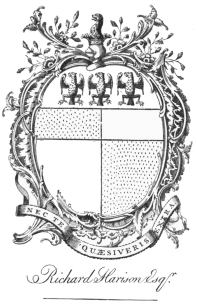
on each side of the books two slender vases standing upon an upward curl
of the ornamentation hold bouquets; below this whole design a gorgeous
curtain is spread out to contain the name of the giver of the book; this
is backed by a frame whose edge only is seen; this is elaborately
scrolled, and is finished at the bottom with the canephoros head and
shell pattern; two globes at the uppermost part, on either side,
complete the decoration. Signed, N. Hurd Boston. Several plates are
known very similar to this, but having different names upon the curtain.
One of them has simply the words Ex Dono, with the curtain left blank
for the writing of the giver’s name. Others have the name of donors of
quantities of books engraved upon the curtain; among these are,
Hancock and Thorndike.
353. Harvard. Sigill: Coll: Harvard: Cantab: Nov: Angl:
1650.
A very close copy of the above in all particulars;
indeed, a fac-simile of it. Signed, A. Bowen. On
some of them appear the name of Shapleigh, and
on others, Ex Dono Samuelis A. Eliot.
354. Harvard. Sigill: Coll: Harvard: Cantab: Nov: Angl:
1650.
This is again a copy in the main of the plate by
Hurd, but is later than the last. The ornamentation
is similar to that used by Hurd, but is changed
in some particulars; the canephoros head is replaced
by a bunch of grapes, the sun is missing
above the pile of books, and all the work has lost
in beauty of execution. Signed, Andrew Filner.
This plate is used to record the gifts of many
persons, among them being:—
| Samuel Shapleigh. | (Class of 1789.) |
| Joshua Green. M.D. | (Class of 1818.) |
| Samuel Abbott Green. M.D. | (Class of 1851.) |
| Jonathan Brown Bright. | (1884.) |
355. Harvard. Academiae Harvardianae Sigillum. 1638.
The arms of the college as usual, with the addition of the word
Veritas upon the open books. This plate in its general design was
suggested by the plate of Hurd, but is quite different in details. The
curtain, simpler in make, is still here, and the shield is in the usual
position, but the fruit and flowers are replaced by an august assemblage
of the gods and goddesses who are the special patrons of learning.
Signed, H. Billings del. C. G. Smith Sc.
356. Harvard College. Hasty Pudding Library.
Pictorial. Two Doric pillars uphold a large curtain which is looped at
the top, and left plain in the centre for the writing in of donors’
names. Above this a circular frame encloses a picture of an iron pot,
supposedly full of pudding, towards which two hands, one with a bowl in
its clasp, and one holding a spoon, approach. The motto, Seges votis
respondet, is given upon the frame. Directly under this is the date,
1808. Below the curtain a figure of the Sphynx is seen surrounded by
books in curved shelves. The bases of the pillars bear the words,
Concordia discors. Signed, Callender Sc. A Harvard College Society
plate.
357. Harvard College. Porcellian Library.
A large and handsome curtain looped up with cord in large bow-knots is
left as usual for the donors’ names; above it two small pillars with the
Greek letters on their bases, Ὁμ Ἑλ; the pillars are joined by a chain
which passes behind an oval medallion on which the clasped hands are
shown; above this the circular frame bearing the name encloses the hog;
the frame is ornamented with sprays of palm and roses, and a pile of
three books, as so often in plates of Harvard College, form the crest.
This plate is not signed, but it strongly resembles the work of
Callender.
358. Harvard College. Porcellian Club. 1803.
Allegorical. Two stone pillars support a circular frame within which the
hog is pictured. On the frame the name of the club is given; below hangs
a poor curtain for the name of the donor of books; above are the arms
surrounded by the grape-vine, and having books, a loving cup, lance, and
foil grouped about. The motto across the face of the shield on a bend,
Fide et Amicitia. Greek letters on the base of the pillars, Ὁμ Ἑλ.
359. Harvard College. Porcellian Library.
In this plate the curtain is suspended between two very tall amphoræ
which rest upon books bearing the Greek letters Ὁμ Ἑλ upon their backs;
behind the curtain two hogs disport themselves; the circular frame is
above them and encloses the representation of a punch bowl, under which
is the motto, Dum vivimus vivamus. Above all, the shield of arms with
the motto on a bend, Fide et Amicitia, is graced by grape-vine
branches, and the crossed lance and sword. Signed, F. Mitchell. Del.
360. Hawks. Francis L. Hawks.
Armorial. Motto, Never check. Clergyman and author. Left a large
collection of books to the New York Historical Society, where they are
kept in a room appropriated to their sole occupancy.
361. Hay. Mr. George Hay.
Armorial. Chippendale. Motto, Serva jugum. Jurist of Virginia.
Prosecutor of Aaron Burr.
362. Hay. Peter Hay. M.D.
Armorial. Chippendale. Motto, Serva jugum.
363. Hay. William Robert Hay. M.A.
Plain armorial. No motto. Was a student at the Inner Temple, London, in
1781.
364. Hayne. Isaac Hayne.
Armorial. Revolutionary patriot. Born, 1745; hanged by the British in
Charleston, S.C., 1742.
365. Hayne. Robert Hayne.
Armorial. Ribbon and Wreath. No motto.
366. Hays. Barrack Hays.
Landscape. The shield rests against a shattered tree. In the distance,
hills and water. Signed, I. Hutt Sculp.
367. Hayward. Benjamin Hayward. Of Charleston, S.C.
368. Hayward. George Hayward.
Armorial. Ribbon and Wreath. No motto. Flags, cannon, a trumpet, and a
lance form the background to the shield; the mantling runs down and
joins the flowering branches which are crossed beneath the shield. Below
the name which is on the motto-ribbon, hangs a small curtain, probably
for the number of the volume.
369. Hayward. Sarah Hayward.
Armorial. The same copper as the above with the first name altered.
370. Hayward. Thomas Hayward.
Armorial. Chippendale. No motto. A signer of the Declaration from South
Carolina.
371. Heath. John Heath. Boston.
An engraved label in which the sun
rises above the name, which is enclosed in festoons and sprays.
372. Heming. Samuel Heming. de sancta Anna Parochia in Jamaica.
Armigr.
Armorial. Chippendale. Motto, Aut nunquam tentes aut perfice. Very
fine work.
373. Henderson. James Henderson, Williamsburg. Pictorial. Military. A
woodcut very similar to the Timothy Newell.
374. Herbert. Herbert.
Armorial. Chippendale. Motto, Un loy, un roy, un foy. Not signed, but
probably the work of Maverick.
375. Herman. Sum Ex Libris Frederici Hermani, Sapientia praestat
divitiis. Printed label. Of Pennsylvania.
376. Hicks. Elias Hicks. Plain armorial. Behind the shield a sword is
seen and on its belt the motto is given, Tout en bonne heure. Signed,
P. Maverick. S. Distinguished Quaker preacher.
377. Hicks. Elias Hicks.
Armorial. Ribbon and Wreath. Motto, Judicemur agendo. Signed,
Rollinson Sct.
378. Hicks. Whitehead Hicks. Esqr.
Chippendale. Motto, Pro lege et
rege. Signed, H. Dawkins. Sculpt. At the left a cupid is playing a
flute; to which accompaniment his companion sings from a sheet of music
held in his hand. At the right, a female in a costume of extreme
simplicity sits under a jutting rose branch, while awaiting a cupid who
is seen struggling towards her with a large volume. Of the same Quaker
family. Mayor of New York City, 1766-1776.
379. Hill. Marcus Samuel Hill.
Armorial. Ribbon and Wreath. Motto, Non sibi sed patriae.
380. Hill. Sam’l. Hill.
Literary. Within an oval formed by branches of
palm and holly, two books with quill and ink-pot upon them. Probably the
plate of the engraver.
381. Hoar. Richard Hoar.
Armorial. Jacobean. No motto. This plate is not signed, but it bears a
strong resemblance to the work of Hurd.
382. Hoffman. Philip L. Hoffman. Esqr.
Armorial. Ribbon and Wreath. Motto, Carpe diem. Signed, Maverick
Sculpt. New York. A bit of landscape introduced below the shield, as
was often Maverick’s way; a stretch of water, trees, books, and writing
materials complete the adjuncts. The name is signed on an open scroll;
this lower part of the plate is very similar to the plate of Prosper
Wetmore by the same engraver. Of New York.
383. Holladay. Armorial. Of Virginia.
384. Hollingsworth. Levi Hollingsworth. Armorial. Chippendale. No
motto.
385. Holyoke. Edward Augustus Holyoke.
Armorial. Chippendale. Motto, Duce natura sequor. Not signed, but
without doubt the work of Hurd. Eminent physician and surgeon of
Massachusetts. Lived to a great age and performed an operation at the
age of 92.
386. Holyoke. (Anonymous.)
Armorial. Ribbon and Wreath. Motto, Sacra quercus. This plate is
presumably of the Holyoke family, as the motto is the family motto, the
arms are meant to be the Holyoke arms, and the crest is correctly an
oak-tree. The design and execution of this plate are poor.
387. Hooper. Swett Hooper. Pictorial. Over a vase full of flowers, two
cupids bearing a scroll on which is the motto, The wicked borrow &
return not.
388. Hooper. William Hooper.
Armorial. Chippendale. Motto, Haec etiam parentibus. Signed, N. H.
Scp. Plate of the signer of the Declaration from North Carolina.
389. Hopkins. (Anonymous.) Plate of Reuben Hopkins.
Armorial. Ribbon and Wreath. Motto, Piety is peace. The frame which
supports the shield rests upon two books; other books, a globe, and a
telescope are among the decorations.
390. Hopkinson. Francis Hopkinson.
Armorial. Chippendale. Motto, Semper paratus. Signed, H. Dawkins
Sculp. The frame is very like that of the Bushrod Washington plate in
some respects. This type is not uncommon; the peculiar cant of the
shield, the hissing griffin perched threateningly upon the corner of the
frame, and the very form and arrangement of the flowers and spray are
duplicated in several instances. Son of Thomas Hopkinson, the Councillor
of Pennsylvania. A signer of the Declaration from New Jersey.
391. Hopkinson. Joseph Hopkinson.
Armorial. The same copper as the last, with the name changed. The first
name, Francis, is not well removed and shows in the printing of the
plate. Son of Francis. A distinguished lawyer. Author of “Hail
Columbia.”
392. Horanian Society. Horanian Society Library.
Allegorical. The
large shield displays a picture of the Madonna; the supporters are Diana
and the Muse of History; the crest is a pile of three books with an owl
perched upon them. A large pediment supports the shield and the figures,
and on its face the name is given within an elliptical frame; festoons
and a curtain of cloth hang about it, and the motto, Mutual
Improvement, is given upon a ribbon which is draped across the top of
the frame. Signed, P. R. Maverick Sct. No. 3 Crown Street. N.Y.
393. Horry. Dan Horry. Esqr.
Armorial. Chippendale. Motto, Toujours fidèle. Of South Carolina.
394. Horsmanden. Daniel Horsmanden. Esqr.
Armorial. Jacobean. Motto, De interior templo socius. Author of “Negro
Plot of New York, 1741.” Published in 1810. Born, 1691; died, Flatbush,
1778. Illustrated in “Curio,” page 65.
395. Hubard. Armorial. Of Virginia.
396. Humphrey. Henry B. Humphrey.
Pictorial. A very graceful framework
encloses several spaces which are occupied by decorative features. Above
the name, Minerva, helmeted and robed, with shield and spear, is seated
attended by the owl. Beneath her the motto appears on a curved portion
of the frame, Inter folia fructus. Beneath this again is the name
within an oval formed by two writhing snakes; at either side of this are
female griffins, sejant. At the very lowest point of the design a
grotesque canephoros head is seen. Of Boston.
397. Hunter. Archibald Hunter.
Armorial. Signed by Dawkins.
398. Hunter. John Hunter. Plain armorial. No motto. A small plate.
399. Hunter. His Excellency, Robert Hunter. Esqr.
Armorial. Jacobean. Motto, At re non impetu. In writing, the General
and Chief General of Jamaica. Author of the famous letter on
“Enthusiasm,” which was attributed to Shaftesbury and to Swift. Became
Governor of Jamaica in 1728.
400. Hunter. William J. Hunter.
Armorial. Ribbon and Wreath. Motto, Sola bona quae honesta. Signed,
Engrd. by P. R. Maverick 65 Liberty St. N. Y.
401. Hurd. Name of Hurd.
Armorial. The arms seem to be wholly imaginary, or at least borrowed
from some other family. Arms, Az. a lion ramp. or. on a chief ar. a
stork ppr. between two mullets sa. Crest, A bird sa. on a garb fess-ways
ppr. No motto. The name occupies the ribbon. This plate is crude in
appearance, and not unlike the work of Nathaniel Hurd; it may have been
an early attempt of his for himself or some member of his family. The
copy before me has written upon it, “Isaac Hurd’s presented to Barzillai
Frost.”
402. Hyslop. By the name of Hyslop.
Armorial. Ribbon and Wreath. No motto, the name occupying the
motto-ribbon.
403. Hyslop. Robt. Hyslop.
Armorial. Ribbon and Wreath. Motto, Vincit omnia veritas. A rude piece
of engraving. The garland draped behind the shield is very stiff, and
the oak branches at the sides are ungraceful.
404. Ingersoll. Jared Ingersoll Esqr. of New Haven Connecticut.
Armorial. Chippendale. Motto, Fama sed virtus non moriatur. Lawyer;
born, 1749; died, 1822. Studied in the Middle Temple, London. Member of
the Old Congress, 1780-1781. In 1812 was the Federal candidate for
Vice-President of the United States. Author of a rare pamphlet on the
Stamp Act, New Haven, 4to, 1766.
405. Inglis. Inglis. Plain armorial. Motto, In tenebris lucidor. Of
New York.
406. Inglis. Alexr. Inglis.
Armorial. Chippendale. Motto, Lucidor in tenebris. The heraldry is
mixed and the motto twisted. Of South Carolina.
407. Inglis. George Inglis. Petersburg.
A woodcut border with the name
in type within it. The border is elaborate, with cornucopiæ of flowers
at either side, and ornamental pieces in the corners. In the copy at
hand the type is set in wrongly, so that the frame is bottom up.
408. Inglis. John Inglis.
Armorial. Chippendale. Motto, Recte faciendo securus. Of Pennsylvania.
409. Ingraham. (Anonymous.)
Armorial. Chippendale. Motto, Magnanimus esto. Name bracket empty.
410. Ingraham. Edward D. Ingraham.
Armorial. Chippendale. Motto, Magnanimus esto. It was said of him that
if he wanted a book, he would prefer to buy it; if he could not buy, he
would borrow (not to return), and if necessary would even steal it. A
man of great learning and eccentricity. Lawyer of Philadelphia.
Illustrated in “Art Amateur,” April, 1894.
411. Ingraham. Edwd. D. Ingraham. Crest only.
412. Ingraham. Edward D. Ingraham. Plain armorial. No motto.
413. Ingraham. Edward D. Ingraham. Crest only, enclosed in a garter on
which the motto is given,—Magnanimus esto.
414. Innes. Colonel Innes. Plain armorial. Motto, Je recois pour
donner. Of North Carolina.
415. Iredell. James Iredell.
Armorial. Chippendale. No motto; name on motto-ribbon. Jurist of North
Carolina. Illustrated in “Art Amateur,” March, 1894.
416. Iselin. Helen Iselin. Plain armorial. Crude work; the mantling
very scraggly. No motto.
417. Izard. R. S. Izard.
Armorial. Pictorial. The arms are carved on what bears strong
resemblance to a gravestone; a draped female figure stands leaning upon
the stone holding a book open, on which the motto, Hoc age, is given.
418. Jackson. James Jackson.
Armorial. Ribbon and Wreath. Motto, Bona quae honesta.
419. Jackson. Jonathan Jackson.
Armorial. Ribbon and Wreath. Motto, Bona quae honesta. Signed, N. H.
Scp. A Massachusetts statesman. Member of Old Congress. Illustrated in
“Art Amateur,” April, 1894.
420. Jackson. W. Jackson.
Ribbon and Wreath. A shield is suspended
from a wall-pin under the crest, on which assumed arms are shown; in
chief a group of thirteen stars surrounded by the word Independence;
in base is a plough, indicative of the spirit of the owner. Motto,
Meliora non opto. Perhaps the plate of Major William Jackson, a
prominent patriot of the Revolution; held many offices.
421. Jamaica. The Bishop of Jamaica.
Armorial. Motto, Simplius sicut columbae. Signed, Griffiths &
Weigalls 3 St James St Londn.
422. Jarvis. Jarvis.
Armorial. Pictorial. A very handsome and peculiar plate, in which the
shield resembles a wind-filled sail; angry waves roll at the foot, and a
part of a mast and sail are seen. The ornamentation at the sides takes
the form of trees and sprays of holly, while roses appear at the sides.
Motto, Adversis major par secundis.
423. Jarvis. Samuel Farmar Jarvis. D.D.
Armorial. Literary. Mottoes: Hora é sempre, and see Sola salus
servire Deo. The shield rests against a pile of books, and above the
cross and crown are seen in a blaze of glory. Son of Bishop Abraham
Jarvis.
424. Jauncey. Jauncey.
Armorial. Ribbon and Wreath. Motto, Quo vocat virtus. The name
William is written in on the copy at hand. He was a merchant in New
York. His father was an eminent ship-captain.
425. Jay. John Jay. Plain armorial. Motto, Deo duce perseverandum.
Statesman.
426. Jeffries. Dr. John Jeffries.
Plain armorial. No motto. It is said
that he was the surgeon who recognized the body of Warren at the battle
of Bunker Hill. This plate is not signed, but bears strong resemblance
to the work of Callender.
427. Jeffries. J. J.
Crest only. Plate of John Jeffries.
428. Jeffry. James Jeffry.
Armorial. Early Chippendale. Motto-ribbon empty. Same arms as the
succeeding.
429. Jenkins. Robert Jenkins.
Armorial. Jacobean. Motto, Non reverter invitus. Signed, N. Hurd.
Some copies are dated 1751 in mss. A very handsome plate in which the
arms are placed against a diapered background, enclosed by ornamental
scroll-work, set off at the bottom by a spirited scene in which a ship
under full sail hastens from view. At the upper part of the frame two
grotesque female faces peer at each other from across the space in which
the crest is given. In the steeple of Christ Church, Boston, in which
the lanterns of Paul Revere were hung, a chime of eight bells, made by
Abel Rudhall of Gloucester, England, was placed in 1744; each bell bears
an inscription; on the sixth we read that the subscriptions for these
bells was completed by Robert Jenkins and John Gould, Church Wardens,
Anno 1744.
430. Johnson. (Anonymous.)
Armorial. Chippendale. Motto, Deo regique debeo. The shield rests upon
an elaborately carved pedestal, on which the supporters, American
Indians, stand. This is very probably the plate of Sir William Johnson,
nephew of Admiral Sir Peter Warren, and colonial agent of George II. for
the control of Indian affairs in the colony of New York (1756). Still,
the plate seems hardly old enough to have been his, and may have been
his son’s. Only one copy is known to the writer.
431. Johnson. John I. Johnson.
Pictorial. A cherub coming down on the
clouds carries a curtain before him, spread out, and on this the name is
given. A brick wall frames the oval which holds the picture. Signed,
Maverick. St.
432. Johnson. Thomas Johnson.
Armorial. Chippendale; rather wild. No motto. The design is supported
upon four short columns which rest upon a large shell. Query: Is this an
early effort of Hurd’s (as it resembles his work), or is it the work and
plate of Johnson, the engraver and herald painter?
433. Johnson. W. L. Johnson.
Armorial. Chippendale. Motto, Per aspera ad astra. Of South Carolina.
434. Johnson. Wm. S. Johnson of Connecticut Esqr.
Armorial. Chippendale. Motto, Per aspera ad astra. Born in
Connecticut. Distinguished jurist and scholar. Delegate to Congress,
1765; agent of Connecticut in England, 1766-1771.
435. Johnson. Wm. S. Johnson LL.D.
The same plate as the above with
the inscription altered. President of Columbia College, 1787-1801.
436. Johnston. Johnston.
Armorial. Book-pile. Motto, Nunquam non paratus. This is in the
conventional book-pile style, and is the only example we have of this
peculiar arrangement of books. The volumes are piled in three tiers
about an open scroll which is suspended in the centre and which bears
the arms. On the copy before me the letter G is written before the
name. Of Maryland.
437. Johnston. John Johnston.
Armorial. Ribbon and Wreath. Motto, Nunquam non paratus. Signed,
Maverick Sculpt. Not so striking as the Thomas Johnston.
438. Johnston. Robert Johnston.
Armorial. Of Turkey Island.
439. Johnston. Thomas Johnston.
Armorial. Ribbon and Wreath. Motto, Nunquam non paratus. Signed,
Maverick Sculp N.Y. A beautiful plate.
440. Jones. Gabriel Jones. Attorney at Law in Virginia.
Armorial. Early Chippendale. Motto, Pax hospitia ruris.
441. Jones. Gardner Jones.
Armorial. Ribbon and Wreath. Motto-ribbon empty. Of Boston.
442. Jones. Samuel Jones Esqr.
Armorial. Chippendale. Motto, Trust in God. Signed, Dawkins Sc. This
plate has none of the extraneous ornamentation so common to Dawkins.
Member of Constitutional Convention. Illustrated in “Art Amateur,”
March, 1894.
443. Jones. William G. Jones.
Armorial. Ribbon and Wreath. Motto, Pax et copia. Born Aug. 5, 1787.
Of New York. The same copper as the Gardner Jones with the name altered,
and the motto placed on the ribbon.
444. Judah. Benjamin S. Judah.
Armorial. Ribbon and Wreath. Motto, Fortitudo et justitia. Signed,
Maverick Sculpt.
445. Judah. Benjamin S. Judah.
Armorial. Ribbon and Wreath. Motto, Fortitudo et justitia.
446. Keese. John Keese.
A small engraved label, with Chippendale
frame, and books at either side. Signed, Maverk. Sct. Earlier than the
following; a very unusual signature for Maverick.
447. Keese. John Keese.
Armorial. Ribbon and Wreath. Motto, Bello virtus. Signed, Maverick
Sculpt. Of New York.
448. Keffer. John C. Keffer. Pictorial. A figure representing Commerce
is seated on a rock with implements of Agriculture around her; in the
distance can be seen an expanse of water with boats upon it.
449. Keith. Ex Libris Gul. Keith.
Armorial in form, though no arms are shown. Early English; heavy
mantling. On the shield the inscription is given. The only copy known
(Loganian Library) is dated 1727 in ms. Governor of Pennsylvania,
1717-1726. He was a “desperate intriguer.” See “Franklin’s
Autobiography.”
450. Kemble. Peter Kemble.
Armorial. Chippendale. Motto-ribbon empty. Signed, J. Lewis. Rather
crude work. An illustration apparently from the original copper may be
found in “The Pilgrims of Boston,” etc., by Thomas Bridgman.
451. Kempe. John Tabor Kempe. Esqr.
Armorial. Early Chippendale. Motto, Labour to rest. Last Royal
Attorney-General of New York. A Loyalist whose estates were confiscated.
452. Kerr. John Leeds Kerr. (See John Leeds Bozman.)
453. Key. F. S. Key, Georgetown, Columbia.
Label with type border.
Lawyer and poet, born in Maryland, 1779; writer of “The Star Spangled
Banner.”
454. King. Miles King.
Armorial. Of Norfolk, Va.
455. King. Morris King.
Armorial. Chippendale. Motto, Loyall au mort.
456. King. Rufus King.
Armorial. Ribbon and Wreath. Motto, Recte et suaviter. Signed,
Maverick Sculpt.
457. King. Sally King, Owner.
Pictorial. A peculiar plate, drawn in
ink, by hand. Two columns support an entablature, in the centre of which
a large representation of a mariner’s compass is given. The motto,
Cherish Virtue, is on the circular frame enclosing it. The work on all
parts of the design is very fine, and shows a master hand. Not many of
these plates are known, but a few are certainly known to have been in
use. They were, presumably, the work of some member of the family who
was efficient with the pen, and had time and inclination to use his
talent thus. Although dating probably about 1800, the ink is fresh, and
the plate clear and excellently drawn.
458. Kingston. Kingston. Plain armorial. No motto. Of Pennsylvania.
459. Kingston, Canada. Santa Johanis Evangelistae Sigilum Collegi
Latomorum. Kingston, Canada, 1794. Vesica-shaped shield, on which a
robed figure holds an open book, which shows masonic emblems on its
pages.
460. Kinloch. Francis Kinloch. Esqr.
Plain armorial. Motto, Altius tendo. A student at Gray’s Inn in 1774.
461. Kip. Isaac L. Kip.
Armorial. Ribbon and Wreath. Motto, Victoris aut mors. Signed,
Maverick Sculpt. The signature is on a scroll upheld by a winged
cherub, who rests against a stump. Among the accessories are a book
labelled LAW, an ink-pot, etc.
462. Kip. Leonard Kip, New York.
Pictorial. Two quills are crossed
above a scroll on which the name is given. Signed, B. Brown. Sc.
President of the North River Bank.
463. Kip. Leonard Kip.
Plain armorial. Motto, Vestigia nulla
retrorsum. Same as preceding.
464. Kirkpatrick. James Kirkpatrick.
A woodcut label; books and other
literary property are distributed about; the name is on an opened
scroll.
465. Kissam. Benjamin Kissam.
Armorial. Chippendale. Motto, Honestum Praetulit util. Signed, H.
Dawkins. Inv. et Sculp. This is in the happiest vein of this engraver.
At the left a young lady in the low-necked, hooped dress of the period,
carrying a shepherd’s crook, and at the right the shepherd himself, but
having his crook, is seated. By his side a very docile, even weakly
appearing lamb, listens while he plays the flageolet. A prominent lawyer
in New York in the middle of the last century.
466. Knight. Jonathan Knight’s Book No.
Armorial. Jacobean. A small plate of rude workmanship. On the
motto-ribbon are the words, By the name of Knight. A Revolutionary
army surgeon; died in Norwalk, Conn., 1829.
467. Knights. Knights of the Square Table.
Armorial. Architectural. A stone canopy is erected in Pointed Gothic
style, across the face of which, and hiding from view the long windows,
a curtain is stretched, along the top of which the motto, Cassis Tutis
Sima Virtus, is shown. The shield of arms is placed above the
window-tops, and is surrounded by mantling rather straight and original
in design. At the very foot the date 1809 appears.
468. Knox. William George Knox. Trinidad. Plain armorial. Motto,
Moreo et proficio.
469. L. Ex Libris L.
Armorial. The shield is enclosed within a large letter L, a French crown
surmounts it, and on a ribbon at the foot is seen Joe L—. Signed, P.
Riera. Of South Carolina.
470. Ladd. Ladd.
Armorial. Chippendale; rough. No motto, the name occupying the
motto-ribbon. Signed, S. Felwell. Sculpt. Of New Hampshire.
471. Lamb. John Lamb.
Armorial. A gallant soldier of the Revolution.
472. Lardner. Lynford Lardner.
Armorial. Pictorial. Landscape. The shield rests against the bole of an
oak, and around it are sparse bushes and grass. Motto, Mediocria
firma. Of Philadelphia. Probably the grandson of the Provincial
Councillor.
473. Laurens. Edward R. Laurens.
Armorial. Belongs to no particular style. The shield is highly
ornamented with scrolls and flowers. Motto, What is, is best. Signed,
Stout del et Sculpsit. Of South Carolina.
474. Lawrence. J. Tharp Lawrence. Plain armorial. Motto, In cruce
salus. An ermine mantle behind the shield.
475. Leavenworth. Capt. Gideon Leavenworth.
Armorial. Jacobean. No motto, the name on the motto-ribbon. Very crude
work, resembling the Elijah Backus plate.
476. Lee. Armorial. Of Virginia. (Richard Henry Lee?)
477. Lee. Edward Lee. Esqr.
Plain armorial. No motto, the name occupying the motto-ribbon. Of
Virginia.
478. Lee. Cpt. John Lee. A crude name-label, with a border suggestive
of nothing. Signed, S. Mcintire.
479. Lee. Philip Ludwell Lee, Esqr of the Inner Temple LONDON.
Armorial. Chippendale. Motto, Non incautus futuri. Of Virginia.
480. Leiper. Armorial. Of Virginia.
481. Lenthall. John Lenthall.
Armorial. Ribbon and Wreath. Motto-ribbon empty. Signed, Thackara. A
large plate, the only signed specimen of this engraver’s work. Very
probably the plate of John Lenthall, an Englishman employed by Latrobe
on the public buildings at Washington, and a very valuable architect.
482. Lenox. David Lenox. Philadelphia.
Armorial. Ribbon and Wreath. Motto, Auctor pretiosa facit.
483. Lenox. James Lenox. Plain armorial. Motto, Auctor pretiosa
facit. The founder of the Lenox Library, New York City.
484. Lewis. Joseph S. Lewis.
Literary. No motto. Four large books in
an impossible position; the topmost one has the name engraved upon the
side; an ink-pot and two quills, with a sprig of holly, complete the
ornamentation. A prominent merchant of Philadelphia seventy-five years
ago.
485. Lewis. Mordecai Lewis. No.
A very handsomely engraved name-label.
A frame of Chippendale gracefulness surrounds the name. A canephoros
head of pleasant expression appears in the lower edge. A Philadelphia
merchant. Born, 1784; died, 1851.
486. Lewis. Morgan Lewis Esqr.
Armorial. Ribbon and Wreath. Motto, Courage sans peur. This plate is
not signed, but it is undoubtedly the work of Maverick. Soldier and
jurist. Was on the staff of General Gates in the Revolution, and was in
action again in the War of 1812.
487. Lightfoot. Philip Lightfoot.
Armorial. Of Virginia. Tomb at Sandy Point, dated 1784.
488. Lightfoot. Wm. Lightfoot Esqr. Tedington. 1750.
Armorial. Chippendale. No motto.
489. Linn. Rev. Matthias Linn.
Armorial.
490. Lisle. Henry Maurice Lisle, Attorney at Law.
Armorial. Ribbon and Wreath. Motto, Legibus viro. Of Hingham, Mass.
Circa 1800
491. Livermore. Edmund St. Loe Livermore.
An engraved name-label, with
the motto on an ornamental ribbon above, Miseris succurrere disco.
Lawyer of Boston.
492. Livingston. Brockholst Livingston Esqr.
Armorial. Chippendale. Motto, Spero meliora. Son of Governor William
Livingston. Accomplished scholar and lawyer. Of New York. Illustrated in
“Curio,” page 63.
493. Livingston. Edward Livingston.
Landscape. The shield upheld
against a shattered oak by a ribbon; the ship in distress for crest;
Spero meliora on a dainty ribbon among the twigs. At the foot of the
tree, close to which a marsh is seen, a pointer barks at a squirrel
sitting unconcernedly on a bough eating acorns. Signed, Maverick
Sculpt. A beautiful plate. Jurist and statesman. Son of Robert R.
Illustrated in “Curio,” page 64.
494. Livingston. John R. Livingston.
An engraved label, the name being
within an oval frame.
495. Livingston. Maturin Livingston.
Armorial. Ribbon and Wreath. Motto, Spero meliora. Signed, Maverick
Sculpt. Of New York.
496. Livingston. Mortimer Livingston. Plain armorial. Motto, Spero
meliora.
497. Livingston. Peter R. Livingston.
Armorial. Jacobean. Motto, Prestat opes sapientia. Signed, N. Hurd.
Scp. The whole within an oblong frame. Illustrated in “Curio,” page 62.
498. Livingston. Robert L. Livingston.
Armorial. Chippendale. Motto, Spero meliora. Crest, a demi-barbarian
with a bludgeon raised in his right hand, and a coiling serpent in the
other. Illustrated in “Curio,” page 64.
499. Livingston. Rob’t. R. Livingston Esqr. of Cleremont.
Armorial. Ribbon and Wreath. Motto, Spero meliora. Not signed, but
probably the work of Maverick. Illustrated in “Curio,” page 63.
500. Livingston. Rob’t. R. Livingston. Esqr. Of Clermont.
Armorial. Pictorial. The shield rests against a broken column; at its
base a large globe, caduceus, scrolls, and vellum-bound books. A garland
of roses falls across the shield, and a view of the distant plain is
afforded through the bushes at the side. A large palm above droops over
all. Motto, Spero meliora. Crest, the ship. A very beautiful plate.
Eminent lawyer. Illustrated in “Curio,” page 63.
501. Livingston. Walter Livingston.
Armorial. Chippendale. Motto, Spero meliora. Not signed, but
undoubtedly the work of Maverick. Books and a lighted lamp among the
ornamentations.
502. Livingston. William Livingston of the Middle Temple.
Armorial. Chippendale. Motto, Aut mors aut vita decora. Born in
Albany, 1723; graduated from Yale at the head of his class, 1741.
Intending to go to London, he obtained permission to enter the Middle
Temple, but seems to have never done so. The book-plate must have been
engraved about this time (1742). Statesman. Illustrated in “Curio,” page
62.
503. Livingston. Willm. Smith Livingston.
Armorial. Ribbon and Wreath. Motto, Spero meliora. Signed, Maverick
Sculpt. A peculiarly shaped frame. Illustrated in “Curio,” page 63.
504. Livius. Livius.
Plain armorial. Motto, Colendo crescent. Of New
Hampshire. Peter Livius; same as following.
505. Livius. Livius Chief Justice of Quebec.
Plain armorial. Motto,
Non flectere a vero. The same copper as the above with the name
changed, the motto altered, and an in-escutcheon added. A Loyalist.
Chief Justice, 1777-1786.
506. Livius. George Livius.
Armorial. Chippendale. No motto. Illustrated in “Art Amateur,” May,
1894.
507. Lloyd. Jno. N. Lloyd.
Armorial. Early English. No motto. Very tempestuous mantling completely
encircles the shield. An old family of Long Island; the manor of Queen’s
Village was in their possession as early as 1679. Of this family came
Dr. James Lloyd, of Boston, a Loyalist, friend of Sir William Howe, and
whose estates on Long Island were seized by the Royal Army, who allowed
three thousand acres of woodland to be cut off. When redress was offered
upon his swearing allegiance to England, Dr. Lloyd refused. Name in
fac-simile of autograph.
508. Lloyd. John Nelson Lloyd. Pictorial. Urn, festoons, and sprays of
palm.
509. Lloyd. Richd. Bennett Lloyd. Esqr.
Armorial. Pictorial. No crest, and no motto. The shield is oval, and is
held upright by a female clad in the Greek manner; an anchor at her
feet.
510. Lodge. Abraham Lodge.
Armorial. Jacobean. No motto.
511. Logan. Charles Logan.
Armorial. Chippendale. No motto. Of Philadelphia; lived also in Powhatan
County, Va. He freed all his slaves in Virgina upon his marriage.
512. Logan. James Logan.
Armorial. Chippendale. No motto, the name occupying the motto-ribbon.
Books and a globe at the base as ornamentation, and as indicative of the
owner’s tastes. Of Philadelphia. Came to this country at the suggestion
of William Penn. A scholar and statesman; left his library to the
public, which was the foundation of the Loganian Library. His
translation of Cicero’s “De Senectute” was the especial pride of
Benjamin Franklin’s press. He printed it with a preface by himself.
Illustrated in “Curio,” page 13.
513. Logan. William Logan.
Armorial. Of Philadelphia. Librarian of the Library.
514. Loganian Library. Loganian Library.
Armorial. Arms not the ones on the plate of James Logan, the donor of
the Library. No motto, the name occupying the motto-ribbon. Chippendale.
Started by James Logan in 1743, who gave books to the value of £1000 and
a building. Illustrated in “Curio,” page 12.
515. Longbottom. Abram P. Longbottom.
Plain armorial. Two shields of
arms side by side under a large American eagle. Mottoes, Labor omnia
vincit, and Pro rege et lege.
516. Lord. William Lord’s East Haddam.
An early engraved copper-plate;
the name and address only within an oval frame of twisted vines.
517. Loring. Loring.
Armorial. Chippendale. No motto. Not signed, but bears some of the
characteristics of Hurd’s work. Undoubtedly his.
518. Lotbiniere. M. le Marquis de Lotbiniere.
Armorial. French heraldic. A lion crouches below the escutcheon, while
eagles scream at either side. Motto, Fors et virtus. A large landowner
in New York City at the beginning of the century.
519. Low. Cornelius Low. Esqr.
Armorial. Chippendale. Motto, Ex necessitate. Not signed, but
undoubtedly by Dawkins. The frame is the same in ornamentation and style
as the Whitehead Hick plate.
520. Lowell. John Lowell.
Armorial. Chippendale. Motto, Occasionem cognoscere. Signed, N. Hurd.
Scp. Jurist and statesman of Massachusetts. Member of Old Congress.
521. Lowell. John Lowell Jr.
Armorial. Chippendale. Motto, Occasionem cognoscere. A second motto is
given, Deo dirigente cresendum est. Signed, Annin & Smith Sc.
Founder of the Lowell Institute, Boston. Illustrated in “Art Amateur,”
May, 1894.
522. Lowell. John Lowell. Jr.
Armorial. Chippendale. Mottoes as the preceding. Signed, A. & S. This
seems to be a lithograph made from the above.
523. Lowell. John Amory Lowell.
Armorial. Chippendale. Motto, Occasionem cognoscere. Very similar to
the design of the John Lowell by Hurd; evidently copied from it.
524. Ludlow. Cary Ludlow.
Armorial. Chippendale. Motto. Fide sed cui vide. Signed, W. Smith
Sculp. Somewhat in the style of Dawkins.
525. Ludlow. Charles Ludlow. A.M.
Armorial. Chippendale. Motto, Fide sed cui vide. Signed, W. Smith.
The arms are the same as on the John Cooke Ludlow. At the left a
scantily robed female is playing the flute, while a cupid holds the book
of music. The surroundings are indicative of a desert.
526. Ludlow. Gabriel Verplank Ludlow.
Armorial. Crest only. Motto, Naturae convenienter vivere.
527. Ludlow. Gab: Wm: Ludlow.
Armorial. Chippendale. Motto, Spero meliora. Signed, H. D. Sc.
(Dawkins.) A very fine plate.
528. Ludlow. George Ludlow.
Armorial. Ribbon and Wreath. Motto, Decus virtuti soli. The festoon of
cloth draped above the shield is trimmed with a string of laurel.
Signed, Rollinson Sct.
529. Ludlow. John Cooke Ludlow.
Armorial. Chippendale. Motto, Spero meliora. Signed, H. D. Sc.
(Dawkins.)
530. Ludwell. Philip Ludwell of Greenspring in Virginia Esqr.
Armorial. Late Jacobean. Motto, I pensieri stretti ed il viso sciolto.
Of Virginia.
531. Lukens. John Lukens.
Armorial.
532. McAlish. Armorial.
533. McComb. John McComb.
Plain armorial. No motto. The plate is enclosed within a frame made of a
festoon of oak leaves above, and straight lines below.
534. McCoun. Wm. T. McCoun.
Plain armorial. Motto, Semper paratus.
Signed, Rollinson. S. Of New York.
535. McDowall. William McDowall. Esqr.
One of His Majtes. Council in ye
Island of St. Christopher in America. An old armorial plate of which no
further information has been noted.
536. McFarlan. Frederick Mc. Farlan.
Armorial. Ribbon and Wreath. Motto, This I’ll defend. Of
Pennsylvania.
537. McIlvaine. Bloomfield McIlvaine.
Pictorial. An angel seated among
the clouds holding a tablet upright upon her knee, is writing upon it
with a quill. A very pretty design. Signed, I. J. Barralet, inv. J.
H. Seymour Sc. Lieutenant United States Navy.
538. McKelden. Andrew McKelden.
Pictorial. The arms of the United
States finely engraved within a circular frame. Motto, E pluribus
unum. The name of the owner written within the circle. Signed, Leonard
Sculpt.
539. McKenzie. Kenneth McKenzie.
Armorial. A Virginia physician.
540. McKenzie. William McKenzie. Surgeon.
Armorial. Chippendale. Mottoes, Luceo non uro. The date 1766 is
written on the copy before me.
541. McLean. Hugh McLean.
Armorial. Ribbon and Wreath. Motto, Altera merces, and Virtus
durissima terit. Signed, Maverick Sct. Oak leaves and branches used
in the decoration.
542. McMurtrie. Henry McMurtrie.
Pictorial. Landscape. The frame is
oval in form; the rising sun discloses a small island on which are five
trees in a straight row; the bank at the left hand also has a similar
row of five trees, and in the immediate foreground a few piles of stone
and more trees are seen. The name is on a ribbon under the picture.
Signed, Smither Sculpt. A physician of Philadelphia.
543. McMurtrie. Henry McMurtrie.
Literary. Books are piled upon a
table; the serpent of Æsculapius carries the motto-ribbon on which are
the words, Respice finum. Cupid weeps beside a mortuary urn whose tip
is aflame. An open book seems to have two words on the pages. The first
one is Rush. The whole design is enclosed in a circle about which
numerous clouds hover. Signed, Fairman del. Kearny Sc. The
Philadelphia physician.
544. McTavish. John McTavish.
Plain armorial. Motto, Non oblitus. Of
Maryland.
545. Mackay. James Mackay. Belfast.
Armorial. Chippendale. Motto, Delectando pariterque monendo. A
resident of Virginia about the year 1760.
546. Mackey. Albert G. Mackey. M.D.
Plain armorial. Motto, My might
makes right. Physician and author of Charleston, S.C.
547. Magill. John Magill.
Armorial. Chippendale. Motto, Perit ut vivat. Signed, J. Smither
Sct. Of Maryland.
548. Manigault. Peter Manigault of the Inner Temple, Barister at Law
South Carolina.
Armorial. Chippendale. Motto, Prospicere quam ulcisci. Signed, Yates
Fecit Royal Exchange. There is no official grant of these arms; they
were engraved in 1754; the crest, an American Indian, had not then been
decided upon.
549. Mann. John Preston Mann.
Literary. A peculiar out-of-door scene,
in which the foreground is occupied with a very tall case of shelves
filled with books; the corner post of the case is made of a pile of
books carefully arranged; in the distance is seen the temple of Honor,
upon the summit of a hill, the ascent to which is rocky and steep; the
American eagle rests upon a globe which is placed upon the tall pile of
books; the whole design is enclosed within an oval border, which is
decorated with scrolls, etc. The last name only is engraved upon the
plate, the first ones being written in.
550. Mann. The property of Timothy Mann. Walpole. Oct.—1810.
The name
is printed from type within a woodcut border; festoons and sprays of
palm compose the frame, in the centre of which, above, is a small circle
with the arms of the United States within it; two ink-pots with quills
in them are on either side of the arms.
551. Manning. Armorial. Of Virginia.
552. March. Charles March.
Plain armorial. Motto, Fortis et veritas. Charleston, S.C. Circa 1819.
553. Marchant. Henry Marchant.
Armorial. Chippendale. Motto, Patria cara carior libertas. Signed, N.
H. Sc. Very similar to the John Marston plate, below mentioned.
Attorney-General of Rhode Island, 1770-17—. Member of Old Congress,
1777-1780 and 1783-1784.
554. Marsh. Frederick Marsh.
Literary. Identical with the George
Goodwin plate mentioned above.
555. Marshall. John Marshall A.M.
Armorial. Chippendale. Motto, Ex candore decus. Chief Justice United
States, 1801.
556. Marston. John Marston.
Armorial. Chippendale. Motto-ribbon empty. Signed, N. Hurd, Sculp.
Illustrated in “Art Amateur,” May, 1894.
557. Martin. The Honble. Josiah Martin of Antigua Esqr.
Armorial. Jacobean. Motto, Pugna pro patria libertas.
558. Martin. Luther Martin A.M.
Armorial. Chippendale. Motto, Initium sapientiae est timor Dei. Inside
the name-frame an open book at either end; one labelled Black’s Comms.
Very similar to the Bloomfield plate, and undoubtedly by Trenchard.
Lawyer; Member of Old Congress; defended Samuel Chase.
559. Martin. Thomas Martin.
Armorial. Chippendale. Motto, Initium sapientia est timor domini. The
same arms as the above, but the crest different.
560. Mason. Jonathan Mason Junr.
Simply the name engraved within a flourish. One of the witnesses of the
Boston Massacre. The book from which the copy before me was taken had
the autograph of the owner in it and the date, 1774. Eminent lawyer and
statesman.
561. Massachusetts. Library of the General Court. Sigillum Reipublicae
Massachusettensis.
The shield of the State, surrounded by the motto of the State, Ense
petit placidam sub libertate quietem, is placed within the circular
frame which bears the name. Above, a pile of three books, similar to
those on the Harvard plate by Hurd, and a globe upon them stand in lieu
of a crest; a blaze of glory flashes out from these symbols of learning.
562. Massachusetts. This Book is the Property of the Historical
Society, Established in Boston. 1790.
A printed label with ornamental type border.
563. Massachusetts. Property of the Massachusetts Medical Society,
incorporated November 1781.
A large curtain, similar to that in the Harvard College plate by Hurd,
is upheld by festoons; this is left blank for the recording of donors’
names. Above this an oval medallion presents a picture of the efficacy
of Nature’s cures; a wounded stag with the arrow still in his side has
come to Æsculapius for healing. He, in rough garb, with the serpent
entwined around his rod, has directed the distressed animal to an herb,
which he is lying down to eat. A motto, Natura duces, is seen over the
picture. Signed, Callender Sc.
564. Massachusetts. The First State Normal School.
The arms of the State of Massachusetts surrounded by an oval garter, on
which the name is given. In the clouds above the motto appears, Live to
truth.
565. Masterton. Peter Masterton.
Armorial. Ribbon and Wreath. Motto, Cogi posse negat. Signed,
Maverick Sculpt. Thistles used in the decoration.
566. Matthew. William Matthew Esqr. Lt. Genl. of His Majtes. Leeward
Carribee Islands: and Lt. Govnr. of St. Christopher in America.
An old armorial plate; no further information obtainable.
567. Matthews. Wm. Matthews of Philada. Nº.
A copper-plate engraving; no design, except a border of scrolls and
flourishes enclosing the inscription.
568. Mayo. John Mayo.
Armorial. Chippendale. Motto, Virtus sola nobilitate. Mantling about
the helmet.
569. Maxcy. Virgil Maxcy.
Plain armorial. Motto, Nullus in verba. Of Maryland.
570. Maxwell. (Anonymous.)
Armorial. Maxwell arms and motto. The arms are enclosed in an oval frame
studded with pearls, and a profusion of flowers is used in the
ornamentation, which comes as near to the Ribbon and Wreath style as to
any. Motto, Riviresco. Signed, Maverick, Sculpt.
571. Mercer. Hugh Mercer.
Armorial. Of Virginia. A gallant General of the Revolution; was killed
at the battle of Princeton, at which the daring plan of crossing the
river was undertaken and carried out upon his suggestion.
572. Mercer. (Anonymous.)
Armorial. Rich mantling encompassing the whole shield. Motto, Per
varios casus. John Mercer of Marlboro, near Fredericksburg; a witness
to the will of Mary Washington.
573. Meredith. Jonathan Meredith Junr.
Armorial. Ribbon and Wreath. Motto, Integra mens augustissima
possessio. This plate is not signed, but is apparently the work of
Maverick.
574. Middleton. John Izard Middleton.
Armorial. Born at Middleton-Place-on-the-Ashley, near Charleston, S.C.,
1785; died, 1849. Author; intimate in the circles of Mesdames De Staël
and Récamier.
575. Middleton. Peter Middleton. M.D.
Armorial. Chippendale. Signed, J. Lewis Sc. Mantling profuse and
reaching well down the shield. Motto, Fortis & fidus. Of New York.
Born in Scotland. Made the first dissection on record in America.
576. Miller. Ferdinand H. Miller.
Literary. Very similar to the Thomas Robbins plate.
577. Miller. {Bruder Jaebez. 178-.
{Petrus Heremit. 1791.
These plates, simple printed labels, were the property of J. Peter
Miller, the Prior of the Convent at Ephrata, Penn.
578. Milner. James Milner.
Armorial. Chippendale. Motto-ribbon empty. Of Virginia.
579. Minot. Minot.
Armorial. Early English. Rough mantling all about the shield. Motto, Ad
astra per aspera. George Richard Minot, historian, Boston.
580. Minot. Minot.
Armorial. Early English. Mantling all about the shield. Motto, Ad astra
per aspera. A better plate than the above. The copy before me has an
S written before the name. Of Massachusetts.
581. Minturn. William Minturn.
Plain armorial. An elaborate frame, with mantling reaching far down the
sides. Motto, Esse potius quam haberi.
582. Mitchell. A. Mitchell Ejus Liber.
Armorial. Chippendale. An early settler of Chester County, Penn.
583. Mitchell. Jacobum Whitely Mitchell.
Literary. The central panel of this design bears the name and the
following lines:—
Hujus si capias dominum
Cognoscere libri, si infra,
Inspicida nomen habebis ibi.
At the left shelves of books are seen, and at the right what seems to be
a heavy press. Above, on a bracket, are grouped several implements of
music, art, etc. This is a rude woodcut.
584. Moat. Horatio Shepheard Moat.
Armorial. Ribbon and Wreath. Motto, Nil desperandum. Signed,
Rollinson.
585. Moore. Lambert Moore. Esqr.
Armorial. Chippendale. Motto, Virtus interrita pergit. This plate is
not signed, but is unmistakably the work of Dawkins. The half-draped
female on the left side is the same as that on the Whitehead Hicks
plate, and the music-making shepherd on the right is reversed from the
Benjamin Kissam plate.
586. Moore. Nathl. F. Moore.
Armorial. Ribbon and Wreath. No motto. Signed, P. Maverick. Of New
York. President of Columbia College, 1842-1849.
587. Moore. Saml. W. Moore.
Plain armorial. Motto, Non est vivere sed valere vita. Of New York.
588. Moreau. John B. Moreau.
Literary. The name on an open book, floating in the clouds.
589. Morgan. John Morgan. M.D. Philadelphia.
Armorial. Chippendale. Motto, Fama praestante praestantior virtus.
This plate is not signed, but is very much in the style of Dawkins’
work. A cupid sits on a flourish of the decoration and pats a large bust
on its crown, presumably representing sculpture. At the other side two
cupids discuss astronomical problems with a globe for reference. One of
these little fellows is an African evidently. Eminent physician educated
abroad. One of the founders of the American Philosophical Society, 1769.
590. Morong. Thomas Morong.
Literary. A pile of books, some open, some closed, lies at the foot of a
cross, above which the crown is seen in glory. A ribbon runs over the
face of one book, bearing the motto, Sola salus servire Deo. A line of
Hebrew is given across the open book.
591. Morris. Gouverneur Morris.
Armorial. Chippendale. Motto, Tandem vincitur. One fold of the ribbon
empty, as if possibly made for a larger motto; a stock pattern. This is
the same copper as the Lewis Morris mentioned below, with the first name
changed. Statesman and orator. Illustrated in “Art Amateur,” February,
1894.
592. Morris. J. M.
Crest only. (Morris of Philadelphia.)
593. Morris. James Morris.
Armorial. Chippendale. No motto. A very handsome plate, rich in
appearance, and full of decorative features. Open books, globe, and
scrolls at the base indicate a literary taste. The sides of the frame
are embellished with the caduceus and a cornucopia of fruit. Of New
York.
594. Morris. Lewis Morris Esqr.
Armorial. Chippendale. Motto, Tandem vincitur. Father of Gouverneur
Morris.
595. Morris. Roger Morris.
Armorial. Early Chippendale. No motto. The mantling is present, very
straight and stiff; the shell-work is prominent, and the whole design is
rather formal than graceful. Illustrated in “Curio,” page 112.
596. Morris. William Morris.
An engraved label, the name being within an oval frame of laurel leaves.
Signed, Shallus Sculpt.
597. Morrison. John Morrison. Portland. U. S. America.
Armorial. Chippendale. Motto, Dum spiro spero. A very neat design. The
sprays which are crossed beneath the shield are connected above by a row
of thirteen stars.
598. Murray. James Murray.
Armorial. Chippendale. Motto, Mens sibi conscia recti. Of Virginia.
599. Murray. John Murray.
Armorial. Ribbon and Wreath. No motto.
600. Murray. The Revd. John Murray.
Armorial in form, but no true arms shown. The motto, Malo mori quam
foedari, is on a circular band which encloses a space, divided into
quarters, colored heraldically and charged with absurd charges; in the
first quarter, which is tinctured az., a shield with a helmet above is
supported by a row of fence posts with cinquefoils between them; the
second, which is tinctured ar., is divided per saltire, and is charged
with a powder-horn, a crescent and stars, an ox-bow, and a crown; the
third, which is tinctured gu., has Gabriel and Apollyon in combat, with
a crown above them; the fourth, which is tinctured az., has the dove
with the olive branch on a peculiar cross which holds thirteen spots
(for lack of a better term); disposed about are three flaming hearts.
This whole design is enclosed in a large shield; the crest is a man on a
prancing steed, carrying a tomahawk; the supporters are a nude Indian
with a wreath about his loins, his feet chained, and the end of the
chain and a shield in his hands; and a crowned lion with three stars on
its body. Motto, under all, Juncta virtute fides. This plate is not
signed. What a pity! Very probably the plate of the Father of American
Universalism, who it is said was greeted with a shower of stones when he
first tried to preach in Boston.
601. Murray. Joseph Murray.
Armorial. Chippendale. Motto, Virtute fideque. Not signed, but
evidently by Maverick.
602. Murray. Murray Earl of Dunmore.
Armorial. Supporters, mantling, and crown. Motto, Furth—Fortune. John
Murray, fourth Earl. Made Governor of New York, 1770; and of Virginia,
1771.
603. Musgrave. Richard Musgrave.
Plain armorial. Motto, Sans changer. On the copy before me is written,
of New Haven Connecticut.
604. Nelson. The arms of the
Rt. Hon. George Nelson Esq. Ld. Mayor.
Armorial. Late Jacobean. No motto. Of Virginia.
605. Newberry. Roger Newberry’s Property.
An engraved label with a festoon above, and the following motto below:—
To Virtue & Science attend,
And Truth & Justice befriend.
606. Newburyport. Newburyport Athenæum.
Pictorial. A large American eagle about to rise from a pile of rocks
bears a ribbon in his beak with the name upon it.
607. Newell. Timothy Newell.
Military. The name is given within a frame, behind which are seen a
various assortment of military implements,—flags, swords, guns, drums,
trumpets, etc. Signed, I. Thomas print. This is a woodcut, and was
printed by Isaiah Thomas, the early printer of Worcester, Mass.
608. Newport, R.I. Redwood Library. Newport. R.I.
Pictorial. A large picture of the library building. Signed, Drawn by
James Stevens Civil Engr. Engd. by W. D. Terry Newport. The library
used other smaller plates, a simple label, and also another view of the
building with the rules governing the use of volumes printed with it.
609. Newton. Lucretia E. Newton.
Armorial. Ribbon and Wreath. Motto, Cognosce occasionem. This is the
plate of John C. Williams, by Hurd, with the name and signature erased,
and the present name printed from type under the shield. An
unwarrantable proceeding.
610. New York. Apprentices’ Library.
A pictorial plate of great beauty. In the immediate foreground an aged
man, clad in classic garb, accosts two youths who have evidently but
just risen, at his approach, from a moss-covered rock on which they had
been studying, if the scattered books are an indication: with uplifted
hand, the old man directs them to the temple of knowledge, which can be
seen in the distance crowning the summit of a lofty hill: at the foot of
the declivity the spires and houses of a village can be discerned:
between it and the place of meeting a broad expanse of water stretches:
a beehive at hand indicates activity, and the broken column behind the
preceptor is a link connecting classic history with present time. Above
the picture the muscular arm holds the hammer, and oak branches are
about it. Signed, A. Anderson. Sc.
611. New York. The Property of the New York College of Pharmacy.
An oblong name-label, with flourishes. Above, a crucible is placed,
with the rays of the sun spreading out behind it. Signed, Rollinson Sc.
New York.
612. New York. The Property of the College of Physicians and Surgeons
of the University of the State of New York.
An oblong printed label with type border. This college was established
in 1807, and is now a part of Columbia College.
613. New York. New York Society Library.
This plate is armorial in form, but presents no real arms. The central
frame, of Chippendale design, contains four quarterings, which represent
the arts of Astronomy, Navigation, Geography, Mathematics, and
Literature; Religion also is represented. Mercury and Minerva support
the frame, standing upon the ribbon which bears the name; above the
frame sits Apollo with his broad back to the full-shining sun; clouds
which resemble toy balloons rise about him. Beneath the frame appear the
outskirts of a city, with spires and towers visible; directly under this
is the word Athenia in Greek (presumably to suggest that New York City
was the modern Athens); a closed chest with a lighted candle upon it has
these words on it, sed in candelabro, and an open book bears across
its face the motto, Nosce teipsum. Signed, E. Gallaudet. Sc.
Illustrated in “Ex Libris Journal,” Vol. III, page 141.
614. New York. New York Society Library.
Pictorial. The interior of the library is shown; Minerva, helmeted, and
with spear resting against her arm, leans upon a pillar; before her, in
obeisance, an American Indian, half draped, with tomahawk under his
foot, receives from the hand of the gracious goddess a book. The
well-filled shelves of the library are disclosed behind them, as the
drawn curtain, upheld by cords, lets the sunlight stream in. This view
is contained within an oval frame which rests upon a pedestal bearing on
its face the name of the library; the whole is filled out to the edges
of the plate by a background representing a brick wall. Signed, Engd.
by P. R. Maverick 65 Liberty Street. A large painting of this design
hangs in the library at present.
615. New York. New York Society Library.
Allegorical. Minerva, just alighted from the clouds, with garments
somewhat displaced by her flight through the air, and with clouds still
about her, finds an Indian waiting to receive the volume she holds out
to him; as he lays hold of it he seems to be offering his tomahawk in
exchange. The shelves of the library are seen behind them, and in the
gable the motto, Emollit mores, is painted. The oval frame enclosing
this scene is upheld by ribbon and festoons, branches of oak are crossed
beneath, and the plate is signed, Maverick. Sct. Crown Street.
616. New York. New York Typographical Society.
Allegorical. A picture of Franklin’s press with the American flag and a
liberty pole crossed before it; above, a large eagle with a medallion of
Franklin depending from his beak. Not signed, but attributed to
Anderson.
617. Norris. George W. Norris.
Armorial. Chippendale. The same copper as the Isaac Norris, with the
name changed. Signed, W. G. M.
618. Norris. Isaac Norris.
Armorial. Chippendale. No motto. Signed, Jas. Turner Sc. Of
Philadelphia. Prominent statesman. He directed the placing of the
prophetic inscription upon the old Liberty Bell. His library went to the
Dickinson College. Illustrated in “Art Amateur,” February, 1894.
619. North Carolina. This book is the gift of ... to the University of
North Carolina. Anno Dom.
These words appear within a frame of Chippendale ornamentation. Several
books disposed about give a literary flavor to what is otherwise a
rather meaningless design.
620. Ogden. Lewis Morris Ogden.
Armorial. Ribbon and Wreath. Motto, Et si ostendo non jacta. Signed,
P. Maverick Sc 1801.
621. Ogden. (Anonymous.) The Ogden arms.
Chippendale. Motto, Et si ostendo non jacto. Of New Jersey.
622. Olcott. George Olcott.
Literary. Very nearly the same as the George Goodwin and the Frederick
Marsh.
623. Olmsted. Charles H. Olmsted.
Pictorial. The beehive surrounded by flowers. Motto, Non sibi sed
aliis. The whole design enclosed in foliated scrolls.
624. Olmsted. H. B. Olmsted.
Pictorial. A beehive beneath low bushes.
625. Oliver. Andrew Oliver.
Armorial. Chippendale. Attributed to Hurd. Motto, Pax quaeritur bello.
Of Massachusetts. Colonial statesman. Distributer of stamps under
Hutchinson.
626. Orphan Asylum. Orphan Asylum.
Pictorial. A beautiful little picture of the Christ blessing the little
ones. The line, Forasmuch as ye did it unto one of the least of these
ye did it unto me, is given under the vignette. Signed, L. Simond del.
Seney, Sc.
627. Osborne. Peter Osborne.
Armorial. Chippendale. No motto. Of Philadelphia. Master of ship
“Pennsylvania Packet,” sailing between Philadelphia and England. Lost in
a gale in September, 1775.
628. Osborne. Samuel Osborne.
Armorial. Early Chippendale. Motto-ribbon empty. Signed, N. Hurd. Scp.
Of Boston. Brother of Captain Jeremiah Osborne, who died July 25th,
1768, on his passage from Isle of May to Newport. The only copy of this
plate known to me is in the Mauran-Deats collection, and was taken by
Mr. Mauran from a folio ledger of 1764.
629. Otis. Harrison Gray Otis.
Crest only. No motto. A graceful festoon on either side of the crest. Of
Massachusetts. Statesman and orator.
630. Otis. James Otis. Feby 1773.
Plain name-label, belonging to the orator and patriot of Massachusetts.
631. Otis. James Otis, junr’s BOOK.
A large name-label with the name in big type, with the request, Please
return this with care. An ornamental type border.
632. Pace. Henry Pace.
The only information obtainable concerning this plate is the solitary
fact that it is the work of Hurd. It is given in Warren’s “First List of
English Engravers.”
633. Page. Francis Page of the Inner Temple Esqr. 1703.
Early English. Full mantling envelopes the shield. Motto-ribbon empty.
Of Virginia.
634. Page. The Property of Samuel Page.
A frame of Chippendale decoration enclosing simply the name. Resembles
the work of Hurd.
635. Paine.
A pictorial plate of the celebrated political and deistical writer,
Thomas Paine, is said to be known. Copied from a tail-piece in the
“Gentleman’s Magazine.”
636. Panton. Frans. Panton.
Armorial. Chippendale. Motto, Meliora spero. Of New York. A
hair-dresser. Had no right to the arms. Not signed, but undoubtedly by
Maverick.
637. Panton. Francis Panton Junr.
Landscape. A very peculiar design. The shield is borne by two ducks, who
have each an end of a ribbon in their bills, the shield being upheld by
it over a stream; mountains in the background, each having one tree on
its peak; ducks are swimming in the marsh, and four men in a boat seem
in no hurry to get anywhere. Motto, Spes meliora. Signed, Maverick
Scp. Of New York.
638. Parke. John Parke. Esqr. A. M.
Armorial. Chippendale. Motto, Terra aut mari. Signed, I. S. Sculp.
This was engraved by Skinner, the famous engraver of Bath.
639. Parker. B. Parker.
Armorial. Jacobean. Motto, Aude fieri justum.
640. Parker. James Parker. Esqr.
Armorial. Ribbon and Wreath. Motto, Cave. A very handsome plate.
641. Parker. Jas. Parker.
Pictorial. Landscape. In the immediate foreground a group of laborers
are discussing the first railroad train, which is passing at a safe
distance; the old-fashioned engine and car are moving to the left of the
picture; behind, mountains, and lakes with shipping, and a distant
village are seen. A very elaborate border encloses the scene.
642. Parker. Samuel Parker’s. No.
Pictorial. Clio, the Muse of history, sits upon a bank of earth on
which her name is given, under the spreading branches of a tree; a youth
on bended knee receives from her fair hand a volume; other books and a
lyre would indicate that the Muse had further gifts to distribute, or
was enjoying a stay at this place. In the dim distance rises the spire
of the school, over which wheels an arrow of wild ducks. Of Roxbury,
Mass.
643. Parkman. John Parkman, BOSTON.
Pictorial. A large scroll is laid over a low bush, which it almost hides
from view, and on this the name is printed. This is a woodcut border,
with the name printed from type within it. Signed (cut in the wood),
Russell and Cutler printers.
644. Parsons. Gorham Parsons.
A very pretty name-label; engraved on copper. The name, with appropriate
flourishes, is enclosed within an oval wreath, festooned above, and with
a cherub’s face among the flowers.
645. Parsons. William Parsons.
Name-label; engraved. Name in an oval frame and festooned above with
flowers.
646. Pasley. William Pasley.
Armorial. Ribbon and Wreath. Motto, Be sure. The thistle and rose used
in the ornamentation. Not signed, but undoubtedly by Maverick. Of New
York.
647. Paulding. J. K. Paulding.
Armorial in form, although no real arms are shown. Ribbon and Wreath.
Motto, Fidelity. The design of this plate is from the “Captor’s
Medal.” An ancestor of the owner of this plate was the principal captor
of Major André. A fine estate of the Pauldings’ lies on the Hudson
River, with a castellated mansion of white marble, in which the notable
library was housed. Author and politician.
648. Paulding. W. Paulding.
Armorial. Signed by Maverick.
649. Peirson. A. L. Peirson.
Armorial. Ribbon and Wreath. Motto, Consilio manuque. Signed, Annin &
Smith Sc. Of Massachusetts.
650. Pease. Lewis Pease.
The PROPERTY of the REV
L ong may you live to spread a Saviour’s name:
E ach day be hallow’d by a serious frame.
W isdom assigns the task—His call obey:
I n fear and meekness, point the narrow way:
S trong are your foes, but Christ is strong as they.
P ursue with pious zeal th’ road that Jesus trod,
E nforce his truths—Exalt a Saviour’s blood:
A ngelic spirits wait to guide you home,
S ustain the cross—shew Men their certain doom,
E nsnar’d by Sin a fatal end must come.
J ... h B ... n.
The above verse is printed from type and enclosed in a border of
ornamental type.
651. Pease. Oliver Pease, Owner.
Pictorial. Motto, Read and return. Of Suffield, Conn. A physician.
Date probably about 1800. Very similar to the Sally King, which see for
a description.
652. Pease. Oliver Pease, Owner.
Pictorial. Motto, Read and return. A variety of the above, in which
but one-half of the compass is shown, and a tessellated floor is laid
under the pillars.
653. Pell. William F. Pell.
Crest only. Motto, Deus amici et nos.
654. Penn. Edmd. Penn.
Pictorial. A number of books rest upon a shelf; with them, an
hour-glass, a sickle, and two sheaves of wheat; a wreath of oak leaves
and palm is erected above them, and the name is given upon a scroll
which falls over the edge of the shelf. Signed, T. Baddick.
655. Penn. Thomas Penn of Stoke Pogeis in the County of Bucks First
Proprietor of Pensilvania.
Early English. Arms and motto as in the succeeding plate, that of his
father. Illustrated in “Curio,” page 14.
656. Penn. William Penn Esqr Proprietor of Pennsylvania. 1703.
Armorial. Early English. Full mantling enveloping the whole shield.
Motto, Dum clavum teneam. Illustrated in “Curio,” page 13.
657. Penn. (Anonymous.) Penn arms.
Supposed to be the plate of Thomas Penn, the son of William. The volume
in which the only copy of this plate has been seen has the autograph of
J. Logan, and the statement that the book was given to him by Thomas
Penn. The William Penn plate is also in the book.
658. Pennington. Pennington.
Plain armorial. Motto, Vincit amor patriae. Of Pennsylvania.
659. Pennington. Edward Pennington.
Name-label; engraved. Festoon above, and sprays of palm and grape-vine
below.
660. Pennington. Edward Pennington. Philadelphia.
Pictorial. A reservoir, from which the water is escaping, is
overshadowed by palms of some kind. The significance of this design is
mysterious. Signed, J. J. Plocher. Sc.
661. Pennington. T. H. Pennington.
The name is printed from type within a circular frame which is engraved.
The peculiarity of the plate is that after the abbreviation No. for
the number of the volume, the word Plates is given. Whether this was
to be erased in volumes which were not illustrated, or the number of
illustrations was to be given in those which had them, is hard to say.
662. Pennsylvania. The Historical Society of Pennsylvania.
Armorial. The arms of William Penn impaling those of the state. Motto,
Dum clavum teneam.
663. Pennsylvania. The Historical Society of Pennsylvania.
A very handsome steel engraving of the coat-of-arms of the state of
Pennsylvania. Motto, Virtue, Liberty and Independence. Another variety
of this plate is intended as a gift-plate.
664. Pepperell. (Anonymous.) Sir William Pepperell.
Armorial. Chippendale. Motto, Virtute patria tuemini. A beautiful
plate. On a ribbon at the very top, Peperi. William P. Sparhawk,
grandson of the first Sir William Pepperell, assumed his name and was
created a baronet, Oct. 29, 1774. This was undoubtedly his plate. The
vast estates of the family were confiscated in 1778, as they were
Loyalists. The crown allowed five hundred pounds to Sir William.
665. Perkins. Thomas Handasyd Perkins.
Armorial. Ribbon and Wreath. No motto. A prominent merchant of Boston.
Born, 1765.
666. Petigru. James Louis Petigru.
Plain armorial. Motto, Verité sans peur. Prominent lawyer of
Charleston, S.C. Born, 1789; died, 1863.
667. Philadelphia. Apprentices Library Co. of Philada.
A group of implements indicative of the work done by the patrons of the
Library. On a panel of a desk are the words, Instituted 1820; below
this, Science, Art, Virtue. An open book upon the desk displays these
words, Take fast hold of instruction let her not go for she is thy
life. Proverbs. Ch. 1. ver. 17.
668. Philadelphia. Apprentices Library Company of Phila. Instituted
1820. Opened for girls 1842.
This plate is a little later than the former, and the scene is shifted
from the class-room to the forest: here by the running brook,
overshadowed by the pines and oaks of the forest, a scroll is found upon
a rock bearing the same quotation from Proverbs that appears upon the
preceding plate. This is a woodcut very much in the style of Anderson.
669. Philadelphia. The Carpenters Company of Philadelphia, 1724.
Armorial in form. On the shield a square is used as a chevron, and is
placed between three pairs of dividers. No tinctures. The full sun
shines powerfully from above.
670. Philadelphia. The Library Company of Philadelphia.
The name printed from type within a border made up of ornamental type.
Motto, Communiter bona profundere Deorum est. Signed, (Printed by
Zachariah Paulson jun. No 106 Chestnut-street. May. 1801).
671. Philipse. Frederik Philipse. Esqr.
Armorial. Jacobean. No motto. The shield is backed by a brick wall, the
foliations are shell-lined, and the upturned shell is in place under the
shield. Of New York. Illustrated in “Curio,” page 111.
672. Phillips. Dinwiddie B. Phillips.
Plain armorial. Motto, Ducit amor patriae. Of Virginia.
673. Phillips. Samuel Phillips His Book 1707.
Name-label, with ornamental type border. Grandfather of the founder of
the Academy at Andover and of the American Academy of Arts and Sciences
at Boston. Born at Salem, 1690.
674. Phillips Academy. In usum Academiae Phillipsiae Exoniensis.
Armorial. (Phillips arms.) Chippendale. This plate is not signed, but is
very similar to the Holyoke plate by Hurd, and is undoubtedly his work.
Motto, Pia mente studeatur. Phillips Academy of Andover, Mass.
675. Phillips.
This plate was used in some of the books of Phillips
Academy, at Exeter, N.H., and has a representation of the arms of the
Phillips family, with a festoon of flowers above it, and below it is
appended the following statement and exhortation:—
The Trustees of Phillips Academy to whom is committed the
distribution of the pious bounty of the late Lt. Gov. Phillips
wishing to co-operate in the same benevolent and useful design,
affectionately recommend this inestimable book to the serious and
careful perusal of every person into whose hands it may fall.
Reader, whoever thou art, the work before you is the production of
one of the ablest and best of men, whose praise is in all the
churches. Though dead, he is instructing thousands by his numerous
and excellent practical (?) writings which have survived him. Among
these, The Saints’ Rest has been most highly esteemed. He wrote
it in the near view of death, when in feeble health, and for his
own immediate use; and he testifies that he derived “more benefit
from it, than from all the other studies of his life.” Few books
have ever received higher commendations, been translated into more
languages, passed through more numerous editions, been more read,
or more useful in the Christian church than this. No person of a
serious mind can read it without profit.
“To allure our desires, it unveils the sanctuary above, and
discovers the glories and joys of the blessed in the Divine
presence, by a light so strong and lively, that all the glittering
vanities of this world vanish in the comparison, and a sincere
believer will despise them, as one of mature age does the toys and
baubles of children. To excite our fears he removes the screen,
and represents the tormenting passions of the damned in those
dreadful colors, that, if duly considered, would check and control
the unbridled licentious appetites of the most sensual.”[A]
Reader, the book is in your hands, read, meditate, and then judge
for yourself. May the Lord bless the instruction for your spiritual
benefit. So will the good design of the pious doner be answered,
and the Agents of his bounty have their desired reward.
676. Phœnix Society. Phœnix Society.
Pictorial. A large shield, heart shaped, encloses a picture of a large
plantation, evidently with a considerable settlement on the rising
ground; a stream meanders through the estate, and various kinds of crops
are under cultivation; a little summer-house is seen at the end of a
long path. A large curtain is draped over the shield, and a stag and a
lion guard it at the foot. Under all, a tablet shows a second smaller
shield quartered heraldically, and bearing a hunter’s horn, a right arm,
a quill and roll of paper, and a twig from an oak tree on the four
quarters; this is draped with a festoon of holly leaves, and a line in
Greek impossible of translation is given above it. The meaning and use
of this plate is mysterious. It came from Charleston, S.C.
677. Pickering. Henry Pickering.
Armorial. Crest only. Poet.
678. Pickering. John Pickering Junr.
Plain armorial. No motto.
679. Pickering. T. A. Pickering.
Armorial. Ribbon and Wreath. No motto. Possibly by Callender.
680. Pierce. William L. Pierce.
Armorial. Ribbon and Wreath. Motto, In futura spector. Signed,
Maverick Sculpt. Of New York.
681. Pierpont. Charles Pierpont.
Armorial. Ribbon and Wreath. Motto, Manet amicitia florebit que
semper. Signed, S. Hill.
682. Pierpont. John Pierpont.
Simply a name-label engraved on copper. Minister and poet of Litchfield,
Conn. Born, 1785.
683. Pinfold. Charles Pinfold. LL.D.
Armorial. Chippendale. Motto-ribbon empty. Two different plates are
known, but they are very similar.
684. Pinfold. Charles Pinfold LL.D. Governor of Barbadoes.
Same as above, with title added.
685. Pintard. John Pintard, LL.D.
Armorial. Pictorial. Signed, Anderson. The shield rests at the foot of
a palm tree; an anchor lies behind it; the motto, Never despair, is
given on a ribbon and the motto, Fais bien crains rien, is on the oval
shield. The following line in Greek is also given, Κατἁ οχοχὁν ὁιωχω,
while a fourth motto, Depressa resurgo, is seen on a ribbon floating
over the top of the tree. This is a fine woodcut. Founder of the New
York Historical Society.
686. Pintard. John Pintard.
Armorial. Ribbon and Wreath. Motto, Fais, bien crains, rien. Signed,
Maverick Sct.
687. Poor. Benjamin Poor.
Plain armorial. Motto, Pauper non in spe. Father of Major Ben: Perley
Poore.
688. Popham. William Popham.
Armorial. Ribbon and Wreath. No motto. Signed, Maverick Scp. Of New
York.
689. Poulson. John Poulson’s.
A name-label printed wholly from type, the border being very elaborate.
Signed, Printed by Zachariah Poulson Junior. Of Philadelphia.
690. Powel. Samuel Powel.
Armorial. Chippendale. Motto, Proprium decus et petrum. This is a
better plate in execution than those made by Dawkins, and as it is
almost identical with the John Morgan, M.D., plate, which is probably by
Dawkins, it may have been his model. He seems to have copied freely
from the designs of other engravers. This plate may have been the work
of W. Smith, who engraved the William Spry. The Ryland Randolph, which
is undoubtedly English in execution, is similar to all these and better
than them all. Of Philadelphia. Twice mayor of the city.
691. Powell. Hare Samuel Powell.
Armorial.
692. Powell. John H. Powell.
The same copper as the Samuel Powell plate, with the name altered.
Founder of Pennsylvania Agricultural Society.
693. Powell. Philip Powell.
Armorial.
694. Power. James Power of King William County. Price.
Armorial. Chippendale. Motto, Impavide. Of Virginia.
695. Pownall. Thomas Pownall.
Armorial. Book-pile. Motto, Videte et cavete ab avaritia. Luke. 12.
xv. This is a typical “Book-pile” plate. The books are arranged in
tiers, with the shield in the centre; globes stand upon the topmost
books at either side; a scroll falls from under the shield and bears the
name; the second motto is placed under all, The Wicked borroweth &
payeth not again. Born in England in 1722; came to America in 1753;
Lieutenant-Governor of New Jersey in 1755; Governor of Massachusetts in
1757, and of South Carolina in 1760; returned to England, entered
Parliament, and died at Bath in 1805.
696. Prescott. William Prescott.
Crest only. Motto, Nil conscire sibi. Father of the historian. Lawyer
and jurist.
697. Prescott. William H. Prescott.
Plain armorial. Motto, Non conscire sibi. Signed, A&S. The eminent
historian.
698. Preston. William Campbell
Preston.
President of South Carolina College from 1845 to 1851.
699. Price. Benjamin Price. Esqr.
Armorial. Jacobean. No motto.
700. Price. Ezekiel Price.
Armorial. Chippendale. No motto. This plate is not signed, but is
undoubtedly by Hurd. It has the flow of water from the shell beneath the
shield, the peculiar dash after the name, and resembles the Dering
plate. Of Boston.
701. Pride. Halcott B. Pride.
Armorial. Ribbon and Wreath. Motto, Libertas. Signed, Maverick
Sculp. Of New York.
702. Priestley. Joseph Priestley.
Plain armorial. Mantling. Motto, Ars longa, vita brevis. Of
Pennsylvania. Philosopher, chemist, and theologian.
703. Prince. By the name of Prince.
Plain armorial. Signed, Wightman. Sc.
704. Prince. Thomas Prince Liber, Anno Domini: 1704.
A printed name-label surrounded by ornamental type. See illustration in
“Curio,” page 12. Thomas Prince was pastor of the Old South Society
(Boston) from 1718 to 1758. His library is one of the best known of
colonial times; he began to collect books as early as 1703, as is shown
by the following plate: “This book belongs to the New England Library,
begun to be collected by Thomas Prince upon his entering Harvard College
July 6th, 1703,” etc. The volumes were deposited in the steeple-chamber
of the Old South Church, and suffered somewhat during the British
occupation. The remaining volumes are now in the Boston Public Library.
Illustrated in the “Ex Libris Journal,” Vol. III, page 152.
705. Prioleau. Thomas G. Prioleau.
Armorial. Ribbon and Wreath. Motto, Pax in bello. Physician. Of
Charleston, S.C.
706. Proctor. Col Thomas Proctor, Artillery.
Armorial. Motto, Honor virtutis praemium. Colonel of Pennsylvania
Artillery during the Revolution.
707. Provoost. John Provoost.
Armorial. Jacobean. Motto, Pro libertate.
708. Provoost. Saml. Provoost. Esqr. Coll: Pet: Cant.
Armorial. Chippendale. Motto, Pro libertate. Not signed, but
undoubtedly by Maverick. This plate is earlier than the succeeding.
709. Provoost. Saml. Provoost.
Armorial. Ribbon and Wreath. Motto, Pro libertate. Signed, Maverick
Sculpt. First Bishop of New York; elected, 1786. Consecrated in
England. Illustrated in “Ex Libris Journal,” Vol. III, page 157.
710. Pruyn. Samuel Pruyn. Albany.
Pictorial. The scene is towards the close of day, by the side of the
water; Orpheus sits upon a little knoll playing his lyre as he gazes up
into the sky; the passing ship does not distract him, and the rising
clouds and growing dusk are not observed. A very pretty plate. Signed,
D. W. Wilson Sc.
711. Putnam. The Property of Aaron Putnam, Medford. 178-.
A printed label with the motto between the borders. Motto, The Wicked
borrow, but do not return again; See thou art not of that Number.
712. Quincy. Josiah Quincy.
Plain armorial. Motto, Discretio Moderatrix Virtutum. A very fuzzy
plate. The mantling comes well down the sides of the shield, and is
blown above the helmet in very feathery form. An etching, with the name
in fac-simile of owner’s autograph: in two sizes with no great
dissimilarity, though the motto is not given on the larger one. The
Massachusetts patriot.
713. Randolph. John Randolph Esqr of the Middle Temple London.
Armorial. Late Jacobean. No motto. The name and address occupy a double
ribbon at the foot. Signed, BATH. I. Skinner. The copy before me is
dated in writing, 1742. Of Virginia. This is the same copper that the
Peyton Randolph was engraved on. The lower ribbon is added, and the name
imperfectly altered. The old name shows through. Illustrated in “Curio,”
page 64.
714. Randolph. John Randolph of Roanoke.
Plain armorial. Motto, Fari quae sentiat. Very pretty mantling. A
second motto above the crest, Nil admirari. The Virginia orator.
715. Randolph. John Randolph Junr.
Armorial. Chippendale. Motto, Faro quae sentiat. A very handsome
plate. The shield is oval in form and is raised upon an elaborate frame,
trimmed upon its upper edge with a garland of roses, and with the
shell-edging at the base; at the left a cupid is just coming into view,
holding up the festoon of flowers as he comes. The motto is on a ribbon
at the base, and the name on a small curtain whose ends are thrust
through the scrolls of the frame. Of Virginia.
716. Randolph. Peyton Randolph. Esqr.
Armorial. Late Jacobean. No motto. Signed, BATH. I. Skinner. First
President of Congress.
717. Randolph. Ryland Randolph.
Armorial. Chippendale. Motto, Fari quae sentiat. This plate is like
the Powell and Morgan plates, but is superior to them in all ways;
undoubtedly of English make. Of Virginia.
718. Raphael. B. J. Raphael. M.D.
Pictorial. A hand holding a surgeon’s knife; clouds about. Signed,
Rohun and Com. Louisville. Ky.
719. Raphael. B. J. Raphael. M.D.
Pictorial. A skull and crossed bones. Of Kentucky.
720. Ray. Robert Ray.
Plain armorial. Motto, J’espère en Dieu. Of New York.
721. Read. Cha. Read of New Jersey, Esqr.
Armorial. Ribbon and Wreath. Motto, Nec spe nec metu. A peculiar
plate: the shield is surmounted by highly rolled mantling from which
lances depend at either side and suspend the motto-ribbon. Father of the
Colonel Read who figured in the “Joseph Reed Controversy.”
722. Read. Wm. Read.
Plain armorial. The shield is fastened to a tree, the branches of which
are made to resemble mantling, though there is no helmet. Motto,
Indefessus vigilando. Of Maryland.
723. Reed. Catherine P. Reed. Saybrook, Conn.
A printed name-label with ornamental type border. On green paper.
724. Reed. Elijah F. Reed’s.
Literary. An exact reduced copy of the plate of Thomas Robbins, even the
motto being identical.
725. Reverly. Henry Reverly.
Armorial. Chippendale. Signed, F. Kirk Sc.
726. Reynolds. Hannah Reynolds.
A name-label. The oval frame holding the name is festooned with flowers
and wheat stalks; an urn rests upon the frame.
727. Richards. The property of Mrs. Sally Richards. 1794.
A plain name-label in an ornamental type border.
728. Rickets. William Rickets Esqr.
Plain armorial. Very copious mantling rises high above the shield, and
falls low on either side. Of New York.
729. Riddle’s Library. J. Riddle’s Circulating Library. Shakespear
Head, No. 74 South 8th opposite to Sansom Strt. Philadelphia.
Pictorial. A good head of Shakespeare is in the centre of the design;
this copy is numbered 665, showing a fair-sized number of books.
730. Rivoire. Paul Rivoire.
Armorial. No motto. The family name was spelled thus in France, but was
altered very soon upon coming to this country. It is strange that this
spelling should come up again in a book-plate unless engraved by the
owner himself.
731. Robbins. Philemon Robbins, His Book, A.D. 1755.
Printed label. Of Wethersfield, Conn.
732. Robbins. Thomas Robbins.
Literary. The name is given upon an oval medallion, above which rise the
well-filled book-shelves of the owner. A curtain is draped over them,
and sprays of palm are crossed beneath the oval. Under all is the motto
on a ribbon, Nocturna versate manu, versate diurna. (Hor.) A
Connecticut divine, who left his library to the Connecticut Historical
Society. A variation of this plate places the name within an oblong
frame with indented corners. Otherwise the same.
733. Roberts. G. C. M. Roberts. M.D. Baltimore.
Literary. A confusion of books upon a heavy board shelf. A lighted
candle at one end; the name on the front edge of the shelf. Motto,
Alere flammam.
734. Roberts. George C. M. Roberts. M.D. Baltimore.
Similar to the above, but no mott.
735. Robertson. Eben Robertson.
Plain armorial. Motto, Virtutis gloria merces.
736. Robertson. Eben Robertson. Kingston, Jamaica.
Armorial. Chippendale. Motto, Virtutis gloria merces. The man in
chains below the shield.
737. Robinson. Beverly Robinson.
Plain armorial. Motto, Propere et provide. Of New York. Wealthy
Loyalist concerned in the treason of Arnold.
738. Rogers. Fairman Rogers.
Plain armorial. Motto, Dictis factisque simplex. Illustrated in “Art
Amateur,” May, 1894.
739. Roome. Jacob Roome.
Armorial. Chippendale. Motto, Virtute et fide. Signed, H. Dawkins.
Sculpsit.
740. Roome. John L. C. Roome.
Armorial. Chippendale. Signed, H. Dawkins Sculpsit. At one side, a
cupid flies a bird with a string tied to it, and on the other side his
companion attempts the capture of another bird. A Loyalist lawyer of New
York City. Circa 1774.
741. Rosseau. Rosseau.
Armorial. A large plate, with the shield upon an ermine mantle. Signed,
Karst. A book-collector of New York City. His collection of
book-plates passed into the hands of a member of the Ex Libris Society
last year.
742. Routh. David Routh. His Book. Norfolk, 1762.
A label with the name within a double border of fancy type.
743. Royall. Isaac Royall Esqr of Antigua.
Armorial. Jacobean. Motto, Pectore puro. Of Massachusetts. Loyalist.
Benefactor of Harvard College. This plate is very similar to the Belcher
in shape and size. Illustrated in “Curio,” page 15.
744. Ruff. Joanna M. Ruff. Washington City.
Printed from type within a border of ten American eagles.
745. Rush. (Anonymous.) Rush arms.
Armorial. Chippendale. Motto, Miseris succurrere disce. Name-frame
empty; name evidently erased. Probably the plate of the signer of the
Declaration from Pennsylvania, Benjamin Rush. He is said to have
destroyed all the copies of his plate which he could find.
746. Russell. Josh. Russell.
A simple name-label. The name, with the initials above it in a cipher
monogram, is enclosed within a rectangular frame. This is a woodcut, and
is the work of Anderson.
747. Russell. Thomas Russell.
Allegorical. Signed, Callender Sp. This plate is a copy of the plate
of Joseph Barrell.
748. Rutgers. Hendrick Rutgers.
Armorial. Chippendale. Motto, Tantes da dir. Of New York City. Patriot
and philanthropist.
749. Rutherford. John Rutherford.
Armorial. Motto, Nec sorte nec fato. Born in New York about 1760. One
of the proprietors of East Jersey.
750. Rutledge. (Anonymous.) Rutledge arms.
Supporters, a collared lion and an American Indian. They stand upon the
ribbon, which bears the motto, Progredi non regredi. Signed, S. C.
Barnes & Co., Coventry St. Of South Carolina.
751. St. Clair. Sir John St. Clair Bart.
Armorial. Chippendale. Motto, Quo cunque ferar. Signed, Ja. Turner,
Philada., Sculpt. Munitions of war are seen behind the name-bracket. Of
Philadelphia. A British officer, associated with Braddock.
752. St. George’s Church. Library of the Sunday Schools attached to St
George’s Church, established A. D. 1819. Presented by.... No....
Above the words is a pretty little picture of a child on her knees
reading from a book on a table before her. This plate is not signed, and
seems to be better work than was done on the plate of the Teachers’
Union of this same church.
753. St. George’s Church. The property of the Teachers’ Union of St.
George’s Church. Presented by.... No....
An engraved label. No ornamentation beyond flourishes. Signed,
Rollinson.
754. Salter. Richard Salter, Esq. Barbadoes.
Armorial. Jacobean. Motto-ribbon empty. The name is given on the looped
curtain.
755. Saltonstall. Walter Saltonstall.
Armorial. Arms, Argent, a bend gules, between two eagles displayed
sable. Crest, out of a ducal coronet a demi-pelican vulning herself.
756. Saltonstall. William Saltonstall.
Armorial.
757. Samuels. (Anonymous.) Plate of James Samuels.
Armorial. Chippendale. Motto, L’un Pour l’autre. Signed, H. Dawkins,
Philada., Fecit. The hissing griffin, as in the Bushrod Washington
plate, is given here.
758. Sargeant. Jacob Sargeant.
Armorial in form, though no real arms are shown. Chippendale. Motto,
Cito pede praeterit aetas. Not signed, but engraved on brass by the
owner. Of Connecticut. Some dated copies of this plate are about, but
the date is not contemporary or correct. Also, the plate was not signed
originally.
759. Sargent. Daniel Sargent Junr.
Armorial. Ribbon and Wreath. Motto, Nec quaerere honorem nec spernere.
Signed, Callender Sc. Of Massachusetts.
760. Sargent. Epes Sargent.
Armorial. Chippendale. Motto-scroll empty. Signed, P. Revere Sculp.
761. Sargent. Winthrop Sargent.
Plain armorial. Motto, Fortior quo rectior. Of Massachusetts.
Statesman and Revolutionary soldier.
762. Schuyler. Philip Schuyler Esqr.
Armorial. Early Chippendale. No motto. Major-General in the Revolution,
and was, after the war, a Senator. Illustrated in “Curio,” page 110.
763. Schuyler. Samuel Schuyler.
Armorial. Chippendale. Motto, Semper fidelis. Of New York. Born, March
10, 1746; died, 1790.
764. Scott. Benjamin Scott.
Armorial. Chippendale. No motto.
765. Scott. Gustavus Scott.
Armorial. Ribbon and Wreath. Motto, Gaudia magna nuncio. A lawyer of
Virginia. Died in Washington, 1801.
766. Scott. John V.
Armorial. Ribbon and Wreath. Motto, In God we trust. This plate is
just like the De Witt Clinton by Maverick. The last name is torn out in
the only copy seen, but the arms are those of Scott.
767. Scott. Winfield Scott.
Plain armorial. Motto, Amore patriae. Of Virginia. Famous General.
768. Scotton. John Scotton.
Armorial. Jacobean. No motto. Of Boston, Mass.
769. Sears. Sears.
Armorial. Ribbon and Wreath. Motto-ribbon empty.
770. Sears. David Sears.
Armorial. A knight in armor and an Indian for supporters. Motto, Honore
et fides. Circa 1830.
771. Secombe. John Secombe his book 1729.
Name-label, with ornamental type border. Clergyman and poet. Of
Massachusetts.
772. Sedgwick. Theodore Sedgwick Junr.
Crest only. The crest is given above an oval garter, within which is the
motto, Confido in Domino. Publicist and lawyer of Albany, N. Y.
773. Selfridge. Thomas O. Selfridge Boston 1799.
Two fluted pillars are joined at the capitals by festoons of roses; the
name is in the open space between them. A woodcut. Selfridge was the
Federalist lawyer of Boston who shot Charles Austin.
774. Semple. Armorial. Of Virginia.
775. Seton. William Seton.
Armorial. Ribbon and Wreath. Motto, Hazard zit forward. Signed,
Maverick Sculpt. Of New York.
776. Sewell. Armorial.
777. Sheppard. John H. Sheppard.
Armorial. Ribbon and Wreath. Motto, Nil desperandum. Of Massachusetts.
Lawyer and author.
778. Sherman. Rev. Henry B. Sherman. M.A.
Armorial. Jacobean. Motto, Conquer death by virtue. A very peculiar
use is made of the Jacobean features.
779. Shippen. Edward Shippen Esquire.
Armorial. Jacobean. No motto. Jurist. Descendant of Edward Shippen, the
first Mayor of Philadelphia. Educated in London. Illustrated in “Curio,”
page 110.
780. Shippen. Robertus Shippen. S. T. P. Coll. Aen. Nas. Principatis.
A reproduction of the above. Illustrated in “Art Amateur,” May, 1894.
781. Shubrick. Thomas Shubrick, South Carolina.
Plain armorial. Colonel in the Revolution. Illustrated in “Curio,” page
113.
782. Silvester. Peter Silvester Esqr.
Armorial. Ribbon and Wreath. Motto, Nec degener. Signed, Child
Sculpt. No tinctures. Of New York.
783. Simpson. Jonathan Simpson.
Armorial. Chippendale. Motto, Lege et intellige. This plate is not
signed, but is undoubtedly the work of Hurd.
784. Sise. The Property of Edward Sise.
Pictorial. An extremely rude home-made etching. A beautiful bird is
resting upon a stunted tree; an ornamented oval encloses the scene.
785. Sitgreaves. John Sitgreaves of New Bern.
Armorial in form, but no arms shown. Ribbon and Wreath. Motto, Libertas
et natale solum. The name occupies the oval space where ordinarily the
arms are displayed. Books and writing-material are introduced below the
frame. Signed, Maverick Scp New York. Member Old Congress.
Revolutionary patriot.
786. Skelton. Reuben Skelton Hanover County Virginia.
Armorial. Chippendale. Motto-ribbon empty.
787. Skipwith. Fulwar Skipwith.
Armorial. Ribbon and Wreath. Motto, Sans Dieu je ne puis. Of Virginia.
Of the family of Skipwith of Preswould, County Leicester. Baronet.
788. Smith. Smith.
Armorial. Jacobean.
789. Smith. Haziel Smith, Carpenter, New York. Deaf and Dumb.
A printed label, within a circular border. This mention of a physical
infirmity on a book-plate is unique.
790. Smith. Hezekiah Smith.
Armorial. Late Jacobean. Motto, Beauty and Grace. An open book for
crest, with the following Greek on it, Ἑρεονατε τας γραφας; the sun in
splendor above it. Of Massachusetts.
791. Smith. (Anonymous.)
Portrait plate. Showing a young man holding a book, clad in the manner
of the studious youth of the early part of the century. Beneath, the
motto, Qui contentus felix. A very pretty bit of engraving. This was
the plate of G. A. Smith, a book-lover, whose library was sold in New
York City some thirty years ago.
792. Smith. James Scott Smith.
Armorial. Ribbon and Wreath. Motto, Ne crede colori. Signed, Maverick
Sculp. Of New York.
793. Smith. John A. Smith.
A beautiful pictorial plate. On the smooth face of an immense rock the
name is carved; the trees grow close to it on the far side, and in the
long distance other trees are seen; clouds float lazily, and the effect
is sultry. A doctor of medicine in Virginia. Born, 1782; died, 1865.
President of William and Mary College, 1814-1826.
794. Smith. John Adams Smith.
Plain armorial. Motto, Finis coronat opus. Signed, Rollinson Sct.
795. Smith. John J. Smith.
Armorial. Chippendale. No motto; the name occupying the motto-ribbon.
This plate is exactly like the James Logan. Great-grandson of James
Logan. Librarian of Philadelphia and Loganian libraries.
796. Smith. Jonathan Smith. M DCC LX.
A printed name-label from type with ornamental border.
797. Smith. Robert Smith.
Armorial. Major-General Smith of Virginia.
798. Smith. Samuel Smith.
Name-label; name engraved within an oval, trimmed with a wreath.
799. Smith. Samuel Smith, Esquire.
Armorial. Pictorial. A cherub is seated, busily reading, at the right
side, while on the left his companion blows lustily upon a horn, in the
direction of the sky, whence a third cherub approaches, displaying a
long ribbon upon which is the motto, Omnes fremant licet dicam quod
sentio. The whole design rests upon a bracket garlanded with roses.
800. Smith. Thomas Smith.
Armorial. Of Gloucester, Va.
801. Smith. Thomas Smith Junr. Esqr.
Armorial. Ribbon and Wreath. Motto, Nec aspera terrent. Signed,
Maverick Sculpt. The customary landscape beneath the shield, and the
signature on the open scroll. This plate is a copy of the James Scott
Smith plate, and is much better work. Of New York.
802. Smith. Thomas J. Smith.
Armorial. Of New York. Signed by Maverick. Lawyer and scholar.
803. Smith. William Smith.
Armorial. Chippendale. Motto, Chacun a son goût. Not signed, but
undoubtedly by Hurd. Of Massachusetts.
804. Smith. William Smith.
Armorial. Ribbon and Wreath. Motto, Tutus si fortis. Signed, Maverick
Sculpt. Of New York.
805. Smith. William Smith A.M.
Armorial. Jacobean. Motto, Nil utile quod non honestum. Of New York.
Rather wild in appearance.
806. Smith. William Smith LL.D. Charleston S. Carolina.
Armorial. Ribbon and Wreath. Motto, Fidem servabo genusque. Statesman
and lawyer. Born, 1784; died, 1840.
807. Smith. William Loughton Smith.
Diplomatist. Statesman of Charleston, S.C. Born, 1758; died, 1812.
808. Smith. William P. Smith A.M.
Armorial. Jacobean. Motto, Deus nobis haec otia fecit. Signed, Thomas
Johnston Sculp. The most ambitious Jacobean plate of our early period.
Probably the plate of William Peartree Smith of New York. Illustrated in
“Art Amateur,” May, 1894.
809. Smyth. Andrew Smyth.
Armorial.
810. Society for Propagating the Gospel. Sigillum Societatis De
Promovendo Evangelio In Partibus Transmarinus.
Allegorical. An oval frame bears the Latin inscription and a broad
ribbon underneath bears the following, The Gift of the Society for
propagating the Gospel in Foreign parts, 1704. The scene is off the
coast; a three-masted ship, with all sails set, is within a few feet of
the shore; the missionary, whose height is equal to one half the
foremast, stands before that mast with Bible in hand and is already
preaching to the natives who, with outstretched hands, come running down
the declivity. The imminent danger of the ship is possibly the real
cause of the interest on the part of the natives. The full sun bestows
his blessing, and a serpentine ribbon in mid-air bears the motto,
Transiens adiuvanos. Two varieties. Illustrated in “Curio,” page 11.
811. South Carolina. Protestant Episcopal Society for the Advancement
of Christianity in South Carolina.
A printed label.
812. Spaight. Spaight.
Plain armorial. Motto, Vi et virtute. Of North Carolina.
813. Spooner. Joshua Spooner.
Armorial. Jacobean. Motto, Follow reason. Signed, N. Hurd, Scp. Of
Massachusetts. A very fine plate.
814. Spooner. Wm. Spooner.
Pictorial. A play on the name. Two doves are billing and cooing, and two
hearts are overlapped above them. Of Newport. Circa 1825.
815. Spotswood. (Anonymous.)
Armorial. Early Chippendale. Motto, Patior ut potiar. Of Virginia.
816. Sprigg. Richard Sprigg junr.
Name-label within an ornamental border of foliated scrolls, in the top
of which a group of thirteen stars is fixed. Signed, T. Sparrow. Above
his name are the letters F. G., whose meaning is lost. A woodcut.
817. Spry. William Spry.
Armorial. Chippendale. No motto. Signed, W. Smith’s. Of New York. The
design of this plate is similar to some by Dawkins, but the execution is
superior. Probably Dawkins copied from Smith, who was without doubt an
English engraver.
818. Stanford. Thos. N. Stanford.
Armorial. Ribbon and Wreath. Motto, Verum dicit. Signed, Rollinson.
819. Stearns. Stearns.
Plain armorial. Motto, Firm. Of Massachusetts.
820. Stearns. Benjamin Stearns.
Name-label. Above the name a cabalistic arrangement of the letters W. V.
and M. with four hands in pairs pointing at them. Motto, Nihil me
tangere, altered to Noli me tangere. Dated 1833.
821. Stephens. William Stephens.
Armorial. Jacobean. Mantling. Motto, In corrupta fides nudaque
veritas. This resembles the plate of William Cowper, Clerk of
Parliament. Not signed, but possibly by Maverick, although not in his
usual style.
822. Stevens. Henry Stevens, Barnet. Vt. (Walton’s Press, Montpelier.
Vt.).
The arms of the State with its motto, Freedom and Unity. Under this,
in a frame, is the following poem:—
In Paradise, the tree,
Of knowledge was the pride:
By God’s supreme decree,
The man who eat—then died.
But Heaven in mercy since
Does him who tastes forgive:
To know, is no offence:
Now, he who eats—shall live.
The famous bibliographer.
823. Stevens. The Property of Henry Stevens, Barnet, 180-.
A simple name-label, printed, with ornamental type.
824. Stewart. Anthony Stewart Annapolis Maryland.
Armorial. Chippendale. Motto, Nobilis ira. A very handsome design, the
name-bracket being large and handsomely ornamented; rows of roses down
the sides, and the graceful foliation, make a very handsome plate.
825. Stewart. James Stewart. New York.
Armorial. Chippendale. Motto, Nil Desperandum.
826. Stewart. Hon. John Stewart Esqr. Quebec.
Plain armorial. Mantling. Motto, Nobilis ira. Signed, S. Jones Sc
Quebec.
827. Stille. Alfred Stille. M.D.
Plain armorial. Motto, Innocenter, patienter, constanter. A large
plate. Of Philadelphia.
828. Stith. William Stith.
Armorial. Jacobean. Motto, Rather virtue than learning, in Greek. The
historian of Virginia. Date of plate, circa 1745. Illustrated in
“Curio,” page 15.
829. Stockbridge. Charles Stockbridge.
Name-label. Very much in the style of pen flourishes.
830. Stockton. Richard Stockton, A.M.
Armorial. Chippendale. Motto, Omnia Deo pendent. Books are shown at
either side of the shield. Signer of the Declaration and father of
Commodore Stockton of New Jersey.
831. Stone. Wm. L. Stone.
Pictorial. An eagle struggling with a serpent rises into the clouds with
it, and bears an open scroll in one talon on which we read, Demagogues
may frown and Factions rage—Traitors may sigh and Tyrants weep, but
Freemen will rejoice for.... A ribbon above the eagle bears the motto,
Justice, Truth. Signed, R. Rawdon. Alby. Author and editor.
832. Stott. Ebenezer Stott.
Armorial. Of Virginia.
833. Stowe. Stowe.
Plain armorial. Motto, Inter feros per crucem ad coronam. Calvin Ellis
Stowe, clergyman, and husband of Harriet Beecher Stowe.
834. Stringer. Samuel Stringer.
Armorial. Chippendale. No motto. Signed, H. D. fecit. Prominent
physician in Eastern New York State. Born in Maryland, 1734.
835. Strobel. Martin Strobel. Charleston. S.C.
Literary. Identical with the George Goodwin and the Frederick Marsh
plates.
836. Sturges. John Sturges.
Armorial. Signed by Maverick. No further information is obtainable.
837. Stuyvesant. Peter Gerard Stuyvesant.
Plain armorial. Motto, Jovae praestat fidere quam homine.
838. Sullivan. John Sullivan.
Armorial. Ribbon and Wreath. Motto, Modestia victorix. Signed, J.
Callender Scp. Of New Hampshire. Major-General in the Revolutionary
army.
839. Sumner. Thos. W. Sumner.
Name engraved upon a sable tablet; festoon of cloth above.
840. Sumner. W. H. Sumner.
Plain armorial. Motto, In medio tutissimus ibis. The plate of Gen.
William Hyslop Sumner. Born, Dorchester, Mass., 1780; died, 1861.
841. Supreme Council 33°. Supreme Council 33° of the Ancient Accepted
Scottish Rite of Freemasonry for the Northern Masonic Jurisdiction U. S.
A.
Masonic emblems. A triangle with 33 within it; above a regal crown is
shone upon by the full rays of the sun; a double-headed eagle grasps a
sword. Motto, Deus meumque jus.
842. Swan. James Swan.
Armorial. Pictorial. Supporters, a Scotchman in tartan and an Indian
holding a tobacco-plant. Motto, Dum spiro spero. Signed, Callender
Sc. A beehive at the right, and at the left a view of the ocean, with
distant sail in sight. Merchant, politician, scholar, and author before
the age of 22. Born in Scotland; came to Boston when very young; a
member of the “Tea Party”; wounded at Bunker Hill; went to France and
made a fortune; through trouble with a German correspondent he was
imprisoned in St. Pelagie, Paris, for fifteen years; died, Paris, 1831.
843. Swett. J. B. Swett.
A symbolical plate, representing the profession of medicine. In the
upper part a corpse has been laid open for examination, and three cupids
are in attendance; a fourth reads a book of reference with woful face,
and a saw and vessel would indicate that extreme measures were to be
tried. Below the name the serpent of Æsculapius twined about the rod is
placed between retorts, and herbs growing in flower-pots. The execution
of the plate is poor. John Barnard Swett of Newburyport, Mass.
844. Sword. William Sword.
Armorial. Chippendale. Motto-ribbon empty. Signed, H. D. Fecit.
845. Tayloe. Benjn. Ogle Tayloe.
Library interior. The shield occupies more room than anything else in
the library, and is in the immediate foreground, standing upright
against a pillar; a festoon falls over it; behind shelves of books are
seen; books are on the floor, and a globe is in the corner. Of Maryland.
846. Tayloe. John Tayloe of Mount Airy Virginia.
This plate is the same as the preceding, and is probably the older
print, the other being from the same copper with the name altered.
847. Taylor. George Taylor.
Armorial. Of Charleston, S.C.
848. Taylor. (Anonymous.)
Armorial. Ribbon and Wreath. Motto-ribbon empty. This plate has a
guaranteed autograph of George Taylor, the signer of the Declaration
from Pennsylvania; also dated by him in the year of Independence, 1776.
849. Taylor. William Taylor.
Armorial. Ribbon and Wreath. Motto, Jura sunt mea vindi cabo. Signed,
Maverick Sct. Of New York.
850. Tazewell. John Tazewell Virginia.
Armorial. Chippendale. Motto, Ne quid nimis.
851. Ten Broeck. John C. Ten Broeck.
Armorial. Ribbon and Wreath. Motto, Perge coepisti. Not signed, but
very probably by Maverick. Of New York. A soldier of ability in the
Revolution; was with Washington at Valley Forge, and was in many
important battles. The original copper is now owned by Mr. Beverly Chew,
President of the Grolier Club, New York City.
852. Thomas. Geo: Thomas. Ex liber, 1798.
Pictorial. The frame is somewhat of the older Jacobean style, having a
large pediment, upon which rests a circular frame, enclosing a little
sketch of a beehive with the swarm about it, a mortar as large as the
beehive standing beside it, with the pestle in it, and an awkward branch
of a rose-bush, with two huge blossoms upon it, bending over the mortar.
Oak branches ascend on either side of the frame, and what looks as much
like a plum pudding as anything blazes away in place of a crest. The
name and date are written upon the face of the pediment. A physician of
Lancaster, Pa.
853. Thomas. Isaiah Thomas.
Armorial. Jacobean. Motto, Nec elatus nec dejectus. Of Worcester,
Mass. Publisher of “Massachusetts Spy.” Attributed to Johnson.
Illustrated in “Art Amateur,” March, 1894.
854. Thompson. Armorial. Of Virginia.
855. Thompson. James Thompson.
Plain armorial. No motto. Signed, P. Maverick, Durand & Co.
856. Thompson. Robert Thompson.
Armorial. The arms are those of Count Rumford. (Benjamin Thompson.) No
further information obtainable.
857. Thompson. Willm. Thompson Esqr.
Armorial. Chippendale. Motto, Ante victoriam ne cane triumphum. A
handsome plate. A cornucopiæ of flowers at the left.
858. Thorndike. Oliver Thorndike.
Armorial. Jacobean. Motto, Rosae inter spinas nascunter. Of Boston.
859. Thornton. William Thornton.
Armorial. Jacobean. Motto, Deo spes meo. Of Virginia. A woodcut. Circa
1745.
860. Thruston. Armorial. Of Virginia.
861. Tillotson. Thomas Tillotson.
Armorial. Ribbon and Wreath. Motto, Virtus est natale meum. Signed,
Maverick Sculpt New York.
862. Tomlinson. John Tomlinson.
Armorial. Chippendale; rather wild. Motto, Cor unum ira mea. Signed,
H. D. fecit. Similar to the Bushrod Washington plate.
863. Tracy. Nathaniel Tracy.
Armorial. Chippendale. Motto-ribbon empty. Signed, N. H. Scp. Of
Massachusetts.
864. Trenchard. Lieut. E. Trenchard. U. S. Navy.
Pictorial. The name is given upon an oval medallion, back of which are
grouped the United States flag, pennants, bombs, cannon balls, and an
anchor, while in the distance the ship of the Lieutenant is seen. This
plate was probably made soon after the War of 1812. Trenchard was born
in New Jersey in 1784.
865. Tripp. Lot Tripp, New York.
A simple name-label enclosed in an oval frame, and cut on wood by Dr.
Anderson.
866. Tuberville. George Lee Tuberville, Virginia.
Armorial. The shield is on the breast of a large eagle displayed. Motto,
Omnia relinquit servare rempublicam.
867. Tucker. St. George Tucker.
Armorial. Poet, jurist, and Revolutionary soldier of Virginia. Was
called the “American Blackstone.”
868. Tufts. S. Tufts. Newburyport.
A very roughly engraved label. The name is enclosed within a circular
frame.
869. Tuttle. The property of Hugh Tuttle, 1822.
The name is arranged in the form of a diamond with the first letter in
the centre and the others about it in natural order.
870. Tyler. Andrew Tyler.
Armorial. Jacobean. No motto. Signed, N. H. Sculp. The shield is
placed upon a bracket having a handsome diapered pattern; the scrolls
are graceful, the canephoros head on which the shield rests has curled
hair, and the upper arms of the scroll-work support urns filled with
flowers. A goldsmith of Boston.
871. Tyler. Joseph Tyler.
Armorial. Motto, Fari quae sentiat. By Thomas Johnson.
872. Tyng. Dudley Atkins Tyng.
Armorial. Ribbon and Wreath. Motto, Esse quam videri. Signed,
Callender Sp. Of Massachusetts. Descendant of Governor Dudley.
873. Uniacke. Richd. John Uniacke. Esqr. 1801.
Plain armorial. Motto, Faithful and brave. Governor-General of Canada.
874. United States Army. Head Quarters of the Army.
The American eagle displays the shield of our country upon his breast;
the motto, E Pluribus unum, and the thirteen stars are given above.
875. United States Congress. Library of Congress, United States of
America.
Engraved. Oblong border of oak leaves.
876. United States Navy. Navy Department.
The American eagle rests upon an anchor. A circular frame about this
holds the words, Hydrographic Office, U. S. Navy. A ribbon below has
on it, Bureau of Navigation.
877. United States Navy. Navy Department. Bureau of Navigation.
A large plate. Upon the shield is a representation of the mariner’s
compass; the American eagle flies over the waves above; the motto,
Vigilemus ut vigilatis, is given upon a ribbon below. Branches of oak
are used as decoration.
878. Van Berckel. P. I. Van Berckel.
Armorial. Supporters, naked barbarians with bludgeons five feet long,
and wreaths on their heads; they stand on the motto-ribbon. Motto, In
silentio et spe. Signed, Maverick Scp. Of New York.
879. Van Buren. M. V. Buren.
An engraved label; the name is in script and a thin festoon is draped
above it. Very probably the plate of Martin Van Buren, eighth President
of the United States.
880. Van Cortlandt. Van Cortlandt.
Armorial. Military trophies behind the shield. Motto, Virtus sibi
munus. Of the Manor.
881. Van Ness. J. P. Van Ness.
Plain armorial. Motto, Pro Deo et nobilissima patria Batavorum.
Mantling comes down well upon either side.
882. Van Rensselaer. Jer. Vn. Rensselaer. Esqr.
Armorial. Jacobean. Lieutenant-Governor of New York, 1801-1803.
883. Van Rensselaer. K. K. Van Rensselaer. Esqr.
Armorial. Ribbon and Wreath. Motto, Vertus est vera vetustas. Signed,
Maverick, Scp., on an open scroll. Of New York.
884. Van Rensselaer. P. V. Rensselaer.
Armorial. By Billings.
885. Van Rensselaer. Stephen Van Rensselaer.
Armorial. Mantling. The name on a broad ribbon surrounding the whole.
Not signed, but probably by Maverick. The “Patron.”
886. Van Wyck. Van Wyck.
Armorial. Jacobean. Supporters. Of New York.
887. Varick. Richard Varick Esq.
Armorial. Chippendale. Motto-ribbon empty. Signed, A. Billings Sculpt.
Patriotic features are introduced into the ornamentation. The plate of
Colonel Richard Varick, a brave officer in the Revolution: was Mayor of
New York in 1801, and with Samuel Jones revised the law of the State in
1786.
888. Vassall. John Vassall. Esqr.
Armorial. Chippendale. No motto. This plate is not signed, but is
undoubtedly the work of Hurd. Of Cambridge, Mass.; inheritor of a large
fortune, which he augmented largely; a Loyalist, and a refugee; lived
for some time in England, and died there. His mansion-house at
Cambridge became the headquarters of General Washington, and later the
home of the poet Longfellow. He would not use the family motto, “Saepe
pro rege, semper pro republica,” on his coat-of-arms, it is said.
889. Vaughan. Benjamin Vaughan.
Plain armorial. Motto, Prudenter et simpliciter. Of Maine. Educated in
London; gave his library to Bowdoin College.
890. Vaughan. Samuel Vaughan.
Armorial. Jacobean. Motto, In prudentia & simplicitate. Mantling
around the helmet. A wealthy planter of Jamaica. Illustrated in “Curio,”
page 11.
891. Vaughan. Samuel Vaughan Esqr.
Armorial. Chippendale. Motto, Christi servitus vera libertas. The
Vaughan arms impaling Hallewell.
892. Vaughan. Samuel Vaughan Junr.
Plain armorial. Motto, Prudenter et simpliciter. Of Maine.
893. Vaughan. William Vaughan.
Plain armorial. Motto, Prudenter et simpliciter. Very similar to the
Samuel Vaughan Junr.
894. Vaux. Edward Vaux.
Plain armorial. No motto. Of Philadelphia.
895. Vavasour. Josias Short Vavasour.
Armorial. Chippendale. Signed, H. Dawkins. Sc. At the left, a
harlequin in a black mask peers around the frame and touches his
feathered hat; at the right a fashionably clad young lady, noticing the
intrusion, holds up her hand-glass, in which the black mask of the
new-comer is reflected. Motto, Strive for glory.
896. Vinton. John A. Vinton.
The name is printed within a woodcut border, oval in form, and decorated
with a wreath of flowers and a spray of palm. The following quotation is
given: Maximae divitiae sunt prae doctrina et scientia contemnendae:
sed virtus omnibus praestat. Antiquarian.
897. Virginia Council
Chamber. Virginia Council Chamber.
Armorial. First quarter, the arms of England and Scotland; second
quarter, the arms of France; third quarter, the arms of Ireland; fourth
quarter, the same as the first. Motto, En dat Virginia quartam.
Supporters, two men in complete armor, their beavers open, three ostrich
feathers on the helmets, their breasts charged with a cross, and in the
exterior hand a lance. Crest, a virgin queen, couped at the shoulders,
hair dishevelled, and crowned with an Eastern crown. Illustrated in
“Curio,” page 14.
898. Virginia Council Chamber. (Anonymous.)
Armorial. Below the arms, which are the same as those in the preceding
plate, is a scene within the Council Chamber, evidently, as the members
are around the table, and are being addressed by one of their number.
The framework which supports this is Chippendale in construction, the
armed supporters stand upon the upper part, and the very lowest panel is
occupied by the 249th line of the first book of Homer’s “Illiad,” Του
και ἁπο γλὡσσης μἑλιτος γλυκἱων ῥἑεν αὑδἡ. Signed, Dent—Sculpt. Bull
Alley, Lombard Street. London. The design of the plate is attributed to
Samuel Wale, R.A. See “The Book-plate Annual and Armorial Year Book,”
1894. London, A. & C. Black, Soho Square.
899. Vose. Benjamin Vose.
Armorial.
900. Vose. Solomon Vose.
Armorial. Ribbon and Wreath. Motto, Quo fata vocant. Signed,
Callender Sc.
901. Waldo. D. Waldo’s.
Armorial. Jacobean. Motto, Nil sine Deo. Of Connecticut. Soldier in
the Revolution.
902. Walker. Samuel Walker’s.
Pictorial. Above the plain tablet which bears the name, and the mottoes,
Ubi plura nitent paucis non offendar maculis, and Vitanda est improba
Siren defidia, a group of musical accessories is placed; below, two
sprays of oak branches. A rude woodcut.
903. Wall. Wall.
Plain armorial. Motto, Par pari refero. Signed, J. D. Stout. N.Y.
904. Wallace. The Honble. Joshua Maddox Wallace of Burlington in New
Jersey esqr.
Armorial. Chippendale. Motto, Pro patria.
905. Waller. Benja. Waller. Virginia.
Armorial. Chippendale. No motto. A lawyer in Virginia.
906. Walmsley. I. Walmsley. 1792.
Armorial. Very crude work. The mantling encloses the shield.
Motto-ribbon empty.
907. Warren. G. Washington Warren.
Armorial. Belongs to no class. Ornamented with
scroll-work. The same plate is found with the
name of Lucius Henry Warren upon it.
908. Warren. John C. Warren.
Armorial. Pictorial. The shield rests against a
boulder, and is shaded by a poplar tree; the
serpent and rod of Æsculapius lie on the ground,
and the name is given on a ribbon. Eminent
surgeon and medical writer of Boston.
909. Warren. J. Mason Warren.
Plain armorial. No motto, the name occupying
the motto-ribbon. Same arms as the John C.
Warren.
910. Warren. The Property of Samuel Warren, jun. Providence.
The name is printed from type within an engraved
border, and the date, 1799, appears in MS.
911. Warren. W. Warren. Theatre.
Pictorial. The name is given within a frame of
shield shape, above which a pair of antlers, trimmed
with oak branches and festoons of oak leaves, is
seen; resting between them are a book and looking-glass.
At the foot of the frame a loving cup.
912. Washington. Bushrod Washington.
Armorial. Chippendale. Motto, Exitus acta probat.
Nephew of the President, to whom Mount
Vernon descended. This plate is almost identical
with the Whitebread plate by Dawkins. The
dragon changes places with the long spray of
flowers, otherwise they are the same. It is not
known whether Dawkins did this plate or not,
but presumably he copied the other from this,
which is likely to have been an imported plate. It
is not at all an uncommon type among the English
plates.
913. Washington. George Washington.
Armorial. Chippendale. Motto, Exitus acta probat.
First President of the United States.
914. Waterhouse. John Waterhouse. Halifax.
Crest only. Motto, Veritas vincit omnia.
915. Waties. Thomas Waties.
Armorial. Of South Carolina. An eminent judge
for a period of some forty years. Born, 1760;
died, 1828.
916. Watkins. John W. Watkins. A.M.
Armorial. Ribbon and Wreath. Motto, Fortis et
fidelis. Signed, Rollinson Sct.
917. Watts. John Watts.
Plain armorial. Motto, Forti non deficit telum. A
Loyalist of New York, whose estates were confiscated.
Statue in Trinity Churchyard, New York
City.
918. Webster. Danl. Webster.
Plain armorial. Motto, Vera pro gratis. Name in
fac-simile of signature. Statesman, lawyer, and
orator.
919. Welch. D. T. Welch.
Literary. Similar to the M. W. Day plate. Motto,
Literatura mentem expandit.
920. Weld. Isaac Weld.
Armorial. Chippendale. Motto, Verum atque
decens. Traveller and author.
921. Welford. Beverley R. Welford. M.D.
Motto, The wicked man borroweth and returneth not
again. Engraved name-label. Of Richmond, Va.
922. Wentworth. Wentworth.
Armorial. Chippendale. Motto, En Dieu est
tout. Signed, N. Hurd, Scp. Of New Hampshire.
923. Wethersfield. Social Library, Stepney Society, Wethersfield.
Literary. A shelf of books is raised upon a frame
of Chippendale scroll-work, and has a ribbon
draped upon the front of it, bearing the motto,
Waste not a moment. Above the books on the
shelf a winged hour-glass is seen under the folds of
a draped curtain. Signed, Doolittle Sculpt. This
plate is also found with the signature erased, and
the following line added in fine letters under the
design: Annual Meeting, 1st Monday in Dec. at
6. P.M. when every book is to be returned.
924. Wetmore. Charles H. Wetmore.
Armorial. Ribbon and Wreath. Motto, Virtus
libertas et patria. Signed, Doolittle Sculp. The
open field face of the shield is used for the number
of the volume. Of Connecticut.
925. Wetmore. Prosper Wetmore.
Armorial. Ribbon and Wreath. Motto, Virtus
libertas et patria. The bit of landscape again
comes in, as so often in the work of this engraver.
Signed on an open scroll, Maverick Sculpt. Of
New York.
926. Wetmore. William Wetmore.
Armorial. Ribbon and Wreath. Motto, Tentanda
via est. Signed, Revere sc. Some proofs of this
plate are found without the signature, having been
printed before it was signed. Of Massachusetts.
927. Whatley. Joseph Whatley.
Armorial. Ribbon and Wreath. Motto, Pelle
timorem.
928. Wheeler. David B. Wheeler.
A Masonic plate. The full sun, eight-pointed
star, and crescent moon are above the name,
while below it are the square and dividers, crossed;
the whole enclosed within a frame of ornamental
type.
929. Wheelwright. Nathl. Wheelwright.
Armorial. Chippendale. No motto. Of Massachusetts.
930. White. Daniel A. White.
An engraved name-label, with the name enclosed
in palm branches, and the mottoes on ribbons
above and below. Multum legendum. Esse quam
videri.
931. Whitebread. W ... Whitebread. (First name torn off.)
Armorial. Chippendale. Motto, Pro lege et rege.
Signed, Dawkins, Fecit. Of New York.
932. Whitridge. The Property of J. B. Whitridge.
Pictorial. On a bit of ground surrounded by
water, Hope stands leaning upon her anchor, and
raising her hand towards the motto, In God we
hope, which floats on a ribbon above her. Under
the name a second motto, Cui est amiens, felix.
Signed, J. R. Penniman Delt. W. B. Annin. Sc.
Physician at Charleston, S.C., at the beginning of
the century.
933. Wilkes. Charles Wilkes.
Plain armorial. Motto, Arcui meo non confido.
Signed, Rollinson sc. Of New York.
934. Williams. Williams.
Armorial. Late Jacobean. No motto. Of Massachusetts.
935. Williams. Azarias Williams.
Armorial. Ribbon and Wreath. Motto, Amicitia
cum libertate. Signed, Rollinson Sculpt.
936. Williams. Gulielmi Williams ex Insula Antigua.
Armorial. Pictorial. A beautiful granite canopy is
erected on the shore of the island; a view of the sea
is afforded, and the palmetto-trees yield a grateful
shade; at the foot of the stone-work are grouped a
globe, scrolls, telescope, compasses, books, sextant,
and drawing instruments—significant of the tastes
of the owner; the arms are carved upon the face
of the stone, and the crest is protected by a hood of
graceful design; flowers in long garlands are trailed
over the monument. Signed, S. Ingram fecit a
Paris. A very beautiful plate.
937. Williams. Johannes Williams His Book. 1679.
The oldest dated book-plate we have; probably
the plate of the first minister of Deerfield, Mass.,
whose house was raided by the Indians. A printed
label.
938. Williams. John Williams, Esqr.
Armorial. Late Jacobean. Motto, Floriferis ut
apes in saltibus omnia libant omnia nos. Born,
Wethersfield, Conn., Sept. 11, 1762; Yale, 1802;
died, 1840. This plate bears some resemblance to
the plates of Elijah Backus and Daniel Waldo,
both in design, size, and execution.
939. Williams. John Williams.
Armorial. Ribbon and Wreath. Motto, Floriferis
ut apes in saltibus omnia libant omnia nos. Same
as the preceding.
940. Williams. John Williams.
Armorial. Chippendale. Motto, Y cadam ae
cypwyn. Of Boston. Circa 1767.
941. Williams. John C. Williams.
Armorial. Ribbon and Wreath. Motto, Cognoscere
occasionem. Signed, N. H. Scp. Of Massachusetts.
Quite similar to the Jonathan Jackson plate by the
same engraver.
942. Williams. (Anonymous.)
Armorial. Pictorial. The shield is thrown under
a tree with a confusion of other things,—a harp,
lyre, horn, music-book, violin bow, sword, arrow,
bow, and Indian head-dress. An expanse of water
at the right is illumined by the rising sun. Signed,
Harris, sc. Of Massachusetts.
943. Willis. Willis.
Armorial. Chippendale. No motto. No crest.
944. Willis. Samuel Willis.
Armorial. Chippendale. Motto-ribbon empty.
Signed, Thos. Johnston. Sc. This design seems
to be a copy of one of Hurd’s.
945. Wilson. David Wilson.
Armorial. Chippendale. Exactly like the succeeding,
and probably the same copper with the
name changed.
946. Wilson. James Wilson.
Armorial. Chippendale. No motto. Very handsome
plate in the style of Hurd’s best design; a
border is added, which is unusual with him, and it
is twined with garlands of roses, and has shells in
the corners.
947. Wilson. John Wilson, Barbadoes.
Armorial. Pictorial. The scene is in the tropics;
a cornucopia pours its riches of fruit upon the
ground, just below the oval shield, which is steadied
by a winged cherub, who gazes off into the clouds;
the background shows trees, an expanse of water,
and either icebergs or snow-capped mountains.
948. Wilson. John Wilson, Kingston. Jamaica.
Pictorial. The name is given on an open book,
which is surrounded by a wreath.
949. Winthrop. William Winthrop.
Armorial. Ribbon and Wreath. Motto, Spes
vincit terrorem. Signed, S. Hill.
950. Winthrop. J. W.
Armorial. (Winthrop arms.) Jacobean. Plate
of John Winthrop; born, Boston, 1681; died in
England, 1747.
951. Wiseman. Joseph Wiseman.
Armorial. Ribbon and Wreath. Motto-ribbon
empty. Signed, Vallance Sc. Of Pennsylvania.
952. Wisner. Polydore B. Wisner.
Armorial in form. Ribbon and Wreath. Motto,
Via ad cordem. Signed, Maverick Sculpt. Of
New York.
953. Wolcott. Oliver Wolcott.
Armorial. Jacobean. No motto. Of Connecticut.
Signer of the Declaration.
954. Wood. Joseph Wood.
Armorial. Chippendale. No motto. Of Pennsylvania.
Colonel in Revolutionary Army.
955. Woodbridge. Wm. Woodbridge.
A plain name-label, with the name and the motto,
Wisely for PLEASURE and for PROFIT read:
thus hold high CONVERSE with the MIGHTY
dead, enclosed within a border of ornamental type.
Of Connecticut. Statesman and jurist.
956. Worcester. The Property of the Worcester Circulating
Library Company.
First Cost.... Fine for detention —— per day.
Enclosed in a woodcut border; a coin showing a
monarch with the wreath of victory on his head,
above. Very likely to have been printed by Isaiah
Thomas.
957. Wormeley. Ralph Wormeley of Rosegill.
Armorial. No crest. Chippendale. Motto, Nunc
mihi nunc alii. Books used in the ornamentation.
Of Virginia.
958. Wormeley. Ralph Wormeley of Rosegill.
Armorial. Same arms as above. Chippendale.
Motto-ribbon empty. No crest. Not the same
plate as the preceding.
959. Wright. James Wright Esqr.
Armorial. Chippendale. No motto. Last Royal
Governor of Georgia.
960. Wynkoop. Augustus Wynkoop.
Armorial. Supporters, bacchantes with bottles in
hands and wine-cups held aloft, with scant covering
to their bodies. On the shield, beside a cask, an
old man holds a glass before a young boy, evidently
in warning; a grape-vine grows near by. An eagle
for crest spreads his wings over the mantling. The
supporters stand upon the name-frame. Of New
York.
961. Wynkoop. C. C. Wynkoop.
Same arms as the above. Of New York.
962. Wynkoop. Peter Wynkoop.
Same arms as the above. Supporters are now
hideous boys. No motto on the motto-ribbon,
upon which the boys stand. Of New York. Illustrated
in “Curio,” page 17.
963. Wythe. George Wythe, Virginia.
Armorial. Chippendale. Motto, Secundis dubisque
rectus. Of Virginia. Signer of the Declaration.
964. Yale College. The Property of the Brothers in Unity,
Yale College.
Allegorical. Bordered by an oblong frame, the
name is given in the centre of the design, with this
verse below,
Friendship and Science thus combine
To aid and honour our design:
With us unite an equal claim,
And share alike the social name.
Above, on a ribbon bearing the motto, E parvis oriunter magna, two
grinning females mutually support a circular frame, in which the crowd
of Brothers is seen walking bareheaded under a powerful sun. Omnes in
uno concordia is on the frame. The supporters doubtless depict
Friendship and Science. A pile of books between them completes the
inventory. Signed, Wm. Taylor Deln. A. Doolittle Sculpt.
965. Yale College. Brothers in Unity.
Allegorical. Under the name the following lines are given:—
Hermes eloquio potens recludit
Fontes, ecce, suos: et ampliora
Vena Pierii fluunt liquores:
Atque arces reserat suas Minerva.
Above is a delightful engraving. Minerva helmeted and robed but without
the spear, attended by Hermes, calls the attention of the approaching
group of young men to the pile of books on the ground before them, and
also to Demosthenes, who on the near-by sea-shore is declaiming
vociferously to the rolling waves. Signed, E. Tisdale Del. S. S.
Jocelyn Sc.
966. Yale College. Brothers in Unity.
Allegorical. Beneath the name, which supports itself in mid-air, Minerva
(?) is seated, and is directing the efforts of two cherubs who are at
work on geographical and architectural problems, as evidenced by the
globe and capital before which each bends; to them comes a third cherub,
and, alighting on the capital before one of the cherubs, holds out a
scroll on which is written ΑΛΗΘΕΙΑ. The goddess calls the attention of
the other cherub to this message. Architectural features abound in the
distance. Signed, O. Pelton. Sc.
967. Yale College. This book belongs to the Linonian Meeting.
A view of the college chapel and one of the halls is shown within a loop
of a ribbon which runs across the top of the plate; on the ribbon,
Concordia societatis nostra vinculum est. Two clasped hands below the
name are enclosed by a ribbon, on which is the word, Amicitia. Rude
quirks and flourishes are introduced, and the whole appearance of the
plate is rough.
968. Yale College. Linonian Library, Yale College.
Allegorical. In the immediate foreground a youth, with some uncertainty
in his air, submits to be led by the hand of Minerva, who turns to cheer
him, and points to the temple of Fame crowning the summit of the hill,
up whose tortuous sides the path they are pursuing leads; Father Time,
with discouraged mien, head resting on his hand, sits upon the globe
amid the ruin of architectural fragments, grasping his faithful scythe
in the right hand; the temple of Fame is surmounted by an angel, who is
blowing mightily on the trumpet of the goddess who presides over the
shrine; the word Immortalitas is inscribed across the entablature;
just over the youth and Minerva, in a cloudy swirl, three cherubs hold
aloft a sheepskin, on which is seen LINONIA Sept. 12. 1753. Quiescit in
perfecto. Above all this a heart-shaped shield is divided into five
parts, which hold a pelican in her piety, a book-case, a dove on the
olive branch, the phœnix rising from the fire, and a puppy dog, whose
meaning is uncertain. Scrolls about the shield bear the motto, Amicitia
concordia soli noscimus. A cherub’s face peers over the shield. Signed,
Doolittle Sc. 1802.
969. Yale College. Presented to the Linonian Society by....
Allegorical. The name is on a curtain draped beneath the picture of the
advancing Minerva, who, helmeted, robed, and with spear in hand, is seen
approaching, and apparently speaking as she comes; behind her, seated by
a pile of books, an attendant maid reclines against an urn of flowers,
and with a sun-glass draws the rays of the sun into strong focus upon a
scroll which brings into plain sight the word Yale. Signed, G.
Fairman.
970. Yale College. Moral Library Yale College.
Library interior. The librarian is seated by the desk, on the front
panel of which the name is carved; an open book is in his right hand; a
large globe before him, and shelves of books behind him; through the
open door, which appears to be some distance off, across the tessallated
floor, a group of students, headed by a professor in flowing robes, is
seen. Over the door the name, Moral Society, is placed. Above all, the
motto, Virtus et scientia ad utilitatem dirigunt.
971. Yale College. Philotechnian Library.
Pictorial. The front of a Greek temple is seen with the space in front
of it filled with the emblems and implements of the arts and sciences.
The date, 1795, is seen on a shield in the centre; probably the date
of the founding of the library. Signed, Jos. Perkins sc N. York.
972. Yates. Christr. C. Yates.
Armorial. Chippendale. Motto, Ne parcas nec spernas. Very rough work,
and hardly worthy to be classed as Chippendale. Illustrated in “Art
Amateur,” March, 1894.
973. Yates. Peter W. Yates. Esqr.
Armorial. Chippendale. Motto, Ne parcas nec spernas. Signed, H. D.
sc. Of New York.
974. Young. Alexander Young.
Plain armorial. Motto, Robori prudentia praestat. Unitarian clergyman
and historian of Boston.
975. Young. The Property of Ammi B. Young. Lebanon. N.H.
A small, neatly engraved label.
976. Young. Thomas J. Young.
Rector of St. Michael’s Church, Charleston, S.C. Born, 1803. Three
plates.
977. Young. William Young.
Armorial. Ribbon and Wreath. Motto, Labore. This plate has very
flowing mantling, which terminates at either side in eagles’ heads; from
their beaks depend the slight festoons which place the plate in the
Ribbon and Wreath class.
978. Unidentified. (Name defaced.) Property of......... Bookbinder, U.
S. A.
Pictorial. An open book; on the first page, a cradle; on the second, a
coffin; behind the book, a sword, quill, and anchor. The following
mottoes are used:—
See some strange comfort ev’ry state attend. POPE.
Ah, when the dream of life shall be passed, what will have availed
all its agitation, if it leave not one trace of utility behind?
VOLNEY.
Crescit amor nummi.
Stultum est in alieno foro sigitare.
A very rude woodcut.
979. Unidentified. (Name defaced.)
Pictorial. An eagle soars aloft, bearing an oval frame with the name of
the owner upon it; the broad rays of the sun behind the eagle light up
the pine trees on the distant hill-tops. In the lower right-hand corner
the smoke rises from the chimney of a house whose roof is just visible,
shaded by a peculiar tree.
980. Unidentified. (Name defaced.)
Pictorial. An eagle holding a small United States shield in his beak,
and a ribbon on which the United States motto is given, E pluribus
unum. In the oval beneath, Use this carefully and return it
immediately. A Bible under all. Signed, W. Barber. Sculpt.
981. Unidentified. Armorial.
Arms, Vert three garbs ppr. Crest, a swarm of bees about a hive.
Chippendale. Motto, Libertas et patria mea. Signed, H. Dawkins
Sculpt.
982. Unidentified. Pictorial.
Within an oval frame we see the interior of a large room, which might be
a library but looks more like a school-room; seated at a desk in the
centre of the room is a man in the elaborate costume of the gentleman of
the last century; books are before him, and on the floor beside him; a
large globe is at hand; the appearance of the seated scholar is that of
a professor waiting for his class to file in. The name is given upon a
ribbon which is tied above, but it has been cut out of the specimen at
hand. Signed, A. Godwin. Sculp.
* * *
ADDITIONS WHILE PRINTING.
983. Boston. Boston Architectural Library.
A large label made up of type ornaments and a woodcut festoon.
984. Champion. Epaphroditus Champion, Jr.
Plain armorial. Motto, Pro rege et patria. Signed, P. Maverick, Sc.
985. Chin. Henry Chin.
Armorial. Virginia.
986. Edgar. William Edgar.
Plain armorial. No motto. Of New Jersey.
987. Haverhill. Haverhill Library. (Mass.)
A small woodcut label; festoons and an ancient coin.
988. Kunze. Johann Christopher Kunze, Prediger in Philadelphia.
Pastor of a Lutheran Church in Philadelphia. Printed label.
989. Malvians. Malvians.
Pictorial. A skeleton with the motto, Ille ego quiad sanandos vivos
seco mortuos, around it.
990. Muhlenberg. (Anonymous.)
Armorial. Motto, Solus minus solus. This is probably the plate used by
the brother of John Peter Gabriel Muhlenberg, the “fighting parson” of
the Revolution.
991. Oliver. Francis Johonnot Oliver, Boston.
Armorial. Crest only. Motto, L’amour et l’amitié. A very graceful
design of festoons encloses the name and motto.
992. Scott. John N. D. S. Scott.
Armorial. Ribbon and Wreath. Motto, In God we trust. This is the same
copper as No. 766.
993. Sumner. Geo. Sumner.
Armorial. Ribbon and Wreath. No motto.
994. Weiberg. The Property of Samuel Weiberg: ubi libertas ibi patria.
Printed label.
995. Wright. Joseph Wright.
Literary. Identical with the George Goodwin.