And vaulted with such ease into his seat
As if an angel dropp'd down from the clouds,
To turn and wind a fiery Pegasus
And witch the world with noble horsemanship.
—King Henry IV.
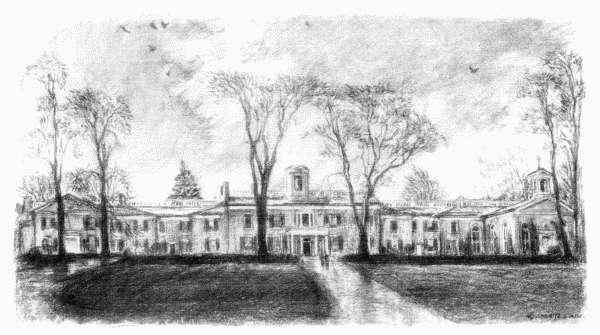
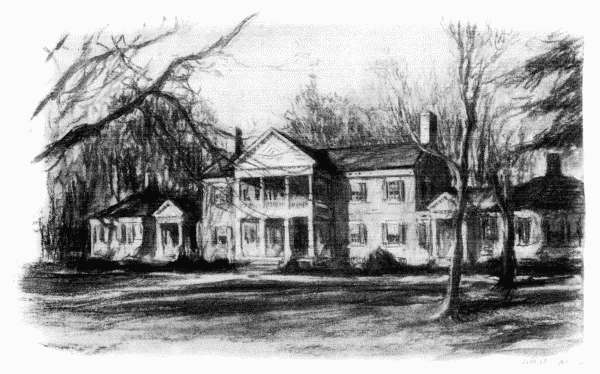
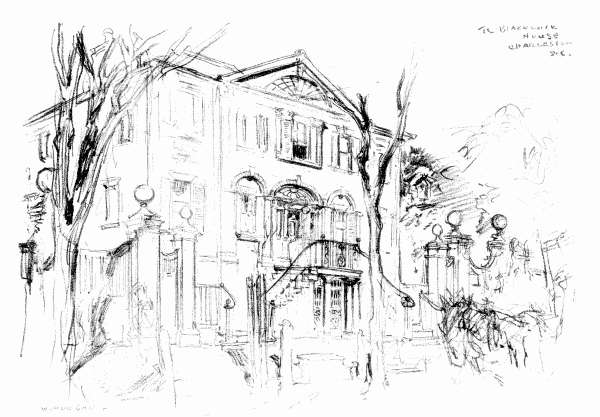
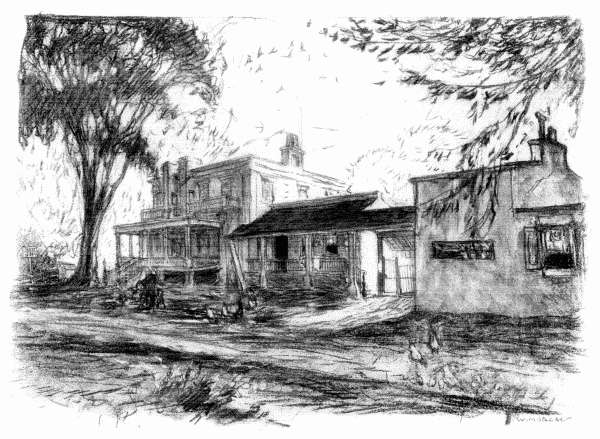
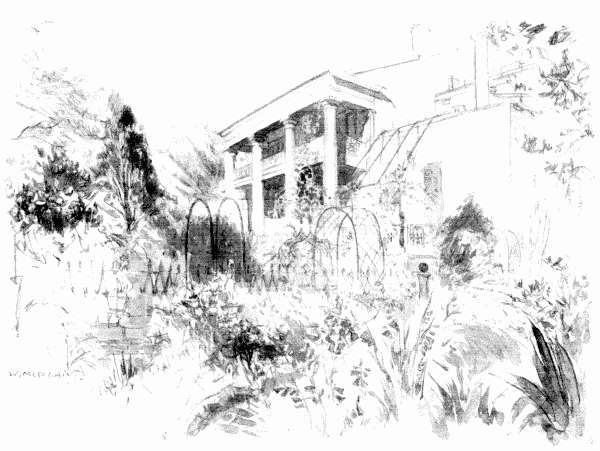
Claymont Court, near Charles Town, the
house in which my companion and I were so
fortunate as to be guests during our visit to
this part of the country, is one of the old Washington
houses, having been built by Bushrod Corbin Washington,
a nephew of the first President. It is a beautiful
brick building, with courts at either end, the brick walls
of which, connecting with the house, extend its lines
with peculiar grace, and tie to the main structure the
twin buildings which balance it, according to the delightful
fashion of early Virginia architecture. The
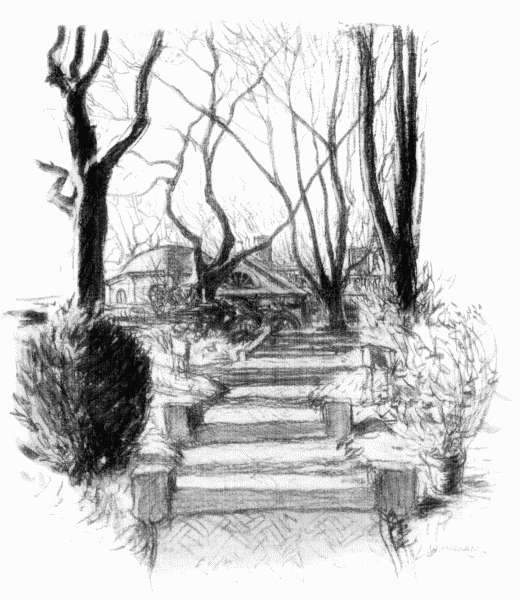
hexagonal brick tile of the front walk at Claymont
Court, and the square stone pavement of the portico,
resemble exactly those at Mount Vernon, and are said
to have been imported at the same time; and it is believed
also that the Claymont box trees were brought over with
those growing at Mount Vernon.
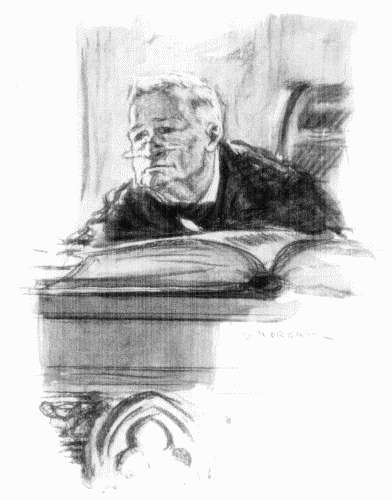
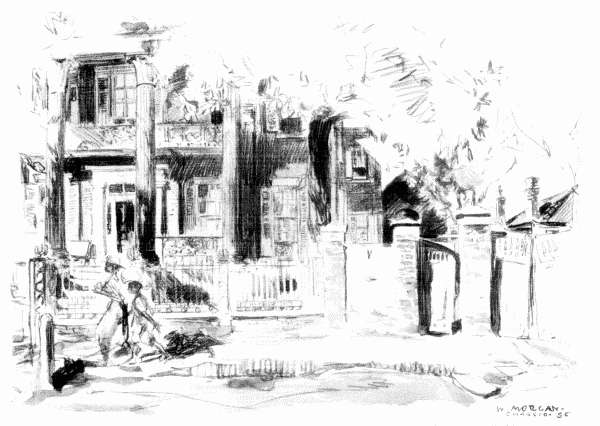
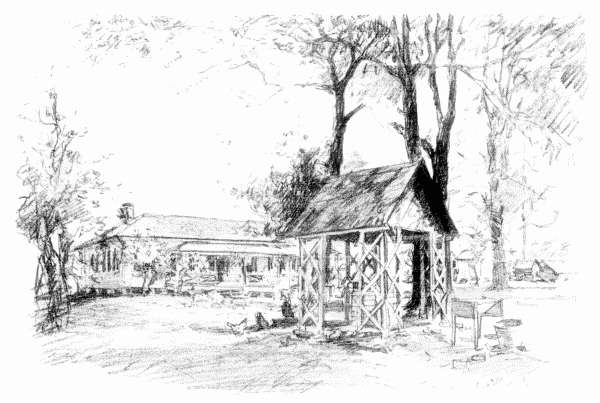
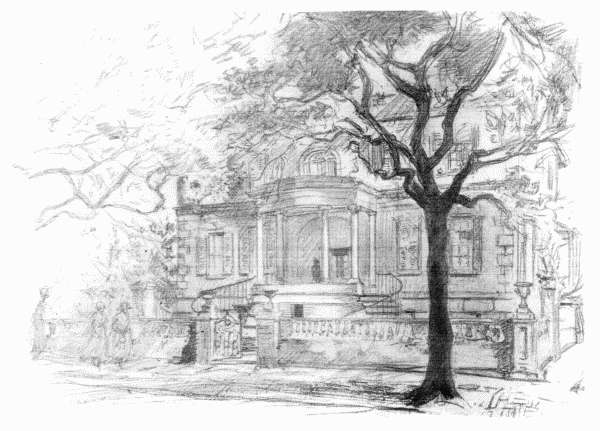
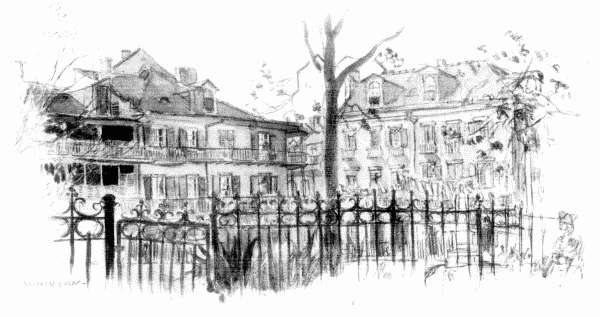
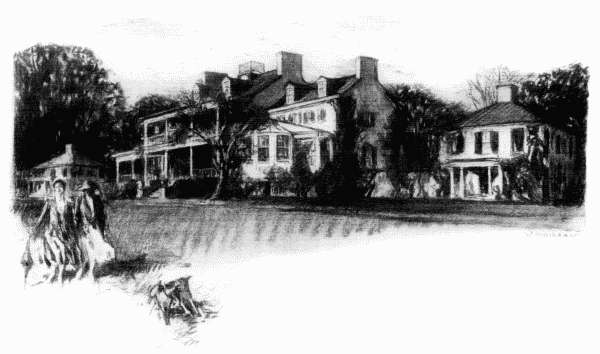 Claymont Court is one of the old Washington houses. But in all its history it has never been a happier home or a
more interesting one than it is to-day
Claymont Court is one of the old Washington houses. But in all its history it has never been a happier home or a
more interesting one than it is to-day
The estate was sold out of the Washington family
in 1870, when it was acquired by a Colonel March, who
later sold it to a gentleman whose wild performances
at Claymont are not only remembered, but are commemorated
in the house. In the cellar, for instance,
bricked up in a room barely large enough to hold it,
whence it cannot be removed except by tearing down a
heavy wall, stands a huge carved sideboard to which
the young man took a dislike, and which he therefore
caused to be carried to the cellar and immured, despite
the protests of his family. It is said that upon another
occasion he conceived the picturesque idea of riding his
horse upstairs and hitching it to his bedpost; and that
he did so is witnessed by definite marks of horseshoes
on the oak treads of the stair. Later Frank R. Stockton
purchased the place, and there he wrote his story
"The Captain of the Toll-Gate," which was published
posthumously.
But in all its history this glorious old house has never
been a happier home, or a more interesting one, than it
is to-day. For now it is the residence of four young
ladies, sisters, who, because of their divergent tastes
and their complete congeniality, continually suggest the
fancy that they have stepped out of a novel. One of
them is the Efficient Sister, who runs the automobile
and the farm of two or three hundred acres, sells the
produce, keeps the accounts, and pays off the men; another
is the Domestic Sister, who conducts the admirable
ménage; another is the Sociological and Artistic
Sister, who draws and plays and thinks about the
masses; while the fourth is the Sprightly Sister Who
Likes to Dance.
Never had my companion or I seen a more charming,
a more varied household, an establishment more
self-contained, more complete in all things from vegetables
to brains. No need to leave the place for anything.
Yet if one wished to look about the country,
there was the motor, and there were the saddle horses
in the stable—all of them members of old Virginian
families—and there were four equestrian young ladies.
"Would you-all like to ride to-day?" one of the sisters
asked us at breakfast.
To my companion, horseback riding is comparatively
a new thing. He had taken it up a year before—partly
because of appeals from me, partly because of changes
which he had begun to notice in his topography. Compared
with him I was a veteran horseman, for it was
then a year and three months since I had begun my riding
lessons.
I said that I would like to ride, but he declared that he
must stay behind and make a drawing.
Sometimes, in the past, I had thought I would prefer
to make my living as a painter or an illustrator than
as a writer, but at this juncture it occurred to me that,
though the writer's medium of expression is a less
agreeable one than that of the graphic artist, it is much
pleasanter to ride about with pretty girls than to sit
alone and draw a picture of their house. I began to
feel sorry for my companion: the thought of our riding
gaily off, and leaving him at work, made him seem
pathetic. My appeals, however, made no impression
upon his inflexible sense of duty, and I soon ceased trying
to persuade him to join us, and began to speculate,
instead, as to whether all four sisters would accompany
me, or whether only two or three of them would go—and
if so, which.
"What kind of horse do you like?" asked one.
Such a question always troubles me. It is embarrassing.
Imagine saying to a young lady who likes to
ride thoroughbred hunters across fields and over ditches
and fences: "I should like a handsome horse, one that
will cause me to appear to advantage, one that looks
spirited but is in reality tame."
Such an admission would be out of character with the
whole idea of riding. One could hardly make it to one's
most intimate male friend, let alone to a girl who knows
all about withers and hocks and pastern joints, and
talks about "paneled country," and takes the "Racing
Calendar."
To such a young lady it is impossible to say: "I
have ridden for a little more than a year; the horses
with which I am acquainted are benevolent creatures
from a riding school near Central Park; they go around
the reservoir twice, and return automatically, and they
sigh deeply when one mounts and again when one gets
off."
No; that sort of thing will not do at all; for the horse—besides
having been placed in a position more aristocratic
than ever, through the philanthropies of Henry
Ford—is essentially "sporty." You must be a "sport"
or you must keep away from him. You must approach
him with dash or you must not approach him at all.
And when a young lady inquires what kind of horse you
like, there is but one way to reply.
"It doesn't matter at all," I answered. "Any horse
will do for me." Then, after a little pause, I added, as
though it were merely an amusing afterthought: "I
suppose I shall be stiff after my ride. I haven't been on
a horse in nearly two months."
"Then," said the sympathetic young lady, "you'll
want an easy ride."
"I suppose it might be more sensible," I conceded.
"Better give him the black mare," put in the Efficient
Sister.
"She hasn't been out lately," said the other. "You
know how she acts when she hasn't been ridden enough.
He might not know just how to take her. I was thinking
of giving him 'Dr. Bell.'"
"Dr. Bell's too gentle," said the Efficient Sister.
"Which horse do you think you'd like?" the other
asked me. "Dr. Bell has plenty of life, but he's gentle.
The black mare's a little bit flighty at first, but if
you can ride her she soon finds it out and settles down."
I want to ask: "What happens if she finds out that
you can't ride her? What does she do then?" But I
refrained.
"She's never thrown anybody but a stable boy and
a man who came up here to visit—and neither one of
them could ride worth a cent," said the Efficient Sister.
Meanwhile I had been thinking hard.
"What color is Dr. Bell?" I asked.
"He's a sorrel."
"Then," I said, "I believe I'd rather ride Dr. Bell.
I don't like black horses. It is simply one of those peculiar
aversions one gets."
They seemed to accept this statement, and so the matter
was agreeably settled.
When, at ten o'clock, I came down dressed for riding,
my companion was out in front of the house, making
a drawing; the four young ladies were with him, all
seemingly enchanted with his work, and none of them in
riding habits.
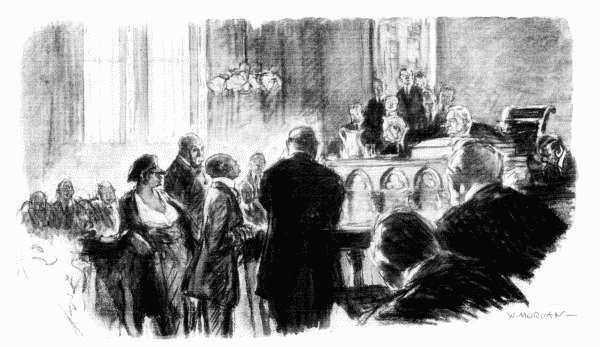
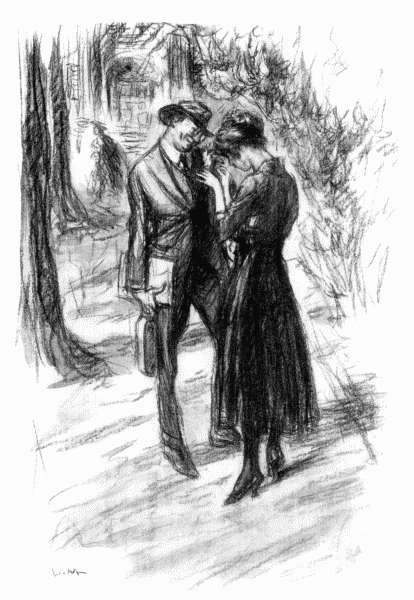
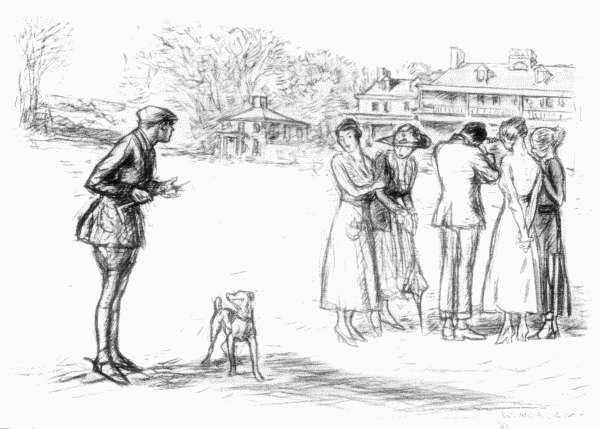 When I came down, dressed for riding, my companion was making a drawing; the four young ladies were with him,
none of them in riding habits
When I came down, dressed for riding, my companion was making a drawing; the four young ladies were with him,
none of them in riding habits
"Who's going with me?" I asked as I strolled toward
them.
They looked at one another inquiringly. Then the
Efficient Sister said: "I'd like to go, but this is pay
day and I can't leave the place."
"I have to go to town for some supplies," said the
Domestic Sister.
"I want to stay and watch this," said the Sociological
and Artistic Sister. (She made a gesture toward
my companion, but I think she referred to his drawing.)
"I'm going away to a house party," said the Sprightly
Sister who Likes to Dance. "I must pack."
"You can't get lost," said the Domestic Sister.
"Even if you should," put in the Efficient Sister, "Dr.
Bell would bring you home."
During this conversation my companion did not look
up from his work, neither did he speak; yet upon his
back there was an expression of derisive glee which
made me hope, vindictively, that he would smudge his
drawing. However inscrutable his face, I have never
known a man with a back so expressive.
"Here comes Dr. Bell," remarked the Sociological
and Artistic Sister, as a negro groom appeared leading
the sorrel steed.
"Well," I said, trying to speak debonairely as I
started toward the drive, "I'll be going."
I wished to leave them where they were and go
around to the other side of the house to mount. I had
noticed a stone block there and meant to use it if no one
but the groom were present; also I intended to tip the
groom and ask him a few casual questions about the
ways of Dr. Bell.
I might have managed this but for a sudden manifestation
of interest on the part of my companion.
"Come on," he said to the young ladies, "let's go
and see him off." It seemed to me that he emphasized
the word "off" unpleasantly. However I tried to seem
calm as we moved toward the drive.
Dr. Bell had a bright brown eye; there was something
alert in the gaze with which he watched us moving
toward him. However, to my great relief he stood
quite still while two of the sisters who preceded me by
a few steps, went up and patted him. Evidently he liked
to be patted. I decided that I would pat him also.
I had approached him from the left and in order to
mount I now found it necessary to circle around, in
front of him. I was determined that if the horse would
but remain stationary I should step up to him, speak to
him, give him a quick pat on the neck, gather the reins
in my hand, place my foot swiftly in the stirrup, take
a good hop, and be on his back before any one had time
to notice.
Dr. Bell, however, caused me to alter these plans;
for though he had stood docile as a dog while the sisters
patted him, his manner underwent a change on sight
of me. I do not think this change was caused by any
personal dislike for me. I believe he would have done
the same had any stranger appeared before him in riding
boots. The trouble was, probably, that he had expected
to be ridden by one of the young ladies, and was
shocked by the abrupt discovery that a total stranger
was to ride him. This is merely my surmise. I do not
claim deep understanding of the mental workings of
any horse, for there is no logic about them or their
performances. They are like crafty lunatics, reasoning,
if they reason at all, in a manner too treacherous
and devious for human comprehension. Their very
usefulness, the service they render man, is founded on
their own folly; were it not for that, man could not even
catch them, let alone force them to submit, like weak-minded
giants, to his will.
The fact is that, excepting barnyard fowls, the horse
is the most idiotic of all animals, and, pound for pound,
even the miserable hen is his intellectual superior. Indeed,
if horses had brains no better than those of hens,
but proportionately larger, they would not be drawing
wagons, and carrying men upon their backs, but would
be lecturing to women's clubs, and holding chairs in universities,
and writing essays on the Development of the
Short Story in America.
Horse lovers, who are among the most prejudiced of
all prejudiced people, and who regard horses with an
amiable but fatuous admiration such as young parents
have for their babies, will try to tell you that these
great creatures which they love are not mentally deficient.
Ask them why the horse, with his superior
strength, submits to man, and they will tell you that the
horse's eye magnifies, and that, to the horse, man consequently
appears to be two or three times his actual
size.
Nonsense! There is but one reason for the yielding
of the horse: he is an utter fool.
Everything proves him a fool. He will charge into
battle, he will walk cheerfully beside a precipice, he
will break his back pulling a heavy wagon, or break
his leg or his neck in jumping a hurdle; yet he will go
into a frenzy of fright at the sight of a running child,
a roadside rock, or the shadow of a branch across the
path, and not even a German chancellor could shy as he
will at a scrap of paper.
As I passed in front of Dr. Bell he rolled his eyes at
me horribly, and rose upon his hind legs, almost upsetting
the groom as he went up and barely missing him
with his fore feet as he brought them to earth again.
"What's the matter with him?" I asked, stopping.
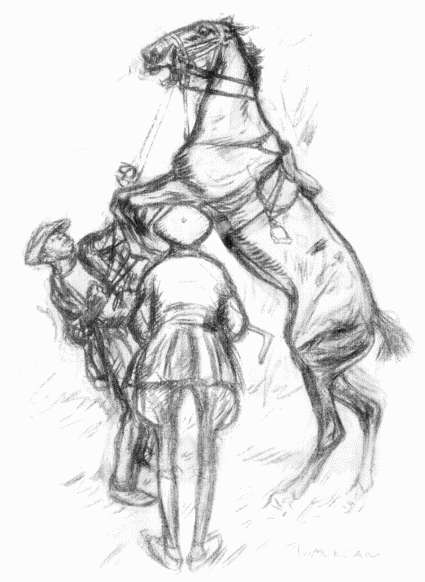 "What's the matter with him?" I asked, stopping
"I guess he just feels good," said the Efficient Sister.
"Yassuh, tha 's all," said the groom cheerfully.
"He's aw' right. Gentle ath a lamb."
As he made this statement, I took another step in the
direction of the horse, whereat he reared again.
"Well, now!" said the groom, patting Dr. Bell upon
the neck. "Feelin' pretty good 's mawnin', is you?
There, there!"
Dr. Bell, however, paid little attention to his attendant,
but gazed steadily at me with an evil look.
"Does he always do like that?" I asked the Domestic
Sister.
"I never saw him do it before," she said.
"Maybe he doesn't admire the cut of your riding
breeches," suggested my companion.
"Oh, no, suh," protested the groom. "It 's jes' his
li'l way tryin' t' tell you he likes de ladies t' ride him
better 'n he likes de gemmen."
"He means he doesn't want me to ride him?"
"Yassuh, da 's jes' his li'l idee 't he 's got now. He
be all right once you in de saddle."
"But how am I to get in the saddle if he keeps doing
that?"
"I hold 'im all right," said the groom. "You jes' get
on 'im, suh. He soon find out who 's boss."
"I think he will," said my heartless companion.
"Nevvah you feah, suh," the man said to me. "Ah
knowed the minute Ah saw yo' laigs 't you was a horseman.
Yassuh! Ah says t' ole Gawge, Ah says, 'Dat
gemman's certain'y been 'n de cava'ry, he has, wid dem
fine crooked laigs o' hisn.'"
"You should have told that to Dr. Bell, instead," suggested
my companion.
At this every one laughed. Even the groom laughed
a wheezy, cackling negro laugh. The situation was
becoming unbearable. Clearly I must try to mount.
Perhaps I should not succeed, but I must try. As I
was endeavoring to adjust my mind to this unpleasant
fact the Efficient Sister spoke.
"That horse is going to be ridden," she said firmly,
"if I have to go upstairs and dress and ride him myself."
That settled it.
"Now you hold him down," I said to the groom, and
stepped forward.
As I did so Dr. Bell reared again, simultaneously
drawing back sidewise and turning his flank away from
me, but this time the Efficient Sister hit him with a crop
she had found somewhere, and he came down hastily,
and began to dance a sort of double clog with all four
feet.
After several efforts I managed to get beside him.
Gathering the reins in my left hand I put my foot up
swiftly, found the stirrup, and with a hop, managed to
board the beast.
As I did so, the groom let him go. Both stirrups
were short, but it was too late to discuss that, for by
the time I was adjusted to my seat we had traveled,
at a run, over a considerable part of the lawn and
through most of the flowerbeds. The shortness of the
stirrups made me bounce, and I had a feeling that I
might do better to remove my feet from them entirely,
but as I had never ridden without stirrups I hesitated
to try it now. Therefore I merely dug my knees desperately
into the saddle flaps and awaited what should
come, while endeavoring to check the animal. He,
however, kept his head down, which not only made it
difficult to stop him, but also gave me an unpleasant
sense as of riding on the cowcatcher of a locomotive
with nothing but space in front of me. Once, with a
jerk, I managed to get his head up, but when I did that
he reared. I do not care for rearing.
To add to my delight, one of the dogs now ran out
and began to bark and circle around us, jumping up at
the horse's nose and nipping at his heels. This brought
on new activities, for now Dr. Bell not only reared but
elevated himself suddenly behind, to kick at the dog.
However, there was one good result. We stopped running
and began to trot rapidly about in circles, dodging
the dog, and this finally brought us back toward the
house.
"My stirrups are too short!" I shouted to the groom.
"Ride oveh heah, suh," he called back.
I tried to do it, but Dr. Bell continued to move in
circles. At last, however, the man managed to catch us
by advancing with his hand extended, as though offering
a lump of sugar, at the same time talking gently to my
steed. Then, while my companion held the bit the
negro adjusted the stirrup leathers. I was glad of the
breathing spell. I wished that it took longer to adjust
stirrups.
"You'd better go out by the drive this time," said the
Efficient Sister.
"I intended to before," I told her, "but he didn't seem
to understand the signals."
"You've got spurs on. Give him the spur."
As a matter of fact, I had hesitated to give him the
spur. It seemed to me that he was annoyed with me
anyway, and that the spur would only serve to increase
his prejudice. I wanted to rule him not by brute force
but by kindness. I wished that I could somehow make
him know that I was a regular subscriber to the S. P. C. A.,
that I loved children and animals and all helpless
creatures, both great and small, that I used the dumb
brutes gently and only asked in return that they do the
same by me. But how is one to communicate such
humanitarian ideas to a big, stupid, wilful, perverse,
diabolical creature like a horse?
I was determined that when we started again we
should not run over the lawn if I could possibly prevent
it. Therefore I had the groom head the horse
down the drive, and the moment he released him, I
touched Dr. Bell with the spurs. The result was
magical. He started on a run but kept in the road
where I wanted him to be, giving me, for the moment, a
sense of having something almost like control over him.
At the foot of the drive was a gate which I knew could
be opened without dismounting, by pulling a rope, and
as no horse, unless quite out of his mind, will deliberately
run into a gate, I had reason to hope that Dr. Bell would
stop when he got there. Imagine my feelings, then,
when on sight of the gate he not only failed to slacken
his pace, but actually dashed at it faster than ever.
Within a few feet of the barrier he seemed to pause
momentarily, hunching himself in a peculiar and alarming
manner: then he arose, sailed through the air like a
swallow, came down beyond like a load of trunks falling
off from a truck, and galloped down the highway, seemingly
quite indifferent to the fact that the stirrups were
flapping at his sides and that I had moved from the
saddle to a point near the base of his neck.
My position at the moment was one of considerable
insecurity. By holding on to his mane and wriggling
backward I hoped to stay on, provided he did not put
down his head. If he did that, I was lost. Fortunately
for me, however, Dr. Bell did not realize with
what ease he could have dropped me at that moment,
and by dint of cautious but eager gymnastics, I managed
to regain the saddle and the stirrups, although in
doing so I pricked him several times with the spurs, with
the result that, though he ran faster than ever for a
time, he must have presently concluded that I didn't
care how fast he went; at all events, he slackened his
pace to a canter, from which, shortly, I managed to
draw him down to a trot and then to a walk.
I am glad to say that not until now had we met any
vehicle. Even while he was running, even while I was
engaged in maintaining a precarious seat upon his neck,
I had found time to hope fervently that we should not
encounter an automobile. I was afraid that he would
jump it if we did.
Now, however, I saw a motor approaching. Dr. Bell
saw it, too, and pricked up his ears. Seizing the reins
firmly in one hand, I waved with the other, signalling to
the motorist to stop, which he did, pulling out into the
ditch. Meanwhile I talked to Dr. Bell, patting him on
the neck and telling him to go on and not to be afraid,
because it was all right. Dr. Bell did go on. He went
up to the front of the motor, past the side of it, and
on behind it, without showing the least sign of alarm.
He did not mind it at all. But the man in the motor
minded. Annoyed with me for having stopped him unnecessarily,
he shouted something after me. But I paid
no attention to him. Under the circumstances, it
seemed the only thing to do. I might have gotten off;
I might conceivably have beaten him; but I never could
have held the horse while doing it, or have gotten on
again.
Presently, when I was changing the position of the
reins, which were hurting my fingers because I had
gripped them so tight, I accidentally shifted the gears
in some way, so to speak, sending Dr. Bell off at a pace
which was neither a trot nor a canter, but which carried
us along at a sort of smooth, rapid glide. At first I took
this gait to be a swift trot, and attempted to post to it;
then, as that did not work, I sat still in the saddle and,
finding the posture comfortable, concluded that Dr. Bell
must be single-footing. I had never single-footed before.
Just as I was beginning to like it, however, he
changed to a trot, then back to single-footing again, and
so on, in a curious puzzling manner.
Except for the changes of gait, we were now going on
rather well, and I had begun, for the first time, to feel
a little security, when all of a sudden he swerved off
and galloped with me up a driveway leading toward a
white house which stood on a hill two or three hundred
yards from the road. Again I tried to stop him, but
when I pulled on the reins he shook his head savagely
from side to side and snorted in a loud and threatening
manner.
As we neared the house I saw that two ladies were sitting
on the porch regarding our approach with interest.
I hoped that Dr. Bell would find some way of keeping
on past the house and into the fields, but he had no such
intention. Instead of going by, he swung around the
circle before the porch, and stopped at the steps, upon
which the two ladies were sitting.
One of them was a white-haired woman of gentle
mien; the other was a girl of eighteen or twenty with
pretty, mischievous eyes.
Both the ladies looked up inquiringly as Dr. Bell and
I stopped.
I lifted my hat. It was the only thing I could think of
to do at the moment. At this they both nodded gravely.
Then we sat and stared at one another.
"Well?" said the old lady, when the silence had become
embarrassing.
I felt that I must say something, so I remarked:
"This is a very pretty place you have here."
At this, though the statement was quite true, they
looked perplexed.
"Is there any message?" asked the young woman,
after another pause.
"Oh, no," I answered lightly. "I was riding by and
thought I'd take the liberty of coming up and telling
you—telling you that although I am a Northerner and a
stranger here, I love the South, the quaint old Southern
customs, the lovely old houses, the delicious waffles,
the—"
"That is very gratifying," said she "I am sorry to say
we are all out of waffles at present."
"Oh, I don't want any now," I replied politely.
"Well, if you don't mind my asking, what do you
want?"
"I want," I said, desperately, "to see your groom for a
moment, if possible."
"He's gone to town," she replied. "Is there anything
I can do? I see that your stirrup leather is twisted."
With that she arose, came down, removed my foot from
the stirrup, in a businesslike manner, reversed the iron,
and put my foot back for me.
I thanked her.
"Anything else?" she asked, her wicked eye twinkling.
"Perhaps," I ventured, "perhaps you know how to
make a horse single-foot?"
"There are different ways," she said. "With Dr. Bell
you might try using the curb gently, working it from
side to side."
"I will," I said. "Thank you very much."
"And," said the girl, "if he ever takes a notion to bolt
with you, or to go up to some house where you don't
want him to go, just touch him with the curb. That
will fix him. He's very soft-bitted."
"But I tried that," I protested.
She looked at my reins, then shook her head.
"No," she said, "you've got your curb rein and your
snaffle rein mixed."
"I am very much indebted to you," I said, as I changed
the position of the reins between my fingers.
"Not at all," said she. "I hope you'll get safely back
to the Claymont. If you want to jump him, give him
his head. He'll take off all right."
"Thanks," I returned. "I don't want to jump him."
Then lifting my hat and thanking her again, I wiggled
the curb gently from side to side, as directed, and departed,
singlefooting comfortably.
Dr. Bell and I got home very nicely. He wanted to
jump the gate again, but I checked him with the curb.
After pulling the rope to open the gate I must have got
the reins mixed once more, for as I was nearing the
house, calm in the feeling that I had mastered the animal,
and intent upon cantering up to the porch in fine
style, Dr. Bell swerved suddenly off to the stable, went
into the door, and, before I could stop him, entered his
stall.
There I dismounted in absolute privacy. It was
quite easy. I had only to climb on to the partition and
drop down into the next stall, which, by good fortune,
was vacant.
With a single exception, this was the only riding I did
in the South, and on the one other occasion of which I
speak I did not ride alone, but had, surrounding me, the
entire Eleventh United States Cavalry.
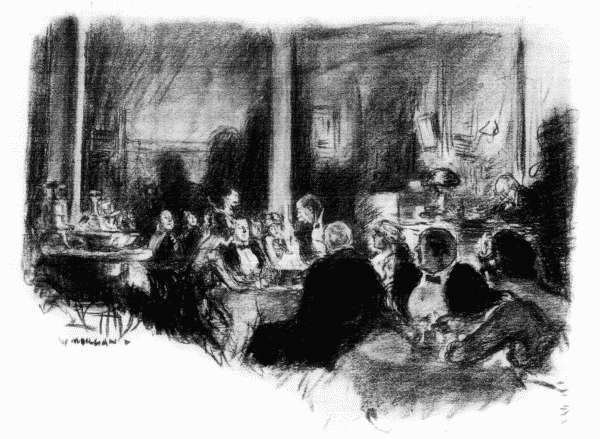
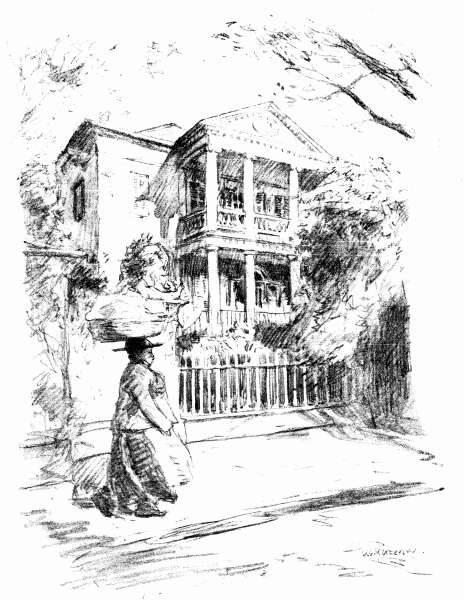 Charleston is the last stronghold of a unified American upper class; the last remaining
American city in which Madeira and Port and noblesse oblige are fully
and widely understood, and are employed according to the best traditions
Charleston is the last stronghold of a unified American upper class; the last remaining
American city in which Madeira and Port and noblesse oblige are fully
and widely understood, and are employed according to the best traditions