XIV.
DESCENDING THE RIVER ST. LAWRENCE.
The Great River of Canada—Jacques Cartier—The Great Lakes—The
Ancient Course—The St. Lawrence Canals—Toronto—Lake
of the Thousand Islands—Kingston—Garden of the
Great Spirit—Clayton—Frontenac—Round Island—Alexandria
Bay—Brockville—Ogdensburg—Prescott—Galop, Plat
and Long Sault Rapids—Cornwall—St. Regis—Lake St.
Francis—Coteau, Split Rock, Cascades and Cedars Rapids—Lake
St. Louis—Lachine—Caughnawaga—Lachine Rapids—Montreal—St.
Mary's Current—St. Helen's Island—Montreal
Churches and Religious Houses—Hochelaga—First Religious
Colonization—Dauversière and Olier—Society of Notre Dame
de Montreal—Maisonneuve—Mademoiselle Mance—Marguerite
Bourgeoys—Madame de la Peltrie—The Accommodation—Victoria
Tubular Bridge—Seminary of St. Sulpice—Hotel
Dieu—The Black Nuns—The Gray Nunnery—McGill University—Place
d'Armes—Church of Notre Dame—Cathedral
of St. Peter—Notre Dame de Lourdes—Christ Church Cathedral—Champ
de Mars—Notre Dame de Bonsecours—Rapids
of St. Anne—Lake of the Two Mountains—Trappists—Mount
Royal—Ottawa River—Long Sault Rapids—Thermopylæ—Louis
Joseph Papineau—Riviere aux Lièvres—The Habitan—The
Metis—Ottawa—Bytown—Chaudière Falls—Rideau
Canal—Dominion Government Buildings—Richelieu River—Lake
St. Peter—St. Francis River—Three Rivers—Shawanagan
Fall—St. Augustin—Sillery—Quebec—Stadacona—Samuel
de Champlain—Montmagny—Laval de Montmorency—Jesuit
Missionaries—Father Davion—The French Gentilhomme—Cape
Diamond—Charles Dilke—Henry Ward
Beecher—Castle of St. Louis—Quebec Citadel—Wolfe-Montcalm
Monument—General Montgomery—Plains of
Abraham—General Wolfe—The Basilica—The Seminary—English
Cathedral—Bishop Mountain—The Ursulines—Marie
Guyart—Montcalm's Skull—Hotel Dieu—Fathers Brébeuf
and Lalemont and their Martyrdom—Notre Dame des Victoires—Dufferin
Terrace—Point Levis—Beauport—French
Cottages—Faith of the Habitans—Cardinal Newman—Falls
of Montmorency—La Bonne Sainte Anne—Isle of Orleans—St.
Laurent and St. Pierre—The Laurentides—Cape Tourmente—Bay
of St. Paul—Mount Eboulements—Murray Bay—Kamouraska—Riviere
du Loup—Cacouna—Tadousac—Saguenay
River—Grand Discharge and Little Discharge—Ha Ha
Bay—Chicoutimi—Capes Trinity and Eternity—Restigouche
Region—Micmac Indians—Glooscap—Lorette—Roberval—Lake
St. John—Montaignais Indians—Trois Pistoles—Rimouski—Gaspé—Notre
Dame Mountains—Labrador—Grand
Falls—The Fishermen.
THE GREAT RIVER OF CANADA.
"The first time I beheld thee, beauteous stream,
How pure, how smooth, how broad thy bosom heav'd!
What feelings rushed upon my heart!—a gleam
As of another life my kindling soul received."
Thus sang Maria Brooks to the noble river St.
Lawrence, which the earlier geographers always
called "the Great River of Canada." The first adventurous
white man who crossed the seas and found
it was the intrepid French navigator, Jacques Cartier,
who sailed into its broad bay on the festival day
of the martyred Saint Lawrence, in 1534. When
this bold explorer started from France on his voyage
of discovery he was fired with religious zeal. St.
Malo, on the coast of Brittany, was then the chief
French seaport, and before departing, the entire company
of officers and sailors piously attended a solemn
High Mass in the old Cathedral, and in the presence
of thousands received the venerable Archbishop's
blessing upon their enterprise. Cartier, like all the
rest of the early discoverers, was sent under the
auspices of the French Government to hunt for the
"Northwest Passage," the short route from Europe
to the Indies, or, as described in his instructions, to
seek "the new road to Cathay." The Church
naturally bestowed its most earnest benisons upon
an enterprise promising unlimited religious expansion
in the realms France might secure across the
Atlantic. Carrier's chief ship was only of one hundred
and twenty tons, but the little fleet crossed the
ocean in safety, and on July 9th entered a large bay
south of the St. Lawrence, encountering such intense
heats that it was named the Bay de Chaleurs, being
still thus called. After an extensive examination of
the neighboring coasts and bays, Cartier returned
home, reporting that the Canadian summers were as
warm as those of France, but giving no information
of the extreme cold of the winters. This the sun-loving
Gauls did not discover until later. Cartier
came back the next year, and sailed up what he had
already named the "Great River," describing it as
the most enormous in the world. The Indians told
his wondering sailors "it goes so far that no man
hath ever been to the end that they had heard."
The explorers carefully examined the vast stream,
its shores and branches, and were sure, as they reported,
that its sombre tributary, the Saguenay,
"comes from the Sea of Cathay, for in this place
there issues a strong current, and there runs here a
terrible tide." They saw numerous whales and other
sea-monsters, but found the water too deep for soundings,
and in fact the river St. Lawrence cannot be
sounded for one hundred and fifty miles up from its
mouth.
ITS VAST EXTENT AND FEATURES.
The St. Lawrence is an enormous river, having
much the largest estuary of any river on the globe,
the tidal current flowing five hundred miles up the
stream, and its mouth spreading ninety-six miles
wide. It is the outlet of the greatest body of fresh
water in existence, draining seven vast lakes—Nepigon,
Superior, Michigan, Huron, Erie, Ontario and
Champlain—besides myriads of smaller ones, including
the Central New York lakes, hundreds in the
Adirondack forests, and thousands in the vast Canadian
wilderness. The St. Lawrence basin covers a
territory of over four hundred thousand square miles,
and has been computed as containing more than half
the fresh water on the planet. The main St. Lawrence
river is seven hundred and fifty miles long
from Lake Ontario to the head of the Gulf, while the
total length of the whole system of lakes and rivers
is over two thousand miles, and has been computed
by some patient mathematician to contain a mass of
fresh water equal to twelve thousand cubic miles, of
which one cubic mile goes over Niagara Falls every
week. The early geographers usually located the
head of the system in Lake Nepigon, north of Superior,
but it is thought the longer line to the ocean is
from the source of St. Louis River, flowing through
Minnesota into the southwestern extremity of Lake
Superior at Duluth. The bigness of the wonderful
St. Lawrence is shown in everything about it.
Thoreau, who was such a keen observer, has written
that this great river rises near another "Father of
Waters," the Mississippi, and "issues from a remarkable
spring, far up in the woods, fifteen hundred miles
in circumference," called Lake Superior, while "it
makes such a noise in its tumbling down at one
place (Niagara) as is heard all round the world."
The geologists, however, who usually upturn most
things, declare that it did not always reach the sea
as now. Originally the St. Lawrence, they say,
flowed into the ocean by going out through the Narrows
in New York harbor, and its immense current
broke the passage through the West Point Highlands
in a mighty stream, compared with which the
present Hudson River is a pigmy. Professor Newberry
writes that during countless ages this enormous
river, which no human eyes beheld, carried off
the surplus waters of a great drainage area with a
rapid current cutting down its gorge many hundred
feet in depth, reaching from the Lake Superior basin
to the Narrows, where it dispersed in a vast delta,
debouching upon a sea then much lower in level
than now, and having its shore-line about eighty
miles southeast of New York. By some stupendous
convulsion this channel was changed, drift banked
up the old valley of the Mohawk, and the outflow was
deflected from the northeast corner of Lake Ontario
into the present shallow and rocky channel, filled with
islands and rapids, followed by the St. Lawrence down
to Montreal.
The system of navigable water ways from Duluth
and Port Arthur on Lake Superior to the Strait of
Belle Isle is twenty-two hundred miles long. At
Lake Ontario the head of the St. Lawrence River is
two hundred and thirty-one feet above the sea level,
and its current descends that distance to tidewater
chiefly by going down successive rapids. There are
ship canals around these rapids and around Niagara
Falls, and also connecting various lakes above. The
Sault Sainte Marie locks and canals, at the outlet of
Lake Superior, have already been described. The
admirable systems conducting navigation around the
rapids in the river below Lake Ontario also carry a
large tonnage. Between Ogdensburg and Montreal,
a distance of about one hundred and twenty miles,
the navigation of forty-three miles is through six
canals of various lengths around the rapids, each
having elaborate locks. The Gulf of St. Lawrence
is also constructed upon an enormous scale, covering
eighty thousand square miles, and with the lower
river having a tidal ebb and flow of eighteen to
twenty-four feet. The mouth of the river and head
of the Gulf are usually located at Cape Chatte, far
below the Saguenay, and from the Cape almost up to
Quebec the river is ten to thirty miles wide. In
front of Quebec it narrows to less than a mile, while
above, the width is from one to two and a half miles
to Montreal, expanding to ten miles at Lake St.
Peter, where the tidal influence ceases. Above Montreal
the river occasionally expands into lakes, but is
generally a broad and strongly flowing stream with
frequent rapids. The largest ocean vessels freely
ascend to Montreal, at the head of ship navigation,
Lachine rapids being just above the city. For several
months in winter, however, ice prevents.
THE CITY OF TORONTO.
Lake Ontario, out of which the river St. Lawrence
flows, is nearly two hundred miles long, and in some
places seventy miles wide. It has generally low
shores and but few islands, and the name given it by
Champlain was Lake St. Louis, after the King of
France. The original Indian name, however, has
since been retained, Ontario meaning "how beautiful
is the rock standing in the water." Three well-known
Canadian cities are upon its shores—Hamilton
at the western end, Toronto on the northern coast,
and Kingston near the eastern end. Hamilton is a
busy, industrial and commercial city of fifty thousand
people, having a good harbor. The great port, however,
is Toronto, with over two hundred thousand
inhabitants, the capital of the Province of Ontario,
and the headquarters of the Scottish and Irish Protestants,
who settled and rule Upper Canada, the
richest and most populous province of the Dominion.
Toronto means "the place of meeting," and the word
was first heard in the seventeenth century as applied
to the country of the Hurons, between Lakes Huron
and Simcoe, the name being afterwards given to the
Indian portage route, starting from Lake Ontario, in
the present city limits, over to that country. Here,
in 1749, the French established a small trading-post,
Fort Rouille, but there was no settlement to speak
of for a century or more. The United Empire Loyalists,
under General Simcoe, founded the present
city in 1793 under the name of York, and it was
made the capital of Upper Canada, of which Simcoe
was Governor. The location was an admirable one.
The portage led up a romantic little stream, now called
Humber River, while out in front was an excellent
harbor, protected by a long, low, forest-clad island,
making a perfect land-locked basin, sheltered from
the storms of the lake. The nucleus of a town was
thus started on a tract of marshy land, adjoining the
Humber, familiarly known for nearly a half century
as "Muddy Little York," which characteristic a part
of the city still retains, as the pedestrian in falling
weather can testify. Yet the site is a pleasing one—two
little rivers, the Humber and the Don, flowing
down to the lake through deep and picturesque
ravines, having the city between and along them,
while there is a gradual slope upward to an elevation
of two hundred feet and over at some distance inland,
an ancient terrace, which was the bank of the lake.
The town did not grow much at first, and during
the War of 1812 it was twice captured by the Americans,
but they could not hold it long. As the back
country was settled and lake navigation afterwards
developed, however, the harbor became of importance
and the city grew, being finally incorporated as
Toronto. Then it got a great impetus and became
known as the "Queen City," its geographical advantages
as a centre of railway as well as water
routes attracting a large immigration, so that it has
grown to be the second city in Canada, and its people
hope it may outstrip Montreal and become the first.
It has achieved a high rank commercially, and in
religion and education, so that there are substantial
grounds for the claim, often made, that it is the
"Boston of Canada." It contains a church for about
every thousand inhabitants, Sunday is observed with
great strictness, and it has in the University of
Toronto the chief educational foundation in the
Dominion, and in the Toronto Globe the leading
organ of Canadian Liberalism. The city spreads for
eight miles along the lake shore; the streets are laid
out at right angles, and there are many fine buildings.
Yonge Street, dividing the city, stretches
northward from the harbor forty miles inland to the
shore of Lake Simcoe. There are attractive residential
streets, with many ornate dwellings in tasteful
gardens. St. James' Cathedral, near Yonge Street,
is a fine Early English structure, with a noble clock
and a grand spire rising three hundred and sixteen
feet. There is a new City Hall, an enormous Romanesque
building with an impressive tower, and Osgoode
Hall, the seat of the Ontario Superior Courts, in Italian
Renaissance, its name being given from the first
Chief Justice of Upper Canada. In Queen's Park
are the massive Grecian buildings of the Provincial
Parliament, finished in 1892 at a cost of $1,500,000.
This Park contains a bronze statue of George Brown,
long a leading Canadian statesman, and a monument
erected in memory of the men who fell in repelling
the Fenian invasion of 1866.
The buildings of the University of Toronto, to the
westward of the Queen's Park, are extensive and
form a magnificent architectural group. The main
building is Norman, with a massive central tower,
rebuilt in 1890, after having been burnt. There are
fifteen hundred students, and the University offers
complete courses in the arts and sciences, law and
medicine. To the northward is McMaster Hall, a
Baptist theological college, tastefully constructed and
liberally endowed. From the top of the tall University
tower there is an admirable view over the city
and far across the lake. The town spreads broadly
out on either hand, running down to the harbor,
beyond which is the narrow streak made by the low-lying
island enclosing it. Far to the southward
stretch the sparkling waters of Ontario, reaching to
the horizon, while in the distance can be seen a faint
little silver cloud of spray rising from Niagara. In
the northern background villas dot the green and
wooded hillsides, showing how the city spreads, while
in every direction the incomplete buildings and the
gentle distant noises of the builder's hammer and
trowel testify to its robust growth. Many steamers
move about the harbor, and among them are the
ferry-boats carrying crowds over to the low-lying
island, with its many amusement places, the city's
great recreation ground. At Hanlon's Point, its western
end, was long the home of Hanlon, the "champion
sculler of the world," one of Toronto's celebrities.
THE LAKE OF THE THOUSAND ISLANDS.
Out of Ontario the great river St. Lawrence flows
one hundred and seventy-two miles down to Montreal,
being for much of the distance the boundary
between the United States and Canada. Kingston,
with twenty-five thousand people, guarded by picturesque
graystone batteries and martello towers—the
"Limestone City"—stands at the head of the
river where it issues from the lake. To the westward
is the entrance of the spacious Bay of Quinté,
and on the eastern side the terminus of the Rideau
Canal, leading northeastward to the Rideau River
and Ottawa, the Canadian capital. This was originally
the French Fort Cataraqui, established at the
mouth of Cataraqui River in 1672, the name being
subsequently changed by Count Frontenac to Frontenac.
The Indian word Cataraqui means "Clay
bank rising from the water," and after the fort was
built the meaning changed to "fort rising from the
water." Here the Sieur de La Salle, in 1678, built
the first vessel navigating the lake. The British captured
the fort in 1762, naming it Kingston, after the
American Revolution, and by fortifying the promontories
commanding the harbor, made it the strongest
military post in Canada after Quebec and Halifax,
the chief work being Fort Henry. Its garrisons
have been long withdrawn, however, and now the
old-time forts are useful chiefly as additions to the
attractive scenery of its harbor and approaches. At
the outlet of Ontario the course of the St. Lawrence
begins with the noted archipelago known as the
"Lake of the Thousand Islands," there being actually
about seventeen hundred of them. This is a
remarkable formation, composed largely of fragments
of the range of Laurentian mountains, here coming
southward out of Canada to the river, producing an
extraordinary region. This Laurentian formation
the geologists describe as the oldest land in the
world—"the first rough sketch and axis of America."
During countless ages this range has been
worn down by the effect of rain, frost, snow and
rivers, and scratched and broken by rough, resistless
glaciers, and we are told that, compared with these
fragmentary "Thousand Islands" and the almost
worn-out mountains of the lower St. Lawrence basin,
the Alps and the Andes are but creations of yesterday.
Wolfe Island broadly obstructs the Ontario outlet
between Kingston and Cape Vincent on the New
York shore, and from them, with an island-filled
channel, in some places twelve miles broad, the swift
river current threads the archipelago by pleasant and
tortuous passages nearly to Ogdensburg, forty miles
below. These islands are of all sizes, shapes and
appearance, varying from small low rocks and gaunt
crags to gorgeous foliage-covered gardens. On account
of their large numbers, the early French explorers
named them "Les Milles Isles," and in the
ancient chronicles they are described as "obstructing
navigation and mystifying the most experienced Iroquois
pilots." Fenimore Cooper located some of the
most interesting incidents of his Pathfinder in "that
labyrinth of land and water, the Thousand Isles."
The larger islands in spring and summer are generally
covered with luxuriant vegetation, and the river
shores are a delicious landscape of low but bold bluffs
and fruitful fields spreading down to the water, with
distant forests bounding the horizon. The atmosphere
is usually dry, light and mellow, and the Indians,
who admired this attractive region, appropriately
called it Manatoana, or the "Garden of the
Great Spirit." Howe Island adjoins Wolfe Island,
and below is the long Grindstone Island. Here on
the New York shore is the village of Clayton, where
the New York Central Railroad comes up from Utica
and Rome, the leading route to this region. Below
is the almost circular Round Island with its large
hotel, and everywhere are charming little islets, while
ahead, down the St. Lawrence, are myriads more
islands, apparently massed together in a maze of dark
green distant foliage, the enchanted isles of a fascinating
summer sea:
"The Thousand Isles, the Thousand Isles,
Dimpled, the wave around them smiles,
Kissed by a thousand red-lipped flowers,
Gemmed by a thousand emerald bowers.
A thousand birds their praises wake,
By rocky glade and plumy brake.
A thousand cedars' fragrant shade
Falls where the Indians' children played,
And Fancy's dream my heart beguiles
While singing of thee, Thousand Isles.
"There St. Lawrence gentlest flows,
There the south wind softest blows.
Titian alone hath power to paint
The triumph of their patron saint
Whose waves return on memory's tide;
La Salle and Piquet, side by side,
Proud Frontenac and bold Champlain
There act their wanderings o'er again;
And while the golden sunlight smiles,
Pilgrims shall greet thee, Thousand Isles."
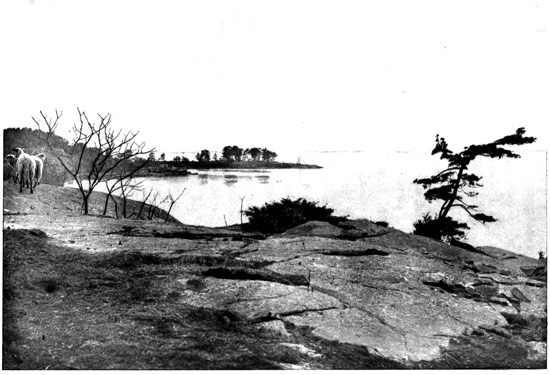
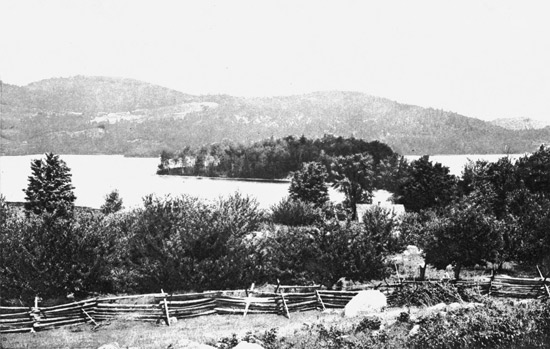
In the Thousand Islands, St. Lawrence
Sailing down the river, group after group of big
and little green islands are passed, the winding route
and tortuous channels marked by diminutive lighthouses
and beacons, while nearly every island has its
cottages and often ornate and elaborate villas. Everywhere
the shores appear to be granite rocks, bright
green foliage varying with the darker evergreens surmounting
them. All the waters are brilliantly green
and clear as crystal, rippled by breezes laden with
balsamic odors from the adjacent forests. Attractive
cottages everywhere appear, with little attendant
boat-houses down by the water side, and canoes and
skiffs are in limitless supply, as the chief travelling
is by them. Everything seems to be full of life; in
all directions are pleasant views, the surface is dotted
with pleasure-boats and white-sailed yachts, the
whole region being semi-amphibious, and its people
spending as much time on the water as on the land.
The river, too, is a great highway of commerce
among these islands, many large vessels passing
along, and timber rafts guided by puffing little tugs.
Much of the product of the Canadian forests is thus
taken to market, a good deal going to Europe, and
the sentimental and often musical Metis, who live
aboard in huts or tents, are the raftsmen, working
the broad sails and big steering-paddles on the
tedious floating journey down to Quebec. There are
many large hotels, and the big one on Round Island
is named for Louis XIV.'s chivalrous and fiery Governor
of Canada, Count de Frontenac. His remains
are buried in the Basilica at Quebec, and his heart,
enclosed in a leaden casket, was sent home to his
widow in France. She was much younger, and, evidently
piqued at some of his alleged love affairs, refused
to receive it, saying she would not have a dead
heart which had not been hers while living. The
Baptists have a summer settlement on Round Island,
and a short distance below the extensive Wellesley
Island has on its upper end the popular Methodist
summer town of the Thousand Island Park, where
little cottages and tents around the great Tabernacle
often take care of ten thousand people. Upon the
lower end the Presbyterians have established their
attractive resort, Westminster Park, which faces
Alexandria Bay.
ALEXANDRIA BAY.
The chief settlement of the archipelago is the village
of Alexandria Bay on the New York shore, and
in the spacious reach of the river in front are the
most famous and costly of the island cottages. Here
are large hotels and many lodging-places, with a
swelling population in the height of the season.
Some of the island structures are unique—tall castles,
palaces, imitations of iron-clads, forts and turrets—and
many have been very costly. As most of
the summer residents are Americans, those cottages
are chiefly on the American side of the boundary,
but there is also quite a group of island cottages over
near the Canadian shore adjacent to the village of
Gananoque. Alexandria Bay is a diminutive indentation
in the New York shore, with a little red
lighthouse out in front, while over to the northeast is
spread a galaxy of the most famous islands, having
fifty or more pretentious cottages scattered about the
scene, amid the green foliage surmounting the rocky
island foundations. In every direction go off channels
among them of sparkling, dancing, green water,
giving fine vista views, the dark crags at the water's
edge underlying the frame of green foliage bounding
the picture. The population has an aquatic flavor,
and everybody seems to go about in boats, while the
place has the air of a purely pleasure resort, evidently
frozen up and hybernating when the tide of
summer travel ebbs. In the season, the village presents
a nightly carnival with its many-colored lights
and dazzling fireworks displays over the rippling
waters. For miles below Alexandria Bay, the islands
stud the waters, although not so numerous nor so
closely together as they are above. The largest of
these is the long and narrow Grenadier Island in mid-river.
Farther down they are usually small, some
being only isolated rocks almost awash. The last of
the islands are at Brockville, twenty-five miles below
Alexandria Bay—the group of "Three Sisters," one
large and two smaller, apparently dropped into the
river opposite the town as if intended to support the
piers of a bridge over to Morristown on the New
York shore. This is an old and quiet Canadian town
of nine thousand people, perpetuating the memory of
General Sir Isaac Brock, who fell in the battle of
Queenston Heights in October, 1812, and which is
developing into a summer resort. Such is the
charmed archipelago of attractive islands, unlike
almost anything else in America, which brings so
many pleasure and health seekers to the St. Lawrence
to sing its praises:
"Fair St. Lawrence! What poet has sung of its grace
As it sleeps in the sun, with its smile-dimpled face
Beaming up to the sky that it mirrors! What brush
Has e'er pictured the charm of the marvellous hush
Of its silence; or caught the warm glow of its tints
As the afternoon wanes, and the even-star glints
In its beautiful depths? And what pen shall betray
The sweet secrets that hide from men's vision away
In its solitude wild? 'Tis the river of dreams;
You may float in your boat on the bloom-bordered streams,
Where its islands like emeralds matchless are set,
And forget that you live; and as quickly forget
That they die in the world you have left; for the calm
Of content is within you, the blessing of balm
Is upon you forever."
SHOOTING THE RAPIDS.
Ogdensburg is an active port on the St. Lawrence
about twenty miles below Brockville, having a railroad
through the Adirondacks over to Rouse's Point
on Lake Champlain. Here flow in the dark-brown
waters of the Oswegatchie, the Indian "Black River,"
coming out of those forests, which commingle in sharp
contrast with the clear green current of the greater
river. Prescott, antiquated and time-worn, is on the
Canadian bank. The shores are generally low, with
patches of woodland and farms, and the St. Lawrence
below Ogdensburg begins to go down the rapids,
having tranquil lakes and long wide stretches of
placid waters intervening. The first rapid is the
"Galop," flowing among flat grass-covered islands,
with swift moving waters, but a small affair, scarcely
discernible as the steamboat goes through it. The
next one, the "Plat," is also passed without much
trouble, and then a line of whitecaps ahead indicates
the beginning of the "Long Sault," the most extensive
rapid on the river. This is the "Long Leap,"
a rapid running for nine miles, its waters rushing
down the rocky ledges at a speed of twenty miles an
hour. All steam is shut off, and the river steamer is
carried along by the movement of the seething, roaring
current, the surface appearing much like the
ocean in a storm. The rocking, sinking deck beneath
one's feet gives a strange and startling sensation,
and looking back at the incline down which the
boat is sliding, it seems like a great angry wall of
water chasing along from behind. An elongated
island divides the channel through the "Long Sault,"
and there are other low islands adjacent; the boat,
swaying among the rocks over which the waves leap
in fury, being now lifted on their crests, and then
dropped between them, but all the while gliding down
hill, until still water and safety are reached at Cornwall.
Here begins the northern boundary of New
York, which goes due east through the Chateaugay
forests across the land to Lake Champlain, and large
factories front the river, getting their power from the
waters above the rapid.
Below Cornwall, which has an industrial population
of some seven thousand, and the Indian village of
St. Regis opposite, the St. Lawrence is wholly within
Canada, and far off to the southeast rise the dark and
distant Adirondack ranges. Soon the river broadens
into the sluggish Lake St. Francis, at the head of
which two well-known Adirondack streams flow in,
the Racquette and St. Regis Rivers. The ancient
village of St. Regis has its old church standing up
conspicuously with a bright tin roof, for the air is so
dry that tin is not painted in the Dominion. The
bell hanging in the spire was sent out from France
for the early Indian mission, but before landing, the
vessel carrying it was captured by a colonial privateer
and taken into Salem, Massachusetts. The bell,
with other booty from the prize, was sold and sent
to a church in Deerfield, then on the Massachusetts
frontier. The St. Regis Huron Indians heard of this,
and making a long march down there, recaptured
their bell, massacred forty-seven people, and carried
all the rest who could not escape, one hundred and
twenty of them, including the church pastor and his
family, captives back to Canada. Thus they brought
the bell in triumph to St. Regis, and it has since
hung undisturbed in the steeple, although the Indians
who now hear it have become very few. The lake
is twenty-eight miles long and very monotonous,
although a distinguishing landmark is furnished by
the massive buildings of St. Aniset Church, seen
from afar on the southern shore.
Coteau, at the end of the lake, has a railway
swinging drawbridge, carrying the Canada Atlantic
Railroad over, and below is another series of rapids.
These are the "Coteau," with about two miles of
swift current, making but slight impression; and
then the "Cedars," "Split Rock," and the "Cascades."
The "Cedars" give a sensation, being composed
of layers of rock down which the boat slides,
as if settling from one ledge suddenly down to another,
producing a curious feeling. It was here, in
1759, that General Amherst, by a sad mishap, had
three hundred troops drowned. The "Split Rock"
rapid is named from enormous boulders standing at
its entrance, and a dangerous reef can be distinctly
seen from the deck as the steamer apparently runs
directly upon it, until the pilot swerves the boat
aside, seemingly just in time. Then, tossing for a
few moments upon the white-crested waves of the
"Cascades," the steamer glides peacefully upon the
tranquil surface of Lake St. Louis, which is fifteen
miles long, and receives from the north the Ottawa
River. Each little village on the banks of the lake
and rivers is conspicuous from the large Roman
Catholic Church around which it clusters, the steep
bright tin roof and spire far out-topping all the
other buildings. At the lower end of the lake a
series of light-ships guide vessels into Lachine Canal,
which goes down to Montreal, avoiding Lachine
rapids, three miles long, the shortest series, but most
violent of them all. Here, at the head of the rapids,
stood the early French explorer, sent out to search
for "the road to Cathay," and looking over the great
lake spread out before him, with a view like old
ocean, he shouted "La Chine!" for he thought that
China was beyond it. The Canadian Pacific Railway
bridge spans the river, and skirting the southern
shore is the Indian town of Caughnawaga, with its
little old houses and light stone church, the "village
on the rapids." The steamboat then slides down
Lachine rapids, the most difficult and dangerous passage
of all, though it lasts but a few minutes—the exciting
inclined plane of water, with rocks ahead and
rocks beneath, indicated by swift and foaming cataracts
running over and between them, and by stout
thumps against the keel, sometimes making every
timber shiver, and the apparent danger giving keen
zest to the termination of the voyage. These rapids
passed, the current below quickly floats the steamboat
under the great Victoria tubular bridge, carrying
the Grand Trunk Railway over, and the broad
stone quays of Montreal are spread along the bank,
with rank after rank of noble buildings behind them,
and the tall twin towers of Notre Dame Cathedral
rising beyond, glistening under the rays of the setting
sun.
THE CITY OF MONTREAL.
The delta of the great Ottawa—the "river of the
traders," as the Indians named it, debouching by several
mouths into the St. Lawrence, of which it is the
chief tributary, makes a number of islands, and
Montreal stands on the southeastern side of the
largest of them, with the broad river flowing in
front. St. Mary's current runs strongly past the
quays, and out there are the pretty wooded mounds
of St. Helen's Island, named after Helen Boullé, the
child-wife of Samuel de Champlain, the first European
woman who came to Canada. She was only
twelve years old when he married her, he being aged
forty-four, and after his death she became an Ursuline
nun. The miles of city water-front are superbly
faced with long-walled quays of solid limestone masonry,
and marked by jutting piers enclosing basins
for the protection of the shipping against the powerful
current. At the extremities of the rows of shipping,
on either hand, up and down stream, loom the
huge grain elevators. The piers are about ten feet
lower than the walled embankment fronting the city,
this being done to allow the ice to pass over them
when it breaks up at the end of winter, the movement—called
the "Ice Shove"—being an imposing
sight. The elongated Victoria Bridge stands upon
its row of gray limestone piers guarding the horizon
up-river to the southward. Many storehouses and
stately buildings rise behind the wharves, and beyond
these are myriads of steeples, spires and domes, with
the lofty Notre Dame towers in front. The background
is made by the imposing mountain giving
Montreal its name, called Mont Real originally, and
now known as Mount Royal, rising to an elevation
of nine hundred feet. Few cities of its size can
boast so many fine buildings. The excellent building-stone
of the neighborhood, a gray limestone, is
utilized extensively, and this adds to the ornamental
appearance, the city rising upon a series of terraces
stretching back from the river and giving many good
sites for construction. Numerous, massive and elaborate,
the multitude of costly houses devoted to religion,
trade and private residences are both a surprise
and a charm. Mount Royal, rising boldly
behind them, gives not only a noble background to
the view from the river, but also a grand point of
outlook, displaying their beauties to the utmost. The
city has wide streets, generally lined with trees,
and various public squares adding to the attractiveness.
But the most prominent characteristic of the Canadian
metropolis is the astonishing number of its convents,
churches, and pious houses for religious and
charitable uses. Churches are everywhere, built by
all denominations, many being most elaborate and
costly. The religious zeal of the community, holding
all kinds of ecclesiastical belief, has found special
vent in the universal development of church building.
This commendable trait is their natural heritage,
for the earliest French settlements on the St.
Lawrence were largely due to religious zeal. When
Jacques Cartier ascended the St. Lawrence upon his
second voyage in 1535, he heard from the Indians at
Quebec of a greater town far up the river, and bent
upon exploration, he sailed in boats up to the Iroquois
settlement of Hochelaga. Wrapped in forests behind
it rose the great mountain which he named Mont
Real, the "royal mountain," and in front, encompassed
with corn-fields, was the Indian village, surrounded
by triple rows of palisades. Landing, Cartier's
party were admitted within the defensive walls
to the central public square, where the squaws examined
them with the greatest curiosity, and the sick
and lame Indians were brought up to be healed, the
ancient historian writes, "as if a god had come down
among them." No sooner had Cartier landed and
been thus welcomed than he gave thanks to Heaven,
and the warriors sat in silence while he read aloud
the Passion of Our Lord, though they understood not
a word. The religious services over, he distributed
presents, and the French trumpeters sounded a warlike
melody, vastly pleasing the Indians. They conducted
Cartier's party to the summit of the mountain
and showed them an extensive view over unbroken
forests for many miles to the dark Adirondacks far
away and the distant lighter green mountains, which
he called the "Monts Verts," to the eastward. There
is a tablet placed in Metcalfe Street near Sherbrooke
Street which marks the supposed site of the Indian
village of Hochelaga. In 1608, when Champlain
came, Hochelaga had disappeared. The fierce Hurons
had destroyed the village and driven out the
Iroquois, who had gone far south to the Mohawk
Valley.
For three-quarters of a century the French seem
to have waited after Cartier's voyages, before they
made any serious attempt at settlement. Then there
came a great religious revival, and they planned to
combine religion and conquest in a series of expeditions
in the early seventeenth century under the
auspices of patron saints and sinners whose names
are numerously reproduced in the nomenclature of
Quebec Province, in mountains, rivers, lakes, bays,
capes, counties, towns and streets. It was chiefly
due to Champlain, however, that the French foothold
was obtained. This great explorer, known as
the "Father of Canada," was noted alike for personal
bravery and religious fervor. His occupations
in the New World were perilous journeys, prayers
and fighting. He firmly planted the French race in
America, and every characteristic then given "New
France," as Canada was called, remains to-day in the
Province of Quebec. His noted saying is preserved
in the Canadian chronicles, that "the salvation of
one soul is of more importance than the founding of
a new empire." His system was to take possession
for the Church and the French king, and then erect
a cross and a chapel, around which the colony grew.
During the half-century succeeding Champlain's first
voyage, many Recollet and Jesuit missionary priests
came over, traversing the country and making converts
among the Indians, so that there were established
settlements, half-religious and half-military,
forming alliances with the neighboring Huron and
Algonquin Indians, and ultimately waging the almost
perpetual wars with their English and Iroquois foes
to the southward. Champlain, in 1608, founded
Quebec, where Cartier had previously discovered the
Indian village of Stadacona, meaning the "narrowing
of the river." Champlain also, in subsequent
voyages, discovered Lakes Champlain, Ontario and
Nipissing.
RELIGIOUS FOUNDATION OF MONTREAL.
The original settlement of Montreal was probably
the most completely religious enterprise of the many
early French colonizing expeditions to Canada.
Dauversière, a tax-gatherer of Anjou, was a religious
devotee whose constant scourging with small
chains and other torments, including a belt with more
than twelve hundred sharp points, filled his father
confessor with admiration. One day while at his devotions,
an inward voice commanded him to found a
new order of hospital nuns, and establish at the island
called Mont Real in Canada a hospital or Hotel-Dieu
for these nuns to conduct. But Mont Real being a
wilderness where the hospital would be without patients,
the island must be colonized to supply them,
and the pious tax-gatherer was sorely perplexed.
There was in Paris a young priest, Jean Jacques
Olier, who was zealous and devout, and signalized his
piety by much self-mortification, and one day while
praying in church he thought he heard a voice from
Heaven saying he was destined to be a light to the
Gentiles, and that he was to form a society of priests
and establish them on the island called Mont Real, in
Canada, for the propagation of the true Faith. The
old writers solemnly aver that both these men were
totally ignorant of each other and of Canadian geography,
yet they suddenly found themselves possessed,
they knew not how, of the most exact details concerning
the island, its size, shape, soil, productions,
climate and situation; and they subsequently saw apparitions
of the Virgin and the Saviour encouraging
them in the great work. Dauversière went to Paris
seeking aid to carry out his task, and met Olier in a
chateau in the suburbs; the two men, who never before
had seen or heard of each other, became at once
familiar, and under holy inspiration fondly embraced
each other; the tax-gatherer received communion at
the hands of the priest; and then for three hours
they walked together in the park forming their plans.
They determined, as the pious chronicler records it,
to "plant the banner of Christ in an abode of desolation
and a haunt of demons, and to this end a band
of priests and women were to invade the wilderness
and take post between the fangs of the Iroquois."
They believed in the mystic number, three, and proposed
to found three religious communities—one of
secular priests to direct the colonists and convert the
Indians, one of nuns to nurse the sick, and one of
nuns to teach the Faith to all the children, white
and red.
But money and men and women were necessary
for the work. Soon, four others were found who had
wealth, and the six formed the germ of the "Society
of Notre Dame de Montreal," and among them seventy-five
thousand livres were raised, equal to about
as many dollars. They purchased the island, and
their grant was confirmed by the king, and then they
got together a colony of forty men, and needing a
soldier-governor, Providence provided such a man in
Paul de Chomedey, Sieur de Maisonneuve, a devout
and valiant gentleman who had kept his faith intact,
notwithstanding long service among the heretics of
Holland, and loving his profession of arms, wished to
consecrate his sword to the Church. The interest of
the women was awakened, and ultimately the Society
was increased to about forty-five persons, chosen for
their devotion and their wealth. Among the women
who founded the new colony was Mademoiselle Jeanne
Mance, who was about thirty-four years of age when
the Society was organized, and to whom we are told
that Christ had appeared in a vision at the early age
of seven years, and at the same tender age her biographer
says she had bound herself to God by a vow
of perpetual chastity. Mlle. Mance, by the divine inspiration,
was filled with a longing to go to Canada,
and she went to the port of Rochelle seeking a vessel.
She had never before heard of Dauversière, but by
supernatural agencies she met him coming out of
church, had a long conversation in which she learned
his plan, declared she had found her destiny in "the
ocean, the wilderness, the solitude, the Iroquois,"
and at once decided to go with Maisonneuve and his
party.
In February, 1641, with the Abbé Olier at their
head, all the associates of the Society assembled in
the Cathedral of Notre Dame, in Paris, before the
altar of the Virgin, and by a most solemn ceremonial
consecrated Mont Real to the Holy Family. It was
henceforth to be a sacred town, called "Ville Marie
de Montreal," and consecrated respectively, the Seminary
of priests to Christ, the Hotel-Dieu to St.
Joseph, and the Nuns' College to the Virgin. Subsequently
to the colonization there appeared, in 1653,
as the head of the latter, a maiden of Troyes, Marguerite
Bourgeoys, a woman of most excellent good
sense and a warm heart, who is described as having
known neither miracles, ecstasies nor trances, her
religion being of the affections and manifested in an
absorbing devotion to duty. Late in the year the
colony under Maisonneuve set sail, arriving too late,
however, to ascend the St. Lawrence above Quebec,
where they wintered. Here the Governor of Quebec,
Montmagny, tried his best to dissuade them from
going farther, desiring them to settle at Quebec, but
Maisonneuve said, "It is my duty and my honor to
found a colony at Montreal, and I would go if every
tree were an Iroquois!" Here they gained an unexpected
recruit in Madame de la Peltrie, foundress of
the Order of Ursulines at Quebec, who abandoned
their convent and carried off all the furniture she had
lent them. In May, 1642, the party left Quebec in
a flotilla of boats, deep laden with men, arms and
stores, and a few days later approached Montreal
island, when all on board raised a hymn of praise.
Montmagny, who was to deliver possession of the
island, was with them, and also Father Vimont,
Superior of the missions, for the Jesuits had been
invited to take spiritual charge of the young colony.
On May 18, 1642, they landed at Montreal, at a spot
where a little creek then flowed into the St. Lawrence,
making a good landing-place, protected from
the influence of the swift current of the river. There
was a bordering meadow, and beyond rose the forest
with its vanguard of scattered trees. The triangular
graystone building, which is now the Custom House,
down by the river, marks this spot where the city
was founded. The historian Parkman, who has so
faithfully delved into the ancient Canadian archives,
thus relates the story of the original settlement:
"Maisonneuve sprang ashore and fell on his knees.
His followers imitated his example, and all joined
their voices in enthusiastic songs of thanksgiving.
Tents, baggage, arms and stores were landed. An
altar was raised on a pleasant spot near at hand;
and Mademoiselle Mance, with Madame de la Peltrie,
aided by her servant Charlotte Barré, decorated it
with a taste which was the admiration of the beholders.
Now all the company gathered before the
shrine. Here stood Vimont in the rich vestments of
his office. Here were the two ladies with their servant;
Montmagny, no very willing spectator; and
Maisonneuve, a warlike figure, erect and tall, his men
clustering around him,—soldiers, sailors, artisans and
laborers,—all alike soldiers at need. They kneeled
in reverent silence as the Host was raised aloft; and
when the rite was over the priest turned and addressed
them: 'You are a grain of mustard-seed,
that shall rise and grow till its branches overshadow
the earth. You are few, but your work is the work
of God. His smile is on you, and your children
shall fill the land.' The afternoon waned; the sun
sank behind the western forest, and twilight came
on. Fireflies were twinkling over the darkened
meadow. They caught them, tied them with threads
into shining festoons, and hung them before the altar
where the Host remained exposed. Then they
pitched their tents, lighted their bivouac fires, stationed
their guards, and lay down to rest. Such was
the birth-night of Montreal." Thus was piously
planted the "grain of mustard-seed" of the devout
and enthusiastic Vimont, which has expanded into a
great city of probably three hundred thousand people,
over half of them French and more than three-fourths
Catholics, there being also a large Irish population.
MONTREAL INSTITUTIONS.
Montreal covers a surface five miles long by two
miles wide, and its situation gives it great commercial
importance. The people call it "the Queen of the
St. Lawrence," standing at the head of ship navigation,
where cargoes are exchanged with the internal
canal and lake navigation system, the Grand Trunk
Railway and the Canadian Pacific Railway crossing
the continent, and both also having many connections
with the United States. In 1809, the "Accommodation,"
the second steamboat in America, was built in
Montreal, and began running to Quebec. The lion
of Montreal is the Victoria Tubular Bridge, which
was formally opened by the Prince of Wales on his
American visit in 1860. It was designed by Robert
Stephenson and built by James Hodges at a cost of
over $6,000,000. It is nearly ninety-two hundred
feet long and stands upon twenty-six piers and abutments,
the centre being about sixty feet above the
summer level of the river, which flows beneath at the
rate of seven miles an hour. Elaborate ice-fenders
are on the up-stream side of the piers, there being an
enormous ice-pressure when the spring freshets are
running. It is the greatest bridge in the Dominion,
and near it stands a huge boulder, marking the
burial-place of the army of Irish emigrants who
came over in 1847, sixty-five hundred dying at
Montreal of ship-fever.
The Sulpician Order has always been the great
educator of priests in all French-speaking peoples,
and it was founded by the Abbé Olier. Carrying
out his intention, the "Seminary of St. Sulpice" was
opened in Montreal in 1647. This is now an enormous
and prosperous religious establishment, holding
large possessions in and around the city. The
"Gentlemen of the Seminary," as the members of
the Order of Sulpicians are called in Montreal, are
the successors of the first owners of the island, and
they conduct a large secular business as landlords.
Down in the heart of the old city, at the Place
d'Armes, they have an antique quadrangle, surrounding
a quiet garden, which is the official headquarters,
and was the location of their ancient house. The
curious French-looking towers fronting the Seminary
were at one time loop-holed for musketry, and were
garrisoned, when necessary, to beat off Indian raids
upon the infant settlement. In the western suburbs
there is a broad domain, known as the "Priests'
Farm," where are an elaborate mass of buildings,
making their present noted foundation, the "Great
Seminary" and Montreal College, the former for the
education of priests and the latter for the general
education of youth, the delicious surrounding gardens
being regarded as the finest on the fertile island.
The "Hospital of the Hotel-Dieu de Ville Marie"
is on the northeastern edge of the city, almost under
the shadow of the mountain, and is one of the largest
buildings in Canada, its dome rising one hundred and
fifty feet over the spacious chapel. It was in this
hospital, when first founded in a small way in 1647,
that Mademoiselle Mance took up her abode. There
are now over five hundred persons in the building,
and it is conducted by eighty cloistered nuns, who
never go outside the grounds. They are of the Order
of St. Joseph, caring for the sick, the orphan, and
the old and infirm. The "Sisters of the Congregation
of Notre Dame," the "Black Nuns," as they are
called, have their Mother House in Montreal, this
being the teaching order founded by Marguerite
Bourgeoys in 1653, she having then come out to
Canada with Maisonneuve on his second voyage.
"To this day," writes Parkman, "in crowded schoolrooms
of Montreal and Quebec, fit monuments of her
unobtrusive virtue, her successors instruct the children
of the poor and embalm the pleasant memory of
Marguerite Bourgeoys. In the martial figure of
Maisonneuve, and the fair form of this gentle nun,
we find the true heroes of Montreal." These "Black
Nuns" conduct seventeen schools in the city, with over
five thousand pupils. Their most extensive establishment
is just out of town, on what are known as
the "Monk Lands," and is called "Ville Marie."
There are no less than six hundred nuns and novices
in this order, and their pupils number twenty thousand
in Canada and the United States.
Another important Montreal institution is the
"General Hospital of the Grey Sisters," popularly
known as the "Grey Nunnery," occupying an extensive
array of stone buildings in the southwestern part
of the city. This order was first founded in 1692,
but languished for nearly a half century, when a
pious Canadian lady took it up. Originally it cared
for the aged and infirm, but in 1755 this lady,
Madame de Youville, discovered the body of a murdered
infant, where is now Foundling Street, then a
stream of water, into which the child had been
thrown, and this led her to extend the objects of the
institution so as to embrace orphans and foundlings.
This is the great foundling hospital of Montreal. The
order has the revenues of large estates, and there are
about four hundred nuns and novices, over half being
detailed in a large number of establishments throughout
Canada. Several hundred foundlings are received
every year, and over five hundred patients
are cared for in Montreal, mostly the aged and infirm.
The daughter of Ethan Allen, of Vermont, was a nun
of this order, dying in 1819. This nunnery has
many visitors, who attend worship with the Sisters in
the beautiful chapel, and then go through the hospital,
where the poor are cared for both in the morning
and the evening of life. The crowds of little
French children, dressed in the curious clothing of
past centuries, sing for their visitors, and then comically
scramble for the small coins tossed among them,
which, after doing duty as playthings for a brief time,
find their way into the charity box.
Montreal is the headquarters in America of the
well-known teaching order of the Christian Brothers.
The Jesuits have St. Mary's College; and the Convent
of the Sacred Heart and Hochelaga Convent,
the Asylum of the Sisters of Providence and the
Convent of the Good Shepherd are also prominent.
The chief Protestant educational institution is McGill
University, with a thousand students and seventy-five
instructors, originally founded in 1821, through
a bequest of $150,000, by James McGill, a native
of Glasgow, who was one of the early successful
merchants of Montreal. It has since been richly endowed,
its properties being valued at over $1,000,000,
and it has fine buildings and grounds near the
mountain. Closely affiliated is the Presbyterian College
of Montreal, devoted to the training of missionaries
and clergymen, also provided with noble buildings.
There is also a Wesleyan Theological College
affiliated with McGill University. The peculiar religious
conditions of Quebec Province have vested
the educational management of the public schools in
two Boards, one Protestant and the other Roman
Catholic, separately governing each class of schools,
and working in harmony under the Provincial Superintendent
of Education, each Board having an office
in Montreal.
MONTREAL CHURCHES AND BUILDINGS.
The Place d'Armes, down in the old part of the
city, where is the original Seminary of St. Sulpice,
is surrounded by famous structures. Here are the
chief banks and insurance buildings and the head
office of the Canadian Pacific Railway. The most
noted of them is the Grecian-fronted Bank of Montreal,
the largest financial institution in Canada, and
believed, with the Canadian Pacific management, who
are closely connected, to be the most potential force
in the Dominion. Adjoining the old Seminary, and
facing the square, is Montreal's most famous church—Notre
Dame—its lofty front rising into the twin
spires that overlook all the country round. Its pews
seat ten thousand, and when crowded it accommodates
fifteen thousand people. In one of the towers
hangs "Le Gros Bourdon," the largest bell in America,
called Jean Baptiste, and weighing nearly fifteen
tons. The church is mediæval Gothic, built of cut
limestone, the spires rising two hundred and twenty-seven
feet, and containing ten bells, making a chime
upon which, on great occasions, tunes are played.
The interior, like all the French Catholic churches,
is brilliantly decorated, for the religious development
is the same as that of France in the seventeenth
century, everything contributing to the intensity of
the devotion and the elaborateness of decoration and
paraphernalia of the service. At High Mass, when
crowded by worshippers, the choir filled with robed
ecclesiastics officiating in the stately ceremonial, the
effect is imposing. The original church of Notre
Dame was built in 1671, a long, low structure with
a high pitched roof. It was pulled down in 1824 and
replaced by the present church, which was five years
building, and is one of the largest churches in
America, two hundred and fifty-five feet long. We
are told that the architect, James O'Donnell, who is
buried in the crypt, was a Protestant, but during the
work became so impressed by his religious surroundings
that he was converted to a Roman Catholic.
The church is never closed, and at any time one can
enter, and with the silent worshippers kneel at the
shrine in a solemn stillness, in sharp contrast with the
activity of the business quarter without. This remarkable
contrast deeply impressed the ascetic
Thoreau, whose boast was that he never attended
church. "I soon found my way to the Church of
Notre Dame," he writes. "I saw that it was of
great size and signified something. Coming from the
hurrahing mob and the rattling carriages, we pushed
back the listed door of this church and found ourselves
instantly in an atmosphere which might be
sacred to thought and religion, if one had any. It
was a great cave in the midst of a city, and what were
the altars and the tinsel but the sparkling stalactites
into which you entered in a moment, and where the
still atmosphere and the sombre light disposed to
serious and profitable thought? Such a cave at hand,
which you can enter any day, is worth a thousand of
our churches which are open only Sundays." When
General Montgomery's American army captured Montreal
in 1775, the square in front of Notre Dame was
his parade-ground, and thus it got the name of Place
d'Armes.
The greatest church of Montreal is the new Cathedral
of St. James, popularly known as St. Peter's, as
yet incomplete, designed to reproduce, on a scale of
one-half the dimensions, the grand Basilica at Rome.
It is three hundred and thirty-three feet long, the
transepts two hundred and twenty-five feet wide, and
the stone dome two hundred and fifty feet high,
making it the largest church in Canada. Four huge
stone piers, each thirty-six feet thick, and thirty-two
Corinthian columns, support this grand dome. The
outside walls, built of the universal gray limestone,
are massive but rough, and the roof, on account of
the heavy snows, is sloping, but otherwise it reproduces
all the special features of St. Peter's at Rome,
including the portico, to be surmounted by colossal
statues of the Apostles. The interior is being decorated
with brilliant paintings representing scenes in
the life of St. James. It is located on Dominion
Square, and the Bishop's Palace adjoins it. One of
the remarkable churches, though small, is Notre
Dame de Lourdes, built and adorned with the single
idea of expressing in visible form the dogma of the
Immaculate Conception, with the appearance of the
Virgin to the maiden in the grotto at Lourdes. It is
superbly decorated, and is the only church of the
kind in America, being well described as "like an
illuminated Missal, which to a Protestant has interest
as a work of art, and to a Catholic has the superadded
interest of a work of devotion." Adjoining
the Jesuit St. Mary's College is their solid stone
Church of the Gesu, its lofty nave bounded by rich
columns, and with the long transepts adorned by fine
frescoes, some giving representations of scenes in
Jesuit history and martyrdom. The great Episcopal
Cathedral of Christ Church, a Latin cross in Early
English architecture, reproduces the Salisbury Cathedral
of England, with a spire two hundred and
twenty-four feet high. There are also many other
fine Protestant churches; and when it is realized
that Montreal has a church for about every two thousand
inhabitants, the care for its religious welfare
will be realized. The Royal Victoria Hospital, a gift
to the city in honor of the Queen's Jubilee, cost
$1,000,000.
The largest public square in the city is the Champ
de Mars, formerly a parade-ground, adjoining which
are two noble public buildings, the handsome Court-house,
three hundred feet long, and the adjacent
Hotel de Ville, nearly five hundred feet long. The
Victoria Skating Rink, the largest in the world, is
the most noted amusement structure. The city is
noted for athletic sports, and toboggan slides abound,
some of enormous length, down the mountain slopes.
The Montreal Bonsecours Market is famed everywhere,
and presents an imposing Doric front nearly
five hundred feet long upon the river bank, surmounted
by a domed tower. Here gather in force the
French Canadian peasantry, known as the habitans,
to sell their produce and wares, and it gives a quaint
exhibition of old-time French customs. The ancient
Church of Notre Dame de Bonsecours is alongside,
originally founded by Marguerite Bourgeoys in 1673
for the reception of a miraculous statue of the Virgin,
entrusted to her by one of the associates of the Society
founding Montreal, Baron de Faucamp. The
church was burnt and then rebuilt in 1771, and is a
quaint structure of a style rarely seen outside of
Normandy, having shops built up against it after the
fashion common in old European towns. Thus does
this famous city combine the methods and styles of
the Middle Ages with the manners and enterprises
of to-day. It is an impressive fact that notwithstanding
the prodigious religious development, all the
denominations get on without friction. There is an
underlying spirit of toleration, and it is recorded that
after the British conquest of Canada the Protestants
who came into Montreal occupied one of the Catholic
churches for worship, assembling after the Catholic
morning mass; and that for twenty years after
1766 the Church of England people occupied the
Catholic church of the Recollets every Sunday afternoon.
The Presbyterians are said to have also used
the same church prior to 1792, and then having removed
into a church of their own, they presented
the priests of the Recollet church a gift of candles
for the high altar and of wine for the mass as a token
of good will and their thanks for the gratuitous use
of the church. Then the churches were few, but now
all denominations have their own, and numerously.
MONTREAL SURROUNDINGS.
The suburbs are attractive, and gradually dissolve
into the gardens and farms of the French husbandmen,
living in comfortable houses with steep roofs,
fronted by and sometimes almost embedded in foliage
and flowers. Occasionally an ancient windmill is
perched on a hill, stretching out its broad gyrating
sails, as in old Normandy. There are frequent villages
along the St. Lawrence, each clustered around
its church. At Caughnawaga, already referred to,
there is an extensive church with a tall and shining
white tin-covered spire, and in a rather sorry-looking
group of houses around it live the few who are
left of the descendants of the once warlike and powerful
Mohawks, known as the "praying Indians,"
here long ago gathered by the zealous missionary
priests of St. Sulpice. At Lachine, spreading opposite
on the western shore of the St. Lawrence for
several miles, is a popular place of suburban residence,
with rows of pleasant villas lining the banks
of Lake St. Louis. Over beyond this lake comes in
the main channel of Ottawa River, with the rapids of
St. Anne flowing down from another inland sea made
by its prolonged enlargement, the "Lake of the Two
Mountains." A canal flanks these rapids, and the
village of St. Anne has grown around its ancient
church, which is deeply reverenced by the Canadian
boatmen and voyageurs on these waters as their
special shrine, for in the early days all the fur-trading
with the great Canadian northwest was
by canoes and bateaux on the Ottawa and Lake
Nipissing, and thence by portage to Lake Huron.
Here came many years ago, on a bateau down
the St. Lawrence, the minstrel bard, Tom Moore,
and inspired by the locality, he composed in a cottage,
still pointed out, his noted "Canadian Boat
Song":
"Faintly as tolls the evening chime,
Our voices keep tune, and our oars keep time.
Soon as the woods on shore look dim,
We'll sing at St. Anne's our parting hymn.
Row, brothers, row; the stream runs fast,
The rapids are near, and the daylight's past.
"Ottawa's tide! this trembling moon
Shall see us float o'er thy surges soon.
Saint of this green isle! hear our prayers:
O, grant us cool heavens, and favoring airs!
Blow, breezes, blow; the stream runs fast,
The rapids are near, and the daylight's past."
On the northern shore of the "Lake of the Two
Mountains," with Oka village nestling at the base,
where an Indian colony live, are the two mountains
from which the lake is named. One, surmounted by
a cross, is Mount Calvary, having various religious
shrines on its summit, and seven chapels on the road
up, representing the seven stations of the cross.
Here is also a monastery of the French "farmer
Monks," the Trappists, who cultivate a large surface.
They live a secluded life under ascetic rules, are not
allowed to talk to each other, and only men enter the
monastery, all women being stopped at the threshold.
They rise at two o'clock in the morning, take
breakfast soon afterwards in absolute silence, this
being the only meal of the day, and retire to rest
immediately after prayers at sunset. They devote
twelve hours daily to devotions, and labor in the
fields the remainder of the waking time. Their food
is a scant allowance of water and vegetables. They
sleep on a board with a straw pillow, and never undress,
even in sickness. They are a branch of the
Cistercians, and their abode overlooks the placid lake,
with Montreal spreading beyond. But the city's
finest suburban possession is its Mountain, the summit
being a pleasant park, and the slopes covered
with luxuriant foliage, which in the autumn becomes
a blazing mass of resplendent beauty when the frosts
turn the leaves. From the top the view is of unrivalled
magnificence.
THE GRAND RIVER.
The Ottawa River is the most important tributary
of the St. Lawrence, over seven hundred miles long,
and draining a basin of one hundred thousand square
miles, the most productive pine-timber region existing.
It was the "Grand River" of the early French-Canadian
voyageurs, and the name of Ottawa,
changed considerably from the original form, comes
from the Indian tribe and means "the traders." It
has a circuitous course; rising in Western Quebec
province, it flows northwest and then west for three
hundred miles to Lake Temiscamingue, on the border
of Ontario province; then it turns and flows
back southeastward, making the boundary between
the provinces for four hundred miles, until it falls
into the St. Lawrence, the vast volume of its dark
waters pressing the latter's blue current against the
farther shore. It is a romantic river, filled with
rapids and cascades, at times broadening into lakes,
and again contracted into a torrent barely fifty yards
wide, where the waters are precipitated over the
rocks in wild splendor. For twenty-five miles above
its mouth it broadens into the "Lake of the Two
Mountains," from one to six miles wide. Above the
city of Ottawa there are rapids terminating in the
famous Chaudière Falls, where the waters plunge
down forty feet, and part are said to disappear through
an underground passage of unknown outlet. It has
an enormous lumber trade, and by a canal system,
avoiding the rapids, has been made navigable for two
hundred and fifty miles. The Rideau River enters
from the south at Ottawa, making the route by which
the Rideau Canal goes over to Lake Ontario at Kingston.
The Gatineau River also flows in at Ottawa,
being of great volume, over four hundred miles long,
and a prolific timber producer. In the villages
around Montreal all the saints in the calendar are
named, so that, starting on an exploration of Ottawa
River, the route goes by St. Martin, St. Jean, St.
Rose, St. Therese, St. Jerome, St. Lin, St. Eustache,
St. Augustine, St. Scholastique, St. Hermes, St.
Phillippe, and many more. But when the great religious
city is left behind the saints cease to appear,
and everything in the Ottawa valley above is generally
otherwise named. This valley is usually a broad
and level intervale, with only an occasional rocky
buttress pressing upon the river. At one of these
passes, in 1660, a handful of valiant men held the
stockade at Carillon, the foot of Long Sault rapids,
sacrificing their lives to save the early colony from
the Indians, the place being known as the "French
Canadian Thermopylæ." The full force of the Iroquois
warriors were in arms up the Ottawa, over a
thousand of them, threatening to drive the French
out of Montreal. Dollard des Ormeaux and sixteen
companions took the sacrament in the little Montreal
church, made their wills, and bound themselves by an
oath neither to give nor take quarter. A few Algonquins
joined them, and going up the river they hastily
built a stockaded fort at this pass. Soon the
Iroquois canoes came dancing down the rapids, and
discovering the fort, they surrounded and attacked
it, but were repulsed day after day, until every one of
the brave garrison had been killed, when the Iroquois
had lost so many of their own warriors that they tired
of the fighting, and avoiding Montreal, returned southward
to their own country. Some fugitive Indians
told the heroic story, which George Murray has
woven into his ballad:
"Eight days of varied horror passed; what boots it now to tell
How the pale tenants of the fort heroically fell?
Hunger and thirst and sleeplessness, Death's ghastly aids, at length,
Marred and defaced their comely forms, and quelled their giant strength.
The end draws nigh—they yearn to die—one glorious rally more,
For the dear sake of Ville Marie and all will soon be o'er;
Sure of the martyr's golden Crown, they shrink not from the Cross,
Life yielded for the land they loved, they scorn to reckon loss."
Some distance above, at the Chateau Montebello,
lived in the early nineteenth century Louis Joseph
Papineau, the "French-Canadian O'Connell," the
seigneur of the district, who was the local leader in
resistance to English aggressions, of whom the French
are very proud, and his portrait hangs in the Parliament
House at Ottawa. He was defeated, banished
and then pardoned, and lived here to a ripe old age
to see many of the reforms and privileges for which
he had contended fully realized under subsequent
administrations. The Riviere aux Lièvres rushes
into the Ottawa down a turbulent cascade, through
which logs dash until caught in the booms at the sawmills
below, where are vast lumber piles. This river
is two hundred and eighty miles long, and just above
its mouth has a fall at Buckingham of seventy feet,
giving an enormous water-power. The whole region
hereabout is devoted to lumbering. The French
habitan from Lower Quebec comes up into this wilderness
of woods with scarcely any capital but his
axe, in the use of which he is expert. These Canadians
do not like leaving their homes, but are compelled
by sheer necessity. When the old Quebec
farm has been subdivided among the children, under
the French system, until the long, ribbon-like strips
of land become so narrow between the fences that
there is no opportunity for further sub-division, the
young men must seek a livelihood elsewhere. The
old man gives them a blessing, with a good axe and
two or three dollars, and they start for the lumber
camps. They catch abundant fish, can live on
almost nothing, and need only buy their flour and
salt, with some pork for a luxury. These lumbermen
often wear picturesque costumes like the old
voyageurs, and they like flaming red scarfs. They
are as polite as the most courtly French gentleman,
and pass their evenings in dancing, with music and
singing the ancient songs of their forefathers, scorning
anything modern. Many of them are Metis, or
half-breeds, the descendants of French and Indians.
These are more heavy featured and not so sprightly
as the pure French, but they are equally skillful
woodmen, and have inherited many good traits from
both races, though they rather regard with pity their
full-blooded Indian half-brothers, whose lot is scarcely
as favorable. All these people are devout Catholics,
and going up into the woods in the late autumn and
remaining until after Easter, the priests always visit
their camps to attend to their spiritual wants. An
impressive scene in these vast forests in the dawn of
a cold winter morning is to see the priest standing
with outstretched arms at the rude altar, the light of
the candles revealing the earnest faces of his flock as
they reverentially attend the mass. These woodmen
are firm believers in the supernatural, convinced
that the spirits of the dead come back in various
shapes. If a single crow is seen they are sure a
calamity has occurred; if two crows fly before them
it means a wedding. An owl hooting indicates impending
danger. They are always hearing strange
voices at night, or seeing ominous shapes in the
twilight wood shadows. The Metis are good hunters,
and great is their joy when a belated bear is found
near the camp, or a deer or moose is tracked in the
snow. Their lumbering is done near the streams, so
the logs may be thrown in and floated down by the
spring freshets. They make a vast product of timber,
sold throughout the lakes and St. Lawrence region,
much going across the Atlantic.
THE DOMINION CAPITAL.
The earliest settler at the portage around the
Chaudière Falls of the Ottawa was Philemon Wright,
of Woburn, Massachusetts, who came along in 1800,
and not getting on successfully, sold out about twenty
years later to cancel a debt of $200. Subsequently
there was established at the confluence of the three
rivers, Ottawa, Rideau and Gatineau, by Colonel By,
a British military post and Indian trading-station,
around which in time a settlement grew which was
called Bytown, distant about a hundred miles from
the St. Lawrence River. It was incorporated a city
in 1854 by the name of Ottawa; and when the Dominion
Confederation was formed in 1858 there was
so much contention about the claims of rival cities to
be the capital—Montreal, Toronto, Kingston and
Quebec all being urged—that Queen Victoria, to
finally settle the matter, selected Ottawa. There is
a population of about sixty thousand, but excepting
from the noble location of the magnificent public
buildings, the political importance of the city does
not attract the visitor so much as the business development.
The lumber trade makes the first and
greatest impression; landing among boards and sawdust,
walking amid timber piles and over wooden
sidewalks, with slabs, blocks and planks everywhere
in endless profusion, the rushing waters filled with
floating logs and sawdust, busy saws running, planing-machines
screeching, the canals carrying lumber
cargoes, the rivers lined with acres of board piles—an
idea is got of what the lumber trade of the Ottawa
valley is. The timber is almost all white and yellow
pine. Alongside the Chaudière Falls at the western
verge of the town are clustered the great sawmills,
while capacious slides shoot the logs down, which are
to be floated farther along to the St. Lawrence.
There are also large flour-mills and other factories
getting power from this cataract.
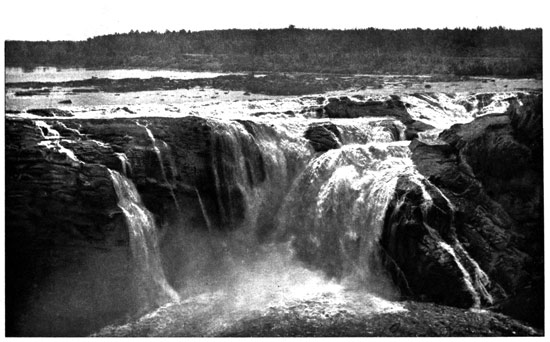
Chaudière Falls, St. Lawrence
The Chaudière, or the "Cauldron," is a remarkable
cataract, and the Indians were so terrified by it,
that to propitiate its evil genius we are told they
usually threw in a little tobacco before traversing the
portage around it. The rapids begin about six
miles above, terminating in this great boiling cauldron
with a sheer descent of forty feet, which is as
curious as it is grand. Owing to the peculiar formation
of the enclosing rocks, all the waters of the
broad river are converged into a sort of basin about
two hundred feet wide, plunging in with vast commotion
and showers of spray. Efforts have been
made to sound this strange cauldron, but the lead
has not found bottom at three hundred feet depth.
The narrowness of the passage between the enclosing
rocky walls, just below the falls, has enabled a
bridge to be built across, connecting Ottawa with the
suburb of Hull. Here is given an admirable view
of the foaming, descending waters, clouds of spray,
and at times gorgeous rainbows, flanked by timber
piles and sawmills, sending out rushing streams of
water and sawdust into the river below. Near by a
chain of eight massive locks brings the Rideau Canal
down through a fissure in the high bank to the level
of the lower Ottawa, its sides being almost perpendicularly
cut by the action of water in past ages.
The locks are a Government work, of solid masonry,
well built, and the fissure divides Ottawa into the
Upper and the Lower Town, pretty bridges being
thrown across it on the lines of the principal streets.
The Rideau Canal follows the Rideau River upwards
southwest to the Lake Ontario level, and in the whole
distance of one hundred and twenty-six miles to
Kingston, overcomes four hundred and forty-six feet
by forty-seven locks. Much of the suburb of Hull
and a considerable part of Ottawa, with enormous
amounts of lumber, were destroyed by a great fire in
April, 1900, a high wind fanning the flames that were
spread by the inflammable materials.
Upon Barrack Hill, at an elevation of one hundred
and fifty feet, surrounded by ornamental grounds, and
having the Ottawa River flowing at the western
base, stand the Government buildings. They are
magnificent structures, costing nearly $4,000,000,
the Prince of Wales having laid the corner-stone on
his visit in 1860. They are built of cream-colored
sandstone, with red sandstone and Ohio stone trimmings,
the architecture being Italian Gothic, and they
stand upon three sides of a grass-covered quadrangle,
and occupy an area of four acres. They include the
Parliament House, the chief building, and all the
Dominion Government offices. The former is four
hundred and seventy-two feet long, the other buildings
on the east and west sides of the quadrangle
being somewhat smaller. All are impressive, their
great elevation enabling their towers and spires to be
seen for many miles. The legislative chambers are
richly furnished, and Queen Victoria's portrait is on
the walls of one House, and those of King George
III. and Queen Charlotte upon the other. The Parliamentary
Library, a handsome polygonal structure
of sixteen angles, adjoins. The Governor-General
resides in Rideau Hall, across the Rideau River.
From a little pavilion out upon the western edge of
Barrack Hill, high above the Ottawa, there is a long
view over the western and northern country, whence
that river comes. To the left is the rolling land of
Ontario province, and to the right the distant hills
and looming blue mountains of Quebec, the river
dividing them. Behind the pavilion is the stately
Parliament House, its noble Victoria Tower, seen
from afar, rising two hundred and twenty feet.
MONTREAL TO QUEBEC.
The broad St. Lawrence River flows one hundred
and eighty miles from Montreal to Quebec. A succession
of parishes is passed, each with its lofty
church and presbytère, reproducing the picturesque
buildings of old Normandy and Brittany, with narrow
windows and steep roofs, all covered with shining
white tin which the dry air preserves. Little
villages cluster around the churches, with long
stretches of arable lands between. Among a mass
of wooded islands on the northern bank, the turbid
waters of the lower Ottawa outlet flow in, the edge
of the clearer blue of the St. Lawrence being seen
for some distance below. The delta makes green
alluvial islands and shoals. Thus we sail down the
great river, past shores that were long ago very well
settled.
"Past little villages we go,
With quaint old gable ends that glow
Bright in the sunset's fire;
And, gliding through the shadows still,
Oft notice, with a lover's thrill,
The peeping of a spire."
In the eighteenth century, Kalm, a Swedish tourist
in America, said it could be really called a village,
beginning at Montreal and ending at Quebec, "for
the farmhouses are never more than five arpents
apart, and sometimes but three asunder, a few places
excepted;" and two centuries ago a traveller on the
river wrote that the houses "were never more than
a gunshot apart." All the people are French, retaining
the language and old customs, simple-minded
and primitive, the same as under the ancient French
régime, and excepting that one village, Varennes,
has put two towers upon its stately church, all of
them are exactly alike. It is recorded that in
Champlain's time some Huguenot sailors came up
the river piously singing psalm tunes. This did not
please the officials, and soon a boat with soldiers put
off from one of these villages, and the officer in
charge told them that "Monseigneur, the Viceroy,
did not wish that they should sing psalms on the
great river." The first steamer that came along the
St. Lawrence created unlimited dread, horrifying the
villagers. Solemnly crossing himself, an old voyageur,
who probably thought his trade on the waters
endangered, exclaimed, in his astonishment, "But can
you believe that the good God will permit all that?"
The Richelieu River, the outlet of Lake Champlain,
comes in at Sorel, the chief affluent on the
southern bank, its canal system making a navigable
connection with the Hudson River. Cardinal Richelieu
took great interest in early Canadian colonization,
and Fort Richelieu was built at the mouth of
this river, being afterwards enlarged to prevent
Iroquois forays, by Captain Sorel, whose name is preserved
in the town. Below, there is an archipelago
of low alluvial islands, and the St. Lawrence broadens
out into Lake St. Peter, nine or ten miles wide, and
generally shallow, this being the head of the tidal
influence. On its southern side flows in the St.
Francis River, the outlet of Lake Memphremagog
and of many streams and lakes in the vast wilderness
along the boundary north of Vermont and east of
Lake Champlain. At its mouth is the little village of St.
François du Lac. As the shores contract below Lake
St. Peter, the town of Three Rivers is passed midway
between Montreal and Quebec. Here the fine river
St. Maurice, another great lumber-producing stream,
flows in upon the northern bank, two little islands
dividing its mouth into a delta of three channels, thus
naming the town. The St. Maurice is full of rapids
and cataracts, the chief being Shawanagan Fall, about
twenty miles inland, noted for its grandeur and remarkable
character. The river, suddenly bending
and divided into two streams by a pile of rocks, falls
nearly one hundred and fifty feet and dashes against
an opposing wall, where the reunited stream forces
its way through a narrow passage scarcely a hundred
feet wide. The two lofty rocks bounding this abyss
are called La Grande Mere and Le Bon Homme. The
headwaters of St. Maurice interlock with some of
those of the gloomy Saguenay north of Quebec. An
enormous output of lumber comes down to Three
Rivers, and the district also produces much bog iron
ore. Here are extensive sawmills, iron-works, and
one of the largest paper-pulp establishments in America,
the unrivalled water-power being thus utilized.
Below the St. Maurice, as the outcropping foothills
from the Laurentian Mountains approach the river,
the scenery becomes more picturesque. The Richelieu
rapids are here, requiring careful navigation
among the rocks, and Jacques Cartier River comes
in from the north. In front of St. Augustin village,
years ago, the steamer "Montreal" was burnt with a
loss of two hundred lives, and on the outskirts is an
ancient ruined church, which is said to have fallen in
decay because the devil assisted at its building. This
was in 1720, and the tradition is that His Satanic
Majesty appeared in the form of a powerful black
stallion, who hauled the blocks of stone, until his
driver, halting at a watering-trough, where there
was also a small receptacle of holy water for the
faithful, unbridled the horse, who became suddenly
restive and vanished in a cloud of sulphurous smoke.
Many pious pilgrimages are made to the present fine
church of the village, having a statue of the guardian
angel standing out in front, commemorating the Vatican
Council of 1870. As Quebec is approached, the
"coves" are seen on the northern shore, arranged
with booms for the timber ships, for easier transfer of
lumber from the rafts floated down the river, and the
steep bluffs behind run off into Cape Diamond, projecting
far across the stream. Old Sillery Church
stands up with its tall spire atop of the bold bluff,
with a monastery behind it. Here Noel Brulart de
Sillery, Knight of Malta, in 1637, established one of
the early Jesuit missions. Point Levis stretches from
the southern bank to narrow the river channel. The
low gray walls of the citadel surmount the highest
point of the extremity of Cape Diamond, and rounding
it, we are at Quebec.
ORIGIN OF QUEBEC.
Whence comes the name of Quebec? "Quel bec!
Quel bec!"—(What a beak!)—shouted Jacques Cartier's
astonished sailors, when, sailing up the St. Lawrence,
they first beheld the startling promontory of
Cape Diamond, thrust in towering majesty almost
across the river. Thus, says one tradition, by a
natural elision, was named Quebec, when the Europeans
first saw the rock in 1535. Another derivation
comes from Candebec on the Seine, which it
much resembles. The Indian word "Kebic," meaning
"the fearful rocky cliff," may have been its
origin. The Indian village of Stadacona was here
when Cartier found it, a cluster of wigwams fringing
the shore in front of the bold cliff, its people bearing
allegiance to the Montaignais chief, Donnacona. Here
the ancient chronicle records that Cartier saw a
"mighty promontory, rugged and bare, thrust its
scarped front into the raging current," and he planted
the cross and lilies of France and took possession for
his king. Returning to Europe, he took back as
prisoners the chief, Donnacona, and several of his
warriors, their arrival making a great sensation.
They were fêted and prayed for, and becoming converted,
were baptised with pomp in the presence of
a vast assemblage in the magnificent Cathedral of
Rouen. But the round of pleasure and feasting, with
the excess of excitement, overcame these children of
the forest, and they all died within a year. Colonization
on the St. Lawrence, after Cartier's voyages,
languished for seventy years, various ill-starred expeditions
failing, and it was not until 1608 that the city
of Quebec was really founded by Samuel de Champlain,
who was sent out by a company of associated
noblemen of France to establish a fur trade with the
Indians and open a new field for the Church, the
Roman Catholic religion being then in the full tide of
enthusiasm which in the seventeenth century made
what was known as the "counter reformation."
Champlain built a fort and established the province
of New France, but his colony was of slow growth.
There subsequently came out the military and commercial
adventurers and religious enthusiasts, who
were the first settlers of the new empire. The
Recollet Fathers came in 1615, and the Jesuit
missionary priests in 1625 and subsequently. The
famous Canadian bishop, Laval de Montmorency,
Father Hennepin, and the Sieur de la Salle, all
came out in the same ship at a later period. Thus
was founded the great French Catholic power in
North America.
The Church thoroughly ruled the infant colony of
Quebec. In the fort, black-garbed Jesuits and scarfed
officers mingled at Champlain's table. Parkman says,
"There was little conversation, but in its place, histories
and the lives of saints were read aloud, as in a
monastic refectory; prayers, masses and confessions
followed each other with an edifying regularity, and
the bell of the adjacent chapel, built by Champlain,
rang morning, noon, and night; godless soldiers
caught the infection, and whipped themselves in
penance for their sins; debauched artisans outdid
each other in the fury of their contrition; Quebec
was become a mission." Champlain died at Christmas,
1635, after a long illness, at the age of sixty-eight,
the "Father of Canada," and Quebec was
without a Governor for a half-year. Finally, the
next summer, the Father Superior, Le Jeune, who
had been directing affairs, espied a ship, and going
down to the landing, was met by the new Governor,
de Montmagny, a Knight of Malta, with a long train
of officers and gentlemen. We are told that "as
they all climbed the rock together, Montmagny saw a
crucifix planted by the path. He instantly fell on
his knees before it; and nobles, soldiers, sailors and
priests imitated his example. The Jesuits sang Te
Deum at the church, and the cannon roared from the
adjacent fort. Here the new Governor was scarcely
installed, when a Jesuit came in to ask if he would
be godfather to an Indian about to be baptized.
'Most gladly,' replied the pious Montmagny. He
repaired on the instant to the convert's hut, with a
company of gaily-apparelled gentlemen; and while
the inmates stared in amazement at the scarlet and
embroidery, he bestowed on the dying savage the
name of Joseph, in honor of the spouse of the Virgin
and the patron of New France. Three days
after, he was told that a dead proselyte was to be
buried, on which, leaving the lines of the new fortification
he was tracing, he took in hand a torch,
De Lisle, his lieutenant, took another, Repentigny
and St. Jean, gentlemen of his suite, with a band
of soldiers, followed, two priests bore the corpse,
and thus all moved together in procession to the
place of burial. The Jesuits were comforted. Champlain
himself had not displayed a zeal so edifying."
The spiritual power thus so zealously exerted
thoroughly controlled Quebec, and its masterful force
always continued.
THE FRENCH-CANADIAN MISSIONARIES.
Boundless was the power exerted when the religious
envoys of this wonderful colony spread over
the interior of America. When the heroic bishop
Laval de Montmorency stood on the altar-steps of
his Basilica at Quebec, he could wave his crozier
over half a continent, from the island of St. Pierre
Miquelon to the source of the Mississippi, and from
the St. Lawrence to the Gulf of Mexico. The
Jesuits' College at Quebec was started in a small
way as early as 1637, and from it, year after year,
issued forth the dauntless missionaries, carrying the
gospel out among the Indians for over three thousand
miles into the interior, preaching the faith beyond
the Mississippi, and down its valley, throughout
Louisiana, many suffering death and martyrdom in
its most cruel forms. Nowhere in the church annals
exists a grander chapter than the record of these
missionaries. Unarmed and alone, they travelled the
unexplored continent, bravely meeting every horrible
torture and lingering death inflicted by the vindictive
savages, whom they went out to bless. The
world was amazed at their sufferings and achievements.
Even Puritan New England, we are told,
received their envoy with honors, the apostle Eliot
entertaining him at Roxbury parsonage, while Boston,
Salem and Plymouth became his gracious hosts.
These devoted men loved the new country. "To
the Jesuits," we are told in their annals, "the atmosphere
of Quebec was well-nigh celestial. In the
climate of New France one learns perfectly to seek
only one God; to have no desire but God; no purpose
but for God. To live in New France is in truth
to live in the bosom of God. If anyone of those who
die in this country goes to perdition," writes Le Jeune,
"I think he will be doubly guilty." For years old
France sent over a multitude to reinforce these missions.
They were urged on by rank, wealth and
power in the great work of converting the heathen,
and the noblest motives gave these missions life.
Solitude, toil, privation, hardship and death were the
early French missionary's portion, yet nothing made
his zeal or courage flag. The saints and angels of
their faith hovered around these Jesuit martyrs with
crowns of glory and garlands of immortal bliss. It
was no wonder that the French and Jesuit influence
soon extended far beyond the mere circle of converts.
It modified and softened the rude manners of many
unconverted tribes. Parkman, from whom I have
already quoted, records that "in the wars of the next
century we do not often find those examples of diabolic
atrocity with which the earlier annals are
crowded. The savage burned his enemies alive, it is
true, but he seldom ate them; neither did he torment
them with the same deliberation and persistency.
He was a savage still, but not so often a
devil."
The French missionary priests survived the period
of torture and trial, and became, in fact, the revered
rulers of many of the Indian tribes. They thoroughly
assimilated and learned the languages. The
priest, regarded with awe and affection, knew so
much, and was so skillful as counsellor and physician,
that the untutored savage came to look upon him
almost as a supernatural being. The biographer of
the venerable Father Davion, who governed the
Yazoos in Louisiana, tells how the Indians regarded
him as more than human. "Had they not, they
said, frequently seen him at night, with his dark solemn
gown, not walking, but gliding through the
woods like something spiritual? How could one so
weak in frame, and using so little food, stand so many
fatigues? How was it that whenever one of them
fell sick, however distant it might be, Father Davion
knew it instantly and was sure to be there before
sought for? Did any of his prophecies ever prove
false? What was it he was in the habit of muttering
so long, when counting the beads of that mysterious
chain that hung round his neck? Was he not then
telling the Great Spirit every wrong they had done?
So they both loved and feared Father Davion. One
day they found him dead at the foot of the altar; he
was leaning against it with his head cast back, with
his hands clasped, and still retaining his kneeling
position. There was an expression of rapture in his
face, as if to his sight the gates of Paradise had suddenly
unfolded themselves to give him admittance;
it was evident that his soul had exhaled into a prayer,
the last on this earth, but terminating no doubt in a
hymn of rejoicing above." But great as may be the
spectacle of triumphant martyrdom, there are yet
men unwilling to change places with the missionary
priest. Ralph Waldo Emerson writes in The Problem:
"I like a church; I like a cowl;
I love a prophet of the soul;
And on my heart monastic aisles
Fall like sweet strains, or pensive smiles:
Yet not for all his faith can see
Would I that cowléd churchman be."
But others also came to New France besides priests
and martyrs; the adventurers and beggared noblemen—poor,
uneducated, yet bold and courageous.
The historian tells us of "the beggared noble of the
early time" who came over, "never forgetting his
quality of gentilhomme; scrupulously wearing its
badge the sword, and copying, as well as he could, the
fashions of the court which glowed on his vision across
the sea with all the effulgence of Versailles and
beamed with reflected ray from the Chateau of
Quebec. He was at home among his tenants, at
home among the Indians, and never more at home
than when, a gun in his hand and a crucifix on his
breast, he took the warpath with a crew of painted
savages and Frenchmen almost as wild, and pounced
like a lynx from the forest on some lonely farm or
outlying hamlet of New England. How New England
hated him, let her records tell. The reddest
blood-streaks on her old annals mark the track of the
Canadian gentilhomme."
QUAINT OLD QUEBEC.
Thus created a thoroughly French region, Lower
Canada still maintains the religious character of the
original colony. The geographical names are mostly
those of the saints and fathers of the Church, and
much of the land is owned by religious bodies. The
population is four-fifths French, and nowhere does
the Church to-day show more vitality or command
more thorough devotion. The city of Quebec almost
stands still in population, having about seventy thousand,
of whom five-sixths are French. It is now just
as Champlain made it, though larger, a fortress, trading-station
and church combined, and quaintly attractive
in all three phases. No finer location could have
been selected for a town and seaport, and no more
impregnable position found to guard the St. Lawrence
passage than its junction with the river St. Charles.
An elevated tongue of land stretches along the northwestern
bank of the St. Lawrence for several miles,
and from behind it comes out the St. Charles. Below
their junction the broad Isle of Orleans blocks the
way, dividing the St. Lawrence into two channels,
while above, the noble river contracts to the "Narrows,"
less than a mile in width, making a strait
guarded all along by bold shores. At the northern
extremity of this tongue of land, and opposite the
"Narrows" of the river, rises the lofty cliff of Cape
Diamond, three hundred and fifty feet above the
water, the citadel crowning the hill and overlooking
the town nestling at its foot. The fortifications spread
all around the cliff and its approaches, completely
guarding the rivers and the means of access by land;
but it is now all peaceful, being only a show-place
for sight-seers. As may be imagined, this grand
fortress is magnificent to look at from the water approach,
while the outlook from the ramparts and terraces
on top of the cliff is one of the finest sights over
town and rivers, hills and woods, in the world.
Quebec is quaint, ancient and picturesque, presenting
strange contrasts. A fortress and commercial
mart have been built together on the summit of a
rock, like an eagle's nest. It is a French city in
America, ruled by the English, and was held mainly
by Scotch and Irish troops; a town with the institutions
of the middle ages under modern constitutional
government, having torrid summers and polar winters,
and a range of the thermometer from thirty
degrees below zero to one hundred degrees above.
When Charles Dilke came here he thought he was
back in the European Middle Ages. He found "gates
and posterns, cranky steps that lead up to lofty gabled
houses with steep French roofs of burnished tin like
those of Liége; processions of the Host; altars decked
with flowers; statues of the Virgin; sabots and
blouses; and the scarlet of the British linesmen. All
these are seen in narrow streets and markets that are
graced with many a Cotentin lace cap, and all within
forty miles of the Down East Yankee State of Maine.
It is not far from New England to Old France.
There has been no dying out of the race among the
French Canadians. The American soil has left their
physical type, religion, language and laws absolutely
untouched. They herd together in their rambling
villages; dance to the fiddle after mass on Sundays
as gaily as once did their Norman sires; and keep
up the fleur de lys and the memory of Montcalm.
More French than the French are the Lower Canada
habitans. The pulse-beat of the Continent finds no
echo here." Henry Ward Beecher thought Quebec
the most curious city he had ever seen, saying, "It
is a peak thickly populated, a gigantic rock, escarped,
echeloned, and at the same time smoothed off to hold
firmly on its summit the houses and castles, although,
according to the ordinary laws of nature, they ought
to fall off, like a burden placed on a camel's back
without a fastening. Yet the houses and castles hold
there as if they were nailed down. At the foot of the
rock some feet of land have been reclaimed from the
river, and that is for the streets of the Lower Town.
Quebec is a dried shred of the Middle Ages hung high
up near the North Pole, far from the beaten paths of
the European tourists—a curiosity without parallel
on this side of the ocean. The locality ought to be
scrupulously preserved antique. Let modern progress
be carried elsewhere. When Quebec has taken
the pains to go and perch herself away up near
Hudson's Bay, it would be cruel and unfitting to dare
to harass her with new ideas, and to speak of doing
away with the narrow and tortuous streets that
charm all travellers in order to seek conformity with
the fantastic ideas of comfort in vogue in the nineteenth
century."
THE FORTRESS OF QUEBEC.
Up on the cliff, in 1620, Champlain built the ancient
castle of St. Louis, which stood on the verge of the
rock, where now is the eastern end of the Dufferin
Terrace, at an elevation of about one hundred and
eighty feet above the river. This was of timber,
afterwards replaced by a stone structure used for fort
and prison, and burnt in the early part of the nineteenth
century, the site being now an open square,
with some relics, on the verge of the cliff. The
great Quebec Citadel upon the summit of the
promontory, three hundred and fifty feet above
the river, is one of the most formidable of the
former systems of stone fortifications. It covers
forty acres, and has outlying walls, batteries and defensive
works enclosing the entire ancient city, the
circuit being nearly three miles. There are batteries
guarding the water approach, gates on the
landward side (some now dismantled), and four massive
martello towers on the edge of the Plains of
Abraham above the city, with long subterranean
passages leading to them and other outlying works.
The Quebec rock is a dark slate, with an almost perpendicular
stratification, and shining quartz crystals
found in it gave it the name of Cape Diamond. The
portion of the works overlooking the St. Lawrence
is called the Grand Battery, while the surmounting
pinnacle of the Citadel, containing a huge Armstrong
gun, is the King's Bastion. While Quebec's magnificent
scenery and its tremendous rock-crowned
fortress remain as they were during the great colonial
wars, yet the military glory is gone. England
long ago withdrew the regular garrison, and only a
handful of Canadian militia now hold the place, and
the guns are harmless from age and rust, only two or
three smaller ones doing the present ceremonious
duties. In fact the old rock is so given to sliding,
that salutes are forbidden, excepting on rare occasions,
lest the concussion may bring some of the fatal
rock-slides down upon the people of the Lower Town.
There is a little bronze gun preserved as a trophy in
the centre of the Parade, which the British captured
at Bunker Hill. Grand as this Citadel is, it no longer
protects Quebec, for in fact the defense against an
enemy is provided by the newer modern forts across
the river behind Point Levis, which command the river
approach and cost some $15,000,000 to construct.
Yet great has been the conflict around this noted
rock fortress in the past. The earliest battles were
at the old Castle of St. Louis, and after the repulse
of the New England colonial expeditions sent against
Quebec in 1711 it was determined to fortify the
whole of Cape Diamond, and then the Citadel and
chief works were built. Two monuments, however,
record the greatest events in its history. The Wolfe-Montcalm
monument is the chief, erected just behind
the Dufferin Terrace, in a little green enclosure
known as the "Governor's Garden," recording the
result of the greatest battle fought in Colonial America,
the fateful contest in 1759, on the Plains of Abraham,
where both commanders fell, which changed
the sovereignty of Canada from France to England,
and the crowning victory of the "Seven Years'
War," which Parkman says "began the history of
the United States." This is a plain shaft, almost
without ornamentation, and bears the names of both
Generals. The other monument is the little stone set
up in the face of the cliff on the river-front below
the citadel, marking where the American General
Montgomery fell, in the winter of 1775. He had
crossed the St. Lawrence on the ice, and in imitation
of Wolfe's previous exploit, rashly tried to scale the
almost perpendicular cliff with a handful of troops,
but was defeated and slain. Wolfe's successful ascent
of the bluff in 1759 had been made from the
river three miles above Quebec, at what is now
known as Wolfe's Cove, where the timber ships
load. A little stream makes a ravine in the bank,
and Wolfe and his intrepid followers, having floated
down from above with the tide, landed and climbed
through this gorge, the route they took being at
present a steep road ascending the face of the bluff
among the trees, a small flag-staff being planted at
the top. The Plains of Abraham—so called from
Abraham Martin, a pilot living there—are now occupied
by the modern residences of the city and the
massive buildings of the Quebec Provincial Parliament.
There is also a prison, and near it a monument
marking where Wolfe fell, being the second
column erected, the first having been carried away
piecemeal by relic-hunters. Upon it is the inscription:
"Here died Wolfe victorious, Sept. 13, 1759."
This marks the most famous event in the history of
the great fortress. Wolfe had evidently a premonition.
A young midshipman who was in the boat
with him, as they floated on the river at midnight to
the ravine, told afterwards how Wolfe, in a low voice,
repeated Gray's Elegy in a Country Churchyard to the
officers about him, including the line his own fate was
soon to illustrate, "The paths of glory lead but to
the grave," saying, as the recital ended, "Gentlemen,
I would rather have written those lines than take
Quebec." William Pitt, describing the great result
of the battle, said, "The horror of the night, the
precipice scaled by Wolfe, the empire he, with a
handful of men, added to England, and the glorious
catastrophe of contentedly terminating life where his
fame began—ancient story may be ransacked and
ostentatious philosophy thrown into the account, before
an episode can be found to rank with Wolfe's."
QUEBEC RELIGIOUS HOUSES.
Various streets and stairways mount the great
Quebec rock in zigzags, and there is also an inclined-plane
passenger elevator. In the Lower Town, the
narrow streets display quaint old French houses with
queer-looking porches and oddly-built steps, high
steep roofs, tall dormer windows and capacious stone
chimneys. The French population cluster in the
Lower Town and along St. Charles River. Churches
and religious houses seem distributed everywhere.
The great Catholic establishments are prominent in
the Upper Town, nearly all founded in the seventeenth
century. The Holy Father at Rome, recognizing
the exalted position Quebec occupies in the
Church, has made its Cathedral, like the patriarchal
churches of Rome, a Basilica, its Archbishop being
a Cardinal. It occupies the place of the first church
built by Champlain, is not very large, but is magnificently
decorated and contains fine paintings. Within
are buried Champlain and Frontenac, and the great
Bishop Laval de Montmorency. Adjoining is the
palace of the Cardinal Archbishop, who is the Canadian
Primate. Also adjoining are the spacious buildings
of the Seminary, founded and richly endowed by
Laval,—one of the wealthiest institutions and most
extensive landowners of Quebec Province. This is
still regarded as the controlling power of the Church
in Lower Canada, as it has been for two centuries.
There is also a Cathedral of the Church of England,
a smaller and plain building, where the war-worn
battle-flags of the British troops, carried in the Crimea,
hang in the chancel, and the fine communion
service was presented by King George III. Here is
also the memorial of the early Anglican bishop of
Quebec, Jacob Mountain, of whom it was said he
happened to be in the presence of that king when
the king expressed doubt as to who should be appointed
bishop of the new See of Quebec, then just
created. Said Dr. Mountain, "If your Majesty had
faith there would be no difficulty." "How so?" asked
the king; whereupon Mountain answered, "If you
had faith you would say to this Mountain, be thou
removed into that See, and it would be done." It
was; Quebec getting a most excellent bishop, who
labored over thirty years there, dying in 1825.
There are also the splendid building of Laval University,
one of the first educational institutions of
the Dominion; the Hotel Dieu, and Ursuline Convent
originally started by Madame de la Peltrie, in
the Upper Town.
These establishments all had their origin in the
religious enthusiasm attending the settlement of
Canada, in which France took great pride, although
Voltaire afterwards derided it as "Fifteen hundred
leagues of frozen country." From Sillery, where
the first Jesuit Mission was founded, went out the
zealous missionaries and martyrs, who followed the
Hurons into the depths of the forest, and sought to
reclaim the Iroquois, as has been well said, "with
toil too great to buy the kingdoms of this world, but
very small as a price for the Kingdom of Heaven."
From Sillery went the Jesuit Fathers, who explored
all America, and also Jogues, Brébeuf, Lalemont,
and others, to martyrdom in founding the primitive
Canadian mission church. It was also the religious
French women as well as the devoted men, who laid
so deep and strong the pious foundation of Canada.
Little do we really know of the nun, who in her
religious devotion practically buries herself alive.
Down in the Lower Town, near the Champlain Market,
originally lived the first colony of Ursuline nuns,
who came out with Madame de la Peltrie to teach and
nurse the Indians. She afterwards left them, as already
stated, and went to help settle Montreal. Later
their establishment was removed to the Upper Town,
where it now has an impressive array of buildings,
with about fifty nuns, who educate most of the leading
Quebec young ladies. The great success of this
Order was due to its Superioress, Marie Gruyart,
known as Mother Marie de l'Incarnation, a remarkable
woman, who mastered the Huron and Algonquin
languages, and devoted herself and her nuns to the
special work of educating Indian girls, being called
by Bossuet the "St. Theresa of the New World."
In the shrines of this convent are relics of St.
Clement Martyr, and other saints, brought from the
Roman Catacombs. Its most famous possession is
the remains of Montcalm, who was carried mortally
wounded from the battlefield into the convent to die.
His skull is preserved in a casket covered with glass,
and is regarded with the greatest veneration. His
body is buried in the chapel, and his grave is said to
have been dug by a shell which burst there during the
fierce bombardment preceding his death. This convent
has had a chequered history, being repeatedly
bombarded, and twice burnt during attacks on the
city, and at times occupied as barracks by the troops
of both friend and foe. Of late, however, the lives of
these sisters of St. Ursula have been more tranquil.
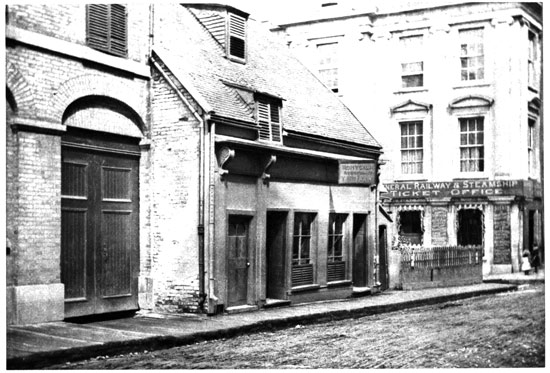
Montcalm's Headquarters, Quebec
The most extensive collection of religious buildings
is the Convent and Hospital of the Hotel Dieu,
in the Upper Town. There are some sixty cloistered
nuns of this Order, founded in 1639 by Cardinal
Richelieu's niece, the Duchess d'Aguillon. They
care for the sick and infirm poor, their hospital accommodating
over six hundred. The oldest structure
dates from 1654, and much of the collection is over
two centuries old. The most precious relics in their
convent are the remains of two of the Jesuit martyrs
who went out from Sillery, Fathers Brébeuf and
Lalemont. There is a silver bust of the former, and
his skull is carefully preserved. Jean de Brébeuf was
a Norman of noble birth, who came out with Champlain,
and he and Lalemont were sent on a mission
beyond Ontario to the Huron country, establishing
the mission town of St. Ignace, near Niagara River.
They lived sixteen years with these Indians, learning
their language, and gaining great influence over
them. The Iroquois from New York attacked and
captured the town in 1649, taking the missionaries
captive and putting them to death with frightful tortures.
Brébeuf, who frequently had celestial visions,
always announced his belief that he would die a martyr
for Christ. The story of his torture is one of
the most horrible in the colonial wars. He was bound
to a stake and scorched from head to foot; his lower
lip was cut away, and a red-hot iron thrust down his
throat. They hung a necklace of glowing coals
around his neck, which the indomitable priest stood
heroically; they poured boiling water over his head
and face in mockery of baptism; cut strips of flesh
from his limbs, eating them before his eyes, scalped
him, cut open his breast and drank his blood, then
filled his eyes with live coals, and after four hours of
torture, finally killed him by tearing out his heart,
which the Indian chief at once devoured. The
writer recording this terrible ordeal says, "Thus
died Jean de Brébeuf, the founder of the Huron mission,
its truest hero, and its greatest martyr. He
came of a noble race,—the same, it is said, from which
sprang the English Earls of Arundel, but never had
the mailed barons of his line confronted a fate so
appalling, with so prodigious a constancy. To the
last he refused to flinch, and his death was the astonishment
of his murderers." Gabriel Lalemont, his
colleague, was a delicate young man, and was tortured
seventeen hours, bearing the torments nobly,
and though at times faltering, yet he would rally,
and with uplifted hands offer his sufferings to heaven
as a sacrifice. His bones are preserved in the Hotel
Dieu. The burning of St. Ignace village dispersed
the Hurons, but years afterwards a remnant was
gathered by the Jesuit Fathers, and their descendants
are at Lorette, up St. Charles River.
From the Ursuline Convent the Champlain Steps
lead down the cliff to the Champlain Market, having
alongside it the ancient little church of Notre Dame
des Victoires. This is a plain stone church of moderate
size, built in 1688 as the church of Notre Dame,
on the site of Champlain's house. The interior,
which has had modern renovation, displays rich gilding,
and the church's interesting history is told by
two angels hovering over the chancel, each bearing a
banner, one inscribed "1690" and the other "1711."
The fiery Count de Frontenac, who was Louis XIV.'s
Governor of Quebec, had ravaged the New England
colonies, and in 1690, shortly after the church was
built, Sir William Phips, from Massachusetts, retaliated.
The Iroquois, who were English allies, menaced
Montreal, and all the French troops were sent
thither. Suddenly, in October, Phips and his fleet
appeared in the St. Lawrence below Quebec. Urgent
messages were sent the troops to return, and the
devout Ursuline nuns prayed for deliverance with
such fervor in the little church, that Phips was struck
with a phase of indecision, wasted his time, summoned
the town to surrender, a message which the
bold Frontenac spurned, and then, without making an
attack, Phips wasted more time, until the French
troops did return, so that when the demonstration was
made it was successfully repulsed, and after repeated
disasters Phips and his fleet sailed back to New England.
Great was the rejoicing in Quebec, a thanksgiving
procession singing Te Deums marched to the
little church, and then the Bishop, with an elaborate
ceremonial, changed its name to Notre Dame de la
Victoire. Twenty-one years afterwards, in 1711,
another British invading force came up the river
under Sir Hovenden Walker, and again the intercession
of Notre Dame was implored. The reassuring
answer quickly came by fog and storm, producing
dire disaster to the fleet, eight ships being wrecked
and many hundreds drowned. Quebec again was
saved; there was the wildest rejoicing, and in honor
of the double triumph the church was re-named as
Notre Dame des Victoires. An annual religious festival
is held on the fourth Sunday in October to commemorate
these miraculous deliverances. But the
famous little church was not always to escape unscathed.
One of the Ursuline nuns prophesied that
it would ultimately be destroyed by the British, who
would finally conquer, and when Wolfe's batteries
bombarded Quebec in 1759 it severely suffered. It
was repaired, and exists to-day as one of the most
precious relics in the ancient city, in its oldest quarter,
adjoining the market-place, and revered with all
the unquestioning devotion of the habitan.
THE DUFFERIN TERRACE.
There is a fine outlook from the Dufferin Terrace,
high up on the cliff above the river, the favorite gathering-place
of the townsfolk on pleasant afternoons.
The St. Lawrence flows placidly, with a narrow strip
of town far down below at its edge, and a few vessels
moored to the bank. At one's feet are the Champlain
market and the famous little church, and a mass
of the peaked tin-covered roofs of the diminutive
French houses crowded in along the contracted street
at the base of the cliff. High above rises the towering
citadel with its rounded King's Bastion, the black
guns thrusting their muzzles over the parapet and
the Union Jack floating from a flagstaff at the top.
Across the river is Point Levis, with piers and railroad
terminals spread along the bank, and various
villages with their imposing convents and churches
crown the high bluff shore for a long distance up and
down. Farther back upon the wooded slopes of the
hills are the great modern built forts which command
the river and are the military protection of
Quebec, their lines of earthworks just discernible
among the trees. The river sweeps grandly around
the projecting point of Cape Diamond and the surmounting
citadel, passing away to the northeast with
broadening current, where it receives the St. Charles,
and beyond is divided by the low projecting point of
the green Isle of Orleans. The main channel flows
to the right behind Point Levis, and the other far
away to the left with the Falls of Montmorency in
the distance, and the dark range of Laurentian Mountains
for a background with the noble summit of
Mount Sainte Anne, and the huge promontory of
Cape Tourmente at the river's edge. Nearer, the
Quebec Lower Town spreads to a flat point at St.
Charles River, ending in the broad surface of Princess
Louise Basin, containing the shipping. Beyond
this, a long road extends along the northern river
bank, through Beauport and down to Montmorency,
bordered by little white French cottages strung along
it like beads upon a thread. Such is the landscape
of wondrous interest seen from the cliff of Quebec.
Across the St. Lawrence, elevated one hundred and
fifty feet above the river, between Quebec and Point
Levis is about being constructed a great railway
bridge with the largest cantilever span in the world.
A ride along the attractive road through Beauport
gives an insight into the home life of the French
Canadian habitan. The village stretches several
miles, a single street bordered on either hand by
rows of unique cottages, nearly all alike; one-story
steep-roofed houses of wood or plaster, almost all
painted white, and one reproducing the other. The
first Frenchman who arrived built this sort of a house,
and all his neighbors and descendants have done likewise.
They, like him, do it, because their ancestors
builded so. The house may be larger, or may be of
stone, but there is no change in form or feature.
The centre doorway has a room on either hand with
windows, and a steep roof rises above the single
story. The house, regardless of the front road, must
face north or south. The long, narrow strips of
farms, some only a few yards wide, and of enormous
length, run mathematically north and south. It matters
not that this highway, parallel with the river,
runs northeast. That cannot change the inexorable
rule, and hence all the houses are set at an angle
with the road, and all the dividing-fence lines are
diagonals. The sun-loving Gaul taboos shade-trees,
and therefore the sun blazes down upon the unsheltered
house in summer, while the careful housewife,
to keep out the excessive light, closes all the windows
with thick shades made of old-fashioned wall-papers.
The little triangular space between the cottage and
the road is usually a brilliant flower-garden. Crosses
are set up frequently for the encouragement of the
faithful, and there are imposing churches and ecclesiastical
buildings at intervals. Along this road ride
the French in their queer-looking two-wheeled caléches,
appearing much like a deep-bowled spoon set
on wheels, and in elongated buckboard wagons of
ancient build, surmounted by the most homely and
venerable gig-tops. These French cottages are more
picturesque than their vehicles.
The French Canadian habitan, the cultivateur, and
peasant of Quebec province, is about the same to-day
as he was two or three centuries ago. The Lower
Canada village reproduces the French hamlet of the
time of Louis XIV., and the inhabitants show the
same zealous and absorbing religious devotion as
when the French first peopled the St. Lawrence
shores. Within the cottage, hung above the habitan's
modest bed, is the black wooden cross that is to be
the first thing greeting the waking eyes in the morning,
as it has been the last object seen at night.
Below it is the sprig of palm in a vase, with the little
bonitier of holy water, and alongside is placed the
calendar of religious events in the parish. The palm
sprig is annually renewed on Palm Sunday, the old
sprig being then carefully burnt. Great is its power
in warding off lightning strokes and exorcising the
evil spirits. The central object around which every
village clusters is always the church, with its high
walls, sloping roof, and tall and shining tin-clad spire.
The curé is the village autocrat; the legal and medical
adviser, the family counsellor, and usually the
political leader of his flock. He blesses all the houses
when they are built, and as soon as the walls are up
a bunch of palm is attached to the gable or the chimney,
a gun being fired to mark the event. When
the Angelus tolls all stop work, wherever they are,
and say the short prayer in devout attitude. Before
beginning or completing any task the reverent habitans
always piously cross themselves. They do this
also in passing churches, or the many crosses and
statues set up along the roads and in the villages.
They are temperate, industrious and thrifty, live
simply, eat the plainest food, are abundantly content
with their lot, and usually raise large families. In
fact, there is a bounty given, by act of the Quebec
Provincial Legislature, of one hundred acres of land
to parents having more than twelve living children.
It is not infrequent to find twenty-five or thirty or
more children in a single family. In personal appearance
the habitan is generally of small or medium
size, with sparkling brown eyes, dark complexion, a
placid face and well-knit frame. He has strong
endurance and capacity for work, but usually not
much education, the prayer-book furnishing most of
the family reading. The Church encourages early
marriages, and domestic fecundity is honored as a
special gift from Heaven. The pious veneration, like
the creed of this simple-minded people, is the same
to-day as it was in the seventeenth century. Their
faith is fervent and their belief complete. They
typify the beautiful idea the late Cardinal Newman
exemplified in his exquisite poem:
"Lead, kindly Light, amid the encircling gloom,
Lead thou me on;
The night is dark, and I am far from home;
Lead thou me on;
Keep thou my feet; I do not ask to see
The distant scene; one step enough for me.
"I was not ever thus, nor prayed that thou
Shouldst lead me on;
I loved to choose and see my path; but now
Lead thou me on!
I loved the garish day, and spite of fears
Pride ruled my will. Remember not past years!
"So long thy power hast blest me, sure it still
Will lead me on
O'er moor and fen, o'er crag and torrent, till
The night is gone,
And with the morn those angel faces smile,
Which I have loved long since and lost awhile!"
LA BONNE SAINTE ANNE.
This road leads to the Montmorency River, a vigorous
stream flowing out of Snow Lake, ninety miles
northward, down to the St. Lawrence. For a mile
or so above the latter river it has worn a series of
steps in the limestone rocks, making attractive rapids,
and the waters finally pitch over a nearly perpendicular
precipice, almost at the verge of the St.
Lawrence, falling two hundred and fifty feet in a
magnificent cataract, the dark amber torrent brilliantly
foaming, and making vast amounts of spray.
In winter there is formed a cone of ice in front of
these falls, sometimes two hundred feet high. The
cataract goes down into a deep gorge, worn back
through the rocks, some distance from the St. Lawrence
bank, and protruding cliffs in the face of the
fall make portions of the water, when part way
down, dart out in huge masses of foam and spray. A
large sawmill below gets its power from this cataract,
and it also provides the electric lighting service for
Quebec. Farther down the north shore of the St.
Lawrence, through more quaint villages—L'Ange
Gardien and Chateau Richer—the road leads along
breezy hills and pleasant vales in the Coté de Beaupré,
to the most renowned shrine of all Canada, about
twenty miles below Quebec, the Church of "La
Bonne Sainte Anne de Beaupré." This famous old
church is the special shrine of the habitan, the objective
point of many pilgrim parties from Canada
and New England, where there now is a large population
of French Canadians, as many as a hundred
and fifty thousand pilgrims coming in a single year,
and it is the most venerated spot in all Lower
Canada. The Coté de Beaupré, the northern St.
Lawrence shore below Montmorency, is an appanage
of the Seminary of Quebec. The little Sainte Anne's
river comes down from the slopes of Sainte Anne's
Mountain among the Laurentides, and after dashing
over the steep and attractive cataract of Sainte
Anne, flows out to the St. Lawrence. Upon the
level and picturesque intervale of this stream is a
primitive French village, whose people get support
partly by making bricks for Quebec, but mainly
through the entertainment of the army of pilgrims
coming to the miraculous shrine of "La Bonne
Sainte Anne." The village spreads mostly along a
narrow street filled with inns and lodging-houses
which are crowded during the pilgrimage season from
June till October, culminating on Sainte Anne's festival
day, July 26th. To the eastward of the village
is the beautiful church, not long ago built from
the pious doles of the faithful, a massive and elaborate
granite building. Just above it, upon the bank,
is the original little church of Sainte Anne, which is
so highly venerated, and wherein the sacred relics of
the saint are carefully kept in a crystal globe, and are
exhibited at morning mass, when their contemplation
by the pilgrims, combined with faith, works miraculous
cures. The old church of 1658, threatening to
fall, was taken down in 1878, and rebuilt with the
same materials on the original plan. It is quaintly
furnished in the French-Canadian style of the seventeenth
century, and one of its features is the mass
of abandoned crutches and canes piled along the cornices
and in the sacristy, left by the cripples who
have departed relieved or healed.
This is probably the holiest ground in Canada,
consecrated by nearly three centuries of the most
fervent devotion of the ever-faithful habitans. Just
below Sainte Anne is the companion village of St.
Joachim. Sainte Anne was the mother and St.
Joachim the father of the Virgin Mary. The tradition
is that after Sainte Anne's body had reposed
quietly for many years at Jerusalem, it was sent to
the Bishop of Marseilles, and later to Apt, where it
was placed in a subterranean chapel to guard it from
heathen profanation. The church at Apt was swept
away by the invader, but some seven centuries afterwards
the Emperor Charlemagne visited the town,
and marvellous incidents took place, light being seen
emanating from the vault accompanied by a delicious
fragrance, whereupon investigation was made and
the long lost remains of Sainte Anne recovered.
Ever since, her sacred relics have been highly venerated
in France, and it was natural that the early
French Canadians should bring their pious devotion
into the new Province. Various churches were built
in her honor, the chief being this one at Beaupré,
by the devout Governor d'Allebout. With his own
hands the Governor began the pious work of erecting
the church, and as an encouragement, the Cathedral
Chapter in France sent to the new shrine a relic
of Sainte Anne—a portion of a finger-bone—together
with a reliquary of silver, a lamp, and some
paintings, all being preserved in this church. The
legend of the building is, that upon its site a beautiful
little child of the village was thrice favored with
Heavenly visions. Upon the third appearance, the
Virgin commanded the child that she should tell her
people to build a church there in honor of her saintly
mother. Thus was the location chosen, and while
the foundation was being laid, a habitan of the Coté
de Beaupré, one Guimont, sorely afflicted with rheumatism,
came there with great difficulty, and filled
with pain, to try and lay three stones in the wall,
presumably in honor of the Virgin, her father and
mother. With much labor and suffering he performed
the task, but instantly it was completed he
became miraculously cured. This began a long
series of miracles, their fame spreading, so that devotion
to Sainte Anne became a distinguishing feature
of French-Canadian Catholicity.
The great Bishop Laval de Montmorency made
Sainte Anne's day a feast of obligation. During the
French régime, vessels ascending the St. Lawrence
always saluted when passing the shrine, in grateful
thanksgiving that their prayers to Sainte Anne had
been answered by deliverance from the perils of the
sea. Pilgrims flocked thither, and many cures were
wrought by pious veneration of the relics. As religion
spread among the Indians, sometimes the adjacent
shore would be covered by the wigwams of
the converts who had come in their canoes from
remote regions, and the more fervent of them would
crawl on their knees from the river bank to the altar.
To-day the pilgrims bring their offerings and make
their vows, pleading for relief, many crossing the
ocean from France, and it is said of these votaries
at the shrine that they now come, "not in paint and
feathers, but in cloth and millinery, and not in canoes,
but in steamboats." It is noteworthy that in all the
vicissitudes of war repeatedly waged around the
famous place, the village being sacked and burned,
the church was always preserved. When the British
under Wolfe, prior to capturing Quebec in 1759,
attacked Beaupré, they three times, tradition says,
set fire to the church, but by the special intervention
of Sainte Anne it escaped unscathed. Upon Sainte
Anne's festival day, in 1891, many thousand pilgrims
poured into the village, and Cardinal Archbishop
Taschereau came down from Quebec, bringing another
precious relic of Sainte Anne—a complete
finger-joint—which he had obtained for the shrine
from Carcassonne, in Languedoc, France. The Holy
Father had raised the new church to the dignity of
a Basilica, and two years previously he also sent
from Rome a massive golden crown, set with precious
stones, and valued at $56,000. This crown was
worn by the rich statue of Sainte Anne, holding the
infant Virgin in her arms, which stands before the
chancel. There was an elaborate ceremonial, a large
number of priests participating, and a solemn procession
translated the precious relic to the church,
where, after the services, it was venerated, the reliquary
containing it being presented to the lips of
each communicant kneeling in the sanctuary. Several
miraculous cures were announced, but it is recorded
that most of the cripples taken into the
church had to be carried out again unrelieved.
Around this sacred shrine crystallizes in the highest
degree the pious veneration of the faithful French-Canadian
habitans.
THE LOWER ST. LAWRENCE.
The river St. Lawrence below Quebec is a mighty
arm of the sea, stretching in from the Atlantic,
through a vast valley enclosed by the primeval forest.
The northern shore shows the domination of
ruggedness, for here begins the mountain wall of
the Laurentides, stretching far away northeastward
down the river towards Labrador. The southern
shore is less forbidding, having wide fertile slopes
rising to a background of wooded hills. Along the
river bank is a sparsely scattered strip of humanity,
which is likened to a rosary, having the primitive
farmhouses for beads, and at every few miles a tall,
cross-crowned church spire. Set in between the
river banks, just below Quebec, is the broad and fertile
Isle of Orleans, but beyond this the St. Lawrence
is six miles wide, and steadily broadens, attaining
twenty-four miles width at Tadousac, the mouth of
the Saguenay, and thirty-five width at Metis, one
hundred and fifty miles below Quebec. The Isle
of Orleans is twenty miles long and very fertile,
largely supplying the markets of Quebec. To the
northward Mount Sainte Anne, the guardian of the
famous shrine, rises twenty-seven hundred feet.
Jacques Cartier so liked the grapes grown on the
island that he called it the Isle of Bacchus, but the
king, Francis I., would not have it so, and named it
after his son, the Duke of Orleans. Here were
massacred the Hurons by the Iroquois, who captured
from them the great cross of Argentenay, carrying
it off to their stronghold, on Onondaga Lake, New
York, in 1661. On the northern shore of the island
is the old stone church of St. Laurent and farther
along that of St. Pierre, the meadows hereabout providing
good shooting. The faithful at St. Laurent were
said to have been long the envied possessors of a piece
of the arm-bone of the Apostle Paul, a most precious
relic, which was clandestinely seized and taken over
to St. Pierre Church. This made a great commotion,
and some of the young men of St. Laurent made an
expedition at night, entered the church, recaptured
the relic, and brought it back with some other articles,
restoring it to the original shrine. A controversy
between the villagers followed, growing so
fierce that an outbreak was threatened, and the
Archbishop at Quebec had to intervene to keep the
peace. He ordered each church to restore the other
its relics, which was done with solemn ceremony, processions
marching along the road between the villages,
and making the exchange midway, a large
black cross since marking the spot.
The great promontory of the Laurentides, Cape
Tourmente, stretches to the river, with the dark mass
of ancient mountains spreading beyond in magnificent
array, the cliffs rising high above the water, firs
clinging to their sides and crowning their worn and
rounded summits. On top of Tourmente the Seminarians
have erected a huge cross, seen from afar,
with a little chapel alongside. The old Canadian
traveller, Charlevoix, said Cape Tourmente was
probably so-called "because he that gave it this
name suffered here by a gust of wind."
"At length they spy huge Tourmente, sullen-browed,
Bathe his bald forehead in a passing cloud;
The Titan of the lofty capes that gleam
In long succession down the mighty stream."
Here are Grosse Isle, the quarantine station for the
river, and the Isle aux Coudres—Hazel Tree Island,—behind
which a break in the Laurentides makes a
pleasant nook, the Bay of St. Paul, having little
villages named after the saints all about. Below, the
mountain range rises into the great Mount Eboulements,
twenty-five hundred feet high, its sides scarred
by landslides brought down by various earthquakes,
which were once so frequent that the Indians called
the region Cuscatlan, meaning "the land that swings
like a hammock." The name of this mountain means
the "falling, shaking, crumbling mountain," but it is
nevertheless now noted as the haughtiest headland of
the Laurentides. This whole region has been a great
sufferer from volcanic disturbances, the chief being
in 1663, when the historian says "the St. Lawrence
ran white as milk as far down as Tadousac; ranges
of hills were thrown down into the river or were
swallowed up in the plains; earthquakes shattered
the houses and shook the trees until the Indians said
that the forests were drunk; vast fissures opened in
the ground and the courses of streams were changed.
Meteors, fiery-winged serpents and ghostly spectres
were seen in the air; roarings and mysterious voices
sounded on every side, and the confessionals of all
the churches were crowded with penitents awaiting
the end of the world." Below this frowning mountain,
the little Murray River flows in, making a deep
bay and sandy beaches, and far back, under the
shadows of the bordering hills, are the parish church
and the French village of St. Agnes up the river.
This place is Murray Bay, a favorite watering-place,
known as Malbaie among the French, the hotels and
wide one-story cottages of this Canadian Newport
being scattered in the ravine and on the hill-slopes.
When Champlain first entered this bay in 1608 he
named it Malle Baie, explaining that this was because
of "the tide that runs there marvellously." It is said
that an attempt was once made to settle Murray Bay
with Scotch emigrants, but the families who were sent
out soon succumbed to the overwhelming influence of
the surroundings, and their descendants, while having
unmistakable Scottish names, have adopted the
French language and customs. Over on the southern
bank, thirty miles away, for the river is now very
wide, is another favorite resort, Riviere du Loup,
with the adjacent village of Kamouraska, the great
church of St. Louis and a large convent being prominent
in the latter.
Riviere du Loup is the best developed of the
watering-places of the Lower St. Lawrence. The
shore is gentle, and in sharp contrast with the rugged
northern bank. The village spreads on a broad plateau,
formed by the inflowing stream, there being
hotels and boarding-houses scattered about, a tall-spired
church back of the town, and a long wharf
stretching out in front. To the eastward the sloping
shore extends far away to Cacouna, eight miles below,
another favorite resort also sentinelled by its church.
The Riviere du Loup (Wolf River) naming this place
flows out of the distant southern mountains to the
St. Lawrence, and is said to have been so called from
the droves of seals,—called by the French "loups-marines"—formerly
frequenting the shoals off its
mouth. Just back of the village the stream plunges
down a waterfall eighty feet high. Cacouna is the
most fashionable resort of the southern shore, and a
place of comparatively recent growth, its semicircular
bay with a good beach and the cool summer airs
being the attractions. In front and connected by a
low isthmus is a large peninsula of rounded granite
rock, shaped much like a turtle-back and rising four
hundred feet. From this came the Indian name,
Cacouna, or the turtle.
THE GRAND AND GLOOMY SAGUENAY.
Far over to the northward, across the broad river,
is ancient Tadousac, enclosed by the guarding mountains
at the entrance to the Saguenay. The harbor
and landing are within a small rounded bay, having
the Salmon Hatching House of the Dominion alongside
the wharf, a cascade pouring down the hillside
behind, and a little white inn prettily perched above
on a shelf of rock. The village spreads over irregular
terraces, encircling three of these little rounded
bays, beyond which the narrow Saguenay chasm goes
off westward through the mountains into a savage
wilderness. This place has been a trading-post with
the Indians for over three centuries, and the ancient
buildings of the Hudson Bay Company testify to the
traffic in furs, once so good, which has become almost
obsolete. It was visited by Cartier in 1535, and
afterwards was established as one of the earliest missions
of the Jesuits, who came here in 1599 and
raised the cross among the Nasquapees of the Saguenay—the
"upright men," as they called themselves,—and
the Montaignais, both then powerful tribes, which
have since entirely disappeared from this region, having
withdrawn to its upper waters, around and beyond
Lake St. John. The old chapel, replacing the original
Jesuit church—said to have been the first erected
in North America—stands down by the waterside,
a diminutive, peak-roofed, one-story building, kept
as a memorial of the past, for the people now worship
in a fine new stone church farther up the rounded
hill-slope. These knoll-like rounded hills or mamelons
named the place, for they are numerous, and
Tadousac, literally a "nipple," is the Indian word for
them. The most valued possession of the church is
a figure of the child Jesus, originally sent to the mission
by King Louis XIV. This is the oldest settlement
of the Lower St. Lawrence.
The stern and gloomy Saguenay, the largest tributary
of the Lower St. Lawrence, is one of the most
remarkable rivers in the world. Its main portion is
a tremendous chasm cleft in a nearly straight line for
sixty miles in the Laurentian Mountains, through an
almost unsettled wilderness. These Laurentides
make the northern shore of the St. Lawrence for
hundreds of miles below Quebec, rising into higher
peaks and ridges in the interior, and being the most
ancient part of America, the geologists telling us the
waves of the Silurian Sea washed against this range
when only two small islands represented the rest of
the continent. Through this vast chasm the Saguenay
brings down the waters of Lake St. John and its many
tributaries, some of them rising in the remote north,
almost up to Hudson Bay. This lower portion of the
river goes through an almost uninhabitable desert of
gloomy mountains, the tillable land being in the basin
of the Upper Saguenay and Lake St. John, the people
of that valley living there in almost complete isolation.
Logs and huckleberries are the crops produced
on this savage river, the only things the sparse population
can depend upon for a living, and the fine
blueberries bring them the scant doles of ready
money they ever see. The Saguenay's inky waters
have the smell of brine as they break in froth upon
the shore, and then the air-bubbles show the real
color to be that of brandy. The upper tributaries
give this color as they flow out of forests of spruce
and hemlock and swamps filled with mosses and
highly colored roots and vegetable matter. Almost
all the lakes and rivers of the vast wilderness north
of the St. Lawrence present a similar appearance,
their rapids and waterfalls, seen under the sunshine,
seeming like sheets of liquid amber.
The vast accumulations of waters gathered from
the heart of the Laurentides by the tributaries of
Lake St. John flow down the rapids below the lake
in a stream rivalling those of Niagara. Thus the
Saguenay comes into being in the form of lusty twins—the
Grand Discharge and the Little Discharge—deep
and narrow river channels worn in the rocks.
For some miles they run separately through rapids
and pools, finally joining at the foot of Alma Island,
where begin the Gervais Rapids, four miles long.
The Grand Discharge is a beautiful stream of rapids,
the rippling and roaring currents flowing through a
maze of islands, while the Little Discharge is a condensed
stream, so powerful and unruly that it actually
destroys the logs in its boisterous cataracts, the
government having made a "Slide," down which
the timber is run past the dangerous places. After
passing Gervais Rapids the Saguenay has a quiet
reach of fifteen miles to the Grand Ramous, the most
furious cascade of all, and then a few more miles
of rapids and falls bring it to Chicoutimi, ending its
wild career where it meets the tide above Ha Ha
Bay. The first bold Frenchmen who ventured up
through the stupendous and forbidding chasm of the
Lower Saguenay gave this bay its name, to show
their delight at having finally emerged from the
gloomy region. At Ha Ha Bay the tide often rises
twenty-one feet, and below, the river forces its passage
with a broad channel through almost perpendicular
cliffs out to the St. Lawrence. Its great depth
is noteworthy, showing what a fearful chasm has
been split open, there being in many places a mile to
a mile and a half depth, while the channel throughout
averages eight hundred feet depth. For most of the
distance the river is a mile or more wide. The original
name given the river by the Montaignais was
Chicoutimi, or the "deep water," now given the village
below the foot of the rapids. The present name
is a corruption of the Indian word Saggishsékuss,
meaning "a strait with precipitous banks." The
sad sublimity of the impressive chasm culminates at
Eternity Bay, where on either hand rise in stately
grandeur to sixteen hundred feet elevation above the
water Cape Trinity, with its three summits, and
Cape Eternity. Ten miles above is Le Tableau, a
cliff one thousand feet high, its vast smooth front
like an artist's canvas.
This sombre river, whose bed is much lower than
that of the St. Lawrence, is frozen for almost its
whole course during half the year, and snow lies on
its bordering mountains until June. It makes a saddening
impression upon most visitors. Bayard Taylor
compared the Saguenay chasm to the Dead Sea and
Jordan Valley, describing everything as "hard,
naked, stern, silent; dark gray cliffs of granitic
gneiss rise from the pitch-black water; firs of
gloomy green are rooted in their crevices and fringe
their summits; loftier ranges of a dull indigo hue
show themselves in the background, and over all
bends a pale, cold, northern sky." Another traveller
calls it "a cold, savage, inhuman river, fit to take
rank with Styx and Acheron;" and "Nature's sarcophagus,"
compared to which, "the Dead Sea is
blooming;" and so solitary, dreary and monotonous
that it "seems to want painting, blowing up or draining—anything,
in short, to alter its morose, quiet,
eternal awe."
EXPLORING THE SAGUENAY CHASM.
Ha Ha Bay, where the exploring Frenchmen found
such relief for their oppressed feelings, is a long strait
thrust through the mountains southwest from the
Saguenay for several miles, broadening at the head
into an oval bay, practically a basin among the crags,
with two or three French villages around it, named
after various saints. The modest one-story huts of
the habitans fringe the lower slopes near the water's
edge along the valleys of several small streams, each
cluster having its church with the tall spire. The
basin is two or three miles across, enclosed by bold
cliffs and rounded hills, the wide beaches of sand and
pebble showing the great rise and fall of the tide.
There is a sawmill or two, and lumber and huckleberries
are the products of the district. Chicoutimi
village is above the chasm, at a point where the intervale
broadens, the savage mountains retiring, leaving
a space for gentle tree-clad slopes and cultivated
fields. Standing high on the western bank are the
magnificent Cathedral, the Seminary, a Sailors' Hospital,
and the Convent of the Good Shepherd, and not
far away a tributary stream pours fifty feet down the
Chicoutimi Falls in a rushing cascade of foam. There
are extensive sawmills, and timber ships come in the
summer for cargoes for Europe, and the place has
railway connections with Lake St. John and thence
southward to Quebec. There is a population of about
three thousand. The universal little one-story,
peak-roofed, whitewashed French cottages abound,
some having a casing of squared pieces of birch-bark
to protect them from the weather, making them look
much like stone houses, and peeping inside it is found
that the inhabitants usually utilize their old newspapers
for wall-paper.
From Chicoutimi down to Tadousac the region of
the Saguenay chasm is practically without habitation.
There are two or three small villages, chiefly abodes
of timber-cutters, but it is otherwise uninhabited; nor
do the precipitous cliffs usually leave any place near
the river for a dwelling to be put. As the visitor
goes along on the steamboat it is a steady and monotonous
panorama of dark, dreary, round-topped
crags, with stunted firs sparsely clinging to their
sides and tops where crevices will let them, while the
faces of the cliffs are white, gray, brown and black,
as their granites change in color. A few frothy but
attenuated cascades pour down narrow fissures. The
scene, while sublime, is forbidding, and soon becomes
so monotonous as to be tiresome. This gaunt and
savage landscape culminates in Eternity Bay. Ponderous
buttresses here guard the narrow gulf on the
southern shore, formed by the outflow of a little river.
The western portal, Cape Trinity, as the steamboat
approaches from above, appears as a series of huge
steps, each five hundred feet high, and the faithful
missionaries have climbed up and placed a tall white
statue of the Virgin on one of the steps, about seven
hundred feet above the river, and a large cross on the
next higher step, both being seen from afar. Passing
around into the bay, the gaunt eastern face of this
enormous promontory is found to be a perpendicular
wall of the rawest granite, standing sixteen hundred
feet straight up from the water. At the top it grandly
rises on the bay side into three huge crown-like
domes, which, upon being seen by the original
French explorers when they came up the river,
made them appropriately name it the Trinity. This
is one of the most awe-inspiring promontories human
eyes ever beheld, as it rises sheer out of water over
half a mile deep. Across the narrow bay, the eastern
portal, Cape Eternity, similarly rises in solemn grandeur,
with solid unbroken sides and a wooded top
fully as high. The entire Saguenay River is of
much the same character, repeating these crags and
promontories in myriad forms. While not always as
high, yet the enclosing mountains elsewhere are
almost as impressive and fully as dismal. The
steamboat, aided by the swift tide, moves rapidly
through the deep canyon, one rounded peak and long
ridge being much like the others, with the same monotonous
dreariness everywhere, and every rift disclosing
only more distant sombre mountains. The
chasm throughout its length has no beacons for navigation,
the shores being so steep and the waters so
deep they are unnecessary. A sense of relief is felt
when the open waters at Tadousac and the St. Lawrence
are reached, for the journey makes everyone
feel much like a writer in the London Times, who
said of it: "Unlike Niagara and all other of God's
great works in nature, one does not wish for silence
or solitude here. Companionship becomes doubly
necessary in an awful solitude like this."
THE ANGLING GROUNDS OF LOWER CANADA.
Quebec province, on the Lower St. Lawrence, for
hundreds of miles north and east of the river is filled
with myriads of lakes and streams that are the
haunts of the hunter and angler, and the Government
gets considerable revenue from the fishery
rentals. As far away as five hundred miles from
Quebec, up in Labrador, is the Natashquin River,
and eight hundred miles down the St. Lawrence is
the Little Esquimau, these being the most distant
fishery grounds. Among the noted fishing streams
are the grand Cascapedia, the Metapedia, the Upsalquitch,
the Patapedia, the Quatawamkedgewick (usually
called, for short, the "Tom Kedgewick"), and the
Restigouche, on the southern side of the Lower St.
Lawrence, their waters being described as flowing
out to "the undulating and voluptuous Bay of Chaleurs,
full of long folds, of languishing contours,
which the wind caresses with fan-like breath, and
whose softened shores receive the flooding of the
waves without a murmur." Around the great Lake
St. John there is also a maze of lakes and fishery
streams. The most noted Canadian fishery organization
is the "Restigouche Salmon Club," having its
club-house on the Restigouche River, at its junction
with the Metapedia, and controlling a large territory.
The guides in this region are usually Micmac Indians,
who have been described on account of their
energy as the "Scotch-Irish Indians." This tribe
originally inhabited the whole of Lower Canada
south of the St. Lawrence, being found there by
Cartier, and the French named them the Sourequois
or "Salt-Water Indians," because they lived on the
seacoast. They were staunch allies of the French,
who converted them to Christianity from being sun-worshippers.
They have a reservation near Campbellton,
on the Restigouche, and a populous village
surrounding a Catholic church. There are now
about seven thousand of them, all told, throughout
the provinces. Glooscap was the mythical chief of
the Micmacs, whose power and genius were shown
throughout all the region from New England to
Gaspé. He was of unknown origin, and invincible,
and he conquered the "great Beaver, feared by
beasts and men," on the river Kennebecasis, near St.
John. Glooscap's favorite home and beaver-pond
was the Basin of Minas, in Nova Scotia, where afterwards
dwelt Longfellow's Evangeline. Micmac traditions
describe him as the "envoy of the Great
Spirit," who lived above in a great wigwam, and was
always attended by an aged dame and a beautiful
youth. He had the form and habits of humanity,
and taught his tribe how to hunt and fish, to build
wigwams and canoes, and to heal diseases. He controlled
the elements and overthrew all enemies of his
people; but the tradition adds that on the approach
of the English, the great Glooscap, "finding that the
ways of beasts and men waxed evil," turned his huge
hunting-dogs into stone, and his huntsmen into restless
and wailing loons, and then he vanished.
The route to the angling waters of the great Lake
St. John is by railway northward from Quebec. It
goes up the valley of St. Charles River, past Lorette,
where beautiful cascades turn the mill-wheels. Here
are gathered the scanty halfbreed remnant of the
Hurons, once the most powerful and ferocious tribe
in Canada, who drove out the Iroquois and compelled
their migration down to New York State. These
Indians are said to have been Wyandots, but when
the French saw them, with their hair rising in bristling
ridges above their painted foreheads, the astonished
beholders exclaimed, "Quelles hures!" (what
boars!) and hence the name of Huron came to them.
The railroad goes for two hundred miles past lakes
and streams, and through the dense forests of these
remote Laurentian mountains, until it finally comes
out on the lake shore at the ancient mission town of
"Our Lady of Roberval," now become, through the
popularity of the district, a modern watering-place.
This great Lake St. John, so much admired by the
Canadian and American anglers, was called by the
Indians the Picouagomi, or "Flat Lake," and it is in
a region shaped much like a saucer, lying in a hollow,
with hills rising up into mountains in the background
all around. The lake is thirty miles long and about
twenty-five miles across, having no less than nineteen
large rivers, besides smaller ones flowing into it
from the surrounding mountains, the vast accumulation
of waters being carried off by the Saguenay.
The immense flow of some of these rivers may be
realized when it is known that the Mistassini, coming
down from the northward, is three hundred miles long,
and the Peribonka four hundred miles long, while
the Ouiatchouan from the south, just before reaching
the lake, dashes down a grand cascade, two hundred
and eighty feet high, making an elongated sheet of
perfectly white foam.
Until the middle of the nineteenth century, this
wonderful lake and its immense tributaries were
scarcely known to white men, yet upon its shores
stood Notre Dame de Roberval and St. Louis Chambord,
two of the oldest Jesuit Indian missions in
America. For more than two centuries, until the
angler and lumberman began going to this remote wilderness,
it was a buried paradise in the distant woods,
without inhabitants, excepting a few Montaignais
and their priests, and a scattered post or two of the
Hudson Bay Company, whose occasional expeditions
over to Quebec for supplies were the only communication
with the outer world. The solid graystone
church and convent stand in bold relief among the
neat little white French cottages at Roberval, there
are an immense sawmill and a modern hotel, while in
front is the grand sweep of the lake, like a vast inland
sea, its opposite shore almost beyond vision, excepting
where a far-away mountain spur may loom
just above the horizon. Here lives the famous
ouananiche of the salmon family, called "land-locked,"
because it is believed he is unable to get
out to other waters. He is a gamey and magnificent
fish, with dark-blue back and silvery sides, mottled
with olive spots, thus literally clothed in purple and
fine silver. He has enormous strength, making him
the champion finny warrior of the Canadian waters.
The chief fishery ground for him is in the swirling
rapids of the Grand Discharge. The native Montaignais,
or "mountaineer" Indian of this region, is
a most expert angler, seducing the royal fish with an
inartistic lump of fat pork on the end of a line from
his frail canoe among the rapids, and hooking the
game more effectively than the costliest rod and reel
in the hands of a "tenderfoot." These dusky, consumptive-looking,
copper-colored Indians spend the
winters in the unexplored wilds of the Mistassini,
and wander through all the wilderness as far as Hudson
Bay. When the snows are gone, they bring in
the pelts of the beaver, otter, fox and bear, to trade
at the Company posts, and living in rude birch-bark
huts on the bank of the lake, spend the summer in
fishing, and pick up a few dollars as boatmen and
guides.
THE ST. LAWRENCE ESTUARY.
Below the mouth of the Saguenay, the St. Lawrence
stretches four hundred miles to the ocean, its
broad estuary constantly growing wider. On the
southern shore, below Cacouna, there is another resort
at a little river's mouth, known as Trois Pistoles. It
is related that in the olden time a traveller was ferried
across this little river, the fisherman doing the
service charging him three pistoles (ten franc pieces),
equalling about six dollars. The traveller was astonished
at the charge, and asked him the name of the
river. "It has no name," was the reply, "it will be
baptized at a later day." "Then," said the traveller,
anxious to get the worth of his money, "I baptize it
Three Pistoles," a name that has continued ever
since. This diminutive village seems rather in luck,
for unlike most of the others, it has two churches,
each with a tall spire. The Lower St. Lawrence
shores maintain communication across the wide estuary
by canoe ferries, established at various places.
A stout canoe, twenty feet or more long, and having
a crew of seven men, usually makes the passage.
The boat is built with broad, flat keel, shod with
iron, moving easily over the ice which for half the
year closes the river, not breaking up until late in
the spring, and sometimes obstructing the outlet
through the Strait of Belle Isle until July. Farther
down the southern shore, below Trois Pistoles, is
Rimouski, a much larger place, described as the metropolis
of the Lower St. Lawrence, and the outlet
of the region of the Metapedia. This town has a
Bishop and a Cathedral. Beyond are Father Point
and Metis, and the land then extends past Cape
Chatte into the wilderness of Gaspé. When Jacques
Cartier first entered the river in 1534, he landed at
Gaspé, taking possession of the whole country in the
name of the King of France, and erecting a tall cross
adorned with the fleur-de-lys. Very appropriately,
Gaspé means the "Land's End." They found here
the Micmac Indians, who were then reputed to be
quite intelligent, knowing the points of the compass
and position of the stars, and having rude maps of
their country and a knowledge of the cross. Their
tradition, as told to Cartier's sailors, was that in distant
ages a pestilence harassed them, when a venerable
man landed on their shore and stayed the
progress of the disease by erecting a cross. This
mysterious benefactor is supposed to have been a
Norseman, or early Spanish adventurer. An old
Castilian tale is that gold-hunting Spaniards, after
the discovery by Columbus, sailed along these coasts,
and finding no precious metals, said in disgust to the
Indians, "Aca náda," meaning, "there is nothing
here." This phrase became fixed in the Indian
mind, and supposing Cartier's party to be the same
people, they endeavored to open conversation by repeating
the same words, "Aca náda! aca náda!"
Thus, according to one theory, originated the name
of Canada, the Frenchmen supposing they were telling
the name of the country. Another authority
is that the literal meaning of the Mohawk (Iroquois)
word Canada is, "Where they live," or "a
village," and as it was the word Cartier, on his voyages
up the river, most frequently heard from the
Indians, as applied to the homes of the people, it
naturally named the country.
The surface of the southern country behind Cape
Chatte, and of Gaspé (Cape Gaspé being a promontory
seven hundred feet high), rises into the frowning
mountains of Notre Dame, the most lofty in
Lower Canada, the chief peak elevated four thousand
feet. In 1648 a French explorer wrote of these
stately ranges that "all those who come to New
France know well enough the mountains of Notre
Dame, because the pilots and sailors, being arrived
at that point of the great river which is opposite to
these high mountains, baptize, ordinarily for sport,
the new passengers, if they do not turn aside by
some present the inundation of this baptism, which
is made to flow plentifully on their heads." The
bold southern shore of the St. Lawrence finally
ends beyond Cape Gaspé, where its mouth is ninety-six
miles wide in the headland of Cape Rosier, described
by dreading mariners as the "Scylla of the
St. Lawrence."
The northern shore of the great river, beyond the
mouth of the Saguenay, is almost uninhabited. There
is an occasional fishing-post, but it is almost an unknown
region, though once there were Jesuit missions
and trading-places, the Indians having since
gone away. The iron-bound coast goes off, past
Point de Monts, the Egg Islands and Anticosti, to the
Strait of Belle Isle. This strait is named after a
barren, treeless and desolate island at its entrance,
about nine miles long, which has been most ironically
named the Belle Isle, but the early mariners,
nevertheless, called it the Isle of Demons. They did
this because they heard, when passing, "a great
clamor of men's voices, confused and inarticulate,
such as you hear from a crowd at a fair or market-place."
This is explained by the almost constant
grinding of ice-floes in the neighborhood. The Mingan
River, a beautiful stream where speckled trout
are caught, comes down out of the northern mountains,
opposite Anticosti Island, and is occasionally
visited by enthusiastic anglers. This is the boundary
of Labrador, which stretches almost indefinitely
beyond, comprising the whole northeastern Canadian
peninsula, an almost unexplored region of nearly
three hundred square miles. It is described as a
rocky plateau of Archæan rocks, highest on the northeast
side and to the south, more or less wooded, and
sloping down to lowlands towards Hudson Bay. It is
a vast solitude, the rocks split and blasted by frosts,
and the shores washed by the Atlantic waves, where
reindeer, bears, wolves and a few Esquimaux wander.
Its great scenic attraction is the Grand Falls. To the
northward of the headwaters of Mingan River is a
much larger stream, the Grand River, draining a
multitude of lakes on the higher Labrador table-land,
northeastward through Hamilton Inlet into the Atlantic.
In 1861 a venturesome Scot of the Hudson Bay
Company, prospecting through the region, first saw
this magnificent cataract. For thirty years the falls
were unvisited, but in 1891 an expedition was made
to them, and they have been since again visited.
The cataract is described as a magnificent spectacle,
the river with full flow leaping from a rocky platform
into a huge chasm, with a roar that can be heard
twenty miles and an immense column of rainbow-illumined
spray. The plunge is made after descending
rapids for eight hundred feet, and is over a precipice
two hundred feet wide, the fall being three hundred
and sixteen feet. The water tumbles into a canyon
five hundred feet deep and extending between high
walls of rock for about twenty-five miles. The distant
Labrador coasts on bay and ocean abound in
seals and fish, and the adjacent seas are vast producers
of codfish and herring. There are few visitors,
however, excepting the hardy "Fishermen," of whom
Whittier sings:
"Hurrah! the seaward breezes
Sweep down the bay amain;
Heave up, my lads, the anchor!
Run up the sail again!
Leave to the lubber landsmen
The rail-car and the steed;
The stars of heaven shall guide us,
The breath of heaven shall speed!
"Now, brothers, for the icebergs
Of frozen Labrador,
Floating spectral in the moonshine,
Along the low, black shore!
Where like snow the gannet's feathers
On Brador's rocks are shed,
And the noisy murr are flying,
Like bleak scuds, overhead;
"Where in mist the rock is hiding,
And the sharp reef lurks below,
And the white squall smites in summer,
And the autumn tempests blow;
Where, through gray and rolling vapor,
From evening unto morn,
A thousand boats are hailing,
Horn answering unto horn.
"Hurrah! for the Red Island,
With the white cross on its crown!
Hurrah! for Meccatina,
And its mountains bare and brown!
Where the Caribou's tall antlers
O'er the dwarf wood freely toss,
And the footstep of the Micmac
Has no sound upon the moss.
"Hurrah! Hurrah!—the west wind
Comes freshening down the bay,
The rising sails are filling,—
Give way, my lads, give way!
Leave the coward landsman clinging
To the dull earth, like a weed,—
The stars of heaven shall guide us,
The breath of heaven shall speed!"
END OF VOLUME II.