X.
ASCENDING THE HUDSON RIVER.
Hudson River Scenery—Fort Washington—Fort Lee—The Palisades—Piermont—Greenwood
Lake—Tuxedo Lake—Font
Hill—Yonkers—Philipse Manor—Mary Philipse—Hastings—Dobbs's
Ferry—Tappan Zee—The Flying Dutchman—Tarrytown—André
and Arnold—Tappan—Irvington—Sunnyside—Washington
Irving—The Sleepy Hollow—Ichabod
Crane—Point-no-Point—Rockland Lake—Sing-Sing—Croton
Point—Haverstraw Bay—Stony Point—Treason Hill—Verplanck's
Point—The Highlands—The Donderberg and its
Goblin—Peekskill—Anthony's Nose—Iona Island—West
Point—Forts Clinton and Montgomery—Sugar Loaf Mountain—Buttermilk
Falls—Constitution Island—Susan Warner—General
Kosciusko—Beverly House—Arnold's Treason—Old
Cro' Nest—Flirtation Walk—The Storm King—Mount
Taurus—Joseph Rodman Drake—The Culprit Fay—Cornwall—Fishkill—Newburg
Bay—Newburg and Washington's
Headquarters—Ural Knapp—The Tower of Victory—Enoch
Crosby, the Spy—The Devil's Dance Chamber—The Long
Reach—Poughkeepsie—Lakes Mohonk and Minnewaska—Vassar
College—Crom Elbow—Rondout—Kingston—Esopus—Rhinebeck
and Rhinecliff—Ellerslie—Rokeby—Wilderscliff—Montgomery
Place—Plattekill Clove—Saugerties—Livingston
Manor—Clermont—Chancellor Livingston—Fulton's
First Steamboat—Catskill Mountains—Natty Bumppo—Rip
Van Winkle—Slide Mountain—Kaaterskill Clove—Kaaterskill
Falls—Haines's Falls—The Big Indian—City of Hudson—The
Dutch—New Lebanon—The Shakers—Mother Ann
Lee—Kinderhook—Stuyvesant Landing—Martin Van Buren—Schodack—The
Mohicans—Beeren Island—The Overslaugh—The
Patroons—The Van Rensselaers—The Anti-Rent War—Albany—New
York State Capitol—Albany Medical College—Calvin
Edson—Albany Academy—Prof. Joseph Henry—Dudley
Observatory—Van Rensselaer Mansion—Vanderheyden
Palace—Lydius House—Balthazar Lydius—Anneke
Jans Bogardus—Albany Regency—Schuyler Mansion—Erie
Canal Basin—Troy—The Monitor—Mohawk River—Stillwater—Schuylerville—Burgoyne's
Defeat—General Fraser's
Death—Round Lake—Ballston Spa—Saratoga Lake and Town—High
Rock Spring—Sir William Johnson—Saratoga Hotels—Saratoga
Springs—Congress Spring—Hathorn Spring—Mount
McGregor—Fort Edward—Israel Putnam—Jenny McCrea—Baker's
Falls—Sandy Hill—Quackenboss' Adventure—Glen's
Falls—Last of the Mohicans—Hawkeye—Sources
of the Hudson—The Adirondack Wilderness—Hendrick
Spring—The Tear of the Clouds—Indian Pass—Tahawas, the
Sky-Piercer—Schroon Lake—The Battenkill.
THE HUDSON RIVER SCENERY.
The noble Hudson is one of the most admired of
American rivers. It does not possess the vine-clad
slopes and ruined castles and quaint old towns of the
Rhine, but it is a greater river in its breadth and
volume and the commerce it carries. It has scenery
fully as attractive in the Palisades and Highlands, the
Helderbergs and Catskills, and on a scale of far more
grandeur, while the infinite variety of its shores and
villas and the many flourishing river towns are to
most observers more pleasing. A journey along the
Hudson presents ever varying pictures of rural
beauty, in mountain, landscape, field and village; at
times almost indescribably grand, and again entrancing
in the autumn's gorgeous coloring of the forest-clad
slopes, and the brilliant picture under our clear
American skies. George William Curtis, voicing the
opinion of most of our countrymen, is enthusiastic
about the Hudson, saying: "The Danube has in
part glimpses of such grandeur, the Elbe sometimes
has such delicately pencilled effects, but no European
river is so lordly in its bearing, none flows in such
state to the sea. Of all our rivers that I know, the
Hudson with this grandeur has the most exquisite
episodes. Its morning and evening reaches are like
the lakes of a dream." The Hudson may not have
as many weird and elfish legends as so many historic
centuries and the mythical preceding era have gathered
upon the annals of the Rhine, but its beauties,
tragedies and folklore have been a favorite theme,
and the romantic and poetic fancies of Irving, Drake
and Cooper, with many others, have given it plenty
of fascinating literature and picturesque incident.
Oliver Wendell Holmes thus sings the praises of the
Hudson:
"I wandered afar from the land of my birth,
I saw the old rivers renowned upon Earth;
But fancy still painted that wide-flowing stream,
With the many-hued pencil of infancy's dream.
"I saw the green banks of the castle-crowned Rhine,
Where the grapes drink the moonlight and change into wine,
I stood by the Avon, whose waves, as they glide,
Still whisper his glory who sleeps by their side.
"But my heart would still yearn for the sound of the waves,
That sing as they flow by my forefathers' graves;
If manhood yet honors my cheek with a tear,
I care not who sees it—nor blush for it here.
"In love to the deep-bosomed stream of the West,
I fling this loose blossom to float on its breast;
Nor let the dear love of its children grow cold,
Till the channel is dry where its waters have rolled."
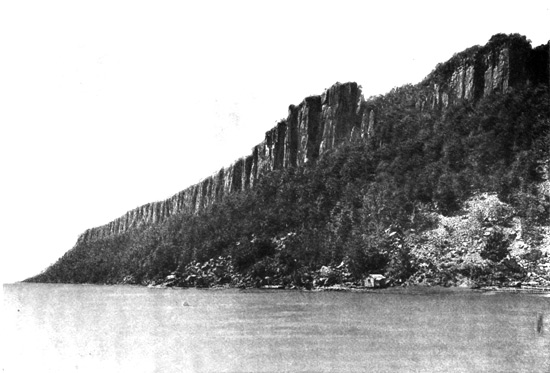
THE PALISADES.
In ascending the Hudson from New York, there
are passed on either hand the heights which were
covered in early Revolutionary days with the defenses
of New York, Fort Washington and Fort Lee, but
beyond the names no trace of either fort remains.
The British captured both in the latter part of 1776,
and afterwards held them. Fort Lee is now a favorite
picnic ground. Above it rises the great wall of
the Palisades, the wonderful formation built up of
columned trap rock that extends along the western
river bank for twenty miles up to Piermont, this
rocky buttress making the northern limit of New Jersey
on the Hudson River. Occasionally a patch of
trees grows upon the tops or sides of the Palisades,
while the broken rocks and débris that have fallen
down make a sloping surface from about half-way up
their height to the water's edge. These columns rise
in varying heights from three to five hundred feet.
This grand escarpment of the Palisades is a giant
wall along the river bank, sometimes cut down by
deep and narrow ravines, through which the people
behind them get brief peeps at the picturesque
stream far below. Their general surface makes a
sort of long and narrow table-land, barely a half-mile
to a mile wide, dividing the Hudson from the valley
of the Hackensack to the westward, the top being
usually quite level, and in most cases having a growth
of trees. These desolate-looking Palisades are a barrier
dividing two sections of country seeming in sharp
contrast. To the westward, the inhabitants lead
simple pastoral lives in a region of farm land and
dairies. To the eastward, the opposite shore of the
Hudson is a succession of villas and fashionable summer
resorts, whither the New York people come out,
seeking a little rest and freshness after the season's
dissipation. From the tops of the Palisades are admirable
views both east and west, displaying some of
the finest sunrises and sunsets seen along the great
river. Extensive blasting operations, to get the building-stone
and paving material for which they form
valuable quarries, are marring the beauty of the Palisades,
but legal arrangements are maturing for their
preservation. Their highest elevation, the Indian
Head, not far above Fort Lee, rising five hundred
and ten feet, has been ruined by these blasts, which
at times will break off many thousand tons of rock
at a single explosion.
Palisades of the Hudson
The rocky buttress of Piermont, the termination
of the Palisades on the Hudson, gets its name from a
pier, a mile long, which is extended from the shore
at the foot of the mountain out to deep water, and a
branch of the Erie railway terminates here. This
line runs inland northwestward through a fine country.
Over there is Greenwood Lake, known as the
"miniature Lake George," a beautiful river-like
body of water, ten miles long and a mile wide, almost
entirely enclosed in the mountains, and presenting
extremely picturesque scenery. This lake is at a
thousand feet elevation, with clear and deep spring
water, and in the neighborhood are the smaller but
as charming Lakes Wawayanda, Macopin and Sterling.
The long look over mountain and vale causing
an expression of surprise in broken English from an
Indian gazing upon the attractive prospect, is said to
have named the first of these pretty little lakes;—"Away,
way, yonder," he said, but it sounded like
"Wa-wa-yanda," and the name has since clung to it.
Not far away, among these mountains, is Tuxedo
Lake, the fashionable resort of the Tuxedo Park Association,
also reached by the Erie railway. This
club of wealthy New Yorkers has made a paradise
among the Allegheny foothills, with game-preserves,
golf-links, club-house, and many cottages for the
members.
Above Spuyten Duyvel Creek the western Hudson
River shore presents the monotonous front of these
Palisades, stretching for miles apparently without a
sign of active life; but the eastern bank is a far different
picture of undulating hills, with gentle slopes
to the water's edge, and covered in every eligible
position with an endless variety of villas, presenting
every phase of artistic taste and the development of
abundant wealth. These summer homes upon the
Hudson are among the crowning glories of the ever-changing
river scene. Here is the famous Font Hill,
now the Convent of Mount St. Vincent. In 1850
the tragedian Edwin Forrest built it for his home, a
mediæval graystone castle, with moat and drawbridge
and six battlemented towers; but he held it only a
few years, when he quarrelled with his wife, and sold
the estate for $100,000 to the Sisters of Charity of
the Order of St. Vincent de Paul for their Mother
House, which had to remove from the site of Central
Park in New York. The cross now surmounts the
tallest castle tower, and it is surrounded by noble
trees which have grown higher than the turrets,
while on the hill behind, and almost overshadowing
the little castle, is a huge red-brick convent building.
Lawns slope down to the shore, and there are superb
river views, with the grand wall of the Palisades
rising high in front.
Yonkers is seventeen miles above New York, a
galaxy of castellated and ornamental mansions fringing
the town about, upon the amphitheatre of hills
surrounding the flat depression on which it is mainly
built. The little Neperhan or Sawmill River pours
down a series of rapids through it before reaching
the Hudson, with factories bordering the banks,
while the great Vanderbilt railway, the New York
Central, with a half-dozen sets of rails, runs along
the front of the town. Here are now forty thousand
people, in sharp contrast with the time when Hendrick
Hudson, exploring the river, anchored in front
of the little Indian village of Napperhamok, or the
"Rapid Water." Curiosity brought them out in
canoes to examine his ship, the "Half Moon," and
he bought oysters and beans, saying he found them
"a loving people who attained great age." The
Dutch early bought land from these Indians for a
settlement, and it became the domain of Patroon
Vanderdonck, who set the town going under the
name of Yonk-heer, or the "young master," meaning
the heir of the family. Then the English came
along and it became the "Philipse Manor," the old
stone manor house built in 1682 being the antiquarian
attraction, and used now as a sort of City
Hall, a Soldiers' Monument standing in front. This
was a manor of twenty-four thousand acres stretching
along the river from Spuyten Duyvel up to the
Croton. The third of the English lords of the
manor was Fredericke Philipse, who was a shrewd
aristocrat, and during the Revolution tried the difficult
political game of a neutral, desirous of keeping
on the winning side. But neither party trusted him,
and although Washington had been his guest in the
famous old manor house, yet he was attainted of
treason by the State of New York, his great manor
confiscated, cut up into small tracts and sold. The
romance of Yonkers is the love story of his daughter,
Mary Philipse, the "belle of the Hudson Valley."
Tradition tells of her as the first love of Washington,
but he wooed in vain, and she married another.
Cooper made her the heroine of his novel The Spy.
The lands of this manor are among the most
prized locations on the Hudson. Magnificent estates
cover the sloping eastern bank, with hundreds of
villas of all kinds and styles, fortunes being expended
upon their elaborate decoration. Highly ornamental
grounds upon the hillsides and terraces surround
costly houses, built to reproduce palaces, churches,
castles, baronial halls and old manors, with some
sombre buildings not unlike tombs. There is every
conceivable structure the florid imagination of an
architect can fashion into a dwelling, some being of
great size. They show up prettily among the trees,
and some are thrust out upon crags almost overhanging
the river, others nestle far back in clefts, and
still others are set high upon the slopes. Amid the
grand display is the villa-environed and exclusive
town of Hastings-on-the-Hudson; and a mile above,
and still in the gilded colony, is the village of Dobbs's
Ferry. It got its name from the venerable John
Dobbs, a Swede, who came over from the Delaware
River to run the ferry during the Revolution. Not
long ago some of the modern aristocrats of the place
got ashamed of their old Dobbs heritage and sought
to change the name to Paulding. Then came a
sharp controversy, fanned into fever heat by the
sensational warriors of the New York newspapers.
Soon, however, the Pauldingites surrendered, old
Dobbs was vindicated, and Dobbs's Ferry the place
remains. It was here in the Livingston Mansion, in
1783, that Generals Washington, Carleton and Clinton
met to finally settle the terms of English recognition
of American independence. Two miles above
is Irvington, with more elaborate villas. This favored
region of the Hudson is the choicest abiding-place of
the New York multi-millionaires, and a newspaper
scribe on one occasion counted in the space of six
miles above Hastings the rural homes of sixty-three
men whose aggregate wealth was estimated at more
than $500,000,000. The single million fellow no
longer cuts a figure in such a galaxy. On an eminence
near Irvington stood the country house of the
wealthiest of them, loftily situated, a white stone
building with a tall tower, having very attractive
surroundings. This was the Paulding Manor of
Lyndehurst, the home of Jay Gould.
THE TAPPEN ZEE.
Over opposite, the grand terminating buttress of
the Palisades, Piermont, compresses the river channel,
the rocks then receding, so that to the northward
it broadens into the beautiful lake of the Tappan
Zee. Here is the boundary dividing New Jersey
from New York, and the long ridge, retiring from
the river, stretches inland some miles, encircles the
town of Nyack, and comes back to the river some
distance above in an abrupt elevated cliff known as
Point-no-Point. This lake is over four miles wide,
and is the scene of the legend of "The Flying
Dutchman of the Tappan Zee." Irving tells us that
often in the still twilight of a summer evening, when
the sea would be as glass, and the opposite hills
threw their shadows half across it, a low sound would
be heard, as of the steady vigorous pull of oars,
though no boat could be seen. Some said it was a
whale-boat of the ancient water-guard, sunk by the
British ships during the war, but now permitted to
haunt its old cruising-grounds. But the prevalent
opinion connected it with the awful fate of "Rambout
Van Dam of graceless memory." He was a roystering
Dutchman of Spuyten Duyvel, who in a time
long past navigated his boat alone one Saturday
the whole length of the Tappan Zee to attend a
quilting-party at Kakiat, on the western shore. Here
he danced until midnight, when he started home.
He was warned it was the verge of Sunday morning,
but he went off, swearing he would not land until he
reached Spuyten Duyvel, if it took him a month of
Sundays. He was never seen afterwards, but may
still be heard, plying his oars, being "the Flying
Dutchman of the Tappan Zee, doomed to ply between
Kakiat and Spuyten Duyvel until the day of
judgment." There is also another legend of a stout,
round, Dutch-built vessel of the olden time, with
high bow and stern, sailing up New York harbor in
the teeth of wind and tide. She never returned
down the Hudson, but the Dutch skippers plying the
river often saw her, sometimes along the Palisades,
or off Croton Point, or in the Highlands, but never
above them. Sometimes it was by the lightning
flashes of a storm upon a pitchy night, and giving
glimpses of her careering across the Tappan Zee or
the wide waste of Haverstraw Bay. Sometimes on
quiet moonlight nights she would lie under a high
bluff in the Highlands, all in deep shadow, excepting
her topsails glittering in the moonbeams. She appeared
always just before or after or during unruly
weather, and all the skippers knew her as the "Storm
Ship." Some maintained this phantom was the
"Flying Dutchman," come from the Cape of Good
Hope into more tranquil waters. Others held it to
be Hendrick Hudson and the shadowy crew of the
"Half Moon" sailing to their revels in the Catskills.
We are told by Irving that "she still haunts the
Highlands and cruises about Point-no-Point. People
living along the river insist they sometimes see her
in summer moonlight, and that in a deep still midnight
they have heard the chant of her crew as if
heaving the lead."
Tappan Village, naming the Tappan Zee, is some
distance back from Piermont. Over on the eastern
bank, nearly opposite Nyack, is Tarrytown, the
"Torwen-Dorp" or "Wheat-Town" of the ancient
Dutch, which has gradually changed to the present
name. The genial Irving, never at a loss for a
reason for the names of places along the river, tells
how the good housewives named it Tarrytown because
of their spouses' propensity to linger in the
village tavern on market days. It is now one of the
most elegant places on the Hudson, notable for its
splendid villas. The attractive region about the
Tappan Zee is full of Revolutionary memories, and
particularly of the great historic tragedy made by the
treason of Arnold and the capture of André. Major
John André, at the age of twenty-nine, in 1780, was
Adjutant General of the British Army, then commanded
by Sir Henry Clinton in New York. On
September 20th André came to Dobbs's Ferry to
meet Arnold, with whom he had been in secret correspondence
in reference to the surrender of West
Point, where Arnold commanded. The next night
he met Arnold at Stony Point, just below the Highlands,
and started back with Arnold's passport and
documents enabling the British to so direct an attack
upon West Point as to capture it. These papers
were in Arnold's handwriting, and at his suggestion
André concealed them between the soles of his feet
and his stockings. André tried to make his way
down the eastern side of the Hudson to New York
in disguise, taking the Tarrytown road, through what
was then known as the "neutral ground," which was
overrun by marauders from both armies. When
within a half-mile of Tarrytown, at a little stream
since called André's Brook, he was captured by
Paulding, Williams and Van Wert, three American
scouts, whom he mistook for his own partisans, and
they searched him and found the treasonable papers.
Rejecting all bribes, they took him across the Hudson
to Tappan, then the American army headquarters,
where he was condemned and hanged as a spy on
October 2d. The old house wherein he was imprisoned
still stands in Tappan, and his remains were
interred there until 1821, when they were conveyed
to Westminster Abbey, London.
THE HOME OF WASHINGTON IRVING.
Near Irvington is Sunnyside, long the home of the
famous and genial Washington Irving. In the early
days this house was built by a cynical Dutch councillor
named Wolfert Acker, who inscribed over the
door, "Lust in Rust,"—meaning "pleasure in quiet,"—whence
the English called it "Wolfert's Roost."
As the Spanish Escurial had been modelled after the
famous gridiron of the blessed Saint Lawrence, so
this loyal councillor is said to have modelled his house
after the cocked hat of the doughty Dutch Governor,
Peter the Headstrong. The old house with its quaint
Dutch gables became in time the castle of Baltus Van
Tassel, and being held by Jacob Van Tassel, an active
American partisan during the Revolution, the
British sacked and burned it. The eastern front is
overrun by ivy given Irving by Sir Walter Scott at
Abbotsford, and originally from Melrose Abbey. The
great author lived here from 1846 until his death in
1859, and his pen has immortalized the neighborhood.
Nearby is the sequestered vale of Slaeperigh
Haven, famed in the "Legend of the Sleepy Hollow."
Not far from Tarrytown, he writes, there is a little
valley, or rather a lap of land among high hills, one
of the quietest places in the whole world. A small
brook glides through it with just murmur enough to
lull one to repose; and the occasional whistle of a
quail or tapping of a woodpecker is almost the only
sound that ever breaks in upon the uniform tranquility.
At the opening of this hollow, by the side
of a winding lane, stands the ancient Dutch church,
which is the oldest religious house in New York
State. It is a curious little building with a diminutive
spire enclosing a bell with the inscription,
"Si . Deus . Pro . Nobis . Contra . Nos . 1685"—If
God for us, who against us. It was built of
bricks brought out from Holland, and in the ancient
and mossy graveyard, almost under the shadow of
the old church, Irving is buried. He lies upon a
beautiful sunny slope, whence one can look into the
Sleepy Hollow, and also far over the lovely Tappan
Zee and its pleasant surroundings, a spot he selected
for his tomb. Longfellow thus sweetly sings of this
modest grave:
"Here lies the gentle humorist, who died
In the bright Indian Summer of his fame
A simple stone, with but a date and name,
Marks his secluded resting place, beside
The river that he loved and glorified.
Here in the autumn of his days he came,
But the dry leaves of his life were all aflame
With tints that brightened and were multiplied.
How sweet a life was his; how sweet a death!
Living, to wing with mirth the weary hours,
Or with romantic tales the heart to cheer;
Dying, to leave a memory like the breath
Of summer, full of sunshine and of showers,
A grief and gladness in the atmosphere."
Only a short distance from the church is the old
bridge made famous in the legend describing the escapade
of the schoolmaster, Ichabod Crane, with his
"soft and foolish heart toward the sex." In his love
he had a rival in the stalwart and muscular Brom
Bones. The legend tells us that Ichabod taught the
Dutch urchins of these parts, and at the same time
paid court to old farmer Van Tassel's daughter, the
fair Katrina. Brom Bones, otherwise Brom Van
Brunt, determined to drive him away. One dismal
night Ichabod left the Van Tassel mansion in very
low spirits. In the hush of midnight he could hear
the watchdog bark, distant and vague, from the far
opposite shore of the Hudson. Irving tells us a belief
existed in a spectre—the Headless Horseman of
Sleepy Hollow—supposed to be the spirit of a Hessian
trooper whose head had been carried off by a
cannon-ball. Nearing the old church, this horrid
ghost appeared in pursuit of Ichabod, who was bestride
an inflexible old horse called Gunpowder. The
terrified schoolmaster made all haste to reach the
bridge, having passed which, he would be beyond the
power of his pursuer. He spurred Gunpowder forward,
but looking back, beheld the spectre close behind
him, and in the very act of hurling its horrid
head at him. The crash came; Ichabod rolled to
the ground; the spectre and Gunpowder rushed past
him in a whirlwind. Next day, we are told, a shattered
pumpkin was found in the road, and not long
afterwards Brom Bones led Katrina to the altar, but
the luckless Ichabod was never heard of again.
In the hills behind Point-no-Point, on the western
verge of the Tappan Zee, at one hundred and sixty
feet elevation, is Rockland Lake, a crystal sheet of
water which gives New York much of its ice supply,
the blocks being sent from the top of the hill on a
long slide to the barges that carry it down the river.
As they glide along, they look in the distance, under
the sunlight, like a string of diamonds. Hook Mountain,
separating the lake from the river, is over six
hundred feet high, and out of the lake flows the
Hackensack River behind the Palisades, through the
Jersey meadows to Newark Bay. Just above Tarrytown,
on the eastern shore, is Sing-Sing Village, on
a pretty slope, the name coming from the Indian Ossining,
meaning "a stony place." Here, just back
from the shore, is the famous Sing-Sing Prison, the
long, low tiers of white stone buildings having the
railway tunnelled through them, and the pleasant
village rising on the hillside behind. The convicts
built their own prison many years ago, with stone
hewn out of an adjacent marble ridge, called Mount
Pleasant. Just above, the long forest-covered projection
of Teller's or Croton Point, thrust for two
miles, or more than half-way across the broad river,
from the eastern bank, makes the northern boundary
of the Tappan Zee. The West Shore railway, which
has come up through the Hackensack Valley from
Jersey City, emerges high on the western hills and
runs gradually down to the river bank, so that the
Hudson above has a railway on either shore. Alongside
the Point, the Croton River flows in, the Reservoir
being about six miles up that stream. It was
off Teller's Point the British sloop "Vulture" anchored,
when she brought André up from New York
for his interview with Arnold.
ENTERING THE HIGHLANDS.
Beyond Teller's Point is another broadened expanse
of the Hudson, Haverstraw Bay, spreading in
parts five miles wide, its western shore lined with
brickmaking establishments, lime-kilns and the factories
which break up the stone quarried in the
neighboring hills into Belgian blocks for New York
street paving. Far in front, over the spacious bay,
looms up the distant range of Hudson River Highlands,
an outcrop of the great Kittatinny ridge,
stretching broadly across the country, a part of the
same deep blue-gray mountain wall we have already
penetrated farther south. Its changing hues and appearance,
as approached, remind of Campbell's couplet
in the Pleasures of Hope:
"'Tis distance lends enchantment to the view,
And robes the mountain in its azure hue."
High Torn, just behind the bank below Haverstraw,
rises over eight hundred feet, while above is
Stony Point, the outcrop of a long line of limestone
hills stretching into the river. Between it and the
town, standing on a little eminence not far from the
shore, was the frame house of Smith the Tory,
known as the "Treason House," where André and
Arnold had their clandestine meeting to arrange the
surrender of West Point, this eminence now being
known as "Treason Hill." Across the ferry to Verplanck's
Point, on the opposite shore, André went
when the meeting was over, and started on his fateful
journey down to Tarrytown. The two Points
suddenly narrow the Hudson, above Treason Hill, to
a half-mile width, and they make the northern boundary
of Haverstraw Bay. This is a region filled with
Revolutionary memories. These Points commanded
the southern river entrance to the Highlands, and
behind them, back of the western shore, rises the
buttress of the Kittatinny and the outpost of the
pass, the massive Donderberg Mountain, eleven hundred
feet high. The eastern Point was part of the
Van Cortlandt manor, whose heiress, Gertrude, married
Philip Verplanck, for whom it was named.
Forts were built on both Points to control the river,
and the British surprised and captured both of them
in June, 1779, giving Washington much annoyance;
but General Wayne, in July, by one of the most
brilliant movements of the war, surprised and recaptured
Stony Point. On the site of the old fort,
and built of some of its materials, is now a little
lighthouse guiding the river navigation. Over on
the opposite shore, behind Verplanck's Point, Baron
Steuben drilled the Revolutionary soldiers. This
region now is chiefly devoted to the peaceful occupations
of burning lime and making bricks.
The Hudson bends towards the northeast along
the base of the towering Donderberg,—the Thunder
Mountain,—the limestone quarries cut into its cliffs
looking much like an old-time fortress. The narrow
river contracted in the pass always has gusty winds
blowing over it, and this was a weird region in the
ancient Dutch régime, many a tale of woe and wonder
being told by the skippers who sailed that way.
Irving records how they used to "talk of a little
bulbous-bottomed Dutch goblin in trunk-hose and
sugar-loaf hat, with a speaking-trumpet in his hand,
which they say keeps the Donder-Berg." He declares
"they have heard him in stormy weather, in
the midst of the turmoil, giving orders in Low Dutch
for the piping up of a fresh gust of wind, or the
rattling off of another thunder-clap; that sometimes
he had been seen surrounded by a crew of little
imps, in broad breeches and short doublets, tumbling
head over heels in the rack and mist, and playing a
thousand gambols in the air, or buzzing like a swarm
of flies about Anthony's Nose; and that at such
times the hurry-scurry of the storm was always
greatest." The genial historian supports this statement
by testimony. "Skipper Daniel Ouslesticker
of Fish Kill, who was never known to tell a lie," declared
that in a severe squall he saw the goblin
"seated astride of his bowsprit, riding the sloop
ashore full butt against Anthony's Nose," but that he
was happily exorcised by "Dominie Van Geisen of
Esopus, who happened to be on board, and who sang
the song of Saint Nicholas, whereupon the goblin
threw himself up in the air like a ball, and went off
in a whirlwind, carrying away with him the nightcap
of the Dominie's wife, which was discovered the
next Sunday morning hanging on the weathercock
of Esopus Church steeple, at least forty miles off."
Such misadventures occurring, the skippers for a
long time did not venture past the Donderberg without
lowering their peaks in homage, "and it was observed
that all such as paid this tribute of respect
were suffered to pass unmolested."
The Hudson River Highlands in some peaks rise
nearly sixteen hundred feet. The river, coming
from the north, breaks through them in a series of
short bends, making narrow reaches, and in the
fifteen miles required for the passage presents some
of the most attractive American scenery. Beyond
Verplanck's Point is the town of Peekskill, with the
mountain range trending far away to the northeast,
the river flowing along its base, and from the view
ahead seeming to come from the lowlands beyond
Peekskill. It was not strange, therefore, that in the
early seventeenth century one of the Dutch skippers
who braved the goblin of the Donderberg, in his explorations
should have sailed his sloop up there, got
into a shallow creek, and run aground. This was
the misfortune of the honest Dutch mariner Jan
Peek; but he made the best of it, and seeing that
the soil of the valley was fertile, settled there, and
the creek became Peek's Kill, and thus named the
town. The rich Canopus Valley is to the northeastward,
and the mountains blend so well that the sharp
right-angled bend the river makes into the Highlands
is completely hidden.
ANTHONY'S NOSE.
Thus rise, high over the valley, "the rough turrets
of the Highland towers." The Indians believed
this mountain region was created by the mighty
spirit Manetho, to protect his favorite abodes from
the unhallowed eyes of mortals. Their tradition
was that the vast mountains of rock were raised before
the Hudson poured its waters through them, and
within them was a prison where the omnipotent
Manetho confined rebellious spirits. Here, bound by
adamantine chains, jammed in rifted pines, or crushed
under ponderous crags, they groaned for ages. At
length the mighty Hudson burst open their prison-house,
rolling its overwhelming tide triumphantly
through the stupendous ruins. Entering the pass, it
really seems as if the Hudson River channel ought to
run up where Jan Peek went, but instead it goes
sharply around the ponderous base of the Donderberg
Mountain. This is a very narrow gateway,
where the swift tidal current makes the "Race," and
in an instant the contracted passage is opened between
the Donderberg on the left and Anthony's
Nose on the right, entering this beautiful Highland
district, which Chateaubriand has likened to "a large
bouquet tied at its base with azure ribbon." As the
narrow strait is traversed, Iona Island, tree-clad and
attractive, appears ahead, and the winds usually blow
a lively gale, buffeted from one mountain side to the
other. The tide runs swiftly around the base of
Anthony's Nose, and the romantic Brocken Kill
pours down his sloping side, while through the jutting
point of the Nose the railway has pierced a tunnel,
making on either side a veritable nostril. The
huge tree-covered mountain rises grandly to the
clouds, while just over the tunnel at the point, a mass
of protruding rocks and timber makes a first-class
pimple to ornament the Nose. This is one of the
prominent Highland peaks, rising over twelve hundred
feet, and is said by some to have been named
from a fancied resemblance to the nose of the great
St. Anthony, the Egyptian monk of the third century.
Irving, however, has given us the more popular
tradition that it was named in memory of luckless
Anthony the Trumpeter, who met his fate at Spuyten
Duyvel. The veracious historian Knickerbocker
writes: "It must be known that the nose of Anthony
the Trumpeter was of a very lusty size, strutting
boldly from his countenance like a mountain of Golconda,
being sumptuously bedecked with rubies and
other precious stones—the true regalia of a king of
good fellows—which jolly Bacchus grants to all who
bouse it heartily at the flagon. Now, thus it happened,
that bright and early in the morning the good
Anthony, having washed his burly visage, was leaning
over the quarter railing of the galley, contemplating
it in the glossy wave below. Just at this
moment, the illustrious sun, breaking in all his
splendor from behind a high bluff of the Highlands,
did dart one of his most potent beams full upon the
nose of the sounder of brass, the reflection of which
shot straightway down hissing hot into the water
and killed a mighty sturgeon that was sporting beside
the vessel. This huge monster, being with infinite
labor hoisted on board, furnished a luxurious
repast to all the crew, being accounted of excellent
flavor, except about the wound, where it smacked a
little of brimstone, and this, on my veracity, was the
first time that ever sturgeon was eaten in these parts
by Christian people. When this astonishing miracle
became known to Peter Stuyvesant, and he tasted
of the unknown fish, he, as may well be supposed,
marvelled exceedingly, and as a monument thereof,
he gave the name of 'Anthony's Nose' to a stout
promontory in the neighborhood, and it has continued
to be called 'Anthony's Nose' ever since that
time."
WEST POINT.
The most famous locality in the Highlands is West
Point. "In this beautiful place," wrote Charles
Dickens, "the fairest among the fair and lovely
Highlands of the North River; shut in by deep green
heights and ruined forts, and looking down upon the
distant town of Newburg, along a glittering path of
sunlit water, with here and there a skiff, whose white
sail often bends on some new tack as sudden flaws
of wind come down upon her from the gullies in the
hills, hemmed in besides, all around, with memories
of Washington and events of the Revolutionary war:
is the Military School of America." Opposite Anthony's
Nose, Montgomery Creek flows in, its mouth
broadened into a little bay. Upon the high rocks at
the entrance, on either side, stood the great defenders
of the lower Highlands during the early Revolution,
Forts Clinton and Montgomery, considered impregnable
then, and to bar the river passage a ponderous
iron chain on timber floats was stretched across the
channel to Anthony's Nose. The Continental Congress
spent $250,000 on these obstructions, but the
British in 1777 surprised and captured the forts, destroyed
the chain and burnt the gunboats guarding
it. This was a great victory, but barren of results,
for Burgoyne's surrender soon afterwards compelled
them to abandon this region and retire down towards
New York. There are traces of the forts, and a
flagstaff on the hill north of the creek marks the site
of Fort Montgomery. Just above, on the eastern
bank, is the charming and symmetrical cone of the
Sugar Loaf Mountain, with several smaller companions,
and the vista views along the river, and
through some of the deep valleys between these
mountains, are magnificent. The little town of Garrison's
fringes the shore, the school of the Sisters of
St. Francis, formerly a popular hotel, is perched high
on the cliff on the western bank; while in front the
dome of the West Point Library and the barracks
rise in view upon the Point itself, which stretches
completely across the view, its extremity hidden by
the jutting headlands of the eastern bank. Here
comes down in rainy weather the frothy current of
the beautiful Buttermilk Falls, for a hundred feet
over the rocks into the river, and the West Shore
Railroad, winding along the edge of the cliffs, cuts or
goes through their extended points, and finally darts
into a long tunnel bored right under the West Point
Academy.
The Hudson River, some distance above, bends
sharply around the little lighthouse on the end of
West Point, its extremity being a moderately sloping
rock covered with cedars, the reef going deep down
into the water, while on its highest part is a monument
to General Kosciusko, who had much to do with
constructing the original military works. The flat
and elevated surface, some distance inland, plainly
visible both from up and down the river, is the Parade
Ground, the Academic buildings being constructed
around it, while behind them on higher ground is the
dome-crowned library. The surface of West Point
is not so high as the surrounding mountains, but its
advanced position completely commands the river
approach both ways, and hence its military importance.
Along the water's edge at the Point the rocks
are worn smooth, it is said, by so many cadets sitting
there in the summer time. Just above is the cove,
where they swim and practice at pontoon-bridge
building, and back of this cove is the artillery ground,
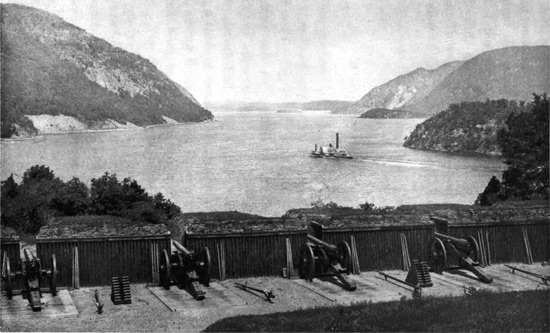
the guns being fired at the huge side of old Cro' Nest
Mountain to the northward. Gee's Point is also
above, and from its extremity was extended the second
big chain across to Constitution Island, used during
the later years of the Revolution, to obstruct the
passage, also buoyed on timber floats; some of its
huge links being still preserved. Constitution Island
was long the home of Susan Warner, the authoress,
who died in 1885, and her grave is in West Point
Cemetery. Her Hills of the Shatemuc is full of Hudson
River scenes, but her best-known book was The
Wide, Wide World, published in 1850.
The military post and academy of West Point is
about fifty miles north of New York, the Government
domain covering twenty-four hundred acres.
The buildings stand on a plain of one hundred and
sixty acres, elevated one hundred and fifty-seven feet
above the river, with mountains all around, rising in
some cases fifteen hundred feet, the highest being
old Cro' Nest. South of the Academy, on a commanding
hill six hundred feet high, are the ruins of
Fort Putnam, the chief work during the Revolution.
When that war began in 1775 it was ordered that
the passes of the Hudson through the Highlands
should be fortified, and Fort Constitution was built
on the opposite island. As the higher adjacent hills
commanded it, this work was soon abandoned, and
three years later West Point was selected and fortified,
with Fort Clinton at the Point, and several
other formidable works, becoming the "American
Gibraltar," the second massive chain being then extended
across to the island as an additional protection.
It was considered the most important post in
the country, and at the time of Arnold's treason in
September, 1780, was garrisoned by over three
thousand men, and had one hundred and eighteen
cannon in the various works. After peace came,
the military defenses fell into ruin; but Washington
repeatedly recommended that a military school be
established at West Point, and in 1802 it was authorized
by Congress, going into operation in 1812.
The earthworks of the original Fort Clinton on the
point, built by the youthful engineer Thaddeus Kosciusko
in 1778, have been restored, and are carefully
preserved. This young officer, descended from
a noble Polish family, had not completed his studies
in the military school of Warsaw when he eloped
with a girl of high rank. The enraged father pursued
and captured them, and the youthful lover was
compelled either to slay the father or abandon the
daughter. He chose the latter, and going to Paris
met Dr. Franklin, who soon filled him with a desire
to help the struggling Americans, and he came over
and entered the army as an engineer in 1776. He
served with distinction throughout the war, was
made a General, and publicly thanked by Congress.
He fought afterwards in the Polish Revolution, and
retiring to Switzerland, died in 1817. He is buried
in the Cathedral Church of Cracow, and near that
city a mound one hundred and fifty feet high has
been raised to his memory, earth being brought from
every battlefield in Poland. The Kosciusko monument
of marble was erected in memory of the noble
Pole in an angle of Fort Clinton at West Point in
1829.
ARNOLD'S TREASON.
West Point itself saw no fighting, the great event
of its early history being Benedict Arnold's treason.
Across the river from the Point, and under the
shadow of Sugar Loaf Mountain, is Beverly Cove,
with a little wharf, where then stood Beverly House,
previously the home of a prominent loyalist, Colonel
Beverly Robinson of Virginia. Dr. Dwight, afterwards
President of Yale College, was Chaplain of a
Connecticut regiment at West Point in 1778, and he
then climbed the Sugar Loaf, describing its view
over the Highlands as "majestic, solemn, wild and
melancholy." Arnold, when he plotted for the surrender
of the post with André at Treason Hill,
below the Highlands, agreed to the treason for
$50,000 gold and a Brigadier General's commission
in the British army. Believing the plot was working
prosperously, Arnold, after the interview, had crossed
from the Point over to Beverly House, his headquarters,
and three days afterwards breakfasted there
on September 24, 1780. Hamilton and Lafayette
arrived early that morning and met him, announcing
that Washington was at the ferry below and would
soon join them. While at the table, Arnold received
a letter from an officer down the river with the
startling intelligence, "Major André of the British
army is a prisoner in my custody." Arnold is said
to have acted with wonderful coolness in the presence
of his distinguished company, and although evidence
of his own guilt might at any moment have arrived,
he thoroughly concealed his emotions. Ordering a
horse prepared, on the plea that his presence was
needed "over the river," he left the table and went
up stairs to his wife. He briefly told her they must
part, perhaps forever, as his life depended on speedily
reaching the British lines. The poor young wife, a
bride of less than two years, was horror-stricken,
and swooning, sank senseless upon the floor. Arnold
dare not summon assistance, but kissed their sleeping
infant, and mounting his horse galloped down to the
wharf. Here he jumped into his six-oared barge,
ordering them to row him swiftly down the Hudson,
strengthening their energies by a promised reward
of two gallons of rum. The oarsmen worked with a
will, not knowing where they were going, and were
astonished when he got below the Highlands to find
him guiding them to the British sloop "Vulture."
They were kept aboard as prisoners by Arnold's
orders, and saw him greeted as a friend by their
enemies. Even Sir Henry Clinton, when they arrived
in New York, despised this meanness and
ordered their liberation.
Washington arrived at Beverly House soon after
Arnold had left, being anxious to see him, but could
not find him. The General took a hasty breakfast
and crossed over the river to West Point seeking
him, but having no suspicions. He was disappointed
at not finding Arnold there, and talking to Colonel
Lamb, commanding Fort Clinton, the latter told him
he had not heard from Arnold for two days. Washington's
suspicions began to awaken, and crossing
back to Beverly House, he was met by Hamilton,
with the papers found upon André, revealing Arnold's
guilt. He summoned Lafayette and Knox for
counsel, and the deepest sorrow evidently stirred
Washington's bosom as he asked them the memorable
question, "Whom can we trust now?" But
soon the condition of the deserted wife, who was
frantic with grief and apprehension, aroused his liveliest
sympathy. Describing the scene, Hamilton
wrote: "The General went up to see her. She upbraided
him with being in a plot to murder her child,
for she was quite beside herself. One moment she
raved; another she melted into tears. Sometimes
she pressed her infant to her bosom and lamented its
fate, occasioned by the imprudence of its father, in
a manner that would have moved insensibility itself."
Washington did all in his power to soothe her, believing
her innocent of previous knowledge of her
husband's guilt. After Arnold had got safely aboard
the "Vulture," he wrote to Washington, imploring
protection for his wife and child, saying: "She is as
good and innocent as an angel, and as incapable of
doing wrong." Ample protection was afforded, and
they were sent safely to her friends. She was Miss
Shippen of Philadelphia, and only eighteen years old
when Arnold, then the Military Governor of Philadelphia,
married her in 1778, his second wife. The
infant, James Robertson Arnold, afterwards became
a distinguished officer in the British army, serving
with credit in different parts of the world, and rising
to the rank of Lieutenant General, dying in London
in 1854. Benedict Arnold was made a Major General
by the British, and was given a considerable
sum of money; but his life was unhappy, as he was
shunned and often insulted, and sinking into obscurity,
he died in London in 1801. His treason
was deliberately plotted, investigation showing he
had been over a year in correspondence with the
enemy, and had sought the command at West Point,
given him in August, 1780, in order to compass its
surrender.
OLD CRO' NEST AND THE STORM KING.
The dark pile of old Cro' Nest, guarding the
northern side of West Point, rises fourteen hundred
and eighteen feet, one of the noblest mountains of
the Highlands. Beyond it, the Storm King and
Mount Taurus are the northern portals of the pass,
with Pollopell's Island, rocky and tree-clad, lying in
the river between, and farther on the distant hazy
shores enclosing Newburg Bay. These buttresses
of the northern entrance solidly rise as protectors of
the pass into the valley:
"Mountains that like giants stand
To sentinel enchanted land."
On the northern side of the promontory making
the Point, upon a little level plain above the cliffs,
overlooking the river, and almost under the shadow
of old Cro' Nest, is the West Point Cemetery. Here
is buried General Winfield Scott. Upon the Parade
Ground is the Battle Monument, erected in 1894, a
column seventy-eight feet high, surmounted by a
statue of Victory. Down along the most beautiful
part of the shore at the Point, and leading to Kosciusko's
Garden, a favorite resort of the Polish
officer, is the secluded path which generations of impulsive
young cadets have known as the "Flirtation
Walk." Beginning at the roadway, high on the
bluff, overlooking the river, it winds with devious
turns down the declivity, and after curving around
the promontory near the water's edge, sweeps grandly
up the incline again. This trysting-path leads under
a lacework of foliage, giving it pleasant and meditative
gloom even when the sun shines brightly. Over
across the river is the village of Cold Spring, having
both above and below the shores rising steeply, and
hung upon the edge is the pretty Church of St.
Mary's, with its columned portico and surmounting
belfry. Nearby the railway running along the shore
pierces a tunnel through a rugged protruding rock.
Here is the Cold Spring foundry that makes cannon
for the army. Almost under the Parade Ground on
the northern side is the Siege Battery, where the
guns in time of artillery practice carry on a noisy
and reverberating warfare across the Cove against
the dark and towering side of old Cro' Nest. This
grand mountain, the target for the youthful gunners,
inspired the muse of George P. Morris, the lyric
poet of the Highlands, whose delightful home was at
Undercliff, across the river above, at the foot of
Mount Taurus. His eyes perpetually feasted upon
the view of this peak, and thus he described it:
"Where Hudson's wave o'er silvery sands
Winds through the hills afar,
Old Cro' Nest like a monarch stands
Crowned with a single star."
Up the Hudson from the Water Battery,
West Point
The northern portal of the Highlands is guarded
on either hand by the Storm King, rising fifteen hundred
and twenty-nine feet, and Mount Taurus, fifteen
hundred and eighty-six feet. There are also a
galaxy of attendant peaks. Beyond Mount Taurus
is Breakneck Hill, rising nearly twelve hundred feet,
with a chain of mountains stretching far to the northeast,
among them the Old Beacon and the towering
Grand Sachem, sixteen hundred and eighty feet
high. The Storm King was the old Boter-Berg of
the early Dutch, thus named because, to their
matter-of-fact minds, the mountain resembled nothing
so much as a huge lump of butter. Similarly, the
eastern portal of the pass was Bull Mountain originally,
but has since been more classically transformed
into Mount Taurus. The ancient Knickerbocker
legend records how the primitive inhabitants chased
a wild bull around this mountain to the peak beyond
it, where he fell and broke his neck, thus naming
both of them, though Breakneck Hill yet awaits a
more classic transformation.
The geologists tell us that in early ages, like the
Minisink of the Delaware, the region north of the
Highlands adjacent to the Hudson Valley was a vast
lake, extending back to Lake Champlain, which still
remains as a fragment of the inland sea, following
the melting of the great glacier. To get a southern
outlet, the river broke through the mountain barrier
and formed the winding and romantic Highland Pass.
There is a grand outlook from the summit of the
Storm King over this valley to the northward. The
river expands into the beautiful Newburg Bay, its
most perfect land-locked harbor, and its course can
be traced through the "Long Reach" for more than
twenty miles, a broad, straight stream between the
pleasant banks, up to Crom Elbow, the "Krom
Elleboge" of the original Dutch colonists. Villages
dot the shores, and fertile fields stretch up on either
hand, while hung in mid air, far away across the
water, is the distant, slender, spider-like span of the
high railway bridge at Poughkeepsie, the route by
the "back door" into New England, which has gone
through such serious throes of reconstruction. Upon
the left hand the Catskills, and upon the right hand
the Berkshire Hills of Western Massachusetts, bound
the distant horizon. Behind, and to the southward,
the river can be traced as it winds through the Highlands
down to Anthony's Nose, while nearer, one can
look into the depression on top of the adjoining
mountain, within a surrounding amphitheatre of
peaks that makes the striking resemblance giving
the significant name to the old Cro' Nest.
THE CULPRIT FAY.
Between the Storm King and old Cro' Nest is the
deep and beautiful Vale of Tempe, with wild ravines
furrowed through it, forming channels for clear
mountain streams, and the trees conceal many a delicious
dell. In this picturesque nook among the
mountains is laid the scene of Joseph Rodman
Drake's charming poem of "The Culprit Fay":
"'Tis the middle watch of a summer's night,
The earth is dark but the heavens are bright;
Naught is seen in the vault on high
But the moon and the stars and the cloudless sky,
And the flood which rolls its milky hue,
A river of light on the welkin blue.
The moon looks down on old Cro' Nest,
She mellows the shades on his shaggy breast,
And seems his huge gray form to throw
In a silver cone on the wave below;
His sides are broken by spots of shade,
By the walnut bough and the cedar made,
And through their clustering branches dark
Glimmers and dies the fire-fly's spark,
Like starry twinkles that momently break
Through the rifts of the gathering tempest's rack."
The story is told that Drake, then about twenty-one
years of age, and James Fenimore Cooper and
Fitz-Greene Halleck, who were his close friends, in
August, 1816, were strolling through these Highlands.
His companions got into a discussion, holding
that our American rivers gave no such rare opportunities
for poetic fancy as the streams of older
lands. Drake disputed this, and, to prove the contrary,
composed within three days this exquisite
poem, which has largely made his fame. It is a
simple yet interesting story. The fairies living in
this beautiful valley are called together at midnight
to punish one who has broken his vow, and they sentence
him to a difficult penance, with all the evil
spirits of air and water opposing. The genius of
the poet interweaves the poem with every natural
attraction the locality affords. Thus are the fairies
summoned to the dance:
"Ouphe and goblin! imp and sprite!
Elf of eve and starry fay!
Ye that love the moon's soft light,
Hither, hither, wend your way.
Twine ye in a jocund ring;
Sing and trip it merrily;
Hand to hand and wing to wing,
Round the wild witch-hazel tree."
These Cro' Nest fairies are a dainty race. Owlet's
eyes are their lanterns; they repose in cobweb hammocks
swung on tufted spears of grass and rocked
by midsummer night zephyrs; some lie on beds of
lichen, with pillows of the breast-plumes of the humming-bird;
others nestle in the purple shade of the
four-o'clock, or in rock-niches lined with dazzling
mica. Velvet-like mushrooms are their tables, where
they quaff the dew from the buttercup. Their king's
throne is of spicewood and sassafras, supported on
tortoise-shell pillars and draped with crimson tulip-leaves.
The "culprit" himself, however, in his
beautiful outfit and quaint adventures, gives the best
imagery of the poem. At the opening of his journey,
chagrined and fatigued, he captures a spotted
toad for a steed, and bridles her with silk-weed twist,
spurring her onward with an osier whip. Arriving
at the water's edge, he plunges in, but leeches, fish
and other watery foes drive him back with bruised
limbs. The use of cobweb lint and the balsam dews
of sorrel and henbane relieve his wounds, and being
refreshed by the juices of calamus, he embarks in a
mussel-shell boat, painted brilliantly without and
tinged with pearl within. He gathers a colen-bell
for a cup, and sculls into the middle of the stream,
laughing at the foes who chatter and grin in the
water. There he sits in the moonlight, until a
sturgeon, coming by, leaps glistening into the silvery
light; and then, like a liliputian Mercury, balancing
upon one foot, he lifts the flowery cup and catches
the sparkling drop that washes the stain from his
wing. He returns to the shore, having sweet nymphs
grasping the sides of the boat with their tiny hands
and urging it onward. The next enterprise of the
"culprit" is more knightly. He is arrayed as a
fairy cavalier, in acorn helmet, plumed with thistle-down,
corselet made of a bee's nest, and cloak of
butterfly wings. His shield is a lady-bug's shell;
his lance a wasp-sting; his spurs of cockle-seed; his
bow of vine-twig strung with corn-silk; and his
arrows, nettle-shafts. He mounts a fire-fly steed,
and waving a blade of blue grass, speeds upward to
catch a flying meteor's spark. Again the spirits of
evil are let loose, those of air being as bad as those
of water. A sylphid queen tries to enchant him
with her beauty and kindness; she toys with the
butterfly cloak as he tells the dangers he has passed.
But he never forgets the object of his pilgrimage,
and triumphing over the foes of air, he is escorted
with honor by the sylph's lovely retinue; his career
is resumed, his flame-wood lamp rekindled, and before
a streak of dawn is proclaimed in the eastern
sky by the sentry elf, the "Culprit Fay" has made
his full penance and been welcomed back to all his
original glory. Drake died at the early age of
twenty-five, a victim of consumption, and his grave
is beside the little river Bronx in New York. To
his memory his friend Halleck wrote the noted
poem, thus beginning:
"Green be the turf above thee,
Friend of my better days!
None knew thee but to love thee,
Nor named thee but to praise."
NEWBURG BAY.
Emerging from the Highlands, the gentle slopes
of the town of Cornwall are under the shadow of
the Storm King, while the mountain range stretches
off to the northeast, with Fishkill village in front,
and the Revolutionary signal station of the Old
Beacon standing up prominently behind. These
mountains were the Indian Matteawan, the "Council
of Good Fur." The same name was given the
stream draining their sides until the Dutch called it
Vis Kill, or Fish Creek, and hence its present name
and that of the village. The shores of Newburg
Bay seem low, as they are dwarfed by the mountains,
and on the western slope an elevated bench of table-land
in terraces stretches back to the distant hills.
The town of Newburg, which has about twenty-five
thousand people, spreads up these terraces, and in
front there are storehouses, mills and railway terminals.
When Hendrick Hudson sailed his ship "Half
Moon" through the Highlands, he was attracted by
the site of Newburg, and wrote: "It is as beautiful
a land as one can tread upon; a very pleasant place
to build a town on." A tribe of the Minsis who had
a village known as the Quassaic, meaning "the Place
of the Rock," then occupied it, and would not for a
half-century permit a settlement. They were driven
away, however, and a colony of Lutherans from the
Palatinate came here and founded the "Palatine
Parish of Quassaic." They did not flourish, and
ultimately some Scots arrived from the Tay, and seeing
quite a resemblance to their old home, named the
place Newborough. Its most distinguished citizen
has probably been General John E. Wool, born here
in 1788. At the southern end of this pleasant town,
a short distance back from the river, is its chief
celebrity, a low, old-fashioned graystone building,
appearing to be almost all roof, from which tall chimneys
rise. There is a broad lawn and flagstaff in
front, and a grove for the background. This is the
historic house, maintained by New York State as a
relic, which was General Washington's headquarters
during the closing campaign of the Revolution. It
was built by Jonathan Hasbrouck, a Huguenot, in
1750, and is also known as the Hasbrouck House.
In its centre is a large hall, having a huge fireplace
on one side, and containing seven doors, but only one
window. This was Washington's reception hall, and
here he dined with his guests. At the foot of the
flagstaff on the lawn is buried the last survivor of
Washington's Life Guard, Ural Knapp, who died in
1856 at the age of ninety-seven. This Guard,
organized in Boston in 1776, continued as his bodyguard
throughout the war, and was selected from
all the regiments of the army. Knapp was its
sergeant, and at his last public appearance at a
banquet in Newburg, the old man made a brief address,
concluding with an invitation to the entire
company to attend his funeral; four months later
they did so.
The "Tower of Victory" is a fine monument,
built on the grounds by the Government, and surmounted
by a statue of Washington in the act of
sheathing his sword. A bronze tablet with the figure
of Peace announces that it was erected "in commemoration
of the disbandment, under proclamation
of the Continental Congress of October 18, 1783, of
the armies by whose patriotic and military virtue our
National independence and sovereignty was established."
It was at Newburg that Washington was
offered the title of King by the officers of the army,
but declined it. Over at Fishkill is the old Verplanck
House, with its quaint dormer windows, which
was the headquarters of Baron Steuben, and here,
upon the disbandment of the army, was held the
meeting of the officers at which was formed the Society
of the Cincinnati, Washington being its first
president. The mountainous region east and south
and the "neutral ground" were the haunts of Enoch
Crosby of Massachusetts, the American spy of the
Revolution, whose exploits all about this locality Fenimore
Cooper wove into his novel The Spy, a Tale of
the Neutral Ground, which made the novelist's earliest
fame. The ancient Wheaton House, around
which much of the tale centred, is still there. The
Murderer's Creek comes down to the Hudson through
Newburg,—an attractive stream which deserved a
better name, but did not get it until N. P. Willis,
who lived at Cornwall, and who converted the Dutch
"Butter Hill" into the Storm King, and "Bull Hill"
into Mount Taurus, tried his persuasive powers at
Newburg and got this stream softened into the pleasant
Indian name of Moodna. The neighborhood of
Newburg is famous from a scientific standpoint for
the finding of the remains of mastodons. One was
unearthed there in 1899, making the eleventh found
in Orange County, New York, during the past century,
some of them being among the finest specimens
extant.
At the head of Newburg Bay, on the western
shore, is a rocky platform down by the waterside,
known as the "Devil's Dance Chamber." When
the "Half Moon" came up the river and anchored
for the night, this broad flat rock, now almost hidden
by cedars, was the scene of a wild midnight revel of
the Indians, with all the accessories of song and
dance, fire and war-paint, at which the Dutch sailors
marvelled exceedingly, calling it the "Duyvel's
Dans-Kamer." Here the warlike Minsis of the Quassaic,
before going on hunting expeditions or the warpath,
would paint themselves grotesquely and dance
around a fire with horrible contortions, singing and
yelling under direction of the soothsayers or "medicine
men." They believed, if this was kept up long
enough, the evil spirit would appear, either as a wild
beast or a harmless animal; if the former, it foreboded
ill-fortune and the expedition was abandoned,
while the latter was a good omen. These hideous
performances afterwards scared old Governor Peter
Stuyvesant, according to the veracious Knickerbocker,
when he sailed up the river, for the historian
says, "Even now I have it on the point of my pen
to relate how his crew was most horribly frightened,
on going on shore above the Highlands, by a gang of
merry, roystering devils, frisking and curvetting on
a huge flat rock projecting into the river, and which
is called the Duyvel's Dans-Kamer to this very day."
POUGHKEEPSIE AND VASSAR.
The Hudson River's "Long Reach" stretches
many miles almost due northward, and on it is Poughkeepsie,
with thirty thousand population, midway between
New York and Albany. Near here lived stout
Theophilus Anthony the blacksmith, who forged the
great chains stretched across the Hudson in the Highlands,
for which the British burnt his house and carried
him a captive down to the New York prison-ships.
Here, at Locust Grove, a foliage-covered
rocky point protruding into the river, was long the
home of Professor Samuel F. B. Morse, the inventor
of the electric telegraph. Poughkeepsie spreads
broadly upon its group of gentle hills, with the great
railway-bridge crossing high overhead, elevated two
hundred feet above the water, and nearly a mile and
a half long. The Poughkeepsie streets, lined with
fine elms, maples and acacias, rise upon the sloping
banks to a height above the bridge level, the town
being environed by rocky buttresses. The Indians
named the place Apo-keep-sinck, or the "pleasant
and safe harbor," and in it they housed their canoes.
From this was gradually evolved the present name,
through a variety of spellings, of which no less than
forty-two different styles are found in the old records
of the town. The "safe harbor" of the Indians was
between two protruding rocky bluffs, and is now filled
with wharves. The rapid Winnakee Brook leaps
into it, a stream which the Dutch called the Fall
Kill. The northern bordering bluff was their Slange
Klippe, or the "Adder Cliff," infested with venomous
serpents, and the other is the "Call Rock." Tradition
tells that once a band of Mohican warriors
who had made a foray into New England brought
here some Pequot captives, among them a young
chief who was tied to a tree for a sacrifice, when a
shriek startled them, and a girl, leaping from the
thicket, implored his life. She also was a captive
Pequot and his affianced. As the captors debated,
the warwhoop was suddenly sounded by hostile
Hurons, and they seized their arms for defense. The
maiden released her lover, but in the conflict they
were separated, and a Huron carried her off. The
young chief was almost inconsolable, but he pursued
them beyond the river, and conceived a daring plan
for rescue. He entered the Huron camp disguised
as a wizard, found the maiden ill, and her Huron
captor implored the wizard to save her life. This he
essayed to do, she recognized him, and eluding the
Huron vigilance, they escaped at nightfall. They
made their way to the Hudson, paddled over in a
canoe, and though pursued, he brought her into the
"safe harbor," concealed her, and then, by the aid
of the friendly Indians he found there, beat off the
Hurons.
The Dutch often sailed by, and cast longing eyes
upon this spot, so favorable for a settlement, but it
was nearly a century after Hudson's exploration
when the venerable yet venturesome Baltus Van
Kleek concluded it was about time to take possession.
He landed in the harbor, became the lord of the
manor, and in 1705 built near the Winnakee Brook
a stout fortress-dwelling, which stood until recently.
It was loop-holed for musketry, and in it the New
York Legislature met for two sessions during the
Revolution. Out in front was the "Call Rock,"
where old Baltus and his friends used to stand and
hail the passing Dutch sloops when they wanted to
get the news or journey upon the river. The New
York State Convention met at Poughkeepsie in 1788,
and ratified the Federal Constitution by the small
majority of three, after a protracted debate. From
its many elevations, this leading city of the Hudson
Valley has a superb outlook, only limited by the
Catskills far to the northwest, the Highlands down
the river, and the dark-blue Shawangunk ridge off
to the westward, where the attractive lakes Mohonk
and Minnewaska, the former at twelve hundred and
the latter at eighteen hundred feet elevation, nestle
high among the mountain peaks, overshadowed by
the bold summits of Paltz Point and Sky Top. Here
flows deep in the valley the pretty Wallkill, out to
the Rondout and the Hudson, giving the railroad a
route into the mountain fastness.
About two miles back from the river, and behind
the city, is Vassar College, the foremost educational
institution for women in the world. The splendid
buildings stand in grounds covering two hundred
acres, attractively laid out, and the main building,
modelled after the Tuileries, with high surmounting
dome, is five hundred feet long. From Sunset Hill,
their highest eminence, there is a panorama of the
Hudson for forty miles. This college was the gift
of Matthew Vassar, a wealthy Poughkeepsie merchant
and brewer, of English birth, who desired to
make it the most complete foundation of its kind, and
gave and bequeathed $1,000,000 besides the land,
there being over $400,000 expended upon the buildings.
His nephews have since made large additional
gifts. Here is provided a complete mathematical,
classical and English education for several hundred
female students. Its main building is the chief
structure of Poughkeepsie. There are art galleries,
a museum, library and observatory. The museum
of American birds is the most complete existing,
there is a fine gallery of water-colors, and a collection
of ancient weapons and armor, including the
halberd of King Francis I. The founder, having an
ample fortune and no children, devoted the closing
years of his life to this beneficent work, the college
being begun in 1861 and opened in 1865. He
labored assiduously at its development and died at
his post of duty. Three years after the opening,
when attending the annual meeting of the trustees,
while reading his address, he was suddenly stricken
with death.
CROM ELBOW TO KINGSTON.
Upon the Hudson River's "Long Reach" is the
favorite locality of the winter "ice-boat races," this
exhilarating sport in boats on runners speeding over
the ice, before the wind, being much enjoyed. A
few miles above Poughkeepsie the reach comes to
an abrupt termination, in the bent and narrow pass,
where the cliffs compress the channel and form the
crooked strait known as the Crom Elbow, the Dutch
and English words having the same meaning. Above,
the western shore for a long distance is lined with
apple orchards and vineyards, while the eastern bank
for over thirty miles is a succession of villas interspersed
with hamlets. Moving northward, the noble
Catskill range comes into full view, gradually changing
from distant gray to nearer blue, and then to
green with the closer approach. Along the river for
many miles, where these magnificent mountains give
such a grand front outlook, there are a series of old
Knickerbocker estates, many occupied by the descendants
of the early settlers. Here was the princely
home of the late William B. Dinsmore of Adams
Express Company, a business begun in 1840 with
two men, a wheelbarrow and a boy, Dinsmore being
one of the men and the late John Hoey of Long Branch
the boy. Dinsmore built his gorgeous palace on the
Hudson—and died. On the western shore is Pell's
great apple orchard, shipping the fruit from twenty-five
thousand trees all over the world. Some distance
above, the Rondout Creek comes out through a deep
gorge, having the twin cities of Rondout and Kingston
nestling among its bordering hills. They have
together over twenty-five thousand people. This
was the outlet of the abandoned Delaware and Hudson
Canal. Kingston Point, the mouth of the creek,
was the place of earliest Dutch settlement in this
part of New York, where they called it Wittwyck,
or the "Wild Indian Town," and for defense built a
redoubt, whence come the name of Rondout.
The historic city of Kingston spreads back to
Esopus Creek, a short distance inland, and was the
Esopus town of colonial times, the name coming from
the Indian dwellers here, meaning "the river." The
old "Senate House" of Kingston, built in 1676, was
the first meeting-place of the New York Legislature,
and it now contains a collection of Dutch and other
relics. The Esopus Indians broke up the original
settlements with a terrible massacre, but Huguenot
refugees came and re-peopled the place, and during
the Revolution Esopus was such a "nest of rebels"
that when the British came along in 1777 they burnt
it. This punishment was inflicted because it was
made the capital and the first New York State Constitution
had been framed here during the preceding
February. The tale is told that the British landing
to burn the town scared a party of Dutch laborers,
who briskly scampered off. One of them stepped on
a hay-rake, and the handle flying up gave him a
sharp rap on the head. Being frightened more than
hurt, and sure that a Britisher closely pursued him,
he fell on his knees, and imploringly exclaimed,
"Mein Gott, I give up; hooray for King Shorge!"
Kingston is a great producer of flagstones and manufactory
of Rosendale cements, made from a fine-grained,
hard, dark-blue stone, which is broken,
burnt in kilns with coal, ground, and then prepared
for market. Mixed with clean sharp sand, this
cement becomes in time entirely impervious to water,
and has all the strength of the best natural building
stones.
GREAT HISTORIC ESTATES.
The solid old German burgher William Beckman
came over from his native Rhine in 1647, and went
sailing up the Hudson, his Fatherland memories
being delighted at the sight of a noble hill on the
eastern bank, opposite Rondout Creek. He settled
there, building a house, and behind the hill started
the town of Rhinebeck, a combination of his own
name and that of his native river. This well-known
Rhinecliff stands up alongside the Hudson, much
like a vine-clad slope bordering the great German
river, and is adorned with the ancient Beckman
House, a stone structure built for a fort and dwelling.
Famous estates surround Rhinebeck. Here is Ellerslie,
the summer home of Levi P. Morton, formerly
Vice-President, fronting the river for a long distance.
The Astor estate of Rokeby, which was the home of
William B. Astor and his son William Astor, is north
of Rhinebeck, the house, surmounted by a tower,
standing in a spacious park about a mile back from
the river. Rokeby was a noted place in Revolutionary
days, the home of General Armstrong, whose
daughter married the elder Astor. Here is the Fleetwood
estate, with its old house, built in 1700, having
the "cannon-room" in front, with a port-hole facing
the river. Here are Wilderstein and Grasmere, the
home of the Livingston descendants, also Wildercliff,
built by Rev. Freeborn Garrettson, one of the
founders of the Methodist Church in America, its
name signifying the "wild Indian's cliff." Garrettson
was educated in Maryland for the Church of
England. As a matter of conscience he afterwards
espoused the cause of the Methodists, then in their
infancy, entered their ministry, freed his slaves,
and preached the gospel of Methodism everywhere,
declaring his firm faith in a special Providence,
and often proving it in his own person. Once a
mob seized him and was taking him to jail, when
a sudden and overpowering flash of lightning dispersed
them, and he was left unmolested. In 1788
he came to New York in missionary work, and was
made Presiding Elder of the district between Long
Island Sound and Lake Champlain. Coming to
Clermont, among his converts was the sister of
Chancellor Livingston, and he married her in 1793,
shortly afterwards building his house at Wildercliff.
This was long a home for Methodist clergymen, his
daughter continuing his hospitality. Another historic
estate, just above Rokeby, is Montgomery
Place, the home of another Livingston, the widow
of General Montgomery, who was in the colonial
attack upon Quebec, by Wolfe, and afterwards, in
the early days of the Revolution, led a forlorn hope
against Quebec, and perished as Wolfe had before
him. His young widow lived here a half-century,
and her brother's descendants now possess it.
Krueger's Island, on the eastern shore, discloses in
a grove a picturesque ruin, with broken arches, specially
imported from Italy by a former owner of the
island to give it a flavor of antiquity. The Catskills
now rise in grander view, the Plattekill Clove comes
down out of them, and Esopus Creek from the south
flows into the Hudson. The Dutch called this
Zaeger's Kill, which time corrupted into Saugerties,
a pleasant factory village built behind the flats at the
creek's mouth, and having the Catskills for a splendid
background. Opposite, on the eastern bank, is
Tivoli, and near here is located the parent estate of
these historic homes. Robert Livingston came from
Scotland to America in 1672 and married a member
of the Schuyler family, who was the widow of a Van
Rensselaer. He was a patrician of high degree,
of the family of the Earls of Linlithgow, and seeking
a home in the American wilderness, settled on the
Hudson. He first lived at Albany, and being Secretary
to the Indian Commissioners, he acquired extensive
tracts of land fronting the river, which afterwards
became the basis of great wealth. In 1710
these lands were consolidated under one English
patent, giving him a princely domain of one hundred
and sixty-two thousand acres for an "annual rent of
twenty-eight shillings, lawful money of New York,"
equalling about $3.50. This "Livingston Manor"
gave him a seat in the Colonial Legislature, and he
built his manor-house upon a grassy point along the
Hudson River bank, at the mouth of "Roeleffe Jansen's
Kill," flowing in a few miles north of Tivoli.
The greater part of the manor descended to his son
Robert, who built a finer mansion there, known as
"Old Clermont," which the British burnt during the
Revolution. In this house was born the grandson,
the famous Chancellor of New York, Robert R. Livingston,
who had so much to do with guiding the
course of the State in that momentous era. He built
the present Clermont mansion on the river bank
above Tivoli. It is on a bluff shore, a grand estate
surrounding it, and sloping gradually up to the hill-tops
stretching to the horizon behind. This estate
extended back originally to the Berkshire hills. The
full glory of the Catskills is spread out in panorama
before this noted mansion, with the distant hotels
perched on the mountain tops.
Chancellor Livingston was sent Minister to France,
and when he returned he brought over merino sheep,
introducing them into this country. His great honor
as a man of science comes from his connection with
Fulton's steamboat experiments. He met Fulton in
Paris, and was closely connected with the first steamboat
on the Hudson, which in fact could not have
been built without his aid. By the help of Livingston's
money, Fulton in 1807 built this steamboat in
New York, naming her the "Clermont" in his honor.
The experiment was publicly derided as "Fulton's
Folly," but he persevered and succeeded. The "Clermont"
was one hundred feet long, twelve feet beam
and seven feet depth. In September, 1807, she
made the first successful experimental trip from New
York to Albany in thirty-six hours, charging the
passengers $7.50 fare. She afterwards made regular
trips, and on October 5, 1807, the Albany Gazette
announced: "Mr. Fulton's new steamboat left New
York on the 2d, at ten o'clock A.M., against a strong
tide, very rough water, and a violent gale from the
north. She made a headway against the most sanguine
expectations and without being rocked by the
waves." Chancellor Livingston in Jefferson's Administration
negotiated the cession of Louisiana by
France to the United States, and ripe with honors,
he died at Clermont in 1813.
THE CATSKILL MOUNTAINS.
Opposite these great estates, the Catskill Mountains
rise in all their glory, spreading across the
western horizon at a distance of eight to ten miles
from the Hudson River. They stretch for about
fifteen miles, and the range covers some five hundred
square miles. The most prominent peaks in
the view are Round Top and the High Peak, rising
thirty-seven hundred and thirty-eight hundred feet,
and in front of them, on lower elevations, are the
summer hotels that have such superb views over the
Hudson River valley. The town of Catskill on the
river—a flourishing settlement of five thousand people—is
the usual point of entrance, and from it a
railway extends back to the bases of the mountains.
An inclined plane railway over a mile long then
ascends the face of the range, sixteen hundred feet
high, to the hotels. This "Otis Elevating Railway,"
which accomplishes its journey in about ten minutes,
is said to be the greatest inclined road in the world.
The Indians knew these grand peaks as the Onti
Ora, or "Mountains of the Sky," thus named because
in some conditions of the atmosphere they appear
like a heavy cumulus cloud hanging above the
horizon. The weird Indian tradition was that among
these mountains was held the treasury of storms
and sunshine for the Hudson, presided over by the
spirit of an old Indian squaw who dwelt within the
range. She kept the day and the night imprisoned,
letting out one at a time, and made new moons every
month and hung them up in the sky, for they first
appeared among these mountains, and then she cut
up the old moons into stars. The great Manitou
also employed her to manufacture thunder and clouds
for the valley. Sometimes she wove the clouds out
of cobwebs, gossamers and morning dew, and sent
them off, flake by flake, floating in the air, to give
light summer showers. Sometimes she would blow
up black thunder-storms and send down drenching
rains to swell the streams and sweep everything
away. All these storms coming from the west appeared
to originate in the mountains. The Indians
also told of the imps that haunted their dells, luring
the hunters to places of peril. When the Dutch
colonists came along, they sent expeditions into the
mountains, searching for gold and silver, but chiefly
found wildcats, causing them to be named the Kaatsbergs,
and from this their present title has come to
be, in time, the Kaatskills or the Catskills.
These attractive mountains are a group of the
Alleghenies, having spurs extending northwest and
west, at right angles to the general trend of the
range, thus giving them quite a different form from
that usual in the Allegheny ridges. They assume
also more of the abrupt and rocky character of the
Alpine peaks, and instead of the usual folds or fragments
of arches commonly seen elsewhere, the Catskill
crags are masses of piled-up strata in the original
horizontal position. They have a most precipitous
declivity facing the east towards the river valley.
Deep ravines, which the Dutch called "Cloves," are
cut into them by the mountain torrents, descending
in places in beautiful cascades, sometimes for hundreds
of feet. This aggregation of rocky cliffs and
rounded peaks, and the intersecting gorges and smiling
verdant valleys, have become a great resort for
the summer pleasure-seeker, with myriads of hotels
and boarding-places, where it is said that eighty to
a hundred thousand people will go in the season.
Their eastern verge is drained by the Hudson, while
the many brooks and kills flowing out to the westward
are gathered into the two branches that form
the Delaware River.
From their eastern front, where the huge hotels,
built at twenty-four hundred feet elevation, are anchored
by ponderous chain cables to keep them from
being overthrown by the wind, there is an unrivalled
view over the valley. The Hudson River stretches
a silvery streak across the picture, and can be traced
nearly a hundred miles from West Point up to Albany.
Its distant diminutive steamboats slowly
move, and like a shining thread, as the western sun
strikes the car-windows and is reflected, a railway
train glides along the bank ten miles away, seen so
well, and yet so small. The perpendicular mountain
wall brings the valley almost beneath one's feet, the
buildings looking like children's toy houses, the trees
like dwarfed bushes, and the fields, with their alternating
green and brown colors, contrasting as the
spaces on a chess-board. Wagons crawl like little
ants upon the narrow mud-colored lines representing
roads. The broad valley, though its surface is
rugged and has high hills surmounted by patches of
woodland, is so far below that it appears from above
as a flat floor. Thus it stretches off to the river,
with a sparkling pond here and there, and extending
beyond to the eastern horizon the view is enclosed
by the dark-blue Berkshire hills in Massachusetts,
forty miles away. Behind them, on favored days,
rise like a misty haze, off to the northeast, the White
Mountains of New Hampshire. It was in this region
that James Fenimore Cooper located the "Leather
Stocking Tales," for his home at Cooperstown was on
the Catskills' western verge. Natty Bumppo climbed
up the mountain to get this wonderful view. "What
see you when you get there?" asked Edward.
"Creation," said Natty, sweeping one hand around
him in a circle, "all creation, lad," and then he continued,
"If being the best part of a mile in the air,
and having men's farms at your feet, with rivers
looking like ribands, and mountains bigger than the
'Vision' seeming to be haystacks of green grass
under you, give any satisfaction to a man, I can
recommend the spot."
RIP VAN WINKLE AND THE KAATERSKILL.
These Catskill Mountains were purchased from
the Indians on July 8, 1678, by a company of Dutch
and English gentlemen, who took their title at a
solemn conclave held at the Stadt Huis in Albany,
where the Indian chief Mahak-Neminea attended
with six representatives of his tribe. The Indians
seem to have soon disappeared, and the region for a
century or more remained mythical and almost unexplored,
thus contributing to the many fairy tales that
have got mixed up with its history. It was among
these wonderful mountains that Washington Irving
was thus enabled to discover Rip Van Winkle.
Down on the mountain side, upon the margin of a
deep dark glen leading up from Catskill Village,
stands Rip Van Winkle's ancient little cabin. It is
within the vast amphitheatre where Hendrick Hudson's
ghostly crew held their revels and beguiled him
to drink from the flagon which put him into his sleep
of twenty years. It was a curious revel, for with the
gravest faces, and in mysterious silence, they rolled
their nine-pin balls, which echoed along the mountains
like rumbling peals of thunder. The huge
cliffs overhanging the dark glen were evidently put
there for just such a ghostly scene, and even now the
old denizens of the Catskills are said to never hear a
summer thunder-storm reverberating among these
mountains without concluding that the Dutch ship's
company from the "Half Moon" are again playing
at their game of nine-pins. There is still pointed
out the slab of rock on which Rip took his long sleep,
and until recently there is said to have lived in the
old cabin an alleged "Van Winkle" who made a
pretence to be a descendant of the original Rip, and
dispensed to the weary traveller liquids fully as sulphurous
as those in the flagon of the ghostly crew.
Among these mountains originated many of the
quaint Dutch legends that have got so interwoven
into the early history of New York that it is hard to
separate the fact from the fiction.
It was not until 1823 that the first summer hotel
was built in the Catskills, a rude little structure
standing where is now the Mountain House, near the
summit of the inclined plane railway. The highest
peak of the range is Slide Mountain, in the western
Catskills, at the head of the Big Indian Valley, rising
forty-two hundred and five feet. A large portion of
this mountain, including the crest, is a New York
State reservation, and from its top six States are in
view. These Catskill peaks are built up of huge and
jagged piles of crags and broken stone, through
which the torrents have carved the "Cloves." The
stratified rocks are easily split into layers, and they
furnish the towns along the Hudson with much of the
flagging used for footwalks. Enormous boulders,
some as big as a house, are liberally strewn about,
where they were dropped by the great glacier.
Among the grandest of the gorges, which the torrents
have cleft, is the Kaaterskill Clove, its stream, after
various windings, finally flowing eastward towards
the Hudson. As the name Kaatskill comes from the
cat, so the Kaaterskill is regarded as derived from an
animal of most complete feline development, the
"gentleman cat." The steep borders of this Kaaterskill
Clove, a wonderful canyon, down in the bottom
of which ice and snow remain during the summer,
furnish many points of remarkable outlook, giving a
startling realization of the vast scale of these mountains.
The stream bubbles far below, heard but not
seen, and the mountain peaks above are occasionally
obscured by passing clouds. Adjoining this canyon
is an immense gorge carved out of the hills, into
which pours the majestic Kaaterskill Falls, plunging
down an abyss of two hundred and sixty feet in two
leaps, respectively of one hundred and eighty and
eighty feet. The stream is dammed above the cataract,
so that in times of drouth the water may be retained
and the falls thus be exhibited at intervals by
turning on the water, as is the case with various
cataracts in Switzerland. Few waterfalls have had
more praises sung than this ribbon of spray, which
was a favorite both of Cooper and Bryant. An inscription
on the rock at the foot preserves the memory
of a faithful dog, who once jumped down to follow a
stone, because he thought it his master's bidding.
The unique description of the Kaaterskill Falls by
Cooper's Leather Stocking is interesting. He says,
"The water comes crooking and winding among the
rocks, first so slow that a trout might swim in it, and
then starting and running just like any creature that
wanted to make a far spring, till it gets to where the
mountain divides like the cleft hoof of a deer, leaving
a deep hollow for the brook to tumble into. The
first pitch is nigh two hundred feet, and the water
looks like flakes of driven snow afore it touches the
bottom; and then the stream gathers itself together
again for a new start, and may be flutters over fifty
feet of flat rock before it falls for another hundred,
where it jumps about from shelf to shelf, first turning
this a-way, and then turning that a-way, striving to
get out of the hollow, till it finally comes to the plain.
To my judgment, it's the best piece of work I've met
with in the woods, and none know how often the hand
of God is seen in the wilderness but them that rove
it for a man's life." William Cullen Bryant thus
sings the praises of the Kaaterskill Falls:
"'Midst greens and shades the Kaaterskill leaps
From cliffs where the wood-flower clings;
All summer he moistens his verdant steeps
With the sweet, light spray of the mountain springs;
And he shakes the woods on the mountain side,
When they drip with the rains of autumn tide.
"But when in the forest bare and old,
The blast of December calls,
He builds, in the star-light clear and cold,
A palace of ice where his torrent falls,
With turret, and arch, and fret-work fair,
And pillars blue as the summer air."
At the head of the Kaaterskill Clove are Haines's
Falls in a picturesque environment, the stream making
two main leaps of one hundred and fifty and
eighty feet, and other plunges lower down, descending
in all four hundred and seventy-five feet, within
the distance of a quarter of a mile. The water here
is also dammed to make a better exhibition. A main
railway route into the Catskills is from Kingston up
the valley of Esopus Creek, gradually ascending to
its sources in the southwestern part of the range.
This leads past the highest peak, Slide Mountain,
past Shandaken or "the rapid water," and up the
Big Indian Valley, at the head of which the summit
is crossed between the waters of the Hudson and the
Delaware. The "Big Indian" whose memory is
thus preserved was Winnisook, a savage seven feet
high. He fell in love with a white maiden of the
lowlands, who, however, married one Joe Bundy instead,
but got along so unhappily that she finally ran
away to her dusky lover. Winnisook on one occasion
came down to the lowlands with his tribe on a
cattle-stealing expedition, and Joe Bundy shot and
mortally wounded him, saying, "The best way to
civilize the yellow serpent is to let daylight into his
black heart." The Big Indian was afterwards found
dead standing upright in the hollow of a large pine
tree. The inconsolable maiden, overwhelmed with
grief, is said to have spent the rest of her life near
Winnisook's grave, while the stump of the pine was
preserved until the railroad came along and covered
it with an embankment. The whole Catskill region
is full of charming places, and the vast summer
crowds who visit it never tire of the bracing atmosphere,
and the magnificent and ever-changing panorama
of cloud and sunshine and diversified landscape,
exhibited from its magnificent mountain tops.
"'Tis here the eastern sunbeams gild
The hills which rise on either hand;
Till showers of purple mist are spilled
In glittering dewdrops o'er the land."
THE DUTCH AND THE SHAKERS.
When Hendrick Hudson came up the river he
found sand-bars above the Catskills, and anchored
his "Half Moon" near Mount Merino, at what is now
the head of ship navigation upon the Hudson, one
hundred and fifteen miles from New York. Just beyond,
a high plateau sloping to the shore is covered
by the city of Hudson, having a green island in front,
and over opposite the little town of Athens, with a
lighthouse in midstream between them. Hudson has
ten thousand people, a picturesque city sloping up
Prospect Hill, which rises five hundred feet for a
noble background, and it once had more ships and
commerce than the city of New York. A colony of
thrifty Quakers from New England started the settlement,
which had many fishermen and whalers, and
a large fleet of ships sailing to Europe and the Indies,
fifteen loaded vessels having cleared from its wharves
in a single day. But Napoleon's wars swept away its
fleet and commerce, and the last ship was sold in
1845, so that its commercial greatness is only a tradition;
although it has become a seat of considerable
manufactures. Its most noted citizen was General
Worth, a hero of the Mexican War, whose monument
stands on Fifth Avenue, New York. Both
sides of the river here are inhabited by the Dutch,
and in fact theirs is the universal language of the
Hudson from Kingston up to Albany. These Dutch
of New York have given the country some notable
men, among them General Philip Schuyler, Colonel
Van Rensselaer, General Stryker and others of the
Revolution, and President Martin Van Buren. They
view with pardonable pride the important share they
have had in founding and building up the Empire
State, and Rev. Dr. Henry A. Van Dyke has poetically
and ingeniously described the "Typical Dutchmen"
of New York:
"They sailed from the shores of the Zuyder Zee
Across the stormy ocean,
To build for the world a new country
According to their notion:
A land where thought should be free as air
And speech be free as water;
Where man to man should be just and fair,
And Law be Liberty's daughter.
"When the English fleet sailed up the bay,
The small Dutch town was taken;
But the Dutchmen there had come to stay;
Their hold was never shaken.
They could keep right on, and work and wait
For the freedom of the nation;
And we claim to-day that New York State
Is built on a Dutch foundation."
From the Taghkanic range of the Berkshire hills,
behind Hudson City, a pretty stream comes down in
many falls and cascades to the river just northward,
whose charming valley was known among the Dutch
as "Het Klauver Rack," or the "Clover Reach,"
modernized since, however, into the Claverack Creek.
The Columbia Springs are in this valley, and farther
on is Kinderhook Village, while back on the hills at
a thousand feet elevation above the river, most picturesquely
located, are the Lebanon Springs. Here
is the noted Shaker settlement of New Lebanon,
founded by "Mother Ann" in the eighteenth century.
The sect has been declining in recent years, however.
This is the governing Shaker community, and it has
been well said, of these celibates, that "by frugality
and industry they give us many useful things, but
they do not produce what the Republic most needs—men
and women." They cultivate large tracts of
land, produce and sell quantities of herbs, seeds and
botanic medicines, and make baskets, brooms and
sieves. Ann Lee was the wife of a blacksmith in
Manchester, England, and had been the mother of
several children. She had what she claimed as
Divine revelations, and was confined in a lunatic
asylum for reviling matrimony. Being released in
1770, she founded the new sect, announcing, "I am
Ann, the Word," and to escape further persecution
migrated to New York, where she was made its
spiritual head. Converting many, she established at
New Lebanon the capital of the Shaker world, which
has been called "the rural Vatican which claims a
more despotic sway over the mind of man than ever
the Roman Pontiff assumed." She claimed her Divine
revelation to be that she was the female manifestation
of Christ upon earth, the male manifestation
having been Jesus, and the Deity being considered
a duality, composed of both sexes. The Shakers call
themselves the "United Society of Believers in
Christ's Second Appearing." They have entire community
of property, believe idleness to be sinful, and
everyone able to work is employed. In worshipping
they "exercise both soul and body," singing and
dancing, and at times of fervent excitement making,
with regularity and perfect rhythm, rapid bodily evolutions.
In these they form in circles around a band
of singers, to whose music they "go forth in the
dances of them that make merry." Since the death
of "Mother Ann" the Shaker community has been
ruled by what is known as the "Holy Lead," composed
of the first and second elders and elderesses.
A peculiar tenet is that persons may join the sect
after death, and among these posthumous members
are Washington, Lafayette, Pocahontas, Napoleon
and Tamerlane; and they hold that woman is supreme
over mankind. Near the village and among the Berkshire
hills, just over the border in Massachusetts, is
their "Mount Sinai," where, according to the tradition,
the Shakers hunted Satan throughout a long
summer night, finally killing and burying him. They
tell us that Washington and Lafayette still keep
guard over his grave, mounted on white horses, and
can be seen on summer nights by any of the truly
faithful who may pass that way.
The village of Kinderhook is in the Claverack
Valley, and out in front on the Hudson is its port,
Stuyvesant Landing, where the testy old Governor,
Peter Stuyvesant the "Headstrong," made his landing
when he came up the river to attack the great
Patroon, Killian Van Rensselaer. Hendrick Hudson
is said to have first named Kinderhook, or "Children's
Point," because he saw here a crowd of Indian
children watching his vessel. On the Lindenwold
estate at Kinderhook, embowered in linden trees,
lived for many years President Martin Van Buren, a
descendant of the early Dutch settlers, and the
shrewdest New York politician of his time. Over
on the western bank is the Chaney Tinker Lighthouse,
mounted on a crag a hundred feet high, and
the distant horizon is bounded by the Helderbergs, a
long range of peaks, lower, however, than the Catskills.
Above, at Schodack Landing on the eastern
shore, was the seat of the council-fire of the Mohicans,
called by the French the Loups or Wolves. The
word "Is-cho-da" in their language means the "fireplace,"
and from this has come the name. When
Hudson ascended the river, he found the Mohicans
occupying its shores for a hundred miles above Rondout
Creek, but the race dwindled, until it became
the handful to whom the noted Jonathan Edwards
ministered in the eighteenth century, at Stockbridge,
Massachusetts. Hudson passed a day with them at
Schodack, was treated hospitably, and wrote that
their land was "the finest for cultivation he ever set
foot on." Two centuries later, Cooper lamented the
Last of the Mohicans.
THE LAND OF THE PATROONS.
We have now come to the high and rocky Bear or
Beeren Island, which in New York's early days was
the southern boundary on the river of the domain of
the great Patroon, Killian Van Rensselaer. It marks
the limit of two counties on either bank, Greene and
Columbia below, joining Albany and Rensselaer above.
Here stood the proud castle of Rensselaerstein, cannoned
and fortified, where the Patroon's agent, the
bold and doughty Nicolas Kroon, compelled all the
Dutch sloops coming up from New Amsterdam to
dip their colors in token of his sovereignty, and pay
tribute for the privilege of entering the sacred domain.
We are told that all passing craft yielded
homage excepting two large whales, which in 1647
swam by and went up to the Mohawk, greatly terrifying
the honest Albany burghers. Above the island,
the Normanskill and other streams come down from
the Helderbergs, making the shoals of the "Overslaugh,"
which the Government has improved by an
extensive dyke system to deepen the river channel
up to Albany. There are long and narrow alluvial
islands on these flats, among which tows of Erie
Canal barges thread their careful way; and ahead,
the city of Albany comes into view with its bridges
in front, and the grand new Capitol building elevated
high on the hill above the town, its red-topped pyramidal
roofs seen from afar.
We are now at the domain of the great Patroon,
the region around Albany and Troy. When Hudson
anchored his ship below the shoals, he came with five
of his sailors up to Albany in a row-boat and examined
the location. The result was that from his report
Albany was actually settled, five years later, in
1614, by the "United Nieu Nederlandts Company,"
who built a trading-post, thus making Albany, after
Jamestown in Virginia, the oldest European settlement
in the original thirteen colonies. The post was
located on an island just below the city, near which
the Normanskill flowed out through the forest on the
western bank—the Indian Tawasentha, or "place of
many dead." This island was called the "Kasteel,"
and in the "castle" a garrison of about a dozen
Dutchmen conducted a profitable fur-trade with the
Mohicans. Ultimately a freshet drove them to the
mainland and they built a fort at the mouth of the
Normanskill, and in 1623 a stockade was constructed
above, at Albany, named Fort Orange in honor of
the Prince of the Netherlands. In 1629 colonists
were sent out from Holland, and the patroon system
established. The Dutch West India Company made
arrangements for extensively colonizing the New
Netherlands, and passed a charter of exemptions and
privileges to encourage patroons (or patrons) to make
settlements. Every patroon establishing a colony
was to have there within four years, as permanent
residents, at least fifty persons, over fifteen years of
age, of whom one-fourth were to arrive the first year.
A director of the company, Killian Van Rensselaer,
a pearl merchant of Amsterdam, was granted a
patroonship, and got the officials at Fort Orange to
buy extensive tracts from the Indians. He thus,
with three others, acquired a manor extending
twenty-four miles along the Hudson, from Beeren
Island up to the Mohawk River, and this manor,
which afterwards became the sole property of his
family, was subsequently enlarged to extend twenty-four
miles back from the Hudson in both directions,
and contained over seven hundred thousand acres.
The Patroon was a feudal lord, possessing absolute
title to the soil, with power to administer civil and
criminal justice, and enjoying other rights that reduced
his colonists to a condition little better than
serfs. His son Johannes inherited this patroonship
from Killian, and it went by entail through five
generations, when the United States laws barred
further succession. The last Patroon, General
Stephen Van Rensselaer, died in 1839, and his son
Stephen, the sixth of the line, still styled by courtesy
"the Patroon," died in 1868, aged eighty years.
The original settlement of Fort Orange in the manor
of Rensselaerwyck, as it was called, became a centre
of the fur-trade, and a town quickly grew around the
fort, which the English, upon their occupation in
1664, named Albany.
THE ANTI-RENT WAR.
As population increased on the adjacent lands, they
began taking leases from the Patroon, paying rent
for their farms, and this produced one of the bitterest
conflicts known in American politics, the New York
"Anti-Rent War." After the Revolution the inhabitants
increased rapidly, and General Stephen
Van Rensselaer, then the Patroon, leased farms in
perpetuity, upon the nominal consideration for eight
years of "a peppercorn a year," and at the expiration
of this time these leases drew a rent estimated
at six per cent. interest on the land value, about $5
per acre, payable in the produce of the soil, fowls, and
days' service with wagons and horses, the latter designed
to secure road-making. When the old General
died in 1839, the entail being abolished, he
divided the manor between his two sons, Stephen
getting Albany County on the west bank, and William,
Rensselaer County on the east bank, including
Troy. He had been a lenient landlord, but the tenants
became anxious, especially about what was
known as the "quarter sales clause" in their leases,
giving the landlord the right to claim one-fourth the
purchase money whenever the land passed by purchase,
this condition being really inserted to prevent
alienation, as it did not become operative when the
land was sold or descended to one of the original tenant's
family. The tenants proposed that the landlord
should sell the reservations, releasing them from the
rentals and making them owners in fee, but this was
declined. The tenants then employed counsel, who
advised that the landlord's right was absolute, but
suggested, while there was no legal remedy, that it
would be good policy to make the rent collections so
difficult, the landlord would be willing to come to
terms; that they band together and give each other
notice of the approach of bailiffs, so the service of
legal process would be troublesome. William H.
Seward, Governor of New York, espoused their
cause, and to this advice, he being a candidate for
re-election in 1840, he added the recommendation
that the "anti-renters" should organize and send to
the Legislature men who would hold the balance of
power between the great parties, thus forcing the
passage of laws relieving them.
Then began the "anti-rent" conflicts convulsing
New York politics for years. They formed an active
and powerful political party, and created other organizations,
disguised as Indians, who attacked the
law officers. These supposed red men killed a man
at Grafton in Rensselaer County, and all legal efforts
failed to discover the culprits. Other similar manors
existed in different parts of New York State where
payment of rents of much the same character was resisted,
and these regions also were excited. Outbreaks
continued several years, until in 1845 Governor
Silas Wright issued a proclamation declaring
Delaware County, on the western verge of the Catskills,
in a state of insurrection. This caused additional
trouble, but the "anti-renters" disposed of
Wright by defeating him for re-election in 1846, and
he died soon afterwards. They elected their own
candidate for Governor, John Young, who pardoned
out of jail nearly everybody imprisoned for "anti-rent"
crimes. The disputes finally got into the
courts, and the Van Rensselaers, fatigued with the
controversy, sold all their rights to a Colonel Church.
He was sustained by legal decisions, and then adopted
a compromising policy, which quieted the agitation.
He released the rentals and gave fee-simple titles, so
that at least three-fourths of the old manor became
without rental. His method of compromise was
based on a scale: for a farm of one hundred and
sixty acres where the annual rent was twenty-two
and one-half bushels of wheat, four fat fowls and one
day's service, the value was fixed at $26, being six
per cent. interest on $433, and by paying this the
tenant got his fee-simple title. Thus the harassing
conflict which frequently required troops to be called
out at Albany and elsewhere was finally adjusted.
THE CITY OF ALBANY.
Albany, the New York State Capital, has over one
hundred thousand people. The city rises from the
strip of level land along the river bank, in a series
of terraces, to a height of nearly two hundred feet,
the top being surmounted by the Capitol Building in
a spacious park, back of which the surface extends
westward in a sandy, almost level plain. The city
spreads broadly along the river, where there are
wharves, foundries, railway stations, mills, storehouses
and lumber yards. Deep ravines are scarred
into the hill behind them, and rows of fine old Knickerbocker
houses line the hilly streets, with frequent
church towers and spires rising above them. The
main street, just back from the river, is Broadway,
of varying width, but of the first commercial importance.
At right angles to it, leading up the hill, is
State Street, a noble avenue, one hundred and fifty
feet wide, the front approach to the Capitol. This is
the finest building in New York State, was thirty
years in construction, and has cost $25,000,000. It
is a quadrangle three hundred feet wide and four
hundred feet deep, with an unfinished central tower,
intended to be three hundred feet high, and Louvre
pavilion towers at the angles. It is built in the
French Renaissance, of a light-colored granite, pleasantly
contrasting with the red-tiled roofs. Few of
the pretentious buildings of the world occupy a more
commanding situation, standing aloft like the Capitol
at Washington, and, seen from afar, a complete old-time
French chateau. Mr. E. A. Freeman has
written of it, "If anyone had come up to me and told
me in French, old or new, that the new Capitol was
'Le Chateau de Monseigneur le duc d'Albanie,' I
could almost have believed him." Its architecture
combines features adapted from the Louvre and Hotel
de Ville of Paris and the Lyons Maison de Commerce.
It stands in Capitol Square, a park of about eight
acres, of which it covers three acres. The finest
halls are the Senate and Assembly Chambers, to
which grand stairways lead, and the interior is decorated
with rich carvings, rare marbles and emblematic
frescoes. The New York State Library, of
nearly two hundred thousand volumes, is in the building.
Upon the six dormer windows opening in the
interior court are emblazoned the heraldic insignia
of six noted families distinguished in New York history—Stuyvesant,
Schuyler, Livingston, Jay, Clinton
and Tompkins.
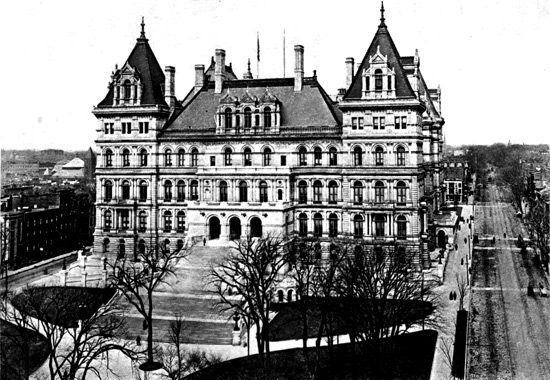
The State Capitol, Albany, N. Y.
Southward from the Capitol Square is the spacious
and comfortable Executive Mansion, with an extensive
lawn, on Eagle Street. On the same street, to
the northeast of the Square, is the City Hall, a fine
Gothic building with an elaborate bell tower. Also
on Eagle Street is the Albany Medical College, having
one of the finest Medical Museums in the country.
Among its curios is the embalmed body of Calvin
Edson, the "walking skeleton." This curious
man came to Albany in 1830, being then forty-two
years old and five feet two inches high, yet weighing
only sixty pounds. He exhibited himself, and appeared
in a play as Jeremiah Thin. He had a good
appetite, but the more he ate the thinner he grew,
until in 1833, the food ceasing to nourish him, he
literally starved to death amid plenty, and when the
end came, weighed but forty-five pounds. His widow
sold his body to the college, and he now stands in a
glass case, preserved with the skin on, labelled "No.
1," and excepting discoloration is said to appear not
very different from when living. On the northern
side of the Square is the Albany Academy, one of the
chief city schools, where Professor Joseph Henry was
for several years an instructor, and noted as the place
where he first demonstrated the theory of the magnetic
telegraph by ringing a bell by an electric spark
transmitted through a mile of wire strung around the
room. The Dudley Astronomical Observatory is a
small but imposing building upon an eminence overlooking
the Hudson, having a munificent endowment
begun by Mrs. Blandina Dudley in memory of her
husband, a wealthy Albany merchant. A charming
spot is Washington Park, westward from the Capitol,
an enclosure of eighty-one acres, surrounded by ornamental
villas, with magnificent views and most
tastefully arranged. Part of this Park is land given
the city by King James II.
INTERESTING BUILDINGS.
The most noted old Albany building is at the northern
end of Broadway, in grounds extending to the
river, and surrounded by fine trees, the ancient
Van Rensselaer Mansion, commonly called the "Patroon's,"—a
broad house with porch and wide central
hall. This occupies the site of the first mansion,
which was covered with a roof of reeds. Over on
the opposite side of the river at Greenbush, the
"Greene Bosch" or "pine woods" of the original
settlers, is the Patroon's other residence, built of
bricks from Holland, by the second Patroon Johannes.
Port-holes were cut in the walls for the musketeers,
it having been a fort in the Indian forays. The
family burial-ground adjoins the mansion. State
Street, at the corner of Pearl, which is parallel with
Broadway, is the most interesting historic locality of
ancient Albany. Here stood that elaborate dwelling
of the Knickerbockers, regarded as the best specimen
of old Dutch architecture in New York State,
the "Vanderheyden Palace," an extensive building
with two tall gables facing the street. One of the
old burghers, Johannes Beekman, built it in 1725,
and during the Revolution Jacob Vanderheyden of
Troy bought it, and lived there many years in the
almost regal state of the Dutch aristocracy. Washington
Irving tells of it in the story of Dolph Heyliger,
in Bracebridge Hall, as the residence of "Herr
Anthony Vanderheyden," and when Irving transformed
Van Tassel's old farmhouse into his villa at
Sunnyside he made a gable in imitation of one of
these, and also captured the old weather-vane of the
"Palace"—a horse going at full speed—to mount on
top of it. Upon the opposite corner was the quaint
"Lydius House," the home of Rev. John Lydius, the
owner of a great manor at Fort Edward, farther up
the Hudson, and in front of it stood the crooked elm,
giving the locality the name of the "Old Elm Tree
Corner." This tree is said to have been planted by
Philip Livingston, a signer of the Declaration of Independence,
who lived in an adjoining house. The
"Lydius House" had been built as a parsonage for
the clergyman sent out to the old Dutch church,
Rev. Gideon Schaats, the bricks, tiles, iron and
woodwork, together with the church bell and pulpit,
all coming from Holland in 1657, in the same ship.
During many years its only occupant was Balthazar
Lydius, an eccentric bachelor, a tall, spare, morose
and irritable Dutchman, fond of bottle and pipe, and
having a round bullet head thinly sprinkled with
white hair. He gloried in his celibacy until the infirmities
of age came upon him, when it is said he
gave a pint of gin for an Indian squaw, called her his
wife, and they lived contentedly together until he
died. This was the oldest brick building in the
United States; its partitions were made of mahogany
and the exposed beams were richly carved.
The antique pulpit, which came across in the ship
with the materials of the "Lydius House," has done
duty from then until now in various Dutch churches
of Albany. It is of carved oak, octagonal in form.
The original church stood in the middle of State
Street, a low building with a tall pyramidal roof and
little steeple, since removed to widen the street. The
church gallery was quite low, while the huge stove
warming the building was put upon a platform so
high that the sexton had to step on it from the gallery
when he wanted to kindle the fire. The astute
Albany philosophers of those days believed heat descended
from above. The bell-rope hung from the
little steeple down into the centre of the church, and
here, at eight o'clock at night, was rung the "suppawn
bell," a signal to the obedient people to eat
their "suppawn" or hasty pudding, and go to bed.
Albany in the olden time had a quaint aspect because
of the predominance of steep-roofed houses, with
their terraced gables, but many of them have given
way for modern improvements. Upon State Street, at
the corner of James, lived in one of these the famous
Anneke Jans Bogardus, who died there in 1663, the
owner of the lands in New York city now partly held
by Trinity Church, which her heirs have acquired so
much notoriety in trying to recover. A bank now
occupies the site. Albany has had some interesting
history. In 1754 the Congress met here which was
the first colonial organization, and finally developed
into the Continental Congress. Seven colonies, north
of Maryland, sent twenty-five Commissioners, who
made a treaty with the Iroquois, the Indian league
of the "Six Nations." Afterwards, under the guidance
of Benjamin Franklin, a plan was adopted for a
union of the colonies, its provisions being much
similar to the United States Constitution of 1787.
Thus the germ of the American Union was first developed
at Albany. Her influences have been powerful
in politics. For many years the "Albany Regency"
controlled the old Democratic party, this
name having been given by Thurlow Weed, then
editor of the Albany Evening Journal, to a junta of
politicians usually assembling there, headed by Martin
Van Buren. Subsequently, another combination at
Albany was potential in ruling the Whigs and in
controlling the Republican party—the political firm
of "Seward, Weed and Greeley." Albany manœuvres
managed to control the preliminaries that twice
made Grover Cleveland President; and in both
parties the Albany political "patroons" are still industriously
at work.
Among the finest Albany buildings is the magnificent
new Episcopal Cathedral of All Saints, an
English Gothic structure, as yet incomplete, which
will be one of the most beautiful churches in America.
In the southern part of the city is the Schuyler Mansion,
built in 1760, a brick house with a broad front,
having a closed octagonal porch over the doorway
and spacious apartments; its lawns in the olden time
reaching to the Hudson, where now the city is densely
built. Peter Schuyler was the first Mayor of Albany,
and his descendant, General Philip Schuyler of the
Revolution, occupied a large space in New York history.
In this house Alexander Hamilton was married
to Elizabeth Schuyler, and a subsequent owner,
Mrs. McIntosh, was made the wife of Millard Fillmore,
President of the United States. General
Schuyler and his family always dispensed a princely
hospitality in this mansion. In 1781, towards the
close of the Revolution, it was the scene of a stirring
event. The British, discovering that Schuyler was
at home, tried to capture him. The house was then
distant from the small town and surrounded by forests.
A party of Canadians and Indians prowled for several
days in the woods, and capturing a laborer, learnt
that the General was in the house with a bodyguard
of six men. The laborer escaped afterwards and
notified the General. Upon a sultry day in August,
when three of the guards were asleep in the basement
and the other three lying on the grass in front of the
house, a servant announced that a stranger at the
back gate wished to speak with the General. The
errand being apprehended, the doors and windows
were barred, the family collected up stairs, and the
General hastened to his bedchamber for his arms.
From the window he saw the place surrounded by
armed men, and fired a pistol to arouse the guards
on the grass and alarm the town. At this moment
the enemy burst open the doors, when Mrs. Schuyler
suddenly discovered she had left her infant in the
cradle in the hall below. She rushed to the rescue,
but the General stopped her. One of her daughters
then quickly ran down stairs, and carried the infant
up in safety. An Indian who had entered hurled a
tomahawk, as she rushed up the stairs, which cut her
dress within a few inches of the baby's head, and
striking the hand-rail made a deep scar. As she ran
up stairs, the Tory commander, thinking her a servant,
called out, "Wench, where is your master?"
With great presence of mind she quickly replied,
"Gone to alarm the town." General Schuyler heard
her, and taking advantage, threw up a window, crying
out loudly, as if to a multitude, "Come on, my
brave fellows, surround the house and secure the villains!"
The marauders, who were then plundering
the plate in the dining-room, becoming frightened,
beat a hasty retreat, taking prisoners the three guards
who were in the house. The brave daughter, who
made the gallant rescue, afterwards became the wife
of the last Patroon Van Rensselaer, while the infant
she saved lived until 1857, and was Schuyler's last
surviving child, Mrs. Catharine Cochran of Oswego,
New York. General Schuyler is buried in the beautiful
Albany Rural Cemetery, north of the city, and
nearby is Palmer's famous figure of the "Angel at
the Sepulchre." Here is also the tomb of President
Chester A. Arthur, who died in 1886.
THE MODERN TROY.
Travelling northward along the Hudson, the broad
basin where the Erie Canal comes out to the river is
passed, being shielded by a pier eighty feet wide and
nearly a mile long. Here is the vast storehouse for
Canadian and Adirondack lumber brought by the
canals, a leading Albany industry, there being ten
miles of dockage within this basin for the lumber
barges. The Erie Canal from the west, and also the
Champlain Canal from the north, here have their outlets
into the Hudson. Both sides of the river are
lined with villages between Albany and Troy—there
being Greenbush, East Albany, Bath, Troy and West
Troy, and beyond, Lansingburgh and Waterford at
the confluence of the Mohawk. This series of cities
and towns stretching for ten miles along the shores,
with intervals of farm land, have an aggregate population
exceeding three hundred thousand, with large
manufactures and commerce. There are extensive
iron mills on the river and upon Green Island in
front of Troy, where General Gates had the camp for
his Revolutionary army which fought Burgoyne at
Saratoga. Upon the western bank is the Watervliet
Arsenal, where the government manufactures army
supplies, an enclosure of over a hundred acres. Troy
is a fringe of city extending along the eastern bank
and up the steep ridge behind, crowned by the imposing
Byzantine buildings and spires of St. Joseph's
Theological Seminary. This high ridge, bordering
the alluvial flat on which the modern Troy is built,
thoroughly carries out the Grecian idea which was
adopted to supersede the original Dutch name of
Vanderheyden which was given the town. From
the northeast Mount Olympus and from the east
Mount Ida frown upon Troy, and this modern Mount
Ida does not hesitate at times to hurl down Jove's
thunderbolts in the form of destructive landslips.
Derick Vanderheyden leased this estate from the
Patroon in 1720, and it slept in Dutch peacefulness
until after the Revolution, when in 1789 it had
twelve dwellings and the freeholders adopted the
present name. Just before this, Jacob Vanderheyden
had removed to Albany to occupy his "Palace."
The opening of the Erie Canal gave Troy great prosperity.
It has fine water-power, and thus became a
busy manufacturing centre. Here are the great Albany
and Rensselaer Iron Works, which were famous
makers of armor plates and cannon in the Civil War,
and the Berdan Horseshoe Mill, the largest in the
country, which has the biggest water-wheel, eighty
feet in diameter, turned by one of the kills coming
down from the mountain behind the town. It was
here that John Ericsson built the little "Monitor"
ironclad which defeated the "Merrimac" at Fortress
Monroe in 1862. There are also great textile mills
and a vast laundry. Its famous Polytechnic Institute
is an endowment of the last Patroon, Stephen
Van Rensselaer, who was Troy's steady benefactor.
THE DEFEAT OF BURGOYNE.
The Mohawk, its principal tributary, flows into
the Hudson just above Troy, and each, being a mountain
torrent, has brought down large alluvial deposits
making extensive flats between the hills, so that their
junction is marked by fertile islands and low shores,
backed by picturesque ridges bordering broad valleys.
Here are Green Island, Adam's Island and
Van Schaick's Island, making an extensive delta.
The Mohawk, after flowing from central New York
nearly one hundred and forty miles in a rich agricultural
section, pours down the falls at Cohoes, and
enters the Hudson through four separate channels
formed by these islands. The Mohawk Valley is
largely a pastoral region, its dairies and cheeses having
much fame, and in the lower valley hop-growing
and broom-making are important industries, chiefly
controlled by the Shakers. At one of their settlements,
about six miles northwest of Albany, their
foundress, "Mother Ann," who died in 1784, is
buried. The Hudson flows to its confluence with the
Mohawk, with generally rapid current, bordered by
rich plains, as it is ascended to Stillwater, and thirteen
miles beyond, to Schuylerville, where Fish Creek
comes in, the outlet of Saratoga Lake.
Here is a region of great historic interest, for
through it marched Sir John Burgoyne's army in
1777 to disastrous defeat. At and above Stillwater,
and Bemis's Heights beyond, was the scene of his
closing conflict, while Schuylerville stands upon the
site of his camp at the time of his final surrender.
General Schuyler, from whom the village is named,
was then the owner of the entire domain of Saratoga.
Burgoyne had come south from Canada to meet another
British force thought to be advancing up the
Hudson from New York, the design being to cut the
rebellious colonies in two and defeat them in detail.
The rebels hung upon Burgoyne's flanks, and at Bennington,
Vermont, Stark's bold movement in August
captured a large force of Hessians. Schuyler sent
Arnold up the Mohawk, who cut off another detachment
under St. Leger, who had come over from Oswego,
intending to make a detour to Albany. In
September, Burgoyne came to Saratoga, and had his
first contest south of the springs, with the Americans
under Gates. Afterwards, each army encamped
within cannon-shot of the other until October 7th,
Burgoyne all the while hoping for some diversion
from the lower Hudson. The British camp was on
the river below Schuylerville, and on that day they
marched out to give battle, Burgoyne's chief lieutenant,
General Fraser, directing the movements. Fraser
was in full uniform, mounted upon an iron-gray steed,
and became a most conspicuous object. Colonel Morgan,
who had a force of Virginia sharpshooters, perceived
this, and calling a number of his best men
around him, pointed to the British right wing, which
was making a victorious advance under Fraser's inspiration,
and said: "That gallant officer is General
Fraser; I admire and honor him, but it is necessary
he should die; victory for the enemy depends on
him; take your stations in that clump of bushes and
do your duty." Within five minutes afterwards he
was mortally wounded. His aid, recognizing that he
was a conspicuous mark, had just observed: "Would
it not be prudent for you to retire from this place?"
and he had scarcely got the reply out of his mouth,
"My duty forbids me to fly from danger," when he
was shot. He survived throughout the night, and
asked to be buried in a redoubt he had built on a hill
near the Hudson. He died next day, and at sunset
a funeral procession moved towards the redoubt.
The Americans saw it, and, ignorant of what it meant,
cannonaded, but desisted on learning the mournful
object; and then a single cannon, fired at intervals,
reverberated along the Hudson; an American minute-gun
in memory of a brave soldier.
Fraser's fall caused the British defeat, and they
afterwards abandoned guns and baggage trains and
retreated north to Schuylerville. Burgoyne's provisions
gave out, many auxiliaries deserted him, the
camp was incessantly cannonaded, and finally, with
his forces reduced below six thousand men, on October
17th, he surrendered. It was said at the time,
in the British Parliament, that the campaign thus
ended "had left the country stripped of nearly every
evidence of civilized occupation," and in its result it
was declared to be "one of the fifteen decisive battles
of the world." There were six members of Parliament
among the captive officers, and Burgoyne gave
up forty-two brass cannon. His army was held in
captivity nearly five years, till the end of the war, at
first near Boston, and later in Virginia. This victory
was the turning-point of the Revolution. Among its
results were, an appreciation of twenty per cent. in
Continental money; the bold stand of Lord Chatham
and Edmund Burke in Parliament, denouncing the
method of conducting the war; the sending of cheering
words to the struggling colonies by Spain, Holland,
Russia and the Vatican; and the paving of the
way for France to acknowledge the independence of
the United States—all the result, under Providence, of
Fraser's indiscreet devotion to duty. In the neighborhood
is the great Methodist camp-meeting ground of
Round Lake, and farther on Ballston Spa, where the
Kayaderosseras Creek winds through a beautifully
shaded valley and flows into Saratoga Lake. In the
early part of the nineteenth century this was the greatest
watering-place in America, its waters being chemically
similar to those of Saratoga. Its Sans Souci
Hotel, opened in 1804, was then the grandest in the
country, and here were hatched most of the political
schemes of the days of Presidents Madison, Monroe
and Jackson, the "Albany Regency" in its palmiest
days flourishing throughout the summer time on its
lawns and porches. But much of Ballston's glory has
departed, eclipsed by the newer radiance of its great
neighbor, six miles away. The Saratoga Lake is
three miles east of Ballston, an oval-shaped lake eight
miles long, from which Fish Creek meanders off to
the Hudson at Schuylerville. As the fishes thus
ascended from the river into the lake, the Indians
named it Saraghoga, or "the place of the herrings."
SARATOGA.
The famous watering-place, Saratoga, is a comparatively
small town upon a level and somewhat barren
plateau. A short distance north of Saratoga Lake,
with a boulevard and electric road connecting them,
is the shallow valley wherein are the famous mineral
springs. Their virtues were long known to the Iroquois,
and when the renowned French explorer
Jacques Cartier ascended the St. Lawrence in 1535,
searching for the "northwest passage," the Indians
on the river bank told him about these springs and
their wonderful cures. The Mohawks, who had these
waters in their special keeping, regarded them with
veneration. In August, 1767, their great English
friend and adopted sachem, Sir William Johnson, who
is said to have been the father of a hundred children,
was suffering from re-opened wounds received in battle,
and the tribe held a solemn council and determined
to take him to this "medicine spring of the
Great Spirit." They carried him on a litter many
miles to the "High Rock Spring," and he was the
first white man who saw it. His strength was regained
in four days, and he wrote General Schuyler,
"I have just returned from a most amazing spring
which almost effected my cure." This spring, coming
out of its conical rock reservoir, much like a
diminutive geyser, and then called the "Round Rock
Spring," was the first one known. There were occasional
visitors during the Revolution, and the cutting
of a road some time afterwards from the Mohawk
through the forests to reach it, opened the
place to the public. To-day, Saratoga is an aggregation
of some of the greatest hotels in the world,
with many smaller ones and numerous cottages.
There is a permanent population of about twelve
thousand, often swollen to fifty thousand in August
and September, the "season." A shallow valley
contains most of the springs, around which the
town clusters, with extensive suburbs of wooden
houses, groves and gardens. The valley is crossed
by the chief street, Broadway, a magnificent avenue,
one hundred and fifty feet wide, with spacious sidewalks
shaded by rows of grand old elms and, in the
centre of the settlement, bordered by enormous
hotels. The greatest of these is the famous Grand
Union, a vast structure of iron and brick, fronting
eight hundred feet on Broadway, and having over
two thousand beds, the largest watering-place hotel
in the world. A garden and park are enclosed by
its spacious wings, and here fountains plash and
bands play, while the visitors promenade or sit and
gossip upon the extensive piazzas. Its front piazza,
spreading along Broadway, is eight hundred feet long
and three stories high. Its dining-hall is two hundred
and seventy-five feet long and sixty feet wide,
the largest in existence, and seats seventeen hundred
people at table. The United States Hotel, north of
the Grand Union, and Congress Hall, across Broadway,
are also enormous caravansaries, and in busy
times these three hotels will accommodate over six
thousand guests, the cost of running each of them for
one day being $7500 to $10,000. Everything in
these gigantic hotels is arranged upon a scale of
splendor and immensity almost requiring a railway
train to take the visitor about them.
Many of the twenty-eight mineral springs of Saratoga
border Broadway or are near it, and the most
noted, the "Congress" and the "Hathorn," are on
either side of Congress Hall, thus being easy of access.
The geologists say these springs rise from a
line of "fault," which brings the slaty formations of
the Hudson River against the sandstones and limestones
that are above. They are generally muriated
saline springs of about 50° temperature, the Congress
Spring having about the strength of Kissingen
Racoczy, but a milder taste, while the Hathorn
Spring, its great rival, contains more chloride of
sodium and iron. Some of the springs are chalybeate,
others sulphurous or iodinous, and all are
highly charged with carbonic acid gas. The Saratoga
Seltzer resembles the seltzer of Germany, and
the Geyser Spring is so highly charged that when
drawn from a faucet it foams like soda water. The
waters are both tonic and cathartic. The "High
Rock Spring" bubbles up through an aperture in a
conical rock composed of calcareous tufa, which has
been formed by the deposits from the waters. This
rock is four feet high, with a rounded top, in the
centre of which is a circular opening a foot in diameter.
The depth of the spring from the present top
of the rock is thirty-two feet. The waters used to
overflow occasionally and increase the size of the
rock by the deposits, but a tree was blown down and
cracked the rock, since which the waters will only
rise to about six inches below the top. A pagoda
covers it, beneath which water is ladled out to the
thirsty. The Congress Spring is in a tasteful park,
having this and the Columbian Spring under an
elaborate pavilion. This Congress Spring was found
by a hunting party who went through the valley in
1792, and named it in honor of a member of Congress
who was with them. To this park go the
crowds in the morning before breakfast to drink the
waters, which are freely furnished either cold or hot,
and music plays while the people drink glass after
glass. Each pint of Congress water contains about
seventy-five grains of mineral constituents and forty-nine
cubic inches of carbonic acid gas. It is cathartic
and alterative. The Columbian Spring has much
more iron, and is a tonic and diuretic. The Hathorn
Spring is in a large building adjoining Broadway, and
was found when digging for the foundations of a new
house. It is a powerful cathartic, containing nearly
ninety-four grains of mineral constituents and forty-seven
cubic inches of carbonic acid gas in each pint,
and it is also a tonic and diuretic. The chief medicinal
rivalries of Saratoga have been based upon the respective
merits of the Congress and Hathorn waters,
and great controversy has at times been thus inspired.
There are other noted springs—the Hamilton, a
mild cathartic; the Putnam, chalybeate, and having
a bathing establishment; the Pavilion, a cathartic;
the United States, a mild, agreeable tonic; and the
Seltzer, rising through a tube several feet high, over
the rim of which it flows, a sparkling and invigorating
drink. The Empire closely resembles Congress water;
the Red Spring is charged with much iron; and the
Saratoga "A" Spring is a mild cathartic. Then
there are the Saratoga Vichy, Saratoga Kissingen,
Carlsbad, Magnetic, Imperial, Royal, Star, Excelsior,
Eureka, White Sulphur and Geyser Springs, most of
them in the outskirts. The Geyser spouts twenty-five
feet high, is deliciously cold, and exhilarates like
champagne. The Glacier Spring nearby was found
by sinking an artesian well three hundred feet; its
waters spout high above the tube, and are powerfully
cathartic. There are six spouting springs, the Geyser
being the best known; but of all the springs of
Saratoga, the waters of barely a half-dozen are much
used. The Congress, Empire and Hathorn Springs
send their bottled waters all over the world. The
springs are all wonderfully clear and sparkling, most
of the waters pleasant to drink, and it is such a Saratoga
fashion to go about imbibing and tasting these
waters of rival virtues, that the visitors sometimes
get into a plethoric condition that becomes uncomfortable
if not dangerous. But the springs are not
the chief attraction of Saratoga, and in fact the veteran
visitors do not partake of them at all, but freely
confess that they come not to drink the waters, but
to see the life and be "in the swim," for in the season
the crowd at Saratoga, unlike anywhere else,
includes the leaders of all sets. The proximity of
the Adirondacks gives the bracing ozone of mountain
air, and in the cosmopolitan throng is generally included
the best the country can show of fashion and
wealth. It is a great place for holding all kinds of
conventions, and many are the political, corporation
and stock-jobbing schemes hatched on the great hotel
piazzas. It is also famous for dresses and diamonds,
and wonderful is the elaborateness of millinery, gowns
and jewels. The glitter of diamonds dazzles at every
turn as they sparkle under the brilliant electric lights
illuminating the evening scene. It was said not long
ago, in a description of Saratoga, that if the Grand
Union Hotel should ever perish in the height of the
season, with all it contains, the future explorer who
might delve in its ruins would come upon the rarest
diamond mine the world ever knew.
Upon Saratoga Lake is the famous restaurant
where "Saratoga chips" were invented and are
served, this route being a favorite drive for the people
who attend the numerous conventions, for whose
use an elaborate Convention Hall has been erected
on Broadway, seating five thousand persons. On the
western shore of the lake, just where the Kayaderosseras
River flows in from Ballston, is pointed out the
battlefield on which the legend says that in the days
of the warlike Mohawks and fierce Mohicans they
had a deadly combat, a thousand warriors being engaged,
when suddenly the Great Spirit sent a miraculous
white dove over the lake and battlefield, having
such an effect that the conflict ceased, their tomahawks
fell useless at their feet, and they smoked the
calumet of peace. To the northward of Saratoga is
the extensive Woodlawn Park, the home of the late
Judge Henry Hilton. Ten miles northward is Mount
McGregor, rising twelve hundred feet and giving a
magnificent view. It was here that General Grant
was taken in his last illness in 1885, and the cottage
in which he died is now the property of New York
State and open to the public.
FORT EDWARD.
The upper Hudson River has various falls providing
good water-power, which are largely availed of
by paper-mills. The famous Fort Edward, one of
these noted paper-making towns, is but a short distance
from Saratoga. The railroad, leading from
Saratoga and the south to Lake Champlain and the
north, here crosses the Hudson in a region of great
historic interest. This was the beginning of the
portage in early times between the river and the
lake, the railway route following the ancient Indian
trail. The two waters are actually connected by the
Champlain Canal, and, curiously enough, this makes
New England an island, thus realizing the belief of
the original explorers. Rev. Robert Cushman, who
preached the first sermon before the Massachusetts
Pilgrims at Plymouth in 1621, afterwards published
it with an introduction describing New England, in
which he says: "So far as we can find, it is an island,
and near about the quantity of England, being cut
out from the mainland in America, as England is
from the main of Europe, by a great arm of the sea
(Hudson's River) which entereth in forty degrees
and runneth up northwest and by west, and goeth
out either into the South Sea (Pacific Ocean) or else
into the Bay of Canada (Gulf of St. Lawrence)."
There can still be seen at Fort Edward traces of the
ramparts of the old fort commanding the portage,
which was held and fought for in the eighteenth century.
Originally a noble domain around it of one
thousand square miles was granted to "our loving
subject, the Reverend Godfridius Dellius, Minister of
the Gospell att our city of Albany," for "the annual
rent of one Raccoon Skin." The old gentleman,
however, fell from grace, and the domain was taken
away from him and the New York Legislature suspended
him from the ministry for "deluding the
Mohawk Indians, and illegal and surreptitious obtaining
of said grant." Then it went to his successor,
Rev. John Lydius, who lived in the quaint "Lydius
House" in Albany. The first fort was built soon
after Lydius took possession, and in 1744 he established
a fur-trading station. A military road was
then constructed from Saratoga to Whitehall on Lake
Champlain, here crossing the river, and it was commanded
by three forts, one at this crossing. The
French destroyed the first fort, but Sir William Johnson
made a successful expedition into the Lake Champlain
district in 1755, and built here the strong post
of Fort Edward. It was an important work during
the whole French and Indian War, lasting seven
years, and it was here that Lord Amherst organized
the army which conquered Canada in 1759.
At Fort Edward first appeared as a British soldier
one of the greatest heroes of the Revolution, Israel
Putnam. He had joined Sir William Johnson's expedition
as captain in a Connecticut regiment. He
performed here a daring exploit; the wooden barracks
had caught fire and the garrison vainly tried
to subdue the flames, which approached the powder
magazine, and the danger was frightful. The water-gate
was opened, and the soldiers in line passed
buckets of water up from the river, when Putnam
mounted the roof of the next building to the magazine
and threw the water on the fire. The commander,
fearing for his life, ordered him to desist, but
he would not leave until he felt the roof giving away.
Then he got alongside the magazine, its timbers
already charred, and hurled bucket after bucket upon
it, with final success, the magazine being saved and
an explosion prevented. The fire was quenched, but
the burnt and blistered hero was for a month a sufferer
in the hospital. Putnam had an adventure at
the rapids a few miles below Fort Edward, where he
was out with a scouting party, and being alongside
the bank alone in his boat, was surprised by the Indians.
He could not cross the river above the rapids
quickly enough to elude their muskets, and the only
escape was down the cataract. Without hesitation,
to the astonishment of the savages, his boat shot
directly down the foaming, whirling current, amid
eddies and over rugged rocks, and in a few moments
he had escaped them, and was floating on the tranquil
river below. Believing him to be protected by
the Great Spirit, they dared not follow. Shortly afterwards,
returning from a scout on Lake Champlain,
Putnam's party was surprised, and the Indians captured
and bound him to a tree. While thus situated,
a battle between his friends and the enemy raged for
an hour around the tree, he being under the hottest
fire, but he was unscathed. The Indians were beaten
and had to retreat, but they took their captive along,
determined to have vengeance by roasting him alive.
He was again tied to a tree, and the fire had been
kindled and was blazing when the French commander,
Molang, discovered and rescued him. Thus was Putnam
seasoned for his great work in the Revolution.
The tragic murder of poor Jenny McCrea is also
associated with Fort Edward. This post in the Revolution
was held in 1777 by an American garrison,
who retired before the advance of Burgoyne's army
southward. Jenny McCrea, the graceful and winning
daughter of a Presbyterian clergyman, who was
betrothed to an officer in Burgoyne's army, was visiting
a widow lady at Fort Edward. In order to secure
Indian co-operation, Burgoyne had offered bounties
for prisoners and scalps, at the same time forbidding
the killing of unarmed persons. He found it difficult,
however, to restrain the savages, who went
about in small bodies seeking captives, and one of
these parties, prowling around Fort Edward, entered
the house where Jenny was staying and carried off
Jenny and her friend. An alarm was given, and
troops sent after them. The Indians had caught
two horses, on one of which Jenny was mounted,
when the pursuers assailed them with a volley of bullets.
The Indians were unhurt, but the fair captive
was mortally wounded and fell, and, as tradition relates,
expired at the foot of a huge pine tree, which
remained a memorial of the tragedy for nearly a century.
The savages thus lost their prisoner, but they
quickly scalped her, and taking her long black tresses,
bathed in blood, to Burgoyne's camp, they claimed
reward. They were accused of her murder, but denied
it, and the horrid tale, magnified by repetition,
caused the greatest indignation. General Gates
issued an address, charging Burgoyne with hiring
savages to scalp Europeans and their descendants,
and describing Jenny as having been "dressed to
meet her promised husband, but met her murderers."
For this crime, it was added, Burgoyne had "paid
the price of blood." Poor Jenny's murder, with Burgoyne's
defeat, was employed most effectively by the
opposition in the British House of Commons, Chatham
and Burke eloquently denouncing the barbarity and
merciless cruelties of his unfortunate campaign. Her
lover declined longer to stay in Burgoyne's army, but
retired to Canada, living there till old age. Jenny's
remains are interred in the beautiful cemetery overlooking
the Hudson above Fort Edward, marked by
a monument recording her murder by a band of Indians
at the age of seventeen, and reciting that the
memorial was erected "To record one of the most
thrilling incidents in the annals of the American
Revolution; to do justice to the fame of the gallant
British officer to whom she was affianced; and as a
simple tribute to the memory of the departed." This
gentle maiden's sacrifice was of priceless value in producing
the revulsion of sentiment in Europe that had
so much to do with the final success of the Revolution.
BAKER'S FALLS AND GLEN'S FALLS.
In coming to Fort Edward, the Hudson River
sweeps around a grand curve from the west towards
the south, much of its course over cascades and down
rapids that are lined with mills. In a mile it descends
eighty feet, these rapids being known as
Baker's Falls, and just above is the village of Sandy
Hill, having in its centre a pleasant elm-shaded green.
Here was enacted a tragedy, in some respects rivalling
the tale of Pocahontas. A party of sixteen, carrying
supplies to Lake George, was surprised and
captured by Indians, and taken to the trunk of a
fallen tree on the spot where is now the village green,
bound by hickory withes and seated in a row. The
savages then began at the end of the row and tomahawked
them one after another until only two remained,
Lieutenant McGinnis commanding the party
and a young teamster named Quackenboss. The
tomahawk was brandished over the former, when he
threw himself backward and tried to break his bonds.
A dozen tomahawks instantly gleamed over him, and
lying on his back he defended himself with his heels,
but he was soon hacked to death. Quackenboss alone
remained, and the deadly hatchet was raised over his
head, when suddenly the arm of the savage was
seized by a squaw, who cried, "You shall not kill
him; he no fighter; he my dog." They spared him
to become a beast of burden. Staggering under a
pack of plunder almost too heavy to carry, they
marched him towards Canada, the Indians bearing
his companions' scalps as trophies. They sailed
along Lake Champlain in canoes, and at the first Indian
village at which they halted he was compelled to
"run the gauntlet." He ran between rows of savages
armed with heavy clubs, who beat him, an ordeal
in which he was severely injured. The Indian woman,
however, took him to her wigwam, bound up his
wounds, and carefully nursed him until he recovered.
He was ultimately ransomed, obtaining employment
in Montreal. Finally returning to his home, he lived
to a ripe old age, telling of his adventures until he
died in 1820.
Following the curving Hudson River bank around
to the westward, another series of rapids and cascades
is ascended to the thriving manufacturing town of
Glen's Falls. This magnificent cataract pours
through a wild ravine having over seventy feet descent,
the water flowing upon rough masses of black
marble composing the rocky terraces the stream has
broken down. The Mohicans had significant names
for this famous cataract. One was Kayandorossa,
meaning the "long deep hole," applied to the ravine;
and another, Che-pon-tuc, or "hard climbing; a difficult
place to get around." Along the north side of
the ravine, upon a beautiful plain, is the manufacturing
settlement of about ten thousand people, who use
the admirable water-power and get the black marble
out of adjacent quarries. Vast numbers of logs coming
down the Hudson are gathered in a boom above
the town, and sawmills cut them into lumber. Paper-mills
cluster about the falls, and marble-saws work up
the black rocks. In the centre of the ravine, above
the falls, a cavern is hewn where a rocky islet makes
a rude abutment for a bridge pier. Father Jogues,
who came over from Lake George in 1645, was the
first white man who saw this attractive region, and
he wrote that the Indians then called the Hudson
"Oi-o-gue" or "the beautiful river," while the Hollanders,
settled on it farther down, had named it the
"river Van Maurice." When the Dutch made their
first explorations they found that the lower Mohawk
and the upper valley of the Hudson, with the country
northward extending into the Adirondacks, was the
home of the Mohicans, an Algonquin tribe, and always
at war with the Mohawks, their western neighbors
higher up that valley. It was thought probable that
with a view of securing assistance in this inveterate
feud, the Mohicans received the Dutch settlers so
amicably and gave them lands.
James Fenimore Cooper located around Glen's
Falls the scene of his novel, the Last of the Mohicans,
in which Hawkeye, looking out of the cavern in the
ravine, gives his admirable description of the cataract
as it appeared in the French and Indian War, before
the millwright had come along to disturb the scenery.
"Ay," he said, "there are the falls on two sides of
us, and the river above and below. If you had daylight
it would be worth the trouble to step up on the
height of this rock and look at the perversity of the
water. It falls by no rule at all; sometimes it leaps,
sometimes it tumbles; there it skips; here it shoots;
in one place 'tis as white as snow, and in another 'tis
as green as grass; hereabouts it pitches into deep
hollows that rumble and quake the 'arth, and thereaway
it ripples and sings like a brook, fashioning
whirlpools and gullies in the old stone as if 'twere no
harder than trodden clay. The whole design of the
river seems disconnected. First it runs smoothly as
if meaning to go down the descent as things were
ordered; then it angles about and faces the shores;
nor are there places wanting where it looks backward,
as if unwilling to leave the wilderness to
mingle with the salt!"
SOURCES OF THE HUDSON.
The noble Hudson River, which we have ascended
to Glen's Falls, flows out of the great Adirondack
wilderness of Northern New York, the headwaters
draining its extensive southern declivity. Among
these virgin Adirondack woods and mountains, near
the Long Lake, is the remote source of the western
branch of the Hudson, the "Hendrick Spring."
Surrounded by forest and swamp, this cool and shallow
pool, about five feet in diameter, fringed by delicate
ferns, and overhung with vines and shrubbery,
is the beginning of the great river, and named in
honor of its discoverer and first explorer:
"Far up in the dim mountain glade,
Wrapped in the myst'ry of its shade,
On a cold rock, a dewdrop fell,
And slumbered in its stony shell,
Till brewed within its rocky bed,
There trickled out a silver thread,
A little, shy, lost waterling,
That marks the cradled mountain spring."
The Hendrick Spring is within a half-mile of Long
Lake and upon the same summit, the latter discharging
its waters northward into the St. Lawrence. The
little stream from this source gathers force, and flows
through a chain of brooks and ponds to the lovely
Catlin Lake. High peaks environ them, and their
swelling waters make much of the river on coming
to the confluence with the northern branch of the
Hudson at the outlet of Harris Lake. Here there
blooms, all about, the splendid cardinal plant, its
showy flower glowing like a flame.
The most elevated fountain head of the Hudson is
upon the northern branch. Within the inmost recesses
of the mountain wilderness, in a ravine between
two of the highest peaks, the river has its
spring nearest the sky, known as "The Tear of the
Clouds," a lofty pool, adjacent to one of the noted
Adirondack portages, the Indian Pass, at about forty-three
hundred feet elevation above the sea. From
this pool the water flows out through the Feldspar
Brook into the Opalescent River, which does not go
far before it tumbles down the picturesque cascade
of the Hanging Spear, leaping fifty feet into a narrow
abyss between perpendicular walls, and emerging
among a mass of huge boulders. All these rocks,
like the greater part of the Aganus-chion, or Black
Mountains, as the Indians often called the Adirondacks,
are composed largely of the labradorite or
opalescent feldspar, which fills the stream-bed with
beautiful pebbles of blue or green or gold, many of
them having all the colors. Thus glittering with the
splendors of its rich coloring under the sunlight, the
Opalescent River falls into Sandford Lake. A visitor
to the Indian Pass says the explorers entered the
rocky gorge between the steep slopes of Mount
McIntyre and the cliffs of Wallface Mountain to the
westward. Clambering high above the bottom of the
canyon, they could see the famous Indian Pass between
these mountains in all its wild grandeur.
Before them rose a perpendicular cliff nearly twelve
hundred feet from base to summit, its face being apparently
as raw as if only just cleft. Above sloped
Mount McIntyre, still more lofty than the cliff of
Wallface, and in the gorge between lay piles of
rocks, grand in dimensions and awful in aspect, as if
hurled there by some terrible convulsion. Through
these came the little stream going to the Hudson,
bubbling along from its source close by a fountain of
the Ausable. In spring freshets their waters commingle,
part finding their way to the ocean at New
York and part at Newfoundland.
Still another spring of clear cold water is a source
of the Hudson, sending down the mountain side a
vigorous rivulet, falling into the Opalescent. This
fountain bubbles from a mass of loose rocks, some
weighing a thousand tons apiece, about a hundred
feet from the summit of the noble Mount Marcy,
which the Indians called Tahawus, the "Sky-piercer."
From these sources among the Adirondacks flows the
most important river of New York, uniting the
waters of myriads of lakes and springs to form the
noble stream which is picturesque and attractive
throughout the whole of its course of three hundred
miles to the sea. The main branches of the upper
Hudson unite almost under the shadow of Tahawus,
and flowing a tortuous course, it receives the outlet
of Schroon Lake, the largest in the Adirondacks,
covering about twenty square miles, the junction-point
being but a short distance west of Lake George.
Then flowing southward and turning eastward, it
emerges from the mountain wilderness, and in about
a hundred miles reaches its great cataract at Glen's
Falls. Sweeping around the grand bend below, and
tumbling down Baker's Falls, past Fort Edward and
the rapids of Fort Miller, it receives the largest tributary
from the eastward, the Battenkill, a rapid shallow
stream flowing from the Green Mountains of
Vermont. Thence its course is southward, every
mile from the wilderness to the sea being replete
with historic and scenic attractions:
"Queen of all lovely rivers, lustrous queen
Of flowing waters in our sweet new lands,
Rippling through sunlight to the ocean sands,
Within a smiling valley, and between
Romantic shores of silvery summer green;
Memorial of wild days and savage bands,
Singing the patient deeds of patriot hands,
Crooning of golden glorious years foreseen."