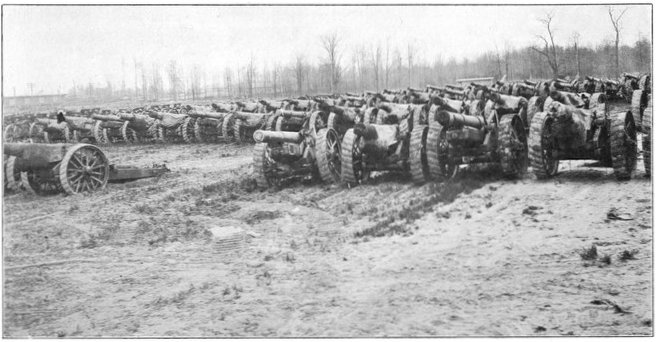
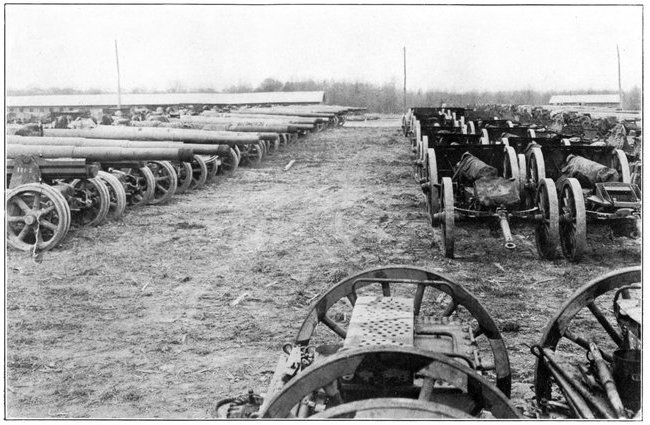
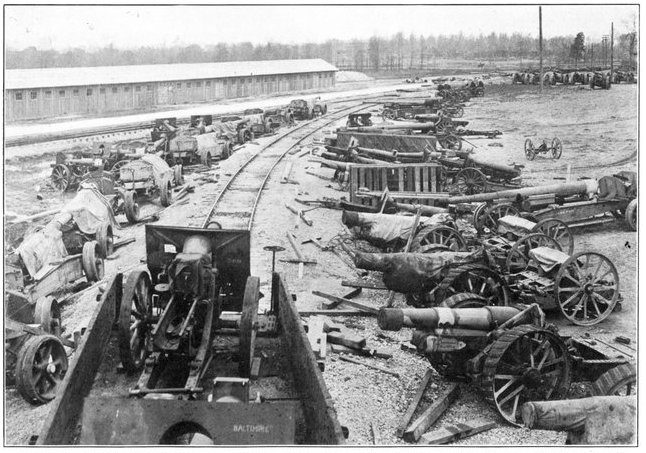
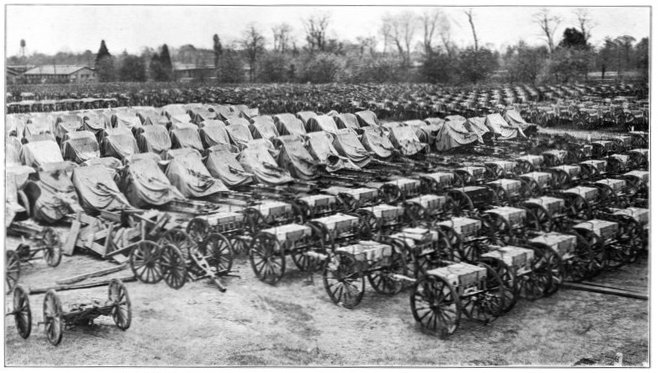
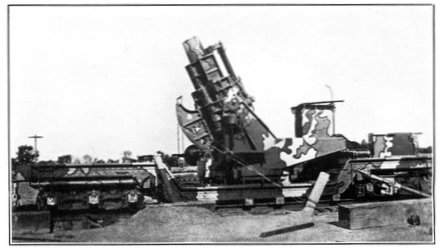
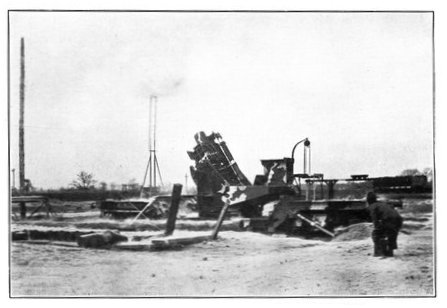
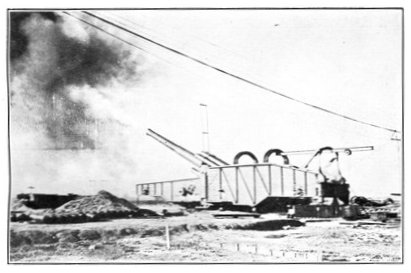
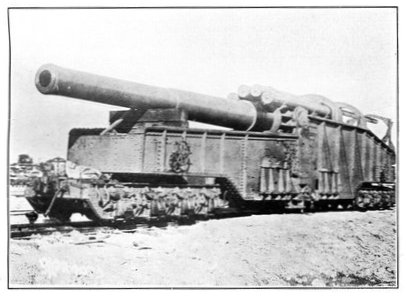
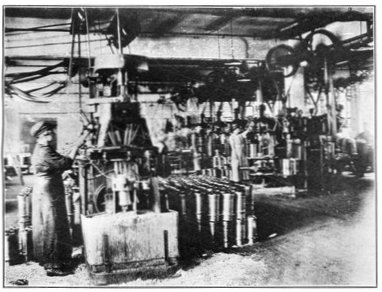
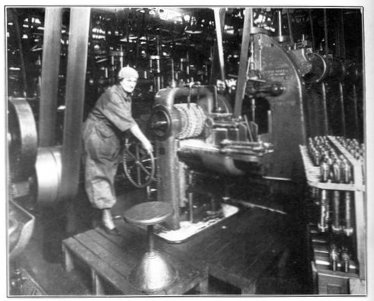
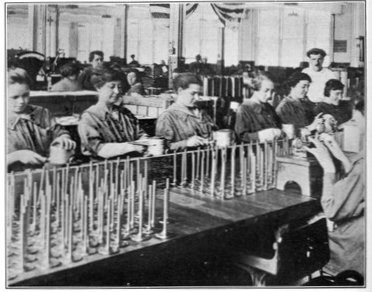
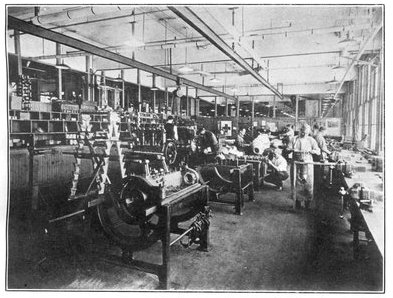
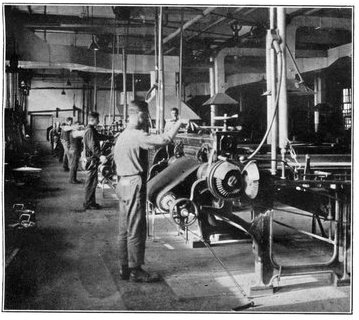
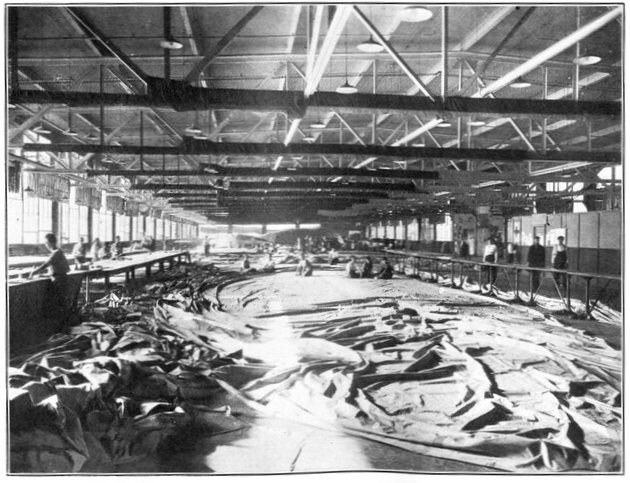
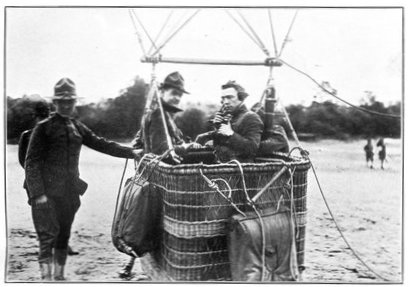
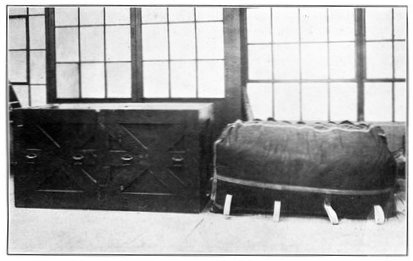
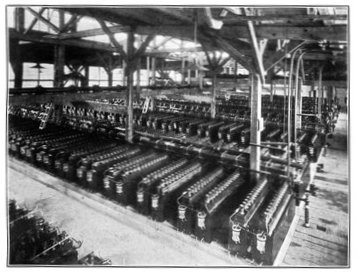
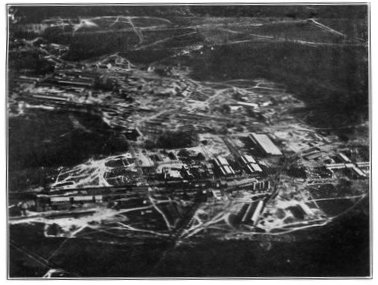
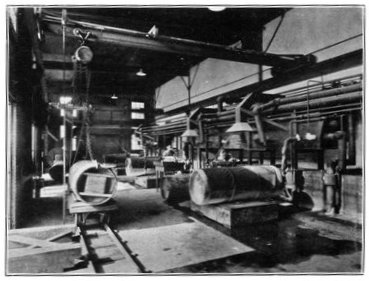
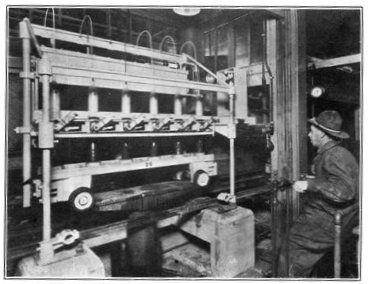
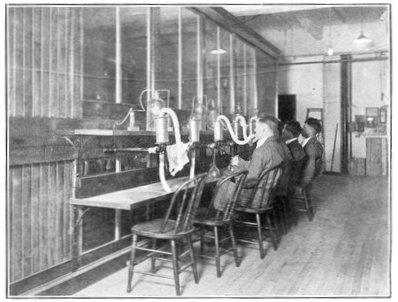
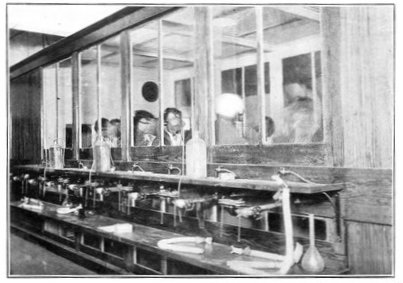
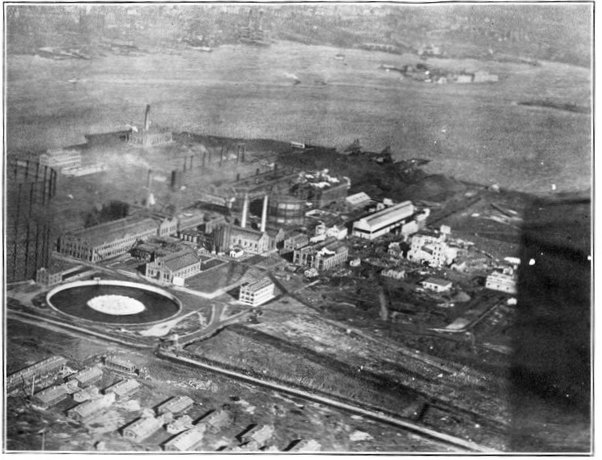
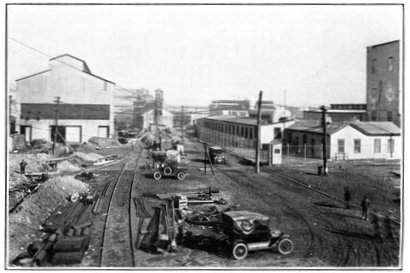
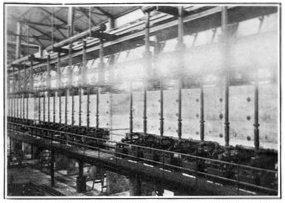
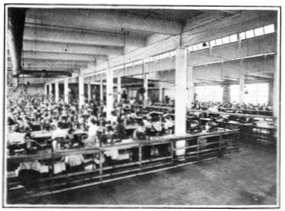
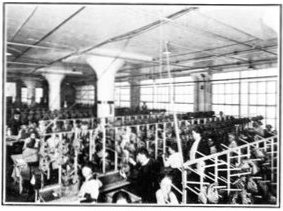
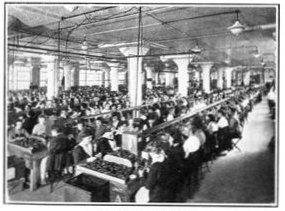
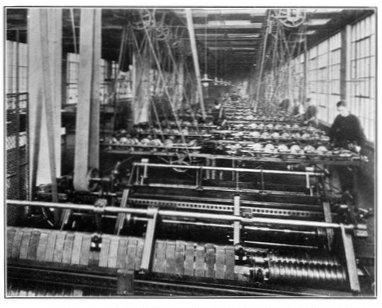
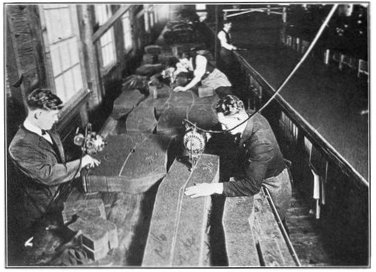
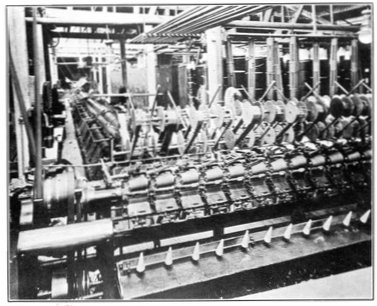
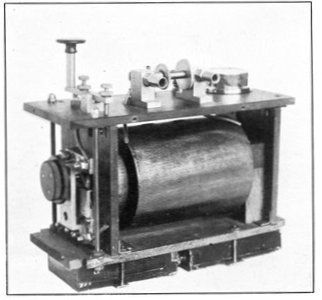
The chance observer might assume that once the Ordnance Department
had succeeded in putting in production the cannon of various
sizes described in the preceding chapter the battle of providing
artillery was as good as won. But such was not the case. Even
after the ponderous tubes had come finished from the elaborate
processes of the steel mills, the task of the ordnance officers had only
just begun. Each one of these guns had to be rendered mobile in
the field and it had to be equipped with a mechanism to take up the
retrograde shock of firing (the "kick") and to prevent the weapon
from leaping out of aim at each discharge.
Mobility to a gun is given by the carriage on which it rides. The
device which absorbs the recoil and restores the gun to position is
called the recuperator (in the case of the hydropneumatic French
design) or the recoil mechanism. Carriage and recuperator, or recoil
mechanism, together are known as the mount.
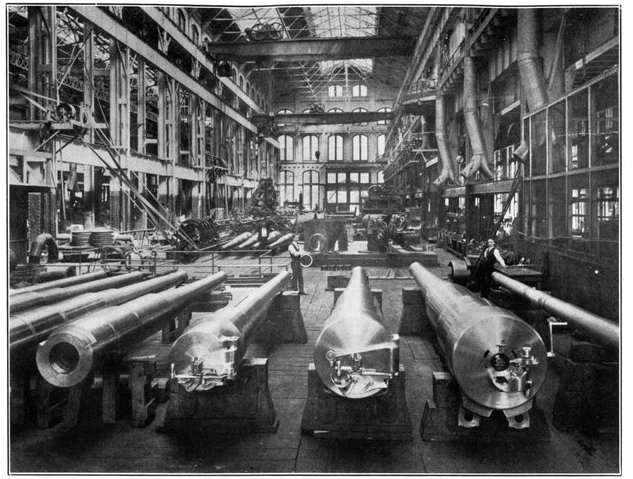
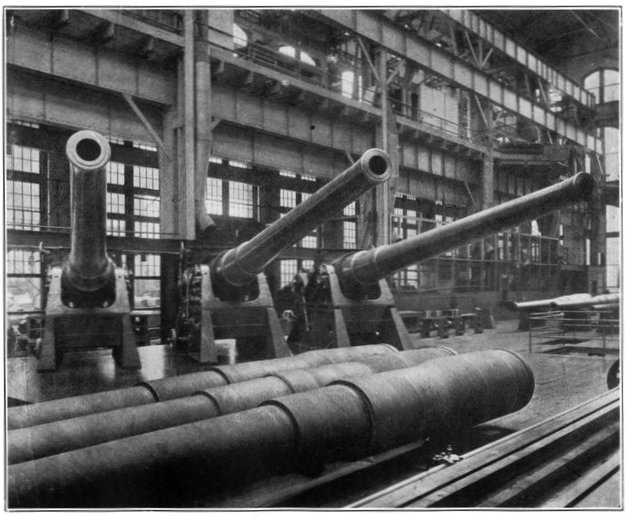
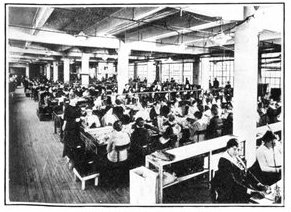
The forging, boring, reinforcing, machining, and finishing of the
gun body is not half the battle of manufacturing a modern military
weapon; it is scarcely one-third of it. No ordnance officer of
1917-18 will ever forget the heartbreaking experiences of manufacturing
the mounts, a work which went along simultaneously with the
production of the cannon themselves. The manufacture of carriages
often presented engineering and production problems of the most
baffling sort. As to the recuperators, a short analysis of the part
they play in the operation of a gun will indicate something of the
nature of the project of building them in quantities.
The old schoolbook axiom that action and reaction are equal has a
peculiar emphasis when applied to the firing of a modern piece of
high-power artillery. The force exerted to throw a heavy projectile
7 miles or more from the muzzle of a gun is equally exerted toward
the breach of the weapon in its recoil. Some of these forces handled
safely and easily by mechanical means are almost beyond the mind's grasp.
Not long ago a touring car, weighing 2 tons, traveled at the rate of
120 miles an hour along a Florida beach. Conceive of such a car
going 337 miles an hour, which is much faster than any man ever
traveled; then conceive of a mechanism which would stop this car,
going nearly 6 miles a minute, stop it in 45 inches of space and half
a second of time, without the slightest injury to the automobile.
That is precisely the equivalent of the feat performed by the recuperator
of a 240-millimeter howitzer after a shot.
Conceive of a 150,000-pound locomotive traveling at 53.3 miles an
hour. The action of the 240-millimeter recuperator after a shot is
equivalent to stopping that locomotive in less than 4 feet in half a
second without damage.
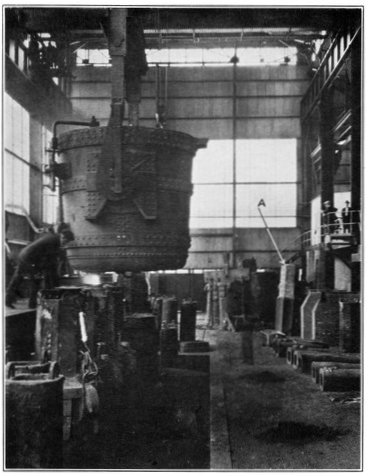
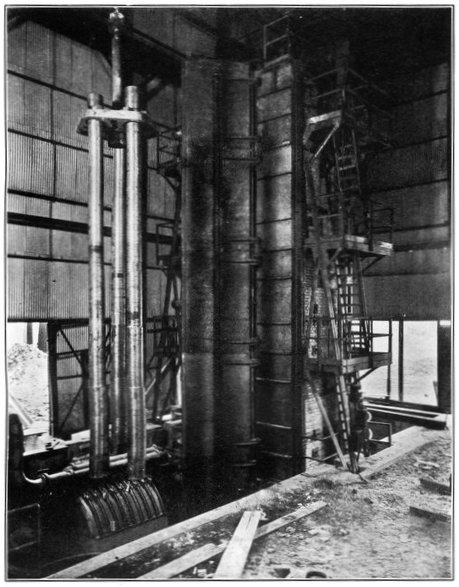
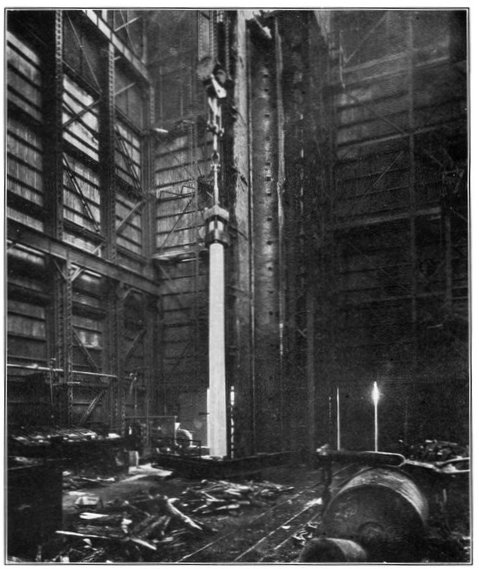
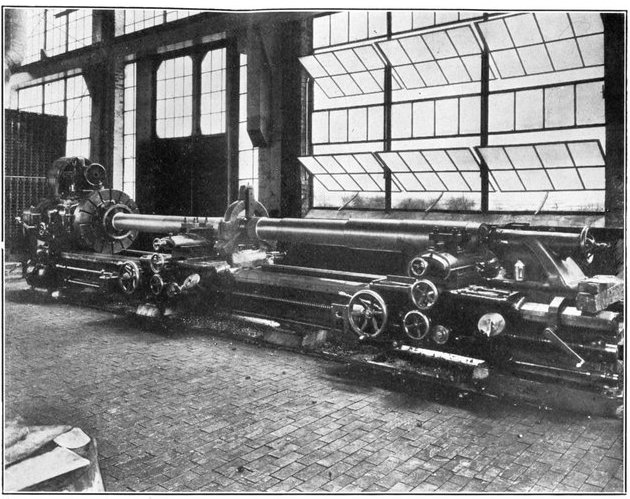
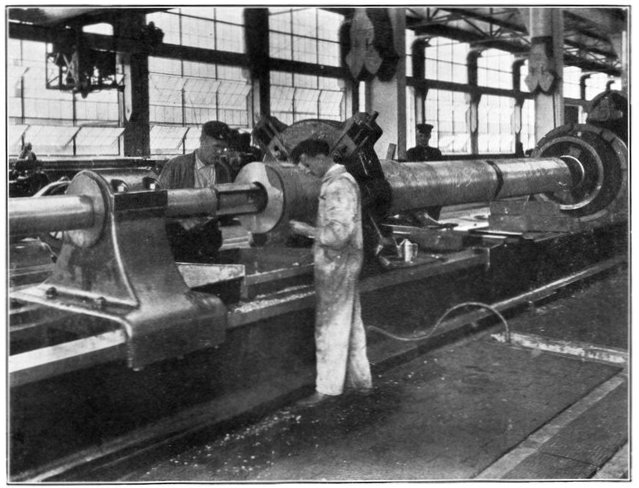
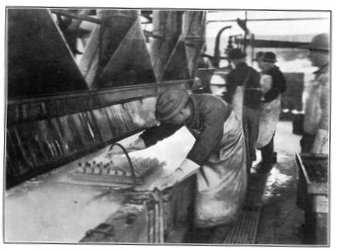
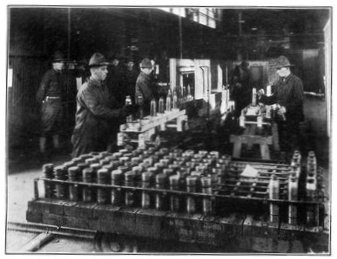
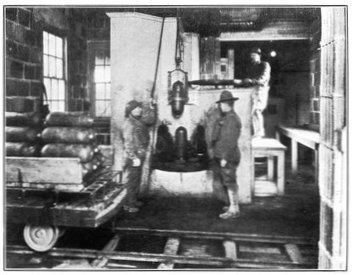
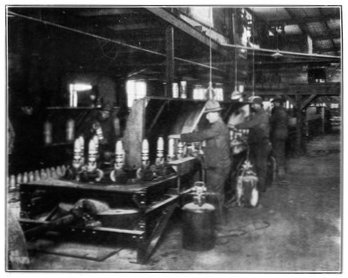
The forging for the 155-millimeter howitzer's recuperator is a
block of steel weighing nearly 2 tons—in exact figures, 3,875 pounds.
This must be bored and machined out until it weighs, with the accessory
parts of the complete recuperator placed on the scales with it,
only 870 pounds. It is scarcely fair to a modern hydropneumatic
recuperator to say that it must be finished with the precision of a
watch. It must be finished with a mechanical nicety comparable
only to the finish of such a delicate instrument as a navigator's
sextant or the mechanism which adjusts the Lick telescope to the
movement of the earth. No heavy articles ever before turned out
in American workshops required in their finish the degree of microscopic
perfection the recuperators called for.
We adopted from the French, the greatest of all artillery builders,
four recuperators—one for the 75-millimeter gun, one for the 155-millimeter
gun, another for the 155-millimeter howitzer, and the
fourth for the 240-millimeter howitzer. These mechanisms had
never been built before outside of France. Indeed, one could find
pessimists ready to say that none but French mechanics could build
them at all and that our attempt to duplicate them could end only
in failure. Yet American mechanical genius "licked" every one of
these problems, as the men in the greasy overalls say, and did it in
little more than a year of time after the plans came to the workshops.
There was not one of these beautiful mechanisms, in France the
product of patient handiwork on the part of metal craftsmen of deep
and inherited skill, that eventually did not become in American
workshops a practical proposition of quantity production.
The problem of building French recuperators in the United States,
in short, may be regarded as the crux of the whole American ordnance
undertaking in the war against Germany, the index of its success.
It presented the most formidable challenge of all to American industrial
skill. There were men whose opinion had to be considered and
who were convinced that it was impracticable to attempt to produce
French recuperators here. Although the superiority of these recoil
devices in their respective classes were universally conceded, Germany
had never been able to make them, while England, with the cooperation
of the French ordnance engineers freely offered, did not attempt
them. The French built them one by one, as certain custom-built
and highly expensive automobiles are produced. When American
factories proposed to produce French recuperators not only but to
manufacture them by making parts and assembling them according
to the modern practice of quantity production, the ranks of the skeptics
increased.
Yet, as we have said, the thing was done. The first of these recuperators
ever produced outside of the French industry were produced
in America and manufactured by typically American quantity
methods.
The first of these recuperators to come into quantity production was
that for the 155-millimeter howitzer. Rough forgings began to be
turned out in heavy quantities by the Mesta Machine Co. in the spring
of 1918, while the Watertown Arsenal, the other contractor, reached
quantity production in rough forgings in September, 1918. At their
special recuperator plant at Detroit the Dodge Bros. turned out the
first finished 155-millimeter howitzer recuperator in July, 1918, and
went into quantity production with them in September, producing
495 in the month of November alone, and turning out up to the end
of April, 1919, the great number of 1,601 of them.
Next in order of time to be conquered as a factory problem was the
155-millimeter gun recuperator. The rough forgings at the Carnegie
Steel Co., the sole contractor, were in quantity production in the
spring of 1918. The first of these recuperators finished came from
the Dodge plant in October, 1918; and although 30 issued from the
plant and were accepted before the end of the year, quantity production
may be said to have started on January 1, 1919, when the factory
began producing them at the rate of more than four a day. In March
the high mark of 361 recuperators was reached, and the total production
up to the end of April was 880.
The heavy 240-millimeter howitzer recuperator was third to come
into quantity production. The rough forgings were being turned out
in quantity in the spring of 1918 by the Carnegie Steel Co., while the
Watertown Arsenal, the other contractor, produced a number of these
rough forgings in August, 1918. The two contractors for finishing
and turning out the complete recuperators were the Otis Elevator Co.,
at its Chicago plant, and the Watertown Arsenal. The arsenal produced
the pilot recuperator in October, 1918. In January the Otis
Elevator Co. produced its first four, while quantity production began
in February, 1919, both contractors that month sending out 19 recuperators,
a number which may be regarded as good quantity when
the size of this mechanism is taken into consideration. Both plants
together in April turned out the large number of 89 recuperators for
the 240.
Last to come through to quantity production was the hardest of
the four to build, the one that promised to defy American industry
to build it at all—the 75-millimeter gun recuperator. The two contractors
for the rough forgings for this recuperator were the Carbon
Steel Co. and the Bucyrus Co. The Carbon Steel Co. was in large
series production of them in the spring of 1918, and the Bucyrus Co.
reached the quantity basis of manufacture in October, 1918. In that
month alone both contractors together turned out 1,305 sets of
forgings.
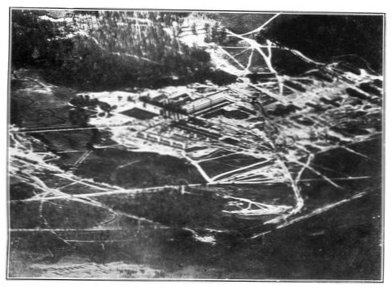
The machining and finishing of the 75 recuperator was in the hands
of the Rock Island Arsenal and the Singer Manufacturing Co., which
built a costly plant especially for the purpose at Elizabethport, N. J.
The first recuperator of this size to appear and be accepted under the
severe tests came from the arsenal in October. Thereafter the production
ceased for a while. The contractors indeed built recuperators
in this period, but the recuperators could not pass the tests. The
machining and production of parts seemed to be as perfect as human
skill could accomplish, but still the devices would not function perfectly.
Adjustments, seemingly of the most microscopical and
trivial sort, had to be made—there was trouble with the leather of the
valves and with oil for the cylinders. These matters, which could
scarcely cause any delay at all in the production of less delicate
machinery, indicate the infinite care which had to be employed in the
manufacture of the recuperators. At length the producers smoothed
out the obstacles and learned all the secrets and necessary processes,
and then the 75-millimeter recuperators began to come—2 in January,
1919, and then 13 in February, 20 in March, and 23 in April.
It should be remembered that by quantity production in this particular
is meant the production in quantity of recuperators of such
perfect quality as to pass the inspection of the Government and to be
accepted as part of our national ordnance equipment. In this
inspection the Government was assisted by French engineers sent
from the great artillery factories in France which had designed the
recuperators and which until the successful outcome of the American
attempt were their sole producers. Such inspection naturally
required that the American recuperators should be the equals of their
French prototypes in every respect.
Because the production of French recuperators stands at the summit
of American ordnance achievement, here at this point, before
there is given any account of the manufacture of field artillery, the
theme of this chapter, a performance table is inserted to show the
records written by the various concerns engaged in making these
devices.
American acceptances of recuperators by firms on Army ordnance orders only.
| Item, process, and firm. |
1918 |
1919 |
Total, Nov. 11, 1918. |
Total 1918. |
Total, Apr. 30, 1919. |
| To July 1. |
July. |
August. |
September. |
October. |
November. |
December. |
January. |
February. |
March. |
April. |
| 75-mm. gun recuperator: |
|
|
|
|
|
|
|
|
|
|
|
|
|
|
| Forging— |
|
|
|
|
|
|
|
|
|
|
|
|
|
|
| Carbon Steel Co. |
259 |
259 |
254 |
750 |
1,005 |
300 |
552 |
407 |
49 |
|
|
2,600 |
3,379 |
3,835 |
| Bucyrus Co. |
|
|
29 |
78 |
300 |
173 |
111 |
|
68 |
|
|
435 |
691 |
759 |
| Total |
259 |
259 |
283 |
828 |
1,305 |
473 |
663 |
407 |
117 |
|
|
3,035 |
4,070 |
4,594 |
| Finish machining and assembling— |
|
|
|
|
|
|
|
|
|
|
|
|
|
|
| Singer Manufacturing Co. |
|
|
|
|
|
|
|
|
|
3 |
8 |
|
|
11 |
| Rock Island Arsenal |
|
|
|
|
1 |
|
|
2 |
13 |
17 |
15 |
1 |
1 |
48 |
| Total |
|
|
|
|
1 |
|
|
2 |
13 |
20 |
23 |
1 |
1 |
59 |
| 155-mm. howitzer recuperator: |
|
|
|
|
|
|
|
|
|
|
|
|
|
|
| Forging— |
|
|
|
|
|
|
|
|
|
|
|
|
|
|
| Mesta Machine Co. |
676 |
646 |
648 |
899 |
1,080 |
226 |
|
49 |
|
31 |
|
4,000 |
4,175 |
4,255 |
| Watertown Arsenal |
|
|
|
160 |
80 |
80 |
|
25 |
1 |
|
|
268 |
320 |
346 |
| Total |
676 |
646 |
648 |
1,059 |
1,160 |
306 |
|
74 |
1 |
31 |
|
4,268 |
4,495 |
4,601 |
| Machining complete and assembling— |
|
|
|
|
|
|
|
|
|
|
|
|
|
|
| Dodge Bros. |
|
1 |
27 |
249 |
285 |
495 |
403 |
141 |
|
|
|
796 |
1,460 |
1,601 |
| 155-mm. gun recuperator: |
|
|
|
|
|
|
|
|
|
|
|
|
|
|
| Forging— |
|
|
|
|
|
|
|
|
|
|
|
|
|
|
| Carnegie Steel Co. |
212 |
213 |
229 |
269 |
401 |
389 |
21 |
|
|
|
|
1,480 |
1,734 |
1,734 |
| Finish machining and assembling— |
|
|
|
|
|
|
|
|
|
|
|
|
|
|
| Dodge Bros. |
|
|
|
|
1 |
10 |
19 |
116 |
270 |
361 |
103 |
|
30 |
880 |
| 240-mm. howitzer recuperator: |
|
|
|
|
|
|
|
|
|
|
|
|
|
|
| Forging— |
|
|
|
|
|
|
|
|
|
|
|
|
|
|
| Carnegie Steel Co. |
286 |
99 |
115 |
61 |
70 |
79 |
|
|
|
|
|
678 |
710 |
710 |
| Watertown Arsenal |
|
|
21 |
|
|
|
|
|
|
|
|
21 |
21 |
21 |
| Total |
286 |
99 |
136 |
61 |
70 |
79 |
|
|
|
|
|
699 |
731 |
731 |
| Finish machining and assembling— |
|
|
|
|
|
|
|
|
|
|
|
|
|
|
| Otis Elevator Co. |
|
|
|
|
|
|
|
4 |
14 |
41 |
62 |
|
|
121 |
| Watertown Arsenal |
|
|
|
|
1 |
|
|
|
5 |
19 |
27 |
1 |
1 |
52 |
| Total |
|
|
|
|
1 |
|
|
4 |
19 |
60 |
89 |
1 |
1 |
173 |
The process of manufacture of recuperators requires four steps—forging, rough machining, finish machining, and assembling. In the case of 155-millimeter howitzer recuperators
all the machining was done by one firm; in the other cases rough machining was done by various firms, including, in the case of the 155-millimeter gun and 240-millimeter howitzer
recuperators, the firms doing the forging. Complete records of rough machining are not available.
In discussing here, therefore, the production of field artillery in
the war period, we are concerned chiefly with carriages and recuperators,
for they offered the major difficulties. Since the production
of gun bodies for these various units has been taken up in the preceding
chapter, such reference to them as is necessary will be brief.
For the sake of additional clearness in the mind of the reader inexpert
in these things, the line should be sharply drawn between
field artillery and the so-called railway artillery, which was also
mobile to a limited degree. The mobile field artillery consisted of
all rolling guns or caterpillar guns up to and including the 240-millimeter
howitzer in size; and also included the antiaircraft guns
of various sizes. All mobile guns of larger caliber than the 240-millimeter
howitzer were mounted on railroad cars.
The list of the mobile field artillery weapons in manufacture here
during the war period was as follows:
The little 37-millimeter gun, the so-called infantry cannon, one of
which two husky men could lift from the ground—a French design;
The 75-millimeter guns—three types of them—the French 75,
adopted bodily by the United States; our own 3-inch gun redesigned to
the French caliber; and the British 3.3-inch gun, similarly redesigned;
The 4.7-inch gun of American design;
The 5-inch and 6-inch guns, taken from our coast defenses and
naval stores and placed on mobile mounts;
The 155-millimeter gun, a French weapon with a barrel diameter of
approximately 6 inches;
The 155-millimeter howitzer, also French;
The 8-inch and 9.2-inch howitzers, British designs, being manufactured
in the United States when war was declared;
The 240-millimeter howitzer, French and American; and, finally,
The antiaircraft guns.
In modern times, but prior to 1917, the United States had designed
types of field-artillery weapons and produced them in quantities
shown by the following tabulation:
|
Pieces. |
| 2.95-inch mountain gun |
113 |
| 3-inch gun |
544 |
| 4.7-inch gun |
60 |
| 5-inch gun |
70 |
| 6-inch howitzer |
40 |
| 7-inch howitzer |
70 |
| Total |
897 |
A comparison of this list with the enumeration above of weapons
put in production during the war against Germany indicates that
we greatly expanded our artillery in types. That we were able to
do this at the outset and go ahead immediately with the production
of many weapons strange and unknown to our experience, without
waiting to develop models and types of our own, is due solely to the
generosity of the governments of France and Great Britain, with
whom we became associated. We manufactured in all eight new
weapons, taking the designs of three of them from the British and of
five from the French.
It might seem to the uninitiated that the way of the United States
to a great output of artillery would be made smooth by the action of
the British and French Governments in agreeing to turn over to us
without reservation the blue prints and specifications that were the
product of years of development in their gun plants. Yet this was
only relatively true. In numerous instances we were not able to
secure complete drawings until months after we had entered the
war, due to the practice of continental manufacturers that intrusts
numerous exact measurements to the memories of the mechanics
working in their shops. Consequently it required several months to
complete drawings, and when we received them our troubles had
only begun.
First there came the problem of translating the plans after we received
them. All French dimensions are according to the metric system.
A millimeter is one one-thousandth part of a meter, and a meter
is 39.37 inches. An inch is approximately 0.0254 meter. Thus to
translate French plans into American factory practice involves hundreds
of mathematical computations, most of them carried out to
decimals of four or five places. Moreover, the French shop drawings
are put down on an angle of projection different from what is used
in this country. This fact involved the recasting of drawings even
when the metric system measurements were retained. When it is
considered that such a mechanism as the recuperator on the
155-millimeter gun involves the translation of 416 drawings, the fact
that the preparation of French plans for our own use never took
more than two months is remarkable, particularly so since it was hard
to find in the United States draftsmen and engineers familiar with
such translation work.
Once our specifications were worked out from the French plans, it
then became necessary to find American manufacturers willing to
bid on the contracts. The average manufacturer would look at these
specifications, realize what a highly specialized and involved sort of
work would be required in the production of the gun carriages or
recoil mechanisms, and shake his head. In numerous instances no
such work had ever before been attempted in the United States.
However, as the result of efforts on the part of the Government
an increased capacity for producing mobile field artillery was created
as follows:
At Watertown, N. Y., the New York Air Brake Co., as agent for
the United States, constructed a completely new factory to turn out
25 gun carriages a month for the 75-millimeter guns, model 1916—the
American 3-inch type modified to the French dimensions.
At Toledo, Ohio, increased facilities were put up at the plant of
the Willys-Overland Co. to manufacture a daily output of 17 French
75-millimeter gun carriages, model 1897.
At Elizabethport, N. J., the Singer Manufacturing Co. erected for
the Government a complete new factory for finishing daily 17 French
75-millimeter recuperators.
At New Britain, Conn., the plant of the New Britain Machine Co.
was adapted and increased facilities were created for the manufacture
of two 3-inch antiaircraft gun carriages a day.
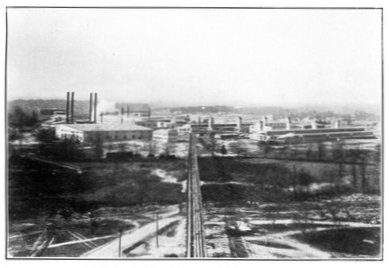
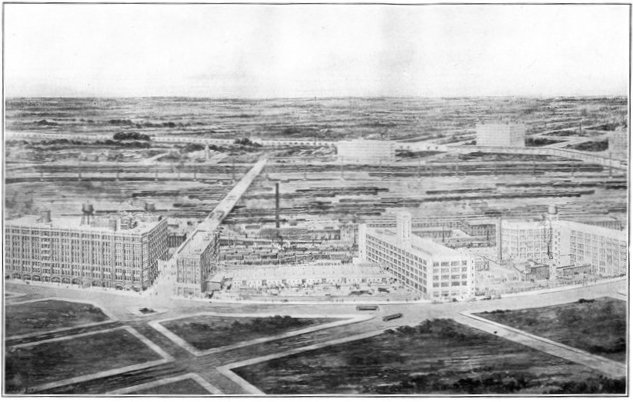
At Detroit, Mich., Dodge Bros., as agents for the Government,
erected an entirely new factory, costing in the neighborhood of
$11,000,000 to give the final machining to the rough-machine forgings
for five recuperators daily for the 155-millimeter gun and to
machine completely the parts for twelve recuperators daily for the
155-millimeter howitzer. Their huge new plant for this purpose
established a record for rapidity of construction in one of the most
severe winters of recent history.
At the plant of the Studebaker Corporation at Detroit, facilities
were extended for turning out three carriages a day for the 4.7-inch
guns.
At Plainfield, N. J., extended facilities were created at the factory
of the Walter Scott Co. for manufacturing 20 carriages a month
for the 4.7-inch guns.
At Worcester, Mass., at the plant of the Osgood Bradley Car Co.
increased facilities were built for the daily manufacture of five
carriages for the 155-millimeter howitzers.
At Hamilton, Ohio, at the works of the American Rolling Mill
Co., extensions were made to provide for the manufacture each day
of three carriages for the 155-millimeter howitzers.
The plant of the Mesta Machine Co., at West Homestead, Pa.,
near Pittsburgh, was extended to the enormous capacity of turning
out the forgings for 40 recuperators a day for the 155-millimeter
howitzers.
Extensively increased facilities were made at the shops of the
Standard Steel Car Co., at Hammond, Ind., for the daily output of
two carriages for the 240-millimeter howitzers.
Increased facilities were created in the plant of the Otis Elevator
Co., Chicago, Ill., for the finish machining of the equivalent in
parts of two and one-half recuperators a day for the 240-millimeter
howitzers.
Large extensions were made to the plant of the Morgan Engineering
Co., Alliance, Ohio, for the manufacture monthly of 20 improvised
mounts for the 6-inch guns taken from the seacoast fortifications.
The facilities of the United States arsenals at Watertown, Mass.,
and at Rock Island, Ill., for the manufacture of field-gun carriages
and recuperators were greatly increased.
This carriage construction for the big guns required the closest
kind of fine machine work and fittings where the brake or recuperator
construction entered the problem, and the great plants built for this
purpose of turning out carriages and recuperators were marvels for
the rapidity of their construction, the speed with which they were
equipped with new and intricate tools, and the quality of their output.
Every mobile gun mount must be equipped with a shield of armor
plate. The size of the artillery project may be read in the fact that
our initial requirement for armor for the guns ran to a total of 15,000
tons to be produced as soon as it could be done. Now, we had no
real source for getting armor in such large quantities, because the
previous demands of our artillery construction had never called for
it. The prewar manufacturers of artillery armor were three in number—the
Simmons Manufacturing Co., of St. Louis; Thomas Disston
& Sons, of Philadelphia; and the Crucible Steel Co. To meet the
new demand two armor sources were developed—the Mosler Safe
Co. plant of the Standard Ordnance Co. and the Universal Rolling
Mill Co. The process of building this armor had been a closely
guarded secret in the past, a fact entailing extended experiments
in the new plants before satisfactory material could be obtained.
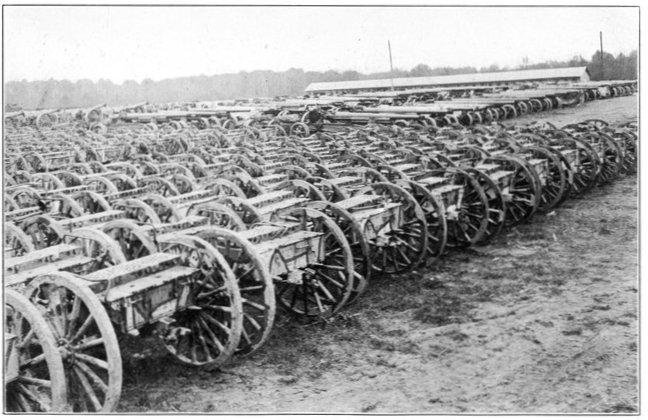
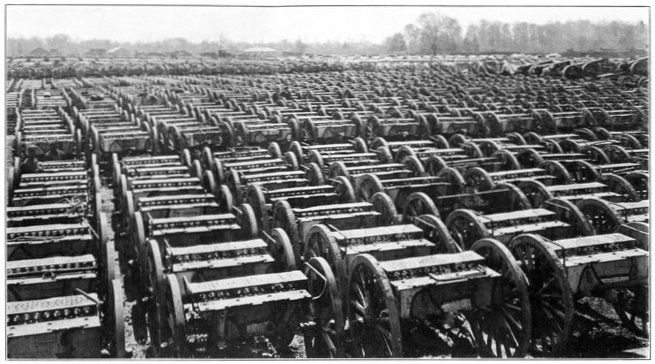
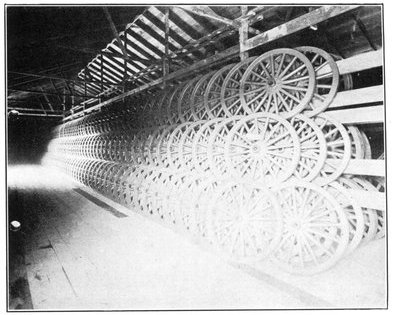
The new artillery program required the manufacture of 120,000
wheels of various types and sizes for the mobile carriages. The Rock
Island Arsenal and two commercial concerns prior to the war had
been building artillery wheels in limited quantities. One completely
new plant had to be erected for the manufacture of wheels,
while seven existing factories were specially equipped for this work.
We had to develop new sources of supply of oak and hickory and to
erect dry kilns especially for the wheel project.
The largest order for rubber tires in the history of the American
rubber industry was placed as one relatively small phase of the
artillery program, the order amounting to $4,250,000. Rubber tires
on the wheels of all the heavier types of artillery carriages, so that
the units might be drawn at good speed by motor vehicles, was
essentially an American innovation. No tires of this size had ever
been manufactured in this country. Consequently it was necessary
for the firms who got the orders to build machinery especially designed
for the purpose.
With practically all of the manufacturers of the American metal-working
industries clamoring for machine tools, and with some
branches of the Government commandeering the machine-tool shops
in whole sections of the country, it is evident that the necessity for
the heavier types of machine tools required by the manufacturers of
artillery material offered a weighty problem at the outset. In fact,
the machine-tool supply was never adequate at any time, and the
shortage of this machinery hampered and impeded to a great degree
the speed of our artillery production.
The Nation was raked with a fine-toothed comb for shop equipment.
The Government went to almost any honorable length to
procure this indispensable tooling. For instance, when the Dodge
plant at Detroit was being equipped to manufacture the 155-millimeter
recuperators, the Government agents discovered trainloads of
machinery consigned to the Russian government and awaiting
shipment. These tools were commandeered on the docks. One
huge metal planer had dropped overboard while it was being lightered
to the ocean tramp that was to carry it to a Russian port. Government
divers fixed grappling hooks to this machine, and it was brought
to the surface and shipped at once to the Dodge plant.
The 3-inch gun which we had been building for many years prior
to the war was a serviceable and efficient weapon; but still we were
unable to put it into production immediately as it was. Our earliest
divisions in France, under the international arrangement, were to be
equipped by the French with 75-millimeter guns; while we, on this
side of the water, reaching out for all designs of guns of proven worth,
expected to manufacture the 75's in large numbers in this country.
The French 75 in its barrel diameter is a fraction of an inch smaller
than our 3-inch gun, the exact equivalent of 75 millimeters being
2.95275 inches. Thus, if we built our own 3-inch gun (and the British
3.3-inch gun, as we intended) and also went ahead with the 75-millimeter
project on a great scale, we should be confronted by the
necessity of providing three sorts of ammunition of almost the same
size, with all the delays and confusion which such a situation would
imply. Consequently we decided to redesign the American and
British guns to make their bores uniformly 75 millimeters, thus
simplifying the ammunition problem and making available to us in
case of shortage the supplies of shell of this size in France.
With all of the above considerations in mind, it is evident now,
and it was then, that we could not hope to equip our Army with
American-built artillery as rapidly as that Army could be collected,
trained, and sent to France; and this was particularly true when in
the spring of 1917 the Army policy was changed to give each 1,000,000
men almost twice as many field guns as our program had required
prior to that date. Consequently, when on June 27, 1917, the Secretary
of War directed the Chief of Ordnance to provide the necessary
artillery for the 2,000,000 men who were to be mobilized in 1917 and
the first half of 1918, the first thought of our officers was to find
outside supplies of artillery which we could obtain for an emergency
that would not be relieved until our new facilities had reached great
production.
We found this source in France. The French had long been the
leading people in Europe in the production of artillery, and even the
great demands of the war had not succeeded in utilizing the full
capacity of their old and new plants. Two days later, on June 29,
1917, the French high commissioner, by letter, offered us in behalf
of France a daily supply of five 75-millimeter guns and carriages,
beginning August 1, 1917. The French also offered at this time
to furnish us with 155-millimeter howitzers; and on August 19, 1917,
the French Government informed Gen. Pershing that each month,
beginning with September, he could obtain twelve 155-millimeter Filloux
guns and carriages from the French factories.
Before the signing of the armistice 75-millimeter guns to the number
of 3,068 had been ordered from the French, and of this number
1,828 had been delivered. Of 155-millimeter howitzers, 1,361 had
been ordered from the French and 772 delivered before November
11, 1918. Of 155-millimeter guns, 577 had been ordered from the
French and 216 delivered previous to the granting of the armistice.
From British plants we ordered 212 Vickers-type 8-inch howitzers,
and 123 had been delivered before the armistice had been signed;
while of 9.2-inch howitzers, Vickers model, 40 of an order for 132 had
been completed. In addition to this, 302 British 6-inch howitzers
were in manufacture in England for delivery to us by April 1, 1919.
These figures, with the exception of those relating to the order for
British 6-inch howitzers, do not include the arrangements being made
by this Government during the last few weeks of hostilities for additional
deliveries of foreign artillery.
As to our own manufacture of artillery, when we had conquered all
the difficulties—translated the drawings, built the new factories,
equipped them with machine tools and dies, gages, and other fixtures
needed by the metal workers, and had mobilized the skilled workers
themselves—we forged ahead at an impressive rate. When the armistice
was signed we were turning out 412 artillery units per month.
Compare this with Great Britain's 486 units per month in the fall of 1918
and measure our progress, remembering that England had approximately
three years' head start. Compare it with the French monthly
production of 659 units per month, and remember that France was
the greatest artillery builder in the world. When it came to the gun
bodies themselves we obtained a monthly output of 832, as against
Great Britain's 802 and France's 1,138. And our artillery capacity
was then, in the autumn of 1918, only coming into production.
In the war period—April 6, 1917, to November 11, 1918—we produced
2,008 complete artillery units, as against 11,056 turned out by
France and 8,065 completed by Great Britain in the same period.
In those 19 months we turned out 4,275 gun bodies, while in the same
months France produced 19,492 and Great Britain 11,852.
The smallest weapon of all the field guns we built was the French
37-millimeter gun, the diameter of its bore being about 1½ inches in
our measurements, the figure being 1.45669 inches. This was the
so-called infantry field gun, to be dragged along by foot soldiers when
they are making an advance. Its chief use in the war was in breaking
up the German concrete pill boxes, machine gun nests, and other
strong points of enemy resistance. In service it was manned by
infantrymen instead of artillerists, a crew of eight men handling each
weapon, the squad leader being the gunner. One of the men of the
crew was the loader, and he was likewise able to fire the piece. The
other six men served as assistants.
The 37-millimeter outfit as it exists to-day consists of the gun, with
a split trail, mounted on axle and wheels. By means of a trailer
attachment on the ammunition cart it can be drawn by one horse
or one mule. The ammunition cart itself is merely a redesigned
machine-gun ammunition vehicle. The wheels and axle can easily be
removed and left a short distance in the rear of the place where it is
desired to set up the gun. The whole outfit weighs only 340 pounds
and is about 6 feet long.
The gun rests on its front leg which is dropped to form a tripod with
the two legs of the split trail. The gun proper can be removed from
the trail and the sponge staff can be inserted in the barrel through
the opened breech. Two men can bear this part of the weapon in
advancing action. Two other men are able to carry the trail, when
its legs are locked together, while the four other members of the
squad bring along the boxes of ammunition.
The ammunition cart holds 14 ammunition boxes, each containing
16 rounds. A spare-parts case, strapped to the trail, contains a miscellaneous
assortment of such parts as can readily be handled in the
field. A tool kit in a canvas roll is also transported on the cart, along
with entrenching tools and other accessories.
Equipped with a telescopic sight for direct fire and a quadrant, or
collimating sight, for indirect fire, great accuracy is obtained by this
small piece of artillery. The length of the barrel of the gun proper
is 20 calibers, which means that it is 20 times 37 millimeters in
length, or about 29 inches. The length of the recoil when the gun is
fired is 8 inches.
Two types of ammunition were provided for this gun at first; but,
as the low-explosive type was not so effective as desired, it was
abandoned entirely in favor of the high-explosive type contained in
a projectile weighing 1¼ pounds. This projectile is loaded with 240
grains of T. N. T. and detonated by a base percussion fuse. The range
of the gun is 3,500 meters, or considerably more than 2 miles. Only
three to six shots from this gun were found to be necessary to demolish
an enemy machine gun emplacement or other strongly held position.
In the great war the 37-millimeter gun found itself and proved its
usefulness. The original model had been designed at the Puteaux
Arsenal in France in 1885; but it was not until after 1914 that the
weapon was produced in quantities.
In this country we took up the production of 37-millimeter guns in
October, 1917. While our shops were tooling up for the effort, 620
of these weapons were purchased from the French and turned over to
the American Expeditionary Forces. For the purposes of greater
speed in manufacture our executives took the gun apart and divided
it into three groups, known as the barrel group, the breech group, and
the recoil group. Additional to these, as a manufacturing proposition,
were the axle and wheels and the trail.
The barrel group went to the Poole Engineering & Machine Co., of
Baltimore, Md., who subcontracted for some of the parts to the Maryland
Pressed Steel Co., of Hagerstown, Md. The breech group was
manufactured by the Krasberg Manufacturing Co., of Chicago. The
C. H. Cowdrey Machine Works, of Fitchburg, Mass., turned out the
recoil mechanisms. The axles and wheels were built by the International
Harvester Co., of Chicago. The trails were turned out by
the Universal Stamping & Manufacturing Co., also of Chicago.
When crated for overseas shipment, the gun, ammunition cart, and
all accessories, weighed 1,550 pounds and occupied about 15 cubic feet
of space.
The first delivery of completed 37-millimeter guns from our factories
was made in June, 1918, and at the cessation of hostilities manufacturers
were turning out the guns at the rate of 10 per day. Between
June and November 122 American-built 37-millimeter guns were
shipped abroad, and more were ready to be sent over when the armistice
was signed. The gun had been so successful in use abroad that
our original order of 1,200 had been increased to 3,217 before the
signing of the armistice, including the 620 purchased from the French.
The various groups of this gun were shipped to the plant of the
Maryland Pressed Steel Co., Hagerstown, Md., for assembly and were
there tested at a specially built proving ground, 8 miles from the
factory.
Three 37's were issued to each infantry regiment, making one for
each battalion. The required equipment for a division was, therefore,
12 weapons.
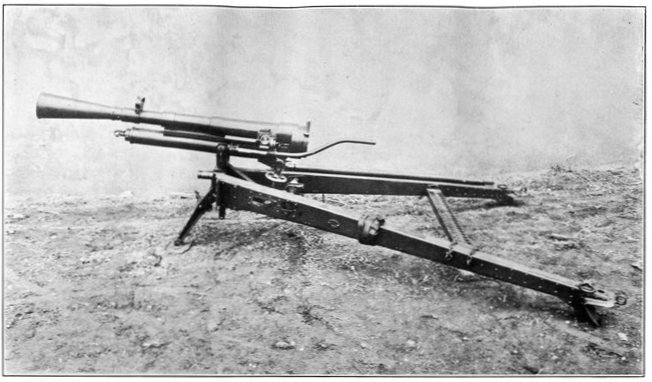
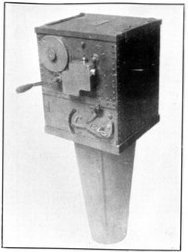
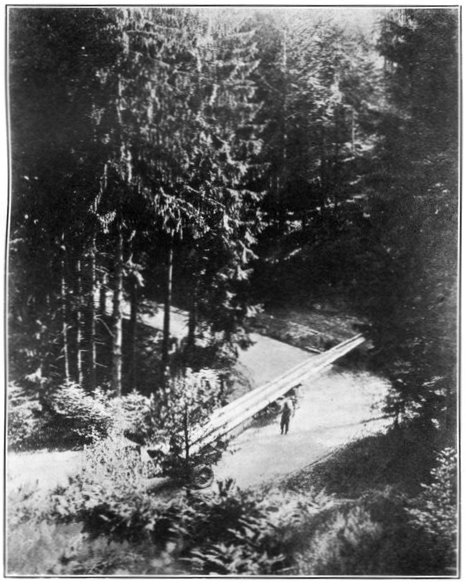
THE 37-MILLIMETER INFANTRY CANNON.
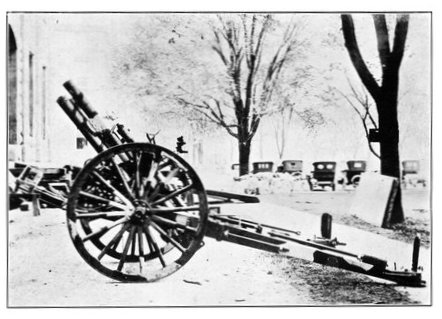
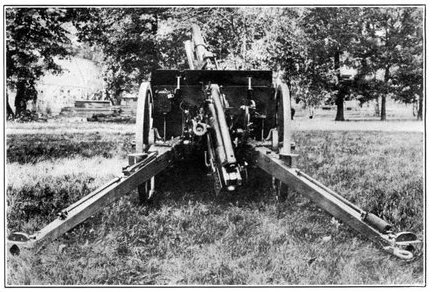
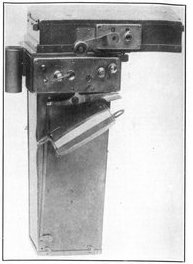
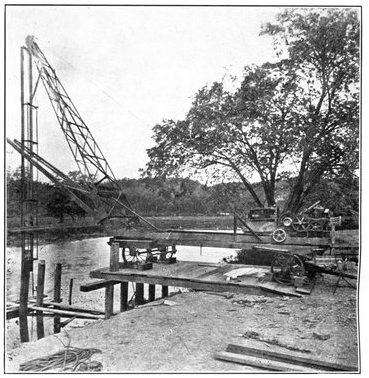
TWO VIEWS OF 75-MILLIMETER FIELD GUN, MODEL 1918 (AMERICAN).
Figures on 37-millimeter gun production.
| Guns procured from the French Government |
620 |
| Guns ordered manufactured in United States, October, 1917 |
1,200 |
| Increase in order, September, 1918 |
1,397 |
| Total number ordered in United States |
2,597 |
| Total number of guns completed prior to the signing of the armistice |
884 |
| Guns delivered for overseas shipment prior to the signing of the armistice |
300 |
| Guns shipped to various camps in this country |
26 |
| Guns shipped to other points in this country |
4 |
| On hand at Hagerstown Arsenal, proof fired |
425 |
| Completed and ready for proof firing |
129 |
Next in order in the upward scale of sizes we come to the 75-millimeter
gun, which was by far the most useful and most used piece of
artillery in the great war. In fact the American artillery program
might be divided in two classes, the 75's in one class, and all other
sizes in the other, since it may be said practically that for every gun
of another size produced we also turned out a 75. In number the 75's
made up almost half of our field artillery. The 75-millimeter gun
threw projectiles weighing between 12 and 16 pounds and it had an
effective range of over 5½ miles.
We approached the war production of this weapon with three types
available for us to produce—our own 3-inch gun; its British cousin
the 3.3-inch gun or 18-pounder; and the French 75-millimeter gun,
with its bore of 2.95275 inches. The decision to adopt the 75-millimeter
size and modify the other two guns to this dimension, giving us
interchangeability of ammunition with the French, was an historic
episode in the American ordnance development of 1917.
While in 1917 the French with their excess manufacturing capacity
began work on our first orders for 1,068 guns of this size to supply our
troops during the interim until American factories could come into
production, we were preparing our factories for the effort. Roughly
speaking the 75 consists of a cannon mounted on a two-wheeled support
for transportation purposes. This support also provides a
means for aiming by suitable elevating and traverse mechanisms.
As previously explained, a recoil mechanism is also provided to
absorb the shock of firing, allowing a certain retrograde movement
of the cannon and then returning it in position for the next shot—returning
it "into battery," as the artillerists say. By its recuperator
device the field gun of to-day is chiefly distinguished from its brother
of the latter part of the nineteenth century. Without a recuperator
the gun would leap out of aim at each shot and would have to be
pointed anew; but one with a recuperator needs to be pointed only at
the beginning of the action.
When we entered the war we found ourselves with an equipment
of 544 field guns of the old 3-inch model of 1902. This gun had a
carriage provided with the old-style single trail. By 1913, however,
we had been experimenting with the split trail and it had been
strongly recommended by our ordnance experts; and in 1916 we had
placed orders for nearly 300 carriages of the split-trail type, which
had come to be known as Model 1916. Of these orders 96 carriages
were to come from the Bethlehem Steel Co., and the remainder
from the Rock Island Arsenal.
Meanwhile for some time the Bethlehem Steel Co. had been
engaged in turning out carriages for the British 3.3-inch guns. Here
was capacity that might be utilized to the limit; and, accordingly,
in May, 1917, we ordered from the Bethlehem Co. 268 of the British
carriages. At the same time we ordered from the same company
approximately 340 of our own Model 1916 carriages at a cost of
$3,319,800. A few weeks later the decision had been made to make
all our guns of this sort conform to the French 75-millimeter size,
and these British and American carriages contracted for in May
were ordered modified to take 75-millimeter guns. The carriages
needed little modification and the guns not much. Subsequently,
in rapid succession we placed orders with the Bethlehem Steel Co.,
calling for the construction of an additional 1,130 of the British carriages,
all of them to be adapted to 75-millimeter guns.
Next it was the concern of the Ordnance Department to find other
facilities for manufacturing carriages for these weapons. The
artillery committee of the Council of National Defense located the
New York Air Brake Co. as a concern willing to undertake this work;
and in June, 1917, this company signed a contract to produce 400
American model 1916 carriages at a cost of $3,250,000.
By December we had the drawings for the French carriages of
this size and made a contract with the Willys-Overland Motor Car
Co. to produce 2,927 of them. The table at the end of this section
shows the production attained at these various plants.
The manufacture of carriages for the 75's produced concrete
results, as our factories here were turning them out for us at the rate
of 393 per month when the fighting ceased, and our contract plants
in France were making 171 per month. In all we received from
American factories 1,221 carriages. At the rate of increase we
would have been building 800 carriages per month by February, 1919.
It may be said we were thoroughly impressed with the difficulties
attached to the transplanting to this country of the manufacture of
French 75-millimeter recuperators. It was a question whether this
device could possibly be built by any except the French mechanics
trained by long years in its production. At first it seemed that we
could secure no manufacturer at all who would be willing to assume
such a burden. Not until February, 1918, were complete drawings
and specifications of the recuperator received from France. At
length the Singer Manufacturing Co., builders of sewing machines,
consented to take up this new work, and on March 29 the company
contracted to produce 2,500 recoil systems for the 75-millimeter gun
carriages. In April, 1918, the Rock Island Arsenal was instructed
to turn out 1,000 of these recuperators.
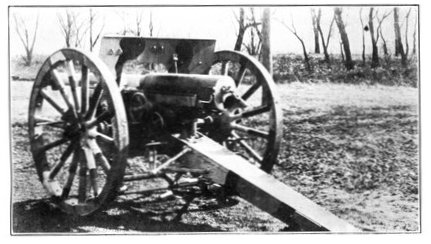
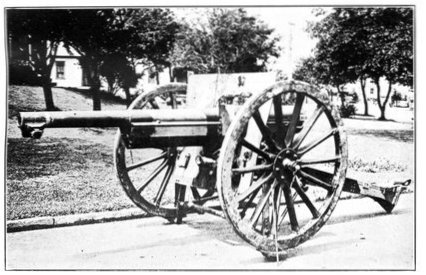
TWO VIEWS OF THE FRENCH 75-MILLIMETER GUN.
This type of gun has been used by the French Army since 1897, and was the gun most used
by the Allies in the Great War. This gun throws a shell weighing 12.3 pounds a distance
of 8,400 meters or shrapnel weighing 16 pounds a distance of 9,000 meters. The weight
of the gun and carriage is 2,657 pounds. The service muzzle velocity of the shell is 1,805
feet per second, while for shrapnel it is 1,755 feet per second.
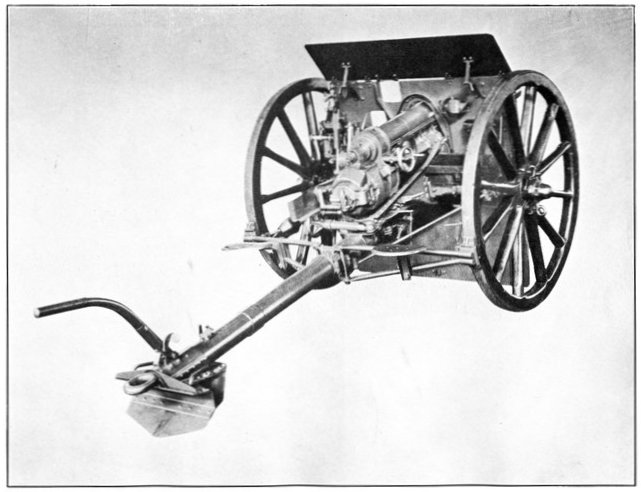
THE 75-MILLIMETER FIELD GUN, MODEL 1917 (BRITISH).
This gun throws a shell weighing 12.3 pounds a distance of 8,300 meters, and 16 pounds of shrapnel a distance
of 8,900 meters. The weight of the gun and carriage is 2,887 pounds. Its muzzle velocity for shell is 1,750
feet a second and for shrapnel 1,680 feet a second.
The production of gun bodies for the 75-millimeter units was
quite satisfactory. The Bethlehem Co., the Wisconsin Gun Co.,
the Symington-Anderson Co., and the Watervliet Arsenal were the
contractors who built the gun bodies. Gun bodies of three types,
but all of the same 75-millimeter bore, were ordered—the American
type (the modified 3-inch gun), the British type (the modified
3.3-inch gun), and the French type.
Our ordnance preparation would have given us enough 75's for the
projected army of 3,360,000 men on the front in the summer of
1919, together with appropriate provision for training in the United
States. Of the 75's built in this country, 143 units were shipped
to the American Expeditionary Forces before the armistice went
into effect. Meanwhile the French had delivered to our troops
1,828 units of this size. The total equipment of 75's for our Army
in France from all sources thus amounted to 1,971 guns with their
complete accessories.
| Unit. |
Contractor. |
Number ordered. |
Number completed at signing of armistice. |
Number floated overseas to Nov. 11, 1918. |
Number completed up to April 17, 1919. |
| 75-mm. gun carriage, model 1916 |
Rock Island Arsenal |
472 |
159 |
34 |
185 |
| Bethlehem Steel Co. |
455 |
14 |
25 |
| New York Air Brake Co. |
400 |
33 |
97 |
| 75-mm. gun carriage (French) |
Willys-Overland Co. |
2,927 |
291 |
|
1,299 |
| 75-mm. gun carriage (British), complete |
Bethlehem Steel Co. |
2,868 |
724 |
124 |
921 |
| 75-mm. gun carriage limber (British), complete |
do. |
968 |
439 |
|
1,010 |
| 75-mm. gun carriage limber, model 1918 |
do. |
436 |
436 |
|
441 |
| American Car & Foundry Co. |
3,661 |
3,661 |
980 |
3,661 |
| 75-mm. gun caisson, model 1918 |
Bethlehem Steel Co. |
1,666 |
302 |
4,957 |
831 |
| American Car & Foundry Co. |
20,356 |
11,680 |
|
18,301 |
| 75-mm. caisson limber, model 1918 |
Bethlehem Steel Co. |
1,916 |
1,210 |
|
1,916 |
| American Car & Foundry Co. |
20,675 |
15,526 |
4,126 |
20,675 |
| 75-mm. cannon, model 1916 |
Symington-Anderson Co. |
640 |
416 |
19 |
416 |
| Wisconsin Gun Co. |
160 |
116 |
116 |
| Watervliet Arsenal |
264 |
161 |
192 |
| Bethlehem Steel Co. |
340 |
2 |
2 |
| 75-mm. cannon (French) |
Symington-Anderson Co. |
4,300 |
103 |
|
860 |
| Wisconsin Gun Co. |
2,050 |
9 |
|
190 |
| 75-mm. cannon (British) |
Bethlehem Steel Co. |
2,868 |
592 |
124 |
909 |
In the 4.7-inch field gun, model of 1906, America took to France a
weapon all her own. It was a proven gun, too, developed under
searching experiments and tests. There were 60 of these in actual
service when we got into the war. The 4.7-inch guns, with their
greater range and power, promised to be particularly useful for
destroying the enemy's 77-millimeter guns.
The carriage model of 1906 for the 4.7-inch gun is of the long recoil
type, the recoil being 70 inches in length. The recoil is checked by
a hydraulic cylinder, and a system of springs thereupon returns the
gun to the firing position. The gun's maximum elevation is 15
degrees, at which elevation, with a 60-pound projectile, the gun has a
range of 7,260 meters, or 4½ miles. With a 45-pound projectile a
range of 8,750 meters, or nearly 5½ miles, can be obtained at 15
degrees elevation. It is possible to increase this range to about
10,000 meters, or well over 6 miles, by depressing the trail into a hole
prepared for it, a practice often adopted on the field to obtain greater
range. The total weight of the gun carriage with its limber is about
9,800 pounds.
An order for 250 of the 4.7-inch carriages was placed with the
Walter Scott Co., at Plainfield, N. J., July 12, 1917, upon the
recommendation of committees of the Council of National Defense,
who were assisting the Ordnance Department in the selection of
industrial firms willing to accept artillery contracts. Of the 250
ordered from this concern, 49 were delivered up to the signing of
the armistice.
The Rock Island Arsenal had also been employed previously in
turning out 4.7-inch carriages; and the capacity of that plant,
although small, was utilized. Under the date of July 23, 1917, the
arsenal was instructed to deliver 183 carriages. Late in December,
1917, the Studebaker Corporation was given an order for 500. On
September 30, 1918, Rock Island Arsenal was given an additional
order for 120 carriages, while the Studebaker order was reduced to
380. Additional plant facilities had to be provided at both the
Walter Scott Co. and the Studebaker Corporation.
Up to December 12, 1918, a total of 381 carriages of the 4.7-inch
type had been completed and delivered. These carriages included
the recoil mechanism. In the month of October, 1918, alone, 113
were produced, and this rate would have been continued had the
armistice not been signed.
Cannon for the 4.7-inch units were turned out at the Watervliet
Arsenal and the Northwestern Ordnance Co., Madison, Wis. Deliveries
from the Watervliet Arsenal began in June, 1918, totaling
120 up to December, while the Northwestern Ordnance Co., starting
its deliveries in August, had completed 98 by December.
Up to the 15th of November, 64 complete 4.7-inch units had been
floated for our forces overseas.
Forgings for the 4.7-inch gun cannon were made by the Bethlehem
Steel Co. and the Heppenstall Forge & Knife Co., of Pittsburgh, Pa.
Owing to the great difference in cross section between muzzle and
breech end of the jacket, great difficulty was experienced in the
heat treatment of these forgings, particularly on the part of manufacturers
who had had no previous experience in the production of
gun forgings.
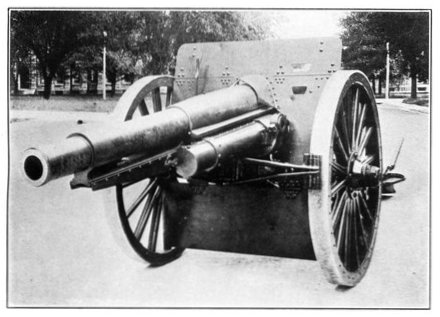
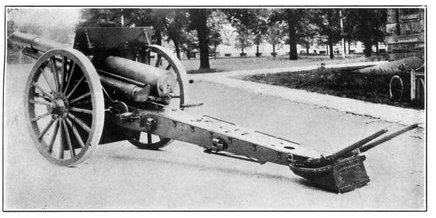
FRONT AND REAR VIEWS OF OUR 4.7-INCH GUN AND CARRIAGE, MODEL 1906,
WITH WHICH OUR TROOPS HAVE BEEN EQUIPPED FOR A LONG TIME.
This gun throws a projectile weighing 45 pounds a distance of about 6 miles.
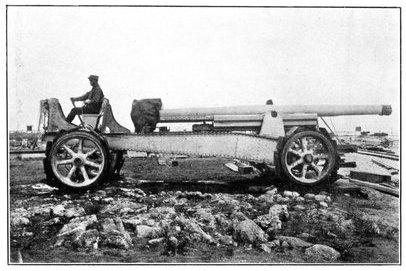
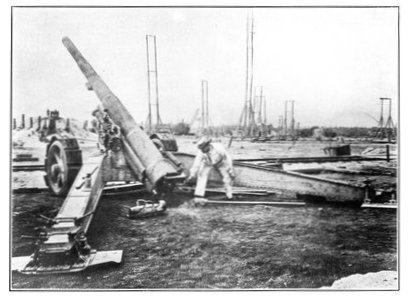
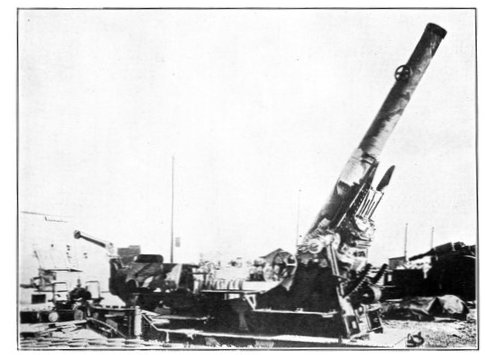
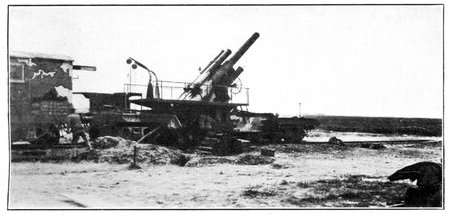
TWO VIEWS OF 155-MILLIMETER GUN, MODEL 1918, G. P. F.
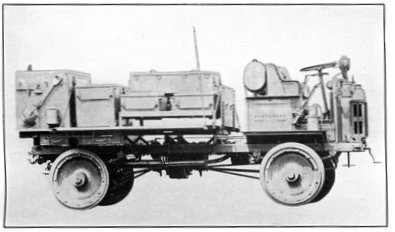
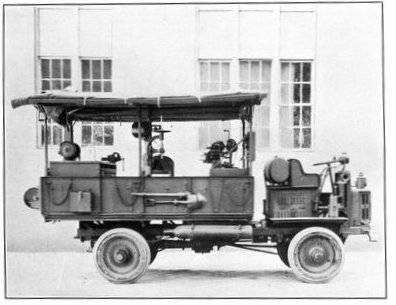
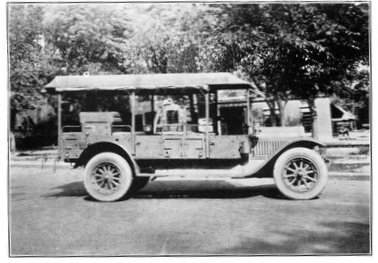
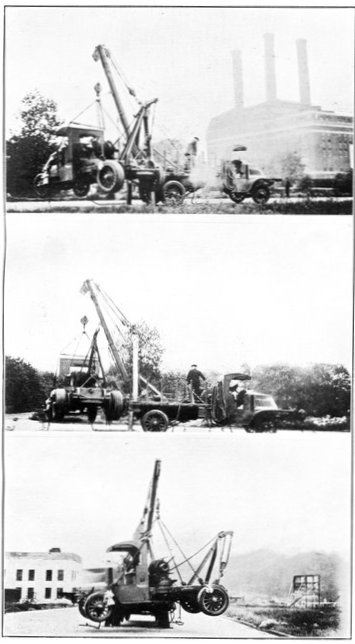
The upper view shows the piece mounted on an auto truck for quick moving about.
In order to produce enough forgings to supply the finish-machining
shops, an order for 50 jackets was later given to the Edgewater Steel
Co., of Pittsburgh, Pa., where the jackets were forged. These were
then sent to the Heppenstall Forge & Knife Co. for rough machining
and finally returned to the Edgewater Steel Co. for heat treating.
An order for 150 jackets was also given to the Tacony Ordnance
Corporation.
Shortly before the signing of the armistice, the jacket was redesigned
so that the heavy breech end was forged separately in the
shape of a breech ring. This design, however, was not produced.
It was desired to develop a 4.7-inch gun carriage having the
characteristics of the split-trail 75-millimeter gun carriage, model of
1916, so that greater elevation and wide traverse could be obtained.
The Bethlehem Steel Co. was given a small order for 36 carriages of
their own design prior to the war, and their pilot carriage had been
undergoing tests at the proving ground. The design was, however,
not sufficiently advanced to be used in the war.
| Unit. |
Contractor. |
Number ordered. |
Number completed at the signing of armistice. |
Number completed up to April 17, 1919. |
| 4.7-inch gun carriage, model of 1906 |
Rock Island Arsenal |
303 |
183 |
183 |
| Studebaker Corporation |
380 |
88 |
175 |
| Walter Scott Co. |
250 |
49 |
57 |
| 4.7-inch gun-carriage limber |
American Car & Foundry Co. |
433 |
433 |
433 |
| Maxwell Motor Co. |
479 |
82 |
250 |
| 4.7-inch gun caisson |
American Car & Foundry Co. |
1,848 |
320 |
848 |
| Ford Motor Co. |
1,001 |
106 |
400 |
| 4.7-inch cannon |
Northwestern Gun Co. |
|
56 |
|
| Watervliet Arsenal |
|
93 |
|
Sixteen of these units, also 48 which were previously on hand, were
floated for overseas up to November 11, 1918.
In the war emergency America sought to put on the front every
pound of artillery she could acquire from any source whatsoever.
Accordingly, before any of the manufacturing projects were even
started, the Ordnance Department conducted a preparedness inventory
of the United States to see what guns already in existence we
might find that could be improvised for use as mobile artillery in
France. The search discovered a number of heavy cannon that
could serve the purpose—part of them belonging to the Army, these
being the guns at our seacoast fortifications; part belonging to the
Navy, in its stores of supplies for battleships; and part of them being
the property of a private dealer, Francis Bannerman & Son, of New
York.
The guns for this improvised use were obtained as follows:
From the Coast Artillery, a branch of the Army, we obtained
ninety-five 6-inch guns, 50 calibers in length, and twenty-eight 5-inch
guns, 44.6 calibers; from the Navy stores came forty-six 6-inch guns,
ranging from 30 to 50 calibers in length; from Francis Bannerman
& Son, thirty 6-inch guns, 30 calibers long. This was a total of 199
weapons of great destructive power, awaiting only suitable mobile
mounts to make them of valiant service on the western front. It was
the task of the Ordnance Department to take these guns and as
swiftly as possible mount them on field artillery carriages of an
improvised type that could be most quickly built.
Minor changes had to be made on many of the guns obtained in
this manner in order to adapt them for use on field artillery carriages.
The various seacoast guns were retained as they were in length,
because it was planned to return them eventually to the fortifications
from which they had been taken. The Navy guns, all of the 6-inch
size, were shipped to the Watervliet Arsenal to be cut down to a
uniform length of 30 calibers.
The need for speed in manufacture demanded that the carriages
for these guns should be of the simplest design consistent with the
ruggedness required for field operations and the accuracy necessary
for effectiveness. When tests of the first carriages produced were
made it was found that requirements had been more than met.
Orders were placed on September 24, 1917, with the Morgan
Engineering Co., of Alliance, Ohio, for 70 mounts for the 6-inch
units. A few days later this number was increased to 74, while on
the 28th of September, 1917, the same company was given an order
for 18 additional 6-inch gun mounts and 28 mounts for the 5-inch
guns. Orders for limbers were placed with the same company on
December 1.
It was soon discovered that big transport wagons would be required
to carry the long 6-inch seacoast guns separately because of their
great weight. On February 15, 1918, the Morgan Engineering Co.
was ordered to build these necessary transport wagons.
Difficulties in securing skilled labor, necessary materials, and tools
delayed production of these mounts, but the eighteen 6-inch gun
mounts ordered September 28, 1917, were completed in March,
1918, while the twenty-eight 5-inch gun mounts ordered on the same
date were finished in April. In August, 1918, the seventy-four
6-inch gun mounts were turned out. The production of an additional
order for thirty-seven 6-inch gun mounts was just beginning
when the armistice was signed.
The 6-inch gun carriage, bearing the gun, weighs about 41,000
pounds. A maximum range of over 10 miles can be obtained by
this weapon. The complete 5-inch gun unit weighs about 23,500
pounds and has a maximum range of more than 9 miles. In understanding
the difficulties that faced the Ordnance Department in
building carriages for these guns, it should be recalled that these
big weapons were originally built for fixed-emplacement duty and
were therefore much heavier than mobile types. This fact complicated
the problem of designing the wheeled mounts. They proved
to be more difficult to maneuver than the lighter types of guns.
| Model. |
Size. |
Number ordered. |
Number completed prior to Nov. 11. |
Number floated for overseas. |
| 1897 |
5-inch |
28 |
28 |
26 |
| 1917 |
6-inch |
74 |
74 |
68 |
| 1917-A |
6-inch |
18 |
18 |
4 |
| 1917-B |
6-inch |
37 |
1 |
|
It is a testimonial to the adaptability and skill of American
industry that we were able to duplicate successfully in this country
the celebrated 155-millimeter howitzer, before 1917 built only in
the factory of its original designer, the great firm of Schneider et
Cie., in France. This powerful weapon is a fine example of the French
gun builders' art, in a country where the art of gun-making has been
carried to a perfection unknown anywhere else.
The 155-millimeter howitzer's history dates back to the nineteenth
century. In its development the French designers had so
strengthened its structure, increased its range, and improved its
general serviceability, that in 1914 it was ready to take its place as
one of the two most-used and best-known weapons of the allies, the
other being the 75-millimeter field gun.
As thus perfected the howitzer weighs less than 4 tons and is
extremely mobile for a weapon of its size. It can hurl a 95-pound
projectile well over 7 miles and fire several times a minute. The
rapidity of fire is made possible by a hydropneumatic recoil system
that supports the short barrel of the gun and stores up the energy
of the recoil by the compression of air. With the gun pointing
upward at an angle of 45 degrees, the recoil mechanism will restore
it into battery in less than 13 seconds. The carriage of the gun is
extremely light, being built of pressed steel parts that incorporate
many ingenious features of design to reduce the weight. The shell
and the propelling charge of powder are loaded separately.
The American-built 155-millimeter howitzer was practically identical
with that built in France. Any of the important parts of the
American weapon would interchange with those which had come from
the Schneider factory. We equipped the wheels of our field carriage,
however, with rubber tires, and gave the gun a straight shield of
armor plate instead of a curved shield.
In the spring of 1917 we bought the plans of the howitzer from
Schneider et Cie. and began at once the work of translating the specifications
into American measurements. This work monopolized the
efforts of an expert staff until October 8, 1917.
In order to facilitate the reproduction here, we divided the
weapon, as a manufacturing proposition, into three groups—the
cannon itself, the carriage, and the recuperator or recoil system—and
placed each group in the hands of separate contractors. There
was, of course, the usual difficulty in finding manufacturers willing
to undertake production of such an intricate device and who also
possessed machine shops that had the equipment and talent required
for such work, and in procuring for these shops the highly specialized
machinery that would be necessary.
The American Brake Shoe & Foundry Co., of Erie, Pa., whose
magnificent work in building a special plant has been described in
the preceding chapter, took an order in August, 1917, for 3,000
howitzer cannon and by October, 1918, was producing 12 of them
every day. The company turned out its first cannon in February,
1918, approximately six months after receiving the contract, having
in the interim built and equipped a most elaborate plant. It is
doubtful if the annals of industry in any country can produce a feat
to match this.
In fact, the production of cannon by the Erie concern so outstripped
the manufacture of carriages and other important parts for
the howitzer that it was possible by September, 1918, for us to sell
550 howitzer bodies to the French Government. When the armistice
was signed on November 11, 1918, the company had completed
1,172 cannon.
In November, 1917, we placed orders for 2,469 carriages for this
weapon, splitting the order between the Osgood-Bradley Car Co.,
of Worcester, Mass., and the Mosler Safe Co., of Hamilton, Ohio.
Then followed a long battle to secure the tools and equipment, the
skilled mechanical labor, and the necessary quantities of the best
grades of steel and bronze, an effort in which the contracting companies
were at all times aided by the engineers of the Ordnance
Department. All obstacles were overcome and the first carriages
were ready for testing in June, 1918. When the armistice was
signed 154 carriages had been delivered, and production was moving
so rapidly that one month later this number had been run up to 230.
The limbers were manufactured by the Maxwell Motor Car Co.,
which had orders to turn out 2,575 of them. The first deliveries of
limbers came in September, 1918, and seven a day were being turned
out in October, a total of 273 having been completed by the day of the
armistice. A month later the number of completed limbers totaled
587.
It was in the making of the recuperator systems that the greatest
problems were presented. No mechanism at all similar to this had
ever been made in this country. No plant was in existence here capable
of turning out such a highly complicated, precise, and delicate
device.
Finally, after much Governmental search and long negotiation, the
Dodge Bros., of Detroit, motor car builders, agreed to accept the
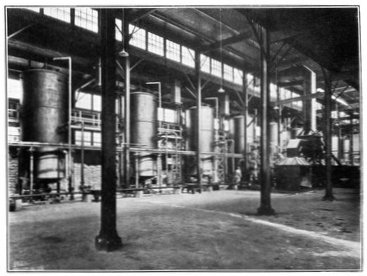
responsibility. In this effort they built and equipped the splendid
factory, costing $10,000,000, described elsewhere.
This howitzer recuperator is turned out from a solid forging,
weighing 3,875 pounds, but the completed recuperator weighs only
870 pounds. Each cylinder must be bored, ground, and lapped to
a degree of fineness and accuracy that requires the most painstaking
care.
Difficulties of almost every sort were experienced with the forgings
and other elements of the recuperators. The steel was analyzed
and its metallurgical formulas were changed. The work of machining
proceeded favorably until the very last operation—that of polishing
the interior of the long bores to a mirrorlike glaze and still retaining
the extreme accuracy necessary to prevent the leakage of oil past
the pistons. Such precision had been theretofore unknown in
American heavy manufacture. Until the many processes could be
perfected, the deliveries were held back.
Even with the delivery of the first recuperator, difficulties did not
vanish. This mechanism has no adjustments which can be made
on the field, but depends for its wonderful operation upon the extreme
nicety of the relation of its parts. It required the alteration of certain
small parts before the first trial models could be made to function.
However, all obstacles and difficulties were finally overcome, and
in the plant that had been erected during the bitter cold of one of
our severest winters, and with practically entirely new machinery
and workmen, production got under way, and the first recuperator
was delivered early in July, 1918, nine months after the contract
was signed. Production in quantity began to follow shortly after
that month, and by November an average of 16 recuperators a day
was being turned out. Of the 3,120 recuperators contracted for,
898 had been finished when the armistice was signed, and this
quantity was increased to 1,238 one month later.
The steel required for the recuperators in these 155-millimeter
howitzers, and also for those of the 155-millimeter guns, was of
special composition; yet all the forge capacity in this country was
being utilized in other war manufacture. New facilities for the
manufacture of these forgings had to be developed by increasing the
capacity of the Mesta Machine Co. of Pittsburgh, until it could meet
our requirements. The Government itself contracted for these
forgings and supplied them to Dodge Bros.
Each howitzer required some 200 items of miscellaneous equipment,
such as air and liquid pumps and other tools. These were
purchased from many sources, and many of these contractors had
just as much difficulty with the small parts as the larger firms had
with the more important sections of the howitzers.
Many of the problems involved in turning out the complete unit
could not be known or understood until they were met with in actual
manufacture. Mechanical experts representing Schneider et Cie.
were on hand at all times to help solve difficulties as they arose.
The Government turned to France for an auxiliary supply of carriages
for the American-built howitzers, placing orders for 1,361 with
French concerns. Of this number 772 had been completed when the
armistice was signed, and the French expected soon to turn out the
carriages at the rate of 140 per month. It might also be noted here
that we placed an order in England for 302 British 6-inch howitzers,
a piece very like the French howitzer. The British contract was to
be completed April 1, 1919.
The various parts of the 155-millimeter howitzer were assembled
into complete units and tested at the Aberdeen Proving Grounds.
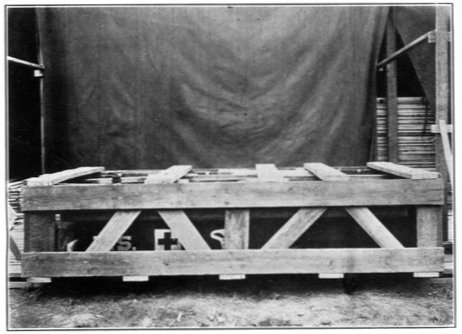
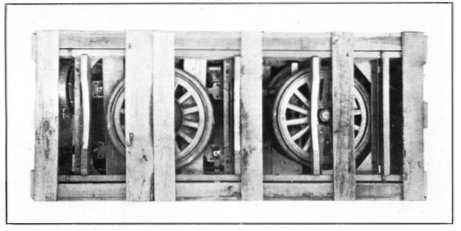
After being assembled and tested, the whole unit was taken apart
and packed into crates especially designed for overseas shipment.
One crate held two howitzer carriages with recuperators in less space
than would have been occupied by one carriage on its wheels.
It will be noted that the first gun body of the 155-millimeter howitzers
made in this country was delivered in February and the first
recuperator in July. Before the recuperators were ready, the other
parts of the howitzer had been proof-tried by using a recuperator of
French manufacture.
During the months of August and September, 1918, the first regiment
equipped with 155-millimeter howitzers was made ready at
Aberdeen. The big weapons were packed and on the dock for shipment
overseas when the armistice was signed. These first ones were
to be followed by a steady stream of howitzers. All arrangements
had been made to assemble units and crate them for overseas at the
Erie Proving Ground at Port Clinton, Ohio.
None of the 155-millimeter howitzers built here reached the American
Expeditionary Forces, but French deliveries of the weapon up to
the signing of the armistice totaled 747.
| Unit. |
Contractor. |
Number ordered. |
Number completed Nov. 11, 1918. |
Number completed Apr. 17, 1919. |
| 155-mm. howitzer carriage |
Osgood Bradley Car Co. |
900 |
136 |
369 |
| 155-mm. carriage replacement parts. |
do. |
49 |
|
0 |
| 155-mm. howitzer carriage |
do. |
250 |
|
93 |
| Do. |
American Rolling Mill Co. (old Mosler Safe contract). |
1,270 |
18 |
26 |
| Do. |
Rock Island Arsenal |
172 |
|
0 |
| 155-mm. howitzer carriage limbers |
Maxwell Motor Co. |
2,575 |
273 |
700 |
| Do. |
Rock Island Arsenal |
100 |
|
0 |
| 155-mm. howitzer caisson |
Ford Motor Co. |
8,937 |
4,373 |
8,937 |
| 155-mm. howitzer cannon |
American Brake Shoe & Foundry Co. |
|
1,172 |
1,789 |
The reproduction in the United States of the French 155-millimeter
G. P. F. (the French designation) gun presents much the same story
as that of the howitzer of equal size—a story of difficulties in translating
plans, writing into them the precision of finishing measurements
that the French factory usually leaves to the skill of the
mechanic himself, difficulties in finding manufacturers willing to undertake
the work, and then of providing them with suitable raw
materials and machinery, and, above all, of locating the necessary
skilled mechanics.
This strange, big monster of a weapon is of rugged design. The
entire unit weighs 19,860 pounds. The gun has the extremely
high muzzle velocity of 2,400 feet per second, a rate of propulsion
that throws the 95-pound projectile 17,700 yards, or a little more
than 10 miles.
The wheels of the carriage have a double tread of solid rubber tire.
By an ingenious arrangement a caterpillar tread can be applied to
the wheels in a few minutes whenever soft ground is encountered.
The center of gravity of the unit is low. The wheels are of small
dimensions and the cradle is trunnioned behind in such a fashion as
to reduce the height of the cannon. The carriage has a split trail,
which allows for a large clearance for recoil at a high elevation
and a large angle of traverse. The carriage when traveling is supported
on semielliptical springs, as is also the carriage limber.
Two large steel castings make up the carriage of this unit. The
bottom part of the carriage is supported by the axle, which carries
the two sections of the split trail upon the hinge pins. The top part
of the carriage is supported by and revolves upon the bottom carriage
and carries in trunnioned bearings the recuperator. The principal
difficulty in carriage manufacture was to obtain in this country
the extremely large steel castings of light-section, high-grade steel.
The carriages, 1,388 in number, were ordered in November, 1917,
from the Minneapolis Steel & Machinery Co. The first delivery of
carriages was made in August, 1918, and in the last week of October
they were being turned out at the rate of seven a day. Up to the
armistice date 370 had been produced, of which 16 had been sent
overseas.
We also placed orders in France for 577 of these carriages, of which
216 had been completed upon the signing of the armistice. The
American monthly rate of production of carriages in October was 162.
The 155-millimeter gun itself is far from being simple to manufacture.
It is of considerable length and is built of a number of jackets
and hoops to give the required resistance to the heavy pressures
exerted in firing, this being a high-velocity gun. Except for
a slight change in the manner of locking the hoops to the jacket, our
gun is identical with that of the French.
Orders for 2,160 cannon were given to the Watervliet Arsenal and
the Bullard Engineering Works, at Bridgeport, Conn., in November,
1917. The Bullard Engineering Works had to construct new buildings
and to purchase and install special equipment, and the Watervliet
Arsenal had to extend its shops and also purchase and install
much additional machinery—a job that took time at both places.
The first deliveries of cannon came from Watervliet Arsenal in
July, 1918. During October 50 cannon were delivered, and it seemed
certain that by early in 1919 the projected eight cannon per day
would be the rate attained. We shipped 16 of the cannon overseas.
By November 11 we had received 71 cannon, a number increased to
109 by December 12.
Limbers in the same quantity as carriages were ordered from the
Minneapolis Steel & Machinery Co., which produced a limber to accompany
each one of its delivered carriages. This limber has an
extremely heavy axle, similar to the automobile front axle. Its size
and weight caused difficulty in obtaining it as a drop forging.
To Dodge Bros. was assigned the task of producing the recuperators
for this gun in their special plant. The 155-millimeter gun recuperators,
however, were made secondary to the production of the
recuperators for the 155-millimeter howitzers, which were the easier
of the two sorts to build.
Forgings were available and work started on recuperators in April,
1918. No rapid completion of these intricate mechanisms was possible,
however, as the first forgings encountered many delays in their
machinings. In the cycle of operations, with everything speeded up
to the limit, more than three months must elapse from the day the
recuperator forging is received to the day when the completed mechanism
can be turned over to the inspector as an assembled article.
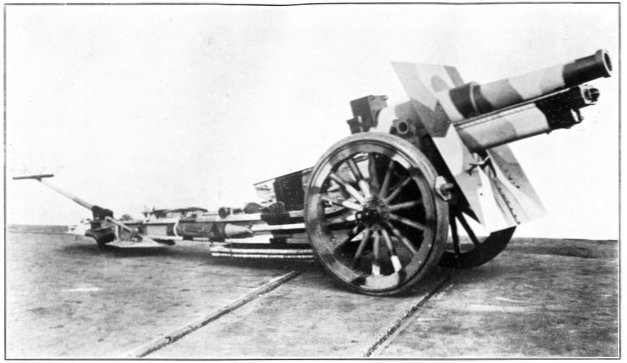
155-MILLIMETER HOWITZER, MODEL 1918 (SCHNEIDER).
This weapon throws shell or shrapnel weighing 95 pounds. Muzzle velocity for shell is 1,420 feet per second. The weight of the howitzer and carriage is 7,600 pounds.
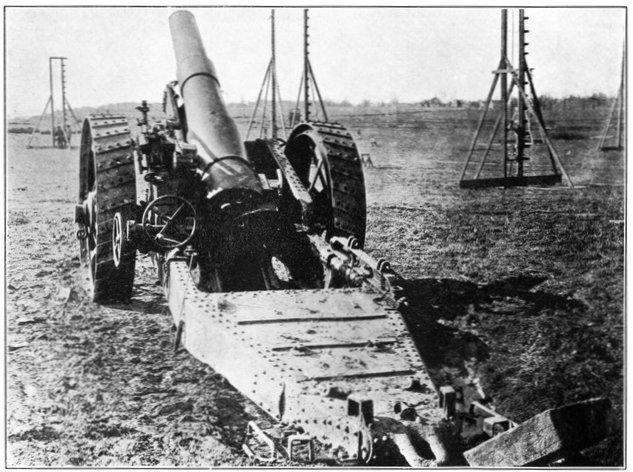
8-INCH HOWITZER, MODEL 1917.
It was in October, 1918, that the first 155-millimeter gun recuperator
was delivered. The factory expected to reach a maximum
capacity of 10 a day. The company built 12 more by December 1.
After the armistice was signed the company's order was reduced to
880, which had all been completed by May 1, 1919.
In order to have recuperators available for use for the units shipped
from the United States minus these mechanisms, 110 rough-machined
recuperator forgings were shipped to France, where the work of
machining and completing was done.
The translation of the French plans for this weapon furnished one
of the most difficult pieces of work undertaken by the Ordnance
Department. Without counting in the gun pieces, the carriage and
limber is made up of 479 pieces, while the recoil mechanism itself has
372 pieces. A total of 150 mechanical tracings had to be made by
our draftsmen for the carriage and test tools; 50 for the carriage
limbers; 142 for the recoil mechanism; 74 for the tools and accessories;
or a total of 416. It was extremely difficult to secure draftsmen
who could do this work, and the translation, accomplished in a
few weeks, is regarded as a remarkable achievement.
The cannon for this gun were tested at the Erie Proving Grounds
and there packed for overseas shipment. We had many cannon and
carriages awaiting shipment when the armistice was signed, the plan
being to send them to France, where they would be equipped with
recuperators.
| Unit. |
Contractor. |
Number ordered. |
Number completed Nov. 11, 1918. |
Number completed Apr. 17, 1919. |
Number floated Nov. 11, 1918. |
| 155-mm. gun carriage model 1918 (Filloux). |
Minneapolis Steel & Machinery Co. |
1,446 |
370 |
800 |
16 |
| 155-mm. gun carriage limber, model 1918 (Filloux). |
do. |
1,446 |
370 |
800 |
16 |
| 155-mm. gun cannon proper |
Bullard Engine Works |
1,400 |
53 |
250 |
16 |
| Do. |
Watervliet Arsenal |
760 |
18 |
68 |
In the early days of the war the British designed an 8-inch field
howitzer that proved itself on battle fields in France. Great Britain
loaded her own plants with orders for this weapon and then turned
to the United States for additional facilities. The Midvale Steel &
Ordnance Co. at Nicetown, Pa., was manufacturing this unit for the
British at the time we entered the war.
On April 14, 1917, exactly eight days after we had formally
announced our purpose of warring with Germany, an order for 80
of these 8-inch howitzers was placed with the Midvale Steel Co. It
was understood that production on our order was to be begun upon
the completion of the British contract on which the Midvale Co.
was then engaged. The order included the complete units, with
carriages, limbers, tools, and accessories, all to be built in accordance
with British specifications.
Contracts for the trails were sublet by the Midvale Co. to the
Cambria Steel Co; for the wheels, to the American Road & Machinery
Co.; for the limbers and firing platforms, to the J. G. Brill Co.; and
for the open sights, to the British-American Manufacturing Co.
Panoramic sights for these guns were furnished by the Frankford
Arsenal.
So satisfactory did the production proceed that on December 13,
1917, the first of the 8-inch howitzers was proof-tried with good
results. Early in January, 1918, the complete units began to come
through at the rate of three a week, increasing to four a week in April
and to six a week in May.
A subsequent contract with Midvale brought the total number of
howitzers ordered from that plant up to 195. These weapons, all of
the model known as the Mark VI, were all produced and accepted
before the signing of the armistice, 96 of them being shipped overseas,
with their full complement of accessories. Each completed
unit cost in the neighborhood of $55,000. These weapons throw a
200-pound projectile 11,750 yards.
The progress of the war moved so swiftly, however, that there soon
was need for artillery units of this same size but with longer range.
Accordingly, a new design, known as the Mark VIII½, was brought
out, having a range of over 13,000 yards. On October 2, 1918, we
placed with the Midvale Co. an order for 100 of these 8-inch howitzers,
specifying carriages of the new, heavier type.
When we entered the war the Bethlehem Steel Co., at Bethlehem,
Pa., was producing for the British Government a howitzer with a
bore of 9.2 inches. The Bethlehem Co. expected to complete these
British contracts in July, 1917. The 9.2-inch howitzer was approximately
the same size as the 240-millimeter howitzer which we were
getting ready to put into production. However, in our desire to
utilize every bit of the production facilities of the country, we
ordered 100 of the 9.2-inch howitzer units from the Bethlehem Steel
Co. and placed additional orders for 132 of these units in England.
The British concerns delivered 40 howitzers before the armistice
was signed.
| Mark. |
Size. |
Contractor. |
Number ordered. |
Number completed Nov. 11, 1918. |
Number floated. |
Number completed to Apr. 17, 1919. |
| VI |
8-inch howitzer. |
Midvale Steel Co. |
195 |
167 |
96 |
195 |
| VIII½ |
do. |
do. |
100 |
|
|
34 |
| Model 1917 |
9.2-inch howitzer. |
Bethlehem Steel Co. |
100 |
|
|
1 |
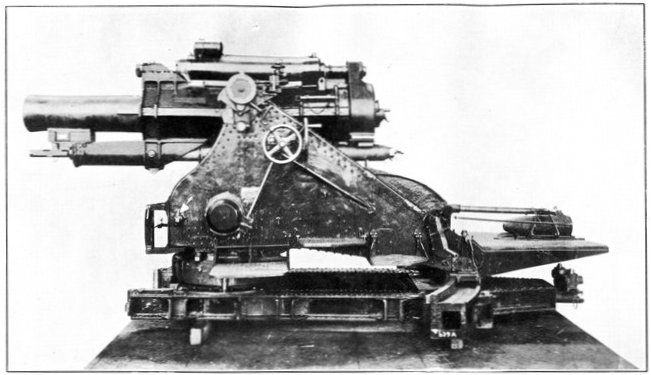
THE 9.2-INCH HOWITZER, MODEL 1917.
This gun shoots shell weighing 290 pounds 8,690 meters. The weight of the howitzer and carriage is 29,100 pounds.
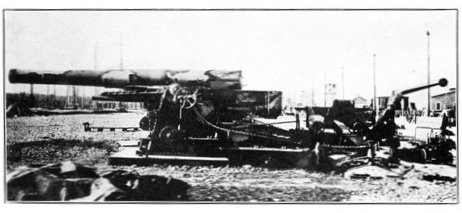
TWO VIEWS OF THE 240-MILLIMETER HOWITZER, MODEL 1918.
The scheme of production of the French 240-millimeter howitzers
was entirely aimed at the year 1919; since even if American heavy
manufacturing establishments had not been loaded with war orders,
it would have been well-nigh impossible to turn out this mighty
engine of destruction in quantities in any shorter period of time.
Although approximately the same size as the British 9.2-inch
howitzer (the exact diameter of the bore of the 240 being 9.45
inches) and only a little larger than the 8-inch howitzer, the French
gun was far more powerful than either. The 8-inch and the 9.2-inch
howitzers had ranges in the neighborhood of 6 miles, while their
shell weighed from 200 to 290 pounds. The 240, on the other hand,
hurled a shell weighing 356 pounds and carrying a bursting charge
of between 45 and 50 pounds of high explosive. Its range was
almost 10 miles.
We produced the 8-inch and the 9.2-inch howitzers to fill the
gap during the two years which must elapse before we could get into
quantity production of the 240. The French and British governments
in the fall of 1917 asserted their ability to equip our first 30
combat divisions in 1918 with heavy howitzers, so that if our production
came along in the spring of 1919 it could meet the requirements
of the war situation.
Consequently we planned to equip our first army of 30 divisions
with 8-inch and 9.2-inch howitzers in equal numbers of each. Our
second army of 30 divisions should be wholly equipped with 240-millimeter
howitzers; and our expected production of these, being
beyond our own contemplated needs, would serve to replace such
8-inch and 9.2-inch howitzers as had been lost in the meantime.
As we adapted it from the French Schneider model, the 240-millimeter
howitzer consisted of four main parts—the howitzer barrel,
the top carriage, the cradle with recoil and mechanism, and the
firing platform. Each of these four parts had its own transportation
wagon and limber drawn by a 10-ton tractor. The weapon was set
up with the aid of an erecting frame and a small hand crane.
Each of the main sections is composed of numerous smaller assembled
parts made up of various grades of iron and steel and raw
materials, all requiring the greatest precision in their manufacture
and all having to pass rigid and exacting tests for strength and
dimensions.
The production of even one of these enormous weapons would have
been a hard job for any American industrial plant, but to manufacture
over 1,200 of them, and that within the comparatively limited
time allowed and under the abnormal industrial and transportation
conditions then prevailing, was a task of tremendous difficulty and
complexity.
On September 1, 1917, an order was placed with the Watertown
Arsenal for 250 carriages for the American 240's, to be turned out
complete with the recoil mechanism, transportation vehicles, tools,
and accessories. To show the size of the job, an allotment of
$17,450,000 was set aside to cover the estimated expenses at the
arsenal.
Well equipped as the Watertown Arsenal was said to be at the time
for the production of heavy gun carriages, it was found necessary, in
order to handle this job, to construct a new erecting shop that had
a capacity practically as large as all the other buildings of the plant
put together. The number of employees at the arsenal was increased
from 1,200 to more than 3,000.
The greatest difficulty experienced was in obtaining the large
number of heavy machine tools required, and experts were sent out
to scour the country in an effort to locate these tools wherever they
might be available. Raw materials could not be procured in sufficient
quantities, while numerous transportation delays impeded the
work.
Finally, in October, 1918, the pilot carriage was completed and
sufficient progress had been made on the entire contract to assure
production of the required number of units in the early part of 1919.
A second carriage contract (Nov. 16, 1917) went to the
Standard Steel Car Co., of Hammond, Ind. This called for the
delivery of 964 carriages complete with transportation vehicles,
limbers, tools, etc., but not with recuperators. These the Otis
Elevator Co., of New York, undertook to deliver.
The Standard Steel Car Co. is one of the most important builders of
railway cars, freight and passenger, in the country, and it possessed
a large and well-equipped plant. Nevertheless, the company was
compelled to construct several additional buildings and practically
to double the capacity of its huge erecting shop in order to prepare
adequately for the tremendous task undertaken.
As a means to save time, subcontracts were immediately placed
with more than 100 firms throughout the East and Middle West for
the production and machining of as many as possible of the component
parts needed by the Standard Steel Car Co. Wherever practicable,
the subcontractors working on similar contracts for the
Watertown Arsenal were retained by the Indiana company, so that
better prices might be obtained, parts standardized, and the whole
production greatly facilitated.
Once the work was well under way the ramifications of this one
contract, with its subcontracts for parts, materials, tools, building
construction, etc., extended throughout practically the entire industrial
facilities of the eastern and central sections of the country.
As in the case of the contract given the Watertown Arsenal, there
were many difficulties in obtaining tools and raw materials. In a
large majority of cases allocations, partly of iron and steel products,
had to be obtained through the War Industries Board. When
allocations had been granted, priority orders had to be secured, as
the producers of these materials were already overworked with
Government orders of varying importance.
With the pilot carriage complete in the early part of October, production
on all the main parts had progressed by November to such
an extent that a large output of finished carriages was assured for
December and thereafter, had not the signing of the armistice intervened
and ended the necessity for further expedition of the work.
Orders for howitzer bodies were placed as follows:
|
Sets. |
| Bethlehem Steel Co., Nov. 21, 1917 |
237 |
| Edgewater Steel Co., Oct. 24, 1917 |
175 |
| Tacony Ordnance Corporation, Nov. 14, 1917 |
175 |
| Watertown Arsenal, Nov. 10, 1917 |
80 |
| American Bridge Co., Mar. 31, 1918 |
800 |
The Watervliet Arsenal on November 20, 1917, was instructed to
do the machining of forgings so as to turn out 250 gun bodies for
the 240-millimeter howitzers, and three months later this order
was doubled. On November 7, 1918, an additional 660 were ordered
from Watervliet, making a grand total of 1,160 howitzer cannon
of this caliber ordered machined and completed at the Watervliet
Arsenal. The arsenal contracted to reach an output of 100 cannon
a month and deliver the last of the 1,160 not later than September
30, 1919.
It was found necessary to erect an entirely new shop for the machining
of these howitzers. This shop was completed in May, 1918.
During the war period $13,164,706 was spent or allotted to the Watervliet
Arsenal for increasing its facilities. Forgings were furnished to
the arsenal by the Government, but the forging situation was never
a delaying factor in the production of 240-millimeter howitzers.
In all, 158 sets, of 1,467 ordered, were delivered up to December
12, 1918. The pilot howitzer was delivered by the Watervliet Arsenal
to the proving ground on August 24, 1918.
In the summer of 1918 the Watertown Arsenal contracted to build
252 additional recuperators for these howitzers. Work was started at
once in the shops, and, though additional facilities had to be prepared
and much new equipment added, the production of the first recuperator
was begun without delay. It was found that the planing
equipment at the arsenal was not sufficient to handle the work, and
therefore a great deal of the rough planing was done by subcontractors.
The Watertown Arsenal was to furnish its own forgings, but it was
quickly found that an additional source of supplies was required.
The Carnegie Steel Co. had been given an order on December 27, 1917,
for 1,300 recuperator forgings, and some of these were sent to the
Watertown Arsenal.
The first recuperator was completed October 28, 1918, and 16 had
been finished up to December 31, 1918, when 280 forgings were in
the process of machining.
To handle its order for 1,039 recuperators, the Otis Elevator Co.,
of New York, found it necessary to rebuild a plant which it owned in
Chicago. Forgings were furnished by the Government.
On May 1, 1918, the Otis Elevator Co. started its rough machining.
Hard spots were found in the metal, causing great trouble at first,
but this difficulty was overcome by changes in the heat treatment.
The Carnegie Steel Co. was then instructed to rough-machine the
forgings before sending them to the Otis Elevator Co. An order was
also given to the Midvale Steel Co. to rough-machine 24 forgings.
Early in November, 1918, the Otis Elevator Co. finished its first
recuperator.
One 240-millimeter howitzer unit was completed at the time of
the signing of the armistice, out of a total of 1,214 contracted for;
but had war conditions continued, the expectation was for a monthly
capacity of 80 units by 1919. Actual deliveries are given below:
| Units. |
Contractors. |
Number ordered. |
Number completed Nov. 11, 1918. |
Number completed Apr. 17, 1919. |
| 240-mm. unit, complete, except howitzer. |
Watertown Arsenal |
250 |
[11]1 |
[11]41 |
| [12]4 |
[12]25 |
| 240-mm. howitzer carriage units, except recuperators. |
Standard Steel Car Co. |
964 |
5 |
67 |
| Windlasses |
Dodge Manufacturing Co. |
1,125 |
33 |
350 |
| Rammer trucks |
do. |
1,205 |
2 |
375 |
| Shot trucks |
do. |
3,214 |
2 |
1,000 |
| 240-mm. howitzer cannon |
Watervliet Arsenal |
|
2 |
19 |
The American development of antiaircraft artillery had, previously
to 1917, been confined almost exclusively to the task of designing and
constructing stationary units of defense for our coast fortifications.
It was naturally expected that it would be at those points that we
would first, if ever, have to meet an attack from the air. Very little
attention had been paid mobile artillery of this sort.
Before April, 1916, the Ordnance Department had designed a high-powered
3-inch antiaircraft mount for the fixed emplacement at coast
fortifications. The gun on this mount fired a 15-pound projectile
with a muzzle velocity of 2,600 feet a second. It is still to-day the
most powerful antiaircraft weapon of its caliber. Between May, 1916,
and June 18, 1917, orders for 160 of these mounts were placed with
the Watertown Arsenal and the Bethlehem Steel Co. Up to April
10, 1919, a total of 116 of these had been completed and sent for emplacement
at the points selected.
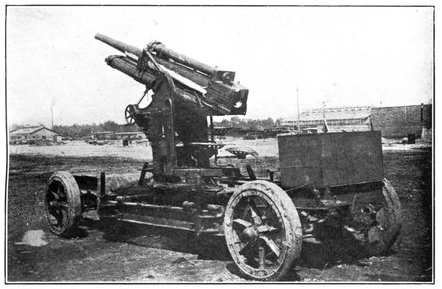
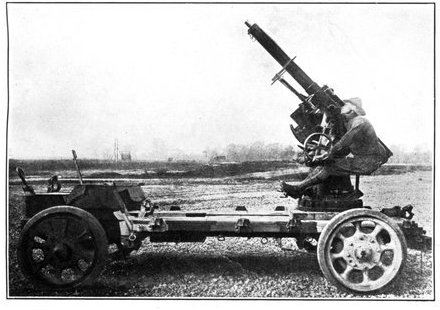
TWO VIEWS OF ANTIAIRCRAFT GUNS ON TRUCK MOUNTS.
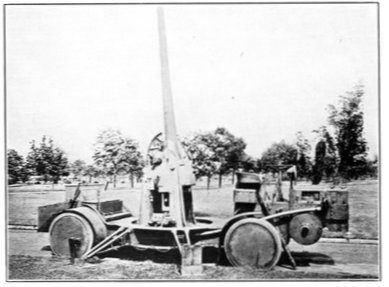
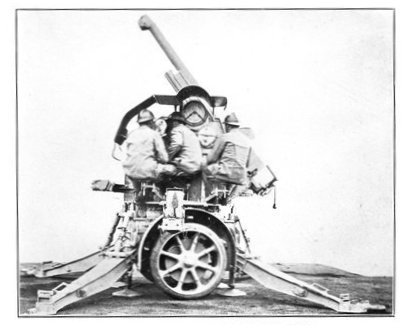
TWO OTHER VIEWS OF ANTIAIRCRAFT GUNS.
By the end of 1916, however, it was foreseen that it would be necessary
to provide antiaircraft artillery of a mobile type as part of the
equipment for any field forces that might be sent abroad. Since that
contingency seemed entirely possible at that time, and as it appeared
to be impossible to provide a suitable design that would have a sufficient
period of time in which to get proper consideration and test, it
was decided to improvise a simple structural steel design that would
permit quick construction and on which a 75-millimeter field gun,
that was already in production, could be mounted.
This design was completed May 1, 1917, and an order for 50 placed
with the Builders Iron Foundry. Deliveries on these were made
during the fall of 1917, and the carriages were at once shipped to
France for equipment with French field guns and recuperators that
had been already procured for the purpose.
In its mobility the improvised antiaircraft gun mount was far from
perfect. It was necessary to disassemble it partly and mount it on
trailers. The need for a mount that could be moved easily and
speedily had been realized before our entrance in the war, and a design
embodying these qualities was completed as early as December,
1916.
This truck was designed to be equipped with the American 75-millimeter
field gun, model of 1916. Before the drawings were completed
an order for the pilot mounts of this type was placed with the
Rock Island Arsenal. The war came on, and it was decided not to
wait for a test of the mounts before starting general manufacture.
Accordingly the New Britain Machine Co., in July, 1917, was given
an order for 51 carriages. No further orders were placed for carriages
of this sort, as it was not thought best to go too heavily into
production of an untried mount.
It may be noted here that our first 26 antiaircraft guns were
mounted on White 1½-ton trucks.
It was also realized that the field guns with which these mounts were
to be equipped did not have the power and range that the war experience
was showing to be necessary. The only reasons that the field
guns of the 75-millimeter caliber were used in this way was because
they were the guns most quickly available and because the French
were already using them for this purpose.
To meet the need of more powerful antiaircraft weapons, a need
becoming more pressing each day, a 3-inch high-powered antiaircraft
gun was designed and mounted on a four-wheel trailer of the automobile
type. This mount permitted elevations of the gun from 10
degrees to 85 degrees and also allowed for "all around" firing. An
order for 612 of these carriages was given to the New Britain Machine
Co. in July, 1917, shortly after the contract for the 51 truck mounts
had been placed with that concern.
Because of the urgency of the situation it was necessary to construct
these carriages without the preliminary tests on a pilot carriage.
This, of course, is a very undesirable practice, but under the
existing conditions no other procedure would have been practicable.
The French antiaircraft auto truck mount, which had the French
75-millimeter field gun with its recuperator placed upon a special
antiaircraft mount, was not adopted at the time, because, in July,
1917, the whole question of the possibility of constructing French
recuperators in this country was still entirely unsettled. It was imperative
then that we develop our own designs.
All of the 51 truck mounts for the antiaircraft guns were delivered
during the fall and early winter of 1918, and 22 of them were in
France before December, 1918.
Delivery of the first carriage for the 3-inch high-powered gun
mounted on the trailer carriage was made in August, 1917. It had
been rushed ahead of general production in order to be given some
sort of a test. No further deliveries were made, but manufacture
reached a point where production in quantity could begin.
A representative of the Ordnance Department was sent to France
and England in December, 1917, to gather all the information possible
on antiaircraft artillery. As a result of his investigations it was determined
that it would be best to procure the greater part of our fire-control
equipment in France, since the instruments developed there
were in some cases of a highly complicated nature and their manufacture
entirely controlled by private parties. Orders were placed for
enough of these instruments for the equipment of the first 125 batteries.
Meanwhile, fire-control instruments of various types were in the
process of development in this country; but, as they were largely
based upon theoretical construction derived from study of the
French practices, it was deemed best not to manufacture any of these
instruments in quantity, as better instruments of French design were
available. Drawings of the French instruments were brought back
by the Ordnance officer on his visit to France and were available in
this country in the spring of 1918, when manufacture of some of them
began in the United States.
At the signing of the armistice our forces in France were equipped
almost wholly with antiaircraft artillery loaned to us and supplied
by the French. This, of course, does not include the 101 improvised
and truck mounts completed during 1917. Production here, however,
had reached such a point that shipment of material would have
begun in quantity in January, 1919.
The estimated requirements of antiaircraft artillery for 2,000,000
men in 48 divisions is only 120 guns. Other material, of course,
would have been required previously for defense of depots, railheads,
etc., dependent in a great measure upon the activities of German
bombers. It is estimated that about 200 guns would have sufficed
for this purpose.
To summarize, 50 of the so-called improvised 75-millimeter antiaircraft
guns and mounts had been ordered and completed up to the
time of the signing of the armistice; 51 of the 75-millimeter antiaircraft
mounts, model of 1917, had been ordered and 46 completed;
while 612 of the 3-inch antiaircraft trailer carriage mounts, model of
1917, had been ordered, of which 1 had been actually delivered at the
signing of the armistice, the balance to come at the rate of 26 per
month starting in December.
Artillery—Production of complete units, by months.
[Deliveries in the United States on U. S. Army orders only.]
|
To Jan., 1918. |
1918 |
Total. |
| Jan. |
Feb. |
Mar. |
Apr. |
May. |
June. |
July. |
Aug. |
Sept. |
Oct. |
Nov. |
Dec. |
| 75-mm. gun, model 1897 |
0 |
0 |
0 |
0 |
0 |
0 |
0 |
0 |
0 |
0 |
1 |
0 |
0 |
1 |
| 75-mm. gun, model 1916 |
0 |
0 |
0 |
9 |
4 |
6 |
21 |
2 |
60 |
42 |
51 |
11 |
45 |
251 |
| 75-mm. gun, model 1917 |
1 |
11 |
36 |
28 |
58 |
22 |
61 |
61 |
55 |
130 |
211 |
110 |
55 |
839 |
| 75-mm. antiaircraft gun |
0 |
49 |
2 |
0 |
0 |
1 |
1 |
2 |
16 |
2 |
18 |
6 |
3 |
100 |
| 3-inch antiaircraft gun |
0 |
0 |
0 |
0 |
0 |
0 |
0 |
0 |
1 |
0 |
0 |
0 |
0 |
1 |
| 4.7-inch gun |
0 |
0 |
0 |
0 |
0 |
0 |
0 |
15 |
15 |
28 |
72 |
50 |
44 |
224 |
| 155-mm. howitzer |
0 |
0 |
0 |
0 |
0 |
0 |
0 |
1 |
8 |
39 |
63 |
65 |
100 |
276 |
| 5-inch seacoast gun |
0 |
0 |
1 |
27 |
[13] |
[13] |
[13] |
[13] |
[13] |
[13] |
[13] |
[13] |
[13] |
28 |
| 6-inch seacoast gun |
0 |
0 |
12 |
5 |
2 |
45 |
23 |
4 |
1 |
[13] |
[13] |
[13] |
[13] |
92 |
| 155-mm. gun |
0 |
0 |
0 |
0 |
0 |
0 |
0 |
0 |
0 |
0 |
1 |
5 |
10 |
16 |
| 8-inch howitzer |
7 |
12 |
17 |
20 |
22 |
2 |
0 |
0 |
23 |
27 |
33 |
13 |
15 |
191 |
| 9.2-inch howitzer[14] |
0 |
0 |
0 |
0 |
0 |
0 |
0 |
0 |
0 |
0 |
0 |
0 |
0 |
[14]0 |
| 240-mm. howitzer |
0 |
0 |
0 |
0 |
0 |
0 |
0 |
0 |
0 |
0 |
0 |
1 |
0 |
1 |
| 8-inch seacoast gun |
0 |
0 |
0 |
0 |
0 |
0 |
0 |
0 |
0 |
3 |
14 |
4 |
1 |
22 |
| 10-inch seacoast gun |
0 |
0 |
0 |
0 |
0 |
0 |
0 |
0 |
0 |
0 |
0 |
0 |
0 |
0 |
| 12-inch gun |
0 |
0 |
0 |
0 |
0 |
0 |
0 |
0 |
0 |
0 |
0 |
1 |
2 |
3 |
| 12-inch seacoast mortar |
0 |
0 |
0 |
0 |
0 |
0 |
0 |
0 |
1 |
0 |
0 |
10 |
2 |
13 |
| Total |
8 |
72 |
68 |
89 |
86 |
76 |
106 |
85 |
180 |
271 |
464 |
276 |
277 |
2,058 |
By "complete units" is meant gun body complete, carriage, and recoil mechanism
or recuperator. Units are given as complete when their component parts were complete,
although the actual assembly of these parts at a common point, testing, and
final delivery usually required from two weeks' to two months' additional time.
The 5-inch, 6-inch, 10-inch, and 12-inch seacoast guns and the 12-inch seacoast
mortars were taken from the fortifications and modified for use with mobile carriages,
all above 6 inches for railway mounts.
The 75-millimeter gun, model 1897, was the approved model for active service in
France. Model 1916 and model 1917 were used for training purposes both in the
United States and in France.
Production of mobile artillery (complete units), Apr. 1, 1917, to Nov. 11, 1918.
[Including all produced for France and Great Britain in United States.]
|
Produced. |
Shipped Overseas. |
| 75-mm. guns (or British 18-pounder) |
970 |
181 |
| 3-inch and 75-mm. antiaircraft guns |
97 |
[15]26 |
| 4.5-inch howitzers |
97 |
97 |
| 4.7-inch guns |
157 |
64 |
| 155-mm. (5-inch and 6-inch seacoast guns) |
121 |
[16]114 |
| 155-mm. howitzers |
144 |
0 |
| 7-inch guns on caterpillar mounts |
[17]10 |
0 |
| Railway artillery |
20 |
11 |
| Heavy howitzers |
[18]418 |
322 |
| Total |
2,034 |
815 |
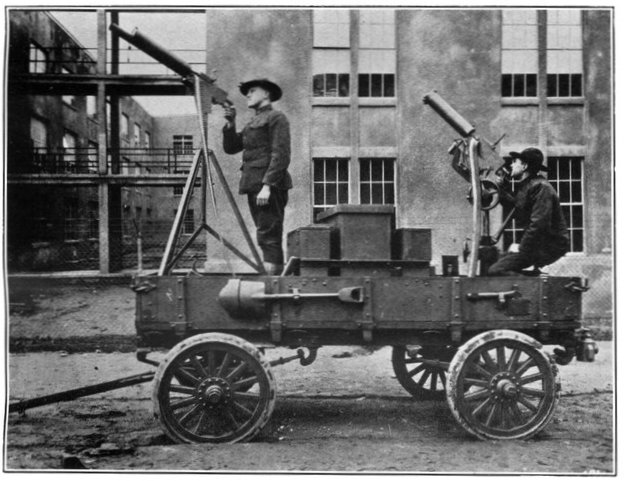
1½-TON ANTIAIRCRAFT MACHINE GUN TRAILER.
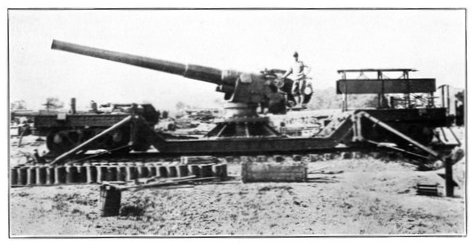
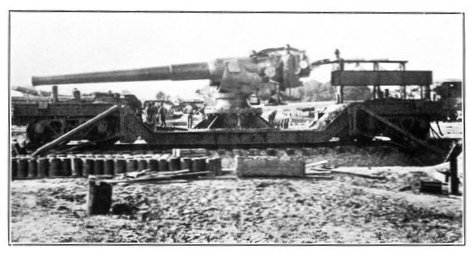
TWO VIEWS OF THE 7-INCH NAVY RIFLE MOUNTED ON A PEDESTAL ON A
RAILWAY CAR.
This rifle has a range of about 10 miles and throws a projectile weighing 165 pounds. Note
the means of loading and the depression angle.